Pacific
Islands
Monthly
Vol. Xvii. No. 1.
August 19, 1946
Established 1930.
[Registered at transmission by post as a newspaper ]
1/-
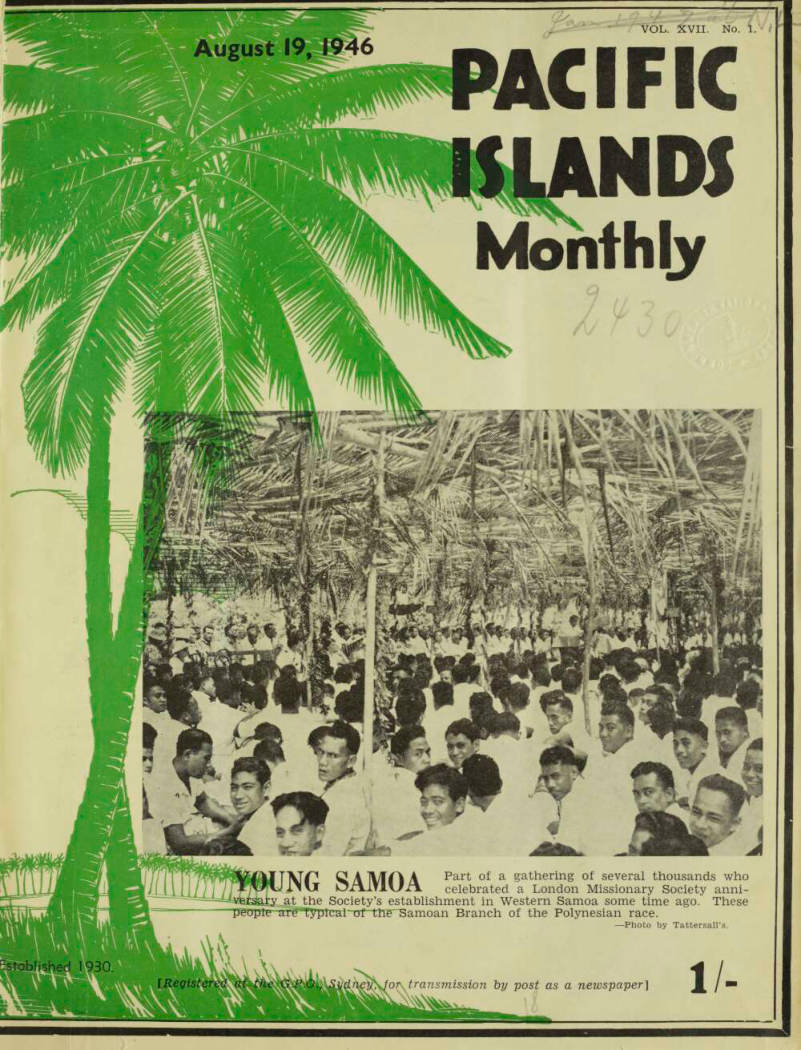
YOUNG SAMOA Part of a g atherin g of several thousands who celebrated a London Missionary Society anni verserry at the Society’s establishment in Western Samoa some time ago. These people are typical of The Samoan Branch of the Polynesian race. —Photo by Tattersall’s.
Advertisements & other items, pp. 2-4 (1 item)
New Guinea
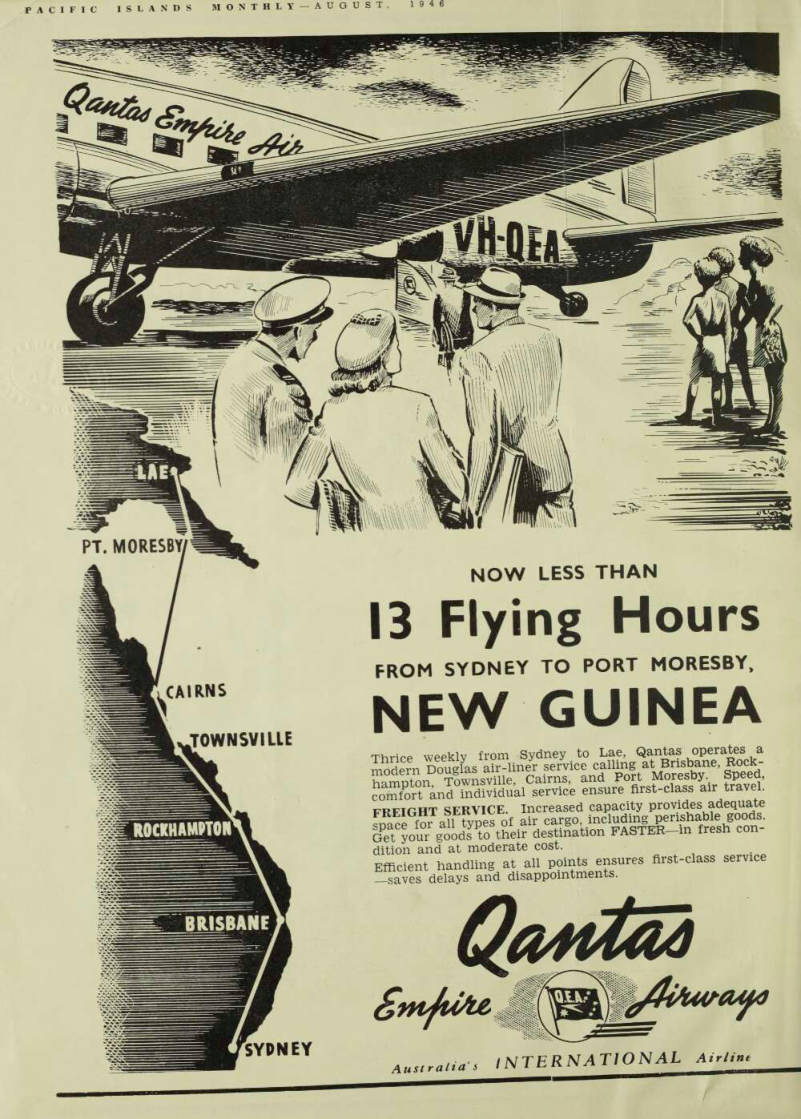
NOW LESS THAN
13 Flying Hours
FROM SYDNEY TO PORT MORESBY,
NEW GUINEA
hrice weekly from Sydney to Lae, Qantas operates a mriprn Douglas air-liner service calling at Brisbane, Rockamnton Townsville, Cairns, and Port Moresby, Speed, omfort and individual service ensure first-class air travel.
HEIGHT SERVICE. Increased capacity provides^ adequate p ß ace G for T a!l types of air cargo, including ■et your goods to their destination FASTER—m tresn con ition and at moderate cost.
Efficient handling at all prints ensures first-class service -saves delays and disappointments.
Australia's INTERNATION
IftkNig
kt w Coleman’s Petrol Iron lights instantly ... is evenly balanced . . . has ventilated body, tapered ironing edges, pointed heel and hot point.
Can be used in or out of doors.
Coleman’s SOLUS Stove assembled in 30 seconds. Burns AND Preheats with Kerosene. 5-6 Hours on one filling.
Boils 1 quart in 3 minutes.
May be carried in any position-fuel cannot leak.
ALL-PURPOSE LANTERN
STORM-PROOF . . . DEPEND-
ABLE AND SIMPLE IN
OPERATION
Coleman Pressure Lanterns are in two sizes and two types (Petrol and Kerosene). The perfect safety and trouble-free service which Coleman Lanterns have given over the past forty years are your guarantee of perfect satisfaction.
O PRIZE Kerosene Wickless Stoves, 2 and 3 Burner Models. Beautifully finished; white baked enamel—ample! cooking top with heavy steel I grates. Glass fuel tanks.
Coleman’s Portable Cooking Stove lights instantly, has safety shut-off valves and instant heat control. Made of EVERDUR (rustproof), finished in ivory and brown baked enamel. v. a
IRONS LAMPS STOVES
Representatives for the Pacific Islands:
ROBERT GILLESPIE PTY. LTD.
54a PITT STREET, SYDNEY
PEARCE & CO. LTD.
SUVA
FOR FIJI ISLANDS
Woven Wire for ail Industry
COPRA DRYING TRAYS, FLOORS, Etc.
FRU'T DRYING TRAYS, MINING SCREENS.
Heavy Mosquito Gauze in Phosphor Bronze and other Metals Impervious to Salt Sea Air.
WIRE DOOR MATS AND GENERAL WIRE WORKS
E. WRIGHT & CO. LTD.
Office and Works: 148-152 Cleveland Street, Sydney, N.S.W.
Telegraphic Address; “Wrightmake,” Chippendale. * Or £
For Service
EXPORTERS - IMPORTERS
Contact
1
COMMONWEALTH TRADING CO. Pty. Ltd.
95 YORK STREET, SYDNEY
Phones: MA 4232, M 6969.
GENERAL MERCHANDISE, TRADE GOODS, CLOTHING, FOOD-
STUFFS, LIQUEURS, SPIRITS. WINES.
SALVAGER SAVES HIMSELF
FROM TRAVELLING FATIGUE
REALLY ON THE JOB TO-DAY
With the call to-day going out for more metal, the work of a salvager is one that knows the pressure is on!
Mr. E. P. Nicholson, of 77 Carlton Mill Road, Christchurch, is New
Zealand’s largest salvage merchant,
obtaining quantities of steel, etc.,
from sunken ships, gold dredges,
mining plants, and anywhere else
where metal is lying unused.
Mr. Nicholson attributes his present abundant energy to R.U.R.
He says: "After several years travelling in Australia and New Zealand in motor-cars, and getting practically no exercise, I found myself getting very sluggish, tired and fatigued, in addition to putting on weight but after taking R.U.R. I noticed a decided improvement, both in regard to my energy and fatigue. I have lately driven eignteen hours at a stretch without sleep, which I could not possibly have done before. My weight has now returned to normal, and thanks to R.U.R. I feel altogether a new man, both physically and mentally.”
Once again R.U.R. comes to the rescue R.U.R. is the greatest treatment, and con tains a laxative, liver stimulant, kidney cleanser lood purifier and acid corrective Obtain a ble~"ai Chemists and Stores, or write to R.U.R., 841 George Street, Sydney, Australia.
Bogese, Nmp
Sent to Gaol For Four Yea
THE case of George Bogese, £ Medical Practitioner, who wai rested on a series of counts con ing his association with the Japane the British Solomon Islands, and was subsequently interned during period of the war in Tatura, Victoria tried in Honiara, BSI, in May bj Chief Justice of Fiji (Sir Claude S( The case of Bogese created intere the time, and was referred to in journal on a number of occasions, fact that so many of the graduates c Suva Medical School had been assoc with war-time activities, and ths every case, except that of Bogese NMP’s had creditably upheld the h( of the school, served to throw gr light upon the case of Bogese. 1 the Japanese came into the Solo he was serving as an NMP on Island, and it was alleged that he sequentlv assisted the Japanese; thj went with the Japanese to Rabaul was returned by them to his wife family in the Solomons; and that o: return from Rabaul he definitely fra ised with the Japanese, Bogese was interned at Tatura; from there he wrote to various pei including the editor of the PIM, ii ing that he had been wrongly chi and that he could prove his innoc His letters disclosed great natural a and a high standard of education.
After the war he was returned tc Solomons, and was given a full O] tunity to show that he was not g The case was stated at length befon Chief Justice, who was assisted by Assessors, Messrs. J. M. Clift and 1 Markham.
The evidence which had induced military authorities in 1942 to n Bogese was produced and Bogese given the fullest opportunity to i Bogese’s talents were shown in the ] ner in which he conducted his defe The Court found that Bogese wa; guilty of the two most serious ch made against him—namely, that he shown the Japanese the way to a : incr, leading to Major D. G. Kenr hill-station (it will be remembered Major Kennedy was one of those wl great personal risk, kept a watch I the Jananese in 1942) and that he guided the Japs to Major Kennedy’s rol vessel, the “Waihi,” which was carefullv camouflaged against the of an island. (When the crew sa-\ Japs coming they destroyed the boa swam ashore.) The Court, however, did find E guilty of association with the Japar the main evidence against him, ir case, being that, after he returned Rabaul. he brought his wife and f in from a country place and they with him in Tulagi in apparently association with the enemy.
Bogese was sentenced to four yean prisonment. This, of course, means he will not be restored to the I Medical Service.
Mr. Alport Barker, of Suva, Fiji is at present visitine the United dom as a delegate to the Empire Conference, was presented with the Life Saving Society’s gold service at the annual meeting of the Sock London. The presentation was ma Lord Louis Mountbattenn. For a ber of years Mr. Barker has been dent of the Fiji branch of the Soci
Advertisements & other items, p. 4 (1 item)
2
AUGUST, 1946-PACIFIC ISLANDS MONT
Launch Tragedy in Fiji
Death of Young Missionary
A CABLE received at the Seventh-day Adventist headquarters in Sydney early in August brought news of an accident which resulted in the death of Mr. John Rowe. SDA Mission Director in fhe Vanua Levu district of Fiji.
Mr. Rowe, accompanied by Mr. Albert Baglee, headmaster of the Vatuvonu school. Paul Fua, a Tongan teacher, and a Fijian crew of three, left Vatuvonu.
Buca Bav. on Friday morning, August 2. in the school launch for Vurevure. a vil lage on the north-east of the island of Taveuni. They had passed the island of Kioa, lying a few miles out in the bay. and when about two miles beyond the island an explosion occurred in the launch which was immediatelv enveloned in flames. All on board were thrown in to the sea. Mr. Baglee and the three Fiiians reached the shore; Paul Fua was found at midnight in the submerged dinghy, but no trace was found of Mr.
Rowe, though an extensive and pro longed search was made.
Mr. Rowe and his wife were both graduate nurses of the Sydney Sani tarium and freely gave their time to the alleviation of suffering regardless of dis tance or difficulty. His death at the early age of thirty years is a distinct loss to the Mission.
Mr. Baglee suffered from burns and shock but is making satisfactory progress toward recovery.
Offensive Anti-Dutch Film
Produced in Australia
rE waterside labourers of Australia continue to dictate Australia’s over seas policy, especially in relation to Indonesian affairs.
Because these waterfront unions, as a gesture of sympathy with the Indones ians, refused to load Dutch ships in Aus tralian ports, many Dutch ships were held idle for several months; and trade worth many millions was diverted by the Netherlands from Australia to other countries. The waterfront unions, who are led by avowed Communists, inter fered in other matters as well. The loquacious, feeble gentlemen who com prise the Socialist Government of Aus tralia made no attempt to interfere.
The latest development is the appear ance of an anti-Dutch propaganda film Jailed “Indonesia Caling.” Twenty Aus ;ralian trade unions contributed to its waking; and the job was actually car ried out by a “film syndicate” in Sydney or the Waterside Workers’ Union. It ms been screened before Australian Ministers, and a copy purchased by Mr.
Dalwell. “Minister for Information.” It s supported by Mr. Healy, Communist eader of the watersiders, and Mr. Elliott, communist leader of the seamen.
The film is intensely anti-Dutch, and suggests to the world that “the Austra ian people regard the down-trodden In lonesians as their brothers”—which, of course, is absurd.
The Australian Board which controls hese things has forbidden the export of he film—but that is only a gesture. It s a guinea to a gooseberry that the Aus rahan Government will break down the inbargo and let the offensive compila lon out to the world.
Miss Frances Dyer Brown, of Levuka JJi, was married to Lieutenant Henry filler Boulton, of Suva, at Anglican fiurch, Levuka, on July 10.
Advertisements & other items, pp. 5-6 (2 items)
Dangar, Gedye & Malloch Ltd.
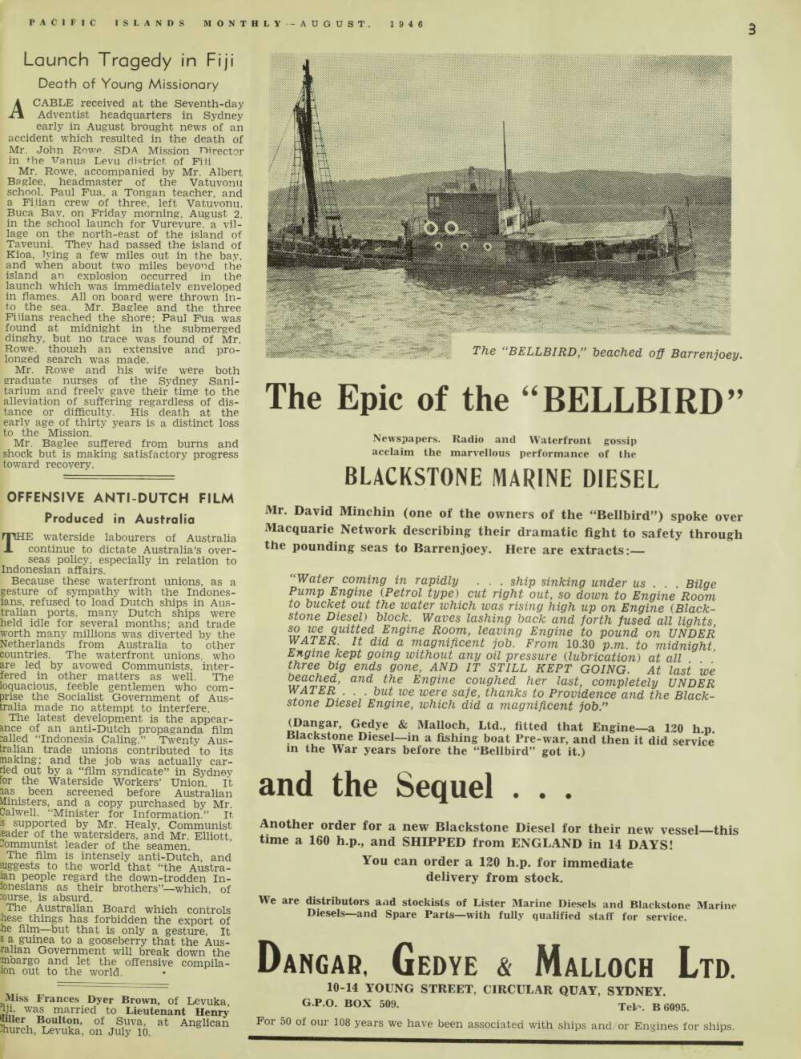
m t m? m ■ • •v*' ST- The “BELLBlRDbeached off Barrenjoey.
The Epic of the “BELLBIRD”
Newspapers. Radio and Waterfront gossip acclaim the marvellous performance of the
BLACKSTONE MARINE DIESEL
Mr. David Minchin (one of the owners of the “Bellbird”) spoke over Macquarie Network describing their dramatic fight to safety through the pounding seas to Barrenjoey. Here are extracts:— ‘‘Water coming in rapidly . . . ship sinking under us . . . Bilge Pump Engine (Petrol type ) cut right out, so down to Engine Room to bucket out the water which was rising high up on Engine {Blackstone Diesel) block. Waves lashing back and forth fused all lights i?rJS?*S uii }fd Engine Room, leaving Engine to pound on UNDER WATER. It did a magnificent job. From 10.30 p.m. to midnight Engine kept going without any oil pressure {lubrication) at all three big ends gone, AND IT STILL KEPT GOING. At last we En^ine coughed her last, completely UNDER WATER . . . but we were safe, thanks to Providence and the Blackstone Diesel Engine, which did a magnificent job.” (Dangar, Gedye & Malloch, Ltd., fitted that Engine—a 120 h.p.
Blackstone Diesel—in a fishing boat Pre-war, and then it did service in the War years before the “Bellbird” got it.)
and the Sequel . . .
Another order for a new Blackstone Diesel for their new vessel—this time a 160 h.p., and SHIPPED from ENGLAND in 14 DAYS!
You can order a 120 h.p. for immediate delivery from stock.
We are distributors and stockists of Lister Marine Diesels and Blackstone Marine Diesels—and Spare Parts—with fully qualified staff for service.
Dangar, Gedye & Malloch Ltd.
10-14 YOUNG STREET, CIRCULAR QUAY, SYDNEY.
G.P.O. BOX 509. Tek\ B 6095.
For 50 of our 108 years we have been associated with ships and/or Engines for ships.
p 90 ***
mrz
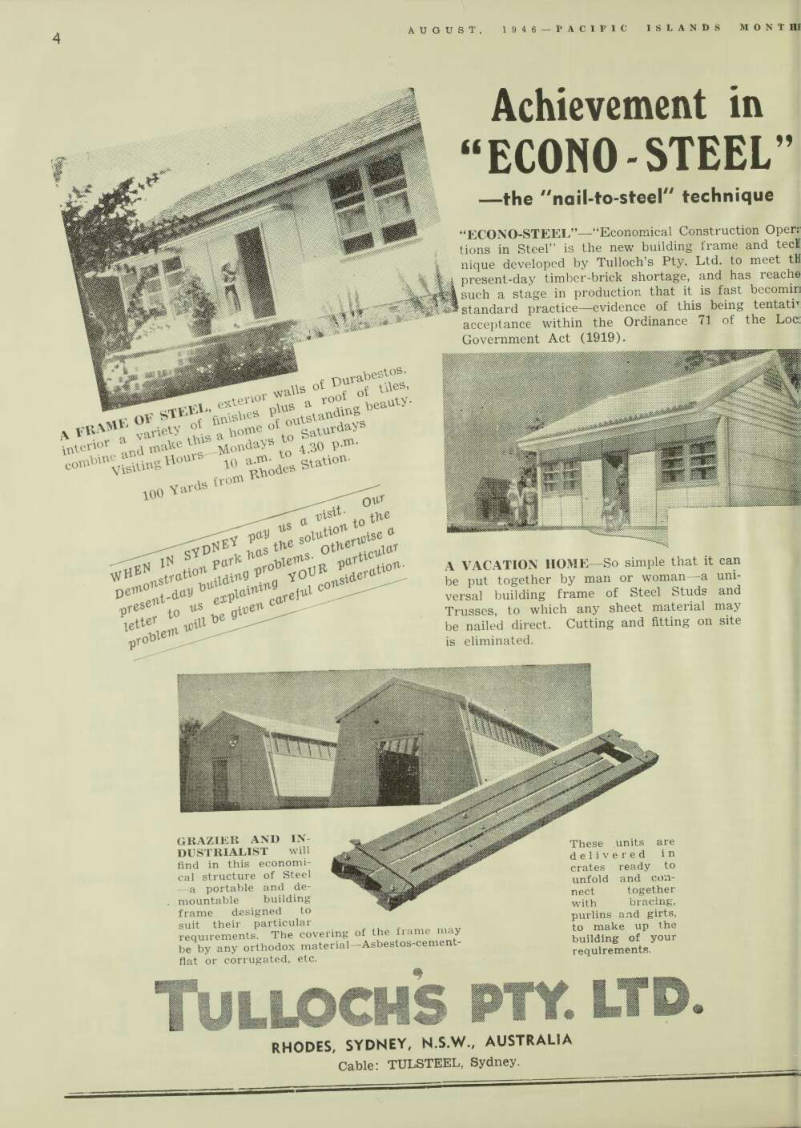
Achievement in
“ECONO-STEEL”
—the "nail-to-steel" technique
“ECONO-STEEL”— “Economical Construction Open tions in Steel” is the new building frame and tecH nique developed by Tulloch’s Pty. Ltd. to meet th present-day timber-brick shortage, and has reache such a stage in production that it is fast becomin standard practice —evidence of this being tentath acceptance within the Ordinance 71 of the Loc: Government Act (1919).
- rwabesf° s '
oiJ> Qi tiles,
&u ptos'a
\ VlV U ‘ °, r iety o£ home o£ ° cturdaV 1 tiotae to Satur daV s ,nter'° r and make -- p com £ >' n^"ungtt° urS VO a R » o( [ eS statin Act frotn
too ***
TO- -1)X sita to^ e s vd^ e l nos A VACATION HOME—So simple that it can be put together by man or woman —a universal building frame of Steel Studs and Trusses, to which any sheet material may be nailed direct. Cutting and fitting on site is eliminated.
GRAZIER AND IN-
DUSTRIALIST will
find in this economical structure of Steel —a portable and demountable building frame designed to suit their particular requirements. The covering of the frame may be by any orthodox material—Asbestos-cementflat or corrugated, etc.
These units are delivered in crates ready to unfold and contogether with bracing, purlins and girts, make up the to building of your jquirements.
> LTD
11* m
RHODES, SYDNEY, H.S.W., AUSTRALIA
Cable: TULSTEEL, Sydney.
J
4
AUGUST, 1946 PACIFIC ISLANDS MONTH!
Air Travellers To New
Guinea
It has been ascertained that Mrs.
Phoebe Parkinson, of New Ireland, who remamed behind when the Japanese mvaded in 1942, died in a prison camp near Namatanai on May 26, 1944. She was abou 86 years old, and was a sister of the
famous Mrs. Forsayth (“Queen Emma”).
Among the passengers by the “Taran aki” which arrived in Suva in late July were Mr. Lance Bradman and Mr. Bill Garrett, two members of the Fiji RAF contingent.
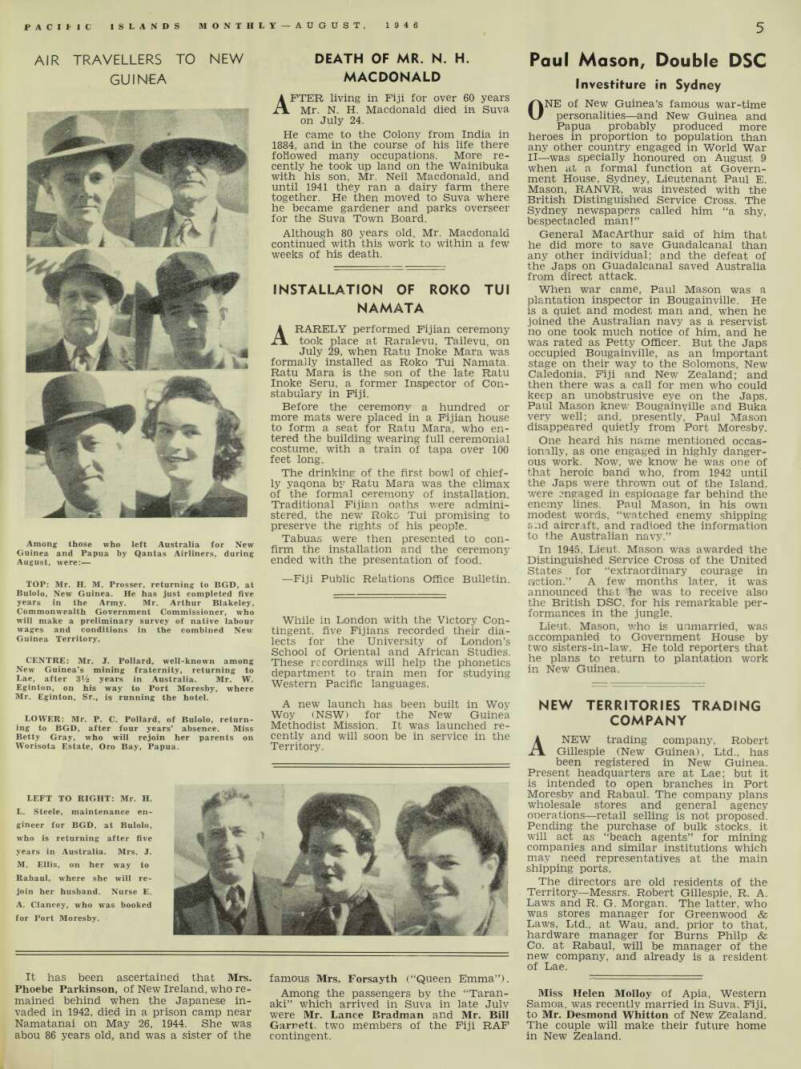
Among those who left Australia for New Guinea and Papua by Qantas Airliners, during August, were:— TOP; Mr. H. M. Prosser, returning to BGD, at Bulolo, New Guinea. He has just completed five years in the Army. Mr. Arthur Blakeley, Commonwealth Government Commissioner, who will make a preliminary survey of native labour wages and conditions in the combined New Guinea Territory.
CENTRE: Mr. J. Pollard, well-known among New Guinea’s mining fraternity, returning to Lae, after 3½ years in Australia. Mr. W.
Eginton, on his way to Port Moresby, where Mr. Eginton, Sr., is running the hotel.
LOWER: Mr. P. C. Pollard, of Bulolo, return ing to BGD, after four years’ absence. Miss Betty Gray, who will rejoin her parents on Worisota Estate, Oro Bay, Papua.
Left To Right: Mr. H.
L. Steele, maintenance en gineer for BGD, at Bulolo, who is returning after five years in Australia. Mrs. J.
M. Ellis, on her way to Rabaul, where she will re join her husband. Nurse E.
A. Clancey, who was booked for Fort Moresby.
Death Of Mr. N. H.
Macdonald
AFTER living in Fiji for over 60 years Mr. N. H. Macdonald died in Suva on July 24.
He came to the Colony from India in 1884, and in the course of his life there followed many occupations. More re cently he took up land on the Wainibuka with his son, Mr. Neil Macdonald, and until 1941 they ran a dairy farm there together. He then moved to Suva where he became gardener and parks overseer for the Suva Town Board.
Although 80 years old, Mr. Macdonald continued with this work to within a few weeks of his death.
Installation Of Roko Tui
Namata
A RARELY performed Fijian ceremony took place at Raralevu, Tailevu, on July 29, when Ratu Inoke Mara was formaily installed as Roko Tui Namata, Ratu Mara is the son of the late Ratu Inoke Seru, a former Inspector of Con stabulary in Fiji.
Before the ceremony a hundred or more mats were placed in a Fijian house to form a seat for Ratu Mara, who en tered the building wearing full ceremonial costume, with a train of tapa over 100 feet long.
The drinking of the first bowl of chief ly yaqona by Ratu Mara was the climax of the formal ceremony of installation.
Traditional Fijian oaths were admini stered, the new Roko Tui promising to preserve the rights of his people.
Tabuas were then presented to con firm the installation and the ceremony ended with the presentation of food, —Fiji Public Relations Office Bulletin.
While in London with the Victory Con tingent. five Fijians recorded their dia lects for the University of London’s School of Oriental and African Studies.
These recordings will help the phonetics department to train men for studying Western Pacific languages.
A new launch has been built in Woy Woy (NSW) for the New Guinea Methodist Mission. It was launched re cently and will soon be in service in the Territory.
Paul Mason, Double DSC
Investiture in Sydney
ONE of New Guinea’s famous war-time personalities—and New Guinea and Papua probably produced more heroes in proportion to population than any other country engaged in World War ll—was specially honoured on August 9 when at a formal function at Govern ment House, Sydney, Lieutenant Paul E.
Mason, RANVR, was invested with the British Distinguished Service Cross. The Sydney newspapers called him “a shy, bespectacled man!”
General MacArthur said of him that he did more to save Guadalcanal than any other individual: and the defeat of the Japs on Guadalcanal saved Australia from direct attack.
When war came, Paul Mason was a plantation inspector in Bougainville. He is a quiet and modest man and, when he joined the Australian navy as a reservist no one took much notice of him, and he was rated as Petty Officer. But the Japs occupied Bougainville, as an Important stage on their way to the Solomons, New Caledonia. Fiji and New Zealand; and then there was a call for men who could keep an unobstrusive eye on the Japs.
Paul Mason knew Bougainville and Buka very well; and, presently, Paul Mason disappeared quietly from Port Moresby.
One heard his name mentioned occas ionally, as one engaged in highly danger ous work. Now. we know he was one of that heroic band who, from 1942 until the Japs were thrown out of the Island, were engaged in espionage far behind the enemy lines. Paul Mason, in his own modest words, “watched enemy shipping and aircraft, and radioed the information to the Australian navy.”
In 1945, Lieut. Mason was awarded the Distinguished Service Cross of the United States for “extraordinary courage in paction.” A few months later, it was announced that he was to receive also the British DSC. for his remarkable per formances in the jungle.
Lieut. Mason, who is unmarried, was accompanied to Government House by two sisters-in-law. He told reporters that he plans to return to plantation work in New Guinea.
New Territories Trading
Company
ANEW trading company, Robert Gillespie (New Guinea), Ltd., has been registered in New Guinea.
Present headquarters are at Lae; but it is intended to open branches in Port Moresby and Rabaul. The company plans wholesale stores and general agency ©Derations—retail selling is not proposed.
Pending the purchase of bulk stocks, it will act as “beach agents” for mining companies and similar institutions which may need representatives at the main shipping ports.
The directors are old residents of the Territory—Messrs. Robert Gillespie, R. A.
Laws and R. G. Morgan. The latter, who was stores manager for Greenwood & Laws, Ltd., at Wau, and, prior to that, hardware manager for Burns Philp & Co. at Rabaul, will be manager of the new company, and already is a resident of Lae.
Miss Helen Molloy of Apia, Western Samoa, was recently married in Suva. Fiji, to Mr. Desmond Whitton of New Zealand.
The couple will make their future home in New Zealand.
Advertisers
Angliss & Co. . . 50 Aust. Fishing In dustries ... 69 AWA, Ltd 73 Atkins Pty., Ltd., Wm 33 Brown & Co., Ltd. 15 Brial & Ball ... 19 Brunton’s Flour . . 52 Burns, Philp Trust Co., Ltd 23 Broomfields ... .65 BP (SS) Co. . . . 15 Baker, W. Jno. . . 19 Carlton & United Breweries, Ltd. . 26 Carpenter, Ltd., W.
R cov. iv.
Chivers & Sons, Ltd 54 Church, R. H., & Sons 56 Coleman Lamp & Stove Co 53 “Cystex” 54 Commonwealth Trading Co. Pty., Ltd 2 Dalmore Preserving Co 45 Donaghy & Sons . 55 Donald, Ltd., A. B. 24 Dr. Williams Pink Pills 65 Dangar, Gedye & Malloch 3 Dunlop Rubber (A/sia), Ltd. . . 61 Electrolux
Refrigerators . . 20
Eekhoff, H. G. . - 57 Foster Clark ... 25 Ford Sherington Pty., Ltd 62 Garrett & Davidson 72 Gibson & Co., Ltd.,
J. A. D 44
Gillespie Pty., Ltd., Robert . • ■ 1. 34 Robt. Gillespie (NG), Ltd. ... 60
Gilbey’s Gin ... 16 Gillespie’s Flour . . 58 Gough & Co., E. J. 24 Grand Pacific Hotel 6 Grove & Sons, W.
H 62 Heinz & Co. Pty., Ltd., H. J. . . . 47 Hemingway & Robertson ... 74 Hyde, Victor ... 64 Hutchinson & Co., Ltd 64 Horlicks 32
Ics 24
Ingram Shaving Cream 28 Ipana Tooth Paste 43 Jenkins, Reg. ... 30 Kopsen & Co., Ltd. 75 Lockyer, Geo. J. . 67 Merrillees, J. C., & Co 75 Miscellaneous ... 59 “Mum” Deodorant 48 “Mendaco” ... 66 Mcllraths Pty., Ltd. 68 Nelson & Robertson Pty., Ltd 46 Newman, M. . . .51 “Nixoderm” ... 71 Pacific Islands Trading Co. . 31, 59 Pacific Islands
Monthly . . . . 56
Pacific Is. Society . 33 •‘Pinkettes” ... 30 Proprietary Pro ducts 17 Papuan Electrical Co 71 Qantas Empire Air ways ... cov. ii.
Queensland Insur ance Co 61 Robinson, G. H. . 52 Raymond, Lance, Pty., Ltd 17 Rose’s Eye Lotion, 45, 68 Rohu, Sil 69
Rur 2
Scott, Ltd., J. . .59 Shell Co 57 Southern Pacific Insurance Co. . . 16 Steamships Trading Co., Ltd 74 Shepherd, A. O. . . 67 Sullivan & Co.. C. 29 Swallow & Ariell . 51 South Sea Islands Club 17 Taylor & Co., A. . 74 “Tenax” Soap ... 58 Tillock & Co.. Ltd. 70 Thornycroft (Aust.) Pty., Ltd 21 Tooth & Co., Ltd cov. iii.
Toogood. j. j. . . 60 Tullochs Pty., Ltd. 4 Tilley’s Lamps ... 49 “ Vitalis ” Hair Tonic 63 Watson. Wm. H. . . 27 Widdop, 'H„ & Co., Ltd 55 A. Willison ... 28 Wills, W. D. & H. 0 76 Wunderlich ... 29 Wright & Co. . . .22 Wright & Co., Ltd , E 2 Young Pty., Ltd., Harry J 18 Yorkshire Insur ance Co., Ltd. . 15
Contents
Bogese, NMP 2 Launch Tragedy in Fiji—Death of Young Missionary 3 Paul Mason —Dquble DSC ... 5 Editorial: “What Australia Proposes to Do About New Guinea :: And a Question About Samoa” ... 7 Roll of NGVR 8 Anger and Disappointment in Australian Territories 9 Notable Hero of Pacific War .. .. 10 Long Discussion in Fiji Legislative Council on Fiji Race . . 11 Future of Solomons 11 “Voice of New Guinea” —ABC Radio Station 12 The Teething Troubles of Trans pacific Air Transport 13 Cook Islanders Form Govt-Sponsored Union 14 Group-Capt. W. J. Duncan 15 Territories Cost Australia £282,000 for Part of Year 16
Australian Territories Handicapped 19 First New Guinea Scholarship in 1947 2\i Philippines Now Independent .. .. 2£ British and Australian Methods Compared 2£ Census Figures for Western Samoa 3£ New Labour Set-up in Nauru .. .. 3£ Territories’ Talk-Talk 38 From Clerk to Millionaire Knight 3£ Polynesian Playtime 38 Tropicalities 38 Assignment in Mid-Pacific 38 Concerning the Inhibitions of Miss Blair 4t How 250 Rabaul Refugees Were Rescued 41 Labour Tragedy in Papua-New Guinea 5c Meritorious Record of the PIB ... 5c Secondary School at Nukualofa .. 55 Shipping and Plane Services 56 Yanks Want Our Tuna 69 News Notes from New Guinea ... © Major Grahamslaw, OBE 69 Trochus Shell —Chance for SW Pacific Factory © Samara i Area Struggling Towards Recovery © Commercial Markets, etc 7T Late News 7T Letters received from Captain L. H Johnson, formerly of the Police Depart! ment, Rabaul, and now with the BCOH in Japan state that the only New Guines man he has met there so far is Capn V. H. Gilchrist, formerly of Bulolo Goll Dredging. Both men are eagerly lookinr forward to returning to Australia b: Christmas.
Advertisements & other items, p. 8 (1 item)
w
Pacific Islands Monthly
The Newspaper-Magazine of the South Seas [Registered at the G.P.0., Sydney, for transmission by post as a newspaper .]
Published Once Each Month and Circulated in Australia and New Zealand and in the following Pacific Territories and Islands Groups:
Australian Territory of Papua.
Mandated Territory (Australia) of New Guinea.
Australian Territory of Norfolk Island.
New Zealand Territory of Cook Islands.
Mandated Territory (NZ) of Western Samoa.
British Colony of Fiji.
British Solomon Islands Protectorate.
British Protectorate of Tongan Islands.
British Crown Colony of Gilbert and Ellice Islands.
Mandated Territory of Nauru.
British and Free French Condominium of New Hebrides.
Free French Colony of New Caledonia.
Free French Colony of Oceania (Tahiti, etc.).
American Territory of Eastern Samoa.
American Territory of Hawaiian Islands.
Owned and Produced by Pacific Publications Pty. Ltd., Union House, 247 George Street, Sydney.
rp-c'T Trprrnivnrc; S General Office .. .. BW 5037 TELEPHONES Adver tising Office .. .. B 7815
P.O. Box 3408 R
Registered Address for Telegrams, Radiograms, and Cables: “Pacpub”, Sydney.
Contributions.
Articles, Stories, and Photographs dealing with Pacific Islands subjects are invited and will be paid for on publication.
Subscription Rates.
Per Annum, within British Empire, Prepaid, Post Free 10/- Per Annum, elsewhere, Prepaid, Post Free 12/6 Single Copies 1/-
Editor and Publisher:
R, W Robson, P.R.G.S.
General Office: Union House, 247 George Street, Sydney.
Advertising Manager; W. E. Rogers.
Telephone: BW 5037.
Printing House: 29 Albert Street, Sydney.
Telephone: MA 4369.
Representative In Fiji.
Pacific Publications (Fiji), Ltd., Bank of NSW Building, Suva (same office as W. H. Grove & Sons, Ltd.). Stocks of Pacific Islands Monthly and Pacific Islands Yearbook on hand.
Representative In London.
J. T. Wallis, Coronation House, 4 Lloyds Avenue, London, E.C.3, from whom may be obtained copies of Pacific Islands Monthly, Pacific Is. Year Book, advertising schedules, etc.
Agents.
The following are authorised to receive sub scriptions for Pacific Islands Monthly:— Burns, Philp & Co., Ltd., and Burns Phllp (South Sea) Co., Ltd. All branches.
W. R. Carpenter & Co., Ltd, All branches.
Morris, Hedstrom, Ltd. All branches.
Steamships Trading Co.. Papua. All branches.
Whitten Bros., Ltd., Samaral, Papua.
B.N.G. Trading Co., Ltd., Port Moresby, Papua J. Muir, Suva, FIJI.
Miss R. Castles, Suva, FIJI.
N. C. Mackenzie Hunt, Walnunu, Bua, FIJI.
Cook Islands Trading Co., Rarotonga, Cook Is A, C. Rowland, Papeete, Tahiti.
Islands Branches and Representatives of W. H Grove & Sons. Ltd., Auckland, New Zealand Ed. Pentecost, Noumea, New Caledonia.
Societe Gubbay Kerr et Cie, Noumea, N, Caledonia.
Vol. XVII. No. 1.
August 19, 1946.
n :_ p 1/- Per Copy. rMce Prepaid: 10/- p.a.
What Australia Proposes To Do With New Guinea—
and a Question About Samoa
I?VER since Hitler, In 1939, like ~r Omar Khayyam’s hero, shattered the world, with a view to remoulding it nearer to his heart’s desire, it has Deen recognised that the Government or New Guinea would be changed.
New Guinea was governed by Austraiia under mandate from the League of Nations; and the League was doomed, of course, from the moment that World War II began— no matter who were the victors.
The Axis Powers were destroyed by e +F n *xT^-?^j^ ons ’ and the Charter vT Nations, on which is cased UNO (United Nations Organisation) was signed at San Francisco June L 1^ 45 ' UNO re P. laces the League of Nations; and Article 75 of SL«!!f 1 i. er provides for an international trusteeship system (“for the e^ m l Str^ and supervision of may be P laced s }J bs I ?^ ue ut individual which will take the Mandate system. All + ones ha ; ve announced willingness to surrender their Mandates in favour of UNO trusteeship.
Until UNO makes further progress, and hammers its trusteeship system into practical shape, however, nothmg more can be done. Therefore,
Ne Y 9 uin^ a) %
(i^ auru J z J aland or (hnVH^ Oa fv. a £ d U ?i ted i^?i dm Twr Caroli nes, Mar- AmpriPoS? d f^r!i? a f iana8 +u wbich the fr ° m the Japs) are i ax King time.
AUSTRALIA has approached the matter in a series of steps. On January 17, 1946, the Government declared its intention of placing New Guinea under the trusteeship system, On March 13. 1946, the Minister for External Affairs promised that Par liament would be given details of the plan. On August 7, 1946, the Prime Minister stated that Australia was consulting other States concerning the draft of a proposed agreement between Australia and UNO.
Australia’s draft proposes; (a) Aus tralia will have complete and ex elusive power in controlling New Guinea’s administration, subject only to an obligation to carry out duties imposed by the Charter; (b) it must be recognised that Australia’s control of New Guinea is fundamental to her defence; (c) Australia undertakes to promote the welfare and advance ment of the native peoples; (d) Aus tralia is to have the right to provide naval, military and air bases in New Guinea and to erect fortifications; (e) Australia is to have the right “to bring New Guinea into a customs, fiscal or administrative union or federation with other dependent ter ritories . . and to establish common services.”
The Prime Minister’s statement is summarised in the foregoing para graph; and, assuming that UNO raises no objection, it outlines the character of New Guinea’s future administra tion. Pa P ua and New Guinea will be governed as one Territory, much as
at present. In fact, the policy that has been put into operation during the past couple of years will be the policy of the future—if the Socialists are returned to power in Canberra.
That policy can be summed up as follows: •The interests and welfare of Euro peans, and of European enterprise, will be secondary at all times to the welfare and advancement of the natives, as in terpreted for the Australian Minister by various sociologists, anthropologists and advisers. • The Territories will be administered in accordance with the plans of such ad visers, irrespective of financial considera tions, and on the assumption that the Australian taxpayers will pay all the costs. • Government instrumentalities, and not private enterprise, will be responsible for such services as the provision of transport (sea and air), the purchase of the products of plantations, the financ ing of planters, miners, etc., the pro vision of native labour, and so forth. • The Territories will be heavily gar risoned and fortified.
This outline of Australian policy in the Territories indicates little concern for the encouragement of private enterprise and of European interests generally. European settlement does enter into Canberra calculations, of course; but subject strictly to the Socialistic provisos that the profit motive shall not be encouraged, that big company concerns shall be re stricted in their operations, and that the whites shall get no benefit what ever from employing natives rather than Europeans.
These assumptions may be proved wrong—we hope they are!—but they
are based logically on the events of the past five years, and on what we know to be happening in New Guinea to-day.
THE outlook for Papua-New Guinea settlers and for private enter prise is extremely discouraging, at present. There will be much activity in the two Territories, for at least a couple of years: but it will be mostly administrative activity, at the Aus tralian taxpayers’ expense—and it will come to a tragic end just as soon as the taxpayer rebels against having to pay at least half a million a year for the mollycoddling of Fuzzy wuzzy.
The only hope for the future of European enterprise in New Guinea lies in the defeat of the Australian Labour Party in the September elec tions—and there is little sign of that at present. Such a change would not be a disaster for the New Guinea natives. On the contrary, it might be a very good thing for them. Terri torians of vision and experience are not opposed to natives being assisted, protected and “advanced” in every possible way. But a new regime would insist on native policy being directed by men of practical knowledge and experience, rather than by well meaning theorists, and they certainly would not permit European interests and financial considerations to be sacrificed to the academicians’ Utopia, as they are now.
THE plan of the Australian Socialists, in relation to Papua-New Guinea, is clear enough; but we have had no indication of what is proposed for Western Samoa by the New Zealand Socialist Government, which also is facing a general election.
The circumstances of the two Man dated Territories (New Guinea and Samoa) are completely different. New Guinea definitely is part of the Islands perimeter guarding Australia against Asia, and its control by Aus tralia is essential to Australia’s defence. The New Guinea natives are primitive Melanesians, and must remain in the care of a sympathetic European country for a couple of generations before they can be given even a share in local government. The control of Samoa is not necessarv for the defence of New Zealand; and the cultured and homogeneous Poly nesians who occupy Samoa are as capable of self-government as are their cousins, the Tongans.
It is possible that the plans to be developed by UNO for the future of Samoa will be influenced by the machinery created by the Americans for the administration of the Caroline and other islands, lately mandated to Japan. If the Micronesians of those widely-scattered archipelagoes are considered worthy of some measure of self-government, it can scarcely withheld from Western and Eastern (American) Samoa.
Probably, important recommenda tions in this regard will come, in due course, from the South Seas Regional Commission, now being promoted by Britain, Australia and New Zealand, to function in a close tie-up with the Trusteeship machinery of UNO,
Advertisements & other items, p. 10 (1 item)
Ngvr
Effort to Compile and Publish Complete Roll
mHE “Pacific Islands Monthly” is trying A to comnile a complete list of mem bers of the New Guinea Volunteer Rifles—that fine unit whose performances in the early days of the Jap invasion should not be forgotten.
We have applied in vain to the Records Section of the Australian Army. That organisation either does not wish the memory of the NGVR to be preserved, or it has lost the rolls. We now publish the following list, compiled bv an officer (who survived the invasion) in Rabaul about May 30, 1942. It is not complete, but it is a beginning: Reynolds, Jnr. Spensely, G. W.
Bird (Customs) Evans, J.
Saunders, Lionel Bryen (Tiny) Venning, Frank Maclean, lan.
Rankin Hopkins, Eric. (Gvt. Stores) Bischoff, Jnr.
Haslam. F. Tait, Jnr.
Shoobridge, Ivan Brain (NB Timbers) Phillpotts (BP) Houghton (Natava) McEwan (BP). Einseidel (BP).
Goodwyn (WRC) Reynold, J.
Ledger, W. (WRC) McAdam, E. G.
Allsop, Ken. Florance, V.
All the above are believed to have been lost on the “Montevideo Marti” in June, 1942.
Kennedy. R. L.* Corbett, L.
Barrie, J.* Moory, G.
Costelloe, S. Marlay (CBABk).
Dwyer, L. Walker, Garth* Clark. Les. Fisher, N. H.
Challis. B. G. Knight (Geologist) Nicholls (BkNSW) Stewart (BP).
Johnson (BkNSW) McLennan (PWD) Street. J. L.* Smith, Frank* McNeil (BkNSW) Ryan, Frank " Presumed killed.
Those with no mark are believed to be safe.
We appeal to anyone who can add names to the list to send them in. When it appears that the roll is reasonably near complete, we shall publish it.
Territories' Radiophone : Useful
and Cheap, But No Privacy
WHO is paying for this internal radio communication system that the Administration is trying to estab lish throughout the Territories? It must be very costly.
No charge is made for the traffic. The traffic is handled by radiophone, and anyone with a receiver can listen in.
There is no orivaev. One listens for one’s name to be called, and can hear the messages for other people.
A lady in Australia, the other day, ad vised her husband in New Guinea of the arrival of a new baby. The intimation was quite businesslike. Most of us are still anxious to know whether it was a boy or a girl. —Special Correspondent.
Early "Winter" In Tahiti
From Our Own Correspondent
Papeete, June 9.
OUR weather remains out of gear. The “cold season” has arrived two months ahead of schedule and al ready we find blankets essential.
Township Boards
No "Common Roll"
For Fiji
The Government Amends the
Municipal Corporations Bill
rE Bill to reconstitute the Towv Boards of the Colony, which ws published in draft form by till local Public Relations Office last Nov ember, will not now come up before tM Legislative Council until next sessioc (November), if then.
It was proposed in the draft Bill ths all but two of the members of munii cipal corporations should be elected (in stead of nominated, as at present) air that all persons over 21 who were les; sees, owners or occupiers of rateable pro perty (and who could read, write arc speak English) should have a vote. Thu meant, of course, that the Indian conn munity which now outnumbers all othen would have the dominant voice in run ning these Town Boards, and on thi account there have been many objection to the new Bill, particularly from thi European Electors’ Association.
The Association lost no time in in forming the Government that it mean to oppose the proposals and that ii “uncompromising stand” was for mum cipal councils, elected on a communii racial basis.
It appears that the Electors have wco the day. At the opening of the curren session of Legislative Council. th Governor told members that it had be© decided to scrap the common-roll, s suggested in the draft Bill last Novem ber, and substitute a communal ro system under which people of the van ous communities would elect their ow representatives to the municipal cot porations. This follows the principle af ready in operation in the Colony witi regard to the Legislative Council. He:e European members are elected by Eurr pean voters and Indian members If Indian voters.
Rising Price Of
Copra
rE British-Ceylon contract price £37 (Aus.) per ton for copra (se June “PIM”) has affected cone prices throughout the Pacific. None hr reached the Ceylon level, but all haf risen, and are still rising.
The price paid by the Australian Pn duction Control Board in Papua-Ne Guinea was raised during the month free £22/10/- to £27 ner ton, at nearest shii ping point to plantation.
Lack of labour and transport is pn venting planters in the South-wr Pacific generally from getting real benea from these profitable rates.
Dr. K. J. Gilchrist, the newly appoint! surgeon-specialist for the Colonial WV Memorial Hospital, arrived in Suva in las July.
Mr. Tom Hagen, of Noumea, NC, w/, described in July PIM as the son of Ml Nicolas Hagen. That was an error. I is the son of Mr, Albert Hagen, and then fore a nephew of Nicolas.
Advertisements & other items, p. 10 (1 item)
8
AUGUST, 1946 PACIFIC ISLANDS MONTHL
Anger And Disappointment In The
Australian Territories
Servicemen's Protests in Lae and Rabaul
(Other articles on progress of Rehabilitation in Papua-New Guinea
on Pages 63, 64.)
REPORTS of economic confusion in the Australian Pacific Territories, and of the angry resentment of planters and traders against things that are being done —and not done—by the Australian Government—have reached us from several sources.
Some three months ago, when Colonel H. T. Allen and Mr. A. J. Gaskin were added to the Production Control Board, it was understood that their special task would be the rehabilitation of Territorians—and especially of returned servicemen. Canberra promised that no further War Disposals goods would be sold until the needs of both Administration and returning Territor ians had been fully met. It is claimed that the Government is not carrying out these undertakings.
The following statements are taken from various communications which reached us in the first ten days of August.
Servicemen's Meeting in Roboul
From Our Own Correspondent
Rabaul, Aug. 7.
A MEETING of indignant members of the Returned Servicemen’s League was held in Rabaul on August 6, and resolutions were passed alleging that the Government had not kept its promise, of March last, that Territorians should have first choice of goods sold by Common wealth Disposals in the Territories.
It was reported that large quantities of goods sold to “outside buyers” were awaiting shipment here; that local ser vicemen had lost confidence in the Com mission; and it was resolved to make im mediate strong protests to the Austra lian Government and the Federal Execu tive of the League, in Australia.
Radiograms sent to the Australian Prime Minister demanded an immediate inquiry.
Other statements made here are that about 40 small ships, urgently needed by planters and others for rehabilitation pur poses are lying in Rabaul Harbour, idle, useless and deteriorating, because the War Disposals Commission will not make them available for sale.
Trade tobacco costs us here to-day about 9/- per lb. Yet War Disposals sold 10,000 lb. of tobacco to a mission or ganisation for 5/3 per lb., and planters and traders were never advised that it was for sale.
Planters urgently need vehicles. Yet, while trucks have been sold to aliens, and others (at Lae) to southern buyers for ridiculous sums, War Disposals has done nothing to help planters with trucks, and still holds large numbers of trucks, as well as other useful equipment in short supply, in special parks around Gazelle Peninsula.
How They "Sell Ships" in Papua
Samarai, Julv 14.
ON a flying visit to Samarai, the Dis posals Commission’s representative accepted a cheque from Mr. G. Har rison for two boats, the “Teliai” and the “Hisiuabada.” Receint was to be for warded from Port Moresby. Mr. Harrison removed the boats and began to put them in order.
After some months he wrote asking about a receipt. He was informed that the “Teliai” had been bought by the Native Affairs Department.
More time passed, and now he has been instructed to hand the “Teliai” back at once and that, as a special favour, he can hold the “Hisiuabada” until it is re-valued.
The launch “Marek” was sold by the Disposals Commission to Mr. J. Wilkin son. The Provisional Government had
also taken it over. After numerous sig nals and visits to the Provisional heads, Mr. Wilkinson was allowed to take the boat over—in spite of the fact that the original owner had not been informed that it was available for disposal!
The launch “Una” was sold while lying on the beach at Sariba (near Samarai) for £25, to Mr. R. Bunting. Mr. Coleman and Mr. Izod (of the Labe Labe Saw mills) are still wondering what happened to their tender of £50.
Mr. Ernie Evenett of Samarai, pre-war, owned the lugger “Fairy.” The army, after the evacuation, took the boat over.
Mr. Evenett valued it at £600, but asked that it be handed back to him and not paid for. He was not paid for it, and the army used it for over three years, during which period maintenance work was done and it was in much the same condition as when handed over, except for lack of sails (quite an expensive item).
Mr. Evenett wanted it back, so he ap proached the Disposals Commission. He suggested that he be allowed to take the boat over and that some small recom pense be paid for the use of it by the army. He then offered Disposals what he had originally valued it at, but was laughed at. Disposals said they could sell it for £1,000, but they still wanted to pay him only the low valuation he had put on it. Now. he has the boat back, but he had to pay the Disposals Com mission £700 for it. Then the army paid him £600 for the boat, so he had paid the powers that be £100 and allowed them to use his boat for the whole period of the war for nothing, and he now has to refit it.
Surely there is some authority that can attack these matters at the proper place and straighten them out. Too many men acquired the art of “passing the buck” during their army career and are carry ing it on into civil life, with disastrous results.
This history could be continued. Suf fice to say that many boats were lost through the delay of the Disposals Com mission in taking action. Two in Milne Bay were completely destroyed, and many that are now under water could have been saved if action had been taken earlier.
Economic Confusion in Lae
From a Special Correspondent LAE, Aug. 6.
HERE are some sidelights on what the dear old Australian taxpayer is pay ing for, in New Guinea.
The Carpenter diesel-motored ship “Salamaua” left this week for Melbourne, after having been here so long that she had become part of the landscape. She
(Continued on Page 74)
was sent up here last February by the Government Directorate of Shipping (or whatever they call it) on a job that under private control would have taken about six weeks. Under Government direction, it has taken five months!
X heard the engineers talking the other day. They calculated that it cost the Australian taxpayers not less than £670 per day to run the “Salamaua.”
The “Salamaua’' had been here for some time, loading War Disposals goods bought by southern buyers (really needed for rehabilitation here) when the “Mon toro” arrived, and “Salamaua” had to lie out to make room. The unloading of the “Montoro” took several days. Natives with trucks (a number of them bought War Disposals trucks) were each paid £4 per day.
When the “Salamaua” returned to her berth, the native labourers had had enough. They announced that they would not work for less than 10/- per day. They were not paid this—so many of them returned to their villages.
It is reported here that the Luluais and Tultuls not long ago called upon the District Officer at Finschhaven, and told him they were desirous of turning in their caps (in other words, resigning their official positions) and wanted to work for £1 per day or £9 per month!
FEW people in Australian know—and I suppose most care less—that, while official native wages have been in creased from 8/- or 10/- to 15/- per month, the cost of nearly everything needed by the native has increased en
ormously/ For example;
One of the most shocking things I heard was the sale by War Disposals of axes at 1/- and 1/6 each, to Australian buyers for shipment south; while traders and planters here are forced to pay from 15/- to 20/- each for an exactly similar article.
War Disposals trucks were sold tc southern buyers for 30/- each. The natives willingly paid £BO for some of them. Of course, the natives just run them to a standstill and abandon them.
Now that there are some roads in the Territory, the trucks will be needed later by returning residents. Why could not they have been taken over by the Ad ministration, and held in a pool, and sold to Territorians as required? Instead, they were sold at 30/- each, before most people knew what was happening.
Lurid Language at Lae LAE, Aug. 7.
NEW GUlNEA—proverbially a land
where a man says what he thinks —never heard more lurid language than was employed when New Guinea men accepted the invitation of the Re gional and Repatriation Officer, Mr.
Locke, to meet him and hear his ex planation of the Rehabilitation Act.
They listened attentively; but when they realised that there was nothing in the Act for them, except perhaps one thing, but only for mainlanders. they opened up, and expressed their opinion of the Government in blistering words.
The official said that the Common wealth Bank could make them an ad
Old Present Price Price Tobacco, per lb .. . . .. 4/6 13/- Meat, per tin . .. 1/- 2/- Copra knives . .. /9 3/6 16in. knives . .. 4/- 10/- 1 axes , .. 5/- 15/-
vance ol up to £l,OOO on their agricul tural leases. , „ Voices: But where are the leases? When do we get some land?
The official said he was sorry—the Government had made no provision yet.
Men present—mostly mining men— pointed out that huge quantities of axes, knives, shovels, pickaxes and various equipment had been sold by the Govern ment to southern buyers, and refused to them Did he call that “rehabilitation”?
The official could only give reassur ances that these matters would be put right in time. He seemed embarrassed.
The men were very angry—but that did not prevent them saying some witty things, at the expense of the Govern ment. The outspoken ones were the miners. The planters probably thought the same things—but they are so com pletely at the mercy of the Administra tion officials and the politicians, these days, that they were not game to say them. Free soeech is a dead letter here now—except among people who have no thing to lose.
Finally, a large section of the audience by now thoroughly hostile—left the meeting. I was sorry for Mr. Locke.
He was being abused for the sins and omissions of his Canberra bosses.
Future Of Certain
Pacific Territories
THE Governor of Fiji and High Com missioner for the Western Pacific, Sir Alexander Grantham, is ex pected to visit Australia shortly.
It is understood he will confer at Canberra with representatives of the Australian Government with reference to the Australian-New Zealand plans for the formation of a South Seas Regional Com mission. It is proposed that the Com mission, as part of UNO machinery, should act as a co-ordinating authority covering the administrations of all Terri tories in the South-west and South central Pacific.
A report from Canberra says that “the South Seas Commission Conference, pro bably in October, will be attended by representatives of Britain, United States, France, New Zealand, Australia and Portugal.” Is the omission of Holland an error bv the reporter or the Minister?
It is indicated by certain signs that South Pacific Territories which are to be held at the disposal of UNO, probably through the medium of the South Seas Regional Commission, include: ■ Mandated Territory of New Guinea. ■ Condominium of the New Hebrides. ■ British Protectorate of Solomon Islands. ■ Mandated Territory of Western Samoa.
Sir Alexander Grantham, as High Com missioner for the Western Pacific, is, of course, directly interested in the plans for the Solomon Islands and New Hebrides; and, through his governorship of Fiji snd supervision over the Gilbert and Ellice Islands and Tonga, he is indirectly in terested in Regional Commission pro posals.
It is not expected, however, that the Anzac plans for a South Seas Regional Commission will take definite shape until UNO has dealt with the subject of trustee ship—and that may be some considerable time.
At the moment of this writing, the fate of UNO is really being decided by the 21 nations which are squabbling in Paris at what some humourists have called “The Peace Conference.”
Answer To A Correspondent
WE have a long letter from “Disgusted New Guineaite.” He deals in a forthright manner with affairs in the Wewak-Madang area. Some of the material which he forwards is interest ing and important—like his statement that experienced craftsmen are leaving the service of the Administration because of poor pay, and any “dud” from the Army, he says, can get a job under the Administration and draw the same pay as experienced “old-timers.”
Unfortunately, “New Guineaite” does not send his name and address. There fore, his letter is not published. Persons making strong statements affecting other people may write under a nom-de-plume, but they must send their names, as evi dence of their bona fides. Their anony mity is carefully protected.
Prosphate for Japan
A LIMITED number of Japanese work ers have been permitted by Allied Headquarters in Tokio, to return to Angaur Island in the Palau Group in order to mine phosphate rock for fertil iser for Japan.
The Palau Group was formerly part of the Japanese mandated territory of the Marshalls and Carolines.
Advertisements & other items, p. 11 (1 item)
9
PAciffC ISLANDS MONTHLY AUGUST, 194 (>
Notable Hero
Of Pacific War
How Captain Page, Son of late Harold Page, Met His Death at
Singapore
THE mystery which surrounded the death of Captain Robert Charles Page, DSO, aged 25 (son of the late Major Harold Page, DSO. MC, Govern ment Secretary in New Guinea, and of Mrs. Page, now a resident of Sydney) was removed when the Government made a statement in the Australian Parliament on August 1.
Captain Page was one of the heroes of Singapore—a small band, specially select ed and trained, who travelled from Aus tralia to Malaya secretly through Jap ter ritory in the blackest days of the war, crept into Singapore harbour, and
affixed mines to Jap shipping. They destroyed 37,000 tons of Jap ships, and so dislocated enemy transport that they contributed much to the defeat of Japan.
Their exploits were of so secret a character that, although the DSO was awarded by the King to Captain Page in 1944 —some time before he was killed—he was not advised of it.
From material kindly made avail able by Mrs. Roma Page (Captain R.
C. Page’s widow, who lives in the Federal Territory, near Canberra) we have been able to compile the follow
ing description of what these young
heroes accomplished :
WHEN World War II came, Robert Page was a medical student. He enlisted with the -2/4 Pioneer Bat talion. He trained in Darwin for 18 months, and then he embarked with his unit for Timor. But, after only a brief time at sea. the ship was recalled—there was danger from the then invading Jap anese.
In November, 1942, the unit returned to New South Wales, and Captain Page joined the Commandos. They trained near Cairns for some months, and he was a member of a party which mock raided Townsville, as a try-out for a raid on Singapore. It was highly successful.
After more months of training, a party of ten Australians and four British were selected for the highly dangerous task of raiding Singapore.
They sailed out of Exrnouth, Western Australia, on September 2, 1943, in a former Jap fishing boat, the “Krait”—7o feet long, 11 feet beam, with a speed of 6i knots and a range of 8,000 miles. They carried limpet mines, and two-man rub ber canoes. Their bodies were stained brown to reassure any Japs or Indones ians who might sight them on their way north.
They could scarcely hope to escape ob servation and examination. They had to leave the West Australian coast and head out into the Indian Ocean; pass through the narrow Lombok Strait, between Java and the Lesser Sundas, into the Java Sea, and sail northwards through the very busy waters between Java and the south coast of Borneo, into the maze of islands which guards Singapore on the south.
THEY got through, however, and their vessel lay concealed among the islands within 21 miles of Singapore. In to each of three canoes they put food and water enough for a week. It was arranged that the canoes should ren dezvous with the “Krait” on the night of October 1, 1943, at the island of Pom pong, 28 miles from Singapore. The three small craft pushed off. They were manned thus: No. I—Captain Ivan Lyon (British) and A. W. Huston, AB (Australian); No 2—Lieutenant Donald Davidson (British) and W. C. Falls, AB (Austra lian) ; No. 3—Lieutenant R. C. Page (Austra lian) and A. W. Jones. AB (Australian).
The canoes had to be paddled 13 miles to the small island of Dongas, eight miles from Singapore, which they had selected as “onerational base.” They arrived there at 8.30 pm. on September 22. 1943. Ex hausted by the long spell at the paddles, they spent that night, and all Sentember 23 and 24, resting and preparing for their ordeal.
In the night of September 24 they tried to enter Singapore harbour. They met adverse currents, and returned to Dongas.
Next night (Sentember 25) thev shifted to another small island, Pulau Sambu.
THEY made their attack in the night of September 26. They paddled silently into the inner harbour, across the boom. They had made a couple of “insnections” from Dongas, and they reckoned that there was not less than 100,000 tons of big shipping in the P °They tried to keep together, but the currents picked them up and swept them around erratically.
Lyon selected, as his prey, a 10,000 tons tanker. He nlaced two limpets near the engine room and one near the propellor shaft. During their task. Huston pointed out a man watching them through a northole. To their amazement, he merely withdrew, and turned on the light in side. , Davidson fossicked around. He passed bv two small shins as unworthy of his attention, and he crossed the boom a couple of times. Then he attached his limnets to two shins of 5.000 tons and one of 6.000 tons. , . , Page’s canoe was paddled casually right along the lighted wharves, where they ex amined various shins and sentries. Fin ally, Page selected for his favours two modern freighters, the “Nasusan Maru” and the “Yamataga Maru.”
This operation, so auickly described, oc cupied the whole night. They were in the harbour soon after 8 p.m. As dawn was breaking, all three canoes arrived at Palau Sambu. They settled down to watch events in the harbour a few miles away. , . .
The first explosion came at 5.15 a.m.
Between then and 5.50 a.m. there were seven separate explosions. The ladsJ “called it a day,” and, well hidden, com posed themselves to sleep.
Jap sea and air patrols came swarm ing out of Singapore, searching blindly\ It was evident that they were mystified) by the attack, and did not know what, to do.
Our lads learned, in due course, that, their limpet mines sank one freighter of 4,000 tons; probably sank five freights
ers totalling 23,000 tons; damaged anoj set afire a tanker of 10,000 tons—a totae of 37,000 tons. The attack crippled thu supply organisation at the back of tha Jap thrust at New Guinea and the Soloc mons, and seriously upset Jap morale.
(Continued on Page 69)
Captain Page.
The six men slept all that day (27th); and that night they set out to keep their rendezvous with the “Krait.” on October 1, at Pompong, some 26 miles from Palau Sambu. The “Krait,” with eight very anxious men in her, had been cruising off the coast of Borneo.
The canoes at first could not find the “Krait,” and there was confusion and trouble. However, there is this entry in the “Krait’s” log on October 3; “Picked up remainder of personnel and returned down Strait. Well, we are on our way home. Thank God!”
Although the whole Jap navy and air force were seeking something into which they could plant a sting, the old Jap fish ing boat plugged steadily southwards, and reached Exmouth again on October 19.
It had been one of the most successful exploits of the war; but, for obvious reasons, it also was the most secret.
IT was decided to repeat the attack, if possible. Six of the previous party— Lyons, Davidson, Page, Falls and Huston, with Able Seaman F. R. Marsh (who had remained aboard the “Krait” in the first raid) left Western Australia on September 11, 1944, in a British sub marine. They successfully negotiated Lombok Strait and the party landed on the small island of Karapas on Septem ber 23, and made a stores depot. They captured a native junk, disguised them selves as native fishemen, and set out towards Singapore.
This time, fortune was against them.
A Malay natrol, under Jap orders, ap proached them, evidently suspicious. In an attempt to save themselves, they
opened fire on the Malay vessel, and sank it and its crew.
They knew that this would raise a general alarm against them, so they act ed quickly. They destroyed their equip ment, especially their secret weapons, and turned southwards in an effort to escape.
But it was no use—they were overtaken by a swarm of Jap planes and small craft.
They fought, and two were killed, includ ing Lieut.-Colonel Lyon (he was promot ed in 1944). The other four were taken prisoners, and were beheaded by the Japs, with much ceremony, on July 7, 1945, only a month before the Jap surrender.
The Japanese were so impressed with the bravery of Captain Page that, after they had beheaded him, a special order of-the-day was issued extolling his gal lantry and exhorting Japanese troops to emulate his courage.
Tribute to Lote
Major Harold Page
THE following tribute to Captain Page’s father, Major H. H. Page, was paid by Mr. A. Norton, of Victoria, who served under him in New Guinea as a District Officer.
“His ability and his tact were of the highest order. We went to the same war,
on the same ship, among 2,000 men of the 25th and 26th Battalions, AIF. He was an officer, I a corporal, but I remem ber how he came and congratulated me on some feat of athletics. I served un der him in New Guinea for 16 years and I always admired his work and the way he could handle men. He won the DSO and MC in France, He deserved even higher honours for what he did in New Guinea.”
The Director of Education in Fiji, Mr.
A. H. Phillips, is to go on leave in early August, prior to retirement. He has been stationed in Fiji since 1920, when he was transferred from the Seychelles to become headmaster, Queen Victoria School. In 1936 Mr. Phillips was appointed temporary principal at Natabua Training School, and two years later was made Assistant Direc tor of Education. In August, 1944, he was appointed Director.
Recent promotions in the Fiji Govern ment Service have included those of Mr.
H, Edmunds, who has been appointed Assistant Accountant, Post and Telegraphs Department. Mr. R. B. Roberts, who has been appointed Executive Engineer, Public Works Department, and Inspectors J. A.
Moore and H. S. Sell, who have been ap pointed Assistant Superintendents of Police.
Ng Women's Club
’J'HE New Guinea Women’s Club of Sydney will hold a card and games evening in the Feminist Club Rooms, 11 King Street, Sydney, at 7.30 p.m., on September 20. All Territorians are invited to attend. A small charge of 2/6 will be made; supper will be provided. Tables may be booked by ringing Mrs.
N. Foxcroft, LX 111 S.
"Pim" Writer
To Visit Papua and New Guinea in September
MRS. JUDY TUDOR, of the editoria staff of the “Pacific Island] Monthly,” has received permissioc from the Australian Department of Ex< ternal Territories to visit Papua and Nev Guinea. No representative of this jourm al has seen the Australian Territorie since 1939.
Mrs. Tudor, who is a former residen of New Guinea, will arrive in Port Mores; by early in September and spend a fee
days then Then she wr go to La© and stay s Mrs. Stew art’s hote> while she vi:i its the Mok obe Goldfield] area. S hr then expecs to join tlf “Montoro” ; Lae, and viii it the otlw New Guinei ce n t res he fore return ing to Syc ney.
This writer will present, in the “Paciti Islands Monthly,” a true, unembellishu picture of conditions in the Territoridi concerning which there is now so mun doubt and argument. She also will tf to outline the nature of the problem which must be solved by Australia if aii real administrative and economic progr© 1 is to be made in those regions.
Advertisements & other items, p. 12 (1 item)
10
AUGUST, 1946 i*AC!F IO tSLA k i) S MONT ft L
Long Discussion by Legislative Council But No
The Fate Of The Fijian Race
Long Discussion by Legislative Council But No Solution
SUVA, July 17.
THE present session of Legislative Coun cil which was opened by the Gover nor on July 12, has. so far, produced nothing startling in the way of legisla tion.
Yesterday was given up entirely to de bate on a motion put to the Council by Mr. A. A. Ragg that “In the opinion of this Council the time has arrived—in view of the great increase in the non- Fijian inhabitants and its consequential political development—to emphasise the terms of the Deed of Cession to assure that the interests of the Fijian race are safeguarded and a guarantee given that Fiji is to be preserved and kept as a Fijian country for all time.”
The debate lasted over six hours—a re cord for the Council—but produced no thing of a practical character and in the end Mr. Ragg’s original motion was with drawn altogether and a watery substitute which merely reiterated the Deed of Ces sion, put in its place.
The new motion, which v/as carried un animously, read: “That in the opinion of this Council, the Government and non- Fijian inhabitants of the Colony stand ky !'J ie terms of the Deed of Cession and shall consider that document as a charter of the Fijian race.”
The debate, however, did provide mem bers with an opnortunity to indulge in some plain speaking which more closely resembled the practices of Australian and New Zealand politicians on the floor of their Houses, than the usual style of de bate in Fiji’s Legislative Council. rE European and Fijian members stated that the Fijians, upon whose behalf Fiji should be governed, were being swamped” and for this they blamed the Indians and the Government, which had not made proper provision for the Fijians, either in education or health or m providing official posts.
The Indian members denied that they had ever trespassed upon the rights of the Fijians or that, indeed, there was any need for Mr. Ragg’s motion, as there had never been any occasion when the Government had disregarded the terms of the Deed of Cession for the benefit of Indians or anyone else and to the detri ment of the Fijian race.
All members were agreed that the Fijians were being “swamped,” not be cause of a lower birth-rate than the In dians but because of a higher death rate due mainly to infant mortality and to the incidence of TB among the Fijian people.
No new answer to this racial problem was produced; the debate ended with the new motion nicely pruned to suit the consciences of all members, and the rather nebulous hope that with more and better education the Fijian would be able to work out his own salvation before it was too late.
Governors Address
IN his opening address on July 12, the Governor, Sir Alexander Grantham devoted some time to the way in which Fiji, as a producer of primary goods, could help feed the hungry world of 1946.
Fiji plans to do this by increasing pro duction of sugar and copra for export by the production of more food for home consumption, and by curtailed imports of
commodities that can be put to better use in hungry Europe and Asia.
Both labour and shipping facilities had improved in the Colony, the Governor said, and it could be expected that Fiji would produce this year 25,000 tons of copra (4,000 tons more than in 1945) and 27,000 tons in 1947. These, however, were not “target” figures.
There was no limit to the target, as far as the Colony was concerned, and he appealed to everyone connected with the industry to do their utmost in a drive for more copra, in order that the unenviable lot of kinsfolk and others in Europe might be alleviated.
It is expected that Fiji will be entirely self-supporting in rice this year, and that there might be a small surplus for export.
The restrictions on the local consumption (that is, reserving the supply for the traditional rice-eaters) had saved 1.000 tons since its introduction in 1945, and it is intended to continue with this prohibi tion in the current year.
It is expected also to save the importa tion of 800 tons of wheaten flour annu ally, by the introduction of a smaller loaf —IS lb. in place of the former 2 lb. loaf.
Clive Brewster Married In
Suva
AN Australian war-time romance cul minated in a whirlwind marriage in Suva on July 23, when Mrs. Eve Walker, public relations officer of the British Overseas Airways Corporation was married to Mr. Clive Brewster, chairman of W. R. Carpenter & Co. (Fiji) Ltd., and lately a Wing-Commander in the RAAF.
Mr. Brewster, a decorated veteran of World War I. went to Australia in 1939, and joined the RAAF, where he rose quickly to a high administrative oosition.
Mrs. Eve Walker served in the WRNS for 3£ years, in Australia and New Guinea, and in the course of that service she met
Wing-Commander Brewster.
Mr. Brewster returned to Fiji and Mrs. Walker became Public Relations Officer for BOAC, and was assigned the job of organising public rela tions on the route between Singapore and New Zealand.
She was in Sydney, on her way to Britain, when, at the invitation of Sir Leonard Isitt (New Zealand director of BOAC) she went to inspect the Auckland-Rarotonga ser vice. On Tuesday, July 23, she was on her way back—she was en route from Suva to Nausori, to catch the Dakota for Norfolk Island and Auck land—when she appears to have listened to something said to her by Mr. Brewster.
Within a few hours, they had startled Suva by a sudden marriage.
Mrs. Walker then returned to Auckland as Mrs. Brewster, with Mr. Brewster beside her in the plane. They spent a brief honeymoon in New Zealand, and arrived in Syd
ney on July 31. Both are well-known, and in Suva, Auckland and Sydney they were showered with congratulations and good wishes.
The Methodist Overseas Mission is appealing for £lOO,OOO to re-establish their Pacific mission work.
The Brewsters, just after they had arrived in Auckland from Fiji. —Photo by White’s Aviation.
Solomons
Future Of The
Some Official Statement Awaited
WE have received many inquiries about the oosition of affairs in the Brit ish Solomon Islands. Communica tions between the Groun and Australia are almost non-existent: nothing is being done for the rehabilitation of industry there and the Administration has made no announcement whatever in regard to the future of the Territory.
Before the invasion, industry in the Solomons was confined almost entirely to copra production. There were several private nlantations, two or three groups of plantations carried on bv small com panies and a large groun owned and operated by Levers Pacific Plantations Ltd.
Very few of the plantations have been restored. Some attempts at rehabilita tion have been made, on behalf of the owners, by the Administration. Few planters have returned, because of lack of transport for themselves, their supplies and their produce.
Levers Pacific Plantations Ltd. have taken no definite steps towards rehabili tation. They, like the smaller planters, are “marking time,” and awaiting some official intimation.
The Resident Commissioner, Colonel O. C. Noel, returned last month from a visit to London, and is now back at Hon iara (new capital of the Solomons); and Sir Alexander Grantham, High Commis sioner for the Western Pacific, expects to visit Canberra, Australia, for consulta tions. So perhaps some official steps may be taken soon to encourage rehabilita tion.
Meanwhile, it is interesting to learn that, in recent months, no less than 55 Chinese residents of the Solomons—most ly traders—have left the Group for China, and do not propose to return.
They took with them some £6o.ooo—much of it the result of profitable trading dur ing the Dollar Invasion (which happily followed the Jap invasion).
"Voice Of New Guinea"
Australia Announces Radio Coverage of Her Territories
rE General Manager of the ABC (Lt.- Col. C. J. A. Moses) announces plans for six transmitters that, it is hoped, will eventually cover the whole of Papua and the Territory of New Guinea.
These are for one medium-wave and one short-wave transmitter each at Port Moresby, Kokopo (near Rabaul), and Finschhafen.
The first of these stations to come into operation under ABC auspices is 6PA, Port Moresby, which on July 1 reverted from military to ABC control under the supervision of Mr. Basil W. Kirke, form erly the Commission’s manager in NSW, and before that, manager in Western Australis Earlier, Mr. Kirke had experience of colonial administration and agricultural administration in Fiji, the Solomons, Malaya and Papua, and he organised soldier settlement in Northern NSW. His brother, Mr. Clem Kirke, was a well known resident of Wau, but he now has gone to Malaya.
Station 9PA (photo attached) is still transmitting from its wartime site some .distance from Port Moresby. However, Mr. Kirke declared on taking over that buildings and site are definitely unsuit able for modern broadcasting, and that the Administrator, Colonel Murray, is making another site available about one mile from the township, on the coast.
This will become the headquarters of the Papua-New Guinea service.
He added: “Station 9PA will be an in tegral uart of the Australian national broadcasting service. What we shall be doing there, however, is probably unique in broadcasting history, and will be watched with keen interest throughout the world.
“As well as providing ordinary enter tainment urogrammes for the white popu lation, we shall have programmes in Motu, Basic English, and Pidgin; and these will probably do more than any other single agency to speed up the civili sation of more than one million backward people.” rE first radio station in the Terri tories, 9PA started transmissions on Saturday, February 26, 1944. It operated from 6 a.m. to 10.15 p.m. daily.
Besides broadcasts for the troops, the station put on regular sessions for the Papuan natives. These were so success ful that hundreds of villages, through their chiefs, became eager to buy their own radio sets, and ANGAU thereupon made an effort to obtain battery sets for them. The demand for sets should be come general when the other promised transmitters come on the air.
Maior W. R. Humphries, an ANGAU official who has spent 36 years in New Guinea, gave 15-minute news broadcasts in the Motuan language, and one of his assistants was a native boy announcer named Mase. aged 16. He read village news and native sporting news, which he translated from English into Motu. Be sides news in Motu, the natives had their own broadcasting choirs, their own brass bands, and even their own hospital ses sion The Motu programmes were in augurated bv Major Humphries in May, 1944, going on the air three times a week, and were afterwards carried on by Capt.
Geoffrey Basket, and Sgt. Maynard Lock.
While in New Guinea for the opening Colonel Moses visited other centres where it was honed to erect additional trans mitters. Technicians advised that a num
ber of stations giving good service in limited areas would overcome New Guinea atmospheric conditions.
SPEAKING of current (1946) plans, Colonel Moses said:— “We believe that radio can play a very important part in the rehabilitation and development of the native population.
“Many tropical wireless receivers used by the Services are being retained by the Administration for use in the villages, and we hope to develop the broadcasts in Motu and Basic English on subjects vital to their future development, such as hy-
giene, agriculture, and general admini stration policy.
“As a complementary part of the post war policy in Papua-New Guinea, several hundred natives are now being trained as teachers, and we hope to use some of them to broadcast to their own villages.
“There will also be transmissions in English for the white population who are making their home in the area. We hope
to bring them some of the amenities of?
Australian life, with an efficient broad casting service.”
TOP: A good shot of the studio and adminis trative building 9PA Port Moresby. 90 ft. masts are seen in background. The site is to be moved nearer to Port Moresby.
BOTTOM: Native broadcaster, Morea Hilea, speaking to other natives from Station 9PA.
NZ Instals Short-Wave Radio for Islands
Islands
THE New Zealand Government has in stalled in Wellington a new short wave radio transmitter which willl. improve the service to the Pacific Islands..; Aerials still have to be erected, and it willl. probably be six months before transmis sion commences.
It is stated that chief purpose of thes broadcasts will be to keep Islands peoplesa au fait with events in New Zealand and too maintain a closer link of interests betweenc the Dominion and Pacific territories. Thea new station is expected to be on the ain for six hours each night but, as local times vary in the Islands groups, the areas which will be reached will be divided intoo sectors, each of which will receive a two hour session.
Fiji's Exports
"Curios" Now in Fourth Place
THE Fiji Trade Report for the calendar! year 1945 shows these exports (figures; indicate value):
The variations over the past five years 1 : have been remarkable. The export ol( sugar had not been less than a million for many years; and in 1942 it wan £1,761,055. But in 1945, as the result o;c the cane-growers’ strike, it was down toe half a million, and the industry is still, in the recovery stage.
The production of gold in Fiji was an, official secret during the war years. Thti figures in the years not stated above weres 1942, £816,385; 1943, £529.761; 1944, £426,452 This might suggest a dwindling industry Actually, it is the result of Australia”, punitive taxation. The Emperor anu Loloma mines are mostly Australia-owne(6 and the shareholders and directors could not see why they should dig gold out oo the Tavua hills merely to present it to thr insatiable Australian tax-gatherer. Fiji gold production will grow considerabll when taxation permits enterprise to g© a fair reward.
The Indian jewellery and curio manuu facturing industry is a new and (in vier* of the figures) startling development. I grew out of the arrival in the Colony o American servicemen. They not onli bought curios—they sent them home ir great numbers, and thus stirred up ir America a demand for regular supplies o these goods. The result is seen in tbl export of nearly £200,000 worth in 194 t There was practically nothing under the head in 1942-44.
Another new item in the export list “Coconut oil, £28,230.” This is a develop ment of 1945—there was never more tha3 £1,500 worth exported in previous years..: Miss Jessica Davis, youngest daughtd of Mr. and Mrs. J. J. Davis of Suva, Fi.i' was married on May 29 to Mr. Errol W &' of Wellington, NZ.
1941 1945 £ £ Sugar 942,920 536,201 Gold bullion 1,128,884 694,950 Copra 85,168 469,177 Curios, jewellery .. 1,439 193,552' Bananas 21,887 42,954* Trochus 7,550 38,390'
Governments Still Fret Over Reciprocal Privileges
The Teething-Troubles Of Transpacific
Air Transportation
rANS-PACIFIC air transportation is a sickly infant at the present time.
The American and Australian gov ernments, which have been negotiating for months on reciprocal landing rights, have so far reached no agreement. Although it was announced on August 2 that Pan- American Airways has been given permis sion by the Civil Aeronautics Board to ex tend their South Pacific route from Noumea to Sydney, this refers only to American permission.
Australian National Airways were ready to start an interim service on behalf of British Commonwealth Pacific Airlines Ltd. as long ago as June 1, but a hitch in reciprocal landing rights with America prevented the service from commencing.
The announcement from Washington on August 2, in respect of PAA, may smooth the way for ANA to commence operations also.
The plans of PAA, too, have been upset.
Although they re-started their service be tween San Francisco and Auckland (sus pended in 1942 due to war in the Pacific) in early June, the service was again sus pended in July when all Constellation air craft were grounded owing to a series of serious accidents to these planes in the United States. Although DC4s are used on Panair’s Pacific route, these were with drawn and diverted to other routes where Constellations were customarily used.
The ban on Constellations is still in operation; it will not be lifted until thor ough tests of their airworthiness have been made. „ THE long deliberations over landing pri vileges in the Pacific between Ameri can and British interests has had the effect, too, of making Fiji a blind spot on the PAA service from Auckland to San Francisco.
Until some agreement is reached PAA cannot carry passengers or mail between Auckland and the Fiji staging point, al though their Clippers, of course, may land there and passengers remain overnight. A resident of Fiji wishing to travel from Suva to San Francisco, for example, must go to Auckland or Noumea, and book a through passage. Similarly, if he wishes to fly to Fiji from Honolulu or ’Frisco he cannot get off the Clipper at Fiji, but must go on to Tontouta, in New Caledonia, or to Auckland, and then journey back.
This sort of thing is no doubt a highly diverting piece of international bargaining.
However, it is calculated to drive the travelling public insane, and it cannot be particularly entertaining for the air trans portation companies, either.
Negotiations between the British Domin ions and America have been going on for many years on the subject of landing rights; a permanent agreement of some kind is long overdue.
The Nadi Argument
rE relative merits of Nadi and Nausori are still being discussed in Fiji. When the Legislative Council met in July, Mr. H. H. Ragg presented a petition signed by 600 residents of the N-W Division of Viti Levu, putting forward the claims of Nadi at the site of the international air port.
In his opening address to the Council, however, the Governor said that the mat ter was one for technical experts and for those who were going to pay the cost— that is, the United Kingdom, with assist ance from the Dominions who were in
terested in this Pacific air route. He hoped that a decision would shortly be made.
NZ and Australian Services AIR services between Auckland, New Zealand, and Fiji, Western Samoa, Tonga and Cook Islands, run by the RNZAF, are in operation. Fares are reasonable, but facilities, both flying and booking, are not up to the standard of other international airways.
Little information is available regarding passage booking, inquiries of “PlM’s” New Zealand agents has brought forth only the information that intending travellers should contact the RNZAF Transport Offi cer at Whenuapai Aerodrome, Auckland, or local RNZAF officials at Island airports.
Qantas Empire Airways run thrice weekly services to New Guinea and Papua with Douglas land planes; and a flying boat service to Suva, Fiji, via Noumea (New Caledona) about once every two weeks.
Stage on Sydney-Manila
Nadzab As Big
Airfield
Stage on Sydney-Manila Service
AVERY interesting development of air transportation is reported from New Guinea. It is stated that prepara tions are being made to bring into full use the large air field which the United States forces, during the Pacific War, constructed at Nadzab in the Markham Valley, about 30 miles above Lae.
It is proposed that the Nadzab ’drome will be used by the big aircraft of Aus tralian National Airways, on a direct ser vice between the principal cities of East ern Australia and the Philippines, where the service will link up with a Pan- American Airways service running be tween North America and East Asia.
The big planes will fly in one day from an Eastern Australian city—probably Sydney—to Nadzab; will remain over night at Nadzab; and will then make an other one-day flight from Nadzab to Manila.
It will be remembered that when the Allied Forces attacked the Japanese, in the vicinity of Lae, Australian and American paratroopers made a mass de scent in the Markham vallev, near Nad zab, and then worked down the Mark ham Valley towards Lae. Soon after that, Americans and Australians built at Nadzab one of the biggest and safest air fields in the South-west Pacific area.
It is understood that Australian National Airways, in planning this ser vice, are acting as the forerunners of the British Overseas Airways Corporation, owned jointly by Britain, Australia and New Zealand, which actually will run the service between Australia and the Philip pines.
Mid-1947 Before Pacific
Travel Eases
INTENDING passengers to the United States from the South Pacific are faced with a long wait, whether they wish to go by sea or air. The passenger position now is actually worse than it was during the war.
The Matson ships “Mariposa” and
“Monterey” have been running a “bride ship” service for some months, but they are finishing their last Government as signments at present and then will be withdrawn while both go into dry-dock in San Francisco.
Both ships will be rebuilt “from the waterline” and will not be completed be fore March, 1947, when they will re-enter the trans-Pacific passenger trade.
“Aorangi,” passenger liner of the Union Steamship Company, is also in dock—this time in Sydney, and is not expected to be available for her first sailing until May 1947.
Both the Matson and USS Companies are maintaining cargo services across the Pacific, but these carry few passengers and sailings are irregular. The ships which are chartered from the War Ship ping Administration by the Matson Com pany could carry large numbers of pas sengers, but only under very primitive conditions. Where this has been attempt ed of recent months, the company has received many complaints from dis gruntled passengers, although they were warned of “troopship conditions” before they embarked.
New Guinea
No Private Banking In New Guinea One Angle of Australian Socialist Policy
rE reported refusal of the Australian Government to permit the Bank of New South Wales to re-establish its branches in Papua and New Guinea has aroused anger and indignation among residents of the Territories who, despite Canberra clap-trap, still believe in sys tems based on private enterprise and healthy competition.
Before the invasion, two banks operated in the Territories—the Commonwealth Bank and the Bank of New South Wales The Commonwealth Bank was not then a Governmental instrumentality, as it is to-day; and so private business was divided between the two.
Now, because the Socialist Government of Australia sits right on top of the Commonwealth Bank, and because that Government is so hostile to private en terprise and the encouragement of the profit motive, the residents of the Terri tories are most reluctant to put their private business through that institution.
Yet they have no alternative.
All old Territorian clients of the Bank of New South Wales had confidence in the Bank, and spoke well of the treat ment they received. They had no hesi tation in trusting their banker, just as they trusted their lawyer or doctor. They have had such a rough handling by bureaucrats during the war that they are not likely to trust, in the same way, the bureaucrats’ bank.
It was indicated in the beginning that Mr. Ward, as part of his plan for socialis ing the Territories, would not permit the reintroduction to the Territories of the big merchandising firms, the shipping companies and the private banks.
The big firms have been allowed to go back, but they are more or less ham strung by their inability to control trans port, by the shortage of native labour, and by the fact that the Production Con trol Board receives and handles all pro duce.
But the control of Territorian shipping, both coastal and overseas, remains com pletely in the hands of the Australian Government; and so does banking.
There can be no progress worthy of the name in the Australian Pacific Territories while these conditions last.
Advertisements & other items, p. 15 (1 item)
13
IACIFIC ISLANDS MONTHLY AUGUST, 1946
Welcome Home!
How 14 Returning BSI Residents
Were Officially Greeted at
Honiara
REPORTS that the 14 persons who re turned to their homes in the British Solomons in the “Southern Cross” in April received a very cold official welcome reached Sydney in recent months. Now, in a private letter from a member of the party, we have the full story; “The ‘Southern Cross’ tied up at Honi ara at 9 a.m. on Anril 18. After our ter rible voyage, and our four years of absence from our homes, we were very eager to get ashore. We were told, very curtly, that we could not leave the ship until the Customs and other officials had seen us.
We were informed that we must each produce a landing-bond of at least £5O.
“The hours passed. No official came to welcome us. Officialdom, in fact, gave us the impression that they hated us. We, in turn, decided that we did not much like the stiff English rulers of our par ticular section of Pacific Islands.
“At last, at 2 p.m., a truck arrived at the wharf. We were requested to get aboard, and proceed to the office of the Resident Commissioner. The RC, Colonel Noel, was abroad: we were met, with for mality and courtesy, bv the Acting Com missioner, Mr. David Trench. We learned that the High Commissioner for the Western Pacific, Sir Alexander Grantham, from Suva, hanened to be in Honiara that day. So we presume that our treatment was known to the highest British authority in the South Pacific.
“Although every one of us was an old Solomons resident, and most of us had owned property there, worth large sums, when we were evacuated before the Jap in vasion, and although some of us had served in the Allied forces and been awarded decorations, we were all com elled to give a £5O guarantee that we would not become a charge upon the Government. We gave it—there was no alternative—but we were very bitter about it.
THERE was one of our party—a well known old trader and recruiter— who could not nroduce £5O, or any guarantee. Some of the party, who hold him in regard and respect, offered to provide the bond. The British officials were reluctant to accept it.
“The old trader was sent back aboard the ‘Southern Cross.’ The Bishop of Melanesia, nominal owner of the South ern Cross,’ offered to provide a £5O bond.
The officials would not accept it—they wanted an unlimited bond, to cover the whole cost of sending the old trader back to Australia, should that be necesary.
The Bishop, naturally, would not give an open cheque.
“So our poor old friend had to remain on the ‘Southern Cross’ for several days, while they argued. Eventually, the offi cials took the Bishop’s bond, and the trader was released.
“Once we were ashore, the Administra tion treated us well enough. We were supplied with quarters, and we were allowed to get meals at the mess attached to the Honiara Club, where a restaurant is conducted by a Chinese concession aire.
“We had a formal meeting with Sir Alexander Grantham, on the subject of our rehabilitation in the Solomons. We reminded him of what Australia is do ing for her soldiers in Australia, and for her Territorians in Papua and New Guinea; and we urged that some sort of official assistance should be given by the
British Government, in the Solomons.
The High Commissioner listened very courteously to our pleas and arguments, but he gave us no assurances whatever.
We got the impression that the British Colonial Office has no plan for the re habilitation of white settlers in the Solomons.”
The Southern Pacific Insurance Co.
Ltd., established bv the Carpenter group of companies 11 years ago, reports a pro fit of £8,755 in the year ended March 31 last. Income from premiums during the year totalled £139,218. The Company’s turnover and nrofits have grown, year by year, from very modest beginnings—the first year’s figures were stated only in hundreds.
Cook Islanders Form Government
Sponsored Workers' Union
But Only After Intense Campaign by NZ Trade Union Representatives
From Our Own Correspondent
Rarotonga, July 14.
AS a result of the widespread attention being drawn to the troubles of the Cook Islands, negotiations between the officials of the NZ Waterside Workers’
Union, the NZ Seamen’s Union and the NZ Government, led to the matter being referred to the 1946 Conference of the NZ Federation of Labour which was held in Wellington in June.
The Conference elected Mr. K. Baxter (secretary of the NZ Federation of Lab our) and Mr. T. F. Anderson (secretary of the Auckland Branch of the NZ Seamen’s Union) to proceed to Rarotonga to in vestigate industrial conditions there with a view to the formation of a union or unions. The matter with which the con ference was mainly concerned was “the low wage rate prevailing in the Cook Islands in relation to the increased cost of living.”
The problems of the Cook Islands has, of course, already brought into being an organisation known as the Cook Islands’
Progressive Association, with headquart ers in Auckland, which has assumed a political character and has sought to give expression to the needs of the Cook Islanders. Under the direction of the CIPA, a union of workers was formed in Rarotonga some time ago. Strike action as a means of obtaining redress has al ready been resorted to by the Rarotonga waterside workers in connection with the working of the “Maui Pomare.”
The CIPA, however, is not recognised by the NZ Government which, after nego tiations with the Federation of Labour, has agreed to gazette a regulation giving the right to employers and employees to form recognised unions and to submit disputes to an Industrial Relations Offi cer.
WHEN the two Federation of Labour representatives arrived in Raro tonga thev had a somewhat cold reception from the CIPA-sponsored work ers’ union, and had immediately some inkling of the difficulties which would beset them.
Great concern was expressed by the local “union” that Mr. P. Potter and Mr.
A. Henry (both CIPA leaders) had not been allowed to accompany the visitors, and it was stated that a radiogram had been received by the CIPA representa tives in Rarotonga instructing them not to recognise the Federation of Labour delegates.
During his many public addresses in j Rarotonga, Mr. Baxter explained that he? and Mr. Anderson had been elected to < come to Rarotonga by the workers of : NZ; Mr. Potter was also a nominee, but; was not elected. At the same time there t was nothing at all to prevent Mr. Potter' coming to Rarotonga at his own expense,, had he wished to do so. In the case of ; Mr .Henry (a Rarotongan-born Euro- ■ nesian) he was not only invited to ac- ■ company the visitors but the NZ Govern- ■ ment had offered to pay his full expenses,, and his passage on the plane had actu ally been booked. But, after all arrange ments had been made Mr. Henry chosen not to come to Rarotonga if Mr. Potter' were not coming.
Mr. H. Ward, who ably assisted the?
Federation representatives in their nego tiations with the Rarotongans, said thatd there had been no question whatever of! preventing the CIPA leaders from travel ling to Rarotonga. He himself had paidt his own fare to and from Rarotonga, noti once, but several times, in the interestsa of the Islanders, and there was nothings to prevent Mr. Potter from doing the same.
DURING their two weeks’ stay, Mr.' Baxter and Mr. Anderson held meetings with waterside workers,? public works employees, plantation work ers, packing shed workers and store em ployees.
And they met with many obstacles and) objections to the formation of a union.
Among the difficulties they had to overcome were those of language and the slower-moving mentality of the Poly-’ nesian, who requires plenty of time to, ponder each point before making a de-; cision. By now, the average, simples neace-loving Cook Islander is bewildereo by the political maelstrom in which hej is being caught up, and he finds it diffi-i cult to decide which is: the best course to; follow.
There was strong opposition by thti CIPA leaders, who naturally feel that tha formation of a recognised trade uniori would usurp their power and purpose The CIPA was mainly responsible for thu difficulties confronting the Federation oc Labour representatives.
Mr. Baxter stated that the influence oo the Auckland headquarters of the “which was itself apparently under thr influence of Europeans paying allegiance to a political party foreign to New Zealand.” was an unseen force whidc made their task an extremely difficuh and unenviable one.
Mr. Baxter and Mr. Anderson, howevei? continued to explain patiently at then various meetings, the aims and purpose of forming “a proper workers’ union.” I was pointed out that “the present sod called workers’ union” in Rarotonga has no standing in law—a union had to bJ recognised by and registered with thl Government.
After a fortnight of strenuous effon the NZ Labour representatives appears to finallv make clear the object of thl proposed union. Many of the workers aoj cepted the idea, and some native leadeis spoke strongly in its favour. At lated meetings a resolution to form a unioD was carried.
(Continued on Page 67)
Wage Increases
IN their many meetings, the NZ repre
sentatives promised the Rarotongans
that if they agreed to form a union, certain recommended wage increases would come into effect immediately. Fol lowing is a copy of the public notice posted on July 8, after general agreement to form the union.
Having been informed by the representatives of the Federation of Labour who are now visit ing Rarotonga that the workers of the Cook Islands will form a Union of Workers and apply for its registration at Rarotonga under Regu lations to be promulgated, the Right Honourable the Prime Minister has agreed to payment of 8/- per day for waterfront workers and to in creases for all others as recommended by Mr.
Gilmour. This will apply from and including the April “Maui Pomare” for waterfront workers and for women packers as from the date their request was made. Future payments will con tinue on this basis, on the understanding that a Union will be formed with affiliation to the Federation of Labour. The rates of wages approved, subject to the foregoing conditions, are as follows: Wharf Labourers Week days: 8/- per 8-hour day. Overtime at the rate of time and half, including time worked during meal hours.
Sundays: 10/- per 8-hour day. Overtime at the rate of 2/- per hour.
The same rates shall be paid to storemen and labourers employed by Messrs. A. B. Donald, Ltd., while such workers are employed on water side work.
Labourers Public Works labourers, air-strip labourers, packing shed labourers and nurseries labourers shall be paid at the rate of 6/- per day. The rates of wages of workers employed in higher classifications in these undertakings shall be increased by 1/- a day. This relates to fore men and skilled workers.
Plantation Workers Plantation workers shall be paid at the rate of 4/6 a day with kai. The wages of plantation foremen shall be increased by 1/- a day.
Government Nurseries Foreman The Government nurseries foreman shall be paid at the rate of 10/- a day.
Stores Employees Labourers employed in stores shall be paid at the rate of 6/- a day.
No general alteration in the case of other store and shop employees, but Mr. Gilmour has arranged with Messrs. Bateson and Piri Maoate to review certain individual store and shop workers’ wages and to recommend increases where it is considered proper.
Packing Shed Inspectors Fruit inspectors shall be paid at the rate of 15/- a day while employed in the sheds, and at the rate of 10/- a day while employed in the field.
Women Packers and Debuttoners Packers: 2Vzd. a case.
Debuttoners; 2d. a case.
No payment is recommended for faulty packing.
Ten minute rest period, morning and afternoon.
Editorial Note
IT is certain that even the “simple”
Polynesian will see the connection be tween joining a recognised trade union and gaining an increase in wages.
The Government announcement of July 8, printed above, is a strangely worded document in view of the fact that Mr. J. A. Gilmour’s recommenda tions for wage-increases were made after a thorough investigation into labour con ditions in the Cook Islands. Whether or not Islanders are members of a trade union should have little bearing on whether the New Zealand Government is willing to grant Mr. Gilmour’s recom mended increases.
The sudden passionate interest of New Zealand Labour in the trials and tribulations, fancied or real, of the Cook Islanders, is a matter of wonderment to the onlooker. There was certainly room for criticism of Cook Islands administration in the past, as there was room for criticism of most of the administrations of Pacific territories which, prior to the war ,’, a l° n £ a half-forgotten world of their own. But the mistakes of the past are now of course presented in a different light and used by left-wing “reformers as pegs upon which to hang political ideologies.
The political spotlight (and this is election year in New Zealand, one must remember) was first focused on the Cook Islands by the Cook Islands Progressive
Association, whose activities from the outset have had a striking resemblance to those of other Red Fascists who be devil the governments and obstruct the progress of every country to-day.
But admiration must be conceded Labour representatives Anderson and Baxter, who scored so neatly off the ciPA, which goes unrecognised by the New Zealand Government. When Messrs, Baxter and Anderson announced their in tention of going to the Cooks it was stated that their trip was to “investigate labour conditions and disputes.” The whole of their activities during the fort night they were in the group, however, seem to have been bent towards per suading the reluctant Cook Islanders to join a “real union.” The only difference
between the union they were weaned away from, and the NZ union, is that the Federation is beloved by the NZ‘ Socialist Government.
It would be interesting to know just how deeply individual adherents of New Zealand Labour and Communism are concerned in the welfare of the Cook Islanders who must be, as our corres pondent states, bewildered by the sudden interest of Party-politicians with axes to grind.
To be sure, the Cook Islands’ Maoris have gained for the moment —about 1/per day. But their leaders would be well advised to guide their people away from the role they are unintentionally assum ing—that of becoming mere pawns in contentions between political factions in New Zealand.
J. P. Rogers.
H. C. Smith.
T. J. O’Conner.
Group.-Copt. W. J.
Duncan Now With UNRRA
ONE of the outstanding Territorian war records can be credited to W. J.
Duncan, OBE, who finished World War II with the rank of Group Captain and who has gone on to further service, this time with UNRRA. At present he is Regional Director of Kiangsi Province in China.
Son of Captain and Mrs. J. Duncan of Rapopo Plantation, New Britain, Group-
Captain Duncan was a graduate from Duntroon Military College about the end of World War I, and for some years he was an instructor at Richmond aero drome, near Sydney. Later, he was on the reserve list of RAAF officers, and he went to New Guinea about 1930, where he was engaged in private flying until he acquired Lalahan Plantation, at Buka.
During World War II he served in the Pacific and in the Middle East. It was in the ME that he won his OBE for his good organisation during the early periods of retreat and advance by the British forces.
Due to his efforts, during this time. Darba aerodrome was captured—a feat that was given much publicity in the Cairo news papers.
Group-Captain Duncan has been in China about six months now. Recently,
while in Hong Kong he was interviewed by Peter Russo and the interview was later broadcast over the Australian net work.
Group-Captain Duncan
Loan Bill Passed
SUVA, July 19.
THE Bill for raising a £530,000 loan within the Colony has been passed by the Legislative Council.
The money raised will be used to re deem the 1928 Specific Loan which was floated in Britain and which matures in November this year: £849,150 will be needed altogether in Fijian currency— about £320,000 is available in sinking funds and the remainder will be raised bv the loan now authorised.
The loan is in the form of debentures of £5OO and £lOO denominations, bears in terest at 31 per cent, and is for a period of 25 years.
There should be no difficulty in filling the loan. Most of the firms operating in Fiji have accumulated large cash funds during the war years when expansion was
impossible.
Mr. Basil Chalmers, of the Fiji RAF contingent, arrived in Suva in July. Mr.
David Rounds travelled as far as New Zealand with him but has not yet re turned to Fiji, and Messrs. Tim Nicholls and Theo Hansen expect to sail from Eng land about July 27.
Advertisements & other items, pp. 17-18 (1 item)
Burns Philp
THE
YORKSHIRE
INSURANCE
CO. LTD.
(Incorporated in England)
FIRE
ACCIDENT
MARINE
FIRE POLICIES ISSUED
IN PAPUA
All information from —
E. A. JAMES,
Tel. 86347. Attorney for Papua, 14 Spring; St., Sydney.
BURNS PHILP
(SOUTH SEA) CO. LTD.
Inc. in FIJI Island Traders and Shipowners Registered Office :
SUVA
FIJI
\\ Also Branches at:
Fiji; Levuka, Lautoka, Lobasa, Ba, Sigatoka, Rotuma.
Tonga: Nukualofa, Haapai, Vavau. v Samoa: Apia, Pago Pago (American Samoa).
Solomons: Makambo, Gizo, Faisi.
New Hebrides: Vila.
Code Addrcw: Gilberts: Tarawa.
“Bumsouth". Norfolk Is. Niue. Wallis Is. Futuna Is.
Sole Australian Concessionaries :
GEORGE BROWN & CO. PTY. LTD.
267 Clarence Street, Sydney.
The Ultimate factory has made the change-over from its wartime set-up.
Designs for the new models are now completed and production is about to commence.
These models should be available early in 1946—they will be well worth waiting for. Watch for further announcements.
SERVICE: Servicing of all kinds of radio sets, amplifiers and Rola speakers will continue to be available.
SPECIALISING
IN
PACIFIC ISLAND INSURANCES
TIRE MOTOR VEHICLE
MARINE HULLS AND CARGO
EMPLOYER’S LIABILITY
GUARANTEES including those for—
DYNAMITE PERMITS.
RECRUITERS’ LICENCES.
DEFERRED WAGES
AND ALL OTHER CLASSES ARRANGED
AT LOWEST CURRENT RATES.
Established Agencies:
W. R. CARPENTER & CO., LTD.
Throughout the Territory of New Guinea.
SOUTHERN PACIFIC INSURANCE
CO., LTD.
HEAD OFFICE: 60 HUNTER STREET,
SYDNEY.
fforit iau Cfin*
★ LIQUEURS •* COCKTAILS ★ WHISKIES
Address all enquiries to:
W. & A. GILBEY LTD..
33 ROSSLYN STREET, WEST MELBOURNE.
‘elegraphic and Cable Address: "Gilbey's," Melbourne.
109 REGENT STREET, SYDNEY.
Telegraphic and Cable Address: "Gilbey's," Sydney.
Territories Cost Australia £282,000 For
Part Of Year
Questions in the Australian Parliament
From Our Own Correspondent
Canberra, July 23.
THE Administration of Papua and New Guinea, cost £282,205 during the year ended June 30, 1946.
Mr. Ward gave this figure in the House on July 23; and continued; “Separate ac counts are not being kept for the Terri tory of Papua.
“Of the cost of the combined Admini stration (£282,205), £208,509 was for gen eral administration expenses, £43,674 for development of native welfare, and £30,022 for shipping.
Editorial Note: And £282,205 Does
not tell half the story. Between July 1, 1945 and June 30, 1946, an average of more than half the Territories was under military rule, and government was paid for by the Australian Army Department.
The Army cost is not included in the £282,000. Colonel Murray did not estab lish his civil administration until near the end of 1945. If present conditions con tinue, the cost of the Papua-New Guinea
administration, from July 1, 1946, to Junes 30, 1947, is likely to give the Australian taxpayer an apoplectic fit.
A SIMPLE question was asked of thes Minister (Mr. Ward) by Mr. Harri son: “What are the proposals fon rehabilitating white settlers in New/ Guinea and Papua?”
This was Mr. Ward’s reply: “Thes general policy of the Government in re lation to the Territories of New Guineas and Papua was announced when th© Papua-New Guinea Provisional Admini stration Act, 1945, was introduced int© this House in July, 1945. Since then, de cisions taken on various subjects have been announced and other announce ments will be made from time to time as, decisions are taken.”
Now, no doubt, Mr. Harrison, as welll as former residents, feel that they are well informed!
MR. WARD said in the House that no scheme has been evolved regard-J ing adjustment of the contracts be-; tween the Custodian of Expropriateo Property and New Guinea planters in re-; spect of the properties bought by thej planters after World War I. and before the introduction of the Government’:' present post-war policy.
Mr. Harrison asked Mr. Ward: “Will you consider the retrospective elimina-j tion of interest from the payment call culations, so that all amounts paid by the purchasers may be considered an capital payments; consider the further substantial writing-off of capital balances now nominally outstanding; and consider the opening of a branch of the mortgage department of the Commonwealth Banli of Australia to give financial accommoc dation to settlers?”
The Minister replied: “The Governr ment is prepared to give consideration td any proposals for assisting planter! generally but it is not prepared to regarr interest already paid as being in reduce tion of canital payments or to reduce thr amount of the purchase price tendered b;c the planters now owning the property The opening of a branch of the morti gage department of the Commonwealth Bank is under consideration.”
Huge Compensation For Natives*
Proposed
Canberra, July 27.
A TOTAL of £254,000 should be spen by the Australian Government ti combat dysentery among Nee Guinea mainland natives, according to “confidential” report by Mr. J. V. Barry KC, Lieut. Colonel lan Hogbin and Majoj J. L. Taylor.
They recommended that £254,000 shoulj be spent on dysentery eradication i three years, because the disease was in troduced by Allied troops, in 1943; thsi £90,000 be allocated immediately to figlf? dysentery in the Mt. Hagen and Benai bena areas: while an additional £20,00( would be needed for air freight, needeJ to reach the areas.
The committee declared that th natives of the central New Guinea plateau have not become acquainted with monei and would have no use for it. Them fore, compensation should deal with th© public health. Epidemics introduced If
the troops have taken a heavy toll, especially in the highlands.
New Guinea and Papuan natives will be compensated by the Commonwealth Government for their sufferings and losses during the war, in accordance with recommendations of the Barry commit tee. The compensation schedule Is: Deaths: Under 7 years, an amount not exceeding £5: between 7 and 15, £7 to £2O; 15 to 50, £2O to £6O; over 50, £4 to £lO.
Total incapacity: Under 7 years, a pen sion not exceeding 2/6 a month; 7 to 15, 3/- to 10/- a month: 15 to 50, 10/- to 30/-; over 50, 2/- to 5/- a month.
The lump sum payments will be de posited in Commonwealth Savings Bank accounts on the natives’ behalf, and with drawals will be allowed under special con ditions.
The moneys and equipment allotted to villages will be administered as far as possible by village councils.
The Federal Government has introduc ed this basic compensation before mak ing an agreement with the United Nations Organisation for the transfer of the man dated territories to the trusteeship coun cil.
"Hifofua" Back In Service
Nukualofa, July 4.
rE Government despatch vessel, “Hifofua,” returned to Tonga from Suva, Fiji, where she has been com pletely overhauled.
It is expected that the vessel will sail again to Suva at the end of the year to have a new engine, which is being ordered to England, installed.
This makes the third engine to be in stalled on the vessel since she was pur chased from Auckland in 1927.
Information Sought
Sergeant W. A. H. Butteris
INFORMATION is sought concerning the fate of Sgt. William Alfred Henry Butteris, who was serving at or near Madang, New Guinea, in December, 1942, in ANGAU, and who became missing, and is now officially presumed to be dead.
There was a report that Sgt. Butteris was captured by Japs and taken away in a boat. Anyone with any knowledge of the circumstances surrounding the dis appearance of Sgt. Butteris, or knowing anything which might indicate his fate, is kindly invited to write to his brother.
Mr. S. T. Butteris, 34 Woodville Road, Ealing, London, W. 5,
Mr. M. J. Clark
Information is sought concerning the present whereabouts of Mr. Mervyn John Clark, who was born about 1885, who served in World War I, and who was a member of the staff of the New Guinea Survey Department in 1931. Recent attempts to make contact with Mr. Clark have failed.
The information is wanted for the Register of Old Boys, Melbourne Church of England Grammar School, Domain Road, South Yarra, Melbourne; and any one who knows anything of Mr. Clark is kindly requested to write to the head master of that school.
Mr. and Mrs. A. H. Luxmoore, formerly of Kakil, Buka Passage, New Guinea, have now settled down in a property they have bought at Kuranda, near Cairns in North Queensland. They still hope that at an early date, however, they may be permitted to return to Buka Passage.
Advertisements & other items, pp. 19-20 (1 item)
[An Ray
SOUTH SEA ISLANDS CLUB
Social Evening
Every Thursday, at 399 George Street.
Sydney (Fourth Floor) Ballroom Dancing . . . Special Islands Dances and Snnes Islands Visitors Welcome.
I COMPLEXION PERFECTION i
v 3 W
WITH I
beauty preparations
FOR
DISCRIMINATING WOMEN
WHO DESIRE
ALLURING LOVELINESS
Obtainable At All Stores.
Distributor:
GORDON K. SMITH
Beverley Hills, Sydney
Built for Enduring Service
[AN RAY
METAL PRODUCTS PTY. LTD
“Primus -Type” Stoves and Blow Lamps
Lanray “Primus-type” Stoves and Blow Lamps are based on Swedish standards of manufacture, and are finished in highly polished brass. A full range of replacement parts is always available. These are interchangeable with all recognised “Primus-type” stoves of local or overseas manufacture.
A full range of heavy gauge Aluminium Kitchen Utensils is another profitable Lanray line with a high reputation for quality.
Write to-day for price list and particulars. r>
SOLE WHOLESALE
DISTRIBUTORS
LANCE RAYMOND PTY. LTD.
11 Hargrave Street, Sydney Shell Corner, Melbourne King House, Queen St., Bris.
Baxter & Co.
BOOT & SHOE MANUFACTURERS
■ r
MEN'S DANCING PUMPS
AND SLIPPERS
In soft glace leather, these genuine hand-made dancing pumps combine lightness with strength, comfort with durability. They are the acme of quality, flexibility, and beautiful workmanship. Be light and lithesome—in Baxter's dancing pumps. m w w
CAMBRIDGE
FULL GOLOSH, TAN WELTS
These genuine hand-made welts delight the eye with their obvious quality. Made by Baxters from quality materials, they fulfil any man's need for shoes of comfort and durability. Fashionably designed, they are examples of Baxter's high standard workmanship—you can be proud of your appearance in these.
SOLE EXPORTER OF BAXTER'S BOOTS AND SHOES:
HARRY J. YOUNG PTY. LTD
POSTAL ADDRESS;
379 KENT STREET, SYDNEY
Box 3661 G.P.0., Sydney.
BANKERS; BANK OF N.S.W.
CODES:
Bentley’s Comp.
Phrase.
Bentley’s 2nd Phrase.
By Insufficient and Increasingly Expensive Native

Australian Territories Handicapped
By Insufficient and Increasingly Expensive Native Labour
By a Recent Visitor to New Guinea and Papua
1 FOUND the conditions in New Guinea and Papua somewhat better than I had expected. There is a spirit of optimism abroad, people are hopeful that the troubles and confusion created by the politicians will soon be smoothed away, and there is a feeling of good fellowship and a readiness to help each other such as I have never seen in the Territories before.
I was interested in the attitude of the natives towards the Europeans. I would say generally that, in the majority of cases, the boys were insolent and cheeky towards newcomers and servicemen; but their attitude changes immediately they meet any of the recognised “old hands” —then they are just as obedient and re spectful as ever.
In fact, the natives seem very glad to see their old masters back again; and, as one moves about the villages, one is greeted most cordially by natives whom one knew in the past. It is an amusing reflection unon the noliticians’ condemna tion of our old relationships that the only neople now who are able easilv to get indentured labour are the former “white masters”—the neople who allegedly ex ploited the natives. \ rERE is considerable goods traffic now between Lae and Wau, over the new military road. The costs are a bit startling, however. Vehicles can be fer ried over from the Lae to the Labu side of the Markham River for 50/- return per vehicle—it costs 30/- to go across and 20/- to return.
It costs £l2 per ton to freight stuff from the coast up to the Bulolo Valley—that is equal to 15d. per lb. The operators say costs are too high and they are going to put the rate up to £l4 per ton.
The Government is proposing shortly to put a maintenance toll on the road, equal to id. per lb. on freight—that will bring it up to £lB per ton. It looks as if that is going to be the minimum charge, because the transport men are now oper ating cheaply—they are running with trucks that were cheaply bought, and they are operating on petrol purchased at only 1/6 per gallon.
I am of the opinion that before very long a large proportion of the goods go ing into the Goldfields will be air-borne.
They can be carried much quicker by air for 2d. per lb v or £l9 per ton. I think it may settle down this way—that all aver age freight and passengers and mail will go by air, and only the heavy and bulky stuff will go by road. . Up to the present very little air-freight ing is being done within the Territory Mandated Airways have half a dozen machines there, but only two are flying regularly. They carry on a service be tween Lae and the North Coast. Guinea Airways have a representative living up there at present, but that company has as yet given no indication that it/ in tends to resume its freighting and pas senger services. riTHE absence of an adequate labour X supply and the very high cost of available labour, is definitely putting a great handicap upon all rehabilitation activities.
All the old Territorial whom I saw back there on the job are having a tough time of it. The necessity for them to do
all sorts of heavy labouring work such as loading lorries and shifting machinery— work that should be done in that climate by native labour—is making them look lean and haggard. fTIiHE most exciting feature of life in JL the Territories at the present time is the gamble involved in buying stuff from War Disposals. I do not think that they yet have located half the stuff that was dumped in the jungle during and after the war.
The stuff was put into little clearings in the jungle, and the grass quickly grew
up and hid a great deal of it. The clear ings in the jungle are called “paddocks.”
One buys a “paddock.” One is told that in the “paddock” there are a couple of hundred motor tyres, or something like that. But anything may happen when one begins to clear out the “paddock” and finds what is hidden in the long grass, one may get unexpected prizes, like half a dozen drums of benzine. mHE big firms are quickly becoming re- X established in the Mandated Terri tory. At Lae there are stores con ducted by Burns Philp & Co. Ltd., W. R.
Carpenter & Co., Ltd., Robert Gillespie (New Guinea) Ltd., a smaller trade store conducted by Henry Eekhoff, and one or two Chinese stores. It is reported that W. R. Carpenter’s head establishment will be in Madang and that Carpenters will give a good deal of attention to the North Coast generally, where they own
and operate many plantations.
Burns Philp & Steamships are now operating in Port Moresby and Samarai, and some of the smaller stores are re opening.
The position over in Rabaul is not so clear. Personally, I think most of the trade there is going to be done by the Chinese. The Chinese traders, assisted by war damage compensation, have come back strong and vigorous, and will prove active competitors of the big firms.
IWAS very interested to notice the ac tive preparations being made for big scale operations by the oil distribut ing companies in both Territories.
I was told that already the consump tion of benzine in the Territories is 70,000 gallons per month, and this is ex pected to increase very much, as the min ing industry gets back into production, in the next six months.
Advertisements & other items, pp. 21-23 (1 item)
Brial & Ball
Your old SCISSORS, RAZORS
and KNIVES can be
SHARPENED and REPAIRED
Send them to—
W. JNO. BAKER , P ?S
3 HUNTER STREET,
SYDNEY.
Sole Distributing Agents for the Pacific Islands:
BRIAL & BALL
528 COLLINS STREET, 1 BOND STREET,
MELBOURNE. SYDNEY.
’Phone: MU4837. 'Phone: 87371.
Modern Refrigeration for the South Sea Islands
The
ELECTROLUX
KEROSENE OPERATED
REFRIGERATOR
MARVEL
OF
MODERN
SCIENCE
THE
MIRACLE
OF
ICE
FROM
HEAT
ELECTROLUX OFFERS ECONOMICAL, modern and completely efficient
REFRIGERATION FOR ISLANDS' HOMES.
FREEZES CONTINUOUSLY WHILE SMALL LAMP BURNS.
Freezing controlled by simply regulating height of flame. Uses only J gallon of kerosene per week.
MOTORLESS ... NO PARTS TO GET OUT OF ORDER.
MODEL LKSSO
Capacity 5 6 cubic feet
GUARANTEED FOR TWO YEARS.
• Write to your Local Distributor for prices and full details OBTAINABLE FROM ALL W. R. CARPENTER CO.
BRANCHES THROUGHOUT THE ISLANDS
Representation in Papua and New Hebrides.
LTD.
nvfi ..r-r- -£
YCftOFf
I DB2 9 H.P. HEAVY
DUTY MARINE ENGINE
Write for full particulars
Thornycroft
Driving 17£ x 16 in.
Propeller at 700 r.p.m. Reliable % Efficient Economical Stuart Turner
Generating Sets
1,000 Wan, 32 Volt.
Simple, Economical
IMMEDIATE DELIVERY
STERN GEAR MADE TO ORDER
GOOD DELIVERIES
(Aust.) Pty., Ltd.
Cables: TIIORNMOTOR, Sydney. 6/10 Wattle Street,
PYRMONT, N.S.W.
Strange Native Labour Conditions
From a Special Correspondent
NATIVE labour conditions here in New Guinea are puzzling. Here is a radiogram from the Director of Native Labour, Port Moresby: “State oc cupation and wages offered. If wages and conditions attractive, Port Moresby natives might apply.” This is all the help that can be offered to a prospective em ployer at Lae.
Already Port Moresby natives have been flown over here at employers’ ex pense, and have thrown their hands in after a few days and have had to be flown back again by the employer.
Planters in Eastern Papua have told me about plantation labour demanding £5 a month for continuing after their year’s contract expires.
mHE “Bunny” Hammonds celebrated X their 18th wedding anniversary by a cocktail party at “Warren 2,” Lae, on 23rd July. Those present included Mr. and Mrs. Peterson (BP manager), Mr. and Mrs. C. C. Beckett, Dr. and Mrs.
Worcester, Mr. R. Lowe, Mrs. Norman Whitely, Mrs. Booker. Chief Officer Far qhuar Smith (from “Montoro”), Mr. Geo.
Rice (Vacuum Oil), Mr. Geo. Heath, Mr.
W. McKeene, Mr. E. B. Ayres.
THE “Montoro” arrived at Lae on July 22 —the wettest day Lae has known for a long time. It pourerd in tor rents and blew half a gale. Captain Duddell made a very excellent berthing alongside Milford Haven wharf under great difficulties, as the wharf is like an
egg-shell and might go with any bump.
IT is said here that Australia has let down the hungry world by failing to supply a promised 60,000 tons of cop ra—entirely due to the cancellation of labour contracts last October and the un willingness of natives to work.
In Papua they are sitting down in their villages “until Guvment ’e talk all boy may work.”
SAMARAI is settling down nicely. The wharf is working efficiently, and homes are becoming comfortable and attractive. There the natives working cargo were a cheerful, happy crowd and reminded one of the laughing, shouting gangs one knew in pre-war days. Not so at PM or Lae.
I am convinced, however, that it is only a matter of time, and the introduction of a longer contract period than one year, for many natives to offer for service.
Tongan Public Service
Changes
Nukualofa, July 4.
AS a result of the retirement of the Minister of Lands, the Hon, T. Afu Taumoepeau, certain changes in the personnel of the Tonga Civil Service were made recently.
The Hon. High Chief Tu’iha’ateiho, who was Governor of the Ha’apai Group, and who, incidentally, was educated at Newington College, Sydney (old Newing tonians of his time would remember him as Sione Fatu) is now Minister of Lands; and High Chief ’Ahome’e, formerly of the Staff of the Lands Department, has been appointed Governor of Ha’apai. his position bPing filled by High Chief Fielakepa, from the Premier’s Dept.
Advertisements & other items, p. 23 (1 item)
21
1* A C I F I C ISLANDS MONTHLY AUGUST, 1946
First NG Scholarship in 1947 Further Contributions
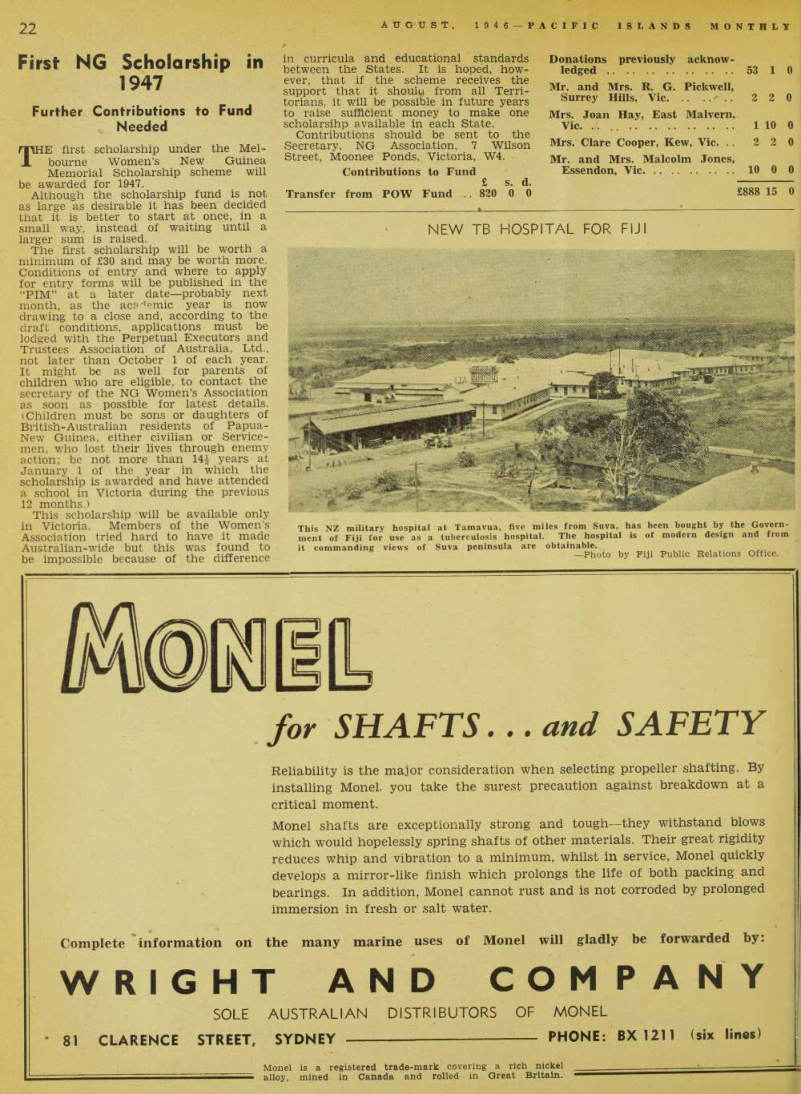
1947 Further Contributions to Fund Needed
rE first scholarship under the Mel bourne Women’s New Guinea Memorial Scholarship scheme will be awarded for 1947.
Although the scholarship fund is not as large as desirable it has been decided that it is better to start at once, in a small way, instead of waiting until a larger sum is raised.
The first scholarship will be worth a minimum of £3O and may be worth more.
Conditions of entry and where to apply for entry forms will be published in the "PIM” at a later date—probably next month, as the academic year is now drawing to a close and, according to the draft conditions, applications must be lodged with the Perpetual Executors and Trustees Association of Australia, Ltd., not later than October 1 of each year.
It might be as well for parents of children who are eligible, to contact the secretary of the NG Women’s Association as soon as possible for latest details. (Children must be sons or daughters of British-Australian residents of Papua- New Guinea, either civilian or Service men, who lost their lives through enemy action; be not more than years at January 1 of the year in which the scholarship is awarded and have attended a school in Victoria during the previous 12 months.) This scholarship will be available only in Victoria. Members of the Women’s Association tried hard to have it made Australian-wide but this was found to be impossible because of the difference
in curricula and educational standards between the States. It is hoped, how ever, that if the scheme receives the support that it should from all Terri torians, it will be possible in future years to raise sufficient money to make one scholarsihp available in each State.
Contributions should be sent to the Secretary, NG Association, 7 Wilson Street, Moonee Ponds, Victoria, W 4.
Contributions to Fund £ s. d.
Transfer from POW Fund 820 0 0
Donations previously acknowledged 53 1 0 Mr. and Mrs. R. G. Pickwell, Surrey Hills, Vic 2 2 0 Mrs. Joan Hay, East Malvern, Vic. .. 1 10 0 Mrs. Clare Cooper, Kew, Vic. .. 2 2 0 Mr. and Mrs. Malcolm Jones, Essendon, Vic 10 0 0 £888 15 0
New Tb Hospital For Fiji
This NZ military hospital at Tamavua, five miles from Suva, has been bought by the Govern ment of Fiji for use as a tuberculosis hospital. The hospital is of modern design and from it commanding views of Suva peninsula are obtainable. —Photo by Fiji Public Relations Office.
Advertisements & other items, p. 24 (1 item)
Wright And Company
for SHAFTS. .. and SAFETY
Reliability is the major consideration when selecting propeller shafting. By installing Monel, you take the surest precaution against breakdown at a critical moment.
Monel shafts are exceptionally strong and tough—they withstand blows which would hopelessly spring shafts of other materials. Their great rigidity reduces whip and vibration to a minimum, whilst in service, Monel quickly develops a mirror-like finish which prolongs the life of both packing and bearings. In addition, Monel cannot rust and is not corroded by prolonged immersion in fresh or salt water.
Complete information on the many marine uses of Monel will gladly be forwarded by:
WRIGHT AND COMPANY
SOLE AUSTRALIAN DISTRIBUTORS OF MONEL
81 CLARENCE STREET, SYDNEY PHONE: BXI2II (six lines) Monel is a registered trade-mark covering a rich nickel alloy, mined in Canada and rolled in Great Britain.
Death Of Peter Kyllert
Tragedy of the Jap Invasion of
Tng
OLD Territorians will learn with much regret of the death of Mr. Peter Kyl lert, of Stockholm Plantation, New Britain, in a Sydney Hospital, on July 29, aged 64. This is one of the tragedies of the Jap invasion.
Mr. Kyllert, a Swede, was one of the pioneers of New Guinea. He hacked a very large and excellent plantation out of the jungle on lonely Lihir Island, off the New Ireland coast, and for years he was the only white resident. Later, he acquired Stockholm Plantation, on New Britain, and the Maragon plantations, on Tabar Islands.
When the Japs came in in January, 1942, Kyllert remained at Stockholm Plan tation. The Japs “investigated” him two or three times, and took him into Rabaul; but, on account of his age, apparently, he was generally left alone. He and his family (part-native) suffered privations through lack of proper food.
Then, in the hours before dawn, one night in 1944. he was awakened by stealthy movements in his bungalow. He got ready to fight—and then discovered that the in truders were Australian commandos, who had most courageously penetrated deep be hind the Japanese lines in New Britain Mr. Kyllert and his wife, hiding by day and travelling in canoes by night, got away westward with the Australians, and eventually reached Sydney.
Mr. Kyllert became a well-known figure at all gatherings of Territorians. He and his wife felt keenly the cold of Austra lian winters and they dreamed of the day when they could return north. But al though New Britain was liberated in late 1945, and although Australia desper ately needed copra, and although Kyllert with three valuable plantations to ad minister, made repeated applications for permission to return, he was kept in Syd ney until his spirit and his health were broken. By the irony of fate, his per mit to return to New Guinea was granted as he lay dying in hospital.
It may be that the permit was delayed while officialdom investigated certain malicious reports that Kvllert had in some way collaborated with the Japs TTiose who have known him for a quarter of a century angrily repudiate any such suggestion. They say he was incapable of a mean action, and “no more loyal member of the white race ever lived.”
French Ships Restored
Papeete, June 11.
communication with France MJ has once more been established bv , 0 of the Messageries Maritimes (such as have survived the war) via Panama. . All copra produced in French Oceania is henceforth to be sent to France Ships are scheduled to follow the old pre-war route (New Caledonia-New Heb rides Tahiti—Panama Martinique France) at approximately monthly sail ings.
Mr F. P Archer, well-known planter of Bougainville, who, after escaping from me japs in an American submarine joined the British Solomon Islands Lab our Corns and later transferred to the Australian Military Frvces, is at present m Svdnev on ore-demobilisation leave He hopes to return shortly to his plan tation on Bougainville.
Advertisements & other items, pp. 25-26 (1 item)
Considered
<. ** HA T A>
The
HAVE YOU
CONSIDERED
THIS CODICIL?
By adding a simple codicil to your Will you can guard against difficulties and loss which might arise should your Executor die or become incapacitated.
By means of such a codicil you can name Burns Philp Trust Co. Ltd. as joint Executor with your present appointee or, if you wish, as sole Executor. In this way you gain positive assurance of continuous and sound administration and are relieved of a serious anxiety. The Company will willingly forward full particulars.
DIRECTORS:
Lewis Armstrong. James Burns. Joseph Mitchell.
R. J. Nosworthy, p. x> w Black.
MANAGER; L. S. Parker.
SECRETARY: E, R. Overton, A.F.I.A.
BURNS PHILP TRUST
COMP ANY L I M I T E D
7 BRIDGE STREET, SYDNEY
’Phone: BU 5901. BOX 543, G.P.0., SYDNEY. 8.P.2.45
DON'T TELL ME
YOU NEVER HAD
A CHANCE!
I took an I.C.S. course, got ahead. But until you , train yourself, how can you \ , expect to handle a bigger ) job! Mail the coupon to N
the I.C.S. TODAY.
INTERNATIONAL CORRESPONDENCE SCHOOLS
140 Elizabeth Street, Sydney Dear Sirs— Please send me free prospectus showing how I can succeed in the occupation I have marked. ... Advertising Accountancy Insts.
Book keeping Cost Accountancy Salesmanship Building Cont.
Architecture Roof. 8C Steel Sq.
Arch. Draw Build. Plan. Draw.
Carpentry Ref. Eng. 8C Serv. lnd. Chemist Elect. Eng. or M.
Electronics Radio Eng. or Ser.
Plastics Auto Mechanics Textiles Aero Des. & Eng.
Diesel Eng. Rayon Weaving Welding Comp. Mech. Eng.
Story Writing Fitting 8C Turning Radio Play W. Mech. D’sman.
Com’cial Art Civil Engineering ...Sketching Showcards, Tickets Landscape Ptg Shorthand, Typing Window Dress General Education Dress Design Coach, any Exam.
If your subject is not above, write it here Name..
Address.. -
PAC.
ICS • ICS. • I CS. • I.C.S
A. B. DONALD Ltd.
AUCKLAND
ISLAND TRADERS & GENERAL MERCHANTS
P.O. Box 1509. Cables Gr Telegrams, "Kingdom," Auckland.
V* I r* ' Bond Street, Sydney, Austrolio. £ t J 4 \j 'JIJ\J f| tj» V^l c TeL 84167. Bo* 3615 GJ.O.
SUPPLIERS OF GENERAL MERCHANDISE TO LEADING FIRMS THROUGHOUT THE
PACIFIC ISLANDS
Exporter* ... Importer* ... . Manufacturer*' Representatives Bankers: Bank of N.S.W. Bank of Adelaide. Comptoir Nat. d’Escompte de Paris.
Cable Address: “SEAFOODS,” SYDNEY.
Codes: Bentley’s. 2nd and Comp. Phrase; A.8.C., sth and 6th; Peterson, Ind and 3rd; Banking; Acme.
Philippines Now
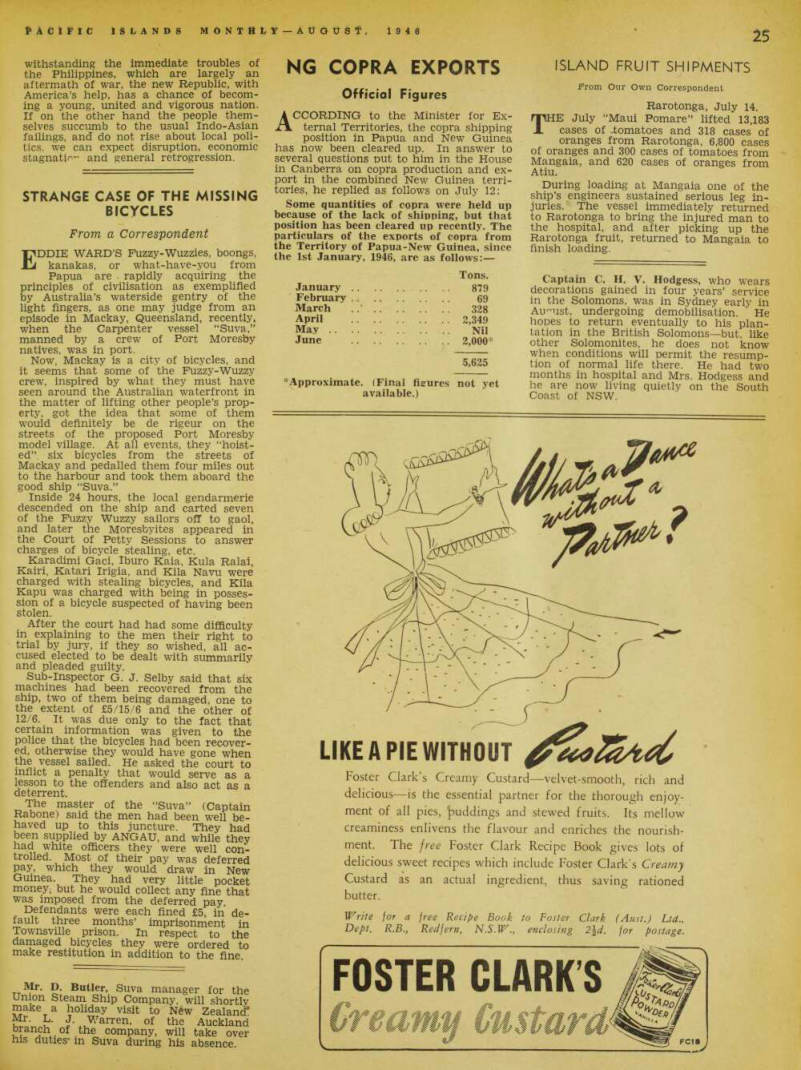
Becomes Inedependent State But Still Has Protection and Financial Support of United States
ON American Independence Day—July 4 —the Commonwealth of the Philip pines became an independent republic . and Manuel Roxas its first President under the new regime.
It will be remembered that Roxas de cisively defeated Osmena (who had step ped into Quezon’s shoes when he died in the USA in 1944) at the presidential elections in the Philippines in April.
Roxas was the leader of a breakaway section of the Conservative Party, and, during the Japanese occupation, a mem ber of the Japanese puppet Government.
It has been wondered why Roxas was not cast into jail with the other col laborators, but General MacArthur has stated that Roxas was left in the Philip pines with a special job to do —which presumably he performed. At all events he is now President and has the active help and the 100 per cent, encouragement of the United States.
He will certainly need all the aid and sympathy he can get. As he himself said in a broadcast to Australia, which was relayed over the National Network on July 3: “We are rebuilding a land levelled
by war and an economy disrupted by destruction. We are starting almost at our foundations, and we are starting as an independent nation, looking forward to establishing new associations and lay ing new economic highways. We hope and propose to broaden our contacts and to enter into mutually beneficial trade relationships with all our neighbours.
“To-day, unfortunately, our exports are small and are confined to plantation crops which were not completely devas tated or stolen by the Japanese. But that is only a temporary situation. It is the result of our having been a battle ground in the war.
“We are told by those who have seen the war zones in Europe and Asia that no land on the face of the globe has suffered more terribly and more com pletely than we. We are told that our land and its people, by our struggles on the side of the Allies, earned a ven geance which was visited upon few other peoples. I know that our capital city, Manila, is a broken and pitiful thing, a shambles, the skeleton of a city. I know that our public buildings and grace ful homes of 1940 are piles of dust and rubble; that many of our farms and fields lie ruined: and that the heavy hands of destruction reached far out into the provinces and remote villages and tiny settlements. There is not a single major part of the Philippines which does not have its tragic ruins of war.” rE promise of independence was made to the Philippines in the Tvdings- McDuffie Act of 1934. It was thought that the disruption of war would delay this for some time but early this year it was announced in Washington that the original plan would be adhered to. This, of course, does not mean that America will withdraw her support. The Philin pines will still be very much under US protection.
An agreement was signed in May that aave the Philinnines preferential trade with the US for the next 28 years—and new Republic's nroducts will be al lowed into the United States duty free for the next eight, after which duties will be anplied pradually. At the same time America will aive direct aid to the Philinnines to the extent of a 525 million d/'llar loan and inn million dollars worth of surplus war "pods.
President Roxas and his ministers, however, have their full share of head aches. In common with most Asiatic or semi-Asiatic races, as soon as the strong hand of organised Government is re moved the country falls into sectional snuabbling. At present, for example, there is a minor civil war going on in Luzon where the local variety of Com munists —the Huks—are running a rebel lion.
The Philippines experiment is being watched with great interest by all in terested in Colonial administration. Not
withstanding the immediate troubles of the Philippines, which are largely an aftermath of war, the new Republic, with America’s help, has a chance of becom ing a young, united and vigorous nation.
If on the other hand the people them selves succumb to the usual Indo-Asian failings, and do not rise about local poli tics. we can expect disruption, economic stagnatip" and general retrogression.
Strange Case Of The Missing
Bicycles
From a Correspondent Eddie WARD’S Fuzzy-Wuzzies, boongs, kanakas, or what-have-you from Papua are rapidly acquiring the principles of civilisation as exemplified by Australia’s waterside gentry of the light fingers, as one may judge from an episode in Mackay, Queensland, recently, when the Carpenter vessel “Suva,” manned by a crew of Port Moresby natives, was in port.
Now, Mackay is a city of bicycles, and it seems that some of the Fuzzy-Wuzzy crew, inspired by what they must have seen around the Australian waterfront in the matter of lifting other people’s prop erty, got the idea that some of them would definitely be de rigeur on the streets of the proposed Port Moresby model village. At all events, they “hoist ed” six bicycles from the streets of Mackay and pedalled them four miles out to the harbour and took them aboard the good ship “Suva.”
Inside 24 hours, the local gendarmerie descended on the ship and carted seven of the Fuzzy Wuzzy sailors off to gaol, and later the Moresbyites appeared in the Court of Petty Sessions to answer charges of bicycle stealing, etc.
Karadimi Gaci, Iburo Kaia, Kula Ralai, Kairi, Katari Irigia, and Kila Navu were charged with stealing bicycles, and Kila Kapu was charged with being in posses sion of a bicycle suspected of having been stolen.
After the court had had some difficulty in explaining to the men their right to trial by jury, if they so wished, all ac cused elected to be dealt with summarily and pleaded guilty.
Sub-Inspector G. J. Selby said that six machines had been recovered from the ship, two of them being damaged, one to the extent of £5/15/6 and the other of 12/6. It was due only to the fact that certain information was given to the police that the bicycles had been recover ed, otherwise they would have gone when the vessel sailed. He asked the court to inflict a penalty that would serve as a lesson to the offenders and also act as a deterrent.
The master of the “Suva” (Captain Rabone) said the men had been well be haved up to this juncture. They had been supplied by ANGAU, and while they had white officers they were well con trolled. Most of their pay was deferred pay, which they would draw in New Guinea. They had very little pocket money, but he would collect any fine that was imposed from the deferred pay Defendants were each fined £5, in de fault three months’ imprisonment in Townsville prison. In respect to the damaged bicycles they were ordered to make restitution in addition to the fine.
Mr. D. Butler, Suva manager for the Union Steam Ship Company, will shortly make a holiday visit to New Zealand J- Warren, of the Auckland branch of the company, will take over his duties’ in Suva during his absence.
Ng Copra Exports
Official Figures
ACCORDING to the Minister for Ex ternal Territories, the copra shipping position in Papua and New Guinea has now been cleared up. In answer to several questions put to him in the House in Canberra on copra production and ex port in the combined New Guinea terri tories, he replied as follows on July 12: Some quantities of copra were held up because of the lack of shipping, but that position has been cleared up recently. The particulars of the exports of copra from the Territory of Papua-New Guinea, since the Ist January, 1946, are as follows:
(Final fieures not yet available.)
Tons.
January 879 February 69 March 328 April 2,349 May Nil June 2,000* 5,625
Island Fruit Shipments
From Our Own Correspondent Rarotonga, July 14, npHE July “Maui Pomare” lifted 13,183 X cases of -tomatoes and 318 cases of oranges from Rarotonga, 6,800 cases of oranges and 300 cases of tomatoes from Mangaia, and 620 cases of oranges from Atiu.
During loading at Mangaia one of the ship’s engineers sustained serious leg in juries. The vessel immediately returned to Rarotonga to bring the injured man to the hospital, and after picking up the Rarotonga fruit, returned to Mangaia to finish loading.
Captain C. H. V. Hodgess, who wears decorations gained in four years’ service in the Solomons, was in Sydney early in August, undergoing demobilisation. He hopes to return eventually to his plan tation in the British Solomons—but, like other Solomonites, he does not know when conditions will permit the resump tion of normal life there. He had two months in hospital and Mrs. Hodgess and he are now living quietly on the South Coast of NSW.
Advertisements & other items, p. 27 (1 item)
s>* yui*?
LIKE A PIE WITHOUT &U 4
Foster Clark’s Creamy Custard—velvet-smooth, rich and delicious—is the essential partner for the thorough enjoyment of all pies, 'puddings and stewed fruits. Its mellow creaminess enlivens the flavour and enriches the nourishment. The free Foster Clark Recipe Book gives lots of delicious sweet recipes which include Foster Clark’s Creamy Custard as an actual ingredient, thus saving rationed butter.
Write for a free Recipe Book to Foster Clark (Aust.) Ltd., Dept. R. 8., Red fern, N.S.W., enclosing 2\d. for postage.
FOSTER CLARK’S
f>D t/?
r CIS
How Australia Is Penalising New Guinea
Spoiled Natives And Harassed Planters Letter to the Editor
fpALKING of black marketeers and their X nefarious tactics: they seem to be gentlemen compared with our own Commonwealth Government of Austra lia!
For instance, quite a number of public servants, plantation owners, etc., returned to Papua and New Guinea recently, to pick up the threads of their life’s work where they left them in 1941. Instead of their mother government taking a paternal interest in them, she treats them
like foreigners.
For example, she puts a prohibitive ex port duty on the flour and sugar which she exports from Australia to her citizens in the Territories, to wit: 75 per cent., on top of which the said citizens have to pay 10 per cent, ad valorem customs im port duty before they can get delivery up here.
Again, these perfectly good Australian colonists do not receive the benefit of the stabilised price of tea, as they did when
in Australia. Tea cost them 2/31 per lb. down there; but it now costs them 4/9 per lb. here!
The price of Australian rice, in bags, purchased from the Army, used to be £2B per ton. Now it is £42 per ton, and we are told it will be £5O per ton after the next shipment from Australia, which is due here in a day or two. Who is getting the extra cash—l’ll wager it is not the Aussie producer!
YOU will, perhaps, recollect that when Mr, Chifley was in London recently, he vehemently announced that when he returned to Australia he was going to look into the edible oil and fat position, to see how much more the Australian public could send the Mother Country.
Mr. Ward, in his zeal to see that “Fuzzy Wuzzy” was not going to be exploited by these greedy Aussie planters, evidently pulled the wool over Mr. Chifley’s eyes— as far as Papua and New Guinea were concerned, at any rate—because he promptly caused all the contracts of ser vice entered into by “Fuzzy Wuzzy” with ANGAU during the past couple of years, to be cancelled—notwithstanding that ANGAU recruited this labour for the Australian planters at £4 per head. These fees evidently entered the coffers of Ward’s External Territories’ Department per medium of that Department’s pros perous baby—the Production Control Board.
It doesn’t seem to matter to Mr. Ward or to his autocratic Canberra bureau crats, that if they did the decent thing by Britain, and got all of the copra rot ting in Papua and New Guinea out, it would mean an extra ounce of vegetable fat per person, per day, in the United Kingdom. But, oh dear no! Britain can go hang while Fuzzy Wuzzy is told to go home, and be damned to the copra and rubber plantations.
But that is not all. The closing down of the coconut plantations in Papua and New Guinea means the closing down of the crushing mills, refineries, soap and margarine factories in Sydney and the throwing out of work of thousands of Australian workers and taxpayers.
MR. EDITOR, pay a visit to Levers’ and other copra crushers, margarine and soap manufacturers in Sydney, and see for vourself how much copra they have on hand and how little vegetable fat and soap is available for the Austra lian consumer, let alone for shipment overseas. Why?
We have just been told that the export of soap from Australia to these Territories has been prohibited, because of the short age down there! Just verify these facts for yourself and see what an awful mess Canberra bureaucrats are getting Aus tralia and these Territories into.
I as an Australian Serviceman and-an onlooker for the past 27 months in New Guinea, am thoroughly disgusted with what I have seen since the advent of Civil Administration. The natives were con tented and happy under ANGAU and the military regime. But they are not so now.
They are in a constant state of turmoil, wondering whether the present Govern ment wants them to work or not.
I have no axe to grind but, being a plain Aussie who has fought Nazism in the recent war, I hate to see good Colonies ruined by meddling bureaucrats and would-be dictators from afar I intended seeking employment in New Guinea upon my release from service But conditions have altered so much up here during recent months that I have changed my mind about staying on as a civilian.
I am, etc.,
Madang, NG. 10/7/’46.
Maurice W., Moyle,
Sgt., Raaf.
Advertisements & other items, p. 28 (2 items)
26
A tJ G tJ S f , 1946 PACIFIC ISLANDS MONIfll!
Victoria
BITTER
SIEVED IT
CARLTON & UNITED BREWERIES LTB.
v.i K
Compared
British and Australian Methods of Ruling Territories Compared
(A Letter to the Editor)
JUDGING by the spate of criticism which has filled the press for years of the Australian Administration of Papua and New Guinea, and the fre quently-made assertion of how much better by comparison are the British Colonial Office Islands governed, perhaps in the interests of truth and justice it is desirable that a real comparison be made.
Such a comparison should serve the dual purpose of (a) dispelling from the minds of British Solomon Islands settlers the fear of the bogey of Australian con trol of that Group, with all the horrifying consequences envisaged as resulting; and (b) informing the settlers in the Austra lian-controlled Territories that they are much better off under Australia than we in the Solomons are under the Colonial Office.
The writer has lived and worked in both the Australian and British Islands.
LAND: It is much less difficult for a would-be settler to take up land in the Australian-controlled Islands than it is in the British. Some assistance at least is given the land-seeker in Papua, but absolutely none in the Solomons. The rentals for Crown leases favour the man in Papua.
LABOUR: The supply of native labour in the past has been much better in the Australian Islands than in the British.
And, after considering both Australian and British post-war native labour policies, the outlook for the future again favours the Australian Islands. Native wages in the past and in the future, have
been, and will be, lower in the Australian Groups than in the Solomons. Conditions of native labour, housing, rationing, etc., are practically the same under both Gov ernments. The quality of Solomons labour is, on the whole, slightly better than that of Papua-New Guinea, but the difference is not as great as the average BSI planter fondly believes. However, this advantage is nullified by the inexpert manner in which the BSI Labour Regu lations are administered.
Import And Export Duties: Here
again the position favours the Australian controlled Islands.
Communications, Shipping And
POSTAL: Prior to the war the Solomons enjoyed the same facilities in this respect as Papua-New Guinea. But that was largely due to the generosity of the Aus tralian Government, which footed most of the bill for the shipping subsidy. In the current post-war era these facilities are not being extended, with the result that these days in the Solomons commercial shipping services are non-existent, planters are unable to resume production, and mails are so few and far between as to be almost negligible.
Ships are running to the Australian Territories, returning hundreds of their settlers to their homes and lifting their production, whilst the BSI stagnate and rot, missing the current high markets, for lack of shipping. Apparently, if the Australian Government does not supply the shipping, the Colonial Office will do nothing.
Yet the BSI planters kid themselves
that they are better off than being under Australia. Sudh are the strange de lusions of a fixed anti-Australian complex.
This complex has cost the Solomons dearly, and is responsible for its being the most backward Group in the Pacific.
It is about time they woke up, cast aside prejudice and ignorance, and examined things for themselves. The points herein discussed are matters of fact, capable of proof or disproof. Nobody’s word has to be taken for anything.
POLITICAL: The political advantages of being under Australia are enormous.
Some of the material advantages have been indicated above, to which may be added preferential treatment in freight rates and markets. Which are more likely to increase in the future rather than decrease. Australia looks after her own, as is evidenced by her payment of millions in war damage compensation to her settlers, while the British have not paid a cent.
The disabilities of Papua-New Guinea have always the opportunity of a hearing in the National Parliament at Canberra.
We in the Solomons know to our cost how utterly impracticable it is to have our grievances aired in the British Par liament. The Australian Islands have the probability of being given a voteless member in the Australian Parliament, similar to the Northern Territory. When will the Solomons have a similar mem ber in the House of Commons? Never Officialdom can run the Solomons without fear of Parliamentary repercussions Such can never be the case in Papua-New Guinea.
By and large the British Pacific Administrations favour Big Business and resent the presence of the smaller settler.
Under the new order in Papua-New Guina the Australian policy is the reverse
of this. So what do the BSI settlers hope to gain by continued support of the present set-up? Their loyal support of Colonial Office Administration has only earned them to date the scarcely veiled contempt of the officialdom they have pandered to. What on earth do they expect to get out of it all? I ask this in * *
Advertisements & other items, p. 29 (1 item)
William H. Watson
ESTABLISHED 1930
RAROTONGA, COOK ISLANDS
Wholesale and . Retail Trader
LICENSED STAMP DEALER
Agent For:—
BRITISH TRADERS' INSURANCE CO.
CORONA & L. C. SMITH TYPEWRITERS
KAISER & FRAZER MOTOR CARS
B.S.A. CYCLES AND MOTOR CYCLES
AMERICAN LEAD PENCIL CO.
WHITES AVIATION LTD.
Manufacturers of: FOOTWEAR, ALL CLASSES SUITABLE FOR NATIVE TRADING . . . MOP. PRODUCTS, INCLUDING ROUND EAR-RING BLANKS AND BUTTON BLANKS Exporter of: “Rarotonga” Hula-Skirts.
Sea-Shell Necklaces.
M.O.P. Jewellery.
Island Produce.
Wholesale and Retail Inquiries Invited.
Prepared to Consider Agencies for all Class of Goods.
Importer of: Textiles.
General Hardware.
Fancy Goods.
General Merchandise.
Cable Address: “Watson” Rarotonga Bankers: Bank of New Zealand, Auckland.
Stamps
We buy collections, also all issues in quantity, either off or on paper. Top prices. Send registered mail.
Agents required in Pacific Islands, Papua and New Guinea to service covers and send mint stamps.
A. Willison, Box 128, Burnie, Tasmania.
all seriousness. But I will venture to prophesy that all they will receive in the future will be what they have received in the past—a deaf ear to their requests, and further unsympathetic administration, I am, etc.,
Leslie F. Gill.
Melbourne, 24/7/46.
The newly appointed Comptroller of Customs, Mr. A. R. Smith, MBE, is ex pected to leave for Fiji shortly. Mr.
Smith is at present Collector of Customs, Bermuda. His first appointment in the Colonial Service was as Treasury Clerk, Bermuda. In 1940 he became Assistant Colonial Secretary and in 1941 Collector of Customs.
Papuan Story
(.Dedicated to Sir Hubert Murray, who died during an official visit to the Eastern District of the Territory. By his love and justice, he built up a nation of loyal Papuans— their worth being shown as carriers on the Kokoda Trail, in 1942, and in other areas.) A land of mountains vast and tropic shore, Of foetid jungles, mangrove swamps, and mud, With stone-age race, and prehistoric lore; Dark deeds and sorcery within your blood: A land of unknown wealth in mineral ore, And timbers sound, for white man’s crafts and arts, pilled lavishly from Nature’s bounteous store.
Untouched, unspoiled, a land with golden heart— Such is your country, rich, gigantic, grim; Volcanoes, kunai plains and rivers deep, Where dwelt head-hunters, back in ages dim, While eerie tales still ’midst your moun tains sleep.
Then came the “dimdim” traders with their wares; Blackbirders, miners, planters with new seed, Pearlers, and mission men to ease your cares; Then some to exploit full of selfish greed.
As years passed on, you suffered growing pains, Saw white man’s ways; but God knows what you thought! (Such blots as half-castes bred of mingled strains) You gained where good, but lost where evil wrought.
Next, to your nation, came the White Queen’s rule, To build, to guard, to guide you as a race; A change to iron, for weapon and for tool, Could not traditional customs quite efface.
It gave you schools, and hospitals, and health, Gave you employment, maybe easier life, New goods and clothes, increased your natural wealth; And taught you games, to take the place of strife.
Murray, your guide, so constant, just and kind ’
Schooled you in useful ways, with helpers keen; Gave justice fair, from trained judicial mind; Replaced with good, where baser traits had been.
And though he died, his memory still was there, Inspiring those who acted in his stead.
Your nation grew and prospered in such care, . .
His followers journeying on where he once led.
War reached your shores, came men of Nippon there;
You heard their bombs, and knew both death and pain— Your women raped, homes lost, your gar dens bare.
Spoil and destruction mocked his sweet refrain.
Calm peace will yet return, and time will pass, Memories grow dim, the flags of Mars be furled: War’s weapons rust, lost in your kunai grass, But your race will stand high through out the world!
And when we pay our homage to your brave, Let us in gratitude to him ne’er cease, Remembering the life to you he gave, “On Active Service”—spent in love and peace.
N. A. Brett Young.
Advertisements & other items, p. 30 (1 item)
Ingram’S
\\v®i
fevvvvvvv^
tf* t’o
Ing
5&
Sv\\W^
vO oo^ s * VWIV* ° c o « ft\ST o V- ** t<l Set your face up for the day with COOL, soothing, whisker-subduing
INGRAM'S!
All over the world the Ingram's jar is the morning companion of men who appreciate easy shaving. Ingram's cools and smoothes the skin while it wilts the wiriest hair-growth. Moreover, Ingram's is most economical because so little is needed for a rich, thick, spreading lather.
INGRAM’S
SHAVING CREAM
Manufactured by
BRISTOL-MYERS CO. PTY. LTD.
Sold by all leading distributors and manufactured by Bristol-Myers Co. Pty. Ltd., 223 Pacific Highway, North Sydney, N.S.W.. Australia
Death Of Miss A. Gibson
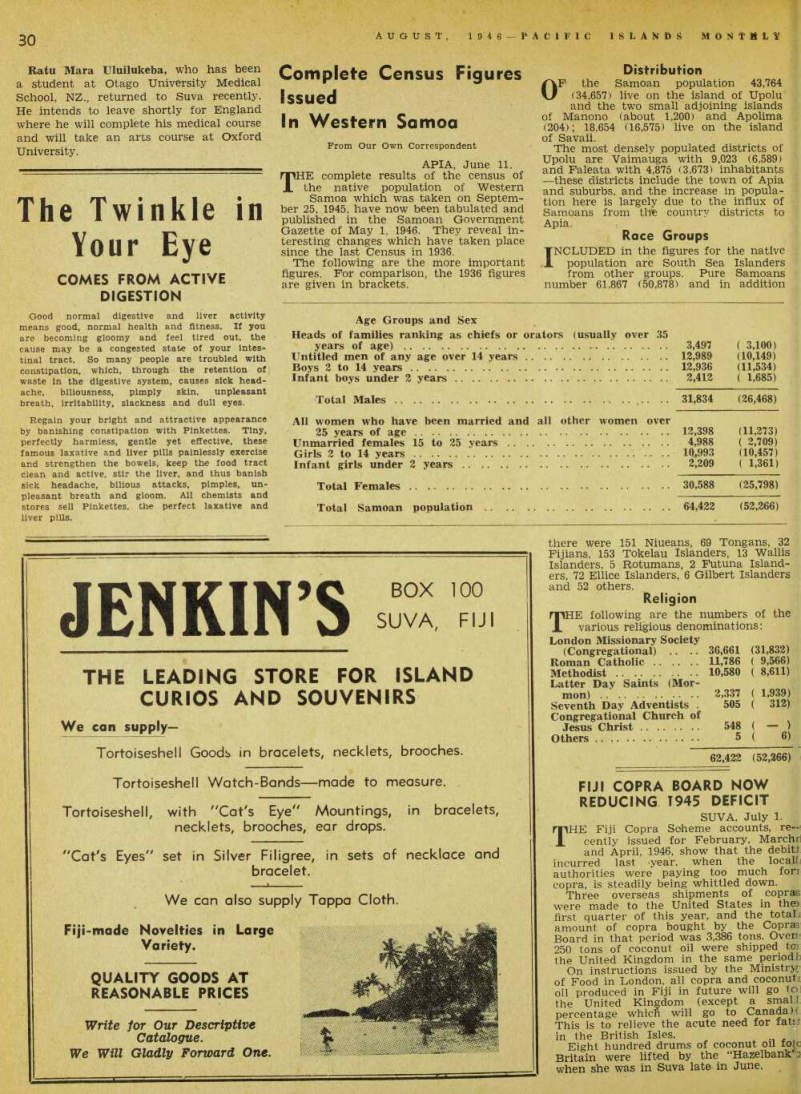
SUVA July 3.
A WELL-KNOWN woman resident of the Colony, Miss Alma Gibson, died in her sleep here in Suva last night.
Miss Gibson was born in Queensland, but had held clerical positions in Suva for the past 25 years. She recently visited relatives in Australia, and only last week returned to Fiji.
She was the sister of Mrs. H. C.
Monckton, who died recently in Aus tralia.
Mrs. S. D. Canard of Suva is a niece of the deceased.
Haiti Mara Uluilukeba, who has been a student at Otago University Medical School, NZ, returned to Suva recently.
He intends to leave shortly for England where he will complete his medical course and will take an arts course at Oxford University.
Advertisements & other items, p. 31 (1 item)
C®B(eHwßb Pip Mi
and (Count
A WUNDERLICH
HONOUR ROLL affords a dignified, permanent tribute to those who served in defence of their country.
Two stock designs are available in Wunderlich Honour Rolls. Special designs also made to order in Bronze, Brass, Copper or Aluminium.
I M 1945 1939
ROLL OF HONOUR
DESIGN No. 1
Height 3ft. 2ins.
Width 2ft. 4ins.
You are invited to visit our showrooms, or write to WUNDERLICH Limited Baptist Street
REDFERN. SYDNEY
Phone; MX 241 1 G.P.O. Box 474
ISLAND MERCHANTS
and AGENTS.
GENERAL MERCHANTS.
C®B(eHwßb Pip Mi
379 KENT ST., SYDNEY.
Cable & Telegraphic i v fkf') 9 Shippers °f types of
hjjja 1 \ " Mei
Merchandise to the Pacific Islands • Representing Australian, British and American Manufacturers
Tlrirfr>CC^;
• Buyers for Leading Pacific Islands Traders • Sellers of Island Produce on Consignment Importers, Distributors and Manufacturers of Foodstuffs, Softgoods, Textiles, Hardware, Tobaccos, Wines and Spirts, etc.
Address : “Chasull,” Sydney.
"Ultima" Kerosene Stoves and Heating Appliances 9 Distributors of High-grade Shirts, Pyjamas and Clothing f? l V "Southern Queen' Canned Fruits • Forwarding and Transhipment Agents /& ft 'Am m 9 Hill's English Cigarettes When in Sydney, call and see us!
Complete Census Figures
Issued In Western Samoa
From Our Own Correspondent APIA, June 11. r:E complete results of the census of the native population of Western Samoa which was taken on Septem ber 25, 1945, have now been tabulated and published in the Samoan Government Gazette of May 1. 1946. They reveal in teresting changes which have taken place since the last Census in 1936.
The following are the more important figures. For comparison, the 1936 figures are given in brackets.
Distribution
OP the Samoan population 43,764 (34,657) live on the island of Upolu and the two small adjoining islands of Manono (about 1,200) and Apolima (204); 18,654 (16,575) live on the island of Savaii.
The most densely populated districts of Upolu are Vaimauga with 9,023 (6,589) and Faleata with 4,875 (3,673) inhabitants —these districts include the town of Apia and suburbs, and the increase in popula tion here is largely due to the influx of Samoans from the country districts to Apia.
Race Groups
INCLUDED in the figures for the native population are South Sea Islanders from other groups. Pure Samoans number 61,867 (50,878) and in addition
Age Groups and Sex Heads of families ranking as chiefs or orators (usually over 35 years of age) 3,497 ( 3,100) Untitled men of any age over 14 years 12,989 (10,149) Boys 2 to 14 years 12,936 (11,534) Infant boys under 2 years 2,412 ( 1,685) Total Males 31,834 (26,468) All women who have been married and all other women over 25 years of age 12,398 (11,273) Unmarried females 15 to 25 years 4,988 ( 2,709) Girls 2 to 14 years 10,993 (10,457) Infant girls under 2 years 2,209 ( 1,361) Total Females 30,588 (25,798) Total Samoan population 64,422 (52,266)
there were 151 Niueans, 69 Tongans, 32 Fijians, 153 Tokelau Islanders, 13 Wallis Islanders, 5 Rotumans, 2 Futuna Island ers, 72 Ellice Islanders, 6 Gilbert Islanders and 52 others.
Religion
rE following are the numbers of the various religious denominations: London Missionary Society (Congregational) .. .. 36,661 (31,832) Roman Catholic 11,786 ( 9,566) Methodist 10,580 ( 8,611) Latter Day Saints (Mor mon) 2,337 ( 1,939) Seventh Day Adventists . 505 ( 312) Congregational Church of Jesus Christ 548 ( ) Others 5 ( 6) 62,422 ( 52,266)
Fiji Copra Board Now
Reducing 1945 Deficit
SUVA, July 1.
THE Fiji Copra Scheme accounts, re cently issued for February, Marchri and April, 1946, show that the debit) incurred last year, when the localL authorities were paying too much fon copra, is steadily being whittled down.
Three overseas shipments of copras were made to the United States in the? first quarter of this year, and the totali amount of copra bought by the Copra?
Board in that period was 3,386 tons. Oven 250 tons of coconut oil were shipped ten the United Kingdom in the same periodb On instructions issued by the Ministry; of Food in London, all copra and coconut oil produced in Fiji in future will go to the United Kingdom (except a small percentage which will go to Canada)!
This is to relieve the acute need for fatst in the British Isles.
Eight hundred drums of coconut oil foie Britain were lifted by the “Hazelbank’: when she was in Suva late in June.
Advertisements & other items, pp. 32-34 (3 items)
30
AUGUST, 1946 PACIFIC ISLANDS MONftl?
Jenkin’S
The Twinkle in
Your Eye
COMES FROM ACTIVE
DIGESTION
Good normal digestive and liver activity means good, normal health and fitness. If you are becoming gloomy and feel tired out, the cause may be a congested state of your intestinal tract. So many people are troubled with constipation, which, through the retention of waste in the digestive system, causes sick headache, biliousness, pimply skin, unpleasant breath, irritability, slackness and dull eyes.
Regain your bright and attractive appearance by banishing constipation with Pinkettes. Tiny, perfectly harmless, gentle yet effective, these famous laxative and liver pills painlessly exercise and strengthen the bowels, keep the food tract clean and active, stir the liver, and thus banish sick headache, bilious attacks, pimples, unpleasant breath and gloom. All chemists and stores sell Pinkettes. the perfect laxative and liver pills.
JENKIN’S
BOX 100
SUVA, FIJI
THE LEADING STORE FOR ISLAND
CURIOS AND SOUVENIRS
We con supply— Tortoiseshell Goods in bracelets, necklets, brooches.
Tortoiseshell Watch-Bands —made to measure.
Tortoiseshell, with "Cat's Eye" Mountings, in bracelets, necklets, brooches, ear drops.
"Cat's Eyes" set in Silver Filigree, in sets of necklace and bracelet.
We can also supply Tappa Cloth.
Fiji-made Novelties in Large Variety.
QUALITY GOODS AT
REASONABLE PRICES
Write for Our Descriptive Catalogue.
We Will Gladly Forward One.
Islands Trading
PACIFIC
Bankers: Bank of America' (Main Office) San Francisco.
COMPANY
Cables:
PITCO
SAN FRANCISCO
244 CALIFORNIA STREET, SAN FRANCISCO, CAL, U.S.A.
EXPORTERS OF :
BARBER CHAIRS.
TEXTILES.
CLOTHING.
LIQUOR.
ELECTRICAL GOODS.
FOODSTUFFS.
PRODUCE.
STATIONERY.
CARTRIDGES.
DRUGS.
PAPER PRODUCTS.
AUTOMOTIVE PARTS.
WIRE & NAILS.
BUILDING SUPPLIES.
RADIOS.
REFRIGERATORS.
AUTOMOBILES.
FARM MACHINERY.
TYPEWRITERS.
FIREARMS.
CHEMICALS.
MARINE HARDWARE.
CIGARETTES, TOBACCO.
HARDWARE.
FURNITURE.
IRON & STEEL PRODUCTS.
CANNED GOODS.
PAINTS.
NOVELTIES, NOTIONS.
LEAD PENCILS, ERASERS.
HEAVY EQUIPMENT.
FERTILIZERS.
TYRES, TUBES.
PREFABRICATED HOUSES.
QUOTATIONS ON REQUEST
fk TS
"SMITH-CORONA"
TYPEWRITERS
STOCK UP IN THESE
POPULAR MACHINES
None Better!
“NATIONAL” ELECTRICAL APPLIANCES
MADE IN CANADA
TO THE TRADE ONLY
(«^PS
MEAN TO ME
FOR PETE'S SAKE TORN OFF THAT RADIO • \r n V
THINKS :
MEAN TO ME'IS
RIGHT !
I w. s you're a bundle
OF NERVES LATELY .
YOUD BETTER DO
SOMETHING ABOUT U
#«*■' J .. >*> iVe noticed IT TOO !
HE'S TIRED AND IRRITABLE
ALL THE TIME . GET
HIM TO SEE DOCTOR
PRICE.
EVERY
6 WEEKS LATER
NIGHT
£
ROSES:
DARLING -
IT'S NOT MY
BIRTHDAY
I JUST
THOUGHT
you'd LIKE
"THEM.
& <3
AT THE DOCTORS
WELL THERE’S CERTAINLY
NOTHING ORGANICALLY WRONG IN
YOUR CASE. BUT YOU SAID YOU
EVEN WAKE TIRED ? WELL, YOU
SEE, WHILE YOU SLEEP YOU
SHOULD BE REPLACING ENERGY
LOST DURING THE DAY AT WORK
AND PLAY . EVEN DURING
THE NIGHT YOUR
HEART AND LUNGS
CONTINUE THEIR WORK
USING UP STILL MORE ENERGY .
UNLESS YOU GET COMPLETE REST
YOUR ENERGY IS NOT REPLACED
AND YOU WAKE TIRED AND BECOME
NERVY. YOU NEED A CUP OF HOT
HORLICKS EVERY NIGHT.
:r a
Feeling nervy
lately?
If you wake tired and become more tired as the day goes on. If you find it hard to concentrate . . . get irritable and lose yo#r temper over trivial things . . . then remember those symptoms can very often be traced back to the fact that you are not replacing the energy you use up. Try a cup of hot Horlicks just before bed.
After Horlicks you wake full of life, and clear-eyed. “Nerves” he come a thing of the past.
Get some Horlicks from your grocer or chemist today.
N 46-3
HORLICKS
Contains all essential food elements in the’* natural form.
On Nauru
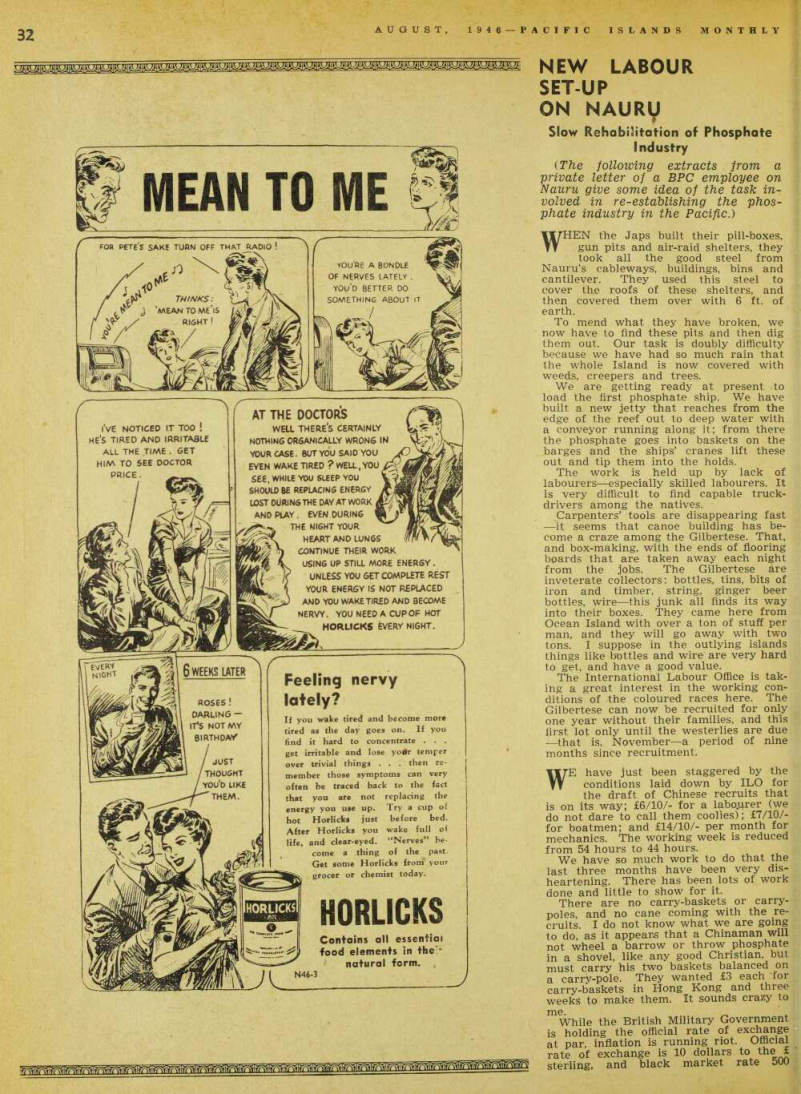
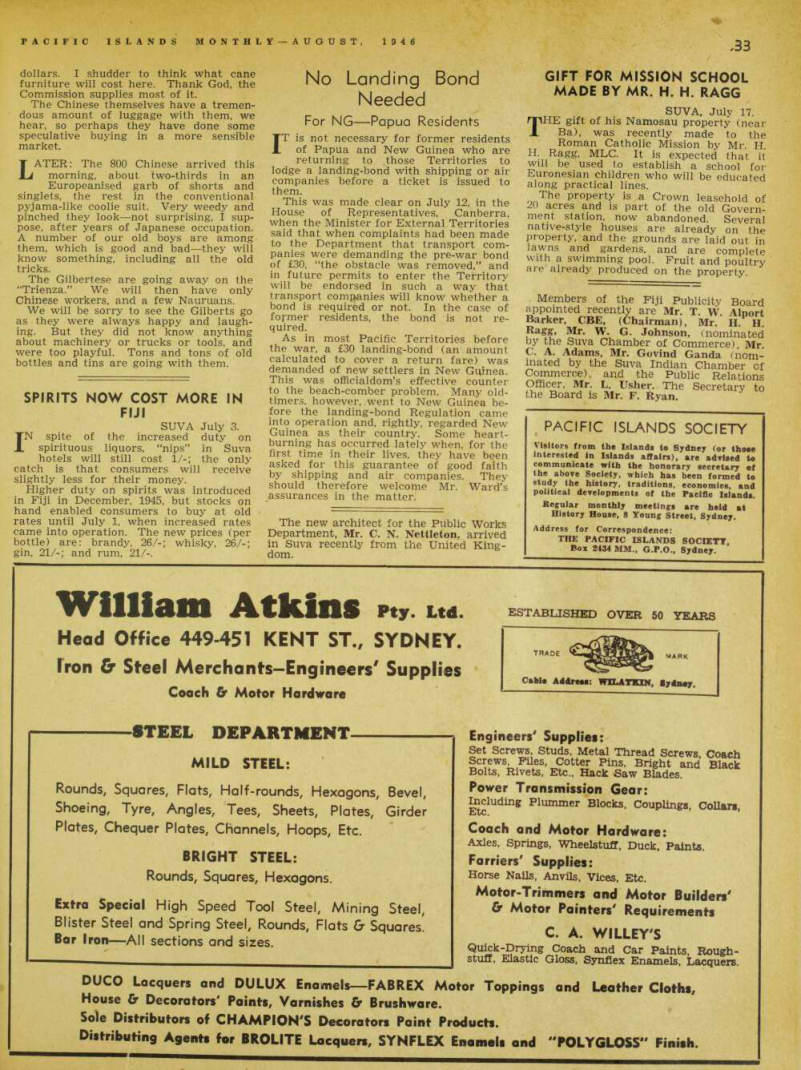
New Labour
Set-Up
Slow Rehabilitation of Phosphate Industry
{The fallowing extracts pom a private letter of a BPC employee on Nauru give some idea of the task in volved in re-establishing the phos
phate industry in the Pacific.)
WHEN the Japs built their pill-boxes, gun pits and air-raid shelters, they took all the good steel from Nauru’s cableways, buildings, bins and cantilever. They used this steel to cover the roofs of these shelters, and then covered them over with 6 ft. of earth.
To mend what they have broken, we now have to find these pits and then dig them out. Our task is doubly difficulty because we have had so much rain that the whole Island is now covered with weeds, creepers and trees.
We are getting ready at present to load the first phosphate ship. We have built a new jetty that reaches from the edge of the reef out to deep water with a conveyor running along it; from there the phosphate goes into baskets on the barges and the ships’ cranes lift these out and tip them into the holds.
The work is held up by lack of labourers —especially skilled labourers. It is very difficult to find capable truck drivers among the natives.
Carpenters’ tools are disappearing fast —it seems that canoe building has be come a craze among the Gilbertese. That, and box-making, with the ends of flooring boards that are taken away each night from the jobs. The Gilbertese are inveterate collectors: bottles, tins, bits of iron and timber, string, ginger beer bottles, wire—this junk all finds its way into their boxes. They came here from Ocean Island with over a ton of stuff per man, and they will go away with two tons. I suppose in the outlying islands things like bottles and wire are very hard to get, and have a good value.
The International Labour Office is tak ing a great interest in the working con ditions of the coloured races here. The Gilbertese can now be recruited for only one year without their families, and this first lot only until the westerlies are due —that is, November —a period of nine months since recruitment.
WE have just been staggered by the conditions laid down by ILO for the draft of Chinese recruits that is on its way; £6/10/- for a labo.urer (we do not dare to call them coolies); £7/10/for boatmen; and £l4/10/- per month for mechanics. The working week is reduced from 54 hours to 44 hours.
We have so much work to do that the last three months have been very dis heartening. There has been lots of work done and little to show for it.
There are no carry-baskets or carry poles, and no cane coming with the re cruits. I do not know what we are going to do, as it appears that a Chinaman will not wheel a barrow or throw phosphate in a shovel, like any good Christian, but must carry his two baskets balanced on a carry-pole. They wanted £3 each for carry-baskets in Hong Kong and three weeks to make them. It sounds crazy to mG.
While the British Military Government is holding the official rate of exchange at par, inflation is running not. Official rate of exchange is 10 dollars to the £ sterling, and black market rate 500
dollars. I shudder to think what cane furniture will cost here. Thank God, the Commission supplies most of it.
The Chinese themselves have a tremen dous amount of luggage with them, we hear, so perhaps they have done some speculative buying in a more sensible market.
LATER: The 800 Chinese arrived this morning, about two-thirds in an Europeanised garb of shorts and singlets, the rest in the conventional pyjama-like coolie suit. Very weedy and pinched they 100k —not surprising, I sup pose, after years of Japanese occupation.
A number of our old boys are among them, which is good and bad—they will know something, including all the old tricks.
The Gilbertese are going away on the “Trienza.” We will then have only Chinese workers, and a few Nauruans.
We will be sorry to see the Gilberts go as they were always happy and laugh ing. But they did not know anything about machinery or trucks or tools, and were too playful. Tons and tons of old bottles and tins are going with them.
Spirits Now Cost More In
Fiji
SUVA July 3.
IN spite of the increased duty on spirituous liquors, “nips” in Suva hotels will still cost 1/-; the only catch is that consumers will receive slightly less for their money.
Higher duty on spirits was introduced in Fiji in December, 1945, but stocks on hand enabled consumers to buy at old rates until July 1, when increased rates came into operation. The new prices (per bottle) are: brandy, 26/-; whisky, 26/-; gin, 21/-; and rum, 21/-.
No Landing Bond
Needed For NG—Papua Residents
IT is not necessary for former residents of Papua and New Guinea who are returning to those Territories to lodge a landing-bond with shipping or air companies before a ticket is issued to them.
This was made clear on July 12, in the House of Representatives, Canberra, when the Minister for External Territories said that when complaints had been made to the Department that transport com panies were demanding the pre-war bond of £3O, “the obstacle was removed,” and in future permits to enter the Territory will be endorsed in such a way that transport companies will know whether a bond is required or not. In the case of former residents, the bond is not re quired.
As in most Pacific Territories before the war, a £3O landing-bond (an amount calculated to cover a return fare) was demanded of new settlers in New Guinea.
This was officialdom’s effective counter to the beach-comber problem. Many old timers. however, went to New Guinea be fore the landing-bond Regulation came into operation and, rightly, regarded New Guinea as their country. Some heart burning has occurred lately when, for the first time in their lives, they have been asked for this guarantee of good faith by shipping and air companies. They should therefore welcome Mr. Ward’s assurances in the matter.
The new architect for the Public Works Department, Mr, C. N. Nettleton, arrived in Suva recently from the United King dom.
Gift For Mission School
Made By Mr. H. H. Ragg
SUVA, July 17.
THE gift of his Namosau property (near Ba), was recently made to the Roman Catholic Mission by Mr. H.
H. Ragg, MLC. It is expected that it will be used to establish a school for Euronesian children who will be educated along practical lines.
The property is a Crown leasehold of 20 acres and is part of the old Govern ment station, now abandoned. Several native-style houses are already on the property, and the grounds are laid out in lawns and gardens, and are complete with a swimming pool. Fruit and poultry are already produced on the property.
Members of the Fiji Publicity Board appointed recently are Mr. T. W. Alport Barker, CBE, (Chairman), Mr. H. H.
Ragg, Mr. W. G. Johnson, (nominated by the Suva Chamber of Commerce) Mr C. A. Adams, Mr. Govind Ganda (nom inated by the Suva Indian Chamber of Commerce), and the Public Relations Officer, Mr. L. Usher. The Secretary to the Board is Mr. F. ftyan.
Advertisements & other items, p. 35 (1 item)
William Atkins Pty. Ltd.
PACIFIC ISLANDS SOCIETY
Visitors from the Islands to Sydney (or thoee interested in Islands affairs), are advised to communicate with the honorary secretary of the above Society, which has been formed to study the history, traditions, economics, and political developments of the Pacific Islands.
Regular monthly meetings are held at History House, 8 Young Street, Sydney.
Address for Correspondence:
THE PACIFIC ISLANDS SOCIETY,
Box 2434 MM., G.P.0., Sydney.
William Atkins Pty. Ltd.
Head Office 449-451 KENT ST., SYDNEY.
Iron fir Steel Merchants-Engineers' Supplies
Coach fir Motor Hardware
ESTABLISHED OVER 50 YEARS
Cable Address: WELATKXN, Sydney.
STEEL DEPARTMENT
MILD STEEL;
Rounds, Squares, Flats, Half-rounds, Hexagons, Bevel, Shoeing, Tyre, Angles, Tees, Sheets, Plates, Girder Plates, Chequer Plates, Channels, Hoops, Etc.
BRIGHT STEEL:
Rounds, Squares, Hexagons.
Extra Special High Speed Tool Steel, Mining Steel, Blister Steel and Spring Steel, Rounds, Flats & Squares.
Bar Iron—All sections and sizes. ✓ Engineers' Supplies: Set Screws, Studs, Metal Thread Screws, Coach Screws Piles. Cotter Pins, Bright and Black Bolts, Rivets, Etc., Hack Saw Blades Power Transmission Gear: Including Plummer Blocks, Couplings, Collars, Coach and Motor Hardware: Axles, Springs, Wheelstuff. Duck, Paints.
Farriers' Supplies: Horse Nails, Anvils, Vices, Etc.
Motor-Trimmers and Motor Builders' tr Motor Painters' Requirements
C. A. WILLEY'S
Quick-Drying Coach and Car Paints, Roughstuff, Elastic Gloss, Synflex Enamels, Lacquers.
DUCO Lacquers and DULUX Enamels—FAßßEX Motor Toppings and Leather Cloths, House & Decorators' Paints, Varnishes & Brushware.
Sole Distributors of CHAMPION'S Decorators Paint Products.
Distributing Agents for BROLITE Lacquers, SYNFLEX Enamels and "POLYGLOSS" Finish.
For Fiji
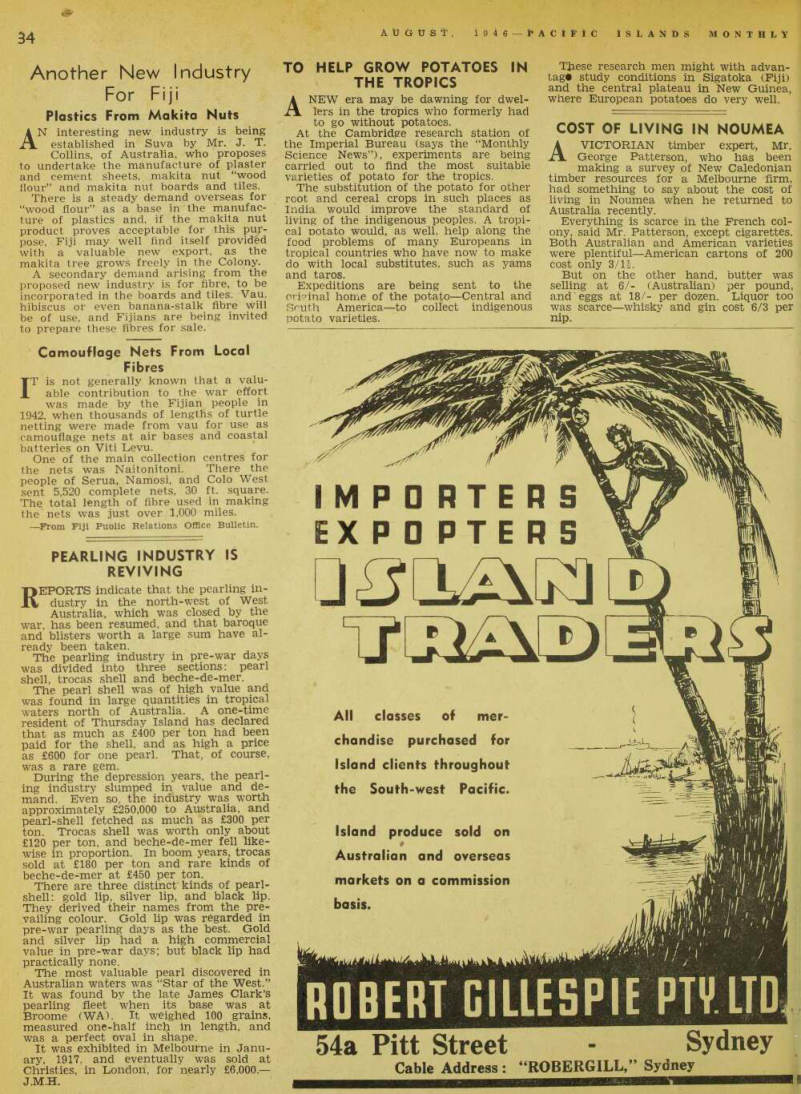
Another New Industry For Fiji
Plastics From Makita Nuts
AN interesting new industry is being established in Suva by Mr. J. T.
Collins, of Australia, who proposes to undertake the manufacture of plaster and cement sheets, makita nut “wood flour” and makita nut boards and tiles.
There is a steady demand overseas for “wood flour” as a base in the manufac ture of plastics and, if the makita nut product proves acceptable for this pur pose, Fiji may well find itself provided with a valuable new export, as the makita tree grows freely in the Colony.
A secondary demand arising from the proposed new industry is for fibre, to be incorporated in the boards and tiles. Vau, hibiscus or even banana-stalk fibre will be of use, and Fijians are being invited to prepare these fibres for sale.
Camouflage Nets From Local
Fibres
IT is not generally known that a valu able contribution to the war effort was made by the Fijian people in 1942, when thousands of lengths of turtle netting were made from vau for use as camouflage nets at air bases and coastal batteries on Viti Levu.
One of the main collection centres for the nets was Naitonitoni. There the people of Serua, Namosi, and Colo West sent 5,520 complete nets, 30 ft. square.
The total length of fibre used in making the nets was just over 1,000 miles. —From Fiji Puollc Relations Office Bulletin.
Pearling Industry Is
Reviving
REPORTS indicate that the pearling in dustry in the north-west of West Australia, which was closed by the war, has been resumed, and that baroque and blisters worth a large sum have al ready been taken.
The pearling industry in pre-war days was divided into three sections: pearl shell, trocas shell and beche-de-mer.
The nearl shell was of high value and was found in large quantities in tropical waters north of Australia. A one-time resident of Thursday Island has declared that as much as £4OO per ton had been paid for the shell, and as high a price as £6OO for one pearl. That, of course, was a rare gem.
During the depression years, the pearl ing industry slumped in value and de mand. Even so, the industry was worth approximately £250,000 to Australia, and pearl-shell fetched as much as £3OO per ton. Trocas shell was worth only about £l2O per ton, and beche-de-mer fell like wise in proportion. In boom years, trocas sold at £lBO per ton and rare kinds of beche-de-mer at £450 per ton.
There are three distinct'kinds of pearl shell: gold lip, silver lip, and black lip.
They derived their names from the pre vailing colour. Gold lip was regarded in pre-war pearling days as the best. Gold and silver lip had a high commercial value in pre-war days; but black lip had practically none.
The most valuable pearl discovered in Australian waters was “Star of the West.”
It was found by the late James Clark’s pearling fleet when its base was at Broome (WA). It weighed 100 grains, measured one-half inch in length, and was a perfect oval in shape.
It was exhibited in Melbourne in Janu ary, 1917, and eventually was sold at Christies, in London, for nearly £6,000.
J.M.H.
To Help Grow Potatoes In
The Tropics
ANEW era may be dawning for dwel lers in the tropics who formerly had At t station of the Imperial Bureau (says the “Monthly Science News”), experiments are being carried out to find the most suitable varieties of potato for the tropics.
The substitution of the potato for other root and cereal crops in such places as India, would improve the standard of living of the indigenous peoples. A tropi cal potato would, as well, help along the food problems of many Europeans in tropical countries who have now to make do with local substitutes, such as yams and taros.
Expeditions are being sent to the original home of the potato—Central and South America—to collect indigenous potato varieties.
These research men might with advan tage study conditions in Sigatoka (Fiji) and the central plateau in New Guinea, where European potatoes do very well.
Cost Of Living In Noumea
A VICTORIAN timber expert, Mr.
George Patterson, who has been making a survey of New Caledonian timber resources for a Melbourne firm, had something to say about the cost of living in Noumea when he returned to Australia recently.
Everything is scarce in the French col ony, said Mr. Patterson, except cigarettes.
Both Australian and American varieties were plentiful—American cartons of 200 cost only 3/11.
But on the other hand, butter was selling at 6/- (Australian) per pound, and eggs at 18/- per dozen. Liquor too was scarce—whisky and gin cost 6/3 per nip.
Advertisements & other items, p. 36 (1 item)
Sydney
IMPORTERS
EXPORTERS
r All classes of merchandise purchased for Island clients throughout the South-west Pacific.
Island produce sold on * Australian and overseas markets on a commission basis. i
54a Pitt Street
Sydney
Cable Address ; “ROBERGILL,” Sydney
Magazine Section
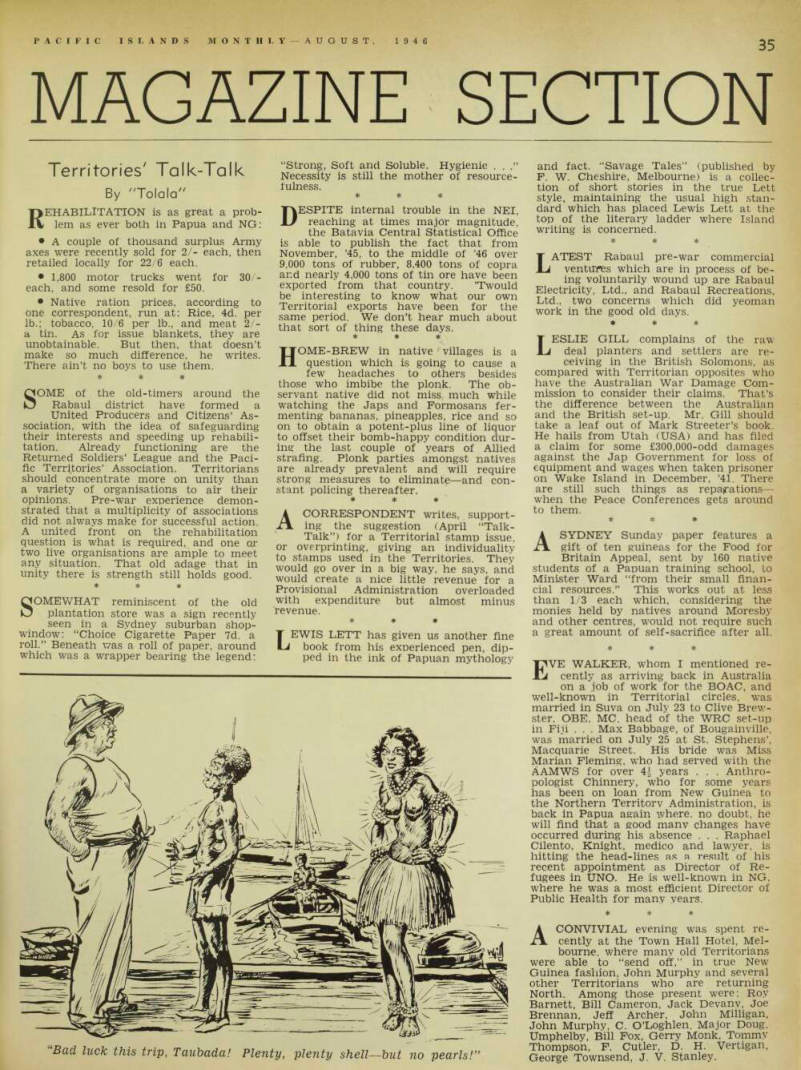
Territories' Talk-Talk
By "Tolala"
Rehabilitation is as great a prob lem as ever both in Papua and NG: • A couple of thousand surplus Army axes were recently sold for 2/- each, then retailed locally for 22/6 each. • 1,800 motor trucks went for 30/each, and some resold for £5O. • Native ration prices, according to one correspondent, run at: Rice, 4d. per lb.; tobacco, 10/6 per lb., and meat 2/a tin. As for issue blankets, they are unobtainable. But then, that doesn’t make so much difference, he writes.
There ain’t no boys to use them. ♦ * * SOME of the old-timers around the Rabaul district have formed a United Producers and Citizens’ As sociation, with the idea of safeguarding their interests and speeding up rehabili tation. Already functioning are the Returned Soldiers’ League and the Paci fic Territories’ Association. Territorians should concentrate more on unity than a variety of organisations to air their opinions. Pre-war experience demon strated that a multiplicity of associations did not always make for successful action.
A united front on the rehabilitation question is what is required, and one or two live organisations are ample to meet any situation. That old adage that in unity there is strength still holds good. ♦ ♦ ♦ SOMEWHAT reminiscent of the old plantation store was a sign recently seen in a Sydney suburban shop window: “Choice Cigarette Paper 7d. a roll.” Beneath was a roll of paper, around which was a wrapper bearing the legend:
“Strong, Soft and Soluble. Hygienic . . .”
Necessity is still the mother of resource fulness. * * * DESPITE internal trouble in the NEI, reaching at times major magnitude, the Batavia Central Statistical Office is able to publish the fact that from November, ’45, to the middle of ’46 over 9,000 tons of rubber, 8,400 tons of copra and nearly 4,000 tons of tin ore have been exported from that country. ’Twould be interesting to know what our own Territorial exports have been for the same period. We don’t hear much about that sort of thing these days. ♦ * * HOME-BREW in native villages is a question which is going to cause a few headaches to others besides those who imbibe the plonk. The ob servant native did not miss much while watching the Japs and Formosans fer menting bananas, pineapples, rice and so on to obtain a potent-plus line of liquor to offset their bomb-happy condition dur ing the last couple of years of Allied strafing. Plonk parties amongst natives are already prevalent and will require strong measures to eliminate—and con stant policing thereafter. * * ♦ A CORRESPONDENT writes, support ing the suggestion (April “Talk- Talk”) for a Territorial stamp issue, or overprinting, giving an individuality to stamps used in the Territories. Thev would go over in a big way, he says, and would create a nice little revenue for a Provisional Administration overloaded with expenditure but almost minus revenue. * ♦ ♦ LEWIS LETT has given us another fine book from his experienced pen, dip ped in the ink of Papuan mythology
and fact. “Savage Tales” (published by F. W. Cheshire, Melbourne) is a collec tion of short stories in the true Lett style, maintaining the usual high stan dard which has placed Lewis Lett at the top of the literary ladder where Island writing is concerned. * * * LATEST Rabaul pre-war commercial ventures which are in process of be ing voluntarily wound up are Rabaul Electricity, Ltd., and Rabaul Recreations, Ltd., two concerns which did yeoman work in the good old days. ♦ ♦ ♦ LESLIE GILL complains of the raw deal planters and settlers are re ceiving in the British Solomons, as compared with Territorian opposites who have the Australian War Damage Com mission to consider their claims. That’s the difference between the Australian and the British set-up. Mr. Gill should take a leaf out of Mark Streeter’s book.
He hails from Utah (USA) and has filed a claim for some £300,000-odd damages against the Jap Government for loss of equipment and wages when taken prisoner on Wake Island in December, ’4l. There are still such things as reparations— when the Peace Conferences gets around to them. ♦ * ♦ A SYDNEY Sunday paper features a gift of ten guineas for the Food for Britain Appeal, sent by 160 native students of a Papuan training school, to Minister Ward “from their small finan cial resources.” This works out at less than 1/3 each which, considering the monies held by natives around Moresby and other centres, would not require such a great amount of self-sacrifice after all. * ♦ ♦ IjWE WALKER, whom I mentioned re j cently as arriving back in Australia on a job of work for the BOAC, and well-known in Territorial circles, was married in Suva on July 23 to Clive Brew ster. OBE, MC. head of the WRC set-up in Fiji . . . Max Babbage, of Bougainville, was married on July 25 at St. Stephens’, Macquarie Street. His bride was Miss Marian Fleming, who had served with the AAMWS for over 4i years . . . Anthro pologist Chinnery, who for some years has been on loan from New Guinea to the Northern Territorv Administration, is back in Papua again where, no doubt, he will find that a good many changes have occurred during his absence . . . Raphael Cilento, Knight, medico and lawyer, is hitting the head-lines as a result of his recent appointment as Director of Re fugees in UNO. He is well-known in NG, where he was a most efficient Director of Public Health for many years. ♦ * * A CONVIVIAL evening was spent re cently at the Town Hall Hotel, Mel bourne. where many old Territorians were able to “send off,” in true New Guinea fashion, John Murphy and several other Territorians who are returning North. Among those present were: Roy Barnett, Bill Cameron, Jack Devany, Joe Brennan, Jeff Archer, John Milligan, John Murphy. C. O’Loghlen. Major Doug.
Umphelby, Bill Fox, Gerry Monk, Tommy Thompson, F. Cutler, D. H. Vertigan, George Townsend, J. V. Stanley.
“Bad luck this trip, Taubada! Plenty, plenty shell-but no pearls!"
Knight
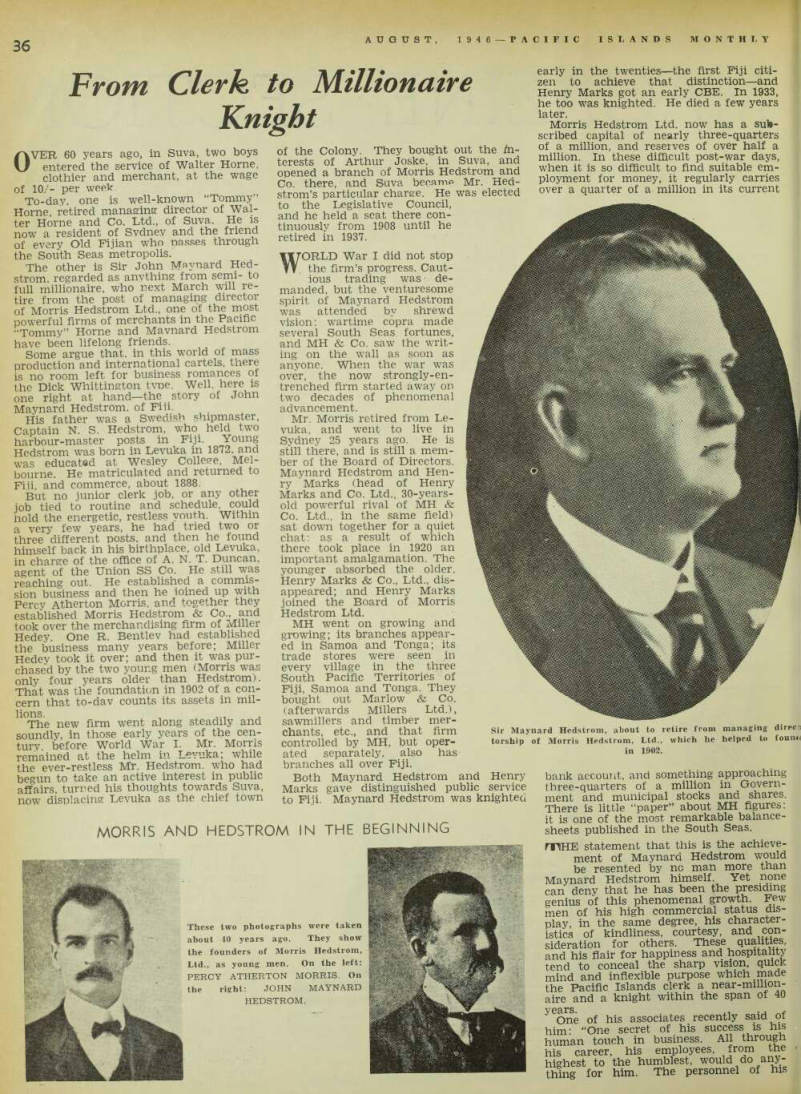
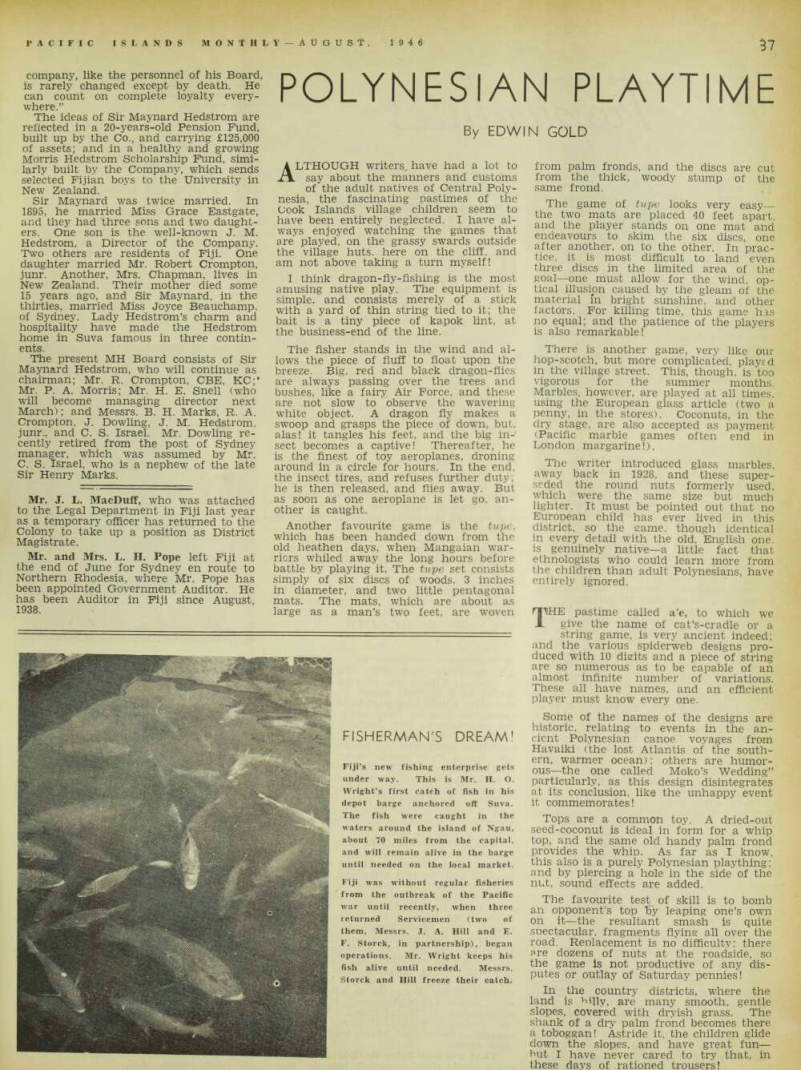
From Clerk, to Millionaire Knight
OVER 60 years ago, in Suva, two boys entered the service of Walter Horne, clothier and merchant, at the wage of 10/- per week.
To-day. one is well-known “Tommy”
Horne, retired managing director of Wal ter Horne and Co. Ltd., of Suva. He is now a resident of Sydney and the friend of every Old Fijian who nasses through the South Seas metropolis.
The other is Sir John Maynard Hed strom, regarded as anything from semi- to full millionaire, who next March will re tire from the post of managing director of Morris Hedstrom Ltd., one of the most powerful firms of merchants in the Pacific “Tommy” Horne and Mavnard Hedstrom have been lifelong friends.
Some argue that, in this world of mass production and international cartels, there is no room left for business romances of the Dick Whittington tvue. Well, here is one right at hand—the story of John Maynard Hedstrom. of Fiii.
His father was a Swedish shipmaster, Captain N. S. Hedstrom, who held two harbour-master posts in Fiji. Young Hedstrom was born in Levuka in 1872, and was educated at Wesley College, Mel bourne. He matriculated and returned to Fiji, and commerce, about 1888.
But no junior clerk job, or any other job tied to routine and schedule, could hold the energetic, restless youth. Within a very few years, he had tried two or three different posts, and then he found himself back in his birthplace, old Levuka, in charge of the office of A. N. T. Duncan, agent of the Union SS Co. He still was reaching out. He established a commis sion business and then he joined up with Percy Atherton Morris, and together they established Morris Hedstrom & Co., and took over the merchandising firm of Miller Hedey. One R. Bentlev had established the business many years before; Miller Hedey took it over; and then it was pur chased by the two young men (Morris was only four years older than Hedstrom).
That was the foundation in 1902 of a con cern that to-dav counts its assets in mil lions. , . ... , The new firm went along steadily and soundly, in those early years of the cen tury before World War I. Mr. Morris remained at the helm in Levuka; while the ever-restless Mr. Hedstrom. who had begun to take an active interest in public affairs, turned his thoughts towards Suva, now displacing Levuka as the chief town
of the Colony. They bought out the in terests of Arthur Joske, in Suva, and opened a branch of Morris Hedstrom and Co. there, and Suva became Mr. Hed strom’s particular charge. He was elected
to the Legislative Council, and he held a seat there con tinuously from 1908 until he retired in 1937.
WORLD War I did not stop the firm’s progress. Caut ious trading was de manded. but the venturesome spirit of Maynard Hedstrom was attended by shrewd vision: wartime copra made several South Seas fortunes, and MH & Co. saw the writ ing on the wall as soon as anyone. When the war was over, the now strongly-en trenched firm started away on two decades of phenomenal advancement.
Mr. Morris retired from Le vuka, and went to live in Sydney 25 years ago. He is still there, and is still a mem ber of the Board of Directors.
Maynard Hedstrom and Hen ry Marks (head of Henry Marks and Co. Ltd., 30-years old powerful rival of MH & Co. Ltd., in the same field) sat down together for a quiet chat: as a result of which there took place in 1920 an important amalgamation. The younger absorbed the older.
Henry Marks & Co., Ltd., dis appeared; and Henry Marks joined the Board of Morris Hedstrom Ltd.
MH went on growing and growing; its branches appear ed in Samoa and Tonga; its trade stores were seen in every village in the three South Pacific Territories of Fiji, Samoa and Tonga. They bought out Marlow & Co. (afterwards Millers Ltd.), sawmillers and timber mer chants, etc., and that firm controlled by MH, but oper ated separately, also has branches all over Fiji.
Both Maynard Hedstrom and Henry Marks gave distinguished public service to Fiji. Maynard Hedstrom was knighted
early in the twenties—the first Fiji citi zen to achieve that distinction —and Henry Marks got an early CBE. In 1933, he too was knighted. He died a few years later.
Morris Hedstrom Ltd. now has a sub scribed capital of nearly three-quarters of a million, and reserves of over half a million. In these difficult post-war days, when it is so difficult to find suitable em ployment for money, it regularly carries over a quarter of a million in its current
bank account, and something approaching three-quarters of a million in Govern ment and municipal stocks and shares.
There is little “paper” about MH figures: it is one of the most remarkable balance sheets published in the South Seas. rUHE statement that this is the achieve ment of Maynard Hedstrom would be resented by no man more than Maynard Hedstrom himself. Yet none can deny that he has been the presiding genius of this phenomenal growth. Few men of his high commercial status dis play, in the same degree, his character istics of kindliness, courtesy, and con sideration for others. These qualities, and his flair for happiness and hospitality tend to conceal the sharp vision, quick mind and inflexible purpose which made the Pacific Islands clerk a near-million aire and a knight within the span of 40 yon One of his associates recently said of him- “One secret of his success is his human touch in business. All through his career, his employees, from the highest to the humblest, would do any thing for him. The personnel of his
Morris And Hedstrom In The Beginning
These two photographs were taken about 40 years ago. They show the founders of Morris Hedstrom, Ltd., as young men. On the left:
Percy Atherton Morris. On
the right: JOHN MAYNARD
Hedstrom.
Sir Maynard Hedstrom, about to retire from managing directorship of Morris Hedstrom, Ltd., which he helped to found in 1902.
company, like the personnel of his Board, is rarely changed except by death. He can count on complete loyalty every where.”
The ideas of Sir Maynard Hedstrom are reflected in a 20-years-old Pension Fund, built up by the Co., and carrying £125,000 of assets; and in a healthy and growing Morris Hedstrom Scholarship Fund, simi larly built by the Company, which sends selected Fijian boys to the University in New Zealand.
Sir Maynard was twice married. In 1895, he married Miss Grace Eastgate, and they had three sons and two daught ers. One son is the well-known J. M.
Hedstrom, a Director of the Company.
Two others are residents of Fiji. One daughter married Mr. Robert Crompton, junr. Another, Mrs. Chapman, lives in New Zealand. Their mother died some 15 years ago, and Sir Maynard, in the thirties, married Miss Joyce Beauchamp, of Sydney. Lady Hedstrom’s charm and hospitality have made the Hedstrom home in Suva famous in three contin ents.
The present MH Board consists of Sir Maynard Hedstrom, who will continue as chairman; Mr. R. Crompton, CBE, KC;* Mr. P. A. Morris; Mr. H. E. Snell (who will become managing director next March); and Messrs. B. H. Marks, R. A.
Crompton, J. Dowling, J. M. Hedstrom. junr., and C. S. Israel. Mr. Dowling re cently retired from the post of Sydney manager, which was assumed by Mr.
C. S. Israel, who is a nephew of the late Sir Henry Marks.
Mr. J. L. Mac Duff, who was attached to the Legal Department in Fiji last year as a temporary officer has returned to the Colony to take up a position as District Magistrate.
Mr. and Mrs. L. H. Pope left Fiji at the end of June for Sydney en route to Northern Rhodesia, where Mr. Pope has been appointed Government Auditor. He has been Auditor in Fiji since August, 1938.
Fisherman's Dream!
Fiji’s new fishing enterprise gets under way. This is Mr. H. O.
Wright’s first cateh of fish in his depot barge anchored off Suva.
The fish were caught in the waters around the island of Ngau, about 70 miles from the capital, and will remain alive in the barge until needed on the local market.
Fiji was without regular fisheries from the outbreak of the Pacific war until recently, when three returned Servicemen (two of them, Messrs. J, A. Hill and E.
F. Storck, in partnership), began operations. Mr. Wright keeps his fish alive until needed. Messrs.
Storck and Hill freeze their catch.
Polynesian Playtime
By Edwin Gold
ALTHOUGH writers, have had a lot to say about the manners and customs of the adult natives of Central Poly nesia, the fascinating pastimes of the Cook Islands village children seem to have been entirely neglected. I have al ways enjoyed watching the games that are played, on the grassy swards outside the village huts, here on the cliff, and am not above taking a turn myself!
I think dragon-fly-fishing is the most amusing native play. The equipment is simple, and consists merely of a stick with a yard of thin string tied to it; the bait is a tiny piece of kapok lint, at the business-end of the line.
The fisher stands in the wind and al lows the piece of fluff to float upon the breeze. Big. red and black dragon-flies are always passing over the trees and bushes, like a fairy Air Force, and these are not slow to observe the wavering white object. A dragon fly makes a swoop and grasps the piece of down, but, alas! it tangles his feet, and the big in sect becomes a captive! Thereafter, he is the finest of toy aeroplanes, droning around in a circle for hours. In the end. the insect tires, and refuses further duty; he is then released, and flies away. But as soon as one aeroplane is let go, an other is caught.
Another favourite game is the tupe, which has been handed down from the old heathen days, when Mangaian war riors whiled away the long hours before battle by playing it. The tupe set consists simply of six discs of woods, 3 inches in diameter, and two little pentagonal mats. The mats, which are about as large as a man’s two feet, are woven
from palm fronds, and the discs are cut from the thick, woody stump of the same frond.
The game of tupe looks very easy— the two mats are placed 40 feet apart, and the player stands on one mat and endeavours to skim the six discs, one after another, on to the other. In prac tice. it is most difficult to land even three discs in the limited area of the goal—one must allow for the wind, op tical illusion caused by the gleam of the material in bright sunshine, and other factors. For killing time, this game has no equal; and the patience of the players is also remarkable!
There is another game, very like our hop-scotch, but more complicated, played in the village street. This, though, is too vigorous for the summer months.
Marbles, however, are played at all times, using the European glass article (two a penny, in the stores). Coconuts, in the dry stage, are also accepted as payment (Pacific marble games often end in London margarine!).
The writer introduced glass marbles, away back in 1928, and these super seded the round nuts formerly used, which were the same size but much lighter. It must be pointed out that no European child has ever lived in this district, so the game, though identical in every detail with the old. English one, is genuinely native—a little fact that ethnologists who could learn more from the children than adult Polynesians, have entirely ignored.
THE pastime called a’e, to which we give the name of cat’s-cradle or a string game, is very ancient indeed; and the various spiderweb designs pro duced with 10 digits and a piece of string are so numerous as to be capable of an almost infinite number of variations.
These all have names, and an efficient player must know every one.
Some of the names of the designs are historic, relating to events in the an cient Polynesian canoe voyages from Havaiki (the lost Atlantis of the south ern, warmer ocean); others are humor ous —the one called Moko’s Wedding” particularly, as this design disintegrates at its conclusion, like the unhappy event it commemorates!
Tops are a common toy. A dried-out seed-coconut is ideal in form for a whip top, and the same old handy palm frond provides the whip. As far as I know, this also is a purely Polynesian plaything: and by piercing a hole in the side of the nut, sound effects are added.
The favourite test_ of skill is to bomb an opponent’s top by leaping one’s own on it—the resultant smash is quite spectacular, fragments flying all over the road. Replacement is no difficulty; there are dozens of nuts at the roadside, so the game is not productive of any dis putes or outlay of Saturday pennies!
In the country districts, where the land is are many smooth, gentle slopes, covered with dryish grass. The shank of a dry palm frond becomes there a toboggan! Astride it. the children glide down the slopes, and have great fun— but I have never cared to try that, in these days of rationed trousers!
Tropicalities
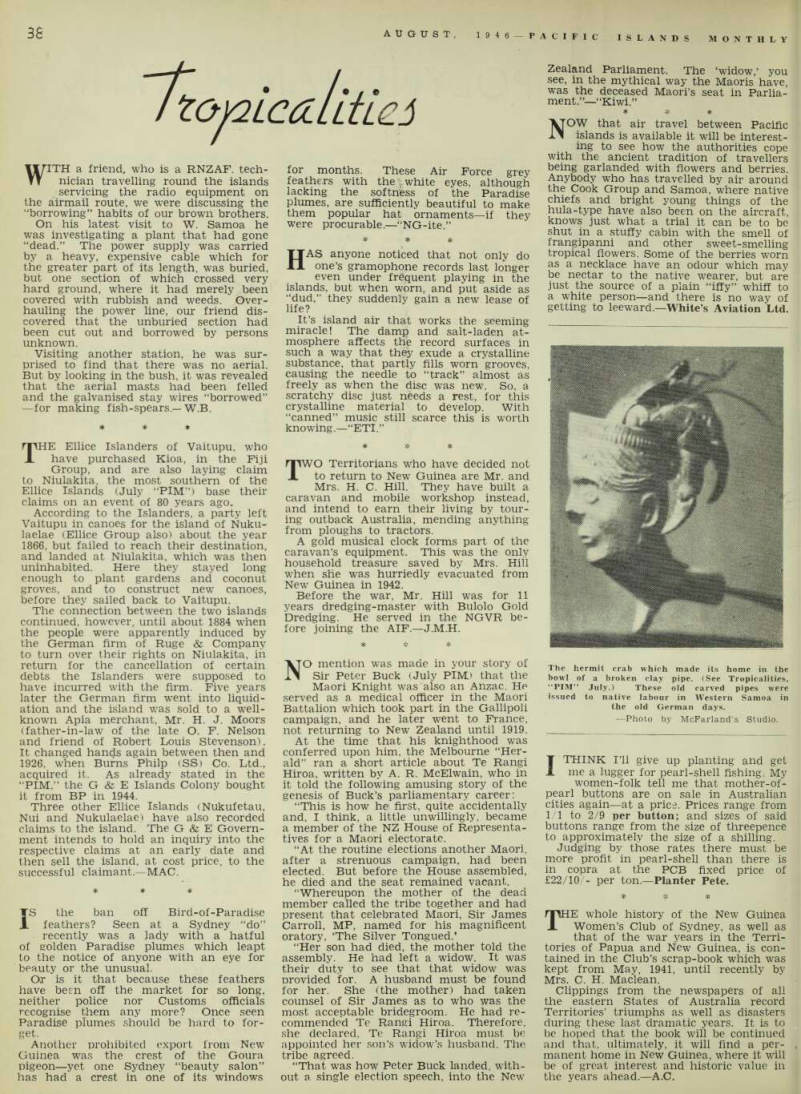
WITH a friend, who is a RNZAF. tech nician travelling round the islands servicing the radio equipment on the airmail route, we were discussing the “borrowing” habits of our brown brothers.
On his latest visit to W. Samoa he was investigating a plant that had gone “dead.” The power supply was carried by a heavy, expensive cable which for the greater part of its length, was buried, but one section of which crossed very hard ground, where it had merely been covered with rubbish and weeds. Over hauling the power line, our friend dis covered that the unburied section had been cut out and borrowed by persons unknown.
Visiting another station, he was sur prised to find that there was no aerial.
But by looking in the bush, it was revealed that the aerial masts had been felled and the galvanised stay wires “borrowed” —for making fish-spears.—W.B. ♦ ♦ * THE Ellice Islanders of Vaitupu, who have purchased Kioa, in the Fiji Group, and are also laying claim to Niulakita, the most southern of the Ellice Islands (July “PIM”) base their claims on an event of 80 years ago.
According to the Islanders, a party left Vaitupu in canoes for the island of Nuku laelae (Ellice Group also) about the year 1866, but failed to reach their destination, and landed at Niulakita, which was then uninhabited. Here they stayed long enough to plant gardens and coconut groves, and to construct new canoes, before they sailed back to Vaitupu.
The connection between the two islands continued, however, until about 1884 when the people were apparently induced by the German firm of Ruge & Company to turn over their rights on Niulakita, in return for the cancellation of certain debts the Islanders were supposed to have incurred with the firm. Five years later the German firm went into liquid ation and the island was sold to a well known Apia merchant, Mr. H. J. Moors (father-in-law of the late O. F. Nelson and friend of Robert Louis Stevenson).
It changed hands again between then and 1926. when Burns Philp (SS) Co. Ltd., acquired it. As already stated in the “PIM,” the G & E Islands Colony bought it from BP in 1944.
Three other Ellice Islands (Nukufetau, Nui and Nukulaelae> have also recorded claims to the island. The G & E Govern ment intends to hold an inquiry into the respective claims at an early date and then sell the island, at cost price, to the successful claimant. —MAC. ♦ * * IS the ban off Bird-of-Paradise feathers? Seen at a Sydney “do” recently was a lady with a hatful of golden Paradise plumes which leapt to the notice of anyone with an eye for beauty or the unusual.
Or is it that because these feathers have been off the market for so long, neither police nor Customs officials recognise them any more? Once seen Paradise plumes should be hard to for get.
Another prohibited export from New Guinea was the crest of the Goura pigeon—yet one Sydney “beauty salon” has had a crest in one of its windows
for months. These Air Force grey feathers with the white eyes, although lacking the softness of the Paradise plumes, are sufficiently beautiful to make them popular hat ornaments—if they were procurable.—“NG-ite.” * * * HAS anyone noticed that not only do one’s gramophone records last longer even under frequent playing in the islands, but when worn, and put aside as “dud,” they suddenly gain a new lease of life?
It’s island air that works the seeming miracle! The damp and salt-laden at mosphere affects the record surfaces in such a way that they exude a crystalline substance, that partly fills worn grooves, causing the needle to “track” almost as freely as when the disc was new. So. a scratchy disc just needs a rest, for this crystalline material to develop. With “canned” music still scarce this is worth knowing.—“ETl.” * * ♦ TWO Territorians who have decided not to return to New Guinea are Mr. and Mrs. H. C. Hill. They have built a caravan and mobile workshop instead, and intend to earn their living by tour ing outback Australia, mending anything from ploughs to tractors.
A gold musical clock forms part of the caravan’s equipment. This was the only household treasure saved by Mrs. Hill when she was hurriedly evacuated from New Guinea in 1942.
Before the war, Mr. Hill was for 11 years dredging-master with Bulolo Gold Dredging. He served in the NGVR be fore joining the AIF.—J.M.H. * * * NO mention was made in your story of Sir Peter Buck (July PIM) that the Maori Knight was also an Anzac. He served as a medical officer in the Maori Battalion which took part in the Gallipoli campaign, and he later went to France, not returning to New Zealand until 1919.
At the time that his knighthood was conferred upon him, the Melbourne “Her ald” ran a short article about Te Rangi Hiroa, written by A. R. McElwain, who in it told the following amusing story of the genesis of Buck’s parliamentary career: “This is how he first, quite accidentally and, I think, a little unwillingly, became a member of the NZ House of Representa tives for a Maori electorate.
“At the routine elections another Maori, after a strenuous campaign, had been elected. But before the House assembled, he died and the seat remained vacant.
“Whereupon the mother of the dead member called the tribe together and had present that celebrated Maori, Sir James Carroll, MP, named for his magnificent oratory, ‘The Silver Tongued.’
“Her son had died, the mother told the assembly. He had left a widow. It was their duty to see that that widow was nrovided for. A husband must be found for her. She (the mother) had taken counsel of Sir James as to who was the most acceptable bridegroom. He had re commended Te Rangi Hiroa. Therefore, she declared, Te Rangi Hiroa must be appointed her son’s widow’s husband. The tribe agreed.
“That was how Peter Buck landed, with out a single election speech, into the New
Zealand Parliament. The ‘widow,’ you see, in the mythical way the Maoris have, was the deceased Maori’s seat in Parlia ment.”—“Kiwi.” * * * NOW that air travel between Pacific islands is available it will be interest ing to see how the authorities cope with the ancient tradition of travellers being garlanded with flowers and berries.
Anybody who has travelled by air around the Cook Group and Samoa, where native chiefs and bright young things of the hula-type have also been on the aircraft, knows just what a trial it can be to be shut in a stuffy cabin with the smell of frangipanni and other sweet-smelling tropical flowers. Some of the berries worn as a necklace have an odour which may be nectar to the native wearer, but are just the source of a plain “iffy” whiff to a white person—and there is no way of getting to leeward.—White’s Aviation Ltd.
1 THINK I’ll give up planting and get me a lugger for pearl-shell fishing. My women-folk tell me that mother-of pearl buttons are on sale in Australian cities again—at a price. Prices range from 1/1 to 2/9 per button; and sizes of said buttons range from the size of threepence to approximately the size of a shilling.
Judging by those rates there must be more profit in pearl-shell than there is in copra at the PCB fixed price of £22/10 - per ton.—Planter Pete. * * rpHE whole history of the New Guinea X Women’s Club of Sydney, as well as that of the war years in the Terri tories of Papua and New Guinea, is con tained in the Club’s scrap-book which was kept from May, 1941, until recently by Mrs. C. H. Maclean.
Clippings from the newspapers of all the eastern States of Australia record Territories’ triumphs as well as disasters during these last dramatic years. It is to be hoped that the book will be continued and that, ultimately, it will find a per manent home in New Guinea, where it will be of great interest and historic value in the years ahead. —A.C.
The hermit crab which made its home in the bowl of a broken clay pipe. (See Tropicalities, “PIM” July.) These old carved pipes were issued to native labour in Western Samoa in the old German days. —Photo by McFarland’s Studio.
Assignment In Mid-Pacific
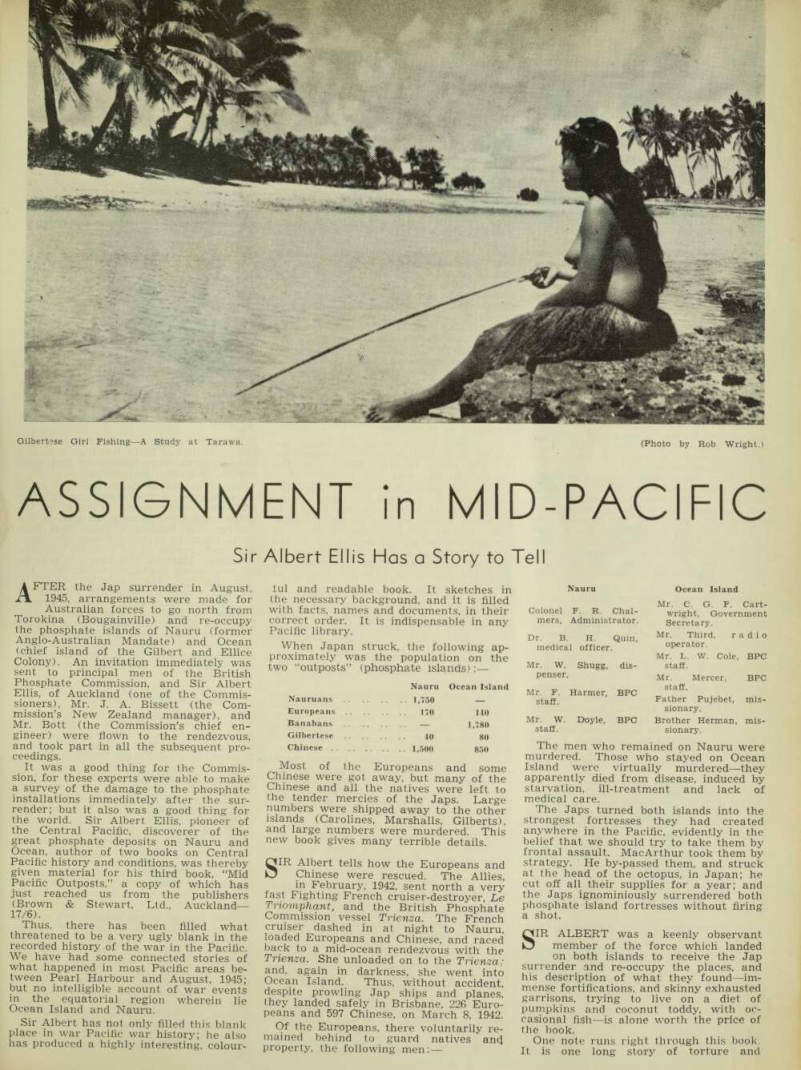
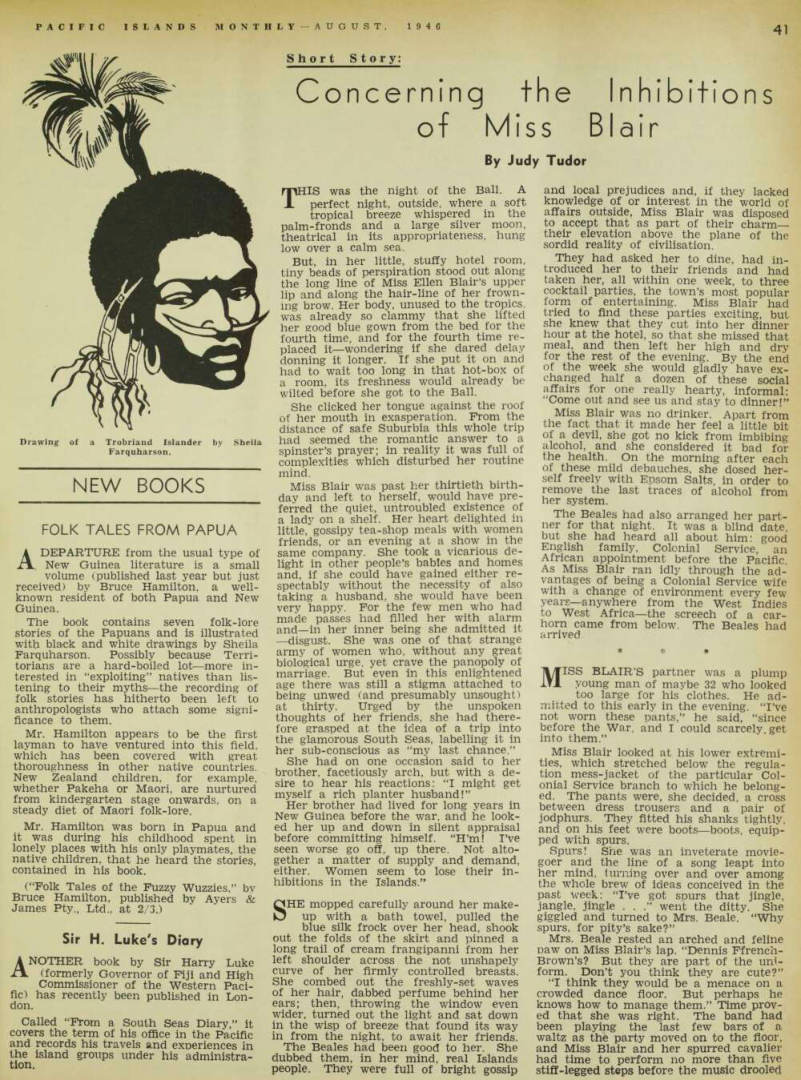
Sir Albert Ellis Has a Story to Tell
AFTER the Jap surrender in August, 1945, arrangements were made for Australian forces to go north from Torokina (Bougainville) and re-occupy the phosphate islands of Nauru (former Anglo-Australian Mandate) and Ocean (chief island of the Gilbert and Ellice Colony). An invitation immediately was sent to principal men of the British Phosphate Commission, and Sir Albert Ellis, of Auckland (one of the Commis sioners), Mr. J. A. Bissett (the Com mission’s New Zealand manager), and Mr. Bott (the Commission’s chief en gineer) were flown to the rendezvous, and took part in all the subsequent pro ceedings.
It was a good thing for the Commis sion, for these experts were able to make a survey of the damage to the phosphate installations immediately after the sur render; but it also was a good thing for the world. Sir Albert Ellis, pioneer of the Central Pacific, discoverer of the great phosphate deposits on Nauru and Ocean, author of two books on Central Pacific history and conditions, was thereby given material for his third book, “Mid Pacific Outposts,” a copy of which has just reached us from the publishers (Brown & Stewart, Ltd., Auckland— -17/6).
Thus, there has been filled what threatened to be a very ugly blank in the recorded history of the war in the Pacific.
We have had some connected stories of what happened in most Pacific areas be tween Pearl Harbour and August, 1945; but no intelligible account of war events in the equatorial region wherein lie Ocean Island and Nauru.
Sir Albert has not only filled this blank place in war Pacific war history; he also has produced a highly interesting, colour
lul and readable book. It sketches in the necessary background, and it is filled with facts, names and documents, in their correct order. It is indispensable in any Pacific library.
When Japan struck, the following ap proximately was the population on the two “outposts” (phosphate islands)
Most of the Europeans and some Chinese were got away, but many of the Chinese and all the natives were left to the tender mercies of the Japs. Large numbers were shipped away to the other islands (Carolines, Marshalls. Gilberts), and large numbers were murdered. This new book gives many terrible details.
SIR Albert tells how the Europeans and Chinese were rescued. The Allies, in February, 1942, sent north a very fast Fighting French cruiser-destroyer, Le Triom'phant, and the British Phosphate Commission vessel Trienza. The French cruiser dashed in at night to Nauru, loaded Europeans and Chinese, and raced back to a mid-ocean rendezvous with the Trienza. She unloaded on to the Trienza; and, again in darkness, she went into Ocean Island. Thus, without accident, despite prowling Jap ships and planes, they landed safely in Brisbane, 226 Euro peans and 597 Chinese, on March 8, 1942.
Of the Europeans, there voluntarily re mained behind to guard natives and property, the following men:—
The men who remained on Nauru were murdered. Those who stayed on Ocean Island were virtually murdered —they apparently died from disease, induced by starvation, ill-treatment and lack of medical care.
The Japs turned both islands into the strongest fortresses they had created anywhere in the Pacific, evidently in the belief that we should try to take them by frontal assault. MacArthur took them by strategy. He by-passed them, and struck at the head of the octopus, in Japan; he cut off all their supplies for a year; and the Japs ignominiously surrendered both phosphate island fortresses without firing a shot.
SIR ALBERT was a keenly observant member of the force which landed on both islands to receive the Jap surrender and re-occupy the places, and his description of what they found —immense fortifications, and skinny exhausted garrisons, trying to live on a diet of pumpkins and coconut toddy, with oc casional fish —is alone worth the price of the book.
One note runs riglrt through this book.
It is one long story of torture and
Gilbertese Girl Fishing—A Study at Tarawa.
(Photo by Rob Wright.)
Nauru Ocean Island Nauruans 1,750 — Europeans 170 140 Banabans — 1 780 Gilbertese 40 80 Chinese 1,500 850
Nauru Ocean Island
Mr. C. G. F.
Cart- Colonel F. R.
Chalwright. Government mers, Administrator.
Secretary.
Dr. B H.
Quin.
Mr. Third. radio medical officer. operator.
Mr. L. W. Cole,
Bpc
Mr. W.
Shugg, disstaff. penser.
Mr. Mercer,
Bpc
Mr. F.
Harmer,
Bpc
staff. staff.
Father Pujebet, missionary.
Mr. W.
Doyle,
Bpc
Brother Herman, misstaff. sionary.
murder, robbery and starvation. No where is there anything at all to suggest that these men of Nippon are even human in their treatment of fellow mortals. All the evidence of the South Pacific is that they are sub-human beasts.
Sir Albert went from one horror to an other: From the scene of the murder of the Nauru officials, to the place where they massacred the last Banabans on Ocean Island; from the desecrated ceme tery on Ocean Island to the spot on Tarawa, where the Americans erected a monument; “In memory of 22 British subjects murdered by the Japanese on Betio . . . Standing unarmed to their posts, they matched brutality with gal lantry and met death with fortitude.” All these were familiar places —many of the murdered people were his personal friends. \\TE quote now from ‘'Mid Pacific Out
▼V posts”:—
Of the people’s welcome to the returning Europeans : With gratification that was quite natural, Mr. Bott said that when they entered the boat harbour at Nauru, Lieut.-Colonel Kelly had courteously stepped aside and invited him to be the first European to land on the island since the Japanese invasion three years pre viously. It was a very appropriate honour, for he had been island manager on Nauru for the Commission at the time of the evacuation, with all its worries and responsibilities.
Mr. Bott stated that he had received a very pathetic welcome from the large crowd of natives near the landing steps, and was much touched by the experience, saying that many of the natives and Chinese had tears streaming down their faces. One can well imagine this, as they recognised the man so well-known to them stepping out of the barge. His return, in itself, was sufficient guarantee that their troubles were over.
Of the damage done on Nauru : We went down to the low-lying country again, and along to the air-strip, com mencing at the site of the Administration settlement; but there was not a sign of it, and I was unable to locate the area.
The air-strip was much larger than I had anticipated, and must have entailed an enormous amount of work in construction.
The Nauruans’ much-prized coconut trees had been cut down by the thousand, many of the trunks being used in roofing over the gun pits and bomb-proof shelters.
Dotted about the vicinity were a large number of wrecked Japanese planes, the result of the Americans’ overwhelming attacks.
The only places where we could see any of this material (the phosphate works’ rubber-belt conveyors) was on the floors of the Japanese “apartments” in the tunnels, where it was cut into lengths and did duty as floor covering.
As the Residency, the manager’s and assistant manager’s houses on Ocean Island had suffered more than the other buildings at the hands of the Japanese, it appeared as being part of their studied policy to belittle the Europeans in the eyes of the natives.
Of how the Japs fed themselves and the natives : Wherever one went about the island — between the machine-gun posts and the pill-boxes, the gun emplacements and the air-raid shelters, the tank traps and the trenches —there were pumpkins; one could not possibly get away from them. Nauru was the world’s record pumpkin-patch, and until the present crop is gathered or destroyed it will continue to hold the record! There were heaps of them ready
for use; huts stacked full of them. I’ve never seen so many in my life.
Sweet toddy has a high nutritive value, being rich in vitamin B. when touring the island it was evident to us that the coconut palms had been tapped on a large scale —thousands of them, in fact!
To do this, deep notches were cut in the trunks of the trees, so that the natives or Japanese (for they learned to do it) could readily climb to the top of the highest palms.
The process of tapping is to bind up about half of the spathe before it opens out into flower, with coconut twine, and then sever the outer end. This produces a regular flow of sap, and a bottle or a coconut shell is suspended underneath to catch this. Each morning and evening the full receptacle is removed and re placed by an empty one. Only a small proportion of the palms should, however, be treated in this way, as the tapped trees do not bear coconuts, and therefore the normal crop was being destroyed. When the tapping ceases, the palm usually comes into bearing again.
Of the disappearance of the stone which commemorated Sir Albert’s original discovery of Ocean Island phosphate ; At first sight, there was no sign of the historical object, which had consisted of a large square concrete base, supporting a block of limestone, with a bronze tablet cemented to it reading: “This stone marks the camp site of A. F. Ellis when first prospecting this island in May, 1900. Here the British flag was first flown.”
Looking closely, however, I found the remains of the concrete base, also a large piece of coral rock on which I used to sit when talking to the Ocean Islanders.
One could not but feel rather dejected at the destruction of this memento. It had been installed at the suggestion of an old member of the staff, who was associated with the Historical Evidence Society of Sydney.
While surveying the surroundings, so altered since I had last seen them, some thing unusual caught my eye—and there, among the rocks and rubbish, was the bronze tablet, a good deal bent, but quite useable. (It since has been replaced.) Of native communities scattered or massacy'ed : The most noticeable feature from the human aspect on Ocean Island was the absence of any native population. Right from the beginning of our operations in 1900, there had always been plenty of Ocean Islanders about, and many of our native labourers. These brown people had seemed to be part and parcel of the establishment, so to say, and a very ap propriate one. It was a marked contrast to the crowds of enthusiastic and excited natives who had greeted our arrival at Nauru.
Of how Jap plans went astray.
An interesting feature which came to light during the investigations of the survey party was the discovery of cer tain arrangements made by the Japa nese at the boat harbours and the phos phate bins, in anticipation of shipping the phosphate stored there. The plan they had worked on was somewhat similar to the temporary method which we now will use at Ocean Island. But it appears that when they were ready to begin shipping, the American bombing attacks became so intense that the Japanese decided not to risk their vessels. (No phosphate was shipped from either island by the Japs.) Of the damage to the phosphate-working installations : The investigations of the survey party
fully confirmed that the damage at Nauru was very heavy—in fact, worse than had been anticipated.
Apart from the destruction done by the Commission’s personnel prior to the evacuation, in order that the Japanese should not be able to ship phosphate, the island has the remarkable record of hav ing been attacked by three Powers during World War No. 2. The German raider (in 1940) shelled it for two hours, causing much damage; Japanese planes bombed it the day following Pearl Harbour, and on subsequent occasions; and, finally, the American attacks by sea and air com pleted the work of destruction. It is little wonder that the island was des cribed as being a “shambles.”
It will be realised that with feelings of profound relief we saw that Ocean Island was not so badly damaged—in fact, more of the buildings and plant had survived the ravages of war than we had dared to hope. True, a great deal of the rail way material had been shipped away, or was installed in jagged patterns across the reef as obstacles in the event of a landing attack, and many houses had been wrecked internally, removed, or bomb damaged, including the large machine shop. All would require recon ditioning or rebuilding, and that must necessarily take a long time.
Of the blasted battlefield on Tarawa Atoll : We never ceased to marvel that on this little islet of Betio, less than a square mile in area, over 5,000 dead had been buried; it seemed incredible.
There can be no doubt that the Japa nese considered the place impregnable.
Following their usual practice of be littling the white men in the eyes of the natives they boasted to them that they could never be defeated there. But they did not realise the prowess of the American Marines. Tarawa will ever be classed among the bloodiest battles of the war, an epic fight, one in which the gallantry, resource and determination of the Marines carried the issue to victory.
Most of Betio now is perfectly flat, bare and blazing hot in the tropical sun shine; certainly most historical, but not in the least degree scenic. The long, wide landing-strip for aircraft dominates the picture, occupying a large portion of the island.
Of good relations between British and Americans in these seas : It may be thought by anyone reading these pages that the Union Jack is the only flag that counts in the affections and respect of the white people and natives in these Central Pacific Islands. That is certainly not the case, for the Stars and Stripes also holds an honoured place with them —as well it should.
One does not like to contemplate what the position would have been had the Americans not extended their activities to these latitudes when they did. At Tarawa, therefore, it was pleasing to see the Union Jack flying out bravely from the Resident Commissioner’s trim and ship-shape flagstaff; while only about a hundred yards away was the Star Spangled Banner, similarly fluttering in the breeze.
They seemed to me both fit and proper, a token of mutual respect, and an in dication of hope for the future. With the tragic war just ended, surely the foremost thought with us all must be that the two great English-speaking nations, Britain and America, should go forward together with similarity of pur pose, the same ideals of justice and liberty, and like religious beliefs. If they do this, and keep a due sense of responsi bility, there will be hope for this war-'-
stricken world.'
R.W.R.
Drawing of a Trobriand Islander by Sheila Farquharson.
New Books
Folk Tales From Papua
A DEPARTURE from the usual type of , New Guinea literature is a small volume (published last year but just received) by Bruce Hamilton, a well known resident of both Papua and New Guinea.
The book contains seven folk-lore stories of the Papuans and is illustrated with black and white drawings by Sheila Farquharson. Possibly because Terri torians are a hard-boiled lot—more in terested in “exploiting” natives than lis tening to their myths—the recording of folk stories has hitherto been left to anthropologists who attach some signi ficance to them.
Mr. Hamilton appears to be the first layman to have ventured into this field, which has been covered with great thoroughness in other native countries.
New Zealand children, for example, whether Pakeha or Maori, are nurtured from kindergarten stage onwards, on a steady diet of Maori folk-lore.
Mr. Hamilton was born in Papua and it was during his childhood spent in lonely places with his only playmates, the native children, that he heard the stories, contained in his book. (“Folk Tales of the Fuzzy Wuzzies,” bv Bruce Hamilton, published by Ayers & James Pty., Ltd., at 2/3.)
Sir H. Luke's Diary
ANOTHER book by Sir Harry Luke (formerly Governor of Fiji and High Commissioner of the Western Paci fic) has recently been published in Lon don.
Called “From a South Seas Diary,” it covers the term of his office in the Pacific and records his travels and exneriences in the island groups under his administra tion.
Concerning the Inhibitions
Short Story: Concerning the Inhibitions of Miss Blair
By Judy Tudor
rIS was the night of the Ball. A perfect night, outside, where a soft tropical breeze whispered in the palm-fronds and a large silver moon, theatrical in its appropriateness, hung low over a calm sea.
But, in her little, stuffy hotel room, tiny beads of perspiration stood out along the long line of Miss Ellen Blair’s upper lip and along the hair-line of her frown ing brow. Her body, unused to the tropics, was already so clammy that she lifted her good blue gown from the bed for the fourth time, and for the fourth time re placed it —wondering if she dared delay donning it longer. If she put it on and had to wait too long in that hot-box of a room, its freshness would already be wilted before she got to the Ball.
She clicked her tongue against the roof of her mouth in exasperation. From the distance of safe Suburbia this whole trip had seemed the romantic answer to a spinster’s prayer; in reality it was full of complexities which disturbed her routine mind.
Miss Blair was past her thirtieth birth day and left to herself, would have pre ferred the quiet, untroubled existence of a lady on a shelf. Her heart delighted in little, gossipy tea-shop meals with women friends, or an evening at a show in the same company. She took a vicarious de light in other people’s babies and homes and, if she could have gained either re spectably without the necessity of also taking a husband, she would have been very happy. For the few men who had made passes had filled her with alarm and—in her inner being she admitted it —disgust. She was one of that strange army of women who, without any great biological urge, yet crave the panopoly of marriage. But even In this enlightened age there was still a stigma attached to being unwed (and presumably unsought) at thirty. Urged by the unspoken thoughts of her friends, she had there fore grasped at the idea of a trip into the glamorous South Seas, labelling it in her sub-conscious as “my last chance.”
She had on one occasion said to her brother, facetiously arch, but with a de sire to hear his reactions: “I might get myself a rich planter husband!”
Her brother had lived for long years in New Guinea before the war, and he look ed her up and down in silent appraisal before committing himself. “H’m! I’ve seen worse go off, up there. Not alto gether a matter of supply and demand, either. Women seem to lose their in hibitions in the Islands.”
SHE mopped carefully around her make up with a bath towel, pulled the blue silk frock over her head, shook out the folds of the skirt and pinned a long trail of cream frangipanni from her left shoulder across the not unshapely curve of her firmly controlled breasts.
She combed out the freshly-set waves of her hair, dabbed perfume behind her ears; then, throwing the window even wider, turned out the light and sat down in the wisp of breeze that found its way in from the night, to await her friends.
The Beales had been good to her. She dubbed them, in her mind, real Islands people. They were full of bright gossip
and local prejudices and, if they lacked knowledge of or interest in the world of affairs outside, Miss Blair was disposed to accept that as part of their charm— their elevation above the plane of the sordid reality of civilisation.
They had asked her to dine, had in troduced her to their friends and had taken her, all within one week, to three cocktail parties, the town’s most popular form of entertaining. Miss Blair had tried to find these parties exciting, but she knew that they cut into her dinner hour at the hotel, so that she missed that meal, and then left her high and dry for the rest of the evening. By the end of the week she would gladly have ex changed half a dozen of these social affairs for one really hearty, informal: “Come out and see us and stay to dinner!”
Miss Blair was no drinker. Apart from the fact that it made her feel a little bit of a devil, she got no kick from imbibing alcohol, and she considered it bad for the health. On the morning after each of these mild debauches, she dosed her self freely with Epsom Salts, in order to remove the last traces of alcohol from her system.
The Beales had also arranged her part ner for that night. It was a blind date, but she had heard all about him: good English family, Colonial Service, an African appointment before the Pacific.
As Miss Blair ran idly through the ad vantages of being a Colonial Service wife with a change of environment every few years—anywhere from the West Indies to West Africa—the screech of a car horn came from below. The Beales had arrived ♦ * ♦ MISS BLAIR’S partner was a plump young man of maybe 32 who looked too large for his clothes. He ad mitted to this early in the evening. “I’ve not worn these pants,” he said, “since before the War, and I could scarcely get into them.”
Miss Blair looked at his lower extremi ties, which stretched below the regula tion mess-jacket of the particular Col onial Service branch to which he belong ed. The pants were, she decided, a cross between dress trousers and a pair of jodphurs. They fitted his shanks tightly, and on his feet were boots—boots, equip ped with spurs.
Spurs! She was an inveterate movie goer and the line of a song leapt into her mind, turning over and over among the whole brew of ideas conceived in the past week: “I’ve got sours that jingle, jangle, jingle ...” went the ditty. She giggled and turned to Mrs. Beale. “Why spurs, for pity’s sake?”
Mrs. Beale rested an arched and feline paw on Miss Blair’s lap. “Dennis Ffrench- Brown’s? But they are part of the uni form. Don’t you think they are cute?”
“I think they would be a menace on a crowded dance floor. But perhaps he knows how to manage them.” Time prov ed that she was right. The band had been playing the last few bars of a waltz as the party moved on to the floor, and Miss Blair and her spurred cavalier had time to perform no more than five stiff-legged steps before the music drooled
to an easy finish. They returned to their seats and the men, with single purpose, drifted resolutely away in the direction of the bar.
And here, in this happy sanctuary, Mr.
Dennis Ffrench-Brown managed his spurs very well, and remained for the rest of the evening.
The other male members of the party made fleeting visits to the ladies who, on the whole, seemed content enough to amuse themselves circulating among their friends, taking a drink here and another there, and occasionally dancing.
Miss Blair followed in their wake, de terminedly bright as were they, and throwing her contribution into the giddy conversational pool, yet all the while conscious that disillusion gnawed at her vitals, that the soft music, the palm trees, the social whirl, and above all the im portunate suitors of her romantic dreams were withering away to dust and ashes.
Worst of all, her inhibitions were still with her, sitting like a hard lump under her breast bone.
Between bright facial contortions, she watched the dancers. “I should have thought the Americans would have taught them better than this,” she commented to herself. “Why, people don’t dance this way any more.”
The dancers were grim, there was no other word for it. Their performance might have been dictated by the Colonial Office itself, and had only one visible purpose: the annihilation of distance.
And this thev did well, throwing out their legs before them and marching around the room to the dance music without regard to rhythm and without any outward and visible signs of enjoy ment.
But, apart from her general feeling of frustration, it was those inhibitions that worried her most. Why could she not feel that this was all worth while? Why must her second self be forever detached, spying upon her reactions; weighing pros and cons? In desperation. Miss Blair reached for the whisky bottle that some one, in passing, had left upon the table and poured herself half a tumbler of the raw liquor. * * * OUT of Miss Blair’s haze and the tropic night came a large Government car, driven bv a native chauffeur and into it. with varying degrees of difficulty, got Mr. Ffrench-Brown and Miss Blair and two other couoles, whose existence is out side the scope of this story.
Miss Blair was not exactly tight, but she felt singularly free from care. Her inhibitions, for once, floated freely above her head, like an almost visible aura.
When Mr. Ffrench-Brown. who had ap peared, still complete with spurs, while the band played the Anthem, squeezed his damp person in beside her and gave an order to the chauffeur, she sighed deeply and allowed her blue-clad form to relax against him.
To make more room for the others, Mr.
Ffrench-Brown slid an arm around Miss Blair; and, possibly as a reflex action to finding himself in such a position after a night of hilarity at the Ball of the season, but certainly not from passion, he stroked her bare arm.
When the other couples had been de livered, they remained in the same posi tion—he passively, it is true. Then the night, and the occasion and the whisky combined in Miss Blair, and there arose in her a great desire to unburden her self “This is what I have always dream ed about,” she said, perhaps a little thickly, but with intensity.
Ffrench-Brown roused himself. He was
English and possibly his inhibitions were more firmly fixed than were hers. He was also more used to alcohol. He said, “Really? Er—what do you mean, exact ly?”
“The moonlight! And the sea! Just the atmosphere—it feels so different. At home I’m a very quiet person, but, here and now, I feel that nothing really mat ters but living! I feel so free I could take wings and soar to the moon —if I only had someone to soar with. I wonder if you know what I mean?’* Ffrench-Brown was a man of simple and uncomplicated mind and he thought that he did see. He ran a finger around his damp collar, his blue eyes bulged a fraction more than usual and he com mented to himself, “You certainly never can tell from outside appearances.”
Aloud he said: “Ah! The glamour of the tropics.” And squeezed her arm a little harder.
“Oh, dear, don’t let’s go home yet,” cried Miss Blair, placing a hand briefly but persuasively upon his knee. “Let’s get out and sit on the beach for a while.
The sea is like beaten silver there in the moonlight, and this is a moment I will treasure for a long time to come.”
The idea turned over for some seconds in his fume-filled brain, but then Ffrench-Brown caught on. He was not enthusiastic; he felt somehow that he was unequal to taking the lady cruising around the moon as she wished, but he was, he hoped by gad, a gentleman. He told the driver to stop.
Once out of the car, Miss Blair threw her arms wide and her head back, the better to drink in the tropic breeze, then holding her skirts high she ran a few yards down the beach like an ungainly bird Ffrench-Brown followed more sedately, the cool breeze striking cold against his sweat-drenched clothes, his uniform pants creaking with each heavy step in the sand, and the exhilaration of the bar suddenly departing from him.
It was unfortunate that in this playful mood Miss Blair should espy, riding on her sea of beaten silver, a native boat tied to a small jutting pile of rocks. She called back over her shoulder: “A little boat! Oh. Dennis—l hope I may call you Dennis—do let’s sit here a while.”
But her voice blew away on the breeze and Dennis, still lumbering over the sands, heard nothing, while Miss Blair, putting her words into action, crossed the rocks and clambered unsteadily into the small boat. She turned and called again to Ffrench-Brown. “Do come on!”
By this time he had reached the water’s edge, and stood watching in some emazement. “Where are you going?” he asked at last.
“Going?” Miss Blair, startled by some thing in his voice, looked suddenly for the pier, now alas a dozen yards away, and fast receding as the small boat was sucked further and further out on the falling tide. No longer was it tied to tne jetty of rocks.
Then Miss Blair, realising that she must have unloosed the painter, stood up and shrieked: “I’m drifting! I’m drift ing!”
“The paddles! The paddles!” yelled Ffrench-Brown in reply, making paddling motions with his arms.
Miss Blair fell on her knees immedi ately but one swift look convinced her that ’ there were no paddles. “None!
None!” she wailed across the widening gulf between them. “Do something, for pity’s sake! I can’t swim. Help! Help!
Ffrench-Brown was nothing if not a gentleman. There was only one thing to
do and he did it—he plunged into the tide, uniform pants, boots, spurs and all.
He made swift progress through the shallows, but when the water had reached his waist, with his pants shrinking around his plump person and threatening to em balm him, the boat, carrying the weeping and now strictly sober Miss Blair, still bobbed defiantly a good two yards from his outstretched hands.
At last Ffrench-Brown submerged alto gether and, when he surfaced, blowing and spurting water like a whale, the weight of his clothes and other appurten ances, designed by the Colonial Office, not for swimming, but in order that their young officers might cut a dash in Col onial society, threatened to strangle him entirely.
With a super-human effort, born of the knowledge that the moment might well be his last, he struck out frantically and by luck his fingers closed on the stern of the boat.
“Help me in,” he gasped, trying to pull himself up. The small cockle-shell rocked alarmingly.
“You’ll upset it,” cried the lady, but something in the intensity of her squire’s voice impelled her to do her best and due to their combined efforts Ffrench- Brown finally flopped over the stern of the boat and lay panting in a pool of water.
Miss Blair again collapsed in the bows, her blue frock a pulp, the trail of now mangled frangipanni rising and falling with her agitated sobs and a hard lump settling back beneath her breast bone.
Her inhibitions had returned. * * * 1 BELIEVE your Miss Blair is catching the next boat back to Sydney?”
Mrs. Beale looked at her visitor from under knit brows. It was, she realised, a lead-in, but it was on a subject which in terested her profoundly and as such was too good to pass up.
“Yes,” she said. “She says that she is thoroughly disillusioned with the Islands.
Of course, its the outcome of that un fortunate boat business. Ellen is such a quiet girl and I shouldn’t have believed it at all. if my husband hadn’t seen them come ashore himself. He was go ing to work on the morning after the Ball, and when he was passing the wharf he was attracted by a large crowd. Some fishermen had just towed Ellen and Dennis Ffrench-Brown in.
“I can’t get any sense out of Ellen, but it appears that they parked the car out along the beach road and went for a sail in this boat. They seem to have spent the whole night in it. out near the reef.
Anyhow that’s where the natives found them at dawn. My husband said that he’d never seen such wrecks. Both of them must have been soaking wet at some time; their clothes were in a ter rible state and those tight pants of Dennis’ were split right down the back.
Dennis got a taxi and my husband took Ellen right back to her hotel. He says that she was quite worn out!
“She swears nothing happened—that it was onlv an accident. But you can’t fool me People don’t go cruising in boats in the moonlight for nothing. I should have thought that Dennis was too much of a stick to try anything like that. But there you are, you never can tell.”
Mrs. Beale looked thoughtful. “I have always maintained,” she said, that too long in the tropics is bad for any man.
It gives them unexpected kinks. I shall be glad when Ellen gets away Poor girl, whatever happened that night has affect ed her deeply. She says it will be a long, long time before she can ever forget.
Advertisements & other items, p. 45 (1 item)
Ipana
<m, \ I o \ ]e =rr
// you want a good toothpaste , Ipana is the obvious choice, Ipana won’t work miracles but it WILL
CLEAN TEETH . . .
thoroughly. does all a tooth-paste CAN do for your teeth and gums The principal function of any tooth-paste is to clean teeth., keep them white and sparkling and freshen your mouth. Ipana certainly does all that, but only a dentist can rectify teeth that are no longer sound and healthy. So see your dentist at least twice a year and keep your teeth at their
best and brightest by regular
brushing with Ipana.
A National Survey revealed that dentists themselves choose Ipana for their personal use 3 to 1 over any other dentifrice.
- IPANA TOOTH PAST
Sold by leading distributors and manufactured by: BR| STOL-MyERs CO. PTy. LTD., 223 PACIFIC HIGHWAY, NORTH SYDNEY, N.S.W., AUSTRALIA
How 250 Rabaul Refugees Were Rescued
in New Britain in March, 1942
By A. P.H. Freund
DURING the night between March 4 and 5, 1942, four small vessels were creeping from the mainland of New Guinea to a rendezvous at Rooke Island, which lies off the western end of New Britain. This was the first leg of what looked like a fore-doomed expedition, but which actually turned out a complete success, and was instrumental in rescuing all that could be found of the remnants of the Rabaul Garrison.
A short outline of the situation will be in place. The hopelessly outnumbered Rabaul Garrison had been overwhelmed by the Japanese invaders on January 22.
VJZ (the Rabaul radio station) went dead, and for weeks the rest of the world asked in vain: What tragedy has hap pened at Rabaul? In due time, we found out.
On February 18, Messrs. V. Neumann and A. Zacher, and the writer (i.e.. the whole staff of the Australian Lutheran Mission in New Guinea at that time), besides a number of the staff of Lutheran Mission, Finschhafen, joined the Army at Lae. Within the next few days, the O.C. at Lae. Captain Simpson, received indications from Moresby of a plan to rescue survivors of the Rabaul Garrison from the north coast of New Britain. At first, the intention was to send only one vessel over to investigate. Gradually, no doubt because more definite word from New Britain had reached Moresby, the plan was altered, and a whole rescue flotilla organised.
The day before we left, the Rev. Mr.
Moore, an Anglican missionary, who later perished in Japanese hands, brought seven AIF men to Finschhafen—the first batch
to reach New Guinea of those who sur vived the fall of Rabaul.
They had tramped the full length of New Britain along the south coast. They told us that their party numbered about
JJ/E have pleasure in present ing here the first connected and authoritative account of how more than 250 refugees from the Rabaul disaster of January 23, 1942, were rescued from under the noses of the Japs, on the North Coast of New Britain, by an organisation of planters, traders, officials and missionaries. The writer is a Lutheran clergyman, Rev. A. P.
H. Freund, who was one of the rescue party, and who subse quently served in the AIF as a private soldier.
200 when they left Rabaul. All but those seven had dropped out en route, though not necessarily all died. From these men we learnt something of the tragic con dition of the hundreds of survivors, straggling far and wide on New Britain.
By the way, it is interesting to note that Rev. Moore took part in the epic escape of Wing-Commander Lereu. This prominent airman was the only survivor of a bomber that was shot down in flames near Gasmata. He had managed to reach Rev. Moore’s station, who sent him over to Finschhafen in his mission boat, where he arrived on February 19.
Vessels and Personnel. mo return to our expedition: G. C. 1. (“Blue”) Harris, well known as patrol officer in the Lae area in pre war days, was placed in charge of the expedition.
Of the three vessels which prepared at and left Finschhafen that night the largest was the “Bavaria,” the 45-ton schooner of Lutheran Mission Finsch hafen. She was manned by her peace time skippers, Dolph Obst (later killed in action at Cape Gloucester) and Dave Rohrlach, besides Bert Gazard and Harley Armitstead.
Then there was our own (Australian Lutheran Mission) vessel, the 23-ton “Umboi,” also run by her peace-time mission personnel, Vic. Neumann and the writer. Jack Goad was also allotted to the “Umboi,” and Harris decided to make her his “flagship.”
Finally there was the “Gnair” of about 15 tons, the Guinea Airways launch from Lae, in charge of Bill Money, Gus Kuester and “Snow” Blakeley.
From Madang came the fourth vessel, the 35-ton “Totol” belonging to Lutheran Mission Madang. Unlike the rest of us, her skipper, Ted Radke, was not even in the Army, yet he gladly came to take part in the rescue. He was accompanied by Ron Chugg, Andy Smith and Bob Emery.
Ted Radke lost his life as prisoner of the Japanese about two years later, when the ship, carring prisoners towards Aitape, was attacked by American bombers.
In case disaster should overtake us, a few more vessels were kept standing by at various points. There was the govern ment vessel “Thetis,” in charge of Gerry Keogh (killed in air operations in 1943), Jeff Shaw and “Blue” Cook. Then there was the government vessel “Nereus,” in charge of the veteran “Jock” Laird.
Finally, there was the “Winnon,” in charge of her owner, Chue Leong, and Alan Strachan. (If there are any omissions or mis
spelt names in the foregoing, the writer craves pardon, fer it is not intentional.) Each vessel naturally also had its native boat’s crew. These natives deserve special praise for their courage and faithfulness.
On the “Umboi,” we installed the Tele radio set which the Navy had supplied for the writer’s use as member of the Naval Coast Watching Organisation soon after the war in Europe broke out. The other vessels carried receivers only, though Ron Chugg had a home-made Morse transmitter on the “Totol.”
Situation in New Britain.
IN due time we were to learn quite a lot of the facts connected with the fall of Rabaul. The survivors told us that the expressed policy was to “fight to the finish” and to “hold Rabaul at all costs.” Therefore the men had not been given a minute’s training in bushcraft, and no food or medical supplies, nor even a wireless set had been put in the bush against a possible withdrawal.
The excuse? “If the men know that preparations for a withdrawal have been made, all they will think of is running away. We’re going to fight to the last man.”
And those who actually went into action put up a marvellous fight. As one of the lieutenants put it: “We said our little prayer and made up our minds to take as many Japs as possible into death with us. But just when we got going properly the order was passed around, ‘Every man for himself,’ so we just went bush as best we could.”
Those who had been held in reserve, and were at the barracks, could grab a bit of food and other necessities. Those who were in action escaped in what they stood up in in most cases little more than boots and shorts.
There seemed no way of escape. The Japanese cashed in on the desperate situation. They dropped leaflets from tne air wherever they thought there were Australian soldiers. Quoting from mem ory, the leaflets read about as follows:
To The Australian Soldiers.
You arc on an island. There is no food „on this island. You cannot get off this island. Come and surrender, and we will treat you well.
The Japanese
Commander-In-Chief.
Hundreds surrendered, evidently con vinced that there was no hope of survival or escape. Some appear to have been treated reasonably well. Others were simply massacred. The Tol Massacre is a notorious example of savage butchery.
But most of the survivors did not trust the Japanese promise of good treatment They were determinted to evade the Japs somehow. We have already mentioned how a party of about 200 tried to reach the western end of New Britain along the south coast. Others crossed to the north coast through the terrible mountains of the Bainings.
About a fortnight ago I met one of the survivors of that ordeal. He had been in a party of a hundred who were holding a position on the inner side of Vulcan The Japanese spies had not had time to pass on the information about that de fensive position. They expected to land unopposed.
Our men had two Vickers and a mortar.
One Vickers fired thirty-seven belts of 250 cartridges, and the other only a few belts l ess - L forgot how many hundreds of bombs the mortar fired during the engage ment In the morning our men saw that the Japs had dug themselves in. Some how it was learnt later that the reason why they dug in was that they thought they were under artillery fire. My in
formant, Olney by name, also stated that it was later learned that the Japs had lost 3,000 men in that sector. One wonders whether that figure is not too high. Our men lost only one killed.
But in the morning the hopelessness of the situation was realised. And in due time the order “every man for him self” came to that sector. Then began heart-breaking climbs, sometimes ending against 4 sheer, unscaleable walls, so that they had to retrace their steps and try elsewhere. Often they had to dodge Japs.
I mentioned to Olney that I had heard about one party who crossed the Earn ings on a spoonful of fish and a biscuit a day per man. “We crossed the Bain
ings also,” he replied, “but without the fish and biscuits.”
Hunger, dysentery, malaria and other diseases, exposure and the seeming hopelessness of it all took a fearful toll °f the numerous straggling parties. Many
had to be left behind to die or to be tX 7n S vPq t.PH d t h committed Praise for K. J. McCarthy AT the Talasea District Office, K. J.
McCarthy ADO remained at his post In due time he heard of the plight of* these men He determined to trv to save them He did not know how it was to be done But hoped that a way of escape would be found So hp set out to contact the various parties and urgethem work the™ way towards Talasea He travelled hundreds of miles venturing close to Rabaul itself his police boys scouting round to find small parties. Many of the men had lost all hope and no longer wanted to be saved. By sheer force of will-power he managed to get them on the way. He had rice and other food from his station stock and elsewhere brought to the men.
He bought pigs from the natives In places he was able to provide canoes and carriers for the sick In all this he was ably assisted by a number of old residents, of whom such names as Ken Douglas Rod Marsden, Frank Holland Bert Olander and Lincoln Bell come into mind.
At Pondo, right under the nose of the Japs they raised the “Malahuka,” one of the launches machine-gunned and sunk by the enemy. They used her to tranport food and the sick, but after one or two trips she was, unfortunately, wrecked.
By radio, McCarthy informed Moresby of the situation, what were his plans, and what he was doing. He was officially placed in complete command and his plan approved. It was to assist in this evacuation that we were sent over to New Britain.
Plans, and How They Were Crossed.
AFTER meeting at Rooke Island and spending the day there co-ordin ating plans and arranging what to do in emergencies, the second morning brought us to the Cape Gloucester area.
Here, we first met Ken Douglas, who had come from Talasea on a small pin nace to arrange food dumps. From him we learned the main points regarding what had happened and what was being done, and he gave us information vital for navigation in that reef-strewn and, to us, unknown waters.
We did not like the idea of lying at anchor in an open bay that day. There was a real possibility of Jap patrol boats or even larger craft being about. And aircraft had by then begun to come over that area on their way to Moresby almost daily.
Fortunately a low cloud ceiling’covered us that day. Our instructions were to travel only by night and to hide by day.
So far, it had been impossible to hide by day. And to those of us who knew only the coastline between Salamaua and Madang, hiding seemed likely to remain an impossibility.
But soon we were to learn that there are numerous places along the north coast of New Britain where mangroves abound, and where the water is often deep enough right up against the man groves to take such craft as ours.
But the plan to travel only by night was impossible, owing to the numerous reefs. So, again and again during these operations, our vessels had to travel by day. And even then it was impossible to avoid the reefs.
So much muddy water was being poured into the sea by the streams, that there was no deep blue or pale green water to indicate the deep and the shal
low places. The result was that every one of our boats was stuck on a reef once or several times in broad daylight.
The “Bavaria” was up for eight hours one day. The marvellous point is that Jap aircraft did not spot them. Was not the hand of the Almighty in this?
The “Totol” and the “Bavaria,” being the larger vessels, were hidden along the coast, between Iboki and Riebeck Bay.
The “Umboi” and the “Gnair” went into Riebeok Bay. Harris, Blakeley, Goad and myself took the teleradio off the “Umboi,” also rice and other foodstuffs and medi cal supplies, and crossed the base of the Talasea Peninsula to Walindi Plantation by a rough back track, which the local natives, whom we had gathered as car riers, told us was a short cut. What a track it was!
This was on Sunday, March 8. Before leaving Finschhafen we had arranged with Pursehouse that every day at noon we would listen for each other, but would call only in case of an emergency.
The bush was so dense that we had difficulty in finding a place where we could rig up the aerial without touching tree stems. And some of the carriers were straggling so far behind that it was just 12 o’clock when I switched on.
Immediately Pursehcuse came on call ing us: “Harrison and Penglaseville are gone,” was his message. “I thought it was important enough to break silence,” he added.
To have the plan of travelling only by night crossed was bad enough. But here was a worse knock.
Harris had been at Lae. Penglase had been DO at Salamaua. Pursehouse’s mes sage meant that the Japs had occupied Salamaua and Lae. And our plan had been to take the troops to Lae and move them overland to Moresby.
BUT there was no turning back now.
At Walindi we found McCarthy and a few others, including two of the troops who were in fairly good condition, and whose task it was to attend to the welfare of the men as they came through.
They were Sergeant Bert Smith and Cor poral Mac. Hamilton. Fourteen months later, by the way, I again bumped into Hamilton, then a lieutenant, just after he and Ashton and their two mates had come through a hot intelligence patrol on the Sepik, from which they literally escaped with nothing but their shorts.
It was decided that McCarthy, taking his teleradio, would do another trip up the coast to hurry the troops through.
Goad and I remained at Walindi to keep in radio touch with him and pass information and instructions on to the various parts of our organisation west ward.
Just before McCarthy left word arrived about the wreck of the “Malahuka,” so Harris went back to Riebeck Bay to send the “Gnair” around the top of the Tala sea Peninsula to assist in ferrying those unfit to walk.
About the same time we heard Purse house’s last message from Finschhafen. I just happened to be tuning in when I heard him call VIG (Moresby) and an nounce: “The Japs are about to land.
Two cruisers are standing off shore. Their barges are coming in. I’m pulling all the switches. Cheerio!”
Over two months later we learned that the Japs did not land. For some mysteri ous reason, when almost ashore, the barges turned back to the cruisers, which then sailed off. But Pursehouse had smashed his teleradio and withdrawn to the hills with the seven AIF men whom the Rev. Mr. Moore had brought over.
And until we learned the actual facts, the Japs were at Finschhafen as far as we were concerned.
Now things began to move. Parties were arriving at Walindi daily, and after crossing the Talasea Peninsula, were fer ried on the “Umboi” to where the “Bav aria” and the “Totol” lay hidden. Some of these parties were in fairly good shape, as, for example, the one under Captain Appel. A number of the evacuees were not soldiers, and most of these were in good form.
Of the European police I remember Crawford and Crawley. Three years later I again ran into Crawley in the West Geelong town hall, where he was assisting in the launching of one of the war loans with the Royal Papuan Con stabulary Band. It is unnecessary to say what we discussed at that meeting.
Then there was also Mr. Ball, one of the senior officers of the Administration, and one of the Agricultural Department staff, whose name I just now cannot re call (possibly Froggat).
But the majority of the troops were in a pitiable condition. All of them at least had shorts to wear, though they were usually ragged and dirty. Some had boots. Hardly one had had a shave for months. There were young fellows in the early twenties with beards a foot long. A large proportion had sores and ulcers. Weakness from hunger and dis ease was almost universal. And worst of all was the total despair of a large pro portion.
Assembled at Iboki BY Sunday evening, March 15, the last batch arrived at Walindi. Among them was the Rev. Roger Brown, one of the two Methodist missionaries to escape from the Japs. It was only a day or two previously that some of the evacu ees passing through had induced him to leave, so he was in the best of condition.
The “Gnair” and Lincoln Bell’s “Aussie” brought the sick and others unfit to walk,
and proceeded around the end of the Peninsula.
Next morning, Walindi was abandoned.
Goad and I had to dismantle the tele radio and get the carriers going with it, so we were the last to leave. For five days we had been on the air as many as a dozen times a day. At times Japanese bombers were right overhead as we were transmitting. How it is that the Japs did not locate us and susnect our activi ties is nothing but a miracle.
As we turned our backs to Walindi it was with a totally different feeling from ten days previously when we met Douglas at Gloucester. We had the satisfaction that all the men who could be found were now ahead of us. The fact that there had been no interference by the Japs so far gave us great hopes for the future.
Tuesday morning, we were all aboard the “Umboi” and left Riebeck Bay be hind us. Apart from runing up on a reef, we reached Iboki safely. Here was a lively scene. Several bullocks had been shot, and groups of men were all over the place grilling, boiling, or frying the meat.
In the house Mrs. Baker, over from her plantation on Unea Island, was doing a great job attending to the sick and wounded. Here it was that we first met Harry Murray, also Morgan from Pondo.
WE now had all the men assembled.
But what was the next move? The original plan to take them to Lae had been crossed by the Jap move there.
An alternative was to take them to Boga djim and move them into the Ramu Val ley, thence to the Markham Valley and on via Wau to the south coast of New Guinea. But most of them were unfit for such a trek.
It was known that the Burns Philp “Lakatoi,” of about 300 lions, was lying low over at Witu Island. But to try to
get her through to Australia seemed hopeless.
An appeal was made to Moresby to send over a couple of flying boats to lift us all. The bay at Iboki would have been a good place to land and take off. By coming and immediately leaving again at dawn or dusk the flying boats would have run little risk from Jap planes. We would have burnt the vessels, destroyed all equipment, and left in just our clothes.
Even less than a year later the navy would undoubtedly have sent the flying boats.
But in those days such aircraft were not too plentiful, and the authorities were not keen on taking what to them looked like a risk, even though we regarded it as fairly safe.
These negotiations were mainly in the hands of Lieut. Gill. I had first met him
a little over a year previously in the Naval Intelligence at Moresby. Later, he had been transferred to Rabaul, where he handled our coast watching reports. He had come through the trek from Rabaul well, apart from badly swollen legs. Two and a half years later, on the trip from Brisbane to Sydney, I again met Gill in the refreshment room at Casino. Several hours of the journey after that were spent in clearing up a host of queries and in relating experiences since our last meeting.
Witu and the “Lakatoi”
SINCE the navy declined to send the flying boats, a meeting was held to discuss the next move. It was de cided to make the bold attempt to get the “Lakatoi’ through to Australia. The risk was tremendous, but the desperate position demanded taking risks.
Next night, the “Gnair” and her per sonnel crossed to Witu with McCarthy’s order, commandeering the ship. The fol lowing night the “Bavaria” and the “Totol” took the bulk of the troops over.
The “Umboi” had to wait. About a dozen or twenty of the troops had gone on past Iboki to Cape Gloucester. The “Aussie” was sent to bring them back.
But Gerry Keogh’s party in the “Thetis” had picked them up and taken them to Bogadjim.
Among this party was Olney (mentioned earlier in this story), who told me that they eventually worked their way in to Mt. Hagen. Part of the time he was travelling with Mr. Urquhart. He also mentioned they had been at the mission stations of Rev. J. Kuder (now superin tendent of the American Lutheran Mis sion) and of Mr. (now Rev.) P. Helbig, and was high in his praise of the marvellous “spreads” these men provided for the troops passing through, almost all the food being produced on the mission sta tions, especially fruit and vegetables.
The “Aussie” returned to inform us that this party had gone, and we reached Witu in the morning, March 21.
Around and on the “Lakatoi” there was much activity. Her cargo of copra was dumped. Hundreds of copra bags were partly filled with sand and loaded as bal last. Cattle were shot and a good supply of meat put in the ship’s refrigerator. Most of the men had shaved, and their dejec tion was disappearing. Mr. Ball took an inventory of the stores and fuel on our boats, and a portion of the fuel, oil and food from each was taken on the “Laka toi.” Each man was also supplied with a life jacket.
The “Bavaria” was stripped completely.
It was decided to leave her as a decoy in place of the “Lakatoi.” Jap planes had circled round the “Lakatoi” some weeks previously. Evidently the enemy was go ing to pick her up when it suited him.
Should planes again come around within a * day or so, and find her missing, a search might result before she had time to get out of the danger area. So the “Bavaria” was to be left in her place in the hope that the Japs, should they come round, might not notice the difference.
In contrast with the strong doubts that were held privately by many of us about the possibility of the “Lakatoi” reaching Australia safely, there was the opinion of an old gentleman named Petersen. I would guess that he must have been nearer to eighty than seventy years of age.
Consciously or unconsciously, he clearly demonstrated his conviction that he would safely reach his destination, for the suit case containing his few belongings was boldly labelled “Sydney”!
Departure WE who had come over from the main land were given the option of either going on the “Lakatoi” to try to reach Australia, or of trying to rejoin our units on the mainland.
The personnel of the “Totol” had no difficulty in returning to their unit at.
Madang (Mr. Radke and the vessel itself returned to mission duties).
Jack Goad was the only one who de cided to risk the trip on the “Lakatoi.”' The rest of us felt that she had only about; one chance in a hundred of through. Harris, Neumann, Obst and I' decided to return to the mainland and! establish a watch post on the north coast j somewhere. Smith of the “Totol” party \ was to join us at Madang. .
But there were some who decidedc neither to go on the “Lakatoi” nor to re main in New Guinea. They got the little 3 “Gnair” ready, with the intention of mak ing for Australia. They felt that she more chance of getting through than the*3 larger ship. Bill Money, Gus Kuester, Dave
Rohrlach, Bert Gazard, Harley Armitstead, “Snow” Blakely and one more, I believe, whose name I have forgotten, made up the party.
About half an hour before dark they slipped out of the harbour with a flag as big as a bed sheet flying from the mast.
Apart from the man at the wheel, they were all lined up on the deck swinging their arms rhythmically as a farewell ges ture.
When one of the officers of the troops on the “Lakatoi” saw this he called “Give them a cheer, boys!” And the hill-girt harbour re-echoed as those on the bigger ship cheered on those in the little one.
Within half an hour the “Lakatoi” also left. Actually, she was not so big, but
considering the gauntlet she had to run, she looked as big as the “Queen Mary” as she faded into the dusk.
Adventures Begin WE eight who remained assembled on the “Totol,” where Andy Smith had taken over the culinary department and turned on a sumptuous three or four course dinner to celebrate the end of our task.
All the lights on the vessel were blazing till almost midnight. Who worried whether a Jap plane was scouting around, or even a surface craft! We did some foolhardy things then, and later.
Of the men who had been helping Mc- Carthy before we came on the scene,
Douglas and Olander stayed on New Britain to watch and report further Jap movements, and to help any stragglers of the evacuees who might turn up.
Lincoln Bell remained on Witu. After a while he tried to run the “Bavaria” over to New Britain. The engine broke down, so he burnt her. These three men will again figure in later articles of this series.
For them and for us adventures had only just begun.
And what about the “Lakatoi” and the “Gnair”?
The former reached Luther Anchorage, on the northern tip of Rooke Island, next morning. .From there to Samarai was the dangerous part of her run. The Japs were at Rabaul and Gasmata, on the one side, and at Lae and Salamaua (and as far as we knew, also at Finschhafen) on the other side. Aircraft and surface craft could be expected anywhere, especially since their reconnaissance planes were ranging from Rabaul to Moresby and their bombers were doing almost daily trips.
With her maximum of 12 knots she could not get through the danger area in the 12 hours of darkness. The risk had to be taken at one end. We advised the skipper to take it at the beginning, and leave Luther anchorage about 4 p.m. so that they would be about level with Malai Island around sunset. By hugging the shore of Rooke they had a good chance of escaping the notice of passing airmen.
And if they were sunk they could swim ashore and we would pick them up later.
This plan was carried out. Ten days later we asked Moresby whether they had any news of the “Lakatoi” party. The reply briefly stated that they had reached Australia safely.
Eighteen months later I met Rev.
Brown in Adelaide. He told me that the trip had been fairly uneventful. Twice there was some excitement. On one occasion an island in the distance with a single palm on it looked like a ship. An other time a large sea bird looked like a plane in the distance.
The “Gnair” had more adventures. I have heard the story of that trip from Dave Rohrlach. I hope that he' or some one else of that party will be moved by the foregoing to describe their adven tures. Suffice it till then to say that they reached Cairns (or was it Cooktown?) safely.
Besides the 250-odd who were thus rescued from the north coast of New Britain, a similar number were collected by Lt.-Com. MacKenzie on the south coast, and were picked up in a daring dash by a schooner from Port Moresby.
The whole story of that rescue would make interesting reading, but only the barest outline is known to me, so it is honed that someone who was in it will tell the tale. r 1 it were not for the despicable stories that were published by war correspon dents at that time, I would not say what I am going to emphasise now.
Five of the 16 men, and three of the four vessels in the main little flotilla that went over from the mainland to assist in that rescue, came from the Lutheran Missions. Our boats, our supplies and our own selves were readily placed in the service of our country.
As far as I can gather I am the only ordained clergyman of any denomination in the eNw Guinea Territory area who joined the forces as a common soldier.
And while we were risking our lives to save our fellow Australians, as described in the foregoing, there were war corres pondents who could find nothing better to do than spread vicious and totally false reports accusing Australian and American Lutheran mission workers of disloyalty.
Advertisements & other items, pp. 46-52 (2 items)
1
J.A.D.GIBSON AND COMPANY PTY LIMITED
FIRST GRADE
77 r NEWCASTLE BRANCH
364 Kent Street Sydney, cnr king t darby streets
EYE LOTION
For Inflamed Eyesend Eyelids ... Sold Everywhere H.Rose&Co.,Pty..Ltd., Kinq Street. Sydney.
OF
ORLD
322* A W W J r M e_V J -Is «*■ It -t J
TOM PIPER
• In the hygienic kitchens of Tom Piper, skilled chefs prepare fine foods from the choicest produce of Australia; cooking and capturing with inimitable skill all the flavour and wholesome goodness. And then, by careful processing, all this wealth of good taste and nourishment is conserved by Tom Piper’s modern canning plant.
EXPORT FACILITIES: Tom Piper products will soon be available for export. They offer worthwhile opportunities to overseas wholesalers and merchants with markets for QUALITY in fresh canned foods. Inquiries are invited by the manufacturers.
DALMORE PRESERVING CO. PTY. LTD.
Gardenvale, 5.4. Victoria, Australia.
Code: Bentley’s Second—Telegraphic Address: DALMORCO, Melbourne
TOM PIPER PRO-
DUCTS include: Hot Meat Packs; Camp Pie ; Luncheon Beef ; Corn Beef and Cereal ; Tomato i Vegetable; Celery; Pea and Oxtail Soups; Baked Beans; Beans and Beef; Spaghetti and Tomato Sauce; Creamed Diced Carrots; Creamed Diced Potatoes; Plum Puddings. to
NELSON and ROBERTSON Pty. Ltd.
Established 1895
Shipowners - Brokers and
Islands Merchants
All classes merchandise purchased at Best Wholesale Prices. Original Invoices supplied to Island Clients. Cocoa Beans, Copra, Rubber, Trochus Shell and All Islands 7 Produce Sold on Commission.
Entrust your requirements to the firm with fifty years' practical experience in the Prompt attention given to all enquiries.
NELSON & ROBERTSON KS
12 SPRING STREET, SYDNEY, AUSTRALIA
Telegraphic Address: IVAN, SYDNEY.
s* m aw Wr*he HEINZ 57 appears upon • S products known the world over for their delightful flavour and pure, fine quality. Always ask for HEINZ.
HEINZ
* n. &
“Who said
heaven will protect the working girl?”
“I do my work well; I’m quick and accurate; I’m just as good-looking as the other girls; I dress well. Why does the boss single me out for snubs?”
Because, dear girl, you forget that “heaven helps thosa who help themselves”.
You’re a very nice girl, but evidently it hasn’t occurred to you that a bath takes care only of past perspiration.
It takes that little dab of Mum under each arm to keep you sweet and fresh all day or evening.
Mum cannot harm your tender skin or your most delicate clothes. Get Mum to-day and watch your popularity grow.
MUM
J
TAKES THE ODOUR OUT OF PERSPIRATION
Sold by all leading distributors and manufactured by Bristol-Myers Co. Pty. Ltd., 223 Pacific Highway, North Sydney, N.S.W., Australia 5275 A
TILLEY LAMPS
BURN ORDINARY KEROSENE
The Modern Form of PORTABLE LIGHTING This photo shows a 300 c.p. Tilley Lamp for domestic use but there are also 5000 c.p. Floodlights, Outdoor Lamps, Radiators, etc. All burn ordinary kerosene,
Tilley Lamps are made only at
Hendon, England.
Because they are so successful copies of the TILLEY LAMPS are being marketed.
BE SURE YOU BUY A TILLEY LAMP
LOOK FOR THE NAME!
A quality product born of long
Manufacturing Experience
Shipments available four weeks from receipt of order THE TILLEY LAMP CO., HENDON, N.W.4, ENG.
REPRESENTATION :
MELBOURNE; T. H. Bentley, Pty. Ltd., 123-125 William Street. Melbourne, Cl.
TASMANIA : Mr. C. Sellars, 108 a Charles Street, Launceston.
FIJI : Mr. K. Witherington, 2 Burns Philp Buildings, Suva.
Table Lamp Model T.L. 13
TIME OFF FROM
COOKING
■ m m % m <0 m W m yt m*. \ m zr% What an idea to be able to serve up meals in 5 minutes! . . . Meals that will bring unanimous appetising pleasure—treats that you yourself will be able to sit down and enjoy.
IMPERIAL Good Foods are ready-cooked for you by expert chefs. Easy-to-serve. Specially processed to seal in the full flavour and keep EVER-FRESH.
Imperial
GOOD FOODS
W. ANGLISS & Co. (Aust.) Pty., Ltd.
Head Office: 5-7 O’Connell Street, Sydney, Australia.
Imperial
MEATREAT
★ Imperial
CAMP PIE
★ Imperial
HAMPE
★ Imperial
HOT MEALS
47
b A C I F t d ISLANDS MONTHLY AUGUST, 1946
Languages Of Polynesia
From Our Own Correspondent
Papeete, July 2.
WE learn from the revealer of secrets, the Honolulu Civic Forum, that the standard language of the Hawaiian Islands, at the present time, is Pidgtn-English. To be sure, we were aware that Hawaiian had, long ago, be come as obsolete as Sanskrit; but, inas much as the language taught in the schools is the Ohio dialect of the Eng lish tongue, we believed that patois to be the universal speech of the islands.
True Pidgin-English has never been spoken in the Tahitian islands. The first Europeans to settle ,on Tahiti and the adjacent islands were missionaries of the London Missionary Society. Consequently, those native Tahitians who acquired a knowledge of the strangers’ language, were instructed in the King’s English.
The coming of the Chinese has done some weird things to the Tahitian langu age. Strange enough, no Chinese words have been introduced. The Tahitian language has, however, been torn apart, deprived of every trace of grammatical structure, and again put together “with out form and void,”
This primitive patter—long the langu age of commerce in the Tahitian islands —is falling into disuse, as the younger generation of both Tahitians and Chinese are instructed in French.
The present-day language of conversa tion, about Papeete, is a blend of Tahitian and French. French and Tahitian words and phrases are tossed into the conversation in bewildering confusion. A listener has need to be learned in both Tahitian and French in order to com prehend what it is all about.
Annual Meeting Of Pi
Society
Major C. A. Swinbourne Elected President
rE finances of the Pacific Islands Society are now in a healthier state than last year and the drift that was noticed during 1945 has been arrested.
This was shown in the report of the re tiring president, Mr. Frederick D. Mc- Carthy, which he presented at the annual meeting of the Society in History House, Sydney on July 25.
There are now 115 members of the Society, including 21 new members and with membership subscriptions, social evenings and donations the year closed with a small credit balance.
During the year members of the society met once a month, usually in History House, where they heard addresses by various gubst speakers.
Among special activities of the Society was the presentation of Bailey Hamilton’s Physical Signs in Clinical Work, to the most successful student in the graduation class of the Central Medical School, Suva.
After the report had been read and accepted, certain alterations to the Society’s constitution were considered and officers for 1946-47 were elected. Maior C. A. Swinbourne, QBE, formerly pro minent in the Gilbert and Ellice Admini stration, will be president for the forth coming year.
The meeting concluded with an address illustrated with lantern slides, by the re tiring president, Mr. McCarthy, on the “Aborigines of Sydney.”
The Rev. W. F. Paton, of the Pres byterian Overseas Mission. Ambrin, New Hebrides, with his wife and family, will
visit Australia on leave at' the end of this year.
Hay Ferris, aged 16, was killed in an accident in the Sanitarium Health Food factory, at Cooranbong, NSW, on May 12.
He fell 50 feet on to a concrete floor. He was the elder son of Pastor N. A. Ferris, a Seventh Day Adventist Missionary well known in the Western Pacific Islands.
Mr. John Herrman, the son of Josef J. Herrman, an old time Cl trader, has been appointed manager of Messrs. A.
B. Donald Ltd.’s branch store at Aitutaki, and- left Mangaia, with his family, some time ago in order to take up the new post.
Advertisements & other items, pp. 53-54 (1 item)
Jackets
500,000
Men's Second-hand
and
TROUSERS
SUITABLE FOR PACIFIC
ISLANDS TRADE
Price: 4/- Each
Quick Shipment—Pressed Bales containing 1,000 Assorted Garments.
Establish Confirmed Credits for Payment for Any Quantity on Any English Bank.
M. NEWMAN
(Contractors) LTD.
Government Contractors
HEAP ST., MANCHESTER 7,
ENGLAND
Cable Address: Harbinger, Manchester.
ENGLAND v. AUSTRALIA
Above is an impression, based on an early print, of the famous Melbourne Cricket Ground which in March 1877 was the scene of the first official Test Match between England and Australia.
According to reports, the first Test Match was a gala event, reaching a peak of interest bn St. Patrick’s Day, Saturday 17th March, 1877, when the ground was filled with 10,000 spectators.
Following a further Australian victory at the Oval on August 29th, 1882, the “Sporting Times” (known more familiarly as the “Pink’Un”) published its classic epitaph to English cricket on September 12th, 1882. Complete with black edged border, the epitaph read, “In affectionate remembrance of English cricket ... the body will be cremated and the ashes taken to Australia ” Hence was born the term “The Ashes,” which has identified every series of English and Australian Test matches since that date.
Since the first Test was played, in 1877 Australia has won 57 matches, England 55, and ji have been drawn The last series before the war was played in England in 1938. in which Australia was successful in retaining the Ashes.
Although the fact is not recorded, it is more than probable that Swallow Ariel/ biscuits were served to the teams during the customary refreshment breaks in at least the early Tests, for the famous firm of Swallow & Ariell was the pioneer biscuit baker of Australia, and its products were as highly regarded then as they are today.
. **JIW
NO. 6 OF A SERIES
SERVING AUSTRALIA
IN PEACE AND WAR
25: vl m ■ r . /<f£4
swallow & ami
LEADERS IN THE BISCUIT INDUSTRY SINCE 1854 nmits also op the pasoub swallow s am ill pum ruoams. cases, ino ice cueai
G. H. Robinson
ISLAND SUPPLIES
of all kinds—Selected and Shipped to order at lowest possible prices—Piecegoods in Wool, Cotton and Silk, Under and Outerwear, Manchester, Drapery, Grocery, Hardware, Engineers and Leathergoods trade supplies a specialty.
Indents and Transhipments arranged. Large or small orders treated with equal care.
Use our 25 years’ extensive experience.
Enquiries solicited to—
G. H. ROBINSON
51 Macquarie Street, Sydney, N.S.W.
Telegrams: Sunrise, Sydney.
Letters: Box 3317, G.P.0., Sydney.
PRODUCING UNIFORM GOOD RESULTS SINCE 1868
ALWAYS ASR FOR IT
Labour Tragedy In Papua
New Guinea
Experienced Official Suggests a Remedy
By Alexander Rentoul, Formerly a Resident Magistrate in Papua
TO arrive in a busy administrative capi tal like Port Moresbv. at the height of its prosperity, and a few short months later to see that prosperity with er like grass before the blast of the Japanese menace, is a thing not to be forgotten.
In April, 1941. when returning from leave, it was my good fortune to receive orders from the then Administrator (the Hon. H. L. Murray) to relieve the Com missioner for Lands temporarily.
During my four months’ stay at the seat of Administration I had a close-up view of the busy scene around me. Never before had I noted such activity in the Territory. Commercial houses were work ing overtime: coastal ships were convey ing stores to plantations, and other centres, returning laden with copra, rub ber and trochus-shell. Three companies with large staffs were examining the in terior for oil, and on every hand pros perity was manifest.
In those splendid davs. thousands of natives were being emnloved on various activities, earning and spending their wages. Everybody seemed happy, and the Great War in the Western Hemisphere seemed far awav.
AT the end of the same year I returned to a tragic scene. The Japanese southwards thrust was in full swing.
Women and children, including my own wife, were being evacuated; everything seemed to be in the melting-pot.
Men asked each other what was going to happen next and nobody in the Ad ministration could tell them. Nobody seemed to know anything, and I could sense a total absence of leadership or guidance on the part of the military authority. Anarchy, in the form of un restricted looting on the part of the un trained militia, followed, and the com mercial life of Moresbv came to an end.
That was the last of decent administra tion in New Guinea. To-dav. a year after the end of the War, the position seems still tragic—especially to those who,
like myself, have given up the major por tion of their lives to the advancement of a great Territory. rERE is something sardonic in the fact that, after the tumult of the war years had ended, there should be reserved for the Territory the worst blow it had yet suffered, when the inex perienced military administration, before handing over the reins of office to the Provisional Government, assembled the large native labour force at different points and announced that, provided they did not wish to work for the new authority, their services were no longer required.
Those native labourers had been com pulsorily enrolled by -the Services during the War. They were naturally delighted at the prospect of this abrupt release, and were soon on their way to their village homes.
Had this operation been carried out with some skill and common sense, a proportion of this labour could have been transferred to the well-tried indenture system without hardship, and the transi tion would have been scarcely noticed Those transferred could at least have kept the wheels turning until fresh arrange ments had been made.
From what one can gather from various sources, the industrial life of Papua-New Guinea is at the moment in a state of paralysis. The lack of native labour, coupled with the increasing price of basic commodities, is bringing about such a condition of affairs that, unless steps are taken to remedy the situation, it will be soon apparent to the outside world that Australia has fallen down on the job.
SURELY administrators, missionaries,
and 'all those with the welfare of the natives at heart must, even grudgingly, admit that no tropical coun try can progress without the thrust of private enterprise, and a ready supply of native labour to produce exports for a waiting world; and that the progress of the natives is bound up with the progress of the territory.
Whether the natives of New Guinea would have been happier without the pre sence of the white man is a very moot point. Possibly, it was a mistake for us to impose our so-called civilisation upon these “children of the sun”; but, having done so, there can be for us no turning back.
In my own view, it is now as much the duty of the natives to work reasonably for the prosperity of their country as it is the duty of their white employers. That is an idea I would submit to many oppon ents.
It is true that money in itself does not mean so much to the native as it does to the white man, but the more civilised natives have many urgent uses for their money. Without cash, they can not pay the Government head tax, and gaol is the penalty for failure. Without cash, they cannot pay their mission dues, and so they suffer shame before their more fortunate brethren. Without means, they cannot purchase the tobacco and rice which make life for them so very much more worth while.
I feel certain that these urges would
bring forward a supply of native labour, if the problem were properly handled.
MIGHT I suggest that as a remedy for the present serious situation the clock be put back a few years, and the old ways taken up again. The Mur ray administration, whose achievements seem in danger of being forgotten, aidec* by only a paltry subsidy from the Com monwealth, built up a native policy that won the admiration of the Empire, • Would it not be well, then, to copy the old methods and abandon for the time being those grandiose schemes for native welfare, and make an immediate effort to get experienced natives back on the job by every lawful means?
I would suggest, as the first necessity, the creation of a body of skilled recruit ers, who know their natives. Not Govern ment officials, for even a suggestion by a patrol officer in my day was often in terpreted by a chief as a “Government order”; hence, compulsory labour would result instead of the voluntary labour re quired under the indentured system.
The value of propaganda amongst natives is not to be despised. Every out side officer should be instructed to use his influence in appealing to natives to do their bit for their country, pointing out the advantages that would accrue by so doing. Missionaries could help by sound advice to their congregations.
By such means the ground could be prepared for the recruiter, and much good might result. The employer, on his part, could provide improved conditions. fIIHERE are certain persons who are in- A dined to regard the licensed re cruiters with suspicion, and attribute to them all sorts of sinister motives.
To these critics I would recall the name of Captain L. Henderson, OBE. who gained renown during the war for his exploits with small ships. He is remem bered by me rather as the recruiter, who, when the panic of evacuation had emp tied Misima of its white population, ouietly returned to Cuthbert’s Misima Goldmine and. in his own boats, and at great personal risk, evacuated and re turned to their home villages the large body of recruits he had obtained for the mine in the days of peace, and for whom he felt personaHv responsible.
Recruiters of this type know the natives amongst whom they operate. They know the good and bad' bovs, and have too much regard for their own future success to bring in any boy against his will.
A supply of good native labour by ap proved means and a reduction in the price of basic commodities would soon bring about a state of affairs in which private industry would be heartened to further effort, while the natives would be enabled to earn the wages with which they could pay their taxes and Church fees, and purchase the tobacco and rice without which life to them must be a dreary affair.
The task should not be impossible and the need is great.
Advertisements & other items, p. 54 (1 item)
52
august, i 94e tacific islands monthly
Election In Oceania
Papeete, June 11.
rE election of the delegate to repre sent French Oceania in the new Constitutional Assembly at Paris, oc curred on June 9. The present deputy Monsieur Charles Vernier, declined re election.
Three candidates sought the suffrage of the voters of French Oceania—Mon sieur George Ahnne, Doctor Bernier, and Monsier Davio.
Although returns are not yet in from many of the outer islands, the votes cast in the main islands indicate that Mon sieur Ahnne is the elected candidate.
Publications About The
Pacific
IN response to several inquiries, we pub lish the following list of magazines and periodicals dealing with Pacific matters: 1. General and business matters: Pacific Islands Monthly, published in Sydney, Australia.
Walkabout, published in Melbourne.
Pacific Affairs, review, published in New York.
The Fiji Times, daily newspaper, pub lished in Suva. 11. Missionary: Catholic Missions, Melbourne.
The Annals of Our Lady of the Sac red Heart, Sydney.
ABM Review, Sydney.
The Missionary Review (Methodist), Sydney.
111. Anthropological: Oceania, University of Sydney.
Man, London.
Journal of the Polynesian Society, New Plymouth, NZ.
Journal of the Royal Anthropological Institute, London.
Bulletin of the School of Oriental Studies, London.
Folk-Lore, London.
Ethnos, Stockholm, Sweden.
Anthropos, Fribourg, Switzerland.
Acta Tropica, Basle, Switzerland.
Publications of Museums.
Friends of Mr. Knox Graham, of the CSR Co. at Nadi, Fiji, will regret to hear of his death on July 14. Mr. Graham played in a tennis match between Lautoka and Nadi. He had a cup of tea after the match and a few minutes later suddenly collapsed and died.
Major J. A. Johnston, OC, Solomons Islands Labour Corps, was in Sydney on leave during July.
Advertisements & other items, pp. 55-56 (1 item)
QoigEoaa
-C AL wAYS
w * s ut
t ovet {octy V-;^ oC dee D ° d b ea«u S t om *e sam wlth the ex- •iaU as •***»• r£S , V ou usive of tbe best re always aSS " epeD dabVe CoVe- Vb£a Cbe^e 1 V° U at^ v e e r you
rco^-x to co^
apoUaaces
AGENTS
Robert Gillespie Pty. Ltd. 54A Pitt St., Sydney, N.S.W.
Pearce & Co. Ltd., SUVA.
Rid Kidneys Of
Poisons And Adds
If you suffer sharp, stabbing pains, If Joints are swollen, it shows your blood is poisoned through faulty kidney action. Other symptoms of Kidney Disorders are Backache, Aching Joints and Limbs, Sciatica, Neuritis, Lumbago, Sleepless Nights, Dizziness, Nervousness, Circles under Eyes, Loss of Energy and Appetite and Frequent Headaches and Colds, etc. Ordinary medicines can’t help much because you must get to the root cause of the trouble.
The Cystex treatment is specially compounded to soothe, tone and clean kidneys and bladder and remove acids and poisons from your system safely, quickly and surely, yet contains no harmful or dangerous drugs, Cystex works in 3 ways to end your troubles. 1. starts killing the germs which are attacking your Kidneys, Bladder and Urinary System in two hours, yet is absolutely harmless to human tissue. 2. Gets rid of health-destroying, deadly poisonous acids with which your system has become saturated. 3. Strengthens and relnvigorates the kidneys, protects from the ravages of disease-attack on the delicate filter organism, and stimulates the entire system.
Praised by One-time Sufferers
Cystex is approved by one-time sufferers in 73 countries from the troubles shown above.
Mr. Reg Thomas, Townsville, Queensland, recently wrote; “My joints were all stiff, I had leg pains, my back used to ache day and night.
My bladder was weak. I had headaches and no appetite. The first dose of Cystex helped me and before I finished three boxes my health and strength came back."
Guaranteed to Satisfy or Money Back
Get Cystex from your chemist or store to-day.
Give it a thorough test. Cystex is guaranteed to make you feel younger, stronger, better In every way, or your money back if you return the empty package.
Now in 2 sizes—4/-, 8/-.
GUARANTEED CVStCX
Treatment
for Your Kidneys, Bladder, Rheumatism.
m n m We hope it will not be long before plenty of this favourite marmalade is available once again. Without it, breakfast seems to lose much of its enjoyment, for this chunky marmalade with the tonic flavour is everywhere regarded as “ The Aristocrat of the Breakfast Table.”
Made in the heart of the English countryside by CULVERS & SONS Ltd. The Orchard Factory, Histon, Cambridge, England,
CHIVERS
~€nalisli
Marmalade
E I4X
Return To The Old
Ways
Motive Social Life in Modern Tahiti
From Our Own Correspondent
Papeete, July 9.
rE quiet, steadfast undertaking in stituted by seriously-minded Tahit ians, to keep our young people out of the Honky-Tonks, is one of the most heartening tendencies apparent in pre sent-day Polynesian life. Convincing evidence of the awakening to comprehen sion of the folly of “a short life and a merry one” in the drinking-places is the revival on Tahiti (and on other islands as well) of the old community social life centred in the Fareputuputuraa (the church meeting houses which serve as composite parish-houses and chapels, sub ordinate to the central church of each district). Moreover, revolt against Jazz has driven Tahitians to a nostalgic re cognition of the value of their own beau tiful music.
Ra’iatea’s initiative, in erecting for its colony on Tahiti the most handsome and enduring edifice for this purpose"in Poly nesia, has aroused other communities to emulation. Already, at Haapape (on the shore of Matavai Bay), a building of the same design and materials—though smal ler —as the Ra’iatea meeting house, has been completed and dedicated.
Last week, Taunoa laid the corner stone of a similar structure.
Four other solid stone edifices of the same pattern have been completed, or are in process of construction, in and about Papeete. Several other projects of this nature, are reported from Hitia’a, Mataiea and other remote districts.
IN these Fareputuputuraa, young Tahi tians are learning to sing again; not the meretricious ditties of Asiatic Hawaii, nor the ersatz horrors of Tin- Pan Alley; but the majestic polyphony of their own Rohipehe (composers), which embodies the ancestral genius of a noble T3-C0 To be sure, the habit of drinking cheap liquor with both front paws in the trough
during the process (which came to the islands with the introduction of the honky-tonk during the Escape from Pro hibtion period) is still prevalent in the Islands. But sentiment against this sort of thing is increasing apace. The moral and physical consequences have become so apparent that thoughtful Tahitians 4iave become alarmed.
Attempted Rescue Off
Aitutaki
From Our Own Correspondent
Rarotonga, July 14.
A UNITED STATES transport plane which was making the regular mail and supply circuit between the American stations in Samoa, Aitutaki and Penrhyn, was forced down into the sea north of Aitutaki on June 29.
The plane had left Aitutaki at 7 a.m. that morning on its way to Penrhyn, a trip which usually takes hours. Accord ing to usual practice, the Aitutaki “beam” was witched off at a certain time, leav ing the plane to the Penrhyn “beam.”
When the Aitutaki radio went on the air again at 4.30 p.m. for the regular sched ule with Penryn, an urgent message was received saying that the plane had not landed at Penrhyn and was on its way back to Aitutaki. Contact was then made with the plane and it was learned that the Penrhyn “beam” had failed and the plane had not been able to locate the island. Shortly afterwards the airmen signalled that they were out of gas and coming down on the sea about 60 miles north of Aitutaki. The time was 5.30 p.m.
The “Tahitienne” which had arrived off Aitutaki that afternoon was the only res cue ship available, but she was around J on the lee-side of the island, riding out a , heavy sea, and her skipper, Mr. Shortall, , was ashore. The US Commanding Offi cer at Aitutaki, with Mr. Shortall, the ; US doctor and a couple of native volun teers manned a heavily-laden US launch j and tried to reach the “Tahitienne,” but; such a sea was beating on the passage ; through the reef that the launch could J not make it.
They turned back and crossed the f lagoon to the far side of the island, where £ attempts were made to signal the “Tahi tienne.” The crew still on her could not: understand Morse, however, and Mr..
Shortall finally volunteered to attempt toe cross the reef in a small dinghy.
This effort failed also. The dinghy be- came stuck on the reef and only after i strenuous efforts did Shortall regain thee lagoon.
Reluctantly the attempt to contact thee schooner had to be abandoned until day break.
It had been planned that several planesa would arrive at dawn to locate the air men and direct the “Tahitienne.” Twoo Catalinas started out from Pago Pago, ae Sunderland left Suva and the RNZAF*3 mail plane left Rarotonga at the first! sign of dawn. The launch attempted thes passage at daybreak and succeeded inn getting to sea, but before it had pro ceeded far it was recalled by signals fromn the shore.
A radio message had been received re porting the rescue of the air-crew at 5.30) a.m. by a French steamer bound fromi Vila to Tahiti.
One Catalina, which landed at Aitutaki,! later proceeded to Tahiti to pick up the?! rescue'd men.
A radio-telephone service between; Australia and Nauru was opened on< August 5. A 3-minute call will cost 30/*' (Aust.).
ILfraliaTdrivefrom Morobf tothe
Meritorious War Record Of The Pib
Warm Praise for Native Troops by Well-Known Territorian
ACCORDING to a statement from Can berra in July the Pacific Island Regiment in New Guinea is to be disbanded, following a year of agitation on the nart of some Territorians and many conflicting reports as to disorders within the Unit.
As long ago as last September we pub lished in the “PIM” a story of an alleged mutiny among these native troops—a dis turbance which was said to be due to inexperienced European officers and from that time onwards we have received other reports of “incidents,” However, experienced European officers of the Regiment—men who were well-known in the Territories before the war—have de fended these native troops warmly and have stated that unruliness has been grossly exaggerated and that the service rendered the Allied cause by these troops was prodigious.
Lieut.-Colonel S. Elliott-Smith, Com manding Officer of the Papuan Infantry Battalion, the first of the native units to be raised in New Guinea, goes further and states that the war-time service of these men will have a very powerful influence for good in the post-war native com munities and assist the Administration’s programme of social advancement.
Neither does Colonel Elliott-Smith be lieve that troubles within the Regiment were due to inexperienced officers. The PIB, for example, was formed in 1940 and was officered by old Papua or New Guinea Europeans; but after five years of active duty, three hundred officers and NCO’s had been on its rolls and it was impossible
that these men could all have been drawn from local sources.
“WITH the Japanese at the very gates T? of Australia in 1942,” writes Col onel Elliott-Smith, “it would have been absurd to have had officers and NCOS of this battalion, on whom so much depended, composed only of those whose sole accomplishment was their linguistic It has been overlooked that a native battalion is no place to train Europeans to be s<Dldiers and leaders. Right from the beginning it is essential that they he highly trained and possess a strong measure of personal bravery and, equally important, they must be in perfect phy sical condition to stand up to a strain much greater than that imposed on an ordinary infantry unit. ("One company completed eighteen months’front-line ser-
ILfraliaTdrivefrom Morobf tothe
S evik with onlvthree* rest) If is gfomaUc therefore that Euroneans shou i d disolav excentionallv stand |? d s It irnot enoueh that thev shoffid
g 'rarely average soldiersfor fiis solelv
bv their example that thev Jan EL „« « OUO HcltlVo troops With tho propor OffoH sive spirit; and how many such men were to be found in Papua-New Guinea? They could not come forward in large numbers from such a small population.
“it should be understood that native units were raised to assist in the com mon defence against the Japanese, and not for the purpose of maintaining the moral codes formerly existing under the
civil administration. If, due to “lack of proper and adequate control,” there had been some slight tendency on the part of the natives to “revert to type,” the tem porary retrogression should have been weighed against the security which this regiment has helped to ensure and ac cepted philosophically as the inevitable outcome of the war, rather than being made the excuse for a completely un justified attack. However, with supreme administrative authority invested in a field commander with wide pre-war ex
perience and sympathetic understanding of native problems, the alleged war-time decadent trend was and is non-existent.
“Throughout its existence the PIB, at all events, has been implicated in only one major disturbance. It occurred at the end of 1944 on the formation of the Paci fic Island Regiment. It had become a matter of military expediency to transfer all the NG troops in the PIB to Nadzab, to form the nucleus of the proposed NG battalions; and it was against this move that the troops affected staged their de monstration.
“The native mentality was unable to comprehend the reason for the wholesale transfer from a unit for which they had volunteered to fight, to one against which they were prejudiced—from a battalion for whose excellent traditions they were largely responsible, to one without tradi
tions. Significantly the revolt—if it could be so termed—did not take the form of the risings at Nadzab and Jacquinot Bay as has been reported. So great was the respect of the NG natives towards the “inexperienced officers,” “the irresponsible whites,” that there was not the slightest indication of personal resentment, an tagonism or violence. Having been ac customed to strict discipline, the native troops marched out quietly in a body to seek redress at ANGAU headquarters in Port Moresby, “Admittedly a few isolated cases of rape have been reported but a perusal of the daily papers would show that these offences are not confined to native bat talions where its exceptional infrequency is far more fittingly a matter for com ment than for the high-lighting of one or two unfortunate incidents.
From the beginning of 1945 when a further large influx of Europeans occur red. I was the only officer in the unit with previous experience of natives, hav ing spent twenty years in the Papuan Civil Administration, many of them as a magistrate. Of those who served their “apprenticeship” in the batttalion there remained only two officers and nine field NCOs, the latter figure having since been reduced to two. On the principle that the inexperience of officers has been the cause of the alleged unrest, your readers could confidently assume that the re cords of this unit during 1945 should dis close that murder, rape, theft, insolence, insubordination and rebellion would be rife, more particularly so since the ces sation of hostilities. Nothing, in fact, could be further from the truth. It is my considered opinion, and that of many other officers of high rank, that the Papuan Infantry Battalion is the best disciplined unit in New Guinea to-day. r!E Battalion is now (May) in the process of disbandment and I am about to rejoin the Administration In a post where I will be closely associ ated with my late troops. I am full of confidence in their keen support and loy alty to the task to be done.”
Mr. Douglas H. Moorhead, aged 19, of 38 Braemar Street, Essendon, W 5, Vic toria, would like to exchange stamps with collectors in the Pacific Islands. He also seeks pen friends there.
Advertisements & other items, pp. 57-58 (1 item)
Widdop
KANGAROO BRAND
Ropes,
Cordage,
and Twines for every purpose Backed by 86 years of service Manufactured by:
M. DONAGHY AND SONS,
Pty. Ltd., Geelong and Sydney.
Fiji Representatives :
PEARCE AND CO.
LIMITED
P.O. BOX 237, SUVA
yi'jm}? w IsJ 1 X'ifiKir/ raoisr P M
DIESEL ENGINES
WIDDOP
5 H.P. to 500 H.P.
H. WIDDOP & CO., LTD. GREENG E £ T C 1:
KEIGHLEY
ENGLAND
Z. . . : i, :: Telegrams : Widdop Keighley Codes A.B.C. 6th Edition, Bentleys, Bentley's Second We ore prepared to consider Agencies for certain territories Telephone : Keighley 3727-8
Copies of
Pacific Islands Monthly
Can ALWAYS be obtained at the following places:
SYDNEY:
T. L. Cordingley’s Bookstalls at Martin Place, outside G.P.0., near George Street; and at G.P.O. Colonnade, George Street end.
BRISBANE:
R. S. Macdonald, next G.P.0., Brisbane, Qld.
MELBOURNE:
McGill’s Authorised Newsagency, 183-5 Elizabeth Street, Melbourne.
AUCKLAND:
W. A. Webb, Waverley Hotel Bldgs., Queen Street, Auckland.
SUVA:
James A. Muir. Suva, Fiji; and Miss R. Castles, Victoria Parade, Suva, Fiji.
SEE ALSO LIST OF AGENTS ON
PAGE 7
ft H.fHURCH&Son
ISLAND
AUCKLAND, NEW
rv> // ru .
Cable Address . ’ CHURSHIP,’’ Auckland Codes: BENTLEY’S 2nd Phase BENTLEY'S Complete Phase Postal;
C.P.O. BOX 1548
y PEACE BRINGS A NEW ERA TO THE PACIFIC We are catering thoroughly for Island trade and can fulfil your order with competitive merchandise
R. H. CHURCH & SON
Merchants & Island Traders 27 Queen St., Auckland, N.Z.
Refer your order to us for New Zealand’s Island famous products r
Jimuru
What One Mission Native Did in the Solomons
A REMARKABLE and unusual type of Solomon Islander, at present in Syd ney is Jimuru, leader of a party of Solomon Islanders who have been taken there by the Seventh Day Adventist Mis sion to man their old vessel, the “Melan esia,” now under repair. The Mission has four new ships under construction, to re place vessels lost during the war.
Jimuru, son of a chief, is a navigator, a trained medical assistant, and a Mission translator. When the missionaries were driven out by the Japs, Jimuru took charge of the Amyes Memorial Hospital, on Kolobangara* and cared for the pat ients.
Then the Japs landed and all the natives “went bush.” Jimuru contacted the Allied coast-watching parties, and they put him in charge of native medical work on Kolobangara and Wanawana, and asked him and his men to help any Allied airmen shot down in that area.
An air battle was fought some distance away, over the mountains, and the report came that a plane had been shot down.
Runners found the plane, an American machine, but there was no trace of the crew. They returned and reported this to Jimuru, but he sent them back to make a further search.
This time they looked up into a big tree and saw a wounded airman suspended by his parachute, about 100 feet above the ground. He had been there a full day and a night.
The boys built up a mound of ferns and leaves and then called to the man; “Master, you come down along tree!”
The master hesitated, not knowing whether they might be collaborating with the enemy. However, he finally let him self down to about 40 feet and dropped.
His arm was badly broken and his head gashed.
The runners carried him, unconscious, over the mountains for some hours, to Jimuru’s hide-out. He fed the wounded man with eggs beaten up with coconut milk, bathed his wounds and set the broken bones.
Then Jimuru informed his patient that he would have to be sewn up if he wanted to live, though they had nothing with which to put him to sleep. The airman replied grimly: “Go ahead I do want to live.”
A long thorn and a raffia-like vine were sterilised and used to sew up the wounds.
After two days there was an opportunity to get the patient away to an American base. He did not wish to go, fearing that he might be captured by the enemy, who occupied the territory they must pass. But Jimuru assured him they would not let the enemy get him.
The natives prepared a large canoe, made a little house over it, camouflaging it with ferns and branches of trees, and placing baskets of food on top. Under cover of darkness they set off, with the airman and twenty natives in the canoe, they passed through the danger area and reached their destination.
Before he left the Solomons for Sydney, Jimuru received a letter from the airman whose life he saved. It read something like this: “I can never forget those days of sickness, for the scars are on my face, and the marks where you sewed. Those marks remind me of what you did to keep me alive, and I want to thank you for it all.”
More than 200 Allied airmen were saved by the Mission natives in the Solomons.
Secondary School For Nuku'alofa
Nuku'alofa
From Our Own Correspondent
Nukualofa, July 2.
AN interesting development in the educational advancement of Ton gans is the proposed new high school of the same standard as New Zealand and Australian secondary schools, and from which Tongan pupils will be able to matriculate to the New Zealand University. This will be established on the old site of the Government College, Nukualofa. The scheme was originated by Crown Prince Tupouto’a-Tungi, Minister of Education.
The European community has agreed that the present school for European children be incorporated in| the new school. The quota for European pupils in the proposed school is 30, and it is thought that by mixing with European children it will be easier for the Tongan pupils to learn English, in which langu age all instruction in the new school will be made.
The quota of 60 Tongan pupils will be carefully selected along certain lines set down by the Minister of Education.
One of the requirements is that pupils must complete the syllabus for Govern ment Primary Schools before being per mit 4 -^ 1 m take the high school entrance examination. A fee of £1 a month per punil will be required. Pupils must be under 12 years of age on the date of taking the entrance examination.
The whole scheme, of course, will be in the nature of an experiment, and it remains to be seen whether Tongan pupils, in their own environment, will be able to master the English tongue suf ficiently well to enable them to matricu late in such languages as Latin and French.
However, it has been proved that the latent mental power of the Tongan is of hiffh calibre, capable of development. It is therefore hoped that the scheme will open up vast nossibilities for young Tongans, who hitherto have had little or no opportunities for higher education.
Honolulu, Too,
Has Its Problems
Papeete, June 20.
rE admirably conducted Civic Forum debates, broadcast each Friday nierht from the Honolulu Republican Club, have revealed the following facts: •Honolulu maintains the most foul and saualid slums within the dominions of the United States (comparable only with those existing in Kansas City and in Canton. China). •Hoodlums have so increased in num bers as to have become a civic problem. •Honolulu has become congested to the point where the necessity for driving a tunnel through the mountains, in order to open up new land for settlement, is apparent. •The major number of Asiatics inhab iting the archinelago have abandoned the sugar and pineapple plantations, to en gage in other industries. (Presumably, if we are to believe the Honolulu radio, they are to conduct honky-tonks, fantan joints, cocktail lounges and black-market enter prises). Several thousand Filipino lab ourers are to be imported to keep the sugar and pineapple industries going.
Such are the fruits of “progress,” in a once charming and tranquil community!
Fijian Chiefs To Study In
England
SUVA, July 17. fItHREE young Fijian chiefs will go to X Oxford this year to complete their studies. They are Ratu Edward Cakobau, Ratu Penaia Ganilau and Ratu Mara. The first two have been selected for special training for appointment in the Colonial Administrative Service, and Ratu Mara is to read for a degree in Economics. The three of them will go into residence at Wadham College, where Ratu Sir Lala Sukuna was an under graduate 30 years ago, Ratu Edward is at present in England with the Victory Contingent and will not return to Fiji until the completion of his course. The other two men will leave Fiji shortly.
All three have outstanding sporting re cords, both in Fiji and in New Zealand.
Mr. R. A. Johnson, of the Suva branch of the Union Steam Ship Company, Ltd., has resigned from the company in order to take over the management of Waykaya plantation.
Advertisements & other items, pp. 59-60 (1 item)
be SURE
H. G. EEKHOFF
LAE, NEW GUINEA
—EST. 1921
Miners', Manufacturers' and General Commission Agent As in the past, so in the future—
AT YOUR SERVICE
i 5* Sft m.
can
i
be SURE
ts OF
SHELL COMPANY
(PACIFIC ISLANDS) LTD.
(INCORPORATED IN GREAT BRITAIN)
Agents:
BURNS PHILP (South Sea) CO. LTD.
(5465 J)
Refreshing
as a plunge
into a lagoon!
cidA l
o ef^!
TOI ttj
$oA p
i
Germicidal
and fragrant
TENAX TOILET SOAP is
a rapid safeguard against external skin infections, yet it is soothing and kind to the most sensitive skin —even a baby’s!
ORDER TENAX FROM
YOUR ISLAND SUP-
PLIERS. STOCKS ARE
PLENTIFULLY AVAIL-
ABLE.
GILLESPIE’S
The Flour
MARK
TRADE
of the Islands
- SYDNEY -
Samoa—Tonga
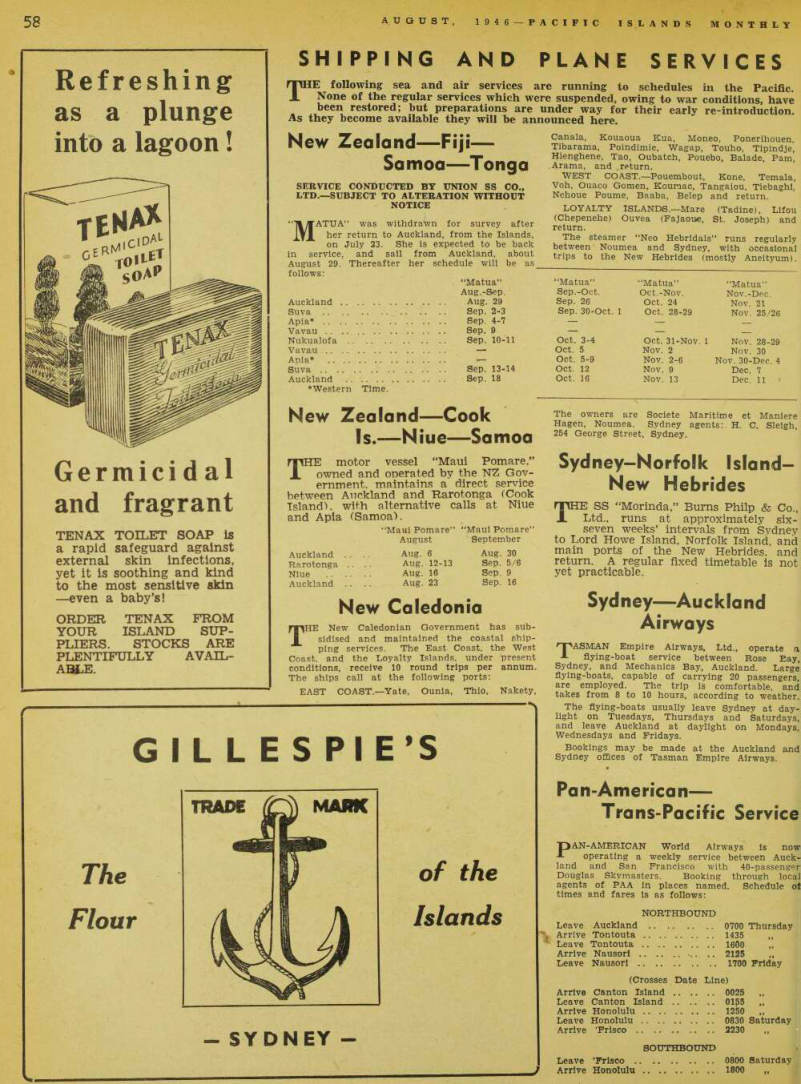
Shipping And Plane Services
rE following sea and air services are running to schedules in the Pacific.
None of the regular services which were suspended, owing to war conditions, have been restored; but preparations are under way for their early re-introduction.
As they become available they will be announced here.
New Zealand—Fiji—
Samoa—Tonga
Service Conducted By Union Ss Co.,
Ltd.—Subject To Alteration Without
Notice
“'ll/■’ATUA” was withdrawn for survey after her return to Auckland, from the Islands, on July 23. She is expected to be back in service, and sail from Auckland, about August 29. Thereafter her schedule will be as follows:
New Zealand—Cook
Is.—Niue—Samoa
rpHE motor vessel “Maui Pomare,”
X owned and onerated by the NZ Gov ernment. maintains a direct service between Auckland and Rarotonga (Cook Island), with alternative calls at Niue and Apia (Samoa).
New Caledonia
THE New Caledonian Government has sub sidised and maintained the coastal ship ping services. The East Coast, the West Coast, and the Loyalty Islands, under present conditions, receive 10 round trips per annum.
The ships call at the following ports; EAST COAST—Yate, Ounia, Thio, Nakety,
Canala, Kouaoua Kua, Moneo, Ponerihouen, Tibarama, Poindimie, Wagap, Touho, Tipindje, Hienghene, Tao, Oubatch, Pouebo, Balade, Pam, Arama, and return.
WEST COAST.—Pouembout, Kone, Temala, Voh, Ouaco Gomen, Kouraac, Tangaiou, Tiebaghi, Nehoue Poume, Baaba, Belep and return.
LOYALTY ISLANDS.—Mare (Tadine), Lifou (Chepenehe) Ouvea (Fajaoue, St. Joseph) and return.
The steamer ‘‘Neo Hebridais” runs regularly between Noumea and Sydney, with occasional trips to the New Hebrides (mostly Aneityum).
The owners are Societe Maritime et Maniere Hagen, Noumea. Sydney agents; H. C. Sleigh, 254 George Street, Sydney.
Sydney-Norfolk Island-
New Hebrides
riTHE SS “Morinda,” Burns Philp & Co., X Ltd., runs at approximately six seven weeks’ intervals from Sydney to Lord Howe Island. Norfolk Island, and main ports of the New Hebrides, and return. A regular fixed timetable is not
yet practicable.
Sydney—Auckland
Airways
TASMAN Empire Airways, Ltd., operate m flying-boat service between Rose Eay, Sydney, and Mechanics Bay, Auckland. Large flying-boats, capable of carrying 20 passengers, are employed. The trip is comfortable, and takes from 8 to 10 hours, according to weather.
The flying-boats usually leave Sydney at day light on Tuesdays, Thursdays and Saturdays, and leave Auckland at daylight on Mondays, Wednesdays and Fridays.
Bookings may be made at the Auckland and Sydney offices of Tasman Empire Airways.
Pan-American—
Trans-Pacific Service
T3AN-AMERICAN World Airways is now l A operating a weekly service between Auck land and San Francisco with 40-passenger Douglas Skymasters. Booking through local agents of PAA in places named. Schedule of times and fares is as follows:
Northbound
Leave Auckland 0700 Thursday Arrive Tontouta 1435 Leave Tontouta 1600 Arrive Nausori .. 2125 „ Leave Nausori 1700 Friday (Crosses Date Line) Arrive Canton Island 0025 „ Leave Canton Island 01£5 Arrive Honolulu 1250 „ Leave Honolulu 0830 Saturday Arrive ’Frisco 2230
Southbound
Leave ’Frisco 0800 Saturday Arrive Honolulu 1800
“Matua”
“Matua”
“Matua”
Sep.-Oct.
Oct.-Nov.
Nov.-Dec.
Sep. 26 Oct. 24 Nov. 21 Sep. 30-Oct. 1 Oct. 28-29 Nov. 25/26 Oct. 3-4 Oct. 31-Nov. 1 Nov. 28-29 Oct. 5 Nov. 2 Nov. 30 Oct. 5-9 Nov. 2-6 Nov. 30-Dec. 4 Oct. 12 Nov. 9 Dec. 7 Oct. 16 Nov. 13 Dec. 11 -
“Maui Pomare” “Maul Pomare”
August September Auckland .. .. Aug. 6 Aug. 30 Rarotonga .. . . Aug. 12-13 Sep. 5/6 Niue Aug. 16 Sep. 9 Auckland .. .. Aug. 23 Sep. 16
“Matua”
Aug.-Sep.
Auckland Aug. 29 Suva Sep. 2-3 Apia* Sep. 4-7 Vavau Sep. 9 Nukualofa Sep. 10-11 Vavau — Apia* — Suva Sep. 13-14 Auckland Sep. 18 •Western Time.
Leave Honolulu 1600 Sunday Arrive Canton Island 0105 Monday Leave Canton Island 0235 (Crosses Date Lines) Arrive Nausori 0900 Tuesday Leave Nausori 0600 Wednesday Arrive Tontouta 0925 Leave Tontouta 1100 Arrive Auckland 1740 „ (Note: Tontouta is Noumea field. Nausori is near Suva.)
Fares
Auckland-Suva $165.00 (via Tontouta) Auckland-Honolulu . .. 395.00 Auckland-’Frisco 55t).00 Suva-'Fnsco 442.00 Suva-Honolulu 257.00 Suva-Auckland 165.00 (via Tontouta) Free baggage allowance is 55 lb. Excess at 1 per cent, of the one-way fare for each kilogram of excess (1 kilo = 2.2 lb.). (Note: For easy conversion to Australasian currency £1 should be counted as $3.)
Sydney—Queensland —
Port Moresby Airways
QANTAS Empire Airways, Ltd., employing DC3 planes, operate a regular service between Sydney, Port Moresby and Lae, and return, via Brisbane, Rockhampton, Townsville and Cairns.
Planes leave Sydney on Mondays, Wednesday* and Fridays at 10 a.m., and arrive at Lae at noon on Tuesdays, Thursdays and Saturdays.
Planes leave Lae at 5.45 a.m. on Wednesdays, Fridays and Sundays, and arrive in Sydney at 10 p.m., accomplishing the Lae-Sydney run in a day.
Bookings may be made at Qantas offices at any of the towns named. At present, berths are available only to passengers holding official per mits to visit Papua or New Guinea.
Pacific Travellers
PASSENGERS who left Brisbane for Papua and New Guinea per SS “Montoro” in July: Mr. J. D. Langhorne, Mr. C. A. Dougherty, Mrs. A. B. Griffiths, Mr. S. R. Reilly, Mrs.
M E. Murray, Mr. A. A. W. Murray, Mrs. G.
P. Howitt, Br. F. R. Skibicki, Br. J. A. Brunner, Mr. H. J. S. Avenell, Mrs. C. Baxter, Mr. W.
E. Bellingham, Mrs. S. P. Helton, Mrs. N.
Venning, Mr. E. W. Rowlands, Mr. T. K. Bowes, Mr. J. E. Wagner, Mrs. A. Wenz, Mr. R.
O'Malley. Mr. G. J. Graham, Mr. C. G. Denton- Mayor, Mr. E. F. Beetham, Mr. T. J. Neely, Mr. F. B. Holloway, Mr. R. J. Marsden, Mr. D.
Pitt, Mr. M. Pitt, Mr. O. Aruba, Mrs. H. J.
Boyan, Mrs. A. Owen-Turner )and 3 children), Mrs. N. Archer.
PASSENGERS who arrived in Auck land per MV “Matua” on July 23: FROM SUVA: Mr. S. Aitken, Miss S. Aitken, Miss J. Aitken, Mrs. C. Butler, Miss N. Barrack, Miss C. Benjamin, Mrs. E. Barton (and daugh ter), Mr. D. Cruickshank, Capt. G. Carter, Mrs.
M. Cullen, Mr. W. Carey, Mrs. M. Davies, Mrs.
M. Ford, Mr. P. Fyfe, Miss N. Fowler, Mr.
A. Farquhar, Mrs. R. Green, Mrs. A. Grant, Mrs. M. Graham, Master J. Gibblin, Miss E.
Hurley, Mr. G. Haycock, Mr. and Mrs. M.
Halstead, Mr. W. Heatley, Mr. R. Holmes, Mr.
E. Hunter, Mr. and Mrs. J. Maybin, Rev. W.
Moren, Mr. H. Morris, Mr. N. Murray, Mrs. G.
McMurtrie, Mr. D. Naigulevu, Miss M. Poynton, Miss F. Roper, Capt. and Mrs. H. Rogers, Mrs.
F. Rowe, Miss B. Simmonds, Mr. C. Sage, Mr.
W. Smith, Mr. andn Mrs. J. Stephens, Mrs. J, Samuel, Mrs. H. Schuster (and child), Mrs. H.
Turner (and child).
FROM NUKUALOFA: Mr. and Mrs. J. Beswick (and 2 children), Mrs. R. Brahne (and 2 child ren), Mr. and Mrs. A. Hill, Mrs. V. Melville.
PROM VAVAU; Mr. P. Heitmann, Miss B Mann.
FROM NIUE ISLAND: Mr. J. Saunders, Mr.
D. Lutterall.
FROM APIA: Dr. G. Chapman, Mrs. E.
Chapman, Miss R. Johnston. Miss M, Kleis, Mr. E. Lee. Mrs. I. Lee, Master P. Lee, Miss R.
Lee, Miss M. Lober, Mr. M. Meredith, Mr. L.
Pritehard, Mr. M. Skelton, Miss U. Su’a, Mr.
j. Schaafhausen, Mr. W. Schwalger, Master J.
Schwalger, Mrs. L. Schwalger, Mr. S. Stowers, Mr. P. Samata, Mr. W. Southon, Mr. J. Thomp son, Mr. L. Wai, Mr. C. Wai.
ROUND TRIP; Mr. P. Mason, Mr. H. Pinel, Mr. H. Turner.
PASSENGERS who left Australia for
Fiji by Qantas flying-boat on June
25: Mr. and Mrs. F. L. Daish, Mr. J. K. Stott, Mr. R. R, Crozier, Mr. P. T. Wickens, Mr. C.
H. Bluett, Mr. A. H. B. Crabbe (and child), Mrs. L. B. Hart, Mrs. E. M. Berry, Mrs. V.
Cozens, Mrs. G. S. Dight and infant, Mr. F.
D. J. Clayton, Mr. J. L. Bentley, Mr. K. Laird, Mr. M. J. Evans, Mrs. A. H. Crabbe, Dr. L. B.
Hart, Miss A. C. Gibson, Mrs. S. D. Canard (and child), Mrs. F. M. Garnett, Mr. L. J.
Pink and Mr. H. R. Brown.
PASSENGERS who left Suva for Aus
tralia by Qantas flying-boat on
June 28: Mrs. M. J. Calmyre (and child), Mr. and Mrs. M. G. Richmond, Mrs. N. Richmond, Mr.
P. T. Richmond, Mr. and Mrs. L. H. Pope, Mr. J. K. Martyn, Mr. I. T. Bossley, Mrs. E.
G. Watson (and two children), Miss R. G.
Bartrum, Mr. J. C. Davis, Miss L. Botica, Mrs.
J. Israel, Mr. H. R. Brown, Mrs. Stendrup (and child), Mr. J. J. Milledge. Mr. J. R. Hall, Mr. and Mrs. R. W. Sellars (and two children),
Pim
PASSENGERS who left Australia
Fiji by Qantas flying-boat on July
10; Mrs. L. Davis (and child), Mrs. O. Probert, Mrs. A. Gittoes, Mrs. H. M. Ragg, Mr. D. T Mitchell, Mr. J. A. Allan, Mr. P. Costello Miss D N. Kay, Mr. R. P. Kay, Mrs. B. C Honson (and child), Mr. and Mrs. S. J. Coggins, Mrs. P. L. Farrar (and two children), Mr. S.
Weatherby, Mr. R. J, Multene, Mr. D. M. Riemy, Mr. J. P. Hanly, Mr. and Mrs. F. N. Olsen, Miss McMichan.
PASSENGERS who left Fiji for Aus
tralia by Qantas flying-boat on
July 12:
Mr. G. M. Masters, Mr. Manekal Kalyan, Mr. Chhanabhai Narsey, the Rev. J. T. Howse, Mr. E. S. Martin, Mr. L. J. Gardiner, Mr. Fong Kimsin (and two children), Mr Feng Wing Fook, Mr. and Mrs. D. I. Lane (and child).
PASSENGERS who left Australia for
Fiji by Qantas flying-boat on July
22: Mr. J Jiwan, Mr N. Berry, Mr. and Mrs. I.
J. Costello, Mr. N. B. McCullagh, Mrs. P. Corlis
(and three children), Mr. and Mrs. E. R. Bev ington (and two children), Mr. J. B. Costello, Mr. A. Linz, Mr. R. J. Giles. Mr. V. J. Costello, Mr. W. G. Mackay, Mrs. I. H. Topping (and three children), Mrs. F. E. Maguire, Mr. J.
Cleary.
PASSENGERS who left Suva, Fiji, for
Australia by Qantas flying-boat on
July 24:
Mrs. M. E. Pike, Mrs. N. Phibs (and daugh ter), Mrs. J. Curts, Mr. M. H. Kearey, Mrs.
D. Kearey. Mrs. K. R. Kearey. Mrs. K. M.
Grahame (and two children), Master A. Masters.
PASSENGERS who arrived in Austra lia from New Guinea by Qantas
Airways on:
JULY 3: Mr. W. Haldane, Mr. J. Lillyman, Mr. T. Flower, Mr. R. Young. Mr. D. G.
Kennedy. Mr. K. T. Frank, Mr. S. Heaney, Brig. C. R. Speckman.
JULY 5: Mr. R. W. Stirton, Mr. A. T. Collins, Mr. C. E. Eather, Mr. D. M. Gelbart, Mr. F.
H. Fearon, Mr. C. W. Thomas.
JULY 7: Lt. Palmer, M.L., Mr. F. W. Stephens, Mr. J. R. Halligan, Mr. F. Middleton, Mr. R.
Scribner.
JULY 10; Mr. L. M. Coombes, Mr. F. H.
Cowhan, Lt. K. L. Lindsay, Mr. S. E. Schrieber, Major Schaedel, Mr. E. C. Core, Mr. C. T. Kerr, Mr. E. Taylor, Mr. H. Lloyd, Mr. P. Hardy.
JULY 12: Mr. C. Jeffcoat, Mr. L. McKillop, Mr. R. Lunley, Mr. H. Temple-Watts.
JULY 15: Mr. and Mrs. S. A. Lonergan, Mr.
L. A. Brumby, Miss A. Mitchell, Capt. L. Harvey, Mr. S. Leather.
JULY 17: Mr. H. Mulholland, Mr. R. W.
Iversen, Mr. R. A. Laws, Mr. W. Hudson Fysh, Master W. E. Wyatt, Mr. E. A. Sully, Mr. T.
C. Trahair, Mr. J. Thurston.
JULY 19: Mr. C. H. Mann, Capt. O. D. Denny, Major D. R. Robertson, Mr. H. L. Williams.
JULY 21: Master W. N. Bock, Mr. and Mrs.
F. Tealby, Mr. W. C. Niness, Mr. K. R. Hamilton, Mr. L. F. Russell, Mr. R. D. Disher.
JULY 24: Mr. J. J. Sheehan, Mr. I. C.
Stewart.
JULY 26: Mrs. A. Wyborn, Mr. C. Day, Mr.
K. M. Gross.
JULY 28: Mr. R. W. Dickson, Master K.
Gallaher, Dr. B. T. Dickson, Mr. A. Lewis, Mrs. R. Murphy and infant.
PASSENGERS who left Australia for
New Guinea by Qantas Airways on:
JUNE 28: Mr. A. Anderson, Master K. L.
Gallagher, Mr. A. Fraser, Mr. T. W. Lega, Mr. K. B. Cross, Mr. B. Mills, Mr. W. W.
Clarke, Mr. J. C. Huie, Mr. C. W. Thomas, Miss C. H. Wedgewood.
JULY 1: Mrs. K. Evennett, Miss P. Evennett, Master Evennett, Mr. J. J. Gough, Mr. W.
Chance, Miss D. M. Chaplyn, Mr. E. H. Patter son, Mr. J. H. O’Brien, Mr. G. Zavattaro, Mr.
J. R. Coupe, Mr. D. G. Chambers. Mr. H. E.
Clark, Mr. G P. Barton, Mr. R. A. Laws, Mr.
E. Johnson, Mr. C. E. Rich, Mr. J. A. Caive.
JULY 3: Mr. R. C. McDuff, Mr. R. D. G.
Parker, Mrs. N. Targett, Mr. F. D. Jones. Mr.
D. J. O’Connor, Mr. C. H. Christie Mr. R. W.
Jackson, Mr. H. J. Bayley, Miss J. K. Bayley, Mrs. F. Cummings, Mr. F. Ballagh, Mr. W. E.
Sanson, Mr. G. Hogarty, Mr. T. F. Warren, Mr. W. J. Craddock. Mr. R. H. Auston, Mr. L.
H. Ross.
JULY 5: Mr. F. J. Curry, Mr. A. V. Murphy, Mr. L. E. Buckley, Mrs. E. Gordon, Mrs. D.
Bryant, Miss B. Bryant, Master Bryant, Mrs.
K. M. Ellis, Mr. V. M. Maxwell, Mr. R. Maloney, Mrs. J. G. Leahy (and children), Mrs. M. J.
Dunlop, Mr. S. M. Foley, Mr. J. G. Hill, Mrs.
A. Welsch, Mrs. Leahy (and two children), Mr.
E. C. Stacey.
JULY 8: Mr. A. G. Lewis, Mr. H. J. Ferguson, Mr. W. E. Carrington, Miss W. H. Bazley, Mr.
W. A. Purchase, Mr. A. Fisher, Mr. H. B.
Thrupp, Mr. F. A. Farey, Mrs. E. M. Farey, Mr. R. Jordan, Mr. J. Mallory, Mr. N. S.
Lynravn, Mr. A. R. Phillips, Mrs. M. C.
Vallentine, Mr. T. Bollinger, Miss Fitzgerald, Mr.
J. Allchin.
JULY 10: Mr. W. Springfellow, Mr. Leather, Mr. Doughty, Mr. Elworthy, Mr. Hollins, Mr.
Lingforth, Mr. O’Connor, Mr. W. Hinks, Mr. and Mrs. E. S. Turner, Mrs. Marr (and infantt, Miss J. Marr, Mr. A. M. Pinkerton, Miss M. I.
Hicks, Mr. M. Orken.
JULY 12: Mr. Homebin, Mr. Doering, Mr.
Schoer, Mr. Scharay, Mr. G. A. Clarke, Mr.
H. Gardner, Mr. C. Reid, Mr. A. F. Lesmond, Mr. W. D. Grant, Mr. A. E. Ray, Mr. K. G.
Oliver, Mr. J. V. Dowling, Miss V. M. Nicolson, Mr. A. M. Holland, Miss L. E. Williams, Mrs. J.
B. Nicholson.
JULY 15: Rev. I. Shevill, Miss E. Walborn, Miss R. Heber, Mr. W. Hudson Fysh, Capt. O.
D. Denny, Mr. L. Ferris, Dr. B. T. Dickson, Mr. S. A. Haig, Mr. R. A. Thrift, Mr. J. E.
Thompson, Mr. R. K. Skerritt, Bishop Crans wick, Mr. G. A. V. Stanley, Mr. G. K. Crowe, Dr. J. T. Gunther, Mr. B. C. Hides, Mrs. D.
L. Hides.
JULY 17: Mr. Walker, Rev. J. Kuder, Mr.
J. H. Scott, Mr. E. G. Dahl-Helm, Mrs. J. A.
Irwin, Miss P. Searle, Mr. I. D. Mitchell, Mr.
A. Green, Mr. R. C. Saville, Mr. J. A. Saville, Mr. H. W. Martin, Mr. T. J. Skepper, Mr. G. J Bryan, Mr. C. J. Bourke, Mr. N. Greer, Mr.
C. R. Rudd.
JULY 19: Mr. A. F. Jentzsh, Mr. C. Gallagher, Mr. W. Reid, Mr. T. Mclnerney, Mr. W. Thrupp, Mr. J. Fynan, Mr. A. Felton, Mr. R. Dennis, Mr. A. j. Peadon, Mr. T. Render, Mr. T.
Struthers, Mr. L. A. Morris, Mr. R. Radonic,
Mr. C. N. Rodakis, Mr. L. W. Mander, Mr. N.
Paterson.
JULY 22: Mr. R. Stubbs, Mr. T. Core, Mr.
W. H. Goodrich, Mr. F. W. Moger, Mr. L. V.
Wiley, Mr. J. R. J. Hammond, Mr. W. A.
Haydon, Mr. H. D. Simon, Mr. A. F. Flaherty, Mr. E. O. Graham, Miss H. Munday, Mr. G. C.
O’Donnel, Mr. J. P. McCauley, Mr. D. S. Oswald.
JULY 24; Mr. R. A. Battersby, Mrs. A. I.
Lymath, Miss A. J. Quinn, Mr. C. G. Turley, Mr 7 G. B. Tandy, Mr. G. W. Stanley, Mr. R. H Gregory, Mr. R. H. Eisemann, Mrs. Elliott Smith (and daughter). Miss R Boyd, Mr. R.
Hunt, Mr. and Mrs. J. G. Chambers (and child), Mr. A. J. Leicester, Mr. L. A. Bridger.
JULY 26: Mr. Taylor, Mr. Brazier, Mr. Vickery, Mr. Smedley, Mr. Spring, Mr. T. G. Leggett, Mr. D. Higgins, Mr. J. F. Montgomery, Mr. J.
Westwood, Mr. G. Burns, Mr. F. W. Godden, Mr. E. Dawes, Mrs. I. Kent, Mr. J. Medley, Mr. J. Hanlon, Mr. R. Boyer, Mr. B. Taylor. (NOTE.—Dates refer to day plane leaves Sydney.)
Late lists published on Page 71.
The Conseil-General is asking the New Caledonian Administration to agree to the employment of a dentist from Aus tralia if France does not send an addi tional one out during the year. The shortage of dentists has been so great that the three in Noumea who serve the Colony are besieged from 3 o’clock in the morning. Not one-quarter of those who need attention receive it, and out-of town residents never get any attention at all unless they come to the capital.
The population’s teeth, and consequently their health, is steadily going from bad to worse. Officially dentists with non- French degrees are not allowed to prac tice, but Caledonians would like to see Australian and New Zealand dental prac titioners admitted.
PASSENGERS who left Australia for
New Guinea by Qantas Airways on:
JULY 31: Mr. W. T. Adamson, Mrs. D. E.
Healey, Mr. W. H. Noland, Dr. T. A. Sherwin, Mrs. M. J. Pascoe, Mr. C. Pascoe, Mr. K. W.
Chambers, Mrs. S. Farlow, Mrs. H. Gray, Mr.
S. G. Muddell, Mr. G. E. Pringle, Mr. N. Toyne, Mr. T. A. Housley, Mr. M. W. Hill.
AUGUST 2: Odilo Kin Fong, Mr. W. Penman, Mr. J. Henderson, Mr. M. J. Gillies, Mr. H. R.
Nisbet, Mrs. J. I. Turner (and child), Mr. L. J.
Jones, Mr. Gaywood-Barker.
AUGUST 5: Mrs. A. E. Abbie, Mr. F. R.
Steven, Mr. G. McDonald, Mr. A. G. Rose, Miss V. V. Cadzow, Miss P. C. French, Mr. E. Hoskins, Mr. A. Hamilton, Mr. K. R. Williamson, Mr. S.
K. Robertson, Mr. J. H. Wootten, Mr. G. A.
Saville, Dr. J. C. Mclnerney.
AUGUST 7: Mr. V. W. Bryant, Mr. H. Prosser, Mrs A. Leydin, Mr. H. L. Steel, Mr. J. Pollard, Mr. G. A. Rudge, Mr. H. L. Young, Mr. R. J.
Mylecharane, Mr. A. Blakeley, Mr. W. E.
Eginton, Mr. J. V. Knight, Mr. and Mrs. B.
Gelbart. „ AUGUST 9: Mr. P. C. Pollard, Mrs. R. K.
Ellis, Mrs. D. P. Plumb, Mr. W. D. Glanville, Mr. C. M. Jacobsen, Mr. Evangelos Svokos, Mr.
Eleftherios Katsaros, Mr. H. J. McKebzie, Miss
E. A. Clancy, Miss E. L. Gray, Mr. A. Pinks, Miss P. Saunders, Mr. F. P. Kaah, Mr. W. A.
Ovenstone.
AUGUST 12; Mr. S. Sibly, Mr. J. F. Mclntosh, Miss G. R. Wilson, Miss L. R. Utz, Miss D. C.
Briggs, Mr. D. P. Willmott, Miss J. F. Stringer, Mr. W. H. Dew, Mrs. F. A. Filmer (and infant), Mrs. Heslop, Mr. K. A. Smith, Mr. W. E. Sharp, Mr. W. Little, Mrs. Mills, Mrs. K. Nelson, Mrs.
Hunt, Mrs. M. Halliday, Mrs. J. C. Dudley, Mrs.
J. Lucas, Mrs. M. E. White, Mr. H. C. Daly, Mr.
McCulloch, Miss M. E. Dickson, Mr. Hamilton, Mrs. U. Davies, Mr. W. Hoyles, Mr. L. G.
McCelland, Mrs. Baker.
AUGUST 14: Mrs. M. F. Campion (and in fant), Mrs. J. McDonald Brown, Mrs. G. Hewson, Mr. D. Potter, Mr. J. A. Thurston, Mr. E. H.
Vassie, Mr. A. B. Lane, Mr. R. A. Colyer, Mr.
P. Pring, Mrs. W. Reed, Mr. Luttrell, Mr. T.
Flower, F/Stew. S. Warren, Capt. and Mrs. J.
A. Bird, Mr. E. V. Brown, Mr. P. W. Smith, Mr.
L. R. Simpson.
PASSENGERS who arrived in Australia from New Guinea by Qantas Air ways on: JULY 31: Mr. J. K. Lillyman, Mr. R. Glover, Mrs. J. Stubbs, Capt. I. McDonald, Mrs. A. I.
Lymath, Mr. J. Slavin AUGUST 2; Mr. F. M. Lock, Mr. D. Crawley.
AUGUST 4; Mr. R. Sicklen, Mr. L. A. Willis.
AUGUST 7: Mr. C. Mustard, Mr. W. B. Ryan, Mr. T. Jacobs, Mr. T. W. Richards, Mr. T. G.
Leggett.
AUGUST 9: Mr. R. A. Battersby, Mr. P. L.
Allen, Father N. Earl, Mrs. W. I. Dunstan, Mr, W. D. Voysey, Mr. E. S. Turner, Mr. F. W. R.
Godden AUGUST 11: Miss G. Kirley, Mr. J. L. Lille crapp, Mr. H. Glanville, Mr. H. H. Stubbs, Mr.
N. W. Hill, Mr. and Mrs. B. Gordon, Mr. J. H.
Richards, Mr. B. B. Perriman, Mr. T. A. Housley.
Advertisements & other items, pp. 61-62 (1 item)
Cordage and
POSITION WANTED
Englishman, 27, wide radio, diesel and mechanical expert; accountancy student.
Ex A.I.F. and M.N. Now factory superintendent, seeks interesting position. Replies to “Englishman,” C/o Box 3804, G.P.0., Sydney, Australia.
Pen and Pencil
Set by
iYENUi
actual A perfect gift for yourself and others —the new Venus pen with every essential writing feature of pens costing twice as much and —a smooth action, matching pencil. Venus Guaranteed.
Obtainable at
PACIFIC ISLANDS TRADING
COMPANY
244 California Street, San Francisco.
Scott’s “Renown” Brand Rope,
Cordage and
Binder
Twine
of Every Description Address Ropeyard Sydney. iMpi s a
MANUFACTURED AT
MASCOT, N.S.W.
By
J SCOTT
PTY. LTD.
Head Office and Store
1(53 CLARENCE STREET,
SYDNEY.
N.S.W.
Livestock for Islands
People who intend to take Stock to New Guinea are hereby notified that I have on hand the right class of
Cattle—
Mules—
Horses
to suit both the Climate and the Pastures of the Territories.
When shipping i~ available, I can deliver, on the ship in Cairns or Townsville, Stock intended for any of the Pacific Islands, including Netherlands Indies. Singapore and the Philippines.
I will take all care of Stock and will be responsible for their delivery on the Ship in Sound Condition.
For further particulars, apply to
J. J. TOOGOOT)
Rollingstone, via Townsville, Queensland.
Orders accepted through any Stock Agent, or Bank, in Cairns or Townsville, or direct.
GtUESPIE
(NEW
LAE
TERRITORY OF NEW GUINEA
WHOLESALE MERCHANTS
GENERAL AGENTS
FORWARDING SHIPPING AND CUSTOMS AGENTS
Sole Agents for New Guinea for :
PHILIPS WIRELESS SETS
REMINGTON TYPEWRITERS
DULUX B.A.L.M. PAINTS
COMMONWEALTH INSURANCE COMPANY
Papua
IDLY I stood beside the muddly inlet, the small pools which the tide had left behind, and I watched the little lung fish hopping along the edge. Surely, I had seen these fish hopping there before.
I looked away inland to the tall coconut trees, throwing intermittent shadows on the grass and the wooded hills, beyond where cleared patches and spirals of smoke showed gardens in the making. The native woman, trudging homeward; slung from her brow the kiapa of garden pro duce and topping it the heavy bundle of faggots. The cool breeze, which came in from the sea. The canoes, going out to fish on the reefs. The feel and smell of it all, the enchantment. Were not all these familiar, and of a life before?
But these were figments of the imagina tion. perhaps a dream. The figures, loom ing through the mist of bygone days, tall and commanding figures, the figures of the giants of endeavour, were but ethereal phantoms of fancy. And the voices com ing out of a seeming past—voices with the lilt of hope and strong in selfless purpose —were but the soughing of the palm trees.
Newly come, one may tread upon a stair with a feeling of excitement that there he has been before. The feeling fades with sober thought, for it was born of foolish fancy.
No, I had not lingered here before. How could it be? There was no past—for it began in 1945. It was just that I had trod upon a stair—G.
Probably the first European baby to be borne in Papua since the Jap invasion appeared at Samarai on August I—a son. for Mr. and Mrs. Robert Bunting. Both doing well.
Advertisements & other items, p. 63 (1 item)
Tyres
QUEENSLAND
INSURANCE
COMPANY
LIMITED
(Incorporated 1886 In Australia)
ASSETS EXCEED £4,000,000
Head Office:
QUEENSLAND
INSURANCE BUILDING,
80-82 PITT STREET, SYDNEY.
Specialists in South Seas Fire,
Marine Cr Accident Insurances
Apply to:
FIJI.
Branch Office: I. B. Chalmers, Manager.
Burns Phllp (South Sea) Co., Ltd.
VILA.
Burns Philp (South Sea) Co.. Ltd.
Comptoirs Francals Des Nouvelles Hebrides (Marine).
NOUMEA.
L. & W Johnston.
PORT MORESBY:
Burns, Philp & Co., Ltd.
W. A. Anderson, Resident Officer.
PAGO PAGO.
Burns Philp (South Sea) Co.. Ltd G. H. C. Reid & Co.
OTHER SOUTH SEA ISLANDS.
Burns Philp (South Sea) Co., Ltd.
Also to any of the Company’s Offices in Australia or Hew Zealand.
MOST PEOPLE
THROUGHOUT THE
BRITISH EMPIRE
RIDE
ON
DUN
F
TYRES
Pirates In Nei
mHE Commanding Officer of the Nether- JL lands Navy in Sourabaya, set a trap to capture pirates, who are attacking peaceful Buginese and Macassar prahus in the vicinity of Sourabaya, murdering the crews and looting the cargo, according to official Netherlands Navy Information Service communique.
A harmless-looking prahu sailing off Sembilangah (Madura) was boarded by pirates from an armed Madurese prahu.
The pirates expected to find them an easy prey but to their surprise came face to face with well-armed Netherlands sailors.
After a short struggle, without casualties on the Dutch side, the pirates were cap tured. Arms, ammunition, hand grenades
and incriminating documents, proving that the TRI (Indonesian Republican Army) is allowing this form of piracy, were found aboard the pirate ship.
Captain Ernest Whitehouse, of ANGAU, who served 4s years at Kiriwina, Tobriand Islands, is spending leave in South Aus tralia with his wife and family. His son, Joe, is doing First Year Medicine at the University after four years in the AIF; and daughter Pat is in training as a nurse in Adelaide. Both spent their early years at Kiriwina and Samarai. Mr, Whitehouse was in the Papuan Public Service from 1918 (when he returned from World War I) until 1942.
Yanks Want Our
Tuna
Valuable Potential Fishing Industry
in South Pacific Permitted to
Go to Waste
IT is reported that Californian business interests, including the Chamber of Commerce, are urging the Stats De artment in Washington to seek fishing bases in the South Pacific in order that American fisheries may exploit the vast tuna resources of that area.
Tuna fishing (and canning) is an im portant Californian industry; but to date little interest has been shown in a similar enterprise south of the equator. Canned tuna was available in Australasia before the war, but it was not generally popu lar —British taste in canned fish seems to run only to salmon and sardines.
Dr. W. Chapman, of the California!* Academy of Sciences, is one of the leaders of the movement to secure bases. He says that the seas around the Gilberts, Marquesas, Fiji, Tohga, Cooks, Samoa and Tuamotus have never been touched as far as tuna fishing is concerned. These territories are, however, the possessions of either the French or the British, who are in a position to limit American in terest in the fishing grounds. American fisheries would have to have harbour and base facilities in some of these islands before tuna fishing would be possible for them.
The idea is a sound one, from the American point of view. If, however, the tuna canning industry is so lucrative as to permit activities so far from home, it also should be of great value to the island territories concerned, and one in which the indigenous ponulations could be use fully employed.
Any canning enterprise needs, in the initial stages, large financial reserves; but the South Pacific fishing industry should be at least as interesting to Aus tralasian and British Big Business as it is to American. The natives of Oceania alone consume sufficient canned fish to support a small canning industry. And there is an unparalleled market for such products in Europe and Asia to-day—and probably always will be.
Mr. W. M. Webster, a farmer and grazier, of Forbes, NSW, has been appoint ed the representative of the Australian Government on the British Phosphate Commission, which operates the huge de posits on Nauru and' Ocean Island. He replaces Sir Clive McPherson, who had been a Commissioner since 1927. The other Commissioners are Mr. W. Bankes Amery (United Kingdom) and Sir Albert Ellis (New Zealand). Mr. Webster was a member of the NSW Closer Settlement Board from 1931 to 1939.
Mr. W. T. Martin, formerly Comptroller of Customs in Fiji, has been appointed Comptroller of Customs, Nigeria. Mr.
Martin left Fiji in April, 1943, to join the political warfare section of Middle East Command. He served in Egypt, the Sudan, Eritrea, Ethiopia, Greece and Italy. After some months in London he was trans ferred to South Africa, and when he last wrote to friends in Suva, he was in Cape Town.
The engagement was announced in Taveuni, Fiji, recently of Miss Diana Tarte, the youngest daughter of Mrs. H. V.
Tarte of Vuna Estate and Melbourne, to Mr. David Collins, District Officer, Tave uni.
Advertisements & other items, p. 64 (1 item)
W. H.Grove & Sons
Limited Established 1896.
AUCKLAND
Island Traders. PO - Bo* 490 Telegraphic and Cable Address: “Grove”, Auckland.
Shippers of all classes of New Zealand products.
Representing English Manufacturers throughout the Cook and Society Islands, Fiji, Tonga, Samoa, Niue, New Caledonia, New Guinea, etc.
In FIJI a*—W. H. Grove Sons (Fiji) Ltd.
Here's a case that will stand the rough and tumble of school use . . . that weighs and costs less than leather . . . that is weatherproof and smart-looking! The Globite School Case is a convenient size ... 16 inches long . . . and it keeps school books in better condition. Ask to see one . . . feel how light it is! Globites are being manufactured as fast as materials and manpower permit.
GLOBITE ! C *V.*S
OBTAINABLE AT GOOD STORES EVERYWHERE
Manufacturers: FORD SHERINGTON LTD. (Who’esale only)
SYDNEY
News Notes From
N. Guinea
Visit by Reconstruction Official
From Our Own Correspondent LAE, August 4.
ON July 30, the Regional Officer of the Ministry of Post-War Reconstruc tion visited Lae, from Port Moresby.
Members of the Lae sub-branch of the RSS & AILA were summoned to hear this officer speak on post-war reconstruc tion.
It is presumed that the RSS & AILA was the only organisation which was available to arrange an attendance for this address, for it was obviously intend ed for all Territorians who are endeavour ing to regain a foothold in the country of their adoption. Quite a number at tended, most of them hoping that they were going to hear something to their advantage.
The speaker (introduced by the Presi dent of the sub-branch) proceeded to out line the Rehabilitation Act as recently passed at Canberra, and then took the Act, section by section. As each section or clause was expounded to the meeting, the reiterated remark followed, “this does not apply to the Territory.”
The rehabilitation of our civilians, who were compulsorily war-evacuated, does not seem to have entered into any de liberation or consideration by the Aus tralian Government. It is contended chat these people are as much entitled to re habilitation benefits as returned soldiers.
Admittedly, they have received war dam age compensation, but it is somewhat ironical that many of the individual miners (and even companies) find it al most impossible to acquire the means of even reaching their holdings, where the use of their war damage compensation commences.
No claim for transport from the coast to holdings in the interior were paid; yet these people are put to endless expense and worry in reaching their holdings.
Our contention is that every means should be employed by the Federal Gov ernment and the Administration to see that the mining community is established on the goldfields in order that gold pro duction (so much needed) may re-com mence at the earliest possible moment.
Many who have literallv battled their way back on to their holdings find them selves without labour, and but little pros pect of obtaining same.
However, to return to the Regional Officer’s peroration. As far as could be gathered, the only clauses which operate outside the mainland of Australia deal With War Service Homes and Vocational Training, and the latter must be under taken through correspondence courses. As regards War Service Homes: judging by the state of post-war housing in Austra lia it would be ultra-prophetical to even make a guess at when a single house could be built in the Territory.
War pensions and gratuities may be omitted, as they automatically operate everywhere. Moratoriums may also be disregarded, as most individuals would be a Methuselah by the time they had been through all the necessary channels to ob tain any benefit under this clause.
Hotel Cecil’S Bar Is Re-Opened
WE again have a licensed hotel in operation here. In 1942, when the invasion came, Mrs. Stewart owned the Cecil Hotel, and the liquor licence
therefor. It was literally blown to pieces during the Jap occupation—it is difficult now to discover even the spot where the two-storey building stood.
Mrs. Stewart, early this year, took over from War Disposals the considerable establishment, some two or three miles out from the port, where service-women were housed; and here she has provided very welcome accommodation. For some months she could not get supplies where with to resume her liquor licence, but supplies came to hand in the July “Mon toro,” the resumption of the liquor licence was officially approved; and, to the manifest satisfaction of the old Ter ritorians and the few remaining troops, the bar has been re-opened.
The establishment is being called the Hotel Cecil; but a move is now afoot to use the material and equipment in the existing place for the building of a mod
ern hotel close to the port and airfield at Lae. A position on the terraces, at the back, is favoured; but if that is not prac ticable, then the new hotel may be built on the flat.
Despite transport difficulties—the hotel and other places are so far out now that we can get around only in jeeps—the new bar already is a social centre, where Territorians get together to tell the grim story of their recent past, and discuss the equally grim story of their apparent future.
Troops Depart
THE “Montoro” arrived at Lae on her southern run on Saturday, August 3, and sailed at midnight in torren tial rain. She took away most of the re maining troops, leaving a handful of RAAF War Graves personnel, and mop pers-up. The absence of uniforms makes
us feel that we are at last in the hands of Civil Administration.
Equipment Wanted
AT the monthly general meeting of the Lae sub-branch of RSS & AILA on August 2, a resolution was passed that the committee should approach the Administration regarding the release of essential equipment, tools, etc., so badly needed by Territorians, and which are still being held up in dumps, etc. It was disclosed that the sub-branch now has 97 enrolled members.
At the Holy Trinity Pro-Cathedral in Suva, Fiji, on July 19, Captain T. V.
Moore, of Suva, was married to Miss Enid Lomas, of Auckland, NZ. A reception for 100 guests was later held at the home of Mr. and Mrs. E. G. Jeffries, in Holland Street, Suva.
Advertisements & other items, pp. 65-66 (1 item)
Z'm/Uu 'A H£ A
1
f- Vk
WELL
GROOMED
NEAT
LOOKING
HAIR
a m his ability It’s not only which is winning him advancement.
The pleasing effect of well-groomed, handsome hair proclaims a neat, orderly mind . . . up-tothe-minute in business as well as the value of appearance. You, 100, can make your hair a permanent business asset with VITALIS, and the “60-second drill”. 1 50 Seconds to Rub—Circulation quickens thus scalp stimulation gives hair a chance.
O 10 Seconds to Comb and Brush—Hair has a lustre —no objectionable "patentleather" look. v
Stimulates
Sold by all leading distributors and manufactured by Bristol-Myers Co. Pty. Ltd., 223 Pacific Highway, North Sydney, N.S.W., Australia
BH
World Range
STROMBERG-CARLSON
RECEIVER
Five-valve A.C. Model having many features of the famous “Amenities,” in a beautiful bakelite cabinet. Price, £26/19/6.
FREIGHT, INSURANCE, £l/5/-.
KEROSENE REFRIGERATOR.
De Luxe Rural Refrigeration. Send for Illustrated Booklet.
Price, £B2/5/6.
FREIGHT, INSURANCE, £3.
MULTIPLO INCUBATORS.
Full range of Kerosene and Electric Incubators are now available.
WRITE DIRECT TO;
sm.es seßVice
TELEPHONE : 8W5157 • SCOTTISH HOUSE ® 19 BRIDGE STREET© SYDNEY® AUSTRALIA % el
BECOME A MEMBER OF
Hutchinson’s Universal Book Club
Ensure yourself hours of thrilling enjoyment every month. Each month, from the works of such famous writers as Naomi Jacob, Philip Gibbs, Rafael Sabatini, Gilbert Frankau, Dennis Wheatley and many more, literary experts choose the book of the month. This best-seller, of standard size and quality and normally costing from 9/6 to 16/- comes to you for 3/3.
Fill in this Enrolment Form NOW!
, To the Secretary, Hutchinson’s Universal Book Club, Bank of Australasia Building, i 396 Collins Street, Melbourne. , I wish to enrol as a member of Hutchinson’s Universal Book Club in the • following manner:— (i) I enclose herewith remittance for 19/6 which entitles me to receive the , selected book each month for the next 6 months, postage free, i (ii) I enclose herewith remittance for 39/- which entitles me to receive the 1 selected book each month for the next 12 months, postage free. , (iii) I enclose herewith remittance for 78/- which entitles me to receive the , selected book each month for the next 24 months, postage free.
NAME (Block Letters) I
! ADDRESS
Slow Recovery In
Papua
Problems of Houses and Labour
Prom a Special Correspondent
Port Moresby, Aug. 3.
rERE seems absolutely no end to the money that is made available for administration here, and I can only assume that it is coming out of a “re habilitation” vote —nothing else could possibly have what is called for.
Up to the end of June, water and light in Port Moresby were supplied free; but from July 1 at least the water has to be paid for, by some of the inhabitants. I say “some,” because it is creditably stated that the officials that occupy the houses
owned by the Administration will not be called upon to pay anything.
The ordinary resident (and he includes Government officials) who in past years saved a few pounds and built himself a house, has to pay £9 per annum; board ing houses, hotels, and business premises as arranged.
The arrangement for light is said to be on the basis of so much per 100 square feet of floor—so that, if you have a large place, and go to bed early, you will prob ably pay 3 times as much as a chap with a much smaller house who gives parties, and generally stays up late. One won ders why electric meters were ever in vented, if they are not to be used.
The water supply is a great boon, com pared with the days when there was a continual risk of being short of water.
If the supply had not been here when it was, there would have been greater diffi culty in looking after the enormous num bers of troops that once occupied the dis trict.
Telephones have been free, so far, but I suppose they will invoke a charge shortly.
ONE thing that must strike anybody coming here, is the number of houses that are unoccupied, and need repairs before they can be used. I don’t know the reason, as I understand that War Damage covers the majority of the cost—perhaps lack of materials and also lack of workmen—both hard to get.
Messrs. Stubbs (the Sydney contractors) have a large number of men, and they are mainly on the 24 houses (said to be only temporary), but which are costing a large sum of money.
I will never be able to work out why the troops (who, after all, were human beings), who occupied the houses here, could so wantonly, and unnecessarily and callously do such damage to the places.
Some are worse than others, admittedly —some even being so bad that it is a question if they are worth doing up. Some have been fixed up, with a reasonable ex pense, and others are now on the way What is known as the “Top” Hotel was just ready for <pccupation when the bal loon went up; it was occupied by troops (whose, I do not know), but practically everything that could be pulled out, in light and water fittings, basins, and fix tures of all descriptions, were just torn out—not any trouble being taken to avoid tearing a bit out of the walls in doing so. It was fully, and very well furnished. To-day, it is a skeleton—but we hope will soon be on the way to re paration. Some places were well treated, but they were distinctly the minority.
I HEAR the last of the “Native Boy” regiments is being disbanded, and, for one, I am glad to see this. I know the “boys” did a good job in many ways, but I don’t think we ought to make “sol diers” out of them, when there isn’t any necessity to do so. They get ideas.
Slowly, rather too slowly, the planta tion labour is returning. Largely, the slowness has been due to lack of proper shipping facilities. These are gradually improving, but the number of vessels promised by the Shipping Control have not eventuated yet in Papua, Here, we have the “Doma” (300 tons) under Steamships management, doing the Daru-Samarai run. and will fill a long felt want.
At Samarai, the “Mary Rose” is doing good and very necessary work (she is eventually destined for New Guinea).
Here, too, is the “Nusa”' doing good work.
But vessels with small draft to do the shallow water and bar places, are sadly needed. We have been promised 55-foot
ers to draw 4 ft. 6 in. loaded. The only vessels capable of negotiating the shal low places can carry only 9 tons, which is altogether inadequate.
For Port Moresby there is to be an 85footer; and Samarai is eventually to have three of them. They are nice vessels, with Ruston Hornsby engines, 204 HP, and a good carrying capacity. When these vessels really arrive, the shipping position (coastal) will be well catered for.
The management is Burns Philp and Steamships—each with 50 per cent, of the tonnage total.
In New Guinea the arrangement is easier, as vessels there need not be shal low draft, so the 300 tonners are what will do the jobs—and they are to be 50-50 Burns Philp and Carpenters.
The arrangement is for 12 months, so far. What will be done at the end of that time, I do not know—nor does any body else.
IT is said that town planners have been busy on Port Moresby; and, if ac counts be true, the “planning” was done without knowing that Port Moresby is mainly “hills”—Paga Hill on one side, and the hill on which is the reservoir, on the other. The town-planers are said to have worked as if the place was all flat, so that the plans that are talked of (they necessarily can only be talked of yet), allocate ground for certain purposes which cannot possibly be used for any thing, unless at huge expense.
The Hotel Moresby now is catering for a large number every day, and the meals are good. Mr. Reg. Egiriton, formerly of Samarai, is the manager, and is assisted by his wife.
At Lae, Madang and Samarai. businesses are being carried on in Sidney Williams steel-framed huts of various lengths, but all 20 feet wide. Rabaul will be the same for some time to come, also.
The Indians Of Fiji
ADDRESSING an Australian Rotary
Club recently, Sir Raghunath
Paranjpye, High Commissioner for
India in Australia, had the following remarks to make about the Indian residents in Fiji: 1 RECENTLY had occasion to visit Fiji where Indians went as indentured labourers 80 years ago, and are now free men mostly engaged in agriculture.
Their condition is distinctly better than what we read of in other colonies, though even in Fiji one can see some trace of racial prejudice.
The educational system, for instance, is founded upon the complete segrega tion of Europeans. Fijians and Indians.
The poll tax, which has been introduced there, is paid by Indians but specifically exempts the Fijians and practically ex empts most Europeans, as they pay in come-tax.
They have also difficulties about land tenure, but I have great hopes that many of these difficulties will disappear under sympathetic treatment by the local gov ernment and the Colonial Office.
Indians in all of the countries I have mentioned desire to identify themselves with their new homes, and nothing would please them better than to be treated as citizens with full political and other rights. It is only because they are sub ject to disabilities owing to their being Indians that the Government of India has to interest itself on their behalf.
The Commissioner of Police for Fiji, Colonel J. Workman, returned to Suva in July after spending leave in the United Kingdom.
Major Grahamslaw, OBE
Honour Was Won in Difficult Buna Campaign
AN interesting event—which was not
reported in Australia—took place at
the Residency, Port Moresby, last
May, when the well-known and popular
Mr. “Tommy” Grahamslaw was invested with the Order of the OBE. Mr.
Grahamslaw was Collector of Customs at Samarai when the invasion came. He now
is Superintendent of Stores.
The citation is as follows: Lieutenant (Temporary Major) Thomas Grahamslaw was stationed at Awala when the initial Japanese landing was effected at Buna on July 21, 1942. He immediately assembled a patrol for forward reconnaissance of enemy dispositions but rapidly-advancing enemy troops attacked his party on three sides. Major Grahamslaw ordered the patrol to disperse, he himself remaining in the bush within the enemy lines. He was in contact with the Japanese for several days, only his excellent bushcraft preserving his own life on several occasions.
After gaining much valuable information, he made his way through the enemy lines and reported his findings to HQ NG Force.
Major Grahamslaw was attached to HQ 7th Aust. Div. on liaison duties in August, 1942. when his knowledge of the natives and of Mambare district was used to considerable ad vantage in drivinsr the Japanese Forces back across the Owen Stanley Ranges to the north coast of Papua. In October, 1942. Major Grahamslaw returned to Mambare district and resumed liaison duties with the Allied Force HQ operating in the district.
“Thus this officer saw almost constant for ward service throughout the Buna-Gona cam paign, from the initial landing to the final destruction and defeat of the enemy forces in the Bmia-Gona and Sanananda areas. He was a familiar figure to all forward Brigade Com manders, and his continued presence in the forward areas was a constant incentive and encouragement to the thousands of natives who were helping our troops.
“Maior Grahamslaw’s personal courage and valuable liaison work were worthy of the highest praise.”
Transfer Of Usa War Dead
SUVA, July 31.
A UNITED STATES ship called in here recently to collect the bodies of American war dead from the local cemetery.
Similar missions are being undertaken in all the Pacific Islands and in Australia and New Zealand. The transfer of these bodies is being made in accordance with an undertaking of the US Government that if the next-of-kin wishes it, the body of any American serviceman will be lifted from foreign soil for re-internment in America.
Lieutenant Harold Turner has rejoined the New Guinea Administration service, after six years with the AIP. He was one of the first Papuans to enlist, and he was wounded in the first action at Bardia (Middle East). He and his wife left on the last “Montoro” and are now at Lae.
He is the son of Mrs. Ethel Turner, now a resident of Elizabeth Bay, Sydney.
The Suva Bowling Club celebrated its 21st anniversary on July 20. A large crowd gathered at the Club’s green in the after noon, when speeches were made by the Chief Justice, Sir Claude Seton, Mr. R. W.
Steward, the 1946 president of the Club, the Club’s first president, Mr. G. Grahame, and by another foundation member, Mr.
J. H. Millett.
Advertisements & other items, pp. 67-68 (1 item)
Tired,Sleepless
When Worried
AND YOU FEEL RUN-DOWN
Worry Is Inescapable. Everyone has a share of It more or less. The great trouble about worry Is that It plays havoc with your health and fitness if you let it. You become mentally and bodily weary, depressed; cannot sleep at night, lose appetite and begin to feel a nervous breakdown is Impending. That starts the vicious circle. You worry, become run-down and nervy, and that makes you worry more than ever.
Meet your troubles all the way by reinvlgoratlng your system and keeping It fit and well by taking Dr. Williams’ Pink Pills. These pills help to restore the red corpuscles and Iron content of the blood to their normal quantity.
This enables life-giving oxygen and nourishment to be carried to the nerves, organs and tissue* of the body. In that way you become invigorated, strengthened by Dr. Williams’ Pink Pills, the vague aches and pains disappear and you are fit again to deal confidently with all your worries. At chemists and stores.
c iushtil ia'i ( finest
BOAT & YACHT
GEAR
• • • C
BROOMFIELDS LTD.
152 SUSSEX STREET, SYDNEY.
VnJp A npnf? inr • p - H - MUNTZ & CO.’s 3-CROWN BRAND METAL SHEATHING. jur . peaCOCK & BUCHANS’ ENGLISH READY-MIXED PAINTS.
NEWSPAPER SERVICE IN PAPUA-NEW GUINEA
PUBLIC NOTICE
PUBLICATION of the “Papuan Courier,’’ “Rabaul Times” and “Morobe News” ceased in January, 1942, due to the war with Japan. Until recently, resumption of publication was not possible, as re-entry of private industry into the Territories was not permitted; but these restrictions no longer apply, and resumption of Civil Administration and the return of European residents now warrant publication of at least one newspaper.
Nothing now remains of the printing plants owned by us pre-war, that belonging to “Papuan Courier” having been acquired by the Armed Forces and removed, and those owned by “Rabaul Times” and “Morobe News” having been destroyed by enemy action.
In view of the well-nigh impossible task of purchasing new plants at this juncture, we separately asked the Commonwealth Government for the opportunity to acquire the plant owned by Army Amenities Unit in New Guinea, and no longer required there. We had agreed that should any of us be successful in acquiring such plant, then by mutual arrangement it would be utilised for the time being to publish a newspaper at such place and in such manner as would best suit the immediate requirements of the two Territories. Under the circumstances, we were of the opinion that we were entitled to some special consideration in this regard.
WE now learn that the printing plant in question is being removed from New Guinea and shipped for the use of the Army in Japan. We regret, therefore, that as a result of this plant being taken to Japan (a country wherein printing machinery has not been lost or destroyed through its war against us) for the time being we are unable to recommence publication, and give that service to the Territories we had planned for the near future.
ERNEST A. JAMES GORDON THOMAS A. J. BRETAG Publisher Publisher Publisher
"Papuan Courier" "Rabaul Times" "Morobe News"
Asthma Curbed In 3 Minutes
Since the discovery of Mendaco by a famous physician sufferers can get relief from Asthma. Mendaco does away with expensive injections and offensive smokes.
All you ao is to take 2 tasteless tablets with meals and Mendaco starts circulating through the blood in 10 minutes. You breathe easily and freely. Your nerves relax, you get good, fresh, pure air into your lungs, and vigour returns.
Sleep Like a Baby
Thousands of former sufferers from Asthma say that the very first ‘dose of Mendaco brought them glorious ease and comfort, and that they slept soundly the very first night. Then their vigour returned and they felt healthier and stronger, and 5 to 10 years younger The reason for this is that Mendaco acts in natural ways to overcome the effects of Asthma. (1) It removes the mucus or phlegm; (2) It relaxes thousands of tiny muscles in your bronchial tubes so that the air can get in and out of your lungs; (31 It promotes body vigour, and stimulates the building of rich, revitalised blood.
No Asthma for Five Years
Mendaco not only brings almost immediate results, free breathing and comfort and enables you to sleep, but also builds up the system to ward off future attacks. Mr.
J. R. writes: “I was almost dead with Asthma. Had lost 40 lbs. In weight, snf-
fered coughing every night—couldn’t sleep.
Mendaco stopped spasms first night. I have had no Asthma since in over 2 years.”
Mrs. A. W. writes: “I had Asthma for 25 years. After using Mendaco I can sleep all night and have not had an attack since taking it.” Mrs. G. E. C. writes: “I bless the day I first heard of Mendaco. What a godsend it is to a poor woman like me who for 35 years never knew what it was to have a good night’s rest. The constant fight between Asthma and sleep was wearing me down, but I feel now I want to forget my past suffering.”
Benefits Immediate
The very first dose of Mendaco goes right to work circulating through your blood and helping nature rid you of the effects of Asthma. Try Mendaco under an iron-clad money back guarantee. You be the judge.
If you don’t feel fully satisfied after taking Mendaco just return the package and the purchase price will be refunded. Get Mendaco from your chemist to-day and see how well you sleep to-night and how much better you will feel.
RELIEVES ASTHMA
Mendaco
Now in 3 sizes 6/- and 13/-
Trochus Shell
Chance for Factory in the South west Pacific
IT is a remarkable thing that, although the waters of the South-west Pacific contain much trochus shell, and there is a world-wide market for the buttons, etc., which are made from this com modity, no real attempt has been made to establish the button-making industry in the South Seas.
Until 1939, most of the Pacific shell went to Czecho-Slovakia and Japan, where it was cut up for various articles —mostly buttons. It is understood there were large factories in Central Europe; but in Japan this was essentially a back yard industry—thousands of Japs worked, in their own homes, on shell which they bought in the open market.
Three or four kinds of Pacific shell are sold for these purposes—pearl-shell (from a kind of ovster). and trochus shell be ing the principal sorts handled. The Pacific is the main, if not the sole source.
Up until World War I, pearl-shell was the chief raw material employed. Dur ing that war, pearl-shelling largely ceas ed. and a great fillip was given to the gathering of trochus shell which, though more brittle and unsubstantial than pearl-shell, nevertheless was a good sub stitute. Since then, trochus has held its place as a raw material.
For at least ten years before the war, Japanese ships were gathering trochus all over the South-west Pacific, and in many cases they illegally entered territorial waters. They thus were reported poach ing in Torres Strarit, in the Louisiade and Bismarck archipelagoes, in the Solo mons and New Hebrides, in New Cale donia and in Fiji. Trochus apparently does not occur in the same degree east ward of Fiji. The Japs did not recognise the rule observed by 'all Europeans, that trochus of less than 21 inches should not be taken. They scraped the reefs and shallows clear of baby shell, and de stroyed countless beds.
As a result of the war, trochus gener ally has had a great chance to recover, and traders everywhere report fine beds of shell. There is said to be a keen de mand for shell, which is quoted in Syd ney markets at double pre-war prices; but it is not so easy to locate firm buy ers. The demand appears to come largely from America, where some firms con template developing the button-making business: but American buyers are diffi cult to contact.
Meanwhile, it is astonishing that no man of enterprise has jumped in on this opportunity. It should bp easy to estab lish in one of the Territories, where there is a guarantee of cheap labour and low taxation, a factory which could make use of the shell from the adjoining seas, and which would be certain of a profitable market for its nroducts.
"Skipper" Carlson
ATERRITORIAN reader, down from New Guinea on leave, recently in formed us that the grave of “Skip per” Carlson on Anelaua Island is being well cared for and that all details of the Skinner’s death and burial can be obtain ed from the District Officer, Kavleng.
“PIM” originally reported “Skipper”
Carlson as missing: but it was subse auently proved that he had been removed from New Ireland by the Japs after their occupation and sent to Anelaua Island, the New Guinea lener station about three miles off the coast of New Hanover, and' there he subsequently became ill and died.
Advertisements & other items, p. 69 (2 items)
67
Pacific islands monthly A ijotiSt, is4<>
COOK ISLANDERS FORM UNION
(Continued from Page 14)
George J. Lockyer & Company
Engineering Supplies, General Hardware
Exporters and Merchants
Purchasing Agents. Manufacturers’ Representatives.
Electric Light Generating Plants.
Air Conditioning Plants.
Builders’ Hardware.
Marine Engineering Supplies.
Refrigeration Supplies.
Radios and Accessories.
Sanitation Equipment.
Automobile Spare Parts and Garage Accessories.
Abrasive Wheels.
Excavating Machinery.
Electrical Supplies.
Grinding and Pulverising Machinery.
Hydraulic Equipment.
Mechanical Engineering Requirements.
Mining and Quarrying Machinery.
Road and Building Machinery.
Constructional Alloy Steel.
Stainless Steel.
Special Constructional Steels.
Carbon Tool Steel.
High Speed Steel.
Alloy Tool Steel.
Forging.
Tungsten Carbide.
Mild Steel Bars. (Round, Flat, Square, Hex.) Angles and Tees.
Reinforcing Rods.
Sheets, Plates.
Copper and Brass.
Sheets and Tubing, etc.
All communications to be addressed Bankers: to “The Secretary,” Commonwealth Bank of Australia, G.P.0., Box 4553, Sydney. Sydney.
Telegraphic and Cable Address: “LOCKMACH,” Sydney.
FAIRLIGHT STREET, FIVE DOCK, SYDNEY, N.S.W.
’Phone: UA 7196
A. O. SHEPHARD
GENERAL MERCHANT & EXPORTER
SOLE EXPORTER FOR JOHN GILMOUR & CO. PTY., LTD.
Gilmour's Delicious Desserts
• TAPIOCA DESSERT • LEMON CUSTARD
POWDER
• BANANA CUSTARD RASPBERRY CUSTARD
POWDER POWDER
Delicious Flavours :: Attractive Colours
ALSO:
Gilmour's Olive Oil Shampoo
Order direct from — A. O. SHEPHARD, 379 KENT ST., SYDNEY Phones; Code Address: MA 8179, MA 1142 “Chrisshep,” Sydney.
Labasa Children Consume
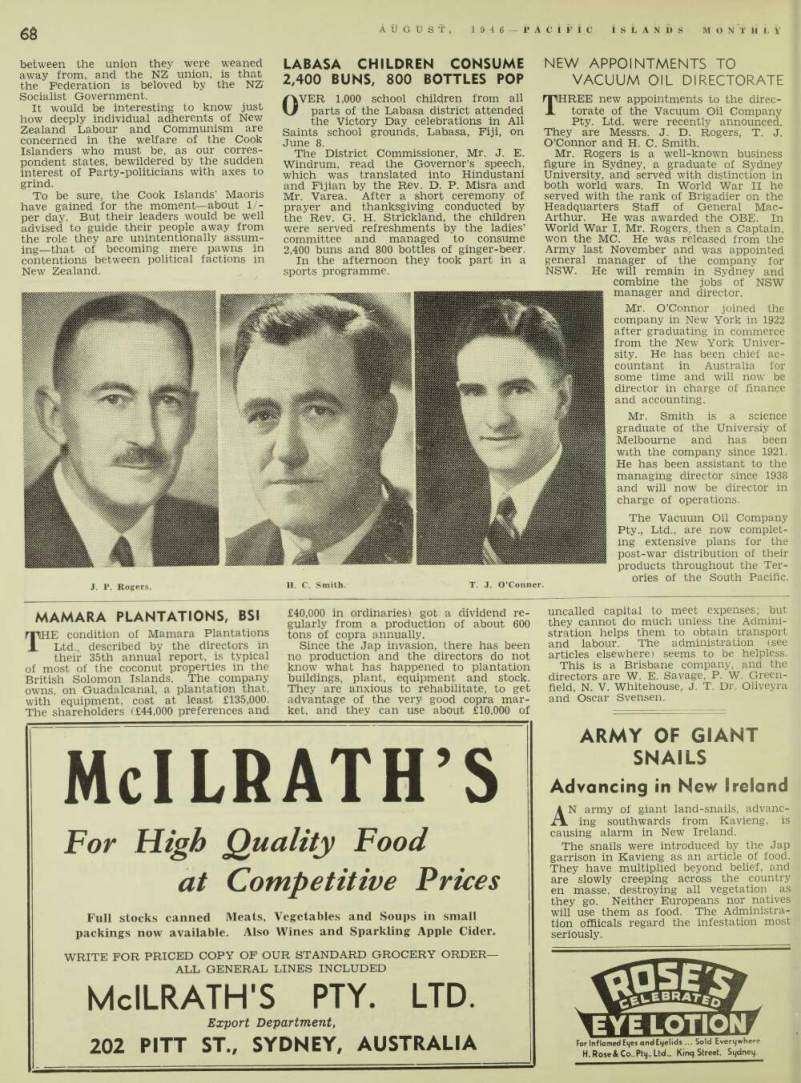
2,400 Buns, 800 Bottles Pop
OVER 1,000 school children from all parts of the Labasa district attended the Victory Day celebrations in All Saints school grounds, Labasa, Fiji, on June 8.
The District Commissioner, Mr. J. E.
Windrum, read the Governor’s speech, which was translated into Hindustani and Fijian by the Rev. D. P. Misra and Mr. Varea. After a short ceremony of prayer and thanksgiving conducted by the Rev. G. H. Strickland, the children were served refreshments by the ladies’ committee and managed to consume 2,400 buns and 800 bottles of ginger-beer.
In the afternoon they took part in a sports programme.
New Appointments To
Vacuum Oil Directorate
rREE new appointments to the direc torate of the Vacuum Oil Company Pty. Ltd. were recently announced.
They are Messrs. J. D. Rogers, T. J.
O’Connor and H. C. Smith.
Mr. Rogers is a well-known business figure in Sydney, a graduate of Sydney University, and served with distinction in both world wars. In World War II he served with the rank of Brigadier on the Headquarters Staff of General Mac- Arthur. He was awarded the OBE. In World War I, Mr. Rogers, then a Captain, won the MC. He was released from the Army last November and was appointed general manager of the company for NSW. He will remain in Sydney and
combine the jobs of NSW manager and director.
Mr. O’Connor joined the company in New York in 1922 after graduating in commerce from the New York Univer sity. He has been chief ac countant in Australia for some time and will now be director in charge of finance and accounting.
Mr. Smith is a science graduate of the Universiy of Melbourne and has been with the company since 1921.
He has been assistant to the managing director since 1938 and will now be director in charge of operations.
The Vacuum Oil Company Pty., Ltd., are now complet ing extensive plans for the post-war distribution of their products throughout the Ter ories of the South Pacific.
Mamara Plantations, Bsi
THE condition of Mamara Plantations Ltd., described by the directors in their 35th annual report, is typical of most of the coconut properties in the British Solomon Islands. The company owns, on Guadalcanal, a plantation that, with ’ equipment, cost at least £135,000.
The shareholders (£44,000 preferences and
£40,000 m ordinaries) got a dividend re gularly from a production of about 600 tons of copra annually.
Since the Jap invasion, there has been no production and the directors do not know what has happened to plantation buildings, plant, equipment and stock.
They are anxious to rehabilitate, to get advantage of the very good copra mar ket, and they can use about £lO,OOO of
uncalled capital to meet expenses; but they cannot do much unless the Admini stration helps them to obtain transport and labour. The administration (see articles elsewhere) seems to be helpless.
This is a Brisbane company, and the directors are W. E. Savage, P. W. Green field, N. V. Whitehouse, J. T. Dr. Oliveyra and Oscar Svensen.
Advancing in New Ireland
Army Of Giant
Snails
AN army of giant land-snails, advanc ing southwards from Kavieng, is causing alarm in New Ireland.
The snails were introduced by the Jap garrison in Kavieng as an article of food.
They have multiplied beyond belief, and are slowly creeping across the country en masse, destroying all vegetation as they go. Neither Europeans nor natives will use them as food. The Administra tion offiicals regard the infestation most seriously.
Advertisements & other items, pp. 70-71 (4 items)
68
Ailgus'l l , lslands month lV
Mcilbath’S
For High Quality Food
at Competitive Prices
Full stocks canned Meats, Vegetables and Soups in small packings now available. Also Wines and Sparkling Apple Cider.
WRITE FOR PRICED COPY OF OUR STANDARD GROCERY ORDER-
ALL GENERAL LINES INCLUDED
McILRATH'S PTY. LTD.
Export Department,
202 PITT ST., SYDNEY, AUSTRALIA
Eye Lotioni
For Inflamed Eyes and Eyelids ... Sold Everywhere H. Rose & Co., Pty.. Ltd.. King Street. Sydney
New ,303 Short Service Barrels, S I
WANTED TO BUY—QUALITY GUNS AND RIFLES
HIGHEST PRICES GIVEN. WILL ALSO EXCHANGE GUNS. 2SW, without Sights and Platform, £2/16/- each.
Postage extra.
L RO H U Quality Firearms and Fishing Tackle. 148 ELIZABETH STREET (Near Market St.) SYDNEY. ’PHONE: MA 3540.
ISLAND CRAFT
TO
MODERN DESIGN
n*»«»
WOODEN FREIGHTERS,
TRAWLERS AND ISLAND
CRAFT.
VESSELS REPAIRED AND
REMODELLED.
■ I *
AUSTRALIAN AGENTS FOR
GRAY MARINE PETROL AND
DIESEL ENGINES.
COPPERSMITHS, WELDERS
AND PLUMBERS.
MODERN SLIPWAY FACILITIES AVAILABLE
WRITE US FOR DESIGNS AND COMPLETE SHIPBUILDING INFORMATION. v F 1 /
Uusltaium ‘Jidfiittg. Jncliittueo £td.
INCORPORATING REG. ADAMS CLAYTON CO.,
Tel.: XB 4475, XA 1731. JOHN STREET, BERRY'S BAY, NORTH SYDNEY. ALSO AT EDEN, N.S.W,
69
PACIFIC ISLANDS MONTHLY AUGUST, 1946
PACIFIC HERO
(Continued from Page 10.)
McDonald
Difficult Case of John McDonald Post-War Verdict That Caused Indignation in Solomons
A VERDICT given in Honiaria, Admini strative Headquarters of the British Solomon Islands, in May, by Sir Claude Setoa (Chief Justice of Fiji) in the case of John McDonald, provided the sequel to a strange, dramatic story of the war.
A long time ago, a wandering trader named McDonald settled down in the Short!and Islands (a small group in the northern part of the British Solomon Islands Protectorate). He married a native woman, a chieftainess, and they had one son, called John.
McDonald’s way of life was more native than European. Their son’s associations were nearly all native. He received an English education and was taught to speak English—but, naturally, his life and outlook were mostly bounded by native affairs.
In course of time, McDonald senior passed on, and John took over his father’s plantation and trading station. He was a big, strong, rough-hewn type, and ex ercised some influence among the natives.
He insisted that, through his mother, he was the hereditary chief of the area on the island of Fauro where he lived. His claim was sharply contested by the reign ing chief, a man named Gaori.
John McDonald became known as a handy man with his fists. He made a good deal of money in trade in the Shortlands area, and he visited Sydney, where he had considerable success as a boxer. In Sydney, he wooed and won and married a Sydney girl.
In the early thirties, Mrs. McDonald was livi^p - with her husband on Fauro.
She had had two children. But she did not like the conditions under which she had to live there—the native associations were too close. E\entually, she left Fauro for Sydney, and refused to return.
WHEN the Japs came into the area, early in 1942, John McDonald and Goari were still feuding over the chieftainship. McDonald, in prosecuting his claim, always insisted that he had native rather than European status. This claim was accepted by the Administration —McDonald'was shown in the records as a native.
All the Europeans left before the Jap invasion in 1942. McDonald remained.
The Japs placed large garrisons on the islands in Bougainville Straits, including Fauro.
The Japanese demanded labour. Labour units were organised accordingly by both Goari, the chief, and McDonald, who claimed the chieftainship.
Then Goari denounced McDonald to the Japanese as a white man. He said that not only was McDonald white—he also had a white Australian wife and two white children. McDonald was closely interrogated by the Japanese. He insisted that he was a Solomon Islands native, and not a Britisher. The Japan ese ordered him to go to a small island which he owned off the coast of Fauro, and remain there.
During 1942 and 1943 there was much bitter fighting in this region. The Jap anese garrisons were frequently attacked by American airmen. Some American machines were shot down.
It is known that one airman was handed over to the Japanese by Goari, and that the natives from McDonald’s area handed over to the Japs two other American airmen. All these airmen were murdered by the Japs.
AFTER a. couple of years, the< Japanese were driven out of this region and it was re-occupied by the Europeans.
Grave charges were made against Mc- Donald. He was placed under restraint, and a case against him was prepared with care by the District Officer, Mr. Bolton; and it was this case which was tried by Sir Claude Seton (Chief Justice of Fin) and two Assessors (Messrs. D. M. Clift and H. A. Markham) in May.
The case aroused great interest in the Solomon Islands. All European opinion,
ana all pro-Allies natives, were strongly against McDonald.
In substance, the charges against Mc- Donald amounted to these: He had been instrumental in handing grounded Ameri can airmen over to the Japs; he had re cruited labour for the Japs; and he generally had collaborated with the Japs.
It was not proved that McDonald had himself betrayed the airmen to the enemy. He apparently took no steps to assist them to get away southwards to their own lines; and they were betrayed to the Japs by natives from McDonald’s area, though not by McDonald. Mc- Donald was able to show that he had rescued one airman from the sea, and taken him to his own house, and pro vided him with food and clothing. The airman, a Lieutenant Mayberry, had written for Mr. McDonald a letter in which he said that he had been treated with kindness and consideration, and McDonald had done everything possible for him in the circumstances. It prob ably was the last letter ever written by this young American hero—he was seized and murdered by the Japs soon after wards. McDonald produced this letter to the Court.
McDonald claimed that, in the circum stances, he could do nothing except assist the Japanese to recruit labourers.
MCDONALD’S main defence, however, lay in his production of various Government documents to show that by the Government he was regarded as a native and not as a European. The Administrative officials had to acknow ledge that that was the fact.
In view of that, the Court acquitted McDonald.
The verdict was received in the Solo mons with a storm of indignation. How ever. there is no doubt that legally it was correct. The chief, Goari, was pre sent at the trial, but not as a prisoner— he moved about as a free man. Goari had handed over at least one American airman to the Japs and apparently had collaborated. If McDonald were to be convicted and punished, then also should Goari—and various other natives in a similar position.
McDonald was acquitted because his legal status is that of a native. White residents and the Administration, in the future, probably will see to it that Mc- Donald is treated strictly as a native, and enjoys none of the privileges of his
part-white blood.
Wing-Commander C. V. Whiddy, RAAF, who was manager of Levers’ Paci fic Plantations, Ltd., Solomons Islands, did not re-enter that service at the end of the war, and is now sheep-farming in Australia. He was awarded the United States Order of Merit for con soicuously valuable help given the American Forces during the 1942-43 cam paign in the Solomons.
Mr. Stewart Carrick, a son of the well known Dr. Carrick. of Suva, was in Syd ney in July, on his way to India and Eurone. He has lived for several years in Polynesia, and is married to a Tongan noble —a tall, slim lady who is a close relation of Queen Salote —and they have two daughters. They expect to settle down permanently on the Riviera, and the two children will be educated in France.
Mrs. E. Britten, and Mrs. G. Bliss, who have been associated with the Melbourne New Guinea Women’s Association since its inception in 1942, expect to leave Mel bourne during August to rejoin their hus bands in New Guinea. Mrs. Bliss goes to “Oylup” plantation, Madang; Mrs. Britten to Namanula, Rabaul,
Advertisements & other items, p. 72 (1 item)
Marys
You should not experience any
difficulty in obtaining supplies
AUNT
MARYS
BAKING POWDER
always ensures success, when used with any good plain flour. Crusty, light scones, flaky pie-crust and pastry, even textured, light sponges and cookies are certain when you use AUNT MARY'S BAKING POWDER.
Famous for over 70 years! AVAILABLE EVERYWHERE.
Towards Recovery
Samarai Area Struggling Towards Recovery
From Our Own Correspondent
Samarai, July 16.
THE almost imperceptible movement of the re-birth of Samarai is gaining momentum. The island is cleaner and the wharf is being patched up. It is still a long way before the promises of Mr. Ward will be realised, however.
I heard recently two men talking. No. 1: “Have you a lathe at your place?”
No. 2; “Yes, but it has been ANGAU’D, and is very little good now!”
Quite a lot of the boats have also been ANGAU’D and the results can be seen in the local ships’ graveyard.
Returned PIB have caused a stir in the Fife Bay district. One has set him self un as king, and the Government Is now investigating his claims. The result will be interesting.
Another labour problem has arisen.
Pre-war, natives usually followed the one type of work, and fathers taught sons to follow on. Now, owing to the long period of the war, most of the trained natives —such as mining boys and rubber tap pers—are too old to work and the younger ones will have to be completely trained.
More expenses for the wicked exploiter of the natives are in view! So far, there is no rush of labour in this district and the costs are rising for foodstuffs.
Residents returning to Samarai still have to find their own accommodation on arrival. The position is grim. One lady has set up a boarding-house, but. the cost of staying there is around £2O per month, so returnees, after a few meals there, are seen making the best of the available buildings and doing most of their own work. As the shipping ser vice locally has been awful, up to date, some of the returnees have spent up to six weeks in Samarai waiting for trans port. The position is improving now. as Army releases some of the larger boats for the coastal trade.
Mr. Skelley, of BP’s, Samarai, returned on the “Muliama,” and moved from the boat to hospital with a bad leg. He will soon be gracing the waterfront again.
“Scotty” Buchanan and Mr. Dermott- Smith are on their tn At the moment, there are three men from War Damage doing their best to assess the damage to the mines at Mis- Ima. The job is a big one, as floods and neglect have caused terrific damage.
Advertisements & other items, p. 73 (2 items)
71
PACIFIC TRAVELLERS
Continued from Page 61
PACIFIC ISLANDS MONTHLY AUGUST, 1946
Papuan Electrical Co.
PORT MORESBY
Consult Us For All Your Electricol Requirements
ELECTRICAL INSTALLATIONS AND REPAIRS—SUPPLIERS
OF ALL ELECTRICAL APPLIANCES AND EQUIPMENT-
IRONS, JUGS, TOASTERS, REFRIGERATORS, FANS,
MOTORS, Etc.
ESTIMATES GIVEN PROMPTLY.
W. Conolly, Manager.
Apply, P. 0., Port Moresby.
Pimples and Bad Skin Fought in 24 Hours
Since the discovery of Nlxoderm by an American physician it Is no longer necessary for anyone to suffer from ugly, disgusting and disfiguring skin blemishes such as Eczema, Pimples, Rash, Ringworm, Psoriasis, Acne, Blackheads, Scabies and Red Blotches. Don’t let a bad skin make you feel inferior and cause you to lose your friends. Clear your skin this new scientific way.
A New Discovery
Nixoderm is an ointment, but different from any ointment you have ever seen or felt. It is a new discovery, and is not greasy but feels almost like a powder when you apply It. It penetrates rapidly into the pores and fights the cause of surface skin blemishes. Nlxoderm contains 9 ingredients which fight skin troubles in these 3 ways. I.—lt fights and kills the microbes or parasites often responsible for skin disorders. 2. —It stops Itching, burning and smarting in 7 to 10 minutes, and cools and soothes the skin. 3.—lt helps nature heal the skin clear, soft and velvety smooth.
Works Fast
mediately, clearing and healing your skin, making It softer, whiter and velvety smooth Because Nlxoderm is scientifically compounded to fight skin troubles. It works fast.
It stops the Itching, burning and smarting In a few minutes, then starts to work 1m-
In just a day or two your mirror will tell you that here at last is the scientific treatment you have been needing to clear your skin—the treatment to make you look more attractive, to help you win friends. Nixoderm has brought clearer, healthier skins to thousands, such as Mr. Bob Weedon, Edmund Street, Fremantle, who writes: “I was troubled with pimples ever since I was 13, and have spent pounds and pounds on so-called cures without results. I then tried Nixoderm with astounding effect.
The pimples seemed to fade away, and after a week there was not the slightest trace of them.”
Satisfaction Guaranteed
Get Nixoderm from your chemist or store to-day. Look in the mirror in the morning and you will be amazed at the improvement.
Then just keep on using Nixoderm for one week and at the end of that time it must have made your skin soft, clear, smooth and magnetically attractive—must give you the kind of skin that will make you admired wherever you go, or you simply return the empty package and your money will be refunded in full. Get Nixoderm from your chemist or store to-day.
The guarantee protects you.
Nixoderm 2/- & 4/-
For Skin Sores. Pimples and Itch.
Islands Produce
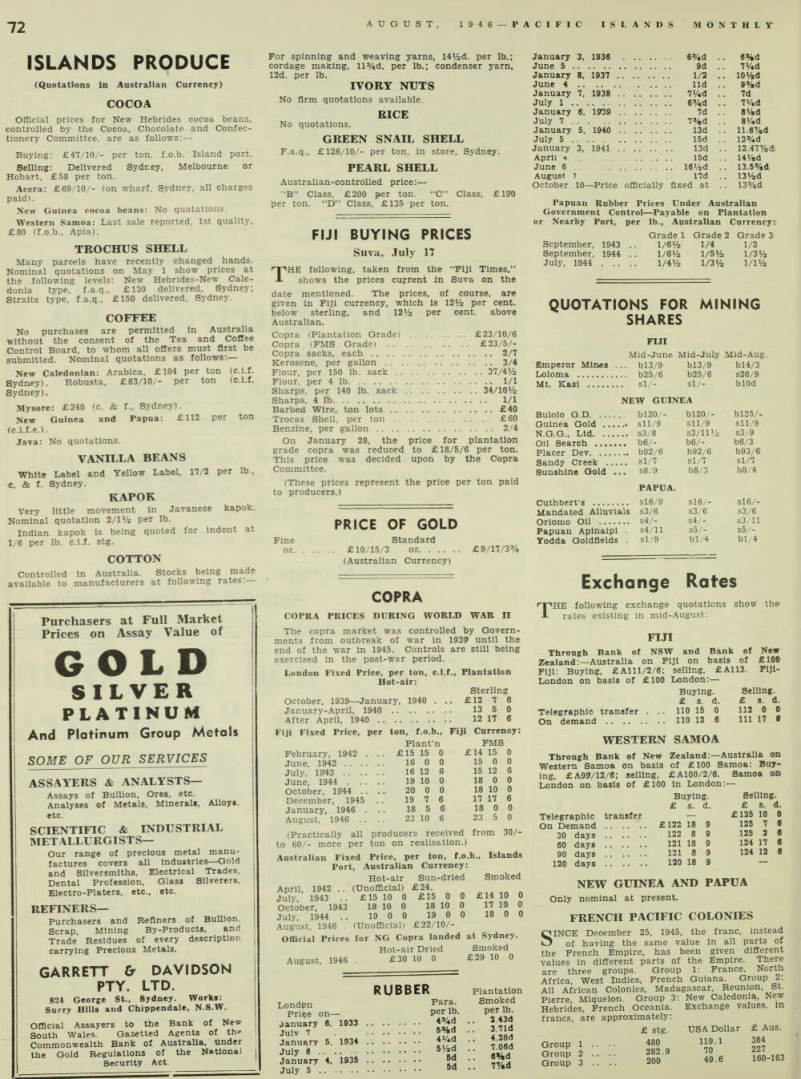
(Quotations in Australian Currency)
Cocoa
Official prices for New Hebrides cocoa beans, controlled by the Cocoa, Chocolate and Confec tionery Committee, are as follows: — Buying: £47/10/- per ton, f.o.b. Island port.
Selling: Delivered Sydney, Melbourne or Hobart, £5B per ton.
Accra: £69/10/- (on wharf, Sydney, all charges paid).
New Guinea cocoa beans; No quotations.
Western Samoa: Last sale reported, Ist quality, £BO (f.0.b., Apia).
Trochus Shell
Many parcels have recently changed hands.
Nominal quotations on May 1 show prices at the following levels: New Hebrides-New Cale donia type, f.a.q., £l3O delivered, Sydney; Straits type, f.a.q., £l5O delivered, Sydney.
Coffee
No purchases are permitted in Australia without the consent of the Tea and Coffee Control Board, to whom all offers must first be submitted. Nominal quotations as follows; New Caledonian: Arabica, £lO4 per ton (c.i.f.
Sydney). Robusta, £B3/10/- per ton (c.i.f.
Sydney).
Mysore: £240 (c. & f., Sydney).
New Guinea and Papua; £ll2 per ton (c.i.f.e.).
Java: No quotations.
Vanilla Beans
White Label and Yellow Label, 17/2 per lb., c. & f. Sydney.
Kapok
Very little movement in Javanese kapok.
Nominal quotation 2/1% per lb.
Indian kapok is being quoted for indent at 1/6 per lb. c.i.f. stg.
Cotton
Controlled In Australia. Stocks being made available to manufacturers at following rates;
For spinning and weaving yarns, 14%d. per lb.; cordage making, ll%d. per lb.; condenser yarn, 12d. per lb.
Ivory Nuts
No firm quotations available.
Rice
No quotations.
Green Snail Shell
F.a.q., £126/10/- per ton, in store, Sydney.
Pearl Shell
Australian-controlled price:— - ‘B” Class, £2OO per ton. “C” Class, £l9O per ton. “D” Class, £135 per ton.
Fiji Buying Prices
Suva, July 17
THE following, taken from the "Fiji Times,” shows the prices current In Suva on the date mentioned. The prices, of course, are given in Fiji currency, which Is 12% per cent, below sterling, and 12% per cent, above Australian.
Copra (Plantation Grade) £23/10/6 Copra (FMS Grade) . . . . £23/5/- Copra sacks, each 2/7 Kerosene, per gallon 3/4 Flour, per 150 lb. sack 37/4% Flour, per 4 lb 1/1 Sharps, per 140 lb. sack 34/10% Sharps, 4 lb 1/1 Barbed Wire, ton lots £4O Trocas Shell, per ton £6O Benzine, per gallon 2/4 On January 28, the price for plantation grade copra was reduced to £ 18/5/6 per ton.
This price was decided upon by the Copra Committee. (These prices represent the price per ton paid to producers.)
Advertisements & other items, p. 74 (1 item)
Price Of Gold
Fine Standard oz. . . . £10/15/3 oz £9/17/3% (Australian Currency)
Copra
Prices During World War Ii
The copra market was controlled by Govern ments from outbreak of war in 1939 until the end of the war in 1945. Controls are still being exercised in the post-war period.
London Fixed Price, per ton, c.i.f., Plantation Hot-air:
(Practically all producers received from 30/to 60/- more per ton on realisation.) Australian Fixed Price, per ton, f.0.b., Islands Port, Australian Currency:
Papuan Rubber Prices Under Australian Government Control —Payable on Plantation or Nearby Port, per lb., Australian Currency^
October. 1939 —January, 1940 Sterling . £12 7 6 January-April, 1940 13 5 0 After April, 1940 .. 12 17 6 Fiji Fixed Price, per ton, f.o.b., Fiji Currency; Plant’n
Fms
February, 1942 . .. £15 15 0 £14 15 0 June, 1942 16 0 0 15 0 0 July, 1942 16 12 6 15 12 6 June, 1944 19 10 0 18 0 0 October, 1944 .. 20 0 0 18 10 0 December, 1945 19 7 6 17 17 6 January, 1946 . .. 18 5 6 18 0 0 August, 1946 .. .. 23 10 6 23 5 0
Hot-air Sun-dried Smoked April, 1942 .. (Unofficial) £24. £14 10 0 July, 1943 .. £15 10 0 £15 0 0 October, 1943 18 10 0 18 10 0 17 10 0 July. 1944 .. 19 0 0 19 0 0 18 0 0 August, 1946 . (Unofficial) £22/10/- Official Prices for NG Copra landed at Sydney.
Hot-air Dried Smoked August, 1946 £30 10 0 £29 10 0
Rubber
Plantation London Par ®- Smoked Pri$e on— P er per lb.
January 6. 1933 4%d Julv 7 5Hd January 5. 1934 4V«d July 6 5/ * d January 4, 1935 5d July 5 5d 3.43d 3.71d 4.28d 7.06d 6Hd 7 T /«d
January 3, 1936 6 3 / 4 d 6%d June 5 9d 7V 4 d January 8, 1937 . 1/2 . . lOVad June 4 . . lid 9V«d January 7. 1938 . 7V 4 d 7d July 1 . 6 3 / 4 d 7V 4 d January 6. 1^39 7d 8V«d July 7 . 7%d 8V 4 d January 5. 1940 . 13d .. ll.BVad July 5 . 15d .. 12 3 / 4 d January 3, 1941 . 13d .. 12.47y a ct April •» 15d .. i4y a d June 6 16V 2 d . . 13.5 Vad August 17d .. 13M,d October 10- -Price officially fixed at .. 13 3 / 4 d
Grade 1 Grade 2 Grade 2 September, 1943 . 1/6% 1/4 1/2 September, 1944 .
I/6V2 1/5% 1/3% July, 1944 ... 1/4% 1/3% 1/1%
Quotations For Mining
Shares
Fiji
Mid-June Mid-July Mid-Aug.
Emperor Mines . .. bl3/9 bl3/9 bl4/3 Loloma .. b25/6 b25/6 S26/9 Mt. Kasi . si/si/blOd Bulolo G.D
New Guinea
bl20/- bl20/bl25/- Guinea Gold sll/9 sll/9 N.G.G., Ltd S3/11V 2 s3/9 Oil Search .. b6/b6/b6/3 Placer Dev .. b92/6 b92/6 b93/6 Sandy Creek ... .. sl/7 sl/7 sl/7 Sunshine Gold .. ,. s8/9 b8/3 b8/4 Cuthbert's
Papua.
.. S16/9 sl6/- Sl6/- Mandated Alluvials s3/6 s3/6 s3/6 Orlomo Oil s4/- S3/11 Papuan Apinaipl . S4/11 s5/s5/- Yodda Goldfields . sl/9 bl/4 bl/4
Exchange Rates
THE following exchange quotations show the rates existing in mid-August:
Fiji
Through Bank of NSW and Bank of New Zealand:—Australia on Fiji on basis of £lOO Fiji: Buying, £Alll/2/6: selling, £AII3. Fljl- London on basis of £lOO London: —
Western Samoa
Through Bank of New Zealand: —Australia on Western Samoa on basis of £lOO Samoa: Buy ing. £ A99/12/6; selling, £AIOO/2/6. Samoa on London on basis of £lOO in London: —
New Guinea And Papua
Only nominal at present.
French Pacific Colonies
SINCE December 25, 1945, the franc, instead of having the same value in all parts of the French Empire, has been given different values in different parts of the Empire. There are three groups. Group 1: France, North Africa, West Indies, French Guiana. Group 2: All African Colonies, Madagascar, Reunion, St.
Pierre, Miquelon. Group 3; New Caledonia, New Hebrides, French Oceania. Exchange values, in francs, are approximately:
Buying.
Selling. £ s. d. £ s. d.
Telegraphic transfer . .. 110 15 0 112 0 0 On demand .. 110 12 6 111 17 •
Buying.
Selling. £ s. d. £ s. d.
Telegraphic transfer — £125 10 0 On Demand £122 18 9 125 7 8 30 days 122 8 9 125 2 6 60 days 121 18 9 124 17 0 90 days 121 8 9 124 12 6 120 days 120 18 9 —
£ stg. USA Dollar £ Aus.
Group 1 480 119-1 384 Group 2 .. ■■ 282.9 70 2 Group 3 .. .. 200 49.6 160-163
Advertisements & other items, pp. 74-76 (3 items)
Gold
Purchasers at Full Market Prices on Assay Value of
SILVER
PLATINUM
And Platinum Group Metals
SOME OF OUR SERVICES
ASSAYERS & ANALYSTS—
Assays of Bullion, Ores, etc.
Analyses of Metals, Minerals, Alloys, etc.
SCIENTIFIC & INDUSTRIAL
METALLURGISTS—
Our range of precious metal manufactures covers all industries —Gold and Silversmiths, Electrical Trades.
Dental Profession, Glass Sllverers.
Electro-Platers, etc., etc.
REFINERS—
Purchasers and Refiners of Bullion, Scrap. Mining By-Products, and Trade Residues of every description carrying Precious Metals.
GARRETT & DAVIDSON
PTY. LTD.
824 George St., Sydney. Works: Surry Hills and Chippendale, N.S.W.
Official Assayers to the Bank of New South Wales. Gazetted Agents of the Commonwealth Bank of Australia, under the Gold Regulations of the National Security Act.
Amalgamated Wireless (Asia) Ltd.
FACILITIES
NOW AVAILABLE
m rpHE Beam Wireless Service now operating on a full Peacetime basis offers the public fast and accurate world-wide communication services.
Messages are accepted for transmission to the United Kingdom, the Continent of Europe, the Middle East, Canada, United States, South America, India and the Philippines.
Commercial Wireless Services have recently been re-opened for messages between Australia and Lae, Port Moresby, Java and Nauru.
Codes are again permissible and you can use your registered code name as address and signature.
Specially trained telephonists are available for the acceptance and delivery of Beam Wireless messages.
We will be pleased to open a Credit Account for you. Complete information available regarding codes, classes of messages, rates, routes, etc.
Beam Wireless messages may be lodged at:
BEAM WIRELESS OFFICES,
47 York St., Sydney 167 Queen St., Melbourne Telephone: B 0522. Telephone: MU 9161.
OR AT ANY TELEGRAPH OFFICE
AMALGAMATED WIRELESS (ASIA) LTD.
AUSTRALIA’S NATIONAL WIRELESS ORGANISATION
Allen Taylor 81 Co. Ltd.
COMMERCIAL ROAD, ROZELLE,
SYDNEY
Sawmillers and Wholesale Suppliers of Hardwoods for Constructional Purposes GIRDERS ... PILES .. . POLES . . . SLEEPERS, Etc.
EXPORTING TO PACIFIC ISLANDS SINCE 1893
B H.R.I. Career Training Accountancy and Commerce- Accountancy. Secretaryship Cost Accountancy Bankers’ Institute Exams.
Insurance Examinations Local Government Exams.
Bookkeeping (all grades) Effective Correspondence Psychology Industrial Psychology Economics Distribution- Selling and Sales Man'g’ment Marketing and Advertising Practical Retail Selling Ticket. Showcard Writing Business Administration- Business Administration Merchandising Management Foremanship & Ind'l Man’g’t General Education- Public Service Grade. School.
Police & Nurses’ Exams.
H.R.I. tutorial service is proved by the winning of more honours than all coaches in Australasia
combined.
To Hemingway Robertson Institute.
Please send your 96-page handbook “Guide to Careers in Business.”
Name Age Address
The Key
to Earning Power
SOMETIMES men think that a general education or an elementary knowledge of business is enough to get ahead. But experience soon teaches that thorough, specialised training is just as necessary for success in business as it is in the professions of Law, Medicine or Dentistry. If you are interested in the many opportunities in the Business World . . . if you would like responsibility, success and economic security . . you should commence training NOW -in some specialised business subject. Write for H.R.I. “Guide to Careers in Business” today!
H.R.I. is available always to help and advise ambitious men and women. Write or wire for particulars and career information.
Hemingway
Robertson Institute
(Founded and owned by Hemingway & Robertson Ply. Ltd.) Professional Tutors Consulting Accountants 126 a CHALFONT CHBRS., 142 PHILLIP ST.. SYDNEY 126 a BANK HOUSE . . . BANK PLACE . . . MELBOURNE Interested in. 126a/779 and at all Capital Cities, Newcastle and Launceston
Steamships Trading
Company Limited
PORT MORESBY
SAMARAI
PAPUA.
WHOLESALE & RETAIL MERCHANTS, SHIPOWNERS,
PLANTERS, ENGINEERS & SLIP PROPRIETORS.
Customs, Shipping, Insurance, and Forwarding Agents.
MANAGING AGENTS AND VISITING REPRESENTA-
TIVES FOR COCONUT AND RUBBER ESTATES
SYDNEY REPRESENTATIVES; Nelson & Robertson Pty. Ltd.. 12 Spring Street.
74
DISAPPOINTMENT IN
AUSTRALIAN TERRITORIES
(Continued from Page 9)
AUGUST, 1946 PACIFIC ISLANDS MONTHLY
Timber Concession In Ng By
Tender Only
Canberra, July 18.
ACCORDING to a statement made in the House of Representatives here to-day, no new permits to secure timber will be issued in Papua or New ° for permits in existence at the outbreak of the Pacific War were cancelled, although permits in existence before that time are being recognised and holders are being permitted to return to the Territories to operate their timber concessions.
In future, however, as new timber areas become available, it is proposed to call tenders and grant concessions in that way. .
At present a complete survey of timber resources of the combined Territory is being undertaken on behalf of the Com monwealth Government
Australian Mp's May Visit
Papua-Ng
Canberra, July 16.
IF Mr. Anthony, MP, has his way, Terri torians can expect a visitation from Australian Parliamentarians.
In the House of Representatives to-day he asked the Prime Minister (Mr. Chif ley): “Prior to the outbreak of World War 11, facilities were granted to members to visit New Guinea, in order to acquaint themselves with conditions there, because the territories have no representative in this Parliament. As I have received many comnlaints that, under the present ad ministration, it is impossible for planters and others to develop the external terri tories, will the Prime Minister restore those travel facilities? If it is decided to restore those facilities, when will it be possible for members of the Parliament, from all political parties, to visit the Ter ritory?”
Mr. Chifley answered that restoration of such travel facilities had not been con sidered. but that Mr. Anthony’s request would be discussed with the Minister for External Territories.
Advertisements & other items, pp. 77-80 (3 items)
75
PACIFIC ISLANDS MONTHLY- A U G U S T , 1946
W. Kopsen & Co.
J. C. MERRILLEES & CO.
Chall is House, Martin Place, SYDNEY.
BUYERS OF ALL ISLAND REQUIREMENTS. SUPPLIERS OF ALL AUSTRALIAN GOODS. BUYERS OF ISLAND PRODUCE. write or wire Inquiries Welcomed for Quotations ' Phone: BW 6569 Telegrams: “Merrillees,”
Sydney.
AUGUST SPECIAL:
DEKOL
Guards Wood and Canvas from the Ravages of White Ants, Borers, Dry Rot, Mifdew, etc.
DEKOL penetrates deeply, permanently protecting wood and fabrics from rot and attacks by fungi and insects. It is simple to apply and when dry can be painted and varnished. DEKOL also prevents attack by marine borers on wood immersed in sea water.
PRICE 12/- GAL (4 gal. tins). 14/6 GAL. (I gal. tins).
DON'T WAIT
TILL THIS
HAPPENS.
«K\ Q .a “ g ) \ ; Trade Inquiries Invited.
Fully descriptive leaflet available on request. Dekol should be used in every home and on every estate and will save pounds per year in damage and expensive replacements.
KAYEN
KEROSENE LAMPS
Reliable, efficient Australian-made pressure vapour lamps, providing a full 300 candlepower of steady, unflickering light at a cost of li pints lighting kerosene in 10 hours.
Popular all-purpose lamp, illustrated, may be used as a hanging lamp, storm lantern or table lamp. Absolutely wind-proof, rainproof and insect-proof. Easily operated and require little maintenance or replacement of spare parts. Practically all parts, including tank, are made of brass to withstand tropical atmospheric conditions, and each lamp is fully tested before despatch. Fully illustrated descriptive leaflet available on request. Also available in handsome tall table design suitable for lounge and dining-room.
W. Kopsen & Co.
Pty. Ltd.
376-382 KENT STREET, SYDNEY
CABLES: KOPSEN, SYDNEY.
’Phone MA 6336 (7 lines). Est. 1878.
All over the British Empire, every minute of every day, more and more smokers are saying, "Better buy Capstan (tobacco and cigarettes)—they're blended better."
CAPSTAN
TOBACCO and CIGARETTES
A Tropical Thirst
demands a Satisfying Drink
COOL
Us T A 1 QNCV ri«M THE riNEJT M * L y. **• tOTTLEO »v
'°pTH & CO.. LI Ml
Sydney, australi
that’s why KB is so popular
south of u the Line”
All through the tropics, wherever there are men who like good beer, you r ll always find KB. It's the drink that men appreciate —a drink just made to satisfy a tropical thirst 1 m - • & •XvXviw. m&mm m r & ft I J
TOOTHS
KB
LAGER.
1
MERCHANTS. Qc SHIP OWNERS
Capital £l,OOO/000
ESTABLISHED 1914
COPRA MERCHANTS & MILLERS
BRANCHES THROUGHOUT THE PACIFIC ISLANDS
Buyers and exporters of all kinds of Islands produce. Copra Merchants and Millers.
Agents for Australian, European and American Manufacturers. Distributors of every description of merchandise.
Thirty years of Pacific Islands development and service.
IN LONDON:
W. R. Carpenter & Co. (London), Ltd., Coronation House, 4 Lloyd’s Avenue, London, E.C. ★
DISTRIBUTING
AGENTS FOR:
Ford Motor Company of Canada.
Electrolux Refrigerators.
T. G. & C. Bolinders (Engines).
Chrysler Corporation.
Westinghouse Electrical Co.
Caterpillar Tractors.
Etc., Etc.
THE W.R.C. LINE
THE FIRST DIRECT AND
REGULAR CARGO AND PASSENGER SERVICE BETWEEN EUROPE AND
PACIFIC ISLAND PORTS WAS ESTABLISHED BY
W. R. CARPENTER & CO. LTD.
Head Office: 16 O'CONNELL STREET, SYDNEY.
Cable Address:
CAMOHE.
Telephone: BW 4421.
Postal Address: P.O. Box No. 168, Sydney.
Published VS'KS™ S«m"mwVc.. SSS £SSSSI£” SW^VnOI?
76
AUGUST, 1946 - PACIFIC ISLANDS MONTHLY