Islands
Pacific
Monthly
July 19, 1946
Vol. Xvi. No. 12.
fdfd
\Rccjistsrscl at flip c** p jv * 0^^ 01725771^ 552071 P os t as a newspaper]
1/-
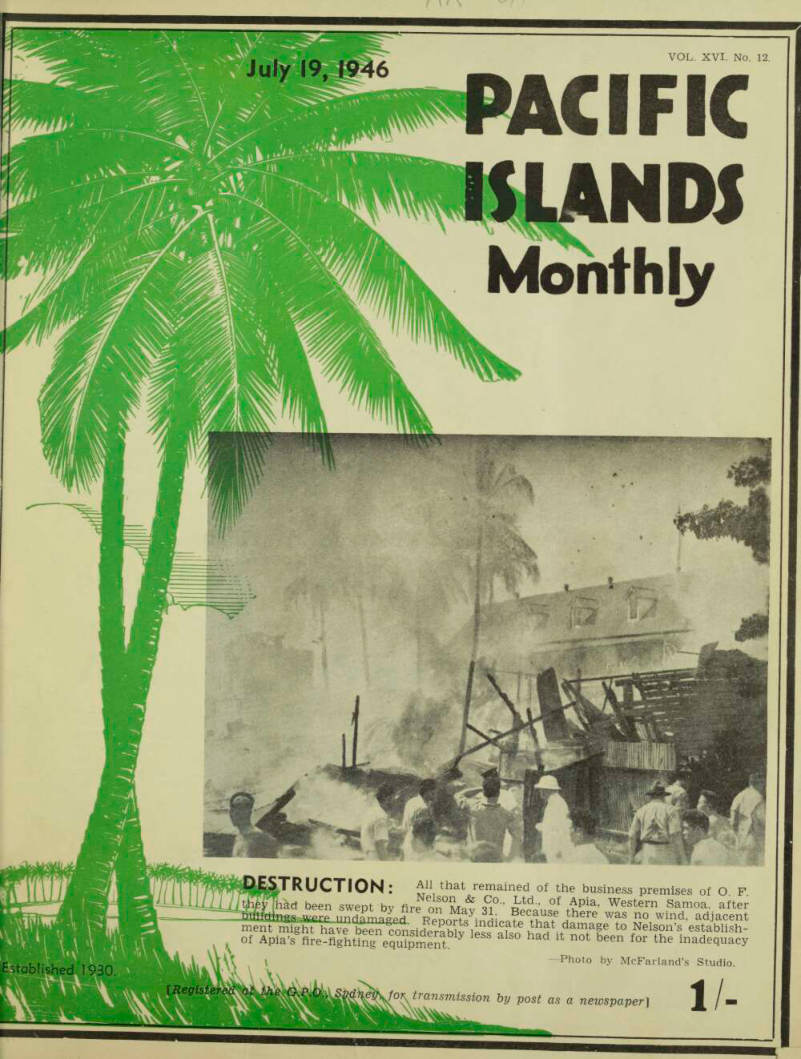
DESTRUCTION All that remained of the business premises of O F.
Nelson & Co., Ltd., of Apia, Western Samoa, after they ben swept by fire on May 31. Because there was on wind, adjacent bulidingds were undamaged Reports indicate that damage to Nelsons establish ment might have been considerably les also had it not been for the inadequacy of Apia's fire-fighting equipment. —Photo by McFarland’s Studio.
Advertisements & other items, pp. 2-4 (1 item)
£.mju/U
<s Eh i 5?
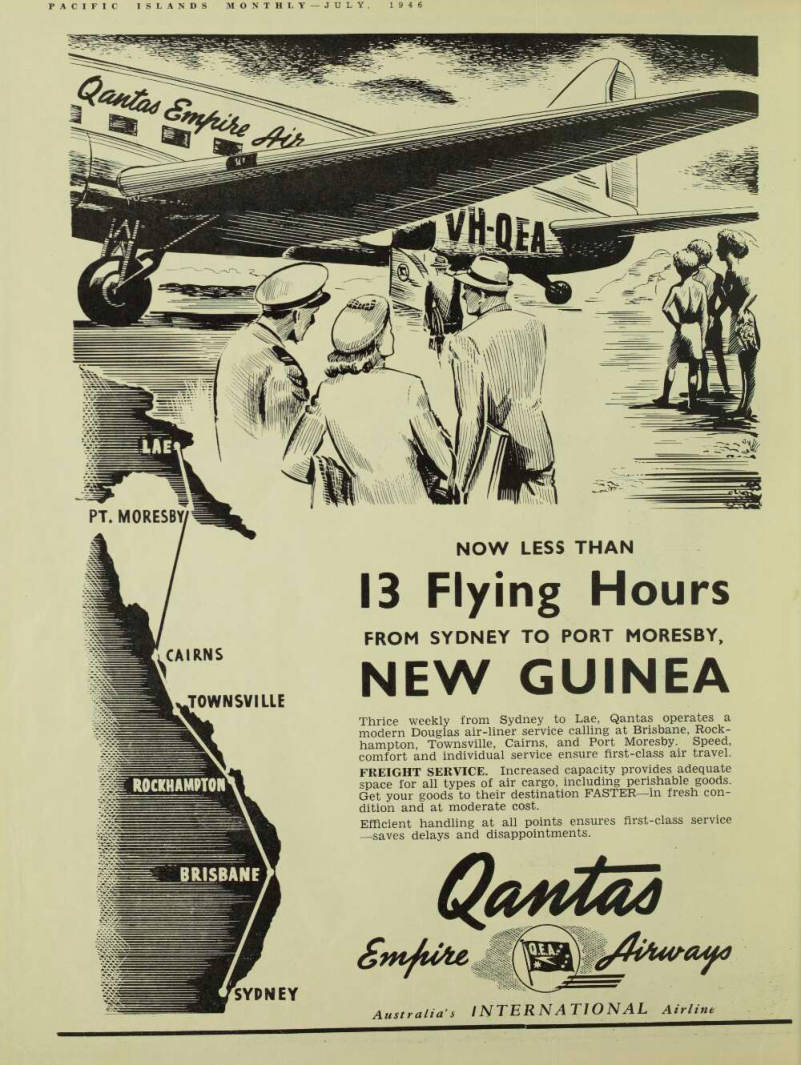
PT. MORESBY,
CAIRNS
JOWNSVILLE
Vm m
NOW LESS THAN
13 Flying Hours
FROM SYDNEY TO PORT MORESBY,
NEW GUINEA
Thrice weekly from Sydney to Lae, Qantas operates a modern Douglas air-liner service calling at Brisbane, Rockhampton, Townsville, Cairns, and Port Moresby. Speed, comfort and individual service ensure first-class air travel.
FREIGHT SERVICE. Increased capacity provides adequate space for all types of air cargo, including perishable goods.
Get your goods to their destination FASTER—in fresh condition and at moderate cost.
Efficient handling at all points ensures first-class service —saves delays and disappointments.
£.mju/U
SYDNEY
Australia's INTERNATIONAL Airline
% % 59 « ■■ ■ x V / \ 0 Bf I'f 1 Can be set up ready for use in a few seconds.
For its size this new Coleman Stove is
amazing. Although
only 8g in. high and 4i in. wide it boils a pint of water inside 5 minutes.
It is made of corrosion-resistant metal • . . lights instantly , . . needs no priming . . burns any kind of petrol and cannot spill fuel even when tipped over.
Telescopic case makes two handy cooking utensils. The pot supports at top fold in for packing. m T Representatives for the Pacific Islands;
ROBERT GILLESPIE PTY. LTD.
54a PITT STREET, SYDNEY
PEARCE & CO. LTD
SUVA
FOR FIJI ISLANDS
J. C. MERRILLEES & CO.
Cha 11 is House, Martin Place, SYDNEY.
BUYERS OF ALL ISLAND REQUIREMENTS. SUPPLIERS OF ALL AUSTRALIAN GOODS. BUYERS OF ISLAND PRODUCE. write f or wire Inquiries Welcomed Quotations 'Phone; BW 6569 Telegrams: “Merrillees,’
Sydney.
H.R.I. Career Training
Accountancy and Commerce- Accountancy. Secretaryship Cost Accountancy Bankers’ Institute Exams.
Insurance Examinations Local Government Exams.
Bookkeeping (all grades) Effective Correspondence Psychology Industrial Psychology Economics Distribution- Selling and Sales Man’g’ment Marketing and Advertising Practical Retail Selling Ticket. Showcard Writing Business Administration- Business Administration Merchandising Management Foremanship & lnd’l Man’g’t General Education- Public Service Grade. School.
Police & Nurses’ Exams.
H.R.I. tutorial service is proved by the winning of more honours than all coaches in Australasia combined. o Hemingway Robertson Institute n Please send your 96-page handbook 'Guide to Careers in Business ”
Name Age Address . - Interested in 126a/778
lour Future
A Cnreer in iinsiness Offers
i*rnetienl Opportunities
JF you think over those men who are enjoying big positions and large incomes, you will soon realise that most of them are engaged in business pursuits . . . merchants, accountants, secretaries, bankers, and business managers of all kinds. But how did they get their start in business? The answer is simple.
First, by realising that business today offers the best opportunities for a successful career. Secondly, by training and qualifying in a chosen business subject.
If you would like to know how you too can take advantage of these practical opportunities . . . write
to H.R.I. today.
H.R.I. is available always to help and advise ambitious men and women. Write or wire for particulars and career information.
Hemingway
Robertson Institute
(Founded and owned by Hemingway & Robertson Pty. Ltd.) Professional Tutors . . . Consulting Accountants 126 a CHALFONT CHBRS., 142 PHILLIP ST SYDNEY 126 a BANK HOUSE . . . BANK PLACE , . . MELBOURNE and at all Capital Cities. Newcastle and Launceston
Exclusive Agencies Available
• TAR-BASE PAINT— •
Anti-rot-rust-corrosive
• ELECTRIC WELDERS—
Transformer and Rotary Tv oes
• PUMPS— •
Self-priming-centrifugal
• ENGINES—
Air-cooled-petrol, I—B h.p. •
• GENERATOR SETS
All replies will be treated in strictest confidence and should be addressed to: —
MILLMAN, DOUGLASS AND COMPANY
P.O. Box 1070 Wellington New Zealand
MINING EQUIPMENT—
Electric Can Lamps Air Drills Electric Drills Hoists Safety Appliances
HOMOGENISERS—
For chemists, etc.
ROAD BUILDING AND
MAINTENANCE PLANT,
ETC.
Returned On "Montoro"
Captain Bill Money left Brisbane for New Guinea by the “Montoro” on July 10.
He is one of the “Big Six” who discovered gold at Edie Creek and has been in the Territory for 28 years.
Mr. B. F. Blackwell, who represented the Fijian Government and the Western Pacific Commission in Sydney during the Pacific war years, assumed duty as Assist ant British Commissioner in the New Hebrides in March. The British Com missioner in the New Hebrides, Mr. R. W.
Blandy, 0.8. E., is at present away on long leave.
Mr. R. A. Laws, now a director of Robert Gillespie (New Guinea) Ltd., spent a fortnight in July in the Australian Ter ritories, mostly in Port Moresby and Lae.
Mr. and Mrs. Bill Royal left Melbourne, Australia, in June on the first stage of their journey back home to Wewak, Man dated New Guinea, which they have not seen since the evacuation of 1942.
Momoe, the widow of the late High Chief Tanu Malietoa, and the mother of the present holder of the title, died in West ern Samoa on June 24 after a long ill ness. She was 67 years of age. Her funeral was attended by the Administrator, repre sentatives of the Administration and members of both the European and Samoan communities.
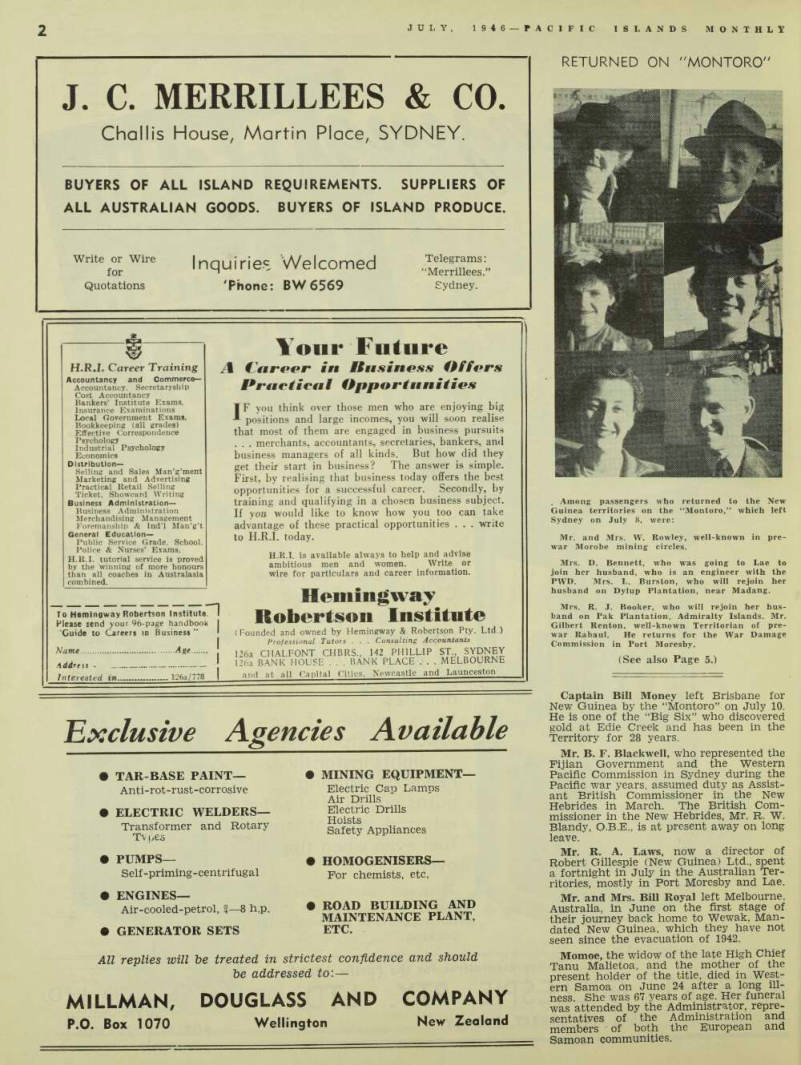
, Among passengers who returned to the New Guinea territories on the “Montoro,” which left Sydney on July 8, were: Mr. and Mrs. W. Rowley, well-known in pre war Morobe mining circles.
Mrs. D. Bennett, who was going to Lae to join her husband, who is an engineer with the PWD. Mrs. L. Burston, who will rejoin her husband on Dylup Plantation, near Madang.
Mrs. R. J. Booker, who will rejoin her hus band on Pak Plantation, Admiralty Islands. Mr.
Gilbert Renton, well-known Territorian of pre war Rabaul. He returns for the War Damage Commission in Port Moresby.
(See also Page 5.)
"Montoro" Passengers
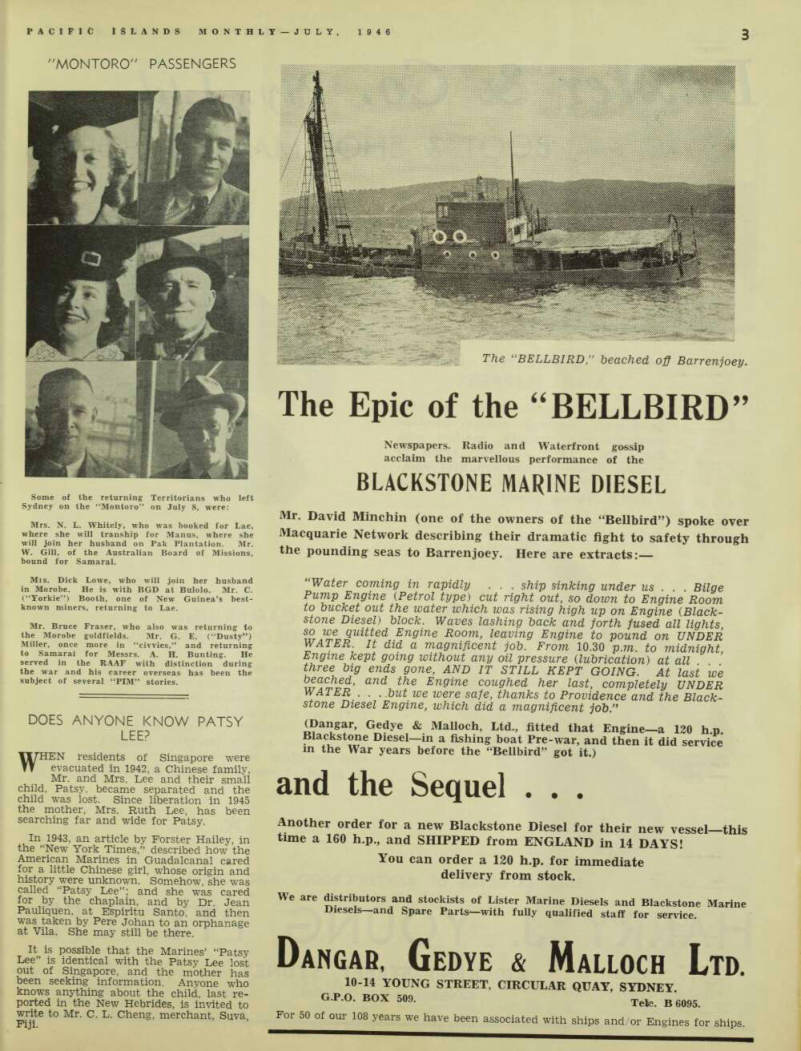
Some of the returning Territorians who left Sydney on the “Montoro” on July 8, were: Mrs. N. L. Whitely, who was booked for Lae, where she will tranship for Manus, where she will join her husband on Pak Plantation. Mr.
W. Gill, of the Australian Board of Missions, bound for Samarai.
Mis. Dick Lowe, who will join her husband in Morobe. He is with BCD at Bulolo. Mr. C. (“Yorkie”) Booth, one of New Guinea’s best known miners, returning to Lae.
Mr. Bruce Fraser, who also was returning to the Morobe goldfields. Mr. G. E. (“Dusty”) Miller, once more in “civvies,” and returning to Samarai for Messrs. A. H. Bunting. He served in the RAAF with distinction during the war and his career overseas has been the subject of several “PIM” stories.
Does Anyone Know Patsy
Lee?
11THEN residents of Singapore were ▼ ▼ evacuated in 1942, a Chinese family, Mr. and Mrs. Lee and their small child, Patsy, became separated and the child was lost. Since liberation in 1945 the mother, Mrs. Ruth Lee, has been searching far and wide for Patsy.
In 1943, an article by Forster Hailey, in the “New York Times,” described how the American Marines in Guadalcanal cared for a little Chinese girl, whose origin and history were unknown. Somehow, she was called “Patsy Lee”; and she was cared for by the chaplain, and by Dr. Jean Pauhquen, at Espiritu Santo, and then was taken by Pere Johan to an orphanage at Vila. She may still be there.
It is possible that the Marines’ “Patsy Lee” is identical with the Patsy Lee lost out of Singapore, and the mother has been seeking information. Anyone who knows anything about the child, last re ported in the New Hebrides, is invited to write to Mr. C. L. Cheng, merchant, Suva, Fiji.
Advertisements & other items, pp. 5-6 (1 item)
Dangab, Gedye & Malloch Ltd.
» ' v. : ; ' • .-' .v w iS JL ''!*'*-*•
mSSS^E^^m
... r**-»- The “BELLBIRD ,” beached off Barrenjoey.
The Epic of the “BELLBIRD”
Newspapers. Radio and Waterfront gossip acclaim the marvellous performance of the
BLACKSTONE MARINE DIESEL
Mr. David Minchin (one of the owners of the “Bellbird”) spoke over Macquarie Network describing their dramatic fight to safety through the pounding seas to Barrenjoey. Here are extracts:— Water coming in ravidly . . . ship sinking under us . . . Bilge Pump Engine {Petrol type) cut right out, so down to Engine Room to bucket out the water which was rising high up on Engine {Blackstone Diesel) block. Waves lashing back and forth fused all lights Q uiited En 9 in e Room, leaving Engine to pound on UNDER WATER It did a magnificent fob. From 10.30 p.m. to midnight Engine kept going without any oil pressure {lubrication) at all three big ends gone, AND IT STILL KEPT GOING. At last we 2™ and the En Q ine coughed her last, completely UNDER WATER ... but we were safe, thanks to Providence and the Blackstone Diesel Engine, which did a magnificent job ” (Dangar, Gedye & Malloch, Ltd., fitted that Engine—a 120 h.n.
Blackstone Diesel—in a fishing boat Pre-war, and then it did service in the War years before the “Bellbird’’ got it.)
and the Sequel
Another order for a new Blackstone Diesel for their new vessel—this time a 160 h.p., and SHIPPED from ENGLAND in 14 DAYS!
You can order a 120 h.p. for immediate delivery from stock.
We are distributors and stockists of Lister Marine Diesels and Blackstone Marine Diesels—and Spare Parts—with fully qualified staff for service.
Dangab, Gedye & Malloch Ltd.
10-14 YOUNG STREET, CIRCULAR QUAY, SYDNEY.
G.P.O. BOX 509. Tele B 6095.
For 50 of our 108 years we have been associated with ships and/or Engines for ships.
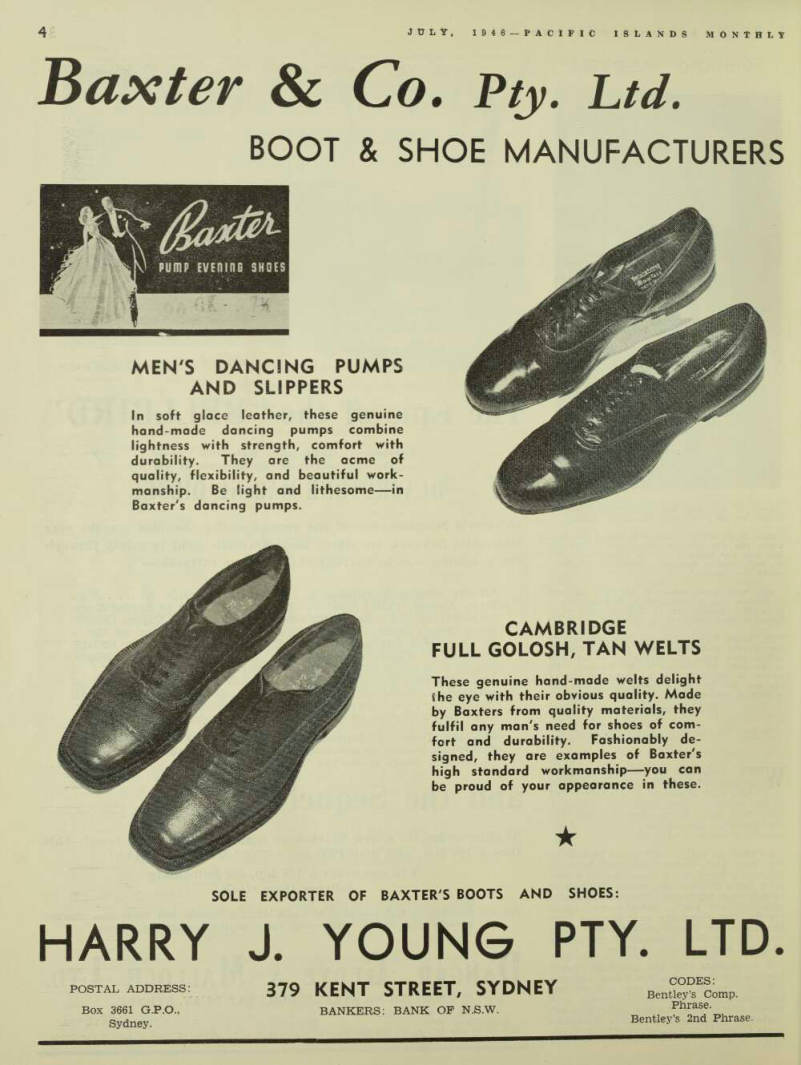
Baxter & Co. Pty. Ltd.
BOOT & SHOE MANUFACTURERS
m I ' JT. i
MEN'S DANCING PUMPS
AND SLIPPERS
In soft glace leather, these genuine hand-made dancing pumps combine lightness with strength, comfort with durability. They are the acme of quality, flexibility, and beautiful workmanship. Be light and lithesome—in Baxter's dancing pumps.
CAMBRIDGE
FULL GOLOSH, TAN WELTS
These genuine hand-made welts delight the eye with their obvious quality. Made by Baxters from quality materials, they fulfil any man's need for shoes of comfort and durability. Fashionably designed, they are examples of Baxter's high standard workmanship—you can be proud of your appearance in these. ★ SOLE EXPORTER OF BAXTER'S BOOTS AND SHOES:
HARRY
POSTAL ADDRESS:
Box 3661 G.P.0., Sydney.
J. YOUNG PTY. LTD.
379 KENT STREET, SYDNEY
BANKERS: BANK OF N.S.W.
CODES:
Bentley’s Comp.
Phrase.
Bentley’s 2nd Phrase.
More "Montoro"
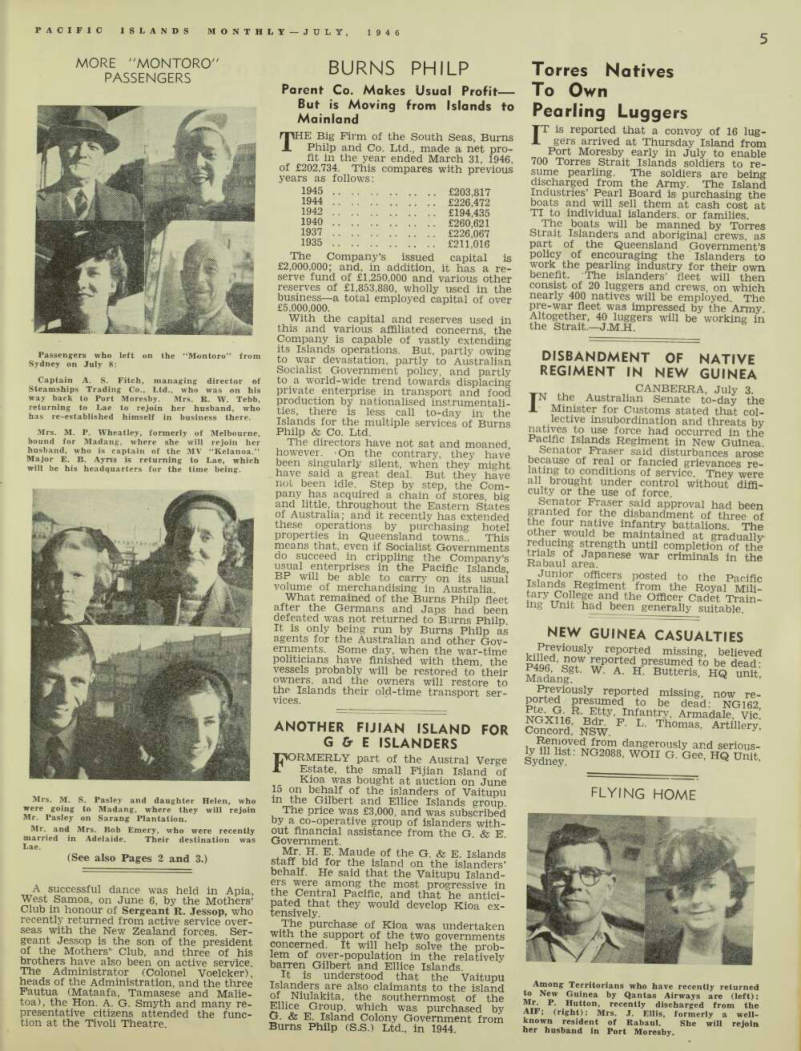
Passengers
A successful dance was held in Apia, West Samoa, on June 6, by the Mothers’
Club in honour of Sergeant R. Jessop, who recently returned from active service over seas with the New Zealand forces. Ser geant Jessop is the son of the president of the Mothers’' Club, and three of his brothers have also been on active service.
The Administrator (Colonel Voelcker), heads of the Administration, and the three Fautua (Mataafa, Tamasese and Malie toa), the Hon. A. G. Smyth and many re presentative citizens attended the func tion at the Tivoli Theatre.
Passengers who left on the “Montoro” from Sydney on July 8: Captain A. S. Fitch, managing director of Steamships Trading Co., Ltd., who was on his way back to Port Moresby. Mrs. R. W. Tebb, returning to Lae to rejoin her husband, who has re-established himself in business there.
Mrs. M. P. Wheatley, formerly of Melbourne, bound for Madang, where she will rejoin her husband, who is captain of the MV “Kelanoa.”
Major E. B. Ayris is returning to Lae, which will be his headquarters for the time being.
Mrs. M. S. Pasley and daughter Helen, who were going to Madang, where they will rejoin Mr. Pasley on Sarang Plantation.
Mr. and Mrs. Bob Emery, who were recently married in Adelaide. Their destination was Lae.
(See also Pages 2 and 3.)
Burns Philp
Parent Co. Makes Usual Profit— But is Moving from Islands to Mainland
rE Big Firm of the South Seas, Burns Philp and Co. Ltd., made a net pro fit in the year ended March 31, 1946, of £202,734. This compares with previous years as follows: 1945 £203,817 1944 £226,472 1942 £194,435 1940 £260,621 1937 £226,067 1935 £211,016 The Company's issued capital is £2,000,000; and, in addition, it has a re serve fund of £1,250,000 and various other reserves of £1,853,880, wholly used in the business—a total employed capital of over £5,000,000.
With the capital and reserves used in this and various affiliated concerns, the Company is capable of vastly extending its Islands operations. But, partly owing to war devastation, partly to Australian Socialist Government policy, and partly to a world-wide trend towards displacing private enterprise in transport and food production by nationalised instrumentali ties, there is less call to-day in the Islands for the multiple services of Burns Philp & Co. Ltd.
The directors have not sat and moaned, however. •On the contrary, they have been singularly silent, when they might have said a great deal. But they have not been idle. Step by step, the Com pany has acquired a chain of stores big and little, throughout the Eastern States of Australia; and it recently has extended these operations by purchasing hotel properties in Queensland towns.. This means that, even if Socialist Governments do succeed in crippling the Company’s usual enterprises in the Pacific Islands, BP will be able to carry on its usual volume of merchandising in Australia What remained of the Burns Philp fleet after the Germans and Japs had been defeated was not returned to Burns Philp It is only being run by Burns Philp as agents for the Australian and other Gov ernments. Some day, when the war-time politicians have finished with them, the vessels probably will be restored to their owners, and the owners will restore to the Islands their old-time transport ser vices.
Another Fijian Island For
G & E Islanders
FORMERLY part of the Austral Verge Estate, the small Fijian Island of Kioa was bought at auction on June lo on behalf of the islanders of Vaitupu in Gilbert and Ellice Islands group.
The price was £3,000, and was subscribed by a co-operative group of islanders with out financial assistance from the G & E Government.
Mr. H. E. Maude of the G. & E. Islands staff bid for the island on the islanders’ behalf. He said that the Vaitupu Island ers were among the most progressive in the Central Pacific, and that he antici pated that they would develop Kioa ex tensively.
The purchase of Kioa was undertaken with the support of the two governments concerned. It will help solve the prob lem of over-population in the relatively barren Gilbert and Ellice Islands It is understood that the Vaitupu Islanders are also claimants to the island of Niulakita, the southernmost of the Ellice Group, which was purchased by G. & E. Island Colony Government from Burns Philp (S.S.) Ltd., in 1944.
Pearling Luggers
Torres Natives To Own Pearling Luggers
ris reported that a convoy of 16 lug gers arrived at Thursday Island from Port Moresby early in July to enable 700 Torres Strait Islands soldiers to re sume pearling. The soldiers are being discharged from the Army. The Island Industries’ Pearl Board is purchasing the boats and will sell them at cash cost at TI to individual islanders, or families.
The boats will be manned by Torres Strait Islanders and aboriginal crews, as part of the Queensland Government’s policy of encouraging the Islanders to work the pearling industry for their own benefit. The islanders’ fleet will then consist of 20 luggers and crews, on which nearly 400 natives will be employed. The pre-war fleet was impressed by the Army.
Altogether, 40 luggers will be working in
the Strait.
J.M.H.
Disbandment Of Native
Regiment In New Guinea
Al Canberra, July 3.
N the Australian Senate to-day the Minister for Customs stated that col lective insubordination and threats by natives to use force had occurred in the Pacific Islands Regiment in New Guinea.
Senator Fraser said disturbances arose because of real or fancied grievances re lating to conditions of service. They were all brought under control without diffi culty or the use of force.
Senator Fraser said approval had been granted for the disbandment of three of the four native infantry battalions. The other would be maintained at gradually reducing strength until completion of the trials of Japanese war criminals in the Rabaul area.
Junior officers posted to the Pacific Islands Regiment from the Royal Mili tary College and the Officer Cadet Train ing Unit had been generally suitable.
New Guinea Casualties
nvS* vioUsly re P orted missing, believed P 496 d ’S« W w PO A te w Pr ?f U ( m ed to be dead: Madan| g ' W ' A ' H ' Buttens ’ HG * uni ‘- Previously reported missing, now re- P?p § re SJ? ied T i° be dead: NGI62, .Infantry, Armadale, Vic.
Concord,' NSW F Thomas ' Artill^-
Flying Home
Among: Territorians who have recently returned to New Guinea by Qantas Airways are (left); Mr. P. Hutton, recently discharged from the AIF; (right): Mrs. J. Ellis, formerly a well known resident of Rabaul. She will rejoin her husband in Port Moresby.
Advertisers
Angliss & Co. ... 33 Aust. Fishing In dustries ... 60 Australian Alu minium ... 34 Atkins Pty., Ltd., Wm 43 Brown & Co., Ltd. 15 Brial & Ball ... 19 Brunton’s Flour . . 34 Burns, Philp Trust Co., Ltd 18 Broomfields ... 62 BP (SS) Co, . . . 15 Berger & Sons, Ltd 57 Carlton & United Breweries, Ltd. . 45 Carpenter, Ltd., W.
R cov. iv.
Chivers & Sons, Ltd 24 Church, R. H., & Sons 27 Coleman Lamp & Stove Co 29 “Cystex” 50 Consolidated Export & Import Group of Australia ... 67 Colonial Wholesale Meat 32 Dalmore Preserving Co 63 Donaghy & Sons . 52 Donald, Ltd., A. B. 52 Dr. Williams Pink Pills 47 Dangar, Gedye & Malloch 3 Dunlop Rubber (A/sia), Ltd. . . 71 Electrolux Refrigerators . . 20 Excelsior Supply Co 74 Eekhoff, H. G. . . 62 Eveready Batteries . 31 Ford Sherington Pty., Ltd 30 Garrett & Davidson 72
Gibson & Cor, Ltd.,
J. A. D 28
Gillespie Pty., Ltd., Robert ... 1, 49 Glanz, A 43 Gilbey’s Gin . . .16 Gillespie’s Flour . . 64 Gough & Co.. E. J. 44 Grand Pacific Hotel 6 Grove & Sons, W.
H 66 Heinz & Co. Pty., Ltd., H. J. . . .47 Hemingway & Robertson ... 2 Hyde. Victor ... 68 Hutchinson & Co., Ltd 60
Ics 46
Ingram Shaving Cream 59 Ipana Tooth Paste 51 Jenkins, Reg. ... 44 Kopsen & Co., Ltd. 53 Ken c h & McCartney ... 55 Lockyer, Geo. J. . 54 Merrillees, J. C., & Co 2 Masschelien, O. F. 27 Miscellaneous, 21, 25, 62 “Mum” Deodorant 67 “Mendaco” ... 22 Mcllraths Pty., Ltd. 50 Millman, Douglas & Co 2 Nelson & Robertson Pty., Ltd 26 Newman, M. . . .54 “Nixoderm” ... 70 Napt 71 • Pacific Islands Trading Co. . . 65 Pacific Islands Monthly ... 56 Pacific Js. Slociety 59 “Pinkettes” ... 61 Proprietary Pro
ducts 17 Papuan Electrical Co 48 Qantas Empire Air ways ... cov. ii.
Queensland Insur ance Co 30 Ransome, Sims & Jeffries 74 Robinson, G. H. . 70 Raymond, Lance, Pty., Ltd 17 Rose’s Eye Lotion, 45, 57 Rohu, Sil 53
Rur 24
Scott, Ltd., J. . .64 Shell Co 21 Southern Pacific Insurance Co. . . 16 Steamships Trading Co., Ltd 66 Shepherd, A. O. . .22 Sullivan & Co., C. 69' Swallow & Ariell . 81
Taylor & Co., A. . 29 “Tenax” Soap . 48 Tillock & Co., Ltd. 27 Thomycroft (Aust.) Pty., Ltd 56 Tooth & Co., Ltd cov. iii.
Toogood, J. J. . . 32 Tullochs Pty., Ltd. 73 Tilley’s Lamps . . 58 “ Vitalis ” Hair Tonic 75 Watson, Wm. H. . 25 Widdop, H., & Co., Ltd 46 A. Willison ... 61 Wills, W. D. & H. 0 23 Wright & Co., Ltd., E 33 Young Pty., Ltd., Harry J 4 Yorkshire Insur ance Co., Ltd. . . 15
Contents
“Montoro” Passengers 2, 3 & 5 Burns Philp & Co. Make Usual Profit 5 Editorial: “The Economic Sun Shines in Some Places in the Pacific” .. 7 Trapping Japs in Bougainville ... 8 Mr. Ward’s Model Village—Denial of Port Moresby Report 9 More Prosperity for Western Samoa 9 New Guinea-Papua now all Civil Government 10 New Guinea “Foreigners” to be Given Limited Naturalisation 11 Showing the Flag—British Submar ines for Central Pacific 11 Nausori or Nadi?—Proposed Aero drome Site 12 NG Labour Policy 13 PTA Holds Last Meeting in Australia 14 Rehabilitated Lae 15 Pensions for NG Widows 17
Tropical Planting Experts for NG .. 18 Planters’ Grievances in French Oceania 19 Australian Government Will Not In quire Into Rabaul 21 Political Jottings from Fiji 24 Australia’s Defence Plan Still Secret 25 NZ Magistrate Investigates Cook Islands Conditions of Employment 26 Birthday Honours 27 French Collaborators Deprived of Their Rights 29 Mr. Osborne in Cook Islands 30 Morris Hedstrom’s Financial Year .. 31 Trocas Market 31 Kauri Timber in Pacific Islands ... 33 Sugar Labourers’ Agreement with
Csr 34
Territories’ Talk-Talk 35 Te Rangi Hiroa—Maori Knight ... 36 Tropicalities 37 Radio and Paper Bombers 39 Short Story : “Lease-Lend Lochinvar” 40 When Fiji Sugar Was Poured From a Jug 41 Jail is out at 4 p.m 42 Memories of the Black Days of 1542 How Japs Came To New Guinea 43 Cargo-Cult 45 Soil Problems in Fiji 47 Tongan Nobles Go To Court 50 Labour Unrest Continues in Cook Islands 52 New Price Control Bill in Fiji ... 53 NG Scholarship Fund 54 Shipping and Plane Services; Pacific Travellers 56 More Investigators for Cook Islands 62 Fair Play for Cocoa Growers 65 Meeting of New Guinea Women’s Club in Sydney 68 Commercial, Markets, etc 72 Index to Volume XVI 75
Advertisements & other items, p. 8 (1 item)
s taV<***
*•5 -i, &<%S? :a
_***■• vUSSSF
fcwSpift tll aie<i w "' aS ut . ** Gra des'S 0 ® 4 ,».»«>;:, „...«"' ””». -■** «•* T > I »»«- “ w« =. *• t:.- ■*?:*** w 4 «- »»i* 9 05
T ese^^
Pacific Islands Monthly
The Newspaper-Magazine of the South Seas [Registered at the G.P.0., Sydney, lor transmission by post as a newspaper .]
Published Once Each Month and Circulated in Australia and New Zealand and in the following Pacific Territories and Islands Groups:
Australian Territory of Papua.
Mandated Territory (Australia) of New Guinea.
Australian Territory of Norfolk Island.
NdW Zealand Territory of Cook Islands.
Mandated Territory (NZ) of Western Samoa.
British Colony of FIJI.
British Solomon Islands Protectorate.
British Protectorate of Tongan Islands.
British Crown Colony of Gilbert and Ellice Islands.
Mandated Territory of Nauru,
British and Free French Condominium of New Hebrides.
Free French Colony of New Caledonia.
Free French Colony of Oceania (Tahiti, etc.).
American Territory of Eastern Samoa.
American Territory of Hawaiian Islands.
Owned and Produced by Pacific Publications Pty. Ltd., Union House, 247 George Street, Sydney.
TELEPHONES f General Office .. .. BW 5037 ( Advertising Office .. .. B 7815
P.O. Box 3408 R
Registered Address for Telegrams, Radiograms, and Cables; ’‘Pacpub”, Sydney.
Contributions.
Articles. Stories, and Photographs dealing with Pacific Islands subjects are invited and will be paid for on publication.
Subscription Rates.
Per Annum, within British Empire, Prepaid, Post Free 10/.
Per Annum, elsewhere, Prepaid, Post Free 12/6 Single Copies 1/.
Editor and Publisher;
R. W Robson, P.R.G.S.
General Office: Union House, 247 George Street, Sydney.
Advertising Manager: W. E. Rogers.
Telephone; BW 5037.
Printing House; 29 Albert Street, Sydney.
Telephone: MA 4369.
Representative In Fiji.
Pacific Publications (Fiji), Ltd., Bank of NSW Building, Suva (same office as W. H. Grove & Sons, Ltd.). Stocks of Pacific Islands Monthly and Pacific Islands Yearbook on hand.
Representative In London.
J. T. Wallis, Coronation House, 4 Lloyds Avenue, London, E.C.3, from whom may be obtained copies of Pacific Islands Monthly, Pacific Is. Year Book, advertising schedules, etc.
Agents.
The following are authorised to receive sub scriptions for Pacific Islands Monthly:— Burns, Philp & Co., Ltd., and Burns Phllp (South Sea) Co., Ltd. All branches.
W. R. Carpenter & Co., Ltd. All branches.
Morris, Hedstrom, Ltd. All branches.
Steamships Trading Co., Papua. All branches.
Whitten Bros., Ltd., Samaral, Papua.
B.N.G. Trading Co., Ltd., Port Moresby, Papua.
J. Muir, Suva, Fiji.
Miss R. Castles, Suva, FIJI.
N. C. Mackenzie Hunt, Walnunu, Bua, FIJI.
Cook Islands Trading Co., Rarotonga, Cook Is.
A. C. Rowland, Papeete, Tahiti.
Islands Branches and Representatives of W. H.
Grove & Sons, Ltd., Auckland, New Zealand!
Ed. Pentecost. Noumea, New Caledonia.
Societe Gubbay Kerr et Cle, Noumea, N. Caledonia.
Vol. XVI. No. 12.
July 19, 1946.
Prirp 1/- Per c°Py rrice Prepaid: 10/- p.a.
Tmr rtroconf
The Economic Sun is Shining in SOME Parts of the Pacific
niL present economic conditions in Western Samoa described elsewhere in this issue give a true picture of the opportunities that exist now, whereby Territories of the South Pacific may quickly enjoy post- W w p r ospenty western Samoa is selling copra at around £25 per ton, f.0.b., and cocoabeans at nearly £lOO per ton. Everythmg that can be produced in the Jr’acmc Islands to-day is in keen de- Western al ? n ? with other Pacific Terrifmm S ’ 18 much benefit there- S fr.. o bamoa to-day is them coin nnn has a reserve of more Now Wn A . T TprHtAHo C n 6 Aus trahan Pacific nolitios one ‘ ey ! d tn can do thPv bnH i f Uni fi e - which if vlppq nnH - T 1!? 1 own of S fvfp na i^ Unr f Stncted ope ration pcnnnmips IaWS u f na . tlo ? ial mounHnp r H be f4 Joy f n S the^splvp<;^nn?«?ifn/ t frp^ ( fv, eX ps riCatl^
burdPni £ - the A nancial
thP wnr mposed by the evasion and It is tnip that iqao
economip wiJi L the
turps ’ Panifc? ?£ lltl w 1 s i r ? c : Territorv nf wpw a r^iJ? B Mandated Dieted ior re T COm ’ nese Lmf in- S; T£ e Japa ' toown niit p ’ n f 2vLJ hB , y Y er ?
Xt Ld been g built up g by Eurola 0 n settlers in the orevious sf) vps been destroyed The losses suffprpd by planters and y p amers ana traders, missionaries
and miners, shipowners and officials, were enormous.
But the people of those Territories were not completely unfortunate.
Australia, fearing invasion, accumu lated a War Damage Compensation Fund of £14,000,000. Australia did not suffer invasion, and practically the whole of that money was made avail able for the compensation of the Territories people who had suffered war damage between 1942 and 1945.
WHEN the war ended in September, 1945, the position in New Guinea and Papua was this: Damage and loss estimated at about £12,000,000 had been suffered in the Territories: but the whole of that sum was available, if required, in the Australian War Damage Compensation Fund. Lined up in Australia, literally dancing with impatience to return, were thousands of displaced Territorians, eager to work and to restore the productive ness of their plantations, mines and trading posts. Throughout the world there existed (and exists) not only a market, but a clamant demand for everything that Papua and New Guinea can produce—and especially copra, cocoa, rubber and gold.
It seemed that nothing could pre vent Papua and New Guinea from entering a trade boom which would do much to compensate those people for their great losses and sufferings during 1942-45.
But what happened? The two Territories found themselves in the grip of a fanatical regime, controlled
by political tub-thumpers and directed by economic-theorists; and both Ter ritories to-day are floundering in a morass of muddle and frustration.
Instead of opening the two Terri tories to individualism and private enterprise, and providing adequate labour and transport, and saying to the experienced and eager Terri torians: “You now have an open go— let us see what you can do for deve lopment and progress,” the Australian Government clamped down upon the Territories a system of rigid control that has partly paralysed private enterprise, handicapped production and is throwing upon the Australian taxpayers a financial burden which Las yet to be seen to be believed.
Following a line of deliberate policy, the Australian Socialist Government has taken charge of all transport be tween the Territories and Australia, and within the Territories them selves; and of all major merchandism S operations, so that the costs of production in New Guinea, and the amounts paid for produce, are fixed by Government officials. This seems to have been part of a plan for ham stringing the big trading companies.
Tb e Australian Government intro duced a native policy which has fieprived the Territories’ industries of l abo m*’ and a shipping policy which Las deprived traders and miners and planters of adequate transport—in fact, under the Government control, the small coastal shipping in the Territories has more or less collapsed. wh ° ( a year a *° foresaw thto great opportunity to restore produc tion in the Territories, and so com pensate themselves for their tragic losses, and were clamouring in Aus
tralia for permission to return, to-day are hesitating and asking each other whether it is worth going north while these appalling political and economic conditions obtain.
MEANWHILE, the Australian Gov ernment, in the manner typical of all Socialist bureaucrats, is. creat ing in the Territories an elaborate administrative machine in which costs appear to receive no considera tion whatever. Departments of Health, Education, Agriculture, Public Works and so forth are being created and staffed regardless of expense.
The principle that there can be no sound economic progress in any tropical Territory unless some re lationship is maintained between expenditure and revenue seems to be entirely ignored in the present set-up.
One gets the impression that any high official who tried to assist and encourage private enterprise would be burned at the stake.
T TNQUESTIONABLY, these Terri tories in the past did suffer the evils of neglect, maladministration and monopoly. Undoubtedly, there was need for reform in several direc tions.
The non-Labour Australian Govern ments of 1920-40 must take as much blame for the present deplorable conditions in Papua and New Guinea as the irresponsible Socialist Adminis tration now in charge. If non-Labour Governments had done their part properly in the Australian Pacific Territories, the present Labour Gov ernment would not have been able to defend its present policies there by insisting that need for drastic reform did exist.
The natives did not get a fair deal under the non-Labour Governments.
The lack of educational and medical facilities for natives was scandalous.
Some of the conditions to which European planters and miners were compelled to submit savoured of monopoly—that is undeniable. A great deal more could have been done to encourage sound pioneering talent in the development of the Territories by private enterprise.
The shrewd politicians of the Labour regime were clever enough to see that this gave them an oppor tunity to defend the introduction of Socialistic instrumentalities, and a revolutionary policy in relation to the natives. By emphasising the errors and shortcomings of non-Labour Governments, they are able to im pose laws and conditions which, in other circumstances, might not have been tolerated by the Australian public.
ALREADY, New Guinea settlers are beginning to feel the economic pinch. They may escape Australian income tax, but they are getting the full blast of indirect taxation.
The Australian consumer of wheaten foods generally pays on a basis of £l2/10/- per ton for flour. That is because the Australian Government insists that wheat shall be sold to the millers at 3/1U per bushel—the dif ference between that and world parity
being made up by Governmental sub sidy. But flour and wheaten products for Papua and New Guinea cost £25 per ton—the miller, in making flour, etc., for export, must pay 9/1U for his wheat. The Australian pays about 2/- per packet for his tea; the Terri torian, nearly twice that figure. The same system applies to soaps and various other articles in common use.
For all such purposes, the Australian Pacific Territories are foreign soil.
The Australian Government fixes the price which planters shall be paid for their copra and rubber; fixes the freights which shall be charged for the carriage of their supplies; decides whether or not they shall have labour; decides whether they shall travel.
So far, only the planters have felt directly the cold breeze of practical Socialism. The fortunes which they fondly believed they were going to make out of world demand for their produce are fading into thin air. The Australian Government, through the Production Control Board, is getting a lion’s share of the high prices— and that, probably, will be frittered away on muddled transport and extravagant administration.
The goldminers perhaps will be luckier. Their industry, lacking machinery, labour and transport, still awaits rehabilitation. Months must elapse before gold in any sub stantial quantity will begin to come out of the Territories. By then, per haps, some change may have come over the Australian political set-up.
The Territories know, now, that they can expect nothing from Aus tralian Labour. But can they expect anything better from Australian non- Labour? On past records, they can not. And the Opposition leaders, although the general election is only a few weeks away, have given no indication that they have any kind of policy in relation to Territories administration.
Fiji, Samoa, French Oceania, Tonga, Cook Islands, New Caledonia—all are doing very well, and are encouraged by the rising sun of economic activity.
Perhaps they can spare a thought for unhappy, war-battered Solomons and harassed, hag-ridden New Guinea.
Sir Maynard Hedstrom
INABILITY to obtain, before these pages went to press, certain blocks required for illustration, compelled us to hold over, until August publication of the ar ticle describing the life and career of Sir Maynard Hedstrom. of Fiji (to which re ference is made elsewhere in this issue).
Sir Maynard has announced his early re tirement from the managing directorship of his group of companies.
The Lever family hope soon to be un ited again in Papua. Mr. Tom Leyer in pre-war davs was for some years con nected with the Steamships Trading Company. Evacuated from Port Moresby to Brisbane early in 1942, Mrs. Leyer ouickly made her services available in whatever canacitv required. She was em ployed on the outside staff of the AMP. and was also associated with the Royal Navy and Dutch forces. Young Bevan Leyer hopes to engage in mechanical
engineering.—J.H.
Military Cross
Trapping Japs In
Bougainville
Planter R. Stuart Gets Military Cross
LAST month, the Australian Army authorities announced the bestowal of the Military Cross upon Mr. R.
Stuart, who has been a resident of New Guinea since 1925, and who established Tenakau Plantation, on the east coast of Bougainville, four or five miles south of Numa Numa.
After escaping from Bougainville in 1942, Mr. Stuart joined up with the Aus tralian Navy, and did Intelligence work in the Solomons, but he later returned with the Americans to Bougainville; and in that island he rendered really dis tinguished service.
It was Mr. Stu art, for example, who put the fol lowing plan into operation: He would locate a party of Japs in the jungle. Then, secretly, he would take natives to two points, one on either side of the Japs and only a few hundred yards apart. He would give the natives distinctive markers, like a flag or a sheet, and send them
to the tops of the trees, where they would spread out the markers.
Then he would radio to the Allied forces, the approximate position of the markers. Within a short time, our bombers would come over and, in a few minutes, bombs would be falling right upon the camp, which the Japs had fondly imagined was hidden by the jungle.
The point of this procedure was that the jungle which screened the camp from the fliers, also hid the marked tree-tops from the Japs. It was a long time be fore the enemy discovered how the Allied bombers located his camps with such deadly accuracy. . ...
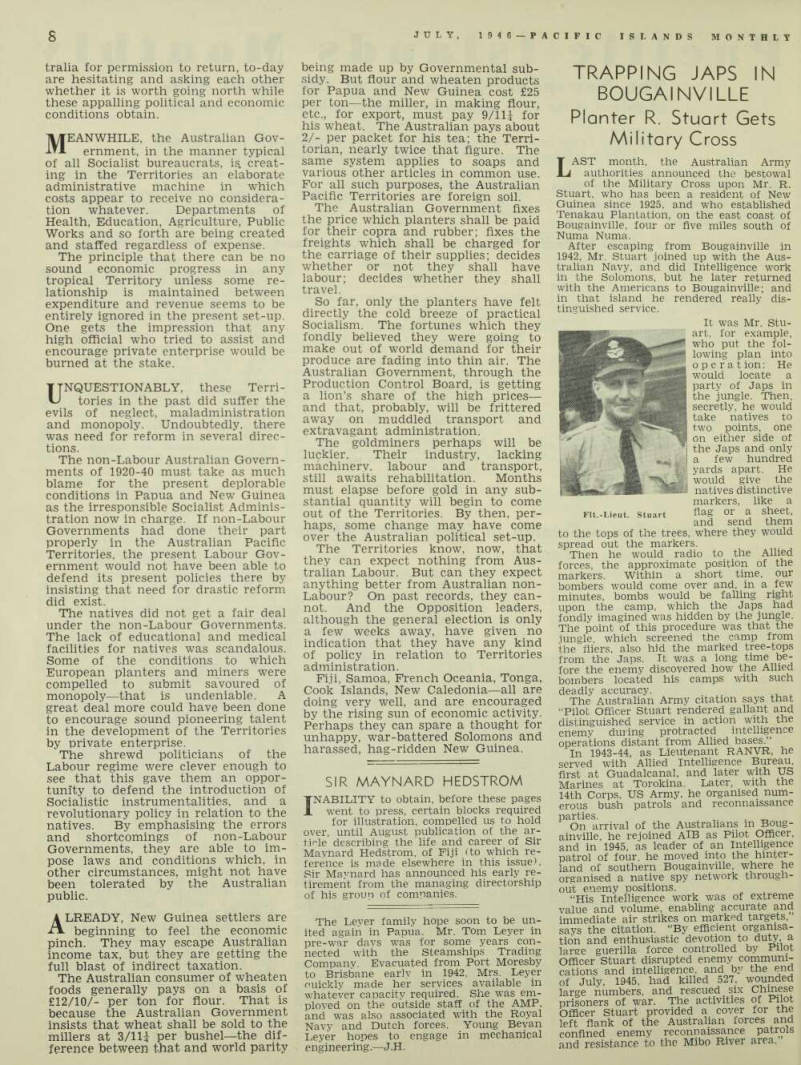
The Australian Army citation says that “Pilot Officer Stuart rendered gallant and distinguished service in action with the enemy during protracted intelligence operations distant from Allied bases.”
In 1943-44, as Lieutenant RANVR, he served with Allied Intelligence Bureau, first at Guadalcanal, and later with US Marines at Torokina. Later, with the 14th Corps, US Army, he organised num erous bush patrols and reconnaissance parties. On arrival of the Australians in Boug ainville, he rejoined AlB as Pilot Officer, and in 1945, as leader of an Intelligence patrol of four, he moved into the hinter land of southern Bougainville, where he organised a native spy network through out enemy nositions.
“His Intelligence work was of extreme value and volume, enabling accurate and immediate air strikes on marked targets, says the citation. “By efficient organisa tion and enthusiastic devotion to duty, a large guerilla force controlled by Pilot Officer Stuart disrupted enemy communi cations and intelligence, and by the end of July, 1945, had killed 527, wounded large numbers, and rescued six Chinese prisoners of war. The activities of Pilot Officer Stuart provided a cover for the left flank of the Australian forces and confined enemy reconnaissance patrols and resistance to the Mibo River area.
Fit.-Lieut. Stuart
Report'
Mr. Ward's Model
Village
Denial of P. Moresby Report'
rE Australian Minister for Territories has been making heavy weather of his model village for Papuans.. He announced in June, with complacency, that the village would cost £llB,OOO and that it would be equipped with modern amenities, such as electric light and sanitation.
There was laughter and criticism in the South Pacific.
Australians cursed. Thousands and tens of thousands of Australians, as a result of Socialist muddling in recent years, are living in hovels, without any amenities whatever.
Territorians jeered. They know what the average Papuan native will do with a “model village,” and they can name a score of directions in which £llB,OOO could be better spent.
The natives were unenthusiastic. They prefer to build their own houses, in ac cordance with their own wishes.
Mr. Ward and the “PIM”
ACCORDING to Hansard, the following incident occurred as soon as Parlia ment met: Mr. Beazley: I ask the Minister for External Territories whether, as the “Pacific Islands Monthly” has stated, £llB,OOO is to be expended on the erection of a native village in Papua. If so, what purpose will the village serve?
Mr. Ward: If the “Pacific Islands Monthly” has stated a fact, it has done so for the first time. The Department of External Territories has decided to expend £llB,OOO on the con struction of a native village in close proximity to Port Moresby. The Government was obliged to rehabilitate these natives, who had been dis turbed by military operation. Their old villages were destroyed, and we thought that, while we were on the job, we would do it well, and give them a model village. rE next development was the appear ance, in leading Australian dailies, of the following report, dated June 15, from a Port Moresby correspondent of the “PIM.” (It arrived just too late for the June “PIM." and was accordingly handed over to the Australian news papers.) A meeting of natives, representing all the councils and villages along the south Papuan coast, from Manumanu to Kera puna, was held here recently, at the Port Moresby village of Hanuabada. It was decided to send to Mr. Ward, the Aus tralian Minister for External Territories, by radio, a request that the present Ad ministrator be sent away immediately, and that “Young” Murray (the former Civil Administrator, Mr. Leonard Mur ray, as distinct from his uncle, the late Sir Hubert Murray) be sent back to Papua.
In addition, the meeting sent to Mr.
Ward, by air-mail, no less than 15 resolu tions. These include a denunciation of the Minister’s plan for building a model village here at a cost of £llB,OOO.
The natives say they prefer to build their own homes, so that they may own them themselves; whereas, if the Govern ment builds them, they will be owned by the Government, and the natives will be subject to all sorts of rules and regula tions.
It is believed that the meeting decided that if their requests are not met, all the natives employed bv the Administration in Port Moresby will go out on strike.
Discussion in Parliament OUR Canberra correspondent then re ported as follows, under date June 26: A “Pacific Islands Monthly” report from
Papua was discussed in the House of Representatives here to-day.
The report suggested that natives at Port Moresby might go on strike unless the Minister for External Territories (Mr.
Ward) agreed to certain requests made by them.
Mr. Ward was obviously worried and in the House this morning a “Dorothy Dix” brought the report into the limelight and thereby he was able to dispel some of the dark clouds. (A “Dorothy Dix” is the name given to the practice in Parlia ment of having a Government back bench member raise an issue to which a Minister has an already prepared answer.) Mr. Chambers (Lab., SA) per formed the useful function, in this case. He asked Mr. Ward if the “PIM” report were accurate.
Mr. Ward replied: “There is no truth in the report that certain demands were submitted to me by New Guinea- natives.
I had inquiries made into the matter.
The natives, however, have been greatly perturbed because they had some know ledge of a speech made by the Leader of the Opposition (Mr. Menzies) about the possibility of a change of Govern ment.”
Here, Mr. Menzies interjected: “Is it true that they call you brother?”
Mr. Ward ignored this and went on: “When the natives heard that there might be a change of Government, they decided to cease work. When I assured them that there was no possible danger that this Government would be disturbed, they decided to carry on.”
Radiogram From Port Moresby EVIDENTLY, Mr. Ward “assured” them to good purpose, because the next de velopment occurred on July 3, when Mr. Ward read to the Australian Parlia ment the following radiogram which he had received from Port Moresby.
“Have been requested to send you the following message: ‘Minister Ward, Mini ster of External Territories—Hanuabada people request definitely and happy look ing toward your beginning their village soon. Last night people said some pre war white people trying spoil our village construction. People do not want return old fashion Government—people want new Government to stay. (Signed), Gav era Arua, chairman village council; Rarua Tau, for Hanuabada village councillors.’ ”
Mr. Ward could not have had a more satisfactory message if he had referred the “PIM” report to Port Moresby and asked to have it “killed” by the bright lads of Hanuabada. But, of course, Mr.
Ward would not do a thing like that.
Accuracy of Reports THE foregoing details are published for general information.
We have no reason to question the good faith and accuracy of the Port Moresby correspondent who sent up the original report.
We have every reason to treat with sus picion the statements of any professional politician who is embarrassed by hostile criticism of his actions.
This month, the “PIM” concludes 16 years of continuous publication. Never, in that period, have we knowingly given pub licity to a lie, or deliberately distorted a fact. All that is published in this journal is published in the sincere belief that it is true.
Considerable damage was done to the Papeete wharves and harbour installa tions when the disastrous tidal waves of April 1 reached Tahiti. Hundreds of tons of cement are needed to repair the damage, but so far the French Govern ment has been able to purchase only 10 tons in New Zealand.
W. Samoa
More Prosperity For
Territory Free of Debt and Has Quarter Million Reserve
APIA, June 24.
WESTERN SAMOA still sails along on the wave of prosperity which began with the American invasion of 1942 and which does not look like abating for some time. Figures released recently show that revenue for the last financial year under review was £59,838 more than offi cial estimates.
Savings Bank deposits increased in the same period by £52.900.
Prospects for 1946/47 are even better: copra and cocoa prices have risen lately and new industries are going into opera tion.
Greatest surpluses came from the De partment of Health (where almost £B,OOO from sales of liquor under medical per mits swelled the coffers), Justice, Postal and Radio, Public Works, Treasury and Customs, The public debt which had been whittled down to £9.244 in April, 1944, has now disappeared altogether, and the Ter ritory is now not only self-supporting, but debt-free. Accumulated reserves in 1945 were over £260,000.
Copra and Cocoa Rise
THE Administration has announced that following an increased export price offered by the British Ministry of Food for the whole of the Samoan pro duction, arrangements have been made with copra merchants from June 17. to pay from 14/- to 14/6 (according to dis trict) per 100 lb. for native copra. The Government is paying merchants at the rate of £2B/10 - per ton after that date all stock on hand being taken over at the old price of £22/10/-. (The currency is New Zealand—which is of practically the same value as Australian.) First result of this rise is that Samoans all over the Territory are now cutting copra—an enterprise favoured by the sunny, dry weather we are having at pre sent.
Cocoa beans are selling from £9O to £lOO per ton according to grade, FOB Apia. In some instances, European plant ers who have sold cocoa on consignment have realised considerably better prices than this for their product.
The “Waihemo” recently left here for Auckland with 800 tons of copra and 35 tons of cocoa beans—total cargo worth £20,000; the “Parkdale Park” sailed for Vancouver on June 26 with 2,000 tons of copra (worth over £40,000).
Again!
Fiji Copra Up
SUVA, July 5. rE British Ministry of Food has ad vanced the price of Fiji copra by £5/6/- per ton, Fijian currency. This is the result of representations made to the Ministry by the Governor of Fiji (Sir Alexander Grantham).
The Fiji Copra Board has announced therefore, that the local buying price in Suva and Levuka will be £23/10/6 for plantation grade copra, and £23/5/- for FMS grade. These price increases will take effect at once.
This price is still a long way from the price quoted in Sydeny last month in re spect of Ceylon copra. It was stated at that time that the British Government had concluded an agreement with Ceylon for the purchase of copra at £37/10/- (Aust.) for the current year.
Government
New Guinea-Papua Now All Civil
Military Rule in Eastern New Britain and New Ireland Ended on June 24
IT was officially announced on June 24 that, with the transfer that day of administrative control of the Rabaul and Kokopo Sub-District of New Britain from the Australian Military Forces to the Provisional Administration of the Territory of Papua-New Guinea, the restoration of civil administration to the whole
of the Territories of Papua and New Guinea was now complete, Military control operated throughout both Territories from February 11, 1942, when civil administration was suspended as a result of the Japanese invasion, The Provisional Administration resumed control of the Territory of Papua and the
portion of the Territory of New Guinea south of the Markham River on October 30, 1945. That control was extended to the remainder of the mainland of New Guinea on February 28, 1946.
The island Districts of Manus and Kieta (Bougainville) were taken over dur ing May, followed earlier in June by the western part of the District of New Britain.
THE Australian Minister for External Territories said the effect of years of war could not be overcome in a few months, but already considerable progress had been made by the Provisional Ad ministration, which was faced at the out set with a situation which included the disruption of the European and native economies, and widespread destruction of towns, villages and plantations.
A comprehensive programme was be ing followed for the rehabilitation and development of the Territories, having re gard to the moral and material welfare of the native inhabitants, and the strategic importance of the area to Australia, The Administration had been authorised to acquire equipment and installations from the Services to assist in the work of reconstruction; and missionaries, plant ers, miners and others were being per mitted to return in increasing numbers.
Formal Ceremonies as Australian
Army Departs From Rabaul
A CERTAIN amount of ceremony was observed in Rabaul when, on June 24, the Military Administration in New Guinea was formally terminated, and the whole of the remainder of the Terri tory (eastern end of New Britain, New Ireland, Manus and Bougainville) was re stored to civil administration.
A small military force, based on Rabaul, remains in the Territory, to take care of the few Japanese prisoners still there, and to clean up generally. But, for all prac tical purposes, the two Territories of Papua and New Guinea now are under the government of the Provisional Ad ministration, directed by the Administra tor, Colonel J. K. Murray.
The Provisional Administration of Papua-New Guinea is supposed to end on December 31, 1946—by which time it is assumed, UNO will have decided the fate of the various mandated territories taken over from the League of Nations, and it will be possible to plan the future administration of what is now the Man dated Territory of New Guinea. Until then, no one can say whether Papua and New Guinea can be administered P. er “ manently as one area.. They are being so administered now, but that is because the authority for the Provisional Gov ernment is derived from National Secur ity laws, which transcend all other laws, but which will end on December 31, or thereabouts. , ,v, O .
Present indications, however are that UNO will not have got around to the dis posal of the Mandated Territories byJ3e cember 31. . In that event and assmnmg the National Security law has expired the future administration of Papua and New Guinea will supply the constitutional ex perts with a headache. Presumably, there will be only one thing to do—revert, tem porarily, to separate and more or less in dependent administrations for Papua and New Guinea. That will create even more confusion and delay.
The Secretary of the Australian Depart ment of External Territories, Mr. J. R.
Halliaan ioined the Provisional Admini strator in Port Moresby in mid-June; and both Army and Civil Administrations were ronresented bv high officials in Rabaul or P June 24. when the final transfer took place.
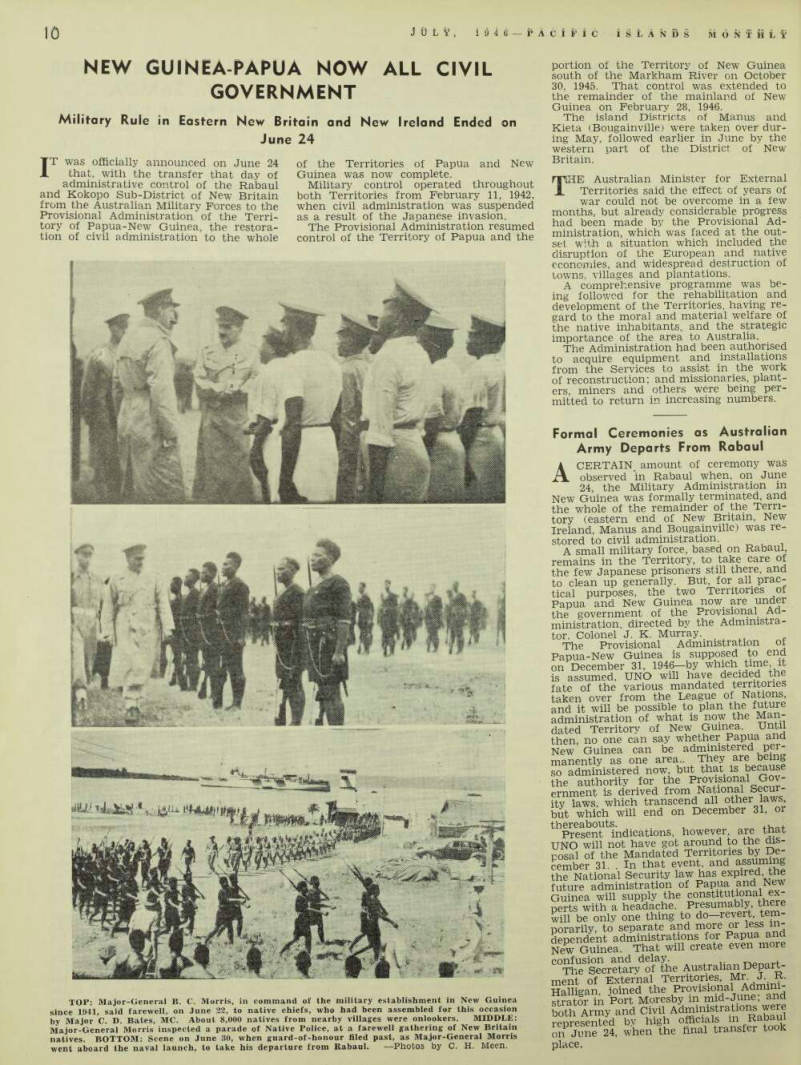
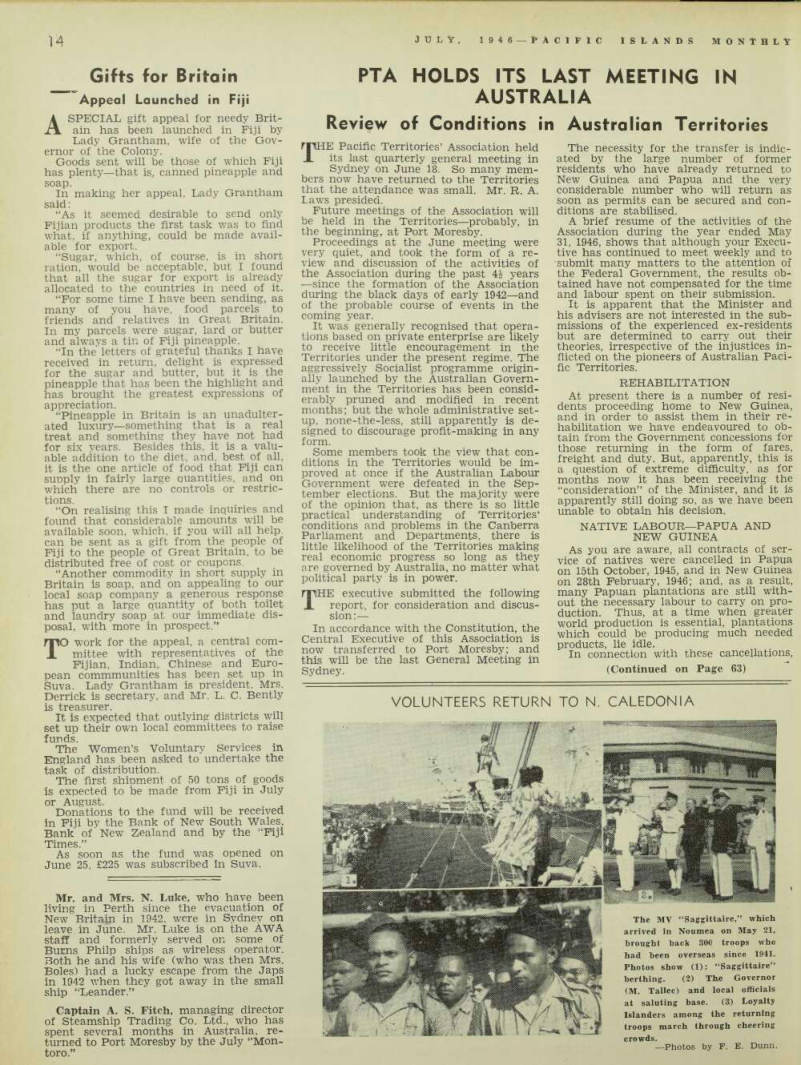
TOF: Major-General B. C. Morris, in command of the military establishment in New Guinea since 1941, said farewell, on June 22, to native chiefs, who had been assembled for this occasion by Major C. D. Bates, MC. About 8,000 natives from nearby villages were onlookers. MIDDLE: Major-General Morris inspected a parade of Native Police, at a farewell gathering of New Britain natives. BOTTOM: Scene on June 30, when guard-of-honour filed past, as Major-General Morris went aboard the naval launch, to take his departure from Rabaul. — Photos by C. H. Meen.
Limited Naturalisation
New Guinea's "Foreigners" To Be Given
From Our Own Correspondent
Canberra, July 4.
FOREIGNERS who have lived for some time in New Guinea soon will be able to apply for naturalisation papers. , . .
The Australian Parliament is about to pass a Bill to extend the Nationality Act to cover residence in the Territory. This means that foreign planters and mission aries. some of whom had lived in the Territory for 30 years and more, will be able to apply for naturalisation. This certificate, however, will apply only so long as the subject continues to live m the Australian Commonwealth or its ter ritories, and will not, for instance, apply in any other part of the Empire.
The Minister said: “This will not be the Government’s last word on the sub ject. It is proposed to hold a conference of United Kingdom and Dominions’ repre sentatives in the near future, to discuss nationality questions. It is intended to raise, at that conference, the question of making provision that residence in New Guinea shall be regarded as a qualifica tion for the grant of a Certificate of Naturalisation effective not only in Aus tralia and its territories, but throughout the whole British Commonwealth.”
The Minister said the only way a foreign resident of New Guinea could now qualify for naturalisation was to abandon his domicile in the Territory and come to Australia for five years. People cov ered by this Bill were mostly missionaries and planters, and had mostly given 28 or 30 years of their lives to New Guinea, and are still ineligible for British nation ality.
Replying to Mr. T. W. White, the Mini ster said it was true that there might be Nazis among foreigners in New Guinea.
But Nazis would not be granted naturali sation.
Mr. White: “Are you sure of that?”
Mr. Calwell: “Of course I’m sure. I’m the Minister.”
The Minister said all applications would have to be approved by the Security Police before being granted by the Immigration Department. That was why naturalisation would not be granted Nazis, or others not likely to observe Australia’s laws. Al though the Bill would technically apply to Asiatics, it was Australia’s policy not to grant naturalisation to people not pre dominantlv of European extraction. Nine ty per cent, of those who would benefit from this legislation would be entitled to benefit.
Tahiti Copra
Large Cargoes Now Go to France
From Our Own Correspondent
Papeete, June 1.
ALL copra produced in French Oceania, is now destined for export to France.
A ship which arrived in May via Noumea took on a large cargo of copra for transport to France, by way of Pan ama.
A number of Europeans—who have been eagerly waiting for an opportunity to get to the States—took passage on this ship to Panama, where they hope to be able to find transportation to either the East or West Coast of the USA.
The “Sagittaire,” on its return voyage from Noumea, will lift another cargo of copra for France.
Later, French ships—at approximately monthly intervals—will call at Papeete for copra cargoes.
As from June 25, the status of the Chinese Vice-Consulate in Apia, Western Samoa, has been raised to the status of full Consulate. Mr. C. H. Cheng has been appointed Consul. He is the only diplo matic representative in Western Samoa.
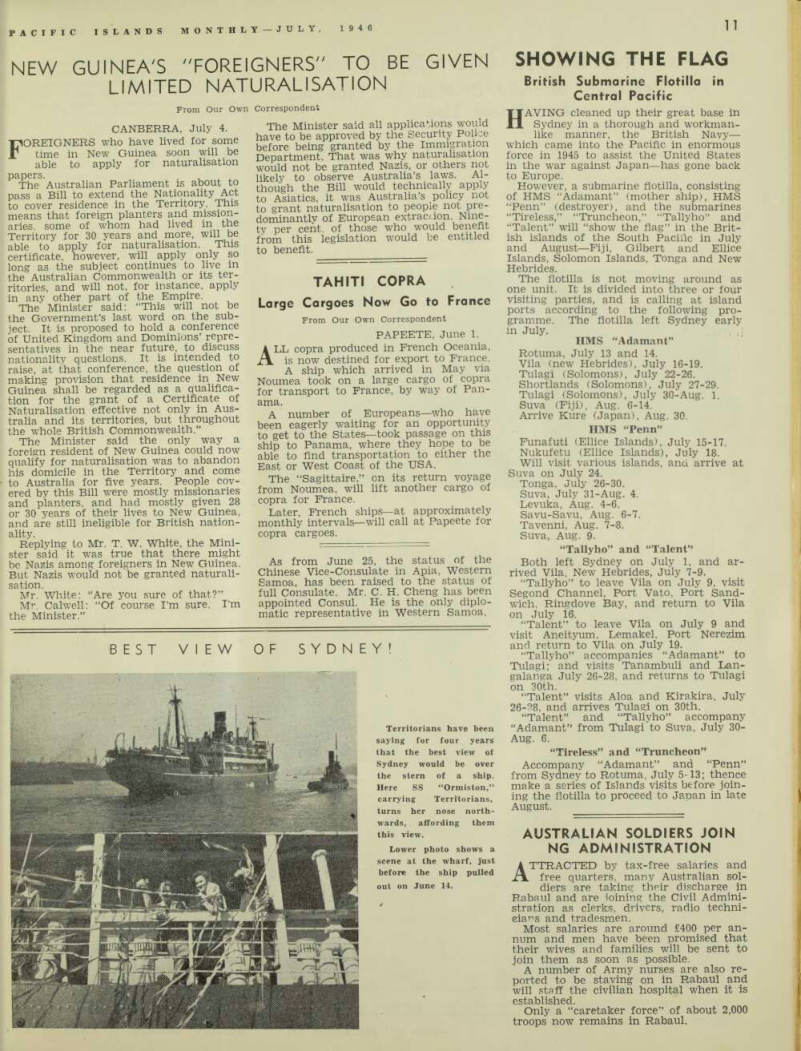
Best View Of Sydney!
Territorians have been saying for four years that the best view of Sydney would be over the stern of a ship.
Here SS “Ormiston,” carrying Territorians, turns her nose north wards, affording them this view.
Lower photo shows a scene at the wharf, just before the ship pulled out on June 14.
Showing The Flag
British Submarine Flotilla in Central Pacific
HAVING cleaned up their great base in Sydney in a thorough and workman like manner, the British Navy— which came into the Pacific in enormous force in 1945 to assist the United States in the war against Japan—has gone back to Europe.
However, a submarine flotilla, consisting of HMS “Adamant” (mother ship), HMS “Penn” (destroyer), and the submarines “Tireless,” “Truncheon,” “Tallyho” and “Talent” will “show the flag” in the Brit ish islands of the South Paciflc in July and August—Fiji, Gilbert and Ellice Islands, Solomon Islands, Tonga and New Hebrides.
The flotilla is not moving around as one unit. It is divided into three or four visiting parties, and is calling at island ports according to the following pro gramme. The flotilla left Sydney early in July.
HMS “Adamant”
Rotuma, July 13 and 14.
Vila (new Hebrides), July 16-19.
Tulagi (Solomons), July 22-26.
Shortlands (Solomons), July 27-29.
Tulagi (Solomons), July 30-Aug. 1.
Suva (Fiji), Aug. 6-14.
Arrive Kure (Japan), Aug. 30.
HMS “Penn”
Funafuti (Ellice Islands), July 15-17.
Nukufetu (Ellice Islands), July 18.
Will visit various islands, and arrive at Suva on July 24.
Tonga, July 26-30.
Suva, July 31-Aug. 4.
Levuka, Aug. 4-6.
Savu-Savu, Aug. 6-7.
Tavenni, Aug. 7-S.
Suva, Aug. 9.
“Tallyho” and “Talent”
Both left Sydney on July 1, and ar rived Vila, New Hebrides, July 7-9.
“Tallyho” to leave Vila on July 9, visit Segond Channel, Port Vato, Port Sand wich, Ringdove Bay, and return to Vila on July 16.
“Talent” to leave Vila on July 9 and visit Aneityum, Lemakel. Port Nerezim and return to Vila on July 19.
“Tallyho” accompanies “Adamant” to Tulagi; and visits Tanambuli and Lan galanga July 26-28, and returns to Tulagi on 30th.
“Talent” visits Aloa and Kirakira, July 26-28, and arrives Tulagi on 30th.
“Talent” and “Tallyho” accompany “Adamant” from Tulagi to Suva, July 30- Aug. 6.
“Tireless” and “Truncheon”
Accompany “Adamant” and “Penn” from Sydney to Rotuma, July 5-13; thence make a series of Islands visits before join ing the flotilla to proceed to Japan in late August.
Australian Soldiers Join
Ng Administration
ATTRACTED by tax-free salaries and free quarters, many Australian sol diers are taking their discharge in Rabaul and are ioining the Civil Admini stration as clerks, drivers, radio techni cians and tradesmen.
Most salaries are around £4OO per an num and men have been promised that their wives and families will be sent to join them as soon as possible.
A number of Army nurses are also re ported to be staving on in Rabaul and will staff the civilian hospital when it is established.
Only a “caretaker force” of about 2,000 troops now remains in Rabaul.
Nausori Or Nadi ?
Fiji Residents Sharply Divided on Proposed Aerodrome Site
SUVA, June 20.
BITTER controversy, confined mainly to Suva and Lautoka, is literally raging here as to where the international airport should be. The prin- Cipel protagonist is Mr. C. A. Adams, of Lautoka, energetic businessman and the cha rman of his Town Board. Complete with a vigorous Lautoka and Nadi chorus he is not unnaturally urging that the present Nadi aerodrome “is the best and safest in the Pacific.”
The Suva Chamber of Commerce (who would find it hard to agree with Mr.
Adams “that the Nausori site, even if a huge sum is spent on it, will still be dangerous for several months of the year”), started the ball rolling when they recently sent a deputation to the Govern ment, led by Mr. Clive Brewster, who was recently a Wing Commander in the RA AF. The Chamber’s choice was Nausori.
The reason for this delightful furore
is no doubt that Suva businessmen want through-air-passengers to spend their money in Suva, while Lautoka traders, with just as shrewd an eye to the im portance of turnover, would prefer to make such sales themselves.
There have been letters printed in the local paper (from Lautoka), letters re ceived by the local paper but not pub lished (from Lautoka), a protest meet ing which 200 to 250 attended (at Lautoka), and a circular to Suva resi dents —also from Lautoka.
The issue is clearly of considerable im portance and it is good that such public interest has been shown. But while the debate proceeds, and remarkable and parochial claims are made for each site, the decision is being made elsewhere than in Fiji.
Meanwhile almost all planes continue to touch down at Nausori
Editorial Note
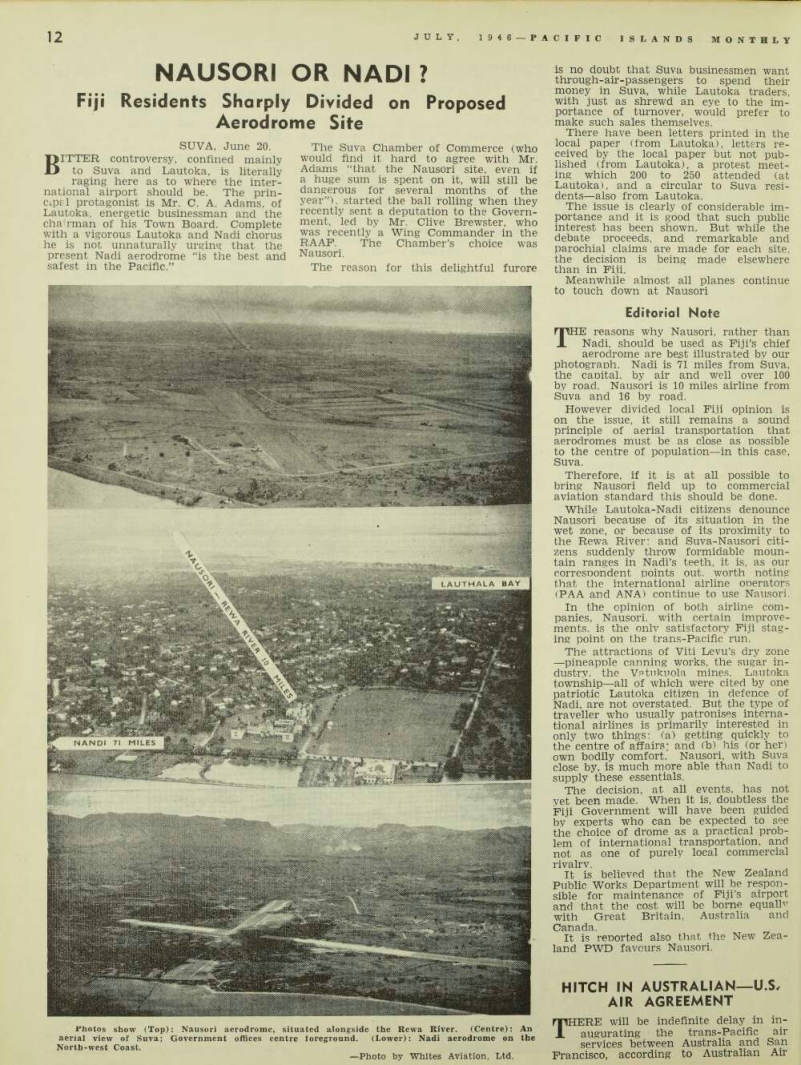
THE reasons why Nausori, rather than Nadi, should be used as Fiji’s chief aerodrome are best illustrated by our photograph. Nadi is 71 miles from Suva, the capital, by air and well over 100 by road. Nausori is 10 miles airline from Suva and 16 by road.
However divided local Fiji opinion is on the issue, it still remains a sound principle of aerial transportation that aerodromes must be as close as possible to the centre of population—in this case, Suva.
Therefore, if it is at all possible to bring Nausori field up to commercial aviation standard this should be done.
While Lautoka-Nadi citizens denounce Nausori because of its situation in the wet zone, or because of its proximity to the Rewa River: and Suva-Nausori citi zens suddenly throw formidable moun tain ranges in Nadi’s teeth, it is, as our correspondent points out. worth noting that the international airline operators (PAA and ANA) continue to use Nausori.
In the opinion of both airline com panies, Nausori. with certain improve ments. is the onlv satisfactory Fiji stag ing point on the trans-Pacific run.
The attractions of Viti Levu’s dry zone —pineapple canning works, the sugar in dustry. the Vatukuola mines. Lautoka township—all of which were cited by one patriotic Lautoka citizen in defence of Nadi, are not overstated. But the type of traveller who usually patronises interna tional airlines is primarily interested in only two things: (a) getting quickly to the centre of affairs; and (b) his (or her) own bodily comfort. Nausori, with Suva close by, is much more able than Nadi to supply these essentials.
The decision, at all events, has not yet been made. When it is, doubtless the Fiji Government will have been guided by experts who can be expected to see the choice of drome as a practical prob lem of international transportation, and not as one of purely local commercial rivalrv.
It is believed that the New Zealand Public Works Department will be respon sible for maintenance of Fiji’s airport and that the cost will be borne equally with Great Britain, Australia and Canada.
It is reported also that the New Zea land PWD favours Nausori.
Photos show (Top): Nausori aerodrome, situated alongside the Rewa River. (Centre): An aerial view of Suva; Government offices centre foreground. (Lower): Nadi aerodrome on the North-west Coast. —Photo by Whites Aviation, Ltd.
Hitch In Australian —U.S.
Air Agreement
rERE will be indefinite delay in in augurating the trans-Pacific air services between Australia and San Francisco, according to Australian Air
Minister Drakeford, who returned to Australia at the end of June.
No multi-lateral air agreements had emerged from the Montreal conference whch began in May, and which Mr.
Drakeford attended.
He said that the Pan American ser vice was operating from San Francisco to Auckland on agreements made before the war; as far as he knew, Panair had not been licensed since the war to operate a service from the United States end.
Reciprocal landing rights were still be ing negotiated. The stumbling block ap pears to be the American monopoly of air traffic between San Francisco and Honolulu.
Bcpa Ltd.
IN the meantime the British Common wealth Pacific Airlines (the Austra lian, New Zealand and British Gov ernments) has been registered in Australia as a company. The following appeared in the “Weekly Trade Report” of July 5.
British Commonwealth Pacific Air
LINES. LIMITEr>—Reg. 24/6/46. Capital: £1,000,000 in 1,000 shares of £I,OOO each. Ob jects: To establish and operate air services, etc.
Subscribers: Arthur W. Coles, Leonard M. Isitt, Albert C. Joyce, James G. Barclay, Alexander D. S. Murray, William Taylor and William C.
Taylor (one share each). Reg. office: 44 Martin Place, Sydney.
Air Services
RNZAF to Run Pacific Air Services At Reasonable Fares
BEST news for South Pacific travellers is the recent announcement that the New Zealand Air Force will operate an interim air service to Fiji, Tonga, Samoa and the Cooks until such time as New Zealand National Airways Corpora tion (the New Zealand Government) takes over.
Three separate runs will be made out of Auckland, at first by Dakota land planes, and when they have been over hauled, Sunderland flying-boats. The first run will provide a fortnightly ser vice to Rarotonga with calls at Norfolk Island, Fiji, American Samoa, Western Samoa, Aitutaki and Rarotonga. The plane leaves Whenuapai (Auckland) every second Monday and finally reaches Rarotonga the following Saturday. The return flight commences the following Wednesday.
The second service will operate to Western Samoa, leaving Auckland every second Monday and reaches Faleolo field (outside Apia) the following Friday.
The third service is a weekly run to Fiji—the flight being direct and accom plished in a little over eight hours. At present the Fiji terminal is Nausori.
When the Sunderlands are in full opera tion the terminal will be at Laucala Bay, near Suva.
Fares are another delightful surprise.
They are not cheap, but they are much cheaper than those travellers have learned to expect from trans-Pacific hops.
They are calculated on actual direct mileage—and not on a round trip basis.
Thus the fare from Auckland to Tonga is £22/10/-, although several stops are made between those two points and the former RNZAF fare to Rarotonga of £66 has been reduced to £34, although the same round about route is followed as previously.
Fares to the various places serviced by the interim network are (approximately) Auckland-Norfolk island, £9/10/-- Auck
land-Suva, £2B/10/-; Auckland-Noumea, £25; Auckland-Tonga, £22/10/-; Auck land-Apia, £32/10/-; Auckland-Pago Pago, £32; Auckland-Rarotonga, £34.
Travellers who are used to the luxury of international airliners would be foolish to expect the same standard from the service Dakota. However, the seating accommodation is being altered in the Sunderlands and when conversion is complete in these flying-boats passengers may be a'sured of reasonable comfort.
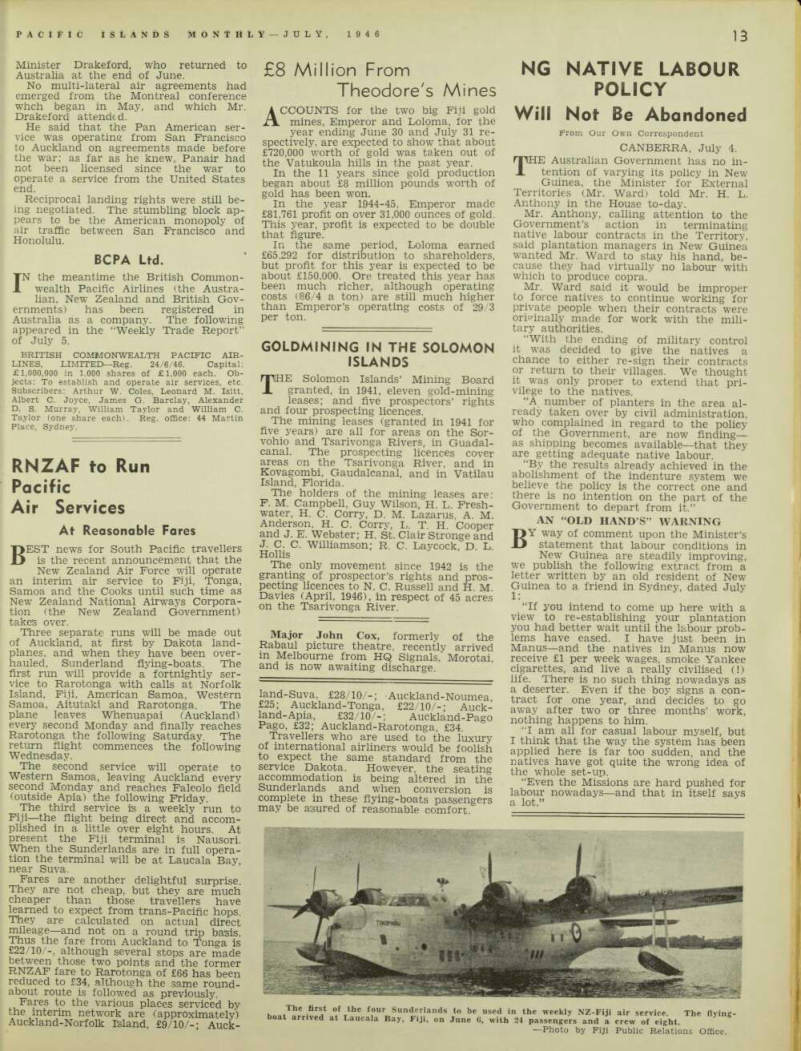
The first of the four Sunderlands to be used in the weekly NZ-Fiji air service. The flying boat arrived at Laucala Bay, Fiji, on June 6, with 24 passengers and a crew of eight. —Photo by Fiji Public Relations Office.
£8 Million From Theodore's Mines
Theodore's Mines
ACCOUNTS for the two big Fiji gold mines, Emperor and Loloma, for the year ending June 30 and July 31 re spectively, are expected to show that about £720,000 worth of gold was taken out of the Vatukoula hills in the past year.
In the 11 years since gold production began about £8 million pounds worth of gold has been won.
In the year 1944-45. Emperor made £81,761 profit on over 31,000 ounces of gold.
This year, profit is expected to be double that figure.
In the same period, Loloma earned £65,292 for distribution to shareholders, but profit for this year is expected to be about £150,000. Ore treated this year has been much richer, although operating costs (iB6/4 a ton) are still much higher than Emperor’s operating costs of 29/3 per ton.
Goldmining In The Solomon
Islands
rE Solomon Islands’ Mining Board granted, in 1941, eleven gold-mining leases; and five prospectors’ rights and four prospecting licences.
The mining leases (granted in 1941 for five years) are all for areas on the Sor vohio and Tsarivonga Rivers, in Guadal canal. The prospecting licences cover areas on the Tsarivonga River, and in Kovagombi, Gaudalcanal, and in Vatilau Island, Florida.
The holders of the mining leases are: F. M. Campbell, Guy Wilson, H. L. Fresh water, H. C. Corry, D. M. Lazarus, A. M.
Anderson. H. C. Corry, L. T. H. Cooper and J. E. Webster; H. St. Clair Stronge and J. C. C. Williamson; R. C. Laycock, D. L.
Hollis The only movement since 1942 is the granting of prospector’s rights and pros pecting licences to N. C. Russell and H. M.
Davies (April, 1946), in respect of 45 acres on the Tsarivonga River.
Major John Cox, formerly of the Rabaul picture theatre, recently arrived in Melbourne from HQ Signals, Morotai, and is now awaiting discharge.
Ng Native Labour
Policy
Will Not Be Abandoned
From Our Own Correspondent
Canberra, July 4.
THE Australian Government has no in tention of varying its policy in New Guinea, the Minister for External Territories (Mr. Ward) told Mr. H. L.
Anthony in the House to-day.
Mr. Anthony, calling attention to the Government’s action in terminating native labour contracts in the Territory, said plantation managers in New Guinea wanted Mr. Ward to stay his hand, be cause they had virtually no labour with which to produce copra.
Mr. Ward said it would be improper to force natives to continue working for private people when their contracts were originally made for work with the mili tary authorities.
“With the ending of military control it was decided to give the natives a chance to either re-sign their contracts or return to their villages. We thought it was only proper to extend that pri vilege to the natives.
“A number of planters in the area al ready taken over by civil administration, who complained in regard to the policy of the Government, are now finding— as shipping becomes available—that they are getting adequate native labour.
“By the results already achieved in the abolishment of the indenture system we believe the policy is the correct one and there is no intention on the part of the Government to depart from it.’’
An “Old Hand’S” Warning
BY way of comment upon the Minister’s statement that labour conditions in New Guinea are steadily improving, we publish the following extract from a letter written by an old resident of New Guinea to a friend in Sydney, dated July “If you intend to come up here with a view to re-establishing your plantation you had better wait until the labour prob lems have eased. I have just been in Manus—and the natives in Manus now receive £1 per week wages, smoke Yankee cigarettes, and live a really civilised (!) life. There is no such thing nowadays as a deserter. Even if the boy signs a con tract for one year, and decides to go away after two or three months’ work, nothing happens to him.
“I am all for casual labour myself, but I think that the way the system has been applied here is far too sudden, and the natives have got quite the wrong idea of the whole set-up.
“Even the Missions are hard pushed for labour nowadays—and that in itself says a lot.”
Gifts for Britain
Appeal Launched in Fiji
A SPECIAL gift appeal for needy Brit ain has been launched in Fiji by Lady Grantham, wife of the Gov ernor of the Colony.
Goods sent will be those of which Fiji has plenty—that is, canned pineapple and soap.
In making her appeal, Lady Grantham said: “As it seemed desirable to send only Fijian products the first task was to find what, if anything, could be made avail able for export.
“Sugar, which, of course, is in short ration, would be acceptable, but I found that all the sugar for export is already allocated to the countries in need of it.
“For some time I have been sending, as many of you have, food parcels to friends and relatives in Great Britain.
In my parcels were sugar, lard or butter and always a tin of Fiji pineapple.
“In the letters of grateful thanks I have received in return, delight is expressed for the sugar and butter, but it is the pineapple that has been the highlight and has brought the greatest expressions of appreciation.
“Pineapple in Britain is an unadulter ated luxury—something that is a real treat and something they have not had for six years. Besides this, it is a valu able addition to the diet, and. best of all, it is the one article of food that Fiji can supply in fairly large quantities, and on which there are no controls or restric tions.
“On realising this I made inquiries and found that considerable amounts will be available soon, which, if you will all help, can be sent as a gift from the people of Fiji to the people of Great Britain, to be distributed free of cost or coupons.
“Another commodity in short supply in Britain is soap, and on appealing to our local soap company a generous response has put a large quantity of both toilet and laundry soap at our immediate dis posal, with more in prospect.” mo work for the appeal, a central com- JL mittee with representatives of the Fijian, Indian, Chinese and Euro pean commmunities has been set up in Suva. Lady Grantham is president. Mrs.
Derrick is secretary, and Mr. L. C. Bently Is treasurer It is expected that outlying districts will set up their own local committees to raise funds.
The Women’s Voluntary Services in England has been asked to undertake the task of distribution.
The first shipment of 50 tons of goods is expected to be made from Fiji in July or August.
Donations to the fund will be received in Fiji by the Bank of New South Wales, Bank of New Zealand and by the “Fiji Times.”
As soon as the fund was opened on June 25, £225 was subscribed in Suva.
Mr. and Mrs. N. Luke, who have been living in Perth since the evacuation of New Britain in 1942, were in Sydney on leave in June. Mr. Luke is on the AwA staff and formerly served on some of Burns Philp ships as wireless operator.
Both he and his wife (who was then Mrs.
Boles) had a lucky escape from the Japs In 1942 when they got away in the small ship “Leander.”
Captain A. S. Fitch, managing director of Steamship Trading Co. Ltd., who has spent several months in Australia, re turned to Port Moresby by the July “Mon toro.”
Pta Holds Its Last Meeting In
Australia
Review of Conditions in Australian Territories
rE Pacific Territories’ Association held its last quarterly general meeting in Sydney on June 18. So many members now have returned to the Territories that the attendance was small. Mr. R. A.
Laws presided.
Future meetings of the Association will be held in the Territories—probably, in the beginning, at Port Moresby.
Proceedings at the June meeting were very quiet, and took the form of a review and discussion of the activities of the Association during the past 4 h years —since the formation of the Association during the black days of early 1942—and of the probable course of events in the coming year.
It was generally recognised that operations based on private enterprise are likely to receive little encouragement in the Territories under the present regime. The aggressively Socialist programme originally launched by the Australian Government in the Territories has been considerably pruned and modified in recent months; but the whole administrative setup, none-the-less, still apparently is designed to discourage profit-making in any f o p m & j Some members took the view that conditions in the Territories would be improved at once if the Australian Labour Government were defeated in the September elections. But the majority were of the opinion that, as there is so little practical understanding of Territories’ conditions and problems in the Canberra Parliament and Departments, there is little likelihood of the Territories making real economic progress so long as they are governed by Australia, no matter what political party is in power.
THE executive submitted the following report, for consideration and discus-
sion-_l
in accordance with the Constitution, the Central Executive of this Association is SS? an b S e e the d last SM°Sg&g“£ Sydney.
The necessity for the transfer is indic ated by the large number of former residents who have already returned to New Guinea and Papua and the very considerable number who will return as soon as permits can be secured and con ditions are stabilised, A brief resume of the activities of the Association during the year ended May 31, 1946, shows that although your Execu tive has continued to meet weekly and to submit many matters to the attention of the Federal Government, the results ob tained have not compensated for the time and labour spent on their submission, It is apparent that the Minister and his advisers are not interested in the sub missions of the experienced ex-residents but are determined to carry out their theories, irrespective of the injustices in flicted on the pioneers of Australian Paci fic Territories, ■rtttta'rtt ttattotj _, Tft •1' , present there is a number of resi dents proceeding home to New Guinea, 9 rc * er to assist them in their re habilitation we have endeavoured to ob tain f rom the Government concessions for those returmng in the form of fares freight and duty. But, apparently, this is a Question of extreme difiiculty as for months now it has been receiving the consideration of the Minister and it is apparently still doing so as we have been unable to obtain his decision,
Native Labour—Papua And
New Guinea
As you are aware> all contracts of ser vice 0 f natives were cancelled in Papua on 15th October, 1945, and in New Guinea on 28th February, 1946; and, as a result, many Papuan plantations are still with °ut the necessary labour to carry on pro duction. Thus, at a time when greater be producing mucn needed In conWtlon wlth these
(Continued on Page 63)
your executive approached the Minister regarding a refund to the planters of the value of the unexpired portion of the con tracts; and we are now, after many months of waiting, advised that no refund will be made in this connection. No reasons for the decision are given.
War Damage Commission
As usual, your executive can report that in all our submissions to the Commission we have received every consideration and help.
The magnitude of the work of the Com mission must be remembered when small difficulties are encountered.
The basis for payment in respect of trees destroyed has been arrived at, and in this connection we advise members that in regard to coconut palms the values vary from 2/3 to 18/- per palm, depending on the production in the area concerned.
One aspect of War Damage Insurance which still awaits finalisation is the posi tion of the Custodian in regard to pro perties over which he holds a charge.
Your executive has continually endeav oured to obtain some clarification of the position; but, to date, nothing definite has been advised. This position naturally affects the firms who have charging agreements over properties, as until such time as the Custodian declares his policy the firms are unable to define their atti tude. This matter must be left in the hands of the Sydney executive for further action.
In regard to war damage claims not yet assessed, the Commission has signified its willingness to consider applications for ad vances, to allow the insured going ahead with his or her rehabilitation.
Legal Opinions
During the year your executive obtained the opinion of Mr. Weston, K.C.. regard ing the restrictions on trading with the natives, imposed by the Department of External Territories, and in this connec tion the opinion clearly stated that such restrictions were illegal. It is noted that since obtaining this opinion the re strictions complained of have been re moved, and traders are now at liberty to trade with the native population as heretofore, but under supervision of Gov ernment officials.
The legality of the Provisional Admini stration Act was at one time in question, but assurances from reliable source that the Act was legal were received, and your executive therefore took no further action in this regard.
Social
The formal surrender of Japan in Aug ust, 1945, was celebrated by a party at the Paddington Town Hall on August 22. 1945, organised by the combined New Guinea Associations. Over 600 persons attended, and it was undoubtedly the most success ful and enjoyable gathering of Territor ians held in Sydnev.
On February 22, 1946, your executive organised a “Get-Together” Harbour Trip and although the number present was small compared with the previous trip, a most enjoyable night was spent.
During the year under review, continued efforts have been made to form a New Guinea Club in Sydney but, unfortun ately, the lack of suitable accommodation has hampered all our efforts.
Trust Fund
. Your execu tive during the year took the initiative m the proposal to form a Trust Fund, similar to Legacy, to assist the re latives of those New Guinea civilians who lost their lives as a result of the Japanese invasion.
Unfortunately, the support considered
necessary for the success of this project was not forthcoming and your executive therefore regretfully abandoned the idea.
General
There are naturally many ether mat ters which your executive have dealt with during the year and which have been re ported on in the quarterly reports.
Now that the time has arrived for the transfer of the main activities to New Guinea, your executive desires to stress the necessity for the Association to con tinue as a live and strong body. It is con sidered that the next six months will be of immense importance to the future of the Territories and their European and native inhabitants.
The present Provisional Administration which is without doubt purely the mouth piece of the Minister for External Terri tories, will, it is understood, cease to func tion at December 31, 1946, and we must then be properly organised in order to re present to the Administration that Legis lative and Executive Councils should be set up to advise the Government.
It is particularly necessary that those appointed to the Legislative Council be re presentative of the different sections of the community.
It is, therefore, to be hoped that the Association which has carried on through out the years of exile in Australia will continue to function even more strongly on its establishment in the Territories.
Volunteers Return To N. Caledonia
The MV “Saggittaire,” which arrived in Noumea on May 21, brought back 300 troops who had been overseas since 1941.
Photos show (1); “Saggittaire” berthing. (2) The Governor (M. Tallec) and local officials at saluting base. (3) Loyalty Islanders among the returning troops march through cheering crowds. —Photos by F. E. Dunn.
Lae Is Busy!
Preparations for a New Town on the Hill :: Lorry Transport For the Goldfields
From a Travelling Correspondent
Port Moresby, July 2.
I MADE a visit to Lae recently, and noted much activity. It is now the natural administrative and distribut ing centre of the western part of the mandated area.
Lae now is beginning to “dig its toes in”; and all the settlers I have met as sure me they are “going to give it a good go”—which I think is characteristic of old times. Many have returned hopeful; others are not so hopeful.
Native servants are coming forward, as their old masters return. One employer told me he “had nine boys come along to make paper,” but he could not employ them, because it is almost impossible to secure anything at the stores.
Lae is suffering from a shortage of beer, spirits and tobacco, though of late some American cigarettes have appeared on the shelves of some stores—at £1 per carton.
Lorries rush about the place all day, and one wonders what their mission must be. Many natives have purchased War Disposals lorries and wagons but, as soon as the “salvaged” benzine runs out, and they cannot obtain “spares,” we shall see lorries parked in numerous villages throughout the District. Then again the old “wheel-wheel” will come into its own.
The Public Works Department seems to be doing a good job, as far as they are able —tor natives do not seem keen to work for the Government —no doubt this is due to the fact that it has (or did have in their eyes) some association with the Army.
The many miles of military roads made by the Americans and Australians are now badly needing repair. But, with the labour available, those responsible are do ing a good job.
The Administration Offices are situated in a wonderful spot, commanding a view of the Huon Gulf, far beyond Salamaua Mr. May and Matron Thorburn are doing a fine job at the European Hospital, which is also “up on the Hill.” The hill is known to the natives as “Namulula,” after the Administrator’s former residence on the hill in Rabaul, regarded as the “seat of Government.”
The Army (American) put in a won derful water supply for the town of Lae.
By gravitation, water is supplied to ship ping and for domestic use. But lam told that this is to be “scrapped,” due to the cost of running the system. Consequently no more buildings with galvanised roofs are to be sold—they are to be “reserved”
for Government use. The settlers are to go back to rainwater catchment —which seems a pity, in view of the present in stallation, which is giving every satis faction.
The Department of Public Health is opening up drains —a most difficult job, due to the fact that the whole of Lae practically was “levelled off” by bulldozers.
Many of the survey marks were thus ob literated.
Several old settlers are cleaning up blocks with a view to rebuilding.
“Scotty” McEwen is about to erect a model bakery at Lae, on the former site of Greenwood and Laws. A bread depot is already in operation at Lae, which does away with a trip of some 12 miles, to purchase bread.
Jeeps, which are everywhere, are known as “hot,” because they will all be called in. under some Lease-Lend arrangement yet to be propounded.
Mr. Mick Leahy and his Carrying Com pany are doing a fine job on the Labu- Wau Road, carting machinery and neces sities to people “on top,” at the goldfields.
Lorries, fully loaded, are ferried across to Labu, beyond the mouth of the Markham, on a landing barge.
No buildings will be erected in Lae un til the report of the Town Planning Com mitee has been made known, as a re orientation of the township is antici pated. This suggests that Australia is not going to “drop” the place—at least, for the time being.
I must thank many of the “old hands”
for information received, and I look for ward to another visit to Lae in the near future.
Mrs. Tuckey has resigned her post as housekeeper at the European hospital, since the sad loss of her only remaining son. Everyone expresses their sympathy with this well-known identity of New Guinea. Mrs. Edie Gray is on her way to take up the position—so we shall have yet another “old hand” back with us.
Quite a few of the old residents from these parts who were engaged in Port Moresby have developed itchy feet, and have returned here. Mrs. Frost is one— she is now managing the mess for the Morobe Transport Co.
GRADUALLY, people are returning to the “town” area. The bridge that connects us with the outlying dis trict, where several of the Government Departments are situated, is due to col lapse any day now, and this would iso late Lae from the scattered population on the other side. Formerlv, it was a 10miles trip in and out, to buy a loaf of bread. To-day, bread is obtainable in Lae. The Burns Philps freezer—or rather, the portion still standing—has been “ticking over,” and it is rumoured we will soon have fresh meat “when the ‘Mon
toro’ comes in”—that is, if the Commos down your way feel like loading it!
Everyone here remarks on how lucky they were to “get out of Aussie” when they did. Even the new hands feel that way about it, so your industrial and living conditions must be pretty bad.
The Morobe Bakery has started to erect its new premises on the site in Lae form erly occupied by Greenwood and Laws.
The Labu-Wau Road is a busy place these days as the Bulolo Dredging Co. and New Guinea Goldfields are “getting a go on.” Each arriving plane brings a few of the old hands, who land with a smile of satisfaction on their faces. Who wouldn’t, these days!
There was an exchange of messages be tween the Prime Minister (Mr. Chifley) and the Governor of New Caledonia (M.
Tallec) on the occasion of the return to Noumea of the Caledonian volunteers who fought overseas with the Free French Pacific Battalion. The French Minister in Canberra (M. Auge) also sent Noumea a radiogram saluting the returned men, a number of whom participated in the Sydney Victory March in June.
Advertisements & other items, pp. 17-18 (1 item)
Burns Philp
THE
YORKSHIRE
INSURANCE
CO. LTD.
(Incorporated in England)
FIRE
ACCIDENT
MARINE
FIRE POLICIES ISSUED
IN PAPUA
All information from —
E. A. JAMES.
TcL 86347. Attorney for Papua, 14 Spring; St., Sydney.
BURNS PHILP
(SOUTH SEA) CO. LTD.
Inc. In Fiji Island Traders and Shipowners Registered Office :
SUVA
FIJI
\\ Also Branches at: Fiji: Levuka, Lautoka, Labasa, Ba, Sigatoka, Rotuma.
Tonga: Nukualofa, Haapai, Vavau.
Samoa: Apia, Pago Pago (American Samoa).
Solomons: Makambo, Gizo, Faisi.
New Hebrides: Vila Code Address: Gilberts: Tarawa.
“Burnsouth k . Norfolk Is. Niue. Wallis Is. Futuna Is.
Sole Australian Concessionaries :
GEORGE BROWN & CO. PTY. LTD.
267 Clarence Street, Sydney.
The Ultimate factory has made the change-over from its wartime set-up.
Designs for the new models are now completed and production is to commence.
These models should be available early in 1946—they will be well worth waiting for. Watch for further announcements.
SERVICE: Servicing of all kinds of radio sets, amplifiers and Rola speakers will continue to be available.
C\U C
SPECIALISING
IN
PACIFIC ISLAND INSURANCES
FIRE MOTOR VEHICLE
MARINE HULLS AND CARGO
EMPLOYER’S LIABILITY
GUARANTEES including those for—
DYNAMITE PERMITS.
RECRUITERS’ LICENCES.
DEFERRED WAGES
AND ALL OTHER CLASSES ARRANGED
AT LOWEST CURRENT RATES.
Established Agencies:
W. R. CARPENTER & CO., LTD.
Throughout the Territory of New Guinea.
SOUTHERN PACIFIC INSURANCE
CO., LTD.
HEAD OFFICE: 60 HUNTER STREET.
SYDNEY.
“Pont lay ..
Sc
★ LIQUEURS * COCKTAILS •* WHISKIES
Address all enquiries to:
W. Cr A. GILBEY LTD.,
33 ROSSLYN STREET, WEST MELBOURNE.
Telegraphic and Cable Address: "Gilbey's," Melbourne.
109 REGENT STREET, SYDNEY.
Telegraphic and Cable Address: "Gilbey's," Sydney.
Bride From New Guinea
A wedding of New Guinea interest took place on June 1, at St. James Church, King Street, Sydney, when the Rev. Davidson officiated at the marriage of Joan Allan, elder daughter of Mr, and Mrs. Jack Allan, of “Gilalum” Plan tation, Rabaul, New Britain, to Me. Arthur Wheeler, younger son of Mr. and Mrs. Ray Wheeler, of “Burnham Grove,” Camden.
The bride was given away by her father.
Bridesmaids were Marjorie Allan, only sister of the bride, and Lola Wheeler, sister of the bridegroom.. Mr, Frank Wheeler was best man, and Mr. Colin Dengate (ex POW, Malaya), groomsman. Miss Audrey Groube, a friend of the bride, sang Handel’s “Where E’er You Walk” during the signing of the register.
The reception was held at Max Shepherds, where over 80 guests were received by the bride’s mother.
Photograph shows the bridal party leaving St. James.
Rabaul Civilians
Pensions for Dependants of Lost Rabaul Civilians
Canberra, July 4.
rE Government was considering ex tending new repatriation benefits to dependents of New Guinea civilians who lost their lives when the Jap prison ship “Montevideo Maru” was sunk in 1942, it was stated to-day by Mr. Ward, Australian Minister for External Terri tories, in reply to Mr. Anthony.
Mr. Ward said the dependents were at present being paid pensions equivalent to those paid to dependents of Army priv ates killed in action.
Later the Government was asked whether those benefits would be made re trospective to the date when the Govern ment first decided to pay the benefits.
The Miniser for Repatriation: That is being investigated. I think these people will be paid from the date the Govern ment decided to give the pensions.
Pacific Islands Trade With
NZ
From Our Own Correspondent TRADE between New Zealand and the South Pacific Island groups during 1945 is indicated by the following figures recently published in the Dominion.
Except in the case of Fiji, the balance of trade has been greatly in New Zealand’s favour.
NZ Exports Imports to into NZ from Western Samoa ... £232,933 £155,039 Tonga 84,597 26,256 Fiji 386,532 529,254
Management
Another Ship Under BP Management
MAYBE there is no romance left in the shipping game; and, according to Mr. James Burns, at the last annual meeting of the Big Firm, little profit. But Burns Philp are still in the transport business, even if it is only as agents for the Commonwealth Shipping Board.
Latest ship to come under their con trol, as operating agents for the CSB, is the brand-new, Australian-built “River Hunter” which sailed on her maiden voy age from Sydney on June 27.
The Government still “directs” the movements of these ships, but BP’s man and manage them. For this they receive a fee of £l,OOO per annum, above expenses, “River Hunter” is about the same size as a Liberty ship—s,ooo tons gross; 2843 nett and with a cargo capacity of 8,000.
Pacific Island residents need not expect to see her, however: she will be used in the Australian coastal trade. Her first job was in Newcastle, where she picked up about 8,000 tons of coal for South Aus tralia. There, at Whyalla, she will take on iron ore for Newcastle.
Burns Philp officers and crew, who man her, and who have been nurtured in the island trade, are reported to be unenthusi astic about the dirty job ahead. “River Hunter” emerged from her trials as a thing of pristine beauty; she is not likely to long remain that way in the coal-iron ore trade.
She is an oil-burner, cruises at 12 knots, but carries no passengers. These “River” class ships were designed to help Britain in the Battle of the Atlantic, but when America started to mass-produce Liberty ships, Australia’s efforts were unnecessary and all her dockyard facilities were divert ed to naval repairs. “River Hunter,”
therefore, took four years to build; the same job could possibly be done in two in peace time.
Rumour has it that if the Australian Government does not go on with a ship ping line of its own, “River Hunter” may eventually be handed over to Burns Philp to replace one of their ships sunk during the war.
Lieut. J. McGregor Dowsett arrived in Melbourne in June on his way to Geelong, after over five years’ war service.
Advertisements & other items, pp. 19-20 (2 items)
17
l*ACi Fic ISLANDS MONTHLY JULY, 1946
lan ray
COMPLEXION PERFECTION
WITH
BEAUTY PREPARATIONS
FOR
DISCRIMINATING WOMEN
WHO DESIRE
ALLURING LOVELINESS
"JUNE WORTH"
is obtainable at all Stores throughout the Islands.
War Restrictions Lifted...
Civilian Stocks Ready
ulaT j
ac- t rn / After years of restricted supplies you once again look forward to getting regular stocks of LANRAY Products. More attrac live in appearance, better material, modern machinery and an extensive advertising cam paign, together make the New Lanray Line a real business booster!
lan ray
METAL PRODUCTS PTY. LTD
MANUFACTURERS OF
LANRAY Kerosene Pressure Stoves and Blow Lamps—Holloware—Light Fittings- Key Blanks—lndustrial Reflectors.
SOLE DISTRIBUTORS:
LANCE RAYMOND Pty. Ltd.
11-19 Hargrave St.. Sydney—Phone FL3132 and at KING HOUSE, Queen St„ Brisbane—LANßAY Distributors, Temple Court, 422 Collins St., Melbourne
Relief from
a major anxiety
Even the most expert and conscientious individual executor is subject to accident, illness and incapacitation.
Continuity of administration and uninterrupted attention to your estate and your beneficiaries are of paramount importance. Both can be positively assured by appointing this Company your sole Executor or as co-Executor with your present appointee. An interesting explanatory booklet will be forwarded on request.
"A HAT
& h Th e
DIRECTORS:
lames Burns.
Joseph Mitchell.
P. T. W. Black.
Lewis Armstrong.
R. J. Nosworthy.
MANAGER: L. S. Parker.
SECRETARY: E. R. Overton, A.F.I.A.
BURNS PHILP TRUST
COMPANY
LIMITED
7 BRIDGE
TELEPHONE: B 7901
STREET
SYDNEY
Box 543, G.P.0., Sydney
BPI .45
Tropical Planting
Experts
Ambitious Plans in NG
ALTHOUGH no announcement has been made outlining the policy that is be ing followed in relation to agricul ture in Papua-New Guinea, there are in dications that the new Administrator (Colonel H. K. Murray) is planning big things in this direction. This is not sur prising—Colonel Murray’s great reputation was established as an expert in tropical agriculture in Queensland, where for so long he was a Professor of Agriculture within the University of Queensland.
It is noted that applications recently have been called in Australia for the fol lowing positions:— Chief of the Division of Agricultural Extension, with a commencing salary of £852. This appointee must have ability to plan and to organise the activities of district agricultural stations.
Also in this Division (Agricultural Ex tension) are the positions of District Ag ricultural Officers Grades 1 and 2—for both of which applications are being in vited. It is noted that the Grade 2 man must have “ability to plan and to con duct a district agricultural station whose object is agricultural extension among natives.”
Chief of the Division of Animal Indus try. This position has a salary of £852 and the man appointed must have “ex perience in animal husbandry, live-stock breeding and pasture management, and ability to plan and organise the activities of animal health and livestock breeding stations.”
In this Division, applications are being sought for the positions of Veterinary Officers, Grades 1 and 3, and Animal Hus bandry Officers, Grades 1 and 3.
In the Division of Agricultural Experi ment Stations, applications are sought for a Tobacco Specialist, whose salary will start at £7BO, who must have wide experi ence in all phases of the culture, curing, packing and preparation for market of tobacco, particularly under tropical con ditions; and an assistant agronomist, whose commencing salary is £516, and who will be posted to an Experiment Station where he will assist the Agronomist in charge. (An agronomist deals with the theory and practice of crop production.) In the Division of Production and Mar keting, applications are called for a Native Project Manager (Coffee), with a com mencing salary of £426. He must have experience in coffee planting and factory management, experience in dealing with native peoples, and ability to organise and direct them in agricultural projects, plus a knowledge of simple book-keeping—quite a lot, incidentally, to ask for £426 per annum.
"Banana Figs"
From Our Own Correspondent APIA. June 1.
Banana figs, which are now exported in increasing quantities from Western Samoa, and find a ready market in New Zealand, are ripe bananas, halved lengthways and dried in a hot air drier.
They are similiar in appearance and taste to dried figs or dates, and are put up in attractive cellophane wrappers in 1 lb. lots.
Samples of this valuable food product, which at present is manufactured by the Government-owned New Z-ealand Repara tion Estates, have gone forward to Eng land in order to explore the possibilities of an English market.
Advertisements & other items, p. 20 (1 item)
18
JULY, 1946 PACIFIC ISLANDS MONI ti L *
Who is Getting the Margin on Copra Prices?
Planters' Grievances In French
Oceania
(A Letter to the Editor)
YOUR Papeete correspondent frequently ventilates his pet grouch about the honky-tonks and the noise that tor ments him both day and night. We have yet to read something critical and con structive from his pen. So far it has only been cynical and “smart-Alecky.”
Perhaps he is the only one in the Group that misses the late Governor and hopes for his return. That wish is not shared by the rest of the population, who have had enough of dictatorship. That Governor fixed an arbitrary and starva tion price for copra and when the plant ers petitioned him to review the situa tion, dismissed them with: “You are get ting a good price.”
It was the same Governor, during the period of severe rationing of sugar, who permitted 80 per cent, of the local sugar crop to be made into rum. In conse quence, the Islands were cursed with more raw liquor than since the time of Cook.
The powers-that-be lacked imagination, else they would have made the rum buyers render up their sugar-tickets for the rum ration. But they got it both ways, and the temperate people suffered.
Glory be! The new Governor has lent a sympathetic ear to the copra producers’ plaint, and has already recommende.d and raised the price by £6 a ton, which is
now about £22. Even this is a pittance compared with what Mexico has been offering all through the war years, but the administration has persistently re fused permission to ship. Mexico’s offer was about £5O a ton.
It is pertinent to ask: Who got the dif ference between £l5 and £5O value, when copra was the most sought-after and pre cious product under the sun? Why have the heroic farmers, who have nourished the world through their blood, sweat and tears, been plundered and crucified? The reaction will not be long coming, when industry gets into its stride again and
produces a super-abundance of gadgets and geegaws, that the millions of slaves of the coconut are unable to buy because they have been mercilesslly plundered.
Your correspondent’s ear is not attuned to all this sound and fury.
It intrigued us somewhat to read in the “PIM” that desiccated coconut at Samoa was sold for £BO a ton. It would be in teresting to hear who gets the £6O dif ference between uopra and the desiccated nut. It should not be too difficult to find out—or is that also controlled by Unilever?
Now, friend editor, if your Eddie Ward still refuses you permission to visit the sacred land to the north, then take a trip to these beautiful but diabolical Islands; and we promise you an eye-full and earful, too. But in any event, you will be our welcome guest.
I am, etc.,
R. Scholtz.
Raiatea, 10/4/1946.
Residential Areas
Indians in Suva Residential Areas
Letter to the Editor rE article under the heading; “Indians over-running residential areas in Suva,” contributed by a Suva resi dent, and appearing in your June number, calls for a reply.
At the outset it is obvious that the article in question is the product of a narrow-minded person, who sees nothing good in the Indian, and is bent upon creating feelings of ill-will between the different communities who inhabit Fiji.
Suva Resident is afraid of seeing “goats tethered on the well-cut lawns”! Evidently he is a very ignorant person, for if he were not so ignorant, he should know that under the municipal by-laws it Is illegal for any person to keep, or suffer to be kept, animals of any kind near a resi dence.
Moreover, Suva Resident ought to know that quite a few Indians live in the dif ferent residential areas of Suva, and his conscience ought to tell him that not a single Indian can be found to be keeping goats in or near his home. Not all In dians keep goats even in the country dis tricts.
Neither can a Suva Resident give this writer a single instance where he has seen “ill-clad Indian children with their shrill voices” within the residential areas of Suva.
It is a matter for regret to this writer that he should have thought fit to paint the Indian ironically. He should have paid more regard to truth, but he has general ised instead.
May I hope that a Suva Resident will in future refrain from making disparag ing and untrue statements about the Indian?
I am. etc..
J. A. Kirpal.
Sydney University, Sydney, 2nd July, 1946.
Advertisements & other items, pp. 21-22 (1 item)
Brial & Ball
Sole Distributing Agents for the Pacific Islands:
528 COLLINS STREET, 1 BOND STREET,
MELBOURNE. SYDNEY.
’Phone: MU4837. ’Phone: 87371.
Modern Refrigeration for the South Sea Islands
The ELECTROLUX kerosene operated
REFRIGERATOR
MARVEL
OF
MODERN
SCIENCE
•< THE
MIRACLE
OF
ICE
FROM
HEAT
ELECTROLUX OFFERS ECONOMICAL, modern and completely efficient
REFRIGERATION FOR ISLANDS' HOMES.
FREEZES CONTINUOUSLY WHILE SMALL LAMP BURNS.
Freezing controlled by simply regulating height of flame. Uses only J gallon of kerosene per week MOTORLESS . . . NO PARTS TO GET OUT OF ORDER.
MODEL LKSSO
Capacity 5.8 coble feet.
GUARANTEED FOR TWO YEARS.
• Write to your Local Distributor tor prices and lull details.
OBTAINABLE FROM ALL W. R. CARPENTER & CO. LTD
BRANCHES THROUGHOUT THE ISLANDS
Representation in Papua and New Hebrides.
Australian Government Will Not
Inquire Into Rabaul
Sacrifice of 300 Civilians by Officialdom fo be Ignored
From Our Own Correspondent
Canberra, June 28.
rpHE Australian Prime Minister (Mr.
A Chifley) told the House of Represen tatives to-day there would be no inquiry into the fall of Rabaul and other island bases in 1942.
Mr. Chifley made the blunt announce ment after members of the Country and Liberal Parties had spent five hours put ting the case of former New Guinea resi dent for an investigation, and after the Labour members blocked a move to table secret documents on Rabaul.
The Prime Minister said: “I see nothing at all in raking over dead ashes. I think that opinion is held by men in higher positions than mine. I believe inquiries into old issues are justified only where someone has evidently been guilty of cor ruption or treason.
“If an inquiry was ordered into Rabaul or Ambon, there would be demands for inquiries into Dunkirk, the Middle East, Malaya and everywhere else. The names of men who served their country would be besmirched. Ido not propose to be a party to supporting any inquiries into what might have been military mistakes.
“No matter what motion is moved by the Opnosirlon, so far as I am concerned there will not be any of my party sup porting them. There will be no inquiries of any kind at all.”
MR. H. L. ANTHONY led the demand for inquiries into the fall of Rabaul, Ambon and Timor.
When he produced a confidential re port from Brigadier L. F. Lind (a brigade commander of the Bth Division) showing that the leader of the Ambon “Gull” forces (Lieut.-Colonel L. M. Roach) had been removed from his post for asking fcr more men and arms and ammuni tion. Mr. Anthony was accused by the Minister for Information (Mr. Calwell) of stealing the document.
Calwell shouted: “You should be charg ed with stealing Government documents.”
Mr. Anthony: “I have no intention of telling tbe Gestapo where I got It.”
Mr. Anthony produced in the House a thick sheaf of letters from organisations who wanted an inquiry into the fall of Ambon and Rabaul.
When the Minister for Postwar Recon struction (Mr. Dedman) laughed, Mr, Anthony said: “This might be a very brave joke for the Minister, but the be reaved parents of these people who didn’t come back are not amused.”
MR. ANTHONY went on: “At Rabaul, not only the army of about 1400 men, but also 300 civilians, were sacrified. I have good reason to believe there were cables exchanged between the acting Administrator of New Guinea, Mr.
H. H. Page, and the Government, asking that these civilians be evacuated.
“But the civilians were not evacuated even though there were ships ih the har bour. Their lives were sacrificed by in competency or negligence.”
Mr Anthony demanded that the Gov ernment produce copies of the cables sent by the late Mr. Page.
His amendment, moved to a clause of an Appropriation Bill before the House, that “All cables and communications be tween the Administrator and acting-Ad ministrator of New Guinea, and the Gov ernment and the Commonwealth, respect ing all tjie proposals for the evacuation
of civilians from New Guinea and Rabaul be laid on the table of the House.
“All reports and signals between the commanding officers of the troops sent to Ambon and Timor should also be laid on the table of the House. If, after these documents are tabled, an investigation is necessary, the Government should order an inquiry into the fall of Timor, Ambon and Rabaul.”
All of Mr. Anthony’s proposals were quashed when the Labour members com bined in a division to defeat the amend ment by 33 votes to 20.
Mr. Anthony said: “The 300 Rabaul
civilians were accounted for. But most of them were accounted for as dead.”
Mr. J. P. Abbott said: “The people re sponsible for the Rabaul blunder may still be in the army. The documents asked
for by Mr. Anthony should be produced in the House so that we can see who was responsible. The Curtin Government was in power when these civilians were lost.
“I hope that whoever is responsible will be put out of his or their jobs, no matter what their rank. These civilians were massacred by the inefficiency of the Mini ster for External Territories at that time and the inefficiency of his Department.”
Mr. Calwell: “A scandalous and out rageous suggestion.”
Mr. Abbott: “We want these papers on the table of the House, so we will know whether to go ahead with a Royal Com mission or not.” rE Minister for the Army (Mr. Forde) said it was a function of the Opposi tion parties to ask for inquiries. No good purpose could be served by inquiring into the Japanese conquest of Pacific bases.
The Minister for External Territories
(Mr, Ward) said he had no objection to the papers being tabled. He later voted against the amendment aimed at having them tabled.
Advertisements & other items, pp. 23-24 (1 item)
ft 's Dray-free
FOR SALE
EXCELLENT PLANTATION PRO-
PERTY, New Hebrides, approximately 600 acres planted, 450-500 acres bearing.
Present production, 100 tons copra p.a.
Good opportunity for trading, and with copra at present prices the plantation, with plant, livestock (over 200 head), etc., represents very good Investment at £6,000.
Price includes dwelling, copra house, store, drier, etc. Trade stock at valuation, additional. Apply to Administrator, care Burns Philp, Vila, New Hebrides; or Burns Philp Trust Co., Ltd., Sydney.
ft 's Dray-free
ye<
In tropic heat
Mmmm St §J& m t ft m, i I y •/fl
MOTOR OIL
SHELL COMPANY (PACIFIC ISLANDS) LTD.
(Incorporated in Great Britain) Agents: BURNS PHILP (South Sea) Co. Ltd.'
Asthma, Bronchitis Coughing, Curbed in 3 Minutes
Do you have attacks of Asthma or Bronchitis so bad that you can’t sleep? Do you feel weak, unable to work, and have to be careful not to take cold and can’t eat certain foods?
No matter how long you have suffered or what you have tried, there is new hope for you In a doctor’s prescription called Mendaco.
No dopes, no smokes, no injections, no atomizer.
All you do Is take two tasteless tablets at meals and In 3 minutes Mendaco starts working through your blood, aiding nature to remove phlegm, promote free easy breathing and bring sound sleep the first night, so that you soon feel years younger and stronger.
No Asthma in 2 Years
Mendaco not only brings almost immediate comfort and free breathing but builds up the system to ward off future attacks. For Instance, J. Richards, Hamilton, Ont., Canada, had lost 40 lbs., suffered coughing every night, couldn't sleep. Mendaco stopped Asthma
spasms first night and he has had none since in over two years.
Money Back Guarantee
The very first dose of Mendaco goes right to work circulating through your blood and helping nature relieve you of the effects of Asthma. Try Mendaco under an iron-clad money back gaurantee. You be the judge. If you don’t feel fully satisfied after taking Mendaco Just return the empty package and the full purchase price will be refunded. Get Mendaco from your chemist to-day and see how well you sleep to-night and how much better you feel to-morrow. The guarantee protect/ 1
yOU - RELIEVES ASTHMA
Mendaco
Now in 2 sizes ... 6/- and 12/-
A. O. SHEPHARD
GENERAL MERCHANT & EXPORTER
For
GROCERIES AND ALL ISLAND REQUIRE-
MENTS FOR PLANTERS TRADERS—
MINERS AT LOWEST PRICES
Everything from Butter to Hurricane Lamps Orders and Enquiries to: A. O. SHEPHARD, 379 KENT ST., SYDNEY Phones: Code Address: MA 8179, MA 1142 “Chrisshep ” Sydney.
Survey Of Ng Timber
Resources
From Our Own Correspondent
Canberra, June 26.
ACCORDING to an answer given to Mr. Spender (Lib., NSW), in the House of Representatives to-day, by External Territories Minister Ward, a complete survey of New Guinea-Papua’s timber resources is at present being made. The survey is being organised by a Mr. McAdam.
Mr. Ward promised a statement later as to what resources are available for Australia and what will be retained for use there in the Territory.
"Pounders"—
Not "Powders"! (A Letter of Correction to the Editor)
YOUR issue of December, 1945, contains an article entitled, “Was Bergmann a Spy?” which is causing me great an noyance, is detrimental to my reputation, and, in view of my extensive trade in south seas curios in the area in which your magazine circulates is, I am advised, ac tionable.
The article to which I refer is a rambl ing narrative concerning a mysterious Ger man recently engaged in “exploring” the Mangaia coral-limestone caves ostensibly for business purposes, but actually as a Nazi-Nipponese spy engaged in war ac tivities in which communication with the Axis Powers, in a “strange language” by means of a black box, figured, and of which the product was a “powder” infer entially of a dangerous nature which later was “seen in Spitz’s Papeete curio shop.”
So far as I am concerned, I only dealt with the Bergmann of the narrative as a curio dealer and collector, for he had in his possession some hundreds of native stone implements, of which 23 he pre sented to the Papeete Museum, and was authorised to take away the rest.
Can it be that the “poi powders” re ferred to in your article were designated in his copy “poi pounders” by the writer of the article? The hard stalactites of the Mangaia caves would afford admir able material from which to construct such harmless Polynesian household uten sils, but their pacific nature could hardly entitle them to classification as up-to date warfare equipment, nor does their manufacture require such accessories as German spies, mysterious black boxes and the use of unknown languages.
To the ordinary reader the erudition of the eminent Fellow of the Royal Geo graphical Society who presides over the destiny of the “Pacific Islands Monthly” carries with it such authority as to pre clude the perpetration of such a typo graphical blunder in his publication as that referred to above.
The effect of his article is to convey to the public that I, Georges Spitz, of Papeete, Tahiti, was in some way con nected with an Axis spy in communica tion with the enemy in war time, and engaged in the manufacture and distri bution of a highly dangerous war material mysteriously alluded to as “powder.”
As a Free French citizen who figured actively in the De Gaulist movement in Tahiti in 1940, and who has sacrificed a son in the late war, I strongly resent of its detrimental influence on my affairs, the article to which I refer, and, in view I demand that this letter be published in full in the next issue of the “Pacific Islands Monthly” with as much promin ence as that accorded the Bergmann spy story.
Without prejudice, I am, etc.,
Geo. Spitz.
(NOTE: The editor so flatteringly re ferred to does state, as a fact, that the author of the article did write “poi pound ers”; and that, as his caligraphy is very poor, the compositor made of it “poi powders”—which of course made the whole article absurd. The typographical error was not noticed until after the journal had been published. We apolo gise unreservedly for whatever inconveni ence and annoyance the error caused Mr.
Spitz. No one who knows anything of Tahiti ever would associate German es pionage activities with the name of Georges Spitz.—Ed. PIM.)
Advertisements & other items, pp. 24-25 (2 items)
22
Jt7L¥, 194 6 -f AClflfi ISLANDS MONTHLY
Capstan
All over the British Empire, every minute of every day, more and more smokers are saying, "Better buy Capstan (tobacco and cigarettes)—they're blended better."
TOBACCO and CIGARETTES
Accident Near W. Samoan
Airport
APIA. June 24.
A SERIOUS accident occurred on June 20, on the West Coast Road, when the post office car, driven by Apia post master, Mr. T. T. C. Humphrey, collided with a Public Works lorry. The post office car had just picked up mail and pas sengers from the incoming New Zealand plane and was only two miles from Faleolo airport when the collision occurred.
All passengers were hurt, some seriously.
They were treated at Apia hospital. The post office car was completely wrecked.
Major E. B. Ayris was among Terri torians who returned to New Guinea by the ‘“Montoro” in July. Until the Jap invasion, he was a resident of Wau, in charge of New Guinea Goldfields labour.
Subsequently, he performed good war ser vice, in the Small Ships, and as an officer of the Merchant Navy. His headquarters will be Lae, for the present.
Mr. H. G. Marshall returned to New Guinea by the July “Montoro.” He was in Papua for years, as a member of the Oriomo Oil Search staff; and subsequently he went to New Guinea, and was a well known goldminer in the Morobe district when the Japanese came in 1942.
Political Jottings
From Fiji
SUVA, June 26. 11THATEVER the reason, local politics f T are definitely not in the doldrums.
Legislative Council will meet again on July 12, and these important and con tentious Bills will come up: • The Municipal Corporations Bill, providing for municipal councils elected from a common roll, which was covered in the March issue. • A Town Planning Bill to guide and control the development of land.” whether improved or unimproved, along modern town-planning lines. • And a new Price Control Ordinance as an alternative to the suggested “Regu lations by Order-in-Council” which were hastily withdrawn in February. fITHE European Electors’ Association J. strongly opposes the passing of the Municipal Corporations Bill and has already informed the Government that its “uncompromising stand” is for muni cipal councils elected on communal racial rolls. No doubt Aimee Ragg, MLC, the President of the Association, will advance in Legislative Council, the Association’s argument that while Government nom inated councils must undoubtedly go, each race should elect its own representatives.
And, further, that in Suva, for example the municipal council should be three Europeans, three Indians and two Gov ernment members, such as an engineer and a medical officer. There is some thing to be said for the proposal in that now, and for some considerable time to come it will be easier to find able Euro peans here than able Indians.
The Electors’ Association is putting out a highly creditable monthly bulletin (“The Guardian”) to its members. That, how ever. is its only source of publicity, and no doubt helps to hold its members to gether. But more publicity in various forms—by pamphlets, the radio, and the local press—could make the Association a more effective organisation and perhaps a sharper stimulant to the Government. rE Public Relations Office has added to the public’s appreciation of local affairs, and enlivened the political atmosphere. The Office’s weekly News letter serves a useful purpose with its offi cial news and gossip, but it is not going far enough.
To a considerable extent, in the words of Francis Williams, the mass of people here still feel that the administration of government is a vast bureaucratic machine with no.concern for them as in dividuals, and no desire to explain itself.
The Public Relations Office has not yet removed that impression.
On almost all important questions—new roads, hydro-electric power development, housing and so forth, the Government has not explained its policy, through the Pub lic Relations Office, but continues to keep it wrapped in the mystery of its post-war development plans, now being warmed up in London.
There is a growing political awareness here in Fiji, as there is in most countries of mixed populations; but the great maj ority of citizenss, in comparison with our European neighbours in Australasia, re main non-politics-conscious.
This may, or may not, be a desirable state of mind, depending upon who is viewing it. It does appear, however, that we are achieving more real peace than our neighbours. At the same time, we have sufficient anticipatory excitement in the Legislative Council elections which will take place later this year, and the municipal elections that are sure to follow.
Advertisements & other items, p. 26 (1 item)
Rheumatism,KidneiB
This is the hof
mVERSJAMSW'
ivqs
0* v& Here, at Htston, near Cambridge, is Olivers Factory, surrounded by orchards and gardens where the choicest English fruits are grown. Sun-ripened and in perfect condition for preserving, these fruits come in all their freshness to Olivers Factory to be made into the finest jams it is possible to imagine.
Supplies are still limited hut full shipmoits will be resumed as soon as possible.
CHIVERS
ENGLISH JAMS
Made in the heart of the English countryside by
CHIVERS & SONS Ltd.
The Orchard Factory Histon, Cambridge, England E.H7
Rheumatism,KidneiB
and Liver Troubles!
QUICKLY EASED BY THIS
SYSTEM-CLEANSING
“Internal Bath”
If you suffer the torture of swollen, stiff joints and muscles maybe your organs of elimination are not functioning as they should.
Rheumatism, sciatica, neuritis, lumbago, backache, sleepless nights, indigestion, dizziness, headaches—all these discomforts are often caused by faulty liver and kidney function.
You need the blessed relief of R.U.R.
It’s a “real internal bath”—clears away accumulated acids from the sys-
GUARANTEED TO SATISFY OR MONEY BACK
Freedom from pain is yours, or R.U.R. will cost you nothing. Smaller size 4/-, or money-back guaranteed. Pull treatment 7/6; at all chemists and stores.
Or write to R.U.R., 841 George Street, Sydney. tem quickly and safely, yet contains no dangerous or habit-forming drugs.
R.U.R. soothes, tones and cleans kidney and bladder, stimulates the liver to get the bile flowing freely again.
THOUSANDS USE AND PRAISE R.U.R.
Ex-Superintendent of Police, Stuart- Robson, whose letter is one of hundreds received, says: “During the past 5 years I have had serious illhealth —muscles and joints causing much pain and stiffness, in addition to liver and kidney trouble. I received little relief until I tried R.U.R., but to-day I feel 10 years younger.
The back and muscular pains have gone and general relief has been extremely great.”
A m ©
J?/£//r irO€/AD£
AND
Secret
Australia's Pacific Defence Plan Still
Co-operation With United Kingdom and New Zealand First Consideration
Canberra, June 26.
MEMBERS of the Opposition ganged up on Prime Minister Chifley today on matters of Pacific defence— Mr. Chifley, of course, defending his Government’s policy, which he says is part of the plan discussed at the recent conference of British Prime Ministers in London which he attended.
Mr. Fadden (Country Party) suggested that Australia’s proposals for regional defence in the Pacific had been rejected by the United States.
Mr. Chifley replied that the questions of Pacific defence and of the use of.
Pacific bases had been discussed recently by the Minister for External Affairs, Dr„ Evatt, and the American Secretary for State, Mr. Byrne. “I am not able to give any concrete illustrations of the* sort of arrangements that might be pos sible for Pacific defence,” he said, “or indicate whether those arrangements would be acceptable to the United States.
The Empire’s policy on Pacific defence was decided at the London conference of Prime Ministers, and there have been further conversations regarding Pacific bases and some intimations from the United States regarding Manus.”
He later told a member that the Paci fic bases problem had nothing whatever to do with America’s failure to appoint a Minister to Australia during the past 12 months.
These Parliamentary exchanges threw
no further light on Pacific defence than that already provided by Mr. Chifley on June 19, when he reported to the House on the Empire Prime Ministers’ confer ence. He said that Pacific matters formed the most important subject of discussion at that gathering.
During these discussions the question of regional security in the SW Pacific had come up, and the use by the United States of bases in Australian territories had been discussed. Mr. Chifley had told that conference that Australia welcomed an arrangement for joint use of bases on the principle of reciprocity, but that the provision of bases was only part of the whole military plan for the defence of the region.
Mr. Chifley then told the House that Australia must, in future, make a larger contribution to the defence of the British Commonwealth, and this could best be done in the Pacific, where it could be aproached by an agreement, firstly be tween the United Kingdom. Australia and NZ; secondly, with the United States, and afterwards with other nations who had possessions in the area.
These views, he said, had been fully endorsed by the United Kingdom and NZ.
It was proposed, broadly, that each mem ber of the British Comonwealth accept responsibility for the defence and devel opment of its own area and the strategic zone around it, and to be as well jointly responsible for the lines of communica tions between these areas.
Advertisements & other items, p. 27 (2 items)
25
PACIFIC ISLANDS MONim-mV, 1946
Wm. H. Watson
Stamps
MEMBERS of Young People’s Stamp Club wish to correspond with others in different countries with a view to exchanging stamps.
Ages range from nine years upwards, and the standard varies from raw beginners to others with a fair knowledge and good collections.
Will any young people interested, please write to: Beecroft Young People’s Stamp Club, C/o Mr. G. M. Cummins, 92 Beecroft Road, Beecroft, N.S.W., Australia.
IN THE MATTER OF BANNO BROTHERS
(TONGA), LIMITED.
NOTICE IS HEREBY GIVEN that Friday, the 30th day of August, 1946, has been fixed by the Custodian of Enemy Property, Tonga, as the day on or before which the creditors of the Company are to prove their debts or claims or to be excluded from the benefit of any distribution made before such debts are proved, and accordingly all persons claiming to be creditors of the said Company are required on or before that date to send their names and addresses and the particulars of their debts or claims to the Custodian of Enemy Property, Nuku’alofa, Tonga, and also, if so required by notice from the said Custodian of Enemy Property, to come in and prove their said debts or claims at such time and place as may be specified in such notice.
Dated the 12th day of June, 1946.
J. K. BROWNLEES,
Custodian of Enemy Property, Tonga.
Established 1930.
Bankers: Bank of New Zealand, Auckland.
Wm. H. WATSON
IlllllllllllllliilllllllllliilltllllllllllllllilllllUIUJIJlJUIIIIIIIIIIIIillllllllllllllllllllllllllllllllllllllllllllllllllllllllll
Wholesale and Retail Trader
RAROTONGA, COOK ISLANDS
Cable Address: Watson, Rarotonga.
AGENTS WANTED.
American Servicemen in the Pacific: Sell Island curios in the Pacific now, and in the U.S.A. when you return home. Send 20.00 to 100.00 dol. for trial order of Motherof-Pearl Brooches and strings of Sea-Shells, all guaranteed good sellers. These goods are sent by parcel post franked with high value Cook Islands stamps, which have a high re-sale value.
PRESENTS FROM THE PACIFIC.
The following 5.00 dol. parcel sent post free to any address in the Pacific or the U.S.A.: 1 Bright coloured Hula-Skirt, with decorated waistband. 3 Strings Assorted Sea-Shells, 60 in. long. 1 Mother-of-Pearl Brooch, 1 Cook Island Pennant—island scene in colours.
ISLAND BOOKS BY
ROBERT DEAN FRISBIE.
This well-known American writer has autographed a limited number of his two latest books, “Island of Desire’’ and “Amaru,” so that a tew of his fans can secure something that is always treasured, an “Author’s Copy.” The price, 7.00 dol. for the two, sent registered mail to any address. When remitting dollar bills, please register the letter.
"THE READER'S DIGEST."
Have the world’s best Digest posted direct to you from the U.S.A. at the following attractive rates: One year’s subscription, 12/-; two year’s subscription. 20/-; post free.
Send your full name and address and subscription to above Rarotonga address.
STAMP DEALERS AND COLLECTORS.
Covers serviced for Dealers at usual rates. Collectors: Send ong dollar for two covers franked with the current issue of the Cook Islands stamps, Vfed. to 1/- (eight stamps per cover). Sent air-mail to any address. To Cover collectors: Here is a “rare” offer—First Day Cover, Cook Island, King George V Jubilee, 1935, complete set, only 5.00 dol. Used sets off cover,'Cook Island, King George VI Coronation, 50 cents, per set.
"PARAU" M.O.P. PRODUCTS.
We manufacture a large assortment of lovely designs made by native craftsmen from Penrhyn Island Pearl Shell.
RAROTONGA" HULA-SKIRTS.
The finest Hula-Skirts made in the South Seas come from Rarotonga: over 50,000 sold. These are made in bright colours with floral decorated waist-bands.
SHELL NECKLACES.
White, Yellow and assorted Shells, each string 60 in. long. Any quantity can be supplied. Over half a million strings of these popular shells have been exported. Terms — D/P your own bank.
ISLAND FOOTWEAR.
Made in our own factory here in Rarotonga. At present specialising in women’s Road and Evening Sandals. Extra wide lasts, suitable for native trade. Best materials used Sizes, 3-7. Colours: white, black and brown. Be the first in your territory to stock this good seller by cabling for trial order of dozen pair, assorted colours, designs and sizes.
NZ Magistrate
Investigates Cook Is.
Conditions of Employment
Prom Our Own Correspondent
Rarotonga, June 20.
rE long-awaited “wages-tribunal” has been concluded. Magistrate J. A. Gil mour, of the NZ Industrial Court, arrived in Rarotonga by plane on June 2, and the sittings, which were on June 4, and concluded on June 12. The purpose of the tribunal was to investi gate thoroughly wage claims and general conditions of employment in the Cook Islands.
Members appointed to represent the various interests on the tribunal were as follows: Mr. L. Cook, representing the Administration and the Department of Island Territories; Mr. F. W. Bateson, manager of A. B. Donald Ltd, for the business firms; Mr. W. J. Wigmore, for plantation owners; Mr. Tautu Aneru, for wharf labourers; Mr. Ua Tamarua, for plantation labourers; Mr. Piri Maoate, for all other classes of labour.
The claims presented for consideration were on behalf of waterside workers, plantation labourers, administration lab ourers and such employees as native clerks, native police, native medical prac titioners and native wireless operators 4 and employees of small local factories, stores and hotels.
Specific claims were entered by the watersiders and some other classes of labour—B/- per day being the general figure asked. Lesser figures were sug gested for some other types of labour, and, in a few cases (including store em ployees) no specific claims were made.
Time and a half on ordinary days and double time on Sundays was the general suggestion for overtime, but in the case of the wharf workers there was a long, sliding scale of overtime rates and other extras.
A general request for accident compen sation met with approval.
That Mr. Gilmour gave a very patient and fair hearing to both sides of all the matters under discussion is the general impression.
At the conclusion of the tribunal he made a thorough inspection of the vari ous places of employment and accom modation for workers. He visited orange, tomato and native food plantations. The agricultural department arranged a de monstration of the processing and pack ing of oranges for shipment. He also had the opportunity for first-hand study of ship loading operations both on the wharf and aboard the “Maui Pomare.”
Representatives of the outer islands were given an opportunity to present their views on matters concerning their own people.
In the short time left at his disposal, Mr. Gilmour interested himself in every phase of native life. On the eve of his departure he was the guest of the people! at an “umukai” (ceremonial feast) or ganised by the Arikis, and later attended a dance and supper in his honour ar ranged by the various groups of workers.
After considering all the evidence placed before him, Mr. Gilmour will for ward his recommendations to the govern ment at an early date.
Soon after his return to Fiji re cently, after serving in the NZEF since the beginning of the war. Captain Oliver Edwards married Miss Elizabeth Chap man, of Navua.
Thursday Island's
Wreckage
Contrast With Papua Plan
Canberra, June 27.
rE Government would be better oc cupied spending money rehabilitat ing Thursday Island than frittering it away on a £llB,OOO model village for Papuans, Mr. T. W. White said in the Australian Parliament tonight.
Thursday Island had suffered severely while occupied by the forces. Mr. White said. Of the island’s 300 buildings, only 200 remained, and they were merely shells.
Mr. White said: “These people on Thursday Island, who could live in com fort in Sydney or Melbourne if they chose, should not be forgotten now the war is over. This matter is more im portant than Mr. Ward’s model native village.
“When Mr. Ward goes up to New Guinea to see if the Papuan’s hot water service has been installed, he should call in on his way back to look at the state of Thursday Island.”
Yesterday in Parliament, the Minister for External Territories (Mr. Ward), ex plained why the Government proposed spending £llB,OOO on the model village.
“The Government was obliged in any case to rehabilitate these natives, because they were disturbed by military operations and their old village was destroyed. The Government was under an obligation to rehabilitate them, and we thought we would do the job well and give them a model village.”
Advertisements & other items, p. 28 (1 item)
Nelson & Robertson Rs
NELSON and ROBERTSON Pty. Ltd.
Established 1895
Shipowners - Brokers and
Islands Merchants
All classes merchandise purchased at Best Wholesale Prices. Original Invoices supplied to Island Clients. Cocoa Beans, Copra, Rubber, Trochus Shell and All Islands' Produce Sold on Commission.
Entrust your requirements to the firm with fifty years' practical experience in the Prompt attention given to all enquiries.
NELSON & ROBERTSON RS
12 SPRING STREET, SYDNEY, AUSTRALIA
Telegraphic Address: IVAN, SYDNEY.
Birthday Honours
rE following Birthday Honours were announced in Suva on June 13:— QBE (Military) Lieut.-Colonel A. H. Stafford, ED, Act ing Commandant of the Fiji 'Military Forces.
MBE (Civil) Mrs. L. C. Bentley.
Mrs. A. M. Bode. (Mrs. Bentley and Mrs. Bode played a leading part during the war in organis ing women’s patriotic services in Suva.) Mr. P. T. English, of the Gilbert and Ellice Islands Colony. (At the time of the first Japanese raid on Tarawa, Mr. English destroyed much of the oil in store before it could be seized by the enemy.) Mr. J. A. Johnstone, Second-in-Com mand of the British Solomon islands Labour Corps.
Cmg
Mr. H. H. Vaskess, QBE, Secretary to the Western Pacific High Commission.
QBE (Civil) The Rev. G. H. Eastman, of the London Missionary Society. (The Rev. G. H. Eastman has been sta tioned in the Gilbert Islands since 1918.) BEM (Civil) Alan Maekale, an NCO in the British Solomons Islands Armed Constabulary and a District Headman for over 30 years, Peter Waitusu, Headman in the British Solomon Islands Protectorate since 1918.
Plans For New Guinea
Health And Education
rE Australian Minister for External Territories (Mr. Ward) conferred in Sydney on July 1 with 15 mission aries on native health and education problems in New Guinea.
The Minister said that the mission aries had proved very co-operative and helpful, and that later there would be more talks with them.
The New Guinea Director of Public Health (Dr. J. T. Gunther) and the Director of Education (Mr. W. C. Groves) were at the conference, he said.
Mr. Ward added that as soon as the Government had formulated definite plans for New Guinea health and education, those plans would be announced from Canberra. This conference had been con vened to get the missionaries’ views on the Government’s proposals.
Mr. R. H. Hunt, who has been United States Vice-Consul in Fiji since 1945, has been transferred to Melbourne. He left Fiji by air In mid- June.
Advertisements & other items, p. 29 (1 item)
Marys
RHCHURCH&Son
ISi‘ANDTRA D !^o
AUCKLAND, NEW
rv v u Cable Address .
CHURSHIP,” Auckland Codes: BENTLEY’S 2nd Phase BENTLEY S Complete Phase Postal:
CP O. BOX 1548
y PEACE BRINGS A NEW ERA TO THE PACIFIC We are catering thoroughly for Island trade and can fulfil your order with competitive merchandise
R. H. CHURCH & SON
Merchants & Island Traders 27 Queen St., Auckland, N.Z.
PRefer your order to us for New Zealand’s Island famous products r
You should not experience any difficulty in obtaining supplies
AUNT
MARYS
BAKING POWDER
always ensures success, when used with any good plain flour. Crusty, light scones, flaky pie-crust and pastry, even textured, light sponges and cookies are certain when you use AUNT MARY'S BAKING POWDER.
Famous for over 70 years! AVAILABLE EVERYWHERE.
O. F. MASSCHELEIN. Exporter
♦ SHIPPER OF AUSTRALIA'S BEST TO THE PACIFIC PRICE LISTS, CATALOGUES AND ALL OTHER INFORMATION AVAILABLE ON INQUIRY Andrews Building, General Exporter of Australian Quality Products 40 King street, Sydney.
Only — Tel ma 1242. Cables: OSNALINE.
achieve" mUe sense°
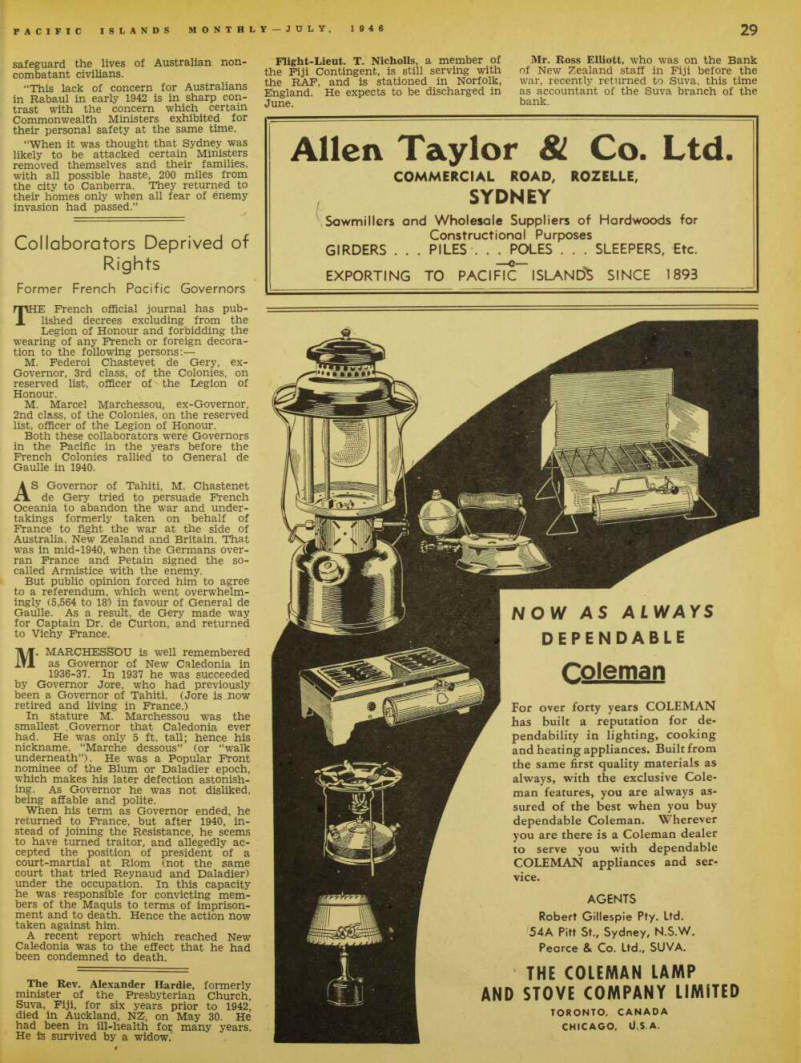
New Guinea Grievances Aired In
Australian Parliament
The Demand For Rabaul Inquiry
a t 01
Canberra, June 21.
ALTHOUGH Territorians are not officially represented in the Australian Pederal Parliament, several champions of their cause have emerged durmg the last year or so. These members are J a l w ?7 s P re P. ared . to . <*9 verbal battle on behalf of residents of Papua and New Guinea; but all sit on the Opposition
achieve" mUe sense°
Through them, however, Territories’ grievances at least are given a public airing.
The Papua-New Guinea record of former Australian Governments is no better than that of the present Labour Government. All that can be- said favourably of them is that they had a negative quality, rather than the positive passion for sometimes ill-considered “reform” that characterises the present Administration. in parliament recently on benaif of tne Territories are: Mr. H. L. Anthony, Country Party member for Richmond, NSW; Mr. J. P. Abbott, Country Party member for New England, NSW; the Deputy and d Mr°A t o for Barker* Stith 1 mb for Barker, South Australia.
These four members have constantly demanded an inquiry into the fall of Rabaul, not only on behalf of New Guinea people who lost relatives there, but on behalf of relatives of Servicemen who were sacrificed when the Japanese took the port in January, 1942. They also led the attack on the Government when Mr.
Ward introduced his Provisional Adminis-
x .. „.„ . , „ tration Bill into Parliament last year, anc * have consistently taken the part of the planter against the Governs?™ m lts attempt to socialise New Guinea.
They took the part of Mrs. Baker (plantation manageress, of Witu Islands) when red tape methods were used to block her return to the Territory. .. When Mr Bryson, a Victorian Labourite, said in Parliament last year that New Guinea P?°Pv: had done little to protect the islands they had called their homes, the four members rallied to Territorians’ defence, and showed that the war record of island residents was second to none.
Mr. Harrison demanded action from an unwilling Government to disarm members of the NGIB, to quell mutinees in the brigade, and to protect the post-war New Guinea settlers. rESE members are still carrying on the Territorians’ fight.
This month Messrs Anthony and Abbott are putting pressure on the Goveminent to find out what plans it has in New Guinea; what part former residents will play in those plans; what the Goveminent is going to do about discontent amongst members of the Provisional Administration; when a Legislative Council J-° r , 4 and wh at the Chifley Government is going to do about demands for an in- Q uir Y into uabaui s fan. (After the following was written, Mr.
Chifley flatly refused an inquiry into Rabaul. and Mr. Ward was prominent in a disgraceful scene in Parliament, reported elsewhere.)
“Criminal Indifference”
“fpHE tragedy of Rabaul cannot be X. remedied by a post-mortem; but a post-mortem might provide suffi cient information to enable steps to be taken, if on any future occasion, a simi lar emergency arises,” said Mr. Anthony to the “PIM” representative. “I have re peatedly pressed for an inquiry, not only into the loss of Rabaul, but into the Am boina expedition as well.
“In the case of Rabaul I feel that there was something which amounted almost to criminal indifference on the part of the authorities in Australia, including the Government, for the fate of those who were left to face the Japanese attack.
“It was manifest, after Pearl Harbour and the fall of the Philippines and Java, that Rabaul and Papua would be next attacked. It was known to the Australian Government that there were not adequate forces in any of these places to repel an attack when it came, and that the alter native facing the residents and military personnel in these places was either flight or remain and be massacred.
“Although women and children were evacuated, the civilian men were not taken out, although it was obvious they could not help stem the Japanese ad vance. Of 300 civilians who were left behind and who should have been eva cuated long before January 23, 1942, only a handful survived.
“Shipping available in Rabaul Harbour before the Jap landing, included the 9,000 ton Norweigian “Hoerstein.”
“TT might be said that it is easy to be X wise after events, but in view of the fact that Rabaul was an obvious tar get for the enemy and that a period of 46 days elapsed between the December 7 (Pearl Harbour) and January 23, when the enemy attacked Rabaul, there was ample time to take measures to at least
safeguard the lives of Australian non combatant civilians.
“This lack of concern for Australians in Rabaul in early 1942 is in sharp con trast with the concern which certain Commonwealth Ministers exhibited for their personal safety at the same time.
“When it was thought that Sydney was likely to be attacked certain Ministers removed themselves and their families, with all possible haste, 200 miles from the city to Canberra. They returned to their homes only when all fear of enemy invasion had passed.”
Advertisements & other items, p. 30 (1 item)
o
GREEN LABEL
1 0
FIRST GRADE
<*Hof -A J.A.D. GIBSON AND COMPANY PTY LIMITED 364 Kent Street Sydney.
Rights
Collaborators Deprived of Rights Former French Pacific Governors
mHE French official journal has pub- X lished decrees excluding from the Legion of Honour and forbidding the wearing of any French or foreign decora tion to the following persons:— M. Federoi Chastevet de Gery, ex- Governor, 3rd class, of the Colonies, on reserved list, officer of the Legion of Honour.
M. Marcel Marchessou, ex-Governor, 2nd class, of the Colonies, on the reserved list, officer of the Legion of Honour.
Both these collaborators were Governors in the Pacific in the years before the French Colonies rallied to General de Gaulle in 1940.
AS Governor of Tahiti, M. Chastenet de Gery tried to persuade French Oceania to abandon the war and under takings formerly taken on behalf of France to fight the war at the side of Australia, New Zealand and Britain. That was in mid-1940, when the Germans over ran France and Petain signed the so called Armistice with the enemy.
But public opinion forced him to agree to a referendum, which went overwhelm ingly (5,504 to 18) in favour of General de Gaulle. As a result, de Gery made way for Captain Dr. de Curton, and returned to Vichy France.
M. MARCHESSOU is well remembered as Governor of New Caledonia in 1936-37. In 1937 he was succeeded by Governor Jore, who had previously been a Governor of Tahiti. (Jore is now retired and living in France.) In stature M. Marchessou was the smallest .Governor that Caledonia ever had. He was only 5 ft. tall; hence his nickname, “Marche dessous” (or “walk underneath”). He was a Popular Front nominee of the Blum or Daladier epoch, which makes his later defection astonish ing. As Governor he was not disliked, being affable and polite.
When his term as Governor ended, he returned to France, but after 1940, in stead of joining the Resistance, he seems to have turned traitor, and allegedly ac cepted the position of president of a court-martial at Riom (not the same court that tried Reynaud and Daladier) under the occupation. In this capacity he was responsible for convicting mem bers of the Maquis to terms of imprison ment and to death. Hence the action now taken against him.
A recent report which reached New Caledonia was to the effect that he had been condemned to death.
The Rev. Alexander Hardie, formerly minister of the Presbyterian Church, Suva, Fiji, for six years prior to 1942, died in Auckland, NZ. on May 30. He had been in ill-health foi; many years.
He te survived by a widow.
Flight-Lieut. T. Nicholls, a member of the Fiji Contingent, is still serving with the RAF, and is stationed in Norfolk, England. He expects to be discharged in June.
Mr. Ross Elliott, who was on the Bank of New Zealand staff in Fiji before the war, recently returned to Suva, this time as accountant of the Suva branch of the bank.
Mr. C. C. Kao, who has been relieving Vice-Consul for China in Fiji, has re turned to Australia. He has been suc ceeded in the Colony by Mr. S. C. Lai, formerly of Wellington, NZ.
Advertisements & other items, pp. 31-32 (1 item)
Allen Taylor & Co. Ltd.
COMMERCIAL ROAD, ROZELLE,
SYDNEY
Sawmillers and Wholesale Suppliers of Hardwoods for Constructional Purposes GIRDERS . . . PILES . . . POLES . . . SLEEPERS, Etc.
EXPORTING TO PACIFIC ISLAND’S SINCE 1893
NOW AS ALWAYS
DEPENDABLE
c For over forty years COLEMAN has built a reputation for dependability in lighting, cooking and heating appliances. Built from the same first quality materials as always, with the exclusive Coleman features, you are always assured of the best when you buy dependable Coleman. Wherever you are there is a Coleman dealer to serve you with dependable COLEMAN appliances and service.
AGENTS
Robert Gillespie Pty. Ltd. 54A Pitt St., Sydney, N.S.W Pearce & Co. Ltd., SUVA.
THE COLEMAN LAMP
AND STOVE COMPANY LIMITED
TORONTO, CANADA
CHICAGO. U.S.A.
QUEENSLAND
INSURANCE
COMPANY
LIMITED
(Incorporated 1886 In Australia)
ASSETS EXCEED £4,000,000
Head Office:
QUEENSLAND
INSURANCE BUILDING,
80-82 PITT STREET, SYDNEY.
Specialists in South Seas Fire
Marine & Accident Insurances
Apply to:—
FUL
Branch Office : I. B. Chalmers, Manager.
Burns Philp (South Sea) Co., Ltd.
VILA,
Burns Philp (South Sea) Co., Ltd.
Comptoirs Prancals Des Nouvelles Hebrides (Marine).
NOUMEA.
L. «fe W. Johnston,
PORT MORESBY:
Burns, Philp & Co., Ltd.
W. A. Anderson, Resident Officer.
PAGO PAGO.
Burns Philp (South Sea) Co., Ltd.
G. H. C. Reid <Ss Co.
OTHER SOUTH SEA ISLANDS.
Burns Philp (South Sea) Co., Ltd.
Also to any of the Company’s Offices in Australia or New Zealand.
YOULL TRAVEL
LIGHTER
WITH A
GEOBIT
Just pick up a Globite and you'll see how much weight you can save. Giobite Travel Cases are sturdy, smart-looking, and weatherproof. They give extra years of service and are being made available as fast as materials and manpower permit.
Illustrated is a Globite One-Suiter, which makes packing easier and prevents creasing and crushing.
OBTAINABLE AT GOOD STORES EVERYWHERE
Manufacturers: FORD SHERINGTON LTD. (Wholesale only) 15
Fruit-Growing
Mr. Osborne Discusses Fruit-Growing (And Other) Problems Visit of New Zealand Officials to Cook Is.
From Our Own Correspondent
Rarotonga, May 31.
rR many months past the island of Rarotonga has been a troubled para dise. We have had the “Makatea scandal,” wharf strikes and other labour troubles, demonstrations agaihst the Resi dent Commissioner, and a general airing of grievances.
On May 11, Mr. A. G. Osborne, MP, accompanied by Mr. C. G. R. McKay, Sec retary for New Zealand’s Island Terri tories, arrived here by air to gather first hand knowledge of the Cook Islands’ many problems on behalf of the New Zealand government. During their stay they were almost continuously engaged in discussions with representatives of all in terests in the Islands, and they had full opportunity to obtain all points of On the day before their departure a pub lic meeting was held, at which Mr. Os borne gave a general report on the results of the discussions and the representations which would be conveyed to the Govern ment. (See June issue of “PIM.”) Mr. Osborne, during his visit, also took the opportunity to inspect as many citrus plantations as possible, and he expressed satisfaction that much good work had been done by those growers, Maori and European, who could see the need of re planting and thus building up the natural resources of the Cook Islands. Consider able progress in replanting has already been made in Rarotonga, Aitutaki, and some of the other Cook Islands.
Mr. Osborne said that some people had stated that they preferred a straight-out price for fruit, but they now understood the need for the bonus svstem decided upon by the Government, to give encour
agement to replanting. The bonus scheme made provision for those who could not yet obtain new trees, and also for those who took care of their present trees.
Under the new system the present price for special oranges is 7/6 per case (packed), plus a bonus of 2/- per case.
Growers of native oranges who have re planted trees and are maintaining them at their own cost, or under one of the administration schemes, receive 7/- per case plus a bonus of 2/-. Growers who desire to plant new trees, but who will have to wait for a supply of young trees to become available, will receive 7/- per case plus a bonus of 1/-; and to these an extra 1/- per case will be paid when new trees are planted.
Those growers of native oranges who do not wish to plant new trees, either under a Government scheme or by their own effort, will be paid 7/- per case, but will receive no bonus.
It is hoped that the encouragement of the bonus scheme will mean much more wealth for the Cook Islands in five years time. rE visitors discussed with the Fruit Advisory Committee and the island councils the proposal for a cool store for oranges, and an agreement was reached. It was decided that the time was not yet ripe for storing citrus fruit in large quantities.
There was a further suggestion that a smaller cool store be provided to hold about 5,000 cases of tomatoes at those times when a ship is not immediately available for their removal.
Mr. Osborne agreed that this was a need, and said that he would bring it to the notice of the Government for exam ination. He thought that NZ would be glad to have as many tomatoes as the Cook Islands could send at the time of the year when the Dominion cannot pro duce its own. The question would be de termined by the shipping space available, and as a large number of people in NZ depended upon tomato growing for part of their living, it would be for the Gov ernment to say when Cook Island toma toes could be accepted.
On the question of growing large quan tities of pineapples for the market, Mr.
Osborne was of the opinion that there would be no objection providing packing and cases conformed to requirements; but shipping space was the important factor here, as it was in other productions, and many of the Cook Islands’ problems would be solved only when shipping is avail able. The need for adequate shipping is fully realised in NZ, and inquiries are be ing made in London for a vessel suitable for the Cook Islands trade. It is felt that a vessel twice the size of the “Maui Pomare” would be suitable. The vessel will have four holds, and it should then be possible to always carry bananas; this is impossible at present with the “Maui Pomare.”
MR. OSBORNE promised also to take up with the Dominion Government, the need for better hospital facili ties in Rarotonga, and recommend a general improvement in health services throughout the Group; and to request that experts be sent from NZ to examine the possibilities of an electricity supply for Rarotonga and improved harbour facilities throughout the Cooks.
Mr. and Mrs. P. T. English recently re turned to the Gilbert and Ellice Islands Colony after leave in New Zealand. Mr. is a well-known officer of the Western Pacific High Commission. He received a decoration in the recent Birth day Honours (see elsewhere this issue) for services rendered at Tarawa just prior to the Japanese invasion.
of Colony's Prospects
Morris Hedstrom's Financial Year
Shareholders Get Special Bonus —Interesting Review of Colony's Prospects
IN the financial year ended March 31, 1946, Morris Hedstrom, Ltd., the big Pacific trading firm, with head quarters in Suva, made a net profit of £86,910, which is a few hundred more than the previous year’s profit. The shareholders get their usual 10 per cent., plus a special “Victory” bonus of 5 per cent. —paid out of a War Risk Reserve of £140,000. This was accumulated in the black years but as Fiji just escaped actual war operations—it was never re quired.
The subscribed capital of the company is £739,613, and, including £lOO,OOO now transferred from the War Risk account referred to, the reserves employed in the business are over £500,000. The company’s usual trade operations have been severely curtailed by war and post-war conditions, so that it has the better part of £1,000,000 lying in investments and bank deposits.
In the course of his address to the shareholders, at the annual meeting in Suva in June, the managing director and chairman of the Board, Sir Maynard Hedstrom made the following interesting observations: — Scholarship Help “rpHE Morris Hedstrom, Ltd., University X Scholarship Fund is filling the pur pose for which it was created: we have at present two scholars at Auckland University College, we expect to send a third early next year, and thereafter to maintain the number at three.
The need for improvement in facilities for the secondary education of Fijians is increasingly evident.
Building Programme “T AST year I referred to our building Xj programme. In October, 1945, we secured the services of Mr. F. H.
Beckett, ANZIA, FRSA.
The first building designed by him is under construction in Suva, a reinforced concrete building to be equipped as a modern motor repair shop to take the place of the wooden building which was destroyed by fire in 1941.
“Shortly we hope to commence build ing a reinforced concrete store at Siga toka to replace the present old wooden structure.
“Mr, Beckett is engaged in preparing plans for reinforced concrete store and offices on our freehold at Apia, Western Samoa.
Trading Outlook “T>ROSPECTS for the current year are ± reasonably good, although in some places there will be a falling off in trade.
“Copra prices are likely to continue at a satisfactory level during this year and next, and there is a possibility that they will be increased to something like a parity with prices now being paid by the British Government for Ceylon copra.
“Sugar crops this year will be light, but prospects for next year are good and the fact that quite recently an agreement was signed between the Colonial Sugar Refining Co., Ltd., and representatives of labour gives hope of peaceful working conditions.
“The gold industry appears to have a future, although development has been, and still is, hampered by the difficulty of obtaining necessary machinery.
“Developments in air transport are being watched with interest and the es tablishment of an international airport
near Nausori (about 14 miles from Suva) is under serious consideration by the Gov ernments concerned.”
Retirement SIR MAYNARD HEDSTROM announced that he would, on March 31, 1947, retire from the position of managing director, which would be taken over by Mr. H. E. Snell. Sir Maynard will retain the post of chairman of directors.
An account of the remarkable career and achievements of Sir Maynard Hed strom is published elsewhere in this issue.
Vagaries of the Trocas
Market
ACCORDING to the “Fiji Times,” of June 6, the price of trocas shell, “on the beach” in the Colony has fallen suddenly to £6O per ton. Previous re corded price was £95 per ton, but for many months past the price had been quoted around £B5 per ton.
Meanwhile, in Sydney f.a.q. trocas has been bringing from £l3O to £l5O per ton, and it was reported in June that many parcels of shell had changed hands within recent weeks.
Pre-war, most Pacific trocas went to Japan and Central European countries where it was converted into buttons, etc.
The price in Australia then averaged about £75 per ton, for first quality shell.
During the war, of course, no trocas fishing was carried on and, at present neither Japan nor the Central European countries appear to be in a position to show much interest in the industry.
However, of recent months there have been indications that America has become interested in the button trade, and that there might be a good market for Pacific trocas in the United States.
Good-class trocas should be available for several years to come as former fish ing areas have had from four to six years’ rest. Resumption of the industry in the south-west Pacific is hampered by lack of suitable boats for fishing operations as well as by the lack of overseas ships which would normally carry the shell to the world’s markets.
Informed circles in Manila understand that Philippine Relief and Rehabilita tion Administration has placed an order for 2,000,000 yards of textiles with the Pacific Islands Trading Co. in San Francisco (Says “Far East Trader” of May 15). A previous order of 5,000,000 yards is now being shipped to the provinces for distribution. The Pacific Islands Trading Co. is the enterprise of Mr. A. G Andrews, formerly a Burns Philp mer chandising manager in Fiji.
Mr. E. R. Bevington, of the Gilbert and Ellice Islands Administration, accom panied by Mrs. Bevington and their two children, arrived in Sydney in June, on their way back to Fiji, after long leave, spent mostly in England. Mr. Bevington was the Administrative Officer at Tarawa, in charge of the Southern Gilberts, when the Japanese attacked in December, 1941, and he and his family had a narrow escape from capture.
The Paris Scientific Bureau for Colonial Research has appointed four of its mem bers to survey New Caledonia for the purpose of producing a map on a far larger scale than that made by a previous survey in 1917. They will undertake also a geologic and mineralogic survey which may have an important bearing on the Colony’s future. This is the first time that the French have a scientific research in New Caledonia on such a scale. The party will maintain a laboratory in Noumea. M. Routhier, leader, has already arrived by air, via the USA. He will later be joined by his wife; a scientist. M. Avias, of the Paris Uni versity; and two geological engineers, Messrs. Arnould and Grunevald. They will remain in the island for at least a year.
Advertisements & other items, pp. 33-34 (1 item)
evEREAdy
When you can
see.
00 0 you’re safe! % V4> h
evEREAdy
TRADE-MARK
FLASHLIGHT
BATTERIES
give longer life.
Look for the Dateline
DEPENDABLE, ECONOMICAL, POWERFUL.
Livestock for Islands
People who intend to take Stock to New Guinea are hereby notified that I have on hand the right class of
Cattle—
Mules—
Horses
to suit both the Climate and the Pastures of the Territories.
When shipping is available, I can deliver, on the ship in Cairns or Townsville, Stock intended for any of the Pacific Islands, including Netherlands Indies, Singapore and the Philippines.
I will take all care of Stock and will be responsible for their delivery on the Ship in Sound Condition.
For further particulars, apply to
J. J. TOOGOOD
Rollingstone, via Townsville, Queensland.
Orders accepted through any Stock Agent, or Bank, in Cairns or Townsville, or direct.
Valuable Kauri
Timber In Pacific Islands
rE biggest stand of kauri timber re maining in the world is that on Vanikoro, a large island (some 80 square miles) in the Santa Cruz Group, Southern Solomon Islands. The timber has been worked for many years by the Vanikoro Kauri Timber Company, of Melbourne, who have rights to all the timber on the island, and who have established a considerable industry here.
Mr. S. S. Boye, manager of the Vani koro lumber establishment, with Mrs.
Boye, are at present enjoying a furlough in Australia, after the difficult and anxious years of the war. While the Americans were driving the Japs out of the Solomons, Vanikoro was frequently in the line of fire; and articles describ ing how Mr. and Mrs. Boye assisted the Americans have been published from time to time.
There are only a few score natives on Vanikoro —a village or two on the north east side. Otherwise, it is mostly jungle and mountain—the highest peak is over 3,000 feet. Ships called at Vanikoro about three times a year, before the war, and took the timber away to Melbourne, where it is highly valued mostly for plywood purposes. Since the war, there have been no ships, and millions of feet of this most valuable hardwood are lying there, awaiting transport.
Timber-getting, of course, has almost ceased, awaiting the resumption of ship ping. Mr. Boye gets all the labour he wants from the adjoining Reef Islands.
There is one trader on the island, Mr.
F. L. Jones. When fell
upon timber-getting, it was assumed that Mr. Jones would have a thin time. Actu ally, he is prospering. The Reef Islan ders, finding themselves unable to earn money in the kauri forests, have turned energetically to trocas-fishing; and they mostly sell their shell to, and buy their supplies from Mr. Jones. Trocas today day is a much-sought commodity.
It is expected that the Vanikoro kauri industry, which was valuable before the war, will flourish greatly, because the shortage of good timber throughout the world now is most acute. Mr. Boye says that the Vanikoro kauri is better than the New Zealand .kauri, which has a world-wide reputation.
There is kauri pine on all the Pacific islands in that longitude, from Auckland northwards, through New Caledonia and the New Hebrides, to the Santa Cruz Group; and a survey of its possibilities should be well forth the while of any timber concern with wide interests.
Malaria
Possible New Drug For Malaria
ALTHOUGH successful tests had been made with the new drug, paludrine, it could not be regarded as a com plete cure for malaria, CO of Heidelberg (Victoria) Military Hospital (Col. J. M.
Blair) stated recently.
Experiments at Heidelberg had shown that the drug went further towards pre venting relapses of malaria than atebrin, did not colour the skin, and had no toxic effects.
Quinine would be used in conjunction with paludrine in the cure of malaria.
Paludrine was likely to be used soon on Army and repatriation personnel.
Advertisements & other items, p. 34 (1 item)
Equal to the World’s Best
Throughout Australia and Overseas there is on ever-increasing demand for
COLONIAL & BRONTE
HIGH-GRADE CANNED MEATS
There is no better qualitywholesome. -none more
TRADE MEATS FOR THE ISLANDS
order
“COLONIAL” BRAND
Roast, Corned and Boiled Beef Packed in 6,5, 4,3, 2, 1 lb. and 12 oz. tins.
Also Corned Beef in 12 oz. Taper Tins.
Roast, Corned and Boiled Mutton. 1 lb. and 12 oz. tins.
Choice Dripping 36 lb., 2 lb., 1 lb. tins, and 1 lb. packets. « P F %
DELICIOUS
BRONTE" HOT MEALS
Steak and Kidney Pudding.
Beef Steak Pudding.
Sausages and Tomato.
Sausages and Vegetable.
Lamb and Green Peas.
Corned Beef and Boston Beans with Tomato Sanee.
Steak and Tomato.
Under present conditions it is wise to ensure that you have ample stocks of all our lines.
The Colonial Wholesale Meat Coy. Pty. Ltd.
30 GROSVENOR STREET, SYDNEY
Warm Praise
For Mr. J. K. McCarthy
‘TITHE hero of the escape of the motor- J. ship ‘Lakatoi’ from the Japs early in 1942 unquestionably was young J. K. McCarthy, who was a District Of ficer in New Guinea,” said Mr, G. P.
Brown, formerly of Rabaul, in a recent interview.
“Most of the credit for the arrival of the ‘Lakatoi’ in Cairns, with 250 rescued men aboard, must go to McCarthy. The men themselves realised it. I never heard such cheers as they gave McCarthy at the end of that voyage. Other high offi cials were not cheered. Some of them were hooted.”
Mr. Brown, who is well on in years, was one of the civilians who escaped from Rabaul as the Japs came in. His party tried to get to Gasmata, but were cut off by Japs. They narrowly escaped the Tol massacre—they were hidden not half a mile away while that slaughter went on.
Then they headed for Adelaide Bay and Open Bay; and they were picked up by a native police party, sent across from Talasea *by District Officer McCarthy, under Frank Holland, to as sist refugees generally. With Mr. Brown, in the party of 33, who thus Were rescued, were Ron Feetum, Ron Freedom, Harry Cheetham, Sandy Sinclair, Jim Palmer, Trevor Bruce, Norman Geldard, and Doyle, of the electricity company.
They picked up a couple of badly wounded soldiers. One, William Collins, of Sydney, was in a very bad way, but Jim Palmer attended to his terrible wounds and he was brought out to safety. Another, named Wise, of Mel bourne, made a game effort, but he died, later, under Mr. Brown’s bunk.
After some fearful experiences, they got out to Iboki, and across to the Witu Islands in small boats, where they joined the “Lakatoi.” Mr. McCarthy had been instrumental in gathering together some 250 men, who were packed aboard the little vessel. Soon afterwards, they slip ped away westwards, and through Dam pier Strait to China Strait and Cairns.
Japs were everywhere—but bold measures succeeded.
"Matua" For Survey
rE shipping position in the South Pacific is not likely to be improved by the withdrawal of the Union Steam Ship Company’s MV “Matua” for annual survey after her return to Auck land from the Islands about July 19.
“Matua” is expected to be laid up for about a month during which time only tentative arrangement's for maintaining the Auckland-Piji-Polynesia service have been made by the Union Company (see shipping tables this issue).
As reported in the last issue of “PIM”
“Matua” is still carrying over 100 pass engers per trip instead of the normal 42.
Her withdrawal for one trip is likely to put many more prospective passengers on the waiting list for months to come.
The travel position in that part of the Pacific serviced by “Matua” should be somewhat eased, however, by the New Zealand Government’s newly inaugurated civilian air service between Auckland and Fiji, Western Samoa, Tonga and the Cooks. (See elsewhere this issue.)
Advertisements & other items, p. 35 (1 item)
Imperial
Woven Wire for all Industry
COPRA DRYING TRAYS, FLOORS, Etc.
FRU'T DRYING TRAYS, MINING SCREENS.
Heavy Mosquito Gauze in Phosphor Bronze and other Metals Impervious to Salt Sea Air.
WIRE DOOR MATS AND GENERAL WIRE WORKS
E. WRIGHT & CO. LTD.
Office and Works: 148-152 Cleveland Street, Sydney, N.B.W.
Telegraphic Address: “Wrlghtmake.” Chippendale. y\T Kf f!
Or £ V*
TIME OFF FROM
COOKING
A nnnnnnjffnnonnna o o \k -\ /r > V *0 m i 'lO i :' : ' y as 4 m rv * What an idea to be able to serve up meals in 5 minutes! . . . Meals that will bring unanimous appetising pleasure—treats that you yourself will be able to sit down and enjoy.
IMPERIAL Good Foods are ready-cooked for you by expert chefs. Easy-to-serve. Specially processed to seal in the full flavour and keep EVER-FRESH.
Imperial
GOOD FOODS
W. ANGLISS & Co. (Aust.) Pty., Ltd.
Head Office: 5-7 O’Connell Street, Sydney, Australia.
Imperial
MEATREAT
★ Imperial
CAMP PIE
★ Imperial
HAMPE
★ Imperial
HOT MEALS
Visitors To Tahiti Not
Welcome Just Now
TRAVELLERS are not being encouraged to visit Tahiti, said the new French Minister to New Zealand (M. Amand Gazel) on June 8. Nonetheless, it was unlikely that they would be completely prohibited as had been suggested in some quarters.
Shortage of food and accommodation in the Society Group was acute, and all persons who wished to remain for a longer period than the duration of a ship’s stay had to be properly accredited and possess adequate funds for all living expenses.
M. Gazel pointed out, however, that this regulation was nothing new; that it had been in force for many years before the war as it had in most Pacific Terri tories.
Post-war shipping difficulties and the British Dominions* preoccupation with supplying the United kingdom with food stuffs, was having inevitable repercussions in Tahiti which had received limited food supplies from New Zealand during the war.
M. Gazel stated that the only vessels at present running between New Zealand and French possessions in the Pacific were the phosphate ships for Makatea.
Peace on the Canefields?
Union's New Agreement With
Csr
SUVA, June 6.
A PTER outbreaks of violence that con tinued right up until the end of 1945, all now 'seems quiet on the sugar production front. An agreement was reached on May 26 between the CSR Company and the Sugar Labourers’
Union, regarding conditions of employ ment which should go some way to straightening out outstanding difficulties.
Under the new agreement (which is to operate for two years from April 1, 1946), the basic wage of labourers will be in creased by 4d. per day; the crushing season bonus is to be increased and will be calculated on a season basis and not, as formerly, on a daily basis; one week’s annual holiday will be granted to em ployees who fulfil certain conditions. The company has also undertaken to inau gurate and pay half the premiums of a superannuation fund.
The 1946 crushing season is again ex pected to be poor, but in 1947 the indus try should have fully recovered from the strikes and cane-fields unrest that has prevailed in the Colony the last few years, There is hope locally, that this agree ment between the Indians and the CSR will usher in a period of peace in Fiji industry.
New Handbooks About
N. Pacific Islands
EVIDENCE of the thoroughness with which the United States went to war in the Pacific is to hand in a pack age of nine books, received from the office of the Chief of Naval Operations, Navy Department, Washington.
This series of handbooks covers almost every aspect of life and activity in the Caroline, Marshall and Mariana Islands, which were under Japanese occupation and Mandate from 1914 until 1945. They were compiled and issued to the United States Forces, ready for the day when they occupied the archipelagoes, in their advance upon Japan. Equipped with all this information, the American com manders could land upon almost any one of thipusands of islands, and proceed to organise at once an orderly administra tion, taking proper cognisance of local conditions and the ways of the residents, both indigenous and Japanese.
The compilation of the books they were all issued in 1943 or 1944—must have been a heavy task. Ever since their oc cupation of the islands in 1914, the Japs were most jealous in guarding all infor mation about them; and after Japan left the League of Nations, about 1934 the islands of the Mandate became literally a closed book to the rest of the world. In spite of this, the United States officials somehow obtained the complete data about the islands, with actual statistics up to around 1939.
The archipelagoes, under American control, will again be open to Europeans; and this series of handbooks, so con veniently arranged and copiously illus trated with photographs, will be of much help to anyone interested.
Unionism in Fiji
SUVA, June 6.
LATEST manifestation of organised labour in the Colony is the forma tion of the Fiji Seamen’s Union for native seamen.
The new body was registered on April 17, and is still negotiating with Fiji ship owners regarding conditions of employ ment.
During his term in Suva, Fiji, as an officer of the Bank of New Zealand, Mr.
James Crawford made many friends, particularly in amateur theatrical and musical circles. Many functions were held in his honour before his recent depar ture for Ireland, where he will spend his leave.
Advertisements & other items, p. 36 (2 items)
34
July, 1946-pAciric Islands monthly
Flour
PRODUCING UNIFORM GOOD RESULTS SINCE 1868
ALWAYS ASK FOR IT
This Company supplies Aluminium and its Alloys to all specifications and for every commercial application where these give better service over other metals. Please consult our Technical Service Department regarding your light metal problems.
AUSTRALIAN ALUMINIUM COMPANY
PROPRIETARY LIMITED
( INCORPORATED ' IN THE STATS OF VICTORIA ) GENERAL OFFICES AND FABRICATION DIVISION. GRANVILLE. SYDNEY. N.S.W. a
Magazine Section
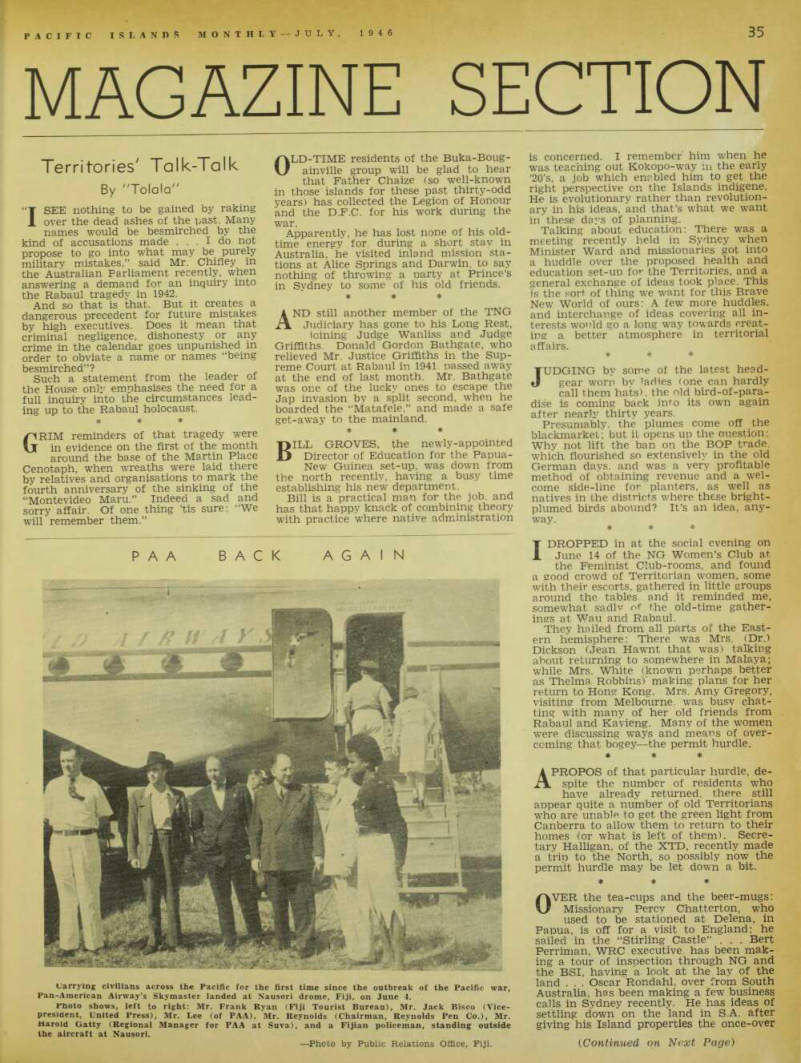
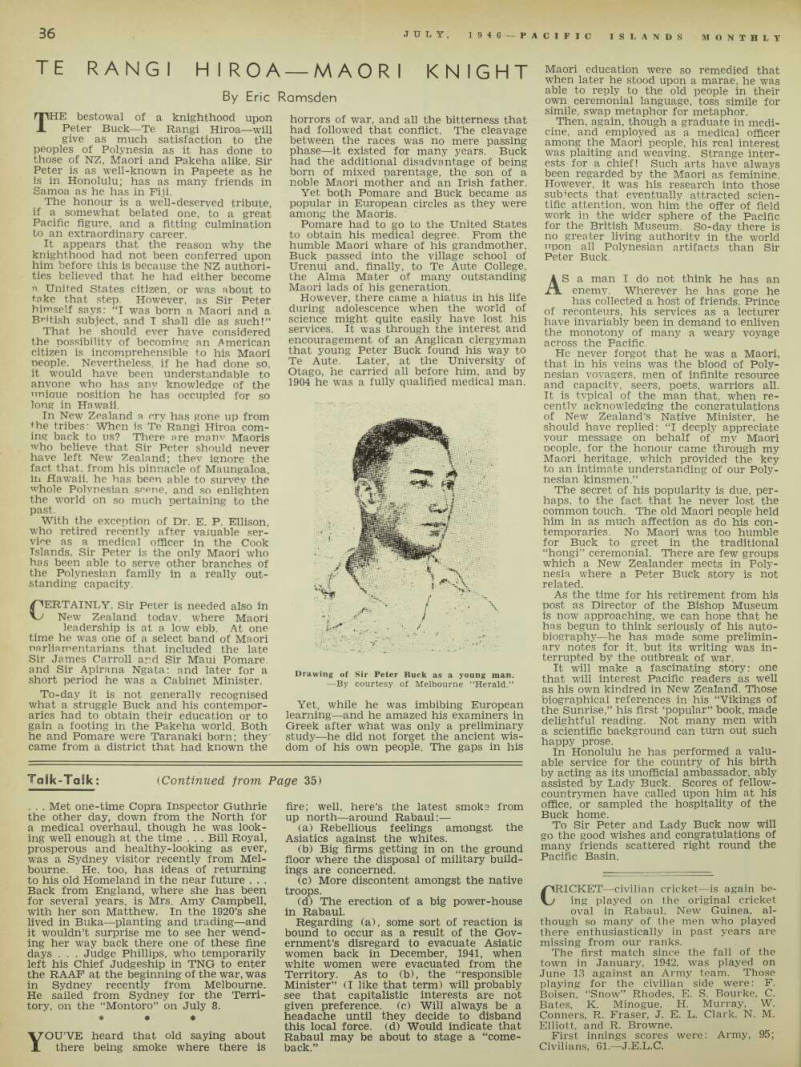
Territorio TaIK- TalK
By "Tolala"
“T SEE nothing to be gamed by raking X over the dead ashes of the past. Many names would be besmirched by the kind of accusations made ... I do not propose to go into what may be purely military mistakes,” said Mr. Chifley in the Australian Parliament recently, when answering a demand for an inquiry into the Rabaul tragedy in 1942.
And so that is that. But it creates a dangerous precedent for future mistakes by high executives. Does it mean that criminal negligence, dishonesty or any crime in the calendar goes unpunished in order to obviate a name or names “being besmirched”?
Such a statement from the leader of the House only emphasises the need for a full inquiry into the circumstances lead ing up to the Rabaul holocaust. * * * GRIM reminders of that tragedy were in evidence on the first of the month around the base of the Martin Place Cenotaph, when wreaths were laid there by relatives and organisations to mark the fourth anniversary of the sinking of the “Montevideo Maru.” Indeed a sad and sorry affair. Of one thing ’tis sure; “We will remember them.”
i°WLD-TIME residents of the Buka-Boug- XJ ainville group will be glad to hear that Father Chaize (so well-known in those islands for these past thirty-odd years) has collected the Legion of Honour £ nd the DF C for his wor k during the wa r.
Apparently, he has lost none of his old time energy for during a short stay in Australia, he visited inland mission sta tions at Alice snrings and Darwin, to say nothing of throwing a narty at Prince’s in svdney to some of his old friends, ' ♦ * ♦ A ND still another member of the TNG J\ Judiciary has gone to his Long Rest, ioining Judge Wanliss and Judge Griffiths. Donald Gordon Bathgate, who relieved Mr. Justice Griffiths in the Sup reme Court at Rabaul in 1941 nassed away a t the end of last month. Mr. Bathgate was one of the lucky ones to escape the j ap invasion by a split second, when he boarded the “Matafele,” and made a safe get-away to the mainland. ♦** . 4 .
T>ILL GROVES, the newly-appointed Xj Director of Education for the Papua- New Guinea set-up. was down from the north recently, having a busy time establishing his new department.
Bill is a practical man for the job. and has that happy knack of combining theory with practice where native administration
is concerned. I remember him when he was teaching out Kokopo-way in the early ’2O s, a job which enabled him to get the right perspective on the Islands indigene.
He is evolutionary rather than revolution ary in his ideas, and that’s what we want in these days of planning.
Talking about education; There was a meeting recently held in Sydney when Minister Ward and missionaries got into a huddle over the proposed health and education set-un for the Territories, and a general exchange of ideas took place. This is the sort of thing we want for this Brave New World of ours: A few more huddles, and interchange of ideas covering all in terests would go a long way towards creat ing a better atmosphere in territorial affairs. * * ♦ JUDGING by some of the latest head gear worn bv ladies (one can hardly call them hats), the old bird-of-para dise is coming back into its own again after nearly thirty years.
Presumably, the plumes come off the blackmarket; but it opens up the Question; Why not lift the ban on the BOP t r ade. which flourished so extensively in the old German days, and was a very profitable method of obtaining revenue and a wel come side-line for planters, as well as natives in the districts where these bright plumed birds abound? It’s an idea, any way. ♦ * ♦ 1 DROPPED in at the social evening on June 14 of the NG Women’s Club at the Feminist Club-rooms, and found a good crowd of Territorian women, some with their escorts, gathered in little groups around the tables and it reminded me, somewhat sadlv of the old-time gather ings at Wau and Rabaul.
They hailed from all parts of the East ern hemisphere: There was Mrs. (Dr.) Dickson (Jean Hawnt that was) talking about returning to somewhere in Malaya; while Mrs. White (known perhaps better as Thelma Robbins)' making plans for her return to Hong Kong. Mrs. Amy Gregory, visiting from Melbourne,, was busv chat ting with many of her old friends from Rabaul and Kavieng. Many of the women were discussing ways and means of over coming that bogey—the permit hurdle. ♦ ♦ ♦ APROPOS of that particular hurdle, de spite the number of residents who have already returned, there still anpear quite a number of old Territorians who are unable to get the green light from Canberra to allow them to return to their homes (or what is left of them). Secre tary Halligan, of the XTD, recently made a trio to the North, so possibly now the permit hurdle may be let down a bit. ♦ * * OVER the tea-cups and the beer-mugs: Missionary Percy Chatterton, who used to be stationed at Delena, in Papua, is off for a visit to England; he sailed in the “Stirling Castle" . . . Bert Perriman, WRC executive has been mak ing a tour of insnection through NG and the BSI, having a look at the lay of the land . . . Oscar Rondahl, over from South Australia, has been making a few business calls in Sydney recently. He has ideas of settling down on the land in S.A. after giving his Island properties the once-over (Continued on Next Page )
. . . Met one-time Copra Inspector Guthrie the other day, down from the North for a medical overhaul, though he was looking well enough at the time . . . Bill Royal, prosperous and healthy-looking as ever, was a Sydney visitor recently from Melbourne. He, too, has ideas of returning to his old Homeland in the near future ...
Back from England, where she has been for several years, is Mrs. Amy Campbell, with her son Matthew. In the 1920’s she lived in Buka—planting and trading—and it wouldn’t surprise me to see her wending her way back there one of these fine days . . . Judge Phillips, who temporarily left his Chief Judgeship in TNG to enter the RAAF at the beginning of the war, was in Sydney recently from Melbourne, He sailed from Sydney for the Territory, on the “Montoro” on July 8. * * * YOU’VE heard that old saying about there being smoke where there is
fire; well, here’s the latest smoke from up north—around Rabaul: — (a) Rebellious feelings amongst the Asiatics against the whites. (b) Big firms getting in on the ground floor where the disposal of military build ings are concerned. (c) More discontent amongst the native troops. (d) The erection of a big power-house in Rabaul.
Regarding (a), some sort of reaction is bound to occur as a result of the Gov ernment’s disregard to evacuate Asiatic women back in December, 1941, when white women were evacuated from the Territory. As to (b), the “responsible Minister” (I like that term) will probably see that capitalistic interests are not given preference, (c) Will always be a headache until they decide to disband this local force, (d) Would indicate that Rabaul may be about to stage a “come back.”
Paa Back Again
Carrying civilians across the Pacific for the first time since the outbreak of the Pacific war, Pan-American Airway’s Skymaster landed at Nausori drome, Fiji, on June 4.
Photo shows, left to right: Mr. Frank Ryan (Fiji Tourist Bureau), Mr. Jack Bisco (Vice president, United Press), Mr. Lee (of PAA), Mr. Reynolds (Chairman, Reynolds Pen Co.), Mr.
Harold Gatty (Regional Manager for PAA at Suva), and a Fijian policeman, standing outside the aircraft at Nausori. —Photo by Public Relations Office, Fiji.
Te Rangi Hiroa —Maori Knight
By Eric Ramsden
THE bestowal of a knighthood upon Peter Buck —Te Rangi Hiroa—will give as much satisfaction to the peoples of Polynesia as it has done to those of NZ, Maori and Pakeha alike. Sir Peter is as well-known in Papeete as he is in Honolulu; has as many friends in Samoa as he has in Fiji.
The honour is a well-deserved tribute, if a somewhat belated one, to a great Pacific figure, and a fitting culmination to an extraordinary career.
It appears that the reason why the knighthood had not been conferred upon him before this is because the NZ authori ties believed that he had either become a United States citizen, or was about to take that step. However, as Sir Peter himself says: “I was born a Maori and a BHtish subject, and I shall die as such!”
That he should ever have considered the possibility of becoming an American citizen is incomprehensible to his Maori neople. Nevertheless, if he had done so, it would have been understandable to anvone who has any knowledge of the nniaue nosition he has occupied for so long in Hawaii.
In New Zealand a cry has gone up from |he tribes: When is Te Rangi Hiroa com ing back to us? There are manv Maoris who believe that Sir Peter should never have left New Zealand; thev ignore the fact that. from his pinnacle of Maungaloa, in Hawaii, he has been able to survev the whole Polvnesian seene, and so enlighten the world on so much pertaining to the past.
With the exception of Dr. E. P. Ellison, who retired recently after valuable ser vice as a medical officer in the Cook Islands, Sir Peter is the only Maori who has been able to serve other branches of the Polynesian family in a really out standing capacity.
CERTAINLY, Sir Peter is needed also in New Zealand todav. where Maori leadership is at a low ebb. At one time he was one of a select band of Maori parliamentarians that included the late Sir James Carroll and Sir Maui Pomare. and Sir Apirana Ngata: and later for a short period he was a Cabinet Minister.
To-day it is not generally recognised what a struggle Buck and his contempor aries had to obtain their education or to gain a footing in the Pakeha world. Both he and Pomare were Taranaki born; they came from a district that had known the
horrors of war, and all the bitterness that had followed that conflict. The cleavage between the races was no mere passing phase—it existed for many years. Buck had the additional disadvantage of being born of mixed parentage, the son of a noble Maori mother and an Irish father.
Yet both Pomare and Buck became as popular in European circles as they were among the Maoris.
Pomare had to go to the United States to obtain his medical degree. From the humble Maori whare of his grandmother.
Buck passed into the village school of Urenui and, finally, to Te Aute College, the Alma Mater of many outstanding Maori lads of his generation.
However, there came a hiatus in his life during adolescence when the world of science might quite easily have lost his services. It was through the interest and encouragement of an Anglican clergyman that young Peter Buck found his way to Te Aute. Later, at the University of Otago, he carried all before him, and by 1904 he was a fully qualified medical man.
Yet, while he was imbibing European learning—and he amazed his examiners in Greek after what was only a preliminary study—he did not forget the ancient wis dom of his own people. The gaps in his
Maori education were so remedied that when later he stood upon a marae, he was able to reply to the old people in their own ceremonial language, toss simile for simile, swap metaphor for metaphor.
Then, again, though a graduate in medi cine, and employed as a medical officer among the Maori people, his real interest was plaiting and weaving. Strange inter ests for a chief! Such arts have always been regarded by the Maori as feminine.
However, it was his research into those subiects that eventually attracted scien tific attention, won him the offer of field work in the wider sphere of the Pacific for the British Museum. So-day there is no greater living authority in the world upon all Polynesian artifacts than Sir Peter Buck.
AS a man I do not think he has an enemy. Wherever he has gone he has collected a host of friends. Prince of reconteurs, his services as a lecturer have invariably been in demand to enliven the monotony of many a weary voyage across the Pacific.
He never forgot that he was a Maori, that in his veins was the blood of Poly nesian voyagers, men of infinite resource and capacity, seers, poets, warriors all.
It is typical of the man that, when re cently acknowledging the congratulations of New Zealand’s Native Minister, he should have replied: “I deeply appreciate your message on behalf of my Maori neople, for the honour came through my Maori heritage, which provided the key to an intimate understanding of our Poly nesian kinsmen.”
The secret of his popularity is due, per haps, to the fact that he never lost the common touch. The old Maori people held him in as much affection as do his con temporaries. No Maori was too humble for Buck to greet in the traditional “hongi” ceremonial. There are few groups which a New Zealander meets in Poly nesia where a Peter Buck story is not related.
As the time for his retirement from his post as Director of the Bishop Museum is now approaching, we can hope that he has begun to think seriously of his auto biography—he has made some prelimin ary notes for it, but its writing was in terrupted by the outbreak of war.
It will make a fascinating story: one that will interest Pacific readers as well as his own kindred in New Zealand. Those biographical references in his “Vikings of the Sunrise,” his first ‘popular” book, made delightful reading. Not many men with a scientific background can turn out such happy prose.
In Honolulu he has performed a valu able service for the country of his birth by acting as its unofficial ambassador, ably assisted by Lady Buck. Scores of fellow countrymen have called upon him at his office, or sampled the hospitality of the Buck home.
To Sir Peter and Lady Buck now will go the good wishes and congratulations of many friends scattered right round the Pacific Basin.
CRICKET —civilian cricket —is again be ing played on the original cricket oval in Rabaul, New Guinea, al though so many of the men who played there enthusiastically in past years are missing from our ranks.
The first match since the fall of the town in January, 1942, was played on June 13 against an Army team. Those playing for the civilian side were: F.
Boisen, “Snow” Rhodes, E. S. Bourke, C.
Bates, K. Minogue, H. Murray, W.
Conners, R. Fraser, J. E. L. Clark, N. M.
Elliott, and R. Browne.
First innings scores were: Army, 95; Civilians, 61. —J.E.L.C.
Drawing of Sir Peter Buck as a young man. —By courtesy of Melbourne “Herald.”
Advertisements & other items, p. 38 (1 item)
36
JULY, 1946 PACIFIC ISLANDS MONTHLY
{Continued from Page 35)
TaSk-Ta!k:
Tropicalities
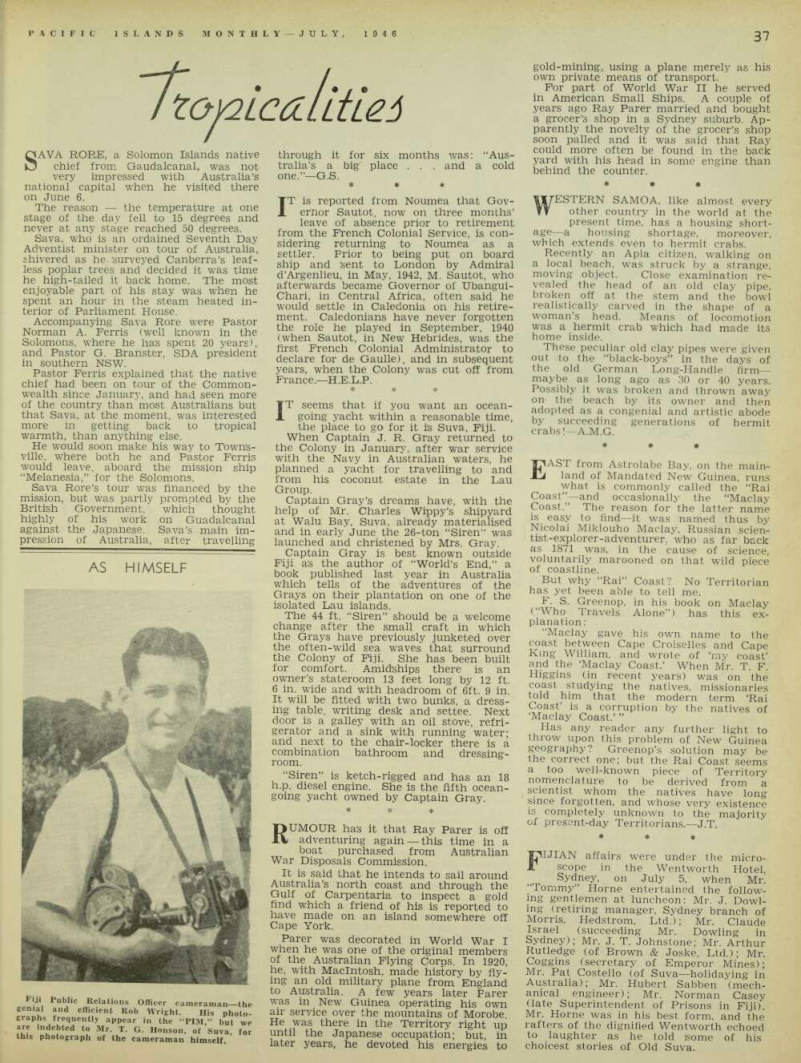
SAVA RORE, a Solomon Islands native chief from Gaudalcanal, was not very impressed with Australia’s national capital when he visited there on June 6.
The reason the temperature at one stage of the day fell to 15 degrees and never at any stage reached 50 degrees.
Sava, who is an ordained Seventh Day Adventist minister on tour of Australia, shivered as he 'surveyed Canberra’s leaf less poplar trees and decided it was time he high-tailed it back home. The most enjoyable part of his stay was when he spent an hour in the steam heated in terior of Parliament House.
Accompanying Sava Rore were Pastor Norman A. Ferris (well known in the Solomons, where he has spent 20 years), and Pastor G. Branster, SDA president in southern NSW.
Pastor Ferris explained that the native chief had been on tour of the Common wealth since January, and had seen more of the country than most Australians but that Sava, at the moment, was interested more in getting back to tropical warmth, than anything else.
He would soon make his way to Towns ville, where both he and Pastor Ferris would leave, aboard the mission ship “Melanesia,” for the Solomons.
Sava Rore’s tour was financed by the mission, but was partly prompted by the British Government, which thought highly of his work on Guadalcanal against the Japanese. Sava’s main im pression of Australia, after travelling
through it for six months was; “Aus tralia’s a big place . . . and a cold one.”—G.S. * * * IT is reported from Noumea that Gov ernor Sautot, now on three months’ leave of absence prior to retirement from the French Colonial Service, is con sidering returning to Noumea as a settler. Prior to being put on board ship and Sent to London by Admiral d’Argenlieu, in May, 1942, M. Sautot, who afterwards became Governor of Übangui- Chari, in Central Africa, often said he would settle in Caledonia on his retire ment. Caledonians have never forgotten the role he played in September, 1940 (when Sautot, in New Hebrides, was the first French Colonial Administrator to declare for de Gaulle), and in subsequent years, when the Colony was cut off from France. —H.E.L.P. * * * IT seems that if you want an ocean going yacht within a reasonable time, the place to go for it is Suva, Fiji.
When Captain J. R. Gray returned to the Colony in January, after war service with the Navy in Australian waters, he planned a yacht for travelling to and from his coconut estate in the Lau Group.
Captain Gray’s dreams have, with the help of Mr. Charles Wippy’s shipyard at Walu Bay, Suva, already materialised and in early June the 26-ton “Siren” was launched and christened by Mrs. Gray.
Captain Gray is best known outside Fiji as the author of “World’s End,” a book published last year in Australia which tells of the adventures of the Grays on their plantation on one of the isolated Lau islands.
The 44 ft. “Siren” should be a welcome change after the small craft in which the Grays have previously junketed over the often-wild sea waves that surround the Colony of Fiji. She has been built for comfort. Amidships there is an owner’s stateroom 13 feet long by 12 ft. 6 in. wide and with headroom of 6ft. 9 in.
It will be fitted with two bunks, a dress ing table, writing desk and settee. Next door is a galley with an oil stove, refri gerator and a sink with running water; and next to the chair-locker there is a combination bathroom and dressing room.
“Siren” is ketch-rigged and has an 18 h.p. diesel engine. She is the fifth ocean going yacht owned by Captain Gray. * * * RUMOUR has it that Ray Parer is off adventuring again —this time in a boat purchased from Australian War Disposals Commission.
It is said that he intends to sail around Australia’s north coast and through the Gulf of Carpentaria to inspect a gold find which a friend of his is reported to have made on an island somewhere off Cape York.
Parer was decorated in World War I when he was one of the original members of the Australian Flying Corps. In 1920, he, with Macintosh, made history by fly ing an old military plane from England to Australia. A few years later Parer was in New Guinea operating his own air service over the mountains of Morobe.
He was there in the Territory right up until the Japanese occupation; but, in later years, he devoted his energies to
gold-mining, using a plane merely as his own private means of transport.
For part of World War II he served in American Small Ships. A couple of years ago Ray Parer married and bought a grocer’s shop in a Sydney suburb. Ap parently the novelty of the grocer’s shop soon palled and it was said that Ray could more often be found in the back yard with his head in some engine than behind the counter. ♦ * • WESTERN SAMOA, like almost every other country in the world at the present time, has a housing short age—a housing shortage. moreover, which extends even to hermit crabs.
Recently an Apia citizen, walking on a local beach, was struck by a strange, moving object. Close examination re vealed the head of an old clay pipe, broken off at the stem and the bowl realistically carved in the shape of a woman’s head. Means of locomotion was a hermit crab which had made its home inside.
These peculiar old clay pipes were given out to the “black-boys” in the days of the old German Long-Handle firm— maybe as long ago as 30 or 40 years.
Possibly it was broken and thrown away on the beach by its owner and then adopted as a congenial and artistic abode by succeeding generations of hermit crabs! —A.M.G. ♦ ♦ ♦ EAST from Astrolabe Bay, on the main land of Mandated New Guinea, runs what is commonly called the “Rai Coast”—and occasionally the “Maclay Coast.” The reason for the latter name is easy to find —it was named thus by Nicolai Miklouho Maclay, Russian scien tist-explorer-adyenturer, who as far back as 1871 was, in the cause of science, voluntarily marooned on that wild piece of coastline.
But why “Rai” Coast? No Territorian has yet been able to tell me.
F. S. Greenop, in his book on Maclay (“Who Travels Alone”) has this ex planation : “Maclay gave his own name to the coast between Cape Croiselles and Cape King William, and wrote of ‘my coast’ and the ‘Maclay Coast.’ When Mr. T. F.
Higgins (in recent years) was on the coast studying the natives, missionaries told him that the modern term ‘Rai Coast’ is a corruption by the natives of ‘Maclay Coast.’ ”
Has any reader any further light to throw upon this problem of New Guinea geography? Greenop’s solution may be the correct one; but the Rai Coast seems a too well-known piece of Territory nomenclature to be derived from a scientist whom the natives have long since forgotten, and whose very existence is completely unknown to the majority of present-day Territorial.—J.T. * * ♦ FIJIAN affairs were under the micro scope in the Wentworth Hotel, Sydney, on July 5, when Mr.
“Tommy” Horne entertained the follow ing gentlemen at luncheon: Mr. J. Dowl ing (retiring manager, Sydney branch of Morris, Hedstrom, Ltd.); Mr. Claude Israel (succeeding Mr. Dowling in Sydney); Mr. J. T. Johnstone; Mr. Arthur Rutledge (of Brown & Joske, Ltd.); Mr.
Coggins (secretary of Emperor Mines); Mr. Pat Costello (of Suva—holidaying in Australia); Mr. Hubert Sabben (mech anical engineer); Mr. Norman Casey (late Superintendent of Prisons in Fiji).
Mr. Horne was in his best form, and the rafters of the dignified Wentworth echoed to laughter as he told jsome of his choicest stories of Old Suva.
As Himself
Fiji Public Relations Officer cameraman—the genial and efficient Rob Wright. His photo graphs frequently appear in the “PIM,” but we are indebted to Mr. T. G. Honson, of Suva, for this photograph of the cameraman himself.
Radio And Paper Bombers
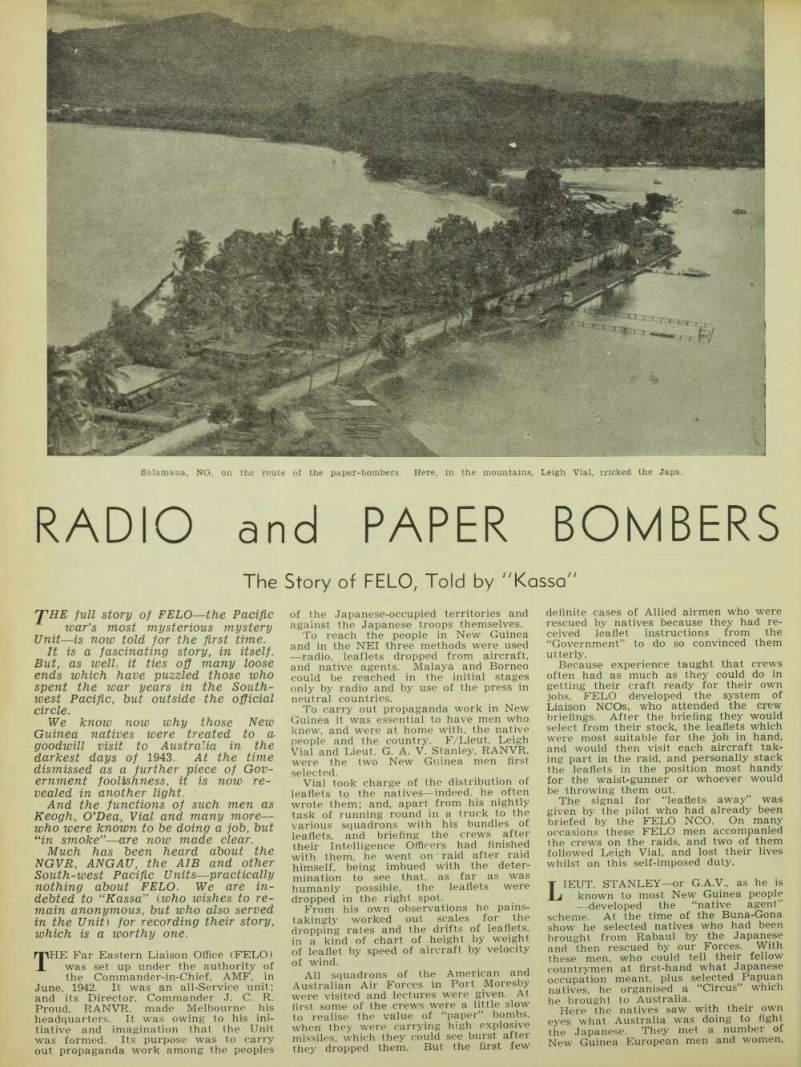
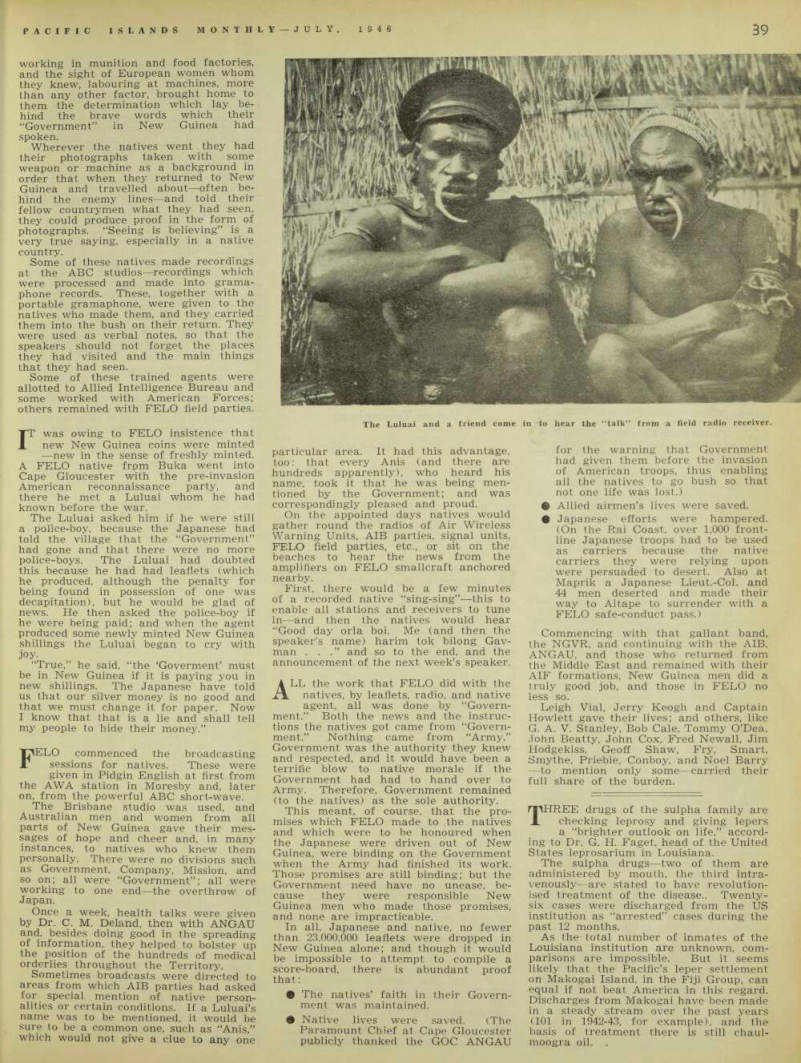
The Story of FELO, Told by "Kosso"
full story of FELO—the Pacific war’s most mysterious mystery Unit—is now told for the first time.
It is a fascinating story, in itself.
But, as well . it ties off many loose ends which have puzzled those who spent the war years in the South west Pacific, but outside the official circle.
We know now why those New Guinea natives were treated to a ; goodwill visit to Australia in the darkest days of 1943. At the time dismissed as a further piece of Gov ernment foolishness, it is now re vealed in another light.
And the functions of such men as Keogh, O’Dea, Vial and many more— who were known to be doing a job, but “in smoke”—are now made clear.
Much has been heard about the NGVR, ANGAU, the AIB and other South-west Pacific Units—practically nothing about FELO. We are in debted to “Kassa” (who wishes to re main anonymous, but who also served in the Unit) for recording their story, which is a worthy one.
THE Far Eastern Liaison Office (FELO) was set up under the authority of the Commander-in-Chief, AMF, in June, 1942. It was an all-Service unit; and its Director, Commander J. C. R.
Proud, RANVR, made Melbourne his headquarters. It was owing to his ini tiative and imagination that the Unit was formed. Its purpose was to carry out propaganda work among the peoples
of the Japanese-occupied territories and against the Japanese troops themselves.
To reach the people in New Guinea and in the NEI three methods were used —radio, leaflets dropped from aircraft, and native agents. Malaya and Borneo could be reached in the initial stages only by radio and by use of the press in neutral countries.
To carry out propaganda work in New Guinea it was essential to have men who knew, and were at home with, the native people and the country. F/Lieut. Leigh Vial and Lieut. G. A. V. Stanley, RANVR, were the two New Guinea men first selected.
Vial took charge of the distribution of leaflets to the natives—indeed, he often wrote them; and, apart from his nightly task of running round in a truck to the various squadrons with his bundles of leaflets, and briefing the crews after their Intelligence Officers had finished with them, he went on raid after raid himself, being imbued with the deter mination to see that, as far as was humanly possible, the leaflets were dropped in the right spot.
From his own observations he pains takingly worked out scales for the dropping rates and the drifts of leaflets, in a kind of chart of height by weight of leaflet by speed of aircraft by velocity of wind.
All squadrons of the American and Australian Air Forces in Port Moresby were visited and lectures were given. At first some of the crews were a little slow to realise the value of “paper” bombs, when they were carrying high explosive missiles, which they could see burst after they dropped them. But the first few
definite cases of Allied airmen who were rescued by natives because they had re ceived leaflet instructions from the “Government” to do so convinced them utterly.
Because experience taught that crews often had as much as they could do in getting their craft ready for their own jobs, FELO developed the system of Liaison NCOs, who attended the crew briefings. After the briefing they would select from their stock, the leaflets which were most suitable for the job in hand, and would then visit each aircraft tak ing part in the raid, and personally stack the leaflets in the position most handy for the waist-gunner or whoever would be throwing them out.
The signal for “leaflets away” was given by the pilot who had already been briefed by the FELO NGO. On many occasions these FELO men accompanied the crews on the raids, and two of them followed Leigh Vial, and lost their lives whilst on this self-imposed duty.
Lieut. Stanley—or g.a.v., as he is known to most New Guinea people —developed the “native agent” scheme. At the time of the Buna-Gona show he selected natives who had been brought from Rabaul by the Japanese and then rescued by our Forces. With these men, who could tell their fellow countrymen at first-hand what Japanese occupation meant, plus selected Papuan natives, he organised a “Circus” which he brought to Australia.
Here the natives saw with their own eyes what Australia was doing to fight the Japanese. They met a number of New Guinea European men and women,
Salamaua, NG, on the route of the paper-bombers. Here, in the mountains, Leigh Vial, tricked the Japs.
working in munition and food factories, and the sight of European women whom they knew, labouring at machines, more than any other factor, brought home to them the determination which lay be hind the brave words which their “Government” in New Guinea had spoken.
Wherever the natives went they had their photographs taken with some weapon or machine as a background in order that when they returned to New Guinea and travelled about —often be hind the enemy lines —and told their fellow countrymen what they had seen, they could produce proof in the form of photographs. “Seeing is believing” is a very true saying, especially in a native country.
Some of these natives made recordings at the ABC studios —recordings which were processed and made into grama phone records. These, together with a portable gramaphone, were given to the natives who made them, and they carried them into the bush on their return. They were used as verbal notes, so that the speakers should not forget the places they had visited and the main things that they had seen.
Some of these trained agents were allotted to Allied Intelligence Bureau and some worked with American Forces; others remained with FELO field parties.
IT was owing to FELO insistence that new New Guinea coins were minted —new in the sense of freshly minted.
A FELO native from Buka went into Cape Gloucester with the pre-invasion American reconnaissance party, and there he met a Luluai whom he had known before the war.
The Luluai asked him if he were still a police-boy, because the Japanese had told the village that the “Government” had gone and that there were no more police-boys. The Luluai had doubted this because he had had leaflets (which he produced, although the penalty for being found in possession of one was decapitation), but he would be glad of news. He then asked the police-boy if he were being paid; and when the agent produced some newly minted New Guinea shillings the Luluai began to cry with joy.
“True,” he said, “the ‘Goverment’ must be in New Guinea if it is paying you in new shillings. The Japanese have told us that our silver money is no good and that we must change it for paper. Now I know that that is a lie and shall tell my people to hide their money.”
FELO commenced the broadcasting sessions for natives. These were given in Pidgin English at first from the AWA station in Moresby and, later on, from the powerful ABC short-wave.
The Brisbane studio was used, and Australian men and women from all parts of New Guinea gave their mes sages of hope and cheer and, in many instances, to natives who knew them personally. There were no divisions such as Government, Company, Mission, and so on; all were “Government”; all were working to one end—the overthrow of Japan.
Once a week, health talks were given by Dr. C. M. Deland, then with ANGAU and, besides doing good in the spreading of information, they helped to bolster up the position of the hundreds of medical orderlies throughout the Territory.
Sometimes broadcasts were directed to areas from which AIB parties had asked for special mention of native person alities or certain conditions. If a Luluai’s name was to be mentioned, it would be sure to be a common one, such as “Anis,” which would not give a clue to any one
particular area. It had this advantage, too; that every Anis (and there are hundreds apparently), who heard his name, took it that he was being men tioned by the Government; and was correspondingly pleased and proud.
On the appointed days natives would gather round the radios of Air Wireless Warning Units, AIB parties, signal units, FELO field parties, etc., or sit on the beaches to hear the news from the amplifiers on FELO smallcraft anchored nearby.
First, there would be a few minutes of a recorded native “sing-sing”—this to enable all stations and receivers to tune in—and then the natives would hear “Good day orla boi. Me (and then the speaker’s name) harim tok bilong Gav man ...” and so to the end, and the announcement of the next week’s speaker.
ALL the work that FELO did with the natives, by leaflets, radio, and native agent, all was done by “Govern ment.” Both the news and the instruc tions the natives got came from “Govern ment.” Nothing came from “Army,”
Government was the authority they knew and respected, and it would have been a terrific blow to native morale if the Government had had to hand over to Army. Therefore, Government remained (to the natives) as the sole authority.
This meant, of course, that the pro mises which FELO made to the natives and which were to be honoured when the Japanese were driven out of New Guinea, were binding on the Government when the Army had finished its work.
Those promises are still binding; but the Government need have no unease, be cause they were responsible New Guinea men who made those promises, and none are impracticable.
In all, Japanese and native, no fewer than 23,000,000 leaflets were dropped in New Guinea alone; and though it would be impossible to attempt to compile a score-board, there is abundant proof that: 6 The natives’ faith in their Govern ment was maintained.
Native lives were saved. (The Paramount Chief at Cape Gloucester publicly thanked the GOC ANGAU
for the warning that Government had given them before the invasion of American troops, thus enabling all the natives to go bush so that not one life was lost.) Allied airmen’s lives were saved. • Japanese efforts were hampered. (On the Rai Coast, over 1,000 front line Japanese troops had to be used as carriers because the native carriers they were relying upon were persuaded to desert. Also at Maprik a Japanese Lieut.-Col. and 44 men deserted and made their way to Aitape to surrender with a FELO safe-conduct pass.) Commencing with that gallant band, the NGVR, and continuing with the AIB, ANGAU, and those who returned from the Middle East and remained with their AIF formations, New Guinea men did a truly good job, and those in FELO no less so.
Leigh Vial, Jerry Keogh and Captain Rowlett gave their lives; and others, like G. A. V. Stanley, Bob Cale, Tommy O’Dea, John Beatty, John Cox, Fred Newall, Jim Hodgekiss, Geoff Shaw, Fry, Smart, Smythe, Priebie, Conboy, and Noel Barry —to mention only some—carried their full share of the burden.
THREE drugs of the sulpha family are checking leprosy and giving lepers a “brighter outlook on life,” accord ing to Dr. G. H. Faget, head of the United States leprosarium in Louisiana.
The sulpha drugs—two of them are administered by mouth, the third intra venously—are stated to have revolution ised treatment of the disease.. Twenty six cases were discharged from the US institution as “arrested” cases during the past 12 months.
As the total number of inmates of the Louisiana institution are unknown, com parisons are impossible. But it seems likely that the Pacific’s leper settlement on Makogai Island, in the Fiji Group, can equal if not beat America in this regard.
Discharges from Makogai have been made in a steady stream over the past years (101 in 1942-43, for example), and the basis of treatment there is still chaul moogra oil. .
The Luluai and a friend come in to hear the “talk” from a field radio receiver.
Lease-Lend Lochinvar
Short Story:
OH, Arthur, this is awful. Can’t you make it go?” she asked fearfully; “it is getting so late.”
“What do you mean, can’t I make it go? Do you think I’m doing this for fun?” he demanded querulously, straightening his aching back and brushing the hair from his forehead with the back of one hand.
The streak of oil left across his sweat ing brow did not improve his appearance, already dishevelled by reason of some hours’ fruitless fiddling with reluctant mechanism. His eyes—those sulky brown eyes that had done so much to wreck her peace of mind in the far-off days before her marriage to John—glared angrily into her, fell before her anxious gaze, and ran nervously over his own besmirched cloth ing and bleeding knuckles.
“Please, Arthur, don’t let us quarrel. It’s just that I am so worried,” she pleaded.
“Worried! Do you think I am enjoying it myself? I don’t know what’s wrong with the blasted thing. I’m no good at this sort of thing,” he snapped, the admis sion sounding somehow like a boast.
NO, he’s no good at that sort of thing, she reflected hopelessly, returning to the seat beside the wheel. Not like John —John used to say that a man should not take on something he could not con trol under all circumstances. She won deredd idly how John would react to this situation . . . But no, she must not think about that. She had finished with John for good, as he’d find out for himself when he returned to the empty house to-night from Kagali and found the note she’d left on the table.
It would be a shock for him, of course, but he would have to get over that. She just couldn’t stand any more.
These past six months on Viti Malu had been too'much. It had been different be fore the war, of course. Marriaee with John had seemed, then, the best thing in the world for both of them. She really had not known much about the world.
Born on Gala-Gala, on her father’s plantation around the beach from Kagali. she’d seen nothing of the outside world except a couple of months in Sydney every two years. And she’d always been glad to get back to the island again. It was the life she knew, and those hurrying crowds in Sydney frightened her —so ruthless and crude, lost in their own affairs. And John was so cheerful and unflurried, doing very well in his “private world” as he call ed his lovely little island of Viti Malu.
“You will be oueen there,” he had said.
But the war had spoilt it all; the flight to Sydney when the Japs approached; the three long years while John was in the Air Force; a never-ending sequence of pat riotic activities, dances, canteens, picncs, for men on leave. She had succumbed to the attraction, or rather, the fascination of Sydney life.
And then the peace, John’s discharge and their belated return to Viti Malu, their once lovely home now over-run with jungle re-growth and half wrecked by Jap looters. Oh, it was too much!
“T JUST can’t stand it, Arthur,” she had A told him half hysterically, sitting on the verandah overlooking Uie western sea that morning. John had been gone since before sunrise on the six-hour trip round to Kagali, to order materials need ed for reconstruction and (he had said it with that tantalising grin of his), to pick up a little birthday present he had ordered for her.
Scarcely an hour later, coming in from the northern end of Gala Gala, Arthur had stepped ashore from his own small launch. He’d come to say good-bye, he said; he had sold out his interests on Gala Gala and wanted John to give him a lift in his bigger boat on the less easy open sea trip to Takala in the western islands, in time to catch the steamer leaving for Sydney that night.
“I know how you feel, Madge,” he said.
“I couldn’t stick it any longer either.
Those years in Sydney have spoilt me for the islands. But you don’t have to stand it. Let us make a break!! Grab a few clothes and we’ll take the small boat and
A Romance in the Best Traditions of Virtue Triumphant
By V. J. Hearnes
hop over to Takala, and away on the steamer to-night. You know I was always fond of you, years before John ever turned up, and we can make a new start in Syd ney or Melbourne.”
OH, it was madness, she realised now, listening to the petulant muttering from the incompetent fig;ire struggl ing with the obstinate engine.
But that morning she had felt so hope less, so miserable and despondent, think ing with a shiver of the past six months back on the island, the scanty post-war food supply and bad water, indolent native servants spoiled by four years loafing back in their villages. And ahead, two years or more of hard work before the planta tion was back on its feet again, with no guarantee of security even then, the way the world was going. Then the lonely monotony—two years on Viti Malu, two months in Sydney, two years on Viti Malu —work and sweat and squabbles, ragged nerves and frayed tempers . . .
John had been a different man since the war, too; gentle with her mostly, but at times hard and impatient, different from the laughing, confident young giant who had come down from his island to the social gatherings at Kagali and carried her off at last, away from Arthur and the rest of her ring of admirers.
But he had never had much time for Arthur, she remembered. Not jealous, actually, but simply didn’t like him.
“He may be one of your friends, Madge, but I don’t like him around the place too much,” he had said shortly. “He hangs round too many women. He's just not straight.” And that had ended it, for John. He did not harp on things.
Maybe he was right, too; she had heard a number of things about Arthur during the years in Sydney. He had got into a Government department of some sort, and seemed to enjoy a good deal of social ac tivity. But still, he had always been fond of her, and maybe they could make a do of it.
But now, scarcely half-way to Takala, they were stuck in a small boat, the en
gine broken down, and Arthur unable to get it going again. And night was falling —she shivered again.
The prospect of a night alone with Arthur in the launch dismayed her. It would have been so different on the steam er. Different cabins, and probably mutual friends found on board; she’d have had time to get used to things before they were alone in Sydney.
A FAINT humming sound, unexpected but recognised, jerked her from her, despondent musings. Glancing quick ly upwards, she made out a small, bright red shape against the darkening blue of the eastern sky, a shape that grew rapidly until it became a small float-plane racing up at mast height. Roaring past, it swung round in a gentle curve, glided confidently down to the waveless, swelling sea, and came swiftly back against the late sun, silvery sparkles edging the twin sprays thrown up by the floats. The idling pro peller mocked her racing heart . . .
John slipped down on to a float and jumped agilely to the launch, tied a moor ing rope quickly, then straightened up and faced her.
“Well, louse, couldn’t take it, eh?” he taunted her.
She dropped her eyes. Somehow, it all seemed so petty now. And there was something so comforting, so reassuring, in his upright body and steady eyes, even in his bantering voice.
“You might have waited till I brought your birthday present home, anyway.
What do you think of her? Got her from the Yanks; I heard they were selling a number of them at Noumea, and I grabbed one. Reckoned that with a spare gas tank fitted, she’d do fine for a week-end in Brisbane or Sydney, whenever things got us down a bit.”
“Oh, John .”
“Skip it! Get aboard,” he ordered, haul ing on the mooring rope till the plane floated close alongside.
“But, John .”
“Cut it out, mug, or I might remember that you were running out on me,” he in terrupted, drawing an automatic from a pocket as Arthur’s dishevelled head ap peared above deck. “As for you, brother, I’ll attend to you in a minute.”
Scrambling into the cabin of the plane, she turned in time to see John’s right fist crash into Arthur’s face. A cry of pain, then the sound of a falling body was fol lowed by John’s voice roaring in anger, two thunderous reports, and then a silence more terrible than any noise.
Poking her suitcase into the cabin, John dragged his long frame through the awk ward doorway after her. and fastened the door behind him. “Well, there’s one fella that won’t ever worry us again,” he said, climbing into the seat beside her and fin gering the controls.
“Oh, John, you didn’t ,” her voice faltered.
“Of course I did. I’ll send some boys over to-morrow to tow him away. He’ll look fine being dragged into Takala behind a canoe full of coons.”
“But, John, its awful is he d-dead?”
“No, not quite, though he will be half dead when the boys reach him to-morrow.
I only shot him twice —once in the mag neto 'and once in the drinking-water tank.!
“Home, James!” he chuckled.
Captain O’Neil, US Navy, commander of the Noumea naval base, has placed a number of navy huts in what was far merly known to the Americans as “Con fusion Row” at the disposal of the re turned New Caledonian volunteers. The huts are on the road leading down from Government House.
When Fiji Sugar Was Poured From A Jug
Pioneering:
IN a normal pre-war year, Fiji exported between one and two million pounds worth of raw sugar from her five flour ishing sugar mills. But time was when it was believed that juice extracted from Fiji cane would not granulate, and the whole subject of Fiji sugar was regarded as a subject for a pleasant evening’s ar gument, but little more.
No one has yet proved satisfactorily whether sugar cane is indigenous to the Fiji Islands or not; it was certainly there when the first Europeans arrived and, as far back as the Fijians themselves re member. they cultivated it for the pleasure of chewing the raw cane.
In 1872 the old non-granulation theory still persisted among the settlers, but in that year there arrived in the small vil lage of Suva, to grow cotton, a Mr. Leices ter Smith, who had been a sugar planter in the West Indies. He soon teamed nn with Mr. J. C. Harrison, an old settler of Nadi district, who also knew something of the art of growing and manufacturing sugar.
Smith was struck by the nuality of the cane grown locally, and refused to credit that the juice from it would not granu late. He and Harrison thrashed it out time and again, and through their cease less preoccupation with granulation, non granulation and all allied subjects* other settlers too became interested. Finally, it was decided to nut it to the test, once and for all.
Harrison was obviously the man for the job, and at that time he was living at Navua. But the settlers made of it a sort of basket picnic—everyone contributed something, one a boat, another a crew, others provisions, etc—and so for the great experiment Harrison was brought to Suva where respectable stands of cane were growing.
Under his direction, cane was cut and then pounded by natives armed with heavy mallets. After this process two of the boys would take each stick of cane separately and, one at each end, twist it until most of the juice was extracted.
After many hours bashing and twisting, several pints of the juice were nut in an old, three-legged, black-iron pot’and boil ed for what Harrison considered the right length of time. The brew was then strained through blotting paper, which ab sorbed the molasses and left what, with out doubt, was grains of sugar.
The experiment was a success. Fiji sugar cane was capable of producing granulated sugar.
The occasion ended as a social gather ing, before each of the men returned to his lonely plantation; but the experiment had started the more enterprising of them thinking sugar, and sugar cane cul tivation, on a commercial basis.
WITHIN a year two old residents, Messrs. Brewer and Joske, imported from Australia three small iron rol lers about five or six inches in diameter and several large open sugar pans. They erected this primitive sugar-making equip ment in their saw-mill near Suva, and announced that they were in the sugar business.
Several large stools of cane existed near the village, and this was bought from the natives, who thereby became prosperous while the brief sugar-boom lasted. Mr.
Harrison was again supervisor of sugar production, with Mr. Leicester Smith a sort of general-manager of the whole effort.
Natives brought the cane to the mill; others cut *it into several pieces and the
long strips were passed through the rollers.
The juice thus extracted was then boiled and the molasses allowed to drain out of it as best it might. The residue was a black sugar about the consistency of thick tar. and bore little resemblance to com mercial sugar.
However. Messrs. Brewer, Joske, Harri son and Smith were so elated with the result that they neglected to order sugar from Australia, and Brewer and Joske cus tomers for the next three months had to put up with the local article, which for convenience sake was poured from a jug.
Undaunted by, or not realising the diffi culties surrounding the production of sugar on a commercial scale. Joske and Brewer plunged into more elaborate pro
duction, and by the end of 1873 they had brought more machinery from Australia and, with carpenters, engineers and work men imported from Melbourne, had com menced building a sugar mill on the site where Suva town hall now stands.
A vessel was purchased to recruit labour from the New Hebrides, and a large area of land extending irom the present Bot anical Gardens to Laucala Bay (460 acres in all) was cleared and planted with cane.
A wharf was built from the mill site out into the harbour.
The mill operated for about three years but although sugar of fair quality was pro duced, the venture proved a failure and it is said that the experiment cost Brewer and Joske in the vicinity of £30,000.
The mill was closed down in 1876, and no more sugar was produced until the Colonial Sugar Refining Company went into operation about 1881 at their Nausori mill.
Retrospect
Varied Verses:
Through tropic night, the Swamp’s foul breath Spread pall-like in a place of death.
On mangrove root a Shade was seated.
Reviewing life hut late completed.
His rotting corpse he contemplated.
The while he quietly ruminated: The boys are late—no. here’s the Hun, The Jap, and Fuzzy-wuzzy’s son!
Well, greetings, boys! What’s on the news?
What politician airs his views.
And loud expounds the reason why ’Tis meet that soldiers fight and die.
Or, blinded, grope in living hell.
That Gods of Greed may feast and swell?
Take you. my Jap, what did you get For shooting me?—My bayonet!
Look, over there your body lies, A breeding-place for worms and flies.
What of your sweetheart in Japan— A plaything for some wealthy man?
What virtue will your “Son of Heaven”
Bestow, your parents’ grief to leaven?
And you. young Fritz, where’s Hitler’s power?
As dead as us—sped in an hour!
See where his greed and crazed ambition Led him and us—into perdition.
And Fuzzy, here, bereft of wife, Of love, of children and—of life. ’Twas your bomb, Fritz, which did the work, • Then, zooming up from out the murk Of bursting flak, you climbed still higher, Then crashed—to dreadful death by fire.
The silence then the Native broke: All very true, those words you spoke,
But don’t forget you came to fight Here in this land-all mine by right.
Your preachers taught us first of Love.
The Joys of Peace, of Heaven above.
They told us of a loving God— And then these isles were drenched with blood!
The Jap then said: Poor Fuzzy’s right.
Unasked we swarmed down here to’ fight Our battles on another’s ground— And nothing but our deaths we found.
Our leaders’ lies! Now we may rue What fools we were, Fritz—l, and you.
Mein Gott! That’s true! quoth German Fritz.
We’ve blown each other’s flesh to bits, We’ve danced on wires the leaders pulled— How they must laugh at those they fooled!
Our countries too—mine and the Jap’s— D’you think they've learned? Perhaps!
Perhaps!
From here, the problem seems to be “Who can claim the victory?”
Victor, vanquished vainly fought At fearful cost for what they sought.
Ambitious greed, and Pride of Place Demoralise the human race.
We so-called dead alone have won The IDEAL PEACE. Our work is done.
Let those who would this tale deride.
Go quietly to the Swamp’s west side.
And hear the Shades discuss, each night This crazy viorld and its sorry plight
C. S. RAMSAY, Ha’apai, Tonga.
In Reverse
(To my children, from behind the barbed wire of a Japanese internment camp.)
Do you remember how with happy cries You gazed upon the monkeys in the zoo, While they stared back with black and beady eyes?
I wonder what they thought of me and you!
Did those eyes burn with sullen, simian hate For our smooth, pink, complacent human faces?
Did those shrill cries denounce the fickle fate That fixed for us and them our several
places?
I think I understand, for now ’tis I Who pass monotonous davs within a cage, Staring beyond with 'sad and yearning eye, And stifling in my heart a smouldering rage.
And how I loathe the sly and simian sneer Of these damned apes who are my captors here!
Kelvin Dale in the ABC Weekly (Journal of the Australian Broadcasting Commission).
Jail Is Out At 4 P.M. !
A Story of Cook Islands Justice by W. S. Bond
INSPIRED by the example of the four Aitutaki youths who ran away with a whaleboat and other articles and made their way to Niue during February, two other Aitutaki boys, also serving sentences, stowed away on the “Maui Pomare” when the steamer was collecting oranges from the group early in June.
The stowaways were discovered shortly after the ship had left the island. The chief constable of Rarotonga, who was travelling on the vessel, Questioned the boys in the captain’s cabin, when they frankly admitted that they had stowed away deliberately to get to Rarotonga, as it was believed that the prison system in Rarotonga was not so hard as in Aitutaki.
They arrived in Rarotonga during a long week-end—the Monday being a pub lic holiday—and on this account on Sat urday morning the two stowaways applied to the chief constable for leave of absence until Tuesday.
The two young men w 7 ere so annoyed when the Chief Constable quietly but firmly explained that it was the custom to lock prisoners in the jail when not working, that they gave vent to their feelings by attempting to set fire to the jail at night.
At present Cook Islands residents are sitting back waiting to see just what atti tude certain NZ newspapers will take in regard to this new item of Cook Island news. They made an extraordinary job of the whaleboat escapade.
For a long time residents have been complaining of the increase in petty of fences and in cheekiness of the young local “toughs”; they attribute it to the leniency of the police court. It came as a surprise, therefore, to find that our fam ous Gilbert and Sullivan prison system is now within range of an increasing barrage of criticism, on the grounds of its severity.
When the Aitutaki boys left on their voyage to Niue many Aitutakians were re lieved to be rid of the young pests for a spell and hoped that wherever they landed the authorities would keep them for a while. Apart from some natural anxiety for their safety, few people treated the matter very seriously.
It remained for a NZ newspaper to tell us that these desperate young men had risked their lives in an epic voyage rank ing with the exploits of the old Poly nesian navigators, to escape from NZ in justice in the Cook Islands. It was hoped also that their remarkable exploit would arouse enough attention “to demand an end for ever to the whole amazing sys tem of injustice in the Cook Islands.”
The first paragraph of this headlined article complained that Cook Islanders were fined 5/- or 10/- for such petty offences as letting animals wander, for keeping pigs too close to the house, or for cohabitation.
Possibly such matters may sound trivial enough to newspaper readers in civilised cities —but let them live for a few years on an island of the Cook group, trying to relieve the monotony of diet by coax ing a few miserable vegetables from un promising soil, and carrying precious water long distances —only to have their labors of weeks, or months, destroyed overnight by a stray pig or horse. This is bad enough from the European point of view; but to the native planter and homesteader the damage to tomatoes, kumaras, bananas and other crops caused by straying ani
mals can be a very serious and heart breaking matter.
The ever-questing snout of an islands pig can only be compared with a modern bulldozer in the utter destruction and up heaval it can achieve in a remarkably short space of time.
As regards the prohibition on keeping pigs close to the house—this is not only a question of sanitation, but a prohibition made in the sure knowledge that pigs kept near the house are far too handy to other people’s property when they break their moorings—as they frequently do.
In view of the fact that sanitary mat ters and general medical affairs are also under attack, should we, or should we not keep pigs near the house?
In actual fpct. you see, allowing animals to stray is not such a “petty” offence. The law against it exists for the protection of native property. But what is far more to the point, is that these local laws, includ ing many others, are local ordinances made by the native Island Councils, and not by New Zealand.
AND in regard to cohabitation; we de test this ridiculous, archaic, early missionary-inspired law; but again it is a native-made law. Few cases come be fore the rourts these days because the Resident Agents and other officials detest it as much as any, and turn a blind eye towards it as far as possible.
But the Government is well aware, as are all persons with intimate knowledge of the Cook Islands, that any attempt to do away with this incredible law finally would provoke an immediate uproar from the native church elders.
Persons who either cannot, or prefer not to, pay fines in cash, work them off by doing jobs on administration property, roads and other public works. When their daily work is finished the men return to their own homes. In all the outer islands, except Aitutaki, the men are required to work only from 7 a.m. to 12 midday (Sun days excepted). The same rule applied in Aitutaki before the establishment of the American base, since when they have been required to work until 4 p.m. owing to the extra amount of work to be done.
Naturally, some persons are sentenced for more serious offences than permitting animals to stray and. as in all other com munities, we have our share of incorrigible voung “toughs” who are perpetually in trouble. The practice of allowing “pris oners” to return to their own homes after working hours gives the young larrikins plentv of opportunity to get into further trouble while already serving a sentence. riIHE critics find that this system is too JL harsh. In the case of Aitutaki they complain that the men are not pro vided with transport, have to provide their own food, get into trouble for being late to work, and that in the case of married men the wives and families have to look after themselves while the man is doing “time.”
IT may be true that we can become hard ened to the sight of human suffering but we must confess that we had not noticed that the Cook Islands penal svstem was particularly harsh. We have often thought that there was quite a note of pride in the voice of some of the lads when thev sav: “I work for the Govern ment”; and they seem happy enough as they pass by in a truck on the way to a
job, playing ukeleles and singing hula songs.
How often have we passed a drowsy half hour watching a “prisoner” at “work.”
See this boy cutting grass: he sits in the warm sunshine with his legs wide apart, thoughtfully contemplates the task immediately before him. After due de liberation, he decides which wisp of grass to attack, takes it daintily with his finger tips and hacks it through with a gentle swipe of the sickle. Then he sags again to gather strength for the next effort.
It is not outside the bounds of possibility for a “prisoner” to pop round the back of somewhere for a quick spot of jungle juice with a sympathetic pal.
On one occasion we were attracted by a large crowd gathered in Avarua’s main thoroughfare. It proved to oe neither fight nor accident. Two prisoners had been served with a ladder, a can of white paint and some brushes, and had been detailed to naint the white bands on the telegraph Doles. By some means best known to themselves, the two had managed to get gloriously drunk, and their antics with a ladder and a can of white paint would have done credit to Hollywood in the cus tard-pie era.
There is a central jail in Rarotonga where the nrisoners convicted of more serious offences are locked in the jail at night. And it frequentlv occurs that the more serious offences in the outer islands are committed deliberately so that the culnrit may be sent to Rarotonga— which is looked unon as a holiday in a new country with all expenses paid by the Government.
The Rarotonga jail could hardly be con sidered a “Devil’s Island” type of estab lishment, but a highly entertaining book could be written about it. There is be fore the court at this very time a man accused of breaking INTO the jail. Nor is he the first accused of this crime.
Some time ago the police were baffled by a mysterious series of robberies. No trace could be of fhe stolen goods, it finally came to light that the phantom burglar was an inmate of the jail itself, the booty being cached in various nooks and crannies of the prison. It was a master mind that realised that this was the perfect headquarters for crime—the last place that the police would dream of looking. . .
Then there was the classic incident when the chief of police was unable to sleep because of the sounds of revelry by night coming from the jail. Each night the jailbirds managed to become exceed ingly iolly, but the police were completely baffled as to the source of their convivi ality. It was not until one of the pris oners. for some reason, fell out with his pals, that the secret was revealed. Act ing upon “information received,” the police discovered that the guttering round the eaves of the jail roof was lined end to end with beer bottles, some full, some empty. How so many bottles were stowed there in the first place, or how each even ing’s supply was smuggled in and the empties returned without detection, re mains a secret of our local Houdinis.
Some people (on the outside), appear to think'that law and order in the Cook Islands should be abolished as interfer ence with the rights of a free people.
Our old-timers feel that this would be a great pity, as it would deprive them of a source of much harmless amiusement.
Memories Of The Black Days Of 1942
How the First Japs Came to N. Guinea WRITTEN FOR “PIM” BY A. H. FREUND
IT was on that fateful day, January 21, 1942. Though the atmosphere was tense, possibly very few expected the blows that would fall that day.
Our wives and children had been eva cuated towards the end of the old year.
A few Japanese flying-boats had been prowling around. According to the radio activity at VJZ (Rabaul) it was evident that things were happening there. But most of us tried to carry on normally.
Those of us who had our radio con nections with VTV (Madang) were stand ing by for our noon call. (The writer was on the Awelkon Mission Station on Rooke Island.) While waiting for the call from Mr.
Urquhart, the VIV operator, I suddenly heard Lloyd Pursehouse, officer-in-charge at Pinschafen, come in on the emergency frequency, calling Rabaul and reporting: “There’s a large fleet of aircraft, 50 or 60, passing here.”
Like a flash, Rabaul was back, “Which way are they going?”
“In the direction of Lae and Sala maua,” replied Pursehouse.
Rabaul imediately began warning Lae and Salamaua, but received no acknow ledgement.
After calling intermittently for about 40 minutes, Rabaul gave up with the remark, “They must be almost on you now. I’m closing down. Cheerio!”
It was agony sitting there, helplessly, imagining the doom approaching Lae and Salamaua.
Later, we discovered that Lae had heard Pursehouse reporting the raiders,
and, without waiting for Rabaul’s re action, had begun calling Wau and Bulolo, to warn them.
But Salamaua got it, without warning.
Even so, .casualties were comparatively light.
WE heard some interesting stories about the Lae raid.
Charlie Brush was out on the drome, servicing a plane. The Japs had timed their attack about noon. Charlie mis took the air raid siren for the noon knock-off signal. He decided to finish the job before going to the mess.
Suddenly he heard a roar, looked up, and saw a Jap plane diving at him with machine guns blazing. Charlie claims to have broken evens to the nearest slit trench, 200 yards away.
Nearly a month later, he showed us the scars on his arms and legs where the gravel thrown up by the bullets had bitten into him.
Besides thoroughly demolishing the hangar and workshop, the Japs paid particular attention to the hotel and mess, evidently figuring that most of the men would be in either of the two. With a few exceptions they were, fortunately, all in slit trenches.
But the barman, we were told, decided to stick to his post. However, when a stream of bullets came in from the front of the hotel, causing heavy casualties among his best “spirited” bottles, he beat a strategic retreat, out the back door.
Alf. Lane told us how he was about to duck into a slit trench when he thought
of some friends of his, who were run ning a machine shop. They had not heard the siren amid the whirring machi
nery, when they saw him come in, they offered him the customary hospitality.
“No time for a drink now,” said Alf., “there’s an air raid on.”
In a wink he was alone—and didn’t even know where the trenches were into which his friends had vanished. A machine shop can be an exceptionally unhealthy place if a bomb burst in it, and throws tools and other metal about.
Alf. raced out towards the terrace overlooking that part of Lae, ducked behind the bole of a big tree, and there weathered the storm of bombs and bullets Up on the terrace, the Administrator, Sir Walter McNicoll, was sick in his residence. Against his will, he had to be taken to the safety of a slit trench. We later saw the holes which bullets had torn through the walls and roof of his residence.
TkUT let us return to our radio. Soon after Rabaul ceased trying to warn , Lae , anc * , Salamaua, Urquhart (Madang) began to call.
There were only routine calls that day.
Dal Chambers was the last one on the list. while Chambers was acknowledging his call, I suddenly heard Urquhart corn ing in with great speed on the key on the emergency wavelength, and he did not acknowledge Chambers’s reply. It ® as n °t hard to guess what was happen ln|- Madang was also being attacked, . Al ?d, during the whole attack, whi e bombs were bursting around the radio shack, while the big, new customs Shed was shattered, and Carpenter’s copra shed, with thousands of tons of copra became a mammoth bonfire, Urquhart stuck to his post, /\VER on Ragetta Island, Rev. P. Flieh ler, superintendent of the American
Lutheran Mission, was alone with his two house boys, having his lunch.
“Time no good he come up,” yelled the boys, and fled.
Rev. Fliehler also decided that it would probably be safer elsewhere. So he took shelter behind a big mango tree. Soon the red ants were attacking him furi ously.
“It’s all right, brothers,” he apostro phised the ants, “but I’m staying with you.” rR a few days, there was no sign of VIV (Madang). So Pursehouse, Chambers and I formed a little group, and kept up contact.
But within a few days VIV suddenly came on again, though on a slightly dif ferent wavelength. Urquhart had put th'3 main set out of action, and had put up his emergency set at Wagol Planta tion, across the harbour.
With panic and flight,all around him, Urquhart deserves high praise for his coolness and faithfulness to those who might need his services.
Evidently, the Japs also took note of the fact that VTV was again on the air, and decided that Madang had not yet had enough. So they came and bombed the deserted, battered town again. Some of the bombs fell into the harbour, kill ing many fish. After the raid the local natives collected numbers of the fish and had a good feed, even bringing some to Rev. Fliehler.
On January 27, we established contact with VIG (Port Moresby) and our faith ful friend Urquhart was withdrawn. Two and a half years later, on the Sydney- Brisbane express, I met him again. Need less to say, we re-lived many of the in cidents of those stirring days in early 1942.
Advertisements & other items, pp. 45-46 (1 item)
William Atkins Pty. Ltd.
BUTTERFLIES
and the Larger Moths
WANTED
From all sections of the Pacific Islands.
Will pay not less than: $25.00 per 1,000 for common attractive Butterflies. $30.00 to $50.00 per 1,000 for showey papilios, larger Butterflies and Moths.
For large Moths and Ornithopteras and the Rarer Species, will pay from $lO.OO to $50.00 per 100 specimens.
MUST BE PERFECT FIRST
QUALITY ONLY.
Collectors or Missionaries who can supply us, please get in touch with us. Will pay for samples selection, and advance money to good collectors.
Butterfly World Supply House,
289 East 98th Street,
Brooklyn, 12,
New York, U.S.A.
William Atkins Pty. Ltd.
Head Office 449-451 KENT ST., SYDNEY.
Iron & Steel Merchants—Engineers' Supplies
ESTABLISHED OVER 50 YEARS
Coach & Motor Hardware Cable Address: WELATKIN, Sydney.
■STEEL DEPARTMENT
MILD STEEL:
Rounds, Squares, Flats, Half-rounds, Hexagons, Bevel, Shoeing, Tyre, Angles, Tees, Sheets, Plates, Girder Plates, Chequer Plates, Channels, Hoops, Etc.
BRIGHT STEEL:
Rounds, Squares, Hexagons, Extra Special High Speed Tool Steel, Mining Steel, Blister Steel and Spring Steel, Rounds, Flats & Squares!
Bar Iron—All sections and sizes.
Engineers' Supplies; Set Screws, Studs, Metal Thread Screws, Coach Screws Files Cotter Pins, Bright and Black Bolts, Rivets, Etc., Hack Saw Blades.
Power Transmission Gear; Bicluding Plummer Blocks, Couplings, Collars.
Coach and Motor Hardware: Axles, Springs, Wheelstuff, Duck, Paints.
Farriers 1 Supplies: Horse Nails, Anvils, Vices, Etc.
Motor-Trimmers and Motor Builders 1 & Motor Painters 1 Requirements
C. A. WILLEY'S
Qukk-Drying Coach and Car Paints, Roughstuff, Elastic Gloss, Synflex Enamels, Lacquers.
DUCO Lacquers and DULUX Enamels—FAßßEX Motor Toppings and Leather Cloths, House & Decorators 1 Paints, Varnishes Cr Brushware.
Sale Distributors of CHAMPION'S Decorators Paint Products.
Distributing Agents for BROLITE Lacquers, SYNFLEX Enamels and "POLYGLOSS " Finish.
JENKIN’S
BOX 100
SUVA, FIJI
THE LEADING STORE FOR ISLAND
CURIOS AND SOUVENIRS
We can supply— Tortoiseshell Goods in bracelets, necklets, brooches.
Tortoiseshell Watch-Bands—made to measure.
Tortoiseshell, with "Cat's Eye" Mountings, in bracelets, necklets, brooches, ear drops.
"Cat's Eyes" set in Silver Filigree, in sets of, necklace and bracelet.
We can also supply Tappa Cloth.
Fiji-made Novelties in Large Variety.
QUALITY GOODS AT
REASONABLE PRICES
Write for Our Descriptive Catalogue.
We Will Gladly Forward One.
£. J. GOUGH S. CO
Bond Street Sydney, Australia.
TeL B 4167. Box 3615 GJP.O.
SUPPLIERS OF GENERAL MERCHANDISE TO LEADING FIRMS THROUGHOUT THE
PACIFIC ISLANDS
Exporters ... Importers ... Manufacturers' Representatives Bankers; Bank of N.S.W. Bank of Adelaide. Comptolr Nat. d’Escompte de Pari*.
Cable Address: "SEAFOODS,” SYDNEY.
Codes; Bentley's, 2nd and Comp. Phrase; A.8.C., sth and 6th; Peterson, 2nd and 3rd; Banking: Acme.
Picture Theatre For
Makogai
WORK has begun on a picture theatre for the patients at the Central Leper Hospital, Makogai. The theatre, which is being built by the Pub lic Works Department is to be paid for by the Lepers’ Trust Fund Board. When completed it will accommodate an audi ence of 700. There will be a stage and dressing rooms at one end of the theatre and a projection box and store rooms at the other end. The sides will be open and the theatre has been placed so that the prevailing wind will blow through it.
The two film projectors already at Makogai were a gift from the Suva Rotary Club and generous supplies of films come regularly from producing companies, making it possible to hold at least one picture show each week. The nursing sisters act as operators, but at present the screen is placed in the open air, the patients seating themselves on mats on the ground. —From Fiji Public Relations Office Bulletin.
The "Cargo-Cult"
Letter to the Editor MY article on “Cargo-cult” in Novem ber “PIM,” which was quoted by Mr. Inselmann in his letter in June issue, referred to the danger of a too rapid forcing of a religious and military education on the New Guinea natives.
All who have replied to my article have denied responsibility for the “madness,” but so far they have advanced no case to support that denial.
The fact that the “madness” has a strong religious bias —for example, the singing of hymns and the distorted reli gious sermons by the “Kings”:—is ex tremely hard to explain away, so it is side-stepped. All who have answered the article so far have begun by attacking me personally for what is quite wrongly termed mv attack on the “fellowship of man,” and follow by an attack on the pre-war Administration and civilians.
Mr. Inselmann’s reference to the Ad ministration officials “fleeing from the enemy,” is a gross injustice to a particu larly fine body of men. Such isolated and painful incidents as there were are much better forgotten at this distance.
MR. INSELMANN’S statement that his thesis on the subject of the mad ness was accepted by the Hartford Seminary Foundation is interesting, but he should remember that many men, pos sibly more erudite than he, have had their opinions accepted on a great many subjects, for a time, pnly to have those opinions exploded by a later and more intensive research.
Therefore, Mr. Inselmann’s thesis need not necessarily be accepted as the final and absolute verdict in this connection.
The majority of people would probably agree that the too rapid forcing of a religious and military education on primi tive natives is dangerous and could give rise to such tragic cults as the “Vailala madness.”
My views on the acceptance of primi tive natives into a civilised society are well known, but as Mr. Inselmann has raised the subject, in his letter, I chal lenge him with one question: Is he pre pared to accept, as an equal in civilised society, the New Guinea native in his present stage of development?
Would, in fact, Mr. Inselmann be pre pared to allow the average New Guinea native to marry his daughter or his sister?
I have asked other would-be reformers this question and the stock answers are: • Having neither, sisters nor daugh ters the question does not apply. But would have no objection to these savages marrying other people’s sisters or daugh ters. • Would not try to influence the women either way. but would rely on their good taste and innate decency to prevent their making a decision that they may later regret. • A long and pointless dissertation on the equality of man in the sight of God. • Ditto on the inadvisability of mixing the races (i.e., the “colour line” with reservations supported by quotations from the Bible).
I am, etc..
N. M. Bird.
Sydney, June 22, 1d46
Mrs. R. J. Booker, who has been spend ing the evacuee years in Melbourne re joined her husband at Pak Plantation Manus, New Guinea, in July. She was a passenger on the “Montoro.”
Mr. W. F. Scannell, who worked a gold mine on the Schilling River, in the Wewak area of New Guinea, for several years prior to the invasion, and who afterwards was with the American Forces in New Guinea, returned to Sydney last month from an engagement as third officer on the American steamer “San Antonio.” She was sold to the Chinese, and Mr. Scannell returned in a Skymas ter. He spent some time in Manchurian ports, and has formed the opinion that a great deal of trouble for the nations is cooking up in China. The masses are not friendly to Europeans, and show a certain aggressiveness based on their belief that China won the war. Mr. and Mrs. Scan nell now are enjoying a holiday in Aus tralia, while they wait to see if there really is to be any future for Europeans in New Guinea.
The engagement of Miss Jean Miller to Mr. John L. d’Espeissis was recently an nounced in Suva. Miss Miller is the niece of the late Mr. Hugh Stuart-Forbes, of Vunilagi, Fiji. Before going to Fiji as the Colony’s Forestry Officer, Mr. d’Espeissis held a similar position with the Administration of the Mandated Ter ritory of New Guinea.
Mr. and Mrs. Boye, of Vanikoro, Solo mon Islands, arrived in Australia on fur lough in May, and will remain until August. Mr. Boye is in charge of the Kauri timbermill on Vanikoro. Vanikoro was involved in the Solomon Islands fighting in 1942, and Mrs. Boye was cited by the Americans for bravery.
Advertisements & other items, pp. 47-48 (1 item)
Carlton & United Breweries Ltd
SI For Inflamed Eyes and Eyelids ... Sold Everywhere H. Rose&Co.,Pty..Lid.. King Street. Sydney.
BREWED BY
M-
DON'T TELL ME
YOU NEVER HAD
A CHANCE!
I took an I.C.S. course, got ahead. But until you train yourself, how can you y expect to handle a bigger job! Mail the coupon to
the I.C.S. TODAY.
INTERNATIONAL CORRESPONDENCE SCHOOLS
140 Elizabeth Street, Sydney Dear 'Sirs — Please send me free prospectus showing how I can succeed in the occupation I have marked.
Advertising Accountancy Insts. ..Book keeping -...C05t Accountancy Building Cont.
Roof. &. Steel Sq.
Build. Plan. Draw.
Ref. feng. 8C Serv.
Elect. Eng. or M.
Radio Eng. or Ser.
Auto Mechanics Aero Des. & Eng. _...Rayon Weaving Comp. Mech. Eng.
Fitting 8C Turning .Radio Play W Mech. D’stnan.
Com’cial Art Civil Engineering Sketching Showcards, Tickets Landscape Ptg Shorthand, Typing Window Dress General Education Dress Design Coach, any Exam.
If your subject is not above, write it here Name Address - ' PAC. .Salesmanship Architecture Arch. Draw. —.Carpentry lnd. Chemist Electronics Plastics Textiles Diesel Eng. -...Welding Story Writing.
Coconut Cream Industry
SAMPLES of Samoa’s new coconut cream have reached England, and we are informed that a preliminary survey of large and small retailers indi cates general satisfaction with the pro duct. Samples from the same batch that went to England have been subjected to “incubation” b£ the manufacturing com pany’s chemists in New Zealand, and are reported satisfactory as regards sterility, emulsion and taste.
It is claimed that these tests prove that the cream can be shipped as general cargo, and will not deteriorate because of heat.
The original company (Tropical Foods Development Co., Ltd., of 29 Burwood Crescent, Remuera, Auckland, NZ) is reported to be considering requests to manufacture under licence, from other areas, as the limited quantity of nuts in Samoa and the facilities for manufacture at present are not likely to satisfy all demands.
As well as the present market in fat starved Europe, there should be, in normal times, a market for the product in the Americas, India, China, etc.
Death Of N. B. Grieves, Of
Hadi
rE in late June, of Mr.
N. B. Grieves, manager of Morris Hedstrom’s branch in Nadi, Fiji, came as a shock to his many friends in the Colony.
He was born in Fiji, and belonged to a well-known family of early settlers.
After returning from service in World War I he farmed for some time at Tailevu, but for some years now has been a member of Morris Hedstrom’s staff.
He is survived by a widow and two sons and two daughters.
Abc Radio Station
For New Guinea
From Our Own Correspondent
Canberra, June 26,
IT was disclosed here to-day, in evidence given before the Parliamentary Com mittee on Broadcasting, that the Australian Broadcasting Commission will start a service from stations in New Guinea and the Northern Territory soon.
This will cost £25,000 per year, according to Mr. R. J. Boyer, ABC chairman—little of which will be recoverable, as many of the listeners wil be natives from whom no radio receiver licence fee can be ex pected.
The New Guinea service was provided for in the Charter under which the ABC operated; but, until the outbreak of war, no broadcasting had been made from New Guinea stations. (NOTE: The ABC is seeking, for de velopmental purposes, an extra 3/- per year from each Australian listener’s licence fee of £1 per annum. At present the Commission gets 11/-, to which is added a special grant of 1/-. The Com monwealth Government takes the rest.) Commander J. Mullins, who has had much seafaring experience in Fiji waters, has prepared for the benefit of native mariners a small text-book on the use of the compass. He has, as well, gener ously surrendered certain copyright privi leges and, it is intended by the Govern ment of Fiji to have the work translated into Fijian and published. This should help to fill a need felt by native cap tains for books of instruction written in their own language and dealing with local conditions.
Advertisements & other items, p. 48 (1 item)
Widdop
DIESEL ENGINES
5 H.P. to 500 H.P.
H. WIDDOP & CO., LTD.
Telephone : Keighley 3727-8
GREENGATE, KEIGHLEY
ENGLAND
Telegrams : Widdop Keighley Codes A.B.C. 6th Edition, Bentleys, Bentley’s Second We ore prepared to consider Agencies for certain territories
Soil Problems In Fiji
There's Plenty of Limestone—Why Not Use It?
By Theo W. Rioz, of Navai
EARLY in October, 1945, I submitted to his Excellency the Governor of Fiji an article on soil exhaustion and erosion in Fiji. About the middle of December, 1945, I received a letter from the Colonial Secretary, which stated that the article had been received and read with interest, and that whilst it was im possible to agree with my criticism of the Agricultural Department, it was recog nised that much soil exhaustion and ero sion had taken place, and that a great deal had yet to be done.
Accompanying the Colonial Secretary’s letter were two reports which, it was hoped, would be of interest to me. One was by Professor Shephard and the other by Professor Paterson and Dr. Dodds.
Professor Shephard’s report was ex tremely interesting in its revelation of the immense area he covered and the tre mendous amount of data which he got to gether and collated into a report during the very sort time which he devoted to his investigations; beyond that it appears to be of little interest. He tells us nothing that we did not already know.
The professor gives me the impression that he felt that a job had been “wished” on him, and that he had to say something to justify his commission: so he recom mended the adoption of a programme which, to carry out, would strain the financial resources of a much larger coun try than Fiji.
THE Paterson-Dodds’ report is, I think, a much more valuable document, be ing distinctly more practical in its
recommendations and fundings; three of these recommendations strike me as being particularly sound: • The District Agricultural Officers should put in the bulk of their time in the field giving advice and demonstrations on and in good farming methods. • More internal roads should be built.
It is to be feared that if such a road building programme, as outlined by them, is not adopted, all attempts to improve the agricultural conditions of the Colony will end in stultification. • Ground lime-stone or coral sand should be made available for applying to the land. They also mention burnt lime.
Like most tropical soils the bulk of those in Fiji are deficient in lime con tent and are in consequence highly acid.
Therefore, it is necessary to apply lime by artificial means, and of the three types mentioned in the report I prefer coral sand or ground limestone.
Because of the slowness of the avail ability of their lime content, burnt lime certainly gives more rapid results, but it leaches out of the soil very quickly with the heavy rains experienced in Fiji, thus requiring more frequent application. An initial application of 2 tons of coral sand or ground limestone would last for from 4 to 5 years, depending on what use the land was being put to; intense cultiva tion would, of course, use up the lime content more rapidly than would stock grazing.
Coral sand is particularly useful be cause of certin fertilising agents it con
tains. But it must be borne in mind that lime is not in itself a fertiliser: its function is to check soil acidity, improve the mechancilal condition of the soil and make available to the plant certain foods which are stored in humus.
LIME will not produce crops if the soil is devoid of humus, but it will make it possible to grow humus-forming crops, such as clovers, beans, peas and lucerne, all of which store nitrogenous
bacteria in root nodules. These plants should be either ploughed under at the flowering stage or grazed off by stock; after expiry of the first four years an application of from 15 to 20 cwt. of ground limestone per acre, every three or four years, will maintain the lime content at a satisfactorily high level.
We have on this island of Viti Levu an almost inexhaustible supply of limestone.
The Colonial Sugar Refining Co. used lo quarry limestone only a few miles out side of Labasa, on Vanua Levu, and burn it at Labas for use in its sugar mill there so it is only reasonable to suppose that there are other sources of supply on that island.
On the south-west coast of Viti Levu, there is a veritable mountain of lime stone, at Tau. This is where the Em peror Gold Mining Co. burns all the lime it requires for its gold-extracting opera tions. The amount of rock that com pany will require is but an infinitesimal portion of the whole.
A comparatively inexpensive plant could be installed to quarry and grind the stone for agricultural use. This mountain is less than three-quarters of a mile from the Queen’s Road; less than II miles from the C.S.R. Co.’s tramway; and it is not more than H miles to an inlet of the sea where lighters could lie to load the ground limestone. If that is insufficient to last more than 1,000 years, there is still Malaquereqere Freehold within five miles of Navunasalu; and after the next 1,500 years there would still be left the limestone hills at Nabaka, up the Na Sigatoka River, to draw on.
Then there are the marble outcrops on the Upper Rewa River which could be utilised to produce lime for agricultural purposes. Pure marble is being mined and ground for that purpose in the Nel son district of NZ. Ground limestone could be made available to the agricul turalist and pastoralist at prices well within those indicated in the Paterson-* Dodds’ report—namely, 12/- per ton.
CORAL sand, as I mentioned before, is useful because of elements it con tains other than lime; but there are certain difficulties in obtaining coral sand. One is that one source of supply* is the sea beach, and to remove it thei Land Board would have to be approached for permission. If one was operating by
water, one would have to own or be able to hire lighters and launches.
If one wished to operate from the land side, one would have to, in most cases, negotiate with the natives for a right of-way to the beach, as well as construct a road. Added to this would be the pos sible high salinity of the sand. The coral sand best suited for application to the land appears to be the semi-fossilised type, which usualy lies some distance in land from the high-water mark. This has to be excavated.
The C.S.R. Co. has been obtaining its l supplies of sand by means of a mech anical “Pyman” excavator, from an area of land known as Dreketi, on the south ern side of the Saweni bathing resort, in the Lautoka district. By the time that company’s requirements are satisfied, it will have wiped out 100 acres or more of good cane land. So it is hardly reas onable to ask that organisation to hand out coral sand which it will require itself.
The only other areas of this type of de posit are: one at lako, on J. P. Bayly’Si estate, and he would be —I imagine— most unlikely to destroy a valuable piece of property for the sake of providing lime for other people.
There are areas between Yako and Cuvu, but these are all under sugar cane. There are others between Cuvu and Na Vuna Niu point; one is on the Korolevu Estate, but one can hardly visualise the Hon. H. H. Ragg agreeing! to having his property despoiled in order to relieve the Government of the re sponsibility of making lime available. The other areas have all, without exception, got Fijian villages situated on them. The answer to the lime requirements would seem to be Tau.
SOME of 'your readers might be in terested to know the composition and function of humus.
Generally speaking, humus is composed of decaying leaf moulds and other or ganic matter, such as roots and plants.
Humus provides a home for the micro organisms which release surplus materi als not required by themselves, and make them available to the plants.
The rate of mineralisation depends on the chemical composition of the organic: matter. If it is rich in nitrogen, phos phorous, lime, magnesium, etc., then both soil bacteria and growing plants get their share; but if the humus contains only small amounts of these minerals, then the microbes take the lot, leaving the plants to starve.
This is why young, green manures pro vide more nutriment than mature, strawy residues. Recent work has shown that in the organic matter is stored also the trace elements; copper, zinc and boron, all of which are required by plants in minute quantities.
So the aim of every agriculturalist and pastoralist should be to get plenty of humus into the soil and, with the aid of lime, make the plant foods contained therein available to the useful plants.
IAM at a loss to understand why it should have been deemed necessary to bring men all the way from Trini dad to tell us what we already know, and to solve problems which a committee of hard-headed practical farmers, with the local Director of Agriculture as technical adviser, could have solved.
Nor can I understand why Fiji should be tied agriculturally to Trinidad, which colony is situated in a different hemis phere, with a climate and soil quite dif ferent from thoSe of Fiji. If the state-' ments of various eminent men who, from time to time, lecture before the Royal Empire Society on Trinidad and other* West Indian Colonies are to be accepted as correct—and I am sure that they are
—Trinidad has still a long way to go before it has solved its own agricultural and economic problems. In the light of those lecturers’ utterances, Trinidad is a century behind Fiji in most things.
Admittedly, members of our agricul ture department should be able to hold consultations with members of some other department of tropical agriculture.
This being so, what is wrong with Fiji, tying up with the Queensland Depart ment of Agriculture? Queensland pro duces everything that Fiji produces— with the sole exception of copra, and that is produced in the Federal-controll£d Territory of New Guinea.
Queensland’s climate and soil are similar to those of Fiji, and the agricul tural and pastoral activities are the same; so what would be better than an arrangement whereby there could be an exchange of information and officers be tween the two countries?
The distance between Fiji and Queens land is but a fraction of that which lies between Fiji and Trinidad, whilst the* cost of transporting men to and froi would be a mere bagatelle by compari son. Such an arangement should be of benefit to both countries, particularly to Fiji.
Mr. W. A. Anderson has been appointed Resident Officer of the Queensland In surance Co., Ltd., in the Territories of New Guinea and Papua. He recently has taken up his residence in Port Moresby where he has offices in the Burns Philp building. He is a returned Serviceman; and, prior to the war, he was an inspec tor attached to the Townsville branch of the company.
Advertisements & other items, pp. 49-50 (1 item)
Heinzs
When Worried
Tired,Sleepless
AND YOU FEEL RUN-DOWN
Worry is inescapable. Everyone has a share of it more or less. The great trouble about worry is that It plays havoc with your health and fitness if you let it. You become mentally and bodily weary, depressed; cannot sleep at night, lose appetite and begin to feel a nervous breakdown is impending. That starts the vicious circle. You worry, become run-down and nervy, and that makes you worry more than ever.
Meet your troubles all the way by reinvigorating your system and keeping it fit and well by taking Dr. Williams’ Pink Pills. These pills help to restore the red corpuscles and iron content of the blood to their normal quantity.
This enables life-giving oxygen and nourishment to be carried to the nerves, organs and tissue* of the body. In that way you become invigorated, strengthened by Dr. Williams’ Pink Pills, the vague aches and pains disappear and you are fit again to deal confidently with all your worries. At chemists and stores.
fU»O®
Ifiey’*
thy**
Hl\W
m i m?
TO m ©6^ *S 4\t* G«* test rtO? 5 f\S* 7Tt'3?
I*l C® t^“ > 57 Scarcity of good ingredients still restricts output... so HEINZ, who place guality before guantity, can offer only small supplies of HEINZ
PERFECT SOUPS.. BAKED BEANS
...SPAGHETTI; but keep asking you may be fortunate enough to secure a tin of one favourite HEINZ variety.
HEINZS
HP 46/»
Refreshing
as a plunge
into a lagoon!
„miCID aL
to
SOA p
Germicidal
and fragrant
TENAX TOILET SOAP is
a rapid safeguard against external skin infections, yet it is soothing and kind to the most sensitive skin —even a baby’s!
ORDER TENAX FROM
YOUR ISLAND SUP-
PLIERS. STOCKS ARE
PLENTIFULLY AVAIL-
ABLE.
Papuan Electrical Co.
PORT MORESBY
Consult Us For All Your Electrical Requirements
ELECTRICAL INSTALLATIONS AND REPAIRS—SUPPLIERS
OF ALL ELECTRICAL APPLIANCES AND EQUIPMENT-
IRONS, JUGS, TOASTERS, REFRIGERATORS, FANS,
MOTORS, Etc.
ESTIMATES GIVEN PROMPTLY.
W. Conolly, Manager.
Apply, P. 0., Port Moresby.
Western Samoa
No Fire-Fighting Plant in Western Samoa
Letter to the Editor I PRESUME the Government of NZ is responsible for the miserable fire fighting equipment in the town of Apia; and the part it played in the re cent fire at Matafele, when, through lack of equipment beyond a few lengths of rotten hose, the premises of O. F. Nelson & Co. were burned to the ground. Build ings on each side were damaged.
The fire first started through an elec trical fault, in the wiring carrying the power supply. This is typical of Samoa —no conduit, and quite often one wire covered and one bare.
At first, there was a small outbreak be tween the roof and the ceiling. This could have been extinguished in a few minutes with proper equipment. As it was, the fire, within three-quarters of an hour, destroyed everything.
If any wind had been blowing, nothing could have saved the best part of Apia from destruction.
The total fire-fighting equipment con sisted of a few lengths of perished hose, one nozzle, and the native police, as fire men, in their usual dress—shirts and lavalavas, and barefooted! These poor boys worked barefoot during the fire, with nothing, practically, to fight the flames.
The adjacent buildings were saved partly owing to the efforts of these police, who had to keep the sides wet with water brought in buckets!
If NZ is prepared to tax, and impose high duties on the exports of the in habitants, why is she not prepared to
repay Samoa in the form of proper fire fighting facilities? it appears that, from all accounts, NZ is prepared to lie still and grow fat on the proceeds of taxes, duties and other forms of draining Samoa of its wealth; and, in return, to turn a deaf ear to the wants of this lovely Ter ritory.
What a contrast is American Samoa!
It is much smaller, in all ways, but is proud to be in the possession of modern fire equipment.
I am only a visitor to Samoa, but I have travelled throughout the Islands. The Islands administered by NZ are far in ferior in government to Australian or American possessions.
An abundant supply of fire equipment, including booster pumps, was obtained by the EPS in NZ during the war years.
If these, like most Government supplies, were not destroyed, why not send to Apia two pumps and several complete sets of hose, together with the loan of a few ex perienced firemen to train a proper brigade. The native police should also be supplied with boots.
I am, etc.,
Leaga Tonu Samoa.
Sydney, 3/7/46.
Of Tongan interest is the recent en gagement of Miss Patricia Pyne, of Rose ville, Sydney, to Mr. Hendrick van Oud heusden, of The Hague, Holland. Miss Pyne is the second daughter of Mr. and Mrs. N. A. Pyne, and was born in Tonga.
Her father was purser of the ill-fated BP ship “Matunga,” which was captured by the German raider “Wolf” near Rabaul in World War I. Later he went to Tonga and was Collector of Customs in Haapai for many years.
Advertisements & other items, pp. 51-52 (1 item)
Robert Gillespie Ptv Ltd
IMPORTERS
EXPORTERS
/# Island Distributors for COLEMAN " heating and lighting appliances DINOX" AND" DIX" BRANDS OF BROOMS, BRUSHES AND MOPS
ROBERT GILLESPIE PTV LTD
BANKERS: BANK OF N.S.W.
COMPTOIR NATIONAL
DESCOMPTE DE PARIS
54a PITT ST. SVDNEV N.S.W.
CABLE ADDRESS;
“ROBERGILL"
PHONES BW 4782 -B 1305
Kidney Trouble
and Backache
Gone in 1 Week
Flush Kidneys With Cystex and You’ll Feel Fine Cystex—the prescription of a famous doctor —improves faulty kidney action in double quick time, so, if you suffer from Rheumatism, Sciatica, Neuritis, Lumbago, Backache, Nervousness, Leg Pains, Dizziness, Circles under Eyes, frequent Headaches and colds, poor Energy and Appetite, Puffy Ankles or Interrupted Sleep, go to your chemist to-day for Cystex.
Cystex Helps Nature B Ways
The Cystex treatment is highly scientific, being specially compounded to soothe, tone and clean kidneys and bladder and to remove acids and poisons from your system safely, quickly and surely, yet contains no harsh, harmfql or dangerous drugs. Cystex wo r ks in these 3 ways to end your troubles: — (1) Starts killing the germs which are attacking your Kidneys, Bladder and urinary system in two hours, yet is absolutely harmless to human tissue. (2) Gets rid of health-destroying, deadly poisonous acids with which your system has become saturated. (3) Strengthens and reinvigorates the kidneys, protects you from the ravages ,of diseaseattack on the delicate filter organism, and stimulates the entire system.
Feels a Different Woman
“I have been taking Cystex for Kidney and Bladder trouble and it has made a different woman of me. I am feeling splendid, can do all my work, run about and walk miles although I am 63 years of age. Cystex does all you claim for it.”—(Sgd.) M. L. Zessln, Thompson Estate, Brisbane.
Now Able to Walk Without Stick
“I had Kidney and Bladder complaint, pains In leg and back; in fact, I had to use a walking stick. I have used two bottles of Cystex, now 1 have no pains anywhere. I consider Cystex the greatest medicine in the world for Kidney complaint.”—(Sgd.) J. McPherson, Nangeribone Station, N.S.W.
Guaranteed to Satisfy or Money Back
Get Cystex from your chemist to-day. Give it a thorough test. Cystex is guaranteed to make you feel younger, stronger, better in every way, or your money back if you return the empty package. Act now!
Now in 2 sizes—4/-, 8/-.
This is a
GUARANTEED
Treatment
for Your Kidneys,
Cystex
, Bladder, Rheumatism
McILBATH’S
FOR
High Quality Food
at Competitive Prices
WRITE FOR PRICED COPY OF OUR STANDARD GROCERY ORDER
ALL GENERAL LINES INCLUDED
McILRATH'S PTY. LTD.
Export Department,
202 PITT ST., SYDNEY, AUSTRALIA
Tongan Nobles Go To Court
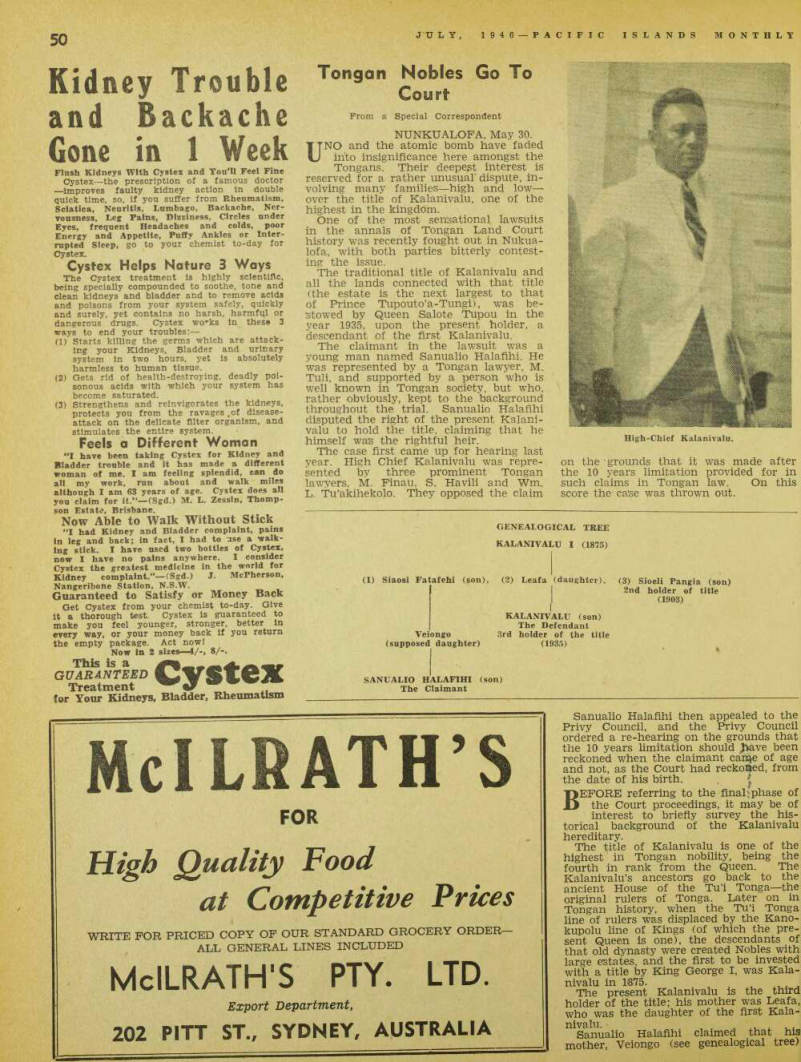
Court
From a Special Correspondent
Nunkualofa, May 30.
UNO and the atomic bomb have faded into insignificance here amongst the Tongans. Their deepest interest is reserved for a rather unusual' dispute, in volving many families—high and low — over the title of Kalanivalu, one of the highest in the kingdom.
One of the most sensational lawsuits in the annals of Tongan Land Court history was recently fought out in Nukua lofa, with both parties bitterly contest ing the issue.
The traditional title of Kalanivalu and all the lands connected with that title (the estate is the next largest to that of Prince Tupouto’a-Tungi), was be stowed by Queen Salote Tupou in the year 1935, upon the present holder, a descendant of the first Kalanivalu.
The claimant in the lawsuit was a young man named Sanualio Halafihi. He was represented by a Tongan lawyer, M.
Tuli, and supported by a person who is well known in Tongan society, but who, rather obviously, kept to the background throughout the trial. Sanualio Halafihi disputed the right of the present Kalani valu to hold the title, claiming that he himself was the rightful heir.
The case first came up for hearing last year. High Chief Kalanivalu was repre sented by three prominent Tongan lawyers, M. Finau, S. Havili and Wm.
L. Tu’akihekolo. They opposed the claim
on the grounds that it was made after the 10 years limitation provided for in such claims in Tongan law. On this score the case was thrown out.
Sanualio Halafihi then appealed to the Privy Council, and the Privy Council ordered a re-hearing on the grounds that the 10 years limitation should J*ave been reckoned when the claimant cah%e of age and not, as the Court had reckoned, from the date of his birth.
BEFORE referring to the final)phase of the Court proceedings, it may be of interest to briefly survey the his torical background of the Kalanivalu hereditary.
The title of Kalanivalu is one of the highest in Tongan nobility, being the fourth in rank from the Queen. The Kalanivalu’s ancestors go back to the ancient House of the Tu’i Tonga—the original rulers of Tonga. Later on in Tongan history, when the Tu’i Tonga line of rulers was displaced by the Kano kupolu line of Kings (of which the pre sent Queen is one), the descendants of that old dynasty were created Nobles with large estates, and the first to be invested with a title by King George I, was Kala nivalu in 1875.
The present Kalanivalu is the third holder of the title; his mother was Leafa, who was the daughter of the first Kala nivalu. , . .
Sanualio Halafihi claimed that his mother, Veiongo (see genealogical tree)
High-Chief Kalanivalu.
Genealogical Tree
Kalanivalu I (1875)
(1) Siaosi Fatafehi (son). (2) Leafa (daughter).
I (3) Sioeli Pangia (son) 2nd holder of title (1903)
Kalanivalu (Son)
The Defendant Veiongo 3rd holder of the title (supposed daughter) (1935) 1 •* % 1 1
Sanualio Halafihi (Son)
The Claimant
was a direct descendant of Siaosi Fata fehi, a son of the first Kalanivalu; there fore, in accordance with Tongan law of succession he was entitled to the title and the estate.
This was supported by the birth cer tificate of his mother which stated that she was Siaosi Fatafehi’s daughter.
HOWEVER, although all looked well on paper and according to gossip, when the Court, with the able assistance of the three lawyers for the defence, probed and dissected some tangled mari tal breaches of the past, the case for the claimant became rather a patchy affair. The defence proved conclusively that: (1) Veiongo’s father was not Siaosi Fatafehi but a W. Kieserwetter, a Ger man trader of the old days; (2) Siaosi Fatafehi was separated from Veiongo’s mother, went to the island of Haapai, and lived there for a period of 10 years; (3) Veiongo’s mother (on testimony) had
never seen her husband, Siaosi Fatafehi, after their separation; (4) Veiongo was conceived by her mother five years after that separation; and that (5) Veiongo’s two marriage certificates showed that her father was W. Kieserwetter.
Accordingly, the Court gave its deci sion in favour of the defendant, Kalani valu.
LATEST rumour here in Nukualofa is that an appeal had been lodged in the Higher Court by the claimant’s lawyer. This Court (the last to decide such cases) is the Privy Council where the Queen presides over her Ministers.
There is a hint that Sanualio Halafihi has a surprise up his sleeve.
Tongans shall see!
Advertisements & other items, pp. 53-54 (1 item)
Ipana
«z niiutfUl <>m ’
(U > is.
I Ki ■ h .lwcs<r m 0 i u // you want a good toothpaste 9 Ipana is the obvious choice. Ipana worCt work miracles but it WILL
CLEAN TEETH...
thoroughly
IPANA
does all a tooth-paste CAN do for your teeth and gums The principal function of any tooth-paste is to clean teeth, keep them white and sparkling and freshen your mouth. Ipana certainly does all that, but only a dentist can rectify teeth that are no longer sound and healthy. So see your dentist at least twice a year and keep your teeth at their
best and brightest by regular
brushing with Ipana.
A National Survey revealed that dentists themselves choose Ipana for their personal use 3 to 1 over any other dentifrice.
IPANA
TOOTH PASTE
3550 Sold by all leading distributors and manufactured by: BRISTOL-MYERS CO. PTY. LTD., 223 PACIFIC HIGHWAY. NORTH SYDNEY. N.S.W., AUSTRALIA
KANGAROO BRAND
Ropes,
Cordage,
and Twines for every purpose Backed by 86 years of service Manufactured by:
M. DONAGHY AND SONS,
Pty. Ltd., Geelong and Sydney.
Fiji Representatives:
PEARCE AND CO.
LIMITED
P.O. BOX 237, SUVA
A. B. DONALD Ltd.
AUCKLAND
ISLAND TRADERS & GENERAL MERCHANTS
P.O. Box 1509. Cables Gr Telegrams, "Kingdom," Auckland.
Labour Unrest Continues In Cook Is.
Auckland "Progressive Assn." Plays Off Native Waterside Workers Against Native Fruit Growers
From Our Own Correspondent
Rarotonga, May 31.
Immediately upon his arrival in Raro tonga, Mr. A. G. Osborne made a public announcement to the effect that the NZ Government would not recognise the Cook Islands’ Progressive Association (Auck land) when dealing with the Cook Islands and would discuss Cook Islands affairs only with residents of the Group.
This announcement appeared to meet the approval of the majority of residents here who are of the opinion that, while the gentlemen at the head of the C.I.P.A. are undoubtedly sincere in their efforts to promote the welfare of the Cook Island ers, their zealousness, combined with lack of personal acquaintance with local eco nomic conditions, leads to exaggerations which caused loss of sympathy with their efforts. The reports of individuals are not necessarily always the “voice of the people.”
Shortly after Mr. Osborne’s arrival, the leaders of Rarotonga’s wharf workers’ union announced that if representatives of the C.I.P.A. were not permitted to take part in the forthcoming wages tribunal, the wharf workers would not recognise the tribunal. Mr. Osborne countered by saying that he would send a radio mes sage to cancel the sailing of the “Maui Pomare” which was then due to leave Auckland. After a few hours’ considera tion the wharf labourers decided to capi tulate, but it soon became apparent that they had not capitulated in good grace.
In his speech at the end of his visit, Mr. Osborne reported that the Cook Islands’ Progressive Association had been
discussed at the combined meeting of the Arikis and island councils, and that the Arikis and Council members unanimously agreed that matters affecting the life and welfare of the Cook Islands were the con cern of locals and not people outside the islands. They therefore asked that Mr. Osborne convey to the NZ Govern ment their desire that only Cook Islands residents be recognised to speak on be half of the Cook Islands, and their ob jection to non-residents of the Group claiming the right to speak to the NZ Government on behalf of the Islands.
MR. OSBORNE arrived in Rarotonga just after the return of the Raro tongan workers from Makatea at the end of their one year’s term of inden ture. There was great concern among the workers at the suggestion that none of them might be permitted to return to Makatea, and that married couples cer tainly would not be allowed to return.
Before leaving Makatea the men had appealed to the British consul to be al lowed to re-sign in Makatea for further service and without the necessity for re turning to Rarotonga for leave. This, of course could not be permitted.
In Rarotonga strong appeals were made to Mr. Osborne and the administra tion that a full contingent, including families, be allowed to return.
Referring to this matter in his public speech, Mr. Osborne said, “Because of the criticism of the Government and the ad ministration, the Government had been compelled to say that married men can not go to Makatea. The phosphate com pany say there is need only for 200 men this year. Last year 350 men were em ployed at Makatea. Had it not been for the criticism, no doubt, the company would have taken more this year. Don’t blame the NZ Government; don’t blame the Resident Commissioner; blame those people who set up the criticism to pre vent your going.”
A T present the Makatea question is completely eclipsed by the wharf troubles, A union has been formed in Rarotonga and the members are car rying tickets of an Auckland labour union.
It is claimed that 700 Rarotongan work ers have become members. In spite of appeals to the wharf workers to keep the peace until after the tribunal, they have continued a “nuisance campaign.”
While all residents agree that the work ers have every right to ask for increased wages, their refusal to behave in a reas onable manner until after the end of the tribunal which is being arranged to in vestigate their case, is causing general annoyance.
The situation would be somewhat dif ferent if Rarotonga’s fruit industry were controlled by large companies, but Raro tonga is a community of small native growers, and the regular shipping of their fruit is vitally important to native econ omy. , .
The continual threat of fruit shipment
hold-ups is causing a deep resentment among the fruit growers. At best, this season is likely to be a poor one owing to the damage to crops caused by the hurricane in January.
When the “Maui Pomare” called in April, the wharf labourers went on strike when their leader —because of his propen sity for trouble-making—was told that he could not work aboard the ship, but only on shore. After several hours’ delay the tomatoes were eventually loaded, the manager of the Union Steamship Com pany having threatened to order the ship away without them.
When the “Maui Pomare” arrived again a few days later there was a consider able delay in working the ship, the men striking again because the company had signed on an employee of long-standing who was not a member of the union. The man had to be stood down before work commenced.
Latest Developments
June 3. rpHE “Maui Pomare” has again been held time for a day at Aitutaki while on her way round the Group picking up oranges.
When working the Group the ‘Maui Pomare” carries an experienced Raro tongan crew to handle the winches and stow the cargo. On this occasion the Rarotongans refused to work the ship un til the Aitutaki labourers agreed to be come members of the union. It appears that this strike had been pre-arranged.
While this is occurring, Mr. J. A. Gil mour, of the NZ Industrial Court, is ac tually in Rarotonga making preparations for the forthcoming wages tribunal.
New Price Control Bill
Before Legislative Council in July
SUVA, June 26. rnHE Price Control Bill which has been J. drafted, and will come before the Fiji Legislative Council in July, will take the place of the Price Control Regu lations now in existence, and the amend ed regulations which were withdrawn last February after public protest.
If the new Bill is passed the Governor will appoint a Price Controller who is empowered in his discretion to fix maxi mum prices either by prescribing a speci fied sum as the maximum nrice, or by prescribing the manner in* which the maximum price is to be ascertained.
The Controller will be assisted by a committee.
The Bill as at present drawn applies to goods and to services, but does not apply to services of a professional nature. Re fusal to sell at the maximum price is an offence unless the person refusing to sell has reasonable cause for refusing; reason able cause is defined. Power to requisi tion goods is given to the Controller by provisions which follow closely the exist ing Regulations.
The Controller is given wider powers to obtain the necessary information to en able him to carry out his duties.
At present he may obtain information only by demanding a return to be made to him, supported, if required, by a statu tory declaration. The Bill enables him to obtain informati9n in a less formal man ner if he so wishes, and the provision relating to statutory declarations has been omitted. Traders when called upon, must furmsh the Controller with copies of cer tain documents.
Every trader is required to keep, if he can, such books and accounts as are normally kept by traders, and not to de stroy them without the Controller’s con sent.
Mr. A. F. Gow, who recently received his discharge from the Australian Army, returned to Port Moresby by Qantas Air ways on June 26. He will be attached to the Administration, with headquarters in Port Moresby for the present.
Mr. Max E. Babbage, well-known planter of Buka Passage, recently an nounced his engagement to Miss Marian Fleming, of Aberdeen, New South Wales.
The marriage will probably take place before Mr. Babbage returns to his planta tion shortly.
M. Roger Gervolino, who represents New Caledonia at the French National Assembly, and who went overseas in 1941 with the Pacific Battalion, arrived in Noumea by air on May 23, via the USA.
He told Caledonians that he believes their Colony may get two representatives in the French Chamber, instead of one.
Elected with the support of the Cale donian Party, he is working for a greater measure of self-government. He says he voted against the constitution, regarding it as a menace to the future of demo cracy.
Flight-Lieut. Paul Harricks and Flying- Officer Victor Jackson, both of whpm were members of the Fiji RAF Contin gent, arrived back in the Colony in June for demobilisation.
Mr. C. S. Israel, who has been branch manager of Morris Hedstrom, Ltd., Lau toka, Fiji, for manv years was farewelled on June 11, prior to his transfer to Aus tralia. The function took the form of a dinner given by the local Chamber of Commerce, of which Mr. Israel has been an active member for 15 years, and presi dent until the current year.
Advertisements & other items, pp. 55-56 (1 item)
W. Kopsen & Co.
WANTED TO BUY—QUALITY GUNS AND RIFLES
HIGHEST PRICES GIVEN. WELL ALSO EXCHANGE GUNS Short Service Barrels, without Sights and Platform, £2/15/- each.
Postage extra.
SI L RO H U Quality Firearms and Fishing Tackle. 148 ELIZABETH STREET (Near Market St.) SYDNEY. ’PHONE: MA 3540.
MAY SPECIAL:
DEKOL
Guards Wood and Canvas from the Ravages of White Ants, Borers, Dry Rot, Mifdew, etc.
DEKOL penetrates deeply, permanently protecting wood and fabrics from rot and attacks by fungi and insects. It is simple to apply and when dry can be painted and varnished. DEKOL also prevents attack by marine borers on wood immersed in sea water.
PRICE 12/- SAL. (4 g a |. tins). 14/6 GAL. (I ga |, tins). ™ly descript ive leaflet available on request. Dekol should be “f e n l ™ e . ver V home and on every estate and will save pounds per year in damage and expensive replacements.
DON'T WAIT
TILL THIS
HAPPENS.
Q. .0 ft 3 Trade Inquiries Invited.
KEROSENE LAMPS
Reliable, efficient Australian-made pressure vapour lamps, providing a full 300 candlepower of steady unflickering light at a cost oi I 4 pints lighting kerosene in 10 hours Popular all-purpose lamp, illustrated, may be used as a hanging lamp, storm lantern or table lamp. Absolutely wind-proof, rainproof and insect-proof. Easily operated and require little maintenance or replacement of spare parts. Practically all parts, including tank, are made of brass to withstand tropical atmospheric conditions, and each lamp is fully tested before despatch. Fully illustrated descriptive leaflet available on request. Also available in handsome tall table design suitable for lounge and dining-room.
W. Kopsen & Co.
Pty. Ltd.
376-382 KENT STREET, SYDNEY
CABLES: KOPSEN, SYDNEY.
’Phone MA6336 (7 lines). Est. 1878.
500,000
Men's Second-hand
JACKETS
and
TROUSERS
SUITABLE FOR PACIFIC
ISLANDS TRADE
Price: 4/- Each Quick Shipment—Pressed Bales containing 1,000 Assorted Garments.
Establish Confirmed Credits for Payment for Any Quantity on Any English Bank.
M. NEWMAN
(Contractors) LTD.
Government Contractors
HEAP ST., MANCHESTER 7,
ENGLAND
Cable Address: Harbinger, Manchester.
George J. Lockyer & Company
Engineering Supplies, General Hardware
Exporters and Merchants
Purchasing Agents. Manufacturers’ Representatives.
Electric Light Generating Flants.
Air Conditioning Plants.
Builders’ Hardware.
Marine Engineering Supplies, Refrigeration Supplies.
Radios and Accessories.
Sanitation Equipment.
Automobile Spare Parts and Garage Accessories.
Abrasive Wheels.
Excavating Machinery.
Electrical Supplies.
Grinding and Pulverising Machinery.
Hydraulic Equipment.
Mechanical Engineering Requirements.
Mining and Quarrying Machinery.
Road and Building Machinery.
Constructional Alloy Steel.
Stainless Steel.
Special Constructional Steels.
Carbon Tool Steel.
High Speed Steel.
Alloy Tool Steel.
Forging.
Tungsten Carbide.
Mild Steel Bars. (Round, Flat, Square, Hex.) Angles and Tees.
Reinforcing Rods.
Sheets, Plates, Copper and Brass.
Sheets and Tubing, etc.
All communications to be addressed to “The Secretary,”
G.P.0., Box 4553, Sydney.
Telegraphic and Cable Address;
FAIRLIGHT STREET, FIVE DOCK,
Bankers: Commonwealth Bank of Australia, Sydney.
LOCKMACH,” Sydney.
SYDNEY, N.S.W.
•Phone: UA7196
Territorians Support
Ng Scholarship
Fund
Territorians Support Needed
MORE details have come to hand of the Scholarship Fund which will be provided by the New Guinea Women’s Association" of Melbourne. Their almost unused ROW Fund (£820) will be a nucleus.
It says much for these women that they are going ahead with a scheme that has defeated other New Guinea bodies which flourish, or have flourished, in Australia during the past four years.
It was suggested last year that all these associations should, under the guidance of the Pacific Territories’ Association, pool .their resources for a scholarship fund for New Guinea children. It was universally believed that this was one of the most sincere ways of paying lasting respect to the men of New Guinea who had given their lives in the war. However, legal difficulties appear to have killed that scheme in its infancy.
It is interesting, therefore, to see the Melbourne women working on their own account and shouldering what, after all, is a fairlv large burden. Their cause should be supported by every Terri torian—not only by those who are resi dent, temporarily or otherwise, in the Aus tralian State of Victoria.
The secretary of the Association (Miss Dorothy Stewart) writes as follows: “We are, as yet, onlv battling with the prelim inary details; this involves numerous in terviews with officers of the Victorian De partment of Education.
“Eventually, the Perpetual Executors & Trustees’ Association of Australia Ltd., will administer the scholarship fund. They will pay to the head-master, or mistress, of a school chosen by the winner (from an approved list of schools issued by the Department of Education) a certain sum of money towards payment of school fees.
The sum of money paid will, of course, depend upon the success of our scheme.
The list of schools includes all leading Victorian schools in town and country.
“The children competing, in the first instance, will be children who lost their fathers during the war, and when no fur
ther applications are received from child ren in this group, the scholarship will be open for competition among children of any returned serviceman and woman who is resident in the Territory of New Guinea.
Then, eventually, when all children elig ible under the first and second groups are beyond the age limit of years, the scholarship will be available to all child ren of European parents who are resident in New Guinea.”
DETAILS of how and where to apply for entry forms for the scholarship will be announced in the “PIM” at a later date. It is. hoped that the first scholarship will be available for 1947.
The Association will be holding func tions to raise funds, and members of the public may also contribute. Donations should be sent'to the Secretary, N.G.
Women’s Assn., 7 Wilson St., Moonee Ponds, Vic., W. 4. Further donations re ceived in June were as follows; N. G. Memorial Scholarship Fund.
£ s. d.
Previously acknowledged to June 7 43 1 0 F. & W. €. Rowe, Camberwell, Vic 5 0 0 “Pacific Islands Monthly” ... 500 £53 1 0
Tahiti's Servicemen
Return
From Our Own Correspondent
Papeete, May 6.
OUR aito —our valiant warriors—have come home.
From Semaphore Hill. Maeva, the salute to kings; and from Farerauape Plateau (to the east), a blazing Cross of Lorraine flushed through the darkness— Tahiti’s message of welcome, as the “Sagittaire” approached the island, before the dawn of May 5.
Tragedy, unhappily, overshadowed the home-coming for, just before the “Sagit taire” came within sight of Tahiti, a sol dier of Tahiti, and a lady of New Cale donia on board, had died. Ashore —as our island people hastened from the country side —a serious motor accident had caused death and injury.
For this reason, the stately ceremonies of reception by His Excellency and the high dignitaries of the Colony were meas ured to express the deep emotions of bereavement and sympathy.
From the ship—as is the custom at all home-comings of our soldiers —the Bat talion marched in companies to services of thanksgiving held in the several churches of Papeete.
Tragedy may cloud; but it cannot quench the joy of re-union.
Tahiti has prepared a welcome—from all the resources of pride and gratitude—to do honour to her heroes.
Banana Flour
APIA. June 24. riTHE possibility of manufacturing banana X flour for local consumption and for export, is the latest matter for general discussion here.
Mixed with wheaten flour, banana flour makes excellent bread, scones, cakes, etc.
It is cheap to produce, easy to prepare, and it utilises bananas which are not up to export standard and would therefore be wasted otherwise.
At present, Australian wheaten flour is expensive in the Territory, and the pro duction of this local substitute may en able imports to be cut to some extent.
When properly prepared and used, banana flour has a pleasant, sweet taste.
Mr. G. Bellamy, a well-knowh gold miner, returned to the Morobe district of New Guinea by the July “Montoro,” after four years’ absence. During his residence in Sydney, Mr. Bellamy was an active member of the executive of the Pacific Territories’ Association,
Advertisements & other items, pp. 57-58 (1 item)
Caktee^
To whom it may interest . . . & Me
xmpobtebs.
EXP
ORTEBS’
« so '- ss 8 S?S o rKO ' nDOMB Si "'” „„ W«»«“ mSS* What 15 5 v( ., or seller » ng a rush trip i ( , an x spare 1{ you ate a gWen thoUgb ' e \°^ e qUeSii ° n cb a a evast SOttl ° e ° do uhUessyouhave ds And. as to W or „f3rvhom ean 1 bc covere enthus.assr- S £S *• beliel tbroughout q{ s „ppl ticaUy eu “ L . „ V nation, w ,Wa vrave aftS ' Ver . i 3 In a We believe i v iro ugli out AttSt * rcc ot sUppl tlcally endorse agents tb rly every son an d orgatiisatio 11 ’ e you need* a U tyP eS ing selling’ ° Ur offer tbc serv pU rclia sing eX pedite va llal)l c to insect Powder K-* oi •*-£• * tut p "£t a c Jng and * es^ h ‘ offers T«“ Advantages powder drop «s a Aon your heha«- - - SB "' Tlnion Ban * ,r in ° UIIV y ou, drop n a ct ou j
'js.-&szr:zz~~
i ors- Union BanK Bankers.
Sydney* «... <***•’
Cables: “Magic,
AIRWAYS HOUSE,
44 PITT STREET, SYDNEY.
'Phone: BW 3068 Sydney. Code: Bentleys.
Copies of
Pacific Islands Monthly
Can ALWAYS be obtained at the following places:
SYDNEY:
T. L. Cordingley’s Bookstalls at Martin Place, outside G.P.0., near George Street; and at G.P.O. Colonnade, George Street end.
BRISBANE;
R. S. Macdonald, next G.P.0., Brisbane, Qld.
MELBOURNE:
McGill’s Authorised Newsagency, 183-5 Elizabeth Street, Melbourne.
AUCKLAND;
W. A. Webb, Waverley Hotel Bldgs., Queen Street, Auckland.
SUVA:
James A. Muir, Suva, Fiji; and Miss R. Castles, Victoria Parade, Suva, Fiji.
CUE ALSO LIST OF AGENTS ON
PAGE 7
m
iOFf
XI n
RJ2 18 H.P. MARINE DIESEL
Driving 21 in. x 1 5i in.
Propeller at 740 r.p.m. 0 Reliable • Efficient m Economical Stuart Turner
Generating Sets
500, 750, 1,000, 1,500 and 3,000 Watts. 32v, 50v, 11 Ov.
Simple, Economical
GOOD DELIVERIES
Write for full particulars
Thornycroft (Aust.) Pty., Ltd.
6/10 Wattle Street,
PYRMONT, N.S.W.
Cables: TIIORNMOTOR, Sydney.
Samoa—Tonga

Shipping And Plane Services
rE following sea and air services are running to schedules in the Pacific.
None of the regular services which were suspended, owing to war conditions, have been restored; but preparations are under way for their early re-introduction.
As they become available they will be announced here.
New Zealand—Fiji—
Samoa—Tonga
Service Conducted By Union Ss Co.,
Ltd.—Subject To Alteration Without
Notice
The “Matua” will be withdrawn for annual survey after her return to Auckland about July 19. No vessel will substitute for her, but the following tentative arrangements are proposed to assist in maintaining the service during the withdrawal of “Matua”:— “Maui Pomare” leaves Auckland July 2 for Rarotonga, Atiu and Mangaia, and if not required to return to the Cook Group, to leave Auckland about mid-July for Apia to load bananas for Auckland. (See Cook Is. tables, below.) “Waihemo,” free Bluff mid-July, proceed to Auckland to load general cargo for Suva and Lautoka.
“Waikawa,” en route Pacific Coast to Auckland, call Suva mid-August to load bananas and general cargo for Auckland.
New Caledonia
rE New Caledonian Government has sub sidised and maintained the coastal ship ping services. The East Coast, the West Coast, and the Loyalty Islands, under present conditions, receive 10 round trips per annum.
The ships call at the following ports: EAST COAST. —Yate, Ounia, Thio, Nakety, Canala, Kouaoua Kua, Moneo, Ponerihouen, Tibarama, Poindimie, Wagap, Touho, Tipindje, Hienghene, Tao, Oubatch, Pouebo, Balade, Pam, Arama, and' return.
WEST COAST.—Pouembout, Kone, Temala, Voh, Ouaco Gomen, Kouraac, Tangaiou, Tiebaghi, Nehoue Poume, Baaba, Belep and return.
LOYALTY ISLANDS.—Mare (Tadine), Lifou (Chepenehe) Ouvea (Fajaoue, St. Joseph) and return.
The steamer “Neo Hebridais” runs regularly between and Sydney, with occasional trips to the New Hebrides (mostly Aneityum).
The owners are Societe Maritime et Maniere Hagen, Noumea. Sydney agents: H. C. Sleigh, 254 George Street, Sydney.
New Zealand—Cook
Is.—Niue—Samoa
fITHE motor vessel “Maui Pomare,”
X owned and operated by the NZ Gov ernment, maintains a direct service between Auckland and Rarotonga (Cook Island), with alternative calls at Niue and Apia (Samoa).
Latest advice is that “Maui Pomare” will not make a special trip to Apia (see NZ-Fiji- Samoa-Tonga time-table above) but will be re quired to run another trip to the Cook Islands.
She will leave Auckland on July 2 for Raro tonga, Atiu and Mangaia, return to Auckland and leave again about July 26 for Rarotonga and Mangaia.
Sydney-Norfolk Island-
New Hebrides
mHE SS “Morinda,” Burns Philp & Co., X Ltd., runs at approximately six seven weeks’ intervals from Sydney
to Lord Howe Island. Norfolk Island, and main ports of the New Hebrides, and return. A regular fixed timetable is not
yet practicable.
Sydney—Auckland
Airways
TASMAN Empire Airways, Ltd., operate a flying-boat service between Rose Bay, Sydney, and Mechanics Bay, Auckland. Large flying-boats, capable of carrying 20 passengers, are employed. The trip is comfortable, and takes from 8 to 10 hours, according to weather.
The flying-boats usually leave Sydney at day light on Tuesdays, Thursdays and Saturdays, and leave Auckland at daylight on Mondays, Wednesdays and Fridays.
Bookings may be made at the Auckland and Sydney offices of Tasman Empire Airways.
Pan-American—
Trans-Pacific Service
"pAN-AMERICAN World Airways is now operating a weekly service between Auck land and San Francisco with a 40-passenger Douglas Skymaster. Booking through local agents of PAA in places named. Schedule of times and fares is as follows:
Northbound
Leave Auckland 0700 Thursday Arrive Tontouta 1435 Leave Tontouta 1600 Arrive Nausori 2125 Leave Nausori 1700 Friday (Crosses Date Line) Arrive Canton Island 0025 Leave Canton Island 0155 Arrive Honolulu 1250 Leave Honolulu 0830 Saturday Arrive ’Frisco 2230
Southbound
Leave ’Frisco 0800 Saturday Arrive Honolulu 1800 Leave Honolulu 1600 Sunday Arrive Canton Island 0105 Monday Leave Canton Island 0235 „ (Crosses Date Lines) Arrive Nausori 0900 Tuesday Leave Nausori 0600 Wednesday Arrive Tontouta 0925 Leave Tontouta 1100 Arrive Auckland 1740 (Note: Tontouta is Noumea field. Nausori is near Suva.)
Pares
Auckland-Suva $165.00 (via Tontouta) Auckland-Honolulu . .. 395.00 Auckland-’Prisco 59'0.00 Suva-’Frisco 442.00 Suva-Honolulu 257.00 Suva-Auckland 165.00 (via Tontouta) Free baggage allowance is 55 lb. Excess at 1 per cent, of the one-way fare for each kilogram of excess (1 kilo 2.2 lb.). (Note: For easy conversion to Australasian currency £1 should be counted as $3.)
Sydney—Queensland—
Port Moresby Airways
Q ANTAS Empire Airways, Ltd., employing DC3 planes, operate a regular service between Sydney, Port Moresby and Lae, and return, via Brisbane, Rockhampton, Townsville and Cairns.
Planes leave Sydney on Mondays, Wednesdays and Fridays at 10 a.m., and arrive at Lae at noon on Tuesdays, Thursdays and Saturdays.
Planes leave Lae at 5.45 a.m. on Wednesdays, Fridays and Sundays, and arrive in Sydney at 10 p.m., accomplishing the Lae-Sydney run in a day.
Bookings may be made at Qantas offices at any of the towns named. At present, berths are available only to passengers holding official per mits to visit Papua or New Guinea.
Pacific Travellers
PASSENGERS who left Auckland, per MV “Matua” on May 30:— FOR SUVA: Mrs. S. M. Allen, Mr. and Mrs.
Mrs. R. Brown, Mr. G. M. Browne, Mrs. M. F.
R. C. Burgess (and son), Mrs. I. J. Bremner, Buckeridge, Mr. and Mrs. L. C. Cox, Mrs. M.
F. Clay (and two daughters), Miss D. Doherty, Mrs. A. A. Donald, Mr. D. A. Donald, Mrs. M.
R. Elliot (and two daughters), Miss M, D.
(Continued page 59.)
Evans, Miss A. M. Frank (Sister Mary Angelica), Mr. and Mrs. R. C. Freeman (and two sons), Miss O. M. Flemons, Mr. and Mrs. H. R. Green ing, Miss O. M. Gow, Miss P. Gale, Mr. G. A.
Gemmell-Smith, Mrs. N. L. Horsefield, Mr. G.
Jay, Mr. and Mrs. C. T. Keegan (and daughter), Mr. J. H. Mabbett, Mr. H. R. Morris, Mr. J. K.
Maclean, Mrs. J. O. Murray, Mrs. I. A. Mab bett, Mr. G. H. Millett, Mr. C. Meyer, Mr. L. V.
Osborne (and son), Mrs C. H. Pinfold, Miss E.
A. Roper, Miss R. M. Sabben, Mr. P. J. Stephens, Mrs. Turner, Mr. and Mrs. R. S. Tanaibika, Mrs. L. P. Thomsett (and two daughters), Mr.
G. E. Thompson, Mr. C. W. Vernon, Mrs. G. M.
Wane (and daughter), Mr. and Mrs. G. F. Witty, Mrs. C. M. Woodward (and daughter), Mr. D.
Warren, Mr. E. B. Whelan, Mr. E. C. Wood ward, Mrs. J. H. Lang.
FOR NUKUALOFA: Mr. W. Briggs, Dr. H. G.
Brown, Miss P. E. Hoeft, Mr. T. E. Peek, Mr. and Mrs. A. F. Quensell (and two daughters), Mr. J. Laycock, Mr. B. H. Blake.
FOR VAVAU: Miss V. Moore.
FOR APIA: Mr. J. Bentley, Mrs. E. Church ward, Mrs. J. J. Cook, Miss M. Cobcroft, Mr. and Mrs. E. J. Edwards (and two sons and daughter), Mr. J. D. Freeman, Mrs. A. R.
Lane, Mr. M. S. H. Manning, Miss R. N. Prit chard, Miss E. M. Putwain, Master P. Reid, Mrs. M. Stehlin (and daughter), Mr. and Mrs.
R. W. Taylor, Mr. W. A. Veitch, Mr. H. O.
Wiles.
FOR NIUE: Mr. C. A. Brew, Miss C. M.
Dawson, Mr. and Mrs. C. Jennings (and son), Capt. C. S. Larsen, Mr. and Mrs. C. H. W.
Larsen (and son), Mrs. T. Pila, Mr. L. R. Rex.
FOR ROUND TRIP: Mr. P. Mason, Mr. H.
G. Pinel, Mr. H. Turner.
PASSENGERS who arrived in Auckland by MV “Matua” on June 21:— FROM NUKUALOFA: Mr. and Mrs. H. Dunn (and two daughters), Dr. F. Matheson.
FROM VAVAU: Mr. H. Moa, Mr. J, Scarll, Miss E. Wolfgramm.
FROM APIA: Mrs. I. Ah Mu (and two children), Miss A. Carter, Mr. C. Gosche, Mr.
F. Gosche, Mrs. C. Hellesoe (and two children), Miss J. Halia, Mr. and Mrs. G. Jackson (and two children), Miss R. Kruse, Miss S. Lane, Mr.
J. Parsons, Mr. L. Phillips, Mr. D. Rice, Miss C. Taimalelagi, Mr. G. Warren, Rev. and Mrs.
H. Whyte.
FROM NIUE ISLAND; Mrs. J. Fineone, Mr.
Lamaki, Mrs. E. Paul, Mr. Pati Latoa, Mr.
Sanipeti.
FROM SUVA: Mrs. M. Baker (and daughter), Miss K. Bognuda, Miss M. Cullen, Mrs. W. Dyer (and two children), Mrs. K. Franklin (and daughter), Mr. M. Glucina, Mr. and Mrs. W.
Gordon, Mr. Gopal Bhai, Mr. J. Kee Ying, Mr.
M. Lynch, Mr. Lau Choi, Mr. Lui Kau, Sister Matter, Mrs. J. Osborne, Mrs. J. Penney, Mr.
T. Prasad (and daughter), Mr. D. Strong, Mr.
W. Samson, Mr. and Mrs. F. Schaar, Master J. Smith, Mrs. C. Taylor (and three children), Miss K. Valelovaki, Miss C. Wadmore, Mrs. J.
Wilson.
PASSENGERS who left Sydney by SS
“Ormiston” on June 14:— FOR PORT MORESBY: Mr. D. K. Anderson, Mr. P. A. Broman, Mrs. M. H. Buckland (and child), Mr. J. R. Black, Mrs. N. Cahill (and two children), Mr. C. R. Clarke, Miss D. Cooper, Mr.
R. H. Facey, Mr. A. Gibson, Mrs. A. V. Hollick, Mr. A. S. Haynes, Mr. B. R. Hawkins, Mr. B.
B. Hayes, Mr. V. L. Hayles, Mr. K. W. Jones, Mr. W. J. Johnston, Miss E. M. Jones, Mr H A. Kent, Miss N. R. Kingsland, Mr. J. T.
Livingstone, Mr. A. J. Leyden, Mrs. J. Mossmann (and daughter), Mr. V. J. Martin, Mr. L. A.
Moore, Mr. C. Matson, Mr. W. J. McPherson, Mrs. L. F. Pullen ((and two children), Mr. I W. Roberts, Mr. J. M. Robinson, Mr. C. H.
Rich, Mr. E. Rower, Mrs. K. Ramsden, Mr. T.
Spencer, Mr. W. E. Tomasetti, Mr. and Mrs.
J. H. Theckston, Mr. A. E. Wilkinson, Mr. A Walker, Mr. T. E. Warburton, Mrs. N. B.
Watkins. Mr. J. B. Page, Mr. L. M. Clarke, Miss M. C. Crampton, Mr. and Mrs. A. D. Gluyas (and four children).
FOR SAMARAI: Mr. G. R. Hancock, Mr. L. C Ingle, Mr. and Mrs. W. A. Coates.
FOR RABAUL: Mr. C. B. Bell, B. Rolefif, G.
Hofman, J. Weigl, H. Nollen, B. Hutters, A.
Neumann, J. Plengemeyer, F. Bahmann, B Epping, F. Kunne, A. Schaller, H. Grewe.
FOR BOUGAINVILLE: Sister M. Marliol, Sister M. Gisele, Sister M. Blaise, Sister Marie
Igmace, Sister Mary Crescentia, Sister M. Wen delina.
PASSENGERS who left Sydney by SS
“Montoro” on July 8: — FOR PORT MORESBY: Mr. G. Renton, Judge and Mrs. J. B. Phillips, Mrs. E. E. Morgan, Mrs.
K. Joubert, Mrs. R. I. Lyons (and daughter), Mrs. C. Barton, Miss V. F. Irwin, Mr. W. G.
Niness, Mr. R. Hamilton, Capt. Fitch, Miss I.
E. Williams.
FOR SAMARAI: Mr. G. E. Miller, Mr. W. B.
Gill, Mr. J. van Leeuwin Rev. N. E. G. Crutt well.
FOR LAE; Mr. B. Fraser, Mr. R. N. Wilson, Mr. H. S. Schubert, Mr. W. Money, Mrs. N. L.
Whiteley, Mrs. M. Booker, Mrs. L. J. Shanahan (and two children), Mr. S. C. J. Jocumsen, Mr.
E. J. A. Mudford, Mrs. D. M. Bennett, Mr. F.
Brenton, Mr. G. W. Bellamy, Mr. A. R. W.
Hoile, Mr. J. Louttit, Mr. S. W. Lane, Mr. E.
P. Hitchcock, Mr. M. J. Broadhurst, Mr. and Mrs. H. Turner, Mr. and Mrs. T. Spalding, Mrs.
A. Worcester, Mrs. H. Perrier, Mr. and Mrs. W.
Rowley, Mr. and Mrs. R. E. Emery, Mr. and Mrs. Franklin, Mr. and Mrs. G. N. Wharton, Mrs. N. R. Lowe, Mrs. R. W. Tebb, Mr. N. G.
Marshall, Mr. B. Ayris, Mr. J. P. Burns, Mr J.
Young, Mr. C. Booth, Mr. F. L. Doble.
FOR MADANG: Mr. U. E. Tierney, Mr. L. W.
Bell, Father C. Boehm, Bro. H. Kaerkis, Bro.
R. Schmall, Mrs. L. Burston, Mrs. H. Chugg, Mrs. M. S. Pasley (and daughter), Mr. H. W.
Kirke, Mr. C. Braddon, Mrs. F. H. Luff, Mrs.
M. P. Wheatley (and child and son).
PASSENGERS who left Australia for
New Guinea by Qantas Airways on:
JUNE 4: Mr. G. Lindsley, Mr. W. Haldae, Mr.
T. G. Aitchison, Mrs. D. R. Cromie, Mr. R. D.
Brown, Mr. H. Lock, Mrs. G. V. Stubbs, Mr. D.
G. Tapsell, Mrs. R. N. Wardrop.
JUNE 5: Mrs. I. A. Tomkins, Mr. C. H. Hay don. Mr. V. A. Turner, Mrs. F. S. Stewart, Mr.
J. Schuller, Mr. K. Sinclair, Miss L. I. A. Cal vert, Mr. F. C. Penny, Miss N. W. Garrett, Mr.
A. G. Brown, Mr. F. G. Barber, Mr. H. T.
Moon.
JUNE 7: Major D. R. Robertson, Mr. G. J.
Rice, Mr. R. J. Tyson, Miss G. C. Power, Mr.
F. W. Reed, Mr. Tait, Mr. W. Loeven, Mr. H.
J. Milton, Mr. R. Tempest, Rev. J. Hafermann,
Mrs. Rohrlach (and infant), Miss Rohrlach, Mrs. A. Mylrea, Dr. Kerr.
JUNE 11: Mrs. R. Sidey, Miss H. Sanders, Miss W. Ingram, Miss L. Millar, Mr. J. Sim monds, Mr. H. Simmonds, Mr. H. Linden, Mr.
J. K. Edmonds, Mr. R. R. Bradshaw, Mr. K. C.
Campion, Mr. R. N. Beverly, Mr. A. K. Walker, Mr. H. T. Waytt, Mrs. L. Hardy, Mr. R. K. Earl, Mrs. L. W. Hardwicke (and child).
JUNE 12: Mr. W. W. Brattam, Mr. V. A, Coughlin, Mr. J. P. Lyons.
JUNE 13: Mrs. A. B. Thistlewaite, Mrs. A. C.
Gemmell, Miss A. J. Neville, Miss E. Kerr, Mrs.
J. Stopp, Mrs. E. Champion, Miss I. Champion, Mr. G. W. Smith, Mr. W. T, Hillier, Mr. K.
Woodmand, Mr. P. Lucas, Mr. H. C. Brown, Miss E. Connolly, Mr.’ H. H. Rowe.
JUNE 14: Miss R. A. Cavis, Mr. S. B. Richter, Miss McKinnon, Mr. Ryan, Mr. Cozier, Mr. G.
P. Buckley, Mr. T. N. Mell, Mr. R. D. Disher, Mr. R. A. Hughes, Mr. E. Frame, Miss P. M.
Fitzgerald, Mr, L. N. White, Miss T. C. Waldby, Mr, B. Gelbart, Miss R. Davis, Mr. Richter, Mr.
Ryan.
JUNE 18: Mr. H. C. Corzier, Mr. W. P. Coutts, Mr. E. V. Bunting, Mr. W. R. Thomas, Mr. J.
H. Hannon, Mr. and Mrs. E. A. James, Mr. B.
T. Swanton, Mr. F. H. Fairon, Mr. C. D. Gal lagher, Mr. S. Bryan, Capt. McWilliams, Miss McKinnon, Mr. J, Widdup.
JUNE 19: Mr. J. H. McGuigan, Mr. J. A.
Downie, Mr. I. A. Kerr, Mrs. V. Ashley, Miss D, Ashley, Mr. J. R. Pearson.
JUNE 20: Master R. Field, Mr. Green, Mr.
Hartley, Mr. N. Owers, Mr. W. R. McConnon, Mr. W. H. Simpson, Mr. A. J. Garth, Mrs. V.
M. Garth.
JUNE 22: Mr. Francis, Master W. E. Wyatt, Mr. B. Turner, Mr. J. Widdup, Mr. T. J. Healy, Mr. Kinthi Chan, Mr. and Mrs. Braun, Mrs. E, Thompson, Mr. A. L. Pendlebury, Mrs. P. Tuckey, Sister R. H. Leighton, Sister C. G. Fairhall.
JUNE 25: Mr. Ashton, Master W. Bock, Mr.
E. J. Gleeson, Mr. M. Creed, Mr. S. Heaney, Mr. L. L. McKillopp, Mrs. M. Doland, Mr. J. H.
Goodwin, Mr. E. Spence, Mr. H. Williams, Mr.
L. J. Davies, Mr. H. Farlow, Mr. and Mrs. R.
T. Weidenhofer (and child), Mr. Evans, Mr. A.
Templewatts, Mr. F. Leather.
JUNE 27: Mr. Mann, Mr. F. E. Pietz, Mr. R.
N. Browne, Mr. J. H. Allan, Brig. C. R. Speck man, Mr. R. B. Duncan, Mr. J. N. McLean, Mr.
F. J. Lesmond, Mr. T. Leggatt, Mr. C. E. J.
Eather, Mrs. P. A. Clarke, Mrs. O. Perkins.
Mrs. N. Hicks, Mr. L. R. Foster, Mr. P. H.
Sneddon, Mr. A. F. Cow, Mr. J. F. Murray, Mr. W. A. Anderson, Mr. C. H. Mann.
JUNE 28: Master K. L. Gallagher, Mr A Fraser, Mr. T. W. Lega, Mr. K. B. Cross, Mr.
B. Mills, Mr. W. W. Clarke, Mr. J. C. Huie Mr C. W. Thomas, Miss C. H. Wedgewood, Mr. P, C. Trow, Miss N. H. Alday, Mr. R. B. Kennedy Mr. L. A. Brumby, Miss A. B. Mitchell Mr R S. Phelps, Mr. D. R. Mcßeath.
PASSENGERS who arrived in Australia from New Guinea by Qantas Air ways;— JUNE 5: Mr. P. N. Buckingham, Mr. G. Jansen Mrs. L. Bowring, Mr. A. J. Kent. Mr. A. c!
Brown, Mr. E. E. Mortlock, Mr. E. R. Daws Mr. H. C. Callaghan, Mr. W. W. McGregor, Miss D. Downing, Mrs. W. Rosan, Capt. V. Maxwell Mr. H. G. Niness, Sgt. S. M. Brown, Mr L v’
Drill.
JUNE 7: Mr. W. Walker. Mr. D. L. Cameron Mr. J. Yeates, Mr. A. A. Cowie, Mr. A. d’.
Sandison, Mr. A. J. Ferguson, Lieut.-Col. Ledger wood.
JUNE 11: Mr. C. R. Anderson, Mr. C. W Irwin, Mr. R. M. Stewart, Mr. K. L. Bennett.
JUNE 12; Sgt. Mac Alister, Sapper Dodd, Lieut Ryan, Mr. W. Howard, Mr. G. Zavattaro Sgt Ford, Prof. A. Elkin, Mr. J. H. Bray Mr A G Brown.
JUNE 16; Lieut. Muirhead, Sgt. Hilton Mr A. Crumbley, Mr. H. B. Tuckfield, Mr. B D Powis, Mr. E. A. Dr. H. W. Kerr Mr F. C. Penny, Mr. R. C. Tiffin. Mr. C. F. Nash.
JUNE 19: Mrs. R. Sidey. Mr. T. Murray.
JUNE 23: Lieut. B. Cash, Lieut. Caffrey, Mr.
J. J. Bruce, Mrs. J. Tuckey, Mrs. P. Tuckey, Mr. J. P. Walker, Mrs. P. Chatterton, Mr. P.
Chatterton,, Capt. M. F. Hayman, Mr. N.
Chidgey, Mr. N. Small. Mr. S. G. Adams, Mr S. Rawlings, Mr. R. A. R. Thrift, Rev. M. A.
Warren.
JUNE 26; Mr. R. H. Stares, Mr. K. R. Hamil ton, Mr. A. F. Skitch. Mr. H. C. Nelson, Mr.
G. F. Woolcock, Mr. J. O. Clarke, Mr. C H Ryan, Mr. J. F. Poole.
JUNE 28: Mr. P. J. Davies, Mr. J. Kuder, Mr, H, J, Enser, Mrs. E. Lawson, Mr. J. Dunwoodie Miss I. Baglini, Mr. B. Gelbart.
Mr. T. Leggett, Mr. J. E. Johnstone, Mr. D.
Mackay, Mr. L. B. Roper, Mr. E. Mathews.
The Family Of Jonas M. Coe
CERTAIN descendants of Jonas M. Coe, who was the first United States Con sul in Western Samoa, about the middle of the last century, have been in quiring into the history of the family.
Mrs. Emma Forsayth (who will always be known as “Queen Emma”) was the daughter of Coe and a Samoan woman of noble birth. When she settled in New Guinea, in the German time, she brought many of her brothers and sisters to live there with her; and the children and grand-children of those people are scat tered all over the South-western Pacific.
Old Mrs. Parkinson, who was formerly Phoebe Coe, and Emma Coe’s elder sis ter, died in New Ireland during the Japan ese occupation, at a great age. Because they had inter-married considerably with the Germans of New Guinea, prior to 1914. members of this family groun suffered greatly, in loss of personal liberty and loss of property, in both of the great wars.
The family of Jonas Coe emigrated from Scotland (from Glen Coe) to the United States about 250 years ago, and there are many descendants of the original group in both the Eastern and Western States.
Those who moved from Samoa to New Guinea, some 70 years ago, appear, with one exception, to have been girls, and thus changed their names when they mar ried. But one Coe, a brother of Phoebe and Emma, came into the Western Pacific in the German time, and then moved northwards into the Philippines. He be came a wealthy man, and died In Luzon m 1936.
Captain Chris Slattery, well-known Ter ritorial arrived in Australia recently from “Up North.” It is reported that he has married a Melbourne girl.
Mrs. A. Kleiner (she was Miss Cora Young), one of the leading members of the Sydney Polynesian Club for several years, and a founder, with her brother, of the South Seas Club, sailed for the United States early in July. She married an American serviceman during the war. and he arrived in Sydney in May to take her to her new home. The Youngs are members of the Norfolk Island family who are direct descendants of Midshipman Young, of the “Bounty” mutiny. ™ «roii tnnnrn man fpv A Stf tS ferentlv in order to v^,nf S on school there 1 place his young son in school th re.
The Rev. J. Hoadley recently arrived in Apia Western Samoa' accompanied by his famiiy. He will take charge of the London Missionary Society in the absence of the Rev. H. Whyte, who left on the May “Matua” for six months leave in Australia.
Advertisements & other items, pp. 59-64 (2 items)
Berger’s Paint
EYE LOTION
For Inflamed Eyes and Eyelids ... Sold Everywhere H.Rosei C0.,P1y.. Ltd.. King Street. Sydney.
■i ii ii ■i
Tested lor the tropics
To-day, the House of Berger with Empire-wide ramifications and resources makes a broad pattern of service to paint users. Every Berger finish must withstand test after test to prove worthy of the Berger label . . . every product must satisfy the Berger technicians and chemists that it will meet the challenge of all climates, from tropic heat to arctic cold. When you use any of Berger’s famous paints, ‘B.P.’
Berger’s Paint (Prepared), Synthelac, Matone, Quick Enamel, Pave-ol you get all the good qualities for decoration and lasting protection.
Berger’s Paint
TILLEY LAMPS
BURN ORDINARY KEROSENE
The Modern Form of PORTABLE LIGHTING Be sure you buy a
TILLEY
STORM LANTERNS \ Look for the name!
TABLE LAMPS
SUSPENSION LAMPS
RADIATORS
INSPECTION LAMPS
WALL LAMPS
FLOODLIGHT PROJECTORS
300 C.P.
Storm Lantern
Tilley Lamps are made only at
Hendon, England.
t Be sure you buy a TILLEY Look for the name ! / Shipments four weeks from receipt of order.
THE TILLEY LAMP CO., HENDON,
5,000 C.P.
Floodlight Projector
N.W.4, ENG.
REPRESENTATION :
MELBOURNE : T. H. Bentley, Pty. Ltd., 123-125 William Street. Melbourne, C.I.
TASMANIA : Mr. C. Sellars, 108 a Charles Street, Launceston.
FIJI ; Mr. K. Witherington, 2 Burns Philp Buildings, Suva.
PACIFIC ISLANDS SOCIETY
Visitors from the Islands to Sydney (or those interested in Islands affairs), are advised to communicate with the honorary secretary of the above Society, which has been formed to study the history, traditions, economics, and political developments of the Pacific Islands.
Regular monthly meetings are held at History House, 8 Young Street, Sydney Address for Correspondence:
THE PACIFIC ISLANDS SOCIETY.
Box 2434 MM., G.P.0., Sydney.
* VV\TV%
Set your face up for the day with COOL, soothing, whisker-subduing
INGRAM'S!
All over the world the Ingram's jar is the morning companion of men who appreciate easy shaving. Ingram's cools and smoothes the skin while it wilts the wiriest hair-growth. Moreover. Ingram's is most economical because so little is needed for a rich, thick, spreading lather.
INGRAM’S
vru
SHAVING CREAM
Manufactured by
BRISTOL-MYERS CO. PTY. LTD.
Sold by all leading distributors and manufactured by Co Pty. Ltd.. 223 Pacific Highway, North Sydney, N.S.W Bristol-Myers Australia
BECOME A MEMBER OF
Hutchinson’s Universal Book Club
Ensure yourself hours of thrilling enjoyment every month. Each month, from the works of such famous writers as Naomi Jacob, Philip Gibbs, Rafael Sabatini, Gilbert Frankau, Dennis Wheatley and many more, literary experts choose the book of the month. This best-seller, of standard size and quality and normally costing from 9/6 to 16/- comes to you for 3/3.
Fill in this Enrolment Form NOW!
To the Secretary, Hutchinson’s Universal Book Club, Bank of Australasia Building, 396 Collins Street, Melbourne.
I wish to enrol as a member of Hutchinson’s Universal Book Club in the following manner:— (i) I enclose herewith remittance for 19/6 which entitles me to receive the selected book each month for the next 6 months, postage free. (ii) I enclose herewith remittance for 39/- which entitles me to receive the selected book each month for the next 12 months, postage free. (iii) I enclose herewith remittance for 78/- which entitles me to receive the selected book each month for the next 24 months, postage free.
NAME (Block Letters)
ADDRESS
3
ISLAND CRAFT
TO
MODERN DESIGN
WOODEN FREIGHTERS,
TRAWLERS AND ISLAND
CRAFT.
VESSELS REPAIRED AND
REMODELLED.
AUSTRALIAN AGENTS FOR
GRAY MARINE PETROL AND
DIESEL ENGINES.
COPPERSMITHS, WELDERS
AND PLUMBERS.
MODERN SLIPWAY FACILITIES AVAILABLE
WRITE US FOR DESIGNS AND COMPLETE SHIPBUILDING INFORMATION.
A A
CludjUcdiatt Jndudi’de* Pid.
INCORPORATING REG. ADAMS CLAYTON CO.,
Tel.; XB 4475, XA 1731. JOHN STREET, BERRY'S BAY, NORTH SYDNEY. ALSO AT EDEN, NS W.
STAMPS
We buy ejections, also all issues in quantity, either off or on paper Top prices. Send registered mail.
Agents required in Pacific Islands, Papua and New Guinea to service covers and send mint stamps.
A. Willison, Box 128, Burnie, Tasmania.
The Twinkle in
Your Eye
COMES FROM ACTIVE
DIGESTION
Good normal digestive and liver activity means good, normal health and fitness. If you are becoming gloomy and feel tired out. the cause may be a congested state of your Intestinal tract. So many people are troubled with constipation, which, through the retention of waste In the digestive system, causes sick headache, biliousness, pimply skin, unpleasant breath, Irritability, slackness and dull eyes.
Regain your bright and attractive appearance by banishing constipation with Plnkettes. Tiny, perfectly harmless, gentle yet effective, these famous laxative and liver pills painlessly exercise and strengthen the bowels, keep the food tract clean and active, stir the liver, and thus banish sick headache, bilious attacks, pimples, unpleasant breath and gloom. All chemists and stores sell Plnkettes, the perfect laxative and liver pills.
ENGLAND v. AUSTRALIA
of the famous Melbourne Cricket Ground which in March 1877 was the scene of the first official Test Match between England and Australia.
According to repons, the first Test Match was a gala event, reaching a peak of interest on St. Patrick’s Day, Saturday 17th March. 1877. when the ground was filled with 10,000 spectators.
Following a further Australian victory at the Oval on August 29th, 1882, the “Sporting Times” (known more familiarly as the “Pink’Un”) published its classic epitaph to English cricket on September 12th, 1882. Complete with black edged border, the epitaph read, “In affectionate remembrance of English cricket ... the body will be cremated and the ashes taken to Australia” Hence was born the term “The Ashes,” which has identified every series of English and Australian Test matches since that date.
Since the first Test was played, in 1877 Australia has won 57 matches, England j 5. and }i have been drawn The last scries before the war was played in England in 1938, in which Australia was successful in retaining the Ashes.
Although the fact is not recorded, it it more than probable that Swallow <& Ariell biscuits were served to the teams during the customary refreshment breaks in at least the early Tests, for the famous firm of Swallow & Ariell was the pioneer biscuit baker of Australia, and its products were as highly regarded then as they are tody. & .
NO. 6 OF A SERIES
r^i %
SERVING AUSTRALIA
®|T IN PEACE AND WAR
jZ. t w ra UJ /set
SWALLOW i ARIELL
LIMITED
LEADERS IN THE BISCUIT INDUSTRY SINCE 1854 MAKERS ALSO OF THE FAMOUS SWALLOW i AHULL PLUM PUDDINGS. CAKES, AND ICE CREAM
THE CITY MUTUAL LIFE ASSUR-
ANCE SOCIETY LIMITED. It is the intention of this Society on or after 25th July, 1946, to issue a Special Policy in lieu of Policy No. 134695—J. W. Poole, late of Rabaul, which is declared to have been lost. C. A. Ralph, General Manager.
H. G. EEKHOFF
LAE, NEW GUINEA
-EST, 1921
Miners', Manufacturers' and General Commission Agent As in the past, so in the future —
AT YOUR SERVICE
dbishalias finest
BOAT & YACHT
GEAR • • •.
o m <3
BROOMFIELDS LTD.
152 SUSSEX STREET, SYDNEY.
. , , P. H. MUNTZ & CO.’s 3-CROWN BRAND METAL SHEATHING.
Sole Agents fori peacock & buchans’ English ready-mixed paints.
59
PACIFIC TRAVELLERS
(Continued from Page 57)
PACIFIC ISLANDS MONTHLY —JU L V , 1940
a Cook Islands Tour
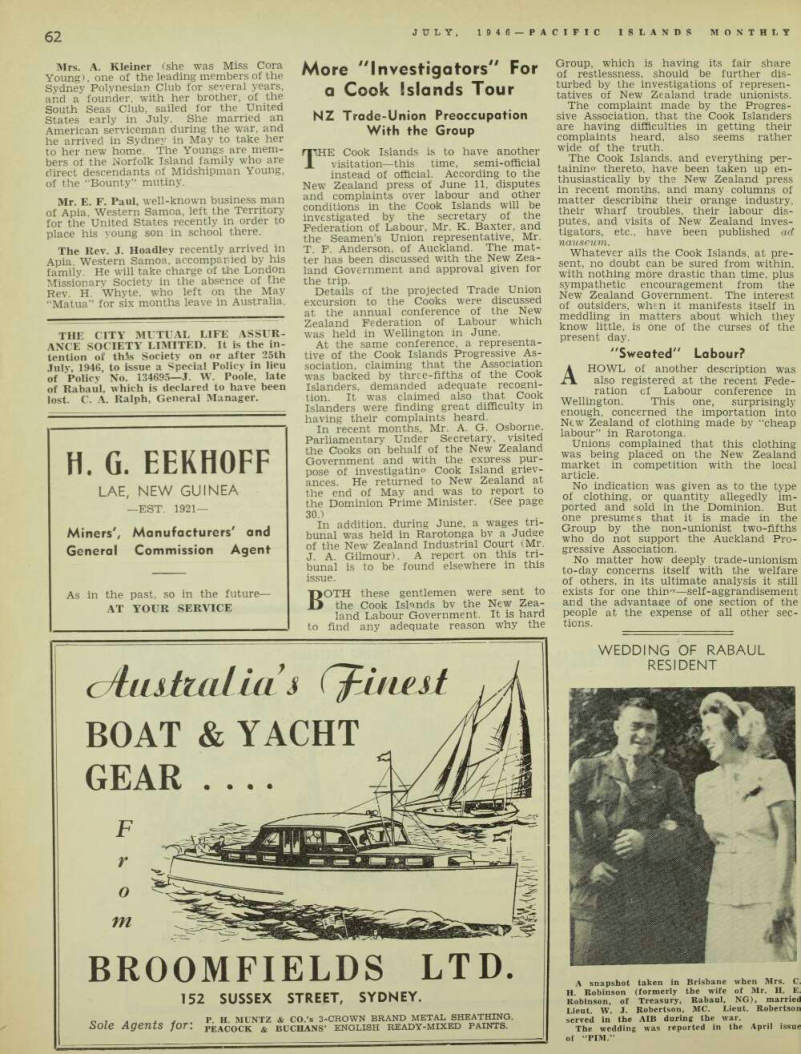
More "Investigators" For a Cook Islands Tour NZ Trade-Union Preoccupation With the Group
rpHE Cook Islands is to have another ]l visitation —this time, semi-official instead of official. According to the New Zealand press of June 11, disputes and complaints over labour and other conditions in the Cook Islands will be investigated by the secretary of the Federation of Labour, Mr. K. Baxter, and the Seamen’s Union representative, Mr.
T. F. Anderson, of Auckland. The mat ter has been discussed with the New Zea land Government and approval given for the trip.
Details of the projected Trade Union excursion to the Cooks were discussed at the annual conference of the New Zealand Federation of Labour which was held in Wellington in June.
At the same conference, a representa tive of the Cook Islands Progressive As sociation. claiming that the Association was backed by three-fifths of the Cook Islanders, demanded adequate recogni tion. It was claimed also that Cook Islanders were finding great difficulty in having their complaints heard.
In recent months, Mr. A. G. Osborne.
Parliamentary Under Secretary, visited the Cooks on behalf of the New Zealand Government and with the express pur pose of investigating Cook Island griev ances. He returned to New Zealand at the end of May and was to report to the Dominion Prime Minister. (See page 30J In addition, during June, a wages tri bunal was held in Rarotonga bv a Judge of the New Zealand Industrial Court (Mr.
J. A. Gilmour). A report on this tri bunal is to be found elsewhere in this issue.
BOTH these gentlemen were sent to the Cook Islands bv the New Zea land Labour Government. It is hard to find any adequate reason why the
Group, which is having its fair share of restlessness, should be further dis turbed by the investigations of represen tatives of New Zealand trade unionists.
The complaint made by the Progres sive Association, that the Cook Islanders are having difficulties in getting their complaints heard, also seems rather wide of the truth.
The Cook Islands, and everything per taining thereto, have been taken up en thusiastically by the New Zealand press in recent months, and many columns of matter describing' their orange industry, their wharf troubles, their labour dis putes, and visits of New Zealand inves tigators, etc., have been published ad nauseum.
Whatever ails the Cook Islands, at pre sent, no doubt can be sured from within, with nothing more drastic than time, plus sympathetic encouragement from the New Zealand Government. The interest of outsiders, when it manifests itself in meddling in matters about which they know little, is one of the curses of the present day.
"Sweated" Labour?
A HOWL of another description was also registered at the recent Fede ration cf Labour conference in Wellington. This one, surprisingly enough, concerned the importation into New Zealand of clothing made by “cheap labour” in Rarotonga.
Unions complained that this clothing was being placed on the New Zealand market in competition with the local article.
No indication was given as to the type of clothing, or quantity allegedly im ported and sold in the Dominion. But one presumes that it is made in the Group by the non-unionist two-fifths who do not support the Auckland Pro gressive Association.
No matter how deeply trade-unionism to-day concerns itself with the welfare of others, in its ultimate analysis it still exists for one thin^ —self-aggrandisement and the advantage of one section of the people at the expense of all other sec tions.
Wedding Of Rabaul
Resident
A snapshot taken in Brisbane when Mrs. C.
H. Robinson (formerly the wife of Mr, H. E.
Robinson, of Treasury, Rabaul, NG), married Lieut. W. J. Robertson, MC. Lieut, Robertson served in the AIB during the war.
The wedding was reported in the April issue of “PIM.”
Advertisements & other items, p. 65 (2 items)
63
PTA MEETING
(Continued from Page 14)
PACIFIC ISLANDS MONTHLY JULY. 1946
Tom Piper
TO THE MARKETS
OF THE WORLD!
* 111 ■ :> fr^ r « Jte j
k fm
TOM PIPER
• In the hygienic kitchens of Tom Piper, skilled chefs prepare fine foods from the choicest produce of Australiacooking and capturing with inimitable skill all the flavour and wholesome goodness. And then, by careful processing, all this wealth of good taste and nourishment lf^ ( l? Tom Piper’s modern canning plant.
EXPORT FACILITIES; Tom Piper products will soon be available for export. They offer worthwhile opportunities to overseas wholesalers and merchants with markets for QUALITY in fresh canned foods. Inquiries are invited by the manufacturers.
TOM PIPER PRO-
DUCTS include: Hot Meat Packs; Camp Pie ; Luncheon Beef ; Corn Beef and Cereal; Tomato; Vegetable; Celery; Pea and Oxtail Soups; Baked Beans; Beans and Beef; Spaghetti and Tomato Sauce; Creamed Diced Carrots ; Creamed Diced Potatoes; Plum Puddings.
DfILMORE PRESERVING CO. PTY.
Gardenvale, 5.4. Victoria, Australia.
Code: Bentley’s Second—Telegraphic Address: DALMORCO, Melbourne ms to Jk
Tribute To Late Dr. Vernon
FROM Mr. W. F. Mackenzie, now a re sident of Melbourne; “I was sorry to hear of the death of that very gallant gentleman, Dr. Ver non. I knew him well when he was stationed at Thursday Island. Associa tion with him and my mother’s family went back to his boyhood days. Men of the Light Horse who served in Palestine, we who were in and around Thursday Island, and our boys of the Kokoda Trail, will all join to salute his memory.”
The death has occurred at the age of 46, of M. Habot, one of the leading in dependent traders in Noumea. In 1940, he was a prominent de Gaullist.
Interesting Review of an Important Industry
Fair Play For Cocoa Growers
SOME of the South Pacific Terri tories are interested in the production of cocoa. The industry is firmly established in Western Samoa; and, until the Japanese invasion, cocoa-growing was making consider able progress in New Guinea.
It appears, however, that, although the rates for cocoa-beans remain high, the industry has reached a crisis. The position is explained in the following article, which appeared in the June issue of “The Crown Colonist.” It is by Mr. A. V. Stoll
meyer, whose address is PO Box 114, Port of Spain, Trinidad, West Indies.
He is a cocoa planter and commission agent, and he was a member of the Legislature of Trinidad.
The cocoa-bean, of course, ranks with sugar as one of the most im portant raw materials of the confec
tionery industry.
IT is no secret that the cocoa and chocolate manufacturers of Great Britain and America are seriously concerned over the future supply of cocoa beans.
If they were as well acquainted as the growers are with the future outlook for this product their concern would become acute disquietude. For the present world shortage of cocoa is not only going to get worse: it will almost certainly get so much worse than the manufacturers now expect, that their business is likely to suffer for years to come. And if they do not wish to find themselves unable to fill their needs, then they had better make it their business to see that something liberal is done for the cocoa planter and done soon.
The responsibility for the present state of affairs can be laid very largely at the door of the manufacturers. They have consistently followed the short-sighted policy of buying what they knew to be an cheap cocoa for almost the entire period between World Wars 1 and 11, without once raising their voices on behalf of the planters who supplied it.
They mistakenly thought they could continue to rely upon this cheap supply indefinitely, and that they need not bother about what was happening to the planta tions. If they had paused at any time to pay some attention to the complaints and prophecies of the cocoa planters regarding the effect the wretchedly low price of cocoa was having and would continue to have upon actual production, they would surely have done something about it.
BUT the repeated representations of planters went unheeded by manu facturers and Governments alike.
Planters came to be regarded as chronic complainers. They were considered a nuisance because they kept emphasising that the cocoa tree needs a lot of care and attention if it is not to fall a victim to devastating disease, and that, as it was not getting this attention because of low world prices, deadly disease was year by year taking an ever-increasing toll of crops.
The seriousness of the situation grew steadily more apparent from 1919 to 1939, yet the British Government, which in the final analysis was responsible for basic cocoa prices for that period, consistently failed to see that the return to Colonial planters was sufficient to enable them to keep their trees in a reasonably healthy condition. ' The manufacturers stood silently by.
Even after disease had taken a firm hold, and the manifest danger to the future of the industry had been plainly foretold, still no relief of any moment was forthcoming.
TODAY, unless better prices are soon received, the concern of the cocoa and chocolate manufacturers is likely to reach a point where they may well question their wisdom in engaging in the industry at all.
A variety of deadly diseases is making ever greater inroads into cocoa cultivation the world over. In spite of all research to date, no tree with any degree of im munity has yet made its appearance, while the price paid the planter continues
so inadequate that he is not able to do anything effective in combating such diseases , There is no need to present any startles in the matter. The broad fact that the present world cost of producing cocoa is far in excess of the pnee received for it. if any proper allowance is made for the cost of combating disease, is well known to even/ cocoa authority.
The one and only hope of maintaining the world’s present supply of cocoa, and of providing for the increase for which the* demand already exists, is better cultivation on plantations that have not yet been ravaged by disease, and complete rehabilitation of the remaining plantations. If this is not done, world production of cocoa, already considerably
diminished, will continue its decline with increasing momentum. r reverse this process, planters must receive for a long time to come at least 50 per cent, more than March, 1946, prices, and probably more still.
The simple method of obtaining this increase would be to abolish price ceilings and controls at once. World demand would then soon raise prices to a reason able amount.
The gross injustice of holding the ceiling price of estate cocoa, for example, to approximately the figure obtaining im mediately prior to World War 11, when every expense of the planter, including his wage scale, has doubled or tripled in amount, should be apparent even to a Government, and still more so to manu
facturers. The latter have always been careful to see that they themselves received a fair price for their own manufactured product.
The object of this article is to bring home to the manufacturer the vital im portance to him of the spectre haunting the future of cocoa, i.e., plant disease, and to warn him that adequate provision to the planter to meet this menace must soon be made. If not, it may spread with a rapidity sufficient to bring about a world shortage in cocoa such as no one has ever dreamed of.
It is advisable, therefore, that from now on the cocoa manufacturer study the statistics of the spread of disease with the very closest attention.
Advertisements & other items, pp. 66-68 (2 items)
Cordage and
Scott’s “Renown” Brand Rope,
Binder
Twine
of Every
Description
Cable W Address: Ropeyard, Sydney. ai a t . - :u ■
MANUFACTURED AT
MASCOT, N.S.W.
By
J. SCOTT
PTY. LTD.
Head Office and Store
163 CLARENCE STREET,
SYDNEY,
N.S.W.
GILLESPIE’S
The Flour
MARK
TRADE
of the Islands
- SY DN EY -
Pacific Islands Trading
COMPANY
Bankers: Bank of America (Main Office) San Francisco.
Cables:
PITCO
SAN FRANCISCO
244 CALIFORNIA STREET, SAN FRANCISCO, CAL., U.S.A.
EXPORTERS OF :
BARBER CHAIRS.
TEXTILES.
CLOTHING.
LIQUOR.
ELECTRICAL GOODS.
FOODSTUFFS
PRODUCE.
STATIONERY.
CARTRIDGES.
DRUGS.
PAPER PRODUCTS
AUTOMOTIVE PARTS.
WIRE & NAILS.
BUILDING SUPPLIES.
RADIOS.
REFRIGERATORS.
AUTOMOBILES.
Farm machinery.
TYPEWRITERS.
FIREARMS.
CHEMICALS.
MARINE HARDWARE.
CIGARETTES, TOBACCO.
QUOTATIONS ON REQUEST
HARDWARE.
FURNITURE.
IRON & STEEL PRODUCTS
CANNED GOODS
PAINTS.
NOVELTIES, NOTIONS.
LEAD PENCILS, ERASERS
HEAVY EQUIPMENT.
FERTILIZERS.
TYRES, TUBES.
PREFABRICATED HOUSES.
4 (
NATIONAL” ELECTRICAL APPLIANCES
MADE IN CANADA
TO THE TRADE ONLY
.GROVE & SONS
Limited Established 1896.
AUCKLAND
Island Traders. Box 49«.
Telegraphic and Cable Address: “Grove”, Auckland.
Shippers of all classes of New Zealand products.
Representing English Manufacturers throughout the Cook and Society Islands, Fiji, Tonga, Samoa, Niue, New Caledonia, New Guinea, etc.
In FIJI a*—W. H. Grove & Sons (Fiji) Ltd.
Steamships Trading
Company Limited
PORT MORESBY SAMARA I PAPUA.
WHOLESALE & RETAIL MERCHANTS, SHIPOWNERS,
PLANTERS, ENGINEERS & SLIP PROPRIETORS.
Customs, Shipping, Insurance, and Forwarding Agents.
MANAGING AGENTS AND VISITING REPRESENTA-
TIVES FOR COCONUT AND RUBBER ESTATES
SYDNEY REPRESENTATIVES: Nelson & Robertson Pty. Ltd., 12 Spring Street.
Newspaper Pictures of Tahiti Life
Tahiti Life
(A Letter to the Editor) WHEN Mr. Mackinlay wrote his letter about Tourism in Tahiti, published in the March “PIM”, he had for gotten the wide difference, in modern times, between the words “traveller” and “tourist.” Moreover, he ignores the care with which this writer has chosen the proper adjectives to designate Genus and Species.
If Mr. Mackinlay has read accurate re ports of the Florida land boom hysteria (during the notorious 1920 decade), he may have some conception of what be fell Tahiti during the “escape from Pro hibition” period.
Should he doubt our appraisal as to the state of European prestige, let him “circumspice.”
Yours most truly,
Your Tahiti Correspondent.
Tahiti, 25/5/1946. (A Letter to the Editor)
Mr. Martin Mackinlay’S Letter,
published in March “PIM,” was read with much appreciation, and many of us here hope that it will lead you to weigh your Papeete correspondent’s pronouncements before you send them to press. If this be so we shall owe you— and incidentally, Mr. Mackinlay—a debt of gratitude.
Realising the usefulness a paper such as yours could have for us islands dwel lers. I have oftentimes wanted to favour it with my subscription, but under the nresent circumstances my self respect protests. It is bad enough to have to assume as truth much that is conveyed to one as such, through the printed word in general, nowadays: but where one is in a position to check, line for line, graph after paragraph, as contortions and mis-statements, it becomes revolting and an insult to one’s intelligence.
I am, etc..
Carl Swenson.
Papeete, 3/6/1946.
Mr. L. W. Bell returned to New Guinea on the “Montoro” which left Sydney on July 8. He was booked to Madang where he expected to “just sit down and wait” for transportation to his place on New Ireland—he is of the opinion that if any further sitting and waiting is necessary, it is as well done in New Guinea as in Australia. Mr. Bell served in the RAAP with distinction during the war.
Sgt. and Mrs. Alan Wood have recently announced the birth of a son. Sgt. Wood was formerly of Bulolo, New Guinea, and is now attached to Army Records Office, Melbourne, Victoria.
Australian Workers
Sacrificed
The destruction of Australia’s trade with China and Singapore now appears to be the objective of the Communists.
For more than nine months, waterside workers, led by Communist bosses, have succeeded in tying up Dutch ships in Aus tralian ports.
They prevented the despatch of urgently needed medical supplies and foodstuffs to the Netherlands Indies. These goods were required to alleviate the sufferings and in many cases to save the lives of Indonesians and Dutch who had been rescued from Japanese concentration camps.
Agricultural implements, machine tools and a host of other articles necessary if prosperity is to return to the Indies, have been left in Australian warehouses not withstanding the fact that large quantities of these goods had been actually paid for by the Netherlands Indies Government.
As a direct result of this tie-up, orders worth millions of pounds have been can celled and goods that Australia could have supplied are being manufactured in other countries where foreign workers are get ting the wages that could have gone into the pockets of our own people.
The Federal Government' A.C.T.U and the Trades and Labour Council have all ■ tried without avail to get the ban on Dutch ships lifted, but the Communist Party, mouthpiece of the “Red Imperialists of Russia,” has decreed that Australian goods must be kept out of the valuable markets in the Netherlands Indies.
Well, they have succeeded and Aus tralia’s export trade with the Netherlands Indies has been completely destroyed.
Now, they are attempting to wreck our trade further afield. A ship scheduled to sail for Singapore and China with Aus tralian goods, has been held up in Bris bane.
When we recollect that our prosperity and maintenance of our standards of liv ing depends upon export trade, we realise how dangerous these foreign inspired agi tators can be.
The point to remember is that the Com munist Party is not concerned with the welfare of Australian workers. It is pre pared to sacrifice Australia and Australian people so long as it advances the plan for world Communist revolution.
The more chaotic the industrial position becomes in Australia, the nearer they be lieve they are to their objective. They want the people to be desperate enough to grasp at any remedy, even a Communistic dictatorship.
Moderate Labour men have got to clean up the mess if the Australian Labour Party is to survive and democratic govern ment to continue in Australia.
Whilst these Red wreckers control pow erful unions they can defy the A.L.P. and continue their savage attacks on our export trade.
Contributed by Ceigoa Pty., Ltd. (Consolidated Export and Import Group of Australia), 54 Oxford Street, Sydney.
Ratu Sir Lala Sukuna at Palace
Investiture
DURING his visit to London With the Victory Contingent Ratu Sir Lala Sukuna, first Fijian Knight, was re ceived at Buckingham Palace by the King and was invested with the insignia of a Knight Commander of the Most Excellent Order of the British Empire.
Monsignor Hannan For
Mission Field
AFTER nine years as National Director of Pontifical Mission works in Aus tralia, Monsignor Hannan has resign ed in order to volunteer for practical work in the Solomons mission field.
War losses have sadly depleted the ranks of all missionary societies in the Pacific and to help solve this problem, the Roman Catholic Church in Australia recently ap pealed to Australian priests to volunteer for several years mission service. Pre-war, most mission personnel came from Europe or America.
Monsignor Hannan (who has the or ganising ability and shrewd vision usually found in trained business men), has done a great deal for mission work already; but
he has always cherished an ambition to work as a missionary in the field. He will be stationed somewhere in the Vicariate of the Northern Solomons (Bougainville).
His place in Australia as Director of Mission Works will be taken by the Rev.
Father A. R. E. Thomas, who has been Director of Mission Aid Societies in Syd ney since 1939.
United States Memorial Dav was ob served in Fiji on May 30, when a service was held at the Allied Military Cemetery in Suva in honour of the men who are buried there. The Governor was repre sented at the ceremony by his ADC, Major Preston, and the American Consul and representatives of the Fiji Military Forces and the RNZAF were also present.
Mr. James Ellis, formerly of Rabaul, who was one of the half-dozen civilians who survived the Japanese occupation of the town, is about to proceed to Port Moresby, where he will commence busi ness as an electrical contractor. Mrs.
Ellis, who was well-known in Rabaul prior to the invasion, left for Port Moresby by plane on July 5.
After 24 years residence in Papua as a member of the Public Service, Mr. A. W.
Marshall resigned from the Provisional Administration Service a few weeks ago, and he is now settled down in Brisbane.
He was president of the Papuan Public Service Association; and, in that office, he was not enthusiastic about what he saw when he returned to Papua last year.
He was one of the “old hands” who were sharply critical of Administration condi tions in the early part of 1946, and, after a series of incidents he decided it would be better to return to Australia and ac cept the status of “a suspended officer of the Papuan Administration.”
It has been officially confirmed that Sub-Lieutenant Con Page, RANVR, who was a resident of New Ireland, was ex ecuted by the Japs about July, 1942. He undertook very dangerous reconnaissance work in New Ireland, and was caught by the Japanese. He was Mentioned in De spatches.
Mrs. Frank Luff, formerly of Wewak and Madang, New Guinea, was a passenger on the “Montoro” which left Sydney on July 8. She will rejoin her husband in Madang.
During the war years she was a Red Cross officer in North Australia; she received her discharge only recently—after a spell in 113 AGH, this time as a patient.
Methodist missionaries who have re turned to stations in Papua and New Guinea in recent months include the Rev. W. B. Davies, the Rev. and Mrs.
A. W. Guy, and the Rev. and Mrs. H. T.
Shotton and their two children.
A number of New Guinea men are still in 113 AGH (Sydney military hospital).
Those there recently included Sid. Farn ham, “Scotty” Sutherland, Bill Money (since discharged) and Lieutenant Mos man. Territorian friends who have lost touch with them could contact these men there.
Advertisements & other items, pp. 69-70 (1 item)
heaven will protect the working girl?”
S/
“Who said
“I do my work well; I’m quick and accurate; I’m just as good-looking as the other girls; I dress well. Why does the boss single me out for snubs?”
Because, dear girl, you forget that “heaven helps those who help themselves”.
You’re a very nice girl, but evidently it hasn’t occurred to you that a bath takes care only of past perspiration.
It takes that little dab of Mum under each arm to keep you sweet and fresh all day or evening.
Mum cannot harm your tender skin or your most delicate clothes. Get Mum to-day and watch your popularity grow.
MUM
TAKES THE ODOUR OUT OF PERSPIRATION
Sold by all leading distributors and manufactured by Bristol-Myers Co Pty. Ltd., 223 Pacific Highway. North Sydney, N S.W., Australia.
World Range
STROMBERG-CARLSON
RECEIVER
Five-valve A.C. model in a beautiful Bakelite cabinet. Price, £26/19/6.
Prepaid freight, insurance, packing, etc., £l/5/-.
6-VOLT STROMBERG-CARLSON WORLD RANGE VIBRATOR.
“Tropic-proof Amenities” receiver, complete with special radio battery.
Price, £32/15/-. Prepaid freight, insurance, packing, etc., £l/7/-.
2-VOLT STROMBERG-CARLSON WORLD RANGE RECEIVER.
The above “Tropic-proof Amenities” converted to use “dry” batteries.
Price (complete with batteries), £33/15/-. Prepaid freight, insurance, packing, etc., £l/5/-.
MULTIPLO INCUBATORS. A few Kerosene Incubators are available.
WRITE DIRECT TO:
SRL6S S€RVICe
TELEPHONE 18W5157 SCOTTISH HOUSE O 19 BRIDGE STREET ® SYDNEY ® AUSTRALIA
Meeting Decides To Carry On Ng Club
In Sydney
Officers Retire After Generous Service to Territorions
ALTHOUGH the New Guinea Women’s Club of Sydney will carry on, it will now do so without the services of many of its former office bearers.
At the fifth annual general meeting of the Club, at the Feminist Club, King Street, Sydney on July 12, members pre sented bouquets of flowers to Mrs. H. H.
Page (president), Mrs. I. McDonald (sec retary) and Mrs. H. Adams (treasurer) who are retiring after guiding the destiny of the Club for several years. Mrs. Page has been president since the Club’s in ception in 1941.
These women, with the vice-presidents of the Club, and the committee members who served with them, although often suf fering personal worry and heartbreak have worked tirelessly through the long war years for the welfare of other New Guinea women.
It can be said that one of the brightest spots in the evacuee years has been the way New Guinea women stood together in adversity. This can be attributed in large measure to the leadership of the Women’s Club in Sydney and sister bodies in other .Australian States.
At the conclusion of the meeting on July 12, many striking tributes were paid to Mrs. Page by appreciative members of the Club.
EXTRACTS from the retiring presi dent’s report for the year ending June 30, 1946, tell something of the work that had been performed by the Club: New that so many womenfolk are returning to the Territory, the Club will naturally havfl a smaller membership, it is advisable that the committee members be altered to about eight, including the office-bearers.
In April, this year, a special general meeting was called to advise members of decisions made in connection with the Rehabilitation Fund—namely, that £5 was being sent to the widows of New Guinea men. This has been done, ana in many cases a second cheque has been seiu, but as yet we are unable to use the money
donated to us by the New Guinea Comforts Fund other than as directed. We have also been unable to secure a list of NGVR men from the powers-that-be, who have advised us of their inability to do so for at least another three months.
Also at the April meeting members were ad vised of the names of the office-bearers and committee who would not be available for re election in July, and a vote was taken as to whether the Club should continue or not. The result was unanimous for its continuance.
Several times during the year we found it necessary to have legal advice from our solicitor.
Mr. Fincham, with reference to our funds, and after much negotiating our Club now functions with the approval of the Chief Secretary’s De partment, to whom we are responsible for all its activities. I should here like to place on record our appreciation of the help extended to us by the Australian Comforts Fund while we functioned under its guardianship.
THIS year has been most difficult with regard to entertaining, but Mrs. Foxcroft is to be congratulated on the result of a very disjointed year.
Hospital visiting continued, though not so fre quently as in previous years, and canteen orders of 10/- were given to each patient at Christmas.
We remember specially Mr. Farnham, who has oeen an inmate of 113th AGH for a such a long, period, because of extensive burning. His cour age has been outstanding, and we offer him oui sincere wishes for his complete recovery.
Again we have been glad to offer financial assistance to some of our needy members.
Clothing, too, has been distributed to appre ciative families.
This year we sent parcels of clothing, etc., to the liberated Chinese women and children of New Guinea. Mr. Meares advised us that in his opinion the Chinese were in a better position than the Malayans, and perhaps we might care to help the latter. This was dis cussed in committee, but it was decided if any outside help be given, it be directed towards our own kith and kin, the British, who are so desperately in need of food and warm clothing.
A week or so ago we had an interesting visit from the secretary of the War Widows’ Craft Guild who spoke to our women and invited them ’ to join the movement founded by Mrs.
Vasey, the idea being to enable the widow to supplement her pension with the knowledge gained. This is well worthy of serious thought.
WE remembered our honoured dead by placing wreaths on the Cenotaph on January 23, April 25, and July 1. - .
We were all so happy at the close of hos tilities. External Territories opened a Welfare Bureau for service to prisoners of war as they came to Australia. We all hoped to; be re united with our loved ones, but apart from the nurses and the few liberated men from Rabaul, the room was not needed. T he majority of the men had perished together in 1942, and we had held fast to hope all those years.
The first notification of our loss came from a paragraph in the paper!
I felt very privileged to be allowed to greet the nurses when they arrived in Australia.
The Welfare Department had thought of every thing for their comfort, even to the issuing of ration books and money in their pockets.
Later on when the men from Rabaul arrived, the Club entertained them at luncheon in the Welfare rooms. It was good to see happiness come to even a few after the tragic years I should like to pay tribute to the work of our secretary, Mrs. I. McDonald, and our treasurer, Mrs. A. Adams, and Mrs. Foxcroft, the Entertainment leader. All these ladies have given long and splendid service throughout the arduous years and I feel we cannot adequately thank them.
I should also like to express our appreciation of the wqrk done by the following: Our honorary auditor, Miss I. Grant, who has been our auditor since the inception of the club; also Miss Hunter, secretary of the Feminist Club, who has been most helpful and co-operative. (To each of these women we have presented initialled leather writing cases).
To our solicitor, Mr. Fincham, whose advice has been given as part of his war service; Mr.
Foxcroft for all his help and thoughtfulness to the club and members throughout the life of the club; Mr. Leake for his courtesy in placing a room at our disposal for committee meetings; the “Pacific Islands Monthly” for its unquali fied interest and support right throughout the years, and lastly Mr. Salisbury, a city business man, for his handsome donations to the child ren’s party and for his wonderful generosity in placing his Palm Beach home at the dis posal of the bereaved women of New Guinea and making himself responsible for their travelling arrangements. We were all very deeply touched at such generosity from a stranger.
In conclusion I offer to all my sincere ap preciation of all the kindness, help and loyalty extended to me since the inception of the club.
Financial
rE last year has been one of heavy ex penditure. Receipts for the general fund for the year were £623 (includ ing £203 carried over from last year). Ex penditure was £559, leaving a balance of £64.
For the POW and Civilian Internees account, receipts for the year were £1375 including £420 brought forward from 1945); assistance to returned POW and internees or their dependents amounted to £940, leaving £435.
Election of New Office-Bearers
IT seemed at this stage of the meeting that the Club would go out of exist ence from sheer inability to obtain new office bearers to replace those who had signified their intention of not again standing for office. Members, while anxious for the Club to continue, were not keen to take office—either because they will be returning to the Territory shortly or because they felt unequal to
the task of attaining the high standard of service set by retiring office bearers.
Finally Mrs. N. Foxcroft, who has al ready given outstanding service to the Club in previous years as a vice-president and as leader of the entertainment com mittee, was persuaded to accept the office of president. It was generally felt that she is a worthy successor to Mrs. Page.
Other office bearers elected were: Mrs.
J. Duncan, vice-president; Mrs. S. Elvy, secretary; Mrs. N. Couzins, treasurer; Miss M. Kelly, auditor. Committee: Mesdames E. G. Haynes, E. Banks, M. Forsyth, E.
Ormonde.
Lady McNicoll, who has been patroness of the Club since its commencement, was unable to accept this year. Mrs. H. H.
Page was unanimously elected to fill this vacancy.
Donald Stores Wiped Out
By Tidal Wave
Papeete, May 3.
WE regret to learn that our friends, Establissements Donald, have suf fered the loss of their entire instal lation at Atuona, on the island Hiva-oa, in the Marquessas Archipelago.
The great tidal-wave of April was very formidable in that quarter.
Along the north and east coasts of Tahiti, the sea at first receded, then at tacked the shore in three mighty waves, which damaged or destroyed every build ing near the beaches. We are grateful that there were no casualties on Tahiti.
Most extraordinary is the fact that at Papeete and along the west coast of the island, no disturbance of the sea was ob served.
Tahiti's Choice
Migration to China Forecast
From Our Own Correspondent
Papeete, June 1.
A NUMBER of Chinese families are pre paring to migrate to China, whenever transportation to that country shall be available. It is, perhaps, the beginning of an exodus.
The Chinese are aware that opportunity for their children is in the new China which will emerge from the present post war reconstruction, rather than in the Islands.
In this writer’s opinion, the Chinese Central Government’s long-term objective in maintaining this carefully nurtured out post, has been far beyond the economic conquest of French Oceania. The real purpose appears to have been to establish an impregnable centre from which to chal lenge European and North American trade in the markets of South America.
This was clearly indicated in 1920, when a direct steamer service from China, via Papeete to the South American West Coast was started.
Internal conditions in China, and Jap anese aggression, have delayed the carry ing out of this purpose. The steamer service from China was long ago aband oned. Nevertheless, a united China and industrial expansion in that vast coun try may bring to pass a new offensive in this direction.
Meanwhile, the brighter future for edu cated young Chinese men and women ap pears to be in China itself.
Plans are out for a new hotel, of three storeys, to be erected in Port Moresby by Steamships Trading Ltd.
Advertisements & other items, pp. 71-72 (1 item)
C. S aIKfM Pty. JjtiL
ISLAND MERCHANTS
and AGENTS.
GENERAL MERCHANTS.
C. S aIKfM Pty. JjtiL
* Shippers °f types of Merchandise to the Pacific Islands • Representing Australian, British and American Manufacturers r' • ' ( If |?<cg' Buyers for Leading Pacific Islands Traders • Sellers of Island Produce on Consignment m • Forwarding and Transhipment Agents
379 KENT ST., SYDNEY
Cable & Telegraphic Address: <i Chasull, ,> Sydney.
Importers, Distributors and Manufacturers of Foodstuffs, Softgoods, Textiles, Hardware, Tobaccos, Wines and Spirts, etc.
V. • “Ultima" Kerosene Stoves and Heating Appliances • Distributors of High-grade Shirts, Pyjamas and Clothing “Southern Queen Canned Fruits ft m
Uffi
• Hill's English Cigarettes When in Sydney, call and see us!
G. H. Robinson
ISLAND SUPPLIES
of all kinds—Selected and Shipped to order at lowest possible prices—Piecegoods in Wool, Cotton and Silk, Under and Outerwear, Manchester, Drapery, Grocery, Hardware, Engineers and Leathergoods trade supplies a specialty.
Indents and Transhipments arranged. Large or small orders treated with equal care.
Use our 25 years’ extensive experience.
Enquiries solicited to —
G. H. ROBINSON
51 Macquarie Street,
Sydney, N.S.W.
Telegrams: Sunrise, Sydney.
Letters: Box 3317, G.P.0., Sydney.
New Guinea's First Post
War Wedding
FIRST post-war civilian wedding in New Guinea took place at Lae re cently in the home of the District Supervisor, Mr. Farlow.
The bride was Miss Anice Beales, form er science mistress at St. Margaret’s School, Clayfield (Brisbane); and the bridegroom Mr. Aubrey Schindler, super visor of the Government experimental farm at Aiyura. He is the son of Mr.
C. S. Schindler, lecturer in languages at the University of Queensland.
The bride and bridegroom drove to the ceremony in a jeep, and to the reception in a car whic hwas gaily decorated by the natives with flowers and ferns. A cavalcade of jeeps transported the guests to the reception, which w’as held on board the“Montoro,” on which the bride had come from Brisbane.
The bride’s attendant was Mrs. Ned O’Brien and the groom’s best man, Mr.
Peter Swanson. Among the guests were: Mrs. Doris Booth, Captain Dudell (of the “Montoro”) and first mate (Mr. Farquhar- Smith).
An unfortunate sequel was that the bridal pair were quarantined in Lae for a fortnight, because of an outbreak of
measles on the “Montoro.”-
J.M.H.
Bark For Paper
ATRIAL shipment of mulberry bark is being sent from Fiji to England, as paper factories are interested in it for the manufacture of fine paper of the type used for bank notes and documents such as bonds. Costs will be worked out to determine whether an export industry is likely to be w’orth developing.
Mr. Quentin Pope, of the “Chicago Tri bune,” was on a short visit to Apia, West ern Samoa, in June. He is making a tour of the South Seas.
About Island People
Mr. Claude S. Israel, a director of Mor ris Hedstrom Ltd., and late manager of the Company’s branch at Lautoka, has proceeded to Sydney, to become manager of the Sydney office, in succession to Mr.
J. Dowling, another director of the Com pany, who is retiring, and who probably will live in New Zealand.
Major J. Macgregor Dowsett, who, as an ANGAU officer, has been in charge of the rehabilitation of the Chinese commu nity in New Britain, passed through Syd ney in June, on his way to Geelong. He expects his discharge shortly, after 65 years of active service with the AIF in the Middle East, and in New Guinea. He received high commendation for his work in training Australians and Americans in jungle fighting in New Guinea. He was on excellent terms with the Rabaul Chinese; and he says that the three week* of Chinese hospitality which he received before he left was tougher than anything he ever had to undergo in the jungle.
Mr. Dowsett had been 20 years in New Guinea, when the war came, and had established a cocoa plantation at Tokaiya on the north coast. His present inten tion is not to return to the Territory.
At the Holy Trinity Pro-Cathedral in Suva, Fiji, on June 5, Miss Margaret Isobel Park, the eldest daughter of Mr. and Mrs. J. S. M. Park, of Nadi, mar ried Frederick L. Corbett, third son of Mr. and Mrs. O. B. Corbett, of Suva. A reception was held later in the Grand Pacific Hotel, where the bride’s parents entertained many guests.
What might be called a “Hail and Fare well” party was arranged bv Major H. S. N. Robinson, Australian secretary of the Melanesian Mission, at the Pickwick Club, Sydney, on July 3. Guest of honour was Sister C. Curwen, who had recently arrived from England and was about to depart for a Melanesian Mission hospital on Malaita, BSI. She expected to travel on the “Neo Hebridais” as far as Vila (New Hebrides), where she will be picked up by the Mission ship ‘Southern Cross.”
Sister Curwen said that although she had had no previous tropical service she was looking forward to work in the Solomons.
Sister Gwen Davies, of the Methodist Mission, arrived in Fiji and has started work at the Dilkusha Indian Girls’ Or phanage. She will, as well, do Child Wel fare work in the Nausori district.
The June issue of the Methodist “Mis sionary Review” states: “The Govern ment of Tonga has sent two promising young Tongans to New Zealand to mat riculate preparatory to taking a full medi cal course at the New Zealand University.
The boys are Sione Siosiomalohi, who attended the Government College in Ton ga, and Mahe ’Uli’uli, who passed through Tupou College. Sione graduated at the Central Medical School, Suva, with high honours, in 1944. Both boys are at pre sent attending the Auckland Government Grammar School. In the December ex aminations, at the end of his first year, Sione gained first place in the form in Science and Mathematics, and fifth place in English. Mahe commenced his studies this year.”
The Rev. James Benson, of the Anglic an Mission, who was given up for dead during the Pacific war years, but who was discovered in Rabaul when the Australia lians re-occupied the town, has been posted to Port Moresby as Rector of St.
James. It is understood that this appoint ment is only temporary and that Mr.
Benson will later return to the mission field.
Advertisements & other items, p. 72 (1 item)
Itching Skin Germs
Killed in 3 Days
Praised by Doctors
Dr. T. A, Ellis, well-known physician of Toronto, Canada, recently stated: “Skin disorders caused by parasites, as many are, yield to Nixoderm. These parasites are invisible to the naked eye. They eat a way the skin, forming ugly eruptions. Ordinary ointments or remedies fail completely, or give only temporary results because they do not reach the cause of the condition. It is this value about Nixoderm in attacking parasites which impresses me most favorably, and explains in large measure the success it enjoys over many stubborn cases.”
Guaranteed Results
Get Nixoderm to-day. Put it to the test. In a few minutes you will find that the Itching has stopped, and in 24 hours you can see for yourself that your skin is clearer. And it is guaranteed that, within one week, Nixoderm must make your skin soft, clear, smooth and attractive or money back on return of empty package. Get Nixoderm from your chemist or store to-day. The guarantee protects you. So don’t delay. Get Nixoderm to-day.
Nixoderm */-*4/-
For Skin Sores, Pimples and Itch.
Thanks to the discovery of an American physician, it is now possible to kill and remove the true cause of most skin troubles. Your skin has nearly 50 million tiny seams and pores where invisible germs and parasites can hide, and which are the true cause of terrible Itching, Cracking, Peeling, Burning, Ringworm, Acne, Psoriasis, Blackheads, Pimples, Foot Itch and other disfiguring blemishes.
Blemishes such as these make you look and feel embarrassed, unattractive and handicapped in life, both socially and in business. You can’t get rid of these disfigurements with ordinary treatments, which give only temporary relief, because they do not kill the germs or parasites responsible for your trouble. .
New Discovery Kills Cause
Former skin sufferers throughout the world are now praising Nixoderm, the discovery of a leading American skin specialist. This remarkable new preparation quickly penetrates into the pores of the skin and kills the germs and parasites responsible for your trouble in 7 minutes, stopping the itch almost instantly. At the same time, this wonderful preparation acts as a tonic and skin food, so that as the cause of ycur trouble is removed, your skin becomes soft, smooth and clear. This clear, healthy complexion will give you new charm and make It easy to win fnend*.
Uneasy Natives In
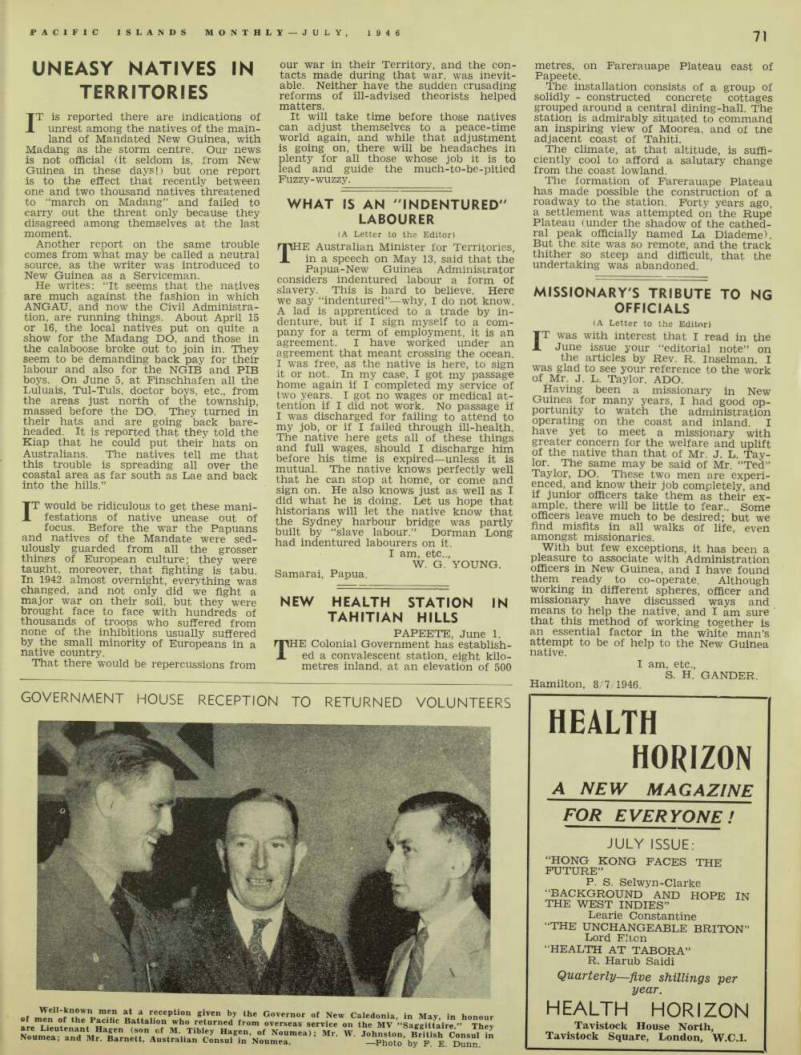
Territories
IT is reported there are indications of unrest among the natives of the main land of Mandated New Guinea, with Madang as the storm centre. Our news is not official (it seldom is, from New Guinea in these days!) but one report is to the effect that recently between one and two thousand natives threatened to “march on Madang” and failed to carry out the threat only because they disagreed among themselves at the last moment.
Another report on the same trouble comes from what may be called a neutral source, as the writer was introduced to New Guinea as a Serviceman.
He writes: “It seems that the natives are much against the fashion in which ANGAU, and now the Civil Administra tion, are running things. About April 15 or 16, the local natives put on quite a show for the Madang DO, and those in the calaboose broke out to join in. They seem to be demanding back pay for their labour and also for the NGIB and PIB boys. On June 5, at Finschhafen all the Luluais, Tul-Tuls, doctor boys, etc., from the areas just north of the township, massed before the DO. They turned in their hats and are going back bare headed. It is reported that they told the Kiap that he could put their hats on Australians. The natives tell me that this trouble is spreading all over the coastal area as far south as Lae and back into the hills.”
IT would be ridiculous to get these mani festations of native unease out of focus. Before the war the Papuans and natives of the Mandate were sed ulously guarded from all the grosser things of European culture; they were taught, moreover, that fighting is tabu.
In 1942. almost overnight, evervthing was changed, and not only did we fight a major war on their soil, but they were brought face to face with hundreds of thousands of troops who suffered from none of the inhibitions usually suffered by the small minority of Europeans in a native country.
That there would be repercussions from
our war in their Territory, and the con tacts made during that war, was inevit able. Neither have the sudden crusading reforms of ill-advised theorists helped matters.
It will take time before those natives can adjust themselves to a peace-time world again, and while that adjustment is going on, there will be headaches in plenty for all those whose job it is to lead and guide the much-to-be-pitied Fuzzy-wuzzy.
What Is An "Indentured"
Labourer
(A Letter to the Editor) rE Australian Minister for Territories, in a speech on May 13, said that the Papua-New Guinea Administrator considers indentured labour a form of slavery. This is hard to believe. Here we say “indentured”—why, I do not know.
A lad is apprenticed to a trade by in denture, but if I sign myself to a com pany for a term of employment, it is an agreement. I have worked under an agreement that meant crossing the ocean.
I was free, as the native is here, to sign it or not. In my case, I got my passage home again if I completed my service of two years. I got no wages or medical at tention if I did not work. No passage if I was discharged for failing to attend to my job, or if I failed through ill-health.
The native here gets all of these things and full wages, should I discharge him before his time is expired—unless it is mutual. The native knows perfectly well that he can stop at home, or come and sign on. He also knows just as well as I did what he is doing. Let us hope that historians will let the native know that the Sydney harbour bridge was partly built by “slave labour.” Dorman Long had indentured labourers on it.
I am, etc..,
W. G. Young.
Samarai, Papua.
New Health Station In
Tahitian Hills
Papeete, June 1.
rE Colonial Government has establish ed a convalescent station, eight kilo metres inland, at an elevation of 500
metres, on Farerauape Plateau east of Papeete.
The installation consists of a group of solidly - constructed concrete cottages grouped around a central dining-hall. The station is admirably situated to command an inspiring view of Moorea, and of the adjacent coast of Tahiti.
The climate, at that altitude, is suffi ciently cool to afford a salutary change from the coast lowland.
The formation of Farerauape Plateau has made possible the construction of a roadway to the station. Forty years ago, a settlement was attempted on the Rupe Plateau (under the shadow of the cathed ral peak officially named La Diademe).
But the site was so remote, and the track thither so steep and difficult, that the undertaking was abandoned.
-photo by F. E. Dunn.
Government House Reception To Returned Volunteers
well-known men at a reception given by the Governor of New Caledonia, in May, in honur of men of the Pacific Battalion who returned from overseas service on the MV "Saggittare." They are Lieutenant Hacific (son of M. Tibley Hagen, of Noumea); Mr. W. Johnston, British Consul in Noumea; and Mr. Barnett, Aistralian Consul in Noumea.
Missionary's Tribute To Ng
Officials
(A Letter to the Editor) IT was with interest that I read in the June issue your “editorial note” on the articles by Rev. R. Inselman. I was glad to see your reference to the work of Mr. J. L. Taylor, ADO.
Having been a missionary in New Guinea for many years, I had good op portunity to watch the administration operating on the coast and inland. I have yet to meet a missionary with greater concern for the welfare and uplift of the native than that of Mr. J. L. Tay lor. The same may be said of Mr. “Ted”
Taylor, DO. These two men are experi enced, and know their job completely, and if junior officers take them as their ex ample, there will be little to fear.. Some officers leave much to be desired; but we find misfits in all walks of life, even amongst missionaries.
With but few exceptions, it has been a pleasure to associate with Administration officers in New Guinea, and I have found them ready to co-operate. Although working in different spheres, officer and missionary have discussed ways and means to help the native, and I am sure that this method of working together is an essential factor in the white man’s attempt to be of heln to the New Guinea native.
I am, etc.,
S. H. Gander.
Hamilton, S, 7/1946.
Advertisements & other items, p. 73 (1 item)
Horizon
HEALTH
A NEW MAGAZINE
FOR EVERYONE!
JULY ISSUE:
‘HONG KONG FACES THE
FUTURE”
P. S. Selwyn-Clarke
“BACKGROUND AND HOPE IN
THE WEST INDIES”
Learie Constantine
“THE UNCHANGEABLE BRITON”
Lord Elton
“HEALTH AT TABORA”
R. Harub Saidi
Quarterly—five shillings per
year.
HEALTH HORIZON
Tavistock House North, Tavistock Square, London, W.C.I.
Islands Produce
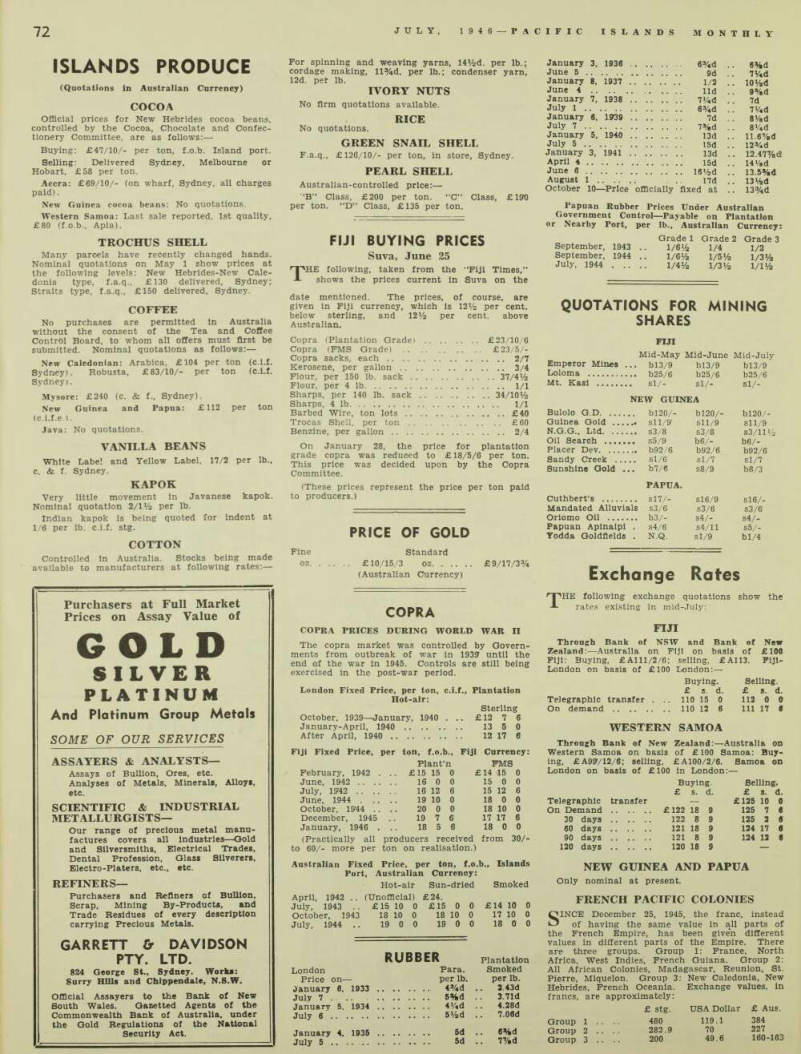
(Quotations in Australian Currency)
Cocoa
Official prices for New Hebrides cocoa beans, controlled by the Cocoa, Chocolate and Confec tionery Committee, are as follows: Buying: £47/10/- per ton, f.o.b. Island port.
Selling: Delivered Sydney, Melbourne or Hobart, £5B per ton.
Accra: £69/10/- (on wharf, Sydney, all charges paid).
New Guinea cocoa beans: No quotations.
Western Samoa: Last sale reported, Ist quality, £BO (f.0.b., Apia).
Trochus Shell
Many parcels have recently changed hands.
Nominal quotations on May 1 show prices at the following levels: New Hebrides-New Cale donia type, f.a.q., £l3O delivered, Sydney: Straits type, f.a.q., £l5O delivered, Sydney.
Coffee
No purchases are permitted in Australia without the consent of the Tea and Coffee Control Board, to whom all offers must first be submitted. Nominal quotations as follows; — New Caledonian: Arablca, £lO4 per ton (c.i.f, Sydney). Robusta, £B3/10/- per ton (c.i.f.
Sydney).
Mysore: £240 (c. & f., Sydney).
New Guinea and Papua: £ll2 per ton (c.i.f.e.).
Java: No quotations.
Vanilla Beans
White Labe! and Yellow Label, 17/2 per lb., c, & f. Sydney.
Kapok
Very little movement in Javanese kapok.
Nominal quotation 2/I‘/a per lb.
Indian kapok is being quoted for indent at 1/6 per lb. c.i.f. stg.
Cotton
Controlled in Australia. Stocks being made available to manufacturers at following rates:—
For spinning and weaving yarns, 14Vad. per lb.; cordage making, ll%d, per lb.; condenser yarn, 12d. per lb.
Ivory Nuts
No firm quotations available.
Rice
No quotations.
Green Snail Shell
F.a.q., £126/10/- per ton, in store, Sydney.
Pearl Shell
Australian-controlled price:— ”B” Class, £2OO per ton. “C” Class, £l9O per ton. “D” Class, £135 per ton.
Fiji Buying Prices
Suva, June 25 THE following, taken from the “Fiji Times,” shows the prices current in Suva on the date mentioned. The prices, of course, are given in Fiji currency, which Is 12Va per cent, below sterling, and 12 Vi per cent, above Australian.
Copra (Plantation Grade) £23/10/6 Copra (FMS Grade) £23/5/- Copra sacks, each 2/7 Kerosene, per gallon 3/4 Flour, per 150 lb. sack 37/4% Flour, per 4 lb 1/1 Sharps, per 140 lb. sack 34/IOVa Sharps, 4 lb 1/1 Barbed Wire, ton lots £4O Trocas Shell, per ton £6O Benzine, per gallon 2/4 On January 28, the price for plantation grade copra was reduced to £ 18/5/6 per ton.
This price was decided upon by the Copra Committee. (These prices represent the price per ton paid to producers.)
Advertisements & other items, p. 74 (1 item)
Price Of Gold
Fine Standard oz. . .. .. £10/15/3 oz £9/17/3% (Australian Currency)
Copra
Prices During World War H
The copra market was controlled by Govern ments from outbreak of war in 1939 until the end of the war in 1945. Controls are still being exercised in the post-war period.
London Fixed Price, per ton, c.i.f., Plantation Hot-air:
(Practically all producers received from 30/to 60/- more per ton on realisation.) Australian Fixed Price, per ton, f.0.b., Islands Port, Australian Currency:
October, 1939 —January, 1940 Sterling . £12 7 6 January-April, 1940 13 5 0 After April, 1940 .. 12 17 6 Fiji Fixed Price, per ton, f.o.b,, Fiji Currency: Plant’n
Fms
February, 1942 . .. £15 15 0 £14 15 0 June, 1942 16 0 0 15 0 0 July, 1942 16 12 6 15 12 6 June, 1944 19 10 0 18 0 0 October, 1944 .. .. 20 0 0 18 10 0 December, 1945 .. 19 7 6 17 17 6 January, 1946 . .. 18 5 6 18 0 0
Hot-air Sun-dried Smoked April, 1942 .. (Unofficial) £24.
July, 1943 .. £15 10 0 £15 0 0 £14 10 0 October, 1943 18 10 0 18 10 0 17 10 0 July, 1944 .. 19 0 0 19 0 0 18 0 0
Rubber
Plantation
Papuan Rubber Prices Under Australian Government Control—Payable on Plantation or Nearby Port, per lb., Australian Currency:
London Para. Smoked Price on— per lb, per lb.
January 6. 1933 4 3 /4d .. 2.43d July 7 6%d .. 3.71d January 5. 1934 4»/,d .. 4.28d July 6 5Vad 7.06d January 4, 1935 5d 6%d July 5 5d .. 7Ysd
January 3, 1936 6 3 / 4 d 6%d June 5 .. 7V 4 d January 8, 1937 . 1/2 10V a d June 4 9%d January 7, 1938 7V 4 d 7d July 1 .. 7V 4 d January 6, 1939 7d 8 Vad July 7 .. 8V 4 d January 5, 1940 . 13d , . ll-6 7 /ed July 5 .. 12 3 4d January 3, 1941 . 13d . , 12.47%d April 4 .. 14Vad June 6 .. . . 13.5 s /«d August 1 . 17d
Uvua
October 10—Price officially fixed at 13 3 / 4 d
Grade 1 Grade 2 Grade 3 September, 1943 . 1/6 % 1/4 1/2 September, 1944 . 1/6 y 2 1/5% 1/3% July, 1944 . .. . 1/4 % 1/3% 1/1%
Quotations For Mining
Shares
Fiji
Mid-May Mid-June Mid-July Emperor Mines . ., bl3/9 bl3/9 bl3/9 Loloma b25/6 b25/6 Mt. Kasl . si/si/sl/- Bulolo G.D
New Guinea
. . bl20/- bl20/bl20/- Guinea Gold sll/9 sll/9 N.G.G., Ltd s3/8 s3/11V 2 Oil Search b6/b6/- Placer Dev b92/6 b92/6 Sandy Creek ... .. sl/6 sl/7 sl/7 Sunshine Gold ., .. b7/6 s8/9 b8/3 Cuthbert’s
Papua.
. . sl7/- S16/9 Sl6/- Mandated Alluvials s3/6 s3/6 s3/6 Orlomo Oil s4/s4/- Papuan Aplnalpi . s4/6 S4/11 s5/- Todda Goldfields . N.Q. sl/9 bl/4
Exchange Rates
THE following exchange quotations show the rates existing in mid-July:
Fiji
Through Bank of NSW and Bank of New Zealand;—Australia on FIJI on basis of £lOO FIJI: Buying, £Alll/2/6: selling. £AII3. PIJI - on basis of £lOO London;—
Western Samoa
Through Bank of New Zealand: —Australia on Western Samoa on basis of £lOO Samoa: Buy ing, £ A99/12/6; selling, £ AlOO/2/6. Samoa on London on basis of £lOO in London:—
New Guinea And Papua
Only nominal at present.
French Pacific Colonies
SINCE December 25, 1945, the franc, instead of having the same value in all parts of the French Empire, has been given different values in different parts of the Empire. There are three groups. Group 1: Prance, North Africa, West Indies, French Guiana. Group 2: All African Colonies, Madagascar, Reunion, St.
Pierre, Miquelon. Group 3: New Caledonia, New Hebrides, French Oceania. Exchange values, in francs, are approximately:
Buying.
Selling. £ s. d. £ s. d.
Telegraphic transfer . .. 110 15 0 112 0 0 On demand .. 110 12 6 111 17 6
Buying.
Selling. £ s. d. £ s. d.
Telegraphic transfer — £125 10 0 On Demand £122 18 9 125 7 6 30 days 122 8 9 125 2 0 60 days 121 18 9 124 17 8 90 days 121 8 9 124 12 6 120 days 120 18 9 —
£ stg.
USA Dollar £ Aus.
Group 1 .. . 480 119.1 384 Group 2 .. . 282.9 70 227 Group 3 .. . 200 49.6 160-163
Advertisements & other items, pp. 74-76 (2 items)
Gold
Purchasers at Full Market Prices on Assay Value of
SILVER
PLATINUM
And Platinum Group Metals
SOME OF OUR SERVICES
ASSAYERS & ANALYSTS—
Assays of Bullion, Ores, etc.
Analyses of Metals, Minerals, Alloys, etc.
SCIENTIFIC & INDUSTRIAL
METALLURGISTS—
Our range of precious metal manufactures covers all Industries—Gold and Silversmiths, Electrical Trades, Dental Profession, Glass Sllvercrs, Electro-Platers, etc., etc.
REFINERS—
Purchasers and Refiners of Bullion, Scrap, Mining By-Products, and Trade Residues of every description carrying Precious Metals.
GARRETT & DAVIDSON
PTY. LTD.
824 George St., Sydney. Works: Surry HiUs and Chippendale, N.B.W.
Official Assayers to the Bank of New South Wales. Gazetted Agents of the Commonwealth Bank of Australia, under the Gold Regulations of the National Security Act.
Jllochs Pty. Ltd
Designed For
Tronsport & Simple Erection
100% Demountable!
Should you intend building a Storage Shed, Drying Room, Native Labour Hut, or other structures of similar nature, we—Tulloch’s Pty., Ltd.—have the building frame to suit your particular requirements; when we say building frame, we mean the complete structural set of members that go to make up the “skeleton” of a building; it is direct to the “bones” of this steel skeleton that walling and roofing materials are fixed.
These frames are comprised of “ECONO- STEEL” Demountable Trusses—delivered to you ready to unfold on location and connect together with “ECONO-STEEL” Girts, Purlins, and Braces, which make up a building to dimensions of your particular requirements.
Steelwork throughout is protected with “Rustban” preservative, and, being Steel, is a safeguard against Fire, Vermin, Borers, Whiteants, etc.
An inquiry explaining your requirements,
mailed to THE BUILDING DEPARTMENT
TULLOCH’S PTY., LTD., will have, in return mail, a brochure of interest to you. Write also for our brochure on “ECONO-STEEL”
HOMES, STORES, GARAGES, ETC.
WRITE FOR OUR BROCHURE ON
HUTMENTS AND HOMES.
These Trusses + Purlins and Girts make up the frames to these stores.
Each of the Trusses is delivered in its “ foldedcondition” to you ready to unfold and erect. Unskilled labour may complete the whole unit . wmm
.i. •;, >,%.v %: P
: V V it
JLLOCHS PTY. LTD
RHODES, SYDNEY, N.S.W. AUSTRALIA
Cable: TULSTEEL, Sydney.
Perfect
results
The Illustration ■hows the “Victory”, a popular light aU - steel plough, combining maximum strength with minimum weight and draught. in any class of soil can be obtained with one implement or other hi the wide selection which we offer Our range covers share and disc ploughs for animal and tractor draught, cultivators, disc harrows, planters, etc.
ansomes
PLOUGHS and
IMPLEMENTS
Ransomes other manufactures include hand, horse and motor lawn mowers, aerodrome equipment, etc. Write for Illustrated literature and all Information.
MORRIS, HEDSTROM LTD.,
Suva Lautoka Ba.
Made by: RANSOMES, SIMS & JEFFERIES, LTD., IPSWICH, ENG.
The Most Extensive Manufacturers in the British Empire of
RUBBER STAMPS.
INKS, STENCILS,
Marking Devices,
ACME STAMP PADS
OFFICE & STATIONERY SUPPLIES
We also Manufacture & Supply a Complete Line of
LIMEWASHING AND
SPRAYING MACHINES
for all purposes.
Let ns know your requirements and we will quote by return.
WRITE FOR OUR GENERAL CATALOGUE
Limewashing Machine
EXCELSIOR SUPPLY CO. PTY. LTD.
278 Post Office Plaqe,
MELBOURNE, VIC.
HEAD OFFICE :
160 BROADWAY,
Formerly known as George St.. West,
SYDNEY, N.S.W.
50 Victoria Street,
WELLINGTON, N.Z.
Australia's Treatment Of
The Dutch
SOME 130 Dutch servicemen and civil ians left Brisbane for Holland by the “Bloemfontein” on Friday, July 5.
Brisbane’s farewell to representatives of this loyal ally was as cold as its July weather. Still, many families of Brisbane had formed a lasting friendship with Dutch servicemen, who had expressed re gret on leaving the Queensland capital.
Only persons on the Pinkenba wharf were Customs officials. As the waterside workers had refused to work Dutch ships, men, women and children were forced to load their own baggage.
Dutch ships are still tied up in Brisbane owing to waterside workers refusing to
handle them.-
J.M.H.
Administrative Staff
Entertains In Lae
From Our Own Correspondent LAE, July 10.
A DANCE and social evening given by the Administrative Staff at Lae on July 8 was a great success.
The former United States Officers’ Club “on the hill” was used for the purpose, and suitably decorated in NG style.
The attendance was good, though the weather was against it. The jeeps, ar tillery wagons and army vehicles of all kinds parked outside was one indication that the evening was successful, although music was provided by means of a gramo phone, and Lae is positively “dry” these days.
Those responsible are to be congratu lated on the catering, which added in no small measure to the success of the even ing.
George Medal For Ng
Native Soldier
rE George Medal has been awarded to a New Guinea native, Corporal Diti, who was a member of the 2nd New Guinea Infantry Battalion. The citation says: “On June 23, 1945, Corporal Diti showed bravery and devotion and a complete dis regard for his own safety when four European members of his unit were mar ooned on a three-ton truck in a river rising rapidly after torrential rains.
Undeterred bv the fact that one Euro pean NCO was‘swept away and drowned when he tried to reach the shore, Diti raced into the torrent and after a struggle reached the truck. He grasped a sergeant and dragged him to safety through the flooded stream. Although fatigued by his efforts, without pausing Corporal Diti twice more fought his way to the truck and with supreme courage rescued the two remaining officers.”
The Islands Club
MRS. W. TIPENE, who was for many years Chieftainess of the “Polynes ian Club” of Svdney, has formed an Association under the name of “The Island Club,” with the object of sponsor ing the traditions and dances of the many Pacific Islands, including New Zealand, and also to enable many people in Australia who have what may be termed “a Polynesian outlook” to become acauainted with these things.
This association has been functioning for approximately six months, merely as a groun of friends with the same in terests.' The need for something more concrete than this has been felt, and this new Club has been formed.
Index to Volume XVI.
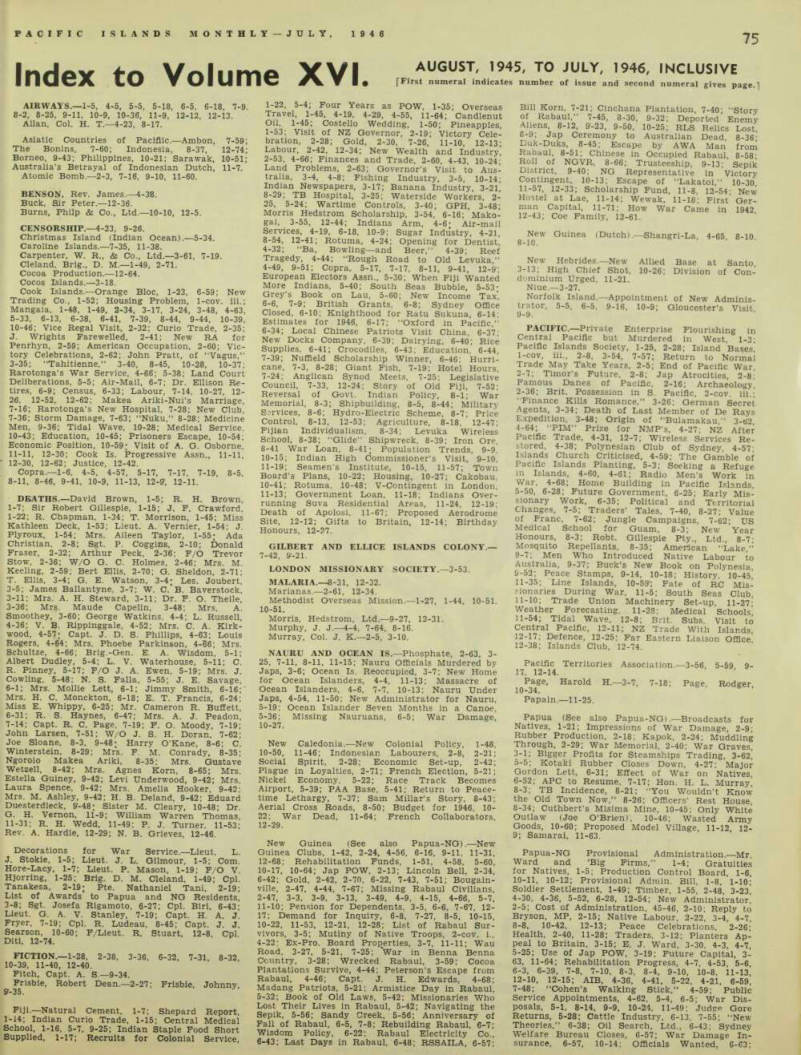
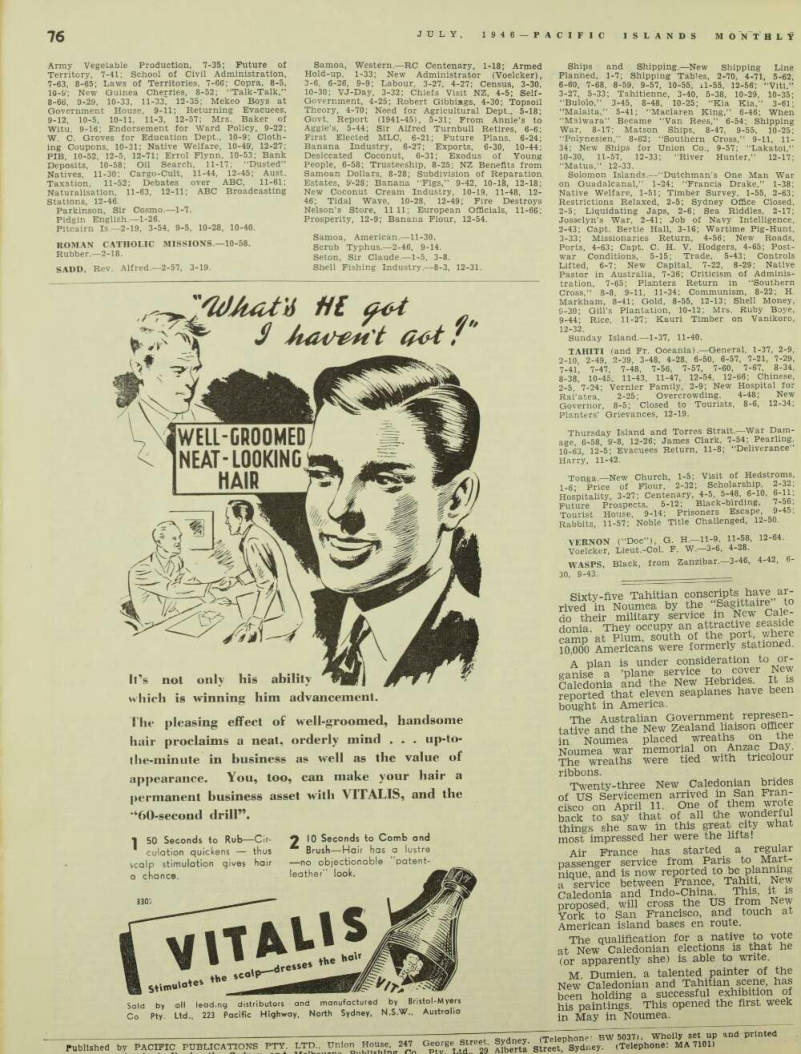
August, 1945, To July, 1946, Inclusive
[First numeral indicates number of issue and second numeral gives page.]
AIRWAYS.—I-5, 4-5, 5-5, 5-18, 6-5, 6-18, 7-9. 8-2, 8-25, 9-11, 10-9, 10-36, 11-9, 12-12, 12-13.
Allan, Col. H. T.—4-23, 8-17.
Asiatic Countries of Paciflic.—Ambon, 7-59; The Bonins, 7-60; Indonesia, 8-37, 12-74; Borneo, 9-43; Philippines, 10-21; Sarawak, 10-51; Australia’s Betrayal of Indonesian Dutch, 11-7.
Atomic Bomb. —2-3, 7-16, 9-10, 11-60.
BENSON, Rev. James.^-38.
Buck, Sir Peter. —12-36.
Burns, Philp & Co., Ltd.—lo-10, 12-5.
Censorship.—4-23, 9-26.
Christmas Island (Indian Ocean). —5-34.
Caroline Islands.—7-35, 11-38.
Carpenter. W. R., & Co., Ltd.—3-61, 7-19.
Cleland, Brig., D. M.—l-49, 2-71.
Cocoa Production. —12-64.
Cocos Islands.—3-18.
Cook Islands.—Orange Bloc, 1-23, 6-59; New Trading Co., 1-52; Housing Problem, 1-cov. iii.; Mangaia, 1-48, 1-49, 2-34, 3-17, 3-24, 3-48. 4-63, 5-33, 6-13, 6-38, 6-41, 7-39, 8-44, 9-44, 10-39, 10-46; Vice Regal Visit, 2-32; Curio Trade, 2-35; J. Wrights Farewelled, 2-41; New RA for Penrhyn, 2-59; American Occupation, 2-60; Vic tory Celebrations, 2-62; John Pratt, of “Vagus,” 3-35; “Tahitienne,” 3-40, 8-45, 10-28, 10-37; Rarotonga’s War Service, 4-66; 5-38; Land Court Deliberations, 5-5; Air-Mail, 6-7; Dr. Ellison Re tires, 6-9; Census, 6-33; Labour, 7-14, 10-27, 12- 26, 12-52, 12-62; Makea Ariki-Nui’s Marriage, 7-16; Rarotonga’s New Hospital, 7-28; New Club, 7- Storm Damage, 7-63; “Nuku,” 8-28; Medicine Men, 9-36; Tidal Wave, 10-28; Medical Service, 10- Education, 10-45; Prisoners Escape, 10-54; Economic Position, 10-59; Visit of A. G. Osborne, 11- 12-30; Cook Is. Progressive Assn., 11-11, 12- 12-62; Justice, 12-42.
Copra.—l-6, 4-5, 4-57, 5-17, 7-17, 7-19, 8-5, 8- 8-46, 9-41, 10-9, 11-13, 12-9, 12-11.
DEATHS.—David Brown, 1-5; R. H. Brown, 1-7; Sir Robert Gillespie, 1-15; J. F. Crawford, I- R. Chapman, 1-34; T. Morrison, 1-45; Miss Kathleen Deck, 1-53; Lieut. A. Vernier, 1-54; J.
Plyroux, 1-54; Mrs. Aileen Taylor, 1-55; Ada Christian, 2-8; Sgt. P. Coggins, 2-10; Donald Fraser, 2-32; Arthur Peck, 2-36; F/O Trevor Stow, 2-36; W/O G. C. Holmes, 2-46; Mrs. M.
Keeling, 2-59; Bert Ellis, 2-70; G. Sheldon, 2-71; T. Ellis, 3-4; G. E. Watson, 3-4; Les. Joubert, 3-5; James Ballantyne, 3-7; W. C.*B. Baverstock, 3-11; Mrs. A. H. Steward, 3-11; Dr. F. O. Theile, 3- Mrs. Maude Capelin, 3-48; Mrs. A.
Smoothey, 3-60; George Watkins. 4-4; L. Russell, 4- V. B. Rippinggale, 4-52; Mrs. C. A. Kirk wood. 4-57; Capt. J. D. S. Phillips, 4-63; Louis Rogers, 4-64; Mrs. Phoebe Parkinson, 4-66; Mrs.
Schultze, 4-66; Brig.-Gen. E. A. Wisdom, 5-1; Albert Dudley, 5-4; L. V. Waterhouse, 5-11; C.
R. Pinney, 5-17; F/O J. A. Ewen, 5-19; Mrs. J.
Cowling, 5-48; N. S. Falla, 5-55; J. E. Savage, 6-1; Mrs. Mollie Lett, 6-1; Jimmy Smith, 6-16; Mrs. H. C. Monckton, 6-18; E. T. Francis, 6-24; Miss E. Whippy, 6-25; Mr. Cameron R. Buffett, 6- R. S. Haynes, 6-47; Mrs. A. J. Peadon, 7- Capt. R. C. Page, 7-19; F. O. Moody, 7-19; John Larsen, 7-51; W/O J. S. H. Doran, 7-62; Joe Sloane, 8-3, 9-48; Harry O’Kane, 8-6; C.
Winterstein, 8-29; Mrs. F. M. Conrady, 8-35; Ngoroio Makea Ariki, 8-35; Mrs. Gustave Wetzell, 8-42; Mrs. Agnes Korn, 8-65; Mrs.
Estella Guiney, 9-42; Levi Underwood, 9-42; Mrs.
Laura Spence, 9-42; Mrs. Amelia Hooker, 9-42; Mrs. M. Ashley, 9-42; H. B. Deland, 9-42; Eduard Duesterdieck, S’-48; Sister M. Cleary, 10-48; Dr.
G. H. Vernon, 11-9; William Warren Thomas, II- R. H. Wedd, 11-49; P. j. Turner, 11-53; Rev. A. Hardie, 12-29; N. B. Grieves, 12-46.
Decorations for War Service—Lieut, L.
J. Stokie, 1-5; Lieut. J. L. Gilmour, 1-5; Com.
Hore-Lacy, 1-7; Lieut. P. Mason, 1-19; F/O V.
Hjorrlng, 1-25; Brig. D. M. Cleland, 1-49; Cpl.
Tanakesa, 2-19; Pte. Nathaniel Tani, 2-19; List of Awards to Papua and NG Residents, 3-8; Sgt. Josefa Rigamoto, 6-27; Cpl. Biri, 6-43; Lieut. G. A. V. Stanley, 7-19; Capt. H. A. J.
Fryer, 7-19; Cpl. R. Ludeau, 8-45; Capt. J. J.
Searson, 10-60; F/Lieut. R. Stuart, 12-8, Cpl.
Diti, 12-74.
Fiction.—I-28, 2-38, 3-36, 6-32, 7-31, 8-32,
10-39, 11-40, 12-40.
Fitch, Capt. A. S— 9-34.
Prisbie, Rob ert Dean.—2-27; Prisbie, Johnny, Fiji—Natural Cement, 1-7; Shepard Report, 1-14; Indian Curio Trade, 1-15; Central Medical School, 1-16, 5-7, 9-25; Indian Staple Food Short Supplied, 1-17; Recruits for Colonial Service,
1-22, 5-4; Four Years as POW, 1-35; Overseas Travel, 1-45, 4-19, 4-29, 4-55, 11-64; Candlenut Oil, 1-45; Costello Wedding, 1-50; Pineapples, 1- Visit of NZ Governor, 2-19; Victory Cele bration, 2-28; Gold, 2-30, 7-26, 11-10, 12-13; Labour, 2-42, 12-34; New Wealth and Industry, 2- 4-66; Finances and Trade, 2-60, 4-43, 10-24; Land Problems, 2-63; Governor’s Visit to Aus tralia, 3-4, 4-8; Fishing Industry, 3-5, 10-14; Indian Newspapers, 3-17; Banana Industry, 3-21,’ 8-29; TB Hospital, 3-25; Waterside Workers, 2- 25, 5-24; Wartime Controls, 3-40; GPH, 3-48; Morris Hedstrom Scholarship, 3-54, 6-16; Mako gai, 3-55, 12-44; Indians Arm, 4-6- Air-mail Services, 4-19, 6-18, 10-9; Sugar Industry. 4-21, 8-54, 12-41; Rotuma, 4-24; Opening for Dentist, 4-32; “Ba, Bowling—and Beer,” 4-39; Reef Tragedy, 4-44; “Rough Road to Old Levuka,” 4-49, 9-51; Copra, 5-17, 7-17, 8-11, 9-41, 12-9; European Electors Assn., 5-30; When Fiji Wanted More Indians, 5-40; South Seas Bubble, 5-53- Grey’s Book on Lau, 5-60; New Income Tax* 6-6, 7-9; British Grants, 6-8; Sydney Office Closed, 6-10; Knighthood for Ratu Sukuna, 6-14; Estimates for 1946, 6-17; “Oxford in Pacific,’’ 6- Local Chinese Patriots Visit China, 6-37; New Docks Company, 6-39; Dairying, 6-40; Rice Supplies, 6-41; Crocodiles, 6-43; Education, 6-44, 7- Nuffield Scholarship Winner, 6-46; Hurri cane, 7-3, 8-28; Giant Fish. 7-19; Hotel Hours, 7- Anglican Synod Meets, 7-25; Legislative Council, 7-33, 12-24; Story of Old Fiji, 7-52; Reversal of Govt. Indian Policy, 8-1; War Memorial, 8-3; Shipbuilding, 8-5, 8-44; Military S?rvices, 8-6; Hydro-Electric Scheme, 8-7; Price Control, 8-13, 12-53; Agriculture. 8-18, 12-47; Fijian Individualism, 8-34; Levuka Wireless School, 8-38; “Glide” Shipwreck, 8-39; Iron Ore, 8- War Loan, 8-41; Population Trends, 9-9, 10- Indian High Commissioner’s Visit, 9-10, 11- Seamen’s Institute, 10-15, 11-57; Town Board’s Plans, 10-22; Housing, 10-27; Cakobau, 10- Rotuma, 10-48; V-Contingent in London, 11- Government Loan, 11-18; Indians Over running Suva Residential Areas, 11-24, 12-19; Death of Apolosi, 11-67; Proposed Aerodrome Site, 12-12; Gifts to Britain, 12-14; Birthday Honours, 12-27.
Gilbert And Ellice Islands Colony.—
7-42, 9-21.
London Missionary Society—3-53.
Malaria.—B-31, 12-32.
Marianas. —2-61, 12-34.
Methodist Overseas Mission. —1-27, 1-44, 10-51. 10-51.
Morris, Hedstrom, Ltd.—9-27, 12-31.
Murphy, J. J.—4-4, 7-64, 8-16.
Murray, Col. J. K.—2-5, 3-10.
NAURU AND OCEAN IS.—Phosphate, 2-63, 3- 25, 7-11, 8-11, 11-15; Nauru Officials Murdered by Japs, 3-6; Ocean Is. Reoccupied, 3-7; New Home for Ocean Islanders, 4-4, 11-13; Massacre of Ocean Islanders, 4-6, 7-7, 10-13; Nauru Under Japs, 4-54, 11-50; New Administrator for Nauru, 5-19; Ocean Islander Seven Months in a Canoe, 5- Missing Nauruans, 6-5; War Damage, 10-27.
New Caledonia.—New Colonial Policy, 1-48, 10-50, 11-46; Indonesian Labourers, 2-8, 2-21; Social Spirit, 2-28; Economic Set-up, 2-42; Plague in Loyalties, 2-71; French Election, 5-21; Nickel Economy, 5-22; Race Track Becomes Airport, 5-39; PAA Base, 5-41; Return to Peace time Lethargy, 7-37; Sam Millar’s Story, 8-43; Aerial Cross Roads, 8-50; Budget for 1946, 10- 22; War Dead, 11-64; French Collaborators, 12- New Guinea (See also Papua-NG).—New Guinea Clubs, 1-42, 2-24, 4-56, 6-16, 9-11, 11-31, 12-68; Rehabilitation Funds, 1-51, 4-58, 5-60, 10- 10-64; Jap POW, 2-13; Lincoln Bell, 2-34, 6- Gold, 2-42, 2-70, 6-22, 7-43, 7-51; Bougain ville, 2-47. 4-44, 7-67; Missing Rabaul Civilians, 2-47, 3-3, 3-9, 3-13, 3-49, 4-9, 4-15, 4-66, 5-7, 11- Pension for Dependents, 3-5, 6-6, 7-67, 12- 17; Demand for Inquiry, 6-8, 7-27, 8-5, 10-15, 10-22, 11-53, 12-21, 12-28; List of Rabaul Sur vivors, 3-5; Mutiny of Native Troops, 2-cov. i., 4- Ex-Pro. Board Properties, 3-7, 11-11; Wau Road, 3-27, 5-21, 7-25; *War in Benna Benna Country, 3-28; Wrecked Rabaul, 3-59; Cocoa Plantations Survive, 4-44; Peterson’s Escape from Rabaul, 4-46; Capt. J. H. Edwards, 4-68; Madang Patriots, 5-21; Armistice Day in Rabaul, 5- Book of Old Laws, 5-42; Missionaries Who Lost Their Lives in Rabaul, 5-42; Navigating the Sepik, 5-56; Sandy Creek, 5-56; Anniversary of Fall of Rabaul, 6-5, 7-8; Rebuilding Rabaul, 6-7; Wisdom Policy, 6-22; Rabaul Electricity Co., 6- Last Days in Rabaul, 6-48; RSSAILA, 6-57;
Bill Korn, 7-21; Cinchana Plantation, 7-40; “Story of Rabaul,’’ 7-45, 3-30, 9-32; Deported Enemy Aliens, 8-12, 9’-23, 9-50, 10-25; RLS Relics Lost 8- Jap Ceremony to Australian Dead, 8-36 : Duk-Duks, 8-45; Escape by AWA Man from Rabaul, 8-51; Chinese in Occupied Rabaul, 8-58; Roll of NGVR, 8-66; Trusteeship, 9-13; Sepik District, 9-40; NG Representative in Victory Contingent, 10-13; Escape of “Lakatoi,” 10-30, 11- 12-33; Scholarship Fund, 11-8, 12-54; New Hostel at Lae, 11-14; Wewak, 11-18; First' Ger man Capital, 11-71; How War Came in 1942 12- Coe Family, 12-61.
New Guinea (Dutch).—Shangri-La, 4-65 8-10 8-10.
New Hebrides.—New Allied Base at Santo 3- High Chief Shot. 10-26; Division of Con dominium Urged, 11-21.
Niue.—3-27.
Norfolk Island—Appointment of New Adminis trator, 5-5, 6-5, 9-16, 10-9; Gloucester’s Visit 9- PAClFlC.—Private Enterprise Flourishing in Central Pacific but Murdered in West, 1-3; Pacific Islands Society, 1-25, 2-28; Island Bases 1- Hi., 2-8, 3-54, 7-57; Return to Normal Trade May Take Years, 2-5; End of Pacific War 2- Timor’s Future. 2-8; Jap Atrocities, 2-8 : Famous Danes of Pacific, 2-16; Archaeology, 2- Brit. Possession in S. Pacific, 2-cov. iii.; “Finance Kills Romance,’’ 3-26; German Secret Agents, 3-34; Death of Last Member of De Rays Expedition, 3-48; Origin of “Bulamakau,” 3-62, 4- “PIM” Prize for NMP’s, 4-27; NZ After Pacific Trade, 4-31, 12-7; Wireless Services Re stored, 4-38; Polynesian Club of Sydney, 4-57; Islands Church Criticised, 4-59; The Gamble of Pacific Islands Planting, 5-3; Seeking a Refuge in Islands, 4-60, 4-61; Radio Men’s Work in War, 4-68; Home Building in Pacific Islands, 5- 6-28; Future Government, 6-25; Early Mis sionary Work, 6-35; Political and Territorial Changes, 7-5; Traders’ Tales, 7-40, 8-27; Value of Franc, 7-62; Jungle Campaigns, 7-62; US Medical School for Guam, 8-3; New Year Honours, 8-3; Robt. Gillespie Pty., Ltd., 8-7- Mosquito Repellants, 8-35; American “Lake,’’ 9-7; Men Who Introduced Native Labour to Australia, 9-37; Buck’s New Book on Polynesia 9- Peace Stamps, 9-14, 10-18; History, 10-45’ 11-35; Line Islands, 10-59’; Fate of RC Mis sionaries During War, 11-5; South Seas Club, 11-10; Trade Union Machinery Set-up, 11-27- Weather Forecasting, 11-28; Medical Schools’ 11- Tidal Wave, 12-8; Brit. Subs. Visit to Central Pacific, 12-11; NZ Trade With Islands 12- Defence, 12-25; Par Eastern Liaison Office 12-38; Islands Club, 12-74.
Pacific Territories Association.—3-56, 5-59 9- 17, 12-14.
Page, Harold H.—3-7, 7-18; Page, Rodger, 10- Papain.—ll-25.
Papua (See also Papua-NG) .—Broadcasts for Natives, 1-21; Impressions of War Damage, 2-9; Rubber Production, 2-18; Kapok, 2-24; Muddling Through, 2-29; War Memorial, 2-40; War Graves, 3- Bigger Profits for Steamships Trading, 3-62, 5- Kotaki Rubber Closes Down, 4-27; Major Gordon Lett, 6-31; Effect of War on Natives, 6- APC to Resume, 7-17; Hon. H. L. Murray, 8-3; TB Incidence, 8-21; “You Wouldn’t Know the Old Town Now,” 8-26; Officers’ Rest House, 8-34; Cuthbert’s Misima Mine, 10-45; Only White Outlaw (Joe O’Brien), 10-46; Wasted Army Goods, 10-60; Proposed Model Village, 11-12, 12- 9; Samarai, 11-63.
Papua-NG Provisional Administration.—Mr.
Ward and ‘Big Firms,” 1-4; Gratuities for Natives, 1-5; Production Control Board, 1-6, 10-11, 10-12; Provisional Admin. Bill, 1-8, 1-10; Soldier Settlement, 1-49; Timber, 1-55, 2-48, 3-23, 4- 4-36, 5-52, 6-28, 12-54; New Administrator, 2-5; Cost of Administration, 45-46, 2-10; Reply to Bryson, MP, 2-15; Native Labour, 2-22, 3-4, 4-7, 8-8, 10-42, 12-13; Peace Celebrations, 2-26; Health, 2-40, 11-28; Traders, 3-12; Planters Ap peal to Britain, 3-15; E. J. Ward, 3-30, 4-3, 4-7, 5- Use of Jap POW, 3-19; Future Capital, 3- 63, 11-64; Rehabilitation Progress, 4-7, 4-53, 5-6, 6- 6-39, 7-8, 7-10, 8-3, 8-4, 9-10, 10-8, 11-13, 12-10, 12-15; A 18, 4-36, 4-41, 5-22, 4-21, 6-59, 7- “Cohen’s Walking Stick,” 4-59; Public Service Appointments, 4-62, 5-4, 6-5; War Dis posals, 5-1, 8-14, 9-9, 10-24, 11-49: Judge Gore Returns, 5-28; Cattle Industry, 6-13, 7-55; “New Theories,” 6-38; Oil Search, Ltd., 6-43; Sydney Welfare Bureau Closes, 6-57; War Damage In surance, 6-57, 10-14: Officials Wanted, 6-63;
Army Vegetable Production, 7-35; Future of Territory, 7-41; School of Civil Administration, 7- 8-65; Laws of Territories, 7-66; Copra, 8-5, 10-9; New Guinea Cherries, 8-52; “Talk-Talk,” 8- 9-29, 10-33, l2-35; Mekeo Boys at Government House, 9-11; Returning Evacuees, 9- 10-5, 10-11, 11-3, 12-57; Mrs. Baker of Witu, 9-16; Endorsement for Ward Policy, 9-22; W. C. Groves for Education Dept., 10-9; Cloth ing Coupons, 10-31; Native Welfare, 10-49’, 12-27; PIB, 10-52, 12-5, 12-71; Errol Flynn, 10-53; Bank Deposits, 10-58; Oil Search, 11-17; “Dusted”
Natives, 11-30; Cargo-Cult, 11-44, 12-45; Aust.
Taxation, 11-52; Debates over ABC, 11-61; Naturalisation. 11-63, 12-11; ABC Broadcasting Stations, 12-46.
Parkinson, Sir Cosmo. —1-7.
Pidgin English.—l-26.
Pitcairn Is —2-19, 3-54, 9-5, 10-28, 10-40.
Roman Catholic Missions—Io-58.
Rubber. —2-18.
SADD, Rev. Alfred.—2-57, 3-19.
Samoa, Western.—RC Centenary, 1-18; Armed Hold-up, 1-33; New Administrator (Voelcker), 3-6, 6-26, 9-9; Labour, 3-27, 4-27; Census, 3-30, 10-30; VJ-Day, 3-32; Chiefs Visit NZ, 4-5; Self- Government, 4-25; Robert Gibbmgs, 4-30; Topsoil Theory, 4-70; Need for Agricultural Dept., 5-18; Govt. Report (1941-45), 5-31; From Annie’s to Aggie’s, 5-44; Sir Alfred Turnbull Retires, 6-6; First Elected MLC, 6-21; Future Plans, 6-24; Banana Industry, 6-27; Exports, 6-30, 10-44; Desiccated Coconut, 6-31; Exodus of Young People, 6-58; Trusteeship, 8-25; NZ Benefits from Samoan Dollars, 8-28; Subdivision of Reparation Estates, 9'-28; Banana “Figs,” 9-42, 10-18, 12-18; New Coconut Cream Industry, 10-19, 11-48, 12- 46; Tidal Wave, 10-28, 12-49; Fire Destroys Nelson’s Store, 11 11; European Officials, 11-66; Prosperity, 12-9; Banana Flour, 12-54.
Samoa, American. —11-30.
Scrub Typhus.—2-46, 9-14.
Seton, Sir Claude. —1-5, 3-8.
Shell Fishing Industry.—B-3, 12-31.
Ships and Shipping.—New Shipping Line Planned, 1-7; Shipping Tables, 2-70, 4-71, 5-62, 6- 7-68, 8-59, 9-57, 10-55, il-55, 12-56; “Viti,” 3-27, 5-33; Tahitienne, 3-40, 5-38, 10-29, 10-35; “Bulolo,” 3-45, 8-48, 10-25; “Kia Kia,” 3-61; “Malaita,” 5-41; “Maclaren King,” 6-46; When “Maiwara” Became ‘‘Van Rees,” 6-54; Shipping War, 8-17; Matson Ships, 8-47, 9-55 s 10-25; “Polynesien,” 8-62; ‘‘Southern Cross,” 9-11, 11- 34; New Ships for Union Co., 9-57; ‘‘Lakatoi,” 10-30, 11-57, 12-33; ‘‘River Hunter,” 12-17; “Matua,” 12-33.
Solomon Islands.—‘‘Dutchman’s One Man War on Guadalcanal,” 1-24; “Francis Drake,” 1-38; Native Welfare, 1-51; Timber Survey, 1-55, 2-63; Restrictions Relaxed, 2-5; Sydney Office Closed, 2-5; Liquidating Japs, 2-6; Sea Riddles, 2-17; Josselyn’s War, 2-41; Job of Navy Intelligence, 2- Capt. Bertie Hall, 3-16; Wartime Pig-Hunt, 3- Missionaries Return, 4-56; New Roads, Ports, 4-63; Capt. C. H. V. Hodgers, 4-65; Post war Conditions, 5-15; Trade, 5-43; Controls Lifted, 6-7; New Capital, 7-22, 8-29; Native Pastor in Australia, 7-36; Criticism of Adminis tration, 7-65; Planters Return in “Southern Cross,” 8-8, 9-11, 11-34; Communism, 8-22; H.
Markham, 8-41; Gold, 8-55, 12-13; Shell Money, S-30; Gill’s Plantation, 10-12; Mrs. Ruby Boye, 9- Rice, 11-27; Kauri Timber on Vanikoro, 12-32.
Sunday Island. —1-37, 11-40.
TAHITI (and Fr. Oceania). —General, 1-37, 2-9, 2-10 2-49, 2-39, 3-48, 4-28, 6-50, 6-57, 7-21, 7-29, 7- 7-47, 7-48, 7-56, 7-57, 7-60, 7-67, 8-34, 8- 10-45, 11-43, 11-47, 12-54, 12-66; Chinese, 2-5, 7-24; Vernier Family, 2-9; New Hospital for Rai’atea, 2-25; Overcrowding, 4-48; New Governor, 8-5; Closed to Tourists, 8-6, 12-34; Planters’ Grievances, 12-19.
Thursday Island and Torres Strait. —War Dam age, 6-58, &’-8, 12-26; James Clark, 7-54; Pearling, 10- 12-5; Evacuees Return, 11-8; “Deliverance”
Harry, 11-42.
Tonga.—New Church, 1-5; Visit of Hedstroms, 1-6- Price of Flour, 2-32; Scholarship, 2-32; Hospitality, 3-27; Centenary, 4 ; 5 ’ 5 - 48 -. 6 ‘ 10 ’
Future Prospects, 5-12; Black-birdmg, 7-56, Tourist House, 9-14; Prisoners Escape 9-45; Rabbits, 11-57; Noble Title Challenged, 12-50.
VERNON (“Doc”), G. H.—ll-9, 11-58, 12-64.
Voelcker, Lieut.-Col. F. W.—3-6, 4-28.
WASPS, Black, from Zanzibar.—3-46, 4-42, 6- 30, 9-43.
Sixty-five Tahitian conscripts have ar rived in Noumea by the ‘! Sa^ ir p i do their military service in New Cale donia. They occupy im attractive seaside pomn at Plum, south of the port, where 10,000 Americans were formerly stationed.
A plan is under consideration to or ganise a ’plane service to cover New Caledonia and the New Hebrides. It is reported that eleven seaplanes have been bought in America.
The Australian Government represen tative and the New Zealand liaison officer in Noumea placed wreaths on the Noumea war memorial on Anzac Day.
The wreaths were tied with tricolour ribbons.
Twenty-three New Caledonian brides of US Servicemen arrived in San Fran cisco on April 11. One of them wrote back to say that of all the wonderful things she saw in this great city what most impressed her were the lifts!
Air France has started a regular nassenger service from Paris to Mart inique, and is now reported to be planning a service between France, Tahiti, New Caledonia and Indo-China. This, it is proposed, will cross the US from New York to San Francisco, and touch at American island bases en route.
The qualification for a native to vote at New Caledonian elections is that he (or apparently she) is able to write.
M. Dumien, a talented painter of the New Caledonian and Tahitian scene, has been holding a successful exhibition of his paintings. This opened the first week in May in Noumea.
Advertisements & other items, pp. 78-80 (2 items)
76
JULY, 1946-PACIFIC ISLANDS MO NT H L Y
- . nvienhone- BW 5037). Wholly set up and printed Published by PACIFIC PUBLICATIONS PTY. LTD., Union House 247 George Street. s * reet P Sydne y. (Telephone: MA 7101)
Neat-Looking
H a&t
w -y
WELL-GROOMED
NEAT-LOOKING
HAIR
a £. M ability his It’s not only which is winning him advancement.
The pleasing effect of well-groomed, handsome hair proclaims a neat, orderly mind . . . up-tothe-minute in business as well as the value of appearance. You, too, can make your hair a permanent business asset with VITALIS, and the * 4 60-second drill”. 1 50 Seconds to Rub— Cir- 2 10 Seconds to Comb and 1 culation quickens thus * Brush— Hair has a lustre scalp stimulation gives hair —no objectionable patenta chance. leather" look. 330/
V «■» Vb!?
*v»e sca\p mutates f Stiwu Sold by all lead.ng distributors and manufactured by Bristol-Myers Co Pty Ltd., 223 Pacific Highway, North Sydney, N.S.W.. Australia
A Tropical Thirst
demands a Satisfying Drink
f
IN A COOL
I Zjr^C ll* T U« Straub M* itS ONL-y r«ow the fINEJT
MTTLEO
J t OOth & Co.. LIMI|| s yoney. australis
that’s why KB is so popular
south of “the Line”
All through the tropics, wherever there are men who like good beer, you'll always find KB. It's the drink that men appreciate —a drink just made to satisfy a tropical thirst 1 *5 m K I 0 J
TOOTH'S
KB
LAGER.
2i2 w M
ERCHANTS
, 6c SHIP OWNERS
Capital £1,000,000
ESTABLISHED 1914
COPRA MERCHANTS & MILLERS
BRANCHES THROUGHOUT THE PACIFIC ISLANDS
REGULAR CARGO AND PASSENGER SERVICE BETWEEN EUROPE AND
PACIFIC ISLAND PORTS WAS ESTABLISHED BY
W. R. CARPENTER & CO. LTD.
Head Office: 16 O'CONNELL STREET, SYDNEY.
Cable Address:
CAMOHE.
Telephone : BW 4421.
Postal Address: P.O. Box No. 168, Sydney.