Islands
Pacific
Monthly
June 18, 1946
Vol. Xvi. No. 11.
stablished 1930.
[Registered at the G.P.0., hy post as a newspaper ]
II-
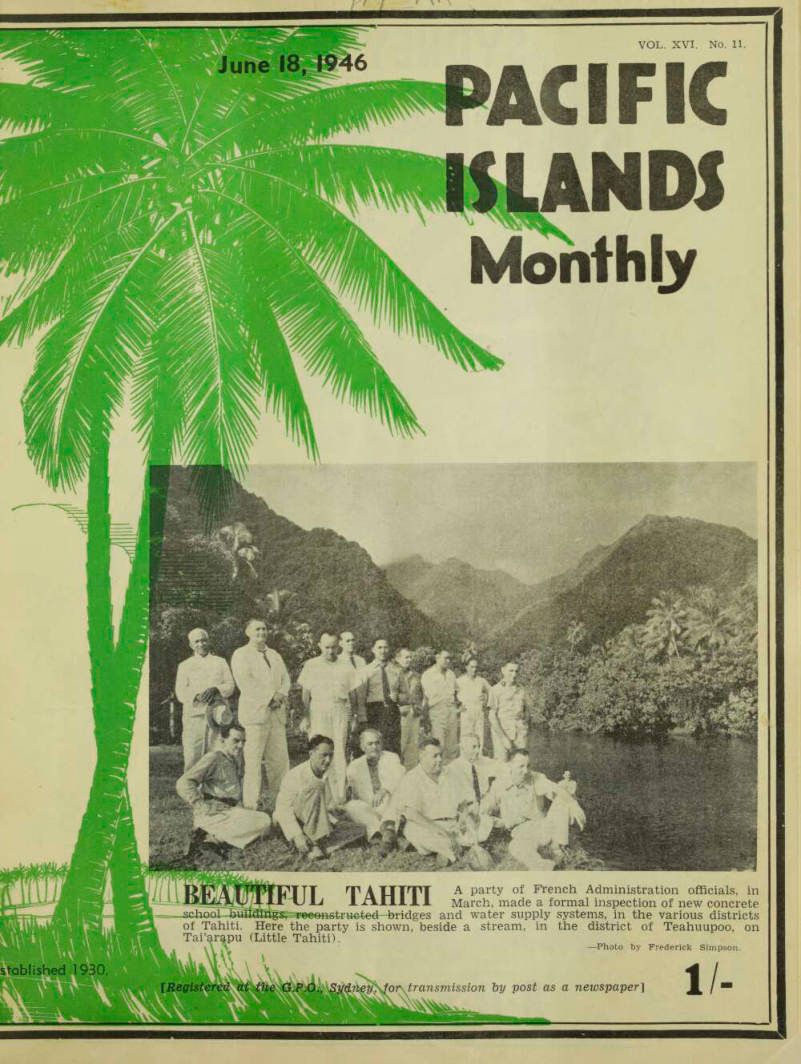
B EAUTIFUL TAHITI A party of Administration officials, in March, made a formal inspection of new concrete school bridges and water supply systems, in the various districts of Tahiti. Here the party is shown, beside a stream, in the district of Teahuupoo, on Tai’arapu (Little Tahiti).
Photo by Frederick Simpson.
Advertisements & other items, pp. 2-4 (1 item)
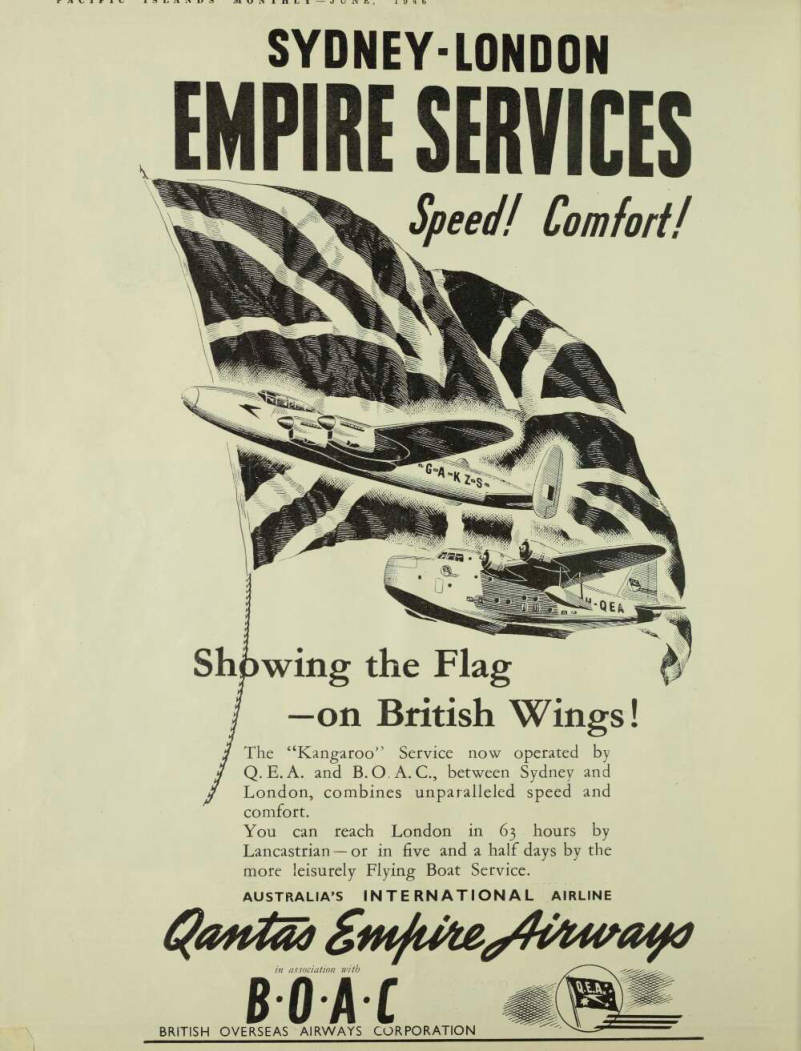
Empire Services
SYDNEY-LONDON
Comfort!
Speed!
I^.-, QEk
Shpwing the Flag
—on British Wings!
The “Kangaroo* 5 Service now operated by Q. E. A. and 8.0 A. C., between Sydney and London, combines unparalleled speed and comfort.
You can reach London in 63 hours by Lancastrian —or in five and a half days by the more leisurely Flying Boat Service.
AUSTRALIA’S INTERNATIONAL AIRLINE
Cfaritad
in association with
BO AC
BRITISH OVERSEAS AIRWAYS CORPORATION
IRONS PEF
PERFECTLY
Coleman’s Petrol and Kerosene Lamps in 300 and 500 C.P.
Coleman’s Kerosene Table Lamp can be used as hanging Lamp T 3k % lilt took 40 yeors' intensive speciolisation to bring the Colemon Petrol Iron to its present state of perfection. Coleman Irons require no preheating, they light instantly and can be used either indoors or outdoors.
IThe ventilated body prevents sides from scorching light fabrics and the ventilated lid keeps the handle cool.
O Tapered edge for ironing pleats and around buttons. 3Po i n ted heel gives wrinkle-proof ironing on back and forward strokes. 4 Built-in cleaning needle, cleans gas - tip automatically, without turning off iron and also regulates heat.
Coleman’s Petrol or Kerosene Lamp with large enamelled reflector.
Representatives for the Pacific Islands:
ROBERT GILLESPIE PTY. LTD.
540 PITT STREET, SYDNEY
PEARCE & CO. LTD.
SUVA
FOR FIJI ISLANDS
All over the British Empire, every minute of every day, more and more smokers are saying, "Better buy Capstan (tobacco and cigarettes)—theyVe blended better."
CAPSTAN
TOBACCO and CIGARETTES
"Morinda" Passengers
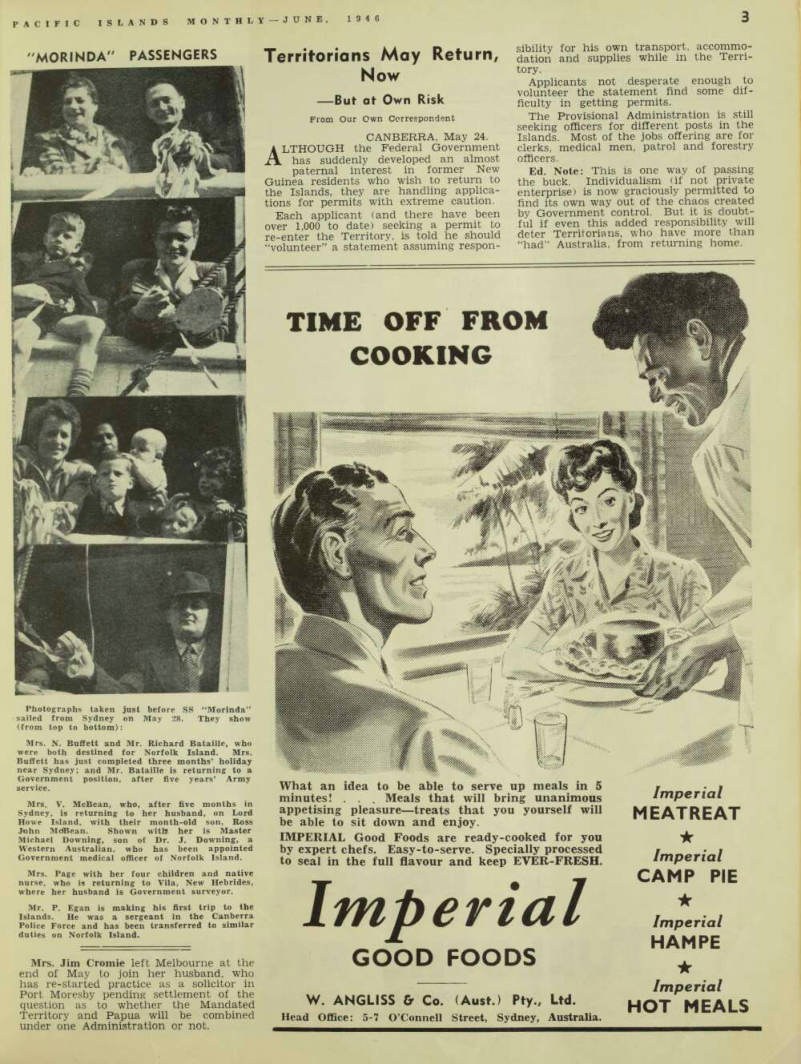
Mrs. Jim Cromie left Melbourne at the end of May to join her husband, who has re-started practice as a solicitor in Port Moresby pending settlement of the question as to whether the Mandated Territory and Papua will be combined under one Administration or not.
Photographs taken just before SS “Morinda” sailed from Sydney on May 28. They show (from top to bottom): Mrs. N. Buffett and Mr. Richard Bataille, who were both destined for Norfolk Island. Mrs.
Buffett has just completed three months’ holiday near Sydney; and Mr. Bataille is returning to a Government position, after five years’ Army service.
Mrs. V. McBean, who, after five months in Sydney, is returning to her husband, on Lord Howe Island, with their month-old son, Ross John McBean. Shown with her is Master Michael Downing, son of Dr. J. Downing, a Western Australian, who has been appointed Government medical officer of Norfolk Island.
Mrs. Page with her four children and native nurse, who is returning to Vila, New Hebrides, where her husband is Government surveyor.
Mr. P. Egan is making his first trip to the Islands. He was a sergeant in the Canberra Police Force and has been transferred to similar duties on Norfolk Island.
Territorians May Return,
Now
But at Own Risk
From Our Own Correspondent
Canberra, May 24.
ALTHOUGH the Federal Government has suddenly developed an almost paternal interest in former New Guinea residents who wish to return to the Islands, they are handling applica tions for permits with extreme caution.
Each applicant (and there have been over 1,000 to date) seeking a permit to re-enter the Territory, is told he should “volunteer” a statement assuming respon
sibility for his own transport, accommo dation and supplies while in the Terri tory.
Applicants not desperate enough to volunteer the statement find some dif ficulty in getting permits.
The Provisional Administration is still seeking officers for different posts in the Islands. Most of the jobs offering are for clerks, medical men, patrol and forestry officers.
Ed. Note: This is one way of passing the buck. Individualism (if not private enterprise) is now graciously permitted to find its own way out of the chaos created by Government control. But it is doubt ful if even this added responsibility will deter Territorians, who have more than “had” Australia, from returning home.
Advertisements & other items, pp. 5-6 (1 item)
Imperial
TIME OFF FROM
COOKING
i i. ... m \ :\ m €3 i <Sf n s m #■ m 'mm W' *>:> N r w V .*• What an idea to be able to serve up meals in 5 minutes! . . . Meals that will bring unanimous appetising pleasure—treats that you yourself will be able to sit down and enjoy.
IMPERIAL Good Foods are ready-cooked for you by expert chefs. Easy-to-serve. Specially processed to seal in the full flavour and keep EVER-FRESH.
Imperial
GOOD FOODS
W. ANGLISS & Co. (Aust.) Pty. ( Ltd.
Head Office: 5-7 O’Connell Street, Sydney, Australia.
Imperial
MEATREAT
★ Imperial
CAMP PIE
★ Imperial
HAMPE
★ Imperial
HOT MEALS
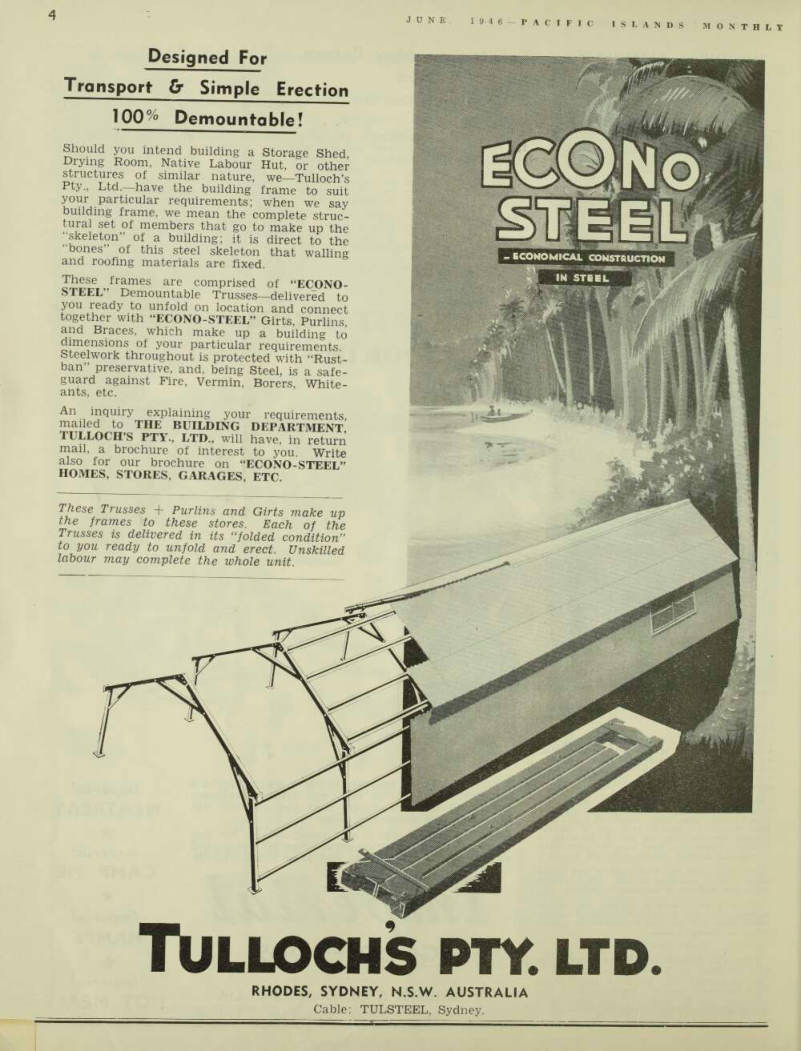
Designed For
Transport & Simple Erection
100% Demountable!
Should you Intend building a Storage Shed, Drying Room, Native Labour Hut, or other structures of similar nature, we—Tulloch’s Pty., Ltd.—have the building frame to suit your particular requirements; when we say building frame, we mean the complete structural set of members that go to make up the skeleton” of a building; it is direct to the ‘ bones” of this steel skeleton that walling and roofing materials are fixed.
These frames are comprised of “ECONO- STEEL” Demountable Trusses—delivered to you ready to unfold on location and connect together with “ECONO-STEEL” Girts, Purlins and Braces, which make up a building to dimensions of your particular requirements.
Steelwork throughout is protected with “Rustban” preservative, and. being Steel, is a safeguard against Fire, Vermin, Borers, Whiteants, etc.
An inquiry explaining your requirements,
mailed to THE BUILDING DEPARTMENT
TULLOCH’S PTY., LTD., will have, in return mail, a brochure of interest to you. Write also for our brochure on “ECONO-STEEL”
HOMES, STORES, GARAGES, ETC.
TTiese Trusses + Purlins and Girts make up the frames to these stores. Each of the Trusses is delivered in its “folded condition” to you ready to unfold and erect. Unskilled labour may complete the whole unit.
I !*. ' o O m ■ :
ECONOMICAL CONSTRUCTION
I™ . mm ’ ': ' I * % m it I m m ■■■> .. % S A j I jt I D
Tullochs pty. ltd
RHODES, SYDNEY, N.S.W, AUSTRALIA
Cable: TULSTEEL, Sydney.
Missionaries
Roman Catholic
How They Fared in the Bismarcks and Solomons WITH the kind assistance of the direc tors of the two Roman Catholic Missionary Orders, the Sacred Heart and the Marist Fathers, we have been able to compile the following lists, which show the fate of the Roman Catho lic Priests, Brothers and Sisters who were in the Territories of New Guinea and the BSI when the Japs invaded.
Believing that their work was recog nised as international in character, and that they therefore would not be perse cuted by the Japanese, the majority of these missionaries remained at their stations. As a result, they suffered greatly at the hands of the invaders, and many were murdered, or died from ill-treatment and starvation.
We have not yet received details of the Catholic missionaries (Society of the Divine Word), among whom there were many casualties. The two Vicariates were overwhelmed by the Jap invasion late in 1942 some months after the enemy entered the Bismarck and Solomon archipelagoes.
Order of (he Sacred Heart
Fate Of Priests, Lay-Brothers
And Sisters In New Britain, New
Ireland And Manus, January,
1942-September, 1945
Killed By Japanese
Fathers M. Murphy, at Mapua, Tabar Islands, and C. Martin, at Ulaputur (NI), in 1942, for giving shelter to Government officials.
Father E. Harris, at Malmal (Jacquinot Bay) 21/12/42, and Father W. Cul hane, at Uvol (Gasmata) 12/1/43, for assisting the refugee Australian troops.
Father C. Neuhaus, from Namatanai (NI), and Father J. Hemig, from Lemakot (NI), in 1943, at Rabaul. Both were imprisoned for six months, in Rabaul, for communicating with and supplying the Government officials and nursing Australian soldiers. They were after wards beheaded.
Probably Killed By Japanese
(No Trace Found)
At Manus: Fathers C. Borchardt, F.
Utsch (Sr.), B. van Klaarwater; Sisters (OLSH) Cunera, Ancilla, Elisabeth.
At New Ireland: Fathers J. Lakaff (Kavieng), P. Kutscher (Lamasong), J.
Krutzenbichler (Tanga), H. Kohlstette (Komalu), C. Schlueter (Lihir), F. Utsch (Jr.) (Lavangai), Brother H. Zumkley (Kavieng).
They were at first concentrated at Panapai with all the white people. They were brought to Kavieng at the end of 1942.
Father G. Peekel is the only survivor from New Ireland, with the Sisters Brigitta, Aquilina, Arkadia (Lemakot), and Agesta, Gustava (Namatanai). They were interned at Lakuramau with the Chinese until liberated in September, 1945.
Two Sisters died from exhaustion: Ambro sia and Climaca.
Torpedoed On Board The
“Montevideo Maru”
Father D. McCullagh (Vunapope) and Brother A. Brennan (Vunapope).
Killed By Bombs At Vunapope Or
Died From Bomb Injuries
Father B. Bley (14/2/44), and Brothers J. Wieschen (26/2/44), W. Deen (27/2/44), J. Langkamp (1/4/44, and, at Ramale J.
Wochner (17/11/44).
Died During Internment From
Lack Of Food And Medicine
At Vunapope Unless Stated Otherwise
Fathers W. Barrow (Rabaul) (13/11/42), A. Kleintitschen (3/12/42), J. Oberreiter (Birara) (21/2/44), J. Halt (Vlavolo) (29/2/44), F. Gruendl (Ratongor) (4/3 44), and Alphons Mayrhofer (11 4/43) at Lamingi.
Brothers J. Schueltingkemper (8/12/43), F. Hatzig (18/2/44), F. Heese (Taliliqap) (23/2/44), P. Buescher (29/2 44), L. Doer fler (9/3/44), J. Lizcnerski (10/3/44), B.
Boekenkotter (23/3/44), A. Packmor (9/4/44).
At Ramale Brothers G. Hessling (19/6/44), P.
Mueller (27/6 44), G. van der Zanden (17/5/45), and Teutenberg (25/12/44) at Brisbane after the liberation.
Sisters Mathilda (29/10/44) at Ramale, Celsine (5/4/43) at Vunapope, Eleonore (18/3/44) at Vunapope, Luise (14/6/45) at Ramale. Climaca, (9/9/44) at Lakuramau, Ambrosia (11/8/45) at Lakuramau.
ALL the occupants of Vunapope (reports the Mission director) were interned on January 25, 1942. heavify guarded and considered as spies. Most of the mis sionaries were brought in by Jap police, later on, from the nearby stations.
Real concentration camp began on October 1, 1942, with barbed wire, in the background of the bigger buildings which were occupied by the Japanese. They had to live on their gardens.
In February, 1944, Vunapope was bombed and completely destroyed by fires.
They became cavemen. Many died. In June, 1944, all had to leave for Ramale (near Bitaqalip) and had to build shelters and to work under guard in the gardens.
Liberation came on September 13. 1945 through the Australian Forces.
Most of the missionaries who were caught by the invasion at their stations and brought in to Vunapope, ex perienced rough treatment, starvation and repeated beatings, especiallv those who were taken to the Rabaul prison Father W. O’Connell, from Pililo, was handcuffed for more than a month, and not even released while sleeping.
Father J. Mayrhofer, from Karlai (Wide Bay), and Father R. Juergens, from Unea, had to undergo the drowning torture several times. Father H Berger from Tairobi (Talasea) had verv bad treatment from the Japanese.
Rescued By Allied Military
Forces
From Enelaua (Leper Station) in June 1944: Father J. Stamm; Brother J.’
Teutenberg (died in Brisbane 24/12/44)- Sisters (MSC) Winfrida. Clematia, Eme lina, Columbana.
From Ulamona (sawmill, completely destroyed), in June, 1944: Father L.
Bischof; and Brothers J. Plengemeyer, B Roleff, B. Berlemann, J. Brandt and’ B Hutters.
From Quma (Wide Bay), in February 1942: Father P. Diedrichs.
Liberated From Ramale Camp On
13/9/45 By Amp
His Lordship Bishop L. Scharmach.
Thirty-two Priests, 30 Brothers.
Thirty-one Sisters (OLSH), 35 Sisters
(Msc).
Order of Morist Fathers
Fate Of Missionaries Caught By
The Invasion In Northern
Solomons (Buka And Bougain
Ville)
Unless Otherwise Stated, the Following Became Prisoners of War, and Escaped er Were Rescued in September, 1945, and Were Evacuated to Sydney. (Unless otherwise stated, the title of the Missionary is Father, SM.) Bishop T. J. Wade, evacuated.
M. Boch, Faisi, Shortlands.
J, B, Poncelet, Turiboiru, Buin.
Schank, Muguai, Buin.
Schleicker, Monoitu, Bougainville, escaped.
Seiler, Kieta, Bougainville, escaped.
Allotte, Timbutz, evacuated Jan., 1943.
A. Morel. Tarlena, Buka, evacuated Jan., 1943.
Grisward, Banoni, Bougainville, escaped.
Died in Sydney, 18/4/46.
Muller, Bougainville, escaped.
A. Junkers, Koromira, Bougainville, escaped.
Le Breton, Kieta, Bougainville, escaped.
Lamarre, Hanahan, Buka Passage.
L. Lebee, Timnutz, Bougainville, escaped to New Caledonia.
Lepping, Paisi, Shortlands.
P. Montauban, Gagan, Buka Passage, escaped.
G. Servant, Hahaila, Buka Pasage, escaped.
Caffiaux, Gagan. Buka Passage, escaped.
H. Fluet, Asitavi, Bougainville, escaped.
Tarlena. Buka, escaped.
Binois, Choiseul, Shortlands—lived in the bush among the natives.
(Continued on Page 65)
(Continued from Page 5)
H. Hebert, Konua, Bougainville, escaped.
Miltrup, Piano, Bougainville, escaped.
R. O’Sullivan, Patupatuai, Buin, escaped.
B. Tonges, Sovele, Bougainville, escaped.
Bro. Jules, Kieta, escaped.
Bro. Henry, Kieta, escaped.
Bro. Xavier, escaped.
Bro. Bruno, Muguai, Buin.
Dead Or Missing
Fr. Wache, Kieta, Bougainville, died from injury received by bombs.
Fr. Hennessey, Ltmanmanu, Buka, died when "Montevideo Maru” was sunk.
Fr. Conley, Kieta, died —presumed killed by Japs.
Fr. W. Weber, Tunuru, Bougainville, missing—presumed killed by Japs.
Bro. John, Chabai, Buka Passage, POW and missing.
Bro. Donatus, Chabai, Buka Passage, POW and missing.
Bro. Augustin, Chabai, Buka Passage, POW and missing.
Bro. Joseph, Kieta, killed in prison camp by bomb.
Bro. Karl, Kieta, imprisoned in Kieta — died from wounds received from machine guns.
Bro. Gregory, Timputz, was evacuated but died from blood poisoning in New Caledonia.
Majority Of Nuns Escaped
(Unless otherwise stated, the title of the person named is Sister, SMSM) Mother M. Wendelina, SMSM, Turiboiru, Buin, was captured, taken prisoner, and in 1945 rescued at Ramale Camp.
Ignace, Turiboiru, Buin, escaped, evacu ated.
Dolores, Muguai, Buin, taken prisoner, rescued at Ramale.
Placide, Turiboiru, Buin, taken prisoner, rescued at Ramale.
Crescentia, Muguai, Buin, taken prisoner, rescued at Ramale. du Sacre Coeur, Muguai, Buin, taken prisoner, rescued at Ramale.
Andrea, Turiboiru, Buin, taken prisoner, rescued at Ramale.
Ludovica, Koromira, Bougainville, was prisoner, escaped, evacuated.
Lidwina, Koromira, Bougainville, was prisoner, escaped, evacuated.
Escaped And Evacuated
Adalberta, Monoitu, Bougainville.
Martial, Monoitu, Bougainville.
Claire, Tarlena, Buka Passage.
Remi, Tarlena, Buka Passage.
Elie, Timputz, Buka Passage.
Henrietta, Tarlena, Buka Passage.
Hortense, Kieta, Bougainville.
Cecilia, Timputz, Buka Passage.
Gisele, Kieta, Bougainville.
Blaise, Piano, Bougainville.
Fabian, Muguai, Buin.
Xavier, Timputz, Buka Passage.
Isabella, CSJ, Hanahan, Buka Passage.
Irene, CSJ, Hanahan, Buka Passage.
Celestine, CSJ, Hanahan, Buka Passage.
Hedda, CSJ, Hanahan, Buka Passage.
Camille, Koromira, was a prisoner on the island —died of misery.
Domitilla, Vunapope, died in camp at Ramale.
Society of Mary
The missionaries (Fathers, Brothers and Sisters) of the Society of Mary in the British Solomon Islands fared as follows: Bishop J. M. Aubin, SM, Visale, prisoner on the island, escaped the watch of the Japs, lived amongst natives; still at work.
Fr. A. Brugmans, SM, Visale, prisoner, escaped and evacuated to New Zea land, then to Sydney.
Fr. J. Coicaud, SM, prisoner at Marau, escaped and evacuated to New Zea land, then to Sydney, where he died.
Fr. P. Van Mechelen, SM, Marau, pri
soner, escaped and evacuated to New Zealand; back in Guadalcanal.
Fr. A. Duhamel, SM, Ruavatu, prisoner and murdered.
Fr. O. H. Engberink, SM, Ruavatu, prisoner and murdered.
Bro. George, SM, Visale, prisoner, escaped and evacuated to New Zea land: now back in Tulagi.
Of the 22 other missionaries, some have been evacuated, some lived amongst the natives and are still at work.
The fate of the Sisters. SMSM, of the South Solomon Islands was:
The Sisters at Visale became prisoners, but escaped and were evacuated.
Sister M. Odilia, SMSM, Rauvatu, prisoner and murdered.
Sister M. Sylvia, SMSM. Rauvatu, prisoner and murdered.
Sister M. Edmee, SMSM, escaped into the bush, then found and taken to New Caledonia.
The other Sisters, about 18, succeeded in escaping and were evacuated, some to Fiji, some to New Zealand, stune to Sydney. It is reported that all are very anxious to return to their mission fields.
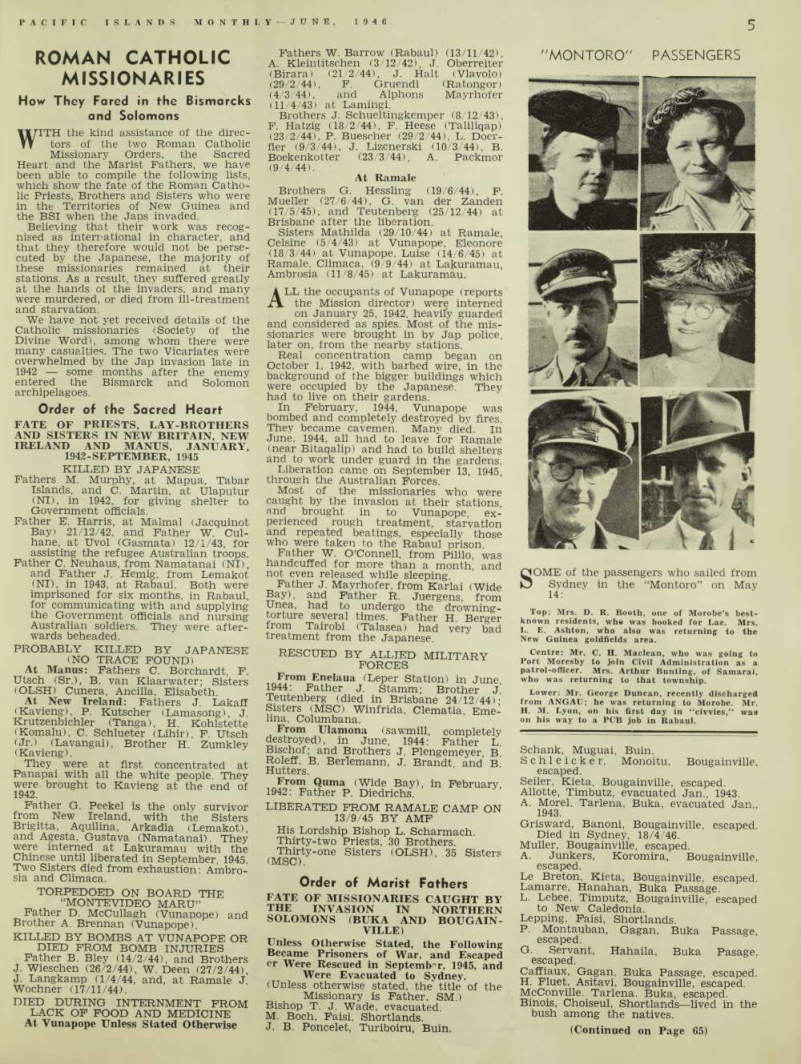
"Montoro" Passengers
SOME of the passengers who sailed from Sydney in the “Montoro” on May 14: Top: Mrs. D. R. Booth, one of Morobe’s best known residents, who was booked for Lae. Mrs.
L. E. Ashton, who also was returning to the New Guinea goldfields area.
Centre: Mr. C. H. Maclean, who was going to Fort Moresby to join Civil Administration as a patrol-officer. Mrs. Arthur Bunting, of Samarai, who was returning to that township.
Lower: Mr. George Duncan, recently discharged from ANGAU; he was returning to Morobe. Mr.
H. M. Lyon, on his first day in “civvies,” was on his way to a PCB job in Rabaul.
Advertisers
Angliss & Co. . . 3 Aust. Fishing in dustries 61
Awa 69
Atkins Pty., Ltd., Wm 21 Brial & Ball ... 19 Brown & Co., Ltd. 15 Brunton’s Flour . . 58 Burns, Philp Trust Co., Ltd 70 Broomfields ... 24 BP (SS» Co. . , . 15 Baker, Jno 31 Carlton & United Breweries, Ltd. . 23 Carpenter, Ltd., W.
R cov. iv.
Chivers & Sons, Ltd 65 Church, R. H., & Sons 42 Coleman Lamp & Stove Co 53 “Cystex” 27 Consolidated Export & Import Group of Australia . . 67 Casino Hotel ... 52 Dalmore Preserving Co 17 Donaghy & Sons . 42 Donald, Ltd., A. B. 71 Dr. Williams Pink Pills 55 Dangar, Gedye & Malloch 62 Electrolux Refrigerators . . 26 H. G. Bekhoff . . 44 Foster Clark ... 71 Ford Sherington Pty., Ltd 48 Garrett & Davidson 58 Gibson & Co., Ltd.,
J. A. D 22
Gillespie Pty., Ltd., Robert . . . , 1, 43 Glanz, A 50 Gilbey’s Gin ... 18 Gillespie’s Flour . . 28
Gough &; Co., E. J. 31 Grand Pacific Hotel 6 Grove & Sons, W.
H 31 Heinz & Co. Pty., Ltd., H. J. . . .72 Hemingway & Robertson ... 44 Hyde, Victor ... 60 Horlicks 45
Ics 24
Jenkins, Reg. ... 46 Kopsen & Co., Ltd. 47 Ken c h & McCartney ... 29 Merrillees, J. C., & Co 68 Masschelien, O. F. 27 Miscellaneous . . 17, 19 Maddox, N. C. . . 41 “Mendaco” ... 50 Mcllraths Pty., Ltd. 48 Nelson & Robertson Pty., Ltd 72 Newman, M. ... 60 “Nixoderm" ... 65 Pacific Islands Trading Co. . . 59 Pacific Islands Monthly ... 63 Pacific Islands Yearbook ... 58 Pacific Is. Society 55 “Pinkettes” ... 46 Primrose Trading Co 66 Papuan Electrical Co 56 Qantas Empire Air ways ... cov. ii.
Queensland Insur ance Co 54 Robinson, G. H. . 28 Raymond, Lance, Pty., Ltd 30 Rose’s Eye Lotion, 2l, 52 Rohu, Sil . . . .53
Rur 67
Scott, Ltd., J. . .66 Southern Pacific
Insurance Co. . . 18 Steamships Trading Co., Ltd 55 Shepherd, A. O. . 54 Sullivan & Co., C. 16 Swallow & Ariell . 63 Taylor & Co., A. . 23 “Tenax” Soap . . 56 Tillock & Co., Ltd. 52 Thornycroft (Aust.) Pty., Ltd. ... 25 Tooth & Co., Ltd cov. iii.
Toogood, J. J. . . 61 Tullochs Pty., Ltd. 4 Tilley’s Lamps . . 32
Union Ass 64 Watson, Wm. H. . 49 Widdop, H., & Co., Ltd 51 Wright & Co. ... 16 A. Willisou ... 43 Wills, W. D. & H. 0 2 Wunderlich ... 64 Wright & Co., Ltd., E 47 Young Pty., Ltd., Harry J 20 Yorkshire Insur ance Co., Ltd. . . 15
Contents
“Malaita” Passengers (Photographs' 3 How Roman Catholic Missionaries Fared in NG and BSI 5 Editorial: “Australia’s Betrayal of Indonesia Dutch” 7 NG Scholarship Fund 8 Trans-Pacific Airlines Shackled by Politicians and Bureaucrats ... 9 Fiji Gold Industry Double-taxed .. 1G Sixty-eight Civilians “Missing” in New Britain and New Ireland .. 10 Expro Plantations Part of War Damage Compensation to Go r o Custodian n Efforts to Settle Restlessness in Cook Is, n P. Moresby and Pronosed Model Village ' 12 New Ceylon Copra Contract Promises Stability in the Industry 13 Civil Government Extended in NG . 13 New Hostel at Lae 14 Phosphate from Nauru 15 Search for Oil in New Guinea by Australian Government 17 Wewak Returns! is Fiji Visited by India’s High Commis sioner in Australia 19
Divide the “Pandemonium”—Frank Article on New Hebrides Adminis tration by A. C. Rentoul 21 Indians Over-running Suva Residen tial Areas 24 Why Not Papain from Pacific Paw- Paws? 25 Trade Unionism Comes to Southern Pacific 27 No Doctors for NG Medical Service? 28 The Mystery of Mr. Ward’s “Dusted”
Natives 30 Territories “Talk-talk” 33 13! —Story of a Mission Ship on a Hoodoo Voyage 34 Pacific Oddments of the Past .. .. 35 Book Reviews 36 Tropicalities 37 The Carolines: Stone-money, Mystery and Now the Yanks! 38 Local Boy Makes Good (Escape) .. 40 Don’t Renounce the World for this Island Orange Grove 40 “Deliverance Harry’s” True Identity 42 French Colonial Bill of Rights ... 46 W. Samoa’s Coconut Cream 48 War Surplus Goods in Lae of Little Value 49 Interesting Sidelights on Jap Occu pation of Nauru 50 Rabaul Inquiry 53 Training Islanders as Medical Prac titioners 54 Shipping and Plane Services :: Paci fic Travellers 55 “Doc” Vernon Dead 58 Four Men and a Forum —NG on Air 61 Once Beautiful Samarai Now Forlorn 63 “Capital” of N. Guinea 64 Apolosi, Fiji’s Stormy Petrel Dead 67 Commercial Markets, etc 68 Happy Samoa First German Capital in New Guinea 71
Advertisements & other items, p. 8 (2 items)
6
JUNE, 1946 P ACIFIC ISLANDS MONTHLY
s tav^^
p*" ,«.*-• *£ ** slW *« d '" M ** .\u M'l Spec- sery , ce
* T e soC>»' -** I
e'** cs ce " n d ., suv». ,0r tra»" ed Ob' 6 ' r Mdl* ? e s
Pacific Islands Monthly
The Newspaper-Magazine of the South Seas [Registered at the G.P.0., Sydney, for transmission by post as a newspaper .]
Published Once Each Month and Circulated in Australia and New Zealand and in the following Pacific Territories and Islands Groups:
Australian Territory of Papua.
Mandated Territory (Australia) of New Guinea Australian Territory of Norfolk Island.
New Zealand Territory of Cook Islands.
Mandated Territory (NZ) of Western Samoa.
British Colony of Fiji.
British Solomon Islands Protectorate.
British Protectorate of Tongan Islands.
British Crown Colony of Gilbert and Ellice Islands.
Mandated Territory of Nauru.
British and Free French Condominium of Nea Hebrides.
Free French Colony of New Caledonia.
Free French Colony of Oceania (Tahiti, etc.) American Territory of Eastern Samoa.
American Territory of Hawaiian Islands.
Owned and Produced by Pacific Publications Pty. Ltd., Union House, 247 George Street, Sydney.
Vol. XVI. No. 11.
June 18, 1946.
Prira l/ Per Copy rrice Prepaid: 10/- p.a.
Australia's Betrayal of the Indonesian Dutch
ONE of the most shameful incidents of the Pacific war is the betrayal of our Dutch ally, in the Netherlands Indies, by the Australian Socialist Government.
When the war came, in 1941, the Dutch had been in charge of the East Indies archipelagoes for more than 300 years. They already were trading there, and bringing a medley of clashing little States to orderliness, when Queen Elizabeth and Shakes peare were still alive. They found a vast, disconnected world of big and little islands, inhabited by a few million disunited and illiterate semi- Asiatic peoples. They created, in three centuries, a great Indonesian Empire of 70 million people; and by that feat alone they established themselves in the front rank of Euro pean colonisers.
The people of the Netherlands, and especially the Dutch people of Indo nesia, always have been held in high regard as good neighbours by other nations. The British and the French, especially, coming in close contact with them on the south-east frontiers of Asia, learned to know them well and esteem them highly. Because the Netherlands Indies extend right into the waters of Northern Australia, and have a common frontier with the Australians in New Guinea, Australia also—during her short history—came in close contact with the Indonesian Dutch. Before 1941, the Dutch were almost as well-known, and as highly regarded, in Australia, as were our cousins of the United States.
VIfHEN the armies of the maniacal " Hitler over-ran Western Europe, and enslaved Holland, the Dutch be came our allies. Because of the Ger man occupation, they could not do much to help us in Europe; but their great Indonesian Empire was still un touched, and they threw all those resources on to our side. From the moment of Pearl Harbour, the Dutch in the Netherlands Indies joined the Americans in the war against Japan, just as promptly as did Britain and Australia and New Zealand.
Before the swarming Japs were stopped, they over-ran and occupied the Netherlands Indies. A great
number of our Dutch allies were killed, and the majority of those who survived were imprisoned; the minor ity, who escaped, fought most bravely beside their English-speaking allies until the surrender of Japan.
The Americans quickly reoccupied and took charge of the Philippines.
The British as quickly reoccupied Hong Kong and Burma; the Austra lians returned to New Guinea. But what of the Dutch, and Indonesia?
Crippled by the Germans in Hol land, and the Japs in the Netherlands Indies, the Dutch had no armies or transport immediately available for the reoccupation of Java and Sumatra; and the British and Ameri cans, for some reason not yet ex plained, did not help the Dutch with their armed forces.
To the complete amazement of most observers, the English-speaking Powers ignored the plight of their ally. Japanese —the Japanese!- —were left to maintain order in the Indies after the surrender of Japan; and, within three months, a combination of Indonesian agitators, Japanese in triguers and slimy Communists from half a dozen nations had created, in the Netherlands Indies, the chaotic situation that now is known to the world as the “Indonesian rebellion.”
It is not an Indonesian rebellion. It is one of the most shameful betrayals in all history of a trusting and well deserving small nation by big nations, who have sacrificed their national honour to political considerations.
VlfE must go back into early 1945 to find the causes of the abandon ment of the Indonesian Dutch by Britain and America.
The Dutch had no better friend than President Roosevelt; but, un happily, that strong, clear-visioned man died just when the world needed him most, and the direction of United States foreign policy then passed into the hands of muddled little men who think mostly in terms of appease ment.
Another good friend of Holland, in whom she placed her trust un reservedly, is Winston Churchill. But, because the political principle for which Britain fought two great wars
within 30 years was too scrupulously observed by the British, they rushed into a general election, in late 1945, and the United Nations lost the ser vices of Churchill at the very moment when his leadership might have saved them from disaster. In his place, at the head of the British Gov ernment, we have a pitiful coterie of Socialists, who (some say) are con tinuing, in 1946-47, the dismember ship and degradation of the Empire, begun by Ramsay MacDonald 20 years ago.
And so, at the end of 1945, the Dutch, deserted by the appeasers of Washington and London, betrayed by their allies, could only look on help lessly; while from all over their Indo nesian Dominions there arose a mighty squawking, as Indonesian agitators, Japanese traitors and Rus sian and other kinds of Communists began to “tell the cock-eyed world” that Indonesia must be handed over forthwith to the Indonesians.
THE cock-eyed world”—we indeed are indebted to the Americans for that phrase! How well it describes the international picture to-day! Un instructed masses everywhere scream ing for what they call their freedom and their rights; while the poor little bamboozled men, who have been thrown up by post-war political re actions to direct world affairs in the place of our strangely-missing states men, are running around in circles, trying to secure the return of peace by bowing to the noisiest clamour.
Cracking publicity whips over the heads of these unhappy leaders is a strange new breed of wild-eyed news papermen, who insist that the Atlantic Charter and the Four Freedoms were produced, and World War II fought, in order that every little babbling community, black or brown or brindle, shall have complete liberty to do what it likes in a confused and dis tracted world.
THE Indonesian affair is but one symptom of mankind’s tragic and apparently hopeless post-war confusion. The Australian attitude to the Indonesian situation is only another example of how the products of the now decadent democratic system can pile injustice upon in efficiency, and cruelty upon injustice.
Australia was not only an ally of the Dutch. It also is the nearest all- European nation to the Netherlands Indies. Naturally, the Dutch looked to Australia for all the help that Aus tralia was capable of giving—not armed men, necessarily, but food, and medical supplies, and manufactured goods, and a cool, clean refuge for the scores of thousands of people of Dutch and part-Dutch blood being released, after years of starvation and suffering, from the Jap prison camps in Java and Sumatra.
If it had been left to the Australian people, and the Australian Adminis trative officials, the Indies Dutch would have been supplied, most generously, with everything they needed. But it was not left to the Australian people.
A couple of Communist-dominated trade unions, connected with mari time transportation—one of which harbours the world’s choicest collec tion of cargo-pillagers—decided that no cargoes should leave Australian ports for Indonesia unless certain im possible guarantees were given that the goods should not be used in any way to injure the Indonesians. The ships were held up; the Dutch were deprived of supplies; shipping ser vices were dislocated; priceless Indo nesian trade was driven away from Australia; and—worst of all—the good friendship between two Western Pacific neighbours, Australia and the Netherlands Indies, was destroyed.
The fact that the mediocre collec tion of Trades Hall politicians who call themselves an Australian Gov ernment thus permitted their “foreign policy” to be dictated for them by two Red unions might have been viewed with amazement at any other time; but now it merely is sympto matic of the madness that has fallen upon the world. It has embarrassed and disgraced Australia; but it is not peculiar to Australia.
ANY discussion, here, of the ques tion of whether the Indonesians should have independence is useless and unprofitable. This is not a matter for consideration and decision, under present world conditions. The thing in Indonesia that, above all, demands our attention, in the name of decency and justice, is the restora tion of the Dutch to their proper place in the Indies, so that they may resume the charge they have carried so efficiently and creditably for hundreds of years.
The question of independence for the Indonesians, like exactly similar questions in a score of other coun tries, should not come up for decision until the majority of nations have returned to peace and calm. The international situation bristles with such problems, and they cannot be properly dealt with in a world governed by the present wartime type of professional politicians, who are systematically stirred to new hysteria by the outpourings of irresponsible writers, typical products of this mad, postwar, Bobby-sox Age.
THE Territories in and around the Pacific contain several such
problems. The peoples in Burma and French Indo-China are agitating for “independence.” The Ameri cans propose to give almost complete freedom to the Filipinos on July 4; but, already, the inevitable inter necine fight is developing—hundreds of thousands of Huks (Communists) have been rallying in Central Luzon, to resist the new Government.
The Melanesians of the South-west Pacific are far too backward to under stand all this “liberty talk,” and we find no demand for self-government until we reach the South Pacific.
There, the Western Samoans are in clined to seek a larger share in administration—and there really is no reason why they should not have the same measure of self-government as has been enjoyed for so long by the Tongans.
The ceaseless quest of the Indians of Fiji for a larger share in Fijian government is typical of the problems that arise for the bedevilment of the world’s rulers when communities shift around, and colonise new lands.
The British, in 1874, undertook to govern Fiji for the benefit of a small number of somewhat backward natives. Since then, those natives have made much progress, in num bers and in culture; but, to-day, they are being challenged in the occu pation and ownership of their rich Territory by an equal number of Indians, whose coming was never dreamed of in 1874.
If the Indians, as the more indus trious and more fecund newcomers, are entitled to control Fiji, then so are the Dutch entitled to rule the Netherlands Indies, and the British entitled to hold and rule Australia.
But if, on the contrary, the Indo nesians are entitled now to take over from the Dutch, after 300 years of Dutch rule, then so are the Fijians entitled to take over Fiji and kick out the Indians; and, in the same way, the aborigines are entitled to take over Australia from the British (who have held the country for only a little more than 150 years).
That argument may seem fantastic, and even silly. But think it out— against the general background of this present mad world, and, in par ticular, the recent events in Indo nesia.
Evacuees Return To
Thursday Is.
CARRYING food, building material, 50 passengers and a number of children, the SS “Wandana” sailed from Brisbane on May 23, for Thursday Island. Most of the passengers had been absent from the island for five years; others longer. All former residents were eager to return to their homes, or what is left of them, and start again.
They will not find T.I. the prosperous place it was in pre-occupation days. It is now a shambles.
Mrs. Burgess, who was returning with her two daughters to again take over the Torres Straits Hotel, will have rea son to complain. Partitions and doors of the hotel have been removed; items of furniture, including a piano and a refrigerator have been taken away. That, however, does not deter the Burgess family from making a fresh start.—J.M.H.
Ng Scholarship
Fund
Melbourne Assn. Asks for Donations to Help Worthiest of Causes
LIKE the New Guinea Women’s Club of Sydney, the Melbourne New Guinea Women’s Association has found some difficulty in distributing funds collected for their POW fund which, after minor distributions, stood at £B2O.
Finally permission was given by the Victorian authorities to found the “New Guinea Memorial Scholarship Fund” to provide a scholarship firstly to children of European New Guinea men who lost their lives through enemy action; secondly, to
JYJEMBERS of the New Guinea Women's Club of Sydney are reminded that the annual general meeting will be held on Friday, July 12, at 7.30 p.m., in the Feminist Club Rooms.
Supper will be served at its conclusion.
children of returned European New Guinea Service men or women: and, tnirdly, to all children whose parents live m New Guinea. The scholarship will be competitive in all sections and applicants must not be over the age of 14 years and 6 months on January 1 of the year in which the scholarship is to be awarded.
It is hoped that sufficient funds will be available to make the first award in 1947.
As the money for the POW fund is not sufficient for this purpose, it has been decided to raise further funds. A Ball will be held in Melbourne in October and the Association is appealing also for donations from Territorians. A list of these will be published each month in the “PIM.” Donations should be sent to Hon. Secretary of the Association, 7 Wilson Street, Moonee Ponds, W. 4, Vic.
Donations received to June 7 are as follows: Mr. W. Marshall, Customs Office, Lae £lO 0 0 Miss D. Picken, 3 Scotsburn Grove, Toorak, Vic 5 00 Miss Dorothy Stewart, 7 Wilson Street, Moonee Ponds, W. 4, Vic. 5 0 0 Mr. Norman Neal, Izzydizzy, Wau,
Tng . 100
Mr. J. Bartlett, Lae, TNG 10 0 Mr. R. Clayton, Lae, TNG 10 0 Mr. Grahamslaw, Lae. TNG 10 0 Mr. W. M. Edwards, Lae, TNG . . 10 0 Mrs. M. Holland, The Rest, Flinders, Vic 5 0 0 Mrs. R. Falkington, The Rest, Flinders, Vic 110 Mr. T. S. Holland, Yoothamurra, Mannerim, via Geelong 2 0 0 Mr. T. Zoffman, Lae, TNG 10 0 0 Total £43 1 0 Seven members of the New Caledonian crew, who were taken to Europe by the Germans when the Nickel Co. collier “Notou” was sunk on August 16, 1940, arrived back in Noumea recently—after an absence of nearlv six years. They are Georges Chatelain, Philippe Charles, Georges Millot, Guy Noveri. Jules Har bulot-, Emile Hamon and Andre Ulm,
Trans-Pacific Air Lines
Private Enterprise Shackled by Politicians and Bureaucrats
TWO trans-Pacific services are now virtually in operation. One (Pan- American), officially; the other (Australian National Airways), un officially.
Panair, who were to start their service on May 25, from San Francisco to Auck land were delayed about one week. But they are now working to a schedule (which is printed on page 55 of this issue) and trans-Pacific passages may be booked through regular Pan-American offices and agencies.
The position with regard to ANA’s service is much more obscure —and, from most angles, ridiculous. Our advice to those who urgently need trans-Pacific transportation from Australia is to con tact ANA direct.
AS was stated in the May issue of “PIM,” ANA had been unofficially informed that they were the chosen contractor for the interim service (which later will be run by BCPA, itself), but that public confirmation of this had not then been made—nor has it yet. How ever, it appears that pending official con firmation, the company was given per mission to make single “familiarisation” flights, authority for which would be given for each flight separately.
The first “familiarisation” flight began from Sydney on May 3 —Air Minister Drakeford and family travelled on this.
The second “familiarisation” flight was to have departed from Melbourne on May 29 —but, up until June 13, passengers w re virtually sitting on their luggage in Mel bourne waiting for the Australian Gov ernment’s OK for this run.
Obviously, someone threw a spanner in the works—but who, what or why is as big a mystery to the executives of ANA, as it is to their frustrated pas sengers or to the Australian press, which has printed a round dozen confusing and conflicting reports regarding the interim service in the past few weeks.
ANA proposed to operate the approved schedule —that is, three round trips Australia-San Francisco fortnightly and one trip Auckland-San Francisco fort nightly. At this writing (June 13) they have a Skymaster all ready to go at Essendon (Melbourne drome), complete with a full load of passengers. All that is needed is the approval of the Aus tralian Department of Civil Aviation which, in turn, is waiting upon advice from USA.
ANA when pressed, admit that from inquiries coming in, they feel that they will have no difficulty in filling the three proposed services fortnightly.
We repeat, therefore: if you want to cross the Pacific by air from Australia, contact ANA. Your journey may only be a “familiarisation” flight—but trans portation, these days, under any name, is mighty sweet.
Australia-NZ—Missing Link
PRESUMABLY this official hush-hush, and monstrous disregard for public service, will be cleared up within the next few weeks, but, even at that, there will still be a gap in the air chain.
ANA will be permitted to fly between Australia and San Francisco and between San Francisco and Auckland, but they will not be able to complete the circle and cross the Tasman. If they wish to do that, then they must do so via Suva.
Captain Ivan Holyman, managing director of ANA, told White’s Aviation (NZ) recently that his company had the planes, and the personnel to fly them, and that he considered that the Tasman link should be part of the Australia-US route, but that the Australian and New Zealand Governments would not let him land in New Zealand direct from Sydney.
The Anzac Governments are, of course, largely behind Tasman Empire Airways, and will countenance no competition— although there are hundreds queueing up in Auckland and Sydney for the privilege of paying £3O to cross the Tasman, and it is not expected that the additional flying-boats scheduled to come- on to the Tasman run soon will have much effect on the pool of surplus passengers for some months.
The public? The public is permitted to elect the Government!
Nausori or Nadi?
MEANWHILE, in Fiji, there is wild controversy as to the respective merits of Nausori and Nadi aero dromes. Nadi (on the dry west coast, 150 miles from Suva) was used during the war years as a large American base, and from it a feeder service was run to Nausori, In recent months, ANA and PAA have been using Nadi on their sur vey flights; but, in May, improvements to Nausori (17 miles from Suva, on the wet south-east coast) made it possible for them to land there. Flight officers of both companies were of the opinion that with a few alterations it could be made into a night-and-day airport for the largest commercial machines.
Panair’s new schedule quotes Nausori (and not Nadi) as the Fiji stageing point, and it is likely that ANA will also use it.
Whatever the local residents may feel about their two airports, overseas travellers (and airline companies) can see Nadi only as an airport on the edge of nowhere. Nausori is 17 miles by road from civilised Suva; Nadi is 70 miles air line —and about 150 miles by road.
Fares
WHEN Pan-American’s schedule of fares, which is quoted in dollars on page 55, this issue, is converted into Australian and New Zealand pounds, it provides a slight shock to the would be air traveller.
It costs somewhere about £55 to hop from Auckland to Suva—an amount decided upon, we are begged to believe, by the powers in Washington.
Presumably, ANA who started off by promising a complete trans-Pacific cross ing for £l5O, will be jockeyed into asking the same amount. The inference is that no one wants to carry passengers be tween Auckland (or Sydney) and Suva, anyhow.
They can do better than that in Aus tralia. Qantas Airways run a service to New Guinea. It is 2.104 air miles to Lae: it costs £37—or £66/12/- return. It is 1,140 miles from Auckland to Suva; it costs £55.
We might well ask why? And we might well ask, too, when the public are to be permitted to share in this golden air-age now close upon us.
The whole world is crying out for air transportation; but air transportation remains the plaything of Governments,
obscured by politics, red tape and inter national flim-flam. Meanwhile such ser vices as are running are so expensive that they avail the decent citizen nothing.
Only perambulating politicians and black-marketeers can patronise the inter national airways in this year of grace, 1946.
Tribute To "Doc" Vernon
(See Article, Page 58, this Issue ) DR. G. H. VERNON, widely known throughout Papua, died in Samarai Hospital on May 16, after a short illness. His body was interred at Rogea Island.
After his discharge from the AMF he had resided at his property at Port Glas gow, where he was joined recently by his sister, his niece and nephew-in-law.
Dr. Vernon will be missed by all old residents of this country. His many kind acts and unfailing courtesy endeared him to all. Many a soldier and native owes his life to “Doc.”
If ever a mortal earned a place in
Heaven, Dr. Vernon did so.-
JW.
More "Montoro" Passengers
Passengers from Sydney on the “Montoro” in May included: Miss A. M. Pattison, well-known member of BP staff in pre-war Rabaul, now to be stationed in Moresby. Mr. John W. Ryan, who has spent 40 years in Papua, returning to his plantation near Samarai.
Mr. and Mrs. A. E. Cridland and daughter Desiree, who returned to their rubber plantation in Collingwood Bay, NE Papua.
Mrs. James Peterson (right), formerly of BSI, on her way to Lae to join her husband, who manages the local BP branch. Also shown is Mrs. N. Bentley, of Fiji, who farewelled her.
Fiji Gold Industry is
Double-Taxed But the British Empire Needs the Dollar Funds It Can Provide
Suva, May 20.
FIGURES issued by the Suva Chamber of Commerce in May make it clear why little or no prospecting is be ing carried on in Fiji, and why gold pro duction in the mines already in operation is not being pushed as it might.
The Vatukoula mines, during 1945, not only paid income tax on profits, but paid a royalty of 5 per cent, and a Port and Service Tax, on their exported gold of 1 per cent. The gold industry is the most highly taxed in the Colony and, although it has contributed much to the present prosperity of Fiji, the Government has shown no disposition towards modifying the situation.
After Lend-Lease came into operation, and there was not the same necessity to create dollar credits, gold production was not given any priority. However, Lend-Lease has now ceased, and there is a great need of dollar funds. A recent Colonial Office statement says: “ . . .It now becomes of first importance that gold production in the Colonial Empire should be increased wherever possible. . .
If equipment, fuel and skilled labour are required for this purpose, the authorities concerned in the United Kingdom are prepared to assist as far as possible in procuring these.”
So far, however, the Government of Fiji has not shown any inclination to act on the Colonial Secretary’s words and is making no move to encourage increased production.
The local Chamber of Commerce states, in its report, that “while present values of ore are maintained, existing mines are likely to continue operations whether the royalty charge is made or not, but the effect of these taxes is to discourage the crushing of low-grade, or marginal, ore.”
If the mines at Vatukoula are not pro ducing as fast as some people feel is desirable, a contributory cause may be found in the high taxation in Australia and New Zealand, where most of Loloma and Emperor shareholders reside.
The last dividend paid by Loloma was 1/- per share, in mid-1944. Emperor, on the other hand, has twice made repay ments of capital, and the formerly paid up share of 10/- is now paid up only to 6/-.
From Australia and New Zealand, to day, we hear that one of the largest factors in the slow return of industry to a peacetime basis is excessive taxation.
It would be unfortunate if the Govern ment of Fiji slaughtered the Colony’s infant industries by the same methods.
Death of Territoria
ANOTHER Territory identity passed away when P. M. (“Paddy”) Doyle died following an operation in Syd ney. “Paddy” was for many years a well known figure in the Crown Law Office in Rabaul. During the war years he had various interests in Brisbane, and was about to depart for the USA and England when ill-health changed his plans and the Grim Reaper stepped in. His remains were taken to Brisbane for burial. —“TOLALA.”
Dr. and Mrs. Schroeder, formerly of New Guinea, now of Adelaide, are at pre sent spending six months in Melbourne.
Dr. Schroeder is doing a “refresher” eye, ear and nose course at the Mel bourne University.
68 Civilians Are "Missing"
Search in New Britain and N. Ireland
From Our Own Correspondent
Canberra, May 29.
rpHE Australian Department of External A Territories and the Army Depart ment are combing New Britain and other islands for information regarding 68 civilians, of whom no trace has been found.
While Army contact and inquiry units search for information in the islands, the Department of External Territories has questioned other civilians evacuated from the islands in the hope of learning some information as to the missing civi lians’ fate.
Relatives of these missing people have been told that certificates of death could not be issued for them, but at the same time the relatives were given little hope to believe the missing people were alive.
A good number of the missing were people who lived on New Ireland, some on New Britain, and at least one on Manus.
The search for information will con tinue until every avenue had been ex ploited, and all authorities are satisfied nothing can be gained by continuing the quest. rjIHE following is the list (supplied by X Canberra) of the 68 N. Guinea people who are officially described as “Missing—fate unknown,” and in respect of whom death certificates cannot yet be issued. There is no evidence that they were on the “Montevideo Maru.” Any one who has information which might indicate the fate of any of these people is requested to kindly write to The Secretary, Department of External Terri tories, Canberra:— Note: NB = New Britain. NI = New Ireland, ASH, N. E., Warrant-Officer of Police, Adminis tration.
ATTWOOD, W., owner of workshops, Kavieng, NI.
BACHMAN, E., timber worker, Rabaul.
BADGER, H. J., chainman, Administration.
BEAUMONT, J., sawmiller, Mandres, NB.
BELL, J. W., planter, Penipol Plantation, Kavieng.
BURNS, F., planter, Bougainville.
CARLSON (Skipper), planter, NI.
CHADDERTON, C., planter, Lamerika Plan tation, NI.
CHAUNCY, A. A., surveyor, Administration.
COGAN, T., plantation overseer, NB.
CONSTARDINE, F. C., plantation manager, NI.
COTTEE, G. A., mechanic, Administration.
CRAIG, —., believed to have been in NI.
DAVIES, L., plantation overseer, Ungan Plan tation, NI.
DICKSON, J. F., storeman, Administration.
EVENSEN, A. S., manager, Pondo Industries, NB.
FITZGIBBON, W. H., foreman plumber. Adminis tration.
FURLONG, R. 8., manager, Lamussong Plan tation, NI.
GARNETT, W. F. S„ planter, Karmiraba Plan tation, NI.
GORDON, L. L., planter, Lukon Plantation, NI.
GRIFFIN, J. K. V., plantation overseer, Burns, Philp & Co., Ltd., Kavieng.
GRUNDY, M. C., believed to have been at Rabaul.
HARVEY, A. A., planter, Lassuls Plantation, Bainings, NB.
HARVEY, Mrs.; HARVEY, Jr., wife and son of above.
HEMING, R., manager of Kolube Estates, NI.
HERTERICH, S., believed to have been in NI.
HEYDON, W., manager, Put Plantation, Tanga Island.
HUNTLEY, W. R., clerk, Administration.
IVES, V. G., manager, Kurumut Plantation, Namatanai, KORN, W., assistant manager, Pondo Plantation, NB.
LAMPTON, R., last heard of in NI.
LEVY, P. M., manager, Burns, Philp & Co., Ltd., Kavieng.
LIGHTBODY, H. L., manager, Kalili Plantation, NI.
M;ANSON, J. S., employed by A. A. Harvey, Lassuls Plantation, Bainings, NB.
MARSHALL, J. D., clerk, Administration.
MATHIS, P., manager, Noru Plantation, Manus.
MERNIN, T. P., plantation manager, NI.
MERRELL, A., plantation employee, Kalili, NI.
MILLER, E. R., planter, Tsalui Plantation, New Hanover.
MILLER-SCHOEVERS, Isa., last heard of in Rabaul.
MOSELEY, A., manager, Belik Plantation, NI.
MUNSTER, C. P., planter, Lorengau, Manus.
NAUGHTON, J. P., plantation manager, NI.
OSTROM, C. D., planter, Kavieng.
OSTROM, H., plantation overseer. Last heard of in NB, OSTROM, J. 0., timber worker, NB.
OSTROM, Max, plantation overseer. Last heard of in NI.
PARKER, W., plantation overseer, Bainings, NB.
PARKINSON, Mrs. P., plantation owner, Nama tanai, NI.
PINNOCK, L., manager, Ululnonon Plantation, NI.
PRATT, V. A., planter, Tobera Plantation, Kokopo, NB.
ROACH, F., miner. Last heard of in Bougain ville.
SHERWOOD, K. A., telephone mechanic, Ad ministration.
SLIPS, —. Not known. Last heard of in NI.
SMITH, A. A., planter, Vunarakan Plantation, Rabaul.
SMITH, F. N., storeman, Administration.
SMITH, T., planter, North Coast Road, NB.
THOMPSON, C. J., accountant, W. R. Carpenter & Co., Ltd., Rabaul.
TOPAL, H. J., plantation manager, NI.
TOPAL, Jr., son of above.
WHITEHEAD, B. N., manager, Karu Plantation, Namatanai.
WILLIAMS, L. L., manager, Kimidau Estates, Kavieng.
WILLMET, W. P., manager, Ralabang Plantation, Kokopo, WILSON, H., plantation manager, Bainings, NB.
WOODHOUSE, E., manager, Katu Plantation, Kavieng.
WOOLCOTT, L. G., manager, Fileba Plantation, Kavieng.
South Seas Club Opened In
Sydney
A SECTION of the members of Mr.
Len Moran’s Polynesian Club, which became well known in Sydney be cause of the way in which the clever dancers and singers assisted war funds functions, has broken away, under the leadership of John and Cora Young, and have formed the South Seas Club.
Their opening concert and dance, on May 30, was very largely attended, and was a marked social success. Mr, John Young was master of ceremonies, and a team of pretty Polynesian girls presented a number of Polynesian songs and dances. Miss Cora Young performed a variety of hulas. There was a good band present, and the remainder of the even ing was given over to dancing.
The Club will hold a dance and enter tainment on the 4th floor of Anderson’s Chambers, 399 George Street, Sydney, every Thursday evening, and anyone interested in the South Pacific Territories may attend, for a modest charge. The secretary is Mr. Sid Sawyer, 22 Arundel Street, Forest Lodge, Sydney.
Mr. W. B. Hancock left Brisbane by the “Montoro” on May 17 last for the Territory. His destination was the Tro briand Islands, where he will resume pearling and copra trading. He expected to find his home intact, but no furniture in it.
Expro Plantations
Part of Compensation Payments in N. Guinea to Go to Custodian
Y'HE following is a condensation of
an official statement made in Canberra on May 21: Expropriated properties in New Guinea were acquired by the Com monwealth Government after the 1914-1918 war as part of the reparations provided under the Peace Treaties. They were subsequently sold by public tender during 1926-1928, the majority of pur chasers being returned soldiers. The terms of sale provided for the payment of the purchase price within a maximum period of 20 years from the date of sale.
As a result of the collapse of copra prices during the world-wide depression, which occurred shortly after the sale of the properties, purchasers experienced difficulty in meeting their commitments pnd the Custodian made, from time to lime, concessions to purchasers by way of:— (a) waivure of interest charges; (b) deferment of principal payments; (c) adjustment of terms to allow of re payments being assessed on a slid ing scale related to the market prices of produce; and (d) a considerable extension in the period for repayment of the pur chase price.
As a result of these concessions the payments received by the Commonwealth Government to date do not amount to more than about one-third of the pur chase price, although the original term allowed for repayment has almost ex pired.
Many of these expropriated properties suffered serious damage during the recent war, and the War Damage Commission is now engaged in assessing the compensa tion to which owners are entitled.
In order to assist planters in covering their properties under this scheme, the Custodian relinquished, for the purpose of these Regulations, his position as legal owner under the contract of sale, and accepted the standing of a mortgagee for the unpaid balance of purchase money owing under the contract. The Custodian, as mortgagee, is legally entitled to the compensation assessed in respect of the following classes of assets:— (1) Growing trees (including replace ments and additions since the date of sale). (2) Fixed property (including replace ments and additions since the date of sale).
The Custodian will not claim any in terest in amounts of compensation assessed under the following headings: (1) Private chattels; (2) Crops; (3) Plant; (4) Livestock; (5) Stocks.
Any special amounts of compensation assessed in respect of assets not included under the above general headings will be determined according to the facts and the circumstances.
Where the Custodian claims such share, and the owner resumes occupation of that priority, the Custodian’s share of the compensation will be assessed on the basis of the respective interest, having regard to the balance of purchase money and interest unpaid. Where the owner does not resume occupation, the distribu tion of the assessed compensation will be determined on the facts of each case.
Any amounts of compensation thus due to the Custodian would normally be ap plied in reduction of the balance of pur chase money still outstanding under the contract of sale.
However, the Custodian is fully cons
cious of the importance of re-establish ing purchasers on their properties as soon as possible and, where the applica tion of these moneys in reduction of principal would involve hardships in any individual case, he will give sympathetic consideration to any proposals made by a purchaser, having for their object the use of such funds in the rehabilitation of the property concerned. Any such ar rangement would, of course, need to be consistent with the duty which the Cus todian has of ensuring that the Com monwealth Government’s security under the contract of sale is not thereby im paired.
Efforts To Settle Cook Islands
Restlessness
But Meddling of Auckland Association Encourages Wharf Trouble in Rarotonga
{From a New Zealand Correspondent)
MANY words were spilled in the Cook Islands during the recent visit of Mr. A. G. Osborne, Parliamentary Under-Secretary of the New Zealand Prime Minister; and a great many more after Mr. Osborne had returned to the Dominion.
It now remains to be seen if any of the words will be translated into deeds at some not-too-distant date.
Mr. Osborne went to the Cooks to dis cuss the future welfare of the Islanders and more particularly to consider how best to provide for a new constitution that would give the Group more repre sentation. He did not discuss the de mands of Rarotonga waterside workers for an increase in wages. This is to be settled by Mr. J. A. Gilmour (of the NZ Industrial Court) who was due to arrive in Rarotonga on May 24.
During his 10 days’ visit to Rarotonga, Mr. Osborne urged upon the people the desirability of becoming self-supporting.
He said that the Government could not do it all and that the Cook Islanders themselves must take more responsi bility upon themselves. To this end comes the new proposal for a Legislative Coun cil.
The question of representation and fuller control of their own affairs has been agitating the minds of Cook Is landers for some time. One suggestion was that they should have a member of Parliament; another that they should have a member who would act in an ad visory capacity and have no vote (pre sumably to escape the taxation bugbear).
The idea of a Legislative Council, how ever, with a small majority of official members, was ultimately accepted by the various island councils who met Mr.
Osborne. It now remains for the New Zealand Government to approve of the suggestion.
At the conclusion of his visit Mr.
Osborne said that he was returing to New Zealand with the knowledge that there were still many problems to be solved, but although he “observed some feeling of unsettlement” among the younger people, the majority seemed bright and happy.
IN comparison with the rest of the troubled world, the Cook Islands is probably a haven of peace. There is, however, as Mr. Osborne recognises, a certain restlessness —particularly among the wharf labourers who are demanding an increase of 2/- per day.
The wharf labourers struck in January, but were finally persuaded to load the “Maui Pomare” by the trading firms who agreed to pay the 2/- extra pay de manded. The ridiculous situation has
been permitted to linger on since then and in their demands the Maori water siders have been encouraged by the so called Cook Islands Progressive Associa tion, which functions in Auckland, and presumes to direct the affairs of the Cooks from that distance.
This Association, which has been re peatedly snubbed by the New Zealand Government, and disowned by the arikis and island councils of the Cooks, still manages to exist, and the uterances of its members are occasionally given promi nence in the New Zealand press. It ap pears to serve no useful purpose and its activities to date bear a striking resem blance to the Red pressure-groups that flourish in the democracies of Australia and New Zealand.
There was some doubt about the sail ing of the “Maui Pomare” in late May because of the latest development of the Rarotonga wharf trouble. A spokesman for the Progressive Association said in Auckland that an “ultimatum” that the waterside workers in Rarotonga had pre sented to the New Zealand Government had expired on May 15. Their demands had not been met, therefore, they had refused to work, and the sailing of the “Maui Pomare” from Auckland had been delayed.
Destroyed by Fire
Nelson's Store Completely Destroyed by Fire
From Our Own Correspondent APIA, June 4.
THE worst fire for many years occur red at noon on May 31 when the large business premises of Messrs.
O. F. Nelson & Co., Ltd., at Matafele.
Apia, were completely destroyed. The origin of the outbreak is being investi gated by the police. It is believed to have started in the garret, where stocks of glassware and hardware were kept but was not discovered by the staff until it had taken a firm hold.
A large crowd gathered during ttr lunch-hour to watch the huge store and office buildings turning into a raging sea of flames and smoke.
Police and voluntary helpers vainly attempted to fight the fire with the pitifully inadequate fire-fighting equip ment at their disposal. The only pump available was out of order and did not provide sufficient pressure to reach the fire. The wind fortunately was not strong and damage was confined to Nelson’s main business premises. Within one hour the whole of the wooden had burnt down to the ground and only the two storeyed concrete strongroom re mained standing.
The building and stock are believed to be fully covered by insurance; the busi ness in the meantime is being carried on in emergency premises and new buildings will be erected in concrete as soon as possible.
By notice in the Western Pacific High Commission Gazette of April 2, the new administrative centre of Honiara, in Guadalcanal, is proclaimed a first port of entry for the British Solomon Islands.
The Customs House store rent is fixed at 1/8 per ton.
Advertisements & other items, p. 13 (1 item)
11
PACIFIC ISLANDS MONTH I Y JUNE, 1946
But Not Canberra-Inspired Garden Suburbs
P. Moresby Needs New Native Villages
POSSIBLY nothing of recent months has stirred Territorians so much as the plan of the Australian External Territories Department to build a “model village” outside Port Moresby—a village, it is alleged, which will have sewerage and electric light.
Territorians have not been al<Vie in their protests, on this occasion. A home hungry Australian public has moved Mr.
Fadden, leader of the Federal Country Party, to make this statement: Although I have the greatest admiration for the part played by the Fuzzy-Wuzzies in the war, the Minister for External Territories, Mr.
Ward, would be well advised to start nearer home instead of spending £llB,OOO almost im mediately on 500 model houses for natives near Port Moresby.
The housing shortage in Queensland is so acute that men just discharged from the Services are trying to erect houses with their own hands, while others are living in tents and even dis used fowl-houses. A similar state of affairs is universal throughout Australia.
This is the same Minister who in Parliament advocated the abandonment of New Guinea to its fate in the event of war.
It will be recalled that a somewhat similar attempt was made some years ago in Queens land, and the natives immediately left the model houses and built their own gunyahs outside. In the light of the Queensland experience, with its native population, what assurance has Mr. Ward that the New Guinea natives will live in these model houses once they are built, instead of in their own natural habitat?
If Mr. Ward goes on with his plan—and, apparently, they have the blessing of the Acting Treasurer, Mr. Dedman, because it is expected Treasury consent will be given at any moment— the construction of urgently needed homes in the several States of the Commonwealth will be still further retarded by this quixotic example of Ministerial lack of judgment.
No details have been, as yet, forth coming from the External Territories Department on the type of house con templated—but at £230 odd per house it is evident that something more elaborate than the conventional native dwelling is planned.
There is no lack of examples of New Guinea natives preferring native houses, as did Mr. Fadden’s aborigines. One Territorian tells us of an attempt he made to Europeanise the labour-houses of his boys. He built a double row of neat little houses, with iron roofs and timber floors and plenty of ventilation.
He installed his line and then was away for a few weeks.
On his return only a couple of boys lingered on in the model houses; the rest had made leaf houses for themselves and were living there.
Their explanation was that in their own houses they had no cross venti lation; they lit a fire in the middle of the floor, the smoke rose into the top part of the dwelling, where it formed a mosquito-slaying layer, under whch they slept comfortably in the clearer air close to the floor.
And they liked it that way. The model houses, on the other hand, had none of these insect-repelling virtues.
If left to himself, the New Guinea native will certainly build the kind of house that his forefathers built —and these vary in desgn from the “long houses” of the Papuan delta country to the “houses on stilts,” found in the moun tains behind Wewak. Village tradition and culture are bound up in the design of the houses, and it will take more than the Australian Department of External Territories and all its minions to wean true “bush-kanakas” away from them.
THE more sophisticated natives of Port Moresby and Rabaul are prob ably a different proposition. It should be remembered that house-boys attached to Rabaul bungalows lived — apparently quite happily—in small huts of fibre, corrugated iron and cement, usually situated at the bottom of the garden. The Government labour-houses in the same town were unlovely, great barracks of galvanised iron, with con crete floors.
In both types of Rabaul boys’ house, the natives either slept on the concrete floor on mats and blankets, or on bunks they had made themselves, or bought.
Presumably the Health Department did not. consider that their health suffered thf refrom.
HOWEVER, while Territorians look askance at the grandiose schemes of Canberra, it is evident that some sort of improved accommodation for the Port Moresby natives is necessary. In the March issue of “PIM” we published an article dealing with the alarming in cidence of TB among natives in the town. This was based on a communi cation from the late Dr. ,G. H. Vernon, who was of the opinion that 50 per cent, of the inhabitants of Hanuabada village should be TB suspects.
He described the village as a “plague spot.” The old village, he said, had been destroyed by bombs in 1942 and the natives evacuated, but when conditions improved these natives had been per mitted to return and to build again with total lack of supervision the “worst kind of tropical slum —the breeding-ground for every germ from tuberculosis to typhus and dysentery.”
Dr. Vernon had the greatest respect for native land rights and customs, but he said that the land belonging to Hanuabada village had been subdivided by death legacies so many times that there was a claimant for every 10'yards of it —and that nothing short of burning the whole place down and starting afresh, somewhere else, would provide a solu tion.
THE proposed expenditure of £llB,OOO is fantastic, however. The Australian Government would be better em ployed in instructing the natives to build better houses of their own material, than in presenting them with ready-made garden suburbs at the expense of Aus tralian taxpayers. Australia could, too, learn something from the other partner to the Anzac Agreement, in which the present Government takes such pride.
For the past 30 years, high officials of the Cook Islands Administration have been advocating the abolition of the old European-type houses which enthusiastic Cook Islands Maoris, in trying to ape white methods, built at the end of last century. These, falling into disrepair and neglected, have been the breeding place of tuberculosis, which is the curse of the Group.
Officials, with the welfare of the natives at heart, have urged that these old houses be replaced with well-built dwellings of native type.
In Western Samoa and Fiji, even the most influential chiefs, who have been educated abroad and who can take their place beside the most cultured of Euro peans, cling to their native-type houses which, although built sometimes on pala tial lines, are still most suitable for the climate and the customs of the countries of which they are part.
It may be a desirable thing for the
proposed model Port Moresby village to be sewered; it would be even more desir able if it were intended to sewer the town ship of Port Moresby—or for that matter, the suburban districts of the city of Bris bane.
No Territorian begrudges any scheme for assisting the natives of any Port Moresby village to better standards of life. Most of these Territorians, how ever, are themselves returning to blasted plantations and “kunai” houses. It could scarcely be expected that Mr. Ward’s sudden—and so far unamplified—an nouncement that it is proposed to build £llB,OOO worth of native village would be greeted with enthusiasm.
The best materials for New Guinea building are limbohm palm, bamboo, sago and coconut fronds for thatching. All these things can be obtained from the bush. Why import building material from Australia when Australia needs every brick, every foot of timber and every sheet of iron?
The answer is—Canberra!
Addresses Wanted
rE editor of the “PIM,” from time to time, receives requests for informa tion concerning the whereabouts of people who were driven from their homes in the Territories by the Japanese in vasion, and whose relations have lost contact with them. Such inquiries are usually answered privately; but, in two recent cases, we have not been able to secure any information.
Therefore, would any reader of the “PIM” who knows anything of the present whereabouts of the people named here under, please communicate with the editor, “Pacific Islands Monthly,” PO Box 3408, Sydney, or write direct to the person making the inquiry, whose name is given below;— GEORGE CHESTER, formerly a resi dent of New Guinea. The inquiry is made on behalf of his brother, Mr. Jack C.
Chester, who was at one time in partner ship with him in New Guinea, but now lives in England. Jack Chester is in poor health —the result of long exposure fol lowing torpedoing while he was in the Merchant Navy. (Inquiry made by George S. Chester, 47 Hudson Street, Hamilton, Newcastle, NSW.) MRS. G. H. MASSY-BAKER—she lived with her husband at Petoi, Kerema, in the Gulf Division of Papua. Soon after the outbreak of World War 11, her hus band died and it is believed that she went to live in Australia. Since that time her relations in America have had no word of her. Inquiries made in Syd ney by the “PIM” failed to produce her address. Anyone knowing anything of her whereabouts is asked to communicate with the editor of the “PIM,” or with Mrs. Massy-Baker’s niece—Mrs. S. Long more, 221 Clarke Avenue, Westmount.
P.Q., Canada (formerly Miss Helen Baker).
Firearms May Now Be
Bought
Territorians who wish to purchase firearms, in Sydney, as a necessary part of their equipment on return ing to Papua and New Guinea, are not now obliged to get a permit for same from the New South Wales police—a procedure which had been causing much exasperation. They now simply pur chase, without further ado, whatever weapons they require—always provided they can locate any for sale.
Advertisements & other items, p. 14 (1 item)
12
JtJKE, 1946 I‘ACif’tC ISLANDS MONTHLY
Copra
£37A Per Ton For
New Ceylon Contract Promises Temporary Stability and Pros perity for Industry
IT is reported in Sydney, on what ap pears to be good authority, that the British Government has concluded an agreement with the Government of Ceylon, under which Britain will pur chase all the Ceylon copra, for five years, at a price equal to £37 (Australian) per ton, f.0.b., for the present year.
There has been a good deal of argu ment as to the price which the Australian authorities should allow to the New Guinea coconut planter. This new Cey lon price should settle the matter, and provide a clear basis for copra trans actions, for the present.
MANY people have been expressing doubt about the future of the copra industry, “the economic backbone of the Pacific Islands.” It is recognised that the world is desperately short of all the products of the coconut tree; but it is also realised that, when the Netherlands Indies and the Philip pines—the world’s two most important coconut growing areas —get back into production again, the copra market is bound to react, and return to the con ditions which governed it before 1940/ Naturally, everyone wants to know how long the period of high prices will be.
Some have expressed the opinion that from four to six years will elapse before the coconut growing industry (a) can be reorganised for maximum production, and (b) can overtake the world-wide shortage of all substances made from vegetable and animal oils. The Ceylon agreement seems to bear that out.
Planters with coconuts in bearing or coming into bearing should do very well indeed in the next few years, at least.
After that, if there is to be no world wide control of production, coconut-grow ing will again be a gamble.
All of which, of course, does nothing at all to solve the problem of the Islands landowner who is trying to decide whether or not to plant up new areas in coconuts.
Fiji V-Contingent Arrives
In England
AFTER a fast voyage from Sydney on the aircraft-carrier HMS "Atheling,” the Fiji Victory Contingent arrived in England on May 18.
They received an enthusiastic welcome at Portsmouth, where it was said that, if they were representative types, the Fijians and Tongans were truly notable races.
Major R. O. Freeman (Fiji), Lieut.
Ngungutau Kolo (Tonga) and Sgt. Josefa Ringamoto (Rotuma) replied to the wel come addresses, and Fijian and Tongan songs were sung.
Ratu Sir Lola Sukuna Indisposed
rE leader of the Victory Contingent, Ratu Sir Lala Sukuna, did not land with the rest of the Fijians at Ports mouth, England, but stayed on “Atheling” until she berthed at Devonport. He then went on to his hotel in London.
This was done on medical advice, pend ing on examination by the Colonial Office consulting physician, Ratu Sir Lala has been suffering from amoebic dysentery for the past two years, and has undergone treatment in Suva on several occasions.
Settle In
Ocean Islanders Settle In On Rabi Island But Will Experiment Meet With Success?
Suva, May 20.
THE transplanting of „ 703 Banabans and 300 Gilbertese from their former home on Ocean Island to Rabi has now been completed. (Rabi is a fertile island in the Fijian Group which was purchased for the Banabans.) The community is in the process of settling down in its new environment, but not without making many readjust ments. Many of the old men, who were born and lived all their lives (up until the Jap occupation) on Ocean, still hanker for that barren, but in their eyes, desirable, hunk of phosphatic rock. Con sequently the community is not at present pulling together as successfully as the optimists would have us believe.
Much money has been spent on the trans fer and in creating a model South Seas community; it is hoped that the Islanders will be able to adapt themselves, in time, to their changed circumstances.
The whole experiment is being watched with interest. History shows us that the transplantation of whole Pacific com munities (even when it is to more fertile and more pleasant surroundings) is not always attended with success.
Whatever spontaneous migrations the Pacific Islander may have made in the past, he has in modern times shown a deep-rooted reluctance to leave forever the island of his birth, no matter how overcrowded and unproductive it might be.
Major d. g. Kennedy, of the Western Pacific High Commission, supervised the transfer and now is District Officer in Rabi. He is assisted in local government by the 10 members of the Rabi Island Council, seven of whom are elected by the elders of the
153 family groups, and three nominated by the chairman of the committee in consultation with the DO.
The co-operative society which was formed at Ocean Island in 1940 is being continued in Rabi. The co-op. is work ing some of the plantations on the new island, and family groups are leasing and working portions of other plantations.
School is at present held in a large tent; but plans have been made for the erection of a permanent school building, as well as a hospital and permanent-type houses for the Islanders.
There is a NMP in residence. He is assisted by a trained Banaban dresser, another dresser on loan from the G. & E.
Colony, and by a trained Banaban nurse.
Manus
Civil Government
Extended
To Bougainville and Manus
Canberra, May 23.
TWO more sections of the Mandated Territory of New Guinea have been returned to Civil Administration:— May 15.—District of Kieta (Bougain ville and Buka Islands, and the small islands off their coasts.
May 21.—District of Manus (the Ad miralty Islands).
Today’s official announcement stated that New Britain and New Ireland, the only parts of the Territory still under military control, would be transferred to the Pro visional Administration before the end of June.
The Provisional Administration took control of Papua and the portion of New Guinea south of the Markham River on October 30. 1945. On March 1, 1946, con trol was extended to the remainder of the New Guinea mainland.
It is believed officially that the transfer of Manus to civilian control will not affect claims by the United States for the use of the island as a Pacific base.
Advertisements & other items, p. 15 (1 item)
Guardians Of The Law
Monsieur Demay, Chief of Police in Tahiti, with his lieutenants and members of the police force in Papeete.
Photo by Frederick Simpson.
Lae Today:
New Hostel At Lae
Progress of Rehabilitation in New Guinea
Accommodation on a considerable scale is now available in Lae.
Mrs. Flo Stewart, well-known for many years to all Territorians as the owner and manager of the Bulolo Hotel at Wau, and owner of the Lae Hotel (both totally destroyed in the Jap in vasion) has taken over the large assembly of buildings at Lae which lately com prised the AAMWS camp. The camp had been lavishly equipped by the Australian Goyernment; and, when Mrs. Stewart arrived in Lae, some months ago, she was given every assistance by War Disposals and Administration officials in taking over the buildings and equipment, as a private hotel.
Mrs. Stewart paid a hurried visit to Sydney in May, and she reports that she now has available “any number” of well furnished single rooms, and about 50 bathrooms and showers. The establish ment has electric light and water throughout, with hot water to the bath rooms and numerous laundries. There are two tennis courts; abundant kitchen facilities; and various amenities. Miss Ela Gofton has gone to Lae to assist her mother in the management.
Mrs, Stewart still holds the liquor licence for Lae Hotel, and—when build ing facilities are available —she will use the abundant material of the camp for the erection of a large modern hotel there. In the meantime, she hopes that she may have the licence transferred to the late AAMWS establishment.
An increasing amount of traffic is now passing through Lae, towards the Mark ham Valley and the Morobe goldfields, and the new hostlery is very much appreciated.
THERE are now 300 Europeans with their headquarters in or near Lae, reports a correspondent. There is still much confusion—but it is all being straightened out, gradually.
Native workers are still very hard to get. One of the things which has irri tated many people is that they have to take recruits some miles for a medical examination, although there is a hospital adjacent to the District Office, where the boys are signed on.
People who have not seen Lae since Pearl Harbour would not recognise it now. The old township is just a ruin in the midst of desolation. The new town is taking shape on the other side of the Buso River—post office, hotel, and so forth.
The Army did finally succeed, despite erosion, in establishing large docks —one of them a floating dock —at the water side, and two or three big ships can be accommodated there. Indications are that the new stores of Burns, Philp & Co. and W. R. Carpenter & Co. will be located near these docks.
THE port of Salamaua —18 miles south of- Lae—has been cleaned up and entirely abandoned. The Adminis tration officials who were there have gone on to the Morobe centres, where preparations for the resumption of the goldmining industry are proceeding steadily.
There will not be much goldmining
These photographs, kindly loaned to “PIM” by Mrs. Flo Stewart, show some of the effects that war had on the New Guinea township of Lae and surrounding districts. Top photo shows part of the great airfield at Nadzab. As many as 6,000 planes were accommodated here during the war. Centre photos show parts of the Australian war cemetery at Lae. The monument shown has been removed to make way for more graves as the bodies are removed from Wewak, Madang, Salamaua and other battle areas. Bottom photo shows the old township site. Guinea Airways hangar still stands in centre.
Lae Today:
before 1947, however, owing to lack of shipping and transport, and the difficulty of getting machinery to replace that destroyed when the Bulolo company’s hydro-electric stations were “scorched earthed.”
The new road via the Markham and Snake Valleys to the Bulolo is being used more and more, and apparently much of the freighting from Lae will be via the motor trucks and the road.
The intentions of the air freighting services are not clear. Mandated Air ways (Carpenters) have commenced a couple of services, and have been running planes to the North Coast and Aitape— a godsend to those awaiting mails and urgent supplies.
A GOOD many people who have re turned to New Guinea are just sitting down on their battered pro perties, and waiting for something to turn up—they cannot guess at the Terri tory’s economic future.
They are confused by the lack of labour, and by officialdom’s obvious determination to check all private enter prise by means of the Production Control Board. Most of them seem inclined to mark time until next September, when —they hope—a general election in Aus tralia may bring into office a Govern ment more sympathetic towards the Europeans of the Pacific Territories.
Nauru Phosphate Next
Month New Source of Supply in Indian Ocean
From Our Own Correspondent
Canberra, May 25.
WITH the partial restoration of phos phate workings on the island, about 200,000 tons of Nauru’s phosphatic rock has been earmarked for Australia.
Australia will receive most, if not all, of this amount by the end of this year.
The first shiploads will reach Australian ports in July.
Phosphate supplies will soon begin to pour into the Commonwealth from Christmas Island also. Australia expects upward of 100,000 tons from this source, by next February. Christmas Island is in the Indian Ocean, just southward of the western end of Java.
Officials of the Department of Com merce and Agriculture are doing every thing possible to expedite delivery of the supplies. As the Minister (Mr. Scully) announced recently, Australian primary production has suffered severely because of the wartime shortage of phosphates.
Phosphate from Nauru is being allo
cated by the British Phosphate Commis sion, which had the difficult job of restoring production on the island after it was taken back from the Japanese last year.
Most of Australia’s wartime supplies of phosphates came from North Africa. (The Christmas Island referred to by our correspondent, is not the Pacific atoll which produces nothing but coconuts, but an island with a similar name in the Indian Ocean. It is about four days’ sea journey from Singapore, is administered as part of Malaya, and is rugged, and in some parts precipitous. The Japanese occupation of Malaya shut it, and its phosphate, off from the rest of the world, but presumably work there has now been resumed. The pre-war popula tion was about 12 Europeans, 60 native Malays and several hundred Chinese phosphate workers. Although Australasia formerly obtained her phosphate require ments from Ocean Island and 'Nauru, it will be at least two years before normal supplies are coming forward from the Paci fic, and in the interval, the phosphate from Christmas Island will be of great value to agriculture in Australia and New Zealand.) A Daru correspondent writes: “Messrs.
Hughie Beach and Luff are back here again. At the moment, they are all steamed up, and nrepared to charge cer tain high service personnel with the theft of valuable goods from Daru.”
Advertisements & other items, pp. 17-18 (2 items)
jimmm
THE
YORKSHIRE
INSURANCE
CO. LTD.
(Incorporated in England)
FIRE
ACCIDENT
MARINE
FIRE POLICIES ISSUED
IN PAPUA
All information from —
E. A. JAMES,
TeL 86347. Attorney for Papua, 14 Spring St., Sydney.
BURNS PHILP
(SOUTH SEA) CO. LTD.
Inc. In FIJI Island Traders and Shipowners Registered Office :
SUVA
FIJI
Code Addreei: "BumsouUv.
Also Branches at: Fiji: Levuka, Lautoka, Labasa, Ba, Sigatoka, Rotuma Tonga: Nukualofa, Haapai, Vavau.
Samoa; Apia, Pago Pago (American Samoa'.
Solomons: Makambo, Gizo, Faisi.
New Hebrides: Vila.
Gilberts; Tarawa.
Norfolk Is. Niue Wallis Is. Futuna Is.
u
jimmm
r r r Sole Australian Concessionaries :
GEORGE BROWN & CO. PTY. LTD.
267 Clarence Street, Sydney.
The Ultimate factory has made the change-over from its wartime set-up.
Designs for the new models are now completed and production is about to commence.
These models should be available early in 1946—they will be well worth waiting for. Watch for further announcements.
SERVICE: Servicing of all kinds of radio sets, amplifiers and Rola speakers will continue to be available.
For long and
instal a .
reliable
A e;
PROPELLER SHAFT
Monel shafts are renowned for their rugged strength, stiffness and freedom from whip. These characteristics are very important since a good, stiff shaft reduces vibration, transmits more power to propeller and thereby speed and efficiency. Of still greater importance is the fact that Monel retains these properties indefinitely, because Monel cannot rust and is not corroded by fresh or salt water. That is why a Monel shaft, stronger than others when new, is still in perfect condition after years of continuous service.
Complete information on Monel will gladly he forwarded by:
WRIGHT AND COMPANY
SOLE AUSTRALIAN DISTRIBUTORS OF MONEL
81 CLARENCE ST., SYDNEY :: BX 1211 (SIX LINES) Monel is a registered trade-mark covering a rich nickel alloy, mined in Canada and rolled in Great Britain.
ISLAND MERCHANTS
and AGENTS.
GENERAL MERCHANTS.
C® Pty, LtJL
i v * Shippers of all types of Merchandise to the Pacific Islands • Representing Australian, British and American Manufacturers rrrr ,1 If! e Buyers for Leading Pacific Islands Traders • Sellers of Island Produce on Consignment m
379 KENT ST., SYDNEY.
Cable & Telegraphic (§) Address: “Chasull” Sydney. 9 Importers, Distributors and Manufacturers of Foodstuffs, Softgoods, Textiles, Hardware, Tobaccos, Wines and Spirts, etc. 9 "Ultima” Kerosene Stoves and Heating Appliances • Distributors of High-grade Shirts, Pyjamas and Clothing t?, ft ¥ 9 "Southern Queen' Canned Fruits • Forwarding and Transhipment Agents "ft Hill's English Cigarettes When in Sydney, call and see us!
16
JtTK E , 19 4 6 -HCiFiC ISLANDS monthly
Search For Oil
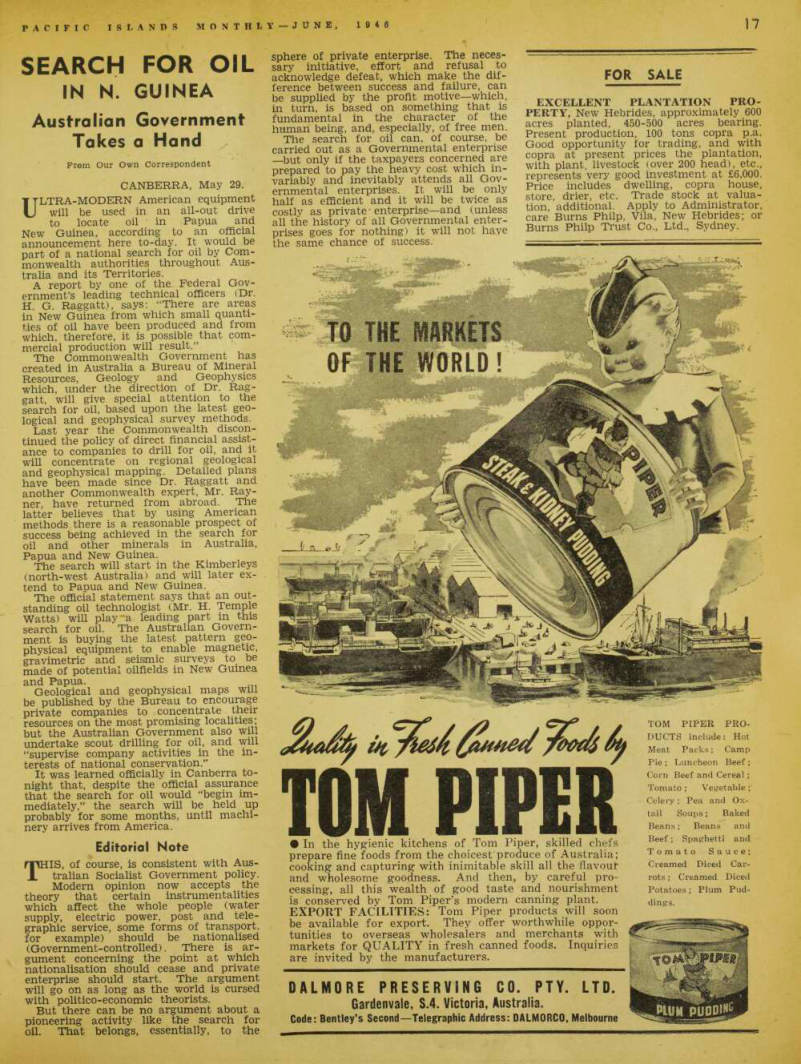
In N. Guinea
Australian Government Takes a Hand
From Our Own Correspondent
Canberra, May 29.
ULTRA-MODERN American equipment
will be used in an all-out drive to locate oil in Papua and New Guinea, according to an official announcement here to-day. It would be part of a national search for oil by Com monwealth authorities throughout Aus tralia and its Territories.
A report by one of the Federal Gov ernment’s leading technical officers (Dr.
H. G. Raggatt), says: “There are areas in New Guinea from which small quanti ties of oil have been produced and from which, therefore, it is possible that com mercial production will result.”
The Commonwealth Government has created in Australia a Bureau of Mineral Resources, Geology and Geophysics which, under the direction of Dr. Rag gatt, will give special attention to the search for oil, based upon the latest geo logical and geophysical survey methods.
Last year the Commonwealth discon tinued the policy of direct financial assist ance to companies to drill for oil, and it will concentrate on regional geological and geophysical mapping. Detailed plans have been made since Dr. Raggatt and another Commonwealth expert, Mr. Ray ner, have returned from abroad. The latter believes that by using American methods there is a reasonable prospect of success being achieved in the search for oil and other minerals in Australia, Papua and New Guinea.
The search will start in the Kimberleys (north-west Australia) and will later ex tend to Paoua and New Guinea.
The official statement says that an out standing oil technologist (Mr. H. Temple Watts) will play a leading part in this search for oil. The Australian Govern ment is buying the latest pattern geo physical equipment to enable magnetic, gravimetric and seismic surveys to be made of potential oilfields in New Guinea and Papua.
Geological and geophysical maps will be published by the Bureau to encourage private companies to concentrate their resources on the most promising localities; but the Australian Government also will undertake scout drilling for oil, and will “supervise company activities in the in terests of national conservation.”
It was learned officially in Canberra to night that, despite the official assurance that the search for oil would “begin im mediately,” the search will be held up probably for some months, until machi nery arrives from America.
Editorial Note
rIS, of course, is consistent with Aus tralian Socialist Government policy.
Modern opinion now accepts the theory that certain instrumentalities which affect the whole people (water supply, electric power, post and tele graphic service, some forms of transport, for example) should be nationalised (Government-controlled). There is ar gument concerning the point at which nationalisation should cease and private enterprise should start. The argument will go on as long as the world is cursed with politico-economic theorists.
But there can be no argument about a pioneering activity like the search for oil. That belongs, essentially, to the
sphere of private enterprise. The neces sary initiative, effort and refusal to acknowledge defeat, which make the dif ference between success and failure, can be supplied by the profit motive—which, in turn, is based on something that is fundamental in the character of the human being, and, especially, of free men.
The search for oil can, of course, be carried out as a Governmental enterprise —but only if the taxpayers concerned are prepared to pay the heavy cost which in variably and inevitably attends all Gov ernmental enterprises. It will be only half as efficient and it will be twice as costly as private - enterprise—and (unless all the history of all Governmental enter prises goes for nothing) it will not have the same chance of success.
Advertisements & other items, pp. 19-20 (1 item)
Tom Piper
FOR SALE
EXCELLENT PLANTATION PRO-
PERTY, New Hebrides, approximately 600 acres planted, 450-500 acres bearing.
Present production, 100 tons copra p.a.
Good opportunity for trading, and with copra at present prices the plantation, with plant, livestock (over 200 head), etc., represents very good investment at £6,000.
Price includes dwelling, copra house, store, drier, etc. Trade stock at valuation, additional. Apply to Administrator, care Burns Philp, Vila, New Hebrides; or Burns Philp Trust Co., Ltd., Sydney.
a -• i
THE MARKETS
m 0 % TH
WORLD
OF mm**
Jfe
~T *?■ m Jv JK ►t J
TOM PIPER
• In the hygienic kitchens of Tom Piper, skilled chefs prepare fine foods from the choicest produce of Australia; cooking and capturing with inimitable skill all the flavour and wholesome goodness. And then, by careful processing, all this wealth of good taste and nourishment is conserved by Tom Piper’s modern canning plant.
EXPORT FACILITIES: Tom Piper products will soon be available for export. They offer worthwhile opportunities to overseas wholesalers and merchants with markets for QUALITY in fresh canned foods. Inquiries are invited by the manufacturers.
DALMORE PRESERVING CO. PTY. LTD.
Gardenvale, 5.4. Victoria, Australia.
Code: Bentley’s Second —Telegraphic Address: DALMORCO, Melbourne
TOM PIPER PRO-
DUCTS include: Hot Meat Packs; Camp Pie ; Luncheon Beef ; Corn Beef and Cereal; Tomato ; Vegetable ; Celery; Pea and Oxtail Soups; Baked Beans; Beans and Beef; Spaghetti and Tomato Sauce; Creamed Diced Carrots ; Creamed Diced Potatoes; Plum Puddings.
VMS*
A
PLUM PUDDI^
SPECIALISING
IN
PACIFIC ISLAND INSURANCES
FIRE MOTOR VEHICLE
MARINE HULLS AND CARGO
EMPLOYER’S LIABILITY
GUARANTEES including those for—
DYNAMITE PERMITS.
RECRUITERS’ LICENCES.
DEFERRED WAGES
AND ALL OTHER CLASSES ARRANGED
AT LOWEST CURRENT RATES.
Established Agencies:
W. R. CARPENTER & CO., LTD.
Throughout the Territory of New Guinea.
SOUTHERN PACIFIC INSURANCE
CO., LTD.
HEAD OFFICE: 60 HUNTER STREET.
SYDNEY.
-E? «E? jz «£? jx «Q? «E? «E? *E? *v? •>? •#
"Pont say Cyln. .
lib
★ LIQUEURS ★ COCKTAILS ★ WHISKIES
Address ail enquiries to;
W. fir A. GILBEY LTD.,
33 ROSSLYN STREET, WEST MELBOURNE.
Telegraphic and Cable Address: "Gilbey's," Melbourne.
109 REGENT STREET, SYDNEY.
Telegraphic and Cable Address: "Gilbey's," Sydney.
Wewak Returns!
New Guinea's Sepik Metropolis Has Mod. Cons.—But No Pigs
WEWAK is fast returning to normal, and in some ways is better than pre-war. The station and all the homes are supplied with electric light and running water. The District Officer has ideas of making a garden township, on what was a few months ago a mass of bomb-craters and shell-holes, without the slightest vestige of trees or growing thing. He will have a difficult task, as Wewak is so far from the seat of Govern ment at Moresby that we will probably be forgotten when it comes to assistance.
Our civilian population is growing fast.
Already, two European ladies have arrived and taken up residence. Mrs. Niall ar rived last month, and a few days later Mrs. Jones (the wife of the skipper of the local district schooner) arrived. Mrs.
Erskine and her three children will soon be joining our popular medical assistant here. There are lots of rumours that soon we can expect a Sister to start a European hospital, and a typiste for the District Office, and the local bachelors are eagerly awaiting this big event. Mrs.
Cyril Helton is also expected as soon as Canberra will give her permission to join her husband.
Mr, Cyril Helton has returned to his old haunts, and is busily trying to re cruit labourers for the Morobe goldmining companies, but the local natives no longer seem interested in employment.
Probably the main reason is that they have no means of spending the increased wages they have earned, or are likely to earn, as there are no trade stores operating yet in the Sepik District. rpHE Commonwealth Disposals Com- JL mission agents are now in Wewak, hoping to sell some of the aban doned Army equipment. Only two out side buyers have arrived and they seem to have first choice, though both are of Italian nationality, and it is believed that one or both of them were interned at the outbreak of the war.
Many New Guinea men who served in the Army throughout the war in New Guinea are apparently not yet allowed by Canberra to return. It would be in teresting to learn who is responsible for allowing Italians to return, and have first choice of purchasing Army equipment, whilst ex-soldiers cannot be allowed back in the Territory.
Mr. Niall, our District Officer, is com fortably installed on the original station site, and the Sepik District seems to be the most efficiently organised in the Ter ritory.
Local residents are wondering why the Commonwealth Government is spending £llB,OOO to rebuild Hanuabada village at Moresby, when our native hospital, for the biggest district in New Guinea, is a hurriedly-constructed affair of native material, built by the efforts of Harry Erskine, medical assistant, in his spare time, whilst attending to 300 patients.
TVSTRICT Officer Horrie Niall is deeply intrigued by pigs at present. He talks continuously about the lack of meat diet for the natives in his dis trict. The Japs ate every pig belonging to the natives, and nobody at Moresby or Canberra apparently has ever thought of what will eventually happen to the race. The natives of this district were the mainstay of New Guinea, as labour for the plantations and mines was sup plied by the Sepiks and Aitapes.
Mandated Airlines have started a weekly service to Wewak, from Lae. This regular service will make Wewak less a Siberia than it was during the early months of Civil Administration.
About 80 troops are still here in Wewak, and are still cursing the place and its climate. The Army seems to have for gotten them, and they get no amenities— not even .any beer, which their more fortunate comrades do in Rabaul. But it was ever thus; the man outside, who is doing a real job, is always forgotten by those in comfort at headquarters.
Two Mission Fathers have returned to Wewak, and it is expected that soon many other missionaries will be back here and re-establishing their stations which have all been completely destroyed by air raids and the Japanese.
New Half-Million Loan
To be Floated in Fiji
THE Legislative Council will soon be asked for its approval for the float ing of a £540,000 (F) loan in the Colony which will bear interest at the rate of 31 per cent.
This follows the Government’s decision to exercise its option to redeem, on November 1, 1946, the Specific Loan of 1928 which bears interest at the rate of 5 per cent, per annum. The new loan will cover this redemption.
The loan will be in the form of bearer bonds of denominations of £lOO and £5OO.
Fiji's India
India's High Commissioner in
Australia Makes Flying Visit
and Many Statements
Suva, May 20.
FIJI was hurriedly looked over in April by India’s High Commissioner in Australia, Sir Raghunath Paran jpye, sometime Senior Wrangler at Cam bridge, and high public official in Bombay.
He came, as he said on his arrival, “to get a first-hand knowledge of Fiji so that he would be able to advise on matters affecting Indians here.” Sir Raghunath and his daughter spent a fortnight in the Colony.
It is sad that a gentleman of such great academic attainments has yet to learn that a first-hand knowledge of a community so diverse as ours, even if we only total a quarter of a million and occupy such little space, cannot possibly be gained on a flying visit.
Sir Raghunath’s several unsound and unfelicitous statements attracted con siderable criticism from the Europeans.
Also, his reported speeches, coinciding with the most momentous political events in Mother India itself, caused the com munity status of our Indian population, and their political activities, to be freely discussed.
Two of the High Commissioner's obser vations in particular caused wide com ment. In addressing a gathering at Siga toka shortly after his arrival, he said: “Do not think that India is neglecting your needs? Public men there are con cerned at present with their own urgent affairs, but if they gain their aims I think that many of your difficulties will be adjusted without very much trouble.” At a Suva reception he told his Indian audience that they should not allow themselves to entertain any feelings of superiority either consciously or uncon sciously towards the Fijians!
Yet, on the other hand, he gave the Indians some sound advice; the best of which was that they should co-operate fully in order to develop civic spirit.
THE change which is certain to be effected soon in India’s constitu tional position will cause consider able shifting in the political scene here.
The great pressure which the India Office in London has been able to bring on the British Government will be lifted.
That will clip the wings of local Indian politicians considerably. Then Indians, especially local born, will have to identify themselves much more closely with the local community, and not continue to regard themselves as friendly aliens, taking what pleases them, yet never yielding, or showing any willingness to make concessions, or to co-operate, for the common good.
The attitude of the local Indian popu lation is hard to define. There are many fine and likeable Indians here, in many walks of life; yet, with the bulk of them, and particularly their leaders, one never feels that they have the least interest in the general welfare of the whole com munity or the faintest awareness of, or pride in, the fact that they are fellow members, with us, of the Empire.
Perhaps the best proof of the fore going was their wretchedly poor war ef fort.
It seems obvious that of our local Indian population of labourers, tenant farmers, mechanics, storekeepers, busi ness and professional men, and politicians, Sir Raghunath came mostly in contact
with the politicians. The latter cannot muster a statesman amongst the lot of them Sir Raghunath’s visit has added to our experience. May the internal troubles that will be set India cause her local sons to count it a blessing that they live in Fiji and feel impelled to work for its advancement and the happiness of all its peoples.
EAit-fwln l Klrtfo caironai THE visit of Sir Raghunath Paranjpye to Fiji and his sometimes ill-advised utterances seem to have created a sensation in the Colony. So also will his statements to the Australian press on his return to Canberra.
He said, on May 13, that improved conditions for Fiji’s Indians would result from his discussions with the Fiji Goveminent which took place during his visit.
Sir Raghunath complained, on behalf
of the Indians, that in the past Indians had no security of land tenure, but this, he had been assured by the Government, f DUId be improved A scheme of leasing >? nd on 30-year terms with the option renewal was now proposed, He said that he had also taken up the matter of education. Hundreds of Indian children wished to attend school in the Colony but were unable to do so because there were too few schools, and inade quate facilities to take the children to the schools that did exist.
The Australian press, being totally un informed as to the Indian problem in pjji— or any Q f the Colony’s problems, f or tk at matter—are disposed to swallow the Indian High Commissioner’s state ments whole, forgetting that he fails to concern himself in any degree with the welfare of the indigenous Fijians, or the Europeans whose main purpose, these days, resolves itself into seeing that the Fijians get a fair deal.
Advertisements & other items, pp. 21-22 (1 item)
Brial & Ball
MACARONI
■■ 6
VERMICELLI
. X ••• ... • •• ' Sole Distributing Agents for the Pacific Islands:
BRIAL & BALL
528 COLLINS STREET,
MELBOURNE.
’Phone: MU4837.
1 BOND STREET,
SYDNEY.
’Phone: 87371.
“PEERLESS” WHEEL TOYS
FOR THE PACIFIC ISLANDS ...
AVAILABLE NOW!
We have pleasure in presenting the first of the post-war "Peerless" toys.
As in pre-war years, "Peerless" toys are finished in bright colours. Enjoyment and satisfaction are ensured by their quality.
TRICAR No. 7.
SCOOTER No. 4.
BRIGHT COLOURS
RUBBER TYRES
■a 0 & * i
SPORTS CAR No. 24
UTILITY TRUCK
These three attractive toys will be available from stocks during April
—ORDER NOW.
Bright colours, rubber tyres, nickel plating and fittings which include horn, mascot, are some of the most attractive features of these toys.
TRICAR No. 9.
Order "Peerless'
Wheel Toys From the Sole Pacific Islands Selling
Representatives:
HARRY J. TOMNQ
POSTAL ADDRESS:
Box 3661 G.P.0., Sydney.
379 KENT STREET, SYDNEY.
BANKERS; BANK OF N.S.W.
PIT. LTD.
CODES:
Bentley’s Comp.
Phrase.
Bentley’s 2nd Phrase.
Divide The “Pandemonium”!
Frank Discussion of New Hebrides by Experienced Australian Administrator
MR. A. C. RENTOUL, formerly a well-known Administrative official in Papua, recently spent nearly' two years in the New Hebrides, As the Condominium may soon be under consideration by UNO, Mr. Rentoul was invited by the “PIM” to describe his impressions. The following forthright article is the result:—
WHEN steps are taken to readjust the political position in the South-west Pacific, it is to be hoped that an end will be put to that tragic system of misgovernment known as the Con dominium—or, as it is often referred to in the Pacific, “the Pandemonium.”
The changing fortunes of the Pacific war brought it about that in 1943, in stead of being Resident Magistrate of the South-eastern Division of Papua, I found myself temporarily seconded to the New Hebrides, as a British District Agent.
Prom what I had read in the press, I had formed a very high opinion of the British Colonial Service, and I looked forward to the new experience with keen interest. In recording my disappoint ment, I can only trust that the condi tions met with were not truly represen tative of the Colonial Service as a whole; and I am supported in this hope by the few contacts I made with officials from Fiji, who were of a totally different calibre.
During my 20 months’ stay in the New Hebrides, I relieved the whole of the British District Agents, taking charge at Tanna, Vila, Malekula and Espiritu Santo, and I also acted as Commandant of Police at headquarters; so I had an
excellent opportunity of observing the workings of the Condominium in every part of the Group.
TO understand the position at Vila (the headquarters of Joint Administra tion) one must visualise a large island township set amidst attractive surroundings, but spoiled by a foreshore roadway lined with wretched weather board structures housing various Chinese, Tonkinese and semi-coloured peoples. The US Army, during the war, transformed this roadway into a good motor highway, but the housing arrangements remained untouched. The Condominium Club, fre quented by both French and British, remains to-day a barn of a place that few would recognise as club premises.
On the higher ground, behind, dwell the people of the two nations —the French occupying the more northerly and much larger area, and the British being allowed to occupy a smaller area to the south.
During my stay there the British com munity was actually very small, and com prised mainly officers of the adminis trative staff, missionaries, and clerks and storemen employed by Burns Philp & Co..
Ltd. The remainder were a few radio station employees and some naturalised British subjects. The French predomi
nated, both in population and in busi ness interests.
UNDER the prevailing Joint Agreement neither nation seemed capable of any united action for the welfare or advancement of the Group.
There was apparently no land policy, and titles were in a sad muddle. There was no proper native policy, and it was. of course, impossible to reconcile the French policy of exploitation with the supposed British policy of trusteeship. No public works of any importance were being carried out, and no proper pene tration work, as a means of opening up suitable country for agricultural or min ing purposes.
There was little co-operation between the representatives of each Power.
Several officials, indeed, could not speak the other’s language. In my own case, I was compelled to converse in Pidgin English with my colleagues, the French District Agents, at both Malekula and
Santo—although I fortunately read
French quite well.
Marshall, in his book, “Black Mus keteers,” written in 1940, in which he referred to the sale of arms and liquor to the natives, chiefly by French planters and traders, compared the appalling re cord of Britain and France in the New
SSf Australia’s trium-
nn . °f
x and tnc Mandated Territory of New Guinea,” and added: “To-day the position is worse than ever and Judge Jacomb’s fateful prophecy in regard to the native peoples is being borne out with a gradual and ghastly surety. The population will inevitably disappear if the present regime is allowed to continue.
"Bishop Wilson has rightly observed: ‘I suppose no place in the world is so badly governed in the interests of the natives.
I found these strictures well justified.
Even, to-day, there is a Gilbertian Joint Court maintaining both a French and a British Judge. A Spanish President- Judge left some years ago for Franco's land, and has never been replaced.
French residents are subject to French law, British to British law. The unfortunate natives are subject to whatever law they are charged under. They have no nationality!
SO far as relations between the Rritish lar , gelations between the British and Fiench are concerned. it seemed to me just a matter of contmual aggressiveness on the part of our colleagues: while on the British side there seemed to be a definite policy of appeasement.
I was warned by the British Resident Commissioner, on several occasions, not to take action in any matter without first c° nsu ltirig my French colleague—althoueJi I found that the latter, in his airy French style, rarely thought of consuiting me on anything I was also warned by the British Commissionei to forget that I had been trained in a proper administration, and lomTnTum er 1 in the Con comimum.
mHE general treatment of the French planter class, as compared with the less fortunate British nnp nf the main causes B of lSh diSatisfaction throughout the British community. It must have been upsetting to see the French obtaining their native labour so easily, by the simple expedient of supplying them with the Australian wine they so keenly sought; while the Britisher, when he tried such tactics, might be prosecuted before the Joint Court and fined for supplying liquor.
There is no appeal against the decisions of this Court, which has extraordinary powers.
From the merely mercenary point of view, apart from any other aspect, it is far better to be a Frenchman under Condominium conditions than it is to be an Englishman or Australian. That is the regrettable fact; and, for this, I am afraid that weak British administration has only itself to blame.
TN my work at British headquarters, I * Sphered certain impressions. I think the British Commissioner tried to do too much by correspondence, and too nttle by personal contact with the various problems that arise in such a complicated system of government. There may have been for this a reason of which I am not aware. i n the 20 months I was in the Group i was not once visited at any out-station by the British Resident Commissioner.
The then High Commissioner of the Western Pacific visited Vila on three occasions, but stayed only a few hours.
The local French Resident Commissioner travelled around a lot and visited me on one occasion at Malekula, although I was out of his Jurisdiction, „ then, is the position in the Condominium:
• The British civilians are far from satisfied with their lot. ** The natives are neglected. • Tile French carry on in their usual happy-go-lucky fashion, breaking most laws to their o wn great profit and con tent. • And the sun shines on the in«t onH the unjust alike 3 and TF I were asked for suggestions I would 1 say that the geographical position in the New Hebrides offers an easy way out - In all the islands north of Vila, to the upper coast of Espiritu Santo, the French have beaten us hollow in popula tion and holdings. If partition were de cided on, this would undoubtedly be their territory; and, tragic as it would be for natives, there would seem to be no alternative.
On the other hand, the southern dis trict, from Vila to far-away Aneytium, is Populated mostly by a few Australians Q being onl y one French subject in th i s ar f a - , 1945, the French Commissioner stationed a District Agent at Tanna, alongside the British Agency, but that was clea rly a political move, as there was no Fr ench population to control, This southern district contains the S reat islands of Erromanga, Tanna, Aneytium, and others, and possesses the finest scenery in the Group.
Horse-breeding is carried out with suc cess on Erromanga, by Mr. Martin, in typical Australian fashion, Tanna in spite of the srim historv of
its natiVes S an of lxtreme
beauty. A bridle track through green tunnels of Jungle brings you to a Slat active volcano on toSortS-eastern g end! throwing its molten discharge to the
clouds, with a deep reverberation every few minutes, night and day. It has rather the unique advantage of offering visitors a breath-taking view of its crater from a nearby ridge, which can be reached after a stiff climb. Some day, the volcano on Tanna will prove a thrill ing attraction for visitors, when shipping facilities permit the influx of tourists that is bound to come to these islands of our South-west Pacific, when our present troubles have come to an end.
This southern district should be taken over by either Britain or Australia —but, preferably, by the latter. rE position should be cleared up. To anyone, like myself, trained in a fine Australian administration, conditions came as a surprise.
I regret to have to make these stric tures, as I received much hospitality from the British Commissioner and his family; but, if anything I have said will have the effect of drawing the attention of those who presently will be remoulding the position in the South-west Pacific to the necessity of bringing to an end this tragic farce of maladministration—which has brought happiness to so few—then I shall be well content.
Advertisements & other items, pp. 23-24 (1 item)
William Atkins Pty. Ltd.
1 a For Inflamed Eyes and Eyelids ... Sold Everywhere H. Rose&Co..Pty.. Lid.. Kinq Street, Sydney.
Head Office 449-451 KENT ST., SYDNEY.
Iron Cr Steel Merchants—Engineers' Supplies
ESTABLISHED OVER 50 YEARS
Coach dr Motor Hardware Cable Address: WTLATKTN Sydney.
STEEL DEPARTMENT
MILD STEEL:
Rounds, Squares, Flats, Half-rounds, Hexagons, Bevel, Shoeing, Tyre, Angles, Tees, Sheets, Plates, Girder Plates, Chequer Plates, Channels, Hoops, Etc.
BRIGHT STEEL;
Rounds, Squares, Hexagons.
Extra Special High Speed Tool Steel, Mining Steel, Blister Steel and Spring Steel, Rounds, Flats & Squares.
Bar Iron—All sections and sizes.
Engineers" Supplies: Set Screws, Studs, Metal Thread Screws, Coach Screws, Files, Cotter Pins, Bright and Black Bolts, Rivets, Etc., Hack Saw Blades.
Power Transmission Gear: Including Plummer Blocks, Couplings, Collars, Etc.
Coach and Motor Hardware: Axles, Springs, Wheelstufl, Duck, Paints.
Farriers' Supplies: Horse Nails, Anvils, Vices, Etc.
Motor-Trimmers ond Motor Builders' fir Motor Painters' Requirements
C. A. WILLEY'S
Quick-Drying Coach and Car Paints, Roughstuff, Elastic Gloss, Synflex Enamels, Lacquers.
DUCO Lacquers and DULUX Enamels—FAßßEX Motor Toppings and Leather Cloths, House dr Decorators'faints. Varnishes dr Brushware.
Sole Distributors of CHAMPION'S Decorators Paint Products.
Distributing Agents for BROLITE Lacquers, SYNFLEX Enamels and "POLYGLOSS" Finish.
o
GREEN LABEL
i © W'a#
TEA
FIRST GRADE
J A D.GIBSON AND COMPANY PTV LIMITED 364 KentStrcci Sydney DARB?
Native Administration
Fiji Official Feels Pacific Islander Still Unfitted For the Task
following comment on the pro posed plan of the British and Dominion Prime Ministers to centra lise, in Australia, the administration of Pacific Islands, comes from a Fiji resident. He has had a unique oppor
tunity of studying the native peoples
during a lifetime’s experience in deal
ing with Polynesians, Melanesians,
Micronesians and Euronesians.
Australian pm chifiey stated on May 4 that the headquarters of the new Institution to control improved conditions for the South Sea natives would be situated in Australia. It prob ably is a very nebulous scheme, although native officials themselves are to be asked to co-operate.
There’s a long way to go yet before Melanesians or even Polynesians can con trol such things as roads, transport, or co-operative businesses. Even as teachers, clerks, and native medical practitioners they require constant and sympathetic supervision by competent Europeans who are willing to devote a lifetime of study to their peculiarities. Occasionally even then your best trainees will give it all up on the slightest whim—for there is no “struggle for existence” in the Islands.
Any native can and will go “sick” for a few days on the slightest excuse. He knows that there are not dozens wapting to take his job, as there would be in densely populated Asia. No native under the communal system ? can ever become wealthy or rich. But do the big political bosses know these things?
Where is the money to come from to pay for schools, hospitals and roads for these hundreds of islands?
The South Sea Islander is completely averse to working steadily, day after day, in a regular routine manner, like the Chinese or Indian, or the Indonesian, and, as long as he is satisfied with native village life, native clothes, native cere monies and customs, native foodstuffs, and native witchcraft, I fail to see how anyone is going to change him into a citizen of the world.
Advertisements & other items, p. 25 (1 item)
Victoria
Allen Taylor 81 Co. Ltd,
COMMERCIAL ROAD, ROZELLE,
SYDNEY
Sowmillers and Wholesale Suppliers of Hardwoods for • Constructional Purposes GIRDERS . . . PILES . . . POLES . . . SLEEPERS, Etc.
EXPORTING TO PACIFIC ISLANDS SINCE 1893
VICTORIA
BITTER
BREVES IT
CARLTON & UNITED BREWERIES LIB.
v.i
France Supports Dr. Evatt
AUTHORITATIVE French sources state that France welcomes the Australian plan put forward by Dr. Evatt to M. Bidault of an Allied Commission for social welfare in the Pacific (South Paci fic Regional Commission). Australia seeks an agreement of all nations having interests in the Pacific: New Zealand, France, Great Britain, America.
Indians Over-Running Residential Areas
In Suva
(Contributed by a Suva Resident)
EVEN a few years prior to the outbreak of war, it would not have been too late for the Fiji Government to have drawn up a plan, setting aside certain residential areas in and around Suva for European resfdents only.
Government servants, lucky enough to live in Government-owned houses, do not have the headaches and heartaches that beset the average European resident, who considers himself extremely lucky if he can rent a decent house close to his place of work, since Government has more or less reserved to itself that area in Suva known as “Dog’s Hind Leg” and the site of the “old hospital” at Korovou Government, too, was firmly convinced of the wisdom of keeping “Suva Point” residential area solely for Europeans.
The majority of the Europeans in and around ‘Suva proper, who intended to make Fiji their permanent home, bought freehold land and erected good types of homes amongst other Europeans/ Their homes showed the result of pride and labour, with well-laid-out lawns and gardens.
However, in the last three years, many of these fine homes have changed over to Indians, who sat back and accumulated money hand over fist from 1939 to 1946 and contributed nothing to speak of to the war effort or funds, while the Euro pean, Euronesian and Fijian gave their all in the way of war service, and very often paid the supreme sacrifice.
Now, we see Waimanu Road, from the “Waverley” up to Tamavua police station —which comprised all European homes a few years ago, and which is an area overlooking the harbour of Suva —practically in the hands of the Indians.
The deterioration will not be very noticeable for a year or so, if the houses are rented to Europeans; but, as time goes on, the “dry rot” will begin to show
in unpainted shabby houses, because it seems never to occur to an Indian to paint his house.
God help the place if the Indian him self goes to live in the houses! Then we can look forward to seeing the inevit able goat tethered on what was once the well-cut front lawn, and the usual batch of scraggy inbred fowls roosting along the front verandah of curtainless houses, emitting the odour always associated with the Indian—mustard oil and strong curry. Dirty, half-clad children will make the day and half the night hideous with their shrill voices, and at certain times of the year, we shall have the beat of the Indian drum.
Those Europeans who have still held on . "heir homes, will find themselves un willingly forced to sell and remove them selves to an area less attractive, which will not appeal to the Indians No price is too high to ask for free hold property in and about Suva to-dav.
I wonder some “confidence man” has not sold the Government buildings!
IT is to be hoped that when the Govern ment authorities for the planning of new townships in other parts of Viti Levu finalise their schemes, they will de clare a radius around such centres for European residential sites only.
Some of the most beautiful parts of the Suva town area are despoiled by tin shanties and straggling, unpainted hovels among which Indian washerwomen’, storekeepers and anything you like, ex tract the utmost profit. . Segregation of the Indian, when the indenture system was mistakenly abolished and the Indian allowed to quietly spread amongst us like a cancer, would have solved a lot of policing that now has to be scattered everywhere It could have been done then, before we “ loc al-born,” with his again the Government” attitude; and Europeans to-day would have their homes mvioiate, surrounded with people of their own standards of culture and outlook.
Genera! Smuts, of South Africa, has the right idea. He is conscious of the in filtration of the Indians, and is nipping it before it comes into full bloom.
Pen Friends Wanted
THE League of Pals, 68 Windsor Crescent, Bridlington. England, is anxious to contact Pacific Island residents who would like pen friends in the United Kingdom. Thousands of young people in the British Isles (and some not so young) want to know more about foreign lands and one way of do this is to join the League, which has 30,000 members in 70 different countries.
All members have Pals in other countries to whom they Mirite. They exchange books, newspapers, etc., and this, it is felt, brings about better feeling between the different nations.
No membership fees are charged. All you have to do is to write to Mr. Norman Booth, at the above address, giving name, sex, age, address and hobbies. Minimum age is 11; but there are members over 60.
Miss Gwen Love, daughter of the Ariki Nui (high chieftainess), of Rarotonga, and the late Colonel T. Love, recently arrived in New Zealand by air. She will continue her education in the Dominion.
Advertisements & other items, p. 26 (2 items)
24
jtiNEI, 1946 PACi F i C ISLANDS MONTHLY
cAashaila j finest
No matter how poor r our education or ow limited your opportunities, the I.C.S. can fit you for .. , , , „ r . a better jobl Uon t delay. Write now for particulars— an enquiry costs only a postage stamp!
International Correspondence School?
140 ELIZABETH STREET, SYDNEY
Si'*, — Please send free prospectus thawing hou I can succeed in the occupation I have marked Advertising ...Accountancy Insts.
Journalism ... Secretaries, Inst, of Salesmanship —Cost Accountancy Bookkeeping Building Contractor Commercial Art Elec. Eng. or Mech.
Sketching —Complete Mech. Eng.
Window Dress’g Fitting and Turning Architecture —Heat. Treat. Metals Arch. Drawing Mech. Draughtsman House Planning Reading Shop Blueprints Carpentry Analytical Chemist Steel Square Refrigeration Electronics Plastics Welding Foundry Work Diesel Engines Automobiles Textiles If your subject is not above, write It here Name ...
Address _.„Aero Design & Eng. ...Showcards, Tickets ...Psychology in BusineM —General Education Coaching, all Exams.
Shorthand, Typing Stories & Radio Plays . Dress Designing Sendee Radio Eng. 8C
INTERNATIONAL CORRESPONDENCE SCHOOLS
cAashaila j finest
BOAT & YACHT
GEAR
• • • • m
BROOMFIELDS LTD,
152 SUSSEX STREET, SYDNEY.
e n 7„ AflPnt c inr • p H - & CO.’s 3-CROWN BRAND METAL SHEATHING.
JUI ' PEACOCK & BUCHANS’ ENGLISH READY-MIXED PAINTS.
Why Not Papain
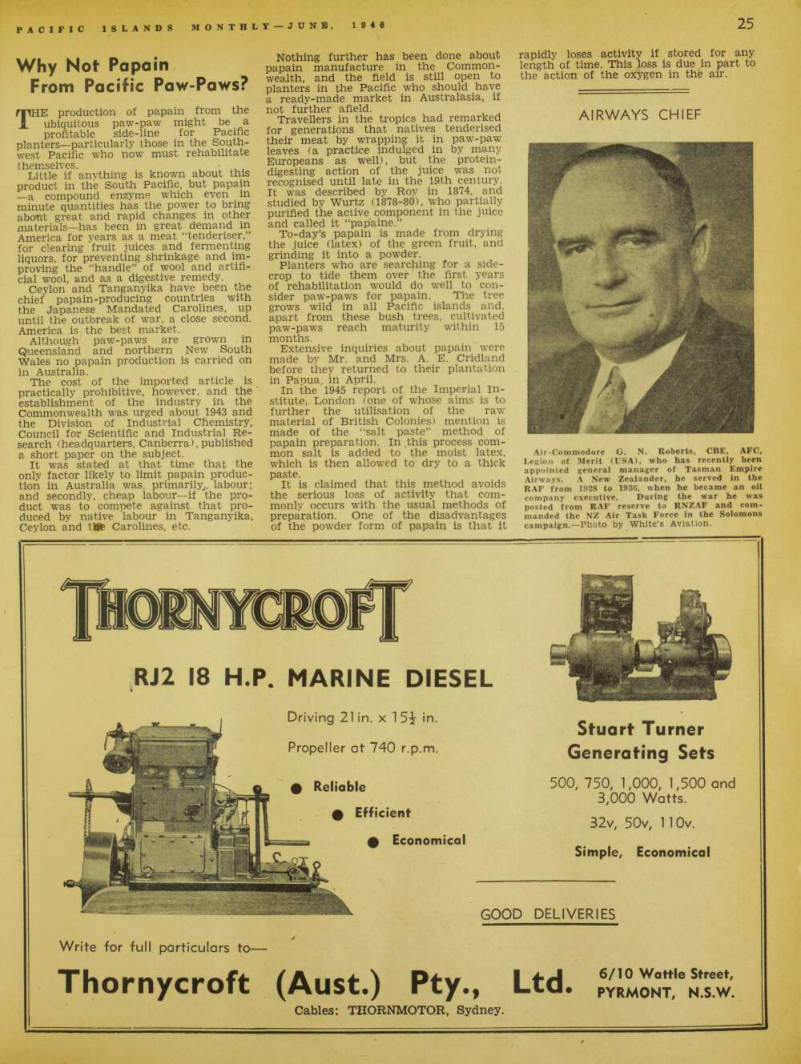
From Pacific Paw-Paws?
THE production of papain from the übiquitous paw-paw might be a profitable side-line for Pacific planters—particularly those in the South west Pacific who now must rehabilitate themselves, , .
Little if anything is known about this product in the South Pacific, but papain —a compound enzyme which even in minute quantities has the power to bring about great and rapid changes in other materials—has been in great demand in America for vears as a meat “tenderiser,” for clearing fruit juices and fermenting liquors, for preventing shrinkage and im proving the “handle” of wool and artifi cial wool, and as a digestive remedy.
Ceylon and Tanganyika have been the chief papain-producing countries with the Jaoanese Mandated Carolines, up until the outbreak of war, a close second.
America is the best market.
Although paw-paws are grown in Queensland and northern New South Wales no papain production is carried on in Australia.
The cost of the imported article is practically prohibitive, however, and the establishment of the industry in the Commonwealth was urged about 1943 and the Division of Industrial Chemistry, Council for Scientific and Industrial Re search (headquarters, Canberra), published a short paper on the subject.
It was stated at that time that the only factor likely to limit papain produc tion in Australia was. primarily,, labour; and secondly, cheap labour—if the pro duct was to compete against that pro duced by native labour in Tanganyika, Ceylon and the Carolines, etc.
Nothing further has been done about papain manufacture in the Common wealth, and the field is still open to planters in the Pacific who should have a ready-made market in Australasia, if not further afield.
Travellers in the tropics had remarked for generations that natives tenderised their meat by wrapping it in paw-paw leaves fa practice indulged in by many Europeans as well), but the protein digesting action of the juice was not recognised until late in the 19th century.
It was described by Roy in 1874, and studied by Wurtz (1878-80), Who partially purified the active component in the juice and called it “papaine.”
To-day’s papain is made from drying the juice (latex) of the green fruit, and grinding it into a powder.
Planters who are searching for a side crop to tide them over the first years of rehabilitation would do well to con sider paw-paws for papain. The tree grows wild in all Pacific islands and. apart from these bush trees, cultivated paw-paws reach maturity within 15 months.
Extensive inquiries about papain were made by Mr. and Mrs. A. E. Cridland before they returned to their plantation in Papua, in April.
In the 1945 report of the Imperial in stitute, London (one of whose aims is to further the utilisation of the raw material of British Colonies) mention is made of the “salt paste” method of papain preparation. In this process com mon salt is added to the moist latex, which is then allowed to dry to a thick paste.
It is claimed that this method avoids the serious loss of activity that com monly occurs with the usual methods of preparation. One of the disadvantages of the powder form of papain is that it
rapidly loses activity if stored for any length of time. This loss is due in part to the action of the oxygen in the air.
Airways Chief
Air-Commodore G. N. Roberts, CBE, AFC, Legion of Merit (USA), who has recently been appointed general manager of Tasman Empire Airways. A New Zealander, he served in the RAF from 1928 to 1936, when he became an oil company executive. During the war he was posted from RAF reserve to RNZAF and com manded the NZ Air Task Force in the Solomons campaign. Photo by White’s Aviation.
Advertisements & other items, pp. 27-28 (1 item)
thoe
T
AMS*
0 □
RJ2 18 H.P. MARINE DIESEL
Driving 21 in. x 1 5i in.
Propeller at 740 r.p.m. % Reliable % Efficient A Economical Stuart Turner
Generating Sets
500, 750, 1,000, 1,500 and 3,000 Watts. 32v, 50v, 11 Ov.
Simple, Economical
GOOD DELIVERIES
Write for full particulars
Thornycroft (Aust.) Pty., Ltd.
6/10 Wattle Street,
PYRMONT, N.S.W.
Cables: TIIORNMOTOR, Sydney.
Modern Refrigeration for the South Sea Islands
The ELECTROLUX KEROSENE OPERATED
REFRIGERATOR
MARVEL
OF
MODERN
SCIENCE
a H 1 u '" ’ v in
THE
MIRACLE
OF
ICE
FROM
HEAT
ELECTROLUX OFFERS ECONOMICAL, modern and completely efficient
REFRIGERATION FOR ISLANDS' HOMES.
FREEZES CONTINUOUSLY WHILE SMALL LAMP BURNS.
Freezing controlled by simply regulating height of flame. Uses only J gallon of kerosene per week MOTORLESS ... NO PARTS TO GET OUT OF ORDER.
MODEL LKSSO
Capacity 5.6 coble fact.
GUARANTEED FOR TWO YEARS.
• Write to your Local Distributor for prices and full details.
OBTAINABLE FROM ALL W. R. CARPENTER & CO.
BRANCHES THROUGHOUT THE ISLANDS
Representation in Papua and New Hebrides.
LTD.
Trade Unionism Comes
to the Southern Pacific New Ordinances Issued by WPHC
IF the Solomon Islanders, the Gilbertese, Ellice Islanders, phosphate workers of Ocean Island, or anyone else dwelling within those territories desire to set up a trade union, they may take comfort from the fact that the legal machinery now exists for them to do so.
In lengthy regulations, published as a supplement to the “Western Pacific High Commission Gazette,” and issued to the BSIP and the G. & E. Colony on April 1, an ordinance “to regulate trade unions and trade disputes” is set out.
It is likely that other British Colonial Territories have been “similarly blessed.
In the past these isolated Territories were either forgotten by the Colonial Office, or considered too backward to ap preciate such an advanced form of civi lisation. The war, however, has given some Britishers a new conception of their far-flung Empire, and apparently the British Socialists are anxious to ex tend the blessings of trade unionism even unto the benighted Pacific Islander.
Presumably the issue of the new regu lations to both WPHC territories is the result of a blanket instruction from Whitehall, where the gentlemen of the present Government cannot imagine any Pacific Elysium complete without a trade union.
Seven or more people may form a trade union, which must be registered with a “person” appointed Registrar of Trade Unions by the High Commissioner. The trade union may be deregistered at the request of the union, or by the Registrar under certain circumstances. Audited accounts of the union must be submitted to the Registrar.
IN Part II of the ordinance a wealth of detail as to how to proceed with a trade dispute is given. It is not lawful to “intimidate” or to “injure,” but peaceful picketing and prevention of intimidation is within the law and “an act done by a person in contemplation or furtherance of a trade dispute shall not be actionable on the ground only that it induces some other person to break a contract of employment or that it is an interference with the trade, business or employment of some other person, or with the right of some other person to dispose of his capital or. his labour as he wills.”
The issue of this new regulation, par ticularly in respect of the Solomons, may seem ridiculous on the face of it. But there are other implications. The Solo mons Administration still recognises the system of indentured labour. But the
new trade union machinery could be a perfect counter to that system.
If, for example, one’s plantation boys belonged to the Copra Cutters’ Union, there would be none of the customary redress when one of the line, “in con templation or furtherance of a trade dis pute . . . induces some other person to break a contract of employment.”
The fact that trade unionism is abused to-day by those for whom it came into being does not alter the fact that the banding together of the workers has been a most important factor in social pro gress. But the circumstances which be got unionism in Europe do not exist in, for example, the Solomon Islands. The Solomon Islander does not work in order to exist; he works in order to further some private ends of his own.
ANY attempt to graft unionism on to the half-civilised Melanesian is likely to end in disaster. It is unlikely, however, that British Socialists could be persuaded to believe that.
Anyone who has been dependent on native labour knows upon what frivolous excuses a native can cease work —anything from a pain in his big toe to the illness of his second cousin’s grand mother.
This childishness has an analogy in Australia to-day. With coal reserves non existent, 4,000 tons of coal were lost in one New South Wales mine in one day recently because a miner could not find his boots. His mates sat under the gum trees and contemplated the blue sky all day while he searched for them. Pre vious strikes had been caused by: The alleged theft of a man’s watch; an objec tion to the smell of the pit horses; a protest against the butter ration; a com plaint that the bath water was not hot.
Combine the fractiousness of the trade unionist, 1946 model, with the natural cussedness of the Melanesian worker, and planters and others, really will have something to worry about.
The Colonial Office should have gone one step further in their bestowal of blessings: printed the new Trade Union Ordinance in Pidgin, in order that the Solomon Islander might read it.
Good Rice Can Be Grown
In Bsi
Experiments carried out in 1944-45 prove that good yields of rice can be obtained from the plains of Guadalcanal, BSI, using machine methods of planting and sowing the crop early in the wet season, which begins about December.
The results of the test plantings are recorded in the March issue of the “Fiji Agricultural Journal.”
Six varieties of rice were planted— some varieties under certain conditions yielding up to 100 bushels per acre. The grain was sown on an area typical of
thousands of acres of Guadalcanal grass country. The area used had been used by the US Army immediately before to grow one crop of maize. No fertiliser was planted with the rice, but the Americans had used 400 pounds of fer tiliser and 200 pounds of sulphate of ammonia per acre, with their maize.
No system of irrigation was used, but small banks were constructed to impede run-off of natural water. For the first five months after planting about 50 inches of rain fell.
A horde of caterpillars threatened to eat the young rice when it was a month old, but these were dealt with success fully by dusting with Paris-green. Stem boring caterpillars were present in all the varieties of rice, but these did no serious damage.
A plant found on the reef near Korolevu Bay (Fiji) bears a remarkable resemblance to a red rose. When taken out of salt water it appears to die, but revives immediately salt water is poured in the jar. Attempts are being made to have it identified. It is an interesting and, “C?o^ nt Cnlnn^^- er rare reef P lant — Crown Colonist.
Advertisements & other items, pp. 29-30 (1 item)
O. F. MASSCHELEIN. Exporter
Rid Kidneys Of
Poisons And Acids
If you suffer sharp, stabbing pains, If Joints are swollen, It shows your blood Is poisoned through faulty kidney action. Other symptoms of Kidney Disorders are Backache, Aching Joints and Limbs, Sciatica, Neuritis, Lumbago, Sleepless Nights, Dizziness, Nervousness, Circles under Eyes, Loss of Energy and Appetite and Frequent Headaches and Colds, etc. Ordinary medicines can’t help much because you must get to the root cause of the trouble.
The Cystex treatment Is specially compounded to soothe, tone and clean kidneys and bladder and remove acids and poisons from your system safely, quickly and surely, yet contains no harmful or dangerous drugs. Cystex works In 3 ways to end your troubles. 1. Starts killing the germs which are attacking your Kidneys, Bladder and Urinary System In two hours, yet Is absolutely harmless to human tissue. 2. Gets rid of health-destroying, deadly poisonous acids with which your system has become saturated. 3. Strengthens and reinvigorates the kidneys, protects from the ravages of disease-attack on the delicate filter organism, and stimulates the entire system.
Praised by One-time Sufferers
Cystex Is approved by one-time sufferers In 73 countries from the troubles shown above.
Mr. Reg Thomas, Townsville, Queensland, recently wrote: “My joints were all stiff, 1 had leg pains, my back used to ache day and night.
My bladder was weak. I had headaches and no appetite. The first dose of Cystex helped me and before I finished three boxes my health and strength came back."
Guaranteed to Satisfy or Money Back Get Cystex from your chemist or store to-day.
Give It a thorough test. Cystex Is guaranteed to make you feel younger, stronger, better In every way, or your money back If you return the empty package.
Now in 2 sizes—4/-, S/-.
GUARANTEED fIITCfOV
Treatment
for Your Kidneys, Bladder, Rheumatism.
O. F. MASSCHELEIN. Exporter
SHIPPER OF AUSTRALIA'S BEST TO THE PACIFIC PRICE LISTS, CATALOGUES AND ALL OTHER INFORMATION AVAILABLE ON INQUIRY n a , . Andrews Building, General Exporter of Wrahan Quality Products 40 King Street/ Sydneyny Tel. MA1242. Cables: OSNALINE.
G. H. Robinson
ISLAND SUPPLIES
of all kinds—Selected and Shipped to order at lowest possible prices—Piecegoods in Wool, Cotton and Silk, Under and Outerwear, Manchester, Drapery, Grocery, Hardware, Engineers and Leathergoods trade supplies a specialty.
Indents and Transhipments arranged. Large or small orders treated with equal care.
Use our 25 years’ extensive experience.
Enquiries solicited to —
G. H. ROBINSON
51 Macquarie Street, Sydney, N.S.W.
Telegrams: Sunrise, Sydney.
Letters: Box 3317, G.P.0., Sydney.
GILLESPIE’S
The Flour
TRADE
MARK
of the Islands
- SYDNEY -
Medical Service?
Why No Doctors For NG Medical Service?
WITH some bewilderment I read in the “PlM’s” report (March issue) of the re-establishment of Civil Administration in Northern New Guinea that Mr. K. C. McMullen had moved north with a staff of well over 100, but that not one qualified medical officer was attached thereto. Neither apparently were any nurses.
At the outbreak of the Pacific war there were about 18 qualified medical officers in New Guinea.
The most reasonable part of Canberra’s promised New Order for New Guinea was that relating to augmented medical ser vices to the natives. It seems to be the first and most essential task.
During the Japanese occupation, the medical attention given natives was nil, and their state of health became, and re mains, alarming.
Canberra recently announced that, be tween October, 1945, and February, 1946, 1,011 doctors and 1,063 nurses had been discharged from the Services. Have none of these discharged medical men, who must now try to get back into civil prac tice, felt the call to volunteer for New Guinea, where their help is needed desperately? Or does the Government not encourage them to do this?
We were further informed from Can berra lately that 40 ex-Service doctors had been chosen by the National Health and Medical Research Council to study abroad. How many of these men will specialise in tropical medicine?
At the same time as we have this appalling shortage of medical personnel In New Guinea, the Dean of the Faculty of Medicine of the University of Sydney (Professor R. H. Dew) made the amazing statement that there were too many students studying'medicine and that there would, in a few years, be far too many doctors in Australia.
Some of these “surplus” students could, perhaps, be persuaded to continue their studies with the ultimate purpose of going to New Guinea.
Mrs. Alice Allen Innes suggested re cently, through “PIM,” that a MacGregor
Memorial Wing to accommodate New Guinea native students, be added to the Suva Medical School. This is a splendid proposal and deserves the full support of all interested in the welfare of Pacific peoples. There were a large number of “Doctor-Boys” in New Guinea before the war, but their training was primitive and the service they gave, on the whole, was unsatisfactory. rE Australian Government should give number-one priority, in their New Guinea New Order, to improved medical services. No better reward could be given the so-called Fuzzy-Wuzzy Angels for their loyalty to the Allies dur
ing the war.-
Pat.
Weather Forecasting For
The South-West Pacific
From a Special Correspondent
Canberra, May 11.
GOVERNMENT experts here say post war forecasting of tropical weather will be 100 per cent, more accurate than it was pre-war.
They claim that the extensive tropi cal research that resulted in Allied Forces knowing exactly what conditions they would meet in Rabaul raids, in the Bismarck Sea battle, and the parachute landing at Nadzab, will greatly benefit post-war New Guinea and other islands north of Australia.
During the war, Australia’s meteorolo gical service covered the entire South west Pacific, an area of more than 15,000,000 square miles.
New meteorological stations were formed in Australia and Malaya, and meteorological services and communica tions were provided at Ambon, Namlea, Koepang, Rabaul, Tulagi, Vila and Noumea.
Tropical stations will continue to use wartime radar to track down swiftly moving storms—it was found during the war that weather-forecasting methods successful in temperate zones yielded but poor results in the tropics. The tropi cal research section, therefore, developed new methods of analysis which were highly successful. These techniques will continue to be developed in peace.
There were dozens of wartime fore casting stations in the islands—from Port Moresby to Biak. and from Torokina to Tarakan.
A Canberra official said to-day: “The Australian Weather Bureau is now re turning to its civil footing and is form ing plans for expanded services both on the mainland and in the islands.
“Its work will have greater application in scientific research, while Government authorities concerned with agriculture, water supply, and forestry development will make increasing use of the informa tion which can be provided by present day forecasting technique.”
Information concerning the welfare or otherwise of two young natives, called Peter and Paul, in the Treasury Islands (northern British Solomons) is sought by Mr. B. C. F. Haverbiek, Box 86, Whaka tane, New Zealand. It appears that Peter and Paul were able to render considerable helpful service to members of the New Zealand Eighth Brigade, when the New Zealanders were co-operating with the Americans in freeing the Solomons from the Japanese, and some of the New Zea landers would like to keep in touch with these friendly natives. Anyone with in formation to impart is invited to write to Mr. Haverbiek.
Advertisements & other items, pp. 30-31 (2 items)
28
JUNE, IDU-Mcmc ISLANDS MONTHLY
To whom it may interest. . .
& Me exp
ORTEP S -
peat Sirs.- exciting /^ia W hat is y° ul r setter in a rush tr,p n \ spare :.a - a to \>uy „_“ivl\o tn mar Uet » e clients e the *»’ suC tt a nett ro Qlir eX.stmg supPW a" t he a« s in a We bel' e ' ,e ugVlo «t oi sUPP* —-ns.
OUt Softer t® e serV t he pW^ 51 "! to e*pe* ite b “J a vattai*/»
sr-"-? --rs - —-
«W* \ Office wi«"> ut aW , . c „ 4 per ee*t- * wbic fi has es Branch . ■•Mas 11 ' . prod“ cv Su pphes 01 •>* we can S re cords * n t ; c \de & re t V.e us a tins or m inte rests > oU ' d hovV we can street, - - Ban^ ers * Sydney* —r«iv „„...» w “"’ keN ch«* c ‘ kt ® V Cables: “Magic/
AIRWAYS HOUSE,
44 PITT STREET, SYDNEY.
'Phone: BW 3068 Sydney. Code: Bentleys.
Dusted Natives
The Mystery of Mr. Ward's Dusted Natives
Letter to the Editor I HAVE only recently received the November and December issues of “PIM,” and I should like, belated though it is, to make some comments on Mr. Ward’s address to the Pacific Islands Society, reported in the Decem ber issue.
Mr. Ward states that the natives had no recognised protector. Such a state ment is astounding and is a slur on the fine men that comprised the Magisterial Department of the Papuan Public Ser vice. Every native who made a labour contract knew that he could appeal to any Patrol Officer, Assistant Resident Magistrate or Magistrate if he had a complaint to make.
The word “exploitation” is an obses sion with Australian people to-day. What did the native have that could be ex ploited, anyway? They had nothing but their gardens a few, years ago; 30 years ago, 20 tons of native copra could not have been bought anywhere. They knew nothing of copra before the Government, for native good, ordered them to make plantations for themselves.
A native laburer’s wages were fixed by law and collected in advance or guaran teed. Until quite recent years, by far the greatest number of men in the Ter ritory were returned soldiers. But if it is exploitation to employ a man and pay him the lawful wages and comply with all the other labour conditions, then, of course, natives were exploited.
Mr. Ward says that mining boys were ill-treated and became “dusted” in the deep mines of Papua. I do not believe
either statement. I have worked at Misima and Woodlark Island (and also in some of the deepest and dustiest mines in Australia) and I say that the native miner’s conditions were excellent.
I should like to know who it was who found these dusted natives—either in Papua or New Guinea.
In Papua no native could be signed on for more than 11 months for deep min ing, and 18 months for alluvial mining.
It would indeed be a lethal chamber that could dust a man in that time.
Dusting is a slow process. Only the most minute particles of rock can be held in suspension in the air and only a very small proportion of this finds its way into a miner’s lungs. Most of the dust is retained in his nostrils.
There was not one rock-drill in the whole of Papua—and rock-drills are the cause of dusting, not hand work. Even with a rock-drill about 11 years (and not months) would be necessary before a miner became dusted.
I believe the South African Rand was one of the worst places in the world for dusty conditions owing to the peculiar properties of the rock. Some of the work in connection with construction of Australian sewers was also pretty deadly.
But no one squealed about the young men who worked in them getting dusted.
I am, etc.,
W. G. Young.
C/o Dogura Mission Station, N-E Coast, Papua.
April 8, 1946.
In their recent report to shareholders, the directors of Cuthbert’s Misima Gold mine urged the Commonwealth Govern ment to give serious consideration to the re-introduction of the pre-war Ordin ances in Papua, if and when the com bined Provisional Administration of Papua-New Guinea should be terminated.
Samoan Governor
Native Honours For
American
From Our Own Correspondent FAGATOGO, April 2. rE Governor of American Samoa, Cap tain H. A. Houser, USN, in conse quence of his recent appointment as Commander, South Pacific Area and Force, was tendered Samoan ceremonial honours by the people of Tutuila. This makes him the first American Governor to be so honoured since the cession of this part of Samoa to the United States of America 46 years ago.
Saturday, March 30 will live long in the memory of Tutuila, for on that day the nine counties of the island came together on the “malae” at Fagatogo, to partici pate in strictly Samoan ceremonies cele brating and otherwise “consecrating” the elevation of their Governor.
The actual transfer of command took place, inside the sheltered waters of Pago Pago Harbour, aboard the USS “Vin cennes,” flagship of Rear-Admiral Hen dren (the retiring ComSoPac) on March 10.
The Samoan ceremonies began with “King’s Kava,” in which full regal honours were accorded to Governor Houser. This was immediately followed by the ceremonial presentation of gifts, by dancing, and singing.
The proceedings closed with a Rugby football game between Fagatogo and Aua teams.
Mr. N. R. Ferguson, of No. 14, 166 East 11th Avenue, Vancouver, British Colum bia, Canada, is anxious to exchange • postage stamps with amateur collectors in the South Seas.
Advertisements & other items, p. 32 (1 item)
lan ray
War Restrictions Lifted ...
Civilian Stocks Ready
After years of restricted supplies you cai once again look forward to getting regular stocks of LANRAY Products. More attrac tive in appearance, better material, modern machinery and an extensive advertising cam paign, together make the New Lanray Line a real business booster!
lan ray
METAL PRODUCTS PTY. LTD
MANUFACTURERS OF
LANRAY Kerosene Pressure Stoves and Blow Lamps—Holloware—Light Fittings— Key Blanks—lndustrial Reflectors.
SOLE DISTRIBUTORS:
LANCE RAYMOND Pty. Ltd.
11-19 Hargrave St., Sydney—Phone FL3132 at KING HOUSE, Queen St., Brisbane LANRAY Distributors, Temple Court, 422 Collins St., Melbourne
Death of Fiji Pioneer
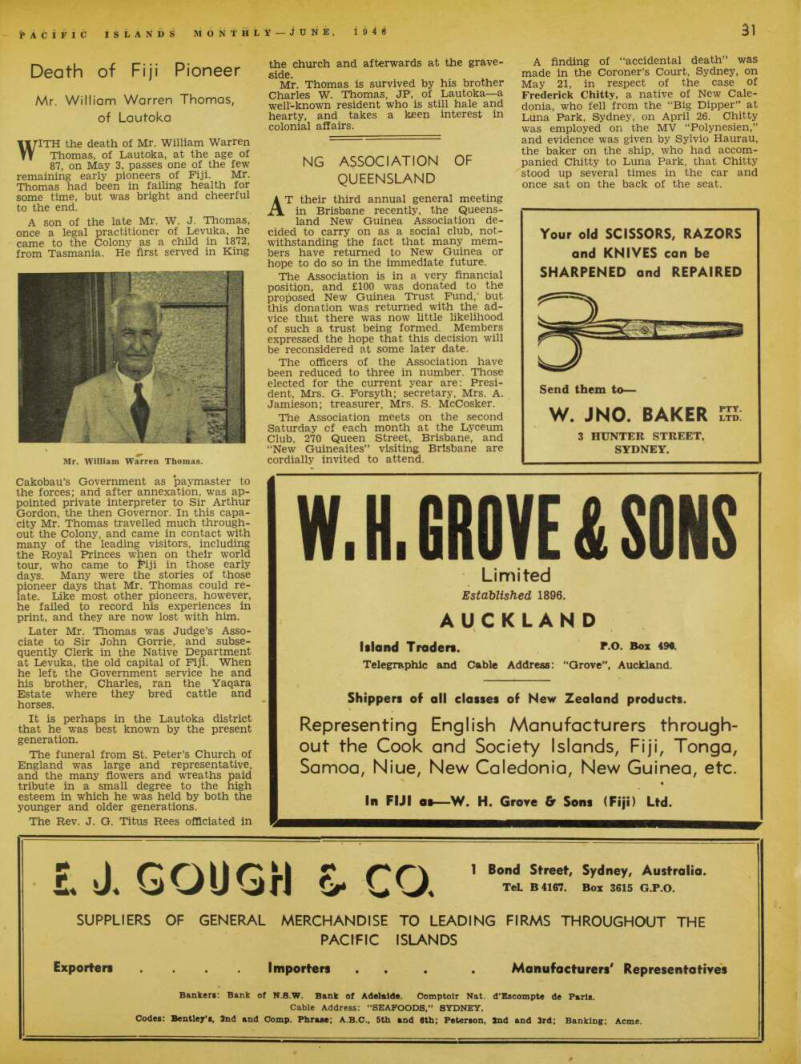
Mr. William Warren Thomas, of Lautoka
WITH the death of Mr. William Warren Thomas, of Lautoka, at the age of 87, on May 3, passes one of the few remaining early pioneers of Fiji. Mr.
Thomas had been in failing health for some time, but was bright and cheerful to the end.
A son of the late Mr. W. J. Thomas, once a legal practitioner of Levuka, he came to the Colony as a child in 1872, from Tasmania. He first served in King
Cakobau’s Government as paymaster to the forces; and after annexation, was ap pointed private interpreter to Sir Arthur Gordon, the then Governor. In this capa city Mr. Thomas travelled much through out the Colony, and came in contact with many of the leading visitors, including the Royal Princes when on their world tour, who came to Fiji in those early days. Many were the stories of those pioneer days that Mr, Thomas could re late. Like most other pioneers, however, he failed to record his experiences in print, and they are now lost with him.
Later Mr. Thomas was Judge’s Asso ciate to Sir John Gorrie, and subse quently Clerk in the Native Department at Levuka, the old capital of Fiji. When he left the Government service he and his brother, Charles, ran the Yaqara Estate where they bred cattle and horses.
It is perhaps in the Lautoka district that he was best known by the present generation.
The funeral from St. Peter’s Church of England was large and representative, and the many flowers and wreaths paid tribute in a small degree to the high esteem in which he was held by both the younger and older generations.
The Rev. J. G. Titus Rees officiated in
the church and afterwards at the grave side. , , Mr. Thomas is survived by his brother Charles W. Thomas, JP, of Lautoka—a well-known resident who is still hale and hearty, and takes a keen interest in colonial affairs.
Mr. William Warren Thomas.
Queensland
Ng Association Of
AT their third annual general meeting in Brisbane recently, the Queens land New Guinea Association de cided to carry on as a social club, not withstanding the fact that many mem bers have returned to New Guinea or hope to do so in the immediate future.
The Association is in a very financial position, and £lOO was donated to the proposed New Guinea Trust Fund, but this donation was returned with the ad vice that there was now little likelihood of such a trust being formed. Members expressed the hope that this decision will be reconsidered at some later date.
The officers of the Association have been reduced to three in number. Those elected for the current year are: Presi dent, Mrs. G. Forsyth; secretary, Mrs. A.
Jamieson; treasurer, Mrs. S. McCosker.
The Association meets on the second Saturday of each month at the Lyceum Club, 270 Queen Street, Brisbane, and “New Guineaites” visiting Brisbane are cordially invited to attend.
A finding of “accidental death” was made in the Coroner’s Court, Sydney, on May 21, in respect of the case of Frederick Chitty, a native of New Cale donia, who fell from the “Big Dipper” at Luna Park, Sydney, on April 26. Chitty was employed on the MV “Polynesien,” and evidence was given by Sylvio Haurau, the baker on the ship, who had accom panied Chitty to Luna Park, that Chitty stood up several times in the car and once sat on the back of the seat.
Advertisements & other items, pp. 33-34 (2 items)
W. H.Grove & Sons
Your old SCISSORS, RAZORS
and KNIVES can be
SHARPENED and REPAIRED
CD Send them to—
W. JNO. BAKER
3 HUNTER STREET,
SYDNEY.
W. H.GROVE & SONS
Limited
Established 1896.
AUCKLAND
* » Island Traders. *•<>. Box 49«.
Telegraphic and Cable Address: “Grove", Auckland.
Shippers of all classes of New Zealand products.
Representing English Manufacturers through-
out the Cook and Society Islands, Fiji, Tonga, Samoa, Niue, New Caledonia, New Guinea, etc. % * In FIJI at—W. H. Grove & Sens (Fiji) Ltd.
** A \ 1 Bond Street, Sydney, Australia. £* \}% IJ fl \y 4 TeL B 4167. Box 3615 G.P.O.
SUPPLIERS OF GENERAL MERCHANDISE TO LEADING FIRMS THROUGHOUT THE
PACIFIC ISLANDS
Exporters ... Importers ... Manufacturers' Representatives Bankers: Bank of N.B.W. Bank of Adelaide. Comptolr Nat. d’Escompte de Paris.
Cable Address: “SEAFOODS,” SYDNEY, Codes: Bentley's, 2nd and Comp. Phrase; A.8.C., sth and 6th; Peterson, 2nd and 3rd; Banking; Acme.
TILLEY LAMPS
BURN ORDINARY KEROSENE
The Modern Form of PORTABLE LIGHTING
use
/ mm m i Titter OF THE OWL IS PROVERBIALLY A WISE BIRD, SO BE SURE YOU FOLLOW HIS EXAMPLE! TILLEY LAMPS ARE SO SUCCESSFUL THAT COPIES OF THEM ARE BEING MARKETED. TILLEY LAMPS ARE MADE ONLY IN ENGLAND Shipments available four weeks from receipt of order THE TILLEY LAMP CO., HENDON, N.W.4, ENG
REPRESENTATION :
MELBOURNE : T. H. Bentley, Pty. Ltd., 123-125 William Street, Melbourne, Cl.
TASMANIA ; Mr. C. Sellars, 108 a Charles Street, Launceston.
FIJI : Mr. K. Witherington, 2 Burns Philp Buildings, Suva.
32
“i'-lcinc ist
Magazine Section
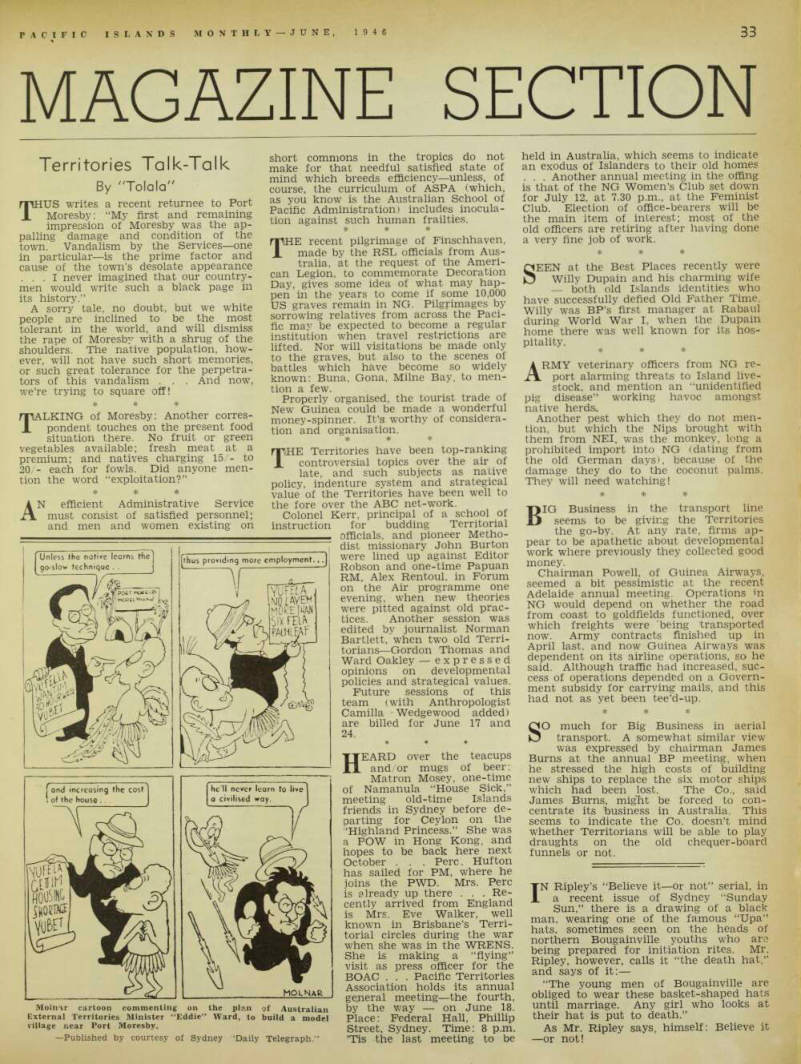
Territories Talk-Talk
By "Tolala"
rUS writes a recent returnee to Port Moresby: “My first and remaining impression of Moresby was the ap palling damage and condition of the town. Vandalism by the Services—one in particular—is the prime factor and cause of the town’s desolate appearance ... I never imagined that our country men would write such a black page in its history.”
A sorry tale, no doubt, but we white people are inclined to be the most tolerant in the world, and will dismiss the rane of Moresby with a shrug of the shoulders. The native population, how ever, will not have such short memories, or such great tolerance for the perpetra tors of this vandalism . . . And now, we’re trying to square off! * * * TALKING of Moresby: Another corres pondent touches on the present food situation there. No fruit or green vegetables available; fresh meat at a premium; and natives charging 15 - to 20/- each for fowls. Did anyone men tion the word “exploitation?”
H 5 *l» AN efficient Administrative Service must consist of satisfied personnel; and men and women existing on
short commons in the tropics do not make for that needful satisfied state of mind which breeds efficiency—unless, of course, the curriculum of ASPA (which, as you know is the Australian School of Pacific Administration) includes inocula tion against such human frailties. * * * THE recent pilgrimage of Finschhaven, made by the RSL officials from Aus tralia, at the request of the Ameri can Legion, to commemorate Decoration Day, gives some idea of what may hap pen in the years to come if some 10,000 US graves remain in NG. Pilgrimages by sorrowing relatives from across the Paci fic may be expected to become a regular institution when travel restrictions are lifted. Nor will visitations be made only to the graves, but also to the scenes of battles which have become so widely known: Buna, Gona, Milne Bay, to men tion a few.
Properly organised, the tourist trade of New Guinea could be made a wonderful money-spinner. It’s worthy of considera tion and organisation. * * * THE Territories have been top-ranking controversial topics over the air of late, and such subjects as native policy, indenture system and strategical value of the Territories have been well to the fore over the ABC net-work.
Colonel Kerr, principal of a school of instruction for budding Territorial
officials, and pioneer Metho dist missionary John Burton were lined up against Editor Robson and one-time Papuan RM, Alex Rentoul, in Forum on the Air programme one evening, when new theories were pitted against old prac tices. Another session was edited by journalist Norman Bartlett, when two old Terri torians—Gordon Thomas and Ward Oakley expressed opinions on developmental policies and strategical values.
Future sessions of this team (with Anthropologist Camilla Wedgewood added) are billed for June 17 and 24. * ♦ * HEARD over the teacups and/or mugs of beer; Matron Mosey, one-time of Namanula “House Sick,” meeting old-time Islands friends in Sydney before de parting for Ceylon on the “Highland Princess.” She was a POW in Hong Kong, and hopes to be back here next October . . . Perc. Hufton has sailed for PM, where he joins the PWD. Mrs. Perc is already up there . . . Re cently arrived from England is Mrs. Eve Walker, well known in Brisbane’s Terri torial circles during the war when she was in the WRENS.
She is making a “flying” visit as press officer for the BOAC . ' . Pacific Territories Association holds its annual general meeting—the fourth, by the way on June 18.
Place; Federal Hall, Phillip Street, Sydney. Time: 8 p.m. ’Tis the last meeting to be
held in Australia, which seems to indicate an exodus of Islanders to their old homes . . . Another annual meeting in the offing is that of the NG Women’s Club set down for July 12, at 7.30 p.m., at the Feminist Club. Election of office-bearers will be the main item of interest; most of the old officers are retiring after having done a very fine job of work. ♦ ♦ ♦ SEEN at the Best Places recently were Willy Dupain and his charming wife both old Islands identities who have successfully defied Old Father Time.
Willy was BP’s first manager at Rabaul during World War I, when the Dupain home there was well known for its hos pitality. * * * ARMY veterinary officers from NG re port alarming threats to Island live stock, and mention an “unidentified pig disease’’ working havoc amongst native herds,.
Another pest which they do not men tion, but which the Nips brought with them from NEI, was the monkey, long a prohibited import into NG (dating from the old German days), because of the damage they do to the coconut palms They will need watching! ♦ ♦ ♦ BIG Business in the transport line seems to be giving the Territories the go-by. At any rate, firms ap pear to be apathetic about developmental work where previously they collected good money.
Chairman Powell, of Guinea Airways, seemed a bit pessimistic at the recent Adelaide annual meeting. Operations in NG would depend on whether the road from coast to goldfields functioned, over which freights were being transported now. Army contracts finished up in April last, and now Guinea Airways was dependent on its airline operations, so he said. Although traffic had increased, suc cess of operations depended on a Govern ment subsidy for carrying mails, and this had not as yet been tee’d-up. * * * SO much for Big Business in aerial transport. A somewhat similar view was expressed by chairman James Burns at the annual BP meeting, when he stressed the high costs of building new ships to replace the six motor ships which had been lost. The Co., said James Burns, might be forced to con centrate its business in Australia. This seems to indicate the Co. doesn’t mind whether Territorians will be able to play draughts on the old chequer-board funnels or not.
IN Ripley’s “Believe it — or not” serial, in a recent issue of Sydney “Sunday Sun,” there is a drawing of a black man, wearing one of the famous “Upa” hats, sometimes seen on the heads of northern Bougainville youths who are being prepared for initiation rites. Mr.
Ripley, however, calls it “the death hat,” and says of it:— “The young men of Bougainville are obliged to wear these basket-shaped hats until marriage. Any girl who looks at their hat is put to death,”
As Mr. Ripley says, himself; Believe it —or not!
Molnar cartoon commenting on the plan of Australian External Territories Minister “Eddie” Ward, to build a model village near Port Moresby.
Published by courtesy of Sydney ‘Daily Telegraph.”
on a Hoodoo Voyage
13! The Story of a Mission Ship on a Hoodoo Voyage
From the Diary of Mrs. Georgina Seton, One of the Passengers
QELDOM has a ship, sailing out of Sydney for the South-western Pacific Islands, encountered such a run of had luck as the Melanesian Mission’s motor - yacht, “Southern Cross.” The story was told, briefly, in the April issue of the “PIM.”
After shipping a party of planters and traders (who wanted to return to their homes and could get no other transport) the “Southern Cross” set out from Sydney for her home port in the British Solomons. There were 13 passengers, and they sailed from No. 13 wharf. Darling Harbour. They left Sydney Harbour on March 13.
Twelve of the passengers were “officially” deck-hands. They were much more than “official” before the hoodoo voyage ended!
The 13 th passengers was Mrs.
Georgina Seton, from whose diary, sent to the Melanesian Mission secre tary in Sydney (Major H. S. Robin son) we have been kindly permitted to copy the following extracts. She was the only woman on the ship.
The 13 passengers were all Solomon Islands settlers, who were driven out in 1942 by the Jap invasion. Some of them had served with distinction in the American or Australian Forces.
A group photograph, taken before sailing, was published on the cover of the March “PIM”
IN the beginning, the mission yacht “Southern Cross” was scheduled to leave before Christmas. Strikes, blackouts, etc., resulted in the Navy being unable to return her to the Melanesian Mission before March. Then we packed our bags, and assembled on the yacht.
These were the passengers:— H. A. Markham, of Segi, Maravo Lagoon.
G. R. Younger, of Nono, Cape Marsh.
A. Olsen, Guadalcanal.
R. Laycock, of Papari, Ysabel.
J. M. Clift, of Aruligo, Guadalcanal.
T. Elkington, of MV “Mendana,” Santa Anna.
A. Andresen.
O. Bergin, of Yandina, Cape Marsh.
R. C. Symes, of Gold Ridge, Guadalcanal.
G. Johnston, of Yandina, Cape Marsh.
J. S. Mill, Ssem.
C. W. and Mrs. Georgina Seton, Shortlands.
Our troubles commenced early. It occurred to no one to count the “passen gers.” We were 13!
There were more strikes, and no one would load the ship. Finally, we received the gracious permission of some water side czar to load our own goods.
We left No. 13 wharf, Darling Har bour, late on March 12. I looked back at that “13” as we slowly drew away. There was something sinister about it. That night, we lay off Rose Bay.
March 13 (there it was again!) opened to a perfect morning. We sailed at dawn. All were happy.
Five miles from Sydney the port engine ran hot. That evening, we were back at No. 13 wharf, with engineers hammering down below.
ON March 14 we again left harbour; but we were not more than 24 hours’ northwards when the wind and sea rose against us. It got worse and worse, and the captain decided to run into Coff’s Harbour.
We anchored on Sunday morning, the 17th. One man was sent to hospital; engine spare parts were ordered from Brisbane: a radio man was sent for, from shore, to repair the radio. The ship rolled terribly at anchor, and the poor radio man spent most of this time hang ing over the side.
March 20: Left Coff’s Harbour at 5 p.m.
March 21: It was a rough, wet night, and all cabins were awash. The weather is worsening, and radio gives warning of a cyclone coming towards us at 50 mph The captain is making for what he calls a toe-hold anchorage off Moreton Island The ship is rolling badlv, with colossal grey seas wallowing up behind, or shoul dering up amidships, some pouring in over the rail in a solid green wall We have been baling all afternoon, but the cabins still are full of water.
The cooks put on a marvellous hot kai, but just as all hands were sitting down to it, the ship gave some frightful lurches, the food flew in all directions, and a ton of salt water came in on top of the stove. The cases near the sink were demolished and a good copper was washed overboard.
MARCH 22: We are anchored now be hind a long sand-bar, over which the sea is breaking heavily, as far as one can see. The ship is rolling badly. Landward, there are only bare inhospitable sandhills.
At 2 o’clock, we found the second mate at the foot of the ladder, where he had taken a heavy fall—he was unconscious, suffering concussion. The captain has decided to run into Brisbane. There is no pilot available, so he will take the ship up the river to Pinkenba himself We berthed at 2 a.m. An ambulance took the mate to hospital.
March 29: We are at sea again, after a week in Brisbane. J. M. Clift has joined us—a very useful deck-hand The sea is very rough.
March 30; Ship rolled heavilv in a strong south-east wind. The scuppers are running full, and many of us are sea sick The vessel drifted for an hour, w’hile a job was done on the engines. All cabins are awash.
March 31; An unpleasant day and a turbulent sea, and the ship shudders as the great waves smash at her. Decks and cabins are flooded—spray across the upper deck, and big seas creaming over the rail.
But we can put up with anything, so long as we are moving in the right direc tion (towards the Solomons). I saw our first flying-fish.
The second mate has not recovered from his fall, after all. and is unable to go on duty. The chief steward also is ill, after a fall.
APRIL I: More bad weather, and now we are hove-to. There is trouble in the engine-room.
Later: The captain has decided to turn around and run for Bowen.
Later: There is warning of a cyclone
moving south-west, so our course has been altered for Rockhampton. Visibility had been nil for two days; but we got a sight at noon, and we raised the light house at North Reef just half an hour before dusk.
The pilot took us up the Fitzroy River into Rockhampton, where we lay for a week. The second mate was returned to hospital, and a new second mate came from Sydney.
April 9: We came down the river to Sea Hill this afternoon, but the weather is bad.
April 12: We pushed out to sea at 6 a.m., but the weather is the worst we yet have encountered—a peculiar, corkscrew ing movement, like a bucking horse, and practically everyone is seasick. We have picked up some kind of ’flu in Rockhamp ton, and most of us are weak and “took down with misery something terrible.”
Everyone is in wet clothes. The saloon at night is like a nightmare, or a Hogarth painting. The nice, pale-brown Dand ling and the reseda green curtains, and the white ceiling, make an extraordinary background for the gaunt, unshaven wrecks who gather there with hollow eyes and sinewy brown arms and legs pro jecting from wet singlets and shorts The whole picture tosses wildly, like a double earthquake, as the shin is thrown about Everything that can fall, or smash, or be carried away, already has done it. No one can sleep unless he hangs on to his bunk, like a monkey in a tree-top. The floor is wet with sea-water, and slippery with black oil from the engine-room. Out in the corridor, the water rushes madly back and forth.
At the evening meal-time there is much anxiety as to whether the savoury-smell ing “Chegwidden Special” will go over board or splatter around the saloon, be fore finding its sanctuary inside the sad whiskers of our returning planters.
In spite of the wild tossing of the ship, and the general sea-sickness, all hands are doing a splendid job. The cooks have kept food up to the company, somehow, and our amateur deckhands are always on the deck when they are needed. They carry masses of bruises and abrasions; but there is not a shirker among them.
The wheel is fighting like a mad devil, in this sea, and rapping the quarter masters over the knuckles.
But nobody minds, so long as we are getting there.
The engineers have done a good job, too—their trials have been endless. The engines are running better now. Before we went to Rockhampton, the deckhands had to take turns in the engine-room, turning something or other, for 48 hours, because the lubricating system had broken down.
April 14: The port engine (the villian of the piece) did 190 revs, we are told— the best yet.
APRIL 16: At last, we have had beauti ful calm weather, for two davs, and everyone has picked up. Washing clothes, and ironing, and smelling imag inary frangipanni, and making nostalgic references to paw-paw, taro and pease soup, and other fragrant memories of the days “long before.” Guadalcanal was sighted at 7 p.m. The day’s run of 188, logged at noon, was a record for the trip.
We heard Tulagi radio this morning.
We are only 90 miles from Honiara. Home —after all these years!
We should berth in the morning. There is an air of anticipation, and relief that we have at last reached this nightmare journey’s end. We do not speculate upon the future—it is very much an unknown quantity. It may be rough in patches— but we hope that there will be to our labours what there has been to this trip —a happy ending.
Action!
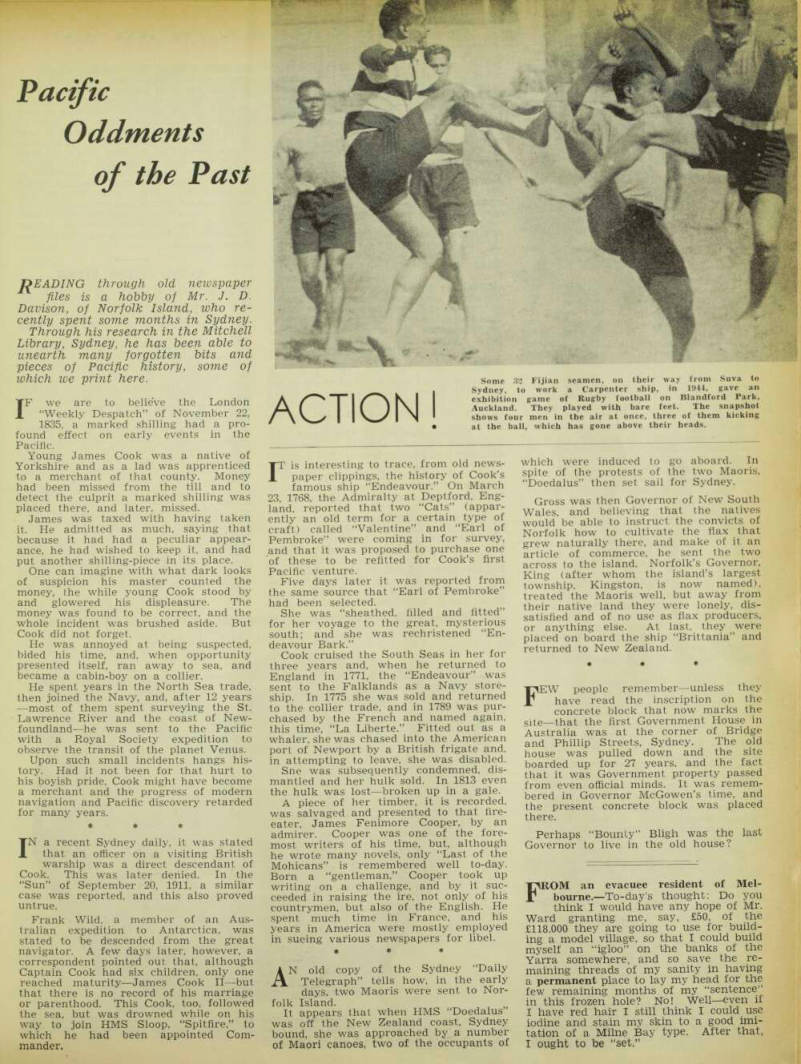
Pacific
Oddments of the Past
TREADING through old newspaper files is a hobby of Mr. J. D.
Davison, of Norfolk Island, who re
cently spent some months in Sydney.
Through his research in the Mitchell Library, Sydney , he has been able to unearth many forgotten bits and
pieces of Pacific history, some of
which we print here.
IF we are to believe the London “Weekly Despatch” of November 22, 1835, a marked shilling had a pro found effect on early events in the Pacific.
Young James Cook was a native of Yorkshire and as a lad was apprenticed to a merchant of that county. Money had been missed from the till and to detect the culprit a marked shilling was placed there, and later, missed.
James was taxed with having taken it. He admitted as much, saying that because it had had a peculiar appear ance, he had wished to keep it, and had put another shilling-piece in its place.
One can imagine with what dark looks of suspicion his master counted the money, the while young Cook stood by and glowered his displeasure. The money was found to be correct, and the whole incident was brushed aside. But Cook did not forget.
He was annoyed at being suspected, bided his time, and, when opportunity presented itself, ran away to sea, and became a cabin-boy on a collier.
He spent years in the North Sea trade, then joined the Navy, and, after 12 years —most of them spent surveying the St.
Lawrence River and the coast of New foundland —he was sent to the Pacific with a Royal Society expedition to observe the transit of the planet Venus.
Upon such small incidents hangs his tory. Had it not been for that hurt to his boyish pride, Cook might have become a merchant and the progress of modern navigation and Pacific discovery retarded for many years. ♦ ♦ ♦ IN a recent Sydney daily, it was stated that an officer on a visiting British warship was a direct descendant of Cook. This was later denied. In the “Sun” of September 20, 1911, a similar case was reported, and this also proved untrue.
Frank Wild, a member of an Aus tralian expedition to Antarctica, was stated to be descended from the great navigator. A few days later, however, a correspondent pointed out that, although Captain Cook had six children, only one reached maturity—James Cook ll—but that there is no record of his marriage or parenthood. This Cook, too, followed the sea, but was drowned while on his way to join HMS Sloop, “Spitfire,” to which he had been appointed Com mander.
IT is interesting to trace, from old news paper clippings, the history of Cook’s famous ship “Endeavour.” On March 23, 1768, the Admiralty at Deptford, Eng land, reported that two “Cats” (appar ently an old term for a certain type of craft) called “Valentine” and “Earl of Pembroke” were coming in for survey, and that it was proposed to purchase one of these to be refitted for Cook’s first Pacific venture.
Five days later it was reported from the same source that “Earl of Pembroke” had been selected.
She was “sheathed, filled and fitted” for her voyage to the great, mysterious south; and she was rechristened “En deavour Bark.”
Cook cruised the South Seas in her for three years and, when he returned to England in 1771, the “Endeavour” was sent to the Falklands as a Navy store ship. In 1775 she was sold and returned to the collier trade, and in 1789 was pur chased by the French and named again, this time, “La Liberte.” Fitted out as a whaler, she was chased into the American port of Newport by a British frigate and, in attempting to leave, she was disabled.
Sne was subsequently condemned, dis mantled and her hulk sold. In 1813 even the hulk was lost—broken up in a gale.
A piece of her timber, it is recorded, was salvaged and presented to that fire eater, James Fenimore Cooper, by an admirer. Cooper was one of the fore most writers of his time, but, although he wrote many novels, only “Last of the Mohicans” is remembered well to-day.
Born a “gentleman,” Cooper took up writing on a challenge, and by it suc ceeded in raising the ire, not only of his countrymen, but also of the English. He spent much time in France, and his years in America were mostly employed in sueing various newspapers for libel. ♦ » * AN old copy of the Sydney “Daily Telegraph” tells how, in the early days, two Maoris were sent to Nor folk Island.
It appears that when HMS “Doedalus was off the New Zealand coast, Sydney bound, she was approached by a number of Maori canoes, two of the occupants of
which were induced to go aboard. In spite of the protests of the two Maoris, “Doedalus” then set sail for Sydney.
Gross was then Governor of New South Wales, and believing that the natives would be able to instruct the convicts of Norfolk how to cultivate the flax that grew naturally there, and make of it an article of commerce, he sent the two across to the island. Norfolk’s Governor, King (after whom the island’s largest township. Kingston, is now named), treated the Maoris well, but away from their native land they were lonely, dis satisfied and of no use as flax producers, or anything else. At last, they were placed on board the ship “Brittania” and returned to New Zealand. • ♦ • FEW people remember —unless they have read the inscription on the concrete block that now marks the Sl te —that the first Government House in Australia was at the corner of Bridge and Phillip Streets, Sydney. The old house was pulled down and the site boarded up for 27 years, and the fact that it was Government property passed from even official minds. It was remem bered in Governor McGowen’s time, and the present concrete block was placed there.
Perhaps “Bounty” Bligh was the last Governor to live in the old house?
FROM an evacuee resident of Mel bourne.—To-day’s thought: Do you think I would have any hope of Mr.
Ward granting me, say, £5O, of the £llB,OOO they are going to use for build ing a model village, so that I could build myself an “igloo” on the banks of the Yarra somewhere, and so save the re maining threads of my sanity in having a permanent place to lay my head for the few remaining months of my “sentence” in this frozen hole? No! Well—even if I have red hair I still think I could use iodine and stain my skin to a good imi tation of a Milne Bay type. After that, I ought to be “set.”
Action!
Some 32 Fijian seamen, on their way from Suva to Sydney, to work a Carpenter ship, in 1944, gave an exhibition game of Rugby football on Blandford Park, Auckland. They played with bare feet. The snapshot shows four men in the air at once, three of them kicking at the ball, which has gone above their heads.
Advertisements & other items, p. 38 (1 item)
M^auLeaux^aM^speci^vlsfi^o*^^ o
BOOK REVIEWS
From Vienna to Me Nou— Via Virginia
ONE of the most extraordinary stories for which truth has ever been claimed, is told by the clever French author, Alain Laubreaux, in his book “Fateful Alibi.”
M. Laubreaux, who was born in New Caledonia, has recently been looked on as a collaborationist, but he is an accom plished writer and this particular book has been published by Jarrolds in an English translation. It is worth reading.
Briefly, it is the tale of how a blunder of mistaken identity led to a man, who was already fleeing from justice, being sentenced to a long term of imprisonment in the old convict settlement of New Cale donia. for a crime he had not committed.
The book is the autobiography of this convict, written on his deathbed and handed over to a French Governor, a per sonal friend of M. Laubreaux. after the last war.
This convict, Philippe Pons, quotes evi dence to prove that his mother, a lady of the Austrian Court, had an unhappy in trigue with a son of Ferdinand I. Em peror of Austria-Hungary, and that he, the illegitimate grandson of that Em peror, was the outcome of this intrigue.
His mother was “banished” to the United States, where he was born. He spent his childhood on a plantation in Virginia, and records vivid impressions of life there before the abolition of slavery, and re lates how his stenfather and his morose stepbrother fought for the South in the Civil War.
After his stepfather’s death, he and his mother returned, almost penniless, to Vienna, where they went through terrible sufferings while trying to prove their identity to Court and Emperor. They were finally befriended by the Hungarian Count Hunyade. There are plenty of in timate particulars of the Austrian Court.
THE convict writer returned to the United States and settled on his stepbrother’s ranch in Arizona, where he was not made welcome; and then, in trouble over his stepbrother’s wife, he shot his stepbrother and es caped to New York, losing his leg in an accident en route.
Back again in Vienna, Pons secured employment with the Austrian Secret Service under Baron Gorup, and in this capacity he learnt of, and disclosed, an intrigue between his former pupil, Crown Prince Rudolf, and Johann Salvator, the Archduke of Tuscany, for a coup d’etat which would have enabled Rudolf to seize the throne of Hungary.
To make clear this passage’ it should be explained that before returning to the USA, Pons had been in intimate touch with the Emperor Francis Joseph and his enigmatical and tragic Queen Eliza beth.
Judging by the detail he provides, he had a unique opportunity of observing life at the Court of Vienna and of hand ing down to history precise information of intrigues and tragedies of the Haps burgs which have hitherto been wrapped in mystery.
Pons says that his spying activities earned the implacable hate of the Arch duke of Tuscany, who had to get out of Austria. Pons himself was sent spying in France, under the title of Count de Keir
peror had bestowed on was
M^auLeaux^aM^speci^vlsfi^o*^^ o
Pons French Pacific convlct m the Tr.f o voof .. , now switches to the Archduke 3* After incurring the Emdispleasure, he chartered a vessel, a lnte - Mar guerite,” and sailed for A r^ en< nder the nam e of Johann Samte Marguerite” and its i disappeared completely and mysteriously from the Hapsburg ken. rw „ , .
E Pons story is that the Archduke (or Orth) heard that Pons was doing . New Caledonia, and came there determined to “do him in” Savs Pons: “I was moved from the pen' al depot the as steward of a farm owned bv the Marist Brothers at Nessadiou to the south of Bourail, near the mouth of the River Nera. The nearest native tribe was on the shore of the Bav of Gouaro on the opposite bank of the river “One evening in July 1891 I was in my one-roomed mud hut just ready to get my bunk down after a supper of boiled yegetables—l was, in fact, stooping down steps 0 * ° Ut the lamp — when 1 heard foot- “A ’ figure appeared on the threshhold somebody whom I seemed to recognise’ although I had never dreamt that I should ever see him again. It was Johann Salvator, Archduke of Tuscany and a nephew of Franz-Joseph. He pointed a revolver at me and said he had come to kill me. Come 10 “I was at a disadvantage because one of my legs was amputated,’ but a talSe stood between us on which stand lamp, and while he was talking I suddenly tipped this on him, literafly turning the tables. I fell on him and brained him with a stool, and then took his revolver, and finished him off with it It is a lonely neighbourhood; and a ‘ few
’thf'hiL/ 38 h outslde v, d ! gging a
N ■?"* h" ” hlm '
SS do P’ a v, “ the , old da vs. and some at Pons narrative seems to bear the hallmark of authenticity, it must be remembered that he died as an old man ab o u t the time of the last war. Never theless, say Laubreaux, the narrative so far as it concerns the Austrian Court s e ™, s to be borne out bv the writings of Countess Marie Larisch and others while the Orleans sentence has been verified: and the disappearance of the Archduke of Tuscany has never hitherto been explained.
Know Your Birds
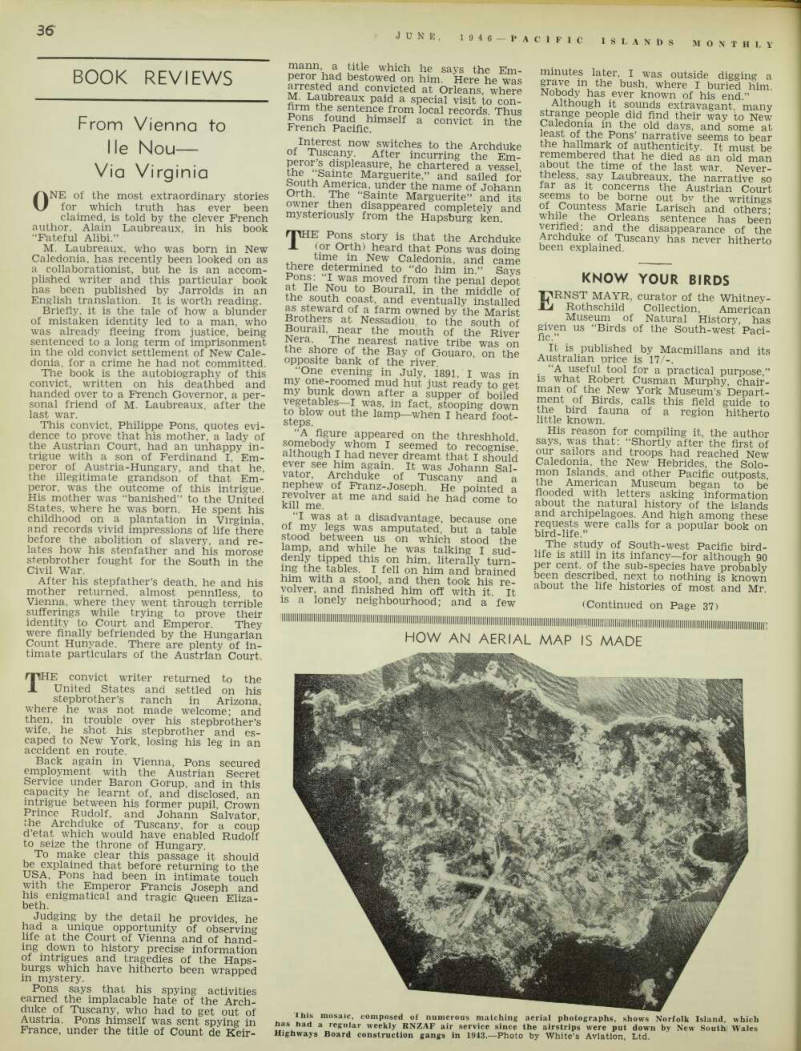
Guratorof the Whitney- Rothschild Collection, American • Muse um of Natural History, has § lv H n us Blr ds of the South-west Paci • , a is published by Macmillans and its Australian price is 17/-. • A useful tool for a practical purpose,” ™ *? ob Ar rt Mur P h y> chair man of the New York Museum’s Depart- B i rds ’ cal l? this field S uide to futle known 31 ™ 3 ° f 3 reglon hitherto His reas ?h for compiling it, the author Says ’ that i, Shortly after the first of sail5 ail ? rs iL nd J; ro °P s had reached New Caled oma the New Hebrides, the Solo- I£ on * slands ’ and other Pacific outposts, mei -l^ an i ,^ useum began to be fl ooded with letters asking information ab out the natural history of the islands and aroh ipelagoes And high among these wSmIIS ere CallS f ° r a popular book on ul tS" nie : , i,f T^ 6 9. f South-west Pacific bird ™* 8 B ? in i 1 8 for although 90 u or ce i lt * °t t 5 e sub " s P ecies have probably described next to nothing is known the life histones of most and Mr.
(Continued on Page 37)
Mayr hopes that other naturalists will be stimulated to add to the scanty informa tion now available.
He pays tribute to pioneers like H.
Hamlin in the New Hebrides, L. Macmil lan in the same Group and in New Cale donia, and W. Coultas in Micronesia and the Solomons; and does not forget to mention earlier observers like E. L, and E. L. C. Layard, and the Swiss-German scientist Fritz Sarasin, in New Caledonia and the Loyalties.
He might have added that several young scientists with the US Forces dur ing the war collected valuable informa tion on birds as part of their jobs; and that the Whitney and Farnsworth expedi tions before the war showed that Ameri can interest was growing.
This is a useful handbook which Is lands residents will be glad to have by them, and one does not need to be a trained observer to profit from its pages.
The coloured plates and other illustra tions will be a help in identifying species
—H. E. L. Friday.
How An Aerial Map Is Made
This mosaic, composed of numerous matching aerial photographs, shows Norfolk Island, which has had a regular weekly RNZAF air service since the airstrips were put down by New Southl Wales Highways Board construction gangs in 1943. Photo by White’s Aviation, Ltd.
Tropicalities
GREGORY SPENCER, who joined the RAAF at the beginning of the war, and who eventually found himself in charge of a radar station on lonely Melville Island, north of Darwin, is now back in Sydney as Federal record libra rian of the Australian Broadcasting Com mission. He says the island station was occupied by about 60 Servicemen, and thoroughly camouflaged. It remained un detected by the Japanese.
Spencer learned something of the native language, and drilled natives of military age who were introduced into certain departments of the military rou tine. He tells a story of an LAC who came back excitedly talking of magic after going on patrol with some natives on a pitch black, moonless night. Al though the LAC could not see two feet in front of him, Alec, a blackfellow, told him confidently that there was a ship a little way off shore. The LAC spent the night stumbling over roots and into holes, while Alec kept up a running commentary on the activities of the steamer, which he described in some detail. Sure enough, when dawn broke, the faint outline of a steamer could be seen on the skyline.
Spencer comments, “As a matter of fact, these natives have the strange power of seeing in the dark. I just can’t give any reasonable explanation.”
With his sergeant, Spencer used to give them medical care to the best of his ability, and in return they supplemented RAAF diet with fish, oysters, crab, turtle and yams. Sometimes they fought among themselves, using primitive spears painted in intricate designs in bright orange, red, yellow, white and black; covering face and body also in grotesque designs. They didn’t do each other much damage.
Spencer thought the worst had hap pened when a rotund nine-year-old one day calmly told him “Paddy kill Joshua.”
He found Joshua, who was bawling lustily, with a small cut op his knee. That was before he, Spencer, realised the dif ference, in Pidgin, between “kill” and “kill ’im finish.”—H.E.L.P.
AROUND the third quarter of every year, black whales, often of immense size, are seen off the Oneroa side of the island of Mangaia. The monsters are believed to come for two purposes— to rub off, on the jagged coral, the bar nacles that cling to them exactly as to a ship’s side; and also to feast upon the “koperu” (a local mackerel). The levia thans came as usual last year; and now “koperu” are scarce.
Unlike the enterprising Aitutakians. the natives of Mangaia never attempt to kill a whale. In the same way that he is “game” to essay a hazardous boat journey to Rarotonga, the Aitutakian will tackle “Moby Dick” with courage and skill, and often get the victory.
A slain whale would provide all Man gaia with fresh meat! But, like Mr.
Shaw’s ideal Christianity, the idea has never been tried. Perhaps, some day, it will; and then we shall dispute about eating whale steaks with fish cutlery— as did “PlM’s” editor at Sir Harry Luke’s dinner party in Suva in 1942. —EG. • * ♦ IN spite of what is said (or not said) about the type of Australian who settled in New Guinea, there seems to me to be little wrong with him.
For months I had been alone at my mission station among the savage people of the hinterland. During all that time I had never seen a white skin, and I was half-crazy with loneliness. At last, I could stand it no longer. Off I set through the jungle, crossing rivers and mountains and swamps. For hours I had to wade through water and, as everyone who has visited the region knows, the sight of a crocodile that turns its nose up just a few yards from you in the muddy water does not make such a trip any more pleasant.
For several days I walked, until ex hausted and foot-sore, I came to a coco nut plantation on the coast. What a relief! Some boys working nearby brought me some green coconuts. I doubt if the old gods enjoyed their nectar as much as I enjoyed those kulaus.
I then dragged myself to the Master’s house, whefe I was given a hearty wel come, and I was glad to find that Master “K” had not gone to “Siney” as the boys had told me.
He and his good wife did everything to make me comfortable. What delight to have a hot bath; to see a clean towel; a white tablecloth. To have a real meal— talk to civilised people—to sit back in a real chair!
If it hadn’t been for the heat I should have imagined that I was in paradise.
I hope that God has blessed this man and his wife. I never met them again; but I hope that some day I shall and then will be able to repay them a little for their kindness to me when I was in distress.—A. * ♦ ♦ THERE was a lull in the inter-village church-building race in Western Samoa during the war years, but indications are that it will soon be on again!
Every visitor to the Territory is struck
by the large number of churches in Samoan villages—the average village of 400 people has two, and sometimes three churches —one belonging to the LMS, one Methodist, and one Roman Catholic. In recent years, the Seventh Day Adventists and other sects have entered the field in some localities. Large villages can boast of four churches—some even of six and seven!
In prosperous times, church-building was a regular industry in the Territory and there existed a class of native car penters, builders and craftsmen who wandered from village to village, plying their trade.
During the war years, although there was dollar-prosperity, there was also lack of building materials. But a Canadian lumber ship is expected in Apia shortly, and the church-building industry is ex pected to revive immediately.
Several big feasts have been held in Savaii and Upolo already, where, in tradi tional Samoan fashion, large funds have been collected for the new churches. Some villages have even got as far as laying the foundations for the proposed build ings!—AMG. * • » EQUINE anaemia or a so-called deadly “horse-disease”—appears to be another legacy left to New Guinea by the departing Japs. It is said to have killed off between three and four thou sand horses which the Japs took to Rabaul in 1942 as part of their prepara tions for the invasion of Australia.
We have hoard nothing of the disease from New Guinea sources. Only infor mation is from a brief Canberra an nouncement that a special mobile veter inary unit has been sent to all areas formerly occupied by the Japs and that all animals and birds that had been in contact with infected horses, or had been in compounds with Japs, had been killed.
The disease apparently is transmitted by an insect that bites an infected animal and passes it on to a healthy beast within a short time.
Australian authorities are most con cerned with preventing the introduction of the disease into the Commonwealth.
Nothing has been said of the fate of New Guinea livestock native or otherwise.
Perhaps some returning Territorian could throw light on this mysterious disease and its effects, if any, on New Guinea. • • ♦ RESIDENTS of Fiji who. in 1945, were reading the much-discussed novel “Forever Amber,” quite unharassed by the law and apparently without deterio ration to the moral fibre, should be interested to know that it costs 10/- on the black market to read the weighty (and over-rated) tome in Sydney.
The book is banned in Australia, where Authority takes it upon itself to save the public from the baser things; but Sydney booksellers say that about 100 copies have come into NSW by devious means and are now circulating among selected subscribers in libraries in city and suburbs.
Customers wanting to read “Amber” pay £5 deposit—£4/10/- of which is re funded when the book is returned. * * ♦ Superstitious? Then take heart from the fact that on one airways service, much patronised by Pacific residents, there is no seat number 13.
Seat numbers go: “ . . . 12, 12a, 14, etc.”
Advertisements & other items, p. 39 (1 item)
37
Book Reviews (Continued from Page 36)
PACIFIC ISLANDS MONTHLY JUNE. 1946
Carolines:
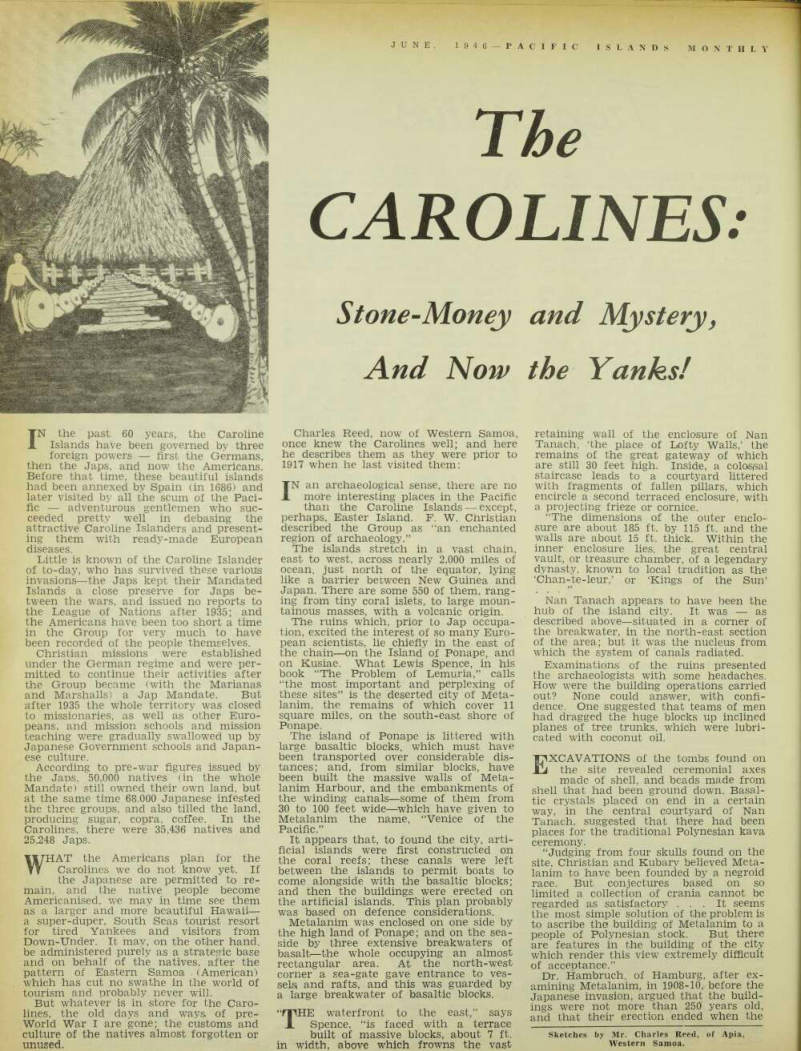
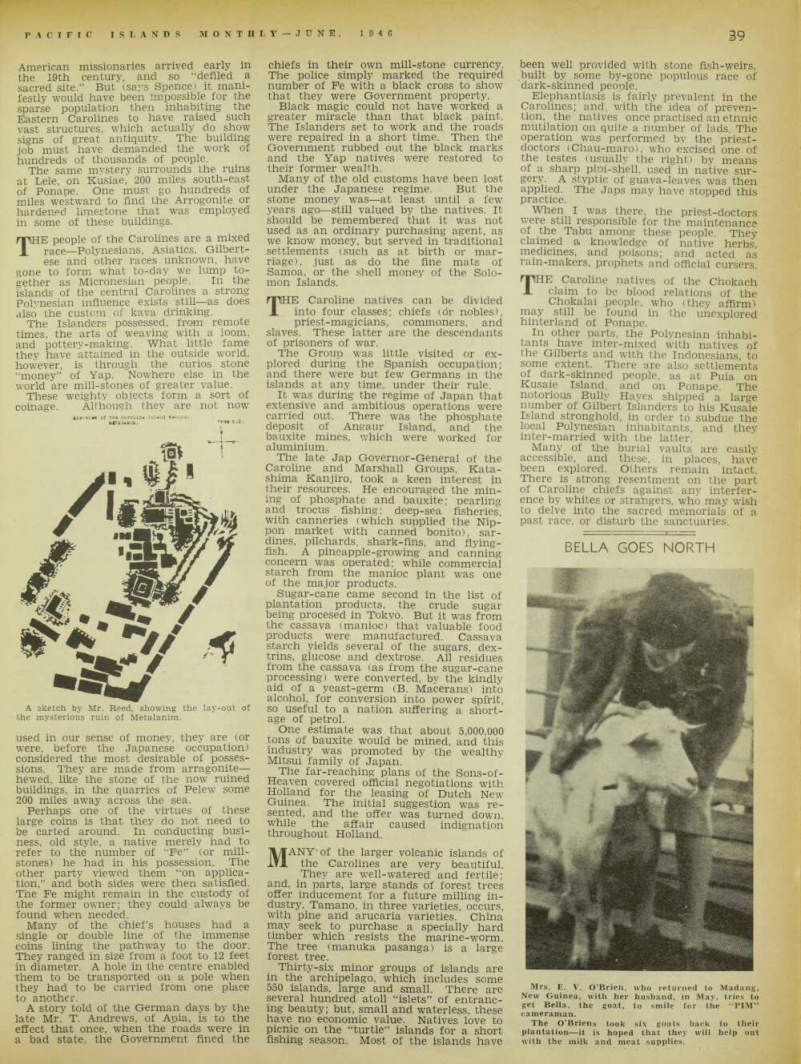
The
Stone-Money and And Now the Yanks!
IN the past 60 years, the Caroline Islands have been governed by three foreign powers first the Germans, then the Japs, and now the Americans.
Before that time, these beautiful islands had been annexed by Spain (in 1686) and later visited by all the scum of the Paci fic adventurous gentlemen who suc ceeded pretty well in debasing the attractive Caroline Islanders and present ing them with ready-made European diseases.
Little is known of the Caroline Islander of to-day, who has survived these various invasions—the Japs kept their Mandated Islands a close preserve for Japs be tween the wars, and issued no reports to the League of Nations after 1935; and the Americans have been too short a time in the Group for very much to have been recorded of the people themselves.
Christian missions were established under the German regime and were per mitted to continue their activities after the Group became (with the Marianas and Marshalls) a Jap Mandate. But after 1935 the whole territory was closed to missionaries, as well as other Euro peans, and mission schools and mission teaching were gradually swallowed up by Japanese Government schools and Japan ese culture.
According to pre-war figures issued by the Japs, 50,000 natives (in the whole Mandate) still owned their own land, but at the same time 68.000 Japanese infested the three groups, and also tilled the land, producing sugar, copra, coffee. In the Carolines, there were 35,436 natives and 25,248 Japs.
WHAT the Americans plan for the Carolines we do not know yet. If the Japanese are permitted to re main, and the native people become Americanised, we may in time see them as a larger and more beautiful Hawaii— a super-duper, South Seas tourist resort for tired Yankees and visitors from Down-Under. It may, on the other hand, be administered purely as a strategic base and on behalf of the natives, after the pattern of Eastern Samoa (American) which has cut no swathe in the world of tourism and probably never will.
But whatever is in store for the Caro lines, the old days and ways of pre- World War I are gone; the customs and culture of the natives almost forgotten or unused.
Charles Reed, now of Western Samoa, once knew the Carolines well; and here he describes them as they were prior to 1917 when he last visited them: IN an archaeological sense, there are no more interesting places in the Pacific than the Caroline Islands except, perhaps, Easter Island. F. W. Christian described the Group as “an enchanted region of archaeology.”
The islands stretch in a vast chain, east to west, across nearly 2,000 miles of ocean, just north of the equator, lying like a barrier between New Guinea and Japan. There are some 550 of them, rang ing from tiny coral islets, to large moun tainous masses, with a volcanic origin.
The ruins which, prior to Jap occupa tion, excited the interest of so many Euro pean scientists, lie chiefly in the east of the chain—on the Island of Ponape, and on Kusiae. What Lewis Spence, in his book “The Problem of Lemuria,” calls “the most important and perplexing of these sites” is the deserted city of Meta lanim, the remains of which cover 11 square miles, on the south-east shore of Ponape.
The island of Ponape is littered with large basaltic blocks, which must have been transported over considerable dis tances; and, from similar blocks, have been built the massive walls of Meta lanim Harbour, and the embankments of the winding canals—some of them from 30 to 100 feet wide—which have given to Metalanim the name, “Venice of the Pacific.”
It appears that, to found the city, arti ficial islands were first constructed on the coral reefs; these canals were left between the islands to permit boats to come alongside with the basaltic blocks; and then the buildings were erected on the artificial islands. This plan probably was based on defence considerations.
Metalanim was enclosed on one side by the high land of Ponape; and on the sea side by three extensive breakwaters of basalt,—the whole occupying an almost rectangular area. At the north-west corner a sea-gate gave entrance to ves sels and rafts, and this was guarded by a large breakwater of basaltic blocks.
“fItHE waterfront to the east.” says X Spence, “is faced with a terrace built of massive blocks, about 7 ft. in width, above which frowns the vast
retaining wall of the enclosure of Nan Tanach, ‘the place of Lofty Walls,’ the remains of the great gateway of which are still 30 feet high. Inside, a colossal staircase leads to a courtyard littered with fragments of fallen pillars, which encircle a second terraced enclosure, with a projecting frieze or cornice.
“The dimensions of the outer enclo sure are about 185 ft. by 115 ft. and the walls are about 15 ft. thick. Within the inner enclosure lies, the great central vault, or treasure chamber, of a legendary dynasty, known to local tradition as the ‘Chan-te-leur,’ or ‘Kings of the Sun’
Nan Tanach appears to have been the hub of the island city. It was —as described above—situated in a corner of the breakwater, in the north-east section of the area; but it was the nucleus from which the system of canals radiated.
Examinations: of the ruins presented the archaeologists with some headaches.
How were the building operations carried out? None could answer, with confi dence. One suggested that teams of men had dragged the huge blocks up inclined planes of tree trunks, which were lubri cated with coconut oil.
Excavations of the tombs found on the site revealed ceremonial axes made of shell, and beads made from shell that had been ground down. Basal tic crystals placed on end in a certain way, in the central courtyard of Nan Tanach, suggested that there had been places for the traditional Polynesian kava ceremony.
“Judging from four skulls found on the site, Christian and Kubary believed Meta lanim to have been founded by a negroid race. But conjectures based on so limited a collection of crania cannot be regarded as satisfactory ... It seems the most simple solution of the problem is to ascribe the building of Metalanim to a people of Polynesian stock. But there are features in the building of the city which render this view extremely difficult of acceptance.”
Dr. Hambruch. of Hamburg, after ex amining Metalanim, in 1908-10, before the Japanese invasion, argued that the build ings were not more than 250 years old, and that their erection ended when the
Sketches by Mr. Charles Reed, of Apia, Western Samoa.
American missionaries arrived early in the 19th century, and so “defiled a sacred site.” But (says Spence) it mani festly would have been impossible for the sparse population then inhabiting the Eastern Carolines to have raised such vast structures, which actually do show signs of great antiquity. The building job must have demanded the work of hundreds of thousands of people.
The same mvstery surrounds the ruins at Lele, on Xusiae, 200 miles south-east of Ponape. One must go hundreds of miles westward to find the Arrogonite or hardened limestone that was employed in some of these buildings.
THE people of the Carolines are a mixed race —Polynesians, Asiatics, Gilbert ese and other races unknown, have gone to form what to-day we lump to gether as Micronesian people. In the islands of the central Carolines a strong Polynesian influence exists still—as does also the custom of kava drinking.
The Islanders possessed, from remote times, the arts of weaving with a loom, and potterv-making. What little fame they have attained in the outside world, however, is through the curios stone “money” of Yap. Nowhere else in the world are mill-stones of greater value.
These weighty obiects form a sort of coinage. Although they are not now
used in our sense of money, they are (or were, before the Japanese occupation) considered the most desirable of posses sions. They are made from arragonite— hewed, like the stone of the now ruined buildings, in the quarries of Pelew some 200 miles away across the sea.
Perhaps one of the virtues of these large coins is that they do not need to be carted around. In conducting busi ness, old style, a native merely had to refer to the number of “Fe” (or mill stones) he had in his possession. The other party viewed them “on applica tion,” and both sides were then satisfied.
The Fe might remain in the custody of the former owner; they could always be found when needed.
Many of the chief’s houses had a single or double line of the immense coins lining the pathway to the door.
They ranged in size from a foot to 12 feet in diameter. A hole in the centre enabled them to be transported on a pole when they had to be carried from one place to another.
A story told of the German days by the late Mr. T. Andrews, of Apia, is to the effect that once, when the roads were in a bad state, the Government fined the
chiefs in their own mill-stone currency.
The police simply marked the required number of Fe with a black cross to show that they were Government property.
Black magic could not have worked a greater miracle than that black paint.
The Islanders set to work and the roads were repaired in a short time. Then the Government rubbed out the black marks and the Yap natives were restored to their former wealth.
Many of the old customs have been lost under the Japanese regime. But the stone money was—at least until a few years ago—still valued by the natives. It should be remembered that it was not used as an ordinary purchasing agent, as we know money, but served in traditional settlements (such as at birth or mar riage), just as do the fine mats of Samoa, or the shell money of the Solo mon Islands. rE Caroline natives can be divided into four classes; chiefs (dr nobles), priest-magicians, commoners, and slaves. These latter are the descendants of prisoners of war.
The Group was little visited or ex plored during the Spanish occupation; and there were but few Germans in the islands at any time, under their rule.
It was during the regime of Japan that extensive and ambitious operations were carried out. There was the phosphate deposit of Angaur Island, and the bauxite mines, which were worked for aluminium.
The late Jap Governor-General of the Caroline and Marshall Groups. Kata shima Kanjiro, took a keen interest in their resources. He encouraged the min ing of phosphate and bauxite; nearling and trocus fishing; deep-sea fisheries, with canneries (which supplied the Nip pon market with canned bonito), sar dines, pilchards, shark-fins, and flying fish. A pineapple-growing and canning concern was operated; while commercial starch from the manioc plant was one of the major products.
Sugar-cane came second in the list of plantation products, the crude sugar being procesed in Tokvo. But it was from the cassava (manioc) that valuable food products were manufactured. Cassava starch yields several of the sugars, dex trins, glucose and dextrose. All residues from the cassava (as from the sugar-cane processing) were converted, bv the kindly aid of a yeast-germ (B. Macerans) into alcohol, for conversion into power spirit, so useful to a nation suffering a short age of petrol.
One estimate was that about 5,000,000 tons of bauxite would be mined, and this industry was promoted by the wealthy Mitsui family of Japan.
The far-reaching plans of the Sons-of- Heaven covered official negotiations with Holland for the leasing of Dutch New Guinea. The initial suggestion was re sented, and the offer was turned down, while the affair caused indignation throughout Holland.
MANY- of the larger volcanic islands of the Carolines are very beautiful.
They are well-watered and fertile; and, in parts, large stands of forest trees offer inducement for a future milling in dustry. Tamano, in three varieties, occurs, with pine and arucaria varieties. China may seek to purchase a specially hard timber which resists the marine-worm.
The tree (manuka pasanga) is a large forest tree.
Thirty-six minor groups of islands are in the archipelago, which includes some 550 islands, large and small. There are several hundred atoll “islets” of entranc ing beauty; but, small and waterless, these have no economic value. Natives love to picnic on the “turtle” islands for a short fishing season. Most of the islands have
been well provided with stone fish-weirs, built by some by-gone populous race of dark-skinned people.
Elephantiasis is fairly prevalent in the Carolines; and, with the idea of preven tion, the natives once practised an etnnic mutilation on quite a number of lads. The operation was performed bv the priest doctors (Chau-maro). who excised one of the testes (usually the right) by means of a sharp pini-shell, used in native sur gery. A styptic of guava-leaves was then applied. The Japs mav have stopped this practice.
When I was there, the priest-doctors were still responsible for the maintenance of the Tabu among these people. They claimed a knowledge of native herbs, medicines, and poisons; and acted as ram-makers, prophets and official cursers.
THE Caroline natives of the Chokach claim to be blood relations of the Chokalai people, who (they affirm) may still be found in the unexplored hinterland of Ponape.
In other parts, the Polynesian inhabi tants have inter-mixed with natives of the Gilberts and with the Indonesians, to some extent. There are also settlements of dark-skinned people, as at Puia on Kusaie Island, and on Ponape. The notorious Bully Haves shipped a large number of Gilbert Islanders to his Kusaie Island stronghold, in order to subdue the local Polynesian inhabitants, and they inter-married with the latter.
Many of the burial vaults are easily accessible, and these, in places, have been explored. Others remain intact.
There is strong resentment on the part of Caroline chiefs against any interfer ence by whites or strangers, who may wish to delve into the sacred memorials of a past race, or disturb the sanctuaries.
A sketch by Mr. Reed, showing the lay-out of the mysterious ruin of Metalanim.
Bella Goes North
Mrs. E. V. O’Brien, who returned to Madang, New Guinea, with her husband, in May, tries to get Bella, the goat, to smile for the “PIM” cameraman.
The O’Briens took six goats back to their plantation—it is hoped that they will help out with the milk and meat supplies.
(Escape)
Local Boy-Scout Makes Good
By Tui Navosa
THE people who inhabit the Lau Islands, which form the eastern fringe of the Fiji Group, are for the most part of Polynesian stock. They are noted seamen and often have a highly developed sense of individuality and enterprise.
Tomasi’s father was a Lauan, and a man of substance. He owned a small cutter and his lands produced copra; enough to make him comfortably off. He therefore thought that Tomasi should have a better education than could be obtained in the local school in Lau.
So Tomasi was packed off in a trading cutter to Suva, where arrangements had been made for him to live with an uncle and attend the Mission School for boys.
Here he quickly settled down; did well at his lessons; and joined a troop of Boy Scouts.
For three years he was quite happy: he was high up in his class at school and well up the ladder in his Scout troop.
And then it was time for him to leave school and return to Lau.
This he had no intention of doing if it could be avoided, for he knew well that it meant working on his father’s plan tation; or on his father’s cutter.
Fortunately for Tomasi, a notice ap peared one day in the window of Tommy Horne’s store to the effect that a lad was wanted. This Tomasi answered in per son, wearing his smart Scout uniform; in addition, he spoke good English. He got the job.
AT this time, too, the Education De partment was extending its con trol over the village schools in some of the more remote country districts, and a number of additional junior grade teachers were required for this purpose.
When Tomasi saw the notice in the Government “Gazette” calling for candi dates, he jumped at the idea. In due course he sat for the qualifying examina tion and, having little difficulty in passing it, obtained one of the vacancies as a Junior Grade Teacher on probation.
For a month or two he was attached to a Suva school, and then he was ap pointed to take charge of a village school in the district of Namosi.
Namosi is in the mountains of the interior of Viti Levu, and is very isolated.
Moreover, the people who live there are somewhat backward; at any rate, they are of a very different type to any that Tomasi had known.
But the Kai Wais (people of the sea) are inclined to look down on the Kai Tholos (people of the hills), and Tomasi had no doubt at all concerning his ability to manage the job.
The journey to Namosi from Suva is not an easy one. To begin with, you take the coast road, the westward, for some 15 miles, and then ipland up a steep, and probably wet, track for about the same distance.
This took Tomasi two days, even with the help he got on a lorry for the first part of the trip, and help in carrying his kit during the second part, and it was a very tired Tomasi who reached Namosi late in the evening.
HE took an immediate dislike to the small, round house which had been allotted to him. A fire was burning in a sand pit in the middle of it, to be sure, and of the warmth he was glad, for it was cold. There was no exit for the smoke, however, and the house was full of it. The people looked dirty, and
the food offered him was by no means what he had been used to.
On the other hand, he found himself well looked after, according to local standards, and the villagers were friendly.
There was a reasonably good school house in the village, which catered for the needs of several neighbouring villages as well. There were between 30 and 40 pupils in all.
The practice of the boys who came daily to school from outlying villages was to bring their mid-day meal with them. This was carried in a grass basket by each boy and, on arrival at the school in the morning, the baskets were put on a shelf at the back of the schoolroom.
One day Tomasi, out of curiosity, looked through these baskets and found, to his disgust, a cooked rat in one of them. He at once demanded the name of the owner and made him take it out and bury it. He then lectured the whole school on what he described as the “filthy habit of eating rats”; he said that should he ever find another boy who brought a rat to eat he would beat him.
About a week later he again inspected the mid-day dinners and found that, in spite of his order and warning, another boy had brought a rat for his meal.
This, then, was a deliberate case of dis obedience, and he gave the boy a good hiding.
THAT was that; or so Tomasi thought.
Unfortunately, he did not know that he was treading on very delicate ground; that the Namosi people habitually eat rats; that the habit is
partly due to the lack of both meat and fish in the district; and that it is a fruit eating bush-rat that is eaten.
The next day the boy who had been punished did not arrive at school; but, later in the day, an infuriated father, who turned out to be the Chief of a valley some five miles away, did so. He had an axe over his shoulder and, stand ing outside the school-house, shouted for Tomasi to come out and be killed.
At the time Tomasi was in the school room with his pupils and this invitation was heard by all. Excitement, if not actual pleasure, seemed to Tomasi to dawn on the faces of the boys, and he knew he had a matter of seconds to decide on his line of action.
He went outside the door and, facing the old Chief and holding his hand up, said “Wait: and in five minutes you can do what you like with me.” He then turned on his heels and walked to his house, which was close by. Here he put on his complete Scout uniform.
By this time the entire population of the village and the school boys had gathered. Then Tomasi marched from his house, straight towards the Chief and halted a few yards in front of him.
“Now kill me,” he cried, “and you will fight the whole British Empire!”
The old man stood stock still for a full half minute; then turned about and strode away, with his axe still on his shoulder.
Although Tomasi felt he was safe for the time being, he knew that his posi tion was no longer secure in the district.
That night a very frightened lad crept out of a hut in Namosi and took the path to the coast, and then to Suva.
TOMASI again became a store assistant, and settled down to a job which he found more to his taste than trying to educate the uncouth boys of Tholo.
Don't Renounce the World For This Island Orange
Away-from-it-all Department: Don't Renounce the World For This Island Orange Grove!
EXCITED by a Melbourne “Herald” story, by Osmar White, about an orange-growing project on Sunday Island in the Kermadecs (just north of NZ); and more particularly by some photographs Of a substantial establishment and an extensive and healthy orange grove (apparently on Sunday To i n Ai f’ „ .
Island), we wrote to the New Zealand Department of Agriculture demanding more of same.
Even if We, ourselves, had no for SUCh a Pacific paradise as described by Mr. White, we know Of plenty Of people (including ex-Servicemen) who have.
Sunday Island seemed ideal. The reported improvements since we were last able to check up on it we put down to the happenings behind the smoke-screen f • vears A . T\/r„ On the Credit Side (according to Mr.
White) were: hot water baths from thermal springs; no mosquitoes sandflies, good climate, fertile soil suitable for oranges (citrus expert hact planted 400 trees whose development had been healthy and rapid) ; ready-made orange market in New Zealand, 600 miles south; New Zealand Government was considering the encouragement of settlers qualicitrus.
On debit side were flies and earthquakes.
IN due course came disillusion. We received the following communication, signed by the Director of the Horticulture Division. Department of Agriculture, Wellington, New Zealand:
In reply to your letter of the 9th instant re *he ? er ™ adec Island * and enclosing {£»« £t grove depicted in the photograph is not taken on Sunday Island, because that island, which is at present under the control of the Public Works Department of this Dominion, is un with the exception of a small party °f Public Works men who look after the island, and who are relieved intermittently by other men from the same Department.
The photograph referred to did not emanate f rom the Department of Agriculture in New Zealand, and it would appear that it has been obtained from the Victorian Department of Agriculture, as it looks more like an Australian scene than a New Zealand one.
As far as the production of oranges or other citrus fruit on the island is concerned, there is no development at the present time, the growth of orange trees being restricted to some dozen or so old trees which have grown from seedlings in the bush, apparently introduced by a previous settler, many years ago.
The prospect of any increase or development citrus-growing in that island is receiving some consideration; but it is entirely a matter for future development, and there is not suf ficient data available at the present time to say whether it might be a success or otherwise.
The half dozen gentlemen of the public Works Department who care for Sunday Island should be warned. If we can beCo me excited over a description of an a n e ged Island paradise, there’s no telling what effect it will have upon the thousands of frustrated Australians who. finding it hard to embrace Peace, harbour a desire to get away from it all into the
blue Pacific.
Advertisements & other items, p. 43 (1 item)
Hone Dressmaking
MAKE LOVELY CLOTHES IMMEDIATELY
Amazing New Methods Make
as Simple as A.8.C.!
The Amazing, Simplified Ross Hynes system teaches you in your own home in a few weeks by latest short-cut methods how to measure, design, cut and make practically all garments for yourself and your family with professional finish. It tells you everything.
Never before has such an amazing Dress-
making Course been published which
covers everything, yet costs so little.
Even the least experienced will learn quickly and easily. In a few weeks you will be measuring— cutting—designing—making your own patterns— and creating gorgeous clothes in the latest fashions.
A complete section is devoted to Children’s Clothes.
ENTIRELY NEW METHODS
Make Dressmaking Remarkably Simple
This is the most amazing offer that has ever been made to Australian women. The Course comprises all lessons.
W mm Mr. Ross Hynes , principal of the Ross Hynes College of Dressmaking, Sydney, the largest in the Southern Hemisphere.
Established 30 years.
Profusely illustrated with pictures, diagrams, charts.
You cannot fail to learn quickly and easily! The “Home Dressmaker” tells you everything.. reveals hitherto professional dressmaking secrets . . How to create, cut, fit and finish in all styles for all figures . . How to cut your own patterns in any style and size . . A big section is devoted specially to Children’s Clothes and Remodelling Clothes.
Bound into book form, this Course is a permanent reference work.
The Ross Hynes modern method does away with weary memorising. Every item is clearly indexed for instant reference. It is just as if Mr. Hynes himself were standing at your shoulder to advise you at every stage.
A Complete £5-5-0 Course In
HOME DRESSMAKING
in permanent book form for only
SUCCESS IS ASSURED!
The Ross Hynes Sensational “Home Dressmaker” Course has completely revolutionised Practical Home Dressmaking and brought this useful, fascinating art within easy reach of everyone. It does not matter if you have “never sewn a stitch” —you cannot fail to make astonishing progress. Oldfashioned, tedious methods have been swept aside. Step by step, with ease and confidence, you are shown the professional secrets of all branches of practical dressmaking. You cannot make a mistake. Never before has such an astounding opportunity been offered you.
There are no further payments. 15/- is the complete price, yet this modern Course contains all the essential instructions of the Famous Ross Hynes £5/5/- Postal Course. There are 160 illustrations. This amazing offer brings modern, practical home dressmaking instruction to the thousands of girls and women who cannot attend personal classes.
SERVICE
Equal to Personal Tuition
Nothing has been held back. This Course reveals all the secrets of professional dressmaking, Rut, as well as that, it carries a FREE ADVISORY SERVICE. At any time, and on any point mentioned in the book, you may write to the Ross Hynes College, Sydney, and will receive a prompt and full reply just as you would in a class.
SPECIAL SECTION in CHILDREN’S CLOTHES
To meet the need to-day for economy in children’s clothes, the “Home Dressmaker” devotes an entire section to children’s wear.
FREE ADVICE
■EARN MONEY AT HOME
When you have made all the clothes you need yourself, you will find many friends who will gladly pay for your services. Your spare time will bring you extra money for dress materials, holidays and other pleasures.
BELOW ARE JUST SOME OF THE LESSONS TAUGHT Nine essential measurements—Secrets of altering patterns—Planning your own patterns—Odd sizes—Secrets of expert cutting—Modern methods—FULL LES- SONS AND DIAGRAMS ON HOW TO CUT AND MAKE—Coatee and jumper suit —Evening gowns—Tailored top coat—Two-piece skirt—Six-gore skirt —Underslips and underwear—House coats —Pyjamas for women, men and children—Beach and sports wear—Slacks—Shorts, etc., etc. MODERN RENOVATING—New garments from old—Pull illustrated instructions—Children’s clothes from adults’ left-offs.
CHILDREN’S WEAR—FuII illustrated lessons on baby’s frocks—Rompers, etc. — Children’s frocks—Petticoats—Bloomers—School tunic—Boys’ pants, etc., etc.— Secrets of putting together—Setting sleeves and collars—Plackets and openings— Alterations—Smocking, Honeycombing, Fancy stitches—Linings—Buttonholes— Padding—Tucking—Basting—Patch, jeatted flap and welt pockets—Secrets of perfect fit and hang—Personality in clothes—Secrets of professional finish—Professional secrets revealed, etc., etc.
FREE MASTER FOUNDATION PATTERN
if you order NOW >
The Master Foundation Pattern enables you to cut your own paper patterns in any style and in 16 different sizes. It is the most astounding invention that has ever come to dressmaking. By ordering your Course of the “Home Dressmaker” now, you will receive this 5/- Master Foundation Pattern absolutely free.
In an amazingly short time, by these modern, simplified methods, you will be making gorgeous evening gowns, delightful underwear, slumber wear, sports or street wear. A special large section is devoted to children’s clothes for all ages and, when you follow these methods, children’s’ clothing becomes simplicity itself. Another large section is devoted to renovation, enabling you to re-make, re-model and modernise from the many good materials to be found in out-moded garments in your wardrobe. No longer will you be driven frantic over high prices or dressmakers.
At a fraction of the money you are now spending on clothes, you can lift yourself out of the crowd and be really distinctive. You can design clothes which express your own individuality.
This is Your MONEY-BACK GUARANTEE
I understand that if 1 am not entirely satisfied after 10 days, I may return the Course and my money will be
fully and completely refunded.
As stocks are limited, this extraordinary offer cannot be held open indefinitely. You are urged, therefore, to place your order TO-DAY.
The Course will more than pay for itself on the first garment you make.
Thousands of women have already mastered the art by these revolutionary methods. Their letters of gratitude pour in every day. - - POST THIS COUPON IMMEDIATELY - .
I I Ross Hynes College of Dressmaking , .
Suite 608 , Manchester Unity Building , "PIM,” 1/6/46. 1 185 Elizabeth Street, SYDNEY. I 1 Dear Sir: ■ Please send me, under your money-back guarantee, the complete and ■ fully illustrated Ross Hynes “Home Dressmaker” Course, together * with Free Master Foundation Pattern, and enrol me so that I may ■ I participate in your After-Advice Service without cost. I enclose ■ 15/-, the complete cost of this Course. 9 I B
I NAME ..
I ADDRESS
B Please print in Block Letters.
Noumea-Auckland By
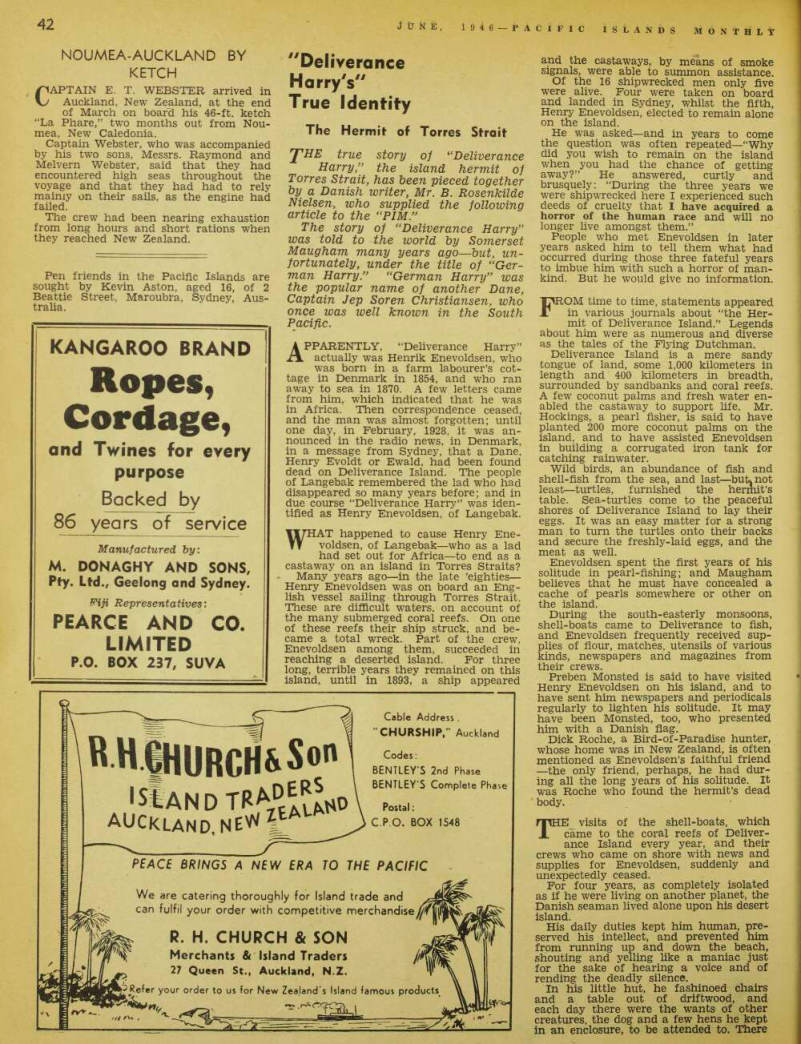
Ketch
CAPTAIN E. T. WEBSTER arrived in Auckland, New Zealand, at the end of March on board his 46-ft. ketch “La Phare,” two months out from Nou mea, New Caledonia.
Captain Webster, who was accompanied by his two sons, Messrs. Raymond and Melvern Webster, said that they had encountered high seas throughout the voyage and that they had had to rely maimy on their sails, as the engine had failed.
The crew had been nearing exhaustion from long hours and short rations when they reached New Zealand.
Pen friends in the Pacific Islands are sought by Kevin Aston, aged 16, of 2 Beattie Street, Maroubra, Sydney, Aus tralia.
Horry's"
"Deliverance Horry's"
True Identity The Hermit of Torres Strait
THE true story of “Deliverance
Harry” the island hermit of
Torres Strait, has teen pieced together
by a Danish writer, Mr. B. Rosenkilde
Nielsen, who supplied the following
article to the “PIM.”
The story of “Deliverance Harry”
was told to the world by Somerset Maugham many years ago — but, un fortunately, under the title of “Ger man Harry ” “German Harry” was
the popular name of another Dane,
Captain Jep Soren Christiansen, who
once was well known in the South
Pacific.
APPARENTLY, “Deliverance Harry” actually was Henrik Enevoldsen, who was born in a farm labourer’s cot tage in Denmark in 1854, and who ran away to sea in 1870. A few letters came from him, which indicated that he was in Africa. Then correspondence ceased, and the man was almost forgotten; until one day, in February, 1928, it was an nounced in the radio news, in Denmark, in a message from Sydney, that a Dane.
Henry Evoldt or Ewald, had been found dead on Deliverance Island. The people of Langebak remembered the lad who had disappeared so many years before; and in due course “Deliverance Harry” was iden tified as Henry Enevoldsen, of Langebak. 117 HAT happened to cause Henry Ene ? T voldsen, of Langebak—who as a lad had set out for Africa—to end as a castaway on an island in Torres Straits?
Many years ago—in the late ’eighties— Henry Enevoldsen was on board an Eng lish vessel sailing through Torres Strait.
These are difficult waters, on account of the many submerged coral reefs. On one of these reefs their ship struck, and be came a total wreck. Part of the crew, Enevoldsen among them, succeeded in reaching a deserted island. For three long, terrible years they remained on this island, until in 1893, a ship appeared
and the castaways, by means of smoke signals, were able to summon assistance.
Of the 16 shipwrecked men only five were alive. Four were taken on board and landed in Sydney, whilst the fifth, Henry Enevoldsen, elected to remain alone on the island.
He was asked—and in years to come the question was often repeated—“ Why did you wish to remain on the island when you had the chance of getting away?” He answered, curtly and brusquely: “During the three years we were shipwrecked here I experienced such deeds of cruelty that I have acquired a horror of the human race and will no longer live amongst them.”
People who met Enevoldsen in later years asked him to tell them what had occurred during those three fateful years to imbue him with such a horror of man kind. But he would give no information.
FROM time to time, statements appeared in various journals about “the Her mit of Deliverance Island.” Legends about him were as numerous and diverse as the tales of the Flying Dutchman.
Deliverance Island is a mere sandy tongue of land, some 1,000 kilometers in length and 400 kilometers in breadth, surrounded by sandbanks and coral reefs.
A few coconut palms and fresh water en abled the castaway to support life. Mr.
Hockings, a pearl fisher, is said to have planted 200 more coconut palms on the island, and to have assisted Enevoldsen in building a corrugated iron tank for catching rainwater.
Wild birds, an abundance of fish and shell-fish from the sea, and last—buhnot least —turtles, furnished the hermit’s table. Sea-turtles come to the peaceful shores of Deliverance Island to lay their eggs. It was an easy matter for a strong man to turn the turtles onto their backs and secure the freshly-laid eggs, and the meat as well.
Enevoldsen spent the first years of his solitude in pearl-fishing; and Maugham believes that he must have concealed a cache of pearls somewhere or other on the island.
During the south-easterly monsoons, shell-boats came to Deliverance to fish, and Enevoldsen frequently received sup plies of flour, matches, utensils of various kinds, newspapers and magazines from their crews.
Preben Monsted is said to have visited Henry Enevoldsen on his island, and to have sent him newspapers and periodicals regularly to lighten his solitude. It may have been Monsted, too, who presented him with a Danish flag.
Dick Roche, a Bird-of-Paradise hunter, whose home was in New Zealand, is often mentioned as Enevoldsen’s faithful friend —the only friend, perhaps, he had dur ing all the long years of his solitude. It was Roche who found the hermit’s dead body. mHE visits of the shell-boats, which J. came to the coral reefs of Deliver ance Island every year, and their crews who came on shore with news and supplies for Enevoldsen, suddenly and
unexpectedly ceased.
For four years, as completely isolated as if he were living on another planet, the Danish seaman lived alone upon his desert island.
His daily duties kept him human, pre served his intellect, and prevented him from running up and down the beach, shouting and yelling like a maniac just for the sake of hearing a voice and of rending the deadly silence.
In his little hut, he fashinoed chairs and a table out of driftwood, and each day there were the wants of other creatures, the dog and a few hens he kept in an enclosure, to be attended to. There
was also another thing which required to be fed and kept alive that others might not die—his fire.
One day the pearl-fishers returned to Deliverance Island, and they found that Henry Enevoldsen had become an old man during the past four years. They told him of the reason of their long absence—World War I.
“Old Harry” could now obtain regular supplies of matches, and was thus no longer tied to his precious fire.
DICK- ROCHE sailed from Merauke in Dutch New Guinea to Deliverance Island with a couple of American tourists, who were curious to make Harry’s acquaintance; but, on reaching their destination, they found him lying dead. His body lay half in, half out of the doorway and was much decomposed.
Dick Roche buried Harry on the island where he had found “his earthly Para dise,” as he used to express it. The police on Thursday Island received Roche’s report of Enevoldsen’s death, and through them the Dutch Consulate in Sydney obtained the short statement which was transmitted to Denmark.
Johannes Henrik Enevoldsen died on January 27, 1928, the last date marked on his calendar, a common school slate, which he had always carefully kept up to date; but, the body was not discovered by Roche until a month later.
After 35 years of unbroken seclusion, this strange existence, one of the strangest of its kind on record, was brought to a close.
Sir Howard Ellis returned to Fiji in early May after several months’ holiday in New Zealand.
Advertisements & other items, p. 44 (1 item)
Rh.Church&Son
KANGAROO BRAND
Ropes,
Cordage,
and Twines for every purpose Backed by 86 years of service Manufactured by:
M. DONAGHY AND SONS,
Ply. Ltd., Geelong and Sydney.
Fiji Representatives:
PEARCE AND CO.
LIMITED
P.O. BOX 237, SUVA
RH.CHURCH&Son
is»andtradeß*, o
AUCKLAND, NEW
Cable Address .
“ CHURSHIP,” Auckland Codes; BENTLEY’S 2nd Phase BENTLEY’S Complete Phase Postal;
C.P.O. BOX 1548
H rw PEACE BRINGS A NEW ERA TO THE PACIFIC We are catering thoroughly for Island trade and can fulfil your order with competitive merchandise
R. H. CHURCH & SON
Merchants & Island Traders 27 Queen St., Auckland, N.Z.
Refer your order to us for New Zealand’s Island famous products r &
He Who “Crawls Ashore
From The Sea"
By A. C. Rowland
WHEN the Tahitians, in the year 1767, greeted the first tourist ship with a shower of stones they bestowed a descriptive name on the passengers which was prophectic.
This name, “Papaa,” which, in various dialect forms, has become the designation for members of the white race through out the South Pacific, means literally “crabs —crawling ashore from the sea.”
This, to us, is clearly more poetic and descriptive than is the? Chinese term.
“Hairy Foreign Devil.”
Moreover, “Papaa” is not a term of abuse, but a classification after the manner of our use of the word “crus tacean.”
There are many sub-varieties—for example, the Aveu, which climbs coconut trees and cracks the nuts with its pre datory claw; the Tupa, which burrows about the roots of coconut trees, and re quires cyanide gas to clear it out; the U’a, which destroys the Maava and takes up its abode in the victim’s shell; and those which haunt water-front offal heaps.
Notwithstanding this classification, the white man actually achieved considerable prestige in the South Pacific, which en dured long after the publication of the Darwinian theory had shattered European pre-eminence beyond all hope of salvage, in the several countries of the Orient.
The scientists had neglected to trans late Darwin into the languages of Poly nesia.
The tourists, and knowledge of Barbary Ape ancestor, came to the South Sea Islands at the same period.
The modern Tahitian, when he holds in esteem an European because of his personal qualities, addresses him as “Popaa”—which means precisely nothing.
The Polynesian has no equivalent of the Malay “Tuan” or the Hindu “Sahib.”
By using the pronunciation “Popaa,” the Tahitian is merely disguising the fact that his European friend is just another crab that has crawled ashore, over the barrier reef, from the sea.
News of the death of Mr. Albert Hill in Sydney in April was received with regret by his many friends in Fiji. He was born on the island of Rabi (now taken over by the Ocean Islanders) 75 years ago, and was the fourth son of the late Captain John Hill. Until his retire ment 15 years ago, he was on the staff of the CSR Co., mostly at Labasa. He is survived by a wife, one son, and two daughters—Arthur, of the CSR Co., Ba; Nell, wife of A. R. Rourke, manager of the CSR* Co., Ba; and Gwen, wife of T.
Alley, of 1 the CSR Co. In Queensland.
Mr. C. B. Hill, of Labasa, and Mr. G. D.
Hill, of Suva, are brothers.
Advertisements & other items, p. 45 (1 item)
Robert Gillespie Ptv Ltd
STAMPS
We buy collections, also all issues in quantity, either off or on paper. Top prices. Send registered mail.
Agents required in Pacific Islands, Papua and New Guinea to service covers and send mint stamps.
A. Willison, Box 128, Burnie, Tasmania.
IMPORTERS
EXPORTERS
t Island Distributors for
"COLEMAN" HEATING AND LIGHTING APPLIANCES
"DINOX" AND" DIX" BRANDS OF BROOMS, BRUSHES AND MOPS*
ROBERT GILLESPIE PTV LTD
BANKERS: BANK OF N.S.W.
COMPTOIR NATIONAL
DESCOMPTE DE PARIS
54a PITT ST. SVDNEV N.S.W.
CABLE ADDRESS:
“ROBERGILL”
PHONES BW 4782-B 1305
"Cargo Cult" Not Caused by Missions
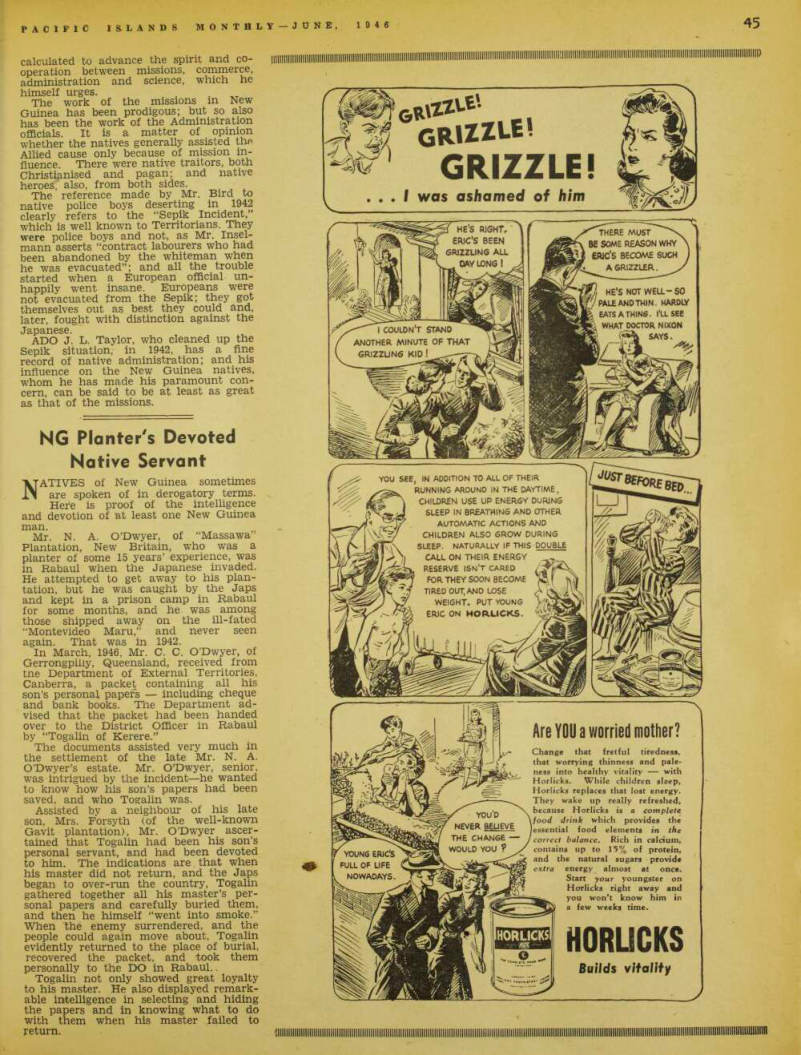
Letter to the Editor
IN November issilfe of the “Pacific Islands Monthly,” Mr. N. M. Bird, an “old Territories resident,” basing his re marks on the opinion of the late F. E.
Williams, Papuan Government Anthropo logist, blames missions for the madness called “cargo cult,” stating that it arises from their teachings of equality in the sight of God.
Apart from Mr. Bird’s apparent un willingness to accept the Bible teaching of the brotherhood of man. which he attacks, he and others who think as he does, should be told who is to blame for the “cargo cult.”
The writer, for seven years, was privi leged to deal with “cargo cult” natives, as a missionary at Madang, New Guinea.
Since 1943 he has done post-graduate work in the United States, specialising in research work concerning the “cargo cult,” which, among the Nobonob-speak ing peoples, is called “Letub.” His re search was submitted to and accepted by Hartford Seminary Foundation, Hartford, Connecticut, as a thesis under the title of “Letub, the Cult of the Secrets of Wealth.” fITHE primitive natives of New Guinea, X under mission supervision, were mak ing rapid progress toward higher standards of life, until their contact with
un-Christian Whiteman’s culture gave rise to the “cargo cult.”
In a book by Romilly, published by John Murray, of London, in 1887 (“The Western Pacific and New Guinea”), the Queensland “blackbirders” and their un scrupulous dealings with the natives be fore the Government took over the Ter ritory in 1885, are described, and this statement is made: “In those days it is almost certain that the natives were not so hostile to the whiteman as they have now become . . . The civilising process . . . received at the hands of white men since that time has made terrible savages of them.”
The Bible quotes Jesus as saying: “I am come not to be ministered unto, but to minister.”
This same spirit is in the missionaries who do not wish to “lord it over” the natives. Accordingly, natives of the Nobo nob congregation, for instance, were taught to refer to thqir missionaries by their names. But when this was done by a native in hearing of a Warrant Officer, the native was punished. The Warrant Officer demanded that all white men be referred to as “masters.” This is a sample of the “civilising influence” that gives rise to the danger of a post-war flare-up among New Guinea natives. This danger arises not from the teaching of the mission, but from Whiteman’s un willingness to conduct himself as a Christian in his relationship to the natives. 117ESTERN culture is misunderstood by TT natives of New Guinea who are un able to adjust themselves sufficiently in the course of a few decades. Any whiteman who wishes to live and work in New Guinea should know this and avoid adding to the misunderstanding.
Deep-seated suspicion and mistrust of all whites has been aroused in natives by the bad influence of certain whites and Asiatics who deceive natives by their sleight-of-hand tricks, by ventriloquism, dishonesty, disrespect for native tradi tions, by the manner of exploitation and recruiting.
Nor has the attitude of many Colonial
people, who do not favour education of the native, helped. If it had not been for the stabilising influence of missions upon natives it is quite likely that all natives would have turned against the Whiteman during the recent war. The natives had learned from experience that they could trust the missions.
Dr. Cilento, Director of the Health De partment, made the following statement at a combined conference between repre sentatives of the Government and of the different missions in the Mandated Ter ritories held in Rabaul some years ago: “The natives love the mission. They have confidence in the mission and so, in all their ailments they come to the mission calling for help ...” Not the missions, but whitemen who could not be trusted by the native, gave rise to the “cargo cult.”
Here is a specific instance: Before Pearl Harbour, natives of Madang were promised protection in the case of an enemy invasion. However, after the first bombardment of Madang by the Japan ese, all of the Civil Administration de parted, including the officer who had pro mised protection! We don’t dispute the Administration’s right to flee before the enemy, but what did the broken promise do to the natives?
Missionaries, too, made a promise They promised to stay with the natives and they kept their promise up to the last minute of their freedom, and as a price for their faithfulness to the natives eleven of them are dead—unable to answer Mr. Bird’s false accusation.
I leave it to “PIM” readers to judge who is to blame if natives mistrust whites Mission personnel and teachings, or non mission personnel and broken promises?
MR. BIRD refers to native police who deserted in 1942 and carried out systematic murder and rape of the native population in their path. ' These natives, according to my best re collection, were contract labourers .from the goldfields who were abandoned by the whiteman when he was evacuated.
Thousands of contract labourers aban doned without supervision began to steal food to survive. When natives from the Aitape and Sepik areas, returning from the goldfields, came to Madang they were given rice by the mission, and were dis armed without trouble by Missionary Harry Dott at Bogadjim, and by others, in co-operation with the NGVR stationed at Nobonob. This uprising was the up shot of the whiteman breaking contract with the native.
MR. BIRD sees danger in the future from flare-ups among New Guinea natives. I see that same danger if un-Christian whitemen continue their in justice in the jungles of New Guinea.
In the future Administration, the various missions, the commercial and in dustrial people, the scientists and educa tors must co-operate toward the high goal of making good the failures and sins of the past. The country must be opened up, not with the idea of showing the natives that we think ourselves superior to them, but with the idea that we have come to help them. The phrase “for the welfare of the natives” must become reality.
I am, etc.,
R. Inselmann.
Hartford, Usa.
Editorial Note
rE Rev. I. Inselmann was a member of the Lutheran Mission in Madang, TNG, which is an American institu tion.
In defending the missions from Mr, N. M. Bird, he makes some statements not
calculated to advance the spirit and co operation between missions, commerce, administration and science, which he himself urges.
The work of the missions in New Guinea has been prodigous; but so also has been the work of the Administration officials. It is a matter of opinion whether the natives generally assisted the Allied cause only because of mission in fluence. There were native traitors, both Christianised and pagan; and native heroes, also, from both sides.
The reference made by Mr. Bird to native police boys deserting in 1942 clearly refers to the “Sepik Incident,” which is well known to Territorians. They were police boys and not, as Mr. Insel mann asserts “contract labourers who had been abandoned by the whiteman when he was evacuated”; and all the trouble started when a European official un happily went insane. Europeans were not evacuated from the Sepik; they got themselves out as best they could and, later, fought with distinction against the Japanese.
ADO J. L. Taylor, who cleaned up the Sepik situation, in 1942, has a fine record of native administration; and his influence on the New Guinea natives, whom he has made his paramount con cern, can be said to be at least as great as that of the missions.
Advertisements & other items, p. 46 (1 item)
H. G. Eekhoff
LAE, NEW GUINEA
-EST. 1921
Miners', Manufacturers' and General Commission Agent As in the past, so in the future —
AT YOUR SERVICE
Choosing Your Career
H.R.I. Career Training Accountancy and Commerce- Accountancy. Secretaryship Cost Accountancy Bankers’ Institute Exams.
Insurance Examinations Local Government Exams.
Bookkeeping (all grades) Effective Correspondence Psychology Industrial Psychology Economics Distribution- Selling and Sales Man’g’ment Marketing and Advertising Practical Retail Selling Ticket. Showcard Writing Business Administration- Business Administration Merchandising Management Foremanship & Ind’l Man’g’t General Education- Public Service Grade. School.
Police & Nurses’ Exams.
H.R.I. tutorial service is proved by the winning of more honours than all coaches in Australasia combined.
To Hemingway Robertson Institute.
Please send your 9 6-page handbook “Guide to Careers in Business.”
Name Age Address Interested in 126a/780 worthwhile man wants a good position, a high salary, sound social position, and everything that makes possible a better living. More opportunities for success in business are offered today than ever before. If you are seeking such an opportunity, your first step is to secure specialised training . . . to fit yourself for bigger responsibilities . . . thereby
substantially increasing your earning capacity.
Ability only comes through specialised training. If you plan to succeed in business, you must study business. If you intend to study, then seek advice and guidance through H.R.I. . . . since 1897 the pioneers of commercial education in Australasia.
Hemingway
Robertson Institute
(Founded and owned by Hemingway & Robertson Pty. Ltd.) Professional Tutors . . Consulting Accountants 126 a CHALFONT CHBRS., 142 PHILLIP ST., SYDNEY 126 a BANK HOUSE . . . BANK PLACE . . . MELBOURNE and at all Capital Citfes, Newcastle and Launceston
NG Planter's Devoted
Native Servant
NATIVES of New Guinea sometimes are spoken of in derogatory terms.
Here is proof of the intelligence and devotion of at least one New Guinea man.
Mr. N. A. O’Dwyer, of “Massawa”
Plantation, New Britain, who was a planter of some 15 years’ experience, was in Rabaul when the Japanese invaded.
He attempted to get away to his plan tation, but he was caught by the Japs and kept in a prison camp in Rabaul for some months, and he was among those shipped away on the ill-fated “Montevideo Maru,” and never seen again. That was in 1942.
In March, 1946, Mr. C. C. O’Dwyer, of Gerrongpiliy, Queensland, received from tne Department of External Territories, Canberra, a packet containing all his son’s personal papers including cheque and bank books. The Department ad vised that the packet had been handed over to the District Officer in Rabaul by “Togalin of Kerere.”
The documents assisted very much in the settlement of the late Mr. N. A.
O’Dwyer’s estate. Mr. O’Dwyer, senior, was intrigued by the incident —he wanted to know how his son’s papers had been saved, and who Togalin was.
Assisted by a neighbour of his late son, Mrs. Forsyth (of the well-known Gavit plantation), Mr. O’Dwyer ascer tained that Togalin had been his son’s personal servant, and had been devoted to him. The indications are that when his master did not return, and the Japs began to over-run the country, Togalin gathered together all his master’s per sonal papers and carefully buried them, and then he himself “went into smoke.”
When the enemy surrendered, and the people could again move about, Togalin evidently returned to the place of burial, recovered the packet, and took them personally to the DO in Rabaul.
Togalin not only showed great loyalty to his master. He also displayed remark able intelligence in selecting and hiding the papers and in knowing what to do with them when his master failed to return.
Rev. Rodger Page, of Tonga, like his brother, Sir Earle Page, believes strongly in the wisdom of making better use of Australian rainfall and rivers. He quotes, with gusto, a pun once made by the late Bishop Moorehouse about the average Australian: “I wish he would damn his Creator less—and his rivers more!”
Advertisements & other items, pp. 47-48 (1 item)
*?' Grizzle!
grizz lE!
• . . I was ashamed of him x
HE'S RIGHT,
ERIC'S BEEN
GRIZZLING ALL
. DAYLONG !
THERE MUST
ry BE SOME REASON WHY
3l ERJC'S BECOME SUCH
T JZj A GRIZZLER.
I
fA HE'S NOT WELL -SO
f y PALE AND THIN. HARDLY
EATS A THINS. lU SEE
& WHAT DOCTOR NIXON
6 SAYS.
COULDN T STAND
ANOTHER MINUTE OF THAT
GRIZZLING KID ! ry
2* r YOU SEE, IN ADDITION TO ALL OF THEIR
RUNNING AROUND IN THE DAYTIME ,
CHILDREN USE UP ENERGY DURING
SLEEP IN BREATHING AND OTHER
AUTOMATIC ACTIONS AND
feJ CHILDREN ALSO GROW DURING
SLEEP. NATURALLY IF THIS DOUBLE
CALL ON THEIR ENERGY
RESERVE ISN’T CARED
FOR THEY SOON BECOME MT ;
fc Tf TIRED OUT,AND LOSE X
J \y WEIGHT. PUT YOUNG
c ON
HORLICKS
ERIC
ft
/ YOU D
NEVER BEUEVE
THE CHANGE
WOULD YOU ? >
YOUNG ERICS
FULL OF LIFE
NOWADAYS.
0
Are YOU a worried mother?
Change that fretful tiredness, that worrying thinness and paleness into healthy vitality with Horlicks. While children sleep, Horlicks replaces that lost energy.
They wake up really refreshed, because Horlicks is a complete food drink which provides the essential food elements in the correct balance. Rich in calcium, contains up to 15% of protein, and the natural sugars provide extra energy almost at once.
Start your youngster on Horlicks right away and you won’t know him in a few weeks time.
HORLICKS
Builds vitality
The Twinkle in
Your Eye
COMES FROM ACTIVE
DIGESTION
Good normal digestive and liver activity means good, normal health and fitness. If you are becoming gloomy and feel tired out, the cause may be a congested state of your intestinal tract. So many people are troubled with constipation, which, through the retention of waste in the digestive system, causes sick headache, biliousness, pimply skin, unpleasant breath, irritability, slackness and dull eyes.
Regain your bright and attractive appearance by banishing constipation with Pinkettes. Tiny, perfectly harmless, gentle yet effective, these famous laxative and liver pills painlessly exercise and strengthen the bowels, keep the food tract clean and active, stir the liver, and thus banish sick headache, bilious attacks, pimples, unpleasant breath and gloom. All chemists and stores sell Pinkettes, the perfect laxative and liver pills.
JENKIN’S
BOX 100
SUVA. FIJI
THE LEADING STORE FOR ISLAND
CURIOS AND SOUVENIRS
We can supply— Tortoiseshell Goods in bracelets, necklets, brooches.
Tortoiseshell Watch-Bands—made to measure.
Tortoiseshell, with "Cat's Eye" Mountings, in bracelets, necklets, brooches, ear drops.
Cats Eyes' set in Silver Filigree, in sets of necklace and bracelet.
We can also supply Tappa Cloth.
Fiji-made Novelties in Large Variety.
QUALITY GOODS AT
REASONABLE PRICES
Write for Our Descriptive Catalogue.
We Will Gladly Forward One.
I
French Colonial Bill Of Rights
Should Mean More Self-government in Pacific Possessions
rE French Declaration of the Rights of Man, which prefaces the still un settled proposed new constitution, is considerably longer than its original of 1789, which it is designed to “reaffirm, complete and broaden.” It consists of no less than 135 Articles, to which is attached a summary of so-called Social and Political Gains.
At a first glance one would say that Article 38 (amended) will rule out the use of indentured labour of the coolie class in New Caledonia and the New Hebrides—labour on which the great Caledonia nickel industry, as well as local agriculture, has relied since the turn of the century. This labour replaced free convict labour when that came to an end.
The acquisition of convict labour had been the work of the financial wizard Higginson, in co-operation with the Rothschilds. Higginson went to Cale donia a pauper, after being an Australian jockey, to found the nickel industry. He came originally from Hitchin, in Eng land, and was the man who built up France’s predominance in the Hebrides.
The nickel company bosses in Paris found coolie labour from Indo-China and Indonesia an admirable substitute for convict labour; but now Article 38 lays it down that “the exercise of the rights and liberties accorded to all inhabitants of the French Union implies the con demnation of any forced labour deroga
tory to the legal conditions of labour in the home territory”—that is to say, in France.
Caledonians are wondering if the nickel industry will be able to carry on by replacing coolie labour with machinery. It is a major problem.
Locally it is hoped that a way will be found to build up a real European popu lation in this sound, • malaria-free colony.
OP interest to French Oceania and Wallis and Futuna, as well as Cale donia, are the constitutional pro visions for the French Union, which embraces overseas territories of France, These territories now elect their deputies to the National Assembly—one each for Tahiti and New Caledonia.
All French nationals and inhabitants of the home territory and overseas ter ritories will enjoy the same citizens’ rights. Natives whose personal status is recognised by law retain this status so long as they have not themselves re nounced it. (This will allow Polynesian and Melanesian islanders who prefer “native” to “citizen” status to retain such status.) A Council of the French Union is to be formed, but only as an advisory body.
It will sit at the same time as the National Assembly, Local government is provided for in Article 119, which says: “The specific interests of these overseas territories are administered and managed by local as semblies, elected by direct and universal suffrage, whose electoral procedure and composition and competency are deter mined, by special laws ensuring freedom of voting. Those of the territories that form a group, or federation, elect an assembly whose composition and com petence are fixed by special laws.”
This article will be considered of prime importance in Papeete and Noumea once it is made clear that the intention is to limit the powers of the Governor. Pre viously it was possible for Governors to act as dictators, with local councils act ing almost entirely as advisory bodies.
For 80 or 90 years New Caledonia has been agitating for self-government, with extremely little result except promises so far.
ARTICLE 120 states that the Minister in charge of all French overseas questions (who apparently will re place the former Minister for Colonies) will have the assistance, for each fede ration or group of territories, of a Resident Under-secretary of State, who will concern himself with the constitu tion and the implementation of laws.
As besides co-ordinating the publi9 ser vices of the French Union and controlling the functions of local administration, he will be responsible for maintaining order and the defence of the group, it will be seen that this appointment will be a matter of first-rate interest to the group or territory concerned. It is on him that the Minister is likely to rely; through such men France will pro bably do all she can to retain as highly centralised a system of administration from Paris as possible. But the words “controlling the functioning of local ad ministrations” may not prove altogether to the liking of colonies who wish to be granted a greater control over their own destinies.
Pre-war and during the war, the
French Pacific colonies have been ruled largely by decree. The new Bill of Rights, however, clearly condemns “the practice of promulgation of laws by decree which is the negation of democracy.”
Assurance of a greater degree of colonial freedom than hitherto is con tained in the summary whihc says that the constitution will give “to every in habitant of the French Union the enjoy ment of human rights and liberties, the enjoyment of the rights of citizens, and it gives to all the overseas peoples the right of self-development and improve ment and the right to live in a free and fraternal union.”
Back To The Horse
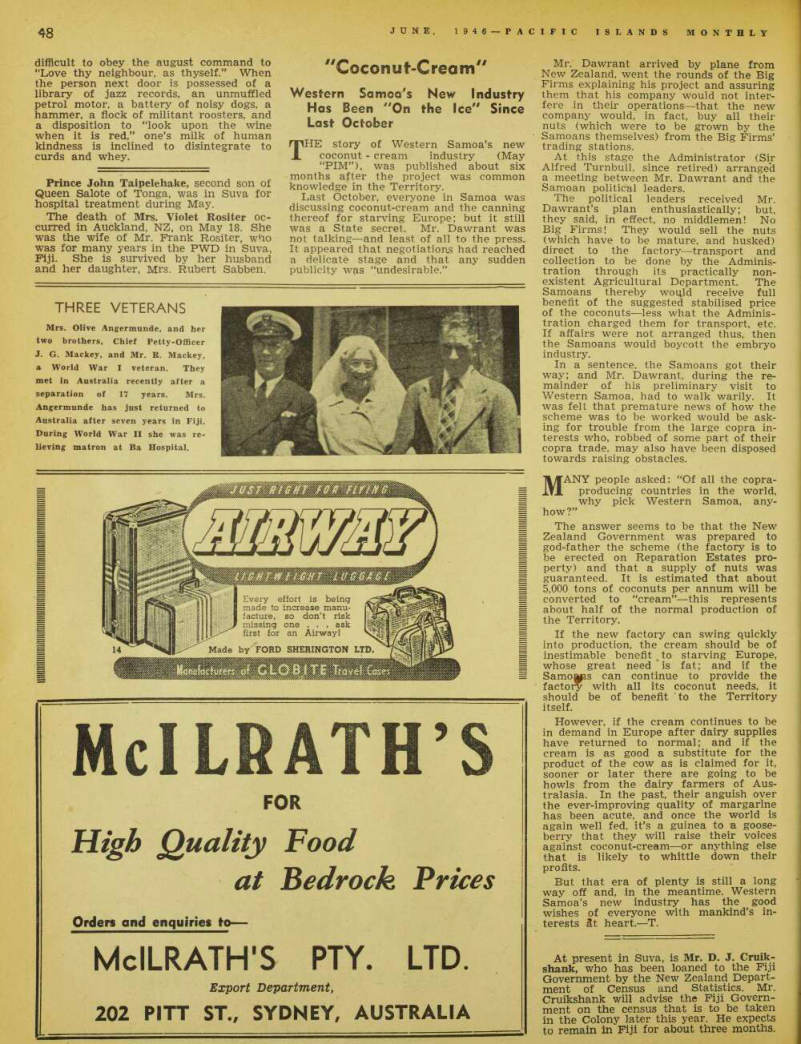
—And Some Peace
Papeete, Mar. 1.
HOW utterly Tahiti and neighbouring archipelagoes have been over whelmed by the Machirte and Jazz Age, is indicated by the almost total disappearance of the horse.
The barometer of tardy post-war re construction is the unabated insolence humble seekers after merchandise have to endure from attendants in some of our Papeete emporiums.
Even our plant life has conformed to the New Era. Many growths have emulated the insolence in the shops by sprouting sharp thorns and irritating burrs.
All our lotus plants have, long ago, been suffocated by carbon-monoxide gas from internal-combustion motors.
Would-be lotus-eaters from abroad have been constrained to seek consolation in the dismal society of the Brotherhood of the Bottle. These disappointed way farers would have done better by staying at home; where the booze is cheaper, and of better quality.
Our native people of the districts are inspired with the spirit of Progress.
Every day they crowd the early morning passenger-freight trucks. At Papeete they pass a few hectic hours watching the endless procession of empty lorries pass and re-pass. When the Cathedral bell announces 4 o’clock they again crowd into the trucks, and arrive home at nightfall.
This custom has broadened the in fluence of 'urban culture over the remote countryside. The visible and audible symbols of this culture are internal combustion motors of all calibres, at tached to everything movable on land, and to everything which floats on the face of the waters.
So far as this writer can discover, all this has produced a general uneasy rest lessness, and the spread of the bad manners of the Papeete market-place, throughout the hinterland, without any compensating advantage to anyone.
For example: In the “Horse and Buggy Age,” copra was carried to convenient shipping-places about the island, loaded into sailing vessels, and transported to Papeete in ample time for despatch by the monthly steamers.
To-day, copra is rushed by truck and motor schooner to Papeete, there to accumulate storage and interest charges and to suffer rapid shrinkage of weight in torrid storehouses, while awaiting the arrival of a steamship.
A journey from the districts to Papeete by horse was a leisurely expedition through a smiling countryside, with fre quent stops for gossip with relatives and friends along the way.
On a journey by truck, one becomes merely an item of miscellaneous cargo
of pigs, fish and human beings, which is rushed to the appointed destination with all possible speed.
This technique of the New York Subway and the Chicago Stock Yards is part of the higher standard of living which
has produced so much felicity through out the world, TINDER the circumstances of the U Gadget Age, one may not forget one’s neighbour; but it is rather
difficult to obey the august command to “Love thy neighbour, as thyself.” When the person next door is possessed of a library of jazz records, an unmuffled petrol motor, a battery of noisy dogs, a hammer, a flock of militant roosters, and a disposition to “look upon the wine when it is red,” one’s milk of human kindness is inclined to disintegrate to curds and whey.
Prince John Taipelehake, second son of Queen Salote of Tonga, was in Suva for hospital treatment during May.
The death of Mrs, Violet Rositer oc curred in Auckland, NZ, on May 18. She was the wife of Mr. Frank Rositer, who was for many years in the PWD in Suva, Fiji. She is survived by her husband and her daughter, Mrs. Hubert Sabben.
Advertisements & other items, pp. 49-50 (1 item)
W. Kopsen & Co.
Woven Wire for all Industry
COPRA DRYING TRAYS, FLOORS, Etc.
FRUU DRYING TRAYS, MINING SCREENS.
Heavy Mosquito Gauze in Phosphor Bronze and other Metals Impervious to Salt Sea Air.
WIRE DOOR MATS AND GENERAL WIRE WORKS
E. WRIGHT & CO. LTD.
Offlee and Works: 148-152 Cleveland Street, Sydney, N.B.W.
Telegraphic Address: “Wrlghtmake,” Chippendale. f- Or £ I*!
MAY SPECIAL:
DEKOL
Guards Wood and Canvas from the Ravages of White Ants, Borers, Dry Rot, Mifdew, etc.
DEKOL penetrates deeply, permanently protecting wood and fabrics from rot and attacks by fungi and insects. It is simple to apply and when dry can be painted and varnished. DEKOL also prevents attack by marine borers on wood immersed in sea water.
PRICE 12/- GAL (4 gal. tins). 14/6 GAL. (I gal. tins).
DON'T WAIT
TILL THIS
HAPPENS.
IKv
ire*
ffy
: a Y , 4 / Trade Inquiries Invited.
Fully descriptive leaflet available on request. Dekol should he used in every home and on every estate and will save pounds per year in damage and expensive replacements.
KAYEN
KEROSENE LAMPS
Reliable, efficient Australian-made pressure vapour lamps, providing a full 300 candlepower of steady, unflickering light at a cost of U pints lighting kerosene in 10 hours.
Popular all-purpose lamp, illustrated, may be used as a hanging lamp, storm lantern or table lamp. Absolutely wind-proof, rainproof and insect-proof. Easily operated and require little maintenance or replacement of spare parts. Practically all parts, including tank, are made of brass to withstand tropical atmospheric conditions, and each lamp is fully tested before despatch. Fully illustrated descriptive leaflet available on request. Also available in handsome tall table design suitable for lounge and dining-room. ‘
W. Kopsen & Co.
Pty. Ltd.
376-382 KENT STREET, SYDNEY
CABLES: KOPSEN, SYDNEY.
’Phone MA6336 (7 lines). Est. 1878.
THREE VETERANS
Mrs. Olive Angermunde, and her two brothers, Chief Petty-Officer J. G. Mackey, and Mr, R. Mackey, a World War I veteran. They met in Australia recently after a separation of 17 years. Mrs.
Angermunde has just returned to Australia after seven years in Fiji.
During World War II she was relieving matron at Ba Hospital.
VST RIGHT fOff nr life t
UGH TtV f f GHT LUGGAGt
' Every effort is being made to increase manu- n&f facture, so don't risk hjr' missing one . . . ask first for an Airway! vjl , f:
Made by FORD SHERINGTON LTD.
jU] .gl C tOBf T£ Travel Cases
McILSATH S
FOR
High Quality
at Bedrock. Prices Orders and enquiries to—
McILRATH'S PTY. LTD.
Export Department ,
202 PITT ST., SYDNEY, AUSTRALIA
"Coconut-Cream"
Western Samoa's New Industry Has Been "On the Ice" Since Last October
THE story of Western Samoa’s new coconut - cream industry (May “PIM”), was published about six months after the project was common knowledge in the Territory.
Last October, everyone in Samoa was discussing coconut-cream and the canning thereof for starving Europe; but it still was a State secret, Mr. Dawrant was not talking—and least of all to the press.
It appeared that negotiations had reached a delicate stage and that any sudden publicity was “undesirable.”
Mr. Dawrant arrived by plane from New Zealand, went the rounds of the Big Firms explaining his project and assuring them that his company would not inter fere in their operations—that the new company would, in fact, buy all their nuts (which were to be grown by the Samoans themselves) from the Big Firms’ trading stations.
At this stage the Administrator (Sir Alfred Turnbull, since retired) arranged a meeting between Mr. Dawrant and the Samoan political leaders.
The political leaders received Mr.
Dawrant’s plan enthusiastically; but, they said, in effect, no middlemen! No Big Firms! They would sell the nuts (which have to be mature, and husked) direct to the factory—transport and collection to be done by the Adminis tration through its practically non existent Agricultural Department. The Samoans thereby would receive full benefit of the suggested stabilised price of the coconuts —less what the Adminis tration charged them for transport, etc.
If affairs were not arranged thus, then the Samoans would boycott the embryo industry.
In a sentence, the Samoans got their way; and Mr. Dawrant, during the re mainder of his preliminary visit to Western Samoa, had to walk warily. It was felt that premature news of how the scheme was to be worked would be ask ing for trouble from the large copra in terests who, robbed of some part of their copra trade, may also have been disposed towards raising obstacles.
MANY people asked: “Of all the copra producing countries in the world, why pick Western Samoa, any how?”
The answer seems to be that the New Zealand Government was prepared to god-father the scheme (the factory is to be erected on Reparation Estates pro perty) and that a supply of nuts was guaranteed. It is estimated that about 5,000 tons of coconuts per annum will be converted to “cream” —this represents about half of the normal production of the Territory.
If the new factory can swing quickly into production, the cream should be of inestimable benefit ,to starving Europe, whose great need is fat; and if the Samoaps can continue to provide the factory with all its coconut needs, it should be of benefit to the Territory itself.
However, if the cream continues to be in demand in Europe after dairy supplies have returned to normal; and if the cream is as good a substitute for the product of the cow as is claimed for it, sooner or later there are going to be howls from the dairy farmers of Aus tralasia. In the past, their anguish over the ever-improving quality of margarine has been acute, and once the world is again well fed, it’s a guinea to a goose berry that they will raise their voices against coconut-cream —or anything else that is likely to whittle down their profits.
But that era of plenty is still a long way off and, in the meantime, Western Samoa’s new industry has the good wishes of everyone with mankind’s in
terests 3t heart-
T.
At present in Suva, is Mr. D. J. Cmik shank, who has been loaned to the Fiji Government by the New Zealand Depart ment of Census and Statistics. Mr.
Cruikshank will advise the Fiji Govern ment on the census that is to be taken in the Colony later this year. He expects to remain in Fiji for about three months.
Vale R. H. Wedd!
r T'HE following tribute to the late * Patrol-Officer R. H. Wedd was written by a Territorian who knew him well in New Guinea: WHEN the Governor of Tasmania, Sir Hugh Binney, held an investiture at Government House, in Hobart, recently, the Distinguished Flying Cross was posthumously awarded to F/Lieut.
R. H. Wedd. I was reminded then that his name was not mentioned in the “PIM” Roll of Honour.
Prior to his enlistment, R. H. Wedd served for 2| years with the New Guinea Administration. He was one of the few who did not contract malaria; however, he was on one occasion speared in the leg and side by natives.
It happened when he made a patrol in the uncontrolled area of Mt. Hagen and the Bismarck Range right through to the Papuan border. The natives were not then familiar with the white men.
During the early war years, Wedd criss crossed the backland of the Wewak dis trict. I met him when he was patrolling the coast, and I remember one special incident when he was sent to Kariru Island to round up a big number of revolutionary-minded natives. The “cargo movement,” secret anti-European pro paganda, had risen then to a dangerous pitch. A few cunning scoundrels, ex-gaol birds most of them, had induced the natives to regard the white men as un authorised intruders, as thieves and liars.
Carried away by mob-hysteria, they per formed special rites, prayers and sacri fices —partly Pagan and partly Christian —in secret sessions, and expected their ancestors to return with ships and planes laden with goods stolen by the white men.
Some of these natives became hostile towards the missions and the Govern ment. Their subsequent experience with the Japanese invaders must have con vinced them of their mistake.
The activities of R. H. Wedd, as Patrol- Officer, suppressed their unrest at that time.
But Wedd felt the urge of higher service; -he wanted to be right in the front line. So he resigned from the Government service and enlisted in the RAAF in September, 1941. He passed successfully his training course in Canada, where his friends called him “Uncle Joe” (maybe because of his pre maturely grey hair and his ever-ready broad grin), and finally got his com mission.
In the second part of 1943 he made many bombing sorties over Germany, but on December 20 his plane was shot down over Frankfurt. It was the last mission of the squadron, and he had volunteered to take the place of another bomb-aimer who had fractured his leg. Four days later the Pathfinder Badge was posthum ously awarded to him.
THUS ended a life full of hope, enter prise, energy, ambition, and outstand ing capabilities that should have meant a great deal to the New Guinea Administration.
Educated at St. Virgil’s College, Hobart, he took a position as school teacher at Catamaran, a frontier outpost in Tas mania.
Later on he proved himself to be an efficient Patrol-Officer in the Central New Guinea mountains and the Sepik swamps.
And then “he completed numerous opera tions against the enemy as a bomb aimer. He always fortitude, courage, and devotion to duty.”
"Surplus" Goods in Lae
Are of Little Value
From Our Own Correspondent LAE, May 25.
RESIDENTS who have returned to Lae are finding conditions somewhat dis couraging. Things officially are all in a whirl, and it is difficult to get any ruling or indication of what to expect.
All the civilians hereabouts seem to be busy salvaging odds and ends of war material, such as beds, buckets, canned goods and so forth. But there is not much left.
Motor transport parks are all around, and they cover acres. Naturally, the first people in, and especially agents of big companies, have picked the eyes out of all the available motor transport, and the smaller men who now have arrived can only turn over the junk that remains.
There are many trucks, lying around here, without engines. The engines have been taken out and shipped south by dealers— and it is said that they paid only 38/each for them. The chassis are lying about here—including hundreds of wheels and tyres—as a Jfiot on the landscape.
Piles of bombs lie scattered around, some of them on private property and now hidden by long grass. Repeated re quests to the Army and Air Force to re move the bombs, or render them safe to handle, are ignored. Some of these offi cials are past masters in the art of “pass ing the buck.” Someone, one of these days, will be blown up by the bombs; and then, perhaps, some official notice will be taken.
At this moment, there is not a cigarette or a drink to be had in this place for love or money. People planning a visit should be warned.
Commander H. Hill, who has been in charge of the New Zealand Navy Office in Fiji for some years, will leave the Colony shortly and the office will then be closed.
Advertisements & other items, pp. 51-52 (1 item)
Wm. H. Watson
Established 1930.
Bankers: Bank of New Zealand, Auckland.
iiiiiiiiiiiiiiiiiiiiiiniiiiiiiiiiim
Wholesale and Retail Trader
RAROTONGA, COOK ISLANDS
Cable Address: Watson, Rarotonga.
AGENTS WANTED.
American Servicemen in the Pacific: Sell Island curios in the Pacific now, and in the U.S.A. when you return home. Send 20.00 to 100.00 dol. for trial order of Motherof-Pearl Brooches and strings of Sea-Shells, all guaranteed good sellers. These goods are sent by parcel post franked with high value Cook Islands stamps, which have a high re-sale value.
PRESENTS FROM THE PACIFIC.
The following 5.00 dol. parcel sent post free to any address in the Pacific or the U.S.A.: 1 Bright coloured Hula-Skirt, with decorated waistband. 3 Strings Assorted Sea-Shells, 60 in. long. 1 Mother-of-Pearl Brooch. 1 Cook Island Pennant—island scene in colours.
ISLAND BOOKS BY
ROBERT DEAN FRISBIE.
This well-known American writer has autographed a limited number of his two latest books, “Island of Desire” and “Amaru,” so that a lew of his fans can secure something that is always treasured, an "Author’s Copy.” The price, 7.00 .dol. ,for the two, sent registered mail to any address. When remitting dollar bills, please register the letter.
THE READER'S DIGEST.'
Have the world’s best Digest posted direct to you from the U.S.A. at the following attractive rates: One year’s subscription, 12/-; two year’s subscription, 20/-; post free.
Send your full name and address and subscription to above Rarotonga address.
STAMP DEALERS AND COLLECTORS.
Covers serviced for Dealers at usual rates. Collectors Send one dollar for two covers franked with the current issue of the Cook Islands stamps, y 2 d. to 1/- (eight stamps per cover). Sent air-mail to any address. To Cover collectors: Here is a “rare” offer—First Day Cover, Cook Island, King George V Jubilee, 1935, complete set, only 5.00 dol. Used sets off cover, Cook Island, King George VI Coronation, 50 cents, per set.
'PARAU'' M.O.P. PRODUCTS.
We manufacture a large assortment of lovely designs made by native craftsmen from Penrhyn Island Pearl Shell.
"RAROTONGA" HULA-SKIRTS.
The finest Hula-Skirts made in the South Seas come from Rarotonga; over 50,000 sold. These are made in bright colours with floral decorated waist-bands.
SHELL NECKLACES.
White, Yellow and assorted Shells, each string 60 in. long. Any quantity can be supplied. Over half a million strings of these popular shells have been exported. Terms — D/P your own bank.
ISLAND FOOTWEAR.
Made in our own factory here in Rarotonga. At present specialising in women’s Road and Evening Sandals. Extra wide lasts, suitable for native trade. Best materials used.
Sizes, 3-7. Colours: white, black and brown. Be the first in your territory to stock this good seller by cabling for trial order of dozen pair, assorted colours, designs and sizes.
BUTTERFLIES
and the Larger Moths
WANTED
From all sections of the Pacific Islands.
Will pay not less than: $25.00 per 1,000 for common attractive Butterflies. $30.00 to $50.00 per 1,000 for showey papilios, larger Butterflies and Moths.
For large Moths and Ornithopteras and the Rarer Species, will pay from $lO.OO to $50.00 per 100 specimens.
MUST BE PERFECT FIRST
QUALITY ONLY.
Collectors or Missionaries who can supply us, please get in touch with us. Will pay for samples selection, and advance money to good collectors.
Butterfly World Supply Mouse,
289 East 98th Street,
Brooklyn, 12,
New York, U.S.A.
Asthma Curbed In 3 Minutes
Since the discovery of Mendaco by a famous physician sufferers can get relief from Asthma. Mendaco does away with expensive Injections and offensive smokes.
All you do is to take 2 tasteless tablets with meals and Mendaco starts circulating through the blood in 10 minutes. You breathe easily and freely. Your nerves relax, you get good, fresh, pure air into your lungs, and vigour returns.
Sleep Like a Baby
Thousands of former sufferers from Asthma say that the very first dose of Mendaco brought them glorious ease and comfort, and that they slept soundly the very first night. Then their vigour returned and they felt healthier and stronger, and 5 to 10 years younger. The reason for this is that Mendaco acts in natural ways to overcome the effects of Asthma. (1) It removes the mucus or phlegm; (2) It relaxes thousands of tiny muscles In your bronchial tubes so that the air can get in and out of your lungs; (3) It promotes body vigour, and stimulates the building of rich, revitalised blood.
No Asthma for Five Years
Mendaco not only brings almost Immediate results, free breathing and comfort and enables you to sleep, but also builds up the system to ward off future attacks. Mr.
J. R. writes: “I was almost dead with Asthma. Had lost 40 lbs. In weight, snf-
fered coughing every night—couldn’t sleep.
Mendaco stopped spasms first night. I have had no Asthma since in over 2 years.”
Mrs. A. W. writes: “I had Asthma for 25 years. After using Mendaco I can sleep all night and have not had an attack since taking it.” Mrs. G. E. C. writes: “I bless the day I first heard of Mendaco. What a godsend it is to a poor woman like me who for 35 years never knew what it was to have a good night’s rest. The constant fight between Asthma and sleep was wearing me down, but I feel now I want to forget my past suffering.”
Benefits Immediate
The very first dose of Mendaco goes right to work circulating through your blood and helping nature rid you of the effects of Asthma. Try Mendaco under an iron-clad money back guarantee. You be the judge.
If you don’t feel fully satisfied after taking Mendaco just return the package and the purchase price will be refunded. Get Mendaco from your chemist to-day and see how well you sleep to-night and how much better you will feel.
RELIEVES ASTHMA
Mendaco
Now in 2 sizes 6/- and 12/-
Interesting Sidelights On Jap
Occupation Of Nauru Is.
AN Interesting account of the crucifixion of Nauru by the Japanese, and of the work of rehabilitation now being earned on there by the new Administra tor Mr. Ridgeway, was given by Mr. E. M.
Gollan, of the staff of Amalgamated Wireless, Ltd., on his return to Australia recently.
Mr. Gollan was in charge of the radio station on Nauru when the Pacific war started; he gave distinguished service as a radio officer during the Pacific war and he went back to Nauru six months ago to re-establish the radio station there. That work now has been com pleted.
Mr. Gollan and his assistants had lis tened to the American radio account of the attack on Pearl Harbour on December 8. 1941; and Mr. Gollan was talking to the late Administrator, Colonel F. R. Chal mers, that fateful day, when they heard the noise of a squadron of big ’planes ap proaching the island.
“Ah, ha!” said the Administrator, “the Americans weren’t long in getting here ”
“I am afraid these are not the Ameri cans. sir,” said Mr. Gollan, “I think we are in for an air attack.”
And they certainly were. The Jap ’planes came over and concentrated on Mr. Gollan's radio station, while all the population thereabouts dashed off for shelter into the nearby pinnacles.
The pinnacles are the finger-shape for mations of very hard coral, 20 feet high, which stand up in patches on the island of Nauru, like a petrified forest, wherever the phosphate workings have been. The phosphate is dug out from between the pinnacles, and it is quite easy to walk about the innumerable passages. There could not be a better air raid shelter.
The Japs missed the radio station at
that time, but they came back every day for four days, and finally demolished it.
In . ff 1 . 6 meantime, however, Mr. Gollan and his men had moved their radio equip ment down into a secret place among the pinnacles, and from there they carried knew they were stm operat then concentrated on the pin . A , lu cky bomb one day up the radio station and punctured Mr Gol if?th n P ti?°fn Ple f places: but th ey' were thev h keiS ?L 0 lJy a - very short time and they kept the service going until the European communities were evacuated from Nauru and Ocean Island to Aus tralia m March, 1942.
The Administrator (Colonel Chalmers) was one of those who elected to remain in Nauru, to help the natives, and he was murdered by the Japs. The Europeans were brought away from Nauru and Ocean Island m the Free French destroyer Triomphante.” She was one of the most modern warships in the Pacific, and could do 45 knots, and so could elude sub marines.
WHEN Mr. Gollan left Nauru in 1942 there were approximately 1,800 Nauruan natives and 300 Chinese . th !? e - When the Australians returned to Nauru, after the collapse of Japan, there were only 1,200 Nauruans fi lve iTT, incl yding those located In the Marshall and Caroline Islands and re patriated—and half the Chinese. All the rest were dead—mostly from starvation, although a large number were mur dered.
Both Nauruans and Chinese were in very bad shape. They had been living for a long time on a diet of pumpkin. The Japanese had grown literally millions of pumpkins, in an attempt to solve the food problem—and as they used mainly human excreta to fertilise the pumpkins, and as Pf rcei jtage of the pumpkins had rotted, the stench on what was once known as “Pleasant Island” was beyond description. J rE Nauru to which the Australians re turned in October, 1945, was almost a complete wreck. Our people, before they evacuated, had demolished the es sential parts of the phosphate workings vast masses of plant which had cost millions.
The Japanese built two airstrips and, m doing that, they ripped up large parts of the fertile strip which lies between the coast and the phosphatic rock in terior. The whole coastal strip to the southwards of the loading installation, whereon was located the administrative buildings and the residency, and all the coconut palms thereabouts, were des troyed, and a very big airfield built, from which Japanese ’planes frequently operated and which, since October 1945 has been regularly used by American and British ’planes.
Some time in 1944 the Japanese were busily constructing a third airstrip, in connection with that operation, they brought in, close alongside the shore, a large vessel, which was loaded with petrol, stores and troops. An American sub marine crept in and torpedoed her. Only seven Japs escaped from the terrible ex plosion and destruction which followed.
After that, the Japanese abandoned the airstrip job, and seemed to lose interest in Nauru altogether. From then on, few supply ships got through to their garrison on Nauru.
Mr. Gollan remarked, as a curious side
light on Japanese character, that one of his Nauruan assistants, who had been helping the Japanese in the construction of the airstrip, said that when the supply ship exploded, and caused such enormous damage and loss of life, the Japanese among whom he was working treated the disaster as a huge joke, and laughed Immoderately.
Most of the wreckage on Nauru was caused by American bombers—they visited the island again and again, and the de struction they wrought was terrific.
Three or four American ’planes were shot down in these attacks; and the Austra lians, when recently searching for the murdered bodies of the Administrator and the Europeans who stayed there with him, found the bodies of four American airmen, and these were recently sent back to the US. The bodies of the Australian officials have not been discovered, “The fortifications established on Nauru by the Japanese have to be seen to be believed,” said Mr. Gollan. “They estab lished positions of enormous strength among the pinnacles and, for that pur pose, they used large quantities of cement and a great deal of the steelwork from the phosphate plant. They had big guns scattered everywhere, machine-gun posts on every pinnacle, and their tunnels ex tended 60 feet underground. Nauru would have been a very difficult nut to crack.
No amount of shelling from the sea could have destroyed those fortifications.”
Mr. Gollan was deeply interested in the radio equipment put in by the Japs. They had 16 transmitters on the island—some of them very powerful instruments— indicating that they were part of an in stallation to jam our radio in the Paci fic generally—Nauru being well situated for that purpose. They had beautiful appliances—all German circuits, with Japanese construction. They had two
large radar stations—evidently based on British equipment captured in Singapore.
“Hyfß. RIDGEWAY is doing a splendid ItX job of rehabilitation in Nauru,” said Mr. Gollan. “He is construct ing model villages for the natives, and is making the fullest use of the captured Japanese equipment and the surplus stores from the Australian Army. As a result of this, electric light and radio sets are going into every village. There is plenty of Japanese radio and other equip ment for this purpose.
“Australians are faced with the problem of rebuilding the Nauru population, and are taking all possible means to encour age natural increase. % For three months the native people were given free rations.
There is much constructional work to be done and the natives are expected to assist. All native families who are co operating are enjoying child endowment —the first time this system has been tried in a Pacific native community. A Nauruan who is working receives 5/per month for his wife, and 5/- on account of each child. The Nauruans are a fine type and it is hoped that they soon will regain their numbers.”
Mr. Gollan paid a brief visit to Ocean Island, whose installations have not been damaged to anything like the extent of Nauru, and he expects that phosphate production in Ocean Island will com mence quite soon, whereas many months must elapse before there will be shipment from Nauru.
MR. GOLLAN had a talk with the Banaban (Ocean Island) native who was the sole survivor of the massacre of Banabans by the Japanese (see description in “PIM” in May). The Banaban lived in his underground shelter —into which he had escaped from the Japs—for 93 days, and his skin became almost as white as that of a European.
He saw the Australians land on Ocean Island but, fearing a Japanese trick, he remained hidden. He only came out of -his cave when, one day, he heard some Banabans and Gilbertese talking nearby and realised that the cruel invaders had at last been defeated, During the Japanese occupation of Nauru the Nauruans were compelled, whenever Japanese soldiers passed, to line the roads and bow humbly, Soon after the Australians landed and occupied Nauru, the Nauruans, laughing and excited, saw a couple of lorry-loads of Japanese prisoners approaching. They stopped the lorry, made the Japanese line the road and bow again and again while the Australian troops marched past, Ma, the well-known Chinese interpre ter with the Chinese labourers on Nauru, was very cruelly treated by the JaPS the latter, as general practice, inflicted all kinds of tortures and humiliations upon the helpless Chinese, When It was known that the Japanese prisoners were to be shipped away from Nauru, Mr. Ma approached the Adminis trator, explained that he had “lost face ” and asked if he could have just one quarter-hour alone with a certain Japan ese—a doctor.
Mr. Ridgeway said that that was out side his province. Would Mr. Ma please see the officer in charge of the Australian force.
When Colonel Kelly heard Mr. Ma’s re saffi St “I h ? like you to harm any They will be going abroad at this evening," he addedwitha twinkle "and I should like them to be shinned awav all nice arid tidv ” PP Way all Mr Ma thanked the colonel and re tired manKea me coionei, and re- That evening as the Jananp^
being assembled’at for ship!
ment, Mr. Ma stepped forward and ap proached the Jap doctor, “Oh, doctor,” he said, “may I have just one word with you?”
The doctor stepped aside with Mr. Ma.
In plain words of one syllable, Mr. Ma told the Jap doctor what he was; and then, using a conveniently-shaped piece of angle-iron, he conveyed to the Jap doc tor his personal sentiments, in a simple way, before the Australian guards could interfere.
The Jap doctor was carried aboard on a stretcher, and Mr. Ma returned to the Chinese lines with his face “saved.”
Colonel J. P. and Mrs. Magrane left Fiji recently for NZ. Colonel Magrane came to Fiji in 1939 as Commissioner of Police. Later, he was transferred to the Fiji Military Forces and, since Brigadier G. Dittmar left the Colony at the end of 1945, he has been in command of the Forces.
Advertisements & other items, pp. 52-54 (2 items)
50
JtJttE, 1946 fACI P t C ISLANDS MONTHLY
Wid D O P
xmv?
MOIST
9
DIESEL ENGINES
WID D O P
S H.P. to 500 H.P.
H. WIDDOP & CO., LTD. GREEN^ T G E l^ E D ,GHLEY Telephone; Keighley 3727-8 .. T , Codes A.B.C. 6th Edition, Bentleys, Bentley’s Second B™™ 8 ™™ ' ° P e '* ** We are prepared to consider Agencies for certain territories / Motor Coaster S. America. / iff!
Fi refloat, Egypt.
JOID
Passenger Ferry, I Nigeria.
Tug, England Passenger Boat, Middle East. cvs-80
MK 111 For Inflcmed Eyes and Eyelids ... Sold Everywhere H. Rose&Co.,Pty„Lid.. Kinq Street. Sydney.
ALL STOREKEEPERS HAVE—
AUNT
MARYS
BAKING POWDER
Aunt Mary's Baking Powder is now obtainable from your storekeeper. That's good news for you, especially as Aunt Mary's Baking Powder maintains the high quality which has stood the test of housewives for over 70 years.
There is no substitute for Aunt Mary's—There never will be.
Pay, Or Stay!
What Australian Tax Dept. Did to a Returning Papuan Planter
AS an example of how Australia treats Territorians, consider the case of Mr. A. E. Cridland.
Mr. Cridland was a senior officer of the Papuan Public Service. When he retired on superannuation, in the later ’thirties, he decided to remain in Papua; and he settled down on some land he had bought on the north-east coast, and began to plant rubber. He was going along quietly and comfortably when the Jap invasion came.- Then, with his wife and child, he was shipped away to Syd ney, at short notice. They lost prac tically all their personal possessions.
In Sydney, Mr. Cridland found a modest wartime job in a Government De partment. He drew his superannuation allowance, on which he was ferociously taxed, and a salary, which also was taxed.
Four years later, Mr. Cridland was given permission to return to his planta tion. He made the Territorians’ usual weary round—to Territories, to Shipping Office, to Travel Control, to Custom House, to Taxation—and slowly gathered all the documents necessary for travel in these bureaucrat-ridden days.
He produced to Taxation his receipts for income tax paid up to date. But Taxation grinned fiendishly, “You can’t
do that there ’ere,” said Taxation. Then, the Cndland income from superannuation was added to the modest Cridland income from the wartime job. “That total,” said Taxation, with glee, “makes so-and-so— and that puts you right up in another bracket.’ You are a bloated plutocrat, and you have been undertaxed. You should have paid at a much higher rate.”
AND there and then the unfortunate Mr. Cridland was informed that he could not get a clearance, which would allow him to travel to Papua, un less he paid up £5OO, uncollected tax.
Mr. Cridland is a fighter, and he re fused to pay. In any event, he was faced with heavy expense in rehabilitation, and £5OO mattered a great deal to him. But the Taxation Department stuck its toes in. “No cheque, no clearance,” it said.
Fnally, pending an appeal, a trust fund was created in Mr. Cridland’s bank he paid £5OO into it; if he loses the appeal, his £5OO goes into the maw of the Australian Treasurer. Mr. Crid land got his clearance, and sailed by the “Montoro.”
However, if he loses his £5OO, Mr. Crid land at least will have the satisfaction of knowing that he personally will be pay ing something towards the cost of the construction of a “model village” for Papuan natives, complete with electric light and modern sanitation.
Across the range, on their rubber plan tation, Mr. and Mrs. Cridland, and their little daughter, get along somehow with kerosene lamps, and much cruder sani tary conveniences. But they are only Europeans!
French Observer At Bikini
rpHE American Government has invited A the French Government to send official observers to be present at the atomic bomb experiments which will take place in the months of July and August at the atoll of Bikini.
The French Government has appointed M. Parodi, French Ambassador, M.
Frederic Joliot-Curie, member of the In stitute and high commissioner to the Commission for atomic energy, and Pro fessor Pierre Auger, director of higher education, to observe the tests.
Back in Suva, Fiji, after many adven tures, is Mr. Mark White, who was ac companied from New Zealand 'by Mrs.
White. Mark enlisted in the RAAF early in the war, and was stationed in Rabaul, New Britain, at the time of the Japan ese invasion. In company with another ex-Fiji resident, Mr. Jim Peterson, he escaped into the New Britain jungle, and eventually reached Australia, Mr. Arthur McConnell, who was born in Taveuni, Fiji, 69 years ago, and lived there until 1935, died in Sydney in May.
He is survived by several daughters—one of whom is Mrs. Harness, of Taveuni— and a son.
Advertisements & other items, p. 54 (1 item)
Western Samoa
Most Delightful Holiday Resort in Polynesia
WHY NOT SPEND THE WINTER
MONTHS AT THIS SPACIOUS AND
BEAUTIFULLY-SITUATED HOTEL?
Write for Details to MRS. ANNIE M. JONES, Proprietress The Casino Hotel Apia - Western Samoa
Inquiry Into Campaigns
Fought in Rabaul, Timor, Ambon Australian Organisations Demand Royal Commission
ACCORDING to a recent issue of “Smith’s Weekly,” several Australian ex-Servicemen’s organisations in Melbourne will soon launch a campaign for a Royal Commission into causes and effects of Australia’s campaigns in Rabaul, Timor and Ambon.
These Associations are behind the demand: Prisoner of War Relatives’ As sociation, War Bereaved Parents’ Asso ciation, Eighth Division SAF Auxiliary, 1/2 Battalion AIF Association, Fathers’
Investigation Committees of Upwey and Caulfield (Victoria), and Sailors’, Soldiers’ and Airmen’s Fathers’ Association.
Their aim is to whip up public opinion in support of a demand for an inquiry, says “Smith’s.”
Territorians have been making a simi lar demand for years, but so far they have been ignored, while the officer who is responsible for the murder of 300 civi lians and hundreds of soldiers in aban doned Rabaul is protected by the Aus tralian Government.
Their demands were supported by the “Pacific Islands Monthly,” by the Sydney “Daily Telegraph” and other newspapers; but, as reported by our Canberra corres pondent in May “PIM,” Canberra turned a deaf ear to all appeals.
When Mr. A. Cameron asked in Parlia ment in April for an inquiry into Rabaul, Koepang and other campaigns, Prime Minister Chifley said that he had never heard of previous appeals; Minister for the Army, Mr. Forde, said he had nothing to say.
Perhaps the appeal of Melbourne or ganisations will have more success—al though this is doubtful. Canberra, in view of the fact that the Federal elec tions are now only four months away, is showing a strange and sometimes tactless reluctance to appease electors.
“Smith’s” says that the Royal Com mission, envisaged by the Committee handling the demand, would be given terms of reference that would inquire also into treatment that Australian soldiers received at the hands of their own officers while they were POW. A document set ting out allegations in detail and signed by representatives of all organisations connected with agitation for inquiry has been forwarded to five members of the House of Representatives—H. L. Anthony, A. G. Cameron, T. W. White, W. G.
Turnbull and R. S. Ryan.
No specific mention is made of civilian casualties of the Rabaul disaster. Per haps it would be as well for Territorians’ organisations to add their voices to those of the Australian bodies now preparing to do battle with the despots of Can berra.
The Colonial Secretary of Fiji, Mr. J. F.
Nicoll, left the Colony in April. He will proceed to England, via New Zealand, on leave.
Mrs. Eva Standen now has settled down on her mission station in the Gulf Division of Papua, to which she re turned, after nearly four years’ absence a few months ago. Mr. Standen Is still en gaged with an RAAF search party in the Sepik River country, on the tragic job of seeking for ’planes which crashed there during the Pacific war. When that is finished, he will rejoin his wife in their famous “the mission in the mud.”
Sg?"bofh'of whom"^ Z clny
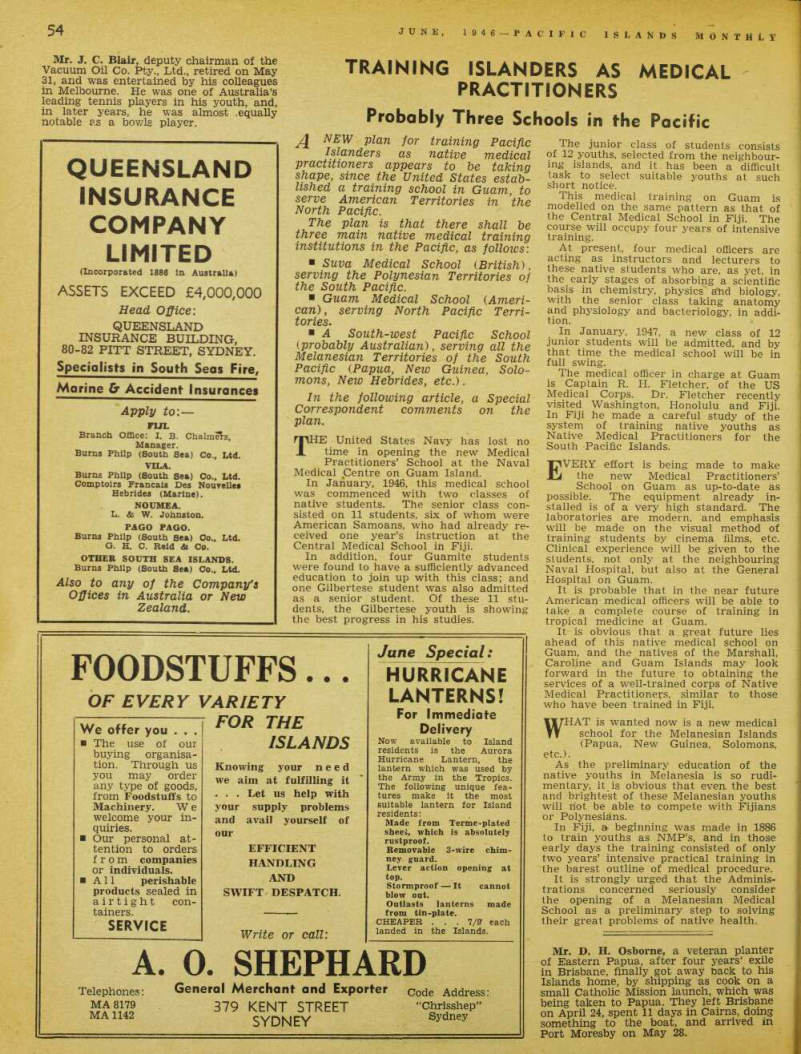
Death Of Fiji Resident
Mr. P J. Turner
THE death of a well-known resident of the Colony, Mr. P. J. Turner, oc
-14 *ll6 wasTthe
0 " Tl. Turned and* was
born on the Rewa River, 66 years ago.
In late years Mr. Turner had leased
much of his land to Indian sugar-growers while he resided in the family home at Nasese. In addition, he was interested i n timber milling in the Buca Bay dis trict. He took a keen interest in sport and was a prominent member of the Suva Gun Club.
He is survived his son - Mr - James
Sg?"bofh'of whom"^ Z clny
Mrs Alport Barker, of Suva, is his sister.
Mr. J. C. Blair, deputy chairman of the Vacuum Oil Co. Pty., Ltd., retired on May 31, and was entertained by his colleagues in Melbourne. He was one of Australia’s leading tennis players in his youth, and, in later years, he was almost .equally notable as a bowls player.
Advertisements & other items, pp. 55-56 (2 items)
53
t* AC m 0 ISLANDS MONTHLY jtJNE, 1946
SI L RO H U Quality Firearms and Fishing Tackle.
WANTED TO BUY—QUALITY GUNS AND RIFLES
HIGHEST PRICES GIVEN. WILL ALSO EXCHANGE GUNS.
New .303 Short Service Barrels, 25}fc”, without Sights and Platform, £2/16/- each.
Postace extra.
SI L RO H U Quality Firearms and Fishing Tackle. 143 ELIZABETH STREET (Near Market St.) SYDNEY.
■PHONE: MA 3540.
NOW AS ALWAYS
DEPENDABLE
For over forty years COLEMAN has built a reputation for dependability in lighting, cooking and heating appliances. Built from the same first quality materials as always, with the exclusive Coleman features, you are always assured of the best when you buy dependable Coleman. Wherever you are there is a Coleman dealer to serve you with dependable COLEMAN appliances and service.
AGENTS
Robert Gillespie Pty. Ltd. 54A Pitt St., Sydney, N.S.W, Pearce & Co. Ltd., SUVA.
THE COLEMAN LAMP
AND STOVE COMPANY LIMITED
TORONTO. CANADA
CHICAGO. U.S.A
QUEENSLAND
INSURANCE
COMPANY
LIMITED
(Incorporated 1886 In Australia)
ASSETS EXCEED £4,000,000
Head Office :
QUEENSLAND
INSURANCE BUILDING,
80-82 PITT STREET, SYDNEY.
Speciolists in South Seas Fire,
Marine Cr Accident Insurances
Apply to:—
n/L Branch Office: I. B. Chalmers, Manager.
Burns Philp (South Sea) Co., Ltd.
VILA.
Burns Philp (South Sea) Co., Ltd.
Comptoirs Francals Des Nouvelles Hebrides (Marine).
NOUMEA.
L. <fe W. Johnston.
PAGO PAGO.
Burns Philp (South Sea) Co., Ltd.
G. H. C. Reid is Co.
OTHER SOUTH SEA ISLANDS.
Burns Philp (South Sea) Co., Ltd.
Also to any of the Company's Offices in Australia or Hew Zealand.
FOODSTUFFS...
OF EVERY VARIETY
We offer you . . . ■ The use of our buying organisation. Through us you may order any type of goods, from Foodstuffs to Machinery. W e welcome your inquiries. ■ Our personal attention to orders from companies or individuals. ■ A 11 perishable products sealed in airtight containers.
SERVICE
FOR THE
ISLANDS
Knowing your need we aim at fulfilling it . . . Let us help with your supply problems and avail yourself of our
EFFICIENT
HANDLING
AND
SWIFT DESPATCH.
Write or call :
June Special:
HURRICANE
LANTERNS!
For Immediate
Delivery
Now available to Island residents is the Aurora Hurricane Lantern, the lantern which was used by the Army in the Tropics.
The following unique features make it the most suitable lantern for Island residents: Made from Terme-plated sheet, which is absolutely rustproof.
Removable 3-wire chimney guard.
Lever action opening at top.
Stormproof—'lt cannot blow out.
Outlasts lanterns made from tin-plate.
CHEAPER ... 7/? each landed in the Islands.
A. 0. SHEPHARD
Telephones: MA 8179 MA 1142 General Merchant and Exporter Coc j e Address:
379 KENT STREET “Chrisshep”
SYDNEY Sydney
Practitioners
Training Islanders As Medical
Probably Three Schools in the Pacific
A NE W plan for training Pacific Islanders as native medical practitioners appears to he taking shape, since the United States estab lished a training school in Guam, to serve American Territories in the North Pacific.
The plan is that there shall he three main native medical training institutions in the Pacific, as follows: ■ Suva Medical School (British), serving the Polynesian Territories of the South Pacific. ■ Guam Medical School (Ameri can) , serving North Pacific Terri tories. ■ A South-west Pacific School (probably Australian) , serving all the Melanesian Territories of the South Pacific (Papua, New Guinea, Solo mons, New Hebrides, etc.).
In the following article, a Special Correspondent comments on the plan .
THE United States Navy has lost no time in opening the new Medical Practitioners’ School at the Naval Medical Centre on Guam Island.
In January, 1946, this medical school was commenced with two classes of native students. The senior class con sisted on 11 students, six of whom were American Samoans, who had already re ceived one year’s instruction at the Central Medical School in Fiji.
In addition, four Guamite students were found to have a sufficiently advanced education to join up with this class; and one Gilbertese student was also admitted as a senior student. Of these 11 stu dents, the Gilbertese youth is showing the best progress in his studies.
The junior class of students consists of 12 youths, selected from the neighbour ing islands, and it has been a difficult task to select suitable youths at such short notice.
This medical training on Guam is modelled on the same pattern as that of the Central Medical School in Fiji. The course will occupy four years of intensive training.
At present, four medical officers are acting as instructors and lecturers to these native students who are, as yet, in the early stages of absorbing a scientific basis in chemistry, physics and biology, with the senior class taking anatomy and physiology and bacteriology, in addi tion.
In January, 1947, a new class of 12 junior students will be admitted, and by that time the medical school will be in full swing.
The medical officer in charge at Guam is Captain R. H. Fletcher, of the US Medical Corps. Dr. Fletcher recently visited Washington, Honolulu and Fiji.
In Fiji he made a careful study of the system of training native youths as Native Medical Practitioners for the South Pacific Islands.
EVERY effort is being made to make the new Medical Practitioners’
School on Guam as up-to-date as possible. The equipment already in stalled is of a very high standard. The laboratories are modern, and emphasis will be made on the visual method of training students by cinema films, etc.
Clinical experience will be given to the students, not only at the neighbouring Naval Hospital, but also at the General Hospital on Guam.
It is probable that in the near future American medical officers will be able to take a complete course of training in tropical medicine at Guam.
It is obvious that a great future lies ahead of this native medical school on Guam, and the natives of the Marshall, Caroline and Guam Islands may look forward in the future to obtaining the services of a well-trained corps of Native Medical Practitioners, similar to those who have been trained in Fiji.
WHAT is wanted now is a new medical school for the Melanesian Islands (Papua, New Guinea, Solomons, etc.).
As the preliminary education of the native youths in Melanesia is so rudi mentary, it. is obvious that even, the best and brightest of these Melanesian youths will not be able to compete with Fijians or Polynesians.
In Fiji, a beginning was made in 1886 to train youths as NMP’s, and in those early days the training consisted of only two years’ intensive practical training in the barest outline of medical procedure.
It is strongly urged that the Adminis trations concerned seriously consider the opening of a Melanesian Medical School as a preliminary step to solving their great problems of native health.
Mr. D. H. Osborne, a veteran planter of Eastern Papua, after four years’ exile in Brisbane, finally got away back to his Islands home, by shipping as cook on a small Catholic Mission launch, which was being taken to Papua. They left Brisbane on April 24, spent 11 days in Cairns, doing something to the boat, and arrived in Port Moresby on May 28.
Airways
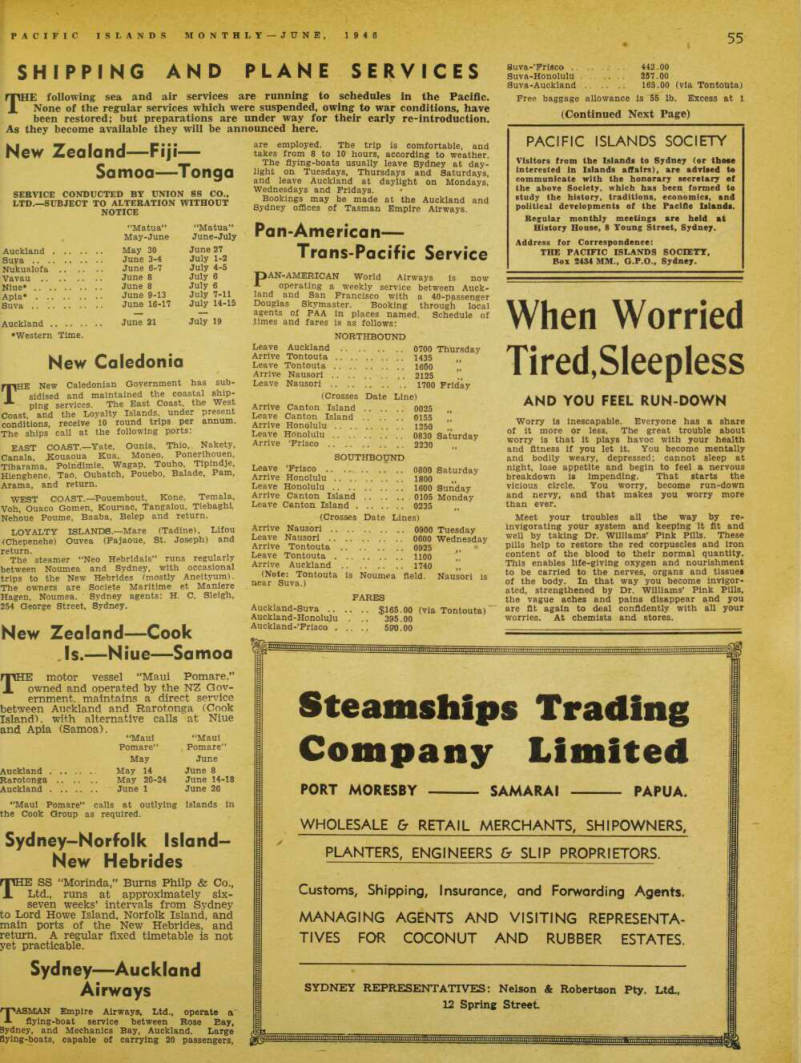
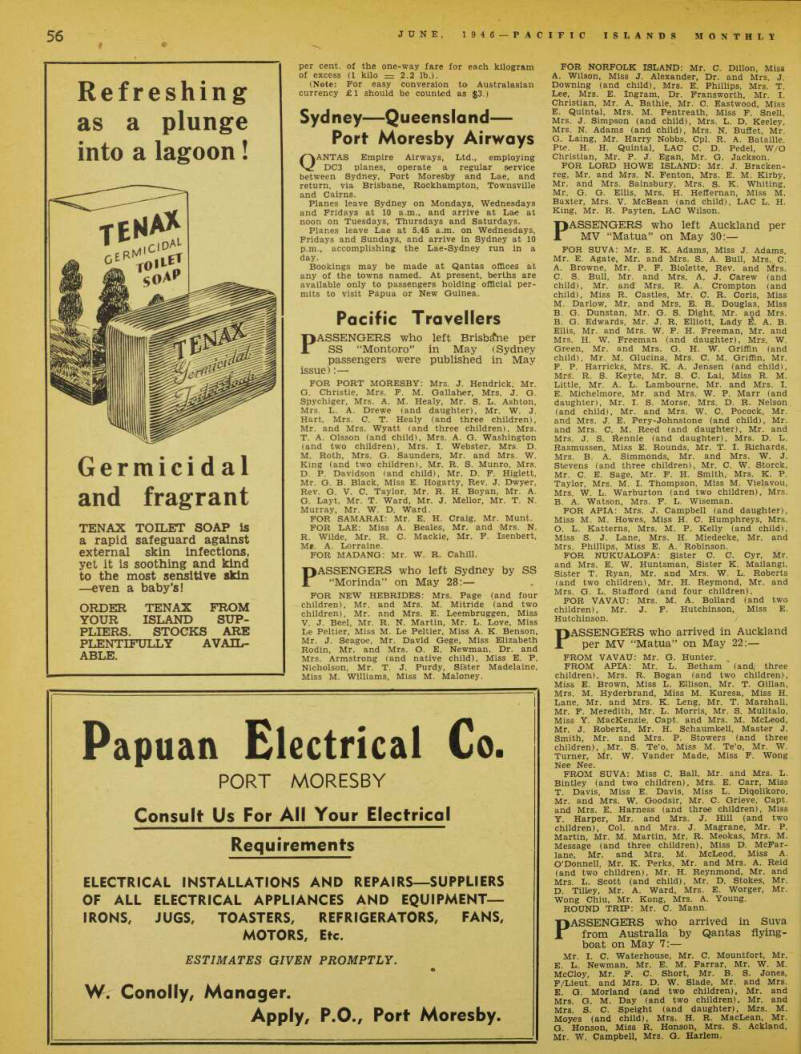
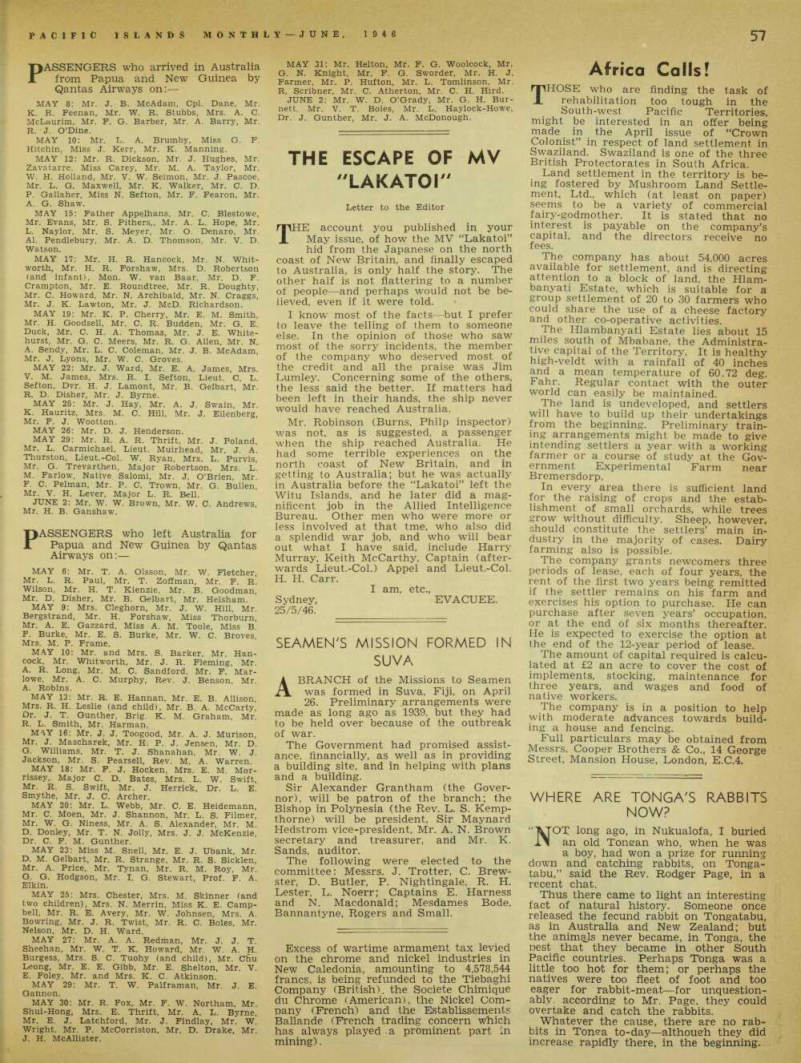
Shipping And Plane Services
rE following sea and air services are running to schedules in the Pacific.
None of the regular services which were suspended, owing to war conditions, have been restored; but preparations are under way for their early re-introduction.
As they become available they will be announced here.
New Zealand—Fiji—
Samoa—Tonga
Service Conducted By Union Ss Co.,
Ltd.—Subject To Alteration Without
Notice
New Caledonia
rE New Caledonian Government has sub sidised and maintained the coastal ship ping services. The East Coast, the West Coast and the Loyalty Islands, under present conditions, receive 10 round trips per annum.
The ships call at the following ports: EAST COAST.—Yate, Ounia, Thio, Nakety, Canala JCouaoua Kua, Moneo, Ponerihouen, Tibarama, Poindlmie, Wagap, Touho. Tipindje, Hienghene, Tao. Oubatch, Pouebo, Balade, Pam, Arama, and return.
WEST COAST.— Pouembout, Kone, Temala, Voh, Ouaco Gomen, Koumac, Tangaiou, Tiebaghi, Nehoue Poume, Baaba, Belep and return.
LOYALTY ISLANDS—Mare (Tadine), Lifou (Chepenehe) Ouvea (Pajaoue, St. Joseph) and return.
The steamer “Neo Hebrldais” runs regularly between Noumea and Sydney, with occasional trips to the New Hebrides fmostly Aneityum).
The owners are Societe Maritime et Manlere Hagen. Noumea. Sydney agents: H. C. Sleigh, 254 George Street. Sydney.
New Zealand—Cook
Is.—Niue—Samoa
rnHE motor vessel “Maui Pomare ”
X owned and onerated by the NZ Gov ernment. maintains a direct service between Auckland and Rarotonga (Cook Island), with alternative calls at Niue and Apia (Samoa).
“Maul Pomare” calls at outlying Islands in the Cook Group as required.
Sydney-Norfolk Island-
New Hebrides
rpHE SS “Morinda,” Burns Philp & Co., J. Ltd., runs at approximately six seven weeks’ intervals from Sydney to Lord Howe Island, Norfolk Island, and main ports of the New Hebrides, and return. A regular fixed timetable is not yet practicable.
Sydney—Auckland
Airways
TASMAN Empire Airways, Ltd., operate a flying-boat service between Rose Bay, Sydney, and Mechanics Bay, Auckland. Large flying-boats, capable of carrying 20 passengers,
are employed. The trip is comfortable, and takes from 8 to 10 hours, according to weather.
The flying-boats usually leave Sydney at day light on Tuesdays, Thursdays and Saturdays, and leave Auckland at daylight on Mondays.
Wednesdays and Fridays.
Bookings may be made at the Auckland and Sydney offices of Tasman Empire Airways.
Pan-American—
Trans-Pacific Service
jpAN-AMERICAN World Airways is now -*• operating a weekly service between Auck land and San Francisco with a 40-passenger Douglas Skymaster. Booking through local agents of PAA In places named. Schedule of times and fares is as follows:
Northbound
Leave Auckland 0700 Thursday Arrive Tontouta 1435 Leave Tontouta 1600 Arrive Nausori 2125 Leave Nausori 1700 Friday (Crosses Date Line) Arrive Canton Island 0025 Leave Canton Island 0155 Arrive Honolulu 1250 Leave Honolulu 0830 Saturday Arrive ’Frisco 2230
Southbound
Leave ’Frisco 0800 Saturday Arrive Honolulu 1800 Leave Honolulu 1600 Sunday Arrive Canton Island 0105 Monday Leave Canton Island 0235 (Crosses Date Lines) Arrive Nausori 0900 Tuesday Leave Nausori 0600 Wednesday Arrive Tontouta 0925 Leave Tontouta 1100 Arrive Auckland 1740 (Note: Tontouta is Noumea field. Nausori is near Suva.)
Fares
Auckland-Suva $165.00 (via Tontouta)
Auckland-Honoluju . .. 395.00
Auckland-’Frlsco 590.00
(Continued Next Page)
“Matua”
“Matua”
May-June June-July Auckland May 30 June 27 Suva June 3-4 July 1-2 Nukualofa June 6-7 July 4-5 Vavau June 8 July 6 Niue* June 8 July 6 Apia* June 9-13 July 7-11 Suva June 16-17 July 14-15 Auckland •Western Time.
June 21 July 19
Suva-’Prl«co 442.00 Suva-Honolulu 287.00 Suva-Auckland 165.00 (via Tontouta) Free baggage allowance Is 55 lb. Excess at 1
“Maul “Maul Pomare" Pomare”
May June Auckland May 14 June 8 Rarotonga May 20-24 June 14-18 Auckland June 1 June 26
per cent, of the one-way fare for each kilogram of excess (1 kilo 2.2 lb.). (Note: For easy conversion to Australasian currency £1 should be counted as $3.)
Sydney—Queensland—
Port Moresby Airways
QANTAS Empire Airways, Ltd., employing DC3 planes, operate a regular service between Sydney, Port Moresby and Lae, and return, via Brisbane, Rockhampton, Townsville and Cairns, Planes leave Sydney on Mondays, Wednesdays and Fridays at 10 a.m., and arrive at Lae at noon on Tuesdays, Thursdays and Saturdays.
Planes leave Lae at 5.45 a.m. on Wednesdays, Fridays and Sundays, and arrive in Sydney at 10 p.m., accomplishing the Lae-Sydney run in a day.
Bookings may be made at Qantas offices at any of the towns named. At present, berths are available only to passengers holding official per mits to visit Papua or New Guinea.
Pacific Travellers
PASSENGERS who left Brisbane per
SS “Montoro” in May (Sydney passengers were published in May issue): — FOR PORT MORESBY: Mrs. J. Hendrick. Mr.
G. Christie, Mrs. P. M. Gallaher, Mrs. J. G.
Spychiger, Mrs. A. M. Healy, Mr. S. L. Ashton, Mrs. L. A. Drewe (and daughter), Mr. W. J.
Hart, Mrs. C. T. Healy (and three children), Mr. and Mrs. Wyatt (and three children), Mrs.
T. A. Olsson (and child), Mrs. A. G. Washington (and two children), Mrs. I. Webster, Mrs. D.
M. Roth, Mrs. G. Saunders, Mr. and Mrs. W.
King (and two children), Mr. R. S. Munro, Mrs.
D. P. Davidson (and child), Mr. D. F. Higlett, Mr. G. B. Black, Miss E. Hogarty, Rev. J. Dwyer, Rev. G. V. C. Taylor, Mr. R. H. Boyan, Mr. A.
G. Layt, Mr. T. Ward, Mr. J. Mellor, Mr. T. N.
Murray, Mr. W. D. Ward.
FOR SAMARAI: Mr. E. H. Craig, Mr. Munt.
FOR LAE: Miss A. Beales, Mr. and Mrs. N.
R. Wilde, Mr. R. C. Mackie, Mr, F. Isenbert, Mr. A. Lorraine.
FOR MADANG: Mr. W. R. Cahill.
PASSENGERS who left Sydney by SS
“Morinda” on May 28:— FOR NEW HEBRIDES: Mrs. Page (and four children), Mr. and Mrs. M. Mitride (and two children), Mr. and Mrs. E. Leembruggen, Miss V. J. Beel, Mr. R. N. Martin, Mr. L. Love, Miss Le Peltier, Miss M. Le Peltier, Miss A. K. Benson, Mr. J. Seagoe, Mr. David Gege, Miss Elizabeth Rodin, Mr. and Mrs. O. E. Newman, Dr. and Mrs. Armstrong (and native child), Miss E. P.
Nicholson, Mr. T. J. Purdy, Sister Madelaine, Miss M. Williams, Miss M. Maloney.
FOR NORFOLK ISLAND: Mr. C. Dillon, Miss A. Wilson, Miss J. Alexander, Dr. and Mrs. J.
Downing (and child), Mrs. E. Phillips, Mrs. T.
Lee, Mrs. E. Ingram, Dr. Pransworth, Mr. I.
Christian, Mr. A. Bathie, Mr. C. Eastwood, Miss E. Quintal, Mrs. M. Pentreath, Miss F. Snell, Mrs. J. Simpson (and child), Mrs. L. D. Keeley, Mrs. N. Adams (and child), Mrs. N. Buffet, Mr.
G. Laing, Mr. Harry Nobbs, Cpl. R. A. Bataille, Pte. H. H. Quintal, LAC C. D. Pedel, W/O Christian, Mr. P. J. Egan, Mr. G. Jackson.
FOR LORD HOWE ISLAND: Mr. J. Bracken reg, Mr. and Mrs. N. Fenton, Mrs. E. M. Kirby, Mr. and Mrs. Sainsbury, Mrs. S. K. Whiting, Mr. G. G. Ellis, Mrs. H. Heffernan, Miss M.
Baxter, Mrs. V. Mcßean (and child), LAC L. H.
King, Mr. R. Payten, LAC Wilson.
PASSENGERS who left Auckland per MV “Matua” on May 30: — FOR SUVA: Mr. E. K. Adams, Miss J. Adams, Mr. E. Agate, Mr. and Mrs. S. A. Bull, Mrs. C.
A. Browne, Mr. P. P. Biolette, Rev. and Mrs.
C. S. Bull, Mr. and Mrs. A, J. Carew (and child), Mr. and Mrs. R. A. Crompton (and child), Miss R. Castles, Mr. C. R. Coris, Miss M. Darlow, Mr. and Mrs. E. R. Douglas, Miss B. G. Dunstan, Mr. G. S. Dight, Mr. and Mrs.
B. G. Edwards, Mr. J. R. Elliott, Lady E. A. B.
Ellis, Mr. and Mrs. W. F. H. Freeman, Mr. and Mrs. H. W. Freeman (and daughter), Mrs. W.
Green, Mr. and Mrs. G. H. W. Griffin (and child), Mr. M. Glucina, Mrs. C. M. Griffin, Mr.
F. P. Harricks, Mrs. K. A. Jensen (and child), Mrs. R. S. Keyte, Mr. S. C. Lai, Miss R. M.
Little, Mr. A. L. Lambourne, Mr. and Mrs. I.
E. Michelmore, Mr. and Mrs. W. P. Marr (and daughter), Mr. I. S. Morse, Mrs. D. R. Nelson (and child), Mr. and Mrs. W. C. Pocock, Mr. and Mrs. J. E. Pery-Johnstone (and child), Mr. and Mrs. C. M. Reed (and daughter), Mr. and Mrs. J. S. Rennie (and daughter), Mrs. D. L.
Rasmussen, Miss E. Rounds, Mr. T. I. Richards, Mrs. B. A. Simmonds, Mr. and Mrs. W. J.
Stevens (and three children), Mr. C. W. Storck, Mr. C. E. Sage, Mr. F. H. Smith, Mrs. K. P.
Taylor, Mrs. M. I. Thompson, Miss M. Vielavou, Mrs. W. L. Warburton (and two children), Mrs.
B. A. Watson, Mrs. F. L. Wiseman.
FOR APIA; Mrs. J. Campbell (and daughter), Miss M. M. Howes, Miss H. C. Humphreys, Mrs.
O. L. Katterns, Mrs. M. P. Kelly (and child), Miss S. J. Lane, Mrs. H. Miedecke, Mr. and Mrs. Phillips, Miss E. A. Robinson.
FOR NUKUALOFA: Sister C. C. Cyr, Mr. and Mrs. E. W. Huntsman, Sister K. Mailangi, Sister T. Ryan, Mr. and Mrs. W. L. Roberts (and two children), Mr. H. Reymond, Mr. and Mrs. G. L. Stafford (and four children), FOR VAVAU: Mrs. M. A. Bollard (and two children), Mr. J. F. Hutchinson, Miss E.
Hutchinson.
PASSENGERS who arrived in Auckland per MV “Matua” on May 22: FROM VAVAU: Mr. G. Hunter.
FROM APIA: Mr. L. Betham (and/ three children), Mrs. R. Bogan (and two children), Miss E. Brown, Miss L. Ellison, Mr. T. Gillan, Mrs. M. Hyderbrand, Miss M. Kuresa, Miss H.
Lane, Mr. and Mrs. K. Leng, Mr. T. Marshall, Mr. P. Meredith, Mr. L. Morris, Mr. S. Mulitalo, Miss Y. MacKenzie, Capt. and Mrs. M. McLeod, Mr. J. Roberts, Mr. H. Schaumkell, Master J.
Smith, Mr. and Mrs. P. Stowers (and three children), Mr. S. Te’o, Miss M. Te’o, Mr. W.
Turner, Mr. W. Vander Made, Miss P. Wong Nee Nee.
FROM SUVA: Miss C. Ball, Mr. and Mrs. L.
Bintley (and two children), Mrs. E. Carr, Miss T. Davis, Miss E. Davis, Miss L. Diqolikoro, Mr. and Mrs. W, Goodsir, Mr. C. Grieve, Capt. and Mrs. E. Harness (and three children), Miss Y. Harper, Mr. and Mrs. J. Hill (and two children), Col. and Mrs. J. Magrane, Mr. P.
Martin, Mr. M. Martin, Mr, R. Meokas, Mrs. M.
Message (and three children), Miss D. McFar lane, Mr. and Mrs, M. McLeod, Miss A.
O’Donnell, Mr. K. Perks, Mr. and Mrs. A. Reid (and two children), Mr. H. Reynmond, Mr. and Mrs. L. Scott (and child), Mr. D, Stokes, Mr.
D. TilLey, Mr. A. Ward, Mrs. E. Worger, Mr.
Wong Chiu, Mr. Kong, Mrs. A. Young.
Round Trip: Mr. C. Mann.
PASSENGERS who arrived in Suva
from Australia by Qantas flying
boat on May 7:— Mr. I. C. Waterhouse, Mr. C. Mountfort, Mr.
E. L. Newman, Mr. E. M, Farrar, Mr, W. M.
McCloy, Mr. F. C. Short, Mr. B. S. Jones, P/Lieut. and Mrs. D. W. Slade, Mr. and Mrs.
E. G. Morland (and two children), Mr. and Mrs. G. M. Day (and two children), Mr. and Mrs. S. C. Speight (and daughter), Mrs. M.
Moyes (and child), Mrs. H. R. Mac Lean, Mr.
G. Honson, Miss R. Honson, Mrs. S. Ackland, Mr. W. Campbell, Mrs, G. Harlem,
PASSENGERS who arrived in Australia from Papua arid New Guinea by
Qantas Airways on:—
MAY 8; Mr. J. B. McAdam, Cpl. Dane, Mr.
K. R. Feenan, Mr. W. R. Stubbs, Mrs. A. C.
McLaurim, Mr. F. G. Barber, Mr. A. Barry, Mr.
R. J. O’Dine.
MAY 10: Mr. L. A. Brumby, Miss G. F.
Hitchin, Miss J. Kerr, Mr. K. Manning.
MAY 12: Mr. R. Dickson, Mr. J. Hughes, Mr.
Zavatarre, Miss Carey, Mr. M. A. Taylor, Mr.
W. H. Holland, Mr. V. W. Seimon, Mr. J. Pascoe, Mr. L. G. Maxwell, Mr. K. Walker, Mr. C. D.
P. Gallaher, Miss N. Sefton, Mr. F. Fearon, Mr.
A. G. Shaw.
MAY 15: Father Appelhans, Mr. C. Blestowe, Mr. Evans, Mr. S. Pithers,, Mr. A. L. Hope, Mr.
L. Naylor, Mr. S. Meyer, Mr. O. Denaro, Mr.
Al. Pendlebury, Mr. A. D. Thomson, Mr. V. D.
Watson.
MAY 17: Mr. H. R. Hancock, Mr. N. Whit worth, Mr. H. R. Forshaw, Mrs. D. Robertson (and infant), Mon. W. van Baar, Mr. D. F.
Crampton, Mr. E. Roundtree, Mr. R. Doughty, Mr. C. Howard, Mr. N. Archibald, Mr. N. Graggs, Mr. J. K. Lawton, Mr. J. McD. Richardson.
MAY 19: Mr. K. P. Cherry, Mr. E. M. Smith, Mr. H. Goodsell, Mr. C. R. Budden, Mr. G. E.
Duck, Mr. C. H. A. Thomas, Mr. J. E, White hurst, Mr. G. C. Meers, Mr. R. G. Allen, Mr. N.
A. Sendy, Mr. L. C. Coleman, Mr. J. B. McAdam, Mr. J. Lyons, Mr. W. C. Groves.
MAY 22: Mr. J. Ward, Mr. E. A. James, Mrs.
V. M. James, Mrs. R. I. Sefton, Lieut. C. L.
Sefton, Dvr. H. J. Lamont, Mr. B. Gelbart, Mr.
R. D. Disher, Mr. J. Byrne.
MAY 25: Mr. J. Hay, Mr. A. J. Swain, Mr.
K. Hauritz, Mrs. M. C. Hill, Mr, J. Eilenberg, Mr. F. J. Wootton.
MAY 26: Mr. D. J. Henderson.
MAY 29: Mr. R. A. R. Thrift, Mr. J. Poland, Mr. L. Carmichael, Lieut. Muirhead, Mr. J. A.
Thurston, Lieut.-Col. W. Ryan, Mrs. L. Purvis, Mr. G. Trevarthen, Major Robertson, Mrs. L.
M. Farlow, Native Salomi, Mr. J. O’Brien, Mr.
F. C. Pelman, Mr. P. C, Trown, Mr. G. Bullen, Mr. V. H. Lever, Major L. R. Bell.
JUNE 2: Mr. W. W. Brown, Mr. W. C. Andrews, Mr. H. B. Ganshaw.
PASSENGERS who left Australia for
Papua and New Guinea by Qantas
Airways on:—
MAY 6: Mr. T. A. Olsson, Mr. W. Fletcher, Mr. L. R. Paul, Mr. T. Zoffman, Mr. F. R.
Wilson, Mr. H. T. Kienzie, Mr. B. Goodman, Mr. D. Disher, Mr. B. Gelbart, Mr. Helsham.
MAY 9: Mrs. Cleghorn, Mr. J. W. Hill, Mr.
Bergstrand, Mr. H. Forshaw, Miss Thorburn, Mr. A. E. Gazzard, Miss A. M. Toole, Miss B.
P. Burke, Mr. E. S. Burke, Mr. W. C. Broves, Mrs. M. P. Frame.
MAY 10: Mr. and Mrs. S. Barker, Mr. Han cock, Mr. Whitworth, Mr. J. R. Fleming, Mr.
A, R. Long, Mr. M. C. Sandford, Mr. F. Mar lowe, Mr. A. C. Murphy, Rev. J. Benson, Mr.
A. Robins.
MAY 13: Mr. R. E. Hannan, Mr. E. B. Allison, Mrs. R. H. Leslie (and child), Mr. B. A. McCarty, Dr. J. T. Gunther, Brig. K. M. Graham, Mr.
R. L. Smith, Mr. Harman.
MAY 16: Mr. J. J. Toogood, Mr. A. J. Murison, Mr. J. Mascharek, Mr. H. P. J. Jensen, Mr. D.
G. Williams, Mr. T. J. Shanahan, Mr. W. J.
Jackson, Mr. S. Pearsell, Rev. M. A. Warren.
MAY 18: Mr. F. J. Hocken, Mrs. E. M. Mor rissey,, Major C. D. Bates, Mrs. L. W. Swift, Mr. R. S. Swift, Mr. J. Herrick, Dr. L. E.
Smythe, Mr. J. C. Archer.
MAY 20: Mr. L. Webb, Mr. C. E. Heidemann, Mr. C. Moen, Mr. J. Shannon, Mr. L. S. Filmer, Mr. W. G. Niness, Mr. A. S. Alexander, Mr. M.
D. Donley, Mr. T. N. Jolly, Mrs. J. J. McKenzie, Dr. C. F. M. Gunther.
MAY 23: Miss M. Snell, Mr. E. J. Übank, Mr.
D. M. Gelbart, Mr. R. Strange, Mr. R. S. Sicklen, Mr. A. Price, Mr. Tynan, Mr. R. M. Roy, Mr.
G. G. Hodgson, Mr. I. G. Stewart, Prof. F. A.
Elkin.
MAY 25: Mrs. Chester, Mrs. M. Skinner (and two children), Mrs. N. Merrin, Miss K. E. Camp bell, Mr. R. B. Avery, Mr. W. Johnsen, Mrs. A.
Bowring, Mr. J. R. Twist, Mr. R. C. Boles, Mr.
Nelson, Mr. D. H. Ward.
MAY 27: Mr. A. A. Redman, Mr. J. J. T.
Sheehan, Mr. W. T. K. Howard, Mr. W. A. H.
Burgess, Mrs. S. C. Tuohy (and child), Mr. Chu Leong, Mr. E. E. Gibb, Mr. E. Shelton, Mr. V.
E. Foley, Mr. and Mrs. K. C. Atkinson.
MAY 29: Mr. T. W. Palframan, Mr. J. E.
Gannon.
MAY 30; Mr. R. Fox. Mr. F. W. Northam, Mr.
Shui-Hong, Mrs. E. Thrift, Mr. A. L. Byrne, Mr. E. J. Latchford, Mr. J. Findlay, Mr. W.
Wright. Mr. P. McCorriston, Mr. D. Drake, Mr.
J. H. McAllister,
MAY 31: Mr. Helton, Mr. P. G. Woolcock, Mr.
G. N. Knight, Mr. F. G. Sworder, Mr. H. J.
Farmer, Mr. P. Hufton, Mr. L. Tomlinson, Mr.
R. Scribner, Mr. C. Atherton, Mr. C. H. Hird.
JUNE 2: Mr. W. D. O’Grady, Mr. G. H. Bur nett, Mr. V. T. Boles, Mr. L. Haylock-Howe, Dr. J. Gunther, Mr. J. A. McDonough.
Advertisements & other items, pp. 57-58 (1 item)
Tired,Sleepless
PACIFIC ISLANDS SOCIETY
Visitors from the Islands to Sydney (or those interested in Islands affairs), are advised to communicate with the honorary secretary of the above Society, which has been formed to study the history, traditions, economics, and political developments of the Pacific Islands.
Regular monthly meetings are held at History House, 8 Young Street, Sydney.
Address for Correspondence:
THE PACIFIC ISLANDS SOCIETY,
Box 2434 MM., G.P.0., Sydney.
When Worried
Tired,Sleepless
AND YOU FEEL RUN-DOWN
Worry is Inescapable. Everyone has a share of it more or less. The great trouble about worry Is that it plays havoc with your health and fitness if you let it. You become mentally and bodily weary, depressed; cannot sleep at night, lose appetite and begin to feel a nervous breakdown is Impending. That starts the vicious circle. You worry, become run-down and nervy, and that makes you worry more than ever.
Meet your troubles all the way by reinvigorating your system and keeping it fit and well by taking Dr. Williams’ Pink Pills. These pills help to restore the red corpuscles and iron content of the blood to their normal quantity.
This enables life-giving oxygen and nourishment to be carried to the nerves, organs and tissues of the body. In that way you become invigorated, strengthened by Dr. Williams’ Pink Pills, the vague aches and pains disappear and you are fit again to deal confidently with all your worries. At chemists and stores.
Steamships Trading
Company Limited
PORT MORESBY
SAMARAI
PAPUA.
WHOLESALE & RETAIL MERCHANTS, SHIPOWNERS,
PLANTERS, ENGINEERS & SLIP PROPRIETORS.
Customs, Shipping, Insurance, and Forwarding Agents.
MANAGING AGENTS AND VISITING REPRESENTA-
TIVES FOR COCONUT AND RUBBER ESTATES.
SYDNEY REPRESENTATIVES; Nelson & Robertson Pty. Ltd, 12 Spring Street
Refreshing
as a plunge
into a lagoon!
e/P
Germicidal
and fragrant
TENAX TOILET SOAP is
a rapid safeguard against external skin infections, yet it is soothing and kind to the most sensitive skin —even a baby’s!
ORDER TENAX FROM
YOUR ISLAND SUP-
PLIERS. STOCKS ARE
PLENTIFULLY AVAIL-
ABLE.
Papuan Blectrical Co.
PORT MORESBY
Consult Us For All Your Electrical Requirements
ELECTRICAL INSTALLATIONS AND REPAIRS—SUPPLIERS
OF ALL ELECTRICAL APPLIANCES AND EQUIPMENT —
IRONS, JUGS, TOASTERS, REFRIGERATORS, FANS,
MOTORS, Etc.
ESTIMATES GIVEN PROMPTLY.
© W. Conolly, Manager.
Apply, P. 0., Port Moresby.
The Escape Of Mv
"Lakatoi"
Letter to the Editor THE account you published in your May issue, of how the MV “Lakatoi” hid from the Japanese on the north coast of New Britain, and finally escaped to Australia, is only half the story. The other half is not flattering to a number of people—and perhaps would not be be lieved, even if it were told.
I know most of the facts—but I prefer to leave the telling of them to someone else. In the opinion of those who saw most of the sorry incidents, the member of the company who deserved most of the credit and all the praise was Jim Lumley. Concerning some of the others, the less said the better. If matters had been left in their hands, the ship never would have reached Australia.
Mr. Robinson (Burns, Philp inspector) was not, as is suggested, a passenger when the ship reached Australia. He had some terrible experiences on the north coast of New Britain, and in getting to Australia; but he was actually in Australia before the “Lakatoi” left the Witu Islands, and he later did a mag nificent job in the Allied Intelligence Bureau. Other men who were more or less involved at that tme, who also did a splendid war job, and who will bear out what I have said, include Harry Murray, Keith McCarthy, Captain (after wards Lieut.-Col.) Appel and Lieut.-Col.
H. H. Carr.
I am, etc.,
Evacuee.
Sydney, 25/5/46.
Seamen's Mission Formed In
Suva
A BRANCH of the Missions to Seamen was formed in Suva, Fiji, on April 26. Preliminary arrangements were made as long ago as 1939, but they had to be held over because of the outbreak of war.
The Government had promised assist ance, financially, as well as in providing a building site, and in helping with plans and a building.
Sir Alexander Grantham (the Gover nor), will be patron of the branch; the Bishop in Polynesia (the Rev. L. S. Kemp thorne) will be president, Sir Maynard Hedstrom vice-president, Mr. A. N. Brown secretary and treasurer, and Mr. K.
Sands, auditor.
The following were elected to the committee: Messrs. J. Trotter, C. Brew ster, D. Butler, P. Nightingale, R. H.
Lester, L. Noerr; Captains E. Harness and N. Macdonald; Mesdames Bode, Bannantyne, Rogers and Small.
Excess of wartime armament tax levied on the chrome and nickel industries in New Caledonia, amounting to 4,578,544 francs, is being refunded to the Tiebaghi Company (British), the Societe Chimique du Chrome (American), the Nickel Com pany (French) and the Establissements Ballande (French trading concern which has always played a prominent part in mining).
Africa Calls!
THOSE who are finding the task of rehabilitation too tough in the South-west Pacific Territories, might be interested in an offer being made in the April issue of “Crown Colonist” in respect of land settlement in Swaziland. Swaziland is one of the three British Protectorates in South Africa.
Land settlement in the territory is be ing fostered by Mushroom Land Settle ment, Ltd., which (at least on paper) seems to be a variety of commercial fairy-godmother. It is stated that no interest is payable on the company’s capital, and the directors receive no fees.
The company has about 54,000 acres available for settlement, and is directing attention to a block of land, the Hlam banyati Estate, which is suitable for a group settlement of 20 to 30 farmers who could share the use of a cheese factory and other co-operative activities.
The Hlambanyati Estate lies about 15 miles south of Mbabane, the Administra tive capital of the Territory. It is healthy high-veldt with a rainfall of 40 inches and a mean temperature of 60.72 deg.
Fahr. Regular contact with the outer world can easily be maintained.
The land is undeveloped, and settlers will have to build up their undertakings from the beginning. Preliminary train ing arrangements might be made to give intending settlers a year with a working farmer or a course of study at the Gov ernment Experimental Farm near Bremersdorp.
In every area there is sufficient land for the raising of crops and the estab lishment of small orchards, while trees grow without difficulty. Sheep, however, should constitute the settlers’ main in dustry in the majority of cases. Dairy farming also is possible.
The company grants newcomers three periods of lease, each of four years, the rent of the first two years being remitted if the settler remains on his farm and exercises his option to purchase. He can purchase after seven years’ occupation, or at the end of six months thereafter.
He is expected to exercise the option at the end of the 12-year period of lease.
The amount of capital required is calcu lated at £2 an acre to cover the cost of implements, stocking, maintenance for three years, and wages and food of native workers.
The company is in a position to help with moderate advances towards build ing a house and fencing.
Full particulars may be obtained from Messrs. Cooper Brothers & Co., 14 George Street, Mansion House, London, E.C.4.
Where Are Tonga's Rabbits
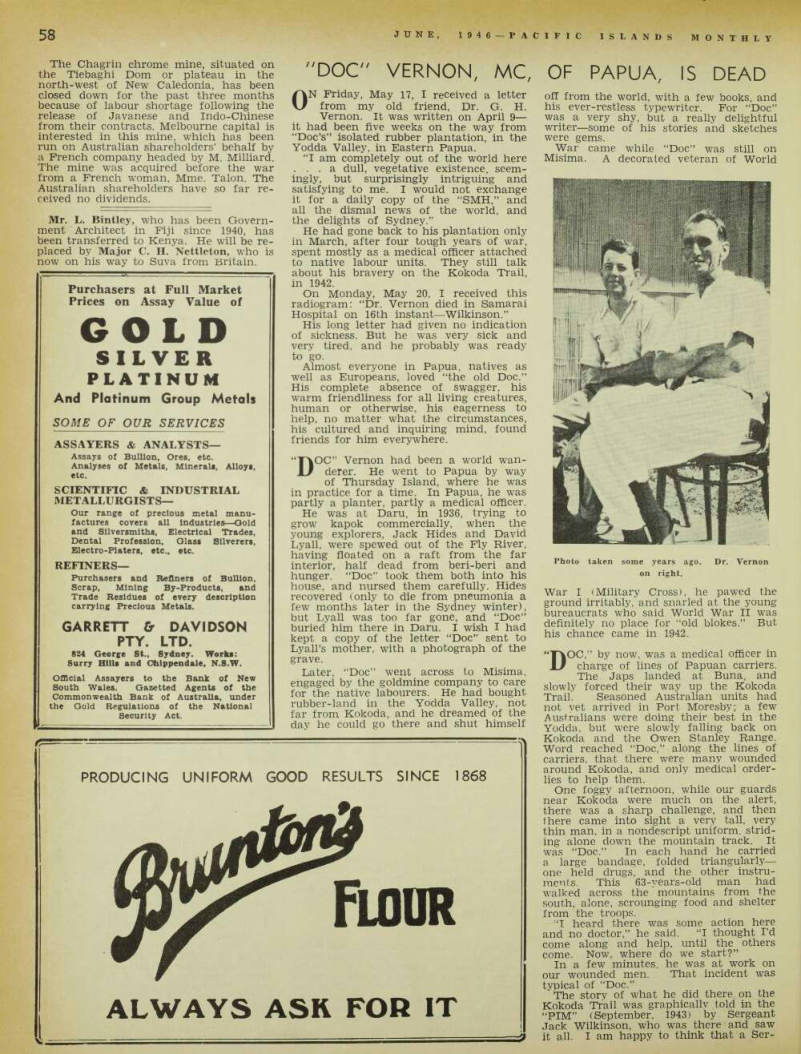
Now?
VTOT long ago, in Nukualofa, I buried ll an old Toneran who, when he was a boy, had won a prize for running down and catching rabbits, on Tonga tabu,” said the Rev. Rodger Page, in a recent chat.
Thus there came to light an interesting fact of natural history. Someone once released the fecund rabbit on Tongatabu, as in Australia and New Zealand; but the animals never became, in Tonga, the pest that they became in other South Pacific countries. Perhaps Tonga was a little too hot for them; or perhaps the natives were too fleet of foot and too eager for rabbit-meat—for unquestion ably according to Mr. Page, they could overtake and catch the rabbits.
Whatever the cause, there are no rab bits in to-day—although they did increase rapidly there, in the beginning.
The Chagrin chrome mine, situated on the Tiebaghi Dom or plateau in the north-west of New Caledonia, has been closed down for the past three months because of labour shortage following the release of Javanese and Indo-Chinese from their contracts. Melbourne capital is interested in this mine, which has been run on Australian shareholders’ behalf by a French company headed by M. Milliard.
The mine was acquired before the war from a French woman, Mme. Talon. The Australian shareholders have so far re ceived no dividends.
Mr. L. Bintley, who has been Govern ment Architect in Fiji since 1940, has been transferred to Kenya. He will be re placed by Major C. H. Nettleton, who is now on his way to Suva from Britain.
"Doc" Vernon, Mc, Of Papua, Is Dead

ON Friday, May 17, I received a letter from my old friend. Dr. G. H.
Vernon, It was written on April 9 it had been five weeks on the way from “Doc’s” isolated rubber plantation, in the Yodda Valley, in Eastern Papua.
“I am completely out of the world here ... a dull, vegetative existence, seem ingly, but surprisingly intriguing and satisfying to me. I would not exchange it for a daily copy of the “SMH,” and all the dismal news of the world, and the delights of Sydney.”
He had gone back to his plantation only in March, after four tough years of war, spent mostly as a medical officer attached to native labour units. They still talk about his bravery on the Kokoda Trail, in 1942.
On Monday, May 20, I received this radiogram: “Dr. Vernon died in Samarai Hospital on 16th instant—Wilkinson.”
His long letter had given no indication of sickness. But he was very sick and very tired, and he probably was ready to go.
Almost everyone in Papua, natives as well as Europeans, loved “the old Doc.”
His complete absence of swagger, his warm friendliness for all living creatures, human or otherwise, his eagerness to help, no matter what the circumstances, his cultured and inquiring mind, found friends for him everywhere.
“T'VOC” Vernon had been a world wan- J J derer. He went to Papua by way of Thursday Island, where he was in practice for a time. In Papua, he was partly a planter, partly a medical officer.
He was at Daru, in 1936, trying to grow kapok commercially, when the young explorers, Jack Hides and David Lyall, were spewed out of the Fly River, having floated on a raft from the far interior, half dead from beri-beri and hunger. “Doc” took them both into his house, and nursed them carefully. Hides recovered (only to die from pneumonia a few months later in the Sydney winter), but Lyall was too far gone, and “Doc” buried him there in Daru. I wish I had kept a copy of the letter “Doc” sent to Lyall’s mother, with a photograph of the grave.
Later, “Doc” went across to Misima, engaged by the goldmine company to care for the native labourers. He had bought rubber-land in the Yodda Valley, not far from Kokoda, and he dreamed of the day he could go there and shut himself
off from the world, with a few books, and his ever-restless typewriter. For “Doc” was a very shy, but a really delightful writer—some of his stories and sketches were gems.
War came while “Doc” was still on Misima. A decorated veteran of World
War I (Military Cross), he pawed the ground irritably, and snarled at the young bureaucrats who said World War II was definitely no place for “old blokes.” But his chance came in 1942.
“n° C ’” now - was a medical officer in U charge of lines of Papuan carriers.
The Japs landed at Buna, and slowly forced their way up the Kokoda Trail. Seasoned Australian units had not yet arrived in Port Moresby; a few Australians were doing their best in the Yodda, but were slowly falling back on Kokoda and the Owen Stanley Range.
Word reached “Doc,” along the lines of carriers, that there were many wounded around Kokoda, and only medical order lies to help them.
One foggy afternoon, while our guards near Kokoda were much on the alert, there was a sharp challenge, and then there came into sight a very tall, very thin man, in a nondescript uniform, strid ing alone down the mountain track. It was “Doc.” In each hand he carried a large bandage, folded triangularly— one held drugs, and the other instru ments. This 63-years-old man had walked across the mountains from the south, alone, scrounging food and shelter from the troops.
“I heard there was some action here and no doctor,” he said. “I thought I’d come along and help, until the others come. Now, where do we start?”
In a few minutes, he was at work on our wounded men. That incident was typical of “Doc.” 1 The story of what he did there on the Kokoda Trail was graphicallv told in the “PIM” (September. 1943) by Sergeant Jack Wilkinson, who was there and saw it all. I am happy to think that a Ser
Photo taken some years ago. Dr. Vernon on right.
viceman paid that warm tribute to the veteran. “Doc” hated publicity, and he threatened afterwards to do unmentionable things to “that young scoundrel”— they had been friends in pre-war days at Misima. But I suspect that “Doc” really was pleased.
It was Wilkinson who sent me that radiogram on Monday, rERE are some delightful touches in Wilkinson’s story of the Kokoda battle.
The Japs were pressing forward around
the village, and our men were getting ready to evacuate into the mountains.
“Doc” was busy operating in a native built house, with grass thatch. He could not hear the enemy’s machine-guns, or the lads’ yells to him to get out. “Doc”’ was nearly stone-deaf.
Bullets from a Jap machine-gun began to cut through the roof, and debris fell down upon “Doc.” “Doc” glanced up irri tably. “Damn those rats,” he said.
The boys got him away, almost by main force. He would not go until he was sure all the wounded were on the move, and as comfortable as circumstances allowed.
Some distance up the track (they now were retreating across the Owen Stan leys) they sat and rested. “Doc” began to think back. Then he asked: “Were those bullets that were knocking the grass down from that hut in Kokoda?”
“I’ll say they were!” said one of the men. “Millions of ’em.”
“Well, it’s an advantage to be deaf, sometimes,” said the “Doc.” “I might have been alarmed if I had heard them!” riTHE Japs came right over the top of the JL Owen Stanleys, and hesitated, and then began to run back, with the Australians in full pursuit.
“Doc” followed along, down to Kokoda, to Wairope, to Sanananda, to Buna, al ways at hand to care for the native car riers. and help the white soldiers. Men will talk for years of “Doc” Vernon —that incredibly tall, thin, deaf man, who operated under fire, gave them a smoke, put new dressings on. distributed tea and biscuits, and sent them on their way with a cheery word.
When the Japs were cleared out of Papua, Captain Vernon walked hundreds of miles in the service of ANGAU, caring for natives’ health. His influence with natives was amazing men apparently
dying would begin to recover as soon as he appeared.
EARLY in 1945, “Doc” paid his last visit to Sydney. He and I, and a couple of friends, had lunch together at the Hotel Australia.
Three of us, well-fed, middle-height civilians, served to throw into relief the exceedingly tall, very thin old gentleman in uniform. But what a uniform! In regard to things sartorial, “Doc” just couldn’t be bothered.
He had three pips on his shoulders, and the faded ribbons of two wars, in cluding the Military Cross; but the rest of him was—well, indescribable. His uni form hung in folds on his skinny frame; his belt had been loaned by a private; he had short leggings and enormous black boots; and he wore a very old Digger hat, flopping all round, like those of Blue and Curley, in the comic strip.
Officers in the hotel lounge looked and gasped—some, of more exquisite vintage, even giggled. I wished I could have told them of what our “Old Doc” had done
on the Kokoda Trail.
R. W. Robson.
From a Special Correspondent Dr. Vernon was only 63, but looked much older. He was born in England in December, 1882, the younger son of Colonel W. L. Vernon, and he graduated in medicine at Sydney University in 1905, and in surgery in 1907. He prac tised in various country towns in New South Wales and Queensland; but he “was born with itchy feet,” and he was a traveller all his life, visiting various parts of the world. He retired from the post of Government Medical Officer at Thurs day Island some 12 years ago, and had lived in Papua ever since. His Military Cross was won in desert fighting with the Australian Light Horse, in World War I, and not in France as has been reported.
Advertisements & other items, pp. 60-62 (2 items)
Gold
Purchasers at Full Market Prices on Assay Value of
SILVER
PLATINUM
And Platinum Group Metals
SOME OF OUR SERVICES
ASSAYERS & ANALYSTS—
Assays of Bullion, Ores, etc.
Analyses of Metals, Minerals, Alloys, etc.
SCIENTIFIC & INDUSTRIAL
METALLURGISTS—
Our range of precious metal manufactures covers all Industries—Gold and Silversmiths, Electrical Trades, Dental Profession, Glass Sllverers, Electro-Platers, etc., etc.
REFINERS—
Purchasers and Refiners of Bullion.
Scrap, Mining By-Products, and Trade Residues of every description carrying Precious Metals.
GARRETT Or DAVIDSON
PTY. LTD.
824 George St., Sydney. Works: Surry Hills and Chippendale, N.S.W.
Official Assayers to the Bank of New South Wales. Gazetted Agents of the Commonwealth Bank of Australia, under the Gold Regulations of the National Security Act.
PRODUCING UNIFORM GOOD RESULTS SINCE 1868
ALWAYS ASK FOR IT
Company
PACIFIC ISLANDS TRADING
Bankers: Bank of America (Main Office) San Francisco.
Cables:
PITCO
SAN FRANCISCO
244 CALIFORNIA STREET, SAN FRANCISCO, CAL, U.S.A.
EXPORTERS OF :
BARBER CHAIRS.
TEXTILES.
CLOTHING.
LIQUOR.
ELECTRICAL GOODS.
FOODSTUFFS.
PRODUCE.
STATIONERY.
CARTRIDGES.
DRUGS.
PAPER PRODUCTS.
AUTOMOTIVE PARTS.
WIRE & NAILS.
BUILDING SUPPLIES.
RADIOS.
REFRIGERATORS.
AUTOMOBILES.
Farm machinery.
TYPEWRITERS.
FIREARMS.
CHEMICALS.
MARINE HARDWARE.
CIGARETTES, TOBACCO.
HARDWARE.
FURNITURE.
IRON & STEEL PRODUCTS.
CANNED GOODS.
PAINTS.
NOVELTIES, NOTIONS.
LEAD PENCILS, ERASERS.
HEAVY EQUIPMENT.
FERTILIZERS.
TYRES. TUBES.
PREFABRICATED HOUSES.
QUOTATIONS ON REQUEST
“NATIONAL” ELECTRICAL APPLIANCES
MADE IN CANADA
TO THE TRADE ONLY
500,000
Men's Second-hand
JACKETS
TROUSERS
SUITABLE FOR PACIFIC
ISLANDS TRADE
Price: 4/- Each
Quick Shipment—Pressed Bales containing 1,000 Assorted Garments.
Establish Confirmed Credits for Payment for Any Quantity on Any English Bank.
M. NEWMAN
(Contractors) LTD,
Government Contractors
HEAP ST., MANCHESTER 7,
ENGLAND
Cable Address: Harbinger, Manchester.
Interpreter and Translator University student (woman) is prepared to undertake Translation and Secretarial work, on a part-time basis. Would undertake casual work for visitors as Interpreter and Translator. Good knowledge of French, German and Russian.
Communicate with MA 3929.
THREE RADIO SPECIALS I
2-VOLT STROMBERG-CARLSON WORLD RANGE RECEIVER.
noiSJTnT , T?'T'R 1 T» TTiVvraf rvr “Trnnip.nrnnf AmpniHps” rnHin mmnlpt.p CONVERTED Vibrator “Tropic-proof Amenities” radio, complete with three 45-volt batteries and Aircell or equivalent.
PRICE, £33/15/-. Prepaid freight, insurance, packing, etc., £l/5/extra.
6-VOLT STROMBERG-CARLSON WORLD RANGE VIBRATOR.
“ r Prnm , o_nrAnf A m onifi oc” roppivor r>nmr»lpfp Tin' f/h fi-vnlf. snpripl “Tropic-proof Amenities” receiver complete with 6-volt special radio battery. NOTE: I believe that I am the only distributor in Sydney who can offer “wet” batteries at this time.
PRICE, £32/15/-. Prepaid freight, insurance, packing, etc., £l/7/extra.
A.C. MODEL. STROMBERG-CARLSON DUAL WAVE MANTEL
MODEL. Five-valve A.C. model in a beautiful bakelite cabinet.
PRICE, £26/19/6. Prepaid freight, insurance, packing, etc., £l/5/- SEND FOR AN EXPORT PRICE SCHEDULE COVERING GROCERIES, WINES, ETC. PRICES QUOTED ON ANY
COMMODITY. QUICK AND EFFICIENT SERVICE
TELEPHONEIBWSIS7 • SCOTTISH HOUSE ® 19 BRIDGE STREET ® SYDNEY ® AUSTRALIA
What Will The Atomic Bomb
Do To Islands?
Letter to the Editor A FEW months ago I drew attention to the possible devastating affect the atomic bomb experiments in the Marshall Islands, in July, may have on the whole chain of coral atolls ex tending from Bakini, in the Marshalls, to Nurakita, at the southern end of the Ellice Islands.
Apparently our American friends are absolutely indifferent as to what may happen to the thousands of very fine natives that inhabit these islands, so long as their experiments go on.
The late Sir Edgeworth David, when Professor David, proved at Funafuti, in the Ellice Islands, that all these atolls are only coral, built up on the tops of mountains, which are some 2,000 to 3,000 ft. below the surface; so one does not need to have much imagination to pic ture at least some of these coral atolls being completely knocked off their pin nacles by the concussion which, we are told, will be tremendous —so tremendous indeed as to surpass the imagination of man.
In conclusion: Are we to assume that the great powers have, as I said in the beginning of this letter, no consideration for these Islanders; or is it that we have been reading just a lot of traslj in the press, to sell their papers, and that the Americans know the limits and propor tions of the atomic bomb explosions?
I am, etc.,
Supercargo.
Sydney.
Four Men and a Forum
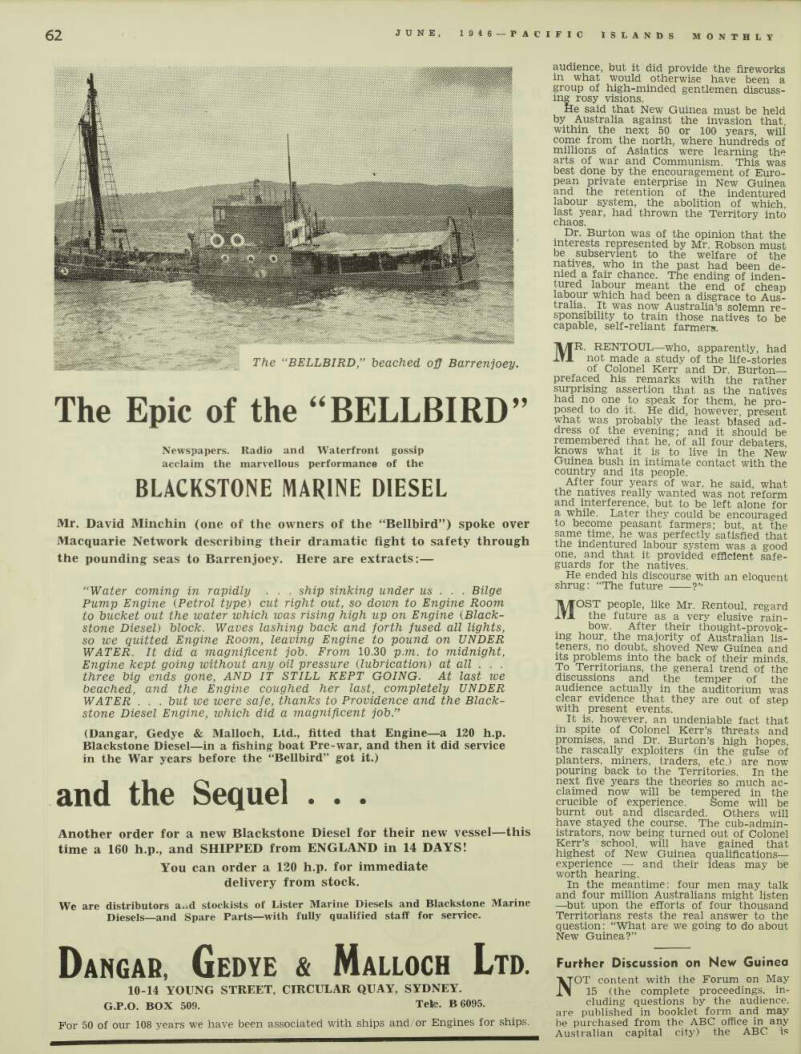
New Guinea On the Air:
(By a Member of the Audience )
1F thought-provoking (current pet phrase of the public-spirited) can be con sidered an end in itself, then the Australian listening public achieved it on May 15, when the question: "What should we do about New Guinea?” was discussed over the ABC network.
The four men chosen to put their views by Forum-master H. B. Black were: Colonel John Kerr, principal of the Aus tralian School of Pacific Administration; Mr. R. W. Robson, “PIM” editor and pub lisher; the Rev. Dr. J. W. Burton, Presi dent-General of the Methodist Confer ence of Australia; and Mr. Alexander Rentoul, a well-known ex-Resident Magis trate of Papua. They spoke in that order. . , With the exception of Mr. Rentoul — who, apparently, like the late President Roosevelt, travels a little bit left of centre —the gentleman concerned pulled no punches. There was none of this sweet reasonableness, this co-operation of the best elements of brown, white, brindle, commerce and culture which Dr. Burton himself has advocated in his booklet “Brown and White in the Pacific.”
Colonel Kerr and Dr. Burton were as one in wishing to make a clean sweep of the old system, of ridding the Territory of "exploiters” and running it on behalf of the natives. Mr. Robson was equally single-minded in his contention that the natives were well enough before the war. and that it was much more Important to develop New Guinea, by private enter prise, as one of Australia’s defence bul warks, than to create there a preserve for Mr. Ward’s Fuzzy-wuzzies.
Perhaps it was due to the fact that each speaker had to compress his remarks into a rigid eight minutes that none of the debaters (again with the possible ex ception of Mr. Rentoul) took time off to as much as hint that there might be something in the other fellow’s views.
The audience was 95 per cent, pro- Fuzzy-wuzzy. None of them, obviously, had been nearer the jungle than King’s Cross; a large number came from Colonel Kerr’s own School of Administration.
They found it easy, therefore, to jeer, or laugh in derision, every time "old-timer” or “pioneer” was mentioned; and to ap plaud enthusiastically when each fresh scheme for the betterment of the down trodden native was propounded. Even the fact that they, as taxpayers, would have to pay for this uplift (a fact realis tically introduced to them by Colonel Kerr) failed to stir them. Nothing, appa rently, stirs the Australian taxpayer these days—they are past that, COLONEL KERR, is a dark, dour Scot; he delivered his address without a flicker of humour. One got the im pression that Colonel Kerr was going to uplift the gosh-darned Fuzzies, if it killed them, and that said uplift would be ad ministered at regular intervals with the same determination as the late-Victorian mother dosed her offspring, once weekly, with senna-tea.
The past, no matter what purpose It served in the past, was, in his opinion, now of no moment. The old systems, the pioneers, the so-called old-hands— all must go before Australia’s new con
ception of her duty in her Territories.
The eyes of the world would be on Aus tralia’s manner of carrying out her obli gations. The new economic policy must be fashioned for the benefit of the native people and exploitation must cease.
Later, in reply to an excited-looking soldier who demanded when the value of the gold taken out of the Territory by Europeans would be returned to the natives, Colonel Kerr said that, in his opinion, the mineral wealth of the Ter ritory should be worked only on behalf of the natives.
The soldier, thereupon, looked very pleased and sat down, presumably com forted.
MR. ROBSON’S address might have been sordidly realistic, and therefore unpopular with at least the seen
audience, but it did provide the fireworks in what would otherwise have been a group of high-minded gentlemen discuss ing rosy visions.
He said that New Guinea must be held by Australia against the invasion that, within the next 50 or 100 years, will come from the north, where hundreds of millions of Asiatics were learning the arts of war and Communism. This was best done by the encouragement of Euro pean private enterprise in New Guinea and the retention of the indentured labour system, the abolition of which, last year, had thrown the Territory into chaos.
Dr. Burton was of the opinion that the interests represented by Mr. Robson must be subservient to the welfare of the natives, who in the past had been de nied a fair chance. The ending of inden tured lab9ur meant the end of cheap labour which had been a disgrace to Aus tralia. It was now Australia’s solemn re sponsibility to train those natives to be capable, self-reliant farmers.
MR. RENTOUL—who, apparently, had not made a study of the life-stories of Colonel Kerr and Dr. Burton— prefaced his remarks with the rather surprising assertion that as the natives had no one to speak for them, he pro posed to do it. He did, however, present what was probably the least biased ad dress of the evening; and it should be remembered that he, of all four debaters, knows what it is to live in the New Guinea bush in intimate contact with the country and its people.
After four years of war, he said, what the natives really wanted was not reform and interference, but to be left alone for a while. Later they could be encouraged to become peasant farmers; but, at the same time, he was perfectly satisfied that the indentured labour system was a good one, and that it provided efficient safe guards for the natives.
He ended his discourse with an eloquent shrug: “The future ?’• MOST people, like Mr. Rentoul, regard the future as a very elusive rain bow. After their thought-provok ing hour, the majority of Australian lis teners, no doubt, shoved New Guinea and its problems into the back of their minds.
To Territorians, the general trend of the discussions and the temper of the audience actually in the auditorium was clear evidence that they are out of step with present events.
It is, however, an undeniable fact that in spite of Colonel Kerr’s threats and promises, and Dr. Burton’s high hopes, the rascally exploiters (in the guise of planters, miners, traders, etc.) are now pouring back to the Territories. In the next five years the theories so much ac claimed now will be tempered in the crucible of experience. Some will be burnt out and discarded. Others will have stayed the course. The cub-admin istrators, now being turned out of Colonel Kerr’s school, will have gained that highest of New Guinea qualifications— experience and their ideas may be worth hearing.
In the meantime: four men may talk and four million Australians might listen —but upon the efforts of four thousand Territorians rests the real answer to the question: “What are we going to do about New Guinea?”
Further Discussion on New Guinea NOT content with the Forum on May 15 (the complete proceedings, in cluding questions by the audience, are published in booklet form and may be purchased from the ABC office in any Australian capital city) the ABC is
attacking the New Guinea question again over its network. Mr. Norman Bartlett, ex-RAAF Public Relations Officer, is pre senting three discussions under the title, “What about New Guinea and Papua”; the first was broadcast on June 3—-two others will follow on June 17 and June 24.
The first discussion was dealt with in the form of an interview between Mr.
Bartlett and Mr. Gordon Thomas, for merly editor of the “Rabaul Times,” and Mr, E. Ward Oakley, a member of the Civil Administration.
Both Mr. Oakley and Mr. Thomas were agreed that the Territories should be developed commercially, and by Euro peans, as well as natives, although they did not altogether agree as to how it should be done.
Presumably, in future talks, mis sionaries, anthropologists and others will be permitted to advance their views.
Mr. Thomas believed that New Guinea could be made to produce all the tropical requirements of Australia and that, under the guidance of an up-to-date Agricul tural Department, European and native planters could benefit themselves and the Commonwealth.
In Mr. Oakley’s opinion, the copra in dustry would soon be a thing of the past, and, as far as Europeans were concerned, they should be encouraged to settle in the high and healthy plateaux of Central New Guinea, where they should concen trate on cocoa and coffee production, as well as “quick” crops for the Australian market.
Both Mr. Oakley and Mr. Thomas were agreed that no obstacles should be put in the way of America retaining the air sea base at Manus.
Advertisements & other items, pp. 63-64 (1 item)
QjiMtxaium si&Jhing, Jndu&Jbdea £td.
Livestock for Islands
People who Intend to take Stock to New Guinea are hereby notified that I have on hand the right class of
Cattle—
Mules—
Horses
to suit both the Climate and the Pastures of the Territories.
When shipping available, I can deliver, on the ship in Cairns or Townsville, Stock Intended for any of the Pacific Islands, including Netherlands Indies, Singapore and the Philippines.
I will take all care of Stock and will be responsible for their delivery on the Ship in Sound Condition.
For further particulars, apply to
J. J. TOOGOOD
Rollingstone, via Townsville, Queensland.
Orders accepted through any Stock Agent, or Bank, in Cairns or Townsville, or direct.
lift
ISLAND CRAFT
TO
MODERN DESIGN
WOODEN FREIGHTERS,
TRAWLERS AND ISLAND
CRAFT.
VESSELS REPAIRED AND
REMODELLED.
AUSTRALIAN AGENTS FOR
GRAY MARINE PETROL AND
DIESEL ENGINES.
COPPERSMITHS, WELDERS
AND PLUMBERS.
MODERN SLIPWAY FACILITIES AVAILABLE
WRITE US FOR DESIGNS AND COMPLETE SHIPBUILDING INFORMATION.
A A
QjiMtxaium si&Jhing, Jndu&Jbdea £td.
INCORPORATING REG. ADAMS CLAYTON CO.,
Tel.: XB 4475, XA 1731. JOHN STREET, BERRY'S BAY, NORTH SYDNEY. ALSO AT EDEN, N.S.W.
g w>:-:?S:v T/ie “ BELLBIRD,” beached off Barrenjoey.
The Epic of the “BELLBIRD”
Newspapers. Radio and Waterfront gossip acclaim the marvellous performance of the
BLACKSTONE MARINE DIESEL
Mr. David Minchin (one of the owners of the “Bellbird”) spoke over Macquarie Network describing their dramatic fight to safety through the pounding seas to Barrenjoey. Here are extracts:— “Water coming in rapidly . . . ship sinking under us . . . Bilge Pump Engine (Petrol type) cut right out, so down to Engine Room to bucket out the water which was rising high up on Engine ( Blackstone Diesel) block. Waves lashing back and forth fused all lights, so we quitted Engine Room, leaving Engine to pound on UNDER WATER. It did a magnificent fob. From 10.30 p.m. to midnight, Engine kept going without any oil pressure ( lubrication) at all .. . three big ends gone, AND IT STILL KEPT GOING. At last we beached, and the Engine coughed her last, completely UNDER WATER . . . but we were safe, thanks to Providence and the Blackstone Diesel Engine, which did a magnificent job.” (Dangar, Gedye & Malloch, Ltd., fitted that Engine—a 120 h.p.
Blackstone Diesel—in a fishing boat Pre-war, and then it did service in the War years before the “Bellbird” got it.)
and the Sequel . . .
Another order for a new Blackstone Diesel for their new vessel —this time a 160 h.p., and SHIPPED from ENGLAND in 14 DAYS!
You can order a 120 h.p. for immediate delivery from stock.
We are distributors stockists of Lister Marine Diesels and Blackstone Marine Diesels—and Spare Parts—with fully qualified staff for service.
Dangab, Gedve & Malloch Ltd.
10-14 YOUNG STREET, CIRCULAR QUAY, SYDNEY.
G.P.O. BOX 509. Tele. B 6095.
For 50 of our 108 years we have been associated with ships and/or Engines for ships.
Once Beautiful,
Samarai Is Now Forlorn
From a Special Correspondent
Samarai, May 25.
ALTHOUGH the wharf and township are mere skeletons of their former selves, Samarai still exists as the business centre for Eastern Papua. The burned-out town will be rebuilt.
Burns Philp & Company, Steamships Trading Company, the PCB and Bunting’s Store occupy rusty iron buildings on the foreshore. The Government offices are in the Institute Hall.
European and native hospitals are func tioning again, although new difficulties crop up daily. There is no hotel as yet.
People coming in have to arrange their own accommodation. Most of the re maining houses are in need of repair.
The Rev. A. J. Thompson takes services in the church once more; but there is little return to normality otherwise. The shipping service continues frightful.
Pre-war residents of Samarai who have returned to the town are Mr. and Mrs.
R. Bunting; Mr. “Spud” Wilson and his wife; Mr. Eric Turner; Mr. A. Pym; Mr.
E. Bremen; Dr. and Mrs. H. N. White; and Mr. H. F. Bitmead.
Outside the township are Messrs. E. and Arthur Evenett, Norman Izod, Fred Cole man, Vic Poole, Bert Hughes and Mrs.
Hughes, Jim Driver, and Duncan Camp bell. More returning evacuees are ex pected shortly.
To date nothing has been done to re build the wharf and township buildings.
It has been suggested that better sites for both will be chosen but, precisely where, remains an official secret.
Information Wanted
ANYONE knowing anything which might throw light on the fate of Mr. V. C. Johnson, of Madang, New Guinea, is requested to kindly write to Mr. Colin Johnson, c/o J. Bryan, Tatter sail’s Hotel, Casino, New South Wales.
Mr. Johnson was managing Kelaua Plan tation, Madang, and has not been heard of since the Jap invasion.
Naturalisation In Ng
FEDERAL Parliament’s next session is to include a Bill dealing with naturalisation benefits for New Guinea residents. A measure, by the way, long overdue for many Territorians in the past have been Stateless unless they could be called League of Nationites. The mea sure also indicates the Australian Govern ment is tightening its hold on the Terri tory, whatever else may happen.
“Tolala.”
Mr. €. I. H. Campbell, who has done a remarkably good job as the representative of the War Damage Commission in New Britain and district, has resigned from the Commission, in order that he may return to his own plantation of Raua, in Buka. He will be succeeded in Rabaul by Mr. Smith, formerly a lieutenant in ANGAU. Very good work also is being done, on behalf of both the Commission and the planters, by the two Inspectors, Arthur Richards and Alistair Maclean.
Sir Walter Carpenter, head of W. R.
Carpenter & Co., Ltd., will return to Syd ney, for a few months, in September. His son, Mr. R. B. Carpenter, will remain in Canada during his absence.
Advertisements & other items, p. 65 (1 item)
Swallow I Ariell
“TO THE 6ULF OF CARPENTARIA”
"On the 20th August, 1860, the long train of camels and horses set forth from the Royal Park of Melbourne, Burke leading the procession on a little grey horse. The Mayor made a short speech, wishing him God-speed; the explorers shook hands with their friends, and, amid the ringing cheers of thousands of spectators, the long and picturesque line moved forward.”
Thus, according to the historians A. & G. Sutherland, began the Burke and Wills’ expedition, one of the most spectacular, but ill-fated, in the annals of Australian Exploration. The expedition was prompted by the offer of £1000 by a Melbourne merchant, and financed by the Royal Society of Victoria, who raised subscriptions of £3400, plus a grant of £6000 by the Victorian Government, "who also spent £3000 in bringing twenty-six camels from Arabia.”
Of the four men who made the alternate dash to the Gulf—Burke, Wills, Grey and King—only King survived through the friendliness of blacks for whom "he shot some birds and cured their chief of a malady.”
History does not tell whether Burke and Wills carried with them supplies of Swallow & Ariell Biscuits, although Swallow Ariell Ship’s Biscuits were a recognised store of the day. But, at that time , Swallow & A.riell was already a solidly-established organisation, employing a staff of some 300 operatives.
A SERIES js
CC SERVING AUSTRALIA
CT IN PEACE AND WAR
kiH 111 ' ‘l
ttUfciir
S
SWALLOW i ARIELL
LIMITED
LEADERS IN THE BISCUIT INDUSTRY SINCE 1854 MAKERS AU0 OP THI FAMOUS SWALLOW A ARIEL!. PLUM Pill I01IVCS. CAKES ANfl ((,'£ CREAM
Engines Now Available
LISTER marine diesel engines are be coming available again. Dangar, Gedye & Malloch, Ltd., Sydney, the agents, recently delivered 16 h.p. and 21 h.p. jobs to clients in the New Hebrides, and they have orders for forward de livery of other marine engines, up to 30 h.p., for the Islands. In addition to accepting orders for Lister marine diesel engines, between 8 h.p. and 30 h.p., and Blackstone marine diesel engines from 120 h.p. upwards, Danerar, Gedye & Mal lock, Ltd., will soon provide a complete service of spare parts, covering engines, stern gear, ship-lighting plants, refrigera tion and kindred lines.
Trippers
Still M.O.F.
For Suva-Auckland Trippers
Prom a Special Correspondent
Auckland, May 26.
rE demand for steamship passages from Auckland to Fiji, Tonga, the Cook Islands and Samoa is not showing any signs of abating.
It was believed that several south-bound sailings of American liners from Suva, plus an irregular flying-boat service be tween Suva and Sydney, run by Qantas Empire Airways, would relieve the situa tion somewhat, but this appears not to be the case. The Union Company’s “Matua” is still carrying over 100 passengers per trip instead of the 48 passengers which the ship was built to carry—and at pre sent there is a “Matua” waiting list of 250 people in Auckland.
The demand, for passages from Suva to Auckland is far in excess of the number of berths available, also. Both going and coming from Suva, many passengers find that they must sleep on mattresses on the cabin floors, and count themselves fortu nate to be able to travel at all.
The situation is not expected to im prove for some time. The Matson liners are to be withdrawn for reconditioning shortly, and the pressure on the “Matua” will consequently be increased.
The Government announced recently that it hoped to replace the antique “Maui Pomare,” which services the Cook Group, with a ship twice as large.
Island travellers, however, are recom mended to keep their hats on until they actually see the new vessel.
Overseas shipyards are working to capacity; and few shipping companies, at present, could be persuaded to part with even their oldest ship. It will probably be well into 1947 before any appreciable eas ing is noticed in the South Pacific ship ping situation.
"Capital" Of New
Guinea
Committee Reports on Various Towns
A COMMITTEE, which included an architect, an engineer and a town planner, returned recently to Aus tralia from Papua and New Guinea. It will report at length to the Department of External Territories on the condition of the various towns in the two Terri tories, the character and scope of re building to be recommended, and the suitability of certain of them as the future administrative headquarters (capi tal.) It is understood that the Committee will submit complete plans for the building of a town at Kokopo, on Blanche Bay, to be regarded as an alternative to battered Rabaul, some 15 miles northwards, on the inner harbour of Simpsonhafen. Kokopo is on the safe (southwards) side of the volcanoes, and has a very good airstrip, but no sheltered port. Rabaul is on the northern, or bad, side of the volcanoes, and has a very fine, safe port, but (owing to the proximity of the mounts), a poor airfield.
Kokopo, Lae, Finschhafen and Port Moresby are being reported upon with a view to the selection of one of them as the future “capital.” No recommendation is being made.
It is not likely that the Australian Gov ernment will make any selection until UNO has reached a decision regarding the future of New Guinea Mandate, and it is known whether Papua and New Guinea are to be administered as one Territory or (as formerly) two separate Territories.
N. Caledonian War Dead
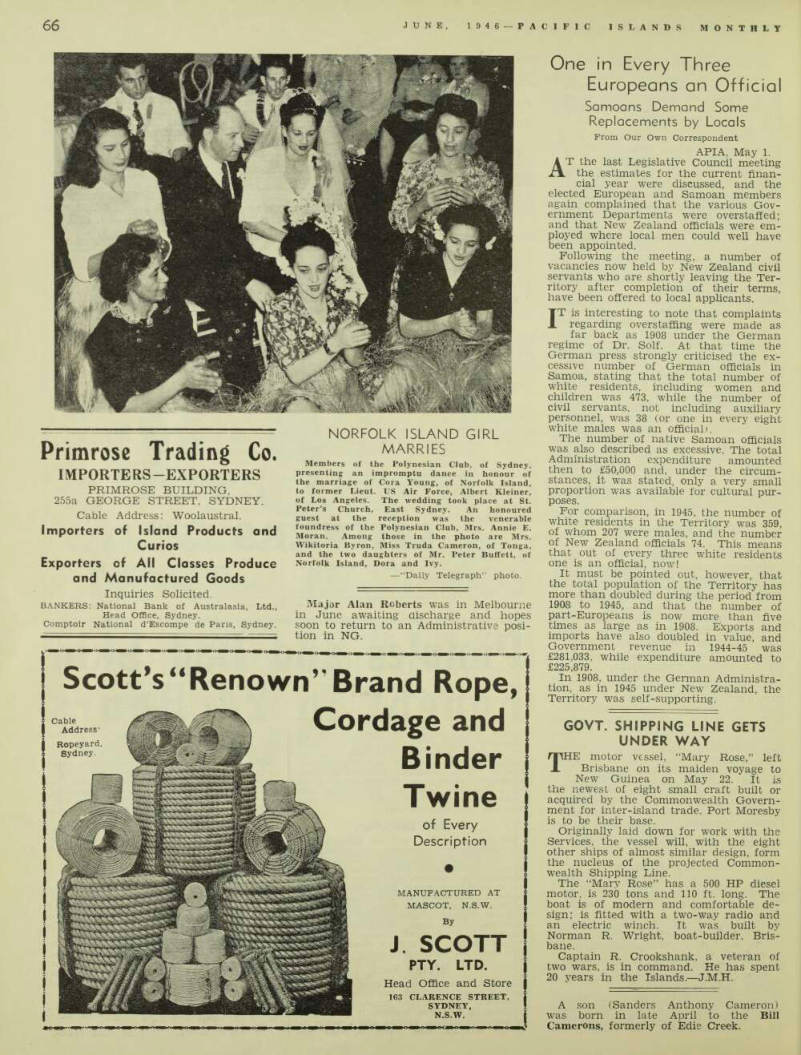
rLLOWING is a list of New Cale donians who died or were killed on active service during the Second World War:— Marcel Kollen, Raymond Chautard, Gustave Gogemnos, Antoine Brinon, Victor Bernut, Ernest Martias, Emile Lesson, James Levy, Francoise Masson, Marc Moutry, Robert Devaux, Pierre Charpentier, Jean Barthe, Raymond Perraud, Roger Stuart, Charles Porcheron.
Etienne Bouscasse, Guy Kaddour, Pierre Duluc, Jean Arnould, Alec Reveillon, Georges Lecarrour, Marcel Creugnet, Marcel Exbroyant, Andre Chitty, Georges Kabar, Emile Millot, Louis Salomon, Charles Stiermans, Alexandre Black, Numa Letheiser, Louis Vindeouz, Charles Lechanteur, Louis Colxette, Leon Foord, Jean Gouassem, Aime Soenne, Edouard Paulin, Charles Albert Witt, Willis Teain, Pierre Boae, Francois Pourana, Albert Anicet. Baptiste Boae, Maxime Ankou, Anatole Pascal, Alphonse Pounon, Louis Cheval, Louis Tristani, Roger Carpentier, and Georges Clemen.
In addition the following members of the crew of the Nickel Co. collier “Cagou” were lost in the Pacific: Gabriel Busia* (captain), Jules Mayeux, Louis Angle bermes, Pierre Charles, Georges Pommelet, Raoul Jaillard, Victor Rouby, Raymond Van Tieg, and Albert Rival.
Major Alan Roberts was in Melbourne in June awaiting discharge and hopes soon to return to an Administrative posi tion in NG.
Norfolk Island Girl
Marries
Members of the Polynesian Club, of Sydney, presenting an impromptu dance in honour of the marriage of Cora Young, of Norfolk Island, to former Lieut. US Air Force, Albert Kleiner, of Los Angeles. The wedding took place at St.
Peter’s Church, East Sydney. An honoured guest at the reception was the venerable foundress of the Polynesian Club, Mrs. Annie E.
Moran. Among those in the photo are Mrs.
Wikitoria Byron, Miss Truda Cameron, of Tonga, and the two daughters of Mr. Peter Buffett, of Norfolk Island, Dora and Ivy.
“Daily Telegraph" photo.
Advertisements & other items, pp. 66-68 (3 items)
Union
ASSURANCE SOCIETY LTD.
(Incorporated in England)
FIRE ACCIDENT
FIJI A. E. PEARCE & CO.
RABAUL COLYER WATSON
(New Guinea) Ltd.
N. S. WALES 109 PITT STREET.
SYDNEY.
S. Morrison, Mgr
CONTROLLING OFFICE—
-413 Collins St., MELBOURNE
GEORGE W. GIDDY.
Resident Manager.
flunc/er/ic/i
Com hvcftort ricro'o r M 4re 2)e.s/gn 2 2
3 BEDROOMS
AND A SUNROOM
IN THE ABOVE PLAN
PLANNED FOR A
FAMILY OF SIX
PERSONS OR MORE
this "DURABESTOS" (asbestoscement) HOME roofed with Terracotta Tiles could be constructed on steel or timber frame by a builder in your district. A scale plan is available on request to:
WUNDERLICH LIMITED
G.P.O. Box 474, Sydney Tel.: MX 2411 Mention this paper!
flunc/er/ic/i
ORDER THROUGH
YOUR REGULAR
ISLAND TRADER.
ASHFSTOS - CEMENT SHEETS.
Fought in 24 Hours
From
Factory
in the
English
Orchards
has always come the finest jam it is possible to make. Freshness, allied to purity, alone can produce such perfection. From Chivers Orchards—adjoining the Factory come plump, luscious strawberries, with the * warmth of the sun still on their
CHIVERS
Cn\ rosy-red cheeks, and many other English fruits “just right”for preserving. No wonder Chi vers Jams have a worldwide reputation for quality Supplies are still limited /ut shipments will be resumed as soon as possible. , .
ENGLISH &
JAMS v-S
Made in the heart of the English countryside by
CHIVERS & SONS Ltd.
The Orchard Factory, Histon, Cambridge, England
Pimples and Bad Skin Fought in 24 Hours
Since the discovery of Nlxoderm by an American physician it Is no longer necessary for anyone to suffer from ugly, disgusting and disfiguring skin blemishes such as Eczema, Pimples, Rash, Ringworm, Psoriasis, Acne, Blackheads, Scabies and Red Blotches. Don’t let a bad skin make you feel inferior and cause you to lose your friends. Clear your skin this new scientific way.
A New Discovery
Nlxoderm is an ointment, but different from any ..ointment you have ever seen or felt. It is a new discovery, and is not greasy but feels almost like a powder when you apply it. It penetrates rapidly into the pores and fights the cause of surface skin blemishes. Nlxoderm contains 9 ingredients which fight skin troubles m these 3 ways. I.—lt fights and kills the microbes or parasites often responsible for skin disorders. 2. —It stops Itching, burning and smarting in 7 to 10 minutes, and cools and soothes the skin. 3. —It helps nature heal the skin clear, soft and velvety smooth.
Works Fast
mediately, clearing and healing your skin, making it softer, whiter and velvety smooth Because Nixoderm is scientifically compounded to fight skin troubles, it works fast.
It stops the itching, burning and smarting in a few minutes, then starts to work 1m-
In just a day or two your mirror will tell you that here at last is the scientific treatment you have been needing to clear your skin—the treatment to make you look more attractive, to help you win friends. Nixoderm has brought clearer, healthier skins to thousands, such as Mr. Bob Weedon, Edmund Street, Fremantle, who writes: “I was troubled with pimples ever since I was 13, and have spent pounds and pounds on so-called cures without results. I then tried Nixoderm with astounding effect.
The pimples seemed to fade away, and after a week there was not the slightest trace of them.”
Satisfaction Guaranteed
Get Nixoderm from your chemist or store to-day. Look in the mirror in the morning and you will be amazed at the improvement.
Then just keep on using Nixoderm for one week and at the end of that time it must have made your skin soft, clear, smooth and magnetically attractive—must give you the kind of skin that will make you admired wherever you go, or you simply return the empty package and your money will be refunded in full. Get Nixoderm from your chemist or store to-day.
The guarantee protects you.
Nixoderm 2/-&4Z-
For Skin Sores, Pimples and Itch.
Primrose Trading Co.
IMPORTERS-EXPORTERS
PRIMROSE BUILDING,
255 a GEORGE STREET, SYDNEY.
Cable Address: Woolaustral.
Importers of Island Products and Curios Exporters of All Classes Produce and Manufactured Goods Inquiries Solicited.
BANKERS: National Bank of Australasia, Ltd., Head Office, Sydney.
Comptoir National d’Escompe de Paris, Sydney.
Scott’s“Renown’’Brand Rope,
Cordage and
Binder
Twine
of Every
Description
Cable Address- Ropeyard Sydney.
MANUFACTURED AT
MASCOT, N.S.W.
J. SCOTT
PTY. LTD.
Head Office and Store
163 CLARENCE STREET,
SYDNEY,
N.S.W.
One in Every Three
Europeans an Official Samoans Demand Some Replacements by Locals
From Our Own Correspondent
Apia, May 1.
AT the last Legislative Council meeting the estimates for the current finan cial year were discussed, and the elected European and Samoan members again complained that the various Gov ernment Departments were overstaffed; and that New Zealand officials were em ployed where local men could well have been appointed.
Following the meeting, a number of vacancies now held by New Zealand civil servants who are shortly leaving the Ter ritory after completion of their terms, have been offered to local applicants.
IT is interesting to note that complaints regarding overstaffing were made as far back as 1908 under the German regime of Dr. Solf. At that time the German press strongly criticised the ex cessive number of German officials in Samoa, stating that the total number of white residents, including women and children was 473, while the number of civil servants, not including auxiliary personnel, was 38 (or one in every eight white males was an official;.
The number of native Samoan officials was also described as excessive. The total Administration expenditure amounted then to £50,000 and, under the circum stances, it was stated, only a very small proportion was available for cultural pur poses.
For comparison, in 1945, the number of white residents in the Territory was 359, of whom 207 were males, and the number of New Zealand officials 74. This means that out of every three white residents one is an official, now!
It must be pointed out, however, that the total population of the Territory has more than doubled during the period from 1908 to 1945, and that the number of part-Europeans is now more than five times as large as in 1908. Exports and imports have also doubled in value, and Government revenue in 1944-45 was £281,033, while expenditure amounted to £225,879.
In 1908, under the German Administra tion, as in 1945 under New Zealand, the Territory was self-supporting.
Govt. Shipping Line Gets
Under Way
rjIHE motor vessel, “Mary Rose,” left A Brisbane on its maiden voyage to New Guinea on May 22. It is the newest of eight small craft built or acquired by the Commonwealth Govern ment for inter-island trade. Port Moresby is to be their base.
Originally laid down for work with the Services, the vessel will, with the eight other ships of almost similar design, form the nucleus of the projected Common wealth Shipping Line.
The “Mary Rose” has a 500 HP diesel motor, is 230 tons and 110 ft. long. The boat is of modern and comfortable de sign; is fitted with a two-way radio and an electric winch. It was built by Norman R. Wright, boat-builder, Bris bane.
Captain R. Crookshank, a veteran of two wars, is in command. He has spent
20 years in the Islands.-
J.M.H.
A son (Sanders Anthony Cameron) was born in late April to the Bill Camerons, formerly of Edie Creek.
Apolosi Dead
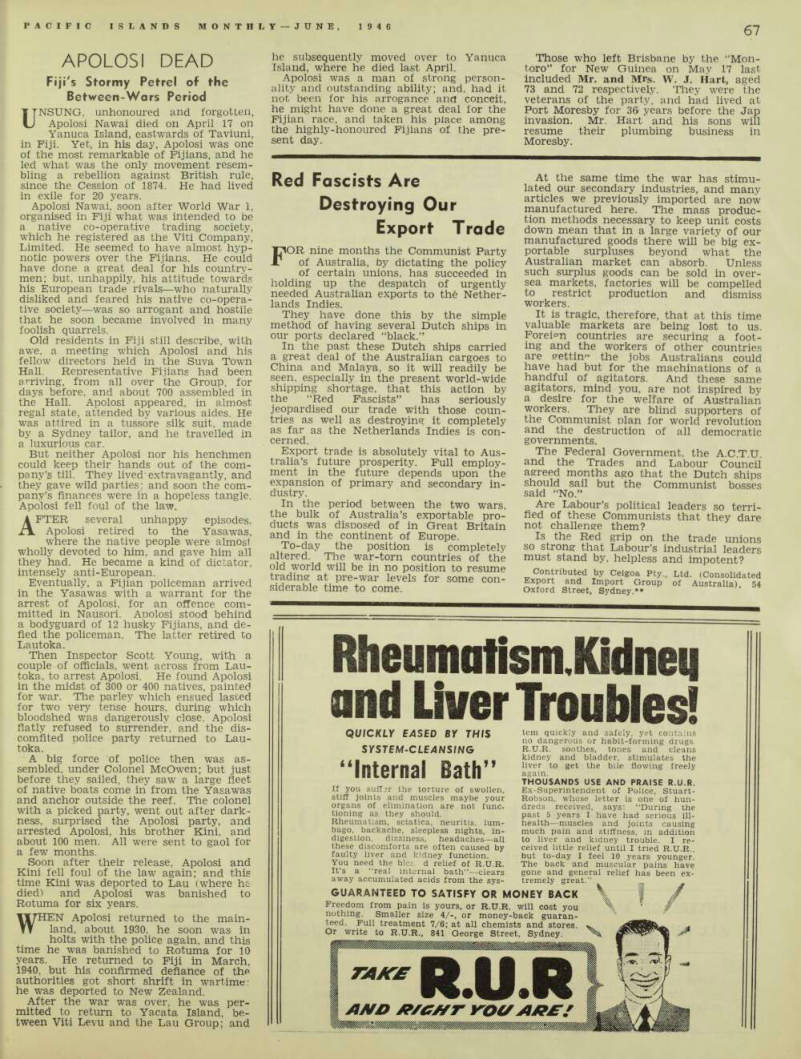
Fiji's Stormy Petrel of the Between-Wars Period
UNSUNG, unhonoured and forgotten, Apolosi Nawai died on April 17 on Yanuca Island, eastwards of Taviuni, in Fiji. Yet, in his day, Apolosi was one of the most remarkable of Fijians, and he led what was the only movement resem bling a rebellion against British rule, since the Cession of 1874. He had lived in exile for 20 years.
Apolosi Nawai, soon after World War 1, organised in Fiji what was intended to be a native co-operative trading society, which he registered as the Viti Company, Limited. He seemed to have almost hyp notic powers over the Fijians. He could have done a great deal for his country men; but, unhappily, his attitude towards his European trade rivals—who naturally disliked and feared his native co-opera tive society—was so arrogant and hostile that he soon became involved in many foolish quarrels.
Old residents in Fiji still describe, with awe, a meeting which Apolosi and his fellow directors held in the Suva Town Hall. Representative Fijians had been arriving, from all over the Group, for days before, and about 700 assembled in the Hall. Apolosi appeared, in almost regal state, attended by various aides. He was attired in a tussore silk suit, made by a Sydney tailor, and he travelled in a luxurious car.
But neither Apolosi nor his henchmen could keep their hands out of the com pany’s till. They lived extravagantly, and they gave wild parties; and soon the com pany’s finances were in a hopeless tangle.
Apolosi fell foul of the law.
AFTER several unhappy episodes, Apolosi retired to the Yasawas, where the native people were almost wholly devoted to him, and gave him all they had. He became a kind of dictator, intensely anti-European.
Eventually, a Fijian policeman arrived in the Yasawas with a warrant for the arrest of Apolosi, for an offence com mitted in Nausori. Anolosi stood behind a bodyguard of 12 husky Fijians, and de fied the policeman. The latter retired to Lautoka.
Then Inspector Scott Young, with a couple of officials, went across from Lau toka, to arrest Apolosi. He found Apolosi in the midst of 300 or 400 natives, painted for war. The parley which ensued lasted for two very tense hours, during which bloodshed was dangerously close. Apolosi flatly refused to surrender, and the dis comfited nolice party returned to Lau toka.
A big force of police then was as sembled, under Colonel McOwen; but just before they sailed, they saw a large fleet of native boats come in from the Yasawas and anchor outside the reef. The colonel with a picked party, went out after dark ness, surprised the Apolosi party, and arrested Apolosi, his brother Kini, and about 100 men. All were sent to gaol for a few months.
Soon after their release, Apolosi and Kini fell foul of the law again; and this time Kini was deported to Lau (where he died) and Apolosi was banished to Rotuma for six years.
WHEN Apolosi returned to the main land, about 1930, he soon was in holts with the police again, and this time he was banished to Rotuma for 10 years. He returned to Fiji in March, 1940, but his confirmed defiance of the authorities got short shrift in wartime: he was deported to New Zealand.
After the war was over, he was per mitted to return to Yacata Island, be tween Viti Levu and the Lau Group; and
he subsequently moved over to Yanuca Island, where he died last April.
Apolosi was a man of strong person ality and outstanding ability; and, had it not been for his arrogance ana conceit, he might have done a great deal for the Fijian race, and taken his place among the highly-honoured Fijians of the pre sent day.
Those who left Brisbane by the “Mon toro” for New Guinea on May 17 last included Mr. and Mrs. W. J. Hart, aged 73 and 72 respectively. They were the veterans of the party, and had lived at Port Moresby for 3& years before the Jap invasion. Mr. Hart and his sons will resume their plumbing business in Moresby.
Destroying Our
Red Fascists Are Destroying Our Export Trade
FOR nine months the Communist Party of Australia, by dictating the policy of certain unions, has succeeded in holding up the despatch of urgently needed Australian exports to the Nether lands Indies.
They have done this by the simple method of having several Dutch ships in our ports declared “black.”
In the past these Dutch ships carried a great deal of the Australian cargoes to China and Malaya, so it will readily be seen, especially in the present world-wide shipping shortage, that this action by the “Red Fascists” has seriously jeopardised our trade with those coun tries as well as destroying it completely as far as the Netherlands Indies is con cerned.
Export trade is absolutely vital to Aus tralia’s future prosperity. Full employ ment in the future depends upon the expansion of primary and secondary in dustry.
In the period between the two wars, the bulk of Australia’s exportable pro ducts was disnosed of in Great Britain and in the continent of Europe.
To-day the position is completely altered. The war-torn countries of the old world will be in no position to resume trading at pre-war levels for some con siderable time to come.
At the same time the war has stimu lated our secondary industries, and many articles we previously imported are now manufactured here. The mass produc tion methods necessary to keep unit costs down mean that in a large variety of our manufactured goods there will be big ex portable surpluses beyond what the Australian market can absorb. Unless such surplus goods can be sold in over sea markets, factories will be compelled to restrict production and dismiss workers.
It is tragic, therefore, that at this time valuable markets are being lost to us.
Foreign countries are securing a foot ing and the workers of other countries are eettin" the jobs Australians could have had but for the machinations of a handful of agitators. And these same agitators, mind you, are not inspired by a desire for the welfare of Australian workers. They are blind supporters of the Communist plan for world revolution and the destruction of all democratic governments.
The Federal Government, the A.C.T.U. and the Trades and Labour Council agreed months ago that the Dutch ships should sail but the Communist bosses said “No.”
Are Labour’s political leaders so terri fied of these Communists that they dare not challenge them?
Is the Red grip on the trade unions so strong that Labour’s industrial leaders must stand by. helpless and impotent?
Contributed by Ceigoa Pty., Ltd. (Consolidated Export and Import Group of Australia) 54 Oxford Street, Sydney.*•
Advertisements & other items, p. 69 (1 item)
Rheumafism.Ksdnetj
and Liver Troubles!
QUICKLY EASED BY THIS
SYSTEM-CLEANSING
“Internal Bath”
If you suffer the torture of swollen, stiff joints and muscles maybe your organs of elimination are not func. tioning as they should.
Rheumatism, sciatica, neuritis, lumbago, backache, sleepless nights, indigestion, dizziness, headaches—all these discomforts are often caused by faulty liver and kidney function.
You need the blc: d relief of R.U.R.
It’s a “real internal bath”—clears away accumulated acids from the sys-
GUARANTEED TO SATISFY OR MONEY BACK
Freedom from pain is yours, or R.U.R. will cost you nothing. Smaller size 4/-, or money-back guaranteed. Pull treatment 7/6; at all chemists and stores.
Or write to R.U.R., 841 George Street, Sydney.
"" R.U.R
AND N/CNT rots A
vmmrn. tern quickly and safely, yet contains no dangerous or habit-forming drugs R.U.R. soothes, tones and cleans kidney and bladder, stimulates the liver to get the bile flowing freely again.
THOUSANDS USE AND PRAISE R.U.R.
Ex-Superintendent of Police, Stuart- Robson, whose letter is one of hundreds received, says: “During the past 5 years I have had serious illhealth—muscles and joints causing much pain and stiffness, in addition to liver and kidney trouble. I received little relief until I tried R.U.R., but to-day I feel 10 years younger.
The back and muscular pains have gone and general relief has been extremely great.” \ I ./ *
Islands Produce
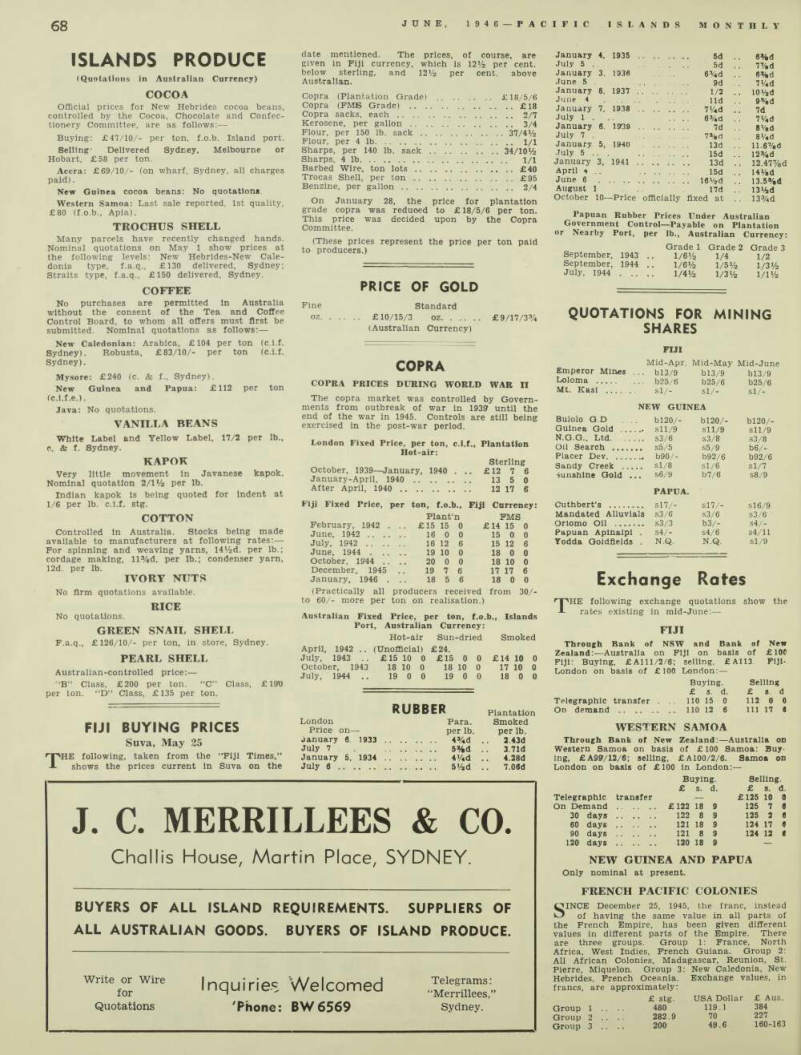
(Quotations in Australian Currency)
Cocoa
Official prices for New Hebrides cocoa beans, controlled by the Cocoa, Chocolate and Confec tionery Committee, are as follows: — Buying: £47/10/- per ton, f.o.b. Island port.
Selling - Delivered Sydney, Melbourne or Hobart, £5B per ton.
Accra: £69/10/- (on wharf, Sydney, all charges paid).
New Guinea cocoa beans: No quotation*.
Western Samoa: Last sale reported, Ist quality, £BO (f.0.b., Apia).
Trochus Shell
Many parcels have recently changed hands.
Nominal quotations on May 1 show prices at the following levels: New Hebrides-New Cale donia type, f.a.q., £l3O delivered, Sydney: Straits type, f.a.q., £l5O delivered, Sydney.
Coffee
No purchases are permitted in Australia without the consent of the Tea and Coffee Control Board, to whom all offers must first be submitted. Nominal quotations as follows; — New Caledonian: Arabica, £lO4 per ton (c i.f.
Sydney). Robusta, £B3/10/- per ton (c.i.f.
Sydney).
Mysore: £240 (c. & f., Sydney).
New Guinea and Papua: £ll2 per ton (C.i.f.e.).
Java: No quotations.
Vanilla Beans
White Label and Yellow Label, 17/2 per lb., c. & f. Sydney.
Kapok
Very little movement In Javanese kapok.
Nominal quotation 2/1 Va per lb.
Indian kapok is being quoted for indent at 1/6 per lb. c.i.f. stg.
Cotton
Controlled in Australia. Stocks being made available to manufacturers at following rates: — For spinning and weaving yarns, HVfed. per lb.; cordage making, ll%d. per lb.; condenser yarn, 12d. per lb.
Ivory Nuts
No firm quotations available.
Rice
No quotations.
Green Snail Shell
F.a.q., £126/10/- per ton, in store, Sydney.
Pearl Shell
Australian-controlled price:— "B” Class, £2OO per ton. ”C” Class, £ 19X) per ton. "D” Class, £135 per ton.
Fiji Buying Prices
Suva, May 25 THE following, taken from the "Fiji Times,” shows the prices current in Suva on the
date mentioned. The prices, of course, are given in Fiji currency, which is 12V 2 per cent, below sterling, and 12*/ 2 per cent. above Australian.
Copra (Plantation Grade) £lB/5/6 Copra (FMB Grade) £lB Copra sacks, each 2/7 Kerosene, per gallon 3/4 Flour, per 150 lb. sack 37/4V 2 Flour, per 4 lb l/l Sharps, per 140 lb. sack 34/10V 2 Sharps, 4 lb l/l Barbed Wire, ton lots £4O Trocas Shell, per ton £95 Benzine, per gallon 2/4 On January 28, the price for plantation grade copra was reduced to £ 18/5/6 per ton.
This price was decided upon by the Copra Committee. (These prices represent the price per ton paid to producers.)
Advertisements & other items, p. 70 (1 item)
Price Of Gold
Pine Standard oz. . .. £10/15/3 oz. £9/17/3% (Australian Currency)
Copra
Prices During World War Ii
The copra market was controlled by Govern ments from outbreak of war in 1939 until the end of the war in 1945. Controls are still being exercised in the post-war period.
London Fixed Price, per ton, c.1.f., Plantation Hot-air:
(Practically all producers received from 30/to 60/- more per ton on realisation.) Australian Fixed Price, per ton, f.0.b., Islands Port, Australian Currency:
October. 1939—January, 1940 Sterling . £12 7 6 January-April, 1940 13 5 0 After April, 1940 .. 12 17 6 Fiji Fixed Price, per ton, f.o.b., Fiji Currency; Plant’n
Fms
February, 1942 . .. £15 15 0 £14 15 0 June, 1942 16 0 0 15 0 0 July, 19-42 16 12 6 15 12 6 June, 1944 19 10 0 18 0 0 October, 19*44 .. 20 0 0 18 10 0 December, 1945 .. 19 7 6 17 17 6 January, 1946 . .. 18 5 6 18 0 0
Hot-air Sun-dried Smoked April, 1942 (Unofficial) £24.
July, 1943 .. £15 10 0 £15 0 0 £14 10 0 October, 1943 18 10 0 18 10 0 17 10 0 July, 1944 .. 19 0 0 19 0 0 18 0 0
Rubber
Plantation
Papuan Rubber Prices Under Australian Government Control—Payable on Plantation or Nearby Port, per lb., Australian Currency:
London Para.
Smoked Price on— per lb. per lb.
January 6, 1933 .. .. .. .. 4%d . 2.43d July 7 ... .. .. 5%d . 3.71d January 5. 1934 .. .. .. .. 4‘/id . 4.28d July 6 .. .. 5Vad , 7.06d
January 4. 1935 . 5d .. 8Hd July 5 5d . . 7 7 /.d January 3. 1936 6 3 / 4 d . . 6%d June 5 9d 7V 4 d January 8. 1937 . 1/2 .. lOVad June 4 lid .. 9%d January 7. 1938 7V 4 d .. 7d July 1 6 3 / 4 d . . 7V 4 d January 6, 1939 . 7d . . 8V s d July 7 . 7 3 /*ri 8V 4 d January 5, 1940 13d . . 11.6 7 /«d July 5 . 15d .. 12 3 / 4 d January 3, 1941 . 13d .. 12.47 7 / 8 d April 4 15d . . 14V.d June 6 . 16V 2 d .. 13.5»/,d August : 1 17d . . 13Vfed October 10- -Price officially fixed at .. 13%d
Grade 1 Grade 2 Grade 3 September, 1943 . l/6y 2 1/4 1/2 September, 1944 . l/SVa l/SVa I/31/2 July, 1944 . .. ., 1/41/2 l/SVa 1/1 1/2
Quotations For Mining
Shares
Fiji
Mid-Apr.
Mid-May Mid-June Emperor Mines . .. b!3/9 bl3/9 bl3/9 Loloma .. b25/6 b25/6 b25/6 Mt. Kasl si/si/sl/- Bulolo G.D
New Guinea
bl20/- bl20/bl20/- Guinea Gold ... . si 1/9 sll/9 N.G.G.. Ltd. . . . .. $3/6 s3/8 s3/8 Oil Search s5/9 b6/- Placer Dev .. b90/b92/6 b92/6 Sandy Creek ... .. sl/8 sl/6 sl/7 sunshine Gold .. ,. s6/9 b7/6 s8/9 Cuthbert’s
Papua.
.. sl7/- Sl7/- S16/9 Mandated Alluvials s3/6 s3/6 s3/6 Orlomo Oil b3/- $4/- Papuan Aplnaipl . s4/s4/6 S4/11 Yodda Goldfields . N.Q.
N.Q. sl/9
Exchange Rates
THE following exchange quotations show the rates existing in mid-June:—
Fiji
Through Bank of NSW and Bank of New Zealand: —Australia on FIJI on basis of £lOO Fiji: Buying. £Alll/2/6: selling. £AII3. FIJI - on basis of £lOO London: —
Western Samoa
Through Bank of New Zealand;—Australia on Western Samoa on basis of £lOO Samoa: Buy ing, £A99/12/6; selling, £AIOO/2/6. Samoa on London on basis of £lOO in London: —
New Guinea And Papua
Only nominal at present.
French Pacific Colonies
SINCE December 25, 1945, the franc, instead of having the same value in all parts of the French Empire, has been given different values in different parts of the Empire. There are three groups. Group 1: Prance, North Africa, West Indies, French Guiana. Group 2: All African Colonies, Madagascar, Reunion, St.
Pierre, Miquelon. Group 3: New Caledonia, New Hebrides, French Oceania. Exchange values, in francs, are approximately:
Buying.
Selling £ s. d. £ s. d Telegraphic transfer . 110 15 0 112 0 0 On demand 110 12 6 111 17 8
Buying.
Selling. £ s. d. £ s. d.
Telegraphic transfer — £125 10 0 On Demand £122 18 9 125 7 6 30 days 122 8 9 125 2 0 60 days 121 18 9 124 17 fl 90 days 121 8 9 124 12 fl 120 days 120 18 9 —
£ stg. USA Dollar £ Aus.
Group 1 .. .. 480 119.1 384 Group 2 . . . . 282.9 70 227 Group 3 .. 200 49.6 160-163
Advertisements & other items, pp. 70-74 (2 items)
J. C. Merrillees & Co.
Cha 11 is House, Martin Place, SYDNEY.
BUYERS OF ALL ISLAND REQUIREMENTS. SUPPLIERS OF ALL AUSTRALIAN GOODS. BUYERS OF ISLAND PRODUCE. write « Wire Inquiries Welcomed Quotations 'Phone: 8W6569 Telegrams: “Merrillees,”
Sydney.
PEACETIME
FACILITIES
NOW AVAIL ABU*'
rpiE Beam Wireless Service now operating on a full Peacetime basis offers the public fast and accurate world-wide communication services.
Messages are accepted for transmission to the United Kingdom, the Continent of Europe, the Middle East, Canada, United States, South America, India and the Philippines.
Commercial Wireless Services have recently been re-opened for messages between Australia and Lae, Port Moresby, Java and Nauru.
Codes are again permissible and you can use your registered code name as address and signature.
Specially trained telephonists are available for the acceptance and delivery of Beam Wireless messages.
We will be pleased to open a Credit Account for you. Complete information available regarding codes, classes of messages, rates, routes, etc.
Beam Wireless messages may be lodged at:
BEAM WIRELESS OFFICES,
47 York St., Sydney 167 Queen St., Melbourne Telephone: B 0522. Telephone: MU 9161.
OR AT ANY TELEGRAPH OFFICE
AMALGAMATED WIRELESS (ASIA) LTD.
AUSTRALIA’S NATIONAL WIRELESS ORGANISATION
NELSON and ROBERTSON Pty. Ltd.
Established 1895
Shipowners - Brokers and
Islands Merchants
All classes merchandise purchased at Best Wholesale Prices. Original Invoices supplied to Island Clients. Cocoa Beans, Copra, Rubber, Trochus Shell and All Islands 7 Produce Sold on Commission.
Entrust your requirements to the firm with fifty years' practical experience in the Prompt attention given to all enquiries.
NELSON & ROBERTSON ”1:
12 SPRING STREET, SYDNEY, AUSTRALIA
Telegraphic Address: IVAN, SYDNEY.
fiwo®
they**
Hl\W
=L no &!«
inS?
TO
vjC£
SIN
pli *5 sJ\t S g**’ test 09S fts» Scarcity of good ingredients still restricts output... so HEINZ, who place guality before quantity, can offer only small supplies of HEINZ
PERFECT SOUPS.. BAKED BEANS
... SPAGHETTI; but keep asking you may be fortunate enough to secure a tin of one favourite HEINZ variety. d* ° f \ , 57
HEINZ'*
HP 46/1
A Tropical Thirst
demands a Satisfying Drink
tN A COOL
iM t «a« QNry f»o* the finest mal
( ANt lOTTLED #V
< r °OTH a. CO.. LI MI Sydney, australi
that’s why KB is so popular
south of “the Line”
All through the tropics, wherever there are men who like good beer, you'll always find KB. It's the drink that men appreciate —a drink just made to satisfy a tropical thirst 1 % E E J l
TOOTH'S
KB
LAGER.
m , > i
MERCHANTS. & SHIP OWNERS
m ■
Capital £1,000,000
ESTABLISHED 1914
COPRA MERCHANTS & MILLERS
BRANCHES THROUGHOUT THE PACIFIC ISLANDS
Buyers and exporters of all kinds of Islands produce. Copra Merchants and Millers.
Agents for Australian, European and American Manufacturers. Distributors of every description of merchandise.
Thirty years of Pacific Islands development and service.
Head
PACIFIC ISLAND PORTS WAS ESTABLISHED BY
W. R. CARPENTER & CO. LTD.
Office: 16 O'CONNELL STREET, SYDNEY.
Cable Address:
CAMQHE.
Telephone; BW 4421.
Postal Address: P.O. Box No. 168, Sydney.
70
JUNE, 1946 PACIFIC ISLANDS MONTHLY
Published by PACIFIC PUBLICATIONS PTY. LTD., Union House. 247 George Street, Sydney. (Telephone: BW 5® 37) * Whol l^ A ! and prlnted AiictroiiQ hv f.hp Svdnpv ftnrf Mplhnurnp Publishing Co. Pty. Ltd.. 29 Alberta Street, Sydney. (Telephone. MA 710 )