Pacific
Islands
Monthly
May 16, 1946
Vol. Xvi. No. 10.
istablished 1930.
Btf^SEEvWHm ■..
r ßegistered by post as a newspaper ]
1/-
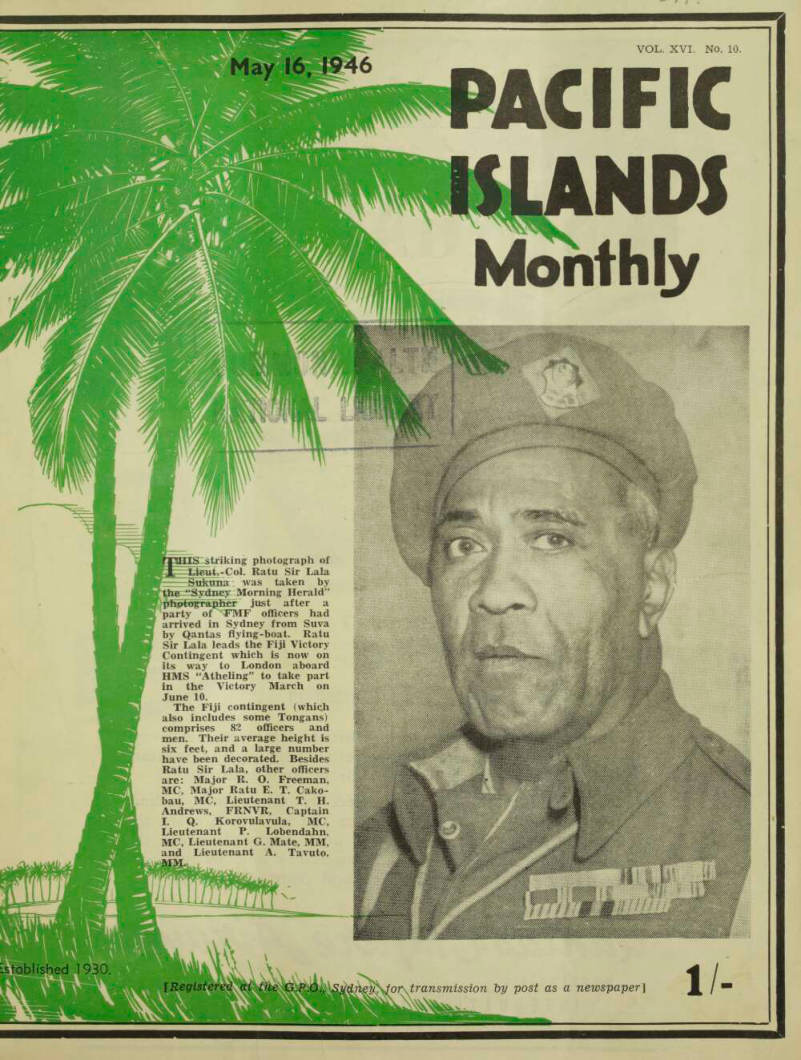
THIS striking photograph of
Lieut-Col. Ratu Sir Lala
Sukuna was taken by the "Sydney Morning Herald” photographer just after a party officers had arrived in Sydney from Suva by Qantas flying-boat. Ratu Sir Lala leads the Fiji Victory Contingent which is now on its way to London aboard HMS “Atheling” to take part in the Victory March on June 10.
The Fiji contingent (which also includes some Tongans) comprises 82 officers and men. Their average height is six feet, and a large number have been decorated. Besides Ratu Sir Lala, other officers are: Major R. O. Freeman, MC, Major Ratu E. T. Cako bau, MC, Lieutenant T. H.
Andrews, FRNVR, Captain I. Q. Korovulavula, MC, Lieutenant P. Lobendahn, MC, Lieutenant G. Mate, MM, and Lieutenant A. Tavuto, MM.
Advertisements & other items, pp. 2-6 (1 item)
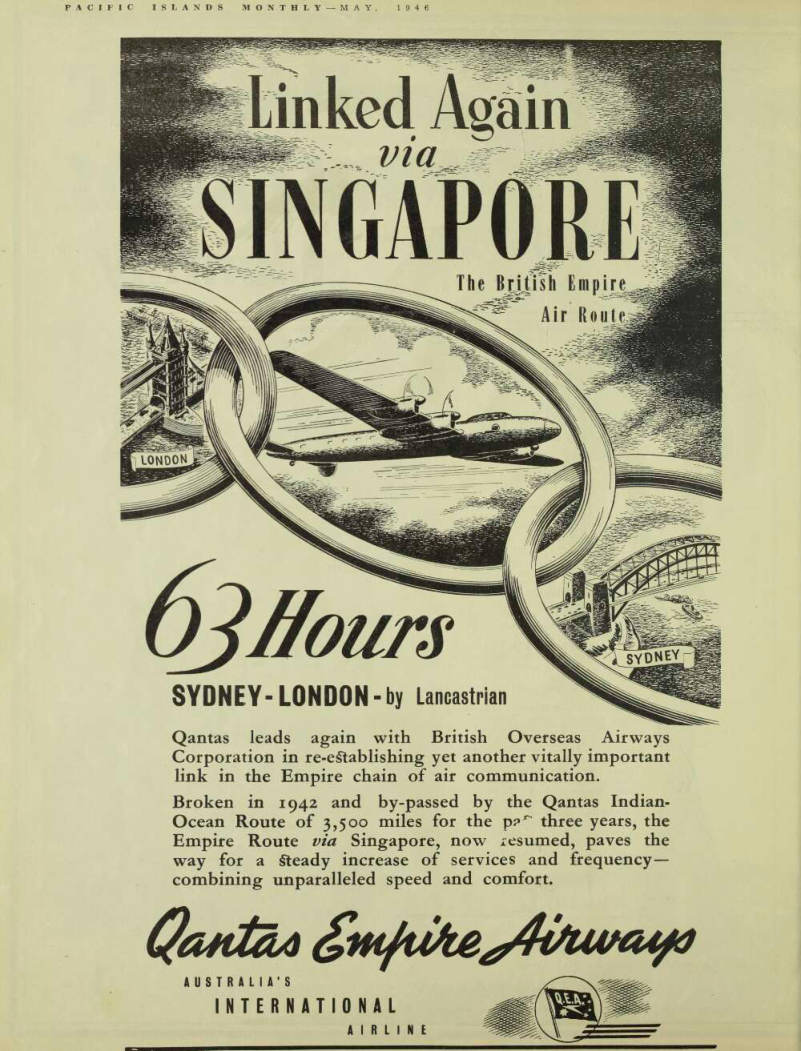
6j /fours
am
via
The British Empire Route
LONDON
SYDNEY
6j /fours
SYDNEY-LONDON-by Lancastrian
Qantas leads again with British Overseas Airways Corporation in re-eStablishing yet another vitally important link in the Empire chain of air communication.
Broken in 1942 and by-passed by the Qantas Indian- Ocean Route of 3,500 miles for the three years, the Empire Route via Singapore, now resumed, paves the way for a Steady increase of services and frequencycombining unparalleled speed and comfort.
Qantfa StHju/te^i/uwufa
AUSTRALIA’S
INTERNATIONAL
AIRLINE
TILLEY LAMPS
BURN ORDINARY KEROSENE
The Modern Form of PORTABLE LIGHTING Table Lamp Model T.L. 13 This photo shows a 300 c.p, Tilley Lamp for domestic use but there are also 5000 c.p. Floodlights, Outdoor Lamps, Radiators, etc. All burn ordinary kerosene.
Tilley Lamps are made only at
Hendon, England.
Because they are so successful copies of the TILLEY LAMPS are being marketed.
BE SURE YOU BUY A TILLEY LAMP
LOOK FOR THE NAME!
A quality product born of long
Manufacturing Experience
Shipments available four weeks from receipt of order THE TILLEY LAMP CO., HENDON, N.W.4, ENG.
REPRESENTATION :
MELBOURNE : T. H. Bentley, Pty. Ltd., 123-125 William Street, Melbourne, Cl.
TASMANIA : Mr. C. Sellars, 108 a Charles Street, Launceston.
FIJI : Mr. K. Witherington, 2 Burns Philp Buildings, Suva.
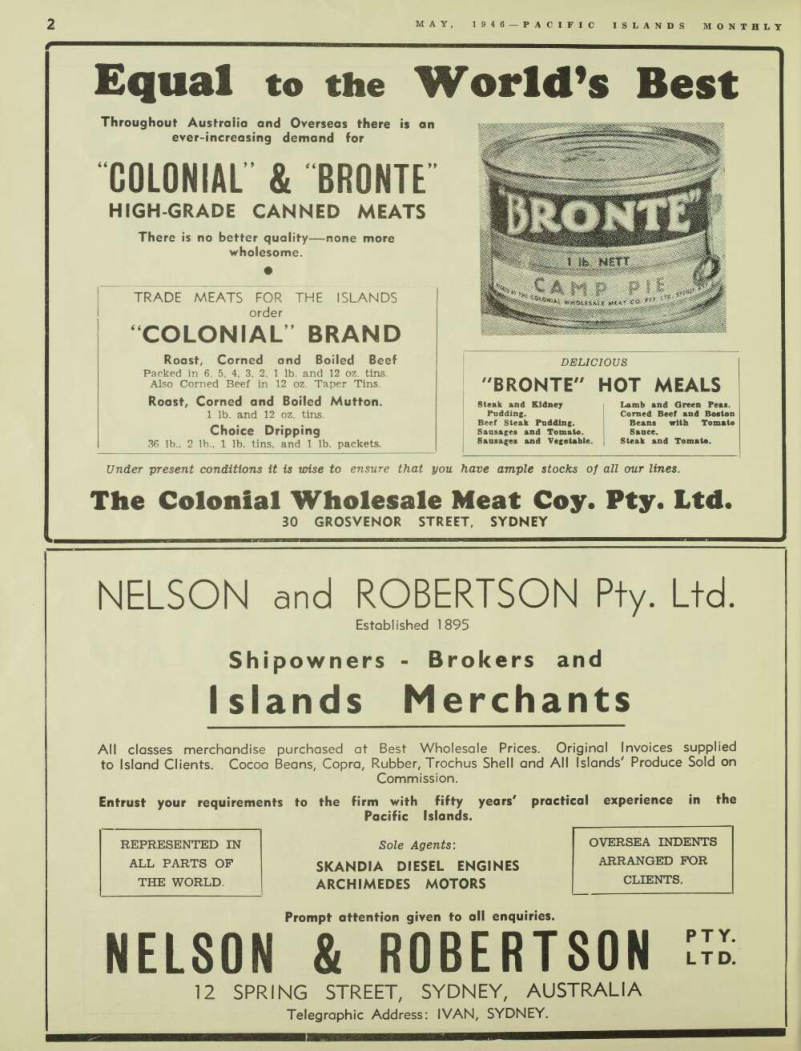
Equal to the World’s Best
Throughout Australia and Overseas there is an ever-increasing demand for
COLONIAL & BRONTE
HIGH-GRADE CANNED MEATS
There is no better quality—none more wholesome.
TRADE MEATS FOR THE ISLANDS
order
“COLONIAL” BRAND
Roast, Corned and Boiled Beef Parked in 6. 5. 4, 3. 2. 1 lb. and 12 oz. tins.
Also Corned Beef in 12 oz. Taper Tins.
Roast, Corned and Boiled Mutton. 1 lb. and 12 oz. tins.
Choice Dripping 36 lb.. 2 lb., 1 lb. tins, and 1 lb. packets. mrt
A HP
Under present conditions it is wise to ensure that you have ample stocks of all our lines.
The Colonial Wholesale Meat Coy. Pty. Ltd.
30 GROSVENOR STREET, SYDNEY
NELSON and ROBERTSON Pty. Ltd.
Established 1895
Shipowners - Brokers and
Islands Merchants
All classes merchandise purchased at Best Wholesale Prices. Original Invoices supplied to Island Clients. Cocoa Beans, Copra, Rubber, Trochus Shell and All Islands 7 Produce Sold on Commission.
Entrust your requirements to the firm with fifty years' practical experience in the Pacific Islands.
NELSON & ROBERTSON Si
12 SPRING STREET, SYDNEY, AUSTRALIA
Telegraphic Address: IVAN, SYDNEY.
PRELIMINARY ANNOUNCEMENT:
PACIFIC
PLANTER’S
HANDBOOK
Publication in 1946 IN response to a strong and growing demand for an authoritative Handbook covering the whole field of Planting and Agriculture in the Pacific Islands, the compilation of the “Pacific Planter’s Handbook” was commenced in 1945. It has been much delayed by strikes, but publication is planned for 1946.
The Handbook is designed to give standard instruction on all the branches of Tropical Planting which might be undertaken in the Pacific Islands, and to be regarded as an indispensable part of a Pacific Planter’s equipment.
SECTIONS of the Handbook deal separately with Palms (including Coconuts and the Manufacture of Copra), Cocoa, Coffee, Rubber, Citrus, Bananas, Vanilla, Spices, Kapok, Pineapples, etc.
The production of every plant grown for profit in the islands is described.
Other Sections cover such subjects as: Livestock on the Plantations; Revenue from Non-Agricultural Products (Sea, Forest, Minerals); How to Ensure Comfortable and Healthy Living Conditions in the Islands; Etc.
SPECIAL SECTIONS: Survey of Opportunities; Selection of Territory (Malarial and non- Malarial, Melanesians and Polynesians, Climate and Rainfall); Lands and Land Laws; Labour Conditions in the Various Territories; Importance of Transport; What You Must Provide For and Against in Choosing Your Plantation.
The subject of MARKETING is dealt with very fully. It is no use planning your plantation until you know where you will find a profitable market for your product, and whether it is dependable.
EACH SECTION WRITTEN BY AN
EXPERT
Numerous Photographs, Diagrams,
Drawings, etc.
PUBLISHED PRICE : Not less than 35/- Australian. (NOTE: Owing to the present difficulty of obtaining paper and binding service, it is impossible to fix a price, until the work is near completion. It will be between 35/- and 40/-, Australian. The edition will be limited. Persons who wish to be sure of a copy may order in advance; and if 35/- is sent, that will be accepted as the price of the book, although the final published price may be higher.) Orders may be sent to:
PACIFIC PUBLICATIONS
PTY. LTD.,
Union House, 247 George Street,
Sydney
or to the PUBLISHERS DIRECT:
PACIFIC PUBLICATIONS (FIJI)
LTD.
P.O. Box 281, Bank of N.S.W T . Building.
SU V A, FIJI. SUVA, FIJI.
Allen Taylor 81 Co. Ltd.
COMMERCIAL ROAD, ROZELLE,
SYDNEY
Sawmillers and Wholesale Suppliers of Hardwoods for Constructional Purposes GIRDERS . . . PILES . . . POLES . . , SLEEPERS, Etc.
EXPORTING TO PACIFIC*” ISLANDS SINCE 1893
2
■OHM*
TO THE MARKETS
OF THE WORLD!
0 ■■% m .
A %5.
I > * H -iV fcjt^ J
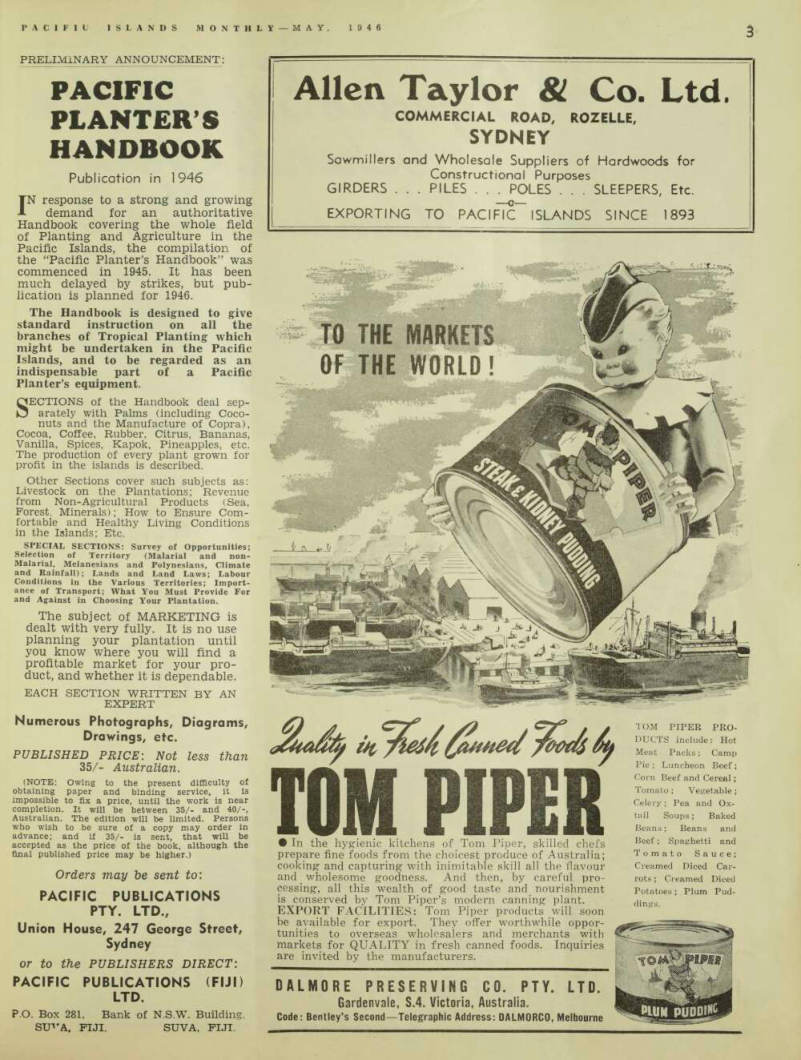
TOM PIPER
TOM PIPER PRO-
DUCTS include: Hot Meat Packs; Camp Pie ; Luncheon Beef ; Corn Beef and Cereal; Tomato ; Vegetable ; Celery; Pea and Oxtail Soups; Baked Beans; Beans and • In the hygienic kitchens of Tom Piper, skilled chefs prepare fine foods from the choicest produce of Australia; cooking and capturing with inimitable skill all the flavour and wholesome goodness. And then, by careful processing, all this wealth of good taste and nourishment is conserved by Tom Piper’s modern canning plant.
EXPORT FACILITIES: Tom Piper products will soon be available for export. They offer worthwhile opportunities to overseas wholesalers and merchants with markets for QUALITY in fresh canned foods. Inquiries are invited by the manufacturers.
DfILMORE PRESERVING CO. PTY. LTD.
Gardenvale, 5.4. Victoria, Australia.
Code: Bentley’s Second —Telegraphic Address: DALMORCO, Melbourne Beef; Spaghetti and Tomato Sauce; Creamed Diced Carrots ; Creamed Diced Potatoes ; Plum Puddings. « : 4„
s^ti
40tfeaM&xfiebieHce.
£>(&nva*t Stchte
i' \ \ {hi I *; , v o 5 ii/ „ i <■ / . .. * v - »
KHK >\' .
3O 5 on d , »» P reh R sto 6 0° on .. bO U 1 n o*i *'l .notes. CO" oter i" 5 W posit' 0 " c°rt' ea fao' seo '' ho"* ' eoW '" 9 ke tose"o •" . cop se °' S . is bross- ' tbc too""* oU tiost U „t 0" d * ' ,s IK St ' Co °°in T g Ab s l t \
[* J ST(
Day after day, week
after week, tor over 40 years Coleman's have specialised in making Stoves and Lamps. Is it any
wonder, then, that
their products give
the utmost in satisfaction and service.
Th it two v •rove ,en.' burne ' d, ,n 9 e *<i q ho** no S°? ,r °l to * of e*y *hut. off ° ny de Unn *ces* y °/ve n% e Qc k .. es *Qry m lh. ked Cornel. bro, Representatives for the Pacific Islands: ROBERT GILLESPIE PTY. LTD. PEARCE £ v f° LTD 54a PITT STREET, SYDNEY FOR FIJI ISLANDS
Returning To The
Territories
FOUR ships have left, or are leaving, Australian ports in May for Papua and New Guinea. They are:
“ORMISTON,” left Sydney May 9, with
passengers and cargo.
“MONTORO,” left Sydney May 14,
with passengers and cargo.
“KANIMBLA,” left Sydney May 13.
for New Guinea ports, with cargo
and Army personnel only.
“MULIAMA/’ to leave Sydney, with
cargo only.
"Ormiston" Passenger List
rE following is a list of persons who left on the liner “Ormiston”: Mrs. A. H. Anthony, W. R. Carpenter (NG), Ltd., Madeng, NG.
Mr. C. D. Ailwood, Hotel “Moresby,” P. Moresby.
Mr. F. Buckley, BGD, Bulolo.
Mr. H. J. Bray, Yule Is., via P. Moresby.
Mr. M. W. Bergin, Admin’n, ANG, P. Moresby.
Mr. L. H Brooks, Upper Port Rd., P. Moresby.
Mrs. M. K. and Miss H. M. Brown, Admin’n, P. Moresby, NG.
Mr. M. Boch, Torokina (B’g’ville).
Mr. A. A. L. Barnett, Docowan Plantation, Kar Kar, NG.
Mr. and Mrs. D. Brennan (and one child), SDA Mission, Lae.
Mr. G. D. Casbolt, W. R. Carpenter & Co., Ltd., Madang.
Mr. R. J. Clancy, PCB, P. Moresby.
Mr. W. F. Cash, W. R. Carpenter & Co., Ltd., Wau.
Mr. J. A. Crockett, Admin’n, P. Moresby.
Mr. R. D. Cahill, Government Store, Kila.
Mr. G. J. R. Cox, Harbour Master, P. Moresby.
Mr. J. Curtis, P. Moresby.
Mrs. D. Carpenter, Marangis Plantation, Madang.
Mrs. E. G. Cadden, P. Moresby.
Mr. E. B. Campbell, Hotel “Moresby,” P. Moresby.
Mr. A. H. Cresswell, Lili-na-kaia Estate, Earn ing.
Mr. L. V. Drill, Hotel “Moresby,” P. Moresby.
Mr. R. C. Dickie, Hotel “Moresby,” P. Moresby.
Mr. C. Durham, Lae.
Sister M. Genevieve Downey, Sacred Heart Mission, Yule Is.
Sister M. Fabiana De Groot, Sacred Heart Mission, Vunapope.
Mr. L. Dalsanto, Burns, Philp & Co., Ltd., P. Moresby.
Mrs. E. Erskine (and three children), Burns, Philp & Co., Ltd., P. Moresby.
Mr. and Mrs. G. H. Eekhoff, Lae.
Mr. P. R. N. England, Admin’n, P. Moresby.
Mr. S. W. G. Edmonds, PCB, P. Moresby.
Sister M. Hilaria Ey, Sacred Heart Mission, Vunapope.
Mr. D. B. Edgell, Kavieng.
Mrs. F. M. Puller, Burns, Philp & Co., Ltd., P.
Moresby.
Mr. A. I. Foley, P. Moresby, Papua.
Mr. G. S. Franklin, BGD, Bulolo.
Mrs. I. A. Gray, Public Works, Lae.
Mrs. A. J. Gorringe (and one child), Burns, Philp & Co., Ltd., P. Moresby.
Mrs. W. V. Godson (and one child), Itikinumu, via P. Moresby.
Mr. and Mrs. S. Gillis (and one child), SDA Mission, P. Moresby.
Mrs. J. Haigh, Rigo, via P. Moresby.
Mr. F. A. D. Hill, Admin’n, P. Moresby.
Mr. J. Hayes, Burns, Philp & Co., Ltd., P.
Moresby.
Sister M. Marcella Hyndes, Sacred Heart Mission, Vunapope.
Sister M. Jules Hogan, Sacred Heart Mission, Yule Is.
Mr. P. J. Hawe, Admin’n, P. Moresby.
Mr. C. W. Ireland, Walindi Plantation, Talasea.
Mr. A. P. Ireland, Upper Waput.
Mr. F. P. Hegarty, BGD, Bulolo.
Mr. E. Hetherington, Burns, Philp, P. Moresby.
Mr. R. E. Halpin, Burns, Philp, P. Moresby.
Father A. G. Junker, Torokina, Bougainville.
Mrs. D. Jackson.
Mrs. P. L. Keenan, Finschafen, NG.
Sister M. Helena Kobloth, Sacred Heart Mission, Vunapope.
Miss A. C. Lavery, Marist Mission, Bougain ville.
Mrs. E. E. Lukin (and one child), P. Moresby.
Mr. J. L. Leahy, Lae.
Mr. F. Leonard, P. Moresby.
Mr. J. Lamarre, Torokina, Bougainville.
Father G. Lebreton, Toronkina, Bougainville.
Mr. D. I. McAlpin, Admin’n, P. Moresby.
Father F. B. Miltrup and Father Adam Muller, RC Mission, Torokina, Bougainville.
Miss Alice Menzies, Marist Missions, Bougain ville.
Mr. W. M. Middleton, Madang, NG.
Mr. D. H. Maclean, Tovanakus Plantation, Rabaul.
Mr. R. MacGregor, Madang.
Mr. C. A. Mustard, P. Moresby.
Mr. G. H. and Mrs. E. J. Murray, Bali, Witu.
Miss J. H. Miles, PCB, P. Moresby.
Mrs. M. Mclntyre, Burns, Philp, P. Moresby.
Mrs. J. L. and Miss A. B. McKenna, J. B.
McKenna, Admin’n, P. Moresby.
Mr. D. G. McEvoy, Put Put Plantation, Rabaul.
Sister M. Adela McGrath, Sacred Heart Mission, Vunapope.
Sister M. Michael Mcßae, Sacred Heart Mission, Vunapope.
Sister M. Agnes Mclnerney, Sacred Heart Mission, Yule Is.
Mr. R. Nicoll, Morobe Bakery, Lae.
Mrs. F. E. Neal, Wau.
Mr. C. J. and Mrs. E. M. Olsson, Wau.
Sister M. Flavia O’Sullivan, Sacred Heart Mis sion, Vunapope.
Mrs. D. E. and Miss P. A. O’Connor, P. Moresby.
Mr. A. H. Pinkerton. Admin’n, P. Moresby.
Mr. J. B. Poncelet, Torokina, Bougainville.
Mr. R. J. Paul, Steamship Trading Co., P.
Moresby.
Mr. W. B. Prior, Admin’n, P. Moresby.
Mr. B. M. Ritchie (and two chlldreni, Admin’n, P. Moresby.
Mr. C. A. Rigby, Admin’n, P. Moresby.
Mrs. M. and Miss B. Schilling, Matupi Plantation, Madang.
Mrs. G. P. Sinclair, Police Dept., Lae.
Mrs. E. M. Shorthouse (and three children), Burns, Philp, P. Moresby.
Mr. V. H. Sully, Admin’n, P. Moresby.
Mr. J. Stroud, Hotel “Moresby,” P. Moresby.
Father J. Schlieker, Torokina, Bougainville.
Father J. Strahen, Torokina, Bougainville.
Mr. R. Stephens, Lae.
Mrs. N. E. Speedie, Kaura Plantation, P.
Moresby.
Sister M. Bernardine Smiggels, Sacred Heart Mission, Vunapope.
Mrs. R. Schmidt (and child). Mrs. H. Thomp son, Mr. G. R. Townsend, BGD, Lae.
Mr. L. Tudor, Lae.
Father B. Tonjes, Torokina, Bougainville.
Mr. F. Trojaola, Sandy Creek, Wau.
Mr. R. W. Tebb, Burns, Philp, Lae.
Mr. S. C. Thompson, P. Moresby.
Sister M. Isidora Van Torsel, Sister M. Gabriella Van Beek, Sister M. Paulina Van Run, and Sister M. Rosina Van Sterrin, Sacred Heart Mission, Vunapope.
Mrs. A. E. Wyborn, Rigo, P. Moresby.
Mrs. M. Wright, PO, Wau.
Mr. G. J. Wills, Holo Rubber Estate, P. Moresby.
Sister M. James Williams, Sacred Heart Mission, Yule Is.
Mr. J. Wolstenholme, P. Moresby.
Mrs. L. M. Crouch (and four children), Burns, Philp, P. Moresby.
Mr. W. J. Connor, Linga Linga Plantation, New Britain.
Mrs. E. E. Pitt. Lae.
Mr. R. B. McKenzie, Burns, Philp, Bulolo.
Mrs. I. E. Burchett (and one child), Admin’n, P. Moresby.
Mr. P. Zuccola, Upper Ramu, Lae.
Rev. Father P. Schank, Torokina, Bougainville.
Mr. W. A. B. Sheppard, ANGAU, Rabaul.
Mr. Allan Doyle, Admin’n, P. Moresby.
"Montoro" Passengers
PASSENGERS who embarked on the “Montoro” in Sydney on May 14, for Papua and New Guinea. (Names of passengers who embarked in Brisbane will be published in June): — FOR PORT MORESBY: Mrs. R. Bernard (and child), Miss A. M. Pattison, Mrs. A. C. Boots (and two children), Mr. C. H. Maclean, Mr. E.
T. Fulton, Miss J. Jones, Mrs. G. Macdonald.
FOR SAMARAI: Mr. and Mrs. Angelo, Mrs.
E. P. Bunting, Mr. and Mrs. A. E. Cridland (and child), Mrs. B. Penney, Mrs. D. E. Ryan (and child), Mr, J. W. Ryan, Sister Mary Verona, Sister Mary Paul, Sister Mary Paula, Mr. and Mrs. N. A. Brett Young, Mrs. C. J.
Izod, Mr. H. C. Halliday, Mr. V. C. Gabriel, Mr. J. Kelynack, Mr. and Mrs. Hancock (and three children), Mr. Trim, Rev. and Mrs. H.
T. Shotton (and two children), Rev. and Mrs.
Guy.
FOR LAE: Mr. and Mrs. L. E. Ashton, Mrs.
D. R. Booth, Mrs. H. T. Peterson, Mr. G. S.
Duncan FOR MADANG: Mr. and Mrs. E. V. O’Brien.
FOR RABAUL; Mr. A. Campbell, Mr. H. M.
Lyon.
"Ormiston" Passengers
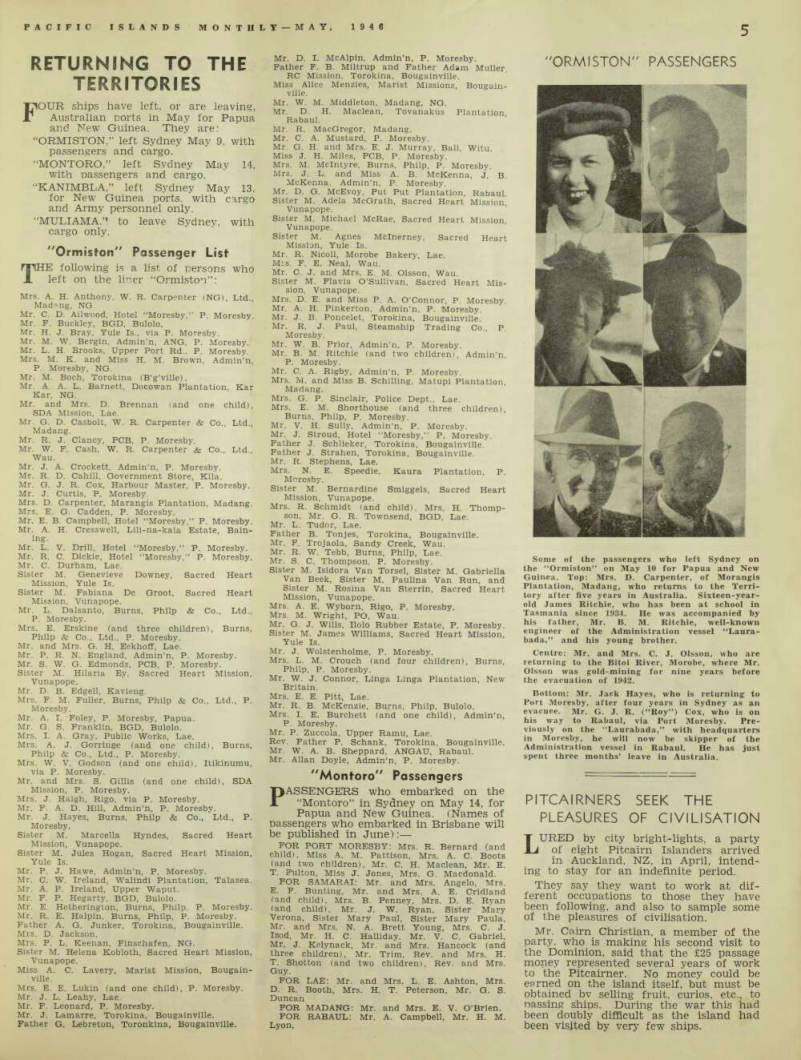
Some of the passengers who left Sydney on the “Ormiston” on May 10 for Papua and New Guinea. Top: Mrs. D. Carpenter, of Morangis Plantation, Madang, who returns to the Terri tory after five years in Australia. Sixteen-year old James Ritchie, who has been at school in Tasmania since 1934. He was accompanied by his father, Mr. B. M. Ritchie, well-known engineer of the Administration vessel “Laura bada,” and his young brother.
Centre: Mr. and Mrs. C. J. Olsson, who are returning to the Bitoi River, Morobe, where Mr.
Olsson was gold-mining for nine years before the evacuation of 1942.
Bottom: Mr. Jack Hayes, who is returning to Port Moresby, after four years in Sydney as an evacuee. Mr. G. J. R. (“Roy”) Cox, who is on his way to Rabaul, via Port Moresby. Pre viously on the “Laurabada,” with headquarters in Moresby, he will now be skipper of the Administration vessel in Rabaul. He has just spent three months’ leave in Australia.
Pitcairners Seek The
Pleasures Of Civilisation
LURED by city bright-lights, a party of eight Pitcairn Islanders arrived in Auckland, NZ, in April, intend ing to stay for an indefinite period.
They say they want to work at dif ferent occupations to those they have been following, and also to sample some of the pleasures of civilisation.
Mr. Cairn Christian, a member of the party, who is making his second visit to the Dominion, said that the £25 passage money represented several years of work to the Pitcairner. No money could be earned on the island itself, but must be obtained bv selling fruit, curios, etc., to nassing ships. During the war this had been doubly difficult as the island had been visited by very few ships.
Advertisers
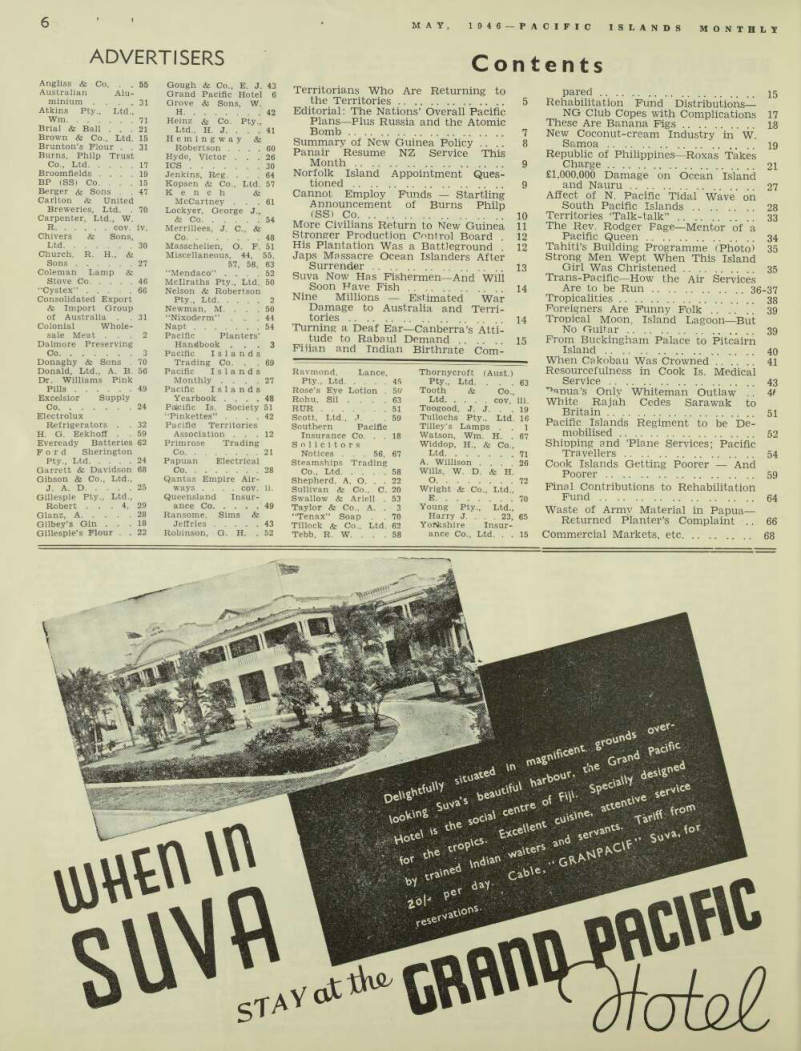
Angliss & Co. . . 55 Australian Alu minium ... 31 Atkins Pty., Ltd., Wm 71 Brial & Ball ... 21 Brown & Co., Ltd. 15 Brunton’s Flour . . 31 Burns, Philp Trust Co., Ltd 17 Broomfields ... 19 BP (SS) Co. . . . 15 Berger & Sons . . 47 Carlton & United Breweries, Ltd. . 70 Carpenter, Ltd., W.
R cov. iv.
Chivers & Sons, Ltd 30 Church. R. H., & Sons 27 Coleman Lamp & Stove Co 46 “Cystex” 66 Consolidated Export & Import Group of Australia . . 31 Colonial Whole sale Meat ... 2 Dalmore Preserving Co 3 Donaghy & Sons . 70 Donald, Ltd., A. B. 56 Dr. Williams Pink Pills 49 Excelsior Supply Co 24 Electrolux Refrigerators . . 32 H. G. Eekhoff . . 59 Eveready Batteries 62 Ford Sherington Pty., Ltd 24 Garrett & Davidson 68 Gibson & Co., Ltd.,
J. A. D 25
Gillespie Pty., Ltd., Robert ... 4, 29 Glanz, A 28 Gilbey’s Gin ... 18 Gillespie’s Flour . . 22
Gough & Co., E. J. 43 Grand Pacific Hotel 6 Grove & Sons, W.
H 42 Heinz & Co. Pty., Ltd., H. J. . . . 41 Hemingway & Robertson ... 60 Hyde, Victor ... 26
Ics 30
Jenkins, Reg. ... 64 Kopsen & Co., Ltd. 57 Ken c h & McCartney ... 61 Lockyer, George J., & Co 54 Merrillees, J. C., & Co 48 Masschelien, O. F. 51 Miscellaneous, 44, 55, 57, 58, 63 “Mendaco” ... 52 Mcllraths Pty., Ltd. 50 Nelson & Robertson Pty., Ltd 2 Newman, M. . . .50 “Nixoderm” ... 44 Napt 54 Pacific Planters’
Handbook ... 3 Pacific Islands Trading Co. . . 69 Pacific Islands Monthly ... 27 Pacific Islands Yearbook ... 48 Pacific Is. Society 51 “Pinkettes” ... 42 Pacific Territories Association ... 12 Primrose Trading Co 21 Papuan Electrical Co 28 Qantas Empire Air ways ... cov. ii.
Queensland Insur ance Co 49 Ransome, Sims & Jeffries 43 Robinson, G. H. . 52
Raymond, Lance, Pty., Ltd 45 Rose’s Eye Lotion . 59' Rohu, Sil . . . .63
Rur 51
Scott, Ltd., J. . . 59 Southern Pacific Insurance Co. . . 18 Solicitors Notices ... 56, 67 Steamships Trading Co., Ltd 58 Shepherd, A. O. . . 22 Sullivan & Co., C. 20 Swallow & Ariell . 53 Taylor & Co.. A. . 3 “Tenax” Soap . . 70 Tillock & Co., Ltd. 62 Tebb, R. W. . . .58
Thornycroft (Aust.) Pty., Ltd. ... 63 Tooth & Co., Ltd cov. iii.
Toogood, J. J. . . 19 Tullochs Pty., Ltd. 16 Tilley’s Lamps . . 1 Watson, Wm. H. . 67 Widdop, H., & Co , Ltd 71 A. Willison ... 26 Wills, W. D. & H. 0 72 Wright & Co., Ltd., E 70 Young Pty., Ltd., Harry J. . . . 23, 65 Yorkshire Insur ance Co., Ltd. . . 15
Contents
Territorians Who Are Returning to the Territories 5 Editorial: The Nations’ Overall Pacific Plans—Plus Russia and the Atomic Bomb 7 Summary of New Guinea Policy ... 8 Panair Resume NZ Service This Month 9 Norfolk Island Appointment Ques tioned 9 Cannot Employ Funds Startling Announcement of Burns Philp
(Ss) Co 10
More Civilians Return to New Guinea 11 Stronger Production Control Board . 12 His Plantation Was a Battleground . 12 Japs Massacre Ocean Islanders After Surrender 13 Suva Now Has Fishermen—And Will Soon Have Fish 14 Nine Millions Estimated War Damage to Australia and Terri tories 14 Turning a Deaf Ear—Canberra’s Atti tude to Rabaul Demand 15 Piiian and Indian Birthrate Com
pared 15 Rehabilitation Fund Distributions— NG Club Copes with Complications 17 These Are Banana Pigs 18 New Coconut-cream Industry in W.
Samoa 19 Republic of Philippines—Roxas Takes Charge 21 £1,000,000 Damage on Ocean Island and Nauru 27 Affect of N. Pacific Tidal Wave on South Pacific Islands 28 Territories ‘Talk-talk” 33 The Rev. Rodger Page—Mentor of a Pacific Queen 34 Tahiti’s Building Programme (Photo) 35 Strong Men Wept When This Island Girl Was Christened 35 Trans-Pacific—How the Air Services Are to be Run 36-37 Tropicalities 33 Foreigners Are Funny Folk .. '' .. 39 Tropical Moon, Island Lagoon—But No Guitar 39 From Buckingham Palace to Pitcairn Island 40 When Cakobau Was Crowned 41 Resourcefulness in Cook Is. Medical Service 43 Lima’s Only Whiteman Outlaw .. ¥ White Rajah Cedes Sarawak to Britain 51 Pacific Islands Regiment to be De mobilised 52 Shinping and ’Plane Services; Pacific Travellers 54 Cook Islands Getting Poorer And Poorer 59 Final Contributions to Rehabilitation Fund 64 Waste of Army Material in Papua— Returned Planter’s Complaint .. 66 Commercial Markets, etc 68
Advertisements & other items, p. 8 (1 item)
s\JNs
% V-
stav^^
eg M.,
I 4s <*« r ' f e ot. S roV,n pa c>f* .„ m»S'" f . , a dto*** 4 ' .- r bovi r ’ tn , w des'6° e U " Y , s b "* fn „ eC ' S ive serAce S^ a . te t>« e ° , ne a« e 0 (rot* ’ . „ s oC'A c , c o' s '° taf'" «*“ fccceW** . s er^ tS - , c u v».'° r *»
Pacific Islands Monthly
The Newspaper-Magazine of the South Seas [Registered at the G.P.0., Sydney, for transmission by post as a newspaper .]
Published Once Each Month and Circulated in Australia and New Zealand and in the following Pacific Territories and Islands Groups:
Australian Territory of Papua.
Mandated Territory (Australia) of New Guinea Australian Territory of Norfolk Island.
New Zealand Territory of Cook Islands.
Mandated Territory (NZ) of Western Samoa.
British Colony of FIJI.
British Solomon Islands Protectorate.
British Protectorate of Tongan Islands.
British Crown Colony of Gilbert and Ellice Islands.
Mandated Territory of Nauru.
British and Free French Condominium of New Hebrides.
Free French Colony of New Caledonia.
Free French Colony of Oceania (Tahiti, etc.).
American Territory of Eastern Samoa.
American Territory of Hawaiian Islands.
Owned and Produced by Pacific Publications Pty. Ltd., Union House, 247 George Street, Sydney.
TELEPHONES I General Office .. .. BAY 5037 TELEPHONES £ Advertising Office . . .. B 7815
P O. Box 3408 R
Registered Address for Telegrams, Radiograms, and Cables; ••Pacpub”, Sydney.
Contributions.
Articles, Stories and Photographs dealing with Pacific Islands subjects are invited and will be paid for on publication.
Subscription Rates.
Per Annum, within British Empire, Prepaid, Post Free 10/- Per Annum, elsewhere, Prepaid, Post Free 12/6 Single Copies 1/-
Editor and Publisher:
R. W Robson. F.R.G.S.
General Office: Union House, 247 George Street, Sydney.
Advertising Manager: W. E. Rogers, 26 O’Connell Street, Sydney. Telephone: B 7815.
Printing House: .29 Albert Street, Sydney.
Telephone: MA 4369.
Representative In Fiji.
Pacific Publications (Fiji), Ltd., Bank of NSW Building, Suva (same office as W. H. Grove & Sons, Ltd.). Stocks of Pacific Islands Monthly and Pacific Islands Yearbook on hand.
Representative In London.
J. T. Wallis, Coronation House, 4 Lloyds Avenue, London, E.C.3, from whom may be obtained copies of Pacific Islands Monthly, Pacific Is. Year Book, advertising schedules, etc.
Agents.
The following are authorised to receive sub scnptions for Pacific Islands Monthly;— Burns, Phllp & Co., Ltd., and Burns Phllp (South Sea) Co., Ltd. All branches.
W. R. Carpenter & Co., Ltd. All branches.
Morris, Hedstrom, Ltd. All branches.
Steamship? Trading Co., Papua. All branches.
Whitten Bros., Ltd., Samaral, Papua.
B.N.G. Trading Co., Ltd., Port Moresby, Papua.
J. Muir, Suva, Fiji.
Miss R. Castles, Suva, FIJI.
N. C. Mackenzie Hunt, Walnunu, Bua, Fiji.
Cook Islands Trading Co., Rarotonga, Cook Is.
A. C. Rowland, Papeete, Tahiti.
Islands Branches and Representatives of W, H.
Grove & Sons, Ltd., Auckland, New Zealand.
Ed. Pentecost, Noumea, New Caledonia.
Societe Gubbay Kerr et Cie, Noumea, N. Caledonia.
Vol. XVI. No. 10.
May 16, 1946.
n :_ 1/- Per Copy. nu_c Prepaid: 10/- p.a.
The Nations' Overall Pacific Plans—Plus Russia
and the Atomic Bomb!
SOME people—especially the “Bobby sox Press'’ in Australia—have been displaying concern and excitement about the future control of Pacific Ter ritories, and the part which Australia and New Zealand are likely to play therein. Australia and New Zealand tend constantly to exaggerate their own importance. They are not strong enough to play any significant part, alone, in Pacific affairs.
The United States, evidently, is pre pared to undertake, for an indefinite period, the heavy responsibility of main taining peace in the Pacific zone. The Americans, in connection therewith, naturally wish to make use of the great base of Manus (north of New Guinea), built by Americans with American equip ment and money. It is indicated also that Washington hopes that smaller bases, built by the Americans in 1942-5, in places like Honiara (Solomons), Santo (New Hebrides), and points in Polynesia, although in British territories, will be available for the use of American Forces.
But the cheap politicians of Australia and New Zealand, aided by some news papers, have turned handsprings and danced on their hats at the very idea of “American interference with our sovereign rights.” Instead of thanking all the gods they know for American determination to hold the status quo in the Pacific, and being co-operative, they have stood up on their little dunghills and shaken their fists at the United States.
One be-medalled general even warned his fellow-countrymen against permitting the Americans to hold Manus, because one day the United States may be Aus
tralia’s enemy. Australia’s enemy! There are more people in a big American city than there are in the whole of Aus tralia! rE Prime Ministers of the British Commonwealth have been meeting in London; and we have been in formed that the following agreements have been reached: • The Australian-New Zealand Agree ment of early 1944 (usually called the Anzac Plan) has been accepted as the basis of British policy in the South Pacific. • In accordance with the Anzac Plan, a South Seas Regional Commission will be formed by the United Kingdom, Aus tralia and New Zealand, with head quarters in Australia, to co-ordinate administrative policy in all the British tropical territories south of the Equator. • The United States and France will be asked to join this South Seas Regional Commission, s that their territories south of the Equator may be included in the general plan of administrative and developmental co-ordination. • It is assumed that the South Seas Regional Commission ultimately will be come a part of the UNO structure.
The authors of this plan do not look northwards of the Equator. It is pre sumed that there will be a South-east Asia Regional Commission; that Britain, United States, France, and Holland will be members of it; that it will deal with all the territories of Indonesia, and the Caroline, Marshall and Mariana archi pelagoes; and that it, also, will be sub ject to UNO.
Up to this point, the decisions arrived
at by the British leaders in London were concerned mostly with administration in their respective Pacific Territories. There appeared to be a general wish to obtain tne co-operation and goodwill of the United States.
WHEN the Prime Ministers turned to defence, however, one received, from the published reports, an im pression of aggressiveness. It was announced that Australia had laid down the following as the basis of her approach to the matter: • Forces to be provided in accordance with Articles 43 and 45 of the Charter, including regional arrangements under Article 52. ® Forces to be maintained by Austra lia under arrangements for co-operation in Empire defence in accordance with the inherent right of self-defence under Article 51. • Forces to be maintained by Australia to provide for the inherent right of in dividual self-defence under Article 51. • In regard to arrangements under Article 52, that the question of the use of bases in areas controlled by Australia must be related to an overall plan relat ing to the maintenance of security in the South-west Pacific, with reciprocal rights to the use of bases of other parties to the agreement.
Which, in simple terms, means that Australia is prepared to maintain garri sons in some of the nearby Islands.
One newspaper reports that these view points were generally supported by the United Kingdom and the other Dominions.
THE inaugural work of the South Seas Regional Commission is to be done by Australia and New Zealand. The Commission, in the beginning (presum ably, until it is part of UNO) will have
no administrative authority—its func tions win oe purely advisory. it win assist in the establishment in Australia oi a of colonial studies, wnere selected men may oe trained to become administrative officials. (Already, tnere are indications mat tne Adminis tration school held in 1945 at Duntroon, near Canberra, and at noldsworthy, near oydney, will be the model for tne new institution, and that a clever young man, coioiiel Conlon, who was prominently associated with the School, and tne External Territories Department, will be in tne picture, colonel Conlon recently returned to the University of Sydney as a nith-year medical student.) The lollowing are reported to be the objectives of the South Seas Regional commission: o To promote attainment of self government by the natives. • To recommend on production, fin ance, communications and marketing. • To co-ordinate health and educa tional services. • Collaboration in economic, social and anthropological research. ® To improve wages, conditions of work and welfare generally.
Another report stated that the Com mission, in order to keep in touch with islands communities, will use radio ex tensively. There will be a chain of radio stations throughout tne South Pacinc, probably drawing their programmes from Australia.
Trained men from the British Colonial Ornce, and selected officials from New Zealand, will be sent to Australia as members of the Commission. They will travel extensively in the South Pacific Territories.
EXCEPT that it may become concerned with native welfare to the exclusion of European interests, the plan generally has much to commend it.
For fiiteen years, this journal has been pointing out that, if the Pacific Terri tories suffer from one thing more than another, it is the lack of a co-ordinating authority in relation to policy and ad ministration. A dozen independent Ter ritories, travelling in a dozen different directions, have led almost always to stagnation, and to anomalies without number.
But the expensive new Commission, superimposed upon the various Pacific Administrations which have been ex panded at much extra cost since 1942, is not going to lighten any of the bur dens of the Australian and New Zealand taxpayers. As a matter of fact, long be fore all these Pacific instrumentalities (consummation of the dreams of various Socialistic Ministers) begin really to function, the overburdened taxpayers probably will have rebelled, and there will be much jettisoning of “administra tive frills.”
MEANWHILE, what of defence, and the squawking of the Australian isolationists?
There is no real difficulty here. The United States has not the slightest in terest in the British territories of the South Pacific, except insofar as they may provide necessary facilities for bas ing the southern flanks of the American Forces entrusted with the policing of the Pacific region. All the British Ministers know this quite well. There will be no difficulty in respect to Manus, or Santo, or Honiara. Those, and other places, nominally British and Dutch and French, will be available to all the Forces of the Democratic bloc, now taking shape.
Far more significant than any of the headlined nonsense cabled from London or Australia is a quiet announcement from Washington, made early in May.
The joint Chiefs of Staff (British and
American) have approved a plan under wnich all American-built bases in the South Pacific will be shared equally be tween the Forces of the United States, Britain, Australia and New Zealand. It is stated specifically that USA does not seek territorial control of any of the islands concerned, and has no commer cial interest in them —she merely desires that the bases should be made available as part of her security organisation.
THERE is far more for our attention in the Pacific than silly arguments about territories between the English-speaking nations. Present indi cations are that we have escaped a threat of extinction by Asiatics only to face a new threat from the Asiatic half-world— from Russia.
Russia, through Eastern Siberia, must definitely be regarded as a Power bordering the Pacific. Russia is actively engaged in a campaign designed to undermine and destroy the Western or Democratic Powers. Russia, therefore, must be considered as a potential enemy.
In all the mad, convulsed world of to-day there is nothing more puzzling and disturbing than the attitude of Russia. The Soviet leaders are cynical, non-cooperative, unfriendly. Why? Ap parently, because they think it is theh mission to destroy what they call “capitalism,” and impose their foul, soul destroying system upon all the free nations of the world.
We plan to get peace and security and guard our individual freedom through the United Nations Organisation. The Russian Communists apparently believe that, if they can cripple UNO. and set the Democratic nations quarrelling among themselves, they may throw the Communistic net across the whole world.
So. this month, we have seen the nre liminary Peace Conference in Paris sabotaged bv the Russians, and the sit tings of UNO in New York dislocated, by the same agency, to the point of im potency.
Unless there is a profound change in Russian policy, we shall see soon a breakdown in the UNO nlan, and the sharp division of the world into two blocs—Democratic and Communistic.
Maybe the cure for the world’s worst headache is being prenared to-day at Bikini AtoH, in the Marshall Islands.
An American fleet, and Anglo- American experts, are gathering there for a thorougth test-out of the atomic bomb, early in June.
If, after that, the world is still in one niece, we may have something to say to Molotoff & Co. that will alter the pre sent distressing course of history.
New Guinea Casualties
Became missing and is now presumed dead: NG4047 Rflmn. L. S. Dix, Infantry, Rabaul.
Died of Illness: NG2464 W/011 H. J.
O’Kane, HQ Unit, Rabaul.
Removed from Seriously and Danger ously 111 Lists: NG2343 Pte. L. H. Gielis, Ordnance, Rabaul.
In a speech made in Canberra on March 26, Dr. Evatt, Australian Minister for External Affairs, said: “New Cale donia . . . situated at a few hours’ flight from Australia, is of supreme importance for us from a strategic point of view.
When we deal with a territory like New Caledonia, we must remember that be hind it there is France, which was almost faced with death in the last war, but which has been and which will again be come one of the great world powers.
Consequently, the future of New Cale donia cannot be separated from the problem of France.”
Preoccupation With
Summary Of Ng
Policy
Preoccupation With Natives
From Our Own Correspondent
Canberra, May 11.
rE policy of the Provisional Adminis tration of Papua-iNew Guinea is to provide for the 1,000,000 natives of the area “facilities for better health, education and a far greater participation in the wealth of the country,” according to an official bulletin to-day.
The bulletin said: “It is intended to abolish the indenture system within five years. Legislation to be introduced soon will provide for the elimination of pro fessional recruiting, for improved diet for tne natives, and improved working con ditions.”
New Britain, New Ireland, Kieta and Manus will be transferred to Civil Administration “as soon as circumstances are favourable.”
Sixty men will be given three months’ training for patrol work in a newly established school of Civil Administra tion. The course includes anthropology, tropical health and Colonial Administra tion.
The bulletin says: “Transport prob lems and shortages of accommodation and food have impeded the return of former residents to the Territories. Their return is controlled and necessarily dependent upon rehabilitation progress.
“Shortage <pf shipping is retarding re habilitation in the Territories, but the Commonwealth has now contracted with certain shipping companies, which oper ated before the war, for a 12 months’ service, as agents for the Government.
“An improved air service among the Islands will be developed.”
Ships
Islands Still Awaiting Ships
THE shipping service between the Aus tralian Pacific Territories and Aus tralia continues on a haphazard, hand-to-mouth system.
Shipping generally remains at the dis posal of the Governments, but half-a dozen instrumentalities have a voice in its disposition, and no one—least of all the shipowners—can give any indication of how and when the few available ships will be used.
The Australian Territories Minister, Mr. Ward, has stated repeatedly that he is trying to arrange a regular service to the Territories; but he cannot say when it will operate or who will own it.
In the meantime, what is called an “interim service” is oeing carried on with the “Ormiston” and the “Montoro.” But the movements of the ships are not known more than two or three weeks ahead. The lack of reliaM? shipping, next to the absence of native labour, is the biggest factor holding up Territories rehabilitation.
The return of the old Burns Philp steamer, “Montoro” (operated by Burns Philp on behalf of the Government), to the Islands run was like a breath of for mer happy days to war-weary Terri torians. She was on her way to the Japanese boneyards when the Pacific war came in 1941.
The only Western Pacific ship yet back on a regular schedule is the Burns Philp steamer “Morinda,” running from Syd ney to Norfolk Island and the New Hebrides.
Questioned
Norfolk Is. Appointment Questioned
rE appointment of Mr. Alex Wilson as Administrator of Norfolk Island was still being disputed in the House of Representatives in Canberra by Mr.
Anthony, on April 11.
Previously, Mr. Anthony had asked the Minister for External Territories (Mr.
Ward) several questions concerning the appointment, but found the answers unsatisfactory.
Mr. Anthony said that there were many distinguished Servicemen who had served Australia well in the Middle East and the Islands who would have been perfectly suitable for such a post—but it was given to Mr. Wilson, “ex-member for Wimmera, an ex-stooge of the Govern ment.”
He said that the post had not been advertised, and Mr. Ward’s statement that the “qualifications of all those who were considered suitable and available for the post were considered” would not be regarded as an adequate answer by Ser vicemen. Mr. Wilson happened to pos sess the Qualification of having been a supporter of the Government at a critical time, but no other qualification.
The appointment reeked of everythin? that is undesirable. It was a shameless method of paying for political support at the expense of every decent ex- Serviceman who might have a claim.
Plenty of men who served through six years of war with great merit are now thrown on the scrap-heap. The other day, the Minister for Air (Mr. Drakeford) announced the retirement of certain high-ranking officers of the Air Force Such men as Bostock, Williams and Lucas have been given notice of their retirement. Anv one of those men would be qualified to fill this iob, but they were not °lven the opportunity to apply.
EDITORIAL NOTE: For nearly 20 years, we have been protesting against the Australian practice of appointing superannuated Parliamentarians and political favourites to Pacific Adminis tratorships, and ignoring the trained men of the tropical public services. It is gratifying to note that at least one Aus tralian MP has the vision and the cour age to attack the rotten system.
"Mystery"
Fiji-Australia Air-Mail
The air-mail postage between Austra lia and Fiji is one of the post-war mys teries of officialdom. Letters arriving in Australia and NZ from Fiji bear postage of lOd. Letters posted in Svdney for Fiji by air-mail must pay 1/6. The “PIM” asked the Australian Post Office “Why?” But the answer was; “We are not authorised to make any statement upon postage rates obtaining in other countries.” They admitted that it cost nearly twice as much to post from Syd ney to Suva, as from Suva to Sydney, but “they have no idea why it costs so much less to mail the same letter in Suva.”
The solution to the mvstery we found in the “Fiji Times.” It costs lOd. to send a letter air-mail from Fiji to Aus tralia via NZ. But it costs 1/6 to send it direct from Fiji to Australia (by Qantas).
We again ask, “Why?”
Mr. W. W. Bolton, MA, of Papeete, Tahiti, has now reached his 88th birth day; and, in a recent letter, he says that he is “still happily going strong.” He celebrated his 87th birthday—and the end of the war in Europe—with a 40-miles hike, in one day.
Panair Resume Nz Service This Month
And the Australian Government (Backed by IATA) Attempts to Raise ANA Fares
PAN AMERICAN AIRWAYS services from San Francisco to Auckland will resume on Mav 25. This service, then operated by flying-boats, was dis continued after the outbreak of the Pacific war.
Stops will now be made at Honolulu, Canton Island, Fiji, New Caledonia; and Skymaster planes will be used to re commence the service.
This announcement from New York on May 8, stated also that the service would be extended to Australia as soon as the recinrocal landing-rights agreement was finalised with the Australian Govern ment.
This probably means that the Panair service to Australia will start about the same time as Australian National Air ways, under charter to BCPA, begin their regular trans-Pacific service—that is, in June.
PAA have announced also that there will be a reduction of between 10 and 20 per cent, in pre-war passage rates and that the fare to Auckland from San Francisco will be about £184.
MEANTIME a Ripley situation has arisen m Australia Months ago, when ANA first offered the Com monwealth Government an interim or permanent trans-Pacific service thev stated that they were willing to run an unsubsidised service at a nassenaer rate of £A150 for a one-wav ANA are still willing to do this, but pressure is
being brought to bear on them to raise s^FrancLo. 0 ar ° Und £2 °° Sydney ‘° The only good reason a Government could have for meddling in transporta tion is to safeguard the interests of the general public by keeping fares reason ably low—in other words, to save the pub lie from the wolves of private enter nrise, monopolies and what-not. Strange indeed that the Australian Government, n se ‘ against “exloita °f al '’varieties, should be egging 'rise on to raise fares and by a lusty 25 P er cent - at that - ANA. when bringing out their Skv masters from America, carried some pas senders and charged them £150; thev were w iiii ne: to do so again on the final survey flight now proceeding at this writing; but on the eve of departure the Australian Department of Civil Aviation sent a letter to ANA suggesting that the trio warranted a fare of £2OO solution of the mysterv is that Aus tralia be i on gs to the International Air Transport Association, which is now meeting in. Canada. An agreement be tween USA and the Dominions on the operation of Pacific and Atlantic air services—particulars in relation to land jn g rights and freight and fares, is likely to emerge.
The public? Well, does it matter to them whether the new-born air-ring is run by Governments or private enter priSe? After all, the function of the public is not to have a mind in such matters, but merely to foot the bill! , „ ( The full story of trans-Pacific air services appears in the magazine section, this issue.)
"Bill" Groves
Probably New Director of Education in Papua-New Guinea
IT appears as if the Directorship of Education in Papua-New Guinea will be taken over by Mr. W. C. Groves, senior inspector in the Victorian Depart ment of Education, who left Sydney on a hurried visit to Port Moresby in May.
If this is so, the announcement will give general satisfaction. There is none better qualified for the job than “Bill”
Groves; and he is one of the few anthropologist-eucationists who are held in esteem and regard by non-official Territorians.
Mr. Groves served from 1915-1919 in World War i; was supervisor of native education in New Guinea between 1919 and 1925; did a great deal of anthropo logical research in the Pacific between iQ°n and 1936: attended the Pacific Education Conference in Honolulu in 1936; was in charge of native education in Nauru in 1937-38; and, from 1939 until war came, he was in the Solomons, work ing out a plan of native education for the British Colonial Office. During the Pacific War, he served in New Guinea with the rank of captain, then major, and he has been closely connected with Army educational activities.
He will have a man-size job, if he takes it. But he also will have a won derful opportunity, with the added ad vantage that he will be starting de novo.
Apart from work done by the missions, native education has been the Cinderella of the Territories Administration —they simply had no money for it.
New Guinea Copra, 1939-42
THE attention of all persons who claim that they still are o\ved money, under the copra guarantee plan in operation in New Guinea between 1939 and 1942, is directed to an advertisement in this issue. Accounts are being wound up by the Australian Department of External Territories.
Lieut. R. W. Feetum
WE regret that the name of Lieut. R.
'W. Feetum, who was a well-known resident of Rabaul was, through error, omitted from the list of men (pub lished in the “PIM” early this year) who rendered distinguished service through the Allied Intelligence Bureau.
Mr. Feetum was one of those who escaped from Rabaul when the Japanese invaded, and then he joined the AIF.
He became a member of the Allied In telligence Bureau and, early in 1943, he was sent away on a special mission, “des tination unknown.” He has not since been heard of and his fate appears to be shrouded in mystery.
His widow, Mrs. M. S. Feetum, who resides at 135 Wheatley Road. Ormond, Melbourne, would gratefully receive any news whatever which might indicate his fate. She says that she has applied repeatedly to the Army but can get from officialdom no explanation of what hap pened to him beyond the phrase, “we do not know.”
Mr. and Mrs. Hart are at present resi dents of Brisbane. They will be soon re turning to New Guinea where Mr. Hart was engaged in business for many years,
Startling Announcement
Cannot Employ
Funds
Startling Announcement by South Seas Co.
AVERY interesting announcement has been made by the directors of Burns Philp (South Seas) Co., Ltd. The company, which is registered in Suva, has an issued capital of £750,000, and re serves totalling £630,000, which are used in the business. The company operates in Fiji, Tonga, Samoa and New Heb rides. The parent company covers the Western Pacific.
The net profit made in the year ended January 31. 1946, was £80.401. compared with £49.000. £112.000 and £96,000 in 1943, 1944. and 1945, resnectively. £BO,OOO re presents 11 per cent, on the issued capi tal, but only 6 per cent, on the total funds employed.
It is noted that “Investments,” which were only £250.000 in 1943, had increased to £500.000 in 1945, and are now no less than £1.133.000 —proving that the com pany has a huge amount of surplus canital.
The directors, in their latest report, say this: “Wartime conditions, coupled with enemy invasion of certain Pacific Ter ritories, necessitated the withdrawal from the Island trade of a substantial portion of the company’s working capital.
“It was anticipated, following the termination of hostilities, that the op portunity would return for reinvesting these funds in erstwhile channels of employment.
“However, as it would now appear that one of the most important fea tures of Island trading, namely, the purchase, handling, oversea shipment and marketing of conra, is likelv to remain a function of Government at most centres for an indefinite period, and having regard to the probable con tinuance of other restrictive factors inimical to the profitable re-emplov ment of these surplus fund*, your directors have under consideration the advisabilHy of recommending to share holders that half the subscribed capital of the romnanv be returned, thus re ducing the value of the shares from £1 each to 10/- each.”
NOTHING could be plainer than that.
The handling of copra, apparently, is to remain a function of the vari ous Governments of the British Com monwealth, and so a large part of the usefulness of the big trading firms dis appears. Read the announcement, else where in this issue, by the Australian Minister, Mr. Ward, concerning the future operations of his Production Control Board, in Papua-New Guinea.
Another big South Seas company, Morris Hedstrom, Ltd., is in much the same position. Its last published ac counts showed subscribed capital £740,000; some £270,000 in reserves; net profit £86,000; and investments and Govern ment stocks, £BOO,OOO.
The parent BP company, operating in Australia and Western Pacific, has £2,000,000 of issued capital, more than £2,000,000 in reserves —and about £3,000,000 in Government securities and similar investments!
What is going to happen to all this capital? Presumably, as the Govern ments are cutting out means for its profit able employment, it will be handed back to individual shareholders; the latter, for the most part, will invest in Govern
ment loans; and a great part of the money will be frittered away by politicians.
It is a grim outlook, not only for “capitalists” generally, but for the whole mass of people. But, of course, they will not see the danger, until the whole economic structure falls in on top of them.
In the Western Pacific High Commis sion Gazette for March 5, the deaths of two Commission officers were an nounced. Mr. I. G. Bates, who was Chief Magistrate and legal adviser of the BSI Protectorate, died on November 23, 1945.
Mr. F. Keeble, who was storekeeper of the Government Trade Scheme in BSI. died on January 30, 1946.
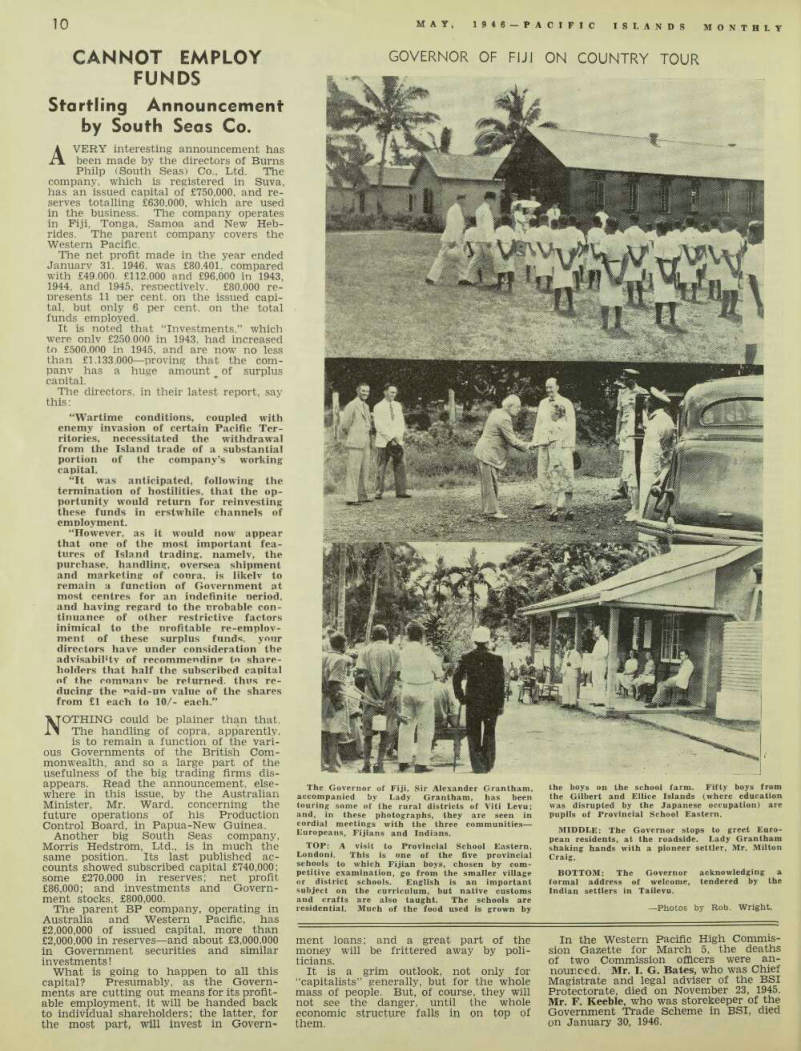
Governor Of Fiji On Country Tour
The Governor of Fiji, Sir Alexander Grantham, accompanied by Lady Grantham, has been touring some of the rural districts of Viti Levu; and, in these photographs, they are seen in cordial meetings with the three communities— Europeans, Fijians and Indians.
TOP: A visit to Provincial School Eastern, London!. This is one of the five provincial schools to which Fijian boys, chosen by com petitive examination, go from the smaller village or district schools. English is an important subject on the curriculum, but native customs and crafts are also taught. The schools are residential. Much of the food used is grown by
the boys on the school farm. Fifty boys from the Gilbert and Ellice Islands (where education was disrupted by the Japanese occupation) are pupils of Provincial School Eastern.
MIDDLE: The Governor stops to greet Euro pean residents, at the roadside. Lady Grantham shaking hands with a pioneer settler, Mr. Milton Craig, BOTTOM: The Governor acknowledging a formal address of welcome, tendered by the Indian settlers in Tailevu. —Photos by Rob. Wright.
More Civilians Return To
New Guinea
Enlarged Functions For PC Board are Officially Announced
AT last, the Australian Government is beginning to put into opera tion a policy that gives some thought to the needs of the Europeans—and especially to the urgent matter of
rehabilitating the European settlers
and their industries.
For three years, the Australian Government has been so intoxicated with its plans for shifting natives from the Stone Age to the Machine Age within 10 years that it has appeared incapable of thinking about
anything else.
Whether the new policy is the re sult of trial and error, or whether it is the first fruits of Colonel Murray’s Civil Administration; or whether it is just a natural return to common sense and realities, no man can say.
The effect of the stupidities and the muddled thinking of the past three years will handicap Territories re habilitation for many long months.
Already, it is being referred to as “the Anthropological Era.”
The new outlook and policy may be seen in the following: • Former Territorians especially planters—are now being encouraged and assisted to return to the Territories. • The original Government control over all trading activities is slowly being reduced to a mere check upon sales to natives. Facilities are being given to traders generally to make both supplies and services available to Europeans and natives. • More facilities are being provided for the employment of native labourers, and it is believed that steps will be taken to ease the impact of the new native labour laws. But the labour position re mains acute. • A far-reaching and beneficial change in the scope and purpose of the Production Control Board appears to be under way, with the object of making the Board of real help to all classes in solv ing the problems of rehabilitation. • Canberra is working hard on the problem of transport—especially in rela tion to a regular shipping service between Australia and the Territories but is not making much progress. (That is be cause overseas shipping actually is con trolled by authorities outside of Aus tralia, and because the Minister is cling ing stubbornly to his original plan, under which coastal and inter-island shipping is a Government monopoly.) • Pending the development of a regular shipping service, the temporary shipping arrangements have been ex tended, with the result that the “Ormis- “Montoro,” “Kanimbla,” and “Muliama” have all been sent from East Australian ports to the Australian Ter ritories in May with passengers and cargo. It is hoped to continue this en larged service, for the time being. • The rapid shipment of Jap pris oners to Japan probably will allow the Army to move out and Civil Administra tion to take over the remainder of the Mandated Territory (New Briain, New Ireland and Bougainville) in the next month.
Some people are inclined to praise Can berra for “a more reasonable frame of mind.” Actually, Australia’s Territorians never should forget that their return and rehabilitation have been delayed by at least a year, because Minister Ward sur rounded himself with “Yes” men, and allowed himself to be guided by sociolo gical planners, missionary theorists, an thropologists and various kinds of scientists.
If the task of restoring Papua-New Guinea to its pre-war condition had been handed over to practical and experienced men, and to private enterprise, most Ter ritorians would be back in their homes to-day, and badly-needed supplies of copra and rubber and perhaps even some gold—would be going south.
Urgent Demand For Copra
CANBERRA’S readiness to grant Terri torians especially planters per mission to return to the Territories is believed to be related to Australia’s urgent need for copra.
Australia, not long ago, finding her self short of vegetable oils for soap-mak ing, margarine, etc., went into the world markets after copra. The world authority responsible for food distribution, trying to feed a starving Europe and Asia, was shocked. Australia was very pertinently asked :“Why are you here, seeking copra, when you can produce your full require ments, and more, in your own Pacific Territories?”
It is a notorious fact that at that moment, New Guinea sheds were full of copra that could not be shipped.
No one knows what happened; but one can believe that the Australian Ministers who received the kick-back from Wash ington or London, promptly passed the kick on to Mr. Ward, whose fantastic planning in relation to the Territories greatly delayed the Territories’ return to production. Normally, New Guinea has produced from 50,000 to 70,000 tons of copra per annum. Some 100,000 tons per annum have come out of New Guinea, Papua and Solomons, combined.
So now all planters are being given quick despatch to both Territories; and, in sharp contrast with their treatment of last year, they are being given almost all the facilities they ask for.
If copra production does not come up to Canberra’s hopes, Canberra might have a look at Mr. Ward’s new laws gov erning native labour.
The available labour is thousands— probably tens of thousands—short of re quirements; one cannot run copra plan tations without labour.
Slow Recovery Of Goldmining
A STEADY trickle of skilled men are now being sent into New Guinea by the goldmining companies, to pre pare for the restoration and resumption of the industry. Plans are being made in all directions. Everyone concerned is naturally eager to get the advantage of the high price of gold.
But there will be little goldmining for another year at least. All the concerns require new machinery—and that is hard to find. Shipping to New Guinea is limited; transport in New Guinea is worse. Hydro-electric power will not be available for a long time to come. But the chief problem is labour. There still is very little native labour to be had.
New Powers For Production
Control Board?
AN official statement (see elsewhere) has cleared the air in relation to the Production Control Board. That body apparently is to be clothed with new powers, and given expanded responsibility in relation to rehabilitation and develop ment.
As stated elsewhere, Brigadier Graham has retired from the Board, and his place has been taken by Colonel H. T, (“Blue”) Allan. The Board now consists of Messrs. J, C. Archer, F. L. McKenzie, H. T. Allan and A. J. Gaskin, four well known men, thoroughly experienced in Territories affairs, and all favourably known there.
So far as Europeans are concerned, re patriation and rehabilitation are the most important things still to be done in New Guinea.
Practically every man who was fit to serve, did serve in the New Guinea and related campaigns. Most of the unfit men are veterans of World War I. The New Guinea Branch of the Returned Soldiers organisation has been reminding Canberra that it is the Australian Government’s job to repatriate and rehabilitate these Servicemen, who represent most of the white population of New Guinea.
Both Colonel Allan and Mr. Gaskin are nominees of the returned soldiers.
Colonel Allan went to Canberra in April, for instance, at their instance to urge that surplus Army goods and equipment in New Guinea be made available, first, to the Administration and to the Territor ians, before mainland dealers were allowed to go in and bid.
Mr. Gaskin did a wonderful job for the “evacuated” residents of New Guinea and Papua in the grim vears between 1942 and 1946.
Both men will fight hard for all Terri torian civilians, and especially ex-Service men.
What Pcb Might Do
SINCE the Production Control Board is to be the agency through which re patriation, rehabilitation and the dis tribution of surplus Army stores is to be carried out, it must mean that the PCB now will become the Australian Govern ment’s chief instrumentality in develop
(Continued on Page 62)
mg and settling these Territories. That represents a most important stage in the history of Papua-New Guinea.
The PCB probably will oversee the re establishment of the various industries in both Territories, especially planting and mining; and that arrangement appar ently places upon the PCB the following direct responsibilities:— • To provide sufficient labour to operate the industries. • To provide sufficient transport to bring in stores and labour, and get produce away to the markets. • To provide finance and security of tenure. • To provide the men engaged in the industries with an income, in the shape either of a guaranteed price or a subsidy—such as the pre-war bounty on rubber, cocoa, etc., im ported into Australia from the Territories.
In other words, the Board would have to exercise complete power over the sup ply of labour, transport and finance.
Position Of Expro Board
rIS inevitably brings in a series of questions relating to Expropriated Plantations (the former German plantations bought on terms by ex-Aus tralian soldiers after World War I) The Expropriation Board still functions —but at present is convulsed with head aches. Here is a typical case: Mr. A bought a plantation in 1926 for £B,OOO. He paid £l,OOO and contracted to pay the balance over the years, the Expro Board holding a first mortgage. A re duced his debt by another £3,000, and then met a copra slump. He went for assistance to one of the Big Firms in Rabaul, and got assistance to the extent of £1,500, the Big Firm taking the second mortgage bearing 7 per cent. The planter struggled along, with ups and downs.
When the Japs came, he owed the Expro Board £4,000 plus interest, and the Big Firm £2,000, plus interest. To-day the
War Damage Commission assesses com pensation payable at, say, £4,000. Now, what happens to the £4,000? Should it all go to the planter, who is prepared to return and start again? Or has either the Expro Board or the Big Firm a claim upon that sum?
Several such cases have arisen; and the echoes of the arguments have been heard all over the Territory.
Would it not be possible for the PCB, as part of its responsibility for rehabilita tion and finance, to take over tne func tions of the Expro Board, and deal equit ably with all these cases on their merits, holding the balance fairly as between the planter, the War Damage Commission and the mortgagors? It would be quite a sound procedure—always providing that the first consideration is the re-estab lishment of the planter under conditions which will give nim a chance to recover and become independent.
The Australian Government must either do something like this, or hand over the responsibility for producing, marketing, financing and transport to private enter prise—in other words, to the Big Firms— and the Australian Ministers’ ideas do not incline that way.
Whatever real progress has been made in Papua and New Guinea is due in a large measure to the foresight, courage and energy of well-financed companies.
But that is all forgotten in these days when demagogues spout their endless theories and capitalism runs around like a dog with a tin tied to its tail.
Future Of The Big Firms
UNDOUBTEDLY, there is a future in New Guinea for the Big Firms.
For most Territorians, it is good news that Burns Philp and Steamships Trading are getting ready to re-build their estab lishments at Samarai, and that Burns Philp are making active preparations to re-open in Lae, Rabaul and Madang. Car penters also will return to the Manadated Territory, although apparently they do not intend to re-open their retail stores.
But, although there has been a consid erable change in policy, Canberra seems determined to limit the Big Firms’ opera tions as much as possible.
Hence, the PCB must either go on and become big—or go out. The former is much more likely.
For example, Canberra is anxious to en courage planting and trading by natives and groups of natives. There must be some agency connected with “outside,” through which the natives may sell and buy. It must be either the PCB or the Big Firms.
Administration And Pcb
IT is a safe guess that, unless the Aus tralian policy in relation to the Ter ritories is completely re-cast by another Government, the PCB will play a very big part in the Territories in the future.
The question then arises; What will be the future relationship between the Civil Administration and the Production Con trol Board? Is the Administrator to be the nominal head of the PCB? Or will the Minister retain his present direct con trol of the PCB and expect the PCB and the Administration to work along parallel lines, the Administration attending to purely Governmental matters, while the Board becomes responsible for the econo mic development of the country, and matters directly related thereto?
If this is the plan, it is exceedingly in teresting. If it is Mr. Ward’s plan, then we must admit in all fairness that “he’s got something there.”
Two Instrumentalities?
rERE has been no greater handicap upon tropical Territories in the past —and Papua and New Guinea are good examples of it—than the fact that responsibility for economic development almost always is laid upon the Adminis
tration. It falls upon the shoulders of men who are trained and equipped for Governmental duties, but who, more often than not, have not got the qualities de manded in the effective exploitation of a Territory’s natural resources.
The New Guinea of the Between-Wars period provides a good example. New Guinea, then, was capable of much greater agricultural development than it enjoyed. Yet it had a large Department of Agriculture, staffed by a team of en thusiastic experts. The men in charge of administration were capable and compe tent, as administrators—but they obviously did not know how to undertake economic development or how to effectivelv use their expensive and valuable Department of Agriculture. If they had been em nloyed and directed by men hard-boiled in tropical commercial life, that Deoart ment would have returned rich dividends.
If Mr. Ward nroposes to divide the Ter ritories’ government into two parts, ad ministrative and developmental; and put the latter in charge of thoroughly ex perienced men, with ample authority, then bis experiment will be watched with keen and sympathetic interest throughout the Pacific.
There is no reason why a tropical Terri tory should not have two Governmental instrumentalities (instead of one), working side by side, one responsible for adminis
tration and the other for development. A few minutes’ thought will show how easily and naturally the Departments of Government could be divided between the two.
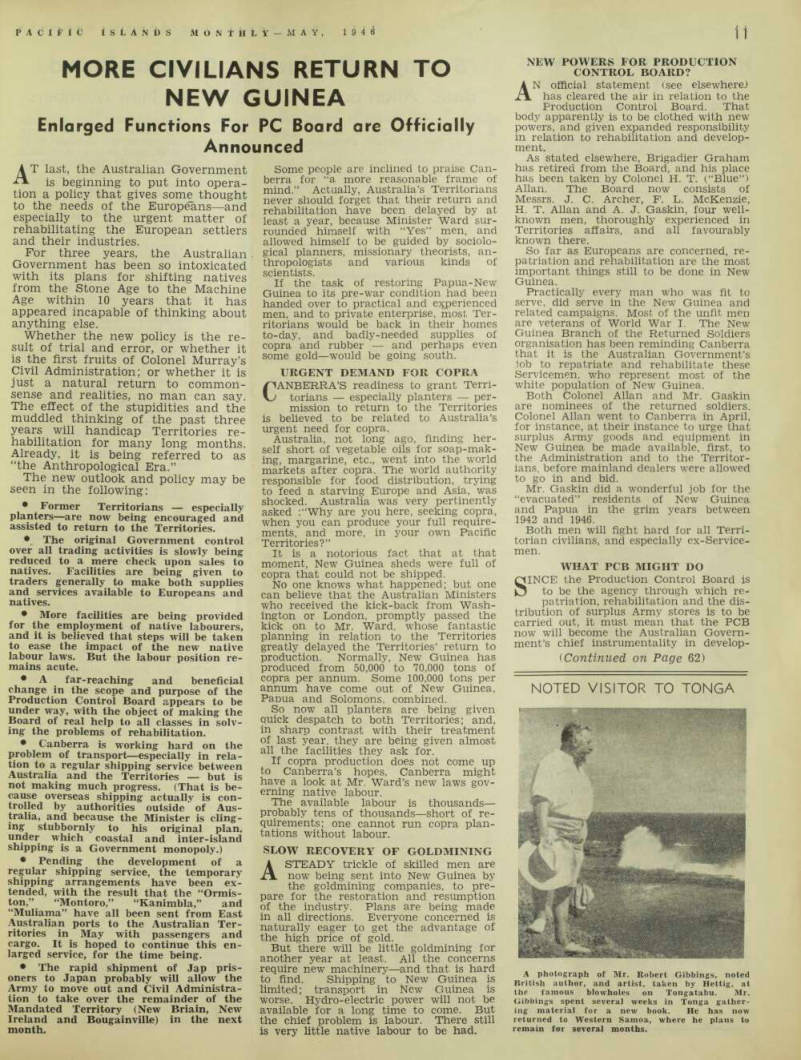
Noted Visitor To Tonga
A photograph of Mr. Robert Gibbings, noted British author, and artist, taken by Hettig, at the famous blowholes on Tongatabu. Mr.
Gibbings spent several weeks in Tonga gather ing material for a new book. He has now returned to Western Samoa, where he plans to remain for several months.
Advertisements & other items, p. 13 (1 item)
11
PACIFIC! ISLANDS MONTHLY MAY. 1946
His Plantation Was
A Battleground
Leslie F. Gill Arrives After Four Years' War Service
BEARING the unusual distinction of having witnessed, from American headquarters, a major battle being fought out between Americans and Japanese on his own plantation, Lieut.
Leslie F. Gill arrived in Sydney in May from the Solomon Islands to obtain for mal discharge from the Solomon Islands Labour Corps.
He carried the above distinction —and little else. He owns Lambeti plantation, on Morovo Lagoon, which was right in the middle of the Munda battlefield in 1943; two plantations on Vella Lavella, which still have some coconuts, but no build ings; and two trading stations, one at Gizo and one at Lambolambo. Lambo lambo became a PT base, and 9,000 tons of aviation spirit were stored there. It was set on fire one night, and Lambo lambo simply disappeared. At Gizo, there is a crater made by a 1,000 lb. bomb at each end of the former trade store.
Mr. Gill produced an aerial photograph of the once-famous Lambeti plantation.
It is no longer a plantation—but it car ries a magnificent white coral airfield.
Airfields are two-a-penny in the Pacific Islands now, however.
So Mr. Gill, who was deservedly an independent man in 1941, as the result of 30 years of hard work in the Solo mons, to-day has only an excellent air field, two smaller and neglected coconut plantations, a hole in the earth where a trading station once stood, and another trading station that was very thoroughly blasted. He looks enviously at the people across the strait, in Bouganville (Aus tralian territory). They get very liberal war damage compensation: the Solomon Islands, being British territory, get no compensation at all.
WHEN war came, Mr. Gill, with his in timate knowledge of the waters of the central and northern Solomons, was of great value to the Americans.
For a time, he was a coast-watcher, and then a member of the Allied Intel
ligence Bureau—a “hush-hush” or ganisation which carried out most dangerous duties. Then he was transfer red to American Intelligence, to assist in preparations for the great assault on the Jap stronghold at Munda (which included Mr. Gill’s “Lambeti” plantation). From Rendova Island he watched the battle begin, and he was in and around New Georgia during the long operation.
Next, he went into Vella Lavella with the American Forces; and, when the Americans pushed on into Bougainville, he remained on Vella Lavella to help the native communities, who knew him, and who were bewildered and distressed by this big-scale war that was raging around them. He was transferred to the BSI Labour Corps in 1944, spent eight months on Vella Lavella, and the re mainder of the war period, until now, at the new BSI headquarters, at Honiara. rE present outlook for the Solomons is not encouraging, says Mr. Gill.
The natives are being assisted, where possible, but practically nothing is being done for the rehabilitation of the European planting industry, and for transport. Levers Pacific Plantations, Ltd., are showing no disposition to open up again.
It is supposed, in some quarters, that BSI authorities are awaiting British Colonial Office and UNO decisions re garding the future of the Solomons. If the Group is to be attached to Australia, or is to come under the Trusteeship of UNO, or the new South Seas Regional Commission, then the latter can have the heavy task of rehabilitation.
Meanwhile, Mr. Gill will enjoy a long holiday in Victoria.
Stronger Production Control Board
"Blue" Allan and A. J. Gaskin Are New Members
THE following statement was made in Canberra on May 10 by the Minis ter for External Territories (Mr.
Ward): “In view of the change from military to civil control, that is now in progress in Papua-New Guinea, the Australian New Guinea Production Control Board has been reconstituted on an entirely civilian basis and now comprises: Chairman J. C. Archer Production Member .. H. T. Allan Finance Member .. F. J. McKenzie Commerce Member .. A. J. Gaskin “This Board was established in 1943 under iNational security Regulations to promote and control tne production of copra, ruboer and other tropical produce required for the prosecution of tne war.
Practically ail of the plantations in Papua have now been re-possessed by their owners, and the Boards principal function in tnat area will be the control and marketing of the produce.
“In the New Guinea areas, however, the Board’s activities will, in addition, be directed towards assisting planters in the renabihtation of their properties and ensuring the maximum output of copra from tnose areas at the earliest possioie date.
“Amending National Security Regula tions have been issued to enable the foregoing changes to be made in the constitution of the Board.”
The New Members
rERE have been various changes in the Board since its creation. More recently, it consisted of Messrs.
Archer and McKenzie, and Brigadier Graham. The latter retired last month.
The new members are Colonel H. T.
Allan, MC, OBE, and Mr. A. J, Gaskin.
The appointment of Mr. Gaskin was un officially reported some weeks ago. The announcement of Colonel Allan’s selec tion comes as a complete—but very wel come—surprise.
In spite of the cautious phrasing of the Minister’s statement, it is believed that the purpose of the new set-up is definitely to assist and hasten the return and re-establishment of New Guinea civilians. All four members of the Board are experienced Territorians; all are respected and personally popular; and, working as a team, they should be able to do a great deal for New Guinea.
The Board had an apparently Socialis tic birth, and an uncertain place in the scheme of things. It was generally re garded by Territorians, between 1943 and 1945, as an instrument created by Minis ter “Eddie” Ward for the punishment and destruction of private enterprise. Its purpose, it seemed, was to control the trader, planter, miner and transporter from daylight until long after dark. And it was cursed accordingly.
But the Minister and the Departmental bureaucrats appear to be learning by ex perience. The personnel of the new Board is non-bureaucratic and full of promise. If its new functions are as out lined in an article on page 11 about the rehabilitation of New Guinea it is likely to be of considerable assist ance in the rehabilitation of the Ter ritories and the encouragement of the private enterprise and industry which previously contributed much to the pro gress of both Territories.
“Blue” Allan’S Career
rE appearance of “Blue” Allan in this job is unexpected, but it adds an other step to what has been a re markable career; and his many Territory friends will wish him every success.
Mr. Allan spent three years with the 17th Battalion of the AIF in France in World War I, and emerged with a captaincy, a well-earned Military Cross and MID. Between wars, he was a well known figure in New Guinea —latterly, a successful goldminer at Wau. In 1939, he passed the mine over to others, don ned the old uniform, presented himself in Sydney—and was informed that “old blokes” were not wanted in this World War 11. All “Blue’s” tenacity and selling power were needed before he was taken on the strength—but he sailed away with the first AlF—and, by a remarkable coincidence, he was again in the 17th Battalion, in charge of “A” Company.
He was promoted major before he reached the Middle East; he was awarded the OBE for his work at Tobruk; he was at El Alamein; he returned with the 9th Division to Australia; and he went on to New Guinea with the rank of lieut.colonel. He had charge of various bases in 1944-45—Finschafen, Madang, Jac quinot Bay, Aitape and Wewak, in the course of which service he was promoted full colonel, and mentioned in des patches four times. He returned to New Guinea at the end of 1945 to take charge of the Pacific Islands Regiment; left that command four months later; and, at the end of April, he returned to Rabaul, to be discharged from the Army, and take his place on the PC Board. While in
(■Continued on Page 64)
Sydney in April, he received his QBE at the hands of the Duke of Gloucester, Australia’s Governor-General.
Colonel Allan has been a tenacious fighter for the Returned Soldiers’ or ganisation; and, thanks to his represen tations, in Canberra in April, it appears likely that the Administration and the returning Territorians will in future have first call on all surplus equipment and stores in the Territories, through the Production Control Board.
A. J. Gaskin
Every Territorian who suffered the horrors of evacuation, and four years’ residence in the Australian jungle, will be happy to hear of the appointment of Mr. A. J. Gaskin.
A veteran of World War I. Mr. Gaskin went to New Guinea many years ago, and eventually settled down as a business man in Rabaul, where he became the owner and manager of one of the prin cipal hotels. He, like his fellow-member, Mr. McKenzie, was one of the civilians who were almost trapped there by the Japanese invasion; but who, by personal initiative and quick thinking and acting, was able to escape via the South Coast of New Britain.
Unfit for further military service, Mr.
Gaskin took a job in the External Ter ritories Department in Sydney and. thenceforth, devoted himself to the task of assisting, in every way possible, the thousands of unhappy Territories people who had left most of their property— and a large slice of their lives—behind in the Territories.
Every Territorian who was in Sydney
during those black years will remember, with gratitude, the services he rendered.
Nothing was too much trouble. Working in association with Mr. Harry Downing (a former District Officer), Mr. Gaskin personally interviewed hundreds of dis tracted people; and the two of them to gether worked early and late, until the end of the war, to make Territorians’ conditions better. Their last job (October-December, 1945) was the tragic one of compiling the list of civilians who were lost in Rabaul.
Like Colonel Allan, Mr. Gaskin has been a very active worker on behalf of the returned soldiers’ organisation.
£30,000 For "Research"
IN another official statement, on May 11. the Australian Minister, Mr.
Ward, said: • The Australian External Territories Denartment would make substantial con tributions towards the South Seas Regional Commission (see article on pages 7-8). ° The Australian School of Pacific Administration (the institution which has functioned successively at Duntroon Holdsworthy and George’s Heights, Sydney) would be moved to Canberra, where it was expected that Colonel J.
R. Kerr (formerly a Sydney barrister) would be nrincipal. The School would be available to the Governments of Britain and New Zealand.
About £30.000 would be spent during the commit year by the Australian Paci fic Territories Research Council in making investigations to further the develop
ment of Australian Territories, including New Guinea, Papua, Norfolk Island, and Nauru.
EDITORIAL NOTE: The “Australian Pacific Territories Research Council” was something new to the “PIM ” We tried to find out something about its consti tution, location, and purpose; but none of the officials we approached in Sydney knew anything about it. One bright lad suggested vaguely that “it may have something to do with the Army show run by young Conlon.” However, what ever it is, it seems to have been entrusted with the expenditure of £30.000 of Aus tralian taxpayers’ money.
Advertisements & other items, p. 14 (1 item)
Notice of Meeting
PACIFIC TERRITORIES
ASSOCIATION
The 4th Annual General Meeting of the Association will be held on Tuesday, June 18, 1946, at 8 p.m., in Teachers 7 Federation Hall, 166 Phillip Street, Sydney (seventh floor).
BUSINESS:
To receive report of the Executive for the year ending May 31, 1946.
To receive balance-sheet and auditors 7 report.
To deal with any other business that may arise.
C. A. M. ADELSKOLD,
Secretary.
Two Officers on Trial in Rabaul For Vile Crime
Japs Massacre Ocean Islanders After
Surrender
'J'HE full story of the Japanese
massacre of six Europeans and 200 natives on Ocean Island in August , 1945, was told in the War Crimes Court in Rabaul in April.
Two Jap officers, Lieut. - Com mander Naaomi Suzuki and his quartermaster, Lieut. Yoshio Nara, are charged with the crime.
They admit that, knowing that Japan had surrendered, they yet deliberately massacred the natives to “inflict damage on the Allies .” Chief evidence against the officers is the sworn declaration of a native, Kabunare, sole survivor of the massacre.
In the following report, reprinted
from the Melbourne “Herald,” Suzuki stated that between August 16 and 20, 1945, he flew to Tarawa to consult with Rear-Admiral Shibazaki. It will be remembered, however, that Tarawa was recaptured by the Americans in
November, 1943.
KABUNARE said he was employed as a fisherman by the Jans. The Europeans he remembered on the island were Mr. Cartwright, who died of malnutrition, Mr. Cole, Mr, Third. Mr.
Mercer, the Rev. Father J. Pujebet. and a mission brother.
He did not know where Mr. Cartwright was buried. He heard that Mr. Cole was killed by stabbing with a knife while he was asleep in his house. He was also told that Mr. Mercer died of sick ness, Father Pujebet went into hospital for an abdominal operation, and Mr.
Third and the brother were injected by “the No. 2 doctor.”
One day all the natives in the area were assembled on parade, and a Jan officer addressed them through an inter preter.
“He told us that the war was over but we must still work for a while, and then the Japs would go away and leave us here.
“We were too scared to show our hap piness, so we just bowed our heads and went back to our houses. Then wo laughed and talked of the good news.”
Next day the natives were again as sembled and were told they would be divided and sent to new sections. Thev were led away in groups and witness found himself in the last group of eight men. They marched to the police lines, where they were confronted by Jap sol diers. armed with rifles and bayonets The hands of all the natives were tightly bound, and they were led down a wind ing track to the cliffs below Tabiang village.
“When we reached the cliff our eyes were tied up with cloth,” said Kabunare.
“Falailiva was the first to be tied and was on my left. He said to me, ‘Are you ready to die?’ and I replied, ‘Yes.’
“Everything was quiet for a moment, and then I fell over the cliff. I did not try to, but just fell. Almost at the same time, I heard a scream, and someone fell oh top of me. I think it was Falailiva.
I heard others fall, but no more screams.
Then I heard a lot) of shots fired.
“Falailiva was still on top of me, and some of the bullets were close to me.
This was about 3 o’clock in the after noon.
“Water kept breaking over us, but I could breathe as the water receded each time. I stayed there without moving till I thought the Japanese had gone.
“I bit Falailiva’s shoulder to see if he was still alive. He was still lying partly on top of me. Falailiva did not cry out, so I knew he was dead.”
Kabunare said he stayed in the water for an hour, and then rose to his feet.
The Japanese had gone, and all his com panions were dead.
That night and the following day he hid in a cave, and late the following night he went into the jungle, where he hid in a hole. For four months he stayed hidden.
One dav he climbed a tree and saw many ships at anchorage, but thought they were Japanese ships. He also saw a Union Jack flying from police lines, but thought it was a Japanese trick.
On December 2 he met two natives from the Gilbert Islands who had landed with the Allied occupation force. He went with them to the police lines.
CAPTAIN ACKLAND, the prosecuting officer, then presented a transcript of answers supplied by both Jap offi cers during their interrogation in Feb ruary.
During bis interrogation. Suzuki said that when he gave orders for the execu tion of the natives all his officers were present except Engineer Lieut. Kigana.
Lieut. Nara was not present when the natives were shot.
Suzuki said he was in command at Ocean Island from August, 1943. until the end of the war. and he did not receive orders that the war was over until August 24 or 25. 1945. when Truk radio came on the air. Before that date they had heard many rumours, but this was the first reliable information.
The Japanese Commander-in-Chief snoke from Truk and ordered the Ocean Island garrison to fight to the finish.
Suzuki said he gave the order to ex terminate the 200 natives on the island to four of his company commanders about August 18. “It was a very brief order,” he said. “As far as I remember it was: ‘Shoot all the natives on the island’.”
Asked why he had given the order, Suzuki said: “We had heard rumours about Japan going down. We had decided to kill them. The most important rea son was an order I had received from Rear-Admiral Keiji Shibazaki, who was at Tarawa (? Truk).
“This order was to fight to the finish and. as the natives were likely to cause trouble, to execute them all.”
To confirm this order, which he re ceived between August 15 and 20, he flew to Tarawa (? Truk) to confer with Rear- Admiral Shibazaki.
The admiral said that as the Jap gar rison on Ocean Island only numbered 500 men, the 200 natives might be a danger in an Allied landing. He, therefore, re commended their execution.
Suzuki concluded: “These executions will be before the War Crimes Court.
The other officers acted on my orders and the responsibility is mine, not theirs.
“I ordered the executions, believing it was the best thing to be done, as far as I was concerned as Jap commander.”
DURING a_ similar interrogation, Lieut.
Nara claimed that when he divided the natives into seven groups he knew they would be shot, but did not
know when. Two hours later, while he was sitting in his office, he heard shots being fired and he realised the natives were being killed.
When Suzuki ordered the executions, he (Nara) was distressed, because he con sidered his commander’s attitude was not humane. He advised Suzuki that he would rather not carry out his instruc tions, but, seeing it was an order, he would do so.
Japs to Hang for Massacre
RABAUL, April 27.
THE two Japanese officers, Lieut.- Commander Suzuki and Lieut. Nara, were sentenced to death to-day for the massacre of 200 Ocean Islanders five days after Janan had surrendered.
Although at early interrogations thev had admitted guilt, yesterday they both nleaded not guilty to the charge, claim ing that the natives had been executed for acts of sabotage.
The Court’s decision was unanimous: bcth Japs will die by hanging.
New Guinea's Only
Representative
Sergeant K. M. Brodie, Who Had
over four years’ active service in the Australian 2/17th Battalion, and in ANGAU, appears to have been the only New Guinea lad chosen for the Australian Victory Contingent, which sailed for London in April. He is here shown in a Sydney street with his sister, Miss Mar jorie Brodie, who is going to New Guinea shortly to marry an officer of the Ad ministration. The Brodie family were well-known residents of Rabaul prior to the Jap invasion.
A private but influential section of the European and Samoan communities of Western Samoa has asked the New Zea land Government to keep in touch with Dr. M. M. Gowland, with a view to his appointment to the position of Chief Medical Officer, when Dr. P. J. Monag han retires, probably in 1947. Dr. Gow land is regarded as a successful physician and skilful surgeon, and he has been held in high regard personally. He left Samoa recently for England, to the openly-ex pressed regret of all classes.
Suva Now Has Fishermen
—And Will Soon Hove Fish
rERE should soon be no room for the complaint (which we published in October “PIM”) that there are “no fishermen in Fiji—and no fish.’’
Three ex-Servicemen —two of them in partnership—are well advanced in their preparations for supplying the Colony with fish, which are to be caught, handled and distributed by modern methods. In each case they have been given assistance by the Fiji Rehabilita tion Board.
Details of these fishing enterprises have been supplied to us by the Fiji Public Relations Office and the photographs are by Mr. Rob Wright, of the same depart ment.
MR. OSCAR WRIGHT, who had much fishing experience before the war, will work on his own. He plans to use methods similar to those employed in some parts of the United States and offer live fish to his customers. His pre parations are so far advanced that he hopes to begin operations this month (May).
Each of the four vessels he will use will have a specific purpose: a depot barge which measures 60 x 20 ft., with a well for the storage of the live fish; a 40 ft. diesel launch, also with a well for live fish storage, as a supply and transoort ship; and two 27 ft. utility launches which will be used for the ac tual fishing.
The barge well is ou ft. long hy 9i ft.
T ”’de and has an average depth of 4 ft. it is divided into comnartments for the segregation of the various species. On
the barge will be housing for a caretaker and his family.
The launches have been specially de signed for the work by Mr. Alex Bentley and built under his supervision at the Public Works Department’s boatshed at Walu Bay, Suva.
This is how the outfit will operate: The barge will be moored near Suva, while the supply launch will tow the smaller craft to the selected fishing grounds—which may be as far north as the Yasawas or as far south as the Lau Group.
About once every three weeks the sup ply launch will convey a live catch to the depot barge, from which customers may select the kind of fish or turtle they require.
An engineer and four Fijian fishermen will help Mr. Wright in his new enter prise. Later, it is hoped that they will he abl° to extend their service and de liver live fish by van in and around
Suva township.
rE second fishing enterprise will be run by Mr. J. A. Hill and Mr. E.
F. Storck, in partnership. Their fish ing craft are: a large diesel-powered launch, a smaller utility launch and three punts.
The large launch was originally an open Higgins boat used by the American Navy; it has been converted at a local shipyard after five months of hard work and is now a rugged, schooner-rigged auxiliary fishing boat.
Its deckhouse runs almost the full length of the ship and its wheelhouse,
for’ard, is weather-proof and spacious enough to serve as sleeping accommoda tion for the captain. Below the for’ard deck are three bunks for the crew.
This launch has a modern freezing chamber capable of holding and freez ing six tons of fish. Insulation is pro vided by eip-ht inches of coconut fibre dust, and the freezing apparatus is oper ated by a h.p. Rushton Hornsby engine.
The three punts are each 20 feet long and the utility launch 17 feet long.
A small island off the Macuata coast has been selected as a base; and here Mr. Storck and several Fijian fishermen will net the fish, usinp- the utility launch and the nunts. Once a fortnight, Mr.
Hill will transport the fish, frozen and nacked in 100 lb. boxes, to Suva, in the large launch.
Should there be a surplus of fish, this will be smoked or salted at the base island.
The partners were hoping to com mence operations at the end of April.
Photographs show: (1) Mr. E. F. Storck (left) and Mr. J. A. Hill (centre) converting a US Navy boat. (2) Mr.
Wright discussing con structional problems with Mr. L. Bentley, and Mr.
A. Bentley of Public Works Department. (3) Mrs. Bene Ragg christens "Kusima"(Messrs. Hill and Storck), not with champagne, but with kava, which can be seen cascading down the vessel’s bows.
“Kusima” is Fijian for “the desire for fresh fish.”
Nine Millions!
Estimated War Damage to Australia and Territories
THE report of the War Damage Com mission for 1945, tabled in Common wealth Parliament on April 9. shows that the Fund was in credit by £13.120,000, at December 31, 1945. Against this amount there is an estimated out standing liability of £7,522.000 —over £6 millions of which is in relation to claims from New Guinea.
At the end of 1944. the amount stand ing to the credit of the War Damage Fund was £14,947,565, and, as it was more than sufficient to cover war damage that had occurred or would occur, the Regu lations were amended to cover any subsequent war damage without any further contributions from property holders and, also, to extend the scope of compensation.
As a result of this policy, and the pay ment of some claims, there was an excess of £827,117 expenditure over income in the Fund in 1945.
Claims to the value of £2,036,933 had been assessed and recorded up to Decem ber 31, 1945. The work of assessment is going on steadily in all areas.
Cost of administration of the Fund (including the head office in Sydney and its branches) was £41,403.
Pacific Peace Stamps
PEACE stamps for the New Zealand Pacific territories of Cook Islands, Western Samoa and Niue are now being overprinted in the Dominion, and should be on sale in the islands referred to on June 4. They will be in denomina tions of Id., 2d., 6d. and Bd.
These stamps will also be available in the four canital cities of New Zealand.
Envelopes' for use as first-day covers are also being nrenared, and will be on sale at island post offices. Orders for first-day covers or for stamps should be forwarded direct to the postmasters at Apia, Raro tonga or Niue.
It is understood that large orders from overseas philatelists have already been received.
Major Warner Shand when discharged from the Army hopes to return to New Guinea with his family. His wife and son Roger are living in Hamilton, Surfers’ Paradise (Queensland).
Turning A Deaf
Ear
Canberra's Attitude to Rabaul Demand
From Our Own Correspondent
Canberra, May 2.
rRMER residents of Papua, New Guinea and the Islands, as well as others who lost sons and husbands when Rabaul fell, can give up hope of any official inquiry being ordered into the fall of Rabaul in January, 1942.
Canberra has set its mind against any inouiry, and politicians have turned a deaf ear to the pleas of individuals and organisations who want to be told the true and full story of the Rabaul disaster. Here are some of the ques tions the people want answered, and Canberra is determined not to answer:— • If Rabaul was to be defended against the Japanese, why wasn’t it adequately defended? • If the Army was determined to sac rifice the hopelessly small garrison at Rabaul, why at least weren’t male civi lians stranded in New Britain given an opportunity to escape on ships available in the harbour prior to the invasion? • Is the Army completely satisfied that demolitions were fully carried out at Rabaul prior to the invasion; and if not, where did responsibility lie for failure? • Who was responsible for the whole colossal blunder?
At first, individuals asked the Govern ment to inquire into the debacle. Then followed further requests from organisa tions, supported by “Pacific Islands Monthly,” and, later, by the Sydney “Daily Telegraph” and other Australian daily papers.
Finally, just before Parliament ad journed in April, Mr. A. Cameron asked the Federal Government to inquire not only into the fall of Rabaul, but into the fall of other bases including Koepang. (See page 22.) To all these appeals the Minister for External Territories (Mr. Ward) turned a deaf ear.
When the appeals were repeated by the press to the Prime Minister (Mr. Chif ley) and the Deputy Prime Minister and Minister for the Army (Mr. Forde), the only replies the press got were:— Mr. Chifley: “I have heard nothing of these appeals.”
Mr. Forde; “I have nothing to say about that.”
Compared
Fijians And The
Indians
Birth and Death Rates Compared
A COMPILATION recently issued by the Registrar-General in Fiji shows the following interesting figures re lating to the Fijian and Indian com munities :
The Fijian race, in comparison with many other Islands races, shows strength and virility. In comparison with the fecund Indian community, now strongly established in that beautiful and fertile archipelago, it makes a tragic showing.
Population. 1926 census Fijians 97,651 Indians 85,002 Population, 1945, est. .. 115,724 117,256 Birth-rate, 1945 .. per 1,000, 37.3 43.0 Death-rate, 1945 .. per 1,000, 15.3 7.4
Swanston Diaries
THE diaries of the late Mr. R. S.
Swanston have been returned to Fiji. They deal with life in the South Pacific in the late part of last century. Mr. Swanston was a prominent figure in Fiji and Samoa. —From “Crown Colonist.”
Advertisements & other items, pp. 17-18 (2 items)
Burns Philp
THE
YORKSHIRE
INSURANCE
CO. LTD.
(Incorporated in England)
FIRE
ACCIDENT
MARINE
FIRE POLICIES ISSUED
IN PAPUA
All information from —
E. A. JAMES,
TeL 86347. Attorney for Papua, 14 Spring St.. Sydney.
BURNS PHILP
(SOUTH SEA) CO. LTD
Registered Office Inc. in Fiji island Traders and Shipowners
SUVA
FIJI
Also Branches at: Fiji: Levuka, Lautoka, Labasa, Ba, Sigatoka, Rotuma Tonga: Nukualofa, Haapai, Vavau.
Samoa: Apia, Pago Pago (American Samoa).
Solomons: Makambo, Gizo, Faisi.
New Hebrides: Vila.
Code Address: Gilberts: Tarawa.
“Bumsouth k . Norfolk Is. Niue. Wallis Is. Futuna Is.
Sole Australian Concessionaries :
GEORGE BROWN & CO. PTY.
267 Clarence Street, Sydney.
LTD,
The Ultimate factory has made the change-over from its wartime set-up.
Designs for the new models are now completed and production is about to commence.
These models should be available early in 1946—they will be well worth waiting for. Watch for further announcements.
SERVICE: Servicing of all kinds of radio sets, amplifiers and Rola speakers will continue to be available.
Building?
... THEN HERE IS GOOD NEWS
FOR Y —
WHETHER you intend building a STORAGE SHED, DRYING-
ROOM, NATIVE LABOUR HUT, a GARAGE—we—Tulloch’s
Pty.,. Ltd., have the building frame to suit your particular requirements—when we say building frame, we mean the complete structural set of members that go to make up the “skeleton” of a building; it is direct to the “bones” of this steel “skeleton” that your walling and roofing materials are fixed.
These frames are comprised of “ECONO-STEEL” trusses delivered to you ready to unfold on location and connect together with “ECONO- STEEL” girts, purlins and braces, which make up a building to dimensions of your particular requirements.
And now, for those requiring a HOME. Steel frames for such—comprising wall, roof and floor-sections—are being produced in our Sydney Factory at the rate of 25 a week. Extensions and extra machinery is now being installed to expand this production to 100 house-steel-frames a week.
This construction technique is so amazingly simple that ex-Servicemen, mostly amateurs, are erecting their own homes in this material.
In some cases tradesmen lay the stone or concrete foundation, then the home builder, with our foolproof plans to follow, erects the steel framework.
Any wall covering such as Durabestos, Fibrous-plaster, plywood, can be nailed direct to the steel section by virtue of its patent nailing slot.
All steel members throughout are treated with “Rust-ban” preservative.
What is more, these homes are fire and vermin-proof.
The average home can be packed into bundles 9 feet by 14 inches by 9 inches, each bundle weighing no more than 500 lb.
Send your queries direct to us—our Building Department will give your problem careful consideration. Literature on our “ECONO- STEEL” commercial, rural, and home building is readily posted to you upon request.
TULLOCH’S PTY. LIMITED
CONCORD RD. ( RHODES, SYDNEY, AUSTRALIA.
Cable Address: “TULSTEEL,” Sydney.
16
1946 Pacific islands monthli
Rehabilitation Fund
Distributions NG Club Copes With Complications
DISTRIBUTION of money from their Rehabilitation Fund has caused the New Guinea Women’s Club of Syd ney many headaches in past months.
Started 12 months ago, its original pur nose of rehabilitating ex-POW and civi lian internees was largely nullified by the sinking of the “Montevideo Maru.”
An extraordinary general meeting of the Club was called on April 13 to decide what should be done with the money.
Reports by the Club officials showed that the fund amounted to £1,126/6/1, of which £371/18/2 had been donated by the New Guinea Comforts Fund, and, as such, had “strings tied to it.” The Comforts Find bad been collected for the benefit of Servicemen enlisting from New Guinea or their dependants, and moneys must still be distributed in this way.
The meeting finally decided to treat the sum of £371/18/2 separately, distributing, it among Servicemen or their dependants, and using the remainder of the fund (£754) for the dependants of New Guinea civilians now domiciled in New South Wales.
The whole matter of distribution is complicated by the fact that, to date, it has been impossible for the Club to ob tain a list of Servicemen who enlisted in New Guinea—the Army records branch in Queensland has informed the Club that, in effect, they are too busy to attend to their request at present; and also by the fact that the Club has not yet been in formed by the Home Secretary’s Office whether it will be permitted to carry on as an organisation which is permitted to collect money from the public. If per mission to carry on as a public body is not granted, all moneys held by the or ganisation must be distributed within the next few weeks.
On the advice of a member that all New Guinea Army records were held in Warwick, Queensland, it was decided to send a telegram to Warwick asking again for a list of men who had enlisted in the Territory and in the meantime to dis tribute £5 to each of the 107 NSW eva cuees who were eligible to benefit from the fund.
The president of the Club, Mrs. H. H.
Page, said that £5 these days actually amounted to very little, but it was a gesture and the only means of equitable distribution which could be agreed upon by members* Some of those 107 were not in need of the money, and it was left to them to signify that they did not need it or to return it to the general fund when it would be re-distributed (with the remainder of the fund) to those people with children or who were in greater need.
New Officers Sought
A LARGE proportion of the Club’s exe cutive— who have done a magnifi cent job during the war—now feel that thev would like to retire, and the following have signified their intention of not standing for re-election at the end of the financial year in June: Lady McNicoll, patroness; Mrs. H. H. Page, president: Mrs. C. H. R. Maclean, vice president; Mrs. J. H. McDonald, hon. sec retary; Mrs. H. Adams, hon. treasurer; committee, Mrs. B. G. Edgell, Mrs. J.
Garnsey, Mrs. J. Harding.
Two members of the executive, Mrs. K.
McMullen and Mrs. J. Long, have re
signed, owing to their .return to New Guinea.
Members willing to submit their names for re-election are: Mrs. N. Foxcroft, vice president; and committee members, Mrs.
Allan, Mrs. Wallace Brown, Mrs. Forsyth, Mrs. Haynes, Mrs. Meldrum, Mrs. Ormond.
At the end of the meeting Mrs. Wal lace Brown was elected assistant trea surer. (Final contributions to the Rehabilita tion Fund appear elsewhere, this issue).
Advertisements & other items, pp. 19-20 (1 item)
a major anxiety
Relief from
Even the most expert and conscientious individual executor is subject to accident, illness and incapacitation.
Continuity of administration and uninterrupted attention to your estate and your beneficiaries are of paramount importance. Both can be positively assured by appointing this Company your sole Executor or as co-Executor with your present appointee. An interesting explanatory booklet will be forwarded on request. ,
DIRECTORS:
Lewis Armstrong. lames Burns. Joseph Mitchell.
R. J. Nosworthy. P. T. W. Black.
MANAGER: L, S. Parker.
SECRETARY: E. R. Overton, A.F.I.A.
BURNS PHILP TRUST
COMPANY LIMITED
THAT
The
7 BRIDGE STREET, SYDNEY
TELEPHONE: B 7901 Box 543, G.P.O., Sydney
BPI .45
SPECIALISING
IN
PACIFIC ISLAND INSURANCES
FIRE MOTOR VEHICLE
MARINE HULLS AND CARGO
EMPLOYER’S LIABILITY
GUARANTEES including those for—
DYNAMITE PERMITS.
RECRUITERS’ LICENCES.
DEFERRED WAGES
AND ALL OTHER CLASSES ARRANGED
AT LOWEST CURRENT RATES.
Established Agencies:
W. R. CARPENTER & CO., LTD.
Throughout the Territory of New Guinea.
SOUTHERN PACIFIC INSURANCE
CO., LTD.
HEAD OFFICE: 60 HUNTER STREET,
SYDNEY.
fforit iau (jin ..
3c
* LIQUEURS * COCKTAILS * WHISKIES
* Address ail enquiries to:
W. & A. GILBEY LTD.,
33 ROSSLYN STREET, WEST MELBOURNE.
Telegraphic and Cable Address: "Gilbey's," Melbourne.
109 REGENT STREET, SYDNEY.
Telegraphic and Cable Address: "Gilbey's,'' Sydney.
OLF.! ZA
Bravery Awards To Wphc
Natives
AWARDS for bravery to a number of natives of the WPHC Territories were announced in Suva, Fiji, early this year. They were:— Military Medal to Sergeant Sene, of the BSIP Defence Force.
Civil Commendations for Brave Con duct to natives of the Gilbert and Ellice Islands Colony, as follows; Falavi, of Vaitupa, wireless operator at Beru; Maheu, of Nanumea, wireless operator at Funa futi and Niutao; Matusi, of Nukufetau, wireless operator at Kuria; Peleti, of Funafuti, wireless operator at Ocean Is land; and Telavi, of Nanumea, wireless operator at Abaiang.
These Are "Banana Figs"
Description of an Industry of Interest to Pacific Planters
QUR Western Samoa correspondent
stated in the April issue of “PIM” that “banana figs” are being manufactured in the Territory. He did not. however, describe the nature
of the “figs.”
We have now received a letter from Mr. C. Cooke, of 5 Clement Street, Guildford, NSW, who has kindly sup plied a description of the figs, which should be of interest in all banana growing Pacific Territories. Mr. Cooke states that he will be pleased to
supply any - further information should
it be required.
FROM 1927 to 1931 (writes Mr. Cooke) I was managing a banana plan tation in Central America for the United Fruit Company. We shipped our bananas to the States by the bunch, and nothing less than a seven-hand bunch was acceptable, which left many fine five and six hand bunches going to waste.
These were allowed to ripen; then each banana was split in two. placed on a tray and covered with icing-sugar.
They were then allowed to dry in the sun for four days (later on, we used a hot-air dryer, which did the job in from 10 to 12 hours).
The bananas, when dried, were about one-third of their original length, and lost their characteristics banana flavour.
Although, of course, minus the seeds, they otherwise tasted like dried figs.
The finished product was packed in small wooden boxes, each box containing about 18 “figs.”
Peace Stamps For British
Colonial Territories
ARRANGEMENTS have been made in the United Kingdom for a special issue of Peace and Reconstruction stamps on June 8, the day of the Vic tory Parade in London.
As in the case of the 1935 Jubilee issue, the same general format will be used for all Colonial territories. The design will feature the Houses of Parliament with the River Thames in the foreground.
The name of the issuing territory will be printed in a panel at the ton. with a medallion portrait of His Majesty the Kin!? in the top right-hand corner.
Below the title the date June 8, 1946. will be inscribed and duty tablets will be placed in the bottom corners, left and risht. The words “postage and revenue” will appear in a panel at the base.
The Fiji stamps are to be of two denominations —2id. and 3d. —and thev will be placed on sale on June 8 or. if thev have not arrived by then, as soon thereafter as possible.
The stamps will remain on sale until December 31, or until the stocks are ex hausted. —From Fiii Public Relations Bulletin.
Capt. T. S, Thomson. MA. who was aide-de-camp to Sir Henrv Luke while the latter was Governor of Fiii. and who subseouently saw active service with the Fiiian battalions in Bougainville, as ad jutant to Colonel F. W. Voelcker. and elsewhere, passed through Sydnev in Anril, en route from Britain to Fiii. He will reioin the Fiiian Public Service— probably as a member of the staff of the Colonial Secretary.
New Coconut Industry In Samoa
Factory to Can Cream For European Market
From Our Own Correspondent
APIA, April 20.
AFTER lengthy experiments, a com pany to oe called Aloma Products, Ltd., sponsored in New Zealand, win be formed to can and export coconut cream. It is claimed that tne product is a first-class suostitute lor dairy cream.
The factory will be built on Vailele plantation, close to the beach, on land of the Government-owned New Zealand Reparation Estates.
It is hoped that the factory will pro vide a good market for the coconuts grown on Samoan plantations; but tnere is, as yet, no indication of the quantity of coconuts required. Native growers are keenly interested in the project.
SOME 50 years ago, the late Lord Leverhulme predicted that in time the products of the dairy cow would be capable of production direct from vegetaole sources, whilst being cheaper in cost and comparable in quality and nutritive value.
It is generally admitted that the flav our and quality of margarine have im proved tremendously over the years, and that the product of this great industry has been, and still is, of incalculable benefit to the health of the food-short countries, such as England, where the butter ration has been for years as low as two ounces per week.
Not long ago, it was. announced that plans were complete for the production of milk from the soya bean, on a most economical basis, for the nourishment of the underfed millions of China. Now it is announced that, after considerable and patient research, British enterprise has perfected a process for the canning of coconut cream, one of the most delicious and most nutritive items of the tradi tional diet of Polynesia.
The possibilities of canning this rich food have always existed and were, in fact, well known to and studied by Ger man scientists prior to the war of 1914.
It is, however, only due to comparatively recent improvements in cream treatment, and more particularly to the very recent research work, that canning of coconut cream in a form which would be im mediately acceptable to Europeans has been made possible. rE recent test runs made here on a semi-manufacturing scale were en tirely successful. The cream pro duced is in appearance and consistency exactly like dairy cream. The flavour of the raw coconut cream, which to some Europeans might appear somewhat heavy, is reduced to a nuttiness which is most pleasant and unique, without being immediately attributable to the coconut.
Apart from these improvements in pro cessing, the cream retains in full purity the whole of the properties which have made it so nutritive and delicious in its raw state.
By analysis, the processed cream is fully comparable with dairy cream. The new cream contains approximately 42 per cent, fat, 4 per cent, protein, 4 per cent, carbohydrates, 50 per cent, water. Dairy cream contains approximately 40 per cent, fat, 3 per cent, protein, 4 per cent, carbohydrates, 53 per cent, water. The new cream also contains valuable natural vitamins.
It is claimed that the new cream is perfect for any purpose where dairy cream is normally used. In addition, it
is stated that the new cream can be adapted for many other purposes, such as cheese, spreads, mayonnaise, etc.
It is intended that the cream shall be exported in the first place to England, where it is at present illegal to produce dairy cream and where, as was recently announced, even milk will be rationed for some years to come. Even in normal times, dairy cream is expensive and not easy to obtain in the industrial regions of England.
It is predicted that the cream, made up in 8 oz. cans, will retail in England much cheaper than tinned milk, and it would therefore appear that the new in dustry may look forward to a busy and prosperous future. At the same time, the new industry can do much toward taking up the periodic slack and price drops Which have occurred so frequently and painfully in the copra trade and copra industry in the past.
It certainly appears that the produc tion of such cheap, rich food is highly desirable in these days of food shortages, and that it would be of considerable benefit both to the primary producer and to the consumer. * * rOSE responsible for the new product are now planning the first manu facturing plant in Western Samoa, as the coconut there is very rich and the compactness of the nut supply is an added advantage.
A private limited company is being formed in Apia by the individuals re sponsible for the pioneer work, and will be called Aloma Products, Ltd. The cream will be sold on the English market as Aloma Brand Samoan Cream.
The patents of the process will be held by Tropical Food Developments, Ltd., 29 Burwood Crescent, Remuera, Auckland, New Zealand, which company will be responsible for forming the
Samoan company. The two sponsors of the organisation, Messrs. Alan L. Dawrant and R. H. Ridler, who both come from the Midlands, are at present in Apia to prepare the building of the plant and an early beginning of the activities oi the company.
It is reported that American and Indian interests are contacting the pro prietors of the process and that, whilst a tie-up with these interests for inter national marketing is possible, no de cision has been made.
Captain H. T. Kienzle, MBE, returned to his plantation in the Yodda Valley, Papua, late in April. He served with distinction in the Australian Army, in the Middle East and New Guinea. The fact that this decorated officer had to wait 51 weeks in Sydney before he could get permission to travel back to his own home in the Territory is a fair indica tion of what Territorians are enduring at the hands of Australian bureaucracy.
Advertisements & other items, pp. 21-22 (2 items)
cAiuhal ia ’ s finest
Livestock for Islonds
People who intend to take Stock to New Guinea are hereby notified that I have on hand the right class of
Cattle—
Mules—
Horses
to suit both the Climate and the Pastures of the Territories.
When shipping ia available, I can deliver, on the ship in Cairns or Townsville, Stock intended for any of the Pacific Islands, including Netherlands Indies, Singapore and the Philippines.
I will take all care of Stock and will be responsible for their delivery on the Ship in Sound Condition.
For further particulars, apply to
J. J. TOOGOOD
Rollingstone, via Townsville, Queensland.
Orders accepted through any Stock Agent, or Bank, in Cairns or Townsville, or direct.
• • • -25=
cAiuhal ia ’ s finest
BOAT & YACHT
GEAR
F r o m
BROOMFIELDS LTD.
152 SUSSEX STREET, SYDNEY.
Sole Aaents for- p - H - MUNTZ & co.’s 3-crown brand metal sheathing.
JUT ‘ PEACOCK & BUCHANS’ ENGLISH READY-MIXED PAINTS.
Warry’s
AUBURN
PURE FRUIT JUICE CORDIALS
lIIIIIIIIIIIIIIIIIIIIIIIIIIIIIIIIIIIIIIIIIIIIIIIIIIIIIIIIIIIIIIIIIIIIIIIIIIIIIIIIIIIIIHIIIIIIIIIIIIIIIIIIIH
Made from Sun-ripened Queensland Fruit, at Maryboro , Qld.
ORANGE, LEMON,
ORANGE & LEMON
Supplies Available in JULY.
DISTRIBUTORS—
C. SULLIVAN PTY. LTD. 379 Kent St. Sydney
C. SULLIVAN Pty. Ltd.
GENERAL MERCHANTS . . . EXPORT AGENTS REPRESENTING LEADING FIRMS IN THE PACIFIC ISLANDS.
Islands Produce sold on Shippers’ AccounWLiberal Advances against Consignments.
Buyers of all Islands’ Requirements on Commission—Original Invoices Furnished.
Bankers : Bank of New South Wales .. Bank of New Zealand .. Comptoir National d’Escompte de Paris.
Cable Address: Chasull, Sydney.
379 KENT STREET, SYDNEY, N.S.W.
20
Mav. i946—P a c i P i c Islands monthly
Republic Of
Philippines
Roxas Takes Charge Under Direction and Protection of United States
OSMENA, president, and leader of a Conservative Government, was deci sively defeated on April 23, when 3,000,000 voted (in a population of 18,000,000) in the Philippines general election.
The new president is General Manuel Roxas, leader of a breakaway section of the Conservatives; former member of the Jap-controlled puppet Government; lately president of the Senate; and des cribed as a strong and colourful per sonality.
The Philippines will be formally de clared an independent republic, on July 4, 1946, in accordance with the Tydings- McDuffie Act, signed by the President of the United States on March 24, 1934.
Fears that the disruption caused by the Pacific war would make it necessary to postpone the declaration of Philippines independence have been set aside, it was officially announced early in 1946 that the original plan would be carried out in its entirety.
Nominally independent, the Philippines Republic will be both politically and com mercially under the influence and pro tection of the United States for a long time. On May 1, President Truman signed an agreement providing for pre ferential trade between United States and Philippines for 28 years; Philippines pro ducts will be admitted to the United States free of duty until July 3, 1954, after which duties may be applied grad ually; and United States is to give direct aid to the Philippines, amounting to 525 million dollars, and transfer also to the republic about 100 million dollars worth of surplus war goods.
ALTHOUGH*- the seven-party “popular front,” called the Democratic Alli an.C 6, a PP to dominate the Philippines Parliament, overshadowing the Conservative parties, it is apparent that the policies and administration of the new republic will be powerfully in fluenced and moulded by the new President Roxas, whose personal character and in clinations tend towards dictatorship. If he is held in check by American in fluence, he probably will provide an effi cient administration, and hold in control the left wing of the Democratic Alliance, where there is a strong and restive Com munist Party, led by the extremist Luis Taruc, The Communists are called the Hukba lap—popularly, the Huks—and, if there should be weakness or indecision in the central administration, they are capable of fomenting revolt. All the elements of revolution are in the country. Adminis tration is chaotic; national finance is (hence the need for America’s $525,000,000); the chief industries— especially sugar production have been seriously disrupted; food is in short sup ply; and the country has suffered enor mous war damage—Manila city still is a wreck.
PROBABLY, it was because the. Philip pines picture is so ugly that General MacArthur backed Mapuel Roxas There was no apparent reason why Roxas
should not have gone to gaol with the other collaborators.
When the Americans returned, and the other Puppet Ministers were safely put away, Roxas was received warmly by the American Commander-in-Chief, placed on his stall, and added to the Philippines Cabinet as soon as President Osmena arrived from America. It was pointed out that Roxas had signed the Puppet Con stitution; that he was at the head of the Economic Planning Board set up by the Japs: that he was one who signed the Philippines declaration of war against the United States. But General MacArthur said Roxas had been left behind in the Philippines to do a par ticular job; and, if the voting is any indication, that assurance has been accepted by the Filipinos.
The Philippines Republic, for better or worse, is to be set upon a certain course.
United States money and protection have been provided. A captain has been
chosen. If wisdom has directed these things, we may see a new and vigorous nation arise in the north-west Pacific, in
the next 50 years. But if as some critics insist—there has been lack of wis dom, if Roxas should prove to be merely a decorative adventurer, the new republic will be convulsed by economic troubles and torn by civil war before the end of 1947.
There has been an increase in petty crime in Western Samoa in recent months. Police have warned house holders not to leave their property un guarded; but, in spite of this, there have been a number of cases o£ breaking and entering by young lads. Stores in Apia and the country districts have been ran sacked also.
Advertisements & other items, pp. 23-24 (1 item)
Brial & Ball
Primrose Trading Co.
IMPORTERS—EXPORTERS
PRIMROSE BUILDING,
255 a GEORGE STREET. SYDNEY.
Cable Address: Woolaustral.
Importers of Island Products and Curios Exporters of All Classes Produce and Manufactured Goods Inquiries Solicited.
BANKERS: National Bank of Australasia, Ltd., Head Office, Sydney.
Comptoir National d’Escompe de Paris, Sydney.
Sole Distributing Agents for the Pacific Islands:
BRIAL & BALL
528 COLLINS STREET, 1 BOND STREET,
MELBOURNE. SYDNEY.
’Phone; MU4837. ’Phone: 87371.
GILLESPIE’S
The Flour
TRADE
MARK
of the Islands
- SY DN EY -
FOODSTUFFS...
OF EVERY VARIETY
We offer you . . .* ■ The use of our buying organisation. Through us you may order any type of goods, from Foodstuffs to Machinery. W e welcome your inquiries. ■ Our personal attention to orders from companies or individuals. a All perishable products sealed in airtight containers.
SERVICE
FOR THE
ISLANDS
Knowing your need we aim at fulfilling it . . . Let us help with your supply problems and avail yourself of our
EFFICIENT
HANDLING
AND
SWIFT DESPATCH.
Write or call :
May Special:
HURRICANE
LANTERNS!
For Immediate
Delivery
Now available to Island residents is the Aurora Hurricane Lantern, the lantern which was used by the Army in .the Tropics.
The following unique features make it the most suitable lantern for Island residents: Made from Terme-plated sheet, it has great rust resistance.
Removable 3-wire chimney guard.
Lever action opening at top.
Stormproof—*lt cannot blow out.
Outlasts lanterns made from tin-plate.
CHEAPER ... 1/9 each landed in the Islands. *
A. 0. SHEPHARD
Telephones: MA 8179 MA 1142
General Merchant- and Exporter code Address:
379 KENT STREET
SYDNEY
“Chrisshep”
Sydney
To Modernise Suva
Town Board's Plans
AT present seeking technical and pro fessional advice in New Zealand is Mr. P. T. Cahill, engineer of the Suva Town Board, which plans to modernise the town and prepare for the return of tourist traffic to the Colony.
It is hoped to build a new Town Hall, public markets and a pavilion in Albert Park.
Mr. Cahill expects to remain in New Zealand for about six weeks, in which time he will consult architects, obtain the services of a landscape gardener to lay out a number of parks and grounds in Suva, and study road construction methods.
Inquiry
The Blame For
Rabaul
Another Demand For Inquiry
CANBERRA, April 11.
AN inquiry into the fall before the Japanese, of Australian garrisons at Rabaul and other Pacific bases, was demanded in the Australian Parliament to-day by Mr. Cameron (Liberal, SA).
Mr. Cameron said in the House of Representatives: “The Commonwealth Government has made no authoritative statement on just what happened to our garrisons in certain parts of the Pacific.
“I put it to the Government they had no hesitation in setting up a Court of inquiry to find out whether there were too many Korean women and children aboard the Japanese destroyer ‘Yoizuki.’
We should pay at least the same atten tion to the feelings of our own people and find out for once and for all what really happened to their relatives who were members of garrisons overrun by the Japanese early in the Pacific war.
“I am referring to garrisons like Rabaul, and Koepang, in the South-West Pacific, and over near the Netherlands East Indies.
“It is the direct and inesca’pable re sponsibility of the Government to find out what happened to these garrisons.
There are enough people vitally in terested in these garrisons to see the Government shoulders this responsibility and carries out an investigation. I have written to the Prime Minister (Mr. Chif ley) asking him to have inquiries made.”
Editorial Note
IT will be astonishing if Mr. Cameron gets any action by the Australian Government. The abandonment of 300 male civilians in Rabaul to the Japs by Australia was one of the most damn able things in the Pacific war. It was the result of muddle and incompetence by two or three gentlemen who now hold very high official positions.' Demands for an inquiry and placing of the blame for the virtual murder of over 200 Australian men, have been made again and again; but Australian Minis ters, for reasons best known to them selves, have made common cause with Brasshats and bureaucrats in avoiding such an inquiry. The demand should be made an issue in the forthcoming general election in Australia.
Record Caledonian Budget
For 1946
THE 1946 Budget, approved by the New Caledonian Conseil General, is by far the biggest in the Colony's his tory, However, the cost of living approaches four times what it was pre war, while inhabitants have far more money at their disposal than they were formerly accustomed to.
The Budget estimates ordinary revenue of 163,050,120 francs, and non-recurring extraordinary revenue of 42,209,879 francs.
The Colony still jibs at income tax, whose introduction, first recommended by Governor Sautot, has been and will be fought by fair means and foul. But it is hoped to balance large-scale Budget ex penditure by other means.
Advertisements & other items, p. 25 (2 items)
23
PACIFIC ISLAND S' MONTHLY MAY, 1946
delicious Pastes
Manufactured by
HARRY PECK & CO. (Aust.) PTY. LTD s *£ck s %y ***
AUSTRALIA’S
MEAT AND
POULTRY
IS USED
EXCLUSIVELY
PECKS
A FIRM FAVOURITE
MADE FROM FINEST AUSTRALIAN
PRIMARY PRODUCT
When you serve Peck’s Meat Pastes you are serving protein food in its most delicious and nutritious form . ... prepared from the choicest Australian primary products.
Peck’s never compromise where quality and purity are concerned. Every ingredient is selected with the utmost care, and the whole process of manufacture is carried out under conditions of the strictest hygiene. Peck’s Fish Pastes too are prepared from carefully selected fish, packed under similarly ideal conditions.
PECK’S
BLOATER PASTE
CHICKEN and HAM PASTE
TURKEY and TONGUE PASTE
PICK PECK’S FOR PURITY !
Order Peck's Pastes Through Your Usual Channels.
HARRY J. YOUNG PTY. LTD
POSTAL ADDRESS;
Box 3661 G.P.0., Sydney.
379 KENT STREET, SYDNEY
BANKERS: BANK OF N.S.W.
CODES:
Bentley’s Comp.
Phrase.
Bentley’s 2nd Phrase.
Shipping and Exports
Both Increase in Fiji
SUVA, April 5.
AS shipping facilities have improved, trade has increased between Fiji and New Zealand. Figures released recently show an overall' improvement in exports from the Colony to New Zea land during the first quarter of 1946 as compared with a similar period in 1945.
Most marked improvement was in bananas (33,000 cases in 1946, 24,000 in 1945); citrus (1,025 cases in 1946, 45 in
1945); coconut meal (300 bags in 1946, nil in 1945); peanuts (578 bags In 1946, 6 in 1945).
Two well-known Papuan families will be united when Miss Peg Rutledge and Mr. Trevor Ward (whose engagement has recently been announced) marry. Miss Rutledge is the daughter of the late Mr.
C. G. Rutledge (of Misima Island) and Mrs. Rutledge (now of Toowong, Bris bane); and her fiance is the eldest son of Mr. and Mrs. E. I. Ward, of Veimauri Plantation, Papua.
Reserved For Territorians!
Commonwealth Disposals Commis
sion Gives New Guinea Second
Chance of Surplus Military
Equipment
BELATEDLY, and after Australian dealers had had first choice, the Commonwealth Disposals Com mission has decided to give returning Territorians a chance to purchase surplus equipment.
An advertisement directed to “former residents, missions, traders, planters, mining and shipping companies and others concerned” appeared in the Aus tralian press during April. It stated that representatives of the Commission are located at Port Moresby, Lae, Rabaul and Torokina, and that business could also be effected, by arrangement, at Aitape, Wewak, Madang and Finsch hafen.
Lying in the above areas are motor vehicles, ships, and small craft, engineer stores, hardware, canvas ware, clothing, mess equipment, buildings, machine tools, household goods and food. These may be inspected and purchased where they lie.
General's
Turf For the General's Rabaul Garden
r JTHE following despatch from Rahaul , dated April 11, was published in the “Courier Mail” Brisbane: RAAF officers were amazed a few days ago to see an Australian soldier digging up sods of turf on Lakunai air-strip and placing them in a jeep trailer and im mediately interviewed him. The soldier, a corporal, said he had been instructed by the GOC, Bth Military District (Major- General Basil Morris), to dig sods from the air-strip for a garden which he was making near his headquarters.
Couch grass turf had been planted by RAAF men at the west-north-west ap proach to the runway to lengthen the air strip.
The RAAF OC, Flight-Lieut. Cornish, ordered the corporal off the air-strip, and telephoned the Bth Military District Head quarters and spoke to the Camp Com mandant. He said to-day: “The Camp Commandant said he had a vague recollection of General Morris saying he wanted some of the good grass from the air-strip for his garden. He promised to inquire who authorised the soldier to cut pieces out of the air-strip, but I have heard nothing since.
“If they want turf I can show them half a dozen places in Rabaul where they can get it, but only a lunatic would dream of damaging an air-strip. A dangerous hole would soon be worn by aircraft if the earth were left bare. With the rains here an earthy quagmire could cause a fatal crash,” he added.
He also said that Qantas had been granted permission to fly an air-mail to Rabaul, but had refused to do so until Lakunai air-strip was lengthened and widened.
Nineteen members of Nauru’s native police, who survived Japanese intern ment during the occupation of the is land, were round-tripping to Australia on the “Trienza” in April. The party spent several days in Newcastle before going on with the ship to Melbourne.
Advertisements & other items, p. 26 (1 item)
Globite
STRONGER-LIGHTER-LONGER-LASTING
SCHOOL CASES
Increased quantities will be manufactured as manpower and materials become available. So, ask first for a Globite!
Made bn FORD SHERINGTON LTD.
SHEAFFER’S WORLD FAMOUS
Streamlined, Feather Touch PENS and PENCILS
If you want Design, Beauty and Quality buy
a SHEAFFEB
All Lifetime Pens are guaranteed for the life of the user except against loss and wilful damage.
When serviced, they are subject to a small fee for insurance, postage and handling.
Beautiful and Useful Gifts for All Occasions.
SKBIP - The
Successor to Ink makes all Pens write better. 20z.1/6, 4 oz, 2/6 Plus Postage Distributors Identify the Lifetime i Pen by the white dot
747 LTSC AA ST
Feather Touch Lifetime Pencil Regular Pen Lifetime Pen Pencil 9,6 2bt~ 75/- each 351- ea. each each The working parts of the Sheaffer Pencil are guaranteed against wear for the lifetime of the user.
When serviced they are subject to small fee for insurance, postage and handling.
All Sheaffer regular pens are guaranteed against defects of material and workmanship.
Obtainable from Selected Jewellers and Stationers everywhere
EXCELSIOR SUPPLY CO. PTY. LTD.
HEAD OFFICE J
278 Post Office Place,
MELBOURNE, VIC.
160 BROADWAY,
SYDNEY, N.S,W.
50 Victoria Street,
WELLINGTON, N.Z.
Not Before 1947!
Now-famous "Bulolo" Retained
by Admiralty
IT appears that it will be well on into 1947 before Territorians will see their pre-war luxury liner “Bulolo” again. Latest advice received by the owners {Burns, Philp & Co., Ltd.) , is that the ship is likely to be retained by the Admiralty for a further six months.
The following, from the “Straits
Times,” Singapore, of January 7, in
dicates the kind of niche “Bulolo” has made for herself in Naval history
—although her alleged peacetime
name of “Classic Pioneer” is a new one to us; likewise the fact that Bulolo is a mining town in Australia.
HMS “Bulolo,” one of the most famous ships in Britain’s wartime navy, sailed from Singapore yesterday,, on her last voyage under the White Ensign.
Like many of the men she carried, “Bulolo” will be “demobbed” on arrival in the United Kingdom.
Then, after a coat of white paint, per haps to replace her naval grey, she will resume a career, under her peacetime name, “Classic Pioneer.” But it is as HMS “Bulolo” that her name will live on resoundingly in naval records. Named after an Australian mining town, “Bulolo” was the first of the headquarter ships.
These ships won fame in all the major combined operations and became known throughout the Allied Services as the Navy’s “drain” ships.
She was so much part of the great days of struggle when combined opera tions were assaulting Nazi territory all over the map, that Admiral Mountbatten made a special trip out to her to say good-bye, is one of his “break-ranks-and gather-round” talks.
Built to cruise the sunny waters of the run between Australia, New Guinea and the South Sea Islands, “Bulolo” was called up in 1939 as an armed merchant cruiser. One result of having a wireless specialist as chief of combined operations was that Admiral Mountbatten went straight for the idea of having 50 wire less sets dfloat in one ship to form a combined operations headquarters ship.
Early in April, 1942, his ideas took shape, when the “Bulolo” was allocated to his command as the first headquarters ship.
Tatura Inquiry
Progress Report of Tatura Inquiry
BY mid-April Mr. Justice Simpson had heard 371 cases in the civilian in ternees inquiry at Tatura (Victoria), and, on his recommendation, 147 Germans and 11 Italians had been given deporta tion orders by Immigration Minister Calwell. (See article February “PIM.”) The others —177 Germans and .36 Italians—have been permitted to remain in Australia (or presumably, where ap plicable, return to New Guinea).
It is believed that a progress report has been submitted by Mr. Justice Simp son to the Commonwealth Government, but all other details are still withheld. It is not known, for example, how many ex-New Guinea residents have been re leased from Tatura and whether they will be permitted to return to the Ter ritory.
Only information on the subject of internees generally has come through “questions in the House.” In the House of Representatives, Canberra, recently, Mr. Spender (Liberal) asked: “Is there any reason why internees of enemy nationality, who have reasonably been suspected of subversive activities during the war, should not be deported?”
Dr. Evatt (Department of External
Affairs) replied that, in his opinion, no enemy alien should be deported unless he had been proved to be engaged in subversive activity as distinct from hav ing been merely suspected of having been so engaged. For that reason, he s. id, each case required separate inves tigation.
Still in Tatura
WRITING from Tatura at the end of April, Mr. O. Soltwedel (formerly of Wan, New Guinea), reported that he was “still on the wrong side of the fence.” He said that other New Guinea men still held there included Messrs. Paatsch, Werner, R. Macco, P.
Nechtritz, Gruesser, and Melcher. All of them hoped to be repatriated to New Guinea, if possible.
The “PIM” and others thereupon made further inquiry, to ascertain why these men are held in the prison camp one year after the capitulation of Germany. But the Australian authorities maintain a Gestapo-like silence.
Matson Ships To Be Rebuilt
THE Matson Company announced in New York in April that their liners “Mariposa,” “Monterey” and “Lur line” will be completely rebuilt as soon as they are released by the United States Government.
They will be air-conditioned through out. Cost of renovation is expected to be in the vicinity of 20,000,000 dollars, and it is hoped that the work will be com pleted before the end of this year.
All three ships have, for several months, been transporting war brides across the Pacific between New Zealand and Australia, and the United States, a war for personal freedom; but Brass hats still can keep German-New Guinea civilians locked up, and refuse to give any reason.
Advertisements & other items, p. 27 (1 item)
o
GREEN LABEL
i ©
FIRST GRADE
CUtCt Ji J.A D.GIB50N AND COMPANY PTV LIMITED 364 KentStreet Sydney. CNR KINCd DARBY STREETS
Nh High Chief Shot From Ambush
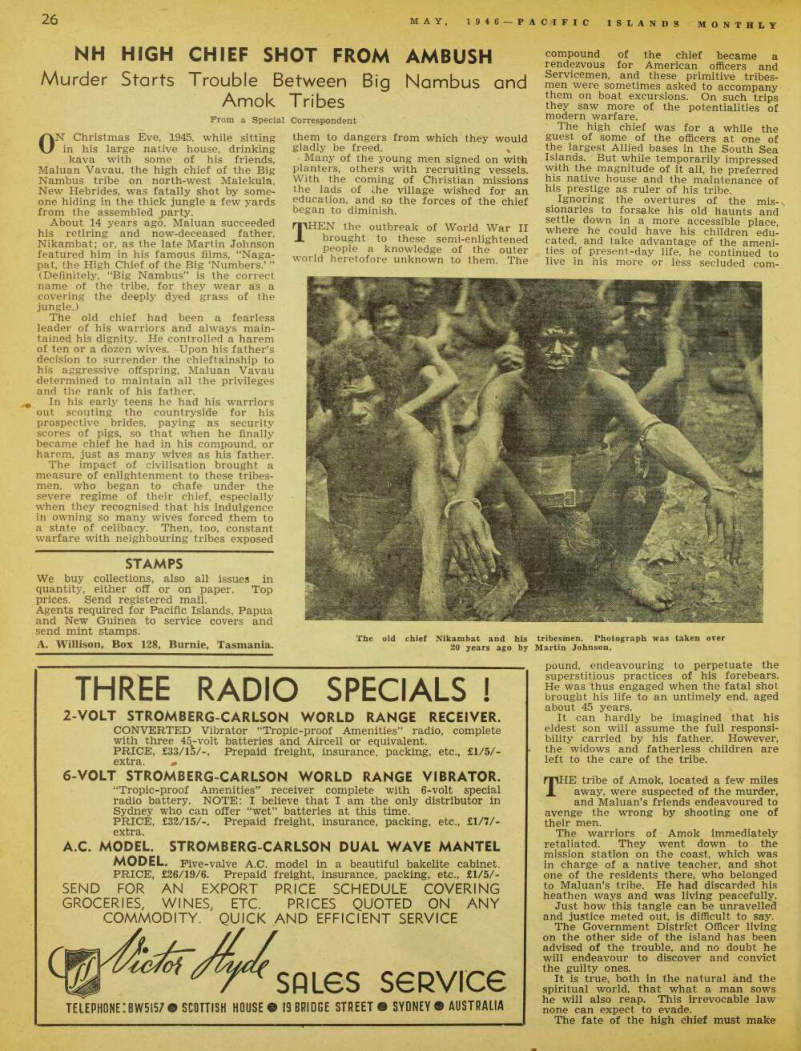
Murder Starts Trouble Between Big Nambus and Amok Tribes
From a Special Correspondent
ON Christmas Eve, 1945, while sitting in his large native house, drinking kava with some of his friends, Maluan Vavau, the high chief of the Big Nambus tribe on north-west Malekula, New Hebrides, was fatally shot by some one hiding in the thick jungle a few yards from the assembled party.
About 14 years ago, Maluan succeeded his retiring and now-deceased father, Nikambat; or, as the late Martin Johnson featured him in his famous films, “Naga pat, the High Chief of the Big ‘Numbers.’ ” (Definitely, “Big Nambus” is the correct name of the tribe, for they wear as a covering the deeply dyed grass of the jungle.) The old chief had been a fearless leader of his warriors and always main tained his dignity. He controlled a harem of ten or a dozen wives. Upon his father’s decision to surrender the chieftainship to his aggressive offspring, Maluan Vavau determined to maintain all the privileges and the rank of his father.
In his early teens he had his warriors out scouting the countryside for his prospective brides, paying as security scores of pigs, so that when he finally became chief he had in his compound, or harem, just as many wives as his father.
The impact of civilisation brought a measure of enlightenment to these tribes men, who began to chafe under the severe regime of their chief, especially when they recognised that his indulgence in owning so many wives forced them to a state of celibacy. Then, too, constant warfare with neighbouring tribes exposed
them to dangers from which they would gladly be freed. * Many of the young men signed on with planters, others with recruiting vessels.
With the coming of Christian missions the lads of the village wished for an education, and so the forces of the chief began to diminish. mREN the outbreak of World w«r it
I hrmio-ht • r^f r *1
A 1 -ei jJ i lghten f ed W orld P he?ltoforp k unknown °™ r world heretofore unknown to them. The
compound of the chief became a rendezvous for American officers and Servicemen, and these primitive tribes men were sometimes asked to accompany them on boat excursions. On such trips they saw more of the potentialities of modern warfare.
The high chief was for a while the guest of some of the officers at one of the largest Allied bases in the South Sea Islands. But while temporarily impressed with the magnitude of it all, he preferred his native house and the maintenance of his prestige as ruler of his tribe.
Ignoring the overtures of the mis sionaries to forsake his old haunts and settle down in a more accessible place, where he could have his children edu cated, and take advantage of the ameni ties of present-day life, he continued to live in his more or less secluded com-
pound, endeavouring to perpetuate the superstitious practices of his forebears.
He was thus engaged when the fatal shot brought his life to an untimely end, aged about 45 years.
It can hardly be imagined that his eldest son will assume the full responsi bility carried by his father. However, the widows and fatherless children are left to the care of the tribe.
THE tribe of Amok, located a few miles away, were suspected of the murder, and Maluan’s friends endeavoured to avenge the wrong by shooting one of their men.
The warriors of Amok immediately retaliated. They went down to the mission station on the coast, which was in charge of a native teacher, and shot one of the residents there, who belonged to Maluan’s tribe. He had discarded his heathen ways and was living peacefully.
Just how this tangle can be unravelled and justice meted out, is difficult to say.
The Government District Officer living on the other side of the island has been advised of the trouble, and no doubt he will endeavour to discover and convict the guilty ones.
It is true, both in the natural and the spiritual world, that what a man sows he will also reap. This irrevocable law none can expect to evade.
The fate of the high chief must make
The old chief Nikambat and his tribesmen. Photograph was taken over 20 years ago by Martin Johnson.
an impression, not only upon his people, but also upon the surrounding tribes of that part of the country. It may be that greater facilities will now be given the missionaries to extend their work; and probably they will have easier access to the young people, who are giv ing evidence of a desire to separate from the old ways and live in peaceful con ditions.
Advertisements & other items, p. 28 (1 item)
Three Radio Specials I
STAMPS
We buy collections, also all issues in quantity, either off or on paper. Top prices. Send registered mail.
Agents required for Pacific Islands, Papua and New Guinea to service covers and send mint stamps.
A. Willison, Box 128, Burnie, Tasmania.
THREE RADIO SPECIALS I
2-VOLT STROMBERG-CARLSON WORLD RANGE RECEIVER.
C'.O'NnnTl'R'TTnT') VihvQ-f-nv “Tvnnip.nrnAf Amonifioc” vq Hin nnmnlofo CONVERTED Vibrator “Tropic-proof Amenities” radio, complete with three 45-volt batteries and Aircell or equivalent.
PRICE, £33/15/-. Prepaid freight, insurance, packing, etc., £l/5/extra. * extra.
6-VOLT STROMBERG-CARLSON WORLD RANGE VIBRATOR.
“TrAnif'.nrnnf Amonifioo” nHfVi cnooial “Tropic-proof Amenities” receiver complete with 6-volt special radio battery. NOTE: I believe that I am the only distributor in Sydney who can offer “wet” batteries at this time.
PRICE, £32/15/-. Prepaid freight, insurance, packing, etc., £l/7/-
A.C. MODEL. STROMBERG-CARLSON DUAL WAVE MANTEL
MODEL. Five-valve A.C. model in a beautiful bakelite cabinet.
PRICE, £26/19/6. Prepaid freight, insurance, packing, etc., £l/5/- SEND FOR AN EXPORT PRICE SCHEDULE COVERING GROCERIES, WINES, ETC. PRICES QUOTED ON ANY
COMMODITY. QUICK AND EFFICIENT SERVICE
TELEPHONE! 8W5157 SCOTTISH HOUSE© 19 BRIDGE STREET® SYDNEY ® AUSTRALIA
Labour Unrest Continues
In Rarotonga
From Our Own Correspondent
Rarotonga, March 30.
LABOUR unrest in Rarotonga con tinues.
A tribunal to investigate local claims for higher wages was to have been held in Rarotonga at the beginning of April, and a Judge of the Industrial Court of NZ was to have arrived by ’plane to preside over the meeting, which would include the Resident Commissioner and local Judge, the manager of the Union SS Co., a representative of the prin cipal trading firms and the delegates of the labourers concerned. But this in vestigation has now been postponed un til May.
Postponement is due to a “note” from the Islands Association —a self elected group in NZ that have under taken to direct the labour policy of the Cook Islands. The Cook Islands Asso ciation presented to the New Zealand Government their own plan for the tri bunal, insisting that a number of then own members be included. The NZ Government replied that it did not recog nise this organisation and that Rarotongan affairs, being of local con cern, would be dealt with locally.
In the meantime, what might be termed “gangster” methods, are being employed by some of the local delegates of the tribunal. They make personal calls on workmen, suggesting that they pay 2/6 and sign up as members of a labour organisation. Cautious persons who show reluctance to pay up and toe the line are warned that should they refuse to do so, steps will be taken to see that they are removed from their present employment.
Such methods are likely to do the cause more harm than good.
With the hurricane season just ending and the Islands very short of staple sup plies, there is still some anxiety as to whether the wharf labourers will work the first steamer of the season, which is <iue in a few weeks.
The wharf workers had agreed to con tinue to work, although under protest, at the present rates until the result of the coming tribunal is made known.
Rarotonga, April 29.
rERE is a feeling of relief here, especially among the fruit-growers, as the season’s first shipment of 6,000 cases of oranges has been lightered out to the “Maui Pomare.” It has been an anxious month.
The wharf workers having been per suaded with no little difficulty to stay put until after the forthcoming tribunal, our labour leaders produced a further crop of headaches by arousing strife among the orange pickers.
Mr. J. A. Gilmour, of the NZ Indus trial Court, will arrive in Rarotonga by plane on May 24 to conduct the tribunal investigating local wage rates. It is also announced that Mr. A. G. Osborne, MP, accompanied by Mr. C. G. R. McKay, Sec retary of Island Territories, will arrive in Rarotonga by plane on May 11 for a short visit on official business.
£1,000,000 Damage on Ocean
Ocean and Nauru But Phosphate Exports Expected by July
INFORMATION given in Victoria in April by Mr. A. H. Gaze, general manager of the British Phosphate Commission, indicates that shipments of phosphate from Nauru and Ocean Island are expected to begin in July. The out put for 1946-47 is estimated at from 200,000 to 275,000 tons. As mechanical loading equipment is restored, it is hoped to increase output to between 500,000 and 650,000 tons in 1947-48, to between 700,000 and 850,000 tons in 1948-49, and between 1,000,000 and 1,200,000 tons in 1949-50.
Mr. Gaze said that about £1,000,000 worth of war damage had been done to the Commission’s property on the two islands. Good progress, however, was being made with reconstruction.
EDITOR’S NOTE: Nauru, although administered by Australia (Department of External Territories) on behalf of her other two partners in the Mandate, Great Britain and New Zealand, does not come within the scope of the Australian War Damage compensation scheme. The War Damage Commission has, however, con ducted, on behalf of the Commonwealth, a survey of war damage to Government and Government employees’ property, and the employees have been compen sated by the Commonwealth—although not from War Damage funds. Employees of the BPC will, it is understood, be re habilitated by the BPC and probably some proportion of the cost of the re construction work on mining and loading equipment, on both Nauru and Ocean Island, will be paid by the Governments of Great Britain, Australia and New Zea land. The administration of Ocean Island, of course, is not the province of Australia, but of the British Western Pacific High Commission.
The Rev. Fathers Tonjes, Schlieker, and Muller, sailed by the “Ormiston” from Sydney in May to resume their mission work in the Toraklna .area of Bougainville (Northern Solomons, but part of the Mandated Territory of New Guinea).
New Building Sites For
Home-Hungry Suva
rE area, about three miles from Suva, which was used as an Army camp during the war, is being surveyed for leasehold building sites, says the “Crown Colonist.”
Entire lack of suitable sites near Suva for many years has created a big de mand for both sites and houses, and high prices have been paid during the war by Indians for town sites. Building restrictions are partly to blame for the present shortage.
In February, during the absence of Mr.
H. E. Maude, MBE, Acting Resident Com missioner of the Gilbert and Ellice Colony, Mr. D. C. I. Wernham acted as Resident Commissioner.
Advertisements & other items, p. 29 (1 item)
"W.|Hurch&Son
Copies of
Pacific Islands Monthly
Can ALWAYS be obtained at the following places:
SYDNEY;
T. L. Cordingley’s Bookstalls at Martin Place, outside G.P.0., near George Street; and at G.P.O. Colonnade, George Street end.
BRISBANE;
R. S. Macdonald, next G.P.0., Brisbane, Qld.
MELBOURNE:
McGill’s Authorised Newsagency, 183-5 Elizabeth Street, Melbourne.
AUCKLAND:
W. A. Webb, Waverley Hotel Bldgs., Queen Street, Auckland.
SUVA:
James A. Muir, Suva, Fiji; and Miss R. Castles, Victoria Parade, Suva, Fiji. c :e also list of agents on
PAGE 7
Q rv*
"W.|HURCH&Son
ISLAND trader
AUCKLAND,
Cable Address.
CHURSHIP.’ Auckland Codes: BENTLEY'S 2nd Phase BENTLEY’S Complete Phase Postal;
C.P.O. BOX 1548
y PEACE BRINGS A NEW ERA TO THE PACIFIC We are catering thoroughly for Island trade and can fulfil your order with competitive merchandise
R. H. CHURCH & SON
Merchants & Island Traders 27 Queen St., Auckland, N.Z.
Refer your order to us for New Zealand’s Island famous products I -V
"Tahitienne's" Third
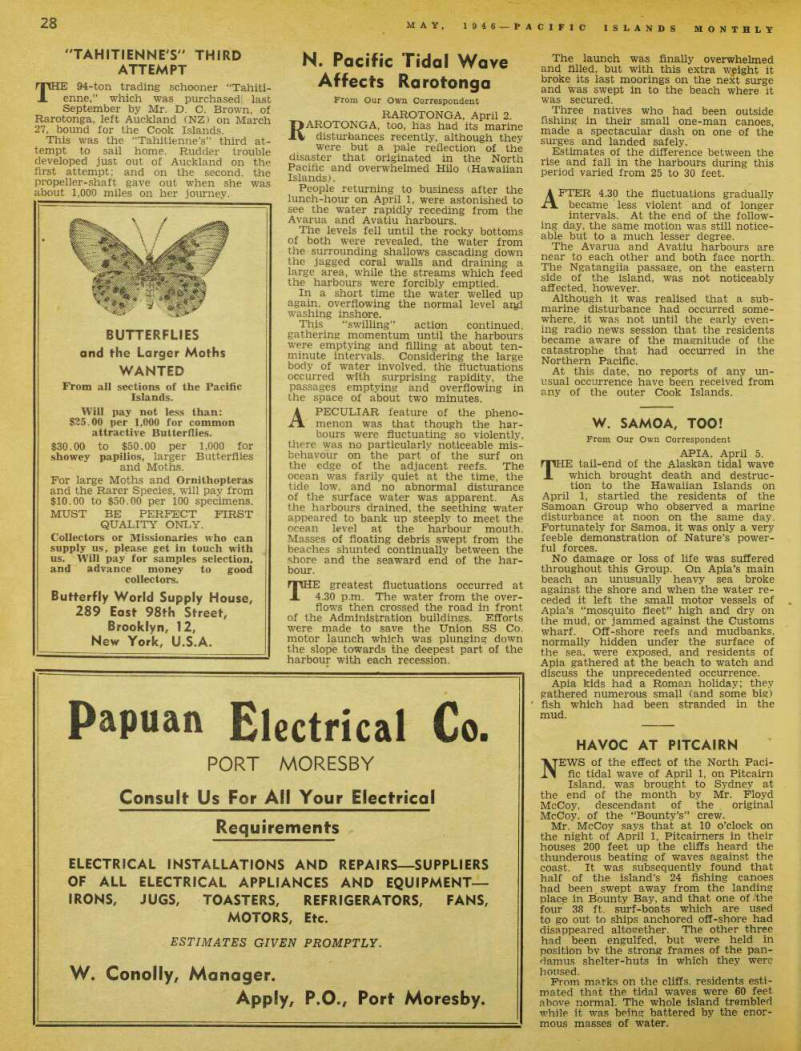
Attempt
rE 94-ton trading schooner “Tahiti enne,” which was purchased] last September by Mr. D. C. Brown, of Rarotonga, left Auckland (NZ) on March 27, bound for the Cook Islands.
This was the “Tahitienne’s” third at tempt to sail home. Rudder trouble developed just out of Auckland on the first attempt: and on the second, the propeller-shaft gave out when she was about 1,000 miles on her journey.
Affects Rarotonga
N. Pacific Tidal Wave Affects Rarotonga
From Our Own Correspondent
Rarotonga, April 2.
RAROTONGA, too, has had its marine disturbances recently, although they were but a pale reflection of the disaster that originated in the North Pacific and overwhelmed Hilo (Hawaiian Islands).
People returning to business after the lunch-hour on April 1, were astonished to see the water rapidly receding from the Avarua and Avatiu harbours.
The levels fell until the rocky bottoms of both were revealed, the water from the surrounding shallows cascading down the jagged coral walls and draining a large area, while the streams which feed the harbours were forcibly emptied.
In a short time the water welled up again, overflowing the normal level apd washing inshore.
This “swilling” action continued, gathering momentum until the harbours were emptying and filling at about ten minute intervals. Considering the large body of water involved, the fluctuations occurred with surprising rapidity, the passages emptying and overflowing in the space of about two minutes.
A PECULIAR feature of the pheno menon was that though the har bours were fluctuating so violently, there was no particularly noticeable mis behavour on the part of the surf on the edge of the adjacent reefs. The ocean was farily quiet at the time, the tide low, and no abnormal disturance of the surface water was apparent. As the harbours drained, the seething water appeared to bank up steeply to meet the ocean level at the harbour mouth.
Masses of floating debris swept from the beaches shunted continually between the shore and the seaward end of the har bour. rE greatest fluctuations occurred at 4.30 p.m. The water from the over flows then crossed the road in front of the Administration buildings. Efforts were made to save the Union SS Co. motor launch which was plunging down the slope towards the deepest part of the harbour with each recession.
The launch was finally overwhelmed and filled, but with this extra weight it broke its last moorings on the next surge and was swept in to the beach where it was secured.
Three natives who had been outside fishing in their small one-man canoes, made a spectacular dash on one of the surges and landed safely.
Estimates of the difference between the rise and fall in the harbours during this period varied from 25 to 30 feet.
AFTER 4.30 the fluctuations gradually became less violent and of longer intervals. At the end of the follow ing day, the same motion was still notice able but to a much lesser degree.
The Avarua and Avatiu harbours are near to each other and both face north.
The Ngatangiia passage, on the eastern side of the island, was not noticeably affected, however.
Although it was realised that a sub marine disturbance had occurred some where, it was not until the early even ing radio news session that the residents became aware of the magnitude of the catastrophe that had occurred in the Northern Pacific.
At this date, no reports of any un usual occurrence have been received from any of the outer Cook Islands.
W. Samoa, Too!
From Our Own Correspondent APIA, April 5. mHE tail-end of the Alaskan tidal wave X which brought death and destruc tion to the Hawaiian Islands on April 1, startled the residents of the Samoan Group who observed a marine disturbance at noon on the same day.
Fortunately for Samoa, it was only a very feeble demonstration of Nature’s power ful forces.
No damage or loss of life was suffered throughout this Group. On Apia’s main beach an unusually heavy sea broke against the shore and when the water re ceded it left the small motor vessels of Apia’s “mosquito fleet” high and dry on the mud, or jammed against the Customs wharf. Off-shore reefs and mudbanks. normally hidden under the surface of the sea, were exposed, and residents of Apia gathered at the beach to watch and discuss the unprecedented occurrence.
Apia kids had a Roman holiday; they gathered numerous small (and some big) fish which had been stranded in the mud.
Havoc At Pitcairn
NEWS of the effect of the North Paci fic tidal wave of April 1, on Pitcairn Island, was brought to Sydney at the end of the month by Mr. Floyd McCoy, descendant of the original McCoy, of the “Bounty’s” crew.
Mr. McCoy says that at 10 o’clock on the night of April 1, Pitcairners in their houses 200 feet up the cliffs heard the thunderous beating of waves against the coast. It was subsequently found that half of the island’s 24 fishing canoes had been swept away from the landing place in Bounty Bay, and that one of the four 38 ft. surf-boats which are used to go out to ships anchored off-shore had disappeared altogether. The other three had been engulfed, but were held in position by the strong frames of the pan damus shelter-huts in which they were housed.
Prom marks on the cliffs, residents esti mated that the tidal waves were 60 feet above normal. The whole island trembled while it was being battered by the enor mous masses of water.
Advertisements & other items, p. 30 (1 item)
Papuan Electrical Co.
BUTTERFLIES
and the Larger Moths
WANTED
From all sections of the Pacific Islands.
Will pay not less than: $25.00 per 1,000 for common attractive Butterflies. $30.00 to $50.00 per 1,000 for showey papilios, larger Butterflies and Moths.
For large Moths and Ornithopteras and the Rarer Species, will pay from $lO.OO to $50.00 per 100 specimens.
MUST BE PERFECT FIRST
QUALITY ONLY.
Collectors or Missionaries who can supply us, please get in touch with us. Will pay for samples selection, and advance money to good collectors.
Butterfly World Supply House,
289 East 98th Street,
Brooklyn, 12,
New York, U.S.A.
Papuan Electrical Co.
PORT MORESBY
Consult Us For All Your Electrical Requirement's
ELECTRICAL INSTALLATIONS AND REPAIRS—SUPPLIERS
OF ALL ELECTRICAL APPLIANCES AND EQUIPMENT-
IRONS, JUGS, TOASTERS, REFRIGERATORS, FANS,
MOTORS, Etc.
ESTIMATES GIVEN PROMPTLY.
W. Conolly, Manager.
Apply, P. 0., Port Moresby.
"Good-Neighbour" Policy
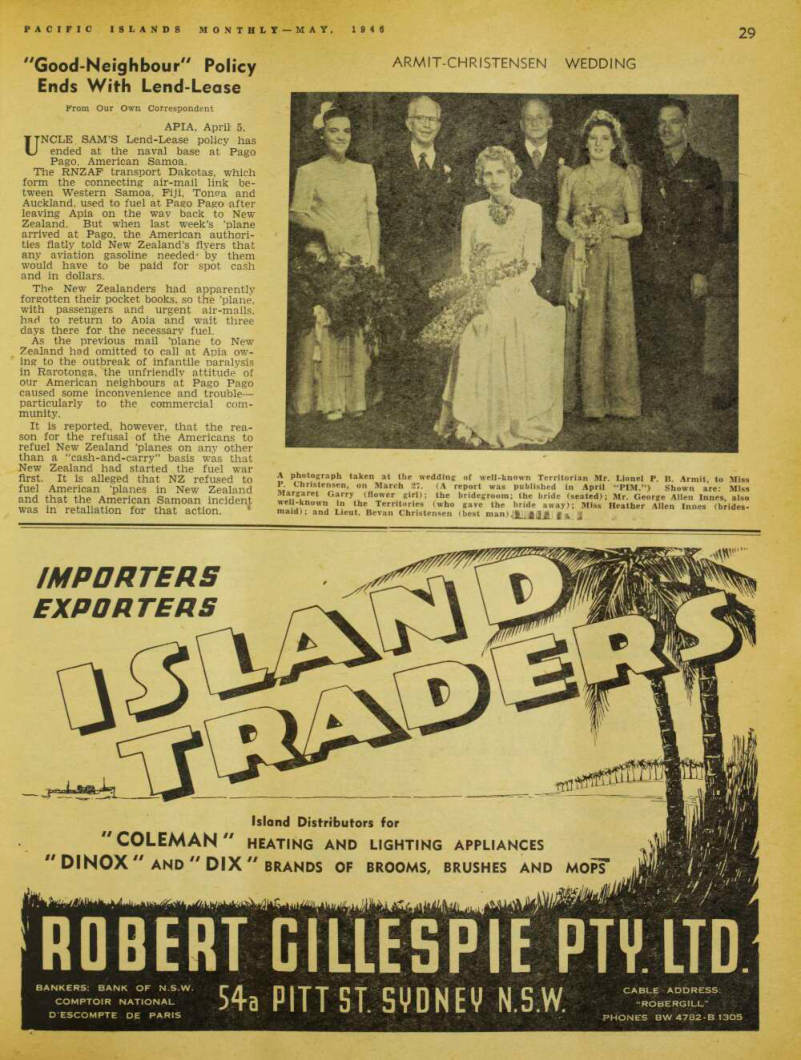
Ends With Lend-Lease
From Our Own Correspondent APIA, April 5.
UNCLE SAM’S Lend-Lease policy has ended at the naval base at Pago Pago, American Samoa.
The RNZAF transport Dakotas, which form the connecting air-mail link be tween Western Samoa, Fiji, Tonea and Auckland, used to fuel at Pago Pago after leaving Apia on the way back to New Zealand. But when last week’s ’plane arrived at Pago, the American authori ties flatly told New Zealand’s flyers that any aviation gasoline needed' by them would have to be paid for spot cash and in dollars.
The New Zealanders had apparently forgotten their pocket books, so the ’plane, with passengers and urgent air-mails, had to return to Ania and wait three days there for the necessary fuel.
As the previous mail ’plane to New Zealand had omitted to call at Apia ow ing to the outbreak of infantile paralysis in Rarotonga, the unfriendly attitude of our American neighbours at Pago Pago caused some inconvenience and trouble — particularly to the commercial com munity.
It is reported, however, that the rea son for the refusal of the Americans to refuel New Zealand ’planes on any other than a “cash-and-carry” basis was that New Zealand had started the fuel war first. It is alleged that NZ refused to fuel American ’planes in New Zealand and that the American Samoan incident was in retaliation for that action.
Armit-Christensen Wedding
A photograph taken at the wedding of well-known Territorian Mr. Lionel P. B. Armit, to Miss P. Christensen, on March 27. (A report was published in April “PIM,”) Shown are: Miss Margaret Garry (flower girl); the bridegroom; the bride (seated); Mr. George Allen Innes, also well-known in the Territories (who gave the bride away); Miss Heather Allen Innes (brides maid); and Lieut. Bevan Christensen (best man)
Advertisements & other items, p. 31 (1 item)
54A Pitt St. Svdnev N.S.W.
IMPORTERS
EXPORTERS
tel' I# a Island Distributors for
COLEMAN " HEATING AND LIGHTING APPLIANCES
DINOX " AND " DIX " BRANDS OF BROOMS, BRUSHES AND MOPS* I I
BANKERS: BANK OF N.S.W.
COMPTOIR NATIONAL
DESCOMPTE DE PARIS
54a PITT ST. SVDNEV N.S.W.
CABLE ADDRESS:
“RO BERG ILL*'
PHONES BW 4782-B 1305
W. Samoa Census Figures
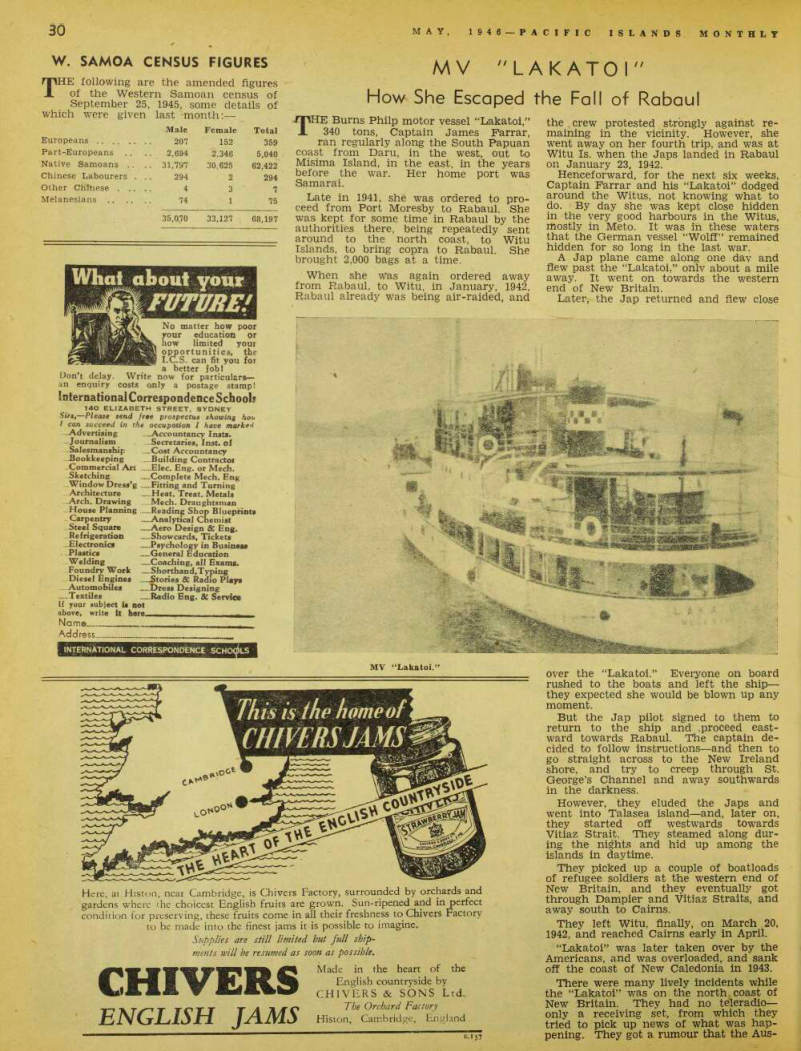
THE following are the amended figures of the Western Samoan census of September 25, 1945, some details of which were given last -month:—
Male Female Total Europeans 207 152 359 Part-Europeans .. .. 2,694 2,346 5,040 Native Samoans .. .. 31,797 30,625 62,422 Chinese Labourers . .. 294 2 294 Other Chinese 4 3 7 Melanesians 74 1 75 35,0,70 33,127 68,197
Mv "Lakatoi"
How She Escaped the Fall of Rabaul
/pHE Burns Philp motor vessel “Lakatoi,”
X 340 tons, Captain James Farrar, ran regularly along the South Papuan coast from Daru, in the west, out to Misima Island, in the east, in the years before the war. Her home port was Samaraii.
Late in 1941, she was ordered to pro ceed from Port Moresby to Rabaul. She was kept for some time in Rabaul by the authorities there, being repeatedly sent around to the north coast, to Witu Islands, to bring copra to Rabaul. She brought 2,000 bags at a time.
When she Was again ordered away from Rabaul, to Witu, in January, 1942, Rabaul already was being air-raided, and
the crew protested strongly against re maining in the vicinity. However, she went away on her fourth trip, and was at Witu Is. when the Japs landed in Rabaul on January 23, 1942.
Henceforward, for the next six weeks, Captain Farrar and his “Lakatoi” dodged around the Witus, not knowing what to do. By day she was kept close hidden in the very good harbours in the Witus, mostly in Meto. It was in these waters that the German vessel “Wolff” remained hidden for so long in the last war.
A Jap plane came along one dav and flew past the “Lakatoi,” onlv about a mile away. It went on towards the western end of New Britain.
Later, the Jap returned and flew close
over the “Lakatoi.” Everyone on board rushed to the boats and left the ship— they expected she would be blown up any moment.
But the Jap pilot signed to them to return to the ship and .proceed east ward towards Rabaul. The captain de cided to follow instructions—and then to go straight across to the New Ireland shore, and try to creep through St.
George’s Channel and away southwards in the darkness.
However, they eluded the Japs and went into Talasea island—and, later on, they started off westwards towards Vitiaz Strait. They steamed along dur ing the nights and hid up among the islands in daytime.
They picked up a couple of boatloads of refugee soldiers at the western end of New Britain, and they eventually got through Dampier and Vitiaz Straits, and away south to Cairns.
They left Witu, finally, on March 20, 1942, and reached Cairns early in April.
“Lakatoi” was later taken over by the Americans, and was overloaded, and sank off the coast of New Caledonia in 1943.
There were many lively Incidents while the “Lakatoi” was on the north coast of New Britain. They had no teleradio — only a receiving set, from which they tried to pick up news of what was hap pening. They got a rumour that the Aus
MV “Lakatoi.”
tralians had evacuated Rabaul, and they sent away Mr. Lumley, and another, in Mrs. Baker’s launch, to the north coast of New Britain to try and get news. Some one there—an Australian official—seized Mr. Lumley and the launch, and would not let them go—but they escaped even tually. Mr. Lumley appears to have been Captain Farrar’s right-hand man. Also aboard the “Lakatoi,” when she escaped were Mr. E. D. Robinson, a BP plantation inspector, and District Officer J. K.
McCarthy. Mr. Robinson afterwards joined the AIB, and won captain’s rank and the Military Cross.
Mrs. Jean Poole, widow of Rev. John Poole, formerly of the Methodist Mission, Rabaul, is taking the missionary sister’s course at George Brown College before returning to New Guinea. Her husband was one of the missionaries lost on the “Montevideo Maru.”
Advertisements & other items, p. 32 (1 item)
Chivers
What about your
FUTURE'
No matter bow poor your education or how limited your opportunities, the I.C.S. can fit you for a better Job I Don t delay. Write now for particulars— an enquiry costs only a postage stamp!
International Correspondence School?
140 ELIZABETH STREET, SYDNEY
Sirs, —Please send free prospectus showing hou I can succeed in the occupation I have marked ...Advertising Accountancy Insts.
Journalism Secretaries, Inst, of . Salesmanship Cost Accountancy .Bookkeeping Building Contractor ..Commercial Art Elec. Eng. or Mech.
Sketching Complete Mech. Eng Window Dress’g Fitting and Turning Architecture Heat. Treat. Metals ..Arch. Drawing Mech. Draughtsman House Planning Reading Shop Blueprints Carpentry ...Analytical Chemist Steal Square ...Aero Design & Eng.
Refrigeration Showcards, Tickets ..Electronics ...Psychology in Business Plastics General Education Welding Coaching, all Exams.
Foundry Work Shorthand,Typing Diesel Engines .Stories & Radio Plays .Automobiles Dress Designing Textiles Radio Eng. & Service If your subject is not above, write it h« r< »
Nam e . T
Address
INTERNATIONAL CORRESPONDENCE SCHOOLS
This is the h .
Here, at Histon, near Cambridge, is Chivers Factory, surrounded by orchards and gardens where the choicest English fruits are grown. Sun-ripened and in perfect condition for preserving, these fruits come in all their freshness to Chivers Factory to be made into the finest jams it is possible to imagine.
Supplies are still limited but full shipments will be resumed as soon as possible.
CHIVERS
ENGLISH JAMS
Made in the heart of the
English countryside by
CHIVERS & SONS Ltd.
The Orchard Factory Histon, Cambridge, England E. 137
Shipping Shortages Are
World Wide
rE world shipping shortage, caused by the recent war, is seriously affect ing world trade. Australia, being so far from the markets in Europe and America, is at a greater disadvantage than most countries, and it is essential that every square foot of shipping space should be used to the best advantage.
A recent announcement in the press quoted an authority as saying that the current hold-up of Dutch ships in Aus tralian waters is preventing seven ships with a carrying capacity of 24,000 tons from leaving our snores every six weeks.
These vessels are waiting to carry ship ments of goods purchased from Australia by the Dutch and on return would bring to this country many of the products of the N.E.I. that have been in such short supply during the war years.
Whilst these hold-ups continue, our trade with the countries of the Pacific, so valuable to Australia’s export future, is suffering and Australian workers are be ing deprived of the jobs that this trade would make available in Australia.
It is tragic to think that a small group of anti-Dutch Communists should be in a position to cause Australia’s economy and prestige such harm and neutralise the valuable cargo-carrying potential of these Dutch vessels.
Contributed by Ceigoa Pty., Ltd. (Con solidated Export and Import Group of Australia), 54 Oxford Street, Sydney.
Pacific Territories
No Clothing Coupons
Needed In Australian
A RECENT circular from the Aus
tralian Rationing Commission states
that mail orders for rationed cloth ing may be received in Australia from Nauru and Papua-New Guinea up to a value of 50 coupons. The circular states: Parcel post facilities have recently been re stored between the Commonwealth and Nauru.
No ration books are issued to either the white or native residents and, in view of their limited demands, it has been decided to permit mail orders up to a value of 50 coupons to be ful filled without reference to Deputy Directors.
Orders for goods exceeding a value of 50 cou pons should be referred to the Deputy Director.
Reimbursement of coupons will be made to traders on production of copy invoices.
Administrative difficulties have occurred in applying coupon rationing of clothing to the scattered residents of New Guinea. Consumer coupons will therefore be discontinued and cou pons withdrawn from residents. Mail orders may be fulfilled by Australian traders in the same manner as outlined above for the island of Nauru.
Mr. A. N, A. Waddell, ADO In the BSIP, has been acting as Resident Com missioner since last October when Mr.
O. C. Noel left the Protectorate on six months’ leave.
Apply To Mr. Ward
If You Wish to Lecture Trainee Officers of the New Guinea Administration.
IN the House of Representatives in Canberra, on March 22, Mr. White asked the Minister for External Territories, Mr. Ward, upon notice: Will provision be made in the proposed school for the training of officers of the New Guinea service for the trainees to receive a proper presentation of the case of those pioneers of the Territories and others who believe that the Government’s policy of indentured labour and other matters may prove detrimental to the best interests of New Guinea and of the Common wealth?
Mr. Ward replied: “The curriculum at the school will include lectures by com petent persons on all phases of adminis tration and activities in the Territories of Papua and New Guinea. Any person who wishes an opportunity to deliver a lecture to the students at the school could communicate with my Depart ment, and the request would be con sidered.”
Capt. E. Harness, who has been acting- Harbourmaster for the port of Suva for some time, has now had his appoint ment confirmed.
Advertisements & other items, pp. 33-34 (1 item)
Flour
PRODUCING UNIFORM GOOD RESULTS SINCE 1868
ALWAYS ASK FOR IT
This Company supplies Aluminium and its Alloys to all specifications and for every commercial application where these give better service over other metals.
PLATE . SHEET . STRIP . SLABS . CIRCLES
BAR . WIRE SECTIONS FORGINGS
TUBING . ROD .
ALLOY INGOT.
Please Consult our Technical Service Department regarding your Light Metal Problems. - - - PPO P Pl£ TA R y LIMITED
(INCORPORATED IN THE STATE OF VICTORIA)
6tWtMl OFFICES AND FABRICATION DIVISION: GRANVILLE. SYDNEY.
Modern Refrigeration for the South Sea Islands
The ELECTROLUX kerosene operated
REFRIGERATOR
MARVEL
OF
MODERN
SCIENCE
THE
MIRACLE
OF
ICE
FROM
HEAT
ELECTROLUX OFFERS ECONOMICAL, modern and completely efficient
REFRIGERATION FOR ISLANDS' HOMES.
FREEZES CONTINUOUSLY WHILE SMALL LAMP BURNS.
Freezing controlled by simply regulating height of flame. Uses only f gallon of kerosene per week:.
MOTORLESS ... NO PARTS TO GET OUT OF ORDER.
MODEL LKSSO
Capacity 5.5 cubic feet.
GUARANTEED FOR TWO YEARS.
• Write to your Local Distributor for prices and full details.
OBTAINABLE FROM ALL W. R. CARPENTER fir CO. LTD.
BRANCHES THROUGHOUT THE ISLANDS
Representation in Papua and New Hebrides.
Magazine Section
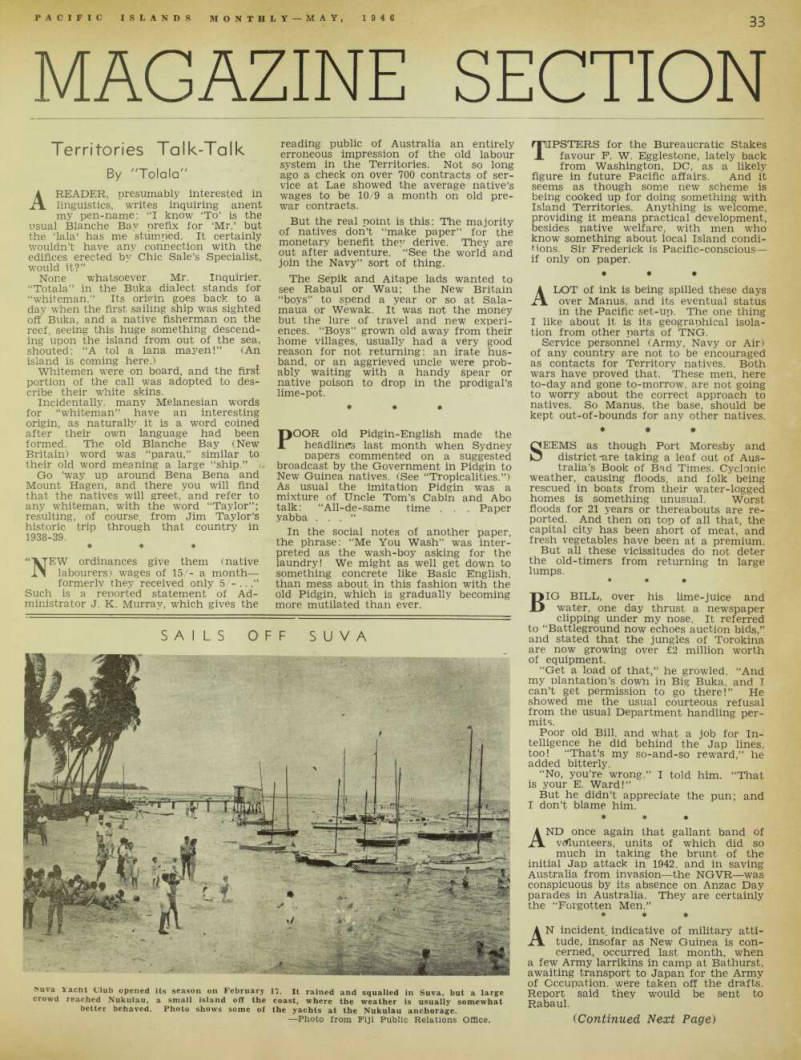
Territories Talk-Talk
By "Tolala"
A READER, presumably interested in linguistics, writes inquiring anent my pen-name: “I know ‘To’ is the usual Blanche Bay prefix for ‘Mr.’ but the ‘lala’ has me stumped. It certainly wouldn’t have any connection with the edifices erected by Chic Sale’s Specialist, would it?”
None whatsoever, Mr. Inquirier.
“Totala” in the Buka dialect stands for “whiteman.” Its origin goes back to a day when the first sailing ship was sighted off Buka, and a native fisherman on the reef, seeing this huge something descend ing upon the island from out of the sea, shouted: “A tol a lana mayen!” (An island is coming here.) Whitemen were on board, and the first portion of the call was adopted to des cribe their white skins.
Incidentally, many Melanesian words for “whiteman” have an interesting origin, as naturally it is a word coined after their own language had been formed. The old Blanche Bay (New Britain) word was “parau,” similar to their old word meaning a large “ship.”
Go ’way up around Bena Bena and Mount Hagen, and there you will find that the natives will greet, and refer to any whiteman, with the word “Taylor”; resulting, of course, from Jim Taylor’s historic trip through that country in 1938-39. ♦ ♦ * “XTEW ordinances give them (native 11 labourers) wages of 15/- a month — formerly they received only 5/- ...”
Such is a renorted statement of Ad ministrator J. K. Murray, which gives the
reading public of Australia an entirely erroneous impression of the old labour system in the Territories. Not so long ago a check on over 700 contracts of ser vice at Lae showed the average native’s wages to be 10/9 a month on old pre war contracts.
But the real point is this: The majority of natives don’t “make paper” for the monetary benefit they derive. They are out after adventure. “See the world and join the Navy” sort of thing.
The Sepik and Aitape lads wanted to see Rabaul or Wau; the New Britain “boys” to spend a year or so at Sala maua or Wewak. It was not the money but the lure of travel and new experi ences. “Boys” grown old away from their home villages, usually had a very good reason for not returning: an irate hus band, or an aggrieved uncle were prob ably waiting with a handy spear or native poison to drop in the prodigal’s lime-pot. ♦ ♦ * POOR old Pidgin-English made the headlines last month when Sydney papers commented on a suggested broadcast by the Government in Pidgin to New Guinea natives. (See “Tropicalities.”) As usual the imitation Pidgin was a mixture of Uncle Tom’s Cabin and Abo talk: “All-de-same time . . . Paper yabba ...”
In the social notes of another paper, the phrase: “Me You Wash” was inter preted as the wash-boy asking for the laundry! We might as well get down to something concrete like Basic English, than mess about in this fashion with the old Pidgin, which is gradually becoming more mutilated than ever.
TIIPSTERS for the Bureaucratic Stakes favour F. W. E'gglestone, lately back from Washington, DC, as a likely figure in future Pacific affairs. And it seems as though some new scheme is being cooked up for doing something with Island Territories. Anything is welcome, providing it means practical development, besides native welfare, with men who know something about local Island condi tions. Sir Frederick is Pacific-conscious — if only on paper. • • • A LOT of ink is being spilled these days over Manus, and its eventual status in the Pacific set-up. The one thing I like about it is its geographical isola tion from other parts of TNG.
Service personnel (Army, Navy or Air) of any country are not to be encouraged as contacts for Territory natives. Both wars have proved that. These men, here to-day and gone to-morrow, are not going to worry about the correct approach to natives. So Manus, the base, should be kept out-of-bounds for any other natives. • • • SEEMS as though Port Moresby and district-are taking a leaf out of Aus tralia’s Book of Bad Times. Cyclonic weather, causing floods, and folk being rescued in boats from their water-logged homes is something unusual. Worst floods for 21 years or thereabouts are re ported. And then on top of all that, the capital city has been short of meat, and fresh vegetables have been at a premium.
But all these vicissitudes do not deter the old-timers from returning In large lumps. * * • BIG BILL, over his lime-juice and water, one day thrust a newspaper clipping under my nose. It referred to “Battleground now echoes auction bids,” and stated that the jungles of Torokina are now growing over £2 million worth of equipment.
“Get a load of that,” he growled. “And my plantation’s down in Big Buka, and I can’t get permission to go there!” He showed me the usual courteous refusal from the usual Department handling per mits.
Poor old Bill, and what a job for In telligence he did behind the Jap lines, too! “That’s my so-and-so reward,” he
added bitterly.
“No, you’re wrong,” I told him. “That is your E. Ward!”
But he didn’t appreciate the pun; and I don’t blame him. ♦ ♦ * AND once again that gallant band of v(*lunteers, units of which did so much in taking the brunt of the initial Jap attack in 1942. and in saving Australia from invasion—the NGVR —was conspicuous by its absence on Anzac Day parades in Australia. They are certainly the “Forgotten Men.” * * ♦ AN incident, indicative of military atti tude, insofar as New Guinea is con cerned, occurred last month, when a few Army larrikins in camp at Bathurst, awaiting transport to Japan for the Army of Occupation, were taken off the drafts.
Report said they would be sent to Rabaul.
(Continued Next Page )
Sails Off Suva
Suva Yacht Club opened its season on February 17. it rained and squalled in Suva, but a large crowd reached Nukulau, a small island off the coast, where the weather is usually somewhat better behaved. Photo shows some of the yachts at the Nukulau anchorage. —Photo from Fiji Public Relations Office.
Pacific Queen
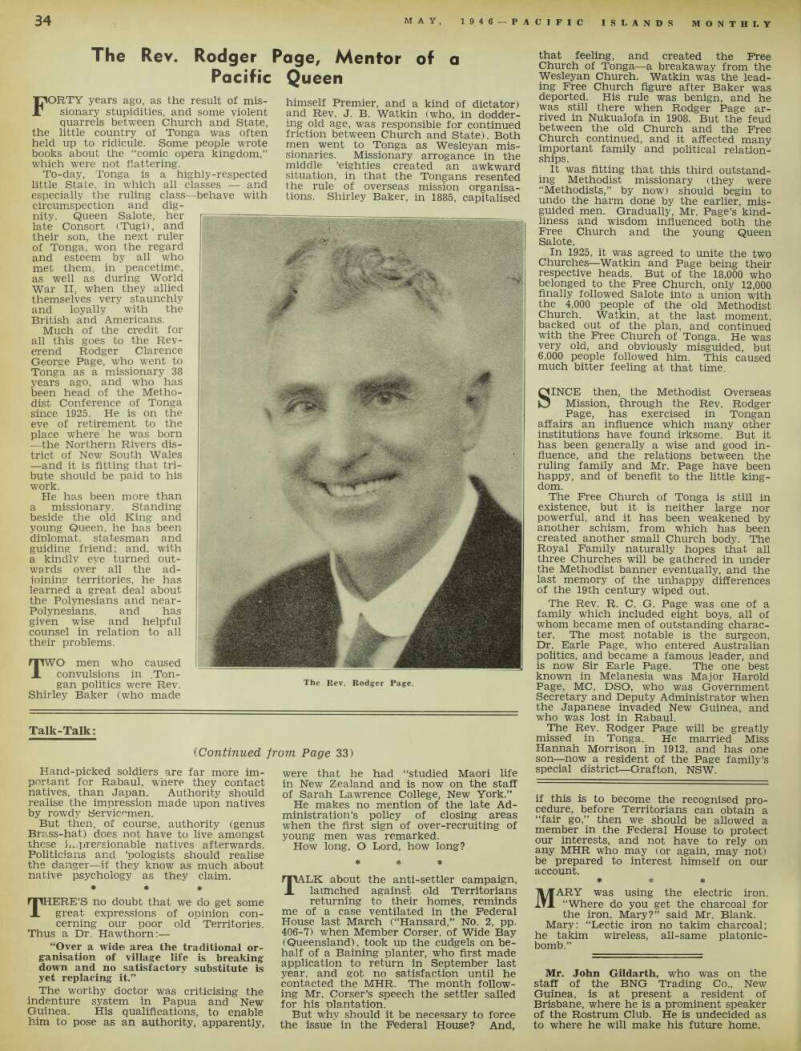
The Rev. Rodger Page, Mentor of a Pacific Queen
FORTY years ago, as the result of mis sionary stupidities, and some violent quarrels between Church and State, the little country of Tonga was often held up to ridicule. Some people wrote books about the “comic opera kingdom,” which were not flattering.
To-day, Tonga is a highly-respected little State, in which all classes and especially the ruling class —behave with
circumspection and dig nity. Queen Salote, her late Consort (Tugi), and their son, the next ruler of Tonga, won the regard and esteem by all who met them, in peacetime, as well as during World War 11, when they allied themselves very staunchly and loyally with the British and Americans.
Much of the credit for all this goes to the Rev erend Rodger Clarence George Page, who went to Tonga as a missionary 38 years ago, and who has been head of the Metho dist Conference of Tonga since 1925. He is on the eve of retirement to the place where he was born —the Northern Rivers dis trict of New South Wales —and it is fitting that tri bute should be paid to his work.
He has been more than a missionary. Standing beside the old King and young Queen, he has been diplomat, statesman and guiding friend: and, with a kindly eye turned out wards over all the ad joining territories, he has learned a great deal about the Polynesians and near- Polynesians, and has given wise and helpful counsel in relation to all their problems. rjTWO men who caused X convulsions in .Ton gan politics were Rev.
Shirley Baker (who made
himself Premier, and a kind of dictator) and Rev. J. B. Watkin (who in dodder ing old age, was responsible for continued friction between Church and State) Both men went to Tonga as Wesleyan mis sionaries. Missionary arrogance in the middle ’eighties created an awkward situation, in that the Tongans resented the rule of overseas mission organisa tions. Shirley Baker, in 1885, capitalised
that feeling, and created the Free Church of Tonga—a breakaway from the Wesleyan Church. Watkin was the lead ing Free Church figure after Baker was deported. His rule was benign, and he was still there when Rodger Page ar rived in Nukualofa in 1908. But the feud between the old Church and the Free Church continued, and it affected many important family and political relation ships.
It was fitting that this third outstand ing Methodist missionary (they were “Methodists,” by now) should begin to undo the harm done by the earlier, mis guided men. Gradually, Mr. Page’s kind liness and wisdom influenced both the Free Church and the young Queen Salote.
In 1925, it was agreed to unite the two Churches—Watkin and Page being their respective heads. But of the 18,000 who belonged to the Free Church, only 12,000 finally followed Salote into a union with the 4,000 people of the old Methodist Church. Watkin, at. the last moment, backed out of the plan, and continued with the Free Church of Tonga. He was very old, and obviously misguided, but 6,000 people followed him. This caused much bitter feeling at that time.
SINCE then,_ the Methodist Overseas Mission, through the Rev. Rodger Page, has exercised in Tongan affairs an influence which many other institutions have found irksome. But it has been generally a wise and good in fluence, and the relations between the ruling family and Mr. Page have been happy, and of benefit to the little king dom.
The Free Church of Tonga is still in existence, but it is neither large nor powerful, and it has been weakened by another schism, from which has been created another small Church body. The Royal Family naturally hopes that all three Churches will be gathered in under the Methodist banner eventually, and the last memory of the unhappy differences of the 19th century wiped out.
The Rev. R. C. G. Page was one of a family which included eight boys, all of whom became men of outstanding charac ter. The most notable is the surgeon, Dr. Earle Page, who entered Australian politics, and became a famous leader, and is now Sir Earle Page. The one best known in Melanesia was Major Harold Page, MC, DSO, who was Government Secretary and Deputy Administrator when the Japanese invaded New Guinea, and who was lost in Rabaul.
The Rev. Rodger Page will be greatly missed in Tonga. He married Miss Hannah Morrison in 1912, and has one son—now a resident of the Page family’s special district—Grafton, NSW.
The Rev. Rodger Page.
Advertisements & other items, p. 36 (1 item)
(Continued from Page 33)
Talk-Talk:
Strong Men Wept
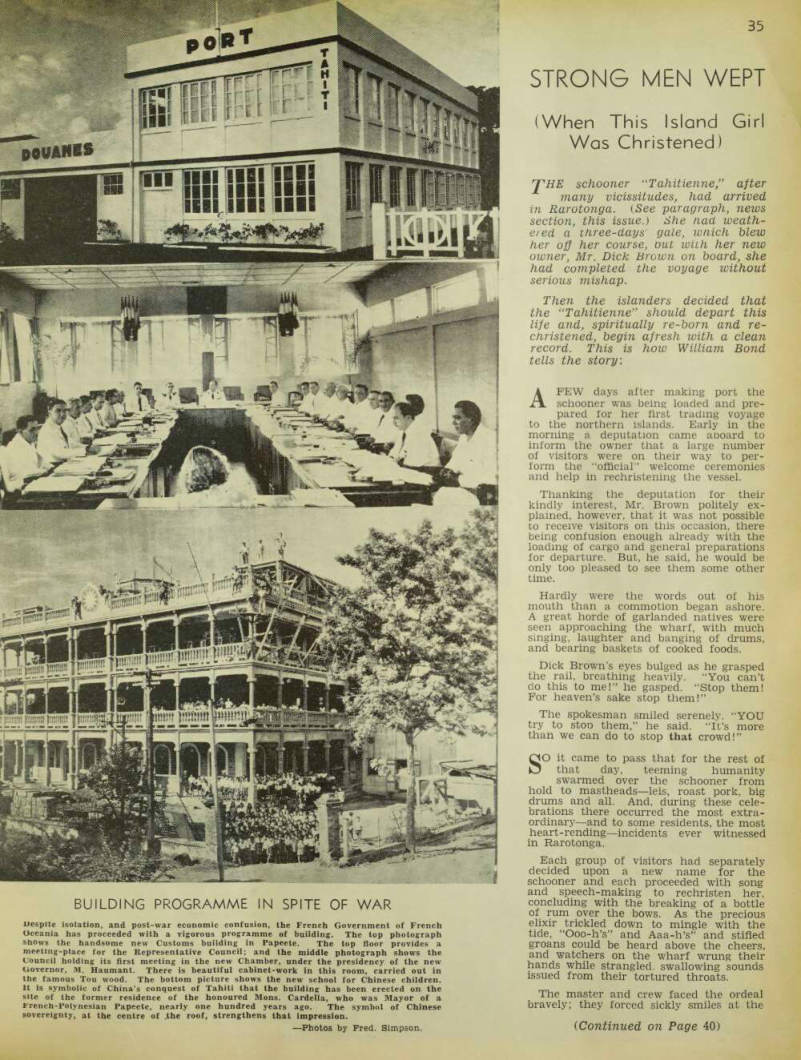
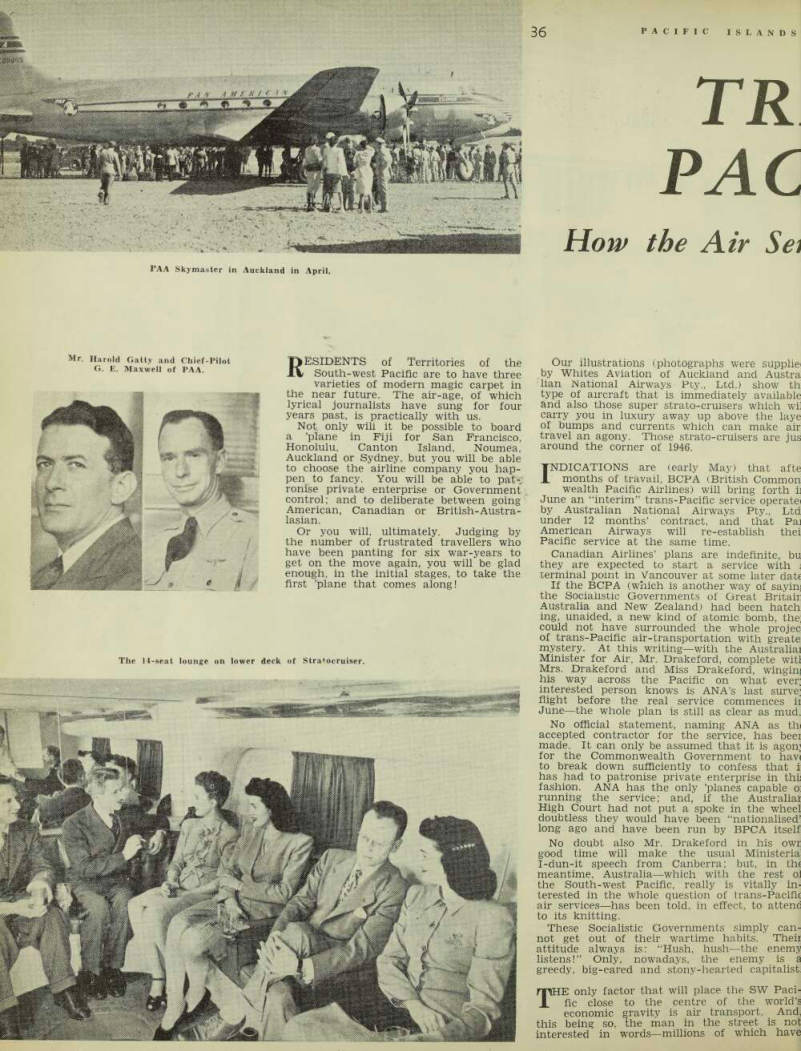
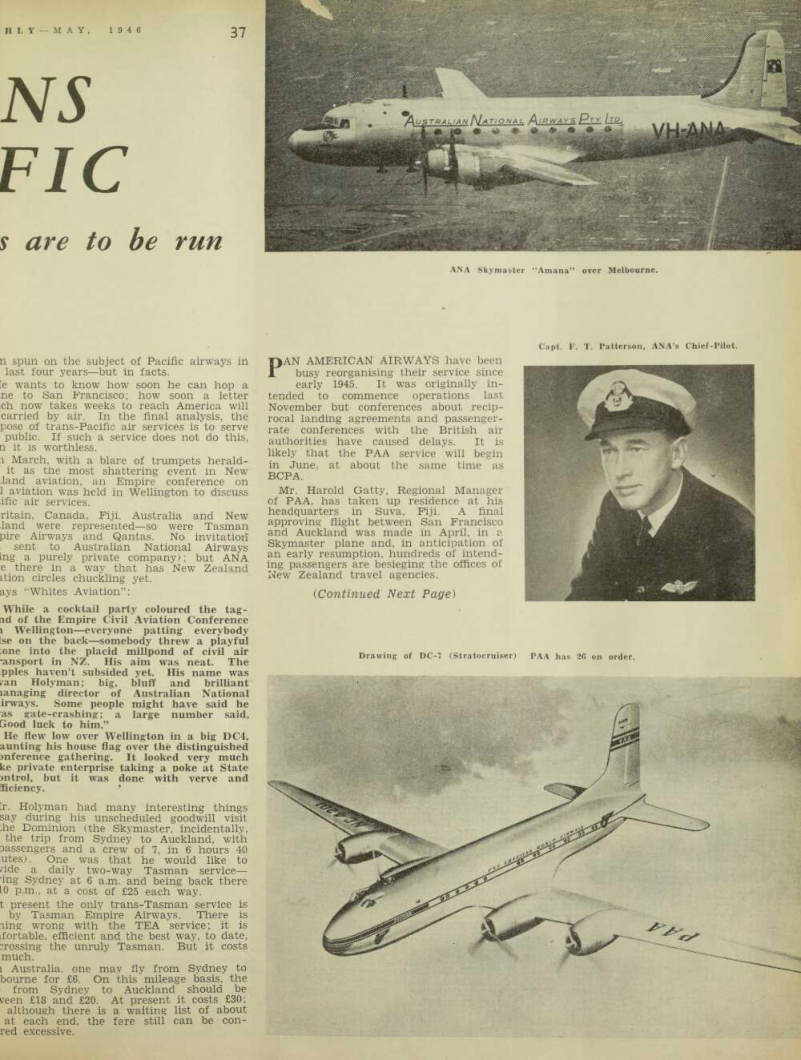
(When This Island Girl Was Christened)
schooner “Tahitienne,” after
many vicissitudes, had arrived in Rarotonga. (See paragraph, news section, this issue.) She had weath e/ed a three-days' gale, wnich blew her off her course, out with her new owner, Mr. Dick Brown on board, she had completed the voyage without serious mishap.
Then the islanders decided that the “Tahitienne” should depart this life and, spiritually re-born and re
christened, begin afresh with a clean
record. This is how William Bond tells the story.
A FEW days after making port the schooner was being loaded and pre pared for her first trading voyage to the northern islands. Early in the morning a deputation came aooard to inform the owner that a large number of visitors were on their way to per form the “official” welcome ceremonies and help in rechristening the vessel.
Thanking the deputation for their kindly interest, Mr. Brown politely ex plained, however, that it was not possible to receive visitors on this occasion, there being confusion enough already with the loading of cargo and general preparations for departure. But, he said, he would be only too pleased to see them some other time.
Hardly were the words out of his mouth than a commotion began ashore.
A great horde of garlanded natives were seen approaching the wharf, with much singing, laughter and banging of drums, and bearing baskets of cooked foods.
Dick Brown’s eyes bulged as he grasped the rail, breathing heavily. “You can’t do this to me!” he gasped. “Stop them!
For heaven’s sake stop them!”
The spokesman smiled serenely. “YOU try to stoo them,” he said. “It’s more than we can do to stop that crowd!”
SO it came to pass that for the rest of that day, teeming humanity swarmed over the schooner from hold to mastheads—leis, roast pork, big drums and all. And, during these cele brations there occurred the most extra ordinary—and to some residents, the most heart-rending—incidents ever witnessed in Rarotonga.
Each group of visitors had separately decided upon a new name for the schooner and each proceeded with song and speech-making to rechristen her, concluding with the breaking of a bottle of rum over the bows. As the precious elixir trickled down to mingle with the tide, “000-h’s” and Aaa-h’s” and stifled groans could be heard above the cheers, and watchers on the wharf wrung their hands while strangled, swallowing sounds issued from their tortured throats.
The master and crew faced the ordeal bravely; they forced sickly smiles at the
(Continued on Page 40)
Building Programme In Spite Of War
Despite isolation, and post-war economic confusion, the French Government of French Oceania has proceeded with a vigorous programme of building. The top photograph shows the handsome new Customs building in Papeete. The top floor provides a meeting-place for the Representative Council; and the middle photograph shows the Council holding its first meeting in the new Chamber, under the presidency of the new Governor, M. Haumant. There is beautiful cabinet-work in this room, carried out in the famous Tou wood. The bottom picture shows the new school for Chinese children.
It is symbolic of China’s conquest of Tahiti that the building has been erected on the site of the former residence of the honoured Mons. Cardella, who was Mayor of a french-Polynesian Papeete, nearly one hundred years ago. The symbol of Chinese sovereignty, at the centre of the roof, strengthens that impression. —Photos by Fred. Simpson.
barbaric sacrifices being made in their honour, by these benighted people.
THE climax to the whole moving drama came when the Manihiki Islanders took the stage for their turn. The shark-skin drums roared into action as the masters and mistresses of the hula waggled their knees and shim mied and shook. Their headman out spoke the other spokesmen.
“This is a great day for Manihiki!” he shouted. “I feel so happy I could put mv foot right through that blankv drum!”
He strode proudly forward bearing aloft —a bottle of rum in EACH hand! He leaned over the bow and swung a mightv left, right, at the stem as he shouted, “I name you ‘Vaine Manihiki’!”
The sailors closed their eyes, dug their finger-nails into their horny palms, and sagged at the knees. Dick Brown rocked on his heels and reached out for solid support. Thus was the former schooner “Tahitienne” rechristened—while strong men wept with silent emotion.
AT the end of an unforgettable day the schooner set sail from the holy waters of Avarua Harbour, to once more fill her hold with pearl-shell and copra among the northern atolls.
Proudly she bears her new names— among them such romantic ones as “Vaine Manihiki” (Manihiki Girl) and “Taku Vaine Akaperepere” (My Loving Girl).
Trans
Pacific
How the Air Sers are to be run
RESIDENTS of Territories of the South-west Pacific are to have three varieties of modern magic carpet in the near future. The air-age, of which lyrical journalists have sung for four years past, is practically with us.
Not. only will it be possible to board a ’plane in Fiji for San Francisco, Honolulu, Canton Island, Noumea, Auckland or Sydney, but you will be able to choose the airline company you hap pen to fancy. You will be able to pat-; ronise private enterprise or Government control: and to deliberate between going American, Canadian or British-Austra lasian.
Or you will, ultimately. Judging by the number of frustrated travellers who have been panting for six war-years to get on the move again, you will be glad enough, in the initial stages, to take the first ’plane that comes along!
Our illustrations (photographs were supplie by Whites Aviation of Auckland and Austra lian National Airways Pty., Ltd.) show th type of aircraft that is immediately available and also those super strato-cruisers which wl carry you in luxury away up above the laye of bumps and currents which can make air travel an agony. Those strato-cruisers are jus around the corner of 1946.
INDICATIONS are (early May) that afte months of travail, BCPA (British Common wealth Pacific Airlines) will bring forth i] June an “interim” trans-Pacific service operate by Australian National Airways Pty., Ltd under 12 months’ contract, and that Pa: American Airways will re-establish thei Pacific service at the same time.
Canadian Airlines’ plans are indefinite, bu they are expected to start a service with ; terminal point in Vancouver at some later date If the BCPA (which is another way of sayini the Socialistic Governments of Great Britair Australia and New Zealand) had been hatch ing, unaided, a new kind of atomic bomb, the; could not have surrounded the whole projec of trans-Pacific air-transportation with greate mystery. At this writing—with the Australia] Minister for Air, Mr. Drakeford, complete witl Mrs. Drakeford and Miss Drakeford, wingini his way across the Pacific on what ever; interested person knows is ANA’s last surve; flight before the real service commences ii June—the whole plan is still as clear as mud.
No official statement, naming ANA as thi accepted contractor for the service, has beei made. It can only be assumed that it is agon; for the Commonwealth Government to havi to break down sufficiently to confess that 1 has had to patronise private enterprise in thi fashion. ANA has the only ’planes capable o: running the service; and, if the Australiai High Court had not put a spoke in the wheel doubtless they would have been “nationalised’ long ago and have been run by BPCA itself No doubt also Mr. Drakeford in his owr good time will make the usual Ministeria I-dun-it speech from Canberra; but, in the meantime, Australia —which with the rest oJ the South-west Pacific, really is vitally in terested in the whole question of trans-Pacific air services—has been told, in effect, to attend to its knitting.
These Socialistic Governments simply can not get out of their wartime habits. Theii attitude always is: “Hush, hush —the enemy listens!” Only, nowadays, the enemy is a greedy, big-eared and stony-hearted capitalist rE only factor that will place the SW Paci fic close to the centre of the world’s economic gravity is air transport. And, this being so, the man in the street is not interested in words —millions of which have
PAA Skymaster in Auckland in April.
Mr. Harold Gatty and Chief-Pilot G. E. Maxwell of PAA.
The 14-seat lounge on lower deck of Strat ocruiser.
n spun on the subject of Pacific airways in last four years—but in facts.
'.e wants to know how soon he can hop a ne to San Francisco; how soon a letter ch now takes weeks to reach America will carried by air. In the final analysis, the pose of trans-Pacific air services is to serve public. If such a service does not do this, n it is worthless. i March, with a blare of trumpets herald it as the most shattering event in New land aviation, an Empire conference on 1 aviation was held in Wellington to discuss ific air services. ritain, Canada, Fiji, Australia and New land were represented—so were Tasman pire Airways and Qantas. No invitation sent to Australian National Airways ing a purely private company); but ANA e there in a way that has New Zealand ition circles chuckling yet. ays “Whites Aviation”: While a cocktail party coloured the tag id of the Empire Civil Aviation Conference i Wellington—everyone patting everybody Ise on the back—somebody threw a playful ;one into the placid millpond of civil air •ansport in NZ. His aim was neat. The pples haven’t subsided yet. His name was fan Holyman; big, bluff and brilliant janaging director of Australian National irways. Some people might have said he as gate-crashing; a large number said, Good luck to him.”
He flew low over Wellington in a big DC4, aunting his house flag over the distinguished inference gathering. It looked very much ke private enterprise taking a poke at State mtrol, but it was done with verve and [ficiency. * 'r. Holyman had many interesting things say during his unscheduled goodwill visit ;he Dominion (the Skymaster, incidentally, the trip from Sydney to Auckland, with passengers and a crew of 7, in 6 hours 40 utes). One was that he would like to fide a daily two-way Tasman service— ring Sydney at 6 a.m. and being back there L 0 p.m., at a cost of £25 each way. t present the only trans-Tasman service is by Tasman Empire Airways. There is ling wrong with the TEA service; it is Portable, efficient and the best way, to date, crossing the unruly Tasman. But it costs much. i Australia, one may fly from Sydney to bourne for £6. On this mileage basis, the from Sydney to Auckland should be veen £lB and £2O. At present it costs £3O; although there is a waiting list of about at each end, the fare still can be con red excessive.
PAN AMERICAN AIRWAYS have been busy reorganising their service since early 1945. It was originally in tended to commence operations last November but conferences about recip rocal landing agreements and passenger rate conferences with the British air authorities have caused delays. It is likely that the PAA service will begin in June, at about the same time as
Bcpa.
Mr. Harold Gatty, Regional Manager of PAA, has taken up residence at his headquarters in Suva, Fiji. A final approving flight between San Francisco and Auckland was made in April, in a Skymaster plane and, in anticipation of an early resumption, hundreds of intend ing passengers are besieging the offices of New Zealand travel agencies. (Continued Next Page )
ANA Skymaster “Amana” over Melbourne.
(Japt. F. T. Patterson, ANA's Chief-Pilot.
Drawing of DC-7 (Stratocruiser) PAA has 2G on order.
The "Planes
The modern tendency is to swing away from seaplanes, even for long ocean flights. The somewhat doubtful safety lactor of the flying-boat in a forced land ing at sea, is outweighed by the advan tages of the large land ’planes now being manufactured. Before the war, Pan- American used giant flying-boats for their Pacific service, but they planned to re-establish the service with Lockheed Constellations—the only “above the weather” ’plane at present available.
However, it is likely that they will, initially at any rate, be using DC4s (Skymasters); then Constellations (which carry from 40 to 60 passengers in a pressurised cabin); and, finally, DC7’s— Strato-cruisers capable of carrying 100 people at any altitude between 8,000 and 30,000 feet.
PAA have 26 Strato-cruisers on order, at a cost of a million and a half dollars each. It was expected that these would be in service in the Pacific by mid-1946, but it will now be the end of the year, at least, before they are available.
THE ’plane plans of BCPA are, of course, shrouded in an official smoke-cloud. For the first 12 months the service will be run by ANA with Skymasters.
Whether ANA’s contract will be re newed after that time, and whether British or American ’planes will be used, is something about which no one can even hazard a guess at the present time.
ROUTES to be flown have not yet been announced. PAA’s final approving flight in April was by way of Hono lulu,. Palmyra, Canton Island, Fiji, New Caledonia, and Norfolk Island to New Zealand. On the return trio they called at Fiji, Canton Island and Honolulu.
ANA’S survey flight from Australia on May 3 was by way of Fiji, Canton Island and Honolulu, to San Francisco. It is believed that ANA will run three round trips fortnightly, Sydney to San Fran cisco. and one round trio fortnightly, San Francisco to Auckland.
Advertisements & other items, pp. 38-39 (2 items)
36
PACIFIC ISLANDS
37
NS
FIC
s are to be run
H L Y MAY, 1946
tropicalities
yy EW GUINEA natives are to hear Motuan and Pidgin news-broad casts over former Army stations. When this was announced in March, the
Sydney (i Daily Telegraph ” published
the following as an editorial. The Pidgin is peculiar; but the sentiments are sound.
Like other official broadcasts, these news sessions will doubtless be devoted to ministerial statements.
As head of the Information Depart ment, Mr. Calwell will be a prominent contributor.
This is one message the natives are sure to hear pretty often:— “All de same-time youfela tunim wire less, hearim Big Boss Calwell tellim Guvman truth longa free peoples bilong world.
“Yu mas chuckimout all newspaper.
“Paper yabba e no gud. E callim mefela rattabag.
“Mefela no rattabag, mefela gud plenty too much. Mefela Big Boss Calwell, plenty strong, plenty bigshot, yu askim
udefela Kiap, Eddie Ward.
“Eddie Ward e givim yu railway, poker mashin, foundation-stone, escalator, alia same King’s Cross.
“Eddie Ward luvim boong. Mefela luvim boong no mass readin paper yabba, yu bet.
“Supos yu findim paper yabba longa place belong yu, yu chuckimout hariap.
“Cursim newspaper! Cursim paper yabba, mi word!” • ♦ ♦ EVEN a tidal wave does some good.
Rumour has it that the backwash of the North Pacific marine disturb ance which reached Western Samoa on April 1 (reported elsewhere this issue), washed many of the village privies far out to sea.
Visitors to the Territory have long lamented those eyesores that are a fea ture of the Savai’i and Upolu landscape, which is otherwise very beautiful. In theory, such an edifice, stuck at the end of a long jetty and out over the tidal water, has its points. But, built of drift wood and bits of tin, and located above low water mark, as they often are in Samoa, they have served little useful purpose, anyway. * * * APROPOS the Tropicality in March “PIM,” regarding cigarettes packed in peanut tins, and the authorities’ view that it was the work of a “gang” in Suva: In my opinion the authorities are bark ing up the wrong tree. In the days of the American occupation of Fiji, there was a period—evidently coinciding with a crisis in the tinplate market back in the States—when American cigarettes, sealed in tins still bearing the brand of a well-known variety of American pea nuts, were on sale to troops over the Post Exchange counters. These, in the natural way of such things found their way into the hands of local civilians as well, and it seems more than likely that the cigarettes about which the Sydney customs men are getting hot under the collar are a hangover from this period.
—Mac P.
• * * LIFE among the natives of some of these Pacific Islands is not as simple and free from complications as many people believe.
Take the case of Aisea, for instance.
He gave a portion of his bushland to some other Rotumans to plant food, on the understanding that he was to re ceive some of the crop.
In due course, the food matured and baskets of yams and taro were presented to Aisea.
That should have been the close of the incident. But custom decreed that Aisea must give a feast to the people who had paid their rent. To this end, Aisea spent the rest of the day fishing, while the food-bringers lolled at home, waiting to be fed! ♦ ♦ ♦ THERE was once a European resident of Rotuma who persisted in shoot ing pigeons when the season was closed. In season and out, he continued, until finally he was approached by a delegation of Rotuman chiefs who com plained that very soon there would be no pigeons left.
And the culprit replied glibly: “But, you see, I shoot the male birds only.”
Naively, the delegation believed this
astonishing statement, and retired, with profuse apologies.—AMEL. * * * JUST a year ago (May 13, 1945) a US bomber crashed into a “hidden val ley” in Dutch New Guinea. Twenty one of its passengers were killed; three, including a WAG corporal, Margaret Hastings, survived. The valley, which was called “Shangri-La” and featured in articles all over the world, subsequently proved to be the Grand Valley visited by the Archbold expedition in 1938.
The real story of the crash and the survivors’ life in the valley, before they were rescued by a glider (which was towed into the valley and then snatched up on a tow-line trailed from a plane) has been written by Margaret Hastings, in collaboration with Inez Robb. It dif fers substantially from the newspaper accounts; but it has drama and humour, and is shorn of the high-coloured exag geration we have learnt to expect. Prob ably such an adventure does not warrant exaggeration even in America. The story, called “Crash in Shangri-La,” is condensed in the March issue of “Reader’s Digest.”
Margaret describes their meeting with the allegedly superior, lost tribe of natives who lived in the valley, and of whom US pilots, flying over the valley, had already Drought back tall tales: ALL the things we had heard about them were suddenly very clear and ominous: They were seven feet tall, they were canmoals, they practised human sacrifice, they were fierce war riors. And we were armed with one pocketknife!
“There’s nothing we can do but act friendly,” said McCollom. 'He ordered us to nold out our only food, the hard Cctnay, aaamg nis jack-Knife to the pitiful gifts. “Stand up,” he barked, “and smile! ”
Black heads began to pop out from be hind trees. We smiled. We smiled for our lives.
There were about 100 men with wicked looking stone axes over their shoulders.
The chief led the way. Our smiles by this time had the fixity of granite.
About 15 feet from us the natives stopped and clustered round. The chief was talking 60 to the second. And then his ugly face crumpled into a beaming smile. It was reprieve. It was life.
The chief stepped up to McCollom and held out his hand. McCollom, weak with relief, grabbed it and wrung it. The smiles had done it.
“How are you? Nice to see you,”
McCollom kept saying, over and over.
“Here! Meet Corporal Hastings and Ser geant Decker.”
We suddenly realised that the natives were more afraid of us than we of them.
Far from being seven feet tall, they averaged around 5s feet. And certainly they didn’t look very fierce. * * * rXES became due in the Gilbert and Ellice Islands on April 1. The whole 415 tons of it!
By proclamation in February, the Act ing Resident Commissioner “under Sec tion 2 (a) of the Landowners’ Taxation Ordinance, 1923,” deemed it just that a tax of 360 tons of copra should be im posed on the landowners of the Gilbert Islands (with the exception of those in the islands of Butaritari, Tarawa and Abemama—that is, those affected by war); and that a tax of 55 tons of copra should be imposed on landowners in the Ellice Islands (with the exception of those in the islands of Manumea, Nuku fetau and Funafuti).
The proclamation, issued in the WPHC “Gazette,” ends on the archaic note: “Whereof let all men take notice and govern themselves accordingly.”
Advertisements & other items, p. 40 (1 item)
38
MAY, 1946 PACIFIC ISLANDS MONTHLY
Trans Pacific (Continued from Page 37)
Foreigners Are Funny Folk
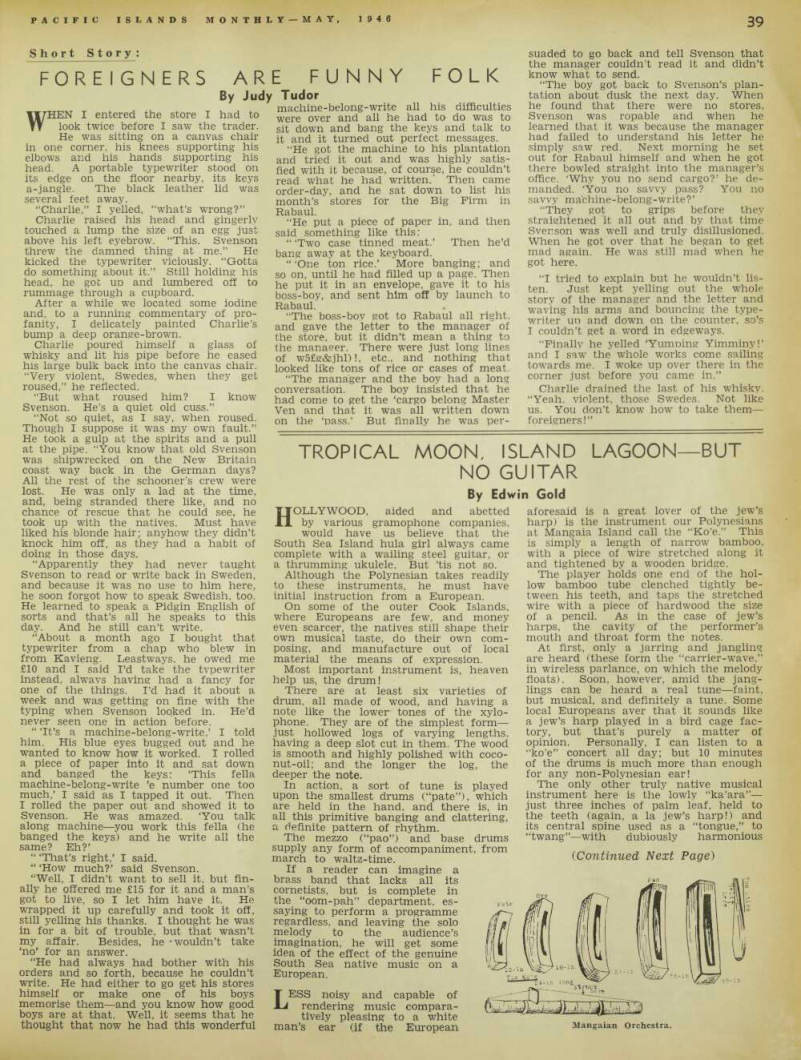
Short Story:
By Judy Tudor
WHEN I entered the store I had to look twice before I saw the trader.
He was sitting on a canvas chair in one corner, his knees supporting his elbows and his hands supporting his head. A portable typewriter stood on its edge on the floor nearby, its keys a-jangle. The black leather lid was several feet away.
“Charlie,” I yelled, “what’s wrong?”
Charlie raised his head and gingerly touched a lump the size of an egg just above his left eyebrow. “This. Svenson threw the damned thing at me.” He kicked the typewriter viciously. “Gotta do something about it.” Still holding his head, he got up and lumbered off to rummage through a cupboard.
After a while we located some iodine and, to a running commentary of pro fanity, I delicately painted Charlie’s bump a deep orange-brown.
Charlie poured himself a glass of whisky and lit his pipe before he eased his large bulk back into the canvas chair.
“Very violent, Swedes, when they get roused,” he reflected.
“But what roused him? I know Svenson. He’s a quiet old cuss.”
“Not so quiet, as I say, when roused.
Though I suppose it was my own fault.”
He took a gulp at the spirits and a pull at the pipe. “You know that old Svenson was shipwrecked on the New Britain coast way back in the German days?
All the rest of the schooner’s crew were lost. He was only a lad at the time, and, being stranded there like, and no chance of rescue that he could see, he took up with the natives. Must have liked his blonde hair; anyhow they didn’t knock him off, as they had a habit of doing in those days.
“Apparently they had never taught Svenson to read or write back in Sweden, and because it was no use to him here, he soon forgot how to speak Swedish, too.
He learned to speak a Pidgin English of sorts and that’s all he speaks to this day. And he still can’t write.
“About a month ago I bought that typewriter from a chap who blew in from Kavieng. Leastways, he owed me £lO and I said I’d take the typewriter instead, always having had a fancy for one of the things. I’d had it about a week and was getting on fine with the typing when Svenson looked in. He’d never seen one in action before.
“ ‘lt’s a machine-belong-write,’ I told him. His blue eyes bugged out and he wanted to know how it worked. I rolled a piece of paper into it and sat down and banged the keys: ‘This fella machine-belong-write ’e number one too much,’ I said as I tapped it out. Then I rolled the paper out and showed it to Svenson. He was amazed. ‘You talk along machine—you work this fella (he banged the keys) and he write all the same? Eh?’
“ ‘That’s right,’ I said.
“ ‘How much?’ said Svenson.
“Well, I didn’t want to sell it, but fin ally he offered me £l5 for it and a man’s got to live, so I let him have it. He wrapped it up carefully and took it off, still yelling his thanks. I thought he was in for a bit of trouble, but that wasn’t my affair. Besides, he - wouldn’t take ‘no’ for an answer.
“He had always had bother with his orders and so forth, because he couldn’t write. He had either to go get his stores himself or make one of his boys memorise them —and you know how good boys are at that. Well, it seems that he thought that now he had this wonderful
machine-belong-write all his difficulties were over and all he had to do was to sit down and bang the keys and talk to it and it turned out perfect messages.
“He got the machine to his plantation and tried it out and was highly satis fied with it because, of course, he couldn’t read what he had written.' Then came order-day, and he sat down to list his month’s stores for the Big Firm in Rabaul.
“He put a piece of paper in, and then said something like this: “ ‘Two case tinned meat.’ Then he’d bang away at the keyboard.
“‘One ton rice.’ More banging; and so on, until he had filled up a page. Then he put it in an envelope, gave it to his boss-boy, and sent him off by launch to Rabaul.
“The boss-boy got to Rabaul all right, and gave the letter to the manager of the store, but it didn’t mean a thing to the manager. There were just long lines of ws£g&jhl)!, etc., and nothing that looked like tons of rice or cases of meat.
“The manager and the boy had a long conversation. The boy insisted that he had come to get the ‘cargo belong Master Yen and that it was all written down on the ‘pass.’ But finally he was per
suaded to go back and tell Svenson that the manager couldn’t read it and didn’t know what to send.
“The boy got back to Svenson’s plan tation about dusk the next day. When he found that there were no stores, Svenson was ropable and when he learned that it was because the manager had failed to understand his letter he simply saw red. Next morning he set out for Rabaul himself and when he got there bowled straight into the manager’s office. ‘Why you no send cargo?’ he de manded. ‘You no savvy pass? You no savvy machine-belong-write?’
“They got to grips before they straightened it all out and by that time Svenson was well and truly disillusioned.
When he got over that he began to get mad again. He was still mad when he got here.
“I tried to explain but he wouldn’t lis ten. Just kept yelling out the whole story of the manager and the letter and waving his arms and bouncing the type writer un and down on the counter, so’s I couldn’t get a word in edgeways.
“Finally he yelled ‘Yumning Yimminy!’ and I saw the whole works come sailing towards me. I woke up over there in the corner just before you came in.”
Charlie drained the last of his whisky.
“Yeah, violent, those Swedes. Not like us. You don’t know how to take them— foreigners!”
Tropical Moon, Island Lagoon—But
No Guitar
By Edwin Gold
HOLLYWOOD, aided and abetted by various gramophone companies, would have us believe that the South Sea Island hula girl always came complete with a wailing steel guitar, or a thrumming ukulele. But ’tis not so.
Although the Polynesian takes readily to these instruments, he must have initial instruction from a European.
On some of the outer Cook Islands, where Europeans are few, and money even scarcer, the natives still shape their own musical taste, do their own com posing, and manufacture out of local material the means of expression.
Most important instrument is, heaven help us, the drum!
There are at least six varieties of drum, all made of wood, and having a note like the lower tones of the xylo phone. They are of the simplest form — just hollowed logs of varying lengths, having a deep slot cut in them. The wood is smooth and highly polished with coco nut-oil; and the longer the log, the deeper the note.
In action, a sort of tune is played upon the smallest drums (“pate”), which are held in the hand, and there is, in all this primitive banging and clattering, a definite pattern of rhythm.
The mezzo (“pao”) and base drums supply any form of accompaniment, from march to waltz-time.
If a reader can imagine a brass band that lacks all its cornetists, but is complete in the “oom-pah” department, es saying to perform a programme regardless, and leaving the solo melody to the audience’s imagination, he will get some idea of the effect of the genuine South Sea native music on a
European.
LESS noisy and capable of rendering music compara tively pleasing to a white man’s ear (if the European
aforesaid is a great lover of the Jew’s harp) is the instrument our Polynesians at Mangaia Island call the “Ko’e.” This is simply a length of narrow bamboo, with a piece of wire stretched along it and tightened by a wooden bridge.
The player holds one end of the hol low bamboo tube clenched tightly be tween his teeth, and taps the stretched wire with a piece of hardwood the size of a pencil. As in the case of Jew’s harps, the cavity of the performer’s mouth and throat form the notes.
At first, only a jarring and jangling are heard (these form the “carrier-wave,” in wireless parlance, on which the melody floats). Soon, however, amid the jang lings can be heard a real tune —faint, but musical, and definitely a tune. Some local Europeans aver that it sounds like a Jew’s harp played in a bird cage fac tory, but that’s purely a matter of opinion. Personally, I can listen to a “ko’e” concert all day; but 10 minutes of the drums is much more than enough for any non-Polynesian ear!
The only other truly native musical instrument here is the lowly “ka’ara” — just three inches of palm leaf, held to the teeth (again, a la Jew’s harp!) and its central spine used as a “tongue,” to “twang”—with dubiously harmonious (Continued Next Page)
Mangaian Orchestra.
results. As the coloured gentleman said, I don’t like it, even when it’s good!
THESE simple—and costless —things are the true music of Polynesia. But the sweetest strain of all is the great conch horns that are blown at 4 am. from the village tea shops to tell us that Mangaia’s bread is ready.
Captain V. C, Gabriel received his dis charge from ANGAU in April, and expects to return immediately to Papua.
He will go to Samarai as manager of the Burns Philp establishment there. He was second in charge at Samarai when the Japs invaded four years ago. The whole of the business section of Samarai was destroyed, and the stores, etc., will have to be entirely rebuilt.
From Buckingham Palace to Pitcairn Island
Mrs. Myrtle L. Ward, of the SDA Mission, Tells How She Received Some Unusual Letters
DURING the years 1938 to 1944, when we were stationed on Pitcairn Island, mail was of great importance to us.
It was seven weeks from the time we left Sydney until we received our first letters from home, and we thought that was a long time. But later, we entered the Pacific war period and we were to have no mail for seven months; and at another period none for fourteen months!
After the seven months mail famine there was compensation in the fact that we received a bag of 300 letters. Three hundred letters just for ourselves! That was in June, 1941.
Immediately afterwards we entered the 14-months drought, but during that long period we comforted ourselves with cal culations as to how many letters we would ultimately receive after the long break. Surely, we anticipated, there would be nearly 1,000! We would need a barrow to get them home from the post office.
Imagine our feelings, on the fateful day, when we received only five letters.
That mystery was cleared up two years later, when, after writing to Sydney, Wellington, Panama, and Suva, we learned that our accumulated mail had been taken through the Panama Canal, and had been sunk in the Atlantic.
BUT, to be appreciated, we should have been seen trving to read all of those 300 letters at once in June, 1941.
We would look over several dozens to see from whom they had come. We would open a few feeling that we just must see what “so and so” had written. And here was a letter from Midge—we had to read hers. “Oh, and here’s one from dear old Lil, and one from Alice!” Excited ex clamations followed one another.
We were part way through one letter when, noticing quite an ordinary-looking letter, I shouted excitedly, “Oh. look here! See what I have found!” There was the Royal Coat of Arms, and the date stamp showed that it had come from Buckingham Palace! For the moment other mail was laid aside, for this letter demanded immediate attention.
BACK in October the new Pitcairn stamps had been issued. Until the 15th of that month New Zealand stamps had been used. Pitcairn Island having been only an agency for the New Zealand postal administration. Now we had a set of eight beautiful stamps pic turing incidents of island history (the
“Bounty” mutiny) and features of local scenery and produce. Thinking how the Princesses would love to have a set of these stamps sent direct from the island, we had prepared special covers and had written Their Royal Highnesses an ac companying letter.
Now we had actually received a reply telling of their arrival in England. Her Majesty the Queen expressed appreciation of the letter and the First Day Covers.
The Lady-in-Waiting wrote:—
Buckingham Palace,
January 25, 1941.
Dear Mrs. Ward, — Your letter of October 15th has just arrived, and I am commanded by the Queen to thank you most warmly on behalf of the Princesses. The beautiful new stamps have been a great thrill: no one had seen them, and they are so impressive—so gay, which is good for the times!
The Princesses are delighted with the most interesting soap-seed tree and “Hattie Flower” leaves; altogether your letter and all of its contents have given enormous pleasure.
On this grey and rather foggy day it is good to be reminded again of our brothers and sisters who are serving God and the Empire overseas. I hope that this letter will reach you safely, and find you well, and that by the time it does reach you, yet further steps towards vic tory and peace will have been made.
I am, yours sincerely, (Signed) DELIA PEEL, Lady-in-Waiting.
THE “soap-seed tree and ‘Hattie Flower’ ” leaves referred to are leaves which are skeletonised and handpainted by the Pitcairn Islanders.
Later, we thought it would be interest ing for the Princesses to have some small souvenirs into which was built some tim ber which was part of the organ that their great-great-grandmother, Queen Victoria, had sent the Islanders about 100 years ago. There was but little of the organ left, as it had fallen to pieces, through the years.
In having the souvenirs prepared, it finally came about that we had something for each member of the Royal Family. We had an exciting time preparing and wrap ping the several pieces and writing the letters which went in the same mail—a letter to the King, one to the Queen and another to the Princesses, as well as one
to the Lady-in-Waiting who had written to me.
About five months later we were thrilled to receive a registered letter from the King’s Private Secretary expressing the thanks of the Royal Family;—
Buckingham Palace,
July 28, 1943.
Dear Madam, — The King and Queen have received with much pleasure the souvenirs of Pitcairn Island that you have so kindly sent for their acceptance. They desire me to thank you sincerely for them and for the good wishes contained in your letter which Their Majesties much appreciated.
The King and Queen were greatly in terested to read the details that you give regarding the wood from which these mementoes are made.
I am also to thank you for the nresents that you have sent to Princess Elizabeth and Princess Margaret, Their Royal Highnesses were verv pleased indeed with them.
Yours truly, (Signed) A. LASCELLES.
By the same mail we received the fol lowing letter from the Lady-in-Waiting to the Queen: —
Buckingham Palace,
July 18, 1943.
Dear Mrs. Ward, — Your letter of May 16th, for which many thanks, has arrived with amazing speed, compared to mine of January, 1941. . . .
I have put your letter before the Queen who has read it with great interest, and desires me to tell you how much Her Majesty appreciates your kind and loyal expressions and that Her Majesty thinks of you with great admiration, doing your work in your far-away part of the Em pire, and sends many very good wishes.
It must be hard to keep up such a spirit as you so gallantly do when mails are not forthcoming to supply the outward and visible links with home, and the Queen hopes that you are helped by the radio.
I am to enclose some little photographs and to thank you for the most interesting curios, which Her Majesty is graciously pleased to accept. . . .
It is to be hoped that this letter will be less dilatory in reaching you than my last.
With all good wishes, I am yours sin cerely* 3 (Signed) DELIA PEEL, Lady-in-Waiting.
CAN it be wondered that I value these letters and the gracious interest of Her Majesty in our affairs and con ditions on Pitcairn Island! May God continue to bless our beloved King and Queen and all the Royal Family.
Advertisements & other items, p. 42 (1 item)
40
MAY, 1946 PACIFIC ISLANDS MONTHLY
STRONG MEN WEPT (Continued from Page 35)
When Cakobau Was Crowned
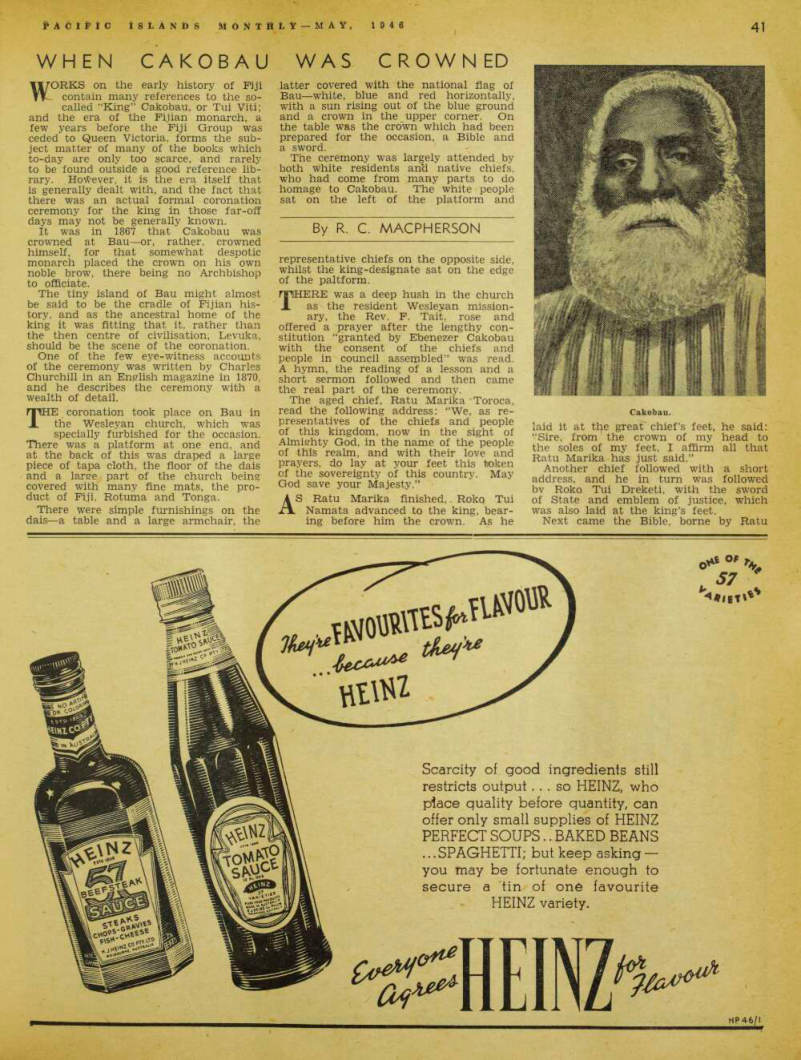
WORKS on the early history of Fiji - contain many references to the so called “King” Cakobau, or Tui Viti; and the era of the Fijian monarch, a few years before the Fiji Group was ceded to Queen Victoria, forms the sub ject matter of many of the books which to-day are only too scarce, and rarely to be found outside a good reference lib rary. HoWever, it is the era itself that is generally dealt with, and the fact that there was an actual formal coronation ceremony for the king in those far-off days may not be generally known.
It was in 1867 that Cakobau was crowned at Bau—or, rather, crowned himself, for that somewhat despotic monarch placed the crown on his own noble brow, there being no Archbishop to officiate.
The tiny island of Bau might almost be said to be the cradle of Fijian his tory, and as the ancestral home of the king it was fitting that it, rather than the then centre of civilisation, Levuka, should be the scene of the coronation.
One of the few eye-witness accounts of the ceremony was written by Charles Churchill in an English magazine in 1870, and he describes the ceremony with a wealth of detail.
THE coronation took place on Bau in the Wesleyan church, which was specially furbished for the occasion.
There was a platform at one end, and at the back of this was draped a large piece of tapa cloth, the floor of the dais and a large part of the church being covered with many fine mats, the pro duct of Fiji. Rotuma and Tonga.
There were simple furnishings on the dais —a table and a large armchair, the
latter covered with the national flag of Bau—white, blue and red horizontally, with a sun rising out of the blue ground and a crown in the upper corner. On the table was the crown which had been prepared for the occasion, a Bible and a sword.
The ceremony was largely attended by both white residents and native chiefs, who had come from many parts to do homage to Cakobau. The white people sat on the left of the platform and
By R. C. Macpherson
representative chiefs on the opposite side, whilst the king-designate sat on the edge of the paltform.
THERE was a deep hush in the church as the resident Wesleyan mission ary, the Rev. F. Tait, rose and offered a prayer after the lengthy con stitution “granted by Ebenezer Cakobau with the consent of the chiefs and people in council assembled” was read.
A hymn, the reading of a lesson and a short sermon followed and then came the real part of the ceremony.
The aged chief, Ratu Marika Toroca, read the following address: “We, as re presentatives of the chiefs and people of this kingdom, now in the sight of Almiehty God, in the name of the people of this realm, and with their love and prayers, do lay at your feet this token of the sovereignty of this country. May God save your Majesty.”
AS Ratu Marika finished, Roko Tui Namata advanced to the king, bear ing before him the crown. As he
laid it at the great chief’s feet, he said: “Sire, from the crown of my head to the soles of my feet, I affirm all that Ratu Marika has just said.”
Another chief followed with a short address, and he in turn was followed bv Roko Tui Dreketi, with the sword of State and emblem of justice, which was also laid at the king’s feet.
Next came the Bible, borne by Ratu
Cakobau.
Penjamini Yaku and Ratu Meli Rokona gata, who laid the Bible in the king’s hands. j m Cakobau’s address followed, and it is well worth quoting in full, for, like the addresses of the other chiefs, it had obviously been well prepared for the oc casion by an educated European—one is inclined to suspect, the missionary. The kir~ said:— “My chiefs, my people, my white friends —I say friends because the time was when I did not look upon you as such, but that time is past. I feel that I, this day, speak in the presence of Almighty God. I feel that through the instrumentality of His Almighty Provi dence, my country is rising out of the darkness into the light of civilisation.
I love my people, I love my country. My earnest wish and prayer is for the hap piness of my people and the prosperity and advancement of my country. May we become a great country and may we
so live that we may all become subjects of Christ’s blessed kingdom above.
“The constitution and laws read to you this day will be good for you and will materially aid in our advancement and prosperity. I thank our white friends who have so kindly aided in their pre paration.”
Then kneeling before the assembly, Cakobau said: “The sovereignty of this country conferred upon me with the love of my people, j.’ accept, and I solemnly and sincerely declare my determination in the presence of Almighty God and with His assistance, to maintain the con stitution of this country whole and in violate, and to govern in conformity thereto.”
STILL kneeling, the king took the crown in his hands and placed it on his head. Then rising with the sword in his right hand and the Bible in his left, he ascended the armchair doing service as a throne, and took his seat.
A salute of 21 guns followed and the national fla<~ was hoisted. During the five minutes it took to fire the salute no one spoke and no one moved, says the chronicler, but “all continued to look upon Cakobau the First as he sat there, the very image of a Christian king, well clothed, - still with the sword and Bible in his hands and the crown upon his head.” rE writer goes on to comment on the contrast between the Cakobau of that day and the Cakobau of 15 years previously, when he was “one of the most bloodthirsty of men, delighting only in cruelty and the grossest of can nibal ♦ crimes.”
Now he sat within 10 paces of his for mer cannibal ovens, respected and honoured by a goodly number of intel ligent English and American subjects, “which could not fail to strike the minds of those present as an instance of the power of Christianity and civilisation rarely paralleled in the history of the world.”
Immediately after the coronation cere mony, Mr. St. Julian, the Secretary of State, took an oath of fidelity to the king and the chiefs took the oath of allegi ance. A prayer by the missionary and three cheers closed the ceremony.
When the crowd left the buildings the Europeans and half-castes formed a line on one side of the path, and natives on the other, and as the king walked be tween them the Europeans formed in procession and followed him to his house.
Thus was Cakobau crowned king of Fiji, and thus he entered on the era that was to provide him with many cares of State—cares that were overcome only with the cession of the islands to the British Crown, seven years later.
CAKOBAU died in 1883, and rests to day in the little graveyard on the hillside of Bau. The simple monu ment over the crave overlooks the scene of his coronation.
Studying the account of the ceremony and the language in which the speeches of the king and chiefs were couched, one cannot but wonder if those who prepared them for the speakers, so lately removed from barbarism, did it in all seriousness and did not see the almost grotesque humour in the courtly language they put in the mouths of the Fijians—language more suited to Westminster Abbey than lately-converted Bau, with the blood of countless cannibal orgies scarce dry upon the killing stones within a few yards of the church.
Advertisements & other items, pp. 43-44 (1 item)
Heinz*’-'*
m
vuvom
*fsTjm 7n&j**
tk&f**
'■?'., wt'* 1 KV.
i'NZ
TO
oct
sfs e** psl efcfc **!
Stt M'* 5 GW* test ©«**£ f\S*
ICO
X*v* £4^l o*» °" „ 57 ' Scarcity of good ingredients still restricts output... so HEINZ, who place quality before quantity, can offer only small supplies of HEINZ
PERFECT SOUPS.. BAKED BEANS
... SPAGHETTI; but keep asking you may be fortunate enough to secure a tin of one favourite HEINZ variety.
HEINZ*’-'*
HP 46/1
The Twinkle in
Your Eye
COMES FROM ACTIVE
DIGESTION
Good normal digestive and liver activity means good, normal health and fitness. If you are becoming gloomy and feel tired out, the cause may be a congested state of your intestinal tract. So many people are troubled with constipation, which, through the retention of waste in the digestive system, causes sick headache, biliousness, pimply skin, unpleasant breath, irritability, slackness and dull eyes.
Regain your bright and attractive appearance by banishing constipation with Pinkettes. Tiny, perfectly harmless, gentle yet effective, these famous laxative and liver pills painlessly exercise and strengthen the bowels, keep the food tract clean and active, stir the liver, and thus banish sick headache, bilious attacks, pimples, unpleasant breath and gloom. All chemists and stores sell Pinkettes, the perfect laxative and liver pills.
W. H. GROVE £ SONS
Limited Established 1896.
AUCKLAND
Itlond Traders. FO - 801 Telegraphic and Cable Address: “Grove”, Auckland.
Shippers of all classes of New Zealand products.
Representing English Manufacturers throughout the Cook and Society Islands, Fiji, Tonga, Samoa, Niue, New Caledonia, New Guinea, etc.
In FIJI at—W. H. Grove & Sens (Fiji) Ltd.
Territories' Labour
Problems
From a Special Correspondent IT is surprising how quickly men, whom all hold in high esteem will make use of political trickery like side-stepping issues and dragging red-herrings across trails, when they get into a political atmosphere.
PANGA’S (which, of course, means Papua and New Guinea Administration), Administrator J. K. Murray’s latest re ported utterances place the blame for native labour shortage in the Territory on “huge stocks of US dollars and Australian pounds accumulated by natives during war.” No mention is made of Govern ment action in cancelling contracts.
He is also reported to have said that, formerly, native labourers received 5/- a month. Where? Not in Papua, where the minimum was 10/-; and only a very few newly-indentured “monkeys” in TNG at 5/-. A check of contracts of service of 700 labourers in Lae in 1945 showed average monthly wage was 10/9.
A correspondent, now in Rabaul, tells me Matupi Islanders—perhaps the richest natives in TNG with their Savings Bank accounts —are eager to take on their old washing jobs again in the town. Admit tedly, the native is “holding well”; but of what use is money these days in the New Guinea jungle with nowhere to spend it? You can’t eat dollar bills, or even ten-bob notes! Trade stores (the exploiter trader again!) are non-existent.
Anyway, with plantations crying out for labour, why not engage some of the 80,000 (or whatever the number may be) of Japs, Formosans and Koreans in and around Rabaul on the job? Most of the plantation damage was caused by them.
Mr. J. M. Clift joined the mission yacht “Southern Cross” in Brisbane late in March, and sailed on March 28 for Gua dalcanal, BSI, to inspect his plantation thare. It was in the middle of some of the worst fighting in 1942, and suffered more than most places. From his home near Miles, in Queensland, he had been trying for months to get a passage to the Solomons, and was delighted when the Melanesian Mission courteously offered
him transportation.
Resourcefulness!
Cook Islands Medical Service Calls For More Than Mere Medical Skill.
From Our Own Correspondent
Rarotonga, March 30.
SERIOUS outbreaks of illness in the Cook Islands during March called for resourcefulness on the part of the medical staff.
While a few cases diagnosed as menin gitis were being treated in Rarotonga, radio messages from Mauke reported that an outbreak of contagious eye disease had occurred there after the visit of the phos phate steamer which returned workmen from Makatea.
From the description the disease was diagnosed as Trachoma, and advice for treatment was given.
A later radio message from Mauke stated that medicines were finished and further supplies were urgently required.
As this is still the hurricane season, no vessel was available and it was eventually decided to divert the mail plane which dropped a parcel of medical supplies.
RADIO messages were received from Atiu also, requesting assistance for a number of cases which appeared to be meningitis. Dr. T. Davis considered these reports to be sufficiently serious to warrant an effort to contact the island by any possible means.
The only craft available was a towing launch belonging to the Union SS Co., and it was decided to use this. There was no lack of willing helpers and in 28 hours of continuous work the launch was made reasonablv safe for the voyage. Mr.
R. Powell’s skill as a shipwright and ocean-wanderer was called upon and he was ably assisted by Mr. J. Pratt—another ex-ocean-yachtsman—Mr. R. Anderson of the USS Co., and others.
Dr. Davis, himself a yachtsman, worked with them. Engineers overhauled the 35 h.p. diesel, while experts installed radio equipment. The Rarotonga Sailing Club supplied masts and sails and the launch was quickly converted into an auxiliary ketch as the engine was not too reliable for a long trip. A round-up of naviga tion instruments was made and stores taken aboard.
The crew for the trip were: R. Ander son, captain; J. Pratt, navigator; F.
Story, engineer; L. Wohler, assistant en gineer; M. Lee, radio operator. Dr, Davis was listed as assistant navigator. T.
Williams, NMP, went as assistant medi cal officer.
A large crowd gathered on March 23, to watch the departure of the launch on the 116 miles passage to Atiu. The boat had to punch into a stiff head wind and choppy seas, and during the three days
and nights they were at sea the crew, continually wet from the flying spray, had a rough time tossing around in the open cockpit. The only cover was a small cabin protecting the engine, but this was a place to be avoided. Everyone’s sym pathy was with the radio operator who had to attend his instruments in the engine-room to make contact with Raro onga every two hours.
Atiu was reached at 8 p.m. on March 26.
It was pitch dark, but Dr. Davis and Williams, together with their medical equipment, were transferred to a surf boat and safely landed over the reef. The medical officers went straight to the hos pital and two cases were confirmed as suffering from cerebro sninal meningitis Sleep was further denied to the doctors when they were renuired to attend to eases iniured in a recent motor accident The following morning they attended a crowded out-patients’ clinic.
While the doctors were •• ashore the launch was forced to stav at sea as there is no anchorage or shelter at Atiu.
The launch left Atiu at 1.30 p.m. on March 25, and arrived back in Rarotonga about noon the following day. Dr. Davis returned to Rarotonga leaving Williams in charge at Atiu. The return passage was slightly less uncomfortable with the wind and sea following instead of head on.
Missionory Hero of 1942
Father Harris
A SYDNEY columnist has paid a tribute to Father Harris, who met an untimely fate at the hands of the Japs, along the South Coast of New Britain, in 1942. The writer describes how Father Harris assisted the AIF and NGVR personnel to escape to the main land of New Guinea after Rabaul had fallen.
But he failed to relate how, after the Father had refused to accompany the soldiers, a number of them decided to overpower the missionary and take him forcibly on to a small boat. The Father, hearing of this plot, gathered the boys together and made his appeal to remain.
Being a lawyer before he took his vows, his pleading succeeded, and he was left to face the Japs.
Native reports state that the invaders captured him, knew of his assistance to the troops, took him aboard a destroyer, and there he was decapitated, and his body thrown overboard.
The name of Father Harris should go down in history as one who regarded
duty more than his own life.
G.T.
Advertisements & other items, p. 45 (1 item)
Mxansomes
b» e
ens»
IndiiE
/or
aerodromes
and other targe .
50 acres a day can easily be cut with a Ransomes Quintuple Mower tractor > and even larger outfits up to 25 ft. wide are availi 9 e “ ormoDS capacity makes Ransomes Gang Mowers Indlspensable to all controlling aerodromes, large sports grounds, etc., requ ring frequent cutting. With no other machine could these large areas be kept in such good condition.
Sizes: Triple 7 ft.. Quintuple 11% ft., Septuple 16 ft., up to 11 units—2s ft. wide. Also a sulky mower 30 in. wide for hilly land.
Mxansomes
GANG MOWERS
We illustrate our standard machine.
For longer grass and heavier work, we offer the “ Magna - Gang " pattern.
Illustrated catalogue showing a complete range of hand, animal draught and motor lawn mowers will be sent on application.
MORRIS,
HEDSTROM, LTD.,
Suva, Lautoka and Ba.
RANSOMES, SIMS & JEFFERIES, LTD. Ipswich, England.
9* 1 Bond Street, Sydney, Australia. £* Vy U Jfl \y t TeL 84167. box 3615 G.P.O.
SUPPLIERS OF GENERAL MERCHANDISE TO LEADING FIRMS THROUGHOUT THE
PACIFIC ISLANDS
Exporters ... Importers ... Manufacturers' Representatives Bankers: Bank of N.S.W. Bank of Adelaide. Comptoir Nat. d’Escompte de Paris.
Cable Address: “SEAFOODS,” SYDNEY.
Codes: Bentley's. 2nd and Comp. Phrase; A.8.C., sth and 6th; Peterson, 2nd and 3rd; Banking; Acme.
Record Export Year For
W. Samoa
From Our Own Correspondent APIA, April 5.
OFFICIAL trade figures, just issued, show that 1945 was an all-time re cord vear for Western Samoa’s exports and total trade.
Export values for produce in 1945 reached the peak figure of £631,546. or about £lOO,OOO higher than the next best year. 1919. when exports were valued at £532.500 owing to extraordinarily high copra prices ruling at the end of World War I.
Total trade in 1945 (exports and im ports) amounted to well over £1,000.000 ('detailed statistics have not been final ised vet).
The following are details of 1945 ex ports:—
The Rev. and Mrs. Doege and their two children from the NG Lutheran Mission, who were imprisoned by the Jananese, were rescued in Manilla and have now returned home.
Value
Quanity
IN £ Bananas 109,828 cases 67,465 Cocoa beans .. .. 2,146 tons 175,155 Conra 15,056 tons 339,493 Rubber 132,691 lb. 13,133 Desiccated coconut 421 tons 33,626 Other produce — 2,674 £631,546
Any Pacific Policy?
Has Australian Govt.
From Our Own Correspondent
Canberra, Mar. 26.
DURING a statement by the Minister for External Affairs (Dr. Evatt) to day, Mr. Spender interjected that he could not find out what the Labour Government’s policy was in the Pacific.
Minister for Information (Mr. Cal well); “You wouldn’t understand it, any way.”
Replying to Mr. Spender, Dr. Evatt said: “Our policy is to prevent in the future any repetition of the disaster that came to Australia in 1942 through lack of policy. That policy is co-operation with other powers in the South-west Pacific area. We want to co-operate with the United Kingdom Government, New Zealand and other countries in terested in this area. Negotiations are now continuing with these countries.”
Earlier in his reply, Dr. Evatt said it would be the duty of both the Govern ment and Parliament to prevent any recurrence of the tragic days of 1942.
Whatever the United Nations Organi sation might do it would be essential to guard the security of the South-west Pacific, and in its defence there must be the closest co-operation with Australia’s peace-loving Pacific neighbours, especially the United States.
Dr. Evatt said it would be undesirable to deal with the question of Pacific bases piecemeal. It was necessary to consider overall defence arrangements for the Western Pacific, including the islands formerly mandated to Japan.
He said: “Australia is going to make no arrangements for the use of Manus as a base until there is some under standing as to how it would be used in the event of a disturbance in the South west Pacific.”
Who Were the Cannibals
of Little Tahiti?
Recent Discovery of Gruesome Relics
From Our Own Correspondent PAPEETE, March 14.
SOME digging operations early in March in the district of Afaahiti on Tai’ arapu (Little Tahiti), uncovered some ancient ahimaa (old style native stone ovens> in which were human skele tons of both adults and children.
This discovery has led some of our antiquarians to the hasty conclusion that the old Tahitians were cannibals.
This writer is persuaded that it proves nothing of the sort.
If, indeed, these remains are relics of a cannibal feast (and there are sound reasons for doubt), the evidence points rather to raiders from abroad than to the Tahitians themselves.
Two ahimaa have been uncovered: a large one. where the skeletons were found, and a smaller oven—evidently in tended to cook the vegetable food looted by the raiders from neighbouring plan tations.
The fact that the human skeletons were lying about, and not in, the ahimaa. indicates that the oven was in the state of preparation when the cannibal raiders from Anaa were driven away—probably by a superior force summoned from Tau tira on Tai’arapu, and from the nearest Teva districts on Greater Tahiti. Afaa hiti is within the dominions of the Teva Clan, as part of Teva-i-Tai.
Unconsumed fragments among the ashes prove that the firewood in the ahimaa was aito from ironwood trees.
This offers further evidence that the oven was kindled by raiders from abroad.
On Tahiti, the iron-wood and Miro (rose-wood) were sacred trees; planted about the marae, the temples of the gods.
The wood of the Aito was never used as fuel; but was fashioned into images of the gods and weapons of war. The word “Aito” in Tahitian, signifies, also, a valiant warrior; inspired and aided by the gods. There is evidence that, when the Anaa raiders had been expelled, the Teva chiefs commanded the place to be covered with earth, and imposed a strict Tapu on the site. mHE probable date of this cannibal raid, X has not been determined. The in habitants of the Tuamotu atolls were, undoubtedly, eaters of human flesh.
The first, and not distant, landfall in the Tuamotu Archipelago to the east of Tahiti is the large atoll Anaa. In the good old days, the inhabitants of Anaa were mighty warriors, hardy mariners, reputed to possess a hearty appetite for “long pig.” In their quest for this pro vender, they became the scourge of the atoll archipelago.
It is logical to suppose, they did not neglect Tahiti. Afaahiti—a narrow coastal terrain on the north-east part of Tai' arapu and remote from the more peopled districts of Greater Tahiti—was the most vulnerable section of Tahiti for a raid from Anaa.
In this particular instance, one may presume that the raiders had time to slay their victims, and to prepare and cover their ovens in the usual manner; but were driven off before they could partake of their horrid feast.
All legend, tradition and history, bear testimony that the Polynesians of the Society Archipelago were never cannibals.
Advertisements & other items, p. 46 (1 item)
Itching Skin Germs
FOR SALE
TROPICAL CLOTHING, tailor-made, condition as new, no coupons. Details and price from W. Pratt, 17 Frederick Street, Hobart, Tasmania.
Itching Skin Germs Killed in 3 Days
Thanks to the discovery of an American physician, It is now possible to kill and remove the true cause of most skin troubles. Your skin has nearly 50 million tiny seams and pores where Invisible germs and parasites can hide, and which are the true cause of terrible Itching, Cracking, Peeling, Burning, Ringworm, Acne, Psoriasis, Blackheads, Pimples, Foot Itch and other disfiguring blemishes.
Blemishes such as these make you look and feel embarrassed, unattractive and handicapped in life, both socially and in business. You can’t get rid of these disfigurements with ordinary treatments, which give only temporary relief, because they do not kill the germs or parasites responsible for your trouble. .
New Discovery Kills Cause
Former skin sufferers throughout the world are now praising Nixoderm, the discovery of a leading American skin specialist. This remarkable new preparation quickly penetrates into the pores of the skin and kills the germs and parasites responsible for your trouble in 7 minutes, stopping the itch almost instantly. At the same time, this wonderful preparation acts as a tonic and skin food, so that as the cause of your trouble is removed, your skin becomes soft, smooth and clear. This clear, healthy complexion will give you new charm and make It easy to win friends.
Praised by Doctors
Dr. T. A. Ellis, well-known physician of Toronto, Canada, recently stated: “Skin disorders caused by parasites, as many are, yield to Nixoderm. These parasites are invisible to the naked eye. They eat away the skin, forming ugly eruptions. Ordinary ointments or remedies fail completely, or give only temporary results because they do not reach the cause of the condition. It is this value about Nixoderm in attacking parasites which impresses me most favorably, and explains in large measure the success it enjoys over many stubborn cases."
Guaranteed Results
Get Nixoderm to-day. Put it to the test. In a few minutes you will find that the itching has stopped, and in 24 hours you can see for yourself that your skin is clearer. And it is guaranteed that, within one week, Nixoderm must make your skin soft, clear, smooth and attractive or money back on return of empty package. Get Nixoderm from your chemist or store to-day. The guarantee protects you. So don’t delay. Get Nixoderm to-day.
Nixoderm 2/- & 4/.
For Skin Sores, Pimples and Itch.
Euronesian Children Must
Attend Native Schools In
Cook Is.
Letter to the Editor rE English spoken in the schools of this island bears a close resemblance to the “coon dialect” of vaudeville minstrels.
All Mangaian children, native, half caste or white, must attend school. Thus, we have the paradox of a Euronesian child, who hears correct English at home, being compelled, at the school, to mis pronounce words, elide “r’s” and certain other letters, and talk like a negro, for the reason that the teachers (natives) have adopted this debased style!
Examples are: “Wash yo’ hands."
“Shut yo’ eyes.” “The childun come to school at ha’-pas’-seven.”
Then again, such words as “buy” and “sell” are interchanged in meaning.
These are but a few of the faults. The main error is that there is not, and never has been, a European to teach the teachers!
The inculcation of good “style” (which means also good taste) has been long neglected. Native taste is execrable be cause it is totally unguided.
Although there have been Resident Agents who were also certificated NZ teachers, I have never seen any such offi cial take any real personal interest in the Central School. The work was left to underlings.
Meanwhile, my child goes to school to learn the lovely language of Uncle Rastus, Stepin Fetchit, and Messrs.
Moran and Mack.
I am, etc.,
Edwin Gold.
Mangaia, C. 1., January, 1946.
Bits of History
COME interesting historical notes
from Mr. F. S. Whitcombe, of
Levuka, Fiji :
Mariner’S “Tonga"
Your correspondent, Mr. Davidson, is perfectly correct—Mariner was not the sole survivor of the “Port-au-Prince." The book, “Tonga,” was written for William Mariner by Dr. Martin. There were two editions —one in 1809 and one in 1818.
The book used to be called the Tongan Bible, because so many of the leading Tongans traced their forebears through it.
Crocodiles In Fiji
The crocodile that landed in Motusa, Rotuma, was 6 ft. 4 in. in length, and it arrived in that place in 1914.
Links With Rls
You reported in “PIM" that another link with Robert Louis Stevenson had passed away in Tahiti. There are still two links here in Fiji—myself, and Abdul, Stevenson’s old cook. Abdul is living with his son, an Indian schoolmaster, at Ba. The old chap is blind, but he still can converse interestingly about the old days.
Tonga’S First King
I knew well George Tubou, the first king of Tonga. I also knew Taufaahau, afterwards Tubou ll—he was a good friend of mine.
Little Ship Out Of Auckland
The first time I went to Tonga was in 1890, as a member of the crew of a new 50-ton schooner built by Niccol, of Devon port, Auckland, for George Finau, Governor of Vavau. She was called the “Koe Pamu-o-le-Utukalugalu." There is a name for you!
The topsail schooner “Clansman” was
built alongside her; and the Government steamer “Clyde," for Fiji, was being built by Logan in a shed across the road.
There was a crew of three on the “Pamu”—myself, a Loyalty Islander called Semesi, and a Tongan half-caste, Vuni Bloomfield. Captain Sopwith was in charge, and there was a mate, Captain Dan, and a cook.
The “Pamu” carried double topmasts and eight sails—two jibs, stay-sail, fore sail, mainsail, topmast stay-sail, and main and fore gaff topsails—a beautiful picture—a bit different from the puffing, smelling tea-pots you see getting around nowadays. We reached Vavau 11 days out from Auckland.
Cuthbrt's Misima Mine,
Ltd.
IN their report for the year ending December 31, 1945, the directors of Cuthbert’s Misima Mine, Ltd., state that they have not yet been given per mission to resume mining operations in Papua, During the year maintenance was car ried on at the mine by a limited labour force at a cost of £5,148. This sum will be included in the company’s final war damage claim.
Other expenses were covered by in come from Bonds and taxation refunds.
A net profit of £ll2 was recorded and carried forward, increasing the profit and loss credit balance to £18,245.
Major problems facing the company at present are transport difficulties, re stricted supplies of essential materials, and delay by the Federal Government in issuing the new Native Labour Regula tions.
Advertisements & other items, p. 47 (1 item)
g^M'oo-
- FOR EARLY DELIVERY OF
Built to the same rigid specifications of quality and workmanship as laid down by the Army, the new LANRAY Line of Metal Products for civilian requirements is going to mean big business for dealers throughout Australia. Place your order NOW for— LANRAY Kerosene Pressure Stoves and Blow Lamps Holloware Light Fittings Key Blanks Industrial Reflectors. *3
IANKAY
METAL PROD U CT S PTY. LT D
METAL PRODUCTS FOR
CIVILIAN USE
Distributors LANCE RAYMOND Pty. Ltd.
11-19 Hargrave St., Sydney Phone FL 3132 and of King House, Queen St.
Brisbane
LANRAY DISTRIBUTORS
Temple Court, Collins St.. Melbourne i *.
No News Of The Procters
Since 1940
From Our Own Correspondent MANGAIA, January.
BRAZIL and Mangaia Island are very far apart; but in a suburb of Rio de Janeiro lives Mr. Charles Flinders Procter, a former local trader, who re tired in 1931, with his Mangaian wife and Euronesian family of three —two of whom were born in Rio.
Since the Pacific war, no news has been heard of the veteran and his young wife, though local friends wrote many times.
In his last letter, dated 1940, Mr. Proc ter criticised the Brazilian mail system, and also mentioned that a revolution had been attempted by political firebrands, beginning with an attack upon the Pre sident, who narrowly escaped assassina tion.
No more letters followed. It is to be hoped that Mr. Procter himself has not become a victim of revolutionary violence.
As a British subject, he should have been fairly safe. But the long, unbroken silence from Rio is causing anxiety here.
Caledonians are complaining against being held-up in Sydney, Australia, at the termination of the usual three months’ leave period. They say that the delay is not caused by the Australian Government, but by their own Adminis tration which is supposed to grant them an authorisation to return to their own country. The cost of passport visas issued in Noumea and on their wishing to return to the Colony has also been considerably increased of late.
Papua's Only White-Man Outlaw
The Evil Career of Joe O'Brien, 40 Years Ago
WRITTEN FOR “PIM” BY D. H. OSBORNE
JOE O’BRIEN was the only white man to be outlawed in Papua. Here is a description of the man as I knew him about 40 years ago.
He was about 30 years of age, six feet tall, well-built, rather handsome, and neither drank, smoked nor gambled. He was clean in his habits, and dressed tidily; but he had a quick, cruel temper and a low conceit that was his downfall.
He was detested by white women. He used to rush into the company of women, make some foolish remark, be snubbed, lose his temper and speak offensively.
I first met him in Queensland, when he was abusing an old ferryman, Joe had crossed in the ferry a couple of times without paying, and wished to cross again, but was refused passage.
When we met on the Gira, in North eastern Papua, he pretended he did not know me.
O’Brien and several others had camped within a few yards of the Whitten store, in tents. The storekeeper lived in a loft over the store and he used to take the cash-box up and sleep with it under his pillow. One night, he left the cash-box on the counter while he drank a cup of cocoa in the kitchen, just off the store.
When he returned the cash-box was missing and no one knew who had taken it. O’Brien’s subsequent conversation
and actions suggested that he was the culprit.
He worked about the field for several months, without a mate. At that time, natives were not allowed to work in the claims.
When news of a new find was reported on the lower Aikora, O’Brien set off on his own, took the wrong track and fol lowed Pish Creek instead of Clunas Creek, and was bushed for days. After that he left the field and remained in Queensland for several years.
WHEN O’Brien returned, he brought a mate from Sydney who was deaf and dumb. He was a boxing man, and was supposed to be training O’Brien to be a world-champion boxer. But when someone, writing on a slate, asked Dummy what were O’Brien’s chances, he wrote down, “Hopeless—lacks guts.”
After a short stay in Samarai, Dummy returned to Queensland, and O’Brien went back to the Gira, mining again. On the field, O’Brien said he and Dummy had left Sydney with the intention of robbing the Samarai stores. Dummy was a safe-breaker, and considered the safes there would be easy.
But when he saw Samarai, he aban doned the plan. No get-away, he said.
O’Brien started mining with a team of natives and then joined Mat Crowe and Bill Ivory on a prospecting trip on the Waria. The party broke up without find ing payable gold.
Crowe and Ivory returned to the Gira, and O’Brien went into German New Guinea, and worked for wages for a time. When he returned to Tamata, he had little to say about the Germans, more than that they were no good. After wards, there was a report that he had committed a criminal offence there, and had been allowed to leave the country with a warning not to return. He com menced mining on the Gira again, and was very hard on the natives who worked with him.
He became convinced that everyone was afraid of him and he could do as he wished. He often threatened to punch white men and shoot storekeepers.
Bill Whitten threw six bottles into Tamata Creek. With a six-shooter he broke the six bottles in six shots, and said, “Let O’Brien come along!”
The only time I heard of O’Brien being in a fight was in Samarai, one night.
Only one round was fought before the fight was stopped.
FROM the Gira, O’Brien went to the Aikora (Elliott’s Creek). The moun tain natives used to bring vegetables to the miners. The men would go first, and the women follow with the loads.
O’Brien posted his natives along the side of the track, and they caught a young woman, whom he kept captive for the night. There were rumours that she was murdered by her own people, afterwards.
After that, while O’Brien remained in the locality, not a native was seen by the white men. A few hours after O’Brien moved away, the mountain natives were back again, dealing as friendlv as ever.
O’Brien moved a few miles down the Aikora and pitched his camp on a high bank, overlooking a deep nool in the river. The river floods almost every night.
A native working for Jim Wallace de serted. O’Brien’s boys caught him and
tied him up. O’Brien sent a note to Wallace saying that his boy was there and he could come along and get him.
Wallace replied that it was too late at night, but he would go down in the morning and get him.
Jim and Bill Coleman were brothers, and working apart. Bill intended leav ing the country, and going to Sydney.
During that day, he had been to Jim’s camp, and had exchanged gold for 37 sovereigns. Then he left the sovereigns in his camp, and went to work in his claim. When he returned to his camp, he had been robbed—the sovereigns were gone.
During that night, O’Brien sent his boys away, knocked Wallace’s boy on the head with a tomahawk, and threw his body into the river. It was surmised that O’Brien had found the sovereigns on the boy.
In the morning, he sent a note to Wallace to say that the boy had escaped.
He told several men, later, that he had killed the boy, but he did not mention the sovereigns.
Coleman regarded the loss of his sovereigns as luck, because it delayed his departure, and he got a good patch of gold shortly afterwards. /nk’BRIEN returned again to the Gira, V/ and went partners with Bill Ivory.
When they dissolved partnership, they divided 260 ounces of gold.
O’Brien was then over £lOO in debt to each store, and his credit was stopped.
Bill Hancock threatened to lay a charge of murder against him if he did not square up. That did not bother Joe.
He went overland to the Yodda and on the road he was mixed up in more rape and murder trouble. He worked on the Yodda a short time, and then he returned to Tamata.
He arrived during the forenoon, stayed an hour or so, walked to the Gira River (about 20 miles from Tamata), travel led by canoe down the river and along the coast towards the Kumusi mouth, then walked along the coast to the Kumusi. rE Whitten store native arrived from Bogi with mails, and a parcel of gold. Two white men were pas sengers for Samarai, At that time, all stores for the Yodda were transported up the Kumusi River to Bogi, 62 miles up the river. Snags in the river damaged many propellers, so the launches had been taken off, and natives did the work with whale-boats.
A Samarai boy, in charge of the boat, would pick up a crew along the river.
The native in charge of the gold put the box in the store, and locked the store doot. O’Brien asked for the key, and the boy gave it to him. The native’s evidence showed that O’Brien kept the key for some time. He went up the river alone in a canoe a short distance, and then returned. It is estimated that he stole and hid the gold. The parcel con tained 300 ounces, part belonging to Whitten Brothers, and part to Rotchfort, and Whitten was responsible for the loss.
The gold was not missed until the launch “Bulldog” arrived from Samarai, a couple of days later. When the master received the mail, the gold was missing.
O’Brien travelled up the Kumusi to Bogi by canoe. He abused and threatened Ernie Oats, who was in charge of Whitten Bros.’ store.
Oates then said: “I have this waiting for you, Joe,” and presented a revolver.
“It will bring you down —small though I am.” Oates was about 7 stone, with a withered leg.
O’BRIEN then went to the Yodda, and commenced work in one of the creeks. then was Warden and RM in charge of the Division.
Captain Griffen was ARM—a military man from the Boer War. Dr. Bellamy was a medical student from England.
Bellamy was sent to arrest O’Brien. He had heard of O’Brien’s boast of shooting on sight, and he took a squad of armed native police. He left the police out of sight, while he went to O’Brien, holding the warrant in his hand.
“I have come to arrest you, O’Brien,” he said.
O’Brien snatched the warrant nnd threw ft on the m-ound He disced 2n it andthreatened anGovernment offl cials Government cm .
B , el i sat d ?wn. and > OBnen c °?i ed off ’ said: ‘ A * e y° u coming on wd;h me> or do 1 have t° use force?”
O’Brien said: “Will you make me a promise that you will not allow the black bastards of police to lay hand on me?
If you wish to put irons on me, do it yourself.”
Bellamy promised, and O’Brien went quietly to the Government station at Perpangi, on the Kumusi River.
Griffen sentenced O’Brien to a month’s hard labour, on a trivial offence, while they sought more evidence of O’Brien’s movements on the Kumusi.
He then was charged with murder, rape and stealing, and was held in gaol. One day, Griffen sent O’Brien out to cut grass, with a 14-inch knife, and set a native warder to guard him. The warder was armed with a rifle, a bayonet and three rounds of ammunition.
O’Brien awaited the opportunity and stunned the warder, took his rifle and
ammunition, and cleared off to the Yodda.
AT the Yodda, O’Brien went to his camp, took a few articles and his Winchester rifle, and walked to Rotchfort’s camp, where Rotchfort gave him some ammunition. In the scuffle with the warder, he had got a nasty wound in the arm, and it was looking angry, so Rotchfort dressed the arm.
O’Brien then disappeared into the bush and was not seen again.
Griffen declared O’Brien an outlaw, and sent warnings to every camp, notify ing each man of the penalties of assist ing the criminal in any way.
Only one old Irishman sympathised with him. Paddy Finegan said: “Joe is no good, but his name is O’Brien —and we must respect the name.”
Needless to say, while the miners did not agree with natives being ill-treated, all were against a white man being set N work with a native guard over him.
No one would have objected to O’Brien helping himself from any camp.
Patrols were sent out on all roads along w:. \h a man could escape, but not a trace of O’Brien was found.
There were rumours that he escaped via Yule Island to German New Guinea; others that he was seen in Brisbane and in Malaya, O’Brien had a fair parcel of gold— he was a good worker and fairly lucky— but he had not paid any storekeepers.
The storekeepers knew they had the power to prevent anyone leaving the Territory while owing a debt—which probably was the reason why he was allowed so much freedom.
Advertisements & other items, pp. 48-50 (2 items)
Dependable roteman
NOW AS ALWAYS
Ms. y \ For over forty years COLEMAN has built a reputation for dependability in lighting, cooking and heating appliances. Built from the same first quality materials as always, with the exclusive Coleman features, you are always assured of the best when you buy dependable Coleman. Wherever you are there is a Coleman dealer to serve you with dependable COLEMAN appliances and service.
THE COLEMAN LAMP AND STOVE COMPANY LIMITED
TORONTO, CANADA
CHICAGO, USA.
Berger’s Paint
■ ■ IB IB ■ I ■ a
HCS
Tested tor the tropics
To-day, the House of Berger with Empire-wide ramifications and resources makes a broad pattern of service to paint users. Every Berger finish must withstand test after test to prove worthy of the Berger label . . . every product must satisfy the Berger technicians and chemists that it will meet the challenge of all climates, from tropic heat to arctic cold. When you use any of Berger’s famous paints, 4 8.P.’
Berger’s Paint (Prepared), Synthelac, Matone, Quick Enamel, Pave-ol you get all the good qualities for decoration and lasting protection.
Berger’s Paint
KEEPS
KEEP
NOW AVAILABLE
Pacific Islands
Year Book
FIFTH EDITION
rpHIS has become the recognised stan- A dard work of reference on the Pacific Territories and Islands; and it is mow printed in Sydney, N.S.W., and in New York.
The sth Edition, 384 pages, has been arranged in Six Sections—General and Introductory; Eastern Pacific (Polynesia) ; Central Pacific (Micronesia); Western Pacific (Melanesia); Far Western Pacific (Indonesia); and Non-Tropical Islands.
Every Territory and all the Principal Islands are described in detail—history, geography, natives, administration, industries, trade, etc. There are more than 50 maps.
Price: 15/- per copy, plus 6d. postage.
Copies may be obtained at the majority of Booksellers, and Island Stores, or direct from;
Pacific Publications Pty., Ltd.,
Union House, 247 George St.,
Sydney.
Pacific Publications (Fiji), Ltd.,
P.O. Box 281, Suva, Fiji.
The book, named “Pacific Islands Handbook,” is published by The MacMillan Company, New York, for distribution in North and South America, and Hawaii.
J. C. MERRILLEES & CO.
Challis House, Martin Place, SYDNEY.
BUYERS OF ALL ISLAND REQUIREMENTS. SUPPLIERS OF ALL AUSTRALIAN GOODS. BUYERS OF ISLAND PRODUCE.
wire Inquiries Welcomed
Quotations "Phone: 8W6569 Telegrams: “Merrillees,”
Sydney.
Death of Sister M. Cleary, of Fiji
Untimely End To Brilliant
Career
FOLLOWING an operation some days previously, Sister Margaret Cleary, tutor-sister at the Nurses’ Training School, in Suva, Fiji, died in the Colonial Memorial Hospital on April 5.
Miss Cleary was the daughter of the late Mr. and Mrs. John Cleary, of Fiji, and was born in the Colony. She trained at the Memorial Hospital in Suva and in 1936 she became a sister. In 1938 she took charge of the Fijian Infant Wel fare scheme at Tailevu and at the end of that year, left for the United States with a Rockefeller Scholarship. She re turned to Fiii in 1940 to inaugurate the Central Nursing School.
Miss Cleary is survived by two brothers: Mr. Vincent Cleary, of Rhodesia, and Mr. Joseph Cleary, of Ba. Fiji.
A third brother Mr. Basil Cleary, was
dispenser at the Tarawa Central Hos pital. He voluntarily remained behind to perform work of national importance after the general evacuation of the Gil berts, and was murdered by the Japan ese in October, 1942.
War Dance And
Utoi
Rotumans Welcome Bishop Foley
By “Amel”
EARLY in February, Bishop V, F. Foley, S.M., arrived at Rotuma in the ves sel “Kurimarau,” which was en route to the Gilberts.
The Bishop’s visit —his first to Rotuma —had been long anticipated by his people on the island, and he was given a joyous welcome. There were concerts by tne children of both Sumi and Upu schools, and included in one of the many functions given in his honour were the Rotuman war-dance, which is performed only on special occasions, and the cere mony of the “utoi,” which is accorded only to notable persons.
Actually, the war-dance is of Wallis Island origin, but the Rotumans have adopted it as their own, and they execute it with verve and skill. All the per formers are men, and they present a gay, if somewhat un warrior like, picture in their strange garb—dainty skirts of many hues, garlands of leaves and flowers, tall, feathered hats, and anklets of dried beans whose syncopated rattle mingles with the staccato beat of the drum, the leader’s commands and the rhythmic thud of many feet.
There is always an odd man out. He wears a decrepit costume and provides the comic relief throughout the dance.
He drops his club at the wrong moment, or gives it an amateurish twirl and smacks himself on the back of the head, or spits on his hands and makes a wild swipe at nothing, sending the crowd into fits of laughter. rE “utoi” ceremony, following on the is like sinking from crescendo to pianissimo. The Rotu mans give, to the “utoi,” the reverence that Fijians have for their kava.
This large brown root, resembling a very whiskery yam, and akin to the Fijian “gai” root, is brought before the gathering only after much preparation.
The required number of roots are dug up carefully in the presence of all the people of the village. The participants wear banana leaves, and the minimum of clothing. An oven is then prepared, large enough to accommodate all the “utoi,” which are cooked therein for 12 hours, and left undisturbed for a further four days.
Before the gathering of people, the master of the ceremony, grave of mien and his brow and waist draped with “utoi” leaves, sits astride the “foa” and gently grates the flesh of young coconuts.
It drops into a wooden bowl, and he adds coconut juice. His assistants, con versing in whispers, tear strips from the fibrous “utoi,” which are squeezed through the first mixture.
When the process is complete, the “utoi” is served out in half-coconut shells, with a piece of the root, which may be chewed like sugar-cane. It is perhaps the most delicious dish Rotuma has to offer. Rich brown in colour, its flavour is a satisfying combination of caramel, coffee and liquorice.
Europeans
Much "Help" For New Guinea Natives
Sharp Comparison With Australia's Treatment of Europeans
From Our Own Correspondent
CANBERRA, April 8.
GOVERNMENT plans for native welfare in New Guinea and Papua were announced to-day by the Prime Minister (Mr. Chifley).
One plan provides for training of natives under 25, who are members of native regiments, the native constabulary, or were carriers or other labourers em ployed by the Allied Forces. Where re quirements cannot be met from these groups, consideration will be given to members of native villages seriously affected by the war.
The decision to launch the re-establish ment training scheme was made to-day by Federal Cabinet, after Cabinet receiv ing a report by a sub-Commlttee com prising the Ministers of Post-war Recon struction (Mr. Dedman), External Terri tories (Mr. Ward), and the Prime Minis ter, who had consulted with the Adminis trator of New Guinea-Papua (Colonel J. K. Murray).
Natives to be granted re-establishment training will have to be recommended by a Committee consisting of the Ad ministrator, and an officer of the Depart ment of Post-war Reconstruction.
Recommendations for training will first have to be made to this Committee by district officers.
Other Cabinet decisions were:— GRANTS TO VILLAGES: Grants to aid natives restore production will be made by the Australian Government, where vil lages have been destroyed or adversely affected by the war. Grants will also be made in appropriate cases to individual natives. They will be limited to £4O for individual natives, or £2 a head for vil lages. District officers will recommend payment for grants after conferring with village chiefs or councils. Applications will have to be approved by both Colonel Murray and a representative of the De partment of Post-war Reconstruction be fore grants are made.
TRADE STORES: Private traders are being given provisional licences, subject to control of prices and quality of goods.
Stocks are being sought from the Dis posals Commission, and from Australia.
So far, adequate shipping is lacking, but additional vessels are being sought.
PIDGIN BROADCASTS: Cabinet will consider a plan to use service radio trans mitters to broadcast special sessions for natives. The plan will recommend pro vision of a special staff to conduct the native sessions. The broadcasts would be made in Motu, Pidgin and English. The Government will be asked to make avail able to natives receiving-sets suitable for tropical conditions.
Mr. Ward believes radio receiving-sets could be hired or sold to natives through trade stores.
It is understood that, so that natives may take full advantage of the proposed Pidgin service, whole villages will be en couraged to purchase community radio sets, and many old Arm}' radios are likely to be offered cheaply to them.
Marketing Of Island Pro
DUCTS: Cabinet favours an extension of the present tariff preferences to all pro ducts of the Territories. Because Minis ters are not sure what results this would bring about, it has asked the Department of Trade and Customs to prepare a de tailed submission showing possible effects of further tariff preferences.
Cabinet decided to-day that a detailed
marketing scheme for native products from the Territories would be authorised and carried out. Consideration would be given to the possibilities of bulk purchase of native products.
Cabinet decided that the Administration would arrange first priority for crops of which Australia makes large imports, and second priority for crops for which there is a reasonably long-term market pros pect.
REBUILDING; Colonel Murray will be authorised to take over sawmilling equip ment from the Disposals Commission to assist natives in preparing timber for their buildings.
This means that many sawmilling centres established in Papua and the Ter ritory and used extensively by the Army during the Pacific war may be taken over wholesale by the Administration to speed up civil rebuilding.
Cabinet also gave the Administrator power to purchase, for sale to the natives, cement for piles, and other building materials not locally available.
Replacement Of Livestock:
Funds will be made available for pur chases by the Administration during the current financial year to replace the live stock population. Similar provision will also be made for 1946-47.
SHIPPING: Negotiations are well ad vanced between the Government and pri vate shipping companies for a provisional scheme of operation of shipping services for the Government by shipping com panies. The future of the inter-island services will be determined later.
ROADS: Road maintenance and con struction will generally be the responsi bility of the Administration, which will submit detailed proposals regarding existing roads and the construction of new roads required for development.
PORTERAGE: Funds will be made available immediately for the purchase of 100 mules and 50 horses, and saddlers and farriers’ equipment.
Editorial Note
rjIHE preoccupation of Department and X Administration with native welfare, to the exclusion of most European interests in the Territories, is one of the most remarkable angles of the Wardist set-up in Papua and New Guinea.
Mr. Ward evidently started off with the conviction that the natives had been ex ploited and downtrodden by the pre-war Europeans in both Territories, and that they have suffered great hardships, and their village life disrupted, as the result of World War 11. Thenceforward, his policy—and the policy he has apparently forced upon the Provisional Administra tion—was to succour and pamper the natives, while ignoring the greedy and sel fish Europeans.
As a result, we get the above statement, reported exactly as it was made to our representative in Canberra. It is excel lent, insofar as it gives evidence of Aus tralia’s determination to care for the natives; but, as an outline of Australia’s rehabilitation policy in her Territories, it makes a very poor show.
In Papua and New Guinea, when the Japs invaded, there were 6,000 Europeans and 2,000 Chinese. Their towns were broken up, their homes and all their means of earning a livelihood were destroyed, they were scattered far and wide, hundreds of them were killed Ex cept for the happy accident that com
pensation is payable to them out of the War Damage Commission—for which the Australian Government can take no credit —all these people are economically ruined. Hundreds of them fought with distinction in the Australian Forces. In comparison with the natives, they suf fered far greater losses, both personal and economic.
Yet it is a notorious fact that, ever since Mr. Ward became Minister, the Europeans have been ignored, rebuffed
and humiliated, while the External Terri tories Department has gone to really extraordinary lengths to assist the natives. The foregoing report from Can berra is a good example of it.
Permits have been issued to the mem bers of the New Guinea mission staff to return to the Rooke-Siassi Islands at an early date. Missionaries A. P. H. Freund, Con Eckermann and Keith Nagel will sail on the new mission schooner and take with them the necessary equipment to rehabilitate the mission. It is pleasing to note that the native teachers carried on the work during the Japanese occupa tion of the Islands.
Advertisements & other items, pp. 51-52 (1 item)
Tired,Sleepless
When Worried
AND YOU FEEL RUN DOWN
Worry is Inescapable. Everyone has a share of it more or less. The great trouble about worry is that it plays havoc with your health and fitness if you let it. You become mentally and bodily weary, depressed; cannot sleep at night, lose appetite and begin to feel a nervous breakdown is impending. That starts the vicious circle. You worry, become run-down and nervy, and that makes you worry more than ever.
Meet your troubles all the way by reinvigorating your system and keeping it fit and well by taking Dr. Williams’ Pink Pills. These pills help to restore the red corpuscles and iron content of the blood to their normal quantity.
This enables life-giving oxygen and nourishment to be carried to the nerves, organs and tissue* of the body. In that way you become invigorated, strengthened by Dr, Williams’ Pink Pills, the vague aches and pains disappear and you are fit again to deal confidently with all your worries. At chemists and stores.
QUEENSLAND
INSURANCE
COMPANY
LIMITED
(Incorporated 1886 in Australia)
ASSETS EXCEED £4,000,000
Head Office :
QUEENSLAND
INSURANCE BUILDING
80-82 PITT STREET, SYDNEY.
Speciolists in South Seas Fire,
Marine & Accident Insurances
Apply to:—
PUL
Branch Office; I. b. Chalmers, Manager.
Burns Phllp (South Sea) Co., Ltd.
VILA.
Burns Phllp (South Sea) Co., Ltd.
Comptoirs Francais Des Nouvelle* Hebrides (Marine).
NOUMEA.
L. & w. Johnston.
PAGO PAGO.
Burns Philp (South Sea) Co., Ltd.
G. H. C. Reid & Co.
OTHER SOUTH SEA ISLANDS.
Burns Phllp (South Sea) Co., Ltd.
Also to any of the Company's Offices in Australia or New Zealand.
500,000
Men's Second-hand
JACKETS
and
TROUSERS
SUITABLE FOR PACIFIC
ISLANDS TRADE
Price: 4/- Each Quick Shipment—Pressed Bales containing 1,000 Assorted Garments.
Establish Confirmed Credits for Payment for Any Quantity on Any English Bank.
M. NEWMAN
(Contractors) LTD.
Government Contractors
HEAP ST., MANCHESTER 7,
ENGLAND
Cable Address: Harbinger, Manchester.
McILRATH S
FOR
High Quality Food
at F Prices Orders end enquiries to—
McILRATH'S PTY. LTD.
Export Department ,
202 PITT ST., SYDNEY, AUSTRALIA
G. Heaton Nicholls Was In
Papua
'MR- STANLEY GREENLAND, formerly of the Papuan Public Service, Hcls written the following interesting note : PAST and present officers of the Papuan Civil Service will be in terested to know that their erst while brother-officer, the Hon. G. Heaton Nicholas, is the present High Commis sioner in London for the Union of South Africa.
Only the very grey-beards of the late Sir Hubert Murray’s command will re member Nicholls, and I fear there are but few of us who survive from those long-past years—l recall H. L. Murray, H. W. Champion, E. C. Harris, A. P.
Lyons, and L. L. Bell—though I trust there are others whose names escape me.
I do not remember when Mr. Nicholls joined the Service, but I know that he had preceded me as Magistrate in charge of the Mambare Division, in 1912; at the end of which year, or early in 1913, he decided to leave us and return to South Africa—a decision which led him to the high office he occupies to-day.
Nicholls played a leading part in the cultural life of Port Moresby while he was there. I believe I am right in say ing that he directed the first play pro duced in Papua—“David Copperfield”— on an improvised stage erected in the barrack square at Konedobu. Sir Hubert Murray (then Mr. Justice Murray) and the authoress, Miss Beatrice Grimshaw, were among those present. We, who were contemporary with Nicholls in Service life, will rejoice at the eminence he has achieved, though it may not sur prise us. I am sure that to a man we give him our warmest congratulations.
Tahiti Sends Oil To
Starving France
PAPEETE, March 14.
AS always, this distant colony of France is loyally assisting the Mother Country. All copra in French Oceania is now destined for despatch to France, where vegetable oils are in desperate request.
Copra is being accumulated in Papeete to await despatch by a ship, now en route from France.
News From N. Caledonia
On board the “Sagittaire,” due to reach Noumea about the middle of May, are 300 Tahitians and Caledonians belong ing to the Bataillon du Pacifique. The “Sagittaire” will be the first French ship to call at French Pacific Islands since 1940.
Thefts from Noumea docks these days are numerous. The head of the Customs Department complains that there is in sufficient staff and that the pre-war system of control will have to be re established.
A stir has been caused at Noumea by the request, placed before the Consul- General, by an American Army dentist seeking authorisation to practice in New Caledonia on demobilisation. The move would be welcomed by the population, but unfortunately the Colony has a law refusing dentists who have not a French diploma the right to practice. The law, of course—though it has a counterpart in the Australian law —excludes New Caledonian students from studying to be dentists in Australia.
Drunkenness among natives in New .Caledonia increased during the war, but measures are now being taken to bring the matter under control. Recently, five natives were each fined 1,155 francs for being tight, and others are due to appear before a Court. These fines are much heavier than formerly.
New Caledonian Governor Tallec stated recently that the French and Dutch Administrations are taking measures to repatriate the New Caledonian Javanese workers to the NEI as soon as shipping is available.
In New Caledonia, the property of about 1,000 enemy subjects—German, Italian, and Japanese—of a value totalling many million francs, was placed under sequestration. The winding-up of the ex enemy concerns is now contemplated.
Another result of the war in New Caledonia has been an increase in gambling. Those caught in future are liable to a term of from a fortnight to three months’ imprisonment and a fine of from 100 to 2,000 francs. Keepers of gaming houses will get from six months to two years in the calaboose and may have to pay up to 6,000 francs fine.
An American merchant ship from Manila recently put ashore at Noumea a Javanese sailor belonging to the Royal Dutch Navy who had stowed away in Dutch New Guinea. He hid for three days in one of the ship’s boats.
After being closed since 1941, trocas fishing opened around the New Cale donian coasts in April, with such excellent prospects that 600 boats are taking part in the fishing, compared with 236 in 1939.
Caledonians would like to see Australia buy the harvest —it used to go to Japan.
Unique in New Caledonia —perhaps in the Pacific —is the recent marriage of three members of one family on the same day. Those of the family involved were Monsieur G. Eon’s two daughters, Ginette and Gisele, and his son, Norbert.
The ceremonies took place at Noumea Cathedral on March 30.
Sarawak
"White Rajah" Cedes to Britain, But Heir Apparent Fights It
SARAWAK, romantic kingdom situated in north-west Borneo, east of Singa pore, has been ceded to Britain as a Crown Colony, and the “White Rajah,”
Sir Charles Vyner Brooke, is to retire from power. Britain is to pay £100,000,000 as compensation for the cession.
The transfer of Sarawak, ruled by the Brookes since 1842, when the first “White Rajah,” Sir James Brooke, had it ceded to him by the Sultan of Brunei, was an nounced in the House of Commons in February, 1946.
SIR, CHARLES BROOKE, his wife and three daughters are to get £2,000 a year, tax free, and other relatives will also be paid.
Sir Charles, in a message to the 500,000 people of Sarawak, said; “The happiness of your future lies with another realm.
There shall be no Rajah of Sarawak after me.”
The cession to Britain is opposed by Sir Charles’ nephew, Mr. Anthony Brooke, who led the provisional Government which Sir Charles dismissed last Novem ber after it had failed to agree with plans made by Whitehall.
Mr. Anthony Brooke was appointed Rajah Muda (heir apparent) in March, 1939, but was deprived of this title by Sir Charles nine months later, Mr. Brooke said in February: “The rights of the Sarawak people are not for sale. Whatever they say about me, nothing will prevent Anthony Brooke, Esq., from returning to Sarawak.
“TT is for the British Government and X the Rajah of Sarawak to convince the world that this transaction amounts to anything better than crude « imperialism.
“Whatever the Rajah or the British Government may say, sovereignty resides in the people of Sarawak. I shall person ally oppose this measure by every means in my power.”
Sir Charles Brooke, now 72, succeeded to the kingdom in 1917. The Japanese drove him out in December, 1941.
He visited Sarawak in April to place the cession agreement for ratification be fore the Supreme State Council, which is said to be in favour of the proposal.
Accompanied by his wife and family, Dr. D. M. Deland travelled from Adelaide to Port Moresby in April, to join the staff of the Provisional Administration.
He expected to take charge of the Madang District. During the Pacific war, Dr. Deland was a medical officer in ANGAU, and saw service in all parts of Papua and New Guinea.
Changes in Sydney and Tonga
Methodist Mission
Executives
THERE has been a general change around in the executives of the Methodist Overseas Missions.
Rev. A. R. Gardner followed Rev. J.
W. Burton, as general secretary, at head quarters, in Sydney.
Rev. C. F. Gribble, who had been Director of Education in Tonga for three years (where he followed Captain F. G.
L. Holland, OBE, of Tarawa fame), is now assistant secretary, in Sydney, Mr. K. R. Lambie, who was principal of the Government College, Nukualofa, was seconded from the New Zealand Government service, and is now Tonga’s Director of Education.
Rev. Roger Page, who has been head of the Methodist Church in Tonga for 38 years, will retire in June. (See article elsewhere.) Captain Holland, who was in charge of education in the Gilbert and Ellice Colony until the Jap invasion in 1942, returned to Tarawa with the Americans with the rank of major, and gave distinguished service. He then retired, and now is living in New Zealand.
From Gold To Soft Drinks
IN Melbourne in March, Mr. P, J. Cody, a director of Loloma and Emperor Mines, Fiji, and of Austral Wine and Spirit Agency, announced that the firm that had been known as Telluride Invest ments Pty., Ltd., and had been associated with Fijian gold interests, had changed its name to Barrett Brothers Cordials Pty., Ltd., and would manufacture aerated waters in Melbourne.
This sudden switch from gold to pop was accomplished without any changes being made in the original articles of association drawn up in 1936 for Tel luride Investments. This, it is stated, is due to “widely drawn clauses.”
Lieut. John W. Cox, MM, veteran of both World Wars, is now back in his old job as a roadmaster in the service of the New Guinea Administration. He has been given one of the toughest assignments in the Territory the 16 miles of highway between Wau and Bulolo, which includes the ever-shifting Bulolo Gorge. A recent visitor said that no section of the new road, between Bulolo and Labu (mouth of the Mark ham), was as treacherous and difficult as the Bulolo Gorge section.
Advertisements & other items, pp. 53-54 (1 item)
Sciatica,
PACIFIC ISLANDS SOCIETY
Visitors from the Islands to Sydney (or thooe interested In Islands affairs), are advised to communicate with the honorary secretary of the above Society, which has been formed to study the history, traditions, economics, and political developments of the Pacific Islands.
Regular monthly meetings are held at History House, 8 Young Street, Sydney.
Address for Correspondence:
THE PACIFIC ISLANDS SOCIETY,
Box 2434 MM., G.P.0., Sydney.
Backache, Rheumatism
Sciatica,
QUICKLY EASED BY THIS
SYSTEM-CLEANSING
'lnternal Bath"
If you suffer from swollen, stiff and painful joints and muscles, if your back aches perpetually, or the sharp stabbing pains of Neuritis and Sciatica torture you, the cause may oe disordered liver, kidneys and bladder.
What you need is the blessed relief of R.U.R.! It’s a real “internal bath” that gently and thoroughly clears accumulated
Neuritis
poisons and acids away from the system, soothes, tones and cleanses the kidneys and bladder and gives the liver a nudge to start the bile flowing freely again.
Very soon your troubles ease and suppleness, fitness and vigour return. You’ll feel and look much younger, too!
Proof: Mr. Fred Whiley, of Christchurch, New Zealand writes: “My doctor said I was a done man. He is now dead and I am better than ever. It’s no secret —I took a large packet of
R.U.R.”
MJONEY-BACK GUARANTEE THAT R.U.R. WILL SATISFY.
Freedom from pain Is yours, or R.U.R. will cost you nothing. Smaller size 4/-, or money-back \ T / guaranteed. Full treatment 7/6; at all chemists > F and stores. Or write to R.U.R., 841 George Street,
Sydney. V A
3
TAJC£
t
AND
N/DNr ITOifADNf
F• MASSCHELEIN. Exporter
SHIPPER OF AUSTRALIA'S BEST TO THE PACIFIC PRICE LISTS, CATALOGUES AND ALL OTHER INFORMATION AVAILABLE ON INQUIRY General Exporter of Australian Quality Products —Only— Andrews Building, 40 King Street, Sydney.
Tel. MA 1242. Cables: OSNALINE.
G. H. Robinson
ISLAND SUPPLIES
of all kinds—Selected and Shipped to order at lowest possible prices—Piecegoods in Wool, Cotton and Silk, Under and Outerwear, Manchester, Drapery, Grocery, Hardware, Engineers and Leathergoods trade supplies a specialty.
Indents and Transhipments arranged. Large or small orders treated with equal care.
Use our 25 years’ extensive experience.
Enquiries solicited to —
G. H. ROBINSON
51 Macquarie Street, Sydney, N.S.W.
Telegrams: Sunrise, Sydney.
Letters: Box 3317, G.P.0., Sydney.
Asthma, Bronchitis Coughing, Curbed in 3 Minutes
Do you have attacks of Asthma or Bronchitis so bad that you can’t sleep? Do you feel weak, unable to work, and have to be careful not to take cold and can’t eat certain foods?
No matter how long you have suffered or what you have tried, there is new hope for you In a doctor’s prescription called Mendaco.
No dopes, no smokes, no injections, no atomizer.
All you do Is take two tasteless tablets at meals and In 3 minutes Mendaco starts working through your blood, aiding nature to remove phlegm, promote free easy breathing and bring sound sleep the first night, so that you soon feel years younger and stronger.
No Asthma in 2 Years
Mendaco not only brings almost Immediate comfort and free breathing but builds up the system to ward off future attacks. For instance, J. Richards, Hamilton, Ont., Canada, had lost 40 lbs., suffered coughing every night, couldn’t sleep. Mendaco stopped Asthma
spasms first night and he has had none since in over two years.
Money Bock Guarantee
The very first dose of Mendaco goes right to work circulating through your blood and helping nature relieve you of the effects of Asthma. Try Mendaco under an iron-clad money back gaurantee. You be the judge. If you don’t feel fully satisfied after taking Mendaco Just return the empty package and the full purchase price will be refunded. Get Mendaco from your chemist to-day and see how well you sleep to-night and how much better you feel to-morrow. The guarantee protect-'
you ’ RELIEVES ASTHMA
Mendaco
Now in 2 sizes . . . 6/- and 12/-
Getting Ready For
Pacific Islands
Regiment
Getting Ready For Demobilisation
rE rapidity with which the Japanese prisoners are being shipped away from New Guinea to Japan—it is expected that they all will be gone by the end of July—makes the maintenance of the three battalions of the Pacific Is lands Regiment (natives of Papua and New Guinea) no longer necessary; and plans for demobilisation are under way.
Originally, it was intended to keep the battalions at full strength, for guard duty over the Japs.
Reports about “mutiny” in the Regi ment were exaggerated, state officers who recently came from Rabaul. There was restlessness and discontent, and a few ugly scenes—but nothing so bad that it could not be handled by the Regiment’s officers.
The real trouble occurred, not in the military ranks at all, but among some 3,000 native labourers—Aitapes and Sepiks —who were concentrated in large camps at Kokopo and Keravat, and who had a long wait for transport. They certainly “played up,” and extreme measures had to be taken; but that was not a military incident. The principal agitators were removed and dealt with, and there was no trouble after early February.
The Depot Battalion of the PlR—the battalion into which recruits were re ceived—has been demobilised. Lieut - Colonel Mullaly has taken over the second battalion from Lieut.-Colonel Norman Neal—the latter has secured his discharge and has returned to his home in Wau.
Lieut.-Colonel Cameron, who was in charge of the 22nd Battalion of the AIF in Rabaul when the Japs invaded in 1942 has taken over the third battalion of the PIR from Lieut.-Colonel Murchison.
Last Parade Of Native
Troops
r J I HE following description of the last parade of the PIR was published in “Guinea Gold” (the Service news paper) on April 28: When the Pacific Islands Regiment held its last regimental parade on April 27,
GOC, Major-General Morris, DSO, said “Goodbye” to native island troops whose record in the war has made them world famous as fighting men.
Many men and women of the Ser vices gathered to see the parade and pay tribute to the splendid record of the . native troops who fought in every action but one, from the Kokoda trail to Bou gainville.
The CO, Colonel A. B. MacDonald, led the 1,500 men of the regiment in the march past when General Morris took the salute.
On the official stand were: Cdr. Fowler, NOIC, Brigadier Monaghan, DSO, Com mander 11 Bde., and Brigadier R. Irv ing, CBE, Commander 4 Bde.
The band which was a feature of the parade was trained by Lieut. Ryder, of Gympie.
The splendid bearing of the island sol diers and the precision of their move ments was inspiring to the military audience.
All felt proud of the natives who had stood side by side with Australian and Allied troops throughout the years of the Pacific war, and proved themselves loyal comrades and gallant fighting men.
General Morris made a stirring speech in Pidgin saying goodbye to the island soldiers and expressing the feelings of all who had been associated with the members of the PIR in the war He concluded: “Orait closetu ol Japan i go pinis.
“Nau wok belong guard belong soljia belong nau New Guinea pinis.
“Nau ol i go bek long pies belong im nau sindauum gut long meri nau pik anini bolong 01.
“Taim mipela mi lapun long Australia mi ting yet long yupela. Mi pren bolong yu—yu gutpela tomas.
“Gutbai ologeter yupela gutbai.”
Translated to English: “Shortly all the Japanese will have left. The guard duties of Australian soldiers, Papuan soldiers and New Guinea soldiers are nearly finished.
“Now you will go back to your villages your wives and your children.
“When I am an old man in Australia I will still think of you and I am a friend of you all and think you are fine troops “Goodbye, altogether. Goodbye”
CO, Papuan Infantry Regiment, Lieut.- Colonel Elliot-Smith then translated the speech into Motu for his men.
The units of the PIR marched in this order:— Papuan Inf. Bn. (CO, Lieut.-Colonel S Elliot-Smith); 1 Bn. NG Inf. (Major J P
Curlewis); 2 Bn. (Lieut.-Colonel A‘ g'
Cameron, DSO); Depot Bn. (Lieut - Colonel J. C. Mullaly); 3 Bn. (Lieut- Colonel T. F. B. Macaddie, DSO).
Many of the troops wore ribbons of the DCM and MM on their breasts along side the campaign ribbons of the Pacific war.
In all about 30 natives, besides Euro pean officers and NCO’s, have been decorated.
The Regiment killed 2,200 Japs during the war; wounded a great number; and captured 250 POW.
Many individuals have big totals of killed.
Sergeant-Major Matepi’s total was more than 100, and Sergeant-Major Ta pioli. MM, 74.
Soldiers who had fought beside the native troops in the war said to-day that it was a loss to Australian island de fences that the men should be disbanded and returned to their villages.
Decorations of a European sergeant and four natives were presented.
Mr. A. S. Farebrother recently returned to Suva after leave in NZ.
Errol Flynn's Pranks
in New Guinea
Old Territorian had dropped in for a chat; and something came up about the credit system in NG, and the ways in which men who had had a run of bad luck occasionally
slipped out of the Territory without
seeing the all-financing storekeeper.
rpHE OT became reminiscent. “I saw J. a film last night,” he said, “and the star was Errol Flynn, now one of the world’s headliners. Reminded me of the days when Errol was raising the wind in any old way in New Guinea.” He sketched, for me, a brief history of Errol Flynn’s career in the Western Pacific.
Errol Flynn apparently had many ad ventures in Papua and New Guinea; but most of the Old Timer’s memories were concerned with incidents of finance. The embryo film star was everlastingly broke, and his ways of filling the exchequer were—to put it mildly—ingenious.
There was an occasion when Errol was about to leave Port Moresby; and the news of his impending departure dis turbed a storekeeper who had trusted not wisely, but too well. He sent a boy hur riedly to the steamer, with a bill for Mr.
Flynn, and a demand for attention. Errol wrote on the back of the bill; “Dear Tom—l am, willing to forget this, if you are,” and returned It to the trader.
On another occasion, Errol was run ning a cutter out of Kavieng—trading, recruiting, any old thing. On Djaul Island, at that time, there was a certain Captain Mac—a very tough old lad. who trusted no one, and was done unto by others as he would do by them. Captain Mac wanted urgently to go to Rabaul,
and so he sent across for “Captain” Flynn and his cutter. Flynn was tough, too.
He had had transactions with Captain Mac before. When he arrived, he refused to take Captain Mac aboard until Cap tain Mac signed a document, expressing confidence in his powers of navigation, and an order on Burns Philp (RabauL for £25. Captain Mac » agreed, with mental reservations. Twenty-five pounds was extortionate.
Flynn got his cutter into Simpsonhaven very early in the morning; had himself rowed ashore in the cutter’s only dinghy; waited on the BP doorstep until opening, and collected his £25; and was then rowed back to the cutter and a raging Captain Mac.
Errol Flynn’s departure from the Morobe district of New Guinea was quietly arranged, and not attended by fond farewells. He owed some money at the hotel, and he left there, as a sort of security, a large and heavy suitcase.
When, in the course of time, it appeared that Errol had gone to China, or some where, and was not coming back, the hotel-owner, Mrs. Allen Innes, opened the suitcase. The weight was given to it by half-a-dozen of the hotel’s best sheets.
The only treasure in the case was a diary, written by Flynn at nights, when he was away recruiting in the New Guinea jungle. It contained the young man’s reflections, fag-end memories of poems, and so forth. And it was not regarded as a treasure until Errol Flynn became world-famous.
When Errol Flynn faded out of New Guinea, he left behind an unpaid bill for dental service. When his name made the highlights, the dentist wrote him a tender letter, and sent it. with his state ment of account, to Hollywood. A reply duly arrived: “Dear Bill—l was glad to hear from you, and have word of the
boys—nice of you to keep me green In your memory . . . According to recent advices, my autograph now is valuable.
I am happy to send it to you as some return for services rendered. All the best from, yours truly, ERROL FLYNN.”
R.W.R.
Ba Thanks Mr. H. H. Ragg
For Bowling Green
Appreciation of the generosity of the Hon. Hugh Ragg, MLC, of Fiji, for his gift of a new green to the Ba Bowling Club, was expressed in a report of the club at its 23rd annual general meeting, on February 17, The opening of the green had taken place on October 7, during Cession week end, and this had enabled visitors from other parts of Fiji to attend the func tion. Three hundred people were on the lawns when Mr. and Mrs. Ragg arrived to open the green and begin the tourna ment that lasted until late afternoon.
Mr. George Jordan, who welcomed the donor of the green, and Mrs. Ragg, said that the club was in a flourishing con dition, due to the interest and support of Mr. Ragg. The green would be a memorial to him and to his life’s aim, which was to give pleasure to others.
Special credit was given in the report to Messrs. Jordan, Carew, Clarkeson, Bygrave, and Wilson, who had given much help in organising the function; and to Mrs. A. Waddingham and her helpers, who had been in charge of the excellent catering arrangements.
At the conclusion of the day’s play prizes were presented to the winning team, a cocktail party was held, and, during it, visitors expressed their ap preciation of the entertainment they had received.
Advertisements & other items, p. 55 (1 item)
Swallow & Ariell
Uf LJ L JJ HISTORY tells us that the discovery in 1831 of gold in Victoria did much to encourage the success and prosperity of the State. One authority reported:- So great were the numbers setting off for the goldfields of New South Wales it seemed likely that Victoria would sink into a very insignificant place among the Australian colonies. In alarm, a number of leading citizens united to form the Gold Discovery Committee’, and offered a reward of £200 for the first intimation of gold within 200 miles of Melbourne.”
The first useful discovery seems to have been made at Cluncs on 1st July by a Californian named Esmond, who — despite the counter-claims of a party which made a simultaneous discovery at Anderson’s Creek (near Warrandyte) "received honours and emoluments as the first discoverer. Within a month," continues the historian, "Ballarat took rank as the richest goldfield in the world. Ten thousand men were at work on the Yarrowee . . . toiling beneath the ground to excavate the soil and pass it on to companions who hurried to the ergek, where twelve hundred cradles, worked by brawny arms were washing the sand from the gold.”
It was Ballarat and its goldfields which first attracted Thos. Swallow, founder of Swallow O Ariell. But according to a eulogy of a later day, "the scope of his ambition was not to be limited within the bounds of a provincial town, however flourishing. He returned to tbe metropolis, and seized upon a business site on the sea-board. ”
(ITv 2 OF A SERIES
SERVING AUSTRALIA
IN PEACE AND WAR
--- -vvTf. ■ a "— v-
IT.lS , -4^
’A S* & A- \ f f
SWALLOW & ARIELL
LEADERS IN THE R1SCUIT INDUSTRY SINCE 18 5 4 tURERI AIM 0/ THI MHRU « tWAl.LOW » AHItU ItUM runDIflfiS. C4«fH AH 0 IVl CltlAM
Aitutaki Prisoners Escape
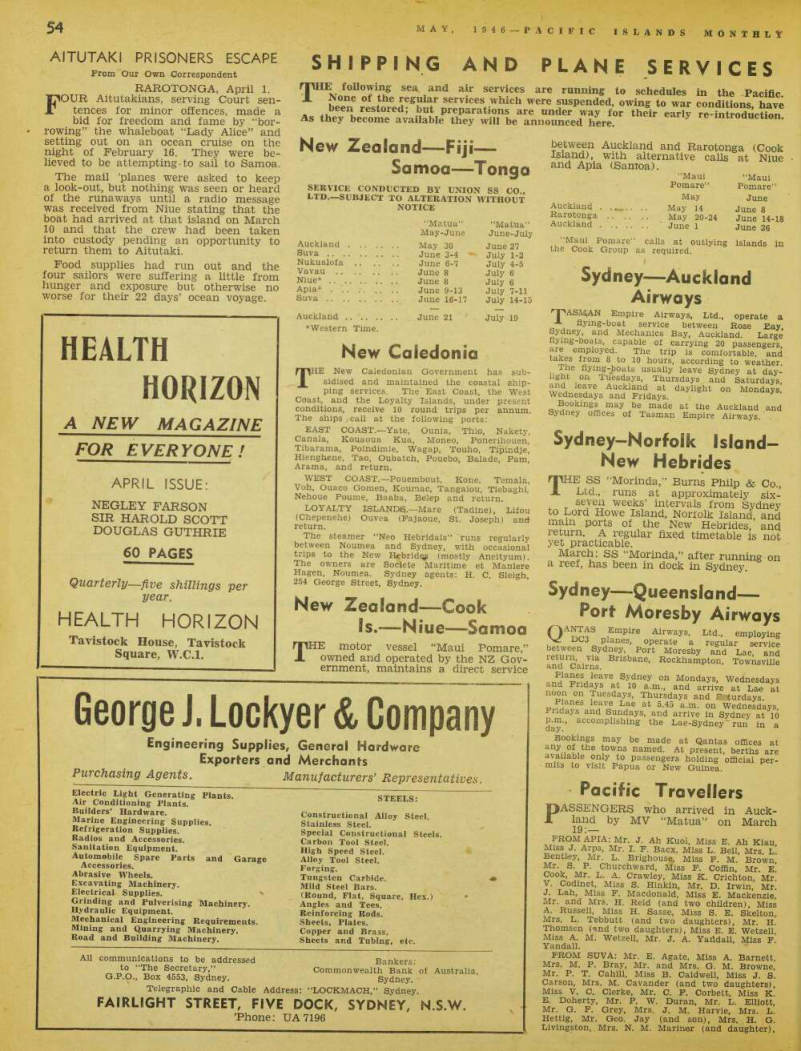
From Our Own Correspondent
Rarotonga, April 1.
FOUR Aitutakians, serving Court sen tences for minor offences, made a bid for freedom and fame by “bor rowing” the whaleboat “Lady Alice” and setting out on an ocean cruise on the night of February 16. They were be lieved to be attempting-to sail to Samoa.
The mail ’planes were asked to keep a look-out, but nothing was seen or heard of the runaways until a radio message was received from Niue stating that the boat had arrived at that island on March 10 and that the crew had been taken into custody pending an opportunity to return them to Aitutaki.
Food supplies had run out and the four sailors were suffering a little from hunger and exposure but otherwise no worse for their 22 days’ ocean voyage.
Sydney—Queensland—
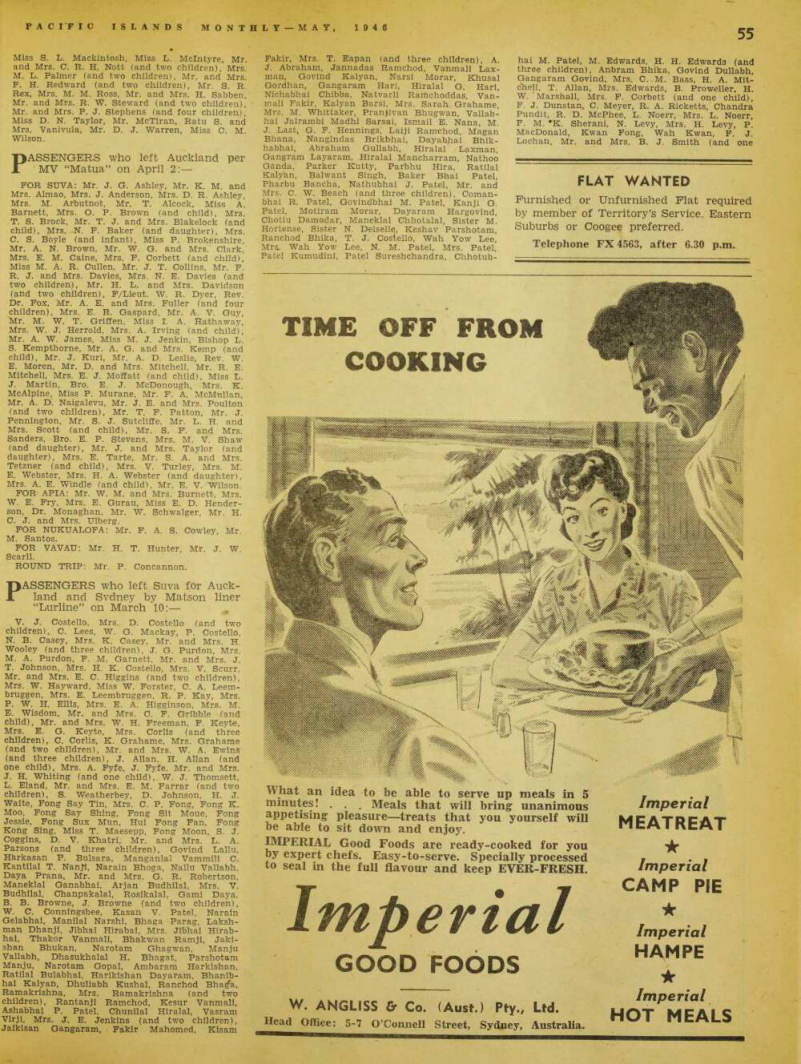
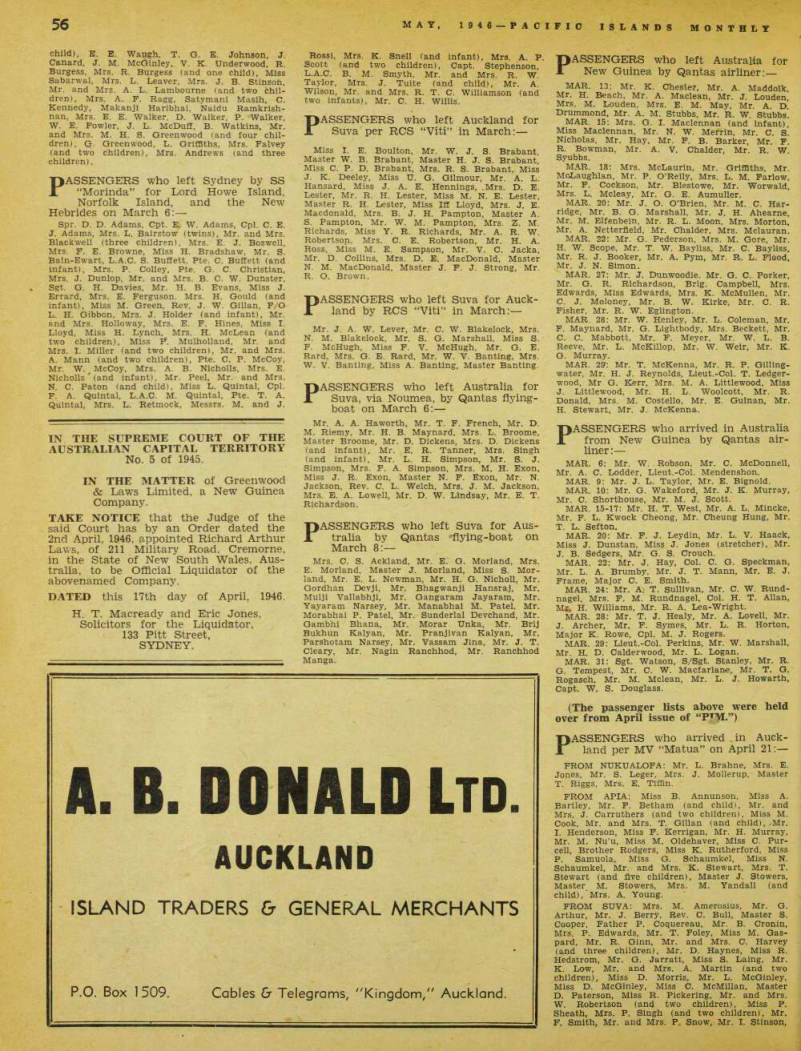
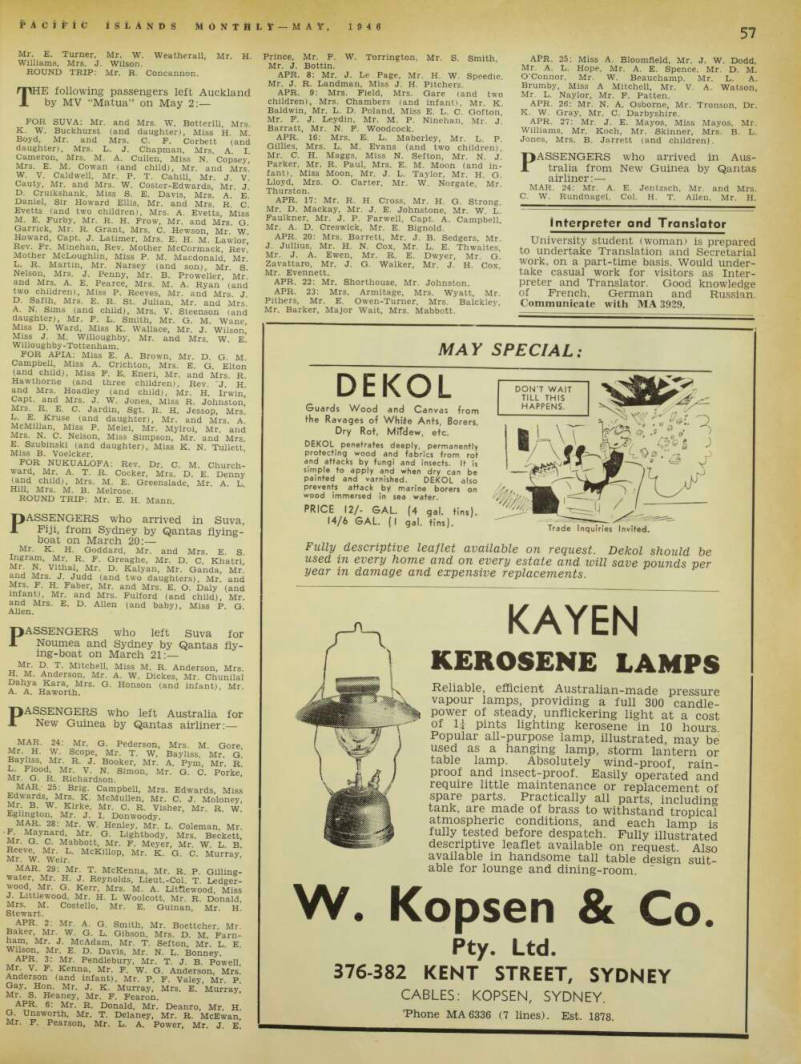
Shipping And Plane Services
Sea , and a ! r services are running to schedules in the Pacific, vlo ° f f he * eg " lar services which were suspended, owing to war conditions have a ♦v? 661 ! restored » but preparations are under way for their early re-introduction As they become available they will be announced here.
New Zealand-—Fiji—
Samoa—Tonga
Service Conducted By Union Ss Co.,
Ltd - —Subject To Alteration Without
Notice
New Caledonia
THE New Caledonian Government has sub sidised and maintained the coastal ship ping services. The East Coast, the West Coast, and the Loyalty Islands, under present conditions, receive 10 round trips per annum.
The ships ,call at the following ports; EAST COAST.—Yate, Ounia, Thio, Nakety, Canala, Kouaoua Kua, Moneo, Ponerihouen, Tibarama, Poindimie, Wagap, Touho, Tipindje, Hienghene, Tao, Oubatch, Pouebo, Balade, Pam, Arama, and return.
WEST COAST,—Pouembout, Kone, Temala, Voh, Ouaco Gomen, Koumac, Tangaiou, Tiebaghi, Nehoue Poume, Baaba, Belep and return.
LOYALTY ISLANDS.—Mare (Tadine), Lifou (Chepenehe) Ouvea (Fajaoue, St. Joseph) and return.
The steamer “Neo Hebridais” runs regularly between Noumea and Sydney, with occasional trips to the New Hebridqg (mostly Aneityum).
The owners are Societe Maritime et Maniere Hagen, Noumea. Sydney agents: H. C, Sleigh, 254 George Street, Sydney.
New Zealand—Cook
Is.—-Niue—Samoa
rpHE motor vessel “Maui Pomare,”
X owned and operated by the NZ Gov ernment, maintains a direct service
between Auckland and Rarotonga (Cook Island), with alternative calls at Niue and Apia (Samoa).
“Maui Pomare” calls at outlying islands in tne Cook Group as required.
Sydney—Auckland
Airways
r T'ASMiAN Empire Airways* Ltd., operate a flying-boat service between Rose Bay Sydney and Mechanics Bay, Auckland. Large flying-boats, capable of carrying 20 passengers are employed. The trip is comfortable, and ta mt S from Bto 10 hours, according to weather The flying-Jioats usually leave Sydney at day light on Tuesdays, Thursdays and Saturdays, a ? d leave Auckland at daylight on Mondays, Wednesdays and Fridays.
Bookings may be made at the Auckland and Sydney offices of Tasman Empire Airways.
Sydney-Norfolk Island-
New Hebrides
rE SS “Morinda,” Burns Philp & Co., Ltd., runs at approximately six seven weeks’ intervals from Sydney to Lord Howe Island. Norfolk Island, and main ports of the New Hebrides, and return. A regular fixed timetable is not
yet practicable.
March: SS “Morinda,” after running on a reef, has been in dock in Sydney.
Sydney—Queensland—
Port Moresby Airways
oAn^0 A n^t S , Empire Airways, Ltd., employing itT noj planes, operate a regular service between Sydney Port Moresby and Lae, and and Cairns Bnsbane ’ Rock hampton, Townsville la “ e ®. leave Sydney on Mondays, Wednesdays and Fridays at 10 a.m., and arrive at Lae at noon on Tuesdays, Thursdays and f ;turdays.
PHritv! 8 lo ,f V o e L f e at 5,45 a ' m - on Wednesdays, Fridays and Sundays, and arrive in Sydney at 10 p.m., accomplishing the Lae-Sydney'run in a day. snv ool^ B + may be made at Q an tas offices at any of the towns named. At present, berths are available only to passengers holding official per mits to visit Papua or New Guinea.
Pacific Travellers
PASSENGERS who arrived in Auck land by MV “Matua” on March FROM APIA: Mr. J. Ah Kuoi, Miss E. Ah Kiau, Miss J. Arps, Mr. I. F. Bacx. Miss L. Bell, Mrs L Bentley, Mr. L. Brighouse, Miss F. M. Brown Mr. S. P. Churchward, Miss F. Coffin, Mr E Cook, Mr. L. A. Crawley, Miss K. Crichton, Mr!
V. Codinet, Miss S. Hinkin, Mr, D. Irwin, Mr.
J. Lah, Miss F, Macdonald, Miss E. Mackenzie,' Mr. and Mrs. H. Reid (and two children), Miss A. Russell, Miss H. Basse, Miss S. E. Skelton, Mrs, L. Tebbutt (and two daughters), Mr. H.
Thomsen (and two daughters), Miss E. E. Wetzell, Miss A. M. Wetzell, Mr. J. A. Yarldall, Miss F.
Yandall.
FROM SUVA: Mr. E. Agate, Miss A. Barnett, Mrs. M. P. Bray, Mr. and Mrs. G. M. Browne, Mr. P. T. Cahill, Miss B. Caldwell, Miss J. S.
Carson, Mrs. M. Cavander (and two daughters), Miss V. C. Clerke, Mr. C. F. Corbett. Miss K.
E. Doherty, Mr. P. W. Duran, Mr. L. Elliott, Mr. G. F. Grey, Mrs. J. M. Harvie, Mrs. L.
Hettig, Mr. Geo. Jay (and son), Mrs. H, G.
Livingston, Mrs. N. M. Mariner (and daughter),
“Matua” “Matua”
May-June June-July Auckland May 30 June 27 Su va June 3-4 July 1-2 Nukualofa June 6-7 July 4-5 Vavau June 8 July 6 Niue* June 8 July 6 Apia* June 9-13 July 7-11 Suva June 16-17 July 14-15 Auckland June 21 July 19 ♦Western Time.
“Maui “Maui Pomare” Pomare”
May June Auckland . . May 14 June 8 Rarotonga May 20-24 June 14-18 Auckland June 1 June 26
Miss S. L. Mackintosh, Miss L. Mclntyre, Mr and Mrs. C. R. H. Nott (and two children), Mrs.
M. L. Palmer (and two children), Mr. and Mrs.
F. H. Redward (and two children), Mr. S. R.
Rex, Mrs. M. M. Ross, Mr. and Mrs. H. Sabben, Mr. and Mrs. R. W. Steward (and two children), Mr. and Mrs. P. J. Stephens (and four children), Miss D. N. Taylor, Mr. McTiran, Ratu S. and Mrs. Vanivula, Mr. D. J, Warren, Miss C. M.
Wilson.
PASSENGERS who left Auckland per MV “Matua” on April 2:— FOR SUVA; Mr. J. G. Ashley, Mr. K. M. and Mrs. Almao, Mrs. J. Anderson, Mrs. D. R. Ashley, Mrs. M. Arbutnot, Mr. T. Alcock, Miss A.
Barnett, Mrs. O. P. Brown (and child), Mrs.
T. S. Brock, Mr. T. J. and Mrs. Blakelock (and child), Mrs. N. F. Baker (and daughter), Mrs.
C. S. Boyle (and infant), Miss P. Brokenshire, Mr. A. N. Brown, Mr. W. G. and Mrs. Clark, Mrs. E. M. Caine, Mrs. F. Corbett (and child), Miss M. A. R. Cullen, Mr. J. T. Collins, Mr. F.
R, J. and Mrs. Davies, Mrs. N. E. Davies (and two children), Mr. H. L. and Mrs. Davidson (and two children), F/Lleut. W. R. Dyer, Rev.
Dr. Pox, Mr. A. E. and Mrs. Fuller (and four children), Mrs. E. R. Gaspard, Mr. A. V. Guy.
Mr. M. W. T. Griffen, Miss I. A. Hathaway, Mrs. W. J. Herrold, Mrs. A. Irving (and child), Mr. A. W. James, Miss M. J. Jenkin, Bishop L.
S. Kempthorne, Mr. A. G. and Mrs. Kemp (and child), Mr. J. Kuri, Mr. A. D. Leslie, Rev. W.
E. Moren, Mr, D. and Mrs. Mitchell, Mr. R. E.
Mitchell, Mrs. E. J. Moffatt (and child), Miss L.
J. Martin, Bro. E. J. McDonough, Mrs. K.
McAlpine, Miss P. Murane, Mr. F. A. McMullan, Mr. A. D. Naigalevu, Mr. J. E. and Mrs. Poulton (and two children), Mr. T. P. Patton, Mr. J.
Pennington, Mr. S. J. Sutcliffe, Mr. L. H. and Mrs. Scott (and child). Mr. S. F. and Mrs.
Sanders, Bro. E. P. Stevens, Mrs. M. V. Shaw (and daughter), Mr. J. and Mrs. Taylor (and daughter), Mrs. E. Tarte, Mr. S. A. and Mrs.
Tetzner (and child), Mrs. V. Turley, Mrs. M.
E. Webster, Mrs. H. A. Webster (and daughter), Mrs. A. E. Windle (and child), Mr. E. V. Wilson.
FOR APIA: Mr. W. M. and Mrs. Burnett, Mrs.
W. E. Fry, Mrs. E. Gurau, Miss E. D. Hender son, Dr. Monaghan, Mr, W. Schwalger, Mr. H.
C. J. and Mrs. Ulberg.
FOR NUKUALOFA: Mr. P. A. S. Cowley, Mr, M. Santos.
FOR VAVAU: Mr. H. T. Hunter, Mr. J. W.
Scarll.
ROUND TRIP: Mr. P. Concannon.
PASSENGERS who left Suva for Auck land and Sydney by Matson liner “Lurline” on March 10: V. J. Costello, Mrs. D. Costello (and two children), C. Lees, W. G. Mackay, P. Costello, N. B. Casey, Mrs. K. Casey, Mr. and Mrs. H.
Wooley (and three children), J. G. Purdon, Mrs.
M. A. Purdon, F. M. Garnett. Mr. and Mrs. J.
T. Johnson, Mrs. H. K. Costello, Mrs. V. Scurr, Mr. and Mrs. E. C. Higgins (and two children), Mrs. W. Hayward, Miss W. Forster, C. A. Leem bruggen, Mrs. E. Leembruggen, R. P. Kay, Mrs.
P. W. H. Ellis, Mrs. E. A. Higginson, Mrs. M.
E. Wisdom, Mr. and Mrs. C. F. Grlbble (and child), Mr. and Mrs. W. H. Freeman, F. Keyte, Mrs. E. G. Keyte, Mrs. Corlls (and three children), C. Corlis, K. Grahame, Mrs. Grahame (and two children), Mr. and Mrs. W. A. Ewlns (and three children), J. Allan, H. Allan (and one child), Mrs. A. Fyfe, J. Fyfe. Mr. and Mrs.
J. H. Whiting (and one child), W. J. Thomsett, L. Eland, Mr. and Mrs. E. M. Farrar (and two children), S. Weatherbey, D. Johnson, H. J.
Waite, Fong Say Tin, Mrs. C. P. Fong, Pong K.
Moo, Fong Say Shing, Fong Sit Moue, Fong Jessie, Fong Sux Mun, Hui Fong Fan, Fong Kong Sing, Miss T. Maesepp, Fong Moon, S. J.
Coggins, D. V. Khatri, Mr. and Mrs. L. A.
Parsons (and three children), Govind Lallu, Hkrkasan P. Bulsara, Manganlal Vammill C.
Kantllal T. Nanfl, Narain Bhoga, Nallu Vallabh, Daya Prana, Mr. and Mrs. G. R. Robertson, Maneklal Ganabhai, Arjan Budhilal, Mrs. V.
Budhilal, Chanpakalal, Rosikalal, Garni Daya, B. B. Browne, J. Browne (and two children), W. C. Connlngsbee, Kasan V. Patel, Narain Gelabhal, Manilal Narshi, Bhaga Parag, Laksh man Dhanji, Jibhai Hirabal, Mrs. Jibhai Hirab hai, Thakor Vanmali, Bhakwan Ramji, Jaki shan Bhukan, Narotam Ghagwan, Manju Vallabh, Dhasukhalal H, Bhagat, Parshotam Manju, Narotam Gopal, Ambaram Harkishan, Ratilal Bulabhal, Harikishan Dayaram, Bhanib hai Kalyan, Dhuliabh Kushal, Ranchod Ramakrishna, Mrs. Ramakrishna (and two children), Rantanji Ramchod, Kesur Vanmali, Ashabhai P. Patel, Chunilal Hiralal, Vasram Virji, Mrs. J, E. Jenkins (and two children), Jalkisan Gangaram, Fakir Mahomed, Klsam
Fakir, Mrs. T. Eapan (and three children), A.
J. Abraham, Jannadas Ramchod, Vanmall Lax man, Govind Kalyan, Narsi Morar, Khusal Gordhan, Gangaram Hari, Hiralal G. Harl, Nichabhai Chibba, Natvarli Raifichoddas, Van mali Fakir, Kalyan Barsi, Mrs. Sarah Grahame, Mrs. M. Whittaker, Pranjivan Bhugwan, Vallab hai Jairambi Madhi Sarsai, Ismail E. Nana, M.
J. Last, G. F. Hennings, Laiji Ramchod, Magan Bhana, Nangindas Brikbhai, Dayabhai Bhik habhai, Abraham Gullabh, Hiralal Laxman, Gangram Layaram, Hiralal Mancharram, Nathoo Ganda, Parker Kutty, Parbhu Hira, Ratilal Kalyan, Balwant Singh, Baker Bhai Patel, Pharbu Bancha, Nathubhai J. Patel, Mr. and Mrs. C. W. Beach (and three children), Coman bhai R. Patel, Govindbhai M. Patel, Kanji G.
Patel, Motiram Morar, Dayaram Hargovind, Chotiu Damodar, Maneklal Chhotalal, Sister M.
Hortense, Sister N. Deiselle, Keshav Parshotam, Ranchod Bhika, T. J. Costello, Wah Yow Lee, Mrs. Wah Yow Lee, N. M. Patel, Mrs. Patel, Patel Kumudinl, Patel Sureshchandra, Chhotub
hai M. Patel, M. Edwards, H. H. Edwards (and three children), Anbram Bhika, Govind Dullabh, Gangaram Govind, Mrs. C. M. Bass, H. A. Mit chell, T. Allan, Mrs. Edwards, B. Proweller, H.
W. Marshall, Mrs. F. Corbett (and one child), F. J. Dunstan, C. Meyer, R. A. Ricketts, Chandra Pundit, R. D. McPhee, L. Noerr, Mrs. L. Noerr, F. M. K. Sherani, N. Levy, Mrs. H. Levy, P.
MacDonald, Kwan Fong, Wah Kwan, P. J.
Lochan, Mr. and Mrs. B. J. Smith (and one
child), E. E. Waiigh, T. G. E. Johnson, J.
Canard. J. M. McGinley, V. K. Underwood, R.
Burgess, Mrs. R. Burgess (and one child), Miss Sabarwal, Mrs. L. Leaver, Mrs. J. B. Stinson, Mr. and Mrs. A. L. Lambourne (and two chil dren), Mrs. A. F. Ragg, Satymani Masih, C.
Kennedy, Makanji Haribhai, Naidu Ramkrish nan, Mrs. E. E. Walker. D. Walker, P. Walker, W. E. Fowler, J. L. McDuff, B. Watkins, Mr. and Mrs. M. H. S. Greenwood (and four chil dren), G. Greenwood, L. Griffiths, Mrs. Falvey (and two children), Mrs. Andrews (and three children).
PASSENGERS who left Sydney by SS
“Morinda” for Lord Howe Island, Norfolk Island, and the New Hebrides on March 6: — Spr. D. D. Adams, Cpt. E. W. Adams, Cpl. C. E.
J. Adams, Mrs. L. Bairstow (twins), Mr. and Mrs.
Blackwell (three children), Mrs. E. J. Boswell, Mrs. F. E. Browne, Miss H. Bradshaw, Mr. S.
Bain-Ewart, L.A.C. S. Buffett, Pte. C. Buffett (and infant), Mrs. P. Colley, Pte. G. C. Christian, Mrs. J. Dunlop, Mr. and Mrs. B. C. W. Dunster, Sgt. G. H. Davies, Mr. H. B. Evans, Miss J.
Errard, Mrs. E. Ferguson, Mrs. H. Gould (and infant), Miss M. Green, Rev. J. W. Gillan, F/O L. H. Gibbon, Mrs. J. Holder (and infant), Mr. and Mrs. Holloway, Mrs. E. F. Hines, Miss I.
Lloyd, Miss H. Lynch, Mrs. H. McLean (and two children), Miss F. Mulholland, Mr. and Mrs. I. Miller (and two children), Mr. and Mrs.
A. Mann (and two children), Pte. C. P. McCoy, Mr. W. > McCoy, Mrs. A. B. Nicholls, Mrs. E.
Nicholls' (and infant), Mr. Peel, Mr. and Mrs.
N. C. Paton (and child), Miss L. Quintal, Cpl.
F. A. Quintal, L.A.C. M. Quintal, Pte. T. A.
Quintal, Mrs. L. Retmock, Messrs. M. and J.
Rossi, Mrs. K. Snell (and infant), Mrs. A. P Scott (and two children), Capt. Stephenson, L.A.C. B. M. Smyth, Mr. and Mrs. R. W.
Taylor, Mrs. J. Tuite (and child), Mr. A.
Wilson, Mr. and Mrs. R. T. C. Williamson (and two infants), Mr. C. H. Willis.
PASSENGERS who left Auckland for Suva per RCS “Viti” in March;— Miss I. E. Boulton, Mr. W. J. S. Brabant, Master W. B. Brabant, Master H. J. S. Brabant.
Miss C. P. D. Brabant, Mrs. R. S. Brabant, Miss J. K. Deeley, Miss U. G. Gilmour, Mr. A. L.
Hansard, Miss J. A. E. Hennings, .Mrs. D. E.
Lester, Mr. R. H. Lester, Miss M. N. E. Lester, Master R. H. Lester, Miss Iff Lloyd, Mrs. J. E.
Macdonald, Mrs. B. J. H. Pampton, Master A.
S. Pampton, Mr. W. M. Pampton, Mrs. Z. M.
Richards, Miss Y. R. Richards, Mr. A. R. W.
Robertson, Mrs. C. E. Robertson, Mr. H. A.
Ross, Miss M. E. Sampson, Mr. V. C. Jacka, Mr. D. Collins, Mrs. D. E. MacDonald, Master N. M. MacDonald, Master J. F. J. Strong, Mr.
R. O. Brown.
PASSENGERS who left Suva for Auck land by RCS “Viti” in March:— Mr. J. A. W. Lever, Mr. C. W. Blakelock, Mrs.
N. M. Blakelock, Mr. S. G. Marshall, Miss S.
F. McHugh, Miss F. V. McHugh, Mr. G. E.
Rard, Mrs. G. E. Rard, Mr. W. V. Banting, Mrs.
W. V. Banting, Miss A. Banting, Master Banting.
PASSENGERS who left Australia for
Suva, via Noumea, by Qantas flying
boat on March 6:— Mr. A. A. Haworth, Mr. T. F. French, Mr. D.
M. Riemy, Mr. H. B. Maynard, Mrs. L. Broome, Master Broome, Mr. D. Dickens, Mrs. D. Dickens (and infant), Mr. E. R. Tanner, Mrs. Singh (and infant), Mr. L. H. Simpson, Mr. S. J.
Simpson, Mrs. P. A. Simpson, Mrs. M. H. Exon, Miss J. R. Exon, Master N. F. Exon, Mr. N.
Jackson, Rev. C. L. Welch, Mrs. J. M. Jackson, Mrs. E. A. Lowell, Mr. D. W. Lindsay, Mr. E. T.
Richardson.
PASSENGERS who left Suva for Aus
tralia by Qantas ’flying-boat on
March 8: Mrs. C. S. Ackland, Mr. E. G. Morland, Mrs.
E. Morland, Master J. Morland, Miss S. Mor land, Mr. E. L. Newman, Mr. H. G. Nicholl, Mr.
Gordhan Devji, Mr. Bhagwanji Hansraj, Mr, Mulji Vallabhji, Mr. Gangaram Jayaram, Mr.
Yayaram Narsey, Mr. Manabhai M. Patel, Mr.
Morabhai P. Patel, Mr. Sunderlal Devchand, Mr.
Gambhi Bhana, Mr. Morar Unka, Mr. Brij Bukhun Kalyan, Mr. Pranjivan Kalyan, Mr.
Parshotam Narsey, Mr. Vassam Jina, Mr. J. T.
Cleary, Mr. Nagin Ranchhod, Mr. Ranchhod Manga.
PASSENGERS who left Australia for
New Guinea by Qantas airliner;—
MAR. 13: Mr. K. Chester, Mr. A, Maddolk, Mr. H. Beach, Mr. A. Maclean, Mr. J. Louden.
Mrs. M. Louden, Mrs. E. M. May, Mr. A. D Drummond, Mr. A. M. Stubbs, Mr. R. W. Stubbs'.
MAR. 15: Mrs. G. I. Maclennan (and infant), Miss Maclennan, Mr. N. W. Merrin, Mr. C. S.
Nicholas, Mr. Hay, Mr. F. B. Barker, Mr. F.
R. Bowman, Mr. A. V, Chalder, Mr. R. W.
Syubbs.
MAR. 18: Mrs. McLaurin, Mr. Griffiths, Mr.
McLaughlan, Mr. P. O’Reily, Mrs. L. M. Farlow, Mr. P. Cockson, Mr. Blestowe, Mr. Worwald, Mrs. L. Mcleay, Mr. G. E. Aumuller.
MAR. 20: Mr. J. O. O’Brien, Mr. M. C. Har ridge, Mr. B. G. Marshall, Mr. J. H. Ahearne, Mr. M. Elfenbein, Mr. R. L. Moon, Mrs. Morton, Mr. A. Netterfleld, Mr. Chalder, Mrs. Mclauran.
MAR. 22: Mr. G. Pederson, Mrs. M. Gore, Mr.
H. W. Scope, Mr. T. W. Bayliss, Mr. C. Bayliss, Mr. R. J. Booker, Mr. A. Pym, Mr. R. L. Flood, Mr. J. N. Simon.
MAR. 27; Mr. J. Dunwoodie. Mr. G. C. Porker, Mr. G. R. Richardson, Brig. Campbell, Mrs.
Edwards, Miss Edwards, Mrs. K. McMullen, Mr.
C. J. Moloney, Mr. B. W. Kirke, Mr. C. R.
Fisher, Mr. R. W. Eglington.
MAR. 28: Mr. W. Henley, Mr. L. Coleman, Mr.
F. Maynard, Mr. G. Lightbody, Mrs. Beckett, Mr.
C. C. Mabbott, Mr. F. Meyer, Mr. W. L. B.
Reeve, Mr. L. McKillop, Mr. W. Weir, Mr. K.
G. Murray.
MAR. 29'; Mr. T. McKenna, Mr. R. P. Gilling water, Mr. H. J. Reynolds, Lieut.-Col. T. Ledger wood, Mr G. Kerr, Mrs. M. A. Littlewood, Miss J. Littlewood, Mr. H. L. Woolcott, Mr. R.
Donald, Mrs. M. Costello, Mr. E. Guinan, Mr.
H. Stewart, Mr. J. McKenna.
PASSENGERS who arrived in Australia from New Guinea by Qantas air liner: — MAR. 6: Mr. W. Robson, Mr. C. McDonnell, Mr. A. C. Lodder, Lieut.-Col. Mendenshon.
MAR. 9: Mr. J. L. Taylor, Mr. E. Bignold.
MAR. 10: Mr. G. Wakeford, Mr. J. K. Murray, Mr. C. Shorthouse, Mr. M. J. Scott.
MAR. 15-17: Mr. H. T. West, Mr. A. L. Mincke, Mr. F. L. Kwock Cheong, Mr. Cheung Hung, Mr.
T. L. Sefton.
MAR. 20: Mr. F. J. Leydin, Mr. L. V. Haack, Miss J. Dunstan, Miss J. Jones (stretcher), Mr.
J. B. Sedgers, Mr. G. S. Crouch.
MAR. 22: Mr, J. Hay, Col. C. G. Speckman, Mr. L. A. Brumby, Mr. J. T. Mann, Mr. E. J.
Frame, Major C. E. Smith.
MAR. 24: Mr, A. T. Sullivan, Mr. C. W. Rund nagel, Mrs. P. M. Rundnagel, Col. H. T. Allan, Mr, H. Williams, Mr. R. A. Lea-Wright.
MAR. 28: Mr. T. J. Healy, Mr. A. Lovell, Mr.
J. Archer, Mr. F. Symes, Mr. L. R. Horton, Major K. Rowe, Cpl. M. J. Rogers, MAR. 29: Lieut.-Col. Perkins, Mr. W. Marshall, Mr. H. D. Calderwood, Mr. L. Logan.
MAR. 31: Sgt. Watson, S/Sgt. Stanley, Mr. R.
G. Tempest, Mr. C. W. Macfarlane, Mr. T. G.
Rogasch, Mr. M. Mclean, Mr. L. J. Howarth, Capt. W. S. Douglass. (The passenger lists above were held over from April issue of “P TI M.”) PASSENGERS who arrived in Auck land per MV “Matua” on April 21:— FROM NUKUALOFA; Mr. L. Brahne, Mrs. E.
Jones, Mr. S. Leger, Mrs. J. Mollerup, Master T. Riggs, Mrs. E. Tiffin.
FROM APIA: Miss B. Annunson, Miss A.
Bartley, Mr. P. Betham (and child), Mr. and Mrs. J. Carruthers (and two children), Miss M.
Cook, Mr. and Mrs. T. Gillan (and child), Mr.
I. Henderson, Miss F. Kerrigan, Mr. H. Murray, Mr. M. Nu’u, Miss M. Oldehaver, Miss C. Pur cell, Brother Rodgers, Miss K. Rutherford, Miss P. Samuola, Miss G. Schaumkel, Miss N.
Schaumkel, Mr. and Mrs. K. Stewart, Mrs. T.
Stewart (and five children), Master J. Stowers, M. Stowers, Mrs. M. Yandall (and child),'Mrs. A. Young.
FROM SUVA: Mrs. M. Amerosius, Mr. G.
Arthur, Mr. J. Berry, Rev. C. Bull, Master S.
Cooper, Father P. Coquereau, Mr. B. Cronin, Mrs. P. Edwards, Mr. T. Foley, Miss M. Gas pard, Mr. R. Ginn, Mr. and Mrs. C. Harvey (and three children), Mr. D. Haynes, Miss R.
Hedstrom, Mr. G. Jarratt, Miss S. Laing, Mr.
K. Low, Mr. and Mrs. A. Martin (and two children), Miss D. Morris, Mr. L. McGinley, Miss D. McGinley, Miss C. McMillan, Master D. Paterson, Miss R. Pickering, Mr. and Mrs.
W. Robertson (and two children), Miss P.
Sheath, Mrs. P. Singh (and two children), Mr.
F, Smith, Mr. and Mrs. P. Snow, Mr. I. Stinson,
Mr. E. Turner, Mr. W. Weatherall, Mr, H.
Williams, Mrs. J. Wilson.
ROUND TRIP; Mr. R. Concannon. rE following passengers left Auckland by MV “Matua” on May 2:— FOR SUVA; Mr. and Mrs. W. Botterill, Mrs.
K. W. Buckhurst (and daughter). Miss H. M Boyd, Mr. and Mrs. C. F. Corbett (and daughter), Mrs. L. J. Chapman, Mrs. A. I.
Cameron, Mrs. M. A. Cullen, Miss N. Copsey, Mrs. E. M. Cowan (and child), Mr. and Mrs W. V. Caldwell, Mr. P. T. Cahill, Mr. J. v.
Cauty, Mr. and Mrs. W. Coster-Edwards, Mr. J.
D. Cruikshank, Miss S. E. Davis, Mrs. A. E.
Daniel, Sir Howard Ellis, Mr. and Mrs. R. C.
Evetts (and two children), Mrs. A. Evetts, Miss M. E. Furby, Mr. R. H. Frow, Mr. and Mrs G Garrick, Mr. R. Grant, Mrs. C. Hewson, Mr. w!
Howard, Capt. J. Latimer, Mrs. E. H. M. Lawlor Rev. Fr. Minehan, Rev. Mother McCormack, Rev!
Mother McLoughlin, Miss P. M. Macdonald, Mr.
L. R. Martin, Mr. Narsey (and son), Mr. S.
Nelson, Mrs. J. Penny, Mr. B. Proweller, Mr* and Mrs. A. E. Pearce, Mrs. M. A. Ryan’ (and two children). Miss P. Reeves, Mr. and Mrs J D. Safih, Mrs. E. R. St. Julian, Mr. and Mrs A. N. Sims (and child), Mrs. V. Steenson (and daughter), Mr. F. L. Smith, Mr. G. M. Wane, Miss D. Ward, Miss K. Wallace, Mr. J. Wilson,’
Miss J. M. Willoughby, Mr. and Mrs W e’
Willoughby-Tottenham.
FOR APIA: Miss E. A. Brown, Mr. D. G. M.
Campbell, Miss A. Crichton, Mrs. E. G. Elton (and child), Miss F. E. Eneri, Mr. and Mrs. R.
Hawthorne (and three children), Rev. J. h. and Mrs. Hoadley (and child), Mr. H. Irwin Capt. and Mrs. J. W. Jones, Miss R. Johnston,’
Mrs. R. E. C. Jardin, Sgt. R. H. Jessop, Mrs.
L. E. Kruse (and daughter), Mr. and Mrs A McMillan. Miss P. Melei, Mr. Mylroi, Mr. and Mrs. N. C. Nelson, Miss Simpson, Mr. and Mrs.
E. Szubinski (and daughter). Miss K. N. Tullett Miss B. Voelcker.
FOR NUKUALOFA; Rev. Dr. C. M. Church ward, Mr. A. T. R. Cocker, Mrs. D. E. Denny (and child), Mrs. M. E. Greenslade, Mr A L Hill, Mrs. M. B. Melrose.
Round Trip; Mr. E. H. Mann.
PASSENGERS who arrived in Suva,
Fiji, from Sydney by Qantas flying
boat on March 20:— Mr. K. H. Goddard, Mr. and Mrs. E. S.
Ingram, Mr. R. F. Greaghe, Mr. D. C Khatri Mr. N. Vithal, Mr. D. Kalyan, Mr. Ganda, Mr! and Mrs. J. Judd (and two daughters), Mr, and Mrs. F. H. Faber, Mr. and Mrs. E, O. Daly (and infant), Mr. and Mrs. Pulford (and child), Mr. and Mrs. E. D. Allen (and baby), Miss P. G Allen, PASSENGERS who left Suva for
Noumea and Sydney by Qantas fly
ing-boat on March 21;— Mr. D. T. Mitchell, Miss M. R. Anderson, Mrs.
H M. Anderson, Mr. A. W. Dickes, Mr. Chunilal Dahya Kara, Mrs. G. Honson (and Infant) Mr A. A. Haworth.
PASSENGERS who left Australia for New Guinea by Qantas airliner:— MAR. 24: Mr. G. Pederson, Mrs. M. Gore Mr H. W. Scope, Mr. T. W. Bayliss, Mr. G.
Bayhss, Mr. R. j. Booker, Mr. A. Pym, Mr. R.
L. Flood, Mr. V. N. Simon, Mr. G. C. Porke Mr. G. R. Richardson.
MAR 25; Brig. Campbell, Mrs. Edwards, Miss Edwards, Mrs. K. McMullen, Mr. C. J. Moloney Mr B W. Kirke, Mr. C. R. Visher, Mr. R. W.
Eglmgton, Mr. J. I. Donwoody.
MAR. 28: Mr. W. Henley, Mr. L. Coleman, Mr.
F Maynard, Mr. G. Lightbody, Mrs. Beckett, Mr. G. C. Mabbott, Mr. F. Meyer, Mr. W. L B.
Reeve Mr. L. McKillop, Mr. K. G. C. Murray, Mr. W. Weir.
MAR. 29: Mr. T. McKenna, Mr. R. p. Gilling water, Mr. H. J. Reynolds, Lieut.-Col. T. Ledger wood, Mr. G. Kerr, Mrs. M. A. Litttewood, Miss J. Littlewood, Mr. H. L Woolcott, Mr. R. Donald, Mrs. M. Costello, Mr. E. Guinan Mr H Stewart.
APR. 2: Mr. A. G. Smith, Mr. Boettcher, Mr.
Baker, Mr. W. G. L. Gibson, Mrs. D. M. Farn ham, Mr. J. McAdam, Mr. T. Sefton, Mr L E Wilson, Mr, E. D. Davis, Mr. N. L. Bonney.
APR. 3: Mr. Pendlebury, Mr. T. J. B. Powell Mr V. F. Kenna, Mr. F. W. G. Anderson, Mrs!
Anderson (and infant), Mr. P. F. Valey, Mr. P.
Gay, Hon. Mr. J. K. Murray, Mrs. E. Murray' Mr. S. Heaney, Mr. F. Fearon.
APR. 6: Mr. R. Donald, Mr. Deanro, Mr. H.
G. Unsworth, Mr. T. Delaney, Mr. R. McEwan Mr. F. Pearson, Mr. L. A. Power, Mr, J. e!
Prince, Mr. F. W. Torrington, Mr. S. Smith Mr. J. Bottin.
APR. 8; Mr. J. Le Page, Mr. H. W. Speedie, Mr. J. R. Landman, Miss J. H. Pitchers.
APR. 9: Mrs. Field, Mrs. Gare (and two children), Mrs. Chambers (and infant), Mr. K.
Baldwin, Mr. L. D. Poland, Miss E. L. C. Gofton, Mr. F. J. Leydin, Mr. M. P. Ninehan, Mr. j’
Barratt, Mr. N. F. Woodcock.
APR. 16; Mrs. E. L. Maberley, Mr. L. P.
Gillies, Mrs. L. M. Evans (and two children), Mr. C. H. Maggs, Miss N. Sefton, Mr. N. J.
Parker, Mr. R. Paul, Mrs. E. M. Moon (and in fant), Miss Moon, Mr. J. L. Taylor, Mr. H. G.
Lloyd, Mrs. O. Carter, Mr. W. Norgate, Mr.
Thurston.
APR. 17: Mr. R. H. Cross, Mr. H. G. Strong, Mr. D. Mackay, Mr. J. E. Johnstone, Mr. W. l’
Faulkner, Mr. J. P. Farwell, Capt. A. Campbell.
Mr. A. D. Creswick, Mr. E. Bignold.
APR. 20: Mrs. Barrett, Mr. J. B. Sedgers, Mr.
J. Jullius, Mr. H. N. Cox, Mr. L. E. Thwaites, Mr. J. A. Ewen, Mr. R. E. Dwyer, Mr. G.
Zavattaro, Mr. J. G. Walker, Mr. J. H. Cox.
Mr. Evennett..
APR. 22: Mr. Shorthouse, Mr. Johnston.
APR. 23; Mrs. Armitage, Mrs. Wyatt, Mr.
Pithers, Mr. E. Owen-Turner, Mrs. Balckley, Mr. Barker, Major Wait, Mrs. Mabbolt.
APR. 25: Miss A. Bloomfield, Mr. J. W. Dodd, Mr. A. L. Hope, Mr. A. E. Spence, Mr. D. M.
O’Connor, Mr. W. Beauchamp, Mr. L. A.
Brumby, Miss A Mitchell, Mr. V. A. Watson, Mr. L. Naylor, Mr. F. Patten.
APR. 26: Mr. N. A. Osborne, Mr. Tronson, Dr.
K. W. Gray, Mr. C. Darbyshire.
APR. 27: Mr. J. E. Mayos, Miss Mayos, Mr.
Williams, Mr. Koch, Mr. Skinner, Mrs. B. L.
Jones, Mrs. B. Jarrett (and children).
PASSENGERS who arrived in Aus tralia from New Guinea by Qantas airliner: — MAR. 24: Mr. A. E. Jentzsch, Mr. and Mrs.
C. W. Rundnagel, Col. H. T. Allen, Mr. H.
Williams, Mr. R. A. Lea-Right, Mr. T. J. Healy, Mr. A. Livell, Mr. J. Archer, Mr. F. Symes, Mr.
L. R. Horton, Major K. Rowe, Mr. H. H. Rowe, Cpl. M. J. Rogers.
MAR. 29: Lieut.-Col. Perkins, Mr. W. Marshall, Mr. H. D. Calderwood, Mr. L. Logan.
MAR. 31: Sgt. Watson, S/Sgt. Stanley, Mr. R.
G. Tempest.
MAR. 31: Mr. C. W. Macfarlane, Mr. T. G.
Rogasch, Mr. M. McLean, Mr. L. J. Howarth, Capt. W. S. Douglass.
APR. 3: Mr. L. I. Howell, Capt. A. Campbell, Mr. A. Lewis, Mr. L. McVey.
APR. 6: Pte. Beddingfield, Pte. Whitley, Spr.
Johnson, Spr. Hansen, Tpr. Bell, Mr. E. S.
Turner, Mr. S. Evans, Mr. R. J. Cox, Mr. E. E.
Tristram, Mr. A. Stubbs, Mr. L. Williams, Brig.
K. M. Graham.
APR. 7: Mr. J. M. Saville, Mr. R. C. Saville, Mr.
J. D. Simpson, Capt. Burrows, Mr. L. Coleman, Mr. F. S. Maynard, Mr. L. Dodd, Mr. E. Bennion, Lieut.-Col. C. V. Anderson, Mr. E. A. Guinan
Spr. Pearce, Mr. C. Heidemann, Mr. V. F.
APR. 10: Mr. H. E, Saville, Mr. G. A. Saville, Kenna, Mr. B. W. Kirke, Mr. F. L. Bowman, Mr. L. H. Bryant, Mr. E. King, Mr. W. Gadd.
APR. 18: Spr. A. A. Brazier, Mrs. F. S.
Stewart, Pastor Campbell, Mr. R, McConnan, Mr. J. M. Ledgertwood, Mr. Garcia, Mr. H.
Woolcott, Chaplain W. J. Fahy, Mr. R. Hughes.
APR. 20: Mr. H. D. Pennell, Mr. F. B. Gaulton, Mr. T. Ward, Mr. G. P. Davern, Dvr. B. G.
Paterson.
APR. 21: Mr. A. J. Garth, Rev. M. A. Warren.
APR. 24: Mr. J. W. Hinks, Cpl. P. L. Jager, Major Miles, Major Brown, Capt. Bruce, Mr. S.
G. Barker.
APR. 26: Cpl. Turnbull, Father B. Mertens, Mr. A. Collins, Capt. Shaw, Capt. Budden, Mr.
G. Kerr.
APR. 28: Mr. G. Bortijson, Mr. J. W. Tor rington, Mr. J. Barrett, Mr. J. E. Le Page, Mr.
N. F. Woodcock, Sister Mary Justin, Sister Mary Felix, Sister Mary Taschal, Mr. L. S. Black. (Lists received after May 9 are printed on page 67)
PASSENGERS who arrived in Australia from New Guinea by Qantas Air ways:— MAY 1: Mr. W., Fleming, Mr. W. L. Faulkner, Mr. T. A. Farwell, Major C. D. Bates, Mr. S.
Smith, Mr. J. Bottin, Mrs. E. Champion, Miss I.
Champion, Mr. J. P. De Verteuil, Mr. E. C.
O’Reilly, Mr. J. H. Rosser, Mrs. V. Godson, Mr.
M. Harris, Mr. F. K. Rickwood.
MAY 3: Mr. W. Niness, Mr. P. J. Herrick, Mr.
S. Heaney, Mr. A. Shingleton.
MAY 6: Mr. L. C. Buckley, Mr. J. W. Finn, Mr. M. J. Coleman, Mr. H. H. Smith, Mr. L. E.
Thwaites, Miss A. Caswell.
PASSENGERS who left Australia for
New Guinea by Qantas Airways:—
APR. 30: Mr. W. A. Pearce, Mr. H. H. Smith, Mr. K. Hauritz, Mrs. A. H. Baldwin, Mrs. Love (and infant), Mr. J. H. Love. Mrs. M. Ham mond, Col. H. Allen, Mrs. E. A. Bowman, Miss N. Campbell, Rev. L. W. Allen, Mr. C. J. Sefton, Mr. J. D. Richardson, Mr. J. C. Jones, Mrs. D.
M. Jones.
MAY 1: Mr. A. K. M. Edwards, Mr. Jag. Miller, Mr. K. Llewellyn, Mr. K. H. Roberts. Mr. C. V.
Howard, Mr. J. K. Ashton.
MAY 2: Mr. E. J. Slee, Dr. and Mrs. C. M.
Deland (and three children), Mr. J. D. Simpson, Mr. J. C. Dennis, Mr. J. A. Sherringham, Mr.
J. P. Hanrahan, Mr. C. Hilling, Mr. O’Brien, Mrs. M. Baldwin, Mr. L. Coleman, Mr. E. Rown tree, Mr. S. R. Evans, Major C. W. McFarlane, Mrs. G. J. Malcolm, Mr. R. McWhee.
Approximately 100 Indian residents of Fiji were passengers in the Matson liner “Lurline” when she left Suva on March 10. They are on their way to India, via Australia, for holiday visits. A small number of passages from Australia to India have been available in recent months, and some of these have been allotted to applicants from Fiji.
Advertisements & other items, pp. 56-60 (2 items)
George J. Lockyer & Company
HEALTH
HORIZON
A NEW MAGAZINE
FOR EVERYONE!
APRIL ISSUE:
NEGLEY FARSON
SIR HAROLD SCOTT
DOUGLAS GUTHRIE
60 PAGES
Quarterly—five shillings per year.
HEALTH HORIZON
Tavistock House, Tavistock Square, W.C.I.
George J. Lockyer & Company
Engineering Supplies, General Hardware
Purchasing Agents.
Electric Light Generating Plants.
Air Conditioning Plants.
Builders’ Hardware.
Marine Engineering Supplies.
Refrigeration Supplies.
Radios and Accessories.
Sanitation Equipment.
Automobile Spare Parts and Garage Accessories.
Abrasive Wheels.
Excavating Machinery.
Electrical Supplies.
Grinding and Pulverising Machinery.
Hydraulic Equipment.
Mechanical Engineering Requirements.
Mining and Quarrying Machinery.
Road and Building Machinery.
Exporters and Merchants
Manufacturers’ Representatives .
STEELS:
Constructional Alloy Steel.
Stainless Steel.
Special Constructional Steels.
Carbon Tool Steel.
High Speed Steel.
Alloy Tool Steel.
Forging.
Tungsten Carbide.
Mild Steel Bars. (Round, Flat, Square, Hex.) Angles and Tees.
Reinforcing Rods.
Sheets, Plates.
Copper and Brass, Sheets and Tubing, etc.
All communications to be addressed Bankers: * TJ 16 Secretary,” Commonwealth Bank of Australia, G.P.0., Box 4553, Sydney. Sydney.
Telegraphic and Cable Address: “LOCKMACH,” Sydney.
FAIRLIGHT STREET, FIVE DOCK, SYDNEY, N.S.W.
’Phone: UA 7196
Imperial
FLAT WANTED
Furnished or Unfurnished Flat required by member of Territory’s Service. Eastern Suburbs or Coogee preferred.
Telephone FX 4563, after 6.30 p.m.
TIME OFF FROM
COOKING
/ m % m ok* V me.
mfm
m &3W ■&* What an idea to be able to serve up meals in 5 minutes! . . . Meals that will bring unanimous appetising pleasure—treats that you yourself will be able to sit down and enjoy.
IMPERIAL Good Foods are ready-cooked for you by expert chefs. Easy-to-serve. Specially processed to seal in the full flavour and keep EVER-FRESH.
Imperial
GOOD FOODS
W. ANGLISS & Co. (Aust.) Pty., Ltd.
Head Office: 5-7 O’Connell Street, Sydney, Australia.
Imperial
MEATREAT
★ Imperial
CAMP PIE
★ Imperial
HAMPE
★ Imperial
HOT MEALS
IN THE SUPREME COURT OF THE
AUSTRALIAN CAPITAL TERRITORY
No. 5 of 1945.
IN THE MATTER of Greenwood & Laws Limited, a New Guinea Company.
TAKE NOTICE that the Judge of the said Court has by an Order dated the 2nd April, 1946, appointed Richard Arthur Laws, of 211 Military Road. Cremorne, in the State of New South Wales, Australia, to be Official Liquidator of the abovenamed Company.
DATED this 17th day of April, 1946.
H. T. Macready and Eric Jones, Solicitors for the Liquidator, 133 Pitt Street,
SYDNEY.
A. B. DONALD Ltd.
AUCKLAND
ISLAND TRADERS & GENERAL MERCHANTS
P.O. Box 1509. Cables &• Telegrams, "Kingdom," Auckland.
interpreter and Translator
University student (woman) is prepared to undertake Translation and Secretarial work, on a part-time basis. Would undertake casual work for visitors as Interpreter and Translator. Good knowledge of French, German and Russian.
Communicate with MA 3929.
MAY SPECIAL:
DEKOL
Guards Wood and Canvas from fhe Ravages of Whiie Ants, Borers, Dry Rot, Mifdew, etc.
DEKOL penetrates deeply, permanently protecting wood and fabrics from rot and attacks by fungi and insects. It is simple to apply and when dry can be painted and varnished. DEKOL also prevents attack by marine borers on wood immersed in sea water.
PRICE 12/- GAL (4 gal. tins). 14/6 GAL. (I gal. tins).
DON'T WAIT
TILL THIS
HAPPENS.
Trade Inquiries Invited.
Fully descriptive leaflet available on request. Dekol should be used in every home and on every estate and will save pounds per year in damage and expensive replacements.
KAYEN
KEROSENE LAMPS
Reliable, efficient Australian-made pressure vapour lamps, providing a full 300 candlepower of steady, unflickering light at a cost of U pints lighting kerosene in 10 hours Popular all-purpose lamp, illustrated, may be used as a hanging lamp, storm lantern or table lamp. Absolutely wind-proof rainproof and insect-proof. Easily operated and require little maintenance or replacement of spare parts. Practically all parts, including tank, are made of brass to withstand tropical atmospheric conditions, and each lamp is fully tested before despatch. Fully illustrated descriptive leaflet available on request. Also available in handsome tall table design suitable for lounge and dining-room.
W. Kopsen & Co.
Pty. Ltd.
376-SB2 KENT STREET, SYDNEY
CABLES: KOPSEN, SYDNEY,
’Phone MA 6336 (7 lines). Est. 1878.
(ADVT.)
Territory of New Guinea
COPRA CONTROL BOARD
Claims for payment of a final dividend in respect of copra delivered to the New Guinea Copra Control Board will be received by the Secretary, Department of External Territories, Canberra, up to June 30, 1946. On this date all claims received will be dealt with, and a final distribution made.
Claim forms are obtainable from the Department of External Territories.
ANNOUNCEMENT..
R. W. TEBB
Formerly trading at Salamaua as
GREGOR MACDONALD
LICENSED AUCTIONEER AND VALUER, CUSTOMS,
SHIPPING, INSURANCE AND GENERAL AGENT
returned to NEW GUINEA and commenced operations at
LAE
IN APRIL
CORRESPONDENCE INVITED
Steamships Trading
Company Limited
PORT MORESBY SAMARA I PAPUA.
WHOLESALE & RETAIL MERCHANTS, SHIPOWNERS,
PLANTERS, ENGINEERS & SLIP PROPRIETORS.
Customs, Shipping, Insurance, and Forwarding Agents
MANAGING AGENTS AND VISITING REPRESENTA-
TIVES FOR COCONUT AND RUBBER ESTATES
SYDNEY REPRESENTATIVES: Nelson & Robertson Pty. Ltd.. 12 Spring Street.
Reconstruction Of Rc
Mission In Rabaul
NEWS of the re-building of the shat tered mission stations of the once flourishing Vicariate of Rabaul is coming in fast. Bishop Scharmach, with the aid of the funds of War Damage In surance, has acquired a large store of materials for reconstruction from both the Australian and American Disposals Commission.
With the help of those missionaries who are strong enough to work after their ordeal of imprisonment under the Japan ese —together with a contingent of young Australians—the gallant Bishop is busily engaged in replacing the old Vicariate with one which promises to be even better equipped.
The work will be hard, the years will probably be long before the Bishop and his priests see the end of their labours, but their hopes are high and their pros pects bright.
The main lack is, of course, that of personnel—priests, Brothers, nuns—to re place those who are dead or who can’t work any more. However, there is good prospect of new blood coming from Europe; and, at the latest report, several American priests are coming to work in the Vicariate and are reported to be bringing with them seaplanes! —Catholic Mission Magazine.
Bank Deposits In
Territories
Canberra, May 2.
rE Australian Government has £lOO,OOO deposited in banks in Papua and New Guinea. The £lOO,OOO is part of £215,000 of non-interest bear ing deposits in the Papuan and New Guinea banks.
According to the banking bulletin fixed deposits bearing interest total £92,000.
The bulletin reveals that the two ter ritories’ part of Australia’s total deposists of £707,429,000 is only £308,000. New Guinea and Papua’s ratio of advances to deposits is second lowest of the States and Territories of the Commonwealth.
Mr. R, .T. (Dick) Paul, well known on the Salamaua staff of Guinea Airways before the war, returns to Port Moresby by this month’s “Ormiston.” Mr. Paul, formerly a captain in the AIF, has been attached to ANA at Essendon since his discharge from the Army, and now goes to join the staff of Steamships Trading Co., Ltd., at Port Moresby where he spent 10 years of his life, prior to join ing Guinea Airways staff in New Guinea.
and Poorer
Cook Is. Getting Poorer
But PM Fraser Thinks Islanders Show Good Taste in Migrating to New Zealand
From a Special Correspondent
Auckland, May 2.
A CONSIDERABLE amount of atten tion has been focussed on the Cook Islands by a controversy that fol lowed the presenting of a petition to the Prime Minister, Mr. Fraser, and Native Minister, Mr. Mason, on April 24.
The petition, which drew a pathetic picture of the lot of the Cook Islands generally, was presented by Mr. Drury Low, a European resident of the Cooks who is in New Zealand on leave.
The petition which blames the Govern ment fruit control for most of the Group’s ills, states that the Cook Islands are becoming so poor that the young people are flocking to New Zealand to earn a living, and that here they fall into bad living conditions and bad company.
Many of the young girls who have gone to New Zealand have developed TB and have either died there or returned to the islands to die. Under normal conditions they would have remained in the Cooks to raise large families.
It is alleged that the Islanders are not permitted to ship big oranges to the Dominion, but only medium and small fruit—this means a loss of thousands of cases a year—and resulted in the brew ing of “bush beer” from the large fruit that would otherwise be wasted. Twenty years ago, it was stated, Aitutaki sent between seven and nine thousand cases of fruit a month to the Dominion, but now the annual shipment does not ex ceed 250 cases.
The petition urged Government encour agement for the growing of cocoa and coffee: parliamentary representation for the 20,000 Maoris of the Group; raising the present ivages of from 2/6 to 4/- for an eight-hour day; the appointment of more doctors and the “reinstatement” of Dr. Ellison: a service of faster and larger ships and cheaper freights and fruit cases; the repeal of obsolete laws (9 p.m. curfew); the same law for Europeans as for natives (they claim that they are not getting justice in the Courts); and a voice in the appointment of Resident Commis sioners who make all other appoint ments.
MR. FRASER replied to the petition— or, more correctly, to the publicity that the petition received with usual ministerial facility, refuting all of the charges made by the Islanders and proving that they live in a proverbial land of milk and orange juice.
Probably somewhere between the some times extraordinary allegations of the petition and the easy denial by the PM, lies the real truth of affairs in the Cook Islands.
Mr. Fraser said that the statements in the petition were “misleading.” It was not surprising that Island people wished to come and live in New Zealand. Many people from other lands wished to do that also!
If the Government fruit control had not proved a success, as the statement alleges, certainly the price to the Cook Islands growers is no failure, for in 1932-36 the average that growers received for oranges was 2/6 a case; in 1939 it was 3/9; and to-day it is 7/-, plus a bonus of 2/- to every grower who is maintaining his output and shinning properly pre pared fruit.
The statement that large oranges are refused shipment is also misleading, he said. Oranges large enough to count 96 to a 70 lb. case are handled and most oranges do not come up to this standard.
Mr. Fraser thought also, that the 250 cases referred to as present annual ship ments must refer to bananas and not to oranges.
In the past two years an average of 11.000 cases has been shipped from the Cooks to the Dominion, although it was “unfortunately true” that during the war years shipping difficulties interfered with exports.
Wages are at least 50 per cent, higher than the petition claims, and the curfew law was made by the Aitutaki Island Council consisting of the four Ariki, four other members, and the Resident Com missioner. They were free to repeal it at their own discretion. rE president and secretary of what is called the “Cook Islands Progressive Association” then entered the fray.
They stated that the price of 7/-, plus a bonus of 2/- to every grower maintain ing his output and shipping properly prepared fruit had not yet been paid, but had been promised for the first ship ment this orange season, which would start in May.
The statement by Mr. Fraser that the assertion that onlv 250 cases of oranges were shipped from Aitutaki annually might refer to bananas was incorrect be cause bananas were exported onlv from Rarotonga, they stated. Further, accord ing to a report presented by Mr. Fraser to the House in July. 1945. no oranges were shipped from Aitutaki during the year 1943-44.
With regard to the Prime Minister’s statement that the Island Council was free to repeal the curfew—they said that no member of the Council was elected and the Commissioner had the power of veto, and therefore they were not free to repeal it.
The engagement has been announced of Mr. H. C. Halliday, formerly of Wau, and now of Milne Bay, to Miss I. Perkins, of Garden Vale, Melbourne.
Atolls Of The Line Islands
THE three principal islands of the newly-constituted Line Islands Dis trict of the Gilbert and Ellice Islands Colony are Fanning, Washington and Christmas —three large atolls.
Both Fanning (34 miles of coastline) and Washington (five miles by four miles) are practically covered with rich coconut plantations, all the property of Fanning Island Plantations, Ltd. (Burns Philp & Co., Ltd.). The plantations are worked mostly with Gilbert Islands lab our. On Fannins: there are about nine Europeans, in addition to the District Officer (Mr. Robert Major) and the staff of the cable station. On Washington, there are onlv the plantation workers.
Christmas Island plantation is now run by officials of the Gilbert and Ellice Colony. It is a very big atoll—probably the second largest in the Pacific—but the soil is poor, and the coconuts do not flourish. Major Sinclair is in charge.
Advertisements & other items, p. 61 (1 item)
.frOjiE S
EYE LOTI Of
ft Ini am ad Ej9B and EyaUda
SOLD EVEITVIEIK
H A. fU.* k C» rty. Lti., Kl«» 9L, *y**n
H. G. EEKHOFF
LAE, NEW GUINEA
—EST. 1921
Miners', Manufacturers' and General Commission Agent As in the past, so in the future—
AT YOUR SERVICE
Scott’s “Renown” Brand Rope,
Cordage and
Binder
Twine
of Every Description Cable m Address 1 Ropeyard Sydney.
M •vf bwsw*"
MANUFACTURED AT
MASCOT, N.S.W.
J. SCOTT
PTY. LTD.
Head Office and Store
163 CLARENCE STREET,
SYDNEY,
N.S.W.
Searson
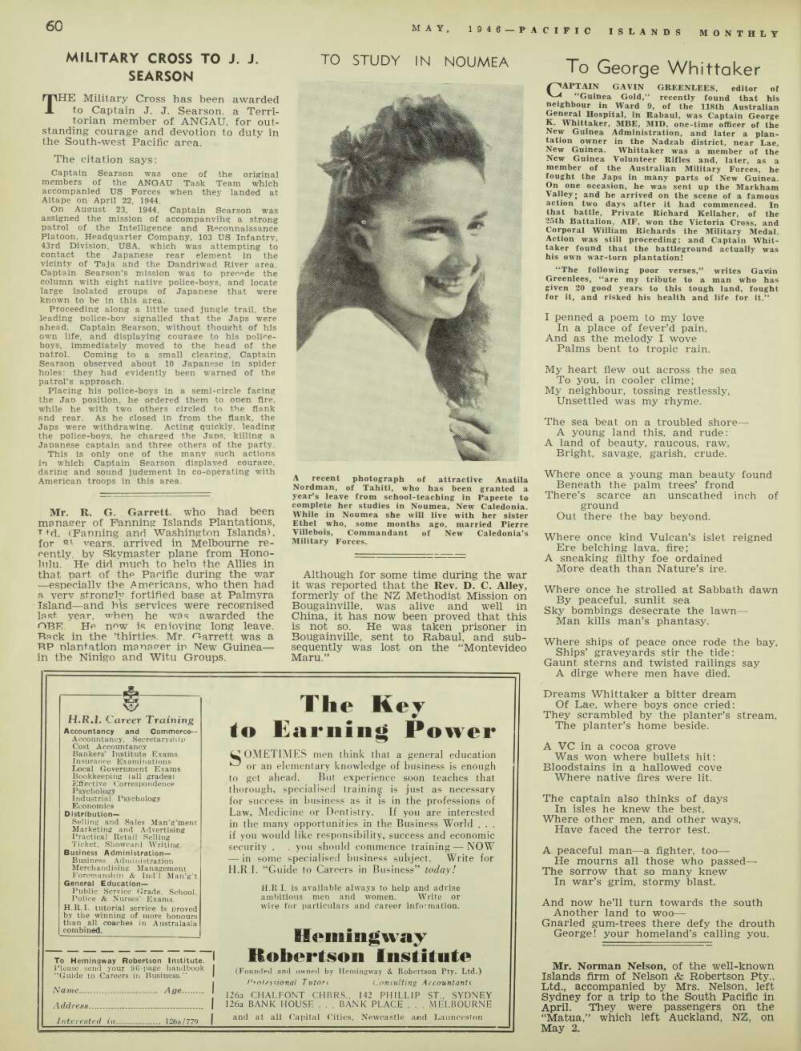
Military Cross To J. J.
THE Military Cross has been awarded to Captain J. J. Searson. a Terri torian member of ANGAU. for out standing courage and devotion to duty in the South-west Pacific area.
The citation says: Captain Searson was one of the original members of the ANGAU Task Team which accompanied US Forces when they landed at Aitape on April 22, 1944.
On August 23, 1944, Captain Searson was assigned the mission of accompanying a strong patrol of the Intelligence and Reconnaissance Platoon, Headquarter Company, 103 US Infantry, 43rd Division, USA, which was attempting to contact the Japanese rear element in the vicinty of Taja and the Dandriwad River area.
Captain Searson’s mission was to precede the column with eight native police-boys, and locate large isolated groups of Japanese that were known to be in this area.
Proceeding along a little used Jungle trail, the leading police-bov signalled that the Japs were ahead. Captain Searson, without thought of his own life, and displaying courage to his police boys, immediately moved to the head of the patrol. Coming to a small clearing, Captain Searson observed about 10 Japanese in spider holes: they had evidently been warned of the patrol’s approach.
Placing his police-boys in a semi-circle facing the Jao position, he ordered them to ooen fire, while he with two others circled to the flank and rear. As he closed in from the flank, the Japs were withdrawing. Acting quickly, leading the police-boys, he charged the Jans, killing a Japanese captain and three others of the party.
This is only one of the many such actions in which Captain Searson displayed courage, daring and sound judgment In co-operating with American troops in this area.
Mr. R. G. Garrett, who had been manager of Panning Islands Plantations,
T M. (Fanning and Washington Islands),
for «*. vears. arrived in Melbourne re
cently. by Skymaster plane from Hono
lulu. He did much to heln the Allies in that part of the Pacific during the war —especiallv the Americans, who then had a verv strongly fortified base at Palmyra Island—and his services were recognised last year, wfien he was awarded the OBP. He new is enioying long leave.
Back in the ’thirties. Mr. Barrett was a RP nlantation manager in New Guinea— in the Ninigo and Witu Groups.
To Study In Noumea
Although for some time during the war it was reported that the Rev. D. C. Alley, formerly of the NZ Methodist Mission on Bougainville, was alive and well in China, it has now been proved that this is not so. He was taken prisoner in Bougainville, sent to Rabaul, and sub sequently was lost on the “Montevideo Maru.”
A recent photograph of attractive Anatila Nordman, of Tahiti, who has been granted a year’s leave from school-teaching in Papeete to complete her studies in Noumea, New Caledonia.
While in Noumea she will live with her sister Ethel who, some months ago, married Pierre Villebois, Commandant of New Caledonia’s Military Forces.
To George Whittaker
/Captain Gavin Greenlees, Editor Of
“Guinea Gold,” recently found that his neighbour in Ward 9, of the 118th Australian General Hospital, in Rabaul, was Captain George K. Whittaker, MBE, MID, one-time officer of the New Guinea Administration, and later a plan tation owner in the Nadzab district, near Lae, New Guinea. Whittaker was a member of the New Guinea Volunteer Rifles and, later, as a member of the Australian Military Forces, he fought the Japs in many parts of New Guinea.
On one occasion, he was sent up the Markham Valley; and he arrived on the scene of a famous action two days after it had commenced. In that battle, Private Richard Kellaher, of the 25th Battalion, A IF, won the Victoria Cross, and Corporal William Richards the Military Medal.
Action was still proceeding; and Captain Whit taker found that the battleground actually was his own war-torn plantation!
“The following poor verses,” writes Gavin Greenlees, “are my tribute to a man who has given 20 good years to this tough land, fought for it, and risked his health and life for it.”
I penned a poem to my love In a place of fever’d pain, And as the melody I wove Palms bent to tropic rain.
My heart flew out across the sea To you, in cooler clime; My neighbour, tossing restlessly, Unsettled was my rhyme.
The sea beat on a troubled shore — A young land this, and rude: A land of beauty, raucous, raw, Bright, savage, garish, crude.
Where once a young man beauty found Beneath the palm trees’ frond There’s scarce an unscathed inch of ground Out there the bay beyond.
Where once kind Vulcan’s islet reigned Ere belching lava, fire; A sneaking filthy foe ordained More death than Nature’s ire.
Where once he strolled at Sabbath dawn By peaceful, sunlit sea Sky bombings desecrate the lawn — Man kills man’s phantasy.
Where ships of peace once rode the bay, Ships’ graveyards stir the tide; Gaunt sterns and twisted railings say A dirge where men have died.
Dreams Whittaker a bitter dream Of Lae, where boys once cried: They scrambled by the planter’s stream, The planter’s home beside.
A VC in a cocoa grove Was won where bullets hit: Bloodstains in a hallowed cove Where native fires were lit.
The captain also thinks of days In isles he knew the best, Where other men, and other ways, Have faced the terror test.
A peaceful man—a fighter, too — He mourns all those who passed— The sorrow that so many knew In war’s grim, stormy blast.
And now he’ll turn towards the south Another land to woo — Gnarled gum-trees there defy the drouth George! your homeland’s calling you.
Mr. Norman Nelson, of the well-known Islands firm of Nelson & Robertson Pty., Ltd., accompanied by Mrs. Nelson, left Sydney for a trip to the South Pacific in April. They were passengers on the “Matua,” which left Auckland, NZ, on May 2.
Advertisements & other items, pp. 62-64 (3 items)
Hemingway
w H.R.I. Career Training Accountancy and Commerce- Accountancy, Secretaryship Cost Accountancy Bankers’ Institute Exams.
Insurance Examinations Local Government Exams Bookkeeping (all grades) Effective Correspondence Psychology Industrial Psychology Economics Distribution- Selling and Sales Man’g’ment Marketing and Advertising Practical Retail Selling Ticket. Showcard Writing Business Administration- Business Administration Merchandising Management Foremanship & Ind'l Man’g't General Education- Public Service Grade. School.
Police & Nurses’ Exams.
H.R.I. tutorial service is proved by the winning of more honours than all coaches in Australasia combined.
To Hemingway Robertson Institute.
Please send your 9 6-page handbook “Guide to Careers in Business.”
Name Age Address ..
Interested in 126a/779
The Key
to Earning Power
W OMETIMES men think that a general education or an elementary knowledge of business is enough to get ahead. But experience soon teaches that thorough, specialised training is just as necessary for success in business as it is in the professions of Law, Medicine or Dentistry. If you are interested in the many opportunities in the Business World . . . if you would like responsibility, success and economic security . . you should commence training NOW —in some specialised business subject. Write for H.R I. “Guide to Careers in Business” today!
H.R I. is available always to help and advise ambitious men and women. Write or wire for particulars and career information.
Hemingway
Robertson Institute
(Founded and owned by Hemingway & Robertson Pty. Ltd.) Orotessional Tutors Consulting Accountants 126 a CHALFONT CHBRS., 142 PHILLIP ST.. SYDNEY 126 a BANK HOUSE . . . BANK PLACE . . . MELBOURNE and at all Capital Cities, Newcastle and Launceston
Cab'tne*
To whom it may interest. . .
& Vic
rrvpORTE^ 3 '
00 *' 3 ' ' s '”' „ s& WHat is y° ul or s e\\er a rU sb trlp 4<can i spare « y o» 0 - ; ?e e » source ot the *** sU ch a «ch ma e»st«* and the answer . g ift We b dorse the belle* throughout * u *”* ce of suPP UcaUV endorse ._„*■«« . >rv sour a _„«i«;ation, - yan ha ve the answer— „ to a we believe we be y e {. throughout ot suppW tically endorse th agents eV ery u«d
s Sv^
rstr-sr -■- wauan
paS and e^hich' offerS disadvantage 5 powder tmS ° vice interests y°“’ f h oW we can street « our ser Applying detad 5 Office. ** opportunity ot s P q{ A „straha , Union )r in wu* oU , drop - n aC t our interests y hoXV we street, it our serv- detads ot o«ce. P.tt )r tunity ot P o{ u straha . prs . Union an Bankers.
Sydney.
AIRWAYS HOUSE,
44 PITT STREET, SYDNEY.
'Phone: BW 3068 Cables: “Magic," Sydney. Code: Bentleys.
When you can
see..
you’re safe ! ■ m m % % x i m
eveREADv
trade-mark
FLASHLIGHT
BATTERIES
give longer life.
Look for the Dateline
DEPENDABLE, ECONOMICAL, POWERFUL.
ALL STOREKEEPERS HAVE—
AUNT
MART’S
BAKING POWDER
Aunt Mary's Baking Powder is now obtainable from your storekeeper. That's good news for you, especially as Aunt Mary's Baking Powder maintains the high quality which has stood the test of housewives for over 70 years.
There is no substitute for Aunt Mary's—There never will be.
62
MAt. 1946 PACIFIC ISLANDS MONTHLY
MORE CIVILIANS RETURN TO NG ( from Page 11)
Re-Establishment Of Torres
Strait Pearling
THE Queensland Government has re habilitated, in the pearling indus try, all the Torres Strait Islanders who have been serving in the Army.
Pearlers are now on a higher wage level than before the war.
Since the war ended the Island Indus tries Board has purchased 20 luggers and, only recently, another five have been secured. Including nrivate vessels, the fleet now comprises 36 boats.
As all Asiatic labour has been excluded, this should give employment to all former Island soldiers.—“ Pearl.”
Advertisements & other items, pp. 65-66 (1 item)
Took
Stamps Wanted
STAMPS 1939 NEW GUINEA AIR-MAIL,
transcribed “Air Mail Postage”—values up to £2. Will pay £7 for good used set and £5 for mint—also odd values wanted.
E. A. Page, Tokamaru Bay, E.C., New Zealand.
WANTED TO BUY—QUALITY GUNS AND RIFLES
HIGHEST PRICES GIVEN. WILL ALSO EXCHANGE GUNS.
New .303 Short Service Barrels, without Sights and Platform, £2/15/- each.
Postage extra.
SI L RO H U Quality Firearms and Fishing Tackle. 143 ELIZABETH STREET (Near Market St.) SYDNEY. ’PHONE: MA 3540.
TOOK
ROFT
RJ2 18 H.P. MARINE DIESEL
ft .
Driving 21 in. x 1 5i in.
Propeller at 740 r.p.m.
Reliable • Efficient £ Economical Stuart Turner
Generating Sets
500, 750, 1,000, 1,500 and 3,000 Watts. 32v, 50v, llOv.
Simple, Economical
GOOD DELIVERIES
Write for full particulars to—
Thornycroft (Aust.) Pty., Ltd. 6/,oWattleStree *
Cables: TIIORNMOTOR, Sydney.
PYRMONT, N.S.W.
JENKIN’S
BOX 100
SUVA, FIJI
THE LEADING STORE FOR ISLAND
CURIOS AND SOUVENIRS
We can supply— Tortoiseshell Goods in bracelets, necklets, brooches.
Tortoiseshell Watch-Bands—made to measure.
Tortoiseshell, with "Cat's Eye" Mountings, in bracelets, necklets, brooches, ear drops.
'Cat's Eyes" set in Silver Filigree, in sets of necklace and bracelet.
We can also supply Tappa Cloth.
Fiji-made Novelties in Large Variety.
QUALITY GOODS AT
REASONABLE PRICES
Write for Our Descriptive Catalogue.
We Will Gladly Forward One.
Final Contributions
N. Guinea Rehabilitation Fund
SINCE contributions to the Rehabilita tion Fund were last acknowledged in the “PIM,” the following amounts have been received by the treasurer of the New Guinea Women’s Club of Syd ney:
General Meeting and Social
THE Annual General Meeting of the club will be held in the Feminist Club rooms, 77 King Street, Sydney, on Friday evening, July 12. Meeting commences at 8 p.m., and supper will be served at its conclusion.
A get-together evening for all Terri torians will be held in the club rooms on June 14. All are invited to come along to meet old friends.
Mr. E. M. Gollan, a well-known mem ber of Amalgamated Wireless staff, re turned to Sydney recently after re establishing radio stations on Nauru and Ocean Island, and has resumed his job of marine inspector. Mr. Gollan was on Nauru when the Japs first attacked in 1941, and he got away in March, 1942.
In an interview, Mr. Gollan very in terestingly described the wartime cruci fixion of Nauru, and how the new Administrator, Mr. Ridgeway, is carrying out the heavy task of rehabilitation. This will be published here in June.
Chaplain Rodger S. Brown, of the Methodist Mission, who is attached to the 118th Australian General Hospital in Rabaul, has been appointed a part-time chaplain to the New Guinea Infantry Battalion, and is permitted to conduct services regularly among these troops.
Such services, of necessity, have to be
conducted in Pidgin English.
Already acknowledged
£619 7 5 Mrs. J. Duncan 5 0 Mr. and Mrs. J. E. Savage 1 1 0 Mr. and Mrs. G. T. Wells 2 0 0 Madang War Charities Assoc. 120 0 6 Mr. and Mrs. K. C. McMullen 5 5 0 Mr. C. H. Meen (Rabaul) 10 0 Mrs. J. Duncan 10 0 Mrs. D. Waterhouse 7 1 6 Miss Margo Clark (proceeds of
baby frock)
1 0 9 Mrs. A. Allen Innis 4 0 0 Mrs. Malcolm (proceeds perfume) 13 6 New Guinea Comforts Fund . . 371 18 2 Net Proceeds Stall, October 5, 1945 72 4 3 Mrs. P. Froggatt 1 0 0 Miss Margo Clark (proceeds of dish) 9 0
Mrs. Browning
12 0 Mrs. Northam 11 0 Mrs. Hore Tacy 10 0 Mr. J. S. K. B. Barron (Fiji) 10 10 0 £1.218 9 1 Less payment of cheques to dependants of POW 75 0 0 £1,138 9 I
Advertisements & other items, pp. 66-67 (3 items)
64
MAY, 1946 PACIFIC ISLANDS MONTHLY
STRONGER PRODUCTION BOARD— ( Continued from Page 12)
65
pActt'ic islands Monthly may, i 9 4 6
Marry J. Tcmiq
“PEERLESS” WHEEL TOYS
FOR THE PACIFIC ISLANDS ...
AVAILABLE NOW!
We have pleasure in presenting the first of the post-war "Peerless" toys.
As in pre-war years, "Peerless" toys are finished in bright colours. Enjoyment and satisfaction are ensured by their quality. 0
TRICAR No. 7.
SCOOTER No. 4.
BRIGHT COLOURS
RUBBER TYRES
£ 7 i m
UTILITY TRUCK.
These three attractive toys will be available from stocks during April
—ORDER NOW.
1
SPORTS CAR No. 24
Bright colours, rubber tyres, nickel plating and fittings which include horn, mascot, are some of the most attractive features of these toys.
TRICAR No. 9.
Order "Peerless" Wheel Toys From the Sole Pacific Islands Selling
Representatives:
MARRY J. TCMIQ
POSTAL ADDRESS;
Box 3661 G.P.0., Sydney.
379 KENT STREET, SYDNEY,
BANKERS: BANK OF N.S.W.
PTY. LTD.
CODES;
Bentley’s Comp.
Phrase.
Bentley’s 2nd Phrase
In Papua
Cruel Waste Of Army Goods
Civilians' Bitter Criticism of Australian Officialdom
By a Returned Papuan Planter
rir «. v, SAM ARAI, April 21.
E situation here in Papua is beyond description. The whole set-up has to be seen to be believed—the half of it will never be told.
Enough building material was dumped in Milne Bay to have re-built every town, and all the settlers’ homes in both Territories. Millions of pounds’ worth of valuable material, tools, engines, oil, foodstuffs, paints and gear that it will be impossible to buy for the next two years, and that would have been invaluable for the rehabilitation of the country, has been destroyed.
A lully equipped American hospital was offered to ANGAU, with drugs, instruments, bedding, medical stores, etc.; but no ANGAU officer could be found with sufficient initiative to sign for it, or take it over. Finally, in disgust, the Yanks
obliterated it with bulldozers and ben zine. I am referring to American Hos pital No. 47, at Milne Bay.
It was situated in a beautiful position in the hills, and could accommodate some hundreds of patients. The site has gone back to the jungle.
We are urged to make copra. When the copra is made, we are informed there a shortage of boats, and it cannot be lifted. Yet vessels come out with stores for Government stations, and return to Samarai empty.
Many generous Americans allowed the needy stations to take away useful materials which would have been destroyed, or dumped in the sea The donors have left the Territories. We are now informed this material must be listed and handed over to the Administration.
What claim the Administration can have upon material which it refused to buy from the Americans, and which was given to the settlers to aid in their re habilitation, is not easy to perceive Officialdom, apparently, would sooner see the gear destroyed.
ANGAU personnel welcomed us back as cheerfully as the Devil would wel come holy water. We did not need to be mind-readers to realise that our room was preferable to our company They perhaps feared we would find out much that ANGAU would prefer hidden' and most of us have found out quite a lot. I am referring to “base-wallahs”— not the boys who did such a good iob against the Japs in the jungles.
The return of the “bloody civilians” to their homes was a nasty knock for some of the privileged gentry of ANGAU—they had hoped their nice, comfortable jobs would have lasted longer.
The budding Anthony Horderns of the RAAF scrabbled in their beards and in vented fresh curses; their private trad ing, at astronomical profits, was drawing to a close. (Where these Army traders obtained their goods is an easy guess.) The settlers, however, receiving Army rations only, had nothing to sell.
Apparently, there were two things for which “returnees” could almost be shot at dawn—writing to editors of papers, and selling goods to natives. Both restric tions have now been lifted, ANGAU hav ing departed. General Morris took his brass band away to New Guinea with him. All he needed to complete the cir cus was a barrel-organ and a monkey.
PRICES for goods purchased by settlers from Pro-Con Stores no doubt gave Mr. Eddie Ward intense satisfaction.
I paid £4/17/6 for a second-hand shot gun that, in 1941, could have been pur chased in any store in Samarai for £2/7/6 new. A bale of copra sacks cost over £3O.
The lowest grade of meat processed in Australia, in case lots, 1/7 per 12 oz. tin.
Where do the profits go?
The shot-gun referred to would cost ANGAU nothing—it would be one of the hundreds of guns taken out of settlers’ homes (for security reasons). Valuable rifles so taken were apparently regarded as “private perks” by the impressors. In quiry does not reveal their whereabouts.
Moresby natives have been informed that their villages are going to be re built of European materials—estimated
cost £168,000. Let the Australian taxpayer put that in his pipe and smoke it!
Given nails, and rations whilst they were on the job, plus a lew tools, aua the natives would have re-established themselves, placed a greater value on their homes, and have benefited in every way by the communal effort. The most suitable houses for natives are those built from local material. Many Europeans prefer them—they are cool in the hot test weather. But who is going to tell Mr. Eddie Ward this?
Mr. Ward’s callous indifference to starv ing Europe is shown in the quadrupling of the tinned fish and meat ration to native labourers, who were already amply fed on the scale designed by tne late air Hubert Murray. This unnecessary change could have been postponed until times were better.
IF the new Administrator, Colonel j. K.
Murray, has reduced the chaos in Moresby, it is not yet perceptible to “the man in the street.”
In a letter to me. an official writes: “In all my life I have never seen so much lunacy in such a small area.” nowever, having been a member of the “old Administration,” he may be slightly biassed!
In conclusion: I wish to be fair to Mr.
Ward. That Minister has been ill-ad vised by impractical visionaries and self opinionated bureaucrats. Between them, they let “Eddie” down badly. I think he is beginning to realise this, at last.
However, with all their hearts the “Re turnees” thank God they are out of Aus tralia. Latest arrivals here state it resembles a madhouse, governed by the inmates. In spite of our troubles and difficulties, we are fortunate to be living in Papua.
Mr. E. Craig, Clayfield, Brisbane, in tends leaving for Sudest Island (.New Guinea). His wife will follow later.
The Rev. Wesley Pidgeon, popular member of the Methodist Mission in Fiji, is in Adelaide on furlough at present.
Under the new district syscem to oe com menced in Fiji he will have in his charge 200 churches with a staff of five native superintendent ministers, 22 native minis ters. and 50 catechists. He will also be youth director for the whole Fijian work, Mr. C. R. H. Nott, who has recently relinquished the post of District Com missioner in the southern and eastern districts of Fiji, arrived at Auckland on the “Matua” on March 19. He was accom panied by his wife, formerly Miss Marion Macfarlane, a well-known Auckland tennis player, and his two children. Mr.
Nott is on his way to England with his family after 10 years’ service in Fiji.
Mr. Harold Gatty, accompanied by Mrs.
Gatty, arrived in Suva, Fiji, by ANA Skymaster on April 10. Mr. Gatty was one of the pioneers of Pan American Airways and has been engaged, in the past year, in re-establishing their trans pacific service, scheduled to resume about June this year. His headquarters, in future, will be Suva, where he will be regional manager for PAA.
Broken Hill Pty., Ltd., have taken options on the big New Caledonian iron deposits on the Plaine des Lacs. One corner of these deposits was formerly worked for a few years by the Jananese from the tiny south coast port of Goro.
It appears that the Australian company is seeking assurances that the export tax should npt be such as to interfere with operations should exploitation be decided on. The deposits are nearer Newcastle than the South Australian deposits at Iron Knob.
Advertisements & other items, p. 68 (2 items)
66
M A *, iH6-PACme ISLANDS MONTHLY
Kidney Trouble
and Backache
Gone in 1 Week
Flush Kidneys With Cystex and You’ll Feel Fine Cystex—the prescription of a famous doctor —improves faulty kidney action in double quick time, so, if you suffer from Rheumatism, Sciatica, Neuritis, Lumbago, Backache, Nervousness, Leg Pains, Dizziness, Circles under Eyes, frequent Headaches and colds, poor Energy and Appetite, Puffy Ankles or Interrupted Sleep, go to your chemist to-day for Cystex,
Cystex Helps Nature 3 Ways
The Cystex treatment is highly scientific, oemg specially compounded to soothe, tone and clean kidneys and bladder and to remove acids and poisons from your system safely, quickly and surely, yet contains no harsh, harmful or dangerous drugs. Cystex wo'ks in these 3 ways to end your troubles:— t-U Starts killing the germs which are attacking your Kidneys, Bladder and urinary system in two hours, yet is absolutely harmless to human tissue. t2j Gets rid of health-destroying, deadly poisonous acids with which your system has become saturated. (3) Strengthens and reinvigorates the kidneys, protects you from the ravages of diseaseattack on the delicate filter organism, and stimulates the entire system.
Feels a Different Woman
“1 have been taking Cystex for Kidney and bladder trouble and it has made a different woman of me. 1 am feeling splendid, can do all my work, run about and walk miles although 1 am 63 years of age. Cystex does all you claim for it.”—(Sgd.) M. L. Zessin, Thompson Estate, Brisbane.
Mow Able to Walk Without Stick
“1 nad Kidney and Bladder complaint, pains in leg and back; in fact, I had to use a walking stick. I have used two bottles of Cystex, now 1 have no pains anywhere. 1 consider Cystex the greatest medicine in the world for Kidney complaint.”—(Sgd.) J. McPherson, Nangeribone Station, N.S.W.
Guaranteed to Satisfy or Money Back Get Cystex from your chemist to-day. Give it a thorough test. Cystex is guaranteed to make you feel younger, stronger, better in every way. or your money back if you return the empty package. Act nowl Now in 2 sizes—4/-, 8/-.
This is a
GUARANTEED Y
Treatment for Your Kidneys, Bladder, Rheumatism
The Story of Roboul
A BOOK by Mr. Gordon Thomas, on his 1942-45 experiences—he was one of the half-dozen Rabaul civilians who c'lme out of the Jap invasion alive — all the others are de*d —is in the hands rf the Publishers. This is the reader’s report on it: “The whole of this account is written in an easv. colloquial style, such as one might expect from a man with journalis tic experience. Humorous incidents are friven full value, and the robust Austra lian wit of the prisoners causes many an appreciative chuckle —as also does the choice of nicknames for the various Jap officers. As an account of one small — but, to Australians very important— aspect of the war. and also as a very readable factual storv ‘RABAUL, 1942- 1945/ is well worth publishing.”
French Pacific Colonies
Have Labour Problems, Too
FRENCH colonists in the New Hebrides like nlanters in New Caledonia, are greatly concerned at the loss of indentured Javanese and Indo-Chinese labour.
They declare that native Melanesian labour is insufficient and unsatisfactory, and, in the Hebrides, are inclined to blame the Catholic and Protestant mis sions as being inimical to the supply of native labour.
For this reason, planters see their sole possibility of salvation in a resumption of recruitment from Indo-China. and are hoping that this will prove possible under the new set-up in that country.
They do not anticipate the further re cruitment of Javanese for the French Colonies.
Captain W. Wyeth, who was recently discharged from the Army, intends re turning to New Guinea shortly. He will be accompanied by his wife. Prior to joining the Forces, Captain Wyeth was a well-known storekeeper in the Terri tory,
Advertisements & other items, p. 69 (2 items)
67
PACIFIC ISLANDS MONTHLY MAY, 1946
LATE PASSENGER LISTS
(CONTINUED FROM PAGE 58)
Wm. H. Watson
IN THE SUPREME COURT OF THE
AUSTRALIAN CAriTAL TERRITORY.
No. 5 of 1945.
IN THE MATTER of Greenwood & Laws Limited (In Liquidation) a New Guinea Company.
Creditors and Shareholders of the abovenamed Company are required on or before the 10th day of June, 1946, to send their names and addresses and the particulars of th-ir debts, claims or shareholdings and the names and addresses of their Solicitors (if any) to Richard Arthur Laws, of 211 Military Road, Cremorne. the Official Liquidator of the said Company, and, in the case of creditors if so required bv notice in writing from the said Official Liquidator, are by their solicitors to come in and prove their said debts or claims, at the office of the Registrar of the Supreme Court of the Australian Capital Territory at the Patent Office Building. Canberra, at such time as shall be specified in such notice or in default thereof they will be excluded from the benefit of any distribution made before such debts are proved Monday, the Bth day of July, 1946, at 2£o p.m. in the afternoon at the said office is appointed for hearing and adjudicating upon the debts and claims.
DATED this 9th day of May, 1946.
F. C. P. KEANE,
Registrar.
Established 1930.
Bankers: Bank of New Zealand, Auckland.
Wm. H. WATSON
rilllllllllllllllllllllllllllllllllllllll!llll!llll[]||J|||j|Ulllllll!llll|||!|||i
Wholesale and Retail Trader
RAROTONGA, COOK ISLANDS
Cable Address: Watson, Rarotonga.
AGENTS WANTED.
American Servicemen in the Pacific: Sell Island curios In the Pacific now, and in the U.S.A. when you return home. Send 20.00 to 100.00 dol. for trial order of Motherof-Pearl Brooches and strings of Sea-Shells, all guaranteed good sellers. These goods are sent by parcel post franked with high value Cook Islands stamps, which have a high re-sale value.
PRESENTS FROM THE PACIFIC.
The following 5.00 dol. parcel sent post free to any address in the Pacific or the U.S.A.: 1 Bright coloured Hula-Skirt, with decorated waistband. 3 Strings Assorted Sea-Shells, 60 In. long. 1 Mother-of-Pearl Brooch, 1 Cook Island Pennant —Island scene in colours.
ISLAND BOOKS BY
ROBERT DEAN FRISBIE.
This well-known American writer has autographed a limited number of his two latest books, “Island of Desire” and “Amaru,” so that a lew of his fans can secure something that is always treasured, an “Author’s Copy ” The price, 7.00 dol. for the two, sent registered mail'to any address. When remitting dollar bills, please register the letter.
THE READER'S DIGEST."
Have the world’s best Digest posted direct to you from the U.S.A. at the following attractive rates: One year’s subscription, 12/-; two year’s subscription, 20/-- post free Send your full name and address and subscription to above Rarotonga address.
STAMP DEALERS AND COLLECTORS.
Covers serviced for Dealers at usual rates. Collectors- Send one dollar for two covers franked with the current issue of the Cook Islands stamps, V 2 d. to 1/- (eight stamps per cover). Sent air-mail to any address To Cover collectors: Here is a “rare” offer—First Day Cover Cook Island, King George V Jubilee, 1935, complete set’ only 5.00 dol. Used sets off cover, Cook Island, King George VI Coronation, 50 cents, per set.
"PARAU" M.O.P. PRODUCTS.
We manufacture a large assortment of lovely designs made by native craftsmen from Penrhyn Island Pearl Shell.
"RAROTONGA" HULA-SKIRTS.
The finest Hula-Skirts made in the South Seas come from Rarotonga: over 50,000 sold. These are made in bright colours with floral decorated waist-bands.
SHELL NECKLACES.
White, Yellow and assorted Shells, each string 60 in. long. Any quantity can be supplied. Over half a million strings of these popular shells have been exported. Terms D/P your own bank.
ISLAND FOOTWEAR.
Made in our own factory here in Rarotonga. At present specialising in women’s Road and Evening Sandals. Extra wide lasts, suitable for native trade. Best materials used Sizes, 3-7. Colours: white, black and brown. Be the first in your territory to stock this good seller by cabling for trial order of dozen pair, assorted colours, designs and sizes. i
Islands Produce
(Quotations in Australian Currency)
Cocoa
Official prices for New Hebrides cocoa beans, controlled by the Cocoa, Chocolate and Confec tionery Committee, are as follows: Buying: £47/10/- per ton, f.o.b. Island port.
Selling: Delivered Sydney, Melbourne or Hobart, £5B per ton.
Accra: £69/10/- (on wharf, Sydney, all charges oald).
New Guinea cocoa beans: No quotations.
Western Samoa: Last sale reported, Ist quality, £BO (f.0.b., Apia).
Trochus Shell
Many parcels have recently changed hands.
Nominal quotations on May 1 show prices at the following levels: New Hebrides-New Cale donia type, f.a.q., £l3O delivered, Sydney; Straits type, f.a.q., £l5O delivered, Sydney.
Coffee
No purchases are permitted in Australia without the consent of the Tea and Coffee Control Board, to whom all offers must first be submitted. Nominal quotations as follows; New Caledonian: Arabica, £lO4 per ton (c.i.f.
Sydney). Robusta, £B3/10/- per ton (c.i.f.
Sydney).
Mvsore: £240 (c. & f. Sydney).
New Guinea and Papua: £ll2 per ton (c.i.f.e.).
Java: No quotations.
Vanilla Beans
White Label and Yellow Label, 17/2 per lb., c. & f. Sydney.
Kapok
Very little movement in Javanese kapok.
Nominal quotation 2/1 Vz per lb.
Indian kapok is being quoted for indent at 1/6 per lb. c.i.f. stg.
Cotton
Controlled in Australia. Stocks being made available to manufacturers at following rates;— For spinning and weaving yarns, 14%d. per lb.;
cordage making, ll%d. per lb.; condenser yarn, 12d. per lb.
Ivory Nuts
No firm quotations available.
Rice
No quotations.
Green Snail Shell
F.a.q., £126/10/- per ton, in store, Sydney.
Pearl Shell
Australian-controlled price:— “B” Class, £2OO per ton. “C” Class, £l9O per ton. “D” Class. £135 per ton.
Copra sacks, each ' ’ ‘ ‘ 2/7
Fiji Buying Prices
Suva, April 17
r T'HE following, taken from the “Fiji Times,”
A shows the prices current in Suva on the date mentioned. The prices, of course, are given in Fiji currency, which is 12y 2 per cent, below sterling, and 12 Vz per cent. above Australian.
Copra (Plantation Grade) £lB/15/6 Copra (FMS Grade) £ig Copra sacks, each ' ’ ‘ ‘ 2/7 Kerosene, per gallon " 3/4 Flour, per 150 lb. sack 37/4 y 2 Flour, per 4 lb 1/1 Sharps, per 140 lb. sack 34/10% Sharps, 4 lb \/\ Barbed Wire, ton lots £4O Trocas Shell, per ton £B5 Benzine, per gallon 2/6 On January 28, the price for plantation grade copra was reduced to £lB/5/6 per ton.
This price was decided upon by the Copra Committee. (These prices represent the price per ton paid to producers.)
Advertisements & other items, p. 70 (1 item)
Price Of Gold
Fine Standard oz. . .. .. £10/15/3 oz £9/17/3% (Australian Currency)
Copra
(Average Rates, 1932-1939)
(Australian Currency)
South Sea South Sea Plantation Smoked to Genoa Sun-dried Hot-air Dried London and Marseilles, to London. Rabaul.
Price on— Per ton. c.i.f. Per ton, c.i.f. Per ton, c.i.f.
Copra Prices During World War Ii
The copra market was controlled by Govern ments from outbreak of war in 1939 until the end of the war in 1945. Controls are still being exercised in the post-war period.
London Fixed Price, per ton, c.i.f., Plantation Hot-air:
(Practically all producers received from 30/to 60/- more per ton on realisation.) Australian Fixed Price, per ton, f.0.b., Islands Port, Australian Currency:
South Sea, Plantation Sun-dried Hot-air Dried London to London Rabaul Price on— Per ton, c.l.f. Per ton. c.l.f January 1. 1932 ... £14 0 0 £14 15 0 June 17 .. . .. .. £13 2 6 £13 5 0 January 6. 1933 ... £13 0 0 £ 13 12 8 June 30 ... £10 17 6 £11 0 0 January 5. 1934 ... £8 0 0 £8 7 8 June 15 £800 £8 12 8 January 4 1935.. . £950 £10 50 June 7 .. ... £11 15 0 £12 7 8
Jan. 3. ’36 £13 2 6 £13 15 0 £14 0 0 Mar. 6 . . £11 15 0 £12 15 0 £13 0 0 June 5 . £11 10 0 £12 0 0 £12 17 0 Sept. 4 . £13 2 6 £13 10 0 £14 12 6 Jan. 8. ’37 £22 12 6 £22 12 6 £22 12 6 Mar. 5 . £19 0 0 £19 5 0 £20 0 0 June 4 . £15 15 0 £15 12 6 £16 12 6 Sept. 3 £13 5 0 £13 5 0 £14 0 0 Jan. 7. ’38 £12 12 6 £12 15 0 £13 12 6 Mar. 4 . £10 17 6 £11 0 0 £12 0 0 June 3 . £9 15 0 £9 15 0 £10 12 6 Sept. 2 . £9 10 0 £9 10 0 £10 10 0 Jan 6. *39 £9 12 6 £9 15 0 £10 10 0 Mar. 3 . £10 0 0 £10 2 6 £11 0 0 June 2 . £10 7 6 £10 10 0 £11 7 6 Aug. 4 . £3 2 6 £9 5 0 £10 5 0 Sept. 1 . £9 10 0 £9 12 6 £10 12 6
Sterling October. 1939—January, 1940 . .. £12 7 6 January-April, 1940 13 5 0 After April, 1940 12 17 6
Fiji Fixed Price, per ton, f.p.b., Fiji Currency Plant’n
Fms
February, 1942 . ., £15 15 0 £14 15 0 June, 1942 16 0 0 15 0 0 July, 19'42 16 12 6 15 12 6 June, 1944 19 10 0 18 0 0 October, 1S'44 .. 20 0 0 18 10 0 December, 1945 .. 19 7 6 17 17 6 January, 1946 . .. 18 5 6 18 0 0
Hot-air Sun-dried Smoked April, 1942 (Unofficial) £24.
July, 1943 .. £15 10 0 £15 0 0 £14 10 0 October, 1943 18 10 0 18 10 0 17 10 0 July, 1944 .. 19 0 0 19 0 0 18 0 0
Quotations For Mining
Shares
Fiji
Mid-Mar.
Mid-Apr.
Mid-May Emperor Mines . .. bl3/bl3/9 bl3/9 Loloma .. b25/6 b25/6 b25/6 Mt. Kasl . sl/9 si/sl/- Bulolo G.D
New Guinea
.. bll9/- bl20/bl20/- Guinea Gold ... sll/9 sll/9 sll/9 N.G.G., Ltd s3/6 s3/8 Oil Search .. s5/2 s5/5 s5/9 Placer Dev ... b88/b90/b92/6 Sandy Creek ... .. sl/7 sl/8 sl/6 Sunshine Gold . .. s7/s6/9 b7/6 Cuthbert's
Papua.
.. sl7/sl7/sl7/- Mandated Alluvials s3/6 s3/6 s3/6 Onomo Oil s3/3 b3/- Papuan Aplnaipl . b4/s4/s4/6 Yodda Goldfields N.Q.
N.Q.
N.Q.
Exchange Rates
Rubber
Plantation
Papuan Rubber Prices Under Australian Government Control—Payable on Plantation or Nearby Port, per lb., Australian Currency:
London Para.
Smoked Price on— per lb. per lb.
January 6. 1933 4 3 / 4 d 2.43o July 7 . .. 5%d 3.71d January 5, 1934 4V 4 d 4.28d July 6 5Vad 7.06d January 4, 1935 5d 6%d July 5 .. . 5d 7%d January 3, 1936 6 3 / 4 d 6%d June 5 9d 7V 4 d January 8, 1937 1/2 lOVad June 4 lid 9%d January 7, 1938 7V 4 d 7d July 1 6 3 / 4 d 7V 4 d January 6, 1JT39 7d 8Vsd July 7 7%d 8V 4 d January 5. 1940 . 13d 11.6%d July 5 .. . 15d 12 3 / 4 d January 3, 1941 . 13d 12.47y a d April 4 15d 14V#d June 6 16*/sd 13.5%d 4ugust 1 17d 13Vid October 10 —Price officially fixed at 13%d
Grade 1 Grade 2 Grade 3 September, 1943 . 1/6 V 2 1/4 1/2 September, 1944 . 1/6% 1/5% 1/3% July, 1944 • .. . 1/4 % 1/3 % 1/1 %
THE following exchange quotations show the rates existing
rates existing in mid-April:—
Fiji
Through Bank of NSW and Bank of New Zealand:—Australia on Fiji on basis of £lOO Fiji: Buying, £Alll/2/6: selling. £AII3. FIJI - on basis of £lOO London:—
Western Samoa
Through Bank of New Zealand Australia on Western Samoa on basis of £lOO Samoa: Buy ing, £ A99/12/6; selling. £AIOO/2/6. Samoa on London on basis of £lOO in London: —
New Guinea And Papua
Only nominal at present.
Free French Pacific Colonies
Buying, 160; selling, 163; francs to Aust. £.
Buying.
Selling £ s. d. £ s. d Telegraphic transfer . .. 110 15 0 112 0 0 On demand .. 110 12 6 111 17 6
Buying.
Selling. £ s. d. £ s. d Telegraphic transfer — £125 10 0 On Demand £122 18 9 125 7 fl 30 days 122 8 9 125 2 6 60 days 121 18 9 124 17 « 90 days 121 8 9 124 12 e 120 days 120 18 9 —
Advertisements & other items, pp. 70-76 (3 items)
Gold
Purchasers at Full Market Prices on Assay Value of
SILVER
PLATINUM
And Platinum Group Metals
SOME OF OUR SERVICES
ASSAYERS & ANALYSTS—
Assays of Bullion, Ores, etc.
Analyses of Metals, Minerals, Alloys, etc.
SCIENTIFIC & INDUSTRIAL
METALLURGISTS—
Our range of precious metal manufactures covers all industries—Gold and Silversmiths, Electrical Trades, Dental Profession, Glass Sllverers, Electro-Platers, etc., etc.
REFINERS—
Purchasers and Refiners of Bullion, Scrap, Mining By-Products, and Trade Residues of every description carrying Precious Metals.
GARRETT & DAVIDSON
PTY. LTD.
834 George St., Sydney. Works: Surry Hills and Chippendale, N.S.W.
Official Assayers to the Bank of New South Wales. Gazetted Agents of the Commonwealth Bank of Australia, under the Gold Regulations of the National Security Act.
Pacific
Bankers: Bank of America (Main Office) San Francisco.
ISLANDS TRADING
COMPANY
■W ■ ■ mm mm ■ san francisco
244 CALIFORNIA STREET,
SAN FRANCISCO, CAL., U.S.A.
and_
(WHOLESALE ONLY)
TYPEWRITERS OF DISTINCTION
/ At m
L. C. Smith
and
Smith-Corona
For Durability
and Performance
TEXTILES.
LIQUOR.
PRODUCE.
STATIONERY.
LADIES’ WEAR.
CANNED GOODS.
BUTTONS.
CHILDREN’S WEAR.
MEN’S WEAR.
FURNITURE.
HARDWARE.
TYRES AND TUBES.
FOODSTUFFS.
ELECTRIC EQUIPMENT.
BUILDING EQUIPMENT.
LUMBER.
AUTOMOTIVE PARTS.
RUBBER HOSE, BELTING,
MACHINERY.
BARBER’S CHAIRS.
CIGARETTES, TOBACCO.
AND THE WELL-KNOWN NATIONAL ELECTRIC APPLIANCES
KANGAROO BRAND
Ropes,
Cordage,
and Twines for every purpose Backed by 86 years of service Manufactured by:
M. DONAGHY AND SONS,
Pty. Ltd., Geelong and Sydney.
Fiji Representatives:
PEARCE AND CO.
LIMITED
P.O. BOX 237, SUVA
Woven Wire for all Industry
COPRA DRYING TRAYS, FLOORS, Etc.
FRUIT DRYING TRAYS, MINING SCREENS.
Heavy Mosquito Gauze in Phosphor Bronze and other Metals Impervious to Salt Sea Air.
WIRE DOOR MATS AND GENERAL WIRE WORKS
E. WRIGHT & CO. LTD.
Office and Works: 148-152 Cleveland Street, Sydney, N.S.W.
Telegraphic Address: “Wrightmake.” Chippendale.
CARLTON
BREWED BY
UNITED BREWERIES LTD.
Refreshing
as a plunge
into a lagoon!
I D' AL
r on 1 ?
soap
Germicidal
and fragrant
TENAX TOILET SOAP is
a rapid safeguard against external skin infections, yet it is soothing and kind to the most sensitive skin —even a baby’s!
ORDER TENAX FROM
YOUR ISLAND SUP-
PLIERS. STOCKS ARE
PLENTIFULLY AVAIL-
ABLE.
William Atkins pt y . un.
Head Office 449-451 KENT ST., SYDNEY.
Iron & Steel Merchants-Engineers' Supplies
ESTABLISHED OVER 50 YEARS
Coach & Motor Hardware Cable Address: WTLATKIN, Sydney.
— STEEL DEPARTMENT
MILD STEEL:
Rounds, Squares, Flats, Half-rounds, Hexagons, Bevel, Shoeing, Tyre, Angles, Tees, Sheets, Plates, Girder Plates, Chequer Plates, Channels, Hoops, Etc.
BRIGHT STEEL:
Rounds, Squares, Hexagons.
Extra Special High Speed Tool Steel, Mining Steel, Blister Steel and Spring Steel, Rounds, Flats £r Squares.
Bar Iron—All sections and sizes.
Engineers' Supplies: Set Screws, Studs, Metal Thread Screws, Coach Screws, Files, Cotter Pins, Bright and Black Bolts, Rivets, Etc., Hack Saw Blades.
Power Transmission Gear: Including Plummer Blocks, Couplings, Collars, Etc.
Coach and Motor Hardware: Axles, Springs, Wheelstuflf, Duck, Paints.
Farriers' Supplies: Horse Nails, Anvils, Vices, Etc.
Motor-Trimmers and Motor Builders' Cr Motor Painters' Requirements
C. A. WILLEY'S
Quick-Drying Coach and Car Paints, Roughstuff, Elastic Gloss, Synflex Enamels, Lacquers DUCO Lacquers and DULUX Enamels—FAßßEX Motor Toppings and Leather Cloths, House & Decorators' Paints, Varnishes & Brushware.
Sole Distributors of CHAMPION'S Decorators Paint Products.
Distributing Agents for BROLITE Lacquers, SYNFLEX Enamels and "POLYGLOSS" Finish.
rasaur
DIESEL ENGINES
WIDDOP
5 H.P. to 500 H.P.
H. WIDDOP & CO., LTD. greeng e^ e la^d ,ghley Telephone : Keighley 3727-8 :: Telegrams : Widdop Keighley Codes A.B.C. 6th Edition, Bentleys, Bentley’s Second We are prepared to consider Agencies for certain territories A \\A \ Motor Coaster S. America. / Fi refloat Egypt T~l Passenger Ferry I Nigeria Tug, England Passenger Boat, Middle East
All over the British Empire, every minute of every day, more and more smokers are saying, “Better buy Capstan (tobacco and cigarettes)—they're blended better."
CAPSTAN
TOBACCO and CIGARETTES
A Tropical Thirst
demands a Satisfying Drink
IN A COOL
I 1
t^STRAU
*lo* THE FINEST M AL
IOTTLEO • *
$ ' OOTH & CO.. LI Ml
SYON E Y- AUSTRALI
that’s why KB is so popular
south of “the
All through the tropics, wherever there are men who like good beer, you'll always find KB. It's the drink that men appreciate —a drink just made to satisfy a tropical thirst 1 5i H 3 E J
TOOTH'S
KB
LAGER.
MERCHANTS, 8c SHIP OWNERS
Capital £l/000,000
ESTABLISHED 1914
it it
COPRA MERCHANTS & MILLERS
BRANCHES THROUGHOUT THE PACIFIC ISLANDS
REGULAR CARGO AND PASSENGER SERVICE BETWEEN EUROPE AND
PACIFIC ISLAND PORTS WAS ESTABLISHED BY
W. R. CARPENTER & CO. LTD.
Head Office: 16 O'CONNELL STREET, SYDNEY.
Cable Address:
CAMOHE.
Telephone: BW 4421.
Postal Address: P.O. Box No. 168, Sydney.
72
MAY, 1946 PACIFIC ISLANDS MONTHLY
Published by PACIFIC PUBLICATIONS PTY. LTD., Union House. 247 George Street, Sydney. (Telephone: BW 5037). Wholly set up and printed In Australia by the Sydney and Melbourne Publishing Co. Pty. Ltd., 29 Alberta Street, Sydney. (Telephone: MA 710 K