Pacific
Islands
Monthly
February 18, 1947
Vol. Xvii. No. 7.
Established 1930.
C Registered transmission by post as a newspaper ]
1-
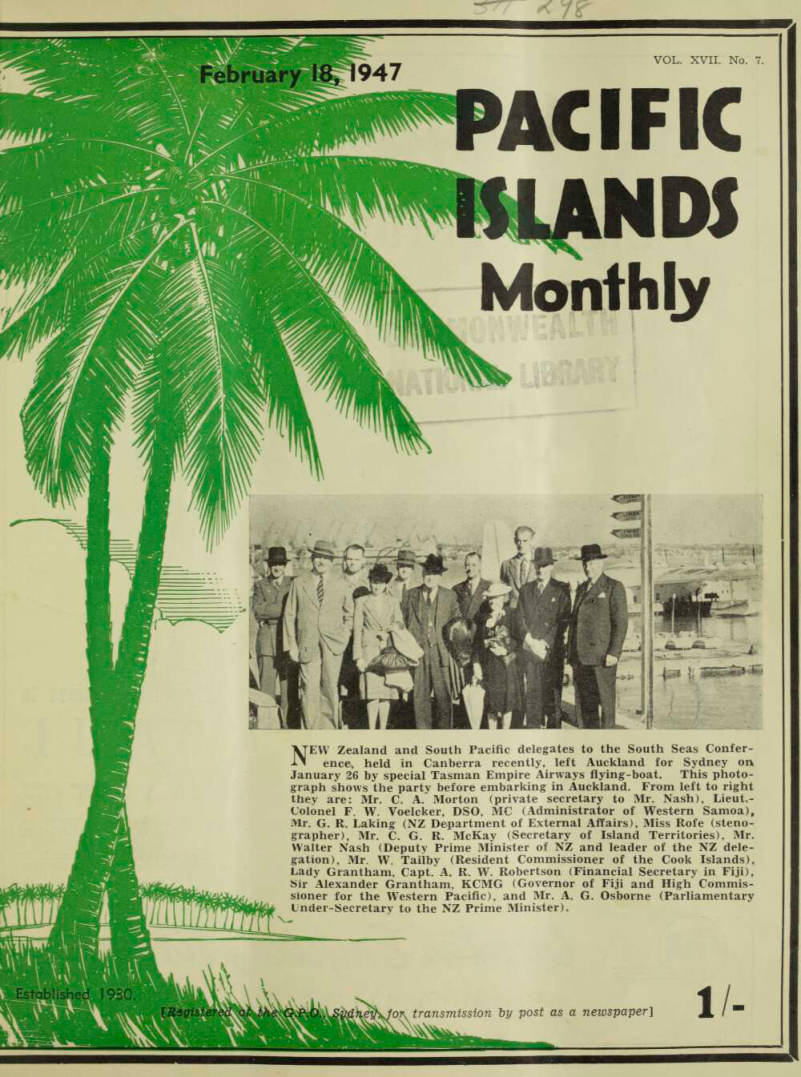
NEW Zealand and South Pacific delegates to the South Seas Confer ence., held in Canberra recently, left Auckland for Sydney on January 26 by special Tasman Empire Airways flying-boat. This photo graph shows the party before embarking in Auckland. From left to right they are: Mr. C. A. Morton (private secretary to Mr. Nash), Lieut.- Colonel F. W. Voelcker, DSO, MC (Administrator of Western Samoa), Mr. G. R. Taking (NZ Department of External Affairs), Miss Rofe (steno grapher), Mr. C. G. R. McKay (Secretary of Island Territories), Mr.
Walter Nash (Deputy Prime Minister of NZ and leader of the NZ dele gation), Mr. W. Tailby (Resident Commissioner of the Cook Islands), Lady Grantham, Capt. A. R. W. Robertson (Financial Secretary in Fiji), Sir Alexander Grantham, KCMG (Governor of Fiji and High Commis sioner for the Western Pacific), and Mr. A. G. Osborne (Parliamentary Under-Secretary to the NZ Prime Minister).
Advertisements & other items, pp. 2-3 (1 item)
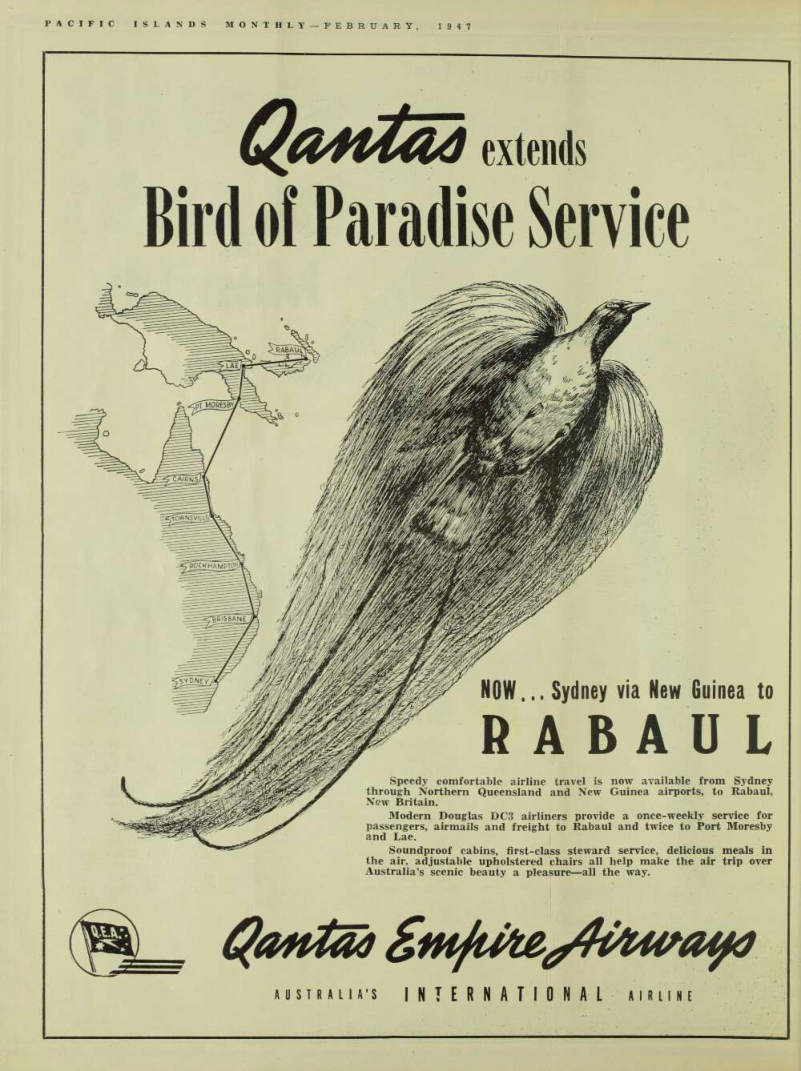
Qantab
extends
Bird of Paradise Service
RABAUC
===?LAE
£> MORESBY
& 0 1 7M
NOW... Sydney via New Guinea to
RAR A u L
Speedy comfortable airline travel is now available from Sydney through Northern Queensland and New Guinea airports, to Rabaul, New Britain.
Modern Douglas DCS airliners provide a once-weekly service for passengers, airmails and freight to Rabaul and twice to Port Moresby and Lae.
Soundproof cabins, first-class steward service, delicious meals in the air, adjustable upholstered chairs all help make the air trip over Australia’s scenic beauty a pleasure—all the way.
Australia’s INTERNATIONAL airline
' > ■% ■ • •• / N / - / Ml f Can be set up ready for use in a few seconds.
For its size this new Coleman Stove is
amazing. Although
only 8| in. high and 4i in. wide it boils a pint of water inside 5 minutes. t is made of corrosion-resistant metal . . . lights instantly . . needs no priming . . burns any kind of petrol and cannot spill fuel even when tipped over.
Telescopic cose makes two handy cooking utensils. The pot supports at top told in tor pocking.
Representatives for the Pacific Islands
ROBERT GILLESPIE PTY. LTD.
S4a PITT STREET, SYDNEY
PEARCE Cj CO
SUVA
FOR FIJI ISLANDS
LTD.
Vernon Memorial
(Samarai) Fund
TWO donations to the Vernon Memorial Fund have been received by the Pacific Publications Sydney office on
behalf of the Samarai fund since the list was last printed in December.
Previously acknowledged £47 4 0 Cuthberts Misima Gold Mine, Ltd 3 3 0 W. E. Jarrett 2 2 0 £52 9 0
Death Of Old Papuan
Identity
A WELL-KNOWN former resident of Papua, Mr. William J. Priest, died in Brisbane on January 28.
He was born in England about 79 years ago and served his time in sailing ships.
He captained many trading vessels in New Guinea waters in his early days in the Territory and later ran a plantation.
He is survived by his daughter, Mrs C. G. Harrison, of Fraser Street. Ashgrove, Brisbane.
BILLY PRIEST was born in Liverpool and arrived in Papua as the boat swain of the Ivanhoe which was owned by Burns Philp and Company. He was engaged for many years in seafaring and in sailing boats for many owners in th°t era nf small craft.
Priest was colour-blind and was thus unable to go for his Master’s ticket.
He was a deep reader and a fluent speaker and was always interested in astronomy and navigation. After he left the sea he settled on the small island of Helena near Samarai and worked on the plantation of Fred Evenett for several years. Later he helped build the wharf at Samarai and then moved on to Moresby. In Moresby he married into a part-Chinese family who then had a large market-garden on the Laloki River.
He and his family were evacuated to Brisbane in 1942 and for a while Priest was attached to the US Navy as a can vas worker. His wife died during this time and his daughter married a Bris bane man.—D. H. Osborne.
Mrs. E. L. Leembruggen and her daugh ter, of Vila, New Hebrides, visited Sydney in December and January and returned to the Condominium on the February “Morinda.”
Advertisements & other items, p. 4 (1 item)
-Budge-
BROOMFIELDS Ltd.
Suppliers of Building Hardware General Hardware Ship Chandlery
TELEPHONES:
LA5034-5-6
-BUDGE-
REFRIGERATION
EQUIPMENT
Commercial and Industrial Units
(not domestic) Ammonia and Methyl Chloride machines of large or small capacity.
The illustration is of a complete 30 cwt. Ice-making Plant, comprising twin, enclosed ammonia compressor, evaporative condenser, insulated ice tank, etc. It may be driven by a 10 h.p. electric motor or diesel engine.
Inquirers should mention dimensions of cold room (or cabinet) and amount of ice (if any) required per day.
JAMES BUDGE PTY. LTD.
Established 1890.
REFRIGERATION ENGINEERS
McEvoy Street, Alexandria,
Sydney
Advertisers

Amalgamated Hatcheries ... 34 Aluminium Union, Ltd. ... 3 Angliss & Co. . 43 Aust. Fishing In dustries ... 71 A. G. Andrews Co., Inc 48 Atkins Pty., Ltd., Wm 20 Baker, W. Jno. . . 69 Bethell, Gwyn & Co 72 Brown & Co., Ltd. 13 Brunton's Flour . 68 Burns, Philp Trust Co., Ltd 21 Budge, James, Pty., Ltd 2 Broomfields ... 2 BP (SS) Co. . . . 13 Bulowat Transport Co 44 Carlton & United Breweries, Ltd. . 56 Carpenter. Ltd., W.
R cov. iv.
ChTvers, Ltd 22 Church, R. H., & Sons 64 * Coleman Lamp & Stove Co 67 “Cysbex” 52 Commonwealth Trading Co. Pty., Ltd 14 Crosse & Blackwell, Ltd 66 Dalmore Preserving 55 Donaghy & Sons . 22 Donald. Ltd., A. B. 18 Paul, A. Dorn ... 67 Dr. Williams Pink Pills 28 Dangar, Gedye & Malloch 59 Dunlop Rubber (A/sia), Ltd, . . 17 Ecco Products ... 26 Electrolux Refrigerators . . 31 Garrett & Davidson 78 Gibson & Co., Ltd.,
J. A. D 51
Gillespie Pty., Ltd., Robert . . . 1 & 69 R o b t. Gillespie (NG), Ltd. ... 63 Gilbey's Gin ... 32 Gillespie’s Flour . . 57 Gough & Co.. E J. 33 Grand Pacific Hotel 4 Grove & Sons, W.
H 33 Heinz & Co. Pty., Ltd , H. J, . . .46
Hemingway &
Robertson ... 52 Hislop Lloyd Pty., Ltd 3 & 67 Hyde, Victor ... 14 Ingram Shaving Cream 74
Ipana Tooth Paste 15 Kentucky Stud . . 16 Kopsen & Co., Ltd. 65 Lockyer. Geo. J. . 58 Merrillees, J. C. & Co 71 Miscellaneous . 30, 53, 55, 71, 72 “Mum” Deodorant 60 “Mendaco” ... 61 Mcllraths Pty., Ltd. 16 Morgan, F. J., & Co 61 Napt is Nelson & Robertson Pty., Ltd 73 Newman, M. . . .57 NSW Bookstall Co.
Pty., Ltd 65 “Nixoderm” . ... 64 Newman’s Fruit Mart 64 Pacific Islands Trading Co. . 19, 45. 63 Pacific Is. Society . 66 “Pinkettes” ... 72 Pitt & Scott, Ltd. . 33 Proprietary Products 73 Qantas Empire Air ways ... cov. ii.
Queensland Insur ance Co. ... 25 Robinson, G. H. . 50 Rose’s Eye Lotion, 51. 66 Rohu, Sil . . . . 3 Scott, Ltd., J. ... 25 Shell Co 54 Southern Pacific Insurance Co, . . 16 Steamships Trading Co., Ltd 50 Stewarts & Lloyds (Aust.) Pty., Ltd. 23 Stokoe Motors Pty., Ltd 72 Sullivan & Co., C, 24 Swallow & Ariel . 49 South Sea Islands Club 73 Taylor & Co., A. . 48 “Tenax” Soap . . 44 Tillock, & Co., Ltd. 30 Tooth & Co., Ltd cov. iii.
Tilley’s Lamps . . 77 “Vitalis” Hair Tonic ... 53 Vacuum Oil Co., Ltd 47 Watson, Wm. H. . 27 Harry West ... 28 Widdop, H., & Co., Ltd 62 Willison, A. ... 68 Wright & Co. ... 70 Wills, W. D. & H. 0 23 Wright & Co., Ltd., E 28 Wunderlich, Ltd. . 68 Yorkshire Insur ance Co., Ltd. . 13
Advertisements & other items, p. 5 (2 items)
3
PACIFIC ISLANDS AlONlttLlT FEBRUARY, 19 'A 1
Aluminium Union
WANTED TO BUY—QUALITY GUNS AND RIFLES
HIGHEST PRICES GIVEN. WILL ALSO EXCHANGE GUNS.
New .303 Short Service Barrels, 25 \<z \ without Sights and Platform, £2/15/- each.
Postage extra.
SI L RO H U Quality Firearms and Fishing Tackle. 143 ELIZABETH STREET (Near Market St.) SYDNEY. PHONE; MA 3540.
T &Mtfaiete Sendee
* BUYING ★ SHIPPING *
SEND FOR
FREE copy
of
'THE
MOTORIST'S
MAIL''
our quarterly catalogue i
AUTOMOTIVE SPARES,
ACCESSORIES
AND
REPLACEMENT
PARTS
What you want,
When you want it
YES! Practically everything in
Auto Spares for most makes ond types of motors. Batteries, Spark Plugs, Cables and Wiring, Pistons and Rings, Brake Linings. In fact, all necessities and accessories for the motor trade are in our stock bins for prompt delivery.
Cables: “Hisloyd’’ Sydney.
Codes: Bentley's, A.B.C. 6th.
Hislop, (Lloyd
335-7 PITT STREET, SYDNEY
Pty
Q n
Aluminium in all its forms ..
Corrugated Aluminium Roofing is now available for use in the rehabilitation of Pacific Territories. Aluminium Roofing is considerably lighter in weight than most roofing materials and consequently heavy roof members can be eliminated. Aluminium Roofing is rustless, and reduces solar radiation through the building, making it the ideal material for roofing in the tropics.
Please consult us regarding your roofing problems.
ALUMINIUM UNION
LIMITED
Incorporated in the Dominion of Canada A FULLY-OWNED SUBSIDIARY OF ALUMINIUM LIMITED, MONTREAL. CANADA Ocean House, 34 Martin Place, Sydney, N.S.W., Australia
In This Issue;
Editorial: “South Pacific Conference... in an Unhappy Atmosphere’’ ... 5 Rabaul to be Abandoned— New Administrative Centre of New Britain 6 Copra Stabilisation Fund for N.G. .. 6 Termination of Suspension of Leases in N.G 6 Still No Ships for Rabaul 7 Airletters to U.S.A 7 Pacific Air Services Sydney - San Francisco 7 Six Nations Meet in Canberra for South Seas Conference 8 New Guinea Students in Fiji 10 Electricity for Rarotonga 10 American Yachtsmen Seek the Soutn Seas 10 Fifth Conference of PICAO Meets in Melbourne to Consider Pacific Air Problems 11 Copra—Price Rises in New Guinea and Fiji 12 New Governor for New Caledonia .. 12 New Guinea Plane Fatality—MAL Pilot Killed 13 Telecommunications Take over AWA 14 Death of “Yankee Doctor” —Story of S. M. Lambert who Fought and Beat Hookworm 16 Coconut Oil, Not Copra—Solution for Planting Industry 18 Investiture of High Chief Ata .. .. 20 New Guinea Memorial Scholarship . 21 “Pomare” goes to Dock 22 BSI Government “Anxious for Copra Production” 24 War Damage Insurance for N.G.
Natives 24 44-Hour Week in Fiji 25 War Damage in BSI 28 Oil Exploration in Papua 30 How 200 Men were Saved in New
Britain—Concluding J. K. Mc- Carthy’s Story 32 Territories' Talk-Talk 35 She Writes of a Glamorous South Seas 36 Hospitality in the Mangaia Manner 37 Our South Pacific Islanders Come all Ways 38 Short Story: “The Training of Dorika” 40 Tropicalities 41 Vernon Memorial Hospital 48 Oranges at 6d.! 48 Force Signals, F.D.F.—An Apprecia tion of Mr. D. Junor’s work in Fiji in 1939-40 49 Jap Dodging Behind Flnschhafen .. 51 Fiji’s Future—Need for New Indus tries 5,5 Tribute to Harry Downing 56 How “Umboi II” was Taken Home .. 57 Fly to New Caledonia—Short Term Tourist Passports being Issued .. 60 Shipping and Plane Services :; Pacific Travellers 61-64 Royal Romance in Tonga 65 Battle of Fiji Airfields—How it Affects Fiji Tourist Traffic 69 January 23—Fifth Anniversary of Fall of Rabaul 70 Japs Discovered in Butaritari 71 N.G.G. Plan for 1947 72 No Export Tax on Australian Goods Sent to New Guinea 73 Commercial, Markets, Etc 76 Obituarv: W. J. Priest, 2; D. G. Tapsall. 13; Dr. S. M. Lambert. 16: R. Lepper, 22; Mrs. R. D. McPhee. 25; W. J.
Lambden. 27; K. Parker. 28; Harrison Smith, 56; W. C. Dexter, 56; Dr. A. J. Bass, 74.
about islands people
Mr. and Mrs. Nigel Frazer, who have been living in Toowoomba tQ.'i since their evacuation from New Guinea, will return to the Territory in the near future.
Mr. J. Graham, planter, of Madang, New Guinea, returned to the territory by the “Montoro,” which left Brisbane on January 16. He will examine his property before he decides whether to reopen it. It was badly battered by the Japs.
The Rev. H. W. Whyte left Brisbane by flying-boat recently for Western Samoa, to continue his work there with the Lon don Missionary Society. He has worked as a missionary for 28 years—2o of which were spent in India, the rest in Samoa.
His son. Dr, Henry Malcolm Whyte, Queensland Rhodes Scholar for 1947, whom he had been visiting, has had a distinguished scholastic career, He won three scholarships, two special medals, the Harold Plant memorial prize for 1944: and also holds the degrees of Bachelor of Medicine; Bachelor of Surgery and also Bachelor of Science. Dr. Whyte won his success the hard waj. To complete his university training, he worked in factories and on farms during week-ends and vacations. At Oxford, Dr. Whyte intends undertaking a post-graduate course in clinical science.
The Rev, J. F. Goldie, for many years treasurer of the Solomon Island Mission district, completes this year, fifty years’ active service in the ministry. His first appointment as a probationer was to Townsville CQ.» in 1897.
The Rev. W. Green who has been chairman of the Fiji Methodist District for a considerable time, will shortly re tire from the mission and will take up church duties in New Zealand.
Advertisements & other items, p. 6 (2 items)
4
f’fiBRtJARY, 1947 PACIFIC ISLANDS M6NT 8 L $
%
r V 9S&* dt^
TAV
s
Pacific Islands Monthly
The Newspaper-Magazine of the South Seas [Registered at the GR.O., Sydney, for transmission by post as a newspaper.']
Published Once Each Month and Circulated in Australia and New Zealand and in the following Pacific Territories and Islands Groups;
Australian Territory of Papua.
Mandated Territory (Australia) of New Guinea.
Australian Territory of Norfolk Island.
New Zealand Territory of Cook Islands.
Mandated Territory (NZ) of Western Samoa.
British Colony of Fiji.
British Solomon Islands Protectorate.
British Protectorate of Tongan Islands.
British Crown Colony of Gilbert and Ellice Islands.
Mandated Territory of Nauru.
British and Free French Condominium ol New Hebrides.
French Colony of New Caledonia.
French Colony of Oceania (Tahiti, etc.).
American Territory of Eastern Samoa.
American Territory of Hawaiian Islands.
Owned and Produced by Pacific Publications Pty. Ltd., Union House, 247 George Street, Sydney.
Vol. XVII. No. 7.
February 18, 1947
Priro l/ Per Copy rrice Prepaid: 10/- p.a.
South Seas Conference In An Unhappy Atmosphere
THE plan of the South Pacific Re gional Conference was good; and the delegates’ will to accomplish something worthwhile was sincere and praiseworthy. But the Confer ence opened amid nasty political dis cord, and closed under the shadow of vast industrial turmoil. The atmo sphere definitely was not favourable to the accomplishment of anything very noteworthy.
These are not conditions peculiar to Australia: they are common to most of the British Empire, including Bri tain herself, and to France and Hol land. How can intelligent men give their minds completely to the prob lems of native welfare, while prob lems urgently affecting the future of their own people are already defeat ing their leaders in their home coun tries?
Among the delegates who assembled in Canberra there were three classes of men. First, there were the poli ticians—professional babblers, who see all questions with the eye of sec tional prejudice, and whose glib tongues are nearly always informed by knowledge that is purely super ficial. These generally are most dan gerous men—they have great power, they have hypnotised themselves into a belief in their own correctness of view and purity of mind, and they punish all who disagree with them.
These are the “small-time” men who have brought so large a section of the English-speaking world into its pre sent deplorable situation.
The second class are the so-called experts, who have been appointed to highly-paid posts in the Islands’ ad ministrations by the politicians, and who gratefully acknowledge the lat ter as their masters. The Socialist Governments of Britain, Australia and New Zealand have continued and sharply expanded the vicious old system of political appointments—of putting into number one administra tive jobs men who have not been trained for those jobs—and it stands to reason that the appointees, no matter how able and sincere they may be, will allow their judgment to be coloured by their sense of obliga tion.
The third class comprises the
trained men—officials who have spent their lives in particular services, who have no political associations or obli gations, and whose experience and consciences have developed a magis terial mind. These are the men to whom we naturally should look for advice and guidance in all matters affecting the administration of Paci fic Territories; but, under the present fantastic post-war conditions, such men are usually overshadowed and swamped by classes one and two.
THE prelude to the Canberra Con ference was startling, but it pro vides a fitting introduction—a first class fight between the convening Minister, Dr. Evatt (a moderate), and the Speaker of Parliament (Mr. “Sol”
Rosevear, a noisy extremist) con cerning the use of Parliament House for the Conference. Dr. Evatt and his Conference were chased out to a suburban schoolhouse. A piquant bit of background lay in the fact that associated with the defeated and furious Dr. Evatt in the launching of the Conference, was Mr. “Eddie”
Ward (Minister in charge of Aus tralia’s Pacific Territories) a friend and well-wisher of Mr. Rosevear and the Leftists. Thus the overseas dele gates were left in no doubt about political conditions in Australia.
The usual platitudinous and insin cere rubbish was talked at the open ing ceremonies—that is inevitable, wherever politicians are gathered to gether—but it is to be regretted that these Labour Ministers could not keep their sectionalised political views out of their utterances on an occasion like this. The New Zealand Minister.
Mr. Nash, for example, let himself go on the subject of “native exploita tion.” According to Mr. Nash, Euro pean administration of the South Pacific Islands in the past has been merely a cover for “exploitation” of the innocent, long-suffering Island ers; but, by the grace of God, Soci alist Governments have come into power throughout the world to rescue the natives from ruthless traders and industrialists, and establish them in charge of their own countries.
Thereby, doubtless, Mr. Nash ex pressed the sentiments of the Aus
tralians, and some of the British, It is, of course, merely eyewash, designed for things like the Inter national Labour Office and Socialist world-planners; but it is accepted as truth by the unthinking and ignor ant industrial masses.
THERE has been no large-scale or systematic exploitation of Pacific Islands natives for at least 50 years.
Since “blackbirding” was exposed, long ago, the Islands Administrations have been extremely sensitive on the subject of the employment of natives, and all relationships between Euro peans and natives have been strictly and sternly policed. The indentured labour system, which operated in all Melanesian countries until the inva sion, did a very great deal to raise the standard of native life generally.
But, because the cash wage paid to a kept labourer was less than £2O per annum—wealth for a primitive Mel anesian—the system was attacked by the ignorant trade union folk of Aus tralia, and abolished by a class-con scious Minister. The effect of this hasty, ill-judged action is seen to day in the economic chaos of Papua- New Guinea; and, probably, worse is to come. Yet that indentured labour system could have been used most effectively, by Ward and Company, to (a) lift the natives’ standard of life and give them useful technical train ing; (b) quickly restore the Terri tories’ industries.
All the better-class Europeans in the Territories, from the largest trading firm to the smallest planter, acknowledged an obligation to the natives; and, so far from “exploit ing” them, have been ready always to co-operate with the Governments in raising the standards of native life and encouraging re-population.
All those Europeans approved the design and purpose behind Dr.
Evatt’s South Pacific Conference.
The need for some agency to under take the study and co-ordination of South Pacific administration, in the interests of the natives, has been seen, and acknowledged, these many long years. The idea was presented to the non-Labour Governments of Australia and New Zealand, some 15 or 20 years ago, but was either ridi culed or ignored. It is a tribute to the
wisdom and vision of Dr. Evatt that he could make and launch such a plan.
THE plan has been approved, and the South Pacific Regional Com mission soon should be an accom plished fact. Its purpose and its hopes are described elsewhere. It is a tragedy that it should have been launched under unhappy auspices.
Unless all signs and portents are wrong, the Governments of Britain, France, Holland, Australia and New Zealand soon will have upon their hands so many problems involving the future and wellbeing of their own white people that they will have neither time nor energy to spare for the native Islanders. The elaborate economic machinery created by the Socialists for the regeneration of the war-weary world is creaking and cracking, and in imminent danger of collapse. If the three British Em pire Governments do not soon aban don Socialism, and return their nations to a substantial measure of Individualism, disaster cannot be avoided.
It will be time enough for these well-meaning Governments to devote themselves to a study of the native Islanders’ living standards when all is well with their people at home.
Sooner or later their troubles will pass.
Then we shall be very glad that the Conference was held in Canberra in January, 1947—it will have provided us with long-needed machinery for more enlightened and efficient Islands administration. By then, we hope, the politicians and the political appointees will have largely disap peared from the Pacific scene, and the study and the planning will be carried on by men who really know something about colonial administra tion and Pacific Islands problems.
Black-Out By Wells
This cartoon, which is republished by courtesy of the Melbourne “Herald,” should remind Aus tralia that she has a native problem at home.
While Evatt and Ward are arranging “new deals” for Pacific natives, little is being done for the Australian aborigine.
Late News
Rabaul To Be Abandoned
IT has been decided to abandon the township area and harbour installa tions of Rabaul, New Britain, and to construct port facilities for the Adminis trative Headquarters of the New Britain district of New Guinea at Kokopo, about 20 miles distant.
This was announced by the Minister for External Territories on February 12.
Rabaul was the capital of the Man dated Territory of New Guinea until 1941.
It was a well-built tropical township with fine homes and gardens, and a natural harbour which afforded all-weather pro tection to shipping. It was, however, practically devastated in 1937 when Vulcan and Matupi craters erupted and further volcanic activity in 1940-41 led the Com monwealth Government to the decision to move the capital to the mainland at Lae. This move was being made when the Japanese occupied the territory.
All of pre-war Rabaul was, of course, destroyed during the war, and apart from the lack of harbour facilities at Kokopo, the new New Britain commercial and ad ministrative centre might as well be built there as where Rabaul formerly stood.
An important factor in choosing Koko po was the selection by the aviation auth orities of a site about 8 miles away near Cape Gazelle for an aerodrome to replace the present airstrip at Lukunai, close to the former Rabaul township.
The Minister said that the selection of the Kokopo area as the site for the Ad ministration Headquarters of the New Britain district should not be confused with the location of the capital of the New Guinea Territory or the combined Territory of Papua-New Guinea, if a de cision is taken to amalgamate perman ently the former separate territories of Papua and New Guinea.
A decision has not yet been taken upon that question or upon the choice of the location of a site for the capital.
Suspension Of Ng Leases,
Licences Terminated
IT was announced on February 12, that the suspension of leases, licences, per mits, rights or authorities in relation
to any land or in relation to any other matter, granted by the Crown or by the Administration of the Territory of Papua or the Territory of New Guinea and in force on the 11th day of February, 1942, has been terminated as from the 11th February, 1947.
The suspension of these leases, licences, permits, etc. had been effected under National Security (External Territories) Regulations on 11th February, 1942, when, in consequence of the Japanese invasion of the Territories, the Civil Administra tions were suspended and the civil popu lation was evacuated.
Upon the termination of the suspension, the leases, licences, permits, rights or authorities will receive and continue for a period equivalent to the period which was unexpired at the 11th February, 1942, and the holders thereof will now enjoy the rights and be subject to the obliga tions thereunder.
Copra Stabilisation Fund
For Ng
rE Australian government has decided to “establish a Stabilisation Fund to assist in maintaining the (copra) in dustry in New Guinea on a sound basis.”
This was announced by the External Territories Department on February 12, and follows a recent rise in copra prices made to producers in Papua and New Guinea. It is stated that the price pay able for copra in Australia is £36/10/- and the difference between this amount and what the planters actually receive (£2B per ton for hot air copra and £27 for smoke-dried, at the main ports in Papua and New Guinea) is represented by the cost of transport from the Territories to Australia, the Territory Customs export duty and a special levy to be paid to a Stabilisation Fund.
The Departmental statement continues: “There is a very strong world demand for copra at the present time and every ef fort is being made to secure from the Territories of Papua and New Guinea all possible production. The price of copra has, however, fluctuated during the years prior to the war, and as it is not possible to forecast the future trend of prices it has been decided to establish a Stabili sation Fund to assist in maintaining the industry on a sound basis.
“To this Fund will be paid surplus funds held by the Australian New Guinea Pro duction Control Board in respect of Copra trading and the levy of £1 per ton that is now being imposed.
“The amount of the levy for the Stabi lisation Fund and the price payable to planters will be reviewed should .any fur ther increase in price for the commodity in Australia be authorised by the Com monwealth Prices Commissioner.”
(See article on page 12 this issue )
Miss Myra Harber, formerly of Perth, WA. has recently been appointed house keeper at the Presbyterian Overseas Mission hospital in Vila, New Hebrides.
The Governor of Fiji, Sir Alexander Grantham, and Lady Grantham, were ex pected to arrive in Suva by plane from Australia on February 15. His Excell ency is accompanied by Mr. J. E. Side botham, Under Secretary of the British Colonial Office, who will make a brief stay in Fiji and look over the Colony’s administrative machinery.
Still No Ships For Rabaul
Residents of New Britain and New Ireland Will Soon Have to Live Off the Country
RESIDENTS of Rabaul and New Britain who have had no direct shipping communication with Australia since the Duntroon arrived in Rabaul in November, carrying some returning Ter ritorians and some stores, need not start scanning the horizon for the next ship for a few weeks yet.
According to information received from the Sydney office of the Australian Ship ping Board, the chances of Rabaul getting a ship (and supplies) from Australia within the next month are remote.
The only information forthcoming is: Salamaua —this ship is scheduled to leave Australia towards the end of Feb ruary. She will make calls at Port Moresby and Rabaul before going on to America. The Salamaua. however, has accommodation for about 10 people and no freezer space.
Reynella— this ship is on its way back to Australia from Shanghai, and was scheduled to call at Lae about February 12. She will then proceed direct to Mel bourne. It is believed that after she has completed her present voyage, she may be sent to New Guinea with passengers and cargo, in which case a call will prob ably be made at Rabaul.
Malaita —this ship is still in dock and although she has been “on the eve of departure for New Guinea ports” (again, including Rabaul) for the past six months, her actual date of departure is as un known now as it was in mid-1946. The best information available about her is that “she will sail for New Guinea some day.”
Montoro is at present on a trip around New Guinea mainland ports. It is rumoured that she will go to Rabaul on her next trip out of Sydney. This rumour, too, has been current before each of her sailings for the last six months.
The Shipping Board says that she will not go to Rabaul on her next trip—or any trip. Due to long delays in New Guinea ports the Montoro consumes more coal than she can carry. On the return trip from New Guinea she has usually to call at Bowen (Qld.) to take on coal and if she included Rabaul in her schedule she would not have enough coal to take her back even as far as that port.
AUTHORITY, in the form of the Aus tralian Shipping Board, when asked whether the people of Rabaul and New Britain (and those unfortunates who have returned to plantations as far afield as Bougainville and Buka) are to be left to starve, shrug the Departmental shoulders and say; “There is nothing we can do about it. There just aren’t any ships.”
There are fewer ships now, it is ad mitted, but the trouble lies ashore, rather than afloat Loading and unloading of ships in New Guinea is notoriously inefficient and slow.
The position in Australia is. if anything, worse. All Australian ports have been in the throes of a dispute which began over the wharf-labourers’ demand for payment of £B/17/10 per week for two weeks’ annual holiday, and 16/- per day for “appearance” money. This dispute has now been settled but on February 12, they held their “annual picnic” in Sydney.
No ships were worked at all.
Until recently, wharf-labouring was re garded as a casual business —men pre sented themselves for work when they wished and few worked frequently enough to entitle them to annual holidays and
other privileges of workers in other in dustries.
The following extract from the Sydney Morning Herald of February 11, gives residents of Rabaul (and other Pacific outposts) some idea why they must tighten their belts and take it: “A shipping executive said yesterday that before the war general cargo was handled at the rate of a ton a man an hour, and a gang of 20 handled 20 tons an hour.
“The rate had become progressively slower until now a gang of 20 handled about eight tons instead of 20 tons an hour.
“For this and other reasons the turn around of ships had been slowed up by 60 per cent, even when the men worked after 5 p.m.”
OUR Rabaul correspondent writes that mid-January saw the finish of fresh meat, vegetables, flour, milk, benzine and most other supplies in the town.
The position was then considered so seri ous that a general meeting was convened for the purpose of trying to get the Government to provide shipping facilities between Rabaul and Australia. The local Planters Association and the Citi zens Association had at that date, alreadv made representations to the Minister for External Territories regarding the ship ping position and the food supply. l4: Latest rumour from the J? waterfront is that the “Merkur” now loading in Sydney for Japan, will call at Rabaul. She will carrv only essential foodstuffs but no passengers or other freight.
Air-Letters To Usa
Extension of Cheap Service
ALTHOUGH the airmail rate to America from Australia remains at 2/6 per half ounce (airmail from America to Australasia and South Pacific Islands is only 25 cents) an extension of the air-letter service has now been made to include North American and United States possessions.
Air-letters can be purchased at any post-office in Australia for 7d. They con sist of a single sheet of thin paper which when folded, has a space for the address.
Air-letters, although not altogether ele gant, will be a cheap and quick method of trans-Pacific communication.
American possessions where the air letters may now be sent are: Guam, Hawaii, the Panama Canal zone, Porto Rico, and Virgin Islands.
Fiji's Governor
Sydney Reception for Fiji's Governor
THE Governor of Fiji, Sir Alexander Grantham and Lady Grantham, were the guests of honour at a re ception held bv the Pacific Islands Soc iety at Macquarie House, Macquarie Street, on February 11.
Sir Alexander is Patron of the Society.
Lady Grantham, who has not been in Sydney since October. 1945 was delayed by an appointment, but arrived in time to meet more than 50 members of the society who were called together at short notice for the occasion.
Sir Alexander has been attending the South Seas Commission conference in Canberra. He and Lady Grantham left for Fiji by air on February 12.
Former Jap Mandates
For US Trusteeship?
Proposals to go Before United Nations Security Council This Month
WHEN the United States Secretary of State, General Marshall, held his first press conference in early Feb ruary he stated that America would sub mit to the next meeting of the Securiity Council of the United Nations Organi sation (scheduled for February 17) a proposal that former Japanese Mandated islands (the Carolines and Marshalls) be placed under United States “strategic tru?=teship.”
This move by the US will be made in spite of suggestions recently nut forward by Britain, Russia and Australia, that the disposition of such islands should be post poned until a peace treaty has been neg otiated with Japan.
General Marshal said that he saw no res son why the matter should be post poned; but the United States would con sider any postponement if or when it is proposed by the Security Council.
Pacific Air Services
New Australia-US Services
THE first trans-Pacific flight under the reciprocal landing agreement which was signed by Australian and United States representatives on December 3. will be undertaken by Australian National Airways Pty. (on behalf of British Com monwealth Pacific Airlines) on February 23. Flights will be made thereafter at weekly intervals.
Passengers will be set down in San Francisco or Vancouver instead of only in Vancouver as at present and passengers may now also be set down in Hawaii. A small reduction in fares has been made as follows: Sydnev Vancouver, single £2I4A; return, £3BSA (this was formerly £42BA). Sydney San Francisco, single £2OOA and return £365A.
Accommodation is available for two passengers from Australia to Fiji. but not from Fiji to Australia unless the space is not needed for through passengers.
The reason for this is that on the north bound journey from Nadi (Fiii) to Can ton Island, two seats are kept vacant in order to carrv more petrol: two passen gers may therefore be accommodated from Australia to Nadi, on which hop less petrol is necessary.
The plans of Pan-American Airways are less definite: but they sent a plane from Sydney northbound on February 12, and they hope to be sending planes at weekly intervals thereafter. Pan-Ameri can aircraft call at Noumea. New Cale donia. ANA fly direct to Nadi.
Plenty To Spend But
Nothing To Buy
Nuku’Alofa. Dec., 27.
THE high price of copra gave Tongans increased spending this Christmas and the pre-festive season buying period was somewhat hectic, for Tonga.
Hundreds of people came in from the country towns to make their Christmas purchases in Nuku’alofa shops and as a result of the consequent overcrowding several people were knocked down in the roadways by motor vehicles.
The only thing that dampened the crowd’s enthusiasm was the shortage of goods in the shops. Tongans felt that they had been robbed of something, as their newly-acquired financial freedom availed them nothing.
Six Nations Meet To Plan Advancement
of South Pacific Peoples South Seas Agreement Drawn Up and Signed
Delegates At South Seas
Conference
United Kingdom
Mr. Ivor Thomas, MP.—Parliamentary Under secretary o£ State for the Colonies.
The Rt. Hon. E. J. Williams. —United Kingdom High Commissioner, Canberra.
Sir Alexander Grantham, KCMG.—Governor of Fiji and High Commissioner for the Western Pacific.
Mr. J. B. Sidebotham, CMG.—Assistant Secretary in Charge Pacific Department Colonial Office.
Mr. A. R. W. Robertson. —Financial Secretary, Fiji.
Mr. G. Kimber. —Office of the United Kingdom High Commissioner, Canberra.
France
Monsieur Pierre Auge.—French Minister in Canberra.
Monsieur R. F. Lassalle-Sere.—lnspector-General of Colonies.
Monsieur A. Gazel. —French Minister in New Zealand.
Monsieur J. Tallec.—Retiring Governor of New Caledonia.
Monsieur, J. C. Haumant. —Governor of French Establishments in Oceania.
Monsieur E. M. de Curton.—French Ministry of Foreign Affairs.
Netherlands
Baron F. C. van Aerssen Beyeren van Voshol, MWO, NL. —Netherlands Minister in Aus tralia.
Colonel Abdoelkadir Widjodjoadmodjo.—General Adviser to the Lieut.-Governor-General of the NEI.
Dr. H. de Rook. —Secretary, Department of Health, NEI Administration.
Dr. Liem Hian-Boo.—Adviser to the NEI Adminis tration.
Mr. M. A. Pellaupessy.—Commercial Adviser to the NEI Administration, Amboina.
Mr. A. J. Beversluis.—Deputy Director of Forestry Service, NEI Administration.
Jonkheer Dr. J. A. de Ranitz. —Royal Nether lands Legation, Canberra.
Lieut, van der Star, RNN (ADC to Lieut.- Governor-General). —Secretary of Delegation.
Mr. J. K. Kroon.—Adviser.
United States
The Honourable Robert Butler.—United States Ambassador in Canberra.
Captain Harold A. Houser, USN.—Governor of American Samoa, Navy Department Adviser.
Mr. James F. Green. —Associate Chief of Division, Dependent Area Affairs, Department of State.
Mr. Roy E. James.—Division of Territory and Island Possessions, Department of the Interior.
Mr. Abbot Low Moffat.—Chief of Division, S-E Asia Affairs, Department of State.
Mr. Arthur L. Richards.—Assistant Chief of Division, British Commonwealth Affairs, Department of State.
Mr. Emil J. Sady.—Division of Dependent Area Affairs, Department of State.
Australia
The Rt. Hon. H. V. Evatt, KC, MP.—Deputy Prime Minister and Minis t|.* for External Affairs.
The Hon. E. J. W’ard, MP.—Minister for Ex ternal Territories.
Sir Frederic Eggleston.—Formerly Minister to the United States.
Col. J. K. Murray.—Administrator of New Guinea.
Prof. K. H. Bailey.—Commonwealth Solicitor- General.
Mr. J. R. Halligan.—Secretary, Department of External Territories.
New Zealand
The Rt. Hon. Walter Nash, MP.—Deputy Prime Minister and Minister of Finance.
Mr. A. G. Osborne, MP.—Parliamentary Under secretary to the Prime Minister.
Mr. J. G. Barclay.—New Zealand High Com missioner, Canberra.
Col. F. W. Voelcker, DSO, MC.—Administrator of Western Samoa.
Mr. W. Tailby.—Resident Commissioner, Cook Islands.
Mr. C. G. R. McKay.—Secretary, New Zealand Island Territories Department.
Mr. G. R. Laking.—New Zealand External Affairs Department.
Mr. C. A. Sharp.—New Zealand High Commis sioner’s Office, Canberra.
Mr. C. Craw.—New Zealand External Affairs Department,
ALTHOUGH the South Seas Conference, held in Canberra, Australia, between January 26 and February 6, had a somewhat disorganised slart, due to the last-minute withdrawal, by Party politicians, of Federal Parliament House as a meeting place; and because some delegates in their opening speeches were inclined to confine their remarks to a reiteration of the old “No Exploitation” catch-cry, a permanent Commission was finally set up and the foundation laid for future co-operation by the nations administering non self-governing Territories in the South Pacific.
An Agreement was drawn up and signed on February 6, by the following: Australia (Dr. H. V. Evatt and the Hon. E. J. Ward); France (M. Pierre Auge); Netherlands (Baron F. C. van Aerssen and Abdoelkadir Widjodjoadmodjo); New Zealand (The Hon. Walter Nash and Mr. A. G. Osborne); United Kingdom (Mr. Ivor Thomas, MP, and Rt. Hon. E. J. Williams), United States of America (The Hon. Robert Butler).
Machinery thereby designed should, if wisely and widely used:— • Co-ordinate and analyse practical ideas and through the headquarters of the Commission (which is temporarily located in Sydney, NSW), distri bute them to the areas where they will do most good. • Make available facilities for research into health, agriculture, trans port and education problems which apply to all the Territories concerned. • Attack the problem of labour and try to apply some practical system or systems; improve production.
Worth noting during the Conference was the advice of Mr. Ivor Thomas, of the United Kingdom delegation, who said that it was necessary to make haste slowly—that self-government could not be handed to a primitive people on a plate and that administrative capacity was a rare thing even among so called advanced people. This advice applies particularly to Melanesia.
The approach of delegates to the Conference varied: Representatives of the United States, Australia and New Zealand were full of enthusiasm; the French and Netherlands delegates were cautious and those from the United Kingdom somewhat phlegmatic.
{From our Special Representative at the Conference )
DELEGATES from Australia, France Netherlands, New Zealand, United Kingdom and the United States of America attended conference in Canberra from January 28 to Febiuary 6 to discuss methcds for “international co-operation in promoting advancement of peoples of non-self-governing territories in the South Pacific.” The Conference was the outcome of talks between Australia and New Zealand in 1944, when the two countries discussed matters of mutual interest in the South Pacific and drew up the Anzac Agreement.
Result of two plenary sessions and seven days of intensive committee work of the Canberra Conference was the signing of an agreement to establish the South Pacific Commission.
The Conference was formally opened on January 28, when Mr. Chifley, Prime Minister of Australia, welcomed the delegates. He said that the matter of native welfare had been discussed at the last Prime Ministers’ conference held in London and the work of the present Conference would play an important part in world peace. Australia, he said, had always been anxious to enter any discussions that would advance the welfare of native people in the South Seas.
Dr. Evatt was elected president of the Conference on the nomination of U.S.
Ambassador Butler.
Dr Evatt said that for three years it had been the Australian Government’s
wish to convene such a conference and he felt confident that an agreement for the establishment of a Regional Advisory Commission for the area in the South Seas would be hammered out. Prelimin ary discussions with all the governments concerned made it apparent that all six powers were in favour of creating such a body and were convinced of the advant ages to be gained from co-operative in ternational investigation and treatment of problems concerning the advancement of the welfare of the native peoples of the South Pacific.
The Rt. Hon. Walter Nash, leader of the New Zealand delegation, and Deputy Prime Minister of NZ, was elected vice president of the Conference, and Mr.
E. W. P. Chinnery, previously Advisor on Native Affairs in New Guinea, was ap pointed secretary of the Conference.
During the first session, leaders of the delegations addressed the Conference.
Ambassador Butler, of the United States, was keenly enthusiastic. He did not mention “exploitation of the natives” but showed a realistic approach to Pacific problems by stating that the United States hoped for the early establishment of a regional advisory commission for the South Pacific, because they believed that such a committee would mean the development of transport facilities, stim ulation of production and trade and the promotion of tourist travel. All these, he said, would tend to hasten the economic
and social advancement of the people of the region.
Baron van Aerssen, leader of the Neth erlands delegation, expressed the willing ness of his delegation to exchange views on all matters concerned, in a frank and cordial atmosphere, guided and inspired by democratic ideals as well as by the respect for existing constitutional auth ority, A welfare policy, he said, was by no means a new or unexplored field of human endeavour to his country.
Monsieur Pierre Auge, French Minister in Canberra and leader of the French delegation approved of the aims of the Commission which did not include mat ters dealing with politics and defence.
The Rt. Hon. E. J. Williams, U.K. High Commissioner in Australia, outlined some of the problems to be faced in the South Seas, but said that he did not want it thought that the U.K. had done nothing in the past and was doing nothing at the moment, because that was far from being the case.
But while the goal must be high, they must not try to reach it in one leap. For if this is done it will overload the mach ine (i.e., Local Government) and it will break down.
Both the Netherlands and French dele gates were particularly emphatic in their desire to exclude any political discussions at the Conference, nor to clothe the Commission with any power which might have political significance.
The wisdom of this atitude was demon strated during the sittings of the com mittees, when an observer for the In donesian Committee of Independnce, pre sumably for a publicity stunt, attempted to formally protest against the detention of political prisoners in Dutch New Guinea.
The Netherlands delegation was the only one which included a non-Eurpoean member —a man notable for his erudition and quiet dignity.
The Committees at Work
COMMITTEES were formed at the end of the first day’s session and commit tee meetings which were held on sub sequent days were closed to the Press.
The Vice-President (Mr. Walter Nash) impressed upon delegates that they must maintain a strict, silence as to the delib erations and discussions of their commit tees. Because of these secret sessions public interest waned concerning the activities of the Conference, and some of the daily papers—eager for any news— were inclined to exaggerate the discus sions of the various committees into “clashes” and “hitches” in the general progress of business. This was hardly a fair description of the situation where friendly differences were aired and ulti mate agreements reached after candid discussion.
Six committees on which each country was represented by delegates and advisors were formed as follows: Committee I—Area and structure.
Committee ll—The establishment and organisation of auxiliary bodies of the Commission.
Committee lll—Functions and powers of the Commission.
Committee IV —Finance, Committee V —lmmediate projects.
Committee VI —Drafting and co-ordin ation.
Advisers from Papua-New Guinea in cluded Dr. John Gunther (Health), Mr.
W. C. Groves (Education), Mr. Cottrell- Dormer (Agriculture) and one-time Dis trict Officer N. Penglase, who is now at tached to the External Territories De partment, Canberra.
Committee meetings were held from January 29 to February 6 (exclusive of February 1 and 2 when delegates were given the opportunity of motor tours in the country) and the closing plenary ses sion which was again open to the Press commenced on February 6.
The Final Session
THE chairman of the Conference (Dr.
H. V. Evatt) in opening the final plenary session, said that the Con ference had reached a successful con clusion. Delegates had not met in a spirit of aggrandisement, neither had they drafted any agreement directed against anyone, or carved up anyone’s territory. The sole aim of the Confer ence had been to improve the way of life of the island peoples who were not yet able to do it for themselves.
The Minister for External Territories (Mr. E. J. Ward) said the agreement would be a practical instrument for the betterment of the natives, and would not become forgotten or unfulfilled. It re flected the views of the participating governments that the dependent peoples should obtain the right of self govern ment.
Immediate Projects
M. AUGE, in moving a resolution dealing with Immediate Projects (Committee V) said that all agreed that only practical questions would be dealt with.
The immediate projects, put forward by Committee V, and which the Confer ence considered to be of great import ance to the economic and social welfare of the local inhabitants, included: • Agricultural research and investiga tions of plant pests, biological survey and a study of relationship between plants and their environment, including soils and climate. • Economic survey to include native industries, native fisheries, native trading
systems and native co-operative move ments and organisations. A study of mechanisation of production and suitable schemes for organisation of uniform
grading, packing, pooling and marketing of primary products such as copra. The development of schemes for introduction and distribution of potentially useful species, varieties and strains of plants and animals. To take all possible steps to ensure adequate shipping services.
(Continued on Page 67)
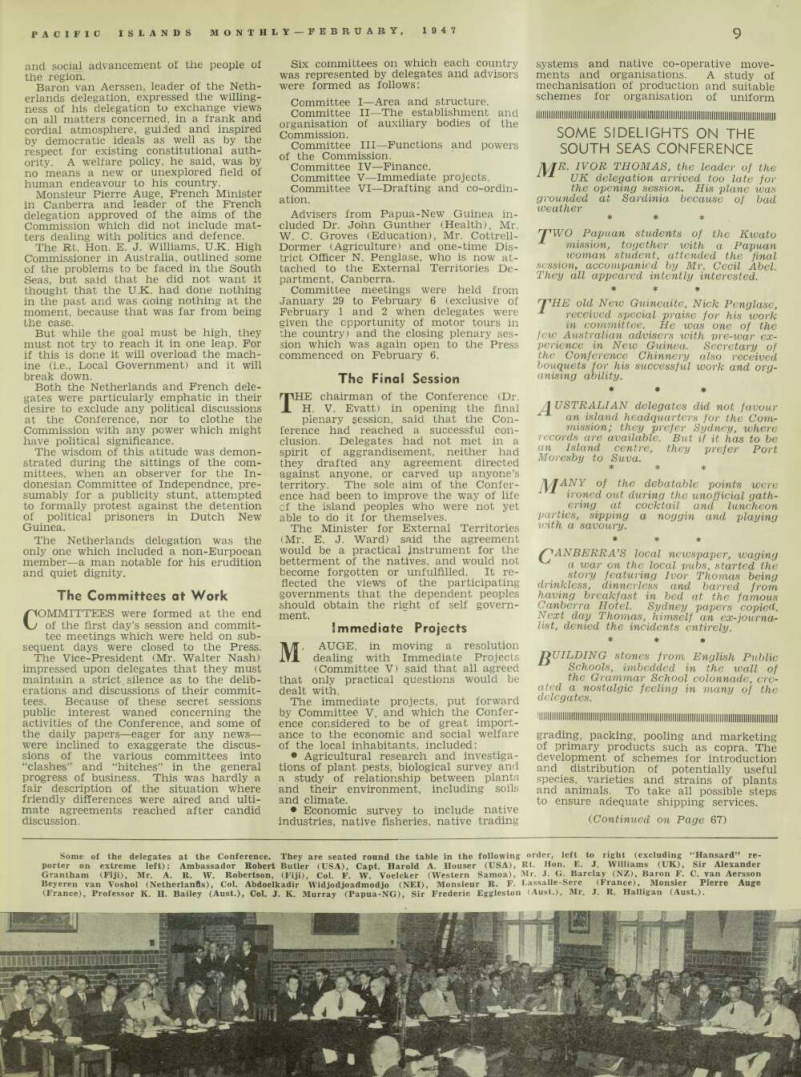
Some of the delegates at the Conference. They are seated round the table in the following order, left to right (excluding “Hansard” re porter on extreme left): Ambassador Robert Butler (USA), Capt. Harold A. Houser (USA), Rt. Hon. E. J. Williams (UK), Sir Alexander Grantham (Fiji), Mr. A. R, W. Robertson, (Fiji), Col. F. W, Voelcker (Western Samoa), Mr. J. G. Barclay (NZ), Baron F. C. van Aersson Beyeren van Voshol (Netherlands), Col. Abdoelkadir Widjodjoadmodjo (NEI), Monsieur R. F. Lassalle-Sere (France), Monsier Pierre Auge (France), Professor K. H. Bailey (Aust.), Col. J. K. Murray (Papua-NG), Sir Frederic Eggleston (Aust.), Mr. J. R. Halligan (Aust.).
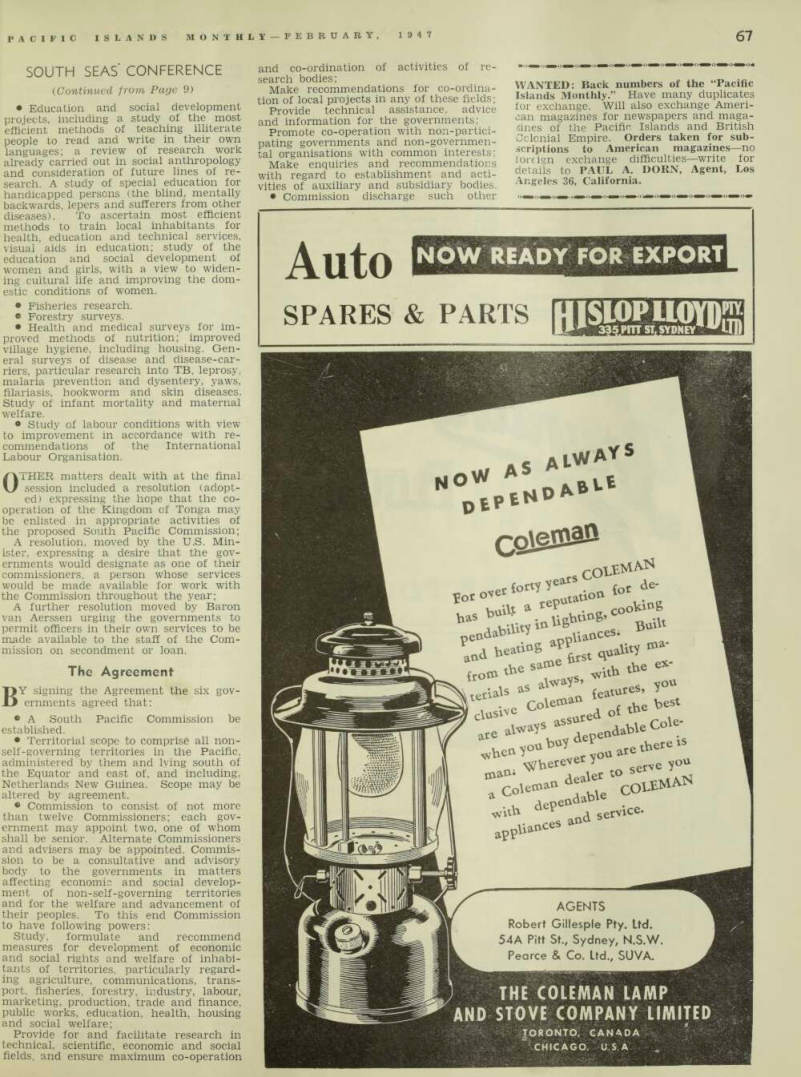
• Education and social development projects, including a study of the most efficient methods of teaching illiterate people to read and write in their own languages; a review of research work already carried out in social anthropology and consideration of future lines of re search. A study of special education for handicapped persons (the blind, mentally backwards, lepers and sufferers from other diseases). To ascertain most efficient methods to train local inhabitants for health, education and technical services, visual aids in education; study of the education and social development of women and girls, with a view to widen ing cultural life and improving the dom estic conditions of women. o Fisheries research. ® Forestry surveys. • Health and medical surveys for im proved methods of nutrition; improved village hygiene, including housing. Gen eral surveys of disease and disease-car riers, particular research into TB, leprosy, malaria prevention and dysentery, yaws, filariasis, hookworm and skin diseases, Study of infant mortality and maternal welfare. • Study of labour conditions with view to improvement in accordance with re commendations of the International Labour Organisation.
OTHER matters dealt with at the final session included a resolution (adopt ed) expressing the hope that the co operation of the Kingdom of Tonga may be enlisted in appropriate activities of the proposed South Pacific Commission; A resolution, moved by the U.S. Min ister, expressing a desire that the gov ernments would designate as one of their commissioners, a person whose services would be made available for work with the Commission throughout the year; A further resolution moved by Baron van Aerssen urging the governments to permit officers in their own services to be made available to the staff of the Com mission on secondment or loan.
The Agreement
BY signing the Agreement the six gov ernments agreed that: • A South Pacific Commission be established. • Territorial scope to comprise all non self-governing territories in the Pacific, administered by them and lying south of the Equator and east of, and including, Netherlands New Guinea. Scope may be altered by agreement. • Commission to consist of not more than twelve Commissioners: each gov ernment may appoint two, one of whom shall be senior. Alternate Commissioners and advisers may be appointed. Commis sion to be a consultative and advisory body to the governments in matters affecting economic and social develop ment of non-self-governing territories and for the welfare and advancement of their peoples. To this end Commission to have following powers: Study, formulate and recommend measures for development of economic and social rights and welfare of inhabi tants of territories, particularly regard ing agriculture, communications, trans port, fisheries, forestry, industry, labour, marketing, production, trade and finance, public works, education, health, housing and social welfare; Provide for and facilitate research in technical, scientific, economic and social fields, and ensure maximum co-operation
and co-ordination of activities of re- Se Mnkp b ?prommendations for co-ordination of local projects in any of these fields; Provide technical assistance, advice and information for the governments: Promote co-operation with non-participating governments and non-governmental organisations with common interests; Make enquiries and recommendations with regard to establishment and activities of auxiliary and subsidiary bodies. • Commission discharge such other
functions as may be agreed upon by the governments. • Commission to make such adminis trative arrangements necessary for its powers and functions. • Commission to give early considera tion to resolution passed at Conference relating to “immediate projects.” ° Commission secure legislative and administrative provision as required to ensure Commission will be recognised as possessing legal capacity and entitled to
privileges and immunities as necessary for its powers and functions. • With regard procedure, the Commis sion may meet at such times and in such places as it determines; two regular ses sions to be held each year, and further sessions if desired; two-thirds of senior commissioners to form quorum. It may appoint committees; an annual report to be published. • Special importance to be given to re search work. A Research Council will be established and serve as a standing ad visory body, auxiliary to the Commis sion. Its members will be appointed by the Commission, amongst whom shall be persons highly qualified in health, economic and social development, and shall devote their whole time to the work. • The Research Council shall maintain a continuous survey of research needs, arrange to carry out studies, co-ordinate activities of other bodies, appoint techni
cal standing committees and research committees on special subjects. • A South Pacific Conference shall be established to associate with the Com mission’s work, and local inhabitants of official and non-official institutions will be represented with advisory powers.
Such conference to be convoked within two years after the Agreement comes into force, and afterwards at intervals not exceeding three years. Delegates to the Conference will be appointed for each territory, the maximum number to be de termined by the Commission and selected to ensure greatest possible representation of the local inhabitants of the territory.
Alternate delegates may be appointed, and as many advisers as considered necessary. • A Secretariat shall be established by the Commission. The Secretary-General and Deputy-Chairman to hold office for five years; the former being the chief administrative officer. Staff of the Sec retariat to be appointed from local in habitants of the territories, with view to obtaining equitable national and local representations. • The Secretariat not to seek or re ceive instructions from any government or from any authority external to the Commission: and refrain from any action which might reflect on their position as international officials. Each government undertakes to respect the exclusively in ternational character of the Secretariat, not seeking to influence them in their duties. • The expenses of the Commission shall be apportioned among the govern ments in the following proportions: Aus tralia, 30 per cent.; France, 12£ per cent.; Netherlands, 15 per cent.; New Zealand, 15 per cent.; United Kingdom, 15 per cent.; United States of America, 12 h per cent. Apportionment of expenses is sub ject to adjustment. Pending the adoption of the first budget, administrative ex penses shall be met from an initial work ing fund of £40,000 sterling to which the governments undertake to contribute. • The Commission will co-operate as fully as possible with the United Nations. • The permanent headquarters of the Commission shall be located at such place “within the territorial scope of the Com mission’’ as it may select. Branch offices may be established. Headquarters site to be selected within six months after Agreement comes into force. Pending the selection, temporary headquarters will be in or near Sydney. • The provisions of the Agreement may be amended by consent of the gov ernments. • After five years a participating gov ernment may withdraw from the Agree ment on giving one year’s notice. • If any government ceases to admin ister non-self-governing territories within the scope of the Commission, it shall be deemed to have withdrawn as from the close of the then current calendar year. • Preliminary arrangements for the establishment of the Commission shall be undertaken jointly by Australia and New Zealand. • The Agreement to be registered with the Secretariat of the United Nations Organisations.
A cable was sent to the Governor of French Oceania on January 4, from the Mayor of the city of Gace in France say ing that the name “Boulevard Tahiti” had been given to the finest street in the city. Gace, whose citizens suffered con siderably in the war period, was “adopted” some time ago by the people of French Oceania.
Some Sidelights On The
South Seas Conference
JYJR- IVOR THOMAS, the leader of the UK delegation arrived too late for the opening session. His plane was grounded at Sardinia because of had weather ♦ * * r PWO Papuan students of the Kwato * mission, together with a Papuan woman student, attended the final session, accompanied by Mr. Cecil Abel.
They all appeared intently interested. * * * HTHE old New Guineaite, Nick Penglase, received special praise for his work in committee. He was one of the few Australian advisers with pre-war ex perience in New Guinea. Secretary of the Conference Chinnery also received bouquets for his successful work and org anising ability. ♦ * • A USTRALIAN delegates did not favour an island headquarters for the Com mission; they prefer Sydney, where records are available. But if it has to be an Island centre, they prefer Port Moresby to Suva. * * * Jl/TANY of the debatable points were 1 ironed out during the unofficial gath ering at cocktail and luncheon parties, sipping a noggin and playing with a savoury. * * * /CANBERRA’S local newspaper, waging a war on the local pubs, started the story featuring Ivor Thomas being drinkless, dinnerless and barred from having breakfast in bed at the famous Canberra Hotel. Sydney papers copied.
Next day Thomas, himself an ex-jour'na list, denied the incidents entirely. * ♦ ♦ IJUILDING stones from English Public Schools, imbedded in the wall of the Grammar School colonnade, cre ated a nostalgic feeling in many of the delegates.
Sailed On "Montoro"
passengers for New Guinea from Sydney on the January “Montoro” were (left): Mrs. L. M. Heath, who was on her way to rejoin her husband in Lae; and (right) Mrs. A. Gazzard and daughter Judith on their way to Bulolo.
Six Accepted—One to be
Ng Students In Fiji
Six Accepted—One to be Returned
Suva. Feb., 8.
ONE of the seven selected New Guinea native lads, who arrived here in December to enrol in the Central Medical School, has been found to be suffering from tuberculosis, and will be sent home after treatment. He is a native of Hanuabada Village, Papua, which is known to be badly infected with TB.
The tragedy of it is that he was one of the best and brightest of the seven new scholars.
One of the other six—a lad from New Britain —was not up to the educational standard required, and he has been sent to the Queen Victoria School for a year’s intensive training, before undertaking the medical course.
The remaining five boys were included in the 21 new scholars who entered the now famous institution at the beginning of January. Their advent created in terest here, as they are the first men from New Guinea to come to seek the coveted diploma of NMP.
The new Principal, Dr. A. S. Frater, took charge at the beginning of January.
Dr. Hoodless, retiring Principal, remained for a fortnight with Dr. Frater. He is now acting as locum for Dr. Greville, who is abroad on urgent business. He and Mrs.
Hoodless plan to remain in retirement in Fiji, until world conditions are calmer.
Mr. A. H. Buckland of the Education Department of NG who brought the Papua-NG students to Fiji by plane, is still here. He has been cordially re ceived by the British officials in Fiji, and shown the inside workings of the Depart ments in which he is interested.
No Compensation Yet For
Ng Timber Claims
From Our Own Correspondent
Rabaul. Jan., 27
WAR Damage settlement for all holders of timber claims is still held up, and much inconvenience is being experienced by timbermen who are anxiously awaiting to commence their rehabilitation. Explanation of delay is that the forestry department has not yet completed the necessary report for War Damage.
Mr. Richards of the War Damage Com mission is attending a conference in Port Moresby at present and Mr. Pratten, of the same department, is on an inspection tour of all properties on the South Coast of New Britain.
Mr. Richards will be away about a month and Mr. Pratten about three weeks.
Electricity for Rarotonga
From Our Own Correspondent
Rarotonga, Jan., 26.
Rarotonga looks forward to a brighter new year, with a long desired public electricity service nearing reality.
A thorough survey was conducted by a PWD engineer during the latter part of 1946, which resulted in NZ Govern ment approval of the scheme.
The engineer paid a short flying visit during January to make final arrange ments and all residents and business firms wishing to avail themselves of the service were requested to fill in applica tion forms notifying their probable re quirements. The service will be avail able to the native population.
There are a few objectors; but most people welcome the idea even at the pro posed unit charges of 1/3 for lighting and 6d. for power.
For a start, the service will cover only the main administrative!, business and residential district of Avarua.
American Yachtsmen
Seek the South Seas
MR. DWIGHT LONG who became well known in the Pacific before the war when he sailed across the South Seas, (see “PIM” January issue) writes us from California that he now has a new boat which he has named Timi in memory of the Tahitian boy who was his shipmate on the Idle Hour. Timi is only 26 ft. long and is not built for long ocean voyages.
Mr. Long sends also, news of another small-boat voyager who should soon be seen in the Pacific. He writes; “Captain Harry Pidgeon who will be 78 next August, is about to make some small boat history. Many islanders will remember him from the days when he sailed his famous 34-ft. yawl ‘lslander’ around the world with calls at many Pacific ports. He is the only man living to accomplish that feat twice, and alone.
“He is, however, alone no longer. He was married about 21 years ago. His wife, Margaret, was born on a full-rigged ship in the West Indies.
“Together they are making Islander ready and plan to shove off again for the Islands during the Northern Spring.
“The famous Museum in Newport News, Virginia, has asked Captain Pid geon to allow them to have Islander as a permanent exhibit, but according to his present plans it will be some time before his boat is retired and becomes a museum piece.”
ANOTHER yachtsman who expects to set sail South-bound from the Cali fornian coast is Charles J. Spurling.
He has a 36-ft. sailing boat.
The Rev. J. R. Andrews, chairman of the Methodist Overseas Mission at Dobu, Papua, arrived in Sydney on leave at the end of January.
Qantas Passengers To New Guinea
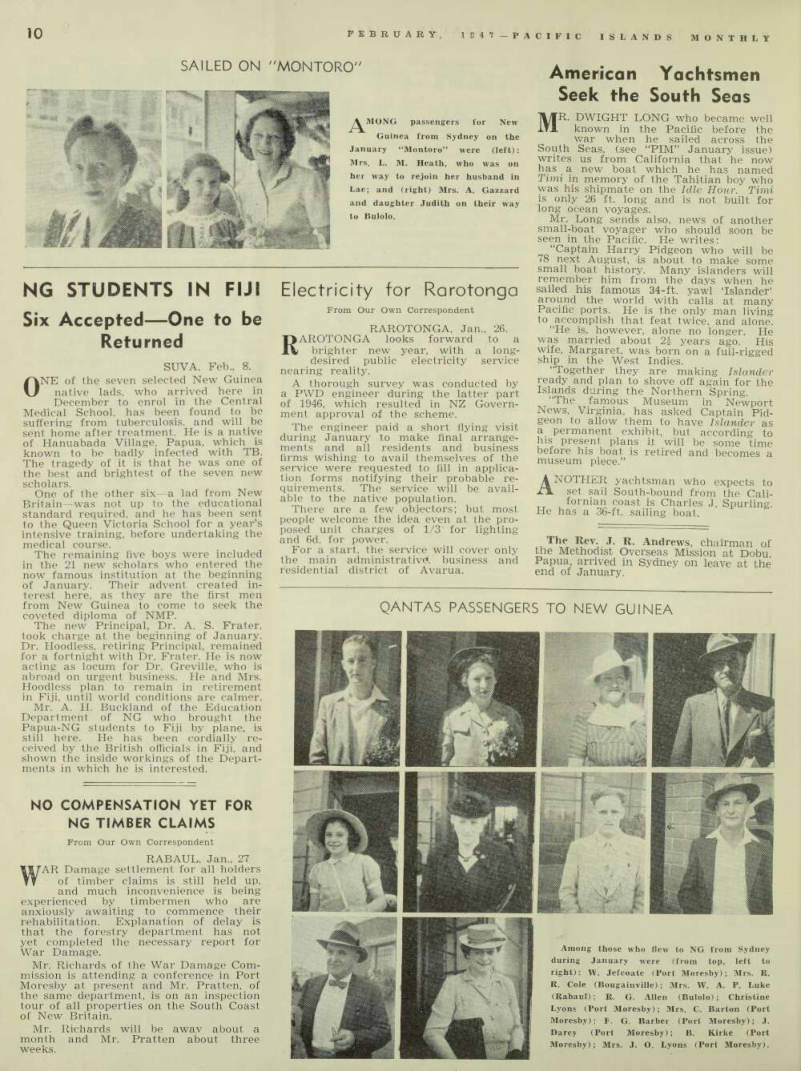
Among those who flew to NG from Sydney during January were (from top, left to right): W. Jefcoate (Port Moresby); Mrs. R.
R. Cole (Bougainville); Mrs. W. A. P. Luke (Rabaul); R, G. Allen (Bulolo); Christine Lyons (Port Moresby); Mrs. C. Barton (Port Moresby); F. G. Barber (Port Moresby); J.
Darcy (Port Moresby); B. Kirke (Port Moresby); Mrs. J. O. Lyons (Port Moresby).
Fifth Conference Of International
Aviation Organisation Meets
In Melbourne
Will Consider Special Problems of Pacific Aviation
FLOWERS and flags greeted 200 repre sentatives and observers from 23 nations when they met at the fifth meeting of the Provisional International Civil Aviation Organisation in Wilson Hall, Melbourne University, on February 4. PICAO was formed in Chicago in 1944 and Montreal, Canada, has been chosen as the heaquarters of the organisation; Dr. Edward Warner is the permanent chairman.
PICAO is an international technical body and its meetings, of which 10 are planned, are designed to solve problems of air navigation peculiar to various parts of the world.
Having already held four such meetings in other countries, procedure at the Mel bourne meeting created few troubles al though in considering the South Pacific area it was necessary also to decide what ground organisation provided by the Allies during the war should be retained for civilian use and what modifications to suit the long ocean flights in the South Pacific might be made to stand ards laid down previously by PICAO.
The meeting will also compile a draft South Pacific Regional Manual contain ing all the information a pilot needs to know and discuss such technical matters as uniform practice in setting altimeters, and uniform instrument approach and procedures.
The Australian Minister for Air (Mr.
Drakeford) in his opening address to the Conference said that the problems in the South Pacific were unique in that they involved long ocean hops and low traffic density. He thought it would be a long time before a dozen aircraft were stacked up over Nadi (Fiji) waiting to land. The main difficulty in maintaining air transport across the Pacific was that there is as yet, hardly enough traffic to
justify the cost of maintaining expensive ground facilities, and as ocean traffic, too, is widely spaced, shipping can give only negligible assistance to weather fore casters After the opening session, at which the general public was admitted, five tech nical committees were set up in accor dance with usual PICAO practice to carry out the real work of the meeting.
These committees were: ■ Air Traffic Control (ATC) ■ Aerodromes, Air Routes and Ground Aids (AGA) ■ Communications (COM) b Meteorology (MET) ■ Search and Rescue (SAR) Later another working committee was set up to deal with proposed alterations to South Pacific boundaries. This com mittee eventually decided to leave the boundaries as they had already been de fined by PICAO, but to instruct technical committees to set forth requirements as they relate to trans-Pacific operations without regard to regional boundaries.
It had been suggested by the United Kingdom delegation that the region should be confined to the South Pacific whereas the area suggested by PICAO includes routes that operate entirely with in the North Pacific.
The United States has suggested al ternatively that the region be extended to include the east coast of China and Hong Kong and Netherlands delegates wanted NEI to be included.
These proposals were discarded but the committee’s report will mean that technical committees will be able to make recommendations about facilities neces sary for the completion of any long ocean flights extending outside the defined boundary of the South Pacific.
THE following countries sent delega tions to the meeting; the name of the leader of each delegation ap pesar in parenthesis: United Kingdom (Mr. Dennis Peel); New Zealand (Mr. J. M. Buckeridge); Greece (Mr, Nicolades); Bolivia (Capt.
German Pol); Australia (Air Marshall R.
Williams); Czechoslovakia (Mr. Tokoly);
China (Col C. Y. Liu); Portugal (Col.
H. Delgado); Netherlands (Mr. B. F. H. van Lent); Canada (Mr. A. D. McClean); France (Col Migeon); Switzerland (Mr.
J. A. Pietzcher); Philippines (Col. J. A.
Villamor); El Salvador (Mr. N. Kara gheusian); United States of America (Mr.
Glen Gilbert). Representatives of PICAO’s Interim Council at the meeting were: Dr. Edward Warner (Leader), Messrs. G. D. Cartwright, Nelson Ho, V.
H. Davey, Wertman, Fowler. E. A. West lake, J. Lerew and Ivor McClure.
Representatives of International Air line Transport (Operators’) Association were: Capt. Garden (New Zealand). Mr.
McGrane (New Zealand). Mr. H. A.
Ferris (Canada), Mr. P. Oolgaard (Hol land), Capt. Gerrand (New Zealand), Cdr.
H. C. Walker (New Zealand). S/Ldr. Pirie (New Zealand), and Capt. Ritchie.
Formalities are Killing Air
Transport
IT is hoped by the air-travelling public that somewhere within the frame work of PICAO, consideration will be given to making air travel easier and less entangled in the miles of red-tape and form-filling that must be negotiated be fore a traveller can fly from one country to another at present.
With regard to this Whites Aviation says: Airline operators and air travellers are hopefully looking to PICAO.
Already that organisation has drafted a set of recommended standards for the simplification of border crossing regu lations. The recommendations suggest a
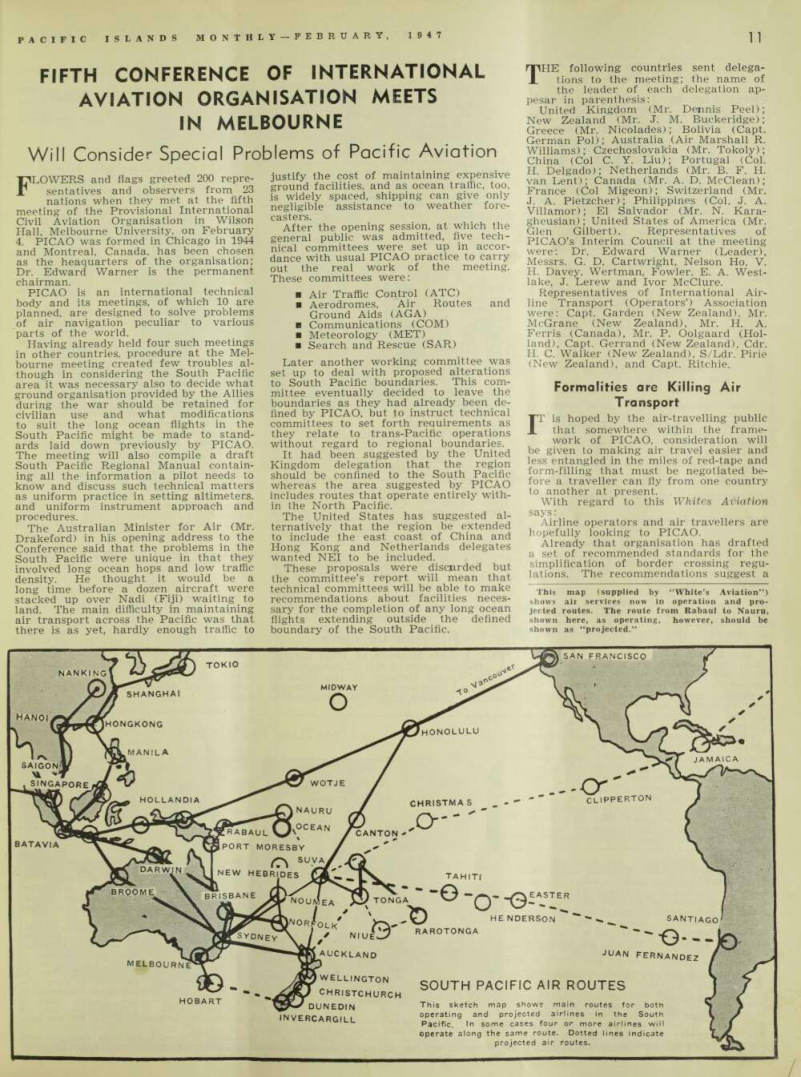
This map (supplied by “White’s Aviation”) shows ail services now in operation and pro jected routes. The route from Rabaul to Nauru, shown here, as operating, however, should be shown as “projected.”
standard passport valid for one year through the territories of the 46 member States.
If recommendations made by PICAO are adopted, an air traveller off on a business trip or a vacation would find border crossing much simpler than it is at present. The issue of a “non-immi grant passport” card is recommended. It is also proposed that instead of informa tion sheets, otherwise known as forms, the passenger could merely fill in a “pas senger card” on board the aircraft. On arrival at various ports of call, immigra tion authorities would be able to enter on the card the time the visitor was allowed to remain in the country.
PICAO suggests that member States should establish customs-free airports which international aircraft could pass through without being subjected to all manner of hindrances. PICAO recog nises the importance of public health, but recommends the acceptance of an international certificate of innoculation.
Passengers could carry that certificate with them. Also recommended is the elimination of passports and visas for airline crews.
Not only passengers, but also airlines are troubled by the hundred and one formalities that are slowing down travel.
Literally thousands of forms have to be completed before an aircraft can proceed from New Zealand to the United States with 40 passengers, seven or eight crew, 200-odd parcels of freight and a few bags of mail. Those forms add up to quite an appreciable number of pounds.
TO give point to their complaints, Whites Aviation quotes a United States official who recently made a world trip by air. The official said: “In the old days it took my grandfather nine days to get ready and 90 days to get to America from the Old Country.
Now it takes 90 days to get ready and 9 hours to get here.”
Copra!
Prices Rise in Two Pacific Terri
tories but N. Guinea PCB Im
poses New Conditions of Sale
r BLOWING an inquiry by the Aus tralian Prices Commissioner in Nov ember, an increase in the price paid to New Guinea copra producers has been authorised from December 1. Planters are, however, advised not to throw their hats in the air until they have read the remainder of the Production Control Board’s circular letter sent from Port Moresby and dated January 7.
The letter reads;
Circluar No. 81
Dear Sir/Madam, — It is desired to inform you that in accordance with the provisions of Section 39 of the National Security (External Territories) Regulations, the following prices have been fixed for copra delivered to this Board during the period Ist January, 1946, to 3S)th November. 1946, both dates being inclusive:— Hot Air Dried i Sun Dried [ £22/5/- per ton.
Kiln dried ) Smoke Dried £2l/5/- per ton.
These prices are on the basis of delivery at plantations, or at the nearest point of shipment.
As from Ist December, 1946, the basis of pur chase has been altered to delivery ex ships’ slings at Samarai, Port Moresby, Madang, Rabaul and Kavieng, or where transport is by road, delivery at the Board’s warehouse at those ports.
Consequent upon the recent increase in the
Australian price for this commodity, an increase in the local prices has been made possible, and as from Ist December, 1946, the prices payable on this new basis are as follow: Hot Air dried ) Sun Dried [ £2B per ton.
Kiln Dried J Smoke Dried £27 per ton.
Any adjustments necessary to give effect to these new prices will be passed through your account during the current month. (Signed) J. C. ARCHER, Chairman, ANG Production Control Board.
Port Moresby, January 7, 1947.
EVEN if planters were to get full advan tage of the new increase they would be receiving less than the price paid to-day to planters in other Pacific ter ritories; but it will be noted that from the date that the increased price is pay able, alterations have been made to con ditions covering the basis of purchase.
Until December 1, the price paid by the FCB to planters was “at plantation.”
This has how been altered and the new price is “at the ships’ slings” in Samarai, Port Moresby. Madang, Rabaul or Kav ieng. The PCB, in other words, will no longer take responsibility for transport, and planters in outlying districts, such as the Admiralties and the Western Islands, are likely to be out of pocket under the new conditions of sale.
The onus of finding transportation for copra (and that can be done only through government-controlled ships winch are as infrequent as they are unreliable) apparently now falls entirely to the pro ducers, and the PCB becomes purely a buying agency—a function which it usurped from private trading firms. The PCB might have fulfilled some useful function if it had developed co-ordinating and organising machinery to short-cir cuit the red-tape which is strangling the rehabilitation of the copra producing in dustry in New Guinea. Its reason for existing now seem to be for no other reason than to appease some bureaucrat’s passion for “Government control.”
Fiji Price Up Again
rE British Ministry of Food notified the Governor of Fiji in Januarv that a further increase in the price of copra had been authorised. The increase amounts to £4/0/6 (F) and consequently
the Fiji Conra Board has raised the buy ing price of conra to £29/15/6 for Plant ation Grade copra and £29/10/- for FMS Grade, delivered at Suva or Levuka and with effect from January 5. An equiv alent price in Australian currency would be over £33 per ton.
N. Caledonia's New
Governor
Appointment of M. Georges Parisot,
Former Governor of Martinique
MONSIEUR Georges Parisot, newly appointed Governor of New Cale donia, is of higher status in the French Colonial Service than his pre decessor, M. Tallec.
French Colonial Governors are graded in a first, a second, and a third class, according to length of service etc.
M. Parisot comes out as an adminis trator of the first class, with a distin guished career behind him. indicating per haps that the French are now prepared to give a wider status than that formerly allowed their one-time rather neglected Pacific colony.
His ranking apparently entitles him to the title of Governor-General. He has a wife and three children.
Governor Parisot is aged 59 he was born in Algiers on October 9, 1887 he is a Chevalier of the Legion d’Honneur and graduated from the Ecole Coloniale, Paris, into the Colonial Service. Most of his life has been spent in Africa in Gabon, Sengal, Togoland, and other colonies of Equatorial and Occidental Africa. But after the Liberation of France, he was sent out to Martinique as Governor, a post he held for about two years. His New Caledonian appoint ment dates from December 10.—HELP.
Mr. R. E. Cartwright, a senior officer of the Repatriation Department, Bris bane, left by air on January 6, to investi gate problems of ex-Servicemen and women in Papua and New Guinea. It is believed that local repatriation commit tees are being formed in New Guinea, which has recently come under the jur isdiction of Queensland in repatriation matters.
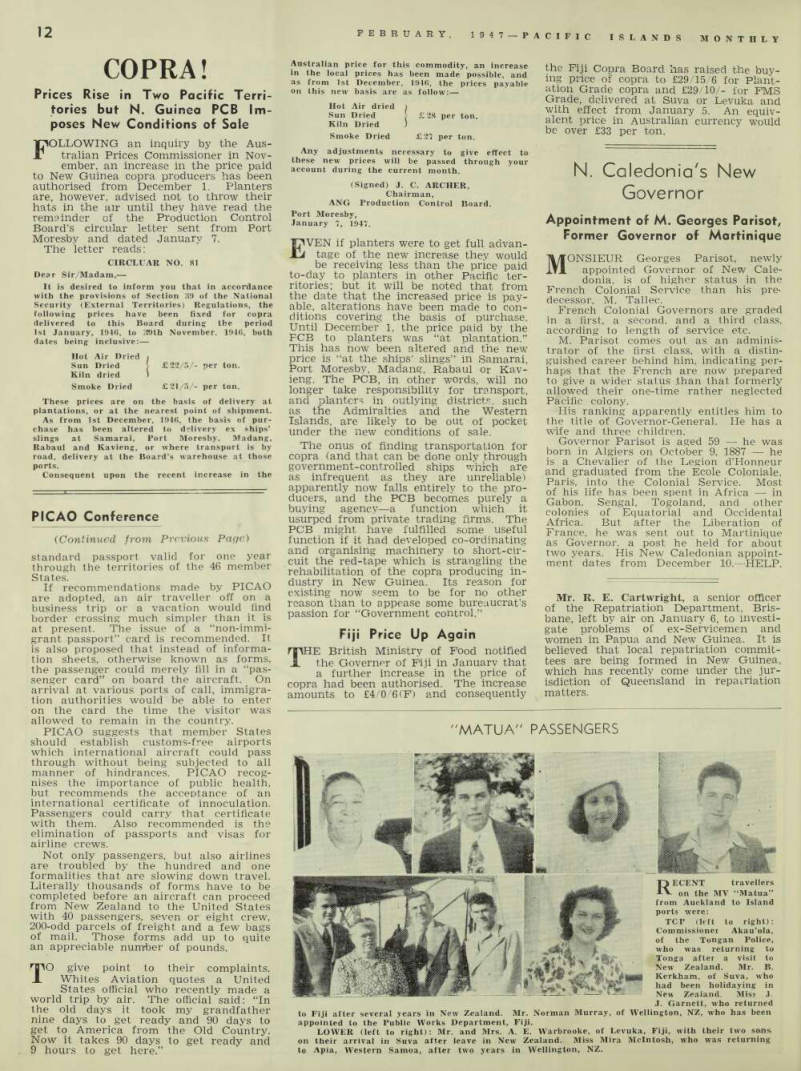
RECENT travellers
"Matua" Passengers
on the MV “Matua” from Auckland to Island ports were: TCP (left to right): Commissioner Akau’ola, of the Tongan Police, who was returning to Tonga after a visit to New Zealand. Mr. B.
Kerkham, of Suva, who had been holidaying in New Zealand. Miss J, J. Garnett, who returned
to Fiji after several years in New Zealand. Mr. Norman Murray, of Wellington, NZ, who has been appointed to the Public Works Department, Fiji.
LOWER (left to right): Mr. and Mrs. A. E. Warbrooke, of Levuka, Fiji, with their two sons, on their arrival in Suva after leave in New Zealand. Miss Mira Mclntosh, who was returning to Apia, Western Samoa, after two years in Wellington, NZ.
Advertisements & other items, p. 14 (1 item)
12
FEBRUARY, 1947 PACIFIC ISLANDS MONTHLY
PICAO Conference (Continued from Previous Page)
U.S. Davis Cup Team Entertained In Fiji
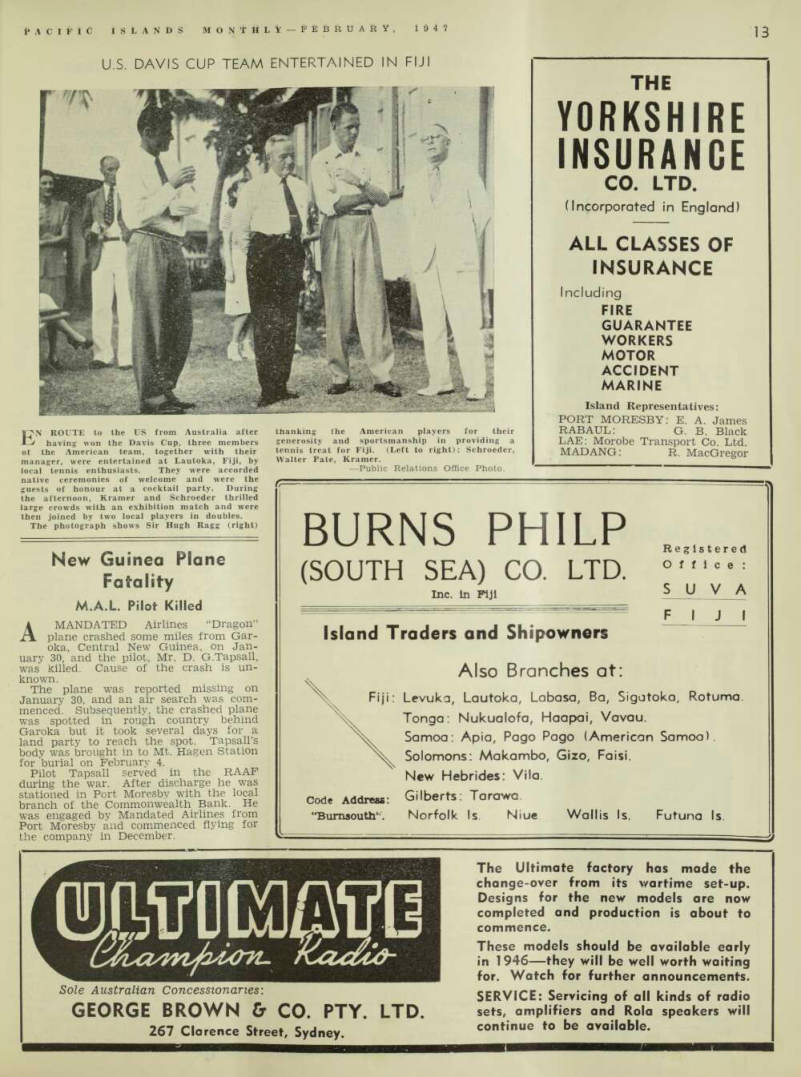
EN ROUTE to the US from Australia after having won the Davis Cup, three members of the American team, together with their manager, were entertained at Lautoka, Fiji, by local tennis enthusiasts. They were accorded native ceremonies of welcome and were the guests of honour at a cocktail party. During the afternoon, Kramer and Schroeder thrilled large crowds with an exhibition match and were then joined by two local players in doubles.
The photograph shows Sir Hugh Ragg (right)
thanking the American players for their generosity and sportsmanship in providing a tennis treat for Fiji. (Left to right): Schroeder, Walter Pate, Kramer.
Public Relations Office Photo.
Fatality
New Guinea Plane Fatality
M.A.L Pilot Killed
A MANDATED Airlines “Dragon” plane crashed some miles from Gar oka, Central New Guinea, on Jan uary 30, and the pilot, Mr. D. G.Tapsall, was killed. Cause of the crash is un known.
The plane was reported missing on January 30, and an air search was com menced. Subsequently, the crashed plane was spotted in rough country behind Garoka but it took several days for a land party to reach the spot. Tapsall’s body was brought in to Mt. Hagen Station for burial on February 4.
Pilot Tapsall served in the RAAF during the war. After discharge he was stationed in Port Moresby with the local branch of the Commonwealth Bank. He was engaged by Mandated Airlines from Port Moresby and commenced flying for the company in December.
Advertisements & other items, p. 15 (1 item)
Burns Philp
THE
YORKSHIRE
INSURANCE
CO. LTD.
(Incorporated in England)
ALL CLASSES OF
INSURANCE
Including
FIRE
GUARANTEE
WORKERS
MOTOR
ACCIDENT
MARINE
Island Representatives:
PORT MORESBY: E. A. James
RABAUL: G. B. Black LAE; Morobe Transport Co. Ltd.
MADANG: R. MacGregor
BURNS PHILP
(SOUTH SEA) CO. LTD.
Inc. in Fiji
Island Traders and Shipowners
Registered Office :
SUVA
FIJI
Code Address: "Bumsouth k .
Also Branches at: Fiji: Levuka, Lautoka, Labasa, Ba, Sigatoka, Rotuma.
Tonga; Nukualofa, Haapai, Vavau.
Samoa; Apia, Pago Pago (American Samoa).
Solomons: Makambo, Gizo, Faisi.
New Hebrides; Vila.
Gilberts; Tarawa Norfolk Is Niue Wallis Is. Futuna Is
Sole Australian Concessionaries :
GEORGE BROWN & CO. PTY. LTD.
267 Clarence Street, Sydney.
The Ultimate factory has made the change-over from its wartime set-up.
Designs for the new models are now completed and production is about to commence.
These models should be available early in 1946—they will be well worth waiting for. Watch for further announcements.
SERVICE: Servicing of all kinds of radio sets, amplifiers and Rola speakers will continue to be available.
Sergeant Metua Passes
From O'ur Own Correspondent
Mangaia, Nov. 15.
THE death in Rarotonga recently of Matua Samuela, top sergeant of Cook Island Police, has saddened relations and friends on this island.
"The late Sgt. Metua was a very plea sant man. and an old friend of the writer. He had served some 30 years in the Cl Police Force, and was particu larly esteemed for his courtesy, and total lack of officiousness, although at times he had difficult duties to perform.
A big man in every way, Metua will be greatly missed in his district, and those who have enjoyed his hospitality and remembered his genial personality, mourn the passing of this popular officer.
Bank Of Nsw Reopens
In Lae
Prom Our Own Correspondent LAE. Jan. 17.
A BRANCH of the Bank of NSW will shortly be re-opened in Lae, New Guinea. A pre-fabricated building will be erected on the site formerly oc cupied by Eekhoff’s store.
Mr. W. H. Lawson, will be the manager of the branch; he is already well-known in the Territory and was stationed at the Salamaua branch before the war.
Residents are pleased that the “old firm” is returning to Lae. Most of them have banked at the Wales for years.
Amalgamated Wireless
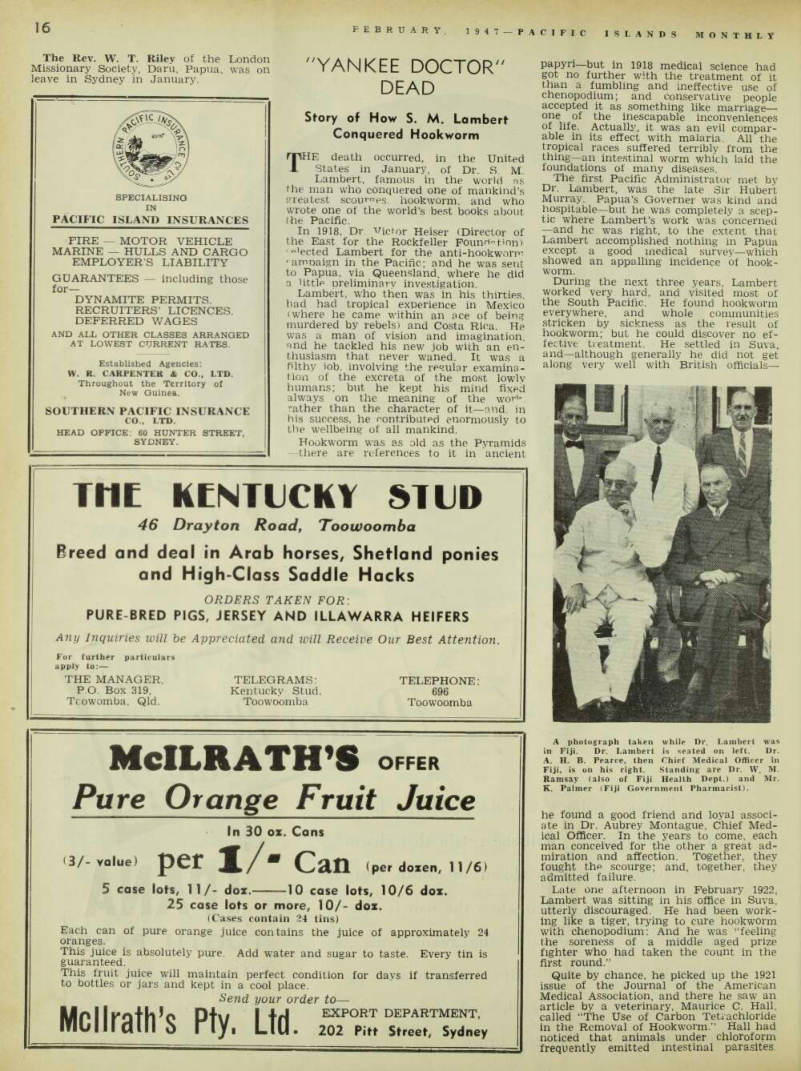
Telecommunications Takes Over Amalgamated Wireless Nationalisation of Overseas Cable and Wireless Services
AMALGAMATED Wireless (A’sia) Ltd, which has served Australia and the Pacific well for many years has now gone out of existence, officially. * In its place we have the Overseas Tele communications Commission (Australia).
This follows the passing of the Tele communications Bill, for the nationalisa tion of external wireless and cable com munications, by the Commonwealth par liament towards the end of 1946. The nationalisation of these services was agreed upon by the governments of Great Britain, Australia and New Zea land.
The Australian Government has held a controlling interest in AWA for many years; the remainder of the shares were held by private individuals who will be compensated, rather generously, out of Government funds.
A circular received from the new Tele communications Commission reads: With the passing, by the Parliament of the Commonwealth, of the Overseas Telecommuni cations Act, 1946, the operation, maintenance and development of all telecommunication ser vices to and from Australia become the re sponsibility of this Commission, which was created for this purpose under the Act. As the first step in the plan, the Commission takes over from Amalgamated Wireless (A/sia), Ltd., the complete operation of the Beam Wireless Service, Overseas Picturegram Service, and the Coastal Radio Service, and also the technical operation of the Overseas Radio Telephone Services as from February 1, 1947.
Overseas radio telephone calls should, how ever, continue to be ordered, as at present, through the Postmaster-General’s Department.
The Commission hopes that you will continue to make full use of the telecommunication facilities it provides, and it will be happy to co-operate with you to ensure that your re quirements are met satisfactorily. rE Head Office of the Commission is at 47 York Street Sydney, with a Branch in Melbourne, and Radio Stations in all States of the Common wealth and in the Territories of Papua and New Guinea. In these latter Ter ritories, stations are at present oper ating at Rabaul, Lae and Port Moresby.
The AWA stations originally located at Samarai and Madang, are now being re installed and other stations will prob ably be added to the Island network in the near future.
Mrs. Iris Schmidt, who had had a hair dressing establishment in Rabaul before the evacuation, has returned to the town to restart her business. Before she went to Rabaul, she spent a few months in Port Moresby.
M. Ambroise Colombani, for many years in the service of the French Gov ernment in Tahiti, died at his home in Papeete on December 27. He was a nat ive of Corsica and went to Tahiti as a young man.
Extraordinary bad fortune attended Mrs. Marcia Russell, who left Sydney in mid-1946, with her husband and her mother, to join her uncle, Dr. G. H.
Vernon, in North East Papua. Very soon after her arrival, Dr. Vernon died sud denly in the Samarai Hospital. In Octo ber, her mother, Mrs. J. H. Dobbin, died in Samarai, and, in the same month, her husband died in Port Moresby. Mrs.
Russell, now alone, has joined the staff of Messrs. Burns Philp & Co. Ltd., in Samarai.
The Rev. W. T. Riley of the London Missionary Society, Daru, Papua, was on leave in Sydney in January.
Advertisements & other items, pp. 16-18 (2 items)
For Service
EXPORTERS - IMPORTERS
Contact
COMMONWEALTH TRADING CO. Pty. Ltd.
95 YORK STREET, SYDNEY
Phones: MA4232, M 6969.
GENERAL MERCHANDISE, TRADE GOODS, CLOTHING, FOOD-
STUFFS, LIQUEURS, SPIRITS, WINES.
Stromberg- Carlson
Sole Agent for Samoa: O. F. NELSON & CO., LTD., Apia, W. Samoa.
Other Dealers Announced Soon.
In the meantime write directly to Victor Hyde Sales Service for particulars of the items listed below.
STROMBERG-CARLSON 5A46
model. A 5 valve Dual Wave A.C, receiver to meet tropic conditions —a “Civilian Amenities”—in a large beautiful wooden cabinet. AIR CIRCU- LATORS are available. WASH-
ING MACHINES, RADIO-
GRAMS, AUTOMATIC RE-
CORD CHANGERS and other electrical products will be available by next March.
MULTIPLO INCUBATORS AND BROODERS. Kerosene and electric avciilciblG METRO BATTERIES. All types in limited quantities.
RELIDE WATCHES. Imported cases. Shockproof and waterproof.
PLEASE NOTE: Exclusive agents appointed only as stocks become available.
L€S SGRVICe
TELEPHONE:BWSIS7 • SCOTTISH HOUSE® 19 BRIDGE STREET® SYDNEY ® AUSTRALIA
Ipana
i« * 2 5 m ■ . & i V M r ft. a 4 '* : ‘i; . 'Vi »/ of h n Ofe m HJ Wi, P *'e Today radiant, adorable, admired by all.
In years to come? Will she retain that charm?
Time steals away the bloom of youth, but a smile can be young even when the hair is silver.
Wise dental care dictates the regular use of o [PANA Tooth Paste —after every meal if possible— brushing the teeth and gums with a circular movement of thj? brush.
IPANA
TOOTH PASTE
Sold by all leading distributors and manufactured by
BRISTOL-MYERS Co. Pty. Ltd
223 Pacific Highway, North Sydney N.S.W., Australia. 388 1
m
SPECIALISING
IN
PACIFIC ISLAND INSURANCES
FIRE MOTOR VEHICLE
MARINE HULLS AND CARGO
EMPLOYER’S LIABILITY
GUARANTEES including those for—
DYNAMITE PERMITS.
RECRUITERS’ LICENCES.
DEFERRED WAGES
AND ALL OTHER CLASSES ARRANGED
AT LOWEST CURRENT RATES.
Established Agencies:
W. R. CARPENTER & CO., LTD.
Throughout the Territory of New Guinea.
SOUTHERN PACIFIC INSURANCE
CO., LTD.
HEAD OFFICE: 60 HUNTER STREET
SYDNEY.
THE KENTUCKY STUD
46 Drayton Road, Toowoomba
Breed and deal in Arab horses, Shetland ponies
and High-Class Saddle Hacks
ORDERS TAKEN FOR:
PURE BRED PIGS, JERSEY AND ILLAWARRA HEIFERS Any Inquiries will be Appreciated and will Receive Our Best Attention.
For further particulars apply to:—
THE MANAGER.
P.O. Box 319, Tcowomba, Qld.
TELEGRAMS:
Kentucky Stud.
Toowoomba
TELEPHONE:
696 Toowoomba
McILRATH’S offer
Pure Orange Fruit Juice
In BO oz. Cans '*/■ per I/- Can (per dozen, 11/6) 5 case lots, 11/- doz. 10 case lots, 10/6 doz. 25 case lots or more, 10/- doz. (Cases contain 24 tins) Each can of pure orange juice contains the juice of approximately 24 oranges.
This juice is absolutely pure. Add water and sugar to taste. Every tin is guaranteed.
This fruit juice will maintain perfect condition for davs if transferred to bottles or jars and kept in a cool place.
Send your order to —
Mcllrath’s Pty. Ltd. SSSSTSS,
"Yankee Doctor"
Dead
Story of How S. M. Lambert Conquered Hookworm
rE death occurred, in the United States in January, of Dr. S, M.
Lambert, famous in the world ns the man who conquered one of mankind’s greatest sconces, hookworm, and who wrote one of the world’s best books about the Pacific.
In 1918, Dr, Victor Heiser (Director of the East for the Rockfeller ffil ected Lambert for the anti-hookworm r amnaign in the Pacific; and he was sent to Papua, via Queensland, where he did a Uttlc preliminary investigation.
Lambert, who then was in his thirties, had had tropical experience in Mexico (where he came within an ace of being murdered by rebels) and Costa Rica. He was a man of vision and imagination, and he tackled his new job with an en thusiasm that never waned. It was a Pithy iob. involving the regular examina tion of the excreta of the most lowlv humans; but he kept his mind fixed always on the meaning of the wor 1 " rather than the character of it —and. in his success, he contributed enormously to the wellbeing of all mankind.
Hookworm was as old as the Pyramids -there are references to it in ancient
papyri—but in 1918 medical science had got no further with the treatment of it than a fumbling and ineffective use of chenopodium; and conservative people accepted it as something like marriage— one of the inescapable inconveniences of life. Actually, it was an evil compar able in its effect with malaria. All the tropical races suffered terriblv from the thing—an intestinal worm which laid the foundations of many diseases.
The first Pacific Administrator met by Dr. Lambert, was the late Sir Hubert Murray. Papua’s Governer was kind and hospitable—but he was completely a scep tic where Lambert’s work was concerned —and he was right, to the extent that Lambert accomplished nothing in Papua except a good medical survey—which showed an appalling incidence of hook worm.
During the next three years, Lambert worked very hard, and visited most of the South Pacific. He found hookworm everywhere, and whole communities stricken by sickness as the result of hookworm; but he could discover no ef fective treatment. He settled in Suva, and—although generally he did not get along very well with British officials—
he found a good friend and loyal associ ate in Dr. Aubrey Montague, Chief Med ical Officer. In the years to come, each man conceived for the other a great ad miration and affection. Together, they fought the scourge; and, together, they admitted failure.
Late one afternoon in February 1922, Lambert was sitting in his office in Suva, utterly discouraged. He had been work ing like a tiger, trying to cure hookworm with chenopodium; And he was “feeling the soreness of a middle aged prize fighter who had taken the count in the first round.”
Quite by chance, he picked up the 1921 issue of the Journal of the American Medical Association, and there he saw an article by a veterinary, Maurice C. Hall, called “The Use of Carbon Tetrachloride in the Removal of Hookworm.” Hall had noticed that animals under chloroform frequently emitted intestinal parasites
A photograph taken while Dr. Lambert was in Fiji. Dr. Lambert is seated on left. Dr.
A. H. B. Pearce, then Chief Medical Officer in Fiji, is on his right. Standing are Dr. VV. M.
Ramsay (also of Fiji Health Dept.) and Mr.
K. Palmer (Fiji Government Pharmacist).
He had experimented for years, and now ne reported remarkable results with a drug hitherto known only as a cleaning fluid, Tetrachloride. But would the drug be of use with humans? Hall closed his article simply by saying that he had taken a substantial dose and had suffered no harm. It should have poisoned him.
The message of Tetrachloride came to Lambert like an answer to prayer. He went immediately to the hospital labor atory. There he found an unopened bot tle of Tetrachloride. He hurried to Dr.
Montague with the magazine article, and the bottle.
Montague read the article csrefully.
“Lambert, try anything” he sighed. That was the way they all felt in 1922. Lam bert’s story continues: , “We had been trained in the empirical school. Try anything, if there is evidence in its favour. Even the jungle medicine man, for all his black magic, has herbs and simples which the respectable prac titioner might include in his remedies.
“A thousand years before Harvey de monstrated the blood’s circulation, Asi atic wizards were giving chaulmoogra oil for leprosy. True, they gave it wrong— but they gave it. The Incas of Peru taught us the value of quinine for mal aria: they chewed the bark. Before the Crusades, corner barbers were giving mercury to syphilitic noblemen. Up to 50 years ago, the medical profession de pended pretty much on the household remedies your grandmother used to choke down you: as long as they worked they saved many a fine prescription in ab breviated Latin... So we were trying to cure hookworm with a cleansing fluid!”
SO Dr. Lambert, with much trepedation went to the native ward of the
Suva’s War Memorial Hospital, se lected four hookwormy Indians, and gave them a stiff dose of salts. At 7 o’clock next morning his faltering hand admin istered to each 3 c.c of Tetrachloride.
He was, he says, not at all sure whether the drug would cure—or kill.
Then, literally sweating with anxiety he watched them for hours. They merely became drowsy. Finally, he wandered away to his office, and a cigarette.
“The door burst open, and Chris Ken drich tumbled in on me. His look was grave as he said: ‘That tetrachloride—’
“ ‘Are they dead ’ I asked, stiffly.
“‘Dead!’ Chris waved his hands. ‘They’re all jumping out of bed, and simply spouting hookworms!’”
And that was the beginning of the end of hookworm in the Pacific. The Rocke feller Foundation, through Dr. Lambert, and with the enthusiastic help of Dr.
Montague, scored a hundred per cent, success. By 1938—within 16 years— hookworm was not only under control, but rapidly disappearing.
DURING those years, Dr. Lambert and his team roamed the length and breadth of the South Pacific, carry ing on the Rockefeller Campaign. Un conventional. breezy, completely sincere in his friendships, the Yankee doctor was everywhere welcomed and held in esteem.
He had some classical fights with British officials—he loathed red tape and Eng lish stiffness—yet his best friends were individual Britishers. He always was on happy terms with natives, especially Melanesians —he was a master of Pidgin.
As one writer said of him: “He saved life abundantly and he lived life abund antly—this man with a million patients.
His work done —and how!—Dr. Lam
bert retired in 1938. to live in a pleasant place in Walnut Creek. California, and write his book. The book, “A Yankee Doctor in Paradise,” was published in 1941; and in spite of its absurd title, it will remain for all time as one of the best descrintions ever written of life in the South Pacific Islands. In my opinion, there is only one other of recent vintage to compare with it—Eric Feldt’s ‘‘Coast Watchers.”
Dr. Lambert kept one great love close to his heart—the Central Medical School, in Suva: he and Dr. Montague were re sponsible in large measures for its est ablishment in its present form. Because I praised the School, and begged support for it, Dr. Lambert corresponded occas ionallv with me—despite his serious handi cap of failing eyesight.
In 1945, he wrote to me and said “Good bye” -his heart was giving out and he, as a docctor and a realist, accepted the fact that his end was near. His last urgent wishes were for the welfare of the School which, he was convinced, could do so verv much for the welfare of the native races he had saved from wasting disease.
I should like to see erected, somewhere in the South Pacific, a memorial to the unconventional Yankee doctor who con
quered hookworm.
Rwr.
Major J. H. McDonald, formerly Dis trict Officer. Kavieng, who has been Act ing Deputv Administrator in the Liaison Group in Rabaul, has been transferred to Port Moresby where he will be Inspector of District Services. The Liaison Group has now been disbanded.
Advertisements & other items, p. 19 (2 items)
17
PACIFIC tSLANfcfe MONtttLtf FfififctfAftY, 1947
Dunlop
Most People throughout the British Empire ride on
TYRES
Copra
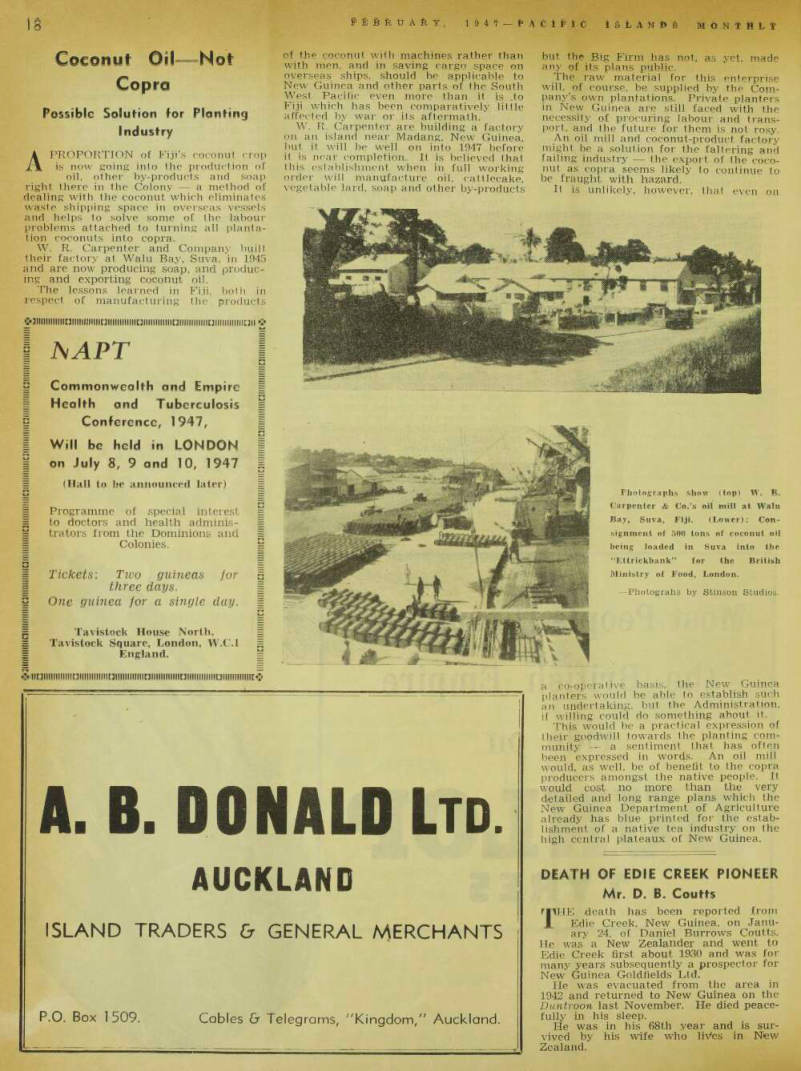
Coconut Oil-Not Copra Possible Solution for Planting Industry
A PROPORTION of Fiji’s coconut crop is now going into the production of oil, other by-products and soap right there in the Colony a method of dealing with the coconut which eliminates waste shipping space in overseas vessels and helps to solve some of the labour problems attached to turning all planta tion coconuts into copra.
W. R. Carpenter and Company built their factory at Walu Bay, Suva, in 1945 and are now producing soap, and produc ing and exporting coconut oil.
The lessons learned in Fiji, both in respect of manufacturing the products
of the coconut with machines rather than with men. and in saving cargo space on overseas ships, should be applicable to New Guinea and other parts of the South West Pacific even more than it is .to Fiji which has been comparatively little affected by war or its aftermath.
W. R. Carpenter are building a factory on an island near Madang, New Guinea, but it will be well on into 1947 before it is near completion. It is believed that this establishment when in full working order will manufacture oil. cattlecake, vegetable lard, soap and other by-products
but the Big Firm has not, as yet, made any of its plans public.
The raw material for this enterprise will, of course, be supplied by the Com pany’s own plantations. Private planters in New Guinea are still faced with the necessity of procuring labour and trans port. and the future for them is not rosy.
An oil mill and coconut-product factory might be a solution for the faltering and failing industry the export of the coco nut as copra seems likely to continue to be fraught with hazard.
It is unlikely, however, that even on
a co-operative basis, the New Guinea planters would be able to establish such an undertaking, but the Administration, if willing could do something about it.
This would be a practical expression of their goodwill towards the planting com munity a sentiment that, has often been expressed in words. An oil mill would, as well, be of benefit to the copra producers amongst the native people. It would cost no more than the very detailed and long range plans which the New Guinea Department of Agriculture already has blue printed for the estab lishment of a native tea industry on the high central plateaux of New Guinea.
Photographs show (top) W. R.
Carpenter & Co.'s oil mill at Walu Bay, Suva, Fiji. (Lower): Con signment of 500 tons of coconut oil being loaded in Suva into the “Ettrickbank” for the British Ministry of Food, London.
Photograhs by Stinson Studios.
Death Of Edie Creek Pioneer
Mr, D. B. Coutts
rnHE death has been reported from X Edie Creek, New Guinea, on Janu ary 24, of Daniel Burrows Coutts.
He was a New Zealander and went to Edie Creek first about 1930 and was for many years subsequently a prospector for New Guinea Goldfields Ltd.
He was evacuated from the area in 1942 and returned to New Guinea on the Duntroon last November. He died peace fully in his sleep.
He was in his 68th year and is sur vived by his wife who liVes in New Zealand.
Advertisements & other items, pp. 20-21 (3 items)
18
f’fiB&UA&Y, 1947 PACIFIC t§LA N f> S M6fjT fi I $
A. B. Donald Ltd.
hAPT
Commonwealth and Empire Health and Tuberculosis Conference, 1947, Will be held in LONDON on July 8, 9 and 10, 1947 (Hall to be announced later) Programme of special Interest to doctors and health administrators from the Dominions and Colonies.
Tickets'. Tioo guineas for three days.
One guinea for a single day.
Tavistock House North.
Tavistock Square, London, W.C.I England.
A. B. DONALD Ltd.
AUCKLAND
ISLAND TRADERS & GENERAL MERCHANTS
P.O. Box 1509. Cables & Telegrams, "Kingdom," Auckland.
Pacific Islands Trading
Bankers: Bank of America (Main Office) San Francisco.
COMPANY
Cables:
PITCO
SAN FRANCISCO
244 CALIFORNIA STREET, SAN FRANCISCO, CAL., U.S.A.
EXPORTERS OF
BARBER CHAIRS.
TEXTILES.
CLOTHING.
LIQUOR.
ELECTRICAL GOODS.
FOODSTUFFS.
PRODUCE.
STATIONERY.
CARTRIDGES.
DRUGS.
PAPER PRODUCTS.
AUTOMOTIVE PARTS.
WIRE & NAILS.
BUILDING SUPPLIES.
RADIOS.
REFRIGERATORS.
AUTOMOBILES.
FARM MACHINERY.
TYPEWRITERS.
FIREARMS.
CHEMICALS.
MARINE HARDWARE.
CIGARETTES, TOBACCO.
HARDWARE.
FURNITURE.
IRON & STEEL PRODUCTS.
CANNED GOODS.
PAINTS.
NOVELTIES, NOTIONS.
LEAD PENCILS, ERASERS.
HEAVY EQUIPMENT.
FERTILIZERS.
TYRES, TUBES.
PREFABRICATED HOUSES.
QUOTATIONS ON REQUEST
Leaders in their fields—SMlTH-CORONA
GRACELINE LADIES’ SHOES (Canadian)
SERVICEABLE AND STYLISH
PRICED RIGHT
PREFABRICATED HOUSES: The Answer to the
Housing Shortage.
For High Chief Ata
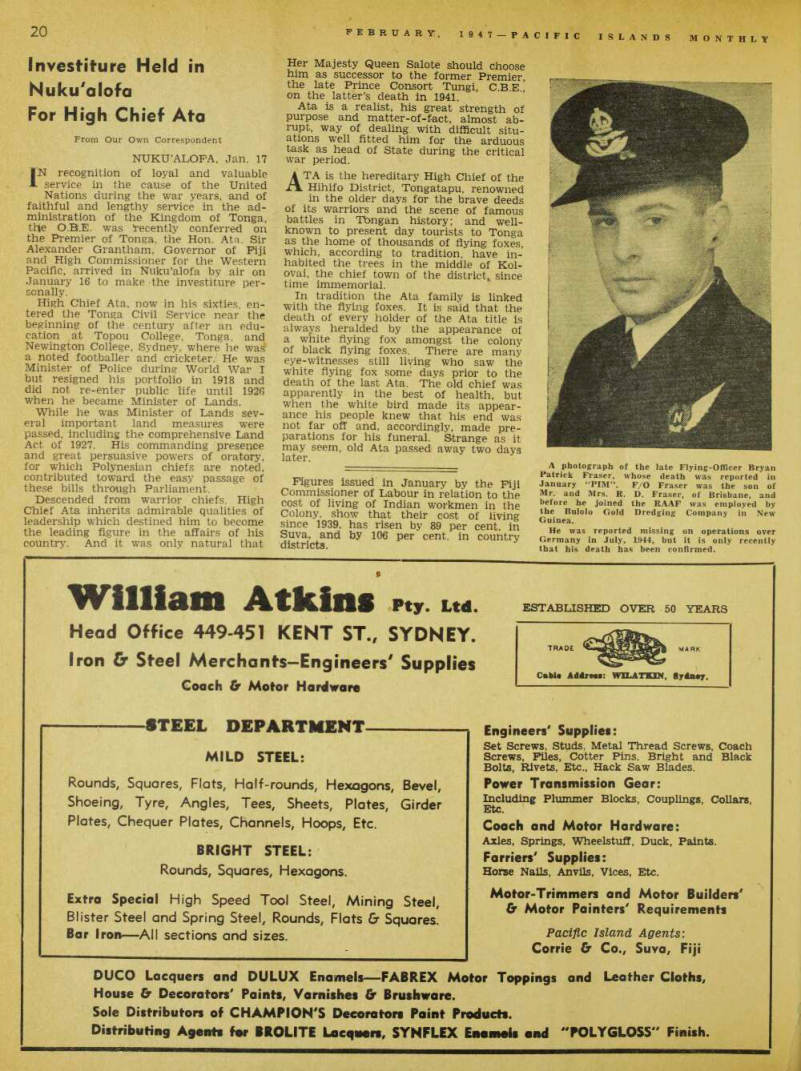
Investiture Held in Nuku'alofa For High Chief Ata
From Our Own Correspondent
Nuku’Alofa, Jan. 17
IN recognition of loyal and valuable service in the cause of the United Nations during the war years, and of faithful and lengthy service in the ad ministration of the Kingdom of Tonga, the O.H.E. was Recently conferred on the Premier of Tonga, the Hon. Ata. Sir Alexander Grantham, Governor of Fiji and High Commissioner for the Western Pacific, arrived in Nukualofa by air on January 16 to make the investiture per sonally.
High Chief Ata, now in his sixties, en tered the Tonga Civil Service near the beginning of the century after an edu cation at Topou College, Tonga, and Newington College, Sydney, where he was a noted footballer and cricketer. He was Minister of Police during World War I but resigned his portfolio in 1918 and did not re-enter public life until 1926 when he became Minister of Lands.
While he was Minister of Lands sev eral important land measures were passed, including the comprehensive Land Act of 1927. His commanding presence and great persuasive powers of oratory, for which Polynesian chiefs are noted, contributed toward the easy passage of these bills through Parliament.
Descended from warrior chiefs. High Chief Ata inherits admirable qualities of leadership which destined him to become the leading figure in the affairs of his country. And it was only natural that
Her Majesty Queen Salote should choose him as successor to the former Premier, the late Prince Consort Tungi, C.8.E., on the latter’s death in 1941.
Ata is a realist, his great strength of purpose and matter-of-fact, almost ab rupt, way of dealing with difficult situ ations well fitted him for the arduous task as head of State during the critical war period.
Ata is the hereditary High Chief of the Hihifo District, Tongatapu, renowned in the older days for the brave deeds of its warriors and the scene of famous battles in Tbngan history; and well known to present day tourists to Tonga as the home of thousands of flying foxes, which, according to tradition, have in habited the trees in the middle of Kol °vai, the chief town of the district, since time immemorial.
In tradition the Ata family is linked with the flying foxes. It is said that the death of every holder of the Ata title is always heralded by the appearance of a white flying fox amongst the colony of black flying foxes. There are many eye-witnesses still living who saw the white flying fox some days prior to the death of the last Ata. The old chief was apparently in the best of health, but when the white bird made its appear ance his people knew that his end was not far off and, accordingly, made pre parations for his funeral. Strange as it may seem, old Ata passed away two days later.
Figures issued in January by the Fiji Commissioner of Labour in relation to the cost of living of Indian workmen in the Colony, show that their cost of living since 1939. has risen by 89 per cent, in Suva, and by 106 per cent, in country districts.
A photograph of the late Flying-Officer Bryan Patrick Fraser, whose death was reported in January “PIM”. F/O Fraser was the son of Mr. and Mrs. R. D. Fraser, of Brisbane, and before he joined the RA AF was employed by the Bulolo Gold Dredging Company in New Guinea.
He was reported missing on operations over Germany in July, 1944, but it is only recently that his death has been confirmed.
Advertisements & other items, p. 22 (1 item)
William Atkins Pty. Ltd.
Head Office 449-451 KENT ST., SYDNEY.
Iron & Steel Merchants—Engineers' Supplies
ESTABLISHED OVER 50 YEARS
Coach & Motor Hardware
TRADE
MARK
Cable Address: WILATKES, Sydney.
STEEL DEPARTMENT
MILD STEEL:
Rounds, Squares, Flats, Half-rounds, Hexagons, Bevel, Shoeing, Tyre, Angles, Tees, Sheets, Plates, Girder Plates, Chequer Plates, Channels, Hoops, Etc.
BRIGHT STEEL:
Rounds, Squares, Hexagons.
Extra Special High Speed Tool Steel, Mining Steel, Blister Steel and Spring Steel, Rounds, Flats & Squares.
Bar Iron—All sections and sizes.
Engineers' Supplies: Set Screws, Studs, Metal Thread Screws, Coach Screws, Piles, Cotter Pins, Bright and Black Bolts, Rivets, Etc., Hack Saw Blades.
Power Transmission Gear: Including Plummer Blocks, Couplings, Collars, Etc.
Gooch and Motor Hardware: Axles, Springs, Wheelstuff, Duck, Paints.
Forriers' Supplies: Horse Nails, Anvils, Vices, Etc.
Motor-Trimmers and Motor Builders' fir Motor Painters' Requirements Pacific Island Agents : Corrie & Co., Suva, Fiji OUCO Lacquers and DULUX Enamels—FAßßEX Motor Toppings and Leather Cloths, House & Decorators' Paints, Varnishes fir Brushware.
Sole Distributors of CHAMPION'S Decorators Paint Products.
Distributing Agents for BROLITE Lacquers, SYNFLEX Enamels end "POLYGLOSS " Finish.
Scholarship
N. Guinea Memorial Scholarship First Award to Son of Missionary
WINNER of the first New Guinea Memorial Scholarship (the fund for which has been organised by the New Guinea Women’s Association of Melbourne) is Master W. H. (Bill) Ling good, of 21 Jordan Street. Malvern, son of Mrs. Essie Linggood and the late Rev.
L. I. Linggood. Mr. Linggood was a well-known member of the Methodist Mission in New Britain and lost his life in the Montevideo Maru.
Young Bill Linggood has started the new school year at Wesley College, Mel bourne. A note from his mother to the secretary of the New Guinea Women’s Association, says that “just at present his aim in life is to be a missionary and follow in his father’s footsteps.”
Scholarship Fund
THE Scholarship fund is still growing, but now at a more sedate pace.
It is, however, within a few hundred pounds of the desired target of £3,000 and the Scholarship Committee of the Asso ciation is sure that it can attain that objective although it will mean hard work.
Since the list was published last, in January “PIM” the following donations have been added: Previously acknowledged £2,612 19 4 Mr. and Mrs. S. A. Murcutt, Peronne Ave., Clontarf, NSW . . 5 5 0 Mr. and Mrs. Mark Pitt, Bogia, via Madang, NG 3 3 0 Mr. A. Richards, Inspector Expro Board, Rabaul 550 Mrs. E. E. Moore, 24 Auburn Street, Moree, NSW 5 00 Mr. C. S. Pasby, Sarang Plantation, Madang 110 Mr. and Mrs. O. M. Ron'dahl, “Ingomar,” Clare, SA . . . . 5 5 0 Colonel E. S. Appel, 17 Gleneira Road, Ripponlea (2/22) ... 110 Mr. Edgar J. Clymo, Public Works Dept., Port Moresby 2 8 0 Mr. and Mrs. Colin C. Marr, Sogeri Agricultural Station, Port Moresby District 116 Mr. Angus A. Smart, c/o B.P. & Co., Rabaul, NG 2 2 0 Mrs. Doris and Miss June Bartlett, 26 Short Street, Granville, NSW 10 0 Mrs. Phyllis L. Keenan, Finsch hafen, NG 100 Mrs. K. L. Crawley, Sogeri, Port Moresby, Papua 2 2 6 Colonel and Mrs. J. K. Murray, Government House, Port Moresby, Papua 21 00 Mr. R. V. Browne, Treasury Dept., Rabaul, TNG 220 Total to 31st January, 1947 . £2,671 15 4 Mr. D. F. McCaig has been appointed Superintendent of Fiji Prisons. He was formerly attached to the Fiji Posts &' Telegraph Department, and served with Fiji Military Forces during the greater part of World War 11.
Colonel J. E. Workman, Commissioner of Police in Fiji, has been transferred to a similar post in Northern Rhodesia. It is expected that he will leave Fiji about the end of April. His successor has not yet been appointed.
The largest mail to reach Fiji since 1938, arrived in Suva, on January 13 by the SS “Marine Phoenix.” The consignment con sisted of 500 bags of assorted mail but the staff of the Suva Post Office had made a complete clearance by 1 p.m. on the same day.
Advertisements & other items, p. 23 (1 item)
a major anxiety
'THAT
* The
Relief from
a major anxiety
Even the most expert and conscientious individual executor is subject to accident, illness and incapacitation.
Continuity of administration and uninterrupted attention to your estate and your beneficiaries are of paramount importance. Both can be positively assured by appointing this Company your sole Executor or as co-Executor with your present appointee. An interesting explanatory booklet will be forwarded on request
DIRECTORS:
lames Burns.
Joseph Mitchell.
P. T. W. Black, Lewis Armstrong R. J. Nosworthy.
MANAGER: L. S. Parker.
SECRETARY: E. R. Overton, A.F.I.A.
BURNS PHILP TRUST
COMPANY
LIMITED
7 BRIDGE
TELEPHONE: BU 5901.
STREET.
SYDNEY
Box 543. G.P.0., Sydney
BPI .45
Fiji Supply And Production
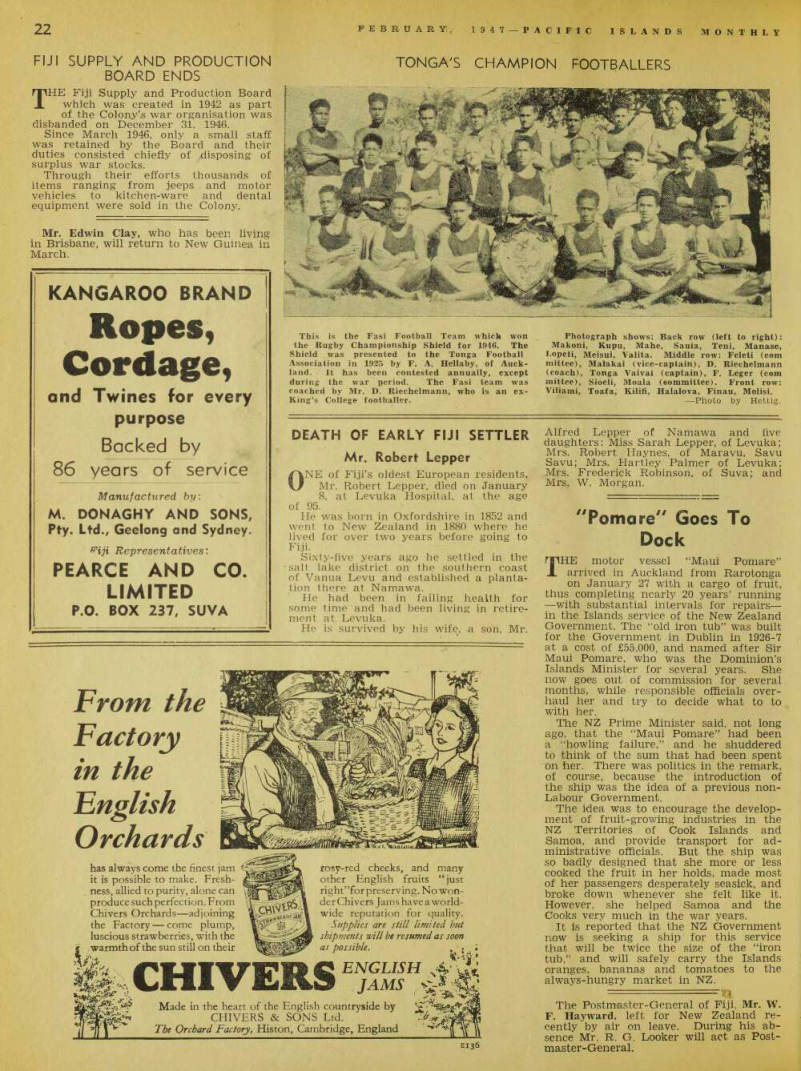
Board Ends
THE Fiji Supply and Production Board which was created in 1942 as part of the Colony’s war organisation was disbanded on December 31. 1946.
Since March 1946, only a small staff was retained by the Board and their duties consisted chiefly of disposing of surplus war stocks.
Through their efforts thousands of items ranging from jeeps and motor vehicles to kitchen-ware and dental equipment were sold in the Colony.
Mr. Edwin Clay, who has been living in Brisbane, will return to New Guinea in March.
Tonga's Champion Footballers
Photograph shows: Back row (left to right): Makoni, Kupu, Mahe, Sauia, Teni, Manase, Lopeti, Meisui, Valita. Middle row: Feleti (com mittee), Malakai (vice-captain), D. Riechelmann (coach), Tonga Vaivai (captain), F. Leger (com mittee), Sioeli, Moala (eommittee). Front row: Viliami, Toafa, Kilifi, Halalova, Finau, Molisi.
Photo by Hettig.
This is the Fasi Football Team which won the Rugby Championship Shield for 1946. The Shield was presented to the Tonga Football Association in 1925 by F. A. Hellaby, of Auck land. It has been contested annually, except during the war period. The Fasi team was coached by Mr. D. Riechelmann, who is an ex- King’s College footballer.
Death Of Early Fiji Settler
Mr. Robert Lepper
ONE of Fiji’s oldest European residents, Mr. Robert Lepper, died on January 8, at Levuka Hospital, at the age of 95.
He was born in Oxfordshire in 1852 and went to New Zealand in 1880 where he lived for over two years before going to Fiji.
Sixty-five years ago he settled in the salt lake district on the southern coast of Vanua Levu and established a planta tion there at Namawa.
He had been in failing health for some time and had been living in retire ment at Levuka.
He is survived by his wife, a son, Mr.
Alfred Lepper of Namawa and five daughters; Miss Sarah Lepper, of Levuka; Mrs. Robert Haynes, of Maravu, Savu Savu; Mrs. Hartley Palmer of Levuka; Mrs. Frederick Robinson, of Suva; and Mrs. W. Morgan.
"Pomare" Goes To Dock
Dock
THE motor vessel “Maui Pomare” arrived in Auckland from Rarotonga on January 27 with a cargo of fruit, thus completing nearly 20 years’ running —with substantial intervals for repairs— in the Islands service of the New Zealand Government. The “old iron tub” was built for the Government in Dublin in 1926-7 at a cost of £55,000, and named after Sir Maui Pomare, who was the Dominion’s Islands Minister for several years. She now goes out of commission for several months, while responsible officials over haul her and try to decide what to to with her.
The NZ Prime Minister said, not long ago, that the “Maui Pomare” had been a “howling failure,” and he shuddered to think of the sum that had been spent on her. There was politics in the remark, of course, because the introduction of the ship was the idea of a previous non- Labour Government.
The idea was to encourage the develop ment of fruit-growing industries in the NZ Territories of Cook Islands and Samoa, and provide transport for ad ministrative officials. But the ship was so badly designed that she more or less cooked the fruit in her holds, made most of her passengers desperately seasick, and broke down whenever she felt like it.
However, she helped Samoa and the Cooks very much in the war years.
It is reported that the NZ Government now is seeking a ship for this service that will be twice the size of the “iron tub,” and will safely carry the Islands oranges, bananas and tomatoes to the always-hungry market in NZ.
V'-f The Postmaster-General of Fiji, Mr. W.
F. Hayward, left for New Zealand re cently by air on leave. During his ab sence Mr. R. G. Looker will act as Post master-General.
Advertisements & other items, pp. 24-25 (2 items)
Ropes,
KANGAROO BRAND
Cordage,
and Twines for every purpose Backed by 86 years of service Manufactured by:
M. DONAGHY AND SONS,
Pty. Ltd., Geelong and Sydney.
Fiji Representatives:
PEARCE AND CO.
LIMITED
P.O. BOX 237, SUVA
From the
Factory
in the
English
Orchards
has always come the finest jam it is possible to make. Freshness, allied to purity, alone can produce such perfection. From Chivers Orchards —adjoining the Factory come plump, luscious strawberries, with the warmth of the sun still on their Sa£ rosy-red cheeks, and many other English fruits “just right”for preserving. No wonder Chivers Jams have a worldwide reputation for quality.
Supplies are still limited but shipments mil be resumed as soon as possible. , ;
ENGLISH
CHIVERS JAMS ■
Made in the heart of the English countryside by
CHIVERS & SONS Ltd.
The Orchard Factory, Histon, Cambridge, England
Stewarts and Lloyds
(AUST.) PTY. LTD.
MANUFACTURERS OF
S <S L Pipe (Welded and Seamless Types] S & L Weldless Boiler Tube S & L Weldless Bore Casing S & L Wrought Steel Pipe Fittings
AND DISTRIBUTORS FOR
Welding Electrodes and Welding Equipment
Stewarts and Lloyds
(AUST.) PTY. LTD.
P. 0., BOX 21, CROW’S NEST. N.S.W.
Cable Address: "TUBES,'' SYDNEY. • Steel Bolts and Nuts • B.T.M. Precision Steel Tubes • Copper and Brass Pipe • Galvanised Iron Sheets, Guttering and Downpipe • Engineers' and Plumbers' Valves and Brassware • Steel Merchant Bars, Structural Steel • Sections and Steel Plates and Reinforcing Rounds • Saunders Valves
BSI Government
"Anxious for Copra Production"
Advice to the Solomon Islands Rubber Plantations Ltd.
ADVICE was received by The Solomon Islands Rubber Plantations Pty., during the year ended July 31, 1946 from the British Solomon Islands govern ment, to the effect that Government was anxious to re-establish the copra industry in the Protectorate as soon as possible.
At the annual meeting of the Company (which has a coconut and rubber estate on Ysabel Island, BSD in Brisbane, on December 20, however, it was pointed out in the Directors report that, at the same time that the Government expressed this anxiety, they had levied a 15 per cent, export tax on copra, whether the pro ducer had made a profit or not.
The Company’s plantations of 60.000 coconut trees and 8,300 rubber trees had been reported uninjured and inspite of unfavourable conditions the Company was anxious to go ahead with rehabilita tion, the chairman of directors stated.
Transport in BSI, both inter-island and overseas, was negligible at the present time—the only regular link was between Guadalcanal and Noumea. Labour was in short supply and although it may gradually be forthcoming it will be at increased costs to those existing before the war. The Board was keeping the matter of war damage before the authori ties and it was hoped that a satisfactory settlement of the Company’s claims would eventually be made.
Having regard to the Company’s needs
for working funds to re-open the planta tion during the current year, the direc tors had decided to make a call of 1/- on “B” preference shares.
Loss for the year was £l6B plus £172 depreciation. Reserves have not been drawn upon and all known liabilities have been provided for, with the excep tion of the uncertainty as to the state of the plantation and livestock.
Thousands
Rabaul Natives Receive Thousands From War Damage And the Labour Supply Again Dries Up
Prom Our Own Correspondent
Rabaul. Jan. 14.
ALTHOUGH for a while recently it seemed that the native labour question was beginning to straighten Mtself out, we are now back where we started at the commencement of the re habilitation era. The reason for this is that the Government has commenced to pay out thousands of pounds in war damage compensation to the natives — and they will not work while the money lasts.
Indications are that it will not last long it is being spent in the usual native style on bread, tinned meat, bis cuits, tobacco, European clothing (boots, shoes, sox, etc. which are worn for the novelty and then discarded) ice cream, lemonade and cheap trash with which to decorate themselves.
Decked out like Christmas trees, they
ride around in hired ex-military trucks which were purchased by local specula tors at recent CDC sales with just this in view to part the native quickly from his war damage money. Two head men from nearby villages have told me that there will be a great shortage of native foodstuffs soon. While they live on the money that is literally thrown at them by the administration they are making no provision foi* their future needs and are neglecing their gardens.
It needed no great knowledge of New Guinea native psychology to prevent this needless waste. The fnative has, and always has had, only one method of dealing with a sudden influx of unearned wealth to get rid of it as soon as possible.
Recently, to try to induce labour to work for the Government departments that are in greatest need of it (PCB, PWD and Shipping Board) the local authorities offered 3/- per day, a free mid-day meal and transport to and from work. Even this is getting poor results and it has this result too it makes it virtually impossible for the ordinary householder and planter to compete in the labour market.
Two local planters have had their labour walk off after demanding increased wages. One is Mr. J. C. Mul laly who has been paying his boys 3/per day. They demanded 6/- per day and when this was refused they walked off leaving partly-dried copra to take care of itself. It is rumoured that Mullaly has spent £2,000 trying to rehabilitate his plantation.
The Fiji Director of Agriculture, Mr. C.
Harvey, was expected to sail from London for New Zealand on January 23 by s.s.
“Rimutaka.” He has been on leave.
Advertisements & other items, p. 26 (1 item)
GENERAL MERCHANTS. c*9mßtnm Pip) iyyi
ISLAND MERCHANTS
379 KENT ST., SYDNEY.
Cable & Telegraphic Address: “ Chasull* * Sydney. 9 Shippers of all types of " Merchandise to the Pacific Islands • Representing Australian, British and American Manufacturers -J in *'■ • Buyers for Leading Pacific Islands Traders • Sellers of Island Produce on Consignment Importers, Distributors and Manufacturers of Foodstuffs, Softgoods, Textiles, Hardware, Tobaccos, Wines and Spirts, etc. /i* • “Ultima" Kerosene Stoves and Heating Appliances 9 Distributors of High-grade Shirts, Pyjamas and Clothing • “Southern Queen"
Canned Fruits • Forwarding and Transhipment Agents /?> « m Hill's English Cigarettes When in Sydney, call and see us!
A Forty-Four Hour Week
Fiji's PWD is to Have A Forty-Four Hour Week —And Bonus Rates
THE working week for Public Works Department employees in Fiji is to be reduced from 48 hours to 44. without loss of pay. Eight hours a day will be worked on five days a week and four hours on Saturday. The reduction will take effect as soon as the necessary arrangements can be made.
The question of reducing working hours in the Public Works Department was raised by representatives of the workers two years ago following a reduction in hours of work by a number of Suva employers, and references were made later in Legislative Council and in the House of Commons. Recently the ques tion has been the subject of negotiation between the Public Works Department Union and Government.
When communicating to the Union the decision*- regarding the 44-hour week Government stressed the importance of increasing output. Union officials ex pressed the Union’s gratitude for the improvement in bonus rates and work ing hours, and for the prompt manner in which their requests had been dealt with. They undertook to use their in fluence with members of the Union to achieve the desired improvement in output.
New Bonus Rates for Government
Wage Workers
ANEW- bonus scale for wage employees of the Government of Fiji, to take effect from January 1, 1947, has been approved. The new scale has been fixed in consequence of the sharp rise in the cost of living index of Indian work men during the fourth quarter of 1946 (89 per cent, increase on 1939 figures), and of representations from the Public Works Department Employees’ Union.
The bonus scale now approved adopts the principle that the labourer on a basic, or 1939, rate of 2/6 a day should be fully compensated for the 89 per cent, rise in the cost of living and that the worker on a basic rate of 25/- should bear half the increased burden and Gov ernment the other half.
It has been decided that between these two points the proportion borne by the Government should diminish at a constant rate.
It has been further decided to tie the bonus to the Cost of Liying Index, in creasing or decreasing the bonus with every rise or fall of 10 points or more in the Index figure. —From Fiji Public Relations Office Bulle tins
Pioneer of Labasa District, Fiji
Death Of Mrs. R. D. Mcphee
THE death occurred at the Colonial War Memorial Hospital, Suva, on January 13, of Mrs. R. D. McPhee a highly respected Fiji pioneer.
Although ill-health compelled her to live in retirement in recent years, Mrs.
McPhee was in her younger days a popu lar figure in the Labasa and Navua districts where she spent most of her life.
She was born in Labasa 70 years ago.
She is survived by her husband and seven daughters. Her only son Alec, joined the AIF early in World War II and was killed in Greece.
Mr. R. F. Bunting, of Samarai, Papua, was in Sydney on a short holiday in January.
No New Building in Somorai Reconstruction
Somorai Reconstruction at a Standstill
From Our Own Correspondent
Samarai, Jan. 27.
THERE is still little reconstruction work going on in Samarai. During the early days of the Pacific war, when the Japs appeared as though they might make the island a stepping stone, the business centre was scorched-earthed.
Later the army constructed some of their own establishments in the ruins and in these ex-army buildings the trading stores that have returned are trying to carry on business. Burns Philp, A. H. Bunting Ltd., Steamships Trading, are back but Whitten Bros. Ltd., which did business here before the evacuation, has not returned.
Permission to erect new buildings on the island has not yet been granted although one may submit plans, unoffi cially, to the Building Board in Port Moresby. What little accommodation there is is very expensive. However, the whole of the island has been re-surveyed and people at least know where their pre-war allotments were. Some of these have mysteriously increased in size; some have shrunk. Presumably this is due to an incorrect survey made many years ago.
Repairs to the local wharf are so long overdue that part of it has now collapsed; the local power house is also waiting for new equipment which was ordered months ago.
The Muliama arrived direct from Sydney on January 17 with almost 600 tons of general cargo and departed on January 23 with a full cargo of copra and rubber.
Mrs. Ray Youlden, formerly of Rabaul, entertained a few friends at her Mel bourne home on January 8, to celebrate the coming of age of her daughter Valda.
Mrs. Youlden was the wife of the late Ray Youlden, well-known auctioneer of pre-war Rabaul. He lost his life when the “Montevideo Maru” was sunk in 1942.
Fiji has its lotteries, too. In the last four months of 1946, permits for 43 lot teries (or raffles) were issued by the Police Commissioner. Among those who benefited from the proceeds, were the Fiji Gifts to Britain Fund, various schools, The Cottage Home in Suva, church funds and patients at Makogai.
Advertisements & other items, p. 27 (1 item)
Cordage and
QUEENSLAND
INSURANCE
COMPANY
LIMITED
(Incorporated 1886 In Australia)
ASSETS EXCEED £4,000,000
Head Office :
QUEENSLAND
INSURANCE BUILDING,
80-82 PITT STREET, SYDNEY.
Specialists in South Seos Fire,
Marine & Accident Insurances
Apply to:—
ful Branch Office: I. B. Chalmers, Manager.
Burns Phllp (South Sea) Co., Ltd.
VILA.
Burns Phllp (South Sea) Co., Ltd.
Comptoirs Francals Des Nouvelles Hebrides (Marine).
NOUMEA.
L. <fe W. Johnston.
PORT MORESBY:
Burns, Phllp & Co., Ltd.
W. A. Anderson, Resident Officer.
PAGO PAGO.
Burns Phllp (South Sea) Co., Ltd.
G. H. C. Reid & Co.
OTHER SOUTH SEA ISLANDS.
Burns Phllp (South Sea) Co., Ltd.
Also to any of the Company’s Offices in Australia or New Zealand.
Scott’s “Renown” Brand Rope,
Cordage and
Binder
Twine
of Every
Description
Cable Address: Ropeyard Sydney. m
MANUFACTURED AT
MASCOT. N.S.W.
J. SCOTT
PTY. LTD.
Head Office and Store
163 CLARENCE STREET,
SYDNEY,
N.S.W.
Lae Still Muddles Along
War Damage Money Running Out
From our Own Correspondent LAE. Jan. 17.
LAE’S roads are being done up at last -and the local members of the PWD are making a good job of it.
This sudden, if belated action has, how ever, come as such a surprise it has given rise to the rumour that the Duke of Gloucester is to pay us a visit on his way home!
Axr Ot s erwls + o v, *u arr ™- on + mUC £ aS US f al - We hear that the Montoro has a few hundredweight of essential foodstuffs for Wp arp mit eafrT 5 °* any b Residents are stm for cargo landedbv 1 the last Montoro lomp eoods were then dumped in heaps hi at Milford Haven; some was dispersed to various sheds stuttered about the Lae area. Grindstones and wireless receivers, cases of jam, powdered milk, bottles of whisky and beer were all tipped off the Lorries and coagulated into one solid mass in the sheds. Local residents crawled over pyramids thus formed, looking for essential articles.
Natives are still asking why they must pay so much for rice, tea, sugar and other necessary items. They still refer to the present time as “time no good,’’ in the same manner as they did during
L^r^T ation i.r They ask ’
p e come back.™ Government That is what we would all like to know.
Hundreds of natives are offering for employment but few Europeans can now employ them. Industry and land settle merit is discouraged The small man still sits tight and hopes. But the solution for many has been to take a job with the Government and let the Aus
tralian taxpayer foot the bill. Most have already exhausted their war-damage money and would not be able to set them selves up in their pre-war businesses even if materials were available.
Methodist mission losses
In Solomons
Missions In the British Solomon Islandsconducted by the New Zealand Methodist Church lost property worth £92,000, and one missionary (Rev.
D. C. Alley) as a result of the Japanese invasion, according to a statement made on January 27, at the Mission’s annual meeting in Auckland, by the Rev. A. H.
Scriven. Nearly all the Mission buildings, all the boats and some of the plantations, were destroyed.
The Mission faces a heavy task in re habilitation; but it was believed now that some war damage compensation will be available * Mr - Scriven said that a director of edu catlon had been appointed to the British Sol ornons, and this was the first step on the P arfc of f the Go Y^n m ent to assume a measure of responsibility for the educa tion of the native people. Hitherto most the educational work has been done b Y the missionary societies. The Govern ment had also established an agricultural training centre at Hu, 15 miles from the new capital, Honiara, on Guadalcanal.
The centre occupied 5000 acres, but was at present in the very initial stage of its development. As the future of the vast majority of the natives was on the land Mr. Scriven considered this new nroiect to be on the right lines but he pointed out ?ha? 'were the Products the natives were trained to th project would lead to a dead
Fall Of Rabaul
Letter to the Editor AT the ceremonies held at Rabaul today on the fifth anniversary of the fall of the town to the Japanese, it was good to see many of the civilians who re turned to the Territory by the vessels Reynella and Duntroon.
But to-day we honour the memory of those brave souls who were sacrificed or sacrificed themselves in the vain belief that Australia would come to the rescue of their helpless countrymen in their hour of need. The mystery that surrounds the colossal stupidity that in January, 1942, denied the population of Rabaul the op portunity to avail themselves of the ample opportunities to effect their escape are the matters that must and will concern the people of this Territory. It is the bounden duty of every self-respecting comrade of those heroes to fight for a full and unrelenting inquiry that will ex pose those responsible for the sacrifice and grevous loss now being suffered by the wives and families of those who made the sacrifice.
Territorians to-day recall the memory of Dad Forsyth, Bill Gross, Nobbie Clark, Harry Adams and a number of others who so diligently tried to further the wel fare and prosperity of the Territory.
They fought for free and equal justice; a free and elected council.
They were not of the same persuasion as the “Yes-men” and theorists who now rule this land.
It is the privilege and right of the children of those pioneers to revere, hon our and imbibe the courageous spirit of those men who tried so valiantly to stem the tide of Australia’s disinterestedness and ignorance.
I am, etc.
Rabaul,
One Who Escaped
January 23, 1947.
Advertisements & other items, p. 28 (1 item)
Wise Precaution,
I
Dt 5 a.
MOTHER!
In these days of uncertainty, your little ones will be safer when they are wearing an ECCO Indentity inscribed with their name and address. Give your children this added protection, today!
CROSSES
and CHAINS
oJ, Beautifully designed, ECCO Crosses and Chains make ideal gifts for mother, sister, wife or girl-friend. Come in today, and make your selection from our wide assortment f An important accessory to every well-dressed man’s appearance, ECCO Cuff Links have a rich dignity of style and design which wins instant approval. Come in and see them today.
OBTAINABLE FROM YOUR JEWELLER
or from:
PACIFIC ISLANDS TRADING COMPANY
244 California St. San Francisco II, U.S.A.
in Samarai
Death of W. J. Lambden in Samarai Another "Murray Man" Dies in Harness
THE death of W. J. Lambden, District Officer, Eastern District, Papua, which occurred at his home in Sam arai on January 4, was not only a source of grief to his relatives and his many friends, but was also a cruel blow to all who still hope to see sanity and order restored to the administration of Australia’s New Guinea territory.
“Bill” Lambden was born in 1896. He served through the First World War and joined the Public Service of Papua in 1920 as a patrol-officer. He was stationed first at Daru, in the Western Division, and served later in the Gulf and Northern Divisions before going to Abau, where he remained until 1943, first as Assistant Resident Magistrate and later as RM of the newly formed East Central Division.
From the time he joined the Adminis tration he proved himself one of the most trustworthy officers in a loyal and hard working service. He possessed unusually keen insight into the native mind, and the faculty, amounting to genius, of winning native confidence to an extent seldom found in even the most experi enced officers. And he understood, per haps more clearly than any man except his Chief, the full implications and ulti mate objectives of the world-famed Murray policy.
It was his rigid sense of justice, and his devotion to a cause in which he believed, that brought him into conflict with the military authorities in 1942-3.
He remained, after the compulsory evacu ation in 1942, at his magisterial station at Abau. And his first disagreement
with the Army came when he refused to accept an instruction that a certain native accused of desertion must be con victed and severely punished. Lambden was accustomed neither to pre-judging the cases brought before him, nor to obeying instructions as to his verdict.
As he saw it, his duty was to inter pret the law and to administer justice; and no amount of pressure from outside was permitted to influence the decisions that his experience and deep integrity prompted him to make. He tried the case, convicted the accused on technical grounds, and returned him to his em ployer without inflicting a penalty.
Military dignity was hurt. And resent ment grew as Lambden continued to in flict penalties for desertion much lighter than those which rigid military view con sidered appropriate. Eventually he was •informed officially that, unless he im posed much heavier punishments, the Army would inflict floggings for desertion without reference to the law.
Lambden fought this threat as he fought the method of wholesale and un considered conscription of labour. But he was fighting a losing fight against overwhelming forces.
His health was not good at this time, though he was quite capable of carrying out his duties. But the Army decided that he must go. He was called before a Medical Board which could be relied upon to obey instructions, and was in valided out of the service.
He went to Melbourne, and was there employed as organiser for the sale of War Savings Certificates and War Loan Bonds in a "large Melbourne district.
Later he was appointed manager of a section of the Munitions Department from which he was soon promoted to the posi tion of organiser.
From there he would have gone, in the natural course of events, on to a much higher and well paid position; but
the Provisional Administration was formed just at that time, and no offers, however lucrative, could keep him away from his beloved Papua. He returned there late in 1945, and was placed in charge of the eastern districts, with head quarters at Samarai, where he remained until he died.
His home life was an exceptionally happy one. Mrs. Lambden was his part ner in his work, acting as his efficient private secretary. They had a daughter and a schoolboy son. —LL.
The Popular "Pareu" Is With
Us Again
From Our Own Correspondent
Mangaia. Nov. 21
RENDERED almost a memory by the war, the printed calico loin cloth, with its immense flowers in white upon-red (or blue), is obtainable again.
This is positive proof, to our Poly nesians, that peace, if not plenty, has come to the white man’s world.
When this writer first came to Mangaia (1926) every damsel and dame wore the pareu , in lieu of elastic-supported knickers. The tropical garment later gave place to the bifurcated mysteries mentioned in the knowledgeables’ opinion, a bad exchange! Now, however, fashion is swinging the other way again.
Governor J. C. Haumant and Madame Haumaunt of French Oceania left Papeete on January 12 on the French sloop “La Grandiere” for Bora Bora. There they picked up an RNZAF plane which took them, via Rarotonga and Fiji, to New Zealand. Later they went on to Australia where they attended the South Seas Commission Conference in Canberra.
Mr. Leo Voronick, who was very well known in Papeete, Tahiti, where he was a pearl merchant, died there on January 8, after a short illness.
Advertisements & other items, pp. 29-30 (1 item)
William H. Watson
ESTABLISHED 1930
RAROTONGA, COOK ISLANDS
Wholesale and Retail Trader
LICENSED STAMP DEALER
Agent For:—
BRITISH TRADERS 7 INSURANCE CO.
CORONA & L. C. SMITH TYPEWRITERS
KAISER & FRAZER MOTOR CARS
B.S.A. CYCLES AND MOTOR CYCLES
AMERICAN LEAD PENCIL CO.
WHITES AVIATION LTD.
Manufacturers of: FOOTWEAR, ALL CLASSES SUITABLE FOR NATIVE TRADING . . . MOP. PRODUCTS, INCLUDING ROUND EAR-RING BLANKS AND BUTTON BLANKS Exporter of: “Rarotonga” Hula-Skirts.
Sea-Shell Necklaces.
M.O.P. Jewellery.
Island Produce.
Cable Address: “Watson” Rarotonga Wholesale and Retail Inquiries Invited.
Prepared to Consider Agencies tor all Class of Goods.
Bankers: Importer of: Textiles.
General Hardware.
Fancy Goods.
General Merchandise.
Bank of New Zealand, Auckland.
When Worried
Tired,Sleepless
AND YOU FEEL RUN-DOWN
Worry Is Inescapable. Everyone has a share of it more or less. The great trouble about worry is that it plays havoc with your health and fitness if you let it. You become mentally and bodily weary, cannot sleep at night, lose appetite and begin to feel a nervous breakdown is impending. That starts the vicious circle. You worry, become run-down and nervy, and that makes you worry more than ever.
Meet your troubles all the way by reinvigorating your system and keeping it fit and well by taking Dr. Williams’ Pink Pills. These pills help to restore the red corpuscles and iron content of the blood to their normal quantity.
This enables life-giving oxygen and nourishment to be carried to the nerves, organs and tissues of the body. In that way you become invigorated, strengthened by Dr. Williams' Pink Pills, the vague aches and pains disappear and you are fit again to deal confidently with all your worries. At chemists and stores.
Woven Wire for all Industry
COPRA DRYING TRAYS, FLOORS, Etc.
FRU'T DRYING TRAYS, MINING SCREENS.
Heavy Mosquito Gauze in Phosphor Bronze and other Metals Impervious to Salt Sea Air.
WIRE DOOR MATS AND GENERAL WIRE WORKS
E. WRIGHT & CO. LTD.
Office and Works: 148-152 Cleveland Street, Sydney, N.S.W.
Telegraphic Address: “Wrlghtmake,” Chippendale. \
o^ TA^
f: ft* £
Sails, Covers, Awnings
AND ALL CLASSES CANVAS GOODS FOR
INDUSTRIAL AND HOME USE
ALSO: FLAGS, ALL NATIONS
Send your inquiries to
HARRY WEST
"SYDNEY'S SAILMAKER"
DUKE ST. (WATERFRONT) EAST BALMAIN, SYDNEY, N.S.W.
Phone: WBIIOS, W 82284.
War Damage In Bsi
United States Has No Responsibility
IT seems to be clear from the material that has come to hand and been pub lished in the “PIM” (see Jan. issue) that the British Government contem plates the payment of war damage com pensation to residents of the Solomon and Gilbert and Ellice Islands. The channel thorugh which communications on the subject should proceed, apparently, is the High Commission for the Western Pacific, Suva. But no move can be made until some announcement is given by the High Commissioner for the Western Paci fic. He, presumably, takes his instruc tions from Whitehall.
Meanwhile, former residents of the British Solomons—to most of whom the Jap invasion spelled economic ruin—are looking anxiouslv for some lead, or eveh a reassuring word. Several letters, des cribing their plight, have come in from readers. Here is a copy of correspondence between Mr. Harold A. Markham, owner of the once-famous Segi Plantation, Marovo Lagoon. New Georgia, and the United States Consul, which is interest ing.
Mr. Markham wrote on November 25, 1945, to the United States Consul in Syd ney, as follows: “Would you please be good enough to
inform me if I am entitled to claim com pensation for war damage to my property by the United States Naval Construction Corps. My property is Segi plantation, Marovo Lagoon, New Georgia, BSI.
“From information received, it appears that when the US forces advanced from Guadalcanal to Rendova and Munda, they decided to construct an airstrip for emergency landings on my estate. The arqa cleared is supposed to be 60-70 acres, involving approximately 3000 coco nut palms. This will reduce my output of copra by at least 40 tons per annum.
“After residing in the Solomons from 1907 to the outbreak of hostilities, I was forced to evacuate my home on account of Japanese planes bombing Tulagi and the surrounding districts. For the past two years I have been employed by the US Army, Base Section 7; and, as this employment will cease within the next few weeks, it may cause financial diffi culties until such time as I am able to return to the Solomons.”
The Consul’s reply was dated at Feb ruary 18, 1946, and was as follows: “The Consulate General refers to your letter of November 25, 1945, in regard to your claim for compensation for damage to your property by the United States Naval Construction Corps.
“This office has now received from the Commander, South Pacific Area and Force, through the Commanding Officer of the United States Navy Defence Air Reciprocal Aid Review Group in Sydney, advice to the effect that your claim for war damage in the British Solomon Islands, is the responsibility of the Brit ish Government, through agreement with the United States Government, and the latter Government is entertaining no such claims.
“It is believed you should apply to the British High Commissioner for the West ern Pacific, at Suva, in regard to your claim, since it appears that this official has stated to the Commander, igouth Pacific Area and Force, that the respon sibility for all claims for war damage in the Solomons lies on the British Govern ment, and there is no question of claim against the United States Government.”
Csr Employee Killed
By Lightning
DURING a storm at Nadi, Fiji, in early January, Mr. K. Parker, a young field officer of the CSR Company was struck by lightning and was fatally injured. Mr. Parker was on horseback when the accident occurred and his horse was also killed by the lightning flash.
Mr. Parker, who was 24 years of age, was a graduate of Hawksbury College, New South Wales. For four years he was an assistant field officer at the Drasa trainnig farm Fiji, and recently was stationed at the Navakai estate.
Colonel Migeon, director of civil avia tion in New Caledonia, who through the war was an ardent de Gaulliste, attended the Conference on Civil Aviation in Mel bourne in February as head of the French delegation.
Nadi, Fiji, which was a large American base during the war, and is close to Fiji’s international airport of the same name, is now officially a township, a proclamation creating the township, appeared in a Royal Gazette in January. The chairman of the first Township Board is Mr. J. S. M.
Park, and the members of the Board are: The District Engineer, Lautoka: the Health Inspector, Lautoka; Mr. 'G. L.
Robley; Dr. G. Mukherji; Mr. I. Graham; Mr. Samjee Jadavji; Ratu Rusiate Levula; Buli Nadi and Mr. M. S. Raju.
Advertisements & other items, p. 31 (1 item)
Capstan
TIME MOVES FAST
but it will always .. .
Oil Exploration In Papua
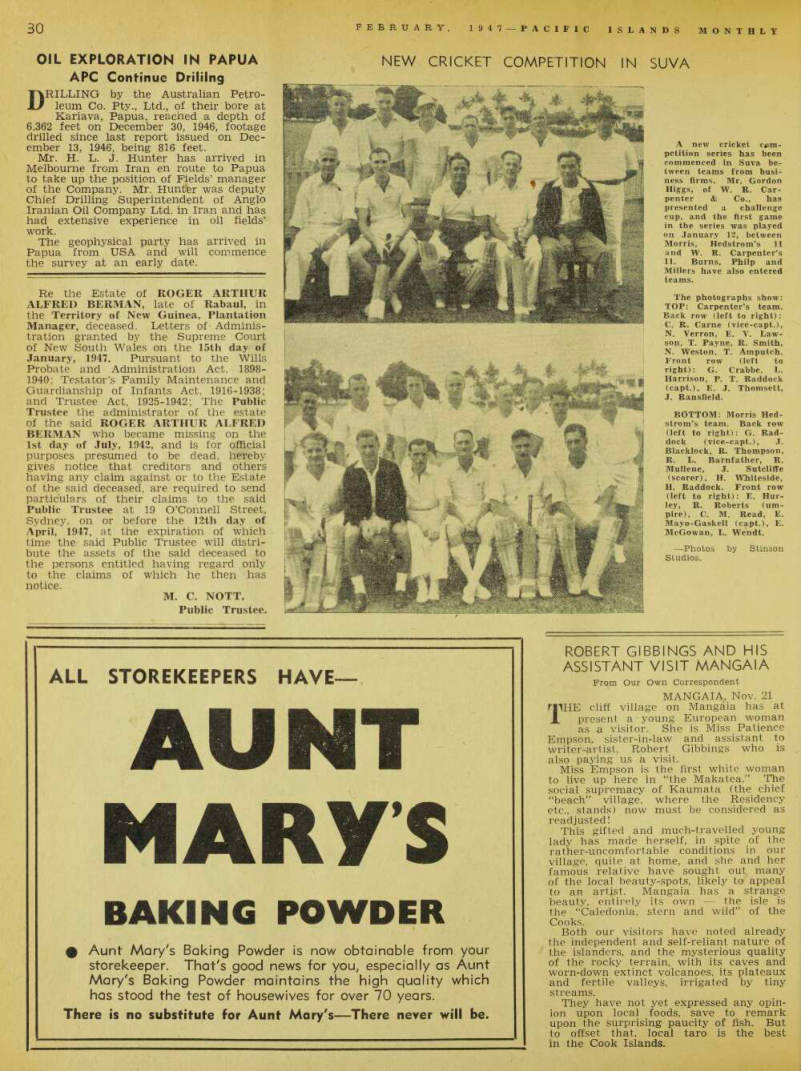
APC Continue Drilling
DRILLING by the Australian Petro leum Co. Pty., Ltd., of their bore at Kariava, Papua, reached a depth of 6,362 feet on December 30, 1946, footage drilled since last report issued on Dec ember 13, 1946, being 816 feet.
Mr. H. L. J. Hunter has arrived in Melbourne from Iran en route to Papua to take up the position of Fields’ manager of the Company. Mr. Huntfer was deputy Chief Drilling Superintendent of Anglo Iranian Oil Company Ltd. in Iran and has had extensive experience in oil fields’ work.
The geophysical party has arrived in Papua from USA and will commence the survey at an early date.
New Cricket Competition In Suva
A new cricket com petition series has been commenced in Suva be tween teams from busi ness firms. Mr. Gordon Higgs, of W. R. Car penter & Co., has presented a challenge cup, and the first game in the series was played on January 12, between Morris, Hedstrom’s 11 and W. R. Carpenter’s 11. Burns, Philp and Millers have also entered teams.
The photographs show: TOP: Carpenter’s team.
Back row (left to right): C. R. Came (vice-capt.), N. Verron, E. V. Law son, T. Payne, R. Smith, N. Weston, T. Amputch.
Front row (left to right): G. Crabbe, L.
Harrison, P. T. Raddock (capt.), E. J. Thomsett, J. Ransfield.
BOTTOM: Morris Hed strom’s team. Back row (left to right): G. Rad dock (vice-capt.), J.
Blacklock, R. Thompson, R. L. Barnfather, R.
Mullene, J. Sutcliffe (scorer), H. Whiteside, H. Raddock. Front row (left to right): E. Hur ley, R, Roberts (um pire), C. M. Read, E.
Mayo-Gaskell (capt.), E.
McGowan, L. Wendt.
Photos by Stinson Studios.
Assistant Visit Manga Ia
Robert Gibbings And His
From Our Own Correspondent
Mangaia. Nov. 21
mHE cliff village on Mangaia has at X present a young European woman as a visitor. She is Miss Patience Empson, sister-in-law and assistant to writer-artist, Robert Gibbings who is also paying us a visit.
Miss Empson is the first white woman to live up here in “the Makatea.” The social supremacy of Kaumata (the chief “beach” village, where the Residency etc., stands) now must be considered as readjusted!
This gifted and much-travelled young lady has made herself, in spite of the rather-uncomfortable conditions in our village, quite at home, and she and her famous relative have sought out many of the local beauty-spots, likely to appeal to an artist. Mangaia has a strange beauty, entirely its own the isle is the “Caledonia, stern and wild” of the Cooks.
Both our visitors have noted already the independent and self-reliant nature of the islanders, and the mysterious quality of the rocky terrain, with its caves and worn-down extinct volcanoes, its plateaux and fertile valleys, irrigated by tiny streams.
They have not yet expressed any opin ion upon local foods, save to remark upon the surprising paucity of fish. But to offset that, local taro is the best in the Cook Islands.
Advertisements & other items, pp. 32-33 (2 items)
Marys
Re the Estate of ROGER ARTHUR ALFRED BERMAN, late of Rabaul, in the Territory of New Guinea, Plantation Manager, deceased. Letters of Administration granted by the Supreme Court of New South Wales on the 15th day of January, 1947. Pursuant to the Wills Probate and Administration Act, 1898- 1940; Testator’s Family Maintenance and Guardianship of Infants Act, 1916-1938; and Trustee Act. 1925-1942; The Public Trustee the administrator of the estate of the said ROGER ARTHUR ALFRED BERMAN who became missing on the Ist day of July, 1942, and is for official purposes presumed to be dead, hereby gives notice that creditors and others having any claim against or to the Estate of the said deceased, are required to send particulars of their claims to the said Public Trustee at 19 O’Connell Street, Sydney, on or before the 12th day of April, 1947, at the expiration of which time the said Public Trustee will distribute the assets of the said deceased to the persons entitled having regard only to the claims of which he then has notice.
M. C. NOTT,
Public Trustee.
ALL STOREKEEPERS HAVE—
AUNT
MARYS
BAKING POWDER
0 Aunt Mary's Baking Powder is now obtainable from your storekeeper. That's good news for you, especially as Aunt Mary's Baking Powder maintains the high quality which has stood the test of housewives for over 70 years.
There is no substitute for Aunt Mary's—There never will be.
Refrigerator
Modern Refrigeration for the South Sea Islands
The ELECTROLUX KEROSENE OPERATED
MARVEL
OF
MODERN
SCIENCE
•r 3
THE
MIRACLE
OF
ICE
FROM
HEAT
ELECTROLUX offers economical, modern and completely efficient
REFRIGERATION FOR ISLANDS' HOMES.
FREEZES CONTINUOUSLY WHILE SMALL LAMP BURNS.
Freezing controlled by simply regulating height of flame. Uses only f gallon of kerosene per week.
MOTORLESS ... NO PARTS TO GET OUT OF ORDER.
MODEL LKSSO
Capacity: m 8.5 cubic feet.
GUARANTEED FOR TWO YEARS
• Write to your Local Distributor for prices and full details.
OBTAINABLE FROM ALL W. R. CARPENTER & CO. LTD.
BRANCHES THROUGHOUT THE ISLANDS
Representation in Papua and New Hebrides.
How 240 Men Were Saved
Events on New Britain Coast After Jap Invasion of Rabaul
r J I HL S is the second and concluding in * stalment of the article by Mr. J.
K. McCarthy.
In the January instalment, he described the tragic situation that developed in January and February, 1942, in New Britain, after Rabaul was invaded, and hundreds of Australian military and civi lian refugees tried to escape westwards along the north and south coasts of that primitive, unroaded, heavily-jungled island.
Mr. McCarthy was Asst. District Officer, Talasea, on the north coast. In the face of incredible difficulties, and daily men aced by the enemy’s sea. land and air patrols, he enlisted the services of several experienced New Guinea bushmen— planters, traders, officials and mission aries—and planned and put into operation an organisation that eventually rescued some hundreds of men.
Great praise is given to Mr. McCarthy’s achievement by Mr. E. A. Feldt, in his book “The Coast Watchers.”
Section Ii
REPORTS from up the coast were un settling; they stated that the Jap anese were now sending out “mopping up” patrols from Rabaul and were visiting points west of Lassul Bay on the North Baining coast, where they were collecting hundreds of our troops who had succeeded in getting there from Rabaul.
It was only a matter of time before the Japs would again visit Pondo, and then all hope of our escape plan being put into action would end. We had to work fast.
After drawing up the plan and com mitting it to writing I decided to ■ leave Rod Marsland at Pondo with my tele radio set and push on with two natives to the north coast. With two Rabaul natives I set off in a small canoe on the night of February 20. The weather was still bad and it took us 15 hours to
reach Seraji Plantation—l 7 miles away.
En route 1 called at Stockholm Planta tion and saw Mr. and Mrs. Kyllert, who were determined to remain on their prop erty. They claimed that they were neutrals. (They were not treated as neutrals by the Japs, and had a bad time. In 1944, they were rescued by Australian Com mandos, and taken to Sydney. Mr. Kyl lert weakened by his privations, became ill, and died in Sydney in 1946. —Editor.) At Seraji there were 6 members of the AIF. Two of them. Corporal Headlam and Sergeant Jane, volunteered to accom pany me to the North Coast area; they were both suffering from malaria and were semi-starved, and I greatly admired their courage in attempting to save the lives of their comrades.
We set out and eventually reached Langinoa Plantation, where we met more soldiers —pitiful wrecks of men who were
so weakened by disease and starvation they could hardly walk. Dysentry and malaria had taken heavy toll of them and they were waiting for death or cap ture. They had only a vague idea where they were and had not been issued with any instructions as to how to live “off the country”; some were starving in areas where native foods were plentiful.
As an example, I found 25 men in a house who had not eaten for days. A few yards outside there was a patch of tapioca—ripe and ready for eating; the men were unable to recognise it as food.
I learned that the day before, a Japan ese schooner had called at Gavit —a few miles away—and a few Jap soldiers had captured 40 of our men. Too weak to resist, they were being herded together and carried back to Rabaul. The Japs had even sent word to others that they would again call for prisoners on Febru ary 21—the day I arrived at Langinoa. I hoped that punctuality was not a strong point with the Japanese Imperial Army.
On the north coast plantations I found that our troops had sometimes acted foolishly in destroying the contents of houses. For instance, the house of Frank Conroy' at Langinoa had been wantonly wrecked—for what reason I know not.
In that area I was delighted to find two old friends in Bill Mason and Frank Conroy. The latter’s son. Joe, was with his father. These were to be of great help in leading batches of men across the Baining Ranges to Pondo, 50 miles away.
Corporal Headlam succeeded in contact ing the senior AIF officer along the coast, Captain Appel, who entered into my plan with enthusiasm.
We travelled along the coast, gathering the scattered remnants of the battalion
into some sort of order. Their physical shape was shocking, ancT it seemed cruel to ask them to march to Pondo and thence another 300 miles to the western end of New Britain but if they were to be saved one had to be tough.
Mason and / Conroy had some stores of food and we managed to find more.
Our cajolings and threats were begining to be heeded and gradually batches of men were formed up and made ready to proceed to Pondo. We divided up our poor scraps of food and the first parties started.
“Pip” Appel and Coporal Headlam worked hard although the three of us, by this time, were in as bad a state as the men. We managed to get hold of a few native carriers: and, at last, the first long leg of the journey had begun. It was unfortunate' that we had not rescued more we had about 200 men but the total of 400 troops had been sadly diminished by the activity of the Jap patrols.
Amongst those who had helped me on that coast were Captains Appel and Field, Lieut. D. O. Smith and Sergeants Kent, Crawford and Laws. Corporal H. McK.
Hamilton (later Captain) was to distin guish himself afterwards in New Guinea.
I RETURNED to Langinoa and examined the schooner “Ecco,” which had been hidden in the mangroves there.
There was no hope of starting her, as essential parts of the engine were missing.
As Rod Marsland had considered he might be able to repair a ship there, I dis mantled part of the engine and carried it back to Pondo, Returning by road to Seraji Plantation I met another party of AIF troops under Lieutenants Tolmer and Donaldson, who had come from Vunalama Plantation by launch the day before. With them were Messrs. lan Maclean (son of the late manager of Vunalama Plantation) and Michael Morgan. They reported that Jap patrols had cleared the rest of the coast of our men. We had been lucky to get even 200.
AT Pondo, Rod Marsland, a splendid engineer and schooner master, had made a survey of the many vessels damaged by the Japs. Most of them had been destroyed; but, at the time of their visit, the small schooner “Malahuka” had been pulled up on the beach. The Japs had damaged her hull and engine, but Rod with the assistance of D’Arcy Hallam and two sergeants, Hunt and Beaument, had already set about repairing the ship.
In the meantime, the 20 men whom we had first found at Pondo had been shipped by “Aussi” to Valoka, where Ken Douglas and Sergeant Bert Smith were getting ready the staging camps that were to lead us to the end of the island. ' We badly needed more ships, for there was a blank area of 50 miles devoid of villages and shelter and intersected by many deep rivers between Pondo and
the first of the Talasea villages called Baia, which would comprise the second leg of our journey.
The “Aussi” now returned to Pondo with Bert Olander and black dis appointment. The Stockholm launch had, they reported, dropped Olander at Valoka as arranged but had then proceeded with the officer and men westwards. I learned later that they reached Salamaua.
That launch was badly needed by us.
Marsland set about repairing the “Mala huka” with added zest.
WE commenced marching the men, who were now arriving from the north coast, towards the Toriu and the maze of swamps and rivers that lay between us and Baia village. The Japs might raid Pondo at any time, and it was unsafe to stay at the plantation for any protracted period.
I set up the teleradio near the estate and maintained communication with Moresby and with the courageous Con Page, now hopelessly isolated at Tabar.
Jap planes were plentiful and any large bodies of men seen on the coast would receive their attention parties had to be kept small and movement was wary.
During this time I had contacted Lin coln Bell and Jerry Swanson. They had been working in the Open Bay area and Bell had fair stocks of food and fuel hidden there. A far-thinking and re sourceful man, Lincoln was to prove himself without fear in the days that followed.
Having known Bell as an expert bush
man and schooner master for many years I was delighted to have his services.
Black-bearded, tall and with his two well trained bull-terriers. Bell looked what he was a brave, determined man. He
looked very fit when compared to the rest of us, now half-starved.
I put Lincoln in charge of “Aussi” and he transported batches of troops to Baia village the remainder, if they could walk at all, commenced the long walk on the soft, black-sanded beaches towards what we hoped was the road to freedom.
At Watu on Open Bay I established another wireless set and left Lieut.
Donaldson and SignaHers Aird and Hok ing to work it while i returned to Korin dindi River and the former home of Jack Dunbar-Reed. It was deserted except for a few soldiers I found there.
The “Aussi” continued to ferry and the men to wearily set out from Powell Har bour towards Open Bay, but the progress was painfully slow.
We were fast becoming skeletons and it was heartbreaking to see poor fellows stagger and often fall to the sand as they slowly struggled along the coast.
Eventually all but 74 men were shifted from Pondo. These remaining were in the worst physical condition of all and we had to rely on Marsland’s skill in repairing the “Malahuka” to transport them. In addition to the men who al ready laboured on this work, Lieut. Tol mer now lent strength to the job. They slaved day and night, and even con trived to make missing engine parts from pieces of scrap steel. On the night of March 2, the “Malahuka” was launched, but Marsland’s work was only begining.
Despite all my persuasions, Albert Evensen and Bill Korn declined to come with us and remained to take their chance at Pondo. I could write more of Albert, but I would record that I understood and admired his motives in remaining. He and Korn had 700 natives at Pondo and they stayed to care for them.
So ended my association with two brave men. With many others, they were lost.
WE were gradually staging the men down the coast to our hide-out at Watu, in Open Bay, but food re mained almost non-existent. “Malahuka” embarked the remaining 74 troops at Pondo and set out but Marsland had to use all his skill, for engine breakdowns were frequent and for one five-hour period they were forced to paddle the ship with boards while Rod worked at her engine by the light of a hurricane lamp.
Eventually, the “Malahuka” arrived at Baia and the “Aussi,” working feverishly, soon ferried the rest of the troops to that village. We now had 200 men at that point; we were about 30 miles from Pondo and there were 250 miles to go! However, we were moving; and 1 prayed that the Japs would not revisiit Pondo and discover the missing ship.
Our wireless party still remained at Watu (Open Bay) in order to meet Frank Holland, who had gone to the Gasmata coast two weeks before. I was becoming anxious about him and had posted native guides to lead him to Lieut. Donaldson, at Watu, when he should show up.
Loaded with all but 100 troops, “Mala huka” and “Aussi” proceeded from Baia to Lolobau Island the next night. We anchored the day at Lolobau and an ex amination of the plantation there showed it was deserted.
That night the ships prepared to do the 90-miles trip SW to reach an anchor age near Walindi Plantation. We set out in driving rain and the bitter cold weather, which lasted all night, almost froze the closely-packed men on the open deck, for there were no shelters from the elements.
En route we had more engine trouble, and we struck two reefs. The second was hit at 2 a.m., and the vessel was left stranded on the coral. In the cold rain, it was necessary to order everybody overboard in order to lift and shove the ship off before daylight and
Jap planes found us lying helpless.
We were lucky not to lose any men by drowning, but after two hours the “Mala huka” was free and floating. By daylight we had reached the anchorage near Walindi, on the western shores of Stettin Bay.
The efficient Ken Douglas had every thing well organised in the area. Sergeant Bert Smith had given able assistance and they had already marched the first batch of 20 men further west, where Ken had- already established staging camps according to plan. He had, with commendable initiative, altered my marching plan so as to save 6 hours’ march between Stettin Bay and Garu, on the other side of Willaumez Peninsula.
The troops were bedded and fed at Walindi while “Malahuka” set out on the return trip to Baia where 100 men awaited her. That was th)e last w!e were to see of the ship for, after further engine troubles, the engine-packing blew out and the main bearings seized. In an effort to save the ship, Marsland and his crew entered the dinghy and actually towed the schooner 18 miles, to reach Banban Island, near Lolobau Island. But their labours were_ in vain, for the engine was beyond repair. She was sunk to prevent her falling into enemy hands.
Our fleet was now reduced to a single launch the original, never-failing, “Aussi.” Bell worked day and night, transporting the men from Baia down the East Nakanai coast to the vicinity of Bialla and Buteolo.
FROM Walindi the men were gradually being marched further west. A party of 74, under Captain Appel, went on to Garu, on the southern shores of Riebeck Bay, west of the Talasea station and then our first good news reached us.
At Moresby G. W. L. Townsend had taken a hand and had instructed several ships with volunteer crews, that were available on the coast of the mainland of New Guinea, to go to New Britain and lend a hand.
At Walindi on March 8 I met C. G. (Blue) Harris a patrol officer who had come over with a flotilla of small ships from the Finschhafen district. With “Blue” Harris were the Rev. A. P. H.
Freund, of the Lutheran Mission, and Jack Goad, of Salamaua. The Rev.
Freund had joined the NGVR as a rifle man and, like others of the Lutheran Mission, had volunteered to help us. The Finschhafen flotilla comprised “Gnair” (W. A. Money), “Bavaria” (A. Obst), “Umboi” (V. Neumann) and “Totol” (E.
Radke).
I specifically mention that Obst, Neu mann and Radke were all lay-workers of the Lutheran Mission, while the Re*.
Freund was an ordained minister of that persuasion because I have heard it said that all members of that Mission were necessarily Nazis. Such stupid state ments perhaps do not need contradiction —but I am dealing with facts.
They reported that their ships were on the west side of Willaumez Peninsula, while two others, “Thetis” and “Nereus” were at Finschhafen awaiting orders.
Salamaua and Lae had fallen to the Japs and I hurriedly asked the skippers to conceal their vessels as much as pos sible for we might expect unwelcome visitors at any time.
By radio I warned L. Pursehouse — patrol officer, who was watching Finsch hafen to have the “Thetis” and “Nereus” move, for it was plain that the Japs would move into Finschhafen soon.
They reached Finschhafen that same day; but, in the meantime, “Thetis” had called into Cape Gloucester and Ijad picked up the 20 troops there. Ken Doug las had left a warning note for any
(Continued on page 43)
Advertisements & other items, pp. 34-36 (1 item)
G 1 N Don't Say Q / W J Say
DON'T SAY |p I M DON'T SAY (J I DON'T SAY Q J GIM DON'T SAY |p SAY GIN DON'T SAY DON'T SAY G 1 N DON? SAY GIN G 1 N DON'T SAY Q / W J SAY
DON'T SAY GIN Dy § N
GIN DON'T SAY I/ 1 M~§ .
DON'T SAY GIN
GIN DON'T SAY
DON'T SAY GIN
GIN DON'T SAY
DON'T SAY GIN DON"
IS I M DON'T SAY © I m DON'T S.
DON'T SAY GIN DON'T SAY GIN DON'T S AY * m
II Qu
M Q tb LfO °Ur ne °oc
KT Al
SAY
is I m SK/p T r i3h
T SAY
Telegrams and Cables: “GILBEYS,” Melbourne.
Address all inquiries to:
W. & A. GILBEY LTD.
33 ROSSLYN STREET, WEST MELBOURNE. 109 REGENT STREET, SYDNEY.
Telegrams and Cables: “GILBEYS,” Sydney.
We Will Buy
It For You
Any goods -you may require from English shops or factories Purchased and Shipped.
Small or large orders catered for.
ALL SERVICES UNDER-
TAKEN FOR RESIDENTS
ABROAD.
PITT & SCOTT
LIMITED
(Established 1876) General Shipping and Buying Agents. 1/3, St. Paul's Churchyard, London, England Cables. Shipping London.
W. H. GROVE & SONS
Limited
Established 1896.
AUCKLAND
Island Traders. P.O. Box 496.
Telegraphic and Cable Address; “Grove”, Auckland Entrust Your Orders to the Firm with Fifty Years Practical Experience in the Island Trade.
Shippers of all classes of New Zealand products.
Representing English Manufacturers through-
out the Cook and Society Islahds, Fiji, Tonga, Samoa, Niue, New Caledonia, New Guinea, etc.
In FIJI as — W. H. Grore & Sons (Fiji) Ud.
I 1 Bond Street, Sydney, Australia.
L Ji UU. TeL B 4167. Box 3615 GJO SUPPLIERS OF GENERAL MERCHANDISE TO LEADING FIRMS THROUGHOUT THE
PACIFIC ISLANDS
Exporters ... Importers ... Manufacturers' Representatives Bankers: Bank of N.B.W. Bank of Adelaide. Oomptolr Nat. d’Bseompte de Paris.
Cable Address: “SEAFOODS,” SYDNEY.
Codes: Bentley’s, 2nd and Comp. Phrase; A.8.C., sth and Bth; Peterson, 2nd and Jrd; Banking; Acme.
Day-Old
Chicks
BY AIR
Amalgamated Hatcheries
(Reg.) of Bankstown, near Sydney, N.S.W., have made arrangements with Qantas Airways and other air services for the dispatch of limited numbers of chicks by
FLYING BOAT TO
PORT MORESBY,
LAE,
NOUMEA,
SUVA,
and all other islands of the Pacific served Toy present AND PROJECTED air services.
Amalgamated Hatcheries are the largest distributors of dayold chicks in Australia, last year over 1,000,000 Ochicks being sold by us in N.S.W. alone.
Our scientific method of packing and dispatch has resulted in a loss of less than 1 per cent, of chicks sent by flying-boat.
If any chicks in your consignment arrive dead, we will replace them frees provided the extra freight is paid by the purchaser.
Chicks available are R.1.R., Austrolorps, and W.L. We only dispatch unsexed chicks.
Price, £lO per 100, landed at your airport (subject to reduction or increase in accordance with current air freights ).
These chicks are the cream of Australia’s stock, produced under ultra - violet rays to guard against disease; the adult stock is blood-tested monthly by veterinary officers and each individual order carries a N.S.W.
Government certificate that the chicks are healthy and from tested stock.
Payment for chicks should be made by draft with the order, or credit arranged through our Bankers, the Bank of Adelaide, George Street, Sydney.
WRITE BY AIR-MAIL OR
CABLE.
AMALGAMATED
HATCHERIES
BANKSTOWN, N.S.W.
Magazine Section
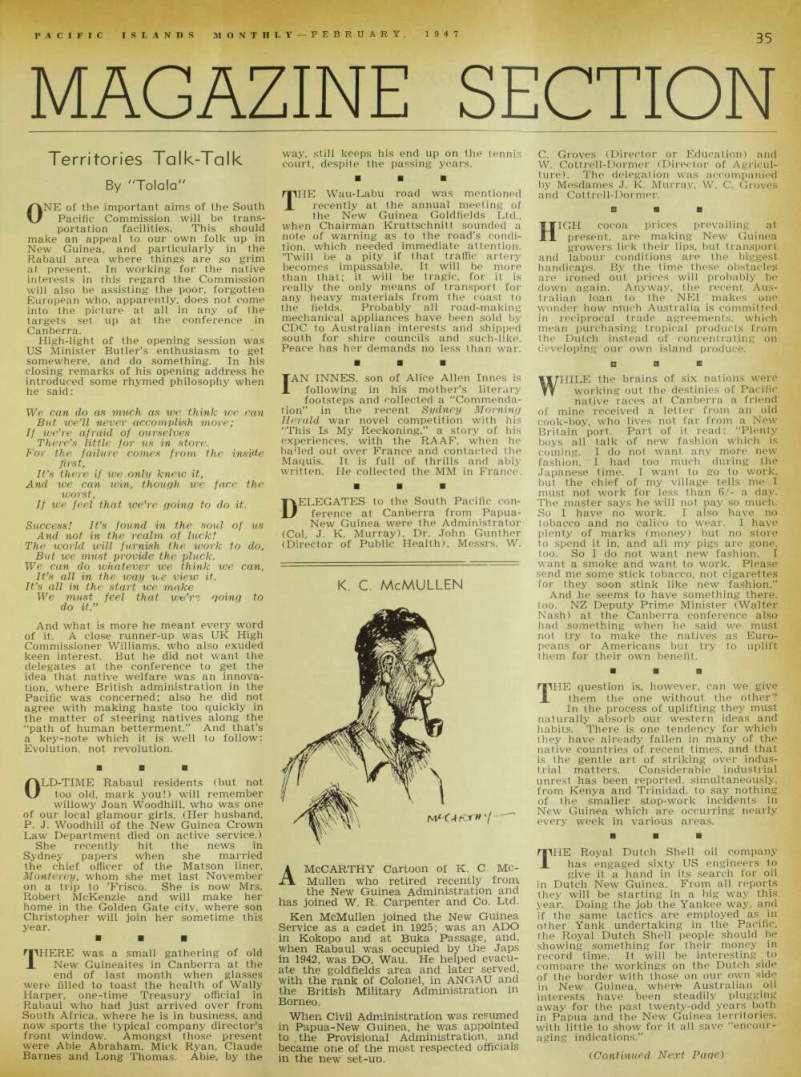
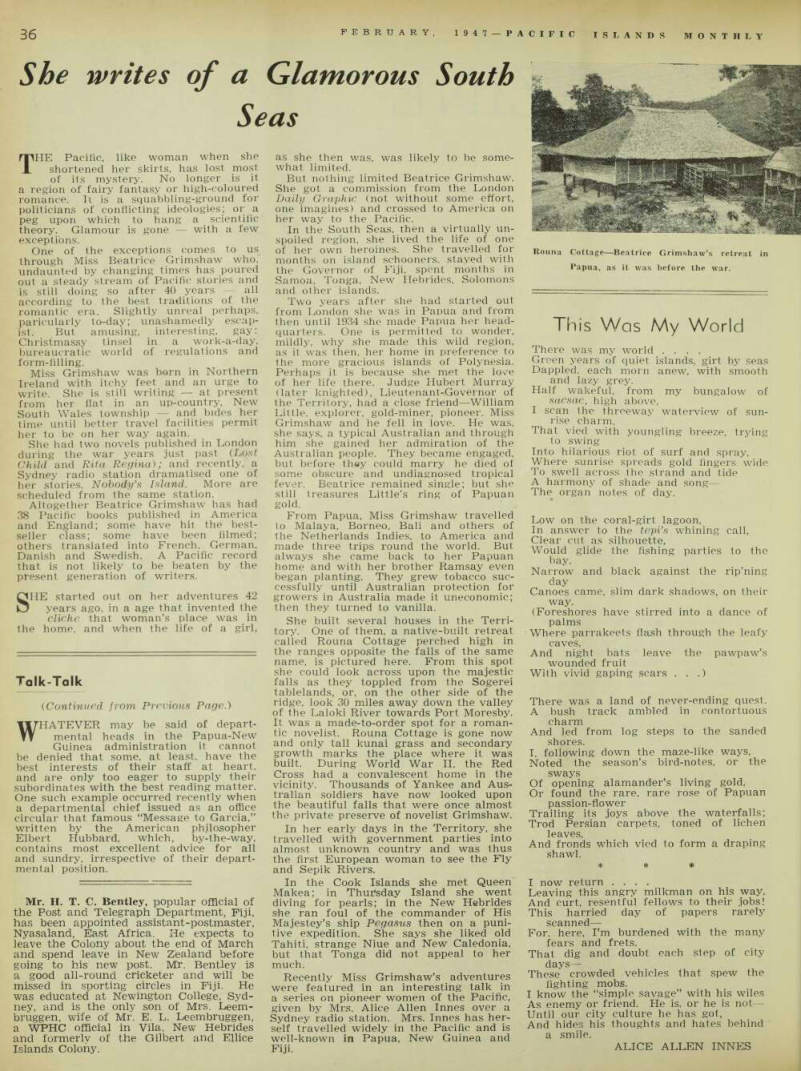
Territories Talk-Talk
By "Tolala"
ONE of the important aims of the South Pacific Commission will be trans portation facilities. This should make an appeal to our own folk up in New Guinea, and particularly in the Rabaul area where things are so grim at present. In working for the native interests in this regard the Commission will also be assisting the poor, forgotten European who, apparently, does not come into the picture at all in any of the targets set up at the conference in Canberra.
High-light of the opening session was US Minister Butler’s enthusiasm to get somewhere, and do something. In his closing remarks of his opening address he introduced some rhymed philosophy when he said: We can do as much as we think we can But we’ll never accomplish more; If we’re afraid of ourselves There’s little for us in store.
For the failure comes from the inside first.
It’s there if we only knew it.
And we can win. though we face the worst.
If we feel that we’re going to do it.
Success! It’s found in the soul of us And not in the realm of luck!
The world will furnish the work to do.
But we must provide the pluck.
We can do whatever we think we can.
It’s all in the way we view it.
It’s all in the start we make We must feel that we’re going to do it.”
And what is more he meant every word of it. A close runner-up was UK High Commissioner Williams, who also exuded keen interest. But he did not want the delegates at the conference to get the idea that native welfare was an innova tion, where British administration in the Pacific was concerned: also he did not agree with making haste too quickly in the matter of steering natives along the “path of human betterment.” And that’s a key-note which it is well to follow: Evolution, not revolution.
B B B
OLD-TIME Rabaul residents (but not too old, mark you!) will remember willowy Joan Woodhill. who was one of our local glamour girls, (Her husband, P. J. Woodhill of the New Guinea Crown Law Department died on active service.) She recently hit the news in Sydney papers when she married the chief officer of the Matson liner, Monterey, whom she met last November on a trip to ’Frisco. She is now Mrs.
Robert McKenzie and will make her home in the Golden Gate city, where son Christopher will join her sometime this year. b b a THERE was a small gathering of old New Guineaites in Canberra at the end of last month when glasses were filled to toast the health of Wally Harper, one-time Treasury official in Rabaul who had just arrived over from South Africa, where he is in business, and now sports the typical company director’s front window. Amongst those present were Abie Abraham, Mick Ryan, Claude Barnes and Long Thomas. Abie, by the
way, still keeps his end up on the tennis court, despite the passing years. ■ B ■ THE Wau-Labu road was mentioned recently at the annual meeting of the New Guinea Goldfields Ltd., when Chairman Kruttschnitt sounded a note of warning as to the road’s condi tion. which needed immediate attention. ’Twill be a pity if that traffic artery becomes impassable. It will be more than that; it will be tragic, for it is really the only means of transport for any heavy materials from the coast to the fields. Probably all road-making mechanical appliances have been sold by CDC to Australian interests and shipped south for shire councils and such-like.
Peace has her demands no less than war. ■ ■ ■ lAN INNES, son of Alice Allen Innes is following in his mother’s literary footsteps and collected a “Commenda tion” in the recent Sydney Morning Herald war novel competition with his “This Is My Reckoning,” a story of his experiences, with the RAAF. when he bafied out over France and contacted the Maquis. It is full of thrills and ably written. He collected the MM in France ■ ■ B DELEGATES to the South Pacific con ference at Canberra from Papua- New Guinea were the Administrator (Col, J. K. Murray). Dr. John Gunther (Director of Public Health). Messrs. W.
A McCarthy Cartoon of K. C. Mc- Mullen who retired recently from the New Guinea Administration and has joined W. R. Carpenter and Co. Ltd.
Ken McMullen joined the New Guinea Service as a cadet in 1925; was an ADO in Kokopo and at Buka Passage, and, when Rabaul was occupied by the Japs in 1942, was DO, Wau. He helped evacu ate the goldfields area and later served, with the rank of Colonel, in ANGAU and the British Military Administration in Borneo.
When Civil Administration was resumed in Papua-New Guinea, he was appointed to .the Provisional Administration, and became one of the most respected officials in the new set-uo.
C. Groves (Director or Education) and W. Cottrell-Dormer (Director of Agricul ture). The delegation was accompanied by Mesdames J. K. Murray, W, C. Groves and Cottrell-Dormer.
H S B
HIGH cocoa prices prevailing at present, are making New Guinea growers lick their lips, but transport and labour conditions are the biggest handicaps. By the time these obstacles are ironed out prices will probably be down again. Anyway, the recent Aus tralian loan to the NEI makes one wonder how much Australia is committed in reciprocal trade agreements, which mean purchasing tropical products from the Dutch instead of concentrating on developing our own island produce. □ a ■ WHILE the brains of six nations were working out the destinies of Pacific native races at Canberra a friend of mine received a letter from an old cook-boy, who lives not far from a New Britain port. Part of it read: “Plenty boys all talk of new fashion which is coming. I do not want any more new fashion. I had too much during the Japanese time. I want to go to work, but the chief of my village tells me I must not work for less than 6/- a day.
The master says he will not pay so much.
So I have no work. I also have no tobacco and no calico to wear. I have plenty of marks (money) but no store to spend it in, and all my pigs are gone, too. So I do not want new fashion. I want a smoke and want to work. Please send me some stick tobacco, not cigarettes for they soon stink like new fashion.”
And he seems to have something there, too. NZ Deputy Prime Minister (Walter Nash) at the Canberra conference also had something when he said we must not try to make the natives as Euro peans or Americans but try to uplift them for their own benefit. ■ ■ a THE question is, however, can we give them the one without the other?
In the process of uplifting they must naturally absorb our western ideas and habits. There is one tendency for which they have already fallen in many of the native countries of recent times, and that is the gentle art of striking over indus trial matters. Considerable industrial unrest has been reported, simultaneously, from Kenya and Trinidad, to say nothing of the smaller stop-work incidents in New Guinea which are occurring nearly every week in various areas.
B ■ ■ THE Royal Dutch Shell oil company has engaged sixty US engineers to give it a hand in its search for oil in Dutch New Guinea. From all reports they will be starting in a big way this year. Doing the job the Yankee way, and if the same tactics are employed as in other Yank undertaking in the Pacific, the Royal Dutch Shell people should be showing something for their money in record time. It will be interesting to compare the workings on the Dutch side of the border with those on our own side in New Guinea, wherte Australian oil interests have been steadily plugging away for the past twenty-odd years both in Papua and the New Guinea territories, with little to show for it all save “encour aging indications.”
(Continued Next Page )
k. c. McMullen
WHATEVER may be said of depart mental heads in the Papua-New Guinea administration it cannot be denied that some, at least, have the best interests of their staff at heart, and are only too eager to supply their subordinates with the best reading matter.
One such example occurred recently when a departmental chief issued as an office circular that famous “Message to Garcia,” written by the American philosopher Elbert Hubbard, which, by-the-way, contains most excellent advice for all and sundry, irrespective of their depart mental position.
Mr. H. T. C. Bentley, popular official of the Post and Telegraph Department, Fiji, has been appointed assistant-postmaster, Nyasaland, East Africa. He expects to leave the Colony about the end of March and spend leave in New Zealand before going to his new post. Mr. Bentley is a good all-round cricketer and will be missed in sporting circles in Fiji. He was educated at Newington College, Syd ney, and is the only son of Mrs. Leem bruggen, wife of Mr. E. L. Leembruggen, a WPHC official in Vila. New Hebrides and formerly of the Gilbert and Ellice Islands Colony.
She writes of a Glamorous South
Seas
THE Pacific, like woman when she shortened her skirts, has lost most of its mystery. No longer is it a region of fairy fantasy or high-coloured romance. It is a squabbling-ground for politicians of conflicting ideologies; or a peg upon which to hang a scientific theory. Glamour is gone with a few exceptions.
One of the exceptions comes to us through Miss Beatrice Grimshaw who. undaunted by changing times has poured out a steady stream of Pacific stories and is still doing so after 40 years all according to the best traditions of the romantic era. Slightly unreal perhaps, paricularly to-day; unashamedly escap ist. But amusing, interesting, gay: Christmassy tinsel in a wqrk-a-day, bureaucratic world of regulations and form-filling.
Miss Grimshaw was born in Northern Ireland with itchy feet and an urge to write. She is still writing at present from her flat in an up-country, New South Wales township and bides her time until better travel facilities permit her to be on her way again.
She had two novels published in London during the war years just past (Lost Child and Rita Regina ); and recently, a Sydney radio station dramatised one of her stories, Nobody’s Island. More are scheduled from the same station.
Altogether Beatrice Grimshaw has had 38 Pacific books published in America and England; some have hit the best seller class; some have been filmed; others translated into French. German, Danish and Swedish. A Pacific record that is not likely to be beaten by the present generation of writers.
SHE started out on her adventures 42 years ago, in a age that invented the cliche that woman’s place was in the home, and when the life of a girl,
as she then was, was likely to be some what limited.
But nothing limited Beatrice Grimshaw.
She got a commission from the London Daily Graphic (not without some effort, one imagines) and crossed to America on her way to the Pacific.
In the South Seas, then a virtually un spoiled region, she lived the life of one of her own heroines. She travelled for months on island schooners, stayed with the Governor of Fiji, spent months in Samoa, Tonga, New Hebrides, Solomons and other islands.
Two years after she had started out from London she was in Papua and from then until 1934 she made Papua her head quarters. One is permitted to wonder, mildly, why she made this wild region, as it was then, her home in preference to the more gracious islands of Polynesia.
Perhaps it is because she met the love of her life there. Judge Hubert Murray (later knighted), Lieutenant-Governor of the Territory, had a close friend —William Little, explorer, gold-miner, pioneer. Miss Grimshaw and he fell in love. He was, she says, a typical Australian and through him she gained her admiration of the Australian people. They became engaged, but before they could marry he died of some obscure and undiagnosed tropical fever. Beatrice remained single; but she still treasures Little’s ring of Papuan gold.
From Papua, Miss Grimshaw travelled to Malaya, Borneo, Bali and others of the Netherlands Indies, to America and made three trips round the world. But always she came back to her Papuan home and with her brother Ramsay even began planting. They grew tobacco suc cessfully until Australian protection for growers in Australia made it uneconomic; then they turned to vanilla.
She built several houses in the Terri tory. One of them, a native-built retreat called Rouna Cottage perched high in the ranges opposite the falls of the same name, is pictured here. From this spot she could look across upon the majestic falls as they toppled from the Sogerei tablelands, or, on the other side of the ridge, look 30 miles away down the valley of the Laloki River towards Port Moresby.
It was a made-to-order spot for a roman tic novelist. Rouna Cottage is gone now and only tall kunai grass and secondary growth marks the place where it was built. During World War 11, the Red Cross had a convalescent home in the vicinity. Thousands of Yankee and Aus tralian soldiers have now looked upon the beautiful falls that were once almost the private preserve of novelist Grimshaw.
In her early days in the Territory, she travelled with government parties into almost unknown country and was thus the first European woman to see the Fly and Sepik Rivers.
In the Cook Islands she met Queen Makea; in Thursday Island she went diving for pearls; in the New Hebrides she ran foul of the commander of His Majestey’s ship Pegasus then on a puni tive expedition. She says she liked old Tahiti, strange Niue and New Caledonia, but that Tonga did not appeal to her much.
Recently Miss Grimshaw’s adventures were featured in an interesting talk in a series on pioneer women of the Pacific, given by Mrs. Alice Allen Innes over a Sydney radio station. Mrs. Innes has her self travelled widely in the Pacific and is well-known in Papua, New Guinea and Fiji.
Rouna Cottage—Beatrice Grimshaw’s retreat in Papua, as it was before the war.
This Was My World
There was my world ...
Green years of quiet islands, girt by seas Dappled, each morn anew, with smooth and lazy grey.
Half wakeful, from my bungalow of sacsac, high above, I scan the threeway waterview of sun rise charm.
That vied with youngling breeze, trying to swing Into hilarious riot of surf and spray.
Where sunrise spreads gold fingers wide To swell across the strand and tide A harmony of shade and song— The organ notes of day.
Low on the coral-girt lagoon, In answer to the tepi’s whining call, Clear cut as silhouette.
Would glide the fishing parties to the bay.
Narrow and black against the rip’ning day Canoes came, slim dark shadows, on their way. (Foreshores have stirred into a dance of palms Where parrakeets flash through the leafy caves, And night bats leave the pawpaw’s wounded fruit With vivid gaping scars . . .) There was a land of never-ending quest.
A bush track ambled in contortuous charm And led from log steps to the sanded shores.
I. following down the maze-like ways, Noted the season’s bird-notes, or the sways Of opening alamander’s living gold, Or found the rare, rare rose of Papuan passion-flower Trailing its joys above the waterfalls; Trod Persian carpets, toned of lichen leaves, And fronds which vied to form a draping shawl. * * ♦ I now return ...
Leaving this angry milkman on his way.
And curt, resentful fellows to their jobs!
This harried day of papers rarely scanned — For. here, I’m burdened with the many fears and frets.
That dig and doubt each step of city days— These crowded vehicles that spew the fighting mobs.
I know the “simple savage” with his wiles As enemy or friend. He is. or he is not — Until our city culture he has got, And hides his thoughts and hates behind a smile.
Alice Allen Innes
Advertisements & other items, p. 38 (1 item)
36
FEBRUARY, 194 7 PACIFIC ISLANDS MONTHLY
Talk-Talk (Continued from Previous Page.)
Hospitality in the Mangaia Manner
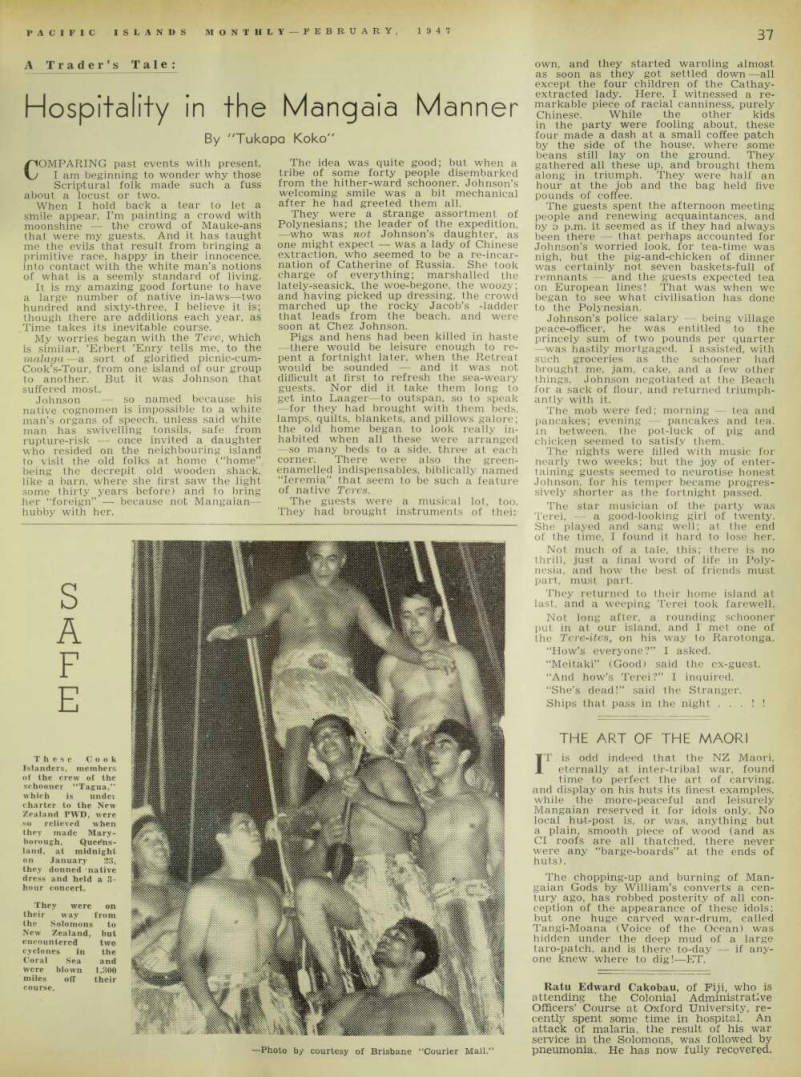
A Trader’s Tale:
By "Tukapa Koko"
COMPARING past events with present, I am beginning to wonder why those Scriptural folk made such a fuss about a locust or two.
When I hold back a tear to let a smile appear, I’m painting a crowd with moonshine the crowd of Mauke-ans that were my guests. And it has taught me the evils that result from bringing a primitive race, happy in their innocence, into contact with the white man’s notions of what is a seemly standard of living.
It is my amazing good fortune to have a large number of native in-laws—two hundred and sixty-three, I believe it is; though there are additions each year, as Time takes its inevitable course.
My worries began with the Tere , which is similar, ’Erbert ’Enry tells me, to the inalaga —a sort of glorified picnic-cum- Cook’s-Tour, from one island of our group to another. But it was Johnson that suffered most.
Johnson so named because his native cognomen is impossible to a white man’s organs of speech, unless said white man has swivelling tonsils, safe from rupture-risk once invited a daughter who resided on the neighbouring island to visit the old folks at home (“home” being the decrepit old wooden shack, like a barn, where she first saw the light some thirty years before) and to bring her “foreign” because not Mangaian— hubby with her.
The idea was quite good; but when a tribe of some forty people disembarked from the hither-ward schooner. Johnson’s welcoming smile was a bit mechanical after he had greeted them all.
They were a strange assortment of Polynesians; the leader of the expedition, —who was not Johnson’s daughter, as one might expect was a lady of Chinese extraction, who seemed to be a re-incar nation of Catherine of Russia. She took charge of everything; marshalled the lately-seasick, the woe-begone, the woozy; and having picked up dressing, the crowd marched up the rocky Jacob’s -ladder that leads from the beach, and were soon at Chez Johnson.
Pigs and hens had been killed in haste —there would be leisure enough to re pent a fortnight later, when the Retreat would be sounded and it was not difficult at first to refresh the sea-weary guests. Nor did it take them long to get into Laager—to outspan, so to speak —for they had brought with them beds, lamps, quilts, blankets, and pillows galore; the old home began to look really in habited when all these were arranged —so many beds to a side, three at each corner. There were also the green enamelled indispensables, biblically named “leremia” that seem to be such a feature of native Teres.
The guests were a musical lot, too.
They had brought instruments of theii
own, and they started warnling almost as soon as they got settled down —all except the four children of the Cathay extracted lady. Here, I witnessed a re markable piece of racial canniness, purely Chinese. While the other kids in the party were fooling about, these four made a dash at a small coffee patch by the side of the house, where some beans still lay on the ground. They gathered all these up, and brought them along in triumph. They were half an hour at the job and the bag held five pounds of coffee.
The guests spent the afternoon meeting people and renewing acquaintances, and by b p.m. it seemed as if they had always been there that perhaps accounted for Johnson’s worried look, for tea-time was nigh, but the pig-and-chicken of dinner was certainly not seven baskets-full of remnants and the guests expected tea on European lines! That was when we began to see what civilisation has done to the Polynesian.
Johnson’s police salary being village peace-officer, he was entitled to the princely sum of two pounds per quarter —was hastily mortgaged. I assisted, with such groceries as the schooner had brought me, jam, cake, and a few other things. Johnson negotiated at the Beach for a sack of flour, and returned triumph antly with it.
The mob were fed; morning tea and pancakes; evening pancakes and tea. in between, the pot-luck of pig and chicken seemed to satisfy them.
The nights were filled with music for nearly two weeks; but the joy of enter taining guests seemed to neurotise honest Johnson, for his temper became progres sively shorter as the fortnight passed.
The star musician of the party was Terei, a good-looking girl of twenty.
She played and sang well; at the end of the time, I found it hard to lose her.
Not much of a tale, this; there is no thrill, just a final word of life in Poly nesia, and how the best of friends must part, must part.
They returned to their home island at last, and a weeping Terei took farewell.
Not long after, a rounding schooner put in at our island, and I met one of the Tere-ites, on his way to Rarotonga.
“How’s everyone?” I asked.
“Meitaki” (Good) said the ex-guest.
“And how’s Terei?” I inquired.
“She’s dead!” said the Stranger.
Ships that pass in the night , . . ! !
S A F E
These Cook Islanders, members of the crew of the schooner “Tagua,” which is under charter to the New Zealand PWD, were so relieved when they made Mary borough, Queens land, at midnight on January 23, they donned native dress and held a 3hour concert.
They were on their way from the Solomons to New Zealand, but encountered two cyclones in the Coral Sea and were blown 1,300 miles off their course.
—Photo by courtesy of Brisbane “Courier Mail.”
The Art Of The Maori
IT is odd indeed that the NZ Maori, eternally at inter-tribal war, found time to perfect the art of carving, and display on his huts its finest examples, while the more-peaceful and leisurely Mangaian reserved it for idols only. No local hut-post is, or was, anything but a plain, smooth piece of wood (and as Cl roofs are all thatched, there never were any “barge-boards” at the ends of huts).
The chopping-up and burning of Man gaian Gods by William’s converts a cen tury ago, has robbed posterity of all con ception of the appearance of these idols; but one huge carved war-drum, called Tangi-Moana (Voice of the Ocean) was hidden under the deep mud of a large taro-patch, and is there to-day if any one knew where to dig!—ET.
Ratu Edward Cakobau, of Fiji, who is attending the Colonial Administrative Officers’ Course at Oxford University, re cently spent some time in hospital. An attack of malaria, the result of his war service in the Solomons, was followed by pneumonia. He has now fully recovered.
All Ways
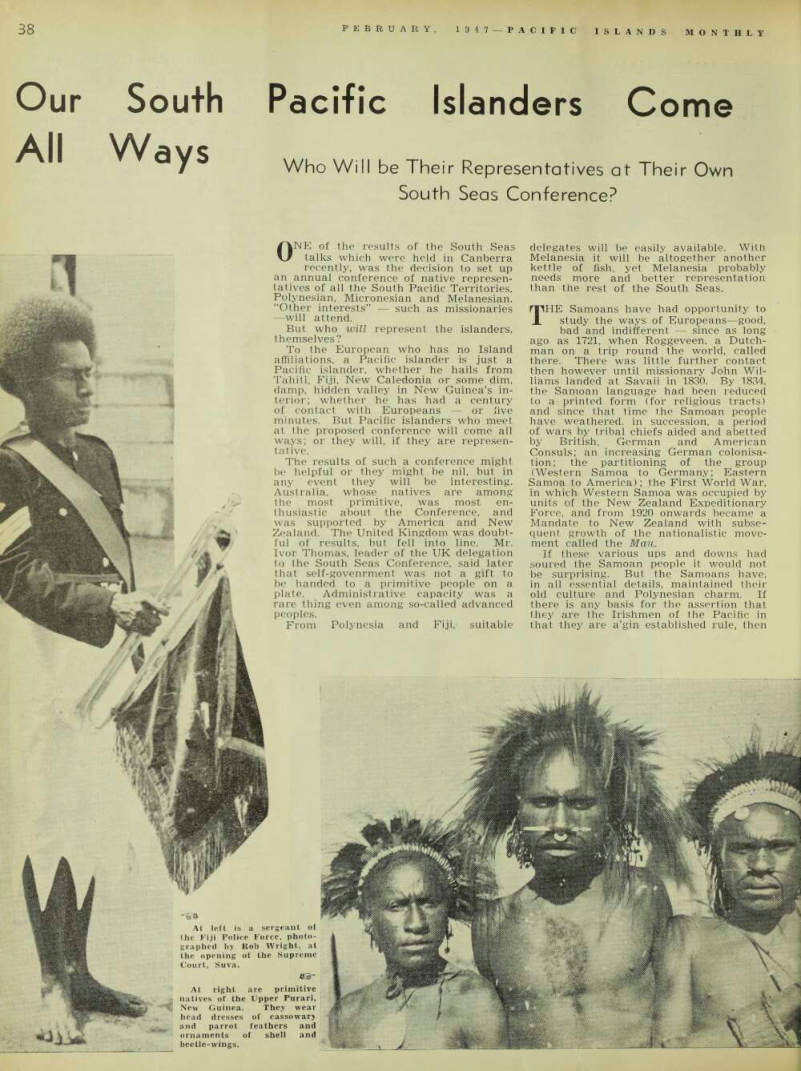
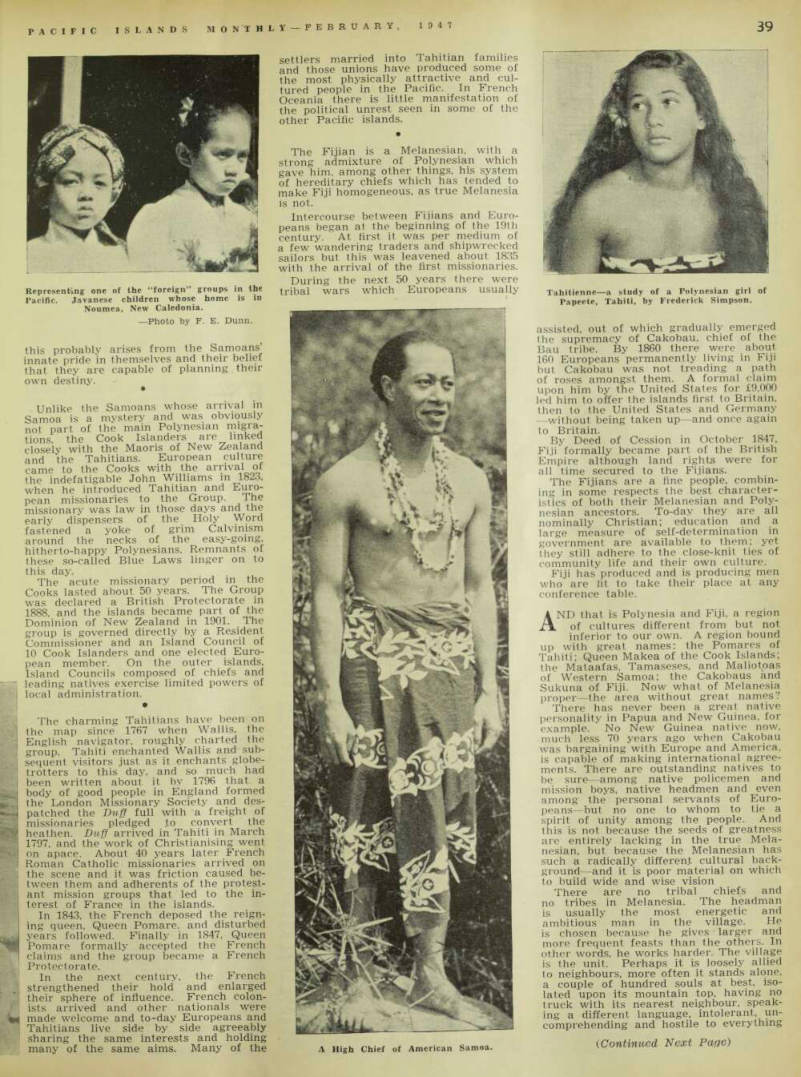
Our South Pacific Islanders Come
Who Will be Their Representatives at Their Own South Seas Conference?
ONE of the results of the South Seas talks which were held in Canberra recently, was the decision to set up an annual conference of native representatives of all the South Pacific Territories, Polynesian, Micronesian and Melanesian.
“Other interests” such as missionaries will attend.
But who will represent the islanders, themselves?
To the European who has no Island affiliations, a Pacific islander is just a Pacific islander, whether he hails from Tahiti, Fiji, New Caledonia or some dim, damp, hidden valley in New Guinea’s interior; whether he has had a century of contact with Europeans or five minutes. But Pacific islanders who meet at the proposed conference will come all ways; or they will, if they are representative.
The results of such a conference might be helpful or they might be nil, but in any event they will be interesting.
Australia, whose natives are among the most primitive, was most enthusiastic about the Conference, and was supported by America and New Zealand. The United Kingdom was doubtful of results, but fell into line. Mr.
Ivor Thomas, leader of the UK delegation to the South Seas Conference, said later that self-govenrment was not a gift to be handed to a primitive people on a plate. Administrative capacity was a rare thing even among so-called advanced peoples.
From Polynesia and Fiji,- suitable
delegates will be easily available. With Melanesia it will be altogether another kettle of fish, yet Melanesia probably needs more and better representation than the rest of the South Seas. mHE Samoans have had opportunity to study the ways of Europeans—good, bad and indifferent since as long ago as 1721, when Roggeveen, a Dutch man on a trip round the world, called there. There was little further contact then however until missionary John Wil liams landed at Savaii in 1830. By 1834, the Samoan language had been reduced to a printed form (for religious tracts) and since that time the Samoan people have weathered, in succession, a period of wars by tribal chiefs aided and abetted by British, German and American Consuls: an increasing German colonisa tion; the partitioning of the group (Western Samoa to Germany; Eastern Samoa to America); the First World War, in which Western Samoa was occupied by units of the New Zealand Expeditionary Force, and from 1920 onwards became a Mandate to New Zealand with subse quent growth of the nationalistic move ment called the Mail.
If these various ups and downs had soured the Samoan people it would not be surprising. But the Samoans have, in all essential details, maintained their old culture and Polynesian charm. If there is any basis for the assertion that they are the Irishmen of the Pacific in that they are a’gin established rule, then
At left is a sergeant of the Fiji Police Force, photo graphed by Rob Wright, at the opening of the Supreme Court, Suva.
At right are primitive natives of the Upper Purari, New Guinea. They wear head dresses of cassowary and parrot feathers and ornaments of shell and beetle-wings.
this probably arises from the Samoans innate pride in themselves and their belief that they are capable of planning. their own destiny. ♦ Unlike the Samoans whose arrival in Samoa is a mystery and was obviously not part of the main Polynesian migra tions the Cook Islanders are linked closely with the Maoris of New Zealand and the Tahitians. European culture came to the Cooks with the arrival of the indefatigable John Williams in 1823, when he introduced Tahitian and Euro pean missionaries to the Group. The missionary was law in those days and the early dispensers of the Holy Word fastened a yoke of grim Calvinism around the necks of the easy-going, hitherto-happy Polynesians. Remnants of these so-called Blue Laws linger on to this day.
The acute missionary period in the Cooks lasted about 50 years. The Group was declared a British Protectorate in 1888, and the islands became part of the Dominion of New Zealand in 1901. The group is governed directly by a Resident Commissioner and an Island Council of 10 Cook Islanders and one elected Euro pean member. On the outer islands, Island Councils composed of chiefs and leading natives exercise limited powers of local administration. • The charming Tahitians have been on the map since 1767 when Wallis, the English navigator, roughly charted the group. Tahiti enchanted Wallis and sub sequent visitors just as it enchants globe trotters to this day, and so much had been written about it by 1796 that a body of good people in England formed the London Missionary Society and des patched the Duff full with a freight of missionaries pledged to convert the heathen. Duff arrived in Tahiti in March 1797, and the work of Christianising went on apace. About 40 years later French Roman Catholic missionaries arrived on the scene and it was friction caused be tween them and adherents of the protest ant mission groups that led to the in terest of France in the islands.
In 1843, the French deposed the reign ing queen, Queen Pomare, and disturbed years followed. Finally in 1847, Queen Pomare formally accepted the French claims and the group became a French Protectorate.
In the next century, the French strengthened their hold and enlarged their sphere of influence. French colon ists arrived and other nationals were made welcome and to-day Europeans and Tahitians live side by side agreeably sharing the same interests and holding many of the same aims. Many of the
settlers married into Tahitian families and those unions have produced some of the most physically attractive and cul tured people in the Pacific. In French Oceania there is little manifestation of the political unrest seen in some of the other Pacific islands. • The Fijian is a Melanesian, with a strong admixture of Polynesian which gave him, among other things, his system of hereditary chiefs which has tended to make Fiji homogeneous, as true Melanesia is not.
Intercourse between Fijians and Euro peans began at the beginning of the 19th century. At first it was per medium of a few wandering traders and shipwrecked sailors but this was leavened about 1835 with the arrival of the first missionaries.
During the next 50 years there were tribal wars which Europeans usually
assisted, out of which gradually emerged the supremacy of Cakobau, chief of the Bau tribe. By 1860 there were about 160 Europeans permanently living in Fiji but Cakobau was not treading a path of roses amongst them. A formal claim upon him by the United States for £9,000 led him to offer the islands first to Britain, then to the United States and Germany without being taken up—and once again to Britain.
By Deed of Cession in October 1847, Fiji formally became part of the British Empire although land rights were for all time secured to the Fijians.
The Fijians are a fine people, combin ing in some respects the best character istics of both their Melanesian and Poly nesian ancestors. To-day they are all nominally Christian; education and a large measure of self-determination in government are available to them; yet they still adhere to the close-knit ties of community life and their own culture.
Fiji has produced and is producing men who are fit to take their place at any conference table.
AND that is Polynesia and Fiji, a region of cultures different from but not inferior to our own. A region bound up with great names: the Pomares of Tahiti; Queen Makea of the Cook Islands; the Mataafas. Tamaseses. and Maliotpas of Western Samoa; the Cakobaus and Sukuna of Fiji. Now what of Melanesia proper—the area without great names?
There has never been a great native personality in Papua and New Guinea, for example. No New Guinea native now, much less 70 years ago when Cakobau was bargaining with Europe and America, is capable of making international agree ments. There are outstanding natives to be sure —among native policemen and mission boys, native headmen and even among the personal servants of Euro peans—but no one to whom to tie a spirit of unity among the people. And this is not because the seeds of greatness are entirely lacking in the true Mela nesian, but because the Melanesian has such a radically different cultural back ground—and it is poor material on which to build wide and wise vision There are no tribal chiefs and no tribes in Melanesia. The headman is usually the most energetic and ambitious man in the village. He is chosen because he gives larger and more frequent feasts than the others. In other words, he works harder. The village is the unit. Perhaps it is loosely allied to neighbours, more often it stands alone, a couple of hundred souls at best, iso lated upon its mountain top, having no truck with its nearest neighbour, speak ing a different language, intolerant, un comprehending and hostile to everything
(Continued Next Pape)
Representing one of the “foreign” groups in the Pacific. Javanese children whose home is in Noumea, New Caledonia.
Photo by F. E. Dunn.
A High Chief of American Samoa.
Tahitienne —a study of a Polynesian girl of Papeete, Tahiti, by Frederick Simpson.
without. Even to-day although the coastal natives of Melanesia have had contact with Europeans for a century and a war was recently fought in the South West Pacific, the majority of natives are still primitive, their world bounded by the village boundaries. Yet in Melanesia —indeed in one small district —there are great degrees of primitive ness depending upon how great or how long has been the contact with Europeans.
Who then is to represent the Papuans and the New Guinea natives at the meet ing of Pacific islanders? One of the sophi sticated, natives of Hanuabada near Port Moresby whose aims and environment are totally unrelated to those of a village thirty miles inland? A villager of Matupi near Rabaul, also among the more civi lised of Melanesia? Or will he come from the high plateau country of central New Guinea mainland, still officially uncon trolled? Or from the Western Islands or Manus?
To gather representatives from Poly nesia and Fiji will be easy; to get any one that is at all representative of native aims and desires, from Melanesia will be next to impossible. If he represents Hanuabada, then he will not represent Matupi; and if he represents either he will not represent anyone else. Possibly what the primitive living Melanesian — and he is in the majority—wants most of all is to be left alone, but this is a state of affairs that presumably will not be permitted to exist much longer.
Because the Melanesian is backward in comparison with other Pacific peoples is perhaps no good reason why he should be kept in the background. He may learn more quickly by rubbing shoulders with Pacific neighbours. Intensive educa tion in the next 20 or 30 years will whittle down his handicap too, but nothing will give him that background of cultural cohesion which is the birthright of Fijians and Polynesians. The first trembling Mela nesian delegates to the Pacific Natives Conference are unlikely to be much at home or to be entirely happy.
Nothing has been said of representa tives of transplanted groups in the Pacific —the Indians of Fiji, the Indonesians of New Caledonia or Chinese in New Guinea and other territories. Many of these people are now of the second and third generation and know no other home.
For good or ill they too must be counted as Pacific People.
The Training Of Dorika
Short Story:
By E. M. Fry
FINGERING a sharp sea-shell in her supple brown hands. Dorika cut defiantly into the tough bark of a fringing coconut palm.
Picturesque as a faun in her scarlet handkerchief sulu, with a cheap glass bead necklace adorning her undeveloped little torso, she stood sullenly silent as the storm of words broke around her.
She must have heard how hard the work at the vavalagi’s house was, how many were the plates to be washed in hot water that bit the fingers sorely; tables to be scrubbed until white, floors to be swept twice a day and every day too!
These things were contemptuously snorted at by her lazy sister Salote, be tween biting off long lengths of mending twine while squatting companions raked over the fishing nets for defects.
“Eeo, eeo,” acquiesced the women in
chorus as they sat in the shade of the village mango tree with the cool Trade breezes rustling the leaves above them.
Then, as usual, the discussion became everybody’s business, for amongst this contentious group was Dorika’s widowed mother, her grow-up sisters, her numer ous aunts, and tribal mothers whose age old communal customs brooked no individuality amongst the younger genera tion.
“What was Dorika thinking of?
Vavalagis are silly to want one to work in a hot kitchen, when food packed in leaves, placed on hot stones, covered with soil and sand and cooked to perfec tion without further attention or con fusion of flavours,” cackled old Sara, — who, because she was the mother of the village chief, was always listened to with some respect. “Tobacco!” she demanded, irrelevantly; and, appropriating her neighbour’s tobacco leaf and suluka, pro ceeded to make herself a cigarette.
“Perhaps it is to see all the pretty things in the vavalagi’s house, to beg for this and that,” said sixteen-year old Martha; and, excitingly: “To be given a vavalagi dress, I should like that,” stretching up her slim arms and dis playing the charms of her lithe young body, “but 1 do not think that I should want to work for it.”
“No, far from it!” the rest gabbled.
“Dorika must be going to be stupid. She must learn that there are other ways of getting what she wants, especially in the way of a dress.”
“Many other ways,” said the older girls knowingly.
BUT Dorika heeded not. Disarming all arguments with an assurance that was at once amusing and some what attractive, in so small a person, her smiling insistence finally won favour; and, as one dreamy tropical day gave way to another, Dorika’s quaint atten tions to her chosen mistress became a habit and, later, a necessity. This initial behaviour, subtly emphasised to create a pleasing effect, held all the intriguing mannerism of her kind. She had not learned the art of exploitation as her companions knew it; but Dorika was not as stupid as they thought.
Impishly she would pretend that for the life of her she could not remember how to lay a table. Knives were easy: one must have knives for most things, although teeth and fingers were much better; but spoons and forks she scattered heedlessly, contriving that repeated cor rections should make this fascinating game greater fun as she watched things slip into their proper places under the manipulation of accustomed fingers.
Placing her small brown hands against the snowy whiteness of the tablecloth she ardently wished that her skin was white, too —as white as her mistress’s neck was, where sometimes hung the most beautiful necklace she had ever seen. From the depths of her little adolescent being, the longing to possess such evidence of superiority over others continued, until it became an obsession.
Confiding her longings to none not even her greatest friend Jakope, the kitchen boy, she fingered the coiled chain as it rested carelessly on her miistress’s dressing table. Once, she even dared place it against her warm mahogany tinted body, where its elegance made her gasp with admiration for herself so adorned. It was then as she let her imagination run riot that the few scruples she had acquired flew to the winds.
Turaga! She would be the envy of all the girls in the village. She would have to lend it sometimes, of course, but she would gain by the small gifts that usually accompanied such requests. It must be missing, if possible, without in volving herself; and, at once, plans for its strange disappearance came naturally 1 1 0 j 110 1" badly-trained mind. As if already a culprit, she pressed one finger to her lips and tip-toed back to the kitchen.
Dorika had learned from the mission aries that it was wrong to steal and if round out by those who did not directly benefit, she would be severely punished, as well as fined so many mats. She had a keen remembrance of one such official punishment, when everyone forsook her, even her foolishly fond mother for whom she had sobbed loudly and angrily away m the bush where she had run to hide.
Dubiously, she recalled the painful welts caused by the stinging vine, visible for days afterwards.
But, like a flash in the dark, her smile came and went, the sparkle of which was paramount in her cheery black eyes, ages-wise, under a dome of frizzy hair.
Thus was Dorika when she set out to learn the way of the vavalagi.
DORIKA was not an unusual product of her race. As the novelty of her new surroundings wore off, she became the child of caprice and disobe dience. She would disappear for hours when her presence was most needed; and then reappear with a peace offering of fish, or such-like, broadly smiling her excuses. Dorika’s ways were hard to resist.
She had only a dim understanding of the vavalagi’s code of behaviour. In spite of her wish to conform to it, her own habits and ways of thinking natur ally came first. Much as she had grown to love her mistress, and to wish to please, her continued associations with her own people held her little custom bound soul in subjection to them.
“1 told you so!” snapped disappointed Salote. “Dorika has no sense. If she had she would know that the vavalagis can be easily overcome by pleasing lies, a few well-chosen words and flattering attention. Let me go in her place and I will see that you all benefit.”
“Stop talking,” demanded her mother, fearing that she would soon be over ruled by her restless daughters, who were learning the ways of the vavalagis 100 readily for her liking. Had not Dorika already ridiculed the way she had spoken the one or two English words she knew!
It was at the time of the presentation of native mats for the Red Cross funds, for which Dorika’s mistress was organ iser. She, herself, had been a member of the native committee in connection with it.
“Say Red Cross, mother, not Rej Krose,”
Dorika had corrected. Then again “It’s Ra-deeo, not Raijo.” That decided her.
Dorika must return to the village. She must speak to Aunt Sanie and the others about it.
So it gradually came about that Dorika gave up pouting bouts of pretended stupidity and the go-slow methods of her kind, which she knew provoked her mistress. Instead, she was allowed to occupy a favoured place on the floor of the verandah, close ito her mistress’s chair, and given pictures to look at, because it was compassionately thought that she missed the companionship of her village mates. Many of the pictures showing the manner of presentations to the Royal Children so caught Dorika’s fancy that when the master of the house had a birthday he was surprised, as he sipped his morning tea, to be offered an exceedingly large bunch of flaming hibis cus by a smiling small person. Kneeling
(Continued on Page 42)
before him Dorika solemnly proffered the flowers with both hands in the native ceremonial fashion, saying in her own language: Good morning Sir I hope you are w €. on y°u r birthday.
Very well, thank you, Dorika. What a lovely bunch of flowers! Thank you very much indeed.”
Retreating a few paces, she gave a most taking but very funny little curtsey.
She had practised this many times in the kitchen, arousing Jakope’s open derision. Then, sitting cross-legged on the floor, she clapped her hands once or twice as the proper finality to a gift offering and said, “May I have your permission to go now, sir?”—which is always the manner of a courteous native’s leave- , f his little episode, so spontaneous and unexpected, combining the frills of civilisation with the tribal courtesies of a barbaric age, was intriguing. Dorika’s mistress, who had amusedly looked on, sensed that transitory something that promised to be worthwhile in her maid’s make-up. She hoped that, if she could only keep communal interference away, there still was hope of training Dorika.
In an incredibly short time. Dorika had learned to turn out crisp loaves of bread, to make the lightest of cakes, to brush and dust quite efficiently. She was considered quite a find, and viligance reaxed accordingly Only she knew of the continual small supplies such as soap, sugar, and tea that dribbled through several hands to the village huts. increasing her popularity there once Dress being her passion, stilus fantastic and gay sombre or just useful, adorned her developing curves in succession; but fn 1 by hBr “ rela * ion s” , Ga P s m a wardrobe so constantly depleted, uniform S ° & workaday uniform was substituted.
Never had she known such distinction!
To heighten the effect of black and white. she secretly blackleaded her bushy mop of hair, until it shone brightly, much to blwii°Hprm!nt ISfaC ° n and her mistress s bewilderment.
Otvitt 1 . , , ,
NE da>, a white-winged yacht appeared out of the blue, bringing visitors to the Islands home, redroofed against a feathery green background Padding the matted floor with bare feet, and interspersing her own native politeness with sundry bows and curtseys, she knelt and offered cakes of her own making. She could now wait at table fairly well; but never could she remember, that ladies must be served first. Always, amid much good-humoured laughter, did she naturally gravitate to th f*T equirements of the male - When the evening meal was on, and there were toasts to be drunk. Dorika watched with fascination the flow of red wine of strange sweet odour; but especially was she attracted by the glistening rival to her mistress’s gold necklace, that a nu d around the neck of a young guest.
All her longings came back with a rush.
Out ot a growing respect to her employers, the impulse to take other than food had been kept in check; but the act was that plans for concealment were at last taking shape, and now that small brother Moto and other child accomplices were word-perfect the longing to possess was once more upon her with redoubled
xtS™ u • . ,
Now, the chairs were empty. Absentmmdedly gathering up the decanter with the wine glasses, she took it away to !£«^ kltCl l en: , then - with the She . be f an clearing the table.
S & h aL ba u t a e 1 f to . uch ed something hard and cold. She glanced down.
A little shining heap winked up wickedly at her Oh no, it couldn’t be! It was the visitor’s necklace. Although in full sight of those at the other end of the verandah, she picked up the trinket with toes as useful as fingers, slowly, slowly to the height of her hand; and. with a quick movement, to the inside of her bodice. Then, with beating heart she lost no time in getting to the kichen where she surprised Jakope helping him self in no niggardly style to the port wine so opportunely placed “You steal! You steal!”’ she accused him. at the same time terribly conscious of the cool slitheriness of the necklace against her pulsating breast Then greatly daring, she seized another of the wine glasses and. filling the ruby liquid to its brim, gulped down the unaccus tomed stuff.
“Ough! No good, no good!” she told Jakope, aping his stupid face transfixed in wonderment. Wiping her mouth with the back of her hand she was about to retrieve the coffee cups, when a tap at the kitchen window startled her into alertness. That would be Moto.
CIPEAKING softly, she warned the un- O seen one to wait at a nnint tnnwn ?o them both for there w r temot j n g scraps to be divided tonkrht !t
native bolrd Ignoring jlkoLe entirelv
she hastily swep! ?hesl frorTLf dishes
into a handy palm-leaf basket and was about to deoart to the rendeyvnn?
Jakope came P to his senses inno uncertain manner. Grasping f surl hand Mot her
fiSf!” he“ sharply abound 0 ™!?
the same time grabbing a good portion of the spoil p The resulting scramble looked very much like turning into a real fight when Dorika, hearing an unusual outburst of activity on the verandah of the house and guiltily suessins what it was ali about. hastily g recovered the basket and made for the 7 outside * Here tall palms bowed low around her dihead. A sudden sick feeling made her senses swim. What had she been going to do? Oh, yes, she remembered —Moto would be waiting to carry away the food. He would not know about the necklace. She felt glad, somehow, that it was not her mistress’s, yet couldn’t have explained why. She went on with but one object in view, and that was to get away as far as possible from the house with her treasure, now held tightly through her dress.
But, as her legs weakened, panic seized her. She already knew that the devils of her ancestors were after her. They were the evil shadows that darted behind sketchy oleanders, or waited menacingly in the black shadows of mango trees A rushing of wings and the devilish screeching of flying foxes above her head sent her sprawling over knobbly roots in
gibbering fear.
Oh, where was Moto! Little she knew of the delight of that watching imp of darkness, comfortably ensconced in the branches above, with a borrowed torch clutched in his grimy paws, Then, as a globule of light began play ing among the branches, her guilty heart almost stopped its beating. This, she was sure, was no other than the dreaded spirit of Ratu Diki-diki. whose fleeting ghost appeared only to wrong-doers. ° h - dear, why had she taken that necklace! Resentment against her voluble relations rose in her. Then, with all the instinctive methods of appeasement uppermost, she thrust her hand inside her dress and, withdrawing the necklace, cast it into the basket with the scraps, and floundered wildly along the familiar track
to the village, where she hoped to feel safe from the terror that had come upon her.
Swaying like a reed before the wind, she came to where sounds of revelry and the thumping of feet brought her up unexpectedly in front of a large hut.
Within, looming before her blurred vision, first in fantastic shapes, then becoming small and unreal, were familiar and com forting figures, advancing and retiring to the thin strains of a twanging ukelele.
Away with fear—she too would dance the tra-la-la! But the welcome sounds seemed suddenly to die away as she sank to the sandy soil, overpowered by the compelling drowsiness that had so in explicably come over her.
CAUTIOUSLY Dorika opened her eyes, in response to a rough shaking.
Focussed on her were the accusing looks, she observed, of everyone that mattered in her small world.
There was the troubled face of her kind mistress, the sternness of her master’s, and the anxious ones of the strangers, to say nothing of the ominous presence 9f town officials, one of whom promptly jerked her to her feet, question ing her sharply.
With hanging head, she morosely denied over and over again having seen the neck lace. The child witnesses lied as prompted, together with the prank-play ing Moto.
Once, when cornered, she exclaimed angrily: “I did not want to steal. They (indicating the women who. murmering incredulously, had gathered around) made me do it. They always make me do things that are wrong.”
Such a tragic little figure, thought her master, compassionately, realizing how the child had been caught between the old order and the new. Interpreting a look from his wife, he said, gently, “We are very disappointed in you, Dorika do you know that?”
Tears trembled on her eye-lids as she raised questioning eyes, first to him, then to her mistress: and, seeing not the anger that she expected, only pity— something she knew she would not get from her own people she suddenly burst into tears and flung herself down.
“Please do not be cross with me. I am very ashamed. Be kind and take me back with you. I will never be so wicked again.”
At that moment an aged and dignified chief, silencing all contemptuous sniffs from the women with a single command ing gesture, said: “Listen, Dorika, and all you others.
The vavalagis are here to look after us; and whilst keeping the best of our customs it is well for us to acquire the best of theirs. Times for us are chang ing, and most of the old ways are no longer possible. We havte learned to trust the white man’s word, and white men wish to help us. Remember that in future and act upon it.”
“True, true,” came the answer, in throaty chorus from the older men. But the women held their heads down in shame, for they knew the chiefly reproof was intended for them. Dorika, marvel lously recovering her composure, pro ceeded to relieve her feelings by singling out her bewilderd ladcomplices in the theft, smartly cuffing their ears and de manding to know from Moto what he had done with the basket.
Like a little whirlwind of fury she finally descended on no less a person than the nursing wife of one of the accusing officials and, snatching the lost necklace from that astonished lady’s neck, said severely, “There, now you know it’s wrong to steal from the vavalagis”; and, marching back to the waiting crowd, she restored the necklace to its rightful owner, respectfully cupped in her hands, at the same time giving her famous curtsey, as if conferring a favour.
skipper who might call that Finschhafen was dangerous water.
I was pleased to meet Blue Harris and Bill Money again. The latter who, I believe, would crack a joke in the face of the Almighty himself immediately pretended that he was going to take action against me for overloading ships contrary to some New Guinea law.
“Gnair” and “Totol” then went to pick up “Pip” Appel’s party of 74 at Garu, and take thejp to Iboki Plantation, some 60 miles further down the coast. On arrival at Iboki, they discovered that a small party of civilians, including Mrs.
Baker, and H. G. Murray, were already there. These had not gone with the ship “Lolobau” on her trip to Salamaua a month previously, but had remained at Iboki. Here Mrs. Baker immediately set about tending to the many -sick and starving of “Pip” Appel’s party. She worked untiringly and cheerfully, and was an example to all.
OUR target was now Iboki, where I could promise the starving troops that there were 200 head of cattle waiting to be killed. Meat, and plenty of it, seemed like a dream to all; but, in the meantime .there were still soldiers to be brought from Baia 150 miles from Iboki. With Corporal H. McK.
Hamilton, I returned to Valoka at Cape Hoskins and there met Father Weigl of the Catholic Mission and later, the Rev.
Roger Brown, of the Methodist Mission, Malalia.
Frank Holland was now much overdue and I was worried about him.
An attack of pleurisy and pneumonia now suddenly hit me: but a steady diet of sulphanilamide tablets contrived to keep me on my feet. There was to be a kick-back later, however.
At last, Lieut. Donaldson, at Open Bay, came on the air with the welcome news that Frank Hojland had arrived from the south coast of New Britain with a party of troops and residents of Rabaul.
Bill Money, on “Gnair,” now came from Iboki and proceeded to Bialla and Bute olo, where the slowly moving troops were gradually making their way from Baia.
Hardworking Bell and the overladen “Aussi” could now receive help.
In addition, the natives of Talasea were giving help, and many canoes were provided at places along the coast. My native operator, Nelson Tokidoro, had been with us all the time and had ably carried out his duties. He had proved himself an efficient wireless telegraphist all through.
On March 14, Frank Holland and his party at last reached Valoka, and we had the remainder of the troops from Baia as far west as that point.
By using spares and odds of canni balised parts we now had five wireless sets working, so all parties were in contact with them. • The gaunt but still cheerful Holland, had done a splendid job. He had gone back and forth through the dangerous Mokolkol country and had brought back a party of AIF and Rabaul civilians in cluding Lieut.-Col. H. Carr (CO 2/22 Batt.), W. B. Ball (Superintendent of Police, Rabaul), Major Macleod, Captain Ivan Smith, Larry Dwyer, A. L. Robinson, R. Bruce, G. P. Brown, B. O’Connor, J.
Palmer, R. Feetum, Sinclair, Crawley and Driver W. D. Collins.
The first-named were well-known in Rabaul, while Driver Collins and A. L.
Robinson (the latter a chief clerk in the Administration) were survivors of the Japanese massacre at Tol. Wide Bay.
Robinson and Collins had been ordered to the execution ground but Robinson had escaped en route. Young Collins had been shot several times and left for
dead. Despite his wounds I never heard him utter a complaint.
Robinson bore awful marks of the physical sufferings and mental agonies he had endured. “Robbie” was to re cover and take revenge on the Japanese murderers. Two years later he was with me when we landed at Manus, and I had the honour of recommending him for the Distinguished Conduct Medal, which he richly deserved for many acts of courage.
Holland reported that a large party of AIF had proceeded to Waterfall Bay, on the south coast of New Britain and, under Lieut.-Commander Mackenzie, were there awaiting rescue. Lieutenant J. C.
H. Gill, RANVR, who came out with Holland had further information, and this
was transmitted to Moresby. Soon after, two Papuan residents, Messrs. Timperley and Ivan Champion, were to rescue these men from the Gasmata coast.
At Malalia Methodist Mission I recom mended to my friend, the Rev. Roger Brown, that he should accompany us out of New Britain: he wisely agreed with me and so joined our party. Father Weigl, a German national of Valoka Catholic Mission, however, could not leave his station without the permission of his Bishop at Rabaul.
BY March 15, we had all reached Walindi with men and ships intact.
Things were brightening, and I at last heard news of the “Lakatoi” which we had last sighted on January 23 nearly two months before. It was re ported that she was still anchored at Witu; but that was hard to believe.
Later, at Iboki, we were to find out that the news was true enough.
I had received orders from Moresby to take the troops by schooner through the Vitiaz Straits to Bogadjim a planta tion situated some miles south of Madang. —and from there to march them over land to Port Moresby. To march the starving and sick men another mile would have been a rank impossibility so I requested that I might proceed direct to Australia if we succeeded in getting past the Japanese bases at Lae, Salamaua and Finschhafen. I was told fhat I might use my own discretion.
Many had reached a pitiful, apathetic stage. Sympathetic nature was .drawing a veil over their minds so that their sufferings were lessened. They were in a constant state of coma and only wanted to sink into blessed sleep and there seek a peaceful death. We had been driving our bodies for weeks and now the ravages of hunger and disease were claiming back pay.
At Talasea we picked up Christian Pedersen, of Volupai Plantation. Aged over 80 years, he was a very sick man, but his tough Danish constitution was to see him through. Father Franke, of Bitakara Catholic Mission. Talasea, like Father W T eigl, declined to accompany us without orders of his Bishop.
Two days later, Iboki Plantation was reached and there we met Mr. Lumley, a resident of Papua, and an officer of the “Lakatoi.” He stated that the ship was lying at Witu Island, 50 miles over open sea to the north of us.
I decided to put all my eggs in the one basket and use the “Lakatoi” in getting the troops to Australia. “Aussi” that splendid launch proceeded to the western end of New Britain to pick up the 20 troops there and bring them back.
She returned in a day. to tell us that the “Thetis” had already shifted them to the mainland of New Guinea. We were free to go.
ON March 19, “Gnair” with a party under Rod Marsland and including Lincoln Bell, sailed to Witu, with orders to take over the ship according to instructions I had received from the Navy some week before. Lincoln had now added a Tommy-gun to his arma ment.
The following day “Totol” and “Bav aria” loaded all personnel and reached Peterhafen. Witu, where “Lakatoi” lay at the small jetty.
At the last moment Ken Douglas and Bert Olander decided not to go with us to WTtu. These brave men still civi lians, by the way, although I had given them rank in the Army decided on their own volition to remain behind the enemy lines where they could send in telligence of the enemy to our forces at Moresby. Regretfully and with deep admiration for their courage, we said good-bye. Lincoln Bell at Witu was to make the same courageous decision.
With J. B. McNicol, manager of Iboki Plantation, these men were to remain long in New Britain and set up spotting posts that were to cover the western end of the island. “Blue” Harris, too, was to join them but Eric Feldt has already told their story in his “Coast Watchers.”
At Witu the master (Captain Farrow) and mate (Mr. A. Bommel) were met and after some discussion agreed to sail the ship for Australia. Captain Farrow had spent many years in Papuan waters but had no personal knowledge nor charts of the dangerous Dampier and Vitiaz Straits through which we were to pass.
These two last items we were to supply.
I formerly took over the ship and was therefore free to dispose of her valuable copra cargo. It seemed a pity to pitch the valuable stuff into the sea but the fire risk was too great if we should be
attacked. We filled sand-bags for ballast and protection.
It was arranged that the “Bavaria” would lie at the anchorage which the “Lakatoi” occupied - this to deceive the Jap reconnaissance planes, which had already spotted the idle “Lakatoi.” The empty “Umboi” and “Totol” were to return to Madang, which was still free of Japs.
Bill Money decided to sail the “Gnair” to Australia following the “Lakatoi’s” route. He took as crew W. Blakely, D.
Hallam, A. Gazzard, H. Armistead and D, Roler all residents of the Territory.
He succeeded in reaching Australia no mean feat, even in peace-time.
LEAVING “Bavaria” under the com mand of A. Obst who, with V.
Neumann, was to play his part as a coast watcher and giving “Aussi” to Lincoln. Bell, we prepared to sail from the Witu anchorage to Lutherhafen, an anchorage on the western side of Umboi (Rooke) Island the largest of the Siassi group of islands in Dampier Strait.
At Lutherhafen we did our best to conceal the ship with palm fronds and foliage but as the vessel was nearly 200 tons, the results were not an outstanding success. Luckily, no enemy aircraft came our way.
The greatest risk lay in negotiating the Vitiaz Straits, for here we had to pass under the very noses of the Japs at Lae and Salamaua. On the night of March 21, we held our breath and set out. The luck still held for on that night, I believe, the RAAF raided Salamaua and Lae and perhaps the Japs were too busy to notice us.
Two days later we had reached the Trobriands. At Dobu the following day “Lakatoi” was met by “Laurabada” (the former Papuan Administration vessel) now taken over by the Navy and under the command of my old friend Ivan Champion, Lieutenant. RANVR. Shortly afterwards he took his ship to Waterfall Bay on the Gasmata coast and there picked up a large party of troops.
During the voyage down it was still necessary to maintain the restricted ration scale. There was naturally some grumbling at this but we had 240 men on board and in the event of accident we might need the food to sustain us.
Bill Mason, who I appointed to take charge of the rations, proved a good quartermaster, while Mrs. Baker con
tinued to tend the many sick and wounded. She earned the gratitude of all. Rod Marsland aided Lumley in the engine room, while I passed the greater part of the time on the bridge.
We eventually passed through the China Straits and landed at Cairns on March 23. The people of Cairns, after they had recovered from the shock of seeing so many scarecrows who could scarcely hobble off the ship, were kind ness itself. Led by the Mayor (Mr. Col lins) they did everything possible before the troops were given transport from the town; most of them were to spend long periods in hospital.
Because there were other troops await ing rescue on the Gasmata coast it was requested that no publicity be given to our arrival; as a result, the full story of the evacuation was not published.
THE “Lakatoi” brought out about 240 men. Some were AIF; some were civilian residents of New Guinea, and some were members of the Rabaul detachment of the New Guinea Volunteer Rifles, Among them were: Frank and Joe Conroy, of Langinoa Plantation; Ted Culane; Mrs. G. Baker, of Witu; D.
Anderson; Basil Challis; lan Maclean, of Vunalama; Michael Morgan; H. G. Mur ray, of Unea Is.; Les. Corbett; L. C. Doil; R. Bruce; M. Marlay; A. Sinclair; N.
Geldard; G. P. Brown; B. A. O’Connor; A. L. Robinson; J. Swanson; Bill Mason; W. B. Ball; Frank Pattern; J. Palmer; Frank Holland, and Rod Marsland.
Of the New Guinea people mentioned in this account, Lincoln Bell, “Blue” Harris, A. Obst, L. Pursehouse, Bert Olander, Con Page and Ron Feetum later gave their lives in action against the Japanese.
With hundreds of other men whom we knew in New Guinea, Albert Evensen.
Bill Korn, Latham Hamilton, Roger Ber man and Eric Mitchell were to disappear after their capture by the enemy.
Advertisements & other items, p. 42 (1 item)
40
FEBRUARY, 1947-PACIFIC ISLANDS MONTHLY
They Come All Ways (Continued from Previous Page.)
Tropicalities
DURING the schooner “Tiare’s” recent call, a native of this Mangaia village received a guest from Raro tonga, and made a ceremonial feast for the visitor. Everything went well; but in the very middle of the festivities the host suddenly “passed out cold.” to the consternation of his guest. The body was removed, and laid in state, in local style; and the guest went sorrowfully back to the ship.
It began to look as if the baked meats of the feast would “furnish coldly forth.” as Shakespeare says, a very unseasonable village funeral.
Great was the rejoicing when the “deceased” as suddenly regained consci ousness, and querulously demanded, like Athelstane, “whoffor the obsequies.”—EG. * * ♦ RESIDENTS of the scattered Melane sian field of Bishop Baddeley, both brown and white, are sorry to hear that he has been transferred to England after 14 years of Pacific service. (“PIM” for January.) The Right Reverend W.
H. Baddeley was not only a Bishop to them; he was a “good scout” the type of person around whom legends spring up.
Bishop Baddeley did a good war job too not only by staying with his native flock but in many “unchurchly chores” — as Harold Cooper put it. For instance, he was for a while an Assistant Cipher Officer at BSI military headquarters and was able to decode one message, at least, that baffled all others present. The message, a jumble of letters without
Breaks: Fortressinseaseassesea
Rsgela.
The beginning was easy enough: “Fortress in sea”; and the message ended with the name of an island “Gela,”
The rest was unintelligible until the Bishop came around; one glance was sufficient for him to be able to trans scribe: “Fortress in sea, south-east Asses Ears, Gela.” Asses Ears is a well known landmark thereabouts.
As he tramped hither and yon tending his scattered flock during the war years the Bishop wore out his clothes and had great difficulty in replacing them. In one report to headquarters in Sydney, therefore, he told how he was finally reduced to taking along a native with him whose sole duty it was to sew the soles back on his shoes again at various halts along the road.—“MAC.” * * * THIS is not a bad effort for a primitive: Recently a native of the famous (or infamous) village of Hanuabada near Port Moresby came to Sydney as a member of a ship’s crew. He had been instructed by the village elders to see Leonard Murray (former administrator of Papua) “with his own eye.”
He knew only that Murray lived at a place called Manly, near Sydney; but he asked and kept on asking until he found Manly and still kept on asking.
He was directed to every Murray in that large suburb, and finally by the slow pro cess of elimination, he found the man he wanted, and had an hour’s talk with him.—“L.” * ♦ * WE are told that paper is still scarce —and expensive. But nothing seems to daunt the lads of the Colonial Office who must stay awake at nights devising new and longer regula
tions for the confusion of residents of the more backward Pacific Territories.
We have had great wads of paper covering most aspects of life including full-blown regulations for starting a trade union movement; now we have eight pages setting out Motor Traffic Regula tions for the British Solomon Islands.
When I knew the Solomons pre-war, they didn’t have sufficient roads to warrant any regulations; but perhaps the Yanks altered all that. Such reports as have filtered out of the by-passed Solomons, however, in recent months have indicated such a state of doldrums in the Protectorate that it has been assumed that the place has gone back entirely to the jungle. Apparently we were wrong.
But for those that need them, there are now regulations “to make provision for the control of motor traffic and the licensing of motor vehicles and drivers.”
Nothing has been forgotten; the regula tions could be used as well to regulate the traffic of London.
But if you are contemplating a motor tour of BSI it may please you to know that it costs only £1 to register a motor vehicle there and five bob for a driver’s Iicence.—“ISLANDER.” ♦ ♦ ♦ ACCORDING to Ray Johnson of the Brisbane Courier Mail, who recently visited New Guinea and Papua, Fuzzy-Wuzzy’s wife is also well on the way to emancipation and has left wood chopping and carrying days for behind.
He predicted that within a few years, the male Fuzzies would be agitating for the good old days “along before” when woman’s place was in the thatched hut.
Native women, according to Mr. John son, are being trained as stenographers; they wear pretty dresses and are enjoying the same amenities as their white sisters.
Something else that Port Moresby has got that we haven’t got, apparently.
We’ve seen no dusky stenog, on this side of the border—yet.—“TERRITORIAN.” ♦ * * DR. H. V. EVATT was furious. But the Canberra Grammar School boys were pleased; they had a week’s extra holiday.
Heralded everywhere as the most shat tering event in South Pacific history, the South Seas Advisory Commission con ference which began in Canberra dn January 28 almost had no home. At the last moment, use of Parliament House, Canberra, was refused by the Speaker of the House of Representatives, Mr.
Rosevear, on the grounds that “private members’ rights had already been en croached upon too much.” (The House has been in recess since before Christ mas.) This refusal led to what the news papers of Australia call a “clash” be tween Dr. Evatt, who is chief architect of the Commission, and the Speaker.
Prime Minister Chifley was called In and added his pleas—but Mr. Rosevear wouldn’t budge; he was, in fact, joined by Senator Brown, President of the Upper House, who refused to let Dr.
Evatt have his conference in the Senate chamber, either.
Mr. Chifley, in his usual style, forbore and did not over-ride the gentlemen, although he pointed out that it might cause the Government embarrassment.
That is probably where Dr. Evatt got
furious. Officers of the External Af fairs Department said later that they were astounded at the episode and did not know why Mr. Chifley did not resist the Speaker and President.
Arrangements were then hastily made for the conference to be held in the local Grammar School. Beds were moved from dormitories: telephones quickly installed and transport to and from Hotel Canberra arranged. But no one could arrange Canberra weather.
The Federal Territory was enjoying a two-weeks’ heat wave. Parliament House is air-conditioned; the school, of course, is not.
Presumably Dr. Evatt and Mr. Rosevear know what it is all about. They both be long to the Australian Labour Party.
THESE three charming little baby girls have been named Sierra, Sonoma and Ventura Nordman, by their proud grandfather, Mr. Oscar Nordman, of Tahiti. Thus, he commemorated the happy days when he was a well known official on the liners of the Oceanic Com pany, of San Francisco.
By his cheerful acceptance of these three additions to his household, Oscar Nordman has “cocked a snook” at certain conventions, and maybe he has made social history.
Mr. Nordman’s son Milton served in World War II in the Marine Nationale of Fighting France. After he had joined up, and while awaiting transport over seas. Milton had many farewells to say— for he was very popular, especially with the fair sex.
Within a year, a young woman called at the house of Oscar Nordman. “This infant,” said she, “is the daughter of your son Milton.” She and her baby were taken into the household. Soon after wards another personable young woman arrived on a similar mission. The some what shaken Oscar took this mother and child also into Ins hospitable home. When a third girl-mother arrived from Raiatea with another infant, Nordman senior was philosophic. “Our Milton is an amusing lad,” he wrote, “and life is just one grandchild after another.”
Milton Nordman came back from the war in 1946, and was greeted at his father’s house bv three pretty daughters and their respective young mothers. Just how the situation was sorted out, history does not relate: but Mr. Nordman, in sending us this photograph of Sierra, Sonoma and Ventura, says that the chil dren contribute much to a happy house hold. Which is all that matters in Poly nesia, anyway.
Advertisements & other items, pp. 44-48 (3 items)
42
FEBRUARY, 1947—PACIFIC ISLANDS MONTHLY
THE TRAINING OF DORIKA
{Continued from Page 40)
43
HOW 240 MEN WERE SAVED FROM THE JAPS (Continued from page 34)
PACIFIC ISLANDS MONTHLY FEBRUARY, 1947
Canned Meats
Prepared from choicest tender meats, and cooked to perfection by expert chefs, Imperial canned meats are “flavoursealed” for lasting taste appeal.
Keep good stocks of the many delicious Imperial canned meats and serve them often—they’re always ready, and always welcome.
I P
J Ef: STEAK PUDD'N£
i^|
CANNED MEATS
MEAT R E A T
HOT MEALS
CAMP PIE
HAM P E
Refreshing
as a plunge
into a lagoon!
tena*
o •«-£%
SOAP
Germicidal
and fragrant
TENAX TOILET SOAP is
a rapid safeguard against external skin infections, yet it is soothing and kind to the most sensitive skin —even a baby’s!
ORDER TENAX FROM
YOUR ISLAND SUP-
PLIERS. STOCKS ARE
PLENTIFULLY AVAIL-
ABLE.
While in Port Moresby ...
HIRE Your Taxi from
BULOWAT TRANSPORT
COMPANY
CARRIERS AND TRANSPORT SPECIALISTS
GENERAL MOTOR REPAIRS
—Agents for—
CRYSTALITE PLASTICS, ALL ELECTRICAL
EQUIPMENT, RADIOS, REFRIGERATORS,
HOT WATER JUGS, ETC.
SIDNEY COOK, PROP.
m m
after MILE
OF
Tires for
trucks,
automobiles,
buses
EXTRA WEAR
now added to
cool - running
MILLER
TIRES
New type, stronger construction.
New wide, flatter tread. Longer mileage. Maximum traction.
Peak skid resistance. Greater protection against bruises.
MORE TIRE FOR YOUR MONEY
Miller Accessories and Repair Materials are dependable!
Consistently high in quality, this complete line has been developed to meet every automotive need.
Radiator hose Radiator cleaner Radiator solder Noc-out adjustable hose clamps Vulcanizing patch and valve stem clamp Tire camelback (passenger and truck) Full circle curing tubes Tire pump hose assemblies Self curing cements and patches Weld rite vulcanizing patch Weld rite valve steam heat units Fractional horsepower belts Rubber solvent Friction tape Windshield wiper tubing Air bags Fan belts Rubber mallets Cord fabrics Tire paint Tire and tube repair kits
TUBE REPAIR KIT
CONTENTS
I—s" x 19" Strip rubber 80 — IVa" Sq. bevel cut patches 20 —IJ4" x 2" Oval bevel cut patches I—V4 Pt. bottle cement I—Carborundum buffer
Exporters
PACIFIC ISLANDS TRADING COMPANY
244 CALIFORNIA STREET, SAN FRANCISCO 11, CALIFORNIA, U. S. A.
dcfygk
The Career Of The Late
R. A. Gale
r T'HE following notes on the career of the late Mr. Reginald A. Gale whose death on November 30, was reported in January “PIM” have been received from a correspondent in Lautoka , Fiji, THE death has occurred at Lautoka, Fiji, of Mr. R. A, Gale, at the age of 68. He had been a well-known and popular resident of the sugar districts of Viti Levu for 45 years.
Mr. Gale was born at Cooma, NSW, and attended Sydney Grammar School where he was a member of Ist XV at Rugby for four years. On leaving school he became a clerk in the Chief Account ant’s Department of NSW Railways, where the present Commissioner, Mr. R.
T. Hartigan, was a fellow clerk.
He then joined the staff of the CSR Co.
Ltd., and was sent to Fiji where he arrived in February, 1901. He was posted to Rarawai Mill where he early assisted in the building of the Ba-Tavua Railway.
Mr. Gale was Acting Accountant at Rarawai Mill when, in February 1911, he took over Vunisamaloa Estate at a time when the CSR Company made available many of its estates as private plantations.
He was secretary of the Fiji Cane Planters’ Association (Ba Branch) for many years, but later returned to the CSR Company’s staff. The Indian labourer’s strike of 1921, and the sub sequent termination of the Indian Inden ture system made it impossible for private planters /to carry on, due to lack of labour.
Mr. Gale was in turn overseer in charge of Vunisamaloa (his old plantation), Votua Levu and Miegunyah Estates— the latter two being in the Nadi District After his retirement in 1937 he re mained in Fiji and engaged in business as a land valuer. He quickly established
a sound reputation, and was still engaged m this business at the time of his death.
IN his days Reg. Gale was a leading tennis player in Fiji, where he won many events. This interest m tennis remained and from 1936 onwards he was the Honorary Secretary of the Fiji Lawn Tennis Association, Possessing an excellent knowledge of the game he was always ready to assist younger players with friendly advice, and he will be sadly missed by his numerous tennis friends. His pithy comment on the vari ous tennis matches in the Colony were a regular and interesting feature of the “Fiji Times and Herald.”
In 1908 Mr. Gale married Dora Kennedy of Leconfield, NSW. His wife died in 1939 and he is survived by two daughters, Miss Sheila Gale and Miss Pat Gale, both of Lautoka.
Massy-Baker
News Sought of Mrs. G. H.
WE have received a further urgent inquiry for the present address of Mrs. G. H. (Dorothy) Massy-Baker, a former resident of Kerema. Papua.
Mr. Massy-Baker died soon after the outbreak of World War 11. and Mrs.
Massy-Baker went “South” it is believed to Sydney. Since then, her relations in Canada have lost all trace of her and it is feared that some accident has befallen her.
When making inquiries in June last, the “PIM” was informed that she was, for a short time, a member of the staff of the Wentworth Hotel, Sydney. After that she completely disappeared, so far as Papuan friends are concerned.
Anyone who knows anything of her whereabouts would confer a favour by writing to the “PIM,” or to Mrs. Helen A. Longmore, 221 Clarke Avenue, West mount, PQ, Canada.
Advertisements & other items, p. 49 (1 item)
K[Ro&Nt
™ fJ,CAH Bl*
for
laroP 5
\.anW" s
and k®"'
getaW®
JH Laurel burns without smoke, soot or smell giving perfect satisfaction in all kerosene burning equipment-lamps, refrigerators, lanterns and oil cooking stoves.
lAU
L
KEROSENE
Alwoys ask tor Laurel by name. Then you may be assured of getting the best kerosene it is possible to buy.
K eros
VACUUM
QUALITY PRODUCT
VACUUM OIL COMPANY PTY. LTD. n.., ka.m.i
Vernon Memorial
Hospital in Western Division "Mission in the Mud" asks for Support for this Worthy Cause
ALTHOUGH the Dr. Vernon memorial fund which was started in Samarai, Papua, some months ago will be used to erect a stone memorial in Samarai, the Bamu River Mission which is run by Eva and Harrie Standen at Maipani, Daru, Western District of Papua, is going ahead with a memorial hospital which will have special anti-TB interests.
The hospital will be known as “The Doctor Vernon Memorial” as a token of sincere respect to the late Dr. G. H.
Vernon of Kokoda fame and so well known to “boys” .of Thursday Island and in Daru, Papua.
Mrs. Standen is concerned at the in creased rate of Tuberculosis on the western rivers. While in Moresby, after interested discussions with, and advice from the late Dr. Vernon, and Adminis trative departments concerned, she re turned to the Bamu and has already launched this special work with a tem pory hospital and four trainees on Mai pani Island. Immediately transport is available (the Standens like everyone else are looking for a boat), the Memorial Hospital will be rebuilt in a central posi tion further up the Bamu.
The hospital will also deal with all general cases of native diseases and train orderlies, male and female, to later work as Medical orderlies in their own villages.
No such practical attempt has 6ver been made in the Bamu districts, and the scheme deserves wholehearted co-op eration and practical interests, specially from those who know the Bamu.
The Standens’ splendid work in the Bamu is widely known and admired and reports of Government officers and medi cal departments pay tribute to it.
The respect for Mrs. Standen held by the Bamu natives was seen in the tumultuous welcoming feasts and dances given in her honour on her return to the river last year.
Mrs. Standen with unbounded energy and great inspiration has a way of getting things done. She says that if funds are not forthcoming for the firm estab lishment of the memorial hospital, then she will set to work to earn them.
Mr. Standen who captained the RAAF Search Party Ship round the New Guinea coast, is now in Sydney in the process of being demobilised; he expects to be back in Papua shortly and will go to work on the building of the hospital and a new station. He expects to be accompanied by a new agriculturalist worker, and the Mission is hoping also for another trained nurse in the near future. In the mean time Mrs. Standen carries on alone and says “no time for worry or lonliness, no day is ever long enough for the thousand calls on the worker.”
Folk desiring to contribute to the Doctor Vernon Memorial Fund, for the Bamu Hospital should contact, Mrs. Eva Standen, Bamu River, Daru.
Papua.
Cheques should be made payable to “Dr. Vernon Memorial Hospital Bamu River.”
I The following students from Fiji ob tained passes in the New Zealand Uni versity Entrance Examination in 1946: Maxwell Edward Bish; Raymond N.
McNally; Rusiate Nayacakalou; Desmond Singh; Charles Walker; George Pringle Waring.
Oranges At 6D.!
NZ Goes For Beyond Pacific For SuppSies
NEW ZEALAND is suffering an orange famine. Oranges from Jamaica (West Indies) nicely coloured but insipid in flavour, in comparison with South Seas or Australian oranges, are being sold in Auckland for 6d. each.
New Zealand recently bought 15,000 cases—only half of what she ordered— from Jamaica; and now is trying to nego tiate a purchase of 40,000 cases from Palestine.
It is explained that this is the off-sea son for South Pacific Islands oranges— and that the orange crop in Rarotonga and elsewhere has not been much of a success. But the facts speak for them selves; New Zealand literally is starving for citrus fruits; all the mountainous islands of Fiji and Polynesia will grow oranges; a number of the Islands com munities are looking for new primary in dustries; and oranges can be kept for a reasonable time in cool store.
New South Wales and the Australian Territory of Norfolk Island can and do grow splendid oranges, and both places are close to New Zealand, and growers would be more than charmed if they could get 15/- per case. Yet New Zealand drags oranges from Jamaica and Pales tine, half around the world.
It is a ridiculous set-up—yet typical of the mal-distribution of essential commo dities that is seen throughout the Em pire, since Britain. Australia and New Zealand passed into the control of the super-planners of the' Socialist-Labour Parties. Private enterprise would clean up the NZ citrus situation in a very few weeks—but Wellington and Canberra have placed a curse upon all “exploiters.”
While ppliticians and bureaucrats are muddling around, organising hate ses sions against private enterprise, the New Zealand people are paying at least 6d. each for their oranges.
Winners Of Gatton
College Scholarships
THREE Fijians have been granted scholarships to Gatton Agricultural College in Queensland, although two was the number originally intended.
Two of the scholarships have been pro vided by the Fiji Government and have gone to William Toganivalu. son of the Roko Tui, Ba; and Eminoni Raivoka who recently returned from St. Bede’s College, Christchurch, NZ.
The third scholarship was made avail able by the Nausori Market Association in appreciation of the help they have received in the past from the Fiji Depart ment of Agriculture. This scholarship has been awarded to Uraia Koroi who has been on the Department’s staff since 1943, originally as a Field Assistant but more recently as a Laboratory Attendant.
With effect from February 1, sir Thomas Lloyd, KCMG, has been ap pointed permanent Under Secretary of State for the Colonies in succesion to Sir George Gater who has recently retired.
Mr. S. Caine, CMG, has been appointed an additional Deputy Under Secretary of State for the Colonies.
Advertisements & other items, p. 50 (1 item)
CO., Inc.
A. G. ANDREWS
244 California Street, San Francisco 11,
U.S.A.
Wholesalers
□ Competitive Quotations on Merchandise of Every Description. □ Thoroughly Conversant With Island Trade. □ Bankers: Bank of America, San Francisco.
Cables: ANDINC, San Francismo.
Allen Taylor Co. Ltd.
COMMERCIAL ROAD, ROZELLE,
SYDNEY
Sowmillers and Wholesale Suppliers of Hardwoods for Constructional Purposes GIRDERS ... PILES .. . POLES . . . SLEEPERS, Etc.
EXPORTING TO PACIFIC ISLANDS SINCE 1893
Force Signals, Fdf
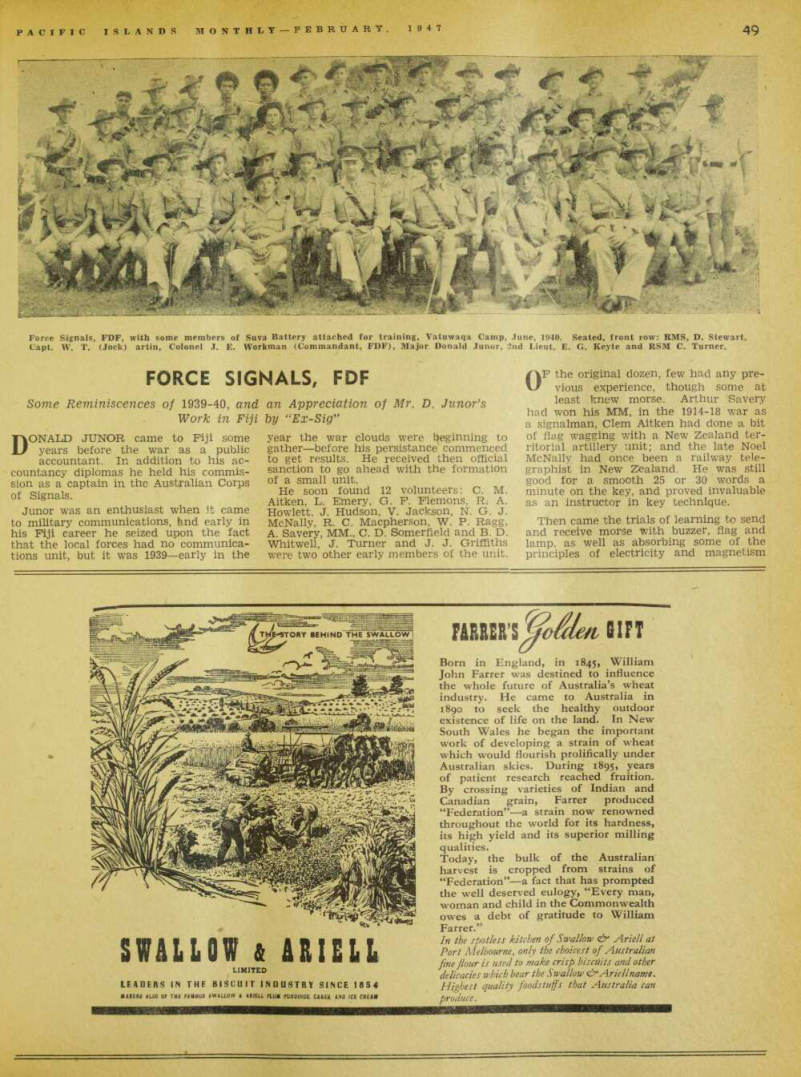
Some Reminiscences of 1939-40, and an Appreciation of Mr. D. Jnnor’s Work in Fiji by “Ex-Sig”
DONALD JUNOR came to Fiji some years before the war as a public accountant. In addition to his ac countancy diplomas he held his commis sion as a captain in the Australian Corps of Signals.
Junor was an enthusiast when It came to military communications, knd early in his Fiji career he seized upon the fact that the local forces had no communica tions unit, but it was 1939—early in the
year the war clouds were beginning to gather—before his persistance commenced to get results. He received then official sanction to go ahead with the formation of a small unit.
He soon found 12 volunteers: C. M.
Aitken, L. Emery, G. F. Flemons, R. A.
Hewlett, J. Hudson, V. Jackson, N. G. J.
McNally, R. C. Macpherson. W. P. Ragg, A. Savery, MM., C. D. Somerfield and B. D.
Whitwell, J. Turner and J. J. Griffiths were two other early members of the unit.
OF the original dozen, few had any pre vious experience, though some at least knew morse. Arthur Savery had won his MM, in the 1914-18 war as a signalman, Clem Aitken had done a bit of flag wagging with a New Zealand ter ritorial artillery unit; and the late Noel McNally had once been a railway tele graphist in New Zealand. He was still good for a smooth 25 or 30 words a minute on the key, and proved invaluable as an instructor in key technique.
Then came the trials of learning to send and receive morse with buzzer, flag and lamp, as well as absorbing some of the principles of electricity and magnetism
Force Signals, FDF, with some members of Suva Battery attached for training, Vatuwaqa Camp, June, 1940. Seated, front row: RMS, D. Stewart, Capt, W, T. (Jock) artin. Colonel J. E. Workman (Commandant, FDF), Major Donald Junor, Lieut. E. G. Keyte and RSM C. Turner,
and the all important subject of signals procedure as used by the army.
Parades were held weekly, in the even ings but such was the enthusiasm Junor engendered that hardly a night
passed without two or more embryo sig nalmen getting together with a buzzer and key. Some even went out on their own on Saturday afternoons with the flags to per fect their technique.
Lack of equipment was the main bug bear. Morse keys of any vintage were at a premium and so were buzzers. ’Many an old electric bell was unearthed, de nuded of its clapper and made to do strenuous if raucous service in the good cause. There were no proper military signal lamps, but torches served for prac tice, some mounted on old camera tripods.
Later some PWD heavy lamps were issued.
On Sundays and holidays, Fiji’s signal men lugged their heavy equipment about the countryside—the lamps required heavy storage batteries to operate them— and many a curse they earned. They were carted to Mission Hill, to Tamavua, up Flagstaff Hill and over to Nukulau Island.
Early in the piece, Junor obtained for his unit a special “walking out” uniform, modelled on his own Australian “blues”, and soon signal volunteers were cutting something of a dash in blue uniforms, complete with jaunty forage cap, brass buttons and collar badges and a red stripe down the trouser seams. However, Sep tember 3, 1939, saw the blues away for the duration, and thereafter khaki service dress was the order of the day for all occasions.
WITH war came more recruits who threw a fresh strain on Junor and chief assistant, W. T. Martin (new ly arrived Controller of Customs) and the NCO’s, who had by this time been ap pointed by competitive examination.
Lack of proper equipment continued a sore point, but at least it was reported to be on the way from Britain. In the meantime, someone in the Post and Tele graph Department dug out a pair of World War I D Mark 111 field telephones, which, refurbished, did yeoman service.
So, weekend on weekend, Suva saw the flicker of morse lamps and flags and heard the roar of despatch rider’s motor cycles, for several young motor-cyclists had joined in this capacity.
MANY were the stunts in which Signals took part. On one occasion the unit helped to repel a mock landing by men from HMS Leander, in the course of which some of the lads swooped on an unsuspecting naval rating and “captured” his portable radio.
However, friendly relations with the navy were quickly restored and later the unit spent an evening on board studying naval signal gear and procedure. There was also an occasion when the navy played host and took Signals and other FDF units to sea for an AA shoot.
Soon after the equipment from Britain arrived, the military hierarchy demanded a telephone link between a camp near Suva Point and a machine gun emplace ment on the beach. So, one Sunday, Signals sallied forth in force, the line was duly laid and the telephone put in work ing order.
Junor had been away from town for some days at this time, so the job was or ganised by Jock Martin, who decided to celebrate when the installation was com pleted. A collection among the troops soon produced the wherewithal for a keg of beer, and when the job was finished the keg was broached.
Captain Jock Martin was just in the act of quaffing, when a car drew up and Junor, the enthusiast and disciplinarian, almost direct from the boat which had landed him back from Vanualevu that morning, jumped out. There was a look of horror on his face at the sight of his troops gathered around a keg at the road side. His first remark was: “Good God, Captain Martin, is this a parade or a b picnic?”
In June, 1940, came the first unit camp, when the crowd went under canvas at Vatuwaqa and branch units which had been formed at Lautoka and Ba in the interim, under 2nd Lieut. E. G. Keyte, joined in.
Those were the days of hard work and good fun, particularly when two ser geants-major of the NZ Permanent Forces. Don Stewart and Ces Turner, started to teach us something about mili tary drill—something with which most of us had but a perfunctory acquaintance.
There was one occasion when Stewart was instructing a squad to “right turn” and “left turn” and an innocent lad from Lautoka (or Ba) pointed out that that was not the way he had been taught to do it.
Very quietly Stewart called his pal Turner over and politely invited the inno cent one to come out in front to demon strate. He executed a complicated piece of footwork. “See that, Turner,” said Stewart, “that’s the way so-and-so says it should be done.”
“Where did you learn that?” Stewart barked at the recruit.
“In Australia, Sir,” answered the lad.
Stewart looked at Turner, gasped, and then roared: “It must have been before the b white man got there. Rejoin the ranks and learn to do it my way.”
There was also the occasion when in expert handling of a Vickers gun mech anism, caused a spring to bounce away into the undergrowth and so put half the colony’s machine guns out of action (there were only two in the group then).
Tired signalmen spent hours scouring the ground before the missing spring was founds and Fiji’s machine guns brought up to full strength again. rAT camp marked the beginning of the end so far as the unit’s indi viduality was concerned, for it was there we received news of Junor’s promo tion to the rank of major and his recall to Australia to rejoin the forces there for overseas service.
Soon after, we were absorbed in the territorial battalion as “battalion signals.” with a consequent reduction in strength and loss of identity.
Advertisements & other items, pp. 51-52 (1 item)
Parrer’Sjs/& Rift
ORY BEHIND THE SWALLOW
r /i.vv'.. *>?■. *. ‘i- V
HKU
u £ a 3?52 Sc «u
SVAUOW 4 AKIELL
LEADERS IN THE BISCUIT INDUSTRY SINCE 1854 a isins also or the famous swallow a ahull nun puddings, ca»e* and ice cbea*
PARRER’sJS/& RIFT
Born in England, in 1845, William John Farrer was destined to influence the whole future of Australia’s wheat industry. He came to Australia in 1890 to seek the healthy outdoor existence of life on the land. In New South Wales he began the important work of developing a strain of wheat which would flourish prolifically under Australian skies. During 1895, years of patient research reached fruition.
By crossing varieties of Indian and
Canadian grain, Farrer produced
“Federation” —a strain now renowned throughout the world for its hardness, its high yield and its superior milling
qualities.
Today, the bulk of the Australian harvest is cropped from strains of “Federation” —a fact that has prompted the well deserved eulogy, “Every man, woman and child in the Commonwealth owes a debt of gratitude to William Farrer.”
In the spotless kitchen of Swallow <& Ariell at Port Melbourne, only the choicest of Australian fine flour is used to make crisp biscuits and other delicacies which bear the Swallow & Ariell name.
Highest quality foodstuffs that Australia can
produce.
G. H. Robinson
ISLAND SUPPLIES
of all kinds—Selected and Shipped to order at lowest possible prices—Piecegoods in Wool, Cotton and Silk, Under and Outerwear, Manchester, Drapery, Grocery, Hardware, Engineers and Leathergoods trade supplies a specialty.
Indents and Transhipments arranged. Large or small orders treated with equal care.
Use our 25 years’ extensive experience.
Enquiries solicited to—
G. H. ROBINSON
51 Macquarie Street, Sydney, N.S.W.
Telegrams: Sunrise, Sydney.
Letters; Box 3317, G.P.0., Sydney.
Steamships Trading
Company Limited
PORT MORESBY
SAMARAI
PAPUA.
WHOLESALE & RETAIL MERCHANTS, SHIPOWNERS,
PLANTERS, ENGINEERS & SLIP PROPRIETORS.
Customs, Shipping, Insurance, and forwarding Agents.
MANAGING AGENTS AND VISITING REPRESENTA-
TIVES FOR COCONUT AND RUBBER ESTATES.
SYDNEY REPRESENTATIVES: Nelson & Robertson Pty. Ltd. 12 Spring Street
Jap Dodging Behind Finschhafen
THIS is the concluding article in the series which have been written for us by the Rev. A. P. H. Freund. The articles have told of the adventures of Coast-Watchers in New Guinea in 1942-43. In the last instalment, in December, Mr. Freund told how he and his mates, K. H. McColl and L. Pursehouse, set up watching posts behind Finschhafen. Then the Japs landed at Finschhafen and, after several visits had been paid them by the Watchers, they began to send patrols out into back country.
PURSEHOUSE and McColl had had a hut built in thick jungle in a valley near a stream not far from the village of Moruruo, which is near Sattel berg. They had full confidence in the faithfulness of the local natives; and they took it in turns every morning to climb up a rough track out of the valley to a height from which they could overlook and watch Finchhafen and the coast for several miles both north and south.
During the day, they would relieve each other. For nearly three weeks they carried on undisturbed. Then the storm broke.
One morning, Mac was puffing up the steep climb out of the valley with his revolver in its holster and the Owen gun hanging at his hip with the webbing strap over his shoulder. Suddenly he heard a shot.
How it was possible for a man in Jap anese-occupied territory to hear a shot and not immediately think of the enemy, is a mystery. But it shows how uncon cerned men can become.
Mac’s first thought was that his own Owen gun had somehow gone off. He stopped and lifted the gun to examine it.
As he was doing so “brrrrr!”
Above him and about thirty yards away, seven Japs were spraying him with sub machine guns. He had stopped just be side a tree and could hear the bullets biting into the trunk beside his head, but
they missed Mac completely. Then fol lowed a lively time with Mac remaining unhurt, after two or more bursts from the enemy. He managed to escape into the jungle.
With his ammunition gone, the Owen gun was now of no more use to him than a piece of scrap-iron, so he put it be hind the butt of a tree. (About 18 months later, when that part of New Guinea had been recaptured, Mac revisited the scene of his ambush. In a letter he told me how he had looked for and found that Owen gun, and he claimed that it was still in working order.) From where he was hiding, Mac could hear the Jap soldiers enter the hut, and soon there came the clatter of cases of tinned foodstuffs being upset, and other effects being turned upside down as they made a thorough search.
Pursehouse had got out of the hut just before the Japs entered. Since it was his “off” morning, he had stayed in his bunk after Mac went out. And even when the shooting started, he did not immediately think of Japs, He and Mac had an understanding that if the man in the lookout saw anything that required im mediate reporting, he would fire a single shot with his revolver. Then the man in the hut would send one of the native houseboys up to get the message.
So, when Pursehouse heard the Jap officer’s single shot, he got out of bed
and called out to a boy to go up to Mac.
In the meanwhile he heard the automatic fire, but assumed that Mac was indulging in some practice shots, or that the mission cattle, which occasionally roamed as far as Moruruo, might have shown hostility, and that he was trying to scare them off.
But when he heard the further bursts of fire he realised that they were being attacked. So he got into his clothes, grabbed a pack that he always kept ready for any such an emergency, forgot his hat in the hurry, and vanished into the jungle—a very few moments before the Japanese entered the hut.
After a while, Pursehouse met a native near a field. He had to cross the field on his way back to where I was—but how was he to know whether Japs might not be snooping around? The native went to reconnoitre, and not only brought him safely across the clearing but accom panied him through the difficult jungle to the next village. It was evening when they arrived, and the village natives brought him food, so Pursehouse decided to stay for the night. He did not sleep very soundly, however, there was no knowing where the Japs might be prowl ing. Besides he was worried about Mac.
He feared that Mac had fallen. Sud denly, about four o’clock in the morning, the sound of automatic fire in the dis tance reached him. That indicated that Mac was still on deck. But it also in dicated that the Japs were still on the
hunt, so Pursehouse decided to move on, even at that early hour.
WHAT had happened to Mac in the meanwhile? He lay low in his thicket. In spite of their repu
tation for jungle craft, the Japs did not follow him. Probably they realised that it was not healthy to stalk a man with an Owen gun in the jungle. He lay low that whole day and into the small hours of the morning. In order to get away he had to cross the stream. Such a stream af fording an open view for much further than the normal visibility in the jungle, would have been the logical place for the the enemy to hide and watch for him. To cross it in daylight, assuming that the enemy had the sense to see this advant age, would have been highly dangerous, and even at night there was considerable risk.
At what he estimated to be about 4 a.m.. Mac decided to shift. Unless he wanted to make a long detour, he had to pass fairly close to the hut. And though the Japs had made quite a lot of noise, chattering and laughing as they left the hut and carried away the wireless set, food and other things they had captured, yet Mac had a suspicion that a few might have been left hiding in the hut. or in* the little cook-house near the hut, waiting for Mac’s or Pursehouse’s possible return.
Just as Mac was beginning to move, a dead branch broke off a nearby tree, and, with a resounding slap, hit a large leaf as it fell. Almost immediately from the door of the cook-house, there came spurts of flame and a rattle of automatics as two Japs sprayed the jungle all around That was the firing which Pursehouse heard at the village some miles away.
The fat seemed to be in the fire again.
Mac sat back and waited patiently.. But dawn was drawing dangerously near. Now or never!
Off he sneaked. Having been warned by the shooting, he was particularly caut ious. And without further trouble he managed to get clear of the danger area.
In the morning he had reached the main track leading from Sattelberg to the hill villages westwards.
All along the track were the imprints of the Japanese sandshoes with the spec ial compartment for the big toe. But fortunately the return footmarks were also there, indicating that they had re turned to Sattelberg, or even to Finsch hafen. They had also been on every little side track leading into the bush, appar ently looking for Mac’s tracks. Lying low that day had saved him.
When Mac came to the next village, he asked the natives about the Japs who had
passed through the previous day. They Insisted that they had seen none. He investigated and found that just before the village the Japs had left the track, worked their way through the jungle around the village, and it was only beyond the village that the tracks of their slit toed sand shoes again appeared on the track. Since the return tracks were also there, Mac knew that the Japs had re turned to Sattelberg or Finschhafen and that he would be safe from then on, IAT my post further afield at Besabong would have surmised that something had happened, had it hot been for a mishap at my end. My receiver had broken down, and therefore I could not know that Mac and Purse were no longer on the air.
One evening, a native lad arrived car rying a revolver in a holster on a belt.
He said that a “master” was following.
I assumed that McColl was coming to try and fix my receiver, but I did ask whether the master had much luggage, and was informed that he had only one pack—too little for even wartime travel.
Bo I asked whether the master had come via Joanggeng, only to receive the sur prising information that he had come from Sofifi—a roundabout route. Then I realised that something was wrong.
In a few minutes. Purse arrived to give me the terse information: “We’ve been shot out.”
“Where’s Mac?” I asked.
“I was badly worried about him at first,” replied Purse, “but I’ve heard from the natives that he’s safe.”
We had lost a Teleradio and our work ing receiver, clothing, food and other gear, but that did not matter. We had not lost a man.
Purse had already made up his mind what we should do. The danger signals were up. A man-hunt would soon be on.
We had better get away from that area.
So a message was sent to Moresby re porting what had happened and outlining our plans. We asked that emergency supplies, clothing, blankets and advice or instructions be dropped at Ogeram nang, where we would wait from April 12 to 15. If nothing were dropped in that time, we would leave, nevertheless.
We had no means of making sure that Moresby received our message, but we re peated it several times.
The evening after Purse’s arrival, Mac also reached Besagong safely. He was in really good form. We sent another mes sage to headquarters announcing his ar rival.
IT was noon on April 12, when we reached Ogeramnang. No drop had taken place that morning. We had asked that the drop be made early in the morning and without parachute. The reasons for this are obvious. We won dered if our message had been received.
Next morning at dawn, when we were still in our bunks, we heard a Fortress come sneaking up the valley east of the village. Evidently the pilot wanted to give us time to light our signal fires. He kept running back and forth in the val ley, gradually rising with each turn, and by the time our fires were smoking fur iously, he was at our level. Then he made a run over us. He was so low that it seemed ( a delusion, of course) that he would hit the iron roof of the church near which we were standing. We thought he would make his drop, but he was merely having a look to see that we three were all there and well.
Then he came round again, banked at the edge of the village, dropped a bag from a few hundred feet, waggled his wings, and flew off. He had his break fast in Moresby. We were there for late lunch five weeks later. And hundreds
of miles of mountain, ravine and jungle had to be traversed in that interval.
We had intended to travel over the mountains forming the southern side of the Cromwells, outflank Lae, and make our way to Wau. We reckoned on a three-week trip. Fortunately we selected and packed food for a safe margin be yond that. We took only meat, flour, sugar, tea and a small supply of butter, jam and dripping. We had about 120 tins of emergency rations, and we had a 56-lb case of salt. Pursehoyse knew that the hill natives are salt-hungry. And all the way through we were able to buy first-grade vegetables; beans, cabbage, potatoes, cucumbers and various other varieties which had been introduced in those areas by the missionaries, besides bananas and other tropical fruit. And, at least five times a week, we were able to buy a fowl.
The day after leaving Ogeramnang, we reached the last of the Hube villages— from there to the first village of the tribes behind Lae, there is a high area where for three days one sees no habita tion. At this jumping-off place the nat ives warned us against our plan to out flank Lae. The Japs were on all tracks, they said. We had better cross the central range of the Huon Peninsula and go along the northern “slopes”, event ually crossing the tail of the Cromwells again, and into the Markham valley.
We decided to follow their advice.
We required 25 carriers for all our foodstuffs, salt, camping and cooking equipment, blanket roll and packs. There was no difficulty in finding them. In view of the fact that the crossing of the range was also a three-day climb without a village, the carriers brought seven women loaded with their own food.
The first day was a terrific climb.
Soon we were at an altitude where the trees are draped in a flowing beard of moss a foot long from the leaves to the roots. Heavy fog and mist crowds in on the mountains most of the day, so that the moss is a wet sponge which drips water day and night. The ground is covered with a deep bed of leaves, bark and fallen moss squelching with water.
Leeches are there in millions. They boarded our boots as we walked and wand ered around, looking for an opportunity to get at our blood. But we wore top sox over our ordinary sox, and they were rarely able to get through the double layer. And since the tops of our sox were usually dry, they could not climb further up our legs. But the poor car riers had to stop every few chains and scrape them off. Streams of blood kept running down their legs, for the blood coming from a leech puncture will not readily congeal. One ingenious man car ried a length of bamboo filled with ashes, which he would dust on his legs. Leeches will not travel over anything dry.
Towards the end of the first day we reached an area of open “plains” thickly covered with dry grass, with small lakes here and there. The nights spent in im provised huts were cold. In the after noon of the third day, we descended a great limestone mountainside and reached the first village of the Komba tribe. Our carriers went back, and from there on we were taken from village to village by local carriers, whom we paid with stick-tobacco, of which we were for tunate enough to have a fair supply al though the people frequently assured us that they did not want payment.
Then, day after day we climbed up and down <|iose two or three thousand foot gorges which we had often admired with awe from our home on Rooke Island across the Strait. I had never imagined then that I would have to climb over all of them.
Our trail from village to village was necessarily a zigzag one. Once, after a whole day of climbing, slithering and stumbling, when we estimated that we had tramped 15 miles, the map showed that our actual progress was five miles.
On Easter Sunday we began a two day climb over a ridge which we estim ated to reach a height of ten thousand feet above sea level. The natives told us that only one white man had previously crossed that ridge—a “kiap” by the name of Black. The views across some of those gorges were, at times, truly breath-tak ing. A number of times, as we sat smok ing around the fire before turning in for the night, Mac, who had been assigned to the navy, used to joke; “If you want to see the interior of New Guinea, join the Navy.”
After three weeks, when we had crossed another particularly heart-breaking ridge and had scrambled in and across the Leron from where it was a tiny rivulet to where it had become a rushing dang erous torrent between pitiless mountains, we reached Ewok. Next morning the natives calmly informed us that a party of forty Japs had been there a week pre viously. We had imagined that they
would never penetrate to these forbidding areas.
But, we figured, they would not be around every week. Mac had slightly sprained his ankle before reaching Ewok.
We had to lay up for four days massaging the injury till he was fit to travel.
That delay probably saved our lives.
We had intended to continue down the Leron and cross the Markham at the confluence, but during our delay, a native teacher came along to warn up that the Japs were all along the IMarkham in that area, but that if we went with him he would show us another way out to where he had heard Australian soldiers were stationed.
This meant a longer trek, but a few days extra are well spent when it is a matter of saving one’s life. By a devious route we came to and followed another tributary of the Markham, through Kaiapit, .and crossed the Markham to Onga. Nearby we found an observation post manned by three Australian. We
had been cut off from the outside world for about four weeks. It was good to meet other white people and hear news of the world at large. We arrived just when the surrender of the Germans in Tunisia was announced, From here we went to K ainantu via Ayura. meeting “Tiny” Mac Adam, who had distinguished himself in the Sala maua area and elsewhere. “Kiap” Ham ilton, a pal of Pursehouse’s, was at Kain antu.
Five weeks after seffinj? nut from ncpr we reached Belna Benna oSv to hear that the Jans had been Kainantu and surroundings. After a few days wait, a DC3 came in with supplies for the Benna Benna force. We were taken to Moresby, escorted by four Lightnings. A fortnight was spent there, mostly with the Australian and American topographical sections who were prepar ing maps in readiness for the Finsch hafen campaign and wanted all the in formation they could collect.
lip were then flown to Townsville and f T Brisbane. We had often wondered whether we would see dear old Australia again, and we cheered when we caught the first glimpse of the coast.
We were given leave, after which I was discharged, and Pursehouse and McColl went back to New Guinea. Pursehouse was killed near Sio. McColl saw service in various places and was able to revisit the Ogeramnang area and reward the natives who had been. so faithful to us.
In the fifteen months, many of which were spent behind the Japanese lines, we achieved nothing spectacular, but we hope that in a small measure we contri buted towards the ousting of the Japs, thus making possible our eventual return to New Guinea, from where I am writing this concluding article of our wartime experiences.
Advertisements & other items, pp. 53-56 (1 item)
B3Hh3Dbobi
a
EYE LOTION
For Inflamed Eyes and Eyelids Sold Everywhere H. Rose & Co.. F*ty_ Ltd.. Kinq Street. Sydney.
V O
B3HH3DBOBI
i o V
FIRST GRADE
<^#U3T J.A.D.GIBSON AND COMPANYPTY LIMITED 364 Kent Street Sydney dW b^ M s
Rid Kidneys Of
Poisons And Adds
If you suffer sharp, stabbing pains, If Joints are swollen, it shows your blood Is poisoned through faulty kidney action. Other symptoms of Kidney Disorders are Backache, Aching Joints and Limbs, Sciatica, Neuritis, Lumbago, Sleepless Nights, Dizziness, Nervousness, Circles under Eyes, Loss of Energy and Appetite and Frequent Headaches and Colds, etc. Ordinary medicines can’t help much because you must get to the root cause of the trouble.
The Cystex treatment is specially compounded to soothe, tone and clean kidneys and bladder and remove acids and poisons from your system safely, quickly and surely, yet contains no harmful or dangerous drugs. Cystex works In 3 ways to end your troubles. 1. Starts killing the germs which are attacking your Kidneys, Bladder and Urinary System in two hours, yet Is absolutely harmless to human tissue. 2. Gets rid of health-destroying, deadly poisonous acids with which your system has become saturated. 3. Strengthens and reinvigorates the kidneys, protects from the ravages of disease-attack on the delicate filter organism, and stimulates the entire system.
Praised by One-time Sufferers
Cystex is approved by one-time sufferers In S 3 countries from the troubles shown above.
Mr. Reg Thomas, Townsville, Queensland, recently wrote: “My joints were all stiff, I had leg pains, my back used to ache day and night.
My bladder was weak. I had headaches and no appetite. The first dose of Cystex helped me and before I finished three boxes my nealth and strength came back."
Guaranteed to Satisfy or Money Back Get Cystex from your chemist or store to-day.
Give it a thorough test. Cystex Is guaranteed to make you feel younger, stronger, better In every way, or your money back If you return the empty package.
Now in 2 sizes—4/-, %/-.
GUARANTEED OVfiffiX
Treatment
for Your Kidneys, Bladder, Rheumatism.
The Key ia Earning . . .
Sometimes men think that a general education or an elementary knowledge of business is enough to get ahead. But experience soon teaches that thorough, specialised training is just as necessary for success in business as it is in the professions of Law, Medicine or Dentistry. If you are interested in the many opportunities in the Business World ... if you seek responsibility, success and economic security, commence training now —in some specialised business subject. H.R.I. is available always to help and advise ambitious men and women. Write or wire for particulars and career information.
H.R.I. tutorial service is proved by the ivinning of more honours than all coaches in Australasia combined.
H.R.I. Career Training • ACCOUNTANCY • SECRETARYSHIP • COST ACCOUNTANCY
• PRACTICAL BOOKKEEPING • MARKETING SELLING
ADVERTISING • BANKING • LOCAL GOVERNMENT EXAMS.
Hemingway Robertson Institute
Founded and Owned by Hemingway & Robertson Pty. Ltd.
Consulting Accountants ;: t :; Professional Tutors
126 BANK HOUSE, BANK PLACE, MELBOURNE
126 CHALFONT CHAMBERS, 142 PHILLIP STREET, SYDNEY 126/814
Position Wanted Young lady stenographer, four years Bank service, desires position with shipping or trading Co. established in Islands. Apply “Position,” c/o Box 3408, G.P.0., Sydney.
til
HANDSOME
WELL
GROOMED
A
HAIR
> > e vs z/w v< m o^7 /■ It isn’t just a winning smile that makes women like his company. It’s the clean-cut, well-hred personality . • . the capable assurance • . . expressed so confidently in handsome, wellgroomed hair. Your hair, too, can improve your appearance, help widen your circle of friends.
Use VITALIS and the “60-second drill”. 1 50 Seconds to Rub —Circulation quickens thus scalp stimulation gives hair a chance.
O 10 Seconds to Comb and Brush —Hair has a lustre —no objectionable "patentleather" look. 3303 ■ P the ■ .^dresses s the *7> eading distributors
i m m =/
YOU
can
I M be s OF
SHELL
SHELL COMPANY
(PACIFIC ISLANDS) LTD.
(INCORPORATED IN GREAT BRITAIN)
Agents:
BURNS PHILP (South Sea) CO. LTD.
(5465 J)
Pearling Luggers Destroyed
In November Cyclone
From Our Own Correspondent
Brisbane. Jan. 25.
THE pearling fleet which was struck by a cyclonic blow in Torres Strait towards the end of November last resulted in the loss of four privately owned pearling luggers and two Island Industries cutters. It was the worst storm since 1922.
The luggers, the Willow, Minerva, Hes pia and Milton, were total wrecks when blown up on St. Pauls Mission beach on Moa Island. They were valued at be tween £1,500 and £2,000.
The Willow and Minerva were owned by the Bowden Pearling Coy; the Hespia, by Mr. J. Cadzow of Thursday Island; and the Milton, by a Mr. Witt, an ex-service man rehabilitating himself in the pearl ing industry.
The cutters, valued at £3OO and £5OO, were lost near Badu Island. No loss of life, however, was reported.
Harry Pitt, a Darnley Islander, gave heroic service. After rescuing the crew of a foundering cutter he took off the crews of other luggers and sailed into TI with about 70 Islanders on board.
He then went out again in search for other ships belonging to the pearling fleets.
Kubin village, with a population of 200 natives on the western side of Moa Island, was practically demolished by the cyclone; St. Paul’s village, with 120 natives, on the eastern side of the island, and Badu village, with 500 natives on Badu Island, two miles from Moa, were seriously dam aged.
The loss of pearling boats by cyclones recalls other notable pearling disasters.
On March 11, 1934, an intense cyclone in the Coral Sea wrecked the pearling fleet with a loss of 75 lives.
But the greatest tragedy in the entire history of pearling, was off Cape Mel ville, on Saturday, March 4, 1899, when 77 boats were destroyed, and 307 lives lost. The cyclone was followed by a huge tidal wave, which engulfed the ad jacent country for three miles inland, leaving in its wake a heavy toll of human life, dead beasts, fallen timber, as well as countless numbers of stranded fish.
The heroine of that terrible pearling disaster was also a Darnley Islander — Muara Lifu. That young native woman, wife of a diver, who was on one of the luggers, saved the lives of two white men by swimming with them on her back to the shore nearly two miles away.
Past and present events have proved that the life of a pearler is full of con stant peril, The new Government Auditor of Fiji, Mr. G. E. L. Lord, arrived in Suva from New Zealand by air in January. He was accompanied by his wife.
Survey Suggests Need For
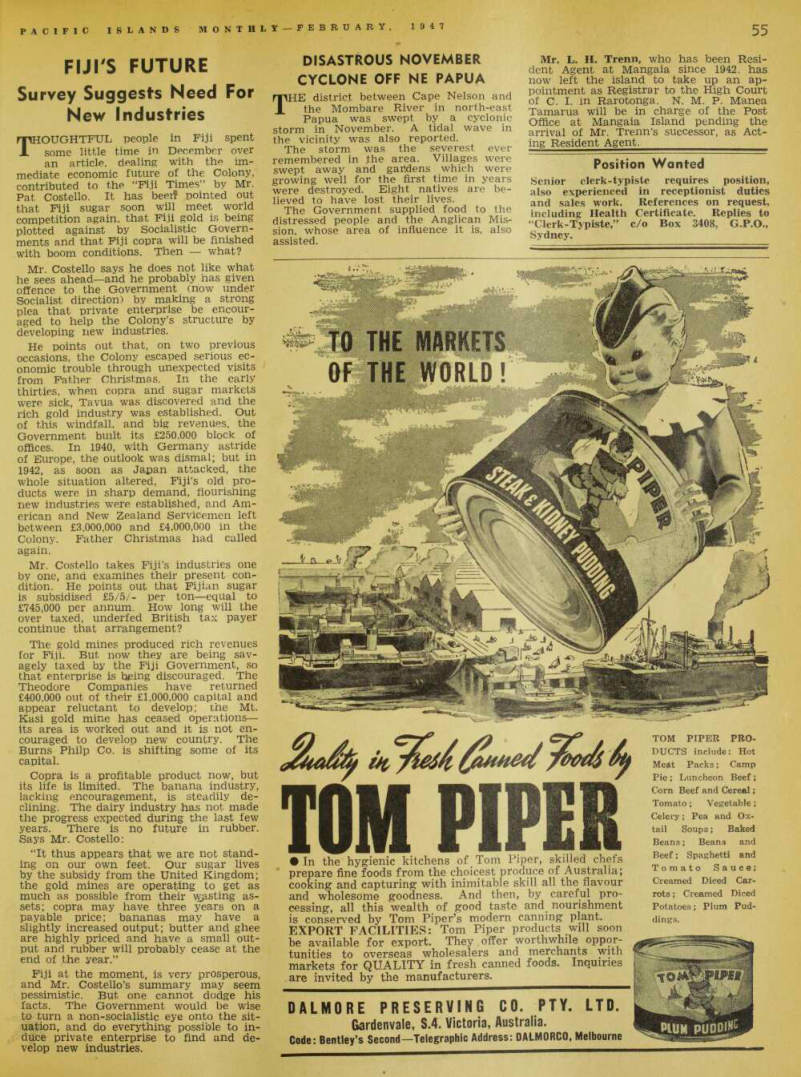
Fiji's Future
Survey Suggests Need For New Industries
rpHOUGHTFUL people in Fiji spent A some little time in December over an article, dealing with the im mediate economic future of the Colony, contributed to the “Fiji Times” by Mr.
Pat Costello. It has beerf pointed out that Fiji sugar soon will meet world competition again, that Fiji gold is being plotted against by Socialistic Govern ments and that Fiji copra will be finished with boom conditions. Then what?
Mr. Costello says he does not like what he sees ahead—and he probably has given offence to the Government (now under Socialist direction) by making a strong plea that private enterprise be encour aged to help the Colony’s structure by developing new industries.
He points out that, on two previous occasions, the Colony escaped serious ec onomic trouble through unexpected visits from Father Christmas. In the early thirties, when copra and sugar markets were sick, Tavua was discovered and the rich gold industry was established. Out of this windfall, and big revenues, the Government built its £250,000 block of offices. In 1940, with Germany astride of Europe, the outlook was dismal; but in 1942, as soon as Japan attacked, the whole situation altered, Fiji’s old pro ducts were in sharp demand, flourishing new industries were established, and Am erican and New Zealand Servicemen left between £3.000,000 and £4,000.000 in the Colony. Father Christmas had called again.
Mr. Costello takes Fiji’s industries one by one, and examines their present con dition. He points out that Fijian sugar is subsidised £5/5/- per ton —equal to £745,000 per annum. How long will the over taxed, underfed British tax payer continue that arrangement?
The gold mines produced rich revenues for Fiji. But now they are being sav agely taxed by the Fiji Government, so that enterprise is being discouraged. The Theodore Companies have returned £400,000 out of their £1,000.000 capital and appear reluctant to develop; the Mt.
Kasi gold mine has ceased operations— its area is worked out and it is not en couraged to develop new country. The Burns Philp Co. is shifting some of its capital.
Copra is a profitable product now, but its life is limited. The banana industry, lacking encouragement, is steadily de clining. The dairy industry has not made the progress expected during the last few years. There is no future in rubber.
Says Mr. Costello: “It thus appears that we are not stand ing on our own feet. Our sugar lives by the subsidy from the United Kingdom; the gold mines are operating to get as much as possible from their as sets; copra may have three years on a payable price; bananas may have a slightly increased output; butter and ghee are highly priced and have a small out put and rubber will probably cease at the end of the year.”
Fiji at the moment, is very prosperous, and Mr. Costello’s summary may seem pessimistic. But one cannot dodge his facts. The Government would be wise to turn a non-socialistic eye onto the sit uation, and do everything possible to in duce private enterprise to find and de velop new industries.
Disastrous November
Cyclone Off Ne Papua
* u + \ Tq i.
HE district between Cape Nelson and the Mombare River in north-east Papua was swept by a cyclonic storm in November. A tidal wave in the vicinity was also reported.
The storm was the severest ever remembered in the area. Villages were swept away and gardens which were growing well for the first time in years were destroyed. Eight natives are be lieved to have lost their lives.
The Government supplied food to the distressed people and the Anglican Mis sion, whose area of influence it is, also assisted.
Mr. L. H. Trenn, who has been Resi dent Agent at Mangaia since 1942. has now left the island to take up an ap pointment as Registrar to the High Court of C. I. in Rarotonga. N. M. P. Manea Tamarua will be in charge of the Post Office at Mangaia Island pending the arrival of Mr. Trenn’s successor, as Act ing Resident Agents
Advertisements & other items, p. 57 (1 item)
Tom Piper
Position Wanted Senior clerk-typiste requires position, also experienced in receptionist duties and sales work. References on request, including Health Certificate. Replies to “Clerk-Typiste,” c/o Box 3408, G.P.0., Sydney.
a. 1# m
ORLD
0 9E Hr 3&s** Jt -* J Tm»
TOM PIPER
• In the hygienic kitchens of Tom Piper, skilled chefs prepare fine foods from the choicest produce of Australia; cooking and capturing with inimitable skill all the flavour and wholesome goodness. And then, by careful processing, all this wealth of good taste and nourishment is conserved by Tom Piper’s modern canning plant.
EXPORT FACILITIES: Tom Piper products will soon be available for export. They offer worthwhile opportunities to overseas wholesalers and merchants with markets for QUALITY in fresh canned foods. Inquiries are invited by the manufacturers.
DALMORE PRESERVING CO. PTY. LTD.
Gardenvale, 5.4. Victoria, Australia.
Code: Bentley’s Second— Telegraphic Address: DALMORCO, Melbourne
TOM PIPER PRO-
DUCTS include: Hot Meat Packs; Camp Pie ; Luncheon Beef ; Corn Beef and Cereal; Tomato; Vegetable; Celery; Pea and Oxtail Soups; Baked Beans; Beans and Beef; Spaghetti and Tomato Sauce; Creamed Diced Carrots ; Creamed Diced Potatoes; Plum Puddings. im tOM A
Tribute to Harry Downing
By a Territorian
1 SHOULD like to pay tribute publicly to Harry Downing, who has been one of the best friends the Terri torians have known during the black years of war and the blacker year which followed. During his long years in District Services he learned all the details of administration, and NG conditions, and NG people, and it was good luck for us that so genial and kindly a man was selected by the Australian Department as liaison officer in Sydney.
For five years, he has been guide, philosopher and friend to Territorians.
They make for Harry’s office with their problems and they are met with a smile and friendly greeting, everything possible is done to assist them. It has become among them a maxim: “When in trouble, go and see Harry Downing.”
There are always people waiting to see him. His phone is always ringing; but Harry never seems ruffled, and out of the storehouse of his knowledge, and from his files, he supplies the required information. A plane passage to arrange, a wife and family to go by steamer to Rabaul, something about gold, a timber lease query, and very many other things— all the questions and requests are fired at Harry, and he deals with them all.
Service with a smile!
And his “clients” appreciate it. More and more often one hears it said that Harry has done a sterling job. Especially during 1942 and 1943 were his advice and assistance comforting and helpful to the displaced Territorians. He himself sums up the position by saying that he regards the Territorians as his people, his “one talks,” and that it has been his particular privilege and pleasure to help them when and where he could.
Death Of Mr. Harrison
Smith In Tahiti
MR. HARRISON SMITH a very popular resident of Tahiti, died at his home at Papeari, on January 4, after a long illness.
His funeral was attended by a great number of friends. He was buried on his own property about a mile away from his home, in a spot he had chosen himself for his last resting place.
In July 1946, he was awarded the Legion d’Honneur by the French Govern ment in appreciation of the services he had given to French Oceania. Some years ago he presented the district of Taravao with a fine building which was converted to the use of a hospital.
Mr. Smith was an enthusiastic horti culturalist and imported many varieties of plants, flowers, trees, shrubs and vines for the beautification of his estate.
Death Of Former Samoan
Trader In Sydney
THE death occurred in Sydney in Sep tember, 1946, of William Charles Dexter, formerly a well-known trader in Western Samoa.
He was born in Papeete, Tahiti where his father was also a trader. The family went to San Francisco about 1894 where they lived for 10 years prior to going on to Western Samoa.
William Dexter was in business in the Territory until the early 30’s when he retired and went to Sydney where he lived with his sole surviving relative, Mrs.
G. Brown, of Concord.
He was 77 at the time of his death.
For Fourpence
Cook Island Pineapples
From Our Own Correspondent
Mangaia, Nov. 21.
BY the time this appears in print the first shipment of Cl pineapples will be on sale in New Zealand. These are Mangaia’s only end-of-year income, and 4/- a case is what we get for them.
It is hardly likely to produce an extrava gant Christmas, assuming that the pine apple-money lasts till then. (Copra money has already been spent.) The problem of living a reasonably civilised and Europeanised life, and find ing the cash for our numerous expenses, is always with us. There were only two orange-steamers this year and income is still exceeded by “outgo.”
There is reason to suspect that 1947 will be a year of great political activity in the Lower Cooks.
Suva’s total rainfall for 1946 was 121 6 inches. There were 223 wet days. At Laucala Bay a few miles distant, al though there were 222 wet days, the rain lall for the year was only 97.83 inches.
Suva’s wettest day was February 26, when 7.51 inches fell.
Residential tax is once again due in Fiji—although residents have ‘got until June 30 to pay it. A warning was re cently issued to Tongans living in the Colony that they must register for resi dential tax after they have been in Fiji for six months.
Advertisements & other items, p. 58 (1 item)
Victim
/z
BITTER
ALE
BtEIEB BY
CARLTON & UNITED BREWERIES LTV.
II
Umboi II
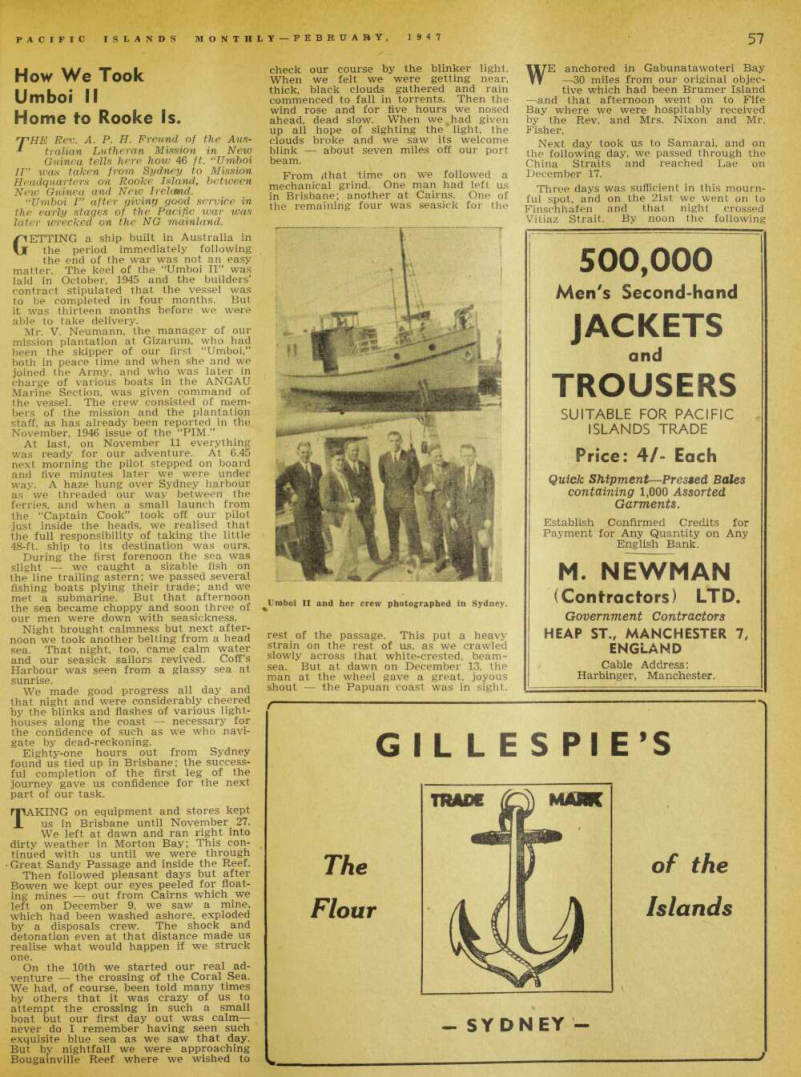
How We Took Umboi II Home to Rooke Is.
r VHE Rev. A. P. H. Freund of the Aus * tralian Lutheran Mission in New Guinea tells here how 46 ft. “Umboi II” was taken from Sydney to Mission Headquarters on Rooke Island, between New Guinea and New Ireland.
“Umboi I” after giving good service in the early stages of the Pacific war was later wrecked on the NG mainland.
GETTING a ship built in Australia in the period immediately following the end of the war was not an easy matter. The keel of the “Umboi II” was laid in October, 1945 and the builders’ contract stipulated that the vessel was to be completed in four months. But it was thirteen months before we were able to take delivery.
Mr. V. Neumann, the manager of our mission plantation at Gizarum, who had been the skipper of our first “Umboi,” both in peace time and when she and we joined the Army, and who was later in charge of various boats in the ANGAU Marine Section, was given command of the vessel. The crew consisted of mem bers of the mission and the plantation staff, as has already been reported in the November, 1946 issue of the “PIM.”
At last, on November 11 everything was ready for our adventure. At 6.45 next morning the pilot stepped on board and five minutes later we were under way. A haze hung over Sydney harbour as we threaded our way between the ferries, and when a small launch from the “Captain Cook” took off our pilot just inside the heads, we realised that the full responsibility of taking the little 48-ft. ship to its destination was ours.
During the first forenoon the sea was slight we caught a sizable fish on the line trailing astern; we passed several fishing boats plying their trade; and we met a submarine. But that afternoon the sea became choppy and soon three of our men were down with seasickness.
Night brought calmness but next after noon we took another belting from a head sea. That night, too, came calm water and our seasick sailors revived. Coff’s Harbour was seen from a glassy sea at sunrise.
We made good progress all day and that night and were considerably cheered by the blinks and flashes of various light houses along the coast necessary for the confidence of such as we who navi gate by dead-reckoning.
Eighty-one hours out from Sydney found us tied up in Brisbane; the success ful completion of the first leg of the journey gave us confidence for the next part of our task.
TAKING on equipment and stores kept us in Brisbane until November 27.
We left at dawn and ran right into dirty weather in Morton Bay; This con tinued with us until we were through Great Sandy Passage and inside the Reef.
Then followed pleasant days but after Bowen we kept our eyes peeled for float ing mines out from Cairns which we left on December 9, we saw a mine, which had been washed ashore, exploded by a disposals crew. The shock and detonation even at that distance made us realise what would happen if we struck one.
On the 10th we started our real ad venture the crossing of the Coral Sea.
We had, of course, been told many times by others that it was crazy of us to attempt the crossing in such a small boat but our first day out was calm— never do I remember having seen such exquisite blue sea as we saw that day.
But by nightfall we were approaching Bougainville Reef where we wished to
check our course by the blinker light.
When we felt we were getting near, thick, black clouds gathered and rain commenced to fall in torrents. Then the wind rose and for five hours we nosed ahead, dead slow. When we had given up all hope of sighting the light, the clouds broke and we saw its welcome blink about seven miles off our port beam.
From <that time on we followed a mechanical grind. One man had left us in Brisbane; another at Cairns. One of the remaining four was seasick for the
rest of the passage. This put a heavy strain on the rest of us, as we crawled slowly across that white-crested, beam sea. But at dawn on December 13, the man at the wheel gave a great, joyous shout the Papuan coast was in sight.
WE anchored in Gabunatawoteri Bay —3O miles from our original objec tive which had been Brumer Island —and that afternoon went on to Fife Bay where we were hospitably received by the Rev. and Mrs. Nixon and Mr.
Fisher, Next day took us to Samarai, and on the following day, we passed through the China Straits and reached Lae on December 17.
Three days was sufficient in this mourn ful spot, and on the 21st we went on to Finschhafen and that night crossed Vitiaz Strait. By noon the following
Umboi II and her crew photographed in Sydney.
day we were anchored at Gizarum, our plantation on Rooke Island.
It was 40 days since we had left Sydney but sixteen of those we had spent in port and the actual running time for the 2,357 miles was 370 hours.
In general, although the trip was tough in places, it could be described as pleas ant and uneventful.
One feature of it , of which we cannot speak too highly, was the services ren dered us by the various coastal radio stations with whom we were in contact.
They took a personal interest in us and our progress, and spared no pains to make contact when atmospheric condi tions were difficult.
Advertisements & other items, p. 59 (1 item)
Jackets
500,000
Men's Second-hand
and
TROUSERS
SUITABLE FOR PACIFIC
ISLANDS TRADE
Price: 4/- Each
Quick Shipment—Pressed Bales containing 1,000 Assorted Garments.
Establish Confirmed Credits for Payment for Any Quantity on Any English Bank.
M. NEWMAN
(Contractors) LTD.
Government Contractors
HEAP ST., MANCHESTER 7,
ENGLAND
Cable Address: Harbinger, Manchester.
GILLESPIE’S
The Flour
MARK
of the Islands
SYDNEY -
Tongan Jail-Breakers
Caught In Lau Islands
THE four Tongans who broke out of jail near Nukualofa. Tonga, on November 29, and put to sea in a stolen cutter have been caught.
They were found at Moala, in the Lau Group, Fiji on December 23 by the Roko Tui Lau and later sent to Suva. They were charged there in January with having landed in Fiji without passports.
One of them, Mahe Tupou, made a similar escape and voyage to Lau about ago. He was fined £5O by the Suva Court, in default six months im prisonment. The three other prisoners were each fined £3O, or four months im prisonment.
The Roman Catholic Mission in Lae, New Guinea, has started a scchool in the township for Chinese and Malay children.
Three Sisters, a resident priest and a Brother are on the staff and school is held in several ex-RAAP huts.
"No News Whatever"—
From Tahiti
From Our Own Correspondent
« Papeete, Dec., 20.
WERE it not for a very occasional tramp steamer which comes via Noumea to load copra for France —and an equally occasional steamer from New Zealand to load phosphate at Makatea, this colony would have been absolutely isolated during the past months.
This period, together with the isola tion of the war-years, has taught the people of the islands some lessons in self-denial and self-sufficiency which may prove of immeasurable value in the not distant future.
The really wise economists are honest enough to warn us that the full con sequences of the waste and destruction of war, will be during the years to come.
Island life is so uneventful, that the phrase “Aita Roa’tu vau i Faaroo noa’e i te Parau Api” (I have heard no news whatsoever) has become the standard reply to any inquiry concerning island happenings.
Even the small change of island gossip, has followed other currencies into the state of diminishing buying power.
There is a rumour that Mrs. Grundy stowed away on a cargo-steamer, and is now on the staff of a Hollywood Movie Magazine!
The Colonial Secretary, Mr. J. F. Nicoll, returned to Suva on December 23, after spending leave in the United Kingdom.
He travelled by A.N.A. plane from Aus tralia, where he represented Fiji at a meeting of the South Pacific Air Trans port Council.
Majority Accept The C.I.P.A.
At Mangaia
From Our Own Correspondent
Mangaia, Dec., 4.
THE much debated Cook Island Progres sive Association, which appears to be controlled from Auckland, New Zealand, has succeeded here in prosely tising a majority of Mangaians.
The Association promised to bring about a rise in fruit prices, and to im prove living standards (a long standing casus belli here) to a corresponding de gree. The point that eagerly joining Mangaians have overlooked is that the CIPA is not centred in Cl and hence is not regarded by the New Zealand Gov ernment as a representative body.
In spite of that, the orange season of 1947 is likely to be attended with much labour trouble on this island.
Manufacture of "Sly Grog''
Growing in Tonga
Prom Our Own Correspondent
Nukualofa, Jan., 6.
EVIDENCE of the growing local evil of distilling illicit liquor, a legacy left behind by the American occu pation forces, came to light when several samples of “sly grog” were seized by the Police during the Christmas period.
The Government, knowing the part liquor had in the decimation of some of the Island races, notably the Hawaiians and Marquesans, is fully conscious of this danger to the Tongans. Consequently it has made the manufacture of liquor in the Kingdom an indictable offence punishable by seven years imprisonment.
Advertisements & other items, p. 60 (1 item)
George J. Logkyer & Company
MARINE BRANCH
ENGINEERING SUPPLIES, GENERAL HARDWARE EXPORTERS AND MERCHANTS Agents for the Finest Australian Liquors
CONSULTING ENGINEERS DOCKYARD MACHINERY
Purchasing Agents ;
PETROL, DIESEL, KEROSENE AND CRUDE
OIL ENGINES:
Electric Light Generating Plants.
Air Conditioning Plants.
Builders’ Hardware.
Marine Engineering Supplies.
Refrigeration Supplies.
Radios and Accessories.
Sanitation Equipment.
Automobile Spare Parts and Garage Accessories.
Abrasive Wheels.
Excavating Machinery.
Electrcal Supples.
Grinding and Pulverising Machinery.
Hydraulic Equipment.
Mechanical Engineering Requirements.
Mining and Quarrying Machinery.
Road and Building Machinery.
All Types Out Board Motors and Out Riggers.
Ronaldson Tippett 16 H.P. Diesel Engines.
Thornycroft 500 H.P. Marine Engines.
Belinda 70 H.P. Crude Oil Engines.
Lister-Blaxland 8-Cylinder Diesel DC. 3KW Electric Light Plant Complete.
Coventry Climax Water Cooled 2.75 KVA 13'0- Volt Electric Light Plant.
Sulzer Marine Diesel Engine 700 H.P. 6- Cylinder Coupled to 325/275 KVA Alternator.
Beardmore Semi-Diesel 65 H.P. Engines.
Universal 22 H.P. 4-Cycle Petrol Engines.
Rosebery Kerosene 3.7 H.P. Hopper Cooled Engines.
Photographs Drawings Schedules will be Supplied by Return Mail to
VESSELS, ETC.
Steel Cargo Vessels, 35 ft. x 13 ft. 4 ft., New, with Winch, Hoist, etc., £375.
Auxiliary Transport Vessels, 32 ft. x 9 ft. x 4 ft., New, without Engines, £2OO.
Tugs, Trawlers, Cargo Vessels, Tankers, Motor Cruisers, Launches, Yachts, Hoists, Winches, etc.
Genuine Clients.
Aerated Water and Cordial Manufacturing, Machinery, Bottling and Capping Machinery, etc.
FAIRLIGHT STREET, FIVE DOCK, SYDNEY, N.S.W. 'Phone; UA7196 All communications to be addressed Bankers: Telegraphic and Cable Address: to The General Manager, Commonwealth Bank of Australia, “LOCKMACH,” Sydney.
G.P.0., Box 4553, Sydney. Sydney.
Memory Of 1891
Strange Sight South of Tonga
By F. S. Whitcombe, Of Levuka
IT was a lovely day in August 1891. The barquentine “Ysabel,” Captain Alex Ross, of Auckland, lay about 70 miles to the north of Sunday Island. We were eight days out from Auckland, having had light variable winds all the way.
Now, we were floating along at about three knots, with every stitch on her, and a light breeze from the SE. The day was wonderful, a clear sky and a calm blue sea.
We had our two whale boats turned over on the main hatch, and had painted them, and put rawhide chafing strips round the rowlocks, two hardwood tog gles in our 18-feet steer-oars, and sewed greenhide around the 3-inch Europe rope strop, that the steer-oar passed through aft. We were getting ready for our surf-loading at Savage Island. Nieua Tapu and Nieua Fo’ou.
Whilst we were on this job, a large pod of hump-back whales came along irom the north, slowly making a passage due south. They took no notice of us, and one huge cow and her calf passed us only about 30 yards off. She was suckling her calf (about 14 feet long) and holding it to her with one large flipper, while she slowly sculled herself along with her immense tail.
The water was so clear that we could see everything. There were 15 cows and most of them had calves; and some bulls, which kept well away from us, seemingly playing “tig” and breaching every now and then.
It was a fine sight. They were slowly travelling south, feeding on the way, and they would spend the spring and sum mer in the Antarctic. Then they would go north again, to the tropics, for the breeding season.
AT 12 noon (8 bells), a swell started up from due south, and at 3 pm. the wind followed up. At 4 bells in the dog watch, the skipper sent us aloft to take in all our light sails, and to put a single reef in the mizzen to ease her steering. As the swell had increased, so also had the wind. We were running at about 10 knots and. with such a follow ing sea, she was liable to yaw, and luff upon the sea.
That night when our watch turned out, it was really blowing solid, but there was not a cloud in the sky. The stars were shining so brightly that they looked only a few yards away. The swell had in creased and the waves were at least 25 to 30 feet high. They were rolling up (a little on our starboard quarter, as we were steering NNE) in long rows that seemed about a quarter of a mile apart.
A swell would overtake the “Ysabel;” she would slowly lift her stern; and then the swell of the sea would send her swooching along on a mad rush, until the wave gradually overtook her. Then the bow would rise and she would sink into the trough and seem to wait until the next swell arrived to start her going again.
Between the swells, we would lose the wind from the foresail, and it would give a flap or two; and then, when she lifted, it would fill out, and strain, till the sheets and tacks were like iron bars.
Although the wind was -so strong, there was no white water about, to speak of.
The sea seemed oily.
During the middle watch, the skipper came on deck and had a look around.
Then took the wheel, and told me to get a hand and go up and make fast the top ga’ntsail, so as to ease her up a
bit. We were doing about 12 knots then —and we were laden down to the Plimsoil mark.
THE lookout and I went aloft and soon had the sail fast. Just as we had finished the ship took a run, and, instead of the usual flood of salt water gushing in through the hawse pipes and cascading over the lee cathead, a mass of pure flaming molten silver came aboard lighting up everything, upper and lower. Top sails beneath us shone out like two marble breasts. The deckhouse and windlass showed up plainly, and, as her bow rose, all the illuminated water ran aft, hit the break of the poop, broke into glistening sheets and went through the scuppers.
Again she dived, and again the decks
were lit up. Looking aft, I could see our wake shining bright, and as straight as an arroV for a half mile or so. We two on the yard could not understand it.
At last the Old Man called out: “What are you mooning about up there for?”
So we got down on deck as fast as we could; and, watching my chance, I nipped aft and went to the wheel. When I got there, the Old Man said quietly: “What were you two thinking about up on that yard, Frank?”
I did not answer. Then he said; “This is a large patch of whale feed we are passing through. It is full of Phos phorus. And, boy, when you see sights like this on such a wonderful night you can remember that God is still in His heaven, and all’s well.”
Then he snapped out: “Nor-nor-east!”
I took the wheel and replied; “Nor nor-east it is, sir.”
I have never forgotten the skipper’s Vords, or that night. It took us 20 min utes to pass through that patch of feed, and the mate said it was the largest he had ever heard of. We were doing at least 12 knots.
Three days afterwards we sighted Eua, slipped in through the Makaha Passage and anchored at Nukualofa. It was an 11 days’ passage from NZ—not bad after our fine weather start.
Advertisements & other items, pp. 61-62 (1 item)
For Sale
] only 9 HP 1000 RPM coldstarting "Lister" Diesel Engine, radiator cooled, on heavy channel-iron base directcoupled to 5.6 KVA alternator 230/240 volts, single phase, 50 cycles; exciter and automatic voltage regulator, driven by "Whittle" belts. Switchboard mounted on framework with voltmeter, ampmeter, ironclad main switch and manual regulator. Price, packed,
f.o.r, Sydney , Nett dOOOU
I only "Lister" 40 HP coldstarting Diesel Engine, 1200 RPM, complete with 20-gln. fuel tank and gauge, tropical-type radiator, with fan and impeller water - circulating pump, direct-coupled on fabricated steel base to a 22 kw 100/ 1 10volt, level compound - wound DC "Lister" Generator, run only 120 hours' test but thoroughly overhauled and tested; guaranteed equal to new.
Price, f.o.r. Sydney . .
Nett obOl O
BOTH SETS ARE GUARANTEED EQUAL TO NEW
Dangar, Gedye & Malloch Ltd.
10-14 YOUNG STREET, CIRCULAR QUAY, SYDNEY.
G.P.O. BOX 509. Tele. B 6095.
V -4 f
tPon'f be that kind
of a Cover Girl I
OU SIMPLE can t resist perfume. That added dash of fragrance makes you feel so feminine.
But even the loveliest of perfumes won’t cover up underarm odour.
Vour bath washes away past perspiration, but you still need protection against risk of future underarm odour. And Mum’s the word for that.
So take 30 seconds to smooth on Mum after every bath.
Snowy-white Mum keeps you sweet all day or evening.
Mum won t irritate your skin or injure fabrics. Quick, sure— and so safe you can use Mum even after dressing. Ask for Mum today.
TAKES THE ODOUR
OUT OF n
PERSPIRATION
3755 Sold by all leading distributors and manufactured by Bristol-Myers Co. Pty. Ltd., 223 Pacific Highway, North Sydney, N.S.W., Australia
Fly To N. Caledonia!
French Govt. Will Now Issue Short-
Term "Tourism Visas"
AVIATION is beginning to take an im portant place in the commercial development of New Caledonia. An aeronautical authority, M. Migeon, has just returned to the French Colony and holds the appointment of director of civil aviation. He is busy inspecting air ports and surplus equipment belonging to the United States.
The Colony already has established air fields at Magenta, which is almost in Noumea, at Tontouta, which is over 30 miles from the capital and at Plaines des Gaiacs in the northern part of the Colony.
As well as the service operated by the RNZAF from New Zealand to New Cale donia, Pan American World Airways also operate services through the Colony, and Qantas Empire Airways run a service from Australia to Noumea.
An investigation is at present being made into the use of amphibian aircraft in New Caledonia, and charter airlines are envisaged to run to various places, including the Loyalty Group, which is 50 miles away.
With a view to providing greater faci lities for would-be tourists to New Caledonia, the French Consulate in New Zealand has been authorised to issue “tourism visas” for a duration of less than one month. No guarantee is given that accommodation will be obtained, and visitors will be required to hold their return tickets. — Whites Aviation.
Tourist Trips from Australia
QANTAS Empire Airways flying-boats are now taking numbers of tourists from Australia to Noumea. The usual itinerary suggested by the air com pany (although tourists can arrange their own time once they are in the colony) includes a three-day visit to the Isle of Pines about 50 miles south-east of Noumea. Visitors to the Isle go in a boat belonging to a local identity, Captain Pons, and find the trip well worth while. The Isle, which is about 58 square miles in extent, has a popu lation of about 600 natives. It is famous for its many beauty spots.
Tourists can, in Noumea, buy French perfume and wines but high duty has to be paid on them if they are taken back to Australia.
The New Caledonia Government is not happy about the insistence of the Aus tralian Government that travellers must be vaccinated against small-pox at least 12 days before they enter the Common wealth from Noumea. Tourists spending a short time in New Caledonia are there fore advised Jto get this done before leaving Australia. It saves their being upset during their holiday.
The Rev. and Mrs. Ernest Clark, of the Methodist Overseas Mission, Papua, were spending leave in Adelaide, SA, in Jan uary.
Advertisements & other items, p. 62 (1 item)
60
FEBRUARY, 19U-PACmC ISLANDS MONTHLY
Sydney-Norfolk Island-
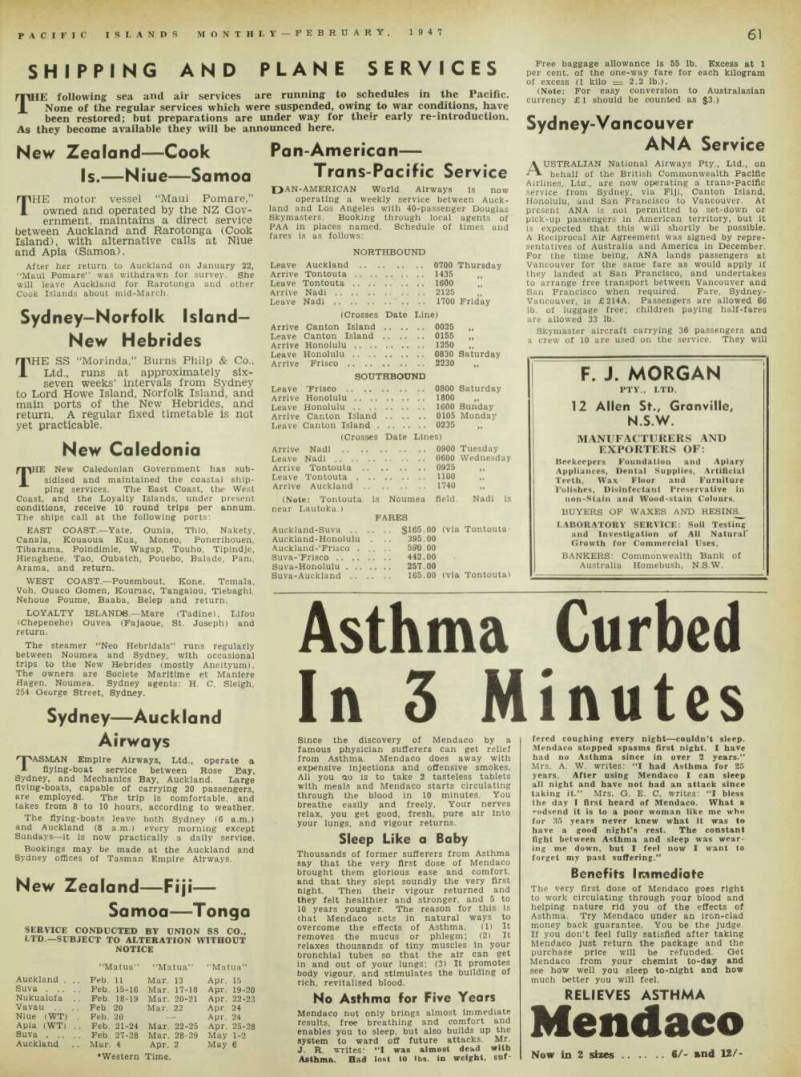
Shipping And Plane Services
rE following sea and air services are running to schedules in the Pacific.
None of the regular services which were suspended, owing to war conditions, have been restored; but preparations are under way for their early re-introduction.
As they become available they will be announced here.
New Zealand—Cook
Is.—Niue—Samoa
THE motor vessel “Maui Pomare,” owned and operated by the NZ Gov ernment, maintains a direct service between Auckland and Rarotonga (Cook Island), with alternative calls at Niue and Apia (Samoa).
After her return to Auckland on January 22, “Maui Pomare” was withdrawn for survey. She will leave Auckland for Rarotonga and other Cook Islands about mid-March.
Sydney-Norfolk Island-
New Hebrides
THE SS “Morinda,” Burns Philp & Co., Ltd., runs at approximately six seven weeks’ intervals from Sydney to Lord Howe Island, Norfolk Island, and main ports of the New Hebrides, and return. A regular fixed timetable is not
yet practicable.
New Caledonia
THE New Caledonian Government has sub sidised and maintained the coastal ship ping services. The East Coast, the West Coast, and the Loyalty Islands, under present conditions, receive 10 round trips per annum.
The ships call at the following ports: EAST COAST.—Yate, Ounia, Thio, Nakety, Canala, Kouaoua Kua, Moneo, Ponerihouen, Tibarama, Poindimie, Wagap, Touho, Tipindje, Hienghene, Tao, Oubatch, Pouebo, Balade, Pam, Arama, and return.
WEST COAST. —Pouembout, Kone, Temala, Voh, Ouaco Gomen, Kouraac, Tangaiou, Tiebaghi, Nehoue Poume, Baaba, Belep and return.
LOYALTY ISLANDS.—Mare (Tadine), Lifou fChepenehe) Ouvea (Fajaoue, St. Joseph) and return.
The steamer “Neo Hebrldais” runs regularly between Noumea and Sydney, with occasional trips to the New Hebrides (mostly Aneityum).
The owners are Societe Maritime et Manlere Hagen. Noumea. Sydney agents: H. C. Sleigh, 254 George Street, Sydney.
Sydney—Auckland
Airways
TASMAN Empire Airways, Ltd., operate a flying-boat service between Rose Bay, Sydney, and Mechanics Bay. Auckland. Large flying-boats, capable of carrying 20 passengers, are employed. The trip is comfortable, and takes from 8 to 10 hours, according to weather.
The flying-boats leave both Sydney (6 a.m.) and Auckland (8 a.m.) every morning except Sundays—it is now practically a daily service.
Bookings may be made at the Auckland and Sydney offices of Tasman Empire Airways.
New Zealand—Fiji—
Samoa—Tonga
Service Conducted By Union Ss Co.,
Ltd —Subject To Alteration Without
Notice
Pan-American—
Trans-Pacific Service
OAN-AMERICAN World Airways is now operating a weekly service between Auck land and Los Angeles with 40-passenger Douglas Skymasters. Booking through local agents of PAA in places named. Schedule of times and fares is as follows:
Northbound
Leave Auckland 0700 Thursday Arrive Tontouta 1435 Leave Tontouta 1600 „ Arrive Nadi 2125 Leave Nadi 1700 Friday (Crosses Date Line) Arrive Canton Island 0025 „ Leave Canton Island 0155 „ Arrive Honolulu 1250 Leave Honolulu 0830 Saturday Arrive Frisco 2230 „
Southbound
Leave ’Frisco 0800 Saturday Arrive Honolulu 1800 Leave Honolulu 1600 Sunday Arrive Canton Island 0105 Monday Leave Canton Island 0235 „ (Crosses Date Lines) Arrive Nadi 0900 Tuesday Leave Nadi 0600 Wednesday Arrive Tontouta 0925 Leave Tontouta 1100 „ Arrive Auckland 1740 (Note: Tontouta is Noumea field. Nadi is near Lautoka.)
Fares
Auckland-Suva $165.00 (via Tontouta Auckland-Honolulu . .. 395.00 Auckland-’Frisco 590.00 Suva-’Frisco 442.00 Suva-Honolulu 257.00 Suva-Auckland 165.00 (via Tontouta)
Free baggage allowance is 55 lb. Excess at 1 per cent, of the one-way fare for each kilogram of excess (1 kilo = 2.2 lb.). (Note: For easy conversion to Australasian currency £1 should be counted as $3.)
Sydney-Vancouver
ANA Service
AUSTRALIAN National Airways Pty., Ltd., on behalf of the British Commonwealth Pacific Airlines, Ltd., are now operating a trans-pacific service from Sydney, via Fiji, Canton Island, Honolulu, and San Francisco to Vancouver. At present ANA is not permitted to set-down or pick-up passengers in American territory, but it is expected that this will shortly be possible.
A Reciprocal Air Agreement was signed by repre sentatives of Australia and America in December.
For the time being, ANA lands passengers at Vancouver for the same fare as would apply if they landed at San Francisco, and undertakes to arrange free transport between Vancouver and San Francisco when required. Fare, Sydney- Vancouver, is £2I4A. Passengers are allowed 66 lb. of luggage free; children paying half-fares are allowed 33 lb.
Skymaster aircraft carrying 36 passengers and a crew of 10 are used on the service. They will
“Matua”
“Matua”
“Matua”
Auckland . ., . Feb. 11 Mar. 13 Apr. 15 Suva ... . Feb. 15-16 Mar. 17-18 Apr. 19-20 Nukualofa Feb. 18-19 Mar. 20-21 Apr. 22-23 Vavau ..
Feb. 20 Mar. 22 Apr. 24 Niue (WT) , Feb. 20 — Apr. 24 Apia (WT» . . Feb. 21-24 Mar. 22-25 Apr. 25-28 Suva ... . Feb, 27-28 Mar. 28-29 May 1-2 Auckland Mar. 4 Apr. 2 May 6 ♦Western Time.
leave Mascot (Sydney) on December 8 and De cember 22 (and thereafter at fortnightly intervals); commencing the return flight from Vancouver on December 13 and December 27.
Sydney—Noumea—Suva
QANTAS EMPIRE airways are running un scheduled flights with Empire flying-boats between Sydney and Suva. Fiji, with an over night' stop at Noumea New Caledonia. It is expected that this service will be put on a regular scheduled basis when air agreements be tween British, American and French territories are finalised. At present Qantas must obtain permission for each of the trips between Aus tralia and Fiji, and return.
Qantas have averaged about one of these trips a fortnight during the past few months. In tending passengers should book through Qantas offices in Australia and Burns, Philp (South Seas) Company, Suva, Fiji.
Sydney—Queensland—
New Guinea Airways
QANTAS Empire Airways, Ltd., employing DC3 planes, operate a regular service between Sydney, Port Moresby. Lae and Rabaul, and return, via Brisbane, Rockhampton, Towns ville and Cairns.
Planes leave Sydney on Mondays. Wednesdays, and Saturdays at 10 a.m, and arrive at Lae at noon on Tuesdays, Thursdays and Sundays. The plane which leaves Sydney on Wednesday and arrives at Lae on Thursday then goes on to Rabaul. It returns on Friday.
Planes leave Lae at 5.45 a.m. on Wednesdays, Fridays and Mondays, and arrive in Sydney at 10 p.m.v accomplishing the Lae-Sydney run in a day.
This is expected soon to become a daily service.
Bookings may be made at Qantas offices at any of the towns named. At present, berths are available only to passengers holding official per mits to visit Papua or New Guinea.
RNZAF Services In
Central Pacific
Nausori (Suva-Nadi (Western Fiji) •
Plane leaves Nausori each Tuesday and Friday’ returning same day. Single adult fare £3 (Fijian). Baggage, 351 b.
Laucala Bay (Suva)-Auckland: Flying
boat leaves Auckland for Fiji each Friday and returns on Monday. Single fare, £25/5 2 (P i Baggage, 601 b.
FIJI - TONGA - SAMOA - COOK ISLANDS: A Dakota transport aircraft leaves Nausori each Saturday for Western Samoa. On alternate Saturdays the schedule includes Tonga and Cook Islands (Aitutaki and Rarotonga), an overnight stop being made at Apia. Western Samoa. Single adult fares; Fiji-Tonga, £6/12/11; Fiji-Samoa, £B/17/3; Fiji-Aitutaki or Rarotonga £lB/3 4 Baggage, 601 b.
FIJI - NORFOLK ISLAND - NOUMEA - NEW ZEALAND; A Dakota transport aircraft leaves Nausori once every four weeks for Whenuapai, N.Z.. via Norfolk Island and Tontouta, New Caledonia. Because accommodation at Norfolk Island is limited special arrangements are necessary before through bookings can be ac cepted. Single adult fares: Piji-Norfolk, £l6/7/11: Piji-Noumea, £l6/7/11; Fiji-New Zealand, £25/5/2. Baggage, 601 b.
Pacific Travellers
PASSENGERS who arrived in Australia by Qantas Airlines from New Guinea
and Papua airports on;
JAN. 15: Mr. A. W. Anderson, Mr. T. Grahams law, Mr. P Low, Mr. C. Matley.
JAN 18: Mr. Daly, Mr. Ryan, Mr. Mannering, Mr. Snell, Mr. Mead, Mr. and Mrs. Carroll.
Miss K. McNamara, Miss D Clerk, Mr. Pappas’
Mr. H. E. Horne, Mr. K. Gorrlnge, Mr. W.
Simpson.
JAN. 19; Mr. Bullus, Mrs. Erskin, Mr. Sherwin, Mr. L. Owen. Mr. E. Condick, Mr. D, Maxwell, Dr. J. Gunther, Mr. W. C. Groves, Mr. J. S Elder.
JAN. 20: Mr. J. Stanton, Sister Clancey, Mr.
Cameron, Mr. Levy, Mr. Da Silva.
t>, JAN ; 22: Mr - L - c - Anderson, Mr. D. Large Mrs. J Lenard, Miss D. Briggs, Mr. S. Bridges’
Mrs. M. Levey.
JAN. 24; Capt. McPersam, Mr. Ulfsby. Capt Galdos, Mrs. R. Landai, Miss P. Baits, Master W. Mornsson. 5: Mr - J - J - Cromby, Mr. A. McPaul F/O Robertson, Mr. C. A. Towers, Sister Brian Smith, Mr. C. A. McKenzie, Mrs. McKenzie Mr. J. Oliver. 2:: Mr - E ' Ehgerald, Sister Pairhall Master P. Dewney. Miss W. Dewney, Mrs w’
C. Grows, Miss R. Grows, Mr. R. m, Brown.
JAN. 28: Mr. W. J. Moss, Mr. V. P. Noel wood, Mr. L. J. Gleeson, Mr. D. J Curl Mr G. Woodward, Mrs. Doudlas.
JAN. 29; Mrs. B. Borrett, Miss G. Borrett Master D. Borrett, Mr. R. E. P. Dwyer. Father D. Roduit, Father H. Eschliman, Mr H E Dassie, Mr. F. c. Fichhorn.
JAN. 31: Miss U. Holden, Mr. B. Barrett, Mr.
L. Hawker, Master J. Delasala, Master E Delasala.
FEB. 1: Master Stevens, Miss Littlewood Master B. Lockney, Mr. W. Reid, Mrs. Reid.
FEB. 2: Miss Leydin, Master Simpson, Master Gunther, Dr. Hogbin, Master R. Wardrope Master A. Wardrope, Master D. Doubleday Master P. Watkins, Master J. Lambden, Master W. Price, Master M. Price, Mr. and Mrs. E. V O’Brien, Miss E. Jones.
PASSENGERS who left Australia by
Qantas Airways for New Guinea
and Papua airports on;
JAN. 13: Mrs. F. Mappletoft (and child) Mr L. J. Low. Mr. Ward, Mr. L. Wilde Mr J C Waugh, Mr. Steege, Mr. H. Hollins, Mr. G.
Piper, Mr. G. Brown, Mr. J. Flower Mr J V. Folley.
JAN. 14: Mr. S. Rau, Mr. Mandsley, Mrs. M.
Douglas, Mr, J. I. Cromie, Mr. L. Eastwell Mr W. Taill, Mr. D. Beadel, Mr. E. H Bocker!
Xvlr. J. S. Luckie, Mr. H. A. Dyer Mr E M* Biddle.
JAN. 17: Mr. T. J. Raistrick, Mr. A. J Johnston, Mr. R. Boyle, Mr. R. j. Friday, Mr. and Mrs. W. R. Albert (and child). Rev J.
Bodger, Mr. M. S. Whorley, Lieut. W. Jackson.
JAN. 18: Mr. A. Fetters, Mr. E. R. Michell, Mr. J. Rigg, Mr. E. R. Snook, Mr. J. Dur bridge, Mr. R. G. Morgan, Mr. T. Wood. Mr.
E. S. Turn, Mr. T. C. Cook, Mr. P. H.
Osborne, Mr. S. Bridges, Mrs. L. Loudon.
JAN. 20: Mr. M. Curl, Mr. L. Gleeson, Mr.
W. Faulkner, Mr. R. C. Watson, Mr. A. C.
Marchal, Mr. M. A. Rafferty, Mr. R. E.
Goodard, Mrs. J. Boles (and daughter), Mr. J.
M. Rogers, Mrs. Sheekey (and infant).
JAN. 22: Mr. R. C. Brown, Mr. Montgomary, Mr. W. Hordern, Mrs. O. Hordern, Mr. T.
Turner, Mr. C. J. Brown, Mr. J. C. Olsson, Mrs. Olsson, Mr. Thomas, Mr. J. B. McAdam.
JAN. 24: Mr. H. Neal, Mr. L. G. Bugg, Mr.
K. E. Baker, Mr. H. Bedford, Mr. J. M. Cald well, Mr. E. B. Norman, Mr. N. C. Payne, Mr.
G. E. Bergman, Mr. G. Tavatarrl, Mr. A.
Hope, Mr. Debenham, Mr. F. K. Manogue, Mr.
J. Cohite.
JAN. 25: Mr. G. McKay, Mrs. L. Ross, Mrs.
Jones (and infant), Mr. R. Levy, Mr. Finn, Mrs. Finn, Mrs. N. Fraser.
JAN. 27; Mr. S. Londish, Mr. and Mrs. B.
MacGregor, Mr. R. J. Adams, Mr. Johansson, F/Lieut. Kurt-Smith, Sq./Ldr. Rendel, Mrs. V.
Morton, Mr. K. McMullen.
JAN. 29: Mr. J. J. Spyers, Mr. J. White, Mr.
R. Douglass, Mrs. W. A. Luke, Mrs. R. Cole, Mr. C. James, Mr. R. Leadbitter, Mr. B. Gel bart, Mr. R. G. Alien, Mr. G. Bardsley, Capt.
B. M. Helm, Mr. W. Gefcoat.
JAN. 31: Mr. H. Forrester, Mrs. D. E. Healey, Mr. J. Dansey, Mrs. R. Lyons, Miss C. Lyons, Mrs. C. Barter, Mr. R. C. Saville, Mr. B.
Kirke, Mr. J. S. Elder, Mr. F. Barber.
FEB. 1: Mr. J. S. Mager, Mrs. A. W. Mager, Mrs. Hannemann (and infant), Mrs. R. Schroer (and infant), Mrs. F. Heist (and infant), Mrs.
M. D. Garbisch, Mr. G. E. Bell, Mr. J. G.
Koontz, Mr. O. O. Pfarr, Mr. G. E. Nichollson, Mr. J. A. McClean, Mr. A. F. McQueen, Mr.
G. A. Vigar.
FEB. 3: Mr. J. R. Woodwood, Miss P. A. M.
Frank, Mr. F. L. Clerk, Mr. W. Hollaway, Mr.
J. A. Willis, Mr. I. J. Butcher, Mr. J. Waugh, Mr. L. Pile, Mr. E. Limb, Mr. J. McKenzie, Mr. N. Frazer, Mr. R. Spronle, Mr. C. E.
Dickson, Mr. J. G. Hunter, Mr. T. Ellis, Mr.
B. Bunting, Mr. L. Iggo.
PASSENGERS who arrived in Austra lia from New Guinea Airports by
Qantas Empire Airways on:
FEB. 3: Mr. A. McDonnald, Mr. O. Mont gomery, Mr. M. Horden, Mr. L. Turner, Staff- Sgt. A. Grant.
FEB. 4: Miss C. Wedgewood, Miss J. Fait horn.
FEB. 5: Mrs. Thompson, Master Franklin, Mr.
Jamieson, Mr. Jackson, Tel. C. D. Mann, Miss M. Keinzle, Master I. Graham, Master R.
Graham, Mr. F. A. Gullian, Mr. Gullian, Mr. and Mrs. R. Perrie (and two children).
PASSENGERS who left Auckland per MV “Matua” on January 14: FOR APIA: Miss D. Ahimu, Mr. E. L. Banks, Mr. D. F. Brundell, Mr. S. B. Gurr, Miss M.
Mclntosh, Mr. and Mrs. H. F. Perkins, Master W. V. Pritchard, Mr. W. G. Sainsbury, Mr. and Mrs. M. Volkner (and daughter), Master Pritchard.
FOR NUKUALOFA: Hon. S. Akauola (and son), Miss M. Akomia, Mr. S. T. Finau, Miss J. Goodacre, Master R. Jay, Masters S. and D.
Leger, Mrs. M. D. Melhose, Mr. S. Palelei, Master B. Simpson.
FOR SUVA: Mr. and Mrs. V. Anderson, Miss M. Arbon, Master D. E. Bree, Mr. M. L.
Browne, Bouchie de Belle, Sister M. (de la Trinite), Miss Y. R. Caleb, Master P. W. Chap man, Miss J. Davis, Sister M. Dalton (Columi cille), Miss Fitzherbert, Mr. Pong Young On, Sister B. Furlong (Laurentia), Miss J. L. Gar nett, Mrs. P. M. Gordon, Mrs. M. M. Griffiths (and child), Mr. L. Genge, Mr. J. D. Howard, Mr. and Mrs. Halstead, Sister E. M. Horne, Mr. and Mrs. W. J. Jenkins (and two children), Mr. and Mrs. J. B. Keith (and two daughters), Mr. B. F. Kirkham, Mother B. Keenan (Athanasius), Mr. Lui Kau, Mr. and Mrs. C.
Lebner, Mr. and Mrs. J. R. Lochan, Mr. B.
Lawlor, Mr. Lee Kie, Mr. Lee Fung, Miss Mere, Mrs. E. Mclntyre (and son), Miss H. H.
McKenzie, Master K. McKenney, Master D. M.
Major, Master B. tt. Morrison, Mr. T. Naiva lavu, Mr. C. R. H. Nott, Mr. Nathu, Master B. N. Ogier, Mrs. M. O. Plummer, Mrs. J. T.
Penny,, Master B. H. Purser, Misses E. and J.
Rowley, Mr. K. Ragoso, Master N. D. Richards, Mr. T. O. Robinson, Mr. R. Reddy, Mr. K.
Reddy, Sister M. Rounan (Vianney), Mrs. H.
Schuster (and son), Sister T. Sutherland (Aloysius), Mr. D. Tafatu, Mr. J, Viliua, Misc D. Westerland, Mr. and Mrs. A. Warbrooke,
Mrs. J. C. Wilson, Miss P. M. Wiley, Miss A. M. Walton, Miss C. M. Waghorn, Mr. O.
Warbrooke, Mr. T. Warbrooke, Wong Lin Sing, Mr. J. Bennett, Mr. Murray, Mr. B. Proweller, Mr. Ram Harkh.
ROUND TRIP: Mr. and Mrs. A. A. M. Taylor.
PASSENGERS who arrived in Auck land by MV “Matua” on February 3: FROM NUKUALOFA: Mr. N. Bagnall, Mrs.
K. Curtayne, Mr. and Mrs. Cocker (and two children), Mr. A. Eva, Mr. J. Gallagher, Mr.
C. Johnson.
FROM VAVAU: Mr. J. Hutchison.
FROM APIA; Mr. I. Carruthers, Mr. M. Dunn, Mr. and Mrs. F. Gurau, Master S, Heatley, Mr. J. Herd (and child), Mr. A. Henderson, Mr.
D. Liston, Mr. R. Marriott (and child), Mr.
R. McAteer, Miss J. Phineas, Miss T. Thompson, Mr. H. Tattersall, Mr. J. Wright (and two children).
FROM SUVA; Miss J. Arthur, Master Q.
Almao, Master A. Brownlee, Miss D. Buckhurst, Mrs. C. Blackie (and two children), Master N.
Bish, Mrs. E. Cockburn, Mrs. D. Costello (and two children), Mr. J. Coyle, Dr. and Mrs. F.
Carrick, Master P. Cowan, Mr. A. Edwards,
Mrs. S. Fryer (and child), Mr. J. Gibson, Miss P. Gay, Capt. and Mrs. G. Hoddinott, Master A. Hooper, Mrs. M. Halley (and child), Mr. C.
Harper, Master P. Hopewell, Master W. Hope— well, Mr. S. Houng Lee, Mrs. W. Hibbard (and three children), Miss A. Irving, Master J. Irving, Master G. Johnston, Mr. C. Johnston, Mr. and Mrs. B. Lawler, Mrs. N. Looker (and child), Mr. and Mrs. W. Lindsay, Mr. and Mrs. B.
Marks, Miss J. Marks, Miss D. McGinley, Mrs.
A. McNally, Mr. P. McConnell, Mr. T. Parekh, Mrs. E. Patterson (and two children), Mr. J.
Parkham, Miss E. Parkham, Miss M. Reay, Miss J. Reay, Master D. Ram Samiy, Master A.
Roxburgh, Mr. Ram Havekh, Mr. J. Rabuka waqa, Mr. Dalip Ram, Miss A. Rice, Master P.
Rice, Mr. R. Ramatanitobus, Mrs. G. Suther land, Miss N. Surridge, Mr. J. Stannard, Mr.
R. Spowart, Miss C. Spowart, Miss M. Spowart, Miss D. Stokes, Mr. G. Toganivalu, Miss N.
Toganivalu, Mr. J. Takala, Mr. T. Terry, Mr.
L. Vola, Vola, Mr. C. Walker, Mr. R. Wilson, Mr. F. Waddingham.
ROUND TRIP; Mr. A. Taylor, Mrs. G. Taylor,
PASSENGERS who left Sydney on
February 11 by SS “Morinda” for
Lord Howe Island, Norfolk Island
and New Hebrides: Mr. G. Axam, Miss J. Chak, Miss E. Edgar, Mrs. G. Fletcher, Mrs. Ingram-Pearson, Mrs.
Y. Krafft (and infant), Mrs. E. Leembruggen, Miss N. Marshall, Mr. J. Nicholls, Mr. C.
White, Mr. W. Wilton, Wa Kaltoi, Wee Kim Wing, Wu Ji Yuen, Miss I. Buffett, Mr. and Mrs. Colliver (and two children), Mr. C.
Cottee, Mr. A. Christian, Mrs. G. Giles, Mr. J.
Jenkins, Mr. and Mrs. Menghetti (and infant), Mr. E. Moloney, Mr. H. Nobbs, Mr. P. Oakley, Mrs. Phillips (and son), Mr. J. Parkinson, Miss N. Quintal, Miss O. Quintal, Mrs. D. Quintal, Mr. E. Stephenson, Mr. and Mrs. Smith (and two children). Miss J. White, Mr. Barry, Miss L. Gingley, Miss B. Payten, Mr. and Mrs.
Petherick (and infant), Miss A. Wilson, Mr. and Mrs. Money.
Advertisements & other items, pp. 63-66 (1 item)
Asthma Curbed
F. J. MORGAN
PTY., LTD.
12 Allen St., Granville,
N.S.W.
MANUFACTURERS AND
EXPORTERS OF:
Beekeepers Foundation and Apiary Appliances, Dental Supplies, Artificial Teeth, Wax Floor and Furniture Polishes, Disinfectant Preservative in non-Stain and Wood-stain Colours.
BUYERS OF WAXES AND
LABORATORY SERVICE: Soil Testing and Investigation of All Natural"
Growth for Commercial Uses.
BANKERS; Commonwealth Bank of Australia Homebush, N.S.W.
Asthma Curbed In 3 Minutes
fered coughing every night—couldn’t sleep.
Mendaco stopped spasms first night. I have had no Asthma since in over 2 years.”
Mrs. A. W. writes: “I had Asthma for 25 years. After using Mendaco I can sleep all night and have not had an attack since taking it.” Mrs. G. E. C. writes: “I bless the day I first heard of Mendaco. What a o-odsend it is to a poor woman like me who for 35 years never knew what it was to have a good night’s rest. The constant fight between Asthma and sleep was wearing me down, but I feel now I want to forget my past suffering.”
Benefits Immediate
The very first dose of Mendaco goes right to work circulating through your blood and helping nature rid you of the effects of Asthma. Try Mendaco under an iron-clad money back guarantee. You be the judge.
If you don’t feel fully satisfied after taking Mendaco just return the package and the purchase price will be refunded. Get Mendaco from your chemist to-day and see how well you sleep to-night and how much better you will feel.
RELIEVES ASTHMA
Mendaco
Now in 2 sizes 6/- and 12/-
Since the discovery of Mendaco by a famous physician sufferers can get relief from Asthma. Mendaco does away with expensive injections and offensive smokes.
All you ao is to take 2 tasteless tablets with meals and Mendaco starts circulating through the blood in 10 minutes. You breathe easily and freely. Your nerves relax, you get good, fresh, pure air into your lungs, and vigour returns.
Sleep Like a Baby
Thousands of former sufferers from Asthma say that the very first dose of Mendaco brought them glorious ease and comfort, and that they slept soundly the very first night. Then their vigour returned and they felt healthier and stronger, and 5 to 10 years younger. The reason for this is that Mendaco acts in natural ways to overcome the effects of Asthma. (1) It removes the mucus or phlegm: (2) It relaxes thousands of tiny muscles in your bronchial tubes so that the air can get in and out of your lungs; (3) It promotes body vigour, and stimulates the building of rich, revitalised blood.
No Asthma for Five Years
Mendaco not only brings almost Immediate results, free breathing and comfort and enables you to sleep, but also builds up the system to ward off future attacks. Mr.
J. R. writes: “I was almost dead with Asthma. Had lost 10 lbs. In weight, saf-
JI'J'J'J?
xamsr ••f.cL
DIESEL ENGINES
WIDDOP
5 H.P. to 500 H.P.
H. WIDDOP & CO., LTD. greeng e{7 g e la^ ighley Telephone : Keighley 3727-8 :: :: Telegrams : Widdop Keighley ■*'- Codes A.B.C. 6th Edition, Bentleys, Bentley's Second We are prepared to consider Agencies for certain territories A / Motor Coaster S. America.
Firefloat Egypt.
T !' Passenger Ferry I Nigeria Tug.
England Passenger Boat, Middle East.
® LOOK !
ay
KOCH'S BARBER CHAIRS
Obtainable Soon
PACIFIC ISLANDS TRADING
COMPANY
244 California St., San Francisco, Cal.
GILLESPIE^
PHILIPS
RADIO
LAE
TERRITORY OF NEW GUINEA
WHOLESALE
MERCHANTS
GENERAL AGENTS
‘fa
KEMIM.ION
TYPEWRITER
FORWARDING. SHIPPING AND CUSTOMS AGENTS
B.AX..M.
PAINTS
So le New Guinea Agents for: Commonwealth Insurance Company
IMI.CX
HOUSE BEAUTIFUL
FANCYWARES
Turquoise Wares, Furnishing Rugs, Decorative Furniture and various items from Indian Artwares supplied direct at Factory Cost prices. Write for details by air mail to:
NEWMAN'S FRUIT MART,
Srinagar, Kashmir, INDIA.
IStAND TRA d^o
AUCKLAND. NEW
Cable Address “ CHURSHIP,” Auckland Codes: BENTLEY’S 2nd Phase BENTLEY S Complete Phase Postal:
C.P.O. BOX 1548
m r> v u ru PEACE BRINGS A NEW ERA TO THE PACIFIC We are catering thoroughly for Island trade and can fulfil your order with competitive merchandise^!
R. H. CHURCH & SON
Merchants & island Traders 27 Queen St., Auckland, N.Z.
Refer your order to us for New Zealand’s Island famous products
Pimples and Bad Skin Fought in 24 Hours
Since the discovery of Nlxoderm by an American physician It Is no longer necessary for anyone to suffer from ugly, disgusting and disfiguring skin blemishes such as Eczema, Pimples, Rash, Ringworm, Psoriasis, Acne, Blackheads, Scabies and Red Blotches. Don’t let a bad skin make you feel inferior and cause you to lose your friends. Clear your skin this new scientific way.
A New Discovery
Nixoderm is an ointment, but different from any ointment you have ever seen or felt. It is a new discovery, and is not greasy but feels almost like a powder when you apply It. It penetrates rapidly into the pores and fights the cause of surface skin blemishes. Nlxoderm contains 9 Ingredients which fight skin troubles in these 3 ways. I.—lt fights and kills the microbes or parasites often responsible for skin disorders. 2. —It stops itching, burning and smarting In 7 to 10 minutes, and cools and soothes the skin. 3.—lt helps nature heal the skin clear, soft and velvety smooth.
Works Fast
mediately, clearing and healing your skin, making It softer, whiter and velvety smooth Because Nlxoderm Is scientifically compounded to fight skin troubles, It works fast.
It stops the Itching, burning and smarting In a few minutes, then starts to work 1m-
In just a day or two your mirror will tell you that here at last is the scientific treatment you have been needing to clear your skin —the treatment to make you look more attractive, to help you win friends. Nixoderm has brought clearer, healthier skins to thousands, such as Mr. Bob Weedon, Edmund Street, Fremantle, who writes: “I was troubled with pimples ever since I was 13, and have spent pounds and pounds on so-called cures without results. I then tried Nixoderm with astounding effect.
The pimples seemed to fade away, and after a week there was not the slightest trace of them.”
Satisfaction Guaranteed
Get Nixoderm from your chemist or store to-day. Look in the mirror in the morning and you will be amazed at the improvement.
Then just keep on using Nixoderm for one week and at the end of that time it must have made your skin soft, clear, smooth and magnetically attractive —must give you the kind of skin that will make you admired wherever you go, or you simply return the empty package and your money will be refunded in full. Get Nixoderm from your chemist or store to-day.
The guarantee protects you.
Nixoderm 2/-&4Z-
For Skin Sores, Pimples and Itch ,
Third Engine For "Hifofua"
From Our Own Correspondent
Nuku’Alofa. Jan., 9.
THE Government despatch vessel, Hifofua left to-day for Suva, Fiji, where she will undergo complete overhaul and also have her new Eng lish diesel engine installed. This will be the ship’s third engine since she was brought from Auckland. New Zealand, where she was built in 1927.
Regarded as an unlucky ship because of her many misfortunes ranging from all kinds of engine trouble to running aground, and a penchant for wandering off her course that have dogged her since her maiden voyage out from New Zealand, the Hifofua has been the cause of many headaches. Even her sailing schedule has become a standard joke in the Kingdom.
When it is advertised that she is to sail at a certain time, that means that she will sail at any time, from an hour to a day or week later, other than the time advertised.
Resurrection Of Mangaia
Copra Industry
Prom Our Own Correspondent
Mangaia, Nov. —.
AFTER long years of exile, King Copra sits again upon his oily throne.
The familiar festoons of half-nuts hang drying in the sun, and house-roofs (iron) are in use once more as dehydrating plants. It’s just like old times!
Owing to the crying demand in Europe for edible fats, South Sea copra is now fetching a worth-while price, that justi fies the labour of copra-making.
The local tea-houses are accepting nuts as currency, many a roll and cup of coffee are bought with dry coconuts, and everyone wonders, why no one had tried it before!
But when copra was 4d. per lb., a cart load of nuts would not have been negoti able at the village tea shops, now so eager to get all the copra they can.
Royal Romance in Tonga
Days of King George Tupou II Recalled
From Our Own Correspondent
Nuku’Alofa. Jan., 14.
JUST now the main topic discussed throughout the Kingdom at kava parties (the medium through which, in the absence of newspapers, news is exchanged and public opinion formulated), is the proposed marriage of Crown Prince Tunouto’a-Tungi. which, according to re liable sources, is to take place about next July. , , .
Interest is heightened by the fact that the identity of the royal bride-to-be is still a Court secret. Rumour has linked the name of the young Prince with several of the most eligible young ladies of the Tongan nobility, of whom the most favoured in public esteem in Halaevalu Mata’aho, daughter of High Chief ’Ahome’e. She is finishing her education at a well-known ladies college at Auck land at present and will return to Tonga shortly. She is closely connected with the Tongan Royal Family, and her father has been appointed Governor of Ha’apai Group.
Crown Prince Tupouto’a-Tungi. who is now 28 years old, has a quiet and charm ing personality and possesses admirable qualities of leadership. He received his early education at Tupou College, the Methodist College founded by Dr. J. E.
Moulton in Tonga, and later entered New ington College. Sydney, and finally Sydney University, where he had outstanding success both as a scholar and an athelete.
He graduated in both Arts and Law. He is the first and only Tongan to have received university education.
THE current crop of rumours of Royal romance recalls the turbulent days when choosing a consort for the late King George Tupon 11. father of Her Majesty Oueen Salote. almost caused civil strife. Rumour had extended the field of choice beyond the Kingdom to include Royal ladies of other Island groups. Young princesses of the Royal Houses of Fiji, Samoa. Tahiti and Raro tonga had in turns been “betrothed.” to the young King. Even as far north as Hawaii, the long arm of rumour ex tended to weave a royal romance between the handsome youthful king and beauti ful young Princess Kaiulani, heir pre sumptive to the Hawaiian throne, then occupied by pathetic Queen Liliuokalani.
Tongan bards vied with one another in composing songs and poems, eulogising the beauty and virtues of these young Island Princesses, that were sung and recited during nights of revelry at the Tongan Royal Palace, which was a marked feature of the" gay life of Island Royal Courts at the close of the romantic nineties.
However, the young King favoured two young Tongan ladies of high-chiefly rank: Lavina. daughter of the late High Chief Kupu, then Minister of Police of the Kingdom, and ’Ofa-kivava’u, an Island beauty, daughter of the late Ma’atu.
Paramount High Chief of the Island of Niuatoputapu (Keppels).
In support of the cause of each of these young ladies, the whole of Tonga, Chiefs and Commoners, were divided into two factions. Rivalry between them culminated in acts of incendiary and personal violence that almost resulted in civil war.
Finally King George chose as his con sort, Lavina, mother of the present Queen, the royal wedding taking place in 1899.
The lovely Ofa, sadly disillusioned over her rejection by the royal suitor, returned to her native Niuatoputapu in the north where her death, while still in her youth, was attributed to a broken heart.
Mrs. Ida Reynolds, widow of the late John Reynolds, who was lost on the ‘ Montevideo Maru” in June. 1942, expects to return to Rabaul shortly. She is at
present residing in Sydney. A son, a former officer of the Commonwealth Bank, Rabaul, was also lost with his father in the ill-fated boat.
The Rev. John S. Robinson of the Eagle Junction Congregational Church, Brisbane, has been appointed a mission ary to Nauru and Ocean Islands. He will be the first Protestant missionary to return to the island since the evacua tion in 1942. In an interview, he said that his main job would be the rehabilita tion of the natives, who were now living in caves under the most primitive con ditions and to re-establish the churches, mission house and school that had been razed by the invaders. He intended to follow the policy of the London Mission ary Society in preserving the Nauru language.
Advertisements & other items, pp. 67-68 (1 item)
Oekoi
Periodicals . . . Trade Journals
American, English and Australian Periodicals and Trade Journals posted direct to you.
The N.S.W. Bookstall Co. Pty., Limited can supply all available overseas and local subscription magazines. Subscription Lists Available Let us know your requirements. on Application.
N.S.W. BOOKSTALL COMPANY PTY., LTD.
Market and Castlereagh Streets, Sydney, AUSTRALIA.
OEKOI
p oa canvas 1. The finest wood and canvas preservative known, prevents decay, dry rot and eradicates white ants, and borers in wood and canvas; supplied green or colourless. Prices from 12/- per gallon, smaller tins available. 2. C.Q.R. ANCHORS, British invention made in Australia. Three times the holding power, easy to handle and available in all sizes from 13 lb. to 140 lb. Ask for price list. , a t 3. KAYEN KEROSENE LAMPS are the finest Australian-made lamps; burn kerosene and provide 300 C.P. light without flickering. All brass containers. All spares made in Australia easily and cheaply available. Made in Handsome Table Lamp as illustrated or in AM Purposes Lamp and Lantern. Ask for illustrated leaflets
4. SIMPLEX MARINE ENGINES—
3, 5, and 10/12 H.P. sizes. Suitable for all craft from 14 to 32 feet long; 5 and 10 H.P. supplied with built-in reverse gear. All Australian-made. Price and specifications on request.
Ask for comprehensive price list of hoatgear and specialty hardware lines.
W. KOPSEN & CO. PTY. LTD.
Caries •
“KOPSEN SYDNEY”
380 Kent Street, Sydney
uL For Inflamed Eyes and Eyelids ... Sold Everywhere H.RoseiCo., Pty_Lld.. Kinq Street. Sydney.
PACIFIC ISLANDS SOCIETY
Visitors from the Islands to Sydney (or those interested in Islands affairs), are advised to communicate with the honorary secretary of the above Society, which has been formed to study the history, traditions, economics, and political developments of the Pacific Islands.
Regular monthly meetings are held at History House, 8 Young Street, Sydney.
Address for Correspondence:
THE PACIFIC ISLANDS SOCIETY,
Box 2434 MM., G.P.0., Sydney.
Only a Few Americans
Left in New Caledonia Now
THREE hundred American soldiers were scheduled to leave Noumea, New Caledonia, on February 5. With their departure only the few men attached to the Office of the Foreign Liquidation Commission remain of the hundreds of thousands of Americans who were once stationed in the colony.
The OFLC is disposing of huts, cars, trucks, boats, oil and camp equipment.
Some of this material is being bought on behalf of the government of Indo-China.
The Camp Barnes Pentagon area, former US Army headquarters, with its huge central building and fine church, has been occupied by the 14 families who have arrived from France to establish the French Oceanic Scientific Society.
This society has taken over the schooner Evaleeta which the Americans purchased in Australia in 1942.
The US Army gave up the Tontouta airfield on January 31, and it is now under civil control. The large Plaine des Gaiacs airfield which was built further up the west coast, for the use of bombers during the war, is now over grown with grass and is the grazing place for herds of goats.
New Caledonia is still living on profits made when the Americans were there and although most citizens have profited by the disposal of American Army equipment and stores, other goods are very expen sive. The colony is having a serious drought and cattle cannot get sufficient to eat off the dry pastures. Noumea is suffering from a vegetable shortage.
French Caledonians used to leave vege table cultivation to hired coolie labour before the war.
Houses And Gardens Still
Preoccupy Papuans
From Our Brisbane Correspondent
Jan. 25, 1947
¥ITHEN he arrived in Brisbane by plane TT recently from Port Moresby, Col.
J. K. Murray, Administrator of the Provisional New Guinea-Papua Govern ment, who was on his wav to the Pacific Conference in Canberra, said that the “Puzzie Wuzzies” were still angels, but were harassed by the same housing short age which confronted Australia.
No building was carried out by them during the war years. Moreover, their houses were flimsy things compared with those in Australia. They needed repair ing or rebuilding every five years or so.
Most of the natives, said Colonel Mur ray, did what most of us did when the war ended—they went home. Many of them were still there, and would not leave until they had finished work on their homes.
Native gardens were also in a bad way when the war ended. The gardens as a rule were worked out after five or six years, and new ones then had to be planted.
The fact that the natives had all that to do in their home villages was the main reason for the native labour short age in the Territories, added Colonel Murray.
Bishop Henry Newton, Anglican Mission, Dogura (Papua), who had been a patient in St. Martin’s Hospital, Brisbane, for several months returned to the Territory by the “Montoro,” on January 16. Now 81 years of age. Bishop Newton has been actively engaged in Mission work for 47 years. He will train native deacons for their ordination.
Advertisements & other items, pp. 69-70 (2 items)
67
SOUTH SEAS’ CONFERENCE
(Continued from Page 9)
PACIFIC ISLANDS MONTHLY FEBRUARY, 1947
Auto
WANTED: Back numbers of the “Pacific Islands Monthly.” Have many duplicates for exchange. Will also exchange American magazines for newspapers and magazines of the Pacific Islands and British Colonial Empire. Orders taken for subscriptions to American magazines— no loreign exchange difficulties —write for details to PAUL A. DORN, Agent, Los Angeles 36, California.
»ra i •
SPARES & PARTS (T
335 PITT ST, SYDNEY
tWAY
A
V AS ~-. t
OW
Qojgssaß
cotert^
et forty V earS {or d £ aiVt » tepU^ Vog , cooing ■ *• -rri "■* “■ ds aS a ' V features, V oU >We CoVe^“ ed o£ the best . a as d ableColeieo y°ubuyiP there ts Wherever J you co^ rf* servicefauces aud
AGENTS
Robert Gillespie Pty. Ltd. 54A Pitt St., Sydney, N.S.W.
Pearce & Co. Ltd., SUVA.
STAMPS
We buy collections, also all issues in quantity, either off or on paper. Top prices. Send registered mail.
Agents required in Pacific Islands, Papua and New Guinea to service covers and send mint stamps.
A. Willison, Box 128, Burnie, Tasmania.
PRODUCING UNIFORM GOOD RESULTS SINCE 1868
ALWAYS ASK FOR IT
A SPACIOUS
ATTRACTIVE
"DURABESTOS"
HOME
t
{I B£OR
II a m: 111
2 BEDROOMS
AND A SUN-ROOM
provide sleeping accommodation for a family of five persons in this home, walled with "DURABES- TOS" and roofed with
TERRA - COTTA TILES.
Write for scale plan to
WUNDERLICH LIMITED.
G.P.O. Box 474, SYDNEY,
N.S.W. Tel.: MX 241 I.
When you have an opportunity, visit our shoivrooms : BAPTIST
STREET, REDFERN.
Take the Crown St- West Kensington tram from City. £
Battle Of Fiji Airfields
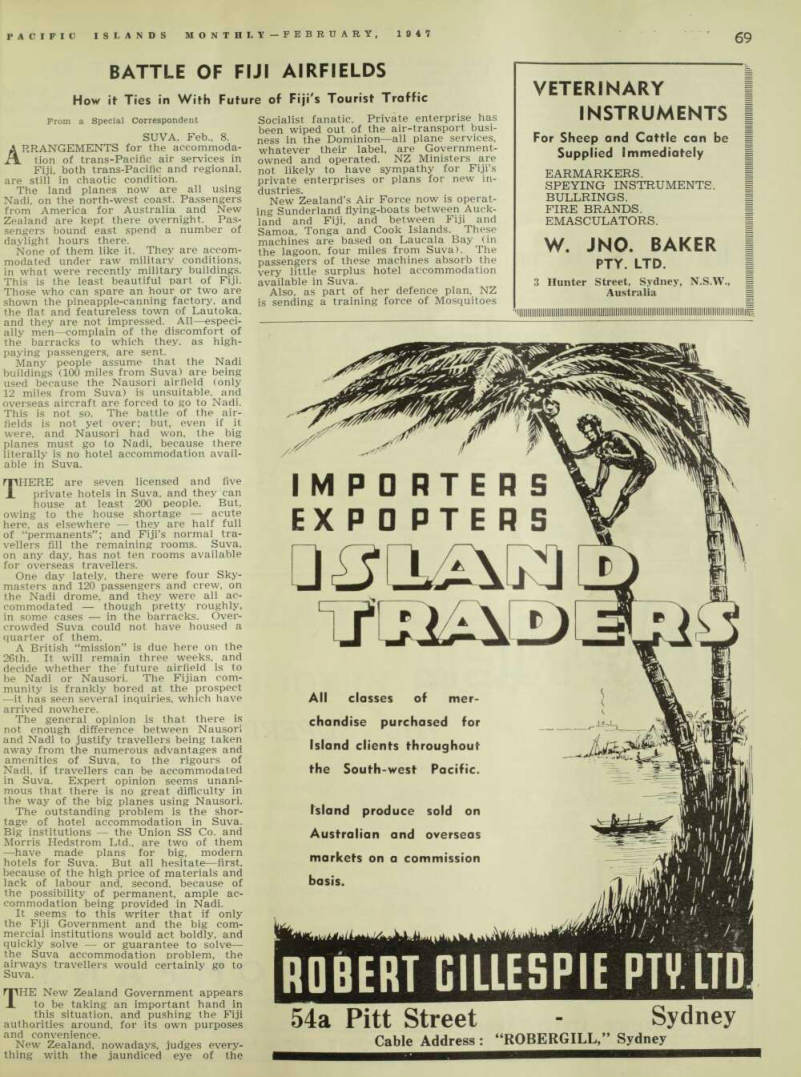
How it Ties in With Future of Fiji's Tourist Traffic
Prom a Special Correspondent
Suva. Feb., 8.
ARRANGEMENTS for the accommoda tion of trans-Pacific air services in Fiji, both trans-Pacific and regional, are still in chaotic condition.
The land planes now are all using Nadi, on the north-west coast. Passengers from America for Australia and New Zealand are kept there overnight. Pas sengers bound east spend a number of daylight hours there.
None of them like it. They are accom modated under raw military conditions, in what were recently military buildings.
This is the least beautiful part of Fiji.
Those who can spare an hour or two are shown the pineapple-canning factory, and the flat and featureless town of Lautoka, and they are not impressed. All —especially men—complain of the discomfort of the barracks to which they, as high paying passengers, are sent.
Many people assume that the Nadi buildings (100 miles from Suva) are being used because the Nausori airfield (only 12 miles from Suva) is unsuitable, and overseas aircraft are forced to go to Nadi.
This is not so. The battle of the air fields is not yet over; but, even if it were, and Nausori had won, the big planes must go to Nadi, because there literally is no hotel accommodation avail able in Suva.
THERE are seven licensed and five private hotels in Suva, and they can house at least 200 people. But, owing to the house shortage acute here, as elsewhere they are half full of “permanents”; and Fiji’s normal tra vellers fill the remaining rooms. Suva, on any day, has not ten rooms available for overseas travellers.
One day lately, there were four Sky masters and 120 passengers and crew, on the Nadi drome, and they were all ac commodated though pretty roughly, in some cases in the barracks. Over crowded Suva could not have housed a quarter of them.
A British “mission” is due here on the 26th. It will remain three weeks, and decide whether the future airfield is to be Nadi or Nausori. The Fijian com munity is frankly bored at the prospect —it has seen several inquiries, which have arrived nowhere.
The general opinion is that there is not enough difference between Nausori and Nadi to justify travellers being taken away from the numerous advantages and amenities of Suva, to the rigours of Nadi, if travellers can be accommodated in Suva. Expert opinion seems unani mous that there is no great difficulty in the way of the big planes using Nausori.
The outstanding problem is the shor tage of hotel accommodation in Suva.
Big institutions the Union SS Co. and Morris Hedstrom Ltd., are two of them —have made plans for big, modern hotels for Suva. But all hesitate —first, because of the high price of materials and lack of labour and, second, because of the possibility of permanent, ample ac commodation being provided in Nadi, It seems to this writer that if only the Fiji Government and the big com mercial institutions would act boldly, and quickly solve or guarantee to solve — the Suva accommodation problem, the airways travellers would certainly go to Suva.
THE New Zealand Government appears to be taking an important hand in this situation, and pushing the Fiji authorities around, for its own purposes and convenience.
New Zealand, nowadays, judges every thing with the jaundiced eye of the
Socialist fanatic. Private enterprise has been wiped out of the air-transport busi ness in the Dominion —all plane services, whatever their label, are Government owned and operated. NZ Ministers are not likely to have sympathy for Fiji’s private enterprises or plans for new in dustries.
New Zealand’s Air Force now is operat ing Sunderland flying-boats between Auck land and Fiji, and between Fiji and Samoa, Tonga and Cook Islands. These machines are based on Laucala Bay (in the lagoon, four miles from Suva). The passengers of these machines absorb the very little surplus hotel accommodation available in Suva.
Also, as part of her defence plan, NZ is sending a training force of Mosquitoes
to Fiji, to be based on Nadi.
Therefore, it would suit NZ admirably if all oversea land-plane passengers were sent to Nadi and Suva left free for the accommodation of her regional flying boat services at Laucala Bay and- Suva.
Already, NZ Air Force officers, in the persons of Flight-Lieut. Lylian and Flight-Lieut. Irvine, are in charge of the Nadi Barracks, and are trying to pro vide better accommodation for the grum bling travellers. They are capable men and can do much; but they can never, from the travellers’ viewpoint, make Nadi and Lautoka a substitute for Suva.
THE economic future of Fiji is bound up with this decision (Nadi or Nausori) to a greater extent than is generally recognised.
None of Fiji’s four leading industries (sugar, gold, copra and curios) carries any certainty of prosperity for even five years.
The newest industry (export of curios) is already failing. Tortoise-shell, for which no less than £ll per pound was paid a year ago, is now worth only 15/per pound. The shells known as cat’s eyes, for which the Indian craftsmen would pay 1/- each in 1945, are now quoted at 6d. per dozen, and the Fijians have ceased to gather them.
But if Fiji goes to work now she can build a profitable and permanent industry —tourism—on something with which she has been endowed lavishly by Nature — namely, her South Seas beauty and charm, which soon will be sought by masses of tourists. For that, the first essential is plenty of good hotel accommo dation, and an efficient internal organi sation for handling travellers.
The fact that Fiji is to be used as an important staging-station in the trans pacific air services is a happy accident.
It may be turned to good account. Apart from Government officials, every Trans- Pacific air-traveller is rich—he has to be —and every one who passes through Fiji should depart with a good impression of these Islands, and become an advocate of pleasure-travel there.
It would be a thouand pities if Suva allowed the unimaginative bureaucrats and New Zealand’s ruthless planners to establish the Colony’s chief airport at Nadi. All that is needed now, to put Suva in the way of permanent and pro fitable tourism, is a little co-operative effort and enterprise.
Mrs. M. Jackson, left brisbane for Lae New Guinea, by the “Montoro,” on Jan uary 16. Her husband is a member of the Forestry Department there.
Advertisements & other items, pp. 71-72 (1 item)
Exporters
VETERINARY
INSTRUMENTS
For Sheep and Cattle can be
Supplied Immediately
EARMARKERS.
SPEYING INSTRUMENTS.
BULLRINGS.
FIRE BRANDS.
EMASCULATORS.
W. JNO. BAKER
PTY. LTD.
3 Hunter Street, Sydney, N.S.W., Australia
r
IMPORTERS
EXPORTERS
e C All classes of merchandise purchased for Island clients throughout the South-west Pacific.
Island produce sold on Australian and overseas markets on a commission basis.
54a Pitt Street - Sydney
Cable Address : “ROBERGILL,” Sydney
The Twinkle in
Your Eye
COMES FROM ACTIVE
DIGESTION
Good normal digestive and liver activif means good, normal health and fitness. If yo are becoming gloomy and feel tired out, the cause may be a congested state of your Intestinal tract. So many people are troubled with constipation, which, through the retention of waste In the digestive system, causes sick headache, biliousness, pimply skin, unpleasant breath, irritability, slackness and dull eyes.
Regain your bright and attractive appearance by banishing constipation with Pinkettes. Tiny, perfectly harmless, gentle yet effective, these famous laxative and liver pills painlessly exercise and strengthen the bowels, keep the food tract clean and active, stir the liver, and thus banish sick ■ headache, bilious attacks, pimples, unpleasant breath and gloom. All chemists nnd stores sell Pinkettes, the perfect laxative and liver pills.
r r \ Monel is a registered Trade Mark covering a rich nickel alloy, mined in Canada and rolled in Great Britain.
THE SUPERIOR SHAFTING
Monel is recognised the world over as the outstanding metal for propeller shafting. Being strong and tough it withstands hard knocks; it is highly resistant to corrosion, and guaranteed entirely rustless since Monel contains no iron. In service, Monel propeller shafting quickly develops a mirror-like polish which reduces bearing and packing wear to a minimum.
Isn’t this the kind of shafting you want in your boat? Then ask your boat builder to quote you to-day for a MONEL propeller shaft ... or ’phone
WRIGHT AND COMPANY
SOLE AUSTRALIAN DISTRIBUTORS OF MONEL
81 CLARENCE STREET, SYDNEY PHONE: BX 1211 (six lines)
January 23
Fifth Anniversary of Fall of Rabaul
Commemorated in Australia and
New Guinea
A REPRESENTATIVE gathering of New Guinea residents still in Sydney met in Martin Place at 8.15 a.m. on January 23, and placed wreaths on the Cenotaph.
This simple ceremony marked the fifth anniversary of the fall of Rabaul to the overwhelming Japanese forces and the sacrifice of members of the NGVR and the AIF who resisted the enemy landings; but also it was occasion for remembrance of those who died subsequently, either at the hands of the Japanese, or in the sinking of the Montevideo Maru.
Wreaths and floral tributes were placed on the Cenotaph by representatives of the New Guinea Volunteer Rifles: the New Guinea Branch of the RSSAILA New Guinea Women’s Club of Sydney; Pacific Territories Association: W. R. Carpenter & Co. Ltd.; Nelson and Robertson Pty., Ltd.; 17th Anti-Tank Battery & Bth Divi sion Signals; Ist Australian Independent Coy.; the “Pacific Islands Monthly”; and by many Territorians who had lost rela tives and friends in New Britain.
Rabaul Services
IN Rabaul there were two services. A dawn service was held at the Obelisk which has been erected on the fore shores near Vulcan Island about four miles out of Rabaul to mark the place where the first Japanese landing was made in the dawn of January 23, 1942 This spot was gallantly defended by the NGVR in conjunction with a small party of the 22nd Infantry Battalion, AIF.
Members of the party were either killed or taken prisoner the prisoners later went down with the Montevideo Maru
A similar service was held at 9 a.m. at the wharf from which the Montevideo Maru sailed in June 1942. carrying ser vice and civilian prisoners of war to their deaths. An Obelisk also marks this spot.
Both services were conducted by the Rev. Mr. Young of the Methodist Mission who spoke impressively. A Guard of Honour was formed by a Company of the New Guinea Native Infantry Battalion.
The services were attended by the entire European population of Rabaul and district; a number of prominent Chinese residents were also present.
Wreaths were placed on the Obelisk by Mr. H. T. Allan, president of the local branch of the RSSAILA: Brigadier-Gen eral Irving, Commanding-officer of the Bth Military District; Mrs. C. H. R. Mac lean; Mrs. C. I. Maclean; Mr. C. Norm oyle; a representative of the Common wealth Bank; District Officer C. Bates; and by many other European residents and members of the Chinese community.
Melbourne Service
mHERE was no memorial service held X in Melbourne on January 23, but on Sunday, January 19, a service was organised by the 2/22 Battalian Associa tion at the Shrine and in this service the New Guinea Women’s Association, and the Rabaul Fortress Relatives As sociation co-operated.
Colonel Appel spoke of the purpose of the service which was in remembrance of those who did not return, including members of the 22nd Battalion, the NGVR. Rabaul Fortress Coy, Anti Tank Coy, Ist Independent Coy and civilians.
Special mention was made of the late Mrs. Gladys Baker, who did much for the boys of the 2/22nd who had escaped from Rabaul, and who recently died on her plantation, at Witu, TNG. A special wreath was placed on the Rock in her memory.
A laurel wreath was placed there by
the president of the New Guinea Women’s Association in memory of those who gave their lives, and many relatives brought personal floral tributes.
Japs Discovered In
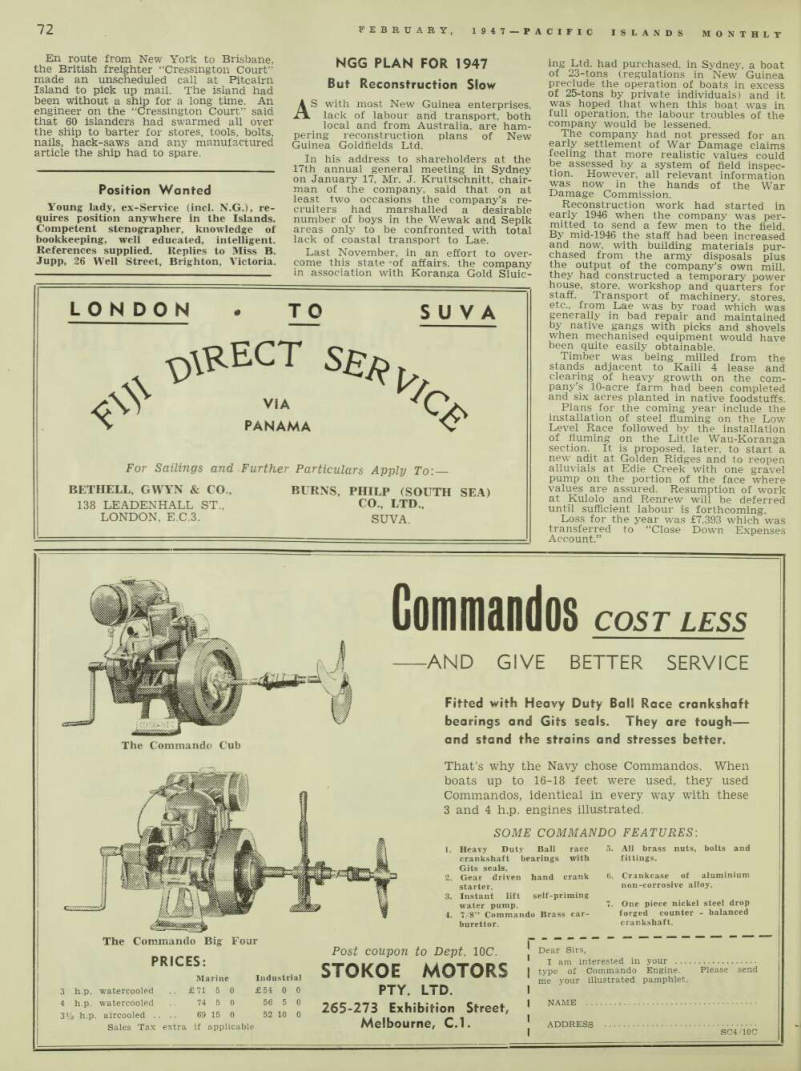
Butaritari
Suva, Feb., 8.
ONLY recently more than 15 months after the surrender of Japan two Koreans were captured on one of the islets of Butaritari atoll, in the Gilberts, and sent away to Tokio.
Late in 1946, reports were received through native channels that there were strange men suspected Japanese on the most southerly islet of the atoll. A police party investigated, and they found a roughly made hut with beds for four men. Searching further, they encoun
tered two armed Japs, who tired upon them. The police were not armed, and retired. When they returned, with arms, they found the bodies of the Japs, who had suicided. They could find no one else.
Weeks later, a party of Gilbertese came suddenly upon two men fishing.
The strangers fled into the bush. Police hunted them up, and found they were two Koreans, who had been brought to the lagoon by the Japs during the war, as labourers.
En route from New York to Brisbane, the British freighter “Cressington Court" made an unscheduled call at Pitcairn Island to pick up mail. The island had been without a ship for a long time. An engineer on the “Cressington Court” said that 60 islanders had swarmed all over the ship to barter for stores, tools, bolts, nails, hack-saws and any manufactured article the ship had to spare.
Advertisements & other items, pp. 73-74 (1 item)
CLiutsuilum 'Jiifwtx} .
Wanted—Pen Friends Madame A. Couvreur, 235 Avenue du Centenaire, Montigneis Sur Sambre, Belgium, seeks pen friends in the Pacific Islands who are interested in STAMP
COLLECTING.
J. C. Merrillees Pty. Ltd.
GENERAL ISLANDS MERCHANTS
Telegrams & Cables: Merrillees, Sydney.
AGENTS FOR: COWRIE SHARPS and FLOUR
and Suppliers of General Merchandise x-
TRADE GOODS, CLOTHING
FOODSTUFFS. LIQUEURS
SPIRITS, WINES.
New Address
63 PITT STREET, SYDNEY
(Phoenix Building) Telephone: Codes: BW 6064 Bentleys
sites
ISLAND CRAFT
TO
MODERN DESIGN
. mm*
WOODEN FREIGHTERS,
TRAWLERS AND ISLAND
CRAFT.
VESSELS REPAIRED AND
REMODELLED.
AUSTRALIAN AGENTS FOR
GRAY MARINE PETROL AND
DIESEL ENGINES.
COPPERSMITHS, WELDERS
AND PLUMBERS.
MODERN SLIPWAY FACILITIES AVAILABLE
WRITE US FOR DESIGNS AND COMPLETE SHIPBUILDING INFORMATION. v F 1 /
CLiutsuilum 'Jiifwtx} .
INCORPORATING REG. ADAMS CLAYTON CO.,
Tel.: XB 4475, XA 1731. JOHN STREET, BERRY'S BAY, NORTH SYDNEY. ALSO AT EDEN, NS W.
Position Wanted Young lady, ex-Service (incl. N.G.), requires position anywhere in the Islands.
Competent stenographer, knowledge of bookkeeping, well educated, intelligent.
References supplied. Replies to Miss B.
Jupp, 26 Well Street, Brighton, Victoria.
LONDON . TO
SUVA
VIA
PANAMA
For Sailings and Further Particulars Apply To: BETHELL, GWYN & CO., BURNS, PHILP (SOUTH SEA)
138 LEADENHALL ST., CO., LTD.,
LONDON, E.C.3. SUVA
V*. c ❖
* The Commando Cub
Commandos COST LESS
AND GIVE BETTER SERVICE
Fitted with Heavy Duty Ball Race crankshaft bearings and Gits seals. They are toughend stand the strains and stresses better.
That’s why the Navy chose Commandos. When boats up to 16-18 feet were used, they used Commandos, identical in every way with these
3 and 4 h.p. engines illustrated.
SOME COMMANDO FEATURES:
1. Heavy Duty Ball race crankshaft bearings with Gits seals. 2. Gear driven hand crank starter. 3. Instant lift self-priming water pump. 4. 7/8” Commando Brass carburettor. 5. All brass nuts, bolts and fittings. 6. Crankcase of aluminium non-corrosive alloy. 7. One piece nickel steel drop forged counter - balanced crankshaft.
The Commando Big Four
PRICES:
Marine Industrial 3 h.p. watercooled .. £7l 5 0 £54 0 0 4 h.p. watercooled 74 5 0 56 5 0 3Vz h.p. aircooled ... 69 15 0 52 10 0 Sales Tax extra if applicable
Post coupon to Dept. 10C.
STOKOE MOTORS
PTY. LTD.
265-273 Exhibition Street,
Melbourne, C.l.
Dear Sirs, I am interested in your type of Commando Engine. Please send me your illustrated pamphlet.
NAME
ADDRESS
SC4/10C
Ngg Plan For 1947
But Reconstruction Slow
AS with most New Guinea enterprises, lack of labour and transport, both local and from Australia, are ham pering reconstruction plans of New Guinea Goldfields Ltd.
In his address to shareholders at the 17th annual general meeting in Sydney on January 17, Mr. J. Kruttschnitt, chair man of the company, said that on at least two occasions the company’s re cruiters had marshalled a desirable number of boys in the Wewak and Sepik areas only to be confronted with total lack of coastal transport to Lae.
Last November, in an effort to over come this state -of affairs, the company in association with Koranga Gold Sluic
ing Ltd. had purchased, in Sydney, a boat of 23-tons (regulations in New Guinea preclude the operation of boats in excess of 25-tons by private individuals) and it was hoped that when this boat was in full operation, the labour troubles of the company would be lessened.
The company had not pressed for an early settlement of War Damage claims feeling that more realistic values could be assessed by a system of field inspec tion. However, all relevant information was now in the hands of the War Damage Commission.
Reconstruction work had started in early 1946 when the company was per mitted to send a few men to the field.
By mid-1946 the staff had been increased and now, with building materials pur chased from the army disposals plus the output of the company’s own mill, they had constructed a temporary power house, store, workshop and quarters for staff. Transport of machinery, stores, etc., from Lae was by road which was generally in bad repair and maintained by native gangs with picks and shovels when mechanised equipment would have been quite easily obtainable.
Timber was being milled from the stands adjacent to Kaili 4 lease and clearing of heavy growth on the com pany’s 10-acre farm had been completed and six acres planted in native foodstuffs.
Plans for the coming year include the installation of steel fluming on the Low Level Race followed by the installation of fluming on the Little Wau-Koranga section. It is proposed, later, to start a new adit at Golden Ridges and to reopen alluvials at Edie Creek with one gravel pump on the portion of the face where values are assured. Resumption of work at Kulolo and Renrew will be deferred until sufficient labour is forthcoming.
Loss for the year was £7,393 which was transferred to “Close Down Expenses Account.”
No Export Tax On Australian Goods
Sent To New Guinea
IN recent months we have had many complaints from Territorians who state that “export” taxes are being imposed on certain Australian commodi ties when shipped to New Guinea.
At the end of January we received a letter from a resident of Rabaul who said: “The following export taxes are being levied on these goods coming from Aus tralia: Rice—£l3 per ton; Edible fats— £66 per ton; Tea—l/4 per pound. These articles are included in the native ration scale and are purchased also by village natives. If Canberra is so concerned for native welfare, why the severe tax?”
Thereupon we decided to take a few hours off and track down any information relating to this alleged tax; To find out if it did exist, and if so, by whom it was imposed, and why.
V/e tried, first, the Department of Com merce and Agriculture. The Department of Commerce and Agriculture assured us thev had never heard of it; they did not. in fact, believe that such a tax existed.
They advised us to try the Department of Supply and Shipping. The Depart ment of Supply and Shipping told us plainly that we were in the wrong De partment—it was the Department of Trade and Customs that we wanted, they said.
We tried the Department of Trade and Customs. They had never heard of any export tax either; certainly it was not one of their inventions and definitely not an “export” tax. We should try the De partment of Commerce and Agriculture, We said we had: and we were advised to trv them again, asking for a Mr. Mit chell.
This time we wrote a letter to the De partment of Commerce and Agriculture, in which we explained that residents of New Guinea were complaining of what they alleged was an “export Tax” on such items as rice, edible fats and tea.
Our letter continued: Inquiries made of various Departments here have revealed that there is no such “export tax”—at least not under that name. But as there seems some basis for the complaints of New Guinea residents, it is probable that the dif ference between Australian fixed prices and those fixed in the Territory for these com modities is caused by the* withdrawal of a Government bounty which applies only to land Australia.
If this is the case would you please inform us: (a) what is the tax called—it apparently is not “export tax”; (b) what is the amount in respect of the goods mentioned—that is, rice, edible fats and tea; and (c) the reasons, if any. why Australia’s external Territory of Papua-New Guinea, which is still administered “Provision ally” under National Security Regulations (or whatever regulations have taken their place) should in this particular be classed as foreign?
In due course we received the following
reply:
I acknowledge your letter of January 30, 1947, concerning complaints from readers in Papua- New Guinea.
It is regretted that I am not in a position to answer these questions, but it is felt that the Department of External Territories may be in a position to give you the required information Consequently, your letter has been forwarded to Mr. Leak, of that Department, and no doubt he will be writing to you in due course.
Tours, etc.,
R. W. Mitchell.
For Department of Commerce and Agriculture. (Continued next page)
Up to the time of going to press we have received no advice from Mr. Leak, nor do we expect to receive any.
It seems obvious, however, that the “Tax" of which Territorians complain, is not an export tax at all. but an increase in price caused by the withdrawal of a domestic bounty which does not apply to Australian Territories. The exact amount of the bounties applicable to the commodities referred to by our corres pondent (rice, edible fats and tea) is so far not known to us.
Sir Henry Scott, KC, of Suva, Fiji, has been reappointed legal advisor to the Fijian Affairs Board for a further period of two years with effect from January, 1947.
Advertisements & other items, pp. 75-76 (2 items)
73
PACIFIC ISLANDS MONf hit - f fißfttJAß Y, 194 t
Nelson & Robertson
SOUTH SEA ISLANDS CLUB
Social Evening
Every Thursday, at 399 George Street.
Sydney (Fourth Floor) Ballroom Dancing . . . Special Islands Dances and Songs Islands Visitors Welcome.
COMPLEXION PERFECTION
WITH
BEAUTY PREPARATIONS
PGR
DISCRIMINATING WOMEN
WHO DESIRE
ALLURING LOVELINESS
Obtainable At All Stores.
Distributor:
GORDON K. SMITH
Beverley Hills, Sydney Bankers: Bank of N.S.W.
NELSON and ROBERTSON Pty. Ltd.
Established 1895
Shipowners - Brokers and
Islands Merchants
All classes merchandise purchased at Best Wholesale Prices. Original Invoices supplied to Island Clients. Cocoa Beans, Copra, Rubber, Trochus Shell and All Islands' Produce Sold on Commission.
Entrust your requirements to the firm with fifty years' practical experience in the
NELSON & ROBERTSON
12 SPRING STREET, SYDNEY, AUSTRALIA
Telegraphic Address: IVAN, SYDNEY.
» m
Ingres ttX j
Sw\\lMO ot*^
**■' * mm cots BEf. "
*P'STOI W“I 113
vj ffr'
as an Ocean Breeze
“THAT face of yours deserves * better than to be left in the doldrums—hot, Irritated, sore from the drag of your razor over stubborn bristles.
Ingram’s comes like a spanking breeze after sluggish calm. Under its cooling touch, each hair lifts up its head gallantly to meet its fate.
Ingram’s stands ’em up while you mow ’em down. Your razor gains new agility, new safety, new precision.
And your skin—my, my ! How cool and smooth and clear it feels after an invigorating shave with Ingram’s.
INGRAMS
SHAVING CREAM
Sold by ail leading distributors and manufactured by Bristol-Myers Co. Pty. Ltd. 223 Pacific Highway North Sydney, N.S.W., Australia.
In Rarotonga
Doctor's Ashes Buried
From Our Own Correspondent
Rarotonga, Jan., 26.
\ N unusual ceremony took place in Rarotonga on Saturday, January 25, when the ashes of a former Adminis tration official were interred on a hill overlooking Avarua harbour.
The ashes were those of Dr. A. J.
Brass, who died in Auckland on Sep tember 22, 1946. He was medical officer in Rarotonga from 1928 to 1931. During his term he formed a strong sentimental attachment for the island and its native people. When he returned to Auckland he continued to befriend Cook Islanders resident in NZ.
Upon his death after a long illness,
his parents complied with his wish that his ashes be sent to Rarotonga for burial at a chosen spot on Signal Hill at the back of Avarua.
Europeans and Rarotongans, friends and former patients of Dr. Brass, climbed the hill to attend the burial service, con ducted by the Rev. W. Murphy, of the
Lms.
Corrections
WE have been taken to task for two statements we made in the “PIM” in past months. One relates to a statement last August. When reporting the investiture of Mr. Paul Mason with the British DSC in Sydney we inferred that Mr. Mason had been in Port Moresby before taking up his Coastwatcher’s post m Bougainville. Mr. Mason, in fact, was never in Port Moresby at this time and was still on his plantation at Inus when he commenced his coast-watching duties.
More recently (January “PIM”) we stated that Mr. F. J. MacKenzie of the Commonwealth Bank, who was recently transferred to a Sydney Branch, had narrowly escaped capture by the Japs in Rabaul in 1942 and that when he escaped, he had brought the Bank’s records with him.
A correspondent asserts that Mr. Mac- Kenzie did not bring the Bank’s records with him when he escaped—that, in fact they were all lost.
We have referred this matter to the Commonwealth Bank. They reply: “Whilst practically the whole of the Bank s Current Account records were preserved, it is regretted that owing to the difficult circumstances which devel oped it was not possible for the manager to save complete records of all sections —indeed he was fortunate in escaping with his life.”
Papua
Indian Missionary For
ANEW development in missionary
work is the appointment of the Rev ~. X- Sat ya Joseph B,D„ an Indian Christian and scholar, to the London Missionary Society’s station at Hula in Papua. The Rev. Joseph and his wife passed through Sydney in February, and will go on to Papua at the end of the month.
The Rev, Joseph has a pleasing person ality and is enthusiastic' about Ms new work. He belongs to the South Indian Church Missionary Society and is the first member of the Society to go into the mission field. Missionaries have of course, been going to India for genera tions; the Rev. Joseph feels that it is time for Christian Indians to do their part in spreading Christianity still fur ther.
The Rev. Joseph will not, one fears, find his task in Papua altogether easy.
The problems he will encounter there will not be the same problems he knew in India, but they will be many and they will be knotty. He may. however, be able to bring a fresh mind to bear on the troubles that are besetting the Territory at the present time.
Mr. C. L. Brock, who has been Head master of the Suva Boys’ Grammar School (Fiji) since 1937, and who has in recent years been in charge of both the boys’ and girls grammar schools, left Fiji in December to take up a position in New Zealand. He has been closely associated with the Fiji branch of the Royal Life Saving Society, and at a meeting of the branch before his depar ture, a presentation was made in recog nition of his services.
Advertisements & other items, p. 77 (1 item)
Tilley Lamps
BURN ORDINARY KEROSENE
The Modern Form of PORTABLE LIGHTING This photo shows a 300 c.p. Tilley Lamp for domestic use but there are also 5000 c.p. Floodlights, Outdoor Lamps, Radiators, etc. All burn ordinary kerosene.
Tilley Lamps are made only at
Hendon, England.
Because they are so successful copies of the TILLEY LAMPS are being marketed.
BE SURE YOU BUY A TILLEY LAMP
LOOK FOR THE NAME!
A quality product born of long
Manufacturing Experience
Shipments available four weeks from receipt of order THE TILLEY LAMP CO., HENDON, N.W.4, ENG.
REPRESENTATION :
MELBOURNE : T. H. Bentley, Pty. Ltd., 123-125 William Street, Melbourne, C.l.
TASMANIA : Mr. C. Sellars, 108 a Charles Street, Launceston.
FIJI : Mr. K. Witherington, 2 Burns Philp Buildings, Suva.
Table Lamp Model T.L. 13
Islands Produce
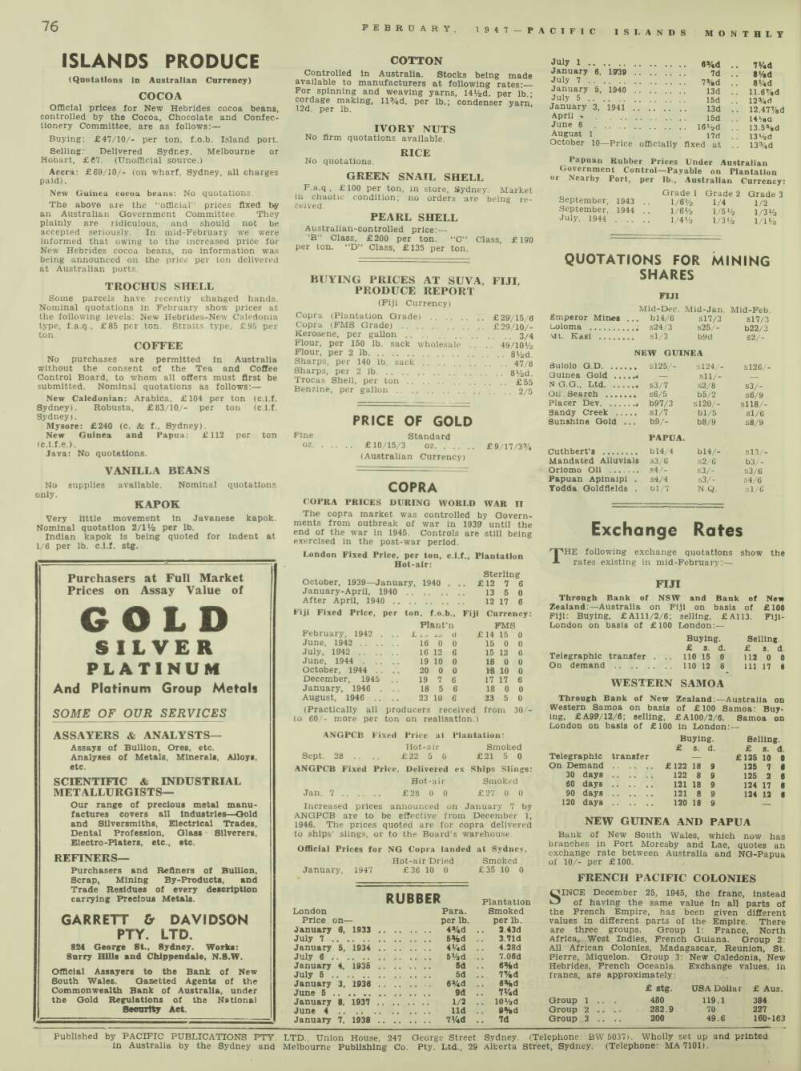
(Quotations in Australian Currency)
Cocoa
Official prices for New Hebrides cocoa beans, controlled by the Cocoa, Chocolate and Confec tionery Committee, are as follows: Buying: £47/10/- per ton, f.o.b. Island port.
Selling: Delivered Sydney, Melbourne or Hobart, £67. (Unofficial source.) Accra- £69/10/- (on wharf, Sydney, all charges paid).
New Guinea cocoa beans: No quotations.
The above are the “official” prices fixed by an Australian Government Committee They plainly are ridiculous, and should not be accepted seriously. In mid-February we were informed that owing to the increased price for New Hebrides cocoa beans, no information was being announced on the price per ton delivered at Australian ports.
Trochus Shell
Some parcels have recently changed hands.
Nominal quotations in February show prices at the following levels: New Hebrides-New Caledonia type, f.a.q , £B5 per ton. Straits type, £95 per ton.
Coffee
No purchases are permitted In Australia without the consent of the Tea and Coffee Control Board, to whom all offers must first be submitted. Nominal quotations as follows: New Caledonian: Arablca, £lO4 per ton (c.i.f.
Sydney). Robusta, £B3/10/- per ton (c.i.f.
Sydney).
Mysore: £240 (c. & f., Sydney).
New Guinea and Papua: £ll2 per ton (c.i.f.e.).
Java: No quotations.
Vanilla Beans
No supplies available. Nominal quotations only.
Kapok
Very little movement in Javanese kapok.
Nominal quotation 2/1 y 2 per lb.
Indian kapok is being quoted for Indent at 1/6 per lb. c.i.f. stg.
Cotton
Controlled in Australia. Stocks being made available to manufacturers at following rates:— For spinning and weaving yarns, 14y 2 d. per lb • cordage making, ll 3 / 4 d. per lb.; condenser yarn’ 12d. per lb.
Ivory Nuts
No firm quotations available,
Rice
No quotations,
Green Snail Shell
F.a.q , £lOO per ton. in store, Sydney. Market in chaotic condition; no orders are being re ceived,
Pearl Shell
Australian-controlled price:— ‘B” Class, £2OO per ton. “C” Class, £l9O per ton. “D” Class, £135 per ton.
Buying Prices At Suva, Fiji.
Produce Report
(Fiji Currency) Copra (Plantation Grade) £29/15/6 Copra (FMS Grade) £29/10/- Kerosene, per gallon .. . 3/4 Flour, per 150 lb. sack wholesale .. .. 49/lOV2 Flour, per 2 lb BV 2 d.
Sharps, per 140 lb. sack 47/8 Sharps, per 2 lb sy 2 d.
Trocas Shell, per ton £55 Benzine, per gallon .. 2/5
Advertisements & other items, p. 78 (1 item)
Price Of Gold
Pine Standard oz £lO/15/3 oz £9/17/3 3 A (Australian Currency)
Copra
Prices During World War Ii
The copra market was controlled by Govern ments from outbreak of war in 1939 until the end of the war in 1945. Controls are still being exercised in the post-war period.
London Fixed Price, per ton, c.i.f., Plantation Hot-air;
(Practically all producers received from 30/to 60/- more per ton on realisation.) ANGPCB Fixed Price at Plantation;
Increased prices announced on January 7 by ANGPCB are to be effective from December 1, 1946. The prices quoted are for copra delivered to ships’ slings, or to the Board’s warehouse.
Official Prices for NG Copra landed at Sydney.
October, 1939 —January, 1940 Sterling . £12 7 6 January-April, 1940 13 5 0 After April, 1940 .. 12 17 6 Fiji Fixed Price, per ton, f.o.b., Fiji Currency; Plant’n
Pms
February. 1942 . . .
Li. u £14 15 0 June, 1942 16 0 0 15 0 0 July, 1942 16 12 6 15 12 6 June, 1944 19 10 0 18 0 0 October, 1944 . . 20 0 0 18 10 0 December, 1945 19 7 6 17 17 6 January, 1946 . .. 18 5 6 18 0 0 August, 1946 .. ,. 23 10 6 23 5 0
Hot-air Smoked Sept. 28 .. £22 5 0 £21 5 0 ANGPCB Fixed Price, Delivered ex Ships Slings: Hot-air Smoked Jan. 7 .. .. £28 0 0 £27 0 0
Hot-air Dried Smoked January, 1947 £36 10 0 £35 10 0
Rubber
Plantation
Papuan Rubber Prices Under Australian Government Control—Payable on Plantation or Nearby Port, per lb., Australian Currency;
London Para.
Smoked Price anper lb. per lb.
January 9. 1933 .. .. 3.43d July 7 . .. .. 5%d 3.71d January 5, 1934 .. .. ... 4Vid 4.28d July 6 . 7.06d January 4. 1936 .. .. ... 8d 6%d July 5 . ... Sd 7%d January 3, 1938 . . . «^d June 5 7V«d January 8, 1937 .. .. ... 1/2 .. lOVad June 4 ... lid 9%d January 7. 1938 .. .. ... 7»4d 7d
July 1 7V«d January 6, 1939 7d .. 8V>d July 7 8V4d January 5, 1940 13d .. 116 7 /«d July 5 12%d January 3, 1941 . 12.47 7 / 8 d April , 14 V«Q June 6 13.5 S/ « d August 1 17d 13 Mid October 10- -Price officially fixed at 13 3 / 4 d
Grade 1 Grade 2 Grade 3 September, 1943 . l/6Vs 1/4 1/2 September, 1944 . 1/6 y 2 1/5 Vs 1/3 Vs July, 1944 . .. . 1/4 V 2 1/3 Vs 1/1 Vs
Shares
Quotations For Mining
Fiji
Mid-Dec.
Mid-Jan.
Mid-Feb.
Emperor Mines . .. bl4/6 S17/3 S17/3 Loloma S24/3 s25/b22/3 vlt. Kasl sl/3 b9d s2/-
New Guinea
Bulolo G.D ,. sl25/s!24/- Sl26/- Guinea Gold sll/- N G.G., Ltd s2/8 s3/- Oil Search b5/2 s6/9 Placer Dev .. b97/3 sl20/sl!8/- Sandy Creek .. sl/7 bl/5 sl/6 Sunshine Gold .. . b9/b8/9 s8/9
Papua.
Cuthbert's .. bl4/4 bl4/sl3/- Mandated Alluvlals s3/6 s2/6 b3/- Orlomo Oil . . s4/s3/s3/6 Papuan Aplnaipl . S4/4 s3/s4/6 Yodda Goldfields . bl/7 N.Q. sl/6
Exchange Rates
THE following exchange quotations show the rates existing in mid-February:—
Fiji
Through Bank of NSW and Bank of New Zealand:—Australia on Fiji on basis of £lOO FIJI; Buying, £Alll/2/6; selling, £AII3. Pijl- London on basis of £lOO London:—
Western Samoa
Through Bank of New Zealand:—Australia on Western Samoa on basis of £lOO Samoa: Buy ing, £ A99/12/6; selling, £AIOO/2/6. Samoa on London on basis of £lOO in London:—
New Guinea And Papua
Bank of New South Wales, which now has branches In Port Moresby and Lae, quotes an exchange rate between Australia and NG-Papua of 10/- per £lOO.
French Pacific Colonies
SINCE December 25, 1945, the franc, Instead of having the same value In all parts of the French Empire, has been given different values in different parts of the Empire. There are three groups. Group 1: Prance, North Africa, West Indies, French Guiana. Group 2 All African Colonies, Madagascar, Reunion, St Pierre, Miquelon. Group 3: New Caledonia, New Hebrides, French Oceania Exchange values, in francs, are approximately:
Buying. Selling. £ s d. £ s. d.
Telegraphic transfer ... 110 15 0 112 0 0 On demand 110 12 6 111 17 6
Buying.
Selling. £ s. d. £ s. d.
Telegraphic transfer — £125 10 0 On Demand £122 18 9 125 7 8 30 days 122 8 9 125 2 8 60 days 121 18 9 124 17 6 90 days ., .. .. 121 8 9 124 12 6 120 days 120 18 9 —
£ stg. QSA Dollar £ Aus.
Group 1 .. . 480 119.1 384 Group 2 .. .. 282.9 70 227 Group 3 .. .. 200 49.6 160-163
Advertisements & other items, pp. 78-80 (3 items)
76
FEBRUARY, 1947 PACIFIC ISLANDS MONTHLY
Published by PACIFIC PUBLICATIONS PTY LTD., Union House, 247 George Street Sydney. (Telephone: BW 5037). Wholly set up and printed in Australia by the Sydney and Melbourne Publishing Co. Pty. Ltd., 29 Alberta Street, Sydney. (Telephone: MA7101).
Gold
Purchasers at Full Market Prices on Assay Value of
SILVER
PLATINUM
And Platinum Group Metals
SOME OF OUR SERVICES
ASSAYERS & ANALYSTS—
Assays of Bullion, Ores, etc.
Analyses of Metals, Minerals, Alloys, etc.
SCIENTIFIC & INDUSTRIAL
METALLURGISTS—
Our range of precious metal manufactures covers all Industries—Gold and Silversmiths, Electrical Trades, Dental Profession, Olass Sllverers, Electro-Platers, etc., etc.
REFINERS—
Purchasers and Refiners of Bullion, Scrap, Mining By-Products, and Trade Residues of every description carrying Precious Metals.
GARRETT Cr DAVIDSON
PTY. LTD.
834 George S*., Sydney. Works: Surry Hills and Chippendale, N.S.W.
Official Assayers to the Bank of New South Wales. Gasetted Agents of the Commonwealth Bank of Australia, under the Gold Regulations of the National Security Act.
tropical thirst...
To quench a
hodtf drinks
tvery
DP ;/ a is imi ' m i- When you’re hot and tired,
there is nothing quite so satisfying
and thirst quenching as a long, cold glass of “K. 8.” Your friends and guests, too, will ap-
preciate this really fine
Lager, for “Everybody
drinks K. 8.”
TOOTH'S
LAGER
M
ERCHANTS
& SHIP OWNERS
Capital £1,000,000
ESTABLISHED 1914
COPRA MERCHANTS & MILLERS
BRANCHES THROUGHOUT THE PACIFIC ISLANDS
Buyers and exporters of all kinds of Islands produce. Copra Merchants and Millers.
Agents for Aus alian, European and Aineri an Manufacturers. Dis* ibutors of every description of merchandise.
Thirty years of Pacific Islands development and service.
REGULAR CARGO AND PASSENGER SERVICE BETWEEN EUROPE AND
PACIFIC ISLAND PORTS WAS ESTABLISHED BY
W. R. CARPENTER & CO. LTD.
Head Office: 16 O'CONNELL STREET, SYDNEY.
Cable Address:
CAMOHE.
Telephone: BW 4421.
Postal Address: P.O. Box No. 168, Sydney.