"That Wild Australian"
p. 40 · Read in the full issue
By H. Bowden Fletcher, D.F.C.
THE book “War Birds —The Diary of an Unknown Aviator” generally regarded as the best account of the activities of flying men in World War I, makes many references to “That Wild Australian, Jerry Pentland.” Pentland had been selected from the RFC to initiate young Americans into the mys teries of flying. “War Birds” makes it clear that he was popular with the Yanks.
Then after a lapse of 25 years, he renewed his friendship with sons of the men he originally taught to fly, but in a totally different category. In World War I he taught the boys how to kill their enemies; in World War II he taught them how to “Bring ’em out alive” in his capacity as Commanding Officer of an Air-Sea Rescue Unit in New Guinea.
This ever-young airman (he is 52) was Australia’s second leading fighter ace in World War I, with 23 kills to his credit.
And he kept flying right up to the out break of World War 11, as instructor, air-line pilot, aircraft manufacturer, barnstormer —all this interspersed with a spot of gold mining in New Guinea.
He helped pioneer many of the most
difficult air routes in New Guinea among the rough and inhospitable mountains— not without penalties. One crash kept him out of the cockpit for 22 months, with concussion, a broken leg and four broken ribs.
This stockily-built, blue-eyed pilot with the crinkly smile, ruddy cheeks and an air of injured innocence has made history and whenever airmen are gathered to gether in the years ahead, tales of his wild and magnificent stunts will be told and retold with enthusiasm and amuse ment. His name is synonymous with courage, initiative, efficiency and unor thodoxy, but his hotch-potch unit’s “Bring ’em out alive,” slogan, was fulfilled to the last letter.
IN June, 1942, he was sent to New Guinea with a DH Dragon, to join a couple of American pilots with Tiger Moths, and to organise an effective system for the rescue of aircrew who had been forced to bail out. At that time the Jap had pushed our forces back through Borneo, Java. Timor, New Britain, New Guinea and looked likely to take Australia in his stride.
Superiority of enemy aircraft was just one of Pentland’s troubles. There was as well, an almost entire absence of landing strips; there were rugged moun tains, timbered gorges, bottomless swamps, bogs, and wogs of every description, plus insufficient, unsuitable aircraft and an inadequate stock of spares to keep them flying.
But he knew his way around and the Yanks soon came under his spell; the three made a magnificent team.
The Yanks did the spotting for bailed out airmen and Jerry, with his larger Dragon, did the bringing out. The reputa tion of the unit, then without a name, became widespread and it was unofficially christened “Pentland’s circus.”
Air Force brass hats provided them with aircraft and told them to get on with the job; but, when they asked for spares and more maintenance staff, they were told in plain language, that they would have to look after themselves.
The American Air Force Staff, however, came to the unit’s rescue and told Pent land to ask for anything he wanted from scanners to aircraft. Pentland asked often, and always got what he wanted.
One of his first mass-rescues was from a pocket-handkerchief airstrip at Benna- Benna on the Central Plateau of New Guinea. He successfully evacuated 28 Diggers, 11 American airmen and a num ber of civilians.
At one period the unit had 11 different kinds of aircraft of British. American and Australian design and build, and as sup plies from Australia were almost non existent, the ground-staff were forced to scrounge to the limit. American salvage dumps were a happy hunting ground and proved invaluable.
To keep his assorted aircraft flying was a never-ending headache; but, to Jerry, it was all in the game. Building landing strips to permit a rescue was just an every-day job for his Circus, and the usual procedure was to gather a body of native women and old men (all able bodied men were working for the Army on the Kokoda trail) and hack out the necessary piece of ground from the jungle.
TO get details of his experiences from Pentland himself is worse than try ing to get the proverbial blood out
of a stone; he just does not remember.
He is estimated, by those who should know, to have personally rescued more than 200 persons from the New Guinea jungle, but Jerry can’t or won’t substan tiate the figure.
Like many old hands he hated too many Gubbins (as he called them) on the in strument board, and he made history the first time he flew a Vultee Vengeance.
His instructor, one of his junior officers, had explained the workings of this par ticular plane in detail; but after getting into the cockpit Pentland pulled a roll of sticking plaster from his pocket, pasted strips over all the instruments he did not want, and then, smiling innocently at his instructor, took off.
The story of Jerry Pentland’s circus is one of epic courage, dogged endurance, amazing improvisation, skilful piloting, unique team work between officers and men, and complete disregard of red tape —and all this despite every handicap that could be conceived by an indolent staff who persistently kept as far away from the scene of activities as possible.
The fact that Pentland’s magnificent work was (only belatedly) recognised by the award of the Air Force Cross in Feb ruary 1946, is indicative of the recognition given by Air Board to the men who do things without making a song of it.
Alexander august norman
Dudley Pentland, Mc. Dec,
AFC—“Jerry” to all and sundry who have known or heard of his escapades— will always live in the history of Aviation in Australia, in a special niche suited to his amazing personality.
When speaking at the official opening of the Holy Spirit Hospital in Brisbane recently, Archbishop Duhig, Head of the Roman Catholic Church in Queensland, said that the hospital would not only serve local needs, but would also be a training centre for nurses to establish hospitals and organise medical and nurs ing services in New Guinea.
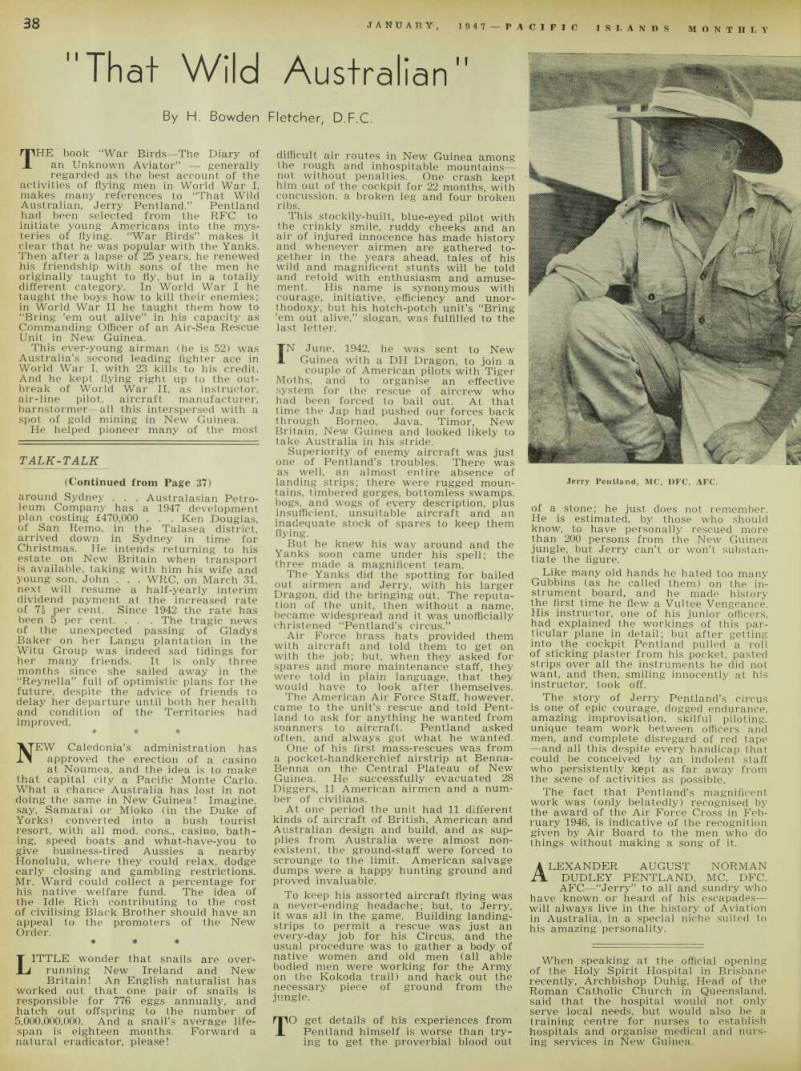
Jerry Pentland, MC, DFC, AFC.