A Planter’s Return To His Shattered Home
pp. 40-41 · Read in the full issue
rpms description of present conditions in the British Solomons is based on letters written for his family by Mr. J. M. Clift, who returned to the Group in the "South ern Cross" in April, to find out what had happened to his once-beautiful and pro ductive plantation, Kolomatana. It was on the coast of Guadalcanal, a few miles eastward of Honiara and Henderson air field, where there was so much bitter fighting.
THE account by Mrs. Georgina Seton in the June PIM of the “Hoodoo Voyage” of the Southern Cross, brings back a memory or two.
When I joined the ship in Brisbane I had come straight from the brigalow scrub at the head of the Dawson River.
There, we had established a small cattle property, to tide us over the long years of the copra depression. So I have lived by the seashore and by the mountains.
Don’t ask me to say which is best; but, in that reeling wheelhouse on the Southern Cross, it was brought home to me that the sea drowns out humanity and time. Now and again it licks your feet like something feline, but it will crack your bones and eat you, for all that. The mountains and the bush are safe to handle. The sea smoothes its silver scales till you cannot see their joints—but their shining is that of a snake’s belly, after all.
Well, the voyage ended up in a flat calm with the silver scales well and truly smoothed. Here are some extracts from letters sent to my home.
April 17 —off Amligo, Guadalcanal.
It is a perfect moonlit night, and we are just opposite the site of our old home. The mist hangs in the valley of the Sa Sa, the mountains are flecked with a white mantle of it, just as we knew them to be so many years ago. I can’t tell you what memories flood back, as I look at the well-remembered scene.
There is the light of a fire about where our house stood.
We are cruising “dead slow” in a glassy calm, waiting for daylight. I’m writing this in the chart room of the little ship. I've just put on the kettle for the captain’s early-morning tea.
Honiara, Guadalcanal, April 20.
THE Americans are packing up, and have nearly all gone. You can have no idea what this area is like. Just now there are four big ships loading all manner of military equipment at two well-built wharves —the Americans call them “docks.”
To-day we covered close on 100 miles in a jeep on first-class gravelled roads built during the American occupation.
There is now only a fragment left of the vast military organisation of two years ago, when 200,000 troops were on Guad alcanal, but we drove on the magnificent roads through the remains of camps with many big buildings still standing.
We pulled into a shed to shelter from the rain. It was bigger than the Breeza woolshed, and ever so much more lofty.
It was roofed with planking, with canvas ever the timber. The canvas had rotted,
and the rain came down everywhere onto the concrete floor. All this huge shed was of sawn timber, and must have cost thousands to build. To-day it is only one of scores rotting in this steamy heat.
But many big Nissen igloo-type huts will be left behind in the Solomons and should make useful plantation buildings.
Everywhere, the undergrowth is cover ing up the camp sites and the wonderful roads. The big bridges are already shak ing. A few years will see them sprawled, broken, in the rivers. Some are already in that condition. Truly, it doesn’t take long in the Solomons for Nature to cover up our achievements.
THE BSIP Government have a staff of several Europeans, and about 100 natives growing rice experimentally on the grass plains of Guadalcanal. We went out to the farm.
We first passed through what had been the American “truck” gardens.
“Spearline” Wilson says they grew fine tomatoes, melons, beans, etc,, on the
open grass flats. We gathered quantities of spring onions, which still survived, and there were thousands of egg-plants laden with fruit. The Americans are said to have used superphosphate with a liberal hand, and got wonderful results. No army was ever so well fed. They were said to have had Marines in the front line, support troops in the second, while ice cream carts made up the third.
On this trip I took a photo of an enor mous mound of burnt coca-kola bottles.
In the heap there must have been mil lions of the little flasks.
The rice grows well —too well, in fact.
In places it is seven feet high. It is being harvested by an auto-header from Australia and is yielding heavily. Peanuts also do well in the rich black soil. The country there is very beautiful, with the high cloud-capped mountains compara tively close, and the green plains stretch to their bases. A. H. Wilson pointed out Gold Ridge to me.
Coming home, we drove along one run way of a big aerodrome. There were two of these ’dromes for bombers and a dozen fighter-strips. We also saw the area, afterwards called Hell’s Point, where, in 1943, some 75,000,000 dollars’ worth of explosives and military stores went up—a lot of men were killed by the explosions.
We also passed Bloody Ridge, an in significant little hill—but at one stage of the campaign it was a key position.
Thousands of bodies were collected out of the trampled grass on its flanks.
EVERY day the Americans are towing stuff to sea to be dumped in deep water. The cases are taken out on a big barge fitted with a powerful crane.
Lots of other material has been buried by bulldozers, whilst more has been tipped over steep places into ravines. It is all very shocking, especially to us people who have almost been ruined.
I am very comfortably housed in what was formerly a New Zealand hospital.
Two of us have the run of the whole building. My bedroom is a ward, 50 x 20 feet. My host lives well and has one of the American Servel refrigerators. These are kerosene-operated and have twice the capacity of the refrigerators we knew. The Servels were sold on Guad canal, in brand new condition, for A£l7.
Lots of them have gone out to sea on the fatal barge in their original cases, to be dumped.
There is little to buy here now. But, at the canteen, American cigarettes are 3/- for 200. W. R. Carpenters, of Sydney, are said to have bought 15,000,000 of
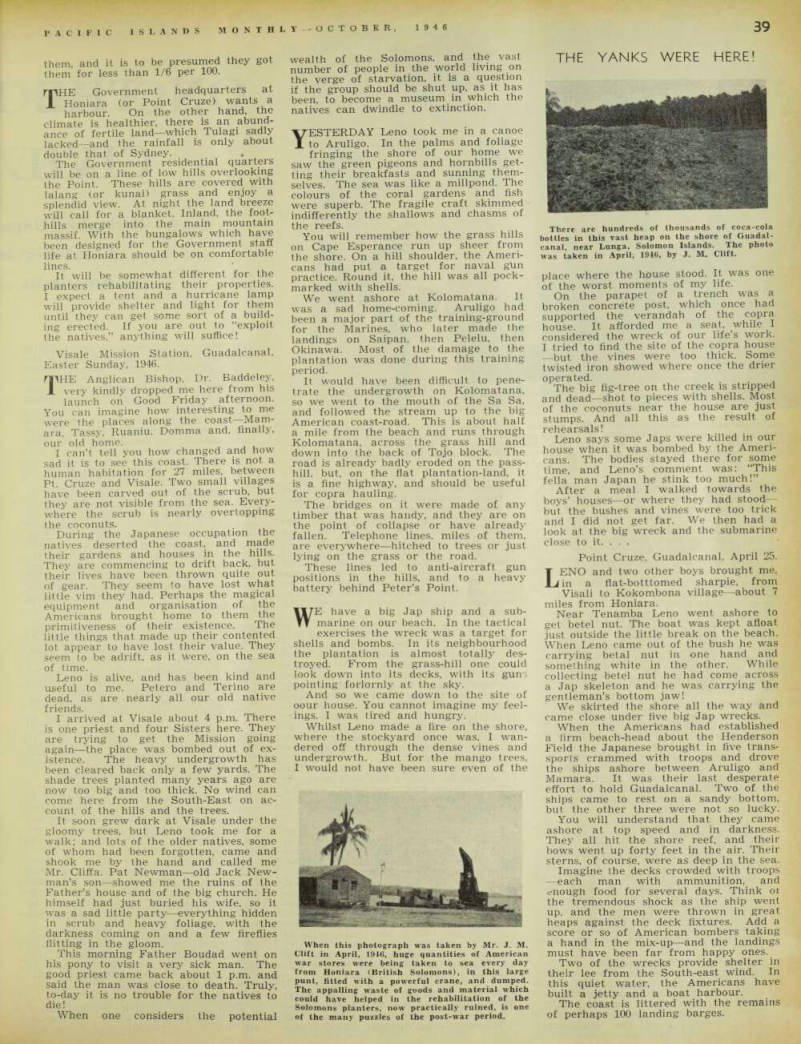
Behind Ilu, Guadalcanal, the Americans estab lished vast vegetable gardens, in 1942, for the feeding of their troops. They are gone, but their vegetables go marching on. In this photo graph, by J. M. Clift, taken in April, 1946, Sister Kennedy is seen gathering onions in the abandoned gardens.
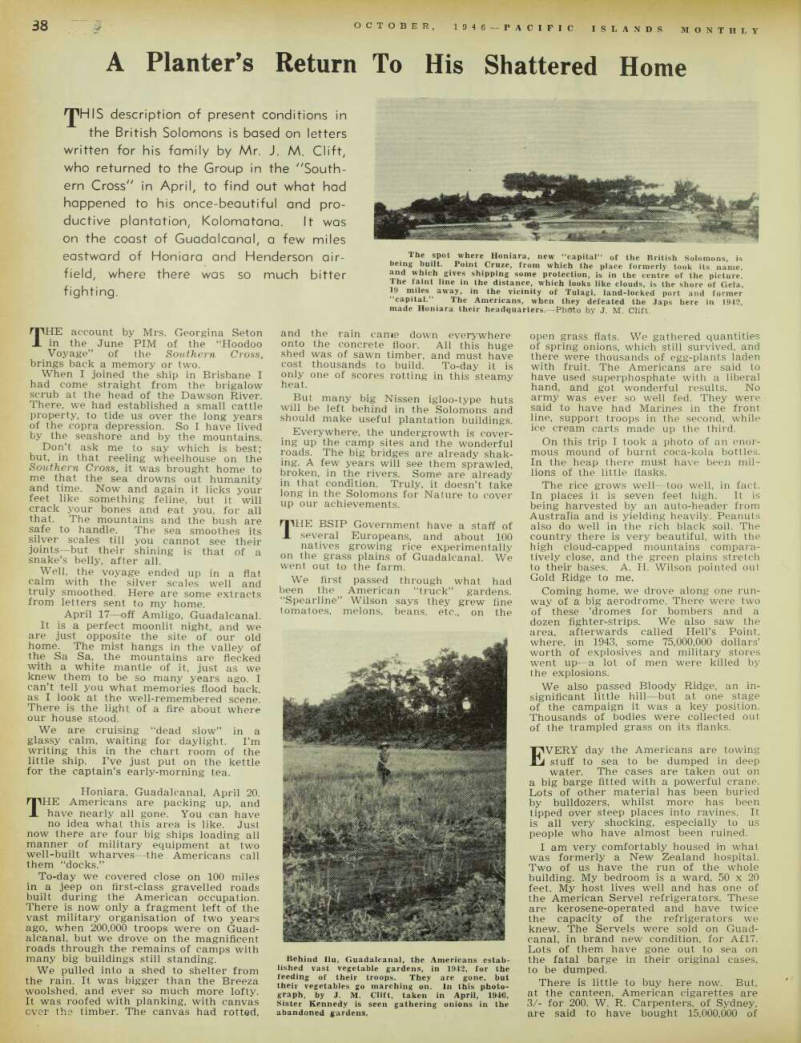
The spot where Honiara, new “capital” of the British Solomons, is being built. Point Cruze, from which the place formerly took its name, and which gives shipping some protection, is in the centre of the picture.
The faint line in the distance, which looks like clouds, is the shore of Gela, 19 miles away, in the vicinity of Tulagi, land-locked port and former “capital.” The Americans, when they defeated the Japs here in 1942, made Honiara their headquarters. —Photo by J. M. Clift.
them, and it is to be presumed they got them for less than 1/6 per 100.
THE Government headquarters at Honiara (or Point Cruze) wants a harbour. On the other hand, the climate is healthier, there is an abund ance of fertile land—which Tulagi sadly lacked—and the rainfall is only about double that of Sydney.
The Government residential quarters will be on a line of low hills overlooking the Point. These hills are covered with lalang (or kunai) grass and enjoy a splendid view. At night the land breeze will call for a blanket. Inland, the foot hills merge into the main mountain massif. With the bungalows which have been designed for the Government staff life at Honiara should be on comfortable lines.
It will be somewhat different for the planters rehabilitating their properties.
I expect a tent and a hurricane lamp will provide shelter and light for them until they can get some sort of a build ing erected. If you are out to “exploit the natives,” anything will suffice!
Visale Mission Station, Guadalcanal, Easter Sunday, 1946.
THE Anglican Bishop. Dr. Baddeley, very kindly dropped me here from his launch on Good Friday afternoon.
You can imagine how interesting to me were the places along the coast—Mam ara. Tassy, Ruaniu, Domma and, finally, our old home.
I can’t tell you how changed and how sad it is to see this coast. There is not a human habitation for 27 miles, between Pt. Cruze and Visale. Two small villages have been carved out of the scrub, but they are not visible from the sea. Every where the scrub is nearly overtopping the coconuts.
During the Japanese occupation the natives deserted the coast, and made their gardens and houses in the hills.
They are commencing to drift back, but their lives have been thrown quite out of gear. They seem to have lost what little vim they had. Perhaps the magical equipment and organisation of the Americans brought home to them the primitiveness of their existence. The little things that made up their contented lot appear to have lost their value. They seem to be adrift, as it were, on the sea of time.
Leno is alive, and has been kind and useful to me. Petero and Terino are dead, as are nearly all our old native friends.
I arrived at Visale about 4 p.m. There is one priest and four Sisters here. They are trying to get the Mission going again—the place was bombed out of ex istence. The heavy undergrowth has been cleared back only a few yards. The shade trees planted many years ago are now too big and too thick. No wind can come here from the South-East on ac count of the hills and the trees.
It soon grew dark at Visale under the gloomy trees, but Leno took me for a walk; and lots of the older natives, some of whom had been forgotten, came and shook me by the hand and called me Mr. Cliffa. Pat Newman —old Jack New man’s son —showed me the ruins of the Father’s house and of the big church. He himself had just buried his wife, so it was a sad little party—everything hidden in scrub and heavy foliage, with the darkness coming on and a few fireflies flitting in the gloom.
This morning Father Boudad went on his pony to visit a very sick man. The good priest came back about 1 p.m. and said the man was close to death. Truly, to-day it is no trouble for the natives to die!
When one considers the potential
wealth of the Solomons, and the vast number of people in the world living on the verge of starvation, it is a question if the group should be shut up, as it has been, to become a museum in which the natives can dwindle to extinction.
YESTERDAY Leno took me in a canoe to Aruligo. In the palms and foliage fringing the shore of our home we saw the green pigeons and hornbills get ting their breakfasts and sunning them selves. The sea was like a millpond. The colours of the coral gardens and fish were superb. The fragile craft skimmed indifferently the shallows and chasms of the reefs.
You will remember how the grass hills on Cape Esperance run up sheer from the shore. On a hill shoulder, the Ameri cans had put a target for naval gUn practice. Round it, the hill was all pock marked with shells.
We went ashore at Kolomatana. It was a sad home-coming. Aruligo had been a major part of the training-ground for the Marines, who later made the landings on Saipan, then Pelelu, then Okinawa. Most of the damage to the plantation was done during this training period.
It would have been difficult to pene trate the undergrowth on Kolomatana, so we went to the mouth of the Sa Sa, and followed the stream up to the big American coast-road. This is about half a mile from the beach and runs through Kolomatana, across the grass hill and down into the back of Tojo block. The road is already badly eroded on the pass hill, but, on the flat plantation-land, it is a fine highway, and should be useful for copra hauling.
The bridges on it were made of any timber that was handy, and they are on the point of collapse or have already fallen. Telephone lines, miles of them, are everywhere—hitched to trees or just lying on the grass or the road.
These lines led to anti-aircraft gun positions in the hills, and to a heavy battery behind Peter’s Point.
WE have a big Jap ship and a sub marine on our beach. In the tactical exercises the wreck was a target for shells and bombs. In its neighbourhood the plantation is almost totally des troyed. From the grass-hill one could look down into its decks, with its gun; pointing forlornly at the sky.
And so we came down to the site of oour house. You cannot imagine my feel ings. I was tired and hungry.
Whilst Leno made a fire on the shore, where the stockyard once was, I wan dered off through the dense vines and undergrowth. But for the mango trees, I would not have been sure even of the
place where the house stood. It was one of the worst moments of my life.
On the parapet of a trench was a broken concrete post, which once had supported the verandah of the copra house. It afforded me a seat, while I considered the wreck of our life’s work.
I tried to find the site of the copra house but the vines were too thick. Some twisted iron showed where once the drier operated.
The big fig-tree on the creek is stripped and dead —shot to pieces with shells. Most of the coconuts near the house are just stumps. And all this as the result of rehearsals!
Leno says some Japs were killed in our house when it was bombed by the Ameri cans. The bodies stayed there for some time, and Leno’s comment was: “This fella man Japan he stink too much!”
After a meal I walked towards the boys’ houses —or where they had stood — but the bushes and vines were too trick and I did not get far. We then had a look at the big wreck and the submarine close to it. . . .
Point Cruze, Guadalcanal, April 25.
LENO and two other boys brought me, in a flat-botttomed sharpie, from Visali to Kokombona village—about 7 miles from Honiara.
Near Tenamba Leno went ashore to get betel nut. The boat was kept afloat just outside the little break on the beach.
When Leno came out of the bush he was carrying betal nut in one hand and something white in the other. While collecting betel nut he had come across a Jap skeleton and he was carrying the gentleman’s bottom jaw!
We skirted the shore all the way and came close under five big Jap wrecks.
When the Americans had established a firm beach-head about the Henderson Field the Japanese brought in five trans sports crammed with troops and drove the ships ashore between Aruligo and Mamara. It was their last desperate effort to hold Guadalcanal. Two of the ships came to rest on a sandy bottom, but the other three were not so lucky.
You will understand that they came ashore at top speed and in darkness.
They all hit the shore reef, and their bows went up forty feet in the air. Their sterns, of course, were as deep in the sea.
Imagine the decks crowded with troops —each man with ammunition, and enough food for several days. Think or the tremendous shock as the ship went up, and the men were thrown in great heaps against the deck fixtures. Add a score or so of American bombers taking a hand in the mix-up—and the landings must have been far from happy ones.
Two of the wrecks provide shelter in their lee from the South-east wind. In this quiet water, the Americans have built a jetty and a boat harbour.
The coast is littered with the remains of perhaps 100 landing barges.
When this photograph was taken by Mr. J. M.
Clift in April, 1946, huge quantities of American war stores were being taken to sea every day from Honiara (British Solomons), in this large punt, fitted with a powerful crane, and dumped.
The appalling waste of goods and material which could have helped in the rehabilitation of the Solomons planters, now practically ruined, is one of the many puzzles of the post-war period.
The Yanks Were Here!
There are hundreds of thousands of coca-cola bottles in this vast heap on the shore of Guadal canal, near Lunga, Solomon Islands. The photo was taken in April, 1946, by J. M. Clift.