Magazine Section
p. 39 · Read in the full issue
Territories Talk-Talk
By "Tolala"
LAST month’s PIM contained photos of f (naee wto ™won recognition for their bravery against the Ja p en The photos were taken by C. H.
And now it is the turn of C. H. Meen to receive recognition in the shape of the King’s Medal for Courage, for assis tnnrp he save the AIB during the Jap Spation of New Britain Before the war, Meen was employed h v the Agricultural Department in Rabaul in a clerical capacity. An enthu siastic photographer, he has in the past contributed many pictures to the PIM of current happenings in and around Rabaul. He is a son of the well-known Ah Chee, whose hotel was famous throughout the Pacific a couple of de rades ago L e * * ♦ r_ , - A1 E death of Alan Campbell recalls to mind the passing of his brother
the C^Pl/plantations Tor BP in Kite-
So£k'eV"hf berari 9 tta a ch e ed to a giant calliphilum tree on the beach.
In fatalistic vein he used to tell intimates that when the life of the tree was ended he himself would follow. The veteran of a thousand north-west gales started to decay and died a month or so before J.
W. was laid to rest in Kieta cemetery, His brother, Alan, had made a similar
remark, joining his fate with the palms that grew down the centre of Bridge Street, Sydney, opposite the BP offices.
His death occurred as the last palm was being uprooted by the Sydney City Council. * * * JT’S a moot point, whether the Labour 1 or Shipping problem greater Suffl I c n ient t^ ppl / e e s r " t °each areetlentol y to getting on with the rehabilitation job.
Something may happen after the end of the month insofar as the s^PP^g business is concerned, for I see that Canberra is calling for applicants for a Superintendent and two assistants ; for the Coastal and Inter-Islands Shipping Services within the Territories of Papua- New Guinea cl ° s f ir *£ u? ’oJqii assumes that suitable craft will be avail able by then. , mdn^rv A Director of may be the next appointment, with over riding powers to furnish workers perhaps! . , Incidentally the Shipping Supermten dent is to be stationed at Rabaul, and an assistant at M adang and at Port Moresby Seems as though Rabaul is comin S back “ to its , own a f in ' 1 MENTIONED last month about the 1 strike among native seamen in Papua.
Subsequently a Sydney newspaper featured “Better Pay for Papuan Sailors, with the information that wages had been increased 58 per cent., also that seamen were now issued with mattresses, pillows and linen and “instead of two meals a day of bully beef and rice they
get butter, jam, bread, milk and sugar as well as warm clothing.” The question is: Will they be satisfied with these amenities or, like their Southern proto types, keep on asking for more? ♦ ♦ ♦ AND, apropos of native demands, I am reminded of some recent price fixing for primary produce by the New Hanover natives. Here are a few: 1 bag of dried copra, £7; 1 bag of green copra, £1; 4 trocas shells, 1/-; one duck, 25/-; one drake, 15/-.
It is a demand like that made for the dried copra (equivalent to £lO5 a ton) which is out of all proportion, and creates misunderstandings. A job for the new Educators of New Guinea will be to con vince the native, by means of simple arithmetic, that he cannot expect to be paid £lO5 a ton for produce only market able at £3O a ton ... Or can he? * ♦ ♦ rE Grim Reaper has been busy amongst old Territorians again: Ben Mocatta passed away on Sep tember 26; Mrs. May Chadderton (one time of Kapsu plantation, in New Ireland) and Bert Spence, well-known in and around Wau, have been gathered to their Long Rest; and J. J. Feian, once manager of the Commonwealth Bank at Rabaul, and more recently doing the same job at Katoomba, has also passed on. May they rest in peace, ♦ * ♦ rE fact that snails (among the slowest of God’s creation) are beating re habilitation in New Guinea appears ironical, but nevertheless it is a fact.
The only growth safe from their depre dations appears to be caladiums. ♦ • * rE Chatelaine of Langu (Gladys Baker, MBE) is invariably pin pointed for publicity by a section of the Sydney press.
She hit the head-lines some years ago on her return from Europe, with trunks full of Parisian frockings. She had travelled to New York by the “Queen Mary” (complete with illustration).
More recently, she departed by the good shin “Reynella” for Rabaul and her Witu Island plantation, and was well equipped (so the Press reported) with a “fuel stove, camp stretchers, a tin tub, canned provisions and—a case of model frocks.” She told a news-hound: “I’ll be living in a native hut . . . but I intend to dress for dinner every night.
I’m taking my cosmetics with me, too.”
There must be something in the Witu atmosphere which tends to sartorial glamour. Old Peter Hansen, who pion eered the Witu Group some sixty years ago, used to don tails and a topper when on his periodic holidays in Sydney. But then, of course, the other name for the Witu Group is the French Islands. * ♦ ♦
PROFESSOR ELKIN, anthropologist,
of the University of Sydney, and one who had no little influence in formulating the Territorial native policy, returned lately from a trip to Arnhem Land. Said the Professor, regarding the Arnhem Landers: “They should be en couraged to go on practising their old religious ceremonies. It would be wrong for us to forbid it in attempts to Chris tianise them and improve their civilisa tion. The two can go together.
Religious freedom, so I have been tom, is a fundamental principle of democracy.
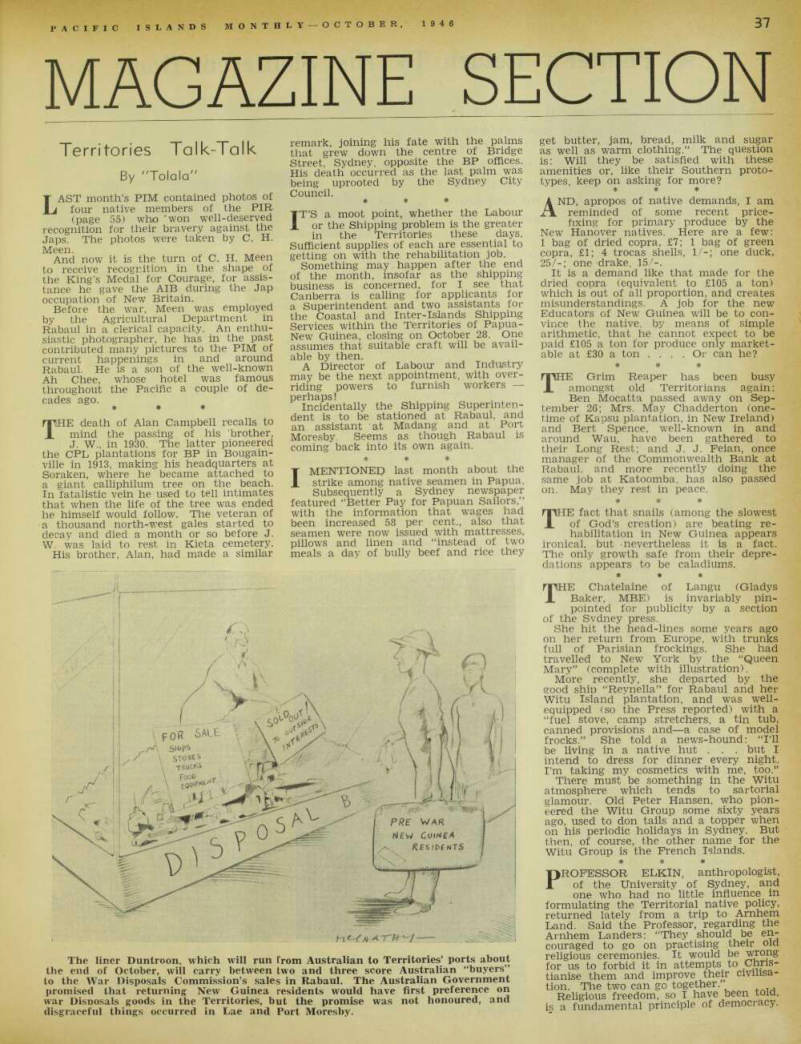
The liner Duntroon, which will run from Australian to Territories’ ports about the end of October, will carry between two and three score Australian “buyers” to the War Disposals Commission’s sales in Rabaul. The Australian Government promised that returning New Guinea residents would have first preference on war Disposals goods in the Territories, but the promise was not honoured, and disgraceful things occurred in Lae and Port Moresby.