On The Edge Of
pp. 42-58 · Read in the full issue
Civil War
A Hitherto Unpu[?]ed Drama of New Caledonia in 1942, which coused the Americans Embarrossment
THE set-up was extraordinary. France had collapsed in mid-1940; and the Empire became quickly divided be tween the Vichy French, who were gen erally Fascist and pro-German, and the Free (or Fighting) French, who were loyal to the British Alliance.
After a bitter internal struggle, the French Pacific Colonies of New Cale donia and French Oceania rallied to De Gaulle, and the Vichyites were shipped away, mostly to Indo-China.
The story of how Henri Sautot, French Commissioner in New Hebrides, made a secret voyage to Noumea, and caused New Caledonia to be the first French Territory to declare for De Gaulle, has been told several times. For a year (1940-41) Sautot was head of Free France in the Pacific.
Subsequent events, until now, have been very much “hush-hush” —the Brit ish and American censorships could not allow the strange story of d’Argenlieu to be told.
The French Pacific Colonies were de finitely under the flag of Lorraine before d’Argenlieu came into the Pacific in Sep tember, 1941. Then, within four months, the following developments had taken place: A peculiar underground struggle for power proceeded between the majority of the people in New Caledonia, led by Sautot, and the group of officials around d’Argenlieu.
Japan invaded the South Pacific and was thrusting at New Caledonia be cause (a) Japan eagerly coveted the mineral riches of that colony and (b) Japan planned to use Noumea as her advanced base for operations against Fiji, New Zealand and Eastern Aus tralia.
The United States, as part of her strategy of, first of all, rolling up the extended southern flank of the Jap anese, was planning to use New Cale donia as her advanced base for attack upon the enemy, in the Solomons and New Guinea; and the Americans
lieu party did not seem to care. While blackout rules were enforced against the whole population, lights blazed in the high officials’ houses. D’Argenlieu offi cials broke the seals on seized Japanese stores, and helped themselves to goods in short supply.
The people, completely united behind Sautot, protested angrily. Sautot carried their protests to the Admiral. He only brought disfavour on himself.
The Bench of Magistrates wrote form ally protesting against alleged illegal acts of Mission members.
D’Argenlieu’s only reply was to threaten them with punishment for im proper statements. He imposed a severe political censorship, which alarmed everyone. His decree of February 6, 1942, prohibiting liberty of speech, has become history. He set up his own Gestapo. He fell foul of the Church. He would not tolerate criticism. He even used his power to prevent anyone communicating with De Gaulle. The position steadily deteriorated.
CAME March, 1942, and the first of the American divisions, led by General Patch. D’Argenlieu, cold and aloof, made no move. It was Governor Sautot who went forthwith to the docks to meet the Americans, and arranged functions where the Caledonians expressed their welcome, and their joy in knowing that, after all, they would be defended.
The people’s leaders begged General Patch to convey an account of the situ ation to General De Gaulle —they could not themselves communicate. The new High Commissioner and the popular Gov ernor were now widely separated.
The embarrassed Americans inter viewed d’Argenlieu. They achieved little with that cold, austere man. They asked Washington for directions. Privately, they expressed their amazement with the local situation. What was d’Argenlieu trying to do?
D’Argenlieu was insistent on his titles and privileges. He expected salutes, and that sort of thing, not only from the French, but also from the small party of Australians who were there early in 1942, and from the masses of Americans now coming in.
A refreshment booth for the troops was opened officially by d’Argenlieu and Patch. The “Bulletin du Commerce,” re porting the event, placed the name of Patch before that of d’Argenlieu. The latter threatened drastic action against the newspaper.
There is one possible explanation of some of d’Argenlieu’s actions. He natur ally hated Communists; and there was
naturally sought and expected the fullest co-operation of the New Cale donian Government.
The following account of what hap pened in New Caledonia is based on notes made in Noumea by Mr. H. E. L.
Friday, an Australian journalist who was resident there during the period of World War 11. The photographs also are sup plied by Mr. Friday, who managed to save them from a censorship that was most eager to destroy all trace of these strange events.
FRESH from Tahiti, where he had per emptorily removed the ambitious Commandant Brunot from the Gov ernorship, and released the De Gaullists from the prison in which Brunot had confined them, Rear-Admiral Thierry d’Argenlieu arrived in Noumea on Nov ember 4, 1941. The people were pre pared to give him a warm welcome as General De Gaulle’s appointee to the French High Commissionership of the Pacific. His romantic history appealed to public sentiment.
But, from the beginning, the new High Commissioner made a bad impression. He was arrogant and egotistical, and jhe treated Governor Sautot, his officials and the people of New Caledonia with evi dent disdain.
New Caledonia then was poor. The colony was shut off from France, and from all European markets, and was being helped economically by Britain, Australia and New Zealand.
But that did not trouble d’Argenlieu.
He and his civil and military staff, num bering about 30, all drawing large sal aries, requisitioned the best available houses, automobiles, radios, foods, wines and whatnot. While the people were so short of food that mothers were literally begging such things as canned milk for their babies, the d’Argenlieu mission was reported to be living in luxury.
WITHIN a month, there came Pearl Harbour; and thenceforth New Cale donia, always coveted by Japan, was in imminent, deadly danger. The d’Argen
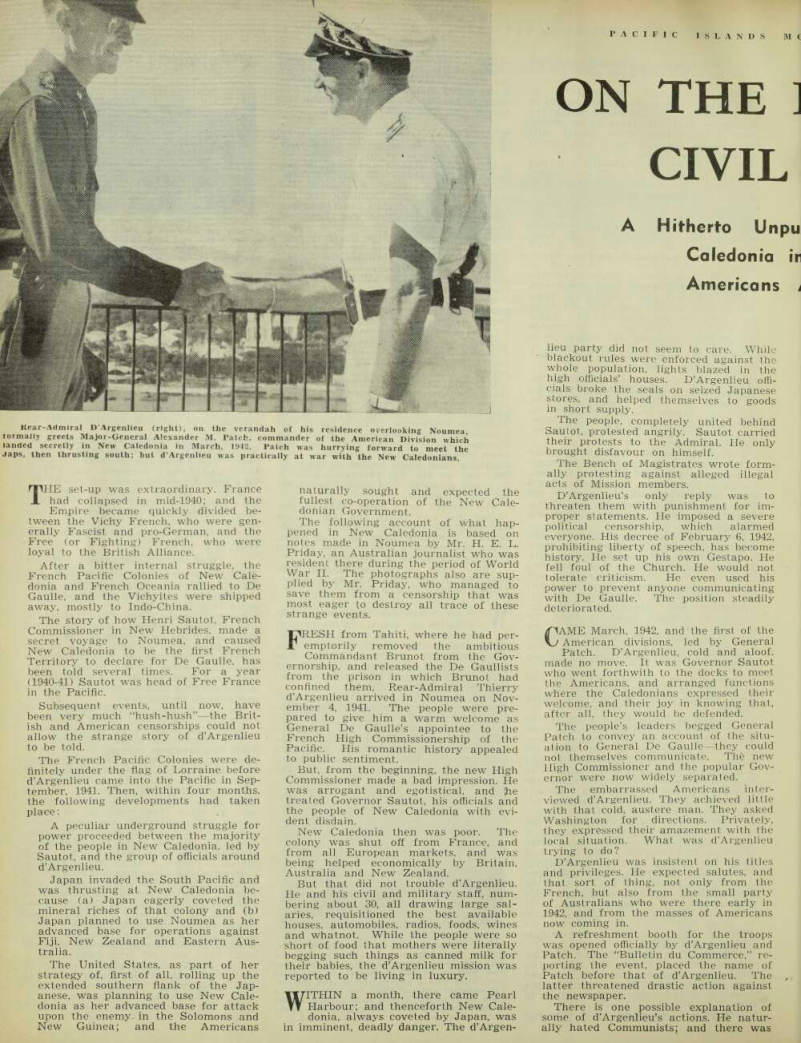
Kear-Admiral D'Argenlieu (right), on the verandah of his residence overlooking Noumea, formally greets Major-General Alexander M. Patch, commander of the American Division which landed secretly in New Caledonia in March, 1042. Patch was hurrying forward to meet the Japs, then thrusting south; but d’Argenlieu was practically at war with the New Caledonians.
(and still is) a busy and dangerous little cell of Communism in New Caledonia.
These Reds, of course, were against the pro-Fascist * Vichy French, and this brought them into alliance with the Fighting French grouped under Gover nor Sautot. If d’Argenlieu could see the tail wagging the dog—the Communists dominating the Fighting French com munity of New Caledonia much of what he did might be justified.
IN April, d’Argenlieu turned on Sautot —evidently he was tired of the jovial Governor’s frequent protests, made in the name of the Caledonians. He made representations to de Gaulle, and Gov ernor Sautot was requested to present himself in London, for appointment else where.
Immediately the whole Colony was in uproar. Messages from all sections of the people poured into Government House, beseeching Sautot to remain. They said they hated and feared d’Argenlieu —Sau tot was their only protection against his
dictatorship.
Sautot, at first ready to depart, list ened to the clamour and the pleas of the people, and announced that he would not go. He cabled to de Gaulle, appealing for reconsideration of the order. He was warmly supported by various public leaders, notably Dubois, Berges, Moule dous, Pognon, Rapadzi and Solier. They went as a deputation to General Patch and begged help.
It was now late in April, 1942. The American staff and the British Intelli gence officials in Noumea sent a long message to General de Gaulle.
Mouledous and Berges on May 4 went to see d’Argenlieu. and begged him to withdraw his Mission from New Cale donia and allow Sautot to remain—other wise they feared public disorder.
In this interview, d’Argenlieu admitted that his methods had perhaps savoured of dictatorship. He said he would go per sonally to London and explain the mis takes that had been made. But, he added,, he would leave only with the full honours of his rank and position.
M. Berges promised he would get full honours and all respect.
Next day, May 5, was the anniversary of the departure from Noumea of the famous Pacific Battalion, which had just suffered so severely at Bir Hakkim, in North Africa. The people were invited to honour their contingent and its dead by attending an anniversary Mass, at the Cathedral. Before a large assemblage, d’Argenlieu went up to Sautot and shook him warmly by the hand. This was accepted as a gesture of peace.
nnHAT afternoon, Berges and Mouledous X received, by messenger, an invitation to call on d’Argenlieu at his resi dence at 4 p.m. Pognon and Solier were separately asked to call upon d’Argenlieu at his office.
Berges and Mouledous arrrived at 4 p.m. and were shown into a room where the Director of d’Argenlieu’s Civil Cab inet, M. Antier, was waiting. Antier in formed them, to their amazement, that they were to be sent away from New Caledonia for some time. They were placed under arrest and taken in a car to a small cruiser, the “Chev reuil.” They were not allowed to get any baggage, or communicate with any one. They had only the clothes they were wearing.
Pognon and Solier were treated simi larly. In the Admiral’s office they found, awaiting them, the Chief of Police, M.
Porcher. He placed them under arrest and took them to the cruiser.
A Noumea citizen, M. Audrain, was standing near the docks when the cars came along with the four civilian leaders under guard. He sensed something wrong, and hastened to Captain Dubois.
The latter knew how tense was the gen eral situation. He also knew that Pog non and Solier had been summoned to an interview with d’Argenlieu. He went immediately to Government House.
There, he learned that about 4 p.m. the Admiral’s military chief, Captain Cabanier, arrrived at Government House with an armed guard, and had gone dir ectly to Sautot’s office, and said:
“I have orders to send you on hoard the ‘Chevreuil.’ You will be allowed two hours in which to pack.”
The armed men remained until Sautot packed a couple of suitcases, and made various dispositions, and then they took him away.
Dubois hurried away. Already the news was spreading. A crowd was assem bling outside Government House and murmuring angrily. They said that if their Governor really had been arrested, they would storm the place and rescue him.
But, even as they were assembling, a message came from d’Argenlieu, giving orders to Captain Haas, in charge of the French troops on guard, to fire on the crowd if there was any disorder.
Outside the Hotel Pacifique (United States Headquarters) Dubois met Col onel Moore, of General Patch’s staff.
Moore had just heard the news and was much disturbed.
Just then, General Patch arrived. He, also, was disturbed by the news. But he was there to fight Japs, and not to interfere in Frenqh political disputes; and he proceeded with caution.
But he took one step which, report says, made d’Argenlieu exceedingly angry.
There was no doubt that d’Argenlieu would have liked also to have arrested Captain Dubois, Sautot’s most trusted adviser. Dubois, head of the survey ser vice, knew New Caledonia intimately, and had been of great help to Patch, who was working day and night building up defences. He was not going to lose Dubois. A member of his staff telephoned d’Argenlieu’s military staff to advise that Captain Dubois had been appointed to the staff of the United States Army.
Captain Dubois was sent home and a guard placed around his house. It was needed—to save him from his friends.
They came in scores to cheer him for the stand he was taking against d’Argen lieu.
Alarm was spreading through the civil population. The relations of the four arrested “hostages” were seeking hysteri cally for news of their men.
That evening, over Noumea radio, d’Argenlieu gave an “address to the people.” He said that Sautot had agreed to leave of his own free will; and he had
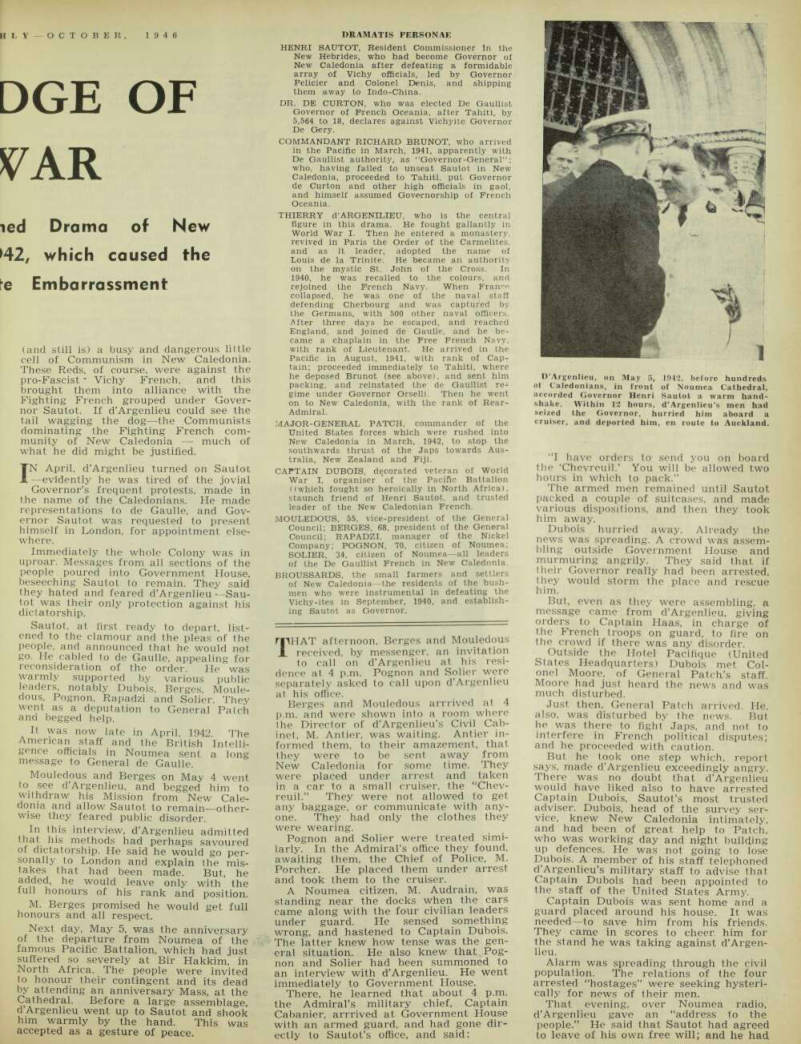
D’Argenlieu. on May 5, 1942, before hundreds of Caledonians, in front of Noumea Cathedral, accorded Governor Henri Sautot a warm hand shake. Within 12 hours, d’Argenlieu’s men had seized the Governor, hurried him aboard a cruiser, and deported him, en route to Auckland.
also arrested certain people whom he described as Fifth Columnists, working against the interests of Free. France.
This announcement aroused the civi lians of Noumea to fury. They knew that Sautot had not departed willingly; and that the four missing men, who had been foremost in deposing the Vichyites in September, 1940, were anything but Fifth Columnists.
May 5, 1942, which had opened with a cordial handshake between d’Argenlieu and Sautot at the Cathedral, ended with Sautot and the people’s leaders impris oned on the cruiser, and the civil popu lation on the edge of revolt.
WEDNESDAY, May 6, 1942, was the most troubled day New Caledonia ever knew —September 19, 1940, not excepted.
There was a general strike. Shops and business houses, administration and public offices, schools—all were closed.
The people gathered on the Place des Cocotiers, before the Town Hall. Here speeches were made, and here gathered the processions which all that week par aded the town demonstrating against d’Argenlieu The citizens formed a committee, headed by Mayor Massoubre, Deputy Mayor Dalmeyrac, Numa Engler (presi dent of the veteran soldiers) Bourdinat (lawyer). Mercier and other leading citi zens. They prepared demands upon d’Argenlieu—and the first was the prompt return of the "hostages.”
At this juncture, an important service was performed by Post Office officials — the men who, in the September, 1940, crisis, defeated the Vichyites by cutting their communications and calling in the Broussards (bush farmers) from all over the Colony. They repeated these tactics.
D’Argenlieu’s communications were cut off by general strike; but the Post Office men got their own messages to all parts of the country, apprising the country folk of what was happening.
In a few hours, the Broussards were moving in on the capital. As the husky countrymen arrived, they placed them selves at the disposals of the Citizens’
Committee.
D’Argenlieu ordered the native troops, commanded by French officers, to picket the streets. The police also were out in full force. But there were friendly rela tions between them all —the uniformed men were not likely to fire on the people.
ON Wednesday morning (May 6), the people marched through the town.
The procession stopped outside US Headquarters and cheered. They cheered again when General Patch came out and spoke to them —and again cheered when he said, with grim humour, that he was happy to see that the French and Ameri cans were again fighting alongside each other.
Just then, unfortunately, d’Argenlieu came along, driven by a chauffeur in one of the requisitioned cars. The cheers turned immediately to hoots —and they threw stones at the car, and spat at it.
The car disappeared in a cloud of dust.
That Wednesday afternoon, represen tatives of the Committee saw d’Argenlieu and demanded that the hostages be re turned, and that the Mission should de part.
The Admiral said that the Mission would depart; but he would not return the hostages until the population re turned to orderliness.
The deputation said there was little hope of orderliness until the Mission had departed. It was a deadlock.
Thursday saw a continuance of the strike, more public demonstrations. The most dramatic event occurred just after dark on Thursday, May 7.
ONE of d’Argenlieu’s staff, Lieutenant Cabanier, went along to the Noumea Radio Station to speak to the people.
But the citizens assembled quickly and invaded the station, seized Cabanier, and took away his revolver.
Meanwhile, Maurice Mercier went to the microphone.
“Caledonians, aux armes,” he cried.
“L’amiral vous trompe. C’est un menteur. Nos libertes sont en danger.” (Caledonians, to arms! The Admiral lies to you. He is deceiving you. Your liberties are in danger.) These words, heard throughout New Caledonia and the New Hebrides, did nothing to lessen the tension.
Meanwhile, under d’Argenlieu’s orders, native troops under Lieutenant Haas, marched to the radio station and lined up along the Rue Sebastopol, facing the crowd. An order was given; women screamed “They’re going to shoot”; and pandemonium broke loose.
There were many Boussards there.
They began to call out to the native soldiers in their own dialects; “Don’t fire. Don’t harm your fellow Caledonians. You are Caledonians, the same as us.”
Soon, citizens and native soldiers were fraternising. The Broussards came forward and seized and placed under arrest Lieutenant Haas and two or three other officers. There were many savage scuffles.
The officers were taken away to Magenta and kept captive. It evidently was the idea of the people that the Mission officers should be held until the “host- WOTO roturnod.
That was the most dangerous moment of a dangerous week. If the native troops had fired, the- Americans —who were con scientiously trying to keep out of this local row—would have had to quell a civil war.
MEANWHILE, what of Governor Sau tot and the four hostages? A party of Tirailleurs (native troops) were on the cruiser when the hostages arrived.
The deposed Governor Sautot came next.
They were left in no doubt of their fate —the cruiser left the harbour that night of Tuesday (May 5). But the following morning they came back and lay behind He Amedee (where the lighthouse is).
On Thursday morning the cruiser de parted direct for Walpole Island—which is an ugly, barren heap of guano, 140 miles away. Evidently the commander was in closest radio touch with d’Argen lieu.
When off the south-east of New Cale donia, a radio message was received saying that a Jap submarine was attack ing a small Greek ship, only 20 miles from the lighthouse. The Frenchmen wanted to go instantly to the ship’s assistance. But orders came from Noumea that the cruiser must at once go on to Walpole, and the Gfieek ship was left to her fate. She was sunk, of course.
Three Allied navies the American, the Free French and the Australian — were much upset over this unhappy in cident.
(Continued on Page 55)
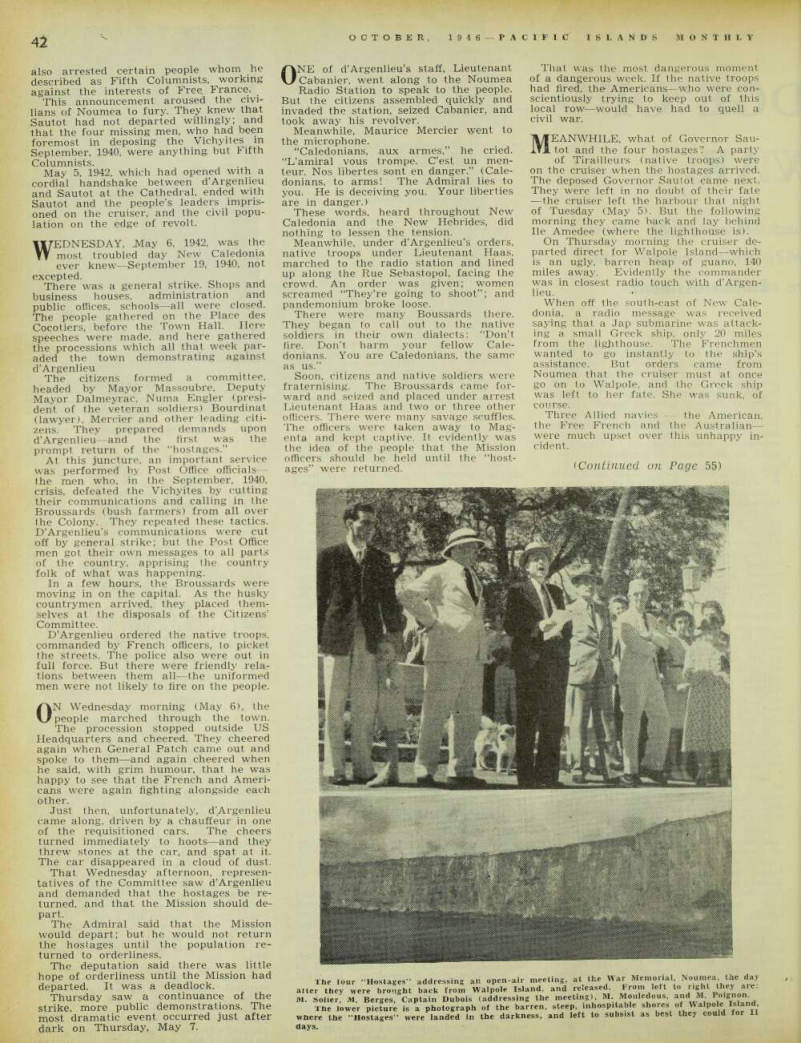
The tour “Hostages” addressing an open-air meeting, at the War Memorial Noumea, the day alter they were brought back from Walpole Island, and released. From left to th ey are: M. Solier, M. Berges, Captain Dubois (addressing the meeting), M. Mouledous, and M. Poignon.
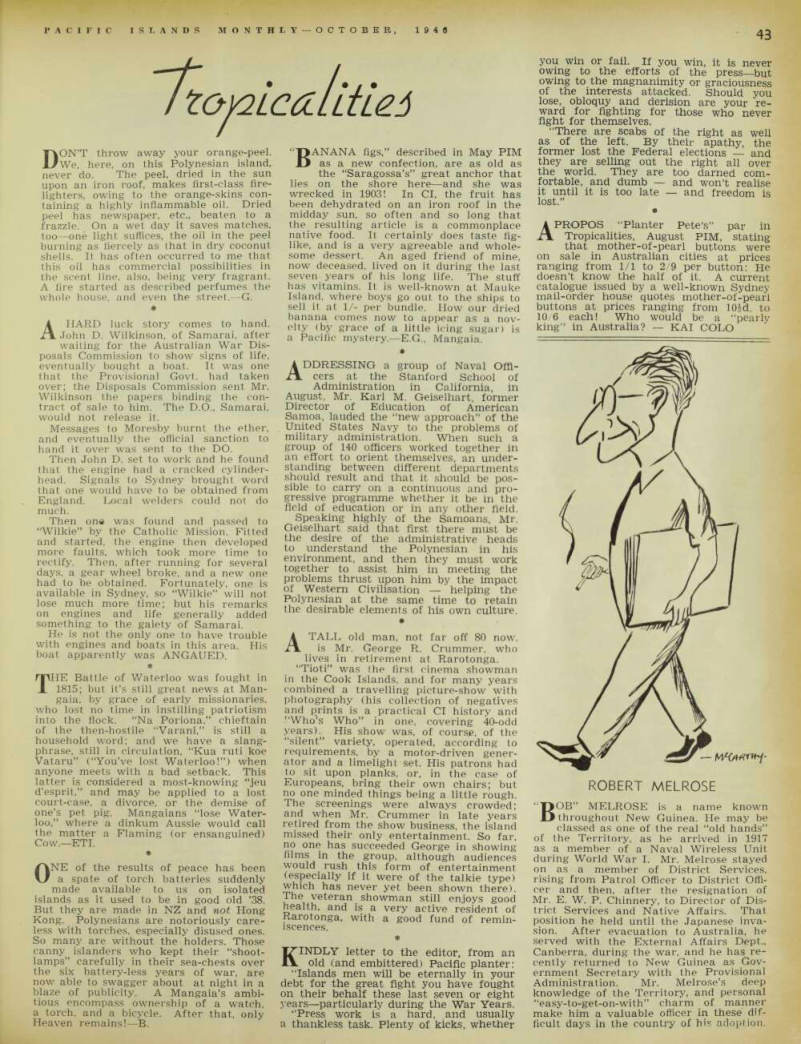
The lower picture is a photograph of the barren, steep, inhospitable shores of Walpole Island, where the "Hostages” were landed in the darkness, and left to subsist as best they could for 11 days.
The cruiser arrived off Walpole Island’s bare, ugly, inhospitable shore at dusk. There is no place for ships. The four hostages were put into a boat; and, from the boat, they had to crawl along a plank, above a rough sea, to the shore.
They straddled the plank and ipulled themselves along by their hands—Pog non, aged *l2; Berges, 68; Mouledods (now dead) 55, and Soliej, a young mag istrate recently from Paris, in his 30’s.
Sautot, from the Chevreuil’s deck, watched his friends disappear—they had not a bit of baggage or food among them, and they did not know what fate held for them. The cruiser then set off for Auckland. It was a sad moment for popular Henri Sautot.
The four men, now in darkness, fol lowed the Tirailleurs up a steep, rocky pathway to the euano plateau, 250 feet above the sea. TJtterly exhausted, they were thrust into the old barracks of the coolie guano-workers, and given sacks filled with straw to sleep on. They were eleven days on that island, fed on canned food from the guano workers’ store.
BACK in Noumea, the position re mained tense. Some public services were restored, but there was constant danger of a clash between the angry civilians and the forces under the con trol of the Mission. With Sautot’s de parture, the administrative machinery now was under the direct control of High Commissioner d’Argenlieu.
Just why d’Argenlieu left Noumea is not clear—probably it was at the insti
gation of the embarrassed Americans.
United States armed forces, preparing for the attack upon the Japanese in the Solomons in -early August, were now pouring into New Caledonia, and the American commanders had no time to waste on NC politics.
Rear Admiral d’Argenlieu arrived by car at the Hotel Banuelos, in La Foa, some 40 miles out of Noumea. La Foa was the home town of Berges, one of the missing “hostages.”
The angry people of La Foa gathered, and a meeting was held. Then a depu tation approached the Admiral. M. Banu, the hotelkeeper, said: “Admiral, I arrest you in the name of the people of La Foa.”
The High Commissioner was then taken charge of by the Home Guard, and imprisoned in the same room, in the hotel annexe, which had housed Colonel Denis, when Sautot arrested him in Sep tember, 1940.
It probably was then that the Citizens’
Committee put up their ultimatum to d’Argenlieu. He was told that the host ages were to be immediately returned to their homes—or else!
D’Argenlieu informed them that that was impossible the hostages had been sent away.
There was some further discussion — and then “L’Amiral” (as he was gener ally known) was informed that he must return the hostages by noon on May 18.
The people would not wait a minute longer. They left no doubt in “L’Amiral’s” mind of what would happen if the men were not brought back.
D’Argenlieu was imprisoned by the indignant men of La Foa for only a short time. Details of this extraordinary in
cident are lacking; but there is no doubt that he was released within 24 hours.
He went on to a country house, in the mountains, and remained there for some days.
THE “Chevreuil” evidently received her orders. On her way back from Auck land, after landing Sautot (who went thence directly to London) she called at Walpole Island, picked up the four men, and landed them in the night of May 17, at Artillery Point, where Mission cars picked them up and took them to their homes.
Next day, a large public meeting was addressed by Captain Dubois and the four “hostages”; and a radiogram was sent to De Gaulle, asking again, and more urgently, for the recall of the d’Argenlieu Mission. Following an ex change of radiograms, it was decided that the Mission should depart. Many of the officials left at the end of May .
D’Argenlieu departed two months later, after spending some time in Aus tralia and New Hebrides.
THERE is little doubt that there would have been bloodshed on a num ber of occasions had it not been for the presence of the Americans, and the imminent danger of attack by the Japs. A man of d’Argenlieu’s tempera ment was the last who should have been sent to the South Pacific, where the people have freedom in the blood.
Back in London, d’Argenlieu remained in high favour with De Gaulle. He re tained his title of Rear-Admiral and (for some months) that of High Commissioner in the Pacific. He accompanied De Gaulle to the Casablanca Conference, and he was given command of the navy of Fighting France. An expedition which he led to Dakar was not successful. His mission to Canada, to change the opinions of the Vichy-minded French in Quebec, did not accomplish much. After peace came, he was sent out to be Gov ernor of French Indo-China; but he has not been successful there, and a recent report says he has returned to Europe.
Miss Lesley Miller, of the Secretariat staff of Suva, has left for Malaya, where she will be a Council reporter with the Government of the Malayan Union, at Kuala Lumpur.