To Sea in a Chinese Junk
p. 41 · Read in the full issue
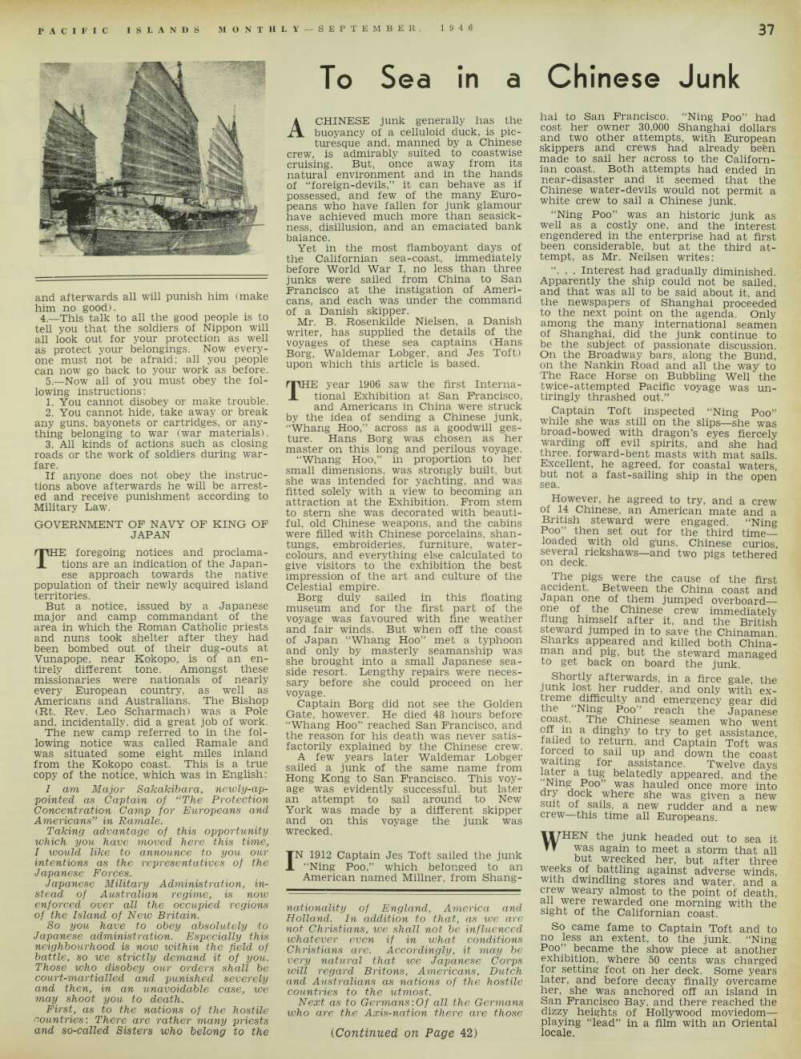
A CHINESE junk generally has the buoyancy of a celluloid duck, is pic turesque and, manned by a Chinese crew, is admirably suited to coastwise cruising. But, once away from its natural environment and in the hands of “foreign-devils,” it can behave as if possessed, and few of the many Euro peans who have fallen for junk glamour have achieved much more than seasick ness, disillusion, and an emaciated bank balance.
Yet in the most flamboyant days of the Californian sea-coast, immediately before World War I, no less than three junks were sailed from China to San Francisco at the instigation of Ameri cans, and each was under the command of a Danish skipper.
Mr. B. Rosenkilde Nielsen, a Danish writer, has supplied the details of the voyages of these sea captains (Hans Borg. Waldemar Lobger, and Jes Toft) upon which this article is based.
THE year 1906 saw the first Interna tional Exhibition at San Francisco, and Americans in China were struck by the idea of sending a Chinese junk, “Whang Hoo,” across as a goodwill ges ture. Hans Borg was chosen as her master on this long and perilous voyage.
“Whang Hoo,” in proportion to her small dimensions, was strongly built, but she was intended for yachting, and was fitted solely with a view to becoming an attraction at the Exhibition. From stem to stem she was decorated with beauti ful, old Chinese weapons, and the cabins were filled with Chinese porcelains, shan tungs, embroideries, furniture, water colours, and everything else calculated to give visitors to the exhibition the best impression of the art and culture of the Celestial empire.
Borg duly sailed in this floating museum and for the first part of the voyage was favoured with fine weather and fair winds. But when off the coast of Japan “Whang Hoo” met a typhoon and only by masterly seamanship was she brought into a small Japanese sea side resort. Lengthy repairs were neces sary before she could proceed on her voyage.
Captain Borg did not see the Golden Gate, however. He died 48 hours before "Whang Hoo” reached San Francisco, and the reason for his death was never satis factorily explained by the Chinese crew.
A few years later Waldemar Lobger sailed a junk of the same name from Hong Kong to San Francisco. This voy age was evidently successful, but later an attempt to sail around to New York was made by a different skipper and on this voyage the junk was wrecked.
IN 1912 Captain Jes Toft sailed the junk “Ning Poo,” which belonged to an American named Millner, from Shang
hai to San Francisco. “Ning Poo” had cost her owner 30,000 Shanghai dollars and two other attempts, with European skippers and crews had already been made to sail her across to the Californ ian coast. Both attempts had ended in near-disaster and it seemed that the Chinese water-devils would not permit a white crew to sail a Chinese junk.
“Ning Poo” was an historic junk as well as a costly one, and the interest engendered in the enterprise had at first been considerable, but at the third at tempt, as Mr. Neilsen writes: “. . . Interest had gradually diminished.
Apparently the ship could not be sailed, and that was all to be said about it, and the newspapers of Shanghai proceeded to the next point on the agenda. Only among the many international seamen of Shanghai, did the junk continue to be the subject of passionate discussion.
On the Broadway bars, along the Bund, on the Nankin Road and all the way to The Race Horse on Bubbling Well the twice-attempted Pacific voyage was un tiringly thrashed out.”
Captain Toft inspected “Ning Poo” while she was still on the slips—she was broad-bowed with dragon’s eyes fiercely warding off evil spirits, and she had three, forward-bent masts with mat sails.
Excellent, he agreed, for coastal waters, but not a fast-sailing ship in the open sea.
However, he agreed to try, and a crew of 14 Chinese, an American mate and a British steward were engaged. “Ning Poo” then set out for the third time loaded with old guns, Chinese curios, several rickshaws—and two pigs tethered on deck.
The pigs were the cause of the first accident. Between the China coast and Japan one of them jumped overboard— one of the Chinese crew immediately flung himself after it, and the British steward jumped in to save the Chinaman Sharks appeared and killed both China man and pig, but the steward managed to get back on board the junk.
Shortly afterwards, in a firce gale, the junk lost her rudder, and only with ex treme difficulty and emergency gear did the “Ning Poo” reach the Japanese coast. The Chinese seamen who went f dinghy to try to get assistance, failed to return, and Captain Toft was forced to sail up and down the coast waiting for assistance. Twelve days later a tug belatedly appeared, and the Ning Poo” was hauled once more into dry dock where she was given a new suit of sails, a new rudder and a new crew—this time all Europeans.
WHEN the junk headed out to sea it was again to meet a storm that all but wrecked her, but after three weeks of battling against adverse winds, with dwindling stores and water, and a crew weary almost to the point of death, all were rewarded one morning with the sight of the Californian coast.
So came fame to Captain Toft and to no less an extent, to the junk. “Ning Poo” became the show piece at another exhibition, where 50 cents was charged for setting foot on her deck. Some years later, and before decay finally overcame her, she was anchored off an island in San Francisco Bay. and there reached the dizzy heights of Hollywood moviedom — playing “lead” in a film with an Oriental locale.