Forbidding
pp. 42-44 · Read in the full issue
Paradise
The Kerm decs Have a Checker History
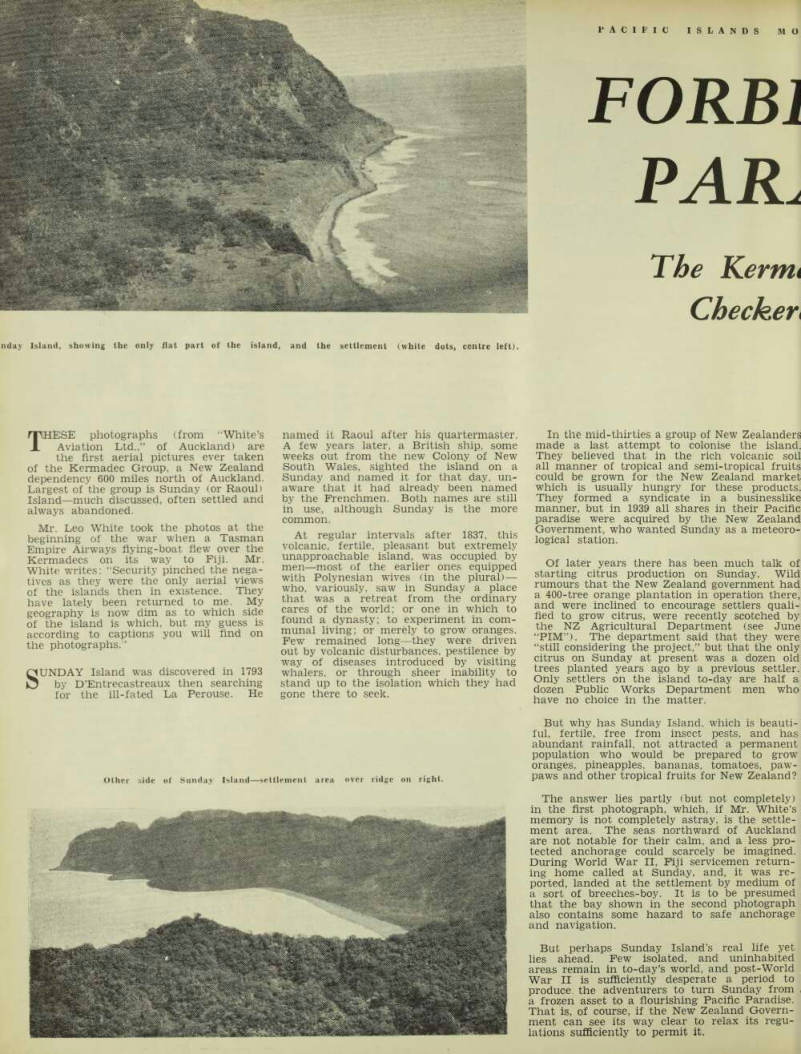
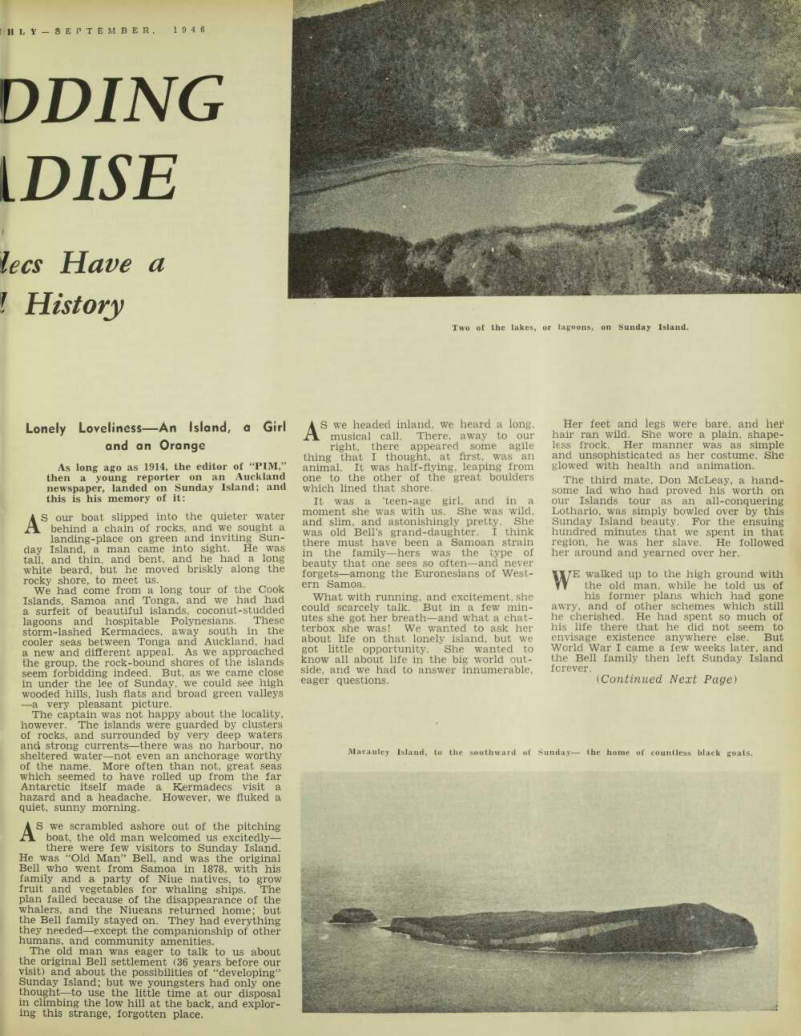
THESE photographs (from "White’s
Aviation Ltd.,” of Auckland) are the first aerial pictures ever taken of the Kermadec Group, a New Zealand dependency 600 miles north of Auckland.
Largest of the group is Sunday (or Raoul) Island—much discussed, often settled and always abandoned.
Mr. Leo White took the photos at the beginning of the war when a Tasman Empire Airways flying-boat flew over the Kermadecs on its way to Fiji. Mr.
White writes; “Security pinched the nega tives as they were the only aerial views of the islands then in existence. They have lately been returned to me. My geography is now dim as to which side of the island is which, but my guess is according to captions you will find on the photographs. ’
SUNDAY Island was discovered in 1793 by D’Entrecastreaux then searching for the ill-fated La Perouse. He
named it Raoul after his quartermaster.
A few years later, a British ship, some weeks out from the new Colony of New South Wales, sighted the island on a Sunday and named it for that day, un aware that it had already been named by the Frenchmen. Both names are still in use, although Sunday is the more common.
At regular intervals after 1837, this volcanic, fertile, pleasant but extremely unapproachable island, was occupied by men—most of the earlier ones equipped with Polynesian wives (in the plural)— who, variously, saw in Sunday a place that was a retreat from the ordinary cares of the world; or one in which to found a dynasty; to experiment in com munal living; or merely to grow oranges.
Few remained long—they were driven out by volcanic disturbances, pestilence by way of diseases introduced by visiting whalers, or through sheer inability to stand up to the isolation which they had gone there to seek.
In the mid-thirties a group of New Zealanders made a last attempt to colonise the island.
They believed that in the rich volcanic soil all manner of tropical and semi-tropical fruits could be grown for the New Zealand market which is usually hungry for these products.
They formed a syndicate in a businesslike manner, but in 1939 all shares in their Pacific paradise were acquired by the New Zealand Government, who wanted Sunday as a meteoro logical station.
Of later years there has been much talk of starting citrus production on Sunday. Wild rumours that the New Zealand government had a 400-tree orange plantation in operation there, and were inclined to encourage settlers quali fied to grow citrus, were recently scotched by the NZ Agricultural Department (see June “PIM”). The department said that they were “still considering the project,” but that the only citrus on Sunday at present was a dozen old trees planted years ago by a previous settler.
Only settlers on the island to-day are half a dozen Public Works Department men who have no choice in the matter.
But why has Sunday Island, which is beauti ful, fertile, free from insect pests, and has abundant rainfall, not attracted a permanent population who would be prepared to grow oranges, pineapples, bananas, tomatoes, paw paws and other tropical fruits for New Zealand?
The answer lies partly (but not completely) in the first photograph, which, if Mr. White’s memory is not completely astray, is the settle ment area. The seas northward of Auckland are not notable for their calm, and a less pro tected anchorage could scarcely be imagined.
During World War 11, Fiji servicemen return ing home called at Sunday, and, it was re ported, landed at the settlement by medium of a sort of breeches-boy. It is to be presumed that the bay shown in the second photograph also contains some hazard to safe anchorage and navigation.
But perhaps Sunday Island’s real life yet lies ahead. Few isolated, and uninhabited areas remain in to-day’s world, and post-World War II is sufficiently desperate a period to produce, the adventurers to turn Sunday from , a frozen asset to a flourishing Pacific Paradise.
That is, of course, if the New Zealand Govern ment can see its way clear to relax its regu lations sufficiently to permit it.
[?]nday Island, showing the only flat part of the island, and the settlement (white dots, centre left).
Other side of Sunday Island—settlement area over ridge on right.
Lonely Loveliness —An Island, a Girl
and an Orange
As long ago as 1914, the editor of “PIM,” then a young reporter on an Auckland newspaper, landed on Sunday Island; and this is his memory of it: AS our boat slipped into the quieter water behind a chain of rocks, and we sought a landing-place on green and inviting Sun day Island, a man came into sight. He was tall, and thin, and bent, and he had a long white beard, but he moved briskly along the rocky shore, to meet us.
We had come from a long tour of the Cook Islands, Samoa and Tonga, and we had had a surfeit of beautiful islands, coconut-studded lagoons and hospitable Polynesians. These storm-lashed Kermadecs, away south in the cooler seas between Tonga and Auckland, had a new and different appeal. As we approached tTie group, the rock-bound shores of the islands seem forbidding indeed. But, as we came close in under the lee of Sunday, we could see high wooded hills, lush flats and broad green valleys —a very pleasant picture.
The captain was not happy about the locality, however. The islands were guarded by clusters of rocks, and surrounded by very deep waters and strong currents —there was no harbour, no sheltered water —not even an anchorage worthy of the name. More often than not, great seas which seemed to have rolled up from the far Antarctic itself made a Kermadecs visit a hazard and a headache. However, we fluked a quiet, sunny morning.
AS we scrambled ashore out of the pitching boat, the old man welcomed us excitedly— there were few visitors to Sunday Island.
He was “Old Man” Bell, and was the original Bell who went from Samoa in 1878, with his family and a party of Niue natives, to grow fruit and vegetables for whaling ships. The plan failed because of the disappearance of the whalers, and the Niueans returned home; but the Bell family stayed on. They had everything they needed —except the companionship of other humans, and community amenities.
The old man was eager to talk to us about the original Bell settlement (36 years before our visit) and about the possibilities of “developing”
Sunday Island; but we youngsters had only one thought—to use the little time at our disposal in climbing the low hill at the back, and explor ing this strange, forgotten place.
AS we headed inland, we heard a long, musical call. There, away to our right, there appeared some agile thing that I thought, at first, was an animal. It was half-flying, leaping from one to the other of the great boulders which lined that shore.
It was a ’teen-age girl, and in a moment she was with us. She was wild, and slim, and astonishingly pretty. She was old Bell’s grand-daughter. I think there must have been a Samoan strain in the family—hers was the type of beauty that one sees so often —and never forgets—among the Euronesians of West ern Samoa.
What with running, and excitement, she could scarcely talk. But in a few min utes she got her breath —and what a chat terbox she was! We wanted to ask her about life on that lonely island, but we got little opportunity. She wanted to know all about life in the big world out side, and we had to answer innumerable, eager questions.
Her feet and legs were bare, and her hair ran wild. She wore a plain, shape less frock. Her manner was as simple and unsophisticated as her costume. She glowed with health and animation.
The third mate, Don McLeay, a hand some lad who had proved his worth on our Islands tour as an all-conquering Lothario, was simply bowled over by this Sunday Island beauty. For the ensuing hundred minutes that we spent in that region, he was her slave. He followed her around and yearned over her.
WE walked up to the high ground with the old man. while he told us of his former plans which had gone awry, and of other schemes which still he cherished. He had spent so much of his life there that he did not seem to envisage existence anywhere else. But World War I came a few weeks later, and the Bell family then left Sunday Island forever, (Continued Next Page )
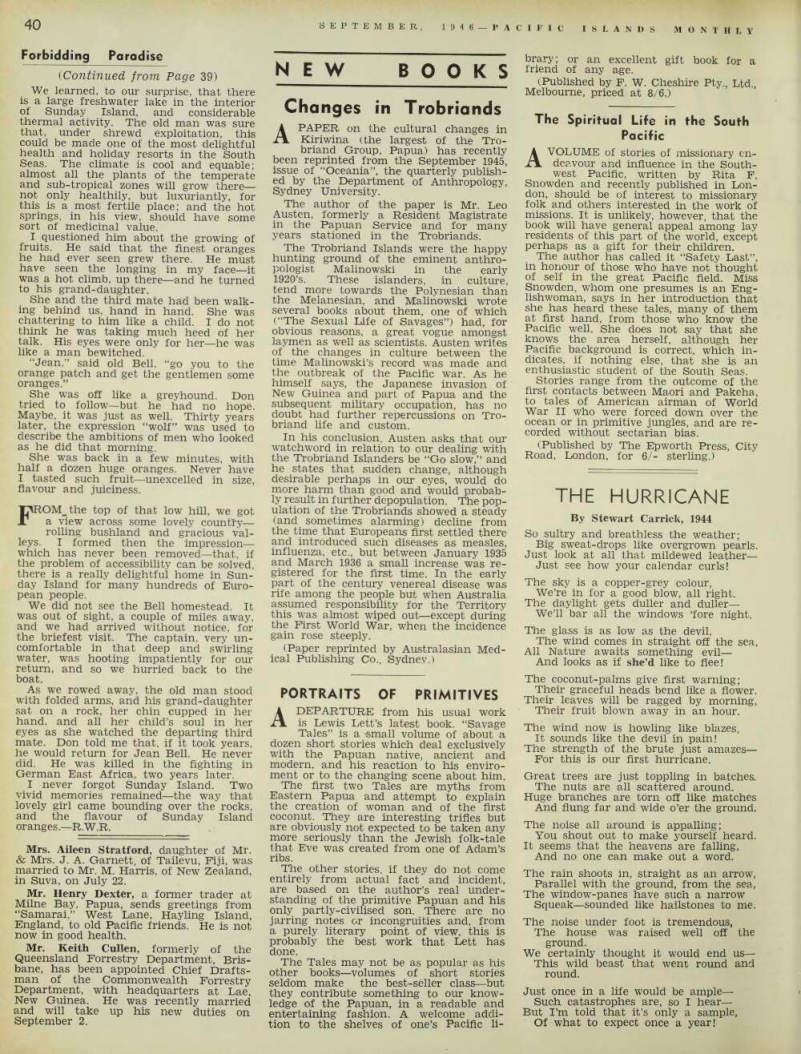
Two of the lakes, or lagoons, on Sunday Island.
Macauley Island, to the southward of Sunday—the home of countless black goats.
We learned, to our surprise, that there is a large freshwater lake in the interior of Sunday Island, and considerable thermal activity. The old man was sure that, under shrewd exploitation, this could be made one of the most delightful health and holiday resorts in the South Seas. The climate is cool and equable; almost all the plants of the temperate and sub-tropical zones will grow there— not only healthily, but luxuriantly, for this is a most fertile place; and the hot springs, in his view, should have some sort of medicinal value.
I questioned him about the growing of fruits. He said that the finest oranges he had ever seen grew there. He must have seen the longing in my face—it was a hot climb, up there—and he turned to his grand-daughter.
She and the third mate had been walk ing behind us, hand in hand. She was chattering to him like a child. I do not think he was taking much heed of her talk. His eyes were only for her—he was like a man bewitched.
“Jean,” said old Bell, “go you to the orange patch and get the gentlemen some oranges.”
She was off like a greyhound. Don tried to follow—but he had no hope.
Maybe, it was just as well. Thirty years later, the expression “wolf” was used to describe the ambitions of men who looked as he did that morning.
She was back in a few minutes, with half a dozen huge oranges. Never have I tasted such fruit—unexcelled in size, flavour and juiciness. rOM_the top of that low hill, we got a view across some lovely country— rolling bushland and gracious val leys. I formed then the impression— which has never been removed—that, if the problem of accessibility can be solved, there is a really delightful home in Sun day Island for many hundreds of Euro pean people.
We did not see the Bell homestead. It was out of sight, a couple of miles away, and we had arrived without notice, for the briefest visit. The captain, very un comfortable in that deep and swirling water, was hooting impatiently for our return, and so we hurried back to the boat.
As we rowed away, the old man stood with folded arms, and his grand-daughter sat on a rock, her chin cupped in her hand, and all her child’s soul in her eyes as she watched the departing third mate. Don told me that, if it took years, he would return for Jean Bell. He never did. He was killed in the fighting in German East Africa, two years later.
I never forgot Sunday Island. Two vivid memories remained—the way that lovely girl came bounding over the rocks, and the flavour of Sunday Island oranges.—R.W.R.
Mrs. Aileen Stratford, daughter of Mr. & Mrs. J. A. Garnett, of Tailevu, Fiji, was married to Mr. M. Harris, of New Zealand, in Suva, on July 22.
Mr. Henry Dexter, a former trader at Milne Bay, Papua, sends greetings from “Samarai,” West Lane, Hayling Island, England, to old Pacific friends. He is not now in good health.
Mr. Keith Cullen, formerly of the Queensland Forrestry Department, Bris bane, has been appointed Chief Drafts man of the Commonwealth Forrestry Department, with headquarters at Lae, New Guinea. He was recently married and will take up his new duties on September 2.