When The Jap Was The Victor Of Rabaul
pp. 40-46 · Read in the full issue
Copies of The Proclamations of 1942
By Gordon Thomas
Only four civilians, captured by the Japanese in 1942, were rescued from Rabaul when our troops took over in September, 1945, and Mr. Thomas was one of them. In this article he re leases, for the first time, proclama tions issued by the Japanese in Rabaul shortly after they captured the town on January 23, 1942.
WAR souvenirs did not particularly in terest me during my 31 years’ im prisonment in Rabaul. The best souvenir I could bring out with me was my head, safely on my shoulders.
But I did manage to collect some Japanese proclamations, issued at the heieht of their victorious southward push when —to them—it was merely a matter of a week or so before they would be looting the shops in Sydney, and billet ing themselves in the homes in Mel bourne.
The first two proclamations were issued to the natives of Rabaul. and were printed at the local printing office in the Blanche Bay dialect. Here are rough translations:
Proclamaton
A Talk To The People Of
New Britain
This is a paper to read in order that you may know the Japanese Army is now established on the island of New Britain.
The wish of the Big King of Japan (also called the Emperor) is this. To rescue the people of Asia from the bad actions of the British Empire, America and Holland because they have strong prosecutions in the Pacific Ocean.
Also it is the desire of Japan that Japan shall lead the people of Asia all together along a road of prosperity, so that all the people may progress and work towards the day when a new order stands in the whole world.
The aim of the Japanese Army is to bring many good things to you, the people here; therefore it is necesary that you should believe the Japanese Army and obey them also.
Now, regarding those who remain quiet and of good behaviour the Japanese Army will protect them and protect their prop erty also.. Therefore, it is necessary that you will remain quiet and each of you carry on with your work.
And if anyone attempts to commit any evil act towards the Japanese Army, or to cause unrest amongst the people, he will be tried and executed.
This paper is written in Rabaul on 23rd day of January in the Japanese year 2602.
And is signed by
Chief Of The Japanese Army.
This is the second proclamation, made about the same time:
Notice
The soldiers of Japan (called the Japanese Army) have arrived here in order to improve your conditions. We have seen how the English and American people have exploited you in every way.
They have also decreed that the Japanese should not live in any of their countries.
The English people (they are also called the British Empire) and the American people (they are called the United States of America) are anxious that the people of Asia and the many people near Asia do not progress.
The Japanese Army are only fighting the English and the Americans. We are your friends and protectors. You must
King bolong Nippon i salim monovo na ol soldia bolong em i kam long dispela peles bolong iupala lang pasin nogut ol mekim long iupala. 2. —Ol Nevi (Man bolong monovo bo long Nippon) ol kisim pinis olgeta peles bolong iupala nau. Govmen bolong Nevi. 3. —Olgeta man bolong dispala peles i mas harim tok. Sapos iupala i lukim ol opesa, na ol soldia olsem ol gard tu, i mas sanap siteret na tikua hat na daunim het. Sapos i no makim des nala nasin i olsem i get koros, na bam bai ol i makem em olsem man i nogut. 4. Tok long iu fala ol gut fala man, ol Soldia bolong Nippon ol i lukaut gut long sikin bolong iupala na olgeta samting tu bolong iupala. No iupala i no mo oeret, iuoala na olgeta i ken go bek long ol wok bolong iupala olsem bifo. 5. —Nau olgeta dis pela tok i raitim daun iupala i mas harim tok long em. 1. Noken sakim tok na nekim pasin nogut. 2. Nokem haitim na tikua na burukim ol masket, Bainat. Katres na ol samting bolong pait. 3. Ol kain pasin long pasim rot na wok bolong soldia long bait bolong 01.
Usat i no harim na bianim ol dispela tok i raitim antap, baimbai oli olim pas na mekim em save long lo bolong ol man bolong pait.
Govamen Bolong Nevi Bolong
King Bolong Nippon.
Translated, it reads:
Talk To Everybody
In The Japanese Period-2602
1. —Tenno Heika (the name of the great King of Nippon) is the great man of all places belonging to Nippon; and he has good thoughts and is very sorry for all of you in this place on account of the actions of the English and the Ameri cans. Now the King of Nippon has sent his men-of-war and his soldiers to this place of yours on account of the bad actions which have been made against you. 2. —All the Navy (men from the men of-war of Nippon) have now occupied all your places. The government is of the Navy. 3. —Everyone in this place must hear this talk: If anyone sees an officer or a soldier, or even a guard, everyone must stand up straight and remove your hat and bow down the head. If anyone does not take this action it will cause trouble,
not be afraid of the Japanese; you must help its now in order that your conditions may be improved quickly. You must believe in the Japanese and must follow all the regulations they write in this paper. If you disregard our laws, or if it is disclosed you do evil things to us you will be punished. 1. —This island no longer belongs to the King of England. You people here must now rise to a new prosperity; and you must place the flag of Japan on your buildings. 2. —lf you see any White people, or if you see any property of the soldiers, you must tell the Japanese Army about it. 3. —The Japanese Army will not in terfere with your safety nor steal any of your property. So it is advisable for you to return to your houses and do not run away again. 4. —You must believe the Japanese Army and do not listen to foolish rumours. 5. —You will accept our money as being true, and will sell to us what we require. 6. —You will show your delight in us by saluting the Japanese soldiers who are protecting you on this island. 7. —Those who think that these days of unrest are an opportunity to steed, or do wrong to anyone, or to increase the prices of articles or to do anything which is not correct, then the Japanese Army will punish them severely.
Rahaid. 23 rd January, 1942.
Chief Of Japanese Army.
THEN followed an order, put out by a duplicating machine, in the Pidgin- English language of the Islands. The Pidgin itself holds an interest owing to its phonetic spelling. It reads:
Toktok Long Olgeta Man
Long Taim Belong Nippon—26O2
I.—Tenno Heika (naim bolong bik pala King bolong Nippon) em i bikpala bolong olgeta peles bolong Japan, em i gat gut pela tingting na i sori tumas long iupala olgeta long dispela peles long ol pasin bolong ol Inglis na ol Amerika; na em
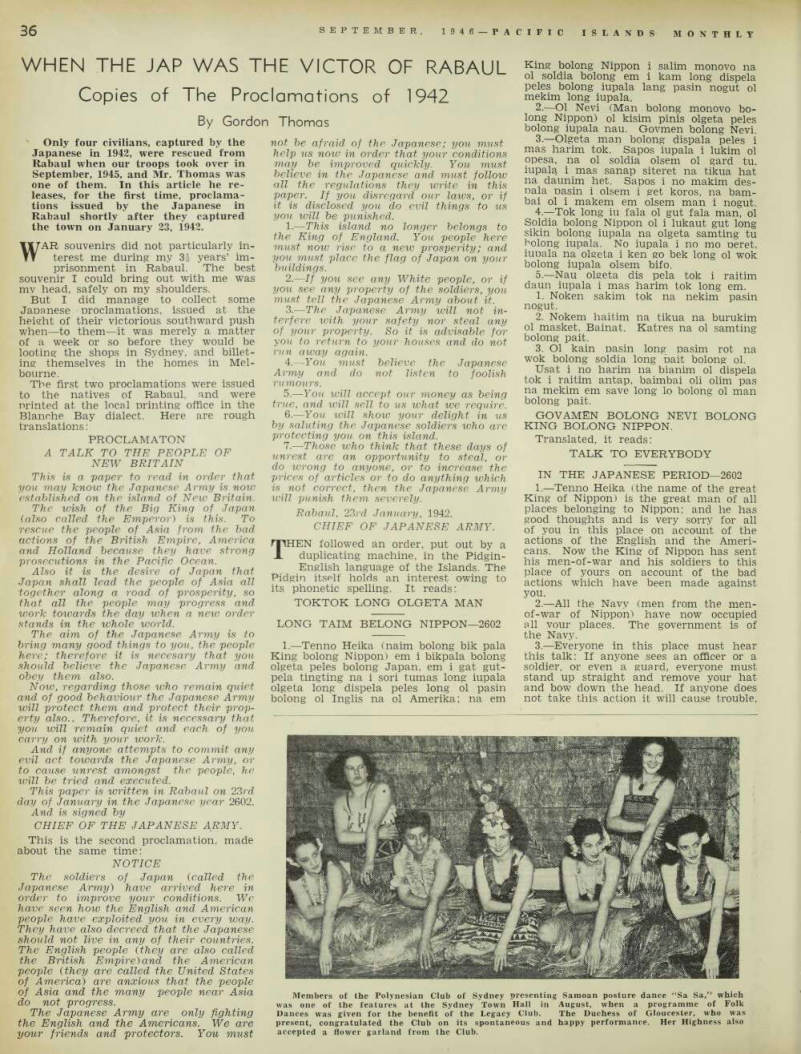
Members of the Polynesian Club of Sydney presenting Samoan posture dance “Sa Sa,” which was one of the features at the Sydney Town Hall in August, when a programme of Folk Dances was given for the benefit of the Legacy Club. The Duchess of Gloucester, who was present, congratulated the Club on its spontaneous and happy performance. Her Highness also accepted a flower garland from the Club.
and afterwards all will punish him (make him no good). 4.—This talk to all the good people is to tell you that the soldiers of Nippon will all look out for your protection as well as protect your belongings. Now every one must not be afraid: all you people can now go back to your work as before. s.—Now all of you must obey the fol lowing Instructions: 1. You cannot disobey or make trouble. 2. You cannot hide, take away or break any guns, bayonets or cartridges, or any thing belonging to war (war materials). 3. All kinds of actions such as closing roads or the work of soldiers during war fare.
If anyone does not obey the instruc tions above afterwards he will be arrest ed and receive punishment according to Military Law.
Government Of Navy Of King Of
Japan
rE foregoing notices and proclama tions are an indication of the Japan ese approach towards the native population of their newly acquired island territories.
But a notice, issued by a Japanese major and camp commandant of the area in which the Roman Catholic priests and nuns took shelter after they had been bombed out of their dug-outs at Vunapope, near Kokopo, is of an en tirely different tone. Amongst these missionaries were nationals of nearly every European country, as well as Americans and Australians. The Bishop (Rt. Rev. Leo Scharmach) was a Pole and, incidentally, did a great job of work.
The new camp referred to in the fol lowing notice was called Ramale and was situated some eight miles inland from the Kokopo coast. This is a true copy of the notice, which was in English: I am Major Sakakibara, newly-ap pointed as Captain of “The Protection Concentration Camp for Europeans and Americans” in Ramale.
Taking advantage of this opportunity which you have moved here this time, I would like to announce to you our intentions as the representatives of the Japanese Forces.
Japanese Military Administration, in stead of Australian regime, is now enforced over all the occupied regions of the Island of New Britain.
So you have to obey absolutely to Japanese administration. Especially this neighbourhood is now within the field of battle, so we strictly demand it of you.
Those who disobey our orders shall be court-martialled and punished severely and then, in an unavoidable case, we may shoot you to death.
First, as to the nations of the hostile countries: There are rather many priests and so-called Sisters who belong to the
nationality of England, America and Holland. In addition to that, as we are not Christians, we shall not be influenced whatever even if in what conditions Christians are. Accordingly, it may be very natural that we Japanese Corps will regard Britons, Americans, Dutch and Australians as nations of the hostile countries to the utmost.
Next as to Germans:Of all the Germans who are the Axis-nation there are those
(Continued on Page 42)
who have carried out hostile action against us, and who it is no exaggeration to say have clearly a hostile character.
So that, to confess the truth, we must pay attention for these men, hut we do not want to pay regard to past events in conformity with the faithfulness and consciousness to the Aids nation.
If one of you happen to carry out a hostile action in the future, we hope such things will never happen, we will not punish only the man, but also, as the faint responsibility, punish all of you in the name of “Mission.”
By reason of living together with the nations of the hostile countries, military authorities have concentrated Germans within this fence under the necessity of Military Operations.
And we will protect yourselves and escort you to the enemy in the necessary range.
Hereby it will be prohibited to go out of the fence and streams without any military permission.
Suppose there are those who go out of the fence and stream without any military permission, they shall be punished severely and those who run away in the same condition shall be shot.
However Japan originally loves justice and consciousness, and also is courteous on humanity.
So that, as long as there will be no
espionage activity, even if you are the anti-Axis nation, we will never treat you with such tortures as British and American, Australian Corps has dealt with the internees, our fellow-countrymen in their countries.
You must lead a life inside this limited boundary, but we shall give you freedom in the limit and guarantee your daily life in some range and supplement the minimum for your living materials, But as we are fighting now, the principle is to work yourselves and to be self supporting in the best way you can.
Accordingly, we will permit you to work on the farm permitted and give farm by request.
You ought to understand well the above-mentioned items and we demand your absolute submission to the military orders.
The 2nd July, 1944.
Captain of the Protection and Concentration Gamp for Europeans and Americans
Major Sakakibara.
They are good souvenirs—these docu ments from behind the lines; for they tell me, better than all the Samurai swords or shell-cases, what lay in the minds of those erst>while victorious Nip ponese when they lauded it over the native and white peoples of New Britain.