Advertisements & other items, pp. 1-4 (3 items)
dfdf
Pacific Islands Monthly
ďsf
dfdf
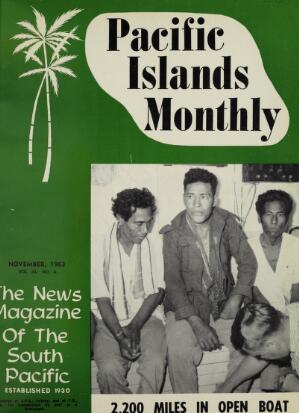
2.200 MILES IN OPEN BOAT
Taa Air Cargo
MELBOURNE SYDNEY BRISBANE CAIRNS PORT MORESBY
ARE NOW LINKED BY TAA’S ALL-CARGO FREIGHTER SERVICE Goods consigned late Friday afternoon in Sydney, Melbourne and Brisbane arrive in Port Moresby at 2.35 pm Saturdays, connecting with services to all Territory ports.
All types of cargo, large or small
consignments, bulky shipments, can
now be brought north or despatched to the Mainland, on TAA’s regular
weekly Cargomaster freighter service.
TAA AIR CARGO SATURDAY
FREIGHTER
NORTHBOUND
Departs Brisbane 2.00 am Arrives Port Moresby 2.35 pm
SOUTHBOUND
Leaves Port Moresby 6.30 am Arrives Cairns 9.50 am (With Southbound connections)
TAA AIR CARGO
For faster , surer shipment anywhere in the Territory , Australia or the world.
TAA434O/63
KEEP FOOD and DRINKS COLD
and FRESH WITH A . . . pn : ©
“Snowlite” COOLERS
Coleman’s range of plastic-lined coolers are now available through Robert Gillespie’s. Solid Therma Lock styrene Jnsulation all round keeps food colder . . . longer. The exclusive “Royalite” plastic-base covering prevents rust, scuffing, leaks or stain . . . adds strength and resists dents. Wipes clean instantly. The plastic “Royalite” interior is strong and smooth and has no joins. All coolers are constructed from heavy gauge steel, welded and riveted for extra strength and longlife. Deep tray for dry food storage. Choose from three attractive baked enamel colours: green, patio pink, or aqua. Coolers are available with the Mag-Lock latch or Bail handle. The Mag-Lock latch is a magnetic device which is popular on many modern refrigerators.
The Bail handle locks upright in an easy-to-carry position Representatives for the Pacific Islands: BERT GILLESPIE PTY. LTD. ROBERT GILLESPIE (N.G.) LTD. PEARCE & CO., 22 Young St., Sydney Rabaul, Port Moresby Suva 334 Queen St., Brisbane Lae, Madang Cable: "Robergill".
HAVE YOU
NOTICED
HOW MUCH
BETTER
GILBEY’S
So why mix with others?
GILBEY’S
1
CIFIC ISLANDS MONTHLY NOVEMBER, 1963
Pacific Islands
Monthly
A product of Pacific Publications Pty. Ltd., 29 Alberta St., Sydney.
Publisher: R. W. ROBSON.
Editors:
Judy Tudor Stuart Inder
Manager: SELWYN HUGHES.
Telephones; Ma9197, Ma7101,
MA 4369.
G.P.O. Box 3408, Sydney.
Telegraphic Address: PACPUB, Sydney.
Annual Subscription Rates:
(Aust. currency; includes surface postage) Pacific Is.—P.-N.G., Fiji, Samoa, Norfolk, Nauru, B.S.I., Cook Is., Tonga, G.&E.
Grp., Niue, New Hebrides, and Br. Pacific Is £1 4 0 French Pacific Territories .£170 Australia and N.Z £1 10 0 U.K., British Commonwealth and Foreign (40/- Stg.) £2 10 0 U.S.A. and U.S. Pacific Territories ($7.00 U.S.) £3 13 Single Copies (postage extra) 2 6
Branch Office In Papua-Ng
Pacific Publications (NG) Ltd., Theatre Building, Fourth St., LAE. Tel.: 2577 Miss Pat Robertson, Manager.
Branch Offices In Fiji:
Suva: Fiji Times Building, 20 Gordon St.
Tel.: 5601.
Lautoka: Fiji Times Office, Vidilo St.
Tel.: 420.
Representative In N.Z.:
J. D. Whitcombe, P.0. Box 5179, Auckland. Tel.; 70409.
Representative In Hawaii:
C. C. Spencer, 203 Yap Bldg., 3465 Waialae Ave., Honolulu. Tel.; 775538.
Representative In U.S.A.:
R. G. Craib, Box 1455, San Francisco 1, California. Tel.; Mission 8-1075.
Representatives In U.K.:
W. D. Ashburn, 73 Cheapside, London, E.C.2. Tel.; City 2355.
H. A. Mackenzie, 4A Bloomsbury Square, London, W.C.l. Tel.: Holborn 3779.
MELBOURNE OFFICE; Newspaper House, 247 Collins St. Tel.: 63.7053.
AGENTS: All main trading firms and stores in the Pacific Islands.
Pacific Publications Pty. Ltd. is the Australian agent for THE FIJI TIMES.
THE COVER: On October 17, three su vivors of a gruelling 60-day, 2,200 mi drift voyage from the Northern Coc Islands to Erromanga, New Hebrides, wei brought to Vila in the ship "Airwave The three men are (from left) Tupc Papai, Teehu Makimare and Toka Tuhi Dr. R. Greenhough, British Medical Offic* in Vila, is seen examining them. Th photo was taken by Reece Discombe. Se story, page 10.
Advertisements & other items, p. 4 (1 item)
2
NOVEMBER, 1963 PACIFIC ISLANDS MONTHL
In This Issue
Neral
t Edition of Pacific Islands Year Book Published 51 oks for Tropical Agriculturalists 91 t of Pacific Botanists 91 w Pacific Bibliography 91 lynesian Airlines' Plans 121 sre Millions in Carpenter Empire 127 mtas, Fiji Airways, TEAL Profits 130
)Ok Islands
ift Voyage to New Hebrides 10 ossing Has Claimed Many Victims 10 jit Control Scheme Change 67 II naban Settlement on Rabi 31 lephone Link with Honiara 47 va Building Developments 54 Momentous Decision" Ahead 55 soe Copra Report 57 )w Silsoe Report Originated 59 ssons for Copra Planters in Report 61 ptimism On Future 65 test Population Figures 65 icient Pottery Found 79 mana Pact with Japan Likely ... 127 igar Hopes Remain Bright 129 rger Factory for Fiji Tobacco 130 jckshall's Annual Report 130 ;w Hotels, Increased Tourism ... 133
Iench Polynesia
hiti's Nature Man 77 ;w Honolulu-Tahiti Air Service 119 ps May Open Tuna Base 119 sgionaires for A-Base 121 ipeete Harbour Development 121
Gilbert And Ellice Islands Colony
Advisory Council Inaugurated 8 Evolution of Gilbertese "Boti" 92 Tarawa Port Unusually Busy 99 Colony Becomes Tourist Conscious 134
Lord Howe Island
Governor-General's Visit 8, 101
Nauru
Delay On Resettlement 30
New Caledonia
Tree Planting Plan 13 Japanese Tuna Fishing 103 Economy Healthier 121 Repatriation of Vietnamese 121
New Hebrides
Drift Voyage Ends at Erromanga 10 Manihiki - Rakahanga Crossing Has Claimed Many Lives 10 Letters on Condominium Conditions 41 Relations "Excellent" 45 First Frozen Beef Exports 49 Chamber of Commerce's First Session 119
Norfolk Island
Governor-General's Visit 8, 101
Papua-New Guinea
Rare Shell Found 9 Display at Melbourne Show 11 Streamlined Army 11 Growth of CWA 15 Kukukuku Not What They Were 17 Old Hands Retiring 19
Book by J. K. McCarthy 21 New Guinea Wanted As Name 36 Scientists Busy In Highlands 71 Pat Byrne (Hilder Profile) 78 History of P-NG Exploration 85 Book by Judge Selby 87 "Birds of New Guinea" 88 Old Rabaul Wharf Demolished 97 Wharf to Serve Cameron Plateau 101 Tenders Called for Lighthouses 101 Predicting Volcanoes' Behaviour 121 Steamships Trading Co. Profit 127 Placer Development Accounts 127 Heavy Trading in Pacific Is. Mines Shares 130 Mariboi Rubber's Production Up 130 Lower Gold Production 130 F. H. Stephens Increase Profit 130
Pitcairn Island
Population Decreasing 13 History in Figures 13 Last of the McCoys Dies 125
Solomon Islands
Money for Development 29 Telephone Link with Fiji 47 Police Chief Retires 72 Loss of Spanish Ship in 1595 81 New Timber Company 119 Internal Air Service Delay 121
South Pacific Commission
25th Session 7 Coconut Market Inquiry 7
Tonga
Queen Salote Closes Parliament 9 Fishing Vessel in Business 103 Welcome for Copra Board Ship ... 105
Western Samoa
Dispute Over Tamasese Title 48 Loan for Harbour Works 97 Attempts to Influence Judiciary 122
DEPARTMENTS: Tropicalities, 13; Magazine Section, 77; New Books, 85; Shipping, 95; In A Nutshell, 119; People, 122; Deaths of Islands People, 125; Commerce, 127; Travel Talk, 133; Shipping and Airways Timetables, 13
Advertisements & other items, pp. 6-8 (2 items)
4
NOVEMBER, 1963 PACIFIC ISLANDS MONTH
World’s Most Experienced Airline
JAPAN
ENGLAND
EUROPE
Wherever in the world you travel
you’re better off with Pan Am
World’s Most Experienced Airline
i u.s For details, contact: Pan Am at Suva or Nadi (Fiji), Sydney or Melbourne (Aust.), or Pan Am’s General Sales Agents, Ansett-ANA, at Port Moresby (New Guinea), Brisbane, Adelaide, Perth, or your Pan Am Travel Agent. mm
PA39O
YOU KNOW THEY
ALWAYS LIGHT
BUY THE QUALITY YOU TRUST!
Bryant & May's Crown matches are a quality known and trusted for years throughout the Pacific Islands. Every strike is a certain light because the match heads and waterproof striker are specially made tor tropical conditions. Don't accept substitutes.
ALWAYS INSIST ON
BRYANT & MAY’S /a
QUALITY SAFETY MATCHES W
E 2
SMART WAY TO BE THRIFTY
USE
FOR WALLS AND CEILINGS
' ' • ¥y ' * i l— I I 11 \ll I T
Cane-ite
/ mm '.■l
For good looks, with unique properties
of insulation and noise reduction
<t§R>
BBILDIHG^VsX^MJTERIAIS
I JuiU leU'eA
CSR9SBC
Whether building or remodelling office, store or home, the effective, thrifty way to beautify is with Cane-ite Insulating Board.
Cane-ite forms an effective barrier against heat... keeps your premises cool. Cane-ite is white-ant proofed and is light and easy to handle.
Choose Cane-ite in suede textured Standard, Primed or pre-painted Ivory ... for low cost, good looks and comfort.
Sheet sizes: Widths, 3', 4‘ Lengths, 6', 7', B', 9', 10', 12'.
Thickness, i". Ask for free illustrated folders.
Available at leading island merchants Manufactured by
CSR BUILDING MATERIALS
1 Bent Street, Sydney. Australia
Twenty-fifth Session
New Faces, New Enthusiasm, At South Pacific Commission's Twenty-fifth Session
Technical difficulties prevented Western Samoa taking its place at the 25th session of the South Pacific Commission as the first independent Polynesian state to become a full SPC member.
rHE session was held in Noumea in October.
Only a month or two earlier every >ody had expected that Samoa was :ertain to be admitted to membership )y October. Western Samoa’s Prime Minister Fiame Mataafa had ar ranged to be in Noumea for the pig occasion of Samoa’s first at endance.
The conference chairman, the Western Pacific High Commissioner, sir David Trench, told the session hat progress towards “the desirable md” of admitting Samoa had been nade and he hoped the remaining formalities would be swiftly com pleted. Meanwhile he welcomed Western Samoa’s observer, Lauofo Meti, and told him that everything would be done at the session to re duce to a minimum the disabilities :aused by “the present transitional situation”.
Although she had no vote, Western Samoa later took an active part in discussions.
"Will Be Admitted Soon"
Nobody expects that it will be very long before Samoa is finally ad mitted. There is no disagreement about her admission —the delay is due to the fact that the SPC’s charter has to be altered to admit Western Samoa and some member countries want the future pattern of the session to be agreed on firmly now, and other necessary changes made to the charter while it is open.
General agreement on the new direction that the SPC will take was made at a conference between the five member governments in London in July ( PIM Aug., Sept.). But the London proposals have to be ratified and this is a complicated matter when five governments are involved.
The other main proposals include reorganisation of the Research Council and the institution of an other body called the Regional Council. The Regional Council will be composed of delegates elected by Islands legislatures, which means a
big proportion of delegates would be indigenous people.
The proposals also suggest a new formula of financial contributions to the SPC, which would give every body, particularly the US, a bigger percentage of contributions follow ing the withdrawal of the Nether lands.
Financial Formula The formula was taken into ac count at the Noumea session, which approved an increased budget for the year—of £250,000. But this is con ditional on the US being permitted by Congress to raise its grant.
The Noumea session was a suc cessful and enthusiastic one, depite the fact that the London proposals had not yet taken effect. Feeling seemed to be that the SPC was on the threshold of bigger things, but was, anyhow, finally making progress as a real driving force in the Pacific.
Many of the old faces were gone at this session—being replaced by new men taking part for the first time. Among the new faces were those of Oren E. Long, of Hawaii, replacing Dean Knowles A. Ryerson, the retired Senior US Commissioner, and Mr. R. S. Swift, replacing Mr.
Dudley McCarthy, former Senior Australian Commissioner, now in New York. Other old hands who were gone were the former Secretary-
General, Mr. T. R. Smith, and Mr.
C. G. McKay, of New Zealand.
Among the many new faces in the teams of alternate commissioners or advisers were Mr. William Estall, a member of the Executive Committee of the Cook Islands Legislative Assembly, and Ra t u Edward Cakobau, of Fiji.
The Commission made a practical examination of the work programme.
Among other things the Commis sion this year will continue to sup port the investigation going on in French Polynesia for a simple and inexpensive means of supplying drinkable water through solar stills; will try to organise production of textbook on nutrition; inquire about establishing a training centre on reef and lagoon fishing; continue the two boat-building courses and possibly promote a third one in Polynesia; plan for a second training course in home economics in Suva in 1965, and plan a training course (in Suva in 1964) on the practice of community education methods.
An SPC community education training centre just opened in Suva is part of the development of a permanent com munity training centre in the South Seas.
The current course is on home economics.
Here at the official opening are Fiji's Director of Education, Mr. J. G. Rodgers, Miss Marjorie Stewart, PC women's interests officer, and Dr. Richard Seddon, SPC executive officer for social development.
Photo: Stan Whippy
Coconut Market
SPC To Look At Coconut Market
The South Pacific Commission decided at its 25th session in Noumea in October that it would investigate the marketing possi bilities of coconut by-products and other produce in the Pacific.
It would investigate the prac tibility of a regional economic information service and of es tablishing a training centre in the technique of processing coconut products and by-products.
The SPC decision is particu larly important in view of the recommendations of Lord Silsoe in a copra report released in October (see page 57).
Population Problem
Advisory Council Inaugurated
Family Planning Urged
To Cope With Geic
Population Problem
People in the Gilbert and Ellice Islands Colony will have to plan their families if they want to ensure that succeeding generations are not re duced to a miserable subsistence level.
HTHE GEIC Resident Commissioner, Mr. V. J. Ander . sen > said this in Tarawa on September 30 at the inaugural session of the colony’s recently-established Ad visory Council.
Mr. Andersen said the colony’s growing population was a major problem.
Preliminary figures for the census taken in April showed a gross figure of nearly 50,000 compared with 36,000 only 16 years ago.
As some 600 people had emigrated to the BSIP during this period and most of the existing popu lation was in the lower age groups, an even more alarm ing increase could be expected in the future unless family planning was practised.
Mr. Andersen said other problems facing the Colony were: • The limited extent, mal-distribution, and poor quality of the land. • Geography—the islands being scattered over two million square miles of the remotest part of the Pacific, with some of the islands subject to severe drought, lack ing safe natural harbours, and without fresh-water rivers or streams. • Lack of economic resources. (The phosphate at Ocean Island will be exhausted in 15 to 25 years’ time, and, so far as is known, land in the Colony is capable of growing only coconuts economically.) ® Lack of revenue and employment opportunities when phopsphate production ceases. (The export of phosphate brings in about half the Government’s re
venue and Ocean Island provides em ployment for about one-third of the Colony’s labour force. Nauru, which will probably cease production about five to 10 years after Ocean Island, provides another third of the present employment opportunities). • The need for improvements to social and other services. In general government services are not yet fully adequate.
Mr. Andersen said that even if the hard facts of geography could not be altered, many of the other difficul ties could be reduced, if not elimin ated, by proper planning, judi cious use of revenues, hard work, en listing the wholehearted support of the people of the Colony, and by the continuation of overseas assistance, particularly from the UK.
Vice-Regal Visitor
Lord Howe Island’s rugged scenery provided an attractive backdrop for Clive Wilson when he took the above pictures of Australia's Governor-General, Lord de L’Isle, having a “look-see” round the island during his recent visit in HMAS “Sydney”. Lord de L’Isle is in the foreground in the second of the two photos. Below he is seen addressing the people of Nor folk Island from the platform of the Administration building at Kingston during his earlier Norfolk Island visit on the same voyage. — Photo: M. Hoare.
News In Pictures
Two natives of Papua-New Guinea were on hand to explain features of two exhibits displayed at the Melbourne Royal Show in September by Australia's Department of Territories and the Administrations of P-NG and the Northern Territory. Here one of the natives, 21-year-old Masi Kotauga, an assistant patrol officer in training, describes a model "haus tambaran" to a young visitor.
The route from the Royal Palace at Nukualofa to Tonga's Parliament House was lined with about 4,000 schoolchildren on September 25 when Queen Salote drove to Parliament to close the 63rd session of the Legislative Assembly. Some of the children—probably the biggest number to attend such a function—are seen below.
Photo: Hettig.
Deserved Another
One Good Seashell Deserved Another
Conus gloria maris is the kind of shell that everybody would like to find, but few do. Shell collectors offer big money for such rarities. So there was great excitement in October when Mrs. Ann Appleton, of Rabaul, found one on a local beach The whole shell collecting world took an interest. She was offered as much as 1,000 dollars for the shell. The publicity flushed out the surprising in formation that George Edwards, of the Duke of York Islands, near Rabaul, had owned a conus gloria maris for the last five years. What was more, it was larger, far superior, and he intends to keep it.
On latest reports there is now a boom on the entire Rabaul shell market, and local natives are asking outlandish prices for any old shell at all! Above are the happy owners with the shells that started all the fuss, photographed by M. R. Hayes, of Rabaul.
Advertisements & other items, p. 11 (1 item)
9
PACIFIC ISLANDS M O N T H L Y N O V E M B E R , 1963
20-Mile Crossing
Has Claimed
Many Lives
Treacherous winds and currents in the 20-mile crossing between Manihiki and Rakahanga have claimed many lives, and have started a number of remarkable drift voyages since a single Polynesian family first settled on Rakahanga in the middle of the 14th century.
The early inhabitants of Rakahanga planted coconuts on Manihiki, divided the land among themselves, and as their numbers increased, moved from one atoll to the other according to the food supply.
The voyages were made in double sailing canoes, with the Magellan Clouds as guide, because the atolls are too low to be seen from each other.
It was a voyage between the two atolls that went awry that led to the first effective European contact with Manihiki and Rakahanga. This was in 1849 when the London Missionary Society's vessel "John Williams" called at Manihiki to land some people who had been blown off their course en route to Rakahanga and were picked up 80 miles away by a whaler.
Three years later, at the instance of native preachers who arrived from Aitutaki, the inhabitants agreed to abandon their voyages between the two atolls because of the loss of life they caused.
However, this agreement never seems to have been rigidly adhered to as a number of canoes were blown away on the Manihiki-Rakahanga "run" later in the century.
Occupants of canoes who lived to tell the tale turned up weeks later in Aitutaki and Nassau (Cook Islands), Nukulaelae (Ellice Islands), Swains Island (American Samoa) and Niuato putapu (Tonga).
However, none of these drifts was anywhere near as long as that of the "Te Aroa".
Three Cook Islanders Survive
Epic Drama In Open Boat
2,200-Mile Drift To
Erromanga
Three men were recovering in hospital in Vila, New Hebrides, at the end of October from the privations of a terrible, 60-day drift voyage in a 17 ft. open boat, which took them about 2,200 miles across the Pacific.
THE men, all Cook Islanders, drifted from Rakahanga (Cook Islands) to Erromanga (New Hebrides) with very little food and water, and without sighting a single ship or island.
Three other men died on the voyage, and a fourth died soon after the boat reached Erromanga.
The three survivors are: Teo Naki maro, 32; Toka Tube, 36; and Tupoa Tapai, 38.
Those who died on the voyage were: Enoka Dean, the 43-year-old captain, who was married with nine children; Kita Marsters, 28, married, with one child; and Tom Tangimetua, 24, married with one child. The man who died at Erromanga was Taia Tauraki, 42, married, with two depen dent children.
The seven men set out on August 17 to make the 20-mile crossing from Rakahanga to their home at Manihiki. Their boat, Te Aroa, had a sail but no engine.
Air Search During the crossing, a strong wind blew up, forcing them into the open sea; and although they had a com pass, and knew they were going the wrong way, they had no option but to drift before the wind.
An RNZAF Sunderland flying boat, alerted by the Cook’s Adminis
tration, searched the Manihiki- Rakahanga area soon after Te Aroa was reported missing, but saw no trace of her.
Nothing was heard of the boat until October 17 when Teo Naki maro, Toka Tube, Tupoa Tapai, and Taia Tauraki struggled ashore at
This was how Sydney's "Daily Mirror" featured the story of the "Te Aroa's" drift voyage.
Port Narevin, on Erromanga’s east coast, after the boat had run aground on a reef. Teo and Tupoa were then almost blind through lack of food.
The four survivors, who were virtually naked, were found by a native called Peter, who took them to a village at Dillon Bay, on the west coast of the island.
Taia Tauraki was so weak that he had to be helped by his companions; but he died soon after reaching Dillon Bay. Teo and Tupoa recovered their sight after food and rest At Dillon Bay, the village elder, Matthew, took care of the three survivors and arranged for a radio message to be sent to Vila, about 60 miles north.
It was then arranged for the Airwave, a small ship owned by Mr.
Tom Lowe, of Vila, and skippered by a visiting yachtsman, Mr. David Field, to call at Dillon Bay and bring the survivors to Vila.
Doctors On Hand .. , , , ri The Airwave reached Vila on the morning of October 24—and because the New Hebrides has neither news-
S were &eV?waf aw-
thing remarkable about her passen- Among the few who were on hand to meet the Airwave were the Senior British Medical Officer, Dr. W. H.
Rees, and Dr. R. Greenhough, who found the Cook Islanders in surprisingly good condition considering
the terrible privations they had en dured.
However, the men were im mediately transferred to the Baton Memorial Hospital.
Well-known Vila personality Reece Discombe, who is a mechanic, deep sea diver, marine salvage expert, electrician, photographer and racing car driver all rolled into one, proved that he was also a ‘red hot journalist by obtaining first news and the first interview with the Te Aroa 5 survivors and telephoning details ot their epic voyage to ”/M, which passed on the news to Sydney news papers.
Discombe told PIM that TeAr had had and water a par when she left Rakahanga for Mam hiki on August 17 and that the men had carefully rationed this dun g the first three weeks of their dntt.
Then the boat capisized m a storm, spilling the men and all the remam ing food, and water into the sea.
By this time, two of the men om and Kita—were so weak that they were unable to r . e s ain the I boat l ’, aI J!?
Enoka, the captain, was only able to aboard in with the help , . • n „ f H owever P E noka died three days {fer -d his body was cast over
oar • Aircraft Sighted
The day after Enoka s death, an aircraft passed over le Ar°a four survivors m vain waved frantic ally with clothes tied to the ends ot their oars.
From then until they were casi
ashore at Erromanga, the men in the open boat had no food apart from an occasional flying fish that fluttered aboard and two coconuts that they fished from the sea. Their only water was what they could catch in a piece of canvas.
Being strongly religious, the men took it in turns to read chapters from Bibles they had with them and to pray for their families and them selves.
All seven crew members of the Te Aroa were married and they had 22 children among them.
Several weeks after they dis appeared, the Cook Islands Legisla tive Assembly opened a fund for their wives and children, and almost £2,500 was raised.
In Vila, the recently-formed branch of the Red Cross Society supplied the three survivors with clothes.
The three men are booked to fly from Vila to Nadi by Fiji Airways on November 6 to connect with flights to Rarotonga. • A picture of the survivors appears on the front cover.
RN SHIP DAMAGED: When HMS "Cook” struck a submerged reef in Fiji in October and was badly damaged, she needed attention urgently. Trouble was that the "Cook" was 2,600 tons, and the Suva slipway was for 1,000 ton ships. So all hands, including the Suva Fire Brigade, got to, moved everything that could be moved and pumped out flooded compartments, to reduce the "Cook" to 1,600 tons. She was then carefully hauled up the slipway cradle, finally ending, as seen in the picture below, with the bow on the slips and a 60 foot overhang in the harbour. More than 40 steel plates were then replaced on her hull. (See p. 95). — Photo: S. Whippy.
Streamlined
R-Ng Army
Australia is making plans to enlarge and streamline Papua- New Guinea as a military area.
More regular troops will be stationed there and the Pacific Islands Regiment will be en larged.
On October 10, Papua-New Guinea was gazetted as a Military District. This upgrades it from an Area Command, which had previously come under the control of Northern Command in Brisbane. The up grading means a move towards greater autonomy and greater co-ordination of all Army move ments in P-NG.
The increased Australian mili tary interest in P-NG follows the Indonesian takeover of West New Guinea and developments in Malaysia.
Advertisements & other items, pp. 13-14 (2 items)
11
PACIFIC ISLANDS M O N T H L Y N O V E M B E R . 1963
Morris
HEDSTROM
LIMITED
HEAD OFFICE: SUVA, FIJI
LONDON OFFICE
Morris Hedstrom Limited Barclay's Bank Buildings, 73 Cheapside,
LONDON, E.C.2.
AUSTRALIAN REPRESENTATIVE
Morris Hedstrom (Aust.) Pty. Limited Wales House, 27 O'Connell Street,
SYDNEY
REGISTERED CABLE ADDRESS:
DEUAABA—SUVA, MORRISHED—LEVUKA, MORSTROM
SYDNEY, SUVAAAARK—LONDON, MORRISCO
NUKUALOFA, DEUBA—APIA, CODES: ALL
For Friendly Service and complete satisfaction it s Morris Hedstrom Ltd. in
General Merchants
Produce Buyers
Importers and Exporters
Ship Owners
Plantation Owners Commission and Insurance Agents
AGENTS & DISTRIBUTORS FOR:
Adhesive Tapes, Ltd.
Bush Radios, Ltd.
Bowater —Scott Corporation, Ltd.
China Navigation Co.
John Dewar Gr Sons, Ltd.
Electrolux Limited.
Evinrude Outboard Motors.
Ford Motor Co.
General Electric Co. Ltd.
Goodyear Tyre Gr Rubber Co.
Guinness Exports, Ltd.
Medley, Thomas Gr Co. Ltd.
Imperial Chemical Industries, Ltd.
Matson Navigation Company.
Mobil Oil Australia Pty. Ltd.
Max Factor Gr Co. Inc.
Parker Pen Company.
Ransomes, Simms Gr Jefferies, Ltd.
Rootes, Ltd.
Smiths English Clocks, Ltd.
Tanqueray Gordon Gr Co. Ltd.
Taubmans, Ltd.
Yorkshire Imperial Metals Ltd.
Morris Hedstrom Limited are
LLOYD'S AGENTS
in Fiji and Samoa
FIJI - SAMOA - TONGA
Grow Your Own
From Fred Dunn, in Noumea The Rotary Club of New Caledonia has set itself the rather formidable task of in stilling a love of trees into the youth of the country. It has just inaugurated a programme of distributing tiny Cook pines (above) to any school child who wishes to plant one. Acceptance of the tree entails a promise by the child to care for it for at least a year. A specially printed folder with each tree explains how to look after it.
The young trees are being supplied by the Government Forests Department and the Rotary project comes at a time when the Department is under taking a huge tree planting programme. Manx thousands of trees of different kinds have been planted in the wastelands surrounding the lake of the Yate River hydro scheme.
The Rotary Club proposes next year to invite children to plant coconut palms.
About the only criticism that can be offered to the laudible Cook pine planting scheme is that the happy acquirer is per mitted to plant his tree wherever he sees fit. It may have been better to ask him to plant it along Noumea’s beaches or on the town’s denuded hills.
Certainly the Cook pine is not the sort of thing to put in your front garden. It is big and quick growing and some mothers may object to junior planting his tree in her dahlia patch.
Tropicalities
Pitcairn Island, the tiny, isolated home of the Bounty mutineers and their descendants for nearly 175 years, may be nearing the end of its romantic history. This is because the Pitcairners— by reputation strongly attached to their home soil—don’t seem to want to live on the island now, and are leaving it almost literally in droves.
AT the end of September, Pitcairn’s population was the smallest it had been since the early 1880’s.
More departures are imminent; and the Pitcairners, themselves, have begun to talk of the end.
The end could well come in the next couple of years as France pre pares its atomic testing centre at Mururoa Atoll, some 500 miles away.
In the nine months from December 31, 1962, to the end of September, Pitcairn’s population dropped from 128 to 98—or by almost 25 per cent.
Now there are barely enough able bodied men to man the long boats which are Pitcairn’s life-line to the outside world.
Pitcairn’s adult, able-bodied popu lation, in fact, is now only a little larger than it was when the Bounty mutineers settled on Pitcairn in January, 1790. There were then 15 men (nine mutineers and six Poly nesians), 12 Polynesian women, and one child. Now there are 19 men and 17 women between 16 and 60 years of age; 13 men and 13 women over 60; 31 children and five temporary residents. The number of men needed to man a long boat is 14.
According to veteran Pitcairner Roy Clark, who has lived on the island since 1909, there are several reasons why the islanders are desert ing their homeland.
Clark, who is American-born, and is the most articulate and thoughtful of present-day Pitcairners, has expressed his views in recent letters to Pitcairn Miscellany, the island’s roneoed monthly newspaper.
He says the Pitcairners are clear ing out because of: • The menace of radio-active fall out from France’s proposed atomic testing centre at Mururoa. • Insufficient ships calling at the island to enable the Pitcairners to obtain enough money, through the sale of their curios, to maintain
the standard of living they have become accustomed to. • The lure of high wages and a more exciting life in New Zealand. • Dissatisfaction over the fact that 15 families on the island receive Government pay while the other 14 do not. • Ever-increasing sickness, which has necessitated the departure of some islanders to New Zealand, from where they are reluctant to return. • Too much hard work for the few able-bodied men remaining on the island. • Blights, destructive insects and weeds which are making it in creasingly difficult to obtain food from the soil.
O Termites and wood borers that are wreaking havoc in the island dwellings. (The termites were introduced into Pitcairn several years ago in a church organ, a gift from New Zealand). • Lack of trees for lumber to en able the islanders to repair or rebuild their houses. (Two hundred years ago, Pitcairn was covered with trees, but clearing and burning have since practically denuded it). • Complaints by both young and old that Pitcairn holds no future for them.
In one of his most recent letters to Pitcairn Miscellany, Clark said it could be plainly seen that the only future for Pitcairn was decadence.
“Pitcairn,” he went on, “has not escaped the general downfall of civilisation, and has entered a vortex of unrest and uncertainty that, so it would seem, cannot be unravelled so as to restore peace and contentment and a well-balanced political and ecclesiastical situation,”
Clark’s statement on the lack of ships calling at Pitcairn was amplified in the same issue of Pitcairn Miscellany by its editor, Mr. S. A.
Cinder, who is the island’s school naster.
“Pitcairn,” he said, “is facing a erious financial problem. Due to he removal of the New Zealand Ihipping Company’s passenger ships —each of which carried up to 400 lassengers on this route —the income if the individual members of the ommunity has been reduced [rustically.
“Whereas, two years ago, we had egular calls from both the New Zealand Shipping Company’s ships nd the four Shaw Savill ships— -7 eramic, Corinthic, Gothic and ithenic —the latter are the only ones hat come our way today.
“The maximum passenger comple nent in each of these vessels is about 10, but on numerous occasions, they ravel with considerably fewer than apacity; and recently one of them :alled with only five passengers on >oard.”
Mr. Kinder said that to maintain he standard of living that had been ichieved over the years through the ale of curios, it seemed as if the
islanders would have to turn to other means of making money—and he suggested that coffee-raising and dried bananas were two potential industries.
In an editorial on Pitcairn’s future, Mr. Kinder agreed with Clark that, with the island’s population likely to be reduced even further by departures to New Zealand, decadence did seem to be the island’s only future.
“But,” he said, “will this prove to be the case? Since the founders of the community landed here from the Bounty, there have been several times when the island has faced predicaments of a similar nature— although not through the same causes —and surmounted them.”
• See "Last of the McCoys Dies on Pitcairn", page 125.
Cups of Tea and Hard
Work Build CWA
Although few visitors to Papua-New Guinea can fail to notice the part beer plays in the social life of the Territory, its monu ments to tea-drinking are not so conspicuous. But they exist.
Port Moresby’s £20,000 Country Women’s Association building was not all built by drinking tea—but tea helped. The work of CWA in P-NG began in 1951, when the Territory was still in its active stage of post-war rehabilitation; and when the demand for accommodation by families on the move was in inverse ratio to what was available.
The inaugural meeting of the Port Moresby branch of CWA was held that year and the ladies went to work soon after on fund raising the hard way. The Ela Protestant Church lent them their tin hut beside the church in Douglas Street. Mem bers of the association soon turned it into tea and rest rooms which were worked on a roster system — roster-workers not only supplying their labour but the cakes and sandwiches as well.
By 1956 the CWA had saved enough money to approach the Minister for Territories for a subsidy and when the Australian Government weighed in with £4,500 an early start was made on the present building.
Subsequent additions have extended the pleasant bed-room block where out-of-town women and their children may live at modest cost while awaiting hospital treatment or conducting other business in the town; and now it has large meeting and recreation rooms that are used by the members and also hired out to other organisations to augment CWA income.
But the CWA still makes tea. In fact, it’s making a great deal more tea now than it ever did before.
Not only is it still the only place in Port Moresby where, for the price of a few shillings, you can have morning tea or a light luncheon served with elegance and in pleasant surroundings, but the association goes in for such mammoth tea-making tests as supplying the morning and afternoon refreshments at meetings of the P-NG Legislative Council.
In this capacity theirs is the task of supplying buttered scones and sandwiches in such quantities that they fill even the hollow legs of the native observers at Legco, who obviously regard tea-breaks as com pensation for having to spend the rest of the time clamped into head phones, listening to political speeches.
Although Port Moresby CWA was first in the field it was soon followed by others. Sogeri Branch was formed in 1951; Madang, NG, and Samarai, Papua, followed in 1953; Popondetta was formed in 1956; Goroka in 1961 and Wewak, NG, in 1962.
All these branches have their own buildings or are in process of getting them. All are dedicated to work ing for women, girls and children in the Territory, to providing a means whereby they can get together socially or to work together as a group; and to providing pleasant accommodation for outport women when they must visit the town centres.
The CWA held its first Territory wide conference in Port Moresby
rom September 10 to 12 this year /hen all of the branches except iamarai were able to send delegates d undertake a crowded programme if business and social engagements.
Twenty Papuan women were in ited to attend the conference as ibservers but although native women re eligible to join the association ew have as yet done so —most of hem preferring to join their own women’s clubs.
One of the resolutions passed at he conference was that every branch »f CWA should extend the work it s already undertaking in helping jative women form their women’s :lubs and in giving them lessons in :hild-care, cooking, and other vomanly skills.
the Kukukuku Aren't
What They Used To Be
rHE old-time misogynists of the Australian gold-fields had a laying that when the women and ?oats arrived it was time to move Dn. The old-time miners of Morobe, New Guinea, could well have paraphrased it and said that when ;he Kukukuku were tamed it would be time for everyone to get out. Life then would surely have lost its old New Guinea flavour.
On this criterion the time could well be approaching. The Kukukuku (pronounced Kooka-kooka) still have their lapses but Nemesis in the way of civilisation seems to be catching up with them too, in a way that once would have been thought impossible.
These small people who inhabit a large area of Morobe District, New Guinea, and the Central District of Papua, were once regarded as the hatchet-men par excellence of P-NG, They put the fear of the devil into the early miners in Morobe —and that went double for the early miners’ carriers who fell into Kukukuku ambushes all along the back-breaking tracks between Wau and Salamaua.
The Kukus were regarded as re calcitrant and untameable before the war and even after the war, when there was more patrol activity in the very heart of their country, progress was slow. Anthropologists, who usually try to see the best side of any primitive people, were unable to come up with any redeeming culture patterns for them.
The Kukukuku weren’t artists; they didn’t go for decorating themselves with Bird of Paradise feathers; danc ing mostly left them cold. By and
large, they were just primitives who liked to dress in anonymous bark cloaks and whose whole culture and hobbies revolved around fighting, A lot of this now is, however, in the past tense. It was the thin edge of the wedge some years ago when Wau farmers induced some Kukukuku to pick coffee and some others were employed on local milk runs. But now they are actually signing on as contract labour and going away to
work on plantations in Bougainville and New Britain.
There are currently about 800 on contract and they are reported to be good workers, indistinguishable from any other time-expired workers when they return home, and while away from their own districts, no trouble at all.
What’s more, there is a very good chance that a reformed Kukukuku, dressed in what goes for gent’s natty
suiting in the Territory, will take tiis place in the new House of As sembly when it meets for the first :ime about April next year.
About 25,000 of the 40,000 in the Kaindi open electorate are Kukukuku (the others are closely akin but deadly enemies), and unless they refuse to play at all, victory for any candidates of theirs should be a push-over.
Some Kukukuku are, of course still capable of—as the Pidgin expression has it—getting up no good. This was the case with some of them near Menyamya a couple of years ago when they decided to go over to the Papuan side of the border and there teach a certain village something about political advancement. They “lined” the whole village—as the patrol officer does for census—and then fell upon them and butchered them. Only two people escaped—an old man who refused to come out of his house and got through the back of it when they later set it alight and a youth who left the line-up for private business of his own in the bush.
The murderers were finally rounded up near Menyamya and taken to Papua for trial, as the crime was committed there. They confessed and were found guilty but the Crown Law Department decided that the murderers had not been properly warned before they confessed and they sent the case to the Australian High Court where it got bogged down for two years.
Fortunately for the peace of mind of the murderers —who understand the law of an eye-for-an-eye and nothing about the intricacies of British justice—the original verdict was upheld.
They are now serving something like seven years in Papua.
Familiar P-NG Faces
Will Be Missing
THE coming 12 months or so will be a vintage year for retirements amongst the top brass of Papua-New Guinea’s public service.
Mr. Keith McCarthy, Director of Native Affairs, is due to retire to wards the end of 1964; and Mr. H.
L. Niall, who entered the service with him and is now District Commis sioner, Morobe, is due for retirement about the same time. However, Mr.
Niall will probably retire in January, 1964, to stand for election in the new House of Assembly.
Ivan Champion, a Territorian-true, born in Papua, and now Chief Native Lands Commissioner, will retire at
the beginning of 1964. He is one of the last of a dying race of explorers.
Between the wars there was little of Papua that he did not walk over.
On retirement, he is going South to live, but will be doing something peculiarly Ivanish—he is going back to sea as skipper of the old Laura bada.
Laurabada was for years the Papuan Government vessel and Ivan Champion was, for periods, her master. She was bought about nine years ago by private interests, has been completely reconditioned and will soon enter coastal and inter island trading.
Mr. H. H. Reeve, now Assistant
400TH ISSUE: Readers with a mathematical turn of mind may be interested to know that this is the 400th issue of RIM. The first issue appeared in August, 1930.
Administrator (Finance), formerly P-NG Treasurer, is also believed to (be retiring next year; Mr. J. R.
Foldi, District Commissioner, New Britain, reaches retirement in 1964, but will probably stay on for an extra 12 months; and Mr. D. E. Maclnnes, Director of Lands, Surveys and Mines, “goes finish” to Sydney at the end of this year.
Advertisements & other items, pp. 15-16 (2 items)
13
ACIFIC ISLANDS MONTHLY NOVEMBER, 1963
Boac
FLIES BOTH WAYS
TO EUROPE AND THE WORLD
„ 1 M, r?'f if From New Guinea, join BOAC direct services at Darwin, Brisbane or Sydney. Jet westwards to Europe and Britain via the Orient. From the Solomons, fly eastward to Britain and Europe via the U.S.A. Join BOAC Rolls Royce 707 services at Honolulu, San Francisco or Los Angeles.
For full details of BOAC Jet Services, Stopovers, Tour Facilities and Pay Later Plan, see your Travel Agent, Airline or BOAC.
ALL OVER
THE WORLD
BOAC
TAKES GOOD
CARE OF YOU
BRITISH OVERSEAS AIRWAYS CORPORATION with Air India, Qantas and Teal
A13.AU.84.855c
Pitcairn Island
History In
Figures
Despite the bloody murders of Pitcairn's early history, the island's population more than trebled itself in the first 41 years of settlement From 28 in 1790, the population grew to 87 in 1831, in which year it was transferred to Tahiti where 22 of the Pitcairners promptly died of unaccustomed diseases.
On being returned to Pitcairn late in 1831, the remaining 65 multiplied with Victorian prolificness—their numbers reaching 194 by 1856. The whole 194 were then transferred to Norfolk Island. Sixteen of them, stricken with homesickness, returned to Pitcairn in 1858, and 27 more followed in 1863.
The 43 "patriots" more than doubled their numbers by 1879, and by 1914, Pitcairn's population was 140. It continued to increase steadily until the peak figure of 233 was reached in 1937.
Since then, with occasional excep tions, Pitcairn's population has be come smaller each year.
Recent population figures are: 1954 (136); 1955 (143; 1956 (161); 1957 (152); 1958 (136); 1959 (146); 1960 (146); 1961 (126); 1962 (128); July 31, 1963 (108); September 30, 1963 (98).
Advertisements & other items, pp. 17-22 (3 items)
15
ACIFIC ISLANDS MONTHLY NOVEMBER, 1963
Saucer
newspaper
POWDER
To rid your home of cockroaches, set this simple trap in all rooms where they are observed. If jam is not readily available for the saucer, use food bait. The powder must not have an insecticide poison smell otherwise the insects will become suspicious and it must have a permanent action so it can be relaid each night. Therefore Pea Beu powder is recommended. Cockroaches walking over the powder, will retire to their hideouts and die. Also sprinkle the Pea Beu in drawers and back of range, frig, and radio.
■m
ii mh
for
your light and power requirements;
% » The illustrated Braybon diesel set has sufficient capacity to operate all domestic appliances within the requirements of the average household, plus portable power tools including 9" electric saw, as well as electric motors fitted to pumps, shearing heads, etc., up to i HP capacitor start 1425 RPM.
Equipped with the Lister diesel engine, the Braybon self contained Diesel plant is designed for long life and maximum efficiency and economy.
Plants of Braybon manufacture have been built and in service for 30 years and are recognised as being of the highest standard and construction. Out units are operating in the Antarctic Region for the Australian Government as well as throughout Australia, the Pacific Islands and the Far East. Plants are available up to 100 KVA capacity. r-=
FOR FURTHER INFORMATION PLEASE WRITE
DISTRIBUTED 1 BY
TUTT BRYANT
(PACIFIC) LTD
COLYER WATSON (N. G. ) LTD
MANUFACTURERS
BRAYBON BROS. PTY. LTD. 27- 33 WASHINGTON ST., SYDNEY, AUSTRALIA
TELEGRAMS: "BRAYBONIAN", SYDNEY
r c m A HEALTHY CHILD . . .
THANKS TO QLAXO BABY FOOD
jlaxo milk-food gave me the right art to a healthy, happy childhood.
It’s pure, nourishing and easily digested. There’s no check to Daby’s steady progress with Glaxo.
PERFECT MILK-FOOD FOR BABY
& 9B GLAXO LABORATORIES (N.Z.) LTD., PALVERSTON NORTH. N.Z.
JeeA Marine Jit4.
You / ll take no chances when you buy "Lees Marine" who supply a DYNAMOMETER TESTED unit which is ready for immediate use in your boat. These cannot fail to give reliable service, having already been proved on maximum load conditions.
PETROL
DIESEL
lEES
MARINE
MANUAL TRANSMISSIONS
HYDRAULIC TRANSMISSIONS
For details of the wide range of motors and transmissions offered by this progressive New Zealand factory write to: Telephone: 1060 Papakura N.Z.
LEES MARINE LTD
P.O. Box 164, Papakura, New Zealand Telegrams: Leesmarine, Papakura, N.Z.
Picture all your Christmas fun
with the gift
that says...
... a Kodak camera
STARLET
BROWNIE STARLET
OUTFIT
KODAK RETINETTE
IA CAMERA
Contains Brownie Starlet A precision 35mm camera Camera, Supermite Flas- featuring f/2.8 lens, 4 speed holder, flashbulbs, batteries flash-synchronised shutter and Kodak film. I and ‘bright-line’ view-finder.
BROWNIE STARMITE
CAMERA
With compact in-built flash, takes 12 super-size colour or black-and-white snapshots, or colour super slides.
V: ■ " . 1;
KODAK 8
MOVIE CAMERA
Just set the exposure, aim and shoot action-packed Bmm. colour movies for snapshot cost.
FROM KODAK DEALERS THROUGHOUT THE ISLANDS
KODAK (Australasia) PTY. LTD.
Kodak
Your Problems
Will
Vanish
Efficient management of each client’s financial affairs is the day-by-day responsibility of Burns Philp Trust.
As Attorney, it will shoulder your problems when you go overseas, and relieve you of all obligations as a Trustee. As your Executor, Burns Philip Trust will safeguard your beneficiaries’ interests in every way.
You and your family can count on Burns Philp Trust, the enduring institution that already protects assets worth more than £41,000,000. Full details of the services offered are given in a 20. page brochure available from any branch of Burns Philp (South Sea) Limited, Burns Philp (New Guinea) Limited, Burns Philp (New Hebrides) Limited, or from the Trust Company’s nearest office.
DIRECTORS: James Burns Joseph Mitchell P. T. W. Black Eric Priestley Lee MANAGER; L. S. Parker
SECRETARY: E. R. Overton, F.A.S.A.
'AHA T
BURNS PHILP TRUST
COMPANY LIMITED
Executor • Administrator • Trustee • Attorney O Agent Head Office; 7 Bridge Street, Sydney.
Telegraphic Address; “BURNSTRUST”, Sydney. Box 543, Q.P.O Tel.: 2-0547 Also Registered a offices a a n t d Melbourne. Moresby Canberra Agent: Burns Trustee Company (Canberra) Landtrust Building, East Ro’w. Canberra City, A.C.T.
First NON-IRRITANT Aerosol!
niitrax
Kills flies, mosouitoes, fleas, carpet beetles, silverfish, ants, etc., and resistant cockroaches.
INSECT
KILLER
Dim ■ ■i'-Li Fhck Nutrax is a new, more effective insecticide with a last fumigating vapour action. There’s more power in Nutrax because the vapour spreads throughout the room, even killing insects not exposed to the direct spray.
Flick Nutrax is non-irritating—it will not affect even the most sensitive nose or throat. Use it in the bedroom, nursery, living room, kitchen, etc., without fear of residues or irritating odours.
Con , trol . for ex Pert personal attention.
BirqmJS * treaimenis guaranteed. For your Flick Man enquire through: NEW Guinea—Steamships Trading Co.; P. L James & m Madang A ‘ Woodward Wewak; New Guinea Co., L?e and T^ FIJI r: W - A - 1110,2 & Co.. Bank of N.S.W Caledorfipnnp 011 rj 3425 ‘ CALEDONIA—Societe Havraise everyhewer? ’ Noumea ' And BURNS PHILP BRANCHES NUVAN(R)—trade mark of CIBA Ltd.. Basle, Switzerland.
"Remember—one Flick and they're gone!"
t m Un
FRAMELESS ALUMINIUM BUILDINGS
KINGSTRAND buildings offer many advantages, chief among them being economy, transportability and STRENGTH . . . the stressed skin construction derives its strength from the deeply troughed sheets, used for walls, roof and beams, which serve as both structural members and padding at the same time ... NO SEPARATE FRAME IS
REQUIRED.
AGENCY ENQUIRIES WELCOMED
econo products company
a division off Tulloch Limited
Simple Construction
Pre-fabrication and standardisation of parts means speedy erection by unskilled labour with simple tools supplied.
COOLER, More Hygienic
Aluminium sheets reflect sun’s rays . . . building 10% cooler . . . smooth surface finish wipes clean with damp cloth
Structural Strength
Standard sheet has compression strength to 3 tons . . . tested to withstand most exacting tropical conditions.
Maintenance Free Corrosion and fire resistant; immune to white ants, rot, vermin . . . eliminates maintenance.
Maximum Transportability
Up to 5 complete buildings can be carried on a 5-ton truck . . . can be transported by air to remote sites for emergency housing.
Plan Flexibility
Flexible modular system makes alterations and additions simple ... buildings readily dismantled and re-erected.
CONCORD ROAD, RHODES.
N.S.W., AUSTRALIA. 7-3047
17
PACIFIC ISLANDS M O N T H L Y N O V E M B E R . 1963
On The Grand Scale
Comparison, New Guinea Today is "Brash and Suburban"
Eccentrics And Adventure On The Grand Scale
When John Keith McCarthy says, towards the end of his book that he is sensitive and proud of his friendship with the native people of New Guinea, he sets his final imprint upon Patrol Into Yesterday. Whatever else the book is—and it is sometimes acid, as a good book should be, but mostly it has a chuckle or a laugh never far beneath the surface his sympathy with the people who now go by the unlovely name of New Guineans is abundantly clear.
HHEN Keith McCarthy became a \ patrol officer in New Guinea in i 27 he could not know that he had e Native Affairs Department uivalent of the Field Marshal s iton in his knapsack. He became ipua-New Guinea Director of ative Affairs a couple of years ago; it this book is not about that. In
fact, it does not rate a mention.
The largest part of the book is a record of intimate, personal contact with the country and its people, both brown and white, and as such it is something of a milestone.
Although all dimensions of admini strators on the Papuan side, from Romilly and Sir Peter Scratchley, in the 1880’s, to Jack Hides and W. R.
Humphreys in the late 1930’5, went into print at the drop of a hat, there has been, until now, a remarkable silence from the men of the old New Guinea service.
In fact, amongst the personal ac counts of Territory life, written by real Territorians, we can think of only two —Doris Booth’s Mountains, Gold and Cannibals; and Mick Leahy’s The Land That Time Forgot, and neither of these is with the Gov ernment.
Keith McCarthy’s book should go a long way towards bringing the record up to date.
The Old New Guinea It depicts, in its early sequences, a New Guinea that stopped with the war; a New Guinea compounded of isolation and lack of communications, when distance was measured in terms of a day’s walk; when European men outnumbered European females three to one in the towns and by many times more than that in the bush; when disease and death were sudden and swift.
It was a time when the world cared little about what went on in New Guinea and the echoes from the occasional voices in the League of Nations did not reach there for months. It was a time when our world was smaller and fresher and younger. And so were we.
Apart from all this, it was a time and a place that produced a climate
J . K. McCarthy is one of that small number of New Guinea men who have become something of a legend in their own life time. His 36 years with the Department of Native Affairs, which he now heads, have covered the most eventful period in the big Territory’s history. Here “PIM” reviews his long-awaited book on those years, “Patrol Into Yesterday”, which is to be published by Cheshire, Melbourne, at the end of November.
i which eccentrics on the grand ;ale could flourish. Today, by com arison, Papua-New Guinea is only rash and noisy and suburban.
Nostalgic Quality
It is this nostalgic quality which IcCarthy’s book recaptures so well lat it will twist the hearts, of old mers and make even the Round able planters of New Ireland (who articularly got under the skin of oung Patrol Officer JKMcC), weep ito their beer for the days now eyond recall.
McCarthy met his first Territorians rue, in the shape of his cabin-mates, m his way to New Guinea on the old darsina. There was Piggott, who preferred to be known as a barrister” iut turned out later to be a patrol (fficer, too; Fowler, a trader —a “thin iderly man with brown spots on iis face and hands”; and Schneider, l Government surveyor’s assistant.
Fowler always rose at 3 a.m. to have and had a box full of polished :ut-throat razors to do it. He put he light on and this woke Schneider vho demanded that it be put out.
“ ‘You’re a Hun stinker,’ said Fowler, apparently without rancour” —whereupon Schneider passed some ruder remarks about the quality of the razors.
“ ‘lgnorant Teuton,’ said Fowler, These are the best Bengal razors on the market.’
“And to show how good they were,” recounts McCarthy, “he cut a few hairs from the head of the still snoring Piggott as he lay in the lower bunk. But the razor couldn’t have been perfect, for the action woke Piggott. He instantly fell back in horror at the sight of Fowler with a razor held so close to his face.
“Now an argument developed and it appeared to be getting serious so I lay quiet, hoping that I would not be noticed. Schneider suddenly produced a revolver from underneath his pillow and threatened to shoot the trader. Fowler turned, calmly cleaned his razor, and promised to cut Schneider’s throat.”
Eccentrics Galore And so passed the first night.
McCarthy was soon in the Territory and posted to Nakanai, to become overlord of 600 square miles of the wildest part of New Britain, A year later he got his first white visitor — Assistant District Officer George Ellis, an eccentric of a different kind.
The psychological kinks that eventually ended in tragedy were already apparent in Ellis in 1928 but he remained in New Guinea and in the service until 1942.
When Rabaul fell to the Japanese on January 23 of that year Ellis was ADO on the Sepik. The event set him to brooding more than ever and to drinking. At the time about 40 miners from all over the Sepik district were congregated at Angoram, on the river, and it was planned that they should be taken upstream and evacuated overland to the Highlands.
Ellis, for some reason, opposed the evacuation and regarded the men as deserters —although many of them had had to be ordered from their claims by Authority.
Ellis himself refused to leave. He hid large quantities of ammunition
about the station and prepared to resist by force when the District Officer ordered ADO Jim Taylor to take over from him. He armed his police with rifles and there ensued a two-hour’s shooting war before Taylor’s party retired downstream to Marienberg.
When they returned two days later they found Ellis dead in his bungalow, with his revolver beside him; and that a party of native police had gone berserk in the bush, deter mined to kill all the white men on the river.
They did kill Patrol Officer R. B.
Strudwick and three miners—Reg
Beckett, Jack Mitchell and George Eichorn— before they were hunted down and arrested by another patrol.
Today such an incident would scream around the world in news paper headlines. In early 1942, when most of the Pacific was fight ing for its existence, it passed almost unnoticed. McCarthy himself did not hear about it until long after wards because when the Japanese invasion began he was ADO at Talasea, New Britain, and in the first months of 1942 was wholly occupied in rounding up and rescuing the remnants of the 2/22nd Battalion who had been left to their fate.
The criminal negligence that pro duced the fall of Rabaul and its aftermath will never now be sheeted home to where it rightfully belongs.
McCarthy’s account of these dark days, when these hundreds of men, untrained in jungle survival, without medicine or the means of defence, dispirited and without morale, wandered or sat waiting to be picked up by Jap patrols in the New Britain bush, is perhaps one of the most gripping sections of this book.
He received the MBE for his part in rescuing these men—sometimes moving them almost by sheer physical force—but this is not mentioned in the book.
This war section leads on naturally to the post-war period of soberer worlds, a soberer McCarthy and certainly one with greater respon sibilities. * * * One day in 1936 this reviewer was sitting in a camp on the Ulahau River, between the mountains and the
Sepik coast, when a runner arrive! with a note.
“Charlie Gough has been killec down in the kunai,” another mine] had written simply. -‘He tried tc £ull’ a boy and the kanakas got him You may be needed. I’ll keep ir touch.”
However, G. W. L. (“Kassa”J Townsend, then District Officer Sepik, was not the sort of man tc need a posse of miners to help him do his work and no one was evei contacted. The thing was a week’s wonder in the district and in due course we learned that the murderers had been apprehended and had got ofi with a few years’ gaol.
No doubt we were suitably in censed at the time about the Admini stration’s “softness”, but I have never thought of Charlie Gough from that time until reading this book.
Gough's Murder
McCarthy was posted to Aitape in the mid-thirties and was one of the two European officers who ac companied Townsend on that occasion, found Gough’s body, buried it, and ultimately tracked down the killers.
He had known Charlie before Charlie had turned briefly and tragically into a recruiter—he was, at that time, Aitape’s lone European storekeeper.
“Gough . . . was successful in business,” says McCarthy, “despite the fact that he could neither read nor write. He ran his accounts by making notches on sticks and by a system of pencil markings and he could provide you, at any time, with a true statement of your account.
“ ‘Like a bloody old-time cricket scorer at Hambledon,’ said erudite Nick Carter [a planter in the district]. ‘He’s probably cutting a few more notches on the sly.’
“I learned later that things had been rather strained between Gough and Carter since Carter purloined the account ‘books’ which showed how much he owed Gough and attempted to substitute some notched sticks of his own. There had been an argu ment about just what was owed and Gough had threatened to bring in an auditor—presumably one skilled in woodwork—to settle it.”
Another Point of View But Charlie got restless store keeping; he tried prospecting, without profit, and recruiting, with similar results. The 14-year-old boy, who was to lead to his murder, in fact broke his “duck” and Gough sealed the bargain with an axe, a knife and
a lap-lap.
When the boy later deserted, tak ing the trade goods with him, Gough
with his dander up, went in pursuit.
No damned boy, he said, was going to put it over him, even if it was technically uncontrolled country in which he technically had no right to be. [lf I may interpolate into the McCarthy saga at this point, I might say that few of the dozen miners in that huge district, at that time, did not at some time trespass on “uncontrolled territory” in the country beyond Maprik—which was then, of course, just a native village and not the flourishing sub-station it sub sequently became. It was 18 months after we had established our per manent camp that a patrol officer found us to inspect our labour and to inform us that it was safe to go where we had been going all along.
He had little to say about the damp, miserable conditions in which our labour lived on a terrace above the river—probably because we ourselves lived in equally damp and miserable conditions on the river terrace opposite].
Gough armed five of his carriers and took his Winchester .44 and, in spite of the warnings of his men — because it was obvious by now that the village natives had reached a point where they would fight—he marched into the village. “Either the boy returns to me or you return the axe and knife”, he roared.
“The first spear whistled through the air as Gough reached the clear ing in front of the tall haus tambaran,” and it was followed by a shower of arrows. Gough fired
and was speared in the thigh. He half fell to the ground but he still fired. His carriers were with him yet but they had only two cartridges each and soon their shotguns were useless.
“ ‘More cartridges in my pack,’ gasped Gough, They were his last words. A man rushed at him and his spear took Gough in the neck.
As Gough fell, his carriers broke and ran. But they were not followed, for the attackers now had a helpless target and they continued to fire arrows into the body of the white man.” * * * Not all men share the same views; and in individualistic New Guinea there are almost as many views as there are men. In New Guinea, in particular, so much is a matter of opinion, with the actors still on the stage, that the time is still too soon to say who was right and who was wrong.
As a man who has devoted 36 years of his life to Administration service, Keith McCarthy is, as he very properly should be, an Administration officer first, last and always. Yet he writes as an officer who has broad points of contact —even if not always agreement—with all manner of men.
Patrol Into Yesterday may be one man’s opinion—but it is an opinion tempered by the genuine human-ness of the author, his extraordinary sense of humour and his gift of seeing the ridiculous in any situation.
It Had To Be Written His book is one that had to be written—and now more than ever.
Although the author himself sees post war developments as inevitable, he is probably also grateful that when he retires from the service towards the end of 1964 his years in the Terri tory will have covered the most colourful, the most eventful and the most fruitful of Australia’s admini stration in New Guinea.
Already the new thinkers see the Department of Native Affairs, which J. K. McCarthy now heads, and which has been the heart and core of Aus tralian administration in Papua-New Guinea, as obsolete.
As we said in the beginning—when McCarthy joined the service, that director’s chair, down the long corridor of the years, was figuratively there waiting for him to occupy it.
These days these things don’t happen.
They hire patrol officers on six-year contracts —and history turns down the last page of another chapter on colonial administration.
McCarthy’s book is beautifully produced, with maps, photographs and some of the author’s own drawings as decorations. —Judy Tudor.
(Patrol Into Yesterday. Pub
lished by F. W. Cheshire, Melbourne.
Price 47/6.)
Advertisements & other items, pp. 23-26 (3 items)
Women everywhere are using
the new shampoo that gives their hair the “Peek-in” Glow of beauty —the delightful translucence you see when looking into the depths of amber or a precious stone —it is not a glitter—not a polish, not a shimmer, but something far more beautiful. It is a glow that enables you to look into the hain and see its loveliness at depth.
It clears the hair of lacquer and shellac leaving it silkily soft yet more manageable—more youthful, cleaner and radiant, revealing the highlights and natural colour tones in their fullest glory. It imparts a rich lustre that lives deeply in the waves long after comb and fingers have moulded the hair into the chosen setting.
The “Peek-in” Glow shampoo discovered by Delph of London, which lets in the light and reveals the natural beauty of the hair in just one shampoo is available from chemists and cosmetic counters. There is “Clear”, suitable for all types of hair and “creamed” for excessively dry or soft hair.
.3-* "Saturday morning at Suva Branch
Everybody likes banking with the
BANK
.BNZJ
BANK of NEW ZEALAND
People in Fiji like the friendly informal atmosphere of this New Zealand bank and know that the BNZ is operated in their interests.
An excellent, full banking service for savings and cheque accounts with comprehensive facilities for business and private finance is backed by a thorough knowledge of local conditions.
Full Branches at: Suva, Lautoka, Labasi, Nadi.
Agencies in Fiji at: Marks Street (Suva). Nausori, Nadi Airport and Ba.
Represented at Apia (Bank of Western Samoa).
Established in the Pacific since 1876
New Zealand’s Largest Bank
PIM.3
Continental Tyres
Famous throughout the World for Troublefree Service - High Mileage Outstanding Quality - Superior Comfort - Maximum Safety Proved under all climatic conditions on every kind of road in more than a hundred countries (Snlinenlal Cm mini Werke Aktiengesellschafl Hannover Largest and Leading Tyre Manufacturers in the Federal Republic of Germany One of the World s Oldest, but Most Modern Tyre Factori
Sole Distributors:
Win. Breckwoldt & Co.
RABAUL.
P.O. Box 222.
Tel.: 2143
HONIARA
P.O. Box 136.
Tel: 84
SUVA
P.O. Box 369.
Tel: 3254
APIA
P.O. Box 47.
Tel: 76-3 R for New Hebrides contact: H. M. S. Wright.
NOUMEA
B.P. 352.
Tel: 3506
Established Cable Address :
JS7Q “WEYSEAS, SYDNEY”
Place yourselves in the hands of Specialists for your requirements in
FRESH FRUIT & VEGETABLES
POTATOES & ONIONS
★ We invite your inquiries
WEYMARK & SON (Overseas) Pty. Ltd.
14-18 STEAMMILL STREET, SYDNEY, N.S.W.
TURNERS & GROWERS LTD.
AUCTIONEERS FRUIT & PRODUCE MERCHANTS
AUCKLAND NEW ZEALAND
WE SPECIALISE IN THE EXPORT TO THE TROPICS
OF NEW ZEALAND PRODUCE, POTATOES, ONIONS,
APPLES AND FRUITS IN SEASON
All Inquiries to our Export Organisation:
Turners Supply Company Limited
Box 1370 Auckland, N.Z.
Cables; “Tusco”, Auckland.
LAE : PORT MORESBY
CATERPILLAR
REGD. TRADE MARK
SALES • PARTS • SERVICE
SERIES B TRACTOR
IF m * t
HASTINGS DEERING *(NEw'GUINEA) PTY. LTD.
Are You a Regular Subscriber?
PACIFIC ISLANDS MONTHLY
. . . keeps you abreast of news and developments in all the Islands Territories. Recognised as THE News-Magazine of the South Seas, PIM provides a complete coverage of affairs and events, and presents their significance against the wider background of the entire Pacific scene.
Place your order with: ' 1
PACIFIC PUBLICATIONS PTY
Technipress House, 29 Alberta St., Sydney, Australia, G.P.O.
ANNUAL SEAMAIL
SUBSCRIPTION RATES:
British Pacific Islands, 24/- Aust.; Australia and New Zealand, 30/- Aust.; French Pacific Territories, 27/- Aust.; U.S.A. and U.S. Pacific Territories, $7 U.S.; Elsewhere, 50/- Aust. (40/- Stg.).
LTD.
Box 3408, Sydney
22
NOVEMBER. 1963 PACIFIC ISLANDS MONTHL
23
PACIFIC ISLANDS M O N T H L Y N O V E M B E R , 1963
Sorcery Remains
A Power
“I have yet to find an answer to the problem of sorcery in New Guinea and I don t think anybody else has. It is often said that the replacement of paganism by Christianity will cause the power of magic to die, but, while this may be true, it will take a long time. There are, of course, many genuine Christians among the native people of New Guinea but the vast majority of the population —and I include even some ordained clergymen- — retain a deeply implanted belief in their own world of the super natural. Sorcery remains the su preme power influencing the lives of the people.” —J. K. McCarthy, in “Patrol Into Yesterday”.
Advertisements & other items, pp. 27-28 (2 items)
25
PACIFIC ISLANDS M O N T H L Y N O V E M B E R , 1963
calling
Australia
New Zealand
and Pacific
Islands
Radio Australia
Australian Broadcasting Commission
Overseas Service
DAILY SERVICES OF
WORLD AND AUSTRALIAN NEWS AT
FOLLOWING TIMES AND FREQUENCIES:
New Zealand Time 8 a.m.-lO a.m.: 11.84 mc/s„ 25.34 metres. 6 p.m.-9.15 p.m.: 11.71 mc/s., 25.62 metres & 9.57 mc/s., 31.35 metres.
News: (Special Pacific editions underlined) 8 a.m., 9 a.m., 9.45 a.m., 7 p.m., and 9 p.m.
Mid Pacific (Fiji) 8 a.m.-lO p.m.; 15.315 mc/s„ 19.59 metres. 2.29 p.m.-6.45 p.m.: 15.24 mc/s., 19.62 metres. 6.59 p.m.-12.12 a.m.: 7.19 mc/s., 41.72 metres.
News: (Special Pacific editions underlined) 8 a.m., 9 a.m., 9.45 a.m., 2.30 p.m.. 4 p.m., 5 p.m., 6 p.m.. 7 p.m., 9 p.m., 10 p.m., 11 p.m., midnight Fiji time.
Free Programme Guide available. Write to: RADIO AUSTRALIA, Melbourne, Australia
INTERNATIONAL Paints
protect over 1/3 of the
world's shipping"
“then let’s
spread it around!”
What’s so different about a paint that protects over onethird of the world's shipping?
It stands to reason, “International" Paints must be a higher quality, more efficient product with greater protective properties.
Infernafionfll
Paints
-stf!
e n°
house painm!
And from this same paint organisation comes MAJORA Interlux TROPICAL HOUSE PAINT . . . the best possible paint protection for your home in the tropics!
Blistering heat and steaming humidity can't harm MAJORA Interlux TROPICAL HOUSE PAINT. It fights the ravages of fungus and salt-laden atmosphere to keep a clean, fresh finish year after year. Best of all, MAJORA Interlux TROPICAL HOUSE PAINT is free-flowing, easy to spread and non-sagging, thus making painting easier than ever. See the modern range of light-fast, sun-proof decorator colours on the colour card today.
“International MAJORA" has a paint for every use in tropical homes and marine and small boats fields.
Amongst these products are:
MAJORA INFERLUX SEMI-GLOSS
for interior walls and ceilings and exterior surfaces. Resists mould and fungus growth. In a matching colour range to P.V.A. plastic.
MAJORA INTERLUX FULL GLOSS
Brilliant, hard-wearing, lustrous enamel for walls, ceilings, woodwork, bathrooms and kitchens, in a modern range of colours.
MAJORA INTERLUX PLASTIC MAH
a tough and scrubbable modern plastic finish for decorating inside or outside the home . . . no sealers or undercoats required. In a matching range to the Semi-Gloss colours.
MAJORA SILVEEN
Tropicalised aluminium paint for roofing and structural work— silver colour for heat reflection.
INTERNATIONAL MAJORA PAINTS PTY. LTD.
.TIAOr^gtMARK
Phillip Street, Concord, Sydney
Australian Unit of INTERNATIONAL PAINTS LTD.
The world's largest paint organisation
AVAILABLE FROM: Burns Philp (New Guinea) Ltd., Papua and New Guinea • Burns Philp (New Hebrides) Ltd., Vila, Santo • Burns Philp (South Seas) Ltd., Fiji, and all leading merchants in these areas. 281 P
Unacknowledged
Intelligence Goes
“The innate good sense of the native people of New Guinea is Australia’s good fortune ,” says J.
K. McCarthy in his book, “Patrol Into Yesterday”. “Many of them are uneducated and simple people according to Wes tern standards, yet they have a natural intelligence that has often gone unacknowledged”
Mr. McCarthy makes the point that political education is not an alternative course to economic and social advance ment, but is complementary to the other two. Australia has no option but to accept the fact in New Guinea that political edu cation is part of a general edu cation, and political aims cannot be retarded to keep pace with the economic growth of the country.
Advertisements & other items, p. 29 (1 item)
Sale
i
PACIFIC ISLANDS
YEAR BOOK
and WHO'S WHO
NOW
ON
SALE
The World’s Standard Reference Book on the Islands of the Pacific.
PACIFIC ISLANDS YEAR BOOK
and WHO'S WHO
(9th Edition) —Published October, 1963 ’92 paqes of comprehensive reference information on commerce, facilities, purist data, etc. Includes new section of over 1,500 biographies of people mportant in the Pacific Islands World.
Special sections deal with: Population of the Pacific Territories; E ar|y History_of he Pacific; Political Changes in 1949-63; The South Pacific Commission; The >eoples of the Pacific; Pacific Radio Network; Shipping and Air Services; Brief History and Chronology of War in the Pacific 1941-45. every territory and islands group is described in detail. rhere is a COMPLETE DIRECTORY of all the Christian Missions operating in the Pacific. A special section lists the facilities at Islands Ports. There is a 3EOGRAPHICAL INDEX AND A GENERAL INDEX—the inclusion of the latter giving the YEAR BOOK increased value as a handy work of reference. : ive detailed, large fold-out maps and 80 sectional maps.
PRICE- 50/- per copy, plus 2/9 postage, packing, etc. (5/- to foreign countries), or $7.00 U.S. (including postage).
Available from the publishers:
PACIFIC PUBLICATIONS Pty. Ltd.
Technipress House, 29 Alberta St. (G.P.0., Box 3408),
Sydney, Australia.
Or from Islands Stores and Booksellers.
Makes The Hair Glow
Hair Glow
The hair takes on a delightful glow after using a new type of shampoo. It is not a glitter or a shimmer—but it enables you to look into the hair like looking into amber and you see the beauty of the hair’s colour at depth. Grandma tried to pro duce this glow by giving the hair 100 brushes a day but now the “Peek-In” glow as it is called, is achieved by just one shampoo. This new Lemon and Vinegar Shampoo by Delph, which imparts the “Peek-In”
Glow, was perfected in Europe, and is now available from our chemists and toilet counters.
On Weapons
Gentlemen’s Agreement On Weapons
“I have yet to meet a tribe in New Guinea that deliberately uses poison on the tips of spears and arrows, although all people know that it can be done by leaving the tips in a decaying corpse, A gentlemen’s agreement is adhered to in this particular matter of arms”. — J. K. McCarthy, in “Patrol Into Yesterday” .
Advertisements & other items, p. 30 (1 item)
A. B. Donald Ltd.
PACIFIC CONSULTANTS
Consulting Engineers and Architects Vita House, 412 Lower Khyber Pass Road, Auckland, New Zealand.
Reports, Design, Supervision in the field of Civil, Mechanical and Structural Engineering. Highways, Bridges, Harbours, Quarries, Aerodromes, Soil Mechanics, Public Health, Water and Sewerage, River Control, Factories, Buildings, etc. Principals ROBERT L. JAMES, B.Sc., M.1.C.E., A.M.I. Struct. E., M.N.Z.I.E.
J. BRUCE WALLACE, 8.E., A.M.1.C.E., M.N.Z.I.E.
J. DON DUNNING, A.M.1.C.E., A.M.I. Struct. E„ A.M.1.W.E., M.N.Z.I.E.
Cables: "PASCON". 'Phone: AUCKLAND 549-995.
A. B. DONALD LTD.
AUCKLAND, NEW ZEALAND
Cables and T'grams.: "KINGDOM" Auckland. P.O. Box 1509.
Fruit, Grain and Produce Merchants. General Merchants. Shipowners and Island Traders
PACIFIC ISLANDS BRANCHES
General Merchants (Wholesale & Retail) & Shipowners Importers & Exporters
ETABLISSEMENTS DONALD TAHITI
QUAI DU COMMERCE, PAPEETE .Telegraphic address: "DONALD, PAPEETE"
Branches throughout the Marquesas Islands
A. B. DONALD LTD.
RAROTONGA COOK ISLANDS
Branches throughout the Cook Islands
New Financial
Shot In The Arm For Solomons
From “PlM’s” Honiara Correspondent An announcement that £A 1,250,000 will be made available to the Solomons over the next three years from the
Commonwealth Development
and Welfare Fund has been re ceived with enthusiasm here. rE money is available as from April 1 last, and the Protectorate will also be able to draw on another £450,000 remaining from previous CDW allocations.
The Government has prepared a draft plan of schemes which it wants to finance from the fund and this will be placed before the Legislative Council at its next meeting in De cember.
The draft includes an education plan, a long term aim of which is to provide every child with a full primary education, and also to pro vide for further study for those who warrant it. The education plan is re garded as one of the most important plans ever, but when the White Paper was approved by the Council last February it was not known how the scheme could be financed. It was not known then if CDW Funds would be available after March, 1964.
There has been an improvement in the level of education in recent years, but it has been too slow because of the lack of teachers. Other problems include the fact that one-third of the schools are boarding schools, whose pupils mostly have to grow their own food, and too much time is spent in the food gardens and not enough time behind the desks.
More Money Needed The CDW Funds will not be enough to finance the full education plan, together with the other develop ment plans the Government has in mind, but the allocation is generous and it should ensure the continuation of the rapid development of the Solomons which has taken place in the last couple of years.
Sir David Trench, who leaves for Hong Kong in the next few months, need have no worry about the reputa tion he leaves behind as a man who
gets things done. The BSIP has never had so much aid from the UK as it has been getting recently.
And more aid is expected from a new source—the Freedom from Hunger Campaign. The danger, of course, is that the Protectorate will forget that a little self-help goes a long way, and relax its own internal efforts.
It is up to the Protectorate to speed up development of its own resources of wealth which lie mainly in agri cultural and timber potential. Timber, it has been estimated, could earn £lOO,OOO in direct revenue in 1965.
It could be more than this if secondary industries such as plywood
and fibre board factories were de veloped.
The Solomons is producing more copra and there is a bright future in cocoa, but there is still more labour offering than there are jobs for the unskilled.
Still, the latest news of increased grants is certainly a further step in the right direction. • Another successful Fiji Show was held at Suva on October 11 and 12, and a feature on the first day was the attendance of more than 6,000 school children from Suva and Nausori areas. Increased interest in horse-riding was evident on both days.
Advertisements & other items, p. 31 (1 item)
THE OHLT MOWER BETTER them lest teer’s victe
m
A NEW IDEA IN
GRASS CUTTING
BALANCED
MOWING
WITH REAR
GRASS CATCHER
Obtainable from: SUVA MOTORS LTD., Suva, Lautoka.
ISLANDS PRODUCTS LTD., Port Moresby.
NEW GUINEA CO. LTD., Rabaul, Madang, Lae, Kavieng, Kokopo.
Resettlement Proposals
Sovereignty Issue Delays Nauru Resettlement Proposals
Firm proposals by the Australian Government to resettle the Nauruan population on Curtis Island, off the Queensland coast, have been rejected by the Nauruans because the Govern ment is not prepared to offer them sovereignty.
THE Nauru Local Government Council will submit counter pro posals.
The Australian detailed plan was put before the Nauruans recently by the Director of Nauru Resettlement, Mr. Marsh. The scheme outlined plans for the economic future of the Naurans on Curtis Island, job avail ability on the mainland, and other matters. It gave the Naurans the right to manage their own affairs, and to make domestic rules suitable for their own community. The scheme gave them, in fact, local government rights, but not the right to set up a separate sovereign Nauru state within Aus tralia.
The Nauruans, who would have to become Australian citizens, would come under Australian law.
The council told the Nauruan ad ministration that it rejected the pro posals after “having very carefully and thoroughly studied and seriously considered them”.
It continued: “The council is un animous in its decision to reject the proposals, as they do not meet the wishes of the Nauruan people in re spect of the form of government that they want to have if resettled on Cur tis Island.
“The council will therefore submit counter proposals for due considera tion by the Australian Government, and these will closely follow the line adopted in proposals submitted to the Minister for Territories in June, 1962.”
It is understood that the council did not reject Curtis Island itself or the general resettlement plan. Its ob jection was to the form of govern ment offered.
Curtis Island is easily the best, and possibly the only satisfactory new home available, and will probably be accepted by the Nauruans as such if the sovereignty problem can be solved to everybody’s satisfaction.
The matter of sovereignty was the basis of the proposals of June, 1962, mentioned by the council.
These proposals were put direct to Mr. Hasluck, by Head Chief Hammer Deßoburt, who asked for the creation
of a sovereign independent Nauru nation related to Australia by a Treaty of Friendship.
The treaty would cover such mat ters as trade, customs, postal agree ment, extradition, and the extent to which Australia would be willing to act for Nauru on trade relations and financial matters. It did not go into details.
The Nauru proposal was received coldly in Canberra and the Australian view was put clearly to the UN Trus teeship Council earlier this year. Aus tralia said it could not be expected to allow the creation of a separate sovereign state within Australia.
It is not considered by either side that the problems are insurmountable, and undoubtedly more progress on Nauru resettlement has been made in the months since Mr. Marsh’s appointment than in the several years that the issue has been a live one.
The main centre of population at Rabi[?] Island (pronounced Rambi), in the Fiji Group, which has been resettled by the Ocean Islanders.
Ocean Islanders Make A
Success Of Their Move
By a Staff Writer
The Banabans of Ocean Island, who shifted their island home to a new one on Rabi in the Fiji Group in 1945 as a result of the depletion of their phosphate supplies, have finally settled down to their new life.
FT’S been a long haul, with many L problems and some unhappiness, ut the future now looks brighter tian it has been for 18 years. There re still problems left, but now that :ie earlier heart burnings are over le Banabans are themselves meeting ic challenges with more confidence ian they ever had before.
There are lessons in the Banabans’ xperiences for the people of Nauru, dio were their neighbours on Ocean dand and whose problems of re sttlement are the same.
The entire population of Ocean sland, 1,300 people, moved out in )ecember, 1945, to Rabi (prounced Lambi) a fertile, 26-square-mile speck ist off Vanua Levu, one of the main ilands of the Fiji Group. With their hosphate money the Banabans ought Rabi freehold, at a cost of :A25,000.
Nobody knew then just how the xperiment would work out. But opes were higjb. And probably be ause hopes were high and too much 'as expected of the grand new life, ic first few years weren’t easy. There r as much dissatisfaction as the com mnity was confronted with develop ig a new spirit of togetherness in ieir new home.
Once Misery, But Not Now Many people were homesick, and xen sickness added to the worries nd reduced morale. There was a igh incidence of TB, and many suf ;red from a serious protein defici ncy.
Others, unable to become acclima sed, were anxious to return to Ocean iland irespective of whether the old land had a future or not. It was ill “home”.
A Nauruan who visited Rabi in 957 and 1959 described the Bana- IGHT: At top, a happy Banaban family ands in front of one of the recently instructed low cost concrete houses on abi. Another building is shown in the ackground. Below, is the school bus, abi style . . . When school's out children ■e conveyed to their villages on a trailer ulled by a tractor. — Photos; Rob Wright.
bans at that time as being “the un happiest people on earth”.
“There is nothing on Rabi but misery”, he said in an article in PIM in May, 1962 (p. 47).
He said that with the exception of one village which had brick houses the islanders lived in dirty, ugly houses with no roads or amenities.
The people simply lived “in the bush”. (Over)
Nauru's Head Chief, Hammer DeRoburt, who has an important responsibility dur ing the negotiations for a new home for Nauruans.
Nothing had come of promises made to them, he said, and the re sult was that the Banabans were “stranded”.
If that was the picture in 1959 it is not the picture today.
Rabi now has roads, with new ones being built. There is a big house-building scheme going on, and plans are afoot for economic de velopment which will increase local economy and make more jobs avail able—for the shortage of work is one of the problems the Rabi islanders are still facing.
The islanders plan to build 250 houses of concrete block in the next 10 years, and they have been given a special grant from the BPC to get on with the work. Forty-six houses have already been built. Each is about 700 square feet and the islanders are paying themselves wages to do the job, thus helping the economy.
The health problem has been beaten and today the incidence of TB on Rabi is no higher than the figure for Fiji as a whole.
Development Plans
There is still a protein deficiency, although it is not as serious as it was, but the Banabans plan to fight this with the aid of more meat in their diet.
They would get the meat through cattle raising, and this is part of their development scheme which is three pronged: • Planting of more coconuts • Cocoa planting • Cattle raising
They are also looking at the pos sibility of putting in a small sawmill.
There are cattle on Rabi left from the former Lever’s plantation. If the cattle could be built up, they would supply the local dietary needs as well as bring in an income from sales in nearby areas.
Prospects for cocoa look bright, as they do in other parts of Fiji, and the coconut planting scheme is in line with the general plans for de velopment in Fiji, following the Silsoe report.
The population today of Rabi is 1,551, a big proportion of them young people. There are 300 heads of families.
As always, it’s still a community life on Rabi. All take their share in cleaning and working the plantations and in other communal activities.
Each man is free to do what he wants, or to do nothing at all. The Banabans live rent free.
However, the average income on Rabi is lower than the general Fiji average, and an other 50 to 100 people could be kept in full employ ment if there were work enough for them on the island.
The treasurer of the Banabans’
Trust Fund Board, Mr. Keith Christopher, who is a Banaban, says that if the island had a greater in come it would spend it on develop-
Banaban women on Rabi checking on coconut husk fibre which will go into the making of rope, lines and other articles. — Photo: Rob Wright.
g more jobs which in return would iin a greater income. Economic de dopment was the key to Rabi’s pro •ess.
Rabi's Annual Income Present communal income of Rabi about £47,000 —about £24,000 om copra (the islanders cut about )0 tons a year) and £23,000 in hosphate royalties for the land hich they still own on Ocean Island.
This gives a very low income per ;ad of population, lower than the iji average, and the islanders have icently been negotiating with the ritish Phosphate Commission for an
additional grant to help them get their development plans moving.
Rabi Island has its own council, with eight members elected by uni versal adult suffrage. There is also an officer with the title of Banaban Adviser, who is Mr. Paul Laxton, a former Colonial Service officer who was a district commissioner on Can ton Island with the GEIC Adminis tration, before being appointed to his present position in July, 1961.
He has no vote on the council and he has no control, nor seeks any, over island affairs.
Rabi has one central school under a New Zealand school teacher and a small village school.
Mr. Laxton acts as liaison officer between the Banabans and the Fiji Government when this is required, for the Banabans are left to run their own affairs. The island is theirs, and the Island Council has the right to make local regulations to suit itself and the community. It has full con trol over visitors and would-be residents.
Rabi islanders can travel outside of Fiji with a special certificate of identity and don’t require a passport, but most intending Banaban travellers apply for and are issued with a British passport.
The Banabans pay normal Fiji in come tax and are subject to the laws of Fiji.
Generally the only people who live
[?]r. Paul Laxton, Banaban adviser, with
[?]crew of assistants who have been check ing on alignment of a new road.
[?]ere has been much [?]ad-building going [?] in Rabi recently, [?] the villages are [?]ked. For many [?]ars the people [?]erely lived "in the bush".
on Rabi are Banabans of th o s married to Banabans.
Peculiarly enough, Rabi, is no registered as being owned by thi Banaban community, because of loca registration difficulties which so fa have made it impossible for such lam to be owned by a community rathe than a person. island Not Registered This facet has never been any par ticular worry, although there has re cently been interest in it on Rali itself by some who take the view ths the title deeds should be finalise: before there are any sweepim political changes in Fiji which coull make the Banaban occupancy of thei own island a matter for controversy..
The Banabans freely move aroum Fiji and some men prefer to wor in Suva, where wages are higher thai currently being paid on Rabi. Labou for Rabi house-building is paid at 1/' an hour, up to 2/6 for the mor skilled. In Suva, Rabi men can ear 7/- to 10/- an hour, but their livint costs there would be higher.
The Island Council plans, throug: its development programme, to ai tract back to Rabi every Banabai who desires work.
Advertisements & other items, pp. 33-38 (5 items)
31
ACIFIC ISLANDS MONTHLY NOVEMBER, 1963
32
NOVEMBER, 1963 PACIFIC ISLANDS MONTHI
Light and fluffy... the finest mashed potato you ever tasted
■ ill ' 5 m..:. m i !,f. ; i' Light and fluffy... the finest mashed potato you ever tasted Imagine! Real mashed potato —in seconds!
A new quick way to serve your family the best farm-fresh potato . . . mashed the way they like it best! Simply take boiling water, add milk and stir in DEB. That’s all. Wonderful nourishment. Wonderful new convenience for you. Ask for Deb Instant Mashed Potato at your store soon. Four man-sized servings to every pack.
Betty King, Australia’s leading Home Economist, says: — “You’ll be delighted with new Deb j ns t a nt Mashed Potato. Now you get perfect mashed potato every time; light, fluffy and delicious! Try the recipes you’ll find on the DEB pack; they’re easy to make and they add such interest and variety to your meals.”
DEB-Made from the best Australian-grown, farm-fresh potatoes
R.5.PIM
m
jmwYSLS
HELLABY’S
CROWN BRAND
canned meats
R,&W BELLA BY LTD.
AUCKLAND
LINSEED
OIL
HOUSE PAINT
This kind of house
This kind of paint
When painting make it worthwhile . . . beautify and protect outside with mould-resistant DULUX Linseed OH House Paint.
The nicest thing about painting is the satisfaction of a job well done and the compliments that follow. People who use DULUX (and that's most people) are the ones who value quality and take pride in their homes. They know that when they use DULUX Linseed Oil House Paint they’re protecting their homes with a paint designed specially for tropical and semi-tropical conditions. A special additive makes it mould-resistant and its formulation is designed so that it clings smoothly and effortlessly to rough sawn timber—no trouble with high spots when you use DULUX Linseed Oil House Paint.
Ask your Dealer for a free Colour Card and choose from 45 beautiful, fade-resistant colours . . . Cooktown Orchid, Bamboo, Island Blue, Reef Aqua, Tropic Sand, Palm, Jacaranda, Melon.
MADE BY BALM PAINTS PTY. LTD.
BACKED BY THE LARGEST PAINT RESEARCH
812709L08 FACILITIES IN THE SOUTHERN HEMISPHERE.
l3Ep
Advertisement
Lemons That Bring
Beauty
Give your complexion radiant loveliness with a special type of beauty lemon. It has remarkable properties for beautifying the complexion as it clears, refines and tones the skin to youthful loveliness. It melts out plugged pores, closing them to a beautifully fine texture and gives the skin a glorious bloom. It also helps to clear spots and to quell a greasy nose. This beauty lemon is available from chemists and toilet counters in freshener form.
Ask for Lemon Delph Freshener.
GIVE YOUR SONG A BREAK!
Have your song or composition professionally harmonised and arranged ready for publication, from manuscript or tape £6.6.0. Lyrics set to music.
TOM STERNE, BOX 731, G.P.0., SYDNEY.
THE
YORKSHIRE
INSURANCE
CO. LTD.
(Incorporated in England)
ALL CLASSES OF
INSURANCE
Including
Fire Accident Guarantee Motor Workers Marine
PAPUA AND NEW GUINEA BRANCH
James Arcade, Cuthbertson St., Port Moresby.
Manager, K. S. Ewing.
CHIEF ISLAND REPRESENTATIVES
Port Moresby . . . E. A. James & Co.
Rabaul A.S.P. (N.G.) Ltd.
Lae Paul Hyman Madang . . . Rabaul Trading Co. Ltd.
Manus ... Edgell & Whiteley ltd.
Honiara, 8.5.1. P. . . E. V. Lawson, Ltd.
Suva ... Williams & Gosling Ltd.
Noumea R. Laubreaux Norfolk Island . . . Martin's Agencies Apia E. A. Coxon & Co.
Concentrated Germicide
ANTISEPTIC
DISINFECTANT
DEODORANT
Now available in the new one-pint ceramic labelled bottle Pic-a-lyptus is a non-poisonous, non-staining germicide PIC-A-LYPTUS i. a product of the Piccaninny Manufacturing Company, Renowned makers of Fine Polishes and Household Cleaners
34
NOVEMBER, 1963 PACIFIC ISLANDS MONTHL
35
ACIFIC ISLANDS MONTHLY— NOVEMBER, 1963
New Guinea Is
Its Name
The New Britain District Advisory Council wants the name of the Territory of Papua and New Guinea changed simply to New Guinea.
The Council was told recently by its chairman, Mr. Ron Levi, that thinking in the Territory should be unified and that mem bers of the community should not regard themselves as Sepiks or Papuans or Chinese or Australians but “New Guineans Social labels such as “indigines” and “ expatriates” should be refected.
The Kokopo Town Advisory Council, New Britain, has made similar recommendations recently and this long-standing problem of what simple name to give the whole Territory and its people has had quite an airing from many other quarters, including the P-NG Legislative Council, in the last few months.
Advertisements & other items, pp. 38-42 (2 items)
36
NOVEMBER, 1963 PACIFIC ISLANDS MONTHLT
Craven
SCI
7i*n Jjf y~. vJfm. 'S-\ • W *J£ i m N** t*,, ■ Kfl s® A
■fflPliii:
THE QUALITY NAMES
IN FOOD
all tested best for the tropics!
LOOK FOR THEM IN YOUR STORE NOW Vs.'Ps!
C6C ft
KINKARA TEA
. . . it’s fresher!
'&«• '•*»> ■‘Sl
s^jji
Me /S - w A fed m *Ai s Me
m*-
S UNSHI^
fill w fl
STEAMSHIPS TRADING COMPANY LTD,
General Merchants, Wholesalers and Retailers, Shipowners, Shipping, Customs, Insurance Agents, Stevedores, Sawmiliers Shipwrights and Engineers, Aerated Water Manufacturers, Cold Stores, Rubber, Coconut and Cocoa Planters.
HEAD OFFICE: PORT MORESBY, PAPUA
BRANCHES IN : MADANG POPONDETTA LAE RABAUI
SAMARA! GOROKA MOUNT HAGEN
COLYER W ATSON (NEW GUINEA) LIMITED
a whollyowned subsidiary
REPRESENTING:
SHIPPING:
The China Navigation Co. Ltd.
The Karlander Line
AIRWAYS:
Ansett-A.N.A.
Trans-Australia Airways Ansett-AA.A.L.
INSURANCE:
National Mutual Life Association of Australasia Harvey Trinder (N.G.) Ltd. (Insurances at Lloyd's of London)
AUTOMOTIVE & MACHINERY DIVISION:
Armstrong-Holland Pty. Ltd.
British Seagull Co. Ltd.
Carrier Air Conditioning Pty. Ltd.
Crossley Brothers Ltd.
Deutz Plant & Equipment (Aust.) Pty. Ltd.
International Harvester Co. of (Aust.) Pty. Ltd.
Mono Pumps (Aust.) Pty. Ltd.
Outboard Marine International Prince Motors Ltd.
Rootes Ltd. (Export Division) Villiers Engineering Co. Ltd.
Willys-Overland Export Corp.
SHIPYARD & ENGINEERING DIVISION:
Beaufort (Air-Sea) Equipment Ltd.
Hong Kong Steel Ropes Ltd.
Matthews Fire Alarm Pty. Ltd.
Orange Steel Tank Co. Pty. Ltd.
Rolls-Royce of Australia Ltd.
Sidney Williams & Co. (Pty.) Ltd.
FREEZER & COLD STORE:
Farbwerke Hoeghst A.G.
J. C. Hutton Pty. Ltd.
International Canners Pty. Ltd.
Peters-Arctic Sales Division
MERCHANDISE DIVISION:
A.R.C. Engineering (N.S.W.) Pty. Ltd.
Braemar Engineering Co. (Qld.) Pty. Ltd.
Burnie Board & Timbers Pty. Ltd.
Butterick Patterns Cottees Ltd.
C.S.R. Building Materials Cyclax (Australia) Pty. Ltd.
Cyclone Co. of Aust. Ltd.
Dorf Taps Pty. Ltd.
Dylon International Ltd.
Email Ltd.
E. Sachs & Co. Ltd.
Eterna (S.A.) Fesq & Co. Ltd. (Red Mill Rum) G. Gramp & Sons Ltd.
Gillespie Bros. Pty. Ltd.
Glenloth Wines Ltd.
Hanimex Pty. Ltd.
Harrison Crosfleld (A.N.Z.) Ltd.
Henry H. York & Co. Pty. Ltd.
James Buchanan & Co. Ltd.
J. J. Cash & Sons Pty. Ltd.
John Lysaght (Aust.) Ltd.
Julius Marlow Pty. Ltd.
Lightburn & Co. Ltd.
Mildara Winery Ltd.
Minnesota Mining & Manufacturing (Aust.) Pty. Ltd Mobil Oil Australia Ltd.
N.V. Appleton Pty. Ltd.
Oliver Sports Goods Ltd.
Phoenix Biscuit Co. Pty. Ltd.
Pope Products Ltd.
Swift & Co. Ltd. (Heatane Gas) Taubmans Exports Pty. Ltd.
Turnbull Distributors Pty. Ltd.
Vogue Patterns W. D. & H. O. Wills (Aust.) Ltd.
William Green & Sons (Grenson) Ltd.
William Rhodes Ltd.
Wunderlich Ltd.
AERATED WATER FACTORY:
Jusfrute Ltd.
COFFEE & COCOA MACHINERY:
E. H. Bentall & Co. Ltd.
BUYING ENQUIRIES:
SYDNEY BRISBANE LONDON
Nelson & Robertson Pty. Ltd., Nelson & Robertson Pty. Ltd., Whiteaway, Bickley & Bell Ltd., 197 Clarence Street. Sydney. Stanley Street, South Brisbane. 4-7 Chiswell St., London, E.C.I.
Neither French Nor British"
Letters To The Editors
New Hebrides Europeans Must "Think
Sir, —I have read your article titled “France Goes All Out To Win Influence In The New Hebrides” published in your September issue. Hidden behind the anonymity of a “Staff Writer’s” signature is a person who wilfully has done a lot of damage in this group to your magazine, to British-French amity, and no less important, the situation of Australian residents and interests in the New Hebrides.
IN other circumstances and all things being equal the treatment of such an article ought to be for all to ignore it. My understanding, how ever, is that this article has been written by an Australian, and even if this assumption is proven in correct it has been published by an Australian magazine.
Far from being an apologist for either National government and being, I understand, what is termed a vocal member of a number of consultative councils, I would not at any cost want to take this opportunity to defend, or in fact comment on, the so-called abuses your com mentator has found in the New Flebrides French or British Admini stration, I would prefer to reserve the right to discuss these Governments’ actions or in-actions at another opportunity in what I would hope to be con structive terms, if and when the proper representations do not yield results.
This, and I sincerely regret it for your magazine, has not been the case in your article.
Had your comments been signed, or for that matter some of its points been more humorously presented, I feel sure that the article would have received a few chuckles, and this would have had beneficial affects on your readership. But the author’s purpose was to embarrass not only governments but institutions, some of which in fact have been on good terms with PIM for a number of years.
Reply in Detail I do not see any constructive aim or positive result. In view of the bad feelings this has created I feel it is my duty to discuss it impartially and objectively: WARSHIPS: Having been a wit ness to and sometime participant in
the number of Australian and Royal Navy ships’ welcomes at Vila and Santo I feel the remarks in regard to this item are not valid.
French, British and Australian and Melanesian peoples’ outstanding hospitality has been appreciated by all ships’ crews irrespective of their flags.
The success of the French Navy’s calls attests to the happy disposition of all concerned. May I add that given the same opportunity all seg ments of the population would react similarly to any other Navy’s calls, be it British or Australian.
As to the frequency of call one can only deplore the fact that neither Britain nor Australia has yet opened a base in the SW Pacific. Perhaps then would your magazine’s oft proclaimed concern for the security of the SW Pacific be answered.
DECORATIONS: I have mixed feelings about these myself but con sidering that they are given generally to people who in one way or another have helped their own countrymen, is it in essence a bad policy? Is wearing a shirt a necessity to receiv ing a public “accolade”?
Perhaps Australians generally might conceivably show similar recognition to their own people and in this I refer to such persons as aborigines who have contributed to their own people’s improvement. One person I think of was the late aborigine artist, whose name now escapes my memory [Albert Namatjira].
I see no valid reason why a French or British decoration might give a Melanesian, or anyone for that matter, a tendency to be subservient to the giver.
My recollections are that a number of civilian Australians were given decorations by General de Gaulle
for their assistance during war years in the New Hebrides.
Effect of Awards Knowing one personally, an Aus tralian resident, I don’t think that receiving such a medal made him compliant to the French Govern ment’s later views, for instance, on the Common Market membership restrictions or its effects bn Britain, or Australia in any case.
I also do not think that it made him less critical of any other matter on which he thought or felt there was abuse of in the New Hebrides.
BASTILLE DAY: It seems to have irked your informant that this day was celebrated at different dates in all parts of the group. Is non conformity bad government?
As a Santo resident and consider ing the effect of this celebration and the results of participating with jolly people, dancing to a good band and sharing the spirit of a typical Bastille Day atmosphere, I must confess that your informant must have felt as I did, and that is quite candidly, that Australian and British Navies have yet a lot to learn on peacetime social gatherings.
They could try and I hope that they do so at Santo. It improves morale tremendously.
Overseas Trips: Your In
formant has suggested that Mr. Ilo’s trip to France was planned as a countermeasure to his British decora tion. I am not aware of this.
Mr, Ho however has a distinguished record and I feel sure that as previous deserving Melanesians have been sent to France his invitation to Paris had been in the offing. I understand also that he was invited to London and we all note that this fact was omitted in your article.
EDUCATION: May I suggest to you, since I have discussed this in the Advisory Council, and more par ticularly the effect of dual languages in this education problem, that two Melanesian members were outspoken on;— (a) The necessity to increase the number of schools; (b) The benefits derived by the New Hebridean population on having not one language but two possibilities to improve themselves.
French Schools Having been a student in a French run and paid for Government school at Vila as early as 1936, when in fact there was then no British Gov
ernment school there, your in formant’s remarks on education are of extremely bad taste to me and to a lot of other Australian residents in the New Hebrides, who still send their children to French schools at Vila and Santo. Let us note that there is as yet no British school at Santo as of this date, but that one is abuilding.
BANKING: The statements made in this respect are, as the remainder of the article, only half of the story.
Suffice it for me to say that copra was at a time, when it mattered a lot, paid for by France in sterling at considerable exchange loss. That particular sterling went and still does go through Australia. It helps pur chase Australian goods and Aus tralian money has still the biggest circulation in the New Hebrides.
Where is the monopoly? Your statements aggravate Australia’s and Australian banks’ position in respect of the New Hebrides when two things are known:
(a) That Australia’s economy and banks benefited by more than 8 million dollars of the New Hebrides foreign exchange collected during the war years; (b) That an Australian savings bank collects quite considerable sav ings in the New Hebrides, but so far has failed to suggest that it would reinvest same in these islands. We must also deplore the fact that it has only appointed collecting agents with no invest ment in the New Hebrides.
I feel certain that any bank would be welcomed in the New Hebrides.
Let your informant prove to us that the bank in question has been refused entry by one means or another.
In fairness also to a bank that has helped development in the New Hebrides—l refer here to Banque de ITndochine—l feel that the article in question is unfair.
LAND CLAIMS: I cannot answer your correspondent’s statements on
A recent New Hebrides develop ment is manganese mining, at Forari on Efate, whose works and loading equip ment are seen here.
The mine is operated by the Cie. Francaise des Phosphates de I'Oceanie.
this matter, but will certainly inquire. 1 know of certain French land interests who have and need to be further censured most strongly for land matters.
As for PIM, it really ought to make sure that development will be forthcoming on Australian Common wealth-owned land now dormant for half a century or thereabouts.
British Outnumbered As for French representation on the Chamber of Commerce, let us face the facts. Australian or British interests are outnumbered in the New Hebrides. I dare say not for the lack of opportunity.
Why then should we, or how could we, expect that representation be different? This is not a valid objection. Objection would not have to be made through PIM should our interest or our representations ever be treated unfairly in any Council or Chamber. Clearly I can assure you that this is not the case.
Two other matters also need some clarification:— (a) The Southern Group Admini stration. From my recollection both National administrations until after the last war did not have District Agents there. That is, career officers. When the war was over both Governments did replace these with Admini strators when these became available. (b) It seems odd that in your article no mention has been made of
hospital facilities and medical care given in all parts of the group by French medical officers and the substantial investment of the French, and later, British Governments in this field, A serious and unfair oversight and one that all will consider as chauvinistic to the extreme.
Concluding, and as for “presence de la France” or “presence of anyone”, my convictions are that, we, as Members sharing our peoples hopes and aspirations (and whether we are British, French, Melanesians, or Australians and this goes for all SW Pacific Territories) will not be judged by what we have done but rather by what we have not done.
In a country such as this, and considering that we are under developed, under financed, under educated, and geographically under privileged, I take the view that any effort, irrespective of nationality, which has a lasting value on the population or the economy is, in the long run, worthy of consideration, encouragement or praise, /# /
'Petty"
Sincerely, I hope that you, as an articulate member of this Pacific community, may proceed on a course of helpful criticism and not publicly associate yourself to petty and envious concern.
I further hope that you may
endeavour to show that, apart from the significant, and often selfless, exemplary work of Australian missions and missionaries, Australia, the only and I dare say constant beneficiary in the New Hebrides, has done precious little to help.
You might assist us in obtaining perhaps an offer from Australia in development help.
I can assure you that an oppor tunity was recently given, at high level, with deplorably negative re sults.
However, were PIM to associate itself with such desirable goals the benefits would not only be shared by the New Hebrides but by a magazine which generally had a good follow ing.
May I suggest that a pertinent aim for your editorials would be that of Colombo countries being granted help as they are by Australia, and how this may produce questionable results.
Perhaps as a starter in “largesse”
Australia could help its “customers” and more precisely for the New Hebrides what amounts to be an economically dependent territory.
Some suggestions are: • Extension of Development Bank loan facilities directly or through private banks; • Extension of CSIRO research facilities and other agricultural research in tropical areas; (Queensland for instance). • Assistance in mining research and development; • Higher education scholarships for Melanesians.
Finally, and whilst I do not want to be the advocate of all, there is a growing feeling within all segments of our community that, in this group, we can neither think “French” nor “British”.
In the long run, we, as Europeans must show understanding, unity and similarity of purpose. Whilst in application we might differ, in sub stance our plans must and should be the same.
So far the results obtained by both Administrations have been good and 1 dare say the element of competition has never hurt anyone.
I am not particularly keen to have this letter published unless you feel and admit that it will be in the interest of all concerned in publicly righting a slight which a great num ber of people consider has been inflicted, by reflections on the Joint Administration, and, by implications on the French Administration in the New Hebrides.—Yours etc.,
D. J. Gubbay,
Member of: Standing Committee, New Hebrides Advisory Council;
New Hebrides Chamber of Com merce, Santo, New Hebrides. • We are extremely pleased to be able to publish Mr. Gubbay’s valuable letter, which puts an impor tant, although not unanimous, point of view. “PIM” time and again has pointed out editorially that Australia has done little for the South Seas, although its interests are as much there as in Asia.
"They're Pretty Good"
Sir, —Your article about the French being ahead of the British has hit the nail on the head. It caused some very good comment among the British here, as it was true. You can say it was true, but don’t use my name as I have to live here.
Besides the French personally are pretty good types—it’s only the nationalistic, flag-waving part that’s a bit off.
Yours etc.,
“Anglo Saxon”
Vila, New Hebrides
French Are Keen Developers
Sir, —Your September article was read with interest by most local Euro peans as well as the few natives who are able to read English.
However, some of us pray that no one will translate the contents to the Big Nambas (cannibal country) and hurt the feelings of Chief Virambat, who, we are certain, is proud of his French medal for being a good boy and not eating any more missionaries of late!
Indeed, the French are keener than ever before to develop these islands to meet with progressive times.
As for the British, they have never much cared about anyone except “trading”, for which they are noted.
British planters were never given encouragement by their Government and a number pulled out in disgust long before the war. The French, on the other hand, have always shown an interest, and helped plantations to develop with the assistance of im ported Tonkinese workers over 30 years ago.
The French also installed two im portant hospitals in Vila and Santo several decades ago, as well as a public school in Vila which accepted all races including British children.
The British simply left native children under the despotic guidance of missionaries where they were taught that “everybody is evil except a missionary”.
The Condominium Government finances these mission schools to some degree, but we believe that natives are not aware of this fact and
probably imagine that funds fall from the sky.
When the French Tonkinese were free to leave plantations after their contracts expired, most planters had to resort to native labour, which they recruited in small vessels around the islands. It became a costly under taking, as boys would seldom stay for longer than three months at a time.
As soon as they learned the art of copra-cutting, or their other chores, it would be time to go home. Here, again, the French Government was helpful in permitting Wallisians and Tahitians to migrate for plantation work.
The few remaining British planters are also able to employ these people whom they find more satisfactory than our good-natured but otherwise indolent natives. However, we under stand some move is being made in the direction of importing Gilbertese workers —it has taken years to negoti ate with the British Government for this migration, even though the Gilbert Islands are said to be over populated and a lot of natives are anxious to leave.
Your article mentions (according to the Protocol) that “no native may become a subject or citizen of either Britain or France, and neither Power may exercise a separate authority. ..”
Thus, you say, awards to New Hebrideans by the French Govern ment “seem decidedly out of place”.
Several paragraphs later, mention is made of Phillip 110, Assistant MO, as being “one of only two New Hebri deans to receive a British award this year. .
Are readers to assume that British awards for New Hebrideans are “in order” and in keeping with the Protocol?
Flag Waving is Wonderful
For those of us who live in isolated areas, we were delighted that the French “flag-waving warships” graced our shores and no one seemed to mind Bastille Day celebrations last
ing for “fully a fortnight”, neither did anyone object to the naked Chief Virambat, of Big Nambas, sporting the Star of Anjouan around his neck Black, white or brindle, most people are generally glad of pomp and flagwaving, even when we pretend to be blase.
And, for an insignificant little place such as ours, imagine how flattering it was to have warships in port as well as Minister Jacquinot’s recent visit “all the way from Paris”. When the band played in the public square, all the hard-boiled grouchers who spend their time complaining about
being forgotten by the two home countries, stuck out their chests and truly felt elated.
Although the Britishers on Santo are proud to be British, I must say they have a tendency to side with the French because of the helping hand France has offered over the years.
The Syndicat-Agricole (French and British memberships) receives a subsidy from the French Government, and so do most other local organ isations.—Yours, etc.,
“Condominium-Ite”.
Santo, New Hebrides.
Advertisements & other items, pp. 43-46 (1 item)
r
To keep the neck and throat beautifully young and smooth, always massage in a film of rich vitalising cream before retiring, using a gentle upward and outward movement. As you sleep the rich vitalising Ulan Night Cream will carry on the task of beautifying the neck. This will overcome any tendency to sallowness and “crepey” skin.
"HANDS OFF PIDGIN ENGLISH!"
by Professor R. A. Hall, Jnr.
Price: 10/- (postage: lOd extra within British Commonwealth; Foreign, 1/-) or $1.50 U.S. (posted).
Obtainable from;
PACIFIC PUBLICATIONS PTY. LTD.,
29 Alberta St. (G.P.O. Box 3408), Sydney, Aust.
AYWUN POULTRY FARM
Buyers in Papua and New Guinea for a reliable supply of top quality day-old chicks from first class stock.
Old established hatchery, stock acclimatised to the Tropics. Day old pullets, mixed sexes if preferred also S.P.B. Me at Chicks available in quantity all the year round. Send for price list.
We are an S.P.B. franchised hatchery Aywun Poultry Farm, Anderson Street, Cairns, North Queensland, Australia.
INTERNATIONAL
3
pi. LINKAGE
EQUIPMENT
a
GL-225 POST HOLE DIG-
GER (ideal for cocoa planting, etc.). Digs 9", 13" or 16" holes 36" deep accurately. Precision made gear drive, overload clutch.
Al-41 DISC PLOUGH. Strong robust, fully adjustable, excellent trash clearance 2,3, 4 furrow, 26 or 28" discs with inside or outside bevel.
HERE is equipment built by International Harvester, and designed to cut down on manual labour —to increase capacity and productivity and give you highest returns out of your plantation or farm. Ask your IH Distributor for more information about the low-cost McCormick International equipment in which you are interested. Prove to yourself, as many other owners have, that IH equipment is not just efficient and reliable, but it’s a real asset!
GL-226 GRADER BLADE. For
levelling, filling, grading, trenching, terracing and roadmaking. Reversible for backfilling. 6' and 8' blades.
GL-325
DISC HAR-
ROW. Most versatile harrow. 5' 3" and 6' wide for open field work, easily offset for orchard or vineyard work.
A 4-1 ROTARY MOWER.
Rugged simple adjustments, triple blades for faster, more even mowing, 6' swath.
GL-222 SPRING TINE CULTIVATOR —B'
wide implement for breaking down clods of soil for seedbed preparation and also ideal for renovating root-bound pasture.
Gauge wheels are fitted for accurate control of working depth. 8911
HYDRAULIC TIPPING 3 TON TRAILER with
drop sides, doubleacting tailboard and hand-brake. Rugged channel section steel chassis and axle, together with 7-50-16 8 ply heavy duty tyres are your assurance that the 8911 is a trailer that will take all the heavy work you can give it.
SOLOMON ISLANDS: Solomon Motors Ltd., Honiara.
NEW GUINEA: Colyer Watson (New Guinea) Ltd., Rabaul.
New Guinea Goldfields Ltd., Wau.
N.G.G. Trading Company, Lae.
PAPUA: Steamships Trading Company Ltd., Port Moresby and Samarai.
GL-227 TOOL-
BAR. 7' and 8' toolbar, 5' rear bar available.
Low cost impleent for chisel ploughing and cultivation. Build it to suit your requirement.
Automobile,
NEW CALEDONIA
Noumea.
Agence FIJI; Niranjan's Service Station, Suva.
TAHITI: Hintze & Company, Papeete.
NEW HEBRIDES: Kerr Bros. Pty. Ltd., Sydney.
INTERNATIONAL HARVESTER COMPANY OF AUST. PTY. LTD., SOUTH MELBOURNE. WORKS: DANDENONG, GEELONG, PORT MELBOURNE
FEX 1 09'H892/FP/PI M
ipIP
a mm mmm I -1 ** mm m
W. H. GROVE
& SONS LTD.
Established 1896
P.O. BOX 490, AUCKLAND,
NEW ZEALAND.
ISLAND
MERCHANTS
REPRESENTING
MANUFACTURERS
THROUGHOUT THE
PACIFIC ISLANDS
In Fiji as
W. H. GROVE & SONS
.. rs)ns\nsL^;
/ • • • C Low initial cost, running costs, labour cost and fuel consumption • Strong construction, excellent design, for dependable running in any tropical weather. • Easy to erect, operate and maintain. • Runs on oil or solid fuel, with either natural or power driven draught.
There’s a CHULA COPRA DRYER TO SUIT YOUR PLANTATION Please write for full details and the name of your nearest agent.
TYNESIDE FOUNDRY & ENGINEERING CO. LTD.
ST. PETER’S FOUNDRY, WALKER ROAD, NEWCASTLE UPON TYNE
"Excellent"
Relations Are
The Western Pacific High Commissioner, Sir David Trench, speaking in Noumea in October, paid a compliment to the excellent relations existing be tween the French and British members of the New Hebrides Condominium.
He said as British High Com missioner he was called on to collaborate with French officials in the New Hebrides and he had found this a joy. Thanks to the excellent relations, the French and British had been able to carry on a realistic programme together which had given pro ductive results.
He said he regretted that publicity was given to difficulties that arose, and none to the excellent personal relations.
Sir David was in Noumea to attend the 25th session of the South Pacific Commission.
Advertisements & other items, pp. 47-48 (1 item)
—~gjjf ?
SINCE 1924
S. E. Tatham & Co. Pty. Ltd.
414 COLLINS STREET, MELBOURNE, AUSTRALIA
Cables: “SET’ Telephone: 60-1125 Australian Buying Cr Shipping Agents for Gilbert Cr Ellice Islands Colony wholesale Society
Pacific Islands Agents
For many leading Australian manufacturers of
• CONFECTIONERY • BISCUITS
• CANNED MEATS • FLOUR & RICE
• MILK PRODUCTS • SOAP PRODUCTS
etc., etc.
Resident Representatives in
PAPUA and NEW GUINEA
FIJI, TONGA and SAMOA
BRITISH SOLOMON ISLANDS
GILBERT & ELLICE ISLANDS
FRENCH TERRITORIES
Associate Company
S. E. TATHAM (Fiji) LTD.
Suva and Lautoka Our watchword is SERVICE!
YOUR NEXT
LEAVE
Modern up to the minute homes between Dee Why and Palm Beach available to Island Residents for Holidays.
Write for information to:—
J. T. STAPLETON
PTY. LTD.,
ESTATE AGENTS,
133 PITT STREET, SYDNEY.
BL 5305, BL 1737
or any of the Branch Offices located at Dee Why, Narrabeen, Mona Vale, Avalon or Palm Beach.
fiiwUumi
Vigour Renewed
WITHOUT OPERATION
If you feel old before your time or suffer from nerves, brain and physical weakness, you will find new happiness and health in an American medical dis- C9very which restores youthful vim and vigour quicker than gland operation. It is a simple home treatment in tablet form, discovered by an American doctor. Absolutely harmless and easy to take, but the newest and most powerful invigorator known to science. It acts directly on your glands, nerves and vital organs, builds new, pure blood, and works so fast that you can see and feel new body power and vigour in 24 to 48 hours. Because of its natural action on glands and nerves, your power and memory often improve amazingly.
And this amazing new gland and vigour restorer, called Vi- Stim, has been tested and proved by thousands in America, and is now available at all chemists here. Get Vi-Stim from your chemist to-day. Put it to the test. See the big improvement in 24 hours. Take the full bottle under the guarantee that it must make you full of vim, vigour and energy, and feel 10 to 20 years younger, or money back.
Vi-Stim
To restore I Vim and L Vigour
New Phone Link
A radio-telephone service be tween Honiara, BSIP, and Fiji was inaugurated on October 1 when the High Commissioner for the Western Pacific, Sir David Trench, made a call to Fiji’s Postmaster-General, Mr. W. G.
Cruickshank.
Telephone services between Honiara and Sydney, Vila and Fiji will be greatly improved soon following the installation of a special transmitter at Honiara.
Advertisements & other items, pp. 49-50 (1 item)
Luxurious Hot
BATHS & SHOWERS
at Lower cost
Save pounds in installation and fuel costs yet enjoy gas or electric HOT WATER LUXURY. Simply install a Challenger kerosine-operated Bath Heater and enjoy three to four steaming hot baths or numerous showers from one quart of kerosine . . . pay as you go and cut out big quarterly power and gas bills.
Slim, attractive appearance, corrosion-proof copper construction . . . heavily nickel-plated. No priming no pumping.
Easy to install and suitable for tank or main pressure. Complete with nine feet of flue and cowl.
PRICE
£22/7/6 F.O.R.
Sydney - Write or phone: EVERYDAY PRODUCTS PTY. LTD. 105 Reserve Road, Artarmon, N.S.W. JF 2014 Please send me full details and illustrated "Challenger brochure.
NAME
ADDRESS
P.I.M.
CUT OUT AND POST THIS COUPON TODAY
VEGEMITE
Nature’s richest source of
VITALITY
so good in SO many ways
Spreads so noothly on toast and biscuits So nourishing in sandwiches m Makes a delicious bot drink Enriches gravies and soups Vegemite is the only pure concentrated yeast extract, and yeast is Nature's richest source of precious B group vitamins—the vitality vitamins.
The body cannot store up these vitamins —it needs a fresh supply daily to build healthy nerves, firm body tissues and clear skin. That's why Vegemite should be an essential part of the family diet every day!
KR43B
Successor
Samoa Divided
On Tamasese
Western Samoa is facing a
major political split over the
conferring of the royal Tupua
Tamasese titles on a successor to Head of State Tupua Tama sese Meaole, who died in May. 0 N September 20 at Vaimoso, VJ Minister of Education and paramount chief of the Safenunuivao family of Falefa and Salani, Leutele Tuatagaloa Te’o, exercising what is claimed to be the family’s traditional right, conferred the titles on Lealofi, nephew of Meaole. He is the son of Tamasese Lealofi, Samoan leader killed by New Zealand constabulary during the Mau in 1929.
Opposition to this move was registered by Mataia, Meaole’s brother, and Faalagina, daughter of Mataia’s half-brother.
Then on September 28, also at Vaimoso, representatives of the large and influential Satuala and Mavaega families conferred the titles Tupua Tamasese on Efi, 25-year-old former law student at Victoria University, and son of the late Meaole.
"Influence"
These families have a good deal of political influence and three members of Parliament played prominent parts in the King’s Kava held to mark the conferment.
They were Leaupepe Faatoto, of Fasitoo, Tevaga Paletasala, of Leauvaa, and Tuaopepe Tame, of Lefaga.
They claim that Efi is the choice of the immediate family for the title and that his education, social position and very good knowledge of Samoan custom, gained from his father, make him a more suitable holder of the titles.
In a recently disputed will, Efi inherited the large and valuable Tuaefu property of his grandfather, the late O, F. Nelson, prominent leader in the move towards Samoan independence. A too-typical under graduate several years ago, Efi is now showing signs of considerably increased maturity.
The Safenunuivao family, on the other hand, feel that the 41-year-old, well-liked, polite and unassuming, Samoan medical practitioner Lealofi has personal qualifications that make him the better man for the job.
The titles involved are important ecause under the present law, in tie event of the death of the present lead of State, Malietoa Tanumafili, le holder will be one of the four len in line for next Head of State, 'he other three contenders are the olders of the royal titles of Mataafa, 'uimaleali’ifano and Malietoa.
However, so far both parties are damant that they are acting within ieir rights, although both agree that single holder of the titles will have ) be decided upon.
Negotiations are going on in the ope of reaching an amicable settle lent and a major discussion between le two groups is scheduled to be eld at Mulinu’u early in November.
If no agreement can be reached y discussion, the case is bound to e taken to the Lands and Titles ourt for decision.
[?] ealofi Tamasese (top) and Tufuga Efi Tamasese.— Photo: Samoana.
First Frozen Beef Exports
ATRIAL shipment of three tons of frozen beef is to be made from Vila to Tahiti in November.
This follows a recent visit to Tahiti by Mr. H. Rousse, vice-president of the New Hebrides Stock Breeders’
Association.
Mr, Rousse has reported that prospects are encouraging for export ing an average of 12 tons of frozen meat to Tahiti each month. The cattle will be slaughtered on Efate plantations, and the carcases will be stored in the recently-opened freezing unit in Vila.
Linked with the development of a meat export trade from the New Hebrides is the recent appointment of a veterinary officer in the Con dominium Department of Agriculture.
The new officer, Mr. Valin, was previously Animal Husbandry Adviser to the Republic of Mali, a former French West African territory.
Mr. Valin has already arrived in Vila. His work will include control of meat inspection and a survey of livestock diseases in the Group. Little is at present known about these diseases.
Advertisements & other items, pp. 51-52 (2 items)
49
ACIFIC ISLANDS MONTHLY— NOVEMBER, 1963
KINKELDER Spraying Equipment
&H
THE STEEL TUBE AGE
Steel tube is, almost without exception, the best way to convey things. Oil, gas, chemicals, wires, voices and water —all can be carried equally well, jel tube is, also, a most versatile structural medium, especially suited to humid climates with its resistance to corrosion when ends are properly sealed.
Stewarts and Lloyds are also distributors for galvanised iron, electrodes and welding equipment —John Valves and Saunders Diaphragm Valves.
STEWARTS AND LLOYDS
(DISTRIBUTORS) PTY. LIMITED
For enquiries and supplies, contact any of the following merchants: New Guinea: Burns Philp, Steamships Trading, Colyer Watson, New Guinea Co., Rabaul Metal Industries.
Fiji Agent: Burns Philp (S.S.) Co. Ltd., Suva.
KINKELDER Spraying Equipment
Produced by Leading European Specialists in Plant Protection There is a model for
PLANTATION,
EVERY BUDGET and
Most makes of Tractors With the "KINKELDER" LOW VOLUME mist blowing system you can SAVE UP TO 40% on your Spraying Costs— Write for free brochure describing this system to: Sole Distributors for Pacific Islands —
KERR BROTHERS PTY. LIMITED
4 O'Connell Street, Sydney P.O. Box 3838, G.P.0., Sydney. Cable Address; "Carefulness".
The art of bending over backwards
All Qantas people are trained to bend over backwards.
They do it easily, cheerfully, constantly.
It’s a Qantas custom.
Air crew do it.
Engineers do it.
Reservation officials do it.
Line managers, branch and section managers do it.
Cooks and caterers backbend with the best.
So do ground crews.
And cargo consultants.
Qantas travel agents bend over backwards.
So do Qantas people overseas.
There’s nothing particularly new about it — fact is, it’s been going on for 43 years.
And that, of course, is why Qantas is so good at it.
And why it’s so good for Qantas travellers.
It’s the sort of thing that makes all the difference between air travel and Qantas travel.
It means quite simply that Qantas people the world over bend over backwards to make certain your overseas trip is exactly what you’d like it to be.
Unbending is something else that Qantas people do with natural ease. It comes home to you in the warm and friendly way things are done for you— in the ‘now you’re our guest’ atmosphere that greets you wherever you go. It’s fun to go along with Qantas.
(HED
43 YEARS OF DEPENDABLE SERVICE
QANTAS EMPIRE AIRWAYS LIMITED, in association with Air India, 8.0.A.C. , SA.A. and TEAL.
Q 22.84.43
And Now There
New Edition of Pacific Islands Year Book
And Now There Is A Pacific Who's Who
By Judy Tudor
The Ninth Edition of the Pacific Islands Year Book, which s available now, is the biggest n its 31 years’ existence. We lope it may even be the best; ertainly it’s different. 1/fOSTLY it’s different because of tA the addition of the first South 'acific Who’s Who, compilation of ffiich has kept certain sections of 'acific Publication Pty. Ltd.’s Sydney stablishment in a state of hysteria or the last 12 months. It has had, Iso, the secondary result of greatly nriching the Australian Postmaster ieneral’s Department through the lousands of letters that have been xchanged.
The Pacific Islands Year Book and ie Who’s Who in the Pacific Islands ave been kept as two separate ntities but—for technical and conomic reasons—they have, in this rst instance, been bound together, mnibus-book fashion.
We expect that in the future the 'IYB will revert to being a book n its own and that revised versions f Who’s Who will be reissued, from ime to time, also bound separately.
The Year Book section, of 500 ages, covers as usual all of the dands in the South and North 'acific and also, somewhat more riefly, fringe areas such as Indo esia, Malaysia, and the Philippines.
Largely Rewritten
Because it has run through nine ditions over 31 years, and some parts f it were obsolete, a major task of was undertaken for this new dition.
Large sections of the book have een completely re-written and at ie same time opportunity was taken d rearrange the material in the eographical sections.
One result of all this is that our printing bill for the 9th edition is exactly twice as much as it was for the Bth edition; but it has, we think, made the material more valuable and much more easily found by the reader.
In the course of preparation of the material either I or other members of Pacific Publication’s staff have visited Tahiti, Tonga, American Samoa, Western Samoa, Fiji, Papua- New Guinea, West New Guinea, the British Solomon Islands Protectorate, New Hebrides and New Caledonia.
In all of these places we had the assistance and co-operation of the
administrations concerned and of individual officials.
In places which we were unable to visit we also had the assistance of administrations and officials and in this we are particularly grateful to the NZ Department of Island Terri tories; the Norfolk Is. Administration; the Government of the Gilbert & Ellice Is. Colony; the Government of Guam and of the United States Trust Territory of Micronesia; the Philippines Embassy in Canberra; the Australian Department of Territories, Canberra; and the several govern ments of what is now Malaysia.
Special efforts have been made in
this edition to cover the tourist in dustry—in the Pacific as a whole, in the general section at the front of the book; and towards the end of each individual geographical section.
This extra space reflects the growing interest in Pacific tourism.
As well as the sections dealing with individual islands and groups, a general section deals with missionary organisations, with a complete directory of all missionaries serving in the area; the history of the Pacific as a whole; a history of the Pacific War; the races of the Pacific; com munications—shipping, radio, air and port facilities; currency and popula tion figures.
The book contains some hundreds of maps—many of them new, re drawn or otherwise brought up to date.
Birth-Pangs of
A Who s Who We first thought of a Who’s Who about 1955 and the circulars were prepared for it; but lack of staff and the soon-encountered difficulties in volved in collecting biographies from an area of millions of square miles of ocean and islands, where people spoke half a dozen European languages and innumerable native ones, resulted in the idea being put into cold storage. It was resurrected again in 1959 and in the New Year of 1960 several thousand circulars went out.
The results, on the whole, were disappointing—mostly because Islands residents have a habit of putting circulars straight into the waste-paper basket. (Many when contacted personally later swore that they had never seen the original circulars.
However, we still have the original card-index to prove they were sent).
Other people, of course, felt that the somewhat detailed questionnaire was simply a gimmick to worm out of them their innermost domestic secrets and were suitably enraged— or otherwise un-co-operative.
Perhaps we should say here, for the benefit of the many people who have said to us that they “don’t like personal publicity of that sort”, that a Who’s Who biography is not designed for personal publicity. It is a record of names and dates and statistical facts without embroidery, designed purely for reference.
In 1960 the Who’s Who went back into cold storage again. It was then decided to bring it out and publish it only when we produced the next edition of the Pacific Islands Year
Book and the work of putting the original questionnaires into biography form and then into type began only at the end of 1962.
Because such a long time had elapsed since the questionnaires were originally filled in, proofs had to go back to their owners for additions and corrections—and that, in the Pacific, where people are continually being transferred, or returning to the original homelands or moving off somewhere else, created its own chain of difficulties.
There were, also, the reluctant dragons who still had to be chased.
Obviously another circular would not fill this bill—and so months of personal letter writing commenced.
This usually succeeded —but not always. By and large, people who live in the Pacific Islands are great extroverts. They’ll talk the leg off an iron pot and tell the most extra ordinary things about themselves — but many of those same extroverts, when they see just a few of those facts put into cold type, immediately run for cover.
So Exalted!
Additionally, I think that we had made a psychological blunder in the examples we had given on the original questionnaire. When I was designing this in 1955 I had whipped a mythical Andrew James Browne out of my imagination—a character who had lived a copy-book life, gone to the right schools, married the right woman, was an OBE, an MB and a FRCS, had an examplary war record, was an author of scientific books and had ended up as the Director of Medical Services in Fiji.
Later, when we really got down to cases, some of my less exalted customers had taken a quick look at the good Doctor and said (apparently): “Good God! If this is the sort of bloke who’s going to be in it, then they can count me out”.
For these reasons and also because of the area involved, the numerous political divisions, the mixture of people, the language difficulties and the very hazy idea that many of the indigenes had as to what a Who’s Who really was, we do not claim that this first edition of our Who’s Who is exhaustive.
But we do think that it is a very good cross-section of the people who live in the Pacific world today and who are contributing to their own communities in some way; plus others who live outside the Islands them selves but who also, through science,
politics, commerce or in any other way are also contributing to the con temporary Pacific scene.
This may not be the most erudite and comprehensive Who’s Who that was ever produced (give us time, in subsequent editions); but in some respects it is unique. Some of the biographies have come from individuals who, in their own fields, on world standards, can leave our fictitious friend Dr. Andrew James Browne, OBE, MB, FRCS, for dead; others are of men who are wholly illiterate and whose particulars had to be compiled by others—yet are just as important in their own com munities as Dr. Browne could ever have been in his.
In all, there are over 1,500 biographies covering 156 pages of small type. They have come from all over the Pacific and around the Pacific and include people of all races, indigenous and immigrant.
The task of compiling this first edition has been time-consuming, expensive, at times frustrating, occasionally hilarious and at all times interesting. It has called for patience —especially on the part of our own composing staff; a working knowledge of French and a smattering of several other languages; the services of hand writing experts and—at times—a crystal-ball.
But we hope that it is the beginning of something that will in this and future editions provide researchers with a basic knowledge of the people who are currently contributing to the still largely unknown world of the Pacific.
(See advertisement, page 27.)
Advertisements & other items, pp. 53-55 (2 items)
51
ACIFIC ISLANDS MONTHLY NOVEMBER, 1963
frigate
If it's a
BITTER RUM
you're wanting...
Tjnrri
frigate
6/enctect
Overproof, underproof, in quarts, pints and 5 oz. flasks w, BLENDED AND BOTTLED BY JOHN WALKER AND SONS LTD. f.s.s
\KZZg
PHILIPS quality products
designed for your country,
PHILIPS
Representatives in the South Pacific area:
4ii p
Islands,; Gulne, 8.N.6. Trading Co. Ltd., Port Moresby, Rabaul, Lae.
British Solomons Trading Corporation, Honiara, British Burns Phllp (Hew Guinea) Ltd., branches in Papua and Hp Burns Philp (Hew Hebrides) Ltd., Vila and Luganvitie.
Burns Philp (South Sea) Co. Ltd., Nuku Atofa, Vavau and Burns Philp (South Sea) Do. Ltd., Pago Pago. Eastern Sa Max Haleck, Pago Pago, Eastern Samoa.
Burns Philp (South Sea) Co. ltd., Apia, Western Samoa.
Burns Philp (South Sea) Co. Ltd., Norfolk island.
Comptoirs Franpais des Nouvelles Hebrides, Vdajand Lug||kiUe. - Etahlissemenls Baiiande Noumea, New Caledon Fiji Trading Co. ltd., Suva, Fiji Islands.
Gilbert & Ellice islands Colony Wholesale Society, Setio, R. i. A. Ingram, Rarotonga, Cook Islands.
Societc Franco Oceanieone, Papeete. Tahiti.
British Phosphate Commlsslonets, Christmas 14 nds. .y See advertisement on page 56.
E xm DISTILLED IN AUSTRALIA AND BOTTLED IN BOND UNDER THE
SUPERVISION OF THE COMMONWEALTH EXCISE.
THE UNITED DISTILLERS PTY. LTD.
MELBOURNE. AUSTRALIA.
EDWD. WATERS & SONS
Avoues aux Brevets et Marques de fabrique
422-428 Collins St., Melbourne, Australia
AVIS
L'etiquette ci-contre est la propriete et la vertiable marque de fabrique de la
UNITED DISTILLERS
PROPRIETARY LIMITED, de
Rouse Street 2, Port Melbourne, Victoria, Australie, Societe de distillation, et utilisee par elle pour le
GIN
et les commercants et le public sont mis en garde par le presente centre toute contrefacon ou tout usage impropre de ladite etiquette.
Des poursuites legales seront entamees centre toute personne vendant ou offrant pour la vente des produits non-manufactures par la United Distillers Proprietary Limited et portant une contrefacon de ladite marque de fabrique ou toute imitation
o" m m
THE UNITED DISTILLERS PTY. LTD.
MELBOURNE, AUSTRALIA.
EDWD. WATERS & SONS
Patent and Trade Mark Attorneys
422-428 Collins St., Melbourne, Australia
NOTICE
IS HEREBY GIVEN that the Label shown in the margin is the sole and exclusive property and proper TRADE
MARK of THE UNITED
DISTILLERS PROPRIETARY
LIMITED, of 2 Rouse Street, Port Melbourne, Victoria, Australia, Distillers, used by them in respect of
GIN
and the Trade and Public are hereby cautioned against any infringement or improper use of the same.
Legal proceedings will be instituted against any person or persons selling or offering for sale goods, not the manufacture of the aforesaid The United Distillers Proprietary Limited, bearing any representation of the said Trade Mark or any colourable imitation thereof.
PRESBYTERIAN AND METHODIST SCHOOLS' ASSOCIATION
THORNBURGH
AND
BIACRHEATH COILEGES
CHARTERS TOWERS, NORTH QUEENSLAND
For BOYS AND GIRLS from GRADE 3-UNIVERSITY-MATRICULATION
Courses available:—ACADEMlC, COMMERCIAL, INDUSTRIAL, HOME SCIENCE.
MUSIC and ART OF SPEECH taught.
Excellent sporting facilities, swimming pool, good climate.
First term commences on Tuesday, 28th January, 1964.
Applications are invited for Bursaries to be awarded on results of this year's Scholarship Examination.
Prospectus from the Principal, G. E. Thomson, 8.C0m., or Secretary, City Mutual Bigs., 90 Queen Street, Brisbane, Queensland.
BURNS PHILP (New Hebrides) LTD.
REGISTERED Office: VILA, NEW HEBRIDES
Branch office at SANTO
Exporters, Importers and General Merchants
Commission, Shipping and Customs Agents
Representatives for BURNS PHILP TRUST CO. LTD., QUEENS- LAND INSURANCE CO. LTD., and LLOYD’S OF LONDON, Agents for SOCIETE DES PETROLES SHELL DES ILES FRANCAISES DU PACIFIQUE, and numerous overseas manufacturers of all classes of merchandise.
Sydney Agents: BURNS, PHILP & CO., LTD., 7 Bridge St.
San Francisco Agents: BURNS-PHILP CO. OF SAN FRANCISCO INC., 311 California St.
London Agents: BURNS, PHILP & CO., LTD., 35 Friars, E.C.3.
PLAIN AND
SELF RAISING
FLOUR,
euk fc*. &/
ESTABLISHED 1868
Agents for Fiji, Tonga and Samoa; . SULLIVAN (PACIFIC ISLANDS) LTD.. Suva. Fiji
Suva Looks To The Future
The above photograph of a model—made in six months’ spare-time work by Mr. Hans Furrer, a young architect now settled in Fiji—illustrates the
continuing, modem development
of Suva. rpms is Suva’s Civic Centre, as it will appear when finished. By far the greater part of it will be built on the huge reclamation of the former muddy harbour-side, which now ex tends from the area behind the fire station right along the southwest side of Victoria Parade to the area be hind the old Town Hall.
This reclamation already has brought into existence a large, flat, grassed area, extending hundreds of feet out into the bay.
As the above design shows, the Civic Centre will be built on part of the reclamation eastwards of Gordon
Street. The part westwards of Gordon Street already is being laid out and planted over, to become an orna mental park.
In the model, Suva Harbour is on the right, with Victoria Parade running towards the Grand Pacific Hotel, at the top left.
The Marine Drive in the middle is a projected one for when reclama tion work is completed.
The Cable Office, facing Victoria Parade, is the old style building in the centre left of the picture, and alongside it, also on Victoria Parade, are the main buildings of the Civic Centre, the first section of which, seen in the other picture on page 54, was completed and opened in September.
The Civic Centre includes a swim ming pool.
It is hoped to continue the reclama tion eastwards to the Grand Pacific Hotel and beyond.
Colony's Leaders
"Facing Momenteous Decision"
Fiji’s Acting Governor, Mr. P. D.
Macdonald, said in October that the time was at hand for leaders in the Colony, particularly Fijian leaders, to make a momentous decision.
SPEAKING at Levuka to celebrate the 89th anniversary of the signing there of the Deed under which the Fijian chiefs ceded Fiji to Queen Victoria, he said: “In 1874, few of those present at the signing of the Deed of Cession could have imagined the spotlight of interest and controversy that was to be focused on these islands 90 years later.
“Today a Committee of the United Nations draws up documents about us; representatives of Afro- Asian nations and Iron Curtain countries pass resolutions upon us; the Russians write fables about us which portray the Government as wicked robber barons, the local inhabitants as the Babes in the Wood, and Mr. Khrushchev, presumably, as the Good Fairy.
“Here too in Fiji we have a constant stream of visitors eager to explore us in the flesh.”
After referring to the courage of Ratu Cakobau in deciding to sign the Deed of Cession, Mr. Macdonald went on: “Today the leaders in this Colony and particularly the Fijian leaders, are confronted with having to make another historic decision.
“One of our most important needs
today is for the unification of Fijian opinion, for only through this unification can Fijians hope to speak in the future to their own peoples and the world outside with one voice of real authority.
“Only in this manner can they lead the way, with a strong and representative front, through the difficult discussions and decisions of the next five years, and make their contribution to the future of their country.
“Even more important, inner unification must lead to requests for continued links with the United
Kingdom being treated by friends and enemies alike with the seriousness they deserve.
“Unless Fijians can claim to speak as a united body, these requests will continue to be vulnerable to the attacks of critics who will claim that they are simply the wishful thinking and self-seeking of a privileged leadership.
“I also appeal to those of all other races to support their leaders, who will have also to take a share in making this decision. For, if they are to be accepted, their authority must equal their responsibilities.”
Advertisements & other items, pp. 57-58 (1 item)
The New, Improved
See and Try Them for Yourself!
ANCHOR
MILK POWDERS
j * N INFANT food only when ri m ID
NEW
OF NEW
ala np
abduct
ze
NEW
OF These new Anchor milk powders in the attractive, NEW containers are now available. Try them and you will agree they are easier, quicker, better!
NEW ANCHOR FULL CREAM MILK POWDER
and NEW ANCHOR SKIM MILK POWDER
SOLE DISTRIBUTORS A AAA LG A AAAT E D DAIRIES LTD., AUCKLAND, N.Z.
o ?Wone s O/, & 78 >6 <s> & CP.
castor P ort 0
& & 4 78 Co 45 a O' m A' sz Qu 3* >*» V 6 % <> S> s as much If you own only a wind-up gramophone, you’re missing a whole lot of entertainment. The reproduction is unsatisfactory—you can only play 78’s—and you have to keep stopping to wind it up. Don’t put up with this inconvenience any more—getyourselfthisnewPhilips Battery Record Player and start to really enjoy your record sessions! 46'** Look at these features of Philips AG4OOO No winding up plays for over 50 hours on six small, inexpensive batteries.
Plays all records —7B’s, 45’sand 10" and 12" IP’s; gives first-class reproduction through its powerful speakeranytime,anywhere.
Compactly styled in polystyrene, easy to carry, and available in three colour schemes: beige/brown, beige/red, beige/blue.
Fully transistorised tropicproof operation, newly designed electric motor.
Fitted with rotary volume control, and specially designed pick-up head with diamond stylus. % 33 2 a CD 3 rr PHILIPS TRANSISTOR PORTABLE RECORD PLAYER MODEL AG4OOO I
PHILIPS
PHILIPS-for lasting
For Phillips’ Agents/Distributors, see page 51.
Copra For Fiji
Report Plans More And Better Copra For Fiji
From a Suva Correspondent Lord Silsoe’s report on the Fiji copra industry has been re
ceived with general resignation,
and some degree of hope, by the
people of Fiji.
IT is recognised by all classes that some control of the industry is necessary, if only to put an end to the sniping that has gone on in recent years between the European growers, who produce a fairly good grade of copra, and the Carpenter interests, who have been buying most of Fiji’s production for milling in Fiji. The price paid by the millers, of course, is the bone of contention.
The European growers have insisted that they are not getting the price they think they have a right to expect; whereas the millers, under an unwritten obligation to handle most of the copra produced in Fiji, have to accept some very bad copra indeed —especially the stuff that comes from the less instructed Fiji villages.
Lord Silsoe—as was to be expected after the success of his sugar industry inquiry—has made a real effort to bridge the difference between the interests concerned, with the general object of establishing the Fiji copra industry as a sound Fijian industry alternative to sugar.
Fair Report
On the whole, he has laid out the picture very fairly in his report, and his recommendations appear mostly as wise and practicable. But a heavy responsibility now falls upon the proposed new Copra Board, and especially upon the shoulders of the chairman, Mr. H. G. Nicholls.
Mr. Nicholls is well and favourably known in Fiji as a high executive in the service of the Colonial Sugar Refining Company—now, in Fiji, called Pacific Sugar Mills Ltd. One criticism is that Mr. Nicholls, as a man prominently associated with the CSR Co., may take the view of the big trading corporations rather than that of the small producer.
But that is not consistent with the (Continued on p. 68)
Continued From P. 57
well-known character of Mr. Nicholls; and the majority of people here feel that his selection for the key position is good, and gives considerable promise of peace and progress in the industry.
It is, of course, not a full-time job as far as Mr. Nicholls is con cerned—he retains his important post with the CSR. But he is regarded as an experienced and practical businessman, with a judicial mind and a fair understanding of the problems of both producers and millers.
The reaction of the millers —the Carpenter group of companies—has been more friendly than was expected. They will co-operate with the producers and the Copra Board in an attempt to make the Silsoe scheme work. This probably is because Lord Silsoe—very wisely—discussed every angle of Fiji’s copra problems with the millers (who are also substantial investors in the Colony) before he wrote his report.
The cynics in Fiji—and there are plenty of them —greeted one aspect of the report with the expected re mark: “Well, here we have another board and another series of com mittees”. Certainly, in a Colony of less than half a million people, there already are no less than 173 boards and committees, set up more or less as official instrumentalities to assist in the task of government.
Lord Silsoe clearly has given a lot of thought to the most important problem of all—namely, that of how to produce higher grades of copra, so that the Fiji product generally will command better prices, and thus encourage more enterprise and initiative in the Fiji industry.
The industry’s biggest handicap has been the poor quality of copra com ing from Fijian producers.
The new report strongly urges that native co-operative societies and similar groups of growers be en couraged to sell their coconuts
directly to professional copra-dryers; and the latter, of course, as part of government policy, will be assisted to install suitable plants and processes, so that they may get the best possible price when, in turn, they sell to the millers or exporters.
It will be the policy of the Copra Board to encourage production of better grades of copra, and Lord Silsoe anticipates that, with the co operation of the millers, the pro ducers might expect an average of
from £2 to £3 per ton more than they get now.
The Silsoe copra report and its recommendations fit neatly into the Fiji Government’s plans for develop ment; and, if the Copra Board’s policies work—and there is no apparent reason why they should not —an impetus should be given to the general plan of planting up new areas in coconuts, and of refreshing—by new care and replanting—the existing plantations.
South Pacific Copra Producers
"Should Speak In One Voice"
From a Suva Correspondent If South Pacific copra producers spoke with one voice they could have a greater influence over the sale of copra and coconut oil, in the view of Lord Silsoe, who has just released an important report on the Fiji copra industry. The report has valuable information in it for all copra producers.
LORD SILSOE points out that the total copra production of the area covered by the South Pacific Commission accounts for more than 10 per cent, of world production— larger than that of the whole of Central and South America and nearly three times that of the whole of Africa.
Fiji’s production was only about 1 per cent, of world production, and the production from New Guinea— which was the largest South Pacific producer—was, in 1961, just over 24 per cent., and these small percentages in themselves gave no influence to the producers.
But a collective view expressed by 10 per cent, might be fairly effective, and he hoped somebody might take the initiative in organising a collective Vie Lord Silsoe said the South Pacific area had even a bigger percentage of the export market (as against the total production). Because some of the large countries of Asia had already stopped exporting copra or
coconut oil, the South Pacific had, on the last figures (1961), a 15 per cent, share of the export market in copra and home-made coconut oil.
It was almost certainly more now.
Parifir Nppded Exports Pacific Needed It seemed that the South Pacific as a whole should, in future, carry an increasing influence on exports of copra and coconut oil. As popula tions and needs grew in the great producing countries of Asia those countries would export iess and less, ‘ln the South Pacific, fast as these countries will also grow in P<JPul a tion, never will they be able to consume inside their own areas, all the copra produced, Lord Silsoe said.
D L^ r is f a sente officer of the Ceylon Coconut Research Institute and now on the staff ot the Foodl and Agnculture. tion of United nations, had about eight years ago, reported that an examination of the requirements of
Fiji's copra industry—many of its palms old, like these in the Lau Group— requires a new shot in the arm, and Lord Silsoe's report might be the shot it needs.
makers of margarine, edible fats or soaps, showed that the aim of countries in the Pacific should be not only the improvement of copra quality within individual territories, but also its standardisation through out the region served by the South Pacific Commission”.
Mr. Pieris had proposed that an attempt be made “to formulate and introduce a simple, uniform inter terntorial grading system”. He had ended: “This will be greatly assisted by standardisation of methods of copra manufacture over the entire region”.
Copra Meeting Needed
Lord Silsoe said as far as he knew nobody had since even tried to call a meeting to discuss these proposals.
“Indeed, I cannot find that a meet ing of the coconut industry or any part of it has ever been held to discuss the regional problems of coconut growing, making of copra or coconut oil or selling coconut pro ducts”, Lord Silsoe said.
“It is true that some territories have their special protected markets, but there is a vast field of problems where there should be not only no conflict, but great benefits to all territories, if leaders of the industries were to meet.
“Prices of products, rates of freight, markets, whether to sell copra or make coconut oil, grading, driers for making copra, the making and selling of other products such as desiccated coconut and fibre are but a few suggested headings for an agenda.
“I am venturing to send a copy of this report to the copra boards in the South Pacific in the hope that someone will take the initiative.”
Make Soap Locally
Lord Silsoe said it seemed there might be one or more centres in the South Pacific where it would be advantageous to buyer and seller to make oil and cake rather than send copra huge distances to Europe or elsewhere.
“End products, such as margarine, oils of all sorts, laundry and toilet soaps, could perhaps be made some where in the South Pacific, rather than be imported from Great Britain, Australia or from European or American countries,” he said.
“In the last resort, these are matters of price, but I have heard of no argument yet to convince me that margarine has to be made in Europe and sent back again, so that people can eat their own coconuts after a complete circuit of the globe!”
Advertisements & other items, p. 60 (1 item)
Ceqeh
GARBAGE BINS
: s- i ■ I -
niih'u
SELF-LOCKING,
GALVANISED IRON
For health's sake, get a Malleys garbage bin with the patented pest-proof 'LOX-IT-ON' lid—the lid that stays securely, firmly in place, keeping out flies and other disease-carrying vermin.
Strongly built in heavy gauge iron, galvanised and reinforced.
Sizes: 7i gal. and 11J gal. Also 17 gal. with standard lid only.
HOUSEHOLD BUCKETS
• 3 gal. capacity bucket finished in vitreous porcelain enamel, in white, pink or blue. Matching lids available. • 2i-gal. capacity heavy gauge galvanised bucket,
BBSTIhM
GALVANISED SANITARY PANS
ENGINEERED FOR
|SAFE SANITATION
Locks securely with airtight seal to keep in odours, keep out pests.
Lid has solid clamps to lock on brass lugs of pan. 1 • Durable heavy-gauge galvanised 1 steel.
Strengthened base.
I Model A I (Also Model B, Austral, Zollner, Davis).
Order through your usual Islands’ Agents
BUILT BETTER TO SERVE YOU BEST
Sydney Melbourne Brisbane • Adelaide
How The Silsoe Report Originated
Some mystery attends the origin of the Silsoe report on Fiji’s copra industry.
When British Colonial Office Top Brass were examining conditions in Fiji a few months ago, there appeared to be some squabbling between the Vanua Levu copra-planters and the Suva millers. It then was sug gested that the industry might be examined in the same way — and, per haps, with the same happy result—as the sugar industry was examined and reported on, a couple of years ago.
The question arose at once: Who should make the survey? Someone said: “If only Sir Trustram Eve {who then was not Lord Silsoe) would do the job!”
Top Brass treated the suggestion seriously. “Why not ask him ”
Forthwith, an enquiry was cabled to London and, to everyone’s surprise Sir Trustram Eve said he would be happy to oblige—and was in a position to come quickly.
But, for reasons that need not be elaborated upon here, neither the British Colonial Office or the Fiji Governor was willing to issue a Com mission for the enquiry, as had been done in the sugar case.
The copra planters and the copra millers were invited to issue a formal request for a survey by the man who had now become Lord Silsoe. But neither was prepared to take the responsibility suggested.
While everyone still was dithering, Lord Silsoe arrived in the Colony and marched straight into action. He commanded public goodwill, made a thorough survey, and lost no time in formulating his report and recom mendations.
But right up to this day, no one knows exactly for whom he is acting.
His report is not addressed to anyone in particular—it is accepted as being a report for the assistance of the Government and the various copra interests concerned. Usually, such documents are addressed to the Governor.
All that is known officially is that the Government of Fiji is paying the costs of the survey and of the printing—reported to be about £B,OOO.
The report was printed in both English and Fijian, before being issued.
There is no doubt that it becomes an official document — presumably, it goes before the Executive Council and the Legislative Council when the necessary formalities are concluded, and the Fiji Copra Board will have official status and authority similar to the board now happily in control of the Fiji sugar industry.
Advertisements & other items, pp. 61-62 (1 item)
Mihma
Rid Kidneys of
POisons&Acids
If you suffer from Rheumatism, Sleepless Nights, Leg Pains, Backache, Lumbago, Nervousness, Headaches and Colds, Dizziness, Circles Under Eyes, Swollen Ankles, Loss of Appetite or Energy, you should know that your system is being poisoned because germs are impairing the vital process of your kidneys.
Ordinary medicines can’t help much, because you must kill the germs which cause these troubles, and blood can’t be pure till kidneys function normally.
Stop troubles by attacking cause with Cystex—the new scientific discovery which starts benefit in 2 hours. Cystex must prove entirely satisfactory and be exactly the medicine you need or money back is guaranteed. Get Cystex from your chemist or store today.
Eiery Eczema
Quickly Curbed
Don’t let ugly, disfiguring Pimples, Eczema, Acne, Ringworm, Psoriasis, Blackheads or Itching, Cracking. Peeling Burning Skin Troubles make Hie miserable and spoil your fun.
Don’t be embarrassed and feel inferior because of a bad skin.
Now every chemist has a new American Hospital Discovery called Nixoderm that stops the itch in 7 minutes, kills germs and fungus and in 24 hours begins to heal the skin clear, soft and smooth. No matter how long you have suffered or what you have tried, get Nixoderm from your chemist to-day under positive guarantee to return your money if not entirely satisfied
Mihma
SffIUEJMf
If you cough, wheeze, can’t breathe or sleep well due to Asthma, Catarrh or Bronchitis attacks, get MENDACO from your chemist or store today.
MENDACO works through the blood and bronchial tubes to dissolve and remove offending phlegm congestion. Then your cough is curbed, you can breathe freely, sleep like a baby, and regain natural energy.
Satisfaction or money back is guaranteed. Save this notice.
mm QUttK
9 *
HOT PACKS
16-oz. Vegetables & Steak. 16-oz. Steak & Kidney Pudding. 16-oz. Irish Stew. 16-oz. Vegetables & Sausages. 8-oz. Irish Stew. 8-oz. Vegetables & Steak. 8-oz. Vegetables & Sausages. 16-oz. Steak & Tomato. 12-oz. Steak & Onions. 8-oz. Steak & Onions.
COLD MEATS
12-oz. Trim (Pork & Beef). 12-oz. Camp Pie. 12-oz. Corned Beef W/C 12-oz. Taper Corned Beef. 6-lb. Taper Corned Beef W/C. 6-lb. Taper Corned Beef. 12-oz. Al-Tayib Halal Corned Mutton. 12-oz. Al-Tavib Halal Curried Mutton. 12-oz. Round Corned Beef.
SAUSAGES
16-oz. Beef Sausages. 16-oz. Oxford Sausages. 16-oz. Cambridge Sausages. 16-oz. Pork Sausages. 16-oz. Beef Sausages. 4-oz. Vienna Sausages. 8-oz. Frankfurters. 8-oz. Vienna Sausages.
TONGUES
12-oz. Sheep Tongues. 12-oz. Lamb Tongues. 12-oz. Calves' Tongues. 12-oz. Lunch Tongues. 2-lb. Ox Tongues. 8-oz. Lamb Tongues. 6- Ox Tongues.
CONDENSED MILK
M-oz. Sweetened Condensed Milk.
Unsweetened Evaporated Milk. 8-oz. Reduced Cream. 14-oz. Natural Milk. 7- Tubes Sweetened Condensed Milk. 6-oz. Unsweetened Evaporated Milk. 4-oz, Reduced Cream. 8- Chocolate Flavoured Ready to Drink Milk. 12-oz. Full Cream Powdered Milk.
MUSHROOMS
8-oz. Sliced Mushrooms. 4-oz. Sliced Mushrooms.
CANNED fruits
16-oz. Cherries. 16-oz. Raspberries. 16-oz. Gooseberries. 16 oz. Youngberries. 16-oz. Blackcurrants. 16-oz. Apricots. 16-oz. Peaches. 16-oz. Pears 16-oz. Two Fruits. 16-oz. & 29-oz. Fruit Cocktail. 16-oz. & 29-oz. Solid Pack Apples.
"RIVERMEDE" BUTTER
56-lb. boxes Bulk Butter. 1-lb. pats Butter. iHb. pats Butter. 12-oz. tins Butter. 16-oz. tins Butter.
PEEK FREANS BISCUITS
4-LB. TINS
Country Life Assorted, Assorted Creams, Cheddar Crackers, Digestive Ovals, Honey Snaps, Vita Weat, Assorted Wafers, Dairy Milk Arrowroot.
PACKETS
Butter Snaps, Cheddar Crackers, Cornish Wafers, Digestive Ovals, Ginger Crisps, Honey Snaps, Krusta, Lattice, Tea Time Wafers, Windsor Wafers, Golden Puffs, Vita Weat, Fruit Slice, Dairy Milk Arrowroot, Coconut Slice, also chocolate varieties.
FRUIT JUICES
6-oz.
'Berri"
'Bern"
'Berri"
'Berri"
'Berri"
'Berri"
'Berri" , 16-oz., 30-oz. & Tomato Juice.
Orange Juice.
Grapefruit Juice.
Apricot Nectar.
Peach Nectar.
Grape Juice, Prune Nectar.
No. 10 Cans
MARGARINE
56-lb. boxes Cake Margarine. 56-lb. boxes Pastry Margarine.
DRIPPING
16-oz. Tins Dripping. 37-lb. Tins Dripping. 46-lb. Drums Dripping.
AGENCIES: TONGALA MILK COMPANY,
Victoria. ("Jersey Cow" and "Mont Blanc"
Condensed Milk). PORT HUON FRUIT-
GROWERS CO-OP. ASSOCIATION LTD.,
Tasmania. ("Huoncry" Canned Fruit and
Jams). PEEK FREAN (AUST.) PTY. LTD.
(Biscuit Manufacturers). BERRI FRUIT JUICE CO-OP. LTD., South Australia.
W. ANCLISS
& CO. (AUST.) PTY. LTD.
RIVERSTONE MEAT CO. PTY. LTD.
"Imperial" House, 255-257 George Street
MBSMK MIM WORKS PTY. ITD.
154-206 Stanley Street ' South Brisbane. Queensland : ■ .. .. : ■■■ ■-
THE JERSEY COW
POWDERED MILK
This fine quality full cream powdered milk is now available in the Pacific Islands. Economical and convenient for household, and cooking purposes. Wonderful as a food for infants. Another famous Tongala Product.
COVI
Con««» (*'» 7s * *3
In Copra Report
Lessons For All Planters In Copra Report
Sweeping changes in the Fiji coconut industry are recom mended by Lord Silsoe in his report just issued.
HIS major recommendation is that a statutory board be set up to: • Control copra and coconut prices; ® Issue licences for all coconut or copra buyers and makers of coconut products; • Prescribe grades of copra; and • Seek to raise and maintain the standard of Fiji copra.
Supporting the board will be a widely representative advisory council which Lord Silsoe wants to meet frequently to discuss, and advise the board on, all aspects of the industry.
Lord Silsoe trenchantly criticised the present standard of Fiji copra and recommended methods of improving quality, including the prohibition of smoke driers.
He proposed a Government operated grading system, and a price differential of £5 a ton between grades. Bad copra will be rejected and destroyed.
Double Output
Lord Silsoe commended the Gov ernment’s replanting and subsidy scheme, and suggested a development plan for doubling the output to 80,000 tons a year. The plan in cludes using 50,000 acres of Fijian land at Natewa Bay, Taveuni, Gau, Koro and Moala to establish 30-acre coconut farms on which to settle about 1,600 new planters and their families.
N Under this plan he wants the Copies of the “Report of the Fiji Coconut Industry Survey”, by Lord Silsoe, are obtainable from The Government Printer, Suva, at F4/-.
smaller islands of Gau and Koro (Lomaiviti) and Moala (Lau) reserved for Fijians, and Natewa Bay and Taveuni for growers of any race.
In several parts of his report Lord Silsoe was critical of marketing arrangements.
He was also critical of “on the beach” trading, which resulted in sharp differences in prices, and suggested it should be prohibited. He also wanted the long-established cess of £lO a ton on Fijian copra reduced to £5.
Lord Silsoe proposed a develop ment programme which included: The
local manufacture of more coconut products, such as margarine, desiccated coconut and coconut fibre; and starting a new export trade limited to top-class copra at higher prices.
He did not have his tongue in his cheek when he recommended the manufacture of local products, for he gave the full history of the un fortunate consequences of the Car penter attempt to operate a margarine factory profitably in the 1950’5.
He received encouraging letters from the chairman of W. R. Car penter Ltd. and also of Hackshall Ltd., who own all the share capital of Island Industries Ltd. and Union Soaps Pty. Ltd., and who are the major processors of copra in Fiji.
Would Expand
Each said he would desire, under certain financial conditions, to expand his investment in Fiji—Carpenter’s to restart making margarine and edible fats, and Hackshalls to enlarge their recently-launched enterprise of making and selling toilet soaps.
Lord Silsoe hit hard, when he remarked that it was doubtful if there were many countries in the world which had lower reputations than Fiji for their copra. It was a half-truth which suited lazy people to say that there would always be a market for poor copra.
Copra had no value at all, except for its oil and the by-product, meal.
Coconut oil had two main uses — foods and soaps (including technical uses). Foods included margarine, cooking oils, biscuits, sweets and cakes. . (Over)
Soaps included various grades of toilet soaps, body oils and laundry soaps. Good copra would be used for both foods and soaps. Bad copra could only be effectively used for some soaps. Good copra made good meal for cattle, and bad copra at best made poor meal.
It was true that in Europe, where most copra in the form of coconut oil from Fiji found its way, coconut oil makers would not, at present, pay a higher price for the minority of good copra.
But Unilever did offer higher prices for the better copra and other selected markets did exist for good and the best copra. Coconut oil sold as Ceylon Standard 1 per cent, free fatty acid, sold at a higher price than the lower quality Straits 3i per cent, ffa, now sold from Fiji.
Better priced oil could only be made cheaply from the better grade copra. Extra processes in crushing bad copra could make coconut oil much better, but only at a higher cost in money. Those processes could never make such oil fit for high class cakes and sweets at an economic cost.
Best Market At present it was beyond argu ment that the best market was copra for use in foods. That meant that there must be made in Fiji only copra from which the oil was good enough at a reasonable cost of crushing to sell for making foods and good toilet soaps abroad and locally.
Those who argued it was a waste of time and money to make decent copra, would condemn Fiji to sell its oil mostly for soap. They would also prevent foods and the best toilet soaps being made cheaply in Fiji— surely a foolish result when good
copra was simply a matter of method and care. It did not involve high capital outlay.
Lord Silsoe expressed himself in favour of hot air driers, and against smoke-drying, which he wants prohibited by law. Sun-drying is out, unless it is in the most expert hands, and in the driest parts of Fiji.
In recommending three grades of copra initially Lord Silsoe said there should be a premium for the top grade of plus £5 and a reduction of minus £5 for the bottom grade. The price of the middle, or second grade, was intended to correspond exactly with the average price payable by
the coconut oil maker over a period of time for all his copra of all grades.
Care had to be taken in fixing prices that the coconut oil maker paid over a period no more and no less for copra in total than the average price produced by the pricing formula.
Lord Silsoe said it should be open to the board and the coconut oil makers, to suggest that the average prices were too high or too low. At that stage there should be only two grades, first and second, and the board should try to fix the price difference. If there were arguments an umpire should be appointed.
Lord Silsoe.
Advertisements & other items, pp. 63-66 (1 item)
Caloundra
Most popular seaside resort on the North Coast. Sixty-seven miles from Brisbane, Queensland, by fast highway, Caloundra offers seven surfing and still water beaches, excellent fishing and swimming; first class Hotel and Motel accommodation.
We offer Caloundras finest subdivision on Golden Beach Fronting Bribie Passage and only two miles from the main business centre, each allotment is high and dry and has bitumen road frontage. A planned shopping centre is included in the Estate. Telephone, electricity are available, general store is close by and a Bus Service terminates here.
Ideal fishing with safe boating and swimming right at your front door.
Available on £lOO deposit, terms over four or five years with No Interest.
Details available from the sole selling agents.
HENZELLS AGENCY QUEENSLAND 0
liiPiN
SALADA
A crisp, light , golden cracker with a slight touch of salt to bring out the full favour of all spreads , toppings, and cheese.
CHOCOLATE
ROYALS
A shortcake biscuit base topped with marshmallow and covered with pure, dark chocolate. A milk chocolate variety also available with pink marshmallow and raspberry jam. m
FIESTA
CREAMS
Eight delicious pure fruit flavours.
Orange, Chocolate, Custard, Black Currant, Coffee, Coconut. Lemon and Vanilla.
CO,ft Of Bi!
JAM TRUMPS
Full flavoured pure fruit jams sandwiched between crunchy biscuits.
With novel “playing card ” symbols.
there's W/TtRJ-Ofl g
fp VARIETY
•«i @QMUW
in these new and different biscuits
BROCKHOFF
Make friends with the wonderful range of delicious biscuits from Brockhoff ... so many varieties to choose from, and all made from the most wholesome ingredients of the finest quality. Whatever the occasion, there's a Brockhoff biscuit to please you! Here are just a few to choose from.
Australia's finest biscuits baked oven-crisp by Brockhoff.
Wrapped in MXXT/A, the most moisture-proof “Cellophane" in the world.
Look for the baker on the packet.
BBS
VfeN
NG 1 COFFEE 11
111
* BROCKHOFF *|||
C& ORANGE CAKES
BROCKHOFrfaM
1/
BROCKHOFF’S BISCUITS pty. ltd.
53-71 Huntingdale Road , Burwood E. 13 Victoria , Australia.
Cables “ Brockbick" Melbourne Telephone 28-0222.
MORRIS HEDSTROM
(AUST.) PTY. LTD.
We are Australian Agents for:
MORRIS HEDSTROM LTD., Fiji, Tonga,
West Samoa.
W. R. CARPENTER & CO. (FIJI) LTD., Suva.
MILLERS LTD., Fiji.
NEW GUINEA CO. LTD., Robaul, Kavieng, Madang, Lae.
ISLAND PRODUCTS LTD., Port Moresby.
G.&E.I.C. WHOLESALE SOCIETY, Tarawa.
MORRIS HEDSTROM
(AUST.) PTY. LTD.
ISLAND MERCHANTS
Wales House, 27 O'Connell St., Sydney Box No. 2512, G.P.0., Sydney. Phone: 8L5421.
Cable Address: "Morstrom", Sydney.
Bank of New Zealand, Sydney; Bank of New South Wales, Sydney
r i i 1
ALL COLOURS
I IB
WALPAMUR
if -I.:
QUALITY PAINTS
FOR EVERY PURPOSE
FOR EVERY SURFACE
Made in New Guinea by
THE WALPAMUR CO. (IM.G.) LTD
LAWES ROAD, KONEDOBU, PORT MORESBY
Telephone: 4420 WPIBO
New Fiji Optimism
'Make Way For Jakeway!'
New Fiji Optimism Based On Sugar, Silsoe And Hope
From a Suva Correspondent There is in Fiji today an air of optimism and a spirit of en terprise greater than has been felt there for years.
THE Colony still is bedevilled by the economic and political problems which arise from over population—or, to put it more correctly, from population increasing more rapidly than the provision made by the powers-that-be to take care of it. But it is believed that the Government now is squarely facing up to the problems.
Of course, the main cause of the general cheerfulness is the activity in the sugar industry.
Since Cuba went out of business as a supplier of sugar to the Western world, there has been a ready market for practically all Fiji’s sugar. The mills have had an extraordinarily busy season, money for the cane growers and for the mill labourers has been spread around more thickly than usual, and all trading classes have benefited.
But still the masses of young Indians are coming into the labour market, vainly seeking jobs; and all the preaching and semi-preaching that has taken place in Fiji to induce the Indians to reduce their birth-rate has had little perceptible effect.
Some Problems There is a dangerous tendency at the moment to build the economy of Fiji on the present activity and prices in the sugar industry. Sooner or iater, as the result of the changed :onditions between United States and Russia, the Red tin-can will be re- Doved from the tail of the Red dog n Cuba, and a more sober Cuba vill again be selling cheap-labour sugar to the Western world. That Dust affect the Fiji sugar industry.
However, that is all out of sight behind the horizon at the moment, md the Fiji sugar industry is very ffieerful indeed.
Lord Silsoe’s practical, well nformed and down-to-earth report m the copra industry has been like mother shot in the arm to the Fijian people. If only half his recom-
mendations are implemented and there seems no reason why the lot should not be given effect to—then the coconut industry of Fiji should soon be built up to become a healthy alternative to the sugar industry. For far too long Fiji has had all the dis advantages of being a one-industry country.
Another heartening factor, which has given a rosy tinge to Fiji’s present spirit of optimism, is the capacity and the energy being shown by the Colony’s new Development Com missioner, Colonel W. B. Rogers, Colonel Rogers has been examining
literally dozens of suggestions for increasing the productivity and earn ing power of Fiji.
Development Job
This Development Commission, of course, is a new thing in Fiji. It arose out of a strong recommenda tion made in the Burns Report of four years ago and, if the recommenda tions had been adhered to, it might already have been showing results.
However, a good deal of time was wasted in the beginning in uncertain fumbling in high quarters, and the aims and purposes of the organisation created were not very clear.
At least, Colonel Rogers found an organisation functioning when he arrived, and a staff waiting to be instructed and directed; and also sub stantial provision made by the British Colonial Office to finance the various developmental projects.
All that is to the good. But more could have been done. That probably is the opinion of Colonel Rogers himself, “Why, oh why, did Fiji not begin to plant cocoa on a big scale a few years back?” he was heard to remark recently at a semi-official function.
“I think cocoa could easily and quickly have become an important industry in Fiji—it should have been earning export money by now—and it still could be done.”
It is possible that, among the developmental projects under con sideration, cocoa planting will take its place beside coconut planting, banana production, palm oil cultivation, tobacco growing and projects of that nature.
However, the powers-that-now-be do recognise that political peace must go hand-in-hand with economic
Fiji's new Governor, Mr. Francis Jakeway.
development; and it is interesting to note that Mr. P. D. Macdonald, the experienced Colonial Secretary, who now is Acting Governor, has been having quite a lot of off-the-cuff conversations with the leaders of the Indian and the Fijian communities.
The one thing that is wanted at present is unity of thought and action between the communities —and Mr.
Macdonald is wisely preparing the ground in that direction for the arrival of the new Governor, Mr. Jakeway.
Colony Awaits
“Make way for Jakeway!” is a toast heard at some of the drinking bars in Fiji today, and although it sounds frivolous it truly expresses the spirit of the times.
The whole Colony awaits with interest the arrival of Mr. Jakeway (who probably will have the KCMG placed upon his shoulders before he leaves London). Much depends upon whether he can take hold of the situation here without the appalling waste of time that has occurred in past years before a new Governor could get himself adjusted to his new responsibilities.
The people in Fiji have been seek ing every scrap of information they can get about Mr. Jakeway. Up to date, all they have heard about him is in his favour. If he is the kind of man that has been described, and he and Colonel Rogers can get along together, the people of Fiji can foresee a period of greater economic and political progress than they have known for a long time.
Fiji-Indians Now 49.8 P.C.
Of Fiji’S Population
Fiji’s population at the end of June was about 434,000 with the Indians numbering 216,000, or 49.8 per cent. The indigenous group, the Fijians, were estimated at 180,000, or 41.5 per cent., and “others” at 38,000, or 8.7 per cent.
The last official census in the Colony was taken in 1956, and this showed that the population then was 345,000, made up of 169,000 Indians, 148,000 Fijians and 28,000 “others”.
The major immigrant race, the Indians, overtook the indigenous people in numbers in 1946, and since then have gradually increased the lead. But only once, according to official figures, have Indians exceeded 50 per cent, of the population. This was in 1959, when they were estimated to number 50.1 per cent, of the population.
Since then the Indian percentage of the population has fluctuated between 49.4 and 49.8 per cent. The last time the indigenous people totalled more than half the Colony’s population, according to census figures, was in 1921, when the percentage was 53.7.
Advertisements & other items, p. 68 (1 item)
Gold Leaf
PLAYER’S s
KING SIZE FILTER
cleaner .. . unique process seals in cleanliness fresher.. . produced right here to international standards more enjoyable . . . because the same blend of Super Grade Tobaccos that have made Player’s GOLD LEAF a top filter brand in England have been matched in local production.
KING SIZE
FILTER
SIZE
NG
FOR
20
FILTER
THE GLEAN CIGARETTE ... WITH THE FRESHER FLAVOUR V244-9/63
Control Scheme
Cooks to Run Fruit Control Scheme
Full responsibility for the Cook Islands Fruit Control Scheme, under which interest-bearing loans from the New Zealand Government have been used to help growers establish, culti vate, renovate and extend citrus plan tations, is to be vested in the Cook Islands legislature.
THE decision for a full transfer of control was made by NZ Cabinet in October following representations from the Cook Islands Legislative Assembly.
From October 1 outstanding loans from the New Zealand Government to the fruit control scheme, totalling £550,000, are being converted into a non-recoverable grant. The Legisla tive Assembly assumes responsibility for advancing and recovering loans to growers, and for replacing the scheme’s assets when this becomes ne cessary.
These assets, which have also been transferred to Cook Islands control, include the Rarotonga cool store and packing shed built in 1960 for more than £260,000, plus tractors, power sprayers and associated equipment, and stores, all worth about £165,000.
The Assembly has undertaken to honour existing agreements for the disposal of citrus crops, entered into by the Minister of Island Territories.
An important feature of the terms of transfer is that loan moneys re
covered from citrus growers will be available for other islands economic development projects.
“The handing over of the Fruit Control Scheme to the Cook Islands Legislature is another step in New Zealand’s policy of progressively transferring responsibility to the people of the Cook Islands,” said Sir Leon Gotz, NZ Minister for Island Territories, in Wellington in October.
“The citrus industry is the largest contributor to the economy.”
Advertisements & other items, pp. 69-72 (1 item)
Millers
R-E-L-A-X
in Big City Comfort
( Wherever you are in the Pacific)
IN INVITING FOAM-RUBBER UPHOLSTERED
LOUNGE CHAIRS FROM
MILLERS LIMITED
From their headquarters in Suva Millers are constantly shipping to islands in the Pacific, items of furniture ranging from expertly - sewn cushions to luxurious lounge suites. Convertible divans, cupboard units . . . whatever you require can be made to order by Millers 7 experienced craftsmen. And don't forget MILLERS stock a delightful range of Fijian raintree in tables, trays, bowls and novelties.
MILLERS
SUVA £ LAUTOKA
G.P.O. Box 296, Suva.
WHEN YOU MOVE ON WHEELS—GOODYEAR MAKES THE TYRES YOU NEED
Built with
SAFETY-ACT!OH TRIAD
and MALI Y TOUCH
SIDEWAIIS
One look at the deep, tough tread of a Goodyear tyre shows why it grips better for starts, stops and swinging round a sweeping curve, evtn at speed. The best combination of tread rubber and tread design ensures grip, safety and long mileage. The 3*T Cord body— and only Goodyear has 3*T—means freedom from sidewall cracks, resistance to bruisebreaks and blowouts, greater strength and more retreads. And they cost no more than ordinary tyres! Your best—and most economical—tyre buy is Goodyear.
3-T Tyres by
sood/Vear
MORE PEOPLE. THE WORLD OVER, RIDE ON GOODYEAR TYRES THAN ON ANY OTHER MAKE 8213 C
every
drop
ey. &
Mob
SPECIAL
makes your
car go
further
Mobil Economy Runs all over the world prove the extra economy and power of Mobil Special.
Change today and learn the difference!
TRUST YOUR MOBIL DEALER - HE’S THE CAR CARE EXPERT G 6201 .35 Mobil
For a healthier, happier
life in the tropics,..
m
Ml MYADEC
CAPSULE DALLY
HELPS MAINTAIN
NORMAL HEALTH!
Hot, humid conditions in the tropics cause heat exhaustion. High temperatures and steaming humidity combine to make the body perspire more freely, with resultant loss of important vitamins and minerals.
This daily deficiency is further aggravated by today’s modern methods in the storage and cooking of foodstuffs, which actually destroy part of its natural vitamin-mineral content.
One Myadec capsule daily, for just 9d. a day, supplies factors essential for resistance to infection and for maintenance of normal appetite. These factors are also important for healthy nerve tissue and improving digestion.
Promote maximum good health in the tropics. Ask your chemist or supplier of Parke-Davis pharmaceuticals for Myadec —the carefully compounded 9-vitamin, 11-mineral capsule.
PARKE-DAVIS
MYADEC
VITAMIN-MINERAL CAPSULES
Bottles of 30 Capsules .. . 22/6 if Bottles of 100 Capsules .. . 60/- A
MYADEC
CAPSUteS
fat of
OOMt
i tapmUt ■y.
Highlands
Scientists Bust In NG Highlands
From Lillian Millar, in New Guinea One never knows whom one is going to meet on the jungle track in Central New Guinea,
nowadays.
DR. MARIE REAY, an Australian scientist engaged in research near Minj, wanted to see something up Mount Hagen way; so I under took to drive her from Minj to Danny Leahy’s place.
Alas and alack! We stuck fast in the mud on top of “kuta”; and l— imagining I still am as 1 was 20 years ago—said I would walk the several miles to Danny’s, for help.
There was an up-grade of five miles, and I sat down in the middle of the track to rub my tortured feet. And along came a bright lad, who seemed very surprised to find me there.
That was how I met Dr. Terence Walton, aged 28, D.Sc., Fellow of the Royal Zoological Society, graduate of Edinburgh University, who has come here from Calgary (from the Department of Natural History of the Glenbow Foundation, Alberta, Canada).
His immediate purpose here is to find, study and film our Birds of Paradise; and he will be assisted by our famous oldhand, George M. Rio.
Dr. Walton will be joined later by Canadian colleagues—Mr. Bill Bacon and Dr. Tony Melgrave. After New Guinea, they will study the rare Sumatran rhino and tiger in Sumatra, the king cobra in Burma, the Indian rhino in Nepal, and the expedition will end its present mission in the animal sanctuaries of Kenya.
"Mushroom Madness"
Dr. Reay, by the way, is here to study “mushroom madness”.
She* has been visiting the Kondambi, near Minj, to further study the native people whom she met in 1953-55, and about whom she wrote in her book The Kuma; Freedom and Conformity in the New Guinea Highlands. She is preparing a second book, Wandering Women, and after her travels she will probably return to Australia in December.
There is a big team of scientists in this area at the moment.
Dr. Reay was joined by Professor Roger Hein, botanist and mycologist,
who is Director of the National Museum of Natural History in Pans, and Mr. R. Gordon Wasson, an American ethno-mycologist, from New York. They are all keenly interested in the mycology of the mushroom madness” reported upon by Dr. Reay on her last visit to the Kuma people, 10 years ago. (Mycology is the science concerned with the study of fungi).
Professor C. Y. Chow, regional entomologist of the World Health Organisation, has been visiting the Highlands and other New Guinea districts, observing what is being done in the field of malaria research and control.
Australian-Dutch Co-operation
A research team, representing the Australian CSIRO, and the Dutch Rijksherbanum, of Leyden, Holland is officially described as “a very successful co-operative effort”. The Australians were Mr. R. Pullen botanist, and Mr. W. B. Hitchcock! ornithologist; and the Dutch scientist was Dr. W. Vink.
The expedition collected and listed about 1,000 plants, 500 birds and 100 animals, as well as insects, frogs and snails, from an area generally south wards of Minj, Its first camp was in moss forest, at 9,600 feet; Camp II was in alpine shrubbery, at 10,800 feet; and Camp 111 was made on the slopes of Mt.
Kinkain, which was first climbed in 1957 by Messrs. R. Pullen and J.
Saunders.
The expedition was on the Kubor Range, in the Minj-Nona Divide, from June to September; and Dr.
Vink and Mr. Pullen twice climbed Mt. Milyin Kolyin, to 13,570 feet.
They report that the remarkable “rock finger” has not yet been climbed, and is considered a dangerous technical job even for experienced rock climbers. Milyin Kolyin was first climbed by Father Schilling and a Minj school teacher in 1959.
Bsip Chief Police Retires
A FAREWELL feast was given by the Solomon Islands Police for their Chief, Mr. A. L. Abraham, at the end of September. He and his wife left the Protectorate in October on pre-retirement leave, having done a tremendous amount of good for the Solomon Islanders. About three hun dred special constables, regulars, and wives were present.
Mrs, Abraham has also done a lot of work for the Solomon Islands Branch of the British Red Cross Society and also helped the Society in other parts of the world for many years. She is the holder of the Badge of Honour for her work.
Advertisements & other items, pp. 73-78 (1 item)
\
K Ml L 9* oM
ZJ///A
ir y m , , . because there is a glass and a half of pure, fresh, full-cream milk in every half pound of Cadbury’s Dairy Milk Chocolate
MD2S/2FC/S
-jf r m I Nylex Garden Hose and Polyethylene Water Pipe Nylex Polyethylene Building and Mulch Film e 0 Nylex Vinyl Print Curtaining m Nylex Furnishing Fabric -7 Nylex Floor Tiles
NYLEX
PLASTICS
for the Home, Industry
and Agriculture
You’ll find hundreds of uses for Nylex plastics in the home and on the plantation! Many industries benefit from the greater efficiency and economy of Nylex Plastics . . . and the workmanship and materials are guaranteed. See how Nylex Plastics can help you!
Nylex Garden Hose Nylex Housewares Nylex Vinyl Print Curtaining Nylex Pressure Hose Nylex Furniture Fabric Nylex Styrene Foam Insulation and Building Material Nylex Super-Vinyl Floor Tiles Nylex Toilet Seats Nylex Playmate Toys Nylex Polyethylene Water Pipe Nylex Polyethylene Building and Mulch Film
Note —the name is
NYLEX
Manufactured by
MOULDED PRODUCTS
(Australasia) Limited
Australia's largest and most experienced plastics organisation For further information write to Export Division, Nylex Products Pty. Limited, Nepean Highway, Mentone, Vic.
THE CHINA NAVIGATION CO. LTD
(A British Company incorporated within the United Kingdom) V s I Ni Passenger Liners:
M.S. "SHANSI"
M.S. "SOOCHOW"
M.S. "ANKING"
M.S. "ANSHUN"
Regular services between Australia, Papua and New Guinea.
P Acidic t
Regular monthly service with the modern motorships:
"CHENGTU"
"CHUNGKING"
"CHEKIANG"
(Cargo only)
Connecting Japan, Hong Kong,
New Guinea, Solomon Islands, New Hebrides, New Caledonia, Fiji and
Tonga, returning Japan direct.
MU - For further particulars please apply to Agents or refer to the weekly advertisements in the South Pacific Post
AGENTS:
PAPUA: Steamships Trading Co. Ltd., Port Moresby, Samarai.
Cables: "Steamships".
NEW GUINEA; Colyer Watson (N.G.) Ltd., Lae, Madang, Rabaul.
Cables: "Colyeram".
KAVIENG: New Guinea Co. Ltd. WEWAK; lan A. Simpson Ltd.
NOUMEA: Etablissements Ballande Rue de L'Alma, Boite Postale 18, Noumea.
HONIARA: British Solomons Trading Co. Ltd.
VILA: Les Comotoirs Francaise des Nouvelles-Hebrides.
JAPAN: Butterfield & Swire (Japan) Ltd., Jjikyo, Yokohama, Osaka, Kobe. Cables: "Swire".
FIJI: Morris Hedstrom Ltd.
SANTO: Les Comptoirs Francaise oes Nouvelles-Hebrides.
APIA: Morris Hedstrom Ltd.
NUKUALOFA: Morris Hedstrom Ltd.
TAHITI: Establissements Donald.
EASTERN MANAGERS: Butterfield & Swire Ltd., 9 Connaught Road Central, Hong Kong. Cables: "Swire".
SWIRE &
General Agents in Australia
YUILL PTY. LTD.
"SWIRE HOUSE", 8 SPRING ST.
SYDNEY.
CABLES: "SWIRESHIP". 27-4701
Choose your
size from
the
\ > V A Full range of models Low priced Economical to run Luxuriously equipped Efficient Renowned for reliability
NEW COMPRESSOR REFRIGERATORS
For homes with electricity. These elegant models are fitted with extremely economical cooling units which compress electricity costs to the minimum.
KEROSENE REFRIGERATORS
For perfect cooling in non-electrified areas. Electro lux kerosene refrigerators are completely silent anc have no moving parts to wear out The new Electrolux economy line offers you a full range of refrigerators which caters for everybody—with both compressor models that really economises on eeictricity and kerosene models.
There s a wide range of sizes, all beautifully equipped, with plenty of space for food and large bottles. You'll find exactly what you need in the size that you want —in the Electrolux new economy line.
Distributed by: and their agents.
NEW GUINEA CO. LTD.
RABAUL, MADANG, LAE, KAVIENG, KOKOPO.
BURNS PHILP (N.H.) LTD., Vila, Santo
ISLAND PRODUCTS LTD.
PORT MORESBY.
E. V. LAWSON, Honiara
Top Speed-Up to 17.4 m.p.h
m s a \% Jv . 1 i m 1 • ••■:•*** I p ■ i 4 8 I 7 4 |j| . |g;:| . • - •,. ? ; .. ■■- / ,< ' ''' w *&& "t . .1J
OttCtf
HYSTER®
has it!
Newstead Wharves & Stevedoring Co. (Pty.) Ltd. of Brisbane, Queensland, keep things moving with Hyster H.BO. • Choice of two transmissions — exclusive oil clutch, with threespeed synchromesh, and twospeed Hystermatic power shift. • Dry type air filter eliminates dust problems. • Exclusive upright design with minimum of wearing parts. • Power steering standard, • Optional side shift, load grab, or revolving load grab.
Speed, dependability, manoeuvrability, accessibility you get all four with HYSTER, yet HYSTER costs no more.
FOR FULL INFORMATION CONTACT YOUR LOCAL HYSTER DEALER NEW GUINEA NEW CALEDONIA NEW ZEALAND FIJI Hastings Deering METO Gough, Gough Suva Motors Ltd. (New Guinea) Pty. Ltd. 7 Rue Jea-Jaures & Hamer Ltd. Victoria Parade Milford Haven Road, Lae Noumea. New Caledonia 145 Cashel Street, Christchurch Suva TRACTOR WINCHES • LOGGING ARCHES • EXCAVATORS
EARTH COMPACTORS • FOLDING GOOSENECK TRAILERS
LIFT TRUCKS • STRADDLE TRUCKS • KARRY KRANES
HYSTER AUSTRALIA
PTY. LTD.
ASHFORD AVENUE, MILPERRA. N.S.W.
Manufactured in; Australia • Portland, Oregon • Danville, 111. • Peoria, 111. • Kewanee, 'PHONE 77 0511 111. • Brazil • England • France • The Netherlands • Scotland • Union of South Africa HA42.84
I I )
GENERAL MERCHA
SHIPPING, CUSTOMS ANI
) SHIPOWNERS
AWARDING AGENTS
SUVA.
LEVUKA.
LAUTOKA.
LABASA.
BA.
SIGATOKA.
TAVUA.
ROTUMA ISLAND.
BRANCHES
Samoa:—
APIA.
PAGO PAGO.
SAVU SAVU. TAVEUNI.
Tonga:—
NUKUALOFA.
HAAPAI.
VAVAU.
NORFOLK ISLAND.
NIUE ISL/ND.
Agents for:—
QUEENSLAND INSURANCE CO. LTD.
BURNS PHILP TRUST CO. LTD.
SHELL COMPANY (P. 1.) LTD.
Shipping Agents for:
THE NEW ZEALAND SHIPPING CO. LTD.
(Regular First Class. One Class and Tourist Class Passenger Service from NEW ZEALAND PORTS to UNITED KINGDOM, via PANAMA.)
SHAW SAVILL & ALBION CO. LTD.
(Regular First Class. One Class and Tourist Class Passenger Services from NEW ZEALAND PORTS to the UNITED KINGDOM, via PANAMA; and via AUSTRALIAN PORTS and SOUTH
AFRICA.)
PORT LINE LTD.
(One Class Passenger Service from NEW ZEALAND PORTS
to UNITED KINGDOM, via PANAMA.)
BANK LINE LIMITED
GENERAL STEAMSHIP CORPORATION LTD.
(Pacific Islands Transport Line. M.V. "Thor I" and M.V.
"Thorsisle".)
BLUE STAR LINE
(Regular One Class Passenger Service to UNITED KINGDOM.)
CUNARD LINE
(General Passenger Agents for Trans-Atlantic Services, Canada and U.S.A., to and from Europe.)
COMPAGNIE DES MESSAGERIES MARITIMES
(Regular First Class and Tourist Class Passenger Services from FRENCH OCEANIA to MARSEILLES, via PANAMA.)
BRITISH INDIA STEAM NAVIGATION CO. LTD.
ROYAL INTEROCEAN LINES
(Regular cargo sailings Chinese Mainland Ports, Hong Kong and Singapore to Fiji en route to New Zealand ports.)
NEDERLAND LINE ROYAL DUTCH MAIL/ROYAL
ROTTERDAM LLOYD
(Regular sailings to U.K./Europe via Panama and Suez.
First and Tourist Class Passenger Services.)
AGENTS AND REPRESENTATIVES
FOR:-
N.V. Appelton Pty. Ltd. (Naco Sunsash Louvres).
Ardath Tobacco Co.
Bradford Insulation Industries Pty. Ltd.
Brush International Ltd.
A. J. Caley & Sons.
Dunlop Rubber Co. Ltd.
General Motors-Holden's Ltd.
Hercules Cycle & Motor Co. Ltd.
Charles Hope Ltd. (Cold Flame Refrigerators).
Huntley & Palmers Ltd.
Joseph Lucas (Exp.) Ltd.
Massey-Ferguson (Export) Ltd.
S. Maw Son & Sons (Surgical Dressings).
McAlpine Refrigeration Ltd.
McLeay Duff & Co.
Mu Hard (Overseas) Ltd.
OXedar Ltd.
Robinson, Thomas & Son Pty. Ltd.
S.F. Appliances Ltd.
Slazengers (Aust.) Pty. Ltd.
Sleepmakers Pty. Ltd.
Standard Motor Co.
Stewart & Lloyds (Aust.) Pty. Ltd.
INTERNATIONAL AIR TRANSPORT ASSOCIATION REPRESENTATIVES for
QANTAS EMPIRE AIRWAYS LTD. TASMAN EMPIRE AIRWAYS LTD.
TRANSPORTS AERIENS INTERCONTINENTAL
If®] Code Address
ALITALIA
BURNSOUTH'
PAN AMERICAN AIRWAYS
Magazine Section
Pacific Islands Monthly
Tahiti's Nature Man Could Not Find An Eve For His Garden Of Eden
By Robert Langdon
One day in January, 1913, as the steamship Mariposa was about to leave San Francisco on a voyage to the South Pacific the captain suddenly yelled from the bridge: “Lower the gang way, there’s a stowaway aboard!”
AMID the shouting of more orders, all hands began a systematic search of the ship.
Fifteen minutes later, the second officer, the purser and a steward ap peared on deck hustling a powerful, sun-tanned man towards the gangway.
They had found him hiding in a linen closet, disguised, so the steward said, as a “bloomin’ barth towel”.
The passengers on deck roared with laughter when they caught sight of the man, for he looked like a partly dressed prophet from an Old Testa ment religious painting.
Although it was mid-winter, his only clothes were a pair of sandals, knickerbockers and a garment of coarse brown cloth like a Roman toga. His brown hair, parted neatly in the middle, fell over his shoulders in luxuriant curls, and his face was lost in a shaggy, golden beard.
The would-be stowaway was Ernest W. Darling, well-known to San Fran cisco police, waterfront officials and newspaper reporters as “The Nature Man”. Nowadays, Darling would be called a nudist, but in those days the word had not been invented.
Nudist Colony
Darling had come to San Francisco several months earlier to try to find a Nature Woman for a nudist colony he had founded in Tahiti. Having been unsuccessful, he was trying to return to Tahiti on the cheap.
Darling, then 48, was a magnificent example of physical fitness. He had been born in one of the southern American States, and was a graduate of New York’s Stanford University.
He had once wanted to become a professor of philosophy, but during his student days he had contracted tuberculosis, which had altered the course of his life.
In hospital, his condition grew steadily worse until it seemed that he
would not live. Darling then made a big decision.
“If I’m going to die,” he told his friends, “I’ll at least die in the open air.”
A few days later, he sneaked out of the hospital and caught a train to Arizona. There he rented a hut on the outskirts of a small town, ate simple foods and spent all his time in the sun.
Red Indians Noticing that the Red Indians in the area generally went naked to the waist and seemed in perfect health, Darling decided to copy them. Even tually, in the vicinity of his hut, he began to go naked.
In a few weeks, Darling’s illness
disappeared and he began to feel healthier than at any time in his life.
This made him wonder whether he had not stumbled on a great truth— that all the petting and coddling of consumptives was wrong.
After living for a year on simple foods and without clothes, he was so healthy and happy that he felt he had a message for mankind. So he aban doned his hut and began marching towards California, preaching the gospel of nudity and simple foods to anyone who would listen to him.
On this march, Darling always, wore what he thought were sufficient clothes to avoid trouble with the police—knickerbockers, sandals and a sleeveless singlet made of fishing mesh.
This garb, on any modern bathing beach, would be looked on as ridicu lous over-dressing. But in the United States at the turn of the century, when women’s ankles were still covered and bare male torsos were taboo, many people were shocked by it.
The result was that between Ari zona and California, Darling was ar rested 11 times—although he was usually released immediately on con dition that he cleared out of town within the hour.
Stony Ground
Having found that the United States was rather stony ground for his creed, the Messiah of Nudity stowed away in a ship bound for Hawaii where he thought the tropical climate would offer better prospects.
But people in Hawaii looked on him with equal disfavour, and he soon stowed away in another ship bound for Tahiti, taking with him a good supply of nuts, fruits and other Nature Man fodder.
As on the voyage from California to Hawaii, Darling kept out of sight
Tahiti's "nature man", E. W. Darling.
until the ship was well out to sea.
Then he gave himself up to the cap tain and offered to “pay” his way by shovelling coal in the stokehold.
He said that he would be happy to sleep on the forecastle head, and that as he had brought his own food, the only thing he asked for was water.
The captain was not amused, but he agreed to let Darling have his way.
On reaching happy-go-lucky, French-ruled Tahiti, Darling gave boxing lessons in Papeete to earn money. Then he bought some land in the mountains behind the town and settled down to establish a colony for Nature Men.
Ten Commandments By this time Darling had worked out all the details of the Nature Man’s creed, and had even had his Ten Commandments printed as pamphlets. The main articles of the creed were: Nakedness, non-acid foods, socialism, no religion, no drugs and simplified spelling.
Two of the Ten Commandments were: “Thou shall not eet meet” and “Vizit troppikle kuntriz”.
Darling’s land was the ideal spot for a colony of Nature Men. It was 1,500 feet above sea level and up a track so steep that only the most
energetic natives, hunting for wild pigs, had ever climbed it.
As the pigs had once used the spot as a wallow, the soil was so rich that anything would grow there.
After clearing away guava scrub, Darling built a hut five yards long by five wide and planted coconut trees, mangoes, breadfruit, papaws, avo cados and vegetables. He then put up a notice for the benefit of any would be Nature Men who might happen to come along. It said: “U R free 2 D-nude rite now.’
Darling’s next move was to bom bard the American health and physi cal culture magazines with letters and articles inviting anyone who was will ing to obey his creed to join him in his Garden of Eden.
Too Much Hard Work One or two potential Nature Men were attracted to join him from time to time, but most of them soon drifted away again when they found how hard they were expected to work.
Meanwhile, people all over the world had become curious about Dar ling’s unique colony. Passengers in ships touching at Tahiti climbed to his eyrie to get a glimpse of him; journalists arrived to write articles about him; and travel writers in
eluded chapters about him in their books.
Most of the writers could not resist the temptation to be funny at Dar ling’s expense; but none could deny that he was handsome, civilised, in telligent and superbly fit.
An English writer, George Cal deron, who lived with the Nature Man for several days in 1906, found that it was part of Darling’s philo sophy “to emit wild cries of delight whenever he entered sunshine or water, or reached the top of a hill”.
If the take-off was suitable, he would also fling a pirouette.
Rhyming Couplets
At meals, which consisted only of fruit and coconut milk (extracting the milk was called “milking the coco cow”), the Nature Man would make up rhyming couplets such as: If U don’t eet meet U won’t get sore feet.
Or The coconut cow Can’t pull a plow.
On the more serious subject of good health, Darling told Calderon; “You’ve got to go right back to Nature, brother, and live according to her rules. What you need is pure air, hard work and a diet of non-acid fruits”.
Although Darling practised what he preached, many people in Tahiti thought he was a poseur who simply
liked notoriety. They said that when ever he saw a ship coming in, he would race down to the waterfront, swim out to a canoe, and bask in it, apparently absorbed in contemplation, for the benefit of the passengers.
This, however, was Darling’s way of trying to attract disciples. It was a rule of his never to force his ideas on anyone, and he would only discuss them with others if he thought they were genuinely interested.
Jack London When the famous American novelist Jack London and his wife Charmian visited Tahiti in the ketch Snark in 1907, they thought Darling was a model of good manners and generosity.
Charmian London described their first encounter as one of the most picturesque incidents in the Snark’s voyage. The Snark had barely passed through the reef into Papeete’s lagoon when the Londons saw Darling’s “startlingly Biblical figure” standing in a small outrigger canoe that a native was paddling towards them.
Darling was waving a blood-red Socialist flag and bringing them gifts of mangoes, coconut cream and avo cados.
The second time the Londons met the Nature Man, he completely trounced Jack, who was no mean pugilist, in a boxing match. Jack London later described this incident in one of the finest chapters in his book The Cruise of the Snark.
Like A Wild Animal Another writer who visited Tahiti several years after the Londons said that the trail to the Nature Man’s eyrie was so steep that most people had to crawl up on all fours. Darling, however, could bound over it like a wild animal, and on one occasion when he invited a party to visit him, he ran ahead so quickly that he had a meal of breadfruit and fei prepared by the time the party arrived.
Darling finally left Tahiti towards the end of 1912 because he was lonely and wanted a wife to share his existence with him. When he reached San Francisco after his third stowaway voyage, the local news paper reporters greeted him with whoops of delight, and enjoyed them selves mightily in trying to help him find a Nature Woman.
One reporter wrote: “He has no preference in the matter of race or colour. She must be in good health.
She must be willing to dispense with raiment except in such places as are
burdened with a chief of police of conventional ideas. And she must be willing to subsist on uncooked food.
In return for these sacrifices, she gets Darling.”
Darling, however, did not find his Nature Woman, and within a few weeks he was haunting the San Fran cisco waterfront, trying to stow him self away on another ship bound for Tahiti.
Nowhere In Sight His efforts to do so kept everyone in San Francisco amused—everyone, that is, except ships’ captains and waterfront officials.
Darling did not manage to get to the South Seas again until 1918 when he raked up enough money to pay for a passage to Suva, Fiji. He arrived in Suva wearing a one-piece romper suit of dark grey material, sandals, and an incongruous, dark-green celluloid eye-shade.
The Fijian boys were delighted to have the bearded prophet among them, and for a week or two they
followed him every time he went to market from a hut he rented just outside Suva.
Then the Nature Man was accepted as part of the Suva scene, and no body troubled him unless they were interested in discussing his ideas.
A Pacific Cable Company official who met Darling at this time wrote later that his arguments on the philosophy of life were “really con vincing” and “one felt that here was a man who was at peace with the world”.
Darling was then 52 and was still able to turn hand-spring somersaults with the agility of a youth.
However, a few months after his arrival in Suva, he became a victim of the great influenza epidemic that swept the world towards the end of World War I. A doctor who attended him prescribed drugs, but Darling, true to his faith to the last, refused to take them.
He died there on December 9, 1918, and was buried in Suva Ceme tery.
A Well-Known New Guinea “Youngster”
Thomas Patrick Byrne is one of the youngest of the well known men if New Guinea.
HE was born in Port Moresby in 1925, his father being Tom Byrne, who had arrived from Ireland in 1912, and who died as Chief Collector of Customs a few years ago.
Pat’s mother arrived from Ireland in 1919, to be married. After going to the Convent School at Moresby, Pat went on to Nudgee College in Brisbane, where he passed the Senior in 1943.
While trying in vain to get into ANGAU, he took a job in the Prime Minister’s Department at Canberra, and got back to the land of his birth in late 1945.
He joined the Native Labour Department of those days, the functions of which were many and varied. They included attestation and
paying off labour, control of Admini stration compounds, inspections of places and conditions of employment, and the stevedoring of overseas vessels.
Service with the Administration took him from Moresby to Samarai, Rabaui, Madang and Lae. His last appointment with the department was District Labour Officer for the Morobe District.
In 1952 Pat became manager of Edgell & Whiteley Ltd,, with the store at Lorengau serving as head quarters for the firm’s scattered plantations in the Manus District.
Pat married Shirley Higham in Brisbane in 1948. They now have three children, Maureen, Kevin and Peter, all of whom have enjoyed a wonderful childhood at Manus.
The two eldest are now at school in Brisbane, where Peter will follow in a year or two.
Pat’s work is a full-time job, so his only hobbies are his family and a keen interest in cricket and other sport. His mother is still living at Moresby. He has a brother, Kyran, and a sister, Mrs. Eileen Webster.—
Brett Milder.
Pat Byrne, of Manus.
Advertisements & other items, p. 80 (1 item)
The Curious Flocked To Tahiti
(Continued from previous page)
A Key To Fiji’S Ancient Past
Fragments of pottery found in the sandhills near Sigatoka, Fiji, may help to provide anthropologists with a key to the mystery of Fiji’s pre historic past.
As described in PIM last month ( p . 28), one set of fragments has been pieced together to form a dish more than 3 ft wide, which experts believe is around 2,000 years old.
The dish, which is pictured above, was hand-moulded on a base of leaves, possibly banana leaves, and resembles pottery found in New Caledonia and Tonga. It was pieced together by Miss Molly Nicholls, an anthropology student at Auckland University, after hours of painstaking work. The dish is now in Auckland.
Fragments of about half of another dish, of similar size and with a similar leaf pattern on its base, were recently sent to the Fiji Museum in Suva. They were also unearthed at Sigatoka—by the local Agriculture Officer, Mr. P. G. Thomson.
In late September, the curator of the Fiji Museum, Mr. J. B.
Palmer, was busy reassembling them. When the job was completed, the dish was to be put on display.
Advertisements & other items, p. 82 (1 item)
Qrnotts
Triple-wrapped packets
FA M O
Biscuits
. s , ■ mm
... for extra energy
There is no Substitute for Quality K 304
Mystery After
It’S Still A
370 Years
• The “Annual Dog Watch”, published by the Shi plover s’ Society of Vic toria at 5/6d a copy, is al ways good value for old salts and everyone else who likes to read yarns with the tang of the sea in them. In the latest issue, the 20th, is an article by Chris Halls on one of the Pacific’s earliest maritime mysteries. A sum mary of the article is pub lished below.
When the Spanish explorer
Alvaro de Mendana sailed from Callao, Peru, in 1595 to estab lish a settlement in the Solomons, his fleet comprised four ships: The San Jeronimo, San Felipe, Santa Catalina and Santa Ysabel.
THE pilot of each ship had a chart of the Pacific drawn especially by Pedro Fernandez de Quiros, Mendana’s chief pilot. These charts showed the Peruvian coastline from Paita to Arica, but the Pacific itself was an empty desert for 1,500 leagues. In fact, only two points of the Solomons were shown, one in 7 deg. S. latitude and one in 12 deg. S.
With these crude charts, Mendana’s four ships had an eventful voyage across the Pacific—the Marquesas Islands, which Mendana named after
the wife of the Governor of Peru, being discovered on the way.
Early in September, 1595, when the fleet was in the vicinity of the Solomons, Lope de Vega, the master of the Santa Ysabel, asked Mendana for a boatload of fuel for use aboard his ship.
His crew, he said, was so short of fuel that they had begun hacking the vessel’s bulwarks away.
He also reported that they were seriously short of water, but although Mendana had more than 400 full casks in his own ship, he refused to hand over a single one to his companion.
However, Mendana did promise not to part company from the Santa Ysabel when Lope de Vega told him that, because of lack of ballast, his ship was cranky and could not carry much sail.
Soon after this, on September 7, the Spaniards sighted a mass of dark smoke ahead, which, unknown to them, was coming from the volcano on Tinakula.
By arrangement, the San Felipe and Santa Catalina went ahead to spy out any reefs or land, and when night came, the four ships kept in touch with each other by lantern signals. However, at 9 p.m., the Santa Ysabel lost contact with the other three and she was never seen again.
Next morning, the Santa Catalina sailed round Tinakula to see whether the missing ship had anchored on the other side, but returned with nothing to report.
A second, more extensive search from Santa Cruz, some time later was equally fruitless. Although several new islands were sighted, no wreckage was found nor any traces of survivors. A third search in the vicinity of San Cristobal also yielded nothing.
After an attempt to found a colony on Santa Cruz proved unsuccessful— Mendana having died in the mean time the expedition, under Mendana’s wife, was ordered to head for the Philippines. Two of the ships, the San Jeronimo and San Felipe, reached there in February, 1596.
But the Santa Catalina, which had parted company from them in December, did not make it. Accord ing to a report that eventually reached Manila, she was found with all sails set but everyone dead somewhere on the coast of the Philippines.
As for the Santa Ysabel, no clue to the mystery of her disappearance has ever been found. . . .
Advertisements & other items, pp. 83-84 (2 items)
Queensland
Don’t be Vague ask for 4
HAIGS
K*. 40“*
THE
OLDEST
NAME IN
SCOTCH
WHISKY
QUEENSLAND
INSURANCE
CO. LTD.
(Incorporated 1886 in Australia)
Assets Exceed £ 18,000,000.
Head Office:
QUEENSLAND INSURANCE
BUILDING, 80-82 PITT STREET,
SYDNEY.
Specialists in South Sea Fire,
Marine & Accident Insurance
Apply to: — FIJI —Branch Office, Suva: R.
Quartermaine, Manager and at
LAUTOKA BA LEVUKA
LABASA
Burns Philp (South Sea) Co.
Limited.
NOUMEA —W. Johnston.
VIL* —Burns Philp (New Hebrides) Limited.
SANTO —Burns Philp (New Hebrides) Limited.
PAPUA & NEW GUINEA
PORT MORESBY—R. D. Kennedy,
Manager for Papua & New Guinea.
PORT MORESBY—SAMARAI—LAE
—MADANG—RABAUL—
KAVIENG.
Burns Philp (New Guinea) Limited.
Resident Officer at Rabaul: R. P. Hlley.
Resident Officer at Lae: D. J. Granter.
HONIARA (8.5.1. P.
Wm. Breckwoldt & Company.
PAGO PAGO:
Burns Philp (South Sea) Co. Ltd.
G. H. C. Reid & Co.
OTHER SOUTH SEA ISLANDS:
Burns Philp (South Sea) Co. Ltd.
Also at any of the Company’s Offices in Australia or N.Z.
EXPORTERS ... Catering to the South Pacific
C. SULLIVAN (EXPORT) PTY. LTD.
66 Pitt Street, Sydney (Corner of O'Connell and Pitt Streets) Telephone: 8L5071 (6 lines). Telegrams and Cables: CHASULL, Sydney.
C. SULLIVAN (Queensland) PTY. LTD. 318 Adelaide Street, Brisbane Telephone: B 4958. Telegrams and Cables: CHASULL, Brisbane.
C. SULLIVAN (N.Z.) LTD.
Windsor House, Queen Street, Auckland Telephone: 43-307. Telegrams and Cables: CHASULL, Auckland.
Offices at: London, San Francisco, Hong Kong, and at Suva and Lautoka, Fiji; Rabaul and Lae, New Guinea
BUYERS OF ISLANDS PRODUCE
In the Cattle Business?
Then read about Australia's new breeds of beef cattle —
BRAHMAN-BRANGUS, BRAFORD and DROUGHTMASTERS
NORTHERN ASPECT
the leading advocate for Australian tropical cattle
PACKED WITH INTEREST FOR PROGRESSIVE CATTLEMEN
SUBSCRIBE NOW TO NORTHERN ASPECT
NORTHERN ASPECT is the North's own rural publication. Backed and financed by graziers and stud breeders.
A non-political magazine devoted to the progressive development of the North.
To: NORTHERN ASPECT
1 P.O. BOX 728, TOWNSVILLE, NORTH QUEENSLAND.
Enclosed 30/-. Please forward to me the next eight issues of NORTHERN ASPECT, post free.
i NAME
ADDRESS
82
NOVEMBER, 1963 PACIFIC ISLANDS MONTHL
Yesterday
PIM 20 years ago this month was filled with war news, with pages of names of Islanders reported killed, wounded or missing. In the Pacific the Allies were bombing the Jap-held base of Rabaul and there was fighting in the Solomons and in the Ramu Valley of New Guinea. The Australian commander, General Sir Thomas Blarney, said that the Japs were reinforcing the SW Pacific and he believed they would put up a “stiff fight for what was left of New Guinea Extracts from that issue of November, 1943:
In Rarotonga Judge H. F.
Ayson, Resident Commissioner of the Cook Islands, announced his retirement due to ill health. Mr.
William Tailby was appointed Acting Resident Commissioner. * * * Lieutenant-General Sir Ivan Mackay said in Sydney that the New Guinea war had given the Territory facilities which would be of “immense value” after the war.
Hundreds of miles of metalled road had been built, kunai grass had been burnt off and large areas had been cleared and drained Airfields and new ports had been developed, * * * The death occurred in Noumea of the Mayor, Mr. Ernest Massoubre. He had been staunchly anti-Vichy. ♦ * * A PIM correspondent noted that the Australian territory of Papua and New Guinea had had 17 Australian Cabinet Ministers responsible for it in 17 years.
“So is it any wonder that the Australian Administration has been handicapped by a hesitating, fumbling policy or no policy at all?” he asked. ♦ * ❖ In Tonga they celebrated, on October 11, the 25th anniversary of Queen Salote’s rule. Messages were received from King George VI and British Prime Minister Churchill. ♦ * « A report from a Washington correspondent published in the Australian Press, including PIM, said that America would make an attempt to retain bases in the South Pacific after the war, and
American naval units would “re quire certain privileges regarding the use of Australian and New Zealand bases”.
The correspondent said a Con gressional committee has been told that Rabaul, New Guinea, was one base that America would require and others would be on the west coast of Australia, Guadalcanal, Santo, Noumea, Formosa and Truk. $ sj: The strike of Indian cane cutters in Fiji was still continuing, and a commission of inquiry had been held. * * * Writing to PIM from Canada, Sir Walter Carpenter said he thought that Government controls had come to stay and it would be extremely difficult to do away with restrictions after the war.
Western Samoa was sharing fully in the wartime dollar prosperity but was also very short of some supplies, with bare shelves in many stores. There was indignation in some places because many goods could not be
imported although there was
money to buy them. Local people complained that many of the goods required were in fact essential and that the Govern ment was too tough in its definition of essential and non essential goods. * * * A Suva correspondent said that one of the most serious aspects of the war in Fiji had been the drift of Fijians to Suva, where a large number were spending their time idly, relying upon relatives for food and lodging.
Many of them had been instructed by the Fijian Administration to leave and it was also planned to move from Suva all wives and families of Fijian servicemen serv ing overseas unless there was a reason for their staying. This action was expected to help relieve the serious overcrowding in many Suva houses, although many critics said it was an action that would be impossible to carry out. * * The copra quotation in Sydney was around £24 a ton Australian, c.i.f., Sydney.
Twenty years ago in Tonga they were celebrating the 25th anni versary of Queen Salote's rule. This photograph was taken, by August Hettig, at her for mal crowning on October 11, 1918 -her consort, Prince Tungi, by her side.
Advertisements & other items, p. 86 (1 item)
K Service
AUSTRALIA-WEST
PACIFIC LINE
* s m
Unking
PACIFIC ISLANDS mmsamop
with the FAR EAST and AUSTRALIA
Further particulars may be obtained from: MANAGING AGENTS IN AUSTRALIA: WILH. WILHELMSEN AGENCY PTY. LTD., 13-15 Bridge St., Sydney. Phone* 27-8301 Branch Office at Melbourne: 51 William St. Phone: MA 3031 y rnone. 6301.
AUSTRALIAN AGENTS: Brisbane & Adelaide—Gibbs, Bright & Co.
ISLAND AGENTS: Madang (New Guinea) —B. J. &J. R. Back Lae (New Guinea) A H Biintint* tm .. . .
W 1 0- Espiritu San, ° (New FAR EASTERN AGENTS: Japan and Hong Kong— Dodwell & Co. Ltd. Manila— Everett Steamship Corporation.
We have been providing efficient
BUYING
and
k SERVICE
■■L Since 1890
The Month's New Reading
History of New Guinea Exploration Grips Like a Thriller
History that grips the imagination of the reader like a thriller owes its appeal to either unique situations or to the skill of the writer. Gavin Souter’s New Guinea: The Last Unknown has something each way and owes its excellence to both.
THIS book—except for its part four which is a political appendage slightly out of character with the rest of it—is basically the history of exploration of the mainland of New Guinea, from West New Guinea to Papua. As such, it correlates for the first time in one book, the 1,001 fragments independently known through private diaries, official reports, missionary records and the books, ancient and modern, which have already been published about the subject.
It does, of course, do more than that. New Guinea discovery is reasonably well documented—if you
With Judy Tudor
have the years to devote to the fragments in English, Dutch and German. It is Souter’s minutae that turn names we know into men and personalities. In this department he may, in some respects, have done sven better than he thought.
Although it is not hard to sense that the author does not approve of such antics as those of Luigi Maria D’Aibertis, who was first and furthest up the Fly River as long ago as 1876, the flamboyant, aria-singing Italian becomes almost flesh-and- Dlood reality in the author’s hands.
With a vast capacity for creating, liscovering and overcoming trouble, D’Aibertis had, also, an eye for the fight kind of female form and a labit of loosing off rockets, gun jowder, explosions and fusillades of )istol shots in native villages or for lis own pleasure. He scared many nonths’ growth out of the primitive latives of the Upper Fly who had lever seen a white man—much less i white man like this.
D’Aibertis may have shocked the purists of his time and ours. But if Souter’s is his epitaph, it would doubtless have pleased the man him self.
To the present residents of New Guinea, D’Aibertis is only a name— mostly the name of the D’Aibertis Creeper, a flowering vine of showy orange-red that at times turns the dull, green sameness of the New Guinea rain-forest into patches of fiery colour.
Again with C. A. W. Monckton— a New Zealander who became a Resident Magistrate between the reigns of MacGregor and Murray in Papua—Souter has him emerge from his narrative much more a person in the round than from the several books Monckton wrote him self.
Monckton was posted, in 1903, to Kokoda, the HQ of the North- Eastern Division of Papua and reputedly the toughest in the country.
But if the natives were wild, Monckton was wilder, and within months “. . . people who never spoke aloud the name of anyone they held in respect were referring indirectly to their new master as ‘The Man’ and were eating out of his hand”. (Over)
C. A. W. Monckton, a Resident Magistrate of Papua. He had bullets for unco. operative villagers
The Italian explorer D'Albertis, who followed the Fly River in 1876, springs to life as a flamboyant character in Souter's history. This drawing of his vessel the "Neva" is from D'Albertis' own book on his experiences.
Like D’Albertis, Monckton had his recipes—castor-oil and aloes for malingering; a rifle’s wire pull through on the back for reluctant carriers; and bullets for un co-operative villagers. His methods got results but they enraged both his superiors and the public con science which then, as now, was sensitive on the question of New Guinea.
As well as an administrator Monckton was an explorer—usually when he was supposed to be doing something else. He climbed Mt.
Albert Edward for no other reason than ( as one of the conquerors of Everest, half a century later, is alleged to have said) that it was there.
In 1906, with a patrol of 130 men, he set out from Kokoda to find a safe route for miners to the Upper Waria River—but having got so far west along the Waria, impulse decided him to cross the central ranges to see what was on the other side.
After incredible feats of endurance the patrol succeeded and on foot, rafts and canoes, followed the Lakekamu from its source to the coast 120 miles from Port Moresby.
Monckton’s reception in the capital was frigid; it was considered that he had “exceeded his instructions” and he was packed straight back to Kokoda across the Owen Stanleys— the only 20 fit members of the patrol carrying and dragging the rest.
It must have seemed to Monckton that the end of his era was in sight.
He cleaned up his work and resigned.
No mention of his three-months patrol across the island was made in the annual report in mid-1907.
New Guinea Exploration Because it was closest to Australia and therefore available, even before annexation, it is perhaps inevitible that exploration of what is now Papua should have taken an earlier and slightly different turn to explora tion in either the old German Terri tory or in Dutch New Guinea.
Exploration in Papua was always what the author apparently regards as “pure exploration”—that is, it was explored because someone—mission ary, administrator, scientist or just the :urious citizen—wanted to find out what was there. Exploration in New
Guinea, however, was frequently for another reason—for gold or com mercial enterprise.
The reasons for this were fairly basic—Papua was annexed to keep it from falling into the lap of another country; New Guinea was originally
administered by the German New Guinea Company, which was more interested in establishing coastal plantations and trade.
Even after New Guinea became Australian in 1920, a considerable amount of effort went into organising the new administration and in main taining the economic asset—far greater than Papua’s was or would ever become—that had fallen into Australian hands. There was no time initially for exploratory patrols for (Over)
Sydney-born Gavin Souter, author of "The Last Un known", is a "Sydney Morning Herald" feature writer who has made several visits to New Guinea for his paper. As a result, his interest in the Territory was aroused, and three years ago he began the detailed research which resulted in his book, which is the first to tell the story of the exploration of the island of New Guinea as a whole.
the sake of exploratory patrols—as there had been in Papua from the very earliest times.
The most startling discoveries in New Guinea were therefore left for non-eovernment people to make. It was the early gold miners who first saw Mt. Kaindi and Edie Creek and the pine-clad sides of the Bulolo Gorge.
Private Exploration
It was similarly gold miners who found that the source of Papua’s Purari River lay deep in New Guinea mountains; and that the centre of the big island was not a vast tumbled mass of mountain peaks but a series of open grassy valleys with high populations. The results were the same; the discoverers were different— but there was no less merit in it for that.
In the Dutch half of the vast island, discovery and exploration was both earlier and later—a short-lived colony was planted on Triton Bay by the Dutch as early as 1828 while the last organised expedition of all was to the Star Mountains as late as 1959-60. The Dutch reluctance was, however, easy to explain. Until 1949 they were much more pre occupied with their East Indies.
In its ultimate analysis, however, this book is not so much a story of exploration as a story of men.
Men of many nations, inspired by many different motives; men who were administrators; or missionaries, traders, gold-miners or adventurers; men who wanted other men’s jobs or were driven by curiosity to see what was just over the mountain.
Many were men whose names are
now just a memory—the Italian D’Albertis, the German Detzner, who kept one hop ahead of the Australians in the New Guinea hinterland all through World War I; or the doughty Scot, Sir William MacGregor, who vowed that no one would sit in New Guinea higher than he (and proved it by climbing Mt. Victoria).
Many Famous Names Many are the names of men still with us—the brothers Champion, who between the wars pushed back the borders of unknown Papua (be cause their Lieut.-Governor, Sir Hubert Murray, felt it unthinkable that anyone but a member of the Papua service should); and the brothers Leahy who gave Australia a whole new primitive world on the roof of New Guinea.
Men—good, bad eccentric, self sacrificing, after glory, gold or gain— bul men. In their total they add up to the New Guinea we have today.
It is, however, the measure of the skill of the writer that these men remain as individuals, clear and
sharply defined in their place in the story, never overwhelmed, as they easily could be, by the vast back ground of the country itself.
The last short section dealing with future political development and the natives’ march towards self-govern ment —Indonesian, Dutch or Aus tralian versions—seems to have little to do with a century of Euro pean exploration of the last mysterious frontier. But it does seem to have all the hall-marks of a “publisher’s request”.
As such it is largel anti-climactic although it detracts nothing from the rest of the book, which is quite the best thing of its kind that has ever been done about New Guinea.
It is lavishly illupstrated with many historical photographs; has a detailed general index, a bibliography, chronology and various appendices.—
JT.
(New Guinea: The Last Unknown.
Angus & Robertson Ltd. 42/-.)
Advertisements & other items, pp. 87-88 (2 items)
85
ACIFIC ISLANDS MONTHLY NOVEMBER, 1963
Nchor
You can Depend on CRAMMOND
CTR
TRANSISTOR POWERED
TRANSCEIVER
P.M.G. approved throughout Australia Papua and New Guinea Width: 17 in.
Height: 10 in.
Depth: 11 in.
Weight: 30 lbs.
Designed and Engineered by
CRAMMOND RADIO
MNFG. CO. PTY. LTD.,
463 Vulture Street,
BRISBANE, QUEENSLAND.
I ‘ Territory Distributors
AMALGAMATED ELECTRONICS LTD.
PORT MORESBY
Gillespie’s Anchor Floor is milled from selected high quality Australian wheats and is entoleted for purity. Its consistent high quality has made it the best-known, most asked-for brand of flour in the Islands. (Entoletion Is a special purifying process which reduces the risk of insect infection).
GILLESPIE'S
NCHOR
FLOUR
GILLESPIE BROS. PTY. LTD., ANCHOR FLOUR MILLS, SYDNEY Cable Address: Gillespie, Sydney.
Sydney Judge's Good-Humoured
Comments On New Guinea
The New Guinea bookshelf has become a little crowded lately, with books about New Guinea coming in from all quarters. But here is one that can be read for both pleasure and profit.
YOUNG barrister David Selby was in charge of a military unit in Rabaul in January, 1942, when the Japanese roof fell in on top of them, and he learned about New Guinea the hard and merciless way—a hunted refugee in the pitiless New Britain jungle. He told the story, pretty effectively, in Hell and High Fever.
Many years later, in 1961-62, he went back to Papua-New Guinea as a temporary judge; and again, on circuit, he had a close look at New Guinea in the raw, although under more comfortable conditions.
This new book, Itamhu, is simply a recital of his later experiences there, plus stories about people and places well-known to most Terri torians—all the result of shrewd observation, and told with kindly, agreeable good humour.
Much of the book should be help ful to our bureaucratic nation-builders because these are the impressions of a judge who has studied, with sympathy and understanding, the habits and thought-processes of the primitive folk brought before him for trial.
These are people who have been suddenly cut off from their age-old practices of tribal war and murder, payback and bride-price and sorcery —wherein they found most of their entertainment —and forced to accept the generally incomprehensible and boring rules of the Western social system. Little wonder that, while his duty obliged him to inflict punishment upon what the clumsy Queensland Criminal Code defines as
malefactors, his personal sympathies frequently were with the law breakers. It all makes entertaining reading.
There are two chapters where Judge Selby (he now is a member of the Supreme Court Bench of NSW) makes comment upon some of the extraordinary political trends which now encompass this country, and some of the queer facets of European life there; and these are worthy of a wider broadcast than they can get in a book.
The Legislative Council is being reconstituted to give the country a native majority in 1964. One school of thought, he says, argues in favour of self-government almost immedi ately. Another maintains that this cannot work, but “will lead to chaos and bloodshed”.
The judge, very properly, keeps off politics; but it is obvious that, as a man trained in logical thinking, he is deeply perturbed. He points out that the population is divided between over 600 language groups, many at enmity with others, with different customs and divergent out looks, but with no trace of an over all nationalistic outlook.
However, Judge Selby fairly states the facts, and leaves others to draw the conclusions.
“New Guinea is like a country suspended between two question marks,” he says. “Its future is as unpredictable as its past is obscure/’
And —perhaps wisely—he leaves it there. —RWR. (ITAMBU. Published by Currawong, Sydney. 31/6.)
Advertisements & other items, p. 89 (1 item)
87
MAGAZINE SECTION
ACIFIC ISLANDS MONTHLY NOVEMBER. 1963
The New Jargon
of New Guinea
“Unfortunately, New Guinea has joined those people who be lieve in calling a lavatory a ‘toilet’.
“In the new jargon, natives have officially become ‘indi genes’, or, more cumbersomely, ‘indigenous members of the population’. Gaols are ‘corrective institutions’; halfcastes, ‘persons of mixed race’; and white men, to the amazement and disgust of many, are now ‘expatriates’.
“/ have yet to find the native who considers the word native offensive, and to me they will remain natives, with all admira tion and respect.”
From “Itambu”, by David Selby.
Will Be Collectors' Pieces
New Guinea Books of Birds Will Be Collectors' Pieces
Tom Iredale’s Birds of New Guinea (in two volumes) have the distinction of being the most beautiful books ever printed about any aspect of the Territory. For the layman they are worth possess ing for that reason alone.
THE author himself, in a foreword, admits their attraction as picture books but it would be foolish for any one to overlook the detail of the text or the meticulous research and corre lating that has gone into producing the volumes.
The production of a “bird book” of any country is a laborious and ex pensive business; for New Guinea, where so much work has yet to be done, it is a pioneering effort requir ing missionary zeal. In this case, publishers, author and artist have combined to produce the most signifi cant results.
The two volumes were originally issued in 1956, at 24 guineas the set.
The limited remnants of that original edition are now selling at half price —that is £l2/12/-. The books are from the same printing, the only dif ference being that they now are no longer offered in a special cloth covered slipcase. Each volume instead has a coloured dust-jacket, and as such is now uniform with Iredale’s Birds of Paradise and Bower Birds
which was published in 1950 (This dealt with these particular birds in somewhat greater detail than in Birds of New Guinea.) The market for books worth £25/4/- is limited—at least in Aus tralia—and this the publishers have apparently found out the hard way.
The fact is, of course, that if the books were worth that in 1956 when printing costs were very much less, they should be worth more today when interest in New Guinea is greater and collectors of Pacific books are springing up like mushrooms all over the world.
Locals Don't Know How little local residents know of local birds was amply proved a few years ago when Trans Australia Air lines decided to introduce their local “Sunbird” air services (in contradis tinction to Qantas’ old Bird of Para dise services), and the TAA sign writer proceeded to paint a curved beaked bird with a yellow pot-belly on the tail assembly of the company’s
planes. Territorians, almost to a man, swore that no such bird existed —or if it did, that no one in New Guinea had seen it.
New Guinea, according to Iredale, has two species of sun-bird, and several sub-species.
There are 650 species of birds that inhabit the New Guinea mainland; 347 of these are illustrated, in full colour, in these two volumes.
Each of the bird portraits was painted by Iredale’s wife, Lilian Med land, the artist (who died shortly be fore the book was published) and printed on specially grained art-paper that gives such an illusion of reality that it is almost possible to count each feather.
Although New Guinea’s glamour birds—the various Birds of Paradise —are well known, few people, includ ing those who live in the Territory, realise the extent of the number of lesser species.
Even when living in the New Guinea bush, birds do not obtrude their presence upon you. The height of the rain forest is one reason for this; and New Guinea man’s everlast ing quest for something to put in his stomach—even if it’s only black cockatoo—is, no doubt, another. The New Guinea bush is, by and large, a silent place, except for the occasional squark of a flight of white cockatoos high above the forest, or the dusk or dawn steam-train chuffing of the 3-ft wingspan of a so-called “kokomo” or hornbill.
Two other attempts only have been made to list New Guinea birds—
Gould’s famous folios of coloured plates issued last century and now worth well over £l,OOO each on the rare occasions one becomes available; and Salvadori’s descriptions (no illus trations) issued in three volumes of 80 copies only, in Italian and Latin, early in this century. It is pretty ob vious, therefore, that it is only a matter of time before Iredale’s volumes also enter the rare book class and become collectors’ pieces.—lT.
(Birds Of New Guinea. In Two
volumes. Published by Georgian House Pty. Ltd., Melbourne. £l2/12/-.)
"OK, you wake him—l don't want to lose this job".
Last Unspoiled
Armand Denis'
World
Armand Denis’ magic with wild animals had en tertained millions through TV and films. And, al though he has some pretty
quaint ideas about Papua-
New Guinea, hi s auto biography, On Sajarai, should enhance his reputa tion.
THESE days Denis and his blonde wife, Michaela (sometimes seen in the TV series coiled up with a python or fondling a baby baboon), live near Nairobi, Kenya, which is their permanent headquarters for making their TV series.
Denis, however, was born in Bel gium, of a family of the highest rectitude. His father was a Judge and so puritan in outlook that Armand and his sister were forbidden the monkey-house in the Antwerp Zoo for fear that their tender minds should be exposed to something they should not.
Perhaps because of these restric tions, young Armand early developed an interest in the lowest orders of the animal kingdom. At three he bred flies in a matchbox; a few years
later he had graduated to collecting lizards.
World War I interrupted his activ ities but the science degree he took as i refugee student at Oxford turned 3ut to be another link in the chain ;hat would eventually lead—by some Ddd by-ways it is true —to bigger and setter things in the world of animal expertise.
He took a job in a Massachusetts chemical laboratory, acquired a con siderable collection of tortoises and urtles and invented, in 1926, when adio was still in its infancy, a de rice for regulating volume. The de rice produced $6,000, and Armand slew it all in on a couple of antique novie cameras and a ticket to Bali then as unknown as radio volume :ontrols), determined to make a movie ricture, Jake, the Galapagos tortoise, iccompanied him and caused many complications, but it could be said hat Denis was safely away on a life hat was thereafter to contain animals ind films almost to the exclusion of ill else.
There followed an interlude with Yank Buck, pre-war bring-‘em-back tlive film hero, a trip to Ceylon and ome free-lance educational film naking, but in 1935 he made his first
film expedition to Africa. Africa was all he had ever expected of it and he has been telling the rest of the world about it on film ever since.
Michaela came into the Denis picture late—in 1948 when with several successful African films under his belt he was taking a cameraman’s holiday looking at Bolivia, Michaela, a New York fashion designer, was there on her own account looking into traditional Indian design.
New Guinea!
Michaela acclimatised herself to Armand’s off-beat way of life and was with him in 1952 when he visited Australia to film the Great Barrier Reef. They then, as he puts it, pre pared for the most hazardous part of their journey—an expedition to New Guinea, Their quarry in New Guinea was not animals or even birds, but natives and their headquarters were at Kup, in the Wahgi valley . . . “which the Australian Government was making a praiseworthy effort to protect . . . against undue contact with the outside world.” (This was in 1952; Armand should see the old place now).
Perhaps for the sake of the rest of the Denis book, the short passage on Papua-New Guinea would have been best left out. It is superficial and there is, for example, the story of the “good Bishop of Papua” who told them, more in sorrow than in anger, that he had recently found that some of the people in his diocese were still practising cannibalism. The Bishop,
infuriated, had forthwith descended on Yule Island, preached a stem episcopal warning against the faithful eating the flesh of their brothers and departed with the protestations of the islanders that never again would they so indulge.
Shortly after the Bishop had “sailed back to New Guinea”, a neighbouring non-Christian tribe arrived with a peace-offering for the Yule Islanders —a human arm from a slain enemy.
Having been warned off by the Bishop, but still not wanting to offend their friends, they had solved the problem by giving the arm to their children to eat. [Yule Island, about 60 miles from Port Moresby, has been the head quarters of the Roman Catholic mission since about 1875 and even before then was not noted as a centre of cannibalism.] However, the Denis story of film ing and capturing wild animals in Africa is all good armchair adventure stuff and one that cuts right across political and human barriers. As such it provides the right sort of tonic for this weary world—and something more than that —a record. Armand Denis says, and we believe him, that within the next 20 years the sort of things he has spent his life filming and describing in Africa and the rest of the unspoiled world, will be gone forever. (ON SAFARI. Published by Wm.
Collins Ltd. 35/-.)
Advertisements & other items, pp. 91-92 (1 item)
Birds Of New Guinea
BY TOM IREDALE
Reviewed in this Issue!
The only comprehensive work on the subject in which some 650 species are described and 1,500 sub-species are indicated. Illustrated by Lilian Medland with 35 plates in colour figuring 347 birds.
In 2 volumes. Now available at £l2/12/-. Freight extra.
BIRDS OF PARADISE AND BOWER BIRDS
BY TOM IREDALE
Describes in detail every known variety. 33 plates in colour by Lilian Medland figuring 138 birds.
Uniform with above volumes £6/6/-. Freight extra.
Obtainable from Booksellers or from the Publishers
GEORGIAN HOUSE PTY. LTD.
P.O. Box 52, Albert Pork, Victoria.
o
relaxing
There’s no cure quite like a few days at one of New Zealand’s fine resort hotels like The Hermitage at Mount Cook.
Finest food, highest luxury, incredible scenery.
ATONIC
TRIP
IV ow
take to ,
TRANQUILLISE yourself in New Zealand where it's always holiday season.
TEAL will whip up your holiday prescription whileu-wait mountains, geysers, hot-pools and all.
Run ; around the fishing circuit. Big-game in the North of New Zealand, trout near Taupo. REJUVENATING. n 0 You can hire a self-drive car for as little as £8 a week. Go where you want to when you want Q to A heady holiday spirit has got into TEAL—now specialising in individually prescribed or pre-packaged tours for ladies and gentlemen of touristic discrimination (who have to trip to budget just the same). * &5S
/ww m
mi & Hr
NEW ZEALAND'S
INTERNATIONAL
AIRLINE
IN ASSOCIATION WITH
Q ANT AS AND 8.0.A.C^/
dP 35 -3b
Sunburnt Country
Verse From The Sunburnt Country
This has been a vintage year for Australian poetry and for the publication of books of collected verse. Addicts are now in a position of being able to pay their money and have a wide choice.
Favourite A ustralian Poems, edited by lan Mudie, is con cerned with the well-tried variety, most of them written over 50 years ago. Although perhaps not great verse as verse goes, they are now part of Australian folk-lore and legend. Banjo Patterson’s “Clancy of the Over flow” and “The Man from Snowy River”, and slices of C.
J. Dennis’ “Sentimental Bloke” are there. So is Dorothea Mackellar’s nostalgic dedication to “My Country”: 7 love a sunburnt country, A land of sweeping plains, Of ragged mountain ranges, Of droughts and flooding rains . , .
Only a few of the moderns are represented, as an after thought at the back.
(Favourite Australian Poems.
Published by Rigby Ltd. 21/-.)
For Tropical Agriculturists
Two new handbooks in the Oxford Tropical Handbooks series deal with beekeeping and tea manufacture and should be of extreme in terest to agriculturalists in the South Pacific.
ALTHOUGH commercial beekeeping has been regarded as something for temperate climates, considerable success has been achieved by apiarists in places like Fiji and East Africa. Beekeeping by Dr.
Francis G. Smith, who until recently was head of the Beekeeping Division of the Tanganyika Forest Dept., sets out in plain words just how to go about the business of producing honey, and clean, commercially valuable beeswax.
At present New Guinea is the sole possessor in the South Pacific of a tea factory (at Garaina, Morobe). A r G a ‘ has also been grown in the Northern District of Papua. By and large, there
is no great trick to growing tea. The proof of its excellence is in the manu facture into the black tea of com merce.
Tea Manufacture by C. R. Harler considers every aspect of tea produc tion from the plucking of the tradi tional two leaves and a bud to pack ing and packaging of the finished pro duct. He covers the withering, fer menting and rolling processes, the layout, machinery and management of a modern tea factory and the drying, gradin „® f nd e " di " g a s Ps clal ot and “°*f r °" f * e chemistry and phar . - well illustrated with "" M=nm E .
Published by the Oxford University Press. 29/9 ea.)
Advertisements & other items, p. 93 (1 item)
91
MAGAZINE SECTION
ACIFIC ISLANDS MONTHLY NOVEMBER, 1963
The Manaeba
The Sciences
A Place In The Manaeba
The Polynesian Society has
recently republished as a memoir,
H. E. Maude’s paper bn “The Evolution of the Gilbertese Boti”. This was originally pub lished in the Society’s journal earlier this year after it had been presented at the 10th Pacific
Science Congress.
The paper is an attempt to analyse the complex cultural traits (which the Gilbertese themselves lump together under the term boti), by the critical use of Gilbertese historical narratives and by field notes made by Govern ment officials in the 20 years between 1918 and 1938.
The historical sense of the Gilbertese is better developed than ours, says Maude in his introduction.
“Whereas we can lead satisfactory lives without so much as knowing the names of our grand-parents, the Gilbertese cannot, or more correctly could not, since the very title deed of his lands and his place in the social and economic life of the com munity was dependent on his know ledge of his ancestry”.
The literal meaning of the word boti is “a place in the maneaba reserved for the members of the clan”; and a maneaba, in physical fact, is the huge meeting house that dominates the community life.
The maneaba, to a Gilbertese, however, has a spiritual function beyond a mere meeting place; it was “a tabernacle of ancestors in the male line; a sort of social map where a man’s group or clan could be recognised the moment he took his seat. . . .”
In plain layman’s language, the memoir is an attempt to trace the evolution of the Gilbertese clan. (Available from the Polynesian Society, Box 5195, Wellington, NZ, at 6/3 NZ, posted.)
Pacific Botany:
The Pacific Scientific Information Centre of the Bishop Museum has issued a list of persons working on, or actively interested in, the plants of the Pacific area. Called Pacific botanists, 1963, it gives the names, addresses and special interests of about 1,250 people interested in some phase of Pacific botany. The
list is followed by an index to the scientists’ subjects and areas of in terest.
The project has been under the direction of the manager of the Centre, Mr. E. H. Bryan, Jr. The book is available from the Centre at/SI, post paid. /Also for botanists is Woody Flora aiwan, by Dr. Hui-Lin Li, of the University of Pennsylvania. This is a major work of 974 pages, with 370 drawings. It is of interest to Pacific botanists as many of the species on Taiwan (Formosa) are also widespread in the Pacific. It is published by the Livingston Pub lishing Co., Narberth, Pennsylvania, at $1£.75.
Bibliography:
ANEW bibliography on Pacific Islands matters has been pub lished by The Scarecrow Press Inc., 257 Park Avenue South, New York 10. It is produced offset and it makes a strongly-bound book of more than 424 pages, and sells for $lO.
The bibliography, by Floyd Cam
mack and Shiro Saito, is based on a selection of materials in the Pacific section of the University of Hawaii, and it’s a book for real students of the Pacific. It covers a great deal of ground and pays much attention to sources in manuscript, typescript and microfilm. It lists copies of corres pondence, government and missionary documents and such things as con sular dispatches and ships’ logs— material normally available only to scholars able to dig it out in various archives.
Most of the entries for printed works are from titles published since the completion in 1948 of C. R. H.
Taylor’s A Pacific Bibliography. Du plication of Taylor’s entries has been avoided where possible, and the bibliography concentrates primarily on Pacific matters in the social sciences including education and
languages.-
SI.
They Fought The War In The Air
In Air Power Over Europe, 1944-45, John Herrington continues and concludes the story of the Royal Australian Air Force men who served in or beside the RAF in the war against Germany and Italy.
IT is the final air volume of the series “Australia in the War of 1939-45”.
Himself a Cambridge graduate, Coastal Command pilot then RAAF Intelligence Officer, Herrington is admirably qualified to paint the broad picture of the Euronean theatre of war. Beginning with the air preparations in early 1944 for “Overlord” (the invasion plan), he describes graphically the operations in support of the advancing Allied armies, the accompanying strategic bombing, the ceaseless anti-sub. work of Coastal Command, and the varied operations in the Mediterranean zone. While he gives an over-all history of the war in the air, the dominant theme is the aircrew men themselves and their lives and death-m action.
His account has the interestsustaining quality of a first-rate novel.
Indeed, in his final chapter, Herrington shows that truth is stranger than fiction when he details some of the adventurous experiences and ruses of shot-down aircrew m evading capture in enemy territory or escaping from
pnW nVmnc
UUW camps.
The RAAF’s part in the closing
two years of the European war was not easy to trace and assess because, while only about a dozen active front ne Australian squadrons were operating, thousands of other Aus tralians flew with RAF units (mostly Vlnnn 8 r> U ? A^? m^er crewB )- . A kout RAAF men, serving in mid • /.’ re P resei lted tdle peak number m Eur °P e - Herringtons painstaking re f seari * reveals an impressive record of b ° dn f s . s and teamwork as well as B allant ‘"dividual leadership, To the inevitable question “What was the effective, real contribution of a ff power in attaining final victory in Europe?”, the author has no precise answer. However, he does sum 1944.45 by saying “The achievements of air r in this period were remarka P blej although sober judgment after the event may question the scale, frequency and purpose of much that was attempted anc j brilliantly done”. Most of those w b Q tOQ j c )art j n - t w m agree that tt fair comment ._SH. v „
(Air Power Over Europe, 1944-45.
Published by Angus & Robertson Ltd. 35/-.)
Advertisements & other items, p. 94 (1 item)
Unless Otherwise Stated, All
PRICES ARE IN AUSTRALIAN
CURRENCY.
A Mixed Bag of Paperbacks
As always there is something for everybody among the paperbacks. Here is a selection from the latest releases:
Authors in Batches: Steinbecks are available this month in sizes to suit every purse—from EAST OF EDEN at 8/9 to THE
Pearl And Burning Bright
at 4/-. Also available THE
Winter Of Our Discontent,
At 7/6; Sweet Thursday, 5/6;
and THE MOON IS DOWN, at 4/-.
No one now need be without a Steinbeck. (All Pan.) Hammond Innes, on the other hand has come in threes—all at 5/6.
Attack Alarm And Wreckers
MUST BREATHE are early war time models and have backgrounds of the RAF and submarines respectively. THE LAND GOD GAVE TO CAIN, however, was first published only in 1958 and was reviewed by PIM at that time.
Background is the construction of the Labrador railway. (All Fontana.) Frederic Mullally has two lusty offerings to fans: DANSE
Macabre And Man With Tin
FRUMPET and both were immediate oest-seller material. DANSE MACABRE is told through a news paperman who follows a story and i girl whom he has never seen from Paris to Tangier via the Cote I’Azur, Rome and Barcelona. Press, public relations and publicity agencies : orm the unhallowed background of
Man With Tin Trumpet. It
dso deals with professional double lealing and raw sex. (Pan; 5/6 ea.) Historical Novels:
The Agony And The
ECSTASY, by Irving Stone. Nothing put full cinemascope and full echnicolour would have done justice o that giant amongst men, Michelangelo, creator of David, painter of the ceiling of the Sistine Ehapel, architect of the dome of St. 3 eters—but America’s top-ranking listorical novelist has gone a long vay to meeting requirements. First published in 1961, it was soon in pest-seller ranks. (Fontana; 8/9.) Based on the true story of a Scottish girl, Helen Gloag, A GIFT 7 OR A SULTAN, by Olga String ellow, needs a smaller canvas than Michelangelo but only slightly mailer. Red-headed Helen was :aptured by pirates while migrating
to America in the 18th century, sold into slavery and was presented as a gift to Sidi Mohammed, Sultan of Morocco. As in the best untrue romances the two became devoted although they did not always live happily ever after. (Fontana; 5/6.) Other Novels:
Pomp And Circumstance
is one of Noel Coward’s few excursions into novel writing and is an extravaganza blended from musical comedy and Coward’s own more or less permanent sojourns on tropic shores. The action is supposed to take place on an island outpost of Empire in the South Pacific which is thrown into convulsions by the threatened arrival of Queen Elizabeth and Prince Phillip. It was, however, published in 1960, a couple of years before Coward shed the light of his presence on Fiji for a few brief days. (Pan; 7/6.) 80,000 SUSPECTS, by Elleston Trevor, a medical drama to end all medical dramas has been made into a movie by the Rank organisation starring Claire Bloom and Richard Johnson. (Pan; 5/6.) RAMPAGE, by Allan Caillou, has
also had movie treatment by Warner- Pathe with Robert Mitchum, Jack Hawkins and Elsa Martinelli in the starring roles of this Malayan jungle epic. (Pan; 5/6.) Thrillers:
This Sweet Sickness, By
Patricia Highsmith, is billed as a “compulsive chiller” that is “brilliant”, “frightening” and “superb” in its sense of suspense. (Pan; 5/6.)
Death Comes At The End
—a 1945 vintage Agatha Christie during her Middle Eastern Period. (Pan; 5/6.)
The Flying Squad, By Edgar
Wallace, was first published in 1928 and can rightly be regarded as verg ing on the Classical Period of Who dunnits—if you happen to like Old Classics. If you don’t you might just regard it as old corn. (Pan; 4/-.) Miscellaneous:
The Magic Touch, By
Joseph Kessel, a novelist making an essay into fact to tell the story of Felix Kersten, the Doctor of Manual Therapy—or masseur—who was able to soothe the cramps out of Himmler’s stomach. Because of Himmler’s attachment to him he was able to save thousands of Dutchmen from deportation to Poland and even a greater number of Jews from extermination. (Pan; 5/6.)
Maclean At His Best
If you take it apart and examine it in the light of work-a-day reasons, parts of Alistair Maclean’s “Ice Station Zebra” may be far fetched; it is nevertheless the best thriller fare of the year.
MACLEAN made the best-seller listing with his war-time novel of the Arctic convoys HMS Ulysses and topped it with another war-time thriller, The Guns of Navarone.
Since then he has produced thrillers at regular intervals but until now has never quite recaptured the genius of the early stories.
His new novel has much of the quality and quick pace of the Guns of Navarone but some new gadgets —to wit, a nuclear-powered submarine. Again, the author scorns the gimmicks that make so many cony i , I??* i?Ji£
s-ss
no women in this story of a submarine’s journey under the Polar ice in a desperate bid to save the
survivors of a burnt-out weather station, But just as the British Ice Station Zebra turns out to be more than a weather station, Dr. Carpenter, who tells the story and who is taken along unwillingly by the US atomic sub Dolphin on its errand of mercy, is more than a doctor. In fact he keeps peeling off his identity throughout the story like the successive skins of an onion. Not even the reader can be completely sure when he has reached the last of them Thi ; Maclean at the t of his form and few thriller addicts will
Mir “
V y P (ICE STATIO n zebra. Published by Collins. 22/6.)
Advertisements & other items, pp. 95-96 (3 items)
93
MAGAZINE SECTION
’ ACIFIC ISLANDS MONTHLY NOVEMBER, 1963
94
NOVEMBER, 1963 PACIFIC ISLANDS MONTHLT
Hong Kong
TAIKOO DOCKYARD
1 , r - rii >a ' i M '■ Above: M.V.
"HERVAR", one of two motor cargo vessels built for Messrs.
Bruusgaard Kiosterud Drammen, Norway.
Right: "LUNG SHAN", one of two bunkering vessels built to the order of Shell Tankers Ltd., for use in Hong Kong, supplying fuel and lubricating oils to ships at harbour moorings.
SHIP AND ENGINE
BUILDERS AND REPAIRERS
.fcl: (DOXFORD AND SULZER LICENCEES)
SALVAGE OPERATORS
i Left: M.V.
"TARAWERA",
all refrigerated motor cargo vessel built for the Union Steam Ship Co. of New Zealand Ltd. m MaiLj, Hi
AUSTRALIA:
SWIRE & YUILL PTY. LTD.
"Swire House", 8 Spring St.,
SYDNEY
General Representatives:
NEW ZEALAND:
C. W. F. HAMILTON & CO. LTD.
Lunns Road, Middleton,
CHRISTCHURCH
Pacific Shipping And Cruising Yachts
Cruising Yachts
'Cook' Badly Damaged
The Royal Navy survey ship, HMS Cook , will be out of commission for some time. She was badly damaged when she was on a coral head in reef-infested Fiji waters near the islet of Vatu-i-Ra, just off the north-east coast of Viti Levu about 5 p.m. on October 1. The Cook was refloated at 4 a.m. the next day.
J<HE limped back to Suva on 3 October 2, and a survey revealed onsiderable damage. After repairs t Suva to make her seaworthy she rill have to go into a naval dry lock for refit.
The New Zealand Naval Board sent heir construction adviser, Mr. T. I. )avies, to Suva to make an on-the pot examination, and see if it was ossible to partially slip the 1,600-ton look on the 1,000-ton Suva slipway or repairs to the foreward section.
While held on the coral patch the ’ook took a pounding from rising sas for 11 hours. The damage extensive, but was confined to tte rst 70-ft from the bows of the 307-ft ull.
This was the extent of the damage: • The asdic dome carried away; pparatus worth many thousands of ounds completely ruined; many ashes in the hull; considerable uckling of the bottom plates; many nail holes; fractured seams; and ulkheads damaged and split.
From 28 to Nil Before Mr. Davies arrived from lew Zealand skin divers from the 'ook and HMNZS Taranaki, which 'as in Fiji waters at the time, closely samined the Cook’s hull.
The captain, Commander Frank hint, said that even if repairs could e carried out at Suva, they would nly make the Cook seaworthy, and ill scale repairs would have to be lade at a regular dockyard.
The day after she arrived at Suva orkmen started to pump out about 5 per cent, of the ship’s fuel oil. rear and fittings were taken ashore ) lighten her.
Describing the grounding, Com lander Hunt said the Cook was in normal state exploring unsurveyed aters, with all her watertight doors
closed, and her anchors cleared away ready for instant action.
One of the survey boats was sound ing ahead on a zigzag course, while the Cook herself was travelling about three to four knots. There were soundings of 28 fathoms and suddenly they went from 28 to nil.
The Cook struck and her bows reared more than 2 ft before resting on the coral head, which was com pletely isolated with deepwater on every side.
The tide was full at the time and with every swell the Cook rose several feet in the water and came down with a shuddering bump which jarred her from stem to stern.
The crew, trained for such an emergency, went straight into action.
They immediately flooded one of the aft compartments to alter the trim and take her stern deeper into the water, and at the same time lift the bows. Stores and the 12-ton port cable were transferred aft, and the big fresh water tank at the forepeak was emptied to lighten the bows.
A strong SE wind threatened to swing the Cook broadside on to the coral head. The kedge and bow
anchors were put out and for 10 hours the starboard engine was run “full astern”.
All night long the Cook took a heavy pounding while the crew worked to free her. About 4 a.m., an hour before high water, the Cook gave a lurch and slid off into deep water.
The Taranaki, on her way to Fiji, was diverted to help the Cook, but she was not needed. The USS Co.’s Tofua, which was at Suva at the time, was also prepared to go to help the Cook, but she too was not needed.
Apart from the actual damage to the ship many of the stores were a write-off. The refrigerated store, holding all the stores of fresh meat and vegetables, was completely flooded, and sea water soon forced all the water out from the fresh water tanks. (Over)
"Al Sokula" Sold:
photographed in Suva recently, dur ing the sale of the "Ai Sokula" to Milne Brothers, traders in the Marshalls, were Mr. Phillip Wilder, chief mate, Captain Bob Crocker, master, and Jerry Kramer, who negotiated the sale. Ship's bridge is in the background.
Photo: Stan Whippy.
The Cook was slipped at Suva on October 13, in tricky winds, for tem porary repairs. Some of her compart ments aft were flooded to get her at the right level with the slip.
For a few days before she went on the slip men had been working hard clearing her of everything pos sible to get her on the slip. When she arrived at Suva after hitting the coral head she weighed 2,600 tons. When she went on the slip she was down to 1,600 tons.
As it is only a 1,000-ton slipway the Cook was overhanging about 60 ft.
The Fiji Public Works Department will carry out the temporary repairs.
The work was expected to take about three weeks.
A court of inquiry into the strand ing opened at Suva on October 15 with Captain B. E. Turner, OBE, DSC and bar, RNZN, as president.
The court sat in private, but was ex pected after hearing evidence to make a recommendation to the Comman der-in-Chief, Far East Naval Forces, whether a formal inquiry was neces sary. % TUI’S VISIT: In Apia in Octo ber was the New Zealand Fleet Auxiliary vessel Tui, which stayed for a few days while on a two months Pacific cruise collecting scientific in formation. She has been taking depth soundings and water samples.
• In Aha Replacement:
Newcomer to Rabaul to replace the Inaha which sank last year, is the three masted Gerard, owned by New Britain Shipping in Rabaul. She was purchased from Sydney. Built in 1921 in Germany, she is 97 net tons, gross 225 tons, and is 112 ft x 25 ft beam.
She was recently used in the salvaging of the Runic which ran aground on the Middleton Reef in 1961. The Gerard is equipped only with a small sail at the bow and stern, the main sails having been removed by the owners as the runs will be too short in New Britain for sailing. She brought a cargo of cement from Australia, Japanese cement being unobtainable there at the moment.
• Old Wharf Goes: What
was left of the old Norddeutscher- Lloyd wharf in Simpson Harbour, Rabaul, near the swimming pool, was demolished at the end of September.
Members of the Rabaul Aquatic Club, which is part of the New Britain Club, set fire to it so they could build on the site a jetty for smallcraft. The area under water is to be cleared.
• Samoan Harbour Plans:
In Apia, Western Samoa, the Minis ter of Works, Mr. F. C. F. Nelson has announced that the Irving Trust Company of New York will grant the Samoan Government a loan of £1 million to build deep water harbours in Apia and in Asau, in Savaii. And it will be a case of pay as you earn, because the company is willing to arrange for a long term repayment, to start only when the wharf is actu ally built and in use. Mr. Nelson
The three-masted "Gerard", photographed in Rabaul, where she replaces the "Inaha" (see below).
says that the interest required is “very reasonable”. The only proviso is that the wharf project should be started by next January. The scheme awaits Cabinet and Assembly approval.
• Hanging Crime: A Man
found guilty of having stolen a yacht would, in another age, be called a pirate and would have been hanged, said Chief Justice Herron of the Aus tralian Criminal Appeals Court on October 14.
The Court dismissed an application
by Derrick Brewin, who in May with another man was found guilty of stealing the yacht Cythera at Lord Howe Island. He is at present serving four years for the crime and had appealed against the severity of the sentence.
The Chief Justice said he could not understand how he had got off so lightly. In the Cl’s opinion he was a pirate—and piracy was a hanging matter at one time.
Brewin and another man stole the yacht valued at £17,000 belonging to Mr. and Mrs. P. Fenton at Lord Howe Island in April and it was finally recovered, damaged, near Nor folk Island.
Brewin, who was in court, said that the Fentons had not handled the yacht properly and Fenton had once threatened him with a Very pistol.
The Chief Justice said that Brewin was talking a lot of nonsense if he thought he could steal a yacht just because he thought the owner was incompetent or harsh. • BUSY TARAWA: The capital of the Gilbert and Ellice Islands Colony had a busy shipping month in September. On 23rd of the month, Tarawa had two overseas ships in port at the same time —unusual for this isolated place. One of the vessels was the MV Elizabeth Boye, operated by Karlander, which was discharging over 700 tons of general cargo. The other was MV Seine Lloyd, first of the joint Rotterdam Lloyd-Nederland Line vessels to call at Tarawa. Ves sels of this service come from Europe via Panama and call at Papeete, Noumea, Honiara, BSIP, and Papua-
New Guinea. Tarawa has now been included in the service.
• Wharf To Serve
Cameron Plateau: A Hydro
graphic survey of waters in the Milne Bay area, Eastern Papua, is planned, possibly as part of a larger survey in the same locality. In making the an nouncement, Captain G. A. Hawley, Superintendent of Marine in Papua- New Guinea, said that the survey is necessary before a site for a wharf to
THE RABAUL SCENE: The Stanford Uni versity floating marine biology classroom "Te Vega", now on a three-year cruise.
She left Rabaul for Kotabaru (formerly Hollandia). "Te Vega" has lost her sleek lines because of the addition of two deck houses (see also page 105). Lower photo shows the "Dolphin II", a barge re cently bought in Darwin by Bill Avard on behalf of Nonga Sawmills. She will trans port heavy equipment to the mills' log ging camps on New Britain and return to Rabaul with logs.
serve Cameron Plateau can be chosen, (The P-NG Administration plans to move the Milne Bay District headquarters from Samarai, which now has no room for expansion, to Cameron Plateau on the mainland of adjacent Milne Bay).
Captain Hawley didn’t know whether the RAN would make the survey or whether it would be done under contract—but he believed that it would be done before the end of this year.
• Ran Takes G-G To Nor
FOLK IS.: The Royal Australian Navy’s troop carrier Sydney, 19,500 tons, which carried the Governor- General, Lord de L’lsle, on an in formal visit to Norfolk and Lord Howe Islands in late September-early October, was about the biggest thing in Navy ships these islands had seen.
Sydney, which once carried planes, was converted earlier this year to carry troops and mechanised equip ment.
Sydney arrived at Norfolk Island on September 30 and after the Island’s Administrator, Major-General R. A. Wordsworth, and the President of the Island Council, Mr. F. J. Need ham, had paid their respects, and the Governor-General had been formally welcomed at the Administrative Building, informality became the order of the day.
In perfect weather virtually the en tire population of the island turned out to a typical NI picnic at which the Vice-Regal party and officers and men from Sydney obviously enjoyed themselves.
It was Lord Howe’s turn on Octo ber 2 when more perfect weather at another informal picnic allowed island residents and the visitors to get to know one another.
Sydney returned to Sydney on Oc tober 4 after a rough passage from Lord Howe. Thirty-knot winds and Dig seas buffeted the carrier but left the Governor-General unperturbed.
He toured the ship with Sydney’s commander, Captain W. J. Dovers.
• Automatic Lights For
P-NG: The Commonwealth Public Works Department in Papua-New Guinea has called tenders for build ng seven lighthouses in the Territory.
The lighthouses will have auto matic lights and will be built of con crete with pre-fabricated steel Tames.
• Captain Disappears:
rhere was a mystery aboard the \merican Samoan refrigerated vessel Kanaloa when the master, Captain Olsen, disappeared from her vhile at sea sometime on October 6 )r 7.
The Kanaloa was on her way to Swains Island, from Pago, to help salvage the wrecked Burns Philp ves sel Aolele, Kanaloa, was to help the MV Rendy, from Apia, tow the Aolele from the lagoon. When the Kanaloa didn’t turn up at Swains, the Rendy decided to head back to Apia, but she then received word from Pago that the Kanaloa had lost her captain and she was asked to help. Captain Ben son, of Rendy, contacted Kanaloa by radio and gave the crew instructions on how to navigate the vessel back to Pago.
Apparently Kanaloa’s crew saw the captain late in the evening of the 6th but he was not missed until about
4 a.m. on October 7. An intensive search failed to find him.
On board also were Captain Olsen’s wife and three children. Ameri can Samoa’s Attorney-General made an investigation when the Kanaloa returned to Pago Pago.
Captain Olsen was an American citizen and an experienced seaman.
He went to Pago Pago a few months ago seeking work for his refrigerated ship.
• Aolele Replacement
ARRIVES; The 60 ft Maretana arrived in Apia from Auckland in
early October as Burns Philp’s re placement for the Aolele, wrecked at Swains Island. The Maretana has a beam of 14 ft. Navigator for the uneventful voyage from Auckland was Mr. Tom Buchanan, who in 1956 won the Auckland-Suva Yacht Race.
Maretana served for nearly 20 years on the Thames-Auckland run.
She is a staunch little vessel, buill of kauri timber in 1942 at Coro mandel, on the east coast of the North Island of NZ, by Mr. S.
Strongman.
• Tonga’S Fishing Vessel
IN BUSINESS: The Tonga fishing vessel Fangailifuka brought its first load of 1,618 lbs of fish back to Nukualofa in late September. The fsh came from waters around the Ta’apai Group and consisted mainly )f schnapper and cod.
Bad weather confined fishing to wo nights and only 26 fishermen :ook part. These were mostly from Pangai and Tongoleleka, on Lifuka, vho were towed out from shore in heir own small fishing boats by fangailifuka which acted as mother hip.
Lifuka has a reef extending out to lea for about five miles and along he seaward edge of it is some of he best fishing in the Ha’apai Group, Most of the fish were taken on lines )ut skin divers also made a contri bution. Largest fish caught was a J 4 lb tafa’uli.
The fishermen were convinced that lad the weather been good they vould have had no difficulty filling fangailifuka's hold. What there was
of it arrived back in perfect con dition in the refrigerated hold and went on immediate sale at the Nukualofa market.
• Japanese In Noumea:
Thirty-two Japanese tuna trawlers are at present fishing in waters outside New Caledonian territorial limits and based in Noumea. Starting in Novem ber one trawler each day will enter Noumea to drop its catch and take on supplies. Each trawler leaves in Nou mea on an average £AISO in various purchases. This is an appreciable help to local economy.
O Raft Man Sighted: Wil
liam Willis, 74-year-old raft voyager, appears to be still going strong on his voyage between South America and Australia. Some fears for his safety were held in October, but in August he was sighted on the high seas and there was nothing to suggest he was in trouble.
Willis’ raft, Age Unlimited, was set adrift 45 miles off the Peruvian coast, after being towed out of Callao harbour, on July 4. He planned to drift north to Samoa and then south west to Sydney, a distance of about 10,000 miles, and to take three months to do it. He seems to be be hind schedule. The 10-ton raft is made of three pontoons filled with
plastic material ( PIM , August, p, 101).
Second-Officer J. McMurran of the New Zealand Shipping Company’s freiahter Whakatane described in m October how te was on watch on on August 16 when he saw the raft “At first I thought' it was a small sailing ship and after altering course toward it , I called the master, Captain r b Hood.”
Mr. McMurran said Whakatane came within 2 00 yards of the raft and made a complete circle round it.
“There was one man on it wearing a P air of blue shorts, and he waved from the raft’s rail at us.
'* and there Were , M SS stud the raft was knotS klck,n 8 U P a good bow wave.
eno"o“enable Ty conversion
with the raftsman The raft W as sighted in latitude 0 2.4 south and longitude 108.6 west.
It was running the wind on a course 280 true (about one point north of west).
The actua i position appeared to be midway between Culpepper Island in the Galanaeos Archinelaeo and Fatu
nSku in MTrqSs
(Over)
FISH STORIES: Tonga's new fishing vessel, the "Fangailifuka" had a pretty good catch in its first load, brought back to Nukualofa in September. The crew were happy. The catch on the right is a separate fish story. It is a black marlin, 10 ft. 10½ inches, weighing 350½ lb and it was caught on a cord line by the crew of the motor vessel "Govilon", just off the island of Panaetti, near Misima, Papua.
Breaking strain of the cord line was 140 lb. With the catch is "Govilon's" skipper Eli Dickson.
• Bsip’S Disappearing Vol
CANO VISITED: The highlight of the visit of the United States research vessel, Te Vega, to Solomon Islands waters (at least in the opinion of Mr. J. C. Grover, Chief Geologist there), was a brief survey in the area of the submarine volcano, south of Vangunu in the New Georgia Group.
While in Honiara, the Senior Scientist on Te Vega, Dr. Bolin, agreed to examine the volcano en route to Boungainville and Captain E. B. Olsen took a happy Mr. Grover along with him.
Three echo sounders were operated simultaneously and as the ship approached the region of the volcano :he sea bed rose from about 6,000 feet to about 1,800 feet, and 10 ninutes later to 600 feet. This was quickly followed by soundings of 162 feet, 97 feet and 32 feet. When :hat happened the captain smartly changed course and headed in the apposite direction. (Te Vega draws about 17 feet).
The Admiralty chart shows an area of breakers and shallow water extending some miles east of this aoint, but Mr. Grover said they were lot seen.
The volcano was found to be in active and there was also a second volcanic cone with an inactive crater. \s the weather was favourable, the ship made another run over the area and a patch of calm water like an lil slick was noted where the sea led rose to about 54 feet. A grab in the end of a cable was dropped iver the volcano and samples of ilack and silver-grey sand brought jp from outside the crater. The attention of scientists was then drawn ;o unusual sand grains floating on the water. These were quickly scooped jp and examined, but alas for science, they were found to be coffee grounds thrown out by the ship’s :ook.
In 1961 photographs of this area showed an island 100 feet high. Mr.
Grover said he was amazed that the volcano had sunk so rapidly. There is no part now visible above the water.
• Tongan Welcome For
NEW SHIP: The Tonga Copra Board’s new German-built ship, which Prince Tungi purchased when fie was in Holland in the middle of this year, arrived in Nukualofa at the end of her delivery voyage on October 15. She was escorted into the stream by many ships dressed overall, and amid much excitement.
The vessel was rechristened with the Tongan name Niuvakai before she left Rotterdam and sailed under the Tongan flag.
She is of 2,600 tons deadweight and will be used to carry Tongan coconuts to the new coconut process ing works in Pago Pago, American Samoa.
The day after her arrival in Nukualofa Prince Tungi presented Queen Salote with the key to the Royal suite aboard the new vessel on Vuna \yj lar f ' , . .u £ * Quen Salote was the first woman to board the ship since the ship was commissioned under the Tongan flag. This was in accordance with Tongan tradition which lays down that a woman high m rank to the owner must be the first to board a newly-acquired vessel.
• NAOMI N, 46 ft all steel yacht from Whangarei, New Zealand, ar rived in Apia, Western Samoa on Oc tober 6 from Niue. Aboard were owner-skipper D. J. Gilberd, and seven others, including Mr. Gilberd’s daughter, Naomi N has twin diesels as well as sails and is described by her owner as a “fast sailer”. Locals described her as “the best looking
yacht to enter Apia for many months”. She is built to the design of Alan Payne who designed Gretel.
Her hull is black and her masts white.
Naomi N has a beam of 13 ft 10 inches, and her normal draft of 4 ft can be increased to 7 ft by lowering a centreboard.
Mr. Gilberd is the head of a big New Zealand engineering firm, one of whose more recent contracts was the building of the foundations of the Auckland Harbour Bridge. He was visiting Niue to investigate and advise on village water supply problems. Mr. Henry M. Horn, better known to South Seas yachtsmen as plain Hank Horn of the Ben Gunn, writes us a friendly, and somewhat nostalgic, note from Massachusetts, USA, where he is with the Deep Sea Research Vehicle Group, Woods Hole Oceanographic Institution, Woods Hole. Writes Hank: For the past 4i years, my wife, 11year-old daughter and I have cruised the South Pacific in our 41 ft ketch Ben Gunn. I sold Ben Gunn in Hawaii last June, since in such a life one eventually must earn another “pot” to go again.
However, one of my many fond re collections on reaching various ports between Tahiti and New Zealand was
>icking up a copy of PIM. Now, ettled down again as an engineer for Voods Hole Oceanographic Institu ion, I would like very much to sub cribe to PIM just to keep in touch yith God’s country. Then, on Feb uary 17, 1972, my daughter will be :l years, and I’ll get another boat nd will be back again at the life I lave given up so recently.
We are a long way here from the ;ood old Pacific, but oceanography is apidly becoming the object of con iderable effort throughout the world, is you know. I am afraid the USA is farting “better-late-than-never”, but ince underway we can move.
At present WHOI is having built, inder a Government contract, a deep ea research vessel which can operate f depths of 6,000 ft.
Unlike several others which have >een built, and can go to deeper lepths, this vessel will be very
manoeuvrable and can open up to view realms of this earth which I long wondered about as I cruised the Bahamas, Caribbean, Galapagos, French Polynesia, the Cooks, Tonga, Fiji and New Zealand.
But right now I am interested in learning the whereabouts and activi ties of the many yachts out there and how our many friends Down Under are making out. • KOAE, built, owned and sailed by C. B. Taylor, a retired USN offi cer, left Suva for Auckland on Sep tember 14 and arrived on October 7.
During the three weeks passage the ketch was hove-to for one period of 30 hours and at other times was be calmed.
Captain Taylor is accompanied by Mrs. Taylor and, for the Suva-Auck land leg of the journey, by J. P.
Burgess a New Zealander. The Taylors plan a month in New Zea land before crossing to Brisbane.
Future plans include Great Barrier Reef, Ceylon, Bombay, Red Sea, Suez and the Mediterranean before heading back to the United States. • KAMAIANA, a trimaran of re volutionary construction, put in at Waipio Stream, Hawaii, in September, 38 days out of San Francisco. On board were Al Wolfsen, 52, a self styled herb doctor, and Jim Mc- Cutcheon, 34, a farmer, of Ontario.
They may just go on farther into the Pacific but in the meantime the strange craft is the nautical sensation around Hawaii.
Its main hull is a 34 ft long section
of 10-gauge sewer-pipe, with ends flattened to make a sharp bow and tapered stern. To it, attached by steel pipes, are two outriggers made of 24inch water-main. Twin keels of armour plate are welded to the out riggers and steering is by twin rud ders. The mast is made from a re jected light pole and she carries a jib and mainsail rig.
A plywood deck tops the sewer pipe hulls and on it is a cabin and wheelhouse.
Wolfsen got the idea for his strange
The trimaran "Kamaiana", in Hawaii in September. Below is Al Wolfsen, the skipper (left) and Jim McCutcheon. See story this page. — Photos: W. R. Roll.
craft when he was working as an air craft engineer during the war. He calculates that it cost him $4,000.
Apart from designing sea-going freaks he is also author of a book called God is My Doctor —a collec tion of nature cures and advice on health. Neither he nor McCutcheon had ever been to sea before this trip. 0 HUNAKAI, 36 ft Block Island ketch, which had been cruising on the high seas since her arrival in Fiji earlier this year, returned to Suva on September 6, and left on September 13 for Auckland. • ST A RET A, 40 ft twin screw motor sailer, which arrived at Suva in July on a cruise, left Suva on September 14 to return to Auckland.
Her owner, Richard King, spent some time cruising in Fiji waters. • LA RET A, Auckland-owned pleasure craft, which arrived at Suva on July 26, spent some time on cruises in Fiji. She left in September “for the high seas”. • ANDRA, 30 ft Tahiti ketch arrived Honolulu October 1 with Ronald Sewell, owner-skipper, and Jim Rassat aboard after a 36-day pas sage from Pago Pago. The pair spent a year in the Societies, Cook Islands and Samoa. During the 3 weeks trip from Rarotonga to Samoa, they never lost sight of the 34 ft yawl, Oppor tunity. During this trip they stopped at Aitutaki and Rose Island. Andra will stay in Hawaii. • LADY PAT : After two unsuc cessful attempts to leave the Hawaiian Islands for Tahiti, this 3 3-ft yawl has returned to Honolulu and cancelled plans for a South Pacific trip. © ASTREA was overdue at Hono lulu in early October and Coast Guard planes and ships had been alerted to watch for the missing 52 ft schooner with four men and a woman aboard. Astrea was on a voyage from Yalapa, Mexico, to Tahiti. The schooner left Mexico on August 27 and was due in the Mar quesas by the middle of September.
The Coast Guard identified those aboard as: Philip D. Hays, Glendale Calif, skipper; Jerry Spot, no address; James Sunseri of San Jose, Calif; and Ruth Byra and John Allen of Phoenix, Arizona. • NINA, skippered by John Sam son, arrived in Hilo, Hawaii, Sept. 30, after a 19-day passage from Tahiti. Samson, a native of Alberta, Canada, purchased the New Zealand built, Woolacott ketch in Sydney, in 1960. He cruised New Zealand waters
and left Auckland the end of May.
Aboard as crew were his wife, Pat.
Judy Cameron (of Sydney), Judy McNichol (Auckland), and Lynette Helyar (Auckland). Samson worked as a plantation assistant for Mariboi Rubber Estate, Papua, before buying the 34-foot ketch. He plans to sell the Nina in Hawaii. 9 ULULANI of Newport, Calif., arrived Honolulu September 26 after a calm-filled 16 day crossing. Aboard as sailing master is Dick Mcllvride who passed through Honolulu in June while delivering Kalona to San Pedro, Calif., his wife, Pat, daughter, Jean, and owner, Benjamin Moore, of New port, Calif. Additional crew members are David Lewis, of Bay of Islands, NZ, and Wayne Dumbleton, of Palm erston North, NZ. Moore plans to cruise the 63 ft ketch extensively in New Zealand waters. The Hand designed ketch has a 14 ft beam and 8 ft draft. She was formerly Ant ares.
Ululani departed Honolulu October 1 for Fanning Island, Samoa, Fiji and New Zealand. • SEA WIND and the Malcolm Grahams, reporting from Thursday Island in mid-September say they had great difficulty in dragging themselves away from the hospitality of Port Moresby (and the showers of the Yacht Club).
On the way to TI they cruised amongst the islands of the Torres Strait, dropping anchor at a different one every night. At Thursday Island they were having the bottom of Sea Wind scraped and getting a general clean-up for the next leg of their journey to Christmas Island and Cocos-Keeling. From Cocos they ex pect to head for the Seychelles, but otherwise plans are indefinite.
Cruising yachts New World and Heather were in TI just before they arrived; and Tuarangi left a few days after their arrival, heading to Mauri tius. • DWYN WEN, big 106 ft Ameri can schooner, added four girls to her crew in New Zealand before she left Auckland, September 30, on a 1,000mile haul to Tonga. With owners Mr. and Mrs. B. J. Walters, complement is now 19 —including Captain S. G.
Rayner, her master, two cameramen and a cook. Dwyn Wen will visit Tonga, the Cook Islands, Tahiti and the Society Group before she com pletes her cruise in Hawaii around the New Year. During the cruise 10,000 or more feet of colour film will be shot. It will be edited into a Pacific adventure film.
In The News This Month
Age Unlimited Maretana Andra Naomi N Aolele New World Astrea Nina Ben Gunn Cook Niuvakai Cythera Opportunity Dwyn Wen Bendy Elizabeth Boye Bunic Fangailifuka Sea Wind Gerard Seine Lloyd Heather Sta Beta Hunakai Sydney Inaha Taranaki Kalona Te Vega Kamaiana Tofua Kanaloa Tuarangi Kaoe Tui Lady Pat Ululani La Beta Whakatani
Advertisements & other items, pp. 97-114 (5 items)
95
ACIFIC ISLANDS MONTHLY NOVEMBER. 1963
S. G. White Pty. Limited
few ■■■;- . iUs S F'r ■». IS Ballina, Richmond River, N.S.W.
WOOD AND STEEL SHIP BUILDING
SHIP REPAIRS
AND ALL FORMS OF MARINE
AND GENERAL ENGINEERING
Cargo, Copra, island vessels, fishing boats and yachts, cargo winches and windlasses, etc.
QUOTATIONS INVITED
Ships slipped up to 300 tons
Owned by:
S. G. WHITE PTY. LIMITED
Diesel and General Engineers
WORKS:
10 Lookes Ave., Balmain, N.S.W.
Phones: W 82170, W 82171, W 82119
SYDNEY
CITY OFFICE:
30 Grosvenor St., Sydney.
Phone: BU 5062
Specialists in Building all Kinds of Vessels
Up to 300 feet in Length
★ Since the War over 270 vessels and small ships have been built for: Singapore, Thailand, B. N.
Borneo, Brunei, Solomon Islands, Korea, United States of America, Malaya, Indonesia, Sarawak, Vietnam, Australia, Marshall Islands. ★ ' ■ J MV. "MOANA RAOI", Twin Screw Wholesale Vessel for Government of Gilbert and Ellice Islands Colony. Delivered July, 1958.
CHEOY LEE SHIPYARD
isrWA/l AAkl uokir I/O Kir; REPRESENTATIVE IN AUSTRALIA KOWLOON, HONG KONG F H Stephens (Vic.) Pty. Ltd., off 544 Flinders Cable Address: "CHEOYLEE", Hongkong. Street, Melbourne C.l, Victoria, Australia.
f Im*
wf'liTi
1 m
M.V. NAVAKA
Operating in the I\eic Hebridi Powered by /
. GARDNER
IHESEI. X
MARINE
PROPULSION
MARINE
AUXILIARY
DIESEL
ENGINES
The GARDNER BL3B Marine Diesel Engine, 200 b.h.p. at 1,000 r.p.m.
FOR IMMEDIATE DELIVERY
GARDNER 6LX Series 110 b.h.p. at 1,300 r.p.m.
GARDNER LW Series 28 to 94 b.h.p. 2 to 6 cylinders.
GARDNER 6L38 Series 150 b.h.p. at 1,000 r.p.m.
BB COMPLETE STOCKS OF SPARE PARTS AND REPLACEMENTS FOR ALL GARDNER MARINE
DIESEL ENGINES— IMMEDIATELY AVAILABLE.
Sole Agents for N.S.W., Papua, New Guinea and South West Pacific Islands
FERRIER & DICKINSON
Telegrams: "FERREOUS", Sydney. PTY• LTD. Telephone: 43-1215.
SALES SERVICE SPARE PARTS: POSTAL ADDRESS:
Herbert Street, Artarmon, N.S.W., Australia P.O. Box 21, Artarmon, N.S.W. Australia
New Painting
Manual Helps
All Boat Owners
This complete Boat Painter’s guide has been compiled after 80 years research by International Paints ... the world’s leading manufacturers of marine paints. Designed to make boat painting more efficient and economical, this comprehensive 36-page guide deals with marine painting in detail. Not just a handbook, but a complete manual! Buy your copy of the International Boat Painter’s guide now only 4/ from leading marine suppliers and paint stores or write, enclosing money order or postal note to; —
INTERNATIONAL MAJORA
PAINTS PTY. LTD.
P.O. Box 4, Concord, N.S.W.
For All Island Boats
Halvorsen and Kessler Pty. Ltd.
(Successors to Bjarne Halvorsen Ltd.) Bradley Avenue, North Sydney, N.S.W., Australia • Please write for details and prices of the faster, more capacious "L" type cargo vessels in lengths from 50 ft. to 70 ft.
POSTAL ADDRESS: CABLE ADDRESS:
Box 508, North Sydney. Berrysboat, Sydney.
HONGKONG AND WHAMPOA DOCK
COMPANY LIMITED
(Founded 1863 )
KOWLOON DOCKS, HONG KONG
SHIPBUILDERS
SHIP REPAIRERS
FIVE BUILDING BERTHS
FOUR DRY DOCKS
URIB
M.L. "The Lady Maurine". Twin Screw Teakwood Launch for Hong Kong Government. Delivered 1953.
Cable Address: Kowloondocks, Hongkong
Representatives in
AUSTRALIA
NEW ZEALAND
GOLLIN & CO., LTD.,
40-50 Clarence Street, Sydney, N.S.W.
PLUNKET & FALCONER LTD.,
64 Fort Street, Auckland, C. 1.
ENQUIRIES WELCOME
either direct or through our Representatives
WHAT YOU HAVE
BEEN WAITING FOR
/miHuutaa
E 50
OUTBOARD MOTOR
43 H.P. British Rating at 5,500 R.P.M.
Trolling Speed to over 35 Knots.
Fuel Economy: Range per 5 gallon Tank. at Full Speed approx. 1 Hour 20 Min. at Cruising Speed approx. 2 Hours 30 Min.
For further details write
NELSON & ROBERTSON PTY. LTD.
Plantation House, 197 Clarence Street, Sydney.
Telephone: BX 2871, Cables: IVAN Sydney.
££ SPORTING AMMUNITION
. % & & <s » -v "V.
OiU N 0 Uo S N N m Ot m Insist an :Wm ■ . W Now in the new packs
'CIVIC’ HIGH SPEED
Long Rifle and
‘IMPERIAL’ HIGH
SPEED Hollow Point .22 cartridges, • Velocity equal to the world's best • Renowned ICI quality control for dependability.
A full range of shotgun cartridges in 12, 16 and 20 gauge is available, including Grand Prtx in shot sizes 88, 1,2, 3, 4. 5,6, 7, 8 and 10. @
SPORTING
AMMUNITION
Made in Australia by
IMPERIAL CHEMICAL INDUSTRIES
OF AUSTRALIA AND NEW ZEALAND LIMITED
NEDERLAND LINE ROYAL DUTCH MAIL
AMSTERDAM, HOLLAND
ROYAL ROTTERDAM LLOYD
ROTTERDAM, HOLLAND
Regular sailings by Fast, Modern, Cargo Vessels from
EUROPEAN PORTS and U.K. via PANAMA
PAPEETE, NOUMEA, HONIARA, PORT MORESBY, RABAUL
LAE and MADANG
Vessels are equipped with refrigerated and (deep) freezing cargo space.
Also equipped with facilities for self-loading and discharging of heavy cargo of up to 240 tons.
Most vessels are equipped with comfortable, air-conditioned, passenger accommodation. / to other Ports called at subject to sufficient inducement.
For further particulars apply to Agents —
ETS. DONALD TAHITI,
Papeete.
AGENCE MARITIME PENTECOST,
Noumea.
BURNS PHILP (NEW GUINEA) LTD.,
Port Moresby and Lae.
WM. BRECKWOLDT & CO.,
Honiara.
NEW GUINEA COMPANY LTD.,
Rabaul and Madang.
StuarT
Marine Diesel Engines
Best yet in the 9-11 h.p. range These outstanding performers designed by Stuart Turner Ltd., England, have proved all claims for their low fuel consumption, easy hand or electric starting, and tough reliability at all times. Supplied with ail standard installation equipment including propeller shaft and coupling, stern tube with bearings and propeller for fishing vessels, pleasure craft, etc. Detailed specifications available upon request.
. . . and the STUART
Marine Auxiliary Plant
For marine generating plants in 300, 500 and 700 watt capacities for battery charging or direct running without batteries, D.C. or A.C. in all usual voltages. A drive can be taken through clutch and chain to a general service or bilge pump.
Depend on STUART Service, Sales and Spare Parts from the Marine Engine Supply House of
PERRIER Cr DICKINSON PTY. LTD.
Herbert Street, Artarmon, N.S.W. Telephone: 43-1215.
Postal Address: P.O. Box 21, Artarmon. N.S.W. Cables: "FERREOUS", Sydney
MUNGO SCOTT PTY. LTD.
Established 1894
AUSTRALIAN
cc UJ M
SYDNEY
AUSTRALIA
FLOUR MILLERS
SUMMER HILL, NEW SOUTH WALES
Cables & Telegraphic Address: SUPERB, Sydney
K 0 P S E N CO.
PTY
LTD
From
Australia's Leading
Marine Specialists
★ FOR ALL ★
MARINE EQUIPMENT
SINCE
AGENTS
W.KOPSEN
& CO. PTY. LTD.
1878
FOR:
4 THE BOATMAN
OUTFIT for 1963-64
with
W. KOPSEN Cx CO. PTY. LTD.
O Screws O Nails O Paints • Varnish O Antifouling Glue • Marine Ply O Putty Boat Hardware.
From a Sail, Needle to an Anchor
WE'VE GOT THE LOT
C.Q.R. ANCHORS
Proven throughout the world for their terrific holding capacity. Sizes: From 5 lbs to 170 lbs. • "C.Q.R." Anchors • "Henderson"
Pumps • "Ryprene" Mufflers • "Vortex" Pumps O "Kent" Clearview Screens O "Lokin" Clutch • "Polva" and "Helly Hansen" Fenders • "Dekol"
Preserver O "Alloy" Drop Rowlocks O "Sekura" Lifebuoys O "Ansell Jones" Blocks • "Volvo-Penta" Marine Engines • "Ball-Hed" Marine Toilets • "Bonum" Scrapers • "Skarsten"
Scrapers • "Kopsen" Foot Pumps • "Pains" Distress Signals • "S.A.V."
Folding Anchor • "Alloy" Boat Hooks • Rubber Oarstops and Tips • Skin and Scuba Diving Equipment, Etc. • "Triton" Flag Staffs (Alloy) • "Triton" Inspection Ports • "Triton" Club • Wall Plaques • "Triton" Outboard Motors • "Triton" Stainless Steel * Marlin Spikes. a Sail Needle to an Anchor” 22 FT.
"KOPSEN
WORKBOAT'
The ideal rugged unit built for Island conditions with
• STORAGE SPACE
FOR 2 TONS
•PLUS TEN
PASSENGERS
Draft Beam li X #57 lb Petrol or Diesel Engine Installed
WINCHES
MOORING BUOYS
JABSCO BILGE PUMPS
NAVIGATION LAMPS
W. KOPSEN
& CO.
PTY. LTD.
376-382 KENT ST. SYDNEY
Phone: 29-6331 (11 lines)
Cables: "KOPSEN" Sydney
COUPON s
Please post further details on: C.Q.R. Anchors ( ) Workboat ( ) Jabsco ( )
]■ NAME
ADDRESS.
L
P.I.M, 11
FOR SALE
COMPOSITE CARGO LIGHTER, Length
114 ft.. Beam 23 ft. 6 inches, Draws 10 ft. 6 inches, 143 net tons. Carries 240 tons cargo, Planking 3 inch New Zealand Kauri, Twin Gleniffer Diesel Engines 160 H.P. each. Two Winches and Four Derricks. Price: £7,000.
MATT. TAYLOR & CO.
Palmer Street, Townsville, Queensland.
I
POWDER BEFORE
HOLIDAYING
When you return from your holiday your home will be absolutely cockroach-free if you powder the floors before you go away. Pea Beu non-poisonous, odourless cockroach powder should be used because cockroaches will roam around in it unsuspectingly and be wiped out.
The new look for on old friend 4«.
MORESBY RAPUA *HEW%
exportspecial M? visum
PACIFIC BREWERY Ll^
SOUTH
PACIFIC
The Territories’ finest
LAGER
Brewed just right for your tuste
THE 3 GREATE! ST NAME]
in cigare:tte]S ,l**’
ROTHMANS KING SIZE
really satisfies
This unusual floor design features CSR Vinylflex Tropic Green tiles with Italian White and Tropic Green feature strip.
CSR EXP. FT
SAVE MONEY!
LAY YOUR OWN
VINYLFLEX TILES
Simple, easy-to-follow instructions are packed with your CSR Vinylflex Tiles ... all you need are tiles, adhesive and underlayment for timber floors. Lay your own Vinylflex floor tiles it’s sasy and fast.
CSR brand polishes and cleaners keep your floors in “new-looking” condition. Ask for them by name.
You choose from over 70 colours in CSR Floor Tiles Colours and patterns can be combined to suit the character of your rooms, bring you the atmosphere you desire in your home, your office, your store.
Your floors will be cooler because Vinyl is c 001... cleaner, because CSR Floor Tiles are quickly and easily kept clean . . . and they’ll last because CSR Floor Tiles are rot-proof and not affected in any way by tropical conditions. Ask for a free brochure.
csr Vinylflex • csr hi-vinyl
FLOOR AND WALL TILES FLOOR AND WALL TiLES
CSR VINYLFLEX AND CSR HI-VINYL
FLOOR TILES ARE AVAILABLE
AT LEADING ISLAND MERCHANTS
BUILDING
MATERIALS
-Help h&m In
NESTLES
IDEAL
MILK
FULL
EVAPORATED
Electrolux
Kerosene
Deep Freezer
Electrolux kerosene-operated deep freezer conserves up to 100 lb. dry weight of pre-frozen packaged foods for many weeks in tropical ambient temperatures as high as 100 deg. Fahr. (38 deg. Cent.) or even higher, provided there is a drop at night. Even fresh foods (meat, game, fish, vegetables, butter, etc.) may be kept for several weeks or many times longer in C 80 than in an ordinary refrigerator.
Uses no ice or electricity. The Electrolux C 80 operates anywhere by kerosene, economically and with high efficiency.
Anywhere
in the
Tropics . . . 9 f V. > // k
kMB
I I NEW GUINEA CO. LTD. ISLAND PRODUCTS LTD.
Rabaul, Madang, Lae, Kavieng, Kokopo 5.C.1.E., Noumea
BURNS PHILP (N.H.) LTD.,
Vila, Santo Port Moresby
E. V. LAWSON LTD ,
Honiara
101
PACIFIC SHIPPING
ACIFIC ISLANDS MONTHLY NOVEMBER, 1963
Pacific Shipping
107
PACIFIC SHIPPING
ACIFIC ISLANDS MONTHLY NOVEMBER, 1963
Territories TALK-TALK
With Tolala
In the July {< Talk-Talk” I sent out a query concerning the Mortlock Islands in New Guinea—after whom were they named?
NOW comes to hand a suggestion from E. L. Mauseth, of Alden, Minnesota (USA), for long years a correspondent with Islanders (and. incidentally, a keen conchologist), to the effect that a Captain Benjamin Morrell, a New England skipper, sealer and whaler, hailing from Ston ington, Connecticut, was responsible for naming both the Mortlock Islands —the one in the Carolines and the one in New Guinea.
Mr. Mauseth quotes his authority two old newspapers published in Nan tuckett, Mass., The Enquirer and Mirror, dating from 1800 to 1850.
The name was that of a First Mate or seaman, writes Mr. Mauseth. Cap tain Morrell is credited with having “discovered” the Caroline Mortlocks in 1830.
From another source, however, an expert on Pacific Islands history, comes a different tale.
He quotes Andrew Sharp’s The Discovery of the Pacific Islands in which it is stated that a Captain Mortlock, of the British vessel Young William, sailed about the Pacific in 1795 and in that year discovered some islands in the Carolines, one of which was Nomoi (south of Truk), No mention is made of our New Guinea Mortlock Islands.
So apparently, it is a toss-up be tween Morrell and Mortlock and per sonally I’d be inclined to back Mort lock; not that I doubt for one moment Reader Mauseth’s sincerity.
I find it rather strange that a “colourful personality”, such as Morrell is described, did not perpetu ate his own name on some coral isle in the Pacific.
Are there any other suggestions?
"Taken For A Ride"
A feature of the SP Post, Port Moresby, which I invariably delight in reading is “Have a look”, by J. D.
McCarthy. His comments always appear critical, constructive, rational and free from that innocuous, vague phraseology which characterises official hand-outs. Therefore I sur mise he is of the Non-Official species and (to use a modern term) an ex patriate.
I notice, however, that in the Post of September 10 he refers to a com ment of mine in August Talk-Talk anent the rise in the Administration’s “pay packets” and wonders whether I have been “taken for a ride” when I whitewash the Establishment’s ex travagance and describe it as expendi ture for “native welfare”.
J. D. McC. can rest assured I have been taken for no ride (in this re spect, at least).
For many years now Government expenditure has been broadly de scribed, in most departments, as be ing on account of “native welfare” and therefore deemed a justifiable ex pense unquestioned by the Australian tax-payer, who has footed the bill, feeling it was doing something for the less privileged people.
Perhaps the cover-up has been legitimate, for it can be argued that our very existence both in Papua and New Guinea is in the cause of native advancement towards our way of life.
The fact that we are surrounding our Government officers with all kinds of expensive amenities (in order to induce them to join and remain in the service) is beyond the point.
Incidentally, ID quotes me incor rectly when he credits me with using the word “impolite”. I am afraid politeness, when I have pen in hand, is not one of my strong points, but the word which I did use was “im politic”, and there is a considerable difference between the two.
To ID I wish all the best. May his typewriter ribbon never grow dim.
Those Pay Packets While on the subject of expendi ture it is of interest to note that Highlands Member lan Downs made some pithy comments in the last session of the Council concerning staff increases when speaking on the Appropriation Bill 1963-64.
The budget’s emphasis was “too much departmental activity and too little on capital works,” he said. And that was putting it very nicely.
Quite recently somebody in the know worked it out that Administra tion salaries for 1963-64 financial
Madang is one of the prettiest towns on the New Guinea mainland. In the last few years there has been much business development, with modern new buildings being erected. Here is part of the business area.
year would be 52.47 per cent, of entire departmental expenditure.
Add to this the expense of glorify ing Port Moresby to bring it up to Capital Grandeur and what have you left for roads, bridges, wharves and airfields, which comprise the hard core of an agricultural country’s economical development?
WhaC remains in the Treasury coffers for the essential, needs of hygiene and education for places like those Fringe Islands, sometimes called “forgotten”?
Not as much as there should be by any means.
And speaking of “departmental ex penditure”, and turning back the clock a few years, just for the helluvit:— In the TNG report to the League of Nations for 1938-39 the Admin istration’s total revenue from all sources was £460,835/14/- and total expenditure £502,579/11/9.
The Public Works Department, re sponsible for roads, bridges, build ings and what-have-you, spent £11,278 on salaries, £23,524 on contingencies and £69,145 on new works. For the previous year salaries amounted to £7,511, therefore an explanatory note points out (some what apologetically, it seems) that the “increase was consequent on appoint ments of additional technical staff.”
New Works Glancing at some of the new works’ items in that period one sees “road development £34,482”, “Purchase of timber rights £2,247”, “Four new wards Kokopo Native Hospital £758.” and numerous staff bungalows, native quarters, Customs sheds and District Offices at Angoram, Bena Bena, Buin, Gasmata, Kavieng, Madang, Rabaul and many other spots.
Needless to say there were no custom-built homes, furnished with imported tubular furniture.
That was “working on a shoe string” with a vengeance, as com pared with these days. But one must not forget New Guinea was not Aus tralia’s curly-headed boy in those days but was kept within its budget by the astute Orton Townsend who handled the purse-strings; and, what is more, it showed a surplus at the end of the financial year of £17,947.
It started the year with a carry over surplus of £59,691.
Of course, in those days £1,000,000 was an astronomical figure and treated with respect, not carelessly tossed about and symbolised as £lm.
And then, not the least by any means, Australia had no pack of Afro-Asian critics climbing on its back.
Camohe Grows “Another Good Year for W. R.
Carpenter” reads the heading in a Sydney morning paper and for me it started a train of thought that went back to Rabaul in 1920 when the Ex propriation Board was starting to take over the German assets of the local companies.
Australian business firms with long vision were then carefully watching commercial events in old German New Guinea and how the post-War 1 changes might be moulded to their hearts’ desires.
In the NDL Bungalow (later known as the Walstab Bungalow) on Central Avenue and opposite the Proclama tion Square there was opened an office for W. R. Carpenter & Co., Ltd., Island produce buyers and gen eral agents, of Sydney, practically an unknown concern in NG.
A rather dour, tactiturn manager by the name of Tatham was in charge and his assistant was a pleasant cove, Bert Perriman, who, as people gradu ally got sorted in the town and found their niche in the later months of 1920, proved a good mixer and be came one of the boys.
He had a car (a Rabaul rarity at that time) even though it was only a T Ford model (I think its number was 22.) But it was quite capable of making a trip to the popular Kokopo Hotel in the evenings—and, what was more, returning.
It was Bert who was responsible for creating the goodwill spirit and the firm’s acceptance by those that really mattered. And, might I add, that characteristic remained with him down the years.
Out in the harbour, near the Hernsheim Wharf, lay anchored a
Round trippers on a recent "Bulolo" to Rabaul included Mr. George Phillips and Mrs. Phillips. Mr. Phillips was formerly a Licensing Inspector (liquor) with the NSW Police. While in Port Moresby he saw his son, who is manager of the Reserve Bank there.
not very natty-1 ook i n g schooner, Camohe.
Its master was one Captain Hope, a rather fierce-looking individual with a black tooth-brush moustache, who cruised about the islands from time to time, picking up bits and pieces of produce from clients who were not bound hand-and-foot to the Expro board.
Such was WRC in Rabaul in 1920; its headquarters, its fleet and its per sonnel.
It has gone a long way since then!
Too Much Change?
It’s all rather confusing, really. On the one hand we have the Powers That Be adjuring the people of New Guinea to go easy in their march towards territorial independ ence; yet, on the other hand we have all sorts of ideas, stemming from Western cultures, being propounded by long-haired visiting tourists and inspired native sophisticates, as for instance the adoption of the Western style of surnames and upsetting old tribal methods of naming the rising generation.
In our enthusiasm to Westernise these native people we have revolu tionised their languages, clothing, houses, foods, religions, marriages, agricultural and fishing methods, to say nothing of introducing them to the gentle art of alcohol.
One is prompted to ask whether, as trustees of a county and its people, it comes within our purview to in augurate such drastic changes?
Are such innovations wholly neces sary in bringing them to a state where they are capable of self-government?
Or, as an alternative, should we not allow these people to adjust these detailed cultural changes themselves if and when they find it necessary to do so, after having attained self government?
Are shirts and pants and socks and boots an essential qualification for self-government? Western houses? A universal knowledge of the English language? A change of nomenclature?
And a change of religion? . . . Other native countries have not found it so.
Parenthetically, I quote a heading in a Sydney morning newspaper: “A cheery Prime Minister in a mid-grey lava-lava whizzed through Sydney at the week-end carrying golf clubs.”
It was Prime Minister Mataafa, of Samoa. And note, please he wore a “lava-lava” not a “lap-lap’„ as we have insistently called it since War 11.
If, in this Age of Conformity, Samoans are determined to maintain their own individual attire, why not New Guinea?
Advertisements & other items, pp. 116-120 (1 item)
Dun Lite
AUSTRALIA'S FINEST LIGHTING & ROWER PLANTS
1 to 60 KVA
AC & DC
SUPPLY ALL POWER NEEDS FOR YOUR
HOME . . . YOUR PLANTATION . . .
YOUR COFFEE MACHINERY
SIMILAR PLANTS SUPPLIED TO
ADMINISTRATION OF THE TERRI-
TORY OF PAPUA & NEW GUINEA
For over 30 years Dunlite have been the recognised leaders in lighting and power plants. A Dunlite plant will operate all your equipment at the most economical rate ... all your household appliances, workship tools, plantation equipment. Every Dunlite plant is fully guaranteed, expertly designed, conservatively rated and robustly constructed for longer life and greater efficiency.
The compact, permanently coupled design ensures better, all-round economy and trouble-free operation—with safer working. And the Dunlite plant can be maintained by Furthermore, every plant is fully run-in, tropic proofed, load tested.
V m m \ unskilled labour,
and thoroughly
12 KVA 3 PHASE £621/12/-
18 KVA 3 PHASE £749
Packed, delivered free main Pacific ports. (Press button, automatic control, or mains failure starting slightly extra). ★ Write for new, informative Dunlite brochure.
HOW TO CHOOSE YOUR POWER PLANT
When you are deciding on a new plant you need to check that the plant of your choice has all the features you need.
The new Dunlite brochure shows step by step what to look for in a plant, the required size of your equipment, and the application that is possible from each type of plant.
WRITE DUNLITE FOR A FREE COPY
Simple to operate Completely safe Portable
DUNLITE HI-RATE BATTERY CHARGER
For 6 and 12 Volt Batteries.
This charger will charge at trickle, normal or high rate charges. Special design transformer and tapping gives complete control of charging currents without use of resistors. £25 packed F. 0.8.
Manufacturers of:
9 Petrol or Diesel AC and DC plants. • Belt driven AC and DC alternators and generators.
O DC electric motors. • AC power packs.
WRITE FOR FREE
LITERATURE AND EXPERT
ADVICE
DUNLITE BELT DRIVEN ALTERNATORS
The easiest and least expensive way to convert existing plant to 240 V AC. Can be coupled to existing stationary engine to operate all AC appliances, motors, etc.
Simplicity to instal— no intricate wiring— easy to maintain.
Available 1,2, 4, 6, 10 KVA single phase . . . 10 to 60 KVA three phase.
2 KVA . £Bl 4 0
4 KVA . £lOO 16 0
6 KVA . £164 10 0
10 KVA . £196 14 0
12 KVA . £l9B 16 0
18 KVA . £217 14 0
Packed F O B.
Manufactured by
DUNLITE ELECTRICAL COMPANY LTD.
Frome Street [formerly Tavistock Street], Adelaide, South Australia.
Telegrams/Cables; "DUNLITECO".
Distributed by:
RURAL SERVICES PTY. LTD., 65 Ipswich Rd„ Woolloongabba, Brisbane.
STEAMSHIPS TRADING CO. LTD., Port Moresby.
N.G.G. TRADING COMPANY LTD., Lae.
NEW BRITAIN ELECTRICAL CO., Rabaul.
COLYER WATSON (N.G.) LTD., Goroka.
LOCK UP WITH
t&c/uv&o<£
aO£\f f
mWP
for top security..
Don’t take risks when your valuable
and often irreplaceable possessions are
at stake. Invest in a first class padlock—
a Lockwood—for “top security”.
Up to 78,000 different key combinations
ensures that only your key will open your padlock. The shackles are of casehardened steel or all brass, and are available in various lengths. Most
Lockwood pin-tumbler padlocks can be
“master-keyed”.
night latches.
Sturdy, reliable mechanism. Available with or without smb. Nos. 100. 201 and 206 illustrated.
No. 211 illustrated. No. 200 Nar rostile” also available.
S '°?' rie,CyU NOERMORT,C
' LOCKS.
Precision, depend
security Moving parts soli< I brass Over 30 ap.
Plications in aJJ Available as a master-key’ system. 307
LATCH.
Just push door to open, pull it to close' Easy to install and features strong snib.
NO’s 300. 300/101 LATCH
Sturdy. Attract- ° H ,v .<V Can be snib bed from in- “ ,de - 300/101 has exterior lever handles.
PNEUMATIC CLOSER NO.
401. For all doors up to 40 lbs. weight.
NO’s 403 , 404 HYDRAULIC
CLOSERS.
For all doors. Brackets and arms for every installation.
OGDEN INDUSTRIES PTY. LIMITED
Edward Street, Huntingdale, Victoria.
Largest manufacturers of cylinder locks in the Southern Hemisphere.
SPEARHEAD
SAFETY MATCHES
EDWD. WATERS & SONS
Avoues aux Brevets et Marques de fabrique, 422-428 Collins Street, Melbourne, Victoria, Australia.
AVIS
L’etiquette ci-contre est la propriete et la veritable marque de fabrique de la
BRYANT & MAY
PROPRIETARY LIMITED
de 560 Church Street, Richmond, Victoria, Australie, fabricants des allumettes, et utilisee par elle pour le
ALLUMETTES
et les commercants et le public sont mis en garde par le presente centre tout contrafacon ou tout usage impropre de ladite etiquette.
Des poursuites legales seront entamees contre toute personne vendant ou offrant pour la vente des produits non-manufactures par Bryant & May Proprietary Limited et portant une contrefacon de ladite marque de fabrique ou toute imitation.
SPEARHEAD
SAFETY MATCHES
EDWD. WATERS & SONS
Patent and Trade Mark Attorneys, 422-428 Collins Street, Melbourne, Victoria, Australia.
NOTICE
IS HEREBY GIVEN that the Label shown in the margin is the sole and exclusive property and proper TRADE MARK of
BRYAND & MAY PRO-
PRIETARY LIMITED, of 360
Church Street, Richmond, Victoria, Australia, match manufacturers, used by them in respect of
MATCHES
and the Trade and Public are hereby cautioned against any infringement or improper use of the same.
Legal proceedings will be instituted against any person or persons selling or offering for sale goods, not the manufacture of the aforesaid Bryant & May Proprietary Limited, bearing any representation of the said Trade Mark or any colourable imitation thereof.
You enjoy the goodness of a
gallon of milk in every pound of
KRAFT PROCESSED
CHEDDAR CHEESE
AUSTRALIA’S FINEST PROCESSED CHEESE
M m Available in 20z., 40z., 120 z., blue cans.
Available in Boz. blue cartons
K HAFT
Cream Cheese Spread AH in slim re-usable glasses.
Kraft Cheddar is made under the most hygienic conditions from creamy, dairy fresh milk. It takes one gallon of milk to make every pound of Kraft Processed Cheddar Cheese—that’s why it is the ideal food for health, strength and energy. Kraft Cheddar can be used in so many different and exciting ways... sandwiches, salads, grilling or cooking. Kraft Cheddar Cheese keeps its mild, consistent flavour in all temperatures.
For quick-spreading sandwiches and savouries try
KRAFT SPREADS
4 Delicious Flavours • Blue Cheese Spread • Gorgonzola Cheese Spread • Cheddar Cheese Spread • Cream Cheese Spread KR4378
Attention, Essence Users!
BLUE ARK" ESSENCES WILL PRODUCE
A BETTER PRODUCT
Established 1882 Unsurpassed for— \OC * o <4.
A r *? v
★ AERATED WATERS AND CORDIALS
★ SYRUPS
★ CONFECTIONERY
★ CAKES, BISCUITS AND PASTRY
Orders should be placed through your usual Islands’ Agents
ALFRED LAWRENCE
& COMPANY PTY. LTD.,
437 Kenf Street, Sydney, Australia World-wide Suppliers of Essences and Edible Colours
He'd do better with a
HANOI
KERO-PET
Stormproof
LANTERN !
Twice as bright as electric light!
Don't put up with dim, eye-straining light get a HANOI Pressure Lantern for brilliant 300 candle-power lighting in your home, caravan, for fishing, boating ANYWHERE! gives you approximately 12 hours of brilliant lighting.
The HAND! is completely stormproof, easy, safe to use and one filling Beautifully finished, rustproofed. You can pay a lot more for a lantern, but you can't buy better.
AVAILABLE IN KEROSENE AND PETROL MODELS
Other HANOI quality products include: The HANOI Portable Twin- Burner Stovette and the HANOI Pumpless Petrol Iron. Ask for HANOI! <S*v X / s I \ V /
WORKS/
Compo Road, Rockiea, phon* 47 2121
BRISBANE QUEENSLAND AUSTRALIA
Nutshell
In A Nutshell
• Subject to the approval of the United States Government, Pan American Airways will establish a weekly air service, using Boeing 707 jet aircraft, between Honolulu and Tahiti.
This follows an agreement between Panam and South Pacific Air Lines.
SPAL will abandon its Honolulu- Tahiti service.
SPAL has been operating a Hono lulu-Tahiti service since April, 1960, but has never obtained authorisation to extend its flights to San Francisco and Los Angeles; whereas Panam has long had a service between Hono lulu and the Californian ports, but none from Honolulu to Tahiti.
The first flight of the new service is expected either in December or January. • The Japanese tuna fishing com pany Taiyo Gyogyo, which has an interest in the recently - established tuna fishing industry in New Cale donia, may establish a tuna base in French Polynesia soon. Two members of the company recently inspected sites at Raiatea, and were particularly impressed by one in Fafao Bay. • Lever’s Pacific Timbers Ltd., a new company to be constituted in the BSIP to exploit timber there, plans to log 30 million super feet of timber on Gizo, and then to begin operations on Kolombangara. Heavy equipment for the company was being shipped from England in September.
The company’s general manager, Mr. A. D. Melhuish, arrived at Yan dina on September 24. He was formerly a senior official with African Timber and Plywood (Ghana) Ltd. • The New Hebrides Chamber of Commerce, Industry and Agriculture, which was officially opened by the British and French Resident Com missioners in June, began its first working session on October 3. This was the first of a series of quarterly general meetings, • Apia’s Harbourmaster, Mr. Harry Jay Moors, in Apia in October, was sentenced to three months’ gaol on a charge of having forged a certificate on a Treasury voucher. It was alleged that by manipulating vouchers, Moors
had obtained an air conditioner for his office. His counsel submitted that nobody had been defrauded and the signing of the certificate was not forgery. The Chief Justice, in passing sentence, said Moors had abused his position of a trustee of public revenue. Leave to appeal was granted and Moors was released on bail. • With improvements in the ex port of nickel to Japan and increased exports to France of smeltered nickel over the last few months, New Caledonia’s revenue has taken an upwards turn. The large deficit earlier expected in this year’s budget should be considerably reduced. Government departments have also helped the position by carrying out important economies and there is even a hope now that the budget might be balanced. • There has been a delay in the dart of an internal air service for the British Solomons, which it was hoped would begin in September. It is still expected to start before the ;nd of the year. The service will be Dperated by Captain L. Crowley, of Crowley Airways, New Guinea, who is converting a De Havilland Dove aircraft for the service. • An Apia report in October said aegotiations were in the final stages for Polynesian Airlines to increase its iortnightly Cook Islands’ service to veekly flights, and to introduce a new service each fortnight between Apia and Nadi, Fiji. • One hundred members of the French Foreign Legion arrived in Papeete on October 9 to assist in the erection of the atomic testing centre n French Polynesia. A civil engineer n October completed a survey of Papeete port and will submit plans br a transformation of the port to aandle the big increase in sea traffic expected. A substantial sum has re cently been voted by the French Parliament for the work. The new aarbour plans include the building of t road on the barrier reef at Papeete. • The Eastern Queen left Noumea m September 28 with a full passenger ist of 550 Vietnamese returning lome to Haiphong, North Vietnam.
Phis shipload seemed to have many nore young people aboard than brmer ones. Amongst them were nany local footballers who had played :ither in Noumean teams or in Viet earns in Noumea. • Additional seismological instru nents are being erected in tunnels in iabaul to help the resident vul anologist predict the behaviour of volcanoes there.
Advertisements & other items, pp. 121-124 (3 items)
Magit
of MUSIC
m "Busilacchio" piano accordion. 80 "Dolnet" clarinet. B-flat, Boehm basses. 37 piano keys, 2 treble system, case. Blackwood £49/107tone cht nqes. With case £77/10/-. (7/8 wkly.), ebonite £37/10/-.
"Col »,oye" guitar, round hole, "Hohner" melodeon or bush 18 frets, recommended by famous accordion with 2 stops £lO/15/-, TV recording star himself. £6/10/-. 3 stops £l2/7/6, 4 stops £l4.
"Busilacchio" button accordion, "Challenge" drum outfit, bass and diatonic or chromatic tuning. snare drums, cymbal, pedal, stand, Single row £l5, double row £22. pr. of sticks, brushes. £46/10/-.
. CHOOSE FROM AUSTRALIA’S BIGGEST RANGE
Mouth organs from 7/6, ukuleles from 30/-, “Melodicas” from 88/-, bongos from £7/10/-, the best in music, records, tape recorders. Free leaflets. mil* P/X
ATD.
416 GEORGE STREET. SYDNEY. N.S.W.
TELEPHONE: 25-1 641
BABY NEEDS THIS HELP
TO KEEP HAPPY & WELL!
Unhappy babies can’t tell you what makes them cry with pain and discomfort. Even the most attentive mother sometimes is at a loss to knowhow to comfort her little one. So frequently it’s teething trouble that causes crankiness, feverishness and other distressing symptoms. You can relieve these troublesome upsets by giving your baby Fisher’s Teething Powders. Since 1876 mothers all over Australia have found Fisher’s Teething Powders the most effective and soothing aid to baby’s sore gums, digestive disturbances and intestinal upsets duo to teething. The original Formula is further improved in accordance with the latest medical knowledge.
Another great virtue of Fisher’s Teething Powders is their safety. They do not contain Calomel.
Opiates, Bromides or any harmful substances. Even if the babe by mischance should eat several, they could do no harm.
By giving your baby a Fisher’s Teething Powder as needed, you not only keep the little one happy and Well, but save yourself all those upsets and nervous tensions that beset a mother when her baby suffers distress. Be sure to get a supply of Fisher’s Teething Powders from your chemist or store. Only 2/6 for 20. If you have any difficulty buying Fisher’s Teething Powders, write direct to Fisher & Co., Manufacturing and Pharmaceutical, Chemists, 554 George Street, Sydney., Australia.
W. H. GROVE & SONS LTD.
Established 1896
Islond Merchants
16-18 FENSHAW STREET, AUCKLAND
Telegraphic and Cable Address: “Grove”, Auckland. P.O. Box 490, Auckland, New Zealand Entrust your requirements to the firm with more than 60 years' practical experience in the Island trade.
REPRESENTING MANUFACTURERS
THROUGHOUT FIJI, SAMOA, TONGA, NEW HEBRIDES, NEW CALEDONIA, SOLOMON ISLANDS, SOCIETY ISLANDS, COOK ISLANDS, NIUE, PAPUA,
NEW GUINEA, ETC.
SHIPPERS OF ALL CLASSES OF NEW ZEALAND MANUFACTURES AND PRODUCE SPECIALLY PREPARED FOR THE ISLAND TRADE WE HANDLE ALL KINDS OF ISLAND PRODUCE IN FIJI as: W. H. GROVE & SONS (FIJI) LIMITED
LIQUID PETROLEUM
GAS WASH BOILER
b U&,Efficient—Economical—Safe
poisonous, portable gas, this Malleys wash boiler gives efficient, economical service.
Low installation costs. Instant lighting—simply turn the tap and light. Capacity 12 gallons Finished in vitreous porcelain enamel in Cream, Green or White. 33£ in. high x 22\ in. wide x 25£ in. deep. Approved by Australian leal Authorities.
Suitable for all liquefied petroleum gases.
cnnsi
KEROSENE
WASH BOILER
Uses only pints of low-cost kerosene to boil a full copper of clothes in less than 45 minutesl No installation costs.
No moving parts to wear out.
No pressure or pumping. Approximately 12 gallon capacity. Beautifully finished in Cream porcelain enamel.
Provide gallons of hot water for only a few pence.
vmrm
KEROSENE
BATH
HEATER
Easy to install, regulate and clean.
Works on high and low water pressure systems. Compact design, only 11 in. diameter. Two-tone Cream and Bronze baked enamel finish, or chrome-plated on copper. Available with or without shower.
Order through your usual Islands ’ Agents
BUILT BETTER TO SERVE YOU BEST
Sydney • Melbourne • Brisbane • Adelaide Steaming hot water in minutes V 194
Q I i &v
paints
are
Specially Formulated
and
for
TROP| Cai
C °NDit(ons
BERGER FULL GLOSS
HOLDS TTs GLOSS LONGER
Berger Full Gloss is the best enamel paint for kitchens, bathrooms, woodwork. Why? Because it's steamproof, greaseproof and heatproof. Its high coverage power means most times a one-coat job on suitable surfaces. The glossiest, most durable enamel of all smooth coatings, Berger Full Gloss is available in many modern sparkling colours that stay colour-bright year after year.
COLYER WATSON (NEW GUINEA) LTD., BURNS PHILP (S. SEA) CO. LTD.
Agents: BURNS PHI(.P (NOW HEBRIDES) CO. LTD., BURNS PHILP (NEW GUINEA) LTD.
SI47A
120
NOVEMBER, 1963 PACIFIC ISLANDS MONTHL
121
•ACIFIC ISLANDS MONTHLY NOVEMBER, 1963
People
Western Samoa’s Chief Justice, Paul Molineaux, in October, warned the Samoan public against attempting to influence the judiciary in the outcome of court cases. He said he had on occasions been approached on the street, in the office and even at his home by persons involved in cases pending. This was wrong and it had to cease. Any person who in future attempted to influence a judicial officer could find himself being faced with a charge of contempt of court, or with a more serious charge of official corruption, which carried a maximum penalty of five years’ jail.
* S-C Sj!
The grand old man of Pacific missionaries, Dr. C, E. Fox, entered his 86th year in October—still active with the Melanesian Mission in the Solomons. Dr. Fox is the author of Threshold of the Pacific , Kakamora and Lord of the Southern Isles.
One of Papua-New Guinea’s best known medical officers, Dr. Joan Refshauge, an assistant Director of the P-NG Department of Health, was to retire at the end of October. The popular Dr. Refshauge is the woman who started the vital Infant Welfare section of the Department. This was in 1948, and she had the help of one European nursing sister and an in terpreter, On the eve of her retire ment there were clinics in most Terri tory centres, 55 European infant and maternal welfare sisters, two Admin istration training schools for infant
Recent visitor to Rabaul was Colonel E.
T. Penfold, who has been visiting New Guinea regularly since 1924 and is a welcome traveller there.
welfare nurses, 10 Mission training schools and 141 Mission centres re ceiving subsidies. There were 214 in fant welfare nurses in training.
When Dr. Refshauge first started visiting villages to hold clinics, the women were suspicious and some times had to be ordered out by village chiefs and police so their children could be examined. The first break through came when a Port Moresby woman allowed the doctor to examine a sick child in the woman’s house.
She cured the child and the women gradually started to come to the village clinic. Dr. Refshauge went to the Territory in 1947. * ♦ ♦ A couple of years ago, when an American television personality was in the Solomons making a docu mentary on the area in which President Kennedy figured in his PT-109 exploits in World War 11, he gave Vouza, the highly-decorated Solomons war hero, who is now in his mid-seventies, a sum of money to get a new set of teeth. Well, the teeth have now arrived and Vouza is the happiest Solomon Islander in the Protectorate.
The reason Vouza had to wait so long for his teeth was that the dentist who made the impression went away on leave; and when he finally got the teeth made, they went astray in the post. When they eventually did turn up, they were a bit loose, but with the addition of some of the powder you use to hold false teeth in posi tion, Vouza can smile a firm, toothy smile.
What’s more, he has £2O over from the transaction, and would like to buy a car with it. * * * Mr. Rob Wright, the Fiji Govern ment photographer, arrived in Vila, New Hebrides, on September 23 for a two-week visit to take a compre hensive collection of pictures for use by the British Service. Arrangements were made for him to see as much as possible of the Group in the time available. He afterwards went to Honiara to spend a fortnight of photography in the Solomons. * * * A plaque on the banks of the Tauri River, P-NG, was recently erected in memory of Patrol Officer Fergus David Anderson, 24, who was drowned there on his way to start a patrol post at Kaintiba, in November, 1961. The plaque was erected by PO T. A. Steen.
Advertisements & other items, pp. 125-126 (1 item)
Quality
Yardstick of
The
fk m * • • • • A.C.AA. have been leaders in the field of cotton products for over 22 years. This 22 years of research and manufacturing technique have proved to the trade that when they deal with A.C.AA. they deal with the best. Only high grade raw materials are used in ALL A.C.AA. products and this is your guarantee of top quality. A.C AA. have borne in mind the everincreasing demands of the buying public for durability, long life, strength and extra comfort from your products. A.C.AA. have developed through their vast wealth of production knowledge, economical and first quality materials your guarantee of finer functional finish to your products. You'll find the quality of A.C.AA. products equally matched by their ability to always deliver orders on time.
Remember, when you think of cotton, think of A.C.AA.
COTTON WASTE
CLEANING CLOTH
STOCKINETTE
INSULATING AND CARPET UNDER-
FELT
FLOCK AND GARNETTED WADDING
GLAZED WADDING AND BORDER
WADDING
NU-FELT
TEASED FIBRE
FIBRE PADS
Consult the Leaders
AUSTRALIAN COTTON
MANUFACTURING CO. LTD.
90-92 O'RIORDAN STREET, ALEXANDRIA, N.S.W.
Phones: AAU 2505-6-7, AAU 1301-2-3.
NAME OR COMPANY
ADDRESS
FOR DETAILS OF AGENCY—PLEASE SEND ME CONDITIONS
DURABESTOS 1
NOW!
STYLES
IN ii
WALLING
£ & 5)
fab
lovelier homes at
lower cost
Good news! You can now choose Wunderlich Autoclaved “Durabestos” in four distinctive styles.
Economical to buy, inexpensive to erect and totally unaffected by white ants or weather.
ILOG CABIN for the long, spacious look in today's homes. Quickly and easily erected, immune to the elements.
2DURAWALL vertically
grooved sheets reflect sunshine and shadow in ever-changing patterns to give your home an air of distinction. 3RIBWALL gives a board and batten appearance —one fixing operation for a sheet 3' 1 % #/ wide.
Easily sheathed to timber frames —ideal for interiors or exteriors.
4 WEATHERBOARD
traditional weatherboard styling but fireproof, so you save on insurance premiums. Lengths: B', 9' and 10 / .
*• DURABESTOS" WALLING
Manufactured and supplied by Asbestos-cement Division . / Head 393 Office and Showroom: Cleveland Street, Redfern. 69-0366 Free colour leaflets available on application to Wunderlich Ltd., Box 474, G.P.0., Sydney.
83.CAC1
Deaths Of Islands People
Mr. C. 0. Taylor Mr. Cecil Osmond Taylor, a for mer Deputy Postmaster-General in Fiji, died at Suva on September 30 at the age of 62. He was born at Great Morven, Worcestershire, and went to Fiji at an early age. He joined the Colonial Service in Fiji in 1916.
He is survived by his widow (for merly Nita Griffen, a member of a well-known Suva family), one son, James (Suva) and one daughter, Mrs.
L. C. Gustafsson (Te Atatu, New Zealand).
Mr. J. Dowling Mr. John Dowling, a prominent figure in Fiji commerce for many years, died at Sydney on September 29 at the age of 78.
He arrived in Fiji before the first world war to work for Henry Marks and Co., and when that firm was ab sorbed by Morris Hedstrom Ltd. he was replaced in his post as manager of the Lautoka branch and trans ferred to Calcutta as Morris Hed strom’s branch manager there.
Mr. Dowling returned to Fiji in
1923. From 1927 to 1929 he was Morris Hedstrom manager at Apia.
Mr. Dowling went back to Fiji in 1929 and in 1935 became manager of the Morris Hedstrom subsidiary.
Millers Ltd. In 1942 he went to Syd ney as manager of the Sydney office of Morris Hedstrom.
He retired in 1946.
Mr. Dowling is survived by his widow and a son by an earlier mar riage.
Mrs. May Alice Holmes Mrs. “Pat” Holmes, one of the best-known of Rabaul’s earlier resi dents, passed away at Turramurra (Sydney) on September 24, aged 77.
For some considerable time she had been suffering from a heart ail ment, yet, notwithstanding this, her death came as a shock to her relatives and a host of friends.
Mrs. Holmes first went to New Guinea during the years of the Mili tary Occupation when she was then Mrs. Robins, wife of a member of the AN&MEF, who, owing to ex perience gained in Fiji, was sent to manage Raua plantation in Bougain ville, where he died.
His widow remained in the Terri tory with her two children, and she occupied various key positions. She was for a time manageress of the Kokopo Hotel and later was in charge of a Domestic Science School, run by the Administration in Rabaul.
In 1927 she married Mr. Eric P. (“Pat”) Holmes, Secretary for Lands and Mines in the NG Administration and was a popular figure in Rabaul’s social life for many years until November, 1941, when some of the Government departments were trans ferred to Lae.
On retiring from the service after the war the Holmes lived for some years in Brisbane and then later moved to Sydney.
Sorrowing relatives included Mrs.
Thelma White (daughter) and her son Michael and Mrs. Kath. Robins (daughter-in-law) and her two sons.
Many New Guinea friends at tended the funeral, among them being: Mr. and Mrs. S. A.
Lonergan, Mr. and Mrs. Arthur Browning, Mr. and Mrs. E.
Bishton; Mesdames M. Foxcroft, J.
Edwards, E. Ormonde, J. Hawnt and Stafford Grimes; Messrs. C. L. An thony, L. C. Roberts and B, T. Webb.
May Holmes will be long remem bered by her many friends for her kindly and generous disposition and her understanding nature.—G.T.
Advertisements & other items, pp. 127-128 (3 items)
125
ACIFIC ISLANDS MONTHLY NOVEMBER, 1963
Filmo Depot
Specialising in Pacific
Islands Insurances
FIRE—MOTOR VEHICLE-
MARINE—HULLS AND CARGO-
EMPLOYER’S LIABILITY.
BONDS —in accordance with Administration Ordinance —COPRA insured from drier to buyer—and all other classes arranged at lowest current rates.
Established Agencies throughout the Territory of Papua and New Guinea.
RABAUL, T.N.G.
Managing Agents: New Guinea Co., Ltd.
Island Representative: G. D. A. Kent, Rabaul Branch.
SUVA, FIJI
Colony of Fiji Branch Office: McGowan’s Building, Margaret St., Suva.
Branch Manager: L. M. Rolls.
Southern Pacific Insurance
Co., Ltd.
Head Office: The Wales House, 66 Pitt St., Sydney.
LAST OF THE McCOYS
Floyd Hasting McCoy, a great-great-grandson of “Bounty” mutineer William McCoy, and the last man on Pitcairn Island to bear that surname, died on Pitcairn on September 15 at the age of 66.
His death means that male lines of' only two of the nine “Bounty” mutineers who settled the island in 1790 are now represented there. These lines are those of arch-mutineer Fletcher Christian and Midshipman Edward Yousig, the only two officers among Pitcairn's first settlers.
Floyd McCoy, a former merchant seaman, was a keen radio “ham”, who, as VR6AC, was well known to radio enthusiasts all over the world.
He went to sea when he was 15.
Mr. McCoy married in Australia in 1941, and, with his wife Violet (who survives him) returned to Pitcairn to settle in 1947. The McCoy’s had no children.
Prices are cheapest
in Hong Kong
NEW!! BELL & HOWELL
"ELECTRIC EYE" Cameras available in 8 m.m. and 16 m.m. Cine AND Photo Models!
BELL & HOWELL 8 m.m. and 16 m.m.
Silent and Sound Projectors and latest models.
Slide-projectors, etc.
GAMI 16 m.m. Subminiature Cameras.
RADIANT PROJECTION SCREENS
CASTLE— Home Movie Films.
Please write for catalogue and prices .
Sole Agents
FILMO DEPOT
313 Marina House, Hong Kong.
To Islands Cordial-makers . . . Pastrycooks . . . Confectioners . . . Canners
FOLLOW THE EXAMPLE OF
AUSTRALIA'S LEADING FOOD PROCESSORS
WHO FOR 30 YEARS HAVE CONSISTENTLY USED
GOLD BADGE
FINE QUALITY
COLD
BADGE
n BRAND n
AND
CO
LTD.
ESSENCES and EDIBLE COLOURS
Samples are available for manufacturers We are Flavouring Specialists producing highly concentrated soluble essences for the food industries and invite your enquiries, either direct or through your usual buying channels.
KEITH HARRIS & CO. LTD
Sefton Road, ThornleigH, N.S.W.
Cables: Kehar, Sydney 1015 Ann Street, Valley N. 1., Qld.
Cables: Keharbris, Brisbane
2F v; r A m c^ v ✓
YEOMANS TRITTER 2.60 L.C.
TURNS JUNGLE INTO PASTURE!
The Tritter 2.60 L.C. is designed for operation as a land conditioner but is also used for mowing and cutting crops for hay making. The special bowl is of extra heavy duty —g" plate throughout and heavily reinforced on the rear edge. The Tritter is an excellent tool for reconditioning extensive areas of rough country and is an ideal piece of equipment for land contractors.
PRICE: £945 Aust., F. 0.8., Sydney.
For Literature write to m Ideal for the treatment of sugar-cane stubble, standover cane and rubbish. One run over the land following cane harvesting will permit the land to be immediately cultivated. It is being used successfully now for pulverising limestone in South Australia, pumice and coral in the Islands, New Guinea, etc., for mulching guava bushes m New Caledonia. It has actually turned jungle into pasture . . . and cut the pasture next season.
YEOMANS PTY. LTD.
537 ELIZABETH STREET
SYDNEY, AUSTRALIA
126
NOVEMBER, 1963 PACIFIC ISLANDS MONTHL
Pacific Commerce and Produce
More Millions In The Carpenter Empire
The Carpenter empire grows and grows. The report of Carpenter Moldings Ltd. for the year ended September 30 was distributed in late October {quick accountancy and auditing!) and shows a rise in profits from £702,687 in 1962 to £1,342,204. Dividend goes up from 15 to 20 per cent, for the half-year, or an average of 17i per cent, for the year.
LAST year’s share units (5/- each), which numbered 15,732,372, are being increased by 4,267,628, which will make the issued capital £5 millions. The share premium account is now just under £2 millions, and the unappropriated profits just over £2 millions, which means that the shareholders’ funds now are just under £9 millions.
Little wonder that the Sydney market, smelling something good coming along, lifted the 5/- stock units from 27/- to 35/- in three months.
The old board (Messrs. R. B.
Carpenter, C. H. Carpenter, W. S.
Bennett, B. B. Perriman, W. G.
Johnson, C. D. Brownhill, H. E. Snell, G. C. Remington and W. A. Ince) is being joined by Messrs. W. R.
Carpenter and S. S. Proud as associ ate directors.
The former is known in the city as “young Randolph”. He is the son of Mr. H. C. Carpenter and grand son of the founder, Sir Walter Randolph Carpenter, and, in the city’s respectful opinion, he will be a force to be reckoned with in the Carpenter structure in the years ahead.
The following list of the Holdings company subsidiaries shows how carefully this organisation has been following a policy of diversification: !N AUSTRALIA f 24): W. R. Carpenter SL C ?- Ltd , : Southern Pacific Insurance r o. Ltd.; Morris Hedstrom (Aust.) Pty. *“ erlc «» Trading & Shipping Co. -wi Lt £ : P- B ‘ Jeffer son Pty., Ltd.: Jaude Neon Industries Ltd.; Claude Neon J f d ' : T Cl i ud ® Neon Lights (Victoria) T L ;. G - : Burley Pty., Ltd.; Marvelcraft W. i, Ltd -: Scanlan’s New Neon Ltd.; Neon loldings Ltd.; Consolidated Neon Ltd * Endurance Electric Pty., Ltd.; Motor >ervices (Gladesville) Pty., Ltd.; lonllte Queensland) Pty., Ltd.: Neon Supplies ty., Ltd.; Neon Luminous Products Pty.
J td-: Neon Signs Ltd.; W. R. Carpenter
& Co. (Solomon Is.) Pty., Ltd.; J. B.
Carpenter & Sons Ltd. (Non-operative); Artcraft Neon Signs Pty., Ltd.; T. E.
Page & Co. Ltd. (Non-operative); On Chong & Co. Ltd. (Non-operative).
In Papua And New Guinea (12):
Pacific Trading Co. Ltd.; New Guinea Co.
Ltd.; Coconut Products Ltd.; Island Estates Ltd.; Gama Plantations Ltd.; Tovarur Plantations Ltd.; Repairs & Sales Ltd.; W. R. Carpenter (New Guinea) Ltd. (Non-operative); W. R. Carpenter Oversea Shipping Ltd. (Non-operative); Island Transports (New Guinea) Ltd. (Non operative); Island Products Ltd.; Southern Cross Marine Insurance Co. Ltd.
IN FIJI (13); Pacific Products Ltd.; Morris Hedstrom Ltd.; Island Industries Ltd.; W. R. Carpenter & Co. (Fiji) Ltd.; Millers Ltd.; Suva Motors Ltd.; Pacific Shipowners Ltd.; The Lau Traders Ltd.; Fiji Pastoral Co. Ltd.; Cicia Plantations Ltd.; Kanacea Ltd.; Austral Motors Ltd.; Island Transport Ltd.
IN NEW ZEALAND (1): Paramics Ltd.
IN CANADA (1); BC Ship Chartering Co. Ltd.
In United Kingdom (1): W. R.
Carpenter & Co. (London) Ltd.
'Steamships 7 Bigger Profits
In Papua-New Guinea
IN the year ended June 30 last,
Steamships Trading Co. Ltd., of
Papua, had a net income, before
tax, of £332,866 from trading, and
£66,704 from its subsidiaries and investments, which gave it a total income of £399,570, as compared with £320,455 in the previous year.
Tax provision this year is £68,000 (up £11,000); which means a net revenue of £331,750, for disposal.
The proposed dividend is 8d per share unit of 5/-, slightly more than 13 per cent., which is slightly less than the previous year. This will leave an accumulated unappropriated profit of £341,520 (last year it was £250,101).
The company has an issued capital of £1,481,900 in 5/- stock units.
With reserves of £1,688,674, and unappropriated profits of £341,250, the shareholders’ funds, in addition to subscribed capital, are £2,029,194.
In other words, the company’s work ing capital is £3,511,094.
But this is not enough. The company’s recent expansion into New Guinea (purchase of Colyer Watson Ltd.) and into other things (Goroka Coffee Producers Ltd., Lamington Hotels Ltd., Sagarai Estate Ltd., Mango Avenue Motors Ltd. and Rabaul Stevedores Ltd, in Rabaul, and Brown River Timber Co. Ltd.) have created a somewhat cramped capital position, seen in a bank overdraft of £225,759 (£170,718 last year) and short term loans, £105,000 (last year, £135,000).
The directors now propose to ease this by making another 1,193,628 ordinary 5/- shares available to shareholders (1 for 5) at a premium of 2/6 each. This should provide another £420,000 of additional capital.
The Australian market, in October, valued the 5/- units at over 14/-. the company is well managed; and the economic prospects are such that the company’s earnings should more than cover the dividend requirements of the new capital. The new issue is almost certain to be promptly taken up. If it is not, it will be due, not to trading prospects, but to the Territory’s uncertain political ou 11 o o k—an uncertainty that Canberra’s reluctance to give any promise of security to Territory in vestors has done nothing to alleviate.
More Angles on Fiji's
Banana Export Trade
THE idea of growing and packing bananas in Fiji for the market in Japan has not so far made much real progress; but it has not been given up. There could be an an nouncement soon about Government arrangements with Japanese interests.
Mr. P. D. Lakshman has also in recent months been trying to get official permission to create an organisation for the shipment of bananas to Japan. But the chair man of the Banana Marketing Board (Mr. J. A. Sandys) informed him in October that “an exclusive licence to export bananas to Japan was given last year to the Land Development Authority; and, while the Authority’s managing agents (Fiji Development Company) are engaged in active negotiations with a Japanese firm of importers, I regret that the Banana Marketing Board cannot issue another licence to you”. (Over)
Mr. Lakshman, for many years, was a prominent industrial and political figure in Lautoka, and last year he retired from public life in Lautoka and took up residence on a large area of land in the Deuba district of Fiji, which he purchased from the late Mr. J. P. Bayly. Since then he has been planning to develop the land’s natural resources, and has been engaged in the saw-milling business.
Early this year Mr. Lakshman entered into negotiations with an overseas company, formulated a plan for planting up 2,000 acres of land near Deuba with bananas (with a view to exporting from 16,000 to 20,000 cases per fortnight to Japan) and applied for an export licence.
It was then he learned that, at this stage, it is not intended to issue more than one such licence.
Since then he has renewed the application, and has had vigorous arguments in the old Lakshman style, but he has not made much progress.
Mr. Lakshman proposed that since he cannot get a licence to export to Japan, he be given the right to export to Australia or Canada or the United States, if suitable arrangements for such a traffic could be made.
He reported on October 4 that the chairman had replied that “the board would view with favour such an application”.
It Had Its Roots
In Bulolo Gold
"FHE annual accounts of Placer A Development Limited, a 38nillion-dollar organisation with head juarters in Vancouver, are to hand.
This huge organisation, now
)wnmg enterprises—mostly mining—
n all continents, really came into )eing because a group of Adelaide nen, some 40 years ago, had con idence in Cecil Levien’s plan to Iredge gold out of the Bulolo flats, n New Guinea. They formed Guinea 3old NL; and out of that syndicate ame Bulolo Gold Dredging, Guinea Airways and other money-makers.
Placer spread its wings and flew ar out over the globe, and in its 7 years of activity it has earned normous profits. It still has a nllion-dollar interest in Bulolo Gold hedging Ltd.; and, through Bulolo, i Associated Plywoods Pty. Ltd., of ydney, and Commonwealth-New rumea Timbers Ltd., of Bulolo. Of le latter, the annual report says: “Sales generally continue to be epressed, and the necessary with rawal from the United States market n account of low prices caused a
stock accumulation which could only be rectified by a cut-back in pro duction until conditions improve.
The dividend received by Bulolo, of $180,750, is in line with the amount received in the previous fiscal year.”
Fiji's Sugar Hopes
Remain Bright
HURRICANE Flora in the Carib bean in mid-October did not do the Cuban sugar crop any good, and it was reported to have damaged machinery in some of the mills.
There was an upward trend in world prices immediately after the hurri cane. In late October London price was £Stg.lo2—a new postwar peak.
When Cuba lost the lucrative United States market not long ago the United States reallocation of the Cuban quotas were of immediate benefit to Fiji, which secured an allocation of 10,000 tons a year.
But the Fiji sugar exports to the U.S. are much higher because of the allocation of additional tem porary quotas, and in the current year the Colony will export about 40,000 tons to the United States.
The United States shortage had an immediate world reaction for every country which could grow sugar began planting more, hoping to get a new or additional quota.
From the Fiji point of view that could have meant next year guaranteed markets of only 10,000 tons in the United States, plus its British Com monwealth Sugar Agreement quota of about 125,000 tons, and the 15,000 tons it sells locally and to neighbour ing Pacific Islands.
With a production target of 30,000 tons sets for 1964 that means that half of the output would have to go on the world market, which has been subject to violent price fluctuations.
Sugar marketers don’t like selling in such conditions. They much prefer a stable price for several years, even though that price may be below the peak free world prices.
In the meantime the chairman of the Fiji Sugar Board, Mr. Justice Marsack, has told the International Sugar Council that Fiji wants a bigger sugar quota. He will make every effort to get one when the Inter national Sugar Agreement comes up for re-negotiation (it has been in abeyance for some years).
He rightly pointed out that if Fiji’s quota were doubled it would have little effect on world markets, but would make a very material differ ence to the prosperity of Fiji, and Fiji would have no trouble in pro ducing the tonnage, or dealing with it in the mills.
Fiji Tobacco Opens
Enlarged Factory
THE Fiji Tobacco Co. Ltd., a sub sidiary of the British Tobacco- Wills group, officially opened a new factory at Nabua, about four miles from Suva, on October 16.
Executives from the Australian headquarters who attended were Mr.
T. J. N. Foley, chairman of British Tobacco-Wills, and many of its sub sidiaries, Mr. C. B. Noble, director of production, Mr. B. E, White, pub lic relations manager, and Mr. J. D.
Hood, export manager, Mr. Hood, in cidentally, was a former manager of the Fiji Tobacco Co.
The company was the first to en gage in the cigarette manufacturing industry in Fiji, and is now in strong competition with Carreras.
The demand for Fiji Tobacco’s products has increased rapidly, and three or four years ago it was evi dent that the leased factory at Walu Bay, Suva, could not cope. They started the Nabua project in 1961, and altogether it has cost them about £l6o,ooo—site work, buildings and services, including fumigation plant at £75,000, and installed value of mach inery and equipment at £85,000.
The new factory, designed to with stand hurricane-force winds of up to 150 miles an hour, is a portal steel frame structure, 80 ft by 180 ft floor area.
Working jointly with the tobacco factory is a leaf development project in the Sigatoka Valley, started in
1956, and managed by Leaf Develop ment Ltd., another British Tobacco- Wills subsidiary.
The company has invested about £50,000 in the project, and has already received some return in the way of leaf exports, mainly to Aus tralia. Some of the local leaf is used in the Fiji-manufactured cigarettes.
Fiji Tobacco distributes its pro ducts throughout the 170 inhabited islands of the group, and has a small export trade with both Samoas and Tonga. It is now looking east to the BSIP and the New Hebrides and north to the Gilberts.
The staff has grown from 35 in 1956 to more than 100 today.
The manager is Mr. John Morgan, who has Mr. J. E. Cowell as his fac tory manager and Mr. B. Bentick as his accountant. Mr. J. A. Colgan and Mr. A. O. Bishop look after the leaf projects.
In New Guinea, Wills’ locally produced Players Gold Leaf cigar ettes, which sell for 2/- for 20, have already outstripped production capa city at the company’s new factory at Madang. The factory will be en larged, more staff will be put on, and supplies will be airfreighted to Madang to supplement supplies sent by ship.
Qantas and Fiji Airways
Up, TEAL Down
QANTAS made a record profit for the year ended March 31— £1,406,246. This compared with a profit of £408,817 in the previous year. Revenue for 1962-63 was £40,845,700. The chairman reported that the international air transport in dustry was a valuable barometer of world trade which, in recent years, had tended to move in sympathy with the US economy. “The continued buoyancy in the USA undoubtedly contributed to the resumption of the traditional growth pattern in world air traffic in the past year,’ he said.
The company was concerned about its ability to provide adequate ser vices until the two additional 707 s on order were delivered in the second half of 1964. Among other things there was a big upsurge in the growth of tourism and 150,000 visitors were expected in Australia next year.
Fiji Airways Ltd., which is owned equally by Qantas, BOAC and TEAL, made a net profit of £F 1,681 for the year ended March 31. 1962, follow ing a loss of £8,094 in the previous period of 15 months. Results for the 1962-3 year were expected to show an improved profit the Qantas chair man, Sir Hudson Fysh said.
TEAL for the year March 31,
1963, earned a profit of £NZ10,958, after taxation, compared with £63,572 for 1962. Total gross operating revenue for 1963 was £3,523,185. The chairman, Sir Leonard Isitt, said the year saw the final transition of TEAL from multi-ownership to full New Zealand ownership and the future would probably prove that this transi tional year represents a trough in the company’s financial health. Natural traffic growth should compensate in future for the sharing of Tasman ser vices with Qantas and BO AC.
Much Trading In
Pacific Islands Mines
THE 2/6 shares in Pacific Islands Mines, a company which has ex cellent prospects with gold on Misima Is., Papua, fluctuated in September- October and many happy investors who had bought into this company last year took their profits. Over a period of a few weeks the shares went up to 9/- and more.
A company report on October 29 said the company was having talks with overseas mining companies about a possible joint-venture. Con sulting geologist Mr. F. G. Forman endorses the deep exploratory pro gramme, involving 10,000 ft. of underground headings, recommended by the company’s consulting engineer.
Advertisements & other items, pp. 129-130 (3 items)
127
ACIFIC ISLANDS MoNTHLY-N O V E M B E R ; 1963
November, J963-P A C I F I C Islands Monthly
Ansettana
GOLDEN ORCHID SERVICE
\1
ES33L
FINEST SERVICE TO THE MAINLAND
Flying to the mainland? One ticket is all you need when you fly Ansett- ANA. Just walk into any Ansett-ANA or Ansett MAL office and they’ll take care of everything. You get one ticket and it takes you from any point in Papua/New Guinea to any port on Ansett-ANA’s vast mainland system.
You’ll enjoy the luxury of big Ansett- ANA DC6B airliners three flights weekly to Brisbane and Sydney. Plus speedy prop-jet Friendship services to Cairns and Townsville.
From reservation to destination, you’re in good hands all the way when you fly Ansett-ANA . . . with extra service, extra attention, extra experience.
ANSETTANA
GOLDEN ORCHID SERVICE
Corner 4th St. and Coronation Drive, Lae. Phone 2291 Champion Parade, Port Moresby. Phone 2113
dOW %■
The Stock Market
Sydney Stock Exchange share price in dex for “Ordinaries” on Oct. 24 was 342.5; on September 23, it was 345.18.
Sydney Sales Prices
Ball Plantations . .
Burns Phllp ...
Burns Phllp (SS) .
Sept. 23 4/9 Vi 84/- 56/- Oct. 24 4/10 81/6 53/- 258/- 73/- 6/11 14/- 16/- 3/9 14/9 9/- 4/- Cholseul Plntn, . .
C.S.R. Co
Dylup Plantations 245/- 67/6 6/3 Fiji Industries . . . 14/3 Hackshall's ... 16/6 Kerema Rubber 4/3 Koitakl Rubber . . 16/6 Lolorua Rubber . . 9/- Makurapau Plntn, . 4/2 Mariboi Rubber . . 6/6 5/9 2/11 Pacific Is. Timbers . 2/6 Palgrave 2/4 2/10 Plantation Holdings . 3/9 3/9 Queensland Insurance 115/- 120/- Rubberlands ... 4/9 4/9 Sandy Creek ... 6d 6d Sangara ioy a d lOd Soger! Rubber . . . 7/3 7/6 Sthn. Pac. Insurance 32/- 30/9 Steamships Trading . 13/8 13/8 W. R. Carpenter . . 34/3 35/6 Watkins Consolidated 3/6 3/3
Oil And Mining Shares
► Wi Dec. 4, Sept. 23, Oct. 24, 1958 1963 1963 Emperor . . b9/b6/9 S7/6 Loloma . . b30/b55/s58/- Bulolo G.D. b32/s60/s46/- N.G.G. Ltd. b2/3 b2/5 b2/6 Oil Search . b9/9 b2/9 b2/9 Ent. of N.G. slid b3d b2»/ a d Pac. I. Mines — b6/10 b7/10 Ditto Opt. . — b5/6 b6/l Papuan Apin. b4/6 b6/ll b5/- Placer Dev. b91/b236/b222/- Tlmor Oil . n.q. blld blOd
Exchange Rates
FlJl.—Through BANK OF NSW. ANZ BANK and BANK OF NZ. Australia on Fiji, basis £lOO Fiji: Buying, £Alll/2/6; Selling, £AII3. Fiji-London. basis £lOO London: B. £llO/15/-; S. £ll2. NZ-Flji, basis £lOO NZ: B. £lll/11/9; S. £llO/4/3.
SAMOA.—Through BANK OF NZ. Aus tralia on Samoa, basis £lOO Samoa; T.
T. B. £AI23/12/6; S. £AI24/10/9. Samoa- London, basis £lOO London: B. £99/7/6; 8. £lOl/10/-. Samoa-NZ, basis £lOO NZ- B. £100; S. £lOO/10/-. Samoa-Fljl. basis £lOO Samoa: B. £111; S. £llO.
NORFOLK IS.—Commonwealth Bank quotes exchange rate Australia - Norfolk Island; 5/- per £AIOO.
Papua - Ng.—Commonwealth Bank
fPt. Moresby, Lae, Rabaul, Goroka, Bulolo, Kavieng, Madang, Wewak), BANK OF NSW (branches: Port Moresby, Lae, Bulolo, Rabaul, Madang. Samarai. Goroka; agencies: Wau, Boroko, Kokopo), ANZ BANK (Port Moresby, Lae, Rabaul) and
National Bank Of A/Asia. (Port
Moresby, Lae) quote exchange rate Australia-Papua-NG: 10/- per £AIOO.
French Pacific Colonies— Pacific
francs (CPF) are used in New Cale donia. New Hebrides, and Fr. Polynesia.
FRENCH BANK (Comptoir National D’Escompte de Paris, Sydney), in July 1963. quoted: Selling, Noumea, 196 Pac. francs to £ Aust.; Papeete 196 (nom ) Pac. francs to £ Aust.; 247 Pac. francs to £ Stg., 96.5 Pac. francs to US $; Noumea 18 Pac. francs to 1 French franc (conversion rate: 1 Pac. franc equals 0.055 French franc). Paris-London: Selling, 13.725 francs to £Stg.
Advertisements & other items, p. 131 (1 item)
129
ACIFIC ISLANDS MONTHLY NOVEMBER, 1963
Trading Notes
Mariboi Rubber Pays Out 17%
PER CENT.; Although the average world price of rubber was down in the year ended June 30, 1963, the 20-years-old Mariboi Rubber Ltd., of Papua, countered with increased production and reduced average cost per pound. It finished the year with the satisfactory net profit of £29,944, and now is paying its usual 12 y 2 per cent, recent dividend.
This is a planting company with an issued capital of £201,186, and it is associated with and controlled by Steam ships Trading Co. Ltd.
P. H. Stephens (Consolidated)
LTD.; For the year to June 30, 1963, the company showed a nett profit of £A161,248, after tax —an increase on the profit for the previous year of 23.68 per cent.
Gold Production Decreases: The
production of fine gold in New Guinea showed a slight decrease for the year to June 30, 1963, compared with previous year but fine gold production in Papua was almost double the value for the previous year. New Guinea figures were £666,787 (compared with £670,218 for 1962). Papua figures were £743 (£359).
Hackshalls’ Profit Up: In The
year ended June 30 last, Hackshall Ltd., the big Australian corporation which owns Pacific Biscuit Co. Ltd., Pacific Soaps Ltd. and Union Soaps Pty. Ltd. (three companies operating only in Fiji) made a profit of £91,702, which was £6,000 greater than last year.
Advertisements & other items, p. 132 (1 item)
A Refreshing
Advertisement
Beauty Bath
Little attributes more to beauty than the full luxury of a beauty bath. Pour in a little of your favourite bath oil, relax in the water and dream of sweet loveliness. Add further to your luxury by bathing with a super fatted complexion soap—a good lemon toning soap is best —why shouldn’t your body be pampered occasionally as you would your complexion. Go further. Complete your beauty bath by smoothing in a film of oil of ulan from top to toe. A dusting of your talc and you’ll feel on top of the world. This will give you an aura of fragrance and a body of glorious smoothness. ... Margaret Merril.
Produce Prices
(Unless otherwise stated, quotations are In Australian currency. Aust. £ equals approximately 16/- Stg.. NZ, or W.
Samoa; 18/- Fiji; 20/- Tonga, Solomons & WPHC areas; 196 Pac. Frs.; 5U52.25.)
Copra
PAPUA-NEW GUINEA:—AII ' production Is delivered to Copra Marketing Board, controlled by six members, including three planters’ representatives; and the Board directs distribution and sales, and makes payments to the producers. Production goes mainly to (a) Unilever, in UK, (b) Australia for local consumption, (c) crushing-mill in Rabaul, and (d) Japan (surplus as available). Prices generally tally with ruling rate in Philippines, with premiums for hot-air dried.
P-NG Board’s Tentative Purchase Prices for copra delivered main ports are: Hot-Air Dried, £59/-/- per ton; FMS, £57/10/- per ton; Smoke-Dried, £56/10/- per ton.
FIJI:—No Government control—pro ducers sell where they wish. Bulk of copra goes to crushing-mills in Suva.
Oct. 21 prices were: HAD £FS9/10/-,
Fm £Fs7/-/-.
WESTERN SAMOA:—Official Copra Board takes all production, sells same and makes payments to producers. It goes mainly to Abels Ltd., NZ crushers, and to Unilever, UK. Local price re cently was £56/12/6 Samoan, first grade.
TONGA:—Sales are under Government control. Part of production goes to Europe, under arrangement with Unilever controlled by Philippines prices, and part on to open market.
SOLOMON IS.:—All production marketed through official BSI Copra Board, at prices based on Philippines rate. Output goes to Unilever, UK; to Australian crushers; and the balance on to the open market. Local price in October was: Ist grade, £57/-/-; 2nd grade, £55/10/-; 3rd grade, £53/-/- per ton, f.0.b., BSIP ports (Honiara, Yandina and Gizo).
GILBERT AND ELLlCE:—Production marketed in Europe through official Copra Board, at prices based on Philippines rates less freight, etc. The Government subsidy to producers is: £7/15/5 per ton for Ist grade, and £3/14/7 for 2nd grade.
NEW HEBRIDES:—On Oct. 18, the :opra price was approximately £49/-/- (9,800 Pac. francs) per ton delivered Vila//Santo. French price then was 1,040 francs per metric ton, c.i.f., Marseilles.
COOK IS.: Copra goes to Abels, Ltd., Df Auckland, who operate the only NZ :opra crushing mill. Price paid Is average London price for previous three months, ess handling charges. Price for third juarter, Oct.-Dec., 1963, is £NZS7/13/6 Ist grade, £NZS6/8/6 standard grade— 30th f.0.b., Rarotonga.
Other Produce
COCOA;—lslands prices are usually jased on the rates for Ghana cocoa which >n Oct. 23 was £Stg.22o per ton, s.i.f., Sydney.
P.-N.G.: Sydney buyers on Oct. 23 re sorted: Quote No. 1: In store, Rabaul, sxport quality £2lO-£220 per ton, or on vharf Sydney, according to quality: £220- £235; quote No. 2: Best quality, on vharf Syd., Melb., £230, in store, N.G. sorts, £222 (for UK, Continent and USA ihipments).
W. SAMOA;—Nominal prices quoted in Sydney, Oct. 23, were: Grade 1, £Stg.22o; ;rade 2, £Stg.2lo, f.0.b., Apia.
Sydney 0 4/ ’’ ° grad6 ’ 2/9 t 0 3/4, oyaney.
Overseas c.i.f. coffee prices were re- Ported on October 21 as: Kenya AA, A £ st S-335, B £Stg.33o; Tanganyika AA £Stg.3so; Uganda Robusta (standard) £Stg.2ls.
PEANUTS. P.-NG- Svdnev asents
reported Oct. 23-fxl LaT Kernel
white Spanish 1/5 lb.; Virginia bunch 1/8 lb.
Singapore rate, No. 1. RSS. Spot. 70y 8 Straits cents per lb (24.45 d Aust.).
VANULLA BEANS: Victor Karp Tulk & Co Sydney reported Oct. 23: White and yenow label processed, standard packs, 30/-, green label 29/-, c.i.f., Sydney.
RICE (Aust.): Prices until May 1, 1 064 —P.-N.G.: Dry brown and dressed, ii 2 ib bags, 5 tons and over, £5B/10/- per ton, f.o.w. Vitamised and enriched white, 112 lb bags, 5 tons and over, £65/-/- f.o.w. Other Pac. Islands: Dry, white or brown, etc. £67/10/- (any quantity), f.0.w., Sydney or Melbourne.
PEARL SHELL. —Quotations for Australian M.O.P. Shell on Oct. 23 by Sydney Independent shell agents were: Sound £750, D £5OO, E £3OO, EE l in^lT^. e o C Sy . dney} • Cook Islands: £NZ42S (approx.), f.0.b., Raroconga ‘ TROCHUS.—Sydney buyers on Oct. 23 indicated the following quotations to Islands producers: No. I.—Papua— nominally £lOO per ton, f.0.b., Papuan ports; N.G. — £95, c.i.f., Sydney; 8.5.1. £95, f.0.b., Honiara. No. 2.—Papua— £llo per ton; N.G., 8.5.1.—£100 per ton.
ton, f.o.b Islands port. No. 2: £3OO (best qua i lty)i on wharf> Sydney; or £305 fob > Islands port.
CROCODILE SKINS.—On October 23 Sydney buyers quoted for 12 in. and over, first grade quality as follows: P.-N.G. 24/6 per in., f.o.b. P-NG ports, small sca je (salt water); large scale (fresh \ Sg? s BS L 24/6 (Small
Bydney ’
PAPUAN GUM: £B2/15/- f.o.b. Islands port.
Suv^tmo^FP/* 3S « n f Loong Co - Sft ii £ 7 t 0 P 3 /: <9 m. to 11 in.) lb for well processed commercial varieties.
SHARK FINS; Suva merchants offer F4/6 per lb for well-dried fins of com mercial quality. Sydney buyers quote 6/to 8/- lb., ex-store Sydney, according to quallty ij , London and US Quotations „ i n C Snuf : ° c l t ’. 22 > Philippines, bulk > $ 206 US (equal to £Stg.73/12/7) ° n L 1| on ’ C-i J*'Vcs U^/ Nth - European W B ’ dellvered weights. c.i.f. UK/Nth. European ports, N.Q. NEW YORK; Oct. 22, Philippines, $lB5 US per short ton, c.i.f., Pacific Coast ports. CEYLON: 950 Rupees per ton c.i.f.
Coconut Oil: LONDON, Oct. 22, Ceylon, 1% in bulk £Stg.llo/-/- per ton, c.i.f.!
UK/North European ports. Straits, 3V 2 %!
£Btg l^ o6/ "{"
Rubber: LONDON, Oct. 21, c.i.f., RSS No - 1 Spot, 20-15/16d Stg. lb, Nov. Ship ment 2 1-3/16d Stg. lb, Oct. 20-13/16d st 8- lb (£1 Australian is equal to about 2.2 US Dollars or 10V 2 Rupees.)
Advertisements & other items, pp. 133-134 (2 items)
131
ACIFIC ISLANDS MONTHLY NOVEMBER, 1963
Ventura Trading Co. Pty. Ltd.
A. B. S. WHITE & CO.
Stock and Sharebrokers
H. S. LLOYD, E. C. S. WHITE, O. B. LLOYD, J. L. KING,
K. H. WATERHOUSE, P. C. WOLFE.
MEMBERS OF THE SYDNEY STOCK EXCHANGE
16 O’Connell Street, Sydney. 181 Church Street, Parramatta.
BL 6111 635-6078
CABLES & TELEGRAMS: “WHITLOYD”. SYDNEY.
VENTURA TRADING CO. PTY. LTD.
247 GEORGE STREET, SYDNEY
Island Merchants and Buying Agents
SOLE AGENTS FOR:
• ARMSTRONG SIDDELEY DIESEL ENGINES
• AJAX LIQUID ALARM RELAYS
• NORMAN PETROL ENGINES
• DUNEDIN ENGINE TESTING EQUIPMENT
• HOLLANDIA CANNED FISH
Distributors for all plantation, farm, trade requirements and merchandise.
Highest Prices obtained for Cocoa, Coffee, Shell and other produce handled on consignment.
Write direct to our Islands Export Manager with over 35 years experience in the Islands.
CABLES: VENTURA SYDNEY
V a* i s*/7 A J>
No other ship experience offers—
SO MUCH LUXURY, SO MUCH FUN,
SO MUCH GOOD LIVING AS MATSON
With 80 years' experience of pampering passengers, Matson is unmatched for luxury. Every Mariposa and Monterey stateroom is individually air-conditioned, with its own bathroom, telephone, radio, its own distinctive decor. ONLY MATSON
OFFERS SUCH LUXURY.
You travel in lavish comfort on these exclusively first class ships. The Outrigger Bar, the Polynesian Club, the dining room and wide decks all invite easy, gracious living.
And Matson, the Pacific's most famous host, serves a cuisine that is a gourmet's delight. ONLY MATSON
OFFERS SUCH GOOD
LIVING.
You live as you like with congenial people for company.
No crowds, just 340 aboard.
Dance, swim, play deck games or just laze in the sun.
Life is as gay or as relaxing as you want it to be on a Matson ship. ONLY
MATSON OFFERS SO
MUCH FUN.
/ m ft m 50 Young St, Sydney. 27-4272 • 454 Collins St., Melbourne. 67-7237 • 73 Queen St., Auckland. 32-841 6090/86
Fiji Tourism
New Hotels Keep Pace With Increased Fiji Tourism
Prom a Suva Correspondent It is not long since well-wishers of Fiji, and critics of economic conditions here, were comment
ing savagely upon the fact that,
while the group had an enormous tourist potential, Fiji did not have suitable first-class hotel ac commodation for tourists, even if they could be persuaded to come.
CONDITIONS have changed for the better, are still improving.
There is now accommodation for a very large number of tourists.
Here are the establishments that may be rated as first-class, or close to first-class, and which are—or are about to be—fully equipped to take care of overseas travellers.
Grand Pacific Hotel: Built 50 years ago, and conducted efficiently, but unimaginatively, for 40 years by Union Steam Ship Co., it was bought about 1958 by the powerful Cathay interests of Singapore, modernised and greatly enlarged. For very many years, it had no competitor in Fiji, until the late Sir Hugh Ragg estab lished the Korolevu Beach Hotel.
Korolevu Beach Hotel. A luxury tourist resort on the South Coast of Viti Levu. This probably has contri buted more than any other single factor in creating overseas interest in Fiji’s holiday attractions. Its unique
“bure” accommodation has been expanded considerably in recent months, and it seems always to be full.
Club Hotel. After long, earth quake-induced hesitation, Morris Hedstrom Ltd. finally built the modern Club Hotel in the middle of Suva, and leased it to the Ragg interests. It is admirably conducted, and commands a substantial share of the growing overseas traffic.
Nadi Hotel was built by Northern Hotels Ltd., in modern style, in Nadi town, to cater in some degree for air travellers.
Hotel Suva was built recently on a hill into the Suva city area. It is well-managed and can claim a share of both pleasure and commercial travellers.
Beachcomber Hotel, Deuba, 30 miles along the South Coast from Suva, was develoned by the Ragg interests in recent years as a holiday resort, and makes an appeal to tourists. It was sold in October to interests which plan to modernise
the buildings, and go after “the one day tourist traffic” out of Suva.
Mocambo Hotel, at Nadi Airport.
After World War 11, a new force entered Fiji hotel-development in the person of Mr. Barry Philp, who took over the old American mess-hall alongside Nadi air-strip, and made of it a famous, colourful stop-over for trans-Pacific air-travellers. When this was swept away in the construction of the new Nadi Airport, a couple of years ago, Mr. Philp moved over to nearby Namaka Hill, and built— and sold to largely American interests —the very modern, luxurious Mocambo Hotel, for incoming and departing air travellers. A big new block now is being added to the Mocambo, doubling its already large capacity.
Sky Lodge. About the same time, a group of enterprising men estab lished Sky Lodge, a modern type of hotel, well managed by Mr. Paddy Doyle, between Namaka Hill and the airport.
Reef Lodge. After Mr. Philp sold his new Mocambo Hotel to the American group, and retired to the delightful Korotogo Coast (south west Viti Levu) he built a super bungalow overlooking the lagoon, with a farm behind it, extending up into a fertile valley. Within a year, he had sold it to a New Zealand group; and the latter, at the moment, is adding extensive, modern, lagoon side accommodation to the big bungalow. It is to be called Reef Lodge, and it will cater for the luxury class of tourists, A La Korolevu Beach Hotel.
South Pacific Hotel. Having greatly enlarged the Grand Pacific Hotel, the
The “Pacific Islands Monthly" is a member of the Australian National Travel Association (ANTA) and the Pacific Area Travel Association (PATA), which are pledged to promote tourist travel in their areas.
RIGHT: Two views of the prototype of Mr. Barry Philp's new style tourist accommodation in Fiji. Mr. Philp can be seen at the door.
Cathay interests built a large, very modern hotel in Lautoka, near the Northern Club, where they now are competing for first-class tourist traffic with the old-established Lautoka Hotel, owned and managed by the Ragg interests.
Tradewinds Bay. Having handed over his Reef Lodge bungalow to the New Zealanders, the tireless Barry Philp moved along the coast to a point about half-way between Korotogo and Korolevu Beach, and turned his heavy equipment loose upon the clearing of a heavily wooded area of land he had acquired behind a charming little bay. The main thoroughfare (Queen’s Road) runs close beside the beach; but it was announced in September that the Government had consented to shift the road back some 300 feet, thus making available, between the beach and the road, an area that can be divided to take a score or more of lagoon-side bungalows.
Mr. Philp, and his architect brother Colin, have designed a special kind of bungalow for this place—
high-pitched native roof, two floors, specially cooled, and planned to take all mod. cons. A prototype has been erected near where the new road will go Holiday Cottages. Much enterprise is being shown in establishing modern, luxuriously-equipped cottages for rent along the popular Korotogo coastal strip. Between the new Reef Lodge, now taking shape, and Korotogo native village, there are now the well-known Baxter and Corbett holiday cottages, as well as many private bungalows owned by Suva and Lautoka residents.
All these might be described as Tourist Traffic hotels. In addition, of course, there are good-class com mercial and country hotels in Suva and in the smaller towns—not very modern, perhaps, but well-equipped and capable of providing even fussy tourists with good accommodation.
Fifteen years ago there were two great barriers in front of the development of Fiji’s tourist attrac tions—namely, finding the tourist, and accommodating him, or her, when found. The second barrier now is out of the way, and Fiji now—aided by private enterprise, especially hotel owners and transportation companies —is stepping confidently along the road towards more and more pro motional work.
Fiji looks towards Australia, New Zealand and North America for the bulk of its tourists, and the stream undoubtedly will increase sharply within the next few years.
"$99 For 99 Days"
Has Sydney HQ THE Continental Trailways Bus System of the United States (one of Greyhound’s keenest com petitors) has now got an office in Sydney, NSW. This is part of its drive to attract Australian, New Zealand and Pacific tourists to the United States.
The new office, which is located in Guardian Assurance Building (6th Floor), Pitt and Hunter Streets, Sydney (telephone 28-4673) will not retail USA travel to the general public, but will concentrate on serv ing the travel industry.
The primary part of Continental Trailways’ overseas “Visit USA” programme is the “$99 for 99 days” ticket plan which was pioneered by the company. (Although credit for it usually goes to the Greyhound company).
Tourists from overseas using the bargain fare may enjoy unlimited travel throughout the United States aboard Continental Trailways’ Silver Eagle and Golden Eagle luxury buses.
Eic Is Becoming
Tourist
Conscious
The remote and isolated Gilbert and Ellice Islands Colony—which will not be so remote and isolated when Fiji Airways begins a regular air service to Funafuti and Tarawa soon—is beginning to get quite con scious of the amenities it has for the tourists it expects the aeroplanes to bring.
The news bulletin issued by the Colony's Information Department stated recently that two new hotels.
Hotel Boin-te-Riburibu at Bikenibeu, Tarawa, and the Hotel Vaiaku-Langi, at Funafuti, would "throw wide their portals early in 1964 to welcome those seeking an atoll holiday".
Another interesting item in the de partment's bulletin recently was "A Wanderer's Guide to Bairiki", which gives potential tourists a good idea of what they can expect in the food line in those parts.
Said the bulletin: "There are two places to eat and drink at the islet of Bairiki, that is, if you are a teetotaller. One is styled the Nikoraoi Cafe, a pre fabricated corrugated iron store building where you can buy flour, rice and tobacco.
"The dining room attached is known as the Grey House where, after ordering from pretty stewar desses, you may be served with an eighteen-penny plate of fish soup, sixpenny slice of bread and three penny cups of coffee, tea, or a shil ling bottle of cold drink.
"If you are a more cultured wanderer who likes to be given a proper treat, and if you give two hours' notice to the manager, Nei Tangira Rabaua, you will receive what they call a 'saloon type meal' of European dishes —three courses for breakfast, and four courses both for lunch and dinner. The cost here depends on what food you are served, but it will not exceed 10 shillings for one large meal, and not more than five shillings for break fast.
"The restaurant has oil-stoves, and they use hygienic methods of food preparation to safeguard the wan derer's health.
"A fast-moving wanderer may be served with sandwiches and slices of bread and butter at the Nei Karikiraoi Cafe. This building stands by the waterside, and serves quick and light meals only."
Advertisements & other items, p. 136 (2 items)
134
NOVEMBER, 1963 PACIFIC ISLANDS MONTHL
England - U.S.A. - Europe
CANADA - SOUTH AMERICA -
SOUTH AFRICA - JAPAN
Burness will arrange steamer and air reservations on all principal services for travel anywhere.
BOOK NOW FOR 1963 AND 1964.
No service fees charged.
STEAMER AIR RAIL
GREYHOUND RESERVATIONS
COMPLETED.
Individual itineraries —a speciality—
prepared FREE.
Tour Planning, Maps and Brochures
Supplied.
Book Now With
JAMES BURNESS TRAVEL
ST. JAMES BUILDING,
107 Elizabeth Street, Sydney, N.S.W.
Phone: BW 1417
OFFICIAL PASSENGER BOOKING AGENTS
Shipping and Airways
Information
Shipping Time-Tables
All sailings are approximate and may vary by as much as two weeks.
Sydney-Fiji
MV Rona (4,500 tons) leaves Sydney approximately every three weeks for Suva and Lautoka with cargo and passengers.
Next Sydney sailings: Dec. 8, 30 (approx.).
Details from Colonial Sugar Refining Co.
Ltd., 9 Bent St., Sydney (B 0151).
Sydney-Fiji-Tonga-Samoa
Union Steam Ship Co. maintains monthly services from Melbourne and Syd ney (periodically from Adelaide) to Lau toka, Suva (including transhipments for Vavau and Niue), Apia and Nukualofa.
Next sailing; Waiana Nov. 26 (approx.).
Details from Union Steam Ship Co. of NZ Ltd., 247 George Street, Sydney (B 0528); or other branches and agents.
Sydney-Fiji-Vancouver
Pacific Shipowners, Ltd., of Suva, normally operate a service three times yearly with the Lakemba along the above route.
Next sailing from Sydney: Late Feb. (approx.).
Details from American Trading and Shipping Co. Pty., Ltd., 19 Bridge St., Sydney (8U4147).
Sydney-New Caledonia-
New Hebrides-Fr. Polynesia
Vessels of Messageries Maritlmes Line, from Marseilles, via West Indies and Panama, call about every six weeks at Papeete (with occasional calls at Taiohae, Marquesas Group), Vila, Noumea and Sydney, and return by same route.
Next inwards voyages, ex-Marseilles: Oceanien: Taiohae Dec. 17, Papeete Dec. 19-22, Vila Dec. 29-30, Noumea Dec. 31-Jan. 3, arr. Sydney Jan. 6.
Tahitien: Papeete Jan. 18-21, Vila Jan. 28-29, Noumea Jan. 30-Feb. 2, arr.
Sydney Feb. 5.
Next outwards voyages, ex-Sydney; Oceanien: Dep. Sydney Jan. 8, Noumea Jan. 11-14, New Hebrides Jan. 15-21, Noumea Jan. 22, Papeete Jan. 28-Feb. 1.
Tahitien: Dep. Sydney Feb. 2, Noumea Feb. 10-13, New Hebrides Feb. 14-20, Noumea Feb. 21, Papeete Feb. 27-Mar. 2, Taiohae Mar. 5.
Polynesie maintains monthly passenger sailings between Sydney, Noumea, Vila.
Pt. Sandwich (occasionally), and Santo.
Next Sydney sailings: Nov. 29, Dec. 20, Jan. 17.
Details from Messageries Marltimes, 36 Grosvenor St., Sydney (BU 2654).
Sydney-NZ-Fiji-Tahiti
Panama-UK
Southern Cross and Northern Star each make four round-the-world voyages per year, two west-bound, then two east bound, calling at Fiji and Tahiti every trip.
Northern Star: From Southampton (UK), via South Africa at Sydney Dec. 5-7, Wellington Dec. 10-12, Auckland Dec. 14, Suva Dec. 17, Papeete Dec. 21-22, thence via Panama to Southampton, arr.
Jan. 15.
Southern Cross; From Southampton (UK), via Panama, Tahiti Dec. 29-30, Fiji Jan. 4, Wellington Jan. 8-10, arr. Sydney Jan. 13, thence via South Africa to Southampton, arr. Feb. 19.
Details from Shaw Savill Line, 8a Castlereagh St., Sydney (BW 1828).
Sydney-Norfolk Is.
New Caledonia
Colorado del Mar and Milos del Mar (owned by Societe Maritime Cale donienne, Noumea) carrying cargo only, make a regular three weekly voyage from Sydney or Melbourne to Norfolk Is., New Caledonia (Noumea).
Next sailing; Colorado del Mar from Sydney Nov. 29.
Details from F. H. Stephens Pty. Ltd., 13 Bridge St., Sydney (27-3605).
Sydney-Norfolk Is.-New
Hebrides-BSI-Bougainville
MV Tulagi leaves Sydney about every six weeks for Norfolk Is., Vila, Santo, Honiara and BSI ports, Bougainville ports.
Next Sydney sailing: Dec. 12 (approx.).
Details from Burns, Philp and Co. Ltd., 7 Bridge Street. Sydney (B 0547).
Sydney-Papua-New Guinea
Malekula sails from Sydney for Brisbane, Pt. Moresby, Lae, Madang, Alexishafen, Wewak, Rabaul, Pt. Moresby, Sydney. Next Sydney sailing: Dec. 20 (approx.).
Malaita sails from Sydney for Bris bane, Pt. Moresby, Rabaul, Lombrum, Lorengau, Madang, Lae, Samarai, Brisbane, Sydney. Next Sydney sailing: Dec. 31 (approx.).
Bulolo sails about every six weeks: Sydney, Brisbane, Pt. Moresby. Samarai, Lae. Madang. Rabaul, Samarai. Pt.
Moresby, Brisbane, Sydney. Next Sydney sailing: Nov. 29 (approx.).
Montoro sails from Melbourne for Sydney, Brisbane, Pt. Moresby, Samarai, Rabaul, Kavieng, Wewak, Madang, Lae, Pt. Moresby, Sydney. Next Sydney sailing: Nov. 22 (approx.).
Burnside and Braeside sail about every four weeks from Sydney for Singapore and call (if cargo induce ment offering) at Pt. Moresby (Papua) and Indonesian ports. Next Sydney sailing: Braeside Nov. 29.
Details from Burns, Philp and Co., Ltd., 7 Bridge Street, Sydney (80547).
Soochow: Leaves Sydney about every four weeks for Brisbane, Rabaul, Kavieng, Madang, Lae, Pt. Moresby, Sydney. Next Sydney sailing; Nov. 22 (approx.).
Shansi: Leaves Sydney every four weeks for Brisbane, Pt. Moresby, Samarai, Lae, Madang, Rabaul, Sydney. Next Sydney sailing: Dec, 10.
Details from New Guinea Australia Line (Swire and Yuill Pty., Ltd., agents), 8 Spring St., Sydney (BU4701).
Elizabeth Boye: Leaves Sydney ap proximately every five weeks for Port Moresby, Wewak, Madang, Lae, Sydney.
Next Sydney sailing: Nov. 29 (approx.).
Slitan: Leaves Sydney approximately every five weeks for Brisbane, Pt. Moresby, Rabaul, Wewak, Madang, Lae, Sydney.
Next Sydney sailing: Nov. 22 (approx.).
Sletta: Leaves Sydney approximately every five weeks for Rabaul, Wewak, Madang, Lae, Sydney. Next Sydney sail ing; Nov. 29 (approx.).
Details from Karlander NG Line (F.
H. Stephens Pty., Ltd., agents), 13 Bridge St., Sydney (BU8311).
Austasia Line’s vessel Matupi runs between Australian ports (turn round at Adelaide) and Papua-New Guinea.
Matupi: Dep. Melbourne Dec. 18, Sydney Dec. 24, Brisbane Dec. 30, Pt. Moresby Jan. 4, Lae Jan. 9, Madang Jan. 11, Rabaul Jan. 14.
Details from Blue Star Line (Aust.) Pty., Ltd., 17-19 Bridge St., Sydney (BU1271).
Sydney - P-NG - Far East
Australia-West Pacific Line’s Motor vessels maintain services between Aus tralia and Hongkong via Islands ports.
Southbound vessels call at: NG, BSI (quarterly), New Hebrides (irregularly), and Australian ports. Northbound vessels from Sydney call regularly at NG ports.
Tenos: From Adelaide and Melbourne, dep. Sydney Nov. 29 for Brisbane Dec. 1-2, Rabaul Dec. 6-7, Lae Dec. 8-9, Madang Dec. 10-11, thence direct to Hong Kong. Dep. Hong Kong Dec. 20 for Manila, Madang Jan. 5-6, Lae Jan. 7-8, Rabaul Jan. 9-10, Honiara Jan. 12-13,
PIM's shipping and airways schedules are up to the minute. They are revised each month just before publication from information supplied by the shipping and airways com panies.
Vanikoro Jan. 15-18, thence Brisbane Jan. 22, Sydney, Adelaide and Melbourne.
Milos: From Hong Kong and Manila, due Rabaul Nov. 22-23, Madang Nov. 24-25, Lae Nov. 26-28, Brisbane Dec. 2-4, Sydney Dec. 6-9, thence Melbourne and Adelaide. Dep. Sydney Dec. 24 for Brisbane Dec. 26-28, Rabaul, Lae, Madang, and Hong Kong.
Details from Wilh. Wilhelmsen Agency. 13 Bridge St., Sydney (BU 6301).
China Navigation Co. Ltd. vessels Anking and Anshun call at Pt. Moresby, Papua, on their way north from Sydney to Hong Kong. Next vessels: Anshun; Dep. Sydney Nov. 23, for Brisbane Nov. 25-26, Pt. Moresby Nov. 30-Dec. I, thence Manila and Hong Kong.
Anking: Dep. Sydney Dec. 21 for Bris bane Dec. 23-24, Pt. Moresby Dec. 28-29, thence Manila and Hong Kong.
Details from Swire and Yuill Pty. Ltd., agents, 8 Spring St., Sydney (BU4701).
Dominion Navigation Co. Ltd. (UK) vessels maintain monthly service between Sydney and Japan (via Manila, Hongkong and Keelung), return via Guam and Rabaul.
Francis Drake: Dep. Sydney Nov. 27, arr. Brisbane Nov. 29, Manila Dec. 11, Hong Kong Dec. 14, Japan Dec. 30, Guam Jan. 10, Rabaul Jan. 15, Sydney Jan. 22.
George Anson; Dep. Sydney Dec. 28, arr. Brisbane Dec. 30, Manila Jan. 11, Hong Kong Jan. 14, Japan Jan. 30, Guam Feb. 10, Rabaul Feb. 15, Sydney Feb. 22.
Details from H. C. Sleigh Ltd., 115 York Street. Sydney. Tel. (2-0253).
Sydney-Tahiti-Europe
Nederland Line Royal Dutch Mall’s Oranje sails irregularly from Sydney for Europe, via NZ, Papeete and Panama Canal; occasionally calls are made also at Suva.
Next southbound Tahiti call: Dec. 7-8, due at Sydney Dec. 17.
Next northbound Tahiti call: From Sydney, at Papeete Jan. 6-7, 1964.
Details from Royal Interocean Lines, 261 George St., Sydney (2-0573).
Sydney-(or NZ)-North
America
Cargo vessels operated by the Union Steam Ship Co., maintain two-monthly service across the Pacific, from Mel bourne and Sydney to Vancouver and USA ports. Occasionally calls are made at Panning Island.
Waihemo: Dep. Sydney early Feb. (approx.) for Fiji (opt.) and Vancouver.
Details from Union Steam Ship Co of NZ Ltd., 247 George St., Sydney (B 0528); and other branches and agents.
Europe-Tahiti-New Caledonia
Bs!-P-Ng-West Ng
A regular service from the Continent and UK, via Panama, to Tahiti, New Caledonia, BSI, P-NG and West NG is operated Jointly by Nederland Line Royal Dutch Mail and Royal Rotterdam Lloyd.
Schie Lloyd (RL): From Continent and London, due Papeete Dec. 1-2, Pt. Moresby
Dec. 20, Rabaul Dec. 22-23, Lae Dec 24-25, Madang Dec. 26, Kota Baru Dec. 29.
Details from Royal Interocean Lines, 261 George St., Sydney (2-0573).
Europe-Tahiti-New Hebrides-
New Caledonia-Australia
Messageries Maritimes cargo vessels run monthly between Prance and Noumea via East Africa and Australia. From Sydney, vessels go to Brisbane and Noumea; re turn to Prance via Australian coastal ports.
Next sailings from Sydney: Ventoux Nov. 18 (Noumea Nov. 25); Vosges Dec. 16 (Noumea Dec. 23).
Other MM vessels run between France and Sydney, via Panama Canal and Pacific ports.
Next vessel: Euphrate (Papeete Dec. 12, Vila (opt.), Santo (opt.), Noumea Dec. 23, Australia Dec. 29).
Details from Messageries Maritimes, 36 Grosvenor St., Sydney (BU 2645).
Far East-Fiji-NZ-Sydney
Royal Interocean Lines operate a service from Singapore to Fiji, NZ, and Aus tralia, with three vessels (Van Cloon, Van Noort and Van Neck) calling periodically at Suva and/or Lautoka.
Van Noort calls at Lautoka Dec. 8, Suva Dec. 10; Van Neck calls at Lautoka Dec. 23, Suva Dec. 24.
Details from Royal Interocean Lines, 261 George Street, Sydney (2-0573).
Australia-NZ-Fiji-Canada-USA
USA-Eastern Pacific-NZ-Sydney-Central Paciflc-Hawaii
Far East-P-NG-BSI-New
Hebrides-Fiji-New Caledonia
China Navigation Co., Ltd., vessels naintain monthly service from Japan southwards through P-NG, BSI, New Hebrides, Fiji and N. Caledonia: usually ■eturn to Japan direct.
Chungking: From Japan and Hong Kong, lue Wewak Dec. 17, Madang Dec. 19, jae Dec. 22, Rabaul Dec. 25, Pt. Moresby fan. 3, Suva/Lautoka Jan. 8, Noumea an. 16, thence to Japan, arr. Feb. 2.
Chengtu: From Japan and Hong Kong, lue Rabaul Jan. 15, Madang Jan. 17, jae Jan. 20. Samarai Jan. 23, Pt. Moresby an. 29, Suva/Lautoka Feb. 3, Noumea ’eb. 10, thence to Japan, arr. Feb. 29.
Details from China Navigation Co., Ltd.
Swire and Yuill Pty., Ltd., agents), 8 pring St., Sydney (BU4701).
New Zealand-Cook Is.
NZGS Moana Roa (40 passengers) makes pproximately monthly voyages from .uckland (NZ) to Rarotonga (Cook slands), with calls at Niue and some ther Cook Islands when cargo warrants.
Details from NZ Department of Island errltorles, Wellington (Tel. 45-117), or ny office of Union SS Co. of NZ, Ltd.
NZ-Fiji-Tonga-Samoa
Tofua maintains a service from Auck md to Suva, Nukualofa, Vavau, Niue, ago Pago, Apia, Suva and return to uckland. Next Auckland sailing: Dec.
Matua maintains a service from uckland to Lautoka, Suva, Nukualofa, pla, Suva, and return to Auckland, ext Auckland sailings: Nov. 23, Dec. 31.
Details from Union Steam Ship Co.
NZ, Quay and Commerce Sts., Auck nd. (Tel.; 49-430).
NZ-New Caledonia - P-NG-
Far East
Crusader Shipping Co.’s cargo vessels, running between NZ and the Far East, call at New Caledonia and Papua, and, in some instances, Guam. Next voyages; Port Adelaide: Dep. Auckland Dec. 13 for Noumea Dec. 16, Pt. Moresby Dec. 20, thence Singapore, Pt. Swettenham, Manila, Hong Kong and Shanghai (if inducement).
Port Montreal: Dep. Auckland Dec. 31 for Guam (arr. Jan. 9) and thence on to Japan.
Details from Shaw, Savill Line, agents, 101 Queen St., Auckland. (Tel. 30-310).
New Zealand-Tahiti
New Zealand Shipping Co. Ltd. vessels, operating between NZ and UK, via Panama, make a call every two months at Tahiti, northbound and southbound.
Next southbound voyage: Rangitane from London, due Papeete Dec. 4.
Next northbound voyage: Rangitoto, dep. Wellington Nov. 29, due Papeete Dec. 5.
Details from NZ Shipping Co. Ltd., Customhouse Quay. Wellington, NZ.
Crusader Shipping Co. Ltd., Wellington, NZ, makes a call every two months (approx.) at Papeete on north-bound voyages of its West Coast Nth. American service. Next voyage: Saracen dep.
Auckland Dec. 17 (approx.), at Papeete Dec. 23 (approx.).
Tonga-Fiji-Samoa
Tonga Shipping Agency operates a cargo and passenger service between Nukualofa and Fiji (Suva, Lautoka, Ellington, Rotuma) with MV Aonlu. Calls are also made as required at Apia (W.
Samoa) and Pago Pago (Am. Samoa).
Turn-round in Suva is usually two days, and the Agents there are W. R. Carpenter (Fiji) Ltd.
UK-Panama-Samoa-Fljl
The Fiji Direct Service is maintained by Conference vessels, sailing at regular monthly intervals out of London, via Panama, for Apia, Suva and Lautoka, Bethell, Gwyn and Co., Ltd., act as Load ing Brokers in London.
Next sailing, ex-London: Dec. 5.
UK-Papua-NG-BSI
Bank Line operates a direct service from Europe to P-NG and BSI, vessels going on to Australia for cargo-loading and returning to UK via Suez. Next vessels: Trentbank: From Continent and London, arr. Pt. Moresby Nov. 25, Samarai Nov. 27, Lae Nov. 28, Madang Nov. 30, Wewak Dec. 2, Kavieng Dec. 3, Rabaul Dec. 4, Honiara Dec. 7.
Roybank: Prom Continent and London,
Sydney
depart
Arcadia
Dec. 31
Oronsay
Jan. 23
Orcades Oriana
Feb. 19 Mar. 6
Auckland
arr/dep Jan. 3 Jan. 26 Feb. 22 Mar. 9
Suva
arr/dep Jan. 6 Jan. 29 Feb. 25 Mar. 12
Honolulu
arr/dep Jan. 11 Feb. 3 Mar. 1 Mar. 16
Vancouver
arr/dep Jan. 16-17 Feb. 8-9 Mar. 6-7 Mar. 20-21
San Francisco
arr/dep Jan. 19-20 Feb. 11-12 Mar. 9-10 Mar. 23-24
Los Angeles
arr/dep ,Jan. 21 Feb. 13 Mar. 11 Mar. 25
Honolulu
arr/dep Jan. 26 Feb. 18 Mar. 16 Mar. 29
Suva
arr/dep Feb. 2 Feb. 25 Mar. 23 thence
Auckland
arr/dep Feb. 5 Feb. 28 Mar. 26 to UK*
Sydney
arrive Feb. 8 Mar. 2 Mar. 29 • Via Far East and European ports, arr. Southampton May 3.
Details from P. and O.-Orlent Lines of Aust. Pty., Ltd., 2-6 Spring St., Sydney (B 0532)
Mariposa
Monterey
Mariposa
Monterey
San Francisco
depart Nov. 28 Dec. 19 Jan. 12 Feb. 2
Los Angeles
arr/dep Nov. 29 Dec. 20 Jan. 13 Feb. 3
Bora Bora
arr/dep Dec. 7 Dec. 28 Jan. 21 Feb. 11
Papeete
arr/dep Dec. 8-10 Dec. 29-31 Jan. 22-24 Feb. 12-14
Rarotonga
arr/dep Dec. 11 Jan. 1 Jan. 25 Feb. 15
Auckland
arr/dep Dec. 16-17 Jan. 6-7 Jan. 30-31 Feb. 20-21
Sydney
arr/dep Dec. 20-23 Jan. 10-13 Feb. 3-6 Feb. 24-27
Noumea
arr/dep Dec. 26 Jan. 16 Feb. 9 Mar. 1
Suva
arr/dep Dec. 28 Jan. 18 Feb. 11 Mar. 3
Niuafoou
arr/dep Dec. 29 Jan. 19 Feb. 12 Mar. 4
Pago Pago
arr/dep Dec. 29 Jan. 19 Feb. 12 Mar. 4
Honolulu
arr/dep Jan. 3-4 Jan. 24-25 Feb. 17-18 Mar. 9-10
San Francisco
arrive Jan. 8 Jan. 30 Feb. 23 Mar. 15 Details from Matson Lines, 50 Young St., Sydney. (BU 4272)
arr. Pt. Moresby Dec. 17, Samarai Dec. 18, Lae Dec. 19, Madang Dec. 21, Wewak Dec. 23, Rabaul Dec. 26, Honiara Dec. 29.
Details from Bank Line (A/asia.) Pty Ltd., 269 George St., Sydney (BU2041).
USA-Tahiti-Am. Samoa-Fiji-
Australia
Matson-Oceanic Line operates a five weeks passenger-cargo service from Los Angeles with the Sonoma, Sierra and Ventura. Terminal ports, in Australia, vary with cargoes offering. Vessels call at Papeete, Pago Pago, Suva, Sydney, Brisbane, etc.
Next trans-Pacific sailings: From Bris bane, Ventura Dec. 23 (approx.); Sonoma Jan. 24 (approx.).
Details from Matson Lines, 82 Elizabeth St.. Sydney (8U4272).
American Pioneer Line ships on US Atlantic Coast-Panama-Sydney service make periodical calls at Tahiti on south bound voyage. Next Papeete calls: Pioneer Star Nov. 26; Pioneer Isle Dec. 20.
Details from Wilh. Wilhelmsen Agency, 13 Bridge St., Sydney (BU 6301).
USA-Tahiti-Samoa-Fiji-
New Caledonia
Pacific Islands Transport Line’s vessels Thorsisle and Thor I maintain approxi mately six weeks service from West Coast Nth. American ports to Pacific Islands.
Thorsisle: Dep. San Francisco Nov. 27, Los Angeles Nov. 30, arr. Papeete Dec. 11, Pago Pago Dec. 16, Apia Dec. 20, Suva Dec. 24, Lautoka Dec. 27, Noumea Dec. 30. Dep. Noumea Dec. 31 for Apia (open), arr. Pago Pago Jan. 3, Los Angeles Jan. 18, San Francisco Jan. 21.
Thor I: Dep. San Francisco Dec. 31, Los Angeles Jan. 4, arr. Papeete Jan. 14, Pago Pago Jan. 20, Apia Jan. 24, Suva Jan. 28, Noumea Jan. 31. Dep.
Noumea Feb. 2 for Apia (open), arr. Pago Pago Feb. 5, Los Angeles Feb. 19, San Francisco Feb. 22.
Details from General Steamship Cor poration Ltd., 1 Bush St., San Francisco, USA and Islands Agents.
Advertisements & other items, pp. 138-139 (2 items)
The 'Pacific's Most Modern Cargo .
Consign refrigerated and general cargo by Crusader, for fast, efficient delivery to leading Pacific Ports. * 9 * Regular services connect
NEW ZEALAND, PACIFIC ISLANDS. NEW GUINEA,
JAPAN, SINGAPORE, MALAYA. INDONESIA,
HONG KONG. MANILA.
SHIPPING CO. LTD.
Apply to Managing Agents—
SHAW SAVILL & ALBION CO. LTD.
Branches and Agents throughout the Pacific. □ n i-W*
m mi
BSI,
SMtAfiS" m :
UNION STEAM SHIP CO. OF N.Z.
LIMITED
Serving the Pacific since 1875.
Regular Sailings by Modern Vessels
From Melbourne and Sydney (periodically Adelaide) to Lautoka, Suva (including transhipments for Vavau and Niue), Apia and Nukualofa.
Also from Auckland to Lautoka, Suva, Nukualofa, Vavau, Niue, Pago Pago and Apia.
Ship your cargo by a Union Company Vessel.
BRANCHES AT ALL MAIN AUSTRALIAN, NEW ZEALAND AND ISLAND PORTS.
137
ACIFIC ISLANDS MONTHLY NOVEMBER, 1963
Airways Time-Tables
Trans Pacific Services
Australia-Fiji-Hawaii-USA
By Qantas Empire Airways
(Boeing 707 V-Jets)
Northbound
Tues., Thurs. and Sun.: Sydney (dep. 7 p.m.), Nadi (arr. 12.50 a.m., dep. 1.35 a.m.), Honolulu, San Francisco.
Mon., Wed. and Sat.; Sydney (dep. 7 p.m.), Nadi (arr. 12.50 a.m., dep.
I. a.m.), Honolulu, San Francisco, New York.
Fri.: Sydney (dep. 7 p.m.), Nadi (arr. 12.50 a.m., dep. 1.35 a.m.), Honolulu, San Francisco (extends to Vancouver alternate weeks; from Sydney, Nov. 22, Dec. 6, 20, Jan. 3, 17, 31, etc.).
Southbound
Mon., Wed. and Fri.: New York, San Francisco, Honolulu, Nadi (arr. 4.10 a.m., dep. 5 a.m.), Sydney (arr. 7.05 a.m.).
Tues., Thurs. and Sun.; San Francisco, Honolulu, Nadi (arr. 4.10 a.m., dep. 5 a.m.), Sydney (arr. 7.05 a.m.).
Sat.; San Francisco (service begins from Vancouver alternate Sats.; Nov. 23, Dec. 7, 21, Jan. 4, 18, etc.), Hono lulu, Nadi (arr. 4.10 a.m., dep. 5 a.m.), Sydney (arr. 7.05 a.m.). (International Dateline is crossed be tween Nadi and Honolulu.)
By Canadian Pacific Airlines
(Bristol Britannia and DCS Jet)
Northbound
Alt. Sat. (Nov. 16, 30, Dec. 14, 28, Jan. 11, 25, etc.): Dep. Sydney 11 a.m. by Britannia for Auckland (arr. 4.50 p.m.).
Weekly from Auckland, dep. 5.35 p.m. every Sat. for Nadi (arr. 9.40 p.m., dep. 10.35 p.m.), Honolulu (arr. Sat. 10 a.m., dep. Sun. 10 a.m. by DCS), Vancouver, Amsterdam (arr. Mon. 2.25 p.m.).
Southbound
Weekly from Amsterdam, dep. 2 p.m. every Sat. by DCS for Vancouver, Honolulu (arr. Sun. 10.35 p.m., dep.
Sun. 11.55 p.m. by Britannia), Nadi (arr, Tues. 7.20 a.m., dep. 8.05 a.m.), Auckland (arr. 12.15 p.m.).
Alt. Tues. (Nov. 26, Dec. 10, 24, Jan. 7, 21, etc.): Dep. Auckland 1.05 p.m. for Sydney (arr. Tues. 3.35 p.m.), (International Dateline crossed between Nadi-Honolulu.)
Australia-Fiji (or Am. Samoa)
Hawaii-USA
By Pan American Airways
(Intercontinental Jet Clippers)
Northbound
Sat., Thurs.: Dep. Sydney 5.30 p.m. for Nadi (arr. 11.20 p.m., dep. 11.59 p.m.), Honolulu and Los Angeles, arr. Sat., Thurs., 6.15 p.m.
Mon.: Dep. Sydney 5.30 p.m. for Pago Pago (arr. 1.50 a.m., dep. 2.35 a.m.), Honolulu and Los Angeles (arr. 6.15 p.m.).
Southbound
Tues., Thurs.: Dep. Los Angeles 8 p.m. for Honolulu, Nadi (arr. 4.45 a.m., Thurs., Sat., dep. 5.30 a.m.), and Sydney (arr. Thurs., Sat. 7.45 a.m.).
Sat.: Dep. Los Angeles 8 p.m. for Honolulu, Pago Pago (arr. 4.45 a.m., dep. 5.30 a.m.), and Sydney (arr. 8.20 а. Mon.). (International Dateline crossed between Nadi-Honolulu, and Sydney-Pago Pago.)
Australia-New Caledonia-Fiji-
Tahiti-USA
TAI-Air France with DCS Jet Wed.: Dep. Sydney 8.40 a.m. for Noumea (arr. 12.20 p.m., dep. 2.15 p.m.), Nadi (arr. 5 p.m., dep. 5.50 p.m.), cross International Dateline, Papeete (arr. Tues. 11.55 p.m., dep. б. p.m.). Immediate connection by Boeing non-stop to Paris.
Sat.: Dep. Los Angeles 1 a.m., Papeete (arr. Sat. 7.30 a.m., dep. Mon. 8.30 a.m.), cross International Dateline, Nadi (arr. Tues. 11.15 a.m., dep. 12.15 p.m.), Noumea (arr. Tues. 1.20 p.m., dep. 3.20 p.m.), Sydney (arr. Tues. 5.10 p.m.).
Australia-New Zealand
Auckland-Brisbane
QANTAS-TEAL with Electra Mk. ITs Sat.: Dep. Auckland 11 a.m., arr. Bris bane 1.20 p.m.
Sun.: Dep. Brisbane 1 p.m., arr. Auck land 6.55 p.m.
Auckland-Melbourne
QANTAS-TEAL with Electra Mk. ll’s Wed., Fri.; Dep. Auckland 8.30 a.m., arr. Melbourne 11.30 a.m. (Except or Friday, Nov. 22, when services operate as follows: Dep. 4.30 p.m., arr. 7.3 C p.m.; dep. 5 p.m., arr. 8 p.m.; dep 5.30 p.m., arr. 8.30 p.m.; dep. 6 p.m. arr. 9 p.m.).
Thurs. Sat.: Dep. Melbourne 12.30 p.m., arr. Auckland 7 p.m. (Also Friday Nov. 22, dep. 10.30 p.m., arr. 5 a.m Sat., Nov. 23).
• PlM's airways schedules are arranged alphabetically from point of departure under five main headings: Trans pacific Services, Australia-New Zea land, Australia-Pacific Islands, Inter- Territory Services and Infernal Ser vices.
Christchurch-Melbourne
QANTAS-TEAL, with Electra Mk. ll’s Thurs.: Dep. Christchurch 9 a.m., arr.
Melbourne 11.40 a.m.
Sat.: Dep. Christchurch 7 p.m., arr.
Melbourne 9.40 p.m.
Wed., Sun.: Dep. Melbourne 12.30 p.m., arr. Christchurch 6.40 p.m.
Sydney-Auckland
QANTAS-TEAL, with Electra Mk. ll’s.
Daily: Dep. Auckland 9 a.m., arr. Sydney 11.05 a.m. (Except Nov. 19 when dep. 10.30 a.m., arr. 12.35 p.m.).
Daily: Dep. Sydney 1 p.m., arr. Auckland 6.45 p.m. (Except Nov. 19 when dep. 2 p.m., arr. 7.45 p.m.; dep. 2.30 p.m., arr. 8.15 p.m.).
Additional Wed., Fri.: Dep. Auckland 1.30 p.m., arr. Sydney 3.35 p.m. Dep.
Sydney 4.30 p.m., arr. Auckland 10.15 p.m. (Except Fri. Nov. 22). 3un.: Dep. Auckland 10.30 a.m., arr.
Sydney 12.35 p.m. Dep. Sydney 1.30 p.m., arr. Auckland 7.15 p.m.
BOAC, with Comet IV’s.
Jon., Thurs.: Dep. Sydney 9.45 a.m., arr.
Auckland 2.45 p.m. [*ues., Sat.: Dep. Auckland 8.30 a.m., arr Sydney 10 a.m.
Sydney-Christchurch
QANTAS-TEAL, with Electra Mk. ll’s ’ues., Wed., Thurs., Fri., Sat.; Dep.
Sydney 12.15 p.m., arr. Christchurch 6 p.m. ’ues., Wed., Thurs., Fri., Sun.: Dep.
Christchurch 7.30 p.m., arr. Sydney 9.35 p.m.
Sydney-Wellington
QANTAS-TEAL, with Electra Mk. ITs •ally: Dep. Sydney 9.30 a.m., arr.
Wellington 3.25 p.m. (Except Tues.
Nov. 19). aily: Dep. Wellington 4.30 p.m., arr.
Sydney 6.50 p.m. (Except Tues. Nov. at.: Dep. Sydney 12.30 a.m., arr. Welling ton 6.25 a.m. Dep. Wellington 8 a.m., arr. Sydney 10.20 a.m.
Wellington-Brisbane
TEAL, with Electra Mk. II in.: Dep. Wellington 9.15 a.m., arr.
Brisbane 12.05 p.m. it.: Dep. Brisbane 2.15 p.m., arr.
Wellington 8.35 p.m.
Wellington-Melbourne
TEAL, with Electra Mk. II it.: Dep. Wellington 8.45 a.m., arr.
Melbourne 11.45 a.m. •i.: Dep. Melbourne 12.30 p.m., arr.
Wellington 5 p.m.
Australia-Pacific Islands
Sydney-Brisbane-Honolulu
By Qantas Empire Airways, with Boeing 707 V-Jets
Northbound
Weekly from Sydney, dep. 5 p.m. every Sat., arr. Brisbane 6.15 p.m., dep.
Brisbane 7 p.m., arr. Honolulu 7.30 a.m. Sat.
Southbound
Weekly from Honolulu, dep. 2.30 p.m. every Sat., arr. Brisbane 7.30 p.m.
Sun., dep. Brisbane 8.15 p.m., arr.
Sydney 9.35 p.m.
Sydney-Lord Howe Is.
Airlines of N.S.W. (Sandringham Flying boats).
Return flight from Rose Bay base every Tues. and Sat. Departure time from Sydney is dependent on time of high tide at Lord Howe Is.
Sydney-Norfolk Is.
QANTAS, with Skymaster DC4 Aircraft Fri.: Dep. Sydney 8 a.m., arr. NI 2.45 p.m. Flight extends NI-Auckland-NI. (See “Inter-Territory Services”).
Sun.: Dep. NI 2.15 p.m., Sydney arr. 6.15 p.m.
Sydney-New Caledonia
QANTAS, with Boeing 707 Jet Thurs.: Dep. Sydney 11.15 a.m., arr.
Noumea 2.45 p.m.
Thurs.: Dep. Noumea 4 p.m., arr. Sydney 5.50 p.m.
Sydney-Papua-New Guinea
Trans Australia Airlines and Ansett-ANA operate from Sydney to Lae and return with DC6B’s. TAA runs the service Mondays, Wednesdays, Saturdays: Ansett-
ANA Tuesdays, Thursdays, Fridays. Com mencing Nov. 24 Ansett-ANA will also have a flight dep. Sydney on Sundays, dep. Brisbane on Mondays. This flight will dep. Lae on Mondays (from Nov. 25) on the southwards journey to Sydney.
Northbound
Dep. Sydney daily except Sunday at 9.45 p.m., arr. Brisbane 11.50 p.m.
Dep. Brisbane daily except Monday at 12.40 a.m., arr. Port Moresby 6.10 a.m., dep. Port Moresby 7 a.m., arr.
Lae 8 a.m.
Southbound
Dep. Lae daily except Monday at 9.15 a.m., arr. Port Moresby 10.15 a.m., dep. Port Moresby 11 a.m., arr. Bris bane 4.15 p.m., dep. Brisbane 4.50 p.m., arr. Sydney 6.55 p.m.
Qld.-Papua-New Guinea
TAA, with Fokker Friendship Prop-Jet Alt. Mon.; Dep. Townsville 12.30 p.m., Cairns arr. 1.25 p.m., dep. 2.30 p.m., arr. Pt. Moresby 4.50 p.m. (Nov. 18, Dec. 2, 16, 30, Jan. 13, 27, etc.).
Alt. Wed.: Dep. Lae 12.30 p.m., Pt.
Moresby arr. 1.30 p.m., dep. 2.15 p.m., Cairns arr. 4.35 p.m., dep. 5.35 p.m., arr. Townsville 6.30 p.m. (Nov. 27, Dec. 11, 25, Jan. 8, 22, etc.).
Cairns-Pt. Moresby-Cairns
Ansett, with Fokker Friendship Prop-Jet Alt. Sat.: Dep. Cairns 3.35 p.m., arr. Pt.
Moresby 5.55 p.m. (Nov. 16, 30, Dec. 14, 28, Jan. 11, 25, etc.).
Alt. Sun.; Dep. Pt. Moresby 9.05 a.m., arr. Cairns 11.25 a.m. (Nov. 17, Dec. 1, 15, 29, Jan. 12, 26, etc.).
Inter-Territory Services
Fiji-Am. Samoa
PAA, with DC7C Aircraft Sun.: Dep. Nadi 12 noon, cross Inter national Dateline, arr. Pago Pago 4.05 p.m. Sat.
Mon.: Dep. Pago Pago 4 p.m., cross International Dateline, arr. Nadi 6.10 p.m. Tues.
Fiji-Am. Samoa-Tahiti-NZ
TEAL, with Eiectra Mk. 11.
Sun.: Dep. Auckland 8.30 p.m., arr. Nadi 12.15 a.m. Mon. Dep. Nadi 3.30 a.m., cross International Dateline, arr. Pago Pago Sun. 7.10 a.m., dep. 7.45 a.m., arr. Papeete Sun. 12.50 p.m.
Mon.: Dep. Papeete 7 a.m., arr. Pago Pago 10.25 a.m., dep. 11 a.m., cross Interna tional Dateline, arr. Nadi Tues. 12.40 p.m. Dep. Nadi 1.30 p.m., arr. Auck land 5.20 p.m.
Fiji-New Hebrides-BSI
Fiji Airways, Ltd., with Heron Aircraft Mon. and alternate Thurs. (Nov. 14, 28, Dec. 12, 26, etc.): Dep. Suva 9 a.m., Nadi arr. 9.40 a.m., dep. 10.25 a.m., Vila arr. 1 p.m. Next day (Tues. or Fri.) dep. Vila 8 a.m., Santo arr, 9.15 a.m., dep. 9.45 a.m., Honiara arr. 1.40 p.m.
Wed. and alt. Sat. (Nov. 16, 30. Dec. 14, 28, etc.): Dep. Honiara 6.45 a.m., Santo arr. 10.40 a.m., dep. 11.10 a.m., Vila arr. 12.25 p.m., dep. 1.10 p.m., Nadi arr. 5.45 p.m., dep. 6.30 p.m., Suva arr. 7.15 p.m.
Fiji-New Zealand
PAA, with DC7C Aircraft Sat., Thurs.; Dep. Nadi 6 a.m. for Auckland, arr. 10.45 a.m.
Sat., Thurs.; Dep. Auckland 5.30 p.m. for Nadi, arr. 10.15 p.m.
TEAL, with Eiectra Mk. ll’s.
Daily (except Mon.)*; Dep. Auckland 8.30 p.m., arr. Nadi 12.15 a.m.
Tues.: Dep. Nadi 1.30 p.m., arr. Auckland 5.20 p.m.
Thurs., Sat., Sun.; Dep. Nadi 5.45 a.m., arr. Auckland 9.35 a.m.
Wed., Fri.; Dep. Nadi 8.45 a.m., arr.
Auckland 12.35 p.m. * Wed., Thurs., flights ex-Auckland, and Thurs., Fri., flights ex-Nadi are operated by Qantas under charter to TEAL.
Fiji-Tonga
Fiji Airways, Ltd., with Heron Aircraft Alt. Thurs. (Nov. 21, Dec. 5, 19): Dep.
Suva 7 a.m., arr. Nukualofa 11.15 a.m.
Alt. Sat. (Nov. 16, 30, Dec. 14, 28); Dep.
Nukualofa 9.30 a.m., arr. Suva 11.45 a.m.
Alt. Sat. (Nov. 23, Dec. 7, 21); Dep.
Suva 7 a.m., arr. Nukualofa 11.15 a.m., dep. Nukualofa 12.30 p.m., arr.
Suva 2.45 p.m.
Details from Fiji Airways, Ltd., Victoria Arcade, Suva.
Fiji-Western Samoa
Fiji Airways, Ltd., with Heron Aircraft Alt. Thurs. (Nov. 21, Dec. 5, 19. Jan. 2, 16, 30, etc.): Dep. Suva 7.45 a.m., cross International Dateline, arr. Apia 1.25 p.m., Wed. (Nov. 20, Dec. 4, 18, Jan. 1, 15, 29, etc.).
Alt. Thurs. (Nov. 21, Dec. 5, 19, Jan. 2, 16, 30, etc.): Dep. Apia 10 a.m., cross International Dateline, arr. Suva 1.40 p.m., Fri. (Nov. 22, Dec. 6, 20, Jan. 3, 17. 31, etc.).
New Caledonia-New Hebrides
TAI, with DC4 Aircraft Thurs., Sat.: Dep. Noumea 8 a.m. for Vila (arr. 9.55 a.m., dep. 10.30 a.m.), Santo (arr. 11.45 a.m., dep. 1.15 p.m.), Vila (arr. 2.30 p.m., dep. 3.05 p.m.), Noumea (arr. 5 p.m.).
New Caledonia-NZ
TAI, with DC4 Aircraft Fri.: Dep. Noumea 8.30 a.m. for Auckland, arr. 3.10 p.m.
Pri.: Dep. Auckland 5 p.m. for Noumea arr. 10 p.m.
New Caledonia-Wallis Island
TAI, with DC4 Aircraft Monthly service (second Saturday) Sat. (Dec. 14, Jan. 11, etc.): Dep. Noumea 11 p.m. for Wallis Is. (arr. Sun 6.30 a.m.).
Tues. (Dec. 17, Jan. 14, etc.): Dep.
Wallis Is. 4.45 p.m., Noumea arr. 10.15 p.m.
Norfolk Is.-New Zealand
TEAL, by Qantas Skymaster (Charter) Fri.: Dep. NI 4 p.m., Auckland, arr. 7.45 p.m.
Alt. Sat.: Dep. NI 2.15 p.m., arr. Auck land 6 p.m.
Sun. and alt. Sat. (Nov. 16, 30, Dec. 14, 28, etc.); Dep. Auckland 10 a.m., arr.
NI 1 p.m.
P-NG-Solomons
TAA, with Fokker Prop-Jet and DCS.
Alt. Tues.: Dep. Lae (DCS) 6 a.m. for Rabaul, Buka, Munda, Yandina, Honiara, arr. 4.20 p.m. (Nov. 19, Dec. 3. 17, 31, Jan. 14, 28, etc.).
Alt. Wed.: Dep. Honiara (DCS) 7.30 a.m. for Yandina, Munda, Buka, Rabaul, Lae, arr. 3.45 p.m. (Nov. 20, Dec. 4, 18, Jan. 1, 15, 29, etc.).
Alt. Tues.: Dep. Lae (Fokker) 9 a.m. for Rabaul, Buka, Munda, Honiara, arr. 4.20 p.m. (Nov. 26, Dec. 10, 24, Jan. 7, 21, etc.).
Alt. Wed.: Dep. Honiara (Fokker) 6.45 a.m. for Munda, Buka, Rabaul, Lae arr. 12 noon (Nov. 27, Dec. 11, 25, Jan. 8, 22, etc.).
P NG - West NG
TAA, with DCS Aircraft kit. Tues. (Nov. 26, Dec. 10, 24, Jan. 7, 21, etc.); Dep. Lae 9 a.m. for Madang, Wewak, Kota Baru, arr. 1.35 p.m.
Ut. Wed. (Nov. 27, Dec. 11, 25, Jan. 8, 22, etc.): Dep. Kota Baru 11.35 a.m. for Wewak, Madang, Lae, arr. 5.05 p.m.
Biak (West Ng)-Lae
Garuda Indonesian Airways (DCS).
Ut. Tues. (Nov. 19, Dec. 3, 17, 31, Jan. 14, 28, etc.): Dep. Biak 6.15 p.m., Kota Baru, arr. 8.25 a.m., dep. 9.25 a.m., arr. Lae 1.30 p.m. kit. Wed. (Nov. 20, Dec. 4, 18, Jan. 1, 15, 29, etc.): Dep. Lae 9.15 a.m., Kota Baru, arr. 12.15 p.m., dep. 1 p.m., arr. Biak 3.10 p.m.
Tahiti-Hawaii
TAI, with DCS Jet Aircraft kit. Wed. (Nov. 27, Dec. 11, 25, Jan. 8, 22, etc.): Dep. Papeete 4 p.m. for Honolulu, arr. 9.35 p.m. kit. Thurs. (Nov. 28, Dec. 12, 26, Jan. 9, 23, etc.): Dep. Honolulu 11.55 p.m. for Papeete, arr. alt. Fri. 5.20 a.m. loath Pacific Airlines with Saper-G Constellation Aircraft *!•: Dep, Honolulu 11.30 p.m., arr.
Papeete Sat. 8.30 a.m. >at.: Dep. Papeete 10 p.m., arr. Honolulu Sun. 7 a.m.
Details from South Pacific Airlines 11 California St., San Francisco, USA.
Tahiti-USA
TAI, with DCS Jet Aircraft 'ri. and alt. Wed. (Nov. 20, Dec. 4, 18, Jan. 1, 15, 29, etc.): Fri. Dep. Papeete 8.15 a.m. for Los Angeles, arr. 6.10 p.m. Wed.; Dep. Papeete 4 p.m. for Los Angeles, arr. 9.35 p.m. at. and alt. Thurs. (Nov. 21, Dec. 5. 19, Jan. 2, 16, 30, etc.): Dep. Los Angeles 1 a.m. for Papeete, arr. 7.30 a.m.
W. Samoa-Am. Samoa
Polynesian Airlines Ltd., with DCS Aircraft Between Western Samoa and American amoa —flight time: 45 minutes, ep. Faleolo (W. Samoa); Sun. 7 a.m., 3 p.m.; Mon. 9.15 a.m., 2 p.m.; Wed. 8 a.m.; Thurs. 3 p.m.; Sat. 3 p.m. ep. Pago Pago (American Samoa); Sun. 8.15 a.m., 4.30 p.m.; Mon. 10.30 a.m., 3.15 p.m.; Wed. 9.15 a.m.; Thurs. 4.30 p.m.; Sat. 4.30 p.m.
W. Samoa-Cook Islands
Polynesian Airlines Ltd., with DCS Between Western Samoa and Cook Islands (Aitutaki and Rarotonga).
Dep. Faleolo 8 a.m. each alternate Friday (Nov. 22, Dec. 6, 20, etc.), arr. Aitutaki 2.10 p.m., dep. 2.55 p.m., arr. Rarotonga 4 p.m.
Dep. Rarotonga 7 a.m. alt. Sat. (Nov. 23, Dec. 7, 21, etc.), arr. Aitutaki 8.05 a.m., dep. Aitutaki 8.50 a.m., arr.
Apia 1.20 p.m.
Agents: Gold Star Transport Co. Ltd., Apia; R. E. Pritchard, Pago Pago.
Internal Services
Fiji
Fiji Airways, Ltd., with Heron and Drover Aircraft Suva-Nadi-Suva: Two flights daily (Wed., Fri. and Sun. morning timetables 30 mins, earlier): Dep. Suva 8 a.m., arr Nadi 8.45 a.m., dep. Nadi 9.15 a.m., arr. Suva 10.05 a.m.; and dep. Suva 3 p.m., arr. Nadi 3.45 p.m., dep. Nadi 4.10 p.m., arr. Suva 5 p.m.—all Heron flights.
Suva-Nadi: Dep. (Drover) Suva alt. Wed. 3.05 p.m., arr. Nadi 3.55 p.m. (Nov. 20, Dec. 4, 18, Jan. 1, 15, 29, etc.).
Nadi-Suva: Dep. (Drover) Nadi alt. Thurs. 6.15 a.m., arr. Suva 7.05 a.m. (Nov. 21, Dec. 5, 19, Jan. 2, 16. 30, etc.).
Suva-Labasa-Suva: Dep. 11 a.m. Wed., Thurs., Fri. and Sat.
Suva-Labasa-Savusavu-Labasa-Suva: Dep. 11 a.m. Tues.
Suva-Savusavu-Matei-Suva: Dep. 11 a.m.
Mon.
Suva-Ura-Savusavu-Suva: Dep. 7.20 a.m., Wed.
Suva - Savusavu - Labasa - Savusavu - Suva: Dep. 11 a.m. Thurs., Sat., Sun.
Suva-Ura-Suva: Dep. 7.20 a.m., Sun.
Suva-Labasa-Matei-Labasa-Suva: Dep. 11 a.m. Mon.
Suva-Matei-Labasa-Matei-Suva: Dep. 11 a.m. Fri.
Suva-Savusavu-Suva: Dep. 11 a.m., Wed, Details from Fiji Airways, Ltd., Victoria Arcade, Suva.
French Polynesia
RAI, with DC4 Aircraft Services to the Leeward Group (Isles Sous le Vent), Society Islands.
Mon., Sat.: Dep. Papeete 9.10 a.m., Raiatea arr. 10 a.m., dep. 10.15 a.m., Bora Bora arr. 10.35 a.m.
Wed.: Dep. Papeete 8.15 a.m., Raiatea arr. 9.05 a.m., dep. 9.35 a.m., Bora Bora arr. 9.55 a.m.
Mon.: Dep. Bora Bora 4.15 p.m., Raiatea arr. 4.35 p.m., dep. 4.55 p.m., Papeete arr. 5.35 p.m.
Wed., Sat.: Dep. Bora Bora 10.55 a.m., Raiatea arr. 11.15 a.m., dep. 11.35 a.m., Papeete arr. 12.25 p.m.
Details from RAI, Quai Bir Hakeim.
Papeete, or any TAI office.
New Caledonia
TRANSPAC, with Herons and/or Dragons Noumea-Mare: Tues. dep. Noumea 2.30 p.m. for Mare, Noumea, arr. 4.30 p.m.
Fri. dep. Noumea 2 p.m. for Mare, Noumea, arr. 4 p.m.
Noumea-Lifou: Tues., Wed., Fri. dep.
Noumea 8 a.m. for Lifou, Noumea,
arr. 10 a.m. Sat. dep. Noumea 9.15 a.m. for Lifou, Noumea, arr. 10.15 a.m.
Noumea-Isle of Pines: Mon., Wed., Frl., Sat. dep. Noumea 10.30 a.m. for Isle of Pines, Noumea, arr. 11.45 a.m.
Tues., Thurs. dep. Noumea 8.15 a.m. for Isle of Pines, Noumea, arr. 9.50 a.m. Sun. dep. Noumea 8 a.m. for Isle of Pines, Noumea, arr. 5.30 p.m.
Noumea-Ouvea: Mon. dep. Noumea 1.30 p.m. for Ouvea (via Houailou), Noumea, arr. 4.30 p.m. Tues. dep.
Noumea 10.30 a.m., Noumea, arr. 2 p.m. Sat. dep. Noumea 8 a.m., Noumea, arr. 10 a.m.
Noumea-Houailou-Poindimie: Wed., Pri. dep. Noumea 1 p.m. for Houailou and Poindimie, Noumea, arr. 4.20 p.m.
Noumea-Kone-Koumac: Mon., Thurs. dep.
Noumea 1 p.m. for Kone and Koumac, Noumea, arr. 5.30 p.m.
New Hebrides
New Hebrides Airways, with Drover.
Mon., Fri.: Dep. Vila 8.30 a.m. for Tanna, arr. 9.15 a.m., dep. 3.30 p.m., arr. Vila 4.45 p.m. (Usually a flight is made from Tanna to either Aneityum, Futuna, Aniwa or Erromanga before the scheduled departure for Vila).
Tues.: Dep. Vila 8.30 a.m. for Tongoa, arr. 9.05 a.m., dep. 10 a.m., Vila, arr. 10.35 a.m. (with extension to Pentecost and Santo on demand).
Details from New Hebrides Airways, Vila.
Papua-New Guinea
Operated by TAA PT. MORESBY-LAE (Fokker Prop-Jet) Alt. Tues.: Dep. Pt. Moresby 6.40 a.m., arr. Lae 7.40 a.m. (Nov. 26, Dec. 10, 24, Jan. 7, 21, etc.), LAE-RABAUL-LAE (Fokker Prop-Jet) Alt. Tues. Dep. Lae 9 a.m., Rabaul arr. 10.55 a.m. (Nov. 26, Dec. 10, 24, Jan. 7, 21, etc,).
Alt. Wed.: Dep. Rabaul 10.10 a.m., Lae arr. 12 noon (Nov. 27, Dec. 11, 25, Jan. 8, 22, etc.),
Port Moresbt-Daru (Dcs)
Alt. Fri.: Dep. Pt. Moresby 8.45 a.m. for Daru, returning same day via Balimo, arr. 2.25 p.m. (Nov. 22, Dec. 6, 20, Jan. 3, 17, 31, etc.).
Pt. Moresby-West. Papua (Catalina)
Wed.: Dep. Pt. Moresby 8 a.m. for Kerema, Baimuru, Kikori, Paibuna, Kerema, Pt.
Moresby, arr. 3.25 p.m.
Alt. Thurs.; Dep. Pt. Moresby 7 a.m. for Daru, D’Albertis Junction, Lake Murray, arr. 1.25 p.m. (Nov. 21, Dec. 5, 19, Jan. 2, 16, 30, etc.).
Alt. Fri.: Dep. Lake Murray 7 a.m. for Daru, Pt. Moresby, arr. 11.40 a.m.
Nov. 22, Dec. 6, 20, Jan. 3, 17, 31, etc.).
Pt. Moresby-East Papua (Catalina)
Alt. Mon.; Dep. Pt. Moresby 8 a.m. for Samarai, Esa-Ala, Samara!, Pt.
Moresby, arr. 4.30 p.m. (Nov. 18, Dec. 2, 16, 30, Jan. 13, 27, etc.).
Fourth Mon.; Dep. Pt. Moresby 8 a.m. for Samarai. Deboyne, Samarai, Pt.
Moresby, arr. 4.30 p.m. (Dec. 9, Jan. 5, etc.).
Fourth Mon.; Dep. Pt. Moresby 8 a.m. for Samarai. Pt. Moresby, arr. 4.30 p.m. (Nov. 25, Dec. 23, Jan. 20, etc.).
Lae-Mad Ang-Wewak-M Anus
Kavieng-Rabaul Service (Dcs)
Mon.: Dep. Lae 7.30 a.m. for Madang,
Wewak. Manus, Kavieng, Rabaul, arr. 4.05 p.m.
Mon.; Dep. Rabaul 7.30 a.m. for Kavieng.
Manus, Wewak, Madang, Lae, arr. 4.05 p.m.
Sun.: Dep. Lae 9 a.m., for Madang.
Wewak, arr. 11.55 a.m.
Tues.: Dep. Wewak 6 a.m. for Madang.
Lae, arr. 8.45 a.m.
Wed.: Dep. Kavieng 6.30 a.m. for Rabaul, arr. 7.30 a.m.
Fri.: Dep. Lae 7.30 a.m. for Madang, Wewak, Manus, Rabaul, arr. 3.25 p.m.
Tues.: Dep. Rabaul 12.45 p.m. for Kavieng, arr. 1.45 p.m.
Wed.: Dep. Rabaul 8.10 a.m. for Manus.
Wewak, Madang, Lae, arr. 4.05 p.m.
Central Highlands (Dcs)
Wed.: Dep. Madang 9.40 a.m. for Wabag, Wapenamunda, Baiyer R., Hagen, Banz, Minj, Goroka, Lae, arr. 3.55 p.m.
Thurs.: Dep. Lae 9.40 a.m. for Goroka, Minj, Banz, Hagen, Baiyer R., Wapena munda, Wabag, Madang, arr. 4 p.m.
Sun.; Dep. Mt. Hagen 6.40 a.m. for Goroka, Lae, arr. 8.40 a.m.
Sun.; Dep. Lae 9.40 a.m. for Goroka, Minj, Banz, Mt. Hagen, arr. 12.45 p.m.
Pt, Moresby-Popondetta-Lae (Dcs)
Thurs.: Dep. Pt. Moresby 11.30 a.m. for Kokoda (opt.), Popondetta, Garaina, Lae, arr. 2.05 p.m.
Thurs.; Dep. Lae 7.40 a.m. for Garaina, Popondetta, Kokoda (opt.), Pt. Moresby, arr. 10.15 a.m.
Pt. Moresby-Wau-Bulolo-Lae (Dcs)
Thurs., Sun.: Dep. Pt. Moresby 10.45 a.m. for Wau, Bulolo, Lae, arr. 1.20 p.m.
Thurs., Sun.: Dep. Lae 7.30 a.m. for Bulolo.
Wau, Pt. Moresby, arr. 10 a.m.
Madang-Goroka-Lae (Dcs)
Tues.: Dep. Lae 9.40 a.m. for Goroka. Minj, Banz, Hagen, Madang, arr. 2.10 p.m.
Mon.: Dep. Madang 11.30 a.m. for Hagen, Banz. Minj, Goroka, Lae, arr. 3.55 p.m.
Pt. Moresby-Goroka-Madang (Dcs)
Sun., Tues., Thurs.: Dep. Pt. Moresby 8 a.m. for Goroka, Madang, arr. 10.50 a.m.
Sun., Tues., Thurs.: Dep. Madang 7.30 a.m. for Goroka. Pt. Moresby, arr. 10.20 a.m.
Lae-Rabaul-Lae (Dcs)
Tues., Thurs., Sun.: Dep. Lae 9.30 a.m., arr. Rabaul 12.05 p.m.
Sun., Tues., Thurs.: Dep. Rabaul 6 a.m., arr. Lae 8.35 a.m.
Sat.: Dep. Rabaul 9 a.m. for Jacqulnot Bay, Hoskins, Talasea, Kandrian, Cape Gloucester (on request), Finschhafen, Lae, arr. 2.10 p.m.
Tues.: Dep. Lae 10 a.m. for Finschhafen, Kandrian, Talasea, Hoskins, Jacquinot Bay, Rabaul, arr 3.10 p.m.
Lae-Finschhafen-Lae (Cessna)
Thurs.: Dep. Lae 7.30 a.m. for Finsch hafen, Lae, arr. 8.45 a.m.
Rabaul-Buin-Rabaul (Dcs)
Fri. and alt. Wed. (Nov. 20, Dec. 4, 18, Jan. 1, 15, 29, etc.); Dep. Rabaul 8 a.m. for Buka, Wakunai, Aropa, Buin, Kieta, Wakunai, Buka, Rabaul, arr. 3.20 p.m.
Alt. Wed. (Nov. 20, Dec. 4, 18, Jan. 1, 15, 29, etc.): Dep. Rabaul 9.30 a.m. for Buka, Wakunai, Kieta, Buin, Wakunai, Buka, Rabaul, arr. 4.50 p.m.
Operated by Ansett-Mandated Air Lines with DCS’s (unless otherwise shown) Mon.; Dep. Lae 6.30 a.m. for Goroka, Madang, Rabaul, arr. 11.35 a.m.
Dep. Goroka 7.45 a.m. for Kainantu, Lae, Wau, Pt. Moresby, Wau. Lae, Goroka, Mt. Hagen, arr. 5 p.m.
Tues.: Dep. Rabaul 7 a.m. for Wewak, Madang, Goroka. Lae, arr. 3 p.m.
Wed.: Dep. Lae 6.30 a.m. for Goroka, Madang, Wewak, Momote, Kavieng, Rabaul, arr. 4 p.m.
Dep. Lae 8.55 a.m. for Goroka, Madang, Wewak, arr. 12.15 p.m.
Dep Lae 9.20 a.m. for Rabaul, arr 12 noon.
Dep. Rabaul 5.45 a.m. for Lae, arr. 8.25 a.m.
Dep. Madang 7 a.m. for Goroka, Lae, arr. 8.45 a.m.
Dep. Mt. Hagen 6.30 a.m. for Banz, Goroka, Wau, Pt. Moresby, Wau, Lae, Goroka, Madang, arr. 3.45 p.m.
Dep. (Piaggio) Wewak 6.15 a.m. for Goroka, Wewak, Vanimo, Wewak, arr. 2.45 p.m.
Dep. Madang 8 a.m. for Mt. Hagen, Banz, Minj, Madang, arr. 11.45 a.m.
Dep. (Piaggio) Goroka 8.15 a.m. for Mt. Hagen, arr. 8.50 a.m.
Dep. (Piaggio) Mt. Hagen 6.30 a.m. for Banz, Goroka, arr. 7.30 a.m.
Dep. (Piaggio) Wewak 8.30 a.m. for Lumi, Nuku, Wewak, arr. 11.05 a.m.
Dep. (Piaggio) Wewak 1 p.m. for Maprik, Yangoru, Wewak, arr. 2.45 p.m.
Dep. (Piaggio) Mt. Hagen 9.30 a.m. for Mendi, Erave, lalibu, Kagua, Mt.
Hagen, arr. 12 noon.
Thurs.: Dep. Madang 7.30 a.m. for Goroka, Wau, Pt. Moresby, Wau, Goroka, arr. 2.30 p.m.
Dep. Rabaul 7 a.m. for Kavieng, Momote. Wewak, Madang, Goroka, Lae, arr. 4.40 p.m.
Dep. (Cessna or Piaggio) Mt. Hagen 1.30 p.m. for Banz, Minj, Goroka, arr. 2.50 p.m.
Dep. (Piaggio) Wewak 8.30 a.m. fol Telefomin. Wewak. arr. 11.40 a.m.
Dep. (Cessna) Wewak 8.30 a.m. for Aitape. Sissano. Vanimo, Dagua, Wewak, arr. 12.15 p.m.
Dep. (Cessna or Piaggio) Wewak 3 p.m. for Angoram, Wewak, arr. 4 p.m.
Fri.: Dep. Lae 8.55 a.m. for Goroka, Madang, arr. 10.35 a.m.
Dep. (Piaggio) Lae 9.05 a.m. for Kainantu, Goroka, Minj, Banz, Mt.
Hagen, Wabag, Mt. Hagen, arr. 1.10 p.m.
Dep. Lae 9.20 a.m. for Rabaul, arr. 12 noon.
Dep. Wewak 6.15 a.m. for Madang, Lae, arr. 8.50 a.m.
Dep. (Piaggio) Goroka 7.30 a.m. for Lae, arr. 8.25 a.m.
Dep. Rabaul 5.45 a.m. for Lae, arr. 8.25 a.m.
Dep. Lae 6.30 a.m. for Goroka, Madang, Wewak, Momote, Kavieng, Rabaul, arr. 4 p.m.
Dep. Goroka 7.45 a.m. for Wau, Pt.
Moresby. Wau, Lae, Goroka, arr. 2.40 p.m.
Dep. Madang 8 a.m. for Mt. Hagen, Banz, Minj, Goroka, Minj, Banz, Mt.
Hagen, Madang, arr. 3.30 p.m.
Dep. (Piaggio) Mt. Hagen 9.30 a.m. for Mendi, Kagua, Erave, lalibu, Mt.
Hagen, arr. 12 noon.
Sat.: Dep. Lae 8.55 a.m. for Goroka, Madang, arr. 10.35 a.m.
Dep. Lae 9.20 a.m. for Rabaul, arr. 12 noon.
Dep. Madang 7 a.m. for Goroka, Lae, arr. 8.45 a.m.
Dep. Rabaul 5.45 a.m. for Lae, arr. 8.25 a.m.
Dep. Rabaul 6.30 a.m. for Kavieng, Momote, Wewak, Madang, Goroka, Lae, arr. 4.40 p.m.
Dep. (Piaggio) Wewak 8.30 a.m. for Ambunti, Burui, Wewak, arr. 10.05 a.m.
Papuan Airlines Transport Ltd. (“Patair”) This company maintains regular return flights from Port Moresby to Aroa, Bereina, Balimo, Cape Rodney, Daru, Embi, Gurney, Kairuku, Kokoda, Paili, Popondetta, Rorona, Tapini, and Woitape.
Advertisements & other items, pp. 140-144 (4 items)
Pacific Islands Transport Uni
Owners: Thor Dahls Hvalfangerselskap A/S Sandefjord, Norway Motor Vessels "THORSISLE" and 'THOR l #/ Regular Freight and Passenger Service between Pacific
Coast Ports of U.S.A. and Canada
and
TAHITI SAMOA TONGA FIJI NEW CALEDONIA
NEW HEBRIDES - NEW GUINEA
GENERAL STEAMSHIP CORPORATION LTD.
1 Bush Street, San Francisco 4, California, U.S.A.
General Agents PAPEETE—Agence Maritime Inter- SYDNEY—Birt & Co. (Pty.) Ltd.
SUVA—Burns Philp (South Sea) Company, nationale Tahiti.
PAGO PAGO—G. H. C. Reid & Co.
APlA—Burns Philp (South Sea) Company, Ltd.
NOUMEA—Etablissements Ballande.
LIU. ,
LAE/RABAUL—Borns Philp (New Guinea) PORT VILA--Comptoirs Francais des Nouvelles Hebrides.
FIJI DIRECT SERVICE
VIA PANAMA
Regular Sailings from
London to Suva & Lautoka
Through Bills of Lading to LABASA - LEVUKA - APIA - PAGO PAGO
NUKUALOFA - VAVAU - NIUE
For further particulars apply to
BETHELL, GWYN & CO. LTD.
138 Leadenhall Street London E.C.3
BURNS PfflLP
(SOUTH SEA) CO. LTD.
Suva
Linking the PACIFIC ISLANDS with
' ■ :=■'■•: ■■ «r««£
AUSTRALIA and
One Class (Tourist) liners, Southern Cross (20,000 Tons) and Northern Star (24,000 Tons) air-conditioned with the latest in amenities.
NEW ZEALAND,
SOUTH AFRICA
Around the world east or west bound via Panama and South Africa calling Fiji, Tahiti, Balboa, Curacao, Trinidad, U.K., Las Palmas, Cape Town, Durban, Fremantle, Melbourne, Sydney, New Zealand. Occasional calls, Miami (Pt. Everglades), Bermuda, Lisbon.
For full particulars apply: — Fiji—Any branch or agency of Burns Phiip (South Sea Co. Ltd.) Cable Address: Burphil.
Tahiti Messageries Maritimes Papeete.
Cable Address: Messagehe Papeete.
SHAW SAVILL LINE
(Advertisement
Be Beautiful
at Forty
The secret of a youthfully radiant complextion, even when first youth is past, is simple daily care. Start your personal beauty care at night by removing all make-up with a nourishing milk cleanser. Next work in a layer of rich ulan vitalising night cream massaging gently in a circular movement —always upwards and outwards—tissuing off any surplus. In the morning after brisk patting with toning lemon delph skin freshener give your skin the benefit of moist oil care and protection all through the day. Smooth on a film of oil of ulan before you make up—it will guard against the drying effect of weather and cosmetic pigments and feed your skin with lastingly youthful beauty. ... Margaret Merril.
139
ACIFIC ISLANDS MONTHLY NOVEMBER, 1963
140
NOVEMBER, 1 9 6 3 -PACIFIC ISLANDS M O N T H L I
141
ACIFTC ISLANDS MONTHLY NOVEMBER, 1963
Pacific Air Fares
(Approximate Only)
From Sydney
(Aust. currency) TO— Single Return £ s. d. £ s. d.
Moresby . . . 48 14 0 92 5 0 Lae ... 60 4 0 115 5 0 Rabaul . . . 70 9 0 135 15 0 Noumea . . . 56 18 0 108 3 0 Honiara . 92 4 0 179 5 0 Norfolk Is. . 27 10 0 52 5 0 Lord Howe . 16 9 0 32 18 0 Nadi ... 85 9 0 162 8 0 Suva ... 91 5 0 175 0 0 Auckland . . 54 10 0 103 11 0 Christchurch . 54 10 0 103 11 0 Wellington . . 54 10 0 103 11 0 Pago Pago . . 121 4 0 278 4 0 Honolulu . . . 282 12 0 536 19 0 San Francisco 350 9 0 665 18 0 Vancouver . . 350 9 0 665 18 0 Papeete . . . 181 5 0 344 8 0
From Auckland (Nz
currency) ' ro- Nadi ... 43 0 0 81 4 0 Norfolk Is. . . 20 15 0 39 9 0 Papeete . . . 114 10 0 217 11 0 Noumea . . . 45 10 0 86 19 0
From Suva
(Fiji currency) i TO— Nadi ... 5 16 0 12 12 0 Nukualofa . . 18 10 0 45 3 0 Apia ... 25 0 0 47 10 0 Honiara . . . 67 10 0 128 5 0 Vila 30 13 0 58 5 0 Santo ... 39 14 0 75 9 0
From Nadi
(Fiji currency) TO — Pago Pago . . 31 15 0 60 7 0 Noumea . . . 35 11 0 67 11 0 Papeete . . .
Pares quoted 87 5 are First 0 Class 165 16 0
Advertisements & other items, p. 145 (2 items)
143
ACIFIC ISLANDS MONTHLY NOVEMBER, 1963
The Fiji Times
Classified Advertisements
Per line, 4/6; Minimum rate, 4 lines.
FOR SALE
FLEETS, strongly bit. 36 ft. trawler, bit. 1960, 60 h.p. mar. diesel, new 1961, echo sounder, 2 way radio, all 'trawl gear £4,600. 42 ft. bridge deck diesel cruiser bit. 1956, £6,000. 46 ft. bridge deck general purpose boat, bit. 1950, marinised 6LW Gardner, in survey, £lO,OOO. We have for sale a marine property, moorings, caravan park, kiosk, swimming pool, boat-building shed (leased). Some finance available. Fleets, Rowe’s Bldg., 235 Edward St., Brisbane, Queensland.
-‘SAMOAN SONGS OF LOVE AND
DANCING”. 33-1/3 LP record containing 14 of the most melodic Samoan songs— recorded in Apia. £2/10/- Samoan :urrency, post paid. Samoa Records, P.O.
Box 139, Apia. Western Samoa.
SHIPBROKERS (AUCKLAND) LTD. Sale
ind Purchase Brokers for Island jassenger and trading craft, tugs, lighters ind pleasure craft. Box 1679, Auckland.
Sables: “Shipsales”. F. B. Blakey, Agent, ’hone 4850, Suva.
IFFERS are invited for the purchase of 3olden Cowrie Shells. Write to: U. ’rasad, Box 3679, Samabula, Fiji.
GOVT. SURPLUS
f EEPS £95, Land-Rovers £55, Radios £5, Walkie Talkies £4, Boats, Ships, Planes, Earthmoving Equipment, Trucks, Pools, Diesel Engines, Tyres, Cameras, Jinoculars, 1,001 items. Buy direct at ow prices. Send £1 for full details and irocedure plus large illustrated catalogue •y return mail to Disposal Equipment, )ept. 1, Box 4939, G.P.0., Sydney.
WANTED TO BUY
VANTED TO PURCHASE. Primitive native irt. Carved wood masks, ancestor igures, shields, heads, drums, kap kaps, :tc., authentic work, used tamberans, eremonials, T.N.G., Pacific Islands.
Vrite details, prices to Museum Institute, ’.0., Box 441, Palo Alto, California, U.S.A.
STAMPS
POP PRICES PAID FOR ISLAND
ITAMPS. Current issues, old accumulations used or unused), covers, collections, even Seas Stamps Pty. Ltd., Sterling itreet. Dubbo. N.S.W.. Aust.
AMOUS TONGAN “COIN” STAMPS
reviously advertised have now been sold ut. Prices now for these same stamps new lot): Surface Mail set of 6 stamps: 0/-. 6 Airmail 20/- and 1 only Official 12. Hetting’s Photos, Nukualofa, Tonga.
TRADE ENQUIRIES
lAIL ORDER. Whatever you might want rom Hong Kong (Photographic and Cine Iquipment. Transistor Radios, Household ppliances, Chinese Brocades, Plastic 'lowers, Cultured Pearls, etc.) we can Apply you. Right prices and personal are assured. Please write us for uotations. Filmo Depot Ltd., 313 Marina touse, Hong Kong. Established in Hong :ong since 1936.
POSITION WANTED
ACCOUNTANT, qualified, single with excellent experience and references desires position in Islands. Reply: “AC”, C/- Box 3408, G.P.0., Sydney, Aust.
BOOKS, MAGAZINES
ALL BOOKS AND JOURNALS ON AUS-
TRALASIA AND THE PACIFIC BOUGHT
AND SOLD. Catalogues issued and sent free on application. Correspondence invited. Berkelouw, 114 King St., Sydney.
Telephone: BW 7874,
LATEST AUSTRALIAN BOOKS! Island
customers receive individual attention.
Discounts to students, schools, libraries.
Free catalogues. Write to: The Salon Bookshop, 26 Eddy Road, Chatswood, N.S.W., Australia.
"A FAMILY IN FIJI"
A delightful description of life on a small, isolated coconut plantation on a beautiful island in the South Seas. Price: 18/9, plus 1/3 posted (2/3 to foreign countries) or $2.50 U.S. (including postage),
PACIFIC PUBLICATIONS PTY. LTD.
29 Alberta St. (G.P.0., Box 3408), Sydney, Australia.
WHITES PICTORIAL REFERENCE
OF NEW ZEALAND
A superb complete visual reference of New Zealand of over 400 pages of whole page representative aerial views of cities, towns and counties, with informative and useful text and
maps. DE LUXE PRESENTATION
BINDING £NZ7/7/-.
Coloured enlargements of New Zealand views available in all sizes —send for full price list.
WHITES AVIATION LTD.
C.P.O. Box 2040, AUCKLAND,
New Zealand.
SHELLS
CYPRAEA GUTTATA GMELIN SHELL
available for best offer. Also many other Solomon Islands shells. Price list available on request. Write to: Rev. J. van der Riet, Ataa, Malaita, British Solomon Islands.
ACCOMMODATION
FURNISHED FLATS, Cremorne, Sydney.
Water frontage, large, comfortable, two bedrooms, linen and cutlery, 10 minutes to city. Enquiries; Nelson & Robertson Pty. Ltd., G.P.O. Box 5316, Sydney, Aust.
HIRE OR BUY your Volkswagen for southern leave from Doug Elphinstone or Bob Wilson, 254 Condamine Street, Manly Vale, Sydney, Aust. Telephone: XJ 5108.
HOLIDAY FLAT: Cremorne, Sydney. Near shops. Suit married couple, one child.
One bedroom, sunroom, living-dining room, kitchen with refrigerator, bathroom with electric h.w. system, washing machine in laundry, ample garden. £l3/13/- per week from Oct. 15 to Dec. 15; then £2l per week to Mar. 15. Telephone: 611740, or write: Arnold Agency, 149 Castlereagh St., Sydney, Australia.
PENFRIENDS
AUSTRALIAN GIRL, aged 14 years, wants penfriend interested in stamp collecting.
Miss Jennifer Short, 170 Bunnerong Road, Hillsdale, via Mataraville, N.S.W., Australia.
The Pacific Islands Society
(Founded 1937) Visitors from the Pacific Islands to Sydney, or persons interested in Islands affairs, are invited to communicate with the Honorary Secretary of the above Society which was formed to constitute a social and cultural centre for those interested in the Pacific Islands.
Regular meetings and social gatherings, with lectures, are held at the Feminist Club Rooms, 7th Floor, 77 King St., Sydney, on the last Thursday of each month, at 8 p.m.
Address for correspondence:—
THE PACIFIC ISLANDS SOCIETY,
Box 2434, G.P.0., Sydnry.
THE FIJI TIMES
Established 1869 Published Every Morning Except Sunday, The Fiji Times is the only English Language Daily Newspaper in the Southern Pacific Islands. It is Distributed by Fiji Airways and Road Bus Services, Every Day, all over Fiji.
Details of this Effective Advertising Medium and of Shanti Dut (Hindi weekly) and Nai Lalakai (Fijian weekly) may be obtained at the Australian Office—PACIFIC PUBLICATIONS PTY. LTD., 29 Alberta Street, Sydney, and 247 Collins Street, Melbourne.
Proprietors: FIJI TIMES AND HERALD LTD. 20 Gordon St., Suva, Fiji NORTH-WEST BRANCH—VidiIo Street, Lautoka.
Index to Advertisers
Adams Industries 15, 21,28, 35, 41, 107, 130, 142 Amalgamated Dairies Ltd. . . 55 Angliss, W. & Co. (Aust.) Pty. Ltd 60 Ansett-A.N.A 128 Arnott, Wm. Pty. Ltd. .. 80 Australian Cotton Manu facturing Co 123 Aywun Poultry Farm .. 41 Ballina Slipway & Eng. Co. 96 B.A.L.M. Paints Pty. Ltd. . . 34 Bank of N.Z 22 Berger, Lewis & Sons (Aust.) Pty. Ltd 122 Eethell, Gwyn & Co. Ltd. 139 8.0.A.C 14 Braybon Bros. Pty. Ltd. .. 16 Breckwoldt & Co., Wm. .. 22 BrockhofF's Biscuits Pty. Ltd. 62 Brunton & Co 53 B. . . . 19, 53, 76, cov. iii Burness, James (Travel) Pty.
Ltd 134 Bryant & May Pty. Ltd. .. 5 Cadbury-Fry-Pascall Pty. Ltd. 71 Carlton & United Breweries Ltd 146 Carpenter, W. R., & Co. Ltd. 74, 112, cov. iv Carreras (Overseas) Ltd. .. 37 Cheoy Lee Shipyard .. .. 97 Crammond Radio Co 86 Crusader Shipping Co. .. 136 C. Co. Ltd., The .. 6,110 Cystex 59 Donald, A. B„ Ltd 28 Dunlite Electrical Co. Ltd. .. 114
Econo Products Company .. 20 Everyday Products Pty. Ltd. 47 Ferrier & Dickinson Pty.
Ltd 98, 104 Fiji Times & Herald Ltd. .. 143 Filmo Depot Ltd 125 Fisher & Co 120 Flick, W. A. & Co. Pty. Ltd. 20 Frigate Rum 51 Georgian House 89 Gilbey, W. & A., Ltd. .. 2 Gillespie Bros. Pty. Ltd. .. 86 Gillespie, R., Pty. Ltd. .. 1 Glaxo Labs (NZ) Ltd. .. 17 Goodyear Tyre & Rubber Co. (Aust.) Ltd 68 Grove, W. H. & Sons Ltd 44, 120 Haig, John & Co. Ltd. .. 81 Halvorsen & Kessler Pty. Ltd. 99 Handi-Works Co 118 Harris, Keith & Co. Ltd. ..126 Hastings, Deering Ltd. .. 24 Hellaby, R. & W., Ltd. .. 33 Hong Kong & Whampoa Dock Co. Ltd 100 Henzells Agency 61 Hyster Aust. Pty. Ltd. . . 75
1.C.1.A.N.Z. Ltd 102
International Harvester Co 42 International Majora Paints Pty. Ltd 26, 99 Kerr Bros. Pty. Ltd 49 Kitchen, J. & Sons Pty. Ltd. 32 Kodak (A'asia.) Pty. Ltd. .. 18 Kopsen & Co. Pty. Ltd. .. 106 Kraft Foods Ltd. .. 48,117
Lawrence, Alfred, & Co. P/L 118 Lees Marine Ltd 18 Love, J. R., & Co. Pty. Ltd. 38 Lysaght, John (Aust.) Pty.
Ltd 145 Mai leys Ltd. . .. 58,121,147 Matson Line 132 Matt Taylor & Co 107 Mendaco 59 Millers Ltd 67 Mobil Oil Aust. Ltd 69 Morris Hedstrom Ltd. .. 12, 63 Moulded Products (A'asia.) Ltd .. .. 72 Mungo Scott Pty. Ltd. ..105 Nederland Line & Royal Rotterdam Lloyd .. ..104 Nelson & Robertson Pty. Ltd. 101 Nestle Co. (Aust.), The 39, 111 N.G. Aust. Line 73 Nicholson's Pty. Ltd 119 Nixoderm 59 Northern Aspect 82 Ogden Industries Pty. Ltd. 115
P.A.A 4
Pacific Islands Society .. 143 Pacific Islands Transport Line 138 Parke, Davis & Co 70 Philips 51, 56 Piccaninny Manufacturing Co. 36 Qantas 50 Qld. Insurance Co. Ltd. .. 81 Radio Australia 25 Rothmans of Pall Mall (Aust.) Ltd 109 Robert James & Associates 28
Shaw Savill & Albion Co.
Ltd 140 South Pacific Brewery .. 108 Stapleton, J. T., Pty. Ltd. .. 46 Steamships Trading Co. Ltd. 40 Sterne, T 35 Sthn. Pac. Ins. Co 125 Stewarts & Lloyds (Dist.) Pty. Ltd 49 Sullivan Ltd 82 T.A.A cov. ii Taikoo Dockyard 94 Tait, W. S. & Co. P/L .. 84 Tatham, S. E., & Co. P/L .. 45
T.E.A.L 90
Thornburgh & Blackheath Colleges 53 Tooth & Co. Ltd 144 Turners Supply Co. Ltd. .. 23 Tyneside Foundry & En gineering Co. Ltd 44 Union Carbide Australia Ltd. 148 Union Steam Ship Co. of N.Z. Ltd 137 Ventura Trading Co. P/L .. 131 Victa Mowers 29 Vi-Stim 46 Walpamur Co. (NG) Ltd., The 64 Waters, Edwd. & Sons 52,116 Weymark Pty. Ltd 23 Whites Aviation 143 White, A. B. S., & Co. ..131 Wills, W. D. & H. 0. (Aust.) Ltd 66 Wilhelmsen, W., Agency P/L 84 Wunderlich Ltd 124 Yeomans Pty. Ltd 126 Yorkshire Insurance Co. Ltd. 35
Advertisements & other items, pp. 146-152 (2 items)
Resch’S
:^s \ * >,. «• -X\>' yXs '\' < opWw^*i'^ X ' ' <-'\ <.V •. ” ;' :&■ ; I ' i *: . ■ ■■ . '"■
fresh ...
sparkling
cooling
RESCH’S
SPECIAL EXPORT
PILSENER
Specially brewed for tropical climates . . . never affected by even the hottest temperatures . . . refreshing . . . cooling . . . invigorating.
RESCHS
SPECIAL EXPORT
PILSENER
BP 43«# HP
Every purchaser of a new tank should buy a TECT-A-TANK unit at the same time. With the first filling of the tank, TECT-A- TANK will slowly release a corrosive-resistant film on the inside walls, adding years of useful life. Will not affect water in any way . , . never needs replacing. 1. Have your plumber install a Tect-a-Tank tube in your tank before delivering it. 2. Always make sure Tect-a-Tank is installed before any water runs into the tank. 3. Do not connect tanks in series, either by overflow orthrough common outflow pipes. 4. Prevent as far as possible the contact of soldering flux and flux residues with tank interiors. If this should occur, scrub and flush thoroughly. 0 5. Test each tank for leaks before installing.
After testing, drain tanks effectively. 6. Always provide the tank with a cover and strainer. 7. Ensure that the bottom of the tank is uniformly supported on the tank stand. 8. Some bituminous paints may be satisfactory for painting inside the tank, but others can seriously affect its life. Contact the John Lysaght office In your State for advice on this matter.
MS
JOHN LYSAGHT
(AUSTRALIA) LIMITED
Offices in: Sydney , Newcastle , Melbourne , Brisbane, Adelaide , Fremantle.
TTBBae
US
FAM
OR £
Victoria
Bitter
Drink a beer that’s really beer Victoria Bitter. Enjoy its clean, keen cold taste. Linger over its full-bodied sparkle and get a lift that makes you glad you’re thirsty. Victoria Bitter is a man’s drink which refreshes like nothing else can. Try it. You’ll understand, at once, why Australians and people the world over who know good beer drink “Vic”.
BREWED BY THE FAMOUS CARLTON A UNITED BREWERIES LTD., MELBOURNE ITS AUSTRALIA’S INDEED THE WORLD’S BEST BEER
MALLEYS
I*onf»«4*aJd
STAINLESS STEEL SINKS
keep their loveliness for
Made from high-quality nickel-chrome steel, they simply cannot rust or become discoloured.
Bowl and drainer are formed in one piece, with rounded corners no ledges or corners to collect grease or to harbour germs. Flat-top fluting gives extra convenience and safety the smallest glass won’t tip over. Gentle slope towards bowl ensures positive drainage. Deep recesses prevent water spill-over. Choose a Malleys Emerald sink to make your kitchen a brighter place!
IN A FULL RANGE OF POPULAR
SIZES AND TYPES
CENTRE BOWL MODELS in 4 ft, 4 ft 6 in., 5 ft, 5 ft. 6 in. and 6 ft. lengths.
END BOWL models (with choice of left or righthand bowl) in 4 ft. and 4 ft. 6 in. lengths.
DOUBLE BOWL MODELS in 5 ft, 5 ft. 6 in. and 6 ft. lengths.
Choice of 2 bowl sizes for all Centre Bowl sinks (except 6 ft.): 18 in. x 12\ in. or 14 in. x 12i in. All other models have 18 in. bowl.
a lifetime
CENTRE BOWL
END BOWL
DOUBLE BOWL
MALLEYS
STAINLESS STEEL LAUNDRY UNITS
ADD GLAMOUR AND CONVENIENCE
TO YOUR LAUNDRY
Spotless stainless steel tubs that will never tarnish, never mark your clothes, housed in a handsome steel cabinet, beautifully finished in full-gloss oven-baked enamel. Gives the advantage of a handy storage cupboard for soap powders, etc. Complete with chromium-plated plugs and washers. (Tubs available without cabinets). cabinet colours: Single-tub Model, White, Cream, Pink. Twin-tub Model, White.
TWIN-TUB
42" wide x 20" front to back x 34 1/6" high
BUILT BETTER TO SERVE YOU BEST
Sydney • Melbourne • Brisbane • Adelaide
SINGLE-TUB
25" wide x 17" front to back X 34V2" high
ORDER THROUGH I
YOUR USUAL
ISLANDS' AGENTS I
viw
NOW!
A better kind of
PLASTIC PIPE for
WATER SYSTEMS
rrr\/i-« oavj
. . , the new high standard in flexible pipe There’s no doubt about the NEW TYPE plastic pipes—they’re built to take it—built to the new Australian Standard specification K. 119—1962. And the most outstanding pipe “type” to be made under the new specification is “Type 30.” “Type 30” is not a brand name, but a GRADE of pipe brought to you by leading pipe manufacturers under their own various trade names.
These facts about “Type 30” pipe are presented for your information by Union Carbide Australia Limited, Plastics Division—suppliers to pipe manufacturers of the raw material, polyethylene.
FACT; TYPE 30 PIPE IS LIGHT AND STRONG. 100 feet of “Type 30” pipe suitable for 150 feet head weighs only 12 pounds, making it easy to carry to otherwise inaccessible locations. Light, but strong, “Type 30” pipe is built to the standards of toughness of Australian Standard K. 119 —1962, your guarantee of superior pipe quality.
FACT: TYPE 30 PIPE IS FLEXIBLE. The high degree of flexibility of “Type 30” pipe allows for easy uncoiling and recoiling, making “Type 30” pipe extremely convenient and easy for laying over difficult terrain, or for moving the pipe from one location to another.
FACT: TYPE 30 IS EASY TO JOIN. Laying is fast with “Type 30” pipe because joints are easily and quickly made with the use of simple insert fittings. Anybody can join “Type 30” pipe!
FACT: TYPE 30 PIPE IS ECONOMICAL. “Type 30” pipe is the most economical pipe obtainable for permanent installation . . . four different pressure ratings each with six different diameters insure the correct margin of safety at the least cost.
FACT; TYPE 30 WILL NOT CORRODE. “Type 30” will not be corroded by rust or salt water and is immune to the attacks of most insects; however, in common with all plastic pipe it is only moderately resistant to some termites. Areas heavily infested with termites may need soil treatment with a suitable insecticide.
FREE; A new booklet on flexible pipes. This 16page booklet will tell you why “Type 30” is the logical choice for watering systems; gives you handy hints on a variety of uses to which “Type 30” can be put; explains the methods of jointing and laying; answers all the questions you ask yourself about plastic pipe. So, whether you are planning to install “Type 30” NOW or in the future, you will find this booklet extremely useful. If you’d like a copy write to: Union Carbide Australia Limited, Plastics Division, 167 Kent Street, Sydney. ALL “Type 30” PIPE is marked “Type 30” right on the pipe itself.
Inserted for your guidance by the makers of the basic polyethylene resin that makes better pipe, film, and “squeeze” bottles.
UCS4FP
GENERAL MERCHANTS, SHIPPING & CUSTOMS AGENTS
O
KAVIENG
WEWAK
RABAUL
KOKOPO •
MADANG
5b
GOROKA
KAINANTU
LAE
BULOLO «
WAU
POPONDETTA Q
- V A?
DARU
Si
BOROKO
SAMARAI
Burns Philp (South Seas) Co. Ltd.
Burns Philp (New Hebrides) Ltd.
Burns Philp Trust Co. Ltd.
Queensland Insurance Co. Ltd.
The Shell Co. of Australia Ltd.
Lloyds of London Stewarts & Lloyds (Distributors) Pty. Ltd.
Burns, Philp & Co. Ltd. (All States) Burns, Philp & Co. Ltd., London, E.C.3.
Burns Philp Co. of San Francisco ead Office: PORT MORESBY, PAPUA.
RANCHES:
COFFEE BEANS, COCOA
BEANS, PEANUTS, RUBBER
and TROCAS SHELL
DROKO
ARU
DPONDETTA
DRT MORESBY
MARA I
BULOLO
GOROKA
KAINANTU
KAVIENG
KOKOPO
LAE
MADANG
RABAUL
WAU
WEWAK
Telegraphic Address: "Burphil"
• THE SHOPPING CENTRES
FOR SERVICE THROUGHOUT THE ISLANDS
IBB
SHOPPING CENTRE
m i i t IT i iM mv
CAPITAL £10,000,000
GENERAL MERCHANTS
ASSOCIATED
COMPANIES:
Forty-eight years of Development and Service in the Pacific Islands
NEW GUINEA:
New Guinea Co. Ltd., Rabaul, Madang, Lae, Kavieng.
Coconut Products Ltd., Rabaul.
PAPUA:
Island Products Ltd., Port Moresby.
Wholesalers and Retailers.
Buyers for Island trade of all classes of merchandise from World Markets.
Buyers of Island Produce: Copra, Cocoa and Coffeebeans, etc.
Agents for Australian, European and American Manufacturers including Electrolux, Chrysler, Ford, McCallum's Whisky, Victa Mowers, Enfield Engines.
FIJI:
W. R. Carpenter & Co. (Fiji) Ltd.
Morris Hedstrom Ltd., Suva.
Suva Motors Ltd., Suva.
Island industries Ltd., Suva.
BUYING ENQUIRIES
LONDON: Morris Hedstrom Ltd., 73 Cheapside, London, E.C.2.
SYDNEY: Morris Hedstrom (Australia) Pty. Ltd., 27 O'Connell St., Sydney. w. R
CARPENTER & CO. LTD
27 O'Connell St., Sydney, Austrolio Cable Address:
"CAMOHE"
Telephone; BL 5421 Postal Address: G.P.O. Box 168, Sydney
148
NOVEMBER, 1963 PACIFIC ISLANDS MONTHLY
Published by PACIFIC PUBLICATIONS PTY. LTD., 29 Alberta Street, Sydney. (Telephone: MA9197). Wholly set up and nrlnted in Australia by the Sydney and Melbourne Publishing Co. Pty. Ltd., 29 Alberta Street. Sydney.
Page scans (152)
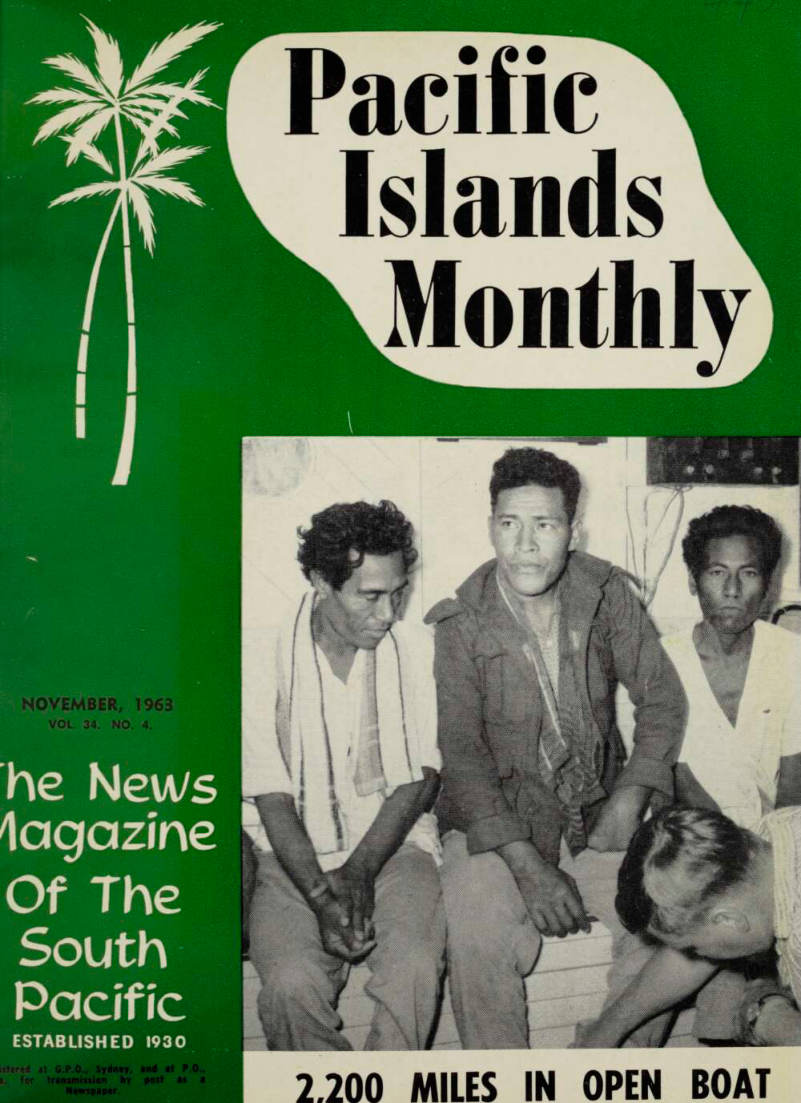 1
1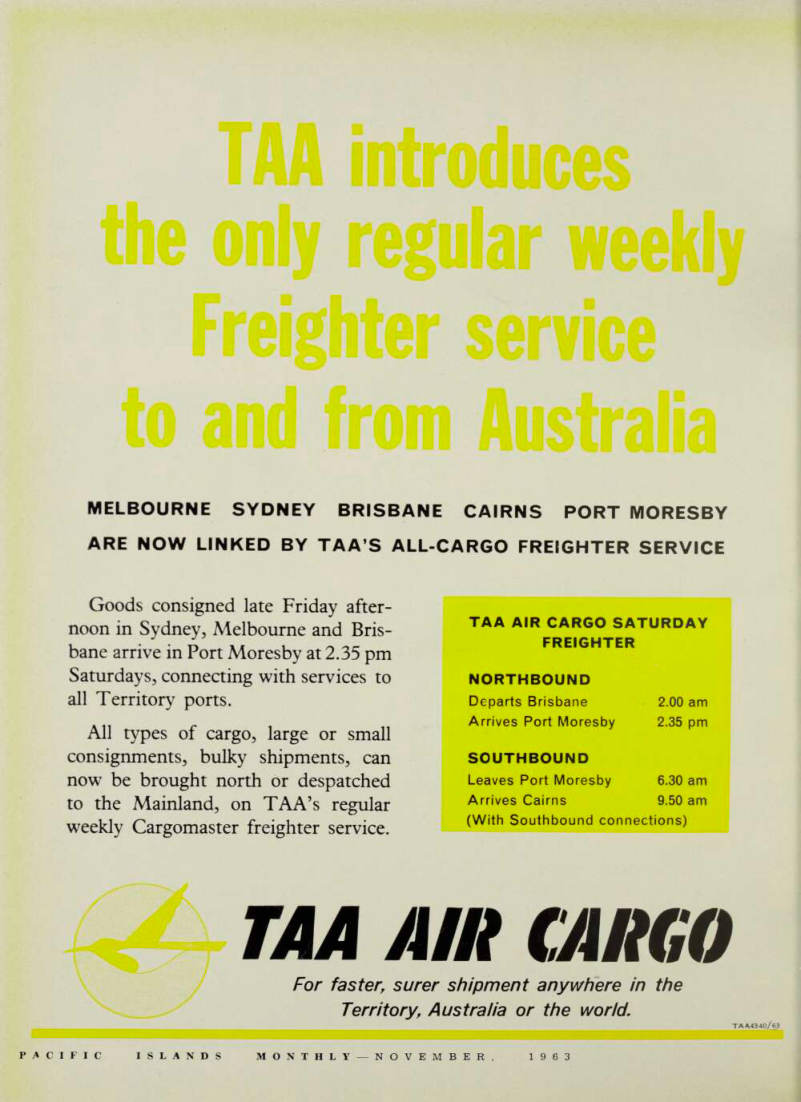 2
2 3
3 4
4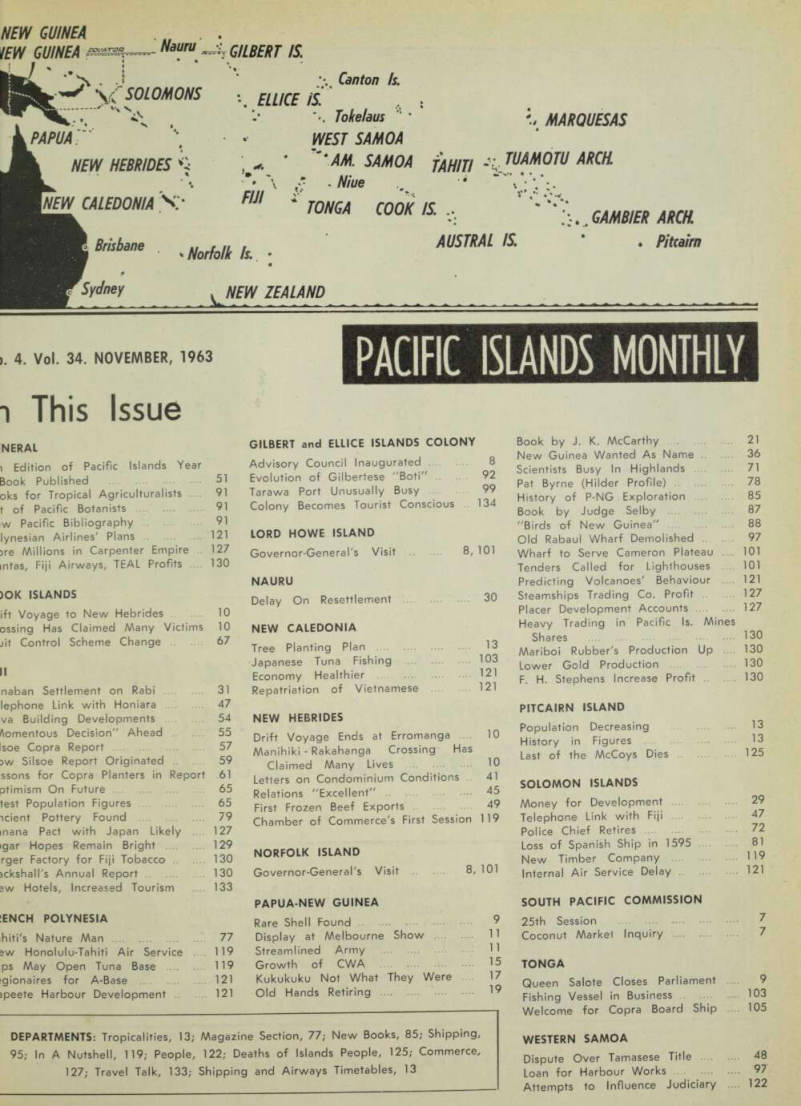 5
5 6
6 7
7 8
8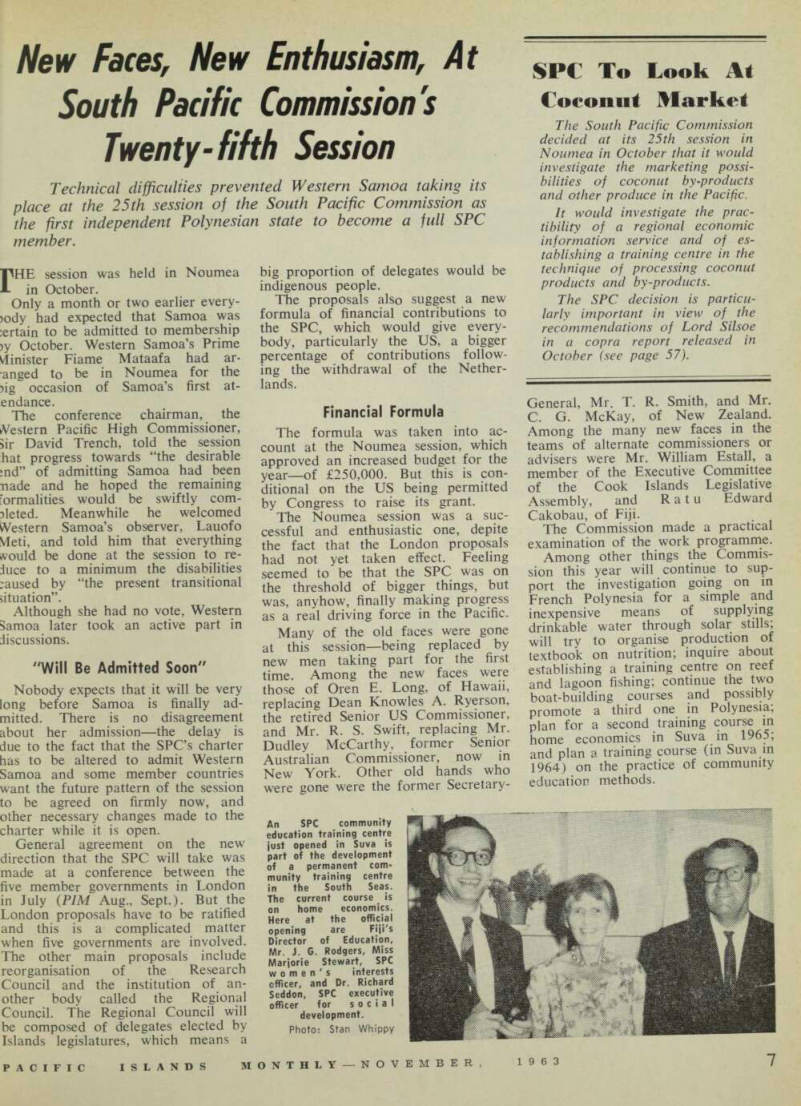 9
9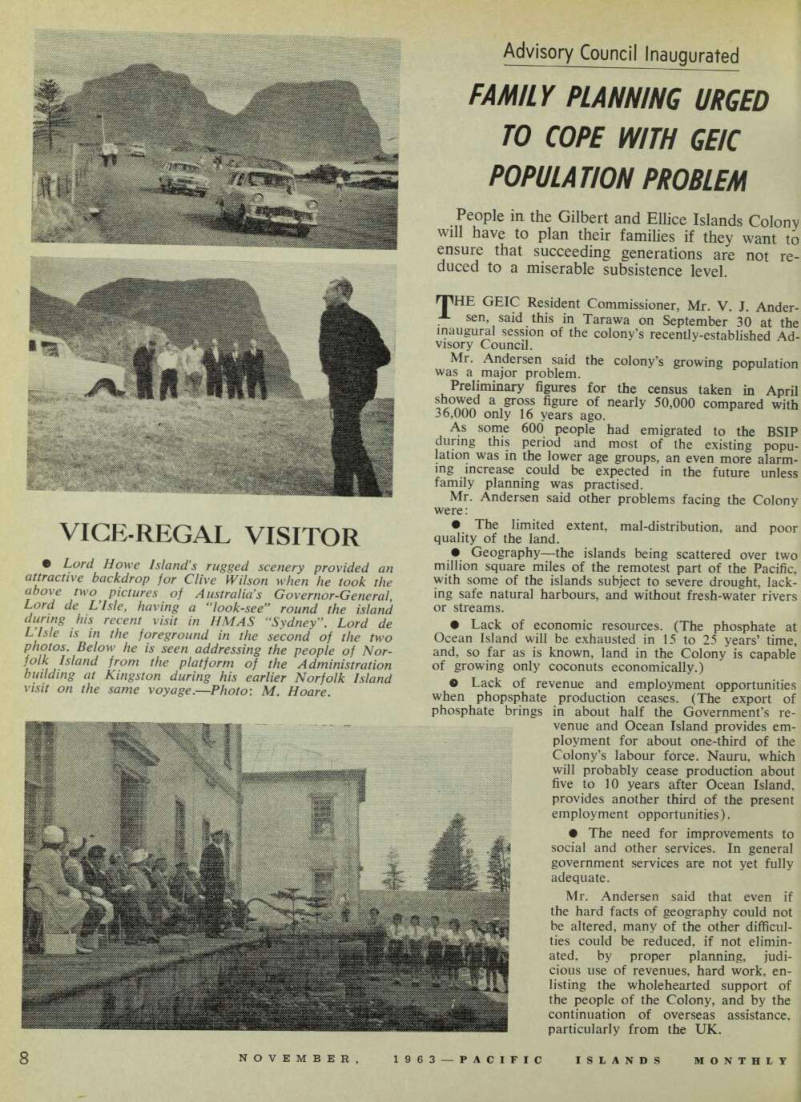 10
10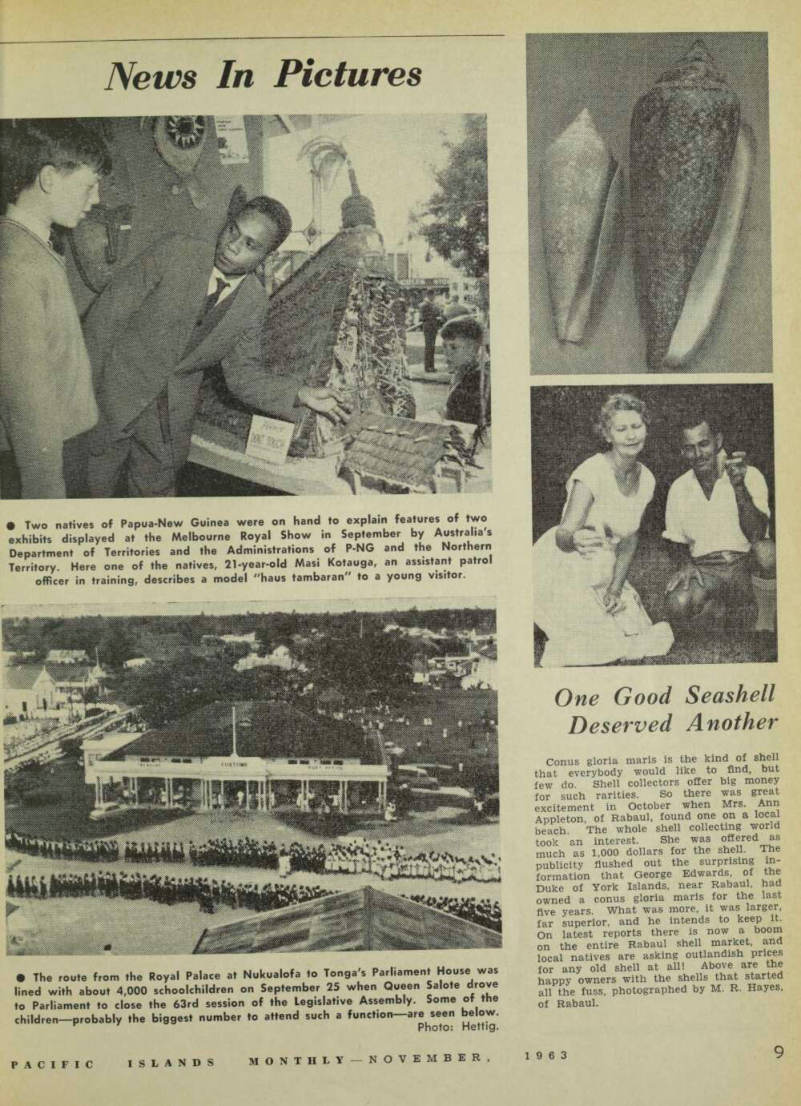 11
11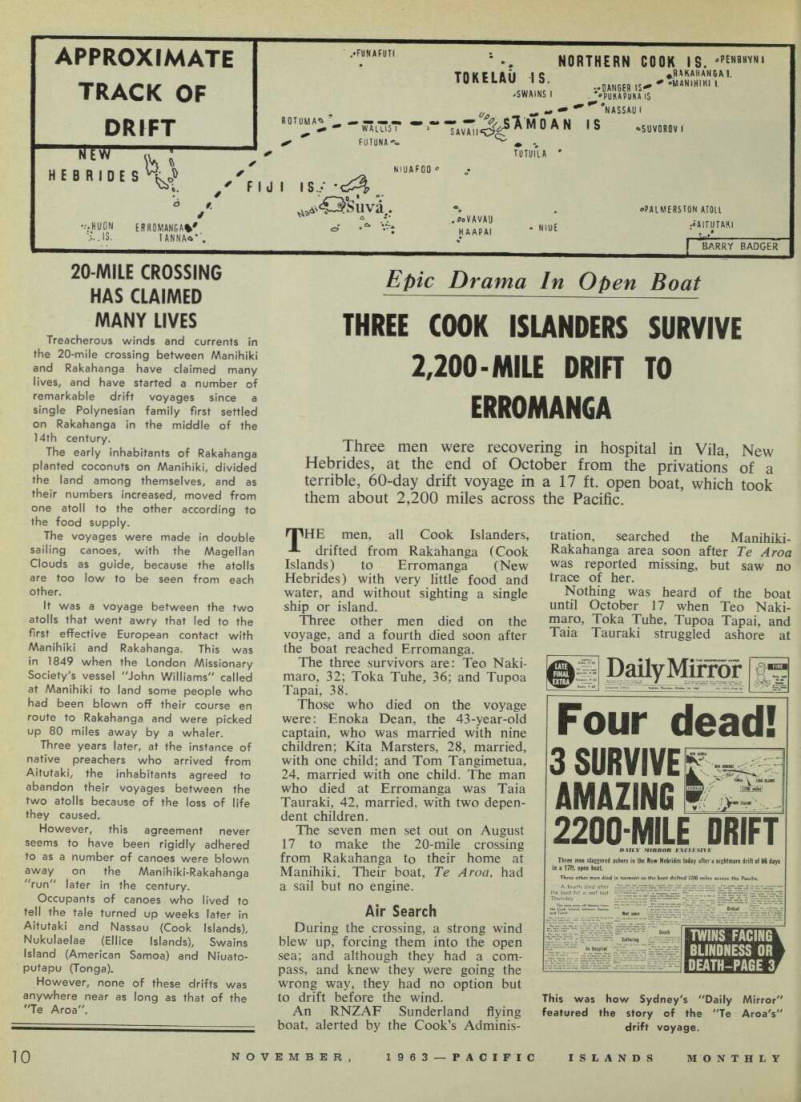 12
12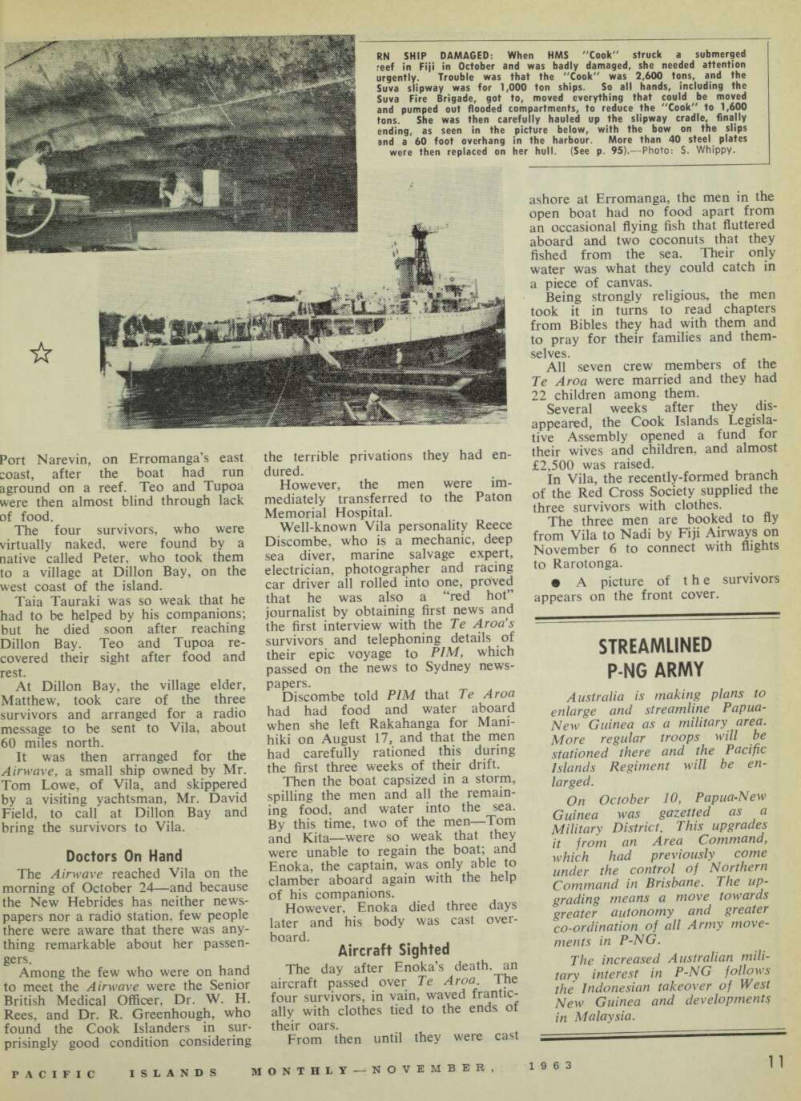 13
13 14
14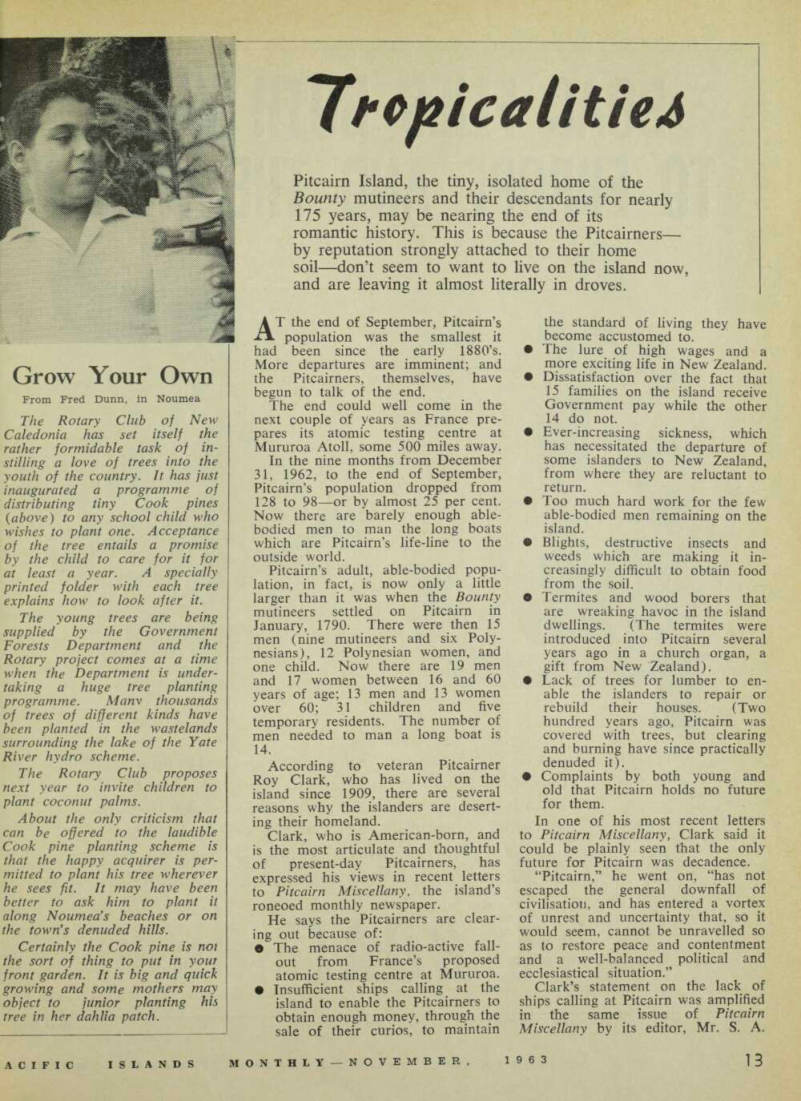 15
15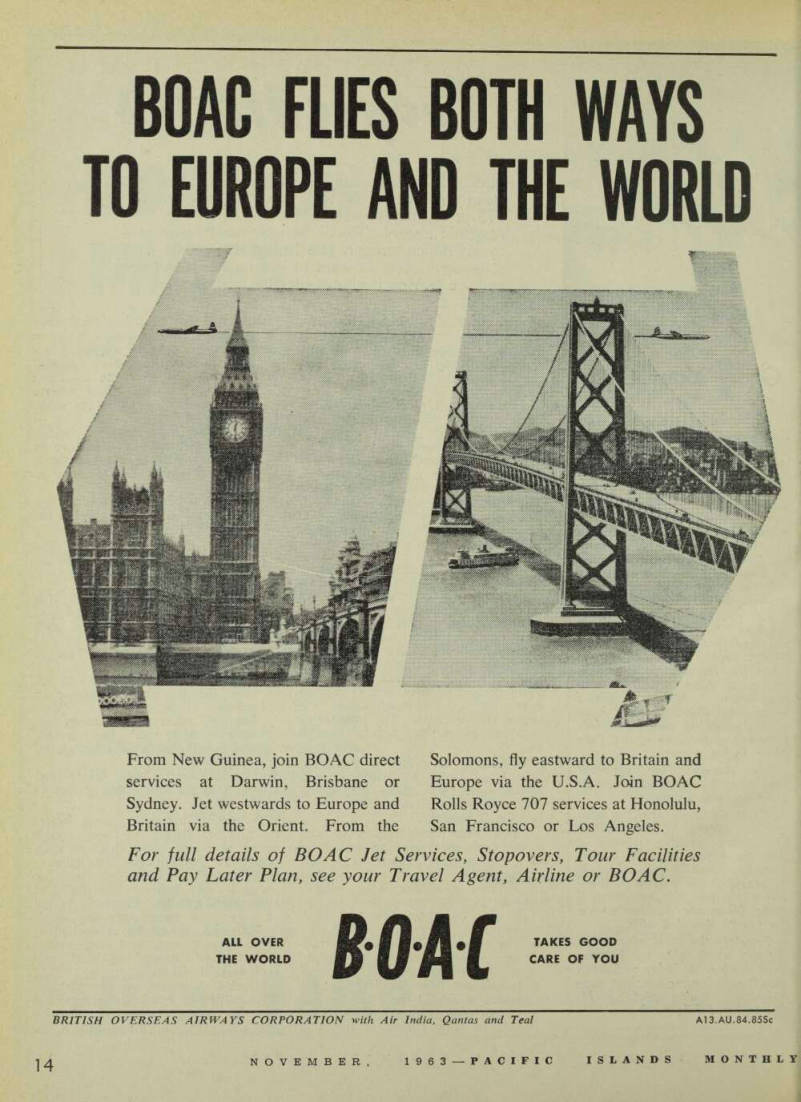 16
16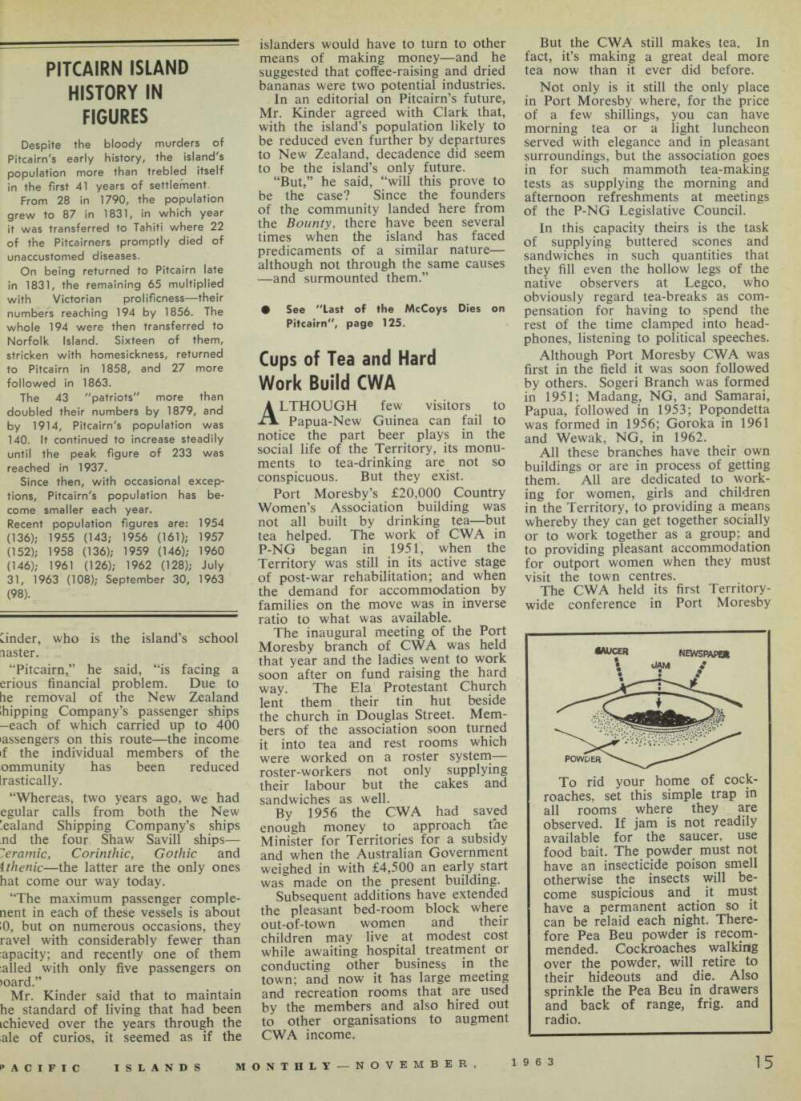 17
17 18
18 19
19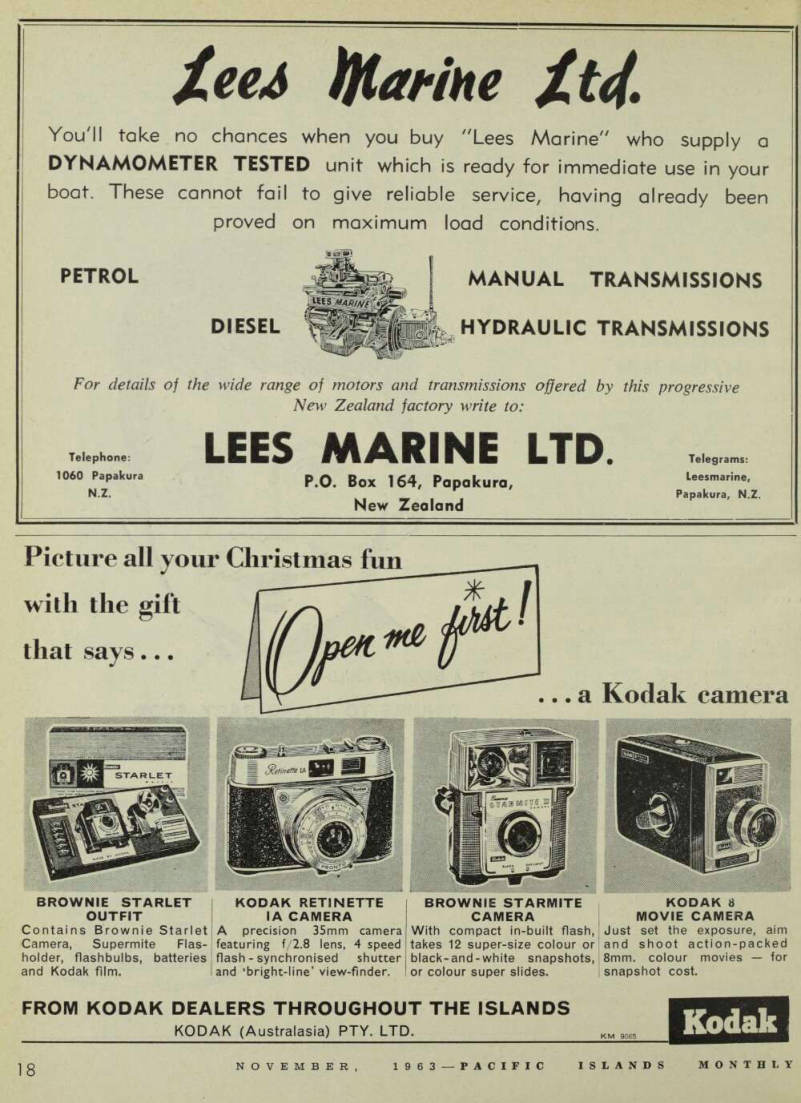 20
20 21
21 22
22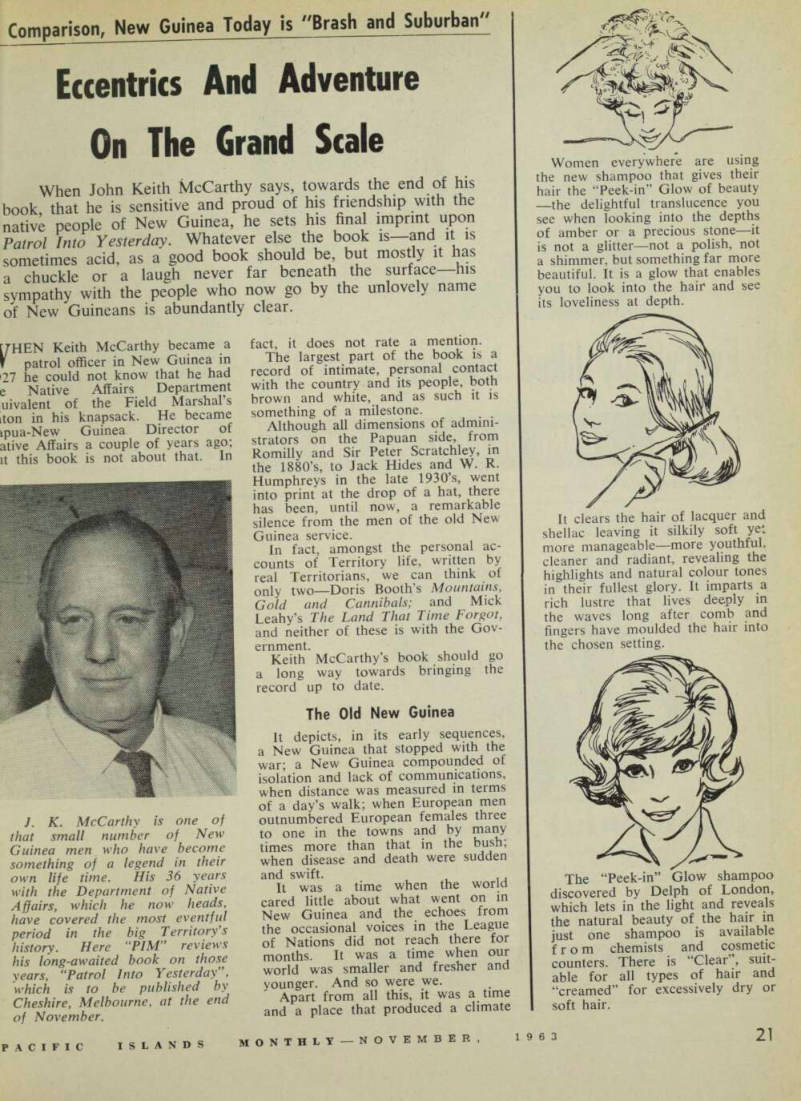 23
23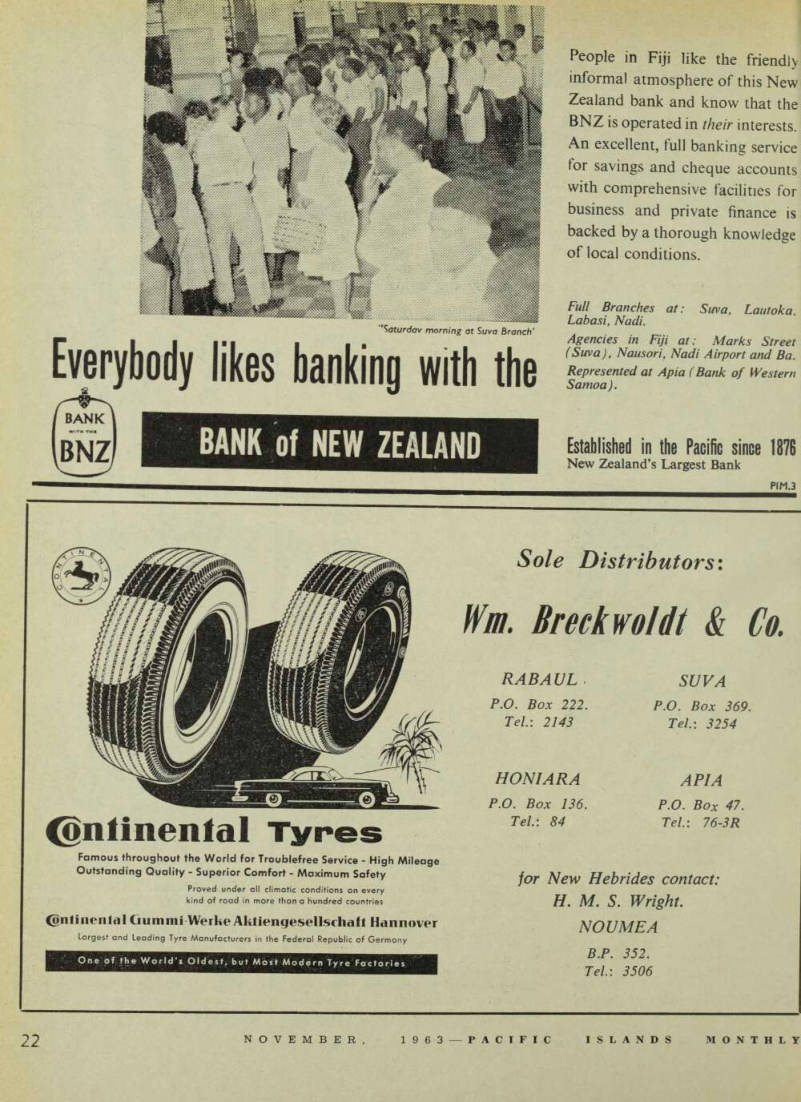 24
24 25
25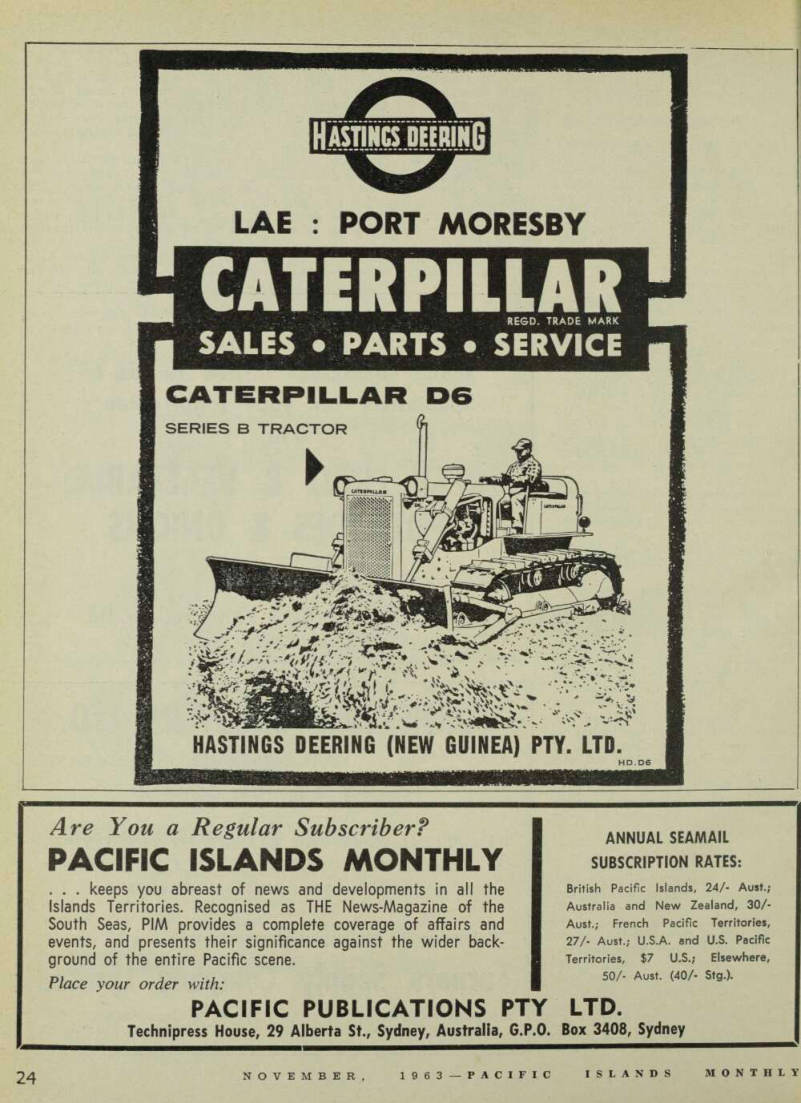 26
26 27
27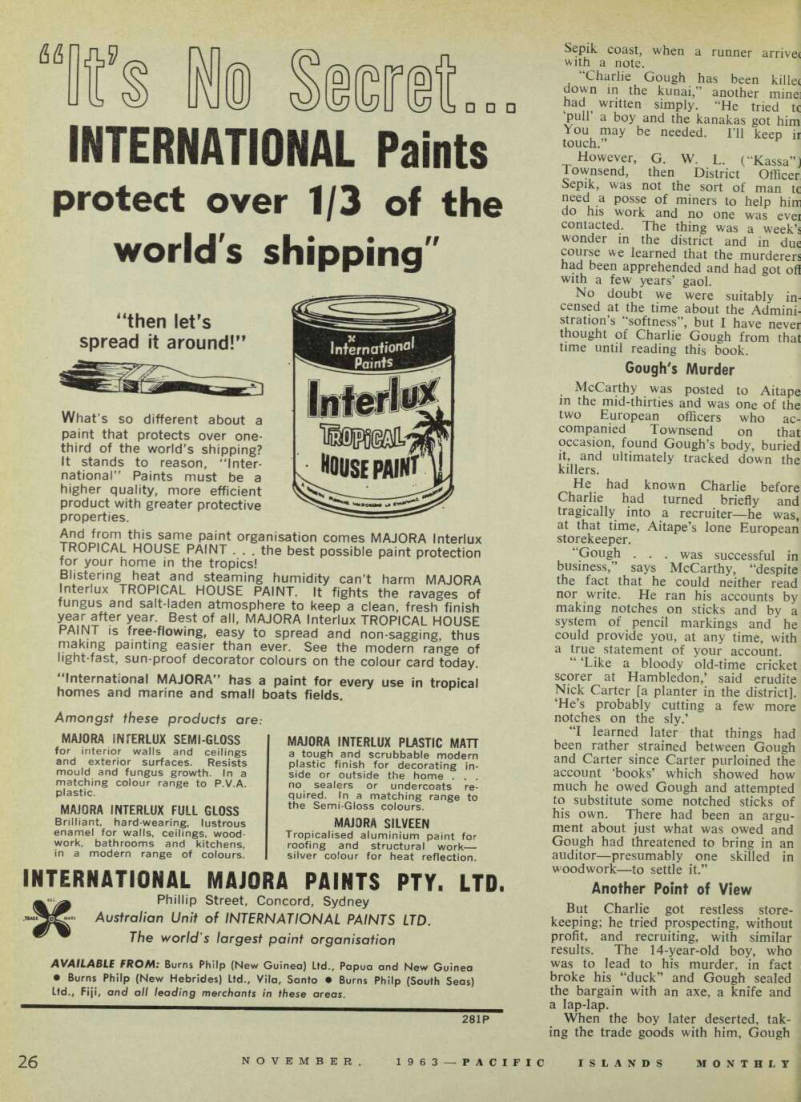 28
28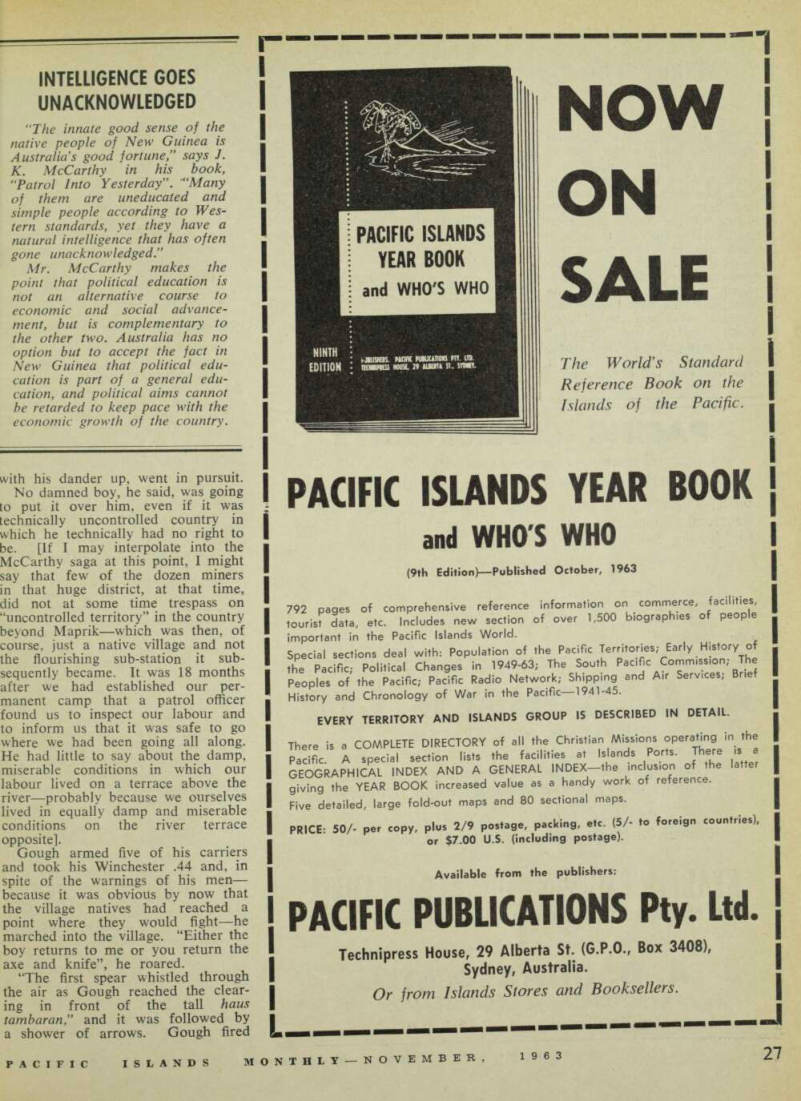 29
29 30
30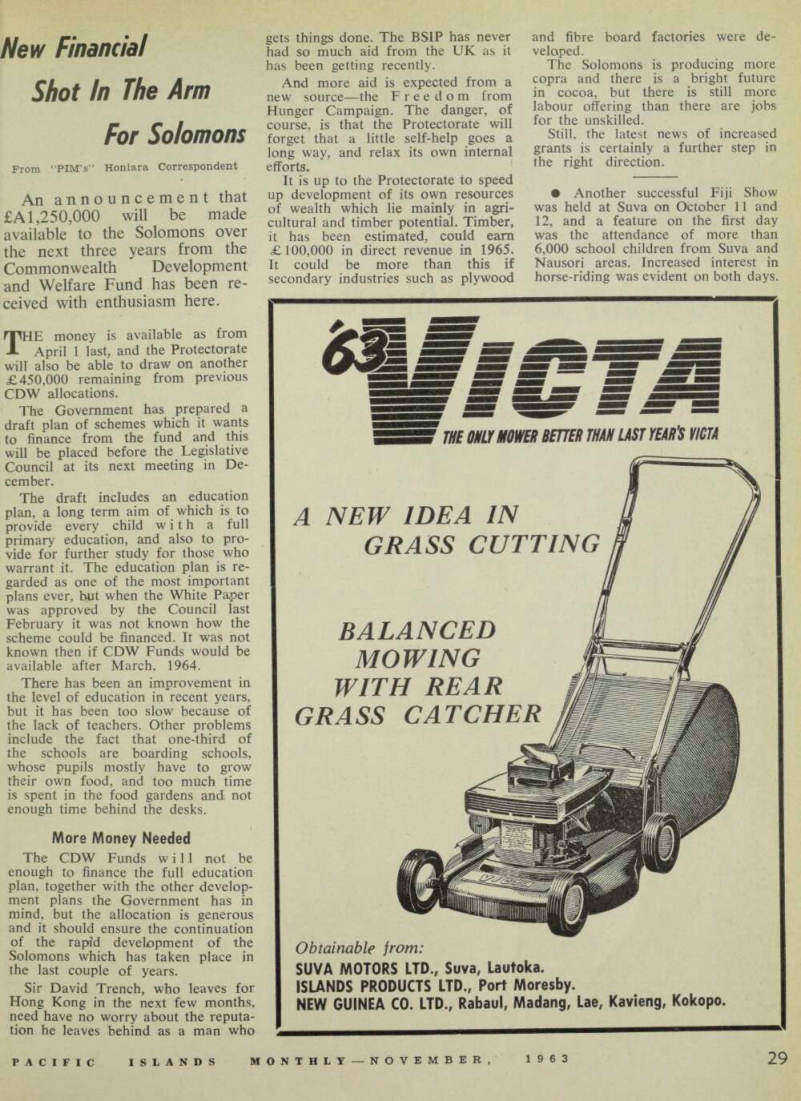 31
31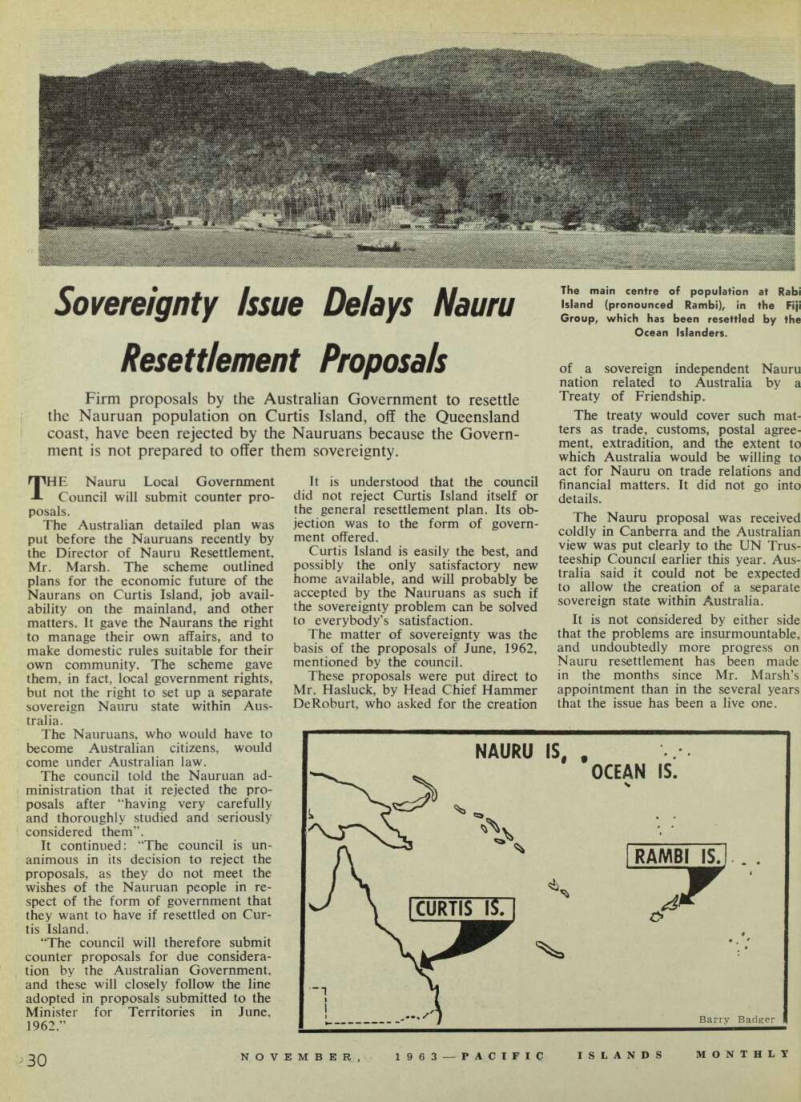 32
32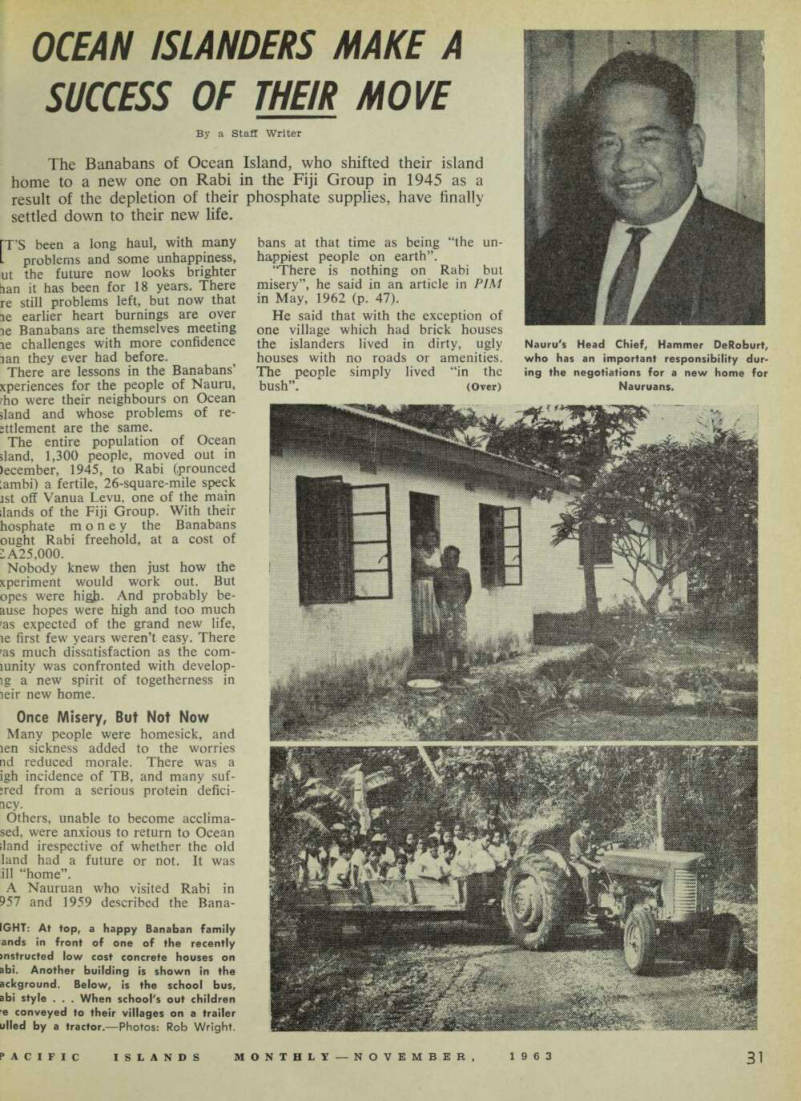 33
33 34
34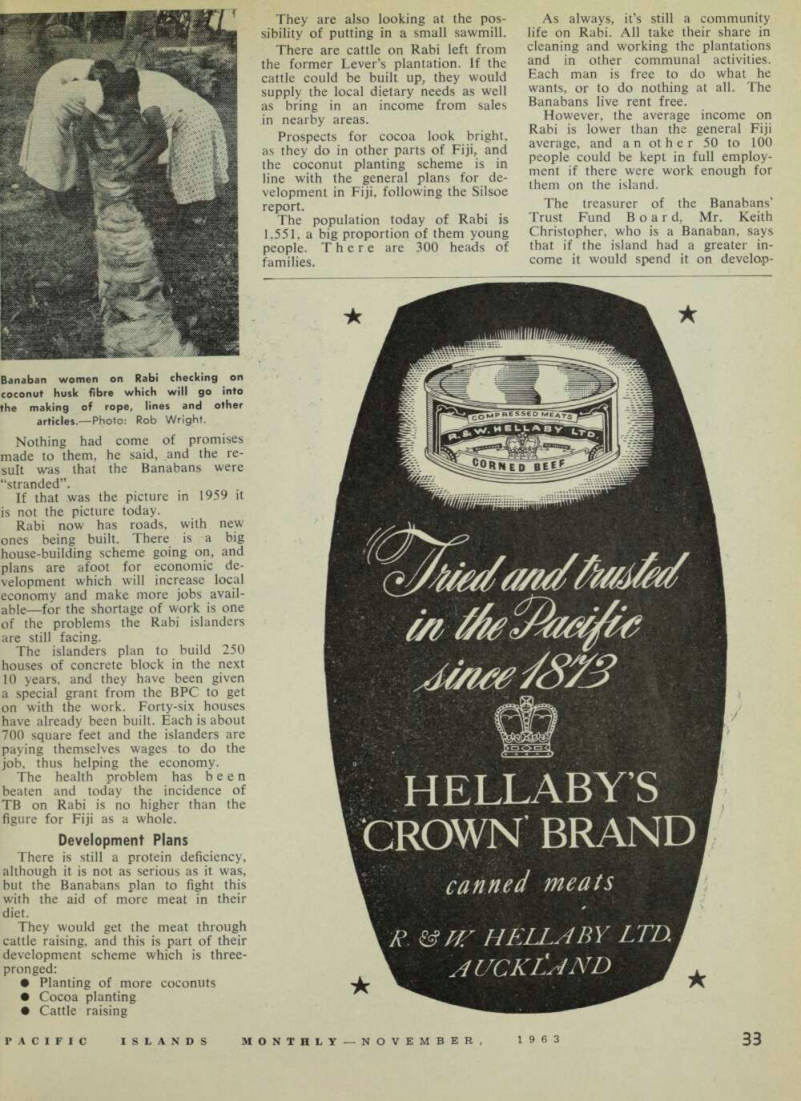 35
35 36
36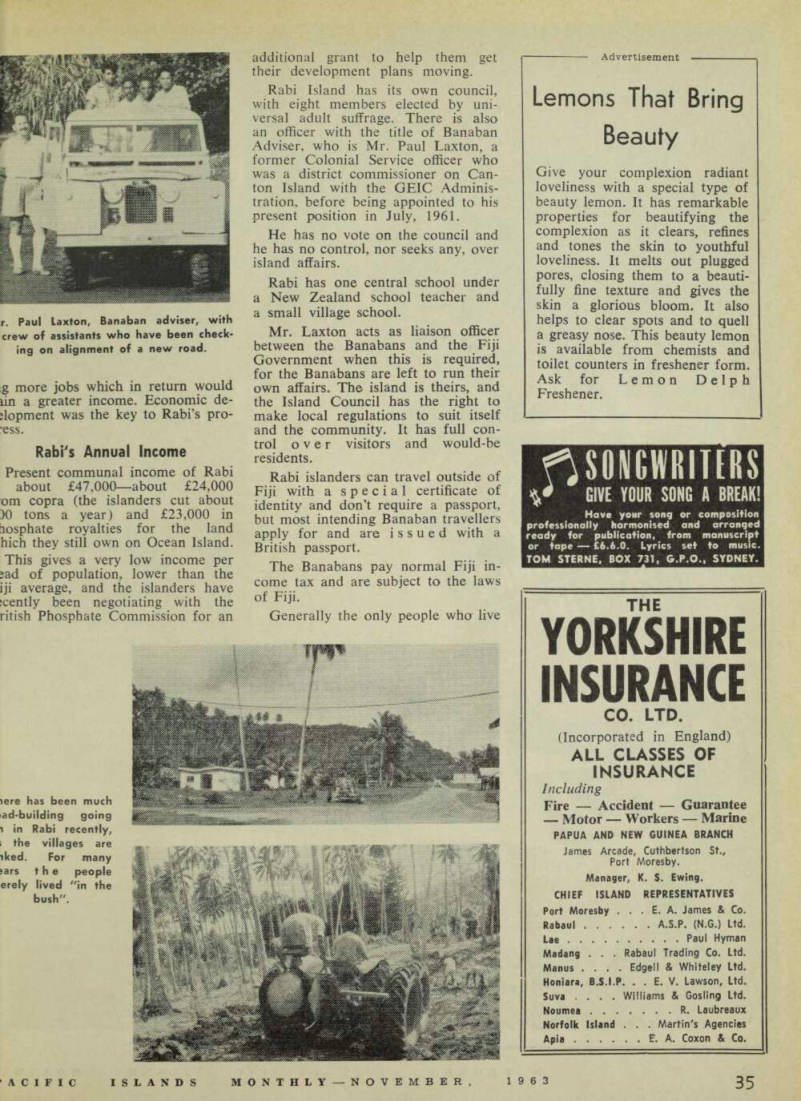 37
37 38
38 39
39 40
40 41
41 42
42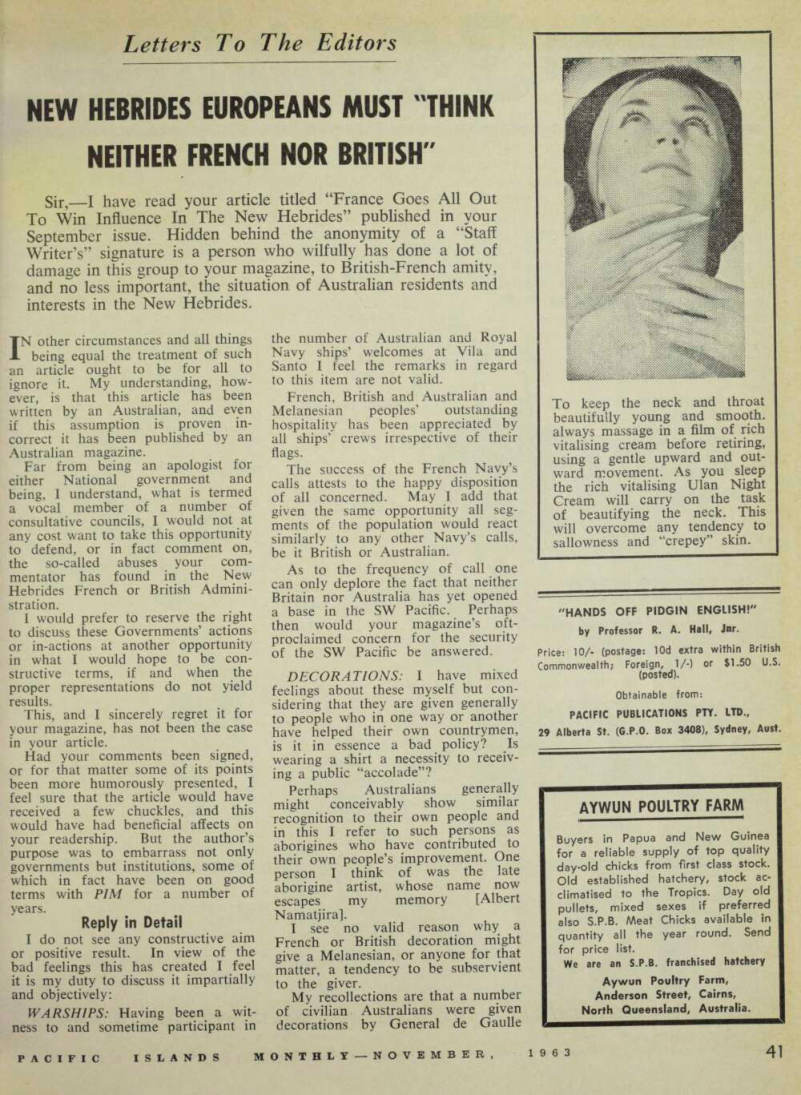 43
43 44
44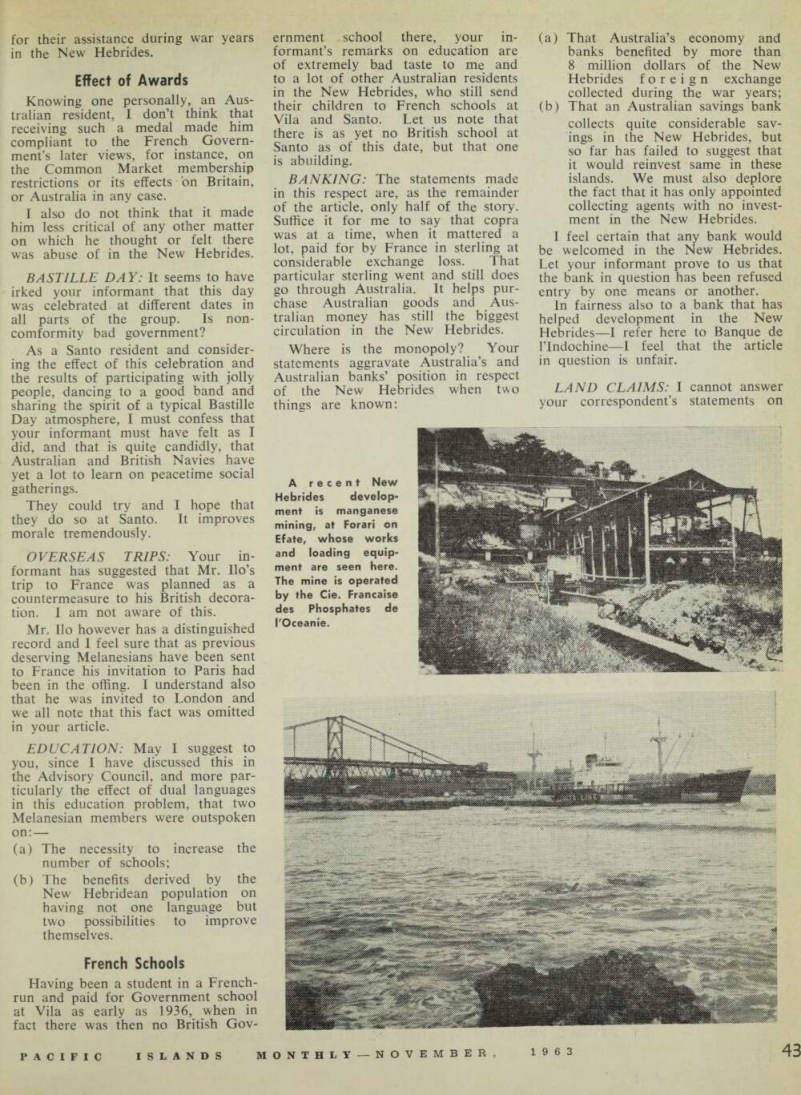 45
45 46
46 47
47 48
48 49
49 50
50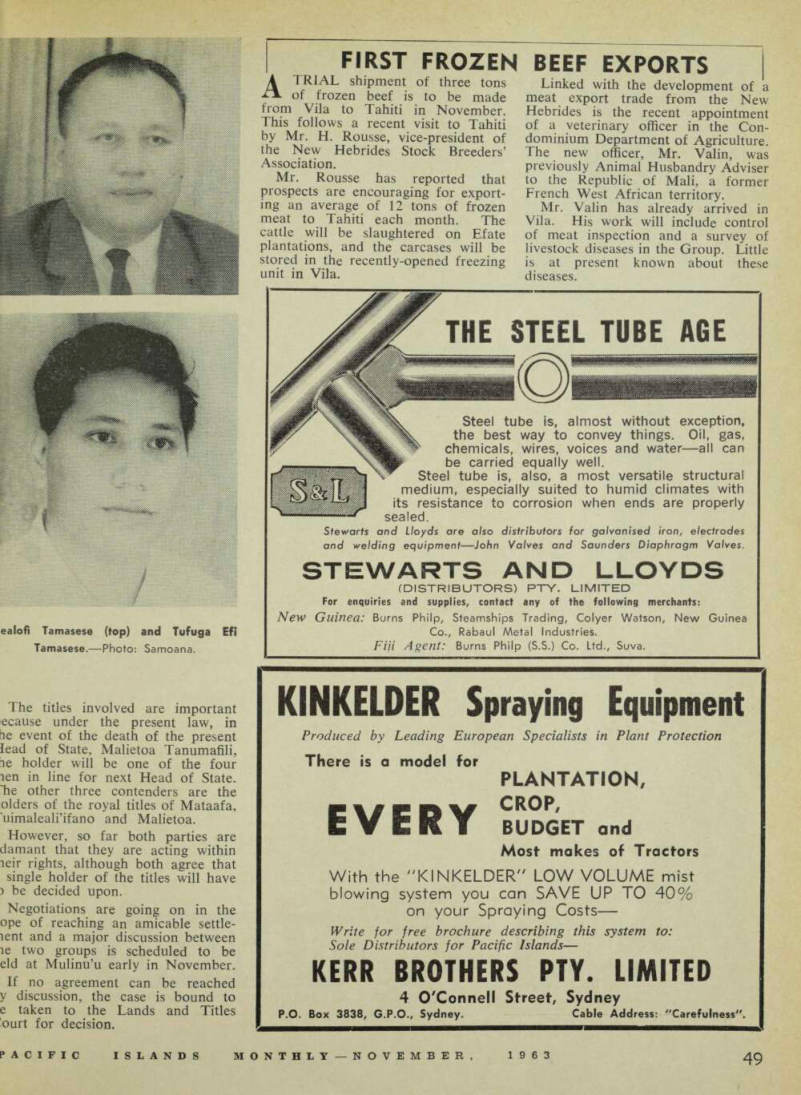 51
51 52
52 53
53 54
54 55
55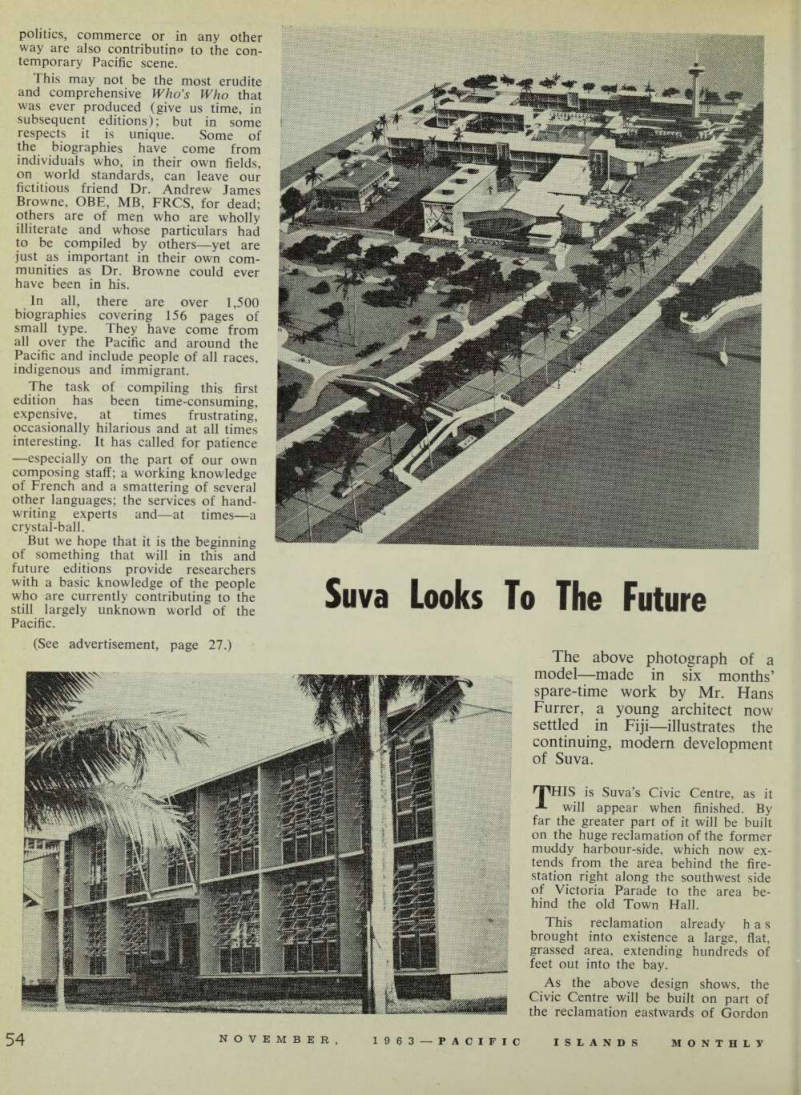 56
56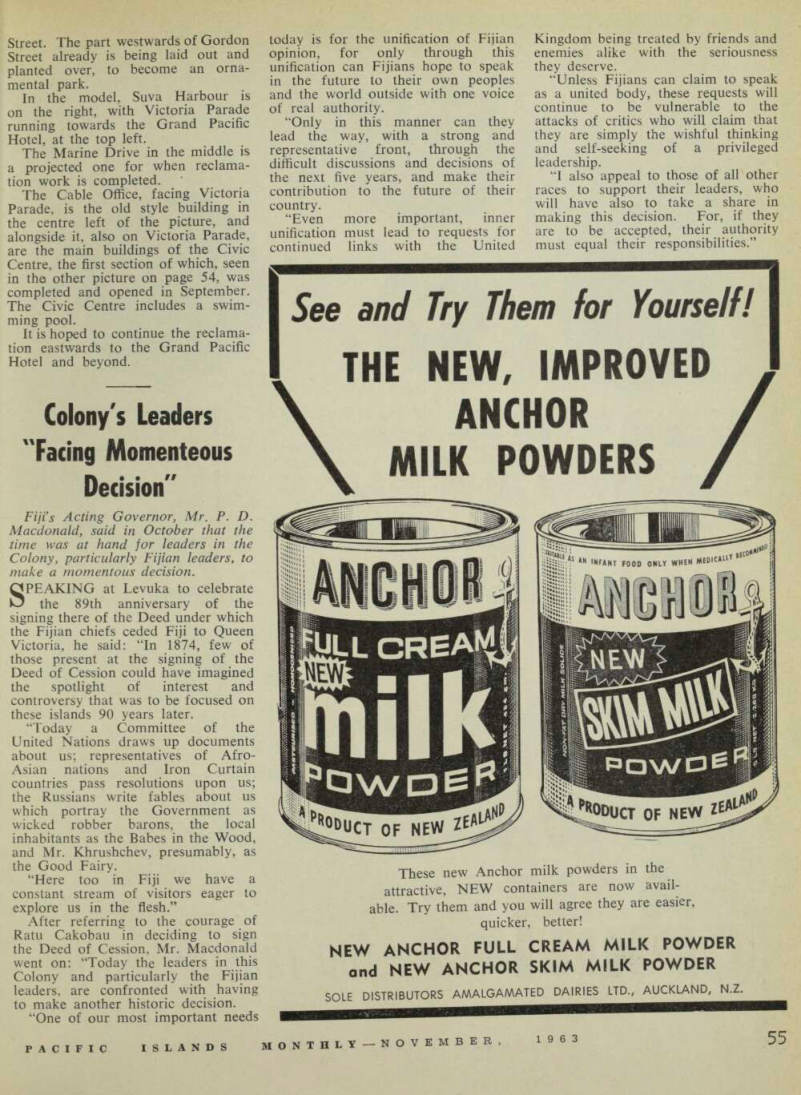 57
57 58
58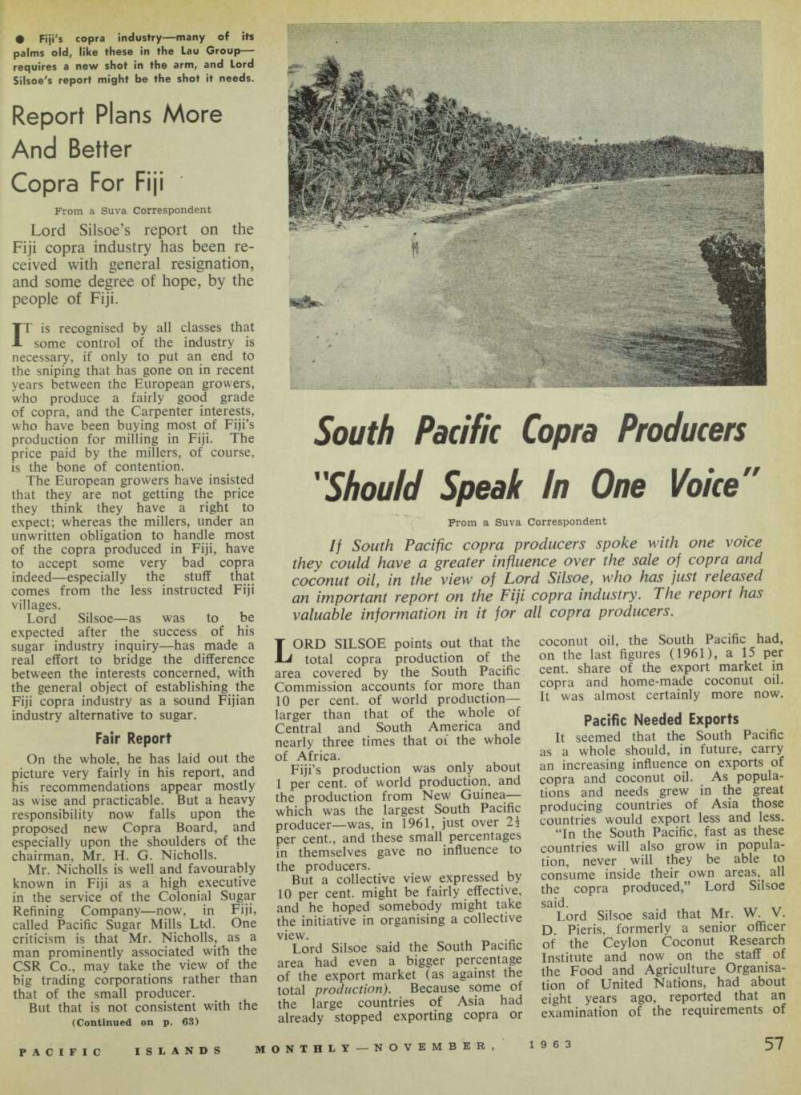 59
59 60
60 61
61 62
62 63
63 64
64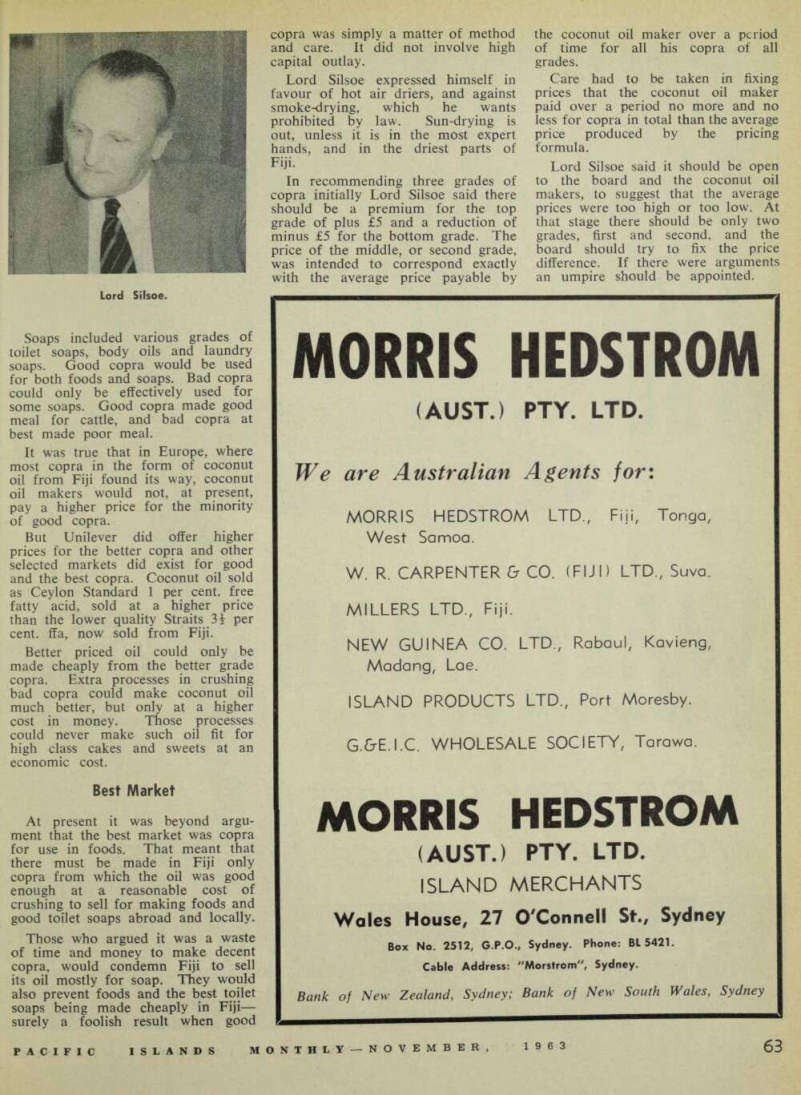 65
65 66
66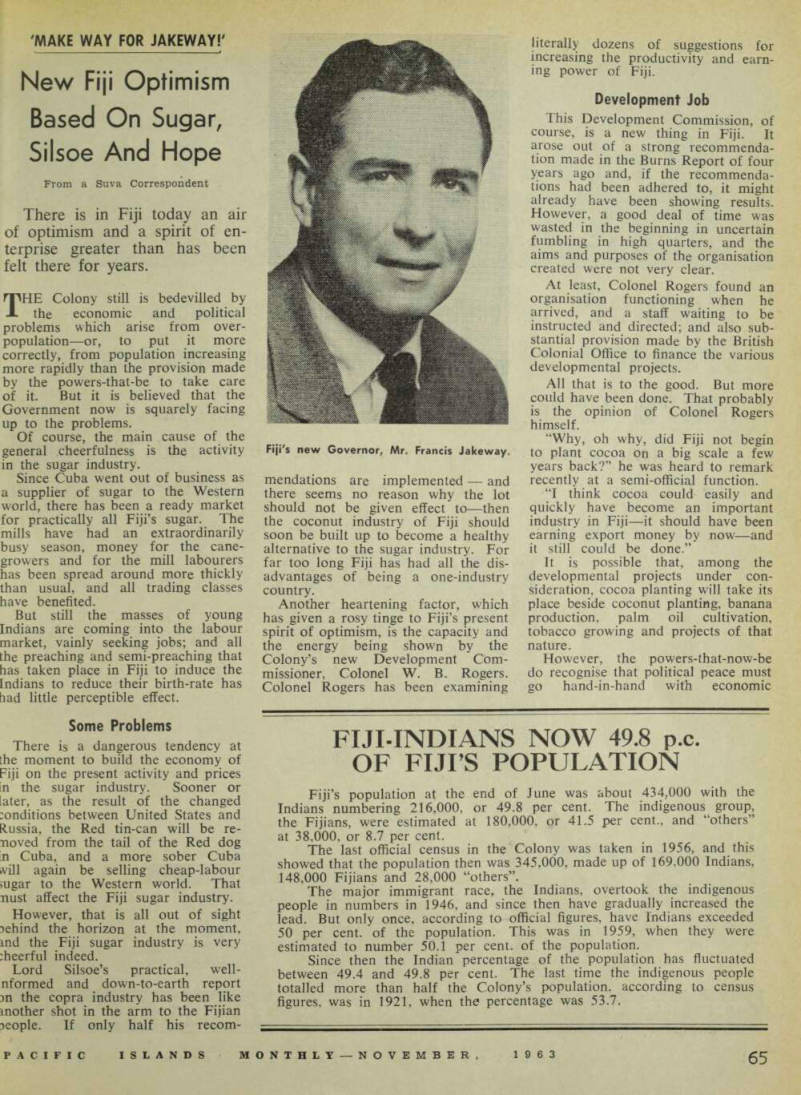 67
67 68
68 69
69 70
70 71
71 72
72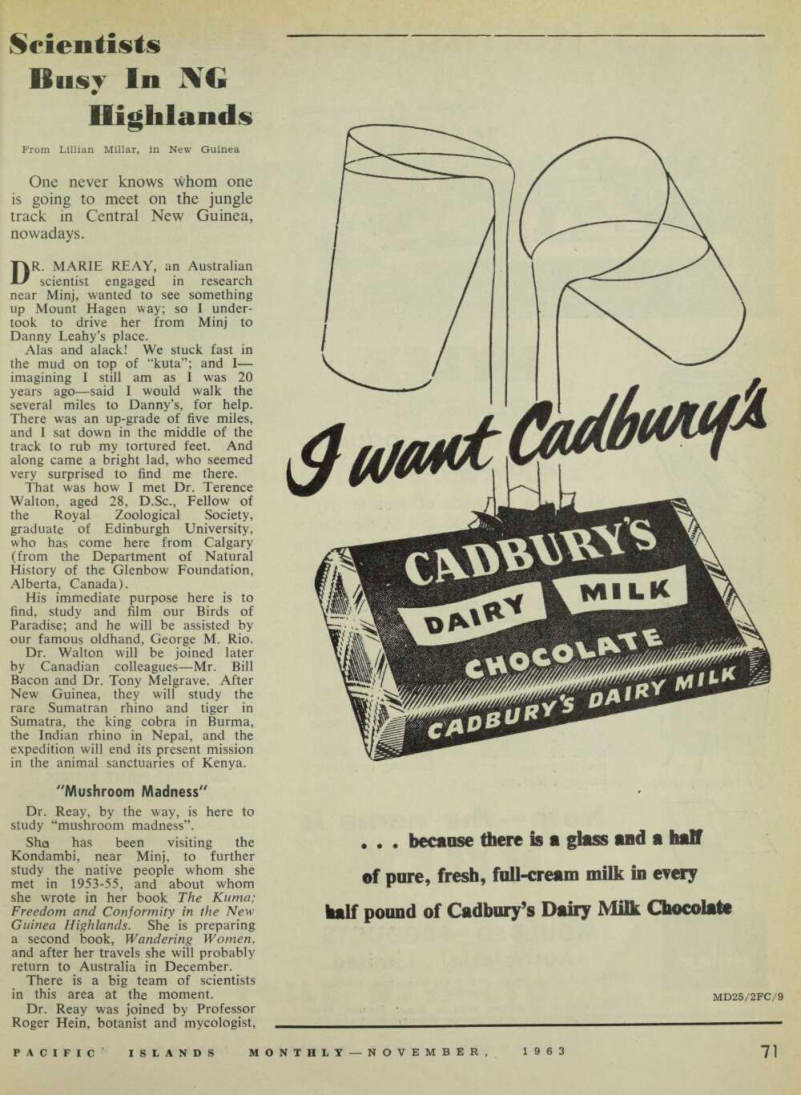 73
73 74
74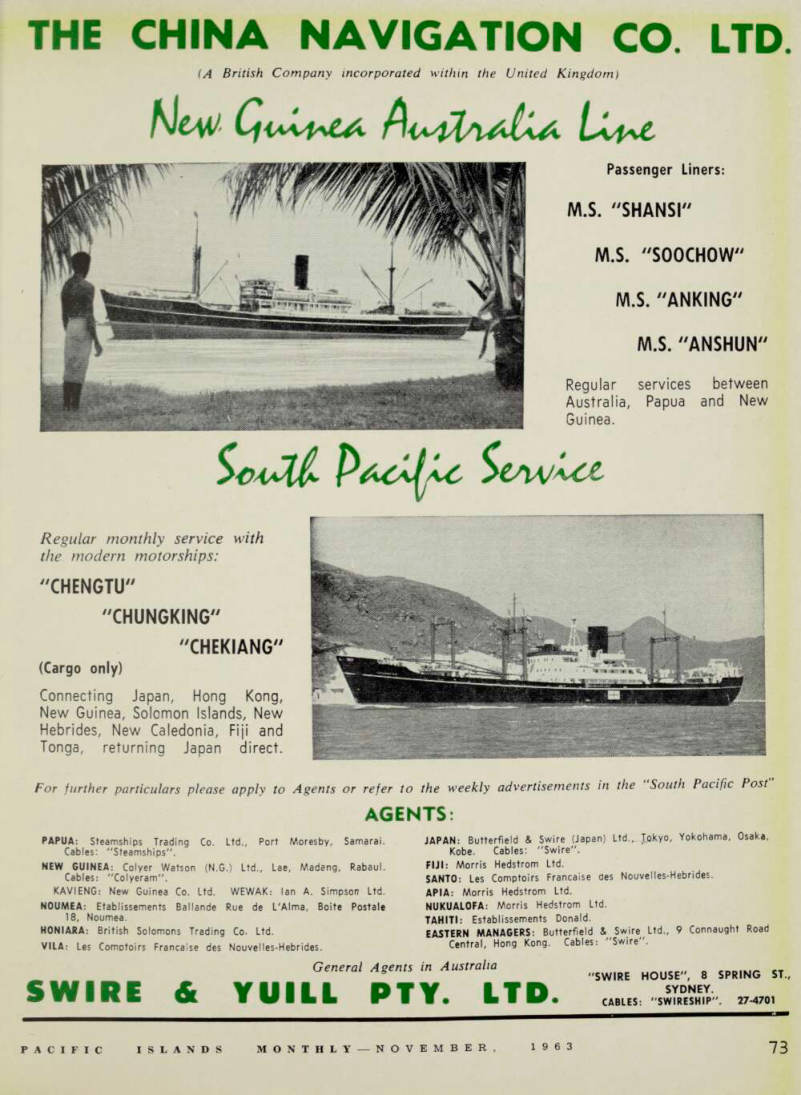 75
75 76
76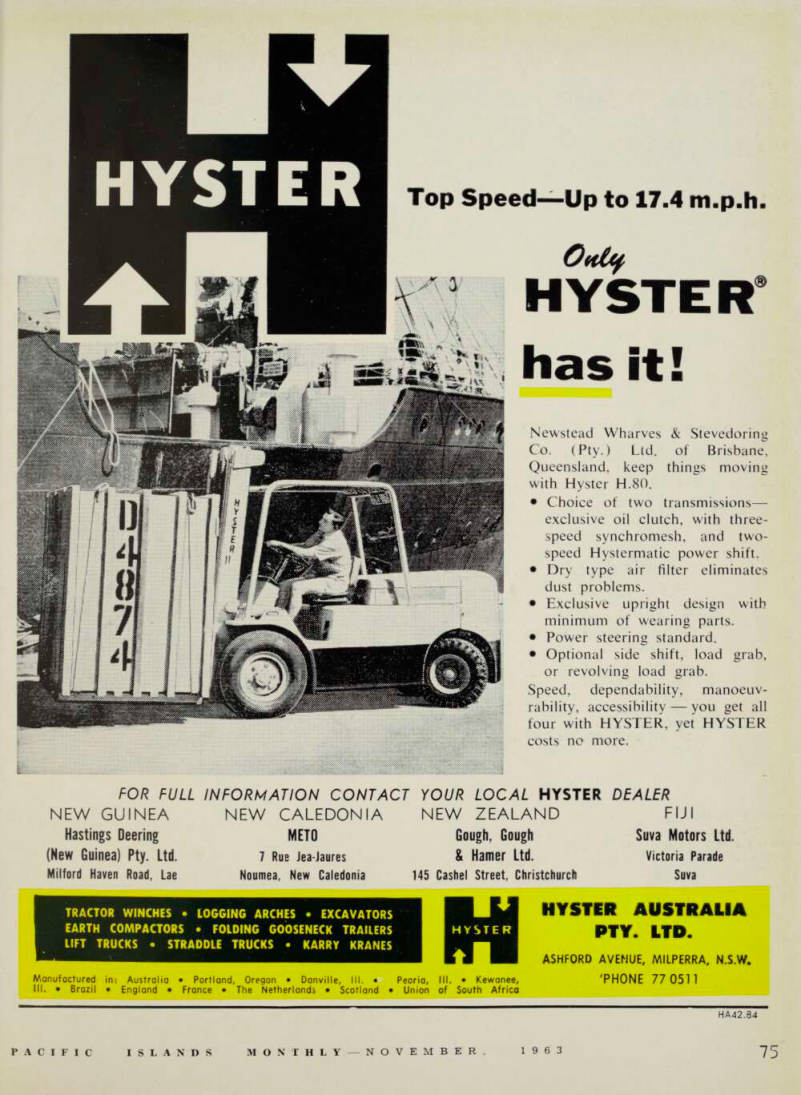 77
77 78
78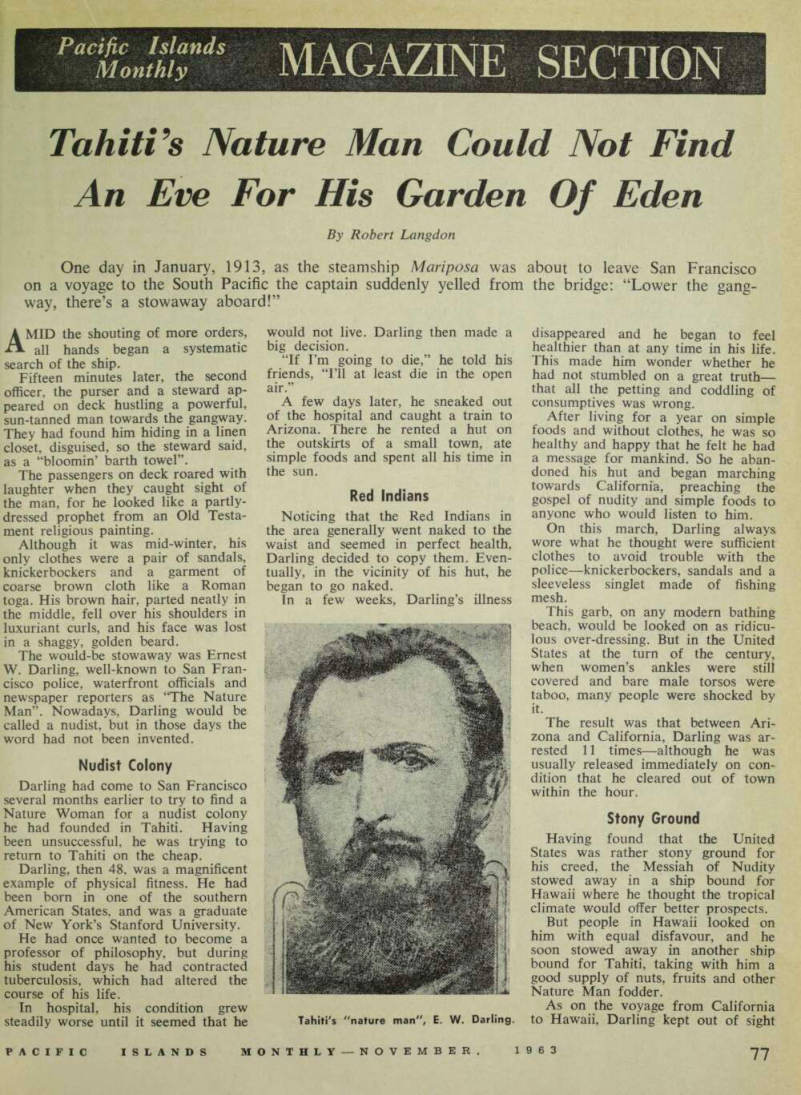 79
79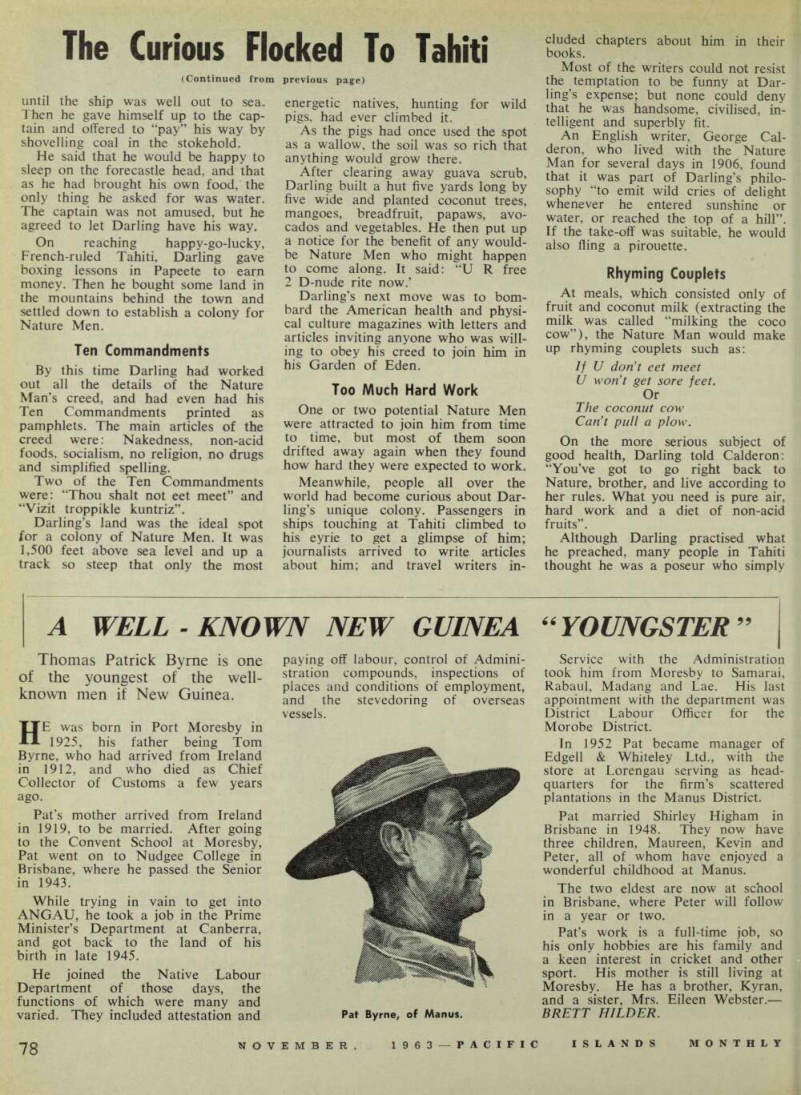 80
80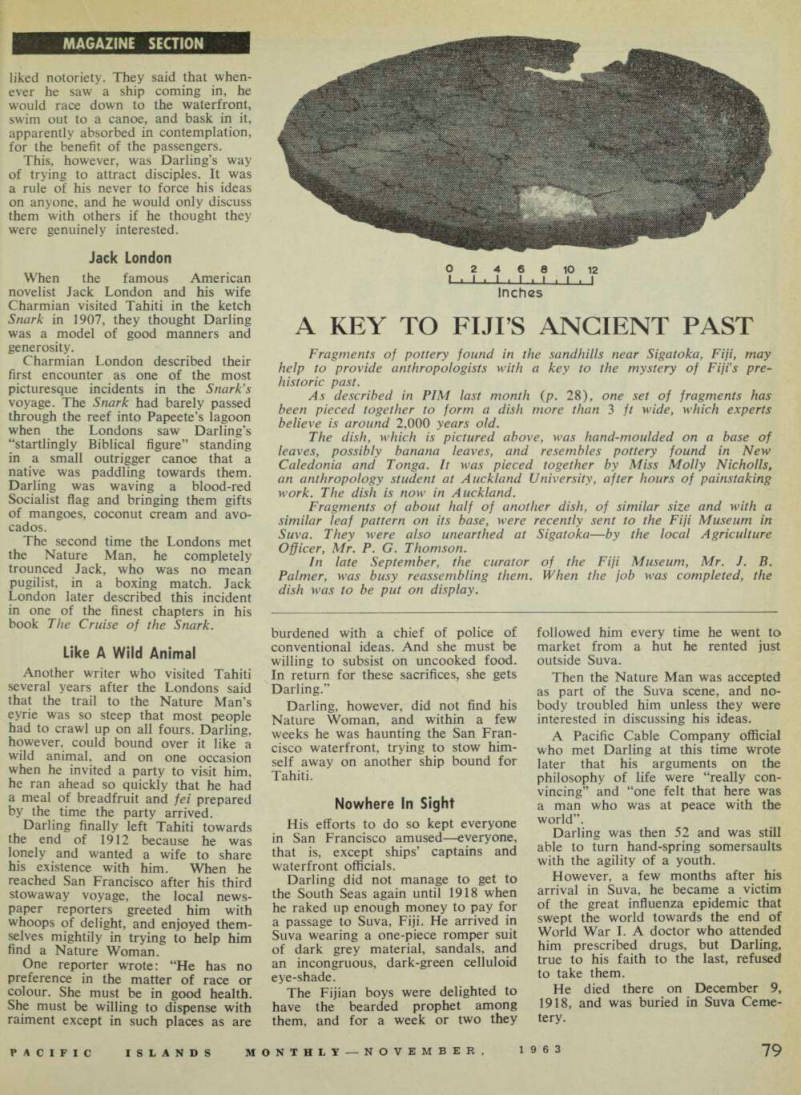 81
81 82
82 83
83 84
84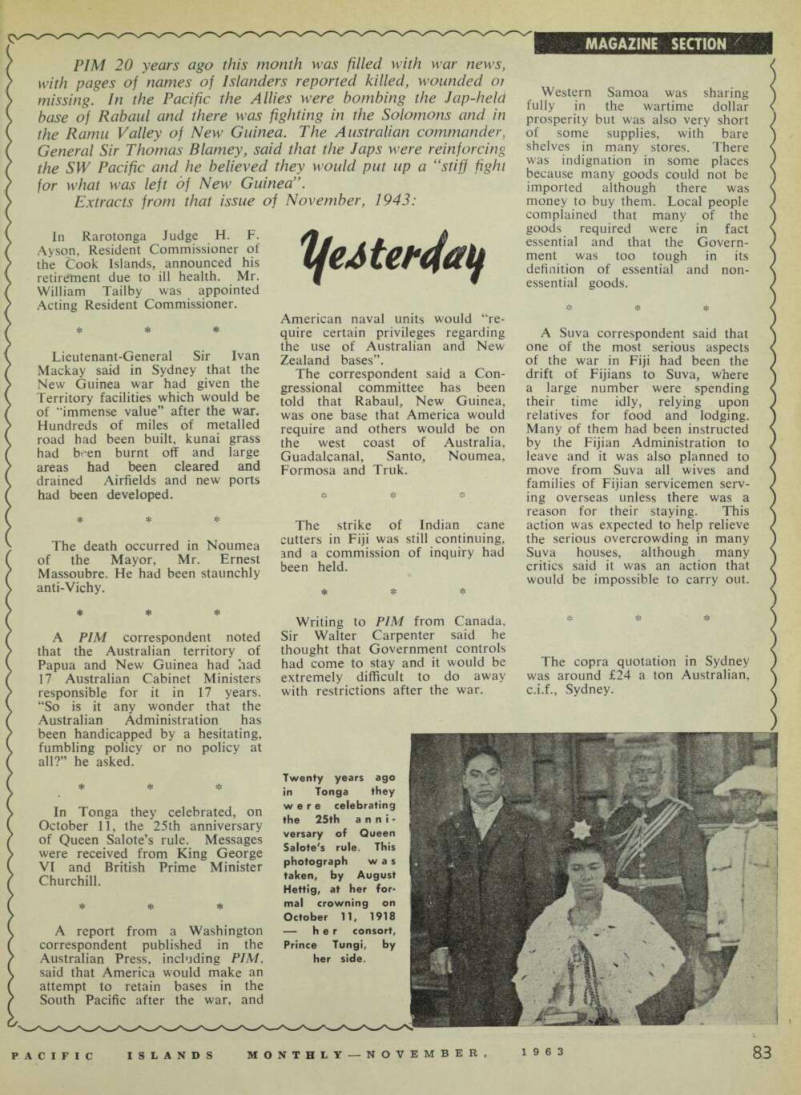 85
85 86
86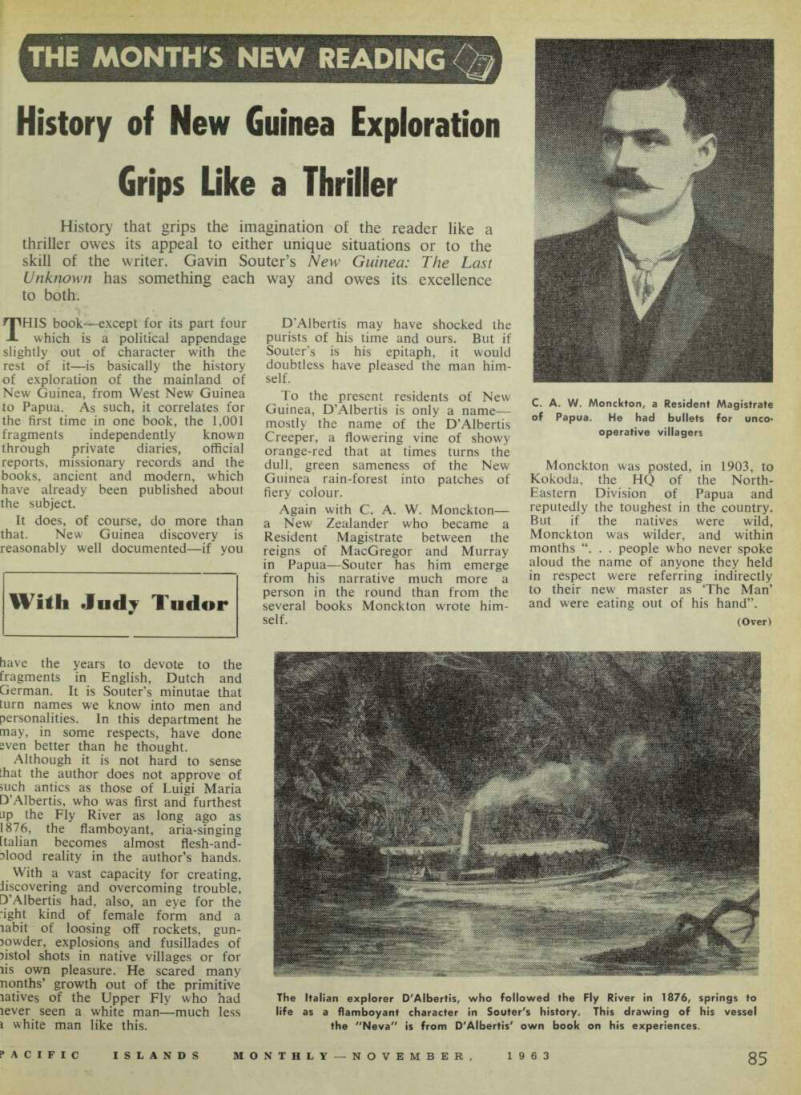 87
87 88
88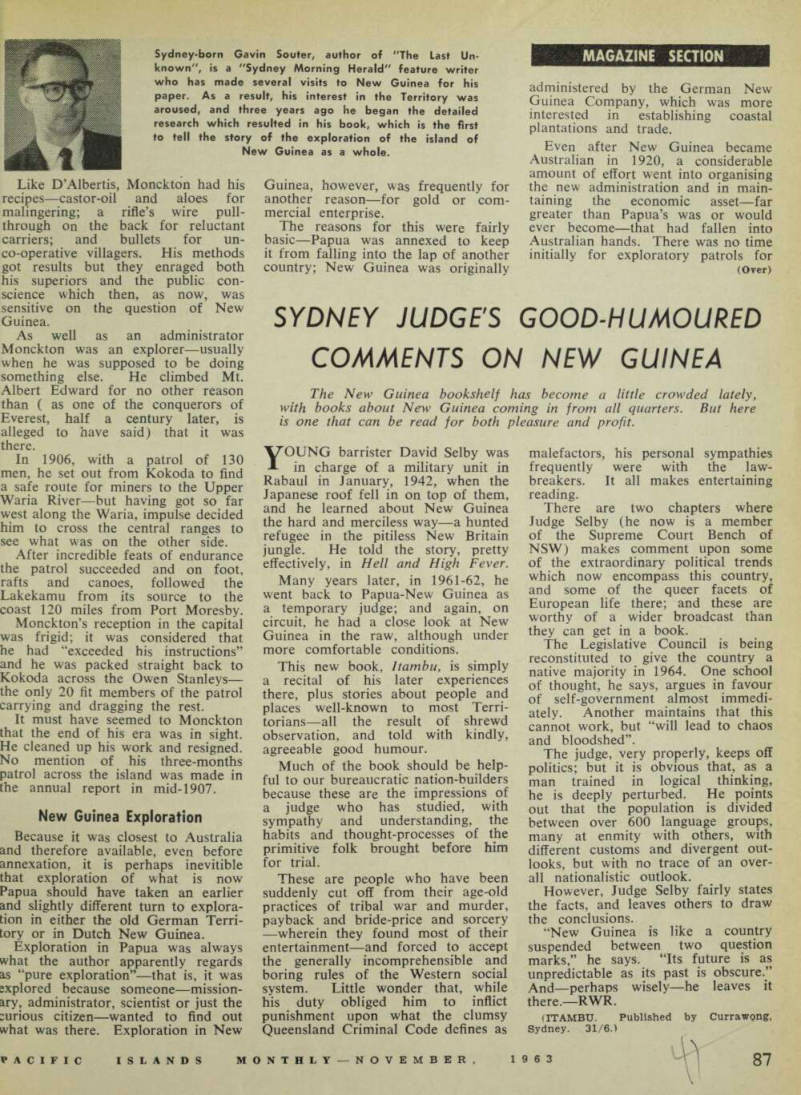 89
89 90
90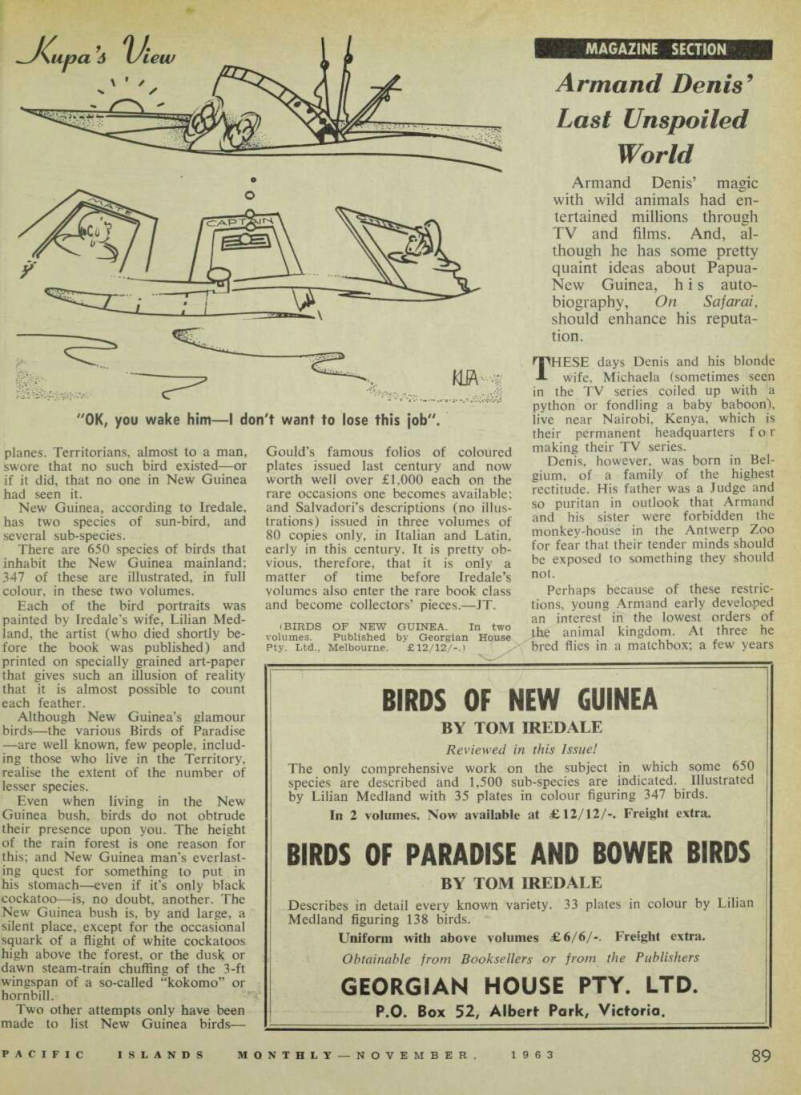 91
91 92
92 93
93 94
94 95
95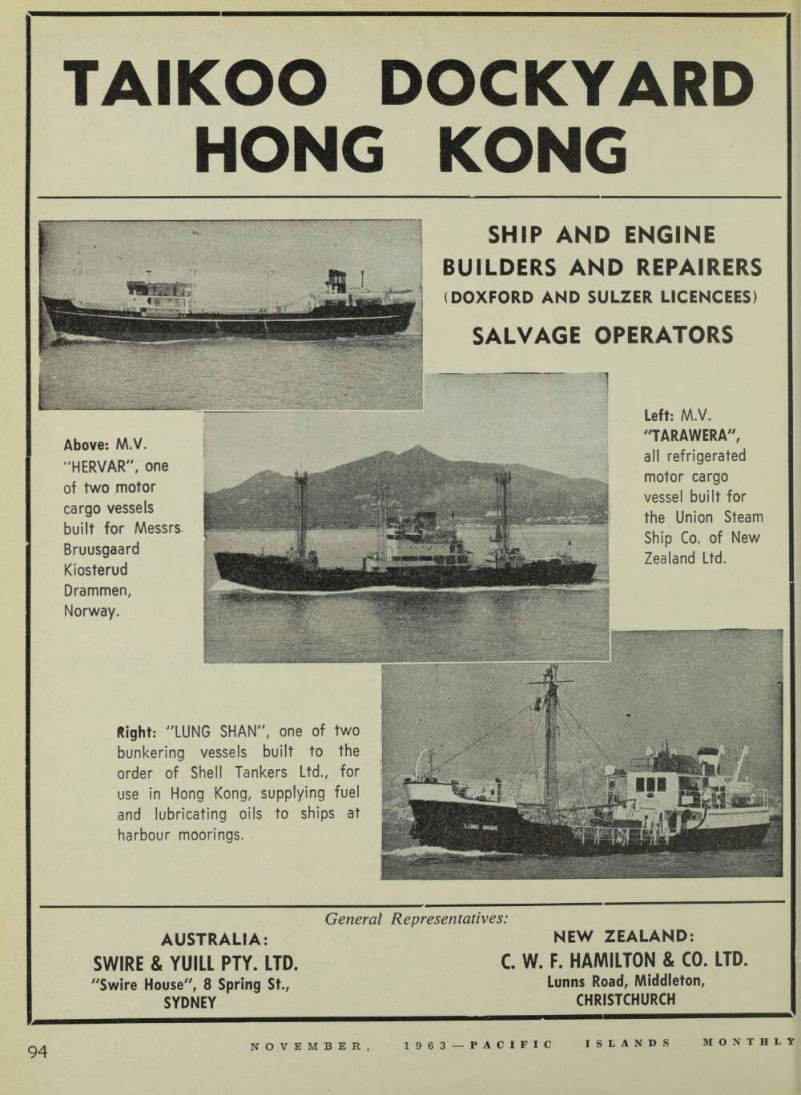 96
96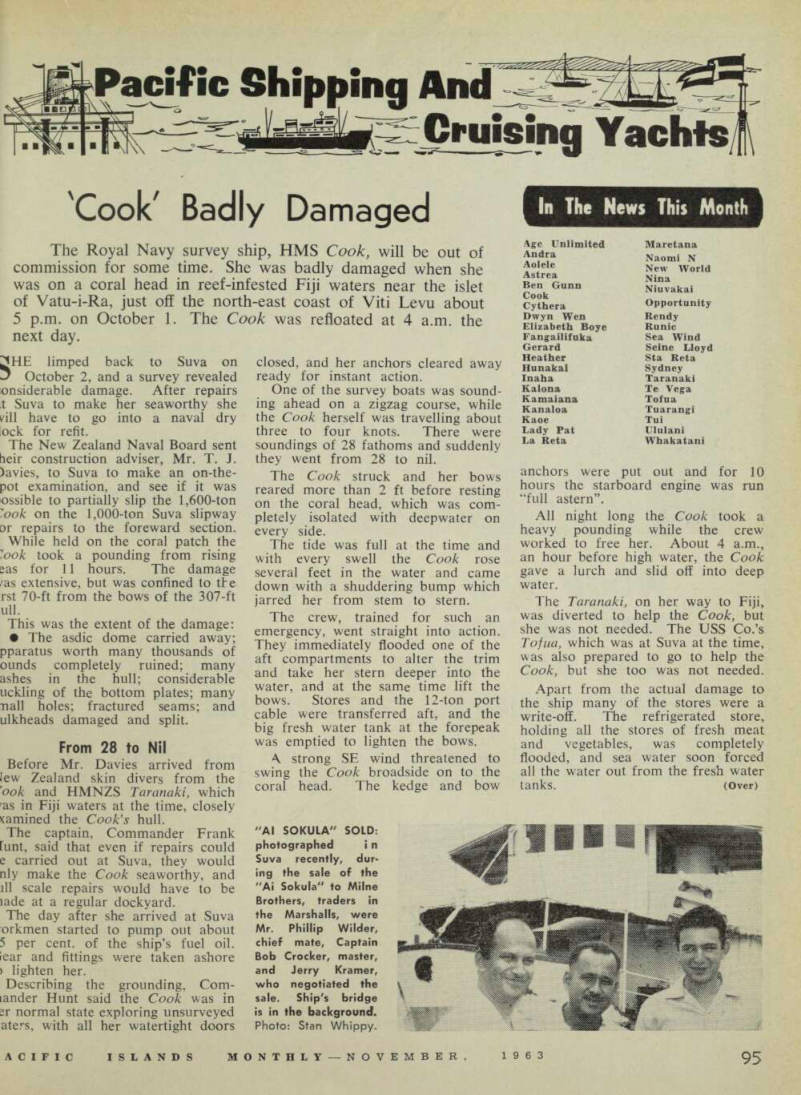 97
97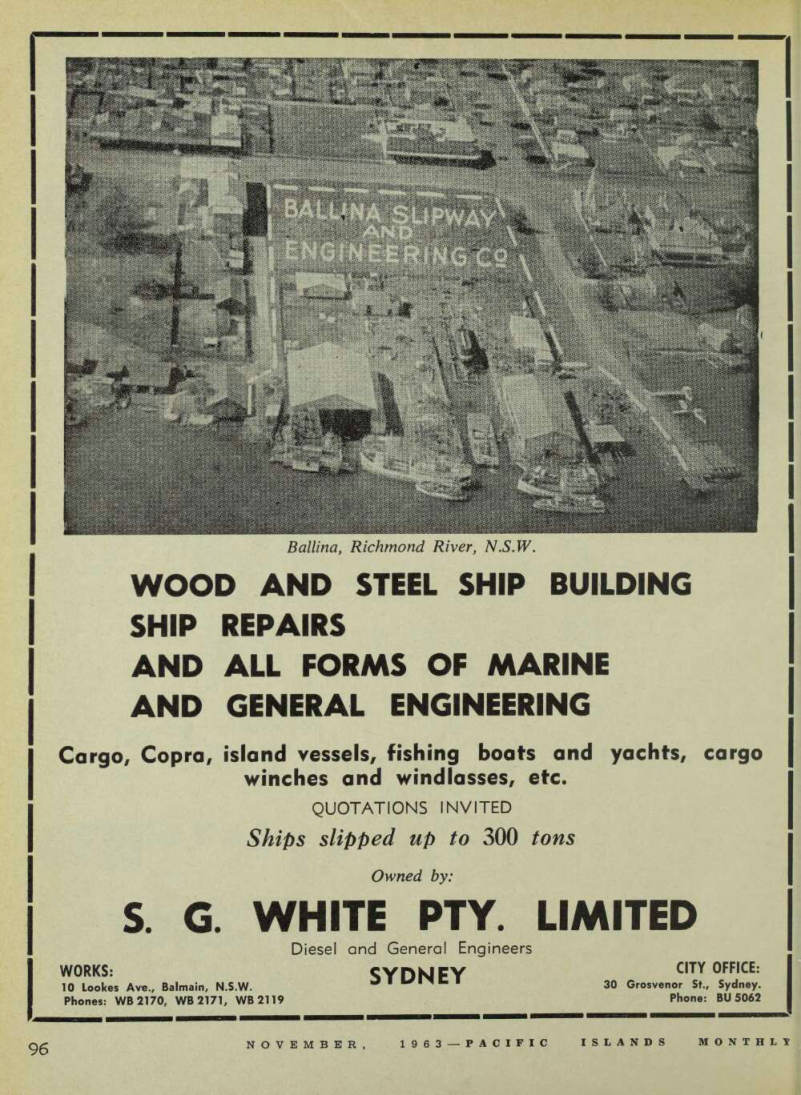 98
98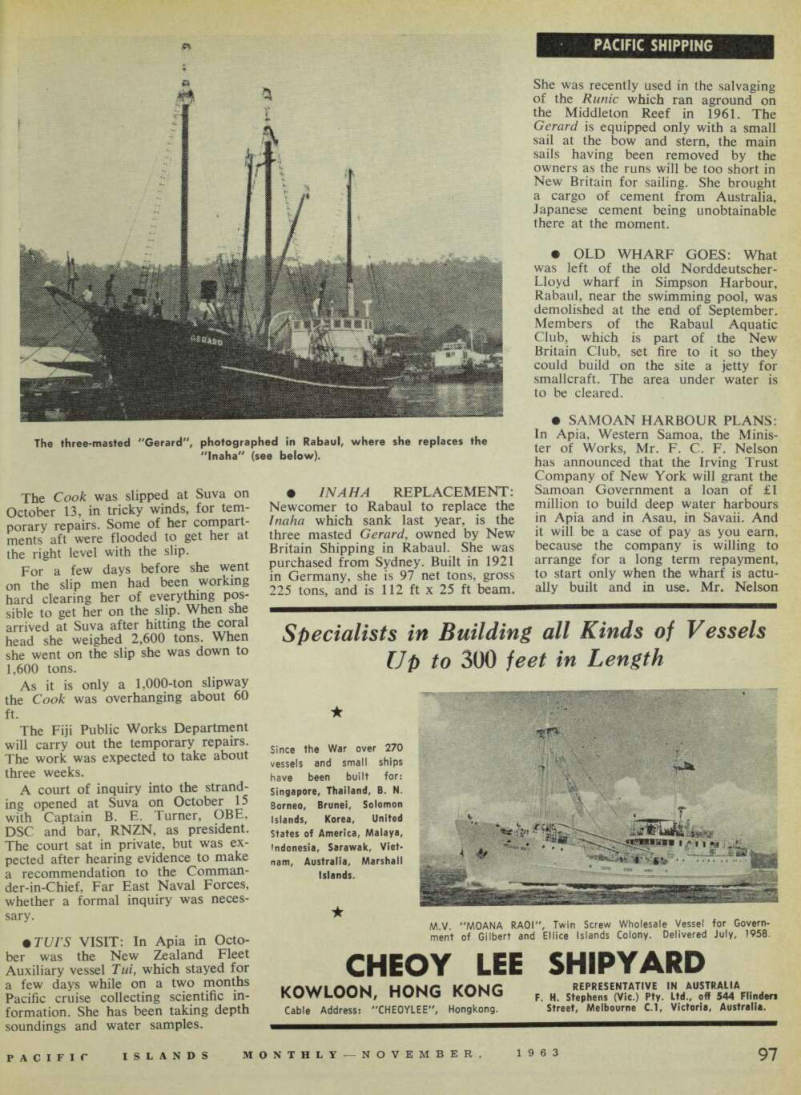 99
99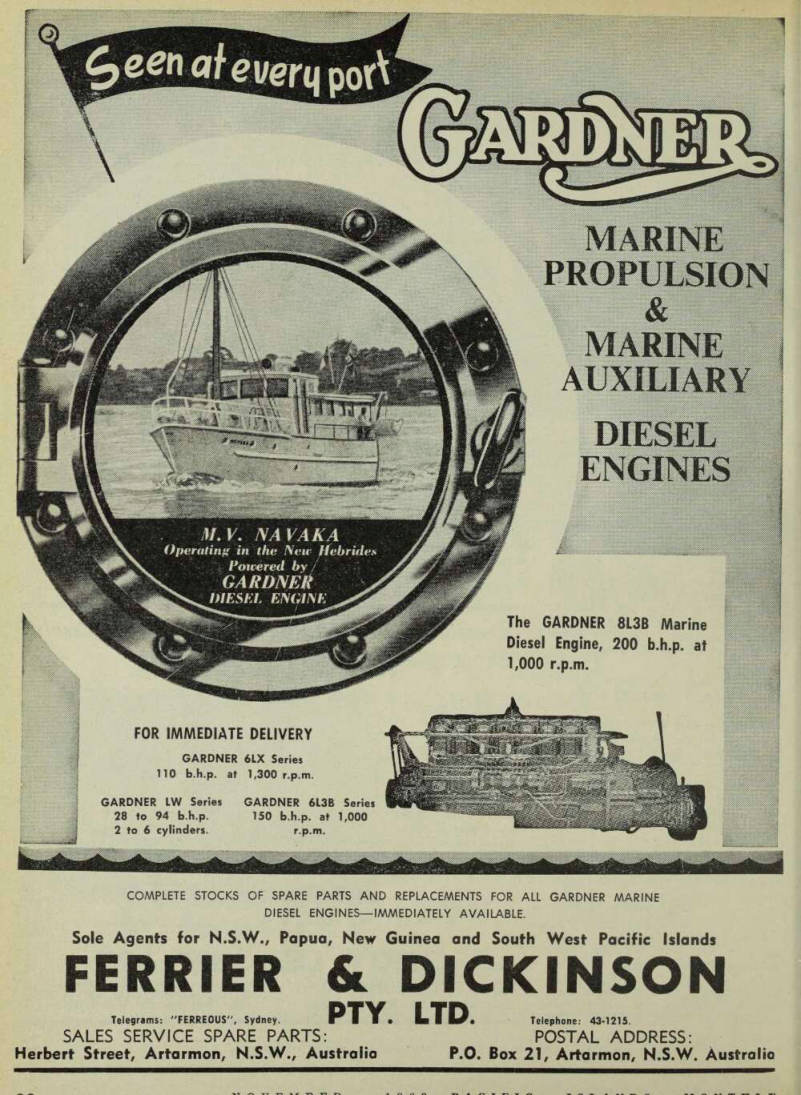 100
100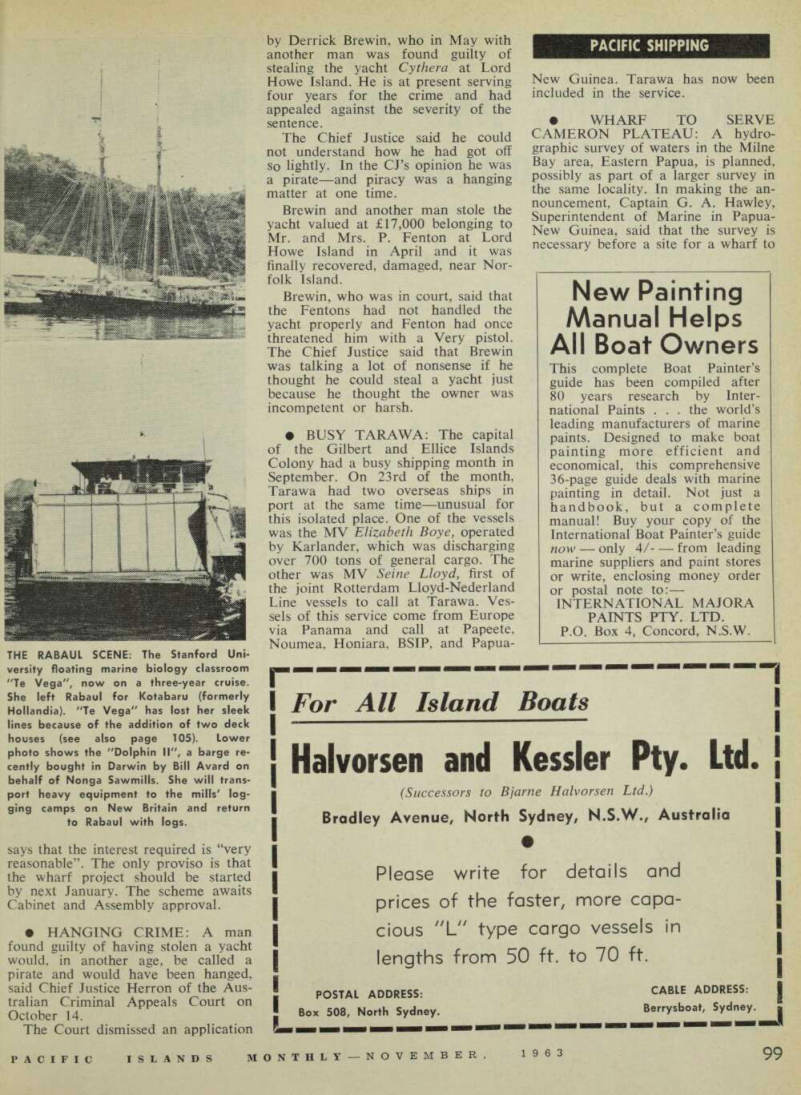 101
101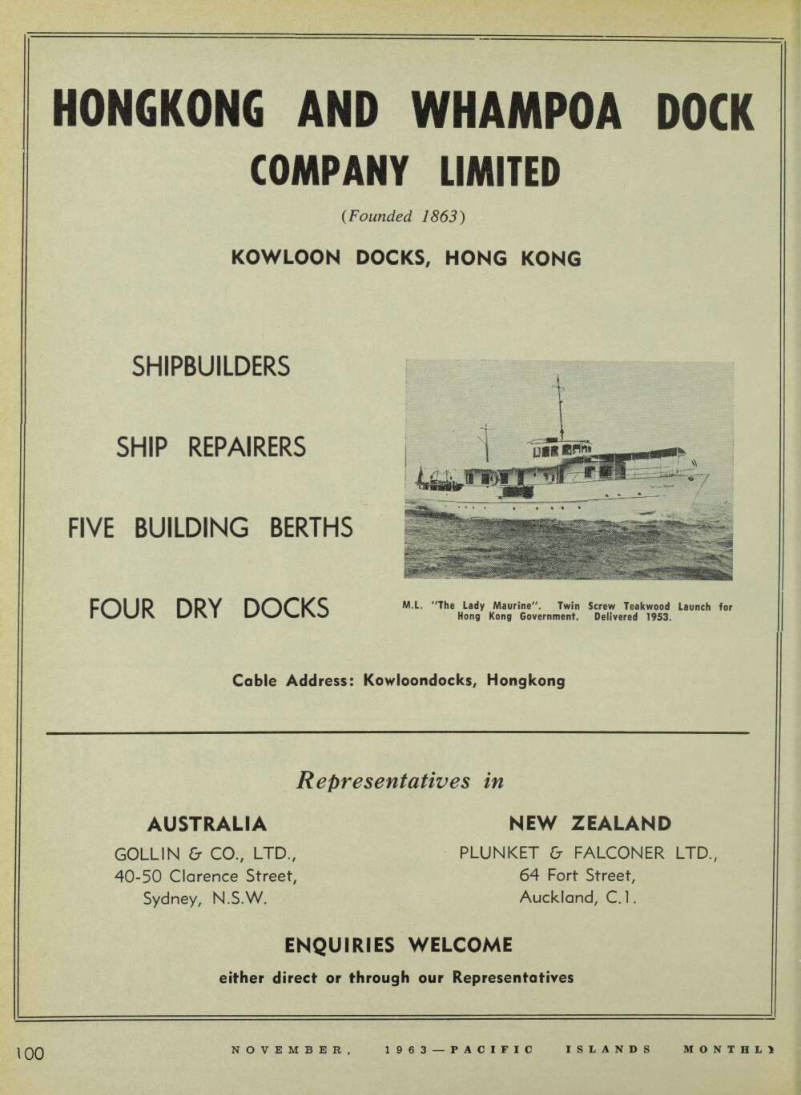 102
102 103
103 104
104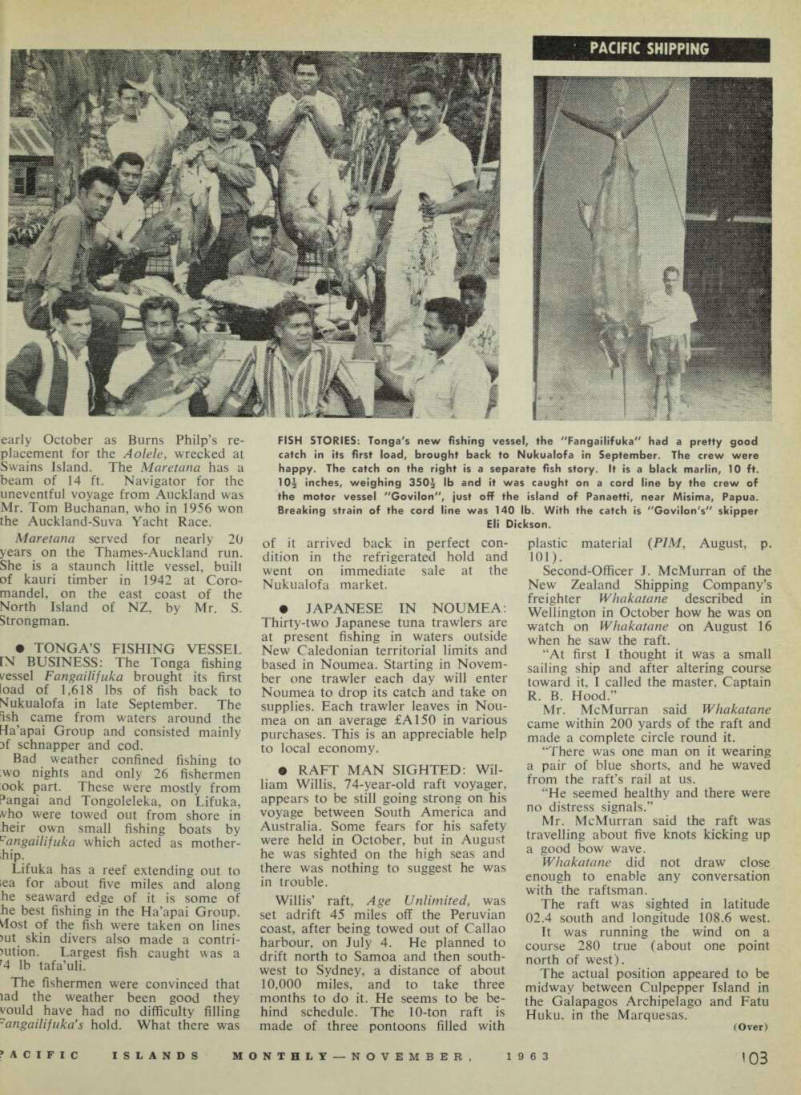 105
105 106
106 107
107 108
108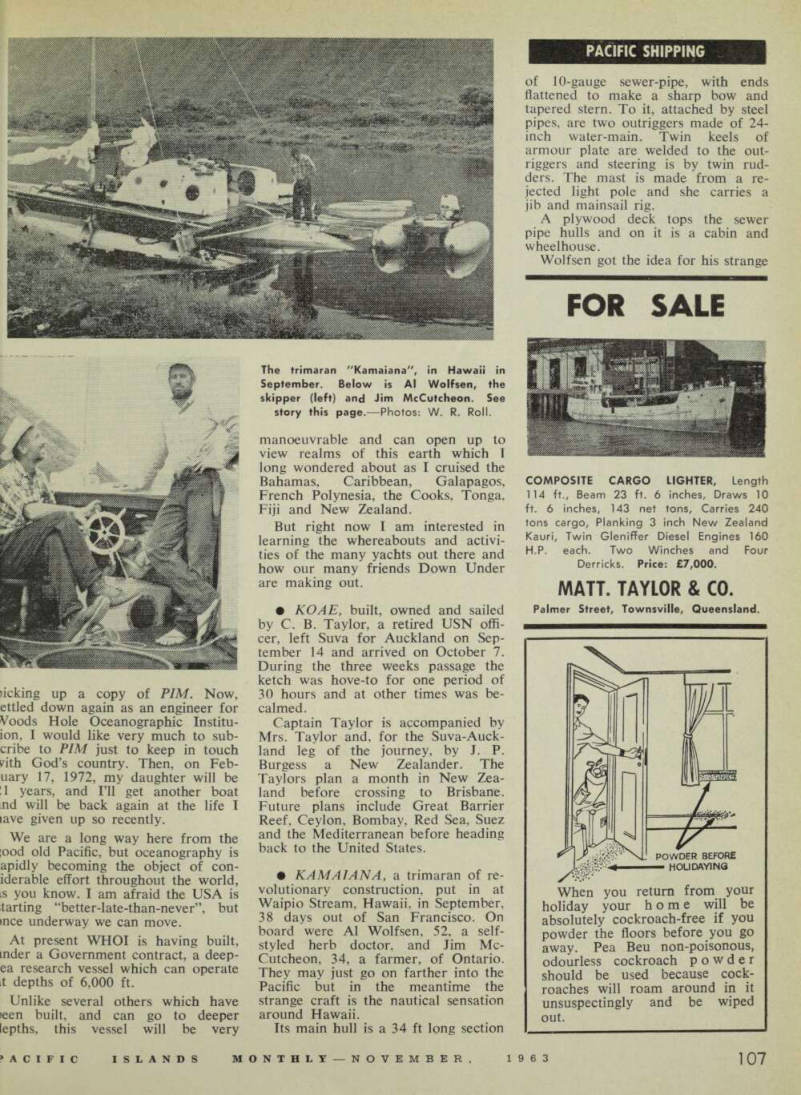 109
109 110
110 111
111 112
112 113
113 114
114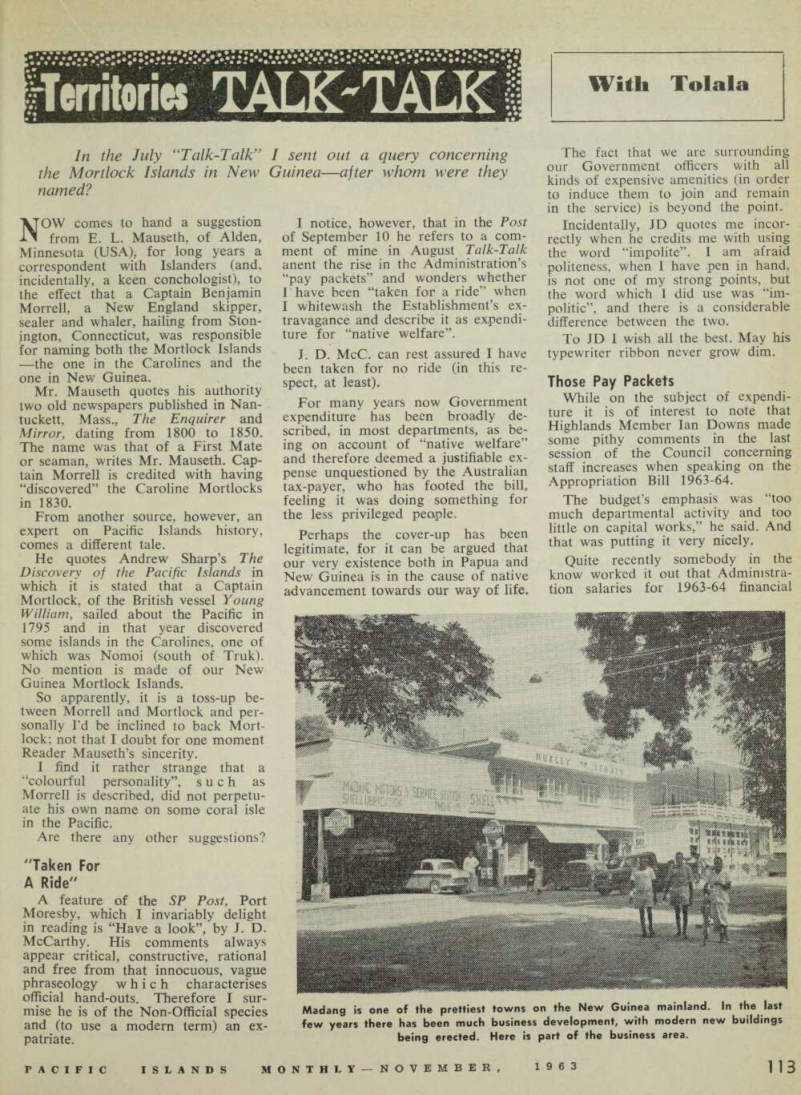 115
115 116
116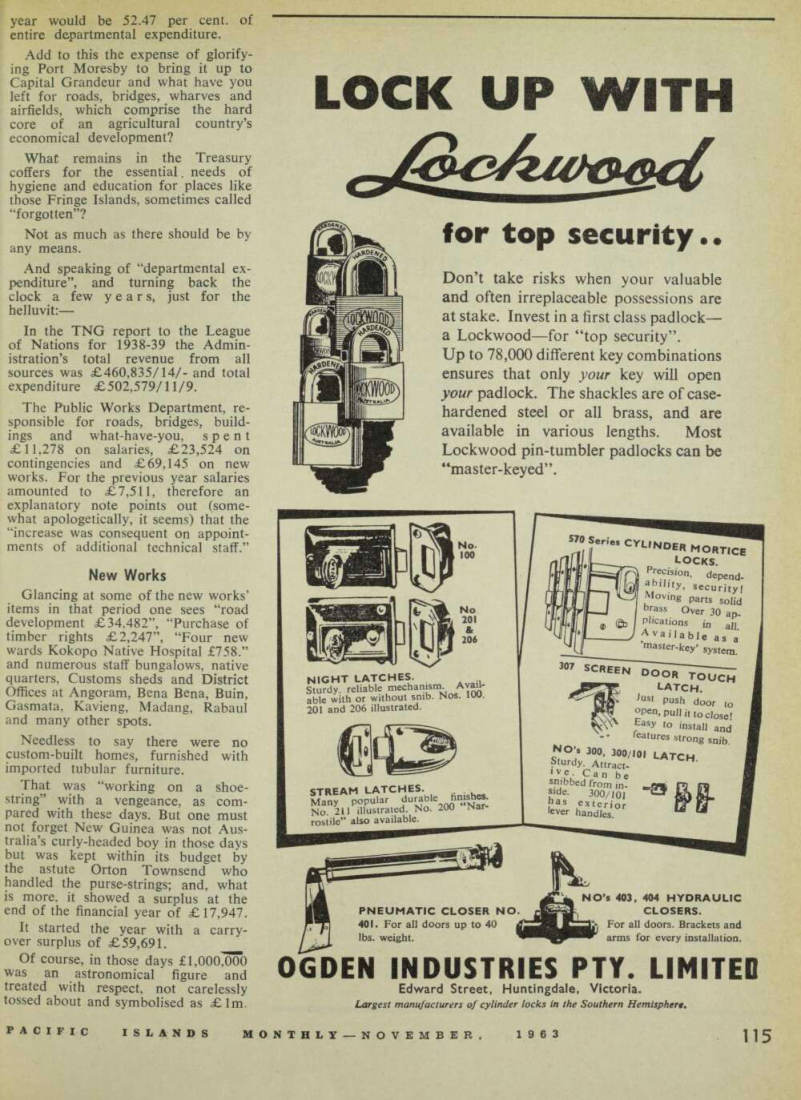 117
117 118
118 119
119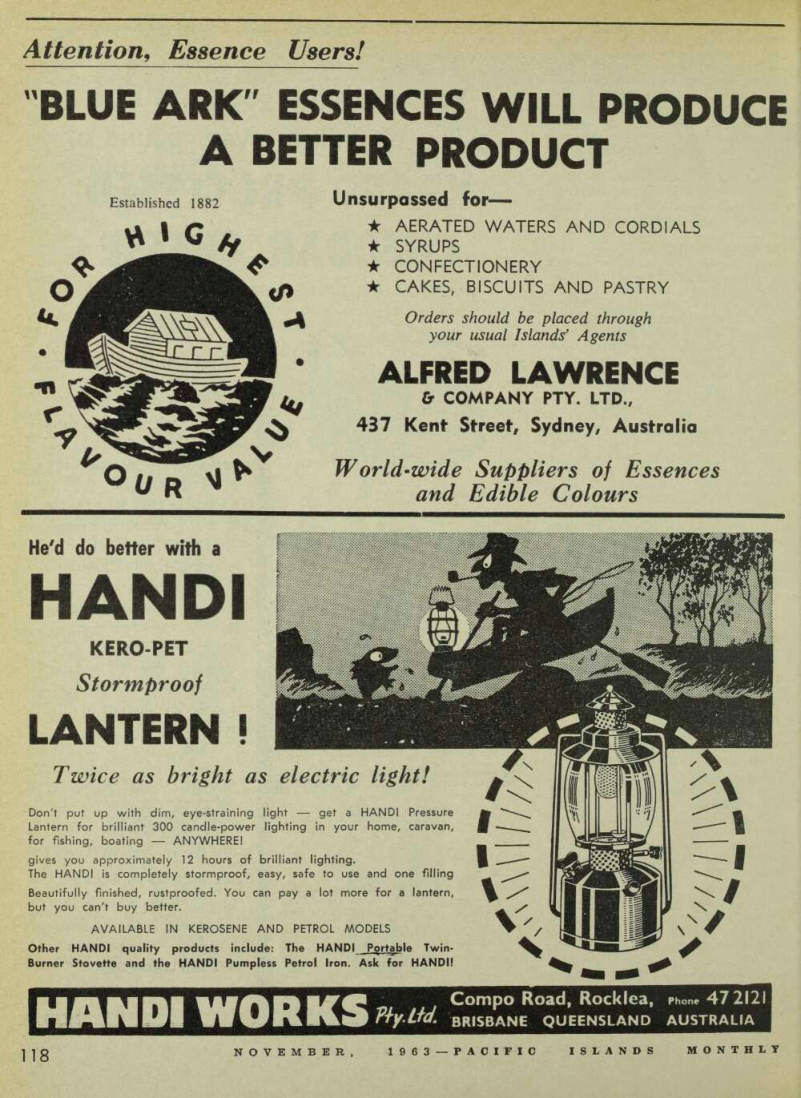 120
120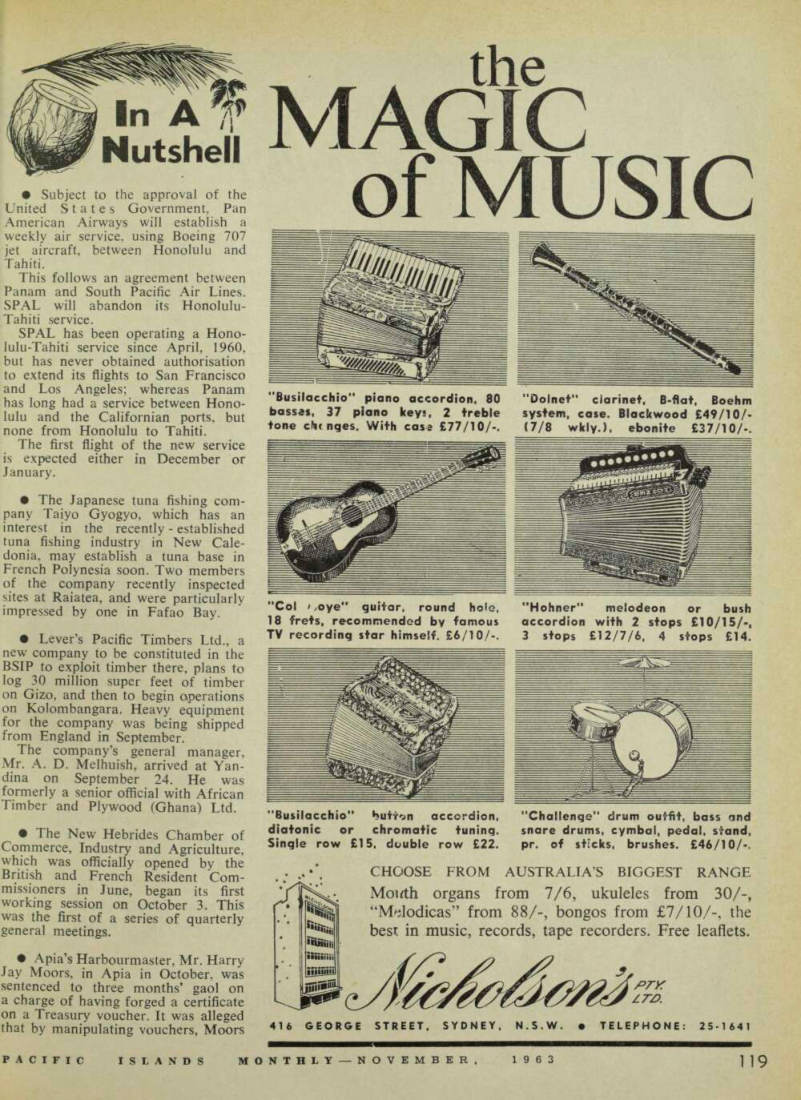 121
121 122
122 123
123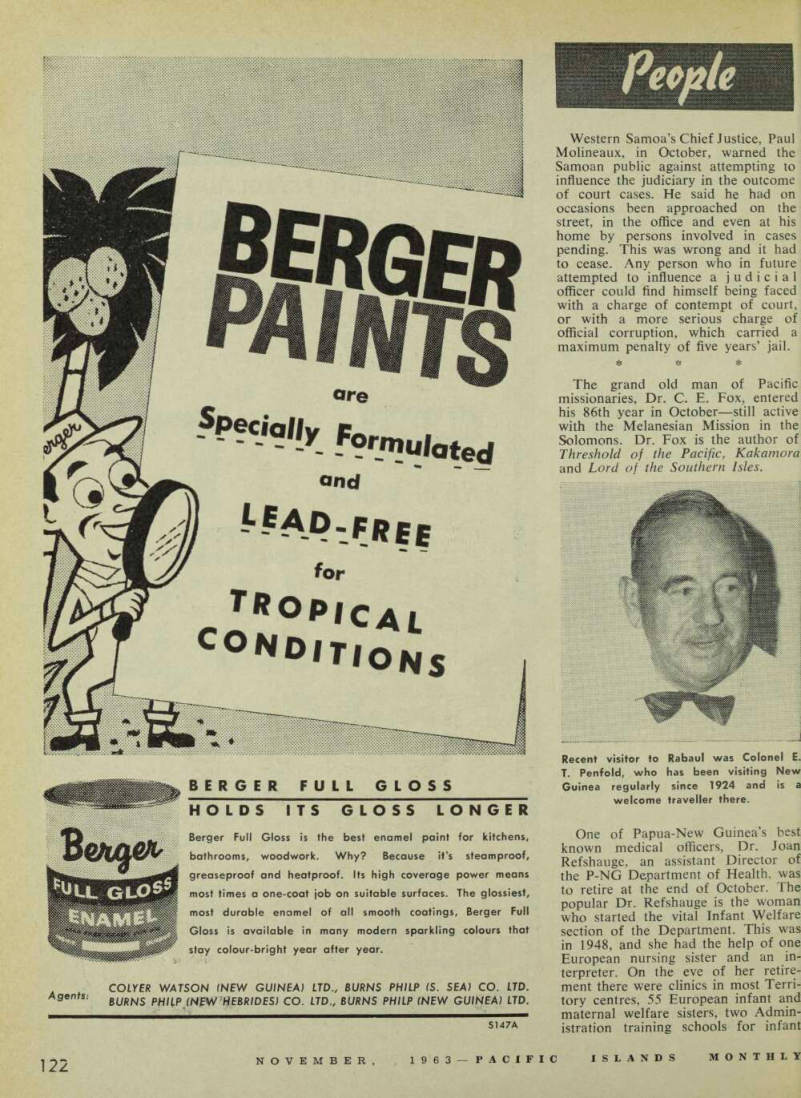 124
124 125
125 126
126 127
127 128
128 129
129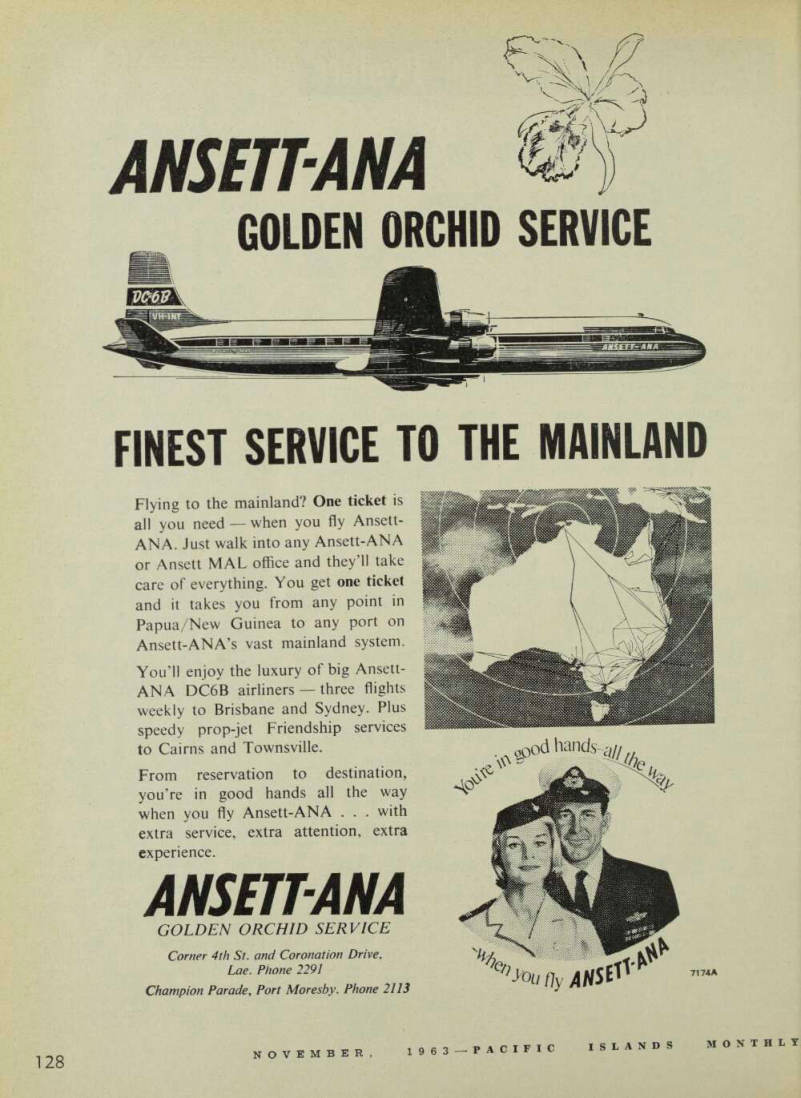 130
130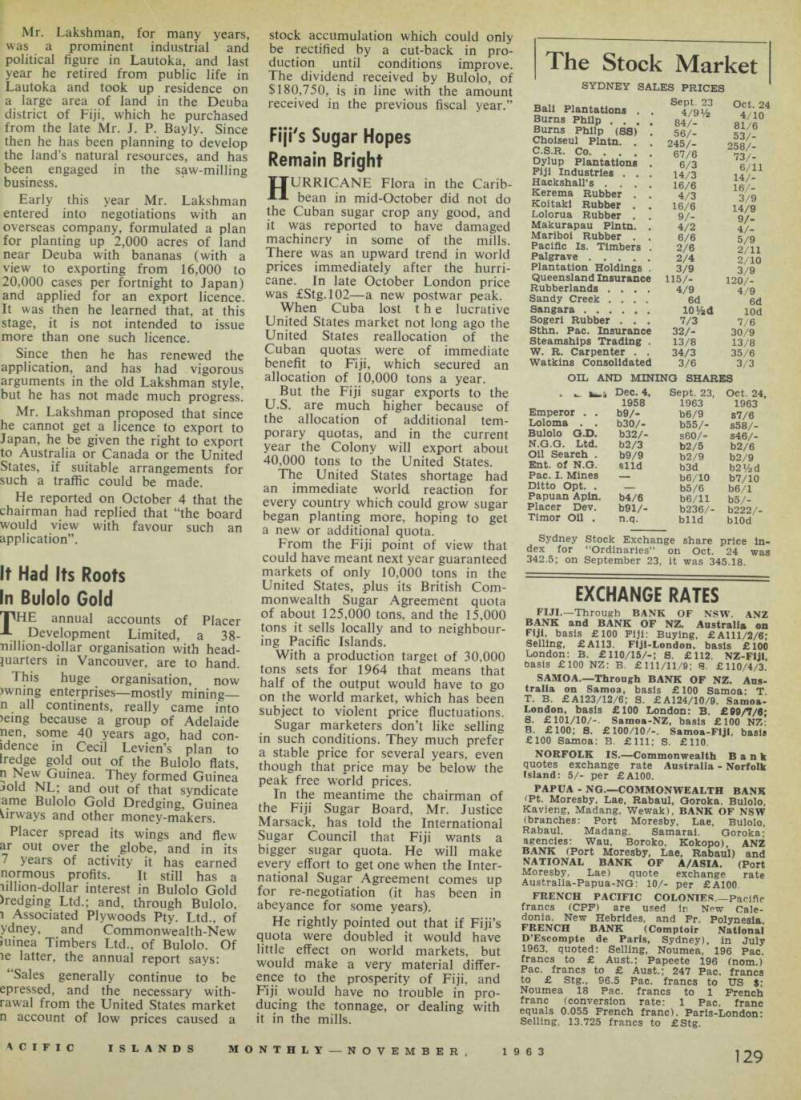 131
131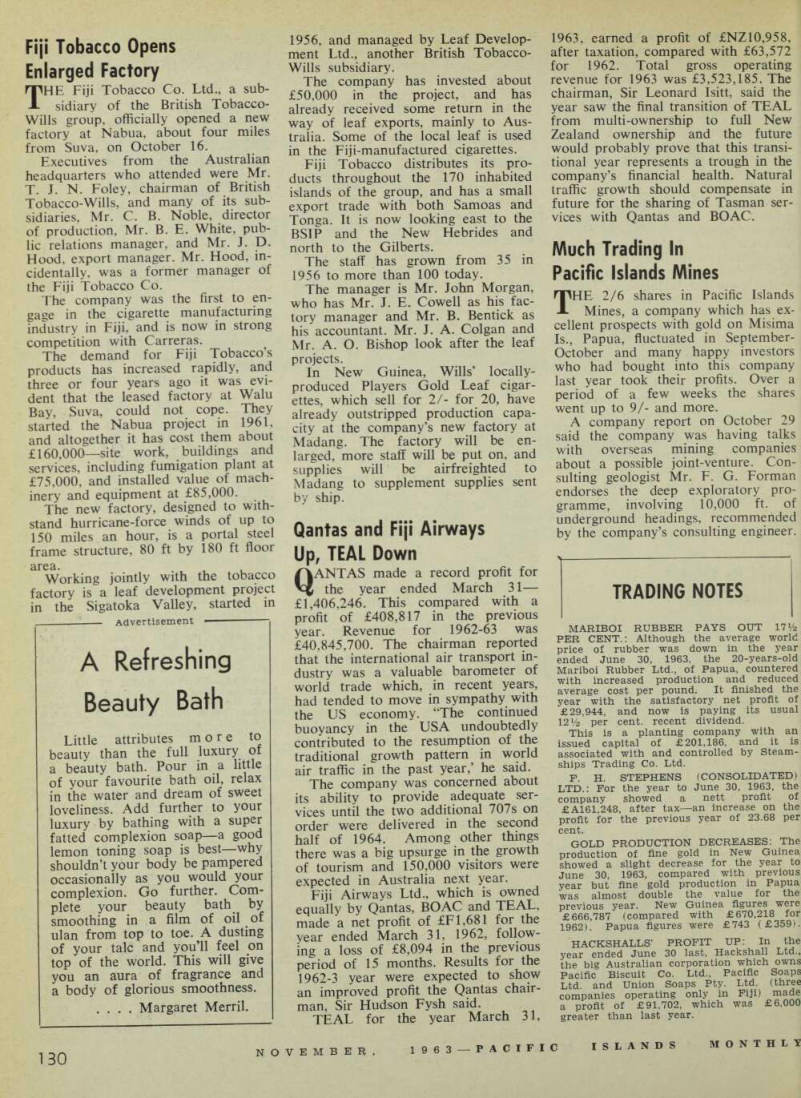 132
132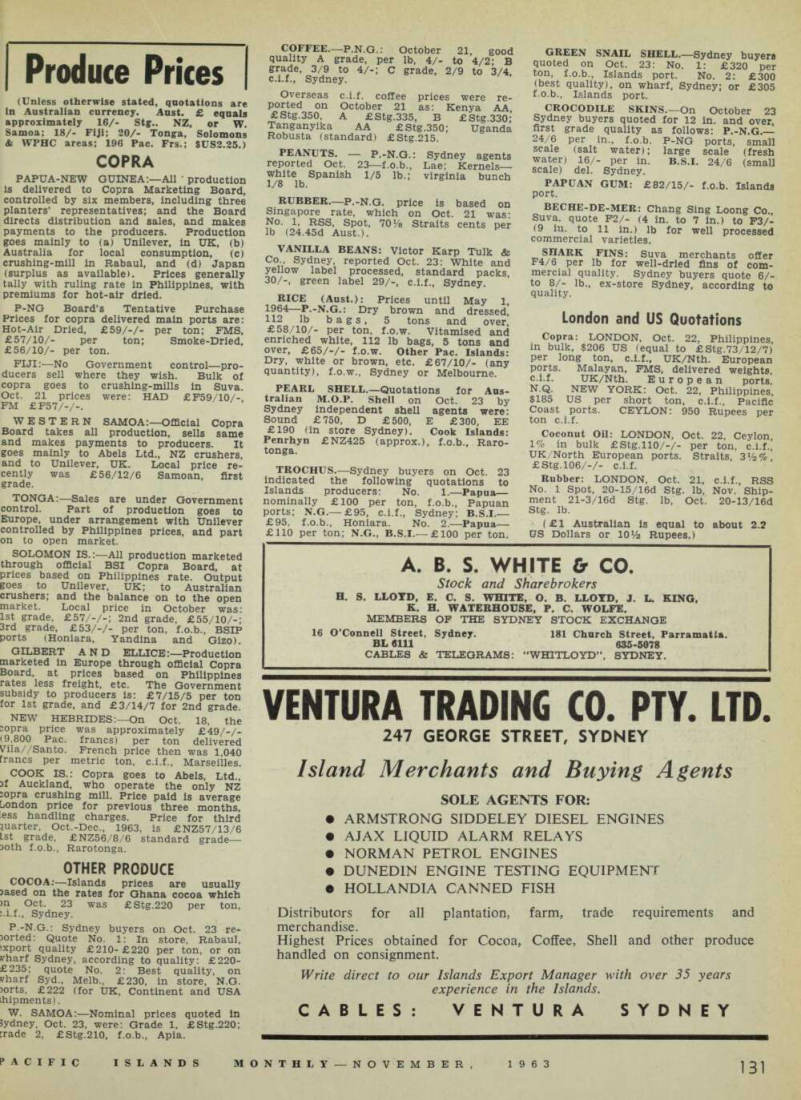 133
133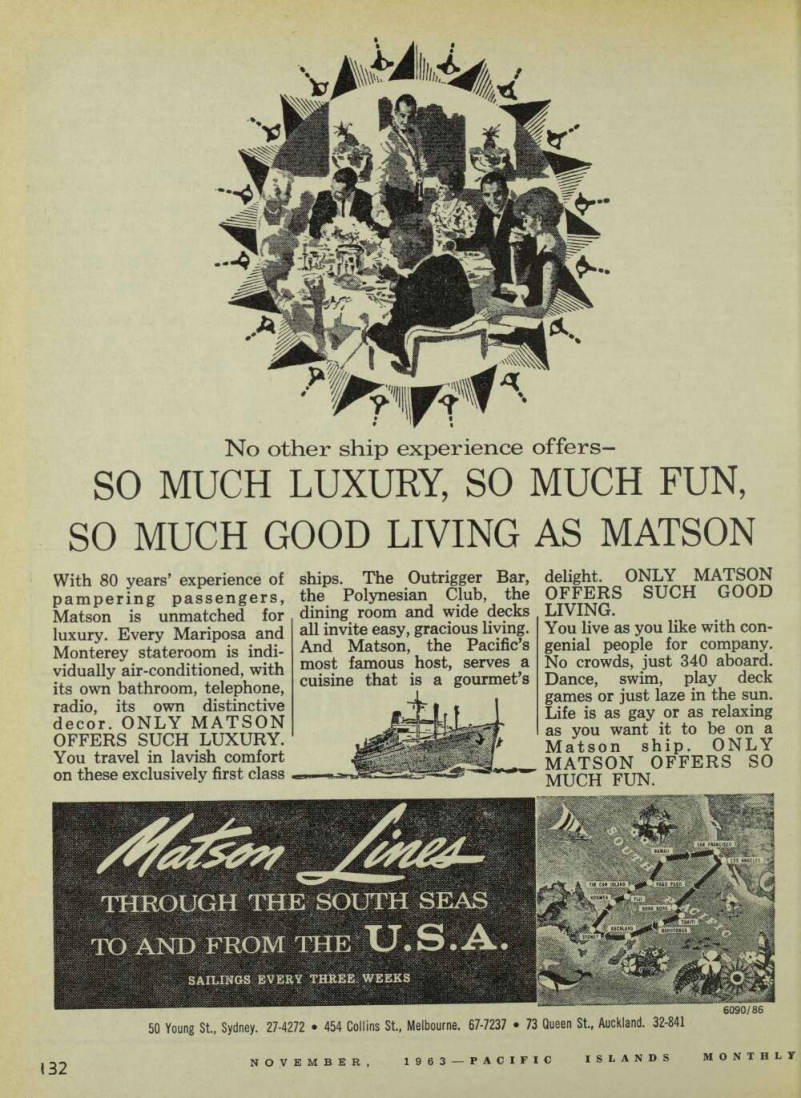 134
134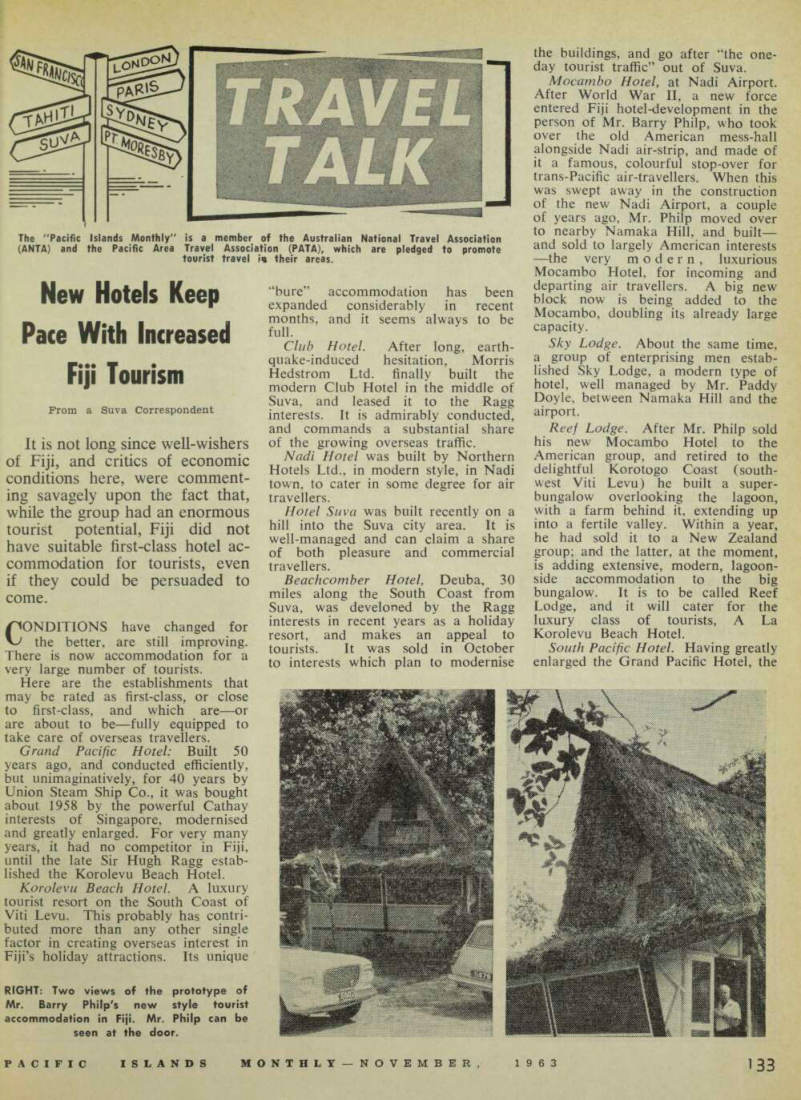 135
135 136
136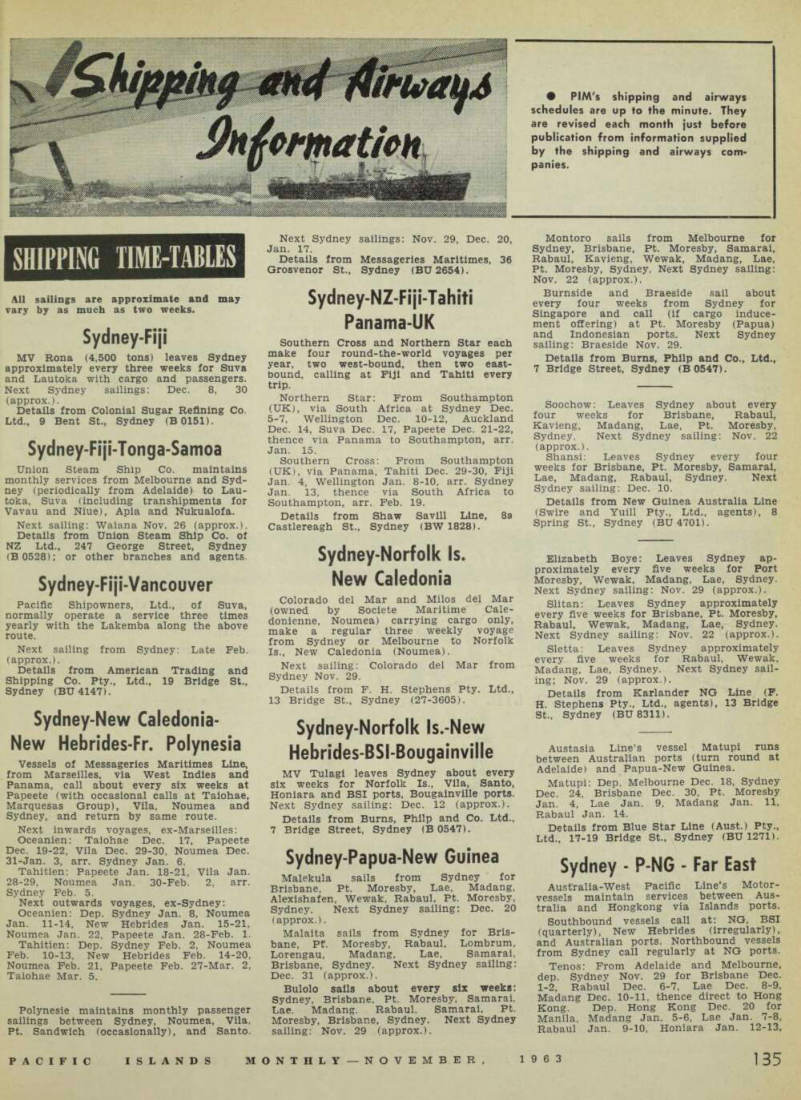 137
137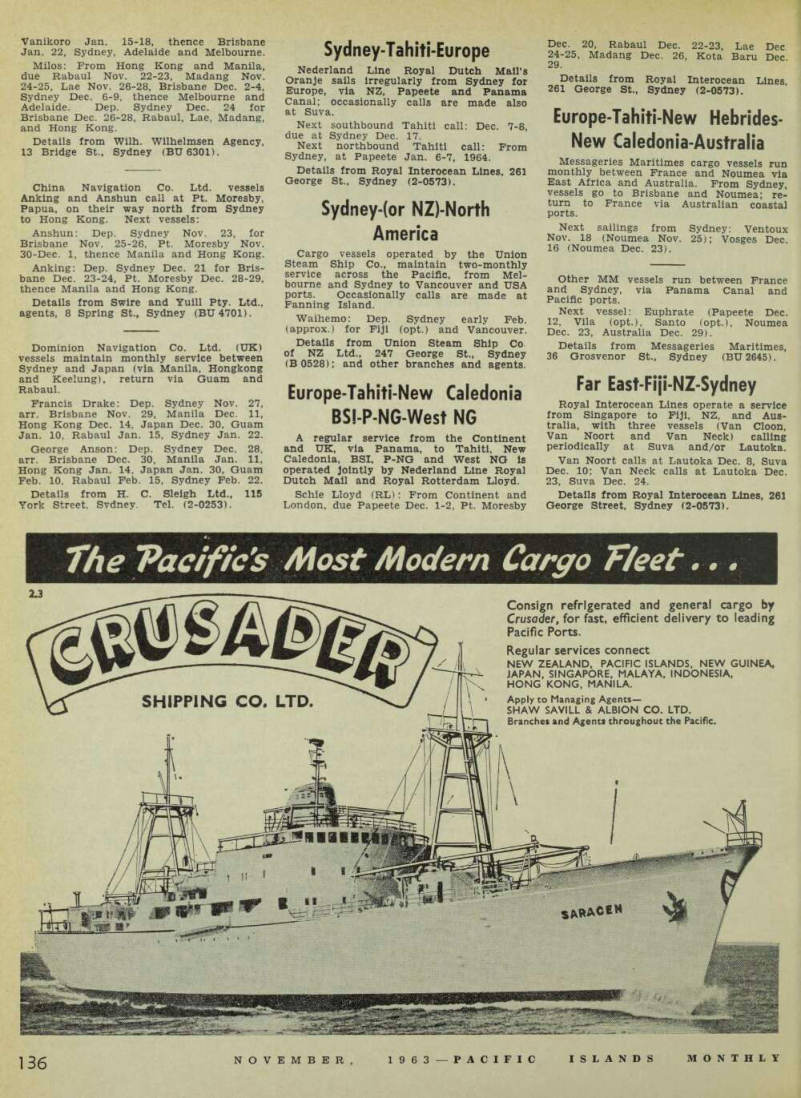 138
138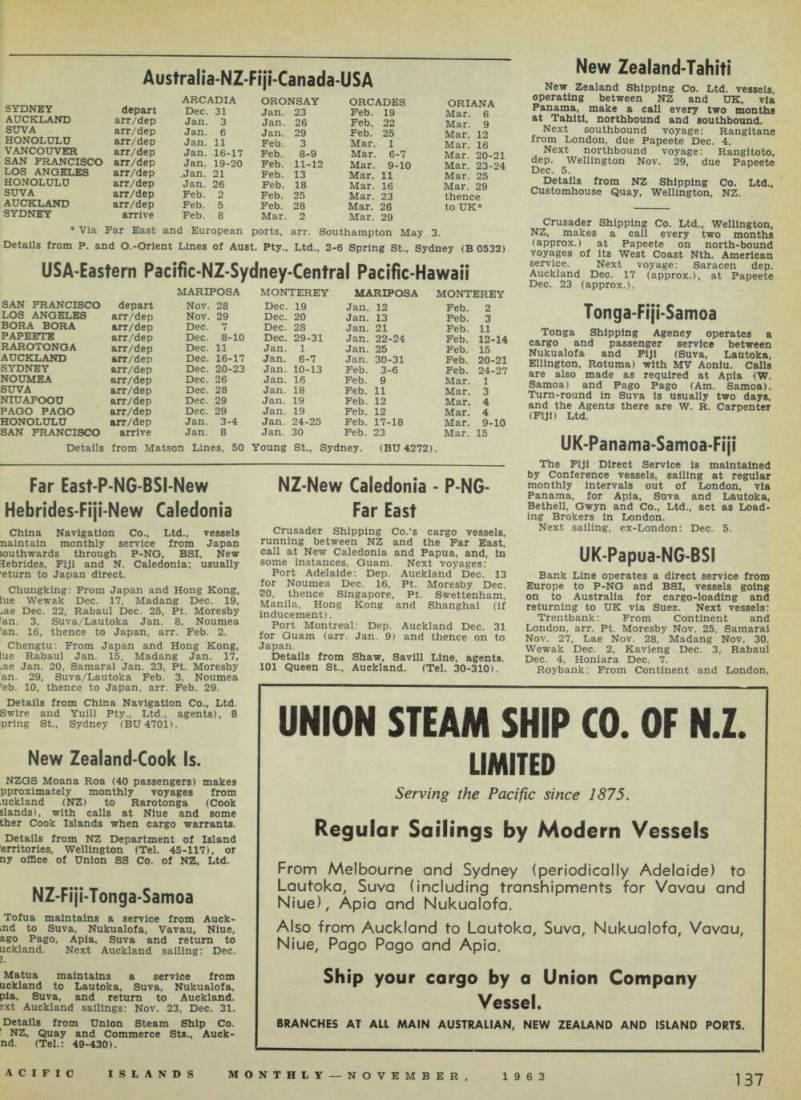 139
139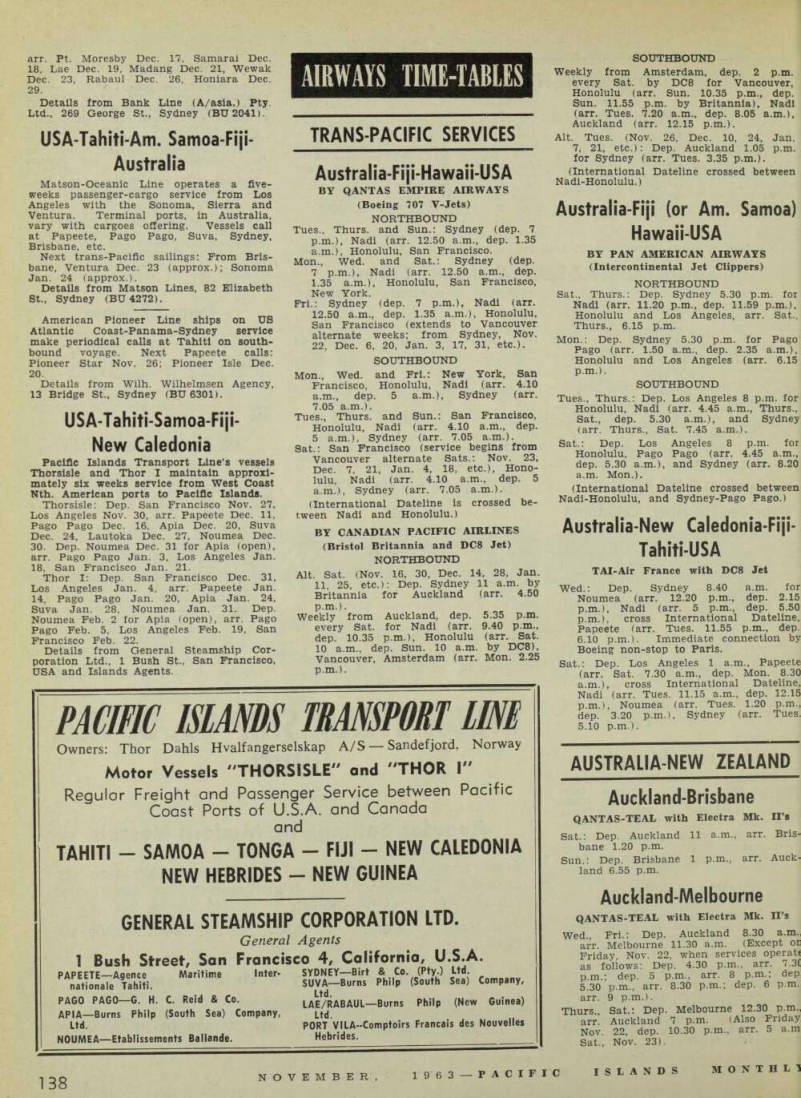 140
140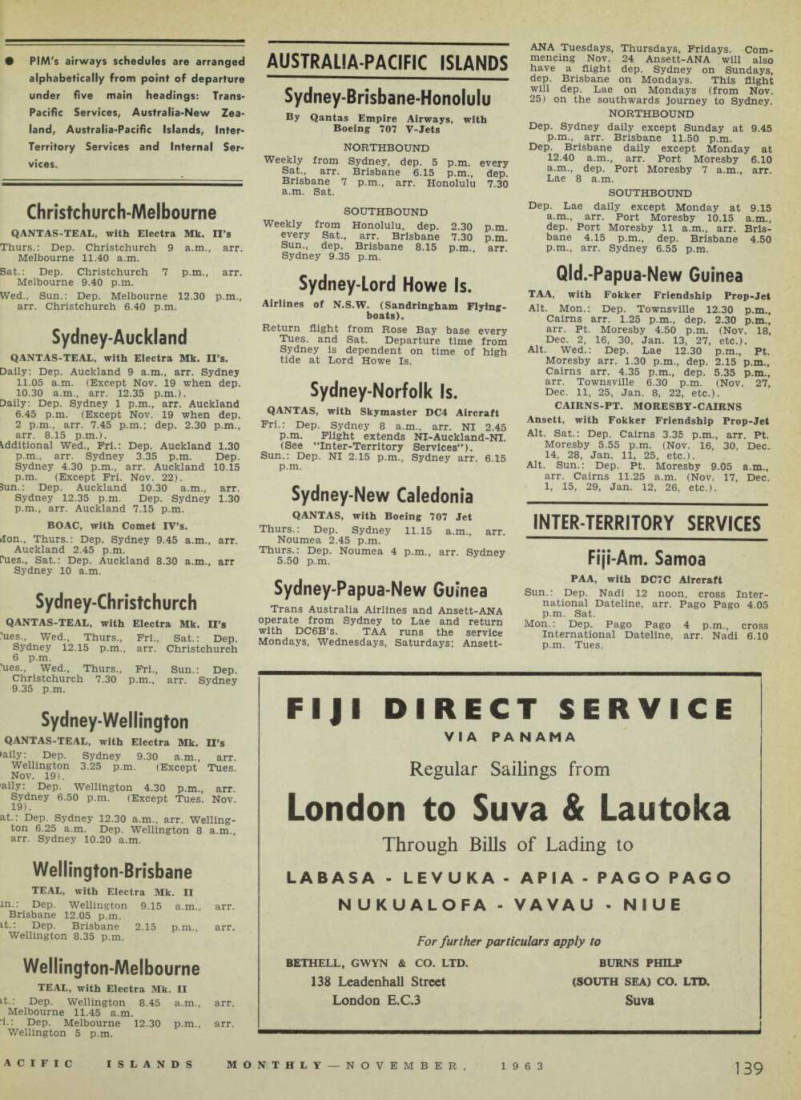 141
141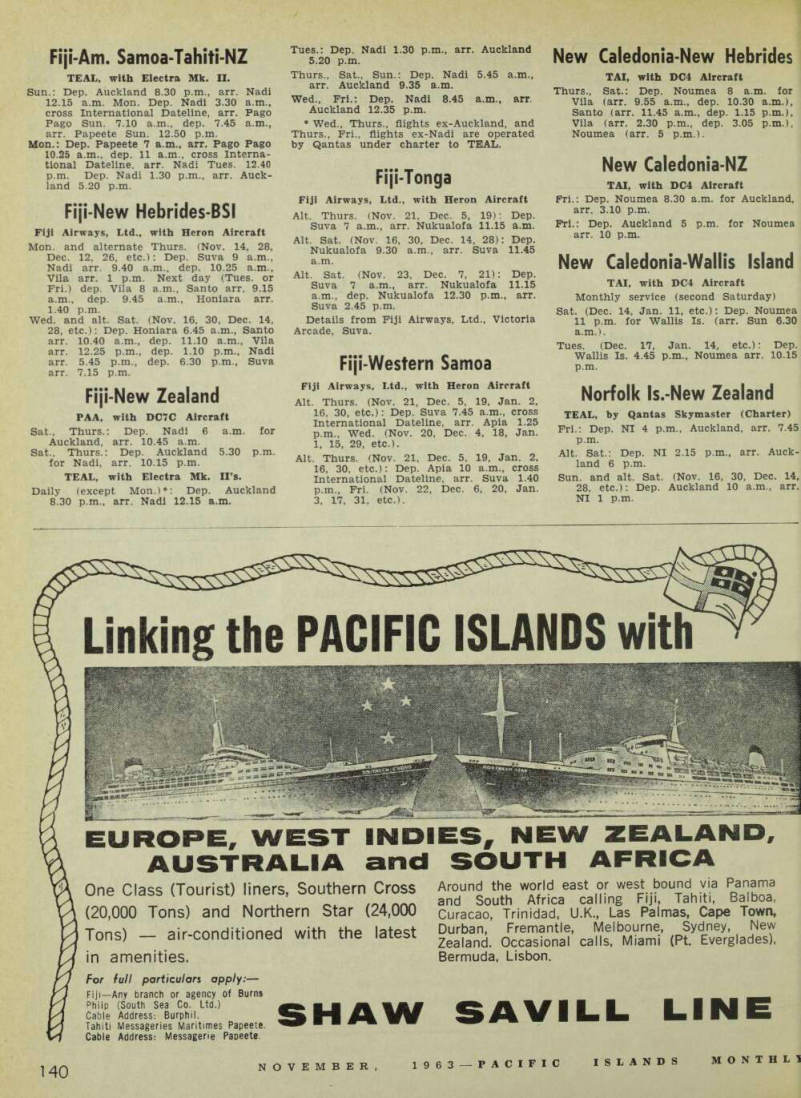 142
142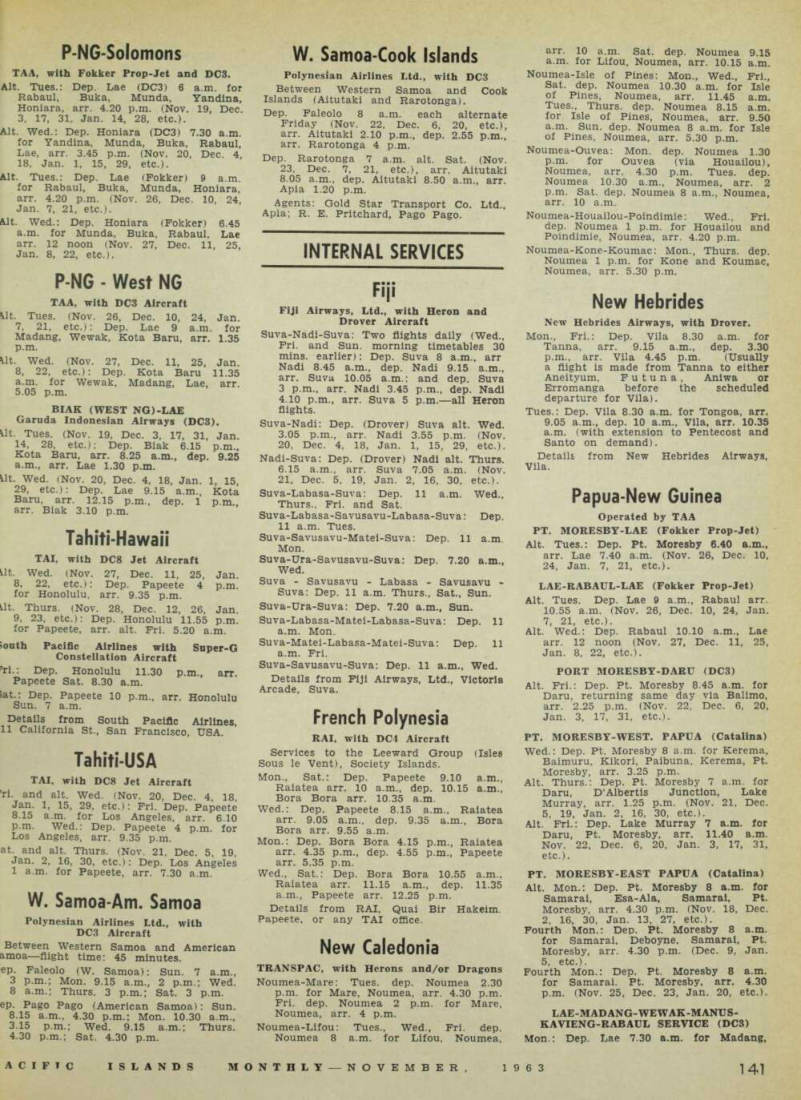 143
143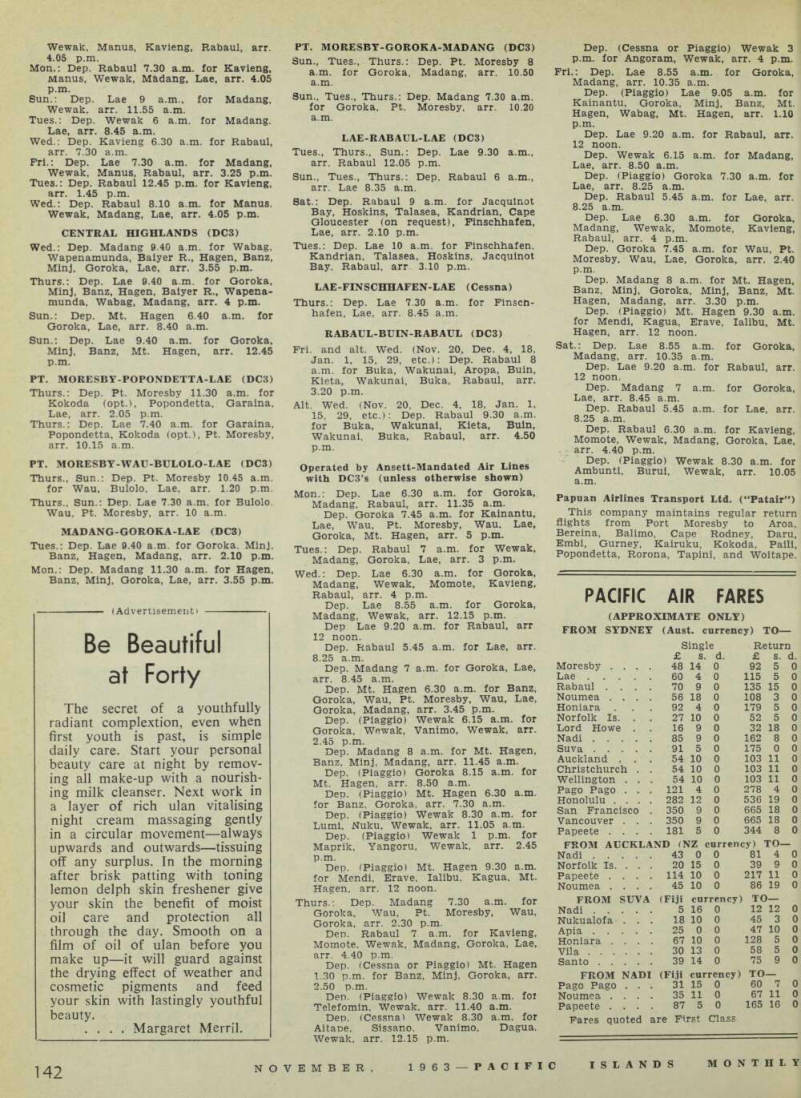 144
144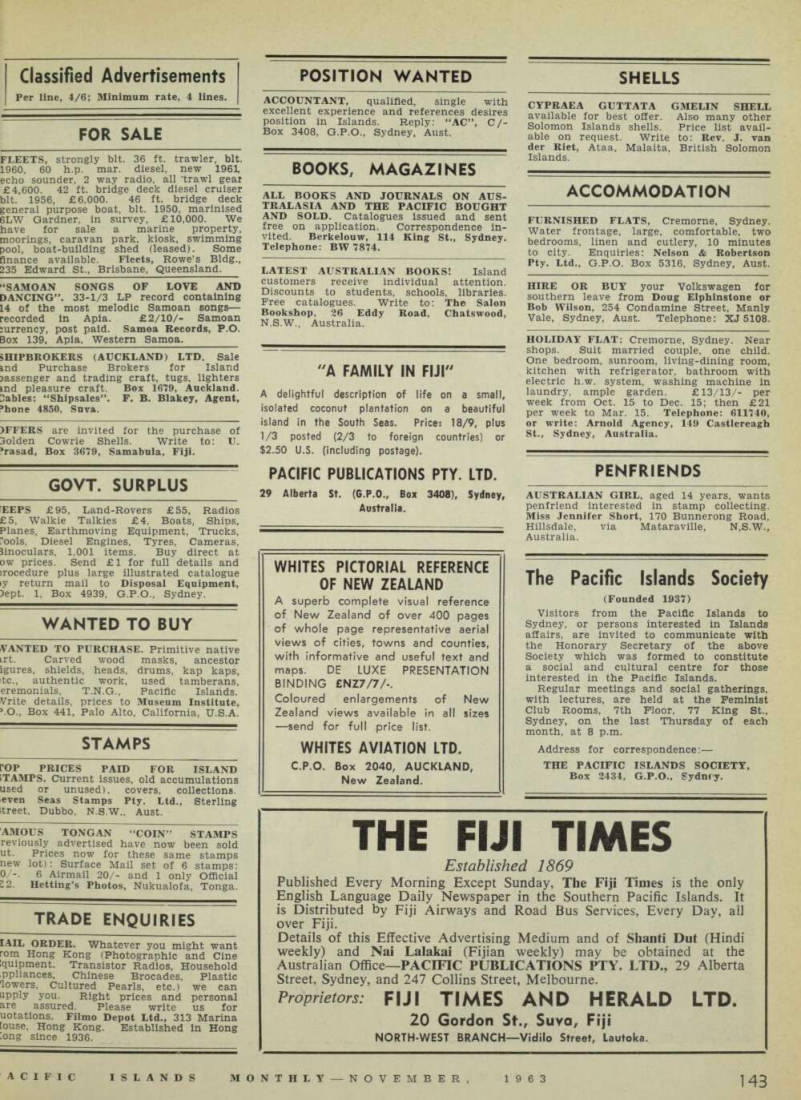 145
145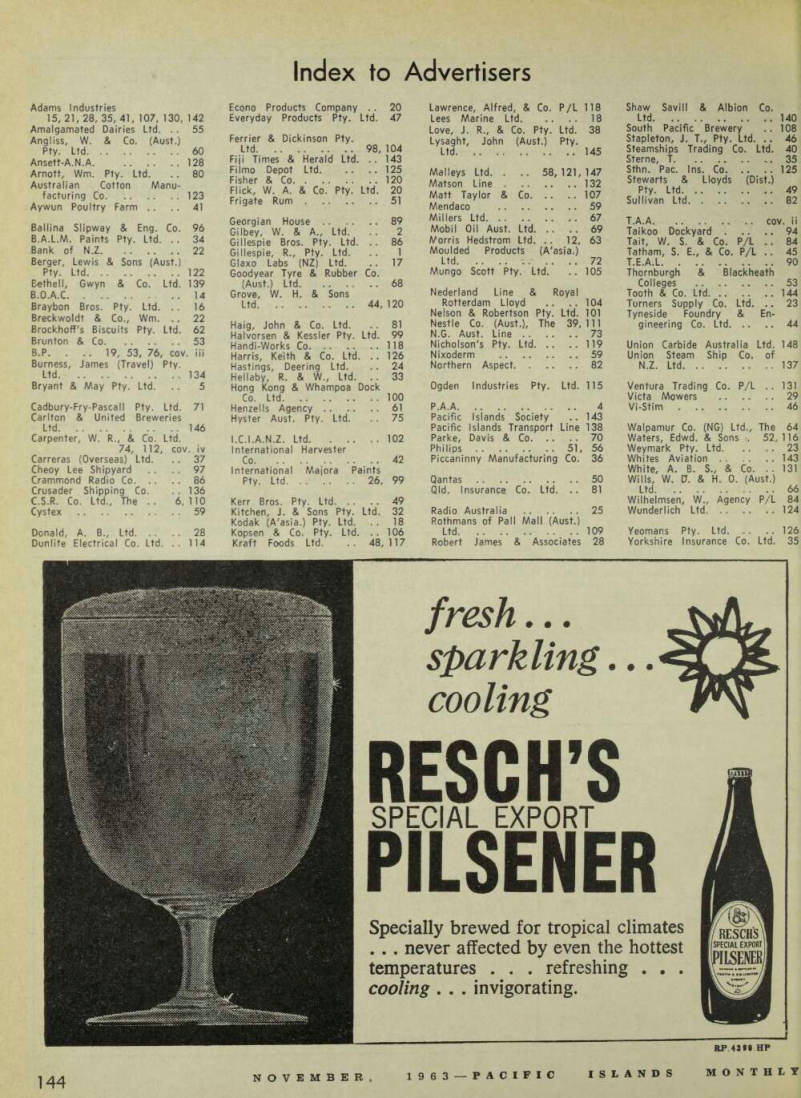 146
146 147
147 148
148 149
149 150
150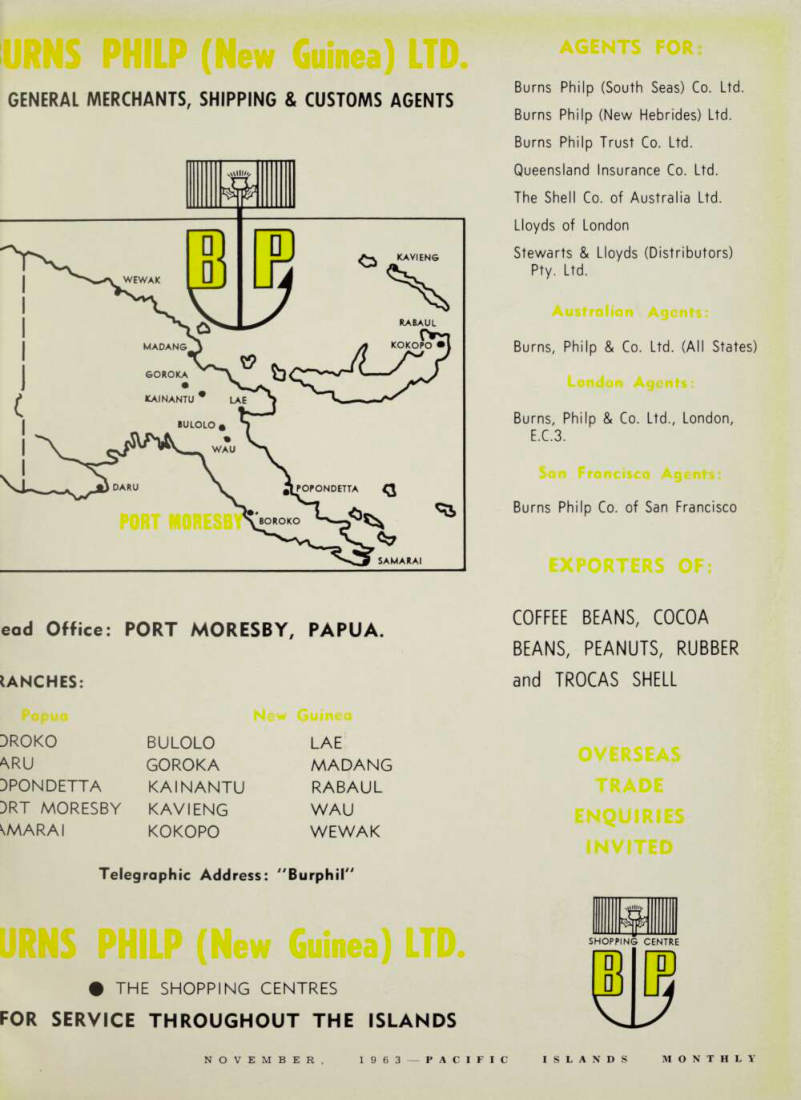 151
151 152
152