Islands

Pacific
Monthly
June, 1950
Vol. XX. No. 11
dfd
mnmm&red at by post as a newspaper ]
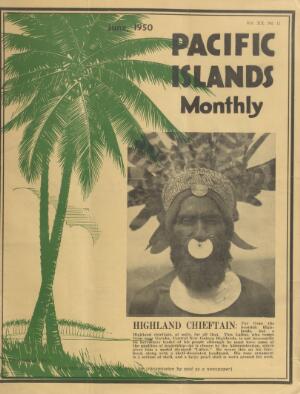
HIGHLAND CHIEFTAIN: Far from the
Scottish Hight lands, but a Highland chieftain, of sorts, for all that. This Luluai, who comes from near Garoka, Central New Guinea Highlands, is not necessarily an hereditary leader of his people although he must have some of the qualities of leadership—he is chosen by the Administration, which gives him a medal stamped “Luluai.” He wears this on his fore head, along with a shell-decorated headband. His nose ornament is a section of shell, and a large pearl shell is worn around his neck.
Advertisements & other items, pp. 2-8 (1 item)
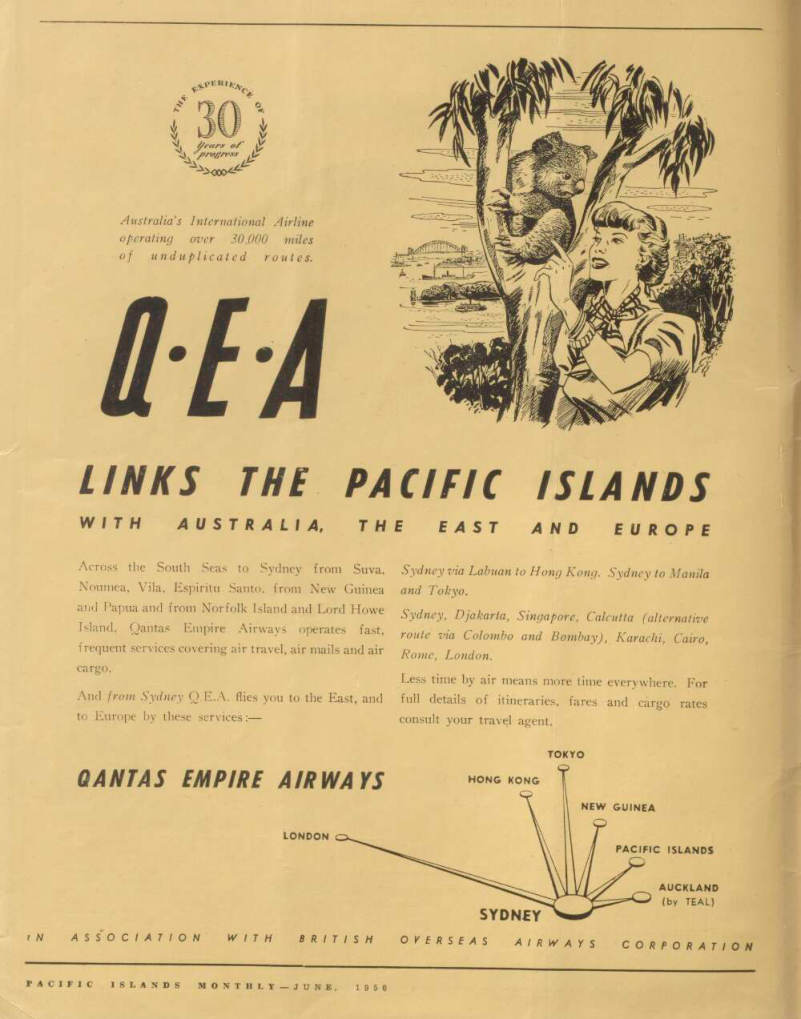
Links The Pacific Islands
Y if rant o/‘ ijf V fyreg/v** .fjT Australia's International Airline operating over 30,000 miles of unduplicated routes.
HA i\\ s s* srT3sts Sriiw st yf 7%
WITH AUSTRALIA , THE EAST AND EUROPE Across the South Seas to Sydney from Suva.
Noumea, Vila, Espiritu Santo, from New Guinea and Papua and from Norfolk Island and Lord Howe Island, Qantas Empire Airways operates fast, frequent services covering air travel, air mails and air cargo.
And from Sydney O.E.A. flies you to the East, and to Europe by these services:— Sydney via Labuan to Hong Kong. Sydney to Manila and Tokyo.
Sydney, Djakarta, Singapore, Calcutta (alternative route via Colombo and Bombay), Karachi, Cairo, Rome, London.
Less time by air means more time everywhere. For full details of itineraries, fares and cargo rates consult your travel agent.
QANTAS EMPIRE AIRWAYS
LONDON
TOKYO
HONG KONG
NEW GUINEA
PACIFIC ISLANDS
AUCKLAND
(by TEAL)
SYDNEY
IN ASSOCIATION WITH BRITISH OVERSEAS AIRWAYS CORPORATION
m
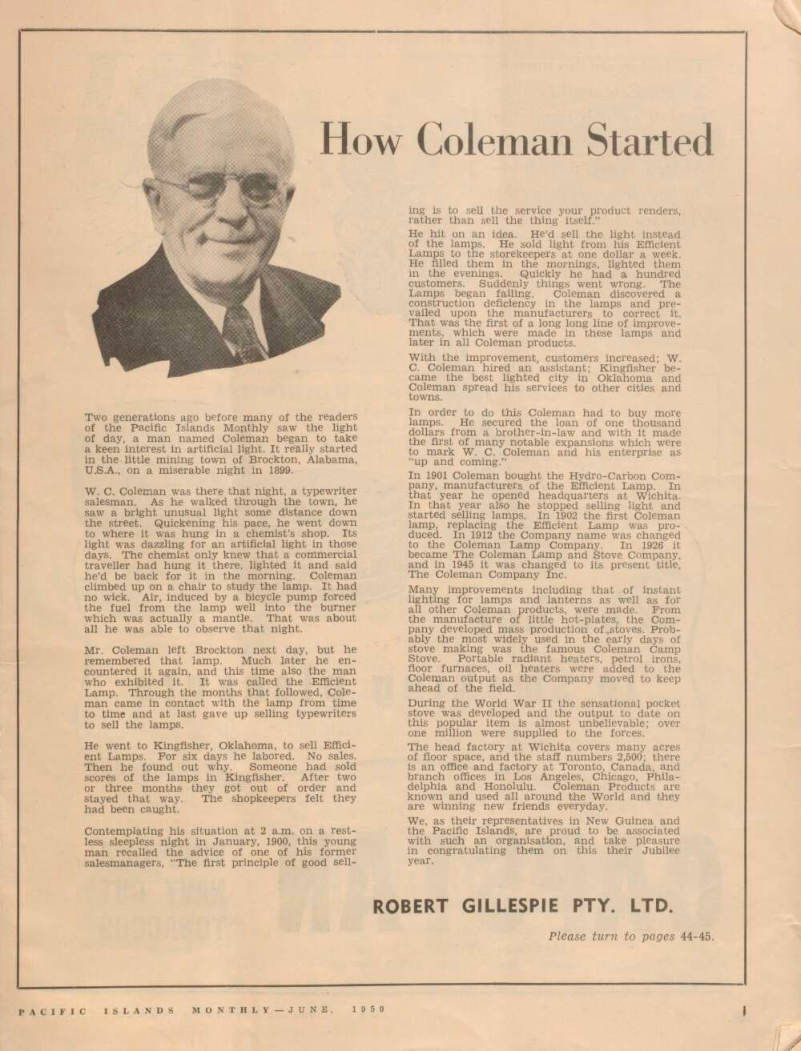
How Coleman Started
ing is to sell the service your product renders, rather than sell the thing itself.”
He hit on an idea. He’d sell the light instead of the lamps. He sold light from his Efficient Lamps to the storekeepers at one dollar a week.
He filled them in the mornings, lighted them in the evenings. Quickly he had a hundred customers. Suddenly things went wrong. The Lamps began failing. Coleman discovered a construction deficiency in the lamps and prevailed upon the manufacturers to correct it.
That was the first of a long long line of improvements, which were made in these lamps and later in all Coleman products.
With the improvement, customers increased; W.
C. Coleman hired an assistant; Kingfisher became the best lighted city in Oklahoma and Coleman spread his services to other cities and towns.
Two generations ago before many of the readers of the Pacific Islands Monthly saw the light of day, a man named Coleman began to take a keen interest in artificial light. It really started in the little mining town of Brockton, Alabama, U.S.A., on a miserable night in 1899.
W. C. Coleman was there that night, a typewriter salesman. As he walked through the town, he saw a bright unusual light some distance down the street. Quickening his pace, he went down to where it was hung in a chemist’s shop. Its light was dazzling for an artificial light in those days. The chemist only knew that a commercial traveller had hung it there, lighted it and said he’d be back for it in the morning. Coleman climbed up on a chair to study the lamp. It had no wick. Air, induced by a bicycle pump forced the fuel from the lamp well into the burner which was actually a mantle. That was about all he was able to observe that night.
Mr. Coleman left Brockton next day, but he remembered that lamp. Much later he encountered it again, and this time also the man who exhibited it. It was called the Efficient Lamp. Through the months that followed, Coleman came in contact with the lamp from time to time and at last gave up selling typewriters to sell the lamps.
He went to Kingfisher, Oklahoma, to sell Efficient Lamps. For six days he labored. No sales.
Then he found out why. Someone had sold scores of the lamps in Kingfisher. After two or three months they got out of order and stayed that way. The shopkeepers felt they had been caught.
Contemplating his situation at 2 a.m. on a restless sleepless night in January, 1900, this young man recalled the advice of one of his former salesmanagers, ‘‘The first principle of good sell- In order to do this Coleman had to buy more lamps. He secured the loan of one thousand dollars from a brother-in-law and with it made the first of many notable expansions which were to mark W. C. Coleman and his enterprise as “up and coming.”
In 1901 Coleman bought the Hydro-Carbon Company, manufacturers of the Efficient Lamp. In that year he opened headquarters at Wichita.
In that year also he stopped selling light and started selling lamps. In 1902 the first Coleman lamp, replacing the Efficient Lamp was produced. In 1912 the Company name was changed to the Coleman Lamp Company. In 1926 it became The Coleman Lamp and Stove Company, and in 1945 it was changed to its present title, The Coleman Company Inc.
Many improvements including that of instant lighting for lamps and lanterns as well as for all other Coleman products, were made. From the manufacture of little hot-plates, the Company developed mass production of,stoves. Probably the most widely used in the early days of stove making was the famous Coleman Camp Stove. Portable radiant heaters, petrol irons, floor furnaces, oil heaters were added to the Coleman output as the Company moved to keep ahead of the field.
During the World War II the sensational pocket stove was developed and the output to date on this popular item is almost unbelievable; over one million were supplied to the forces.
The head factory at Wichita covers many acres of floor space, and the staff numbers 2,500; there is an office and factory at Toronto, Canada, and branch offices in Los Angeles, Chicago, Philadelphia and Honolulu. Coleman Products are known and used all around the World and they are winning new friends everyday.
We, as their representatives in New Guinea and the Pacific Islands, are proud to be associated with such an organisation, and take pleasure in congratulating them on this their Jubilee year.
ROBERT GILLESPIE PTY. LTD.
Please turn to pages 44-45.
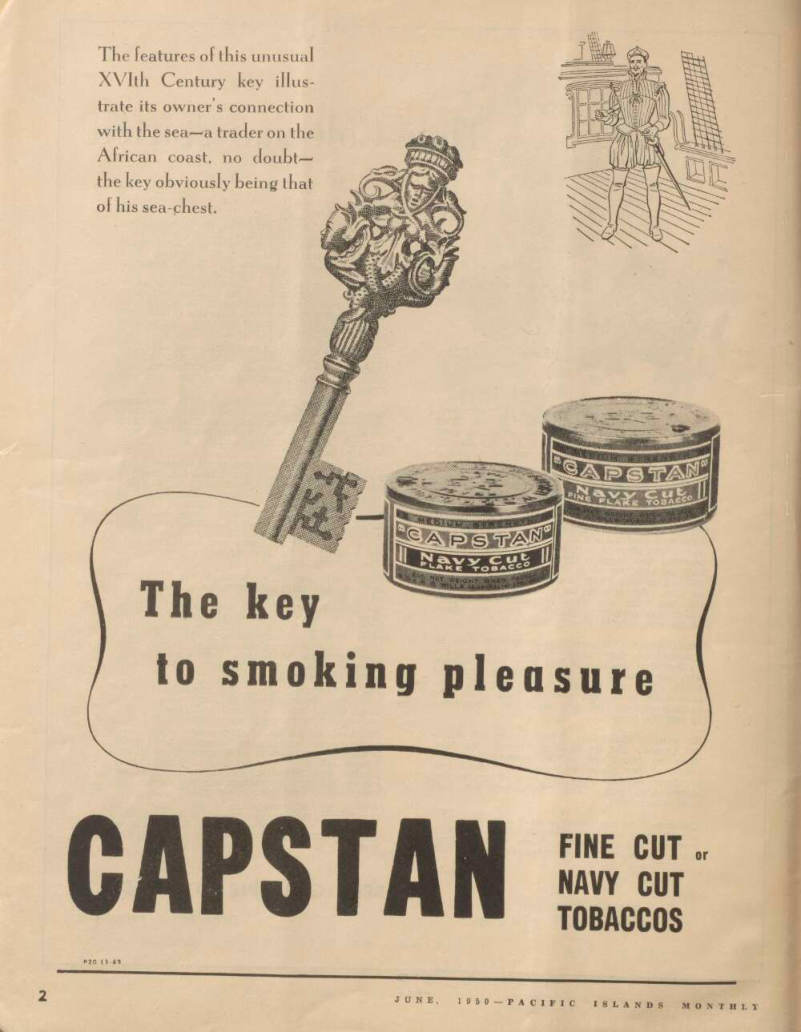
The features of this unusual XVlth Century key ill ustrate its owner’s connection with the sea>— a trader on the African coast, no doubts the key obviously being that of his sea-chest. nn a nu S ; x-, ,»>> ... r ‘i'i'h i ***^ cub m mm.
The bey
to smoking pleasure
CAPSTAN
FINE CUT ..
NAVY CUT
TOBACCOS
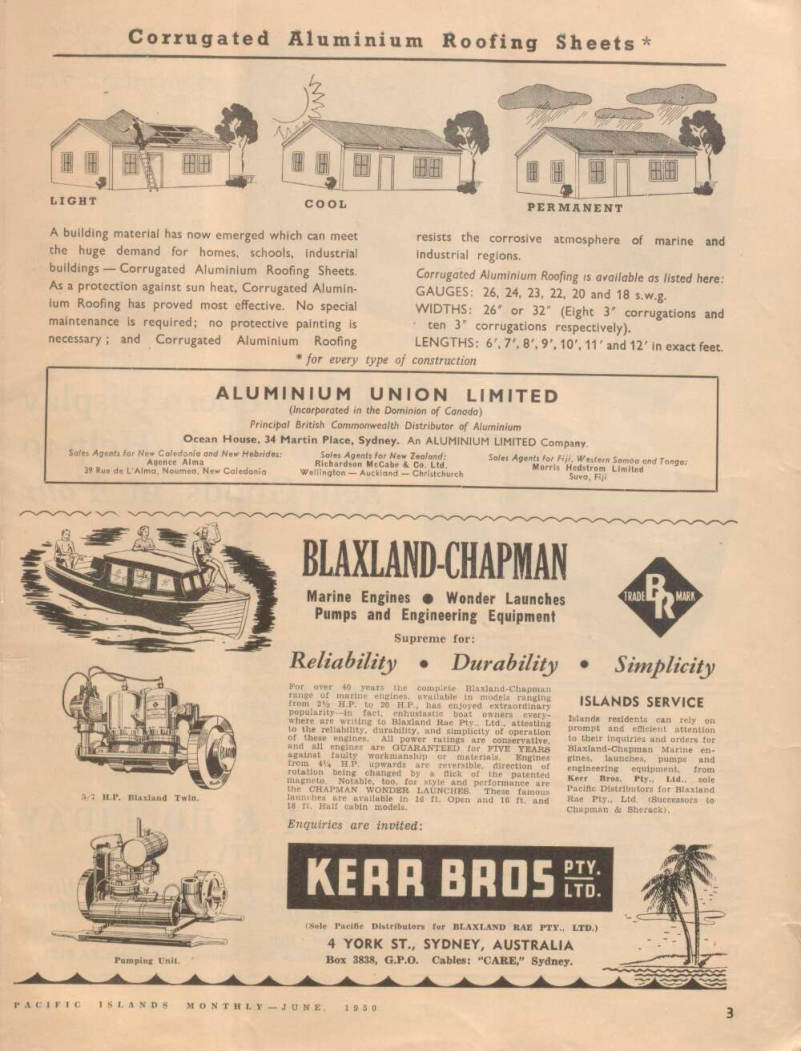
Corrugated Aluminium Roofing Sheets
in Half
I a *
LIGHT
COOL
A building material has now emerged which can meet the huge demand for homes, schools, industrial
buildings Corrugated Aluminium Roofing Sheets.
As a protection against sun heat, Corrugated Aluminium Roofing has proved most effective. No special maintenance is required; no protective painting is necessary ; and Corrugated Aluminium Roofing * for every type
PERMANENT
resists the corrosive atmosphere of marine and industrial regions.
Corrugated Aluminium Roofing is available as listed here: GAUGES: 26, 24, 23, 22, 20 and 18 s.w.g.
WIDTHS: 26" or 32" (Eight 3" corrugations and ' ten 3" corrugations respectively).
LENGTHS: 6,7 , 8 , 9', 10', 11' and 12' in exact feet. of construction Sales Agents for New Caledonia and New Hebrides: Agence Alma 39 Rue de L'Alma, Noumea, New Caledonia
ALUMINIUM UNION LIMITED
(Incorporated in the Dominion of Canada) Principal British Commonwealth Distributor of Aluminium Ocean House. 34 Martin Place, Sydney. An ALUMINIUM LIMITED Company.
Sales Agents for New Zealand: Richardson McCabe & Co. Ltd.
Wellington Auckland Christchurch Sales Agents for Fiji, Western Samoa and Tonga; Morris Hedstrom Limited Suva, Fiji
BLAXLAND-CHAPMAN
Marine Engines • Wonder Launches
Pumps and Engineering Equipment
Supreme for:
Reliability • Durability • Simplicity
For over 40 years the complete Blaxland-Chapman range of marine engines, available in models ranging from 2Vz HP. to 20 H.P., has enjoyed extraordinary popularity—in fact, enhuslastic boat owners everywhere are writing to Blaxland Rae Pty., Ltd., attesting to the reliability, durability, and simplicity of operation of these engines. All power ratings are conservative and all engines are GUARANTEED for FIVE YEARS against faulty workmanship or materials. Engines from 41/4 H.P. upwards are reversible, direction of rotation being changed by a flick of the patented magneto. Notable, too, for style and performance are the CHAPMAN WONDER LAUNCHES. These famous launches are available in 16 ft. Open and 16 ft and 18 ft. Half cabin models.
Enquiries are invited :
KERR BROS
ISLANDS SERVICE
Islands residents can rely on prompt and efficient attention to their inquiries and orders for Blaxland-Chapman Marine engines, launches, pumps and engineering equipment, from Kerr Bros. Pty., Ltd., sole Pacific Distributors for Blaxland Rae Pty., Ltd, (Successors to Chapman & Sherack).
PTY.
LTD.
(Sole Pacific Distributors for BLAXLAND RAE PTY., LTD.)
4 YORK ST., SYDNEY, AUSTRALIA
Box 3838, G.P.O. Cables: “CARE,” Sydney.
■ , m Price at Works (6 ft. Length): £4O/10/- Extra for 10-inch additional shelf and brackets (if required) : £2 Packing and Transport to Wharf ; £lO/10/- (For cases shipped in quantities, packing is at greatly reduced rates).
The display case is securely packed in two substantial crates occupying shipping space of 32 cubic feet. Total weight, when packed, 5 cwt. 4 ft. Length: £27 8 ft. Length: £52 Another view of the “Brahol”
Export Counter case, showing width of counter space.
BRIEF SPECIFICATIONS
To help you get an accurate picture of the “Brahol”
Special Export Glass Counter Case, here are the main specifications: Overall size is 6 feet long x 1 ft. 9 in. deep x 3 ft. 3 in. high. Made from first-class, wellseasoned Queensland Maple, hand french polished, wax finished, in natural maple colour. Glass parts are \ inch British plate glass.
The inside is lacquered ivory colour, and the recessed base is lacquered burgundy.
There is a pair of solid core sliding doors, and one glass shelf, 14 inches wide, on adjustable nickelplated brackets.
Storage space below is 11 inches high.
The plate glass front is 22 inches high.
This Modern Display
Counter will Help to
Sell Goods in Your
Store!
{and it’s specially built for Export ) As smart as those in leading Australian city stores, and built by a firm that has been making fine store and office fittings for over a third of a century.
Moreover, it is specially built for export, so that it can be readily securely packed, and assembled by anyone, from simple directions, in an hour, with no tools other than a screwdriver. Retailers all over the world have learned the selling value of modern display equipment, and this silent salesman” will soon pay for itself in increased sales.
BRAY & HOLLIDAY
PTY. LTD.
Makers of Fine Store and Office
Sittings for over a third of a century Brahol House, 66-74 McLachlan Avenue, Rushcutfer Bay, Sydney. Telephone: FA 4121 Cable and Telegraphic Address: “Brahol.”
for Housewives
Your Favourite
KEROSENE
oeitei, thoK evek.
Available from all Stores
FROM APRIL Ist
li
VACUUM
QUAIIIT
VACUUM OIL COMPANY PTY. LTD.
(Incorporated in Australia) ,«5 mmmm 4v' j
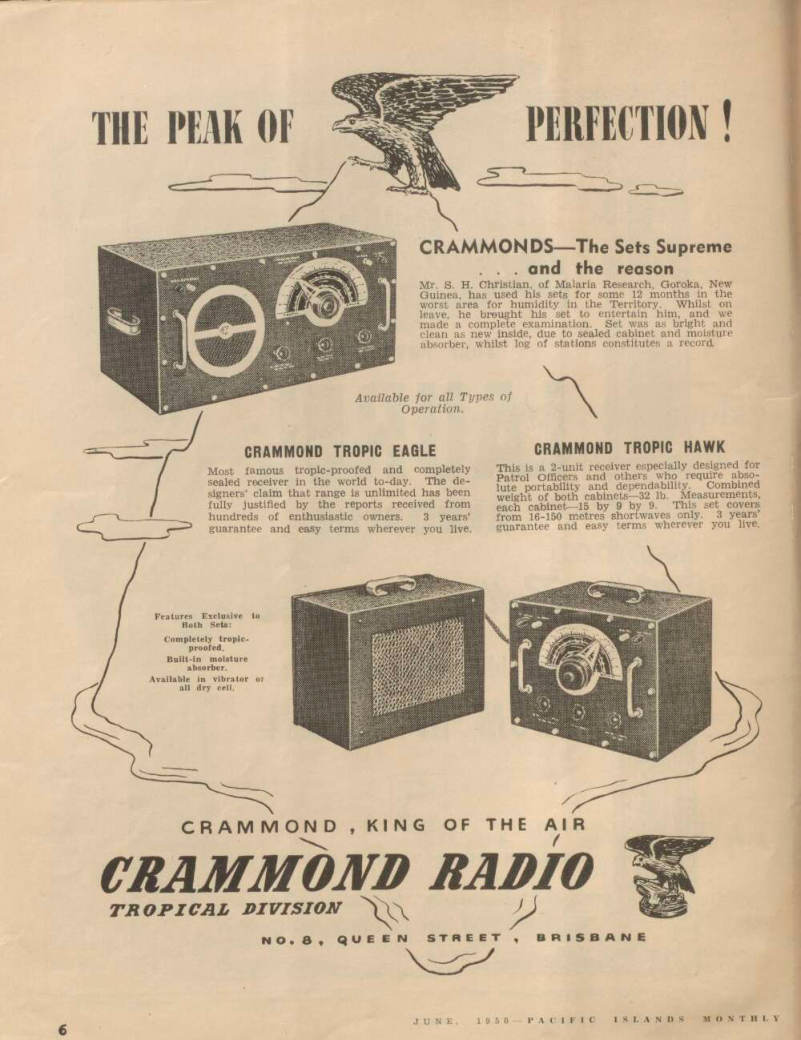
THE PEAK OF
W&M'*.
' -' mmm im ssss?
F m
PERFECTION!
CRAMMONDS —The Sets Supreme
. . . and the reason Mr. S. H. Christian, of Malaria Research, Goroka, New Guinea, has used his sets for some 12 months in the worst area for humidity in the Territory. Whilst on leave, he brought his set to entertain him, and we made a complete examination. Set was as bright and clean as new inside, due to sealed cabinet and moisture absorber, whilst log of stations constitutes a record.
Available for all Types of
Operation.
CRAMMOND TROPIC EAGLE
Most famous tropic-proofed and completely sealed receiver in the world to-day. The designers’ claim that range is unlimited has been fully justified by the reports received from hundreds of enthusiastic owners. 3 years’ guarantee and easy terms wherever you live.
CRAMMOND TROPIC HAWK
This is a 2-unit receiver especially designed for Patrol Officers and others who require absolute portability and dependability. Combined weight of both cabinets—32 lb. Measurements, each cabinet —15 by 9 by 9. This set covers from 16-150 metres shortwaves only. 3 years guarantee and easy terms wherever you live.
Features Exclusive to Both Sets: Completely tropicproofed.
Built-in moisture absorber.
Available in vibrator or all dry cell.
V • m mm
CRAMMOND, KING OF THE AIR
CRAMMOND RADIO
TROPICAL DIVISION
N o, S , QUEEN STREET , BRISBANE
Index to Advertisers
Alois Akun & Co. . 77 Aluminium Union . 3 Amplion (A/sia) . 54 Angus & Robertson 19 Armstrong Siddeley Motors, Ltd. . . 50 “Aspaxadrene’’ . . 22 Baker, W. Jno. . 23 Balchin, W., Ltd. . 88 Bank of NSW . . 75 Berry’s Bay Boat yard 84 Bethell, Gwyn & CO 38 Blaxland Rae Pty. 3 Blundell, Spence . 52 Bovvll 30 Brasso Polish ... 19 Bray & Holliday Pty., Ltd 4 Bristol-Myers Co. . 76 Broomflelds, Ltd. . 24 Brunton & Co., Ltd. 71 Budge, James, Ltd. 36 Bunting, A. H., Ltd (Papua) . . 68 Burns Philp (NG) . 49 Burns Philp (NH) . 31 Burns Philp (SS) . 65 Burns Philp Trust . 80 Caine’s Studios 51, 63 Carrlock Co., Ltd. . 59 Carpenter, W. R. & Co., Ltd. 58, cov. iv.
“Charmosan” ... 17 Classified Advertise ments ... 87 Colonial Meat Co. . 72 C o 1 y e r Watson (NG), Ltd. . 15, 50 Commonwealth Bank of Aus tralia . •. . .37 Crammond Radio 6 Crilley, R. J., Ltd. 19 Cunningham, R. H., Pty., Ltd 87 “Gystex” ... 65 Dangar. Gedye & Malloch, Ltd. 7, 87 Davison Paints . 24 Donaghy, M., & Sons Pty., Ltd. . 73 Donald. A. 8., Ltd. (Auckland) ... 33 Donald, A. 8., Ltd. (Rarotonga) . .53 Dunlop Rubber Ltd. 33 Electrolux ... 58 Etablissements Donald Tahiti . . 30 Export Soap Co. . 74 “Flit” 84 Ford Sherington . 70 Garrett, Davidson & Matthey, Ltd. 88 Garrick Hotel . . 86 Gllbey, W. & A. . 82 Gillespie Bros., Ltd. . . . . .53 Gillespie, R.. Pty., Ltd. . 1. 38, 44-45, 69 Gillespie, R. (NG).
Ltd 85 Gordon’s Gin . .34 Gough & Co., E. J. 28 Grand Pacific Hotel 8 Gregory, A., Ltd. . 60 Grove & Sons, W.
H., Ltd. ... 25 Halvorsen Lars, Sons Pty., Ltd. . 62 Heinz & Co., Ltd. . 27 Hemingway & Robertson, Ltd. . 57 Hoover, Francis . . 71 Hygeia Sanitary Co. 86 Islands Industries, Ltd 21 Jones, Wm. A., Ltd. 70 Kasper Refrigera tors Pty., Ltd. . . 77
Kennedy, Captain . 25 Kerr Bros. . . 3, 70 Kolynos, Inc. ... 51 Kopsen, W., & Co. 67 Kraft Walker Cheese Co. ... 54 Kui, George ... 68 Mdcintyre, Thomas & Co., Ltd. ... 79 Maloney. N. F., Co. 74 Mcllrath’s Pty., Ltd. 82 “Mendaco" ... 71 Merrillees, J. C., Pty., Ltd ... 83 Millers, Ltd. (Fiji) 59 Morris, Hedstrom.
Ltd 16 Mt. Colah Home Art Union ... 73 Nelson & Robert son Pty., Ltd. . 60 “Nixoderm” ... 63 Nordman, Oscar G. 39 Nth. Sydney Travel Bureau 85 NZ National Air ways Corporation 40 Pacific Islands Society 31 Pacific Islands Trading Co. . . 55 Pacific School of Music 37 Pan American Air ways, Inc., Ltd. . 18 “Pinkettes” ... 85 Qantas Empire Air ways, Ltd. . cov. li Qld. Insurance Co. 79 Reckitt’s Blue . . 59 Reed, William E. . 63 Riverstone Meat Co. Pty., Ltd. . . 29 Rohu, Sil 25 Round, Guy ... 21 “San Blanda"
Guest House . 27 Scott. J., Pty., Ltd. 39 Shell Co. of Aust 23 Sherwin - Williams Paints 61 Southern Pacific Insurance Co. . . 35 Steamships Trading Co., Ltd. (Papua) 36 Stewarts & Lloyds 28 Sullivan, C., Ltd. . 57 Tallerman & Co. . 31 Taylor, Allen & Co, 55 Thornycroft, Ltd. . 20 Tilley Lamp Co., , Ltd. (England) . 66 Tillock & Co., Ltd. 17 Tongan Photos Bureau 83 Tooth & Co, . cov. iii Tyneside Engineer ing Co., Ltd. . . 62 United Island Traders Ltd. . . 78 Vacuum Oil Co. 5, 84 Ventura Trading Co 24, 67 Vincent Chem. Co. 35 Wakes’ Mail Orders ... 26 Waters, E. & Sons, 32, 56, 64 Watson, Victor, Ltd. 15 West, Harry ... 20 Williams, Dr. ... 39 Wills, W. D. & H.
O. (Aust.), Ltd. . 2 Woods’ Peppermint Cure 69 Wright, Captain E.
J 83 Wright & Co. . . 81 Wunderlich Ltd. . . 34 Yorkshire Insur ance Co., Ltd. . 81
The American branch of the famous travel firm of Thomas Cook and Sons is said to be considering round-trip tours to the South Pacific, including Australia and New Zealand. Vice-president of the US branch, Mr, Malcolm La Prade, visited Australia and New Zealand in May.
Advertisements & other items, p. 9 (2 items)
7
PA (’IF IC ISLANDS MONTHLY— JUNE, 1960
lifts
Announcing . . .
THE NEW
§R/T/sh Built
“START-O - MATIC”
Alternating Current 240 Volt Plants
3L mmm Lister “Start-O-Matic” Plants provide the convenience of an alternating current electricity supply and enable the owner to use standard 240-volt domestic electrical equipment. Powered by the famous “Lister” Diesel Engine the operation of the “Start-O-Matic” Plant is entirely automatic. The set starts up immediately a lamp or other electrical appliance is switched on and is automatically stopped when the last item being used is switched off.
SOLE N.S.W. AGENTS:
DANGAR GEDYE S MALLOCH LTD.
MALLOCH HOUSE, 10-14 YOUNG STREET, SYDNEY
Branches at Melbourne, Wagga. Lismore and Newcastle.
In This Issue:
Editorial: Australia’s New Policy in New Guinea 9 Wau Secondary School Open Next Year 10 Lae’s Red Tape—Slow Payment of W & H Accounts 10 Copra Planters are Restless —That UK Contract Price 11 Fingerprints Hung Tai Shek .. .. 11 Airport in Tonga—Unexplained Re port in Australia 11 Floods and Landslides in Samoa .. 11 Danish Expedition to Probe Pacific’s Depth 11 Tax Collector’s Share of Burns Philp Profits 12 Dutch New Guinea —Australian Posi tion is Defined 12 New Zealand Minister in Western Samoa and Cook Islands 12 UN Trusteeship Delegation Visits New Guinea ... .. 13 Angry Misima Miners Arrive in Sydney 13 Fiji Population Figures—4,ooo More Indians 14 Prom Notes Made in Fiji 14 Future of the Pacific Franc—Colonies Fear Decisions Made in Paris .. 17 Fijian Chief Now New York Radio Technician 17 Do We Wish to Forgive this Enemy? 20 Unexpected Glimpses of Hubert Mur ray—Book Review 21 Javanese Labour in New Caledonia— Sending Home Francs and Dollars 24 South Pacific Conference —Closing Scenes in Fiji 25 Papua Rubber Co. Closes Up 27 Last American Troops Leave Solo mons .. 28 South Pacific Commission —Conference Report Considered .. .. 29
TEAL Takes Over Auckland-Suva Route .. ; 32 Taxpayers Turn Critical Eye on Fiji’s Civil Service 33 NZ ; Warships Sail for Cruises in Pacific 35 The Background of Marching Rule 37 Island Kerosene—Home of New Madang Industry 39 Territories’ Talk-Talk 41 Malevolent Malabar 42 Tropicalities 43 They Are Leaving Midway to the Gooney Birds 46 1.000 Miles of Seasickness 47 Children’s Section :: Fashion .. .. 48 Some Tea is Already Coming From New Guinea Highlands 51 Trichopoda versus Amblypelta—Nut fall Problem in BSI 53 New Caledonian Mining—BHP In terest in Manganese and Iron .. 55 Fijians and Indians to Serve on Juries 55 Suva Slums Are a TB Breeding Ground .. 56 Madang Newsletter 59 New Policy In Papua-New Guinea .. 61 Tahiti Wants An Air Service —TOA And Air France Interested .. .. 70 Introducing Delana —WRC Suva Fac tory Produces Margarine .. .. 71 Rabaul Roundabout 73 New Members of Fiji Copra Board .. 74 10.000 War Dead in NG Cemeteries .. 75 Notes from French Oceania 75 NG Planters’ Assn. Asks for Better Wharf Facilities, Higher Copra Price 76 Kavieng Notes 80 No Sensations in Fiji’s Canefields Situation 84 American Samoans Will Lose Fairy Godfather Next Year 85
Croix de Guerre for Pacific Towns 86 Commercial, Markets, etc 88 OBITUARY: Lady Hedstrom, 10; Mrs.
Amy Nicol, 11; H. Jolly, 11; P.
McConnell, 13; Mdme. Mille, 28: Mrs.
Mary Lynch, 52; M. Juventin, 60; E.
J. Kuhl, 77; H. G. Murray, 84.
ASSOCIATIONS: NG Women’s Club of Sydney, 15; Fiji Amateur Sports Assn., 38; New Guinea Planters’
Assn., 76.
INDUSTRIES; Copra, 11, 86; Copper, 14; Gold, 20; Timber, 23; Oil, 77.
Mr. J. C. Hammett, well-known to New Guinea residents before the war, is doing an excellent job in the Shortlands in re habilitation of his plantations there.
Laumono has been in production for some time. Re-opening of Komaliae was be gun in March under the direction of Mr.
Hammett’s son-in-law, Mr. Ruglin, and is making good progress. Mr. Hammett has two sons-in-law to assist him, and hopes that his son, a qualified geologist, will be able to join him before the end of the year. In addition to the regular family circle of Mr. and Mrs. Hammett, their two daughters and two sons-in-law, a younger daughter, Miss Anice Hammett, recently stayed at Laumono for a holi day.
Miss Mary Eggleston, Bachelor of Ag riculture of Melbourne University, has been with the Papua-New Guinea Ad ministration for the past 21 months and is now in Australia on leave. Her job was with native women who, of course, take a large part in village gardening.
It was announced in May by the Royal Society of New Zealand that the 1950 Hector Medal and £5O prize has been awarded to Dr. Ernest Beaglehole, of Wel lington, for his published researches into Polynesian ethnology.
Advertisements & other items, p. 10 (1 item)
STAV'rf^
p» s'* ‘Sr ->H| *s&*& ■om ipr" \0& s\3N^
*** W i'l- **
*** a . s o( f*. SpeC ' a IW . s tUv- n B ’ ro<n ,«' “ *. ***" a(l4 s.t« ntS - .. S ov..<» r *e woV *,»«'* , H p^f „ w» w ® C> b ' e- -1 , -r 4411 ' S ° n s r e^ 4lWn
Pacific Islands Monthly
The Newspaper-Magazine of the South Seas [Registered at the G.P.0., Sydney, for transmission hy post as a newspaper l
Published Once Each Month and Circulated in Australia and New Zealand and in the following Pacific Territories and Islands Groups;
Australian Territory of Papua.
Trustee Territory (Australia) of New Guinea.
Australian Territory of Norfolk Island.
New Zealand Territory of Cook Islands.
Trustee Territory (NZ) of Western Samoa.
British Colony of Fiji.
British Solomon Islands Protectorate.
British Protectorate of Tongan Islands.
British Crown Colony of Gilbert and Ellice Islands.
Trustee Territory of Nauru.
British and French Condominium of New Hebrides.
French Colony of New Caledonia.
French Colony of Oceania (Tahiti, etc.).
American Territory of Eastern Samoa.
American Territory of Hawaiian Islands.
Owned and Produced by Pacific Publications Pty., Ltd., Union House, 247 George Street, Sydney.
Telephone: General Office and Advertising, BW 5037.
P.O. Box 3408
Registered Address for Telegrams, Radiograms, and Cables: “Pacpub,” Sydney.
Contributions.
Articles, Stories, and Photographs dealing with Pacific Islands subjects are invited and will be paid for on publication.
Subscription Rates.
Per Annum, Pre-paid, Including Postage.
In Australia, New Zealand, Fiji New Guinea,’ Papua, Western Samoa, Cook Islands, Tonga, British Solo mons, Gilbert and Ellice Colony, Nauru, New Hebrides, and United Kingdom • 18 0 Elsewhere $2.50 £1 1 0 Single Copies 19
Editor and Publisher:
R. W. Robson, F.R.G.S.
Assistant Editor: JUDY TUDOR.
General Office: Union House, 247 George Street, Sydney. Telephone: BW 5037.
Business Manager: SELWYN HUGHES,
Representative In London.
J. T. Wallis, Coronation House, 4 Lloyd’s Avenue, London, E.C.3, from whom may be obtained copies of Pacific Islands Monthly, Pacific Is. Year Book, advertising schedules, etc.
Agents.
The following are authorised to receive sub scriptions for Pacific Islands Monthly:— Burns, Phllp & Co., Ltd., and Burns Philp (South Sea) Co., Ltd. All branches.
W. R. Carpenter & Co., Ltd. All branches.
Morris, Hedstrom, Ltd. All branches.
Steamships Trading Co., Papua. All branches.
Steele’s Central Store, Suva, Fiji.
Adams Pharmacies Pty., Lautoka, Fiji.
Cook Islands Trading Co., Rarotonga, Cook Is.
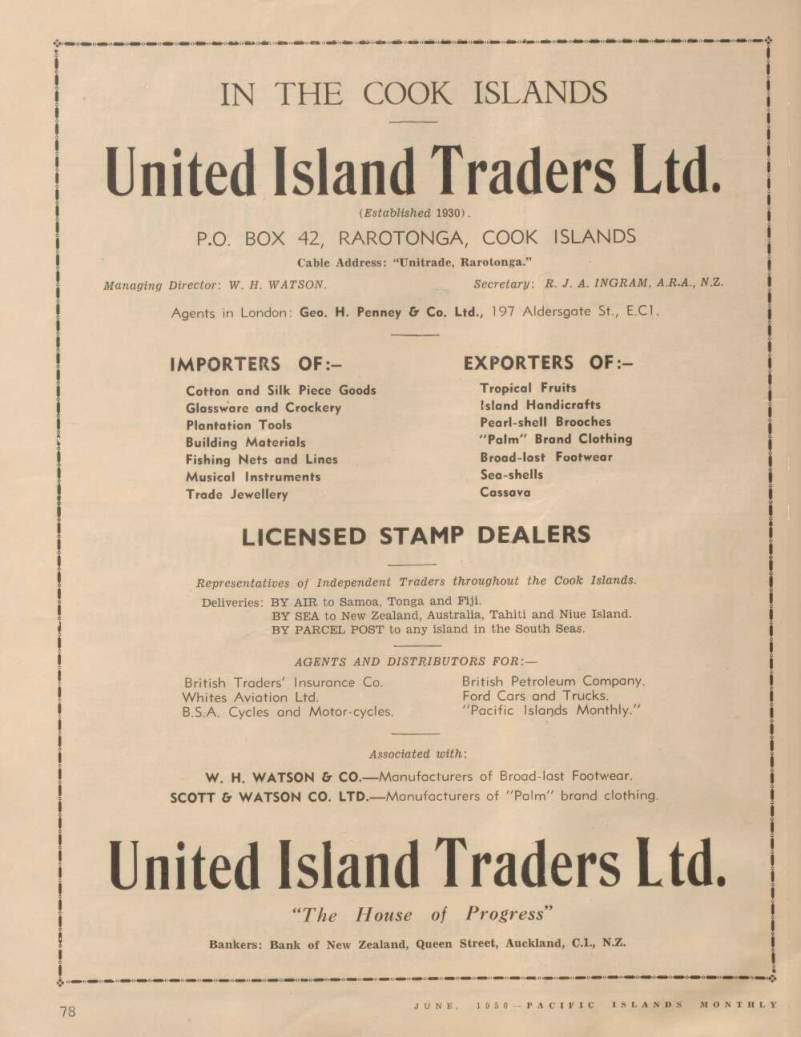
United Island Traders, Ltd., Rarptonga, Cook Is.
A. Vercoe, Apia, Western Samoa.
Oscar Nordman, Papeete, Tahiti.
Islands Branches and Representatives of W. H.
Grove & Sons, Ltd., Auckland, New Zealand.
Ed. Pentecost, Noumea, New Caledonia.
Societe Gubbay Kerr et Cie, Noumea. New Caledonia.
Vol. XX. No. 11.
June, 1950
1/9 Per Copy.
Price Prepaid, p.a.; 18/- Aust.
In USA, p.a.: $2.50.
Australia s New Policy In N. Guinea
FOR the first time since the Territory was taken over by Australia, New Guinea has been given a clear-cut policy on which to base its administration, and—what is even more important—a Minister who gives promise that that policy will be carried iqto effect. It is a refreshing change, after 30 years of dithering and discouragement. The administrative and industrial paralysis of Wardism—which lasted five years—was bad enough; but Ward merely put the coping-stone on 25 years of Canberra indifference and neglect, for which all parties were to blame.
In the months between December and May, many, many “plans” for reform and development in Papua-New Guinea went into the hands of Mr. Spender, but he accepted none of them. He examined them in detail; he went personally and looked the Territories over; he took what he regarded as the best ideas in all the plans; and then he presented. to the Prime Minister his own skilfully woven policy.
It appears to be based on three main principles: These islands must be occupied and developed as a vital part of Australia’s external defences; they must be developed and settled by private enterprise under Government encouragement and close supervision; and the welfare and advancement of the .natives must be a primary consideration. Most Territorians will agree that that is a realistic and well-balanced concept.
SOME Territorians are critical because the Minister for Territories also is Minister for External Affairs. They sav he mav be so deenlv concerned with international relations that he will not have time to deal thoroughly with Territorial matters. That was a sound argument once—but not to-day.
To-day, the main problems of Australia’s “external affairs” are in the Pacific—they tie in closely with Alls-
tralia’s future political and economic relations with the nations of Asia and North America, which face the Pacific Ocean. Ever-y question of Australia’s future security must concern itself with Conditions in New Guinea, in which Australia must place her first line of defence. If - there is to be a clear-cut plan and efficient administration in New Guinea, New Guinea policy must be closely integrated with External Affairs policies. Australia is securing that co ordination, through Mr. Spender.
Australia, alone, cannot completely protect herself, and the European and Islands communities of the South Pacific, against Asia—she must have help, in the ultimate test, from other countries. Upon the character and degree of that help will depend the extent and quality of Australian activities in New Guinea.
These matters cannot be decided through a Territories Minister, alone; plans must be made in consultation with other im portant departments.
In other words, the over-all plans which will govern Papua-New Guinea, in the future, will be more concerned with international affairs, at first, than - with the welfare of primary industries, like planting and mining. Already, the Minister has made it clear that Australia’s interest in New Guinea is more concerned with defence than with “colonisation” (a term used by Leftists to describe the development of a new country’s resources for purpose of profit); but that, as the establishment of a strong European economy in New Guinea is essential to the defence of Australia, European settlement and industry will be officially encouraged in every reasonable way.
It seems to amount to the same thing; but it is not. If it was merely a question of developing New Guinea’s natural resources, the cry of the idealists, that the welfare of the natives should have precedence over all other considerations,
probably would be given much attention, gf Government to enter the country. The Australian Government could say that the development of Australia’s own natural resources, rather than those of Trust Territories, should be its first consideration. as the New Guinea problem is primarily a matter of building up protection for Australia, the Australian Government’s first consideration is to establish, within the great islands of New Guinea, New Britain, New Ireland and Bougainville, conditions which will allow a defence organisation to be supplied and moved much more readily than was the case in 1942-44. In order that the financial burden of such a policy may not bear too heavily upon the Government, the Government has decided to encourage private enterprise to enter and develop the country, to make it as far as possible self-supporting, jjoWEVER, as the Minister has pointed H > o ut, such a policy is not necessarily con flict with the policy of the j. k. Murray Administration, which — rightly or wrongly—is regarded as having made the welfare of the natives its first an d almost its only thought. Mr. Spender has emphasised that, the natives will not be sacrificed to the demands of commerce an d industry, and that there is no reason w hy their physical and mental improye ment, and the raising of their living standards, should not go hand in hand with increased European settlement and the development of the Territories re sources. He reminds us, also, that—despite a ll the nonsense talked by the starry-eyed idealists of the early Wardist regime these natives generally are of a primitive type, and will need care and training over two or three generations before they aie capable of running their own affairs, after the manner of Samoa, Tonga, riji, etc. , , .
Generally, the Spender plan is good. and Territorians, with interest, will await its implementation. After all, most people can make a plan: the real test comes
when other people try to give effect to it.
The Minister has said that he will introduce local Advisory Councils, and will soon try to establish a Legislative Council. He would be wise to hurry on with that. The secret of the success in tropical administration lies in the skill with which administrators make use of local know-how and practical experience.
Every College tyro, and nearly every politician, thinks he can undertake ad ministration in a tropical region without ever having seen a native or a coconut tree; and when such gentlemen are given authority, there usually is a condition of administration paralysis—the newcomer fumbles and frets, while the old hands sit by, grimly silent.
The wise director loses no time in bringing practical knowledge to the aid of enthusiasm and academic skill; and that, above all, is what is needed in New Guinea. There is plenty of know-how available in New Guinea; but the Territorians, for so long, have taken such a hiding at the hands of political blunderers and well-intentioned bureau crats that, for years, they have been withdrawn and cynical and not very co operative.
Owing to printing-house troubles, this (June) issue of PIM has been reduced in size, and Shipping and Airways time tables do not appear. Thiey will be published as usual next month.
Wau Secondary
School
Will be Opened in 1951
From Our Own Correspondent
Port Moresby, June 6.
I'IHE Territory’s long-needed secondary school is expected to open at Wau next year. The Education Depart ment is so confident that it will be built by then that it is already calling for applications from prospective students.
To be known as Wau High School, the school will cater for 100 pupils, including 80 boarders of both sexes. There will be separate dormitory buildings for boys and girls.
Pees for boarding students will be £5O a year, which includes laundry, textbooks and stationery. The Administration will provide free transport to and from students’ homes in the Territory at the Christmas vacation. Home visits during the mid-year vacation—June 23 to July 15—will be at parents’ expense. Those eligible for admission to the school are children over 11 years who have finished grade 6 in Papua-New Guinea or its equivalent elsewhere. It is expected that the following subjects will be available in 1951: English, German, French, Dutch, Social Studies, Mathematics, Science, Stenotyping, Bookkeeping and Business Methods, Biology, Music and Domestic Science. Later it is planned to add Handicrafts, Art, Technical Training, etc.
The school will occupy 112 acres, and will be connected to Wau airstrip by a 2i miles long all-weather road. It will be 3,600 feet above sea level. Detailed plans of the school have been prepared and a contract for erection of the buildings will be let soon.
When Mr. R. A. McFarlane of the Seventh Day Adventist Mission near Lae, New Guinea, sailed back to his station from Sydney recently he took 1,000 copies of a book of Bible stories which will be distributed among mission schools. He said that natives were hungry for books of this sort and that their distribution was a weapon against the spread of com munism.
Lae's Red Tape
Slow Payment of W. and H.
Accounts
Lae, Ng, May 30.
A DISCOURAGING feature of the work of the Department of Works and Housing is the delay in making payments for services rendered by con tractors and business firms.
So serious has the position become that one bank manager refuses to recognise Departmental authorities for the per formance of services as a backing for limited overdrafts, on the grounds that there is too much uncertainly as to when payment will be effected: As the majority of work in this area emanates from Departmental sources— referring to the Commonwealth Depart ments —this means considerable em barrassment to many carrying out work for the Departments, in that, whilst they are compelled to pay their own way, they are waiting for periods extending into months before payments are made.
The main obstacle to speedy settlement is the fact that Works and Housing accounts from Lae have to be forwarded to Port Moresby Office for payment, which is ultimately made through the Treasury, Port Moresby. No facilities are provided within the Department for the payment of its accounts in Lae, although a Sub-Treasury appears to be functioning normally here. Payments for similar services in Rabaul are made by the Rabaul Sub-Treasury on the spot.
One case in particular had reached breaking-point and a special trip to Port Moresby, a cost of roughly £3O, was made in an attempt to receive moneys overdue nearly two months.
It is hard to fit this position into the statement by the Minister that his Government will encourage private enter prise. The existing system is strangling private enterprise.
Hedstrom
Death In Suva Of Lady
"VJ'UMEROUS friends of the Hedstrom In family in the Pacific Islands, Aus tralia and New Zealand expressed deep regret when it was known that the death had occurred on June 1 of Lady Hedstrom, wife of Sir Maynard Hed strom, Chairman of Morris Hedstrom, Ltd. Lady Hedstrom had been in poor health for some time—she had suffered acutely from bronchial asthma.
Lady Hedstrom, prior to her marriage, was Miss Joyce Beauchamp, daughter of Mr. Walter M. Beauchamp, of Sydney.
She was a woman of charming social qualities, with a notable capacity for making and holding friends, and no worthy cause ever appealed in vain for her help. She also was a woman of out standing ability and, in the earlier years of her life, she gave much active help to her busy husband, Sir Maynard Hed strom, to whom the sympathy of a wide circle of friends has been extended.
Joel! K. Ravai, Roko Tui Tailevu (Head of the Fijian Province of Tailevu) and one of the Fijian members of the Legis lative Council, is to visit the United Kingdom as the guest of the British Council. He left Fiji on June 9 and, on his way to London he will spend a fort night in Australia. He will be in the United Kingdom until the end of October and while there will follow short Uni versity courses in English language, life and institutions and visit centres of in terest, Papua-New Guinea Director of Native Labour, Mr. W. R. Humphries, and Mrs.
Humphries, returned to Port Moresby from leave in Australia on the May Bulolo.
Matua Passengers To Fiji
Some of the travellers who returned to Fiji on MV Matua on April 28 included (left to right): Mr. J. Ah Sam, of the Suva Post and Telegraph Department, who had spent six months’ holiday in Auckland, NZ. Mr. and Mrs. A. Lepper, of Savu Savu, who also spent six months in NZ. Mr.
R. L. Edmonds, from Melbourne, to take up a post with the CSR Co. at their Rarawai Mill. Mr.
E. Elphich. who returned from two months' holiday in Auckland, NZ, Miss M. Lane, who arrived from NZ to stay with her sister in Suva —She may settle in Fiji.
Copra Planters
Restless
That British Contract Price
A CERTAIN amount of dissatisfaction with the British Ministry of Food contract —under which most of the South Pacific copra is now sold to Britain at a price equivalent to about £4B Sterling per ton—is becoming manifest through out the South Pacific Territories.
The focal point of dissatisfaction is the price. This was fixed about the end of 1948. Then, it was a reasonably good price—not the top of the market, but acceptable, because it had behind it a nine years’ guarantee.
But, in 1949, the British Socialist Gov ernment de-valued the £ Sterling in re lation to gold and the United States Dol lar, by about 30 per cent. —and this, of course, threw the copra price completely out of gear, in relation to world values.
Copra is a commodity in demand in Dol lar as well as in Sterling areas.
The effect of this is seen to-day in the fact that, while Britain is paying £4B Sterling for copra, Dollar buyers are offer ing over 180 Dollars per long ton—which is equal to over £6O Sterling, and £BO Australian.
South Pacific copra growers, who were happy enough about the British contract prior to the devaluation, are now in clined to argue that they have been tricked.
Ceylon—an important producer of high quality copra—broke away from the British contract at the end of 1949. and now is selling in the free market. It was reported in the “Crown Colonist” of April that the British Territory of Seychelles Islands, also has broken away from the British contract as from January, 1950, and is selling its copra to Denmark at £B5 per ton, GIF, as against the 1949 price of £52/10/-, FOB.
An important statement, relating to the Australian-New Guinea copra market, was made by the Australian Minister for Territories in his review of Papua-New Guinea affairs, published elsewhere in this issue. • New Guinea producers will not be happy about that statement. Already there is current a report that the so called contract with the British Ministry of Pood should be produced for investiga tion by representatives of the planters.
Finger Prints
Hung
Tai Shek
SUVA, June 5.
THE Chinese labourer, Tai Shek, found guilty of the murder of Mr. and Mrs.
T. Allen, at Ocean Island on April 26, 1949, was hanged in Suva gaol on May 31. An appeal made against the sentence on the ground that new evidence was available was dismissed.
This case is notable in criminal history because no motive for the murder was ever discovered: the Chinese was con victed on fingerprint evidence alone. The bodies of Mr. Allen (who was a technician employed by the Phosphate Commission) and his wife were found in their bunga low one morning. Dectectives from Bris bane finger-printed the whole community and pinned the crime on Tai Shek.
A son was born to Mr. and Mrs. Des.
Sullivan at the Moresby Hospital on May 16.
Airport In Tonga
Unexplained Report In Australia
AUSTRALIAN newspapers, in May, published a surprising report, to the effect that Queen Salote, of Tonga, had finally succeeded in preventing Brit ish and American air interests from es tablishing permanent air bases in Tonga.
One newspaper actually stated: “Air strips in Tonga are to be removed and air liners from New Zealand, on the Inter-island service, will no longer call there. Trans-Pacific air liners flying be tween Australia and Canton Island will no longer have an alternate landing place in Tonga, if Nadi (Fiji) should not be available owing to bad weather.”
Apart from this, there has not been any indication that Tonga wishes to deny itself the privileges of air transportation and airmails. It may be taken as cer tain that Tonga will be linked up by air with Fiji, Samoa and New Zealand in the future, as in the past.
All that has happened is that the In ternational Air Conference, held in Mel bourne in April, expressed itself in favour of the Fiji international airport being finally established at Nadi, instead of at Nukualofa (Tonga), which was one of the alternatives suggested.
Floods And Landslides
In Samoa
EXCESSIVE rain caused floods and landslides on the east coast of Upolu on May 26. There was much damage in the villages of Salesatele, Salelesi. and Eva; four persons died and many were injured.
Death Of Mrs. Amy Nicol
THE death occurred in Suva, on June 1, of Mrs. Amy J. Nicol, aged 82.
She arrived in Fiji with her parents, Mr. and Mrs. Alexander Gray, in 1885, and married a public official, who died eight years ago. She is survived by five daughters and four sons.
Mr. H. Jolly Dies Suddenly in Lae
THE death occurred suddenly at the end of May of Mr. H. Jolly, ac countant for Burns Philp & Co., and a popular and respected resident. He had been away on a short trip to other branches; and when the plane arrived on its return to Lae, it was reported that he had expired from a heart attack.
To Probe Pacific’S
Depth
Danish Expedition Next Year
SOME time in 1951, a Danish scientific expedition of unusual interest will arrive in the Pacific. It is equipped to explore the deepest holes in the ocean floor—it expects to get biological speci mens from depths of 30,000 feet.
Fifteen Danish scientists expect to leave Copenhagen on October 1, on the British-built frigate Galathea, 1,600 tons, 265 feet long, under the command of Dr.
Anton Bruun. Dr. Bruun commanded the Dana, which carried Professor Johannes Schmidt’s expedition around the world in 1928-30. One of its dis coveries was that European eels migrate to the Sargasso Sea, to breed and die there.
The Galathea is booked for 66 ports.
She sails via West Africa, South Africa.
Madagascar, Reunion, Mauritius, and Ceylon, to Calcutta. Then she calls at various ports in Indonesia and goes via the Philippines to Japan. After that, via the Celebes, she arrives in the South west Pacific, and calls at;— New Guinea area—Manokwari, Rabaul, Solomon Islands and Port Moresby.
Chief Australian ports.
New Zealand area—Chief ports and out liers.
South Central Pacific —Suva, Tonga, Pago Pago, Papeete, Pitcairn, Easter Island. t She returns home via the Panama Canal and West Indies. The voyage will take two years.
The expedition has been financed by Danes living abroad, by the Government (which provides the ship) and the Navy (which supplies the crew of 80 men to work her).
That well-known Danish journalist and traveller, Hakon Mielche, who made hun dreds of friends when he went through the Pacific on the Monsunen (and was wrecked on her!) in 1934, is in charge of a public relations team booked for the Galathea. They plan to produce many scores of educational films, recordings and feature articles.
“We expect sensational results,” he writes to the PIM. “No one knows what is going on in those abysses near the Philippines and Tonga. Little is known about the living things in those appalling depths. Already, our public is anticipat ing dragons and sea-monsters!”
Rabaul Cricket
Kokopo and Administration cricket teams photographed with Sir Alan Burns, of UN Mission, and Mr. J. K. McCarthy, District Officer, Rabaul. Front row (left to right): S. Baker, A. D’arcey, Rev. Father Copas, Sir Alan Burns, J. Keenan, S. L. Cherry, R. Blackeby, J. Peterson. Back row; C. Ashley, J. Williams, W. Cohen, J. Allan, T. Garrett, A. Paige, L. Mansfield, F. Wilson, W. Moore, R. Park, J. Sullivan, J. K. McCarthy (District Officer), E. Van Leeuwen, C. Normoyle, B. Holloway, L. Mechel. Photo by C. H. Meen.
Tax Collector's Huge Share of Burns Philp Profits
Burns Philp Profits
IN its last financial year, ended March 31, Burns, Philp & Co., Ltd., had a cash turnover of £24,465,000, and made a profit of £302,734, out of which it paid its usual dividend of 12J per cent.
Even in this year of depreciated currencies, £24i millions is a great deal of money. The company has climbed a long way, practically without a stagger, since it was registered 67 years ago by James Burns and Robert Philp. Its assets now are quite conservatively valued at nearly £lO l millions For many 'long years, its.stores, ship- Pacmc 86 Islands a^rovidedta^he S comnanv with most ofite nroflts • but the combinpd ° war P Socialist and
Si-headed have t ?araelv
S4d the character of tfle comnanrts
oEer”l!onsf e
n' T ' e ttril'tnn S 6 chX retlil stores ll within Tustralia Sif t u stores—within Australia lusen. . , In a , ™ shareholders at. the annual j meetmg on May 25, the chairman (Mi . James Burns, son of the founder) gave some indication of the company s problems. rpHE company has just put the Braeside JL into commission a smallish freighter of 5,687 tons. Yet she cost no less than £ABOO,OOO. Australian taxation is so enormous that the company, to provide £BOO,OOO, has to make a profit of £1,750,000.
The company wants more ships to replace those lost in war, and to carry on its business; and the Pacific Territories
are literally howling for more ships. But, as Mr. Burns pointed out, if the company wanted to build another Bulolo it would have to make £2,500,000 to pay the taxes and pay for the ship.
Under present conditions, the Govern ment takes in direct taxes more than 50 P er cent, of the profits earned by the company. And then—such is the beauty that Socialist masterpiece, double taxation —when the remaining profits are divided among shareholders, the Government treats them as new income, d in^P With perhaPs 5 ° P6r C6nt ' :t is not surprising to learn, from the chairman’s speech, that the Board has, for the present > abandoned the idea of buildin g more shi P s and has brought back to s y dne y £500,000 which it had sent to a monthly service to-the Far East with two vessels - tried to do it again, after the war But> by noW) wa terside unions and their allies were on the rampage. The ships are forced to spend no less than 40 to 60 q ays eac h trip j n Australian ports; an q a p idea of a monthly service has been given up.
However, despite these conditions, the an d islands services in which it has been engaged for nearly 70 years, and is keep jng liquid a sufficient proportion of its huge assets to meet a more favourable situation, should it develop. It has a quarter million in cash; over £2 millions invested in subsidiaries; and £IS millions invested in other shares and Government loans.
Defined
Dutch N. Guinea
Australian Position Is Defined
THERE have been lively developments during the month in relation to Indonesia.
There were indications in the middle of May that revolts against the Indonesian Federal Authority were in progress in Macassar and Ambon, and that a good deal of fighting had taken place. There are no details.
On May 20, Dr. Soekarno, president of Indonesia announcing an agreement by political leaders to abolish State Govern ments, thus making the Indonesian Federal Government supreme—an ugly development in itself —said: “I call on my brother Indonesians. Let us march on. Western New Guinea must, can, and certainly will return to our fold.”
On May 22, Australia’s Minister for External Affairs (Mr. Spender) an nounced that the Australian Ambassador to Indonesia, Mr. J. D. L. Hood, had been asked to return to Australia immediately for consultation. Mr. Spender said that the vital interests of Australia in the whole of New Guinea would be protected.
On May 23, newspaper correspondents in Djakarta (Batavia) said that Indo nesian officials were “astonished” and “stunned” by Australia’s reaction to their demand that the Dutch should hand Western New Guinea over to them.
Soekarno made statements on the 23rd and 24th. He said Indonesian sovereignty in West New Guinea would not weaken Australia’s defence position. Indonesia
would not become Communist, and “would be a friend sitting next door in New Guinea, rather than a suspicious neighbour ... We are a new country, and we want all our efforts to go into the construction and development of our country including West New Guinea, on our lines.”
He said Indonesia had no aspirations towards Eastern (or Australian) New Guinea.
In a statement published on May 24 Soekarno claimed that Western New Guinea belonged historically and racially to Indonesia.
On June 7 it was announced that Pandit Nehru, Prime Minister of India had arrived in Indonesia and had been rapturously greeted by the Indonesians in Djakarta.
ON June 8, in a formal statement, the Australian Minister for External Affairs (Mr. Spender) said that if there was to be any change in the future status of Western New Guinea, Australia would be /vitally interested —both from the viewpoint of defence and the future of the native race in New Guinea.
Western New Guinea was a part of that screen of islands northward of Australia, the control of which was of the greatest strategic importance to Australia.
Dr. Evatt (Labour), expressing support of Mr. Spender’s statement, suggested that Western New Guinea might be brought under some form of UN Trustee ship, in which Australia, the Netherlands and Indonesia could be represented.
Mr. Alan Burrows, of Burns Philp, left Port Moresby in May on his way to Eng land. Mr, and Mrs. S. Ross are also on their way to England on leave.
Nz Minister In
Samoa
And Cook Is.
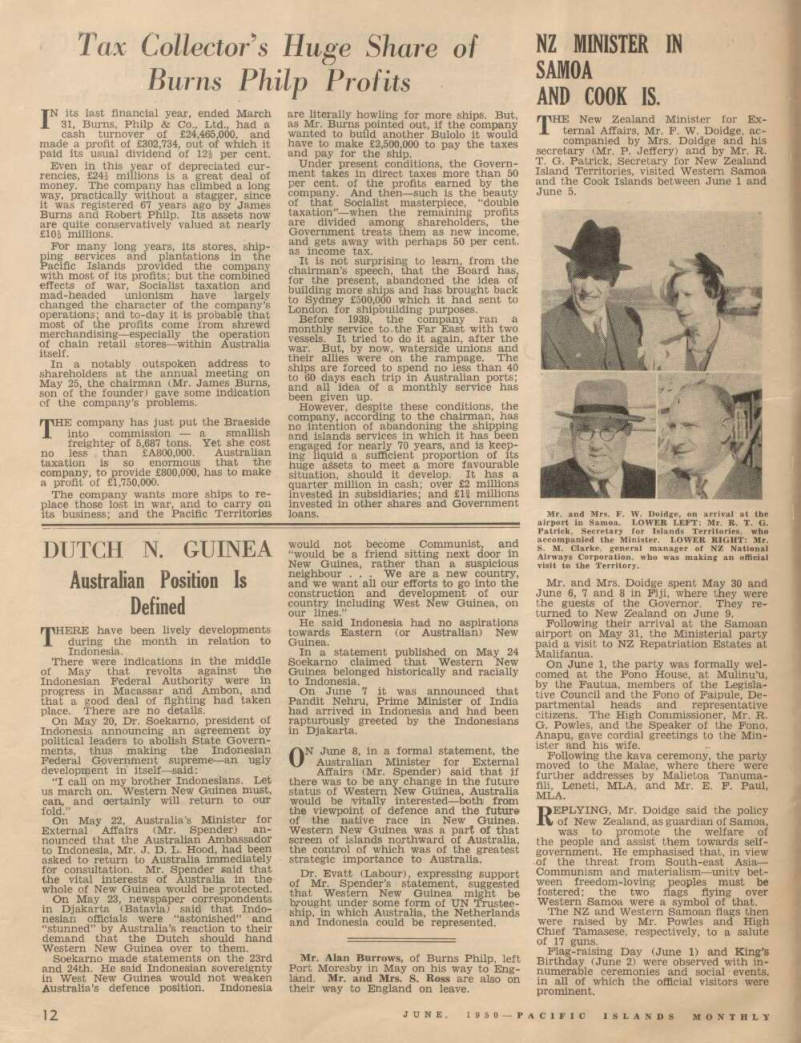
THE New Zealand Minister for Ex ternal Affairs, Mr. P. W. Doidge, ac companied by Mrs. Doidge and his secretary (Mr. P. Jeffery) and by Mr. R.
T. G. Patrick, Secretary for New Zealand Island Territories, visited Western Samoa and the Cook Islands between June 1 and June 5.
Mr. and Mrs. Doidge spent May 30 and June 6, 7 and 8 in Fiji, where they were the guests of the Governor. They re turned to New Zealand on June 9.
Following their arrival at the Samoan airport on May 31, the Ministerial party paid a visit to NZ Repatriation Estates at Malifanua.
On June 1, the party was formally wel comed at the Pono House, at Mulinu’u, by the Fautua, members of the Legisla tive Council and the Fono of Paipule, De partmental heads and representative citizens. The High Commissioner, Mr. R.
G. Powles, and the Speaker of the Fono, Anapu, gave cordial greetings to the Min ister and his wife.
Following the kava ceremony, the party moved to the Malae, where there were further addresses by Malietoa Tahuma fili, Leneti, MLA, and Mr. E. F. Paul,
Ml A.
REPLYING, Mr. Doidge said the policy of New Zealand, as guardian of Samoa, was to promote the welfare of the people and assist them towards self government. He emphasised that, in view of the threat from South-east Asia— Communism and materialism—unitv bet ween freedom-loving peoples must be fostered; the two flags flying over Western Samoa were a symbol of that.
The NZ and Western Samoan flags then were raised by Mr. Powles and High Chief Tamasese, respectively, to a salute of 17 guns.
Flag-raising Day (June 1) and King’s Birthday (June 2) were observed with in numerable ceremonies and social events, in all of which the official visitors were prominent.
Mr. and Mrs. F. W. Doidge, on arrival at the airport in Samoa. LOWER LEFT: Mr. R. T. G.
Patrick, Secretary for Islands Territories, who accompanied the Minister. LOWER RIGHT: Mr.
S. M. Clarke, general manager of NZ National Airways Corporation, who was making an official visit to the Territory.
Un Delegation In
Rabaul
From A Special Correspondent
Rabaul, May 25.
rpiHE United Nations Delegation, which A was in Rabaul district from May 10 to 16, was well received The four delegates were Sir Alan Burns Mr V. D. Carpio, Mr. T. K. Chang and Monsieur J. V. Tallec.
Sir Alan Burns i§ an ex-Governor of the Gold Coast and the Bahamas. Sir Alan is a good mixer and was popular amongst all classes of the community. Mr. Chang represents the Chinese Nationalist Gov ernment and still retains his seat on the United Nations. Mr. Carpio, from the Philippines, has a United States lawyer’s degree. M. Tallec, addressed in the French manner as Governor, is a former Governor of the New Hebrides and New Caledonia.
Of the Secretariat staff accompanying the delegation, Mr. G. W. L. Townsend will be known to many pre-war residents as a former District Officer in New Guinea. Mr. de la Roche, of the French Colonial Service, has had long experience in African positions.
During their stay here they visited the Vunapope Catholic Mission, the Austra lian Fibres Factory and Mr, Rowe’s hot air copra driers at Kokopo; Vunairima Methodist Mission, Administration schools, hospitals and Vunakalkalulu vil lage.
A large gathering of 3,000 natives met the delegates on May 13 in the grounds of the District Office and presented various petitions. Prom the nature of the peti tions received, it is quite evident that the natives in this area are a contented lot and are happy to work in co-operation with the Administration.
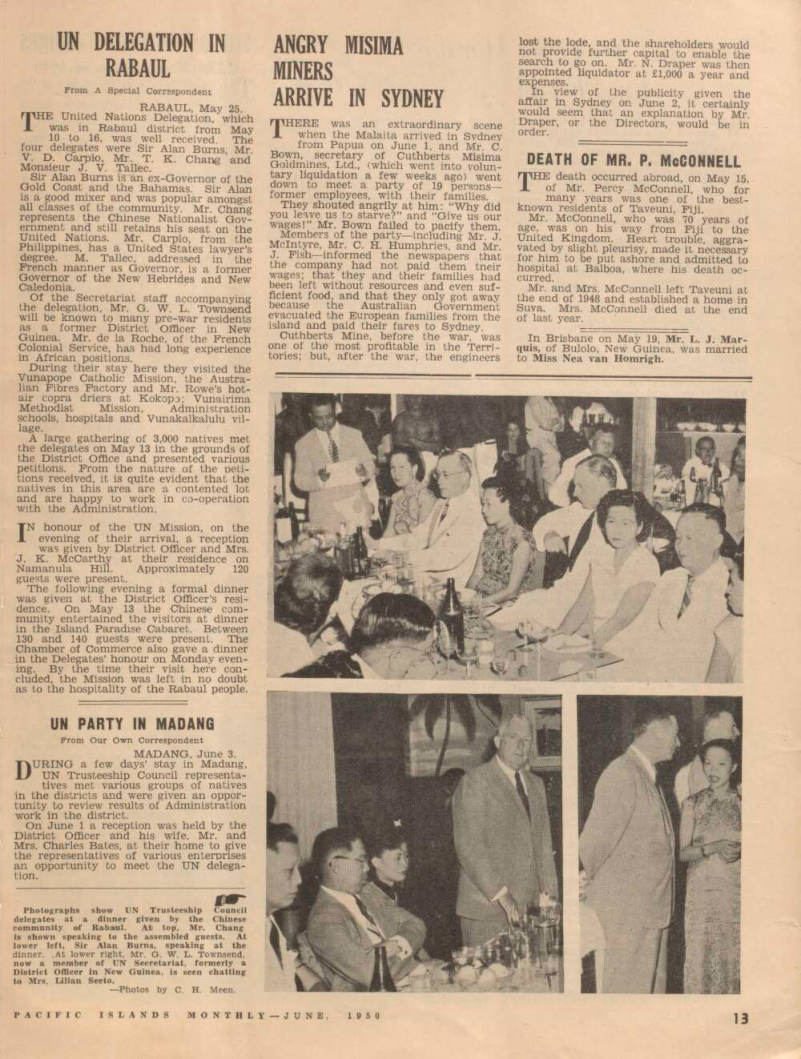
IN honour of the UN Mission, on the evening of their arrival, a reception was given by District Officer and Mrs.
J. K. McCarthy at their residence on Namanula Hill. Approximately 120 guests were present.
The following evening a formal dinner was given at the District Officer’s resi dence. On May 13 the Chinese com munity entertained the visitors at dinner in the Island Paradise Cabaret. Between 130 and 140 guests were present. The Chamber of Commerce also gave a dinner in the Delegates’ honour on Monday even ing. By the time their visit here con cluded, the Mission was left in no doubt as to the hospitality of the Rabaul people.
Un Party In Madang
Prom Our Own Correspondent
Madang, June 3.
DURING a few days’ stay in Madang, UN Trusteeship Council representa tives met various groups of natives in the districts and were given an oppor tunity to review results of Administration work in the district.
On June 1 a reception was held by the District Officer and his wife, Mr. and Mrs. Charles Bates, at their home to give the representatives of various enterprises an opportunity to meet the UN delega tion.
Photographs show UN Trusteeship Council delegates at a dinner given by the Chinese community of Rabaul. At top, Mr. Chang is shown speaking to the assembled guests. At lower left, Sir Alan Burns, speaking at the dinner. At lower right, Mr. G. W. L. Townsend, now a member of UN Secretariat, formerly a District Officer in New Guinea, is seen chatting to Mrs. Lilian Seeto.
Photos by C. H. Meen.
Miners
Angry Misima
Arrive In Sydney
THERE was an extraordinary scene when the Malaita arrived in Svdney from Papua on June 1, and Mr. C.
Bown, secretary of Cuthberts Misima Goldmines, Ltd., (which went into volun tary liquidation a few weeks ago) went down to meet a party of 19 persons— former employees, with their families.
They shouted angrily at him: “Why did you leave us to starve?” and “Give us our wages!” Mr. Bown failed to pacify them.
Members of the party—including Mr. J.
Mclntyre, Mr. C. H. Humphries, and Mr.
J. Fish—informed the newspapers that the company had not paid them tneir wages; that they and their families had been left without resources and even suf ficient food, and that they only got away because the Australian Government evacuated the European families from the island and paid their fares to Sydney.
Cuthberts Mine, before the war, was one of the most profitable in the Terri tories; but, after the war, the engineers
lost the lode, and the shareholders would not provide further capital to enable the search to go on. Mr. N. Draper was then appointed liquidator at £l,OOO a year and expenses.
In yiew of the publicity given the affair in Sydney on June 2, it certainly would seem that an explanation by Mr.
Draper, or the Directors, would be in order.
Death Of Mr. P. Mcgonnell
THE death occurred abroad, on May 15, of Mr. Percy McConnell, who for many years was one of the best known residents of Taveuni, Fiji.
Mr. McConnell, who was 70 years of age, was on his way from Fiji to the United Kingdom. Heart trouble, aggra vated by slight pleurisy, made it necessary for him to be put ashore and admitted to hospital at Balboa, where his death oc curred.
Mr. and Mrs. McConnell left Taveuni at the end of 1948 and established a home in Suva. Mrs. McConnell died at the end of last year.
In Brisbane on May 19, Mr, L. J. Mar quis, of Bulolo, New Guinea, was married to Miss Nea van Homrigh.
In Fiji

From Notes Made In Fiji
By R. W. Robson
“W / ELL >” 1 said, fatuously, having been TT greeted by a couple of old friends, “Suva looks attractive—just as if it had been newly washed.”
Without respect for my g*rey hairs, they made offensive answers in plain words of one syllable. Was I not aware that Suva had four feet of rain in fifteen weeks (or something equally fantastic)?
Did I not know that the whole damned peninsula had just about floated out to sea? Newly washed!
I tried to tell them about Sydney’s rainfall since Christmas —equally phe nomenal—but they had started on Suva’s favourite subject, and I could not get a word in edgeways.
But, for a week after the Conference opened, the weather behaved well—'more sunshine than showers. But only for a week. During my last day in the at tractive little town, Jupiter Pluvius sent in everything he had. The following morning, the rain still was falling in lumps, and we literally waded across the tarmac to the plane. * * * WHEN the next South Pacific Confer ence assembles —whenever and wherever it is—the VlP’s of that region will find themselves hard put to it to maintain the standard of hospitality set by the Suva people between April 25 and mid-Mhy. Fiji always is famous for the welcome it gives to the fortunate stranger within its gates; and, when it met the Conference and Commission dele gates and officials face to face, it simply outdid itself.
As I have said, the weather co-operated.
The sun was as kindly as the smiles of Suva’s ladies; and the breeze nearly as cool as the Australian draught beer, available as usual in quantities that a Sydneysider merely dreams about.
The dances, dinner parties and cock tail do’s were so numerous that they col lided in mid-air. There was a traffic jam on Tuesday evening as the people tried to attend, in the one hour, two delightful cocktail parties—one given on his hill-top by the ever-popular Tui Johnson, and one at the GPH by Mayor Alport Barker, who certainly did his share in implanting happy memories of Fiji in the minds of overseas visitors. The dinner parties were very happy func tions. But where, in a world tortured by lack of domestic service, do the Suva women get these splendid cooks and well trained house staffs?
I was struck again, for the umpteenth time, by the charm, sophistication and conversational cleverness of the ladies, young and old, who preside over the households of Suva’s tycoons, depart mental wallahs and plain, happy citi zens. I suppose there are social and budgetary problems in the Fiji world, as elsewhere; but these Suva hostesses bring to their well-managed luncheon and din ner tables a suggestion of well-groomed freshness and a love of laughter that is a delight to the overseas visitor —and a comnliment to their hospitable husbands. * * * /"CONFERENCE delegates and visitors were taken to Makogai, from Suva, by a NZ Air Force seaplane. The plane could carry ten passengers. There were some 20 visitors, so the organiser arranged two parties, of equal numbers.
The first party was ferried across, with out incident, and the plane returned. The second party walked down the jetty. The captain of the aircraft nearly had a fit, when he saw it. In the front rank were the two Tongan princes, each weighing 25
stone: and immediately behind came the amiable Samoan High Chief, Tamasese who is about 26 stone.
“Holy cats!” wailed the pilot. “What do they think I’ve got here —a Constel lation?”
Fortunately, there were a couple of absentees—but, even then, the seaplane’s run was long and struggling, before she was air-borne.
There was much of interest on Mako gai, and I should have liked longer there; but I panicked when someone suggested that I linger on, and go back with the second partv. Now my kind hosts know whv. I am no featherweight, myself. * * * MORE than one Suva citizen ex pressed personal pleasure at the re-appearance in the Islands metropolis of Sir Hugh Ragg, after a hospital spell in New Zealand. Com parisons are odious —but I think I may venture the opinion that Sir Hugh and Lady Ragg are among the most highly esteemed couples in the Colony.
Sir Hugh, under the surgeon’s knife, lost some little part of his interior economy; but he left NZ with a net gain. Even while convalescant, he was on the warpath: he smelled out, tracked down, surrounded and finally captured a hundredweight of nails, and brought them back in triumph to the Colony.
“Thank God for Sir Hugh’s op,” Indian carpenters were carolling, as I passed the Sigatoka Hotel, en route to Suva. The saws were going hard, and the precious nails were being driven into the shapen wood.
Which is another way of saying that builders’ hardware is as hard to get in Fiji as elsewhere, and Northern Hotels, Ltd., could not proceed with alterations at their new purchase in Sigatoka until Sir Hugh’s nails arrived. Even as it is. building operations are very re stricted. Indications, however, are that the new manager, Mr. Reardon, and his attractive wife —two industrious Queens landers—will make Sigatoka a bright link in the Northern chain. Mr. and Mrs.
Monk, popular owners for long years, have settled down in private life in the Sigatoka district. * * * WITHIN Fiji, everything possible is being done by Government and pri vate individuals to foster tourist traffic; but all plans lose their impressive ness when they meet the hotel bottle neck in Suva. The total accommodation available for travellers in Suva’s six hotels is almost wholly taken up by Suva’s normal through traffic. Tourist traffic, to be worth promotion and organisation, must move along in substantial parties; even one partv of any size causes convulsions in Suva accommodation.
“What do they know of Fiji who only Suva know,” someone paraphrased; but no Fiji tourist feels that he has accomp lished his destiny unless he has spent a few days in colourful Suva. Northern Hotels, Ltd., are all ready to put a sub stantial chain of tourist parties through their chain of hotels; but the thing can not be worked without a suitable link in Suva. ♦ * * SINCE' they took over the Grand Pacific Hotel for the Union SS Co., a year or more ago, Mr. and Mrs. Johns have made a remarkable transformation.
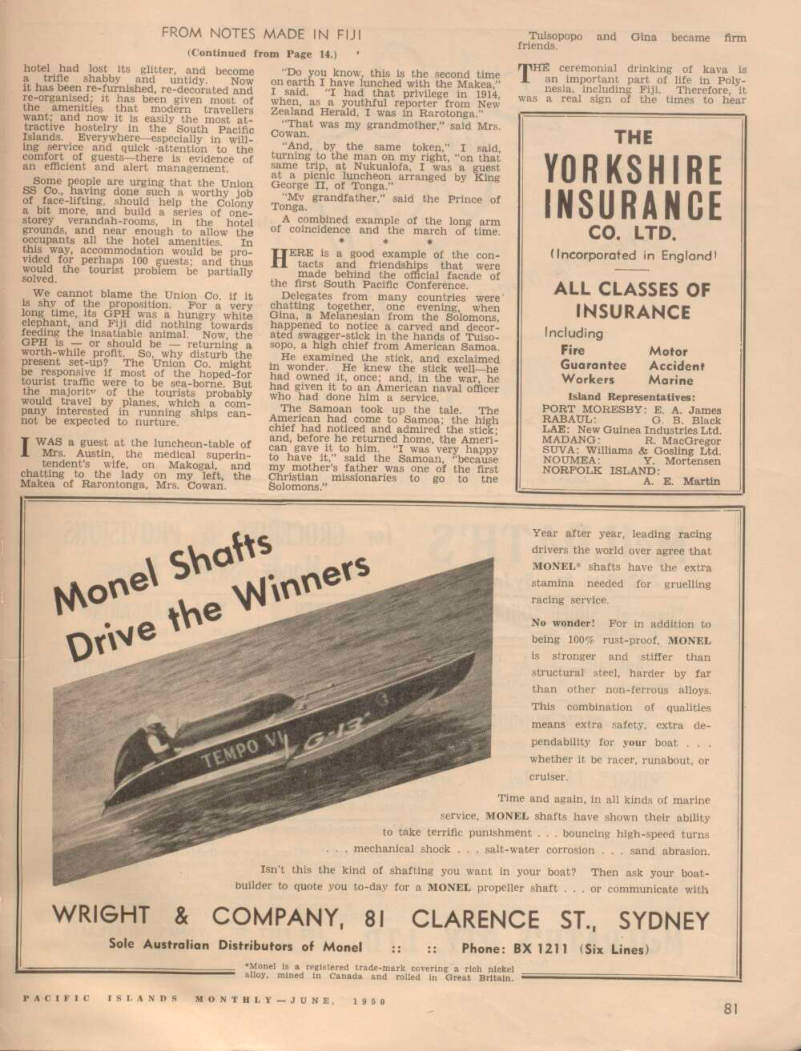
In the course of the long years, and war time conditions, this beautifully situated (Continued on Page 81.)
hotel had lost its glitter, and become a trifle shabby and untidy. Now it has been re-furnished, re-decorated and re-organised; it has been given most of the amenities that modern travellers want; and now it is easily the most at tractive hostelry in the South Pacific Islands. Everywhere—especially in will ing service and quick -attention to the comfort of guests—there is evidence of an efficient and alert management.
Some people are urging that the Union SS Co., having done such a worthy job of face-lifting, should help the Colony a bit more, and build a series of one storey verandah-rooms, in the hotel grounds, and near enough to allow the occupants all the hotel amenities. In this way, accommodation would be pro vided for perhaps 100 guests; and thus would the tourist problem be partially solved.
We cannot blame the Union Co if it is shy of the proposition. For a very long time, its GPH was a hungry white elephant, and Fiji did nothing towards feeding the insatiable animal. Now, the GPH is or should be returning a worth-while profit. So, why disturb the present set-up? The Union Co. might be responsive if most of the hoped-for tourist traffic were to be sea-borne. But the majority of the tourists probably would travel by planes, which a com pany interested in running ships can not be expected to nurture.
I WAS a guest at the luncheon-table of Mrs. Austin, the medical superin tendent’s wife, on Makogai, and chatting to the lady on my left, the Makea of Rarontonga, Mrs. Cowan.
“Do you know, this is the second time on earth I have lunched with the Makea,”
I said. “I had that privilege in 1914, when, as a youthful reporter from New Zealand Herald, I was in Rarotonga.”
“That was my grandmother,” said Mrs.
Cowan.
“And, by the same token,” I said, turning to the man on my right, “on that same trip, at Nukualofa, I was a guest at a picnic luncheon arranged by King George 11, of Tonga.”
“Mv grandfather,” said the Prince of Tonga.
A combined example of the long arm of coincidence and the march of time. * * * HERE is a good example of the con tacts and friendships that were made behind the official facade of the first South Pacific Conference.
Delegates from many countries were' chatting together, one evening, when Gina, a Melanesian from the Solomons, happened to notice a carved and decor ated swagger-stick in the hands of Tuiso sopo, a high chief from American Samoa.
He examined the stick, and exclaimed in wonder. He knew the stick well—he had owned it, once; and, in the war, he had given it to an American naval officer who had done him a service.
The Samoan took up the tale. The American had come to Samoa; the high chief had noticed and admired the stick; and, before he returned home, the Ameri can gave it to him. “I was very happy to have it,” said the Samoan, “because my mother’s father was one of the first Christian missionaries to go to the Solomons.”
Tuisopopo and Gina became firm friends.
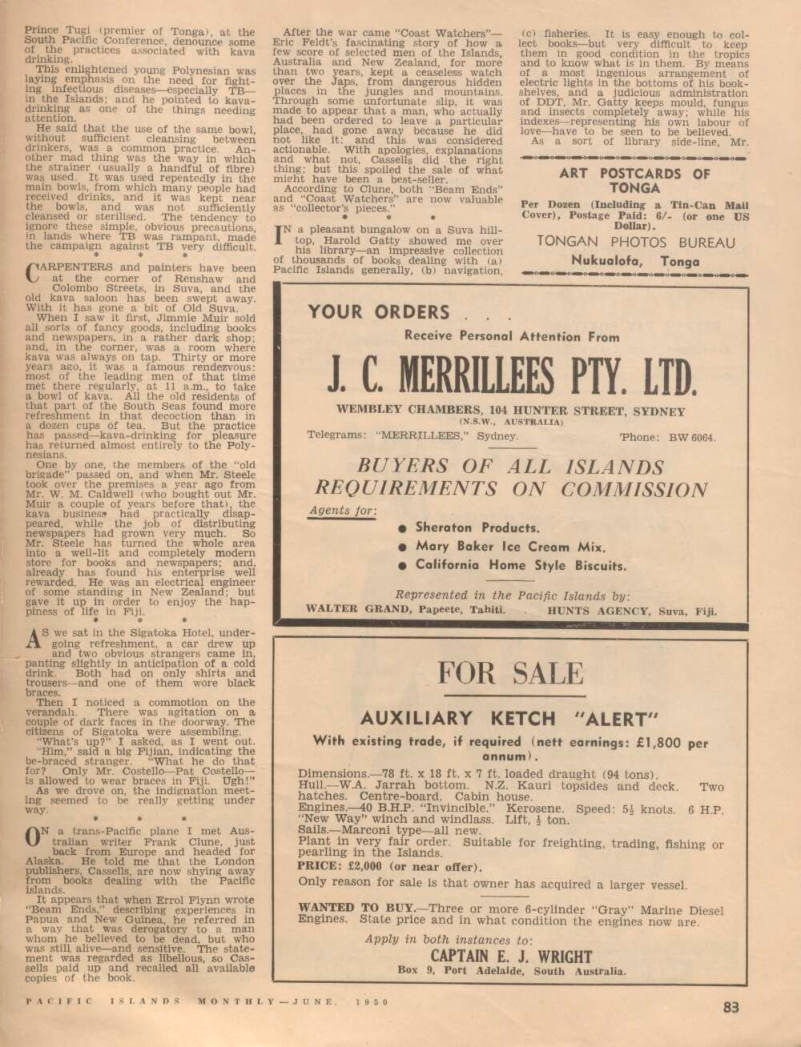
THE ceremonial drinking of kava is an important part of life in Poly nesia, including Fiji. Therefore, it was a real sign of the times to hear
Prince Tugi (premier of Tonga), at the South Pacific Conference, denounce some of the practices associated with kava drinking.
This enlightened young Polynesian was laying emphasis on the need for fight ing infectious diseases—especially TB— in the Islands; and he pointed to kava drinking as one of the things needing attention.
He said that the use of the same bowl, without sufficient cleansing between drinkers, was a common practice. An other mad thing was the way in which the strainer (usually a handful of fibre) was used. It was used repeatedly in the main bowls, from which many people had received drinks, and it was kept near the bowls, and was not sufficiently cleansed or sterilised. The tendency to ignore these simple, obvious precautions, in lands where TB was rampant, made the campaign against TB very difficult. * * * CARPENTERS and painters have been at the corner of Renshaw and Colombo Streets, in Suva, and the old kava saloon has been swept away.
With it has gone a bit of Old Suva.
When I saw it first, Jimmie Muir sold all sorts of fancy goods, including books and newspapers, in a rather dark shop; and, in the corner, was a room where kava was always on tap. Thirty or more years ago, it was a famous rendezvous: most of the leading men of that time met there regularly, at 11 a.m., to take a bowl of kava. All the old residents of that part of the South Seas found more refreshment in that decoction than in a dozen cups of tea. But the practice has passed—kava-drinking for pleasure has returned almost entirely to the Poly nesians.
One by one, the members of the “old brigade” passed on, and when Mr. Steele took over the premises a year ago from Mr. W. M. Caldwell (who bought out Mr.
Muir a couple of years before that), the kava business had practically disap peared, while the job of distributing newspapers had grown very much. So Mr. Steele has turned the whole area into a well-lit and completely modern store for books and newspapers; and, already has found his enterprise well rewarded. He was an electrical engineer of some standing in New Zealand; but gave it up in order to enjoy the hap piness of life in Fiji. * * ♦ AS we sat in the Sigatoka Hotel, under going refreshment, a car drew up and two obvious strangers came in, panting slightly in anticipation of a cold drink. Both had on only shirts and trousers—and one of them wore black braces.
Then I noticed a commotion on the verandah. There was agitation on a couple of dark faces in the doorway. The citizens of Sigatoka were assembling.
“What’s up?” I asked, as I went out.
“Him,” said a big Fijian, indicating the be-braced stranger. “What he do that for? Only Mr. Costello —Pat Costello — is allowed to wear braces in Fiji. Ugh!”
As we drove on, the indignation meet ing seemed to be really getting under way. ♦ * * ON a trans-Pacific plane I met Aus tralian writer Prank Clune, just back from Europe and headed for Alaska. He told me that the London publishers, Cassells, are now shying away from books dealing with the Pacific islands.
It appears that when Errol Flynn wrote “Beam Ends,” describing experiences in Papua and New Guinea, he referred in a way that was derogatory to a man whom he believed to be dead, but who was still, alive—and sensitive. The state ment was regarded as libellous, so Cas sells paid up and recalled all available copies of the book.
After the war came “Coast Watchers”— Eric Feldt’s fascinating story of how a few score of selected men of the Islands, Australia and New Zealand, for more than two years, kept a ceaseless watch over the Japs, from dangerous hidden places in the jungles and mountains.
Through some unfortunate slip, it was made to appear that a man, who actually had been ordered to leave a particular place, had gone away because he did not like it: and this was considered actionable. With apologies, explanations and what not, Cassells did the right thing; but this spoiled the sale of what mieht have been a best-seller.
According to Clune, both “Beam Ends” and “Coast Watchers” are now valuable as “collector’s pieces.” * * * IN a pleasant bungalow on a Suva hill top, Harold Gatty showed me over his library—an impressive collection of thousands of books dealing with (a) Pacific Islands generally, (b) navigation,
(c) fisheries. It is easy enough to col lect books—but very difficult to keep them in good condition in the tropics and to know what is in them. By means of a most ingenious arrangement of electric lights in the bottoms of his book shelves, and a judicious administration of DDT, Mr. Gatty keeps mould, fungus and insects completely away; while his indexes—representing his own labour of love —have to be seen to be believed.
As a sort of library side-line, Mr.
Gatty collects data on persons famous — or notorious —in Pacific history. I was intensely interested in a large quantity of material that he has about the late Father Rougier, who already is taking his place with Bully Hayes and Queen Emma as one of the most colourful of Pacific Islands characters. The Rougier history has only recently been closed; and a book on the gentleman and his extra ordinary affairs, is due. Gatty has both the material for the book and the ability to write it.
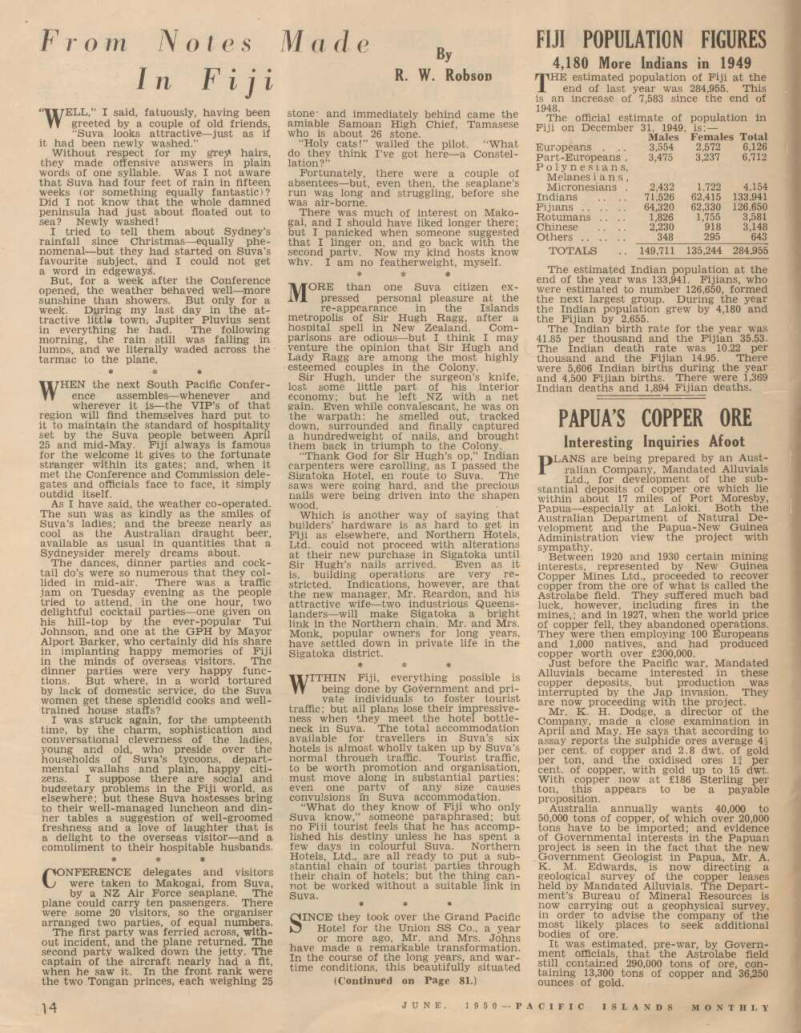
Fiji Population Figures
4,180 More Indians in 1949
THE estimated population of Fiji at the end of last year was 284,955. This is an increase of 7,583 since the end of 1948.
The official estimate of population in Fiji on December 31, 1949, is:—
The estimated Indian population at the end of the year was 133,941. Fijians, who were estimated to number 126,650, formed the next largest group. During the year the Indian population grew by 4,180 and the Fijian by 2,655.
The Indian birth rate for the year was 41.85 per thousand and the Fijian 35.53.
The Indian death rate was 10.22 per thousand and the Fijian 14.95. There were 5,606 Indian births during the year and 4,500 Fijian births. There were 1,369 Indian deaths and 1,894 Fijian deaths.
Males Females Total Europeans . .. 3,554 2,572 6,126 Part-Europeans .
Polynesians, Melanes i a n s , 3,475 3,237 6,712 Micronesians . 2,432 1,722 4.154 Indians ., .. 71,526 62,415 133.941 Fijians 64,320 62,330 126,650 Rotumans .. .. 1,826 1,755 3,581 Chinese .. .. 2,230 918 3,148 Others 348 295 643
Totals
149,711 135,244 284.955
Papua’S Copper Ore
Interesting Inquiries Afoot
PLANS are being prepared by an Aust ralian Company, Mandated Alluvials Ltd., for development of the sub stantial deposits of copper ore which lie within about 17 miles of Port Moresby, Papua—especially at Laloki. Both the Australian Department of Natural De velopment and the Papua-New Guinea Administration view the project with sympathy.
Between 1920 and 1930 certain mining interests, represented by New Guinea Copper Mines Ltd., proceeded to recover copper from the ore of what is called the Astrolabe field. They suffered much bad luck, however, including fires in the mines,; and in 1927, when the world price of copper fell, they abandoned operations.
They were then employing 100 Europeans and 1,000 natives, and had produced copper worth over £200,000.
Just before the Pacific war, Mandated Alluvials became interested in these copper deposits, but production was interrupted by the Jap invasion. They are now proceeding with the project.
Mr. K. H. Dodge, a director of the Company, made a close examination in April and May. He says that according to assay reports the sulphide ores average 4J per cent, of copper and 2.8 dwt. of gold per ton, and the oxidised ores 13 per cent, of copper, with gold up to 15 dwt.
With copper now at £lB6 Sterling per ton, this appears to be a payable proposition.
Australia annually wants 40,000 to 50,000 tons of copper, of which over 20,000 tons have to be imported; and evidence of Governmental interests in the Papuan project is seen in the fact that the new Government Geologist in Papua, Mr. A.
K. M. Edwards, is now directing a geological survey of the copper leases held by Mandated Alluvials. The Depart ment’s Bureau of Mineral Resources is now carrying out a geophysical survey, in order to advise the company of the most likely places to seek additional bodies of ore.
It was estimated, pre-war, by Govern ment officials, that the Astrolabe field still contained 290,000 tons of ore, con taining 13,300 tons of copper and 36,250 ounces of gold.
Loyalty To France
N. Caledonian Native Refutes
Incorrect Australian Report
The following is a statement made on Noumea Radio by Maou Djoel, New Caledonian native chief, after he re turned from Suva, where he was a delegate at the South Pacific Con ference early in May.
DURING the whole session, the Con ference kept rigidly within the limits which had been defined. Therefore, I was surprised, on my arrival at Noumea, to learn of the interpretation given by a certain Press to our debates.
Thus the Station Radio Melbourne de clared, in its broadcast last Tuesday, that certain delegates had advocated that par ticular territories, including New Cale donia, should be joined to Australia and New Zealand.
It is evident that we would have vehemently protested against such pro posals, if they had ever been made in our presence, either at public sessions or in private.
For a hundred years we have been a French province and have proved, when it was necessary, our faithfulness to the Mother Country. It is not at a time when Prance is extending our rights and placing us on the same level as all her oiher children that we would dream of claiming allegiance to another nation.
As a delegate of the native populations of New Caledonia, I deplore the broad casting of such information, which has no serious basis, but risks compromising in the future the happy results which we could rightly expect from the Suva meet ing. .
Miss Vivian Barnes (Wynnum) and Mr. lan Holloway, were married recently in Brisbane. Their future home will be Port Moresby.
NG Women’s Club of Sydney
THE annual general meeting of the New Guinea Women’s Club of Sydney will be held at 11 a.m. on July 20, in the Feminist Club, 77 King St., Sydney.
Miss Elizabeth Exon, of Suva, Fiji, has been spending a brief holiday in Sydney, prior to going on to Melbourne, where she will join the staff of a large general hospital to undergo training as a nursing sister.
Mr. and Mrs. Max Roth, of Port Moresby, have been spending their leave in Brisbane but returned to the Territory in the May Bulolo. They were accom panied by their son-in-law and daughter, Mr. and Mrs. Douglas Blackman, of Ala bama, USA, and grand-daughter Dorothy.
Mr, B. F. Gunnarsson-Hayman, who has spent some years in Papua-New Guinea, mostly in the BP services, is spending a holiday in Australia, prior to going on to Fiji and Samoa.
Advertisements & other items, pp. 17-18 (1 item)
9 Rota-Frame
TWO STAGES IN THE TURNING OF
THE PATIENT
THE
9 ROTA-FRAME
for Easier Nursing
The Watvic Rota-Frame for easier nursing—simplifies many problems in the nursing of difficult immobilised patients.
COMFORT WITH CONSTANT
IMMOBILISATION AND TRACTION
Considerable time and labour are saved, as a single nurse can quickly and easily turn a patient for necessary treatment, changing of posture and linen, etc., without any discomfort to the patient or danger to injured parts.
Write for further particulars:
WITS VICT O R
a. i ivn u nr e a» Branches at all Principal Cities throughout Australia and New Zealand.
The New COMMER 8 CWt.
Light Delivery Van
i & with independent front suspension and finger-tip gear control.
Full particulars available from the distributors for Papua/New Guinea
COLYER WATSON (
NEW 1
GUINEA
LTD.
RABAUL
KAVIENG
MORRIS HEDSTROM Limited
General Merchants, Importers and Exporters,
Shipowners, Plantation Owners,
Commission and Insurance Agents
HEAD OFFICE
SUVA, FIJI
Established 1868
SERVICE IN THE SOUTH PACIFIC TERRITORIES
our Large Establishments in Suva and our Numerous Branches, we distribute a wide and comprehensive range of General Merchandise and provide almost every kind of service. Our departments and associated businesses include:
DRAPERY
MOTOR SALES
AND SERVICE
TOBACCO
TIMBER AND
BUILDING
GROCERY
CONFECTIONERY
HARDWARE
ELECTRICAL
LIQUORS
DRUGS
Bran ches T h roug hout Fiji, Samoa and Tonga There is a Branch or Agent of Morris Hedstrom Limited in every Town in the Three Territories.
We are Sole Agents in these Territories for British Drug Houses Ltd.
Electrolux Ltd.
Ford Motor Co.
General Electric Co. Ltd.
Goodyear Tyre Cr Rubber Co.
B, A. Hjorth & Co. (Primus Products) Imperial Chemical Industries Ltd.
International Harvester Export Co.
Matson Navigation Company Max Factor and Co. Inc.
Ransomes, Sims & Jefferies Ltd.
Ruston & Hornsby Ltd.
Vacuum Oil Co. Pty. Ltd.
Yorkshire Copper Works Ltd.
Morris Hedstrom Limited are LLOYD’S’ AGENTS in Fiji and Samoa.
IN AUSTRALIA:
Morris Hedstrom (Aust.) Pty. Ltd.,
Asbestos House, 65 York Street, SYDNEY
IN GREAT BRITAIN:
Morris Hedstrom Limited,
Barclay's Bank Building, 73 Cheapside, LONDON, E.C.2.
Pacific Franc
Future Of The
Colonies Fear Decisions Made In Paris
ALTHOUGH it was announced during the month that the French metro politan franc had increased in value in the exchanges of the world, there re mains in the French Pacific Colonies— New Caledonia and French Oceania —a certain amount of uneasiness at the trend of recent customs and exchange develop ments.
It always has been French Imperial policy to tie the economic machinery of the French Colonies very tightly to the economy of France. Wherever possible, French colonial trade is kept jealously for France—all French colonial profits are directed to Prance.
New Caledonia and French Oceania have never been very happy over this policy, especially in the last ten years. Its weakness was exposed in 1940, when the European war shut France off completely from all communication with her Colonies, and New Caledonia and Oceania were politically and economically isolated.
Theoretically, they were supposed to conserve all their economic resources for France; but actually, as France was gone and they were surrounded by the active trading nations of United States, Canada, New Zealand and Australia, they were compelled to set up a completely new economic structure.
After the war, when France again was free, it was found impossible to resume the old economic tie-up between France and her Pacific Colonies. The economy of the latter now was closely integrated with the economies of the Pacific nations.
Thus there was established the Pacific franc which, in international exchange, has a value completely different from that of the Metropolitan (or Parisian) franc.
NOW there is alarm because the Econo mic Council, sitting in Paris, has been investigating France’s Colonial currencies and has condemned, among other things, the Pacific franc and the Indo-Chinese piastre. There are indica tions that this body of “experts” may now interfere with the preferential cus toms system, and try to establish a new value for the Pacific franc. One member of the council has condemned any separate relationship between the French overseas francs and foreign currencies— with for example, the Australian £, or the United States s—and$ —and argues that such relationships are a step towards the loosening of political bonds with France.* One can see how the minds of the Metropolitan Frenchmen are work ing—it is so typical of French Colonial policy. But it is not regarded with any pleasure by French interests established in the Pacific Colonies—they know that any interference with the economic struc ture that has been created to provide for the special circumstances existing in the Pacific, may have disastrous conse quences.
Noumea’s newspaper “Bulletin de Com merce” has pointed out that the Pacific franc, and the economic structure it rep resents, were forced upon the French Pacific countries by their geographical situation —they are surrounded by active trading nations like Australia and the United States; such nations provide the * It takes 981 metropolitan francs, but only 178 Pacific francs to equal £ 1 Stg. The US dollar can be bought with 60 Pacific francs, or 349 metropolitan francs. In other words, the Pacific franc is five times more valuable than the parent franc.
French Colonies with excellent markets; and it would be nothing short of a cala mity if, for purely ideological reasons, New Caledonia and Oceania were shut off from those markets. Any attempt to force the Pacific franc into line with the Metropolitan franc would inevitably raise the cost of living.
Indications are that the dicta of the Economic Council will be fought very strongly by New Caledonia and French Oceania if they mean that those two im-* portant French Colonies are not to enjoy the full measure of self-government guaranteed to them by the constitution of the Fourth Republic.
“Why should the Metropolis still try to force on us this policy tutelage, this objectionable dirigisme?” asks the Noumea newspaper. “Not less, but more liberty is wanted here, as must be ad mitted, wherever there is a genuine de sire to develop the economy of the French Union.”
Fijian Chief Is New York
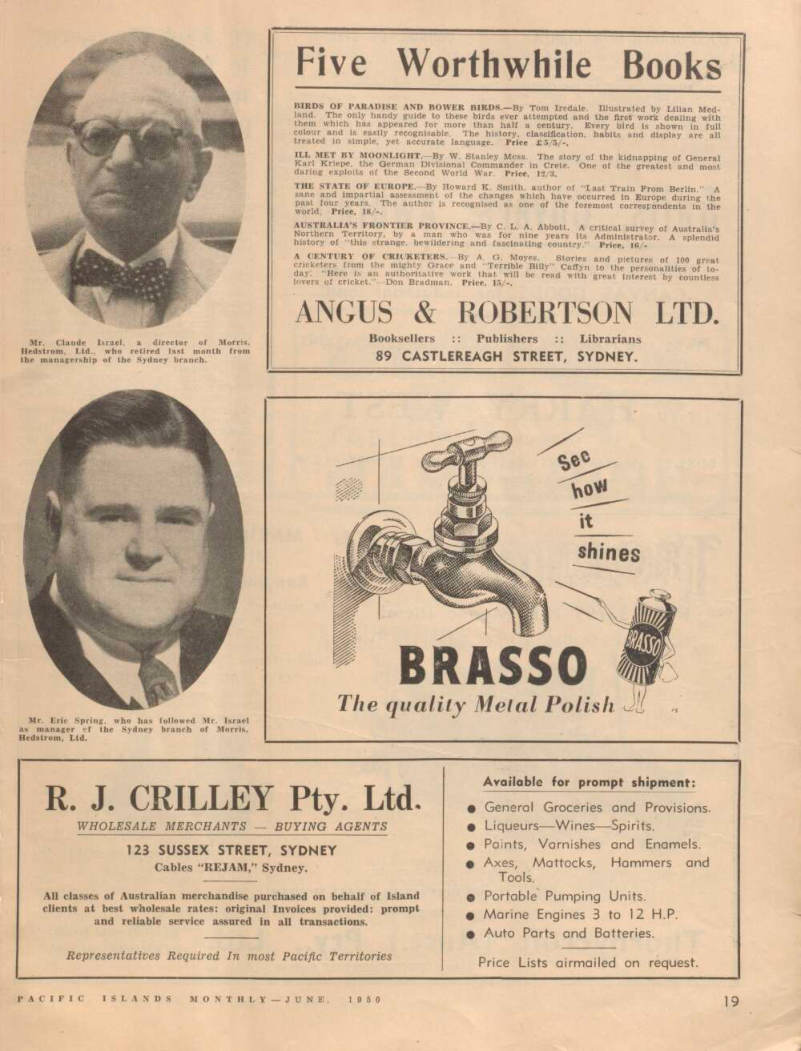
Radio Technician
Prom Our Own Correspondent
Suva, May 29.
RATU LOTE CAGAWALU, of Bureitu, Tailevu, who left Fiji in 1922, is now Mr. George Brooks, an American citizen living with his family in a mid- Manhattan flat.
This fact was mentioned in a BBC broadcast last week by Mr. C. C. Legge, an Administrative Officer from Fiji, who was given the former Ratu Lote’s New York address by Ratu Sir Lala Sukuna and called on George Brooks when travel ling to England on leave.
A radio technician, now taking an ex servicemen’s course in television, Ratu Lote served in the last war with the United States 3rd Army Engineering Corps.
He has a brother, Ratu Saimone Dobui, in the Customs Department at Suva, and the late AMP Ratu Savenaca Veikoso, BEM, was another brother.
A memorial service to members of the NGVR and New Guinea civilians who lost their lives in the sinking of the Montevideo Maru in 1942, will be held at the Sydney Cenotaph at 3 p.m. on July 1, 1950.
Mr. Claude Israel, a director of Morris.
Hedstrom, Ltd., who retired last month from the managership of the Sydney branch.
Mr. Eric Spring, who has followed Mr. Israel as manager ef the Sydney branch of Morris,
Hedstrom, Ltd.
Advertisements & other items, pp. 19-21 (1 item)
Marys
What
is it ?
★ Creme Charmosan is a wonderful youthifying, beautifying skin cream with an enormous sale.
Imparts rose petal loveliness to the most ordinary skin
AT ONCE.
Most adorable under powder.
Helps remove so many faults from the skin; so many signs of age.
Soothing to the sunburnt skin. ★
CHARMOSAN
QUALITY COSMETICS
Vanishing cream, cold cream face powder, lipstick floral perfumes.
AUNT
MARYS
BAKING POWDER
For the best in delicious baking results A product of TILLOCK AND GO. PTY. LTD. manufacturers off all the famous Aunt Marys Pure Foods
YOURS WHEN YOU FLY BY CLIPPER*
TO
krrri
4/f/WAVS
am PA • •
VIA U.S.A.
PAN AMERICAN’S DOUBLE-DECKED CLIPPERS
You fly in the world’s largest, most luxu- Pan American’s Commonwealth Plan rious airliners from Hawaii to the U.S.A. covers all your travel expenses to London New York to London. Pan American’s and return. Includes meals, hotel accomnew double-decked Clippers are equipped modations, incidental transportation in with scores of new comforts, including the U.S.A. All reservations and arrangespacious club lounge on the lower deck, ments made for you by Pan American.
The Clippers also fly to London via Middle East and Europe.
For complete information, call your Travel Agent or . . .
SUVA: Bank of N.S.W. Bldg. (Tel. 664) NOUMEA: Rue Jean Jaures (Tel. 85)
SPEED VOUR PARCEL By CLIPPER CARGO
*Trade Mark, Pan American World Airways, Inc, World's Most Experienced Airline 9 Pan American World Airways, Inc., Ltd., Incorporated in U.S.A.
Five Worthwhile Books
BIRDS OF PARADISE AND BOWER BIRDS.—By Tom Iredale. Illustrated by Lilian Medland. The only handy guide to these birds ever attempted and the first work dealing with them which has appeared for more than half a century. Every bird is shown in full colour and is easily recognisable. The history, classification, habits and display are all treated in simple, yet accurate language. Price £5/5/-.
ILL MET BY MOONLIGHT.—By W. Stanley Moss. The story of the kidnapping of General Karl Kriepe. the German Divisional Commander in Crete. One of the greatest and most daring exploits of the Second World War. Price, 13/3.
THE STATE OF EUROPE. —By Howard K. Smith, author of “Last Train From Berlin.’’ A sane and impartial assessment of the changes which have occurred in Europe during the past four years. The author is recognised as one of the foremost correspondents in the world. Price, 18/-.
AUSTRALIA S FRONTIER PROVINCE.—By C. L. A. Abbott. A critical survey of Australia’s Northern Territory, by a man who was for nine years its Administrator. A splendid history of ‘this strange, bewildering and fascinating country.” Price, 16/- A CENTURY OF CRICKETERS. By A, G. Moyes. Stories and pictures of 100 great cricketers from the mighty Grace and “Terrible Billy” Caffyn to the personalities of today- Here is an authoritative work that will be read with great interest by countless lovers of cricket.” —Don Bradman. Price, 15/-.
ANGUS & ROBERTSON LTD.
Booksellers :: Publishers :: Librarians
89 CASTLEREAGH STREET, SYDNEY.
<be° V\o>N t shines m r
BRASSO
The quality Metal Polish
R. J. CRILLEY Pty. Ltd,
WHOLESALE MERCHANTS BUYING AGENTS
123 SUSSEX STREET, SYDNEY
Cables “REJAM,” Sydney.
All classes of Australian merchandise purchased on behalf of Island clients at best wholesale rates: original Invoices provided: prompt and reliable service assured in all transactions.
Representatives Required In most Pacific Territories
Available for prompt shipment: • General Groceries and Provisions.
• Liqueurs—Wines—Spirits.
• Paints, Varnishes and Enamels. • Axes, Mattocks, Hammers and Tools.
O Portable Pumping Units. • Marine Engines 3to 12 H.P. • Auto Parts and Batteries.
Price Lists airmailed on request.
Gold Search In N. Guinea
/''OLjD 'New guinea, nl, lx a cecenit Adelaide flotations. has taken a sampling option ovel 480 acres of alluvial ground in the Central Highlands of New Guinea. A report by Mr. J. C. Coldham states that preliminary investigations indicate that the deposit contains values of 4/- to 5/- a yard. Sys tematic testing and investigation are re commended.
Council Of Chiefs
THE Fiji Council of Chiefs will meet 'in Suva on July 18.
The Council will be opened by the Governor with full ceremony.
Included in a list of prizes for speedway riders at the Exhibition Grounds, Bris bane, recently, was a bunch of coconuts, specially flown from New Guinea.
This Enemy?
Do We Wish
To Forgive
IN Manus, New Guinea, this month, an Australian court began to try 90 former Japanese officers on charges of war crimes—mostly the murder of Aus tralian servicemen who were taken prisoners.
Some reports of the court proceedings are inclined to become maudlin over the now “repentant” Japs, and their long delayed trial.
Australian newspapers are recom mended to go back to the records of 1942-44, and read details of the wav in which defenceless men and women were butchered. How about the large party which was captured in the jungle when escaping from Rabaul and slaughtered, one by one, on Tol Plantation? How about the two young Australian mission nurses who were led out to a newly-dug grave in North-east Papua and killed?
How about the 22 helpless prisoners (17 young New Zealand coast-watchers and five civilians) who were systematically butchered in Tarawa, because American bombers had made attacks on the fortress the Japs were building there?
And how about the 1,500 Australian soldiers who were taken out on that North Borneo death-march by these gentle Japanese, and of whom only five survived?
It would be well to remind ourselves, occasionally, that the leopard does not change his spots, and that the Oriental is a master of subterfuge.
Advertisements & other items, p. 22 (2 items)
ďfdf
Thornycroft (Aust.) Pty., Ltd.
RTR6 33/55 H.P. Marine Diesel
Elec. Starting. w 2-1 Red. Gear.
M i ' Modern compact Diesel for general purpose use.
MARINE PETROL AND
DIESEL ENGINES
Ranging from 9-130 H.P.
In units—9, 18, 20/30, 33/55, 60/90, and 95/130 H.P.
Stuart Turner Generating Sets. 300 Watt to 3,000 Watt. Simple, Efficient and Economical.
Stuart marine engines available in li, 4 and 8 H.P.
GOOD DELIVERIES OF ALL MODELS.
Write for full particulars of our complete range of engines to:
Thornycroft (Aust.) Pty., Ltd.
Cables: “THORNMOTOR,” Sydney.
Unexpected Glimpses Of
Hubert Murray
Lett’s New Book On The Father of Papua
By R. W. Robson.
Iflnd it difficult to say which I found the more interesting in Lewis Lett’s book, “Sir Hubert Murray of Papua” —his frank presentation of the charac ter of a great man, or his intimate re velations of the political difficulties with which the Lieutenant-Governor of Papua was frequently beset and whicn so cruelly interfered with his work.
From 1930 onwards, I saw Sir Herbert Murray fairly often. Probably there was no journalist with whom Sir Hubert talked more often than he did with me; and I am sure no journalist knew more of the conditions under which he governed Papua. But I had no idea, until I read Lett’s book, of the Canberra pinpricks which Sir Hubert had to endure, of the Ministerial ignorance and stupidity which so often harassed his mind, and of his ever-present fear that some bureaucratic czar would force him out of Port Moresby, and some job-hunting politician go in and destroy his life-work.
IT would appear that Hubert Murray’s career in Papua was marked by ap parently endless fights with politicians.
He went there originally in 1904 as a Judge, and he was forced to take part in the exposure of very bad administrative conditions. He assisted the then young Australian Government to clean up the mess, and Prime Minister Deakin in duced him to act as Administrator, with an assurance that, presently, he would be made Lieut.-Governor.
But the Labour Party wanted to ap point Staniforth Smith to the job, in order to create a vacancy in the Aus tralian Senate; and the struggle swayed to and fro, while Murray commenced his 35-years’ task in the jungles of a very primitive Papua. Eventually, Murray was appointed. He appears to have been fairly well left alone for some 20 years, within which he stabilised and imple mented his administrative policy; but about 1930 his political embarrassments began.
The Socialist Prime Minister, Scullin, apparently did not like him; but. for tunately for Papua, Scullin was thrown out of office before his campaign against Murray had achieved anything. Then came a whole series of Territories Mini sters, many of whom seemed to think he was in some God-given fashion qualified to check up on the “Murray regime.”
It is now disclosed that, as early as 1934, Sir Hubert’s heart gave out, and he should have retired. But he refused because he could get no assurance that the only man qualified to carry on the Murray policy—namely, his nephew, Leonard Murray—would be appointed in his stead. He said, at one time, that he thought Charles Marr, then Minister, would follow that course; but, soon af terwards, he decided that Marr himself wanted the job. So he stayed on, sacri ficing himself rather than allow Papua to be sacrificed.
ANOTHER shock came in 1938 when Harrison, a new Minister, an nounced that the two Territories would be amalgamated. Harrison said this would make for economy and ef ficiency; but Hubert Murray fought hard against it because, it is now disclosed, he
believed that it was part of a deep laid plan, on the part of the New Guinea gold-mining interests, to draw indentured labour from Papua. Eventually, a Royal Commission killed the proposal.
Because it is the true story of Hubert Murray’s life, the book is necessarily a tribute to Hubert Murray’s achievement.
It tells the story of how he converted an unroaded, half-explored region of very savage, primitive people into the well ordered, friendly Territory which he left to Australia when he died with his boots on in Samarai in 1940; and of how, through his famous Papuan police, and his little corps of inspired public servants, he established the Murray tradition of native administration, which won the favourable notice of all the nations.
ONE_ learns a great deal about Murray, the man. He was past 40 when he went to Papua, and he had not made a marked success of life. His father,
scion of a famous old Irish family, was a notable station-owner and politician in New South. Wales.. Young 'Hubert was a brilliant student, a notable athlete
(while at Oxford, he was amateur box ing champion of England), and a lusty, roaring, hard-drinking young-man-about- Sydney-town. At 25 he settled in Sydney as a barrister; but briefs came not, and so he made out as best he could as a legal draughtsman, a Crown Prosecutor, a Judge’s Associate, and so forth.
He was a clever, temperamental, rest less man, unconsciously waiting for such a job as the governorship of raw and unshaped Papua, and when the task came to him he just naturally made it his life-work.
There are very unusual men in this Murray family. Hubert’s mother was a close relation of W. S. Gilbert, of Gilbert and Sullivan. His brother, Professor Sir Gilbert Murray, is one of the Empire’s most distinguished scholars. His father, his brother and he himself all achieved the distinction of knighthood, on their own merit.
IF Papua was the job made by Provi dence for Hubert Murray, the tell ing of the Murray story was a job for Lewis Lett. Not only is Lett a skilled and polished writer; he lived for 30 years in Papua, and he knew Murray intimately.
He has written a great biography. More over he has given us a stirring story and a delightful, readable book about an un usual man, and the development of a new policy of native administration.
But why—O W'hy—do these authors neglect the indispensable index! This book represents weeks and months of heavy research. Within its pages are endless facts to which writers, for long years to come, will wish to refer; and there is no index—not even a summary of chapters arranged by years. A few hours’ work, by a skilful girl, would have provided an index that would have added incalculably to the library value of this volume.
Footnote
I OFTEN have wondered what would have happened if Sir Hubert Murray, instead of being dead, had been an observer of the politico-military scene of 1942-49: • His nephew, whom he had trained in his successful plan of native govern ment for 30 years, juggled out of the Administratorship by a political trick; • The Administration placed nominally in the hands of a distinguished professor of agriculture, who had never had any practical experience of tropical govern ment; • All control maintained ruthlessly by an active socialist, Minister Eddie Ward, of the Sydney Trades Hall; • The Murray-trained corps of devoted Papuan officials treated with indifference, and even contumely; • The much-debated amalgamation of the Territories brought about without one public reference to the Royal Com mission which condemned it in 1938-39; • And, to cap the unlovely structure, an old Labour politician, unknown out side Adelaide, who probably never be fore had seen a coconut palin, appointed to the Administratorship of Nauru.
As Lett’s book shows, all Hubert Mur ray’s thoughts and efforts were directed to the welfare and advancement of the native people of Papua—so much so that he was attacked, again and again, on the ground that he favoured natives at the expense of European welfare. It is more than ironic that the policy and organi sation he created in 30 years should have been more or less destroyed by the Aus tralian Socialists on the grounds that they wanted to do more for the natives. (Actually, as is well known, the notorious Mr. Ward did not care twopence about the natives—he was only seeking a weapon with which to pursue his pet phobia—attack on private enterprise and the embarrassment of the Big Firms.)
Advertisements & other items, pp. 23-24 (1 item)
Marjarine
STAMPS
Australia S.G. If), mint 13/6, F.U 12/- Australia, 5/- Robes, thin, mint imp. blk, 4 80/- Australia, 8.C.0.F., compl. to 5/- mint . , 60/- Australia, 8.C.0.F., short set to 1/- mint 9/- Egypt, Faronk, £1 F.U 6/- Sudan, Leg. Assembly, F.U 2/3 Tonga Silver Jubilee, mint (5) 4/6 IJ.S.A. Commems., 7 mint 3/6 Mint Island sets accepted in payment for above.
Postage extra under £l.
Send stamp for list of offers.
First class selections of Empire stamps will be sent on approval to responsible collectors.
Good Island stamps bought or exchanged.
GUY ROUND
414 Toorak Road, Toorak, Victoria, Australia.
I\ D)E m 71 I
T A B.IfE
"j '"./A / II
sum
(top)
MARJARINE
Packaged like this, DELANA TABLE MARGARINE, a Product of Fiji, is now available to
ALL PACIFIC ISLANDS
Wherever and Whenever Suitable Transport Can Be Found.
A SUBSTITUTE
FOR
BUTTER
In i lb. Pats*
f*., i *4 " f ifc '■ In
Shipping Outers
of 2j lb.
Fresh, wholesome and nutritious, this is a pure Vitamised Vegetable Product made in accordance with the Pure Food Laws of the Colony of Fiji. It contains no animal fat.
You'll enjoy eating DELANA . . .
You'll appreciate its ECONOMY Export Prices and Further Information from
ISLAND INDUSTRIES LIMITED
P.O. Box 299, SUVA, FIJI.
Telegraphic Address: “DELANA,” SUVA. * For Local Reasons, the Product is Labelled “Marjarine” in Fiji, and “Margarine” Elsewhere.
Reprints of advertisements appearing in 38 main newspapers in Australia—Truth, Smith's Weekly Argus, Sun, Telegraph, Courier, Adelaida Moil, Pert’i Westrolion, Hobart Mercury, Etc.
MOUSE OR MAN?
For Children Only (All Ages): Once upon a time there were two little mouses, a lady mouse and a gentleman mouse (mouses are like that). Well, they were sheltering under a mushroom out of the rain, when all of a sudden a great big bear came along Coo! Was he wild??? He waA growling something awful (most unbearable) and knocking trees ’n things all over the place. Got to leave a lot out here. But, anyhow said the lady mouse to the gentleman mouse. “You big stiff, why don’t you buck yourself up and get wild like that too?”
Replied the gentleman mouse, “Aw, gosh' Don’t forget I’ve been sick!” (Rather subtle that—but eventually it will jpenetrate.)
aspaXaprene
(The Answer to the Asthmatic’s prayer) is not subtle, but coo!! Is it penetrating??
It “touches the spot” and relieves instantaneously.
Sold all over the world by Chemists of enterprise and perspicuity. 12/6
ASTHMA
(diagnosis thereof) Asthma may come from lung, heart, kidney, stomach trouble, etc., or glandular derangement: but only your Doctor can tell you just what—also the nature of your allergy reactions.
Allergic response comes along three main routes: (1) Natural agents—dust, bacteria, protein. (2) Physical agents—heat and cold. (3) Emotion.
Whatever the cause, the result is the same—“ Expanded capillaries of the mucous membrane.” (The Answer to the Asthmatic’s prayer) being an atomized inhalant, “touches the spot” and relieves instantaneously, so that everybody sleeps all of the night (the patient, all of the household, and the Doctor).
There has been a “Crundall the Chemist” for over 115 years now, but none of them has ever pretended to be a Doctor, or any sort of quack medicine-man.
COMPLETE OUTFIT, 28/6.
LIQUID. 12/6.
From ALL CHEMISTS of enterprise and perspicuity.
PROOF POSITIVE
INDEED
Over 15000 testimonials have been received since the discovery of Aspaxadrene —roughly ten years ago. These were unasked for and all were published—full name and address with comments—in the month following receipt thereof. A copy was then sent to each. Last year we wrote to selected ones in each year of that period. Over 120 inquiries were sent out; all reaffirmed their original statement—and emphasised them more strongly even. Remember that was after a period of 10, 9, 8 years, etc. It was amazing, really, as one would imagine some at least would have “blown a fuse” but no— tfrey seemed to have taken a new lease of life. So there you are—it all goes to prove what we have been saying for years (sicken tired of saying it. actually)—that— (The Answer to the Asthmatic’s prayer) relieves in seconds (not years). Harmless, non-habit-forming. Environment, diet, duration, family history, age (babies, teenagers, young-timers, old-timers), allergies, etc., absolutely immaterial. Helps the heart by taking the strain from it and guaranteed free from ephedrin, cocaine, morphia, papaverin, or any other opium drug.
COMPLETE OUTFIT, 28/6.
LIQUID REFILL. 12/6.
From all Chemists of enterprise and perspicuity. (And, remember this: Your Chemist is your sure protection in all
things pharmaceutical).
Wrote somebody—
sometime or other “The time will surely come when an explorer from New Zealand shall sit on a broken arch of London Bridge and sketch the ruins of St. Paul’s.”
Meanwhile, make the best of things; if you suffer from asthmas, bronchitis, catarrh, tonsilitis, ’flu, etc. —or if you just want to prevent or cure a cold, do what thousands of others are doing to-dayuse (The Answer to the Asthmatic’s prayer)
Piice 12/6
Chemists of enterprise and perspicuity (naturally).
SPARE PARTS
for the outfit of
asfaXaprene
■ttie answer to the Asthmatic’s prayer) Glass Bowl mm^ 10/6 n übber Bulb 4/U - If required - Nasal Nozzle (attaches to end of atomizer) 2/6 Bakelite Mask (attac es to end of atomizer) 6/6 obia : nable from
ALL CHEMISTS
of enterprise and perspicuity Attention Islands Chemists and
Storekeepers!
Are YOU stocking- Aspaxadrene? We have many satisfied clients both Europeans and Indians—in the Pacific and the list of Aspaxadrene users in the South Seas is growing and growing. Write now for trade price lists and details.
Aspaxadrene is used against expanded capillaries Fever, Antrum, Sinus, Tonsilitis, Common Colds, of the mucous membrane—Asthmas, Bronchitis, Catarrh, Hay ’Flu, etc., etc.; it is also a preventive of them all—naturally so.
Complete Outfit, 28/6 (Aust.)—postage 1/6 Refill Aspaxadrene liquid, 12/6 (Aust.)—post free Procurable from all chemists of enterprise and perspicuity—anywhere—or
A. H. CRUNDALL, Ph.C, M.P.S.A., R.S.S.A.I.L.A.
BOX 58, PRAHRAN, VICTORIA, AUSTRALIA.
Resources
New Caledonia’S Timber
Prom a Special Correspondent THE New Caledonian Department of Woods and Forests, in its latest re port, gives the forest area of the territory (omitting the Loyalties and Isle of Pines) as 15 per cent, of the total area.
Forests are now being re-classified. One hundred thousand of a total forest area of 250,000 hectares is rain forest on the higher uplands. Of the biggest timber the most interesting commercially is the kauri pine, of which a quantity is ex ported to Australia. The total amount of this timber, mostly from the Table Unio, Pourina. Riviere Bleue, Ouango and Col de Parari-Tende areas, is estimated, at 79,000 cubic metres; but certain of the areas are not exploitable commercially.
New Caledonian forests have a quantity of valuable furniture timbers.
Advertisements & other items, pp. 25-26 (1 item)
cdif
VETERINARY
INSTRUMENTS
For Sheep and Cattle can be
Supplied Immediately
EARMARKERS.
SPEYING INSTRUMENTS.
BULLRINGS.
FIRE BRANDS.
EMASCULATORS.
W. JNO. BAKER
PTY. LTD.
3 Hunter Street, Sydney, N.S.W., Australia
WCDdS (SUES’ IBIS
K 2 cdif The Shell Company of Australia Ltd. (Inc. in Gt. Britain)
OfinidikedL
For Tropical conditions
Velvene Water Paint and Davison's Zinc Base Paints are used extensively throughout the islands and Mandated Territories on Government and Private buildings, giving full satisfaction under severe tropical conditions.
DAViSON PAINTS LTD
BOX 24, AUBURN, N.S.W.
BROOMFIELDS Ltd.
Suppliers of
Building Hardware
General Hardware
Ship Chandlery
Paint Materials
WRITE DIRECT TO
Broomfields Ltd.
152 SUSSEX STREET, SYDNEY
Sole Agents for: P. H. MUNTZ & CO.’s 3-CROWN BRAND METAL
SHEATHING.
PEACOCK & BUCHANS’ ENGLISH READY-
MIXED PAINTS.
k //f"
Caledonia
Java Labour In New
Sending Home Francs and Dollars
Piom Our Own Correspondent
Noumea, May 20.
THE New Caledonian Immigration De partment has in hand 6J million Paci fic francs, with which to repatriate Javanese who wish to return from in dentured labour to their country; but, owing to the increased shipping costs since 1945, something like 40 millions now are necessary to carry out repatriation in accordance with the conditions agreed upon with the Indonesian authorities.
The money probably will be borrowed through the central fund of the French Overseas Territories. Efforts are being made to find ships to transport the Javanese home without delay.
The Indonesian journal, Java Bode, of February 23, published a full and fair report on present conditions in New Cale donia for Javanese immigrants, contrast ing them most favourably with the old and universally condemned “coolie” con tracts.
The journal adds that to-day the Javanese have no difficulty in trans ferring home their franc or dollar savings, the Consulate having obtained a satisfactory arrangement to this end Furthermore, they are allowed to take back with them, untaxed, all sorts of use ful articles they have been able to buy abroad, among them a great number of electric sewing machines, cameras and projectors, watches and so on, represent ing a profit in overseas exchange of over a million. Wages have increased con siderably—above all, in the mines, where little labour would otherwise be offering.
The paper gives the present total Javanese population in New Caledonia as 8,000, compared with 24,000 Europeans and 30,000 natives.
Labour conditions in the New Hebrides are classed as “most favourable.”
The information was furnished bv M.
Verkuyl, Dutch Consul in Noumea, to the Indonesian Press.
Mr. A. M. L. Benjamin has been pro moted to the post of Assistant Govern ment Storekeeper, Fiji.
Advertisements & other items, p. 26 (1 item)
Cane Knives
Manufactured expressly for the Fiji market from true temper super steel, at lowest prices
ENQUIRIES ALSO INVITED
for
COPRA KNIVES, BUSH KNIVES, MACHETTES
AND AXES.
Ventura Trading Company Pty. Ltd.
P. & R. Hutchinson, Suva.
26 BRIDGE STREET, SYDNEY
OR Ventura Trade Agency, Lae, 1
First South Pacific

Conference
(Conclusion of Report of Con ference, which sat at Nasinu, Suva, Fiji, from April 25 until May 5, under the chairmanship of Sir Brian Free ston, Governor of Fiji.)
Importance of Fisheries
THE Conference, recognising the im portance of fisheries in the South Pacific area, both as a source of economic wealth and a means towards im proved food supply, placed on record its satisfaction that the work programme of the Commission’s Research Council al ready included the study of fishery methods in their many indigenous and commercial aspects. The following were recommended to the Council for atten tion:— Marketing possibilities, both within and without the South Pacific area.
The processing of fish by drying, salt ing, or smoking, also the preparation of fish meal and fish fertilisers.
The poisonous nature of certain species of fish in some areas.
The cultivation of fish in ponds.
The possibilities of a deep-sea fishing technique capable of use by the peoples of the area.
The Commission was recommended to publish a book illustrating the fish of the South Pacific area, using both scientific and local names.
The Conference learned with alarm that, in some parts of the South Pacific, fishery methods included the use of poisons and of explosives. Wherever pos sible, it was stated, such practices should be prohibited.
Vocational Training for Islanders
THE Conference submitted the follow ing recommendations: — It recognised the need for vocational training for the social and economic life of the people of the South Pacific, and learned with pleasure that the Research Council had already undertaken a study of existing facilities. When that study was completed it was hoped that suitable steps would be taken by each territory to provide further facilities for the vocational training of students in local, central, or overseas institutions.
An endeavour should be made to ar range for the higher specialised training of men and women, especially teachers, in one or more centres serving one or more groups of territories in the area.
The Commission was requested to pro vide information and assistance con cerning the introduction of mechanical knowledge and tools.
Australia and New Zealand should be requested to allow the South Pacific ter ritories to make full use of selected insti tutions of vocational and professional training in all necessary fields.
The member Governments should see that initiation into manual activities al ready existing in higher classes of primary schools should not be neglected.
The Commission should endeavour to secure agreement as regards the language to be used as the means of instruction in all centralised vocational training in stitutions.
Concluding Scenes
AT its penultimate session, the Con ference was addressed by members of the Research Council and by various official observers.
DR. H. G. MacMILLAN (Council mem ber for economic development): The Islanders were looking for markets for
their products: it was their intention td go to an outside world to ask for a partnership in its business. No matter what it may profess, the world and they would be ruled by economic necessity— that fatal king whose laws were not passed or repealed in legislative halls. The Commission had working plans, now separated into projects, intended to con
tribute for better conditions in new tropi cal crops, improved agriculture, more and desirable foods, growth of soil, the taking and handling of fish, and financial credit.
All were based, he declared, not on luck but upon design.
DR. BAAS BECKING (deputy chair man) : The resolutions passed by the Conference would strengthen the belief
of members of the council as to the value of certain projects already undertaken, and would, indeed, enlarge the scope of the latter.
“The council should, however, be more than a single recipient, or even a re sonating medium of the various demands put upon it,” he added. “If it listened to and obeyed every claim our programme would become a patchwork quilt instead of a homogeneous issue. We have to as similate the suggestions made to us in a plan. That plan should be more than the sum total of all the suggestions placed before us. It should embody a certain idea, or to use a dangerous word, it should embody an ideal.”
DR. MASSAL (Council member for Health): The emphasis placed on health by speakers indicated the importance with which they regarded that subject. He out lined various projects under way and they would demand close collaboration from all the parties concerned.
MR. H. E. MAUDE (Council member for Social Development): Considerable practical assistance had been obtained from the Conference, especially in rela tion to the village school, vocational training, and the co-operatives. One of the most remarkable developments in the Pacific in recent years had been the latter movement. As it had been impossible to obtain an expert on co-operative societies from within that area, it might be ne cessary to secure one from outside.
Several of the topics discussed, said Dr.
J. van Beusekom (Department of Trus teeship, United Nations Organisation) particularly mosquito control and, like wise economic and social activities, had been dealt with by his Organisation.
Dr. Harold J. Coolidge (Pacific Science Board of the US National Research Coun cil) referred to the Conference as his toric. “You have made a good beginning,” he said, “and I hope that science will in the course of years be able to solve some of your problems.”
Speaking on behalf of the missionary bodies, the Rev. Father L. A. Doherty
(educational secretary to the Catholic Missions) said he had been impressed by the delegates’ demands for the education of women and girls, a trend that he re garded as highly significant. There must also be progress in the spiritual sphere, he observed, and an advance in moral character, if the aims of the Commission were to be achieved. A combination of both spiritual and material objects would best serve the native peoples.
Advertisements & other items, pp. 27-28 (1 item)
W. H.Grove & Sons
OUR HANDS MAKE GOOD ARMS
For your Fishing and Shooting Wants Consult Us.
Lithgow .22 Cal. Repeating Rifles ... £ll 14 01 Post Lithgow .22 Cal. Single Shot 5 1 31 Extra.
SI L RO H U 143 ELIZABETH STREET, SYDNEY.
CAPTAIN W. L. KENNEDY
Established 1931.
Shipbrokers, Business & Real Estate
6B Pitt St., Sydney
'Phone: 8W6461. Cables; "CAPKEN," Sydney.
LISTING FOR SALE:
DIESEL CARGO VESSELS, TUGS, TRAWLERS, DIESEL WORK-BOATS, FISHING BOATS, PLEASURE CRUISERS, AUXILIARY YACHTS, RUN- ABOUTS, and SPEED CRAFT AND LAUNCHES of All Types.
Distributing Agents for McLaren Marine Diesels and Coventry 30 H.P., 4cylinder, Electric Start and Reduction.
TRIALS AND INSPECTIONS ARRANGED
Through our Business and Real Estate Branch, we can offer a wide variety of Sydney and N.S.W. properties. All inquiries from Islands Clients promptly and satisfactorily attended to.
W. H.GROVE & SONS
Limited
Established 1896. , >
AUCKLAND
Island Traders. P.O. BOX 490.
Telegraphic and Cable Address: “Grove”, Auckland.
Entrust Your Orders to the Firm with Fifty Years Practical Experience in the Island Trade.
Shippers of alt classes of New Zealand products.
Representing English Manufacturers throughout the Cook and Society Islands, Fiji, Tonga, Samoa, Niue, New Hebrides, the Solomon Islands and New Caledonia.
In FIJI as—W. H. Grove & Sons (Fiji) Ltd.
s ms#** m ... a mm p* I "■r. »*S * -5 r % ■:y ' 1 4 M «*» :; i m i
eii%A
PB4IB. Such A Pretty Polka Dot Print At Stick A Tiny Price ! Moulded midriff to minimise your waist and drape the gentle gathered bodice with its breezecool magyar sleeves and the new plunging neckline. Unpressed pleats right 'round the adorable sash’d at back full skirt. Colorfast printed cotton cambric.
Junior Navy, Pink or Green with White Polka Dots. 13, OD/ 17 ; 14, 16, 18 ; 14i, lei 181 LiO “ P 8419. You'll Be The Talk Of The Town in this gay border printed seersucker.
You'll adore the wide, flattering lastexshirred waistband, the deeply plunging cross-over neckline and the cool magyar sleeves. The wide floral border accentu- ' ates the wide hem and the wee waist of this cotton seersucker. .Washable and can be ironed in a jiff. Asstd.
Border Prints. Sizes: 13,17; 14, 16, 18 ; Hi lei 184. Lil D priced so low you’ll want several.
P 8420. Delightfully Fresh, Delicate Eyelethole Anglaise Lace frilling the sun-loving square neck-line and cuffs, lends an air of. sweet femininity to this eye-catching printed striped dress in guaranteed washable cotton cambric.
A perfectly dart-moulded bodice and a full gathered skirt billowing from the tiny slenderising waistline.
Blue, Red, Green with White QQ/ ] 1 Stripes. 13, 17 ; 14, 16, 18, LakJ 1 1
Measurement Chart
OF MELBOURNE PTY. LTD.
Freight Chart
Freight 1/2 to all Pacific Islands except those listed below : West Samoa - - 1/6 East Samoa, U.S.A. - 1/6 New Caledonia - - 3/2 Hawaii, U.S.A. - - 1/6 489-99 Swanston Street, Melbourne, Australia. Box 4535, G.P.0., Melb.
Liquidation
Papua Rubber Co In
A SMALL meeting of shareholders in loma Rubber Estates Ltd., Papua, in Sydney, on May 5, resolved that the company should be placed in voluntary liquidation and that Mr. Cohen, of Messrs. Walker & Co., at the offices of the company, 14 Martin Place, Sydney, should be the liquidator. This concern— a bond-selling company—originally sub scribed beteen £35,000 and £40,000, where with it planted with rubber an area of about 400 acres, on the Mambare River, NE Papua. Operations were controlled by a £2,000 company which sold the bonds and planted the acres. Directors blamed the low price of rubber and the high cost of Wardism.( inability to obtain labour at an economic price) for their inability to carry on.
Missing Battalion Funds
From Our Own Correspondent
Honiara, May, 30.
FOUR natives of Kariki village, in the Shortlands, BSI, have been charged with larceny following the discovery of about £1,900 in notes in their posses sion.
The money is believed to have been lost by an Australian battalion stationed in the Shortlands in 1945.
Well-known Central Highlands miner, Mr. Jim Leahy, was granted a divorce from his wife, Mrs. Joan Leahy, in Port Moresby recently on the grounds of desertion. There was one child of the marriage.
Mr. B. Allerton, of Burns Philp and Co., Ltd., 7 Bridge Street, Sydney, has avail able back numbers of the Pacific Islands Monthly for the period 1939-1942. Readers who were away during the war, and others, may be able to fill gaps in their PIM files from these copies. They should apply direct to Mr. Allerton.
Advertisements & other items, p. 29 (1 item)
Every one
Enjoy a Real Holiday
at
“SAM ELANDA” GUEST HOUSE,
Tewantin, Queensland mmm Island Polk will Receive a Warm Welcome. Excellent Fishing, Boating, Surfing, River Trips, Tennis, Golf. Etc., plus First-Class Accommodation and Cuisine at a Reasonable Tariff.
Tewantin, on the Coast, is 100 miles North of Brisbane.
R. P. MILLS, Proprietor
(Late of Wltu, T.N.G.) ’Phone: Tewantin 21
Every one
Si winner!
Any time -Anywhere-Any weather
A Heinz Vegetable Soup
A Heinz Pea Soup with Ham A Heinz Onion Soup
A Heinz Asparagus Soup
A Heinz Celery Soup
A Heinz Tomato Soup
H. J. HEINZ CO. PTY., LTD.,
479 Bourke St., Sydney, and 6 Watt St., Newcastle. m b? 57 so rich... so thick... so creamy to the taste
Death Of Madame Mille
THE death has been reported from Paris of Madame Germaine Mille, wife of Dr. Roger Mille, of the Antifilarial Institute of Papeete, Tahiti.
Madame Mille was only 35 and had been ill for a long time.
Mr. 11. Halstead, Superintendent of Police, Fiji, has been appointed to act as Deputy Commissioner of Police.
Last United States Troops Leave Bsi
From Our Own Correspondent
Honiara, May 30.
LAST American troops on Guadalcanal departed on May 25 by a service Sky master for Kwajalein. No American troops now remain in the BSIP.
The day before their departure, a small, undramatic but oddly moving ceremony was held at Camp Guadal when the
United States flag, which has flown over Guadalcanal for eight years, was hauled down for the last time. Government officials and private residents were in vited by the officer commanding the American detachment to be present.
The Chief Magistrate (Mr. W. T.
Charles) represented the Resident Com missioner, who was absent on tour, and heads of Government Departments at tended as official Government representa tives. About 100 European residents and 300 Solomon Islanders were also present.
The handful of troops remaining at Camp Guadal fell in behind the flagstaff at 5 p.m. A few minutes later, a guard of honour of the BSIP Armed Constabu lary, with the police band of buglers, was mounted to the right of the flagstaff, their red sashes bright in the evening light.
The official party was escorted to a posi tion on the left of the flagstaff and resi dents watched from a grassy slope. The flag was slowly lowered, and many thought of the days when thousands of American troops were actively engaged on Guadalcanal. The American detachment on parade was keenly conscious of the ending of a chapter. The flag will be presented to the Marine Corps Unit which already holds the first Stars and Stripes to fly over the Solomons, hoisted by them at their beachhead on the day of the first landing in August, 1942.
AFTER the flag had been hauled down and folded away, the parade was dis missed and the OC Camp Guadal en tertained official guests till 6 p.m.
The departing American 1 ' detachment has fully co-operated with the BSIP Gov ernment, and their personal charm and friendliness has earned them many friends who were sad to see them go.
Advertisements & other items, p. 30 (2 items)
Jr
V
Stewarts and Lloyds (Australia) Pty. Ltd.
Manufacturers of "S&L" PIPES and FITTINGS for GAS, WATER, STEAM and other purposes.
AND Distributors of:
MILD STEEL BARS, PLATES and SECTIONS;
GALVANISED IRON; BOLTS and NUTS; ELECTRODES
and WELDING EQUIPMENT.
Stewarts and Lloyds (Australia) Pty. Ltd.
SYDNEY WAREHOUSE - - - Herbert Street, St. Leonards BRISBANE WAREHOUSE - Montague Road, South Brisbane MELBOURNE WAREHOUSE - - City Road, South Melbourne Telegraphic Address; "Tubes" Sydney, Brisbane or Melbourne
£. J. Gough & Co.
Q \3 r Cooper Adjustable Glass Louvres are manufactured by F. W. GISSING PTY., LTD., 197 Wilson Street, Newtown, Sydney, Australia. Always insist on GENUINE
COOPER LOUVRES—
they are clearly branded.
Keep Hot Sun OUT . . .
Let Cool Breezes IN!
Cooper Adjustable Glass Louvres are the ideal way of securing maximum ventilation with minimum interference from glare. Fitted with non-actinic glass, which absorbs the sun’s heat, they are ideal for nurseries and verandahs . . and amazing though it may seem, are actually cheaper to install than ordinary windows Cheaper to instol than ANY other kind of WtNQOW
ADJUSTABLE GLASS LOUVRES
SSw I Imagine it—units of movable glass louvres (plain or figured) in metal frames, giving unobstructed light and air, yet protection from draughts and rain and all with as simple a motion as flicking on a light switch. The price is so amazingly reasonable and Father can do all the erecting, it’s so easy.
Illustrated: Typical Suburban Home. Verandah (Sydney) glassed in with Cooper Louvres.
WRITE FOR PARTICULARS TO PACIFIC ISLANDS REPRESENTATIVE
£. J. GOUGH & CO.
SUPPLIERS OF GENERAL MERCHANDISE TO LEADING FIRMS THROUGHOUT THE PACIFIC ISLANDS.
Exporters . . . Importers . . . Manufacturers’ Representatives 1 BOND STREET, SYDNEY, AUSTRALIA. Box 3615 G.P.O. Tel. BU 2159 Bankers: Bank of N.S.W. Bank of Adelaide. Comptoir National d’Escompte de Paris Cable Address: “SEAFOODS,” SYDNEY.
Codes: Bentley’s, 2nd and Comp. Phrase; A.8.C., sth and 6th; Peterson, 2nd and 3rd, Banking; Acme.
Commission
South Pacific
Fifth Session Held In Suva In May
Headquarters: Anse Vata Noumea, New Caledonia
THE Fifth Session of the South Pacific Commission—which immediately fol lowed the first South Pacific Confer ence—was held in the Suva Girls’ Gram mar School, Suva, Fiji, between May 11 and May 19. Sir Brian Freeston, Gover nor of Fiji, and the United Kingdom’s senior Commissioner representative on the Commission, was chairman. Repre sentatives were: Australia: Dr. J. W. Burton and Dr. J.
Gunther.
France: M. Lassalle-Sere and M. P. C.
J. Bonnard.
Netherlands: Mr. J. B. D. Pennink and Dr. De Bruyn.
New Zealand: Mr. C. G. R. Mackay and Lt.-Col. F. W. Voelcker.
United Kingdom; Sir Brian Freeston and Mr. H. H. Vaskess (with Mr. H. A.
C. Dobbs as an alternate).
United States: Dr. Felix Keesing and Mr. R. R. Robbins.
The Chairman said the only new sub ject on the agenda was the report of the South Pacific Conference Other items were either of a housekeeping nature or referred to the works programme.
Dr. Keesing pointed out that the re port of the Conference would require careful study. On his motion it was re ferred to a committee of the whole for consideration.
Dr. Keesing said the Conference had been one of great significance, and had fulfilled all the intentions of the Com mission.
Colonel Voelcker declared that the Conference had considerably widened the scope of the Commission’s work.
The Conference resolutions—which had followed the presentation of papers on misquito control, the healthy village, vo cational training, the village school, co operative societies, fisheries methods, and the improvement and diversification of food and export crops—were considered in detail by the Commissioners, in com mittee. On the following day it was an nounced that some of them dealt with matters which already were receiving at tention; others were sent to the Research Council for investigation and report; and others would be formally transmitted to the member Governments, for action where thought desirable.
It was apparent that the Commission, having given so much time and effort to the Conference, had no intention of al lowing the resolutions to be merely “pigeon-holed.”
Transportation
MR. McKAY (NZ) initiated a discus sion on air and sea transport ser vices in the South Pacific. Com missioners generally agreed that the whole situation was governed by eco nomic conditions: the companies now were giving the utmost possible service —some probably at a loss —and improve ments could be made only if substantial subsidies were paid.
The matter was referred to the August meeting.
Resignations
THE resignation was received, with re gret, of Dr. L. G. M. Baas Becking, who has been deputy chairman of
the Research Council since January, 1949. It is understood Dr. Baas Beck ing will visit Tahiti in September, be fore taking up other work.
Brigadier P. L. Hunt announced that he would retire from the post of deputy secretary general on reaching the nor mal retiring age next November.
Both vacancies will be dealt with by the Commission, later in the year.
Headquarters Cost
THE Commission accepted, with grati tude, the suggestion of the French authorities that the Commission, in 30 equal annual payments, repay the cost of converting the Pentagon Building, in
Noumea for use as the headquarters of the Commission. The estimated cost is about £60,000. The French stated that they would charge no interest, but they asked that they be protected against cur rency fluctuations, and this was agreed to.
Technical Help
THE Commission agreed on a formula for ascertaining the views of mem ber Governments on the question of a special technical assistance programme for the territories of the South Pacific area.
This proposed programme has received considerable additional impetus by sug gestions by the Australian Government that the Commission be provided with a special technical assistance fund of its own, and an assurance of its willingness to make an initial contribution.
The Commission defined with more preciseness the question as to whether it would build up new research facilities and additional research work or would be concerned more with the application to the South Pacific Area of results of research already known.
Information Service
IT was laid down that the establishment by it of any permanent research facilities, which would involve con siderable expense, should be examined very critically and endorsed only where the required facilities are found to be unobtainable from institutions already existing.
A matter which received serious atten tion and support at this session is the proposition that the Commission should establish an information service to en sure that technical information of value to local administrations should be dis seminated throughout the area on the widest possible basis.
At the final sitting, on May 19, there were various formalities and courtesies.
The Government and people of Fiji were thanked for hospitality and help; tributes were paid to Sir Brian Freeston for his Chairmanship of both Commisssion and Conference; and Mr. Forsyth (secretary general) and his staff were warmly praised for superb organisation.
Advertisements & other items, pp. 31-32 (1 item)
Menu
TAKE YOUR PICK FROM THE
Imperial
TOP QUALITY DELICIOUS /; POO D S 12-oz. 12-oz. 12-oz. 12-oz. 12-oz. 16-oz. 16-oz. 16-oz. 16-oz. 16-oz. 16-oz. 16-oz. 12-oz. 16-oz. 16-oz. 16-oz.
Hampe.
Luncheon Pork.
Trim.
Camp Pie.
Pate de Foie.
Meatreat.
Beef Steak Pudding.
Braised Beef Steak Stew.
Steak & Kidney Pudding.
Steak and Tomato.
Sausages and Vegetables.
Bacon Rashers.
Irish Stew.
Meat and Beans.
Beef Sausages.
Pork Sausages.
Cambridge Sausages.
16-oz. Oxford Sausages. 16-oz. Vienna Sausages. 16-oz. Tomato Soup. 16-oz. Dripping.
"OX and PALM" 16-oz. Corned Beef with Cereal. 6-lb. Corned Beef with Cereal.
"FLAIR"
4,8, 12 oz. Fish Cutlets. 8-oz. Scallop Luncheon.
I l|-oz. Squab in Aspic. 7-lb. or 16-oz. Tinned Prunes.
Also Salted Boneless Brisket Beef in 50-lb. and 100-lb. Kegs . . .
Frozen Meats, Hams and Bacon.
IMPERIAL CANNED FOODS ARE FLAVOUR - SEALED Imperial goods are prepared from prime selected stock by the largest meat-processing organisation in Australia. You can be sure of top-quality when you order "Imperial.”
FOODS
good
RIVERSTONE
MEAT CO.
PTY. LTD.
3-7 O’Connell Street, Sydney.
Fiji Representatives: Pearce & Co. Ltd., Suva.
ETABLISSEMENTS DONALD TAHITI
HEAD OFFICE—QUAI DU COMMERCE—PAPEETE
TELEGRAPHIC ADDRESS—“DONALD, PAPEETE”
General Merchants (Wholesale tr Retail) & Shipowners
Importers & Exporters—Branches Throughout Marquesas Islands
Lloyd’s Agents
ASSOCIATE
HOUSES:
A. B. DONALD, LTD.
AUCKLAND, NEW ZEALAND.
A. B. DONALD, LTD.
RAROTONGA, COOK ISLANDS.
DOMINION FRUIT CO.,
SUVA, FIJI ISLANDS.
Agents and Distributors for :
FRANCE:
HENNESSY COGNACS
MARIE BRIZARD & ROGER
LIQUEURS
CHARLES HEIDSIECK
CHAMPAGNES
PERRIER WATER
GRUBER BEER
U.S.A.:
GENERAL STEAMSHIP CORP.
RADIO CORP. OF AMERICA
BROWN & WILLIAMSON, LTD.
CIGARETTES: LUCKY STRIKE,
WINGS, OLD GOLD
CHAMPION SPARK PLUG CO.
RAINIER BEER
ENGLAND:
RECKITTS & COLMAN
(OVERSEAS), LTD.
PHILLIPS BICYCLES
THE BANK LINE LTD.
NEW ZEALAND:
VACUUM OIL CO. PTY., LTD
PETROLEUM PRODUCTS
SWEDEN:
HJORTH & CIE
PRIMUS STOVES
Agents : Agents in France:
HABTH St CIE, PARIS.
A. BICKART, MARSEILLES.
Sydney Agents :
BURNS, PHILP St CO., LTD.
London Agents :
BURNS, PHILP St CO., LTD.
San Francisco
BURNS, PHILP CO. OF
SAN FRANCISCO.
sust you fay f/te
BOVRIL
means rich meaty flavour
Try Bovril with all your soups and casserole dishes. It makes them wonderfully tasty and, in addition, makes them nourishing, too. For Bovril is the concentrated goodness of beef. Always keep Bovril in the kitchen. Use it for tasty sandwiches, and drink it daily.
BOVRIL puts BEEF into you
Agents:
BURNS, PHILP
& CO., LTD.
BE.4w
Huia For Island Trade
THE 56-year-old schooner, Huia, which carried explosives from Melbourne to New Zealand for 37 years, has been purchased by a group of New Zealanders who will run her co-operatively to trade in Fiji and other islands.
Huia has been laid up in Auckland for the past 15 months awaiting a purchaser.
Repairs have been made to her and it is expected that she will sail for the islands sometime in June.
The original schooner-rig has been maintained, but Huia now has a 154 HP diesel auxiliary engine. She was built in New Zealand in 1894 of heart of kauri — her 110 ft. keel was cut from one kauri log. She was one of the fastest sailing ships on the Tasman run and still holds the record for the crossing—4 days 16 hours.
Captain N. W. Thomas, chief share holder in the new company, says she is good for another 30 years yet. She has far outlived the now extinct New Zea land bird for whom she was named.
For the first time in 64 years, Hawaiian oleomargarine will this year be free of federal tax, thus reducing its price by about 10 cents per pound to the consumer.
Butter interests, which have strenuously opposed the lifting of the tax, predict that the price of oleomargarine will soon climb to that of butter.
Rabaul Amateur Turf Club
Old Race Books Wanted
IT is desired to apply to the Supreme Court of Papua-New Guinea for the liquidation of what was known pre war as the Rabaul Amateur Turf Club.
But, in order to prepare certain details for presentation to the Court, it is neces sary to obtain a copy of the Club’s rules and any old race books that may be in existence. The race books contained a complete list of all members of the Club.
If any reader has both or either of these items would he please contact Mr.
Les Clark, South West Pacific Trading Company, 29 King Street, Sydney (Tel.
MA3888). Mr. Clark was honorary sec retary of the club for six years—right up to the time of the Japanese invasion of New Britain.
Cadet Julian Toganivalu, son of Ratu George Toganivalu, Roko Tui Ba. is making good progress at the Army School of Instruction in New Zealand, at which he is a student. He will be there until the end of this year.
Advertisements & other items, pp. 33-34 (1 item)
Tallerman & Company Ply. Limited
THE PACIFIC ISLANDS SOCIETY
(Founded 1937) Visitors from the Pacific Islands to Sydney, or persons interested in Islands affairs, are invited to communicate with the Honorary Secretary of the above Society which was formed to constitute a social centre for those interested in the Pacific Islands.
Regular meetings and social gatherings, with lectures, are held at History House, 8 Young Street, Sydney, on the fourth Wednesday of each month, at 8 p.m.
Address for correspondence:—
THE PACIFIC ISLANDS SOCIETY,
Box 3434, G.P.0., Sydney.
BURNS PHILP (New Hebrides) LTD.
Registered Office: VILA, NEW HEBRIDES
Branch Office at SANTO
Exporters, Importers and General Merchants
(Retail and Wholesale) Commission, Shipping
and Customs Agents
Representatives for BURNS PHILP TRUST COMPANY LIMITED. QUEENS- LAND INSURANCE CO., LTD., and LLOYD’S OF LONDON. Agents for SOCIETE DES PETROLES SHELL DES ILES FRANC AISES DU PACIFIQUE, and numerous overseas manufacturers of all classes of merchandise.
Sydney Agents: Burns, Philp A Co., Ltd., 7 Bridge Street.
San Francisco Agents: Burns, Philp Co. of San Francisco, Matson Building, mniouu XJUUUIIIg, 215 Market Street.
London Agents: Burns, Philp A Co., Ltd., 35 Crutched Friars, E. 0.3
Tallerman & Company Ply. Limited
60 YORK STREET, SYDNEY, N.S.W.
Also Brisbane, Melbourne, Adelaide, Perth.
Buying Agents of all Australian Products . .
Sole Exporters for numerous Australian
Manufacturers
Careful and Prompt Attention to all Inquiries Send us your inquiries which will have our careful and prompt attention.
WRITE FOR DETAILED PRICE LIST
Cable Address: “FRESHET”
HP-
nTfßi
is W*
S ? £3 £3 ca GT lj
mmm
NOTICE
IS HEREBY GIVEN
that the labels shown In the margin hereof are now the exclusive property and proper TRADE MARKS of
THE UNITED DISTILLERS
PROPRIETARY LIMITED,
of Byrne Street, South Melbourne, Victoria, Australia, Distillers; used by them in respect of
WHISKY,
BRANDY, GIN and
RUM,
and the Trade and Public are hereby cautioned against any infringement or improper use of the same.
Legal proceedings will be instituted against any person or persons selling or offering for sale goods, not the manufacture of the aforesaid The United Distillers Proprietary Limited, bearing any representation of either of the said Trade Marks or any colourable imitation thereof.
EDWD. WATERS &
SONS
Patent and Trade Mark Attorneys, 422-428 Collins Street, Melbourne, Victoria, Australia.
PM mm ■ m mm
Mssamtsm-/**. * ■ .tA*w.‘.'<.
_—___, warn © 9 © Wj < V ?
'S? £? s
wsm
NOTICE
est donne ci-dessous que les etiquettes montrees dans la marge de celul-ci sont maintenant I’exclusive propriete et les vraies MAR-
QUES DE FABRIQUES de
la UNITED DISTILLERS
PROPRIETARY, LIMITED,
de Byrne Street, South Melbourne, Victoria, Australia, Distilleurs; employes par eux en ce qul concernent
WHISKY,
BRANDY, GIN et
RHUM,
et I’lndustrle et le Public sont prevenus par cette annonce contre toute fraude ou abus de ces Marques.
Les precedes legaux seront instituees contre toute personne vendant ou offrant pour la vente, les marchandises qul ne sont pas factures par la-dite United Distillers Proprietary Limited, portant aucune representation de I’une ou I’autre de ces Marques de Pabriques ou aucune imitation specieuse de ces Marques.
EDWD. WATERS &
SONS
Patent and Trade Mark Attorneys, 422-428 Collins Street, Melbourne, Victoria, Australia.
Auckland-Suva Route
TEAL Takes Over Auckland-Suva Route
Tasman empire airways, ltd., took over the Auckland-Suva flying boat service from New Zealand National Airways Corporation on June 1.
Before the NAC flying-boat Takitimu, left Suva on her last flight on May 31 she circled around the town twice, in farewell.
It was TEAL which surveyed the Suva- Auckland route ten years ago. The sur vey was carried out in the veteran Aotearoa I, which flew from Auckland to Suva and then carried out flights to Nukualofa, Tonga, and to Lautoka.
Aotearoa carried the first airmails be tween Fiji and New Zealand and after she had completed her survey, the Fiji Government began to develop Laucala Bay near Suva, as a flying-boat base.
However, the war prevented the de velopment of civil air services in the South Pacific although, after the out break of the Pacific war, flights of mili tary aircraft became commonplace. To wards the end of the war the RNZAF began to run a service between Laucala Bay and Auckland on which civilians with special travel priorities were permitted to travel. In 1947, this service and a weekly service between Suva and Labasa, was taken over by NAC which has now given way to the company that surveyed the route—Tasman Empire Airways.
The National Airways Corporation will, however, still run its Pacific regional ser vices with DC3 aircraft from Auckland to Norfolk Island, Nadi (Fiji), Tonga, Cook Islands and Western Samoa. There will be close co-operation between the two airlines and NAC will continue to be agents in Fiji for TEAL.
Jungle Denizens
Letter to the Editor I HAVE read with interest your Febru ary and March issues, with the notes on supposed undiscovered peoples in the interior of Guadalcanal.
The allaged- hair of these mythical creatures, referred to by Mr. A. H. Wil son, consisted of black horse-hair-like strands, which were in fact a species of Marasmius fungus similar to that caus ing witches’ broom cacas, in Trinidad, in the West Indies. As it was collected in the jungle, it is clear that anyone sup plying it as human hair was fully aware of its vegetable origin, and was there fore being deceitful.
Sometime in 1946, an article appeared in the Fiji Agricultural Journal on the Solomon Islands, by an officer temporarily transferred from Uganda. In it he ex pressed surprise that anthropoid apes did not occur in the Solomons. Actually, their presence there would have been most astonishing, as orangutans do not run east of Borneo; and, if they were in the Solomons, they would also be pre sent in New Guinea, between these areas.
Actually, of course, no apes occur in the Pacific, and no sub-human wild man in the Solomon Islands. Just another legend, like the bunyip of Australia!
Your fine cover photograph for Febru ary states that throwing-nets are “peculiar to Polynesia”; but they are very generally used throughout Malaya.
I wonder if they occur between these ex tremes —(it seems highly probable.
I am, etc.,
Malaya, 30/5/1950.
R. A. Lever.
Taxpayers Turn Critical Eye
On Fiji’s Civil Service
Prom Our Own Correspondent
Suva, May 29.
rpHE arrival of a Civil Service Salaries X Commissioner in Fiji has not im proved the temper of the taxpayers of Fiji at a time when the income-tax payment deadline has come round again Taxpayers take it for granted that the principal outcome of the commissioner’s activities will be increased Civil Service salaries, and they have taken it equally for granted that the increase will have to be met out of taxation revenue in one form or another.
Most of the resentment goes no further than talk and an occasional outbreak of correspondence in the Press. However, the tax-paying community is looking at the Colony’s Civil Service with a more critical eye than at almost any time in the past.
For instance, certain Civil Service privi leges are being heatedly debated. It is generally conceded that public servants recruited in New Zealand or Australia or Great Britain may be entitled to leave grants, which cover travelling expenses of themselves and their families, when they return to their homelands on “long leave,” at three-yearly or four-yearly intervals.
But why, it is asked, should Australians, New Zealanders or Fiji-born people be entitled to occasional leave trips to Eng land at the expense of Fiji?
THIS point illustrates one of the main grievances of taxpayers In the Colony —the very heavy burden of expense caused by salary-payments and grants to
public servants who are away from the Colony for many months at a stretch.
A secondary question is: Although passage-grants and leave-grants to public
servants may be justifiable, are they jus tifiable in the case of public servants’ wives? This has produced a suggestion that such grants should be made only if the wives concerned carry out “duties in the service of the community” on the same lines as those performed by many Governors’ wives.
There have been demands for drastic economies in Government departments to meet the cost of any increase in Civil
Service salaries. This sort of thing, how ever, is by no means peculiar to Fiji.
The only new angle is that the size of the Colony’s Civil Service is sometimes said to be out of all proportion to the Colony’s population—and particularly of the tax paying section of the population (pre dominantly European and Fijian; the Fijians being taxed by their own Adminis tration to a point which is officially ad
mitted to be at the highest possible limit).
FROM the Government’s point of view, the situation is obviously complicated by the endless demands for new or expanded social and other services, often pushed, politically and otherwise by every possible means.
The Indian community’s political
leaders, for instance, are tireless cam paigners, in the name of “equality,” for practicaily everything that the European expects in the way of social services, apd usually the Indians get what they want.
Yet only a small proportion of the Indian population pays any sort of direct taxa tion, and it is frequently admitted that the Government has, so far, found it im possible to corner a large number of Indians and, probably other Asiatics, who ought to contribute substantially to in come tax revenue but blatantly evade it.
Further, the tremendous and accelerat ing increase of the Indian population must impose an increasing burden of expense, especially for education and medical services, with a disproportionately small increase in taxation revenue.
Fiji’s income tax, by British, Australian and New Zealand standards, is certainly not a crushing burden on the strictly limited number of people who pay it. But indirect taxation has reached a peak which, reflected in the cost of living, is making things all but impossible for Europeans on moderate salaries. And the cost of living is hitting taxpayers and non-taxpayers of all races.
THIS explains why many Europeans are in a state of wordy revolt (but no more) against the possibility of in creased taxation to meet increased Civil Service salaries unless there are signs of drastic economies in the working of the Government and, possibly, some reduction in those Civil Service privileges which are not enjoyed by others.
There is a growing realisation by Euro peans that they and the Fijians, whose provincial, education and other levies (many of them unacknowledged, but nonetheless compulsory) are to a con siderable extent carrying the tax burden which ought to be shared by others who dodge their responsibilities but take full advantage of every benefit within their reach. The onus of collecting taxes fairly is obviously on the Government, and the Government’s failure to do the job, what ever the difficulties, is another of the
grievances of those who do pay taxes— even if only because they have no hope of evasion.
Editorial Note
THE high cost of living is hitting every one in British countries and it has not been proved that the Fiji resi dent is any worse off than residents of other parts of the British Commonwealth.
The high cost of living is the result of 40-hour weeks, other socialist experi ments and general unwillingness to work, following closely on the most expensive war in history. Only now are we feeling the full economic effects of post-war policies.
In this case, the taxpayers of Fiji ap pear to be crying before they are hurt.
The income tax has not been raised yet —to meet increased Civil Service salaries or for any other reason. In the mean time, it should be acknowledged that even a Civil Servant must eat, and the fact that the Colonial Office has sent a Salaries Commissioner to Fiji at all, indicates that the Civil Servant’s salary is due for review.
The cost of government in the Crown Colony of Fiji—that is, through the Colonial Office —is probably much less of a financial burden than, for example, the ruinously expensive Parliamentary gov ernment system as it has developed in New Zealand and Australia.
As our correspondent points out, how ever, the tripping about of Civil Servants at the taxpayer’s expense is quite another matter. This applies, particularly, to those recruited in the Southern Hemis phere. There seems no reason why these men should be given free travel to the UK. Broadly it can be said, perhaps, that the day when the Colonial Service was a merry-go-round on which officers rode round and about from Africa, to the Indian Ocean, to the Pacific and the West Indies, is gone. The problems of these colonies are individual and should be served by men prepared to devote a life-time to them. They will not be solved by men who must necessarily treat them as temporary irritations along the way from one Colonial Service appointment to another.
Advertisements & other items, pp. 35-36 (1 item)
Dunlop
A. B. DONALD Ltd.
AUCKLAND
ISLAND TRADERS & GENERAL MERCHANTS
P.O. Box 1509. Cables & Telegrams, "Kingdom," Auckland.
The New Maxply Tennis Racket. u
Popular Choice
Dunlop is the popular choice of the champion as well os the man who plays merely "for the fun of it".
Wherever you rate on the sports ladder, you'll get more enjoyment from your game when you use Dunlop tennis rackets, tennis balls, golf balls and sports shoes.
Dunlop is first by popular choice.
DUNLOP
FOR ALL SPORTING EQUIPMENT
"Badminton", Sport Shoes.
The New Heavy Duty Tennis Ball.
Dunlop Bowls m SO Golf Balls.
DO 9257
000% v&S. mm wm v&ff. 3S*£? •>*t S«?K
The New WUNDERLICH SINK UNIT
is available in Stainless Steel, 4’, 4'6", 5' and 6' long, with a lustrous, rustless, smooth "Wunderbrite" finish that is easy to keep spick and span.
Ask your local Hardware Merchant, 'phone MX 2411 or write to Wunderlich Limited, Box 474, G.P.0., Sydney, for prices and leaflet.
S
WITS
COMBINATION SINK & DRAINER
<&. #, 4-. $# MG? rMwA
IfilMSSf
fmm tKSfj
iW ii' iv
By Appointment Gin Distiller* to H.M. King George VI Tanqueray, Gordon & Co. Ltd.
QuctA'/y
Sb&crwi^t/ta&e
Gordon's
St&Kcte Supk&fK&
For Fijians
No Australian Control For Fijians
From Our Own Correspondent
Suva, May 29.
A Sydney Morning Herald Cor
respondent, who attended the recent South Pacific Conference in Suva, later wrote that “many Island leaders” advocate an extension of Australian and New Zealand control in the South Pacific and a changeover from direct London and Paris control in the British and French territories The opinion of local Fijians indicates (1) that the Island leaders quoted, but not named, are unlikely to have included Fijian leaders; (2) that in the case of Fiji a change to administration from a capital nearer than London might have certain advantages: (3) that New Zealand and not Australia (as suggested by the Sydney paper’s correspondent) would be the Fijian choice of a “trustee Power” if a change became necessary, mainly because of the status of the Maori in the Do minion; (4) that there is a very strong Fijian attachment to Great Britain as well as to the British Crown; (5) that the whole question as it has been raised by the Sydney writer is virtually washed out in Fiji’s case by the Deed of Cession, which, as a direct pact between the Fijian people and the Crown, leaves no loophole for any “hawking-about.”
NZ Warships Sail for Cruises
Cruises in Pacific
THREE units of the Royal New Zea land Navy, cruiser Bellona and frigates Tutira and Rotoiti, left Auckland in May on a winter visit to the Pacific. Bellona and Rotoiti will not return until July 28 and Tutira will re turn on June 29.
Tire ships will carry out separate cruises. Bellona (Captain J. H. Ruck Keene, QBE, DSC, RN), will call at islands of the Tongan, Fijian and Samoan groups; Tutira (Lieutenant-Commander P. J. Hoare, RN), will visit the islands of the Fijian, Gilbert and Ellice groups; and Rotoiti (Lieutenant-Commander A. C. B.
Blomfield, DSC, RN), will visit the Cook, Tongan, Fijian and Samoan groups.
The three cruises have been planned to meet naval commitments and the re quirements of the Western Pacific High Commission, the Fijian authorities, the Department of Island Territories and the Meteorological Service. Officials of the various islands groups will be embarked and meteorological officers will visit various stations.
On her voyage from Auckland to Suva the Tutira will pay a brief visit to the Kermadec Group, to land stores.
Advertisements & other items, pp. 37-38 (1 item)
Vince
SPECIALISING IN
PACIFIC ISLAND INSURANCES
FIRE—MOTOR VEHICLE
MARINE—HULLS AND CARGO
EMPLOYER’S LIABILITY
BONDS—In accordance with
ADMINISTRATION ORDINANCES.
COPRA INSURED PROM DRIER
TO BUYER.
AND ALL OTHER CLASSES ARRANGED
AT LOWEST CURRENT RATES.
Established Agencies throughout the Territory ol Papua and New Guinea.
Managing Agents: New Guinea Company, Limited.
Island Representative: O. D. A. Kent, Kabanl Branch.
SOUTHERN PACIFIC INSURANCE
CO., LTD.
HEAD OFFICE: 60 HUNTER STREET,
ass x.
CON
HAT
pB
YOU I
You can be confident that you are getting the best that science can produce when you buy genuine Vincent’s A.P.C. Vincent’s A.P.C is prepared to the original hospital prescription first used by the Medical Superintendent of one of Australia’s largest public hospitals. Take Vincent’s A.P.C with confidence for Headaches, Rheumatism, Lumbago, Sciatica and all nerve and muscular pain. Genuine Vincent’s A.P.C Powders and Tablets are the safest and best!
The Famous Pink Powders and Tablets!
VINCE
SAJ
ITcTnT.
NC6D9
l-V* A*
VINCENT'S
VfNCBNTS A.P.C, W/TH CONFtDBNCB
For HEADACHES, Rheumatism, Neuralgia
STEAMSHIPS TRADING COMPANY
PORT MORESBY AND SAMARAI PAPUA
LTD.
Wholesale & Retail Merchants, Planters, Sawmillers, Engineers, Slip
Proprietors, Shipping, Customs and Insurance Agents.
MANAGING AGENTS for:
SAWMILLERS & TRADERS LTD.
CORAL SEAS INSURANCE CO. LTD.
ACME BAKERY COMPANY.
MARIBOI RUBBER LTD.
RUBBERLANDS LTD.
KEREMA RUBBER PLANTATIONS LTD.
COCOALANDS LTD.
AGENCIES:
BANKERS & TRADERS INSURANCE CO. LTD.
VACUUM OIL CO. PTY., LTD.
DIRECTORATE OP SHIPPING—Papua-New
Guinea Division.
ROYAL PACKET NAVIGATION CO.
KOKE BAGU PTY., LTD.
TRANS OCEANIC AIRWAYS.
GUINEA AIR TRADERS.
DISTRIBUTORS IN PAPUA for;
ARMSTRONG-HOLLAND PTY., LTD.
Earth Moving and Logging Equipment.
WILLYS-OVERLAND EXPORT CORPORATION.
Jeep cars, etc.
INTERNATIONAL HARVESTER CO. OF AUST. LTD.
International Trucks, McCormick-Deering Farming Machinery, Defender Refrigerators.
SYDNEY AGENTS: NELSON & ROBERTSON PTY. LTD., 12 SPRING STREET
TELEPHONES: LA 5034-5-6
BUDGE
REFRIG ERATION
EQUIPMENT
Commercial and Industrial Units
(not domestic) Ammonia and Methyl Chloride machines of large or small capacity.
The illustration is of a complete 30 cwt. Ice-making Plant, comprising twin, enclosed ammonia compressor, evaporative condenser, insulated ice tank, etc. It may be driven by a 10 h.p. electric motor or diesel engine.
Inquirers should mention dimensions of cold room (or cabinet) and amount of ice (if any) required per day.
JAMES BUDGE PTY. LTD.
Established 1890.
REFRIGERATION ENGINEERS
McEvoy Street, Alexandria,
Sydney
The Background Of Marching Rule
Late Henry Kuper Gives Some Curious Solomons History
By William Burrows
INTERNED during World War I, rather than deny the country of his birth (which was Germany), Heinrich Kuper was a resident of the island of Santa Anna, in the Solomons, before and after World War I, until his death in February, 1950.
He was a keen naturalist, and it was in this line that he and I made contact, for I never met him. The particular in formation he sent me was his recorded dates of the rising of the Balolo: but this was by no means all. His letters were full of interesting facts, and of his own ideas concerning the people of the Solomon Islands.
The last letter I received from him followed up a telegram which read, “Pa renga (the local name for Balolo) rose dutiful October 31 and November 30, cheers and seasonal greetings, Henry Kuper.”
Those were the dates which I had sent him as being the likely ones for the rise at Santa Anna. The letter, which reached me towards the end of 1947, was six pages of closely written matter, some extracts from which may be of interest even at this date: THE natives of the Solomons have lately shown how little admiration, respect or what not, they have for the brave new sort of a show they have nowadays in the Solomons. There are, however, still a few old-timers of us for whom the natives have retained respect and, I trust, will keep it.
“As you may have heard, we almost had another sort of Rising in the Solomons, not of the famous Palolo but of our local Orangotangs.
“As you know our local Melanesians are still of a most primitive type, although we have WT radio operators, clerks and even AMP’s. The mass of the people are still very ignorant. They haven’t sprung very far yet from the old Breadfruit Tree, so to say.
“In the last six or seven years, owing to the American occupation and the pre sence of the whole mechanised parapher nalia of modern warfare, and the presence of some thousands of American troops, our locals jumped rather a bit too fast, away from the old B. Tree—too fast to be good for them.
“Being what he is, and given by nature to be easily swell-headed, he promptly be came that. It —the movement amongst the natives latterly known as Marssinga Rule, Masian Rule or Marching Rule— began with a fellow named Nori, of Mela, who joined the Labour Corps on Guadal canal, where he saw an American general smoking a golden pipe. ‘General,’ mind you; ‘Golden pipe,’ mind you.
“Idiotic it sounds, but things are idiotic in the Solomons —or have an idiotic origin.
“As Nori, though he had worked several years for Messrs. Burns Philp in pre-war days, had not attained the affluence when he could have smoked a golden pipe, he questioned the general: ‘How come— golden pipe?’ The general told him how to attain that affluence, which was to start the Marssinga Rule.
RETURNING missionaries of a famous sack-cloth and ashes mission found their mission influence sadly on the wane. To break the show up, they in tended to start a religious revival from it. They did not realise to what an extent the natives had been saturated with foolish anti-European-British propaganda by some—quite a lot—foolish Americans.
“Instead of accepting the religious re vival, the natives—crafty, cunning con trary Melanesians as of yore—made the stunt anti-European, anti-Government and anti-anything; hoping to force us all out and then invite the American to come and take over, and shower his notes about, as he had previously done, “Our young officials of the Administra tion, who mostly came here with the New Zealand and Fiji Forces during the war very fine and decent young fellows all — unfortunately lacked the experience to
understand the aim of the movement.
Most of them thought that it was directed against the European exploiters, whoever they might be.
“To my knowledge, backed up by such men as Bishop Baddely, C. of E.; Mr.
Goldie, of the Methodist Mission; Bishop Aubin, and Mr. Norman Deck, of the SSE Mission—all men with many years of resi dence in the Solomons dating back to 1900 —there has never been any Euro pean exploitation here for the last forty years.
“The firm of Burns Philp, in Suva, knows the financial position of the planters and traders in the Solomons, all of whom were totally, or almost, bank rupt prior to 1942, and worse off now.
“We are still wondering who the Euro pean exploiters were.
THE Chinese, Cantonese all, who had increased from none to 200 in the last 30 years, however, had managed to drain the Protectorate of all cash. They made fortunes out of the Americans, quietly and surely, but they say nothing about it, and are very eager to return to Canton. They invested nothing in plantations, etc., and so have escaped the notice of our young officials.
“The movement became very anti- Government, and assumed large dimen sions, and the character of a true Cargo Cult.
“Mass hysteria set in. Things like that, with a primitive Melanesian, become dangerous, and might have led to blood shed. It was a great relief to all of us, out in the outlying districts, when His Honour, the Resident Commissioner, ordered the arrest of all ring-leaders.
“The movement is still (1947) present, but has lost its danger. However, matters for the commercial population, the few who have returned to re-start, are still very precarious.
“You folk in rich and prosperous Fiji cannot very well understand the position of the ‘Poor Old Sorrowfuls’ isolated up here.”
One cannot help but think that Henry Kuper will be sadly missed, by both Euro peans and natives alike in the poor old “Sorrowful” Islands.
Advertisements & other items, pp. 39-40 (1 item)
(Hommonwcaltb-Baiiti
ImHiW" : trn
School of M,
*mim - LEARN TO PLAY the Hawaiian Steel Guitar or Ukulele in the modern manner. Complete postal course available. Pull details free ... no obligation. Send 4d. in stamps for full particulars to
SECRETARY,
PACIFIC SCHOOL OF MUSIC
P.O. Box 487.
Palmerston North, New Zealand.
WE
CAN HELP YOU
With Full banking facilities at our Island Branches
RABAUL ... LAE
PORT MORESBY
MADANG
The Service links with our Branches throughout Australia, also our Agents and correspondents all over the world.
(Hommonwcaltb-Baiiti
of 'Australia.
Every Branch of the Bank conducts Savings Bank business.
LON DON-SUVA
VIA
PANAMA
For Sailings and Further Particulars Apply To:— BETHELL, GWYN & CO., BURNS PHILP (SOUTH SEA)
138 LEADENHALL ST., CO., LTD.,
LONDON, E.C.3. SUVA.
rf, C
FOR
VERANDAHS
SUNROOMS
LOUNGE-ROOMS
4ft f
KITCHENS
LAUNDRIES
This ultra modern window comprises a series of glass blades swung one above the other and inclinable to any angle.
Air entering the room is diverted towards the ceiling, thus preventing draughts. AGCO Supaluvres have all the advantages of other louvre windows plus exclusive features.
HOW THEY WORK:—
1. Handle automatically locks louvres in closed position. 2. Pawl holds louvres locked open in four positions. 3. Pinion engages driving rack to revolve louvres. 4. Patent “Rainguard” stops rain entering between glass holders and channel.
Full light and air with yearround weather 'protection.
FULLY OPEN
ROBERT GILLESPIE PTY IT?
54* PITT ST..SYDNEY - PHONES ■8W4782- 81305
Fiji Amateur Athletic
Sports Association
THE first annual general meeting of the Fiji Amateur Athletic Sports As sociation was held in Suva, in May, when a report of the first year’s activities of the Association was presented.
Thirteen athletic clubs, the Royal Suva Yacht Club, the Suva Lawn Tennis Club, and the Fiji Swimming Club are affiliated, and the Association is itself affiliated to the International Amateur Athletic Federation, and the British Empire Games Association.
The Association has been granted a 75 year lease of about 10 acres of land at Laucala Bay where it is hoped to con struct a sports oval with pavilion, dressing rooms, car parks and other facilities.
Office bearers for 1950, elected at the meeting, were; Patron, Governor of Fiji, Sir Brian Freeston; Vice-patron, Sir Hugh Ragg; president, Mr. W. H. B.
Buckhurst; senior vice-president, Ratu Sir Lala Sukuna; vice-presidents, Ratu Edward Cakobau, Messrs. Dwarka Singh, D. M. N. MacFarlane, J. A. Moore. H. M.
McMillan and D. P. Ragg; secretary treasurer, Mr. C. Prentice (re-elected).
During his recent visit to Brisbane the Commissioner of the Royal Papuan Con stabulary and New Guinea Police Force, Colonel J, C. Grimshaw, MC, was enter tained at the Northern Command Offi cers’ Mess at Victoria Barracks.
Industry
“Island Kerosene”
Home of New Madang Industry
By Joan Stevens
OFF Madang township, opposite the wharves, lies a small island once named Beliau. The natives have rechristened it Island Kerosene (straight English “Kerosene Island.”) One story about its renaming is that during the war, kerosene was buried there; and another is that since, in recent years, big busi ness has adopted the island, the natives called it Island Kerosene because of the extensive use of oils and spirits in the running of the machinery there.
Perhaps the legpullers know other yarns but those are the two that I was told.
From Beliau’s beaches a fine view of Madang can be had with the 12,000-feet high Finisterre Ranges in the background.
But the whole island now is taken up by a dessicated coconut factory and it has become a busy industrial centre employ ing a great many natives and a small staff of white men. Madang district is very suitable for growing coconuts and the island is in a fine position for receiving nuts for processing. It is one of W. R.
Carpenter and Co’s, interests, the factory being fed by numerous plantations that are owned by the company as well as by various other estates.
The nuts are brought in in bags, un loaded by natives and carried ashore to the factory where they are husked, dried and cleaned. Inside, under the super vision of an expert engineer, machines clicketty clack and furnaces extract, by drying, the numerous oils in the coconut.
Power goes to the machinery by the com pany’s own power plant—two large diesel engines, capable of supplying electricity to a good-sized country town. They could supply the whole of Madang township but there is no bridge from the island to the Mainland, the span is too wide for over head wires, and if submarine cables (which are unprocurable anyway) were used, they would be cut to pieces by the beautiful coral gardens that abound in the waters of the area.
After the nuts are husked, the coarse outer fibre goes to the boilers for fuel, while the white meat goes forward for processing. Within the factory water flows constantly into a long trough and here natives wash the coconuts. Others take away waste ready for the second group who cut the meat into rough pieces for the machine that minces the coconut into the shredded pieces we know as desiccated coconut. The factory is cool and provides pleasant working conditions.
From this point, machinery carries the shredded stuff into the large furnaces where heat extracts the oils and bleaches the coconut white. During this process constant inspection is necessary to pre vent over exposure to the fire.
Finally, the finished coconut is carried on conveyer belts to the sifters and from there into the waiting vats for cooling.
MEANWHILE, at the end of the huge shed, a gang of natives appears to * be enjoying a game of paper cutting.
This is the department responsible for cutting out cartons stamped in a pattern, in much the same way a child makes a paper basket. Sharp knives make the in cision and then the'boxes are folded into 18 in. squares. Into these packages goes the now processed desiccated coconut.
At present, no by-products are handled, but it is hoped eventually to install machinery for extracting coconut oil, and
for making copha butter and other pro ducts. But this is for the future.
When the company bought this tropical island they got with it three Japanese ships wrecked on the foreshore. On the seabed is one not worth redeeming, but the tug, Hotumaru, after months of work patching holes in the boiler, at last was sufficiently seaworthy to make the trip South. The third is now being re claimed and may be refloated.
MOST of the homes of the European employees on Island Kerosene are built round the foreshore overlook ing the passage between Kranket Island and the mainland. Although the homes are “temporary” the women have made them attracfve and have planted gar dens. Connection with the town is by launch, and like the town people, the islanders depend on rainwater and tanks for their water supply. As Madang rain fall is heavy this presents few problems.
A factory set on a beautiful tropical island deserves a prettier name than Kerosene, but that is its nickname, and it seems to stick.
Advertisements & other items, pp. 41-42 (1 item)
Cordage and
Weary, Dreary
People
Put Some GO Into Your Life
Too many men, women and girls suffer aching backs, headaches, and feel dreadfully tiredtired, always tired. The cause? Very often, anaemia or bloodlessness.
You see the symptoms in dull eyes, pallid cheeks and lips, breathlessness, vague aches, exhaustion after the slightest exertion. Young children, especially girls, suffer frequently.
If you haven’t blood normal in red corpuscles, you are not receiving sufficient energy-giving oxygen which is dispersed by the blood throughout your body every second of the day and night. Your nerves, organs and tissues are not properly nourished and you remain weary and dreary.
Get the GO which rich red blood can give you. Take the famous Dr. Williams’ Pink Pills for a few weeks. Dr. Williams’ Pink Pills are specially compounded to provide you with a normal rich blood supply. Always at your chemist or store.
TAHITI
To Shipmasters and Visitors When calling at Tahiti, and seeking SHIPS SUPPLIES and FRESH
PROVISIONS, see—
OSCAR G. NORDMAN
Supply Agent for Messageries Maritimes, Union S.S. Co. of N.Z., Ltd., Matson- Oceanic Line, United States Line, General S.S. Corp., Etc.
We supply General Service—lnformation about the Islands— Real Estate Service—Make Reservations—Act as Shipping Agents
OSCAR G. NORDMAN
Ship Chandler
PAPEETE. TAHITI
Wire before your arrival to
OCEANIC PAPEETE—Our
registered cable address.
Scott’s “Renown” Brand Rope,
Cordage and
Binder
Twine
Cable Address; Ropeyard, Sydney. von** au>
of Every
Description
MANUFACTURED AT
MASCOT. N.S.W.
J. SCOTT
PTY. LTD.
Head Office and Store
163 CLARENCE STREET,
SYDNEY,
w: ni o 1 • -/ \K vf.
AV? 7 / % *K *s Hr o ** o (Sr- 'S?
'* **< 8 » w ft o m « sr nx & **
eft
f* e t /v £; i# x t' * o^ 1 s - i f v : rw V rr fR a / ''Sr v■■ » tt . *CS ... 1 'S& V0 A : flJl r V\ v fX > 51 *'«t
the
services
SOUTH
EC
M*A€iTiC
New Zealand is a whole world of travel . . . but it’s a small world when you fly on the N.Z. National Airways Corporation air network that brings New Zealand’s playgrounds and wonderlands invitingly close,
NEW ZEALAND NATIONAL AIRWAYS CORPORATION.
New Zealand National Airways Corporation provides a network of air services throughout the Dominion and the South-West Pacific. General Agents in the Dominion for British Commonwealth Pacific Airlines and Trans-Australian Airlines. Booking Agents for Tasman Empire Airways, Qantas Empire Airways, the 8.0.A.C. and other overseas airlines.
Offices and Agents throughout New Zealand and the South-West Pacific.
Magazine Section
Territories Talk-Talk
By "Tolala"
THE staff correspondent of a leading Sydney morning paper, writing from the SP Conference at Suva said: “A name freely mentioned here as an ideal choice for an Australian Commissioner is Mr. H. L. Murray.” The conference will not have been in vain if it accomplishes nothing more than to bring this able and practical executive out of hiding and into harness.
AS a remarkable example of bad taste in publicity it would be difficult to beat the front page story and photo graph appearing in a leading Sydney Sun day paper at the end of last month, concerning an elderly spinster and a Papuan native missionary, who has been domiciled in Australia for nearly fifty years. The affair is one that concerns only the contracting parties, and one hesitates to comment, but the flagrant publicity it received will undoubtedly cause a few eyebrows to be raised—to say the least of it—in the Territories.
EDITOR ROBSON in his Side Lights on the SP Conference (May PIM), mentioned the Tongans and Samoans wearing their national dress “but all the other delegates are in Euro pean clothes.” What a pity that the Melanesian and Papuan natives, in their contact with the West, feel the necessity for exchanging the comfortable lava-lava for a pair of pants. They probably feel that it gives them a lift in the social scale above their less-educated countrymen.
Authority might encourage the reten tion of the lava-lava amongst its pupils who partake of Western learning, in stead of allowing this incongruous apeing of the European to continue.
The more clothes the less morals has been my experience of natives in TNG, when I hark back to the time—some forty years ago—in the German Solomons, when the older men wore nothing and the women but a bit of string and a small purr-purr (a sporran-like arrangement of native fibre). Their social morals were above reproach, and that is more than can be said in these days.
What a wonderful civilisation would be established amongst the Pacific races if we could pass on to those people only the best of our western knowledge and keep them uncontaminated from our vices, our pettinesses and our atom-age methods of relaxation.
I had a grin at a report in one Sydney paper of the SP Conference’s success: The soon-to-come period when the ignorant Pacific races will absorb our great Wes tern culture, become civilised (1950 brand) and educated. I turned a few pages of the paper and read a popular “strip.” A vocal balloon from the character’s mouth said: “What was all them crowds? Shore never seen traffic like that. . . . Guess I’ll take a I’il ole exercise. I’ll try fer time. . . .”
It often seems to me we should start our civilising nearer home.
I OFTEN wonder what these politicians and self-opinionated committees from UNO really mean when they use that over-worked cliche, “self-government,” for native races. How do they envisage
its establishment, say, in Papua and New Guinea with its many varied tribes and cultures distributed amongst its million or so inhabitants in such a comparatively small area? How is unity of purpose to be attained amongst so many people of many varied tongues? For we must not forget that the cultures and household gods mean as much—if not more —to them as do our own creeds and traditions to us.
Self-government must surely be a very lopg-range policy, and longer still if it is -to be successful, judging by the com plications arising in SE Asian countries which have secured for themselves “self government.” Even the Philippines are finding independence has its head-aches.
TO politicians and others who are in terested in the matter of self government for primitive peoples I commend a most worthy address given last December to a London audience by a Dutch journalist, J. H. Huizinga, who had been studying conditions in Africa.
It appeared in the Royal Empire Society’s United Empire for March-April, and cer tainly gives one food for thought.
IT is good to hear that Authority is alive to the potentialities of Com munist sabotage in Australia’s northern bastions in NG. The go-slow tempo amongst the workers is already a fait accompli, but imagine the position if intensified by the introduction of the systematic spreading of pests and diseases amongst coconuts and cocoa. Blue Allan recently sounded a timely note of warn ing concerning the dangers facing New Guinea, and he is a man who keeps his ear well to the ground. Besides his re ferences to the dangers of the infiltration of Chinese Communists to NG he raised another important fact when he referred to “many white people employed by Com monwealth departments since the war’” not being very satisfactory types “accord ing to the accepted standards for white people in the Territory.”
There are accepted standards even these days and the Administration should see that potential residents of the Terri tory are adequately “screened” not only as regards their political or ideological standards, but their suitability to be resi dents in a black country with credit to their fellow Europeans. This should be a point not t,o be forgotten if, and when, land is made available to ex-Servicemen.
The Digger, who settled in NG after the First War, proved himself, on the whole, to be a fine type.
THE latest importation from NG to Australia, so I hear, is to be native ritual rhythms which, so it is said, “will sweep the jazz world.” NG art seems to be infiltrating to Australia if one can judge by Dobel’s enthusiasms for Mount Hagen craftsmanship—and now the pro posed introduction of native music to re place Africo-American jazz.
MORE complexities of western civilisa tion: A writer in a Sydney paper points out that bride payments amongst NG natives have reached the stupendous sum of from £2OO to £3OO ex torted from young men as marriage pay ments by grasping parents,” replacing the old pigs’ tusks and arm-shells.
What with war damage and advancing Western civilisation what can you expect?
Father probably wants to pay off his jeep and radio set, and has ideas of a gal vanised iron roofed domicile. What’s the Prices Commissioner doing, anyway?
I notice he is reported as having no control over primary produce at the local market in Rabaul (PIM, May, p. 15). In pre-war days this was a job carried out by the District Officer, and should be re introduced. Natives must learn to take the bitter with the sweet; they can’t expect to have all the privileges and none of the responsibilities.
THE talk of establishing a secondary school at Wau (PIM, May, p. 22) is a step in the right direction, and the suggestion of a hill station an even better suggestion. “An amenity that all but the stubborn Australian would have established years ago.” Truly the Aussie likes to live the hard way, and too often looks upon the finer amenities of life as being “sissy.” In the German time the government had a fine health hostel at Toma, in the hill country behind Kokopo, for the New Britain Europeans. Over on the mainland of NG the mission station at Sattelberg was a popular place for short holidays and convalescing.
REPORTS state that the War Graves Commission is doing a good job of work caring for the graves in the Port Moresby, Lae and Bitapaka cemeteries, also tenders are being called this month for war memorials. I hope the graves of the AN & MEF, the men who helped win NG for us in the First War, have not been forgotten in the old Rabaul cemetery where they formed such an his torical landmark.
BITS AND PIECES: At the big Empire Day pageant in Sydney at the Town Hall, the central figure—Britannia — was none other than a young New Guinea lass, Miss Gill Hemming, who spent her childhood on a New Ireland plantation and came out with her mother in the general exodus in December, ’4l. Gill is now on the Inky Way in Sydney, and is doing very well. . . . Tom Iredale has written an interesting book on “Birds of Paradise and Bower Birds.” It is illus trated by Lilian Medland and gives some trite facts about BOP. . . . The old firm of BP showed a record profit of over £300,000 last year. Dividend 12 i per cent. . . Retail price of coffee in Australia towards the end of May was 7/9 a lb. and yet reports stated New Caledonia cof fee was rotting on the ground. It is not popular in Australia, so importers say.
Mr. A. L. Cook, an old resident of Mel bourne, was in Sydney recently. He is the man who gave his name to Cook’s Crossing, on the railway line between Ba and Lautoka, Fiji. Mr. Cook is an old railwayman—he was in Fiji, building lines for the CSR Co., Ltd., in 1896. He built railways also in China, the Philip pines and other places in the East. He built the original railway line for the gold miners on Misima Island* eastward of Papua.
Mr. Stan E. Mabus, who formerly was Native Labour Overseer for Steamships Trading Co., Ltd., at Samarai, Papua, now is residing at The Chalet, Mount Buffalo National Park, Victoria.
Malevolent
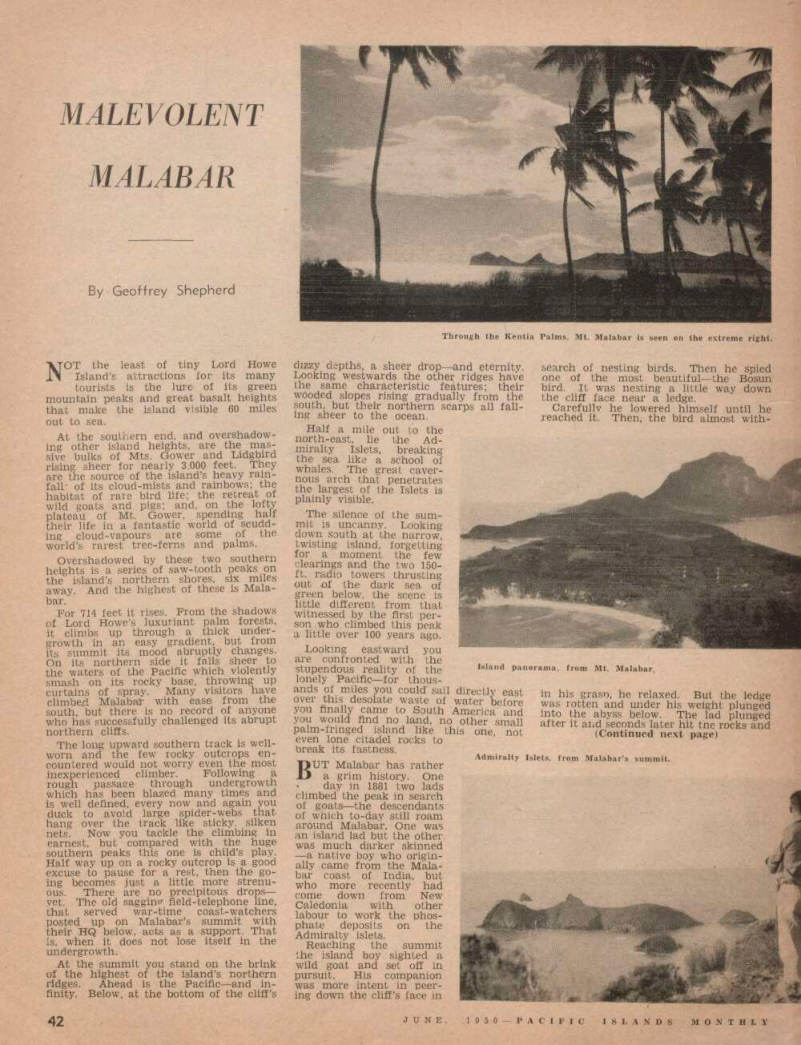
Malabar
By Geoffrey Shepherd
NOT the least of tiny Lord Howe Island’s attractions for its many tourists is the lure of its green mountain peaks and great basalt heights that make the island visible 60 miles out to sea.
At the southern end. and overshadow ing other island heights, are the mas sive bulks of Mts. Gower and Lidgbird rising sheer for nearly 3,000 feet. They are the source of the island’s heavy rain fall- of its cloud-mists and rainbows; the habitat of rare bird life; the retreat of wild goats and pigs; and, on the lofty plateau of Mt. Gower, spending half their life in a fantastic world of scudd ing cloud-vapours are some of the world’s rarest tree-ferns and palms.
Overshadowed by these two southern heights is a series of saw-tooth peaks on the island’s northern shores, six miles away. And the highest of these is Mala bar.
For 714 feet it rises. From the shadows of Lord Howe’s luxuriant palm forests, it climbs up through a thick under growth in an easy gradient, but from its summit its mood abruptly changes.
On its northern side it falls sheer to the waters of the Pacific which violently smash on its rocky base, throwing up curtains of spray. Many visitors have climbeff Malabaa- with ease from the south, but there is no record of anyone who has successfully challenged its abrupt northern cliffs.
The long upward southern track is well worn and the few rocky outcrops en countered would not worry even the most inexperienced climber. Following a rough passage through undergrowth which has been blazed many times and is well defined, every now and again you duck to avoid large spider-webs that hang over the track like sticky, silken nets. Now you tackle the climbing in earnest, but compared with the huge southern peaks this one is child’s play.
Half way up on a rocky outcrop is a good excuse to pause for a rest, then the go ing becomes just a little more strenu ous. There are no precipitous drops— yet. The old sagging field-telephone line, that served war-time coast-watchers posted up on Malabar’s summit with their HQ below, acts as a support. That is, when it does not lose itself in the undergrowth.
At the summit you stand on the brink of the highest of the island’s northern ridges. Ahead is the Pacific —and in finity. Below, at the bottom of the cliff’s
dizzy depths, a sheer drop—and eternity.
Looking westwards the other ridges have the same characteristic features; their wooded slopes rising gradually from the south, but their northern scarps all fall ing sheer to the ocean.
Half a mile out to the north-east, lie the Ad miralty Islets, breaking the sea like a school of whales. The great caver nous arch that penetrates the largest of the Islets is plainly visible.
The silence of the sum mit is uncanny. Looking down south at the narrow, twisting island, forgetting for a moment the few clearings and the two 150ft. radio towers thrusting out of the dark sea of green below, the scene is little different from that witnessed by the first per son who climbed this peak a little over 100 years ago.
Looking eastward you are confronted with the stupendous reality of the lonely Pacific—for thous
ands of miles you could sail directly east over this desolate waste of water before you finally came to South America and you would find no land, no other small palm-fringed island like this one, not even lone citadel rocks to
break its fastness.
BUT Malabar has rather a grim history. One ■* day in 1881 two lads climbed the peak in search of goats—the descendants of which to-day still roam around Malabar. One was an island lad but the other was much darker skinned —a native boy who origin ally came from the Mala bar coast of India, but who more recently had come down from New Caledonia with other labour to work the phos phate deposits on the Admiralty islets.
Reaching the summit the island boy sighted a wild goat and set off in pursuit. His companion was more intent in peer ing down the cliff’s face in
search of nesting birds. Then he spied one of the most beautiful —the Bosun bird. It was nesting a little way down the cliff face near a ledge.
Carefullv he lowered himself until he reached it. Then, the bird almost with-
in his grasn, he relaxed. But the ledge was rotten and under his weight plunged into the abyss below. The lad plunged after it and seconds later hit the rocks and (Continued next page)
Through the Kentia Palms, Mt. Malabar is seen on the extreme right.
Island panorama, from Mt. Malabar.
Admiralty Islets, from Malabar’s summit.
bounced off into the sea. On the summit of Malabar his white-faced companion gazed aghast at the broken ledge below and for some sign of his vanished friend.
He did not see him again.
The island’s oldest resident, Mr. W.
Thompson, related the story to me one evening, for it was he who was the Malabar lad’s companion. From that tragedy the island peak takes its name.
Many years later, on June 14, 1918, came another disaster. On that oc casion the island steamer, Makambo, was attempting to pass through the dangerous channel between the Admiralty islets and Malabar’s cliff. It veered too far inshore and directly under Malabar, struck one of its rocks. Badly holed, the lighting system failed. While at tempts were being made to lower boats in the darkness, a woman passenger, at tempting to jump into one. fell in the sea and was drowned.
Again the years rolled on. Tourists went to the island and climbed the peak; and during the war years island watchers anxiously maintained a lookout from its summit for signs of enemy shipping.
Then came the island’s worst disaster.
On Sentember 28, 1948. a RAAF Catalina flving-boat, on navigational exercises from Rathmines, NSW, developed a fuel blockage nff the island and, trying to land on the western lagoon, struck a rocky outcrop on the slopes of Malabar.
The stricken aircraft bounced off the rocks, tore a passage through the thick growth of the hill, and finally came to rest in a clearing. Seven men perished two were rescued by the rapid action of two islanders.
Such is the history of Malabar —a little peak that has cast a long shadow over a lovely Pacific island.
Tropicalities
11HE ketch, Sue, departed from Sydney , for New Guinea (where she will be used as a plantation boat) on Empire Day, May 24. It was one of Sydney’s really wet days—something like three inches fell in 24 hours. Crew of the Sue consists of Mr. Alex Cann, as navigator and radio operator, and two others. They will go inside the Barrier Reef and ex pect to reach Rabaul in four weeks.
As the ketch drew away from a Sydney wharf, amid the frantic farewelling of family and friends of the crew, there was a signal to return. Authority was on the telephone to say sailing papers were not in order. She returned and the navi gator-radio-operator leapt ashore, falling flat on his back on the slippery wharf.
Friends and family gathered in anticipa tion but were surprised to hear Cann giving his height—6 ft. 2 in. That is what Authority had wanted to know.
THE United Nations Trusteeship Coun cil party which is at present making investigations in New Guinea (and will later look over Western Samoa) may be important in some foreign parts, such as Russia, but it cuts little ice with the Aus tralian Press. The only time it made any headlines in May was when some Bou gainville luluai spoke his piece and de manded the right for New Guinea natives to drink hard liquor.
The Chinese member of the party pointed out that this would probably cause trouble in village life but our luluai
said they wanted the right to drink just the same.
Presumably, the party discussed other problems with the local natives, but in Australia drink (intoxicating) is always regarded as top priority news. (IROWN Prince Tungi of Tonga was the J speaker in the Australian Broad casting Commission’s Guest of Honour programme on May 13. The talk, made without script or notes, was re corded in Suva by ABC’s Colin Simpson during the recent South Pacific Con ference.
The Prince supported the White Aus tralia policy—if Australia was to make a full contribution to life in the Pacific, he said, she must “retain her own native race.” It is not clear what Prince Tungi meant by that: Europeans are no more native of Australia than they are of Tonga. And despite the fact that the South Pacific Commission is Australia’s baby there was no effort made to have Torres Strait Islanders or Aborigines rep resented at the recent conference. If these are not “dependent Pacific peoples,” what are they? Skeletons in Australia’s cupboard?
That, however, is by the way. The Prince is an impressive speaker and his broadcast was received with considerable interest. Advance publicity told Austra lians that he had been educated at Newington College, Sydney; Wesley, in Melbourne; that he gained his BA and LLB at Sydney University; and that he was a lover of gadgets—luminous fish hooks from the US being men tioned.—MM.
INDIRECTLY, wasps on Wardang Island, off Port Victoria, South Australia, will soon be doing their bit to wipe out the Rhinoceros beetle pest in Western Samoan coconut plantations.
In November, 1945, we reported how Mr.
H. W. Simmonds, formerly of the Fiji Agricultural Department, had been re sponsible for collecting black wasps from Zanzibar and sending them by air, via Cairo, India and Australia, to prey upon Samoa’s Rhinoceros beetles then playing havoc with copra production.
The wasps were established success fully, after a few preliminary set-backs and became parasites of the beetle, but the trouble has been to find sufficient food for them.
Recently, Mr. Simmonds visited rela tives on Wardang Island, SA, and there found wasps related to the Zanzibar variety. The Wardang wasps feed on sunflowers, and flourish. So Mr. Sim monds has informed the New Zealand government and it is expected that sun flowers will soon be giving new strength to Western Samoa’s wasps.
IN PIM for June, 1949, a reader on Nor folk Island advertised a modern bungalow for sale at £A2,000. In May, 1950, an American ex-Marine, 43-year old Franklin Boyer, landed in Sydney en route to Norfolk. He had seen the ad vertisement in PIM and bought the bun galow from the builder, Mr. K. G. Tuck.
Mr. Boyer has never seen the house, or Norfolk Island. But he has served for 21 years in the Marines as a technical sergeant; three years were spent as a POW of the Japs in the Philippines.
During the war he decided that when he was free he would settle on a Pacific Island and “do nothing.”
He says that all he knows about Nor folk Island he has learnt from travel folders.
THIS macabre tale was told by Colonel H. T. (“Blue”) Allan, now retired (more or less) from mining and planting.
It was the early days of the New Guinea goldfields, and before the advent of air-freighting. The all-too-limited supplies were brought in painfully over the mountains by lines of native carriers.
Medical officers had not yet arrived to check the malaria and dysentery, which worked havoc among the natives. As a result, the carriers died in scores along the terrible mountain trails.
Blue Allan’s party were so short of pick handles that their operations were crippled. Something had to be done about it. One day, Blue was approached by a rough and tough Manus native, who was said to fear neither man nor tambaran.
He said that, if Masta was agreeable, and would let him go for a couple of days, he would get plenty pick-handles. He de parted, alone, with the blessings of the party, and in a short time he was back, with a dozen handles.
The explanation was simple. As their earners died, the miners buried the bodies beside the trail; and it was the practice of many of them to mark the spot with a pick-handle, stuck upright in the earth. The average native would die rather than go near the graves, but the rough and tough Manus native was contemptuous of all spirit-world mani festations—and thus obtained a good sup ply of pick-handles.
MENTION in Pibruary PIM of lonely graves on the Mortlocks and the Tasmans, New Guinea, recalls to me what may well be the loneliest graveyard of the Pacific. I saw it on the 300-acre speck marked as Nassau Island, 50 miles from inhabited Pukapuka in the Northern Cook Group.
About 40 years ago, Nassau, formerly a barren sandy isle, was planted with coconuts. Until the Pacific War began in 1941, Nassau had a small village of labourers recruited from Puka Puka who were engaged in making copra. Near the recognised landing place are a num ber of graves with rough headstones of coral rock and cement made from coral.
From inscriotions which were scarcely readable in 1945, it seemed that some of the burials had been made in the years of World War 1.
Since 1945 there has been some talk about working Nassau’s plantation again, but apparently no one has volunteered to try to get the copra across one of the worst reefs in the Pacific. In pre-1942 days this task was accomplished by Cap tain Williams who lived happily on Nassau with his family. He was evacu ated to Western Samoa and Nassau has been deserted since a party of NZ coast watchers departed in September, 1945.
Another lonely burial ground I viewed was at Pagoumene, near the northern tip of New Caledonia, where for 40 years an overseas metal corporation had been ex tracting chrome ore from a mine a few miles inland.
Tucked away in a corner beside the lagoon was the burial place of Pagoumenes’ workers for several decades.
Inscriptions on locally-made concrete headstones told of Tonkinese or Javanese workers who ended their days far from home. Standing out from these was a headstone obviously sent out from Britain recording the death of a ship’s officer of a vessel of the Clan Line. What caused his death at lonely Pagoumene? I won dered at the time. Perhaps there is no place like home when the time comes to die.—AJS.
Advertisements & other items, pp. 45-47 (2 items)
43
Malevolent Malabar— (Continued from previous page.)
PACIFIC ISLANDS MONTHLY JUNE, 1950
For 50 Years F<
-ggm ' s ■ : ! '■'iyyyfv-'' Speedmaster stove boils 1 pint in 2\ minutes. Windproof, rustproof, safe. ■3L.
Table lamps, kerosene and petrol, instant lighting, 12 hours' burning.
Lanterns, kerosene and petrol, stormproof and instant lighting.
ALL
Sfi- Brazing torches, petrol and kerosene; mechanically sealed and soldered for double protection.
HAVE BEEN BRINGING
TO PEOPLE
The man who founded the Coleman Company, and who still directs it, is Mr. W. C. Coleman.
He has made the company successful by following the sound rule of "Good service to those homes who have invested their money in Coleman appliances."
Only by such fair dealing can a firm expand. The Coleman Company, in celebrating its 50th an- Self-heating kerosene irons.
THESE COLEMAN API
Sturdy cooking stoves, 3 burners, finished i n polymerin enamel.
Portal burne mg, able
Pearce £p Co. Ltd.
Suva
For Fiji Islands.
ROBERT GILI
emanPRODUCTS
TER WAYS OF LIVING
fERYWHERE
niversary this year, is now the recognised leader among American manufacturers of cooking, lighting and heating appliances for liquid fuel.
That is why Coleman, confident in the good value of its appliances, never makes extravagant claims. The Coleman policy is "plain words about good, modern appliances."
Solus stoves available as silent and roarer models, simple and strong.
Pocket petrol stove. A complete stove telescoped into 8-k" x 4-5"
Colmax petrol and kerosene lanterns, last a lifetime; 200, 300 c.p Self-heating petrol irons.
'ICES ARE AVAILABLE NOW
;s, twoit lightremovfilling.
Console Range, five staggered burners, porcelain ovens with glass doors. ,\vv c*s '■* « a r m Kerosene blow lamps, heavy gauge brass, will withstand 200 lbs.
54a Pitt Street,
Sydney.
They are leaving Midway to
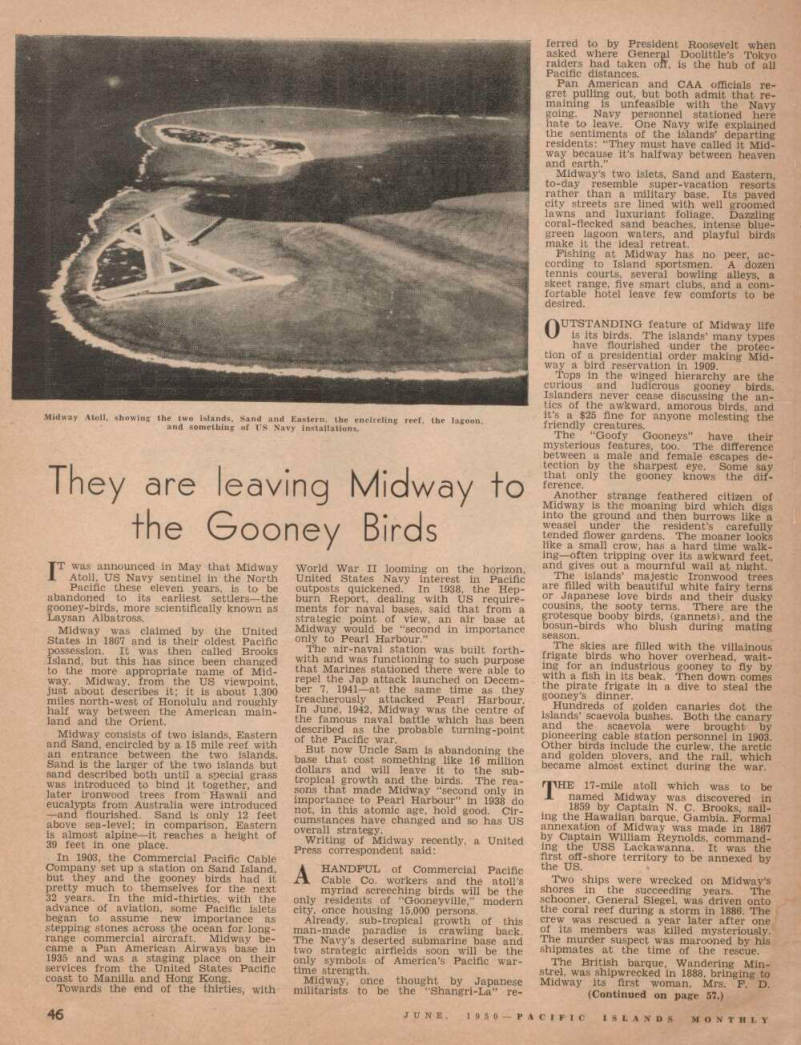
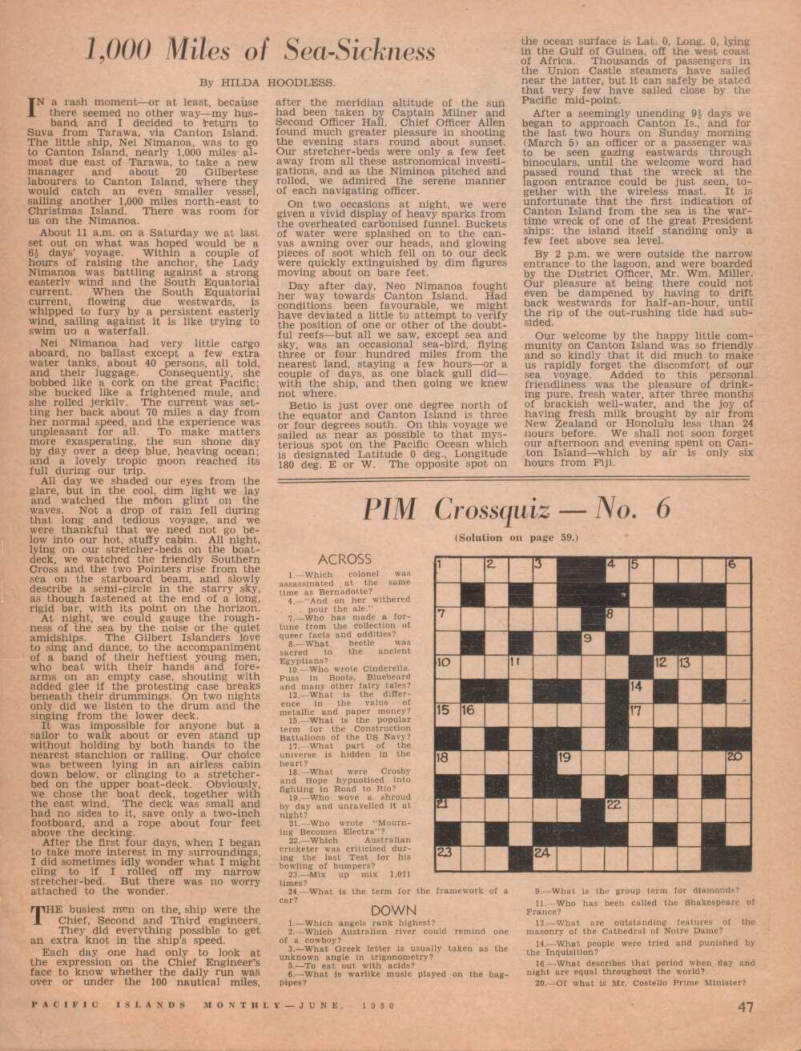

the Gooney Birds
IT was announced in May that Midway Atoll, US Navy sentinel in the North Pacific these eleven years, is to be abandoned to its earliest settlers—the gooney-birds, more scientifically known as Laysan Albatross.
Midway was claimed by the United States in 1867 and is their oldest Pacific possession. It was then called Brooks Island, but this has since been changed to the more appropriate name of Mid way. Midway, from the US viewpoint, just about describes it; it is about 1,300 miles north-west of Honolulu and roughly half way between the American main land and the Orient.
Midway consists of two islands, Eastern and Sand, encircled by a 15 mile reef with an entrance between the two islands.
Sand is the larger of the two islands but sand described both until a special grass was introduced to bind it together, and later ironwood trees from Hawaii and eucalypts from Australia were introduced —and flourished. Sand is only 12 feet above sea-level; in comparison, Eastern is almost alpine—it reaches a height of 39 feet in one place.
In 1903, the Commercial Pacific Cable Company set up a station on Sand Island, but they and the gooney birds had it pretty much to themselves for the next 32 years. In the mid-thirties, with the advance of aviation, some Pacific islets began to assume new importance as stepping stones across the ocean for long range commercial aircraft. Midway be came a Pan American Airways base in 1935 and was a staging place on their services from the United States Pacific coast to Manilla and Hong Kong.
Towards the end of the thirties, with
World War II looming on the horizon, United States Navy interest in Pacific outposts quickened. In 1938, the Hep burn Report, dealing with US require ments for naval bases, said that from a strategic point of view, an air base at Midway would be “second in importance only to Pearl Harbour.”
The air-naval station was built forth with and was functioning to such purpose that Marines stationed there were able to repel the Jap attack launched on Decem ber 7, 1941—at the same time as they treacherously attacked Pearl Harbour.
In June, 1942, Midway was the centre of the famous naval battle which has been described as the probable turning-point of the Pacific war.
But now Uncle Sam is abandoning the base that cost something like 16 million dollars and will leave it to the sub tropical growth and the birds. The rea sons that made Midway “second only in importance to Pearl Harbour” in 1938 do not, in this atomic age, hold good. Cir cumstances have changed and so has US overall strategy.
Writing of Midway recently, a United Press correspondent said: A HANDFUL of Commercial Pacific Cable Co. workers and the atoll’s myriad screeching birds will be the only residents of “Gooneyville,” modern city, once housing 15,000 persons.
Already, sub-tropical growth of this man-made paradise is crawling back.
The Navy’s deserted submarine base and two strategic airfields soon will be the only symbols of America’s Pacific war time strength.
Midway, once thought by Japanese militarists to be the “Shangri-La” re
ferred to by President Roosevelt when asked where General Doolittle’s Tokyo raiders had taken off, is the hub of all Pacific distances.
Pan American and CAA officials re gret pulling out, but both admit that re maining is unfeasible with the Navy going. Navy personnel stationed here hate to leave. One Navy wife explained the sentiments of the islands’ departing residents: “They must have called it Mid way because it’s halfway between heaven and earth.”
Midway’s two islets, Sand and Eastern, to-day resemble super-vacation resorts rather than a military base. Its paved city streets are lined with well groomed lawns and luxuriant foliage. Dazzling coral-flecked sand beaches, intense blue green lagoon waters, and playful birds make it the ideal retreat.
Pishing at Midway has no peer, ac cording to Island sportsmen. A dozen tennis courts, several bowling alleys, a skeet range, five smart clubs, and a com fortable hotel leave few comforts to be desired.
OUTSTANDING feature of Midway life is its birds. The islands’ many types have flourished under the protec tion of a presidential order making Mid way a bird reservation in 1909.
Tops in the winged hierarchy are the curious and ludicrous gooney birds.
Islanders never cease discussing the an tics of the awkward, amorous birds, and it’s a $25 fine for anyone molesting the friendly creatures.
The “Goofy Gooneys” have their mysterious features, too. The difference between a male and female escapes de tection by the sharpest eye. Some say that only the gooney knows the dif ference.
Another strange feathered citizen of Midway is the moaning bird which digs into the ground and then burrows like a weasel under the resident’s carefully tended flower gardens. The moaner looks like a small crow, has a hard time walk ing—often tripping over its awkward feet, and gives out a mournful wail at night.
The islands’ majestic Ironwood trees are filled with beautiful white fairy terns or Japanese love birds and their dusky cousins, the sooty terns. There are the grotesque booby birds, (gannets), and the bosun-birds who blush during mating season.
The skies are filled with the villainous frigate birds who hover overhead, wait ing for an industrious gooney to fly by with a fish in its beak. Then down comes the pirate frigate in a dive to steal the gooney’s dinner.
Hundreds of golden canaries dot the islands’ scaevola bushes. Both the canary and the scaevola were brought by pioneering cable station personnel in 1903.
Other birds include the curlew, the arctic and golden plovers, and the rail, which became almost extinct during the war.
THE 17-mile atoll which was to be named Midway was discovered in 1859 by Captain N. C. Brooks, sail ing the Hawaiian barque, Gambia. Formal annexation of Midway was made in 1867 by Captain William Reynolds, command ing the USS Lackawanna. It was the first off-shore territory to be annexed by the US. , Two ships were wrecked on Midway’s shores in the succeeding years. The schooner, General Siegel, was driven onto the coral reef during a storm in 1886. The crew was rescued a year later after one of its members was killed mysteriously.
The murder suspect was marooned by his shipmates at the time of the rescue.
The British barque, Wandering Min strel, was shipwrecked in 1888, bringing to Midway its first woman, Mrs. P. D.
(Continued on page 57.)
Midway Atoll, showing the two islands, Sand and Eastern, the encircling reef, the lagoon, and something of US Navy installations.
Walker, wife of the ship’s captain. The near-starved crew was rescued 13 months later by the schooner Norma, out of Honolulu.
First settlers came to Midway in 1903, when the Commercial Pacific Cable Co. set up its lonely station to service the trans-Pacific cable. A description of the first night on the then barren sand strip was written years later in a letter by the company’s first manager, B.
W. Colley.
“Our first night’s experience was some what startling,” he said. “We walked around the island —not much to see— reef, sand and ocean, plus birds.
“Then, as night fell, there arose the most astonishing medley of sounds like caterwauling—shrill screams of cats, squeaking and moans, as of people in distress. We did not know what to make of it. It was weird, especially accompanied by the boom of the surf on the reef.
“We finally turned in. All those sounds were made by the sea birds, and we soon got as used to them as you are to the sound of the city streets.”
When Pan American arrived in 1935 to end the cable station’s solitude, they brought in the first power-plant, pre fabricated houses, and set up the island’s first water supply system. Soon the Sikorsky China Clippers were plying the skylanes over the sea routes used by the fore-runners of the air age.
When in 1939-40 the Navy moved in, the naval air station was built using many of the Pan American facilities already there.
A Marine garrison was set up, growing to a strength of 850 men by February, 1941. December 7, 1941, at 9.35 p.m., Mid
way was bombarded by a Japanese raid ing force estimated to consist of two cruisers and two destroyers. The Japanese retired under fire from shore batteries. Four Americans were killed that day on Midway.
After hostilities ended, Navy personnel were allowed to bring their families with them to Midway. The islands’ small city was renovated from a wartime camp to a city of modern luxuries.
The Rev. and Mrs. A. W. E. Silvester, of the NZ Methodist Mission, returned to the Solomons after leave in the Dominion in March. While they were in New Zealand, Mr. Silvester received the American decoration, Medal for Merit.
He won this high award for guiding an advance party of Americans on Jap-held Vella Lavella in 1943. The actual in vestiture, however, was not held until Mr.
Silvester returned to NZ recently.
1,000 Miles of Sea-Sickness
By Hilda Hoodless.
IN a rash moment —or at least, because there seemed no other way—my hus band, and I decided to 'return to Suva from Tarawa, via Canton Island.
The little ship, Nei Nimanoa, was to go to Canton Island, nearly 1,000 miles al most due east of Tarawa, to take a new manager and about 20 Gilbertese labourers to Canton Island, where they would catch an even smaller vessel, sailing another 1,000 miles north-east to Christmas Island. There was room for us on the Nimanoa.
About 11 a.m. on a Saturday we at last set out on what was hoped would be a 6i days’ voyage. Within a couple of hours of raising the anchor, the Lady Nimanoa was battling against a strong easterly wind and the South Equatorial current. When the South Equatorial current, flowing due westwards, is whipped to fury by a persistent easterly wind, sailing against it is like trying to swim uo a waterfall.
Nei Nimanoa had very little cargo aboard, no ballast except a few extra water tanks, about 40 persons, all told, and their luggage. Consequently, she bobbed like a cork on the great Pacific; she bucked like a frightened mule, and she rolled jerkilv. The current was set ting her back about 70 miles a day from her normal speed, and the experience was unpleasant for all. To make matters more exasperating, the sun shone day by day over a deep blue, heaving ocean; and a lovely tropic moon reached its full during our trip.
All day we shaded our eyes from the glare, but in the cool, dim light we lay and watched the mbon glint on the waves. Not a drop of rain fell during that long and tedious voyage, and we were thankful that we need not go be low into our hot, stuffy cabin. All night, lying on our stretcher-beds on the boat deck, we watched the friendly Southern Cross and the two Pointers rise from the sea on the starboard beam, and slowly describe a semi-pircle in the starry sky, as though fastened at the end of a long, rigid bar, with its point on the horizon.
At night, we could gauge the rough ness of the sea by the noise or the quiet amidships. The Gilbert Islanders love to sing and dance, to the accompaniment of a band of their heftiest young men, who beat with their hands and fore arms on an empty case, shouting with added glee if the protesting case breaks beneath their drummings. On two nights only did we listen to the drum and the singing from the lower deck.
It was impossible for anyone but a sailor to walk about or even stand up without holding by both hands to the nearest stanchion or railing. Our choice was between lying in an airless cabin down below, or clinging to a stretcher bed on the upper boat-deck. Obviously, we chose the boat deck, together with the east wind. The deck was small and had no sides to it, save only a two-inch footboard, and a rope about four feet above the decking.
After the first four days, when I began to take more interest in my surroundings, I did sometimes idly wonder what I might cling to if I rolled off my narrow stretcher-bed. But there was no worry attached to the wonder.
THE busiest men on the, ship were the Chief, Second and Third engineers.
They did everything possible to get an extra knot in the ship’s speed.
Each day one had only to look at the expression on the Chief Engineer’s face to know whether the daily run was over or under the 100 nautical miles,
after the meridian altitude of the sun had been taken by Captain Milner and Second Officer Hall. Chief Officer Allen found much greater pleasure in shooting the evening stars round about sunset.
Our stretcher-beds were only a few feet away from all these astronomical investi gations, and as the Niminoa pitched and rolled, we admired the serene manner of each navigating officer.
On two occasions at night, we were given a vivid display of heavy sparks from the overheated carbonised funnel. Buckets of water were splashed on to the can vas awning over our heads, and glowing pieces of soot which fell on to our deck were quickly extinguished by dim figures moving about on bare feet.
Day after day, Neo Nimanoa fought her way towards Canton Island. Had conditions been favourable, we might have deviated a little to attempt to verify the position of one or other of the doubt ful reefs—but all we saw, except sea and sky, was an occasional sea-bird, flying three or four hundred miles from the nearest land, staying a few hours —or a couple of days, as one black gull did— with the ship, and then going we knew not where.
Betio is just over one degree north of the equator and Canton Island is three or four degrees south. On this voyage we sailed as near as possible to that mys terious spot on the Pacific Ocean which is designated Latitude 0 deg., Longitude 180 deg. E or W. The opposite spot on
the ocean surface is Lat. 0, Long. 0, lying in the Gulf of Guinea, off the west coast of Africa. Thousands of passengers in the Union Castle steamers have sailed near the latter, but it can safely be stated that very few have sailed close by the Pacific mid-point.
After a seemingly unending 9£ days we began to approach Canton Is., and for the last two hours on 'Sunday morning (March 5) an officer or a passenger was to be seen gazing eastwards through binoculars, until the welcome word had passed round that the wreck at the lagoon entrance could be just seen, to gether with the wireless mast. It is unfortunate that the first indication of Canton Island from the sea is the war time wreck of one of the great President ships: the island itself standing only a few feet above sea level.
By 2 p.m. we were outside the narrow entrance to the lagoon, and were boarded by the District Officer, Mr. Wm. Miller.
Our pleasure at being there could not even be dampened by having to drift back westwards for half-an-hour, until the rip of the out-rushing tide had sub sided.
Our welcome by the happy little com munity on Canton Island was so friendly and so kindly that it did much to make us rapidly forget the discomfort of our sea voyage. Added to this personal friendliness was the pleasure of drink ing pure, fresh water, after three months of brackish well-water, and the joy of having fresh milk brought by air from New Zealand or Honolulu less than 24 nours before. We shall not soon forget our afternoon and evening spent on Can ton Island —which by air is only six hours from Fiji.
PIM Crossquiz No. 6
(Solution on page 59.)
Across
1,—Which colonel was assassinated , at the same time as Bernadotte? 4. —“And on her withered
. . . pour the ale.”
7. —who has made a for tune from the collection of queer facts and oddities? 8.. —What beetle was sacred to the ancient
Egyptians?
10, —Who wrote Cinderella.
Puss in Boots, Bluebeard and many other fairy tales? 12.—What is the differ ence in the value of metallic and paper money? 15.—What is the popular term for the Construction Battalions of the US Navy? 17. —What part of the universe is hidden in the heart? 18. —What were Crosby and Hope hypnotised into fighting in Road to Rio? 19. —Who wove a shroud by day and unravelled it at night? 21. —Who wrote “Mourn ing Becomes Electra”? 22. —Which Australian cricketer was criticised dur ing the last Test for his bowling of bumpers? 23. —Mix up mix 1,011 times?
24. —What is the term for the framework of a car?
Down
1. —Which angels rank highest? 2. —Which Australian river could remind one of a cowboy? 3. What Greek letter is usually taken as the unknown angle in trigonometry? 5. To eat out with acids? 6. —What is warlike music played on the bag pipes?
9.—What is the group term for diamonds? 11.—Who has been called the Shakespeare of Prance? 13. —what are outstanding features of the masonry of the Cathedral of Notre Dame? 14. —what people were tried and punished by the Inquisition? 16. —What describes that period when day and night are equal throughout the world? 20. —Of what is Mr. Costello Prime Minister?
fashion . . .
pOR shopping in town or relaxing at home —this three-piece outfit of skirt, jacket and slacks is attractive as well as being versatile. The original New York models were made in aqua sharkskin; per haps uncrushable linen would be more suitable for the humid tropics.
Advertisements & other items, pp. 50-52 (2 items)
Corner For The Children
Burns Philp (New Guim) Limited
General Merchants (Wholesale and Retail)
Shipping, Customs and General Agents
Head Office; PORT MORESBY, PAPUA
BRANCHES:
NEW GUINEA: Rabaul, Kokopo, Lae Gr Madang.
PAPUA: Samarai.
REPRESENTATIVES FOR:
AUSTRALIAN AGENTS:
LONDON AGENTS:
SAN FRANCISCO AGENTS:
QUEENSLAND INSURANCE CO. LTD.
LLOYD'S OF LONDON
BURNS PHILP TRUST CO. LTD-
BURNS, PHILP & CO. LTD.
All States.
BURNS, PHILP & CO. LTD.
"London House", 35 Crutched Friars, E.C.3.
BURNS, PHILP CO. OF SAN FRANCISCO INC. 510 Matson Building.
Distributing Agents, Territory of Papua-New Guinea for:
SHELL COMPANY OF AUSTRALIA LIMITED
Petroleum Products
GENERAL MOTORS CORPORATION
Chevrolet, Buick, Pontiac and Oldsmobile Cars Chevrolet and GMC Trucks Frigidaire Refrigerators
VAUXHALL MOTORS LIMITED
Vauxhall Cars and Bedford Trucks
R. A. LISTER & CO., BRISTOL
Producers of Petrol, Paraffin and Diesel Engines Pumps and Lighting plants
RUSTON HORNSBY LIMITED
Engines
CROSSLEY MARINE ENGINES
ARMSTRONG SIDDELEY
An All-Purpose Air-Cooled DIESEL ENGINE
m t".
The Armstrong Siddeley diesel engine is supplied as a single (6 and 8 h.p.) or twin (16 h.p.) cylinder unit. It is compact in design, air cooled, pressure lubricated, low in fuel consumption, easily started from cold, and highly efficient. The Armstrong Siddeley diesel engine has a wide variety of uses such as driving electric generator sets, pumping units, grinding mills, concrete mixers, etc.
Write for descriptive leaflets
VENTURA TRADING CO. (PTY) LTD.,
26, Bridge Street, Sydney.
Manufactured by ARMSTRONG SIDDELEY MOTORS LIMITED, COVENTRY, ENGLAND.
X Wholesale and Retail Merchants. Shipowners. Sawmillers.
General Engineers. Customs and Shipping Agents.
Catering for all Plantation Supplies. Buyers of Island Produce.
Plantation Owners and Managing Agents.
Agents for; — Australia-West Pacific Line.
Canton Insurance Office, Ltd.
Union Assurance Society, Ltd.
Aust. T. & G. Mutual Life Society, Ltd.
Guinea Air Traders, Ltd.
CO. Lf®
COVt».«^ nd , C*urch_
Distributing Agents in New Guinea for:— Hillman, Humber, Sunbeam-Talbot, Chrysler and Plymouth Cars.
Commer, Karrier and Fargo Trucks.
Willys Overland Jeeps.
G.M. Marine and Industrial Engines.
Olympic Tyres and Cables.
Hygeia Dissolvenators.
Sherwin-Williams Paints, Prefect Refrigerators.
Mullard Radios.
Aladdin Lamps.
Ewo Beer.
Snowflake Unsweetened Evaporated Milk.
Pental Soaps.
Some Tea is Already Coming From New Guinea Highlands
New Guinea Highlands
we had published the story of how tea seeds were obtained for New Guinea from British North Borneo, in the ’thirties (May PIM, page 31) we came across the follow ing article in South Pacific, the magazine of the Australian School of Pacific Administration in Sydney. It was written by Peter Maxton-Graham, a cadet agriculturist with the Papua- New Guinea Department of AgricuU ture.
His story probably explains the present condition and location of the trees that were raised by the late George Murray from black tea seed which Mr. George Rio brought from Borneo.
It is interesting to know, too, that some Aiyura tea can be obtained already by Territorians.
If New Guinea tea turns out to be as good as New Guinea coffee, then it is very good.
AT -the head of the Ramu Valley, New Guinea, 6,000 feet above sea level, is Aiyura, the Highlands Agricultural Experiment Station. Here climate and soil conditions are eminently favourable for the cultivation of tea, and small ex perimental plots, which have now grown to about seven acres, were planted as early as 1939 with seed secured from North Borneo. Most of this acreage is now in bearing, and since the war, several rather primitive attempts at tea manu facture have been made, with varying degrees of success.
Tea is an exacting crop, requiring a high degree of skill, knowledge and mechanisation. The bushes must be plucked about once every ten days and the leaf withered to lose 40 to 50 per cent., of its moisture content. Up to this point, little or no machinery is required.
The next step—rolling the withered leaf —requires more consideration.
The mechanical tea roller is a highly complex affair, precision made, and re quiring several horsepower to operate it.
Its basic principle is that of an oscillating drum on a table fitted with raised radiat ing battens. Its purpose is to crush and twist the leaf, breaking up the leaf cells and starting the process of fermentation.
Hitherto, leaf had been rolled by hand at Aiyura—a laborious, inefficient, insanitary and highly unsatisfactory method, in volving about a day’s work for about ten labourers after each picking. It was de cided, therefore, to make a small-scale, hand-operated rolling machine.
This machine was made of wood, and though it performed in a reasonably satis factory manner, it was found that its wooden construction was a handicap, and it soon became decrepit. Work was im mediately started on the Mark 11, an all metal affair, which has since been completed. This has been found satis factory for experimental purposes. With it one labourer can roll the entire crop in one afternoon.
THE next step, fermentation, presents few difficulties. The rolled leaf is spread three or four inches thick in a darkened room under moist conditions and left for about three to four hours.
When the leaf has turned a bright copper colour, it is ready for firing.
It was found impossible to build an efficient mechanical drier with the re
sources available at Aiyura, though an attempt was made, so that we had to re sort to sun drying. This is, at best, an unsatisfactory method, as four to five hours of bright sunlight are necessary at the right moment. As a result, a good
deal of the crop has been lost through
anical drier which should arrive some time this year. When this has been in stalled, it should be possible to produce from fifty to a hundred pounds of tea per month.
A certain amount of good-natured scepticism has been voiced by Terri torians as to the quality of the finished product. However, those who have tasted it have become ardent converts, and a brisk demand for NG Highlands’ tea is now springing up in Lae and Madang.
The manufacturing is still primitive when compared with manufacture in other countries, but this is offset by the fact that the tea is fresh, and grown at a good height, for the quality of tea is greatly affected by the altitude at which it is grown.
These experiments at Aiyura show that there is a future for tea in the Territory.
The greatest difficulty will not be in the manufacture, but in training the avail able native labour. Natives at Aiyura have shown great promise in plucking and pruning operations, and no doubt natives in other areas will show the same ability to learn.
Still Closely Guarded
Preserve
(From The Crown Colonist of April) Representatives of India, Pakis tan, Ceylon and Indonesia, meeting in London, are about to renew the international tea regulation scheme for a further period of five years. The de cision is not the less deplorable for having been expected.
Ostensibly, regulation is being pro longed in order to have a mechanism ready to cope with any future world glut of tea. In practice, the scheme has be come a deliberately girded weapon of discrimination against Colonial producers.
It is a condition of adherence that mem bers ban the export of tea seeds or tea plants to non-regulating countries. Among the sufferers in consequence are Malaya, Mauritius and the East African terri tories, where production has expanded considerably in recent years, and where lower costs have attracted many British tea estate companies operating mainly in Ceylon and India.
When, during 1947-48, the International Tea Committee were asked to allow Mauritius a small quantity of seed, they gave the request “sympathetic considera tion”; but (taking refuge in the know ledge of an earlier Indian ban on seed shipments to Kenya), “came to the un animous decision that wider issues of principle and precedent were involved” which prevented concurrence. The Indian ban is one of several reprisals inflicted on East African growers since, in 1947, they withdrew from the scheme owing to dissatisfaction with “approved” acreage extensions.
Advertisements & other items, pp. 53-54 (1 item)
Kolynos
Send us your orders for
DEVELOPING, PRINTING
Enlarging and
COPYING FROM OLD PHOTOS
All Photographic Supplies.
CAINE’S STUDIOS, SUVA
Box 8. (Estb. 1904) ’Phone: 68.
YOU SAVE MONEY WHEN
YOU USE KOLYNOS
YOU NEED
ONLY HALF
AN INCH ON
YOUR
BRUSH!
SO
CONCENTRATED
ONE TUBE LASTS
AS LONG AS TWO
TUBES OF ORDINARY
TOOTH PASTE
iSS
j><fm
*> v
Kolynos
DENTAL CREAM
TASTES BETTER CLEANS BETTER LASTS LONGER
<2 Mk Made in the Australian Branch Factory of
BLUNDELL SPENCE & CO., LTD., Hull,
B. & S. SUPER PREPARED PAINT embodies the knowledge and experience gained from nearly 140 years of Paint manufacture.
Tested and proved for tropical conditions, B. & S. PREPARED PAINT is also available in a special Lead-free series for use in volcanic and other sulphurous regions. (Specify B. & S.-Series 2301).
Ask for supplies of these and other BLUN- DELL Paints and Enamels from your local Storekeeper, or write for particulars and colour-cards to the Agent for Pacific Islands:
KERR BROTHERS PTY. LTD.
4 YORK STREET, SYDNEY
PAINTS
BEST SINCE 1811
Death Of Mrs. Mary Lynch
THE death was reported from Labasa, Fiji, in mid-May, of Mrs. Mary Lynch, wife of Mr. George Lynch, of Dreketi.
Mr. and Mrs. Lynch were out fishing, at night, off the mouth of the Dreketi River when an explosion set fire to their launch. The clothing of both caught alight and Mrs. Lynch was badly burned before her husband could get her into the water to extinguish the flames.
The launch was burnt almost to the water line and in this the couple drifted for 24 hours until rescued by Fijians from a near-by island. Mrs. Lynch died later in Labasa hospital. Mr. Lynch was in a critical condition but was expected to recover.
Trichopoda
versus Amblypelta The Nutfall Problem in BSI
From Our Own Correspondent
Honiara, May 30.
A SUCCESSFUL beginning has been made in the experiment of releasing parasitic flies in an attempt to con trol nutfall. Some hundreds of the fly, Trichopoda pennipes, obtained from Flori da and bred in captivity, were released in May on the Fairymead Sugar Com pany’s Baunani plantation on Malaita in a total nutfall area.
Mr. B. A. O’Connor, Fiji Government entomologist who released the flies, states that it is far too early to assume that the experiment itself will be successful.
It is hoped that the flies will lay eggs on Amblypelta cocophaga, the nutfall bug, and that the larvae from the hatch ing eggs will enter its body and destroy it.
The fly has placed some eggs on Am blypelta but, as yet, there is no evidence to indicate whether the larvae will regard Amblypelta as a satisfactory host, or whether the fly will lay eggs on Ambly pelta equally with, or in preference to, its more usual host, a bug called Axia gastus Campbell!, also found on coconut spathes The flies were bred in captivity in test cages at Honiara and mated by enticing a male and a young female into a small glass bottle. An exercise pen for males was also provided as it was found that it was beneficial to them to be given space to fly about after hatching, MR. O’CONNOR revisited the experi mental plots on Guadalcanal where some time ago he and Mr. R. Leach
of Cambridge established the ant, peco phylla, which destroys Amblypelta. Mr.
O’Connor considers that the remarkable post-war recovery of many plantations which were riddled with nutfall pre war is, as he and Mr. Leach assumed, due to the undergrowth which sprang up on plantations during the war. This undergrowth provides bridges by which the ant oecophylla can reach the tree trunks without running over the base of
the coconut tree, where it encounters an ant enemy, Pheidole.
The intention of the present experi ment with the parasitic fly is to see if this will prove effective in areas where an ant, iridomyrmex, living in the trunk of the palm, is present. Where this ant ap pears it destroys oecophylla, preventing it from reaching the spathes of the palm and preying on the amblypelta nutfall bug.
Advertisements & other items, pp. 55-56 (1 item)
A. B. Donald Limited
GILLESPIE’S
The Flour
TRADE MARK
of the Islands
- SY DN EY -
A. B. DONALD LIMITED
RAROTONGA COOK ISLANDS
TELEGRAPHIC ADDRESS: “DONALD, RAROTONGA.”
General Merchants (Wholesale & Retail) and Shipowners Importers & Exporters Branches Throughout Cook Islands Fire, Marine Cr Motor Vehicles Insurance Agents for Yorkshire
Insurance Co.
Lloyd’s Agents.
Agents and Distributors for: ENGLAND. —Austin Cars & Trucks, Pye Radios, Dunlop Rubber Co., Ltd., Vauxhall Cars & Trucks, R. A. Lister & Co., Ltd., Phillips' Cycles, Marples Tools.
U.S.A.—Remington Rand Corp., Radio Corp. of America, Champion Spark Plug Co., Firestone Tyres, General Steamship Corp.
NEW ZEALAND.—Vacuum Oil Co. Pty., Ltd. Petroleum Products.
AUSTRALlA.—Wunderlich, Ltd., Cement Asbestos Products.
NORWAY.—O. Mustad & Sons, Fish Hooks.
SWEDEN.—B. A. Hjorth & Co., Primus Products.
Sydney Agents : London Agents : San Francisco Agents : BURNS, PHILP & CO., LTD. BURNS, PHILP & CO., LTD. BURNS, PHILP CO. OF SAN FRANCISCO.
Head Office:— A. B. DONALD, LTD., Auckland.
Associate Houses:—
ETABLISSEMENTS DONALD TAHITI,
Papeete, Society Islands.
DOMINION FRUIT CO., Suva, Fiji Islands.
CODES: Bentley's Complete Phrase, Acme
Look for KRAFT
and find QUALITY
The unchanging quality of Kraft foods is a byword wherever fine foods find appreciation. In their constant vigilance over quality, Kraft experts have achieved even more than just that, for hand in hand with Kraft quality goes flavour perfection and food value of a very high order.
Wherever you see the name “Kraft”, buy confidently, and remember, “Red Feather” foods are made by Kraft too. No finer foods can be found.
Export Division .
Kraft Walker Cheese Co. Pty. Ltd.,
Riverside Ave., South Melbourne,
AUSTRALIA.
iilip Mm m
KRAFT
V sillinniißU Three famous Kraft Foods note available in full supply everywhere.
VEGEMITE the delicious, healthful yeast extract. One of the richest known sources of the important Vitamin B complex. Strongly recommended in all areas where fresh vegetables are scarce. A little does a power of good.
KRAFT CHEDDAR CHEESE a
creamy-smooth, choice processed cheddar.
Rich in Vitamins A, B and D, calcium, phosphorus, and other nutrients of milk.
Always fresh whether in the attractive blue can or in its hygienic foil wrapping. Not too sharp not too mild just too good for words.
BONOX pre-digested beef in its tastiest and most assimilable form. A valuable food for its high content of niacin (the anti-pellagric factor), and a powerful digestive stimulant. Dissolve in hot water for an appetising drink, or use as a spread or a flavouring for cooked dishes. Eat it and drink it for a lift!
ONE HORSEPOWER
PETROL ENGINES
ELECTRIC
LIGHTING PLANTS
Bring you brilliant electric light in your home, week-ender or plantation.
Low operating and initial costs. Treated for the tropics. * Press button starting. * 300 watts output. * 12 and 32 volt ± models. + 4> * Weight 70 lb.
The Amplion makes the w + most of your petrol, runs ▲ longer on a tankful, 8 to ▲ 10 hours to the gallon. It’s ▲ light in weight too —40 lb. + Obviously the best proposi- a tion for driving; Pumps —Compressors —Post hole borers — Lawn mowers—Saws— Shearing Machines— Crutching Machines —Spraying outfits—Concrete Mixers—Concrete Vibrators —Milking Machines.
★ 4 CYCLE AIR COOLED DESIGN
★ FULL FLOAT CARBURETTOR
★ EFFICIENT AIR CLEANER
a* m* Special Islands
PRICE :
£6O/11/6 F. 0.8.
PRICE :
£36/0/6 F. 0.8.
DISTRIBUTORS THROUGHOUT
AUSTRALIA AND THE ISLANDS
AMPiIOH
(Australasia) Fty. Ltd.
36-40 Parramatta Road, Camperdown Telegrams: Amplion, Sydney Telephone: LA 2828 (6 lines)
New Caledonian Mining
BHP Interest in Manganese and Iron Ore
From a Special Correspondent THE New Caledonian Mines Depart ment reports that interest shown by Broken Hill Pty., Ltd., in supplies of manganese is responsible for some new prospecting and the opening of a num ber of mines.
The main mines are those of Mt.
Videault in the Poya region, which yielded 1,500 tons in four months of last year; and smaller concessions near Voh and Bourail. Extreme variation in the quality of the ore, and the presence, in some cases, of silica make it difficult to esti mate the real value of some deposits.
The Department also reports that fol lowing an agreement with Broken Hill, a trial shipment of New Caledonian iron ore, amounting to 10,000 tons, will be tried out at Newcastle. If it smelts satis factorily this may prove the start of regular export. It is understood that ores of a similar composition, from another part of the world, have been successfully smelted in England.
That the production of nickel, like the number of people employed in the industry, has shown a sad decline in New Caledonia, is shown by the following table of ore taken from the mines in the past ten years. The figures are in tons: — 1939 370,468 1940 461,411 1941 305,348 1942 256,555 1943 210,697 1944 231,850 1945 135,806 1946 107,944 1947 95,570 1948 96,415 1949 (10 months) 75,170 Of the ore produced in 1939-1941, 127,500 tons went to the enemies of France — Germany and Japan.
Fiji Jury Lists
Fijians and Indians to Serve
THIS year’s jury lists for Fiji districts, now being published, are of interest as it is the first time that Fijians and Indians have been required to serve.
Every male in the Colony (with certain exceptions), between the ages of 21 and 60, and providing that he has an adequate knowledge of the English language, is now liable to serve.
The exceptions are members of the legislature, civil servants, employees of foreign governments, employees of radio and cable companies, lawyers and their clerks, doctors, chemists, members of the armed services, ship’s masters and officials of Suva Town Council. A person is dis qualified from jury service if he is dis abled, has an income of less than £l5O per annum or has been convicted of any criminal offence.
In the new lists issued for Suva area the names appear of 198 Europeans, 21 Fijians and 179 Indians.
Smash-and-Grab
Raffle Prize Lost In Smash-and-Grab
From Our Own Correspondent
Suva, May 29.
A FRAMED £5 note, second prize in an Indian women’s organisation raffle, disappeared when a young Indian, not long out of gaol, smashed a shop window and helped himself to the dis played second prize.
Subsequently the man was returned to gaol, but the prize has not returned to the owners—or to the possible winner.
Moves of major executives in the Bums Philp (SS) Co., Ltd.: Mr. E. Sundin, from manager, "Labasa (Fiji) to manager, Levuka; Mr. M. H. Helsen, from manager, Levuka, to manager, Suva; Mr. Harold Tate (formerly manager at Nukualofa, Tonga) from merchandise manager, Suva, to manager, Labasa.
Mrs. Eva Pike, of Goulburn, NSW, has given a church bell to St. John’s School, Wailoku, Fiji, in memory of her husband who died in 1947. Mrs. Pike was formerly secretary of the Bishop in Polynesia and later a teacher in St. John’s. When she returned to Goulburn, NSW, she married an Anglican clergyman of that diocese.
Advertisements & other items, pp. 57-58 (1 item)
Pacific Islands Trading Co.
Allen Taylor & Co. Ltd.
COMMERCIAL ROAD, ROZELLE
SYDNEY
Sawmillers and Wholesale Suppliers of Hardwoods for Constructional Purposes GIRDERS . . . PILES . . . POLES . . . SLEEPERS, Etc.
EXPORTING TO PACIFIC ISLANDS SINCE 1893
Let us do your buying in
America . .
PACIFIC ISLANDS TRADING CO.
244 CALIFORNIA STREET, SAN FRANCISCO 11,
CALIFORNIA, U.S.A.
Direct from Factory to you. Direct
from Mills to you:
Cannon Towels Sheets Pillow Cases Cotton Blankets Sewing Threads Dress Goods Ready-made Dresses Men's Shirts Undershirts Shorts Trousers Groceries Canned Fruits Canned Vegetables Canned Milk Coffee, etc.
Refrigerators Clocks and Watches Aladdin (kerosene) Lamps—Mantles—Burners —Chimneys Hardware Glassware Points Flashlights Batteries Plumbing Supplies Electrical Goods Gasoline Kerosene Oil WE EXPORT TO MERCHANTS IN ALL THE PACIFIC ISLANDS.
Give us a trial!
PACIFIC ISLANDS TRADING CO.
m /■ & 4 S I
DRY
GIN
BURNETT'S
NOTICE
IS HEREBY GIVEN
that the labels shown In the margin hereof are now the exclusive property and proper TRADE MARKS of
THE UNITED DISTILLERS
PROPRIETARY LIMITED,
of Byrne Street, South Melbourne, Victoria, Australia, Distillers; used by them in respect of
WHISKY,
BRANDY, GIN and
RUM,
and the Trade and Public are hereby cautioned against any infringement or improper use of the same.
©CLDKKJSTTTf
Legal proceedings will be instituted against any person or persons selling or offering for sale goods, not the manufacture of the aforesaid The United Distillers Proprietary Limited, bearing any representation of either of the said Trade Marks or any colourable imitation thereof.
EDWD. WATERS & SONS
Patent and Trade Mark Attorneys, 422-438 Collins Street, Melbourne, Victoria, Australia
& % /■ $• m B
DRY
GIN
BURNETTS
u
NOTICE
est donne ci-dessous que les etiquettes montrees dans le marge de celui-ci sont maintenant I’exclusive propriete et les vraies
MARQUES DE FABRIQUES
de la UNITED DISTILLERS
PROPRIETARY LIMITED,
de Byrne Street, South Melbourne, Victoria, Australia, Distilleurs; employes par eux en ce qui concernent
WHISKY,
BRANDY, GIN ef
RHUM,
et I’lndustrle et le Public sont prevenus par cette annonce centre toute fraude ou abus de ces Marques.
Les precedes legaux seront instituees centre toute personne vendant ou offrant pour la vente, les marchandises qui ne sont pas factures par la-dite United Distillers Proprietary Limited, portant aucune representation de I’une ou I’autre de ces Marques de Fabriques ou aucune imitation specieuse de ces Marques.
EDWD. WATERS & SONS
Patent and Trade Mark Attorneys, 423-428 Collins Street, Melbourne, Victoria, Australia.
Breeding Ground
Suva Slums Are A TB Breeding Ground
From Our Own Correspondent
Suva, May 21.
WERE the delegates to the South Paci fic Conference shown the slum areas of Suva? This question has become one of Suva’s topics of cynical debate, with the answer, of course, in the nega tive.
Some of Suva’s slum-tenement pockets are still European-owned, but wealthy Indians and a number of Chinese are the owners of the worst blots. In certain corners the conditions would appal social workers in the slums of the great cities overseas—4o people are known to be jammed, at times, into one medium-sized room.
Fiji raised £60,000 to fight TB, but it is notable that at Suva, where the inci dence of the disease is highest, the condi tions that breed TB are rapidly worsening with the swamping increase of population in the overcrowded areas.
The South Pacific Conference heavily underlined the importance of health questions to the indigenous peoples of the Islands. At Suva the slum conditions in which thousands of mostly self-respect ing Fijians are compelled to live provide a curious anomaly.
No Transport Between
Fiji And Tahiti
Prom Our Own Correspondent
Suva. May 29.
FIRED with an ambition to go to Papeete for the July 14 celebrations, a Fiji woman resident has ap parently been stalled by the lack of pas senger transport. She complains that the Tourist Bureau at Suva was unable to help her; that the Union Company could tell her only that there might be transport in the not-too-distant future; and that the Suva Post Office did not know when an airletter of inquiry to the Tourist Bureau at Papeete would get there.
Editorial Note: Ships to Tahiti are still few and far between and TRAPAS, the French air company, withdrew its planes from the Noumea-Fiji-Cook Is. —Tahiti service some months ago. But see else where this issue for particulars of restora tion of air links with Tahiti.
Health Plan For New Guinea
AN Australian specialist, Sir Henry Newland, will attend a British Colonal medical conference on tropi cal diseases in London in July.
On his return to Australia he will pre sent a report to the Federal Government which will be incorporated in the overall plan of development in Papua-New Guinea and the Northern Territory.
If the new 70-ton Stratocruisers to be put into service this year by Pan- American Airways are to use New Cale donia’s Tontouta airfield, the existing landing ground will have to be lengthened by 300 metres, to a total length of 2,100 metres. It was planned to finish this work by July 1.
The French metropolitan Government has made its usual grant to the New Hebrides French administration of 4,500,000 Pacific francs. Wallis and Futuna are also to receive a subsidy of 71,000 Pacific francs.
Advertisements & other items, pp. 59-60 (2 items)
They are Leaving Midway
57
They are Leaving Midway to the Cooneys (Continued from page 46.)
PACIFIC ISLANDS MONTHLY JUNE, 1050
C. Sullivan Pty. Ltd.
The Key to Earning Power
Sometimes men think that a general education or an elementary knowledge of business is enough to get ahead. But experience soon teaches that thorough, specialised training is just as necessary for success in business as it is in the professions of Law, Medicine or Dentistry. If you are interested in the many opportunities in the Business World ... if you seek responsibility, success and economic security, commence training now —in some specialised business subject. H.R.I. is available always to help and advise ambitious men and women. Write or wire for particulars and career information.
H.R.I. tutorial service is -proved by the tvinning of more honours than all coaches in Australasia combined.
H.R.I. Career Training • ACCOUNTANCY • SECRETARYSHIP • COST ACCOUNTANCY
• PRACTICAL BOOKKEEPING * MARKETING SELLING
ADVERTISING • BANKING • LOCAL GOVERNMENT EXAMS.
Hemingway Robertson Institute
Founded and Owned by Hemingway & Robertson Pty. Ltd.
Consulting Accountants :: :; Professional Tutors
126 BANK HOUSE, BANK PLACE, MELBOURNE
126 BARRACK HOUSE, 16 BARRACK STREET, SYDNEY 126/814
C. SULLIVAN PTY. LTD.
Island Merchants
Over 30 years 7 experience in the Pacific Island Trade.
Expert Buying Service Original Invoices Furnished Sellers of Island Produce.
Represented in all Australian States, New Zealand, England, France, United States, etc.
BANKERS: Bank of New South Wales, and Comptoir National d’Escompte de Paris.
C. SULLIVAN PTY. LTD.
379 KENT STREET, SYDNEY
And at Melbourne and Brisbane.
Telegrams & Cables: “CHASULL,” Sydney, Phone: MJ4657 (6 lines).
Associate Co.: C. SULLIVAN, INC., 230 California St., San Francisco, U.S.A.
There is only one
ELECTROLUX
THE MODERN KEROSENE-OPERATED REFRIGERATOR
THAT ACHIEVES THE MIRACLE OF ICE FROM HEAT
Lasting Efficiency, Silent Operation, Streamlined Beauty
—-a m Economically operated by kerosene, with a simple precision-built freezing unit that has no moving parts and is GUARANTEED FOR
FIVE (5) YEARS.
Only obtainable from :
NEW GUINEA COMPANY, LIMITED,
Rabaul, Madang, Lae, Kavieng.
J. R. CLAY & CO., LTD., Port Moresby.
W. R. CARPENTER & CO. (Sol. Is.), LTD., Tulagi.
THE NORFOLK ISLAND SERVICE DEPOT,
Norfolk Island.
SOCIETE HEBRIDA, Port Vila.
SOCIETE CALEDONIENNE D’IMPORTATION ET
D’EXPORTATION, Noumea.
For Gilbert and Ellice Islands Colony, etc., apply Model LKSSI
PRICES ON APPLICATION.
Storage capacity: cub. ft. (approx.); shelf area, 1 0 sq. ft. food shelves, six—five removable; 2 self-supporting when half drawn. Ice-making; Four trays—s lb, ice per freezing: 80 cubes. Fuel consumption: 1.8 pints kerosene per day (approx.).
Height; 4 ft. 10 in. Depth: 2 ft. Si in.
Weight, unpacked, 406 lb. Packed, 574 lb. direct to: W. R. CARPENTER fir CO., LTD. Head Office: 16 OXonnell St., Sydney, N. S. Wales
Madang Newsletter
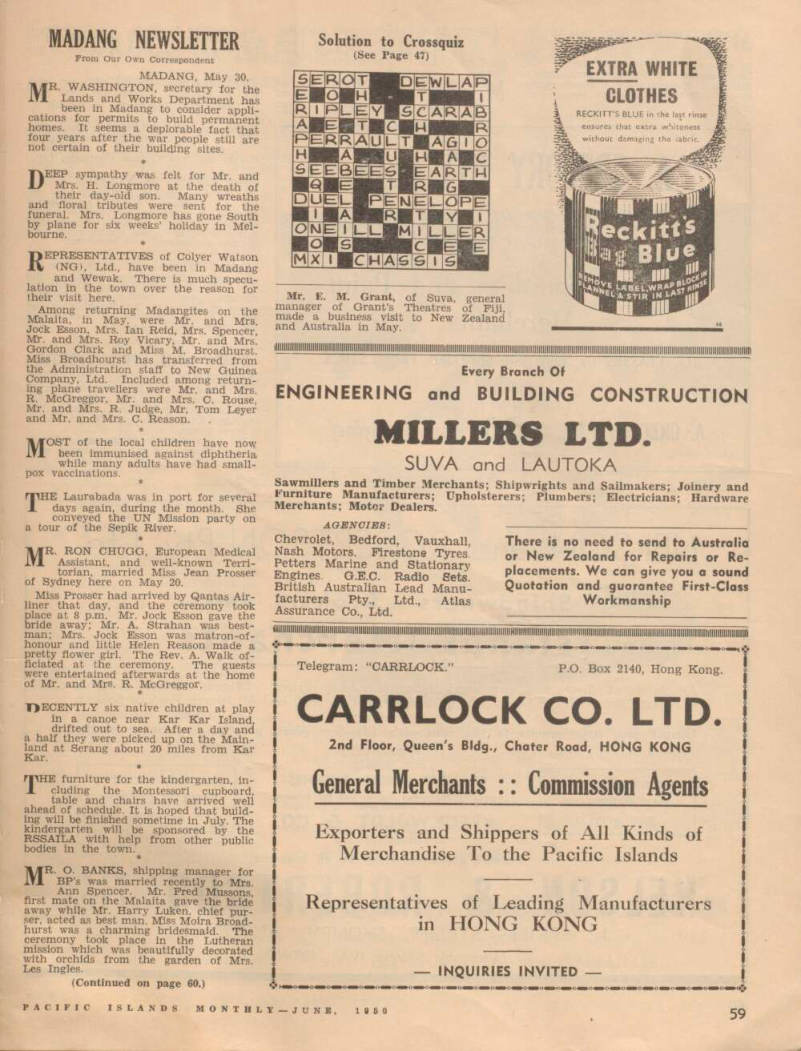
From Our Own Correspondent
Madang, May 30.
MR. WASHINGTON, secretary for the Lands and Works Department has been in Madang to consider appli cations for permits to build permanent homes. It seems a deplorable fact that four years after the war people still are not certain of their building sites. * DEEP sympathy was felt for Mr. and Mrs. H. Longmore at the death of their day-old son. Many wreaths and floral tributes were sent for the funeral. Mrs. Longmore has gone South by plane for six weeks’ holiday in Mel bourne. * Representatives of coiyer Watson (NG), Ltd., have been in Madang and Wewak. There is much specu lation in the town over the reason for their visit here.
Among returning Madangites on the Malaita, in May, were Mr. and Mrs.
Jock Esson, Mrs. lan Reid, Mrs. Spencer, Mr. and Mrs. Roy Vicary, Mr. and Mrs.
Gordon Clark and Miss M. Broadhurst.
Miss Broadhourst has transferred from the Administration staff to New Guinea Company, Ltd. Included among return ing plane travellers were Mr. and Mrs.
R. McGreggor, Mr. and Mrs. C. Rouse, Mr. and Mrs. R. Judge, Mr. Tom Leyer and Mr. and Mrs. C. Reason. * MOST of the local children have novr been immunised against diphtheria while many adults have had small pox vaccinations. * THE Laurabada was in port for several days again, during the month. She conveyed the UN Mission party on a tour of the Sepik River. * MR. RON CHUGG, European Medical Assistant, and well-known Terri torian, married Miss Jean Prosser of Sydney here on May 20.
Miss Prosser had arrived by Qantas Air liner that day, and the ceremony took place at 8 p.m. Mr. Jock Esson gave the bride away; Mr. A. Strahan was best man; Mrs. Jock Esson was matron-of honour and little Helen Reason made a pretty flower girl. The Rev. A. Walk of ficiated at the ceremony. The guests were entertained afterwards at the home of Mr. and Mrs. R. McGreggor. * T>ECENTLY six native children at play in a canoe near Kar Kar Island, drifted out to sea. After a day and a half they were picked up on the Main land at Serang about 20 miles from Kar Kar. * THE furniture for the kindergarten, in cluding the Montessori cupboard, table and chairs have arrived well ahead of schedule. It is hoped that build ing will be finished sometime in July. The kindergarten will be sponsored by the RSSAILA with help from other public bodies in the town. * MR. O. BANKS, shipping manager for BP’s was married recently to Mrs.
Ann Spencer. Mr. Fred Mussons, first mate on the Malaita gave the bride away while Mr. Harry Luken. chief pur ser, acted as best man. Miss Moira Broad hurst was a charming bridesmaid. The ceremony took place in the Lutheran mission which was beautifully decorated with orchids from the garden of Mrs.
Les Ingles.
(Continued on page 60.)
MADANG residents regret that Mr. Les Sharp has resigned from Works and Housing. He did a grand job in charge of the electricity supply. He has gone to Queensland permanently.
Mrs. Bill Passlow gave a dinner party to farewell him. About 20 guests were present.
ABOUT 26 children are now attending the European School. They range in age from five to 15 and the grades go from Grade 1 to Intermediate Stan dard. *
Mr. Phillip Brosgarth, At One
time in the Agricultural Depart ment in Madang, passed through
here on May 6. He has been transferred to Namatanai where he will be joined by his wife, whom we knew previously as our local school mistress. * SISTER Edyth McElnea who has been at the local hospital for some time has been transferred to Wewak. * MR, and MRS ANTHONY went south By plane on May 27 on well earned leave. Mr. Anthony is manager of Carpenters, New Guinea Company, Ltd. * THE RSSAILA entertained at an en joyable evening party on May 27.
A combined “racing” and dance evening, it attracted a crowd of about 150 and raised over £lOO. Spectacular prizes of crystal, linen, spirits, china and electric equipment were donated. * A MEETING was held on May 31 to in augurate a Madang group of the Arts and Crafts Society. During the evening, speeches were made by the «Di rector of Education, The President of the Society in Port Moresby and members of the community.
Advertisements & other items, pp. 61-62 (2 items)
Solution to Crossquiz
(See Page 47)
Mr. E, M. Grant, of Suva, general manager of Grant’s Theatres of Fiji, made a business visit to New Zealand and Australia in May.
Carrlock Co. Ltd.
EXTRA WHITE
CLOTHES
RECKITT'S BLUE in the last rinse ensures that extra whiteness without damaging the iabric.
Every Branch Of
ENGINEERING and BUILDING CONSTRUCTION
MILLERS LTD.
SUVA and LAUTOKA
Sawmillers and Timber Merchants; Shipwrights and Sailmakers; Joinery and Furniture Manufacturers; Upholsterers; Plumbers; Electricians; Hardware Merchants; Motor Dealers.
AGENCIES:
Chevrolet, Bedford, Vauxhall, Nash Motors. Firestone Tyres.
Fetters Marine and Stationary Engines, G.E.C. Radio Sets.
British Australian Lead Manufacturers Pty., Ltd., Atlas Assurance Co., Ltd, There is no need to send to Australia or New Zealand for Repairs or Replacements. We can give you a sound Quotation and guarantee First-Class
Workmanship
Telegram: “CARRLOCK.” P.O. Box 2140, Hong Kong.
CARRLOCK CO. LTD.
2nd Floor, Queen's Bldg., Chafer Rood, HONG KONG
General Merchants :: Commission Agents
Exporters and Shippers of All Kinds of Merchandise To the Pacific Islands Representatives of Leading Manufacturers
in HONG KONG
INQUIRIES INVITED
A. GREGORY PTY, LTD.
IMPORTERS, EXPORTERS AND
MANUFACTURERS
Leather Saddlery and Paint Merchants ALL CLASSES OF LEATHER SUPPLIED FROM STOCK Apply direct to: A. GREGORY PTY., LTD., 107 York St., Sydney
Monsieur louis . juventin,
Death Of M. Louis Juventin
prominent and respected engineer of Papeete, Tahiti, and a member of a well-known pioneer French family, died on April 9 in the Colonial Hospital after a long illness.
He is survived by numerous children, grandchildren and other relatives, most of whom live in French Oceania.
Advertisements & other items, p. 62 (1 item)
Nelson & Robertson K 5
NELSON and ROBERTSON Pty. Ltd.
Established 1895
Shipowners - Brokers and
Islands Merchants
All classes of Merchandise purchased at Best Wholesale Prices. Original Invoices supplied to Island Clients. Cocoa Beans, Copra, Rubber, Trochus Shell and All Isjands Produce Sold on Commission.
Entrust your requirements to the firm with fifty-five years' practical experience in the Pacific Islands.
Sole Agents'.
NELSON & ROBERTSON K 5
12 SPRING STREET, SYDNEY, AUSTRALIA
Telegraphic Address: IVAN, SYDNEY.
Changes In Papua N. Guinea
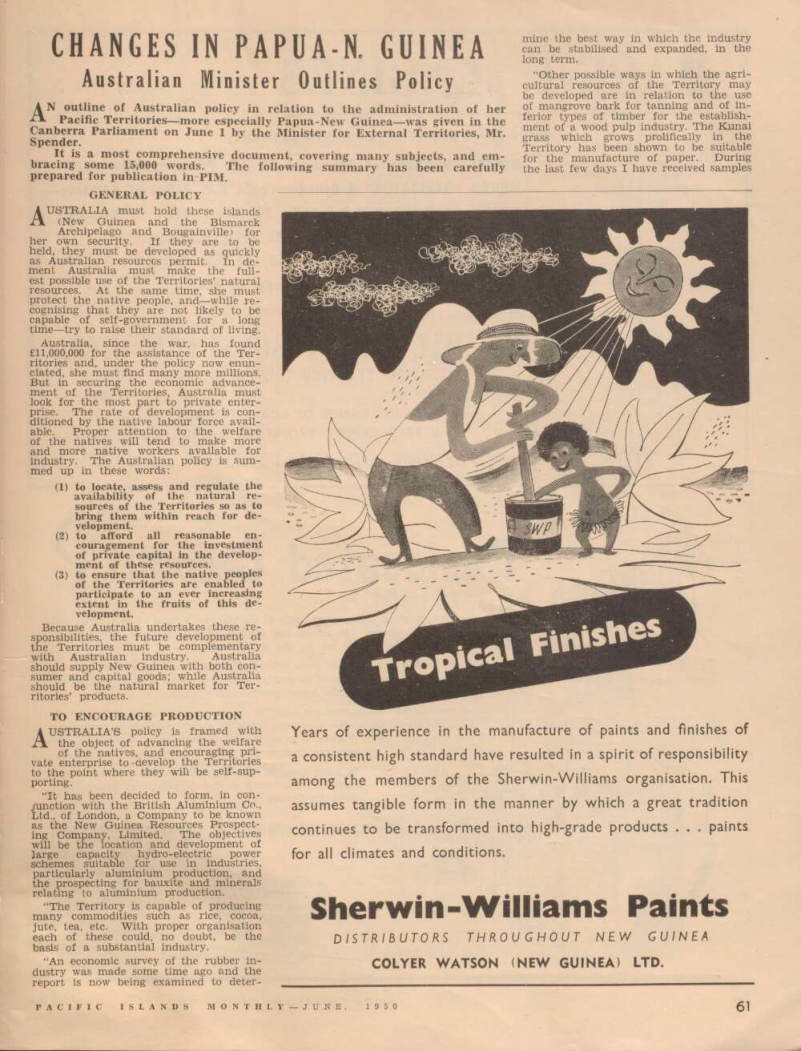
Australian Minister Outlines Policy
AN outline of Australian policy in relation to the administration of her Pacific Territories—more especially Papua-New Guinea—was given in the Canberra Parliament on June 1 by the Minister for External Territories, Mr.
Spender.
It is a most comprehensive document, covering many subjects, and em bracing some 15,000 words. The following summary has been carefully prepared for publication in PIM.
General Policy
AUSTRALIA must hold these islands (New Guinea and the Bismarck Archipelago and Bougainville) for her own security. If they are to be held, they must be developed as quickly as Australian resources permit. In de ment Australia must make the full est possible use of the Territories’ natural resources. At the same time, she must protect the native people, and —while re cognising that they are not likely to be capable of self-government for a long time—try to raise their standard of living.
Australia, since the war, has found £11,000,000 for the assistance of the Ter ritories and, under the policy now enun ciated, she must find many more millions.
But in securing the economic advance ment of the Territories, Australia must look for the most part to private enter prise. The rate of development is con ditioned by the native labour force avail able. Proper attention to the welfare of the natives will tend to make more and more native workers available for industry. The Australian policy is sum med up in these words; (1) to locate, assess and regulate the availability of the natural re sources of the Territories so as to bring them within reach for de velopment. (2) to afford all reasonable en couragement for the investment of private capital in the develop ment of these resources. (3) to ensure that the native peoples of the Territories are enabled to participate to an ever increasing extent in the fruits of this de velopment.
Because Australia undertakes these re sponsibilities, the future development of the Territories must be complementary with Australian industry. Australia should supply New Guinea with both con sumer and capital goods; while Australia should be the natural market for Ter ritories’ products.
To Encourage Production
AUSTRALIA’S policy is framed with the object of advancing the welfare of the natives, and encouraging pri vate enterprise to -develop the Territories to the point where they will be self-sup porting.
“It has been decided to form, in con junction with the British Aluminium Co., Ltd., of London, a Company to be known as the New Guinea Resources Prospect ing Company, Limited. The objectives will be the location and development of large capacity hydro-electric power schemes suitable for use in industries, particularly aluminium production, and the prospecting for bauxite and minerals relating to aluminium production.
“The Territory is capable of producing many commodities such as rice, cocoa, jute, tea, etc. With proper organisation each of these could, no doubt, be the basis of a substantial industry.
“An economic survey of the rubber in dustry was made some time ago and the report is now being examined to deter
mine the best way in which the industry can be stabilised and expanded, in the long term.
“Other possible ways in which the agri cultural resources of the Territory may be developed are in relation to the use of mangrove bark for tanning and of in ferior types of timber for the establish ment of a wood pulp industry. The Kunai grass which grows prolifically in the Territory has been shown to be suitable for the manufacture of paper. During the last few days I have received samples
of paper made from that grass from the Northern District of Papua. The extent to which these may lead to profitable commercial projects, however, remains to be tested . . .
“The technical staff will carry out in vestigations to determine whether such minerals as asbestos, chromite, platinum, etc., exist in the Territory. There are known deposits of sulphur, copper and manganese and examination will be made as to their extent.
“The Government has appointed a Ministerial Standing Committee, com prising the Minister for External Terri tories, the Treasurer, the Minister for Commerce and Agriculture and the Minister for National Development to assist in the preparation of material for the consideration of the Government. Also, Mr. John Howse, MP, has been appointed Parliamentary Under-Secretary to assist the Minister for External Territories.”
Shipping
THE previous Government’s plan to keep all competition away from the organisation it set up to carry on shipping and stevedoring in Territories ports has been abandoned. Any vessel may engage in the carrying business; stevedoring is now open to private en terprise; and it is proposed to hand over all the Territories’ shipping services to private enterprise.
Timber Industry
“T> ecognising the importance of XV timber supplies for practically all activities in the Territory, it has been determined that there should be a vigorous forest policy for the Territory on the following lines: — (1) An orderly development of a timber industry in the Territory on sound forestry principles, with provision for re-afforestation of all areas to the satisfaction of the forestry officials of the Ter ritory. (2) As a general rule, rights to forest areas may be obtained only as the result of public tender, and in respect of areas that have been designated by forest officials of the Territory. There will, however, be exceptions to this general rule so as to meet the requirements of the Territory, and the Administrator will bq authorised to grant timber rights over stands of timber not ex ceeding 5 million super feet, without tender, where the timber is for Territory use and not for export, unless so authorised by the Administrator. Such timber rights are, however, to be re garded as emergency measures and will be limited to a period of ten years. (3) To meet local requirements in Districts adjacent to timber sup plies (for example the Sepik Dis trict) the Administrator will be empowered to issue to sawmillers authority to secure from natives logs that will be used to supply timber for the District itself. (4) Royalty will be payable to the Administration on all timber cut.
“The Bulolo pine stand, and such other areas as are declared by notice in the Gazette, will, however, require special consideration. The previous Government tentatively decided that the Bulolo pine stand should be developed for the pro duction in the Territory of plywood, veneer and timber, by a joint Company to be formed by the Commonwealth Gov ernment in conjunction with Bulolo Gold Dredging Company. This proposal is being re-examined ’ - the Government which has appointed a Committee under
the Chairmanship of Mr. G. J. Rodger, Commonwealth Director-General of Forestry, to advise whether this or some other method would ensure that the pine stand is used to the best advantage . . .
“An increased staff of trained foresters will be required and steps are being taken with a view to securing such personnel.”
At present, native labourers are trans ported long distances. It is hoped, as development proceeds, to allow them to engage in employment near their home villages.
War Damage Payments To
Natives
THE Minister said that £960,000 already has been distributed among natives as “war damage compensation,” and
that a further amount of £1,230,000 re mains to be distributed, making a total estimated cost of £2,230,000. (This money
does not come out of the War Damage Compensation Fund, which provided £9,000,000 for the compensation of Euro peans and Asiatics, but directly out of the pockets of Australian taxpayers. It was one of the pet schemes of the for mer Minister, Mr. Ward).
Mr. Spender said that he had been given information to show the harmful effect of these payments upon the natives and upon the Territory’s economy generally. Much of the money had been literally wasted. He proceeded:
“Steps are, therefore, being take to protect the interests of the natives by paying into a Savings Bank Account all monies payable to them in excess of a small amount. Withdrawals from these Accounts would be permitted only on the authority of a District Officer who will see that the sums withdrawn are ap plied for the purpose for which they are intended, namely, the replacement by the native of goods and effects lost during the war period; or to enable him to purchase other classes of goods that would assist his rehabilitation.
“It is abundantly clear that handouts of money is not the best way to advance the interests of the native and make him a responsible person.
“Such easy money can be positively de moralising and prevent the native from realising that it is only by his own ef forts and enterprise that he can improve his status and standard of living.”
Health And Education
THE importance of measures to con serve and improve the health of the natives was emphasised at length, and the Minister said: “The Director of Public Health has strongly represented that at least 76 hos pitals are needed to give a minimal op timum service to the Territory. It should be remembered that the Territory has an area about two and a quarter times the size of Victoria and an estimated popu lation of over 1,500 000.
“In addition, tuberculosis and leprosy hospitals, a mental asylum and bulk stores are required. It is estimated that the cost of such a programme will be in the vicinity of £7,000,000.
“A Committee including the Director of Public Health (Dr. John Gunther), Dr.
W. Kirkland (School of Public Health and Tropical Medicine) and Dr. T. Bren nan (formerly Director of Public Health of the Territory) will very shortly make a full investigation of these requirements.
“Immediate requirements are base hos pitals and medical training establish ments at Port Moresby and Lae, and tenders for these will be invited as soon as the necessary technical details can be determined with a view speedily to pro vide these essential institutions.
“In association with the hospital at Port Moresby there will be a Central Medical School, on the lines of Central Medical School at Suva, at which natives will be trained to be Assistant Medical Practitioners.
“The recent arrival in the Territory of 38 New Australian medical practitioners has greatly improved the staffing posi tion so that, now, every District has at least one Medical Officer. Such increase in staffing has allowed an expansion of the infant and maternal welfare work and for investigation to be made into areas where there is either a high infant death rate, or a low birth rate, with depopula tion.”
An education programme, designed to become fully operative over a period of five years, has been prepared and is be ing examined. The need for a wide spread plan of simple education was stressed, as being fundamental in any plan for the improvement of native stan dards of life.
The Minister dealt with the need for better educational facilities for the children of Europeans and Asiatics. It was hoped to make secondary education available through the establishment of a secondary school at Wau.
It was intended, wherever possible, to integrate the health and education ser vices of the Missions with those of the Administration.
New Public Works
IT is intended to continue and develop the scheme under which the Aus tralian Department of Works and Housing becomes the constructional authority in Papua and New Guinea.
Greater use will be made of private con tractors.
Contract has been let for a wharf at Samarai; tenders for a wharf at Madang are being examined; tenders for a new wharf at Port Moresby will be called shortly; a new wharf is being construc ted at Lae. All these things will cost £700,000.
Major works to be undertaken include the rebuilding of Port Moresby; the building of Lae; the building of a town to take the place of Rabaul; the com pletion of the Lae-Bulolo road; and hydro-electric installations at Port Moresby, and elsewhere.
Other works planned include houses, schools, hospitals, offices, etc.
For administrative purposes, Rabaul will be abandoned, and a town built at Kokopo, 20 miles away. The cost of clearing, building, sanitation, water and electrical services, roads and wharves, was estimated at £5,000,000. As some years will elapse before the new town is built, Rabaul will be occupied tempor arily. The vulcanological observatory at Rabaul is being re-established, and a vulcanologist took up duty in Rabaul in April.
Rabaul is such an important port that something had to be done to counter wartime destruction of harbour works.
Wharves will be maintained temporarily, and three Philippines lighters, purchased to provide wharfage and storage, arrived in Rabaul on May 27.
Qantas will be encouraged to improve and extend their air services; and pri vate air operators will be encouraged, also, to establish and expand air services.
Administration
THE Government is not satisfied with the provision made in the 1949 Act for the establishment of a Legis lative Council. It does not like the pro posed composition. It is being further examined.
Meanwhile, it is proposed to set up District Advisory Councils, nominated by the Administrator, to assist the District Officers —whose status and power will be improved, and who will be called District Commissioners.
Wider powers will be given the Admini strator. Instead of submitting to the Minister any expenditure over £5,000, the Administrator now will himself deal with all items under £15,000. Heads of De partments will have wider authority. Two officers in distant parts of the Territories will be given wider powers, and called Deputy Administrators.
There will be exchanges of officers, for purpose of experience, with the British Colonial Office and the New Zealand Government. Technical officers will be sent overseas for training.
A new classification of the Territories Public Service, making provision for 1,600 officers, should provide better salaries and
living conditions for personnel. The prob lem of providing suitable accommodation remains—material is unavailable and construction is slow. Construction of 62 houses and single accommodation for 60 officers in Port Moresby has been author ised. Construction will be accelerated.
Native Labour
WHILE accepting "the abolition of the indentured labour system as desir able, the Government believes that some form of written agreement, cover ing the labour contract, and regulating recruitment and employment, is neces sary; and an Ordinance providing for the “Native Employees’ Agreement” will come into operation about the end of the year. The present Native Labour Ordi nance will continue in operation in the meantime. Under the NEA, the maxi mum period of employment will be 18 months, with provision for an extension of six months, in certain circumstances.
But the native must be repatriated at the end of two vears. The existing arrange ment, under which natives may be em ployed in certain circumstances—as, for example near his home village—will be continued.
The Department of Native Labour will be wiped out, and the Department of District Services and Native Affairs will become responsible for proper supervision of native labour.
Customs Tariff
ONE tariff will serve Papua and New Guinea. It will be revised, to re duce the cost of living and en courage developmental industries.
Copra Production
THIS important pronouncement is re ported fully, as follows: “As part of the post-war market ing arrangements for Territory copra, an agreement was entered into by the pre ceding Government with the United Kingdom Ministry of Pood for the pur chase by the latter of the entire Terri tory output of this commodity that is surplus to Australia’s requirements for home consumption. This agreement is for a period of nine years commencing on March 1, 1949.
“No useful purpose would be served at this stage by reviewing the terms of this agreement. The contract exists and the present Government is bound by its terms. ‘ While the prices obtained under that agreement are lower than those which have since become obtainable on the so called free markets in other parts of the world, the important feature which the agreement had in mind was no doubt that it assured, for the Territory copra in dustry, a stability of price at payable levels which has hitherto been entirely lacking, and without which the industry would be unable to plan its operations with any degree of confidence.
“Even before this agreement had been entered into, the need for securing some measure of stability for this vital Terri tory industry had been recognised, and it had been decided to take advantage of the high level of post-war prices to establish a stabilisation fund which could be used for the purpose of supporting prices at payable levels in the long term.
“Contributions to this fund are ob tained through a lew imposed on all copra exported from the Territory. The rate of levy is at present fixed at £5 per ton, and the amount now held in the Fund is approaching £700,000.
“During my recent visit to the Terri tory, divergent views were expressed as to whether, in view of the security af forded to the industry by the agree ment with the United Kingdom, there is continued need for this Fund. However,
after a review of the matter, this Goveminent feels that the agreement does not in itself provide the full measure of stability that is so important to this vital Territory industry, and it has therefore been decided that stabilisation must continue.
“Investigations are now being made as to the basis upon which contributions are to be levied in future, and as to the man ner in which the fund is to be admini stered so as to ensure to producers a reasonable price level for the long-term future. Decisions in these matters will
be taken in consultation with the producers who will also be represented on the authority that is set up to control and administer the fund.
“One other matter which has come under review ... is the price at which the Territory is supplying this commodity to Australia There was reserved out of the quantities sold to United Kingdom Ministry of Food under the 1949 agreement, sufficient copra to meet Australia’s requirements for internal consumption.
At the same time the previous Government decided that this copra would be supplied to Australia at prices equiva-
lent to those ruling under the United Kingdom Agreement.
“The effect of this arrangement is that the Australian crushers, while enjoying the full benefit of the favourable prices which are at present operating under the Agreement, are in no way bound by its other terms and, consequently, are under no obligation to continue purchasing their requirements from the Territory at the Agreement price, should any general fall in prices enable them to obtain their copra requirements from other and cheaper sources of supply.
“This aspect of the matter is at pre-
sent under examination and it is my intention to set up committees to assist in the determination of this matter and in the formulation of details of a scheme of stabilisation of the industry, including the ultimate destination of the amount of approximately £700,000 which is now held as a result of the levy that has been imposed upon the export of copra since December, 1946. Such Committees will comprise representatives of the interests involved as well as Government officials.
“As regards future marketing arrange ments, the Australian New Guinea Pro duction Control Board was never in tended to function as a permanent mar keting authority, and it is intended that as soon as possible the responsibility of the marketing of Territory copra will re vert to private enterprise, subject to such restrictions as are necessary to allow the Government to carry out its obliga tions under the United Kingdom Agree ment and to ensure that the interests of all producers in the Territory continue to be safeguarded. Negotiations to this end are now in progress with Companies and organisations likely to be interested in the marketing of Territory copra under these conditions.
“Pending the termination of the Board’s activities, producers will be given representation on the Board which at present comprises only Government of ficials.”
Land And Settlement
LAND conditions will be reviewed, so as to encourage persons to settle in the Territory. Inquiries will be made to ascertain what lands can be made available without in any way prejudicing the rights and the future of the natives.
A scheme of land settlement for ex servicemen is now under consideration.
Some Expro properties will be. made available for purchase by ex-servicemen at an early date.
Care of the natives THIS is regarded as a first plank in policy.
Loss of experienced administrative personnel has been a serious factor.
Special steps are to be taken for the training of personnel at the School of Pacific Administration, in Sydney.
Uncontrolled areas are to be reduced.
It is proposed to bring all areas under control and administration within five years.
While making highland natives avail able for labour contracts in coastal areas, great care is being taken to safeguard their health. They are carefully selected; their eventual employment is supervised; they undergo special medical examina tions and vaccination against TB, typhoid and other diseases. District Officers will provide facilities by which highland vil lage chiefs can visit their men in their places of employment.
Defence
THE New Guinea Volunteer Rifles will be re-established. Rifle clubs will be encouraged. A native Panua-New Guinea division of the Australian Navy will be recruited. Steps will be taken to keep the Territories free from subver sive influences.
Finance And Taxation
BY June 30, 1950, Australia, since the war, will have spent on the Terri tories £14,500,000, less . about £4,000,000 raised in local taxation.
Hospitals demand another £7,000,000, a town to replace Rabaul, £5,000,000.
Much other expenditure is foreseen. A special developmental loan accordingly is being considered. The Minister pro ceeded: “It is intended also that the share of the cost of Administration of the Ter ritory borne by the residents should be fully examined.
“At the present time residents of the Territory are not subject to Common wealth Income Tax nor is there any direct Territorial taxation. There is, however, a Territorial Customs Tariff, under which import and export duties are levied, and there is a royalty of five per cent on gold produced. There are also various fees and levies collected by the Administration in connection with min ing, lands and other operations.
“Further, it is considered that bank finance should be available to assist pri vate persons and companies who wish to settle in the Territory, and the means of doing this will be investigated in consul tation with the Commonwealth Bank and other banking institutions. This it is considered will be a most important fac tor in the future development of the Ter ritory as it is necessary both for the advancement of the native inhabitants and the Territory generally that the Aus tralian population in the areas should be augmented as much as possible.”
Mr. W. A. Freeman, who has been chairman of Bulolo Gold Dredging, Ltd., since its inception, resigned that position as from May 31, but retains a seat on the Board. Hon Charles A. Banks, CMG, from the same date, resigned as manag ing director and is now chairman of directors. Mr. F. W. R. Godden, formerly director and general manager, has been appointed managing director, in succes sion to Mr. Banks.
Evidently of the opinion that it is high time New Caledonia grew enough rice to feed her population, instead of relying on Australia, the Governor has taken steps to encourage planters by stabilising price conditions. Before the war, too lazy to grow their own rice, the Caledonian French largely left what culture there was to the Japanese.
Advertisements & other items, pp. 63-72 (2 items)
ish&i
m m m m m
Years of experience in the manufacture of paints and finishes of a consistent high standard have resulted in a spirit of responsibility among the members of the Sherwin-Williams organisation. This assumes tangible form in the manner by which a great tradition continues to be transformed into high-grade products . . . paints for all climates and conditions.
Sherwin-Williams Paints
DISTRIBUTORS THROUGHOUT NEW GUINEA
COLYER WATSON (NEW GUINEA) LTD.
MARINE ENGINES
HALVORSEN’S HAVE FOR IMMEDIATE DELIVERY'.
MORRIS “VEDETTE” 4 Cylinder 6/12 H.P. Petrol or Kerosene MORRIS “NAVIGATOR” 4 Cylinder 12/24 H.P. Petrol or Kerosene MORRIS “COMMODORE” 6 Cylinder 20/40 H.P. Petrol or Kerosene CHRYSLER “CROWN” 6 Cylinder 45/102 H.P. Petrol CHRYSLER “ROYAL” 8 Cylinder 55/132 H.P. Petrol “LEYLAND” DIESEL MARINE 6 Cylinder 85 H.P.
Further particulars from the distributors'.
LARS HALVORSEN SONS PTV. LTD.
WATERVIEW ST., RYDE ( B gS? w “ ), N.S.W.
Telegrams: Halvorsens, Sydney. ’Phone: Ryde 705
• LARGE RANGE OF BOAT FITTINGS
• FREE EXPERT PROPELLER ADVICE
BUILDERS OF HALVORSEN BOATS
THE "IZOD*
COCONUT PARER
THE 'CHULA"
COCONUT
DISINTEGRATOR
THE "CHULA-
DESICCATED COCONUT
DRYER
9)
Desiccated Coconut f
• This Is the product which uses every particle of the coconut, without waste —the kernel becomes desiccated coconut, the parings are dried to recover their oil content, and even the husks and shell provide fuel for the drying fires.
The machines here illustrated have been specially designed to carry out the various processes in the making of desiccated coconut in such a way as to produce a product of the highest possible quality at the lowest possible cost per ton.
Further, as the "Chula” Dryer produces 1,500 lbs. of desiccated coconut per 10 hour day, it is not too big for the smaller plantation, while the owner of the large plantation will still find it an economical proposition to instal a battery of "Chula” dryers, with the necessary number of parers, disintegrators and sifters.
By using Tyneside Foundry machines, you can vary your outlay on machinery to match your crop production.
Write for further details TO-DAY!
TYNESIDE FOUNDRY & ENGINEERING CO. LTD.
ELSW I C K
THE “CHULA”
DESICCATED COCONUT
SIFTER
NEWCASTLE
UPON TYNE
ENGLAND
Established 1898.
Telegrams & Cables :
“FOUNDRY
NEWCASTLE-ON-TYNE "
Codes : ABC. sth Sc 6th Edna,
PHOTOGRAPHS
South Pacific Conference and of Separate Delegations 10 in. x 8 in., Unmounted, 5/-. 10 in. x 8 in., Mounted, 7/6. 20 in. x 16 in. Mounted and Framed, complete with names printed, £5/5/-.
Packing and Postage .Free.
CAINE'S STUDIOS,
Suva, Fiji
William E. Reed
(Established 1913) Island Trade Broker & Commission Agent 145 a GEORGE ST., CIRCULAR QUAY, SYDNEY For more than 36 years the PERSONAL buying services of WILLIAM E. REED, backed by an experienced staff has ensured prompt and reliable service at lowest cost to Missions, Planters and Traders throughout the Pacific. We operate on a WHOLESALE basis only. You receive original invoices at invoiced cost.
Purchase and delivery of Island craft a speciality.
Enquiries invited for all plantation and trading requirements. Island products sold on a commission basis.
Cables: "WILREED," Sydney
Pimples and Bad Skin Attacked In 24 Hours
Since the discovery of Nlxoderm, the scientific medicine, it is no longer necessary for anyone to suffer from ugly, disgusting and disfiguring skin blemishes such as Pimples, Rash, Ringworm, Psoriasis, Acne, Blackheads, Scabies and Red Blotches. Don’t let a bad skin make you feel inferior and cause you to lose your friends. Clear your skin this new scientific way.
A New Discovery
Nixoderm is an ointment, but different from any ointment you have ever seen or felt. It is a new discovery, -and is not greasy but feels almost like a powder when you apply it. It penetrates rapidly into the pores and fights the cause of surface skin blemishes.
Nixoderm contains 9 ingredients which fight skin troubles in these 3 ways: X.
It fights and kills the microbes or parasites often responsible for skin disorders. 2. It stops itching, burning and smarting in 7 to 10 minutes, and cools and soothes the skin. 3. It helps nature heal the skin clear, soft and velvety smooth.
Works Fast
Because Nixoderm is scientifically compounded to fight skin troubles, if works fast. It stops the itching, burning and smarting in a few minutes, then starts to work immediately, clearing and healing your skin, making it softer, whiter and velvety smooth. In
just a day or two your mirror will tell you that here at last Is the scientific treatment you have been needing to clear your skin—the treatment to make you look more attractive, to help you win friends. Nixoderm has brought clearer, healthier skins to thousands such as Mr. Bob Weedon, Edmund Street, Fremantle, who writes : “I Was troubled with pimples ever since I was 13, and have spent pounds and pounds on so-called cures without results. I then tried Nixoderm with astounding effect. The pimples seemed to fade away, and after a week there was not the slightest trace of them.”
Satisfaction Guaranteed
Get Nixoderm from your chemist or store to-day. Look in the mirror in the morning and you will be amazed at the improvement. Then just keep on using Nixoderm for'one week and at the end of that time it must have made your skin soft, clear, smooth and magnetically attractive—must give you the kind of skin that will make you admired wherever you go, or you simply return the empty package and your money will be refunded in full. Get Nixoderm from your chemist or store to-day. Th<guarantee protects you.
Nixoderm
For Skin Sores, Pimples and Itch.
m
WHITE SATIN
C IN
I i :
WHITE SATIN
NOTICE
IS HEREBY GIVEN
that the labels shown in the margin hereof are now the exclusive property and proper TRADE MARKS of
THE UNITED DISTILLERS
PROPRIETARY LIMITED,
of Byrne Street, South Melbourne, Victoria, Australia, Diistillejrs; used by them in respect of
WHISKY,
BRANDY, GIN and
RHUM,
and the Trade and Public are hereby cautioned against any infringement or improper use of the same.
Legal proceedings will be instituted against any person or persons selling or offering for sale goods, not the manufacture of the aforesaid The United Distillers Proprietary Limited, bearing any representation of either of the said Trade Marks or any colourable imitation thereof.
EDWD. WATERS &
SONS
Patent and Trade Mark Attorneys, 432-438 Collins Street, Melbourne, Victoria, Australia.
m*. m m y
WHITE SATIN GIN
M/Mn.
I s' /■
WHITE SATIN
NOTICE
est donne ci-dessous que les etiquettes montrees dans la marge de celui-cl sont maintenant I’exclusive propriete et les vraies
MARQUES DE FABRIQUES
de la UNITED DISTILLERS
PROPRIETARY LIMITED,
de Byrne Street, South Melbourne, Victoria, Australia, Distilleurs; employes par eux en ce qui concernent
WHISKY,
BRANDY, GIN et
RHUM,
et I’lndustrie et le Public sont prevenus par cette annonce contre toute fraude ou abus de ces Marques.
Les precedes legaux seront instituees contre toute personne vendant ou offrant pour la vente, les merchandises qui ne sont pas factures par la-dite United Distillers Proprietary Limited, portan/t aucune representation de I’une ou I’autre de ces Marques de Pabriques ou aucune imitation specieuse de ces Marques.
EDWD. WATERS &
SONS
Patent and Trade Mark Attorneys, 423-438 Collins Street, Melbourne, Victoria, Australia.
Kidney Trouble Causes Backache, Puffy Ankles
If you're feeling out o-sorts, have Interrupted Sleep, or suffer from Dizziness, Nervousness, Backache Leg Pains, Swollen Ankles, Rheumatism, Excess Acidity, or Loss of Energy and feel old before your time, Kidney Trouble is the true cause.
Wrong foods and drinks, worry, colds or overwork may create an excess of acids and place a heavy strain on your kidneys so that they function poorly and need help to properly refresh your blood and maintain health and energy.
Help Kidneys Scientific Way
It has been proven by scientific clinical tests that a quick and sure way to help the kidneys clean out excess acids and poisons is with a scientifically prepared prescription called
Cystex. Hundreds and hundreds of clinical records prove this.
No Benefit —No Pay
The very first dose of Cystex goes right to work helping youi kidneys remove excess acids Quickly, this makes you feel like new again. And so certain are the makers that Cystex will satisfy you completely they ask you to tx-y it under a money back guarantee. You be the judge. If not entirely satisfied just return the empty package and get youi money back.
Cystex costs little at chemists and stores and the money back guarantee protects you.
Cystex
for
KIDNEYS
BLADDER
RHEUMATISM
The Guaranteed Treatment
BURNS PHILP (SOUTH SEA) Go. Ltd.
Registered Office: SUVA, FIJI
Code Address: “BURNSOUTH”
ISLAND TRADERS AND SHIPOWNERS
General Merchants (Wholesale and Retail)
Shipping, Customs and General Agents
Representatives for :
QUEENSLAND INSURANCE CO., LTD. BURNS PHILP TRUST CO., LTD.
Distributing Agents for ;
SHELL COMPANY (P. 1.), LTD. FERGUSON TRACTORS STANDARD MOTOR CAR COMPANY CROSSLEY MARINE ENGINES
BRANCHES:
FIJI—
SUVA.
LKVUKA.
LAUTOKA.
LABASA.
BA.
SIGATOKA.
ROTTJMA ISLAND.
SAMOA—
APIA.
PAGO PAGO.
TONGA—
NUKUALOFA.
HAAPAI.
VAVAU.
Sydney Agents;
BURNS, PHILP & CO.. LTD.,
7 Bridge Street.
London Agents:
BURNS, PHILP & CO., LTD.,
35 Crutched Friars, E.C.3.
San Francisco Agents:
BURNS, PHILP CO. OP SAN FRANCISCO.
Matson Building, 215 Market Street.
NORFOLK IS.—
NIUE IS.—
the World.
TILLEY.. LAMPS
BURN ORDINARY KEROSENE
\ \V V ii x* o-
“THE QUEEN ” MODEL TLIO6
HEIGHT 2lf'. 300 CANDLE POWER
ALSO AVAILABLE “THE PRINCESS’’
HEIGHT I6£". 300 CANDLE POWER
Vu hours
/ D tl'nU B^ RO sENt
' 300 CMJDUE of
\ V 5% QJ & A
“THE VICTOR” MODEL KLBO
300 CANDLE POWER
BURNS 12 HOURS ON
I \ PINTS OF KEROSENE
REPRESENTATION :
MELBOURNE: T. H. Bentley, Pty. Ltd., 123-125 William Street, Melbourne, Cl.
TASMANIA : Mr. H. V. Sellers, 108 a Charles Street, Launceston.
FIJI : Mr. K. Witherington, 2 Burns Philp Buildings, Suva.
LIGHTING PLANTS
32 VOLT AND 110 VOLT PLANTS, COMPLETE WITH
BATTERIES
VENTURA TRADING COMPANY PTY. LTD.
26 BRIDGE ST.. SYDNEY, N.S.W.
Cables: “Ventura,” Sydney, P. & R. HUTCHINSON, Suva. VENTURA TRADE AGENCY. Lae, T.N.G.
SIMPLEX MARINE ENGINES
The most popular engines in the South Pacific L SIMPLEX 3 H.P. engine is the most popular engine for 14 and 16 ft. open boats. Has waterproof enclosed impulse starter magneto, all bronze marine carburettor, plate clutch running in oil, SKF thrust race and is supplied complete with all equipment, including stern gear and tank. At £49/10/-, this engine is the best value anywhere in the world. Simplex engines are guaranteed for 12 months.
The Simplex 3 H.P.
Illustrated is the 5 H.P. model for direct drive.
Also available, with plate clutch or with builtin reverse gear, the Simplex 5 is a wonderful power unit for 18 and 20 ft. heavy cabin boats. Heavy duty construction, precision engineered, 4 cycle efficiency. Over 2,000 of this model have been supplied during recent years and never a dissatisfied owner.
A *23 —J The Simplex 10/12 H.P.
The Simplex 5 H.P.
The Simplex 10/12 H.P. twin cylinder is an exceptionally heavy duty engine suitable for commercial or fishing boats, or for heavier motor cruisers. This wonderful power unit will work day-in day-out without effort. It is the standard power unit in small craft of the Australian Navy.
Not illustrated, but available for immediate delivery, is the Simplex 4-cylinder marine engine. This is a modern efficient engine, 20 H.P., complete with built-in reverse gear and electric starter and generator. This unit is priced at only £2lO, and is the ideal engine for better-class motor launches Illustrated specifications available for all models. Please write for details Available from dealers in all centres or from
w. KOPSEN & Co. Pty. Ltd.
376-382 KENT ST., SYDNEY.
Cables: “Kopsen,” Sydney.
GEORGE KUI
Specialist in ladies’ and gentlemen’s wear, Eastern fancy goods, embroidered silk wear, embroidered linen table sets, carved camphorwood trunks, cane furniture, curios and general merchandise, etc.
LARGE SHIPMENT AND VARIETY ARRIVES WITH
EVERY HONG KONG BOAT
GENERAL MERCHANT & IMPORTER
Always Prompt New Chinatown, corner of Main Street, Attention and Service. RABAUL, New Guinea.
A. H. BUNTING LIMITED
SAMARAI PAPUA
SAMARA I AGENTS FOR:
Vacuum Oil Co. Pty., Ltd.
South British Insurance Co.
National Mutual Life Association
SOLE AGENTS IN PAPUA/NEW GUINEA FOR;
Polarizers (U.K.), Ltd.—Polaroid Sun Glasses.* C.S.A. Industries Eng.— Dual Freeze Refrigerators.
Webley & Scott, Ltd.—Shot Guns, Air Pistols, etc.
Le Bryan Group Products (Great Britain) Ltd. —Powermaster Electric Refrigerators, “Getula.”—Nylon Monofilament Fish Lines. • Trade mark patented In U.S.A., Great Britain, and other countries.
REGULAR SUPPLIES OF EASTERN GOODS
WHOLESALE & RETAIL MERCHANTS IMPORTERS PLANTERS
m m
Mom
when asked his greatest foe, Replied; "The only enemy I know And fear, is he who comes with sleet and snow — Midwinter.”
So now when in his strength and might That foe sweeps on us swift to smite.
We seek protection where ’tis sure.
By using Woods’ Great Peppermint Cure.
IMPORTERS
EXPORTERS
All classes of merchandise purchased for Island clients throughout the South-west Pacific.
Island produce sold on Australian and overseas markets on a commission basis.
54a Pitt Street
Sydney
Cable Address: “ROBERGILL,” Sydney
Better for School Books
They stand the rough and tumble. They're lighter and easier to carry.
Ask first for
SCHOOL CASES
- ma of gy
FORD SHERINCTON LTD.
WILLIAM A JONES PTY. LTD.
Livestock Exporters
Livestock Exported To All Ports Inquiries Invited Address:
108 QUEEN ST., MELBOURNE
Telegrams : "VALKYRIE,” Melbourne.
Box 3838 GPO, Sydney. Australia.
Cable Address, “Care” Sydney. m
ISLAND MERCHANTS
4 YORK ST., SYDNEY
All kinds Island Produce sold on commission. All merchandise purchased at best wholesale price and original invoices supplied.
Use our 50 years’ experience as Island Merchants.
68
JUNE, 1950 PACIFIC - ISLANDS MONTHLY
Tahiti Wants An Air
Service TOA and Air France Interested
IT was reported in Australian news papers in May that Trans Oceanic Airways, of Sydney, were then await ing a licence to operate a flying-boat service from Sydney to Tahiti, via Suva and Apia (Western Samoa).
This plan has been under consideration by TOA for a long time, but it has been consistently opposed by New Zealand, on the ground that Apia port is not suitab 1 e for operations by flying-boats of the Sandringham type.
As Apia was regularly used by flying boats in the war years, without apparent difficulty, the suspicion is entertained that New Zealand is trying to block this ex tension of Australian private aviation en terprise.
Tahiti is now the only important com munity in the South Pacific which still is denied the privilege of air transnort and airmails. Such privileges have been promised by French companies but they have not materialised, owing to lack of facilities along the route.
It is reported that the Australian com pany, Trans Oceanic Airways, has now been linked up in some way with the big British shipping firm known as the Clan Line.
Air France now is running big Douglas planes regularly between South-east Asia and Noumea, via Brisbane; and this ser vice is extended, on alternate arrivals, from Noumea to the New Hebrides, under TRAPAS direction; but neither Air France nor TRAPAS can yet undertake a regular service from Noumea to Tahiti.
However, there now is a reasonable prospect that Air Prance will begin the Noumea-Tahiti service in July or August.
It Was Love At First Sight!
TERRITORIANS in Australia at the end of May expressed themselves freely, and not respectfully, when the Sunday newspaper displayed a large photograph of a man whom they des cribed as a Papuan native, with an elderly European woman, and announced that they were to be married, and that it was “love at first sight”.
The prospective groom is Samuel Wilson, who says he is 63, came to Aust ralia to live some 50 years ago, served with the AIF in World War I, and is a war pensioner (gas) and a “missioner”.
The lady is Miss Ann Toney, 64, old age pensioner. Both of them live in South Brisbane. They were to marry on June 3.
They met in the street, according to the lady. Wilson said: “It was love at first sight. I had been praying to the Lord to send me a help-mate. When Ann stood in front of me, I thought, ‘She is mine’ . . . This marriage will be good for my people—to show them that a Papuan native can marry an Australian girl.”
Rather a silly newspaper stunt. For tunately Anno Domini removes a good deal of what Port Moresby might regard as social embarrassment.
The Rev. J, F. Goldie, who first went to BSI as a missionary in 1902 and is still living in New Georgia, has completed arrangements for the printing in Austra lia of the New Testament in the Roviana language. Mr. Goldie has also arranged for publication of a Roviana-English dic tionary and notes on Roviana grammar and a new and enlarged Roviana hymn book.
Introducing
Delana
Carpenters Suva Mills Produce Margarine With A ‘J’
INHERE was an air of festivity about . the Carpenter establishments in Suva on May 30. Not threats nor cajolings could remove the smile from the tenacious jaw of Managing Director “Tui” Johnson. For, at last, Delana had been born right and was behaving accord ing to specifications.
Delana is the trade name of Fiji marga rine, newest and most tricky product of the Carpenter copra-crushing mills, built in Suva since the war.
The mills, for a couple of years, have been producing and exporting coconut oil and coconut meal. It seemed a simple matter of technical skill and adaptation to produce margarine, now the world’s commonest alternative to butter.
But, somehow, the thing wouldn’t “jell.”
Carpenters knew that they must offer a first-class product if they were going to find a place in the market against very powerful competitors. Their machines were all ready to turn two or three months ago; but the heads were not satis fied.
“We can’t do, in the mass, what we do quite satisfactorily in the test-tube,” ex plained Mr. Johnson, with suitable ad jectives. “And we don’t know why.”
However, much midnight electricity was burned; the secret was discovered and Delana entered the market on June 1, with some drum-banging and no apologies.
On present indications, it looks as if Fiji will eat all the Delana that the mills can produce for a little while, but the manufacturers are out after the widest possible market.
They hope, reasonably enough, that this will be a new money-spinning industry for Fiji. Why ship the copra to distant lands, to be made into margarine, when the job can be done just as readily, in Fiji?
NOW, two more problems are brifiging furrows of care to the forehead of the managing director. How should they spell margarine in Fiji? And how ensure regular and adequate supplfes of the best copra?
The first question appears absurd. Why spell margarine with a J when the rest of the world uses a G? But it seems that margarine, spelt in Fijian, has a mean ing that brings a blush to the cheeks of simple persons of cleanly thought, where as marjarine has no blemish upon it.
So, to the irritation of advertisers, pub lishers, printers and lowly folk of that ilk, the Delana packets intended for Fiji consumption are labelled marjarine; but, outside Fiji, Delana is presented to the world, all starry-eyed and innocent, as margarine. An outstanding example of the knavery of these commercial classes!
The copra supply problem is a horse of a different colour. No innocence here — but plenty of chicanery.
Fiji produces a great deal of copra; the Carpenter mills naturally want good quality stuff, but there is a ferocious de mand for every bag of copra produced, good or bad. It is a trade in which no quarter is given, or expected. Carpenters, like everyone else, if they want copya, must go and get it . . . mostly across the water.
For years, Carpenters have had their copra freighted in on the small ships of competitors. As the competition grew, the difficulties of freighting on the other fel low’s ship increased. So the obvious has happened: Carpenters are buying their
own ships, for the freighting of their copra. One vessel already is in commis sion.
Nz Methodists Plan
Jubilee Cruise To Bsi
TO mark the 50th year of the Methodist Mission in the British Solomon Islands Protectorate the supporters of the mission in New Zealand may send a ship with 350 passengers on a cruise to BSI in May, 1952.
It was in 1902 that the Rev. J. F. Goldie and other Methodists opened a mission station in the New Georgia group. Mr.
Goldie is still at the Mission headquarters at Roviana (the area known as Munda during the Pacific war). Mrs. Goldie, who accompanied her husband to the BSI and was the only white woman in the group, died in Melbourne last year.
The ship that the Methodists have in view can accommodate 350 passengers in comfort and the cruise would occupy three weeks.
Ladies’ hairdresser, Miss Audrey Davis, who arrived in Port Moresby from Syd ney recently to take over Mrs. Baxter’s salon, married Mr. Bob Bright, of APC, in mid-June.
Advertisements & other items, pp. 73-74 (1 item)
Flour
FRANCIS HOOVER
4 Castlereagh Street, Sydney Cables: Petwer, G.P.O. Box 4623.
EXPORTERS
A!! classes of merchandise supplied. Careful attention given to big and small orders.
Flour
ASK FOR IT
ESTABLISHED 1868.
Coughing, Asthma, Bronchitis Curbed Quickly
Do you have attacks of Asthma or Bronchitis so bad that you can’t sleep?
Do you feel weak, unable to work, and have to be careful not to take cold and can’t eat certain foods?
No matter how long you have suffered or what you have tried, there is new hope for you in a doctor’s prescription called Mendaco. No dopes, no smokes, no injections, no atomiser.
All you do is take two tasteless tablets at meals and in three minutes Mendaco starts working through your blood, aiding nature to remove phlegm, promote free, easy breathing and bring sound sleep the first night so that you soon feel years younger and stronger.
No Asthma in 2 Years
Mendaco not only brings almost immediate comfort and free breathing but builds up the system to ward off future attacks. For instance, J.
Richards, Hamilton, Ont., Canada, had lost 40 lbs., suffered coughing every night, couldn’t sleep. Mendaco stopped
Asthma spasms first night and he has had none since in over two years.
Money Back Guarantee
The very first dose of Mendaco goes right to work circulating through your blood and helping nature relieve you of the effects of Asthma. Try Mendaco under an iron-clad money back guarantee. You be the judge. If you don’t feel fully satisfied after taking Mendaco just return the empty package and the full purchase price will be refunded. Get Mendaco from your chemist to-day and see how well you sleep to-night and how much better you will feel to-morrow. The guarantee protects you.
Mendaco
7a Va 7a ii* V % ' 1 r gSiffIPSS
SMi
a&ii ;* * ■ *.r *, /
BRONTE BRAND:
Chili Con Came Braised Steak and Onions Curried Beef Curried Mutton Steak and Onions Mutton and Peas Irish Stew Beef Steak Pudding Corned Beef Hash Corned Beef Loaf With Cereal Mutton Broth Mulligatawny Soup Tomato Soup Vegetable Soup
From
Australia’s
Finest Fat
Stock ...
From the finest fat stock and the rich-
est vegetables in Australia we produce
these high-grade canned meats and
soups* BRONTE BRAND meats,
hotmeals and soups are deliciously
flavoured and are made from
ONLY meats and vegetables
of the highest quality* * * * ♦ ★
THE COLONIAL WHOLESALE MEAT CO.
PTY. LTD.
Canning Factory, State Abattoirs, Homcbush Bay, Sydney.
N.S.W.
PHONE: UM 8436.
CABLE ADDRESS;
WOOLMILL. SYDNEY,
tfe- C A ti P 2* rtf co m at m
Rabaul Roundabout
From Our Own Correspondent
Rabaul, June 1, 1950
LAST month we reported the torrential rain which had virtually turned Rabaul into a quagmire. However, for the past three weeks, the “dry” has set in with a vengeance, and the township has changed to a dust bowl. The dust has the consistency of pepper—it lies inches deep and passing transport stirs it into huge clouds which float in the air and permeate everything. Those un fortunate enough to live fronting the roads have their homes, their furniture, meals, etc., covered with a thin film of dust. Mild epidemics of sore throats, heavy colds and dysentery are common. It is all due to the dust, it is commonly be lieved.
The majority of roads were sealed last year to prevent this dust hazard, and were quite effective. However, the torrential rains caused much damage to sealed roads that were used for heavy and con tinuous traffic; the lesser used sealed roads have stood up remarkably well. It is distressing for those affected by the dust nuisance, that all roads in the town area were never sealed. Doing so would, and still will, considerably reduce the dust hazard and resultant ill effects.
THE Supreme Court is at present sitting in Rabaul under Judge Kelly with Mr. O’Driscoll as crown prosecutor.
With the exception of two Chinese from Kavieng on trial the rest of the cases are natives under charge.
Judge Kelly was, before the war, a barrister and solicitor here. He was ap pointed to the Papua-New Guinea Judi ciary this year and has only recently re turned to Rabaul after an absence of about 12 years.
IT was reported last month that Mrs. B.
B. Perriman had departed for Aus tralia on leave. This announcement was somewhat premature, as Mrs. Perri man awaited the arrival of the Malaita and departed in company with her hus band, the well-known managing director of New Guinea Co. Mr. and Mrs. Perri man plan a trip to Canada, USA and England. Their departure was preceded by a round of parties both at Kokopo and Rabaul, given by their numerous friends and members of the staff.
Directors J. B. Sedgers and T. Thomsett are relieving in Mr. Perriman’s absence.
IN town over recent weeks, Mr. R. A.
Colyer and son, of Colyer Watsons.
Although nothing official has been announced, Mr. Colyer senior’s visit may well be in connection with reorganisation and expanding of business under the new Government’s policy in the Territory.
Mr. A. (Bert) Gaskin of the Cosmopo litan Hotel recently returned from a trip to Europe and the UK.
Brigadier brown of the imperial War Graves Commission recently naid a visit to Rabaul. For the bene fit of all interested, a screening of war grave films was carried out by the Briga dier at the RSL Club.
The War Graves Commission has the matter of graves for ex-Servicemen, monuments, etc., well in hand. Brigadier Brown did a thorough inspection of all areas and New Guinea residents may rest assured that his commission will carry out their job to the satisfaction of all relatives concerned.
THE local native market is still causing concern amongst Rabaul housewives.
Representations to the local District
Officer resulted in a marked improvement in some respects. Extra stalls have been provided but the main bone of conten tion still exists —that is, the exorbitant price of fruit and vegetables.
Egg prices vary with the mood of the native seller from 4d. to 6d. each, with the latter price predominating. Eggs, ex- Australia, can be purchased from the local freezers at 5/9 per dozen. As freight, duty and profit has to be allowed for in that case, one cannot understand why native eggs should be 6/- a dozen. Will we finally progress to the stage where it will be cheaper to import bananas from Queensland than buy them locally?
AT the recent general meeting of the Returned Servicemen’s Club, the Sub-Branch Committee stated that the venture was such a success that the resultant work involved was beyond the Committee’s capabilities. The meeting was therefore asked to create a separate Management Committee to run the Club.
This request was granted and resulted in the president of the Sub-Branch, Mr. B.
V. Smythe, being elected Club president.
However, with two exceptions, the other officers, including Mr. Harry Read as sec
retary and Mr. Norm Nisbett as treasurer, were newcomers to office. The Sub-Branch Committee remains unchanged. Mr.
Arthur George, the first manager who did much to bring the Club to its present standard has resigned; his successor is Mr. Stuart Brown, an ex-AIP Captain from Sydney.
REVIVING pre-war custom, the New Guinea Club staged ' its traditional Frangipani Ball on Saturday, May
27. The function was the usual success ful show for which the Club is noted.
The Frangipani Ball, held annually in pre-war Rabaul, was to mark the fact that, in spite of the eruption of May, 1937, Rabaul had survived.
This commemoration of survival should have even more significance to-day.
THERE was an unfortunate accident at the Native Hospital during May when 50-60 natives who had received
injections for yaws became suddenly very ill.
It is believed that the serum which was used had not been properly sealed and extensive investigations are taking place. It is a most unfortunate occur rence as the native population is reluc tant at any time to attend the Native Hospital, preferring instead to believe in the powers of their village witch doctors, and it is felt, in many quarters, this will be more evident in the future.
THE Grand Final of the Cricket season, played at Rabaul on Sunday, May 21, resulted in Administration being de feated by Kokopo, 98 to 83. Great disap pointment was registered by Administra tion barrackers, after the great show put up the previous week when Administration defeated Kokopo, 100 to 78.
Advertisements & other items, pp. 75-76 (1 item)
Mount Golah Home
KANGAROO BRAND
Ropes,
Cordage,
and Twines for every purpose Backed by 98 years of service Manufactured by:
M. DONAGHY AND SONS,
Pty. Ltd., Geelong and Sydney.
Fiji Representatives:
PEARCE AND CO.
LIMITED
P.O. BOX 237, SUVA
THIS HOUSE CAN BE YOURS FOR
a. 9. m 1- T?TDCT DDT7P This new two-bedroom house with rllXOl £L\.lJLl£j VACANT POSSESSION. -- . nn
VALUE Jb3,IUU
SECOND PRIZE: FORD 10 SEDAN, £641
61 OTHER VALUABLE PRIZES
Total value of Prizes, £4,019
Help Yourself and Support the Rehabilitation of Ex-Servicemen
TICKETS 1/- each
MOUNT GOLAH HOME
FOR EX-SERVICEMEN
No. 5 ART UNION
CUT THIS OUT
J. H. Starr, Secretary, Mount Colah Home for Ex-Servicemen No. 5 Art Union.
Box 4672 G.P.0., Sydney.
Please post me book (s) each 24 tickets for £1 In ‘ Mount Colah Home for Ex-Servicemen No. 5 Art Union, which I will endeavour to sell by August 31, 1950. The butts, unsold tickets and money will be sent you by September 9, 1950.
MR., MRS., MISS
ADDRESS
(BLOCK LETTERS).
“PIM.”
N. F. Maloney & Co.
Phone 268. PORT MORESBY Phone 268.
Cables, Radios, etc., “Malco,” Port Moresby.
CUSTOMS, SHIPPING, AND FORWARDING AGENTS.
LICENSED AUCTIONEERS AND GENERAL COMMISSION
AGENTS.
House, Land, and Estate Agents.
Chief Agents:
NEW ZEALAND INSURANCE CO. LTD.
(Incorporated in New Zealand) FIRE , . ACCIDENT . . MOTOR VEHICLE . . MARINE, ETC.
Importers and Exporters :: Manufacturers Representatives, Australian Representatives : E. J. GOUGH & CO., 1 BOND STREET, SYDNEY.
New Members Of Fiji
Copra Board
MR. C. H. CARNE, Mr. G. Barratt, Mr.
L. R. Martin and Ravuama Vuni valu have been appointed members of the Fiji Copra Board for a period of two years from April 25, 1950.
The other members of the Board, whose appointment will expire on April 26, 1951, are Hon. S. H. Wilson, Hon. Ratu Q.
Toganivalu, Mr. J. M. Hedstrom and Mr. W. G. Johnson. The Chairman of the Board is the Director of Agriculture.
Mr. and Mrs. W. Kearsley, of Suva, have gone to England, where they will spend long leave, prior to retirement. Mr.
Kearsley joined Fiji Government service in 1910 as a radio operator, and he has been an executive in the Suva office of Amalgamated Wireless for 20 years.
Advertisements & other items, p. 76 (1 item)
Waco
CIFAMH
PHONES: LA 2436
LA 4033 LA 4603
CABLE ADDRESS:
“EXSOAP”, SYDNEY
Wt, sol
MFG. PTY. LTD.
14 ST. MARY STREET, CAMPERDOWN
SYDNEY N.S.W.
Specialising For Export . . .
VARIOUS SOAPS UNDER THE REGISTERED BRAND
tt mmr a **
WACO
Laundering, Toilet (Eucalyptus and Carbolic Health), Sea Water, Medical (Soft and Liquid), Washing Powder, Antiseptic Grease Remover, Wool Washing, Phenyle, Disinfectant and Liquid Soap (to specification).
For all inquiries :
EXPORT SOAP MFG. PTY. LIMITED.
14 ST. MARY STREET, CAMPERDOWN, SYDNEY, N.S.W.
Price
They Paid The
Australia Gathers 10,000 War Dead Into NG Cemeteries
HOW many people know the price which Australia, fighting beside the United States, paid for protection in the Pacific War, and for clearing the Japanese out of the Australian islands?
There are three great war cemeteries in Papua and New Guinea, where the graves of Australia’s dead servicemen are carefully tended. Here they are:— Port Moresby .. .. 4,000 graves Lae 3,200 graves Rabaul (Bita Paka) 2,200 graves That accounts for nearly 10,000 graves, but that is not the complete total of dead and missing. Between 1942 and 1945, in all those islands, there was mer ciless jungle-fighting in country so broken and inaccessible that it beggars description: and again, and again, Aus tralian soldiers were buried, singly and in masses, in places which could not afterwards be located.
A recent survey by officers of the War Graves Commission indicated that a num ber of mass war graves have been found, in the last year or two; and, this month, an Army search party left Australia for New Guinea, to examine these places, carry out any work of identification that is possible, and arrange the transfer of the remains to the established war ce meteries.
There also are Australian war cemeteries in North Africa and in many East Indies and other islands between New Guinea and Japan.
Notes From French
Oceania
From Our Own Correspondent
Papeete, May.
THE normal term of duty of Dr. Augey popular and respected physician of Papeete, should have been completed shortly. However, in consequence of an unanimous vote of the Representative Assembly of the Colony and the approval of Senator Lasalle-Serre, we learn that there is a chance that he will return to practice in Tahiti at the end of his com ing vacation.
All sections of the community have re ceived this announcement with great satisfaction.
AT its session in April, the Repre sentative Assembly of Tahiti re elected M. Jean Millaud president for the ensuing year.
The session was opened by Governor Anziani, who was accompanied by the Secretary-General, the Chief of Cabinet and other members of his Privy Council.
In addition to Mr. Millaud, the follow ing officers were elected: First Vice president, M. A. Leboucher; Second Vice president, M. A. Poroi; First Secretary, M. Y. Martin; Second Secretary, M. A.
Bernast.
ON April 13, a large audience assembled at the City Hall, Papeete, to attend a special meeting of the Societe d’Etudes Oceaniennes. After the order of the day and approval of the new statutes of the Society, Monsieur Jacquier, vice-president, delivered a re port on the transactions of the Scientific Congress of the South Pacific which had
been held in New Zealand last year, and to which he had been elected delegate for French Oceania.
Notice To Correspondent
The address you sought is; Mrs.
Mainke, 34 Chalmers St., Belmore, Sydney.
M. Jean Strouss, with his wife and child, arrived in Sydney early in June to take up the post of Consul-General for Prance in Australia. He has replaced
M. de la Croix, who has returned to Paris.
M. de la Croix was Consul-General in Australia for over three years, and he wa; well and very favourably known in New Caledonia and Tahiti.
Mr. and Mrs. Elliot R. Broad, of Turra murra, Sydney, recently spent a holiday in Papeete, during which they visited many places of interest and enjoyed much hospitality. Mr. Broad is a member of the firm of Dewarin Fils et Cie, of Sydney.
Mr. and Mrs. S. Ashton, of Araimiri Plantation, Kerema, Papua, returned from leave in Australia recently.
Advertisements & other items, p. 77 (1 item)
Trade
To promote
The Bank of New South Wales offers these services:— • Introductions to importers and exporters in oversea countries.
Credit information about residents of those countries, with whom you may wish to trade.
Facilities for making payments abroad and for receiving payments from overseas.
Arrangements for business visits overseas.
Consult any branch of the
BANK OF
NEW SOUTH WALES
FIRST AND LARGEST COMMERCIAL BANK IN THE SOUTH-WEST PACIFIC
HEAD OFFICE: SYDNEY, AUSTRALIA
ISLANDS BRANCES
FIJI: Suva, Lautoka (Agencies at Ba, Nadi Airport, Vatukoulo) PAPUA: Port Moresby. NEW GUINEA: Lae. Rabaul. (Incorporated in New South Wales with limited liability)
Wharf Facilities, Higher Prices
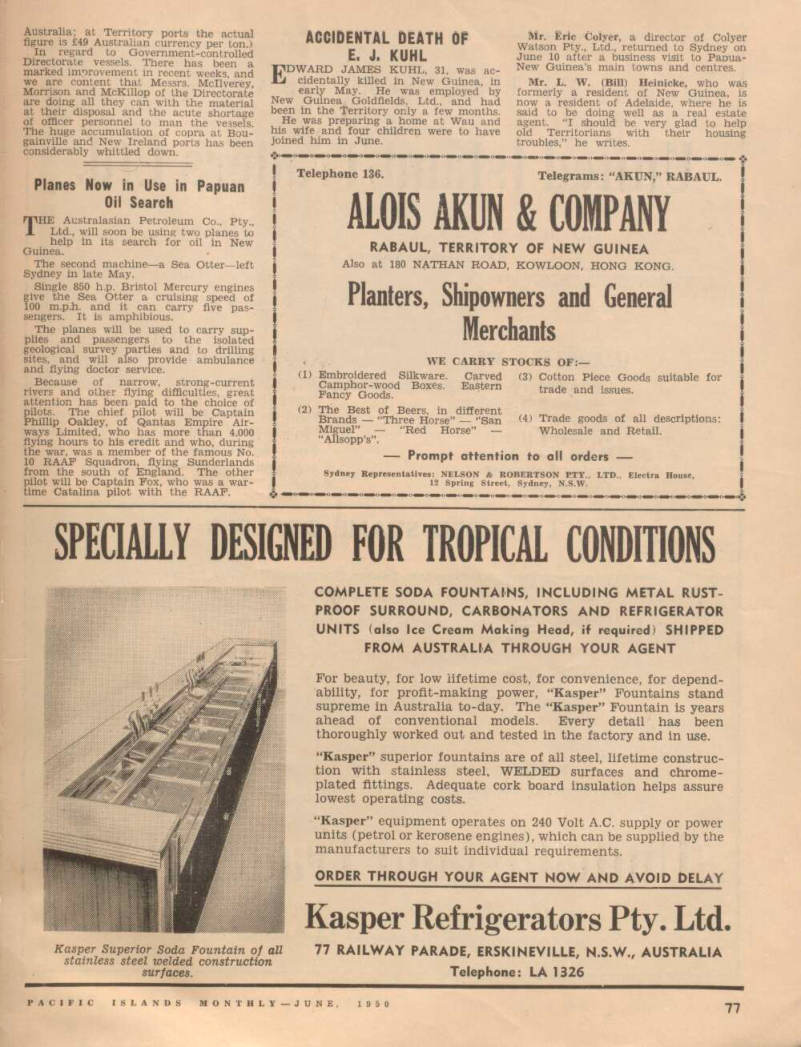
NG Planters’ Assn. Asks for Better Wharf Facilities, Higher Prices
Prom Our Own Correspondent
Rabaul, May 31.
IN a statement issued here to-day, Mr.
D. Barrett, president of the Planters’
Association of New Guinea, said:— At present the Ivybank and Tungsha are loading copra at Rabaul. The former is sailing direct for the UK and the latter for Sweden, under charter to the British
Ministry of Food. Between them they will lift 7,500 tons of copra. However, while this loading is being carried out a further 3,000 tons will be received into Rabaul. It is imperative, therefore, that additional storage sheds should be put up immediately.
The arrival of four vessels within a
fortnight has overtaxed the space avail able for inward cargo, and no space at all is available for outwards cargo. The Col lector of Customs has been trying to rent additional storage space from private individuals to stack inwards cargo.
In regard to the discharging of ship ping Directorate vessels carrying copra from outlying plantations: These Direc torate vessels, due to limited wharf facilities, have to give way to overseas ships with resultant delays in turn-round.
At the beginning of May, 9 Directorate vessels were in Rabaul harbour laden with copra. In view of the foregoing the fol lowing suggestions are put forward by the Association: • That work be put in hand imme diately for the erection of a pontoon wharf to hold three 300 tonners, and the suggested location is the water front im mediately behind the area occupied by Directorate of Shipping, • That a storage shed, sufficient to take 500 tons, be put up at the same place for the reception of outward cargoes for plantations. • That the existing small ships’ wharf at PCB be extended to accommodate one more vessel (the present capacity being only two). This could be accomplished by cutting down the bows of the wrecked Japanese vessel, now used as a wharf, and filling this in as was done on the existing wharf. • That the area between the two exist ing copra sheds at PCB be enclosed —the advantages being the handiness to the discharging wharf. The possibility of carrying this out was brought up by the Deputy Chairman of the Board at an in terview with Association representatives (later confirmed in writing) when he stated that the Board was considering the construction of an additional 500 tons storage space. Nothing, however, has yet been done in this regard. • The immediate erection of an addi tional customs warehouse for the receipt of inwards cargo from overseas vessels.
It is understood that Saar and Quonset huts have been brought to Rabaul from Manus for the above purposes—the latest shipment arriving on the Aros.
Copra Prices
THE Copra Agreement with the UK came into operation in March, 1949, at which time the price of copra on the open market in the UK was £7O sterl ing per ton. The Australian Government paid the planters £4B sterling per ton.
In March, 1950, the price was revised and an increase given to planters of 10/per ton—that is, £4B/10/- stg.—while the price on the open market in London had risen to £79/10/- sterling per ton. But since March there has been a further rise in the London market to £BB/10/- sterling.
In view of this, the planters are pressing the Australian Government to secure for them the maximum increase allowable under the agreement—that is, 10 per cent.
Costs are continuing to rise. Benzine is now 4/21 per gallon; sacks approximately £6O a bale; rice approximately £65 ton.
A rise in the price of issue meat has just been announced, which will bring it to £5/10/- per case.
The Territory’s copra production for 1949 was 55,000 tons of which over 30,000 tons went to the Australian market. The Australian crushers are getting the benefit of the contract price with the UK in that for copra marketed in Australia, the producer at pre sent receives £49 per ton in Australian currency at Territory ports. The Aus tralian crushers pay only freight and handling charges, and with world parity at £BB/10/- quite an anomaly exists. (Note that it was quoted previously in this article that planters received £4B/10/- ton stg.: this is the price in
Australia; at Territory ports the actual figure is £49 Australian currency per ton.) In regard to Government-controlled Directorate vessels. There has been a marked improvement in recent weeks, and we are content that Messrs. Mcllverey, Morrison and McKillop of the Directorate are doing all they can with the material at their disposal and the acute shortage of officer personnel to man the vessels.
The huge accumulation of copra at Bou gainville and New Ireland ports has been considerably whittled down.
Advertisements & other items, p. 78 (1 item)
I Pan A
FOR A DAZZLING
SPARKLING SMILE
use
I PAN A
TOOTH PASTE
At least twice a day, brush your teeth thoroughly and massage your gums gently—with IPANA. That's the way to a dazzling smile!
IPANA not only cleans and polishes your teeth to sparkling whiteness, it stimulates circulation in the gums . . . keeps them firm and healthy. IPANA guards against decay, because its deep-reaching foam sweeps away germs and food particles.
You'll like IPANA—it's refreshingly different!
Sold Everywhere & V v- * * o s O * M
FOR
fO* P O/f c v A product of Bristol-Myers.
Planes Now in Use in Papuan
Oil Search
THE Australasian Petroleum Co., Pty., Ltd., will soon be using two planes to help in its search for oil in New Guinea.
The second machine —a Sea Otter—left Sydney in late May.
Single 850 h.p. Bristol Mercury engines give the Sea Otter a cruising speed of 100 m.p.h. and it can carry five pas sengers. It is amphibious.
The planes will be used to carry sup plies and passengers to the isolated geological survey parties and to drilling sites, and will also provide ambulance and flying doctor service.
Because of narrow, strong-current rivers and other flying difficulties, great attention has been paid to the choice of pilots. The chief pilot will be Captain Phillip Oakley, of Qantas Empire Air ways Limited, who has more than 4.000 flying hours to his credit and who, during the war, was a member of the famous No. 10 RAAF Squadron, flying Sunderlands from the south of England. The other pilot will be Captain Fox, who was a war time Catalina pilot with the RAAF.
Accidental Death Of
E. J. Kuhl
Edward James Kuhl, Si, Was Ac
cidentally killed in New Guinea, in early May. He was employed by New Guinea Goldfields, Ltd., and had been in the Territory only a few months.
He was preparing a home at Wau and his wife and four children were to have joined him in June.
Mr. Eric Colyer, a director of Colyer Watson Pty., Ltd., returned to Sydney on June 10 after a business visit to Papua- New Guinea’s main towns and centres.
Mr, L. W. (Bill) Heinicke, who was formerly a resident of New Guinea, is now a resident of Adelaide, where he is said to be doing well as a real estate agent. “I should be very glad to help old Territorians with their housing troubles,” he writes.
Advertisements & other items, pp. 79-80 (1 item)
Specially Designed For Tropical Conditions
Telephone 136. Telegrams: “AKUN,” RABAUL.
ALOIS AKUN & COMPANY
RABAUL, TERRITORY OF NEW GUINEA
Also at 180 NATHAN ROAD, KOWLOON, HONG KONG.
Planters, Shipowners and General
Merchants
WE CARRY STOCKS OF:—
(1) Embroidered Silkware. Carved Camphor-wood Boxes. Eastern Fancy Goods. (2) The Best of Beers, in different Brands “Three Horse” “San Miguel” “Red Horse”
“Allsopp’s”. (3) Cotton Piece Goods suitable for trade and issues. (4) Trade goods of all descriptions: Wholesale and Retail.
Prompt attention to all orders Sydney Representatives: NELSON & ROBERTSON PTY., LTD., Electra House, 12 Spring Street, Sydney, N.S.W.
SPECIALLY DESIGNED FOR TROPICAL CONDITIONS
m. m
COMPLETE SODA FOUNTAINS, INCLUDING METAL RUST-
PROOF SURROUND, CARBONATORS AND REFRIGERATOR
UNITS (also Ice Cream Making Head, if required) SHIPPED
FROM AUSTRALIA THROUGH YOUR AGENT
For beauty, for low lifetime cost, for convenience, for dependability, for profit-making power, “Kasper” Fountains stand supreme in Australia to-day. The “Kasper” Fountain is years ahead of conventional models. Every detail has been thoroughly worked out and tested in the factory and in use.
“Kasper” superior fountains are of all steel, lifetime construction with stainless steel, WELDED surfaces and chromeplated fittings. Adequate cork board insulation helps assure lowest operating costs.
“Kasper” equipment operates on 240 Volt A.C. supply or power units (petrol or kerosene engines), which can be supplied by the manufacturers to suit individual requirements.
ORDER THROUGH YOUR AGENT NOW AND AVOID DELAY
Kasper Refrigerators Pty. Ltd.
Kasper Superior Soda Fountain of all 77 RAILWAY PARADE, ERSKINEVILLE, N.S.W., AUSTRALIA stainless steel welded construction surfaces. Telephone; LA 1326
United Island Traders Ltd.
(Established 1930).
P.O. BOX 42, RAROTONGA, COOK ISLANDS
Cable Address: “Unitrade, Rarotonga.”
Managing Director : W. H. WATSON. Secretary: R. J. A. INGRAM, A.R.A., N .Z.
Agents in London: Geo. H. Penney Cr Co. Ltd., 197 Aldersgate St., E.CI.
IN THE COOK ISLANDS
IMPORTERS OF:-
Cotton and Silk Piece Goods Glassware and Crockery Plantation Tools Building Materials Fishing Nets and Lines Musical instruments Trade Jewellery
EXPORTERS OF:-
Tropical Fruits Island Handicrafts Pearl-shell Brooches "Palm" Brand Clothing Broad-last Footwear Sea-shells Cassava
LICENSED STAMP DEALERS
Representatives of Independent Traders throughout the Cook Islands.
Deliveries: BY AIR to Samoa, Tonga and Fiji.
BY SEA to New Zealand, Australia, Tahiti and Niue Island.
BY PARCEL POST to any island in the South Seas.
British Traders' Insurance Co.
Whites Aviation Ltd.
B.S.A. Cycles and Motor-cycles.
AGENTS AND DISTRIBUTORS FOR:—
British Petroleum Company.
Ford Cars and Trucks.
"Pacific Islands Monthly."
Associated with: W. H. WATSON Cr CO.— Manufacturers of Broad-last Footwear.
SCOTT & WATSON CO. LTD.— Manufacturers of "Palm" brand clothing.
United Island Traders Ltd
‘Tk House of Progress 9
Bankers: Bank of New Zealand, Queen Street, Auckland, C. 1., N.Z.
Distinguished Visitors To Fiji
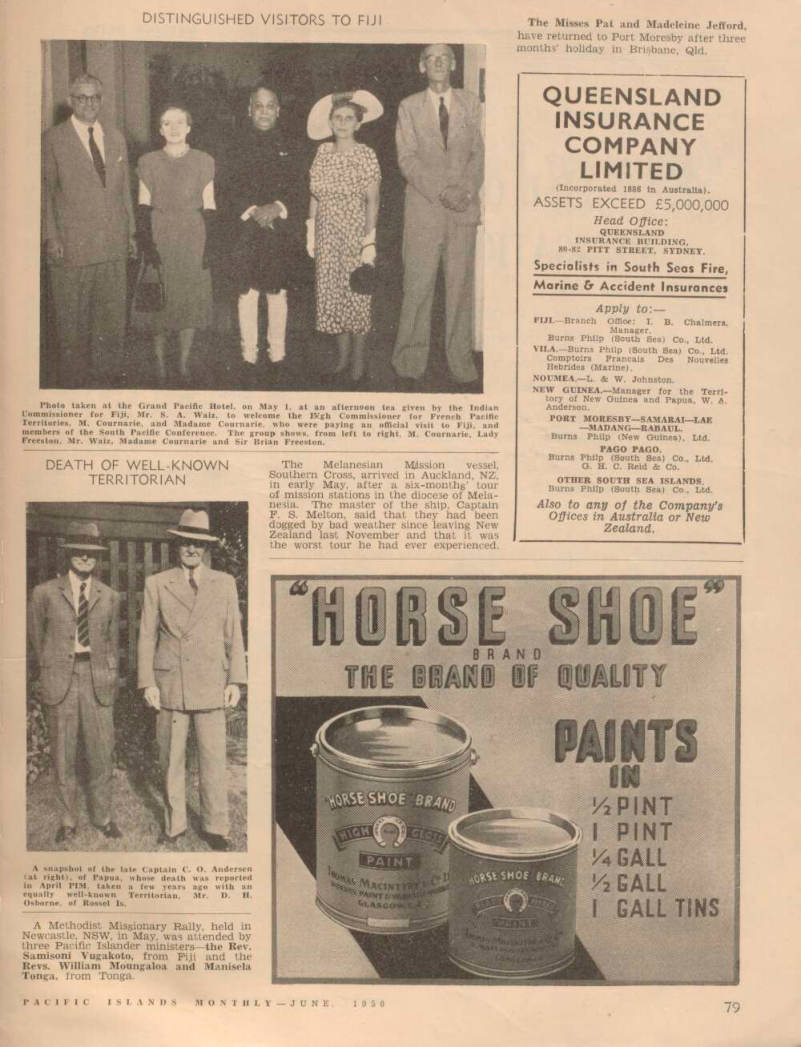
Photo taken at the Grand Pacific Hotel, on May 1, at an afternoon tea given by the Indian Commissioner for Fiji, Mr. S. A. Waiz, to welcome the E[?]gh Commissioner for French Pacific Territories, M. Cournarie, and Madame Cournarie, who were paying an official visit to Fiji, and members of the South Pacific Conference. The group shows, from left to right, M. Cournarie, Lady Freeston, Mr. Waiz, Madame Cournarie and Sir Brian Freeston.
Death Of Well-Known
Territorian
A Methodist Missionary Rally, held in Newcastle, NSW, in May, was attended by three Pacific Islander ministers—the Rev.
Samisoni Vugakoto, from Fiji and the Revs. William Moungaloa and Mauisela Tonga, from Tonga.
The Melanesian Mission vessel, Southern Cross, arrived in Auckland, NZ : , in early May, after a six-months’ tour of mission stations in the diocese of Mela nesia. The master of the ship, Captain F. S. Melton, said that they had been dogged by bad weather since leaving New Zealand last November and that it was the worst tour he had ever experienced.
The Misses Pat and Madeleine Jefford, have returned to Port Moresby after three months’ holiday in Brisbane, Qld.
A snapshot of the late Captain C. O. Andersen (at right), of Papua, whose death was reported in April PIM, taken a few years ago with an equally well-known Territorian. Mr. D. H.
Osborne, of Rossel Is.
Advertisements & other items, pp. 81-82 (1 item)
Paint!
QUEENSLAND
INSURANCE
COMPANY
LIMITED
(Incorporated 1886 In Australia).
ASSETS EXCEED £5,000,000
Head Office :
QUEENSLAND
INSURANCE BUILDING,
80-82 PITT STREET, SYDNEY.
Speciolists in South Seos Fire,
Marine & Accident Insurances
Apply to:—
FlJl.—Branch Office: I. B. Chalmers, Manager.
Burns Phllp (South Sea) Co., Ltd.
VlLA.—Burns Phllp (South Sea) Co., Ltd.
Comptoirs Prancais Des Nouvelles Hebrides (Marine).
NOUMEA.—L. & W. Johnston.
NEW GUlNEA.—Manager for the Territory of New Guinea and Papua, W. A.
Anderson.
PORT MORESBY—SAMARAI—LAE
—MADANG—RABAUL.
Burns Phllp (New Guinea), Ltd.
PAGO PAGO.
Burns Phllp (South Sea) Co., Ltd.
G. H. C. Reid & Co.
OTHER SOUTH SEA ISLANDS.
Burns Phllp (South Sea) Co., Ltd.
Also to any of the Company’s Offices in Australia or New Zealand.
BRAND
PAINT!
I GALL TIN!
/z PINT
■ PINT
k 4 gall
Executor - Trustee
Attorney
FIND OUT YOUR
OBLIGATIONS FIRST
Before you agree to act as an executor or trustee, you should be quite clear regarding the extent of your obligations. The same precaution will prevent you from appointing an unsuitable executor. All essential facts regarding the administration of estates are given in the new edition of "Hands That Never Leave The Wheel”. This informative booklet explains why the fulltime services of the capable directors and experienced officers of Burns Philp Trust Company Limited should be at your disposal.
A complimentary copy of this 20-page booklet can be obtained from any branch of Burns Philp (South Sea) Company, Burns Philp (New Guinea) Limited, or direct from the head office of this Company.
DIRECTORS;
James Burns Joseph Mitchell R. T. W. Black Eric Priestley Lee MANAGER: L. S. Parker SECRETARY: E. R. Overton. F.f.I.A.
'THAT
9 Ay mz* The
Bums Philp Trust
COMPANY LIMITED
Constituted by Special Act of the N.S.W. Parliament
Head Office: 7 BRIDGE STREET, SYDNEY
TELEPHONE: BU 5901
BOX 543, G.P.0., SYDNEY
Kavieng Notes
From Our Own Correspondent
Kavieng, May 15.
IN honour of the visit of the United Nations Trusteeship Mission, the Chinese Overseas Association gave an informal Chinese Dinner at the Kuo Min Tang Hall, on May 21. Mr. Ho Ye© presided. Guest of Honour was Mr.
Chang, who represents China on the Mission. Among those present were the Administrator’s deputy, Mr. I. F. Cham pion, Mr. G. L. Townsend (Mission Secretariat Staff), the District Officer (Mr. I. P. G. Downs) and Mrs. Downs, and many local officials.
In responding, Mr. Chang said he had been waiting seven weeks for a Chinese meal; and Mr. Champion, amid laughter, remarked that he had been waiting 50 years!
The repast included a wide assortment of Oriental delicacies, and everyone ate with chopsticks, and thoroughly enjoyed the novelty. * The Mangola, first overseas vessel to enter the now-proclaimed Port of Kavieng since 1941, arrived on May 3. Native wharf labourers worked cheerfully and willingly—better than at any other port in the Territory—and the vessel had a quick turn-around. 1,321 tons of copra were loaded. * Mr. Tom Render, who has been Kavieng manager for New Guinea Co., Ltd,, has been transfered to Madang, and has been succeeded by Mr. Alan Fames. * “Beeps” have opened up at Kavieng under the management of our old New Guinea friend, Mr. T. Kenward. * Happy Chimbu Highlands natives sing with exultation as they go to and from work. A colourful humorous scene occurred the other day when a crowded truck-load of them passed, with every lad’s head thickly studded with flaming hibiscus. * First timber uprights for the Kavieng Club were placed in position on May 28.
Mr. Peter V. Saunders is the new Hon.
Secretary. * Mr. Spender, when here, publicly com mended the local natives’ club house. He said it was good to see the Australian flag flying proudly above it. The club house has table tennis and a radio. The sports ground adjoining is kept in good condition, and the Recreation Centre has its own bank account and a chairman, secretary and treasurer (all natives), • * Plans for the Hotel Kavieng have been approved, and only lack of material is holding up construction. Judging by the attractive crockery and furniture, which Mr. Tsang Sang is importing, he intends to make his hostelry a superior type of establishment. There is no hotel or guest house here now. * The Rev. Father Scheran, in the care of Sister Clematia, M.S.C., was flown to Rabaul on June 1, and admitted to the European Hospital. Father Scheran is over 70, and for a long time his health has been low. He has been residing at Anelaua Leprosy Hospital, where Sister Clemantia for many years has done noble work among the native lepers.
Mr. Fred Allen, former Samarai trader and planter, has opened a cash store at the Pour-Mile, Port Moresby.
Captain and Mrs. Thomas Milner took the Gilbert Islands ship Nei Nimanoa to Australia in June, and Mrs.
Milner (who formerly was Dr. Helen Phillips) is visiting her mother in Toowoomba. At home, in Tarawa, she is on the staff of the Government Hospital.
Advertisements & other items, pp. 82-86 (4 items)
June, 1950-P A C I F I C Islands Monthly
81
PACIFIC ISLANDS MONTHLY— JUNE, 1950
FROM NOTES MADE IN FIJI
(Continued from Page 14.) *
Yorkshire
THE
INSURANCE
CO. LTD.
(Incorporated in England'
ALL CLASSES OF
INSURANCE
Including
Fire Motor Guarantee Accident Workers Marine Island Representatives:
PORT MORESBY: E. A. James
RABAUL: G. B. Black LAE: New Guinea Industries Ltd.
MADANG: R. MacGregor SUVA: Williams & Gosling Ltd.
NOUMEA: Y. Mortensen
NORFOLK ISLAND:
A. E. Martin
-■*** -' WM
siplil^
, ... . •V ihb ■ ; ■■: . ... v m P» * •,:;
lIP
S' :,•?' • , /; .
Year after year, leading racing drivers the world over agree that MONEL* shafts have the extra stamina needed for gruelling racing service.
No wonder! For in addition to being 100% rust-proof, MONEL is stronger and stiffer than structural steel, harder by far than other non-ferrous alloys.
This combination of qualities means extra safety, extra dependability for your boat . . . whether it be racer, runabout, or cruiser.
Time and again, in all kinds of marine service, MONEL shafts have shown their ability to take terrific punishment . . . bouncing high-speed turns mechanical shock . . . salt-water corrosion . . . sand abrasion.
SI , Isn’t this the kind of shafting you want in your boat? builder to quote you to-day for a MONEL propeller shaft . .
Then ask your boater communicate with WRIGHT & COMPANY. 81 CLARENCE ST.. SYDNEY Sole Australian Distributors of Monel :: Phone: BXI2II (Six Lines) *Monel Is a registered trade-mark covering a rich nickel alloy, mined in Canada and rolled in Great Britain.
Of, H ■O S 0,,
the
is J'° r
GILBEY’S
Bey ltd.
Helb °U*Ni SY o NEy, Bills b *Ne Address all enquiries to W. & A. GILBEY LTD., 33 Rosslyn Street, West Melbourne.
dfsd
ART POSTCARDS OF
TONGA
Per Dozen (Including’ a Tin-Can Mail Cover), Postage Paid: 6/- (or one US Dollar).
TONGAN PHOTOS BUREAU
Nukualofa, Tonga
YOUR ORDERS . . .
Receive Personal Attention From
J. C. MERRILLEES PTY. LTD.
WEMBLEY CHAMBERS, 104 HUNTER STREET, SYDNEY
(N.S.W., AUSTRALIA)
Telegrams: “MERRILLEES,” Sydney. ’Phone: BW 6064.
BUYERS OF ALL ISLANDS
REQUIREMENTS ON COMMISSION
Agents for: • Sheraton Products. • Mary Baker Ice Cream Mix. • California Home Style Biscuits.
Represented in the Pacific Islands by: WALTER GRAND, Papeete, Tahiti. HUNTS AGENCY, Suva, Fiji.
FOR SALE
AUXILIARY KETCH "ALERT"
With existing trade, if required (nett earnings: £l,BOO per annum).
Two H.P.
Dimensions.—7B ft. x 18 ft. x 7 ft. loaded draught (94 tons).
Hull.—W.A. Jarrah bottom. N.Z. Kauri topsides and deck, hatches. Centre-board. Cabin house.
Engines.—4o B.H.P. “Invincible.” Kerosene. Speed; 5i knots 6 “New Way” winch and windlass. Lift, \ ton.
Sails.—Marconi type—all new.
Plant in very fair order. Suitable for freighting, trading, fishing or pearling in the Islands.
PRICE: £2,000 (or near offer).
Only reason for sale is that owner has acquired a larger vessel.
WANTED TO BUY.—Three or more 6-cylinder “Gray” Marine Diesel Engines. State price and in what condition the engines now are.
Apply in both instances to:
CAPTAIN E. J. WRIGHT
Box 9, Port Adelaide, South Australia.
BERRY’S BAY
BOATYARD
(B. J. Halvorsen—Manager)
Specialists in Island vessels.
All kinds of boat-building and repairing.
New and used boats and engines for sale.
Quotations and estimates free.
BERRY’S BAY BOATYARD
John Street, North Sydney. N.S.W.
82
JUNE, 1950 PACIFIC IS I. ANUS MONTHLY
No Sensations In Fiji’S
Canefields Situation
From Our Own Correspondent
Suva, May 21.
THE Sigatoka branch of the Kisan Sangh, one of the Indian cane farmers’ organisations in Fiji, has issued a denial of an earlier report that the Sigatoka committee had refused to follow the advice of the main group (of which Mr. N. S. Chalmers is president) and support the appeal to farmers to stop planting cane this season.
No other major points are referred to in the Sigatoka committee’s statement, and the general situation remains the same, with planting continuing, for the most part, despite attempts at dissuasion.
War Disposals Case in
Melbourne Tanker Was Oil Barge
AN award of £756/10/- has been made in the Australian High Court claim for £269,715 damages over the purchase from the Commonwealth Disposals Com mission of an “oil tanker’’ wrecked off New Guinea.
Francis Edward Mcßae and Keith Mc- Rae, trading as the Mcßae Trading, Co., metal merchants, of Exhibition Street, Melbourne, sued the Commonwealth, the Commonwealth Disposals Commission and two commission officers for alleged breach of contract, deceit and negligence.
Mr. Justice Webb found that the “tan ker” was actually a non-propelled oil barge. He did not think it was an oil tanker as that term was understood. As there was no oil tanker to sell, there was no contract.
Plaintiffs had claimed, he said, that the commission had information before the balance of the purchase money was paid that the ship was a barge-type tan ker and its machinery was ruined.
He found deceit and negligence only in the fact that the commission’s New Guinea regional manager had not in formed the plaintiffs of the mutual mis take of the parties. The natural consequence of his silence was that the plaintiffs paid the balance and went to the expense of searching for the oil “tanker.”
Death Of H. G. Murray
Of Witu
THE death occurred suddenly in Sydney on May 3, of a well-known and respected member of New Guinea’s planting community—Mr. Harry Gregory Murray, of Witu.
Mr. Murray had come to Sydney to take delivery of a ketch for Langu Plantation He had been ill in bed for some days with what he believed to be malaria, and on the day of his death he got up with the intention of leaving with the ketch for New Guinea the following day. He suddenly collapsed and died; post-mortem finding was that he had died as a result of pneumonia.
Mr. Murray went to New Guinea as a clerk for Lurns Philp and Company, 27 years ago. Later, he became a plantation manager and at the time of the Japanese invasion of New Guinea was on Bali Plantation in the Witu Group. He was a member of the party that reached Australia in the Lakatoi about Easter 1942 (the full story of how the remnants of the Rabaul garrison were saved from the jungle and the Japs by a handful of New Guinea civilians, and untimately reached Australia in the small inter island ship Lakatoi, was told in the PIM in 1946 by Mr. J. K. McCarthy, now District Officer at Rabaul).
After Murray had recovered from this adventure he enlisted in ANGAU and with the rank of Captain served in the Nadzab area.
After the war he returned to Bali for 12 months but after Mrs. Gladys Baker’s death about two years ago he leased her Witu plantation, Langu.
He was 49 at the time of his death. He is survived by his wife, Mrs. E. J. Murray, who was at Langu when he died. She intends to carry on at the plantation for the time being.
Mr. and Mrs. Michael Adams, of Fiji, and their small daughter Jane, arrived in Sydney in May, on holiday.
Advertisements & other items, p. 86 (1 item)
Insecticide
WORLD FAMOUS
is NOW
THAN EVER!
u
STRONGER
Yv\\\* \v>« rv>«» to«» tocV»°®.
LTD
FLIT is sure death to all insects.
FLIT contains the strongest death dealing agents known - D.D.T., Thanite and Pyrethrum. Ask for FLIT and refuse all substitutes.
VACUUM OIL COMPANY PTY.
THE MOST EFFECTIVE INSECTICIDE YOU CAN BUY
Fairy Godfather Next Year
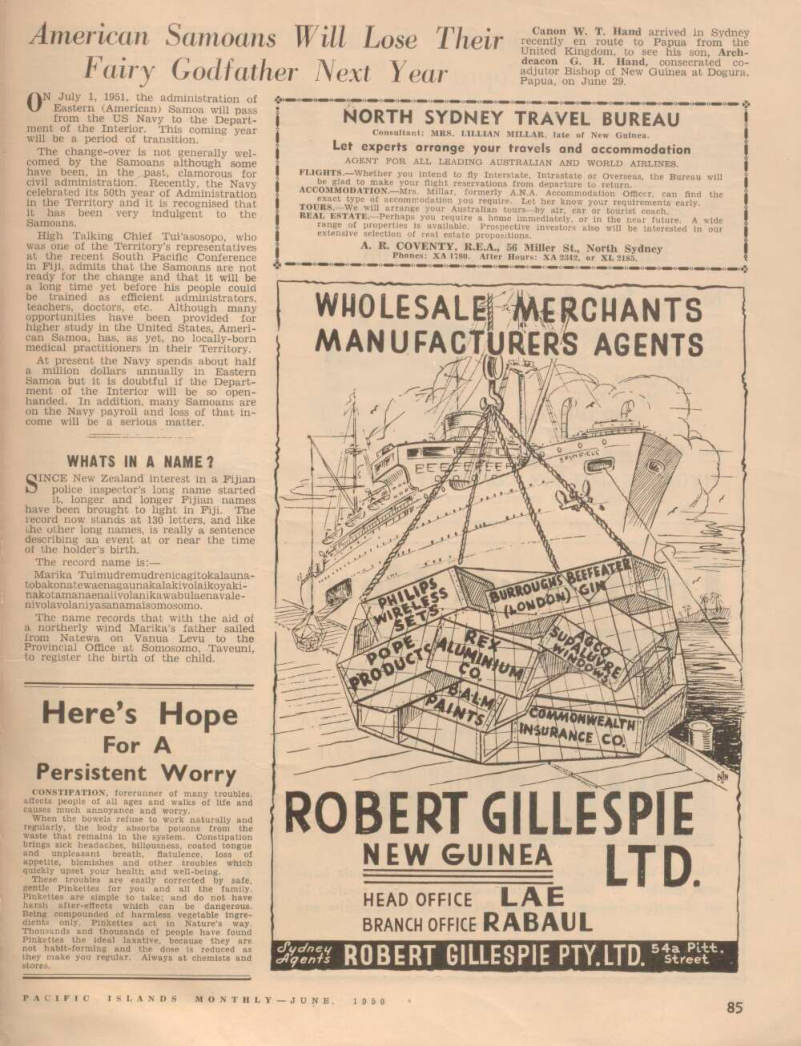
American Samoans Will Lose Their Fairy Godfather Next Year
ON July 1, 1951, the administration of Eastern (American) Samoa will pass from the US Navy to the Depart ment of the Interior. This coming year will be a period of transition.
The change-over is not generally wel comed by the Samoans although some have been, in the_past, clamorous for civil administration. Recently, the Navy celebrated its 50th year of Administration in the Territory and it is recognised that it has been very indulgent to the Samoans.
High Talking Chief Tui’asosopo, who was one of the Territory’s representatives at the recent South Pacific Conference in Fiji, admits that the Samoans are not ready for the change and that it will be a long time yet before his people could be trained as efficient administrators, teachers, doctors, etc. Although many opportunities have been provided for higher study in the United States, Ameri can Samoa, has, as yet, no locally-born medical practitioners in their Territory.
At present the Navy spends about half a million dollars annually in Eastern Samoa but it is doubtful if the Depart ment of the Interior will be so open handed. In addition, many Samoans are on the Navy payroll and loss of that in come will be a serious matter.
Whats In A Name?
SINCE New Zealand interest in a Fijian police inspector’s long name started it, longer and longer Fijian names have been brought to light in Fiji. The record now stands at 130 letters, and like the other long names, is really a sentence describing an event at or near the time of the holder’s birth.
The record name is:— Marika Tuimudremudrenicagitokalauna
tobakonatewaenagaunakalakivolaikoyaki-
nakotamanaenaiivolanikawabulaenavalenivolavolaniyasanamaisomosomo.
The name records that with the aid oi a northerly wind Marika’s father sailed from Natewa on Vanua Levu to the Provincial Office at Somosomo, Taveuni, to register the birth of the child.
Canon W. T. Hand arrived in Sydney recently en route to Papua from the United Kingdom, to see his son, Arch deacon G. H. Hand, consecrated co adjutor Bishop of New Guinea at Dogura, Papua, on June 29.
Advertisements & other items, p. 87 (1 item)
Robert Gillespie
NORTH SYDNEY TRAVEL BUREAU
Consultant; MRS. LILLIAN MILLAR, late of New Guinea.
Let experts arrange your travels and accommodation AGENT FOR ALL LEADING AUSTRALIAN AND WORLD AIRLINES.
FLlGHTS.—Whether you intend to fly Interstate, Intrastate or Overseas, the Bureau be glad to make your flight reservations from departure to return.
ACCOMMODATION.—Mrs. Millar, formerly A.N.A. Accommodation Officer, can find T.y Pe accommodation you require. Let her know your requirements early. ar , range your Australian tours—by air. car or tourist coach.
BEAL ESTATE. —Perhaps you require a home immediately, or in the near future. A range properties is available. Prospective investors also will be interested in extensive selection of real estate propositions.
A. R. COVENTY, R.E.A., 56 Miller St., North Sydney Phones: XA 1780. After Hours: XA 2342, or XL 2185. will the wide our
WHOLESALE! MERCHANTS 1
AGENTS
3JQ m c 05 oijO
BET
m i&b s* \V o* u e Q % S CB
ROBERT GILLESPIE
NEW GUINEA |^JQ
HEAD OFFICE LAE
BRANCH OFFICE RABAUL
%i n n Ts ROBERT GILLESPIE PTY.LTD. s tt^
Here’s Hope
For A
Persistent Worry
CONSTIPATION, forerunner of many troubles, affects people of all ages and walks of life and causes much annoyance and worry.
When the bowels refuse to work naturally and regularly, the body absorbs poisons from the waste that remains in the system. Constipation brings sick headaches, biliousness, coated tongue and unpleasant breath, flatulence, loss of appetite, blemishes and other troubles which quickly upset your health and well-being.
These troubles are easily corrected by safe, gentle Pinkettes for you and all the family.
Pinkettes are simple to take; and do not have harsh after-effects which can be dangerous.
Being compounded of harmless vegetable ingredients only, Pinkettes act in Nature’s way.
Thousands and thousands of people have found Pinkettes the ideal laxative, because they are not habit-forming and the dose is reduced as they make you regular. Always at chemists and stores.
of Copra
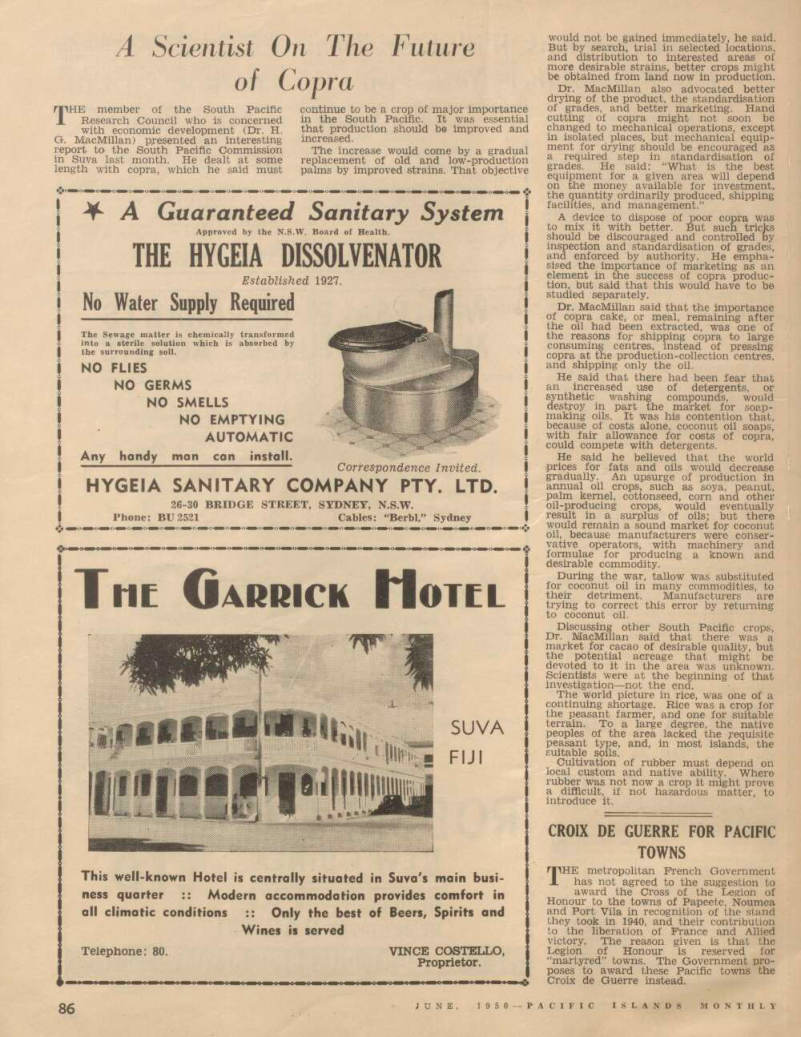
A Scientist On The Future of Copra
THE member of the South Pacific Research Council who is concerned with economic development (Dr. H.
G. MacMillan) presented an interesting report to the South Pacific Commission in Suva last month. He dealt at some length with copra, which he said must
continue to be a crop of major importance in the South Pacific. It was essential that production should be improved and increased.
The increase would come by a gradual replacement of old and low-production palms by improved strains. That objective
would not be gained immediately, he said.
But by search, trial in selected locations, and distribution to interested areas of more desirable strains, better crops might be obtained from land now in production.
Dr. MacMillan also advocated better drying of the product, the standardisation of grades, and better marketing. Hand cutting of copra might not soon be changed to mechanical operations, except in isolated places, but mechanical equip ment for drying should be encouraged as a required step in standardisation of grades. He said: “What is the best equipment for a given area will depend on the money available for investment, the quantity ordinarily produced, shipping facilities, and management.”
A device to dispose of poor copra was to mix it with better. But such tricks should be discouraged and controlled by inspection and standardisation of grades, and enforced by authority. He empha sised the importance of marketing as an element in the success of copra produc tion, but said that this would have to be studied separately.
Dr. MacMillan said that the importance of copra cake, or meal, remaining after the oil had been extracted, was one of the reasons for shipping copra to large consuming centres, instead of pressing copra at the production-collection centres, and shipping only the oil.
He said that there had been fear that an increased use of detergents, or synthetic washing compounds, would destroy in part the market for soap making oils. It was his contention that, because of costs alone, coconut oil soaps, with fair allowance for costs of copra, could compete with detergents.
He said he believed that the world prices for fats and oils would decrease gradually. An upsurge of production in annual oil crops, such as soya, peanut, palm kernel, cottonseed, corn and other oil-producing crops, would eventually result in a surplus of oils; but there would remain a sound market for coconut oil, because manufacturers were conser vative operators, with machinery and formulae for producing a known and desirable commodity.
During the war, tallow was substituted for coconut oil in many commodities, to their detriment. Manufacturers are trying to correct this error by returning to coconut oil.
Discussing other South Pacific crops, Dr. MacMillan said that there was a market for cacao of desirable quality, but the potential acreage that might be devoted to it in the area was unknown.
Scientists were at the beginning of that investigation—not the end.
The world picture in rice, was one of a continuing shortage. Rice was a crop for the peasant farmer, and one for suitable terrain. To a large degree, the native peoples of the area lacked the requisite peasant type, and, in most islands, the suitable soils.
Cultivation of rubber must depend on local custom and native ability. Where rubber was not now a crop it might prove a difficult, if not hazardous matter, to introduce it.
Croix De Guerre For Pacific
Towns
THE metropolitan French Government has not agreed to the suggestion to award the Cross of the Legion of Honour to the towns of Papeete, Noumea and Port Vila in recognition of the stand they took in 1940, and their contribution to the liberation of France and Allied victory. The reason given is that the Legion of Honour is reserved for “martyred” towns. The Government pro poses to award these Pacific towns the Croix de Guerre instead.
Advertisements & other items, p. 88 (1 item)
The Garrick Hotel
A Guaranteed Sanitary System
Approved by the N.S.W. Board of Health.
THE HYGEIA DISSOLVENATOR
Established 1927.
No Water Supply Required
The Sewage matter is chemically transformed into a sterile solution which is absorbed by the surrounding soil.
NO FLIES
NO GERMS
NO SMELLS
NO EMPTYING
AUTOMATIC
Any handy man can install.
HYGEIA SANITARY COMPANY PTY. LTD.
26-30 BRIDGE STREET, SYDNEY, N.S.W.
Phone: BU 2521 Cables: “Berbl,” Sydney r Correspondence Invited.
The Garrick Hotel
iWr
JL *
‘ liiir”
nu * * » *ys
SUVA
FIJI
This well-known Hotel is centrally situated in Suva's main business quaEter :: Modern accommodation provides comfort in all climatic conditions Only the best of Beers, Spirits and Wines is served Telephone: 80. VINCE COSTELLO, Proprietor.
Wedding In Honiara
From Our Own Correspondent
Honiara, May 30.
THE marriage took place at Honiara, BSIP, on May 20, of Miss Kathrine Blanche Mitford-Burgess, of Talaga Bay, New Zealand, Sister-in-Charge, Central Government Hospital, Matanikau, to Mr. Peter Benedict Flynn of Honian.
The ceremony, held at the Roman Catholic Mission Church at Tanagai, on the Guadalcanal coast near Honiara, was performed by the Rt. Rev. Bishop Aubin, Roman Catholic Bishop of the South Solomons, and was followed by a Nuptial Mass, the first that has ever' been cele brated in the British Solomon Islands.
During his 42 years as a priest, Bishop Aubin has celebrated only one other Nuptial Mass—in France during his re cent absence on leave.
In the evening, a large reception was given for the bride and bridegroom by Mrs. J. S. McKenzie Pollock, wife of the Senior Medical Officer. Mr. and Mrs.
Flynn will live in Honiara.
Mrs. Flynn is the third nursing sister at the Central Hospital who has left to be married during the past eighteen months.
Fiji Branch of the British
Red Cross Society
THE formation of a branch of the British Red Cross Society in Fiji has been approved by the London Headquarters of the Society.
A meeting will be called in Suva in June to appoint executive officers and a com mittee to launch the branch in Fiji.
At the inaugural meeting held in April, His Excellency Sir Brian Preeston was elected Patron of the branch; Lady Pree ston appointed president; Dr. J. H. L.
Newnham, director and Mrs. G. V. Bai gent as hon. secretary.
Kapingamarangi
IN a recent issue of the National Geo graphic Magazine there is a long il lustrated article describing the atoll of Kapingamarangi. This is the most southerly of the Caroline Islands, and it is remarkable for two things. The 500 people on the atoll (mostly on the islet of Touhou) are pure Polynesians. They and the people on Nukuoro (200 miles to the north) constitute a Polynesian “pocket” in this area, for the presence of which there is no explanation. There are Polynesians also on Nauru, a few hundred miles to the eastward. The oeher thing which makes Kapingamarangi notable is that, as it was the Micronesian island nearest to New Guinea, it was equipped by the Japanese in 1942-43 as a naval and air base, and it was often in the news in the most difficult days of the Pacific war.
Ravuama Yunivalu has been appointed Chief Inspector of Co-operative Societies in Fiji. He was the first Morris Hedstrom University Scholar. After graduating BA in New Zealand he was awarded a Scholarship under the Colonial Develop ment and Welfare Scheme and spent over a year in the United Kingdom, Europe and Ceylon, studying co-operative organ isations and methods.
One of Noumea’s leading business men of the older generation, M. Raphael Menard, died recently at the age of 92.
He imported the first motor cars into the French Colony, built the first regular theatre and, later, installed the first
talkie equipment.
Advertisements & other items, p. 89 (1 item)
A Bargain...
Classified Advertisements
POSITIONS WANTED
COMPETENT, commonsense worker, anxious to help solve your water transport problem. Wages, salary, or share. Experienced mechanic and general engineer. Capable of putting into commission and handling water craft. Will discuss any proposition. Replies: “Transport,” Box 3408 G.P.0., Sydney, N.S.W.
WANTED.—By energetic young single man (24 years of age), position on a Plantation in New Guinea or adjacent Pacific Islands, or in Fiji.
Possesses good agricultural, electrical, and mechanical knowledge. Write to: J. Vanslambrouck, c/- P.O. Box 556, Ayr, Nth. Queensland, Australia.
MARRIED COUPLE.—Keen young man and wife desire opening in the Islands in any capacity, both working, if necessary. Man has general experience as operator, mechanic and fitter, diesel and petrol engines, and as fitter in machine toolmaking shop; knows Islands well.
Wife experienced in bookkeeping and general clerical work. Replies to: “Reliable,” c/o Box 3408, G.P.0., Sydney, N.S.W.
ISLANDS SOUVENIR
SONGS OF THE SOUTH SEAS.—lnspirational Verse. Cover: Feathery Palms, Tropical Flowers, Island Girl. Ideal gift or Souvenir. One dollar (8/- Aust.). Post Free.—Dr. W. Swaan, 715 West 16th Avenue, Vancouver, 8.C., Canada.
PUBLIC NOTICE
In the Supreme Court of New South Wales, Probate Jurisdiction.—ln the Will of HARRY GREGORY MURRAY, late of Bali Estate, Witu, in the Territory of New Guinea, Planter, deceased.
Application will be made after 14 days from the publication hereof that Probate of the last Will and Testament, dated October 19, 1948, of the abovenamed deceased may be granted to BURNS
PHILP TRUST COMPANY LIMITED, the Exe-
cutor named in the said Will, and all notices may be served at the undermentioned address.
All creditors in the Estate of the deceased are required to send in particulars of their claims to the said Burns Philp Trust Company Limited, No. 7 Bridge Street, Sydney.
N. J. BELL & CADOGAN, Proctors for the Executor, 117 Pitt Street, Sydney. Dated June 19, 1950,
Classified Advertisements
ENGAGEMENT
BROWN-HILL. —The engagement is announced of Una Christine, younger daughter of Mr. and Mrs. J. W. Hill, of Bulolo, New Guinea, to Bruce Alfred Brown, also of Bulolo.
STAMPS
EXCHANGE.—Wanted to exchange stamps on a catalogue basis; reply to: A. S. Jolly, 15 Wyralla Ave., Epping, Sydney, N.S.W., Australia.
WANTED TO BUY
PLANTATION OR BUSINESS.—IsIands resident (now in Papua) wishes to buy a plantation, commercial business, or hotel in the South Pacific —not necessarily Papua-New Guinea—but it must be a going concern, capable of full investigation before purchase. Reply, by airmail preferably, to: “Genuine,” c/o Box 3408, G.P.0., Sydney, N.S.W.
"EDDYSTONE"
‘All World Six 1 Receiver
OPERATES PROM 6V ACCUMULATOR.
CONSUMPTION ONLY 2.5 AMPS.
FULL FREQUENCY COVERAGE
FROM 620 to 10 METRES, 4 BANDS.
ATTRACTIVE METAL CABINET
WITH IN-BUILT SPEAKER.
PROVISION FOR EXTERNAL
SPEAKER AND PICK-UP.
OUTSTANDING ALL WORLD
RECEPTION.
Price £52/10/-
Ex Bond F. 0.8. Mclb.
WRITE FOR DESCRIPTIVE LEAFLET.
R. H. Cunningham Pty. Ltd.
62 Stanhope Street, Malvern,
Victoria.
A Bargain...
A Brand New 110 Volt DC
Lighting Plant !
This self-contained Generating Set is economical to run, and can be used as a 110-Volt Direct Lighting Unit for providing power for a theatre, large store, hospital or garage. In addition, it can be used as a battery charger, for charging a series of 6 or 12-Volt batteries. It is operated by a 16 H.P. Air-Cooled “Wisconsin” petrol Engine with control panel, and is mounted on one base, and with sheet-iron housing. Write for further particulars.
PRICE F. 0.8. SYDNEY, £450
Dangar Gedye & Malloch Ltd.
Malloch House, 10-14 Young Street, Circular Quay, Sydney.
Branches at Newcastle, Lismore, Wagga and Melbourne.
Islands Produce
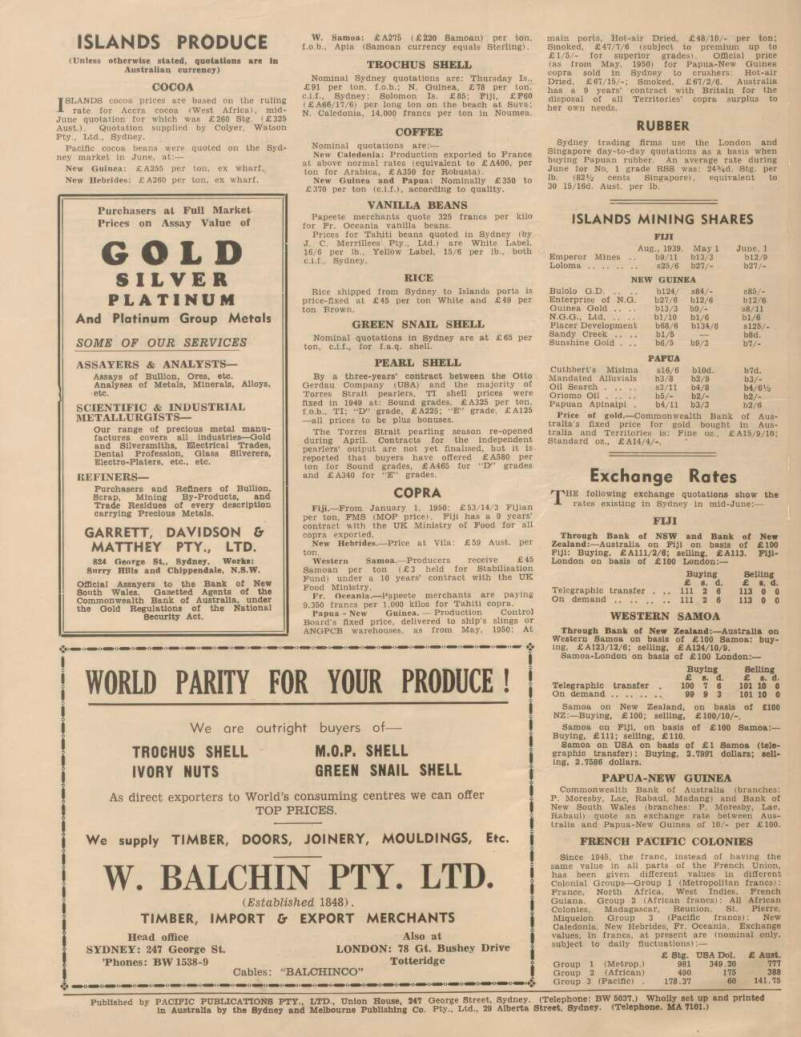
(Unless otherwise stated, quotations are in Australian currency)
Cocoa
ISLANDS cocoa prices are based on the ruling rate for Accra cocoa (West Africa), mid- June quotation for which was £260 Stg. (£325 Aust.). Quotation supplied by Colyer, Watson Pty., Ltd., Sydney.
Pacific cocoa beans were quoted on the Syd ney market in June, at:— New Guinea: £A255 per ton, ex wharf.
New Hebrides: £A26O per ton, ex wharf.
W. Samoa: £A275 (£220 Samoan) per ton, f.0.b., Apia (Samoan currency equals Sterling).
Trochus Shell
Nominal Sydney quotations are: Thursday Is., £9l per ton, f.0.b.; N. Guinea, £7B per ton, c.i.f., Sydney; Solomon Is. £B5; Fiji, £F6O (£A66/17/6) per long ton on the beach at Suva; N. Caledonia, 14,000 francs per ton in Noumea.
Coffee
Nominal quotations are:— New Caledonia: Production exported to France at above normal rates (equivalent to £A4OO, per ton for Arabica, £A3SO for Robusta).
New Guinea and Papua: Nominally £350 to £370 per ton (c.i.f.), according to quality.
Vanilla Beans
Papeete merchants quote 325 francs per kilo for Fr. Oceania vanilla beans.
Prices for Tahiti beans quoted in Sydney (by J, C. Merrillees Pty., Ltd.) are White Label, 16/6 per lb., Yellow Label, 15/6 per lb., both c.i.f., Sydney.
Rice
Rice shipped from Sydney to Islands ports is price-fixed at £45 per ton White and £49 per ton Brown.
Green Snail Shell
Nominal quotations in Sydney are at £65 per ton, c.i.f., for f.a.q. shell.
Pearl Shell
By a three-years’ contract between the Otto Gerdau Company (USA) and the majority of Torres Strait pearlers, TT shell prices were fixed in 1949 at: Sound grades, £A325 per ton, f.0.b., TI; “D” grade, £A225; “E” grade, £AI2S —all prices to be plus bonuses.
The Torres Strait pearling season re-opened during April. Contracts for the independent pearlers’ output are not yet finalised, but it is reported that buyers have offered £ASBO per ton for Sound grades, £A465 for “D” grades and £A34O for “E” grades.
Copra
Fiji.—From January 1, 1950: £53/14/3 Fijian per ton, PMS (MOP price). Fiji has a 9 years’ contract with the UK Ministry of Food for all copra exported.
New Hebrides.—Price at Vila: £59 Aust. per ton.
Western Samoa. —Producers receive £45 Samoan per ton (£3 held for Stabilisation Fund) under a 10 years’ contract with the UK Food Ministry.
Fr, Oceania.—Papeete merchants are paying 9,350 francs per 1,000 kilos for Tahiti copra.
Papua - New Guinea. Production Control Board’s fixed price, delivered to ship’s slings or ANGPCB warehouses, as from May, 1950: At
main ports, Hot-air Dried, £4B/10/- per ton; Smoked, £47/7/6 (subject to premium up to £ 1/5/- for superior grades). Official price (as from May, 1950) for Papua-New Guinea copra sold in Sydney to crushers; Hot-air Dried, £67/15/-; Smoked, £67/2/6. Australia has a 9 years’ contract with Britain for the disposal of all Territories’ copra surplus to her own needs.
Rubber
Sydney trading firms use the London and Singapore day-to-day quotations as a basis when buying Papuan rubber. An average rate during June for No. 1 grade RSS was; 24%d. Stg. per lb. (82V2 cents Singapore), equivalent to 30 15/16d. Aust. per lb.
Islands Mining Shares
Fiji
Aug., 1939.
May 1 June, 1 Emperor Mines .. b9/Xl bl3/3 bl2/9 Loloma S25/6 b27/b27/-
New Guinea
Bulolo G.D bl24/ s84/s85/- Enterprise of N.G. b27/6 bl2/6 bl2/6 Guinea Gold .. .. bl3/3 b9/- S8/11 N.G.G., Ltd bl/10 bl/6 bl/6 Placer Development b68/6 bl34/6 sl25/- Sandy Creek .. .. bl/5 — b8d.
Sunshine Gold . .. b6/5 b9/3 b7/-
Papua
Cuthbert’s Misima S16/6 blOd. b7d.
Mandated Alluvials b3/8 b2/9 b3/- Oil Search S3/11 b4/8 b4/6'/ 2 Oriomo Oil b5/b2/b2/- Papuan Apinaipi . b4/ll b3/3 b2/6 Price of gold.—Commonwealth Bank of Australla’s fixed price for gold bought in Australla and Territories is: Fine oz., £A15/9/10: Standard oz., £A14/4/-.
Exchange Rates
THE following exchange quotations show the rates existing in Sydney in mid-June: —
Fiji
Through Bank of NSW and Bank of New Zealand:—Australia on Fiji on basis of £lOO Fiji: Buying, £Alll/2/6; selling, £AII3. Flji- London on basis of £lOO London:—
Western Samoa
Through Bank of New Zealand:—Australia on Western Samoa on basis of £lOO Samoa: buy ing, £ AI23/12/6; selling, £AI24/10/9.
Samoa-London on basis of £lOO London:—
Samoa on New Zealand, on basis of £lOO NZ: —Buying, £100; selling, £lOO/10/-.
Samoa on Fiji, on basis of £lOO Samoa: — Buying, £111; selling, £llO.
Samoa on USA on basis of £1 Samoa (tele graphic transfer): Buying, 2.7991 dollars; sell ing, 2.7586 dollars.
Papua-New Guinea
Commonwealth Bank of Australia (branches: P. Moresby, Lae, Rabaul, Madang) and Bank of New South Wales (branches: P. Moresby, Lae, Rabaul) quote an exchange rate between Aus tralia and Papua-New Guinea of 10/- per £lOO.
French Pacific Colonies
Since 1945, the franc, instead of having the same value in all parts of the French Union, has been given different values in different Colonial Groups—Group 1 (Metropolitan francs): Prance, North Africa, West Indies, French Guiana. Group 2 (African francs): All African Colonies, Madagascar, Reunion, St. Pierre, Miquelon Group 3 (Pacific francs): New Caledonia, New Hebrides, Fr. Oceania. Exchange values, in francs, at present are (nominal only, subject to daily fluctuations): —
Buying Selling £ s. d. £ s. d.
Telegraphic transfer . .. Ill 2 6 113 0 0 On demand 113 0 0
Buying Selling £ s. d. £ s. d.
Telegraphic transfer . 100 7 6 101 10 0 On demand 99 9 3 101 10 0
£ Stg.
USA Dol. £ Aust.
Group 1 (Metrop.) 981 349.20 777 Group 2 (African) 490 175 388 Group 3 (Pacific) . 178,37 60 141.75
Advertisements & other items, pp. 90-93 (4 items)
Published by PACIFIC PUBLICATIONS PTY., LTD., Union House, 247 George Street, Sydney. (Telephone: BW 5037.) Wholly set up and printed
in Australia by the Sydney and Melbourne Publishing Co. Pty., Ltd., 29 Alberta Street, Sydney. (Telephone. MA 7101.)
W. Balchin Pty. Ltd.
Purchasers at Full Market Prices on Assay Value of
GOLD
SILVER
PLATINUM
And Platinum Group Metals
SOME OF OUR SERVICES
ASSAYERS & ANALYSTS—
Assays of Bullion, Ores, etc.
Analyses of Metals, Minerals, Alloys, etc.
SCIENTIFIC & INDUSTRIAL
METALLURGISTS—
Our range of precious metal manufactures covers all. industries—Gold and Silversmiths, Electrical Trades, Dental Profession, Glass Silverers, Electro-Platers, etc., etc.
REFINERS—
Purchasers and Refiners of Bullion, Scrap, Mining By-Products, and Trade Residues of every description carrying Precious Metals.
GARRETT, DAVIDSON &
MATTHEY PTY., LTD.
824 George St., Sydney. Works: Sorry Hills and Chippendale, N.S.W.
Official Assayers to the Bank of New South Wales. Gazetted Agents of the Commonwealth Bank of Australia, under the Gold Regulations of the National Security Act.
WORLD PARITY FOR YOUR PRODUCE!
We are outright buyers of—
TROCHUS SHELL M.O.P. SHELL
IVORY NUTS GREEN SNAIL SHELL
As direct exporters to World’s consuming centres we can offer
TOP PRICES.
We supply TIMBER, DOORS, JOINERY, MOULDINGS, Etc.
W. BALCHIN PTY. LTD.
(Established 1848).
TIMBER, IMPORT & EXPORT MERCHANTS
Head office SYDNEY: 247 George St. ’Phones: 8W1538-9 Cables; Also at LONDON: 78 Gt. Bushey Drive Totteridge
BALCHINCO”
June, 1950 Pacific Islands Monxhlt
Tooths
' A I m X 5 '& n •» fk 1 Tm ■ G ood company deserves the best, and it is a thoughtful and discerning host who serves his guests sparkling K.B. Lager. For “K. 8.” adds enjoyment to any gathering, and it’s one drink that’s appreciated by everybody, men and women alike.
JOOtHtVo uUif£D >
V9M«T
lttAi.ll
TOOTHS
LAGER
f
MERCHANTS. & SHIP OWNERS
Capitol . .r~\ . • • • £500,000
ESTABLISHED 1914
GENERAL MERCHANTS
AND
PROVIDORES
TRADE THROUGHOUT THE PACIFIC.
THIRTY-FIVE YEARS OF PACIFIC ISLANDS DEVELOPMENT AND SERVICE.
BUYERS AND EXPORTERS OF ALL KINDS
OF ISLAND PRODUCE, COPRA, COCOA,
M.O.P. SHELL, TROCAS SHELL, ETC.
AGENTS FOR AUSTRALIAN, EUROPEAN
AND AMERICAN MANUFACTURERS.
DISTRIBUTORS OF EVERY DESCRIPTION
OF MERCHANDISE.
Through our Sydney office, branches and agents, we distribute a wide and comprehensive range of general merchandise.
H.«dl®HiS* m o , CONWEI.L STREET, SYDNEY, N.S.W.
ER & CO. LTD.
Cable Addressj 17 nil OHI9 Telephone:
“CAMOHE.” * ' ' JUL 8W1421.
Postal Address: G.P.0., BOX 168, Sydney.
In London: Wl R. Carpenter (London), ltd.. Coronation House, 4 Lloyd's Ave., London, EC
ASSOCIATED COMPANIES THROUGHOUT THE PACIFIC:
IN NEW GUINEA:
New Guinea Company, Limited, Rabaul, Lae, Madang, Kavieng.
IN PAPUA:
J. R. Clay & Co., Ltd., Port Moresby.
IN FIJI:
W. R. Carpenter & Co. (Fiji), Ltd., Suva.
PACIFIC ISLANDS MONTHLY
. , . „ „ PRINTED IN AUSTRALIA (Registered at the General Post Office, Sydney, for transmission by post as a Newspaper)
JUNE.
La Verne Hull,
Waukon,
IQrtA. U.3.A.
POSTAGE
PAID
AT
SYDNEY
From PACIFIC PUBLICATIONS PTY., LTD., Union House, 247 Geo:
NSW