Islands
Pacific
Monthly
SuIPWso
Vol. XX. No. 12.
tu
wKtgistered tp r\j;afi,smission by post as a newspaper ]
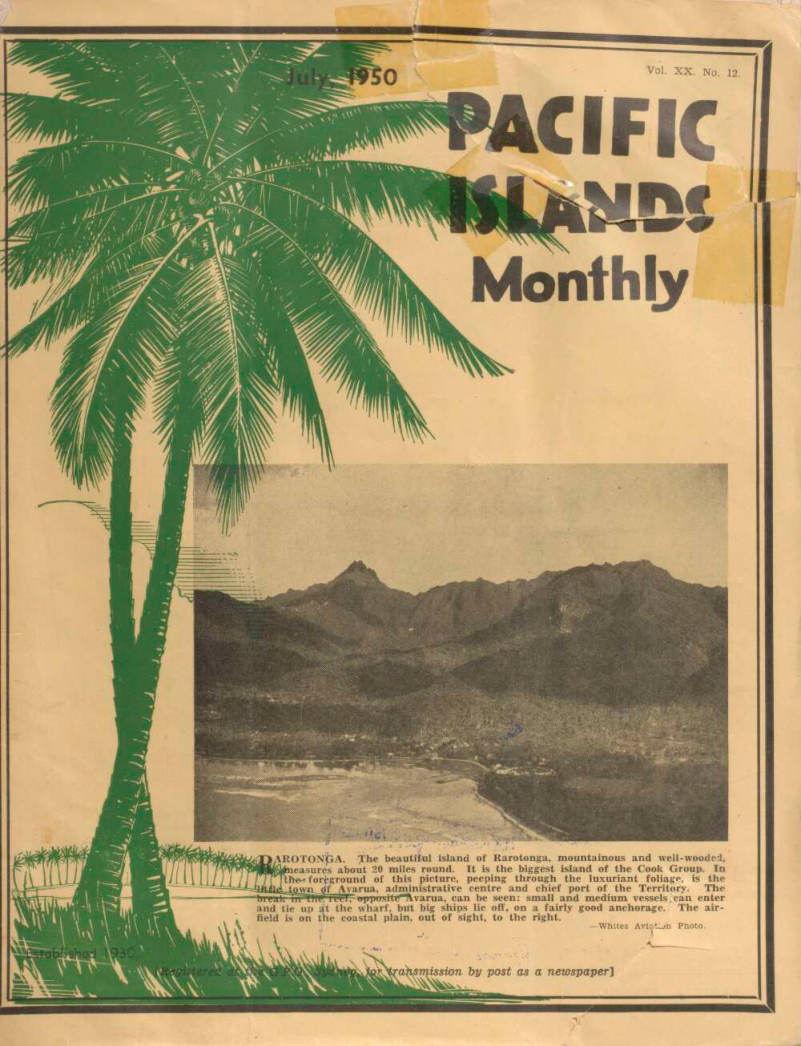
AROTONGA. The beautiful island of Rarotonga, mountainous and well-wooded, measures about 20 miles round. It is the biggest island of the Cook Group. In the foreground of this picture, peeping through the luxuriant foliage, is the litfle town of Avarua, administrative centre and chief port of the Territory. The break inthe reel, opposite can be seen: small and medium vessels can enter and tie up dt the wharf, but big ships lie off, on a fairly good anchorage. The air field is on the coastal plain, out of sight, to the right.
Whites Aviction Photo.
Advertisements & other items, pp. 2-4 (2 items)
Pacific Islands Monxhlt J U L Y , 1950
Cdjrns^
tV»A PASitai n • 4NUI rsi4«o
I A. s f
MADAN&Ujm*
FINSCHAFEN
LAE^
■ i)
(j\^MA6AHG
TALASSA
WABAG
' A
M 7 HAGEN I v
KEROW4GI J v
i iSKf KUTUBU G4ROK4'ps Jjjjfr*''-
C\ KAIN ANTU O
l\ »iru«o cT
rOkOKINA
v . ' vv X X \\ wu i$ 04»y <s. p I Qfv/ * lo / as *tt ''r~ a sX__ /
■" S4*M«4fTT
WOOOL4W
t-t. uoustr h am ah a v»
PORT MORESBY |LO
FREQUENT
ON-SCHEDULED >
FLIGHTS - I
• V :
COOKTOWN Of
CdJRNS^
a £ a
TOWNSVILLE O
cTY
\ 11Ae
ROCKHAMPTON 0\
|S J
BRISBANE
SYDNEY
s SAM A* Alii Si , . • ■ .. ’ '
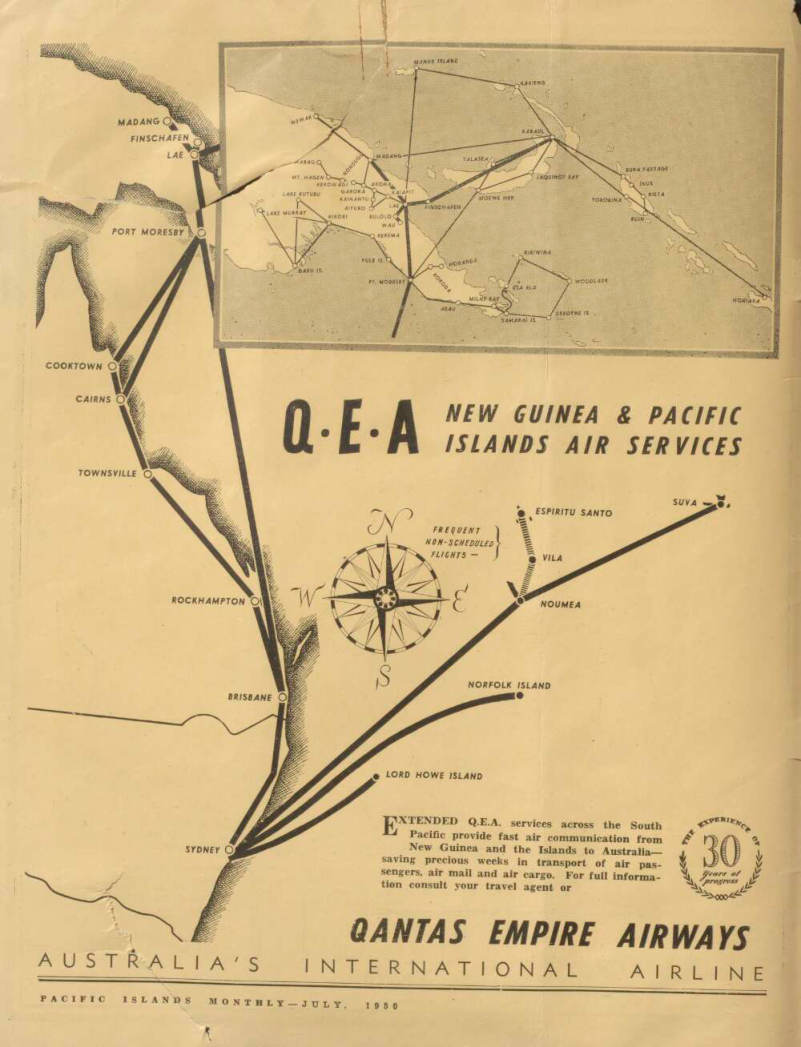
/yfW GO/yV£4 £ PACIFIC
ISLANDS AIR SERVICES
• ESPIRITU SANTO
SUVA
• V/L>9
NOUMEA
NORFOLK ISLAND
LORD HOWE ISLAND
Q.E.A. services across the South Pacific provide fast air communication from New Guinea and the Islands to Australia saving precious weeks in transport of air passengers, air mail and air cargo. For full information consult your travel agent or $ p #ear* o/ Y . "/rrogrrss
QANTAS EMPIRE AIRWAYS
AUSTRALIA'S INTERNATIONAL AIRLINE
: ' <o* *v* •* 9 o D -• 2 J
Brazing Torches e Blow Lamps
Coleman Brazing Torches have solid-drawn heavy duty brass bodies with extra heavy brass bottoms.
All joints are mechanically sealed and securely soldered for double protection. Other features are : Sturdy bottom filler plug . . . positive shut-off fuel valve . . . removable gas tip . . . replaceable self cleaning needle . . . heavy longlife burners and heavy duty pump.
Each torch is inspected and given a pressure and burning test before leaving the factory.
Representatives for
ROBERT GILLESPIE PTY. LTD.
FIG. I—Obtainable in two types, Petrol and Kerosene.
FIG. 2 —Petrol burning only.
Fuel tank capacities of both are 1 pint and 1 quart.
FIG. 3—Coleman’s new Paraffin Blow Lamp which has valves Interchangeable with European types of Lamps. The long-life burner and container are of heavy gauge brass. The container will withstand a pressure of 200 lbs. The flame Is regulated through Alr-release, there being no shut-off valve.
Tank capacities H, 1 and 2 pints, the Pacific Islands:
54a PITT STREET, SYDNEY
PEARCE Cj CO. ETC
SUVA
FOR FIJI ISLANDS
from
°HRNt
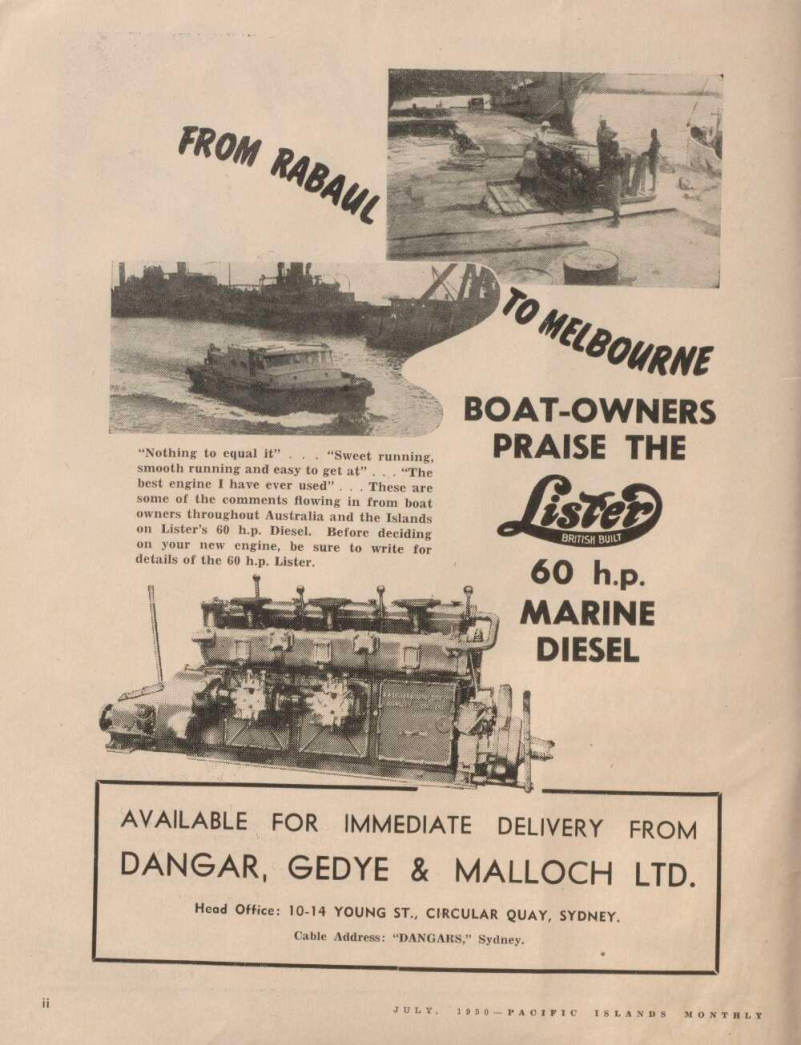
“Nothing to equal it” . . . “Sweet running, smooth running and easy to get at” . . . “The best engine I have ever used” . . . These are some of the comments flowing in from boat owners throughout Australia and the Islands on Lister s 60 h.p. Diesel. Before deciding on your new engine, be sure to write for details of the 60 h.p. Lister.
BOAT-OWNERS
PRAISE THE
e s ui m 60 h.p.
MARINE
DIESEL
AVAILABLE FOR IMMEDIATE DELIVERY FROM
DANGAR, GEDYE & MALLOCH LTD.
Head Office: 10-14 YOUNG ST., CIRCULAR QUAY, SYDNEY.
Cable Address: “DANGARS,” Sydney.
Index to Advertisers
Achun, Gabriel . . 98 Aluminium Union . 74 Amplion (A/sia) . . 37 Angus & Robertson 11 Armstrong Siddeley 75 “Aspaxadrene” . . 28 Australian Inter state Agencies . 51 Australian Radio College Pty., Ltd. 31 Balchin, W., Ltd. . 82 Bank of NSW . . 27 Berger’s Paints . . 92 Berry’s Bay Boat yard 45 Bethell, Gwyn Co. . 49 Blaxland Rae Pty. 45 Blundell Spence Co. 50 8.0.A.C 35 Bovril 41 Brasso Polish ... 16 Bray & Holliday . 48 Bristol-Myers Co. . 69 British Institute of Engineering Tech nology 81 Broomfields, Ltd. . 94 Brunton & Co., Ltd. 21 Budge, James, Ltd. 64 Bunting, A. H., Ltd. (Papua), 22, 72 Burns Philp-(NG) . 61 Burns Philp (NH) . 76 Burns Philp (SS) .49 Burns Philp Trust . 90 Caine’s Studios . . 69 Carpenter, W. R. & Co., Ltd., 70, cov. iv.
Carpenter, W. R. (Fiji) Ltd. ... 97 Carr Shipping & Trading Co. ... 30 “Charmosan” ... 11 Classified Section 110 Colman’s Mustard . 25 Colonial Meat Co. 100 Columbia Pictures . 86 C o 1 y e r Watson (NG) Ltd., 16, 29, 91 Commonwealth Bank of Aust. . . 43 Crammond Radio 18-19 Crawford’s Hatchery ... 77 Crilley, R. J., Ltd. 110 Cunningham, R. H. 103 “Cystex” ... 107 Dangar, Gedye & Malloch, Ltd. . . ii.
Davison Paints . . 63 Dettol 47 Donaghy & Sons . 37 Donald, A. 8., Ltd. (Auckland) ... 84 Donald, A. 8., Ltd. (Rarotonga) . . 67 Douglass, W. C., Ltd 17 Dunlop Rubber, Ltd 107 Electrolux . . . .70 Etablissements Donald Tahiti . . 46 Excelsior Supply . 77 Export Soap Co. . 79 Ford Sherington . 79 Garrett, Davidson & Matthey, Ltd. 11l Garrick Hotel . . 89 Gilbey, W. & A. . 15 Gillespie Bros. . . 68 Gillespie, R., Pty., Ltd., i., 20. 80. 102 Gillespie, R. (NG), Ltd. ... 25. 87 Gordon’s Gin ... 84 Gough & Co., E. J. 112 Grand Pacific Hotel 2 Grand, Walter . 15 Gregory. A., Ltd. . 22 Grove & Sons . . 26 Halvorsen Sons, Ltd. 93 Hawley’s Pty., Ltd. 38 Hay. K. H. D. . . 47 Heinz & Co., Ltd. . 34 Hemingway & Robertson. Ltd. . 88 Hoover, Francis . . 33 Horlicks Pty., Ltd. 1 Hygeia Sanitary Co. 72
I.C.S 101
Island Industries, Ltd 39
Island-Service ... 71 Jones, Win, A.. Ltd, 64 Kasper Refrigera tors Pty., Ltd. . 82 Kennedy, Captain . 95 Kerr Bros. . . 38, 45 Kodak Pty., Ltd. . 33 Kolynos, Inc. . ... 23 Kopsen, W., & Co. 13 Land for Sale . . 109 Maclntyre, Thomas & Co., Ltd. ... 14 Maloney, N. F., Co. 99 McGee, Andrew . 108 Mcllrath’s Pty., Ltd 105 "MendaCo” ... 91 Merrillees, J. C., Ltd 15 Millers, Ltd. (Fiji) 14 Morris Hedstrom, Ltd. 10 Mt. Colah Home Art Union . . . 106 Nathan’s Merchan dise (NSW) Pty. 109 Nelson & Robertson Pty., Ltd. ... 42 “Nixoderm” ... 89 Nordman, Oscar G. 113 Nth. Sydney Travel Bureau ... 101 NZ National Air ways Corporation 52 O’Brien, Geo. ... 97 Oliver Tractors . . 83 Pacific Is. Society 39 Pacific Islands Trading Co. . . 65 Pacific School of Music 65 Pan American Air ways, Inc., Ltd. . 12 "Pinkettes” ... 113 Piper, Tom ... 71 Proud’s, Ltd. ... 32 Qantas, Ltd. . cov. ii.
Qld. Insurance Co. 75 Qld. Merchants Supplies ... 40 Ransomes, Sims & Jefferies, Ltd. . . 51 Reckitt’s Blue . . 85 Reed, William E, . 103 Riverstone Meat Co. 24 Robinson, G. H. . 88 Rohu, Sil 73 Round, Guy ... 35 Scott, J., Pty., Ltd. 46 Shell Co. of Aust. 73 Sims, A. G. . . .99 Southern Pacific Insurance Co. . . 29 Spartan Paints . . 21 Steamships Trading Co., Ltd. (Papua) 63 Stewarts & Lloyds 26 Sullivan, C., Ltd. . 68 Tallerman & Co. . 30 Tasman Airways . 96 Taylor, Allen & Co. 41 Thornycroft, Ltd. . 95 Tilley Lamp Co. . . 36 Tillock & Co., Ltd. 42 Tongan Photois Bureau ... 81 Tooth & Co. . cov. iii.
Tyneside Eng. Co. 76 Undersee Novelties 67 Union Mfg. & Ex port Co.. Ltd. . 78 United Is, Traders 44 Vacuum Oil Co. . 62 Ventura Trading Co 34, 111 Vincent Chem. Co. 85 Wakes’ Pty., Ltd. . 104 West, Harry ... 80 Williams, Dr. . . 106 Willreed Agencies 98 Wills, W. D. & H.
O. (Aust.), Ltd. . 66 Wilson & Son, W. F. 87 W. J. Mfg. Co. . . 94 Woods’ G.P. Cure 105 Yorkshire Insur ance Co., Ltd. . 93
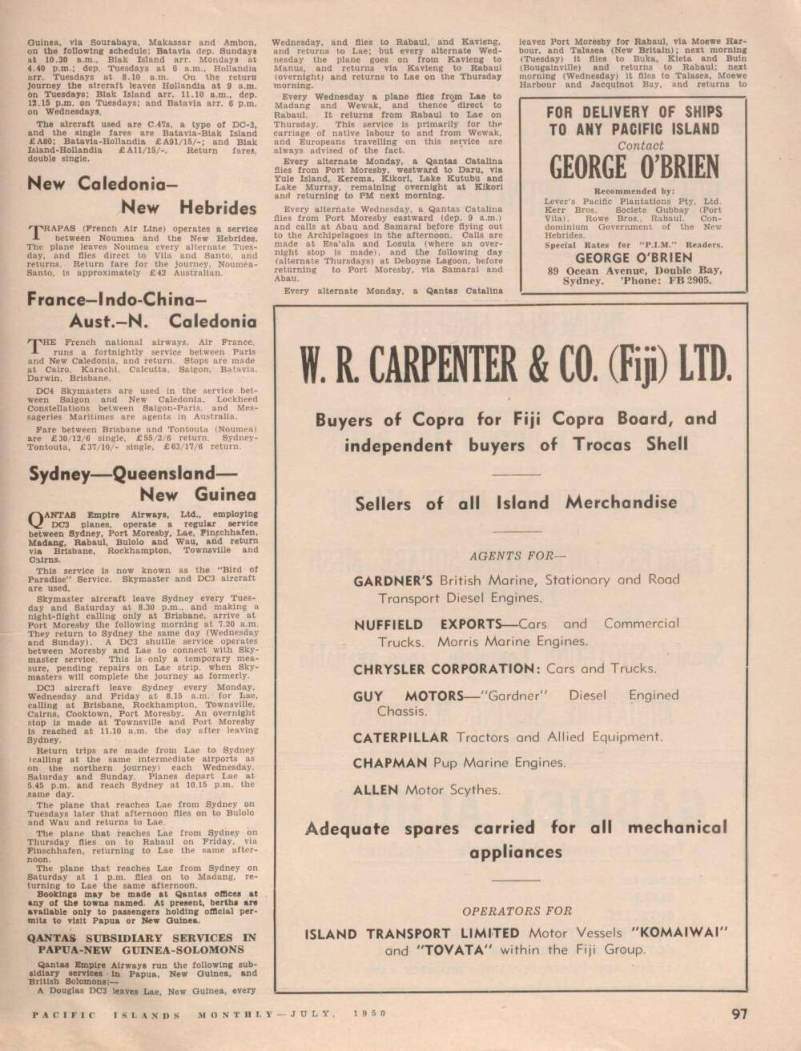
Advertisements & other items, p. 5 (1 item)
Horlicks
World-famous baritone
f ere* va
' says: M. % \ a W "Horlicks and I are old friends.
I've found it the most nourishing of
all food drinks."
Peter Dawson and Horlicks are life-long friends. Peter says: “Wherever I go in the British Empire I enjoy my Horlicks. I find it helps to keep me going in top form.
And, believe me, a concert artist needs to be fit —all the timeT Just like Peter Dawson, you’ll enjoy the delicious, distinctive flavour of Horlicks.
And, like Peter, you’ll find that Horlicks will give you extra energy.
Rich in these food values The full satisfying flavour of Horlicks comes from a careful blend of fresh, fullcream milk and the nutritive extracts of mailed barley and wheat. It is Nature’s flavour . . . that’s why you never lire Many people drink Horlicks simply because they enjoy that distinctive flavour. Others drink Horlicks because they need it to build them up . . . to nourish the body and nerves . . . and to induce deep, refreshing sleep. But whatever the reason everyone enjoys Horlicks. It is equally delicious hot or cold.
V/TAM/N 8/
when mixed as directed Ask your storekeeper for
HORLICKS
*;“2'2 3 e Prices slightly higher in country areas.
In This Issue:
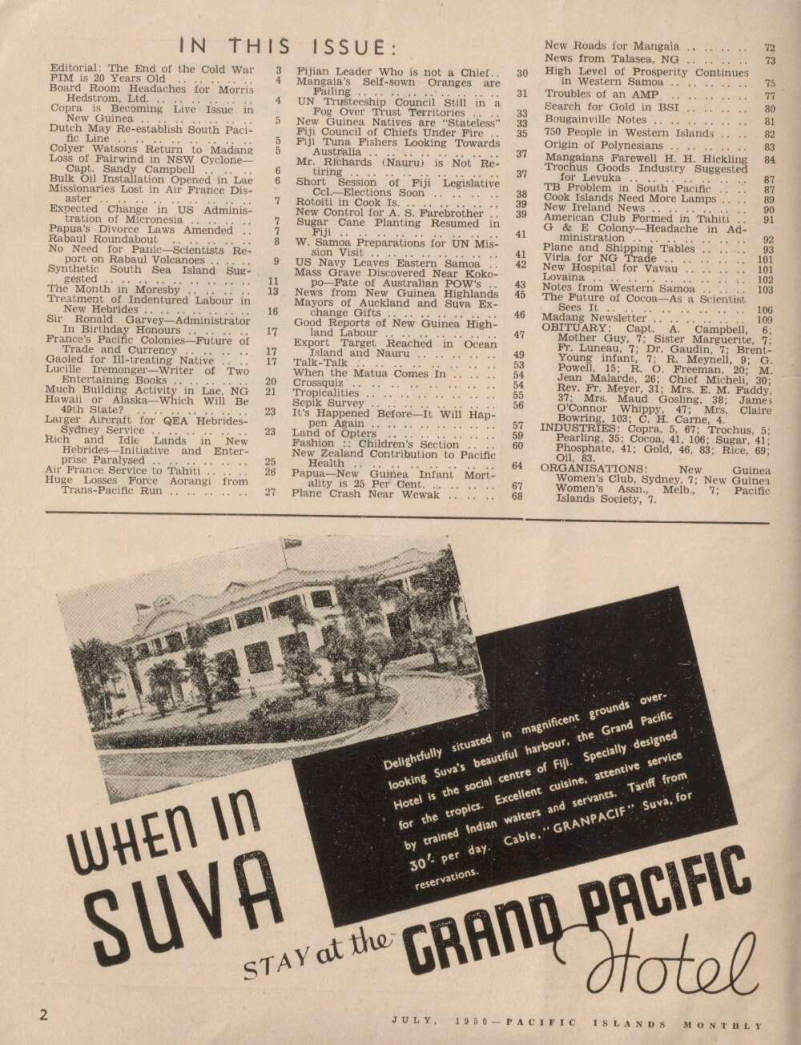
Editorial: The End of the Cold War 3 PIM is 20 Years Old 4 Boax-d Room Headaches for Morris Hedstrom, Ltd 4 Copra is Becoming Live Issue in New Guinea 5 Dutch May Re-establish South Paci fic Line 5 Colyer Watsons Return to Madang 5 Loss of Pairwind in NSW Cyclone— Capt. Sandy Campbell 6 Bulk Oil Installation Opened in Lae 6 Missionaries Lost in Air France Dis aster 7 Expected Change in US Adminis tration of Micronesia 7 Papua’s Divorce Laws Amended .. 7 Rabaul Roundabout 8 No Need for Panic—Scientists Re port on Rabaul Volcanoes 9 Synthetic South Sea Island Sug gested 11 The Month in Moresby 13 Treatment of Indentured Labour in New Hebrides 16 Sir Ronald Garvey—Administrator In Birthday Honours 17 France’s Pacific Colonies—Future of Trade and Currency 17 Gaoled for 111-treating Native ... 17 Lucille Iremonger—Writer of Two Entertaining Books 20 Much Building Activity in Lae, NG 21 Hawaii or Alaska—Which Will Be 49th State? 23 Laxger Aircraft for QEA Hebrides- Sydney Service 23 Rich and Idle Lands in New Hebrides—lnitiative and Enter prise Paralysed 25 Air France Service to Tahiti 26 Huge Losses Force Aorangi from Trans-Pacific Run 27
Fijian Leader Who is not a Chief.. 30 Mangaia’s Self-sown Oranges are Failing 31 UN Trusteeship Council Still in a Fog Over Trust Territories ... 33 New Guinea Natives are “Stateless” 33 Fiji Council of Chiefs Under Fire .. 35 Fiji Tuna Fishers Looking Towards Australia 37 Mr. Richards (Nauru) is Not Re tiring 37 Short Session of Fiji Legislative Cel.—Elections Soon 38 Rotoiti in Cook Is 39 New Control for A. S. Parebrother .. 39 Sugar Cane Planting Resumed in Fiji 41 W. Samoa Preparations for UN Mis sion Visit 41 US Navy Leaves Eastern Samoa .. 42 Mass Grave Discovered Near Koko po—Pate of Australian POW’s .. 43 News from New Guinea Highlands 45 Mayors of Auckland and Suva Ex change Gifts 46 Good Reports of New Guinea High land Labour 47 Export Target Reached in Ocean Island and Nauru 49 Talk-Talk 53 When the Matua Comes In ... 54 Crossquiz 54
Tropicalities . ’ ’ 55
Sepik Survey .. .; 55 It’s Happened Before—lt Will flap pen Again 57 Land of Opters ’ 59 Fashion :: Children’s Section .. .! 60 New Zealand Contribution to Pacific Health 64 Papua—New Guinea Infant Mort ality is 25 Per Gent. 67 Plane Crash Near Wewak 68
Rew Hoads for Mangaia 72 News from Talasea, NG 73 High Level of Prosperity Continues in Westex-n Samoa 75 Troubles of an AMP 77 Search for Gold in BSI 80 Bougainville Notes 81 750 People in Western Islands ... 82 Origin of Polynesians 83 Mangaians Farewell H. H. Hickling 84 Trochus Goods Industry Suggested for Levuka 87 TB Problem in South Pacific .. .. 87 Cook Islands Need More Lamps ... 89 New li'eland News 90 American Club Formed in Tahiti !! 91 G & E Colony—Headache in Ad ministration 92 Plane and Shipping Tables .. .. .. 93 Viria for NG Trade 101 New Hospital for Vavau 101 Lovaina 102 Notes from Western Samoa 103 The Future of Cocoa—As a Scientist Sees It 106 Madang Newsletter 109 OBITUARY: Capt. A. Campbell, 6; Mother Guy, 7; Sister Marguerite, 7; Fr. Luneau, 7: Dr. Gaudin, 7; Brent- Young infant, 7; R. Meynell, 9; G.
Powell, 15; R. O. Freeman, 20; M.
Jean Malarde, 26; Chief Micheli, 30‘ Rev. Fr. Meyer, 31; Mrs. E. M. Faddy, 37; Mrs. Maud Gosling, 38; James O’Connor Whippy, 47; Mrs. Claire Bowring, 103; C. H. Came, 4.
INDUSTRIES: Copra, 5, 67; Trochus, 5- Pearling, 35; Cocoa, 41, 106; Sugar, 41- Phosphate, 41; Gold, 46, 83; Rice, 69; Oil, 83.
ORGANISATIONS: New Guinea Women’s Club, Sydney, 7; New Guinea Women’s Assn., Melb., 7; Pacific Islands Society, 7.
Advertisements & other items, p. 6 (1 item)
I ' -feS:
\ :Psos to*’***"A /■***- ! jp- y ..''* v^ 3 % %*S mmM lb -:% *" ' m ■ ® ppi^^ at^
taV
s
I ' -feS:
.tovio 45 ° ve . „ ***■<* G«« 4 Plt 4 *** o( *»• ** \l' •» cen . «.»«*• tron ' „4 » rVa, " $ ‘ .. SO'"-' 0 '
Pacific Islands MOnthly
The Newspaper-Magazine of the South Seas
L Registered at the G.P.0., Sydney, for transmission hy post as a newspaper l
Published Once Each Month and Circulated in Australia and New Zealand and in the following Pacific Territories and Islands Groups;
Australian Territory of Papua.
Trustee Territory (Australia) of New Guinea Australian Territory of Norfolk Island.
New Zealand Territory of Cook Islands.
Trustee Territory (NZ) of Western Samoa.
British Colony of Fiji.
British Solomon Islands Protectorate.
British Protectorate of Tongan Islands.
British Crown Colony of Gilbert and Ellice Islands.
Trustee Territory of Nauru.
British and French Condominium of New Hebrides.
French Colony of New Caledonia.
French Colony of Oceania (Tahiti, etc.).
American Territory of Eastern Samoa.
American Territory of Hawaiian Islands.
Owned and Produced by Pacific Publications Pty., Ltd., Union House, 247 George Street-, Sydney.
Telephone; General Office and Advertising, BW 5037.
P.O. Box 3408
Registered Address for Telegrams, Radiograms, and Cables: “Pacpub,” Sydney.
Contributions.
Articles. Stories, and Photographs dealing with Pacific Islands subjects are Invited and will be paid for on publication.
Subscription Rates.
Per Annum, Pre-pald, Including Postage.
In Australia, New Zealand, Fiji New Guinea, Papua, Western Samoa, Cook Islands, Tonga, British Solo mons, Gilbert and Ellice Colony, Nauru, New Hebrides, and United Kingdom 18 0 Elsewhere $2.50 £1 1 0 Single Copies * 19
Editor and Publisher:
R. W. Robson, F.R.G.S.
Assistant Editor: JUDY TUDOR.
General Office: Union House, 247 George Street, Sydney. Telephone: BW 5037.
Business Manager: SELWYN HUGHES.
Representative In London.
J. T. Wallis, Coronation House, 4 Lloyd’s Avenue, London, E.C.3, from whom may be obtained copies of Pacific Islands Monthly, Pacific Is. Year Book, advertising schedules, etc.
Agents.
The following are authorised to receive sub scriptions for Pacific Islands Monthly;— Burns, Philp & Co., Ltd., and Burns Philp (South Sea) Co., Ltd. All branches.
W. R. Carpenter & Co., Ltd. All branches.
Morris, Hedstrom, Ltd. AU branches.
Steamships Trading Co., Papua. All branches.
Steele’s Central Store, Suva, Fiji.
Adams Pharmacies Pty., Lautoka, Fiji.
Cook Islands Trading Co., Rarotonga, Cook Is.
United Island Traders, Ltd., Rarptonga, Cook Is.
A. Vercoe, Apia, Western Samoa.
Oscar Nordman, Papeete, Tahiti.
Islands Branches and Representatives of W. H.
Grove & Sons. Ltd., Auckland, New Zealand.
Ed. Pentecost, Noumea, New Caledonia.
Societe Gubbay Kerr et Cie, Noumea, New Caledonia.
Vol. XX. No. 12.
July, 1950
r 1/9 Per Copy.
PriCS Prepaid, p.a,; 18/- Aust.
I In USA. p.a.: $2,50.
The End Of The Coed War
THE events which will spring from this incident in Korea will have a pro found effect upon the future of mankind.
They may lead to World War 111. That is up to Russia. World War 111 would mean horrors indescribable—atom bombs, for certain, and probably bacterial war fare. If we fail in that war, we shall see the end of Western Civilisation and the beginning of another Dark Age, in which we shall carry the yoke of Mus covite Communism.
If we win that war, we shall destroy this monstrous system which the Mus covites have created out of the writings of Karl Marx and their own crazy egotism, and we shall have the chance of establishing in the world an era of peace and plenty—to which poor humanity surely is entitled, after all these centuries of horror and struggle. ♦ * • IF Russia does not fight, now, her mana will be gone. The Anglo-American Powers then will have the oppor tunity of breaking down the Red Bloc, and restoring political sanity and peace to the world.
One or other of these things must hap pen. We shall know, before the northern summer turns to autumn, which it is to be. It is the end of the Cold War. . . .
We must pay tribute to the Americans, for the promptness and decisiveness with which they acted. * * * KOREA and the Koreans—a particu larly unlovable type of Asiatic— mean nothing. It just happened that Moscow-inspired events there pre sented a clear challenge to all the prin
ciples for which we fought World War 11, and which the United Nations was formed to establish and protect.
The challenge was bound to come, somewhere, very soon. The Western Democracies were bound to meet it.
Otherwise, Western civilisation would have collapsed, and Muscovite rule taken its place. * * * JUDGING them on War and Post-War J events, the Moscow gang will not show their hand immediate iy. Even if they are planning total war, we may not know for weeks.
Russia probably will try first to involve the Westerners in a struggle with Com munist China. China, at any moment, m ay SU pp or t North Korea, or thrust at Formosa, or attack Hong Kong, or go to the aid ’ of the Reds in indo-Chiha or Malaya. Anything of that kind will mean war with China. jj u t a wai . with China, with Russia officially neutral in the background, would p e a maddening and confusing thing, what could we do against scores of mil hons of Chinese, with no strength except in their countless numbers, ready at any time to retire into the depths of Asia?
It could be like turning a trained boxer loose on a feather bolster, The w es t, ern Nations are out to get Russia and not to dissipate their strength against China, ‘ * * * INTERNATIONAL publicists have been j[ trying to present the Korea affair as an attempt by the United Nations to uphold the UN law. The British nations and Holland have hurried to the side of the United States. The Com
munist members of UN are hostile, and non-Communist members are doing nothing. .
It looks like the end of the United Nations. It looks as if the duty of de fending Western civilisation will devolve upon the English-speaking nations, with the Scandinavian nations, Germany and Japan coming presently to their aid.
The Anglo-American nations should have accepted that duty and responsibility in 1945, and become the policemen of the world, for the general good of humanity.
Instead of that, the British people went off on a mad Socialist spree, the two Powers (United States and British Com monwealth) chiefly responsible for our overwhelming victory disarmed them selves, and Russia was left free to terrorise the world.
It is possible to argue that, if Britain had kept Mr. Churchill in power, there would have been no irresponsible dis armament, no failure to challenge Russia, no attack on the democratic world by Muscovite Totalitarianism, no over-runn ing of Asia by the Reds—and no threat of World War 111. * * * IF World War 111 comes, it will flare up in South-east Asia, the Middle East, Europe and perhaps North Africa, on many fronts and in a few hours.
The South Pacific countries will not be menaced bv it, however, as they were by the Jans in 1942. The Russians and Asiatic Communists have huge armies, but no sea-power. Without sea-power, they could not send troops or planes against us.
Our chief danger would be from bombs, and perhaps small planes, directed from huge trans-ocean submarines. Russia has several scores of such submarines ready for operations in the Pacific. They could seriously harass us, but they could not invade us.
Pacific Islands
Monthly Is
Now 20 Years Old
WITH this issue, the Pacific Islands Monthly completes 20 years of life.
It was published first in August. 1930.
It has survived one Depression, one World War, and one Post-war Disturbance. Its editors believe that it has succeeded reasonably well, in its effort to give useful service to the communities of the Pacific Islands.
The first half of 1942, in the middle of World War 11, brought a unique ex perience to the publisher of the PIM.
The Japanese invaded the South-west Pacific and, almost overnight, half of the PIM circulation and most of its ad vertisements disappeared. Its subscribers were either fighting in the tropical iungles, or were refugees in Australia.
New Zealand or Polynesia; and the people who directed their business an nouncements to Islands readers were now wholly engaged on vital war work.
However, the PIM never missed an issue. Instead of being a news-review and magazine, it became a monthly record of the War in the Pacific. In 1945-46, as the Islanders went back to their battered mines, stores and plantations, the PIM regained its readers and its advertisers— and, we hone, its capacity for giving use ful service.
With the goodwill and support of our innumerable friends in the Islands, and of business folk and institutions in Aus tralia, New Zealand and the older countries, we have enjoyed our 20 years of Islands journalism. We hope that those cordial relations will long continue.
Distribution By Air
ONE important change has occurred in those 20 years. To an increasing degree, the PIM is reaching its readers in Papua-New Guinea by air transport. This movement is to be ac celerated, and cheapened and widened.
In a plan to give quick delivery, at re duced rates, we have been met in a generous way by Qantas Empire Airways Ltd. We hope, at an early date, to an nounce a special subscription rate for the PIM, under which the journal will be delivered to readers bv air very soon after publication, in all islands reached bv the Qantas services, including the Fiji area.
Death of Mr. C. H. Came, MBE
FIJI lost one of her most valued citi zens on June 21, when Mr. C. H.
Came died, at the age of 67.
An Australian, Mr. Came went to the service of the Colonial Sugar Refining Company in Fiji in 1904. and was em ployed at Labasa, Nausori and Lautoka.
He then became a senior member of the staff of Morris Hedstrom. Ltd,, and he was their Ba manager when he retired after 20 years’ service.
Mr. Came had a strong sense of public duty and. in 1945, he became the Govern ment’s Rehabilitation Officer and made an outstanding success of the iob of help ing the servicemen back to civilian life.
He assisted the Government in other wavs, and was awarded the MBE in the 1949 New Year Honours.
He is survived by his wife, a daughter, and three sons.
The Rev. John Manisela Tonga, a Tone an. has been appointed to a station in Papua by the Methodist Overseas Mission. He recently has been doing de putation work in Australia.
Board-Room Headaches for Morris
Hedstrom Limited
ALTHOUGH the gross profit made by Morris Hedstrom Limited in trading in the Central-South Pacific, in the year ended March 31 last, was the largest in the Company’s 40 years of existence, and the net profit (£90,839) was “satis factory,” the chairman (Sir Maynard Hedstrom) told the shareholders at the annual meeting last month that he was not happy about the position.
Operations, in many respects, had not been carried out efficiently, he said; full advantage had not been taken of the trading opportunities created by the large volume of money in circulation in the Islands; and the Company’s plantations had not had the full advantage from the high ruling price of copra.
Sir Maynard explained that this was not due to any failure on the part of existing staff, but mainly to the fact that the Company simply could not obtain the number of competent men whom it needed for its various opera tions. This condition —common through out Australasia—had nlaced the Company under a severe handicap.
This company, trading in Fiji, Tonga and Samoa, has a subscribed canital of £739,613, and it has nearly £1 million in reserves and P/L Account. On the assets side of its balance-sheet it shows no less than £799,740 in cash and investments— £3ls,ooo of it in actual cash or at short call. Only some £70,000 per annum is required for the customary 10 ner cent, dividend. Little wonder that the Direc torate laments the lack of investment opportunities in the Islands under the post-war Socialistic set-up!
The other two big Islands trading com panies met a similar situation in different ways. Burns Philp and Co. Ltd. have transferred a large part of their activities from Island to mainland trading, and are thus keeping a large proportion of their funds working. W. R. Carpenter & Co.
Ltd., seeing what was coming, allowed much of their busi ness to go to associated con cerns in other countries, and returned to shareholders about half of the capital that had been subscribed in Aus tralia. For years, probably in the hope that investment conditions in their area will change, Morris Hedstrom Ltd., have kept an amount equal to the whole of their subscribed capital, in cash, stocks, and bonds, which probably does not earn an average of more than 2 per cent., and therefore is an embarrassment to a concern expected to pay at least 10 per cent.
Morris Hedstrom Limited is one of the solidest and best managed concerns south of the equator. But, under the now peculiar economic condi
tions of this tortured world, its success and its wealth have created for it some extraordinary directorial headaches. What IS the answer to too much money, not enough investment opportunities, and not enough staff to take care of the oppor tunities that do exist?
This company, by the way, has a Pensions Fund of nearly a' quarter of a million, which receives each year about £lO,OOO from the company, £6,000 from members, and £9,000 from investments.
It has been built up in 23 years; and, so far, it pays out only £2,500 per annum in pensions.
Pacific Islands Year Book
Available This Month
THE 1950 edition of the Pacific Islands Year Book will be available in Sydney before the end of July.
It was scheduled for publication one year ago in July, 1949. The far-reaching industrial dislocation of May-June, 1949, threw that plan out of gear. Power for all publishing was extremely limited.
Inability,; of printing-houses generally to pick up the lag, and the increasing shortage of skilled staff, caused post ponement of publication, until it seemed that the book would never appear.
Finally, printing, was finished, and it was the bookbinders’ turn. Then Aus tralia’s eastern coast was swept by phenomenal storms. Colliers could not carry coal from Newcastle to Sydney; so Sydney’s coal-gas supply was rationed— and still is rationed. The binders are not allowed to use gas, to heat their glue pots, to make book-covers; and so again publication has been delayed.
However, gas-rationing is about to end.
Nothing much else is left to happen. If the Russians do not drop an atom bomb on Sydney, the Year Book should be out, as indicated above.
New Flying-Boat
For Suva Service
While in Suva after its inaugural flight from Auckland in June, the TEAL flying-boat took parties of Suva citizens for courtesy flights.
Top photo shows a party, in flight.
In lower photo, Mrs. Dave Butler (striped frock), wife of the Suva manager of the Union SS Company, is leaving the plane holding one of the souvenir ash-trays which were given to guests.
Copra Price Becoming Live Issue
In New Guinea
From Our Own Correspondent
Rabaul, July 6.
THE coconut planters of Papua and New Guinea are showing growing irritation over the failure of the Australian Government to take any action on their two maim grievances.
Those grievances are: I.—Since the re-establishment of civil government, the Government has compulsorily acquired all copra pro duced in the Territories, and has fixed its own price to the planters. For years, the Government has deducted from payments due to planters a sum, rang ing from £3 to £6 per ton, wherewith to form a Stabilisation Fund. “Stabili sation” became unnecessary after the end of 1948, when the British Govern ment undertook to buy, for nine years, all the copra Australia’s territories could produce, at a guaranteed price.
But deductions still continue, and the Fund is now over £700,000. Planters say the deductions should cease, and the Fund be distributed among the planters who created it. 2.—Planters insist that the £4B/10/- Sterling now being paid by Britain under the Ministry of Food guarantee is grossly under world market value.
It was under market value in 1949; but the position became much worse when Britain de-valued her £, by about 30 per cent., in relation to gold and the US dollar. The copra for which Britain is paying £4B/10/- per ton in her now de-valued Sterling, is now worth around £BO, in the same cur rency.
THESE and other matters were dealt with in a statement made in Rabaul early in July by Mr. B. Barrett, President of the Planters’ Association of New Guinea.
“The reply of the Australian Govern ment on the stabilisation of the copra industry was most unsatisfactory,” said Mr. Barrett.
“The so-called Stabilisation Fund—in the establishment of which Territory planters were not consulted, and have at no time had a voice—now stands at over £700,000.
“As has been pointed out to the Minis ter, repayment of these monies to planters —who are rightly entitled to them—would assist in the development of the country.
“The Minister has spoken of possible settlement schemes in the Territory. It is the considered opinion of the Associ ation that such schemes are doomed to failure, unless the industry is freed from the burden of unwarranted controls.
“Planters have suffered setbacks and met with little but Government red-tape for four years. In the face of this op position, and with difficulties of supply and transport, copra production has risen steadily, thanks to the pioneering efforts of a handful of men. It is only fittine- that these men, or their families, should reap the full reward of their ef forts in the way of repayment of Stabi lisation Fund money deducted to date.
“At present, we go on contributing to this inequitable and illegal fund at the rate of £5 for each ton of copra delivered to the PCB. Who, we ask, it to benefit from this? Perhaps Canberra can tell us.”
Planters Sacrificed To Australian Millers and British Purchasers "IN his recent policy speech, the L Minister said: ‘. . . The Australian crushers, while enjoying the full benefit of the favourable prices which are
at present operating under the Agree ment, are in no way bound by its other terms. Cqnsequently, they are under no obligation to continue purchas ing their requirements from the terri tory at the Agreement price, should any general fall in prices enable them to ob tain their copra requirements from other and cheaper sources of supply.’
“The agreement he refers to is the Copra Agreement with Britain. It is obvious that the Australian crushers, and Britain, are the only ones ‘enjoying the benefit’ from the Agreement. With re cent quotes in the world markets of £BB/10/- sterling per ton, and allowing for difference in freight to these markets, as against freight to Australia, the Aus tralian crusher is at present being sub sidised by New Guinea planters to the extent of no less than £3B/14/6 Aus tralian per ton.
“These figures have been brought to the notice of the Australian Government but to date no satisfactory reply has been received by the Planters’ Association.
Storage and Shipping Problems ’
“fTIHE copra storage position at Rabaul, X which was acute last month, has been temporarily alleviated by the arrival of the Teviot Bank, closely fol lowing the loading of the Ivy Bank and Tungsha.
“The necessity for more storage has been brought to the notice of the Mini ster for External Territories, who stated that tenders are being called for the construction of additional stores at Rabaul. This work is not yet commenced.
The Minister also stated that the Aus tralian Government was endeavouring to arrange regular calls by overseas vessels to pick up copra destined for the British Ministry of Food. This is essential if the congestion and hold-ups of May, 1950, are not to be repeated.
“Mr. D. Mackay, of the Australian Ship ping Board, recently visited most of the New Ireland ports and saw at first hand the difficulties experienced by planters.
“He stated that if the Directorate of Shipping continued to operate in Papua- New Guinea waters, increases in freight and fares were inevitable, as, at present, the ships were running at a loss and fares were below those which would be charged by private operators. He was informed that the planters were prepared to meet increased freights and fares only if there were increased efficiency in the shipping services and regular sailings.
“In the opinion of the Association, it is essential that the Directorate continue in operation until private operators are running to regular schedules.
“The Bougainville sub-branch of the Association indicates that members there are in favour of the Directorate continu ing indefinitely, but they stress the ne cessity of regular services.
“The recent review of the Customs tariff will mean some reduction in liv ing costs, and a small reduction in the cost of production, as meat is now duty free.
“However, an urgent revision of copra prices is still our first essential and the Australian Government is strangely silent on this point.”
New Committee To Deal With
Situation
THE whole matter of the future con trol of the copra industry in New Guinea—the administration of the Stabilisation Fund, the authority and
scope of the Production Control Board, and the price that should be paid by tire Australian crushers—is now under con sideration, and an announcement will be made at an early date,” the Minister for External Territories (Mr. Spender) in formed the PIM on July 12. “It is pro posed to set up a body—probably a Committee —on which planters will have representation.
“I am aware of what has been said about the price paid under the British Ministry of Food guarantee—namely, that Britain is buying our copra at a price much below world values. But we cannot find that Britain is getting any monetary benefit by re-selling our copra—there is no evidence of that, at all.
“Ceylon is not now selling her copra to Britain; but there is no evidence at all of the Ceylon planters getting high prices from the world market. Ceylon appears to be using all her own copra in her own mills.” ,
Dutch May Re-Establish
South Pacific Line
THE Dutch are giving serious thought to the re-establishment of their South Pacific shipping service which, be fore the war, ran between the East Indies and Sydney, via Papua, New Guinea, New Hebrides and New Caledonia.
Inquiries now are being made by the Royal Inter-Ocean Line, which is closely associated with the Dutch Royal Packet Navigation Line. The East Indies ports which may thus be connected with the South-West Pacific probably would be Singapore, Jakarta (Batavia) and Soura baya.
Record Price For
Troghus Shell
ONE of the leading pearl shell buyers on Thursday Island, P. H. Mendis & Sons, are offering £l2O per ton for trochus shell —the record high price for Thursday Island and £5O in advance of 1949 prices.
Inquiries are coming from Greece, Syria, Hong Kong, Japan, Singapore and USA. Production is small and it is believed the price might yet rise to £l5O per ton.
There was little demand for trochus in the immediate post-war years due to the dislocation of the pearl button trade.
Colyer Watsons Return
To Madang, Ng
THE old established trading business and property of Mr. Roy McGregor, Madang, New Guinea, has been purchased by Colyer Watson (New Guinea) Ltd. The new proprietors will take over at the end of August, under the control of Mr. Noel Collins (of Colyer Watson’s Kavieng branch), assisted by Mr. A. J. Robinson (from Rabaul).
This step marks the return to the NG mainland of Colyer Watson (NG), Ltd. after eight years. Before World War 11, they were at Madang and Wau (on the mainland), Rabaul (New Britain), and Kavieng (New Ireland). They did not re-establish at Madang or Wau after the Japanese were driven out but concen trated on reorganising at Rabaul and Kavieng in 1946-47.
Colyer Watson’s will use Mr. Mc- Gregor’s present stores, but their main Madang building will be in front of the old McGregor store in Patostem Street, where a large store is being erected.
Timber and material recently were taken across from Rabaul in their small vessel Bell Bird. The timber came from their own mill at Waterfall Bay, New Britain.
The company will continue to operate the transit camp for native labour at Modillon-
Loss Of Fairwind
In Nsw Cyclone
Skipper Was Well-Known Captain Sandy Campbell
THE 300 ton Navy ship, Fairwind, was lost with all hands in a cyclone off the NSW north coast on or about June 24.
Fairwind he>l, been in New Guinea waters for the last six months on fishery research and was coming South to be returned to the Navy. The master was Captain A. Campbell, 62, of Cremorne, Sydney—better known to pre-war Papua- New Guinea residents as Captain Sandy Campbell of Burns Philp ships, Macdhiii and later, Bulolo.
No bodies have been recovered but a great deal of wreckage, evidently from Fairwind, has been tossed on the beach near NambucCa heads, 250 miles south of Bx-isbane. This included two life boats, (one bearing the name Fairwind), hatch covers, cabin doors, etc.
The Fairwind had been away from Sydney since last September when it took a number of scientists to Papua and New Guinea to enable them to study fishing grounds in those territories. The scientists were not on board for the re turn trip.
The last heard of the Fairwind was at 4.30 p.m. on June 23 when the skip per radioed the Department of External Territories in Sydney stating that he was short of fuel and at that time was shelter ing from heavy seas at Cape Solitary, 12 miles from Coff’s Hai’bour.
He asked for permission to put into Cofl’s Harbour to obtain additional fuel.
It is believed that the Fairwind ran in to the full force of the cyclone within a short time of sending out the radio mes sage to Sydney and was possibly driven on to rocks where it broke up.
The seas that followed during the week-end after Captain Campbell’s last message are said to have been the worst experienced in the memory of residents of the NSW north coast. The captain of the small island ship, Awahou, which for a few days was also feared lost on a voyage from the Solomons, said that it had been “touch and go” for his ship and that the waves were the biggest he had ever seen.
Besides Captain Campbell the white crew consisted of First Officer J. E. Wil son, 25, of Cronulla (N.S.W.); Chief En gineer L. T. Myers, 31, of Bondi, Sydney; D. Connelly, 25, Fisheries officer, of New castle; W. Brightwell, technician, of Sydney. There were also 11 native sea men.
Captain Campbell’s Career
CAPTAIN CAMPBELL had been semi retired from the sea for the last few years.
He served in the Navy ixx World War I and became well-known to New Guinea residents who travelled on Burns Philp ships between Sydney and Papua-New Guinea ports between the wars. He served as master in most BP ships, par ticularly in Macdhui and later the modern Bulolo. He was her skipper at the outbreak of war when the British Admiralty took her over. He then went to the Neptuna but retired altogether from Burns Philp in the mid-war period.
Towards the end of the war he was working with Mr. Leonard Murray on in telligence work for the United States forces —it is understood this work was compiling sailing directions for Islands waters.
After the war he ferried a number of small ships to Port Moresby for the Gov
ernment and at one stage was acting Harbour Master, Port Moresby, for six months.
For the last six months he has been on the Fairwind.
Captain Campbell was of a quiet, re tiring disposition but a top-ranking sea man and popular with his fellow officers.
Bulk Oil Installation
Opened At Lae, Ng
From a Special Correspondent LAE, July 9.
NEW GUINEA’S first commercial bulk petroleum terminal was officially opened at Lae on July 8, by the Administrator of Papua-New Guinea, Colonel J. K. Murray.
Built by the Vacuum Oil Co. Pty., Ltd., at a cost 'of approximately £150,000 this new installation will open up a new era of fuel distribution for the wide area it will serve.
This will embrace Madang, Wewak, Rabaul, Kavieng, Manus Island, Samarai and Port Moresby.
Commonwealth departmental officers, members of Colonel Murray’s adminis trative staff, industrialists, and business men engaged in developmental work and undertakings in New Guinea, airline and shipping representatives, planters, former Vacuum Oil Company agents, and petroleum consumers from Papua-New Guinea and adjoining islands were present at the ceremony.
The weather was fine and about 200 visitors were the guests of the Vacuum Oil Company.
Mr. H. C. Smith, Operations Director, in his speech reviewed the past and future of the Vacuum Oil operations within the Territory. The Administrator after an interesting speech declared the Bulk Installation open. The guests then retired for refreshment after they had made a conducted tour of the Installation.
THE terminal received its first shipment of petroleum products from Palem bang m early July when the 16,000ton tanker Lifjord tied up at the wharf at Milfordhaven and pumped its cargo through a mile long pipeline cut through the jungle to the bulk storage tanks of the new installation.
Nadi As Aerial
Gateway For
Fiji Tourist Traffic
r BLOWING upon the decision of the South Pacific Air Transport Council in Melbourne, that the Fiji inter national airport should be at Nadi in stead of Suva Point, the notices given to Suva Point property owners (that their land was to be acquired for an airport) have been formally withdrawn.
The international air authorities con cerned (especially Fiji and New Zealand) are now giving attention to the problem of providing suitable amenities for stop over travellers at Nadi.
JARETT HILDER, almost as well-known now as an artist as he is a sea captain, will hold an exhibition of water colours in Anthony Hordern’s Art Gallery, Sydney, between September 12-24.
Each picture is a study of a member of one of the native races of the Pacific basin—Mela nesian, Polynesian, Micronesian; Chinese, Indians, Malays, etc., are also represented.
Critics have already called this collection of his work unique.
Great trouble has been taken to frame and mount the water colours in a manner typical of their Island origin.
At present, there is a kind of a hostel —much improved in the last year or two, but still primitive—at Nadi airport; a small but fairly modern hotel at the Indian town of Nadi, a couple of miles away; and a large European hotel at Lautoka, nearly 20 miles away.
Fiji is anxious to secure tourist traf fic; but Nadi airport is isolated on the bare and uninteresting northwestern plain—an ideal airport, but not in the least attractive. Its chief drawback is the difficulty and expense of getting from Nadi to more civilised and beautiful places. Suva, for example, is 130 miles away. It now is planned, however, to run a flying-boat service between the northwest (presumably from Lautoka) and Suva; and this at least will encourage toui’ists to “stop over.”
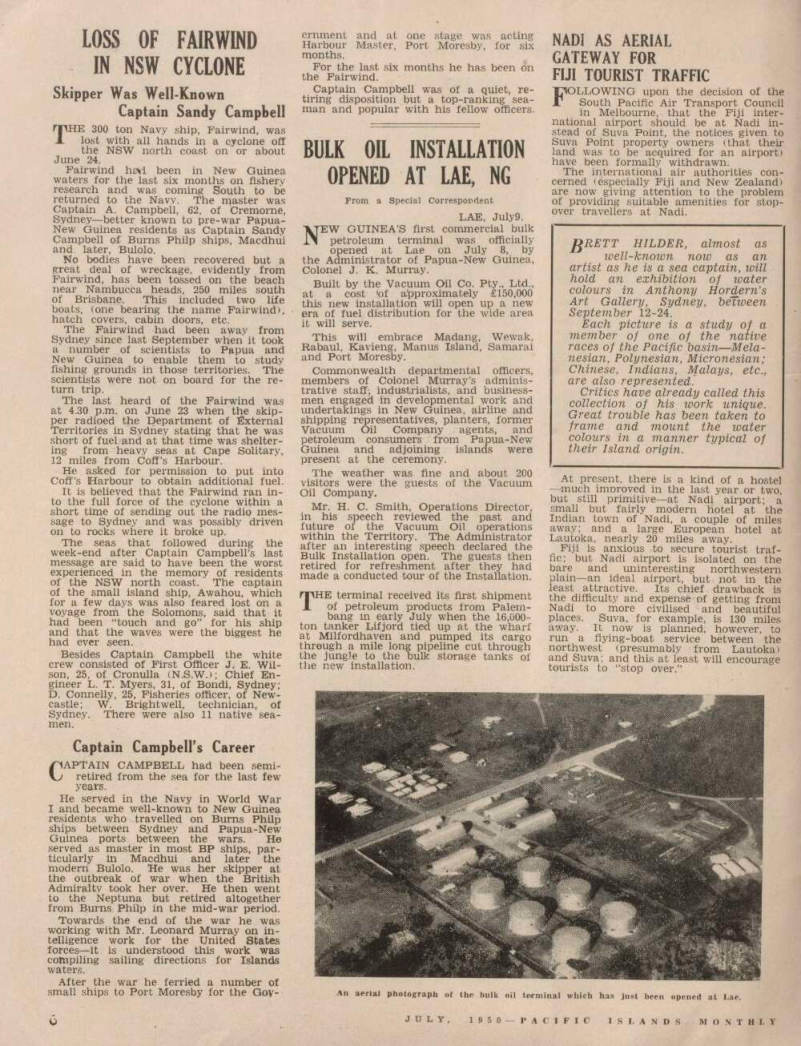
An aerial photograph of the bulk oil terminal which has just been opened at Lae.
Air France Disaster
Missionaries Die In
Prom a Special Correspondent DEATH strikes without discrimination.
Among those who perished when an Air Prance Constellation plunged into the Persian Gulf on June 13 were four members of the Catholic church in New Caledonia.
They were: Mother Guy of the Eucharistie, Mother Superior of the Catholic girls’ school at Noumea, chosen to represent New Caledonia at Holy Year celebrations at Rome.
Sister Marguerite, nursing sister at the Ducos Leper settlement.
The Rev. Father Luneau of the native catechists at Canala, on the East coast, on a Holy Year pilgrim age to Rome.
The Rev. Father Luc Amoura, re cently ordained a priest and the first New Caledonian native to gain that honour, also bound for Rome.
For 20 years Mother Guy
had guided the Catholic girl hood of Noumea. She was 45 at the time of her death but perennially young and, if such a term can be applied to a nun, vivacious. Her charm was felt by all who met her. After her long years of work in the tropics she was to enjoy a long holiday after her visit to Rome.
Sister Marguerite had nursed lepers for four years and was going home to France to recuperate her own health.
Father Luneau was to have a holiday in Prance after his visit to Rome and to visit his home and family whom he had not seen for 20 years.
Father .Luc Amoura, after completing his Holy Year mission, was to continue his religious education in France.
The tragic death of these people has cast a gloom over all sections of the community of New Caledonia.
Tahiti Man Lost
Papeete, June 18
DOCTEUR GAUDIN, who owned a pharmacy business here, and who was well and favourably known, perished in the Air France disaster on June 13.
Kwato, Papua
Fatal Accident At
WHEN Mr. and Mrs. Neville Brent- Young, of Milne Bay, Papua, were holidaying at Kwato, their small son, 21, fell from a jeep which his father was driving, at the mission station, and was fatally injured. Dr. Leo Petroskos, of Samarai attended the child but, de spite all care, he died on July 3, and was buried at Kwato.
Pacific Islands Society
GUEST speaker at the June meeting of the Pacific Islands Society was Mr.
R. W. Robson, whose subject was “Behind the Scenes at the South Pacific Conference.”
The dnnual general meeting of the Society will be held on July 26.
NEW MEMBERS: Captain and Mrs.
Brett Hilder.
Micronesia
Expected Change in US Administration
IT is reported that the American Trust Territory of Micronesia is to come under civilian administration as from July 1. Ever since it was taken over from the Japanese, it has been a Navy re sponsibility.
At first, the Territory was administered from the Mariana Islands, and consider able progress was made; but American critics have complained that in the past year, since headquarters were moved to Hawaii, they have lost some contact with the native peoples.
It was tipped in Honolulu last month that a brother of Mr. Dean Acheson, Secretary of State, would become the civilian Administrator of Micronesia and that headquarters would be at Truk, in the Carolines, which already is head quarters for various official institutions concerned with native welfare.
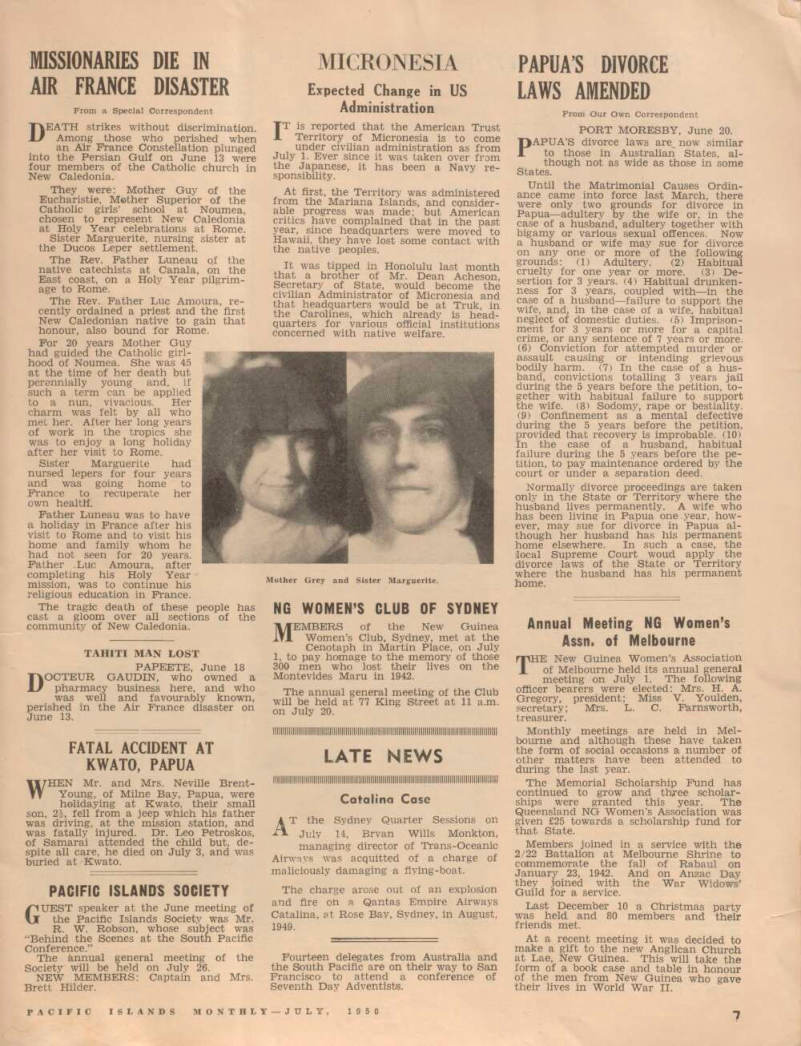
Mother Grey and Sister Marguerite.
Ng Women’S Club Of Sydney
MEMBERS of the New Guinea Women’s Club, Sydney, met at the Cenotaph in Martin Place, on July 1, to pay homage to the memory of those 300 men who lost their lives on the Montevides Maru in 1942.
The annual general meeting of the Club will be held at 77 King Street at 11 a.m. on July 20.
Late News
Catalina Case AT the Sydney Quarter Sessions on July 14, Brvan Wills Monkton, managing director of Trans-Oceanic Airways was acquitted of a charge of maliciously damaging a flying-boat.
The charge arose out of an explosion and fire on a Qantas Empire Airways Catalina, at Rose Bay, Sydney, in August, 1949.
Fourteen delegates from Australia and the South Pacific are on their way to San Francisco to attend a conference of Seventh Day Adventists.
Laws Amended
Papua’S Divorce
From Our Own Correspondent
Port Moresby, June 20.
PAPUA’S divorce laws now similar to those in Australian States, al though not as wide as those in some States.
Until the Matrimonial Causes Ordin ance came into force last March, there were only two grounds for divorce in Papua—adultery by the wife or, in the case of a husband, adultery together with bigamy or various sexual offences. Now a husband or wife may sue for divorce on any one or more of the following grounds: (1) Adultery. (2) Habitual cruelty for one year or more. (3) De sertion for 3 years. (4) Habitual drunken ness for 3 years, coupled with —in the case of a husband—failure to support the wife, and, in the case of a wife, habitual neglect of domestic duties. (5) Imprison ment for 3 years or more for a capital crime, or any sentence of 7 years or more. (6) Conviction for attempted murder or assault causing or intending grievous bodily harm. (7) In the case of a hus band, convictions totalling 3 years jail during the 5 years before the petition, to gether with habitual failure to support the wife. (8) Sodomy, rape or bestiality. (9) Confinement as a mental defective during the 5 years before the petition, provided that recovery is improbable. (10) In the case of a husband, habitual failure during the 5 years before the pe tition, to pay maintenance ordered by the court or under a separation deed.
Normally divorce proceedings are taken only in the State or Territory where the husband lives permanently. A wife who has been living in Papua one year, how ever, may sue for divorce in Papua al though her husband has his permanent home elsewhere. In such a case, the local Supreme Court woud apply the divorce laws of the State or Territory where the husband has his permanent home.
Annual Meeting NG Women’s
Assn, of Melbourne
THE New Guinea Women’s Association of Melbourne held its annual general meeting on July 1. The following officer bearers were elected: Mrs. H. A.
Gregory, president; Miss V. Youlden, secretary: Mrs. L. C. Farnsworth, treasurer.
Monthly meetings are held in Mel bourne and although these have taken the form of social occasions a number of other matters have been attended to during the last year.
The Memorial Scholarship Fund has continued to grow and three scholar ships were granted this year. The Queensland NG Women’s Association was given £25 towards a scholarship fund for that State.
Members joined in a service with the 2/22 Battalion at Melbourne Shrine to commemorate the fall of Rabaul on January 23, 1942. And on Anzac Day they joined with the War Widows’
Guild for a service.
Last December 10 a Christmas party was held and 80 members and their friends met.
At a recent meeting it was decided to make a gift to the new Anglican Church at Lae, New Guinea. This will take the form of a book case and table in honour of the men from New Guinea who gave their lives in World War 11.
Rabaul Roundabout
From Our Own Correspondent
Rabaul, July 3.
RABAUL is proud of its rehabilitated swimming pool which has now been restored to its pre-war size of 100 feet by 36 feet and is complete with new dressing sheds. The pool is filled by a high pressure pump electrically driven, and the surrounding grounds are well kept and planted.
Credit for this fine achievement goes to the Committee of the Swimming Club, especially to Secretary Ken Jameson and Mr. Phil James, Club captain.
When required, the pool is laned off for racing events. Over Easter week end a large crowd of Madang visitors used the pool and races were staged.
Over King’s Birthday week-end, a plane load of Kavieng swimmers visited Rabaul.
A successful swimming carnival was held in which Kavieng, Kokopo and Rabaul all shared honours, with special mention to the Misses Stanfield and Mr. Stanfield Junior, of Kavieng, who outclassed all in their respective divisions.
With the arrival of the material, it is intended to treat the walls of the pool specially and paint them white.
A LOCAL Court case which created much interest, was held recently, when Mr. Edward Fowler, Engineer, sued Messrs. Colyer Watsons for wrong ful dismissal. The Judge found for Mr.
Fowler, and in his summing up stated “that the agreement of employment was indeed a fine one, for Messrs. Colyer Watsons.”
THE native market is improving with regard to prices, eggs being stan dardised at 4d. each. Prices of vegetables and fruit, however, are still much higher than they were 12 months ago.
ON June 10, a social evening and dance ‘was held at the Returned Service men’s Club to present a Life- Membership Certificate of the RSL. to the Sub-Branch secretary, Mr. Phil Chapman, in appreciation of services rendered. Two hundred members and their guests attended, including Kavieng and Kokopo visitors.
DURING June, at the European Hos pital, a son was born to Mr. and Mrs. Dick Arrowsmith. A daughter to Mr. and Mrs. Dunbar-Reid.
THE Cariad, a South African yacht, on a voyage around the world called at Rabaul in June. She arrived from Panama and West Indies ports via Aus tralia, and the owners will continue their cruise as their fancy pleases.
RABAUL is expanding in the way of new businesses and personnel. On the last Bulolo two dentists arrived to set up in private practice. One is Mr.
R. Dickie from Fiji, who is well-known in the Territory. However, Mr. Dickie has been unable to secure suitable premises and is leaving Rabaul within the month. The other dentist is a New Australian, Mr. Baumgarten, who has temporary premises in Mango Avenue.
The medical staff has been increased by the appointment of Dr. Sawy, a New Australian, who is stationed at the Native Hospital.
Rabaul now has two solicitors, our well-known identity, Mr. Dudley Jones, and newcomer, Mr. R. F. Foy, who has had considerable experience in India.
Mrs. Dudley Jones arrived on the last Bulolo to take up residence in Rabaul.
The new hotel in Mango Avenue, which is being built for Mr. Arthur Brown, is rapidly nearing completion.
Rabaul now has a European ladies’ and men’s hairdresser in Mrs. Leech, whose premises are located at the back of Doctor James’ surgery.
A modern photographic studio is being erected for Mr. and Mrs. R. F. Smith in Mango Avenue. Pending completion of this building, which will be known as the Casurina Studios, business is being conducted at a private residence.
We understand that a chemist is shortly to open a shop in the same block. In addition to carrying the usual stocks, a soda fountain and milk bar will be in stalled.
ON June 7, a serious accident occurred near Tilligap approximately half way between Rabaul and Kokopo, involving a jeep and truck. The driver of the jeep, Mr. H. E. (Harry) Read, received a broken leg and abrasions. His native boss boy Milah, a passenger, had his chest crushed and died in hospital some hours later. It is believed that the accident was due to poor visibility created by the dust. Mr. Read, who is the well-known and popular secretary of the RSL Club is now convalescent at Namanula Hospital.
THE Ne»v Guinea Club is making im provements to the visitors’ room, and the new dance hall at the RSL Club is quickly taking shape. The floor is of seasoned timber, and will please ■those who have danced on concrete floors for many years. The new building will be opened with a “Diggers’ Ball.”
THE dust menace becomes progressively worse in the township due to lack of rain. The scarcity of water, even from the wells, is causing some anxiety.
DUE to the increasing number of motor accidents, the Police Department is conducting a “blitz” on all vehicles.
Registration is most strict and vehicles suspected of not complying with all requirements of the Traffic Act are pulled m for investigation. This drive is com mendable, as there are over 1,000 motor vehicles on the Gazelle Peninsula, the majority being ex-disposals vehicles which are much the worse for wear. Rabaul howeyer, has more than its share of luxurious new cars. These arrive on every ship from the East, chiefly pur chased by the local Chinese.
ELECTRICAL officials have been mak ing a house-to-house check and advising householders as to what their monthly charge will be for the supply of electrical power. All agree that some charge should be made as the P« w er supply for the last year has been all that could be desired. However, the basis of charge is on every light point and power plug, making the total some what excessive. It is also rumoured that payments will be retrospective to September 1949. Should this be the case an uproar is anticipated.
SUBSEQUENT to the visit of Brigadier Brown of the War Graves Com mission, and the information that he received, was the arrival of Colonel Houghton (Army War Graves), Squadron- Leader Rundle and Sgt. Henderson of RAAP War Graves.
An area surrounding Matupi was ex cavated, and some 30 bodies of servicemen were discovered, comprising 15 RAAF, 12 Indians and the rest American personnel.
Twelve of the RAAF bodies have been definitely identified. It is intended to remove the bodies to the Bita Paka war cemetery for reburial early in July.
MR. BECKETT, an executive of Kodaks, paid a visit to Rabaul during late June. Much enthusiasm was shown by amateur photographers who met him and a meeting of all interested was held. A camera club has been formed and the first photographic competition arranged.
TAKING advantage of the dry weather, work on the town roads has been resumed. Namanula road, which was unpassable during the last floods has been widened and made into a safe
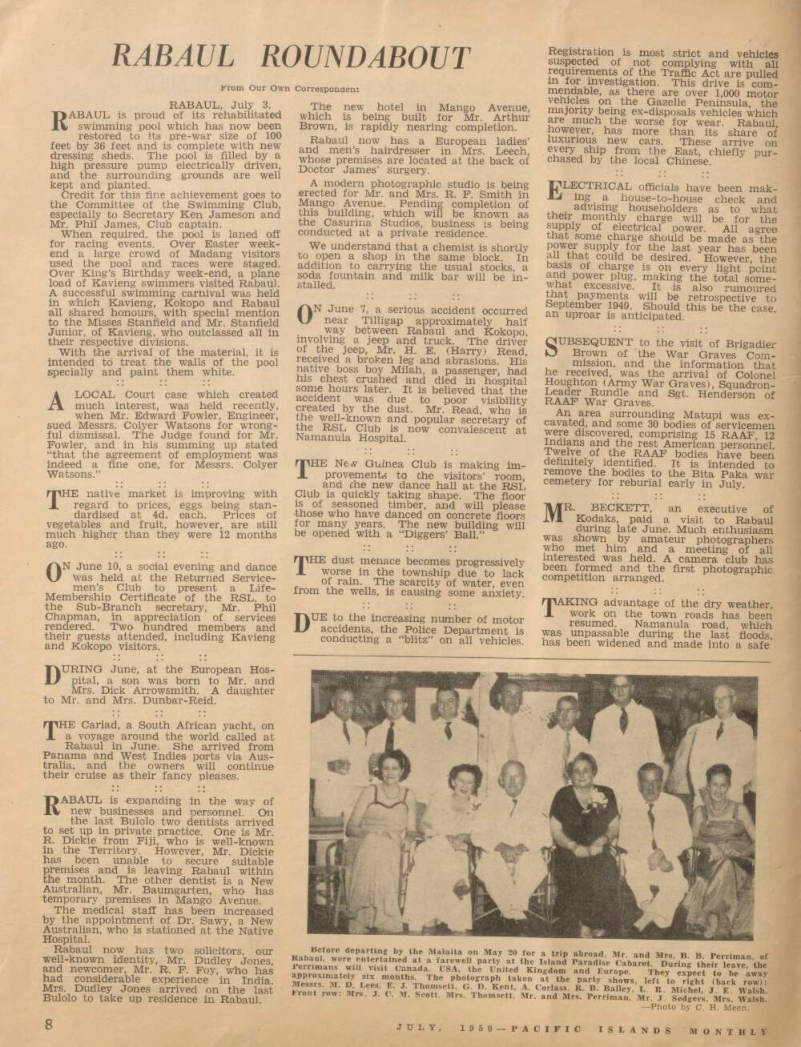
Before departing b y the Malaita on May 20 for a trip abroad, Mr. and Mrs B B Perriman of Rabaul, were entertained at a farewell party at the Island Paradise Cabaret During their the Pernmans will visit Canada, USA, the United Kingdom and Europe. They expect to be away approximately six months. The photograph taken at the party shows, leftto right (back row Messrs. M. U. Lees. E. J. Thomsett. G. D. Kent. A. Corlass. R. Bailey U R Michel J E front row: Mrs. J. C. M. Scott, Mrs. Thomsett, Mr. and Mrs. Perriman Mr. J. Sedgers Mrs! Walsh.' —Photo by C. H. Meen.
fast highway. In other parts much at tention has been paid to culverts and drainage. Roads have been redressed with bitumen and in all, a most thorough and commendable job has been carried out. However, it is hoped that in the not too distant future, the sealing of all roads in the town area will have been completed.
RABAUL Administration employees have received notice of their re classification under the Papua-New Guinea Public Service Commission. These classifications have caused much com ment and dissatisfaction.
It is understood, that when the positions have been officially gazetted a meeting of protest is to be called by local Adminis tration employees.
Death Of R. Meynell
From Our Own Correspondent
Rabaul, July 3
DURING last week, a native runner brought word to Mrs. A. H. Creswell of Lillinikia Plantation, Bainings, that his master was ill. Mrs Creswell immediately set out by canoe to investi gate and found Raymond Maynell, an employee of her husband’s, unconscious.
Mr, Creswell was summoned and Maynell was brought by boat to Rabaul General Hospital. Despite every effort, Maynell did not regain consciousness and died on July 1. Death was due to inflammation of the brain.
Maynell was only 26 and a stranger to Rabaul district. However, he was well known at Wau for his sporting activities.
He served for 5 years during the war with the R.A.N.
He was buried on July 2, following a service at the Roman Catholic Church, by the Rabaul RSL with full ceremony.
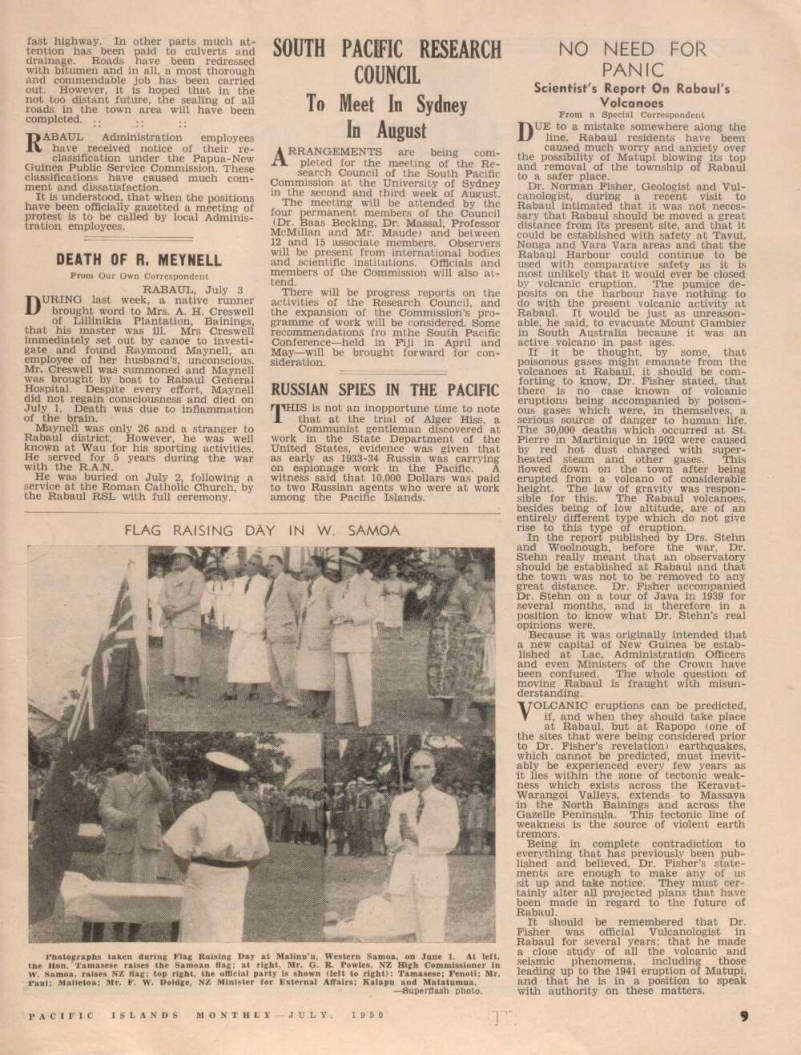
Flag Raising Day In W. Samoa
Photograps taken during Flag Raising Day at Malinu’u, Western Samoa, on June 1. At left, the Hon.Tamasese raises the Samoan flag; at right, Mr. G. R. Powles, NZ High Commissioner in W. Samoa, raises NZ Mag; top right, the official party is shown (left to right): Tamasese; Fenoti; Mr, Paul; Malietoa; Mr. F. W. Doidge, NZ Minister for External Affairs; Kalapn and Matatumua. —Superflash photo.
South Pacific Research
Council
To Meet In Sydney In August
ARRANGEMENTS are being com pleted for the meeting of the Re search Council of the South Pacific Commission at the University of Sydney in the second and third week of August.
The meeting will be attended by the four permanent members of the Council (Dr. Baas Becking, Dr. Massal, Professor McMillan and Mr. Maude) and between 12 and 15 associate members. Observers will be present from international bodies and scientific institutions. Officials and members of the Commission will also at tend.
There will be progress reports on the activities of the Research Council, and the expansion of the Commission’s pro gramme of work will be considered. Some recommendations fro mthe South Pacific Conference —held in Fiji in April and May—will be brought forward for con sideration.
Russian Spies In The Pacific
THIS is not an inopportune time to note that at the trial of Alger Hiss, a Communist gentleman discovered at work in the State Department of the United States, evidence was given that as early as 1933-34 Russia was carrying on espionage work in the Pacific. A witness said that 10,000 Dollars was paid to two Russian agents who were at work among the Pacific Islands.
No Need For
Panic
Scientist's Report On Raboul's Volcanoes
From a Special Correspondent DUE to a mistake somewhere along the line, Rabaul residents have been caused much worry and anxiety over the possibility of Matupi blowing its top and removal of the township of Rabaul to a safer place.
Dr. Norman Fisher, Geologist and Vul canologist, during a recent visit to Rabaul intimated that it was not neces sary that Rabaul should be moved a great distance from its present site, and that it could be established with safety at Tavui, Nonga and Vara Vara areas and that the Rabaul Harbour could continue to be used with comparative safety as it is most unlikely that it would ever be closed by volcanic eruption. The pumice de posits on the harbour have nothing to do with the present volcanic activity at Rabaul. It would be just as unreason able, he said, to evacuate Mount Gambier in South Australia because it was an active volcano in past ages.
If it be thought, by some, that poisonous gases might emanate from the volcanoes at Rabaul, it should be com forting to know, Dr. Fisher stated, that there is no case known of volcanic eruptions being accompanied by poison ous gases which were, in themselves, a serious source of danger to human life.
The 30,000 deaths which occurred at St.
Pierre in Martinique in 1902 were caused by red hot dust charged with super heated steam and other gases. This flowed down on the town after being erupted from a volcano of considerable height. The law of gravity was respon sible for this. The Rabaul volcanoes, besides being of low altitude, are of an entirely different type which do not give rise to this type of eruption.
In the report published by Drs. Stehn and Woolnough, before the war, Dr.
Stehn really meant that an observatory should be established at Rabaul and that the town was not to be removed to any great distance. Dr. Fisher accompanied Dr. Stehn on a tour of Java in 1939 for several months, and is therefore in a position to know what Dr. Stehn’s real opinions were.
Because it was originally intended that a new capital of New Guinea be estab lished at Lae, Administration Officers and even Ministers of the Crown have been confused. The whole question of moving Rabaul is fraught with misun derstanding.
VOLCANIC eruptions can be predicted, if, and when they should take place at Rabaul, but at Rapopo (one of the sites that were being considered prior to Dr. Fisher’s revelation) earthquakes, which cannot be predicted, must inevit ably be experienced every few years as it lies within the zone of tectonic weak ness which exists across the Keravat- Warangoi Valleys, extends to Massava in the North Bainings and across the Gazelle Peninsula. This tectonic line of weakness is the source of violent earth tremors.
Being in complete contradiction to everything that has previously been pub lished and believed, Dr. Fisher’s state ments are enough to make any of us sit up and take notice. They must cer tainly alter all projected plans that have been made in regard to the future of Rabaul.
It should be remembered that Dr.
Fisher was official Vulcanologist in Rabaul for several years; that he made a close study of all the volcanic and seismic phenomena, including those leading up to the 1941 eruption of Matupi, and that he is in a position to speak with authority on these matters.
Advertisements & other items, p. 14 (1 item)
Morris Hedstrom Limited
General Merchants, Importers and Exporters,
Shipowners, Plantation Owners,
Commission and Insurance Agents
HEAD OFFICE
SUVA, FIJI
Established 1868
SERVICE IN THE SOUTH PACIFIC TERRITORIES
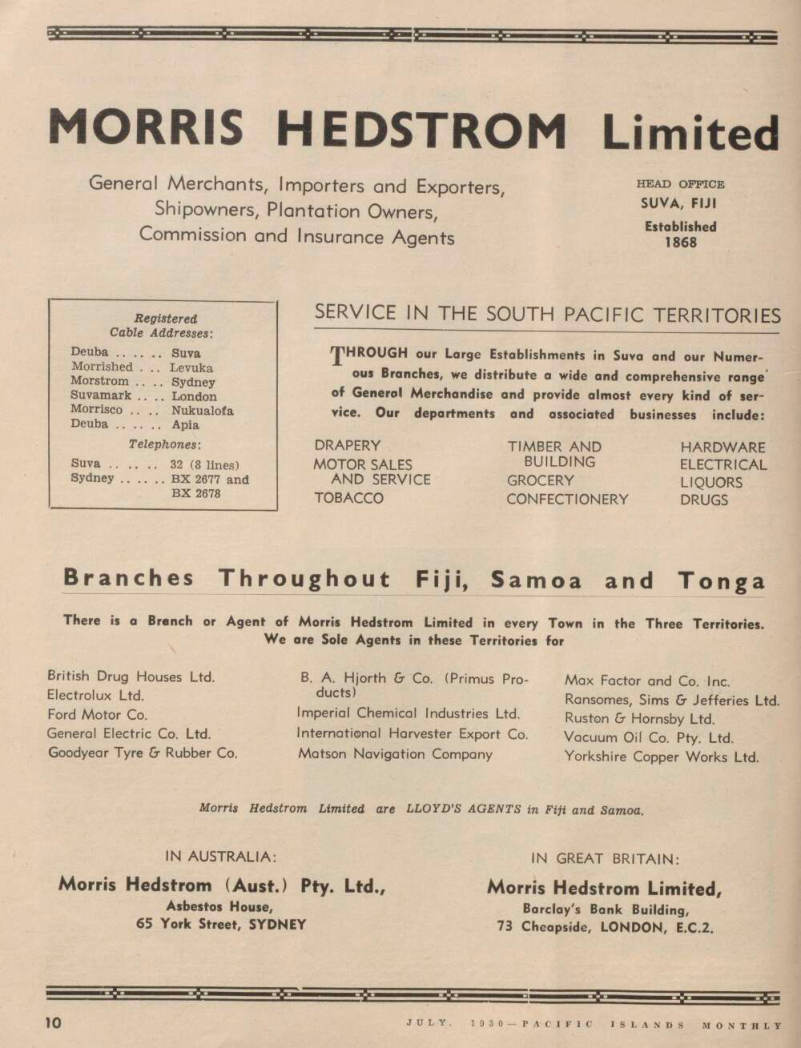
'J'HROUGH our Large Establishments in Suva and our Numerous Branches, we distribute a wide and comprehensive range of General Merchandise and provide almost every kind of service. Our departments and associated businesses include:
DRAPERY
MOTOR SALES
AND SERVICE
TOBACCO
TIMBER AND
BUILDING
GROCERY
CONFECTIONERY
HARDWARE
ELECTRICAL
LIQUORS
DRUGS
Branches
Throughout Fiji,
Samoa and Tonga
There is a Branch or Agent of Morris Hedstrom Limited in every Town in the Three Territories.
We are Sole Agents in these Territories for British Drug Houses Ltd.
Electrolux Ltd.
Ford Motor Co.
General Electric Co. Ltd.
Goodyear Tyre Gr Rubber Co.
B. A. Hjorth & Co. (Primus Products) Imperial Chemical Industries Ltd.
International Harvester Export Co.
Matson Navigation Company Max Factor and Co. Inc.
Ransomes, Sims & Jefferies Ltd.
Ruston & Hornsby Ltd.
Vacuum Oil Co. Pty. Ltd.
Yorkshire Copper Works Ltd.
Morris Hedstrom Limited are LLOYD’S AGENTS in Fiji and Samoa.
IN AUSTRALIA: IN GREAT BRITAIN:
Morris Hedstrom (Aust.) Pty. Ltd., Morris Hedstrom Limited, Asbestos House, Barclay's Bank Building, 65 York Street, SYDNEY 73 Cheopside, LONDON, E.C.2.
Matua Travellers
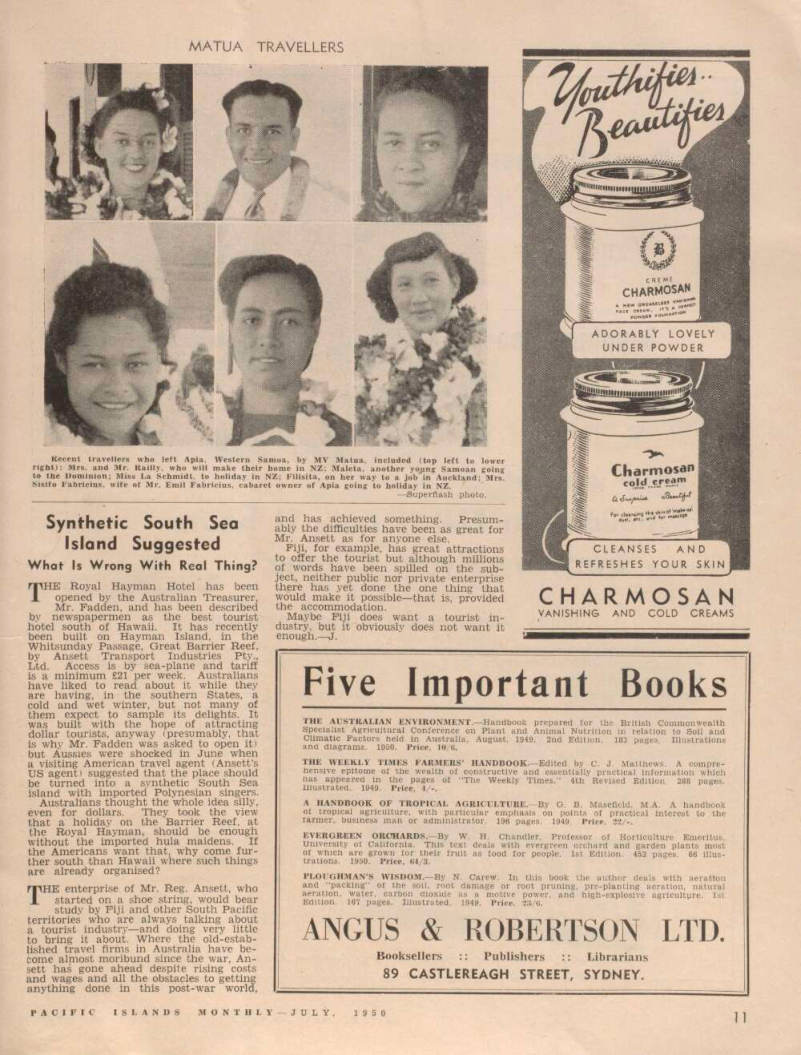
Recent travellers who left Apia, Western Samoa, by MV Matua, included (top left to lower right): Mrs. and Mr. Kailly, who will make their home in NZ; Maleta, another young Samoan going to the Dominion; Miss La Schmidt, to holiday in NZ; Filisita, on her way to a job in Auckland; Mrs.
Sisifo Fabricius, wife of Mr. Emil Fabriclus, cabaret owner of Apia going to holiday in NZ. —Superflash photo.
Island Suggested
Synthetic South Sea Island Suggested What Is Wrong With Real Thing?
THE Royal Hayman Hotel has been opened by the Australian Treasurer, Mr. Padden, and has been described by newspapermen as the best tourist hotel south of Hawaii. It has recently been built on Hayman Island, in the Whitsunday Passage, Great Barrier Reef, by Ansett Transport Industries Pty., Ltd. Access is by sea-plane and tariff is a minimum £2l per week. Australians have liked to read about it while they are having, in the southern States, a cold and wet winter, but not many of them expect to sample its delights. It was built with the hope of attracting dollar tourists, anyway (presumably, that is why Mr. Padden was asked to open it) but Aussies were shocked in June when a visiting American travel agent (Ansett’s US agent) suggested that the place should be turned into a synthetic South Sea island with imported Polynesian singers.
Australians thought the whole idea silly, even for dollars. They took the view that a holiday on the Barrier Reef, at the Royal Hayman, should be enough without the imported hula maidens. If the Americans want that, why come fur ther south than Hawaii where such things are already organised?
THE enterprise of Mr. Reg. Ansett, who started on a shoe string, would bear study by Fiji and other South Pacific territories who are always talking about a tourist industry—and doing very little to bring it about. Where the old-estab lished travel firms in Australia have be come almost moribund since the war, An sett has gone ahead despite rising costs and wages and all the obstacles to getting anything done in this post-war world,
and has achieved something. Presum ably the difficulties have been as great for Mr. Ansett as for anyone else.
Fiji, for example, has great attractions to offer the tourist but although millions pf words have been spilled on the sub ject, neither public nor private enterprise there has yet done the one thing that would make it possible—that is, provided the accommodation.
Maybe Fiji does want a tourist in dustry, but it obviously does not want it
enough.
J.
Advertisements & other items, pp. 15-16 (1 item)
Five Important Books
ii£ate !i ‘ l!l,;
CREME
CHARMOSAN
a niw s«tA»ci««
ADORABLY LOVELY
UNDER POWDER
M BtiUMHHllimiiillumiHl ll !
Charmosa* 1
told .cream i • „ *u# n'»k»' u r Fo 'du“ n iic’ VnVfO' 5$
\ CLEANSES AND
I REFRESHES YOUR SKIN
CHARMOSAN
VANISHING AND COLD CREAMS
Five Important Books
THE AUSTRALIAN ENVIRONMENT.—Handbook prepared for the British Commonwealth Specialist Agricultural Conference on Plant and Animal Nutrition in relation to Soil and Climatic Factors held in Australia, August, 1949. 2nd Edition. 183 pages Illustrations and diagrams. 1950. Price, 10/0.
THE WEEKLY TIMES FARMERS’ HANDBOOK.—Edited by C. J. Matthews. A comprehensive epitome of the wealth of constructive and essentially practical information which has appeared in the pages of “The Weekly Times.’’ 4th” Revised Edition 288 pages, illustrated. 1949. Price, 4/-.
A HANDBOOK OF TROPICAL AGRICULTURE.—By G. B. Masefield. M.A. A handbook of tropical agriculture, with particular emphasis on points of practical interest to the farmer, business man or administrator. 196 pages. 1949. Price, 22/-.
EVERGREEN ORCHARDS. —By W. H. Chandler, Professor of Horticulture Emeritus, University of California. This text deals with evergreen orchard and garden plants most of which are grown for their fruit as food for people. Ist Edition. 452 pages. 66 illustrations. 1950. Price, 64/3.
PLOUGHMAN’S WISDOM.. —By N. Carew. In this book the author deals with aeration and "packing” of the soil, root damage or root pruning, pre-planting aeration, natural aeration, water, carbon dioxide as a motive power, and high-explosive agriculture. Ist Edition. 167 pages. Illustrated, 1949. Price, 23/6.
ANGUS & ROBERTSON LTD.
Booksellers :: Publishers :: Librarians
89 CASTLEREAGH STREET, SYDNEY.
Sunny Beaches
Azure Sky
Sapphire Sea
hi
fiji
I |\V VV a 1 ■i
Your winter
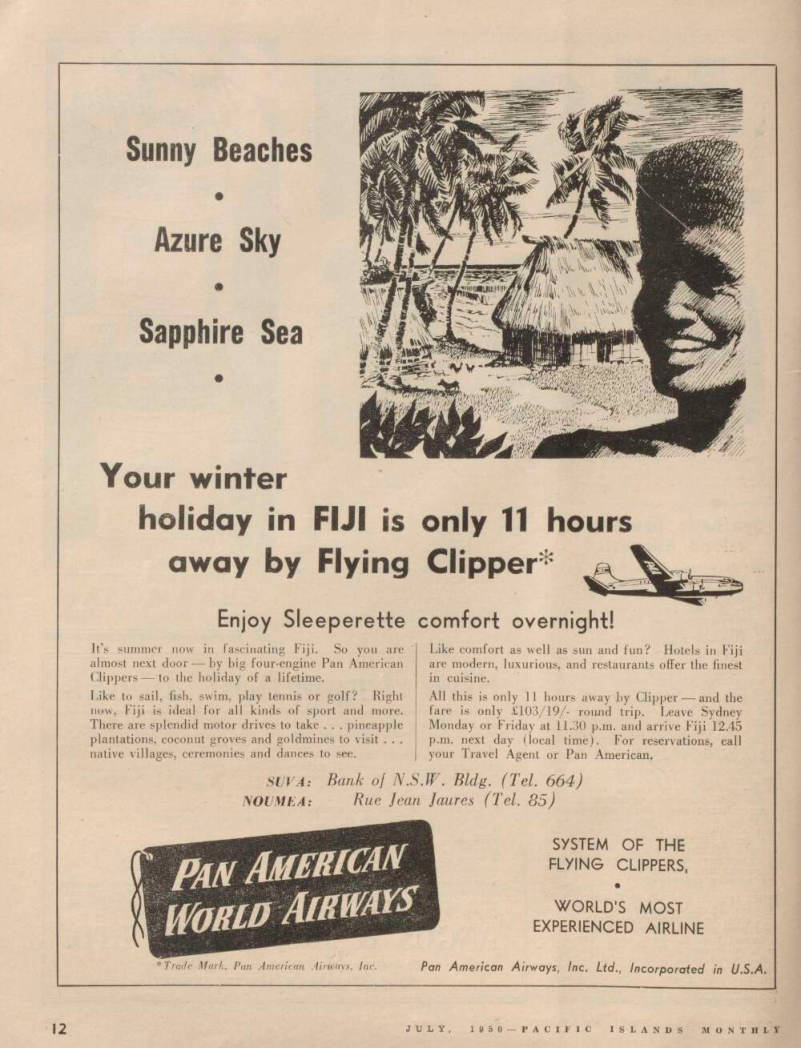
holiday in FIJI is only 11 hours
away by Flying Clipper*
Enjoy Sleeperette comfort overnight!
It’s summer now in fascinating Fiji. So you are almost next door by big four-engine Pan American Clippers to the holiday of a lifetime.
Like to sail, fish, swim, play tennis or golf? Right now, Fiji is ideal for all kinds of sport and more.
There are splendid motor drives to take . . . pineapple plantations, coconut groves and goldmines to visit . . . native villages, ceremonies and dances to see.
Like comfort as well as sun and fun? Hotels in Fiji are modern, luxurious, and restaurants offer the finest in cuisine.
All this is only 11 hours away by Clipper and the fare is only £lO3/19/- round trip. Leave Sydney Monday or Friday at 11.30 p.m. and arrive Fiji 12.45 p.m. next day (local time). For reservations, call your Travel Agent or Pan American, SUVA: Bank of N.S.JV. Bldg. (Tel. 664) NOUMEA: Rue Jean Jaures (Tel. 85)
RICA
\RWA.
* Trade Mark, Pan American Airways, Inc.
SYSTEM OF THE
FLYING CLIPPERS,
WORLD'S MOST
EXPERIENCED AIRLINE
Pan American Airways, Inc. Ltd., Incorporated in U.S.A.
The Month In Moresby
Prom Our Own Correspondent
Port Moresby, July 4.
DETAILS of the new classification for the Territory’s Public Service have arrived in Port Moresby but have not yet been released to the public. The Public Service Commissioner, Mr. E. A.
Head, says the details will appear in the Government Gazette shortly. He said the new" classification provided for higher salaries in most cases. These increases would date from July 1, 1949.
THE Advisory Council has expressed its disapproval of one of the most im portant sections of the Town Plan.
This section provides for the construc tion of small shops and a block of flats on and around the present site of the Ela Protestant Church. By seven votes to five, the Advisory Council passed a motion opposing the plan to resume the land needed for this project and suggested that the small shops be built on the op posite side of Douglas Street. This lat ter area is marked on the Town Plan as “reserved for future development.”
Another suggestion by the Council was that land opposite the RSL Club be acquired and made available for addi tional small shops. It also mentioned the area in Hunter Street previously oc cupied by the Government Secretary’s Department as a possible site for small shops. Council approved “in general” the proposed zoning shown on the plan and recommended that the necessary legislation be enacted. Only one letter from the public commenting on the Town Plan was received by the Council. This was from the Seventh Day Adventist Mission, which asked that it be granted a block in the town for the erection of a church. The Council recommended to the Administration that sites for new churches be provided for in the plan.
Mr. E. J. Frame, who was unable to at tend the Council meeting, gave his views in a letter. He said he hoped the Coun cil would disapprove of the plan generally.
The provision of numerous small shops, he said, would be an extravagant method of distributing merchandise. “The en croachment of administrative and com munity buildings on Douglas Street achieves no purpose,” he said.
ONE HUNDRED prefabricated houses are due to leave England for Port Moresby this month. Fifty are for the Administration and 50 for DCA.
There will be two types of houses, one with two bedrooms and the other with three. Although those of each type will have the same basic design the windows and other fittings can be varied to give a slightly different appearance. The houses will be aluminium with insulated roofs and walls. They are designed for semi-tropical conditions.
IN about six months Port Moresby should have two extra buildings for social and cultural activities. They will be the Red Cross Hall, now being built on Ela Beach, and the Library In stitute in Douglas Street.
The Institute Moresby’s pre-war social centre —has just been vacated by APC, which had its head offices in the building. As soon as possible the Insti tute will be repaired and improved to prepare it for concerts, musicales, plays, screening of educational and documen tary films, etc. It is stated that the Red Cross Hall will be completed in six months. The hall itself will be 60 ft. by 40 ft. and in addition there will be meeting rooms and offices. There will
be a small stage and dressing rooms. As well as being used for Red Cross activi ties, the Hall will be available for pub lie functions • • BEFORE the end of the year the Catho lie Mission expects to open a Euro pean maternity hospital at Badili Port Moresby. The mission is already running a native maternity hospital and infant welfare centre at Badili. Work will start on the European Hospital shortly and it is hoped to have it finished by November. The hospital will be the cottage type—lt will be built like a normal house, with a lounge and the usual home comforts. For a beginning it will accommodate six patients. Mission sisters will run the hospital but patients
may call in their own doctor when neces sary. 11HE Education Department has received detailed plans of Wau High School from the architect, Mr. Gordon McKenzie, of Moresby, who at present is in Sydney. When Mr. McKenzie finishes the working plans the Admini stration can go ahead and let the con tract. The school’s colours are dark green and gold, the motto “Love God and Be Cheerful” and the emblem is a bird of paradise. On formal occasions girls will wear a green skirt and white blouse and boys will wear whites and the school tie. Both boys and girls will have panama hats with green and gold bands. There will be a school blazer with green and gold edging. Khaki will be the normal day wear for boys. Parents will be told the correct styles after the Department has found a single source of supply for all material, to ensure uniformity. The
girls’ hostel at the school will be known as Elizabeth House, and the boys’ hostel will be Philip House.
THE new clubhouse was the main sub ject of discussion at the recent an nual meeting of the Murray Heights’
Club. Nearly 60 members attended the meeting. They were told that work should start on the new clubhouse shortly. The clubhouse, 80 ft. by 20 ft. will be a hut several times bigger than the present club building, but has to be moved from its present position at the 3-mile. It will then be repaired and im proved. A new floor will be laid, a stage erected and a verandah added. There will be facilities for film screenings. Bad minton and volley ball courts are to be provided near the clubhouse.
The annual meeting was told that membership had reached 158 and finances
were in a good position. Mr. H. O’Brien was elected president, Mr. D. Milton, vice president; Mr. G. Woodington, treasurer; and Mrs. H. French, secretary. The com mittee was increased from seven to 16 members.
AN exciting encounter between a Euro pean and a native at Jackson’s Strip on June 6 was described in the Moresby Court o| Petty Sessions recently.
The European, Edgar Partridge, told the court that the native refused to work, then threatened him with an axe and chased him with a piece of piping. Part ridge said he frightened the native into submission by producing a Verey pistol.
Magistrate Faithorn, however, dismissed the assualt charge against the native. He said he believed the native’s story, which was that Partridge had started the trouble by grabbing him by the hair.
A TERRITORY-WIDE Art Union with a new car as first prize is to be held by the Port Moresby Swimming Pool Committee. About 6,000 tickets at 10/- each will be sold and this will put about £2,000 into the Swimming Pool Fund. N. F. Maloney & Co. is providing the car—a late model Austin —at cost price. Other local firms have promised to supply refrigerators, radios, cameras, etc., at cost price, to complete the price list.
Tickets for the Art Union will be printed soon and it is proposed to let it run for about three months. Nearly £6OO has now been raised for the Swimming Pool Appeal. Very few individual donations have been received, however.
FEDERAL President of the RSL, Mr.
Holland, is expected to visit Papua- New Guinea soon. He will investi gate the proposal to form a State branch of the RSL in the Territory. This will be the first visit here by a Federal RSL official.
A BRANCH of the ex-Navalmen’s As sociation is being formed in Port Moresby. Later, efforts will be made to form sub-branches in other parts of the Territory. It is thought that there are more than 50 ex-navalmen in Moresby.
MORESBY’S supply of timber for building purposes will improve when Sawmillers and Traders in crease their output at Port Romilly with in the next few months. New modern machinery which went out to Port Romilly last week will enable the com pany to increase its output from the pre sent 55,000 super feet per month to 300,000 super feet. The new machinery was made at Lismore, NSW, under the supervision of Mr. C. McKinnon, for mer managing director of Sawmillers and Traders. It is claimed to be the best timber milling machinery made in Aus tralia. Sawmillers and Traders are also procuring tractors and other mechanised logging equipment which will give the mill a better supply of logs and, in many cases, replace native labour. Part of this new equipment is here and the rest is due soon.
THE Photographic Society of Papua was formed at a recent meeting at Port Moresbv. Convened by Messrs.
G. Carter and B. Lee, the meeting was attended bv 17 people. A committee of five was appointed to prepare a consti tution to be presented at the next meet ing, at which the election will also take place. It was decided to hold a photo competition, prizes for which will be given by - Kodak, Ltd. The Society in tends to hold regular competitions which will be open to everyone.
THE body of Robert Cann, aged 32, a radio technician employed by DCA, was found floating in Port Moresby harbour on June 23. The body was naked except for a pair of sandshoes. The lower portion was badly mutilated, pre sumably by 'sharks or other fish. Dis covery of the body by two Odubada native students ended an intensive four-day search by more than 100 police. Cann had been missing since the morning of Monday the 19th.
He was last seen about 9 a.m. that day by taxi driver Gordon Lynch who saw him walking towards the marine base from town. He was fully dressed and was wearing the sandshoes he had on when his body was found. Between the time his disappearance was reported and the discovery of his body, an intensive search extending as far as Rouna was made bv police. A nolice officer with binoculars searched the area from an
Auster aircraft, Cann had been with DCA, Moresby, for 18 months. His wife lives in Sydney and it is believed that there is a small daughter.
THE Port Moresby Rugby League As sociation is trying to organise a trip to Brisbane by a representative Papua-New Guinea team. Brisbane Rugby League has agreed to field a team against the Territory side. Saturday, July 29, is suggested as the date for the first game. The second game would be a floodlit match on the opening night of the Brisbane Exhibition. Before the trip can be made, however, over £l,OOO will have to be provided by Territory foot ball clubs to pay for the charter of a Catalina. The Port Moresby Association estimates that its share will be £327. In addition, five plane seats at £5O each (return) will have to be allotted by the Association to non-players. The £5O in cludes a week’s board in Brisbane. It is proposed to take nine players and two officials from each Territory.
WINNERS of this year’s Port Moresby Tennis Club Championships were: P. Smart (men’s singles), Miss Maureen O’Sullivan (women’s singles), B.
Dinning and P. Smart (men’s doubles), Mrs. Koch and Miss Holt (women’s doubles), Mr. and Mrs. Llewellyn (mixed doubles).
A SON, Philip, was born to Mr. and Mrs. Alf Naynes, of Moresby, re cently.
Miss Betty Tait, of Burns Philp, Moresby, and Mr. Ken Padget, of Lolorua Plantation, will be married at St. John’s Church, Moresby, on July 29. Mrs.
Gloria Hooper will be matron of honour and Mr. Joe Worthington best man.
The Rev. Mr. Palmer, of St. John’s
Church, Moresby, has been transferred to Dogura. He had been at Moresby three years. The Rev. R. R. Porter has replaced him here.
Mr. and Mrs. Jack Lyons and family have gone south on leave.
Here on school holidays are Jill Ridge, Elizabeth Roscoe and Ward Washington.
People on the Madang (NG) water front had a pleasant surprise when the South African ketch, Cariad I, came into port on June 29. Formerly an English racing yacht, now owned by Mr. A. W.
Pitton, it is on a world tour. Since 1948 the ship has been through the West Indies, the Galapagos, Easter Island, Tahiti and other Pacific Island groups.
About four months were spent in Sydney reconditioning while Mr. Pitton tripped around the Commonwealth.
The yacht carries 4,000 square feet of canvas and is ketch rigged.
It has spacious cabins, a stateroom for the owner and a huge area devoted to refrigeration space.
Advertisements & other items, pp. 17-18 (1 item)
(jwpa
Electric Model.
CASH
REGISTERS
HUGIN Cash Registers are built in Sweden with the precision and finish for which Sweden is world famous. They are built in one of the largest register factories in the world and are completely modern in design. HUGIN Cash Registers have 'been tested and proved over the years and several large emporiums in Australia have had numbers in use since 1938. During the past four years hundreds have been installed in stores all over Australia and New Zealand.
HUGIN machines are most suitable for use in the Islands, cash drawer are made of polished stainless steel not affected by humidity or tropical conditions and all parts that are touched by hand are made of stainless steel or highly chrome-plated special alloy steel. HUGIN design and mechanical efficiency win praises wherever they are used and they provide printed office records for a complete cash sale system.
HUGIN Cash Registers can be provided with a keyboard capacity of £9/19/114 or £99/19/11. Issue a printed receipt for the customer or print on a duplicate cash sale docket. Also provide detailed audit strip, total counter, customer counter and several other attractive and useful features.
Can be supplied with one or two itemising device.
The base and Hand Model. drawers, or totals, and shortly, with Please send us details of your business, without obligation, and we will be glad to supply full details of suitable machines. Orders will be accepted through any accredited Sydney export house.
W. KOPSEN & CO. PTY. LTD.
376-382 KENT STREET, SYDNEY
Cables: KOPSEN, Sydney.
Every Branch Of
ENGINEERING and BUILDING CONSTRUCTION
MILLERS LTD.
SUVA and LAUTOKA
Sawmillers and Timber Merchants; Shipwrights and Sailmakers; Joinery and Furniture Manufacturers; Upholsterers; Plumbers; Electricians; Hardware Merchants; Motor Dealers.
AGENCIES:
Chevrolet, Bedford, Vauxhall, Nash Motors. Firestone Tyres.
Fetters Marine and Stationary Engines. G.E.C. Radio Sets.
British Australian Lead Manufacturers Pty., Ltd. Atlas Assurance Co., Ltd.
There is no need to send to Australia or New Zealand for Repairs or Replacements. We can give you a sound Quotation and guarantee First-Class Workmanship
BRAND
IF IiiALITY
Death Of Mr. G. Powell
THE death occurred at Suva, Fiji, on June 10, of Mr. George Powell, of Levuka. Mr. Powell, who was 58, had been in ill-health for some time.
He was the second of six sons of the late Mr. and Mrs. Charles Powell of Lomaloma, and had lived in Levuka for over 30 years. From 1920 he worked for Mr. Henry Palmer in the Fiji Trading Company as a carpenter and overseer. He joined the staff of Morris Hedstrom, Ltd., in 1930 and was due to retire on pension at the end of this month.
The Rev. C. F. Gribble, returned to Sydney on June 7 after an extensive tour of the Pacific Mission fields. He attended the South Pacific Conference as an observer representing the NSW Overseas Mission Board, and with Dr. J. W.
Burton, took part in the official service held in the Jubilee Church, Suva.
Advertisements & other items, p. 19 (1 item)
Gilbey’S
Place Your Islands Orders With . . .
WALTER GRAND
P.O. BOX 522, PAPEETE, TAHITI, FRENCH OCEANIA General Merchant, Commission Agent, Importer and Exporter Cable Address: “WALGRAND,” Papeete Australian Representative : J. C. MERRILLEES PTY., LTD., 104 Hunter Street, Sydney, N.S.W.
Telegrams: “MERRILLEES,” Sydney.
Of. // /J ' S *■ G
the
C4 Ll
j Is f° r
GILBEY’S
Bey ltd.
MELb o U Rne s *dn BY, b *isb a Ne
GBB 5 3
Address all enquiries to W. & A. GILBEY LTD., 33 Rosslyn Street, West Melbourne.
Treatment of Indentured

Labour in N. Hebrides
Letter to the Editor 1 NOTICE that the PIM has commented adversely upon a statement made by a Mr. McAlpine, who claims that natives were improperly treated under the indenture system.
After some years of Islands life, I think there is much to be said against a lot of planters and their methods; but the term slavery, as Captain Cook knew it, is a little too strong. I have seen boys
(natives) kicked, and some fairly sharp practices put over them at times,' by odd planters. But, there are not many of that breed, and the kicking I refer to was performed by certain Frenchmen, who seem to like practising their strong arm African methods.
I have also seen a gang of natives re cruited by a French planter. After ar rival, four of the boys (who were young, maybe 16 or 17) were told they did not cut enough copra for £8 per month wages, as was agreed on, on engagement, so they would only receive £4. This they were compelled to accept, as they could not swim back to their homes on other
islands. It is also a common practice for a planter to hold one gang until he has others on the ground, just to be sure. I have seen boys who volunteered for three months held for 6 weeks over that period, until Master arrived with the new gang again.
Another hurdle the native cannot over come is the plantation store, where the native spends his wages. Master has a Ned Kelly method, and wages and store prices always seem to come out level, and no money goes away from the plantation.
These are but a stray trick or two that Master has.
To give the natives a fair deal, and to keep the dishonest Master in his place, from the time natives are recruited their papers should be in the hands of the officials (British or French) whether in New Guinea or here, and the officials should see they get their rights, and be returned home at the right time, under a penalty of £lOO and imprisonment. For every gang going home one should give a statement to an official about store charges, treatment,and wages agreed up on on engagement, and actually paid at settlement. If any government wishes to stop complaints and give all the natives “a fair go,” this is one way to do so.
I am etc.,
C. Jackson.
Aoba, New Hebrides,
EDITORIAL NOTE.—The practices which Mr. Jackson describes may occur in the New Hebrides. They are not com mon in New Guinea. In Papua-New Guinea the native labourer, from the moment of his engagement until he is returned home, is kept under supervision by Government officials, and is guarded at every point. If anyone is exploited in New Guinea, nowadays, it is the em ployer of native labour, who has to pay enormous indirect taxation, and is threatened with direct taxation.
Advertisements & other items, p. 20 (1 item)
Brasso
n m Give it a special shine with
The quality Metal Polish
The NEW HILLMAN MINX
h m Vi"* now has a plus-power engine developing 37.5 h.p.!
This gives you
more SPEED
at the getaway
MORE POWER
on the hills— yet running costs are as low as ever Full particulars available from the distributors throughout the Territory of JSew Guinea
COLYER WATSON („SU) LTD
RABAUL
KAVIENG
Sir Ronald Garvey
Well Known Administrator In Birthday Honours
THE King’s Birthday Honour list, in June, included the name of Ronald Garvey, Governor of British Hon duras. He receives a Knighthood.
Sir Ronald Garvey is well-known all over the South Pacific—-he served in Fiji, the New Hebrides, and the Solomons, and he was acting as Resident Commissioner in the Gilbert and Ellice Islands Colony when the Japanese invaded in 1942. He and his staff were taken off Ocean Island, at dead of night, by the Free French destroyer Triomphant. Sir Ronald afterwards served in Africa, and was sent to the Caribbean area two or three years ago. The Governorship of British Hon duras is no bed of roses. The Territory has one or two unpleasant neighbours, who either want to start a war with British Honduras concerning disputed territories or are hotbeds of Communism.
Lady Garvey—who shared much per sonal popularity with her distinguished husband in the South Pacific—is a daughter of Dr. V. W. T. McGusty, who was Director of Medical Services in Fiji, Dr. and Mrs. McGusty now live in retirement in New Zealand.
Colonies
France’S Pacific
Future of Trade and Currency Values
A RECENT article in the Paris review, “L’Alliance Nouvelle Union Fran caise,” entitled “New Caledonia, A Paradise Lost by the French taut Coveted by Foreigners,” has started the usual exchange of compliments between Metro politan Frenchmen, and French residents of New Caledonia.
Lieut-Colonel Bichon, who represents the Colony on the Council of the French Union, in entering the discussion, denies that New Caledonia is “decadent,” though he admits it is a little behind Europe in some matters. He reminds certain critics that he can leave his car outside all night, unlocked and unattended, with out fear of gangsters: and he declares that the New Caledonian community has less filth and a greater addiction to in dividual baths, than may be found in communities of similar size in France.
M. Bichon ridicules the Metropolitans’ fear of Anglo-Saxon economic influence, and argues that it is no use ignoring the facts of geographical position and lack of overseas exchange.
“Why should our chrome not be sold to the United States?” he asks. “Does not the freeing of exchange tend to free our production from national limitations? Is France not on excellent terms with the United States?”
As was pointed out in June, certain interests in France are uneasy concerning the strong economic bonds created in the war and post-war periods between the French Pacific colonies and the con tiguous countries of United States and Australia. They resent the fact that the Pacific franc is much more valuable than the Metropolitan franc.
Since then, New Caledonia has been assured, both by Senator Larfleur and M.
Bichon, that there is no likelihood of any attemnt to modify the Pacific franc in relation to the Parisian franc, and that the future of the franc depends entirely on Governmental decisions and not on 'the views of the French Union.
Gaoled For Ill-Treating
Native
From Our Own Correspondent
Port Moresby, July 4.
PATROL Officer. Roy Edwards, was sentenced to six months gaol in the Supreme Court at Port Moresby on June 29 for staging a mock burial with a native as the “body..”
Edwards made a native named Kou Geru lie in the ojoen grave of a native girl, then covered him with banana leaves.
He would not let Kou Geru get up for some minutes. The native girl’s grave
ha d been opened earlier by an unknown person who took away her head.
Edwards alleged that Kou Geru had confessed to murdering the girl. How ever, he denied having made Kou Geru lie in the grave. Edwards, who faced six assault charges, was acquitted on the re maining five. These related to allegations by Kou Geru that Edwards slapped his face, made him climb a pole then had a fire lit under the pole.
Edwards described the charges as a “frame up.” He said Kou Geru had made up the story in an effort to escape the consequences of his own crime. Edwards said he arrested Kou Geru during a five months’ patrol from Goilala. Judge Big nold presided over the hearing.
Advertisements & other items, pp. 21-23 (1 item)
Sauce
FOUNTAIN food products arc famous throughout the South Pacific for their consistent quality and suitability of packing for tropical conditions.
You are assured satisfaction when you specify FOUNTAIN brand.
Trade inquiries are welcome and all orders arc promptly despatched. m & $ m j/w' \iN
vo«i
SAUCE
IMITED
W. C. DOUGLASS L
FOVEAUX ST. SYDNEY AUSTRALIA
RAND'/ V
OTHER
FAMOUS
FOUNTAIN
PRODUCTS
§jSSSSm
FRUIT
CRUTN
gTVrHKNTESTIP
DUAL
OR
TRIPLE
WAVE
Introducing . . .
the World’s Most Beautiful Radio Gram
Record
Compartment
Two concealed Record Compartments, one each side are a delightful feature.
This Radio-Gram has a triple speaker with split audio output. It is a 9-valve electric model and has magic eye tuning, and is the world’s most modern radio circuit, developed exclusively by Crammond Engineers. Infra-red ray tropic proofed. The Cabinet is of solid, richly grain ed Queensland timbers, hand carved by Australia’s leading craftsmen.
Available in 240, 110 or 32 volts. Vibrator models also available in similarly designed cabinets. w* WMmi Mfu .. \ .«•»
YOUR RECOMMENDATION
9-Valve Dual Wave A.C. De Luxe 3-Speaker Radio Gram
(CRAMMOND).
An extract as appeared in Brisbane “Telegraph” by Frederic Rogers, musician and leading music critic.
“Musicians and music-lovers have a pleasant surprise awaiting them when they hear the latest development in gramophone reproduction—designed and produced by Crammond.
In this instrument, which I have had the pleasure of hearing, difficulties of orchestral reproduction and tone colour have been so far overcome that the resultant reproduction attains a thrilling fidelity to the original Write for Full Particulars.
CRAMMOND RADIO
TROPICOL DIVISION
n° 8 OUCEN STREET .
THE PEAK OF
. wmmm mm&M i. :: ,X • ■£>;
PERFECTION!
CRAMMONDS —The Sets Supreme
. . . and the reason Mr. Lovett-Cameron, Lubura Estate, via Kavieng, New Guinea, writes: I have now had the Tropic Eagle set for some 15 months and have never had a moment’s worry about it, and I am most completely satisfied with it, and am very glad I happened to write you after seeing your advertisement in the “Pacific Islands Monthly.”
Available for all Types of Operation.
CRAMMOND TROPIC EAGLE
Most famous tropic-proofed and completely sealed receiver in the world to-day. The designers’ claim that range is unlimited has been fully justified by the reports received from hundreds of enthusiastic owners. 3 years’ guarantee and easy terms wherever you live.
GRAMMOND TROPIC HAWK
This is a 2-unit receiver especially designed for Patrol Officers and others who require absolute portability and dependability. Combined weight of both cabinets—32 lb. Measurements, each cabinet—ls by 9by 9. This set covers from 16-150 metres shortwaves only. 3 years’ guarantee and easy terms wherever you live.
Features Exclusive to Both Sets: Completely tropicproofed.
Built-in moisture absorber.
Available in vibrator or all dry cell. m tM
CRAMMOND , KING OF THE AIR
CRAM MONO RADIO
TROPICAL DIVISION
NO.S, QUEEN STREET
BRISBANE
Lucille Iremonger
Writes Two Entertaining Books
LUCILLE IREMONGER, who lived in the Gilbert and Ellice Islands, and in Fiji and New Zealand, in the early ’forties, is having a considerable —and well-deserved—success as author, broadcaster and lecturer. Her new book, “Creole” (Hutchinsons) is already among the best-sellers.
Mrs. Iremonger was born, and spent her early years, in Jamaica; and “Creole” is a vividly-written study of what is called the “colour problem,” as it is seen in the West Indies. A young English man, with a background of good birth and culture, is lonely in Jamaica, and is
trapped into marriage with the 16-years old daughter of a family of mixed blood —French and coloured. Soon, he is in volved in social, economic and emotional troubles which threaten to wreck his life.
The author, while telling an enthralling Story, also presents to us the age-old problem of the mixed-blood. It is a story that has its counterpart on many islands Mf lv S °iS* I Ta'hamv" endS?' ““ 6 SKllluuy ’ glves 11 a nappy ending, Pacific Islanders are certain to be in terested in Mrs. Iremonger’s first book, “It’s a Bigger Life,” published in 1948.
It not only has literary craftsmanship and high entertainment value (it ran quickly into a second edition, and was awarded the Lady Brittain Trophy), but it also describes faithfully, and most amusingly, her experiences in Ocean Island, Tarawa, Funafuti and other islands of the Ellice Group. The book is written with rare humour and shrewd
comment; but Mrs. Iremonger had very little to be funny about.
Mr. Tom Iremonger—a cousin, by the way, of Anthony Eden—met this young writer in London. She had graduated MA at Oxford, and had already estab lished herself in Fleet Street as journa list and script-writer. Iremonger had joined the British Colonial Service and, just before World War II broke out, they were married, and he was sent out to Ocean Island as a Cadet Officer. Ocean Island (then G & E Colony headquarters) posted him to Funafuti as Administra tive Officer; and they had about a year there, together. Life in the “Lousy Islands”—that long chain of unproduc tive, mosquito-ridden atolls —is very hard on women; and it was especially tough on Lucille Iremonger because she became most seriously ill, and spent months in bed, before the thrice-welcome move to Fiji was decided upon.
Nonetheless, she describes faithfully, and very amusingly some of the more famous institutions of the Colony—the etiquettes of Ocean and Tarawa, the furious speed of the now defunct John Williams V, the graceful lines of the Nimanoa (a war victim), the extra marital habits of the Ellice folk, and the special kind of seasickness kept for passengers by the Kia Kia—still float ing, by the way, and still loathed by sea travellers.
In the Colony, in 1940, Mrs. Iremonger met the five civilians who, with 17 New Zealand soldiers, were so foully murdered by the Japs on Tarawa on October 15, 1942 —Captain I. R. Handley, the Rev. A.
L. Sadd, Messrs. R. G. Morgan (official), B. Cleary (hospital staff), and A. Mc- Arthur (trader). That massacre shocked her profoundly, and all the details of it are given in a series of appendices, of historical value. Here, for example, is the story of how that grand, 80-years-old mariner, Isaac Handley, defied and fought his yellow torturers right up to the mo ment they cut off his head; and of how the gentle LMS missionary, Mr. Sadd, tried to use his own body to shield his fellow-prisoners against the murderers’ bullets.
It is a delightful, readable book. The writer has taken no liberties with facts and —except for references to the Kia Kia —there is not a spiteful word in it.
One notes, by the way, that Tom Ire monger was a Conservative candidate in Birmingham in the last British elections.
Death Of R. O. Freeman
mHE death occurred suddenly in Sydney A on June 18 of Mr. R. O. Freeman, who was until recently manager of the Metropole Hotel in Suva.
Mr. Freeman, who was 46, was born at Baulevu, Naitasiri. He was a son of the late Mr. and Mrs Osbert Freeman who were very well-known among the older settlers on the Rewa.
Early in the 1939/45 war he enlisted in the Fiji Military Forces and was one of the original officers of the Ist. Battalion of the Fiji Infantry Regiment. When the battalion left Fiji for the Solomons in April, 1943 he had attained the rank of Captain and was in command of B.
Company. It was this Company which carried out the noted harassing action behind the Japanese lines on Bougain ville from a base at Ibu. The withdrawal from Ibu was described by the Allied commander on Bougainville, General O'.
W. Griswold, as “a minor tactical classic.”
By the end of the war Mr. Freeman had become a Major and had been awarded the Military Cross. He travelled to London with the Victory Contingent from Fiji and Tonga as second in com mand.
Mr. Freeman left Fiji recently to join his wife in Sydney.
Advertisements & other items, p. 24 (1 item)
Robert Gillespie Pty. Ltd.
i "32 25W -t u^ T 4% vV?
A 0 Wk m
GIVE FULL LIGHT AND AIR
WITH YEAR ROUND WEATHER PROTECTION
This ultra modern window comprises a series of glass blades swung one above the other and inclinable to any angle.
Air entering the room is diverted towards the ceiling thus preventing draughts. AGCO Supaluvres have all the advantages of other louvre windows plus exclusive features.
The specially designed rain guards cannot be fouled by the glass holders and provide flush finish so that fly screens, curtains or blinds can be attached. By an automatic locking device AGCO Supaluvres can be locked open in four positions, thus eliminating rattle and are also fitted with rack and pinion movement. All exposed surfaces are made of rust resisting zincanneal metal.
For Verandahs, Sun-rooms, Lounge-rooms, Kitchens and Laundries Illustrated leaflet, price list and installation instructions on request.
Sole Agents for South-west Pacific:
ROBERT GILLESPIE PTY. LTD.
54a PITT STREET, SYDNEY
Lae Is Growing
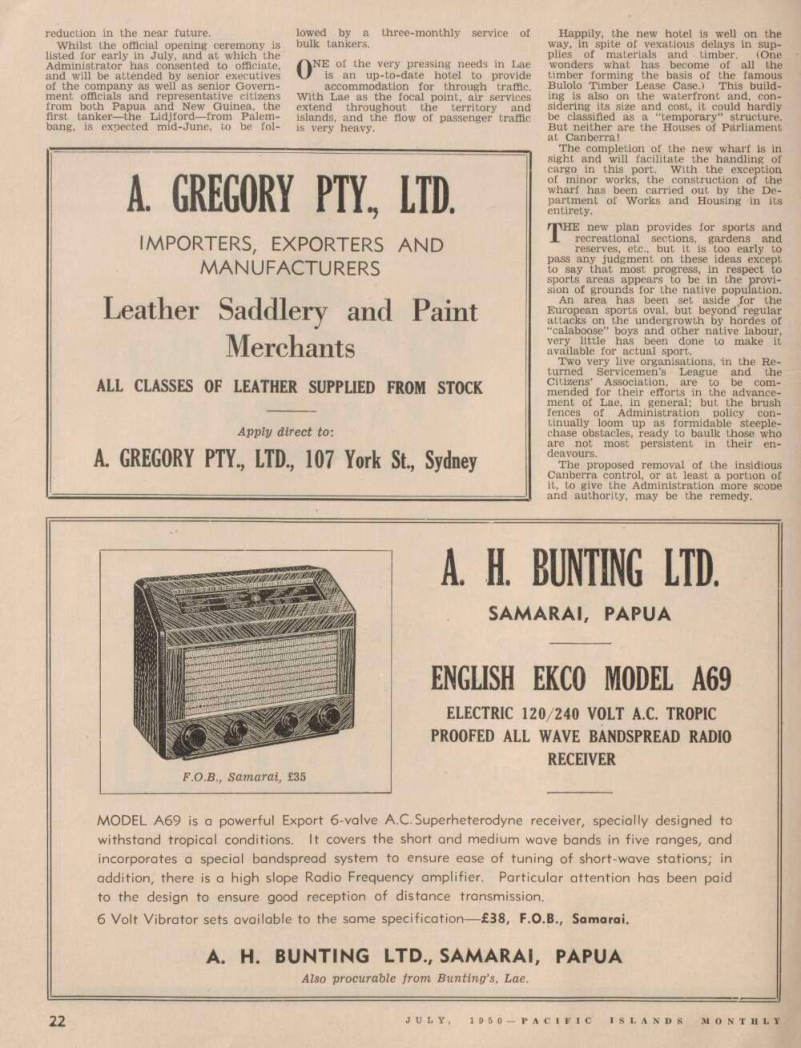
Effect of Much Building Activity
From Our Own Correspondent LAE, June 20.
TOWN-PLANNED Lae is taking shape.
Building operations, and the construc tion of new roads, are slowly, but surely, altering the landscape in and to the rear of the “Terrace,” more popu larly described as “Long-arp.”
The policy of the Administration pre cludes the erection of permanent build ings along the water-front and adjacent areas, including the slopes of Namanula; and, in time, Lae will be situated “on top.” This policy has not deterred busi ness firms from erecting more or less temporary stores in a group centre in the water-front area, and more are being added from time to time.
The street plan bears the American im print and commences at “First Street” and progressively continues down Emery’s Road. A move has been made by the local sub-branch of the RSSAILA to utilise the names of battle engagements and areas in the district in the naming of streets, and the outcome of the sug gestion is awaited.
The most pressing need is a modern hospital; and, whilst it was mooted many months ago as a first priority job, it still remains in the blueprint stage. It is sorely needed as the existing accommo dation, apart from being inadequate to meet the demands of the district, is a reminder of Army days, and has de teoriated. This does not apply, however, to the operating theatre, pathological and X-ray sections, which are recent ad ditions.
The statement by the Minister for Ex ternal Territories that the Government
intends to proceed with the construction of modern hospitals in the Territory has been welcomed on all sides.
Qantas, Civil Aviation, the “Met” section of the Department of the Interior and the Department of Works & Hous ing are moving apace, with the erection of single and married quarters in the new area. The last-mentioned Department, after months extending into years, has almost completed the long-overdue ac commodation for its workmen and staff.
The old quarters probably had the most squalid and ill-adapted living conditions in the area.
THE most progressive move can be credited to the Vacuum Oil Co. Pty., Ltd., whose bulk depot, in Air Corps Road, is now a landmark. Commenced many months ago, the installation has now been completed, including the new wharf pipe-line.
Six tanks, each of 500,000 gallons capacity, provide bulk storage for 3,000,000 gallons of motor spirit, whilst bulk im portations will also include aviation petrol, lighting kerosene and distillate. It is anticipated that the importation of pet roleum products in bulk will create a price
reduction in the near future.
Whilst the official opening ceremony is listed for early in July, and at which the Administrator has consented to officiate, and will be attended by senior executives of the company as well as senior Govern ment officials and representative citizens from both Papua and New Guinea, the first tanker—the Lidjford—from Palem bang, is expected mid-June, to be fol
lowed by a three-monthly service of bulk tankers.
ONE of the very pressing needs in Lae is an up-to-date hotel to provide accommodation for through traffic.
With Lae as the focal point, air services extend throughout the territory and islands, and the flow of passenger traffic is very heavy.
Happily, the new hotel is well on the way, in spite of vexatious delays in sup plies of materials and timber. (One wonders what has become of all the timber forming the basis of the famous Bulolo Timber Lease Case.) This build ing is also on the waterfront and, con sidering its size and cost, it could hardly be classified as a “temporary” structure.
But neither are the Houses of Parliament at Canberra!
The completion of the new wharf is in sight and will facilitate the handling of cargo in this port. With the exception of minor works, the construction of the wharf has been carried out by the De partment of Works and Housing in its entirety.
THE new plan provides for sports and recreational sections, gardens and reserves, etc., but it is too early to pass any judgment on these ideas except to say that most progress, in respect to sports areas appears to be in the provi sion of grounds for the native population.
An area has been set aside for the European sports oval, but beyond regular attacks on the undergrowth by hordes of “calaboose” boys and other native labour, very little has been done to make it available for actual sport.
Two very live organisations, in the Re turned Servicemen’s League and the Citizens’ Association, are to be com mended for their efforts in the advance ment of Lae, in general; but the brush fences of Administration policy con tinually loom up as formidable steeple chase obstacles, ready to baulk those who are not most persistent in their en deavours.
The proposed removal of the insidious Canberra control, or at least a portion of it, to give the Administration more scope and authority, may be the remedy.
Advertisements & other items, pp. 25-26 (1 item)
Flour
ASK FOR IT
ESTABLISHED 1868.
sfe i.s m
jMatne
SPARTAN—enduring to the last!
In ancient Greece, the warrior Spartans were noted for their courage and fortitude and endurance. and to-day, the very word Spartan typifies the utmost in durability and toughness.
It is therefore only natural that Spartan Products are thus aptly named —durable, lasting, able to withstand severest weathering conditions.
Safeguard your property—home, sheds, buildings, fences with Spartan—available in a brilliant, high-grade range.
ASK YOUR
STORE FOR
SPARTAN
PAINTS, ENAMELS, LACQUERS, VARNISHES
Carefully refined and manufactured from selected pigments and oils.
Ask your supplier or contact direct.
SPARTAN PAINTS PTY. LIMITED, MELBOURNE
102-104 Kinq St., Melbourne.
A. GREGORY PTY, LTD.
IMPORTERS, EXPORTERS AND
MANUFACTURERS
Leather Saddlery and Paint Merchants ALL CLASSES OF LEATHER SUPPLIED FROM STOCK Apply direct to: A. GREGORY PTY., LTD., 107 York St., Sydney
w F. 0.8., Samarai, £35
A. H. BUNTING LTD.
SAMARAI, PAPUA
ENGLISH EKCO MODEL A 69
ELECTRIC 120/240 VOLT A.C. TROPIC
PROOFED ALL WAVE BANDSPREAD RADIO
RECEIVER
MODEL A 69 is a powerful Export 6-valve A.C.Superheterodyne receiver, specially designed to withstand tropical conditions. It covers the short and medium wave bands in five ranges, and incorporates a special bandspread system to ensure ease of tuning of short-wave stations; in addition, there is a high slope Radio Frequency amplifier. Particular attention has been paid to the design to ensure good reception of distance transmission. 6 Volt Vibrator sets available to the same specification —£3B, F. 0.8., Samarai.
A. H. BUNTING LTD., SAMARAI, PAPUA
Also procurable from Bunting’s, Lae.
Hawaii Or Alaska?
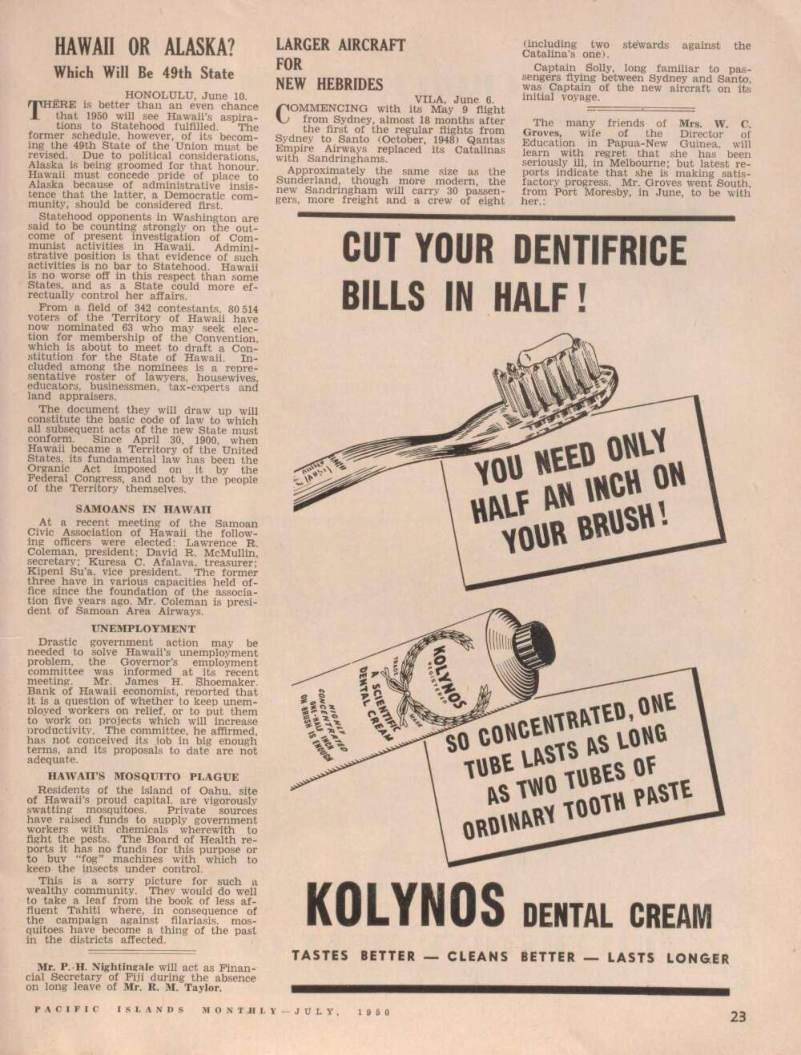
Which Will Be 49th State
Honolulu, June 10.
THERE is better than an even chance that 1950 will see Hawaii’s aspira tions to Statehood fulfilled. The former schedule, however, of its becom ing the 49th State of the Union must be revised. Due to political considerations, Alaska is being groomed for that honour.
Hawaii must concede pride of place to Alaska because of administrative insis tence that the latter, a Democratic com munity, should be considered first.
Statehood opponents in Washington are said to be counting strongly on the out come of present investigation of Com munist activities in Hawaii. Admini strative position is that evidence of such activities is no bar to Statehood. Hawaii is no worse off in this respect than some States, and as a State could more ef rectually control her affairs.
From a field of 342 contestants. 80 514 voters of the Territory of Hawaii have now nominated 63 who may seek elec tion for membership of the Convention, which is about to meet to draft a Con stitution for the State of Hawaii. In cluded among the nominees is a repre sentative roster of lawyers, housewives, educators, businessmen, tax-experts and land appraisers.
The document they will draw up will constitute the basic code of law to which all subsequent acts of the new State must conform. Since April 30, 1900, when Hawaii became a Territory of the United States, its fundamental law has been the Organic Act imposed on it by the Federal Congress, and not by the people of the Territory themselves.
Samoans In Hawaii
At a recent meeting of the Samoan Civic Association of Hawaii the follow ing officers were elected: Lawrence R.
Coleman, president; David R. McMullin, secretary; Kuresa C. Afalava. treasurer; Kipeni Su’a. vice president. The former three have in various capacities held of fice since the foundation of the associa tion five years ago. Mr. Coleman is presi dent of Samoan Area Airways.
Unemployment
Drastic government action may be needed to solve Hawaii’s unemployment problem, the Governor’s employment committee was informed at its recent meeting. Mr. James H. Shoemaker.
Bank of Hawaii economist, reported that it is a question of whether to keep unem ployed workers on relief, or to put them to work on projects which will increase productivity. The committee, he affirmed, has not conceived its job in big enough terms, and its proposals to date are not adequate.
Hawaii’S Mosquito Plague
Residents of the island of Oahu, site of Hawaii’s proud capital, are vigorously swatting mosquitoes. Private sources have raised funds to supply government workers with chemicals wherewith to fight the pests. The Board of Health re ports it has no funds for this purpose or to buv “fog” machines with which to keep the insects under control.
This is a sorry picture for such a wealthy community. They would do well to take a leaf from the book of less af fluent Tahiti where, in consequence of the campaign against filariasis. mos quitoes have become a thing of the past in the districts affected.
Mr. P. H. Nightingale will act as Finan cial Secretary of Fiji during the absence on long leave of Mr. R. M. Taylor.
Larger Aircraft
For
New Hebrides
VILA, June 6.
Commencing with its Mdy 9 flight from Sydney, almost 18 months after the first of the regular flights from Sydney to Santo (October, 1948) Qantas Empire Airways replaced its Catalinas with Sandringhams.
Approximately the same size as the Sunderland, though more modern, the new Sandringham will carry 30 passen gers, more freight and a crew of eight
(including two stewards against the Catalina’s one).
Captain Solly, long familiar to pas sengers flying between Sydney and Santo, was Captain of the new aircraft on its initial voyage.
The many friends of Mrs. W. C.
Groves, wife of the Director of Education in Papua-New Guinea, will learn with regret that she has been seriously ill, in Melbourne; but latest re ports indicate that she is making satis factory progress. Mr. Groves went South, from Port Moresby, in June, to be with her.:
Advertisements & other items, pp. 27-28 (1 item)
Kolynos
CUT YOUR DENTIFRICE
BILLS IN HALF!
ohu
NOVI
OH
\HOH
m
bhoshv
nooh
o a r n.
T > r «* out o * 0* til® V3L
COUC
LOUo
so PvS «3a. *=» tttOt of
TOOtS
TWO
Pp^f- PS ■too^o
KOLYNOS
DENTAL CREAM
TASTES BETTER CLEANS BETTER LASTS LONGER
TAKE YOUII CHOICE ..
( . . . From this list of quality canned foods. Packed by the largest meat-processing company in Australia, the Imperial label brings you the Quality meats, right to your table—tasty hot meals and cold meats ready for any occasion. Stock up with Imperial, the Flavour Sealed Quality Foods,
HOT PACKS.
16-oz. Beaf Steak Pudding. 16-oz. Steak & Kidney Pudding. 16-oz. Irish Stew. 16-oz. Braised Beef Steak Stew. 16-oz. Bacon Rashers. 16-oz. Steak & Tomato. 12-oz. Meat & Beams. 16-oz. Sausages & Vegetables. 12-oz. Savourie. 4-oz. Meat and Spaghetti.
COLD MEATS.
SAUSAGES.
16-oz. Beef Sausages. 16-oz. Oxford Sausages. 16-oz. Cambridge Sausage; 16-oz. Poi’k Sausages. 16-oz. Vienna Sausages. 10-oz. Vienna Sausages. 4-oz. Vienna Sausages.
SOUPS.
8-oz. Tomato Soup. 8-oz. Vegetable Soup. 8-oz. Clear Beef Soup. 12-oz. Luncheon Pork. 12-oz. Trim (Pork & Beef). 12-oz. Camp Pie. 12-oz. Hampe. 12-oz. Meatreat. 12-oz. Corned Beef W/C. 12-oz. Taper Corned Beef. 6-lb. Slicing Beef. 6-lb. Taper Corned Beef
W/C. J „
6-lb. Taper Corned Beef. 4-oz. Camp Pie. 4-oz. Hampe. 4-oz. Beef Snack. 3i-oz. Pate de Foie, fo-oz. Tomato Sauce.
DRIPPING & LARD.
TONGUES.
12-oz. Sheep Tongues. 12-oz. Lamb Tongues. 12-oz. Calves Tongues. 6-lb. Ox Tongues. 2-lb. Ox Tongues.
MARGARINE.
56-lb. Boxes Cake Margarine. 56-lb. Boxes Pastry Margarine. -
WfWJ
* - - « A ■J.
I A w , 1-lb. tins Lard. 16-oz. tins Dripping. 1-lb. pats Dripping. 36-lb. Dripping.
CANNED FISH.
4-oz. Flair Fish Cutlets. 8-oz. Flair Fish Cutlets. 12-oz. Flair Fish Cutlets. 113-oz. Flair -Squab in Aspic.
I'.-oz. Flair Fish Paste. 8-oz. Flair Scallop Luncheon.
“RIVERMEDE” BUTTER.
56-lb. Boxes Bulk Butter. 16-oz. Pats Butter, i-lb. Pats Butter. 12-oz. Tins Butter. 16-oz. Tins Butter.
26 oz. “CAWSEY’S”
CORDIALS.
Double strength Orange Squash.
Single strength Squash.
Double strength Squash.
Single strength Squash.
Double strength 100 per cent. (Lemon & Orange).
Single strength 100 per cent. (Lemon & Orange).
Single strength Lime Juice.
PACKET BREAKFAST
FOODS.
8-oz. Purina Crispies. 24-oz. Purina Crispies. 12-oz. Purina Weatall cuits.
SWEET PUDDINGS.
16-oz. Plum Puddings. 12-oz. Jam Pudding. 12-oz. Chocolate Pudding. 12-oz. Ginger Pudding. ■ Mm WZ Sr* * * ■ Orange Lemon Lemon
MILDURA FRUIT
JUICES.
18-oz. Grapefruit Juice. 16-oz. Orange Juice.
CANNED FRUITS.
16-oz. Prunes (Dry Pack). 80-oz. Cherries. ( 20-oz. Raspberries. \ 20-oz. Gooseberries. \ 20-oz. Loganberries. ’ 20-oz. Plums.
RIVERSTONE MEAT CO. PTY. LTD.
; V ; ' «v
N. 5-7 O’CONNELL STREET, SYDNEY.
and Enterprise
Rich And Idle Lands In
New Hebrides
How Condominium Paralyses Initiative and Enterprise
AN Australian who went to the New Hebrides since the end of the war has written to the PIM, asking why Press and politicians do not do some thing to compel “the big companies’’ to aive up some of their grip on the New Hebrides lands, and thus encourage new settlement and production.
“These islands will grow anything, and run any kind of stock,” says our corres pondent. “So why not open them up for selection, before they are over-run by Asiatics?”
At first glance, this seems a reasonable complaint. The New Hebrides —especially the southern islands, like Tanna, Anei tyum and Erromanga—are among the best islands of the South Pacific—fertile, well-watered, beautiful and reasonably cool, and they are capable of much agri cultural development.
But they are hopelessly handicapped by two things—the administrative paralysis of the Condominium Government, which has no thought or intention of immigra tion and settlement; and the slow and in efficient Joint Land Court. The duty of examining land claims and issuing titles was delegated to the latter Condominium authority 40 or 50 years ago, and not a tithe of the land claims have been dealt with. They are not likely to be dealt with while the Condominium system persists.
It is true that large areas in these at
tractive islands are held by big commer cial interests; but, in the majority of cases, their titles to the lands are aues tionable, and subject to confirmation by the Land Court. The present titles are so unstable that the present holders, for the most part, are not able to contem plate the subdivision and sale of virgin lands, , , .
T>EING so near to the big and growing -U markets represented by Australia, it must seem strange to the casual ob
"the'are"n£“browht ?o
p?|dSn; but There fs httle chance ot -anything being done while Britain and Prance sit gri B m]y on either side 0 f the Condominium barrier, and jealously watch each other Plain commonsense would say that the JYj* o^o group- with the British Solomons m foi good measure—should
Sq S St
the Bismarck Archf- Sro But n?ain commonsense seems t S r °\ 0 enterinto matters nevei t 0 entci into these matteis.
Nearly fifty years ago, the late Sir James Burns handed over to the Austra lian Federal Government all his rights and title to about 100,000 acres of New Hebrides lands, in the confident belief that Australia would settle and develop
those valuable areas. Unfortunately, most of Sir James’s titles were titles ac quired in the lively but ungoverned trad ing days in the New Hebrides, between
1880 and 1900, and were subject to Con firmation by the Land Court. To-day, nearly 50 years later, the Land Court is still contemplating the colossal task of examining and checking the titles. Aus tralia, for 30 years, maintained a solicitor in Vila, to advance her claims before the Land Court; but, since the war, Canberra appears to have lost heart, and has no legal representative in Vila now.
Advertisements & other items, pp. 29-30 (1 item)
cs€H> Guinea c/tfyenfa^oi
Its
VJ6^ E
.,„oU»W
IWiHT
Hvl 0^ *0 oV Hi/ 31
CytP
?' 0^ N
cs€H> Guinea c/tfyenfa^oi
k PHILIPS WIRELESS SETS
& REMINGTON TYPEWRITERS
■A BURROUGH’S BEEFEATER (LONDON)
GIN
•fa POPE PRODUCTS
•k REX ALUMINIUM CO.
is “AGCO” SUPALUVRE WINDOWS
k b.a.l.m. paints
is COMMONWEALTH INSURANCE CO.
WHOLESALE MERCHANTS •• -MANUFACTURERS AGENTS
&IL
Stewarts and Lloyds (Australia) Pty. Ltd.
Manufacturers of "S&L" PIPES and FITTINGS for GAS, WATER, STEAM and other purposes.
AND Distributors of:
MILD STEEL BARS, PLATES and SECTIONS;
GALVANISED IRON; BOLTS and NUTS; ELECTRODES
and WELDING EQUIPMENT.
Stewarts and Lloyds (Australia) Pty. Ltd.
SYDNEY WAREHOUSE - - - Herbert Street, St. Leonards BRISBANE WAREHOUSE - Montague Road, South Brisbane MELBOURNE WAREHOUSE - - City Road, South Melbourne Telegraphic Address: "Tubes ' Sydney, Brisbane or Melbourne
Tahiti Loses Prominent
Citizen
From Our Own Correspondent
Papeete, June 10.
MONSIEUR Jean Malarde, known to all as Nono, died suddenly on May 9, of a heart ailment. Born Novem ber 13, 1899, he was the son of Georges
Malarde, who arrived in Tahiti in 1897, on the well-known French bark, France Cherie.
Nono will be generally missed through out the community. His cordiality and ever-ready assistance were always at the call of the many who went to him for advice.
He was a fine orator and writer. As a member of the Health Department of Papeete he was always to the forefront in advancing the improvement of the city. In 1939 he opened the first meat and vegetable market and refrigerators in Papeete and lately was sponsor at the inauguration of a new highway in the District of Tiarei.
A staunch Catholic, his funeral was one of the largest in Papeete for many years. He is survived by his widow, numerous children and grandchildren.
To Tahiti
Air France Service
From Our Brisbane Correspondent ACCORDING to newspaper reports Brisbane’s tired business men will soon be able to spend their vacation in Tahiti.
An Air France service between Bris bane and the island is reported to be commencing on July 15. The Austra lian general manager of Air France (M.
Petit) said recently, in Brisbane, that the new service would cater for tourist traffic between Australia and Tahiti, and that it would be via Noumea, Fiji, the Cook Islands, and the Society Islands.
Freight and mail would be carried, and single fare would be about £l2O. The actual flying time between Brisbane and Tahiti would be approximately 26 hours.
Advertisements & other items, p. 30 (1 item)
W. H. Grove I Sons Ltd.
Established 1896.
Telegraphic and Cable ISLAND MERCHANTS P.O. Box 490, Address: “Grove,” Auckland. !6- 18 Fonshawe St. Auckland, New Zealand.
AUCKLAND
Entrust your requirements to the firm with more than fifty years' practical experience in the Island trade.
REPRESENTING ENGLISH MANUFACTURERS
THROUGHOUT THE FIJI', SAMOAN AND TONGAN ISLANDS, NEW HEBRIDES, NEW CALEDONIA, THE SOLOMON ISLANDS, THE SOCIETY ISLANDS, THE COOK ISLANDS,
NIUE, ETC.
SHIPPERS OF ALL CLASSES OF NEW ZEALAND MANUFACTURES AND PRODUCTS SPECIALLY PREPARED FOR THE ISLAND TRADE WE HANDLE ALL KINDS OF ISLAND PRODUCE.
IN FIJI as: W. H. GROVE & SONS (FIJI) LIMITED.
Office and Sample Room: Bank of New South Wales Chambers, Suva, Fiji.
Huge Losses Force Aorangi Off
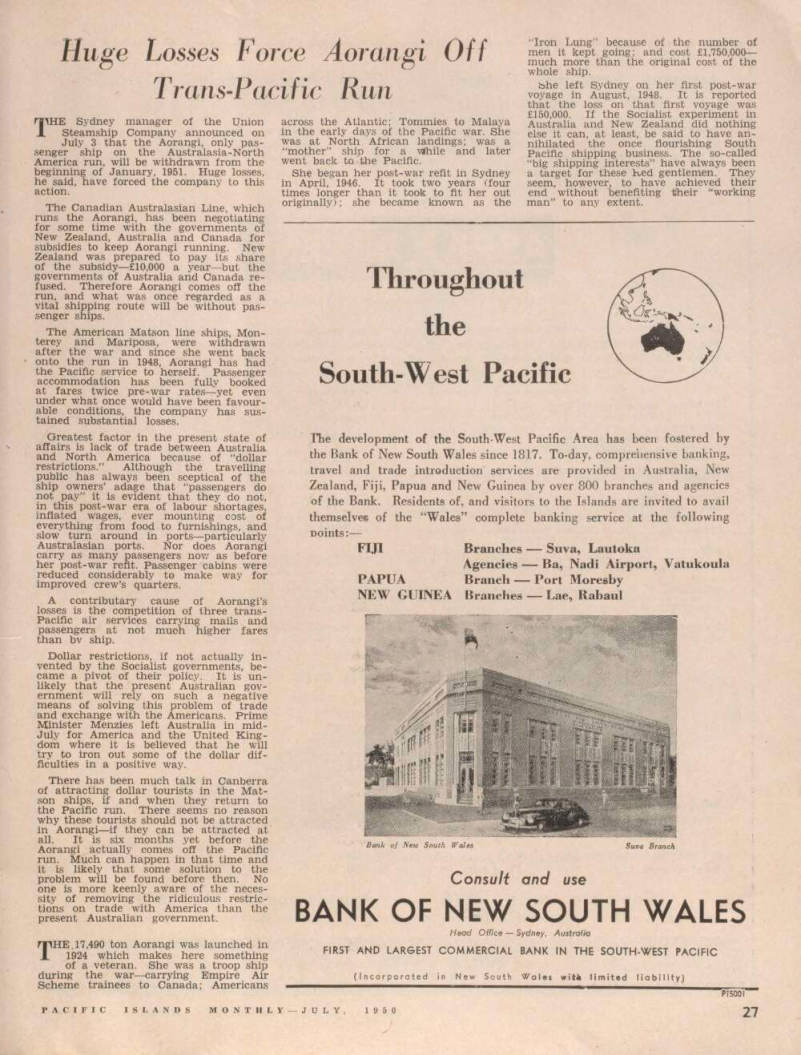
Trans-Pacific Run
11HE Sydney manager of the Union , Steamship Company announced on July 3 that the Aorangi, only pas senger ship on the Australasia-North America run, will be withdrawn from the beginning of January, 1951. Huge losses, he said, have forced the company to this action.
The Canadian Australasian Line, which runs the Aorangi, has been negotiating for some time with the governments of New Zealand, Australia and Canada for subsidies to keep Aorangi running. New Zealand was prepared to pay its share of the subsidy—£lo,ooo a year—but the governments of Australia and Canada re fused. Therefore Aorangi comes off the run, and what was once regarded as a vital shipping route will be without pas senger ships.
The American Matson line ships, Mon terey and Mariposa, were withdrawn after the war and since she went back onto the run in 1948, Aorangi has had the Pacific service to herself. Passenger accommodation has been fully booked at fares twice pre-war rates—yet even under what once would have been favour able conditions, the company has sus tained substantial losses.
Greatest factor in the present state of affairs is lack of trade between Australia and North America because of “dollar restrictions.” Although the travelling public has always been sceptical of the ship owners’ adage that “passengers do not pay” it is evident that they do not, in this post-war era of labour shortages, inflated wages, ever mounting cost of everything from food to furnishings, and slow turn around in ports—particularly Australasian ports. Nor does Aorangi carry as many passengers now as before her post-war refit. Passenger cabins were reduced considerably to make way for improved crew’s quarters.
A contributary cause of Aorangi’s losses is the competition of three trans pacific air services carrying mails and passengers at not much higher fares than bv ship.
Dollar restrictions, if not actually in vented by the Socialist governments, be came a pivot of their policy. It is un likely that the present Australian gov ernment will rely on such a negative means of solving this problem of trade and exchange with the Americans. Prime Minister Menzies left Australia in mid- July for America and the United King dom where it is believed that he will try to iron out some of the dollar dif ficulties in a positive way.
There has been much talk in Canberra of attracting dollar tourists in the Mat son ships, if and when they return to the Pacific run. There seems no reason why these tourists should not be attracted in Aorangi—if they can be attracted at all. It is six months yet before the Aorangi actually comes off the Pacific run. Much can happen in that time and it is likely that some solution to the problem will be found before then. No one is more keenly aware of the neces sity of removing the ridiculous restric tions on trade with America than the present Australian government.
THE, 17,490 ton Aorangi was launched in 1924 which makes here something of a veteran. She was a troop ship during the war—carrying Empire Air Scheme trainees to Canada; Americans
across the Atlantic; Tommies to Malaya in the early days of the Pacific war. She was at North African landings; was a “mother” ship for a Awhile and later went back to the Pacific.
She began her post-war refit in Sydney in April, 1946. It took two years (four times longer than it took to fit her out originally); she became known as the
“Iron Lung” because of the number of men it kept going; and cost £1,750,000 — much more than the original cost of the whole ship.
She left Sydney on her first post-war voyage in August, 1948. It is reported that the loss on that first voyage was £150,000. If the Socialist experiment in Australia and New Zealand did nothing else it can, at least, be said to have an nihilated the once flourishing South Pacific shipping business. The so-called “big shipping interests” have always been a target for these Ked gentlemen. They seem, however, to have achieved their end without benefiting their “working man” to any extent.
Advertisements & other items, pp. 31-32 (1 item)
Throughout
the
South-West Pacific
Os A / The development of the South-West Pacific Area has been fostered by the Bank of New South Wales since 1817. To-day, comprehensive banking, travel and trade introduction services are provided in Australia, New Zealand, Fiji, Papua and New Guinea by over 800 branches and agencies of the Bank. Residents of, and visitors to the Islands are invited to avail themselves of the “Wales” complete banking service at the following noints: — FIJI Branches Suva, Lautoka Agencies Ba, Nadi Airport, Vatukoula PAPUA Branch Port Moresby NEW GUINEA Branches Lae, Rahaul * .«l!Ilf ' Ml W. f-f Bank of New South Wales Suva Branch
Consult and use
BANK OF NEW SOUTH WALES
Head Office Sydney, Australia FIRST AND LARGEST COMMERCIAL BANK IN THE SOUTH-WEST PACIFIC (Incorporated in New South Wales witti limited liability) PI 5001
Asthmas, Bronchitis, Catarrh, Hay Fever, Antrum, Sinus, Polypi, Tonsilitis. Common Colds, Coughs, 'Flu, etc. —are all akin in so far as they are accompanied by inflamed capillaries of the mucous membrane. They may come from heart, lung, kidney, stomach trouble, or glandular derangement—only your doctor can tell; but the result is the same—expanded capillaries. Allergic response comes from: (1) Natural Agents—dust, bacteria, protein. (2) Physical Agents—heat, cold. (3) Emotion, So, therefore, the logical treatment for them all is by Atomized inhalant—
aspaXaprene
(known the world over as “the Answer to the Asthmatics’ Prayers) It “touches the spot,” so relieves in seconds (not years)—no dieting—sleep on anything anywhere—takes the strain from the heart. Duration, history, etc., immaterial. Absolutely harmless—same spray babies and adults. Contains no morphine, cocaine, atropin, ephredrin, papaverine, or any other opium drug. That is what I say—read what others say. (Full names and addresses in possession of this paper.) {Mrs. Bullen, 21 Simmons Street, South Yarra, Victoria.
Mrs. Pearman, 16 Princes Street, Prahran, Victoria.
Write them yourself—No Room here. nAY FEVER. J, C. S., P.O. Hopetoun, Vic.: Only need a couple of “sprays” to shift Hay Fever.
CATARRH.—M. K., Faraday Street, Carlton, Vic.: Great relief from chronic Catarrh.
BRONCHITIS.—Mr. H. S., Cross Street, F'ive Dock, N.S.W.: Very effective against my Asthma, chronic Bronchitis and Antrum trouble. A great boon to anyone suffering from any breathing complaint.
SINUS.—Mrs. W., Kemp Street, Hamilton, Newcastle, N.S.W.: A miracle re Sinus trouble, etc., etc.
COUGH.—Mrs. E. M., H.C. Chernside, Brisbane, Qld.: Your miracle stops fits of coughing immediately.
WHOOPING COUGH.—T. E„ Bills Lane, Fuirmond, N.S.W.: Cured my little daughter (aged 2 years) of Whooping Cough in 3 days, and the other kiddies of Coughs and Colds in no time.
CROUP. — Mr. W. H. F., Naracoorte, Sth. Australia: Twin boys (aged 4) —one gets Asthma—the other Croup—now sleep soundly at night—arrests strained breathing like magic.
SORE THROAT.—Mr. H. J. W., Herbert Street, Tumut, N.S.W • Wonderful and instant cure for Sore Throat.
WAR GAS. —G. S., John River, North Coast Line, N.S.W.: The one thing that gets to work when the darned gas gets to work on the bronchial tubes —last X-ray shows quite clear.
PNEUMONIA AND PLEURISY—Mrs. E. M.. Main Street, Lithgow, N.S.W.: Had Pneumonia and Pleurisy 5 weeks ago—took just 10 days to shake it off—thanks to Aspaxadrene.
MALARIA. —Mrs. Whitly, Monto, Qld.: My son says he is sure it will stave off any more attacks.
ANTRUM, POLYPI, TONSILITIS.—Mrs. —, Eastern Suburb, Melbourne, Vic.: 2 Polypi dried up instantaneously 2 years ago and no recurrence, etc., etc.
Check-up of Asthma testimonials written 10-9-8-7-6-5-4-3-2-1 years ago was recently made —(though one could expect at least a lew to have “blown a fuse”) —all replied confirming original statements. Some expressions used were: “Superman,” “Miracle Man,” “Mandrake,” “First comfort in 65 years,” “National Asset,” “One of the greatest humanitarians of all time,” “One of the seven wonders of the world,” etc., etc. (and etc.).
Canada, ILS.A.,
Malaya, China,
Testimonials have been received from all over Australia and the Islands, England, Eire, Scotland, Sth, America, Peru, all European countries (except behind the Iron Curtain), Egypt, India, Ceylon, and the Philippines. These have been published in our monthly issues.
ASPAXADRENE IS NOW SOLD ALL OVER THE WORLD FRENCH.—iL’aspiratoire “Aspaxadrene” se trouve maintenant partout.
GERMAN.—OIe Behandlung durch Einatmung von “Aspaxadrene” wird jetzt in der ganzen.
YIDDISH.— bv'x cnjm imxDpxßDK,, tin ITALIAN.—La cura per inalazlone “Aspaxadrene” e adesso adoperata in tutto il mondo.
SPANISH. —El trato respiratorio—“Aspaxadrene”—es empleado ahora de todos los pueblos del mundo.
CHINESE: A <. % \ i 'M'j K :"f. ffL Being an inhalant (which actually does not exist after a minute or so—none of it entering the blood stream), ASPAXADRENE does not interefere with any other treatment—injection, vaccine (oral or other-
wise), tablets, etc.
It’s the “buy word” to-day—so have an “eye to the buy”—buy to-day, not bye ’n bye (manana) and have a good night’s “bye bye”—yourself—all of the family—and the doctor.
Complete Outfit, 28/6 - - - Aspaxadrene Refill, 12/6 All Chemists—(Your sure protection in all things pharmaceutical) ALL ABOUT IT FROM A. H. CRUNDALL (DISCOVERER AND DISPENSER THEREOF) BOX 58,
PRAHRAN, VICTORIA, AUSTRALIA
Wedding In Papeete

Mr. H- G. Boys- Smith, who retired from the office of Marine Superintendent for the Western Pacific High Commission last year, is now living in Hampshire, England.
He is preparing a book of reminiscences
covering his long years of interesting ser vice in the South Pacific Islands.
Dr. William Swaan is now settled down in Vancouver. He went to Borneo in
1932 as a missionary, and has also lived in or visited Fiji, Western and Eastern Samoa, and Tonga. He has written a good deal, both prose and verse, and was awarded a Doctor’s degree in litera ture for a book on psychology.
Mr. George Digby Chamberlain, of the Western Pacific High Commission, was made a Companion of the Order of St Michael and St. George in the last Birthday Honours.
Photograph taken after the marriage in Papeete, in April, of Miss Ivane Asmus, daughter of the Acting British Vice-Consul, to Sergeant P. Tribot. Photograph shows, back row (left to right): Mr.
J. Asmus (bride’s father), Mrs. M. Garcia, Mr. P. Frogier, Lance-Sergeant M. Garcia. Front row: Mrs. P. Frogier, Miss M. Asmus, bridegroom and bride, Miss O. Frogier, Mrs. J. Asmus (bride’s mother).
Advertisements & other items, p. 33 (1 item)
Colyer Watson Pty. Ltd
SPECIALISING IN
PACIFIC ISLAND INSURANCES
FIRE—MOTOR VEHICLE
MARINE—HULLS AND CARGO
EMPLOYER’S LIABILITY
BONDS—in accordance with
ADMINISTRATION ORDINANCES.
COPRA INSURED FROM DRIER
TO BUYER.
AND ALL OTHER CLASSES ARRANGED
AT LOWEST CURRENT RATES.
Established Agencies throughout the Territory of Papua and New Guinea.
Managing Agents: New Guinea Company, Limited.
Island Representative: G. D. A. Kent, Rabaul Branch.
Southern Pacific Insurance
CO., LTD.
HEAD OFFICE; 60 HUNTER STREET
SYDNEY.
PENTAL is kind to the most delicate skins and can be used for washing the
finest of fabrics. A high
quality soap of
standing value.
Economical
to use.
Pacific Islands Distributors: — out sd* 5 If* 5 yOO* tlfj fHi N c i 010 p* pfu 0* M I* M P! joi
A G. W. PENNELL PRODUCT
COLYER WATSON PTY. LTD
22 BRIDGE ST.
• SYDNEY 0
I A
Death of Chief Micheli
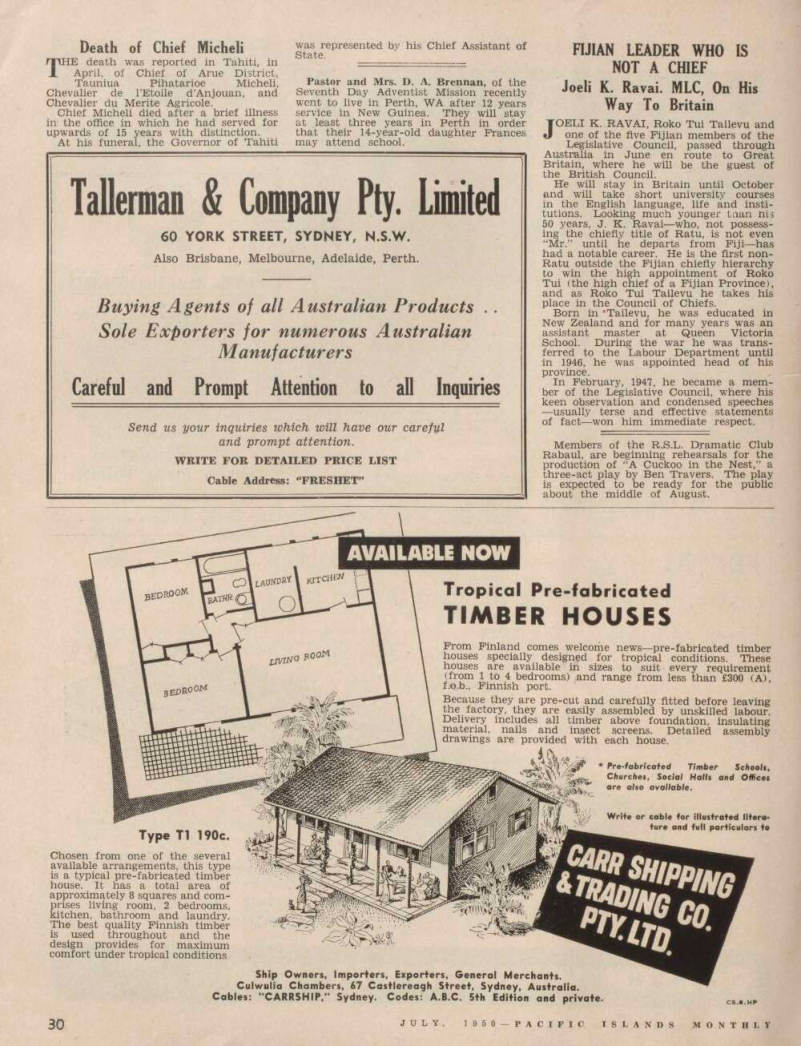
THE death was reported in Tahiti, in April, of Chief of Arue District, Tauniua Pihatarioe Micheli, Chevalier de I’Etoile d’Anjouan, and Chevalier du Merite Agricole.
Chief Micheli died after a brief illness in the office in which he had served for upwards of 15 years with distinction.
At his funeral, the Governor of Tahiti
was represented by his Chief Assistant of State.
Pastor and Mrs. D. A, Brennan, of the Seventh Day Adventist Mission recently went to live in Perth, WA after 12 years service in New Guinea. They will stay at least three years in Perth in order that their 14-year-old daughter Frances may attend school.
Fijian Leader Who Is
Not A Chief
Joeli K. Ravai. MLC, On His Way To Britain
JOELI K. RAVAI, Roko Tui Tailevu and one of the five Fijian members of the Legislative Council, passed through Australia in June en route to Great Britain, where he will be the guest of the British Council.
He will stay in Britain until October and will take short university courses in the English language, life and insti tutions. Looking much younger taan his 50 years, J. K. Ravai —who, not possess ing the chiefly title of Ratu, is not even “Mr.” until he departs from Fiji—has had a notable career. He is the first non- Ratu outside the Fijian chiefly hierarchy to win the high appointment of Roko Tui (the high chief of a Fijian Province), and as Roko Tui Tailevu he takes his place in the Council of Chiefs.
Born in 'Tailevu, he was educated in New Zealand and for many years was an assistant master at Queen Victoria School. During the war he was trans ferred to the Labour Department until in 1946, he was appointed head of his province.
In February, 1947, he became a mem ber of the Legislative Council, where his keen observation and condensed speeches —usually terse and effective statements of fact—won him immediate respect.
Members of the R.S.L. Dramatic Club Rabaul, are beginning rehearsals for the production of “A Cuckoo in the Nest,” a three-act play by Ben Travers. The play is expected to be ready for the public about the middle of August.
Advertisements & other items, p. 34 (2 items)
Tallerman & Company Pty. Limited
60 YORK STREET, SYDNEY, N.S.W.
Also Brisbane, Melbourne, Adelaide, Perth.
Buying Agents of all Australian Products ..
Sole Exporters for numerous Australian
Manufacturers
Careful and Prompt Attention to all Inquiries Send us your inquiries which will have our careful and prompt attention.
WRITE FOR DETAILED PRICE LIST
Cable Address: “FRESHET”
Timber Houses
AVAILABLE NOW
1 CDI I kitche" q\^
BEDROOM
rOOjM ix\nx°
bedroom
m m,
Type
T 1 190 c. ■> -i m. §r
Tropical Pre-fabricated
TIMBER HOUSES
From Finland comes welcome news—pre-fabricated timber houses specially designed for tropical conditions. These houses are available in sizes to suit every requirement (from 1 to 4 bedrooms) and range from less than £3OO (A), f.0.b., Finnish port.
Because they are pre-cut and carefully fitted before leaving the factory, they are easily assembled by unskilled labour.
Delivery includes all timber above foundation, insulating material, nails and insect screens. Detailed assembly drawings are provided with each house. i\ a /./a • * Pre-fabrieafed Timber Schools, Churches, Social Halls and Offices are also available.
Write or cable for illustrated literature and full particulars to Chosen from one of the several available arrangements, this type is a typical pre-fabricated timber house. It has a total area of approximately 8 squares and comprises living room, 2 bedrooms, kitchen, bathroom and laundry.
The best quality Finnish timber is used throughout and the design provides for maximum comfort under tropical conditions.
*Bss?*
r Ship Owners, Importers, Exporters, General Merchants.
Culwulla Chambers, 67 Castlereagh Street, Sydney, Australia.
Cables: "CARRSHIP," Sydney. Codes: A.B.C. sth Edition and private.
Mangaia's Self-Sown
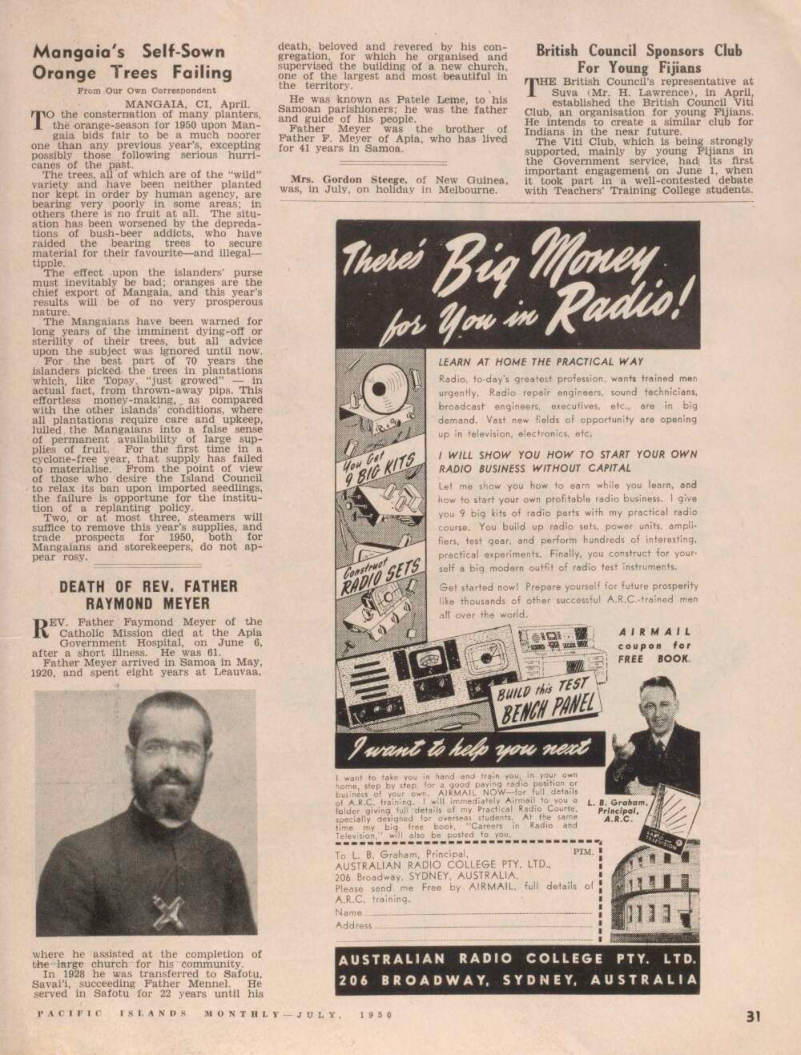
Orange Trees Failing
From Our Own Correspondent MANGAIA, Cl, April.
TO the consternation of many planters, the orange-season for 1950 upon Man gaia bids fair to be a much poorer one than any previous year’s, excepting possibly those following serious hurri canes of the past.
The trees, all of which are of the “wild” variety and have been neither planted nor kept in order by human agency, are bearing very poorly in some areas; in others there is no fruit at all. The situ ation has been worsened by the depreda tions of bush-beer addicts, who have raided the bearing trees to secure material for their favourite —and illegal— tipple.
The effect upon the islanders’ purse must inevitably be bad; oranges are the chief export of Mangaia, and this year’s results will be of no very prosperous nature.
The Mangaians have been warned for long years of the imminent dying-off or sterility of their trees, but all advice upon the subject was ignored until now.
For the best part of 70 years the islanders picked the trees in plantations which, like Topsy. “just growed” in actual fact, from thrown-away pips. This effortless money-making, _as compared with the other islands’ conditions, where all plantations require care and upkeep, lulled the Mangaians into a false sense of permanent availability of large sup plies of fruit. For the first time in a cyclone-free year, that supply has failed to materialise. From the point of view of those who desire the Island Council to relax its ban upon imported seedlings, the failure is opportune for the institu tion of a replanting policy.
Two, or at most three, steamers will suffice to remove this year’s supplies, and trade prospects for 1950, both for Mangaians and storekeepers, do not ap pear rosy.
Death Of Rev. Father
Raymond Meyer
REV. Father Paymond Meyer of the Catholic Mission died at the Apia Government Hospital, on June 6, after a short illness. He was 61.
Father Meyer arrived in Samoa in May, 1920, and spent eight years at Leauvaa,
death, beloved and revered by his congregation, for which he organised and supervised the building of a new church, one of the largest and most beautiful in tlrio territory , , , , .
He was known as Patele Leme, to his Samoan parishioners; he was the father an if guide of his people. ... .
Father Meyer was the brother of Father F. Meyer of Apia, who has lived for 41 years in Samoa.
Mrs. Gordon Steege, of New Guinea, was, in July, on holiday in Melbourne.
where he assisted at the completion of the large church for his community.
In 1928 he was transferred to Safotu, Savai’i, succeeding Father Mennel. He served in Safotu for 22 years until his
British Council Sponsors Club
For Young fijians
British, Council s representative &t X Suva (Mr. H. Lawrence), in April, established the British Council Viti club, an organisation for young Fijians.
He intends to create a similar club for Indians in the near future.
The viti Club, which is being strongly supported, mainly by young Fijians in the Government service, hadf its first important engagement on June 1, when it took part in a well-contested debate with Teachers’ Training College students.
Advertisements & other items, pp. 35-36 (2 items)
Pomm!
$
Mi ra
{rui
m s Mi
LEARN AT HOME THE PRACTICAL WAY
Radio, to-day’s greatest profession, wants trained men urgently. Radio repair engineers, sound technicians, broadcast engineers, executives, etc., are in big demand. Vast new fields of opportunity are opening up in television, electronics, etc.
I WILL SHOW YOU HOW TO START YOUR OWN
RADIO BUSINESS WITHOUT CAPITAL
Let me show you how to earn while you learn, and bow to start your own profitable radio business. I give you 9 big kits of radio parts with my practical radio course. You build up radio sets, power units, amplifiers, test gear, and perform hundreds of interesting, practical experiments. Finally, you construct for yourself a big modern outfit of radio test Instruments.
Set started now! Prepare yourself for future prosperity like thousands of other successful A.R.C.-trained men alt over the world.
AIRMAIL
coupon for
FREE BOOK.
A mm ■ m.\
OH
TEST
this
7mM
& deft mx#
I want to take you in hand and train you, in your own home, step by step, for a good paying radio position or business of your own. AIRMAIL NOW —for full details of A.R.C. training. I will immediately to you a folder giving fujl details of my Practical Radio Course, specially designed for overseas students. At the same time my big free book, "Careers in Radio and Television," will also be posted to you.
To L. B. Graham, Principal,
AUSTRALIAN RADIO COLLEGE PTY. LTD.,
206 Broadway, SYDNEY, AUSTRALIA.
Please send me Free by AIRMAIL, full detai A.R.C. training.
Name Address m B. Graham, Principal,
A.R.C.
6
PIM.
AUSTRALIAN RADIO COLLEGE PTY. LTD.
206 BROADWAY. SYDNEY. AUSTRALIA
(AV
(tf/u Fronds
Precious Jewellery Watches China and Glasswa A S 5 Art Jewellery ;■/ 9 Compacts Souvenirs A birthday gift a wedding gift . . . a Christmas gift ... or whatever the occasion may be Pens and Pencils Smokers' Accessorie; ?" v Silverware Proud s Seven Floor Gift Store, right in the heart of Sydney, has exactly the gift you need.
/f jr
m sJ 1 U m Cutlery Shaving Accessories Leather Goods Brush Sets Handbags All types ot clocks from the "Clock Shop"
A variety of merchandise is specially selected with a thought for the giver of gifts It's easier, it's more fun to shop by mall with the help of Proud's Gift Book . Cut out the coupon below, send it to Mail Order Manager, Prouds Limited. Box 1502,
G.P.0., Sydney,
and receive Proud's Gift Book free.
I*llol ID’S OR FT BOOK VOUCHER
Mai! Order Manager. Prouds Limited. Box 1502, G.P O Svdnev Please send me Proud's new Gift Book free of all charge.
Name Address
32
JULY, 1950 —PAC I F T r ict .
1 * 1 C ISLANDS MONTHLY
Fog Over Trust Territories
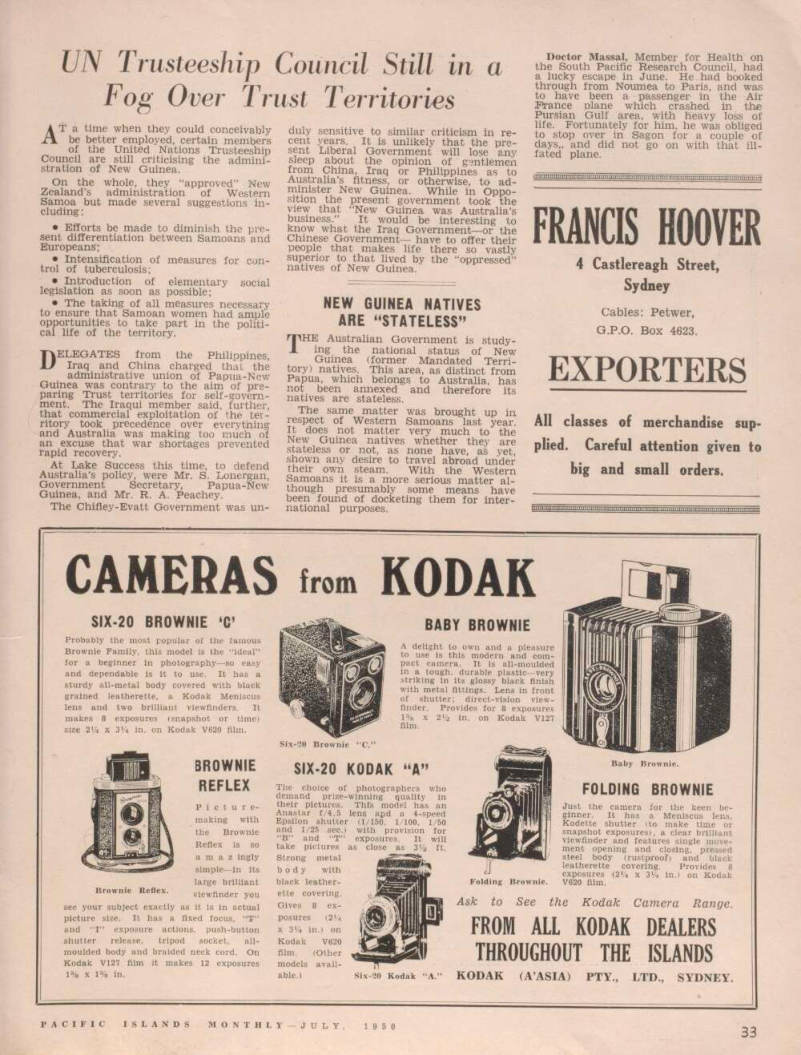
UN Trusteeship Council Still in a Fog Over Trust Territories
AT a time when they could conceivably be better employed, certain members of the United Nations Trusteeship Council are still criticising the admini stration of New Guinea.
On the whole, they “approved” New Zealand’s administration of Western Samoa but made several suggestions in cluding : • Efforts be made to diminish the pre sent differentiation between Samoans and Europeans; • Intensification of measures for con trol of tuberculosis; • Introduction of elementary social legislation as soon as possible; • The taking of all measures necessary to ensure that Samoan women had ample opportunities to take part in the politi cal life of the territory.
DELEGATES from the Philippines, Iraq and China charged that the administrative union of Papua-New Guinea was contrary to the aim of pre paring Trust territories for self-govern ment. The Iraqui member said, further, that commercial exploitation of the ter ritory took precedence over everything and Australia was making too much of an excuse that war shortages prevented rapid recovery.
At Lake Success this time, to defend Australia’s policy, were Mr. S. Lonergan, Government Secretary, Papua-New Guinea, and Mr. R. A. Peachey.
The Chifley-Evatt Government was un
duly sensitive to similar criticism in re cent years. It is unlikely that the pre sent Liberal Government will lose any sleep about the opinion of gentlemen from China, Iraq or Philippines as to Australia’s fitness, or otherwise, to ad minister New Guinea. While in Oppo sition the present government took the view that “New Guinea was Australia’s business.” It would be interesting to know what the Iraq Government—or the Chinese Government— have to offer their people that makes life there so vastly superior to that lived by the “oppressed” natives of New Guinea.
Are “Stateless”
New Guinea Natives
THE Australian Government is study ing the national status of New Guinea (former Mandated Terri tory) natives. This area, as distinct from Papua, which belongs to Australia, has not been annexed and therefore its natives are stateless.
The same matter was brought up in respect of Western Samoans last year.
It does not matter very much to the New Guinea natives whether they are stateless or not, as none have, as yet, shown any desire to travel abroad under their own steam. With the Western Samoans it is a more serious matter al though presumably some means have been found of docketing them for inter national purposes.
Doctor Massal, Member for Health on the South Pacific Research Council, had a lucky escape in June. He had booked through from Noumea to Paris, and was to have been a passenger in the Air Prance plane which crashed in th*e Pursian Gulf area, with heavy loss of life. Fortunately for him, he was obliged to stop over in Sagon for a couple of days,, and did not go on with that ill fated plane.
Advertisements & other items, p. 37 (1 item)
Cameras From Kodak
FRANCIS HOOVER
4 Castlereagh Street, Sydney Cables: Petwer, G.P.O. Box 4623.
EXPORTERS
All classes of merchandise supplied. Careful attention given to big and small orders.
CAMERAS from KODAK
SIX-20 BROWNIE ‘C
Probably the most popular of the famous Brownie Family, this model is the “ideal” for a beginner in photography—so easy and dependable is it to use. It has a sturdy all-metal body covered with black grained leatherette, a Kodak Meniscus lens and two brilliant viewfinders. It makes 8 exposures (snapshot or time) size 2*4 x 3*4 in. on Kodak V 620 film.
BROWNIE
REFLEX
Picturemaking with the Brownie Reflex is so a m a z ingly simple—in its large brilliant viewfinder you see your subject exactly as it is in actual picture size. It has a fixed focus, “T” and “I” exposure actions, push-button shutter release, tripod socket, allmoulded body and braided neck cord. On Kodak V 127 film it makes 12 exposures 1% x 1% in. aa Brownie Reflex. a
BABY BROWNIE
A delight to own and a pleasure to use is this modern and compact camera. It is all-moulded in a tough, durable plastic—very striking in its glossy black finish with metal fittings. Lens in front of shutter; direct-vision viewfinder. Provides for 8 exposures 1% x 2*4 in. on Kodak V 127 film.
Six-20 Brownie “C.
SIX-20 KODAK “A”
The choice of photographers who demand prize-winning quality in their pictures. This model has an Anastar f/4.5 lens apd a 4-speed Epsilon shutter (1/150, 1/100, 1/50 and 1/25 sec.) with provision for “B” and “T” exposures. It will take pictures as close as 3Vs ft.
Strong metal body with black leatherette covering.
Gives 8 exposures (2*4 x 3*4 in.) on Kodak V 620 film. (Other models available.) Six-30 Kodak o Cl I Folding Brownie.
Baby Brownie.
FOLDING BROWNIE
Just the camera for the keen beginner. It has a Meniscus lens, Kodette shutter (to make time or snapshot exposures), a clear brilliant viewfinder and features single movement opening and closing, pressed steel body (rustproof) and black leatherette covering. Provides 8 exposures (2*4 x 3*4 in.) on Kodak V 620 film.
Ask to See the Kodak Caviera Range.
FROM ALL KODAK DEALERS
THROUGHOUT THE ISLANDS
KODAK (A’ASIA) PTY., LTD., SYDNEY
Are Not
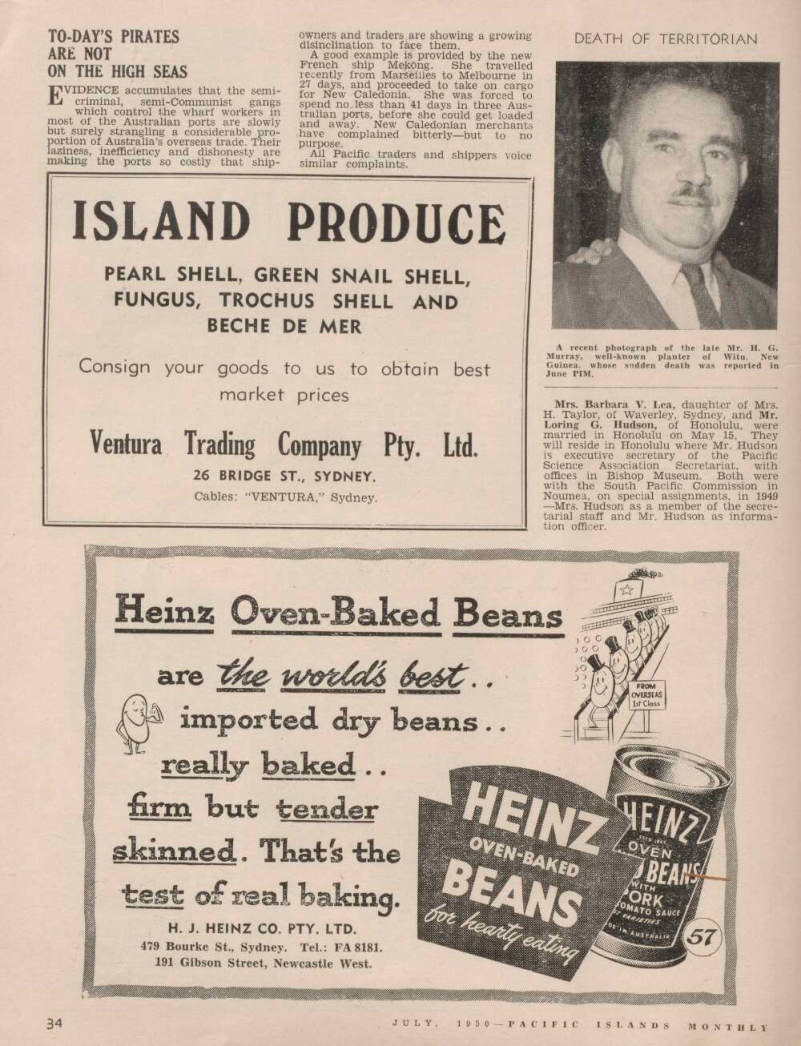
To-Day S Pirates
On The High Seas
Evidencr 1 npriimniQtfiQ tho comi VIJJFNOE accumulates that the semi criminal, semi-Communist gangs which control the wharf workers in most of the Australian ports are slowly but surely strangling a considerable pro portion of Australia’s overseas trade. Their laziness, inefficiency and dishonesty are making the ports so costly that ship
owners and traders are showing a growing disinclination to face them.
A good example is provided by the new French ship Mekong, She travelled recently from Marseilles to Melbourne in days, and proceeded to take on cargo f or n 6 w Caledonia. She was forced to spend no less than 41 days in three Aus tralian ports, before she could get loaded and away. New Caledonian merchants have complained bitterly—but to no purpose All Pacific traders and shippers voice similar complaints.
Mrs. Barbara V. Lea, daughter of Mrs.
H. Taylor, of Waverley, Sydney, and Mr.
Loring G. Hudson, of Honolulu, were married in Honolulu on May 15, They will reside in Honolulu where Mr. Hudson is executive secretary of the Pacific Science Association Secretariat, with offices in Bishop Museum. Both were with the South Pacific Commission in Noumea, on special assignments, in 1949 • —Mrs. Hudson as a member of the secre tarial staff and Mr. Hudson as informa tion officer.
Death Of Territorian
A recent photograph of the late Mr. H. G.
Murray, well-known planter of Witu, New Guinea, whose sudden death was reported in June PIM.
Advertisements & other items, p. 38 (1 item)
Island Produce
PEARL SHELL, GREEN SNAIL SHELL,
FUNGUS, TROCHUS SHELL AND
BECHE DE MER
Consign your goods to us to obtain best market prices
Ventura Trading Company Pty. Ltd.
26 BRIDGE ST., SYDNEY.
Cables: “VENTURA,” Sydney.
Heinz Oven-Baked Be
are im firm but tender skinned. Thatk the
H. J. HEINZ CO, PTY. LTD.
479 Bourke St., Sydney. Tel.: FA 8181. 191 Gibson Street, Newcastle West.
Council Of Chiefs
Under Fire
From Our Own Correspondent SUVA, June 12.
THE Fiji Council of Chiefs will hold its biennial meeting at Nasova, Suva, next month at a time when its powers and functions have been brought into public discussion as a result of the implacable Fijian opposition, in the Legislative Council, to any proposed change in the Colony’s constitution.
The advocates of “democratic repre sentation” (certain European and Indian political groups or individuals) have made no secret of their ambition to force, if possible, some sort of “democratic sys tem” on to the Fijians whether the mass of the Fijians want it or not.
But as far as independent observers can discover, the idea of “party politics” and election brawls is utterly foreign and distasteful to the average knowledgeable Fijian. As far as can be learned by any non-Fijian, the Fijian people ai’e pro foundly suspicious of any move to foist anything on them before they know exactly what it is all about. And this at titude rises from an openly-expressed fear that Fijian “democracy” as interpreted by the hopeful constitution-changers of other races would be wide open to dangerous manipulation by interested Europeans, or Indians, or both.
To the constitution-changers the Council of Chiefs is an autocratic group of dictators subservient to the Govern ment and concerned primarily with maintaining its own privileges and its un doubtedly great power as the Fijian rul ing body. To European and Indian Left ists it is anathema as a “great stronghold of reactionism.”
To non-political moderates, the Coun cil of Chiefs is nothing of the sort.
There is nothing to show that it is merely a deadweight stifling all Fijian political and social advancement, but there is a good deal to show that a fairly large proportion of the members have an eye to chiefly interests rather than the interests of the Fijian people as a whole. And this point is important at a time when there are almost daily signs of intense Fijian awareness of the urgent need for ’energetic and well-directed moves if the Fijians are to retain their right ful place in their own land.
After all, it is the Fijian people who are faced with the mounting pressure of alien competition, not the chiefs.
In recent months (and notably during the Anti-TB Fund campaign) angry and sometimes furious European protests have been voiced in the press and elsewhere against the continual exploitation of the Fijians by means of “appeals”—nominally voluntary “appeals’* but actually pre sented in the form of veiled compulsion— which realised tens of thousands of pounds at the expense of people who simply could hot afford to pay.
Lately this has developed into criticism of some aspects of taxation as applied to Fijians by the Fijian Administration, and it has been recalled that long ago a Government report stated that Fijian taxation had reached saturation point.
The questions are now being asked: What return do the Fijians get for the taxes they pay to their own administration?
And what exactly does the Council of Chiefs, with its wide powers under the Government, do for the Fijian people as a whole?
Unless this question can be answered effectively by proof of the council’s re cognition that its main function is to speak for and guard the interests of the Fijian race, it will remain the target for bitter political assaults from outside its preserves.
More Dollars For
Australian Pearl Shell
AUSTRALIAN Departmertt of Com merce stated at the end of June that shipments of pearl shell to the United States would be increased in the coming 12 months to earn more dollars.
Last year MOP exports from Australia increased 40 per cent, and brought in 1,410,000 dollars.
It is believed that shell is now regain ing markets that it lost during the war to plastics.
Mr. Patrick Costello has been re appointed a member of the Fiji Executive Council until September 30, 1950.
Advertisements & other items, pp. 39-40 (1 item)
Fly'bo Ac
STAMPS
Australia, 8.C.0.F., short set to 1/- mint . . !)/- Australia, Harbour Bridge, 5/-, superb, used 60/- Brunei, Ic.-!)!1 (II), fine used 7/- Egypt, Farouk, £l, fine used 6/- Sudan, Legislative Assembly, 2 vals., fine used 2/3 Tonga, Jubilee, 5 vals., mint 4/6 U.S.A., Commems., 7 vals., mint 3/6 English and U.S.A. Stamp Journals, 12 recent issues, post free 6/6 Mint Island sets accepted in payment for above.
Postage extra under £l.
Send stamp for list of offers.
First class selections of Empire stamps will be sent on approval to responsible collectors.
Good Island stamps bought and exchanged.
GUY ROUND
414 Toorak Road, Toorak, Victoria, Australia.
\ unvAJ SOON CAN YOU jjj
IN AFRICA ? =
\ V £ ‘Vw “"a#* X
/n four days.
I’ll fly at once!”
Buyers and sellers with overseas interests keep one eye on the clocks and time-tables of the world. They depend on regular Speedbird air services over 175,000 miles of routes to all six continents. They fly swiftly and in comfort on one ticket all the way.
No tips, no extras to pay.
FLY BRITISH BY 8.0.A.C.
to almost anywhere Book from Sydney to Indonesia • far east • hong kong JAPAN • CEYLON • INDIA • PAKISTAN • AFRICA • ITALY GREAT BRITAIN • AND VIA U.K. TO U.S.A. • CANADA
CENTRAL AND SOUTH AMERICA • BERMUDA
FLY'BO AC
Information & Bookings : Qantas Empire Airways Ltd. {8.0.A.C. General Agents in Australia ) at Sydney, Melbourne, Brisbane, Townsville, Cairns, Darwin or from Travel Agents in all cities and toivns. \( J 9/14/1 Specify 8.0.A.C. “Air Cargo” for your overseas shipments!
BRITISH OVERSEAS AIRWAYS CORPORATION WITH Q.E.A., T.E.A.L. AND S.A.A,
LAMPS
TT-J
to
c asV
Its
\\ \ 11 ' /// o
mmi
?rr^ 6* k 11
OStHE'
VCER
\MM^ Ji f
ofc°
bur^ s
“THE GUARDS ”
STORM LANTERN X 246
SOO Candle Power If YOU THINK OF NIGHT WORK—YOU MUST THINK OF TILLEY. THERE IS A LAMP FOR EVERY JOB, FROM THE 300 CANDLE POWER " GUARDSMAN ” STORM LANTERN, AS ILLU-
STRATED, TO THE 5,000 CANDLE POWER
PORTABLE FLOODLIGHT. EVERY TILLEY OUTDOOR LAMP IS ENTIRELY STORM PROOF AND WILL OPERATE IN THE WORST WEATHER CONDITIONS WITH COMPLETE RELIABILITY. MANUFACTURED TO THE HIGHEST ENGIN- EERING STANDARDS FROM THE FINEST MATERIALS, TILLEY PRODUCTS ARE THE FINEST YOU CAN BUY. THE LAMP WITH THE “ HAPPY MANTLES. ”
THE TILLEY LAMP COMPANY, LTD. HeNDON, EnGLANQ_
REPRESENTATION:
MELBOURNE: T. H. Bentley, Pty. Ltd., 123-125 William Street, Melbourne, C.l.
TASMANIA; Mr. H. V. Sellers, 108 a Charles Street, Launceston.
FIJI: Mr. K. Witherington, 2 Burns Philp Buildings, Suva.
Fiji Tuna Fishers
Looking Towards Australia
THERE have been changes in the plans of South Sea Marine Products, Ltd organised by Mi’. Harold Gatty, and registered in Suva, to exploit tuna fisheries in Fiji.
After the necessary equipment had been installed in Fiji, the Co. experienced dif ficulties because —for some reason never explained—the feeding habits of tuna in Fiji waters were found to be different from those of tuna elsewhere, and they would not take the baits offered by the Fijian fishing-boats.
A great deal of additional research took place, but the position in May last was reported by Mr. Gatty to be pre carious.
The following appeared in Sydney Sun on June 26; A tuna-fishing project with experienced overseas crews operating modern Ameri can craft is being considered by Aus tralian authorities. The proposal is be ing sponsored by a joint British-American group whose representative is now in ydney.
The British unit is South Sea Marine Products, based at Suva. The American company is Island Packers Inc., regi stered in American Samoa. Pounder of the two companies was Mr. Harold Gatty, best known as an airman, who made a long investigation into commer cial fishing in the South-West Pacific.
The two companies were established two years ago, a modern cannery being set up at Tutuila, in American Samoa, and the fishing fleet being based, on Suva. Special equipment included a Grumman Goose amphibian and a Piper Cub seaplane for spotting. Joint objec tive was to catch the tuna in Fijian
waters and, after freezing it, to ship it to Samoa for canning.
Recently Mr. Gatty resigned from the operational control of the joint companies and Mr. Don M. Haywood the new general manager, came to Australia from Fiji to investigate reports of tuna in NSW and southern waters.
After a brief survey Mr. Haywood put his project to Mr. F. F. Anderson, Com monwealth Director of Fisheries.
It is believed Mr. IHaywood wants to bring to Australia a clipper, a refrigerated cargo vessel and a live-bait fishing boat at present stationed in Fiji for tuna fishing tests here.
In the US the annual tuna catch totals £5O million. If Mr. Haywood’s fishing flotilla operates successfully here an Aus tralian company may be formed.
Large schools of tuna occur off the south-east and east coast of Australia, and already a considerable canning in dustry has been based on tuna-fishing there.
Mr. Richards Hot Retiring
IT was reported in Melbourne at the end of June that Mr. R. S. Richards, Administrator of Nauru, would soon be retiring because of ill health.
Mr. Richards later denied this. He said that he had not been well because of overstrain but was “much better.”
Mr. Richards, formerly Leader of the Labour Opposition in the South Aus tralian parliament, was appointed Ad ministrator of Nauru by the Chifley Labour Government just before it went out of office. He has been in Nauru about seven months.
Although Mr. Richards had had no experience of the tropics or Islands ad ministration, it is said that he has shown himself a “sound and wise administra tor.”
Death Of Mrs. E. M. Faddy
MRS. E. M. FADDY, a well-known resident of Sigatoka, Fiji, died on June 22. She was the widow of Mr. P. Faddy, a former MLC, and was keenly interested in Fijian affairs and held in high regard by the Fijian people with whom she came in contact.
She is survived by three sisters and a brother, all in Australia.
Advertisements & other items, p. 41 (1 item)
aMPUOh
KANGAROO BRAND
Ropes,
Cordage,
ond Twines for every purpose Backed by 98 years of service Manufactured by:
M. DONAGHY AND SONS,
Pty. Ltd., Geelong and Sydney.
Fiji Representatives:
PEARCE AND CO.
LIMITED
P.O. BOX 237, SUVA
ONE HORSEPOWER
PETROL ENGINES
ELECTRIC
LIGHTING PLANTS
Bring you brilliant electric light in your home, week-ender or plantation.
Low operating and initial costs. Treated for the tropics. * Press button starting. -K 300 watts output. -K 12 and 32 volt A models. ♦ ♦ ■¥■ Weight 70 lb.
The Amplion makes the most of your petrol, rims longer on a tankful, 8 to 10 hours to the gallon. It’s light in weight too—4o lb. + Obviously the best proposx- * tion for driving: Pumps—Compressors —Post hole borers — Lawn mowers—Saws— Shearing Machines— Crutching Machines —Spraying outfits—Concrete Mixers —Concrete Vibrators —Milking Machines.
★ 4 CYCLE AIR COOLED DESIGN
★ FULL FLOAT CARBURETTOR
★ EFFICIENT AIR CLEANER
m m Special Islands
PRICE:
£6O/11/6 F. 0.8.
PRICE :
£36/0/6 F. 0.8.
DISTRIBUTORS THROUGHOUT
AUSTRALIA AND THE ISLANDS
aMPUOh
(Australasia) Pty. Ltd. 36-40 Parramatta Road, Camperdown.
Telegrams: Amplion, Sydney Telephone: LA2828 (6 lines)
Death Of Mrs, Maud Gosling
Mrs. maud gosling, wife of Captain H. Gosling, a well-known pilot, died at Suva on June 20 two days after her 59th. birthday. She was the eldest child of the late Lieutenant- Colonel and Mrs T. M. Williams, of Suva, and lived all her life in Fiji, except for a short visit to Australia. She was a
keen worker for patriotic and charitable causes.
She is survived by two sons and three daughters of whom Mr. J. Gosling (Suva), Mrs. L. M. McGowan (Vatukoula) and Mrs. O. Bentley (Suva) live in Fiji.
Mr. W. R. Cahill, Madang, New Guinea, recently spent a few days in Brisbane en route to the Territory from Sydney
Legislative Council
Short- Session of Fiji Legislative Council Elections to be Held Shortly
From Our Own Correspondent A mTTT , SUVA, June 26.
THREE-DAY session of the Fiji Legislative Council was held at the en <3 of June—the last meeting before the elections to appoint new European and Indian unofficial members.
Business consisted of a debate on Forestry policy, and 204 questions—2o3 of them put by three Indian members.
Forestry Policy Approved
AFTER rejecting six amendments moved by Mr. A. A. Ragg, the Legis lative Council on June 21 adopted the Government’s Forest Policy.
The policy which was supported by three of the five European unofficial members and all five Fijian members, but was opposed by Messrs. Ragg, F. G.
Archibald and all the Indian members, adopted the policy by 27 votes to seven.
Its main aims are to conserve existing forest areas, to reafforest suitable areas —including some of the denuded hill country in the dry zone of Viti Levu— to control and prevent soil erosion, and to increase timber supplies without per mitting the wholesale destruction of forests that has been common in the past.
The Forest Policy debate was the prin cipal business of the last session of the Legislative Council before the elections.
204 Questions
OUT of 204 written questions by Legis lative Council members at the three day session, 203 were asked by three Indians. One member, Mr. A. D. Patel,
filled up eigivt pages of the 12-page printed business paper on the first day by producing 180 questions involving de tails of the distribution of freehold, lease hold, Fijian and Crown lands in the Colony.
The Government’s reply grouped 155 of the questions and dismissed them with the statement that the information sought was not available and could not be made available unless the Lands Department were provided with additional staff. It added that an officer is now working on a land title index which “would enable a portion of the information asked for to be compiled in due course by the Gov ernment Statistician.”
Twenty-four further questions relating to Indian interest in the demarcation of Fijian land reserves in Rewa and north western Viti Levu were also grouped in a reply stating that in neither area has the Reserves Commission completed its investigations.
The one exception to the Indian monopoly of questions was a Fijian re quest, from Ratu George Tuisawau, for details of the main examination results at Queen Victoria School (Fijian) and the principal Indian and European schools.
The tabulated reply showed that four years of disorganisation and semi-neglect after QVS had been moved out when its Nasinu home was commandeered for an American Army hospital, followed by staff shortages and improvised quarters at Nasinu, had not helped the only real centre of Fijian education to keep pace with the uninterrupted progress of the schools of other races.
Advertisements & other items, p. 42 (2 items)
Kerr Bros. £
G.P.O. Box 3838, Sydney.
ISLAND MERCHANTS SINCE 1895
50 years old, hut as young as ever and eager to serve you.
Cocoa Beans, Copra, Coffee and all Island Produce Sold on Commission.
All merchandise purchased at best wholesale prices and original invoices supplied.
Use Our Co-operative Specialised Overseas Buying Service.
nawiß
DIESEL
M IS MOST RELIABLE AND EFFICIENT WHEN IT'S A
COVENTRY “VIGOR” ENGINE
Ideal for all uses where low weight Diesel Power is required. The Coventry VICTOR is a sound investment. Remarkably smooth running at all speeds.
Instant starting from cold. All enclosed and dust-proof.
Model W.D.I 5/7 H.P £125.
Model W.D.2 7/9 H.P £145.
F. 0.8. Brisbane (including Packing). IMMEDIATE DELIVERY.
Coventry "Victor" is the finest of all Diesel Power
COMPLETE LIGHTING PLANTS
Dependable Home Lighting Plants, powered by Coventry VICTOR Diesel Engines, are available. Supplied with common base plate and switch boards.
MARINE USE
Coventry VICTOR Diesels for marine application either as main or auxiliary propulsion, or marine auxiliaries are available. These engines are ideal Power Units for craft from 16 feet to 22 feet.
For further details, write to distributors : HAWLEY’S PTY. LTD. 52 BOWEN st„ BRISBANE or to local Sales and Service Representative: C. C. EVANS, c/o Bank of N.S.W., Port Moresby.
But There Wasn’t Any
Brass Band!
Rotoiti Shows Flag At Mangaia
Prom Our Own Correspondent
Mangaia, Cl, May 30.
HIS Majesty’s NZ warship, Rotoiti, made her first call at this island on May 28 and 29, after a stay of several days at Rarotonga.
The weather was favourable, and the reef dead calm, which is not always the case when a ship of size arrives off the island. A party of officers, with the Commander, and two successive detach ments of selected ratings, spent the 48 hours ashore in the customary way—the usual round of Polynesian feasts, visits, and entertainment at the official Resi dency, where the officers spent a night.
The men returned to the ship.
The period immediately prior to this call was spent, by one stratum of our villagers, in preparing large supplies of bush beer in bottles, with a view to good sales at 1/-. The brew, it is to be feared, was not always of praiseworthy vintage; it is a well-known fact that native beer is made, only too often, under highly insanitary conditions, in kero sene tins, which the illegal tipple-mer chants frequently store in a latrine, as being the least likely place for a police search Jolly Jack, judging by the cheerfulness of some of the visitors after a tour of the villages, did not let this interfere with his enjoyment of the day ashore, however.
The naval visit closed with a much appreciated night display of star-shells, and searchlight drill, during which half hour the whole ship was illuminated as for a Royal Review.
With these visits promising now to be come a definitely annual affair, Islanders have something to look forward to for next season—but they still want a brass band, the only item missing from a very successful and impressive naval call.
A. S. Farebrother & Co
Under New Control
From Our Own Correspondent SUVA, June 26.
A CONTROLLING interest in the firm of A. S. Farebrother and Co., over seas manufacturers’ representatives, Suva, has been acquired by Pearce and Co., Suva. The new manager, Mr. C.
Read, will take over on August 1.
The business, founded and formerly directed by the late Mr. A. S. Farebrother, was bequeathed by him to the eight Indian and Fijian members of the staff.
Pastor and Mrs. C. Pascoe, Seventh Day Adventist missionaries who have served in BSI, New Britain, Bougainville and New Guinea mainland stations, are at present on leave in Australia. With them is Esther Tati, a young Melanesian girl from Lae, NG.
Mr. Les Weekes, Qantas engineer, and Miss Betty Isaacs, of 9PA, were married at the Ela Protestant Church, Port Moresby, on May 20. Miss Margaret Bruce was bridesmaid and Mr. Don Cody best man. The reception was at the Papua Hotel.
Advertisements & other items, pp. 43-44 (1 item)
ojEUzanpifc
THE PACIFIC ISLANDS SOCIETY
(Founded 193T) Visitors from the Pacific Islands to Sydney, or persons interested in Islands affairs, are invited to communicate with the Honorary Secretary of the above Society which was formed to constitute a social centre for those interested in the Pacific Islands.
Regular meetings and social gatherings, with lectures, are held at History House, 8 Young Street, Sydney, on the fourth Wednesday of each month, at 8 p.m.
Address for correspondence:—
THE PACIFIC ISLANDS SOCIETY,
Box 3434, G.P.O., Sydney.
1\ //
ojEUzanpifc
JP< top >
TABITeMK. ’-I
MARJARINE
Packaged like this, DELANA TABLE MARGARINE, a Product of Fiji, is now available to
ALL PACIFIC ISLANDS
Wherever and Whenever Suitable Transport Can Be Found.
A SUBSTITUTE
FOR
BUTTER
In \ lb. Pats
In
Shipping Outers
of 2j lb.
Fresh, wholesome and nutritious, this is a pure Vitamised Vegetable Product made in accordance with the Pure Food Laws of the Colony of Fiji. It contains no animal fat.
You'll enjoy eating DELANA . . .
You'll appreciate its ECONOMY Export Prices and Further Information from
ISLAND INDUSTRIES LIMITED
P.O. Box 299, SUVA, FIJI.
Telegraphic Address: “DELANA,” SUVA. * For Local Reasons, the Product is Labelled “Marjarine” in Fiji, and “Margarine” Elsewhere.
\t*° SENSATIONAL
mm m ■I Much more than M
IT’S 3 SEPARATE
HOME ENTERTAINMENT
UNITS IN ONE!
Only ns.
* Speciol Freight Offer
Queensland Merchants Supplies will pay up to 75% of air freight on your Kriesler Radiogram, Three Separate Entertainment units—each with Triple Throat—each giving you three times the entertainment value of ordinary radio . . . all three incorporated in the one magnificent allplastic cabinet . . . streamlined and sealed!
Unit I.—Triple Throat reception of local programmes.
Unit 2.—Triple Throat reception of overseas programmes at full local volume.
Unit 3.—Triple Throat quality reproduction from your favourite records.
AMAZINGLY LOW PRICE—ONLY 35 GNS.
Triple Throat, sealed for your protection, and with all Kriesler’s exclusive, proved features plus the exclusive Kriesler performance guarantee of 12,500 miles range, this new “3-in-one’ : Radiogram is what you’ve always wanted.
The magnificent new
TR/Pce
THROAT
KRIESLER
3-in-on. RADIOGRAM
"The Best Set at Any Price!"
ORDER FROM, OR WRITE FOR FULL DETAILS TO
OLD. MERCHANTS SUPPLIES
143-145 QUEEN STREET, BRISBANE, QLD.
Sugar Cane Price
In Fiji
Agreement Reached
From Our Own Correspondent SUVA, June 26.
THE Colonial Sugar Refining Company, Ltd., at a meeting with represen tatives of the five canegrowers’ associations at Lautoka, Fiji, on June 16, agreed to increase the price paid for sugar cane.
This has the effect of increasing the price of cane by 1/8 a ton over the February offer by the CSR to growers, at a yield of 7.1 tons of cane to a ton of sugar and at the present estimated f.o.b. value of £3l (Fiji) a ton of 94 net titre sugar.
The figure is based on the United Kingdom Ministry of Food’s offer for the 1950 sugar-crop. At this yield and price it is estimated that the price per ton of cane (including the value of molasses) will be as follows: When sugar output is 120,000 tons per annum or less, 47/OJ; When sugar output is 130,000 tons per annum or less, 48/-; When sugar output is 140,000 tons per annum or more, 48/10 1.
Because of lower sweetness of its cane it is usual for Nausori prices to be somewhat lower and it was estimated that they would be about 44/8, 45/8, and 46/8 a ton of cane with sugar output as stated.
However, the secretary of the Rewa Farmers’ Union (F. Mohammed) issued a statement that “no separate figure for Nausori was negotiated, and the price accepted by us is 47/OJd. in respect of 1950 for Fiji.”
The average price at all mills in 1948 was 35/-.
After the meeting representatives of the five associations told the growers that they considered the offer reasonable and advised them that they should proceed with the harvesting of this season’s crop.
Samoan Cocoa At
£260 Per Ton
From Our Own Correspondent APIA, June 16.
THERE has been a further rise in the price of cocoa and a parcel of Samoan cocoa has been disposed of to English buyers at an f.o.b. price of £260 per ton.
There will, however, be only a small crop picked in Western Samoa this year, as adverse weather has seriously affected flowering cocoa trees. (Samoan currency is equivalent to sterling.)
Preparations For Un
Mission Visit
From Our Own Correspondent APIA, June 16.
AN elaborate programme has been drafted for the coming visit of the Trusteeship Council Mission to Western Samoa.
During the 11 days of its stay the Mission is to meet Samoan and European leaders and members of the various gov erning bodies for discussions. Conferences will be held with senior Government of ficials and visits will be paid to various districts on the islands of Upolu and Savai’i, where the Mission will meet the district fonos.
Visits to hospitals, schools and other institutions are proposed and the Mission will also have an opportunity to hear the views of the Chamber of Commerce and private residents in interviews. The Mis sion is to leave Samoa by plane on • the morning of July 16.
Advertisements & other items, p. 45 (1 item)
Bovril Sandwiches
Allen Taylor Co. Ltd.
COMMERCIAL ROAD, ROZELLE
SYDNEY
Sawmillers and Wholesale Suppliers of Hardwoods for Constructional Purposes GIRDERS . . . PILES . . . POLES . . . SLEEPERS, Etc.
EXPORTING TO PACIFIC ISLANDS SINCE 1893
BOVRIL SANDWICHES
are simply made
for enjoyment
usri U ©HE
BOVR' l
Of ft v> rCs ?> B m.
Bovril sandwiches are so delicious everyone wants more, and so economical you can afford to keep passing them round. The thinner you spread Bovril the better it tastes. And Bovril sandwiches are so sustaining.
BOVRIL
puts beef into them
Agents: BURNS*. PHILP & CO., LTD.
Success of Pitcairn School
WHEN Mr. A. Dobbs of the Western Pacific High Commission came back from a routine inspection of Pitcairn Island recently, one of the things he reported was the success of the gov ernment school that had been established there a couple of years ago. a tit »/r .
"“•A. W. Moverley, the New Zealand schoolteacher, who is in charge of the
school, says that the Pitcairn children are as bright as those in New Zealand & n d show no ill effects of generations of in-breeding, —■ - The Rev - H. E. Palmer has been ap- Pomtqd priest-in-charge of Dogura, Papua, sub-dean and canon residentiary of the Anglican Cathedral of S. Peter and S. Paul, and as diocesan chaplain to the bishop.
Us Navy Leaves
East Samoa
New Civil Officials With Huge Salaries
Pago Pago, June 10
ONE by one, United States Navy officers are taking leave of this South Pacific base with the traditional ceremony of Sunset Parade on the malae at Pagatoga.
Following the field exercises, the Pita Pita band plays “Tofa ma Feleni” (“Good-bye my Friend”) and when they sing the final chorus one sees many misty eyes and hears the whispered query “Who among us will be the next to go?^ Navy men are deeply sentimental, and after 50 years of administering the most benign rule any people ever have known, it is with profound regret to both the navy and the Samoans that this rule is now to pass into history.
It was on April 17, " 1900, that Com mander B. P. Tilley first raised the American flag over the newly estab lished naval base at Pagatoga. And the celebration in April of this year, which was planned as the fifeieth anniversary jubilee, was saddened by the fact of its being also a final tribute of farewell.
During June and July, most of the navy personnel will be departing as air transportation is available. The Interior Department already is moving in.
The change of government came as a surprise to the Samoans, since the chair man of the Congressional Commission, in November of 1949, made the public statement that no change of government was contemplated at the time; even though a new organic act already had been drafted in the House of Represen
tatives in Washington, and had been submitted to the Samoan fono (council of chiefs).
To date, no official status has been given to the Samoans as to form of gov ernment. They do not know whether it will be territorial or a trusteeship such as has fallen to the lot of other island groups in the Pacific.
However, the matter of their small population in Samoa may preclude a territorial form of government—although the new organic act specifies the right of an elected delegate to sit in Congress without voting privileges. The 1940 census showed a population of only 12,908, but it is estimated that the present census will reveal an increase to approxi mately 18,000 in all six islands —Tatuila, Aunu’u, Swain’s, and the Manu’a group of Ta’u, Ofu and Olosega.
A REPRESENTATIVE of the Interior Department already is in Samoa, and is being tutored by Governor Darden and his staff. The Navy Gover nor expects to be relieved soon.
The new organic act provides that the President of the United States will appoint a governor, at a salary of $16,000 (£9,000 Australian) a year. A lieutenant-governor is to receive $13,000 per year, and a civil judge the same amount —all to be paid by the U.S. government. Free housing goes with these salaries, and free transportation for family and household effects. Also free travel and salary for a holiday every two years.
Minor officials and appointees of the Governor will be paid from Island funds accruing from taxes, assessments on property, internal revenues and license fees and royalties for franchises, privileges and concessions.
An important clause in the new organic act is the promise that the Navy govern ment’s buying of copra will be continued throughout the current year. The loop hole for private buying is left open for subsequent negotiations, such as prevailed when the Navy found it necessary to protect isolated growers from imposition by unscrupulous traders.
Advertisements & other items, p. 46 (2 items)
Marys
AUNT
BAKING POWDER
For the best in delicious baking results A product of TILLOGK AND GO. PTY. LTD. manufacturers of all the famous Aunt Marys Pure Foods
Nelson & Robertson Ks
NELSON and ROBERTSON Pty. Ltd.
Established 1895
Shipowners - Brokers and
Islands Merchants
All classes of Merchandise purchased at Best Wholesale Prices. Original Invoices supplied to Island Clients. Cocoa Beans, Copra, Rubber, Trochus Shell and All Islands Produce Sold on Commission.
Entrust your requirements to the firm with fifty-five years' practical experience in the Pacific Islands.
NELSON & ROBERTSON KS
12 SPRING STREET, SYDNEY, AUSTRALIA
Telegraphic Address; IVAN, SYDNEY.
Mass Grave Discovered
Near Kokopo, NB Fate of Australian POWs
SECRETS of the Japanese invasion period in New Britain are still being uncovered. Natives recently found a secret Jap burying ground near Kokopo, and Army and Air Force Search units, in June, were investigating this and the report that the Japs threw the bodies of some Australian prisoners-of-war into Matupi crater.
Five bodies were recovered from the burial ground near Kokopo and have been identified by means of service identification discs and teeth, to be Army and RAAF personnel who are believed to have been in Rabaul hospital at the time of the Jap invasion. At the end of the war, the Japs claimed that these men had been in one of their ships which had been torpedoed by the Americans.
The discovery of these bodies opens up new possibilities as to the fate of several civilian internees who mysteriously and completely disappeared during the Jap occupation.
In charge of RAAF identification is Flight-Lieutenant Keith Rundle who re ceived the MBE in the last Birthday Honours.
As Officer in Command of all search parties in the New Guinea area between November, 1945, and August, 1948, he
Walked through miles of unexplored jungle in Papua, Dutch New Guinea, the New Guinea mainland, New Britain, New Ireland and nearby islands.
He was responsible for the discovery of 71 of the 112 RAAF aircraft lost in the area. The other aircraft were presumed to have been lost at sea.
While in command of Australian search, Ft.-Lieut. Rundle acted as adviser and assistant to the American Pacific Search Unit.
'l’he engagement has been announced Of Miss Nina Marianna Minkslin, of Syd ney, to Mr. I. L. Mansell, of Suva, Fiji.
The couple met when Miss Minkslin was holidaying in Suva.
Mrs. J. R. Metcalfe, who with her hus band, the Rev. Mr. Metcalfe, has lived in Choiseul, BSI, for many years, has re cently translated an abridged version of Pilgrim’s Progress into the Banbatana tongue and this has been published and is available for use of the Methodist mis sion which maintains mission stations on Choiseul.
Advertisements & other items, pp. 47-48 (1 item)
Commonwealth Bank
•* • as
VL\V^\
SISS
SA & . find the many Commonwealth Bank services of great assistance if you are engaged in business or trading of any kind. Wide experience of local and overseas trade enables our Island Branches to help you in matters relating to importing and exporting, finance and exchange.
The Commonwealth Bank offers complete Trading Bank facilities. All types of commercial enterprise may be financed. All advances are made at low rates of interest.
With 420 Branches in Australia, Branches in London, and correspondent Banks in all countries, the Commonwealth Bank provides a world-wide service.
Commonwealth Bank
of Australia.
CBOS. 2.82
ISLAND BRANCHES ARE SITUATED AT
RABAUL, PORT MORESBY, LAE AND MADANG. COMPLETE TRADING AND SAVINGS BANK SERVICES ARE AVAILABLE
AT ALL THESE BRANCHES. ENQUIRIES WELCOMED.
THE MOST COMPLETE TRADING BANK SERVICE IN THE ISLANDS
IN THE COOK ISLANDS
United Island Traders Ltd.
{Established 1930).
P.O. BOX 42, RAROTONGA, COOK ISLANDS
Cable Address: “Unitrade, Rarotonga.”
Managing Director : W. H. WATSON. Secretary. R. J. A. INGRAM, A.R.A., N. Z.
Agents in London: Geo. H. Penney & Co. Ltd., 197 Aldersgote St., E.C.I.
EXPORTERS OF SHELLS
Attention Shell-Merchants , Jewellery Manufacturers , Curio Dealers , Departmental Stores!
WE CAN SUPPLY IN ANY QUANTITY THE
FOLLOWING SHELLS:—
Cypraea Arabica Peticulata Cypraea Coput-Serpentis Cypraea Tigris Cypraea Moneta Pikaki, White Pikaki, Yellow Keokeo WRITE OR CABLE FOR C.I.F. PRICES IN CWT. OR TON LOTS.
SHELL NECKLACES in many varieties can be supplied, and free samples will be sent on request.
United Island Traders Ltd.
The South Pacific's Largest Shell Suppliers Bankers: Bank of New Zealand, Queen Street, Auckland, C. 1., N.Z.
Highlands
News From The Ng
From Our Own Correspondent
Kerowagi, June 14.
THOUGH the recruiting of Highland natives has been suspended, there still remain many hundreds of re cruits to be moved out from various centres. At Kerowagi there were so many awaiting transport that the local natives had no hope of keeping the necessary amount of kaukau up to the demand. To overcome the difficulty in supplying food, large quantities of kaukau were purchased at nearby airstrips and flown into Kero wagi, as much as 10,000 lb. being brought in in one day. Planes used in this “Opera tion Kaukau” were Dragons, and an Auster.
DURING the month past the superin tendent of the Lutheran Mission, the Rev. Mr. Kudor, paid a visit to most of his outstations in the Highlands. He was at Ogelbeng for the second big post war baptism held there —over 500 natives were baptised.
TO cope with the large amount of work, an Auster from Gibbes Sepik Air ways has been stationed at Goroka under command of Mr. Pat. Fainton. This has already proved a good thing for both the Administration—its biggest customer —and private enterprise alike.
MR. and Mrs. N. Blood, of the Nondugl Livestock Experimental Station in the Wahgi Valley, have recently left for South on a few weeks leave. Mr.
Blood expects to be away for about five or six weeks, but Mr. Blood will probably stay longer.
THAT the incidence of malaria amongst the Highlanders Is on the increase is shown by the large numbers of patients being treated for this disease.
One hospital which has come under the notice of the writer, treated over 100 cases during the past month, quite a few of the cases being confirmed malaria by micro scopic examination of blood films taken from patients before any treatment. Thus it would appear that “no malaria above 4,000 ft.” is a myth.
IT seems that the Highland native has not yet accepted fully the medical services which are available to him in most areas.
The following case came to my atten tion recently: A native’s baby became suddenly and seriously ill, and its mother wanted to take it to the native hospital just an hour’s walk away. Her husband refused his permission. A few days later, the child became unconscious and the mother, herself ill by this time, again wanted to go to the hospital. This time she received a belt over the ear for her trouble, and was asked by his lordship who would look after the fowls, pigs and gardens while she was away? She re plied that he could, as there was nothing else for him to do. For this impertinence she received another belt over the ear.
The following day the baby died, and was buried. The mother did not attend the burial, she was too ill.
Some days later, a Native Medical As sistant, on patrol, heard of the death of the infant and made inquiries. These took him to the sick mother, now herself unconscious. He ordered the husband to take his wife to hospital immediately, but she died on the way.
The native was prosecuted, and re ceived four months hard labour. Re leased, he went to his home hamlet, and found that he had no wife, no baby, no
gardens, pigs or fowls—the latter being stolen while he was in the calaboose.
Poetic justice?
The King has granted permission for the Suva Yacht Club to adopt the title of Royal Suva Yacht Club. This was announced by the Governor (Sir Brian.
Freeston) at a club dance on May 6. The Governor, who is patron of the club, made the application on its behalf dur ing his recent visit to London.
Advertisements & other items, p. 49 (1 item)
Kerr Bros
BERRY’S BAY
BOATYARD
(B. J. Halvorsen—Manager)
Specialists in Island vessels.
All kinds of boat-building and repairing.
New and used boats and engines for sale.
Quotations and estimates free.
BERRY’S BAY BOATYARD
John Street, North Sydney. N.S.W.
0
MASTER
PUP
ISLANDS SERVICE
Islands residents can rely on prompt and efficient attention to their enquiries and orders for Blaxland- Chapman Marine Engines, Wonder Launches, Pumps and Engineering Equipment from Kerr Bros. Pty., Ltd., Sole Pacific Distributors for Blaxland Rae Pty., Ltd. (Successors to Chapman & Sherack).
Enquiries are invited :
BLAXLAND-CHAPMAN
Marine Engines • Wonder Launches
Pumps and Engineering Equipment
Simple • Reliable • Durable
Boat owners everywhere are enthusiastically acclaiming Blaxland-Chapman Marine Engines and Wonder Launches for their unfailing reliability, durability and simplicity of operation.
Embodying world patented features there is a Blaxland- Chapman marine engine for every boating application in sizes ranging from 2i H.P. to 20 H.P. (Engines from 4i H.P. upwards are reversible; direction of rotation being changed by a mere flick of the patented magneto.) The 3 H.P. Blaxland-Chapman “Master Pup” illustrated here is a fine example of these powerful units.
Shaped and moulded to lines evolved from many years of boatbuilding experience, the Chapman Wonder Launches are supreme for comfort, style and performance. These famous launches are available in 16 ft. open and half-cabin models and 18 ft. half-cabin models.
KERR BROS
PTY.
LTD.
3 H.P. BLAXLAND-
CHAPMAN Master Pup. (Sole Pacific Distributors for BLAXLAND RAE PTY., LTD.)
4 YORK ST., SYDNEY, AUSTRALIA
Box 3838, G.P.O. Cables: “CARE,” Sydney.
Z
Life-Giving Blood Flown From Brisbane
Brisbane to Lae
ANOTHER unusual job was undertaken by Qantas Empire Airways last month when a DCS carried a con signment of a special B group blood from Brisbane to a man who was suffering from a blood condition in Lae, New Guinea.
A blood bank has been established at Port Moresby but it was not able to supply the rare type of blood needed in this case—only six per cent, of Australians are in this blood group.
The blood made the 1,596 mile flight packed in a special light-weight ice-chest.
Exchange Gifts
Mayors of Auckland And Suva Exchange Gifts Inauguration of New TEAL Service
From Our Own Correspondent SUVA, June 12.
THE Mayor of Auckland (Mr. J. A. C.
Allum) sent a Maori carved box to the Mayor of Suva (Mr. Alport Barker) to commemorate the first flight in TEAL’S Auckland-Suva flying-boat service on June 6. In the absence of Mr. Barker in Canada, the commander of the Solent, Awatere (Captain J. R. McGrane), handed the box to the Deputy Mayor (Mr. D. M.
N. McFarlane) at a Suva Town Hall ceremony.
Mr. McFarlane gave Captain McGrane a Suva-made shell lamp resting on a coconut bowl with a yaka wood base to present to the Mayor of Auckland from the Mayor, Town Councillors and people of Suva.
The ceremony was attended by the general manager of TEAL (Mr. G. N.
Roberts) and six visiting New Zealand pressmen as well as by councillors and officials.
Sandy Creek Gold Sluicing Ltd.
ADVICE has been received from Sandy Creek Gold Sluicing that during the months of April and May, 1950, 135 oz. of gold were recovered from 14.194 cubic yards of material treated at their Morobe district base in New Guinea.
Advertisements & other items, p. 50 (2 items)
Cordage and
Scott’s “Renown” Brand Rope,
Binder
Twine
of Every
Description
Cable Address: Ropeyard, Sydney. «(«
MANUFACTURED AT
MASCOT. N.S.W.
By
J. SCOTT
PTY. LTD.
Head Office and Store
163 CLARENCE STREET,
SYDNEY,
N.S.W.
Etablissements Donald Tahiti
HEAD OFFICE—QUAI DU COMMERCE—PAPEETE
TELEGRAPHIC ADDRESS—“DONALD, PAPEETE”
General Merchants (Wholesale & Retail) & Shipowners
Importers & Exporters—Branches Throughout Marquesas Islands
Lloyd’s Agents
Agents and Distributors for:
FRANCE:
HENNESSY COGNACS
MARIE BRIZARD & ROGER
LIQUEURS
CHARLES HEIDSIECK
CHAMPAGNES
PERRIER WATER
GRUBER BEER
ASSOCIATE
HOUSES:
U.S.A.:
GENERAL STEAMSHIP CORP.
RADIO CORP. OF AMERICA
BROWN & WILLIAMSON, LTD.
CIGARETTES: LUCKY STRIKE,
WINGS, OLD GOLD
CHAMPION SPARK PLUG CO.
RAINIER BEER
A. B. DONALD, LTD.
AUCKLAND, NEW ZEALAND.
A. B. DONALD, LTD.
RAROTONGA, COOK ISLANDS.
DOMINION FRUIT CO.,
SUVA, FIJI ISLANDS.
ENGLAND:
RECKITT & COLMAN
(OVERSEAS), LTD.
PHILLIPS BICYCLES
THE BANK LINE LTD.
NEW ZEALAND:
VACUUM OIL CO. PTY., LTD.
PETROLEUM PRODUCTS
SWEDEN:
HJORTH & CO.
PRIMUS STOVES
Sydney Agents : London Agents : San Francisco Agents : Agents in France: BURNS, PHILP A CO., LTD. BURNS, PHILP A CO., LTD.
BURNS, PHILP CO. OF HARTH & CIE, PARIS.
SAN FRANCISCO. A. BICKART, MARSEILLES.
Highland Labour
Good Reports of N. Guinea Highland Labour
Prom A Special Correspondent LAE, New Guinea, June 16.
BY proclamation in the P & NG Govern ment Gazette, of January 6, 1950, authority was given for the employ ment of native labour units from the Highlands of New Guinea. Before this, however, New Guinea Goldfields. Ltd., of Wau, operating under a special permit, were utilising the services of Highland boys, and are, in fact, still using them.
The first contingent—a plane-load— arrived in Port Moresby shortly after the proclamation, engaged by Australasian Petroleum Company, and have proved very satisfactory, not only from the viewpoint of their work. All, before leaving for their new destination, are given BCG vac cination against TB and very few cases have occurred where physique has not proved satisfactory. Generally, these boys are fine physical specimens and there is a continuous demand for their services.
The Administration recruits the labour which is, at present, freely offering, and the applicant for labour appoints an agent at Goroka, to whom the Adminis tration passes on the recruits. Two very well known island identities—Messrs. J.
Leahy and Jerry Pentland—are the agents at Goroka and the period of service for the boys is 12 months, at the completion of -which they will return to their villages.
As no boy has yet completed the full period, their impressions of life in the new spheres will be awaited by the Ad ministration.
The boys are fitted out at their place of employment and issued with such items of gear as provided for in the Native Labour Ordinance —a blanket, cup, spoon, plate, mosquito net (where necessary), two lap-laps, with a replacement of one every two months, and a box, case or ruck-sac. These items cost approximately £4/4/- and the boys are paid 15/- per month with food provided (food for one boy costs 22/6 per week in Lae).
THERE is a steady demand by private people and commercial firms for their labour and already boys are working at Kanasea, Robinson River Plantation, near Abau, Papua, Sagari and Itiki. They are to be found also in New Britain, Madang, Wau and Bulolo. Plan tation owners say that the boys pick up plantation work very quickly. Recently the Department of Agriculture, at the Bubia Experimental Station, Lae, and the Buambub Estate, secured a batch of boys and express satisfaction.
Shortage of labour, primarily, was the cause of the discussion to open up the Highlands as a source of supply; at the same time the boys have an opportunity to see what goes on away from their homes. At first, they are very raw. Many have never seen the sea or motor trans port. But they soon settle down and follow instructions readily. A new con tingent who recently arrived in Lae was taken to Milfordhaven, where they ran into the sea and scooped up the salt water, not knowing that it was salty.
There is little or no friction between the boys and other sections of the native community although it is a well known fact that boys from different districts don’t as a rule mix. (Editorial Note: It is reported elsewhere this issue that recruiting in the High lands has now been suspended. Whether this is merely a temporary measure we do not know.)
Last Grandson Of
James Whippy Dies
From Our Own Correspondent SUVA, June 12.
THE death of Mr. James O’Connor Whippy, the last surviving grandson of David Whippy, the founder of a family that is now well-known in al most every part of Fiji, occurred at Suva on June 4.
Mr. Whippy, who was born at Wainunu 66 years ago, is survived by his wife, a son, six daughters and eight grand children. His home was at Kasavu, Vanua Levu.
David Whippy, of Nantucket, Massa chusetts, came to Fiji in 1832.
Joeli Ravai, Fijian Member of the Legis lative Council, was one of six men guests, most of them of the legal profession, at a Royal Empire Society Ladies’ Auxiliary
At Home in Sydney on June 21. He is on his way to the United Kingdom where, by arrangement with the British Council, he will study various British institutions.
Advertisements & other items, pp. 51-52 (1 item)
Dettol
K. H. D. HAY
GENERAL COMMISSION
AND POSTAGE STAMP
AGENT,
GUADALCANAL 8.5.1.
SETS OF BRITISH SOLOMON
ISLANDS STAMPS, MINT OR
CANCELLED COPIES.
Price: £l/5/- per set.
mssm
W'&fcv
mm m mm. m m mm m m m & m m: *
Tell me
doctor . .
Can an antiseptic help in healing ? ”
Wounds heal of their own accord when they are kept free from the germs that cause septic infection. To keep wounds in the healthy condition for healing, surgeons have for years relied upon ‘Dettol’. This ruthless destroyer of germs is non-poisonous, gentle and safe on human tissues. While it disinfects the wound, ‘Dettol’ leaves the living tissues undamaged to continue the natural processes of safe and rapid repair.
DETTOL
THE MODERN ANTISEPTIC
(93)
i •S U A'-_, ; r€; ; : *5 " :'0. : : i & Price at Works (6 ft. Length); £4O/10/- Extra for 10-inch additional shelf and brackets (if required) : £2 Packing and Transport to Wharf : £lO/10/- (For cases shipped in quantities, packing is at greatly reduced rates).
The display case is securely packed in two substantial crates occupying shipping space of 32 cubic feet. Total weight, when packed, 5 cwt. 4 ft. Length: £27 8 ft. Length: £52 Another view of the “Brahol”
Export Counter case, showing width of counter space.
BRIEF SPECIFICATIONS
To help you get an accurate picture of the “Brahol”
Special Export Glass Counter Case, here are the main specifications: Overall size is 6 feet long x 1 ft. 9 in. deep x 3 ft. 3 in. high. Made from first-class, wellseasoned Queensland Maple, hand french polished, wax finished, in natural maple colour. Glass parts are 4 inch British plate glass.
The inside is lacquered ivory colour, and the recessed base is lacquered burgundy.
There is a pair of solid core sliding doors, apd one glass shelf, 14 inches wide, on adjustable nickelplated brackets.
Storage space below is 11 inches high.
The plate glass front is 22 inches high.
This Modern Display
Counter will Help to
Sell Goods in Your
Store!
{and it’s specially built for Export)
As smart as those in leading Australian city stores, and built by a firm that has been making fine store and office fittings for over a third of a century.
Moreover, it is specially built for export, so that it can be readily securely packed, and assembled by anyone, from simple directions, in an hour, with no tools other than a screwdriver. Retailers all over the world have learned the selling value of modern display equipment, and this "silent salesman" will soon pay for itself in increased sales.
BRAY & HOLLIDAY
PTY. LTD.
Makers of Fine Store and Office
Fittings for over a third of a century Brahol House, 66-74 McLachlan Avenue, Rushcutfer Bay, Sydney. Telephone: FA 4121 Cable and Telegraphic Address: “Brahol.”
Export Target Reached In Ocean Is. And Nauru
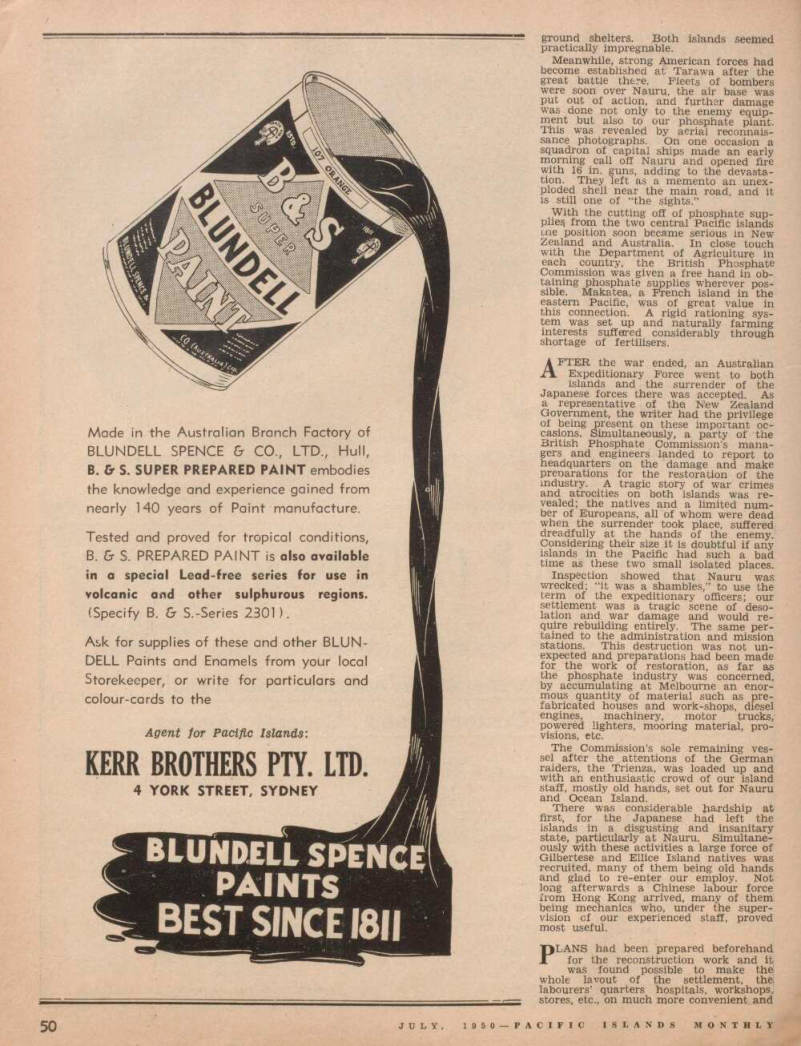
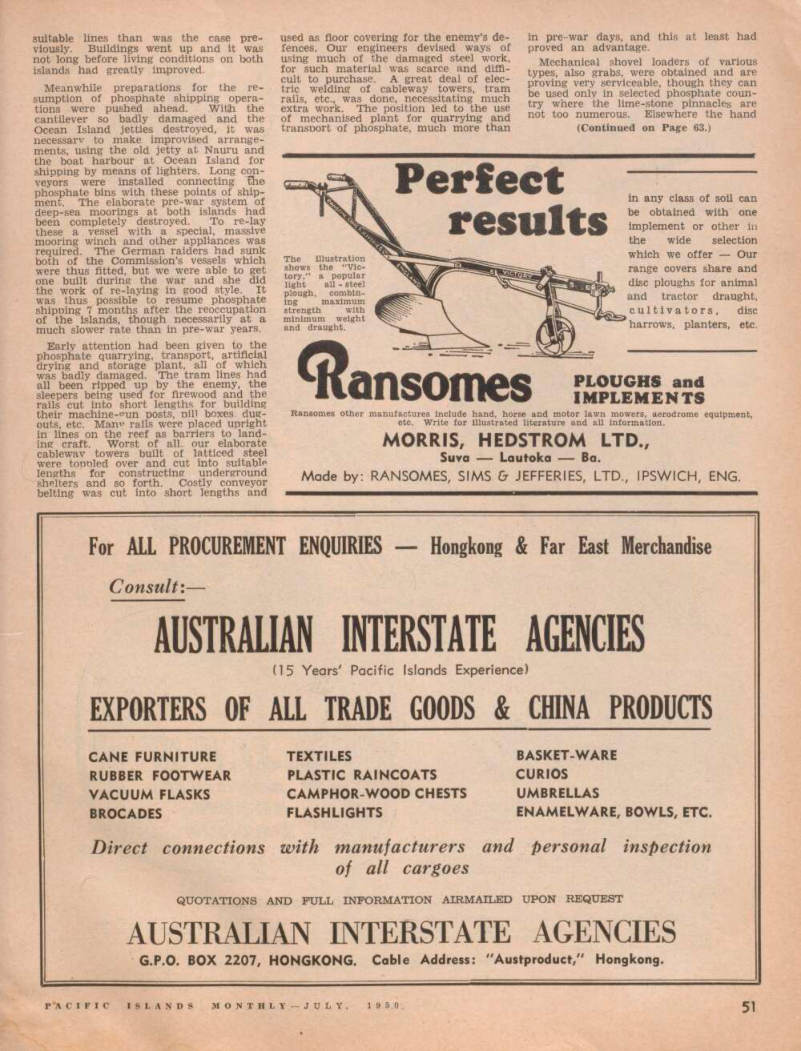
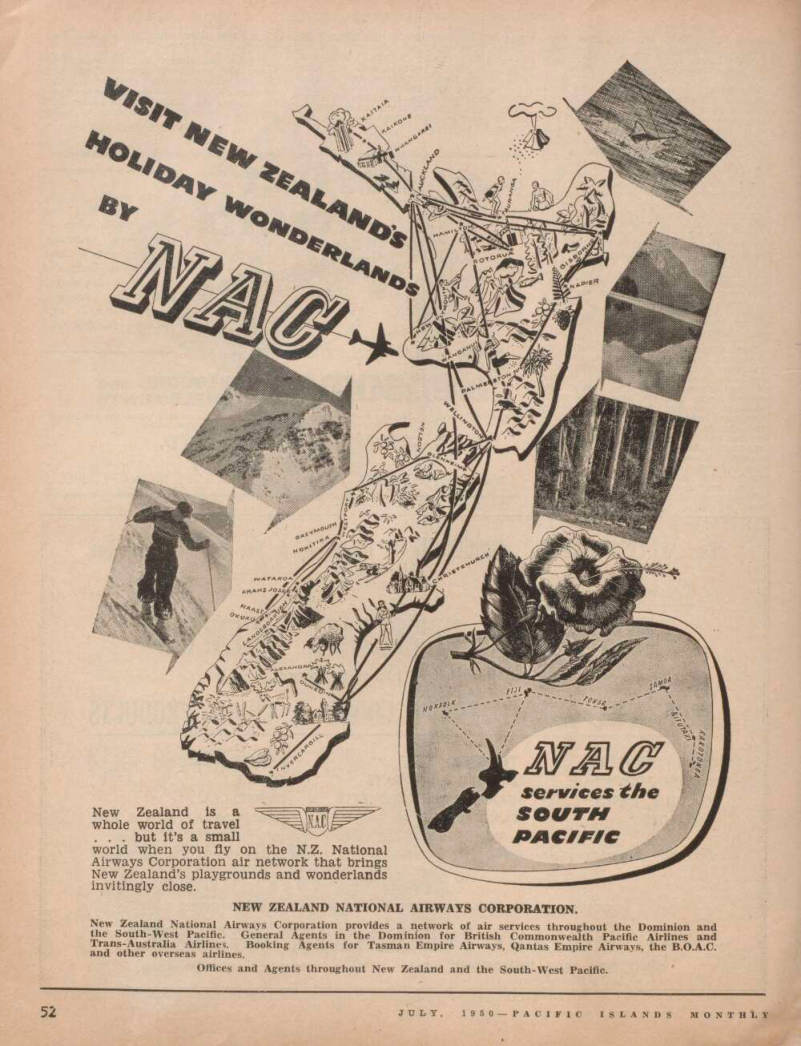
BPC’s Achievement in Rehabilitation of Phosphate Industry
JN a recent issue of the New Zealand Department of Agriculture’s Journal, the rehabilitation of the phosphate industry on Nauru and Ocean Island is discussed by Sir Albert Ellis. Sir Albert is New Zealand’s representative on the British Phosphate Commission, and he draws attention to the fact that in the last six months of 1949, shipments of phosphate from the two islands were equal to the best results in pre war years: — SOMEONE has said about phosphate that it is one of those things whose value is not realised until the supply ceases.
Since the acquisition of the Nauru and Ocean Island phosphate industry in 1920, when the organisation known as the British Phosphate Commissioners was set up, the requirements of high-grade phos phate for New Zealand were met almost entirely from those two islands. With ever-increasing agricultural and pastoral production in New Zealand and Aus tralia the demand for phosphate rose proportionately, as it must continue to do in the years that lie ahead, but by developing the resources of Nauru and Ocean Island all requirements were met, and by 1939 the annual output had risen to 1J million tons.
In the Second World War Hitler be came aware of the vital importance of
these supplies and in the latter part of 1940 two German raiders arrived in the Pacific. Part of their programme was to put the phosphate industry out of action.
Five of the Commission’s vessels were sunk. Nauru was bombarded for two hours, and enormous damage was done, mainly to the shipping plant. The can tilever came in for most attention, but though it was hit repeatedly by shell fire and was doubtless considered wrecked by the raider commander, the main structure still stood upright.
Repairs were put in hand immediately, but by the time one of the arms was ready to resume loading the Japanese came into the war and we knew the po sition was hopeless, for they too were fully aware of the value of the phosphate de posits. Their bombers attacked bo'th islands the day after Pearl Harbour and repeatedly afterwards, doing much dam age. Defence was impossible and evacu ation became necessary.
SHORTLY after, the enemy occupied the islands in strong force, remain ing there for 3 years, during which time the places were fortified very thoroughly. An air base was constructed at Nauru, long naval guns were installed, and round the coast was a series of tank traps, machine-gun posts, and under -
ground shelters. Both islands Seemed practically impregnable.
Meanwhile, strong American forces had become established at Tarawa after the great battle there. Fleets of bombers were soon over Nauru, the air base was put out of action, and further damage was done not only to the enemy equip ment but also to our phosphate plant.
This was revealed by aerial reconnais sance photographs. On one occasion a squadron of capital ships made an early morning call off Nauru and opened fire with 16 in. guns, adding to the devasta tion. They left as a memento an unex ploded shell near the main road, and it is still one of “the sights.”
With the cutting off of phosphate sup plies from the two central Pacific islands cne position soon became serious in New Zealand and Australia. In close touch with the Department of Agriculture in each country, the British Phosphate Commission was given a free hand in ob taining phosphate supplies wherever pos sible. Makatea, a French island in the eastern Pacific, was of great value in this connection. A rigid rationing sys tem was set up and naturally farming interests suffered considerably through shortage of fertilisers.
AFTER the war ended, an Australian Expeditionary Force went to both islands and the surrender of the Japanese forces there was accepted. As a representative of the New Zealand Government, the writer had the privilege of being present on these important oc casions. Simultaneously, a party of the British Phosphate Commission’s mana gers and engineers landed to report to headquarters on the damage and make preoarations for the restoration of the industry. A tragic story of war crimes and atrocities on both islands was re vealed; the natives and a limited num ber of Europeans, all of whom were dead when the surrender took place, suffered dreadfully at the hands of the enemy.
Considering their size it is doubtful if any islands in the Pacific had such a bad time as these two small isolated places.
Inspection showed that Nauru was wrecked; “it was a shambles,” to use the term of the expeditionary officers; our settlement was a tragic scene of deso lation and war damage and would re quire rebuilding entirely. The same per tained to the administration and mission stations. This destruction was not un expected and preparations had been made for the work of restoration, as far as the phosphate industry was concerned, by accumulating at Melbourne an enor mous quantity of material such as pre fabricated houses and work-shops, diesel engines, machinery, motor trucks, powered lighters, mooring material, pro visions, etc.
The Commission’s sole remaining ves sel after the attentions of the German raiders, the Trienza, was loaded up and with an enthusiastic crowd of our island staff, mostly old hands, set out for Nauru and Ocean Island.
There was considerable hardship at first, for the Japanese had left the islands in a disgusting and insanitary state, particularly at Nauru. Simultane ously with these activities a large force of Gilbertese and Ellice Island natives was recruited, many of them being old hands and glad to re-enter our employ. Not long afterwards a Chinese labour force from Hong Kong arrived, many of them being mechanics who, under the super vision of our experienced staff, proved most useful.
PLANS had been prepared beforehand for the reconstruction work and it was found possible to make the; whole lavout of the settlement, the labourers’ quarters hospitals, workshops, stores, etc., on much more convenient and
suitable lines than was the case pre viously. Buildings went up and it was not long before living conditions on both islands had greatly improved.
Meanwhile preparations for the re sumption of phosphate shipping opera tions were pushed ahead. Witjh the cantilever so badly damaged and. the Ocean Island jetties destroyed, it was necessarv to make improvised arrange ments, using the old jetty at Nauru and the boat harbour at Ocean Island for shipping by means of lighters. Long con veyors were installed connecting ftie phosphate bins with these points of ship ment. The elaborate pre-war system of deep-sea moorings at both islands had been completely destroyed. To re-lay these a vessel with a special, massive mooring winch and other appliances was required. The German raiders had sunk both of the Commission’s vessels which were thus fitted, but we were able to get one built during the war and she did the work of re-laying in good style. It was thus possible to resume phosphate shipoing 7 months after the reoccupation of the islands, though necessarily at a much slower rate than in pre-war years.
Early attention had been given to the phosphate quarrying, transport, artificial drying and storage plant, all of which was badly damaged. The tram lines had all been ripped up by the enemy, the sleepers being used for firewood and the rails cut into short lengths for building their machine-o-un posts, pill boxes, dug outs, etc. rails were placed upright in lines on the reef as barriers to land ing craft. Worst of all. our elaborate cablewav towers built of latticed steel were tonnled over and cut into suitable lengths for constructing underground shelters and so forth. Costly conveyor belting was cut into short lengths and
used as floor covering for the enemy’s de fences. Our engineers devised ways of using much of the damaged steel work, for such material was scarce and diffl-
S we,S o?' cabled tower? torn
rails, etc., was done, necessitating much extra work. The position led to the use of mechanised plant for quarrying and transnort of phosphate, much more than
in pre- war days, and this at least had proved an advantage, Mechanical shovel loaders of various types, also grabs, were obtained and are
fJtlecS Khate^oS
fry where the lime-stone ninnacles are not to ° numerous. Elsewhe e the hand
(Continued on Page 63.)
labour methods of pre-war days are necessary.
The artificial drving plant had suf fered very badly, but fortunately the enormous steel dryer cylinders were in tact and are now in use; the electric dust-precipitating plant was damaged beyond repair. For some months it was necessary to dispense with drying the phosphate and to ship it wet.
In the powerhouse several of the dam aged diesel engines have been repaired and the new machines installed, plac ing this vital portion of the plant in a strong position.
Great improvements have been made in the workshops and stores buildings Whereas in pre-war days they were more or less scattered about the settlement, they are now contained in two large pre fabricated steel framework buildings, suitabh 7 placed and most convenient for their various purposes, thereby effecting a great saving of labour.
THROUGHOUT the tragic war experi ences the Nauru cantilever seems to have had a charmed life, for, though greatly damaged, the vital parts escaped, and so the main structure re mained standing. Repairing it has been a long and costly job, but here again our engineers found that they could “go one better.” Whereas the original speci fications called for a shipping rate of 550 tons per hour, it was found that the structure permitted of speeding up the rubber belt conveyors and increasing their size. The main belt is now 4 ft. wide and phosphate is delivered direct into the holds of vessels at the rate of 1,600 tons per hour, nearly three times the original rate. This improvement is
of the greatest importance, and quite frequently a large 10,000 ton vessel ar rives at Nauru in the morning, hauls under the cantilever, and is away in the evening fully loaded.
At Ocean Island the damage was not nearly so serious, but the plant and general arrangements were not on such an extensive scale in pre-war years as on Nauru.
And so the work of rehabilitation has gone on, all departments under experi enced heads pulling their weight and working together toward the one end.
There is still much to be done in the way of construction work and improve ments on existing procedure, but when finished Nauru and Ocean Island will be more efficient and labour-saving than was the case in pre-war days. Labour has been a serious problem at times, as
elsewhere, but all has gone well for many months and we hope for the best.
WHAT of the phosphate shipments?
Our forecast early in 1946 was to restore the full output capacity in about 4 years from the time of recom mencement of shipments. This has been achieved for during 1949 the shipment figures were:—
Mrs. W. O. Garnett was in Sydney in May staying with her parents, but has since returned home to Fiji.
Ocean Nauru Island Totals Tons Tons Tons January-June . 290,250 127,750 418,000 July-December 499,150 133,150 632,300 Totals .. .. 789,400 260,900 1,050,300 It will be seen that during the latter 6 months the figures were up to our best results in pre-war years.
Colonel G. V. Vanderbroucke, com mander of the French forces in the Pacific and military attache to Australia, has been paying a month’s official visit to the eastern states, accompanied by his American-born wife. The Vandenbrouckes are stationed in Noumea. • * * Mrs. F. Tattle, of Norfolk Island, was holidaying in Sydney in June.
The first four months of 1950 provided Suva with 62.23 in. of rain. There is nothing sensational about that—for Suva.
But in the early hours of May 7 the tem perature slumped to 69.9 deg. and dur ing the day the maximum was only 77.5 dee. This early arrival of the rigours of winter produced a semi-epidemic of colds and influenza. Shops, offices and Government departments were wailing about short-staffing.
Advertisements & other items, pp. 53-56 (1 item)
Burns Philp (South Sea) Go. Ltd.
LONDON-SUVA
, \)\P- ECT
via
V PANAMA V
For Sailings and Further Particulars Apply To: BETHELL, GWYN & CO., BURNS PHILP (SOUTH SEA) 138 LEADENHALL ST., co - LTD >
LONDON, E.C.3. SUVA.
BURNS PHILP (SOUTH SEA) Go. Ltd.
Registered Office; SUVA, FIJI
Code Address; “BURNSOUTH”
ISLAND TRADERS AND SHIPOWNERS
General Merchants (Wholesale and Retail)
Shipping, Customs and General Agents
"R fnv* QUEENSLAND INSURANCE CO.,' LTD. BURNS PHILP TRUST CO., LTD.
Distributing Agents for :
SHELL COMPANY (P. 1.), LTD. ‘ FERGUSON TRACTORS STANDARD MOTOR CAR COMPANY CROSSLEY MARINE ENGINES
BRANCHES:
FIJI—
SUVA.
LEVUKA.
LAUTOKA,
LABASA.
BA.
SIGATOKA.
ROTUMA ISLAND.
NORFOLK IS.—
SAMOA—
APIA.
PAGO PAGO
TONGA—
NUKUALOFA.
HAAPAI.
VAVAU.
NIUE IS.—
Sydney Agents:
BURNS, PHILP & CO., LTD..
7 Bridge Street.
London Agents:
BURNS, PHILP & CO., LTD..
35 Crutched Friars, E.C.3.
San Francisco Agents:
BURNS. PHILP CO. OF SAN FRANCISCO.
Matson Building, 215 Market Street.
Agencies Throughout the World.
t m Made in the Australian Branch Factory of
BLUNDELL SPENCE & CO., LTD., Hull,
B. & S. SUPER PREPARED PAINT embodies the knowledge and experience gained from nearly 140 years of Paint manufacture.
Tested and proved for tropical conditions, B. & S. PREPARED PAINT is also available in a special Lead-free series for use in volcanic and other sulphurous regions. (Specify B. & S.-Series 2301).
Ask for supplies of these and other BLUN- DELL Paints and Enamels from your local Storekeeper, or write for particulars and colour-cards to the Agent for Pacific Islands:
KERR BROTHERS PTY. LTD.
4 YORK STREET, SYDNEY
PAINTS
BEST SINCE 1811
Perfect
results
in any class of soil can be obtained with one implement or other in the wide selection The illustration shows the “Victory,” a popular light all - steel plough, combining maximum strength with minimum weight and draught. which we offer Our range covers share and disc ploughs for animal and tractor draught, cultivators, disc harrows, planters, etc.
ansomes
PLOUGHS and
IMPLEMENTS
Ransomes other manufactures Include hand, horse and motor lawn mowers, aerodrome equipment, etc. Write for illustrated literature and all Information.
MORRIS, HEDSTROM LTD.,
Sura Lautoka Ba.
Made by: RANSOMES, SIMS & JEFFERIES, LTD., IPSWICH, ENG.
For ALL PROCUREMENT ENQUIRIES Hongkong & Far East Merchandise Consult : —
AUSTRALIAN INTERSTATE AGENCIES
(15 Years' Pacific Islands Experience) EXPORTERS OF ALL TRADE GOODS & CHINA PRODUCTS
CANE FURNITURE
RUBBER FOOTWEAR
VACUUM FLASKS
BROCADES
TEXTILES
PLASTIC RAINCOATS
CAMPHOR-WOOD CHESTS
FLASHLIGHTS
BASKET-WARE
CURIOS
UMBRELLAS
ENAMELWARE, BOWLS, ETC.
Direct connections with manufacturers and personal inspection
of all cargoes
QUOTATIONS AND PULL INFORMATION AIRMAILED UPON REQUEST
AUSTRALIAN INTERSTATE AGENCIES
G.P.O. BOX 2207, HONGKONG. Coble Address: "Austproduct," Hongkong.
o mg : • :■ ~,. >cs* .23 safe / \ sk? % x j; f i a ft m m . pigH m $ i k & ** * fA e * * .4 /*. 7> a 7 ; ;*>v& ' X >* I. r ' TV o* r% ppAN2 /£ „.. >4*'. 3k V :\> 5*5 *y fp‘ /*** -V fX a
the
services
SOUTH
m
JPMCIT/e
|r c '" 4 ‘ - ' New Zealand is a whole world of travel . . . but it’s a small world when you fly on the N.Z. National Airways Corporation air network that brings New Zealand’s playgrounds and wonderlands invitingly close.
NEW ZEALAND NATIONAL AIRWAYS CORPORATION.
New Zealand National Airways Corporation provides a network of air services throughout the Dominion and the South-West Pacific. General Agents in the Dominion for British Commonwealth Pacific Airlines and Trans-Australia Airlines. Booking Agents for Tasman Empire Airways, Qantas Empire Airwavs, the 8.0.A.C. and other overseas airlines.
Offices and Agents throughout New Zealand and the South-West Pacific.
Magazine Section
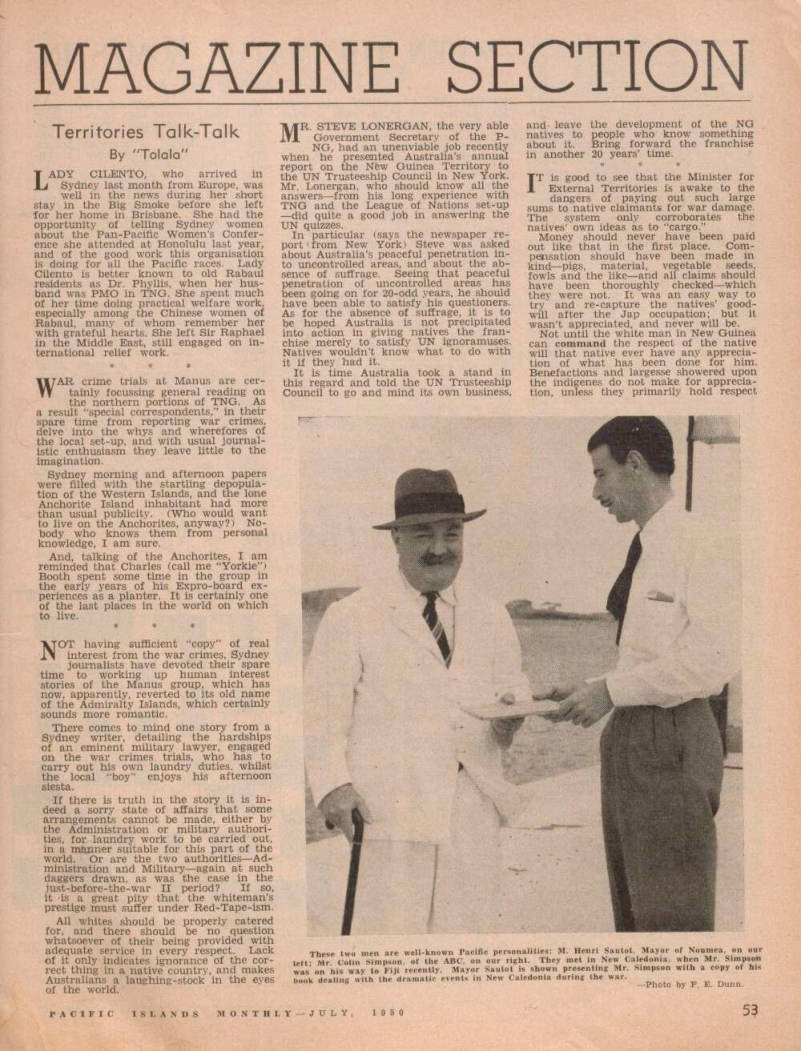
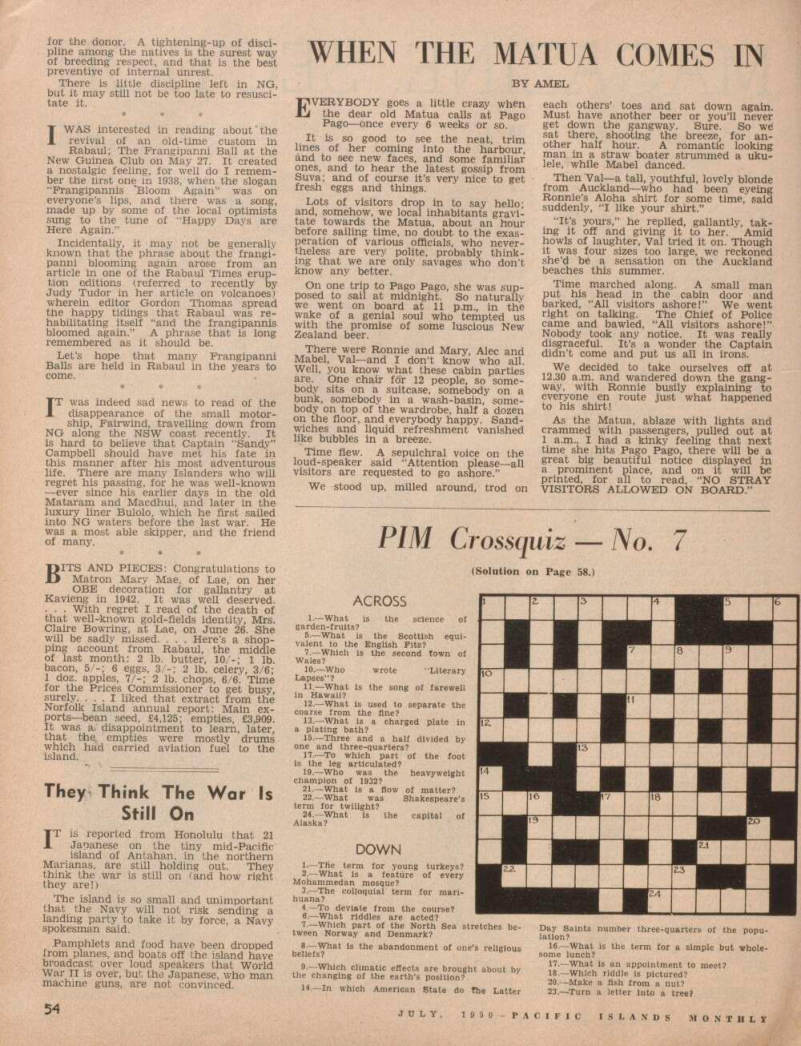
Territories Talk-Talk
By "Tolala"
LADY CILENTO, who arrived in Sydney last month from Europe, was well in the news during her short stay in the Big Smoke before she left for her home in Brisbane. She had the opportunity of telling Sydney women about the Pan-Pacific Women’s Confer ence she attended at Honolulu last year, and of the good work this organisation is doing for all the Pacific races. Lady Cilento is better known to old Rabaul residents as Dr. Phyllis, when her hus band was PMO in TNG. She spent much of her time doing practical welfare work, especially among the Chinese women of Rabaul, many of whom remember her with grateful hearts. She left Sir Raphael in the Middle East, still engaged on in ternational relief work. * * * WAR crime trials at Manus are cer tainly focussing general reading on the northern portions of TNG. As a result “special correspondents,” in their spare time from reporting war crimes, delve into the whys and wherefores of the local set-up, and with usual journal istic enthusiasm they leave little to the imagination.
Sydney morning and afternoon papers were filled with the startling depopula tion of the Western Islands, and the lone Anchorite Island inhabitant had more than usual publicity. (Who would want to live on the Anchorites, anyway?) No body who knows them from personal knowledge, I am sure.
And, talking of the Anchorites, I am reminded that Charles (call me “Yorkie”) Booth spent some time in the group in the early years of his Expro-board ex periences as a planter. It is certainly one of the last places in the world on which to live. * * * NOT having sufficient “copy” of real interest from the war crimes, Sydney journalists have devoted their spare time to working up human interest stories of the Manus group, which has now, apparently, reverted to its old name of the Admiralty Islands, which certainly sounds more romantic.
There comes to mind one story from a Sydney writer, detailing the hardships of an eminent military lawyer, engaged on the war crimes trials, who has to carry out his own laundry duties, whilst the local “boy” enjoys his afternoon siesta.
If there is truth in the story it is in deed a sorry state of affairs that some arrangements cannot be made, either by the Administration or military authori ties, for laundry work to be carried out, in a manner suitable for this part of the world. Or are the two authorities —Administration and Military—again at such daggers drawn, as was the case in the just-before-the-war II period? If so, it ds a great pity that the Whiteman’s prestige must suffer under Red-Tape-ism.
All whites should be properly catered for, and there should be no question whatsoever of their being provided with adequate service in every respect. Lack of it only indicates ignorance of the cor rect thing in a native country, and makes Australians a laughing-stock in the eyes of the world.
MR. STEVE LONERGAN, the very able Government Secretary of the P NG, had an unenviable job recently when he presented Australia’s annual report on the New Guinea Territory to the UN Trusteeship Council in New York.
Mr. Lonergan, who should know all the answers —from his long experience with TNG and the League of Nations set-up —did quite a good job in answering the UN quizzes.
In particular (says the newspaper re port 1 from New York) Steve was asked about Australia’s peaceful penetration in to uncontrolled areas, and about the ab sence of suffrage. Seeing that peaceful penetration of uncontrolled areas has been going on for 20-odd years, he should have been able to satisfy his questioners.
As for the absence of suffrage, it is to be hoped Australia is not precipitated into action in giving natives the fran chise merely to satisfy UN ignoramuses.
Natives wouldn’t know what to do with It if they had it.
It is time Australia took a stand in this regard and told the UN Trusteeship Council to go and mind its own business,
and leave the development of the NG natives to people who know something about it. Bring forward the franchise in another 20 years time, * * * jt is good to see that the Minister for J_ External Territories is awake to the dangers of paying out such large sums to native claimants for war damage. -p^ e system only corroborates the natives’ own ideas as to “cargo.”
Money should never have been paid ou t like that in the first place. Com pensation should have been made in kind—pigs, material, vegetable seeds, f ow i s anc i the like—and all claims should have been thoroughly checked—which they were not. It was an easy way to try and re-capture the natives’ good will a fter the Jap occupation; but it wasn’t appreciated, and never will be.
Not until the white man in New Guinea can command the respect of the native W ill that native ever have any apprecia tion of what has been done for him.
Benefactions and largesse showered upon the indigenes do not make for apprecia tion, unless they primarily hold respect
These two men are well-known Pacific personalities: M. Henri Sautot, Mayor of Noumea, on our left- Mr Colin Simpson, of the ABC, on our right. They met in New Caledonia, when Mr. Simpson was’ on his way to Fiji recently. Mayor Sautot is shown presenting Mr. Simpson with a copy of his book dealing with the dramatic events in New Caledonia during the war.
Photo by F, E. Dunn.
for the donor. A tightening-up of disci pline among the natives is the surest way of breeding respect, and that is the best preventive of internal unrest.
There is little discipline left in NG, but it may still not be too late to resusci tate it. * * $ I WAS interested in reading about the revival of an old-time custom in Rabaul; The Frangipanni Ball at the New Guinea Club on May 27. It created a nostalgic feeling, for well do I remem ber the first one m 1938, when the slogan “Frangipannis ’Bloom Again” was on everyone’s lips, and there was a song, made up by some of the local optimists sung to the tune of “Happy Days are Here Again.”
Incidentally, it may not be generally known that the phrase about the frangi panni blooming again arose from an article in one of the Rabaul Times erup tion editions (referred to recently by Judy Tudor in her article on volcanoes) wherein editor Gordon Thomas spread the happy tidings that Rabaul was re habilitating itself “and the frangipannis bloomed again.” A phrase that is long remembered as it should be.
Let’s hope that many Frangipanni Balls are held in Rabaul in the years to come. * * * IT was indeed sad news to read of the disappearance of the small motor ship, Fairwind, travelling down from NG along the NSW coast recently. It is hard to believe that Captain “Sandy”
Campbell should have met his fate in this manner after his most adventurous life. There are many Islanders who will regret his passing, for he was well-known —ever since his earlier days in the old Mataram and Macdhui, and later in the luxury liner Bulolo, which he first sailed into NG waters before the last war. He was a most able skipper, and the friend of many. * * * BITS AND PIECES; Congratulations to Matron Mary Mae, of Lae, on her OBE decoration for gallantry at Kavieng in 1942. It was well deserved. . . . With regret I read of the death of that well-known gold-fields identity, Mrs.
Claire Bowring, at Lae, on June 26. She will be sadly missed. . . . Here’s a shop ping account from Rabaul, the middle of last month: 2 lb. butter, 10/-; 1 lb. bacon, 5/-; 6 eggs, 3/-; 2 lb. celery, 3/6; 1 doz. apples, 7/-; 2 lb. chops, 6/6. Time for the Prices Commissioner to get busy, surely. ... I liked that extract from the Norfolk Island annual report: Main ex ports—bean seed, £4,125; empties, £3,909.
It was a disappointment to learn, later, that the, empties were mostly drums which had carried aviation fuel to the island.
They' Think The War Is
Still On
IT is reported from Honolulu that 21 Japanese on the tiny mid-Pacific island of Antahan, in the northern Marianas, are still holding out. They think the war is still on (and how right they are!) The island is so small and unimportant that the Navy will not risk sending a landing party to take it by force, a Navy spokesman said.
Pamphlets and food have been dropped from planes, and boats off the island have broadcast over loud speakers that World War II is over, but the Japanese, who man machine guns, are not convinced.
When The Matua Comes In
By Amel
EVERYBODY goes a little crazy when the dear old Matua calls at Pago Pago—once every 6 weeks or so.
It is so good to see the neat, trim lines of her coming into the harbour, and to see new faces, and some familiar ones, and to hear the latest gossip from Suva; and of course it’s very nice to get fresh eggs and things.
Lots of visitors drop in to say hello; and, somehow, we local inhabitants gravi tate towards the Matua, about an hour before sailing time, no doubt to the exas peration of various officials, who never theless are very polite, probably think ing that we are only savages who don’t know any better.
On one trip to Pago Pago, she was sup posed to sail at midnight. So naturally we went on bpard at 11 p.m., in the wake of a genial soul who tempted us with the promise of some luscious New Zealand beer.
There were Ronnie and Mary, Alec and Mabel, Val—and I don’t know who all.
Well, you know what these cabin parties are. One chair for 12 people, so some body sits on a suitcase, somebody on a bunk, somebody in a wash-basin, some body on top of the wardrobe, half a dozen on the floor, and everybody happy. Sand wiches and liquid refreshment vanished like bubbles in a breeze.
Time flew. A sepulchral voice on the loud-speaker said “Attention please—all visitors are requested to go ashore.”
We stood up, milled around, trod on
each others’ toes and sat down again.
Must have another beer or you’ll never get down the gangway. Sure. So we sat there, shooting the breeze, for an other half hour. A romantic looking man in a straw boater strummed a uku lele, while Mabel danced.
Then Val —a tall, youthful, lovely blonde from Auckland—who had been eyeing Ronnie’s Aloha shirt for some time, said suddenly, “I like your shirt.”
“It’s yours,” he replied, gallantly, tak ing it off and giving it to her. Amid howls of laughter, Val tried it on. Though it was four sizes too large, we reckoned she’d be a sensation on the Auckland beaches this summer.
Time marched along. A small man put his head in the cabin door and barked, “All visitors ashore!” We went right on talking. The Chief of Police came and bawled, “All visitors ashore!”
Nobody took any notice. It was really disgraceful. It’s a wonder the Captain didn’t come and put us all in irons.
We decided to take ourselves off at 12.30 a.m. and wandered down the gang way, with Ronnie busily explaining to everyone en route just what happened to his shirt!
As the Matua, ablaze with lights and crammed with passengers, pulled out at 1 a.m., I had a kinky feeling that next time she hits Pago Pago, there will be a great big beautiful notice displayed in a prominent place, and on it will be printed, for all to read, “NO STRAY
Visitors Allowed On Board.”
PIM Crossquiz No. 7
(Solution on Page 58.)
Across
1. —What is the science of garden-fruits? 5. —What is the Scottish equi valent to the English Fitz? 7. —Which is the second town of Wales? 10. —Who wrote ‘'Literary Lapses”? 11. —What is the song of farewell in Hawaii? 12. —What is used to separate the coarse from the fine? 13. —What is a charged plate in a plating bath? 15.—Three and a half divided by one and three-quarters? 17.—T0 which part of the foot is the leg articulated? 19.—Who was the heavyweight champion of 1932? 21. —What is a flow of matter? 22. —What was Shakespeare’s term for twilight? 24.—What is the capital of Alaska?
Down
L—The term for young turkeys? 2. —What is a feature of every Mohammedan mosque? 2.—The colloquial term for mari huana? 4. —To deviate from the course? 6. —What riddles are acted?
7. Which part of the North’ Sea stretches be tween Norway and Denmark? 8. —What Is the abandonment of one’s religious beliefs? 9. —Which climatic effects are brought about by the changing of the earth’s position? 14 — In which American State do The Latter
Day Saints number three-quarters of the popu lation? 16. —What is the term for a simple but whole some lunch? 17. —What is an appointment to meet? 18. —Which riddle is pictured? 20.—Make a fish from a nut? 23.—Turn a letter into a tree?
Tropicalities
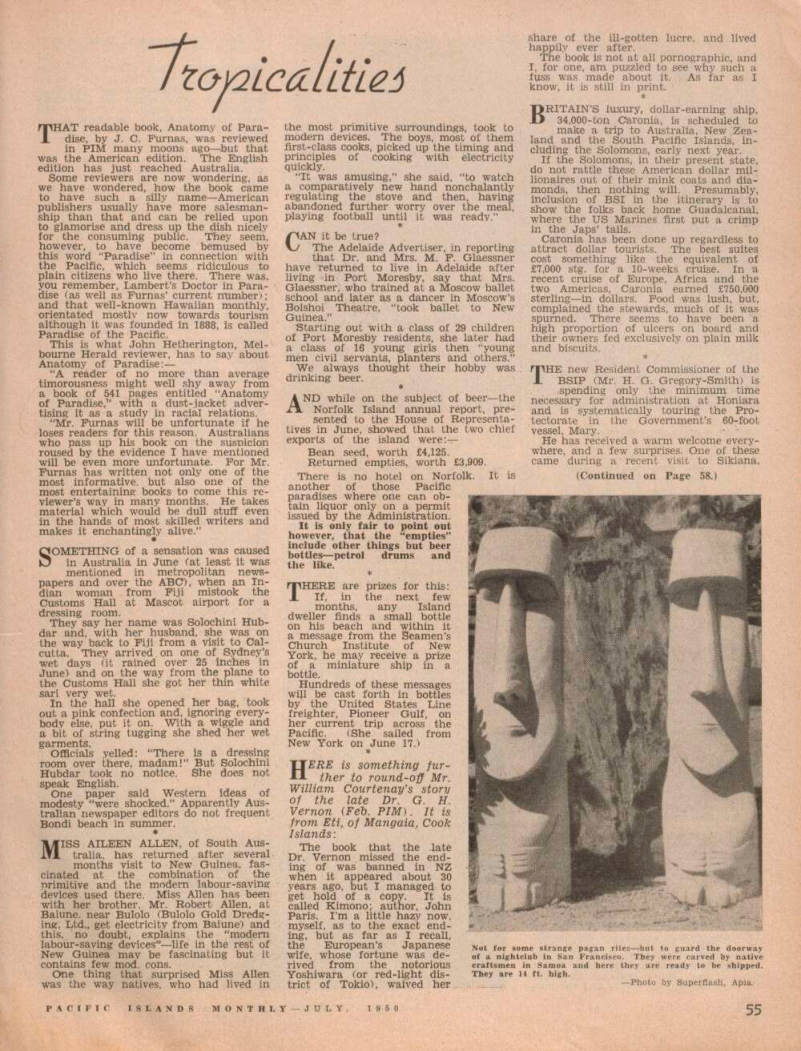
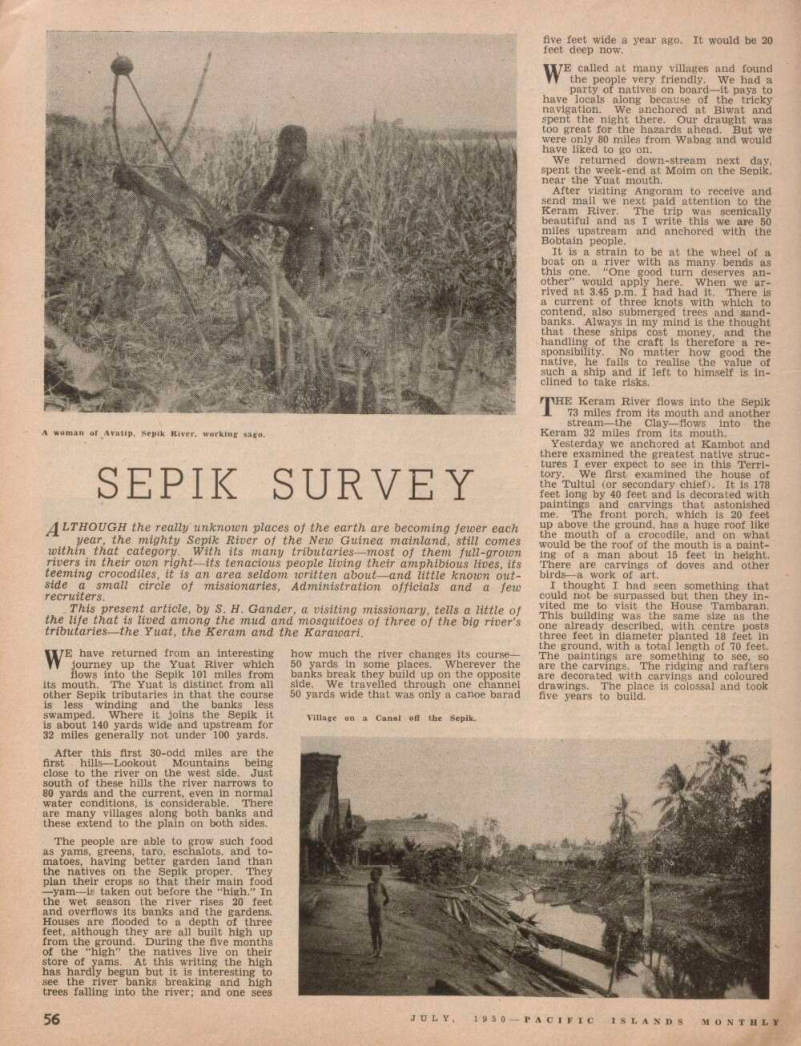
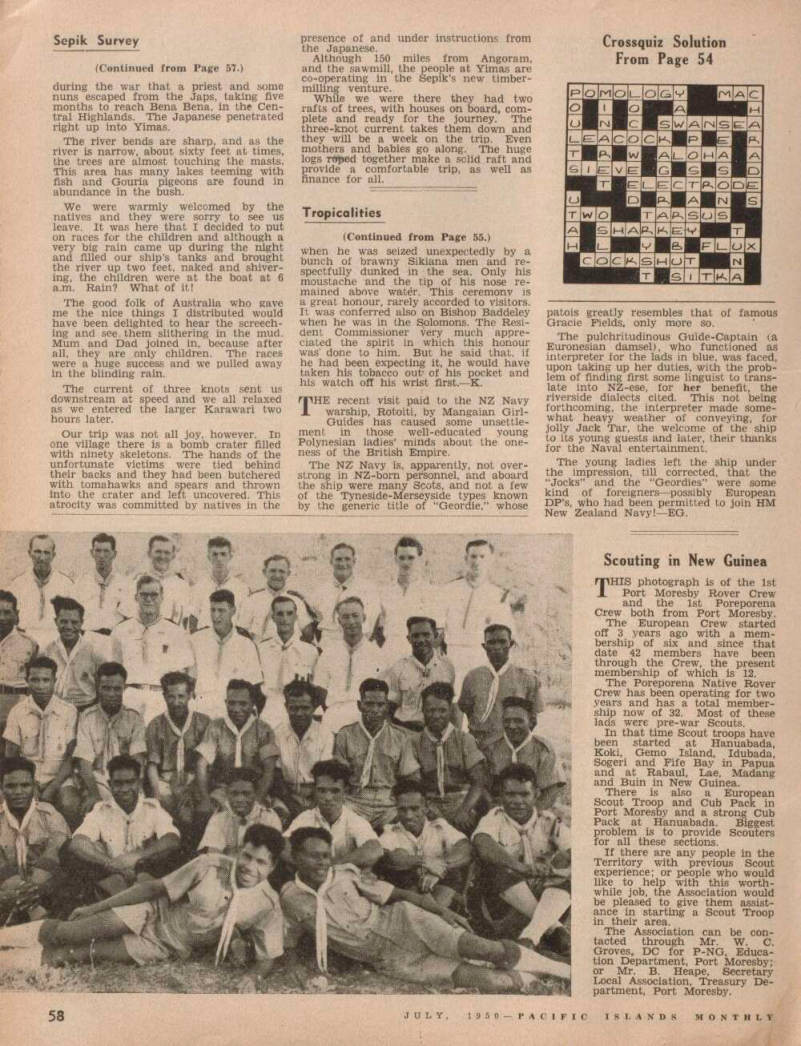
THAT readable book, Anatomy of Para dise, by J. C. Furnas, was reviewed in PIM many moons ago—but that was the American edition. The English edition has just reached Australia.
Some reviewers are now wondering, as we have wondered, how the book came to have such a silly name—American publishers usually have more salesman ship than that and can be relied upon to glamorise and dress up the dish nicely for the consuming public. They seem, however, to have become bemused by this word “Paradise” in connection with the Pacific, which seems ridiculous to plain citizens who live there. There was, you remember, Lambert’s Doctor in Para dise (as well as Furnas’ current number); and that well-known Hawaiian monthly, orientated mostly now towards tourism although it was founded in 1888, is called Paradise of the Pacific.
This is what John Hetherington, Mel bourne Herald reviewer, has to say about Anatomy of Paradise:— “A reader of no more than average timorousness might well shy away from a book of 541 pages entitled “Anatomy of Paradise,’’ with a dust-jacket adver tising it as a study in racial relations.
“Mr. Furnas will be unfortunate if he loses readers for this reason. Australians who pass up his book on the susnicion roused by the evidence I have mentioned will be even more unfortunate. For Mr.
Furnas has written not only one of the most informative, but also one of the most entertaining books to come this re viewer’s way in many months. He takes material which would be dull stuff even in the hands of most skilled writers and makes it enchantingly alive.” • SOMETHING of a sensation was caused in Australia in June (at least it was mentioned in metropolitan news papers and over the ABC), when an In dian woman from Fiji mistook the Customs Hall at Mascot airport for a dressing room.
They say her name was Solochini Hub dar and, with her husband, she was on the way back to Fiji from a visit to Cal cutta. They arrived on one of Sydney’s wet days (it rained over 25 inches in June) and on the way from the plane to the Customs Hall she got her thin white sari very wet.
In the hall she opened her bag, took out a pink confection and, ignoring every body else, put it on. With a wiggle and a bit of string tugging she shed her wet garments.
Officials yelled: “There is a dressing room over there, madam!” But Solochini Hubdar took no notice. She does not speak English.
One paper said Western ideas of modesty “were shocked.” Apparently Aus tralian newspaper editors do not frequent Bondi beach in summer. * MISS AILEEN ALLEN, of South Aus tralia. has returned after several months visit to New Guinea, fas cinated at the combination of the primitive and the modern labour-saving devices used there. Miss Allen has been with her brother. Mr. Robert Allen, at Baiune. near Bulolo (Bulolo Gold Dredg ing, Ltd., get electricity from Baiune) and this, no doubt, explains the “modem labour-saving devices”—life in the rest of New Guinea may be fascinating but it contains few mod. cons.
One thing that surprised Miss Allen was the way natives, who had lived in
the most primitive surroundings, took to modern devices. The boys, most of them first-class cooks, picked up the timing and principles of cooking with electricity quickly.
“It was amusing,” she said, “to watch a comparatively new hand nonchalantly regulating the stove and then, having abandoned further worry over the meal, playing football until it was ready.” * CAN it be true?
The Adelaide Advertiser, in reporting that Dr. and Mrs. M. P. Glaessner have returned to live in Adelaide after living in Port Moresby, say that Mrs.
Glaessner, who trained at a Moscow ballet school and later as a dancer in Moscow’s Bolshoi Theatre, “took ballet to New Guinea.”
Starting out with a class of 29 children of Port Moresby residents, she later had a class of 16 young girls then “young men civil servants, planters and others.”
We always thought their hobby was drinking beer. * AND while on the subject of beer—the Norfolk Island annual report, pre sented to the House of Representa tives in June, showed that the two chief exports of the island were;— Bean seed, worth £4,125.
Returned empties, worth £3,909.
There is no hotel on Norfolk. It is
another of those Pacific paradises where one can ob tain liquor only on a permit issued by the Administration.
It is only fair to point out however, that the “empties” include other things but beer bottles —petrol drums and the like. ♦ THERE are prizes for this: If, in the next few months, any Island dweller finds a small bottle on his beach and within it a message from the Seamen’s Church Institute of New York, he may receive a prize of a miniature ship in a bottle.
Hundreds of these messages will be cast forth in bottles by the United States Line freighter, Pioneer Gulf, on her current trip across the Pacific. (She sailed from New York on June 17.) *
HERE is something fur
ther to round-off Mr.
William Courtenay’s story of the late Dr. G. H.
Vernon (Feb. PIM ). It is
from Eti, of Mangaia, Cook
Islands: The book that the .late Dr. Vernon missed the end ing of was banned in NZ when it appeared about 30 years ago, but I managed to get hold of a copy. It is called Kimono: author, John Paris. I’m a little hazy now, myself, as to the exact end ing, but as far as I recall, the European’s Japanese wife, whose fortune was de rived from the notorious Yoshiwara (or red-light dis trict of Tokio), waived her
share of the ill-gotten lucre, and lived happily ever after.
The book is not at all pornographic, and I, for one, am puzzled to see why such a fuss was made about it. As far as I know, it is still in print. * BRITAIN’S luxury, dollar-earning ship. 34,000-ton Caronia, is scheduled to make a trip to Australia, New Zea land and the South Pacific Islands, in cluding the Solomons, early next year.
If the Solomons, in their present state, do not rattle these American dollar mil lionaires out of their mink coats and dia monds, then nothing will. Presumably, inclusion of BSI in the itinerary is to show the folks back home Guadalcanal, where the US Marines first put a crimp in the Japs’ tails.
Caronia has been done up regardless to attract dollar tourists. The best suites cost something like the equivalent of £7,000 stg. for a 10-weeks cruise. In a recent cruise of Europe, Africa and the two Americas, Caronia earned £750,000 sterling—in dollars. Food was lush, but, complained the stewards, much of it was spurned. There seems to have been a high proportion of ulcers on board and their owners fed exclusively on plain milk and biscuits. * THE new Resident Commissioner of the BSIP (Mr. H. G. Gregory-Smith) is spending only the minimum time necessary for administration at Honiara and is systematically touring the Pro tectorate in the Government’s 60-foot vessel, Mary. " "
He has received a warm welcome every where, and a few surprises. One of these came during a recent visit to Sikiana,
(Continued on Page 58.)
Not for some strange pagan rites—but to guard the doorway of a nightclub in San Francisco. They were carved by native craftsmen in Samoa and here they are ready to be shipped.
They are 14 ft. high.
Photo by Superflash, Apia.
when he was seized unexpectedly by a bunch of brawny Sikiana men and re spectfully dunked in the sea. Only his moustache and the tip of his nose re mained above water. This ceremony is a great honour, rarely accorded to visitors.
It was conferred also on Bishop Baddeley when he was in the Solomons. The Resi dent Commissioner very much appre ciated the spirit in which this honour was done to him. But he said that, if he had been expecting it, he would have taken his tobacco out of his pocket and his watch off his wrist first. —K.
THE recent visit paid to the NZ Navy warship, Rotoiti, by Mangaian Girl- Guides has caused some unsettle ment in those well-educated young Polynesian ladies’ minds about the one ness of the British Empire.
The NZ Navy is, apparently, not over strong in NZ-born personnel, and aboard the ship were many Scots, and not a few of the Tyneside-Merseyside types known by the generic title of “Geordie,” whose
patois greatly resembles that of famous Gracie Fields, only more so.
The pulchritudinous Guide-Captain (a Euronesian damsel), who functioned as interpreter for the lads in blue, was faced, upon taking up her duties, with the prob lem of finding first some linguist to trans late into NZ-ese, for her benefit, the riverside dialects cited. This not being forthcoming, the interpreter made some what heavy weather of conveying, for jolly Jack Tar, the welcome of the ship to its young guests and later, their thanks for the Naval entertainment.
The young ladies left the ship under the impression, till corrected, that the “Jocks” and the “Geordies” were some kind of foreigners—possibly European DP’s, who had been permitted to join HM New Zealand Navy!—EG.
Sepik Survey
ALTHOUGH the really unknown places of the earth are becoming fewer each year, the mighty Sepik River of the New Guinea mainland, still comes within that category. With its many tributaries—most of them full-grown rivers in their own right—its tenacious people living their amphibious lives, its teeming crocodiles, it is an area seldom written about—and little known out side a small circle of missionaries, Administration officials and a few recruiters. This present article, by S. H. Gander, a visiting missionary, tells a little of the life that is lived among the mud and mosquitoes of three of the big river’s tributaries—the Yuat, the Keram and the Karawari.
WE have returned from an interesting journey up the Yuat River which flows into the Sepik 101 miles from its mouth. The Yuat is distinct from all other Sepik tributaries in that the course is less winding and the banks less swamped. Where it joins the Sepik it is about 140 yards wide and upstream for 32 miles generally not under 100 yards.
After this first 30-odd miles are the first hills—Lookout Mountains being close to the river on the west side. Just south of these hills the river narrows to 80 yards and the current, even in normal water conditions, is considerable. There are many villages along both banks and these extend to the plain on both sides.
The people are able to grow such food as yams, greens, taro, eschalots, and to matoes, having better garden land than the natives on the Sepik proper. They plan their crops so that their main food —yam—is taken out before the “high.” In the wet season the river rises 20 feet and overflows its banks and the gardens.
Houses are flooded to a depth of three feet, although they are all built high up from the ground. During the five months of the “high” the natives live on their store of yams. At this writing the high has hardly begun but it is Interesting to see the river banks breaking and high trees falling into the river; and one sees
how much the river changes its course -50 yards in some places. Wherever the banks break they build up on the opposite side. We travelled through one channel 50 yards wide that was only a canoe barad
five feet wide a year ago. It would be 20 feet deep now.
WE called at many villages and found the people very friendly. We had a party of natives on board —it pays to have locals along because of the tricky navigation. We anchored at Biwat and spent the night there. Our draught was too great for the hazards ahead. But we were only 80 miles from Wabag and would have liked to go on.
We returned down-stream next day, spent the week-end at Moim on the Sepik, near the Yuat mouth.
After visiting Angoram to receive and send mail we next paid attention to the Keram River. The trip was scenically beautiful and as I write this we are 50 miles upstream and anchored with the Bobtain people.
It is a strain to be at the wheel of a boat on a river with as many bends as this one. “One good turn deserves an other” would apply here. When we ar rived at 3.45 p.m. I had had it. There is a current of three knots with which to contend, also submerged trees and sand banks. Always in my mind is the thought that these ships cost money, and the handling of the craft is therefore a re sponsibility. No matter how good the native, he fails to realise the value of such a ship and if left to himself is in clined to take risks.
THE Keram River flows into the Sepik 73 miles from its mouth and another stream—the Clay—flows into the Keram 32 miles from its mouth.
Yesterday we anchored at Kambot and there examined the greatest native struc tures I ever expect to see in this Terri tory. We first examined the house of the Tultul (or secondary chief). It is 178 feet long by 40 feet and is decorated with paintings and carvings that astonished me. The front porch, which is 20 feet up above the ground, has a huge roof like the mouth of a crocodile, and on what would be the roof of the mouth is a paint ing of a man about 15 feet in height.
There are carvings of doves and other birds —a work of art.
I thought I had seen something that could not be surpassed but then they in vited me to visit the House Tambaran.
This building was the same size as the one already described, with centre posts three feet in diameter planted 18 feet in the ground, with a total length of 70 feet.
The paintings are something to see, so are the carvings. The ridging and rafters are decorated with carvings and coloured drawings. The place is colossal and took five years to build.
A woman of Avatip, Sepik Kiver, working sago.
Village on a Canal off the Sepik.
In the House Tambaran all the heathen ceremonies and initiations took place.
They could not build such structures to day, as the line of the native builders is broken. I was told that during the war a great sickness came to these parts, that men and marys would be sick in the bush and unable to attend to the food supply, and that they just died of star vation. Of those who now remain, none understand the art of such traditional building. When the present House Tam barans decay there will be no builders among the younger generation to restore or replace the unique structures.
These people believe in safety first — a long cane is tied to a centre post of the House Tambaran and as one walks down the long and steep stairs of the house he holds the cane and goes quietly.
Modern conveniences are coming into this village; I saw only one typical Sepik woven mosquito sleeping bag; all the rest were made of net and parachute silk. But as I sit on the boat and write this report I see many women making sac-sac (sago) for daily food in the age old way. How they toil! When we ar rived here the marys whipped off their skirts, climbed the coconut palms and picked us some green nuts to drink. The men sat by and said proudly, “Our women always get the nuts.”
ONE hundred and seventy miles from its mouth, the Sepik River is joined by the Karawari River, and opposite the junction is the village of Mindimbit.
We stayed the night there ready to enter the Karawari at daylight, and picked up some lads who knew the river well.
Mindimbit village is nicely set out and the homes are neat and clean. We en tered several. In one was a polished table made by the owner, and jars of fresh flowers. Although he had never left his district, this man was very tidy in shirt and shorts and had the smile of a super salesman. Some homes had attractive blinds made of native material.
The women here make pretty mats and we purchased some. The usual trade of mirrors, brilliantine, razor blades, salt, etc., proved irresistible.
Next morning we left Mindimbit at 7.30 a.m. and arrived at Kundimai at 4 p.m., very glad to tie up at the bank.
There was the usual business of pur chasing native food for the crew.
Next day we decided to enter the Ara fundio River and take the ten mile run to Yimas. The river was low so we had to navigate with care but it winds through tall timber on either side in which fly numerous birds. A beautiful red creeper festoons some of the trees, and crocodiles abound in the water. The local natives are very game. They go out in their canoes at night with an electric torch and spear the crocs behind the head. It is food to the native so he means business.
Once the croc looks at the torch he be trays his position.
The marys here on the Arafundio, make beautiful fish baskets and traps, and as the finny creatures are found in abun dance in this area, one can purchase plenty of the smoked product. Well I know it, for the ship is reeking with the odour. Grille, a form of ring-worm dis ease, gives the natives a horrible scaly skin hereabouts, therefore it seems odd to us to hear them saying, as they press their fish supplies upon you, “Good fella fish, he got grille,”—meaning that the fish have scales.
REACHING Yimas, we found that we were right up near the gorge lead ing into the Wabag area, although between us and that place there was a stiff climb of some 9,000 feet and a dis tance of 60 miles, as the crow flies. We did not try it. It was through this country
- (Continued on Page 58.)
during the war that a priest and some nuns escaped from the Japs, taking five months to reach Bena Bena, in the Cen tral Highlands. The Japanese penetrated right up into Yimas.
The river bends are sharp, and as the river is narrow, about sixty feet at times, the trees are almost touching the masts.
This area has many lakes teeming with fish and Gouria pigeons are found in abundance in the bush.
We were warmly welcomed by the natives and they were sorry to see us leave. It was here that I decided to put on races for the children and although a very big rain came up during the night and filled our ship’s tanks and brought the river up two feet, naked and shiver ing, the children were at the boat at 6 a.m. Rain? What of it!
The good folk of Australia who gave me the nice things I distributed would have been delighted to hear the screech ing and see them slithering in the mud.
Mum and Dad joined in, because after all, they are only children. The races were a huge success and we pulled away in the blinding rain.
The current of three knots sent us downstream at speed and we all relaxed as we entered the larger Karawari two hours later.
Our trip was not all joy, however. In one village there is a bomb crater filled with ninety skeletons. The hands of the unfortunate victims were tied behind their backs and they had been butchered with tomahawks and spears and thrown into the crater and left uncovered. This atrocity was committed by natives in the
presence of and under instructions from the Japanese.
Although 150 miles from Angoram, and the sawmill, the people at Yimas are co-operating in the Sepik’s new timber milling venture.
While we were there they had two rafts of trees, with houses on board, com plete and ready for the journey. The three-knot current takes them down and they will be a week on the trip. Even mothers and babies go along. The huge logs roped together make a solid raft and provide a comfortable trip, as well as finance for all.
Happen Again
It’s Happened Before It Will Happen Again
By “Daika”
THE interpreter walked into the Native Hospital Office, accompanied by a group of kanakas armed with bows and arrows. They weren’t locals by the look of them, and anyway, the locals didn’t go armed as routine, any more.
More trouble.
The Medical Assistant looked up from the stack of papers on his table and sighed.
“Master,” said the interpreter, “All this man ’e talk bigfelo sick ’e come up long place belong ’em.” Putting down his pen, the Medical Assistant asked where, what kind of sick, and how many people had died, if any. There followed a rush of garbled jargon as the kanakas answered the interpreter’s questions. Finally, the interpreter turned to the Medical As sistant and said, “Long Binj planty man ’e die. Neck ’e strong, head ’e pain, man no can turnim head. Sick come up, now man die quick.”
Asking a few more questions, the Medi cal Assistant decided to send a Native Medical Orderly to investigate, as the hospital was full of patients, and he didn’t want to leave them to the not-so-tender mercies of the station orderlies. He was in the midst of selecting various medi cines to send along, when once again he was interrupted by the interpreter. This time he had a note from the missionary at Binj. which read, in part: “It would appear that there is a certain amount of some serious disease in this area as the natives tell me that quite a few of their people have died. I would be grateful if you could investigate, as the position seems serious.”
Deciding to investigate the position himself, the Medical Assistant sent a note to a newly arrived wife asking her to pack a few things as he was going on patrol. Back came a note from her in double quick time, “Am going with you.
Will not stop on this station by myself under any circumstances.”
The position was explained to her, but the young missus was determined to go along.
Preparations complete, the small patrol set off early next morning for Binj. Nor mally it was three days walk away, but the patrol intended to try to reach there in two days. There followed first, a walk over roads which at the best were onlv pig tracks, but everything, went well until the young missus developed a blister. The pace was slackened: and slackened again.
The offending shoes were exchanged for sandals, and after a six-hour walk the Government Rest House was reached where a stop for the night was made.
Peace reigned supreme until early morning when the young missus, sure that hostile natives were attacking, woke hpr husband. Thereafter came periods at regular intervals when whispered re assurances were necessary to pacify a nervous wife. Sleep, though ardently wooed, was unattainable. It was a tired and heavy eyed couple which set off next morning, still with the intention of reach ing Binj, a day and a half walk away even yet.
Not knowing much about that particu lar area, and hoping that there was a short cut to Binj, the Medical Assistant asked the interpreter if there was an other road they could take which would get them there that night. There was, it appeared, and the interpreter was only too pleased to show the way. In much better spirits the party moved on. It
wasn’t long, however, before the spirits hit an all-time low. The “short cut” was an abandoned road, overgrown by the notorious kunai grass and thorny creeper.
The young missus was suffering from sunburned legs—received the day before —and the kunai and thorns played havoc with it. The early morning mist had left the kunai wet, and there was no escaping it. To walk at all it was neces sary to actually force one’s way through it. The sun came out, and down in the high kunai, the party was almost cooked.
Later in the day, the sun became hidden behind clouds, a wind sprang up and it began to rain.
CROSSING the Wahgi river over a bro ken bridge was the next thing. All the cargo had to be untied and car ried across two strands of not-too-strong cane. This put the young missus in a “home to mother” mood, and she swore that if she finished the walk alive, she would pack up and get out of the place, never to return. She was pacified, and was happy to learn that Binj was only a short distance away. The “short dis tance” developed into a further three hours, with Binj still not reached.
Just qs dusk was approaching, and on topping a small rise, there lay Binj, only a few minutes walk away. It looked to the weary patrol much the same as the promised land must have looked to the wanderers in another age. Five minutes later the Rest House was reached, and the final indignity descended upon the shoulders of the long-suffering young missus. The Rest House was just in the course of construction, and consisted of only wall studs and roof. No floor, no wails. Hysterics were averted only by the timely arrival of the local missionary who invited the party to stay with him.
The invitation was gladly accepted.
THE following morning the investiga tion into the epidemic was com menced. Word was sent out to all boys to report in to the station immedi ately. The boss boys arrived, but there was a noticeable lack of sick people.
Puzzled, the Medical Assistant asked the missionary what had become of all the sick people; where was the epidemic?
“Oh,” replied the missionary, “what we thought was an epidemic appeared to be common colds.”
“But what of the deaths that were re ported?” queried the Medical Assistant.
“It appears now that three or four people died of old age in the local ham lets in a week, and you know what these natives are like at exaggeration.”
If the Medical Assistant had not known, then he surely learned in a hurry.
Further investigation proved that the missionary was correct. No epidemic, or serious disease; no sudden deaths. Just three patriarchs dying of old age within a short time of each other. The Medical Assistant wasn’t game to tell his wife; he just let it slide.
The return trip was taken over a dif ferent route, with short walks each day, over better roads.
Good experience, you might say. Agreed.
A good lesson well learnt, and one which is not likely to be forgotten in a hurry.
If you don’t believe me, ask the Medi cal Assistant’s wife.
Advertisements & other items, p. 62 (1 item)
Crossquiz Solution
From Page 54
Scouting in New Guinea
THIS photograph is of the Ist Port Moresby Rover Crew and the Ist Poreporena Crew both from Port Moresby.
The European Crew started off 3 years ago with a mem bership of six and since that date 42 members have been through the Crew, the present membership of which is 12.
The Poreporena Native Rover Crew has been operating for two years and has a total member ship now of 32. Most of these lads were pre-war Scouts.
In that time Scout troops have been started at Hanuabada, Koki, Gemo Island, Idubada, Sogeri and Fife Bay in Papua and at Rabaul, Lae, Madang and Buin in New Guinea.
There is also a European Scout Troop and Cub Pack in Port Moresby and a strong Cub Pack at Hanuabada. Biggest problem is to provide Scouters for all these sections.
If there are any people in the Territory with previous Scout experience: or people who would like to help with this worth while job, the Association would be pleased to give them assist ance in starting a Scout Troop in their area.
The Association can be con tacted through Mr. W. C.
Groves, DC for P-NG, Educa tion Department, Port Moresby; or Mr. B. Heape, Secretary Local Association, Treasury De partment, Port Moresby.
Advertisements & other items, p. 62 (1 item)
58
JULY, 1950 PACIFIC ISLANDS MONTHLY
Tropicalities (Continued from Page 55.)
Sepik Survey (Continued from Page 57.)
The Land of Opters
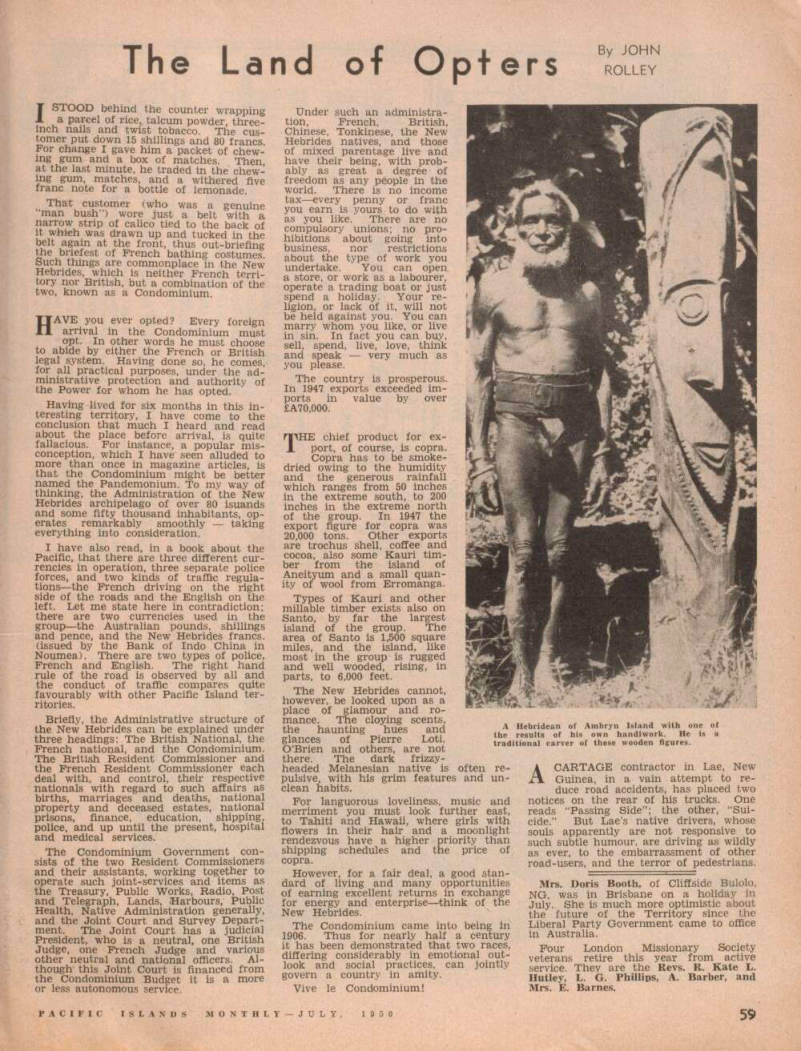
By John
Rolley
1 STOOD behind the counter wrapping a parcel of rice,, talcum powder, three inch nails and twist tobacco. The cus tomer put down 15 shillings and 80 francs.
For change I gave him a packet of chew ing gum and a box of matches. Then at the last minute, he traded in the chew ing gum, matches, and a withered five franc note for a bottle of lemonade.
That customer (who was a genuine “man bush”) wore just a belt with a narrow strip of calico tied to the back of it which was drawn up and tucked in the belt again at the front, thus out-briefing the briefest of French bathing costumes.
Such things are commonplace in the New Hebrides, which is neither French terri tory nor British, but a combination of the two, known as a Condominium.
HAVE you ever opted? Every foreign arrival in the Condominium must opt. In other words he must choose to abide by either the French or British legal system. Having done so, he comes, for all practical purposes, under the ad ministrative protection and authority of the Power for whom he has opted.
Having lived for six months in this in teresting territory, I have come to the conclusion that much I heard and read about the place before arrival, is quite fallacious. For instance, a popular mis conception, which I have seen alluded to more than once in magazine articles, is that the Condominium might be better named the Pandemonium. To my way of thinking, the Administration of the New Hebrides archipelago of over 80 isuands and some fifty thousand inhabitants, op erates remarkably smoothly taking everything into consideration.
I have also read, in a book about the Pacific, that there are three different cur rencies in operation, three separate police forces, and two kinds of traffic regula tions—the French driving on the right side of the roads and the English on the left. Let me state here in contradiction; there are two currencies used in the group—the Australian pounds, shillings and pence, and the New Hebrides francs, (issued by the Bank of Indo China in Noumea). There are two types of police, French and English. The right hand rule of the road is observed by all and the conduct of traffic compares quite favourably with other Pacific Island ter ritories.
Briefly, the Administrative structure of the New Hebrides can be explained -under three headings: The British National, the French national, and the Condominium.
The British Resident Commissioner and the French Resident Commissioner each deal with, and control, their respective nationals with regard to such affairs as births, marriages and deaths, national property and deceased estates, national prisons, finance, education, shipping, police, and up until the present, hospital and medical services.
The Condominium Government con sists of the two Resident Commissioners and their assistants, working together to operate such joint-services and items as the Treasury, Public Works, Radio, Post and Telegraph, Lands, Harbours, Public Health, Native Administration generally, and the Joint Court and Survey Depart ment. The Joint Court has a judicial President, who is a neutral, one British Judge, one French Judge and various other neutral and national officers. Al though this Joint Court is financed from the Condominium Budget it is a more or less autonomous service.
Under such an administra tion, French, British, Chinese, Tonkinese, the New Hebrides natives, and those of mixed parentage live and have their being, with prob ably as great a degree of freedom as any people in the world. There is no income tax —every penny or franc you earn is yours to do with as you like. There are no compulsory unions; no pro hibitions about going into business, nor restrictions about the type of work you undertake. You can open a store, or work as a labourer, operate a trading boat or just spend a holiday. Your re ligion, or lack of it, will not be held against you. You can marry whom you like, or live in sin. In fact you can buy, sell, spend, live, love, think and speak very much as you please.
The country is prosperous.
In 1947 exports exceeded im ports in value by over £A70,000.
THE chief product for ex port, of course, is copra.
Copra has to be smoke dried owing to the humidity and the generous rainfall which ranges from 50 inches in the extreme south, to 200 inches in the extreme north of the group. In 1947 the export figure for copra was 20,000 tons. Other exports are trochus shell, coffee and cocoa, also some Kauri tim ber from the island of Aneityum and a small quan ity of wool from Erromanga.
Types of Kauri and other millable timber exists also on Santo, by far the largest island of the group. The area of Santo is 1,500 square miles, and the island, like most in the group is rugged and well wooded, rising, in parts, to 6,000 feet.
The New Hebrides cannot, however, be looked upon as a place of glamour and ro mance. The cloying scents, the haunting hues and glances of Pierre Loti, O’Brien and others, are not
there. The dark frizzy headed Melanesian native is often re pulsive, with his grim features and un clean habits.
For languorous loveliness, music and merriment you must look further east, to Tahiti and Hawaii, where girls with flowers in their hair and a moonlight rendezvous have a higher priority than shipping schedules and the price of copra.
However, for a fair deal, a good stan dard of living and many opportunities of earning excellent returns in exchange for energy and enterprise—think of the New Hebrides.
The Condominium came into being in 1906. Thus for nearly half a century it has been demonstrated that two races, differing considerably in emotional out look and social practices, can jointly govern a country in amity.
Vive le Condominium!
A CARTAGE contractor in Lae, New Guinea, in a vain attempt to re duce road accidents, has placed two notices on the rear of his trucks. One reads “Passing Side”; the other, “Sui cide.” But Lae’s native drivers, whose souls apparently are not responsive to such subtle humour, are driving as wildly as ever, to the embarrassment of other road-users, and the terror of pedestrians.
Mrs. Doris Booth, of Cliffside Bulolo, NG, was in Brisbane on a holiday in July. She is much more optimistic about the future of the Territory since the Liberal Party Government came to office in Australia.
Four London Missionary Society veterans retire this year from active service. They are the Revs. R. Kate L.
Hutley, L. G. Phillips, A. Barber, and Mrs. E, Barnes.
A Hebridean of Ambryn Island with one of the results of his own handiwork. He is a traditional carver of these wooden figures.
Corner Of The Children
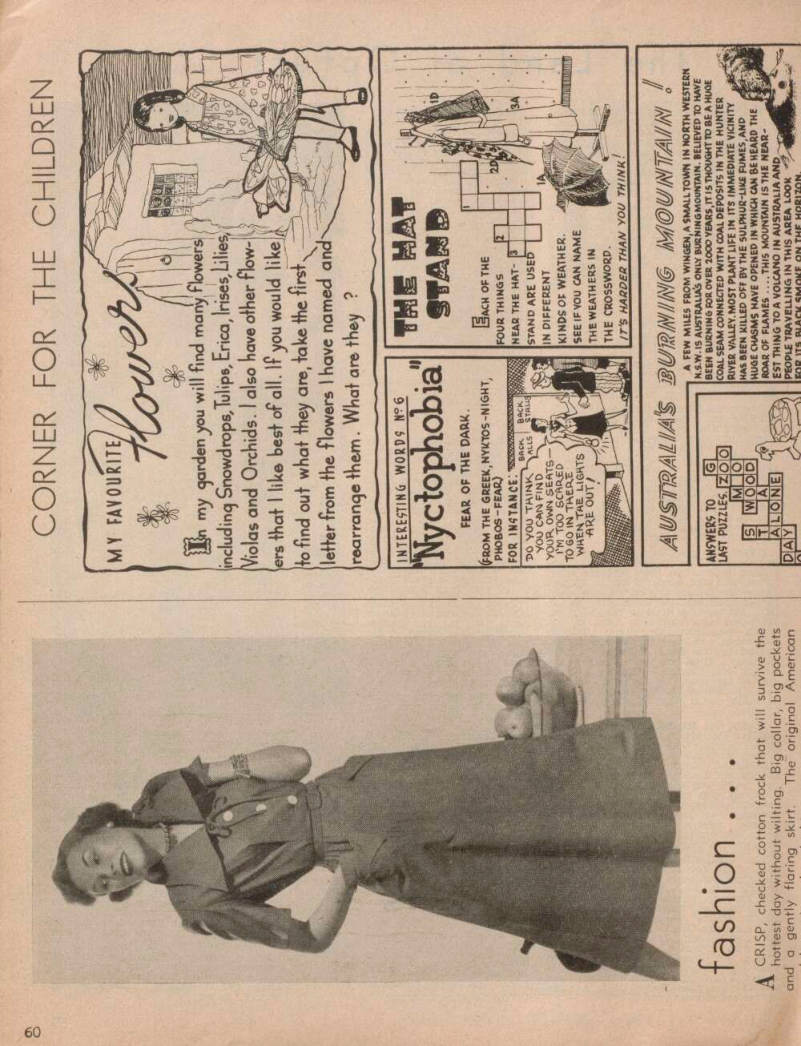
<D c/) c ■fc a) o
Cd U L.
> O (U > a £ 3 .?< to _Q
lil
> = O) 4- 2 a u o ■£ cn +- ■— cu CQ _c f= u “ o O)
st C
c rz h £ £ 1/5 8 o °> ■B*l £ u >+ - 0) >- _c a » u -a n . c
Q. W O
iy~) QJ Ol SI" i
Advertisements & other items, pp. 64-68 (3 items)
fashion...
Burns Philp (New Guinea) Limited
General Merchants (Wholesale and Retail)
Shipping, Customs and General Agents
Head Office: PORT MORESBY, PAPUA
BRANCHES:
NEW GUINEA: Rabaul, Kokopo, Lae & Madang.
PAPUA: Sama rai.
QUEENSLAND INSURANCE CO. LTD.
LLOYD S OF LONDON
BURNS PHILP TRUST CO. LTD
BURNS, PHILP & CO. LTD.
All States.
BURNS, PHILP & CO. LTD.
"London House", 35 Crutched Friars, E.C.3.
BURNS, PHILP CO. OF SAN FRANCISCO INC 510 Matson Building.
REPRESENTATIVES FOR;
AUSTRALIAN AGENTS:
LONDON AGENTS:
SAN FRANCISCO AGENTS;
Distributing Agents, Territory of Papua-New Guinea for:
SHELL COMPANY OF AUSTRALIA LIMITED
Petroleum Products
GENERAL MOTORS CORPORATION
Chevrolet, Buick, Pontiac and Oldsmobile Cars Chevrolet and GMC Trucks Frigidaire Refrigerators
VAUXHALL MOTORS LIMITED
Vauxhall Cars and Bedford Trucks
R. A. LISTER Cr CO., BRISTOL
Producers of Petrol, Paraffin and Diesel Engines Pumps and Lighting plants
RUSTON HORNSBY LIMITED
Engines
CROSSLEY MARINE ENGINES
I » I ■ mm T ■ I wir* vw ' w Km * m^. 1 i&5 £ ■'NS e ® » =* g 1 I g £ S I -I Ni g * i 4 I I * S i I * -mi O*Z m y*** 'mmm o\y
iinf
fWS
p w,# p^l W/w. wm /A'/
COM
7/m m P 504
VACUUM
QUALITY PRODUCT
by
V ISON
v For Troptccil conditions
Velvene Water Paint and Davison's Zinc Base Paints are used extensively throughout the islands and Mandated Territories on Government and Private Buildings, giving full satisfaction under severe tropical conditions.
DAVISON PAINTS LTD.
BOX 24, AUBURN, N.S.W.
STEAMSHIPS TRADING COMPANY LTD.
PORT MORESBY AND SAMARAI PAPUA
Wholesale & Retail Merchants , Planters , Sawmillers , Engineers , Proprietors , Shipping , Customs and Insurance Agents .
MANAGING AGENTS for:
SAWMILLERS & TRADERS LTD.
CORAL SEAS INSURANCE CO. LTD
ACME BAKERY COMPANY.
MARIBOI RUBBER LTD.
RUBBERLANDS LTD.
KEREMA RUBBER PLANTATIONS LTD.
COCOALANDS LTD.
AGENCIES:
BANKERS & TRADERS INSURANCE CO. LTD
VACUUM OIL CO. PTY., LTD.
DIRECTORATE OP SHIPPING—Papua-New
Guinea Division.
ROYAL PACKET NAVIGATION CO.
KOKE BAGU PTY., LTD.
TRANS OCEANIC AIRWAYS.
GUINEA AIR TRADERS.
DISTRIBUTORS IN PAPUA for:
ARMSTRONG-HOLLAND PTY.. LTD.
Earth Moving and Logging Equipment.
WILLYS-OVERLAND EXPORT CORPORATION.
Jeep cars, etc.
INTERNATIONAL HARVESTER CO. OF AUST. LTD.
International Trucks, McCormick-Deering Farming Machinery, Defender Refrigerators.
SYDNEY AGENTS: NELSON & ROBERTSON PTY. LTD., 12 SPRING STREET
WILLIAM A JONES PTY. LTD.
Livestock Exporters
Livestock Exported To All Ports Inquiries Invited Address:
108 QUEEN ST., MELBOURNE
Telegrams : “VALKYRIE,” Melbourne.
63
EXPORT TARGET REACHED ON OCEAN IS. AND NAURU (Continued from Page 51.)
PACIFIC ISLANDS MONTHLY JULY, 1950
NZ Contribution To Pacific Health
Pacific Health
By E. E. Bush
DURING the last two or thisee years, attention has been paid to particular health problems as they affect the life, either of a particular community or of a people as a whole—not the whole field of tropical diseases, or of tropical hygiene, but some particular disease that has its origin in, and a devastating effect upon. Island life.
This research into causes, effects, and means of alleviating these particular dis eases, and of eradicating them, Will no doubt win the gratitude of Island peoples.
Fostered by the New Zealand Medical Re search Council, and by the Department of Island Territories, teams of workers have gone out to islands under the care or the trusteeship of New Zealand, to study at first hand the particular health problem to which they have been as signed, and for which they have special qualifications.
Last year, a team went to Western Samoa, to study skin diseases; this year, two teams have been operating. The first team, led by Sir Charles Hercus, DSO, OBE, MD, BDS, DPH, Dean of the Medi cal School of the University of Otago (NZ), went to the Cook Islands to study the incidence of filariasis, and the mos quito Culex, that causes so much distress.
Accompanying Sir Charles were Drs. G.
H. Satchell and P. Paine, and Mr. J. A.
Samuels, all of the University of Otago, and Dr. P. R. a. Davidson, resident medi cal officer, Cook Islands.
The team returned to New Zealand in the middle of February, and we eagerly await the outcome of their research. We know results do not necessarily follow
upon the investigations. Much careful and painstaking laboratory work has to follow, and then the results have to be arranged, codified, and made to assume some meaning. Filaria is a long-staying and often unsuspected guest. Then, after receiving hospitality for years, it ungrate fully turns upon its host, and attacks savagely, leaving him a victim of elephantiasis.
We dread that possibility, so with eager ness and faith, we await the findings of the team, and hope that Culex now has met his doom.
THE second inquiry into a particular health problem in the South Pacific was in the capable hands of Dr.
Muriel Bell, well-known New Zealand nutrition expert. At the invitation of the Director of the South Pacific Board of Health (Dr. Cruickshank) and of the Director of Medical Services in Western Samoa, Dr. Bell went to Fiji and to Wes tern Samoa and stayed for a fortnight in each place to study nutrition problems. (Fortunately for the people of Western Samoa her outward plane was delayed a week, which gave her extra time in the Territory.) Dr. Bell confined her attention to a search for possible protein deficiency, as this would give an indication of blood condition, and, by deduction, food and diet deficiencies. She used a test that had been used in the Army—it gives imme diately the specific gravity of the blood.
Both from the field work, and further tests in the laboratory, she was able to make some definite statements about her findings.
The village women must have thought the days of witchcraft and black magic had returned, when they saw the doctor alight from the Mobile Clinic, and from her black bag put out on a table a number of bottles each filled with a greenish blue mixture. Then the women and children were invited to line up. Each was pricked, until a drop of blood ap peared. This drop Dr. Bell put into one of the bottles. Before their amazed eyes these people saw their blood float, sink or remain suspended. After a few tests, Dr. Bell would know the specific gravity of the blood that had been tested. From this she could derive certain facts. An other sample of the blood was collected and taken back to the laboratory for tests on the plasma and a corpuscle count.
In Fiji, Dr. Bell found that results com pared favourably with those of children in New Zealand, but in Samoa, her re sults showed a very high protein content of the blood. This led her to suspect that the protein was being taken from some other portion of the body, to attack some infection, such as hookworm, which the person tested might have.
In some cases Dr. Bell was able to give immediate advice, for example about weaning a child; or a prescription to com bat anaemia. In general the anaemia was due to some infection.
NOW we can look forward to the next step in tackling these health problems, when the South Pacific Health Board meets shortly in Suva. No doubt the team which went to the Cook Islands will have a report to present, and Dr. Bell’s work will be available for the information of all the medical services in the Pacific.
Mr. E. W. P. Chinnery, formerly Gov ernment anthropologist in New Guinea, is back in Australia after a survey of the native population of New Ireland. He retired' last year but did the survey at Government request as he had done a similar survey 21 years ago. His 1950 survey showed that the natives, after the set-back of the war, were thriving.
Advertisements & other items, p. 68 (1 item)
Equipment
BUDGE REFRIGERATION and
ICE MAKING
,-, : J
JAMES
Telephones: LA 5034-5-6
EQUIPMENT
COMMERCIAL AND INDUSTRIAL
UNITS
(not domestic) Ammonia and Methyl Chloride machines of large or small capacity.
The illustration is of a small (nine 28 lb. blocks) electric, Methyl Chloride Ice making plant.
Enquirers should mention dimensions of cold room (or cabinet) and of amount of ice (if any)" required per day; also if electric motor or internal combustion engine is to be included.
BUDGE PTY. LTD.
REFRIGERATION ENGINEERS
McEvoy Street, Alexandria, Sydney
Established 1890
Invited To Melbourne
Fijian Athletes May Be
SOME officials of the Victorian Amateur Athletic Association are interested in bringing two or three Fijian athletes to Melbourne next summer. It is possible some New Zealanders and Americans may also appear.
Athletic officials realise the presence of overseas champions at their title meet ings would be profitable, and the popu larity of the Fijians at the Empire Games in Auckland was marked.
The best of the Fijians are field games men, Tuicakau and Tunabuna. Tuicakau won the shot put and was second in the discus at the Empire Games. Tunabuna was second in the javelin.
Trevor Evans, lan Reed and Les McKeand (NSW) would be strong oppo sition for them, but field games lack the colour of track events.
The only Fijian runner at the games was sprinter Dawai, and he is not in the class of Treloar and other Australians.
Mr. Norman F. Way, mining over seer in the service of the BPC, Nauru, arrived in Sydney in June, en route to England, where he will spend long leave.
He expects to return in November.
Advertisements & other items, pp. 69-70 (1 item)
Pacific Islands Trading Co.
facil
School
Snus lc
LEARN TO PLAY the Hawaiian Steel Guitar or Ukulele in the modern manner. Complete postal course available. Full details free ... no obligation. Send 4d. in stamps for full particulars to
SECRETARY,
PACIFIC SCHOOL OF MUSIC
P.O. Box 487, Palmerston North, New Zealand.
Let us do your buying in
America . .
PACIFIC ISLANDS TRADING CO.
244 CALIFORNIA STREET, SAN FRANCISCO 11,
CALIFORNIA, U.S.A.
Direct from Factory to you. Direct
from Mills to you:
Cannon Towels Sheets Pillow Cases Cotton Blankets Sewing Threads Dress Goods Ready-made Dresses Men's Shirts Undershirts Shorts Trousers Groceries Canned Fruits Canned Vegetables Canned Milk Coffee, etc.
Refrigerators Clocks and Watches Aladdin (kerosene) Lamps—Mantles—Burners—Chimneys Hardware Glassware Paints Flashlights Batteries Plumbing Supplies Electrical Goods Gasoline Kerosene Oil WE EXPORT TO MERCHANTS IN ALL THE PACIFIC ISLANDS.
Give us a trial!
PACIFIC ISLANDS TRADING CO.
j The features of this unusual XVlth Century key illustrate its owner s connection with the sea'— a trader on the African coast, no doubt— the key obviously being that of his sea-chest. mi 0 DU Na*, X a a s A
The hey
to smoking pleasure
CAPSTAN
i.
FINE CUT .r
NAVY CUT
TOBACCOS
Copra Price And
Devaluation
Letter to the Editor MR. SULLIVAN’S letter (April PIM) clearly covers the copra situation and you may rest assured that we in Fiji are most interested in the first three questions raised by New Guinea planters for Mr. Spender’s consideration.
It is, indeed, a peculiar anomaly that such a commodity as coffee, for example, should have received the necessary price adjustment following last year’s devalua tion of sterling, while such an adjustment in regard to copra, a powerful dollar earner, has been discreetly ignored.
No doubt the British Ministry of Food was making a handsome profit out of buying and reselling copra prior to the devaluation of sterling; and, since de valuation they can add an extra 30 per cent, to their profits, which should, of course, be rightfully passed on to the producer, who, since devaluation, finds production costs, maintenance and cost of living soaring.
As all our imports come from the sterl ing zone, prices have risen accordingly, with no compensation granted to the copra planter, who, whether he likes it or not is contributing a great deal to Britain’s dollar reserve.
It seems that the Ministry of Food lost the trust and goodwill of most copra planters when, at the end of 1949, in the face of a rising market for copra and de spite the devaluation of the pound, they made their initial offer of £45 sterling per ton for the 1950 price.
The question arises as to just how much profit the MOF want out of their dealings with us.
It is gratifying to know that people in other territories are raising their voices
in protest, and it is to be hoped that Australian producers, through their new “Free Enterprise Government” may achieve a revision in the price of Pacific copra.
As nearly all of the copra planters in Fiji are either native Fijian or Euro peans they are far less vociferous in their demands, than say, the Indian sugar pro ducers, and are consequently more im posed upon.
There is invariably in this Colony much talk about safeguarding and im proving the lot of the Fijian, such talk usually emanating from the Govern ment. As the only cash crop an average Fijian ever has is copra, here then is an excellent opportunity for Government to exert themselves on the Fijian’s behalf, even if they care little about the Euro pean planters, who nevertheless contri bute more than heavily to the revenue and prosperity of Fiji.
I am, etc.,
C. J. T. Krone.
Taveuni, Fiji, June 3, 1950.
Expenditure on Health Near
P-Ng Infant Mortality Is
25 Per Cent.
Expenditure on Health Near Half Million
IT was stated in Canberra in June that the overall mortality rate among native infants in Papua-New Guinea is probably 250 in 1,000. In some areas in which medical services are not fully operative, it is anything up to 500 deaths per 1,000 live births. It was pointed out that in its present state of development, it was impossible to get absolutely accu rate vital statistics for the native popu lation of the Territory.
It was stated, also, that Medical Ser vices for Papua-New Guinea for the year 1948-49 cost £489,000.
The above information was made avail able in a reply to questions put by Sena tor Kendall.
Mr. N. B. Casey, former Superinten dant of Prisons in Fiji, and Mrs. Casey were in Fiji in June on a holiday visit from Sydney.
The agreement establishing the South Pacific Health Service has been extended for a further five years from January 1, 1950. It was established in 1946 between Governments of New Zealand, Fiji and the Western Pacific High Commission.
The Service covers Fiji, Tonga, G and E Islands Colony, BSIP, Western Samoa, Cook Islands, Niue and the Tokelaus.
The Service is advisory but also recruits and trains staff for health work. The executive head is the Inspector General,
who also is at present Director of Medi cal Services, Fiji.
The Commonwealth Department of Works and Housing is offering carpenters £l3/3/10 per week, a free air trip, and meals and accommodation at 16/6 per week if they will go to work on Australia’s most denuded Naval Base at Manus Island. There is only one catch—men cannot take their families with them, so single men are preferred.
Advertisements & other items, pp. 71-72 (1 item)
A. B. Donald Limited
■Si si.-. lam* m ?‘A n-. mu 4 M tf&t “UNDERSEE” Swimmers’ Masks —fit any face comfortably.
“LOXIN” Underwater Guns are Accurate, Powerful and Safe.
Double pressure trigger with safety catch within trigger guard. Synchronised line discharge. Bayonet and Line reel.
Standard (2 rubbers) Super (4 rubbers) Knives, Safety Lead Belts, Handspears, Swim Flippers and Breathing Tubes.
ENQUIRE FROM YOUR AGENT OR
UNDERSEE NOVELTIES
81 Ramsgate Avenue, BONDI, N.S.W.
A. B. DONALD LIMITED
RAROTONGA COOK ISLANDS
TELEGRAPHIC ADDRESS: “DONALD, RAROTONGA.”
General Merchants (Wholesale & Retail) and Shipowners Importers & Exporters Branches Throughout Cook Islands Fire, Marine Cr Motor Vehicles Insurance Agents for Yorkshire
Insurance Co.
Lloyd’s Agents.
Agents and Distributors for: ENGLAND.—Austin Cars & Trucks, Pye Radios, Dunlop Rubber Co., Ltd., Vauxhall Cars & Trucks, R. A. Lister & Co., Ltd., Phillips' Cycles, Marples Tools.
LJ.S.A.—Remington Rand Corp., Radio Corp. of America, Champion Spark Plug Co., Firestone Tyres, General Steamship Corp.
NEW ZEALAND.—Vacuum Oil Co. Pty., Ltd, Petroleum Products.
AUSTRALlA.—Wunderlich, Ltd., Cement Asbestos Products.
NORWAY.—O. Mustad & Sons, Fish Hooks.
SWEDEN.—B. A. Hjorth & Co., Primus Products.
Sydney Agents : London Agents: San Francisco Agents : BURNS, PHILP St CO., LTD. BURNS, PHILP St CO., LTD. BURNS, PHILP CO. OF SAN FRANCISCO.
Head Office:— A. B. DONALD, LTD., Auckland.
Associate Houses:—
ETABLISSEMENTS DONALD TAHITI,
Papeete, Society Islands.
DOMINION FRUIT CO., Suva, Fiji Islands.
CODES: Bentley's Complete Phrase, Acme
GILLESPIE’S
The Flour
TRADE
MARK
of the Islands
- SYDNEY -
Wewak, Ng
Plane Crash Near
WHEN Pilot John Da we, 26, of Gibbs Sepik Airways, crashed into the jungle at Worn near Wewak, Northern New Guinea, in mid-June, he was seriously injured and the Auster aircraft was wrecked. (Worn had the first aerodrome on the coast in the Sepik district (Maprik, over the range was made about the same time.) It consisted of one runway about the width of a road and was used by Mr.
Ray Parer and Guinea Airways Junkers at the end of 1936 and early 1937.) There is a Roman Catholic mission station near Worn; members of it rescued Dawe and took him in to Wewak where he was flown to Moresby.
He suffered a fracture of the leg and hand and also eye and head injuries.
Later he was flown to his home in Adelaide for further medical attention.
It will be some months before he is fully recovered.
Operation Aberdeen-Angus
IN early June a QEA Skymaster flew a very young pedigreed Aberdeen- Angus bull calf from Sydney to Norfolk Island. Four hours after leaving Sydney the calf walked off the plane right into the care of a nurse cow which was waiting to give him nourishment.
Transport of livestock by air is common place in Australia where freight planes are available but it is not so usual on overseas passenger air services. This ex periment in transporting very young ani mals is, however, one solution to the great need for stock improvements in the Islands. The importation of mature beasts is almost prohibitive even when shipping is available.
Advertisements & other items, p. 72 (1 item)
C. Sullivan Pty. Ltd.
Island Merchants
Over 30 years 7 experience in the Pacific Island Trade.
Expert Buying Service Original Invoices Furnished Sellers of Island Produce.
Represented in all Australian States, New Zealand, England, France, United States, etc.
BANKERS: Bank of New South Wales, and Comptoir National d’Escompte de Paris.
C. SULLIVAN PTY. LTD.
379 KENT STREET, SYDNEY
And at Melbourne and Brisbane.
Telegrams & Cables: “CHASULL,” Sydney. Phone: MJ4657 (6 lines).
Associate Go.: 0. SULLIVAN, INC., 230 California St., San Francisco, U.S.A.
Big Future For Rice

Growing
ACCORDING to Mr. A. Simo?is, a Sydney rice miller, who has been associated with the industry for 45 years, and is a member of the Rice Industry Committee and Rice Equa lisation Association, Ltd., there is a big future for rice-growing in Aus tralia.
Anything concerning Australian rice-growing is of interest to South west Pacific residents who, at the present time, are dependant on Aus tralian rice at a cost six times greater than they paid for Eastern rice before the war.
Practically the whole of Australian rice production of recent years has been exported to feed nearby rice eating peoples, but it is expected that later this year a certain amount will be released for home consumption, at about 7id. per pound.
In a Rotary Club address in June, Mr. Simons said : THE Australian rice industry does not fear competition from the Eastern countries with their cheap native labour, because Australian rice-fields produced two tons to the acre, compared with six cwt. in the East. Australia pro duced 72,000 tons of rice this year, but there was a generation of young Aus tralians who had never tasted it legiti mately.
“I say legitimately, because there is not a truckload of rice consigned in any direc tion which is not subject to pillage all along the line.” Mr. Simons said.
Supplies allotted to Asiatics or to people with doctor’s certificates are the other two sources by whch rice has been obtained since the war began.
But the reason why rice is still one of the items not available for general con sumption is that the whole of Australian production is still feeding rice-eating Eastern countries.
Rice was taken off the Australian mar ket in_the first place to feed the natives of New Caledonia, Papua, New Guinea and other island groups. These people ate up to 8 lb. per week and Australia supplied it to them.
“Papua receives 15,000 to 16,000 tons each year from Australia, and as yet has no alternative supply,” he said.
Normally Australians consume about 20,000 tons of rice—about 4 or 5 pounds per head annually.
Mr. Simons said he did not think rice could be over-produced in Australia.
There is a world deficiency of this food, which is the staple diet of half the people of the globe. Burma, Siam and China have not reached their pre-war produc tion. These couintries, with scorched earth policies, war and lack of political stability were millions of pounds behind their former output.
The rice market is also widening, with the rice-eating people of the world in creasing by five million per annum.
Australia has had inquiries from the Philippines and Saudi-Arabia, but has not got enough rice to cope with these orders.
He said that he did not think white people would ever develop the taste for rice held by the people of the East. In the United States, where rice is plenti ful, a company spent milions of dollars recently on a publicity campaign to in crease sales of rice—but nothing hap pened. They found that Americans, who can obtain 40 different kinds of rice from
their grocer, still regard it as ah occa sional dish and are unlikely to develop into a pound-a-day eaters.
MR. SIMONS said the Australian rice industry had “a tremendous future.”
Three hundred farms on the Murrum bidgee this year produced 72,000 tons, which netted £li million. There was scope for development in Queensland, the Nor thern Territory and the NSW Northern Rivers.
The industry began from a small bag of rice brought back from America by
an Australian, Mr. Jack Brady, which was cultivated on the Department of Agri culture’s experimental farm at Yanco.
It was obtained during a year in which there were no pests in the American rice
crop and for that reason the Australian variety is free from many of the pests which plague the crops in other parts of the world. There are 2,000 varieties of rice at Yanco.
Advertisements & other items, pp. 73-74 (1 item)
I Pan A
Send us your orders for
DEVELOPING, PRINTING
Enlarging and
COPYING FROM OLD PHOTOS
All Photographic Supplies.
CAINE’S STUDIOS, SUVA
Box 8. (Estb. 1904) ’Phone: 68.
TAKE THIS
MOST IMPORTANT STEP
TO KEEP TEETH SP WHITE
use
I PAN A
TOOTH PASTE
Doctors and dentists all agree that gum troubles are the cause of most tooth extractions. That's one important reason why you should always use IPANAthe tooth paste that keeps both teeth and gums clean and healthy.
IPANA gives lasting radiance to your smile because it protects as well as cleans your teeth to sparkling whiteness.
Sold Everywhere V, h X * V O O Xs v\\V as. mm
rof
% r h,
p,od sparkle
Toro ««,»,
A PRODUCT OF 'gL* BRISTOL-MYERS
There is only one
ELECTROLUX
THE MODERN KEROSENE-OPERATED REFRIGERATOR
THAT ACHIEVES THE MIRACLE OF ICE FROM HEAT
Lasting Efficiency, Silent Operation, Streamlined Beauty
i j i Maw I i I ■ Economically operated by kerosene, with a simple precision-built freezing unit that has no moving parts and is GUARANTEED FOR
FIVE (5) YEARS.
Only obtainable from:
NEW GUINEA COMPANY, LIMITED,
Rabaul, Madang, Lae, Kavieng.
J. R. CLAY & CO., LTD., Port Moresby.
W. R. CARPENTER & CO. (Sol. Is.), LTD., Tulagi.
THE NORFOLK ISLAND SERVICE DEPOT,
Norfolk Island.
SOCIETE HEBRIDA, Port Vila.
SOCIETE CALEDONIENNE D’IMPORTATION ET
D’EXPORTATION, Noumea.
For Gilbert and Ellice Islands Colony, etc., apply direct to: Model LKSSI
PRICES ON APPLICATION.
Storage capacity; 5i cub. ft. (approx,); shelf area, 1 0 sq. ft. food shelves, six—five removable; 2 self-supporting when half drawn. Ice-making: Four trays—s lb. ice per freezing; 80 cubes. Fuel consumption: 1.8 pints kerosene per day (approx.).
Height: 4 ft. 10 in. Depth: 2 ft. in.
Weight, unpacked, 406 lb. Packed, 574 lb.
W. R. CARPENTER & CO., LTD. Head Office: 16 O'Connell St., Sydney, N. S. Wales
Bsi Celebrates King’S
Birthday
With Parades, Fruit Cup
From Our Own Correspondent
Honiara, June 15
THE King’s birthday was celebrated in Honiara, British Solomon Islands, on June 8. Early morning parade was held at the Police Depot and Training School, at which the Resident Commis sioner (Mr. H. G. Gregory-Smith) took the salute and inspected a smartly turned out detachment of the Solomon Islands Constabulary. Most of the Euro pean residents of Honiara and some hundreds of natives were present. Senior Government officials wore their white dress uniform with white helmets and dress swords. Europeans, Solomon Islanders and Chinese later joined in drinking His Majesty’s health in fruit cup in the Police Pavilion. This building, a converted Quonset hut, has been lined with “leaf” panels, and the supporting wooden pillars have been covered with black and white patterns in woven cane, making a most effective interior.
The small Chinese community at Matanikau, about a mile from Honiara, sent a cable to the King which read “The Chinese community of the British Solomon Islands kowtow to His Majesty the King and wish him all good luck and a long and healthy life.”
Parades were also held at Auki, on Malaita, and Gizo, in the Western Solomons,
Csr Co. As The Villain
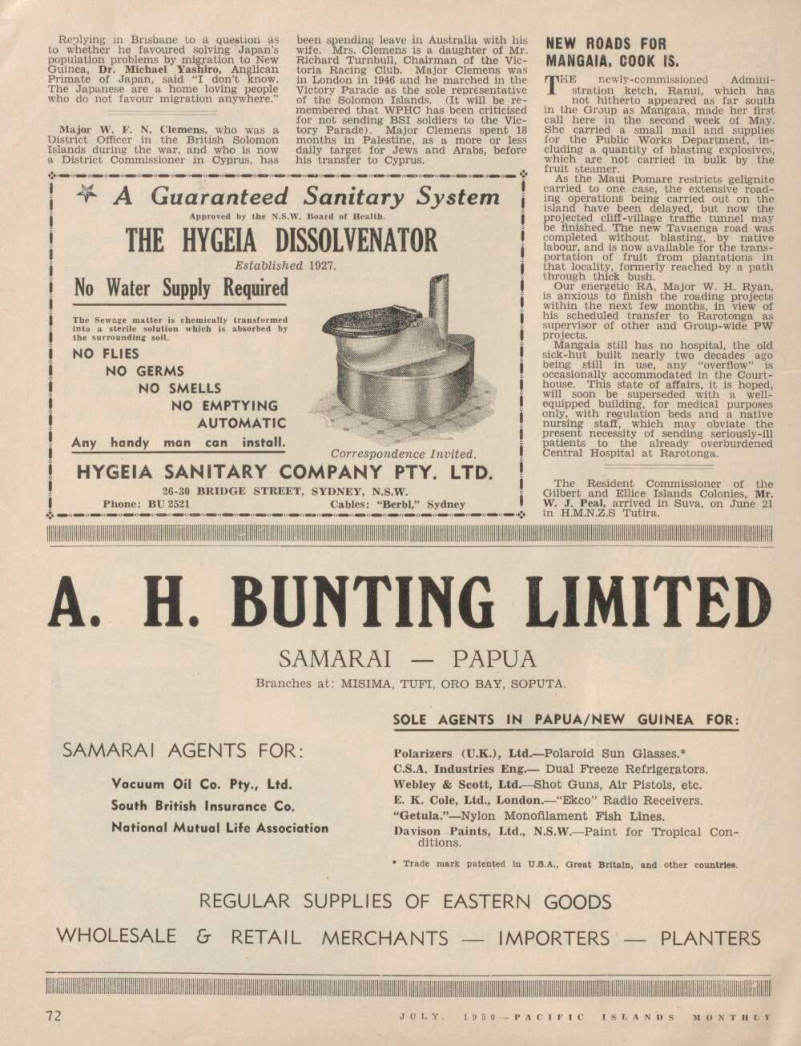
Of The Piece
Letter to the Editor IN your April issue there was an article in which Mr. Solicitor Nat Chalmers was badly slated. I am not writing this in defence of Mr. Chalmers; I only met him as a child, and I have not seen him since. But his policy in assisting cane growers against the CSR Co. is looked upon, by “old timers” like myself, as just retribution.
I came to Fiji early in 1891 and, at that time, there were somewhere about 20 privately-owned sugar mills in Fiji, one of which was at Ellington (Viti Levu) and owned by the Chalmers brothers— grandfather and granduncle of the afore said Nat Chalmers. This mill in par ticular produced very excellent quality sugar, as did most of the others, which quality has never been equalled in Fiji by the CSR Coy.
All wages paid and all profits earned by those private mills were spent with in this Colony. Such is not the case with the CSR Co.
This CSR Co. froze out all the small mills, and is now a gigantic monopoly.
Upon some occasions, this CSR Co. has persuaded our local Government to fore go customs duty upon imports of machinery, etc., and thus has * depleted the Colony’s revenue and, at the same time, fooled our Government indirectly into giving it a special concession. Why?
This CSR Co. introduced coolie labour, and had a lot to do with said labour remaining here after expiration of indentures. In agreeing to this, our Government smashed into smithereens the British promise made in the Deed of Cession signed upon the taking over of Fiji. Some very few planters indentured coolies, to their later regret.
In face of above, can anyone say that the CSR Co. has ever been, is, or ever will be a true asset to this Colony?
I am, etc..
Old Bill.
Levuka, 19/5/50.
Mr. Noel Collins, who has been mana ger of Colyer Watson, Ltd., at Kavieng, New Guinea, has been transferred to the new Madang branch. Mr. Reg.
Walker, from Rabaul headquarters, has gone to Kavieng.
Replying in Brisbane to a question as to whether he favoured solving Japan’s population problems by migration to New Guinea, Dr. Michael Yashiro, Anglican Primate of Japan, said “I don’t know.
The Japanese are a home loving people who do not favour migration anywhere.”
Major W. F. N. Clemens, who was a District Officer in the British Solomon Islands during the war, and who is now a District Commissioner in Cyprus, has
been spending leave in Australia with his wife. Mrs. Clemens is a daughter of Mr.
Richard Turnbull, Chairman of the Vic toria Racing Club. Major Clemens was in London in 1946 and he marched in the Victory Parade as the sole representative of the Solomon Islands. (It will be re membered that WPHC has been criticised for not sending ESI soldiers to the Vic tory Parade). Major Clemens spent 18 months in Palestine, as a more or less daily target for Jews and Arabs, before his transfer to Cyprus.
Advertisements & other items, pp. 75-76 (1 item)
Tom Piper
Sydney-lsland Service
Sent by Air-Mail.
PURE IRISH Linen Sets Damask Table Cloths Coloured Bordered 54 x 54 Weight 2| lb. . . £2/12/6 CHECK Breakfast Cloths 48 x 48 12/6 CHECK Breakfast Cloths 48 x 70 17/6 IRISH LINEN Tea Towels, 4/6
QUEEN HART NYLONS. 13/6
We can supply all Merchandise. Exclusive Fashion Goods. Post details.
Postage, Exchange and Air Freight Extra.
ISLAND-SERVICE
MANAGER: J. B. HALES.
Box 4683, G.P.0., Sydney, N.S.W.
Choice Home-killed Beef
Selected Garden-fresh
Vegetables
V Wm M mt
TOM PIPER
< ■* %Md C P ♦V.
STEAK & VEGETABLES
'■pw
A Guaranteed Sanitary System
Approved by the N.S.W. Board of Health.
THE HYGEIA DISSOLVENATOR
Established 1927.
No Water Supply Required
The Sewage matter is chemically transformed into a sterile solution which is absorbed by the surrounding soil.
NO FLIES
NO GERMS
NO SMELLS
NO EMPTYING
AUTOMATIC
Any handy man can install. ** ><•' • Correspondence Invited.
HYGEIA SANITARY COMPANY PTY. LTD.
26-30 BRIDGE STREET, SYDNEY, N.S.W.
Phone: BU 2521 Cables: “Berbl,” Sydney
New Roads For
Mangaia, Cook Is.
THE newly-ccmmissioned Admini stration ketch, Ranui, which has not hitherto appeared as far south in the Group as Mangaia, made her first call here in the second week of May.
She carried a small mail and supplies for the Public Works Department, in cluding a quantity of blasting explosives, which are not carried in bulk by the fruit steamer.
As the Maui Pomare restricts gelignite carried to one case, the extensive read ing operations being carried out on the island have been delayed, but now the projected cliff-village traffic tunnel may be finished. The new Tavaenga road was completed without blasting, by native labour, and is now available for the trans portation of fruit from plantations in that locality, formerly reached by a path through thick bush.
Our energetic RA, Major W. H. Ryan, is anxious to finish the reading projects within the next few months, in view of his scheduled transfer to Rarotonga as supervisor of other and Group-wide PW projects.
Mangaia still has no hospital, the old sick-hut built nearly two decades ago being still in use, any “overflow” is occasionally accommodated in the Court house. This state of affairs, it is hoped, will soon be superseded with a well equipped building, for medical purposes only, with regulation beds and a native nursing staff, which may obviate the present necessity of sending seriously-ill patients to the already overburdened Central Hospital at Rarotonga.
The Resident Commissioner of the Gilbert and Ellice Islands Colonies, Mr.
W, J. Peal, arrived in Suva, on June 21 in H.M.N.Z.S Tutira.
Advertisements & other items, p. 76 (1 item)
A. H. Bunting Limited
SAMARAI PAPUA
Branches at: MISIMA, TUFI, ORO BAY, SOPUTA.
SAMARAI AGENTS FOR:
Vacuum Oil Co. Pty., Ltd.
South British Insurance Co.
National Mutual Life Association
SOLE AGENTS IN PAPUA/NEW GUINEA FOR:
Polarizers (U.K.), Ltd.—Polaroid Sun Glasses.* C.S.A. Industries Eng.— Dual Freeze Refrigerators.
Webley & Scott, Ltd.—Shot Guns, Air Pistols, etc.
E. K. Cole, Ltd., London.—“Ekco” Radio Receivers.
“Getula.”—Nylon Monofilament Fish Lines.
Davison Paints, Ltd,, N.S.W.— Paint for Tropical Conditions. • Trade mark patented In U.S.A., Great Britain, and other countries.
REGULAR SUPPLIES OF EASTERN GOODS
WHOLESALE & RETAIL MERCHANTS IMPORTERS PLANTERS
Notes From Talasea, Ng
From Our Own Correspondent MR. KEN McMULLEN, late of New Guinea Company, Rabaul, has taken up residence with his family at Garua Island Plantation.
Mesdames Skinner, Page and Phillips- Veirke, who were all at various times in the Rabaul hospital, have now returned to Talasea. Getting to hospital from this area has always been something of a problem, but now that Dr. Roelcze has arrived, residents feel they will not be forced to rely on Directorate boats or the once-fortnightly Catalina service, to quite the same extent.
Mr. P. (Rusty) Phillips-Veirke, manager of Numundo, advises that this extensive property, owned by Coconut Products Ltd., is being opened up. The property suffered severely in a fire lit by natives in 1941. Coconuts will be planted, also cocoa. Cocoa will also be planted in the area that is producing at present.
Mr. Geoff Hitch, late manager of San Remo plantation, has now gone to the Bainings where he is managing Gun tersohe.
Mr. Ken Douglas, of San Remo, has returned with his family from a vacation in Australia. His particular bete noir of the moment is the weed Ageratum, a noxious species which, in his experienced opinion, is poisoning the ground. This weed is found both on San Remo and Numundo plantations, and springs up strongly with the secondary growth.
An aviation official has been making a reconnaissance trip of Stettin Bay (where the two above mentioned planta tions are situated) seeking a suitable alternate landing base for Catalina air craft.
Cocoa is reported to be doing well both on Walindi and Lafenda plantations. Mr. and Mrs. Lou Searle are now returned to Walindi. It is also reported that Solupai, managed by Mr. Bill Wills, is keeping up a steady copra production.
There is a rumour that the Japanese snail has been seen in the Nakanai area.
This is disquieting news to cocoa-growers hereabouts, and it is hoped that the snails will confine their activities to the other side of the Nakanai. The snails are believed to have been brought in unwittingly on cargo.
A farewell party was recently given in Talasea for Mr. Rod Marsland, of Lafenda, who is going south on leave.
Mrs. Phil Page, wife of P. O. John Page, and Mr. Bill Wills, supervised, and arranged the cooking of the chickens and mushrooms, and the roasting of the pig (on hot stones) all of which were delicious. Toon Pen, trade store pro prietor, provided the piece de resistance with huge bowls of chow mien, noodles, etc. The party was held in the gardens at the rear of the Page house, and guests sat at tables under the trees in the moon light and talked, and occasionally sang and ate. It was voted one of the best outdoor parties yet.
Concerning the native Batari, I did not, I think, write that he was “the local luluai sanctioned by the Administration notwithstanding;” for he holds no official rank and is certainly not a Luluai or a Tultul, and is not recognised by the Administration as an official of any sort.
His Lordship Bishop Foley has returned to Fiji from an overseas journey which included a visit to the United Kingdom and the making of the Holy Year pil grimage to Rome. Members of the Roman Catholic Church in Suva arranged an extensive series of functions to wel come him back.
The Returned Servicemen’s League Queensland State Congress decided recently, to recommend to the Federal Government that it approach the Netherlands Government on the possi bility of negotiating a treaty for the mutual development and defence of New Guinea. The State President said that any talk of buying Dutch New Guinea would strengthen Indonesia’s claims in the area. But if the Indonesians got
Dutch New Guinea, Australia and New Zealand would be the only white nations in the South Pacific surrounded by a teeming mass of coloured people.
Mr. F. M. O’Driscoll, a former Queens land Police Inspector and crime expert, died recently in Brisbane. He was the father of Mr. Andrew O’Driscoll, Crown Prosecutor of Papua-New Guinea.
Advertisements & other items, pp. 77-78 (2 items)
73
PACIFIC ISLANDS MONT II I. Y JULY, 1950
Our Hands Make Good Arms
is For your Fishing and Shooting Wants Consult Us.
Lithgow .22 Cal. Repeating Rifles .. £l3 3 0 7 Post Lithgow .22 Cal. Single Shot .. .. £6 12 6 Extra.
SI L RO H U 143 ELIZABETH STREET, SYDNEY.
W(DW (SUM'
im Z^2t
CDIF
uci
CL y The Shell Company of Australia Ltd. (Inc. in Gt. Britain)
GSOIH
Corrugated Aluminium
Building Sheets
■i is fim
For speed of erection
Corrugated Aluminium Building Sheets have many advantages over other roofing and siding materials. The lightness of the metal enables easier handling, with a considerable saving in transportation and erection costs.
It is highly resistant to corrosion, and reflects a high percentage of all radiant heat.
Painting is not necessary, and no special maintenance is required.
Corrugated Aluminium Building Sheets are available as listed below.
Widths: 26 in. with eight 3 in. corrugations. 32 in. with ten 3 in. corrugations. 26 in. with nine 2| in. corrugations. 31 in. with eleven 2- in. corrugations.
Lengths: 6,7, 8,9, 10, 11 and 12 ft.
Thicknesses: 20, 22, 23, 24 and 26 Imperial Standard Wire Gauge.
ALUMINIUM UNION LIMITED
(Incorporated in the Dominion of Canada) Principal British Commonwealth Distributor of Aluminium Ocean House, 34 Martin Place, Sydney, N.S.W.
An ALUMINIUM LIMITED Company
Sa'cs Agents for New Zealand : Richardson, McCabe & Co. Limited, Wellington Auckland Christchurch Sales Agents for Fiji, Western Samoa and Tonga: Morris Hedstrom Limited, Suva, Fiji.
Sales Agents for New Caledonia, and New Hebrides: Agence Alama, 39 Rue de L'Alma, Noumea, New Caledonia LONDON • MONTREAL • CALCUTTA • SYDNEY » SHANGHAI « KARACHI • TOKYO
High Level of Prosperity Continues
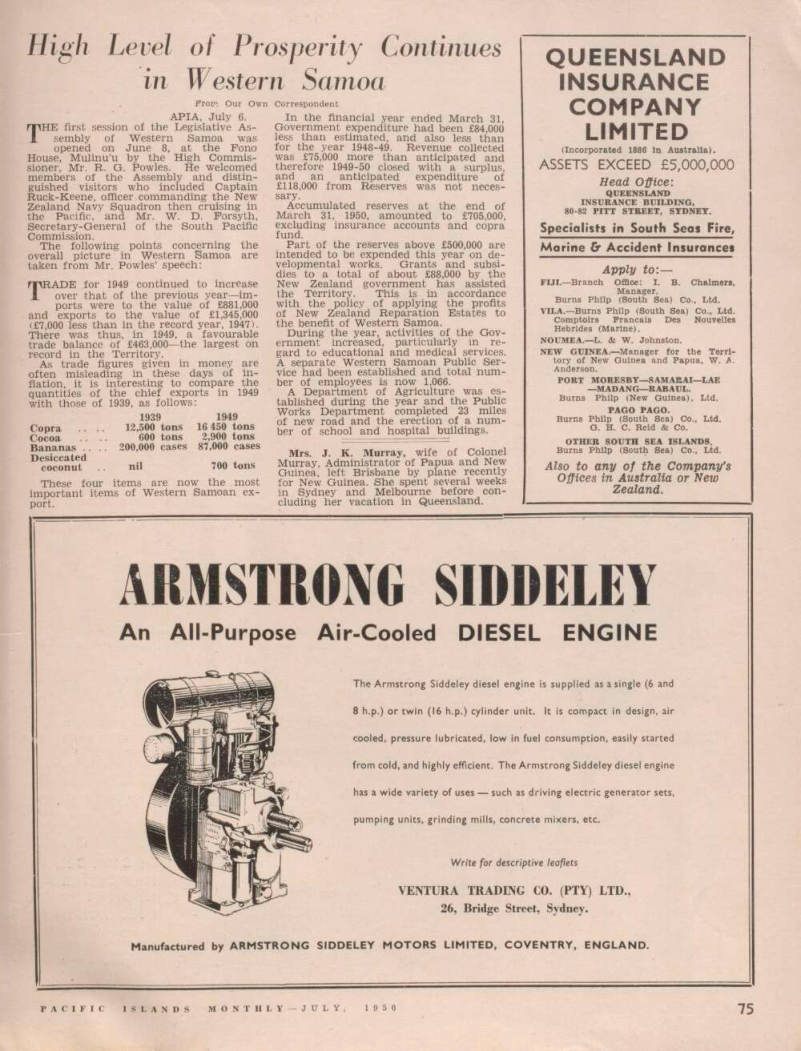
in Western Samoa
Froir l . Our Own Correspondent
APIA, July 6.
THE first session of the Legislative As sembly of Western Samoa was opened on June 8, at the Fono House, Mulinu’u by the High Commis sioner, Mr. R. G. Powles. He welcomed members of the Assembly and distin guished visitors who included Captain Ruck-Keene, officer commanding the New Zealand Navy Squadron then cruising in the Pacific, and Mr. W. D. Forsyth, Secretary-General of the South Pacific Commission.
The following points concerning the overall picture in Western Samoa are taken from Mr. Powles’ speech; TRADE for 1949 continued to increase over that of the previous year—im ports were to the value of £BBl,OOO and exports to the value of £1,345,000 (£7,000 less than in the record year, 1947).
There was thus, in 1949, a favourable trade balance of £463,ooo—the largest on record in the Territory.
As trade figures given in money are often misleading in these days of in flation. it is interesting to compare the quantities of the chief exports in 1949 with those of 1939, as follows:
These four items are now the most important items of Western Samoan ex port.
In the financial year ended March 31, Government expenditure had been £84,000 less than estimated, and also less than for the year 1948-49. Revenue collected was £75,000 more than anticipated and therefore 1949-50 closed with a surplus, and an anticipated expenditure of £llB,OOO from Reserves was not neces sary.
Accumulated reserves at the end of March 31, 1950, amounted to £705,000, excluding insurance accounts and copra fund.
Part of the reserves above £500,000 are intended to be expended this year on de velopmental works. Grants and subsi dies to a total of about £BB,OOO by the New Zealand government has assisted the Territory. This is in accordance with the policy of applying the profits of New Zealand Reparation Estates to the benefit of Western Samoa.
During the year, activities of the Gov ernment increased, particularly in re gard to educational and medical services.
A separate Western Samoan Public Ser vice had been established and total num ber of employees is now 1,066.
A Department of Agriculture was es tablished during the year and the Public Works Department completed 23 miles of new road and the erection of a num ber of school and hospital buildings.
Mrs. J. K. Murray, wife of Colonel Murray, Administrator of Papua and New Guinea, left Brisbane by plane recently for New Guinea. She spent several weeks in Sydney and Melbourne before con cluding her vacation in Queensland.
1939 1949 Copra .. . 12,500 tons 16 450 tons Cocoa .. . 600 tons 2,900 tons Bananas .. . . 200,000 cases 87,000 cases Desiccated coconut nil 700 tons
Advertisements & other items, p. 79 (1 item)
Akm Strong Sidueley
QUEENSLAND
INSURANCE
COMPANY
LIMITED
(Incorporated 1886 In Australia).
ASSETS EXCEED £5,000,000
Head Office :
QUEENSLAND
INSURANCE BUILDING,
80-82 PITT STREET, SIDNEY.
Specialists in South Seas Fire,
Marine & Accident Insurances
Apply to: — FlJl.—Branch Office: I. B. Chalmers, Manager.
Burns Phllp (South Sea) Co., Ltd.
VILA. —Burns Phllp (South Sea) Co., Ltd.
Comptoirs Francais Des Nouvelles Hebrides (Marine).
NOUMEA.—L. & W. Johnston.
NEW GUlNEA.—Manager for the Territory of New Guinea and Papua, W. A.
Anderson.
PORT MORESBY—SAMARAI—LAE
—MADANG—RABAUL.
Burns Philp (New Guinea), Ltd.
PAGO PAGO.
Burns Phllp (South Sea) Co., Ltd.
G. H. C. Reid & Co.
OTHER SOUTH SEA ISLANDS.
Burns Phllp (South Sea) Co., Ltd. .AZso to any of the Company’s Offices in Australia or Hew Zealand.
AKM STRONG SIDUELEY
An All-Purpose Air-Cooled DIESEL ENGINE
The Armstrong Siddeley diesel engine is supplied as a single (6 and 8 h.p.) or twin (16 h.p.) cylinder unit. It is compact in design, air cooled, pressure lubricated, low in fuel consumption, easily started from cold, and highly efficient. The Armstrong Siddeley diesel engine has a wide variety of uses such as driving electric generator sets, pumping units, grinding mills, concrete mixers, etc.
Write for descriptive leaflets
VENTURA TRADING CO. (PTY) LTD.,
26, Bridge Street, Sydney.
Manufactured by ARMSTRONG SIDDELEY MOTORS LIMITED, COVENTRY, ENGLAND.
Mangaians Remember Captain
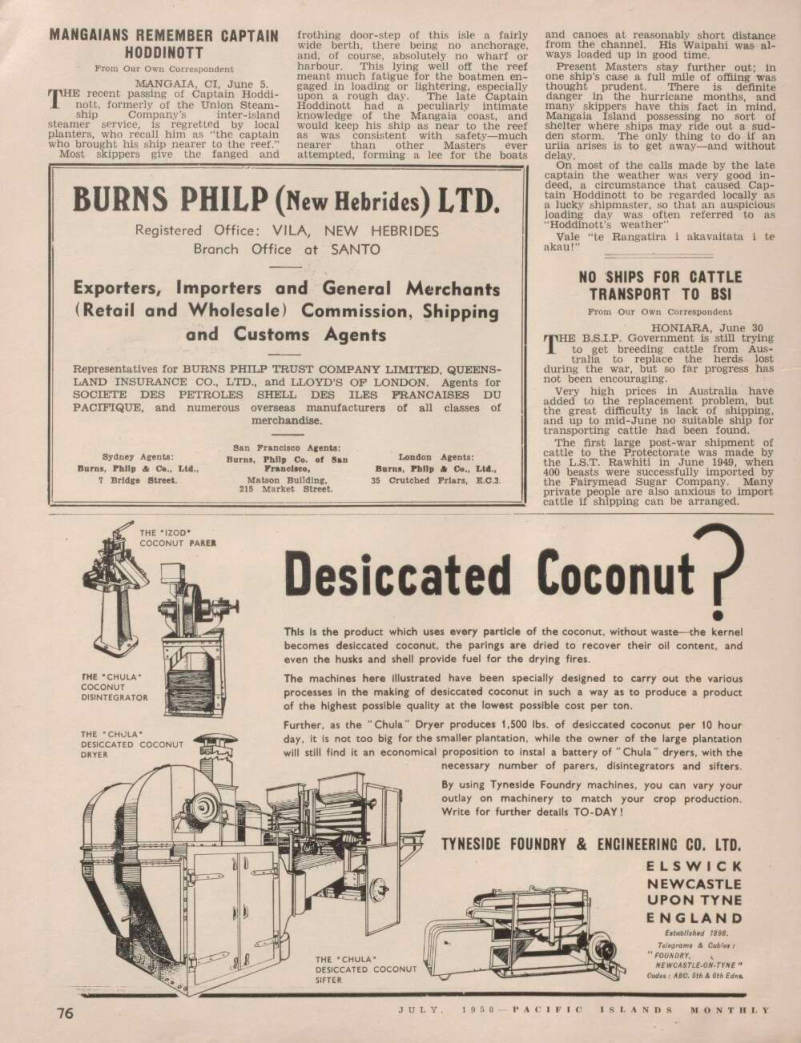
Hoddinott
From Our Own Correspondent MANGAIA, Cl, June 5.
THE recent passing of Captain Hoddi nott, formerly of the Union Steam ship Company’s inter-island steamer service, is regretted by local planters, who recall him as “the captain who brought his ship nearer to the reef.”
Most skippers give the fanged and
frothing door-step of this isle a fairly wide berth, there being no anchorage, and, of course, absolutely no wharf or harbour. This lying well off the reef meant much fatigue for the boatmen en gaged in loading or lightering, especially upon a rough day. The late Captain Hoddinott had a peculiarly intimate knowledge of the Mangaia coast, and would keep his ship as near to the reef as was consistent with safety—much nearer than other Masters ever attempted, forming a lee for the boats
and canoes at reasonably short distance from the channel. His Waipahi was al ways loaded up in good time.
Present Masters stay further out; in one ship’s case a full mile of offiing was thought prudent. There is definite danger in the hurricane months, and many skippers have this fact in mind, Mangaia Island possessing no sort of shelter where ships may ride out a sud den storm. The only thing to do if an uriia arises is to get away—and without delay.
On most of the calls made by the late captain the weather was very good in deed, a circumstance that caused Cap tain Hoddinott to be regarded locally as a lucky shipmaster, so that an auspicious loading day was often referred to as “Hoddinott’s weather”
Vale “te Rangatira i akavaitata i te akau!”
No Ships Fob Cattle
Transport To Bsi
From Our Own Correspondent
Honiara, June 30
THE 8.5.1. P. Government is still trying to get breeding cattle from Aus tralia to replace the herds lost during the war, but so far progress has not been encouraging.
Very high prices in Australia have added to the replacement problem, but the great difficulty is lack of shipping, and up to mid-June no suitable ship for transporting cattle had been found.
The first large post-war shipment of cattle to the Protectorate was made by the L.S.T. Rawhiti in June 1949, when 400 beasts were successfully imported by the Fairymead Sugar Company. Many private people are also anxious to import cattle if shipping can be arranged.
Advertisements & other items, p. 80 (3 items)
76
JULY, 1950 PACIFIC ISLANDS MONTH L Y
BURNS PHILP (New Hebrides) LTD.
Registered Office: VILA, NEW HEBRIDES
Branch Office at SANTO
Exporters, Importers and General Merchants
(Retail and Wholesale) Commission, Shipping
and Customs Agents
Representatives for BURNS PHILP TRUST COMPANY LIMITED, QUEENS- LAND INSURANCE CO., LTD., and LLOYD’S OP LONDON. Agents for SOCIETE DES PETROLES SHELL DES ILES PRANCAISES DU PACIFIQUE, and numerous overseas manufacturers of all classes of merchandise.
Sydney Agents; Burns, Philp & Co., Ltd., 7 Bridge Street.
San Francisco Agents: Burns, Philp Co. of San Francisco, Matson Building, 215 Market Street.
London Agents: Burns, Philp A Co., Ltd., 35 Crutched Friars, E.C.3.
Desiccated Coconut f
THE 'IZOD*
COCONUT PARER
THE ’CHULA’
COCONUT
DISINTEGRATOR
THE ’CHULA’
DESICCATED COCONUT
DRYER
v) 3 §=>
Desiccated Coconut f
• This is the product which uses every particle of the coconut, without waste —the kernel becomes desiccated coconut, the parings are dried to recover their oil content, and even the husks and shell provide fuel for the drying fires.
The machines here illustrated have been specially designed to carry out the various processes in the making of desiccated coconut in such a way as to produce a product of the highest possible quality at the lowest possible cost per ton.
Further, as the "Chula” Dryer produces 1,500 lbs. of desiccated coconut per 10 hour day, it is not too big for the smaller plantation, while the owner of the large plantation will still find it an economical proposition to instal a battery of "Chula" dryers, with the necessary number of parers, disintegrators and sifters.
By using Tyneside Foundry machines, you can vary your outlay on machinery to match your crop production.
Write for further details TO-DAY!
TYNESIDE FOUNDRY & ENGINEERING CO. LTD.
ELSW I C K
THE ’CHULA’
DESICCATED COCONUT
SIFTER
NEWCASTLE
UPON TYNE
ENGLAND
Established 1898.
Telegrams & Cables i
“ FOUNDRY, v
NEWCASTLE-ON-TYNE "
Codes : ABC, sth A 6th Edns,
Troubles of an
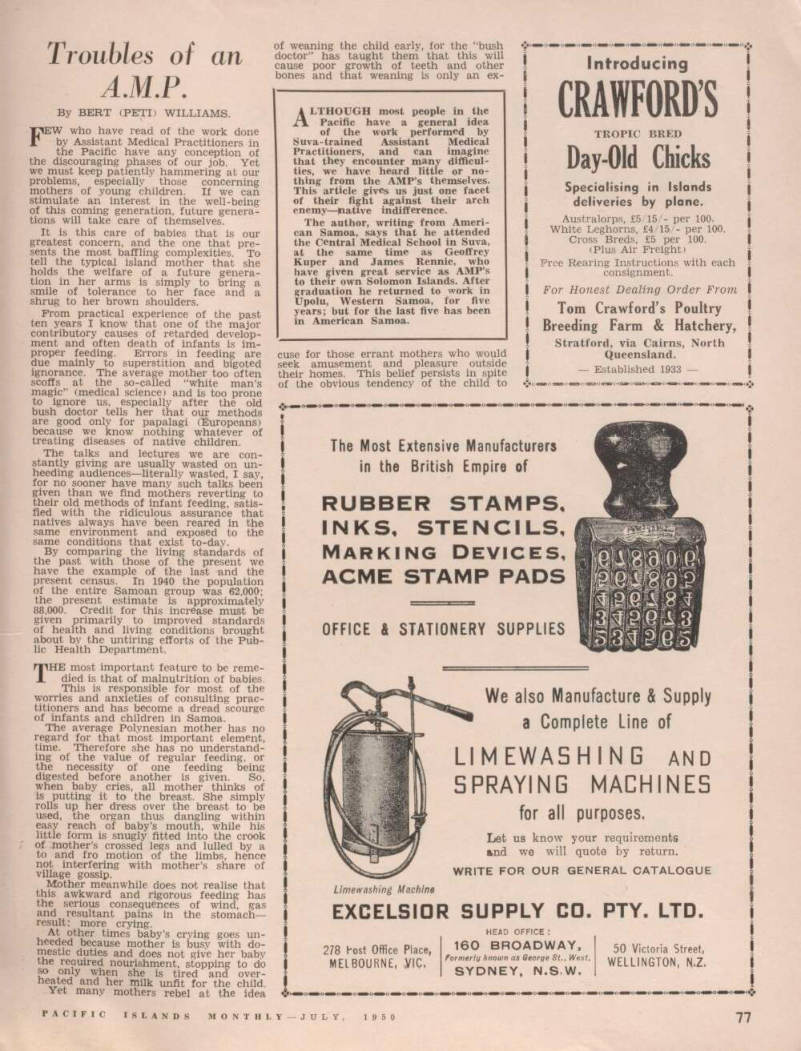
Amp.
By Bert (Pett) Williams.
rW who have read of the work done by Assistant Medical Practitioners in the Pacific have any conception of the discouraging phases of our job. Yet we must keep patiently hammering at our problems, especially those concerning mothers of young children. If we can stimulate an interest in the well-being of this coming generation, future genera tions will take care of themselves.
It is this care of babies that is our greatest concern, and the one that pre sents the most baffling complexities. To tell the typical island mother that she holds the welfare of a future genera tion in her arms is simply to bring a smile of tolerance to her face and a shrug to her brown shoulders.
From practical experience of the past ten years I know that one of the major contributory causes of retarded develop ment and often death of infants is im proper feeding. Errors in feeding are due mainly to superstition and bigoted ignorance. The average mother too often scoffs at the so-called “white man’s magic” (medical science) and is too prone to ignore us, especially after the old bush doctor tells her that our methods are good only for papalagi (Europeans) because we know nothing whatever of treating diseases of native children.
The talks and lectures we are con stantly giving are usually wasted on un heeding audiences—literally wasted, I say, for no sooner have many such talks been given than we find mothers reverting to their old methods of infant feeding, satis fied with the ridiculous assurance that natives always have been reared in the same environment and exposed to the same conditions that exist to-day.
By comparing the living standards of the past with those of the present we have the example of the last and the present census. In 1940 the population of the entire Samoan group was 62,000; the present estimate is approximately 88,000. Credit for this increase must be given primarily to improved standards of health and living conditions brought about by the untiring efforts of the Pub lic Health Department.
THE most important feature to be reme died is that of malnutrition of babies.
This is responsible for most of the worries and anxieties of consulting prac titioners and has become a dread scourge of infants and children in Samoa.
The average Polynesian mother has no regard for that most important element, time. Therefore she has no understand ing of the value of regular feeding, or the necessity of one feeding being digested before another is given. So, when baby cries, all mother thinks of is putting it to the breast. She simply rolls up her dress over the breast to be used, the organ thus dangling within easy reach of baby’s mouth, while his little form is snugly fitted into the crook of mother’s crossed legs and lulled by a to and fro motion of the limbs, hence not interfering with mother’s share of village gossip.
Mother meanwhile does not realise that this awkward and rigorous feeding has the serious consequences of wind, gas and resultant pains in the stomach result: more crying.
At other times baby’s crying goes un heeded because mother is busy with do mestic duties and does not give her baby the required nourishment, stopping to do so only when she is tired and over heated and her milk unfit for the child.
Yet many mothers rebel at the idea
of weaning the child early, for the “bush doctor” has taught them that this will cause poor growth of teeth and other bones and that weaning is only an ex-
ALTHOUGH most people in the Pacific have a general idea of the work performed by Suva-trained Assistant Medical Practitioners, and can imagine that they encounter many difficul ties, we have heard little or no thing from the AMP’s themselves.
This article gives us just one facet of their fight against their arch enemy—native indifference.
The author, writing from Ameri can Samoa, says that he attended the Central Medical School in Suva, at the same time as Geoffrey Kuper and James Rennie, who have given great service as AMP’s to their own Solomon Islands. After graduation he returned to xvork in Upolu, Western Samoa, for five years; but for the last five has been in American Samoa.
cuse for those errant mothers who would seek amusement and pleasure outside their homes. This belief persists in spite of the obvious tendency of the child to
become emaciated. To my more per suasive arguments I am most often chal lenged by the mother’s remark that the child is thin “because he is growing.”
Mother is very fearful that her new born baby may be exposed to the danger of cold wind, or draught, so in its kapok filled swinging cradle she covers it with a suffocating pile of blankets. Naturally this shutting off of all fresh air results in heat rash which mother calls ‘ mumu” (herpes erythematosus) and forthwith rushes baby to the “bush doctor” for treatment. This condition is believed to be inherited by all Samoan babies and as a prophylactic—begun often as early as the second week of infancy—the baby is immersed up to the neck in cold water early In the morning or late in the even ing. I have often seen lines of mothers parading to the river for this cruel bap tism of their babies, following with the usual massage. I have had the painful duty of vainly trying to save cases of pneumonia resulting from these immer sions. Yet no amount of telling would convince the mothers that the pneumonia was not due to mumu getting beyond their control. I would like to see some of these get a dunking in the cold moun tain streams!
HOWEVER, the ultimate in disgusting forms of child feeding is the pre masticated food. This revolting prac tice still prevails throughout the islands
to-day, notwithstanding hygienic teach
ings and repeated warnings as to its dangers. This consists of the mother, grandmother, or any other adult for that matter, chewing the food into pulp and giving it to the eagerly expectant infant.
Walking along almost any village path toward mid-day one will frequently see the child held up with one arm while with the other free hand an adult is scooping up with the forefinger these “pulps” of chewed food arranged in a
row along the bare leg of the feeder, and pushing it into the child’s gaping mouth.
At every possible opportunity we have protested violently against this abhorrent practice, but ignorant mothers through sheer laziness or unconcern continue the business immediately the medical prac titioner is out of sight, though promis ing smilingly to desist. They actually believe that babies thrive on this food which is already well masticated and which offers no obstruction to free pas sage into the stomach for digestion.
They wonder at the frequent vomiting and stomach upsets—if no worse—among their offspring.
Often a child when able to chew is given a sizable portion of taro, perhaps along with an identical piece of beef or pork. Plies literally feed on the food as w.ell as stud the baby’s face before he gets the food into his mouth. More often than not the taro and pork, in the course of eating, is rolled all over dirty mats where feet have trod; thus the
food is exposed to contamination by soil and this frequently leads to worm in fection, one of the most ravaging diseases prevalent in the islands.
HAMOANS have at their hand some of O nature’s most beneficial soft foods for infants in the form of vaisalo (coconut porridge), suafa’i (banana stew). and ,<PW “ a f h >. !» /tUI more beneficial for baby to take his food first-hand, and to learn the principles of chewing as early as possible. Mother’s milk is, to be sure, baby’s best natural food up to seven or nine months when an augmenting diet may be safely begun, When mothers do comply with our teachings and recommendations and their babies show evidence of proper growth they are proud and happy—and this is our most forcible argument. Perhaps we shall yet find ourselves resorting to the papalagi’s “baby shows.”
(Continued next Page.)
The islanders now have access to the best scientific medical assistance. All fields are covered by the Public Health Department’s drive to place all these services conveniently at their disposal.
Constantly they are reminded against hesitating to place their many ailments in the competent hands of qualified doc tors, practitioners and nurses who handle these problems with knowledge acquired through years of intensive study and training. It remains for them to offer only voluntary co-operation. It costs no thing, except co-operation.
Mr. R. S. Beaumont, accountant of the Methodist Mission’s New Guinea District, left Melbourne on June 12 to return to his work. Mrs Beaumont will follow later.
Ratu Sir Lala Sukuna has been ap pointed Honorary Colonel of the Fiji Infantry Regiment. He has had military associations for almost 40 years. In 1914 he was at Oxford University and at the outbreak of war he joined the French Foreign Legion where he won the Medaille Militaire. In World War II he played an outstanding part organising the war effort of the Fijian people.
Advertisements & other items, pp. 81-84 (1 item)
Crawford’S
Introducing
TROPIC BRED
Day-Old Chicks
Specialising in Islands
deliveries by plane.
Australorps, £5/15/- per 100.
White Leghorns, £4/15/- per 100.
Cross Breds, £5 per 100. (Plus Air Freight; Free Rearing Instructions with each consignment.
For Honest Dealing Order From Tom Crawford’s Poultry
Breeding Farm & Hatchery,
Stratford, via Cairns, North Queensland.
Established 1933
The Most Extensive Manufacturers in the British Empire of
RUBBER STAMPS.
INKS, STENCILS,
Marking Devices,
ACME STAMP PADS
OFFICE S STATIONERY SUPPLIES
v.;
PSV’
I We also Manufacture & Supply a Complete Line of
LIMEWASHING AND
SPRAYING MACHINES
for all purposes.
Let us know your requirements and we will quote by return.
WRITE FOR OUR GENERAL CATALOGUE
Limewashing Machine
EXCELSIOR SUPPLY CO. PTY. LTD.
278 Host Office Place,
MELBOURNE, VIC.
HEAD OFFICE :
160 BROADWAY,
Formerly known as George St., West,
SYDNEY, N.S.W.
50 Victoria Street,
WELLINGTON, N.Z.
TO MERCHANTS & TRADERS
IN THE PACIFIC ISLANDS
We ore direct representatives of many of the major manufacturers in the important preducing countries of the world. We can offer you an unusual service of providing a vast range of commodities, particularly Fond, Building Materials, and General Merchandise.
From New Zealand— Tinned Meats, Tinned Fish, Tinned Soups, Tinned Vegetables, Tinned Tomato Juice, Tinned Tomato Puree, Butter, Cheese, Dried Milk, etc., Coffee Essence, Baking Powder, Cordials, Onions, Potatoes, Blue and Maple Dried Peas, Seeds, Animal Foods, Live Stock, Washing Soaps, Toilet Soaps, Cosmetics, Tennis Shoes, Leather Footwear, Leather Bends, etc..
Plywoods, Wallboards, Paints and Varnishes, Building Papers, Bituminous Sealers, Asbestos Cement Sidings, Metal Window Frames, Sawn Timber (treated for Islands use), Furniture (Assembled and Unassembled), Mattresses and Pillows, Radios, Medicinal Preparations.
From England— Red Tower Lager. Gravity 1053.
From France— Monnet Brandy.
From Europe— German Export Lager (Light and Dark), German Bock Beer (Light), German Stout (Dark), Cartridges and Explosives, Shot Guns, Prefabricated Houses, Asbestos Sheets (Coloured), Flat and Corrugated, Asbestos Pipes, Galvanised Pipes, Salt, Sugar, Gelatine, Textiles—Linen and Canvas, Household Earthenware, Glassware and Crystalware, Cutlery, Aluminium Products, Freezers, Household Chemicals, Insecticides, Pharmaceutical Products, Cosmetics, Jewellery (Imitation), Photographic Equipment—Cameras, etc., Typewriters, Wristlet Watches, Mouth Organs, Cigarette Lighters, Steam Coal, Steam Boilers and Heating Appliances, Tools, Axes, Choppers and Edged Earth Tools, Diesel Trucks and Tractors, Motor Cars and Motor Cycles.
From Australia— Our associate Company in Sydney can arrange your requirements from that country.
UNION MANUFACTURING
& EXPORT CO. LTD.
Head Office: G.P.O. Box 1060, Wellington, NEW ZEALAND Cables; "UMEC," Wellington.
<3a/tAe vu-Cth
GIOBITE
TRAVEL CASES
They're lighter, stronger, longerlasting. That's why a Globite costs less in the long run.
Made by
FORD SHERINGTON LTD.
w; =. i
CLEANS
PHONES: LA 2436
LA 4033 LA 4603
CABLE ADDRESS:
“EXSOAP”, SYDNEY
WOW®
\ IST:
MFG. PTY. LTD.
14 ST. MARY STREET, CAMPERDOWN
SYDNEY N.S.W.
Specialising For Export . . .
VARIOUS SOAPS UNDER THE REGISTERED BRAND
44
WACO
Laundering, Toilet (Eucalyptus and Carbolic Health), Sea Water, Medical (Soft and Liquid), Washing Powder, Antiseptic Grease Remover, Wool Washing, Phenyle, Disinfectant and Liquid Soap (to specification).
For all inquiries'.
EXPORT SOAP MFG. PTY. LIMITED.
14 ST. MARY STREET, CAMPERDOWN, SYDNEY, N.S.W.
Sails, Covers, Awnings
TENTS, TARPAULINS, and all classes CANVAS GOODS for industrial and home use FLAGS AND PENNANTS FOR CLUBS AND ASSOCIATIONS Send your inquiries through your agent,
I. HARRY WEST
"SYDNEY'S SAILMAKER"
DUKE ST. (WATERFRONT) EAST BALMAIN, SYDNEY, N.S.W.
Phone: WBIIOS, W 82284.
Search For Gold In
The Solomons
From Our Own Correspondent
Honiara, June 20.
MR. J. C. GROVER, of Sydney, newly appointed Senior Geologist to the British Solomon Islands Protectorate Government, expects to leave shortly on a geological survey expedition to the mountainous area which extends behind the Guadalcanal coastline, north-east of Point Cruz. He hopes to make a de tailed survey of the Gold Ridge area as well as investigating the Sutakiki and Sutakana areas near Lion’s Head Moun tain. He will probably return by way of the head waters of the Tenaru River.
It was in the area between the coast and Lion’s Head that a scientific expe dition, led by an Austrian, was attacked by hostile villagers towards the end of the last century. Some members of this expedition were killed, including their leader. The samples which the survivors of that expedition took back to Germany were not assayed until 1929, and promis ing results were obtained from the assays.
Sutakiki and Sutakana were declared mining areas before the war, and some gold was recovered there, but the swiftness of the rivers, and the speed with which they come down in flood, made mining on any large scale impracticable in the areas then being worked.
The Fiji 1950 Civil List has been pub lished by the Fiji Government Printer.
Copies are available at the Government Press. The price is 4/-.
A party of Methodist Missionaries in Papua and New Guinea, left their stations in early July and under the leadership of the Rev. E. Clarke and the Rev. G. Young, will make a survey of NG Central Highlands areas with the idea of establishing Methodist Missions there.
Advertisements & other items, p. 84 (1 item)
A Accessories
ARC WELDING
A MACHINES
E.M.F. manufacture a complete range of arc welding electrodes including mild steel structural grade types, electrodes for welding special steels, stainless steel and heat resisting steel electrodes, special electrodes for welding cast iron, non-ferrous metals and for hardsurfacing.
The range of E.M.F. arc welders covers the A.C. "Pilot" Arc welder for maintenance and jobbing work and Choke Controlled machines for heavy duty applications, also petrol and electric motor driven D.C. welders.
Bougainville Notes
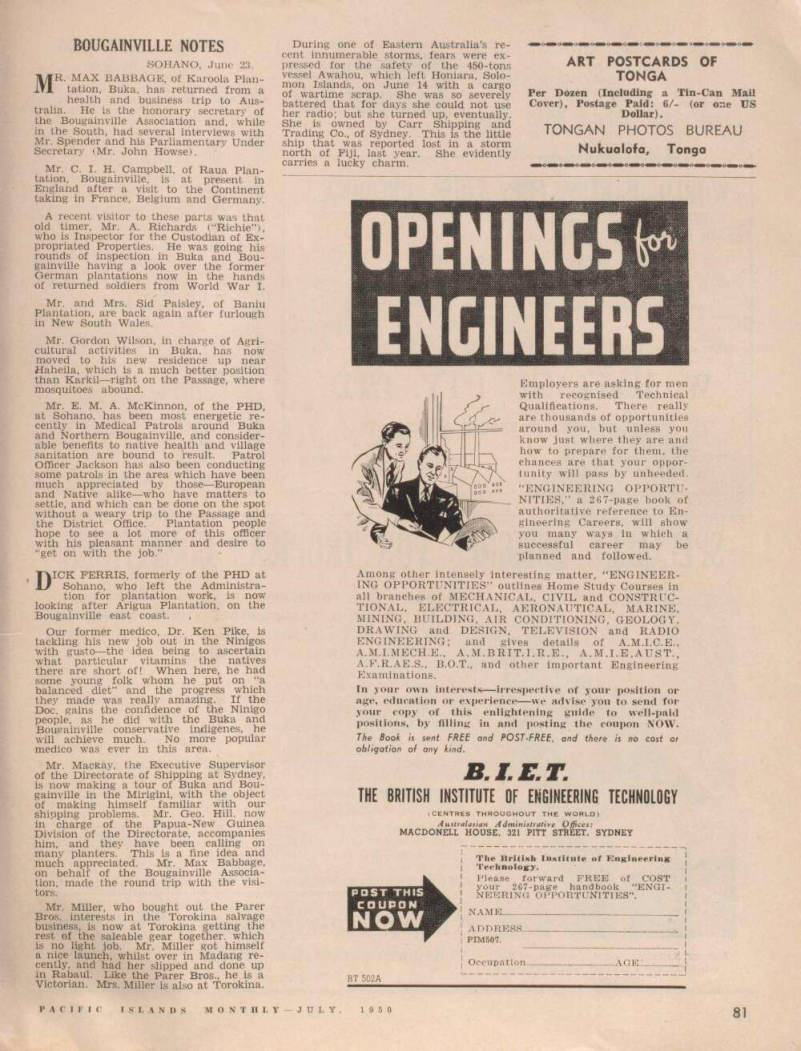
Sohano, June 23.
MR. MAX BABBAGE, of Karoola Plan tation, Buka, has returned from a health and business trip to Aus tralia. He is the honorary secretary of the Bougainville Association and, while in the South, had several interviews with Mr. Spender and his Parliamentary Under Secretary (Mr. John Howse).
Mr. C. I. H. Campbell, of Raua Plan tation, Bougainville, is at present in England after a visit to the Continent taking in France, Belgium and Germany.
A recent visitor to these parts was that old timer, Mr. A. Richards (“Richie”), who is Inspector for the Custodian of Ex propriated Properties. He was going his rounds of inspection in Buka and Bou gainville having a look over the former German plantations now in the hands of returned soldiers from World War I.
Mr. and Mrs. Sid Paisley, of Baniu Plantation, are back again after furlough in New South Wales.
Mr. Gordon Wilson, in charge of Agri cultural activities in Buka, has now moved to his new residence up near Haheila, which is a much better position than Karkil —right on the Passage, where mosquitoes abound.
Mr. E. M. A. McKinnon, of the PHD, at Sohano, has been most energetic re cently in Medical Patrols around Buka and Northern Bougainville, and consider able benefits to native health and village sanitation are bound to result. Patrol Officer Jackson has also been conducting some patrols in the area which have been much appreciated by those—European and Native alike—who have matters to settle, and which can be done on the spot without a weary trip to the Passage and the District Office. Plantation people hope to see a lot more of this officer with his pleasant manner and desire to “get on with the job.”
T\ICK FERRIS, formerly of the PHD at I / Sohano, who left the Administra tion for plantation work, is now looking after Arigua Plantation, on the Bougainville east coast. , Our former medico, Dr. Ken Pike, is tackling his new job out in the Ninigos with gusto—the idea being to ascertain what particular vitamins the natives there are short of! When here, he had some young folk whom he put on “a balanced diet” and the progress which they made was really amazing. If the Doc. gains the confidence of the Ninigo people, as he did with the Buka and Bougainville conservative indigenes, he will achieve much. No more popular medico was ever in this area.
Mr. Mackay, the Executive Supervisor of the Directorate of Shipping at Sydney, is now making a tour of Buka and Bou gainville in the Mirigini, with the object of making himself familiar with our shipping problems. Mr. Geo. Hill, now in charge of the Papua-New Guinea Division of the Directorate, accompanies him, and they have been calling on many planters. This is a fine idea and much appreciated. Mr. Max Babbage, on behalf of the Bougainville Associa tion, made the round trip with the visi tors.
Mr. Miller, who bought out the Parer Bros, interests in the Torokina salvage business, is now at Torokina getting the rest of the saleable gear together, which is no light job. Mr. Miller got himself a nice launch, whilst over in Madang re cently, and had her slipped and done up in Rabaul. Like the Parer Bros., he is a Victorian. Mrs. Miller is also at Torokina.
During one of Eastern Australia’s recent innumerable storms, fears were expressed for the safety of the 450-tons vessel Awahou, which left Honiara, Solomon Islands, on June 14 with a cargo of wartime scrap. She was so severely battered that for days she could not use her radio; but she turned up, eventually.
She is owned by Carr Shipping and Trading Co., of Sydney. This is the little ship that was reported lost in a storm north of Fijfi last year. She evidently
Advertisements & other items, p. 85 (1 item)
Engineers
ART POSTCARDS OF
TONGA
Per Dozen (Including: a Tin-Can Mai!
Cover), Postage Paid: 6/- (or one US Dollar).
TONGAN PHOTOS BUREAU
Nukualofa, Tonga
OPENINGS
ENGINEERS
Employers are asking for men with recognised Technical Qualifications. There really are thousands of opportunities around you, but unless you know just where they are and how to prepare for them, the chances are that your opportunity will pass by unheeded.
“ENGINEERING OPPORTU-
NITIES,’’ a 267-page book of authoritative reference to Engineering Careers, will show you many ways in which a successful career may be planned and followed.
Among other intensely interesting matter, “ENGINEER- ING OPPORTUNITIES” outlines Home Study Courses in all branches of MECHANICAL, CIVIL and CONSTRUC-
TIONAL, ELECTRICAL, AERONAUTICAL, MARINE.
MINING, BUILDING, AIR CONDITIONING, GEOLOGY.
DRAWING and DESIGN, TELEVISION and RADIO
ENGINEERING; and gives details of A.M.1.C.E., A.M.I.MECH.E., A.M.BRIT. 1.R.E., A. M. I. E. AUS T., A.F.R.AE.S., 8.0. T., and other important Engineering Examinations.
In your own interests—irrespective of your position or age, education or experience—we advise you to send for your copy of this enlightening guide to well-paid positions, by filling in and posting the coupon NOW.
The Book is sent FREE and POST-FREE, and there is no cost or obligation of any kind. 8.1.E.T.
THE BRITISH INSTITUTE OF ENGINEERING TECHNOLOGY
(CENTRES THROUGHOUT THE WORLD)
Australasian Administrative Offices:
MACDONELL HOUSE, 321 PITT STREET, SYDNEY
300 o°° poo o°°
BT 502 A
The British Institute of Engineering Technology.
Please forward FREE of COST your 267-page handbook "ENGI-
NEERING OPPORTUNITIES”.
NAME
ADDRESS
P1M507.
Occupation AGE.I
Honours For Lae Citizens
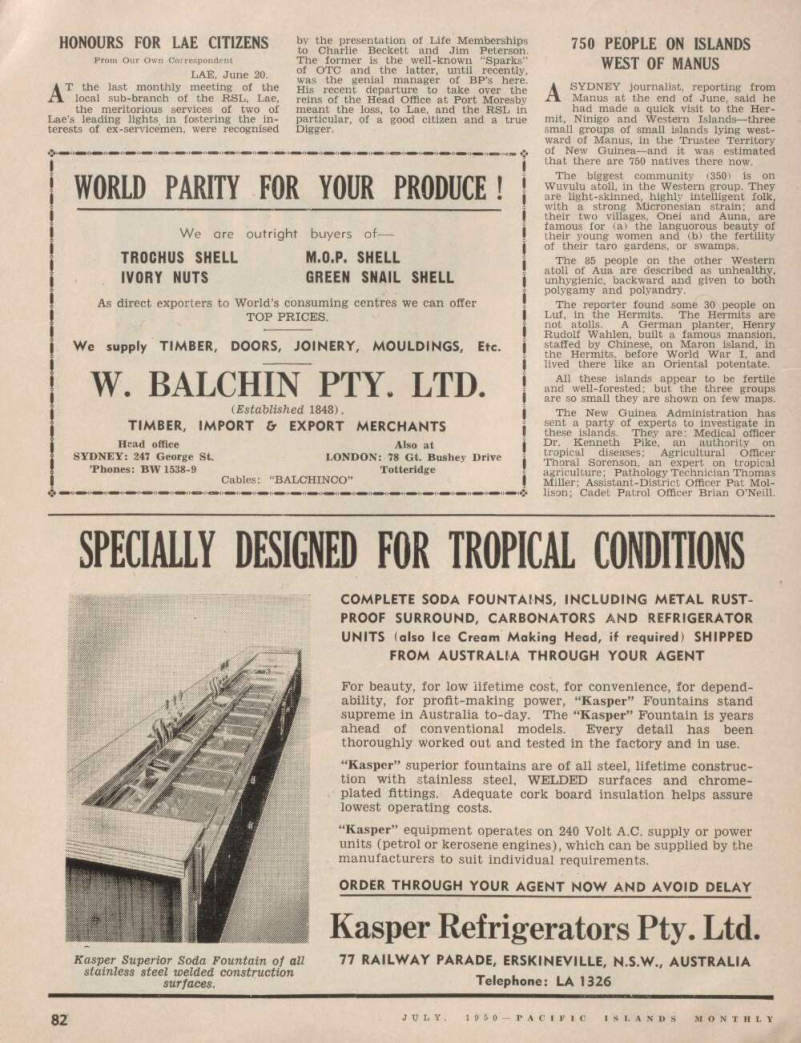
Prom Our Own Correspondent LAE, June 20.
AT the last monthly meeting of the local sub-branch of the RSL, Lae, the meritorious services of two of Lae’s leading lights, in fostering the in terests of ex-servicemen, were recognised
bv the presentation of Life Memberships to Charlie Beckett and Jim Peterson.
The former is the well-known “Sparks” of OTC and the latter, until recently, was the genial manager of BP’s here.
His recent departure to take over the reins of the Head Office at Port Moresby meant the loss, to Lae, and the RSL in particular, of a good citizen and a true Digger.
750 People On Islands
West Of Manus
A SYDNEY journalist, reporting from Manus at the end of June, said he had made a quick visit to the Her mit, Ninigo and Western Islands —three small groups of small islands lying west ward of Manus, in the Trustee Territory of New Guinea—and it was estimated that there are 750 natives there now.
The biggest community (350) is on Wuvulu atoll, in the Western group. They are light-skinned, highly intelligent folk, with a strong Micronesian strain; and their two villages, Onei and Anna, are famous for (a) the languorous beauty of their young women and (b) the fertility of their taro gardens, or swamps.
The 85 people on the other Western atoll of Aua are described as unhealthy, unhygienic, backward and given to both polygamy and polyandry.
The reporter found some 30 people on Luf, in the Hermits. The Hermits are not atolls. A German planter, Henry Rudolf Wahlen, built a famous mansion, staffed by Chinese, on Maron island, in the Hermits, before World War I, and lived there like an Oriental potentate.
All these islands appear to be fertile and well-forested; but the three groups are so small they are shown on few maps.
The New Guinea Administration has sent a party of experts to investigate in these islands. They are: Medical officer Dr. Kenneth Pike, an authority on tropical diseases; Agricultural Officer Thoral Sorenson, an expert on tropical agriculture; Pathology Technician Thomas Miller; Assistant-District Officer Pat Mol lison; Cadet Patrol Officer Brian O’Neill.
Advertisements & other items, p. 86 (2 items)
World Parity For Your Produce!
We are outright buyers of—
TROCHUS SHELL M.O.P. SHELL
IVORY NUTS GREEN SNAIL SHELL
As direct exporters to World’s consuming centres we can offer
TOP PRICES.
We supply TIMBER, DOORS, JOINERY, MOULDINGS, Etc.
W. BALCHIN PTY. LTD.
(.Established 1848).
TIMBER, IMPORT & EXPORT MERCHANTS
Head office Also at SYDNEY: 247 George St. LONDON: 78 Gt. Bushey Drive ’Phones: BW 1538-9 Totteridge Cables: “BALCHINCO”
Specially Designed For Tropical Conditions
illiliil
& / m Kasper Superior Soda Fountain of all stainless steel welded construction surfaces.
COMPLETE SODA FOUNTAINS, INCLUDING METAL RUST-
PROOF SURROUND, CARBONATORS AND REFRIGERATOR
UNITS (also Ice Cream Making Head, if required) SHIPPED
FROM AUSTRALIA THROUGH YOUR AGENT
For beauty, for low lifetime cost, for convenience, for dependability, for profit-making power, “Kasper” Fountains stand supreme in Australia to-day. The “Kasper” Fountain is years ahead of conventional models. Every detail has been thoroughly worked out and tested in the factory and in use.
“Kasper” superior fountains are of all steel, lifetime construction with stainless steel, WELDED surfaces and chromeplated fittings. Adequate cork board insulation helps assure lowest operating costs.
“Kasper” equipment operates on 240 Volt A.C. supply or power units (petrol or kerosene engines), which can be supplied by the manufacturers to suit individual requirements.
ORDER THROUGH YOUR AGENT NOW AND AVOID DELAY
Kasper Refrigerators Pty. Ltd.
77 RAILWAY PARADE, ERSKINEVILLE, N.S.W., AUSTRALIA
Telephone: LA 1326
Polynesians
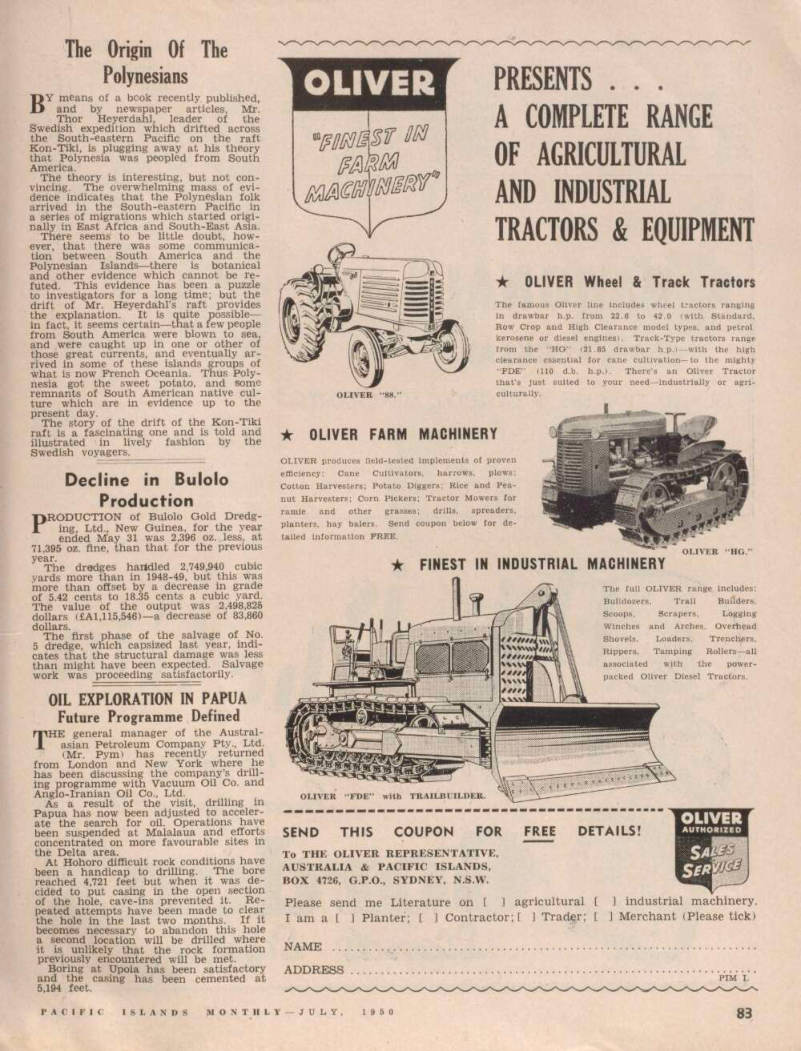
The Origin Of The Polynesians
BY means of a book recently published, and by newspaper articles, Mr.
Thor Heyerdahl, leader of the Swedish expedition which drifted across the South-eastern Pacific on the raft Kon-Tiki, is plugging away at his theory that Polynesia was peopled from South America.
The theory is interesting, but not con vincing. The overwhelming mass of evi dence indicates that the Polynesian folk arrived in the South-eastern Pacific in a series of migrations which started origi nally in East Africa and South-East Asia.
There seems to be little doubt, how ever, that there was some communica tion between South America and the Polynesian Islands —there is botanical and other evidence which cannot be re futed. This evidence has been a puzzle to investigators for a long time; but the drift of Mr. Heyerdahl’s raft provides the explanation. It is quite possible— in fact, it seems certain —that a few people from South America were blown to sea, and were caught up in one or other of those great currents, and eventually ar rived in some of these islands groups of what is now French Oceania. Thus Poly nesia got the sweet potato, and some remnants of South American native cul ture which are in evidence up to the present day.
The story of the drift of the Kon-Tiki raft is a fascinating one and is told and illustrated in lively fashion by the Swedish voyagers.
Production
Decline in Bulolo Production
PRODUCTION of Bulolo Gold Dredg ing, Ltd., New Guinea, for the year ended May 31 was 2,396 oz. less, at 71,395 oz. fine, than that for the previous year.
The dredges haridled 2,749,940 cubic yards more than in 1948-49, but this was more than offset by a decrease in grade of 5.42 cents to 18.35 cents a cubic yard.
The value of the output was 2,498,825 dollars (£A1,115,546)—a decrease of 83,860 dollars.
The first phase of the salvage of No. 5 dredge, which capsized last year, indi cates that the structural damage was less than might have been expected. Salvage work was proceeding satisfactorily.
Oil Exploration In Papua
Future Programme Defined
THE general manager of the Austral asian Petroleum Company Pty., Ltd. (Mr. Pym) has recently returned from London and New York where he has been discussing the company’s drill ing programme with Vacuum Oil Co. and Anglo-Iranian Oil Co., Ltd.
As a result of the visit, drilling in Papua has now been adjusted to acceler ate the search for oil. Operations have been suspended at Malalaua and efforts concentrated on more favourable sites in fV\p 'Hplfp orpa At Hohoro difficult rock conditions have been a handicap to drilling. The bore reached 4,721 feet but when it was de cided to put casing in the open section of the hole, cave-ins prevented it. Re peated attempts have been made to clear the hole in the last two months. If it becomes necessary to abandon this hole a second location will be drilled where it is unlikely that the rock formation previously encountered will be met.
Boring at Upoia has been satisfactory and the casing has been cemented at 5,194 feet.
Tahiti Sports Club Gives Ball
r ON April 29 the Sport Club of Tahiti held their annual ball at the City Hall of Papeete. The function was attended by His Excellency Governor Anziani accompanied by numerous government officials.
Many parties of local celebrities assembled at the beautifully decorated special tables reserved for their entertainment.
m Mr i o ßob £ rt Warre f Br ® wn > son °f Mr.
Charles Brown, of Uturoa, Raiatea, French Oceania, has announced his en gagement to Miss Polly Simone Barn bridge, daughter of Mr. and Mrs. Tommj Bambridge, of Papeete.
Mr . w F Hayward, OBE, Postmaster- General in Fiji, left Suva this month for England, on long leave prior to retire ment. Pending the arrival of Mr. J. A.
Marais to take up the position, Mr. L.
C. P. M. Grant, OBE, is acting as PMG.
Advertisements & other items, p. 87 (1 item)
Oliver
*I?BNSiT DM
N
gjitu
OLIVER “88.”
PRESENTS . . .
A COMPLETE RANGE
OF AGRICULTURAL
AND INDUSTRIAL
TRACTORS & EQUIPMENT
★ OLIVER Wheel & Track Tractors
The famous Oliver line Includes wheel tractors ranging in drawbar h.p. from 22.6 to 42.0 (with Standard.
Row Crop and High Clearance model types, and petrol kerosene or diesel engines). Track-Type tractors range from the “HG” (21.85 drawbar h.p.)—with the high clearance essential for cane cultivation—to the mighty “FDE” (110 d.b. h.p.). There’s an Oliver Tractor that’s just suited to your need —industrially or agriculturally.
* OLIVER FARM MACHINERY
OLIVER produces field-tested implements of proven efficiency: Cane Cultivators, harrows, plows; Cotton Harvesters: Potato Diggers; Rice and Peanut Harvesters; Corn Pickers: Tractor Mowers for ramie and other grasses; drills, spreaders, planters, hay balers. Send coupon below for detailed information FREE.
OLIVER “HO.”
★ FINEST IN INDUSTRIAL MACHINERY
f/W'/Aw
/S///ikX,
///« ///II % The full OLIVER range includes; Bulldozers, Trail Builders, Scoops, Scrapers, Logging Winches and Arches, Overhead Shovels, Loaders, Trenchers, Rippers, Tamping Rollers—all associated with the powerpacked Oliver Diesel Tractors.
OLIVER “FDE” with TRAILBUILDER
SEND THIS COUPON FOR FREE
To THE OLIVER REPRESENTATIVE,
AUSTRALIA & PACIFIC ISLANDS,
BOX 4726, G.P.0., SYDNEY, N.S.W.
DETAILS!
OLIVER
AUTHORIZED
Please send me Literature on [ ] agricultural [ ] industrial machinery.
I am a t ] Planter; [ ] Contractor; [ ] Trader; [ ] Merchant (Please tick)
NAME
ADDRESS
PIM I.
Mangaians Farewell
H. H. Hickling
From Our Own Correspondent MANGAIA, Cl, April.
MR. and MRS H. H. HICKLING, who have been in charge of local schools since 1947, when they returned to this island after a term at Aitutaki (where Mr. Hickling was Resident Agent during the war years), have again left Mangaia, this time for an appointment at Ngatangiia, in Rarotonga.
An unusually large farewell feast was given in their honour by the teachers and pupils of the Tuviriviri School, in the cliff-village, to express the esteem in which both are held in that district.
Mr. Hickling was originally Resident Agent of Mangaia, as well as headmaster of the island’s schools, having taken up that post in 1938. His transfer in 1941 to Aitutaki left the schools without Euro pean supervision for no less than six years; now that he has again been moved by the Education Department, there is little likelihood of the local schools hav ing another white teacher at their head— Mangaia is not a post that appeals, it would appear, to the average NZ educa tor, with the result that the standard of English, etc., on this island is notice ably lower than that of Rarotonga and Aitutaki.
The grandchild of the Rev. and Mrs.
A. D. Lelean was christened recently in Victoria from a christening cup that was used for the christening of John Wesley, an ancestor of the Lelean family. The cup, which has been in the family since 1752, is of gold lustre, with blue outside and symbolic figuring. Mr. Lelean, who formerly served the Church in Fiji, is now minister of the Mount Pleasant Church, in Ballarat (Vic.).
Advertisements & other items, p. 88 (2 items)
A. B. Donald Ltd.
AUCKLAND
ISLAND TRADERS & GENERAL MERCHANTS
>l' P.O. Box 1509. Cables & Telegrams, "Kingdom," Auckland.
Gordon's
OISTItUBw
I 0° 0$ M 3 m m 6.® By Appointment Gin Distillers to H.M. King George VI Tanqueray, Gordon & Co. Ltd.
* ot*xr7n^eiSt4i&e
Gordon's
St&ncfa Supk&mz
Suva Wedding Of Chinese Couple
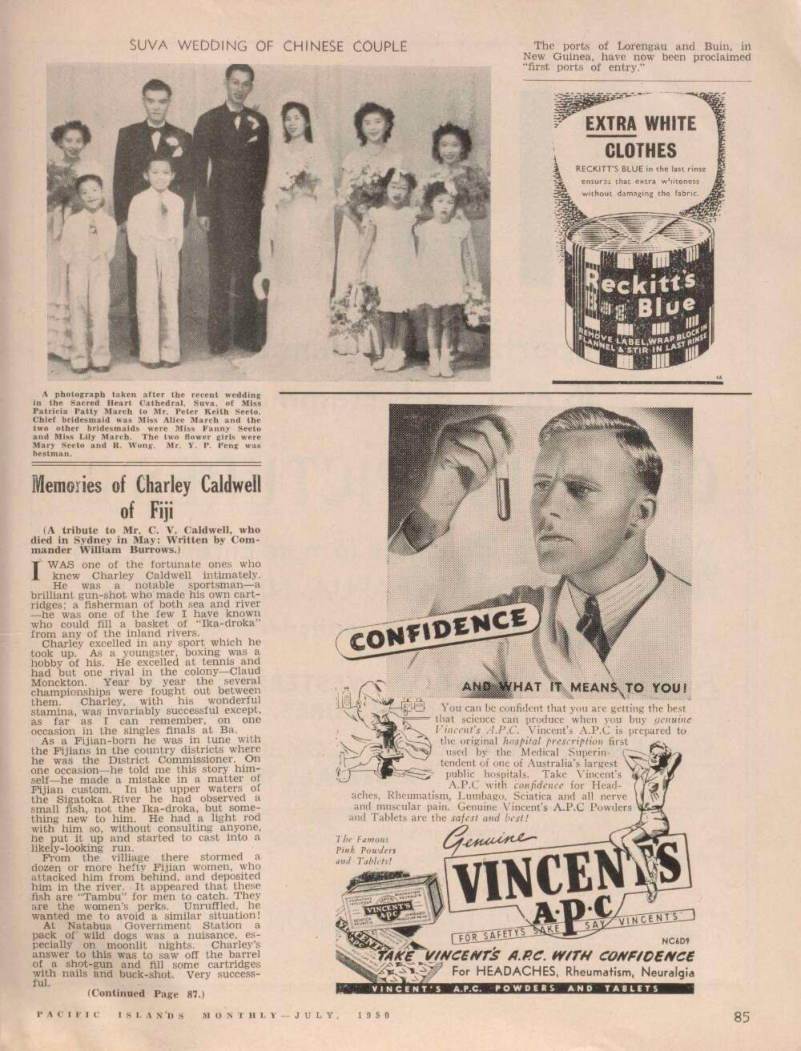
The ports of Lorehgau and Buin, in New Guinea, have now been proclaimed “first ports of entry.”
A photograph taken after the recent wedding in the Sacred Heart Cathedral, Suva, of Miss Patricia Patty March to Mr. Peter Keith Seeto.
Chief bridesmaid was Miss Alice March and the two other bridesmaids were Miss Fanny Seeto and Miss Lily March. The two flower girls were Mary Seeto and R. Wong. Mr. Y. P. Peng was bestman.
of Fiji

Memories of Charley Caldwell of Fiji
(A tribute to Mr. C. V. Caldwell, who died in Sydney in May: Written by Com mander William Burrows.) IWAS one of the fortunate ones who knew Charley Caldwell intimately.
He was a notable sportsman—a brilliant gun-shot who made his own cart ridges: a fisherman of both sea and river —he was one of the few I have known who could fill a basket of “Ika-droka” from any of the inland rivers.
Charley excelled in any sport which he took up. As a youngster, boxing was a hobby of his. He excelled at tennis and had but one rival in the colony—Claud Monckton. Year by year the several championships were fought out between them. Charley, with his wonderful stamina, was invariably successful except, as far as I can remember, on one occasion in the singles finals at Ba.
As a Fijian-born he was in tune with the Fijians in the country districts where he was the District Commissioner. On one occasion—he told me this story him self—he made a mistake in a matter of Fijian custom. In the upper waters of the Sigatoka River he had observed a small fish, not the Ika-droka, but some thing new to him. He had a light rod with him so, without consulting anyone, he put it up and started to cast into a likely-looking run.
From the villiage there stormed a dozen or more hefty Fijian women, who attacked him from behind, and deposited him in the river. It appeared that these fish are “Tambu” for men to catch. They are the women’s perks. Unruffled, he wanted me to avoid a similar situation!
At Natabua Government Station a pack of' wild dogs was a nuisance, es pecially on moonlit nights. Charley’s answer to this was to saw off the barrel of a shot-gun and fill some cartridges with nails and buck-shot. Very success ful.
(Continued Page 87.)
In the days when Suva had its clay pigeon club, Charley was stationed in Vanua Levu where he heard that several professional gun-shots were coming up from New Zealand to try conclusions with the locals. It was difficult for him to find an excuse to visit the capital, until he remembered a couple of back teeth which required attention. His application to come to Suva for dental treatment was approved. Need I add that he wiped the eye of the professionals, and made enough in stake-money to pay for passage and dentist.
On his retirement in 1942 Charley settled in New South Wales, and became the Secretary of the Gosford Golf Club.
A sportsman to the last.
Advertisements & other items, pp. 89-90 (2 items)
85
PACIFIC ISI.AN'DS MONTHLY JULY, 1950
Vince
CLOTHES
RECKIfT S BLUE in the last rinse ensures that extra whiteness without damaging the fabric as# 35 P nn
eckiti*
mi
wwa* wo*
V6 ''Xn 111!
frtSSce
CON
HAT YOU!
You can be confident that you are getting the best that science can produce when you buy genuine Vincent’s A.P.C. Vincent’s A.P.C is prepared to the original hospital prescription first s used by the Medical Superintendent of one of Australia’s largest public hospitals. Take Vincent’s A.P.C with confidence for Headaches, Rheumatism, Lumbago, Sciatica and all nerve and muscular pain. Genuine Vincent’s A.P.C Powders and Tablets are the safest and best!
The Famous Pink Powders and Tablets!
VINCE
CENJX
FOR
IaHSS
NCAD9
VfNCßfi/rS A.P.C. W/TH CONP/DBHCB
For HEADACHES, Rheumatism, Neuralgia
POWDERS AND TABLETS
An Important Announcement on
16 m.m. Entertainment I
COLUMBIA PICTURES IS
Will soon have Columbia 16 m.m. Entertainment
Films Available tor PAPUA-NEW GUINEA
and Adjacent Territories
Features:- COWBOY WESTERNS. MUSICALS.
ACTION PICTURES. TECHNICOLOR.
Short Subjects: CARTOONS. COMEDIES. COWBOY
SERIALS, Etc.
For further particulars apply as under — Cables: “COLUMFILM.”
Columbia Pictures Pty., Ltd., 251 a Pitt Street, Sydney.
Tele. MJ 4624.
Columbia Pictures Pty., Ltd., Columbia House, 266-270 Queen Street, Melbourne.
Tele. M 1528.
Columbia Pictures Pty., Ltd., 447 Murray Street, Perth.
Tele. B 6355.
Columbia Pictures Pty., Ltd., Shell House, Ann Street, Brisbane.
Tele. B 1781.
Columbia Pictures Pty., Ltd., Richards Buildings, Currie Street, Adelaide.
Tele. Cent. 2223.
AGENTS:
Educational Sound Films, Ltd., Southern Cross Building, Brandon Street, Wellington, New Zealand.
Hunts Agency, Bank N.S.W. Building, Victoria Parade, Suva, Fiji.
Troghus Goods Industry
Suggested For Levuka
From Our Own Correspondent SUVA, June 12.
WITH trochus at £7O a ton at Suva and 360 dollars a ton in America, Captain H. M. Pfewen, of Suva, has suggested to the Government of Fiji that consideration be given to the estab lishment of an industry to turn out the finished products (mainly perforated shell discs for buttons and finely-ground powder for use in the manufacture of cosmetics) instead of exporting the raw material and then importing it after it has been processed.
In the letter to the Colonial Secretary, Captain Frewen suggests that such an industry could be started at a centre like Levuka, where sites are available and where there are large numbers of girls constantly seeking whole-time or part time employment.
Tb Problem In South Pacific
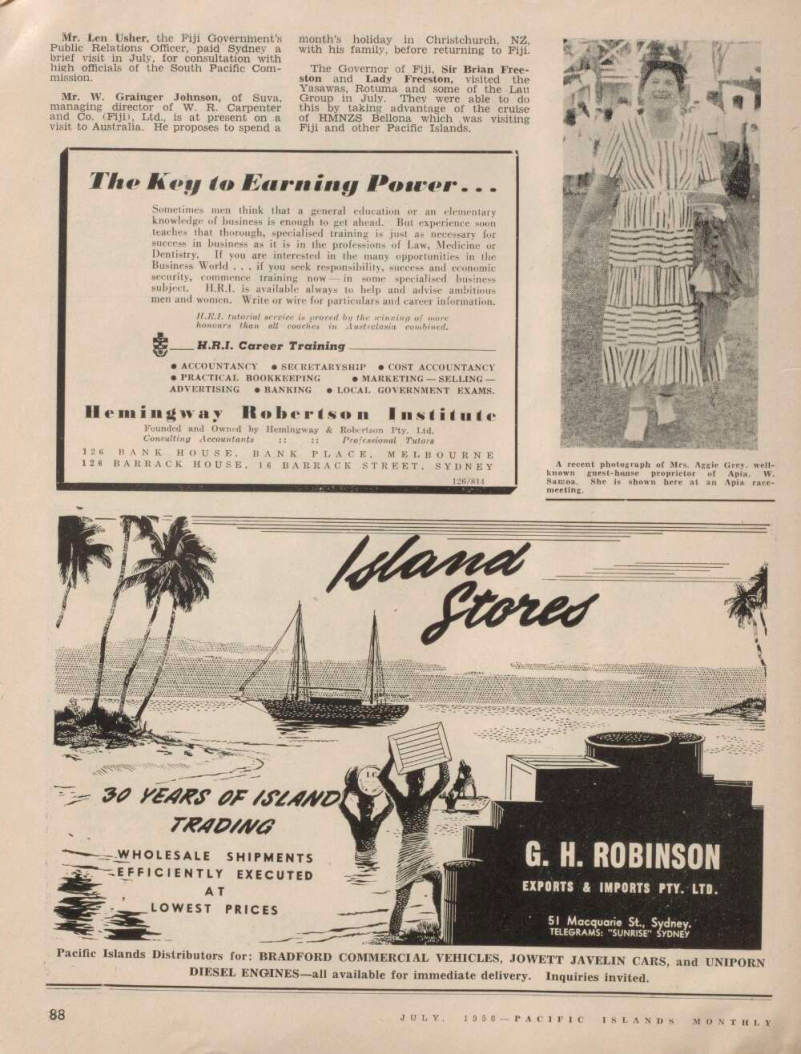
From Our Brisbane Correspondent DOCTOR E. A. North of the Common wealth Serum Laboratories and Dr.
T. Jamieson of the Health Depart ment, Papua and New Guinea, recently addressed the Medical Congress in Bris bane on TB immunisation.
They said that in New Guinea coastal areas, tuberculosis had long been a men ace, and to check its spread, a mass BCG immunisation scheme was started in De cember, 1949. Results, they said, had been satisfactory. (Bacillua Calmette- Guerin (BCG) is innoculation with living organisms, which do not possess suffici ent virulence to produce ill effects, but stimulate the body to raise its defensive mechanism against invasion by the more harmful tubercule bacillus).
The incidence of TB the speakers said, among most of the indigent people of the South Pacific was difficult to assess. What
was known of it was disquieting.
The people referred to in the address included Australian aborigines, and natives of New Guinea, the Solomons, New Hebrides, New Caledonia, Gilbert and Ellis Islands, New Zealand, Fiji, Samoa, and Tahiti.
Dr. E. Massal, health member of the South Pacific Commission’s research council, considered TB a major health problem throughout the area. He pro poses to conduct epidemiological surveys in the different countries when data is collected and to organise research into methods for controlling the disease.
Two Papuan companies, Milne Bay Traders, Ltd., and Loma Rubber Estates, Ltd., are in liquidation—the former be cause the shareholders decided to wind up voluntarily, and the latter because “it cannot by reason of its liabilities, con tinue its business.”
Mr. Len Usher, the Fiji Government’s Public Relations Officer, paid Sydney a brief visit in July, for consultation with high officials of the South Pacific Commission.
Mr. W. Grainger Johnson, of Suva, managing director of W. R. Carpenter and Co. (Fiji), Ltd., is at present on a visit to Australia. He proposes to spend a
month’s holiday in Christchurch, NZ, with his family, before returning to Fiji, The Governor of Fiji, Sir Brian Free ston and Lady Freeston, visited the Yasawas, Rotuma and some of the Lau Group in July. Thev were able to do this by taking advantage of the cruise of HMNZS Bellona which was visiting- Fiji and other Pacific Islands.
A recent photograph of Mrs. Aggie Grey, well known guest-hause proprietor of Apia, W.
Samoa. She is shown here at an Apia race meeting.
Advertisements & other items, pp. 91-92 (1 item)
TMasse
FOR SALE
LOCOMOTIVES.—2 ft., 3 ft., and 3 ft. 6 in. gauge. Steam and I.C.
FLAT TRUCKS.—Bogie type, 12 and 16 ton . . . 30 lb. rails.
FELTON WHEELS AND HYDRO-ELECTRIC PLANTS—TURBINE PUMPS
—4 in., 6 stage—4,ooo ft., 3 in. and 4 in. H.P. CAST IRON PIPE.
MINING BATTERIES—STEAM ENGINES—BOILERS, ETC.
William F. Wilson & Son
Engineers—Contractors—The Problem-Work Specialists
P.O. BOX 5078 AA, MELBOURNE, VICTORIA.
Cable and Telegraphic Address: “WILFORBSON,” Melbourne.
MINING—SALVAGE—CONSTRUCTION—NEW AND SECOND-HAND MACHINERY.
r*w - C n a □ ss %
TMasse
BATTERIES
“are tigers for work
?9 It is impossible to build a better battery than the Masse. Every part of a Masse Battery is of one hundred per cent, quality . . . every stage of its manufacture is carried out in the Masse factory. When you recommend a Masse Battery to your customer, you can do so, with the utmost confidence that it will give him more starts and longer service.
ROBERT GILLESPIE ZZ. LTD.
RABAUL AND LAE
The Kvy tip Hu rainy ...
Sometimes men think I hat a general education or an elementary knowledge of business is enough to get ahead. But experience soon teaches that thorough, specialised training is just as necessary for success in business as it is in the professions of Law, Medicine or Dentistry. If you are interested in the many opportunities in the Business World ... if you seek responsibility, success and economic security, commence training now —in some specialised business subject. H.R.I. is available always to help and advise ambitious men and women. Write or wire for particulars and career information.
H.R.I, tutorial service is proved by the i finning of more honours than all coaches in Australasia, combined.
S H.R.I. Career Training
• ACCOUNTANCY • SECRETARYSHIP • COST ACCOUNTANCY
• PRACTICAL BOOKKEEPING • MARKETING SELLING
ADVERTISING • BANKING • LOCAL GOVERNMENT EXAMS.
Hemingway Robertson Institute
Founded and Owned by Hemingway & Robertson Pty. Ltd.
Consulting Accountants ;; Professional Tutors
126 BANK HOUSE. BANK PLACE, MELBOURNE
126 BARRACK HOUSE, 16 BARRACK STREET, SYDNEY 126/814
m rlvi 30 0f
r*jp//va
SHIPMENTS
EXECUTED
A T
LOWEST PRICES
G. H. ROBINSON
EXPORTS & IMPORTS PTY. LTD.
51 Macquarie St., Sydney.
TELEGRAMS: "SUNRISE" SYDNEY
Pacific Islands Distributors for: BRADFORD COMMERCIAL VEHICLES, JOWETT JAVELIN CARS, and UNIPORN DIESEL ENGINES—aII available for immediate delivery. Inquiries invited.
Flying-Boat Passengers
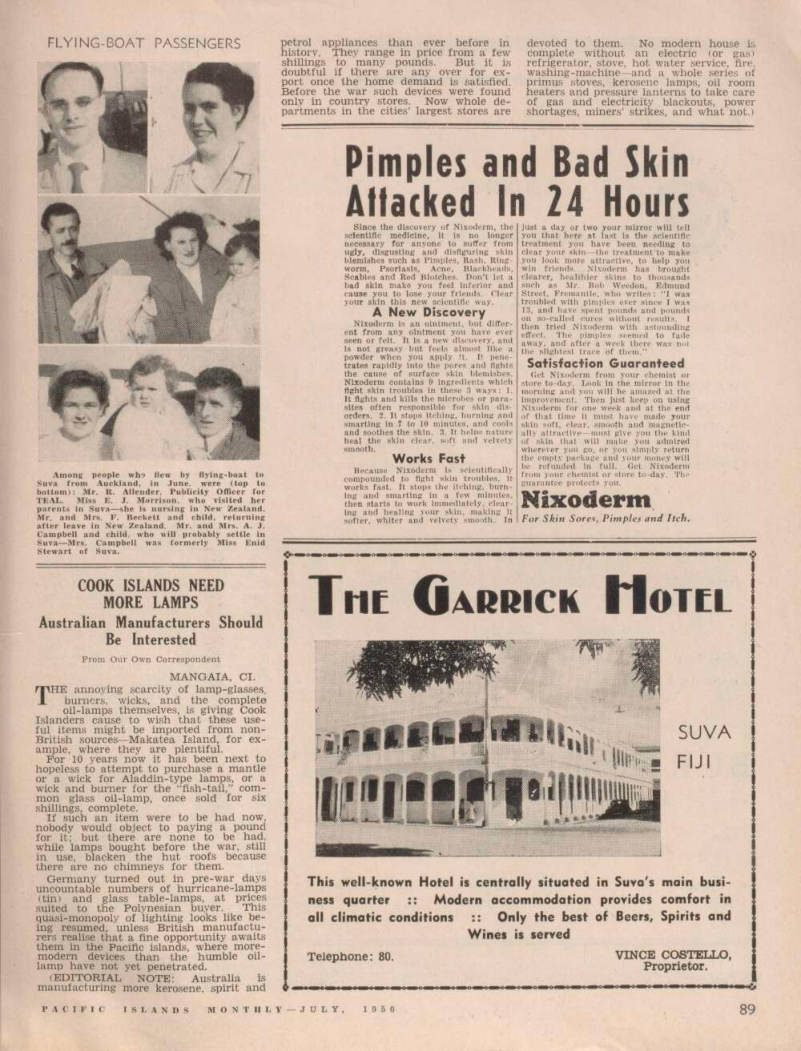
Among people who flew by flying-boat to Suva from Auckland, in June, were (top to bottom): Mr. B. Allender, Publicity Officer for TEAL. Miss E. J. Morrison, who visited her parents in Suva—she is nursing in New Zealand.
Mr. and Mrs. F. Beckett and child, returning after leave in New Zealand. Mr. and Mrs. A. J.
Campbell and child, who will probably settle in Suva —Mrs. Campbell was formerly Miss Enid Stewart of Suva.
More Lamps
Cook Islands Need
Australian Manufacturers Should Be Interested
Prom Our Own Correspondent
Mangaia, Cl.
THE annoying scarcity of lamp-glasses, burners, wicks, and the complete oil-lamps themselves, is giving Cook Islanders cause to wish that these use ful items might be imported from non- British sources —Makatea Island, for ex ample, where they are plentiful.
For 10 years now it has been next to hopeless to attempt to purchase a mantle or a wick for Aladdin-type lamps, or a wick and burner for the “fish-tail,” com mon glass oil-lamp, once sold for six shillings, complete.
If such an item were to be had now, nobody would object to paying a pound for it; but there are none to be had. while lamps bought before the war, still in use, blacken the hut roofs because there are no chimneys for them.
Germany turned out in pre-war days uncountable numbers of hurricane-lamps (tin) and glass table-lamps, at prices suited to the Polynesian buyer. This quasi-monopoly of lighting looks like be ing resumed, unless British manufactu rers realise that a fine opportunity awaits them in the Pacific islands, where more modern devices than the humble oil lamp have not yet penetrated. (EDITORIAL NOTE: Australia is manufacturing more kerosene, spirit and
petrol appliances than ever before in historv. They range in price from a few shillings to many pounds. But it is doubtful if there are any over for export once the home demand is satisfied, Before the war such devices were found only in country stores. Now whole departments in the cities’ largest stores are
devoted to them. No modern house is complete without an electric (or gas) refrigerator, stove, hot water service, fire, washing-machine—and a whole series of primus stoves, kerosene lamps, oil room heaters and pressure lanterns to take care of gas and electricity blackouts, power shortages, miners’ strikes, and what not.)
Advertisements & other items, pp. 93-94 (1 item)
The Garrick Hotel
Pimples and Bad Skin
Attacked In 24 Hours
Since the discovery of Nixoderm, the scientific medicine, it is no longer necessary for anyone to suffer from ugly, disgusting and disfiguring skin blemishes such as Pimples, Rash, Ringworm, Psoriasis, Acne, Blackheads, Scabies and Red Blotches. Don’t let a bad skin make you feel inferior and cause you to lose your friends. Clear your skin this new scientific way.
A New Discovery
Nixoderm is an ointment, but different from any ointment you have ever seen or felt. It is a new discovery, and is not greasy but feels almost like a powder when you apply it. It penetrates rapidly into the pores and fights the cause of surface skin blemishes.
Nixoderm contains 9 ingredients which fight skin troubles in these 3 ways : 1.
It fights and kills the microbes or parasites often responsible for skin disorders. 2. It stops itching, burning and smarting in 7 to 10 minutes, and cools and soothes the skin. 3. It helps nature heal the skin clear, soft and velvety smooth.
Works Fast
Because Nixoderm is scientifically compounded to fight skin troubles, it works fast. It stops the itching, burning and smarting in a few minutes, then starts to work Immediately, clearing and healing your skin, making it softer, whiter and velvety smooth. In just a day or two your mirror will tell you that here at last is the scientific treatment you have been needing to clear your, skin—the treatment to make .you look more attractive, to help you win friends. Nixoderm has brought clearer, healthier skins to thousands such as Mr. Bob Weedon, Edmund Street, Fremantle, who writes: “I was troubled with pimples ever since I was 13, and have spent pounds and pounds on so-called cures without results. I then tried Nixoderm with astounding effect. 'Hie pimples seemed to fade away, and after a week there was not the slightest trace of them.”
Satisfaction Guaranteed
Get Nixoderm from your chemist or store to-day. Look in the mirror in the morning and you will be amazed at the improvement. Then just keep on using Nixoderm for one week and at the end of that time it must have made your skin soft, clear, smooth and magnetically attractive —must give you the kind of skin that will make you admired wherever you go, or you simply return the empty package and your money will be refunded in full. Get Nixoderm from your chemist or store to-day. The guarantee protects you.
Nixoderm
For Skin Sore*, Pimples and Itch.
The Garrick Hotel
T*3 nu k m-P *JS- '• * •"WuWW'f a®
SUVA
FIJI
This well-known Hotel is centrally situated in Suva's main business quarter :: Modern accommodation provides comfort in all climatic conditions :: Only the best of Beers, Spirits and Wines is served Telephone: 80. VINCE COSTELLO, Proprietor.
Executor - Trustee - Attorney
'THAT
your best friend
An inexperienced, overworked private executor quickly gets out to the estate is greatly increased. Yet the fault really lies with the well-meaning person who made an unwise choice. Fortunately, it is a simple matter to transfer all responsibility to Burns Philp Trust Company Limited. By appointing this Company as your executor or trustee in the first place, you avoid placing a trusted friend in a most difficult position. More important still, your beneficiaries are permanently safeguarded from the hazards of inexperienced Full particulars of the Company’s many services are given in “Hands That Never Leave the Wheel.” A complimentary copy of this 20-page booklet can be obtained from any branch of Burns Philp (South Sea) Company, Burns Philp (New Guinea) Limited, or direct from the head office of this Company.
BURNS PHILP TRUST
of his depth. When he is remote from sound advice, the danger administration.
DIRECTORS:
James Burns Joseph Mitchell MANAGER: L. S. Parker P. T. W. Black Eric Priestley Lee
SECRETARY: E. R. Overton, F.F.I.A.
COMPANY LIMITED
Constituted by Special Act of the N.S.W. Parliament
Head Office: 7 BRIDGE STREET, SYDNEY
TEL BU 5901
BOX 543, G.P.O,
BP6-50
New Ireland
Freighter On and Off the Reef
Prom Our Own Correspondent
Kavieng, July 1.
PERCHED with her bows high and dry, the Burns Philp 250-ton freighter, Kokoda, ran on a reef and remained there for two days, until a high tide and the gallant little 40-footer, MV Sepik, got her off. The accident occurred on the eastern side of Steffen Strait, about two miles inside the southern entrance, not far from Selapui. District Officer I.
F. G. Downs, former RAN officer, went out to the scene of the accident, and his experience, advice and assistance were invaluable. The Sepik towed the Kokoda to Kavieng Wharf. Only slight damage was done.
’ New Club Is Opened
AFTER many vicissitudes, Kavieng Club (1949), was officialy opened on June 29. Mr. lan F. G. Downs, District Officer, was re-elected president for the ensuing year. The bar was crowded by local residents and visitors from far afield; and dancing took place until the early hours of the morning.
Much building and improvement remains to be done, but now that the club is actually functioning, with an assured in come, it should not be long before it re gains some of the prestige of its popu lar pre-war rival.
The engagement is announced of Miss Patricia Audrey Stanfield, eldest daughter of Mr. and Mrs. E. A. F. Stan field. of Bolegila Plantation. near Kavieng, to Mr. Peter Ross Kennedy Murray, of Perth. WA. Mr. Murray is a plantation manager, and Miss Stanfield is a member of one of the oldest and best-respected families in New Ireland.
Pasinganlos, an Enuk Islander, near Kavieng, dived a second time from a canoe to spear fish and was seen no more. Some time later, two other natives dived for him and found his head severed from his shoulders and indica tions pointed to his having been attacked bv a shark. Enuk Islanders are now at tempting to catch the man-eater.
The engagement is announced of two popular members of our Chinese Younger Set—Mr. Seeto Aid Kwong and Miss Seeto Linheung. Joe Seeto was our local postmaster. He is a son of one of New Guinea’s most wealthy Chinese residents.
Miss Seeto is the attractive sister of Nurse Francis Seeto, who has done fine work at our Asiatic Hospital.
Baseball will soon be a popular sport among our local natives, and they are also going to take up Soccer seriously by marking out the ground correctly and adhering strictly to the rules of the Foot ball Association (Sepiks v. Markhams barred!) Their Club House has many amenities, and is also open to all re ligions for Divine Service. But what we reallv need is a keen young anthropolo gist interested in the Boy Scout Move ment. There would be no dearth of native recruits if shorts, shirts, scdut knives, belts, billy-cans, etc., were sup plied; and, when one’s personal servant ran away or got “kalabus” for drinking “metho.” or playing cards, there would be myriads of ebony devotees of BP (Baden- Powell) only too ready to hop in and do a good turn for the unhappy “master'’!
An Australian tourist back from Noumea advises against going to New Caledonia. The French do not want tourists he says. He quotes Noumea hotel rates as £2B per week.
American Club Formed
In Tahiti
From Our Own Correspondent
Papeete, June 10
ON May 9, prominent businessmen of Papeete, inaugurated the American Club of Tahiti. The need for such an organisation, to form a rallying point for American nationals, has long been recog nised and discussed. Prime mover on the present occasion—and, indeed, founder of the Club—was Mr. Alexander Taran, landowner and exporter, who was elected President. Other officials appointed were Captain C. A. Williams (owner of the yacht Seaward) vice-president; and Messrs M. D. Shields and A. L. Bougerie, secretary and treasurer respectively.
Eligible for membership in the Club are all US Citizens and their spouses.
It is not intended that the Club shall develop into a social organisation but that it shall afford opportunity for camaraderie among its members. A Plan ning Committee was appointed to make Independence Day, July 4, the occasion for a grand Annual picnic for the Club.
Among those who helped to inaugurate the Club are Mr. and Mrs. Dave Cave, Mr. and Mrs. Brooks, Mr. and Mrs.
Schultz, and Messrs. John Farnham, Edgar Leeteg, G. DeFlesselle, C. Might, Ed. Norman, W. McCall, I. Allen, R.
White, Mike Fogle, Max Dupont, J. M.
Clemens, Oscar G. Nordman, L. G. Black man, Reg. Chambers, A. Morgan, Murray Gilderbloom. ♦ * ♦ On June 2, Mr. Oscar Nordman was introduced to a brand-new grandson, Oscar Georges Heiaroha Nordman, son
of Mr. and Mrs. Milton Nordman. At the grand tamaaraa, or native feast, held in honour of the event, Mr. S. Durkin, of Sydney was announced as godfather of the infant, and Mrs. Eliza Persegaele, of Papeete, godmother. * • • It is officially announced that the Administration has been notified tele graphically of the intention of the Compagnie Air France to inaugurate a monthly air service to Tahiti by D.C. 4 plane, landing at Bora Bora on July 18.
The information has been received with satisfaction by the business com
munity. Our long isolation from a frequent mail service has been a source of embarrassment and loss. * * * Mr. Ernest Marchal, for many years in the employ of The Banque De LTndo- Chine, at Papeete, passed away after a long illness. He is survived by his wife and family. ♦ * ♦ The Waihemo arrived in Papeete on May 31, bringing a Perris Wheel and Merry-go-round, to be erected in the new Amusement Park in Papeete, under the direction of Mr. Oscar Nordman.
Advertisements & other items, p. 95 (1 item)
Mendaco
Asthma, Bronchitis, Coughing
Curbed
Do you have attacks of Asthma or Bronchitis so bad that you can’t sleep?
Do you feel weak, unable to work, and have to be careful not to take cold and can’t eat certain foods?
No matter how long you have suffered or what you have tried, there is new hope for you in a famous prescription called Mendaco. No dopes, no smokes, no injections, no atomiser.
All you do is take two tasteless tablets at meals and in three minutes Mendaco starts working through your blood, aiding nature to remove phlegm, promote free, easy breathing and bring sound sleep the first night so that you soon feel years younger and stronger.
No Asthma in 2 Years Mendaco not only brings almost immediate comfort and free breathing, but builds up the system to ward off future attacks. For instance, J.
Richard, Hamilton, Ont., Canada, had lost 40 lbs., suffered coughing every
Quickly
night, couldn’t sleep. Mendaco stopped Asthma spasms first night and he has had none since in over two years.
Money Back Guarantee The very first dose of Mendaco goes right to work circulating through your blood and helping nature relieve you of the effects of Asthma. Try Mendaco under an iron-clad money back guarantee. You be the judge. If you don’t feel fully satisfied after taking Mendaco just return the empty package and the full purchase price will be refunded. Get Mendaco from your chemist to-day and see how well you sleep to-night and how much better you will feel to-morrow. The guarantee protects you.
Mendaco
& OV Wholesale and Retail Merchants. Shipowners. Sawmillers.
General Engineers. Customs and Shipping Agents.
Catering for all Plantation Supplies. Buyers of Island Produce.
Plantation Owners and Managing Agents.
Agents for:— Australia-West Pacific Line.
Canton Insurance Office, Ltd.
Union Assurance Society, Ltd.
Aust. T. & G. Mutual Life Society, Ltd.
Guinea Air Traders, Ltd.
Distributing Agents in New Guinea for:— Hillman, Humber, Sunbeam-. Talbo t, Chrysler and Plymouth Cars.
Commer, Karrier and Fargo Trucks.
Willys Overland Jeeps.
G.M. Marine and Industrial Engines.
Olympic Tyres and Cables.
Hygeia Dissolvenators.
Sherwin-Williams Paints.
Prefect Refrigerators.
Mullard Radios.
Aladdin Lamps.
Ewo Beer.
Snowflake Unsweetened Evaporated Milk.
Rental Soaps.
G. and E.Colony Headache In
Administration
IT was suggested, some time ago, in the PIM, that the High Commis sion for the Western Pacific is a wasteful anachronism—that the Solo mon Islands should be handed over to Australia, the Gilbert Group added I; American Trust Territory of Micro nesia, and the Ellice Islands added to the Fiji or Micronesian Administration.
The following notes (written by an old resident of the G and E Colony) carry the discussion a little further.
PERHAPS the most glaring absurdity about the Gilbert and Ellice Islands Colony is that the Resident Com missioner, at Tarawa, pretends to control the administration of the three distant out-posts, namely:—
Ocean Island; Canton Island and the Phoenix Group; Fanning Island and the Line Islands.
Ocean Island lies about 150 miles to the west of Tarawa and has a population of 1,351, all engaged in the phosphate in dustry of the BP Co., except for a dozen Government European or Native officials.
The company conducts its affairs in an efficient manner; it engages its own Medi cal Officer, and provides very satisfactory sanitary and hygienic conditions for all its employees. There is no reason why the Company should not continue its operations, as at present, and put the District Officer and other officials (Post, Police, etc.) directly under Fiji. It has been estimated that the phosphates on Ocean Island will be exhausted in another 35 years.
This amazing coral island of Canton lies at the very centre of the Pacific Ocean. It has a population of only 60, and a series of magnificent air-strips.
Planes arrive every day of the year, either from Honolulu or from Nadi (Fiji).
Canton Island lies about 1,000 miles due east of Tarawa, which has no plane and only on very rare occasions sends a small steamer to Canton Is. There is really no communication between Tarawa and Can ton. The Government District Officer on Canton Island should certainly be ap pointed and controlled direct from Fiji.
The other three islands in the Phoenix Group are Hull (526), Sydney (293), and Gardner (94) —a total population of less than a thousand. Under the present ab surd link-up with Tarawa they have never yet been properly visited by a Government European Medical Officer.
The Panning and Line Islands are an other thousand miles to the north-east, from Canton Island, so that their dis tance from Tarawa makes control from that station still more ridiculous. It is a well-known fact that official letters from Tarawa have taken six months or more to reach Fanning Island, and well over a year to reach Christmas or Wash ington Island. The Cable & Wireless Co. is chiefly responsible for Panning Island, with Burns Philp in charge of the copra plantations.
The position will be rendered much easier if the Bank Line of steamers con tinues to send a cargo steamer every three or four months to the Line Islands for copra.
For all administrative purposes the con trol of these three islands (Panning, Christmas and Washington) should be direct from Fiji, and not from Tarawa.
If the administration and control of the three outposts were taken from the Resident Commissioner at Tarawa, there would remain only the administration of the Gilbert and Ellice Islands proper— -30,000 Gilbertese on 19 islands, and 5,000 Ellice Islanders on eight islands.
No simple solution to this problem pre sents itself —and it is easy to say that'the simplest solution would be to hand the islands over to the USA, which is in con trol of the Marshall and Caroline groups, to the north.
Whatever form of administration is de vised for these G i& E Islands proper, its success will depend on the market value of copra—unless the parent Administra tion is prepared to subscribe adequate funds to meet any annual deficit.
The new Fijian product, Delana Mar garine—made by the Carpenter copra crushing mill in Suva, Fiji—has been well received. The manufacturers report a lively demand in Fiji and Tonga, and a substantial order from Noumea. Samoa has a duty on margarine—but there is hope that this will be amended in favour of the Fiji product.
Advertisements & other items, p. 96 (1 item)
paint
OGR^ s
p“ fOP X a* Ti'
°Pi’cai
foe
"iw/ae
Turbulent tropic climates . . . with heat, humidity, shower and sun . . . set severe tests for quality protective finishes.
Each Berger product however, has been subjected to exacting tests by Berger technicians and chemists both inside and outside of laboratories thus fitting them to meet the challenge of all climates from tropic heat to arctic cold. 3
paint
KEEPS ON KEEPING ON
Sydney-NZ-Fiji-Hawoii-Nth. America
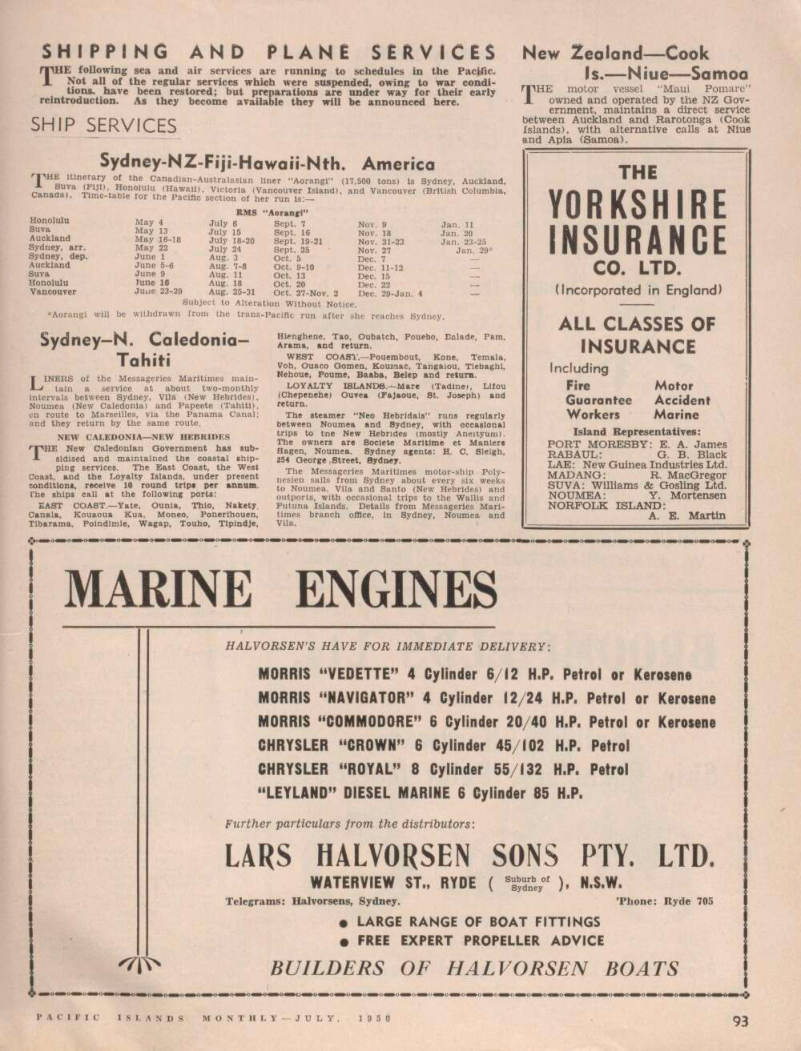
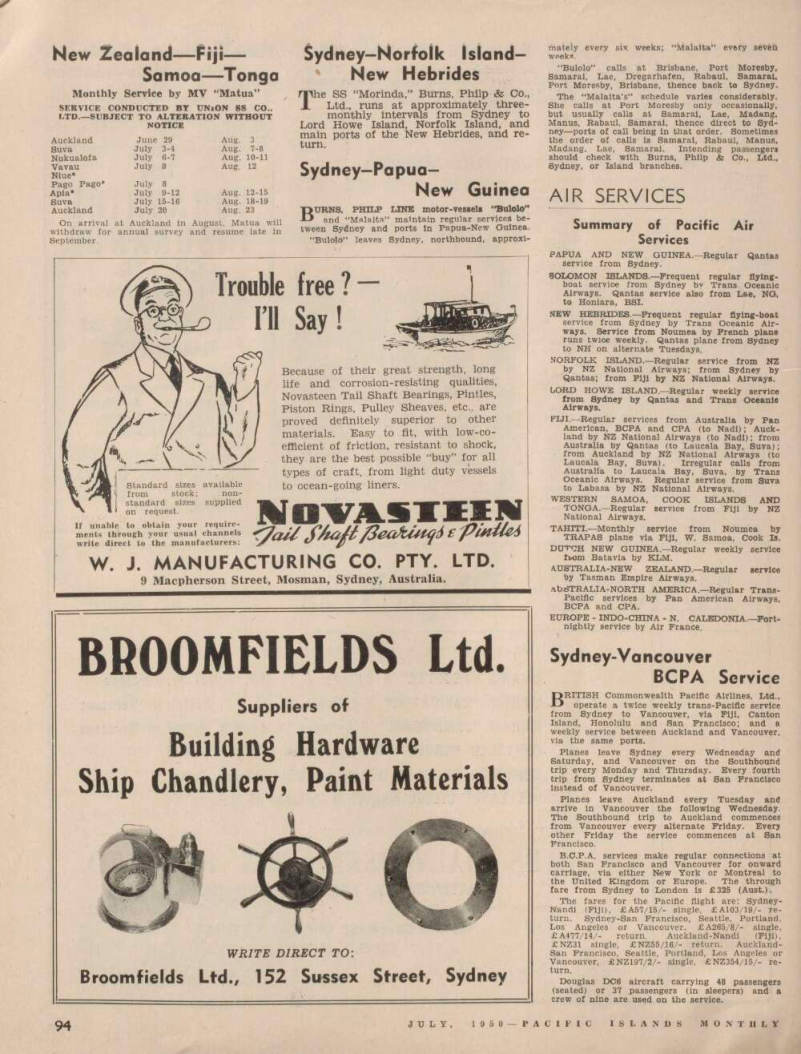
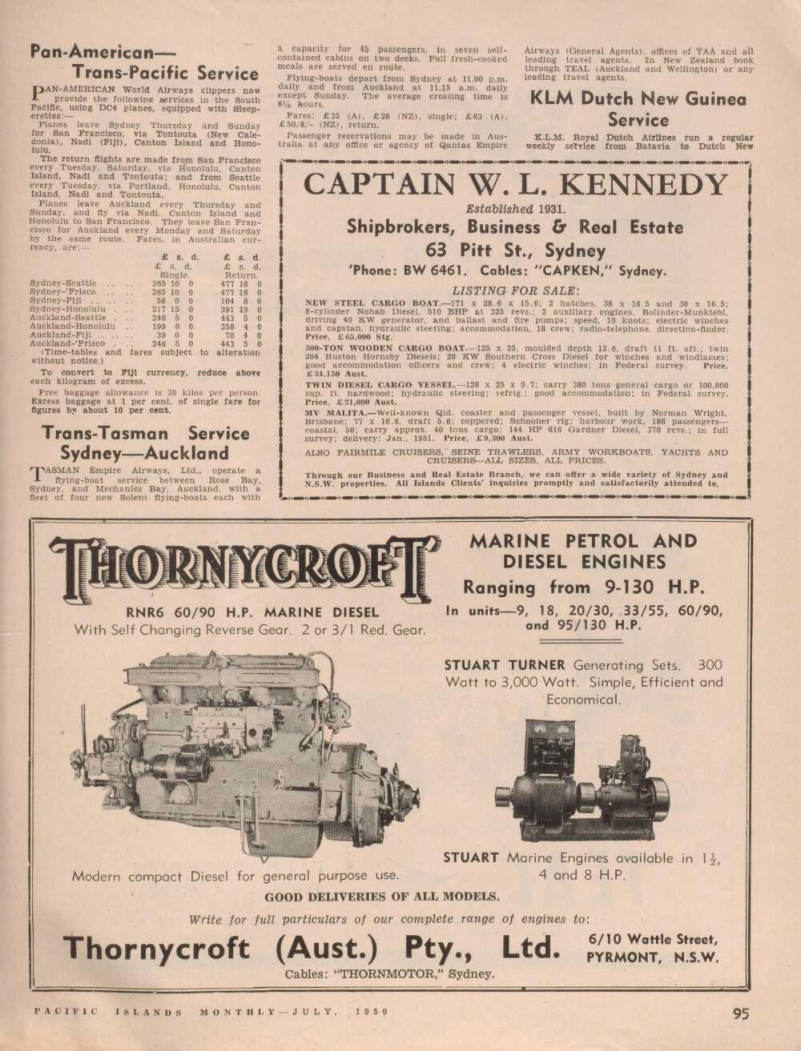
Shipping And Plane Services
THE following sea and air services are running to schedules in the Pacific.
Not all of the regular services which were suspended, owing to war condi tions. have been restored; but preparations are under way for their early rcmtroduction. As they become available they will be announced here.
Ship Services
Sydney-NZ-Fiji-Hawoii-Nth. America
T™ 0f the Canadlan ' A ustralaslan liner "Aorangi” (17,500 tons) Is Sydney. Auckland. nnn<.riai Va Tili’, Honolulu (Hawaii), Victoria (Vancouver Island), and Vancouver (British Columbia, Canada). Time-table tor the Pacific section of her run is:—
Sydney—N. Caledonia-
Tahiti
LINERS of the Messageries Maritimes main tain a service at about two-monthly intervals between Sydney, Vila (New Hebrides), Noumea (New Caledonia) and Papeete (Tahiti), en route to Marseilles, via the Panama Canal; and they return by the same route,
New Caledonia—New Hebrides
THE New Caledonian Government has sub sidised and maintained the coastal ship ping services. The East Coast, the West Coast, and the Loyalty Islands, under present conditions, receive 10 round trips per annum.
The ships call at the following ports: EAST COAST. —Yate, Ounia, Thlo, Nakety, Canala, Kouaoua Kua, Moneo, Ponerlhouen, Tibarama, Polndlmie, Wagap, Touho, Tlpindje,
Htenghene, Tao, Oubatch, Pouebo, Balade, Para, Arama, and return.
WEST COAST.—Pouembout, Kone, Temala, Voh, Ouaco Gomen, Koumac, Tangaiou, Tiebaghl, Nehoue, Poume, Baaba, Belep and return.
LOYALTY ISLANDS.—Mare (Tadlnej, Llfou (Chepenehe) Ouvea (Pajaoue, St. Joseph) and return.
The steamer “Neo Hebrldais” runs regularly between Noumea and Sydney, with occasional trips to tne New Hebrides (mostly Aneityum).
The owners are Soclete Maritime et Manlere Hagen, Noumea. Sydney agents: H. C. Sleigh, 254 George Street, Sydney.
The Messageries Marltimes motor-ship Poly nesian sails from Sydney about every six weeks to Noumea, Vila and Santo (New Hebrides) and outports, with occasional trips to the Wallis and Futuna Islands. Details from Messageries Mari times branch office, In Sydney, Noumea and Vila.
New Zealand—Cook
Is.—Niue—Samoa
THE motor vessel “Maui Pomare” owned and operated by the NZ Gov ernment, maintains a direct service between Auckland and Rarotonga (Cook Islands), with alternative calls at Niue and Apia (Samoa).
Rms
“Aoranfi”
Honolulu May 4 July 6 Sept. 7 Nov. 9 Jan. 11 Suva May 13 July 15 Sept. 16 Nov. 18 Jan. 20 Auckland May 16-18 July 18-20 Sept. 19-21 Nov. 21-23 Jan. 23-25 Sydney, arr.
May 22 July 24 Sept. 25 Nov. 27 Jan. 29* Sydney, dep.
June 1 Aug. 3 Oct. 5 Dec. 7 Auckland June 5-6 Aug. 7-8 Oct. 9-10 Dec. 11-12 Suva June 9 Aug. 11 Oct. 13 Dec. 15 Honolulu Tune 16 Aug. 18 Oct. 20 Dec. 22 Vancouver June 23-29 Aug. 25-31 Oct. 27-Nov. 2 Dec. 29-Jan . 4 — Subject to Alteration Without Notice. *Aorangi will be withdrawn from the trans- •Pacific run after she reaches Sydney.
New Zealand—Fiji—
Samoa—Tonga
Monthly Service by MV “Matua”
Service Conducted By Union Ss Co
Ltd.—Subject To Alteration Without
Notice
Auckland June 29 Aug. 3 Suva July 3-4 Aug. 7-8 Nukualofa July 6-7 Aug. 10-11 Vavau July 8 Aug. 12 Niue* Pago Pago* July 8 Apia* July 9-12 Aug. 12-15 Suva July 15-16 Aug. 18-19 Auckland July 20 Aug. 23 On arrival at Auckland in August, Matua will withdraw for annual survey and resume late in September.
Sydney-Norfolk Island-
New Hebrides
The SS “Morinda,” Burns, Philp & Co., Ltd., runs at approximately three monthly intervals from Sydney to Lord Howe Island, Norfolk Island, and main ports of the New Hebrides, and re turn.
Sydney-Papua-
New Guinea
BURNS, PHILP LINE motor-vessels "Bulolo” and “Malaita” maintain regular services be tween Sydney and ports In Papua-New Guinea.
“Bulolo” leaves Sydney, northbound, approxl
fnateiy every six weeks; “Malaita” every seven weeks.
“Bulolo” calls at Brisbane, Port Moresby, Samaral, Lae, Dregarhafen, Rabaul, Samarai, Port Moresby, Brisbane, thence back to Sydney.
The “Malaita’s” schedule varies considerably.
She calls at Port Moresby only occasionally, but usually calls at Samaral, Lae, Madang, Manus, Rabaul, Samaral, thence direct to Syd ney—ports of call being in that order. Sometimes the order of calls is Samaral, Rabaul, Manus, Madang. Lae, Samaral. Intending passengers should check with Burns, Phllp & Co., Ltd., Sydney, or Island branches.
Air Services
Summary of Pacific Air
Services
PAPUA AND NEW GUlNEA.—Regular Qantas service from Sydney.
SOLOMON ISLANDS.—Frequent regular flying boat service from Sydney by Trans Oceanic Airways. Qantas service also from Lae, NO, to Honiara, BSI.
NEW HEBRIDES. —Frequent regular flying-boat service from Sydney by Trans Oceanic Air ways. Service from Noumea by French plane runs twice weekly. Qantas plane from Sydney to NH on alternate Tuesdays.
NORFOLK ISLAND.—Regular service from NZ by NZ National Airways; from Sydney by Qantas; from FIJI by NZ National Airways.
LORD HOWE ISLAND.—Regular weekly service from Sydney by Qantas and Trans Oceanic Airways.
FIJI. —Regular services from Australia by Pan American, BCPA and CPA (to Nadi); Auck land by NZ National Airways (to Nadi); from Australia by Qantas (to Laucala Bay, Suva); from Auckland by NZ National Airways (to Laucala Bay, Suva). Irregular calls from Australia to Laucala Bay, Suva, by Trans Oceanic Airways. Regular service from Suva to Labasa by NZ National Airways.
Western Samoa, Cook Islands And
TONGA.—Regular service from Fiji by NZ National Airways.
TAHlTl.—Monthly service from Noumea by TRAPAS plane via FIJI, W. Samoa, Cook Is.
DUTCH NEW GUINEA. —Regular weekly service f*om Batavia by KLM.
AUSTRALIA-NEW ZEALAND. —Regular service by Tasman Empire Airways.
AUSTRALIA-NORTH AMERICA. —Regular Trans pacific services by Pan American Airways,
Bcpa And Cpa.
Europe - Indo-China -N. Caledonla.—Fort
nightly service by Air France.
Sydney-Vancouver
BCPA Service
BRITISH Commonwealth Pacific Airlines, Ltd., operate a twice weekly trans-Paclflc service from Sydney to Vancouver, via Fiji, Canton Island, Honolulu and San Francisco; and a weekly service between Auckland and Vancouver, via the same ports.
Planes leave Sydney every Wednesday and Saturday, and Vancouver on the Southbound trip every Monday and Thursday. Every fourth trip from Sydney terminates at San Francisco Instead of Vancouver.
Planes leave Auckland every Tuesday and arrive in Vancouver the following Wednesday.
The Southbound trip to Auckland commences from Vancouver every alternate Friday. Every other Friday the service commences at San Francisco.
B.C.P.A. services make regular connections at both San Francisco and Vancouver for onward carriage, via either New York or Montreal to the United Kingdom or Europe. The through fare from Sydney to London Is £325 (Aust.).
The fares for the Pacific flight are: Sydney- Nandi (Fiji), £AS7/15/- single, £AIO3/19/- re turn. Sydney-San Francisco, Seattle, Portland, Los Angeles or Vancouver, £A265/8/- single, £A477/14/- return. Auckland-Nandi (Fiji), £NZ3I single, £NZSS/16/- return. Auckland- San Francisco, Seattle, Portland, Los Angeles or Vancouver, £NZI97/2/- single, £NZ3S4/15/- re turn.
Douglas DC6 aircraft carrying 48 passengers (seated) or 37 passengers (in sleepers) and a crew of nine are used on the service.
Pan-American—
Trans-Pacific Service
PAN-AMERICAN World Airways clippers now provide the following services in the South Pacific, using DC4 planes, equipped with Sleep erettes; — Planes leave Sydney Thursday and Sunday for San Francisco, via Tontouta (New Cale donia), Nadi (Fiji), Canton Island and Hono lulu.
The return flights are made from San Francisco every Tuesday, Saturday, via Honolulu, Canton Island, Nadi and Tontouta; and from Seattle every Tuesday, via Portland, Honolulu, Canton Island, Nadi and Tontouta.
Planes leave Auckland every Thursday and Sunday, and fly via Nadi, Canton Island and Honolulu to San Francisco. They leave San Fran cisco for Auckland every Monday and Saturday by the same route. Fares, in Australian cur rency, are:—
To convert to Fiji currency, reduce above each kilogram of excess.
Free baggage allowance is 30 kilos per person.
Excess baggage at 1 per cent, of single fare for figures by about 10 per cent.
Trans-Tasman Service
Sydney—Auckland
TASMAN Empire Airways, Ltd., operate a flying-boat service between Rose Bay, Sydney, and Mechanics Bay, Auckland, with a fleet of four new Solent flying-boats each with
a a P * or 45 passengers, in seven self contained cabins on two decks. Full fresh-cooked meals are served en route.
Flying-boats depart from Sydney at 11.00 p.m. daily and from Auckland at 11.15 a.m. daily fif/ Ce £ t n „f. ; Unday ' The average crosSmg time is 6/2 hours ‘ Fares: £35 (A), £2B (NZ), single; £63 (A), £5O/8/- (NZ), return.
Passenger reservations may be made in Aus tralia at any office or agency of Qantas Empire
Airways (General Agents), offices of TAA and all leading travel agents. In New Zealand book through TEAL (Auckland and Wellington) or any leading travel agents. . . . . ,
KLM DlltCn NeW GllllieO
V wmimsu JcryiCc K.L.M. Royal Dutch Airlines run a regular weekly service from Batavia to Dutch New
£ s. d. £ s. d. £ s. d. £ s. d.
Single.
Return.
Sydney-Seattle 265 10 0 477 18 0 Sydney-’Frisco 265 10 0 477 18 0 Sydney-Piji . . . . 58 0 0 104 8 0 Sydney-Honolulu . 217 15 0 391 19 0 Auckland-Seattle 246 5 0 443 5 0 Auckland-Honolulu 199 0 0 358 4 0 Auckland-Piji .. .. 39 0 0 70 4 0 Auckland-’Prisco . 246 5 0 443 5 0 (Time-tables and without notice.) tares subject to alteration
Guinea, via Sourabaya, Makassar and Ambon, on the following schedule: Batavia dep. Sundays at 10.30 a.m., Biak Island arr. Mondays at 4.40 p.m.; dep. Tuesdays at 6 a.m., Hollandia arr. Tuesdays at 8.10 a.m. On the return Journey the aircraft leaves Hollandia at 9 a.m. on Tuesdays: Biak Island arr. 11.10 a.m., dep. 12.15 p.m. on Tuesdays: and Batavia arr. 6 p.m. on Wednesdays, The aircraft used are C. 475, a type of DC-3, and the single fares are Batavia-Biak Island £A80; Batavla-Hollandia £A9I/15/-; and Biak Island-Hollandia £AII/15/-. Return fares, double single.
New Caledonia-
New Hebrides
TRAPAS (French Air Line) operates a service between Noumea and the New Hebrides.
The plane leaves Noumea every alternate Tues day, and flies direct to Vila and Santo, and returns. Return fare for the journey, Noumea- Santo, is approximately £42 Australian.
France-1 ndo-China—
Aust.-N. Caledonia
THE French national airways, Air France, runs a fortnightly service between Paris and New Caledonia, and return. Stops are made at Cairo. Karachi, Calcutta, Saigon, Batavia, Darwin, Brisbane.
DC4 Skymasters are used in the service bet ween Saigon and New Caledonia, Lockheed Constellations between Saigon-Paris, and Mes sageries Maritimes are agents in Australia.
Fare between Brisbane and Tontouta (Noumea) are £3O/12/6 single, £55/2/6 return. Sydney- Tontouta, £37/10/- single, £63/17/6 return.
Sydney—Queensland—
New Guinea
QANTAS Empire Airways, Ltd., employing DC3 planes, operate a regular service between Sydney, Port Moresby, Lae, Pinschhafen, Madang, Rabaul, Bulolo and Wau, and return via Brisbane, Rockhampton, Townsville and Cairns.
This service is now known as the "Bird of Paradise’’ Service. Skymaster and DC3 aircraft are used.
Skymaster aircraft leave Sydney every Tues day and Saturday at 8.30 p.m., and making a night-flight calling only at Brisbane, arrive at Port Moresby the following morning at 7.20 a.m.
They return to Sydney the same day (Wednesday and Sunday). A DC3 shuttle service operates between Moresby and Lae to connect with Sky master service. This is only a temporary mea sure, pending repairs on Lae strip, when Sky masters will complete the journey as formerly.
DC3 aircraft leave Sydney every Monday, Wednesday and Friday at 8.15 a.m. for Lae, calling at Brisbane, Rockhampton, Townsville, Cairns, Cooktown, Port Moresby. An overnight stop is made at Townsville and Port Moresby Is reached at 11.10 a.m. the day after leaving Sydney.
Return trips are made from Lae to Sydney (calling at the same intermediate airports as on the northern journey) each Wednesday, Saturday and Sunday. Planes depart Lae at 5.45 p.m. and reach Sydney at 10.15 p.m. the same day.
The plane that reaches Lae from Sydney on Tuesdays later that afternoon flies on to Bulolo and Wau and returns to Lae.
The plane that reaches Lae from Sydney on Thursday flies on to Rabaul on Friday, via Finschhafen, returning to Lae the same after noon.
The plane that reaches Lae from Sydney on Saturday at 1 p.m. flies on to Madang, re turning to Lae the same afternoon.
Bookings may be made at Qantas offices at any of the towns named. At present, berths are available only to passengers holding official per mits to visit Papua or New Guinea.
Qantas Subsidiary Services In
Papua-New Guinea-Solomons
Qantas Empire Airways run the following sub sidiary services In Papua, New Guinea, and British Solomons:— A Douglas DC3 leaves Lae, New Guinea, every
Wednesday, and flies to Rabaul, and Kavieng, and returns to Lae; but every alternate Wed nesday the plane goes on from Kavieng to Manus, and returns via Kavieng to Rabaul (overnight) and returns to Lae on the Thursday morning.
Every Wednesday a plane flies from Lae to Madang and Wewak, and thence " direct to Rabaul. It returns from Rabaul to Lae on Thursday. This service is primarily for the carriage of native labour to and from Wewak. and Europeans travelling on this service are always advised of the fact.
Every alternate Monday, a Qantas Catalina flies from Port Moresby, westward to Daru, via Yule Island, Kerema, Kikorl, Lake Kutubu and Lake Murray, remaining overnight at Kikori and returning to PM next morning.
Every alternate Wednesday, a Qantas Catalina flies from Port Moresby eastward (dep. 9 a.m.) and calls at Abau and Samara! before flying out to the Archipelagoes in the afternoon. Calls are made at Esa’ala and Losuia (where an over night stop is made), and the following day (alternate Thursdays) at Deboyne Lagoon, before returning to Port Moresby, via Samarai and Abau.
Every alternate Monday, a Qantas Catalina
leaves Port Moresby for Rabaul, via Moewe Har bour, and Talasea (New Britain); next morning (Tuesday) it flies to Buka, Kleta and Buln (Bougainville) and returns to Rabaul; next morning (Wednesday) it flies to Talasea, Moewe Harbour and Jacqulnot Bay, and returns to
Rabaul; and next morning (Thursday) It re turns from Rabaul direct to Port Moresby.
Every alternate Monday a Qantas Douglas files from Lae to Rabaul, and continues on to Honiara (British Solomon Islands), via Toroklna; remains overnight at Honiara; and returns to Lae the following day (Tuesday), via Torokina and Rabaul.
Every Tuesday and Friday a plane leaves Port Moresby at 7.30 a.m.. reaches Kokoda at 8.35 a.m., flies on to Higatura (Popendetta) at 8.55 a.m., and leaves again for Port Moresby at 9.5 a.m., reaching there at 10.15 a.m.
NZ National Airways
South Pacific Services
THE Pacific services run by the New Zealand National Airways Corporation are ai follows:
Auckland-Norfolk Island-Fiji-Tonga
Western Samoa-Cook Islands: A “Douglas”
airliner leaves Whenuapai, Auckland, on alter nate Tuesdays at 9 a.m. (July 11, 25, etc.) for Norfolk Island (arr. 12.55 p.m.; dep.
2 p.m.), Nadi (arr. 8.40 p.m., dep. 5.40 a.m.
Thursday), Nausori (arr. 6.25 a.m., dep. 7.30 a.m.), Tonga (arr. 10.50 a.m., dep. 11.50 a.m.), •Paleolo, Western Samoa (arr. 4.5 p.m. Wednes day, dep. 8 a.m. Thursday), Aitutaki, Cook Islands (arr. 1.50 p.m. Thursday, dep. 2.50 p.m.), Rarotonga, Cook Is. (arr. 4.5 p.m.).
The aircraft departs from Rarotonga on the return journey on alternate Saturdays (July 15, 29 etc.), at 8 a.m. for Aitutaki (arr, 9.15 a.m., dep. 10 a.m.), Faleolo, W. Samoa (arr, 3.15 p.m., dep. 8 a.m. Sunday), ‘Tonga (arr. 10.55 a.m. Monday, dep. 11.50 a.m.), Nausori (arr. 2.40 p.m., dep. 3.40 p.m.), Nadi (arr. 4.25 p.m., dep. 5 a.m. Tuesday), Norfolk Is. (arr. 10.55 a.m., dep. 12 noon), Whenuapai, Auckland (arr. 4.50 p.m.). •Crosses International Date Line.
Auckland-Norfolk Island; A “Douglas”
airliner leaves Whenuapai, Auckland, every Sun day at 8.15 a.m. for Norfolk Island (arr. 12.10 p.m.), and departs on the return flight at 1.10 p.m., arriving at Whenuapai at 6 p.m.
PARES, single (in NZ currency); Auckland to Norfolk, £l2/10/-; to Fiji, £3l; to Tonga, £3l; to Samoa, £34; to Aitutaki, £39; to Raro tonga, £39/10/-. Norfolk to FIJI, £l9. FIJI to Tonga, £B/15/-; to Samoa, £l3; to Aitutaki, £29/15/-; to Rarotonga, £3l. Samoa to Raro tonga, £l7/15/-; to Aitutaki, £l6/10/-.
Return fares, less 10 per cent.
BOOKING OFFICES: Wellington, Govt. Life Bldg., Customhouse Quay; Auckland, Airways House, Customs St.; Dunedin, 8-10 Manse St.; Christchurch, 104 Gloucester St.; Gis borne, 74 Peel St.; Palmerston North, 107 Broadway Ave.; Hamilton, 8 Alma St.; New Plymouth, Grand Central Building, Egmont St.; Blenheim, 13 Queen St.; Hokitika, South side Airport: Norfolk Is., Burns Philp, Ltd.; Fiji, NAC at Nadi and Suva; Burns Philp, Lautoka; Tonga, Mrs. F. P, Melhose, Fou-amotu Airfield; W. Samoa, Burns Philp (SS), Ltd., Apia; Cook Is., Mrs. P. McVeagh, Aitutaki, and Mr. J. D. Campbell, Rarotonga.
TOA Services
TRANS Oceanic Airways run the following Pacific services:— SYDNEY-LORD HOWE IS.: A regular fort nightly service with large four-engine flying boats from Rose Bay. Fare: £l2 single; £2l/10/- return. Free baggage allowance 50 lb.
Excess baggage and freight rate Bd. per lb.
SYDNEY-NEW HEBRIDES; A regular monthly service with large four-engine flying-boats from Sydney, via Noumea, to Vila and Esplritu Santo (overnight stop). Pare: Sydney-Vila, £45; Sydney-Santo, £5O; Noumea-Vlla, £l2/10/-; Noumea-Santo, £lB/15/-. Freight: Sydney-Vlla, 2/- per lb.; Sydney-Santo, 2/3.
Sydney-Solomon Islands: A Regular
monthly service from Sydney, via New Cale donia and New Hebrides to Tulagi and Honiara, Solomon Islands. This service is frequently ex tended to Llngatou, in the Russell Islands, and calls are sometimes made at Vanikoro, in the Santa Cruz Group. Fares; Sydney-Tulagi- Honiara, £65. Free baggage allowance, 60 lb.; excess baggage and freight, 3/6 per lb.
Sydney-Noumea-Suva
THE following Is the time-table of the Qantas Sandringham flying-boat:—
Intending passengers may book through Qantas offices in Australia. Burns Philp (South Seas) Company, in Suva; and T. Johnston in Noumea.
The fares for this service in Aust. currency
CPA Sydney-Vancouver
Service
(CANADIAN Pacific Airlines, Ltd., run a trans -4 Pacific service between Sydney and Van couver. For the present there will be one northbound and one southbound trip per fort night. Stops are made at Nadi (Fiji), Canton Island, Honolulu and San Francisco. The north bound flight commences from Sydney every alter nate Tuesday.
Four-engined, pressurised “Canadalr” aircraft are used; 36 passengers can be carried and a crew of 7. Flying Is done In daylight. Over night accommodation Is provided at hotels in Nadi and Honolulu, which Is, of course, com plimentary.
Pares are (in Australian currency: Sydney- Vancouver, San Franclsco-Los Angeles and Port land-Seattle, £265/8/- single, £477/14/- return; Fiji-Vancouver, £207/8/- single, £373/7/- re turn; Sydney-Piji, £57/15/- single, £lO3/19/- re turn; Sydney-Honolulu. £217/13/- single. £391/16/- return.
Bookings may be made at the Union Steam Ship Company of New Zealand, Limited, Sydney, or Melbourne: Union Steam Ship Co. of NZ, Ltd., Fiji; Canadian Pacific Airlines, Vancouver.
TEAL Flying Boat
Service
Auckland Fiji
WITH new 45 seater Solent flying-boats, Tasman Empire Airways, Limited, operate a weekly Auckland-Suva-Lambasa and return service.
Aircraft depart Mechanics’ Bay, Auckland, a half hour after midnight, each Tuesday, and operate to the following time-table: —
Fares (Single): Auckland-Suva. £3l (NZ). £34/9/- (Fijian), £3B/15/- (Aust.i; (Return); £55/16/- (NZ), £6l/19/- (Fijian), £69/15/- (Aust.).
Suva-Lambasa (Single): £4/10/- (NZ), £5 (Fijian), £5/12/6 (Aust.); (Return): £B/2/- (NZ), £9 (Fijian), £lO/2/6 (Aust.i.
Reservations may be made through TEAL (New Zealand), Qantas or TAA (Australia).
NZNAC (Suva) or any leading travel agents.
Papua-NG Local
Services
MANDATED Airlines, Ltd., of Lae, New Guinea, and other private operators, run air ser vices between Lae and the New Guinea mainland centres of Wau, Bulolo, Madang, Wewak, Altape, Mt. Hagen, Plnschhafen, Moresby, Kokoda—ln fact anywhere In Papua or New Guinea where there la an alr-strlp. These planes carry pas sengers. mails and cargo on regular schedules or charter flights.
Sydney .. .. p.m. alt.
Tues.
Noumea . . . a.m. alt.
Wed.
Noumea .. . . .. dep. 7.55 a.m. alt.
Wed.
Suva . . . . alt.
Wed.
Suva . . ., a.m. alt.
Pri.
Noumea .. . a.m . alt . Pri.
Noumea .. . . . . dep. 12.30 a.m . alt . Pri.
Sydney .. . p.m. alt . Pri.
are: Single.
Return Sydney-Noumea .. . £37 10 0 £67 10 0 Sydney-Suva 55 10 0 99 18 0 Noumea-Suva ... . 20 5 0 36 9 0
dep.
Auckland .. .. 0.30 a.m. Tuesday arr.
Suva .. 7.00 a.m.
Tuesday
d"ep.
Suva .. 9.00 a.m.
Tuesday arr.
Lambasa . . . . 10.00 a.m.
Tuesday dep.
Lambasa . . noon Tuesday arr.
Suva .. 1.00 p.m.
Tuesday dep.
Suva .. .. 7.00 a.m.
Wednesday arr. Auckland 1.30 p.m.
Wednesday
Advertisements & other items, pp. 97-102 (1 item)
Marine Engines
THE
YORKSHIRE
INSURANCE
CO. LTD,
(Incorporated in England)
ALL CLASSES OF
INSURANCE
Including Fire Motor Guarantee Accident Workers Marine Island Representatives:
PORT MORESBY: E. A. James
RABAUL: G. B. Black LAE: New Guinea Industries Ltd.
MADANG: R. MacGregor SUVA: Williams & Gosling Ltd.
NOUMEA; Y. Mortensen
NORFOLK ISLAND:
A. E. Martin
MARINE ENGINES
HALVORSEN’S HAVE FOR IMMEDIATE DELIVERY :
MORRIS “VEDETTE” 4 Cylinder 6/12 H.P. Petrol or Kerosene MORRIS “NAVIGATOR” 4 Cylinder 12/24 H.P. Petrol or Kerosene MORRIS “COMMODORE” 6 Cylinder 20/40 H.P. Petrol or Kerosene CHRYSLER “CROWN” 6 Cylinder 45/102 H.P. Petrol CHRYSLER “ROYAL” 8 Cylinder 55/132 H.P. Petrol “LEYLAND” DIESEL MARINE 6 Cylinder 85 H.P.
Further particulars from the distributors :
LARS HALVORSEN SONS PTY. LTD.
WATERVIEW ST., RYDE ( s g u d r n b ey ° f )’ N.S.W.
Telegrams; Halvorsens, Sydney, ’Phone: Ryde 705
• LARGE RANGE OF BOAT FITTINGS
• FREE EXPERT PROPELLER ADVICE
BUILDERS OF HALVORSEN BOATS
l~Jv s,
Trouble free ?
I’ll Say!
supplied Standard sizes available from stock; nonstandard sizes on request.
If unable to obtain your requirements through your usual channels write direct to the manufacturers: Because of their great strength, long life and corrosion-resisting qualities, Novasteen Tail Shaft Bearings, Pintles, Piston Rings, Pulley Sheaves, etc., are proved definitely superior to other materials. Easy to fit, with low-coefficient of friction, resistant to shock, they are the best possible “buy” for all types of craft, from light duty vessels to ocean-going liners.
NOTASIIIN
W. J. MANUFACTURING CO. PTY. LTD.
9 Macpherson Street, Mosman, Sydney, Australia.
BROOMFIELDS Ltd.
Suppliers of
Building Hardware
Ship Chandlery, Paint Materials
WRITE DIRECT TO:
Broomfields Ltd., 152 Sussex Street, Sydney
CAPTAIN W. L. KENNEDY
Established 1931.
Shipbrokers, Business & Real Estate
63 Pitt St. Sydney
'Phone: 8W6461. Cables: "CAPKEN," Sydney.
LISTING FOR SALE:
NEW STEEE CARGO BOAT.—I7I x 28.6 x 15.6; 2 hatches, 38 x 16.5 and 30 x 16.5; 8-cyllnder Nohab Diesel, 510 BHP at 325 revs.; 2 auxiliary engines, Bollnder-Munktebl, driving 40 KW generator, and ballast and fire pumps; speed, 10 knots; electric winches and capstan, hydraulic steering; accommodation, 18 crew; radio-telephone, direction-finder.
Price, £65,000 Stg. 300-TON WOODEN CARGO 80AT.—125 x 25, moulded depth 12.6, draft 11 ft. aft.; twin 204 Ruston Hornsby Diesels; 20 KW Southern Cross Diesel for winches and windlasses; good accommodation officers and crew; 4 electric winches; in Federal survey. Price, £34,150 Aust.
TWIN DIESEL CARGO VESSEL. —126 x 25 x 9.7; carry 380 tons general cargo or 100,000 sup. ft. hardwood; hydraulic steering; refrig.; good accommodation; in Federal survey.
Price, £21,000 Aust.
MV MALITA.—WeII-known Qld. coaster and passenger vessel, built by Norman Wright, Brisbane; 77 x 16.6, draft 5.6; coppered; Schooner rig; harbour work, 186 passengers— coastal, 50; carry approx. 40 tons cargo; 144 HP 616 Gardner Diesel, 370 revs.; in full survey; delivery: Jan., 1951. Price, £9,300 Aust.
ALSO FAIRMILE CRUISERS, SEINE TRAWLERS, ARMY WORKBOATS, YACHTS AND
CRUISERS—ALL SIZES, ALL PRICES.
Through our Business and Beal Estate Branch, we can offer a wide variety of Sydney and N.S.W. properties. All Islands Clients’ inquiries promptly and satisfactorily attended to.
RNR6 60/90 H.P. MARINE DIESEL
With Self Changing Reverse Gear. 2 or 3/1 Red. Gear. • A * 4 j
MARINE PETROL AND
DIESEL ENGINES
Ranging from 9-130 H.P.
In units—9, 18, 20/30, 33/55, 60/90, and 95/130 H.P.
STUART TURNER Generating Sets. 300 Watt to 3,000 Watt. Simple, Efficient and Economical.
STUART Marine Engines available in 13, 4 and 8 H.P.
Modern compact Diesel for general purpose use.
GOOD DELIVERIES OF ALL MODELS.
Write for full particulars of our complete range of engines to:
Thornycroft (Aust.) Pty., Ltd.
6/10 Wattle Street,
PYRMONT, N.S.W.
Cables: “THORNMOTOR,” Sydney.
V 'W 31 si u
fiy TO NEW IE At AND
TOR YOUR HOUDAYS
EVERYONE HAS TIME FOR A NEW ZEALAND HOLIDAY-TEAL WILL TAKE YOU IN A FEW
HOURS BY LUXURIOUS FLYING BOAT.
Save days and see all New Zealand on a short holiday.
Rotorua (boiling lakes, geysers, Maori music and colours), fjords, glaciers, glow-worm caves, swordfishing—all at their best now. Fly to New Zealand for your holidays.
W,7(n\\v
XJX
TEAL
Reservations : All Leading Travel Agents pi id li
TASMAN EMPIRE
AIRWAYS LIMITED
in association with Q.£. A . , 8.0. A . C . and B.C. P . A .
FOR DELIVERY OF SHIPS
TO ANY PACIFIC ISLAND
Contact
GEORGE O’BRIEN
Recommended by: Lever’s Pacific Plantations Pty. Ltd.
Kerr Bros. Societe Gubbay (Port Vila). Rowe Bros., Rabaul. Condominium Government of the New Hebrides.
Special Rates for “P.1.M.” Readers.
GEORGE O'BRIEN
89 Ocean Avenue, Double Bay, Sydney. ’Phone: FB 2905.
ff. R. CARPENTER & CO. (Fiji) LTD.
Buyers of Copra for Fiji Copra Board, and
independent- buyers of Trocas Shell
Sellers of all Island Merchandise
AGENTS FOR—
GARDNER'S British Marine, Stationary and Road Transport Diesel Engines.
NUFFIELD EXPORTS —Cars and Commercial Trucks. Morris Marine Engines.
CHRYSLER CORPORATION: Cars and Trucks.
GUY MOTORS —“Gardner" Diesel Engined Chassis.
CATERPILLAR Tractors and Allied Equipment.
CHAPMAN Pup Marine Engines.
ALLEN Motor Scythes.
Adequate spares carried for all mechanical
appliances
OPERATORS FOR
ISLAND TRANSPORT LIMITED Motor Vessels "KOMAIWAI"
and "TOVATA" within the Fiji Group.
WILLREED AGENCIES PTY. LTD.
1450 George Street, Circular Quay, Sydney.
Cable Address: “REEDAGE/' Sydney.
SOLE DISTRIBUTORS FOR
INVINCIBLE SINGLETS
’ First grade, economically priced.
40 ft. TRADE BOATS
(for sea delivery) 10 ton cargo capacity, diesel powered.
20 ft. HEAVY MTV TRADE BOATS
(for assembly)
COVENTRY VICTOR DIESEL MARINE
5/7 h.p. and 7/9 h.p.
PEERLESS LOCKWOVEN SQUARE MESH
FENCING
For pig fences, sheep fences, cattle fences, general farm fences.
Spanish SHOTGUNS. Complete range available
Inquiries Invited.
MINIATURE SEWING MACHINES
Suitable for native trade.
GABRIEL ACHUN
Importer and Wholesale Merchant
Specialises in:
BEERS
BICYCLES
AERATED WATER MANUFACTURING
COTTON PIECEGOODS FOR NATIVE TRADE
AGENT FOR “STANDARD” AND “TRIUMPH” CARS
Malaguna Road
RABAUL
Territory of New Guinea Proprietor:
RABAUL CORDIAL FACTORY.
Telegraphic Address:
“GABRIEL ACHUN,” RABAUL.
Windfall For Ci Native
Teachers
From Our Own Correspondent MANGAIA, Cl, June 1.
DUE since shortly before the late Labor Government of NZ went out of of fice, and possibly a last gesture by that altruistic administration, the long awaited Teachers’ Drawback —a cash bonus, graded according to length of ser vice—has been paid out to the local school staffs, amid much rejoicing.
The bonuses, amounting to from some £lO to £3O, had been scheduled to arrive last year, but owing to some hitch in the arrangements, were not paid until re cently.
The way in which this windfall was spent would have interested students of Polynesian psychology and Gallup-poll enthusiasts. Girls on the staff indulged
in a positive orgy of artificial silks and gay print; the males went in for gas lamps, clocks and other artifacts of European civilisation, until in most cases there was nothing left of the bonus, though a few Scot-like souls salted down a few pounds in the PO Savings Bank, just to be on the safe side!
There is foundation for this canniness.
A similar largesse of the Education De partment bestowed during the war, proved to be a departmental error, and was revoked—the teachers had to repay the amounts granted, out of salary at £2 monthly. Fervent hopes have been expressed that the present one may not be a similar Indian gift.
Mr. J. R. Keenan, Assistant District Officer Rabaul, NG, departed on the Tung Sha on June 3 for England. He will join Mrs. Keenan who has been in the UK since the beginning of this year.
He will be away about 12 months.
Advertisements & other items, pp. 103-104 (1 item)
N. F. Maloney & Co.
Phone 268. PORT MORESBY Phone 268.
Cables, Radios, etc., “Malco,” Port Moresby.
CUSTOMS, SHIPPING, AND FORWARDING AGENTS.
LICENSED AUCTIONEERS AND GENERAL COMMISSION
AGENTS.
House, Land, and Estate Agents.
Chief Agents:
NEW ZEALAND INSURANCE CO. LTD.
(Incorporated in New Zealand) FIRE . . ACCIDENT . . MOTOR VEHICLE . . MARINE, ETC.
Importers and Exporters :: Manufacturers Representatives.
Australian Representatives : E. J. GOUGH & CO., 1 BOND STREET, SYDNEY.
SCRAP IRON SCRAP STEEL SCRAP METALS
PIG IRON PIG LEAD INGOT METALS
Metal Merchants ★ Metal Refiners
Head Office: WILFORD STREET, NEWTOWN, N.S.W.
Phone: LA 5111 (6 lines).
Cable and Telegraphic Address: “SCRAPMETAL,” Sydney.
Works: 2 CANAL ROAD, MASCOT, N.S.W.
Buyers of Non-Ferrous Scrap, Cable, Shells, Cartridges, Copper, Lead, Muntz Metal, Aluminium LARGEST BUYERS OF SCRAP IRON & METALS IN AUSTRALIA
Insist on. . .
CANNED MEATS, HOTMEALS AND SOUPS
Available in 12 oz. and 1 lb, sealed cans in the following,
appetising flavours and combinations :
• Corned Beef Loaf With Cereal • Braised Steak and Onions • Boiled and Roast Beef • Beef Steak Pudding • Mutton and Peas • Steak and Onions • Chili Con Came • Curried Mutton • Curried Beef • Irish Stew • Mulligatawny Soup • Vegetable Soup • Mutton Broth • Tomato Soup • Camp Pie
“BRONTE” Brand high-grade products
are made from the finest fat stock and the richest vegetables in Australia ,
deliciously flavoured .
THE COLONIAL WHOLESALE MEAT CO.
PTY. LTD.
Canning Factory: State Abbotoirs, Homebush, Sydney,
N.S.W.
PHONE: UM 8436 CABLE ADDRESS: “WOOLMILL,” SYDNEY. tm t lb
s^&SiSM
Gom Of New Caledonia
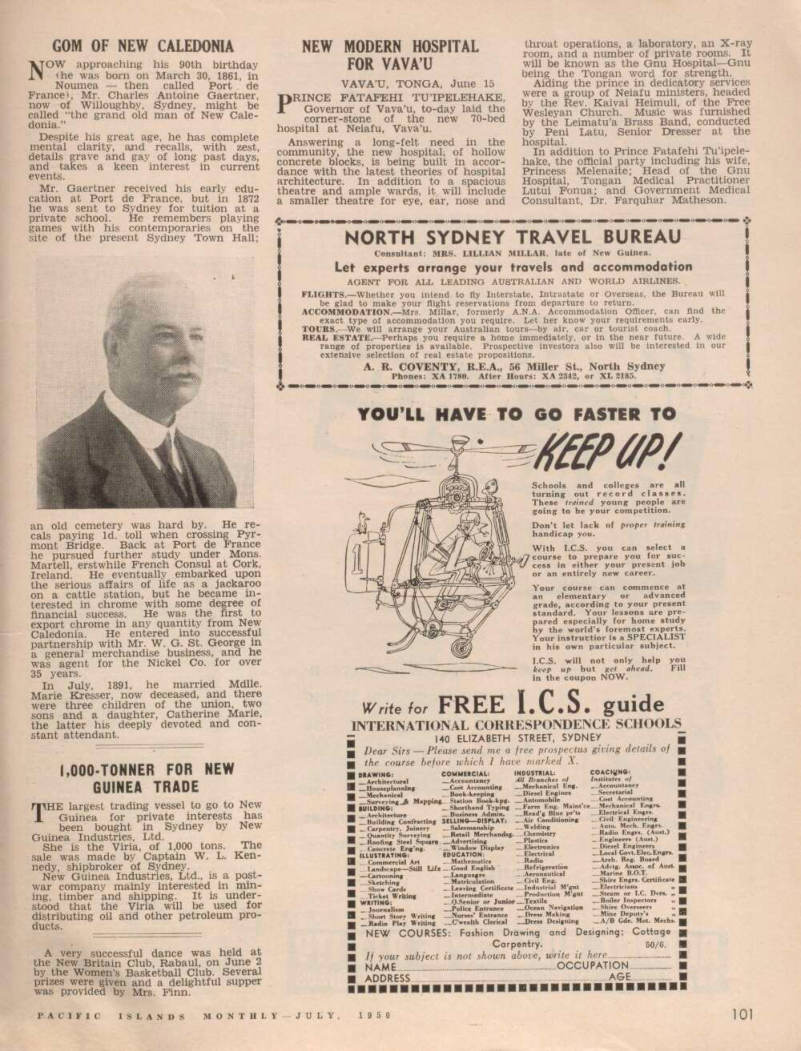
NOW approaching his 90th birthday (he was born on March 30, 1861, in Noumea then called Port de France), Mr, Charles Antoine Gaertner, now of Willoughby, Sydney, might be called “the grand old man of New Cale donia.”
Despite his great age, he has complete mental clarity, and recalls, with zest, details grave and gay of long past days, and takes a keen interest in current events.
Mr. Gaertner received his early edu cation at Port de France, but in 1872 he was sent to Sydney for tuition at a private school. He remembers playing games with his contemporaries on the site of the present Sydney Town Hall;
an old cemetery was hard by. He re cals paying Id. toll when crossing Pyr mont Bridge, Back at Port de France he pursued further study under Mons.
Martell, erstwhile French Consul at Cork, Ireland. He eventually embarked upon the serious affairs of life as a jackaroo on a cattle station, but he became in terested in chrome with some degree of financial success. He was the first to export chrome in any quantity from New Caledonia. He entered into successful partnership with Mr. W. G. St. George in a general merchandise business, and he was agent for the Nickel Co. for over 35 years.
In July, 1891, he married Mdlle.
Marie Kresser, now deceased, and there were three children of the union, two sons and a daughter, Catherine Marie, the latter his deeply devoted and con stant attendant.
Guinea Trade
1.000-Tonner For New
THE largest trading vessel to go to New Guinea for private interests has been bought in Sydney by New Guinea Industries, Ltd.
She is the Viria, of 1,000 tons. The sale was made by Captain W. L. Ken nedy, shipbroker of Sydney.
New Guinea Industries, Ltd., is a post war company mainly interested in min ing, timber and shipping. It is under stood that the Viria will be used for distributing oil and other petroleum pro ducts.
A very successful dance was held at the New Britain Club, Rabaul, on June 2 by the Women’s Basketball Club. Several prizes were given and a delightful supper was provided by Mrs. Finn.
For Vava’U
New Modfrn Hokpital
Vava’U, Tonga, June 15
Prince Patafehi Tu'ipelehake.
i Governor of Vaya u, to-day laid the corner-stone of the new 70-bed hospital at Neiafu, Vava u.
Answering a long-felt need in the community, the new hospital, of hollow concrete blocks, is being built in accor dance with the latest theories of hospital architecture. In addition to a spacious theatre and ample wards, it will include a smaller theatre for eye, ear, nose and
throat operations, a laboratory, an X-ray and number of private rooms. It will be known as the Gnu Hospital—Gnu being the Tongan word for strength.
Aiding the prince in dedicatory services * er t e h J HetouSl^the'^ Wesleyan Church. Music was furnished b y the Leimatu’a Brass Band, conducted b y p en j Latu, Senior Dresser at the hospital, In addition to Prince Fatafehi Tu’ipele hake, the official party including his wife, Princess Melenaite; Head of the Gnu Hospital, Tongan Medical Practitioner Lutui Ponua; and Government Medical Consultant, Dr. Farquhar Matheson.
Advertisements & other items, p. 105 (1 item)
Write for FREE I.C.S. guide
NORTH SYDNEY TRAVEL BUREAU
Consultant; MRS. LILLIAN MILLAR, late of New Guinea.
Let experts arrange your travels and accommodation AGENT FOR ALL LEADING AUSTRALIAN AND WORLD AIRLINES.
FLlGHTS. —Whether you intend to fly Interstate, Intrastate or Overseas, the Bureau will be glad to make your flight reservations from departure to return.
ACCOMMODATION.— Mrs. Millar, formerly A.N.A. Accommodation Officer, can find the exact type of accommodation you require. Let her know your requirements early.
TOURS. —We will arrange your Australian tours—by air, car or tourist coach, REAL ESTATE. —Perhaps you require a home immediately, or in the near future. A wide range of properties is available. Prospective investors also will be interested in our extensive selection of real estate propositions.
A. R. COVENTY, R.E.A., 56 Miller St., North Sydney Phones: XA 1780. After Hours: XA 2342, or XL 2185.
YOU’LL HAVE TO GO FASTER TO
mm Schools and colleges are all turning out record classes.
These trained young people are going to be your competition.
Don’t let lack of proper training handicap you.
With I.C.S. you can select a course to prepare you for success in either your present job or an entirely new career.
Your course can commence at an elementary or advanced grade, according to your present standard. Your lessons are prepared especially for home study by the world’s foremost experts.
Your instructior is a SPECIALIST in his own particular subject.
I.C.S. will not only help you keep up but gel ahead. Fill in the coupon NOW.
Write for FREE I.C.S. guide
INTERNATIONAL CORRESPONDENCE SCHOOLS
140 ELIZABETH STREET, SYDNEY
Dear Sirs Please send me a free prospectus giving details of the course before which I have marked X.
DRAWING: COMMERCIAL: INDUSTRIAL:
Architectural —Accountancy 411 Branches ot Houseplanning Cost Accounting —Mechanical Eng.
Mechanical ...Book-keeping —Diesel Engines SurveyingMapping Station Book-kpg. —Automobile BUILDING: ... Shorthand Typing , Architecture -...Business Admin. —Read'g Blue pr la —Building Contracting SELLING — DISPLAY: - Air Conditioning —Carpentry, Joinery ...Salesmanship ...Welding —...Quantity Surveying ...Retail Merchandsg Chemistry Roofing Steel Square —Advertising -.. Plastics . .Concrete Eng'ng. ...Window Display ...Electronics
ILLUSTRATING: EDUCATION: .Electrical
... Commercial Art ... Mathematics Radio .. Landscape—Still Life Good English .. Refrigeration ...Languages ...Matriculation -...Leaving Certificate lntermediate -...Q.Senior or Junior.
Police Entrance ...Nurses* Entrance C’wcalth Clerical —Dress Designing
COACHING:
Institutes of —Accountancy ... Secretarial ...Cost Accounting Farm Eng. Maint'ce Mechanical Engrs. ...Electrical Engrs. ...Civil Engineering Auto. Mcch. Engrs. ... Radio Engrs. (Aust.) Engineers (Aust.) Diesel Engineers Local Govt. Elec-Engrs, Arch, Reg. Board Advtg. Assoc, of Aust. . Marine 8.0. T.
Shire Engrs. Certificate Electricians n ...Steam or I.C. Dvrs. M -...80i1er Inspectors M Shire Overseers Mine Deputy's —A/B Gde. Mol. Mcchs. ..Aeronautical ...Civil Eng. ...Industrial M'gnt ..Production M'gnt ..Textile -Ocean Navigation Dress Making —Cartooning ... Sketching Show Cards ... Ticket Writing
WRITING:
Journalism ... Short Story Writing Radio Play Writing
NEW COURSES: Fashion Drawing
Carpentry.
If your subject is not shown above, write it here
NAME - OCCUPATION
ADDRESS - AGE
jnd Designing:
Cottage
50/6.
Tahiti Remembers
Loti’S
100Th Birthday
From Our Own Correspondent
Papeete, June 10.
A CENTURY has passed since the celebrated author, Pierre Loti, was born at Rochefort, France, on January 14, 1850. Ceremonies in com memoration of the event were held at Paris, at Rochefort sur mer (in the Basque country), in Turkey and in Japan.
Often decried, Pierre Loti gave to the youth of his generation the longing for travel. While all his books cannot be considered suitable for the young, they yet fostered in their readers a desire to tempt distant horizons and to visit glamorous countries.
Of Tahiti, where he made two brief sojourns, he wrote imaginative stories which, while not without exaggeration, helped to make Polynesia known to the world, and left in the mind of the reader the desire, some day—if only for a brief sojourn—to respond to the lure of the South Seas.
Although Loti presented a somewhat fanciful impression of regions few have seen we cannot forget that he intro duced a school of literature which is not foreign to the glamour of French Oceania; and for this he is entitled to our recognition and gratitude.
An old employee of Morris Hedstrom Ltd., Mr. Reginald Main, is to retire shortly. Mr. Main arrived in Fiji in 1911 from Lincolnshire. Since his arrival in the Colony he has been in charge of the hardware department of Morris Hedstrom Ltd.’s Levuka branch.
Lovaina
Christening Awakens Colourful and Romantic Memories
From Our Own Correspondent
Papeete, June 10.
1 CHRISTEN thee Lovaina,” were the words of the minister when he re cently baptised the infant daughter of Mr. and Mrs. Claude ,Rouleau, at Papeete.
The mother, Mrs. Rouleau, is grand daughter of the famous Lovaina, hostess of the historic Tiare Hotel, thus making the new bearer of the beloved name great-grand-daughter of its first posses sor.
Among names throughout the colourful history of the East Pacific, which con jure up to us memories of the past, none is more glamorous than that of Lovaina, who long presided over the fortunes of the flower-embowered Tiare Hotel, of the Papeete of long ago. Not even around the names of Pierre Loti or Queen Aimata herself do romance and nostalgia cluster more closely than around that of the beloved Lovaina.
It was she who, by her camaraderie and engaging personality, first made the touring world conscious of the lure and charm of Tahiti. Ensconced in her ample chair on her fern-enclosed verandah, she presided as a queen, receiving with gracious dignity all who approached her.
Young lovers were married there; new comers were royally entertained: and on all her cordiality impressed an unforget table memory.
It was on her celebrated verandah that Jack London wrote most of “The Cruise of the Snark” and Frederick O’Brien his “White Shadows of the South Seas.”
Here, Charles Nordhoff and Norman Hall collaborated on the books that make them famous. Here, Lord Kitchener rested his long limbs on her comfortable settees, and the Duke des Abruses danced with the glamorous Papeete belles, with fragrant tiare blossoms in their hair.
Here, too, Zane Grey hung up for proud display the record breaking sword-fish, marlin and dolphin he brought to gaff.
And here, also, Commander Ault of the non-magnetic ship Carnegie held his fes tive party, unmindful of the fate to befall him and vessel on the ill-starred voyage he was about to undertake.
Not all the trusting Lovaina’s guests re quited her confidence fairly. On one occasion, a certain Mr. Stevens, arriving aboard the steamship Mariposa, on Oscar Nordttian’s recommendation registered at the Tiare Hotel. Of personal appearance and engaging manner, and seemingly equipped with funds, he soon became popular.
After a tempestuous wooing he won the heart of Miss Lina Drollet, a leading Papeete belle. The couple were duly married on Lovaina’s verandah, and the feasting and champagne-drinking lasted a full week.
Before the confiding Lovaina awoke to the situation, the gallant Mr. Stevens had decamped on the Union liner, Talune, taking his bride with him. The long trail of debts he left to his sorrowing creditors was never collected.
At Rarotonga, the bridegroom deserted his wife and fled to California, leaving his bride to be fetched ingloriously home by her father.
However, the San Francisco police had been alerted, and the absconding Mr.
Stevens was laid by the heels. He proved to be a parolled criminal and he met his just deserts. Thus ended an episode in the history of the Tiare Hotel which filled a conspicuous page in the profit-and-loss account of that famous hostelry. But the profits far outweighed such losses.
Advertisements & other items, p. 106 (1 item)
Robert Gillespie Ptt It?
A I k \ ' <rr 3 X 5 c fP f u .
All classes of merchandise purchased for Island clients throughout the South-west Pacific.
Island produce sold on Australian and overseas markets on a commission basis.
ROBERT GILLESPIE PTT IT?
54a PITT ST..SYDNEY- PHOHES-8W4782- DUOS
Samoa
News Notes From Western
From Our Own Correspondent APIA, June 16.
A PLEASING ceremony took place on May 24, when the foundation stone of the new Methodist Church (now in course of erection) was consecrated by the Rev. C. F. Gribble, General Secretary of the Methodist Overseas Mission Society of Sydney, who has been paying a visit to Samoa. * The recent visit to Samoa of NZ Navy cruiser, Bellona, for which an elaborate social and sports programme had been planned, was marred by atrocious and abnormal weather conditions —strong winds and torrential rains preventing all outdoor sports events, including tennis, football and cricket matches, and the race meeting which the Turf Club had specially arranged. * Desiccated coconut may develop into a major export industry and several new factories are to be erected shortly by the Government and private enterprise. The New Zealand Press quotes the latest price as being in the neighbourhood of £230 per ton, which leaves a handsome profit. * Increased attention is also being paid to the planting of coffee in the Territory in an endeavour to diversify production.
Many inquiries for Samoan coffee have been received lately, but production is in sufficient to satisfy the local demand at present. * The SS Ericbank has lifted an addi tional 1,500 tons of copra consigned to the British Pood Ministry.
Farewell Fires
TN a Northern capital, they are chuckl- A ing over a recent incident. A young administrative official had gone on leave, and he felt that some sort of lamentation by the natives would be in order. A few days later, a resident of the place he had just left received from him a note* « Please let mp knnw ~r p, p ntlv if tWp , f te^f e * et me urgently if those farewell fires on the beach at So’n’so Village were intended for me.”
The answer was simple and direct: “No.
Those fires were just some kanakas burn ing rubbish on the beach.” ‘‘Farewell fires” in any event, are not part of the local culture. —SEAHORSE.
Bowring
Death Of Mrs. Claire
MRS. CLAIRE BOWRING, daughter in-law of the well-known and popular Mrs. Alice Bowring, died at Lae, New Guinea, on June 26. She had two young children, Diana and Tony.
Advertisements & other items, pp. 107-108 (1 item)
The new llPflßii “ALL WORLD 6” RECEIVER
BOATS FOR SALE . . .
Suitable for Island uses.
An attractive list of economically priced boats includes those mentioned below. Delivery of most types to Island
destinations arranged.
06 ft. LUXURY SCHOONER. 40 tons cargo capacity.
GO ft. MOTOR TUG. Canadian built. As new.
WORK BOAT. 33 ft. length. 85 h.p. TRAWLERS. 51 ft. 0 in., and 58 ft., also marine diesel. 68 ft. Seine trawler available.
25 ft. RAISED DECK CRUISER. Beamy,
sound and strong. 20 ft. WHALE BOATS.
Details and photographs from
WILLIAM E. REED
1450 George Street, Circular Quay, Sydney.
Cable Address: “WILREED,” Sydney.
RAISED DECK and AUXILIARY FISH-
ING BOATS. 28 ft. and 45 ft. boats available.
The new llPflßii “ALL WORLD 6” RECEIVER Of special interest to you in that it has : —
■ 6 volt Accumulator Operation
■ Low Current Consumption
B Outstanding Performance and
Reliability
A wealth of practical experience in the design of shortwave receivers for tropical markets has been embodied in the Eddystone “All World Six” Receiver. It is designed to provide the remote “out-station” listener with a specialist built receiver capable of first rate performance and possessing the important feature of low battery consumption. Selectivity, sensitivity, quality of reproduction and performance on all wave bands, including the highest frequencies, will satisfy the most critical. Workmanship and quality of materials used are of the finest to ensure the highest possible degree of reliability.
The wave range of the “All World Six” Receiver is continuous from 30.6 Mc/s to 484 Kc/s (9.8 to 620 metres). The current consumption is only 2.5 amperes from a 6 volt accumulator and no H.T. battery is required. This receiver is eminently suitable for those who, lacking electric supply mains, want performance equivalent to a mains-operated receiver, allied to the utmost economy in current consumption.
Manufactured by Stratton and Co. Ltd., Birmingham, England.
Available for export from Australia ex Bond Store from the factory representatives :
R. H. CUNNINGHAM PTY. LTD.
62 STANHOPE STREET, MALVERN, VICTORIA
Cables: “CUNNIG,” MELBOURNE.
Specialists in all Receiver and Communications Equipment. ’Phone: UY 6274.
A A m* m IC* ■■ » il k «*♦ k> s V*. q- ■>, ”> .£* V.
"s|gQ p ' & m :- .?
I . <> '.
I A* . «» / -» •.. •? k 'k '■ v > * 1 at Q □
Coo/, Datnty & 7?estra6/e
in a sweet style cotton you can wash and wash. 3 P 8437. Flower Fresh from Sun-Up to Sundown in crisp cotton seermcker with a slick zip from neck to vaist. Magyar sleeved top with flyiway collar, dirndl skirt gathered with lash tie, Washable seersucker, so ;asy to iron. Colors: Pink >r Blue grounds. 13, 17 ; QQ/ 1 4, 16, 18 ; Hi i6i, isi. OZJ 1 i 0P8438. Pick Polka Dots for Charm, choose cotton for coolness, deck it with daisy chains of guipure lace and you have the daintiest dress you have ever worn. "Suds’n’Water" cambric with corselette band and gathered skirt sash tied at back. Blue, Green/White QQ/D Spots. 13. 17; 14, 16, 18. Ou U 0P8440. So Right, So Bright and So Beautiful for Any Type of Figure, Thrift priced to suit every purse.
Roll collar’d bodice, flared skirt, Washtested printed cotton. Colors : Assorted. Sizes : 13, 17 ; 14, 16, 18 ; 141, isi 181.25/-. Sizes: 2Qi 221, 24| ; 38, 40, OD/ 42, 44, 45, 49 29/11. From LJ\J “ 0P8443. There’s Nothing So Flattering and Fresh Looking as a big white collar to light up your face or a print in gay colors that stays clean and bright after many washings, A bayadere print with tiny waist and flaring skirt. Colorfast cotton.
Color: Assorted/White O'Y/D
st/*Z
aHV
srt
Freight Chart
Freight 1/2 to all Pacific Islands except those listed below : .
West Samoa - - 1/6 East Samoa, U.S.A. - 1/6 New Caledonia - - 3/2 Hawaii, U.S,A. - - 1/6
MEASUREMENT CHART
FOR LARGER FIGURE SIZES
grounds. 13, 17; 14,16, 18.
OF MELBOURNE PTY. LTD,
489-99 Swanston Street,
Melbourne, Australia
Box 4535, G.P.0., Melb.
Islands
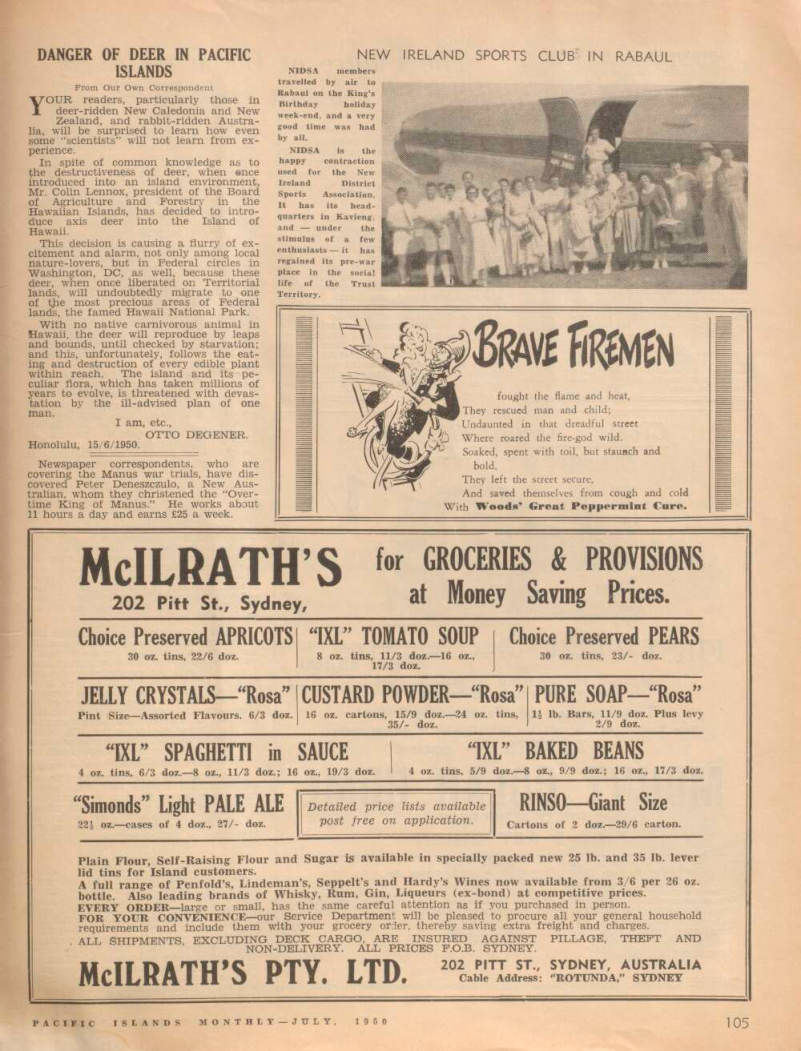
Danger Of Deer In Pacific
From Our Own Correspondent YOUR readers, particularly those in deer-ridden New Caledonia and New Zealand, and rabbit-ridden Austra lia, will be surprised to learn how even some “scientists” will not learn from ex perience.
In spite of common knowledge as to the destructiveness of deer, when once introduced into an island environment, Mr. Colin Lennox, president of the Board of Agriculture and Forestry in the Hawaiian Islands, has decided to intro duce axis deer into the Island of Hawaii.
This decision is causing a flurry of ex citement and alarm, not only among local nature-lovers, but in Federal circles in Washington, DC, as well, because these deer, when once liberated on Territorial lands, will undoubtedly migrate to one of t.he most precious areas of Federal lands, the famed Hawaii National Park.
With no native carnivorous animal in Hawaii, the deer will reproduce by leaps and bounds, until checked by starvation; and this, unfortunately, follows the eat ing and destruction of every edible plant within reach. The island and its pe culiar flora, which has taken millions of years to evolve, is threatened with devas tation by the ill-advised plan of one man.
I am, etc.,
Otto Degener.
Honolulu, 15/6/1950.
Newspaper correspondents, who are covering the Manus war trials, have dis covered Peter Deneszczulo, a New Aus tralian, whom they christened the “Over time King of Manus.” He works about 11 hours a day and earns £25 a week.
New Ireland Sports Club In Rabaul
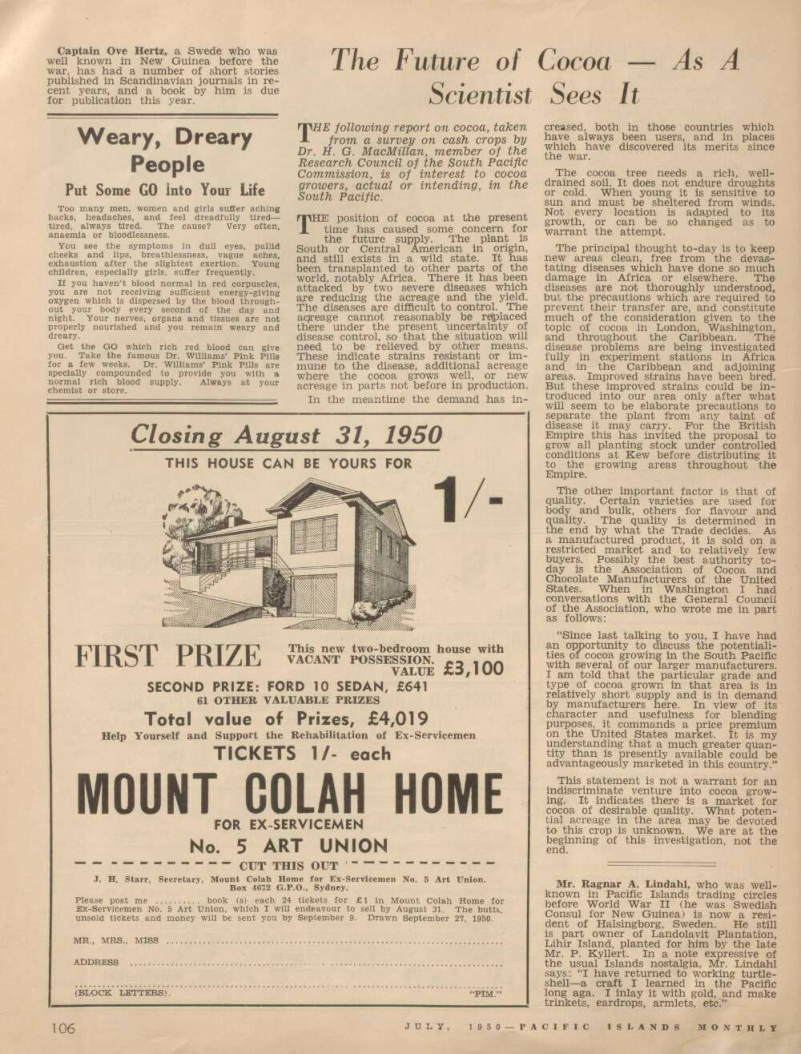
NIDSA members travelled by air to Rabaul on the King’s Birthday holiday week-end, and a very good time was had by all.
NIDSA is the happy contraction used for the New Ireland District Sports Association.
It has its head quarters in Kavieng, and under the stimulus of a few enthusiasts —it has regained its pre-war place in the social life of the Trust Territory.
Captain Ove Hertz, a Swede who was well known in New Guinea before the war, has had a number of short stories published in Scandinavian journals in re cent years, and a book by him is due for publication this year.
Advertisements & other items, pp. 109-110 (1 item)
&ME teN
p fv< r*v-s) r A fv ; to £s£ Bt I
fought the flame and heat, They rescued man and child; Undaunted in that dreadful street Where roared the fire-god wild.
Soaked, spent with toil, but staunch and bold.
They left the street secure, And saved themselves from cough and cold With Woods’ Great Peppermint Cure.
McILRATH’S
202 Pitt St., Sydney,
for GROCERIES & PROVISIONS
at Money Saving Prices.
Plain Flour, Self-Raising Flour and Sugar is available in specially packed new 25 lb. and 35 lb. lever lid tins for Island customers.
A full range of Penfold’s, Lindeman’s, Seppelt’s and Hardy’s Wines now available from 3/6 per 26 oz. bottle. Also leading brands of Whisky, Rum, Gin, Liqueurs (ex-bond) at competitive prices.
EVERY ORDER— large or small, has the same careful attention as if you purchased in person.
FOR YOUR CONVENIENCE —our Service Department will be pleased to procure all your general household requirements and include them with your grocery order, thereby saving extra freight and charges.
, ALL SHIPMENTS,
EXCLUDING DECK CARGO, ARE INSURED AGAINST
NON-DELIVERY. ALL PRICES F. 0.8. SYDNEY.
PILLAGE,
THEFT
AND
if ff n ATIY’C DTV I Tfl 202 PITT ST -' SYDNEY, AUSTRALIA iVICILKA n J rill LI 1/t Cable Address: “ROTUNDA,” SYDNEY
Closing August 31, 1950
THIS HOUSE CAN BE YOURS FOR
IE 1- TT'TT} OH'' nn T r /T7 This new two-bedroom house with rllVOl ritl/iJCj VACANT POSSESSION. - nn
VALUE «,IUU
SECOND PRIZE: FORD 10 SEDAN, £641
61 OTHER VALUABLE PRIZES
Total value of Prizes, £4,019
Help Yourself and Support the Rehabilitation of Ex-Servicemen
TICKETS 1/- each
MOUNT COLAH HOME
FOR EX-SERVICEMEN
No. 5 ART UNION
CUT THIS OUT
J. H. Starr, Secretary, Mount Colah Home for Ex-Servicemen No. 5 Art Union.
Box 4672 G.P.0., Sydney.
Please post me book (s) each 24 tickets for £1 in Mount Colah Home for Ex-Servicemen No. 5 Art Union, which I will endeavour to sell by August 31. The butts, unsold tickets and money will be sent you by September 9. Drawn September 27, 1950.
MR., MRS., MISS
ADDRESS
(BLOCK LETTERS).
“PIM.”
Weary, Dreary
People Put Some GO Into Your Life
Too many men, women and girls suffer aching backs, headaches, and feel dreadfully tired— tired, always tired. The cause? Very often, anaemia or bloodlessness.
You see the symptoms in dull eyes, pallid cheeks and lips, breathlessness, vague aches, exhaustion after the slightest exertion. Young children, especially girls, suffer frequently.
T f „ .
If you haven t blood normal in red corpuscles, you are not receiving sufficient energy-giving oxygen which is dispersed by the blood throughout your body every second of the day and night. Your nerves, organs and tissues are not properly nourished and you remain weary and dreary.
Get the go which rich red blood can give you. Take the famous Dr. williams’ Pink Pills for a few weeks. Dr. williams’ Pink puis are specially compounded to provide you with a chemist or C store°° d supply ’ Always at your
The Future of Cocoa As A Scientist Sees It
Scientist Sees It
THE following report on cocoa, taken from a survey on cash crops by Dr. H. G. MacMillan, member of the Research Council of the South Pacific Commission, is of interest to cocoa growers, actual or intending, in the South Pacific.
THE position of cocoa at the present time has caused some concern for the future supply. The plant is South or Central American in origin, and still exists in a wild state. It has been transplanted to other parts of the world, notably Africa. There it has been attacked by two severe diseases which are reducing the acreage and the yield.
The diseases are difficult to control. The acreage cannot reasonably be replaced there under the present uncertainty of disease control, so that the situation will need to be relieved by other means.
These indicate strains resistant or im mune to the disease, additional acreage where the cocoa grows well, or new acreage in parts not before in production.
In the meantime the demand has in
creased, both in those countries which have always been users, and in places which have discovered its merits since the war.
The cocoa tree needs a rich, well drained soil. It does not endure droughts or cold. When young it is sensitive to sun and must be sheltered from winds.
Not every location is adapted to its growth, or can be so changed as to warrant the attempt.
The principal thought to-day is to keep new areas clean, free from the devas tating diseases which have done so much damage in Africa or elsewhere. The diseases are not thoroughly understood, but the precautions which are required to prevent their transfer are, and constitute much of the consideration given to the topic of cocoa in London, Washington, and throughout the Caribbean. The disease problems are being investigated fully in experiment stations in Africa and in the Caribbean and adjoining areas. Improved strains have been bred.
But these improved strains could be in troduced into our area only after what will seem to be elaborate precautions to separate the plant from any taint of disease it may carry. For the British Empire this has invited the proposal to grow all planting stock under controlled conditions at Kew before distributing it to the growing areas throughout the Empire.
The other important factor is that of quality. Certain varieties are used for body and bulk, others for flavour and quality. The quality is determined in the end by what the Trade decides. As a manufactured product, it is sold on a restricted market and to relatively few buyers. Possibly the best authority to day is the Association of Cocoa and Chocolate Manufacturers of the United States. When in Washington I had conversations with the General Council of the Association, who wrote me in part as follows: “Since last talking to you, I have had an opportunity to discuss the potentiali ties of cocoa growing in the South Pacific with several of our larger manufacturers.
I am told that the particular grade and type of cocoa grown in that area is in relatively short supply and is in demand by manufacturers here. In view of its character and usefulness for blending purposes, it commands a price premium on the United States market. It is my understanding that a much greater quan tity than is presently available could be advantageously marketed in this country.”
This statement is not a warrant for an indiscriminate venture into cocoa grow ing, It indicates there is a market for cocoa of desirable quality. What poten tial acreage in the area may be devoted to this crop is unknown. We are at the beginning of this investigation, not the end.
Mr. Ragnar A. Lindahl, who was well known in Pacific Islands trading circles before World War II (he was Swedish Consul for New Guinea) is now a resi dent of Halsingborg, Sweden. He still is part owner of Landolavit Plantation, Lihir Island, planted for him by the late Mr. P. Kyllert. In a note expressive of the usual Islands nostalgia, Mr. Lindahl says: “I have returned to working turtle shell—a craft I learned in the Pacific long aga. I inlay it with gold, and make trinkets, eardrops, armlets, etc?’
Trustees!-! Ip Delegation
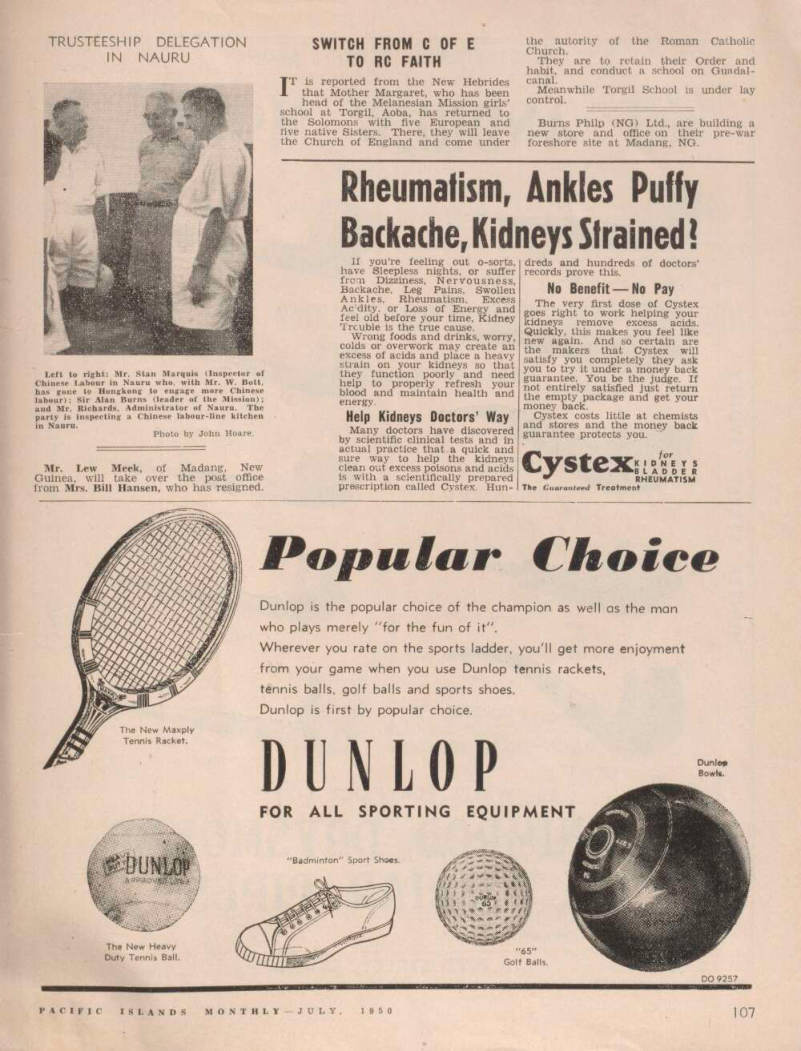
In Nauru
Mr. Lew Meek, of Madang, New Guinea, will take over the post office from Mrs. Bill Hansen, who has resigned.
Left to right: Mr. Stan Marquis (Inspector of Chinese Labour in Nauru who, with Mr. W. Bott, has gone to Hongkong to engage more Chinese labour); Sir Alan Burns (leader of the Mission); and Mr. Richards, Administrator of Nauru. The party is inspecting a Chinese labour-line kitchen in Nauru.
Photo by John Hoare.
Switch From C Of E
To Rc Faith
1T is reported from the New Hebrides that Mother Margaret, who has been head of the Melanesian Mission girls’ school at Torgil, Aoba, has returned to the Solomons with five European and live native Sisters. There, they will leave the Church of England and come under
urc a h utorifcy of the Roman Catholic They are to retain their Order and habit, and conduct a school on Guadal canal.
Meanwhile Torgil School is under lay control.
Burns Philp (NG) Ltd., are building a new store and office on their pre-war foreshore site at Madang, NG.
Advertisements & other items, pp. 111-112 (1 item)
Dunlop
Rheumatism, Ankles Puffy
Backache, Kidneys Strained!
If you’re feeling out o-sorts, have Sleepless nights, or suffer from Dizziness, Nervousness, Backache, Leg Pains, Swollen Ankles, Rheumatism, Excess Acdity, or Loss of Energy and feel old before your time, Kidney Trouble is the true cause.
Wrong foods and drinks, worry, colds or overwork may create an excess of acids and place a heavy strain on your kidneys so that they function poorly and need help to properly refresh your blood and maintain health and energy.
Help Kidneys Doctors’ Way
Many doctors have discovered by scientific clinical tests and in actual practice that a quick and sure way to help the kidneys clean out excess poisons and acids is with a scientifically prepared dreds and hundreds of doctors’ records prove this.
No Benefit —No Pay
The very first dose of Cystex goes right to work helping your kidneys remove excess acids.
Quickly, this makes you feel like new again. And so certain are the makers that Cystex will satisfy you completely they ask you to try it under a money back guarantee. You be the judge. If not entirely satisfied just return the empty package and get your money back.
Cystex costs little at chemists and stores and the money back guarantee protects you. prescription called Cystex. Hun-
Cystex:
The for
KIDNEYS
•B L A D D E R
RHEUMATISM
Guaranteed Treatment
The New Maxply Tennis Racket. u ■ The New Heavy Duty Tennis Ball.
Papular Choice
Dunlop is the popular choice of the champion as well as the man who plays merely "for the fun of it".
Wherever you rate on the sports ladder, you'll get more enjoyment from your game when you use Dunlop tennis rackets, tennis bails, golf balls and sports shoes.
Dunlop is first by popular choice.
DUNLOP
FOR ALL SPORTING EQUIPMENT
'Badminton" Sport Shoes.
Dunlop Bowls x-X vO' oO*ib# f'ff.
Golf Balls.
DO 9257
1 CASTLEREAGH STREET, SYDNEY
ANDREW IH c OEE
»»»“ "■ 934 828 Z D >to Ui O' H 00 of Ui H 829 929 94G 941 rM 887 H ■ 884 965 > o on -< z m -< Illustrated at right is a cutaway model of the Nimrod Drysmoker. Pitted with the famous hygienic filter, it ensures a milder, cleaner, cooler pipe. Bowl stays dry, tobacco burns evenly.
WRITE FOR PRICE LIST
NIMROD DRYSMOKER
BRIAR PIPES
70 PITT STREET, SYDNEY
Madang Newsletter
From Our Own Correspondent
Madang, June 30.
THE travelling representative for Kodak, A/sia, Ltd., Mr. Beckett, recently gave an interesting address on the history of photography at the Madang Forum. From the time when photo graphers needed a boy to carry all their equipment, he traced photographic his tory to modern times when criminology uses it as an important branch of its work. In a speech of thanks, the Rev.
A. A. Maahs, a keen amateur photo grapher, said he must be on the retro grade path, as on a recent expedition through the Pinisterres, he required three boys to carry his gear.
MANY Madangites view with sadness the passing of two old rain trees on the road to the District Office: these trees had become dangerous and had to be cut down. Several Australians claim to have planted them, but old Chinese residents claim that the majority of them were part of the original lay out of Madang made by the Germans.
AT Tusbab, the Native Education Centre, a celebration was held on June 15 and 16 on the anniversary of the school’s opening. The first day was spent in competitive sports arranged by the schoolmaster, Mr. Jim Kernan.
Prizes were given out by the District Commissioner, Charles Bates. The second day was devoted to a grouped sing-song.
Since the opening of the school, the roll has grown to over 100 pupils.
In attendance with a recorder was Mr.
Peter Livingstone. Later the recordings will be heard over 9PA.
MR. LEW MEEK, formerly of Modillon Garage office, has been appointed to the Treasury Department of Dis trict Services. He has taken over the Post Office from Mrs. Bill Hansen who resigned during the month. He has been in Madang about four years.
Mandated airlines, '' ltd., have built a new hangar. The passen gers’ lounge will be greatly appreci ated. It is believed that Mr. Bill Passlow, MAL’s chief pilot, is Mhdang’s crtick Canasta player. He can recite any one of the 61 rules without difficulty.
THE Rev. A. A. Maahs returned from the Highlands after a visit to some of his mission stations. He has plans to construct a road from Madang to Yabob. including a Bailey Bridge for the Gum River. This will open the road for private enterprise as well as the Luther an Mission School at Amele. It is un derstood that the plan has the co-opera tion of the Administration. This may be the start of a long dreamed of road to the Highlands.
THE new picture theatre, a bigger and better one, built over the site of the old is nearing completion. Extra comforts will include more seating ac commodation of a permanent nature, and a cement floor.
Plans are in hand for a golf course and a large cement swimming pool.
MR. 808 BOGLE is back after his recent trip South for health rea sons. Mrs. Dunne (Sister Krem mer) has gone South on well-earned leave. Mr. Dunne will join her in Aus tralia in a few weeks’ time. Mr. Jack Sedgers, managing director of the New Guinea Companv, returned to Madang after a tour of inspection of various branches in the Territory. His daughters,
Jac and Jill, are back from Sydney after an extended holiday. Miss Betty Schil ling is also back from leave in Australia.
Most of the pupils in Mrs. T. Radke’s Asiatic School speak good English (or American, anyway) and in some cases have completed in a year an education missed during the Japanese invasion.
Mrs. Radke’s latest effort is to teach them touch-typing.
A Texan, Mrs. Radke celebrated her 25 years of mission work in New Guinea this year. Pew people’s names will have the lustre in Madang history to equal this missionary teacher’s reputation.
RESIDENTS are wondering whether they are experiencing an exception ally long “wet” season or a wet
“dry” season. In either case, the last week in June saw deluges in the day time—most unusual in the district—while Lae and Kavieng report droughts.
Advertisements & other items, pp. 113-114 (1 item)
Nathan’S Merchandise
LAND FOR SALE
PORT MORESBY—KOKI,
PAPUA.
Vacant land for sale—79 ft. x 175 ft. Freehold Title.
Price, £750.
Reply: Gray & Perkins, Solicitors, 375 George Street Sydney, N.S.W.
NATHANS MERCHANDISE (NSW) PTY. LTD
General Merchants (Wholesale)
WINES, SPIRITS AND ENGLISH ALES
GROCERIES
CROCKERY
TOYS
HARDWARE
Australian Agents for WHITE HEATHER SCOTCH WHISKY.
Bottled in Scotland.
Distributors of "Lushus" MIXED FRUITS and allied lines
INDENT AGENTS
COMMISSION AGENTS
Orders and Enquiries Invited
NATHAN’S MERCHANDISE
(NSW) PTY. LTD.
P.O. Box 2639EE, G.P.0., Sydney, N.S.W., Australia.
Cables: “Senorita,” Sydney.
Classified Advertisements
PUBLIC NOTICES
In the Supreme Court of New South Wales, Probate Jurisdiction.—ln the Will of RICHARD WAiLTON TALBOT, late of Beverly Hills, near Sydney, in the State of New South Wales, retired planter, deceased.
Application will be made after 14 days from the publication hereof that Probate of the last Will and Testament dated March 21, 1949, of the abovenamed deceased may be granted to
BURNS PHILP TRUST COMPANY LIMITED,
the sole Executor named in the said Will, and all notices may be served at the undermentioned address. All creditors in the Estate of the deceased are hereby required to send in particulars of their claims to the undersigned.
W. S. GRAY & PERKINS, Proctors for the Executor, 375 George Street, Sydney, N.S.W.
Dated July 20, 1950.
In the matter of the Charitable Trust known as the “ANZAC HOUSE FUND.” Notice is hereby given that a Petition in connection with the abovenamed “Anzac House Fund” was presented to the Supreme Court of the Territory of Papua and New Guinea on June 22, 1950, by Albert John Gaskin, Percival Francis Bailey and Leslie Henry Corbett, the Trustees of the said Fund, asking as follows; — I. —That directions be given by the said Court as to the disposal of the said “Anzac House Fund.” 3.—That the said Court determine the persons who are entitled to share in the said Fund 3. —That the Petitioners’ costs of and incidental to the Petition be provided for. 4. —That such further or other Order may be made as shall seem meet.
The Court directed that the said Petition be heard before the said Court at 9.30 o’clock in the forenoon on Thursday, September 28. 1950, at the Supreme Court HoUse. Port Moresby.
Any person desiring to support or oppose the making of an Order on the said Petition should aopear in person or by his Counsel at the time fixed for the hearing of the Petition.
J. IRWIN CROMIE. Solicitors for the Petitioners, r>ort Moresby, Papua-New Guinea. Dated July 3, 1950.
PUBLIC NOTICES
lOMA (PAPUA) RUBBER ESTATE.S LIMITED
(IN LIQUIDATION). —Notice is hereby given that the Creditors of the abovenamed company which is being voluntarily wound-up are required on or before the 31st day of August, 1950, being the day for tjbat purpose fixed by me, the undersigned, the liquidator of the company, to send their names and addresses and the particulars of their debts or claims and the names and addresses of their solicitors, if any, to the undersigned, and if so required by notice in writing from me are by their solicitors to come in and prove their said debts and claims at such times and place as shall be specified in such notice or in default thereof they will be excluded from the benefit of any distribution made before such debts are proved.
Dated this 30th day of June, 1950. —MORTON B. COHEN, Liquidator, 14 Martin Place, Sydney, N.S.W.
Be the Estate of ANTON RINGEL, late of Miller’s Point, in the State of New South Wales, Retired Goldminer, deceased. LETTERS OF TRATION granted by the Supreme Court of New South Wales on the 4th day of November, 1947.
Pursuant to the Wills Probate and Administration Act, 1898-1947; Testator’s Family Maintenance and Guardianship of Infants Act. 1916-1938; and Trustee Act, 1925-1942; The Public Trustee, the Administrator of the Estate of the said Anton Ringel, who died on the 4th day of August, 1946, intestate, hereby gives notice that creditors and others having any claim against or to the Estate of the said deceased, are required to send particulars of their claims to the said Public Trustee, at 19 O’Connell Street, Sydney, N.S.W.. on or before the 21st day of September, 1950, at the expiration of which time the said Public Trustee will distribute the assets of the said deceased to the persons entitled having regard only to the claims of which he then has notice. —P. J. P. PULLEN, Public Trustee.
STAMPS
EXCHANGE.—Wanted to exchange stamps on a catalogue basis; reply to: A. S. Jolly, 15 Wyralla Ave., Epping, Sydney, N.S.W., Australia.
POSITION VACANT
WANTED. —Housekeeper-Cook for three adults, four children. Two Papuan assistants. Light work. Interesting plantation life. Salary; £2 per week and found. Fare returned after 12 months. For particulars write to; Mrs. S.
Holland, Madiri Plantation, Fly River, Papua.
POSITION WANTED
WANTED.—By energetic young single man (24 years of age), position on a Plantation in New Guinea or adjacent Pacific Islands, or in Fiji.
Possesses good agricultural, electrical, and mechanical knowledge. Write to: J. Vanslambrouck, c/- P.O. Box 556, Ayr, Nth. Queensland, Australia.
ISLANDS SOUVENIR
SONGS OF THE SOUTH SEAS.—lnspirational Verse. Cover: Feathery Palms, Tropical Flowers, Island Girl. Ideal gift or Souvenir. One dollar (8/- Aust.). Post Free.—Dr. W. Swaan, 715 West 16th Avenue, Vancouver, 8.C., Canada.
BOOKS
BOOK BARGAINS. —Every few months I issue a catalogue of clean secondhand books at really bargain prices from a shilling or two to a pound or two, each. If you’d like these catalogues sent, just send a line stating your interests. (Note: If you order, part payment can always be made in used stamps, not removed from the paper, of which I am always needing any amount.) —Philip R. Boulton, 8, Pore Street, Westbury, Wilts., England.
“WHERE THE TRADE-WIND'S BLOW.” by R.
W. Robson and Judy Tudor.—A collection of over 70 fascinating tales and sketches of the South Pacific Islands, by PIM writers, R, W.
Robson and Judy Tudor; well bound and profusely illustrated, 175 pages. Price: 7/6 (8/posted) per copy. Obtainable from Steele’s Book Store, Suva, Fiji, or direct from the publishers, Pacific Publications Pty., Ltd., Union House, 247 George St., Sydney, N.S.W., Australia.
VOK —AUSTRALIA’S FAVOURITE
"VOK"—AUSTRALIA'S FAVOURITE BRAND OF LIQUEURS, WINES AND SPIRITS ARE NOW AVAILABLE TO ALL MERCHANTS, CLUBS, HOTELS AND RESIDENTS OF THE PACIFIC ISLANDS LIQUEURS; Advocaat, Cherry Brandy, Creme de Menthe, Peach Brandy, Apricot Brandy, Kummel, Gin Sling, White and Red Curacao, etc.
WINES: Sweet and Dry Sherry, Tawney Port, White and Brown Muscat.
SPIRITS: Dry Gin—Rum and Brandy.
AVAILABLE for prompt shipment in the attractive “VOK” bottles— -13-oz. and 26-oz. sizes.
Sole Agents for Pacific Islands
R. J. CRILLEY PTY. LTD.
123 Sussex St., Sydney
Order through your usual HOUSE or DlRECT—Detailed prices lists airmailed on request. ss^ "i
Islands Produce
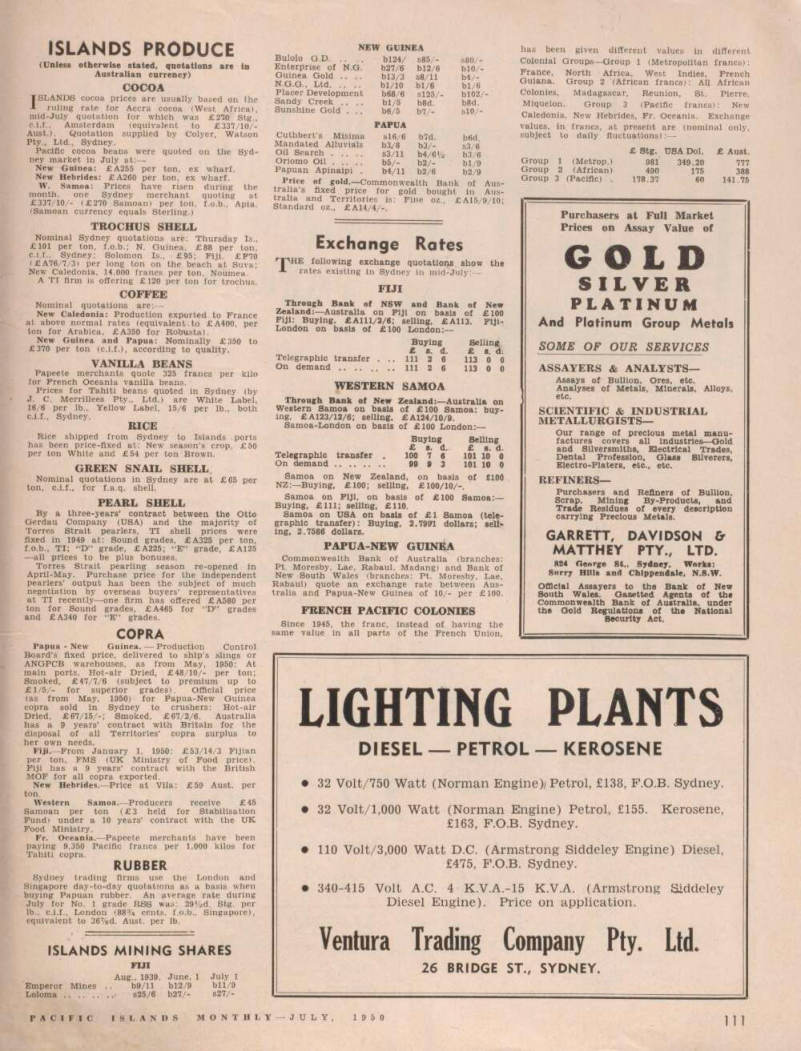
(Unless otherwise stated, quotations are In Australian currency)
Cocoa
ISLANDS cocoa prices are usually based on the ruling rate for Accra cocoa (West Africa), mid-July quotation for which was £270 Stg., c.1.f., Amsterdam (equivalent to £337/10/- Aust.). Quotation supplied by Colyer, Watson Pty., Ltd., Sydney.
Pacific cocoa beans were quoted on the Syd ney market in July at:— New Guinea; £A255 per ton, ex wharf.
New Hebrides: £A26O per ton, ex wharf.
W. Samoa: Prices have risen during the month. one Sydney merchant quoting at £337/10/- (£270 Samoan) per ton, f.0.b., Apia. (Samoan currency equals Sterling.)
Trochus Shell
Nominal Sydney quotations are: Thursday Is., £lOl per ton, f.0.b.; N. Guinea, £BB per ton. c.i.f., Sydney; Solomon Is., £95; Fiji. £P7O ( £ A76/7/3) per long ton on the beach at Suva; New Caledonia, 14.000 francs per ton, Noumea.
A TI firm is offering £l2O per ton for trochus.
Coffee
Nominal quotations are:— New Caledonia: Production exported to France at above normal rates (equivalent to £A4OO, per ton for Arabica, £A3SO for Robusta).
New Guinea and Papua: Nominally £350 to £370 per ton (c.i.f.), according to quality.
Vanilla Beans
Papeete merchants quote 325 francs per kilo for French Oceania vanilla beans.
Prices for Tahiti beans quoted in Sydney (by J. C. Merrillees Pty., Ltd.) are White Label, 16/6 per lb., Yellow Label, 15/6 per lb., both c.i.f., Sydney.
Rice
Rice shipped from Sydney to Islands ports has been price-fixed at: New season’s crop, £5O per ton White and £54 per ton Brown.
Green Snail Shell
Nominal quotations in Sydney are at £65 per ton, c.i.f., for f.a.q. shell.
Pearl Shell
By a three-years’ contract between the Otto Gerdau Company (USA) and the majority of Torres Strait pearlers, TI shell prices were fixed in 1949 at: Sound grades, £A325 per ton, f.0.b., TI; “D” grade, £A225; “E” grade, £AI2S —all prices to be plus bonuses.
Torres Strait pearling season re-opened in April-May. Purchase price for the independent pearlers’ output has been the subject of much negotiation by overseas buyers’ representatives at TI recently—one firm has offered £ASBO per ton for Sound grades, £A465 for “D” grades and £ A 340 for “E” grades.
Copra
Papua - New Guinea. Production Control Board’s fixed price, delivered to ship’s slings or ANGPCB warehouses, as from May, 1950: At main ports, Hot-air Dried, £4B/10/- per ton; Smoked, £47/7/6 (subject to premium up to £l/5/- for superior grades). Official price (as from May, 1950) for Papua-New Guinea copra sold in Sydney to crushers; Hot-air Dried. £67/15/-; Smoked, £67/2/6. Australia has a 9 years’ contract with Britain for the disposal of all Territories’ copra surplus to her own needs.
Fiji. —From January 1, 1950: £53/14/3 Fijian per ton, FMS (UK Ministry of Food price).
Fiji has a 9 years’ contract with the British MOF for all copra exported.
New Hebrides.— Price at Vila; £59 Aust. per ton.
Western Samoa. —Producers receive £45 Samoan per ton (£3 held for Stabilisation Fund) under a 10 years’ contract with the UK Food Ministry.
Fr. Oceania. — Papeete merchants have been paying 9,350 Pacific francs per 1,000 kilos for Tahiti copra.
Rubber
Sydney trading firms use the London and Singapore day-to-day quotations as a basis when buying Papuan rubber. An average rate during July for No. 1 grade RSS was: 29’/2d. Stg. per lb., c.i.f., London (88% cents, f.0.b., Singapore), equivalent to 36 7 /sd. Aust. per lb.
Islands Mining Shares
Fiji
Aug,, 1939. June, 1 July 1 Emperor Mines b9/ll bl2/9 bll/9 s27/-
New Guinea
Bulolo G D b!24/ s85/s80/- Enterprise of N.G. b27/6 b!2/6 blO/- Guinea Gold .. .. b!3/3 S8/1I b4/- N.G.G., Ltd bl/10 bl/6 bl/6 Placer Development b68/6 s!25/bl02/- Sandy Creek ., bl/5 b8d. b8d.
Sunshine Gold . .. b6/5 b7/slO/-
Papua
Cuthbert's Misima S16/6 b7d. b6d.
Mandated Alluvials b3/8 b3/s3/6 Oil Search S3/11 b4/6'/2 b3/6 Oriomo Oil b5/b2/bl/9 Papuan Apinaipi . b4/ll b2/6 b2/9 Price of gold. —Commonwealth Bank of Australia s fixed price for gold bought in Australia and Territories is: Fine oz.. £A15/9/10: Standard oz., JEA14/4/-.
Exchange Rates
npHE following exchange quotations show the rates existing in Sydney in mid-July:—
Fiji
Through Bank of NSW and Bank of New Zealand;—Australia on Fiji on basis of £lOO Fiji: Buying, £Alll/2/6; selling. £AII3. Flji- London on basis of £lOO London:—
Western Samoa
Through Bank of New Zealand:—Australia on Western Samoa on basis of £lOO Samoa: buy ing. £ AI23/12/6; selling. £AI24/10/9.
Samoa-London on basis of £lOO London:— Buying Selling £ s. d. £ s. d.
Telegraphic transfer . 100 7 6 101 10 0 On demand 99 9 3 101 10 0 Samoa on New Zealand, on basis of £lOO NZ:—Buying, £100; selling, £lOO/10/-.
Samoa on Fiji, on basis of £lOO Samoa:— Buying, £111; selling, £llO.
Samoa on USA on basis of £1 Samoa (tele graphic transfer): Buying, 2.7991 dollars; sell ing, 2.7586 dollars.
Papua-New Guinea
Commonwealth Bank of Australia (branches: Pt. Moresby, Lae, Rabaul, Madang) and Bank of New South Wales (branches: Pt. Moresby, Lae, Rabaul) quote an exchange rate between Aus tralia and Papua-New Guinea of 10/- per £lOO.
French Pacific Colonies
Since 1945, the franc, instead of having the same value in all parts of the French Union,
has been given different values in different Colonial Groups—Group 1 (Metropolitan francs): France, North Africa, West Indies, French Guiana. Group 2 (African francs): All African Colonies, Madagascar, Reunion, St. Pierre, Miquelon. Group 3 (Pacific francs): New Caledonia, New Hebrides, Fr. Oceania. Exchange values, in francs, at present are (nominal only, subject to daily fluctuations):—
Buying Selling. £ 8. d. £ 8. d.
Telegraphic transfer . .. Ill 2 6 113 0 0 On demand .. .. 113 0 0
£ Stg.
USA Dol. £ Aust.
Group 1 (Metrop.) 981 349,20 777 Group 2 (African) 490 175 388 Group 3 (Pacific) . 178.37 60 141.75
Advertisements & other items, pp. 115-116 (1 item)
Lighting Plants
Purchasers at Full Market Prices on Assay Value of
GOLD
SILVER
PLATINUM
And Platinum Group Metals
SOME OF OUR SERVICES
ASSAYERS & ANALYSTS—
Assays of Bullion, Ores, etc.
Analyses of Metals, Minerals, Alloys, etc.
SCIENTIFIC & INDUSTRIAL
METALLURGISTS—
Our range of precious metal manufactures covers all industries—Oold and Silversmiths, Electrical Trades, Dental Profession, Glass Sllverers, Electro-Platers, etc., etc.
REFINERS—
Purchasers and Refiners of Bullion, Scrap, Mining By-Products, and Trade Residues of every description carrying Precious Metals.
GARRETT, DAVIDSON &
MATTHEY PTY., LTD.
824 George St., Sydney. Works: Surry Hills and Chippendale, N.B.W.
Official Assayers to the Bank of New South Wales. Gazetted Agents of the Commonwealth Bank of Australia, under the Oold Regulations of the National Security Act.
LIGHTING PLANTS
DIESEL PETROL KEROSENE
• 32 Volt/750 Watt (Norman Engine)/ Petrol, £l3B, F. 0.8. Sydney. • 32 Volt/1,000 Watt (Norman Engine) Petrol, £155. Kerosene, £163, F. 0.8. Sydney, • 110 Volt/3,000 Watt D.C. (Armstrong Siddeley Engine) Diesel, £475, F. 0.8. Sydney. • 340-415 Volt A.C. 4 K.V.A.-15 K.V.A. (Armstrong Siddeley Diesel Engine). Price on application.
Ventura Trading Company Pty. Ltd.
26 BRIDGE ST., SYDNEY.
Without (i
doubt-
I I I 8 ft .' jooo6o»ftft<KH>Vw PR
SO SIMPLE TO INSTALL
1. Screw on frames—use old window frames and simple uprights—and use U in. x 8 round head screws. Never over-tighten screws. 0* 2. Close the clips to glass thickness with a pair of pliers.
Remember, never force k in. glass into 3/16 in. frames. 3. Insert glass. If loose, remove it, and, with a pair of pliers, crimp the clips slightly.
Replace the Louvre. Repeat this procedure until glass is held firmly.
OPEN END INSIDE
5. In order to assure complete weather protection, nail or screw on a facia strip at the top and a weather stop on the sill of each rack of Cooper Louvres. Cooper Louvres stay as you set them— wind will not blow them shut. zu
m m srowsi
m ECONOMICS
IVONUR Tffi
PACIFIC
The Cooper Louvre is the ideal window for tropical areas because it gives unobstructed view and the maximum of light and air ... it actually controls ventilation. It is seldom too wet to keep your Cooper Louvre window partly open—you simply adjust it to keep out the rain and let the fresh air in.
Installations are easy, too! No need for a tradesman; any handyman can install them • • Breakages are easily replaced and remember it costs less to replace an odd Louvre than an expensive normal size window pane.. .
Cleaning is easy and can be done from inside the house.
Send in the enquiry form below for full details of the Cooper Louvre Window.
laiuha.
r
OPEN CLIP
7LASS
WEATHER
STOP
v ■> - m
LOUVRE
HORIZONTAL SECTION
SILL
L 533
CLOSED CUE
4. When the Louvre is held firmly, simply close the clip at each end and the job is done. Replacements are simple, speedy, and cost only a few pence per blade.
PACIFIC ISLANDS REPRESENTATIVE:
E. J. GOUGH 6. CO.
Exporters Importers Manufacturers’ Representatives SUPPLIERS OF GENERAL MERCHANDISE TO LEADING FIRMS
THROUGHOUT THE PACIFIC ISLANDS.
1 BOND STREET, SYDNEY, AUSTRALIA. Box 3615, G.P.O.
Tel.: BU 2159 Bankers: Bank of N.S.W. Bank of Adelaide. Comptoir National d’Escompte de Paris. Cable Address: “SEAFOODS,” Sydney.
Codes: Bentley’s, 2nd and Comp. Phrase; A.8.C., sth and 6th; Peterson, 2nd and 3rd, Banking, Acme. e. j. Gough & Co., ENQUIRY FORM.
Box 3615, G.P.O. - s Sydney, Australia.
Please send rne full details of the Cooper Louvre Window.
ADDRESS:
Index to Volume XX
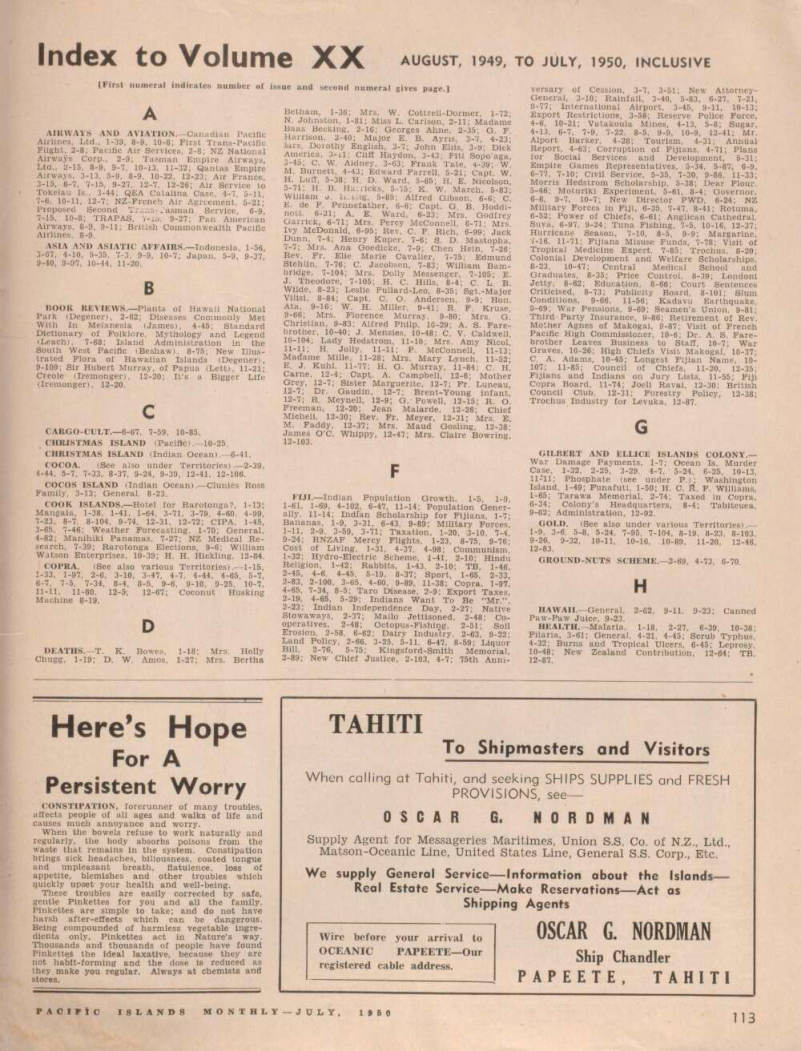
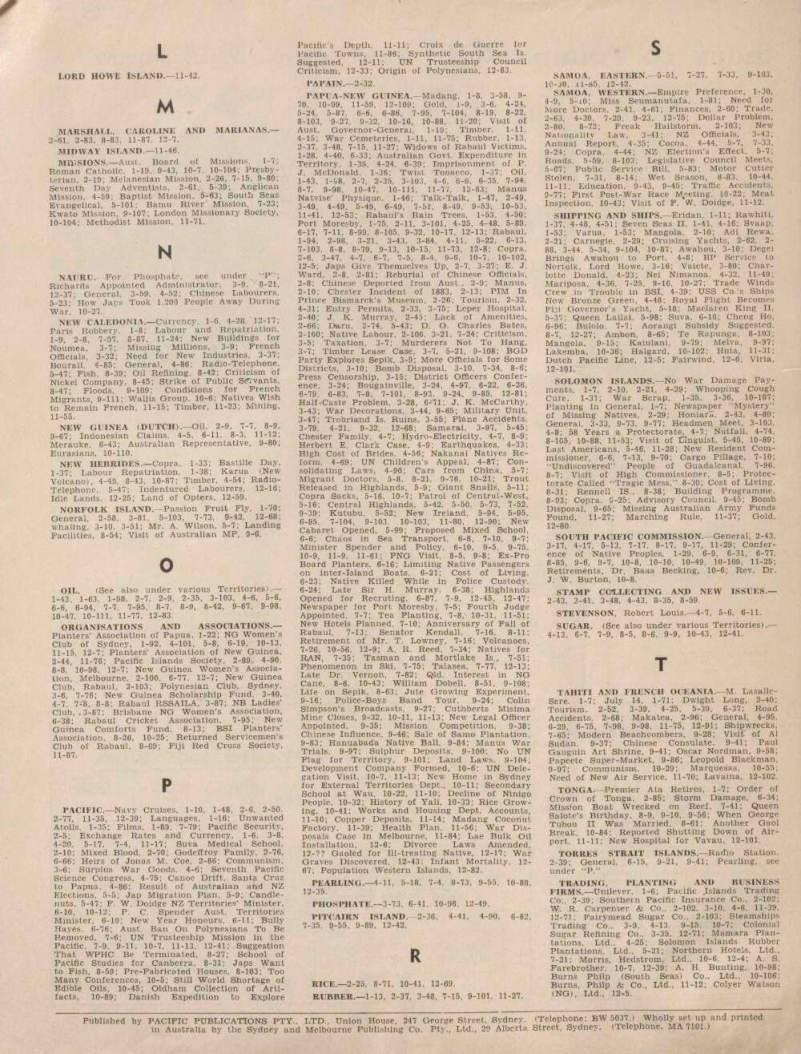
August, 1949, To July, 1950, Inclusive
LEiist numeral Indicates number of issue and second numeral gives page.]
A AIRWAYS AND AVlATlON.—Canadian Pacific Airlines, Ltd., 1-39, 8-9, 10-8; First Trans-Pacific Flighty 2-8; Pacific Air Services, 2-8; NZ National Airways Corp., 2-9; Tasman Empire Airways, Ltd., 2-15, 8-9, 9-7, 10-13, 11-32; Qantas Empire Airways, 3-13, 5-9, 8-9, 10-22, 12-23; Air France, 3-15, 6-7, 7-15, 9-27, 12-7, 12-26; Air Service to Tokelau Is., 3-44; QEA Catalina Case, 4-7, 5-11, 7-6, 10-11, 12-7; NZ-Prench Air Agreement, 5-21; Proposed Second Trans-Gasman Service, 6-9, 7-15, 10-8; TRAPAS, 7-iu, 9-27; Pan American Airways, 8-9, 9-11; British Commonwealth Pacific Airlines, 8-9.
ASIA AND ASIATIC AFFAlRS.—lndonesia, 1-56, 3- 4-10, 5-35, 7-3, 9-9, 10-7; Japan, 5-9, 9-37, 9-40, 9-97. 10-44, 11-20.
B BOOK REVIEWS.—PIants of Hawaii National Park (Degenen, 2-62; Diseases Commonly Met With In Melanesia (James), 4-45; Standard Dictionary of Folklore, Mythology and Legend (Leach), 7-68; Island Administration in the South West Pacific (Beshaw), 8-75; New Illus trated Flora of Hawaiian Islands (Degener), 9-109; Sir Hubert Murray, of Papua (Lett), 11-21; Creole (Tremonger), 12-20; It’s a Bigger Life (Iremonger), 12-20.
C
Cargo-Cult.—6-67, 7-59, 10-85.
Christmas Island (Pacific) .-10-25.
CHRISTMAS ISLAND (Indian Ocean) -6-41.
COCOA. (See also under Territories) .-2-39, 4- 5-7, 7-33, 8-37, 9-24, 9-39, 12-41, 12-106.
COCOS ISLAND (Indian Ocean). —Clunies Ross Family, 3-13; General, 8-23.
COOK ISLANDS.—HoteI for Rarotonga?, 1-13; Mangaia, 1-38, 1-41, 1-64, 3-71, 3-79, 4-60, 4-99, 7-23, 8-7, 8-104, 9-74, 12-31, 12-72; CIPA, 1-45, 3- 7-46; Weather Forecasting, 1-70; General, 4- Manihikl Panamas, 7-27; NZ Medical Re search, 7-39; Rarotonga Elections, 9-6; William Watson Enterprises, 10-39; H. H. Hickling. 12-84.
COPRA. (See also various Territories) .-1-15, I- 1-97, 2-6, 3-10, 3-47, 4-7, 4-44, 4-65, 5-7, 6-7, 7-5, 7-34, 8-4, 8-5, 9-6, 9-10, 9-25. 10-7, II- 11-80, 12-5, 12-67; Coconut Husking Machine 8-19.
D DEATHS.- —T. K. Bowes. 1-18; Mrs. Holly Chugg, 1-19; D. W. Amos, 1-27; Mrs. Bertha
Betham, 1-36; Mrs. W. Cottrell-Dormer, 1-72; N. Johnston, 1-81; Miss L. Carlson, 2-11; Madame Baas Becking, 2-16; Georges Ahne, 2-35; G. F.
Harrison, 2-40; Major E. B. Ayns, 3-7, 4-23; Mrs. Dorothy English, 3-7; John Ellis, 3-9; Dick America, 3-il; Cliff Haydon, 3-43; Piti Sopo’aga, 3- C. W. Aidney, 3-63; Prank Tate, 4-39; W.
M. Burnett, 4-43; Edward Farrell, 5-21; Capt. W.
H. Luff, 5-38; H. D. Ward, 5-65; H. E. Nicolson, 5-71; H. B. Ha;ricks, 5-75; K. W. March, 5-83; William j. lj._ciig, 5-85; Alfred Gibson, 6-6; C.
E. de F. Pennefather, 6-6; Capt. G, B. Hoddi nott, 6-21; A. E. Ward, 6-23; Mrs. Godfrey Garrick, 6-71; Mrs. Percy McConnell, 6-71; Mrs.
Ivy McDonald. 6-95; Rev. C, F. Rich, 6-99; Jack Dunn, 7-4; Henry Kuper, 7-6; S. D. Mastopha, 7-7; Mrs. Ana Goedicke, 7-9; Chen Hein, 7-26; Rev. Pr. Elie Marie Cavalier, 7-75; Edmund Stehlin, 7-76; C, Jacobsen, 7-83; William Barn bridge, 7-104; Mrs. Dolly Messenger, 7-105; E.
J. Theodore, 7-105; H. C. Hills, 8-4; C. L. B.
Wilde, 8-23; Leslie Fullard-Leo, 8-35; Sgt.-Major Vilisi, 8-84; Capt. C. O. Andersen, 9-9; Hon.
Ata, 9-16; W. H. Miller, 9-41; R. P, Kruse, 9- Mrs. Florence Murray, 9-80; Mrs. G Christian, 9-83; Alfred Philp, 10-29; A. S. Fare brother, 10-40; J. Menzies, 10-48; C. V. Caldwell, 10- Lady Hedstrom, 11-10; Mrs. Amy Nicol, 11- H. Jolly, 11-11; P. McConnell, 11-13; Madame Mille, 11-28; Mrs. Mary Lynch, 11-52; E. J. Kuhl, 11-77; H. G. Murray, 11-84; C. H.
Came, 12-4; Capt. A. Campbell, 12-6; Mother Grey, 12-7; Sister Marguerite, 12-7; Fr. Luneau, 12- Dr. Gaudin, 12-7; Brent-Young infant, 12-7; R. Meynell, 12-9; G. Powell, 12-15; R. O.
Freeman, 12-20; Jean Malarde, 12-26; Chief Mieheli, 12-30; Rev. Pr. Meyer, 12-31; Mrs E.
M. Faddy, 12-37; Mrs. Maud Gosling, 12-38; James O’C. Whippy, 12-47; Mrs. Claire Bowring, 12-103.
F FlJl.—lndian Population Growth. 1-5, 1-9, 1-61, 1-69, 4-102, 6-47, 11-14; Population Gener ally, 11-14; Indian Scholarship for Fijians, 1-7; Bananas, 1-9, 3-31, 6-43, 9-89; Military Forces, 1-11, 2-9, 3-59, 3-71; Taxation, 1-20, 3-10, 7-4, 9-24; RNZAP Mercy Flights, 1-23, 8-75, 9-76; Cost of Living, 1-31, 4-37, 4-98; Communism, 1- Hydro-Electric Scheme, 1-41, 2-10; Hindu Religion, 1-42; Rabbits, 1-43, 2-10; TB, 1-46 2- 4-6, 4-45, 5-19, 8-37; Sport, 1-65, 2-33, 2-83, 2-100, 3-65, 4-60, 9-89, 11-38; Copra, 1-97, 4- 7-34, 8-5; Taro Disease, 2-9; Export Taxes, 2-19, 4-65, 5-29; Indians Want To Be “Mr.”, 2-23; Indian Independence Day, 2-27; Native Stowaways, 2-37; Mailo Jettisoned, 2-48; Co operatives, 2-48; Octopus-Pishing, 2-51; Soil Erosion, 2-58, 6-62; Dairy Industry, 2-63, 9-22; Land Policy, 2-66, 3-25, 5-11, 6-47, 8-59; Liquor Bill, 2-76, 5-75; Kingsford-Smith Memorial, 2-89; New Chief Justice, 2-103, 4-7; 75th Anni
versary of Cession, 3-7, 3-51; New Attorney- General, 3-10; Rainfall, 3-40, 5-83, 6-27, 7-21, 9-77; International Airport, 3-45, 9-11, 10-13; Export Restrictions, 3-58; Reserve Police Force, 4-6, 10-21; Vatakoula Mines, 4-13, 5-8; Sugar, 4- 6-7, 7-9, 7-22, 8-5, 9-9, 10-9, 12-41; Mr.
Alport Barker, 4-28; Tourism, 4-31; Annual Report, 4-63; Corruption of Fijians, 4-71; Plans for Social Services and Development, 5-31; Empire Games Representatives, 5-34, 5-87, 6-9, 6-77, 7-10; Civil Service, 5-35, 7-30, 9-86, 11-33; Morris Hedstrom Scholarship, 5-38; Dear Flour, 5- Moturiki Experiment, 5-61, 8-4; Governor, 6- 9-7, 10-7; New Director PWD, 6-24; NZ Military Forces in Fiji, 6-35, 7-47, 8-41; Rotuma, 6- Power of Chiefs, 6-61; Anglican Cathedral, Suva, 6-97, 9-24; Tuna Fishing, 7-5, 10-16, 12-37; Hurricane Season, 7-10, 8-5, 9-9; Margarine, 7- 11-71; Fijians Misuse Funds, 7-78; Visit of Tropical Medicine Expert, 7-85; Trochus, 8-20; Colonial Development and Welfare Scholarships, 8- 10-47; Central Medical School and Graduates, 8-35; Price Control, 8-39; London!
Jetty, 8-62; Education, 8-66; Court Sentences Criticised, 8-73; Publicity Board, 8-101; Slum Conditions, 9-66, 11-56; Kadavu Earthquake, 9- War Pensions, 9-69; Seamen’s Union, 9-81; Third Party Insurance, 9-86; Retirement of Rev.
Mother Agnes of Makogai, 9-87; Visit of French Pacific High Commissioner, 10-6; Dr, A. S. Fare brother Leaves Business to Staff, 10-7; War Graves, 10-26; High Chiefs Visit Makogai, 10-37; C. A. Adams, 10-45; Longest Fijian Name, 10- 107; 11-85; Council of Chiefs, 11-20, 12-35; Fijians and Indians on Jury Lists, 11-55; Fiji Copra Board, 11-74; Joeli Ravai, 12-30; British Council Club, 12-31; Forestry Policy, 12-38; Trochus Industry for Levuka, 12-87.
G
Gilbert And Ellice Islands Colony.—
War Damage Payments, 1-7; Ocean Is. Murder Case, 1-32, 2-25, 3-29, 4-7, 5-24, 6-25, 10-13, 11- Phosphate (see under P.); Washington Island, 1-49; Funafuti, 1-50; H. C. ft. F. Williams, 1-65; Tarawa Memorial, 2-74; Taxed in Copra, 6-34; Colony’s Headquarters, 8-4; Tabiteuea, 9-62; Administration, 12-92.
GOLD. (See also under various Territories).— 1-9, 3-6, 5-8, 5-24, 7-95, 7-104, 8-19, 8-23, 8-103, 9- 9-32, 10-11, 10-16, 10-89, 11-20, 12-46, 12-
Ground-Nuts Scheme.—2-69, 4-73, 6-70,
H HAWAll.—General, 2-62, 9-11, 9-23; Canned Paw-Paw Juice, 9-23.
HEALTH. —Malaria, 1-18, 2-27, 6-39, 10-38; Filaria, 3-61; General, 4-21, 4-45; Scrub Typhus, 4-32; Burns and Tropical Ulcers, 6-45; Leprosy, 10- New Zealand Contribution, 12-64; TB, 12-87.
L
Lord Howe Island.—Ii-42.
M
Marshall, Caroline And Marianas.—
2-61, 2-83, 8-83, 11-87, 12-7.
Midway Island.—Ii-46.
MISSIONS. —Aust. Board of Missions, 1-7; Roman Catholic. 1-19, 9-43, 10-7, 10-104; Presby terian. 2-19; Melanesian Mission, 2-26, 7-15, 9-80; Seventh Day Adventists, 2-61, 5-39; Anglican Mission, 4-59; Baptist Mission, 5-63; South Seas Evangelical, 5-101; Bamu River Mission, 7-23; Kwato Mission, 9-107; London Missionary Society, 10- Methodist Mission, 11-71.
N NAURU. For Phosphate. see under “P”; Richards Appointed Administrator, 3-9. 8-21, 12-37; General, 3-59, 4-52; Chinese Labourers, 5-23; How Japs Took 1,200 People Away During War, 10-27, NEW CALEDONIA. —Currency. 1-6, 4-28. 12-17; Paris Robbery, 1-8; Labour and Repatriation, 1-9, 2-8, 7-97, 8-87, 11-24; New Buildings for Noumea, 3-7; Missing Millions, 3-9; French Officials, 3-32; Need for New Industries, 3-37; Bourail. 4-85; General, 4-86; Radio-Telephone, 5- Pish. 8-39; Oil Refining, 8-42; Criticism of Nickel Company. 8-45; Strike of Public Servants, 8- Floods. 9-109; Conditions for French Migrants, 9-111; Wallis Group, 10-6; Natives Wish to Remain French, 11-15; Timber, 11-23; Mining, 11- NEW GUINEA (DUTCH) .—Oil, 2-9, 7-7, 8-9, 9- Indonesian Claims, 4-5, 6-11, 8-3, 11-12; Merauke, 6-43; Australian Representative, 9-80; Eurasians, 10-110.
NEW HEBRIDES. —Copra, 1-33; Bastille Day, 1-37; Labour Repatriation, 1-38; Karua (New Volcano), 4-49, 8-43, 10-87; Timber, 4-54; Radio- Telephone, 5-47; Indentured Labourers, 12-16; Idle Lands, 12-25; Land of Opters, 12-59.
NORFOLK ISLAND. —Passion Fruit Fly, 1-70; General, 2-58. 3-81. 5-103, 7-73, 9-42, 12-68; whaling. 3-10. 3-51; Mr. A. Wilson, 5-7; Landing Facilities, 8-54; Visit of Australian MP, 9-6.
O OIL. (See also under various Territories). — 1- 1-63, 1-98, 2-7, 2-9, 2-35, 3-103, 4-6, 5-6, 6- 6-94, 7-7, 7-95, 8-7, 8-9, 8-42, 9-67, 9-98, 10- 10-111, 11-77, 12-83.
Organisations And Associations.—
Planters’ Association of Papua, 1-22; NG Women’s Club of Sydney, 1-92, 4-101, 5-8, 6-19, 10-13, 11- 12-7; Planters’ Association of New Guinea, 2- 11-76; Pacific Islands Society, 2-89, 4-90, 8-8, 10-98, 12-7; New Guinea Women’s Associa tion, Melbourne, 2-100, 6-77, 12-7; New Guinea Club, Rabaul. 2-103; Polynesian Club, Sydney, 3- 7-76; New Guinea Scholarship Fund, 3-40, 4- 7-8, 8-8; Rabaul RSSAILA, 3-87; NB Ladies’
Club, .3-87; Brisbane NG Women’s Association, 6-38; Rabaul Cricket Association, 7-95; New Guinea Comforts Fund, 8-13; BSI Planters’
Association, 8-26, 10-25; Returned Servicemen’s Club of Rabaul, 8-69; Fiji Red Cross Society, 11-87.
P PACIFIC. —Navy Cruises, 1-10, 1-48, 2-6, 2-50. 2-77, 11-35, 12-39; Languages, 1-16; Unwanted Atolls, 1-35; Films, 1-89, 7-79; Pacific Security, 2-5; Exchange Rates and Currency, 1-6, 3-8, 4-20, 5-17, 7-4, 11-17; Suva Medical School, 2- Mixed Blood, 2-70; Godeffroy Family, 2-76, 6-66; Heirs of Jonas M. Coe, 2-86; Communism, 3- Surplus War Goods, 4-6; Seventh Pacific Science Congress, 4-75; Canoe Drift. Santa Cruz to Papua. 4-86; Result of Australian afid NZ Elections. 5-5; Jap Migration Plan. 5-9: Candle nuts, 5-47; F. W. Doidge NZ Territories’ Minister. 6-10, 10-12; P. C. Spender Aust. Territories Minister, 6-10; New Year Honours, 6-11; Bully Hayes, 6-76; Aust. Ban On Polynesians To Be Removed. 7-6; UN Trusteeship Mission in the Pacific, 7-9. 9-11, 10-7, 11-13, 12-41; Suggestion That WPHC Be Terminated, 8-27; School of Pacific Studies for Canberra, 8-31; Japs Want to Pish, 8-59; Pre-Pabricated Houses, 8-103; Too Many Conferences, 10-5; Still World Shortage of Edible Oils, 10-45; Oldham Collection of Arti facts, 10-89; Danish Expedition to Explore
Pacific's Depth, 11-11; Croix de Guerre for Pacific Towns, 11-86; Synthetic South Sea Is.
Suggested. 12-11; UN Trusteeship Council Criticism, 12-33; Origin of Polynesians, 12-83.
Papain.-—2-32.
Papua-New Gulnea.—Madang, 1-8, 3-58, 9-
70, 10-99, 11-59, 12-109; Gold, 1-9, 3-6, 4-24, 5- 5-87, 6-6, 6-86, 7-95, 7-104, 8-19, 8-22, 8-103, 9-27, 9-32, 10-16, 10-88. 11-20; Visit of Aust. Governor-General, 1-10; Timber, 1-11, 4-15; War Cemeteries, 1-11, 11-75; Rubber, 1-13, 2- 3-48, 7-15, 11-27; Widows of Rabaul Victims, 1-28, 4-40, 6-33; Australian Govt. Expenditure in Territory. 1-35, 4-24, 6-39; Imprisonment of P.
J. McDonald, 1-36; Twist Tobacco, 1-37; Oil, I- 1-98, 2-7, 2-35, 3-103, 4-6. 6-6, 6-35, 7-94, 8- 9-98, 10-47, 10-111, 11-77, 12-83; ManuS Natvise’ Physique, 1-46; Talk-Talk, 1-47, 2-49, 3- 4-49, 5-49, 6-49, 7-51, 8-49, 9-53 v 10-53, II- 12-53; Rabaul’s Rain Trees, 1-53, 4-50; Port Moresby, 1-75, 2-11, 3-101, 4-25, 4-48, 5-89, 6- 7-11, 8-99, 8-105, 9-32, 10-17, 12-13;'Rabaul, 1- 2-98, 3-21, 3-43, 3-84, 4-11, 5-22, 6-13, 7- 8-8, 8-79, 9-13, 10-15, 11-73, 12-8; Copra, 2- 3-47, 4-7, 6-7, 7-5, 8-4, 9-6, 10-7, 10-102, 12-5; Japs Give Themselves Up, 2-7, 3-27; E. J.
Ward, 2-8. 2-81; Reburial of Chinese Officials, 2-8; Chinese Deported from Aust.. 2-9; Manus, 2-10; Chester Incident of 1883, 2-13; PIM In Prince Bismarck’s Museum, 2-26; Tourism, 2-32, 4- Entry Permits, 2-33, 3-75; Leper Hospital, 2-40; J. K. Murray, 2-45; Lack of Amenities, 2-66; Daru, 2-74, 5-43; D. O. Charles Bates, 2- Native Labour, 2-100. 3-21, 7-24; Criticism, 3- Taxation, 3-7; Murderers Not To Hang, 3-7; Timber Lease Case, 3-7, 5-21, 9-108; BGD Party Explores Seplk, 3-9; More Officials for Some Districts, 3-10; Bomb Disposal, 3-10, 7-34, 8-6; Press Censorship, 3-15; District Officers Confer ence, 3-24; Bougainville, 3-24, 4-97, 6-22, 6-26, 6-79, 6-83, 7-8, 7-101, 8-93, 9-24, 9-85, 12-81; Half-Caste Problem, 3-28, 6-71; J. K. McCarthy, 3-43; War Decorations, 3-44, 9-65; Military Unit, 3-47; Trobriand Is. Ruins, 3-55; Plane Accidehts, 3-79, 4-21, 9-32, 12-68; Samarai, 3-97, 5-45; Chester Family, 4-7; Hydro-Electricity, 4-7, 8-9; Herbert E. Clark Case, 4-9; Earthquakes, 4-33; High Cost of Brides, 4-56; Nakanai Natiyes Re form. 4-69; UN Children’s Appeal, 4-87; Con solidating Laws, 4-90; Cars from China, 5-7; Migrant Doctors, 5-8, 8-21, 9-76. 10-21; Trout Released in Highlands, 5-9; Giant Snails, 5-11; Copra Sacks, 5-16. 10-7; Patrol of Central-West, 5- Central Highlands, 5-42, 5-50, 5-73, 7-52, 9- Kutubu, 5-52; New Ireland, 5-94, 5-95, 6- 7-104. 9-103, 10-103, 11-80, 12-90; New Cabaret Opened, 5-99; Proposed Mixed School, 6-6; Chaos in Sea Transport, 6-8, 7-10, 9-7; Minister Spender and Policy, 6-10, 9-5, 9-75, 10- 11-9, 11-61; PNG Visit, 8-5, 9-8; Ex-Pro Board Planters, 6-16; Limiting Native Passengers on Inter-Island Boats, 6-21; Cost of Living, 6-23; Native Killed While in Police Custody, 6- Late Sir H. Murray, 6-38; Highlands Opened for Recruting, 6-87, 7-9, 12-45, 12-47; Newspaper for Port Moresby, 7-5; Fourth Judge Appointed, 7-7; Tea Planting, 7-8, v 10-31, 11-51; New Hotels Planned, 7-10; Anniversary of Fall of Rabaul, 7-13; Senator Kendall, 7-16, 8-11; Retirement of Mr. T. Lowney, 7-16; Volcanoes, 7- 10-56, 12-9; A. R. Reed, 7-34; Natives for RyAN, 7-35; Tasman and Mortlake Is., 7-51; Phenomenon in Ski, 7-75; Talasea, 7-77, 12-13; Late Dr. Vernon, 7-82; Qld. Interest in NG Cane, 8-6. 10-43; William Dobell, 8-51, 9-108; Life on Sepik. 8-63; Jute Growing Experiment, 9-16; Police-Boys Band Tour, 9-24; Colin Simpson’s Broadcasts, 9-27; Cuthberts Misima Mine Closes, 9-32, 10-11, 11-13; New Legal Officer Appointed, 9-35; Mission Competition, 9-38; Chinese Influence, 9-46; Sale of Samo Plantation, 9-83; Hanuabada Native Ball, 9-84; Manus War Trials. 9-97; Sulphur Deposits, 9-100; No UN Flag for Territory, 9-101; Land Laws. 9-104; Development Company Formed, 10-6; UN Dele gation Visit, 10-7, 11-13; New Home in Sydney for External Territories Dept., 10-11; Secondary School at Wau, 10-22, 11-10; Decline of Ninigo People, 10-32; History of Yali, 10-33; Rice Grow ing, 10-41; Works and Housing Dept. Accounts, 11- Copper Deposits, 11-14; Madang Coconut Factory. 11-39; Health Plan. 11-56; War Dis posals Case in Melbourne, 11-84; Lae Bulk Oil Installation, 12-6; Divorce Laws Amended, 12- Gaoled for 111-treating Native, 12-17; War- Graves Discovered, 12-43; Infant Mortality, 12- 67; Population Western Islands, 12-82.
Pearling.—4-11, 5-18, 7-4, 8-73, 9-55, 10-88,
12-35.
Phosphate.—3-73, 6-41. 10-98. 12-49.
Pitcairn Island.—2-36, 4-41, 4-90, 6-82,
7-35, 9-55, 9-89, 12-42.
R
Rice.—2-25, 8-71. 10-41, 12-69.
Rubber.—I-13, 2-37, 3-48, 7-15. 9-101, 11-27.
s
Samoa, Eastern—S-51, 7-27, 7-33, 9-103,
10- il-85, 12-42.
SAMOA, WESTERN.—Empire Preference, 1-30, 4- 5-r0; Miss Seumanutafa, 1-81; Need for More Doctors, 2-41, 4-61; Finances, 2-60; Trade, 2-63, 4-30, 7-29, 9-23, 12-75; Dollar Problem, 2-80, 8-72; Freak Hailstorm, 2-103; New Nationality Law, 3-41; NZ Officials, 3-43; Annual Report, 4-35; Cocoa, 4-44, 5-7, 7-33, 9-24; Copra, 4-44; NZ Election’s Effect, 5-7; Roads, 5-59, 8-103; Legislative Council Meets, 5- Public Service Bill, 5-83; Motor Cutter Stolen, 7-31, 8-14; Wet Season, 8-83, 10-44. 11- Education, 9-43, 9-45; Traffic Accidents, 9-77; First Post-War Race Meeting, 10-22; Meat Inspection, 10-43; Visit of F. W. Doidge, 11-12.
SHIPPING AND SHlPS.—Eridan, 1-11; Rawhiti, 1-37, 4-48, 4-51; Seven Seas 11, 1-41, 4-16; Svaap, 1- Varua, 1-53; Mangola, 2-10; Adi Rewa, 2- Carnegie, 2-29; Cruising Yachts, 2-62, 2- 88, 3-44, 5-34, 9-104, 10-87; Awahou, 3-10; Degei Brings Awahou to Port, 4-8; BP Service to Norfolk, Lord Howe, 3-16; Vaiete, 3-80; Char lotte Donald, 4-23; Nei Nimanoa, 4-32, 11-49; Mariposa. 4-36, 7-25, 9-16, 10-27; Trade Winds Crew in Trouble in BSI, 4-39; USS Co.’s Ships Now Bronze Green, 4-48; Royal Flight Becomes Fiji Governor’s Yacht, 5-18; Maclaren King 11, 5- Queen Lailai, 5-98; Suva, 6-16; Cheng Ho, 6- Bulolo. 7-7; Aorangi Subsidy Suggested, 8-7, 12-27; Ambon, 8-65; Te Rapunga, 8-103; Mangola, 9-15; Kaiulani, 9-79; Melva, 9-97; Lakemba, 10-36; Halgard, 10-102; Huia, 11-31; Dutch Pacific Line, 12-5; Fairwind, 12-6; Viria, 12- SOLOMON ISLANDS.—No War Damage Pay ments, 1-7, 2-10, 2-21, 4-29; Whooping Cough Cure, 1-31; War Scrap, 1-35, 3-36, 10-107; Planting in General, 1-7; Newspaper “Mystery” of Missing Natives, 2-29; Honiara, 2-43, 4-89; General, 3-33, 9-73, 9-77; Headmen JMeet, 3-103, 4-8; 58 Years a Protectorate, 4-7; Nutfall, 4-74, 8-105, 10-88, 11-53; Visit of Cinguist, 5-45, 10-89; Last Americans, 5-46, 11-28; New Resident Com missioner, 6-6, 7-13, 9-70; Cargo Pillage, 7-10; “Undiscovered” People of Guadalcanal. 7-96, 8-7; Visit of High Commissioner, 8-5; Protec torate Called “Tragic Mess,” 8-30; Cost of Living, 8-31; Rennell IS,, 8-38; Building Programme, 8-93; Copra, S-25; Advisory Council, 9-45; Bomb Disposal, 9-65; Missing Australian Army Funds Pound, 11-27; Marching Rule, 11-37; Gold, 12-80.
South Pacific Commission—Generai, 2-43,
3- 4-17, 5-13, 7-17, 8-17, 9-17, 11-29; Confer ence of Native Peoples, 1-29, 6-9, 6-31, 6-77, 8- 9-6. 9-7, 10-8, 10-10, 10-49, 10-109, 11-25; Retirements, Dr. Baas Becking, 10-6; Rev. Dr.
J. W. Burton, 10-8.
Stamp Collecting And New Issues.—
2-43, 3-41, 3-48, 4-43, 8-35, 8-59.
STEVENSON, Robert Louis. —4-7, 5-6, 6-11.
SUGAR. (See also under various Territories).-^ 4- 6-7, 7-9, 8-5, 8-6, 9-9, 10-43( 12-41.
T
Tahiti And French Oceania.—M, Lasalle-
Sere. 1-7; July 14, 1-71; Dwight Long, 2-40; Tourism, 2-52, 3-39, 4-25, 5-39, 6-37; Road Accidents, 2-68; Makatea, 2-96; General, 4-95, 6- 6-75, 7-98, 9-98, 11-75, 12-91; Shipwrecks, 7- Modern Beachcombers, 9-28; VisifT of A 1 Sudan, 9-37; Chinese Consulate, 9-41; Paul Gauguin Art Shrine, 9-41; Oscar Nordman, 9-58; Papeete Super-Market, 9-86; Leopold Blackman, 9- Communism, 10-29; Marquesas. 10-55; Need of New Air Service, 11-70; Lavaina, 12-102.
TONGA Premier Ata Retires, 1-7; Order of Crown of Tonga, 2-85; Storm Damage, 6-34; Mission Boat Wrecked on Reef, 7-41; Queen Salote’s Birthday, 8-9, 9-10, 9-56; When George Tubou II Was Married, 8-61; Another Gaol Break, 10-84; Reported Shutting Down of Air port, 11-11; New Hospital for Vavau, 12-101.
TORRES STRAIT ISLANDS. —Radio Station. 2-39: General, 6-15, 9-21, 9-41; Pearling, see under “P.”
Trading, Planting And Business
FlRMS.—Unilever, 1-6; Pacific .Islands Trading Co., 2-39: Southern Pacific Insurance Co.. 2-102; W. R. Carpenter & Co., 2-102, 3-10, 4-6. 11-39. 12-71; Fairymead Sugar Co., 2-103; Steamships Trading Co.. 3-9, 4-13, 9-15. 10-7; Colonial Sugar Refining Co., 3-35, 12-71; Mamara Plan tations, Ltd,. 4-25; Solomon Islands Rubber Plantations. Ltd,, 5-21; Northern Hotels, Ltd., 7-21; Morris, Hedstrom, Ltd., 10-6. 12-4; A. S.
Farebrother. 10-7, 12-39; A. H. Bunting, 10-98; Burns Philp (South Seas) Co., Ltd., 10-106; Burns, Philp & Co., Ltd., 11-12; Colyer Watson (NG), Ltd., 12-5.
Advertisements & other items, pp. 117-120 (2 items)
Here’s Hope
TAHITI
To Shipmasters and Visitors When calling at Tahiti, and seeking SHIPS SUPPLIES and FRESH
PROVISIONS, see—
OSCAR G. NORDMAN
Supply Agent for Messagerles Maritimes, Union S.S. Co. of N.Z., Ltd., Matson-Oceanic Line, United States Line, General S.S. Corp., Etc.
We supply General Service—lnformation about the Islands— Real Estate Service—Make Reservations—Act as Shipping Agents
Ship Chandler
PAPEETE, TAHITI
Wire before your arrival to
OCEANIC PAPEETE—Our
registered cable address.
OSCAR G. NORDMAN
Here’s Hope
For A
Persistent Worry
CONSTIPATION, forerunner of many troubles, affects people of all ages and walks of life and causes much annoyance and worry.
When the bowels refuse to work naturally and regularly, the body absorbs poisons from the waste that remains in the system. Constipation brings sick headaches, biliousness, coated tongue and unpleasant breath, flatulence, loss of appetite, blemishes and other troubles which quickly upset your health and well-being.
These troubles are easily corrected by safe, gentle Pinkettes for you and all the family.
Pinkettes are simple to take; and do not have harsh after-effects which can be dangerous.
Being compounded of harmless vegetable ingredients only, Pinkettes act in Nature’s way.
Thousands and thousands of people have found Pinkettes the ideal laxative, because they are not habit-forming and the dose is reduced as they make you regular. Always at chemists and stores.
i.J#* mg*. s- :'V.
V , ■ ood company deserves the best, and it is a thoughtful and discerning host who serves his guests sparkling K.B. Lager. For “K. 8.” adds enjoyment to any gathering, and it’s one drink that’s appreciated by everybody, men and women alike.
TOOTHS
LAGER
/OOTh tVo D > ipiiiii
r T°\
MERCHANTS, & SHIP OWNERS
Capital £500,000
ESTABLISHED 1914
GENERAL MERCHANTS
AND
PROVIDORES
TRADE THROUGHOUT THE PACIFIC.
THIRTY-FIVE YEARS OF PACIFIC ISLANDS DEVELOPMENT AND SERVICE.
BUYERS AND EXPORTERS OF ALL KINDS
OF ISLAND PRODUCE, COPRA, COCOA,
M.O.P. SHELL, TROCAS SHELL, ETC.
AGENTS FOR AUSTRALIAN, EUROPEAN
AND AMERICAN MANUFACTURERS.
DISTRIBUTORS OF EVERY DESCRIPTION
OF MERCHANDISE.
Through our Sydney office, branches anc
a wide and comprehensive range of
I. R. CARPENTER & (0. LTD.
agents— —distribute
NATIONALLIBRARY OF AUSTRALIA
general merchandise.
1 7 JUL 2012
Head Office: 16 O'CONNELL STREET, SYDNEY, N.S.W.
Cable Address:
“CAMOHE.”
Telephone; BW 4421.
Postal Address: G.P.0., BOX 168, Sydney.
In London; W. R. Carpenter & Co. (London), Ltd., Coronation House, 4 Lloyd's Ave., London, EC
ASSOCIATED COMPANIES THROUGHOUT THE PACIFIC:
IN NEW GUINEA:
New Guinea Company, Limited, Rabaul. Lae, Madang, Kavieng.
IN PAPUA:
J. R. Clay & Co., Ltd., Port Moresby.
IN FIJI;
W. R. Carpenter & Co. (Fiji), Ltd., Suva.
Published by PACIFIC PUBLICATIONS PTY., LTD., Union House, 247 George Street. Sydney. (Telephone; BW 5037.) Wholly set up and printed
in Australia by the Sydney and Melbourne Publishing Co. Pty., Ltd., 29 Alberta Street, Sydney. (Telephone. MA 7101.1