Wands
Pacific
Monthly
May, 1950
Vol.. XX. No. 10
■ HBfm' y 4-tsiHM
NSMopflll/potf tffce Sydney, by post as a newspaper ]
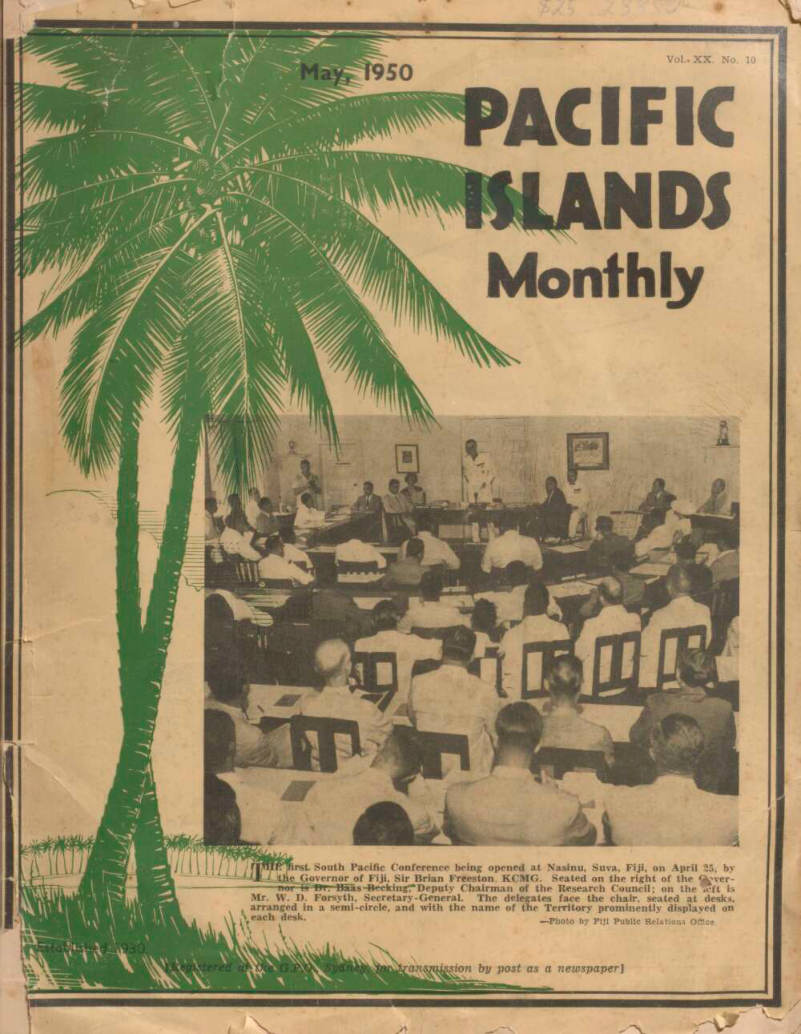
THE first South Pacific Conference being opened at Nasinu, Suva, Fiji, on April 25, by the Governor of Fiji, Sir Brian Freeston, KCMG. Seated on the right of the Cover nor is Dr. Baas Becking, Deputy Chairman of the Research Council; on the left is Mr. W. D. Forsyth, Secretary-General. The delegates face the chair, seated at desks, arranged in a semi-circle, and with the name of the Territory prominently displayed on each desk.
—Photo by Fiji Public Relations Office.
Advertisements & other items, pp. 2-4 (1 item)
V „„ .^jpv,„ a- - .
\l^ ft V s i & ftft* O Q q*\* u //A] ft\* K J*V» o o Of ***
u C Rft« ftft v *»» °% S \^ K o o v «l ft**' Ail* o ft ft' l m by s\vvv ftl' v^> \\ft*
SgS O
“S j / Aft* V^V ftft* O «Vi'-* r w*'* 4oO o° o < ft'SV O l * ♦ * * o K ftft'**'
ftH
ft"
ft'l
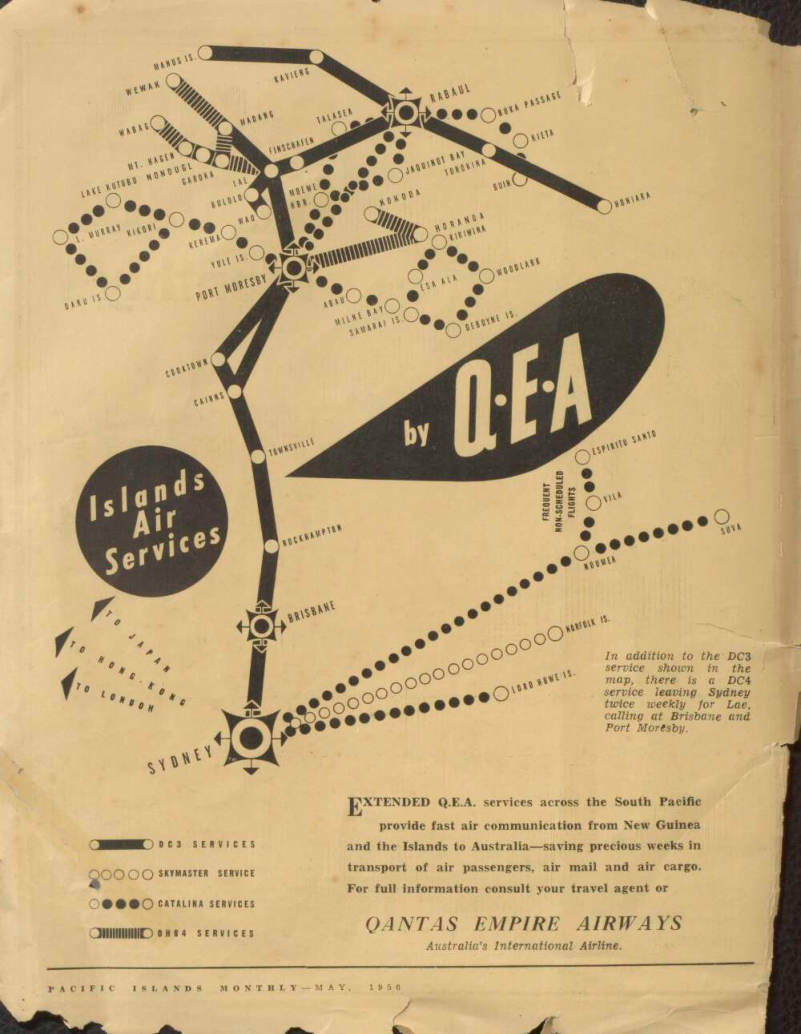
e •• 7n addition to the DCZ service shoion in the map, there is a DC4 service leaving Sydney twice weekly for Lae, calling at Brisbane and Port Moresby.
DC 3 SERVICES
OO SKYMfISTER SERVICE
o###o CATALINA SERVICES
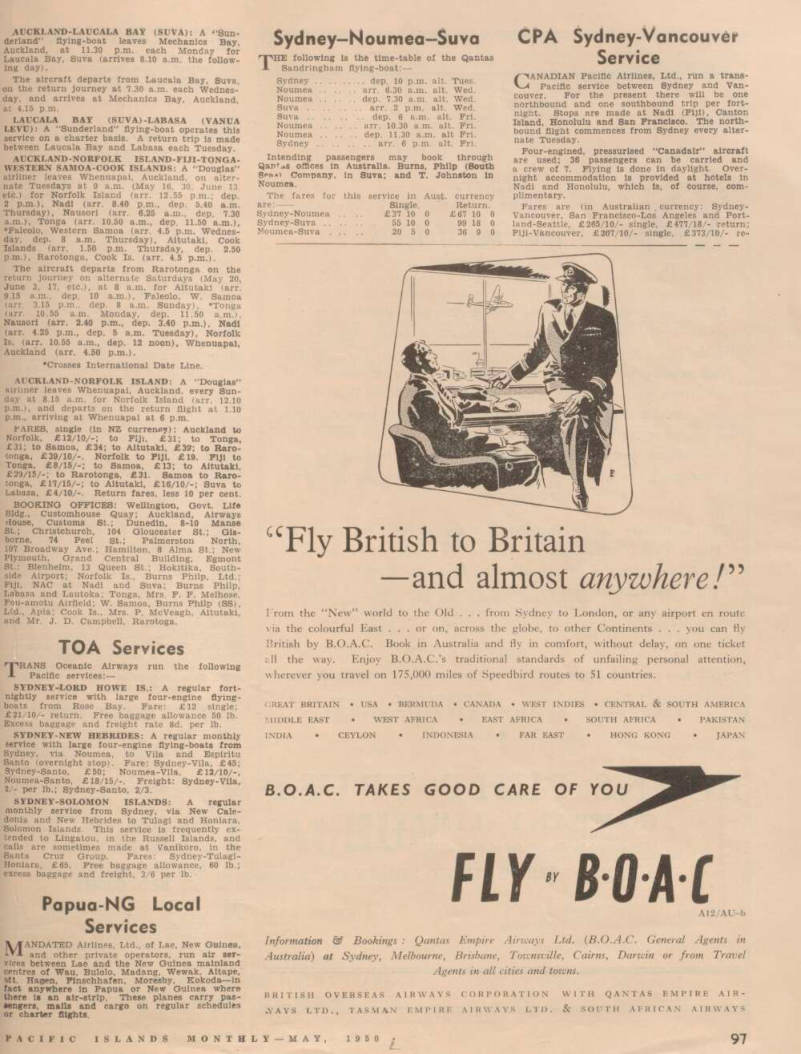
GllllllllllliD 0H 8 4 SERVICES gXTENDED Q.E.A. services across the South Pacific provide fast air communication from New Guinea and the Islands to Australia—saving precious weeks in transport of air passengers, air mail and air cargo.
For full information consult your travel agent or
Q ANT AS EMPIRE AIRWAYS
Australia’s International Airline.
tjmr.mrr'
vou
\ l^v. m r V * m 0 / w v< ■ m 7i*3 ’
CAN DEPEND ON
SiaanjW
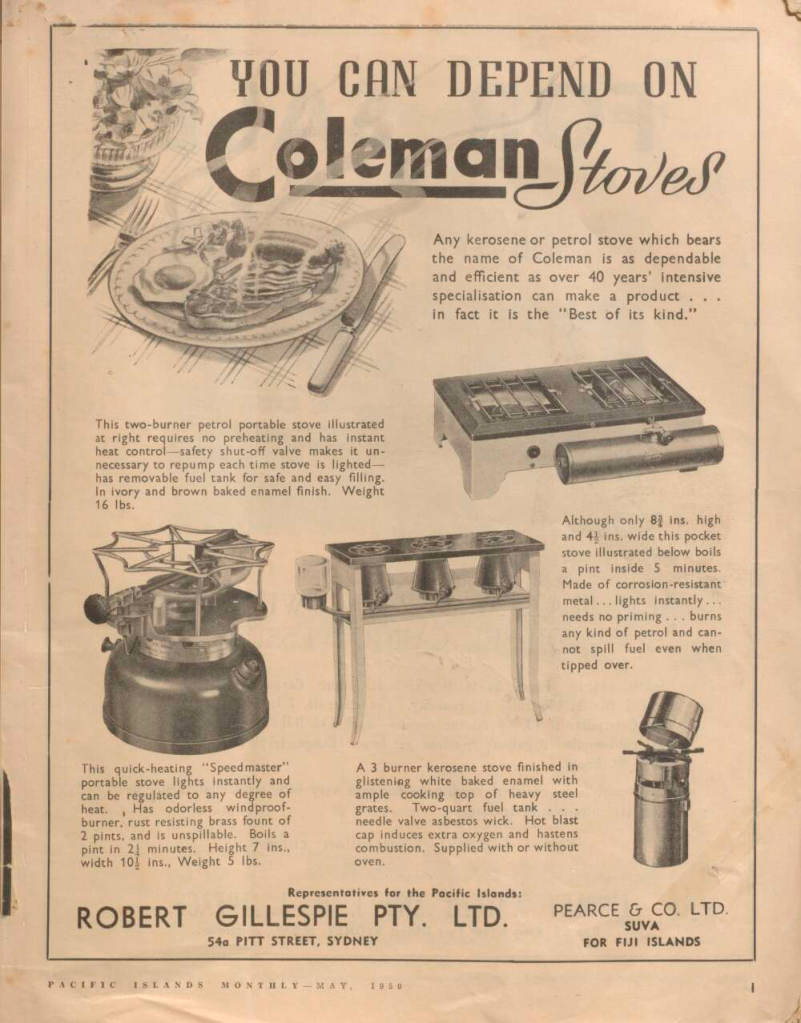
Any kerosene or petrol stove which bears the name of Coleman is as dependable and efficient as over 40 years’ intensive specialisation can make a product . . . in fact it is the “Best of its kind.”
This two-burner petrol portable stove illustrated at right requires no preheating and has instant heat control—safety shut-off valve makes it unnecessary to repump each time stove is lighted— has removable fuel tank for safe and easy filling.
In ivory and brown baked enamel finish. Weight 16 lbs.
Although only 8f ins. high
and ins. wide this pocket stove illustrated below boils a pint inside 5 minutes.
Made of corrosion-resistant
metal... lights instantly...
needs no priming . . . burns any kind of petrol and cannot spill fuel even when
tipped over.
This quick-heating “Speedmaster”
portable stove lights instantly and
can be regulated to any degree of heat. , Has odorless wind proofburner, rust resisting brass fount of 2 pints, and is unspillable. Boils a pint in 2| minutes. Height 7 ins., width 10| ins., Weight 5 lbs.
A 3 burner kerosene stove finished in glistening white baked enamel with ample cooking top of heavy steel grates. Two-quart fuel tank . . . needle valve asbestos wick. Hot blast cap induces extra oxygen and hastens combustion. Supplied with or without oven.
Representatives for the Pacific Islands:
ROBERT GILLESPIE PTY. LTD.
54a PITT STREET, SYDNEY
PEARCE & CO. LTD.
SUVA
FOR FIJI ISLANDS
FOR SALE
ftl imu
U Jfe. r i a
■H , . *■ '* ■ --:• ■ • -: '' - 3 ... • ..: .. .4 ■ > * f
■ m gii- •
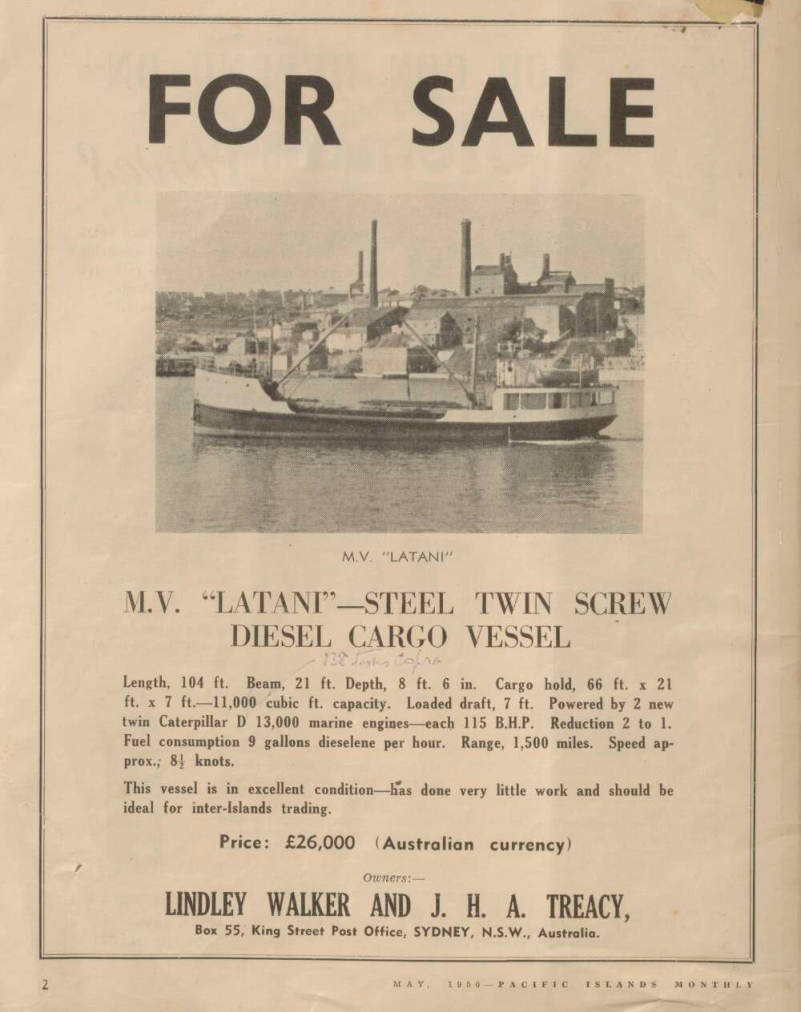
M.V. "LATANI"
M.V. “LATANI”—STEEL TWIN SCREW
DIESEL CARGO VESSEL
. - i l't (fo/ /VA
Length, 104 ft. Beam, 21 ft. Depth, 8 ft. 6 in. Cargo hold, 66 ft. x 21 ft. x 7 ft.—ll,ooo cubic ft. capacity. Loaded draft, 7 ft. Powered by 2 new twin Caterpillar D 13,000 marine engines—each 115 B.H.P. Reduction 2 to 1.
Fuel consumption 9 gallons dieselene per hour. Range, 1,500 miles. Speed approx., 8y knots.
This vessel is in excellent condition—iTas done very little work and should be ideal for inter-islands trading.
Price: £26,000 (Australian currency)
Owners: UNDLEY WALKER AND J. H. A. TREACY, Box 55, King Street Post Office, SYDNEY, N.S.W., Australia.
Index to Advertisers
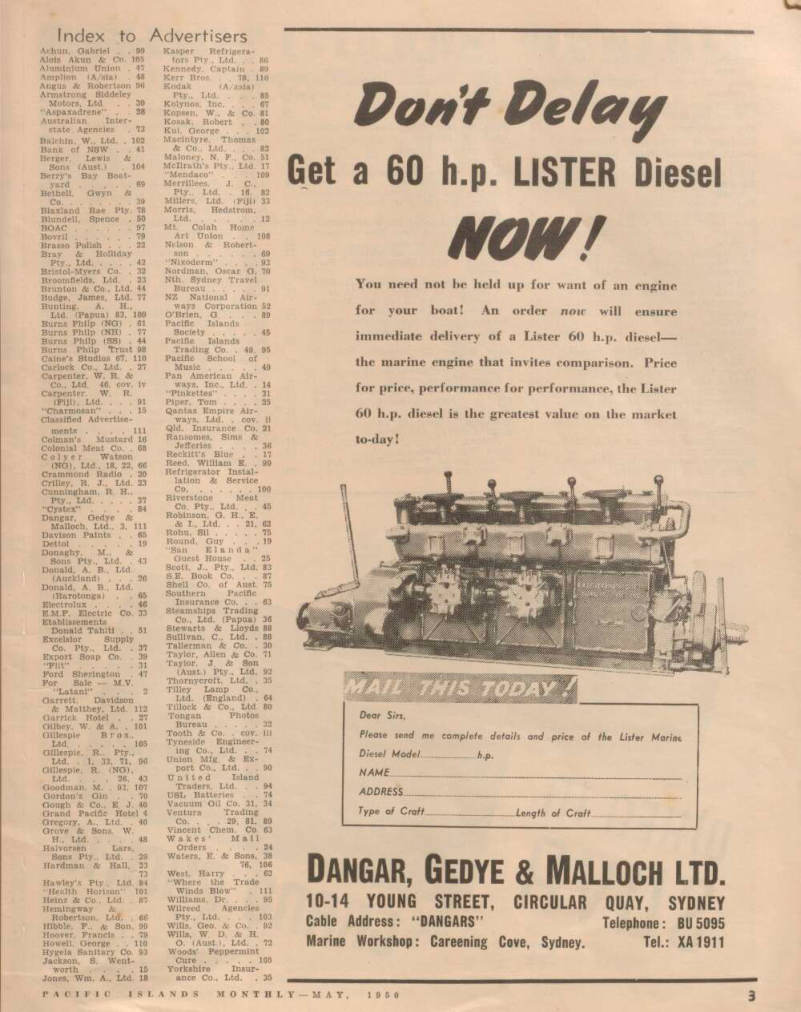
Achun, Gabriel . . 99 Alois Akun & Co. 105 Aluminium Union . 47 Amplion fA/slal . 48 Angus & Robertson 96 Armstrong Siddeley Motors, Ltd. . .30 “Aspaxadrene” . . 28 Australian Inter state Agencies .73 Balchin. W.. Ltd. . 102 Bank of NSW . . 41 Berger, Lewis & Sons (Aust.) 104 Berry’s Bay Boat yard 69 Bethell, Gwyn & Co. ... 39 Blaxland Rae Pty. 78 Blundell, Spence . 50
Boac 97
Bovril .79 Brasso Polish ... 22 Bray & Holliday Pty., Ltd 42 Bristol-Myers Co. . 32 Broomfields, Ltd. . 23 Brunton & Co., Ltd. 44 Budge, James, Ltd. 77 Bunting, A. H., Ltd. (Papua) 83, 109 Burns Philp (NG) . 61 Burns Philp (NH) . 77 Burns Philp (SS) . 44 Burns Philp Trust 98 Caine’s Studios 67, 110 Carlock Co., Ltd. . 27 Carpenter, W. R. & Co., Ltd, 46, cov. iv Carpenter. W. R. (Fiji), Ltd. ... 91 “Charmosan” ... 15 Classified Advertise ments ... 11l Colman’s Mustard 16 Colonial Meat Co. . 68 C o 1 y e r Watson (NG), Ltd., 18, 22, 66 Crammond Radio . 20 Crllley, R. J., Ltd. 23 Cunningham, R H., Pty., Ltd 37 “Cystex” ... 84 Dangar, Gedye & Malloch. Ltd., 3, 111 Davison Paints . . 65 Dettol 19 Donaghy, M., & Sons Pty., Ltd. . 43 Donald, A. 8., Ltd. (Auckland) ... 26 Donald, A. 8., Ltd. (Rarotonga) . . 65 Electrolux ... 46 E.M.F. Electric Co. 33 Etablissements Donald Tahiti . . 51 Excelsior Supply Co. Pty., Ltd. . 37 Export Soap Co. . 39 “Flit” 31 Ford Sherington . 47 For Sale M.V.
“Latani” ... 2 Garrett, Davidson & Matthey, Ltd. 112 Garrick Hotel . . 27 Gilbey, W. & A. . 101 Gillespie Bros., Ltd 105 Gillespie, R., Pty., Ltd. . 1, 33, 71, 96 Gillespie, R. (NG).
Ltd. ... 26, 43 Goodman, M. . 93, 107 Gordon’s Gin . . 70 Gough & Co., E. J. 40 Grand Pacific Hotel 4 Gregory, A., Ltd. . 40 Grove & Sons, W.
H., Ltd 48 Halvorsen Lars, Sons Pty., Ltd. . 29 Hardman & Hall, 23 73 Hawley’s Pty., Ltd. 84 “Health Horizon” 101 Heinz & Co., Ltd. . 87 Hemingway & Robertson, Ltd. . 66 Hibble, P., & Son, 99 Hoover, Francis . . 79 Howell, George . . 110 Hygeia Sanitary Co. 93 Jackson, S. Went worth ... 15 Jones, Wm. A., Ltd. 18
Kasper Refrigera tors Pty., Ltd. . . 86 Kennedy. Captain . 89 Kerr Bros. . . 78, 110 Kodak (A/asia) Pty., Ltd. ... 85 Kolynos, Inc. ... 67 Kopsen, W., & Co. 81 Kosak, Robert . .80 Kui, George ... 102 Maclntyre, Thomas & Co., Ltd. ... 82 Maloney, N. F., Co. 51 Mcllrath’s Pty.. Ltd. 17 “Mendaco” . . 109 Merrillees. J. C., Pty.. Ltd. , 16, 82 Millers, Ltd. (Fiji) 33 Morris, Hedstrom, Ltd 12 Mt. Colah Home Art Union . . 108 Nelson & Robert son 69 “Nixoderm” ... 93 Nordman, Oscar G. 70 Nth. Sydney Travel Bureau 91 NZ National Air ways Corporation 52 O’Brien, G. ... 89 Pacific Islands Society 45 Pacific Islands Trading Co. . 49. 95 Pacific School of Music 49 Pan American Air ways, Inc., Ltd. . 14 “Plnkettes” ... 31 Piper, Tom ... 25 Qantas Empire Air ways, Ltd. . cov. ii Qld. Insurance Co. 21 Ransomes, Sims & Jefferies ... 36 Reckitt’s Blue . . 17 Reed, William E. . 99 Refrigerator Instal lation & Service Co 100 Riverstone Meat Co. Pty., Ltd. . . 45 Robinson, G. H., E. & 1., Ltd. . . 21, 62 Rohu, Sll 75 Round, Guy ... 19 “San E 1 a n d a ”
Guest House . . 25 Scott, J., Pty., Ltd. 83 S.E. Book Co. . . 87 Shell Co. of Aust. 75 Southern Pacific Insurance Co. . . 63 Steamships Trading Co., Ltd. (Papua) 36 Stewarts & Lloyds 88 Sullivan, C., Ltd. . 88 Tallerman & Co. . 30 Taylor, Allen & Co. 71 Taylor, J. & Son (Aust.) Pty., Ltd. 92 Thornycroft, Ltd. . 35 Tilley Lamp Co., Ltd. (England) . 64 Tillock & Co., Ltd. 80 Tongan Photos Bureau 32 Tooth & Co. . cov. iii Tyneside Engineer ing Co., Ltd. . . 74 Union Mfg. & Ex port Co., Ltd. . . 90 United Island Traders, Ltd. . . 94 USL Batteries . . 74 Vacuum Oil Co. 31, 34 Ventura Trading Co. . . . 29, 81, 89 Vincent Chem. Co. 63 Wakes’ Mail Orders ... 24 Waters, E. & Sons, 38 76, 106 West, Harry ... 62 “Where the Trade Winds Blow” . 11l Williams, Dr. . . . 95 Wilreed Agencies Pty., Ltd. ... 103 Wills, Geo. & Co. . 92 Wills, W. D. & H.
O. (Aust.), Ltd. . 72 Woods’ Peppermint Cure ■ 105 Yorkshire Insur ance Co., Ltd. .35
Advertisements & other items, p. 5 (1 item)
Don't Delay
Get a 60 h.p. LISTER Diesel
mow /
You need not he held up for want of an engine for your hoat! An order now will ensure immediate delivery of a Lister 60 h.p. diesel— the marine engine that invites comparison. Price for price, performance for performance, the Lister 60 h.p. diesel is the greatest value on the market
to-day!
'iM mmmm Dear Sirs Please send me complete defalls and price of the Lisfer Marine Diesel Model h.p.
NAME
ADDRESS
Type of Craft Length of Craft
Dangar, Gedye & Malloch ltd.
10-14 YOUNG STREET, CIRCULAR QUAY, SYDNEY
Cable Address: “DANGARS” Telephone: 8U5095 Marine Workshop: Careening Cove, Sydney. Tel.: XAI9II
In This Issue:
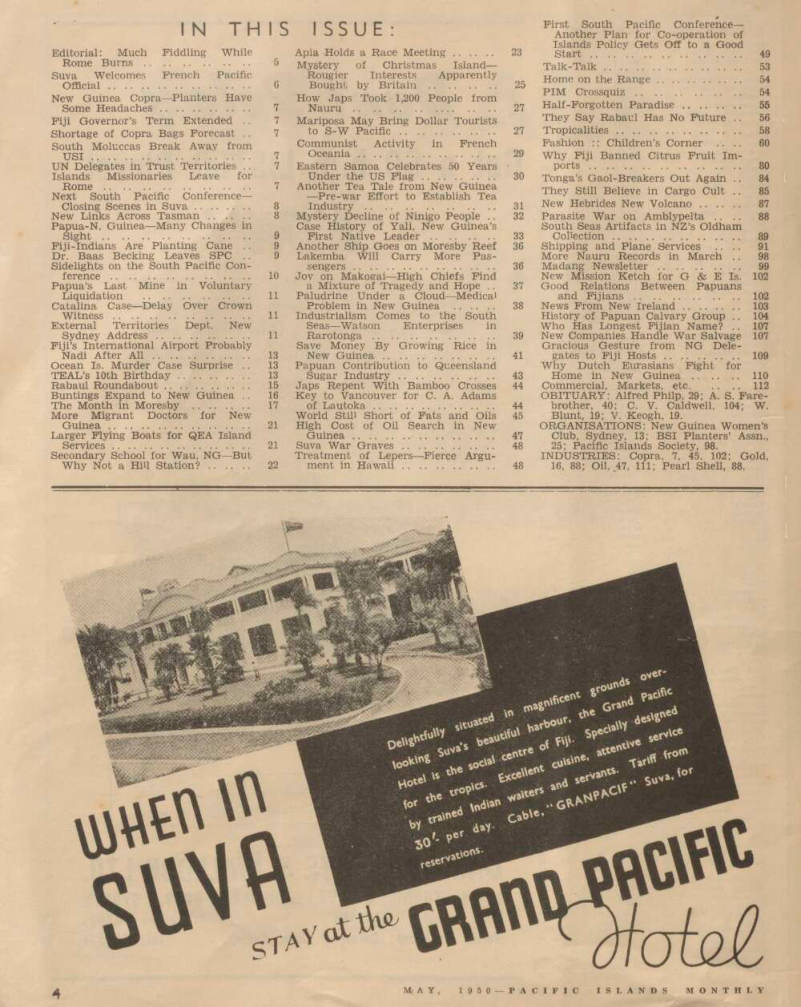
Editorial: Much Fiddling While Rome Burns 5 Suva Welcomes French Pacific Official 6 New Guinea Copra—Planters Have Some Headaches 7 Fiji Governor’s Term Extended .. 7 Shortage of Copra Bags Forecast .. 7 South Moluccas Break Away from
Usi 7
UN Delegates in Trust Territories .. 7 Islands Missionaries Leave for Rome 7 Next South Pacific Conference — Closing Scenes in Suva 8 New Links Across Tasman 8 Papua-N. Guinea —Many Changes in Sight 9 Fiji-Indians Are Planting Cane .. 9 Dr. Baas Becking Leaves SPC .. 9 Sidelights on the South Pacific Con ference 10 Papua’s Last Mine in Voluntary Liquidation 11 Catalina Case—Delay Over Crown Witness 11 External Territories Dept. New Sydney Address 11 Fiji’s International Airport Probably Nadi After All 13 Ocean Is. Murder Case Surprise .. 13 TEAL’S 10th Birthday 13 Rabaul Roundabout 15 Buntings Expand to New Guinea .. 16 The Month in Moresby 17 More Migrant Doctors for New Guinea 21 Larger Flying Boats for QEA Island Services 21 Secondary School for Wau, NG —But Why Not a HiU Station? 22
Apia Holds a Race Meeting 23 Mystery of Christmas Island — Rougier Interests Apparently Bought by Britain 25 How Japs Took 1,200 People from Nauru 27 Mariposa May Bring Dollar Tourists to S-W Pacific 27 Communist Activity in French Oceania 29 Eastern Samoa Celebrates 50 Years Under the US Flag 30 Another Tea Tale from New Guinea —Pre-war Effort to Establish Tea Industry 31 Mystery Decline of Ninigo People .. 32 Case History of Yali, New Guinea’s First Native Leader 33 Another Ship Goes on Moresby Reef 36 Lakemba Will Carry More Pas sengers 36 Jov on Makogai—High Chiefs Find a Mixture of Tragedy and Hope .. 37 Paludrine Under a Cloud —Medical Problem in New Guinea 38 Industrialism Comes to the South Seas—Watson Enterprises in Rarotonga 39 Save Money By Growing Rice in New Guinea 41 Papuan Contribution to Queensland Sugar Industry 43 Japs Repent With Bamboo Crosses 44 Key to Vancouver for C. A. Adams of Lautoka 44 World Still Short of Fats and Oils 45 High Cost of Oil Search in New Guinea 47 Suva War Graves 48 Treatment of Lepers—Fierce Argu ment in Hawaii 48
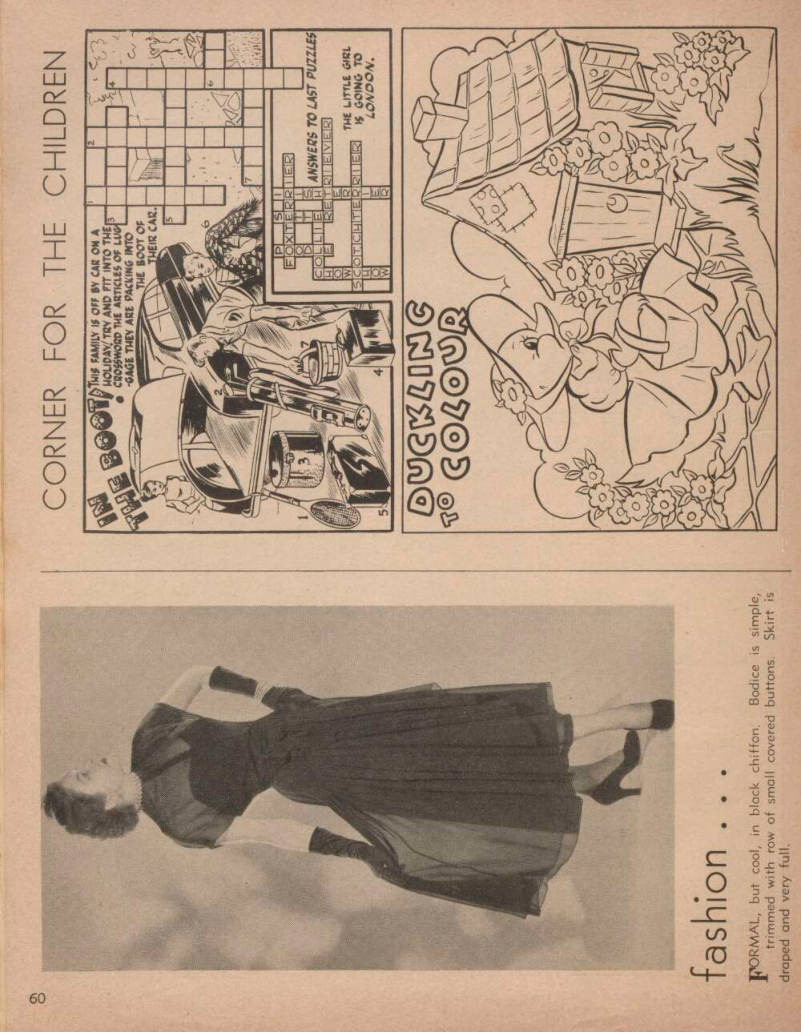
First South Pacific Conference — Another Plan for Co-operation of Islands Policy Gets Off to a Good Start 49 Talk-Talk 53 Home on the Range 54 PIM Crossquiz 54 Half-Forgotten Paradise 55 They Say Rabaul Has No Future .. 56 Tropicalities 58 Fashion :: Children’s Corner ... 60 Why Fiji Banned Citrus Fruit Im ports 80 Tonga’s Gaol-Breakers Out Again .. 84 They Still Believe in Cargo Cult .. 85 New Hebrides New Volcano 87 Parasite War on Amblypelta ... 88 South Seas Artifacts in NZ’s Oldham Collection 89 Shipping and Plane Services .. .. 91 More Nauru Records in March .. 98 Madang Newsletter 99 New Mission Ketch for G & E Is. 102 Good Relations Between Papuans and Fijians 102 News From New Ireland 103 History of Papuan Calvary Group .. 104 Who Has Longest Fijian Name? .. 107 New Companies Handle War Salvage 107 Gracious Gesture from NG Dele gates to Fiji Hosts 109 Why Dutch Eurasians Fight for Home in New Guinea 110 Commercial, Markets, etc 112 OBITUARY: Alfred Philp, 29; A. S. Fare brother, 40; C. V. Caldwell, 104; W.
Blunt, 19; V. Keogh, 19.
ORGANISATIONS: New Guinea Women’s Club, Sydney, 13; BSI Planters’ Assn., 25; Pacific Islands Society, 98.
INDUSTRIES: Copra, 7, 45. 102; Gold, 16, 88; Oil, 47, 111; Pearl Shell, 88.
Advertisements & other items, p. 6 (1 item)
/S!*
" r iy ■: » “JSG-5 .;■■'<-■ s' '■ • * P I * 7^* .-jS-V
ta v
s
Pacific Islands Monthly
The Newspaper-Magazine of the South Seas
[.Registered at the G.P.0., Sydney, for transmission by post as a newspaper I Published Once Each Month and Circulated in Australia and New Zealand and in the following Pacific Territories and Islands Groups:
Australian Territory of Papua.
Trustee Territory (Australia) of New Guinea.
Australian Territory of Norfolk Island.
New Zealand Territory of Cook Islands.
Trustee Territory (NZ) of Western Samoa.
British Colony of Fiji.
British Solomon Islands Protectorate.
British Protectorate of Tongan Islands.
British Crown Colony of Gilbert and Ellice Islands.
Trustee Territory of Nauru.
British and French Condominium of New Hebrides.
French Colony of New Caledonia.
French Colony of Oceania (Tahiti, etc.).
American Territory of Eastern Samoa.
American Territory of Hawaiian Islands.
Owned and Produced by Pacific Publications Pty., Ltd., Union House, 247 George Street, Sydney.
Telephone: General Office and Advertising, BW 5037.
P.O. Box 3408
Registered Address for Telegrams, Radiograms, and Cables: “Pacpub,” Sydney.
Contributions.
Articles, Stories, and Photographs dealing with Pacific Islands subjects are invited and will be paid for on publication.
Subscription Rates.
Per Annum, Fre-paid, Including Postage.
In Australia, New Zealand, Fiji New Guinea, Papua, Western Samoa, Cook Islands, Tonga, British Solo mons, Gilbert and Ellice Colony, Nauru, New Hebrides, and United Kingdom 18 0 Elsewhere $2.50 £1 1 0 Single Copies 1 9
Editor and Publisher:
R. W. Robson, F.R.G.S.
Assistant Editor: JUDY TUDOR.
General Office: Union House, 247 George Street, Sydney. Telephone: BW 5037.
Business Manager: SELWYN HUGHES.
Representative In London.
J. T. Wallis, Coronation House, 4 Lloyd’s Avenue, London, E.C.3, from whom may be obtained copies of Pacific Islands Monthly, Pacific Is. Year Book, advertising schedules, etc.
Agents.
The following are authorised to receive sub scriptions for Pacific Islands Monthly:— Burns, Philp & Co., Ltd., and Burns Philp (South Sea) Co., Ltd. All branches.
W. R. Carpenter & Co., Ltd. All branches.
Morris, Hedstrom, Ltd. All branches.
Steamships Trading Co., Papua. All branches.
Steele’s Central Store, Suva, Fiji.
Adams Pharmacies Pty., Lautoka, Fiji.
Cook Islands Trading Co., Rarotonga, Cook Is.
United Island Traders, Ltd., Rarptonga, Cook Is.
A. Vercoe, Apia, Western Samoa.
Oscar Nordman, Papeete, Tahiti, Islands Branches and Representatives of W. H.
Grove & Sons, Ltd., Auckland, New Zealand.
Ed. Pentecost, Noumea, New Caledonia.
Societe Gubbay Kerr et Cie, Noumea, New Caledonia.
Vol. XXI. No. 10.
May.. 1950
( 1/9 Per Copy.
Price I Prepaid, p.a.; 18/- Aust.
I In USA, p.a.: $2.50.
Much Fiddling While Rome Burns
IF, somewhere in outer space, there is an observer with his super-telescope trained upon Earth, he must be mightily intrigued and amused by to-day’s picture.
He will note the Iron Curtain, stretch ing from the Arctic across Central Europe; across the Middle East, north eastward of Turkey, Iraq and Persia; and across Asia, following the line of the Himalayas, to Indo-China. On the one side, lines of grim-visaged Reds, crack ing merciless whips over the toiling ranks of countless millions, who are hopelessly carrying out their master’s bidding, and preparing for the coming war.
On the other side of the Curtain, the most comical spectacle in human history: very many thousands of agitated little people rushing aimlessly around, getting in each other’s way, telling each other that the situation is extremely grave, and that something really must be done about it. And holding conferences —endless, useless and incredibly expensive confer ences —and general elections —which are even more useless than the conferences.
The over-all picture of the world to day must be very funny indeed—provided one’s condition and fate are not bound up with it. Unfortunately, there is not one of us who is not threatened by this Cold War —which is so quickly becoming a Hot War. And few are more directly menaced than those South Pacific com munities which are part of the Western world. The spectacle of Communism sweeping across overcrowded Asia, ap proaching our northwest frontiers, is not in the least amusing.
Scarcely a week passes when there is
not, in Europe or America or the South Seas, a portentous gathering of Govern mental VlP’s, who solemnly debate measures considered necessary “to pro tect Western civilisation from the grow ing menace of Totalitarianism,” who painfully transcribe the shorthand re ports of their wearisome discussions for presentation to their bored and indiffer ent parliaments, and then, when the re ports are well and truly pigeon-holed, proceed to do it all over again. In this part of the world, within a few weeks, we have had the Colombo Conference, and the South Pacific Conference, and the Southeast Asia Conference —and the whole lot of them, in view of what is actually happening in the world, are merely so much fiddling.
The agitation of the Western nations —amounting at times to hysteria—is completely justified. The world to-day is threatened in a way never known be fore. A combination of forces incredibly evil is planning to wipe away our Western concept of communal life, arid to fasten upon all mankind a system of govern ment that is based on the enslavement of the human body and spirit. Emphati cally, the overv/helming majority of people—on both sides of the Iron Cur tain—do not want Communism; but the promoters of Communism, with supreme cleverness and cunning, are using the weaknesses of our Western Democracy to fasten the shackles upon us.
One of the greatest of these weaknesses is the long-fought-for and tenderly cherished One-man-one-vote. Universal adult suffrage was the core of our socio political set-up, and an institution to be
jealously guarded, while all human pro gress was following the logical road in dicated by our thousand years of social evolution. But to-day when we are faced with a danger that calls for quick international decisions, close organisa tion and ruthlessness in action, we are handicapped almost beyond belief by the idea that our governments, before taking action, must go back to the parliaments for authority, and the parliaments, in turn, must go back to the people. Not one voter in a hundred appreciates the vital, fundamental differences between Individualism and Totalitarianism: and yet that is the choice with which the world is immediately confronted.
IF the Western world values human free dom, it must be prepared to fight for it again, as it fought in 1914-18 and 1939-45. There is no alternative.
Whether the Muscovite Communists planned this thing after the collapse of the Axis Powers, in the mid-forties, is now immaterial: the point is that Western weakness and dithering allowed the Muscovite conspiracy for the en slavement of the world to go so far that now it cannot be put into reverse. A war between Western civilisation and Mus covite Communism seems inevitable.
The only thing that might stop it would be a close union of the Western nations, a clear-cut anti-Red policy, and—above all —an integration of armed forces so powerful that even the Moscow conspira tors may be scared off. But how can we achieve such a combination when so many of our leaders devote so much of their time to the uplift of down-trodden races, and so much of their ingenuity to plans for persuading the ignorant and uninstructed voters to maintain them in office! Moscow’s emissaries are at work
fh every democratic country, creating in dustrial chaos and keeping ti e voters in a state of uncertainty—and thus un dermining parliarr, •'fits and governments.
Sociological planning—within which category come such things as t 1 e South east Asia Conference, and the South Pacific Conference, and even the United Nations, itfif —may be justified on most scores in time of peace. But in time of war—and if the present is not a time of war, we have never seen war!—all our thoughts pend energies must be di rected towards the protection of our freedom and the maintenance of our most cherished institutions.
Certainly, the Islands people are well worth every sociological effort we can make on their behalf. But why waste time and effort on Conference organisa tion when it is doubtful whether they will be free to accept our instruction and institutions in three or four years’ time?
It is in the highest degree desirable that the under-privileged folk of Southeast Asia be assisted to better standards of living. But what can the over-strained and financially-embarrassed British Com monwealth do to help the 500 or 600 million people in South and Southeast Asia, within the brief period left to us?
Time enough for the sociological plan ners to get busy when the world is at peace again. The trouble has been that the planners—especially the Bloomsburv variety, that produced the catastrophic British Government —assumed in 1945 that the world was safe for Democracy, and proceeded accordingly; whereas the cessation of fighting in 1945 merely made the world safe for Muscovite Totalitarian
ism. The spectacle of Rome burning while Nero fiddled was as nothing to the sight of our leading statesmen confer ring frantically in three continents, while Uncle Joe puts a Red halter around the world.
MB’s Sydney Managership
Claude Israel Retires From MB’s Sydney Managership
MR. CLAUDE ISRAEL, a Director of Morris Hedstrom Ltd. and one of Fiji,s best known merchants, who has been manager of the Sydney branch of the big firm for the past 4 years, retired from that position at the end of April and will leave Sydney at the end of May to take up his permanent residence in Fiji. He will be suceeded in the Sydney office by Mr. Eric Spring, who has been second-in-charge there for a number of years.
Although Mr. Israel has been only three of four years in Sydney, he made many warm friends there and, before his departure, he will be entertained at dinner by Sydney businessmen, as a mark of their esteem and goodwill.
Late News
Canberra, May 19.
IT was announced here to-day by Minister for Development (Mr.
Casey) that Commonwealth Government and British Aluminium Co., Ltd., of Lon don, will form a company to develop the resources of Papua-New Guinea.
The company will locate and develop large capacity hydro-electric schemes for use in industry, particularly aluminium production, and will search for bauxite and other minerals. The Commonwealth Government will hold 51 per cent, of shares.
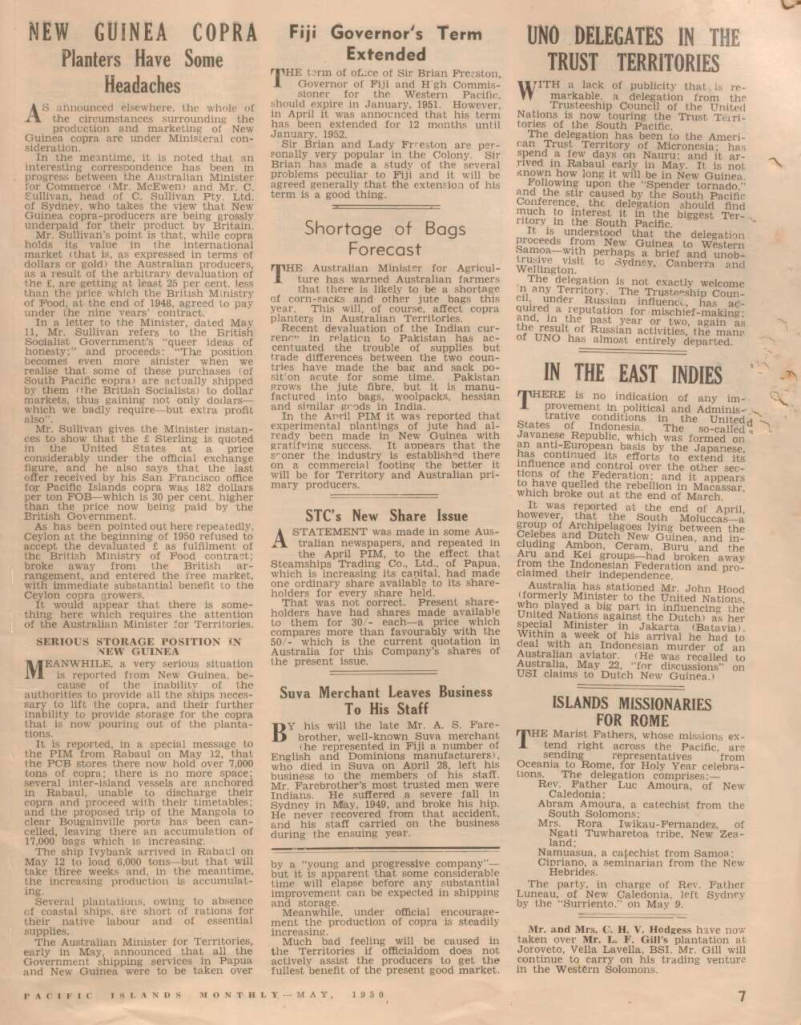
By Flying Boat To Fiji
Among travellers who arrived in Fiji by NAC Flying-boat in April were (left to right): Lieut.-Colonel Voelcker, former High Commissioner for Western Samoa, now NZ representative at the South Pacific Commission. He attended the South Pacific Conference. Mr. C. Roose and Mr.
J. A. Anderson, of Auckland, NZ, on a business visit to Suva. Mrs. R. A. Crompton and her small son, who returned together with Mr. R. A. Crompton, after five and a half months’ holiday in Christchurch, NZ. Miss B. Lane, who has returned from a visit to her home in Adelaide, SA, Melbourne, Sydney and Auckland. Miss P. M. Duggon, who will join the staff of the Suva Technical School where she will be in charge of the Science Department. Miss A. Warner, who will take up a post with the Colonial War Memorial Hospital, Suva.
Suva Welcomes French
Pacific Official
From Our Own Correspondent
Suva. May 1.
THE High Commissioner for French Pacific Territories (M. Cournarie) was welcomed by the Governor of Fiji (Sir Brian Freeston) when he landed at Suva this morning from the sloop Francois Gamier. After a three-day visit the High Commissioner will return in the sloop to Noumea, New Caledonia.
At the King’s Wharf a guard of honour was mounted by more than 100 Fijian members of the Fiji Police and the Band of the Fiji Military Forces played the “Marseillaise.” At Governmjent House, where M. Cournarie and Mme. Cournarie are guests, another guard of honour was mounted by Fijian soldiers of the FMF.
When the sloop arrived in port she fired a 21-gun salute which was returned gun for gun from shore.
French Interests
In The
Western Pacific
WHEN the French High Commissioner for the Western Pacific (M.Cour narie) arrived in Suva on May 1, in the French gunboat Francis Gamier, on a brief visit, he had come direct from the islands of the Wallis Group, a French possession between Fiji and Samoa.
Ever since France established a Protec torate over this group, a hundred years ago, there have been periodic disputes among the natives; and M. Cournarie apparently deemed it advisable to make a visit recently and deal with one of these local rows. Wallis and Futuna constitute a healthy and prosperous little Colony; but the group is somewhat isolated and probably sheer boredom is at the root of these troubles.
M. Cournarie was the host of the Aust ralian Minister for Territories, (Mr.
Spender) when he was in New Caledonia in mid-April.
Mr. Spender, on his way back from New Guinea, visited the British Solomons, the Condominium of the New Hebrides, and New Caledonia; but little has been said as yet about the possible significance of this extension of the Australian Minister’s tour.
Famous Botanist Leaves S.
Pacific Council
May Go To Papua-New Guinea
DR. L. G. BAAS BECKING, a lamous Dutch botanist who formally held an important post in the Netherlands Indies, has resigned his position as Deputy Chairman of the Research Council of the South Pacific Commission. His resignation was accepted with regret by the South Pacific Commission at its meeting in Suva this month.
Dr. Baas Becking intends to spend a few months in the Pacific Islands, and then go to the United States.
It is reported, however, that he may be invited to join the administrative service in Papua-New Guinea, where his know ledge andJ experience of economics, in relation to the effective use of indigenous and introduced plants might be very valuable. For example, it is proposed to grow tea, rice and cinchona (quinine) plants in New Guinea—and all these crons are strongly established in the East Indies, where Dr. Baas Becking spent many years.
New Guinea Copra
Planters Have Some Headaches
AS announced elsewhere, the whole of the circumstances surrounding the production and marketing of New Guinea copra are under Ministeral con sideration.
In the meantime, it is noted that an interesting correspondence has been in progress between the Australian Minister for Commerce (Mr. McEwen) and Mr. C.
Sullivan, head of C. Sullivan Pty. Ltd. of Sydney, who takes the view that New Guinea copra-producers are being grossly underpaid for their product by Britain.
Mr. Sullivan’s point is that, while copra holds its value in the international market (that is, as expressed in terms of dollars or gold) the Australian producers, as a result of the arbitrary devaluation of the £, are getting at least 25 per cent, less than the price which the British Ministry of Pood, at the end of 1948, agreed to pay under the nine vears’ contract.
In a letter to the Minister, dated May 11, Mr. Sullivan refers to the British Sooialist Government’s “queer ideas of honesty;” and proceeds: “The position becomes even more sinister when we realise that some of these purchases (of South Pacific copra) are actually shipped by them (the British Socialists) to dollar markets, thus gaining not only dollars — which we badly require—but extra profit also”.
Mr. Sullivan gives the Minister instan ces to show that the £ Sterling is quoted in the United States at a price considerably under the official exchange figure, and he also says that the last offer received by his San Francisco office for Pacific Islands copra was 182 dollars per ton FOB—which is 30 per cent, higher than the price now being paid by the British Government.
As has been pointed out here repeatedly, Ceylon at the beginning of 1950 refused to accept the devaluated £ as fulfilment of the British Ministry of Food contract; broke away from the British ar rangement, and entered the free market, with immediate substantial benefit to the Ceylon copra growers.
It would appear that there is some thing here which requires the attention of the Australian Minister for Territories.
Serious Storage Position Xn
New Guinea
MEANWHILE, a very serious situation is reported from New Guinea, be cause of the inability of the authorities to provide all the ships neces sary to lift the copra, and their further inability to provide storage for the copra that is now pouring out of the planta tions.
It is reported, in a special message to the PIM from Rabaul on May 12, that the PCB stores there now hold over 7,000 tons of copra; there is no more space; several inter-island vessels are anchored in Rabaul, unable to discharge their copra and proceed with their timetables: and the proposed trip of the Mangola to clear Bougainville ports has been can celled, leaving there an accumulation of 17,000 bags which is increasing.
The ship Ivybank arrived in Rabaul on May 12 to load 6,000 tons—but that will take three weeks and, in the meantime, the increasing production is accumulat ing.
Several plantations, owing to absence of coastal ships, are short of rations for their native labour and of essential supplies.
The Australian Minister for Territories, early in May, announced that all the Government shipping services in Papua and New Guinea were to be taken over
by a “young and progressive company”— but it is apparent that some considerable time will elapse before any substantial improvement can be expected in shipping and storage.
Meanwhile, under official encourage ment the production of copra is steadily increasing.
Much bad feeling will be caused in the Territories if officialdom does not actively assist the producers to get the fullest benefit of the present good market.
Fiji Governor's Term
Extended
ri’iHE term of ofuce of Sir Brian Presston, A Governor of Fiji and Hgh Commis sioner for the Western Pacific, should expire in January, 1951. However, in April it was announced that his term has been extended for 12 months until January, 1952.
Sir Brian and Lady Frreston are per sonally very popular in the Colony. Sir Brian has made a study of the several problems peculiar to Fiji and it will be agreed generally that the extension of his term is a good thing.
Shortage of Bags
Forecast
THE Australian Minister for Agricul ture has warned Australian farmers that there is likely to be a shortage of corn-sacks and other jute bags this year. This will, of course, affect copra planters in Australian Territories.
Recent devaluation of the Indian cur rency in relation to Pakistan has ac centuated the trouble of supplies but trade differences between the two coun tries have made the bag and sack po sition acute for some time. Pakistan grows the jute fibre, but it is manu factured into bags, woolpacks, hessian and similar goods in India.
In the April PIM it was reported that experimental plantings of jute had al ready been made in New Guinea with gratifying success. It appears that the sooner the industry is established there on a commercial footing the better it will be for Territory and Australian pri mary producers.
SlC’s New Share Issue
A STATEMENT was made in some Aus tralian newspapers, and repeated in the April PIM, to the effect that Steamships Trading Co., Ltd., of Papua, which is increasing its capital, had made one ordinary share available to its share holders for every share held.
That was not correct. Present share holders have had shares made available to them for 30/- each—a price which compares more than favourably with the 50/- which is the current quotation in Australia for this Company’s shares of the present issue.
Suva Merchant Leaves Business
To His Staff
BY his will the late Mr. A. S. Fare brother, well-known Suva merchant (he represented in Fiji a number of English and Dominions manufacturers), who died in Suva on April 28, left his business to the members of his staff.
Mr. Farebrother’s most trusted men were Indians. He suffered a severe fall in Sydney in May, 1949, and broke his hip.
He never recovered from that accident, and his staff carried on the business during the ensuing year.
Uno Delegates In The
Trust Territories
WITH a lack of publicity that . is re markable, a delegation from the Trusteeship Council of the United Nations is now touring the Trust Teiri tones of the South Pacific.
The delegation has been to the Ameri can Trust Territory of Micronesia; has spend a few days on Nauru; and it ar rived in Rabaul early in May. It is not Known how long it will be in New Guinea Following upon the “Spender tornado ” and the stir caused by the South Pacific Comerence, the delegation should find much to interest it in the biggest Ter ritory m the South Pacific.
“ u ? der stood that the delegation proceeds from New Guinea to Western P erhaps a brief and unob- Wellington Slt t 0 ° ydney - Canberra and ■ be delegation is not exactly welcome J?, any Territory. The Trusteeship Coun r! 1. 9 nder Russian influence, has ac • a for mischief-making; fhP S ast - year or two - a g ain as nf Tmn l f Russian activities, the man? of UNO has almost entirely departed.
In The East Indies
THERE is no indication of any im provement in political and Adminis ratl f e T co ? diti 9 ns the United d States of Indonesia. The so-called, Javanese Republic, which was formed on an anti-European basis by the Japanese, has continued its efforts to extend its influence and control over the other sec tions of the Federation; and it appears tohave quelled the rebellion in Macassar, which broke out at the end of March.
It was reported at the end of April however, that the South Moluccas—a group of Archipelagoes lying between the Celebes and Dutch New Guinea, and in cluding Ambon, Ceram, Bum and the Am and Kei groups—had broken away from the Indonesian Federation and nro claimed their independence.
Australia has stationed Mr. John Hood (formerly Minister to the United Nations who Played a big part in influencing the United Nations against the Dutch) as her specia! Minister in Jakarta (Batavia).
Within a week of his arrival he had to deal with an Indonesian murder of an Australian aviator. (He was recalled to Australia, May 22, “for discussions” on USI claims to Dutch New Guinea.)
Islands Missionaries
For Rome
THE Marist Fathers, whose missions ex tend right across the Pacific, are sending representatives from Oceania to Rome, for Holy Year celebra tions. The delegation comprises:— Rev. Father Luc Amoura, of New Caledonia; Abram Amoura, a catechist from the South Solomons; Mrs. Rora Iwikau-Fernandez, of Ngati Tuwharetoa tribe, New Zea land; Namuasua, a catechist from Samoa; Cipriano, a seminarian from the New Hebrides.
The party, in charge of Rev. Father Luneau, of New Caledonia, left Sydney by the “Surriento.” on May 9.
Mr. and Mrs. C. H. V. Hodgess have now taken over Mr. L. F. Gill’s plantation at Joroveto, Vella Lavella, BSI. Mr. Gill will continue to carry on his trading venture in the Western Solomons.
Conference?
Next S. Pacific
Closing Scenes In Suva
Suva, May 6.
THE South Pacific Conference ended on May 5 in a flurry of newspaper headings. Never, in all history, did the Islands get so much publicity as be tween April 20 and May 6.
By 11 to 4, the delegations voted for another Conference in two years’ time, instead of three. The French Territories, with Western Samoa, constituted the minoritv. The Commission will decide. of a place for the next Conference produced a lively dis cussion. The Australians wanted New Guinea; the French delegations urged Tahiti; another section suggested New Zealand; some realists spoke up for Sydney.
Australia and NZ are wiped out, it sCV'tos, by the ruling that the gathering :nu be in the Islands, north of Capri ce n.
The Australian plan is that New Guinea m mediately should begin to pre pare accommodation and facilities for , holdn v fli£ 1952 Conference in the High lands" mat cool and pleasant country t 1 -> 4 lies at about 5,000 feet, eastward c M'>unt Hagen. It is argued that thus re could be laid the foundations of a i/own-a cool, healthy hill-station, in the pf.Gtile uplands, which might have a pro found effect on the future of New f'uinea.
Again, the Commission will decide. (All Conference decisions go as recommenda tions to the Commission.) THE last days of the Conference were marked by a general newspaper at tack upon Australia’s representa tion. Australia controls two thirds of the South Pacific population and half the land area; pays a third of the cost of the Commission; but Australia, said
the critics, did not exercise much influ ence in the set-up. The attack obviously was directed against the Rev. Dr. J. W.
Burton, who, with Mr. J. R. Halligan (secretary of the Territories Department) has been Australia’s representative on the Commission since its formation. Mr.
Halligan has been deeply occupied else where, so much work has fallen upon Dr.
Burton.
Australia’s senior Commissioner should be hard, tough, and ruthless, and very experienced in South Pacific problems.
Dr. Burton, who has been a director of missions all his life, is a kindly, gentle, lovable man. He has brought wisdom and complete sincerity to the Commis sion table, but he is no dynamic force.
Criticism of him embarrassed the Aus tralian Territories Minister. (Mr.
Spender is also Minister for External Affairs; and Dr. John Burton, Secretary of that Department, is a son of the Rev.
Dr. Burton), However, the Rev. Dr. Burton settled matters by promptly resigning. Prob ably, he welcomed the chance —he wanted to drop out of the Commission many months ago.
PRINCE Tugi, of Tonga, whose thought ful contributions to the discussions made him the outstanding figiire among the delegates, caused a stir when he urged that a knowledge of English be made compulsory and general through out tne Islands. He pointed out that education is the islanders’ first need, and that the wide diversity of tongues is the chief factor against education.
The French delegations took the sug gestion amiss—but had nothing really logical to urge against it. For centuries, and until a few decades ago, French was the international language and the language of culture. But now—especially since World War II and the advent of United States as the leading Power— English has become the international language. English is the official language in every country in the Pacific, except New Caledonia and French Oceania.
Prince Tugi also startled the Confer ece by urging birth control in the many Pacific Territories where there has been population revival, and where there is apparent danger of food resources be coming strained.
Tugi’s arguments were supported by some delegates; but there was uncom promising hostility from Catholic sec tions.
THE Conference ended with well-de served tributes to Sir Brian Free ston, whose capable and sympa thetic chairmanship made the Confer ence the success it undoubtedly was; to Mr. Forsyth, Secretary-General, whose fine feat of organisation made the Con ference possible; and to the 60 students of Nasinu College, whose help as mes sengers and servants contributed so much to the delegates’ comfort and convenience. (For report of Conference, and general com ment, see other pages.)
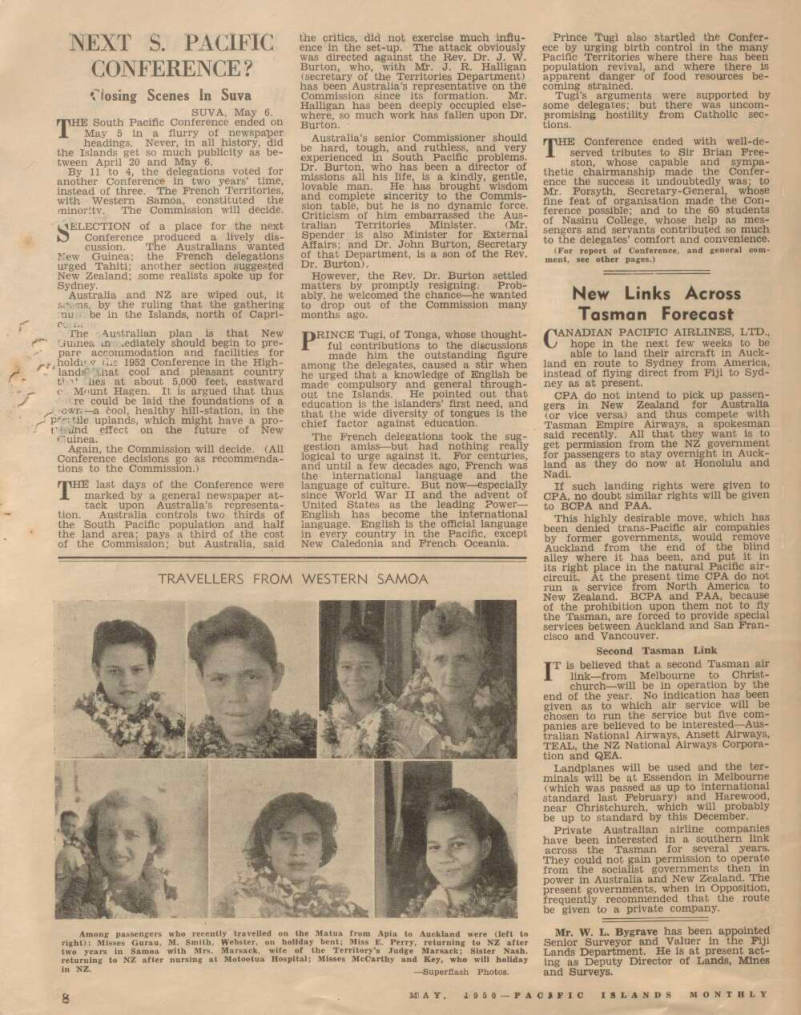
Travellers From Western Samoa
Among passengers who recently travelled on the Matua from Apia to Auckland were (left to right): Misses Gurau, M. Smith, Webster, on holiday bent; Miss E. Perry, returning to NZ after two years in Samoa with Mrs. Marsack, wife of the Territory’s Judge Marsack; Sister Nash, returning to NZ after nursing at Motootua Hospital; Misses McCarthy and Key, who will holiday
in NZ. -Superflash Photos.
New Links Across
Tasman Forecast
Canadian Pacific Airlines, Ltd.,
hope in the next few weeks to be able to land their aircraft in Auck land en route to Sydney from America, instead of flying direct from Fiji to Syd ney as at present.
CPA do not intend to pick up passen gers in New Zealand for Australia (or vice versa) and thus compete with Tasman Empire Airways, a spokesman said recently. All that they want is to get permission from the NZ government for passengers to stay overnight in Auck land as they do now at Honolulu and Nadi.
If such landing rights were given to CPA, no doubt similar rights will be given to BCPA and PAA, This highly desirable move, which has been denied trans-Pacific air companies by former governments, would remove Auckland from the end of the blind alley where it has been, and put it in its right place in the natural Pacific air circuit. At the present time CPA do not run a service from North America to New Zealand. BCPA and PAA, because of the prohibition upon them not to fly the Tasman, are forced to provide special services between Auckland and San Fran cisco and Vancouver.
Second Tasman Link IT is believed that a second Tasman air link —from Melbourne to Christ church—will be in operation by the end of the year. No indication has been given as to which air service will be chosen to run the service but five com panies are believed to be interested —Australian National Airways, Ansett Airways, TEAL, the NZ National Airways Corpora tion and QEA.
Landplanes will be used and the ter minals will be at Essendon in Melbourne (which was passed as up to international standard last February) and Harewood, near Christchurch, which will probably be up to standard by this December.
Private Australian airline companies have been interested in a southern link across the Tasman for several years.
They could not gain permission to operate from the socialist governments then in power in Australia and New Zealand. The present governments, when in Opposition, frequently recommended that the route be given to a private company.
Mr. W. L. Bygrave has been appointed Senior Surveyor and Valuer in the Fiji Lands Department. He is at present act ing as Deputy Director of Lands, Mines and Surveys.
In Sight
Papua N. Guinea
Many Changes Are In Sight
Prom a Special Correspondent ALL reports indicate that the April visit of the Australian Minister for External Territories to Papua and New Guinea was of a character never before experienced in those Islands.
He went through Australia’s Pacific Territories like a strong, cold, blustering wind. He blew the dust out of offices, wrenched apart the most sacred files, and upset the equilibrium of many gentlemen who never before had any doubt about the soundness of their stance. He has been called everything from “a first-class reforming Minister” to “an arrogant little Hitler.”
Whatever he is, Mr. Spender’s visit, after years of the frustrating and paralysing Wardist policy, has done immeasurable good in the Territories.
Everyone now, from the highest official to the humblest toiler, is more or less on his toes. Much has happened already— and much will happen soon. I shall try to summarise, indicating what are official announcements, and what are not.
The government shipping monopoly has been wiped out. Privately owned vessels have been competing with Government ships for available business. The trans port position already has been greatly improved. The Government ships will be sold, as soon as a suitable buyer is found. (Official.) ♦ * * The forest reserves of Papua and New Guinea are to be opened to development by private enterprise, under reasonable safeguards. A plan is now being prepared by Forestry officials. The position in re lation to the development of timber resources by Bulolo Gold Dredging Ltd. is being investigated. There will be a Ministerial announcement shortly. (Official.) * * * The native-labour one year indenture will be wiped out, in favour of a labour contract system. The Department of Native Labour will be abolished, and native labour will be controlled instead by a small branch of the Department of the Government Secretary. (Official.) ♦ * • It is believed that the new native labour contract will be for a period of 18 months, with two provisions. If the contract has proved unsatisfactory, the labourer can be dismissed, and the Government will bear the cost of repatriation. If it is satisfactory, it may be continued for a further period of six months. (Unofficial.) * * » Deputy Administrators, stationed at Port Moresby and Rabaul, will be ap pointed very soon. The authority and prestige of the District Officers will be increased. (Official.) ♦ ♦ ♦ It is not believed that the position of the Administrator (Colonel J. K. Murray) is affected. He was appointed by the Labour Government for ten years, and only four years of that term have gone.
It may be significant that his name was mentioned two or three times as an “ideal” representative for Australia, when the representation of Australia on the South Pacific Commission was under un official discussion in Fiji recently. It is argued that the S.P. Commission is Aust ralia’s “baby”, and that it will die if Australia is not more vigorously rep resented in the future. (Unofficial.) * • * Names freely mentioned in connection with forthcoming major appointments to the Papua-New Guinea and SP Com
mission services include Mr. D. M. Cleland (formerly head of the Production Control Board, and now a high official of the Australian Liberal Party), Mr. J. H.
Jones (formerly a Colonel in ANGAU, and head of District Services, and now head of the Planning and Development Department), Mr. S. Lonergan (Govern ment Secretary in Papua-New Guinea), Mr. Leonard Murray (pre-war Adminis trator of Papua) and Mr. J. C. Archer (now of the External Territories Depart ment, who has held important posts in the Territories). (Unofficial.) ♦ * * Taxation —probably of incomes— will be imposed in Papua and New Guinea at an early date. It is held to be unfair that heavily-taxed Australia should have to spend some £4,000,000 per annum on Papua-New Guinea, while private enter prise in the Territories is enjoying large incomes, despite all its troubles. (Official.) * * * Education policy in the Territories has been under review, but no immediate changes are contemplated. The Minister, however, in response to Territories’ rep resentations, cancelled the plan under which the children of all races were to attend the one school in Rabaul. (Official.) * * * The future of the Production Control Board, the future method of implement ing the copra-purchase agreement as between Britain and the Australian Pacific Territories, and the best method of dealing with the Copra Stabilisation Fund, are now under close investigation but, as they present several difficulties, an ,official announcement regarding them may not be made for some little time. (Official.) k * * * The Rev. J. W. Burton has resigned his position as Australian Commissioner on the South Pacific Commission; and it is unlikely that Mr. J. R. Halligan (Sec retary of the Department of External Affairs) will also act in that capacity in the future, as he did in the past. There fore, two appointments to the Commission will be made by Australia in the early future. The senior Commlssionership has carried a salary of £2,000 per annum, and expenses. (Official.)
The Australian Government is deter mined that, as Australia is responsible for at least 30 per cent, of the cost of the South Pacific Commission, Australia shall in future be represented thereon by men with an intimate knowledge of Australia’s Territorial problems, and a sense of re'; sponsibility regarding the Commisr financial obligations. (Unofficial.) ’y
Cane Is Being Planted
Indians Repudiate Their Agitators In Fiji
Suva, Mayb
INDIAN cane-farmers are giving little support to the efforts made i per suade them not to plant sugarcane in the current season.
On April 22, a meeting of the Kisan Sangh (farmers’ union) at Lautoka sup ported by a show of hands, the appeal of the president (Mr. N. S. Chalmers) to stop planting. Five days later, however, the Sigatoka committee of the Kisan Sangh refused to follow the presided.-'s advice and informed him that while v, o committee supported his attempt tt'' obtain a higher price cane, it in tended to advocate contim plan >?g.
Authoritative reports Si-ate that in other parts of Viti Levu most of the Indian farmers have bc'n planting steadily despite the persuasions—a in some cases, threats —by officials of i’ 1 , , union who have been urging a strike by the fafmers- v- ' In some cases farmers have stopped planting temporarily, only to resume as the Kisan Sangh officials have left th* neighbourhood. In other cases farmers are known to have left the Kisan Sangh, joined another organisation, and proceeded with planting.
Vilikesa Ramaqa, a Fijian Assistant Medical Practitioner on the staff of the Colonial War Memorial Hospital, Suva, recently spent nearly three months in New Zealand, studying anaesthetics at the Medical School at the University of Otago. The Medical Officer in charge of the Colonial War Memorial Hospital re ports that Vilikasa has benefited greatly from his New Zealand studies.
Opening Of New Wing In Popular Suva Club
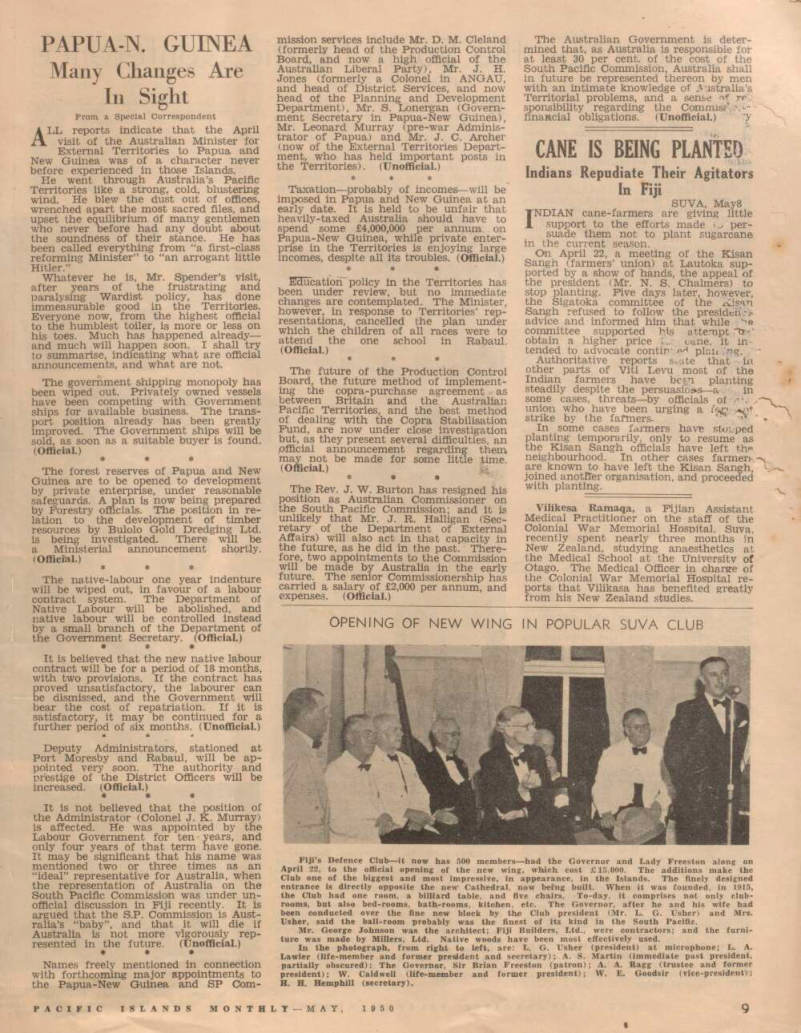
Fiji’s Defence Club—it now has 500 members—had the Governor and Lady Freeston along on April 22, to the official opening of the new wing, which cost £15,000. The additions make the Club one of the biggest and most impressive, in appearance, in the Islands. The finely designed entrance is directly opposite the new Cathedral, now being built. When it was founded, in 1915, the Club had one room, a billiard table, and five chairs. To-day, it comprises not only club rooms, but also bed-rooms, bath-rooms, kitchen, etc. The Governor, after he and his wife had been conducted over the fine new block by the Club president (Mr. L. G. Usher) and Mrs.
Usher, said the ball-room probably was the finest of its kind in the South Pacific.
Mr. George Johnson was the architect; Fiji Builders, Ltd., were contractors; and the furni ture was made by Millers, Ltd. Native woods have been most effectively used.
In the photograph, from right to left, are: L. G. Usher (president) at microphone; L. A.
Lawler (life-member and former president and secretary); A. S. Martin (immediate past president, partially obscured): The Governor, Sir Brian Freeston (patron); A. A. Bagg (trustee and former president); W. Caldwell (life-member and former president); W. E. Goodsir (vice-president): H. H. Hemphill (secretary).
Sidelights on the South Pacific Conference
From R. W. Robson.
Suva, May 2.
SAT below the dais of that most ex- H. cellent chairman, Sir Brian Preeston, Governor of Fiji, and looked out over the hundred or more delegates to the -gouth Pacific Conference and, like most other observers, I wondered whether this was anything more than a glorious waste of time and paper.
What I saw was like the United Nations in miniature. Rows of desks arranged in a half-circle, facing the chairman; the names of countries painted on signs above each desk; microphones placed carefully before each speaker; interpreters hovering attentively beside the delegations from the French and Dutch Territories; and the delegations, meticulously laundered and starched and barbered, sitting stiffly in their allotted places, and upon their faces —which ranged in colour from off uhite to deepest black —an expression of earnestness and anxiety.
In a building right alongside this big central hall ol the Nasinu Teachers Training College the real work of the Conference was being done. As a back ground to the sober, high-pitched voices of the selected speakers, one could hear the rattle of typewriters and the click of duplicator*".
The super-organisers of the South . Bfpifitf Commission had assembled a team ' oi expert young women from the various public services and they, assisted by an other team—Fijian, Samoan and Tongan Training College students who had been co-opted as clerks and messengers— churned out copies of everything that was spoken before the Conference. It was organisation, plus. Never before did re porters have an easier job.
It was like a well-produced play. All dressing had been taken care of. There was not a word, or a button, out of place.
There were no interjections. There was no spontaneity.
IN his opening speech, Sir Brian Free ston called it the Parliament of the South Pacific. A Parliament is an assemblage of the freely-chosen repre sentatives of the people. Few, if any, of these representatives had been elected; practically every one was the nominee of his particular government carefully hand-picked, groomed, and prepared for this Conference. In a large proportion of cases, the speeches read by delegates (from type-written paper of foolscap size) were the obvious products of depart mental offices.
Behind each delegation sat the “ad visers” quiet, self-effacing, efficient European officials, for the most part, who saw that each delegate conformed to the general plan. Politics were most sternly; forbidden. All the courtesies and formali- 1 ties of a Western Parliament were rigidly observed.
But it was not a Parliament. It was a beautiful and impressive play, shaped like a Parliament. It cost a lot of money.
Australia paid 30 or 35 ner cent, of it, the other five nations about 15 per cent, each. Fiji, as the host Government, shouldered much expense.
Out of each discussion (see formal re port elsewhere in this issue) on each paper there came a series of resolutions, for submission to the South Pacific Com mission. All the paoers, and all the dis cussions, and all the resolutions, could easily have been prepared for the Com mission by the officials of the 16 Terri tories, in postal communication, without all the work and worry and expense en tailed in this Conference.
Observing all these things, most of the VlP’s and pressmen present were at first inclined to write off the first South Pacific Conference as a solemn farce, of little practical value.
BUT, as the days passed, other con siderations came into the picture; observers took a longer view; and the general conclusion was that the Con ference, while in some respects a little ridiculous, was eminently worth-while, and an essential part of the plan behind the South Pacific Commission. Here are the answers to the destructive criticism which I have noted above:
• At the present stages of administra tive development in tne various Terri tories, it was not possible to choose representatives by popular vote. So, as far as possible, the Administrations selected what seemed to be representa tive natives. As it was essential that such men be educated to a standard to allow them to take part in a general con ference, the choice was limited, especially in the Melanesian Territories.
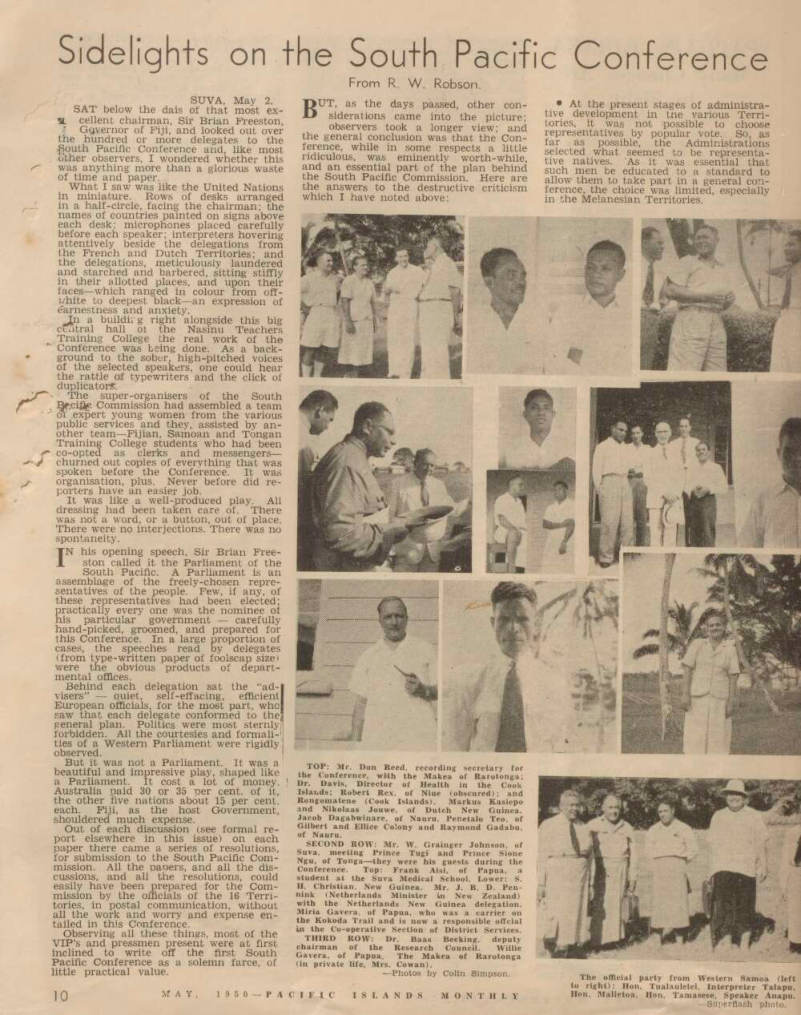
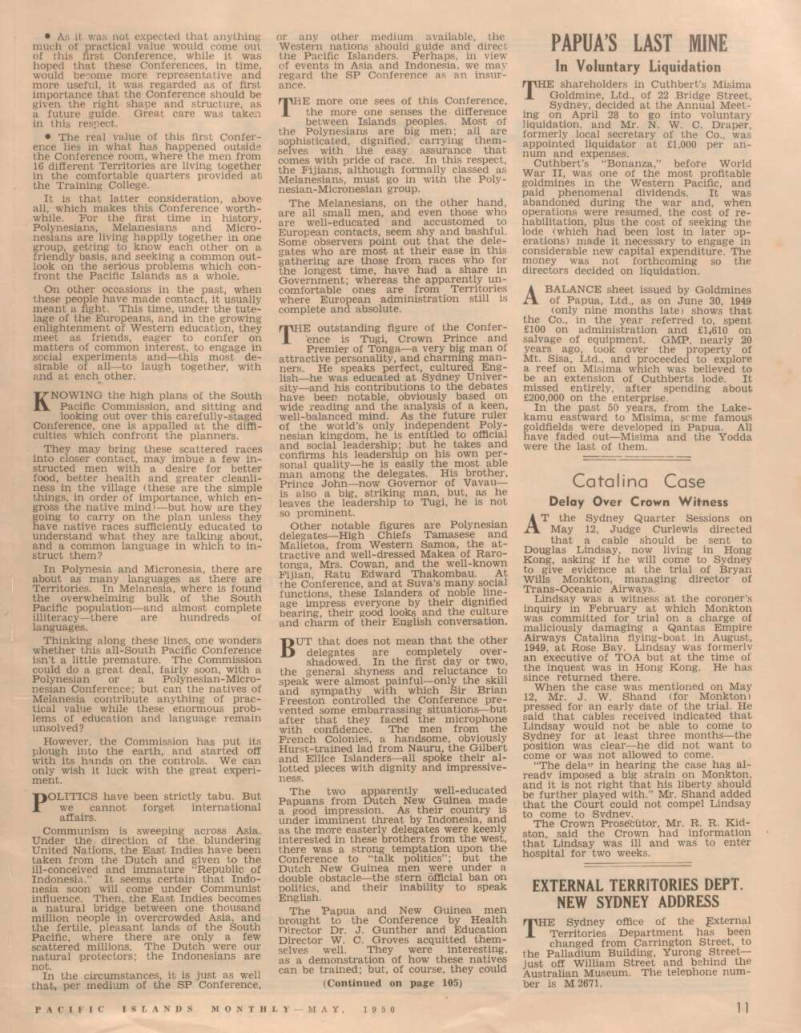
TOP: Mr. Don Reed, recording secretary for the Conference, with the Makea of Rarotonga; Dr. Davis, Director of Health in the Cook Islands; Robert Rex. of Niue (obscured); and Rongomatene (Cook Islands). Markus Kasiepo and Nikolaas Jouwe, of Dutch New Guinea.
Jacob Dagabwinare, of Nauru, Penetalo Teo. of Gilbert and Ellice Colony and Raymond Gadabu. of Nauru.
SECOND ROW: Mr. W. Grainger Johnson, of Suva, meeting Prince Tugi and Prince Sione Ngu, of Tonga—they were his guests during the Conference. Top: Frank Aisi, of Papua, a student at the Suva Medical School. Lower: S.
H. Christian, New Guinea. Mr. J. B. D. Pen nink (Netherlands Minister in New Zealand) with the Netherlands New Guinea delegation.
Miria Gavera, of Papua, who was a carrier on the Kokoda Trail and is now a responsible offcial in the Co-operative Section of District Services.
THIRD ROW: Dr. Baas Becking, deputy chairman of the Research Council. Willie Gavera, of Papua. The Makea of Rarotonga (in private life, Mrs. Cowan). —Photos by Colin Simpson.
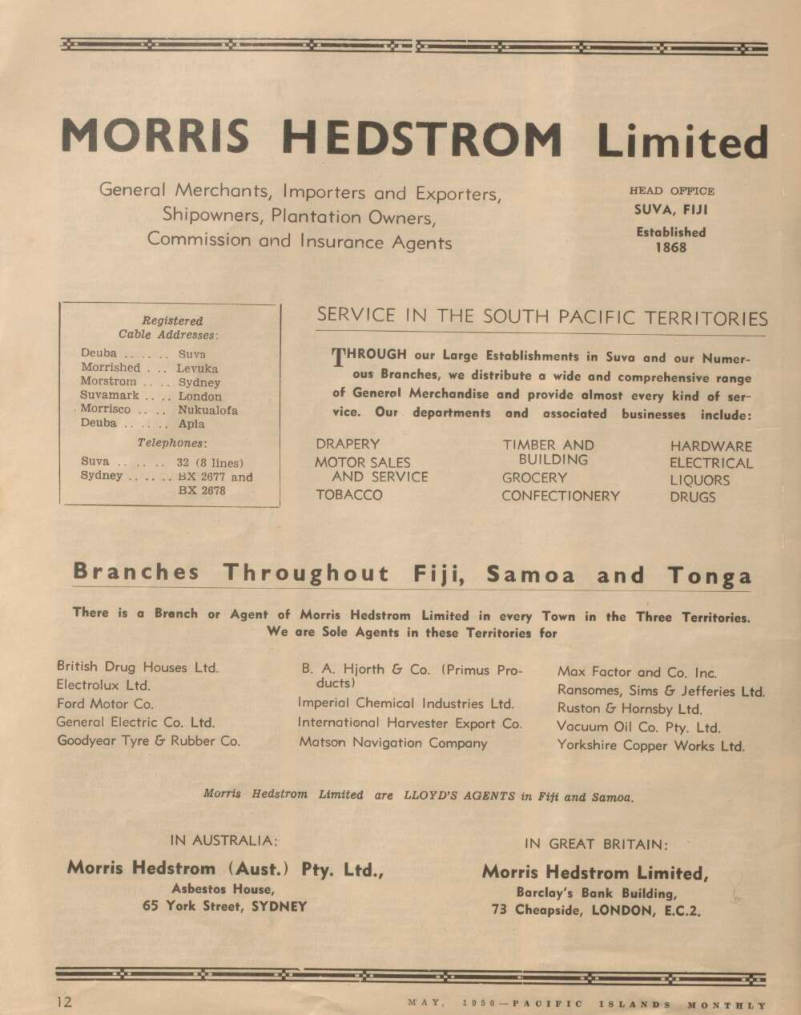
The official party from Western Samoa (left to right): Hon. Tualaulelei, Interpreter Talapu, Hon, Malietoa, Hon. Tamasese, Speaker Anapu. —Superflash photo.
• As it was not expected that anything much of practical value would come out of this first Conference, while it was hoped that these Conferences, in time, would become more representative and more useful, it was regarded as of first importance that the Conference should be given the right shape and structure, as a future guide. Great care was taken in this respect. • The real value of this first Confer ence lies in what has happened outside the Conference room, where the men from 16 different Territories are living together in the comfortable quarters provided at the Training College.
It is that latter consideration, above all, which makes this Conference worth while. For the first time in history, Polynesians, Melanesians and Micro nesians are living happily together in one group, getting to know each other on a friendly basis, and seeking a common out look on the serious problems which con front the Pacific Islands as a whole.
On other occasions in the past, when these people have made contact, it usually meant a fight. This time, under the tute lage of the Europeans, and in the growing enlightenment of Western education, they meet as friends, eager to confer on matters of common interest, to engage in social experiments and—this most de sirable of all—to laugh together*, with and at each other.
KNOWING the high plans of the South Pacific Commission, and sitting and looking out over this carefully-staged Conference, one is appalled at the diffi culties which confront the planners.
They may bring these scattered races into closer contact, may imbue a few in structed men with a desire for better food, better health and greater cleanli ness in the village (these are the simple things, in order of importance, which en gross the native mind) —but how are they going to carry on the plan unless they have native races sufficiently educated to understand what they are talking about, and a common language in which to in struct them?
In Polynesia and Micronesia, there are about as many languages as there are Territories. In Melanesia, where is found the overwhelming bulk of the South Pacific population—and almost complete illiteracy—there are hundreds of languages.
Thinking along these lines, one wonders whether this all-South Pacific Conference isn't a little premature. The Commission could do a great deal, fairly soon, with a Polynesian or a Polynesian-Micro nesian Conference; but can the natives of Melanesia contribute anything of prac tical value while these enormous prob lems of education and language remain unsolved?
However, the Commission has put its plough into the earth, and started off with its hands on the controls. We can only wish it luck with the great experi ment.
POLITICS have been strictly tabu. But we cannot forget international affairs.
Communism is sweeping across Asia.
Under the direction of the blundering United Nations, the East Indies have been taken from the Dutch and given to the ill-conceived and immature “Republic of Indonesia.” It seems certain that Indo nesia soon will come under Communist influence. Then, the East Indies becomes a natural bridge between one thousand million people in overcrowded Asia, and the fertile, pleasant lands of the South Pacific, where there are only a few scattered millions. The Dutch were our natural protectors; the Indonesians are not.
In the circumstances, it is just as well that, per medium of the SP Conference,
or any other medium available, the Western nations should guide and direct the Pacific Islanders. Perhaps, in view of events in Asia and Indonesia, we may regard the SP Conference as an insur ance.
THE more one sees of this Conference, the more one senses the difference between Islands peoples. Most of the Polynesians are big men; all are sophisticated, dignified, carrying them selves with the easy assurance that comes with pride of race. In this respect, the Fijians, although formally classed as Melanesians, must go in with the Poly nesian-Micronesian group.
The Melanesians, on the other hand, are ail small men, and even those who are well-educated and accustomed to European contacts, seem shy and bashful.
Some observers point out that the dele gates who are most at their ease in this gathering are those from races who for the longest time, have had a share in Government; whereas the apparently un comfortable ones are from Territories where European administration still is complete and absolute.
THE outstanding figure of the Confer 'ence is Tugi, Crown Prince and Premier of Tonga—a very big man of attractive personality, and charming man ners. He speaks perfect, cultured Eng lish—he was educated at Sydney Univer sity—and his contributions to the debates have been notable, obviously based on wide reading and the analysis of a keen, well-balanced mind. As the future ruler of the world’s only independent Poly nesian kingdom, he is entitled to official and social leadership; but he takes and confirms his leadership on his own per sonal quality—he is easily the most able man among the delegates. His brother, Prince John—now Governor of Vavau— is also a big, striking man, but, as he leaves the leadership to Tugi, he is not so prominent.
Other notable figures are Polynesian delegates—High Chiefs Tamasese and Malietoa, from Western Samoa, the at tractive and well-dressed Makea of Raro tonga, Mrs. Cowan, and the well-known Fijian, Ratu Edward Thakombau. At the Conference, and at Suva’s many social functions, these Islanders of noble line age impress everyone by their dignified bearing, their good looks and the culture and charm of their English conversation.
BUT that does not mean that the other delegates are completely over shadowed. In the first day or two, the general shyness and reluctance to speak were almost painful—only the skill and sympathy with which Sir Brian Freeston controlled the Conference pre vented some embarrassing situations—but after that they faced the microphone with confidence. The men from the French Colonies, a handsome, obviously Hurst-trained lad from Nauru, the Gilbert and Ellice Islanders—all spoke their al lotted pieces with dignity and impressive ness.
The two apparently well-educated Papuans from Dutch New Guinea made a good impression. As their country is under imminent threat by Indonesia, and as the more easterly delegates were keenly interested in these brothers from the west, there was a strong temptation upon the Conference to “talk politics”; but the Dutch New Guinea men were under a double obstacle —the stern official ban on politics, and their inability to speak English.
The Papua and New Guinea men brought to the Conference by Health Director Dr. J. Gunther and Education Director W. C. Groves acquitted them selves well. They were interesting, as a demonstration of how these natives can be trained; but, of course, they could
(Continued on page 105)
hardly be regarded as the representatives of the million or million and a quarter natives in the Australian Territories.
ONCE the opening ceremony was over, the Conference followed a simple system. Each morning a paper, carefully prepared beforehand, was read by one of the delegation. After that, there was a discussion upon it.
It was not a spontaneous discussion.
Delegates brought a prepared commen tary, of strictly limited wordage, and read this through a microphone.
When all such commentaries had been read, a small committee was set up to draft, for submission to the Commission, a set of resolutions arising out of the paper and the discussion. The resolutions were submitted in the afternoon, and usually provoked some little discussion, of a most orderly character. This would be over by 3.30 or so, and then the dele gates were free to be amused, or amuse themselves, until next morning.
Various entertaining or instructive functions were arranged—a visit to Bau and another to Makogai, for example; and the delegates seemed to enjoy themselves very thoroughly for the fortnight, at the ultimate expense of the ratepayers of six nations.
THE more prominent people of the Polynesian delegations did not take quarters at Nasinu. High Chief Tamasese, of Samoa, the Makea Ariki, of Rarotonga, and several of the French delegations, stayed at the Grand Pacific Hotel; the two Tongan princes are the guests of Mr. W. Grainger Johnson, managing director of W. R. Carpenter (Fiji) Ltd.; and High Chief Malietoa, of Samoa, is residing with a friend.
The Tongans and Samoans wear their national dress, but all the other delegates are in European clothes.
THE delegates have been provided with really excellent accommodation at the Teachers’ Training College at Nasinu, about five miles out of Suva.
Several scores of selected young men of the Fiji and adjoining Territories are be ing trained here as school teachers—the Suva Central Medical School system ap plied to education.
A large proportion of the students have gone home; but about 60 byight lads have remained, voluntarily, to act as cooks, messengers, batmen and bottle-washers to the delegates. Everyone seems comfor tab’e, and a spirit of goodwill is be coming more manifest every day.
Officials of the South Pacific Commission are keeping a close eye on all activities in and out of the Conference room.
Everyone praises the achievements of the Secretary-General, Mr. W. D. Forsyth, and his staff. His organising work, which he directs from a hurriedly prepared office behind the Conference hall, is superb.
Members of the Research Council, and various official observers, have their places here, and there is an atmosphere of pleasant co-operation.
Hardest-working team is the American group of officials and observers, led by Dr. Felix Keesing, Australian-born American anthropologist. It is generally recognised that, although the Americans have the smallest land area in the South Pacific in their care, their contribution to this South Pacific Commission, in energy, enthusiasm and personnel, is probably the biggest and most important.
One meets Americans everywhere in these South Pacific groups to-day—an interesting commentary on post-war developments. Generally, there are close co-operation and good feeling between Americans and British.
THROUGH extraordinary bad luck, the Trans Oceanic flying-boat, which was to carry the Solomon Islands and New Hebrides delegates to Noumea,
o? k° Suva for the opening on April had an engine break-down in Honiara, an rS,T • delegates could not get away.
The. inclination, at first, was to cancel the trip; but the Commission finally de-
cided to incur some trouble and expense and bring them over, and they arrived to fill the empty places in the Conference Room on April 30.
It was a wise decision. Rightly or
Wrongly, the failure of the Western Pacific High Commission to send Solomon Islands natives to the Victory March, in London, in 1946, is still regarded with resentment by the gentlemen behind the Marching- Rule movement, and is deplored by many Europeans. A failure to send BSI men to the Suva Conference would have rubbed salt into the open wound.
Although the BSI natives are noted for their intelligence—they are given a higher rating in this respect than the average Fijian—it is not likelv that they will con tribute any more to the Conference than the rest of the Melanesians.
TSLANDERS are laughter-loving people' 1 but the awfulness of thp r’onfprpnrp X set-up cJSatedamon- them infhe beginning, a solemnity that could be felt.
The influence that eventually broke it down was a Hish Chief Tufele from American P SaSoa g ’ Uf6 ’
They were discussing mosquito control.
Everyone agreed that the communities should be forced to set aside certain days, each month, for the attack upon mos quitoes. The only question was, how many days. Various delegations suggested various times. Fiji thought one day each month would be ample.
American Samoa could not agree. Some islands were worse than others. In the case of Fiji, he thought there should be more frequent attacks on mosquitoes.
Fiji delegates bristled. One could see their minds working; “All through the centuries, we had to fight these damned Samoans—looks as if we'll have to fight ’em again.”
The chairman looked grave. Inter
national complications!
“Yes,” continued High Chief Tufele, in his broad American accent. “Judging by the amount of sleep each night since I’ve been here, I am in favour of making the Fijians work three days a week, destroy ing their mosquitoes.”
The hatchet was buried in the first chorus of laughter the Conference had heard.
SOME time later, the chairman put an end to seme little argument that had developed by quoting the rules of the Conference.
The leg-puller from Eastern Samoa arose portentously. He did not think the chairman was properly interpreting the .rules. He doubted whether there was any rule really covering the situation.
The chairman’s brow was furrowed with care. The delegates stirred eagerly.
Thank God for a fight!
American Samoa lifted his voice. “Show me the Conference rule which allows us to smoke,” he demanded. “Yet we’re all smoking.”
Conference relaxed. The chairman grinned. “Nothing in the rules allows us to smoke,’’ he said. “Nothing in the rules allows us to breathe.”
Conference signified approval of the kind of logic that appeals to the Poly nesian mind.
THE funniest incident occurred outside the Conference. That most serious man, Dr. Baas Becking, deputy chairman of the Research Council, had spoken to delegates about the need for better health in the average Island village. ‘‘What we need,” he said, “is a lower village mortality and a higher birth-rate.”
But the gremlins which attend all news paper composition saw to it that when the Fiji Times reported this statement, the “t” was left out of mortality.
That evening, in the GPH, a band of solemn scientists led Dr. Baas Becking aside, and presented the newspaper, and tut-tutted softly as he read the amazing statement. At first, he stared unbeliev ingly; then he choked—and then he joined in the laughter.
“I’ll stand by it,” he said. “Damn it, yes, I’ll stand by it!”
Which proves that, contrary to popular belief, scientists engaged in Pacific re search can be quite human, at times
Papua’S Last Mine
In Voluntary Liquidation
THE shareholders in Cuthbert’s Misima Goldmine, Ltd., of 22 Bridge Street, Sydney, decided at the Annual Meet ing on April 28 to go into voluntary liquidation, and Mr. N. W. C. Draper, formerly local secretary of the Co., was appointed liquidator at £l,OOO per an num and expenses.
Cuthbert’s “Bonanza,” before World War 11, was one of the most profitable goldmines in the Western Pacific, and paid phenomenal dividends. It was abandoned during the war and, when operations were resumed, the cost of re habilitation, plus the cost of seeking the lode (which had been lost in later op erations) made it necessary to engage in considerable new capital expenditure. The money was not forthcoming so the directors decided on liquidation.
A BALANCE sheet issued by Goldmines of Papua, Ltd., as on June 30, 1949 (only nine months late) shows that the Co., in the year referred to, spent £lOO on administration and £l*6lo on salvage of equipment. GMP, nearly 20 years ago, took over the property of Mt. Sisa, Ltd., and proceeded to explore a reef on Misima which was believed to be an extension of Cuthberts lode. It missed entirely, after spending about £200,000 on the enterprise.
In the past 50 years, from the Lake kamu eastward to Misima, seme famous goldfields were developed in Papua. All have faded out —Misima and the Yodda were the last of them.
Catalina Case
Delay Over Crown Witness
AT the Sydney Quarter Sessions on May 12, Judge Curlewis directed that a cable should be sent to Douglas Lindsay, now living in Hong Kong, asking if he will come to Sydney to give evidence at the trial of Bryan Wills Monkton, managing director of Trans-Oceanic Airways.
Lindsay was a witness at the coroner’s inquiry in February at which Monkton was committed for trial on a charge of maliciously damaging a Qantas Empire Airways Catalina flying-boat in August, 1949, at Rose Bay. Lindsay was formerly an executive of TOA but at the time of the inquest was in Hong Kong. He has since returned there.
When the case was mentioned on May 12, Mr. J. W. Shand (for Monkton) pressed for an early date of the trial. He said that cables received indicated that Lindsay would not be able to come to Sydney for at least three months —the position was clear—he did not want to come or was not allowed to come.
“The in hearing the case has al ready imposed a big strain on Monkton, and it is not right that his liberty should be further played with.” Mr. Shand added that the Court could not compel Lindsay to come to Svdnev._ The Crown Prosecutor, Mr. R. R. Kid ston, said the Crown had information that Lindsay was ill and was to enter hospital for two weeks.
External Territories Dept.
New Sydney Address
THE Sydney office of the gxternal Territories Department has been changed from Carrington Street, to the Palladium Building, Yurong Street just off William Street and behind the Australian Museum. The telephone num ber is M 2671.
Advertisements & other items, p. 14 (1 item)
Morris Hedstrom Limited
General Merchants, Importers and Exporters,
Shipowners, Plantation Owners,
Commission and Insurance Agents
HEAD OFFICE
SUVA, FIJI
Established 1868 Registered Cable Addresses:
SERVICE IN THE SOUTH PACIFIC TERRITORIES
Deuba Suva Morrished . .. Levuka Morstrom .. .. Sydney Suvamark ... London Morrisco .. .. Nukualofa Deuba Apia Tele-phones : Suva 32 (8 lines) Sydney BX 2677 and BX 2678 our Large Establishments in Suva and our Numerous Branches, we distribute a wide and comprehensive range of General Merchandise and provide almost every kind of service. Our departments and associated businesses include:
DRAPERY
MOTOR SALES
AND SERVICE
TOBACCO
TIMBER AND
BUILDING
GROCERY
CONFECTIONERY
HARDWARE
ELECTRICAL
LIQUORS
DRUGS
Branches Throughout Fiji, Samoa and Tonga
There is a Branch or Agent of Morris Hedstrom Limited in every Town in the Three Territories.
We are Sole Agents in these Territories for British Drug Houses Ltd.
Electrolux Ltd.
Ford Motor Co.
General Electric Co. Ltd.
Goodyear Tyre & Rubber Co.
B. A. Hjorth & Co. (Primus Products) Imperial Chemical Industries Ltd.
International Harvester Export Co.
Matson Navigation Company Max Factor and Co. Inc.
Ransomes, Sims & Jefferies Ltd.
Ruston £r Hornsby Ltd.
Vacuum Oil Co. Pty. Ltd.
Yorkshire Copper Works Ltd.
Morris Hedstrom Limited are LLOYD’S AGENTS in Fiji and Samoa.
IN AUSTRALIA: IN GREAT BRITAIN:
Morris Hedstrom (Aust.) Pty. Ltd., Morris Hedstrom Limited, Asbestos House, Barclay's Bank Building, 65 York Street, SYDNEY 73 Cheapside, LONDON, E.C.2.
Fiji’S International
Airport
Probably Nadi After All
WHEN it was officially announced, last year, that a committee of experts had recommended Suva Point as the site for the international airport in that part of the Pacific, and that between one and two million pounds would be spent on building the airport within the next two or three years, is was believed that the long argument between the Nadi-Lautoka and the Suva advocates was over.
But the matter has been reopened. It appears certain that the selection will go to Nadi, after all.
The responsibility for building the air port belongs to New Zealand. Under the present world set-up, NZ is in charge of the Fiji area, in respect of both defence and civil aviation. It was understood that NZ’s defence organisation needed the Nadi airport.
But now it appears that Nadi is not needed for NZ’s Air Force, exclusively.
Moreover, the cost of the Suva Point air port will be nearer four than two million pounds. On top of that, NZ resources, engineering as well as financial, are all needed for urgent building of new civil airports near Auckland and Wellington, and for completing the hugh international airport near Christchurch (which is to be the terminal of the Melbourne-New Zea land new air service, to start about the end of 1950).
The South Pacific Air Transport Coun cil sat in Melbourne the first week in May, and considered all these things. On May 4, Fiji heard in dismayed silence an announcement that the site of the inter national airport probably would be in Tonga, instead of Suva. On May 5, how ever, is was formally announced that the SPATC had recommended Nadi, and the general belief is that Nadi, improved and developed, will remain as it is now—the Central South Pacific calling-place for trans-Pacific planes.
The chief objection to Nadi, now, as in the past, is the difficulty of getting from Nadi to Suva, 140 miles away. If the traveller does not like a slow and most
comfortless journey in an Indian bus, crowded with Indians and Fijians, he must pay about £7 Fijian for a hire car.
There is afoot a plan to establish an inter-island flying-boat service within Fiji. If this provides a regular daily con nection between Suva and Nadi, or Suva and Lautoka, as is proposed, so that the traveller to Suva can reach his destin ation quickly, for a fare of 40/- or 60/-, then much of Suva’s strong feeling against Nadi may disappear.
There are indications that, at last, international complications are being smoothed away, so that the Trans-Pacific airlines will do the obvious, logical thing, and include New Zealand in their itinerary. Instead of making the long hop from Nadi (Fiji) to Sydney, a proportion of the air-liners will fly from Nadi to Auckland, and thence to Sydney.
Case Surprise
Ocean Island Murder Case Surprise Execution of Tai Shek Postponed
A STAY of execution was announced by the Fiji Government on April 18 in respect of Tai Shek who had been convicted of the murder of Mr. Thomas Arthur Allen, on Ocean Island, in April, 1949. It was stated that fresh evidence had been presented and would be in vestigated. Tai Shek was to hang on April 19.
An appeal against his conviction was heard and dismissed by the Fiji Privy Council on March 29. A petition signed by Chinese residents of Fiji was pre sented to the Governor of Fiji recently but on the advice of the Executive Coun cil he directed at that stage, that the law should take its course.
Mr. Allen was an engineer employed by the British Phosphate Commission on Ocean Island. He and his wife were murdered while asleep. Dectectives and finger-print experts from Queensland pro ceeded to Ocean Island and took the finger-prints of everyone on the island.
Most of the case against Tai Shek was based on the fact that his prints were found on the window in the Allen’s bun galow. At the trial he was not, however, charged with the murder of Mrs. Allen.
TEAL's 10th Birthday
THE first Tasman air crossing was made by the late Sir Charles Kingsford Smith and his co-pilot, Charles Ulm. in the Southern Cross in September, 1928.
It was the culmination of their amazing flight across the Pacific from California to Australia but was regarded by most people at that time as tempting Provi dence just a little too far.
However, Smithy and Ulm made it—in a flight lasting 14 hours 25 minutes. It was not until Hi years later (April 30, 1940) that there was any real follow-up on the excellent job they had done in pioneering trans-ocean air transportation.
On April 30, 1940, regular trans-Tasman flights were inaugurated by Tasman Em pire Airways with the Aotearoa (the second flying-boat, Awarua, did not arrive in Auckland until seven months after Aotearoa).
From that day, under all conditions, TEAL flying-boats have maintained the link between the two dominions and were, during the difficult Pacific war and im mediately post-war period, the only regular passenger and mail service bet ween New Zealand and Australia.
The old Aotearoa and Awarua, which carried about 20 passengers and made the crossing in from 8 to 11 hours have, since the war, gone to the scrap pile. They were replaced by Sandringhams (peace time name of Sunderlands) and these in turn have given way to Short Solents, which carry 44 passengers and make the crossing in between five and six hours.
When the Solent, Aotearoa 11, made the crossing from Auckland to Sydney on April 30, 1950, passengers were treated to a birthday party which included a large cake made and iced in the shape of the flying-boat. The plane was commanded by Captain C. Griffiths, who has been with TEAL since its inception.
Coming Citizens
NG Women's Club
MEMBERS of the New Guinea Women’s Club of Sydney and their friends are invited to attend an American Tea on the morning of May 25.
The idea is to “bring a gift and buy a gift.” Proceeds will go towards funds.
The tea will be held in the Feminist Club Rooms, 77 King St.
Coming Citizens
of Fiji
This photograph was taken at a party recently in Fiji, when Sir Hugh and Lady Ragg entertained 20 grandchildren. Here they are, from left to right:— Back Row: R. Chalmers, M. Sykes, J. French, P.
Ragg, M. Ragg, C.
Chalmers, D. Ragg, D.
Ragg, H. Irving, Lady Ragg, Sir H. Ragg, M. Ragg, (Baby’s name not known).
Front Row: A. Irving, K.
Ragg, M. Chalmers, A.
Irving, M. Sykes, K. Ragg, P. Sykes, R. Ragg. A.
French.
Advertisements & other items, p. 16 (1 item)
DnJlor\j
Yours when you fly by Clipper* to
via U.S.A.
RESTFUL SLEEPERETTE*
COMFORT
Across the Pacific to Hawaii you enjoy long you relax in blissful comfort . , .
Pan American's exclusive Sleeperette sleep like a top at night. Curtains for service. Your softly cushioned Sleep- P rivac y •• • Y our own handy table for erette tilts ’way back ... a special * atin |’ rea . din §: w i itin gi . u x , , Pan American s Commonwealth Plan eg res pu souan , presto, you re i llc l u J es a p y OUr t rave j expenses to reclining at full bed-length! All day London. No dollars needed.
The Clippers also fly to London via Middle East and Europe J 1 or complete information, call your Travel Agent or . . .
SWA: Bank of N.S.W. Bldg. (Tel. 664) NOUMEA: Rue Jean Jaures (Tel. 85)
SPEED YOUR PARCEL BV CLIPPER CARGO
*Trade Mark, Van American World Airways, Inc.
World's Most Experienced Airline / / lan American U arid Airways, Inc., Ltd., Incorporated in U.S.A.
Rabaul Roundabout
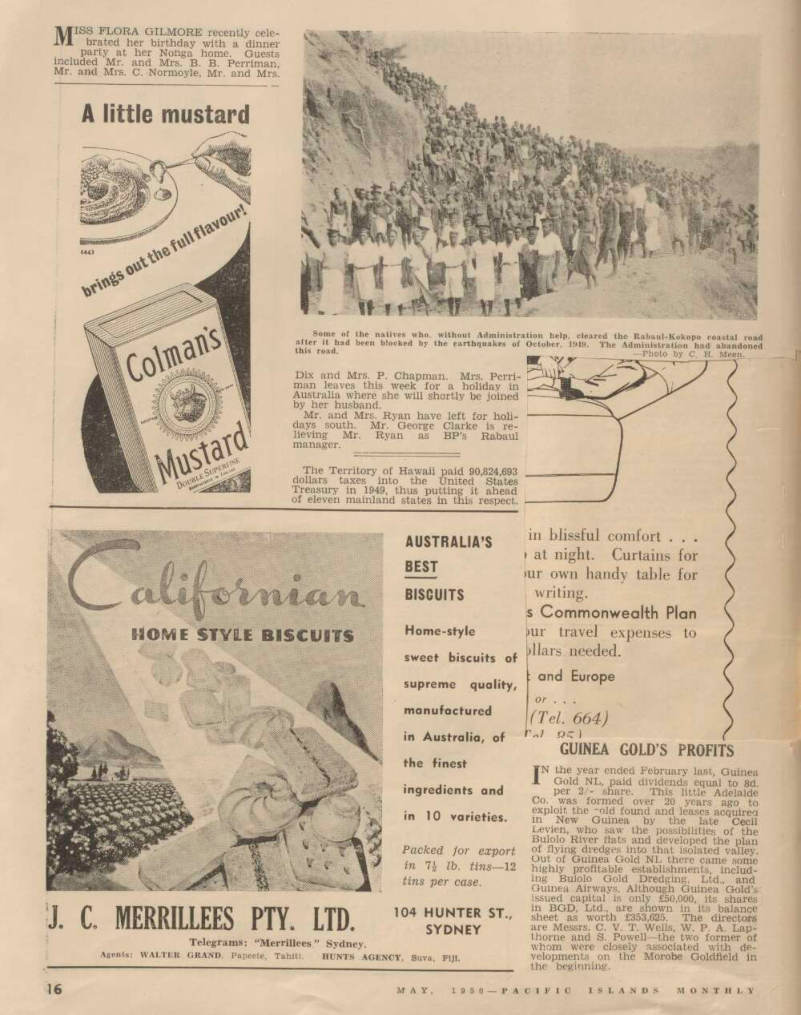
From Our Own Correspondent
Rabaul, May 5.
SINCE January 1, 80 inches of rain have fallen and rain is still pouring down.
At 3.30 this morning squalls of gale force struck Rabaul. The Methodist Church was razed to the ground, one of Colyer Watson’s stores was unroofed, and the men’s quarters at the back of the PWD were badly damaged and flooded out. Telephone services are completely disrupted and most of the town is without power—caused mainly by trees crashing across the power and phone lines.
The famous trees in Mango Avenue, up to three feet in diameter, the majority of which survived the 1937 eruption and bomb damage during the Jap occupation, have suffered severely. Many are broken in half, as though cut with a giant scythe; others have huge limbs smashed off.
Lesser trees have been torn bodily from the ground. Mango Avenue is deep in slime and smashed trees.
All roads are in chaotic condition and our sympathies go to the Works and Housing Department, which must try to get, .some order out of this mess,., varo and bruises in the fall and, according to doctors, this had no bearing on her death.
Mrs. Conron was the Imother of two boys, one aged 4 and the other 15 months.
Her husband, a storeman in the Post and Telegraphs Branch, Port Moresby, was holidaying in Victoria with the elder boy at the time of her death.
THE Territory’s Public Service will get more pay and other benefits under the latest re-classification which is said to be in its final stages. Public Ser vice Commissioner, Mr. E. A. Head, told
storekeepers, who considerably overcharge the natives for their simple requirements.
The Europeans suffer as a consequence.
MEMBERS of the RSL, Planters’ Asso ciation, Chamber of Commerce and other residents expressed their satisfaction with the interest shown to their particular problems by the Minister of External Affairs and Territories, Mr.
Spender, during his recent visit, and look to the future with confidence.
In reply to the request for the imme diate appointment of a dentist at Rabaul, Mr. Spender stated that he would ar range to have two stationed in Rabaul.
One arrived in Rabaul this week. It is hoped that he will be a fixture.
A vulcanologist has also arrived and has commenced investigations of the vol canoes surrounding Rabaul.
Mr. Spender, in replying to the un animous protest from various bodies against the consolidated school, assured all “that there would be no consolidated school at present.”
ANZAC DAY was observed by a march of local ex-Servicemen, led by the president of the RSL, Major Smythe, MC. A ceremony was conducted at the RSL Cenotaph and upon conclusion all members adjourned to the Club House to celebrate in the traditional manner.
The RSL club is an established success and it is now proposed to erect another building which will house a dance floor.
THE New Britain Club, under the capable presidentship of Mr. J. Gil more, is enjoying a new lease of life.
The grounds and building have been con siderably improved.
VISITORS to Rabaul this week in cluded old identities Messrs. Fred Archer, from Buka, and Tex Mar shall and Lou Fay. Carpenters’ popular plantation inspector, Mr. Tony Corlass, has been relieving manager Max Lees at Ulaveo Plantation during the latter’s holiday in Australia. Lees re turns to harness next week and Corlass resumes his routine of inspections.
MISS FLORA GILMORE recently cele brated her birthday with a dinner party at her Nonga home. Guests included Mr. and Mrs. B. B. Perriman, Mr. and Mrs. C. Normoyle, Mr. and Mrs.
Dix and Mrs, P. Chapman. Mrs. Perri man leaves this week for a holiday in Australia where she will shortly be joined by her husband.
Mr. and Mrs. Ryan have left for holi days south. Mr. George Clarke is re lieving Mr. Ryan as BP’s Rabaul manager.
The Territory of Hawaii paid 90,824,693 dollars taxes into the United States Treasury in 1949, thus putting it ahead of eleven mainland states in this respect. .
Some of the natives who, without Administration help, cleared the Rabaul-Kokopo coastal road alter it had been blocked by the earthquakes of October, 1949. The Administration had abandoned this road. —Photo by C H. Meen.
Advertisements & other items, pp. 17-18 (1 item)
Mcilrat
What
is it ?
★ Creme Charmosan is a wonderful youthifying, beautifying skin cream with an enormous sale.
Imparts rose petal loveliness to the most ordinary skin
AT ONCE.
Most adorable under powder.
Helps remove so many faults from the skin; so many signs of age.
Soothing to the sunburnt skin. ★
CHARMOSAN
QUALITY COSMETICS
Vanishing cream, cold cream, face powder, lipstick, floral perfumes.
McILRAT
202 Pitt St., Sy<
“BIG SISTER” PLUM PUDD
CHOICE TOMATO SOUP, 16
“YOGA” TEA, Finest Ceylon
“GROWN” WASHING SOAP,
COLD CREAM TOILET SOAP,
“IXL” BAKED BEANS, .
SHEXXI IM WICI
increased 100 per cent. A small bundle of beans (17 to be exact) now costs 6d.
The Chinese, in their overwhelming numbers, purchase direct from the trucks bringing the goods into the market. One, in particular, buys up all the eggs, then resells them at a considerable profit, to the Europeans. Eggs have jumped from 4d. each to 6d.
The local Prices Commissioner has no control over primary produce but has ordered that eggs be reduced back to 4d. each. This instruction has been ignored to date.
Various women’s organisations have called special meetings to discuss the problem and an approach is being made to the local District Officer seeking his assistance to have the prices restored to a sane level and closer policing of the market.
It is understood that the increased prices are native retaliation to the Asiatic
Announcing Return Visit . . .
S. WENTWORTH JACKSON
(F. 1.0., SYD.)
Optometrist & Optician
185 ELIZABETH ST., SYDNEY
Consultations:
RABAUL —JUNE 19 to JUNE 27, 1950 Appointments: Cosmopolitan Hotel PT. MORESBY —JULY 5 to JULY 13, 1950 Appointments: G. G. Smith & Co. LTD.
HAVE YOUR EYES EXAMINED. MAKE AN
APPOINTMENT NOW.
Telegraphic Address: “SPHERE,” Sydney
A little mustard
WA (-44) \fi S {M s^ p ;
mm
IIA
HOME STYII BISCUITS
Wk ...'J 'll : 2
AUSTRALIA’S
BEST
BISCUITS
Home-style
sweet biscuits of
supreme quality,
manufactured in Australia, of the finest
ingredients and
in 10 varieties.
Packed for export in 7i lb. tins —l 2 tins per case.
J. C. MERRILLEES PTY. LID. 104 ™ N ™ ST Telegrams: “Merrillees” Sydney.
Agents: WALTER GRAND, Papeete, Tahiti. HUNTS AGENCY, Suva, Fiji. in blissful comfort . . .
>at night. Curtains for
>ur own handy table for
writing.
s Commonwealth Plan
>ur travel expenses to
)llars needed.
: and Europe
or . . .
(Tel 664)
n oc )
GUINEA GOLD’S PROFITS
IN the year ended February last, Guinea Gold NL, paid dividends equal to Bd. per 2/- share. This little Adelaide Co. was formed over 20 years ago to exploit the -old found and leases acquirea in New Guinea by the late Cecil Levien, who saw the possibilities of the Bulolo River fiats and developed the plan of flying dredges into that isolated valley.
Out of Guinea Gold NL there came some highly profitable establishments, including Bulolo Gold Dredging, Ltd., and Guinea Airways. Although Guinea Gold’s issued capital is only £50,000, its shares in BGD, Ltd., are shown in its balance sheet as worth £353,625. The directors are Messrs. C. V. T. Wells, W. P. A. Lapthorne and S. Powell —the two former of whom were closely associated with developments on the Morobe Goldfield in the beginning.
The Month In Moresby
Prom Our Own Correspondent
1 Port Moresby, May 8.
THE cause of the death on Anzac Day of attractive 26-year-old Mrs. Mavis Conron, of Port Moresby, seems likely to remain a mystery. After an inquest lasting 'a week, the Coroner (Mr. B.
Faithorn) found that she died from an unknown cause.
A native police constable discovered Mrs. Conron lying unconscious in the grass 75 yards away from her home at 5 a.m. on April 25. She died in hospital three hours later.
When found she had a coat on over her dress. Medical examinations revealed neither natural nor unnatural causes of death. The Government Analyst at Bris bane found only traces of quinine in the stomach contents. The Coroner com mended two natives, Lui and Ure, for their care of the dying woman before help arrived.
During the inquest witnesses said Mrs.
Conron was a sleepwalker and had been known to dress herself while asleep. Police said she had apparently stumbled over a small stone wall near her house and rolled down the slope to the spot where she was found. However, she suffered only cuts and bruises in the fall and, according to doctors, this had no bearing on her death.
Mrs. Conron was the jmother of two boys, one aged 4 and the other 15 months.
Her husband, a storeman in the Post and Telegraphs Branch, Port Moresby, was holidaying in Victoria with the elder boy at the time of her death.
THE Territory’s Public Service will get more pay and other benefits under the latest re-classification which is said to be in its final stages. Public Ser vice Commissioner, Mr. E. A. Head, told
the annual meeting of the Public Service Association that he had “every hope” that the re-classification would date from July 1, 1949. He said that changes in the Public Service Regulations, also in the final stages, would increase child and travelling allowances and raise the salary level at which overtime can be earned.
Present system of assisted passages on recreation leave would be replaced by the more liberal Commonwealth provisions.
Mr. Head added that all except a small portion of the fares of families of newly appointed officers would be paid, as well as most of the freight on furniture. Sick leave will be allowed to accumulate. De scribing the proposed promotion procedure, Mr. Head said provisional promotions would be gazetted and would be subject to appeal.
WORK has started on a new general store to be built in Douglas Street, Moresby, by E. E. Kriewaldt & Co., Ltd. The store will be across the road from the District Office and next to the Administration women’s hostel. It will specialise in clothing and Eastern goods and will have a self-service grocery sec tion. All sales will be cash. Mr. Krie waldt, who was formerly with Customs, says that the cash and self-service sys tems would reduce operating costs and enable the store to sell groceries at lower prices than those prevailing at present in Moresby.
Natives will not be allowed in the main store, he added. There will be a separate section for them at the rear. It’s hoped to open the store in July. The building will be at street level with a bulk store underneath. It will be 40 feet by 40 feet, with two feet of glass louvres around the
sides and display windows in front. Later, a chemist's shop may be built next door.
E. E. Kriewaldt & Co., Ltd., has a nominal capital of £20,000. At a meeting of shareholders this month, Messrs. Krie waldt, R. K. Caldwell and G. P. Pederson will seek election as directors. Mr. F. B.
Godson will offer himself as an alternative director. Mr. Caldwell was formerly ac countant with the New Guinea Company, Rabaul.
THE money-raising campaign for Moresby’s future Olympic swimming pool has got under way with a series
of sweepstakes on Sydney’s “race of the day.” Prizes are: Ist £25, 2nd £lO and 3rd £5.
It’s expected that a horse race meeting at Ward’s Strip will be the first big func tion held in aid of the Swimming Pool Ap peal. Plans for the races are in the early stages but it seems certain that enough horses will be provided by local owners to make the meeting successful. A straight
four-furlongs course has been suggested and there will probably be four or five races, including one for ladies.
The Swimming Pool Committee intends to follow the race meeting with a carnival night, an art union, boxing, sports and a ball, etc. At the recent public meeting at which the Committee was formed, Mr.
Jack Lyons said at least £6,000 or £7,000 would be needed to build an Olympic Pool.
If all residents gave their support it would not be too difficult to raise the money.
Mr. Lyons suggested that the pool be built into the sea near the main swimming area on Ela Beach. The pool would fill at high tide iand the water could be pumped out when necessary. Some of those at the meeting favoured a pool on the land and finally it was decided to put the matter in the hands of a sub committee and Invite residents and firms to submit designs and suggestions. Local firms and organisations are being invited to send representatives to the next general meeting. These representatives will be added to the Committee, which now con sists of Mr. J. Lyons (president); Mr. D.
Sullivan (vice-president); Mr. R. Prior (secretary); Mr. M. Creed (treasurer); Mr. J. Jeffrey (publicity officer); Mr. C.
Mayoh, Mr. J. Ritchie, Mr. J. Cox and Miss J. Lane. A subscription list has been opened. Donations, made out to the Port Moresby Swimming Pool Committee, should be sent to the treasurer (My.
Creed), Auditor’s Office, Konedobu.
FIFTY-FOUR Kerema and Kikori natives were fined 5/- each at Moresby recently for riotous be haviour. They were among hundreds of natives involved in a brawl at Koki on the morning of Easter Sunday.
An argument between two natives started the fight. Keremas and Kikoris took sides and, yelling and screaming, they attacked each other with sticks and clubs. A few native police tried to break it up but the fight continued until Euro pean officers arrived. Ten natives were taken to hospital and two admitted.
NEXT large areas of land to be opened up in Port Moresby will be above Upper Port Road and along Lawes Road. Altogether, a hundred or more blocks will be made available. This in
formation was given to the Advisory Council’s last meeting in a letter from the Government Secretary. The letter added: “The matter of the development of the Pour to Five Mile area is involved in the provision of water and electricity. It is proposed to develop the water resources of the Laloki River as soon as possible.”
In its efforts to open up building land the Administration is handicapped by a serious shortage of surveyors, said the Government Secretary. Advisory Council members said land was needed urgently in Moresby. Mr. E. J. Frame told the meeting that Mr. Spender had assured him that the town plan would be speeded up and would be submitted to the Council before being finally approved. Council de cided that on receipt of the plan it would invite the public to inspect it and make comments.
Council carried a motion by Mr. J. H.
Ahearn expressing concern at the delay in improving port facilities and recom mending that overseas ships be unloaded into lighters in midstream “until adequate wharf and warehouse facilities are pro vided.” It was suggested that until there are enough lighters, a tug should be pro vided to help overseas ships berth safely.
Works and Housing will be asked to supply the Council with a plan of the new wharf before tenders are called.
Council will ask the Administration to set aside an area on Ela Beach for Euro pean swimmers and to build new dressing sheds, with showers. The Government Secretary advised that the Administration would carry out the anti-litter campaign suggested by the Council. He asked the Council, however, to organise the com petitions to be held as part of the cam paign.
N. F. MALONEY & CO. expects to open a general store at the Three-Mile within six weeks. The store will have separate sections for Europeans and natives and will have a European in charge. It is hoped to open it from 9 a.m. to 9 p.m., with slightly shorter hours at week-ends.
A FATAL accident occurred at Rouna on Anzac Day when William Blunt 23, of DCA, fell 100 feet while des cending to the bottom of the Falls.
Blunt, a clerk, had been with DCA at Moresby since February, 1949. On Anzac Day he attended the Bomana Dawn Ser vice, then, with Mr. John Sheedy (Met. section) and Mr. Ralph Ernst (DCA), he set out to walk to Rouna. At Rouna they took photos, then decided to descend to the foot of the Palls. Blunt took a dif ferent route to the other two. On their way down Sheedy and Ernst found Blunt lying badly hurt among the rocks on to which he had fallen. He died within the next ten minutes while Sheedy was on his way to the guest-house to phone for the ambulance. The funeral took place the same afternoon.
MR. VINCENT KEOGH, aged 55, who was the Directorate of Shipping’s Assistant Engineer Superintendent at Moresby, died in the Moresby Hospital on April 26. He had been ill for a little more than a week. Mr. Keogh was the father of four sons and a daughter, all living in Australia. His wife and one son, John, arrived here to see him a few days before he died. He had been with the Directorate of Shipping at Moresby and Rabaul since October, 1948.
THE neck-and-neck Rugby League com petition between the Maganis and Paga Hill is creating great interest.
Attendance at the games gets bigger every Sunday. Up to date Paga and the Maganis have each won two matches.
Players are anxious to get into one of the
two teams to visit Wau during the King’s Birthday week-end in June. They are also competing for a number of trophies.
President of the local Rugby League As sociation, Mr. Reg. Grout, has given a trophy for the most improved player. Mr.
Hal Searle has donated one for the best and fairest player and Mr. Bob O’Neile one for the highest point scorer. Mr. Andy Larkin has given a Shield, conditions for which have not been finalised.
Australian Rules football will soon be under way in Moresby. APC is construct ing a ground at Badili and should have it ready in a few weeks. Several Aussie Rules men are at present playing with the Maganis League team —and doing very well.
SAILING is well established as one of Moresby’s leading sports. At least seven boats contest the races each Sunday morning and more are being built. AyJay (A. Murray) won the first
heat of the Kingsley Cup recently from Mistral (W. Connolly) and Lindy Lou (E. Johnstone;.
(Continued on page 21)
LOOKING well after 10 weeks in Auck land (New Zealand), Mrs. Joan Brierley is back again at the Govern ment Secretary’s Department.
A daughter was born to Mr. and Mrs.
Pierre Donaldson at the Moresby Hospital recently. Mr. and Mrs. Donaldson are not long back from a holiday in England. He has now begun duty as a patrol officer at Samarai.
Field superintendent of APC’s Vailala drilling area, Mr. A. D. Houston, has re turned to Australia. His successor is Mr.
J. G. Saunders.
Well-known Moresby resident, Mrs. G.
McDonald has gone to Toowoomba to live.
Mr. and Mrs. Ron Jennings and son David have left for Sydney. Mr. Jennings, who is with Qantas, is being transferred from Moresby.
Visiting Moresby is Mr. Noel Ford, of MGM, who is organising 16 mm film dis tribution in the Territory.
Mr. and Mrs. C. F. Cowley, who returned from leave recently, are now at Higaturu where Mr. Cowley is DO. They were formerly at Misima.
Advertisements & other items, pp. 19-22 (1 item)
Mdibath’ S
EXTRA WtnTE
CLOTHES
RECKITT’S BLUE in the last rinse ensures that extra whiteness without damaging the fabric.
V Mil
©ckitts
M Blue
NE L * STIR IN LA® 1
MdIBATH’ S
202 Pitt St., Sydney,
for GROCERIES & PROVISIONS
at Mono; Saving Prices.
“BIG SISTER” PLUM PUDDING, 16 oz. tin 29/6 doz.
CHOICE TOMATO SOUP, 16 oz. tin . ||/g doz.
“YOGA” TEA, Finest Ceylon & Indian, 6 lb. tin, 2/9 lb. (Plus tin, 1/101 ea.; Export levy, 3/- lb.) “CROWN” WASHING SOAP, cases of 50 x 2 lb. bars, 55/- per case, (Exdoi-i i,.,,. iz/c per case.i COLD CREAM TOILET SOAP, Pink, Lemon & Green, 3 oz. cakes 30/- per gross. (Export levy, 7 r *» 4/6 per gross.) “IXL” BAKED BEANS, . 4 oz. tin 5/6 doz., 8 oz. tin 9/6 doz., 16 oz. tin 15/- doz.
“IXL” SPAGHETTI IN SAUCE. 4 oz. tin 6/- doz., 8 oz. tin 10/6 doz., 16 oz. tin 16/6 doz.
“Edgell” Julienne Carrots, 16 oz. tin, 12/6 doz.
Table Margarine, 2 lb. tin, 4/6 tin, 52/6 doz.
Detailed price lists available post free on application.
Choicest Butter, 1 lb. tin, 4/3 tin, 49/6 doz.
“Rosa” Jelly Crystals, full pint packet, assorted flavours, 6/3 doz.
Plain Flour, Self-Raising Flour and Australian IA Sugar is available in specially packed new 25 lb. and 35 lb. lever lid tins for Island customers.
A full range of Penfold’s, Lindeman’s, Seppelt’s and Hardy’s Wines now available from 3/- per 26 oz. bottle.
EVERY ORDER—large or small, has the same careful attention as if you purchased in person.
FOR YOUR CONVENIENCE —our Service Department will be pleased to procure all your general household requirements and include them with your grocery order, thereby saving extra freight and charges.
ALL SHIPMENTS, EXCLUDING DECK CARGO, ARE INSURED AGAINST PILLAGE, THEFT AND
NON-DELIVERY. ALL PRICES F. 0.8. SYDNEY.
McILHATH’S PTY. LTD.
202 PITT ST., SYDNEY, AUSTRALIA
Cable Address: “ROTUNDA,” SYDNEY
WILLIAM A JONES PTY. LTD.
Livestock Exporters
Livestock Exported To All Ports Inquiries Invited Address:
108 QUEEN ST., MELBOURNE
Telegrams : “VALKYRIE ” Melbourne.
NX S' U!
IHilLu 3 \M \i 2U
SOAP
for that weekly issue !
2-OZ. CAKES OF PLAIN SOAP
PACKED READY FOR
ISSUE IN CASES
CONTAINING 400 CAKES
A G. W. PENNELL PRODUCT
obtainable from:
COLYER WATSON PTY. LTD
22 BRIDGE ST.
SYDNEY
STAMPS
Brunei, lc.-$l (11), fine used 7/- Cyprus, Geo. VI, 14p.-43p., fine used . . . . 10/6 Egypt. Farouk, £l, fine used (i/- Commonwealth, 8.C.0.F., short set to 17mint 8/6 Commonwealth, 8.C.0.F., Id. and 3d. imprint blocks, pair 107- Mint Islands sets accepted in payment for above.
Send stamp for list of excellent offers.
Medium and advanced collectors should write for first-class selections of Empire and Foreign stamps on approval.
An excellent exchange is offered for good Islands material.
GUY ROUND
414 Toorak Road, Toorak, Victoria, Australia.
Si'.'iT f
WMC.
m
fe.v
M l II
IS m ■R m m mm m m m n & H MR iV' u
Tell me
doctor . . m sSv-‘ V>>svV, Can an antiseptic help in healing ? ”
Wounds heal of their own accord when they are kept free from the germs that cause septic infection. To keep wounds in the healthy condition for healing, surgeons have for years relied upon ‘Dettol’. This ruthless destroyer of germs is non-poisonous, gentle and safe on human tissues. While it disinfects the wound, ‘Dettol’ leaves the living tissues undamaged to continue the natural processes of safe and rapid repair.
DETTOL
THE MODERN ANTISEPTIC
(93 )
THE PEM Of
i®3SS»> ■ ms&. m
PERFECTION
THE CRAMMOND TROPIC EAGLE
Most famous tropic proofed and completely sealed receiver in the world to-day. The designers’ claim that range is unlimited has been fully justified by the repots received from hundreds of enthusiastic owners. Write for copies of letters together with Price Lists and Illustrations. Remember these two evidences of complete confidence— 3 years guarantee and easy terms wherever you live.
Available for all Types of
Operation.
Both receivers illustrated are completely tropic proofed and have built-in moisture absorbers. It may truly be said they are far beyond comparison and in a class of their own.
Available in vibrator or all dry cell.
THE CRAMMOND TROPIC HAWK
This is a 2 unit receiver especially designed for Patrol Officers and others who require absolute portability and dependability. Combined weight of both cabinets—32 lb. Measurements each cabinet—ls by 9 by 9. This set covers from 16-150 metres shortwaves only. 3 years guarantee and easy terms.
CRAMMOND , KING OF THE AIR
CRAMMOND RADIO
TROPICAL DIVISION , /j
NO.B, QUEEN STREET , BRISBANE
Suva’S Botanical Gardens
“Neglected”
From Our Own Correspondent SUVA. April 17.
SUVA’S Botanical Gardens, a dreary and uninspired corner but with obvious possibilities, is worrying the Town Council to the point where the council may have to tell the Government that the council’s facilities will not allow the proper upkeep of the gardens.
Despite their air of comparative neglect, the gardens contain a collection of shrubs and trees of considerable botanical in terest. Not long ago name-plates on the trees were neatly repainted. All was well until the Suva Town Council received a letter which pointed out that the plates had been replaced on the wrong trees.
Whereupon the council hurriedly passed the buck to the Agriculture Department, which had inadvertently wandered from the path of accuracy.
for Papua-N. Guinea
More Migrant Doctors for Papua-N. Guinea
AN attractive young Yugoslavian woman doctor was among a party of 22 migrant medicos who left Sydney for Papua-New Guinea on April 15 to join the medical services there. She is Dr.
Blanka Pracen who, since she came to Australia 11 months ago, has worked as a domestic and as a nurse in a mental hospital. She completed her medical course at Graz, Austria, just after the out break of World War II but during the war the Nazis forced her to work in munitions and tobacco factories.
The party of doctors —the second to go to the Territory in recent months —included Czechs, Poles, Ukrainians, Hun garians, Latvians, Lithuanians and Es tonians. Their degrees are not recognised in Australia. Most of them said they hoped to settle permanently in New Guinea —they could not afford years of study to qualify for Australian medi cal degrees.
Police Force Reserve Pay
From Our Own Correspondent SUVA, March 27.
MEMBERS of the Fiji Police Force Re serve, which has been established as a result of legislation passed at the December session of the Legislative Council, will be paid at the following rates per day when called out for emer gency service: Inspectors, 22/6; sub inspectors, 17/6; sergeants, 15/6; corporals, 15/-; and constables, 10/-.
If called away from home for con tinuous duty exceeding 12 hours, inspec tors will receive an additional 12/6, sub-inspectors 7/6 and other ranks 5/-.
Provision is also made for the payment cf an annual bounty of £4 for each com plete year served by every member of the reserve force.
Mr. A. E. Fuller, treasurer of the Gil bert and Ellice Islands Colony for the past four years, and Mrs. Fuller, were in Auckland, NZ, in February. They are on their way to England for six months’ leave.
Advertisements & other items, p. 23 (1 item)
Uniporn
QUEENSLAND
INSURANCE
COMPANY
LIMITED
(Incorporated 1886 In Australia).
ASSETS EXCEED £5,000,000
Head Office ;
QUEENSLAND
INSURANCE BUILDING,
80-82 PITT STREET, SYDNEY.
Specialists in South Seas Fire,
Marine Cr Accident insurance*
Apply to:
FlJl.—Branch Office: I. B. Chalmers, Manager.
Burns Phllp (South Sea) Co., Ltd.
VlLA.—Burns Phllp (South Sea) Co., Ltd.
Comptoirs Prancais Des Nouvelles Hebrides (Marine).
NOUMEA.—L. & W. Johnston.
NEW GUlNEA.—Manager for the Territory of New Guinea and Papua, W. A.
Anderson.
PORT MORESBY—SAMARAI—LAE
—MADANG—RABAUL.
Burns Phllp (New Guinea), Ltd.
PAGO PAGO.
Burns Phllp (South Sea) Co., Ltd.
G. H. C. Reid & Co.
OTHER SOUTH SEA ISLANDS.
Burns Phllp (South Sea) Co., Ltd.
Also to any of the Company’s
Offices in Australia of New Zealand.
UNIPORN
DIESEL ENGINES
% w K immcpmk mntur IilK(AM!; syDNS ,
SOLE N.S.W AND PACIFIC ISLAND DISTRIBUTORS
G. H. ROBINSON
EXPORTS & IMPORTS PTY. LTD.
51 Macquarie St., Sydney.
Larger Flying Boat’s For QEA Island Services
QEA Island Services
Qantas Empire Airways Have
bought two of the 30-passeng r San “ dringham flying-boats recently fold by Tasman Empire Airways after they had put Short flying-boats on the Syd ney-Auckland run.
QEA will use the Sandringhams on the
services they operate (at present with Catalinas) to Suva, Noumea, Lord Howe Island and the New Hebrides.
Captain and Mrs. I. H. Thomas, ar rived in Australia early in Aoril from the UK and left for the'BSl on April 17.
Captain Thomas who is a school teacher will take over the Anglican Mission senior boys’ school on the island of Ugi.
Wau, Ng
Secondary School For
But Why Not a Hill Station As Well?
THE long-discussed secondary school for Papua-New Guinea moved just per ceptibly nearer accomplishment in early May when land for the establish ment was reserved, by proclamation, at Wau, in the Morobe District.
Madang residents discussed the question of this secondary school with Mr. Spender when he recently made his visit to the Territory and were promised that it was to receive early attention.
Presumably the school is for the benefit of Papua-New Guinea generally and will therefore need to be a board ng establish ment for both boys and girls. It has been assumed that this school will be for Euro pean children but this, no doubt, will be a matter of Education Department policy.
It will be remembered that at the begin ning of this year there was a considerable amount of heartburning on the part of Rabaul parents when it was decided to turn the local European school into a mixed school (a decision since cancelled peremptorily by the new Minister for Territories).
A secondary school in New Guinea will fill a long-felt need in a Territory where all children past primary school age must now be sent South. This, of course, is a great financial drain on the re'ogrces of those Territorians who are on a fixed salary. It seems unfortunate, however, that the Administration could not go the whole way and establish their school in the Central Highlands. Their fetish of
keeping all but the chosen out of this area seems at times to reach heights of absurdity. The climate at Wau is better than on the coast, but the climate of the Highlands is ideal for a Hill Station—an amenity that all but the stubborn Austra lians would have established years ago. It seems ridiculous that residents of Papua and New Guinea are compelled to stew and sweat in the humidity of the coast, suffering its itches and rashes and fevers until such time as they are compelled to “go South,” when within a nlane flight of an hour or two, is the delightful, brac ing climate of the Highlands.
There may be perfectly good reasons why this vast area should not be thrown open to all and sundry for permanent settlement, but there seems no valid rea son why some part of it should not be turned into a European holiday settlement with cottages, a decent hotel—and a secondary school.
It has been suggested recently that the Highlands should be used to attract dollar tourists and this for some reason is re garded as a good idea. The idea pre sumably is to turn the atea into a zoo for the amusement of Americans while bona fide residents of the Territory find it a great deal easier to enter the Pearly Gates than to gain to pay a fleeting visit to the Central H ghlands.
IT can be said, of course, that for reasons of economy Wau is a mu:h more desirable site for a school. There is plenty of excellent timber in the Bulolo Valley and there are, too, the sawmills to cut it. But if some super effort is to be made to accommodate American tourists in the Highlands then very little extra ef fort would be needed to establish a school.
Doubtless, many Territory parents will continue to send their children South to school. Although there is one school of thought that believes it is bes*: fo' a child to be brought up in the country in which he will live, whether climate is suitable or not, others believe that a child is best out of a native country in its formative years.
Advertisements & other items, p. 24 (1 item)
Brasso
See how it shi mes
The quality Metal Polish
The NEW HILLMAN MINX
a \ mtr~— •s yet running now lias a plus-power engine developing 37.5 h.p. I This gives you
• MORE SPEED
at the getaway . more POWER on the hills— costs are as low as ever Full particulars available from (hr distributors throughout the Territory of New Guinea
COLYER WATSON (.SSL) LTD
RABAUL
KAVIENG
Apia Holds First Post-War
Race Meeting
APIA, April 21.
ITHE race meeting held by the Apia Turf Club on Easter Monday was the first since 1945, but marked the 50th anniversary of horse-racing in Samoa, where the first race was held on Moataa beach, near Apia, in 1900, shortly after the raising of the German flag. In 1907 the German Government placed Apia Park, then called the Solf Field in honour of the German Governor, Dr. Solf, at the disposal of the newly-formed Racing Club and several race meetings were held at the Park annually. Enthusiasts of
all nationalities kept the sport going and dyrmg the last war the proceeds of race
meetings were devoted to the Returned Soldiers’ Fund.
Advertisements & other items, pp. 25-26 (2 items)
23
1* A C I F I C ISLANDS M O N T H I, V - M A Y , 1950
Broomfields Ltd.
.300 WATT ELECTRIC GENERATING SET
10 HRS. POWER ON ONE GALLON PETROL
U H P.
4-stroke air-cooled J.A.P. English Engine coupled to D/C generator 12/32 volt 9-12 amps Complete with switchboard.
Weight: BO lb.
Price: £52.
With Battery Start. £53/10/- Plus Sales Tax.
Ball bearing generator delivers 300 watts at voltage which can be varied by a knob on the switch box from 12 to 32 volts. It is a sturdy battery-charging set and is ideal for lighting say 7 x 40 watt globes or 10 x 25 watt globes u'ing either 12, 24 or 32 volt battery.
Trade enquiries also invited.
HARDMAN & HALL
44 MISSENDEN ROAD, NEWTOWN. LA 3597.
BROOMFIELDS Ltd.
Suppliers of Building Hardware Ship Chandlery, Paint Materials
WRITE DIRECT TO:
Broomfields Ltd., 152 Sussex Street, Sydney
R. J. CRILLEY Pty. Ltd.
WHOLESALE MERCHANTS BUYING AGENTS
123 SUSSEX STREET, SYDNEY
Cables “RKJAM,’’ Sydney.
All classes of Australian merchandise purchased on behalf of Island clients at best wholesale rates: original Invoices provided: prompt and reliable service assured in all transactions.
Representatives Required In most Pacific Territories
Available for prompt shipment: e General Groceries and Provisions. • Liqueurs—Wines—Spirits. e Paints, Varnishes and Enamels. • Axes, Mattocks, Hammers and Tools. • Portable Pumping Units. • Marine Engines 3to 12 H.P. • Auto Parts and Batteries.
Price Lists airmailed on request.
c> I
Ai AV
•T. a n .»»
ICJ G
8 * V , >.
C-i vf: n ... ...j » ff M 0 ! i t « m
Incomparable values, guaranteed colorfast
cottons in American-type multiple sizes
0PA357. Woven Pastel Plaid Gingham with roll collar, unrolled pleats front skirt, flared back. Assorted, 13, 17 ; OR/ 14, 16, 18 ; 14i, lei is*. OJ “ 0PA359. Gingham With Eyelet Trim on magyar sleeved bodice.
Dirndl skirt with sash.
Blue or Red White. Sizes . Q Q/O 13, 17 ; 14, 16 and 18. ULi U Measurement Chart OPTRS2II. Voile with magyar sleeved shirred bodice. Corselette waist, unrolled pleats.
Assorted 13, 17; OR/ 14, 16, 18 ; 141, lei 18*. UU ” 0PTR5221. Candy Striped Cotton, dart fitted bodice. Four gore skirt, self belt. Red or Navy/White. Sizes: 13, OV/R 17; 14, 16, and 14*. Li 1 U
Freight Chart
Freight 1/2 to all Pacific Islands except those listed below : West Samoa, - - - 1/6.
East Samoa, U.S.A., - 1/6.
New Caledonia, - - 3/2.
Hawaii, U.S.A., - - 1/6.
Jap
: K 3.
fk SI?!
■| Mm wms& r#- Ml 0
OF MELBOURNE PTY. LTD.
489-99 SWANSTON STREET,
MELBOURNE . . AUSTRALIA.
Box 4535, G.P.0., Melb. C.l.
Mystery Of Christmas
Island
Rougier Interests Apparently Taken Over By Britain
THERE is in circulation in the Central Pacific a circumstantial story to the effect that the British Government —presumably through the High Com mission for the Western Pacific—has purchased, from the heirs of the late Father Rougier, all that famous mis sionary-merchant’s interests in Christmas Island, and has entered into possession of same.
There is evidently something in it.
Father Rougier’s nephew visited Suva last year, and remained for a long time at the Grand Pacific Hotel, while discus sions proceeded with high officials. Early this year, the WPHC’s vessel Nimanoa proceeded from the Gilberts to Canton Island, with a new manager and a score of Gilbertese labourers for Christmas Island, under the orders of the High Commissioner.
Some reports say that the British Gov ernment paid £25,000 for the Rougier in terests in Christmas. Others say the sum was nearer £500,000. The Government says nothing. The critics say that it was not necessary to pay anything much —the lease owned by the Rougier in terests would presently have expired.
The Rougier interests owned very large plantations on Christmas and the copra produced from same, under present con ditions, must be worth a lot of money.
There always has been mystery about the Rougier set-up in the South Pacific —ever since the days when Father Rougier succoured in Fiji, the ex-New Caledonia convict, Cecille, and got pos session of his fortune; broke away from
his church; acquired interests in the Washington-Fanning-Christmas area; and settled down in Tahiti as a wealthy operator of plantations, with a reputa tion for good works and charity. Later, Kougier interests were somehow con cerned with the Kong Ah scandals of Tahiti; and there were strange events and developments—never yet explained— during the Vichy Government phase of World War 11.
Maybe the Christmas Island purchase by Britain ends a situation that both the British and French Governments considered undesirable. A British Colonial Office statement, explaining what has occurred, would not be out of place.
Planters’ Assn. Formed
In Bsi
SEVEN people attended a meeting in Honiara, BSI on March 21 and formed the Solomon Islands Planters’ and Commercial Association. Apologies were received from several others and it is believed that a number of planters who will give the association their support were prevented from attending by the prevailing transport difficulties of the Solomons.
Mr. R. C. Symes was elected president of the Association: and Messrs. J. C.
Hammett, L. F. Gill J. A. Johnstone, K.
H. D. Hay and Father Palmer of the R.
C. Mission become the committee. Hon. secretary and treasurer is Mr. R. G.
Hodge.
In order to obtain funds it was decided that all 'members who are producers or purchasers of copra pay 2/6 per ton levy; that all commercial companies not engaged in production or purchase of copra pay an annual subscription of £lO/10/- and private individuals who be come members, £5/5/- annually.
There are some funds in hand from the pre-war association. These are in the Commonwealth Bank in Australia.
Signatures of new office bearers are be ing forwarded to the Bank.
The objects of the association are “to represent and protect the interests of planters and commercial resources in BSIP and to ensure proper liaison and co-operation with the Government of BSIP in matters of importance to the welfare of all residents of the Protector ate.”
Advertisements & other items, p. 27 (1 item)
Tom Piper
Enjoy a Real Holiday
at
“SAN ELANDA” GUEST HOUSE,
Tewantin, Queensland f m.m Island Folk will Receive a Warm Welcome. Excellent, Fishing, Boating, Surfing, River Trips, Tennis, Golf, Etc., plus First-Class Accommodation and Cuisine at a Reasonable Tariff.
Tewantin, on the Coast, is 100 miles North of Brisbane.
R. P. MILLS, Proprietor
(Late of Witu, T.N.G.) ’Phone: Tewantin 21
Choice Home-killed Beef w Selected Garden-fresh
Vegetables
r rjr
TOM PIPER
STEAK & VEGETABLES
VI/ P9O
Suva War Graves
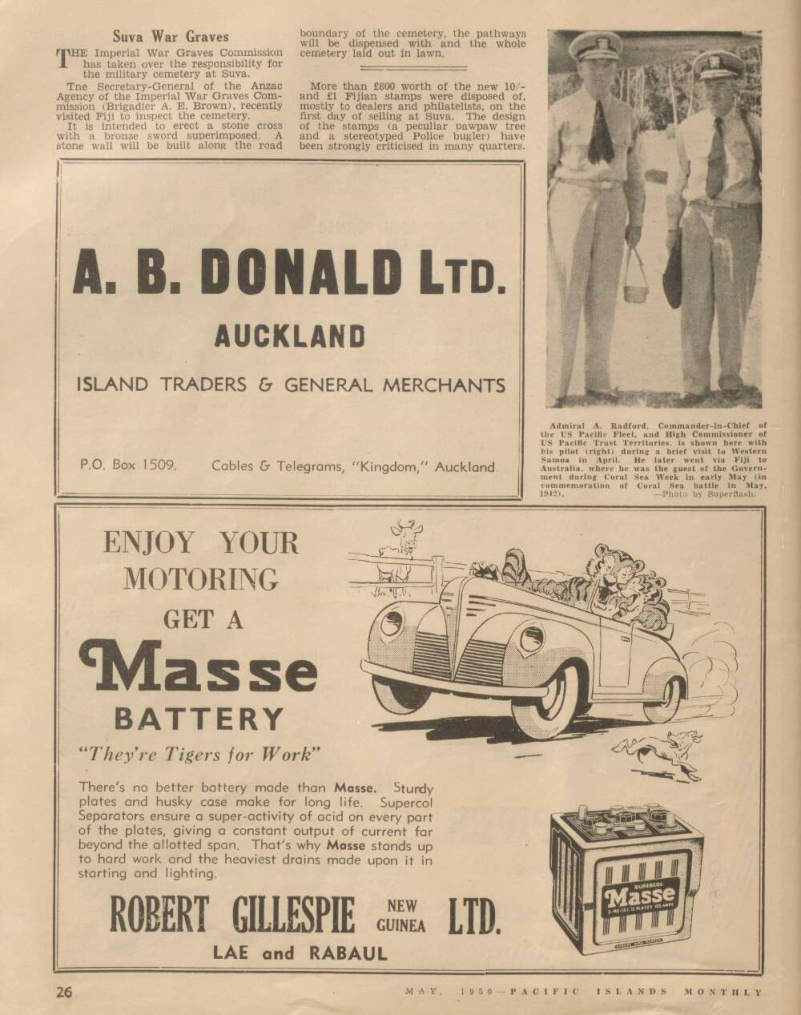
THE Imperial War Graves Commission has taken over the responsibility for the military cemetery at Suva.
Tne Secretary-General of the Anzac Agency of the Imperial War Graves Com mission (Brigadier A. E. Brown), recently visited Fiji to inspect the cemetery.
It is intended to erect a stone cross with a bronze sword superimposed. A stone wall will be built along the road
boundary of the cemetery, the pathways will be dispensed with and the whole cemetery laid out in lawn.
More than £BOO worth of the new 10/and £1 Fijian stamps were disposed of, mostly to dealers and philatelists, on the first day of selling at Suva. The design of the stamps (a peculiar pawpaw tree and a stereotyped Police bugler) have been strongly criticised in many quarters.
Admiral A. Radford, Commander-in-Chief of the US Pacific Fleet, and High Commissioner of US Pacific Trust Territories, is shown here with his pilot (right) during a brief visit to Western Samoa in April. He later went via Fiji to Australia, where he was the guest of the Govern ment during Coral Sea Week in early May (in commemoration of Coral Sea battle in May, 1942). —Photo by Superflash.
Advertisements & other items, p. 28 (1 item)
Masse
A. B. DONALD Ltd.
AUCKLAND
ISLAND TRADERS & GENERAL MERCHANTS
P.O. Box 1509. Cables & Telegrams, "Kingdom/' Auckland
ENJOY YOUR
MOTORING
GET A
Masse
BATTERY
“They're Tigers for Work 99 -~w~ (5 There's no better battery made than Masse. Sturdy plates and husky case make for long life. Supercol Separators ensure a super-activity of acid on every part of the plates, giving a constant output of current far beyond the allotted span. That's why Masse stands up to hard work and the heaviest drains made upon it in starting and lighting.
ROBERT GILLESPIE JSL
LAE and RABAUL
LTD.
Only 745 Returned
Account of How Japs Took 1,200 People From Nauru
(Prom Our Special Representative)
WHEN I met Mr. T. H. Cade, police chief of Nauru, in Fijji, I got, for the first time, the full story of what the Japanese did to the Nauruans.
When the war came, the Australian Administrator, Colonel Chalmers, and three other Europeans, refused a passage on the evacuation ships in 1942, and stayed behind to help the natives, who then numbered about 1,800. Eventually all the Europeans, and about one third of the Nauruans, were murdered or starved to death by the Japanese.
When Mr. Cude returned to Nauru in September, 1945, his first duty was to look for the Nauruans. He has been in Nauru since 1927 and is very fond of these people.
He found only a half-starved remnant, numbering 600, of a once happy and prosperous community. He learned that 1,200 —men, women and children, whole families —had been taken away overseas in July and August, 1943. Reports were received, through American channels, that there were some hundreds of them in the Carolines.
Mr. Cude was sent off, via Guam, to find these neople, and renort. The Americans helped him in every way, and directed him to Tol, in the atoll of Truk, in the Carolines, where, in December, 1945, he found 745—-all that was left of 1,200.
They told him that, when food became scarce on Nauru, the Japs sent them away in small shiploads of 600, to Truk, where they were placed on the islets of Tarik and Tol. The local people were friendly, and gave them permission to gather toddy and cultivate gardens; but immediatelv thev began to produce food, the Japs siezed it.
The 1,200 Nauruans had as their leader their very competent chief Detudamo, and he helped them very much in their two years struggle against starvation and the thieving Japanese and saved many lives.
The ship was going back from Truk to Nauru for the remaining 600 natives, when it was torpedoed, and so they es caped deportation.
The Japs seized most of the able-bodied men on Tarik, and forced them to help build air-strins on Moen, and other islands, and the remaining people were not strong or numerous enough to produce enough food. The Japs would give food only to those who worked for them. When the Nauruans caught fish the Japs seized the fish. For long periods, the prisoners subsisted almost entirely on sweet potato leaves. They suffered terribly from mal nutrition and dysentery. As the Ameri cans battered their way northwards, and many Jans cleared out, conditions became worse. As many as 10 Nauruans died from starvation in one day.
When the |Americans occunied Truk, they were appalled at the condition of the Nauruans, and gave them abundant food and medical care. When Mr. Cude con tacted them, they were improved, but still were weak and sick.
Mr. Cude stayed with them, and ar ranged their food, and an American doc tor saw them every day. When, in Feb ruary, 1946, Australia sent the Trienza to Truk to embark the 745 survivors, there was only one stretcher case remaining.
The arrival of the 745 at Nauru, to be greeted by the 600 who had remained, was attended by scenes which Mr. Cude said he could never forget—joyous re unions in some families and a tragic seek ing of missing people, in others. Of the two missionaries (Fathers Kayser and Clivaz) who went away with the natives to Truk, Father Clivaz returned —Father Kayser died of malnutrition.
Mariposa May Bring Dollar
Tourists To S-W Pacific
ACCORDING to Washington reports, the United States Maritime Commis sion has recommended that the refit of the 18,000-ton Mariposa be completed im mediately and that she resume regular trips between San Francisco and Auck land and Sydney.
When reconditioned the Mariposa will
be able to carry 726 passengers—4BB in first class, 238 tourist.
In Canberra, on May 5, the Common wealth Minister for Supply (Mr. Beale) said that Cabinet had set up an Austra lian Tourist Division to encourage tourists to Australia. He said the American Mat son Shipping Line had stated that it was willing to spend 20 million dollars to refit the Mariposa to carry 4,000 American tourists to the South West Pacific each year.
Advertisements & other items, pp. 29-30 (1 item)
The Garrick Hotel
Telegram: “CARRLOCK.” p.O. Box 2140, Hong Kong.
CARRLOCK CO, LTD.
2nd Floor, Queen's Bldg., Chafer Rood, HONG KONG
General Merchants :: Commission Agents
Exporters and Shippers of All Kinds of Merchandise To the Pacific Islands Representatives of Leading Manufacturers
in HONG KONG
INQUIRIES INVITED
The Garrick Hotel
mm Mr..,,,- • 1 pirte. k m» s** ■
SUVA
FIJI
This well-known Hotel is centrally situated in Suva's main business quarter :: Modern accommodation provides comfort in ail climatic conditions :: Only the best of Beers, Spirits and Wines is served Telephone: 80. VINCE COSTELLO, Proprietor.
Reprints of advertisements appearing in 38 main newspapers in Australia—Truth, Smith's Weekly, Argus, Sun, Telegraph, Courier, Adelaide Mail, Perth Westrolian, Hobart Mercury:— Expanded capillaries of the mucous membrane result from
COUGHS COLDS and
’FLU (BABIES and
ADULTS TOO!)
No matter what the cause.
The logical treatment is by the atomized harmless inhalant
ASPAXADRENE
(The Answer to the Asthmatic’s Prayer ) It touches the spot and starts to work instantly.
Hundreds of users against asthmas, bronchitis, catarrh, etc., write to say “I never even get a cold” —so there you are.
PRICE 12/6
All chemists of enterprise and perspicuity.
SOCCER PLAYERS
Are NOT disciples of Soccerates (correct spelling is Socrates), even though Plato was an “off-sider” of Socrates (definitely), however, we “tange.”
In 450 8.C., said Plato: “This is the greatest error in the treatment of sickness that there are physicians for the body and physicians for the soul, and yet, really, the two are one and indivisible (that is, the sick person should be seen as a whole, and in relation to his environment, etc., etc.).” 2400 years afterwards (quite a time), Mr. Aspax (the man with a theory) heartily concurs, with the result that he evolved
aspaXadrene
(The Answer to the Asthmatic’s Prayer )
ALL CHEMISTS OF
ENTERPRISE AND
PERSPICUITY STOCK IT
PRICE 12/6
& sr Simplicity itself.
L si? • *•' Look! Both hands!!! / ‘The man with a Theory.”
Said Auntie to Young ’Arry watching the trombone player: “Don’t you believe him, Young ’Arry, he’s not swallowin’ that thing at all.”
You can believe a former footballer when he tells you that since he discovered (The Answer to the Asthmatic’s Prayer) over 35,000 outfits have been sold and 15,000 written testimonials have been received.
Such expressions as the following occur frequently: “Mandrake Superman Miracle Man Weird National Asset One of the Seven Wonders of the World First Comfort in 65 Years!!! —Thank God for A.H.C.—Lord Bless You —30 years’ suffering ended in a few days,” etc., etc.
Now that IS nice, isn’t it?
Sold all over the world by chemists of enterprise, perspicuity.
PRICE 12/6
If IS what Doctor orders When Doctors prescribe, use and send testimonials about
Bg.V.f.tertj
{The Answer to the Asthmatic’s Prayer) It must be good, mustn’t it!
Dr. , Sydney, N.S.W. wrote. “Though I qualified at the home of scientific research (asthmas, etc.) in Germany, we had to come to Australia to find the only relief my wife could get—Aspaxadrene.”
Price 12/6
(From all chemists of enterprise and Perspicuity).
Aspaxadrene is used against expanded capillaries of the mucous membrane — Asthmas, Bronchitis Catarrh Hav Fever, Antrum, Sinus, Tonsilitis, Common Colds, ’Flu, etc., etc.; it is also a preventive of them all—naturally so.
Complete Outfit, 28/6 (Aust.)—postage 1/6
Refill Aspaxadrene liquid, 12/6 (Aust.)—post free
Procurable from all chemists of enterprise and perspicuity—anywhere—or
A. H. CRUNDALL, Ph.C, M.P.S.A., R.S.S.A.I.L.A.
BOX 58, PRAHRAN, VICTORIA, AUSTRALIA.
Communist Activity In
French Oceania
And Papeete’s Effort to Combat it
Prom Our Own Correspondent PAPEETE, April 15.
THAT the Communist party is reaching out to control remote Pacific islands is shown by recent events in Tahiti.
In October, 1949, in good time to take part in the elections about to be held here to appoint a Deputy to represent in terests of French Oceania in the National Assembly in Paris, there arrived in Pa peete, by TRAPAS airplane. Comrade Lachenal, Conseiller of the Union Fran caise.
Evidently provided with substantial funds, he threw himself into local poli tics, espoused the candidature, for De puty, of Pouvana Oopa, a prominent native political agitator, and, accom panied by interpreters to expound the ideology of his party to the natives, toured the island on his behalf. Oopa had not hitherto been regarded seriously as a can didate for the high office he was seeking.
Unable to speak French, he would be in articulate in an assembly in Paris whose members were ignorant of the Tahitian language. However, after a boisterous campaign in which promises impossible of fulfilment were lavishly made on his be half, to the astonishment of the Colony he was elected Deputy.
Announcement of his success was ac claimed in Paris in the Communist news paper, Humanite, which publication in the same issue carried an article, pur porting to have been written by Mr. Oopa, assailing the South Pacific Commission then meeting and declaring that the said Commission was endeavouring to sell out French Oceania to a foreign government.
Current rumour in Papeete is that Oopa has already become a member of the Com munist party which is awaiting his ar rival in Paris.
By chance, by the same plane that brought M. Lachenal to Tahiti, there arrived also M. Gaignard, also a Conseiller of the Union Francaise and influential leader in anti-Communist activity in Paris. Upon arrival he sought out prominent Papeete citizens and emphasised to them the aanger to the Colony of Lachenal’s mis sion. In consequence, a new political party, called the Union Populaire d’Oceania, has been organised in Papeete, and a weekly newspaper, published in French and Tahitian, has been established to combat the growing Communist menace in the Colony. President of the Union Populaire is Mr. Alfred Poroi, Mayor of Papeete, while editor of the newspaper (which is called La Boussole (The Com pass)) is Mr. Gustave F. Spitz, prominent businessman of the city.
THE election for Deputy terminated to his satisfaction, M. Lachenal has re turned to Paris, while Oopa has entered on an extensive tour of the islands
of French Oceania to harangue the elec torate. Meanwhile the new Union Popu laire, through meetings and the columns of La Boussole, is conducting an aggres sive campaign to counteract the doctrines of Communism throughout the Colony
Mr. J. A. Marais, who is at present a Postal Surveyor, Nyasaland, is to succeed Mr. W. F. Hayward as Postmaster- General, Fiji, Mr. Hayward expects to go on pre-retirement leave in July.
Mr. R. J. B. Ackland, son of Mr. and Mrs. A. B. Ackland of Suva, Fiji, has left for England where he will be enrolled at the Royal Military Academy, Sandhurst.
Mr. Ackland, Snr., has had a long asso ciation with the defence forces of the Colony.
Accidental Death Of Rabaul
Works Supervisor
From Our Own Correspondent
Rabaul, May 5.
WORKS supervisor Alfred Philp was killed while supervising road works on Namanula Road, Rabaul, NG, on the afternoon of May 4.
He and three natives were unload ing 20 tons of volcanic rock, when the whole heap collapsed. The three natives moved clear but Philp was trapped un derneath.
He was released by the efforts of 30 natives and a bulldozer. He was rushed to the hospital and placed in an iron lung, but failed to revive.
Advertisements & other items, p. 31 (1 item)
Marine Engines
COPRA KNIVES
CANE KNIVES
BUSH KNIVES
VENTURA TRADING COMPANY PTY. LTD.
26 BRIDGE ST., SYDNEY, N.S.W.
Cables; “Ventura,” Sydney.
MARINE ENGINES
HALVORSEN’S HAVE FOR IMMEDIATE DELIVERY ;
MORRIS “VEDETTE” 4 Cylinder 6/12 H.P. Petrol or Kerosene MORRIS “NAVIGATOR” 4 Cylinder 12/24 H.P. Petrol or Kerosene MORRIS “COMMODORE” 6 Cylinder 20/40 H.P. Petrol or Kerosene CHRYSLER “CROWN” 6 Cylinder 45/102 H.P. Petrol CHRYSLER “ROYAL” 8 Cylinder 55/132 H.P. Petrol “LEYLAND” DIESEL MARINE 6 Cylinder 85 H.P.
Further particulars from the distributors :
LARS HALVORSEN SONS PTY. LTD.
WATERVIEW ST., RYDE ( s g£V' ), N.S.W, Telegrams; Halvorsens, Sydney. ’Phone: Hyde 705
• LARGE RANGE OF BOAT FITTINGS
• FREE EXPERT PROPELLER ADVICE
BUILDERS OF HALVORSEN BOATS
Eastern Samoa Celebrates With Sport And Song
50 Years Under the US Flag
Prom Our Own Correspondent
APIA, April 21.
FOR three days between April 17 and 19 the 50th anniversary of the raising of the American flag in Eastern Samoa was celebrated by festivi ties, Samoan dances, singing, school com
petitions and sports in the presence of high officials from the USA, Eastern and Western Samoa and a crowd of 9,000 spectators, manv of whom had come from Western Samoa.
Admiral A. Radford, Commander of the US Pacific Fleet was there from Hono lulu. He was accompanied by Mrs. Rad ford and Commanders Finlay and Beeby.
On the first day of the celebrations the gathering was addressed by Admiral Rad ford who spoke of the great progress the Territory had made under the admini stration of the US Nav T7 and through the co-operation, loyalty and own efforts of the people of Eastern Samoa. The High Commissioner of Western Samoa, Mr. G.
R. Powles, conveyed the good wishes of the Government and the people of that Territory.
A ta’alole, dancing and singing com petitions followed the opening ceremony.
Singing competition was won by Western Samoa (which was represented by the Talealili district) while the Samoan dance competition was won by Eastern Samoa.
A Samoan feast in true Samoan style followed.
On the second day the schoolchildren of Eastern Samoa gave displays of danc ing singing, marching, handicraft, etc., and the third day was taken up by an elaborate sports programme. Of 10 box ing bouts, Eastern Samoa won six and Western Samoa four. The fautasi (long boat) race was won by Eastern Samoa.
An Estonian doctor, Dr. A, Aaronson, has been appointed to the medical staff of the South Pacific Health Service.
Advertisements & other items, p. 32 (1 item)
Armstrong Siddeley
Tallennan & Company Pty. Limited
60 YORK STREET, SYDNEY, N.S.W.
Also Brisbane, Melbourne, Adelaide, Perth.
Buying Agents of all Australian Products . .
Sole Exporters for numerous Australian
Manufacturers
Careful and Prompt Attention to all Inquiries Send us your inquiries which will have our careful and prompt attention.
WRITE FOR DETAILED PRICE LIST
Cable Address: “FRESHET”
ARMSTRONG SIDDELEY
An All-Purpose Air-Cooled DIESEL ENGINE
Uw The Armstrong Siddeley diesel engine is supplied as a single (6 and 8 h.p.) or twin (16 h.p.) cylinder unit. It is compact in design, air cooled, pressure lubricated, low in fuel consumption, easily started from cold, and highly efficient. The Armstrong Siddeley diesel engine has a wide variety of uses such as driving electric generator sets, pumping units, grinding mills, concrete mixers, etc.
Write for descriptive leaflets
VENTURA TRADING CO. (PTY) LTD.,
26, Bridge Street, Sydney.
Manufactured by ARMSTRONG SIDDELEY MOTORS LIMITED, COVENTRY, ENGLAND.
Another Tea Tale From New Guinea
Pre-War Effort to Establish Tea in the Territory
J-JERE is an interesting addition to the tea saga of New Guinea. In our February issue we told how Mr.
E. J. Hallstrom hopes to establish the industry at Nondugl in the Central Highlands, and how the Common wealth Tea Controller had smuggled tea-seed out of India in 1946 and how the plants were subsequently lost.
Although experts agree that good
tea can be grown in New Guinea, it is quite another thing to get the tea seed with which to start plantations.
Most tea producing countries guard their tea-seeds jealously.
The following story of how tea was got from British West Borneo and established in New Guinea before the war is told by that well-known Terri torian, Mr. G. Rio. It would be interesting to know how his young
seedling trees fared through the war
years and if they are still alive.
Although Mr. Rio does not know where they were planted it seems
likely that Mr. George Murray, then
Director of Agriculture of New Guinea,
would have had them planted in the Central Highlands, somewhere in the
vicinity of the cinchona plantations,
which he established at Aiyura just before the war.
I CAN add something to the article, Tea from Nondugl, in February issue of
Pim.
Years ago in the 1930’s I met Mr. G.
Murray, then Director of Agriculture in Papua. Both of us had got stuck in a dirty, wet and tiny rest-house some miles from Kokoda. It was some time after this that both Mr. Murray and I migrated to the Mandated Territory, he to become Director of Agriculture in that Territory.
I was on the mainland but whenever I was in Rabaul I called on him. At that time I used to go on shooting and bug hunting expeditions about every three years, and it was after Mr. Murray’s tour of Burma and Ceylon, etc., that I learned of his interest in black-tea seeds.
During his tour he had asked the heads of tea companies for black tea seeds to start some planting in New Guinea but without success. I asked him then if I could get some from the East for him, because at that time I was going to Borneo, Japan and Mongolia (the Mon golian trip did not come off—the Japs who were running the show then would let me go only on a “conducted tour” if I hired a military escort of 22 Japs at £5 per day.
“Bandits” was the reason they gave!) When I mentioned black tea seeds, Murray laughed at me. “If I couldn’t get them, what chance have you?” he asked. I thought, however, that I would give it a go.
In Yokohama and Tokio I visited all the tea seed merchants and could locats plenty of green tea seeds but no black tea —this was during the period the Japs had kept me waiting for permission to go to Mongolia, and after six weeks, when they told me of the army I was supposed to support, I took the old Chitral and headed for Saigon.
I had friends there in Indo-China and they told me that on the Langbian Table lands there were some gardens with some areas under black tea. Unfortunately, however, it was off-season and there were no seeds to be got there—not even green tea.
My next hope was in Sandakan, British North Borneo, and there I stayed with a friend on his rubber plantation. By this time the idea of getting tea seeds for Mr.
Murray had become something of an ob session. My friend, an old resident of BNB, knew everyone and everything. He made a few discreet inquiries and dis covered that there was a patch of black tea seed growing at the Governmental Experimental Station about six miles from Sandakan.
IHAD two letters of introduction to Officialdom, to assist me in collecting specimens of natural history for British and Australian museums, stress ing the fact that I did this in a strictly honorary capacity (I don’t do it now!) and paid my own way. One of the letters was from the late Harold Page, then Government Secretary, Mandated Terri tory; the other from Mr. Murray. At first I had a mind to ask outright of the Con servator of Forests, British North Borneo, for some seeds—they had already been very good to me in the way of allowing me to collect protected birds and animals.
But caution prevailed and I decided to work from the bottom up. The man in
car out to the station. The Filipino was
friendly and eager to show me the place— perhaps the cigars helped a little, they were very good. And soon I found myself
walking under a plantation of black tea trees—they were 15 or 16 feet high, un pruned and full of seeds.
“May I have some?” I asked.
“Take as much as you like,” I was told and I filled my pockets. In the same generous spirit he also gave me some special tobacco seeds and bundles and cuttings of other plants.
On our way out who should we meet but the Conservator of Forests himself and he gave me some interesting infor mation about the bundles of plants, etc., that he could see I was carrying. By this time I was feeling pretty mean about the tea seeds so I simply told him about them
and asked if 1 could take them back to New Guinea.
“Certainly,” he said, “we will pack them for you in some loose dry soil —they don’t keep very well.”
And that is how Mr. Murray got his black tea seeds from British North Borneo.
WHEN I got back to the Territory I went to the goldfields and a week or so after I reached there I had a letter from Murray telling me that an agricultural officer, on a specially char tered plane had gone forth to plant the seeds—l forget the name of the place where they were planted. But from then on he would write me at intervals, giving me progress reports of the young seed lings and then the young trees. The last letter I had from him said, "Your seeds are 500 small trees, now,” and soon after he left for Sydney on his last trip. (Mr.
Murray returned to Rabaul by plane only a day or so before the Japanese invasion of 1942. He was lost with the other victims of Montevideo Maru.) I still have Mr. Murray’s letters with my shooting and gun permits and other papers from Burma, Malaya, Borneo and Indo-China.
Since the war I have tried to get more tea seeds, this time from the Langbian Tablelands in Indo-China —but have not succeeded. There is a war on there still and I can get neither seeds nor a visa.
As far as the experimental station in Sandakan is concerned, my rubber plant ing friend tells me that the Japs made a POW camp in the middle of it. My friend spent his war years there and tells me that there is not a single plant left in the place.
Advertisements & other items, pp. 33-34 (1 item)
Here’s Hope
For A
Persistent Worry
CONSTIPATION, forerunner of many troubles, affects people of all ages and walks of life and causes much annoyance and worry.
When the bowels refuse to work naturally and regularly, the body absorbs poisons from the waste that remains in the system. Constipation brings sick headaches, biliousness, coated tongue and unpleasant breath, flatulence, loss of appetite, blemishes and other troubles which quickly upset your health and well-being.
These troubles are easily corrected by safe, gentle Pinkettes for you and all the family.
Pinkettes are simple to take; and do not have harsh after-effects which can be dangerous.
Being compounded of harmless vegetable ingredients only, Pinkettes act in Nature’s way.
Thousands and thousands of people have found Pinkettes the ideal laxative, because they are not habit-forming and the dose is reduced as they make you regular. Always at chemists and stores.
1 iS
MORE FLIES*ARE KILLED
0 yu Si,ft, D.D.T., Pyrethrum and Thanite-all potent insect killers, are contained in FLIT - the most effective insect spray available in Australia to-day.
VACUUM OIL COMPANY PTY. LTD.
THE MOST EFFECTIVE INSECTICIDE YOU CAN BUY
ART POSTCARDS OF
TONGA
Per Dozen (Including a Tin-Can Mail Cover), Postage Paid: 6/- (or one US Dollar).
TONGAN PHOTOS BUREAU
Nukualofa, Tonga
PROTECT THOSE TEETH!
PROTECT THAT SMILE!
with
I PAN A
TOOTH PASTE
81? m & - O O Tt * * % 7 O' A r & * He ► s* & o G(J Ms f \j Dentists know that you can’t have sound teeth unless you have healthy gums. That’s why you should always use IPANA.
IPANA not only keeps teeth radiantly clean . . . but it stimulates the gums, keeps them firm and healthy, and guards against decay.
You'll like IPANA . . . it's refreshingly different!
Sold Everywhere
A PRODUCT OF
8M33-49
My BRISTOL-MYERS
Ninigo People
Mystery Decline Of
Experts Work on Problem in Western Islands
From Our Own Correspondent MADANG, April 30.
THE islanders of Ninigo in the Western Group, about 200 miles NW of Manus, are dying out and losing in terest in life because a tired soil will produce no food. Previously birds fer tilised the soil but these have migrated and the coconut palms have drained all fertility. The plantations are deserted now and no boats are calling at the group.
On the Laurabada recently, Mr. P. Mol lison, formerly acting-senior officer at Nauru and a group of specialists, includ ing Dr. K. H. Pike, of the P-NG Medi cal Service, called at Madang on their way to the islands. They will survey the position and perhaps move the natives to an island which proves itself more fertile.
Population on Ninigo has been declin ing for the last 30 years and at present they number between 200 and 300. The Western Islanders are Micronesians — possibly a blown-away offshoot of the Caroline Islanders.
Dr. Pike will medically examine every native and attempt to determine the cause of the decline. Such declines among native peoples are, of course, not uncommon. Most Pacific races seem to have passed through this phase at some time in the last 200 years. If only the remnants can be saved, however, history has shown that sometimes they make a surprising recovery and after a period of alarming fall the population will start to increase again at a healthy rate.
It has been suggested by Mr. J. Liv ingstone, who recently was trading on the island of Ninigo, that the natives are allowing new-born female children to die.
Case History of Yali, New Guinea's

First Native Leader
FROM time to time in the last four or five years there have been references to the activities and influence of Yali, a native of northern New Guinea.
Most of the references have been vague.
No one individual seems to know every thing about Yali but he has been fre quently produced as typical of the so called new order for natives.
Recently, it appears, the affairs of Yali have been undergoing some sort of official investigation in Madang but proceedings have been very hush-hush and the find ings have, so far, not been made public.
Yali, until his recent troubles, evidently has had the blessing of the Administra tion, with the idea of ascertaining whether or not natives with his influence and per sonality (and he seems to have both) could carry out local administration.
Yali, of course, is not just a product of the Ed-Wardian era in New Guinea, but is a phenomenon of the post-war era in native countries generally. As such his history is interesting.
FROM what we have been able to piece together, it seems that Yali was bom near Saidor in the Madang district and is probably in his early thirties. Dur ing the war he served with the AIB and during this service was for some time at Darwin. It was here, apparently, that he picked up the idea that Brown Brother was being exploited (that overworked word of our lately-departed socialist masters!) and that henceforth the natives should receive everything for nothing from the Europeans.
After his discharge, he returned to Saidor, dressed in European clothes and
wearing service medals and ribbons, which from all accounts, he had every right to wear. His appearance and his bearing so impressed the local natives that he was able to set himself up forthwith as a petty dictator.
Possibly at this stage some inex perienced patrol-officer or other official of the starry-eyed persuasion helped the
Yali legend get really going by using him to direct the natives in planting their gardens, cleaning their villages and gen erally beginning again on a peace-time footing.
The inevitable happened, and Yali got too big for his boots. His activities spread throughout the district and he began to believe that he was above the white man’s law. Plantation people, on the other hand, believed he was behind the disrup tion of labour that occurred at that time and that it was he who, for some whim of his own, recalled their plantation boys to their villages. This is open to some doubt because by this time his name was
used extensively not only throughout the Madang area but in other disricts, by natives who did not want to plant gar dens, or work or build new houses. His name was used also by adherents of the Cargo Cult doctrine who believed (or pre tended to believe) that the cargo (Euro pean manufactured goods) which was really sent to them by their ancestors but which for years had been diverted into the white man’s stores, would soon be in their hands, heralding a golden age where everyone lived in luxury and worked not at all.
Because of the complaints of employers of native labour against Yali, he and several other local native VlP’s were sent tn Port Moresby where they were given instructions in civic leadership and Ad ministration policy, took tea with the Administrator and returned to Madang several weeks later with even bigger heads and even bigger ideas of their own im portance.
Yali was welcomed home with many feasts and sing-sings, one of the largest being at the island of Beliau where the decorated roads, platforms and feasting were something in the nature of a seven days’ wonder.
Yali has been described to us as not looking the arrogant type; not well educated —probably can read and write a little Pidgin but has a “clerk” to attend to his correspondence!
We do not pretend to know what has caught up with Yali, other than that his activities are, or have been, a matter of investigation, and that the experiment, if that is what it was, of using such men for administrative work was in this case a failure.
THERE is nothing new, of course, in using natural native leaders to fur ther the interests of sound adminis tration. It has been done all over the
Pacific and in other colonial countries.
But its success depends on the native leader —and the Administration behind him.
Perhaps one of the most marked dif ferences between Papua-New Guinea and the Solomons on the one hand, and Poly nesia and Fiji on the other, is the dearth of native leaders in the two former terri tories. There are no Cakobaus. Malietoas, Tamaseses or Sukunas there. Even the Papua-New Guinea delegates to the recent South Pacific Conference could in no way be called leaders of their people—the vast majority of whom have never heard of them and could not care less. The social set-up in Melanesia proper, as it still exists at the present time, the vast areas that still are in the stone-age stage, pre clude anything in the nature of a national native leader. But the fact that there is a Yali proves that a start could be made; that the basic material is there and, in the right hands, could be a power for good.
However, such men as Yali, in whose minds the great exploitation myth has been inculcated, when instructed by the inexperienced Administration official who felt it incumbent upon him to espouse the cause of Brown Brother and turn official thumbs down on Euro ~ean enter prise or Europeans generally, could be a great potential danger in a country like New Guinea.
Someone gave Yali a lot of rope and in this he has evidently gone close to strang ling himself. But does the fault lie with Yali or with the supplier of the rope?
Four selected native lads from the island of Nauru appear to be making good progress as students at Knox Col lege. in Svdney. Two have been there for two years, and two for one year. One is a son of the well-known chief Detu damo.
A special Catalina flying-boat will be made available to carry a party of 20 from Brisbane to Papua on Monday, June 26, to attend the consecration of Arch deacon David Hand as Bishop Coadjutor of Papua. The ceremony will take place on St. Peter’s Day, June 29, at the church of St. Peter and St. Paul, Dogura, Papua.
Mr. J. C. Grover, of Sydney, who has been appointed for a term of three years to conduct a Geological Survey of the British Solomon Islands, arrived at Honiara by the April Morinda. Mr.
Grover began his geological studies be fore the War, which interrupted them for five years. Demobilised, he began again and has had a distinguished University career. He will spend most of his time
in the Protectorate on expeditions to search for deposits of minerals and test their possibilities.
Mr, Richard Burt, who has been for the last four years an air pilot for Guinea Air Traders, Lae, New Guinea, arrived in Australia on leave at the end of April.
He brought his own transport with him— two jeeps and a motor cycle. ,
Advertisements & other items, pp. 35-38 (1 item)
Millers Ltd.
Every Branch Of
ENGINEERING and BUILDING CONSTRUCTION
SUVA and LAUTOKA
Sawmillers and Timber Merchants; Shipwrights and Sailmakers; Joinery and Furniture Manufacturers; Upholsterers; Plumbers; Electricians; Hardware Merchants; Motor Dealers.
AOENOIE8:
Chevrolet, Bedford, Vauxhall, Nash Motors. Firestone Tyres Fetters Marine and Stationary Engines. G.E.C. Radio Sets British Australian Lead Manufacturers Pty„ Ltd., Atlas Assurance Co., Ltd.
There is no need to send to Austrolio or New Zealand for Repairs or Replacements. We can give you a sound Quotation and guarantee First-Class Workmanship
m
ARC WELDING
A ELECTRODES
A MACHINES
A ACCESSORIES
E.M.F. manufacture a complete range of arc welding electrodes including mild steel structural grade types, electrodes for welding special steels, stainless steel and heat resisting steel electrodes, special electrodes for welding cast iron, non-ferrous metals and for hardsurfacing.
The range of E.M.F. arc welders covers the A.C. "Pilot" Arc welder for maintenance and jobbing work and Choke Controlled machines for heavy duty applications, also petrol and electric motor driven D.C. welders.
I . i S 9 ! ,'V.•• *t r ■■■&' ■•: \ ' /t M :p; 'V~ ’’ -X 'V* \‘v '••:•• S® n,, ' v>*' ' y i 9 \>\nv» n
V\\\WW
\\N\NW
WWW'
w\\>" v \\\NW w
NWV\
wumm
\WNVW"
N\\WW
*:'-•■ ■' \\\W'"' N \\\W UK \\\n\w n nnnnnw*
\N\NW' N
■E^%
X^NNW
ii
;■ mmmmm
*o^ m
mi cmsi
■H € £ 13S «4 : a*** 1 *•" ///^ /A“" //^ jpH J Uo* /Jj jj 0P ~.. <fjo /y/ // ■o"‘ ii/* 1 a**
o it,
tfl
W VA w 7 i C
VACUUM
QUALITY PRODUCT
BUY
FROM
THIS
PUMP
THE
YORKSHIRE
INSURANCE
CO. LTD.
(Incorporated in England)
ALL CLASSES OF
INSURANCE
Including Fire Motor Guarantee Accident Workers Marine Island Representatives:
PORT MORESBY: E. A. James
RABAUL: G. B. Black LAE: New Guinea Industries Ltd.
MADANG: R. MacGregor SUVA: Williams & Gosling Ltd.
NOUMEA: Y. Mortensen
NORFOLK ISLAND;
A. E. Martin
OFF
0
RJ2. 18 H.P. MARINE DIESEL
DB2. 9 H.P. HEAVY DUTY
PETROL MARINE ENGINE
Driving x 16 in.
Propeller at 700 RPM - Driving 21 in. x 1 siin.
Propeller at 740 RPM o Reliable Efficient Economical :■*? » ■ C-c • Easy Starting Immediate Deliveries Suitable for 25-35 ft. craft Stuart Turner Generating Sets—l,ooo Watt, 32 Volt—Simple and Economical Write for full particulars of our complete range of engines to: 6/10 Wattle Street,
Thornycroft (Aust.) Pty., Ltd.
PYRMONT, N.S.W.
Cables: THORNMOTOR, Sydney.
IndisP!
bl e
for
aerodromes
and other large areas.
50 acres a day can easily be cut with a Ransomes Quintuple Mower drawn by a tractor, and even larger outfits up to 25 ft. wide are available.
This enormous capacity makes Ransomes Gang Mowers indispensable to all controlling aerodromes, large sports grounds, etc., requiring frequent cutting. With no other machine could these large areas be kept in such good condition.
Sizes: Triple 7 ft., Quintuple HVz ft., Septuple 16 ft., up to 11 units —25 ft. wide. Also a sulky mower 30 in. wide for hilly land.
ansomes
GANG MOWERS
We illustrate our standard machine.
For long grass and heavier work, we offer the “ Magna - Gang ” pattern.
Illustrated catalogue showing a complete range of hand, animal draught and motor lawn mowers will be sent on application.
MORRIS,
HEDSTROM, LTD.,
Suva, Lautoka and Ba.
RANSOMES, SIMS & JEFFERIES, LTD., Ipswich, England
STEAMSHIPS TRADING COMPANY LTD.
PORT MORESBY AND SAMARAI PAPUA
Wholesale & Retail Merchants, Planters, Sawmillers, Engineers, Slip Proprietors, Shipping, Customs and Insurance Agents .
MANAGING AGENTS for:
SAWMILLERS & TRADERS LTD.
CORAL SEAS INSURANCE CO. LTD.
ACME BAKERY COMPANY.
MARIBOI RUBBER LTD.
RUBBERLANDS LTD.
KEREMA RUBBER PLANTATIONS LTD.
COCOALANDS LTD.
AGENCIES:
BANKERS & TRADERS INSURANCE CO. LTD.
VACUUM OIL CO. PTY, LTD.
DIRECTORATE OP SHIPPING—Papua-New
Guinea Division.
ROYAL PACKET NAVIGATION CO.
KOKE BAGU PTY., LTD.
TRANS OCEANIC AIRWAYS.
GUINEA AIR TRADERS.
DISTRIBUTORS IN PAPUA for:
ARMSTRONG-HOLLAND PTY., LTD. INTERNATIONAL HARVESTER CO. OP AUST. LTD.
Earth Moving and Logging Equipment. International Trucks, WILL YS - OVERLAND EXPORT CORPORATION. McCormlck-Deering Farming Machinery, Jeep cars, etc. Defender Refrigerators.
SYDNEY AGENTS: NELSON & ROBERTSON PTY. LTD., VI SPRING STREET
Moresby Reef
Another Ship On Moresby Reef
TWO weeks after the Burns Philp cargo vessel, Mangola, went aground (and was refloated 19 hours later) on the reef off Port Moresby, an American cargo ship of over 8,000 tons, Pioneer Glen, went aground on another part of the same reef system.
Pioneer Glen was going in to berth at Port Moresby wharf, at 1 p.m., on April 20, when she swung too wide and struck a reef.
Barges took off some of the Pioneer Glen’s cargo to lighten her and she was refloated at high tide that same night.
She was taking oil-drilling equipment to Moresby for the Australian Petroleum Company.
Lakemba Will Carry
More Passengers
CARPENTER LINE ship, Lakemba, went into dock in Vancouver at the end of April for alterations. When she comes out she will have cabin accommo dation for 100 passengers instead of 60, as at present.
It is expected that more attention will be paid in future to the passenger side of her business and that sailings will be made direct from Vancouver to Sydney.
On the return voyage calls will be made at Suva, Honolulu and San Francisco. Ac commodation from USA to Australia is already booked well into next year.
Mr. and Mrs. Rutledge and family, of Hohoro, Papua, New Guinea, have arrived in Brisbane on ten weeks’ vacation.
Joy On Makogai
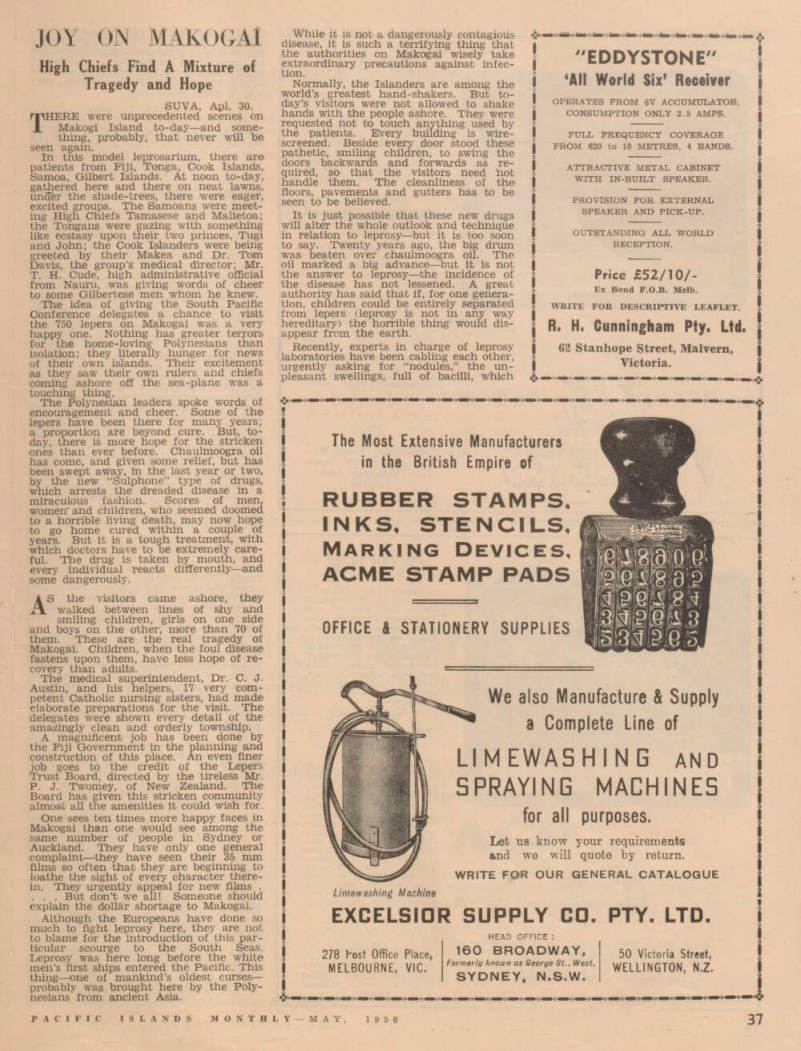
High Chiefs Find A Mixture of Tragedy and Hope
Suva, Apl. 30.
THERE were unprecedented scenes on Makogi Island to-day—and some thing, probably, that never will be seen again.
In this model leprosarium, there are patients from Fiji, Tonga, Cook Islands, Samoa, Gilbert Islands. At noon to-day, gathered here and there on neat lawns, under the shade-trees, there were eager, excited groups. The Samoans were meet ing High Chiefs Tamasese and Malietoa; the Tongans were gazing with something like ecstasy upon their two princes, Tugi and John; the Cook Islanders were being greeted by their Makea and Dr. Tom Davis, the group’s medical director; Mr.
T. H. Cude, high administrative official from Nauru, was giving words of cheer to some Gilbertese men whom he knew.
The idea of giving the South Pacific Conference delegates a chance to visit the 750 lepers on Makogai was a very happy one. Nothing has greater terrors for the home-loving Polynesians than isolation; they literally hunger for news of their own islands. Their excitement as they saw their own rulers and chiefs coming ashore off the sea-plane was a touching thing.
The Polynesian leaders spoke words of encouragement and cheer. Some of the lepers have been there for many years; a proportion are beyond cure. But, to day, there is more hope for the stricken ones than ever before. Chaulmoogra oil has come, and given some relief, but has been swept away, in the last year or two, by the new “Sulphone” type of drugs, which arrests the dreaded disease in a miraculous fashion. Scores of men, women' and children, who seemed doomed to a horrible living death, may now hope to go home cured within a couple of years. But it is a tough treatment, with which doctors have to be extremely care ful. The drug is taken by mouth, and every individual reacts differently—and some dangerously.
AS the visitors came ashore, they walked between lines of shy and smiling children, girls on one side and boys on the other, more than 70 of them. These are the real tragedy of Makogai. Children, when the foul disease fastens upon them, have less hope of re covery than adults.
The medical superintendent. Dr. C, J.
Austin, and his helpers, 17 very com petent Catholic nursing sisters, had made elaborate preparations for the visit. The delegates were shown every detail of the amazingly clean and orderly township.
A magnificent job has been done by the Fiji Government in the planning and construction of this place. An even finer job goes to the credit of the Lepers Trust Board, directed by the tireless Mr.
P. J. Twomey, of New Zealand. The Board has given this stricken community almost all the amenities it could wish for.
One sees ten times more happy faces in Makogai than one would see among the same number of people in Sydney or Auckland. They have only one general complaint—they have seen their 35 mm films so often that they are beginning to loathe the sight of every character there in. They urgently appeal for new films . . . . But don’t we all! Someone should explain the dollar shortage to Makogai.
Although the Europeans have done so much to fight leprosy here, they are not to blame for the introduction of this par ticular scourge to the South Seas.
Leprosy was here long before the white men’s first ships entered the Pacific. This thing—one of mankind’s oldest curses— probably was brought here by the Poly nesians from ancient Asia.
While it is not a dangerously contagious disease, it is such a terrifying thing that the authorities on Makogai wisely take extraordinary precautions against infec tion.
Normally, the Islanders are among the world’s greatest hand-shakers. But to day’s visitors were not allowed to shake hands with the people ashore. They were requested not to touch anything used by the patients. Every building is wire screened. Beside every door stood these pathetic, smiling children, to swing the doors backwards and forwards as re quired, so that the visitors need hot handle them. The cleanliness of the floors, pavements and gutters has to be seen to be believed.
It is just possible that these new drugs will alter the whole outlook and technique in relation to leprosy—but it is too soon to say. Twenty years ago, the big drum was beaten over chaulmoogra oil. The oil marked a big advance —but it is not the answer to leprosy—the incidence of the disease has not lessened. A great authority has said that if, for one genera tion, children could be entirely separated from lepers (leprosy is not in any way hereditary) the horrible thing would dis appear from the earth.
Recently, experts in charge of leprosy laboratories have been cabling each other, urgently asking for “nodules,” the un pleasant swellings, full of bacilli, which
are a feature of the commoner form of leprosy. The experts need these things for certain of their tests. But nodules are in very short supply—the unexpected, quick effect of the general use of the new drug. The doctors seem to think that this is very significant.
Advertisements & other items, pp. 39-40 (1 item)
Limewashing And
"EDDYSTONE"
‘All World Six 1 Receiver
OPERATES PROM 6V ACCUMULATOR.
CONSUMPTION ONLY 2.5 AMPS.
PULL FREQUENCY COVERAGE
FROM 620 to 10 METRES, 4 BANDS.
ATTRACTIVE METAL CABINET
WITH IN-BUILT SPEAKER.
PROVISION FOR EXTERNAL
SPEAKER AND PICK-UP.
OUTSTANDING ALL WORLD
RECEPTION.
Price £52/10/-
Ex Bond F. 0.8. Melb.
WRITE FOR DESCRIPTIVE LEAFLET.
R. H, Cunningham Pty. Ltd.
62 Stanhope Street, Malvern,
Victoria.
The Most Extensive Manufacturers in the British Empire of
RUBBER STAMPS.
INKS, STENCILS,
Marking Devices,
ACME STAMP PADS
OFFICE & STATIONERY SUPPLIES
v We also Manufacture & Supply a Complete Line of
LIMEWASHING AND
SPRAYING MACHINES
for all purposes.
Let us know your requirements and we will quote by return.
WRITE FOR OUR GENERAL CATALOGUE
Limewashing Machine
EXCELSIOR SUPPLY CO. PTY. LTD,
278 host Office Place,
MELBOURNE, VIC.
HEAD OFFICE :
160 BROADWAY,
Formerly known as George St., West,
SYDNEY. N.S.W.
50 Victoria Street,
WELLINGTON, N.Z.
UK © -© © Wj
NOTICE
IS HEREBY GIVEN
that the labels shown in the margin hereof are now the exclusive property and proper TRADE MARKS of
THE UNITED DISTILLERS
PROPRIETARY LIMITED,
of Byrne Street, South Melbourne, Victoria, Australia, Distillers; used by them in respect of
WHISKY,
BRANDY, GIN and
RUM,
and the Trade and Public are hereby cautioned against any infringement or improper use of the same.
Legal proceedings will be instituted against any person or persons selling or offering for sale goods, not the manufacture of the aforesaid The United Distillers Proprietary Limited, bearing any representation of either of the said Trade Marks or any colourable imitation there-
's S of -
EDWD. WATERS &
SONS
Patent and Trade Mark Attorneys, 432-428 Collins Street, Melbourne, Victoria, Australia.
m U;B mM * <■ : 3* i 9 § 9 wj a 1 © ©
NOTICE
est donne ci-dessous que les etiquettes montrees dans la marge de celui-ci sont maintenant I’exclusive propriete et les vrales MAR-
QUES DE FABRIQUES de
la UNITED DISTILLERS
PROPRIETARY, LIMITED,
de Byrne Street, South Melbourne, Victoria, Australia, Distilleurs; employes par eux en ce qui concernent
WHISKY,
BRANDY, GIN et
RHUM,
et I’lndustrle et le Public sont prevenus par cette annonce centre toute fraude ou abus de ces Marques.
Les procedes legaux seront instituees centre toute personne vendant ou oflrant pour la vente, les Merchandises qui ne sont pas factures par la-dlte United Distillers Proprietary Limited, portant aucune representation de I’une ou I’autre de ces Marques de Fabriques ou aucune imitation specieuse de ces Marques.
EDWD. WATERS &
SONS
Patent and Trade Mark Attorneys, 422-428 Collins Street, Melbourne, Victoria.
Australia.
Paludrine Under
A Cloud
Medical Problems In New Guinea
Prom Our Special Correspondent
Suva, May 2.
IN a chat which I had here with the New Guinea Director of Health, Dr.
Gunther, I learned that the anti malaria drug Paludrine —developed during the war, and for which great claims have since been made—is not a success.
It is not the fault of the scientists. All that they said was true, when they said it.
Paludrine, when first used, is a cure and a prophylactic. The trouble is the extra ordinary adaptability of the Anopheles mosquito.
It has been found in New Guinea, and in other malarial countries, that after the malaria germ has been encountering the Paludrine drug for a time, it somehow develops a resistance to the drug, and per sons infected suffer severely from malaria.
There have been announcements to this effect, lately, in the medical journals.
Paludrine has not been abandoned. Under some conditions, it is being used, satis factorily—but its usefulness apparently is limited.
There is thought to be much promise in a new drug now being developed in America —“chloro” somethings—but the efficacy of this is not yet completely proven—and, in any event, it is a dollar commodity, and difficult to buy.
So New Guinea now is going back to the old The chief trouble is that owing to political troubles in the East Indies and to the knock which quinine manufacture took when Paludrine came into popular use, the available supplies of quinine are not large. New Guinea wants more rather than less anti-malaria drugs just now, because of the obligation to protect the Highlands natives. Large numbers of natives now are going as indentured labourers from the Central plateaus, where they are free of malaria and tuber culosis, to the coastal areas; and the medical officers are obliged to give all of them special treatment, to guard them against both diseases.
The Papua-NG administration is again giving very special attention to the cul tivation of the cinchona tree, from the bark of which quinine is made. There are a limited number of trees, introduced from East Indies, growing well in New Guinea, and it is hoped to build them up into serviceable plantations.
Smallpox Barrier Planned
rE medical department has another headache in the presence of bad epidemics of smallpox in East Indies —especially in Java. Failing adequate precautions in the Indies—and the change-over from Dutch to Indonesian control does not encourage hope of efficiency in that direction —this plague could easily break into Western New Guinea, and become a major disaster.
The Australian New Guinea medical service is proposing to put in a barrier be tween Western and Eastern New Guinea by vaccinating all the natives in a 50miles strip along the Dutch-Australian border. It will be a colossal task, because the border runs right through the centre of New Guinea, through “uncontrolled” and only partly-explored country.
Industrialism Comes To The South Seas
Fine Enterprise of William Watson of Rarotonga
From Our Own Correspondent RAROTONGA Anril 2 0 , , , RAKOiCJJNu-A, April pOR almost a century it has been the accepted prerogative of Australia and New Zealand to supply the Islands with manufactured goods. Now, here is a story of a man who has reversed the process to the extent of exporting 60,000 shirts and other articles from Cook Islands to New Zealand. rnn? e r r S f /illi f rr }. Wdison ’ business man of Rarotonga, and member of the Look Islands Legislative Council, and of the Rarotonga Island Council.
ALTHOUGH the sky-line of Rarotonga is not yet completely obscured by and smog', Mr. W.
Watson has made a good start in promot ing us all to organised industrialism. The Watson Shirt, Pant and Shoe factory, as it is locally known, is now a well-estab lished and profitable concern, but like most thines between Cancer and Capri corn, its beginnings were a little peculiar.
Mr. Watson had already made a small venture into the factory business during the war years, when he turned out pearl shell jewellery for the benefit of visiting American servicemen whose uncontrollable impulse to “take a curio home for Mom” had stripped these islands bare of every thing even faintly Polynesian. At the war’s end the Watson shell-cutting machinery was neatly packed away for some other time, and Mr. Watson started looking around him.
A native friend had recently returned from New Zealand where he had been given lessons in tailoring, so Mr. Watson sent some of his work to a New Zealand firm, solely with the idea of receiving in return, criticism and suggestions as to im
provement of the work in order to make it more widely saleable in the islands. To everyone’s dismay the NZ firm misunderstood the covering letter and sent back
a large order for goods “according to sample.”
NEVER at a loss, Mr. Watson took down all the bolts of material from his shelves then sent scouts round the island to round up all sewing machines that were in working order and to bring the owners with them to do the sewing.
The NZ order was thus laboriously filled, most of the work being hand-done, and, although there was no profit from this first order, Mr. Watson was now badly bitten with the factory bug. He followed his bundles of shirts to New Zealand and spent his time there visiting clothing fac tories to find out if there was a fancy method of making button holes or a trick to cutting out more than one garment at a time. Fortunately he arrived at the time of the War Disposal sales, so re
turned to Rarotonga with an ample num ber of modern sewing machines, large orders for his goods and a note book full of data on short cuts to the shirt business.
To-day the factory employs 65 hands working in two shifts on piece work rates.
Over 60,000 articles are exported to New Zealand annually, apart from those sold locally and to the outer islands in the Cook Group. Mr. Watson says that the native girls make excellent factory wor
kers, his only labour troubles arising from the fact that the girls stay at the factory only long enough to save up the boat fare to that Mecca of every Rarotongan— Auckland.
THE shoe factory had an equally acci dental beginning.
A local European resident, a cabinet maker by trade, in sheer desperation taught himself how to mend his own shoes. When Mr. Watson heard of this
he induced the gentleman to dismember some of the imported shoes in the store, then try to copy them. He did this in his own way and taught a number of native boys who, with their usual adaptability, improved on the original methods, so that now the only complaint we have against a Watson shoe is that it just won’t wear out —this because the factory stoutly re fuses to layer the soles with the result that we get double thickness solid leather in every shoe and suspect that the first shoe off the last is still trudging up and down the Avarua road.
Rarotongan shoes are now exported to Tonga, Niue, Samoa and New Caledonia and it is hoped that it will be possible to extend the trade to all Pacific islands.
Advertisements & other items, pp. 41-42 (1 item)
■£)\Rect
LONDON-SUVA
VIA
PANAMA
For Sailings and Further Particulars Apply To: BETHELL, GWYN & CO., BURNS PHILP (SOUTH SEA)
138 LEADENHALL ST., CO., LTD.,
LONDON, E.C.3. SUVA.
c <?■
PHONES: LA 2436
LA 4033 LA 4603
CABLE ADDRESS:
“EXSOAP”, SYDNEY
CIEANUi
muuamum
MFG. PTY. LTD.
14 ST. MARY STREET, CAMPBRDOWN
SYDNEY N.S.W.
S*>**'** & ''
vjmn
1 Antiseptic 6he*sc removing
Wmasl
Specialising For Export . . .
VARIOUS SOAPS UNDER THE REGISTERED BRAND
“WACO”
Laundering, Toilet (Eucalyptus and Carbolic Health), Sea Water, Medical (Soft and Liquid), Washing Powder, Antiseptic Grease Remover, Wool Washing, Phenyle, Disinfectant and Liquid Soap (to specification).
For all inquiries :
EXPORT SOAP MFG. PTY. LIMITED.
14 ST. MARY STREET, CAMPERDOWN, SYDNEY, N.S.W.
A. GREGORY PTY, LTD.
IMPORTERS, EXPORTERS AND
MANUFACTURERS
Leather Saddlery and Paint Merchants ALL CLASSES OF LEATHER SUPPLIED FROM STOCK Apply direct to: A. GREGORY PTY., LTD., 107 York St., Sydney
£ Q T 5 Si, r ■u.
Cooper Adjustable Glass Louvres are manufactured by F. W. GISSING PTY., LTD., 197 Wilson Street, Newtown, Sydney, Australia. Always insist on GENUINE
COOPER LOUVRES—
they are clearly branded.
Keep Hof Sun OUT . . .
Let Cool Breezes IN!
Cooper Adjustable Glass Louvres are the ideal way of securing maximum ventilation with minimum interference from glare. Fitted with non-actinic glass, which absorbs the sun’s heat, they are ideal for nurseries and verandahs . . and amazing though it may seem, are actually cheaper to install than ordinary windows Cheaper to instal than ANY other kind of WINQOW
ADJUSTABLE GLASS LOUVBES
Tflff —-- 23S Imagine it—units of movable glass louvres (plain or figured) in metal frames, giving unobstructed light and air, yet protection from draughts and rain and all with as simple a motien as flicking on a light switch. The price is so amazingly reasonable and Father can do all the erecting, it’s so easy.
Illustrated: Typical Suburban Home. Verandah (Sydney) glassed in with Cooper Louvres.
WRITE FOR PARTICULARS TO PACIFIC ISLANDS REPRESENTATIVE
E. J. GOUGrI S- CO.
SUPPLIERS OF GENERAL MERCHANDISE TO LEADING FIRMS THROUGHOUT THE PACIFIC ISLANDS.
Exporters . . . Importers . . . Manufacturers’ Representatives 1 BOND STREET, SYDNEY, AUSTRALIA. Box 3615 G.P.O. Tel. BU 2159 Bankers; Bank of N.S.W. Bank of Adelaide. Comptoir National d’Escompte de Paris.
Cable Address: “SEAFOODS,” SYDNEY.
Codes: Bentley’s, 2nd and Comp. Phrase; A.8.C., sth and 6th; Peterson, 2nd and 3rd, Banking; Acme.
Death Of A.S. Farebrother
Suva, May 1.
Mr. A. S. Farebroth'er, One Of
Fiji’s foremost campaigners for Fijian rugby and cricket, and a keen supporter of other sports, including Indian soccer, died at the Colonial War Memorial Hospital, Suva, on April 28.
He was 61 years of age. He was born at Sydney, went to Fiji 28 years ago and subsequently built up the successful busi ness of A. S. Farebrother and Co., over seas manufacturers’ agent. For many years he was chairman of the manage ment committee of the Suva Rugby Union and president of the Suva Cricket Association. He was a liberal supporter of all movements for the benefit of the Colony as a whole and of sport in par ticular.
Miss Kathleen O’Callaghan, of Port Pirie, South Australia, who has just spent seven months in Nauru will return there in October to relieve the matron of the local hospital while the latter is on leave.
Grow Rice in New Guinea and Save
£50 A Ton
ALTHOUGH parts of Papua and New Guinea are suitable for growing cer tain types of rice, production has not yet reached much beyond the experi mental stage. The Administration is an xious to encourage the growing of this crop by natives, whose natural diet is not of very high nutritive value. It would also be to the advantage of planters and other employers of native labour to do so.
To learn more about rice production, Mr. F. Hurrell, of the Papua-New Guinea Department of Agriculture, recently spent some time on the Murray Irrigation Area, NSW, studying methods in that dis trict. In a radio interview at the end of March he told something of the problems that they are trying to solve in the Ter ritory.
He said that the idea of encouraging rice production was to get the natives to supplement their own food crops, kau kau, yam, taro, bananas, etc., and so attain a better diet, but its value as a cash crop was another reason why his Department was sponsoring its cultivation.
If the natives could be induced to grow rice extensively it should be a steady source of income to them as demand for rice far exceeded production. “At pre sent,” he said, “New Guinea buys Austra lian unpolished rice for £65 per ton. The grower on the MIA, I’ve found, receives £l5 a ton for his rice, while the native farmer in New Guinea has had to be paid up to £3O a ton to induce him to be interested.”
The native saw Australian rice being sold across P-NG counters for £65 per ton and he simply did not see why he should not be paid a high price, also.
Their agriculture was still primitive—the digging stick is still the main agricul tural implement, supplemented by the hoe, the axe and knife that the European had introduced. To produce a ton of rice, a large number of men had to co-operate and total payment for the rice had to be distributed among them. Therefore, al though the New Guinea natives were be lieved to be, per man, the largest land holders in the world, they were by no means millionaires.
OUTSTATIONS of the Department had produced considerable quantities of rice since the end of the war and there had been some native plantings.
The main rice growing centre is in the Mekio district, about 90 miles up the coast from Port Moresby. The Depart ment had 100 acres planted there and other plantings had been done by native co-operatives. The varieties of rice grown in New Guinea were upland types which do not need the submersion of the crop.
The rainfall is sufficient over the grow ing period to meet the crop’s requirements.
Rice grown by natives co-operatively is usually sold to the Department at the paddy stage and they do the hulling al though a number of small home-hulling machines have now been distributed to the natives.
Mr. Hurrell said that the ultimate aim was to make Papua-New Guinea self sufficient in rice production but that would take many years. The pioneering work had been done by the Department but “something further may be added to our efforts by private enterprise.” (Editorial Note: It is interesting to note that the MIA grower receives only £l5 for the rice that is sold in P-NG for £65
per ton—that is, £5O disappears in “charges” somewhere along the line. Be fore the war, rice from Indo-China and other parts of Asia was landed in New Guinea ports and sold at prices that were at least six times cheaper than the pre sent landed cost of Australian rice.)
May Be More Rice Soon

AUSTRALIAN Minister for Commerce, Mr. McEwen, said in Canberra on May 3, that he believed more rice might be available soon from Asia and that some home-grown rice might be re leased for Australian consumption. It is believed that both Burma and Indo china have offered rice to Australia and New Zealand in recent months.
Rice has not been available in Aus tralia since early in the Pacific war— most of it has gone to the Australian
Pacific Islands which were cut off from their regular sources of supply about the same time.
When (and if) Par Eastern rice be comes available in New Guinea again it will be interesting to see how the price compares with the Australian product.
Advertisements & other items, pp. 43-44 (2 items)
41
PACIFIC 'ISLANDS MONTHLY MAY, 1960
Throughout
the
South-West Pacific
Os * I The development of the South-West Pacific Area has been fostered by the Bank of New South Wales since 1817. To-day, comprehensive banking, travel and trade introduction services are provided in Australia, New Zealand, Fiji, Papua and New Guinea by over 800 branches and agencies of the Bank. Residents of, and visitors to the Islands are invited to avail themselves of the “Wales” complete banking service at the following points:— FIJI Branches Suva, Lautoka Agencies Ba, Nadi Airport, Vatukoula PAPUA Branch Port Moresby NEW GUINEA Branches Lae, Rahaul . - ' 'I I Bank of New South Wales Suva Branch
Consult and use
BANK OF NEW SOUTH WALES
Head Office Sydney, Australia FIRST AND LARGEST COMMERCIAL BANK IN THE SOUTH-WEST PACIFIC (Incorporated in New South Wales witlt limited liability)
'PI BOOT
. k-m Price at Works: £36/15/- Extra for 10-inch additional shelf and brackets (if required) : £2 Packing and Transport to Wharf : £lO/10/- (For cases shipped in quantities, packing is at greatly reduced rates).
The display case is securely packed in two substantial crates occupying shipping space of 32 cubic feet. Total weight, when packed, 5 cwt.
Another view of the “Brahol Export Counter case, showing width of counter space.
BRIEF SPECIFICATIONS
This Modern Display
Counter will Help to
Sell Goods in Your
Store!
(and if s specially built for Export ) As smart as those in leading Australian city stores, and built by a firm that has been making fine store and office fittings for over a third of a century.
Moreover, it is specially built for export, so that it can be readily securely packed, and assembled by anyone, from simple directions, in an hour, with no tools other than a screwdriver. Retailers all over the world have To help you get an accurate picture of the “Brahol”
Special Export Glass Counter Case, here are the main -necifications: Overall size is 6 feet long x 1 ft. 9 in. isep x 3 ft. 3 in. high. Made from first-class, wellreasoned Queensland Maple, hand french polished, wax finished, in natural maple colour. Glass parts are \ inch British plate glass.
The inside is lacquered ivory colour, and the recessed base is lacquered burgundy.
There is a pair of solid core sliding doors, and one glass shelf, 14 inches wide, on adjustable nickelolated brackets.
Storage space below is 11 inches high. learned the selling value of modern display equipment, and this “silent salesman" will soon pay for itself in increased sales.
BRAY & HOLLIDAY
PTY. LTD.
Makers of Fine Store and Office
Fittings for over a third of a century ?he plate glass front is 22 inches high.
Brahol House, 66-74 McLachlan Avenue, Rushcutter Bay, Sydney. Telephone: FA 4121 Cable and Telegraphic Address: “Brahol.”
Diseased Cattle In Samoa
THE reinstitution of the inspection of meat intended for human consump tion, has revealed a high percentage of diseased (TB) cattle killed on the NZRE plantations whence the Apia butcheries draw practically the whole of their beef.
Mulifanua has the highest percentage of diseased beasts. Out of 32 killed one day, nine were wholly condemned, and four partially condemned. On another day, six out of 11 were condemned. Vailele, Vaitele and Aleisa Plantations also have a proportion of diseased beasts.
Members of the Legislative Assembly have been asked to seek the fullest de tails of this sorry state of Samoa’s main
nlriat supply
Mr. Edward M. Grant, Mr. C. Prentice and Mr. A. R. Sahu Khan have been granted commissions as Justices of the Peace in respect of the Southern District, Fiji.
A new industry in Hawaii, the manu facture of hats from immature leaves of the coconut palms, and already providing goods worth 370,000 dollars annually, is attracting the attention of the author ities on account of its destruction of trees. It is proposed to establish planta tions of palms especially devoted to this industry.
Papuan Contribution To
Old. Sugar Industry
Letter to the Editor I NOTICED in a recent issue of the PIM that some representatives of the CSR intend going to New Guinea to search for sugar cane. That brought to my mind a similar visit made by Sir Alfred Cowley, who was Chairman of the CSR back in 1910 or 1911.
He was accompanied by Captain Hun ter, who was once captain of the Merrie England, owned by the old British New Guinea government, and was fol lowed in that capacity by Captain Tornarus. Captain Hunter joined the BNGD Co. as a sort of Marine Superin tendent and was, I think, with Sinclair, one of the men responsible for the BNGD Company being formed. One other mem ber of the party was a Mr. Metcalfe, an Englishman with very pronounced Eng lish ideas.
At the time I was in Papua, in charge of the Laka River Estate, in behind Vili rupu, and we had a small nursery with some sugar cane growing. This came from a village some distance inland called Oruone, and was, so Sir Alfred said, the finest cane he had ever seen. He took some “suckers,” I think he called them, and also arranged for me to collect more frorp the village mentioned. These were sent to Moresby, and Hunter had them sent on to some place in NQ where good results ensued, and one of their expert?, who travelled to USA en route to Cuba, to attend a conference of sugar-producing areas, told what really fine cane the New Guinea sorts were.
It therefore seems as if history is re
peating itself, and it should be remem bered that in behind Paile, somewhere to the west of the headwaters of the Laka River, may be found some really good examples of sugar cane, and also wonderful pineapples. .
I am, etc., JL
J. E. Nixon Westwood.
Wellington, NZ, Ar-ril 20, 1950.
Advertisements & other items, p. 45 (1 item)
Ropes,
KANGAROO BRAND
Cordage,
and Twines for every purpose Backed by 98 years of service Manufactured by:
M. DONAGHY AND SONS,
Pty. Ltd., Geelong and Sydney.
Fiji Representatives:
PEARCE AND CO.
LIMITED
P.O. BOX 237, SUVA
Hvi
O^ok#'
oV Of, Hi o\\N- 6**
f eat guinea cA^en\
A' PHILIPS WIRELESS SETS
& REMINGTON TYPEWRITERS
& BURROUGHS BEEFEATER (LONDON)
GIN
$T POPE PRODUCTS
A REX ALUMINIUM CO.
& “AGCO” SUPALUVRE WINDOWS
B.A.L.M. PAINTS
COMMONWEALTH INSURANCE CO.
WHOLESALE MERCHANTS ••-MANUFACTURERS AGENTS
Japs Repent With Bamboo Crosses
Bamboo Crosses
THE Anglican Archbishop of Brisbane (Dr Halse), on April 22, blessed 10 bamboo crosses and a plaque. They had been sent from Japan in the care of the Rev. Prank Coldrake as a sign of Japanese repentance for the brutal mur der of Australian missionaries in Papua and New Guinea during the war.
The crosses will be placed in five New Guinea churches and five Queensland churches. The plaque will be hung in the Dogura Cathedral, Papua.
Some Territorians who have not yet reached a state of forgiveness where the Japs are concerned, will not be impressed.
Apia’S Wettest Month
Since 1923
APIA, Western Samoa, had 21 feet of rain in March (27.38 inches), accord ing to Observatory records.
This is wet even for Apia, but records show that the town can do better. The wettest month occurred in 1923 when 51.08 inches were recorded in one calen dar month.
Key Of Vancouver For
G. A. Adams
AN unusual honour was conferred on Mr. C. A. Adams, of Lautoka, Fiji, one week-end in April when the Mayor of Vancouver passed through Nadi on a Canadian Pacific airliner. The Mayor of the Canadian city presented Mr. Adams with a gold key, symbolising the key of the city of Vancouver, as a token of the esteem in which he is held in that city.
Mr. Adams, until recently, was chair man of the Lautoka Town Board and the Lautoka Chamber of Commerce. He is always willing to enter the arena in de fence of the Lautoka side of Viti Levu as opposed to the “Suva side.”
Recently he visited Vancouver as guest of Canadian Pacific Airlines. The Mayor, in presenting the gold key, said that no country could have a finer ambassador of goodwill than Mr. Adams had proved on that occasion.
Another Theodore on Emperor-
Lolomo Board
MR. N. B. THEODORE, son of the late Mr. E. G. Theodore, has been ap pointed to fill the vacancies on the boards of the Emperor Mines Ltd., and Loloma (Fiji) Gold Mines NL, caused by his father’s death.
A special New Guinea exhibit compris ing over 4,000 exhibits was opened in the Adelaide, SA, museum at the end of April.
It covers every aspect of native life in Papua-New Guinea and adjacent islands with the exception of mountain areas opened up since World War II and Dutch New Guinea. It is hoped to get specimens from these areas later.
Advertisements & other items, p. 46 (1 item)
Burns Philp (South Sea) Co. Ltd
Flour
ASK FOR IT
ESTABLISHED 1868.
BURNS PHILP (SOUTH SEA) Co. ltd
Registered Office: SUVA, FIJI
Code Address: “BURNSOUTH”
ISLAND TRADERS AND SHIPOWNERS
General Merchants (Wholesale and Retail)
Shipping, Customs and General Agents
Representatives for:
QUEENSLAND INSURANCE CO., LTD. BURNS PHILP TRUST CO., LTD.
Distributing Agents for :
SHELL COMPANY (P. 1.), LTD. FERGUSON TRACTORS STANDARD MOTOR CAR COMPANY CROSSLEY MARINE ENGINES
BRANCHES:
FIJI—
SUVA.
LEVUKA.
LAUTOKA.
LABASA.
BA.
SIQATOKA.
ROTUMA ISLAND.
NORFOLK IS
SAMOA—
APIA.
PAGO PAGO.
TONGA—
NUKUALOFA.
HAAPAI.
VAVAU.
NIUE IS.—
Sydney Agents;
BURNS. PHILP & CO., LTD..
7 Bridge Street.
London Agents:
BURNS. PHILP & CO., LTD..
35 Crutched Friars, E.C.3.
San Francisco Agents:
BURNS. PHILP CO. OF SAN FRANCISCO,
Matson Building, 315 Market Street.
Agencies Throughout the World.
World Still Short Of
Edible Fats, Oils
A RECENT survey shows that world production of edible fats and oils is still far short of pre-war level — about 1,800,000 tons —although world population, and demand, is increasing steadily.
With the exception of Germany, how ever, where the position remains acute, the consumption in most European coun tries, per head of population, is rapidly approaching pre-war figures. Germans are still getting less than two-thirds the fats and oils they consumed before the war.
Supply in Britain vastly improved last year when imports rose 13 per cent.
Huge US production has greatly relieved the world shortage. In 1935-39 America imported an average of 850,000 tons of fats and oils each year, but she is now ex porting 300,000 tons.
But on the other side of the picture European production is 250,000 tons a year below pre-war. Exports from China and Manchuria have dropped fi’om 630,000 to about 100,000 tons. Increase in popula tion has reduced India’s annual export able surplus from 500,000 tons to between 100,000 and 150,000 tons. Indonesian palm oil production is about 100,000 tons below the pre-war peak and exports of linseed oil and animal fats from Argentina are down 500,000 tons a year.
Price levels reflect the shortages (prices in sterling): Straits copra has risen from £l2/10/- a ton in 1938 to £79 last year; ground nuts from £l2/10/- to £62; whale oil from £l2/10/- to £B5; tallow from £2l to £BO and NEI palm oil from £l5 to £lOO.
Plantation Interest Sought
FROM Dr. J. S. Phillips, c/o Royal Bank of Canada, Kingston, Jamaica, West Indies: — I should like to buy a working partner ship in a plantation in one of the island groups of Polynesia—viz. Tahiti, Samoa, Fiji, Tonga or the Cook Islands. Could you put me in touch with anyone who might be interested in such an offer?
I have had about 20 years’ experience in tropical agriculture in various countries, including parts of the Pacific —though not in the above-mentioned groups. Planta tions growing one or more of the follow ing crops would be of interest to me— coconuts, bananas, citrus fruits, coffee and pineapples, but not sugar or sisal; and the plantation should be situated on an island of the volcanic type, not coral.
Though I should prefer a working part nership, I might wish to buy outright later on. Alternatively, I would be pre pared to rent with a view to subsequent purchase.
I should greatly appreciate advice or assistance. Any offers should contain as much relevant details as possible.
Anyone interested should write direct to Dr. Phillips.
For the first time at Suva, the Inter- Church Committee (Anglican, Methodist, Presbyterian and London Missionary Society) sponsored a combined service at the Jubilee Methodist Church on April 30. The service was conducted bv the Rev. D. N. Mac Diarmid (Presbyterian) and the sermon was preached by the Rev.
Dr. J. W. Burton (Methodist), who is at tending the South Pacific Conference as an Australian representative on the South Pacific Commission. Anthems were sung by Fijian, Samoan and Tongan choirs.
A daughter was bom, on March 26, to Mr. and Mrs. N, K. Wood, formerly of New Britain and New Ireland, but now living in Australia.
A recent visitor to New Guinea was 78year-old American, Mrs. D. K. Handy, of West Hartford, Vermont. It was part of a 35,000 mile tour which she expects to complete in three months. She spent a week in Australia before she left for NG and in that time visited every capital city. In April she left for Fiji to spend a month. Mrs. Handy is a life-insurance saleswoman—a job she started when she was 63.
Advertisements & other items, pp. 47-48 (1 item)
Menu
THE PACIFIC ISLANDS SOCIETY
(Founded 1937) Visitors from the Pacific Islands to Sydney, or persons Interested in Islands affairs, are Invited to communicate with the Honorary Secretary of the above Society which was formed to constitute a social centre for those interested in the Pacific Islands.
Regular meetings and social gatherings, with lectures, are held at History House, 8 Young Street, Sydney, on the fourth Wednesday of each month, at 8 p.m.
Address for correspondence:—
THE PACIFIC ISLANDS SOCIETY
Box 2434, G.P.0., Sydney.
TAKE YOUR PICK FROM THE
Imperial
MENU
OF TOP QUALITY |OEif¥lOUs FOQD&
12-oz. Hampe. 12-oz. Luncheon Pork. 12-oz. Trim. 12-oz. Camp Pie.
Pate de Foie. 12-oz, Meatreat. 16-oz. Beef Steak Pudding. 16-oz. Braised Beef Steak Stew, 16-oz. Steak & Kidney Pudding. 16-oz. Steak and Tomato. !6-oz. Sausages and Vegetables, 16-oz. Bacon Rashers. 16-oz. Irish Stew. 12-oz. Meat and Beans. 16-oz. Beef Sausages. 16-oz. Pork Sausages. 16-oz. Cambridge Sausages. 16-oz. Oxford Sausages. • 16-oz. Vienna Sausages. • 16-oz. Tomato Soup. • 16-oz. Dripping. • "OX and PALM" 16-oz. Corned Beef with Cereal. • 6-lb. Corned Beef with Cereal. •
"FLAIR"
4,8, 12 oz. Fish Cutlets. • 8-oz. Scallop Luncheon. • I l|-oz. Squab in Aspic. • 7-lb. or 16-oz. Tinned Prunes. • Also Salted Boneless Brisket Beef • in 50-lb. and 100-lb. Kegs . . .
Frozen Meats, Hams and Bacon.
IMPERIAL CANNED FOODSpARE 'FLAVOUR-SEALED'*
Imperial goods are prepared from prime selected stock by the largest meat-processing organisation in Australia. You can be sure of top-quality when you order "Imperial.”
mperi^l
good food 5
RIVERSTONE
MEAT CO.
PTY. LTD.
5-7 O’Connell Street, Sydney.
Fiji Representatives: Pearce 8c Co. Ltd., Suva.
There is only one
ELECTROLUX
THE MODERN KEROSENE-OPERATED REFRIGERATOR
THAT ACHIEVES THE MIRACLE OF ICE FROM HEAT
Lasting Efficiency, Silent Operation, Streamlined Beauty
* : aft i i Economically operated by kerosene, with a simple precision-built freezing unit that has no moving parts and is GUARANTEED FOR
FIVE (5) YEARS.
Only obtainable from:
NEW GUINEA COMPANY, LIMITED,
Rabaul, Madang, Lae, Kavieng.
J. R. CLAY & CO., LTD., Port Moresby.
W. R. CARPENTER & CO. (Sol. Is.), LTD., Tulagi.
THE NORFOLK ISLAND SERVICE DEPOT,
Norfolk Island.
SOCIETE HEBRIDA, Port Vila.
SOCIETE CALEDONIENNE DTMPORTATION ET
D’EXPORTATION, Noumea.
For Gilbert and Ellice Islands Colony, etc., apply
W. R. CARPENTER Cr CO., LTD.
Model LKSSI
PRICES ON APPLICATION.
Storage capacity: cub. ft. (approx.); shelf area, 10 sq, ft. food shelves, six—five removable; 2 self-supporting when half drawn. Ice-making: Four trays—s lb. ice per freezing; 80 cubes. Fuel consumption: 1.8 pints kerosene per day (approx.).
Height: 4 ft. 10 in. Depth: 2 ft. in.
Weight, unpacked, 406 lb. Packed, 574 lb. direct to: Head Office: 16 O'Connell St., Sydney, N. S. Wales
New Services For Apia

Mrs. G. Coster of Fiji was in Melbourne in April for the wedding of her daughter, Annette, to Mr. Clifton Dawe at St.
John’s, Toorak, on April 15.
TOP.—This new dam has been built at Fuluasou, near the home of the late Mr. O. F.
Nelson, and will five Apia a high-pressure water supply. A new hydro-electric scheme will supply not only Apia, but practically all the island of Upolu, with light and power. An installation of fluorescent lights for Apia’s streets is on the way from United States. Apia, capital of Western Samoa, with its new buildings and services, hopes to become the most modern town in the South Pacific.
LOWER.—The new Intermediate School at Leifi'ifi, Western Samoa. —Superflash Studio.
High Cost Of Oil
Search
THE cost of the search for oil in Dutch New Guinea and in Papua had so far cost £27,000,000, said Mr. Harold Rabling, managing -director of the Vacuum Oil Company of Australia, in mid-April. Of the total, £7 m llion had so far been spent in Papua, the remainder in Dutch New Guinea.
So far the only oil actually being pro duced is at Klamono in Dutch New Guinea —about 4,000 barrels a day—but even under the happiest circumstances it is not expected that the investment al ready made in the area will show a profit for about four more years. Crude oil from this area is now reaching the Vacuum Oil Co’s refinery at Altona, Vic.
To date there has been no return for the £7 millions invested in oil search in Papua and no oil has been recovered but pros pects of doing so are still regarded by ex perts as excellent.
Fijian Teacher To Go To
Auckland And London
From Our Own Correspondent
Suva. May 1.
A TWO-YEAR scholarsh p under th?
Colonial Development and Welfare Scheme has been awarded to a Fijian school-teacher, 35-year-old Livai Volavola, to enable him to complete his BA degree course at Auckland University College and then to study for a year at the London University Institute of Edu cation.
He is an ex-serviceman who served in the Solomons campaign and was commis sioned a lieutenant. After the war he studied for two years at the Auckland Teachers’ Training College on a rehabili tation grant and has passed a number of subjects for his BA degree. Recently he has been teaching at the Lelean Memorial School, Rewa, Fiji.
Advertisements & other items, p. 49 (1 item)
Giobite
SaAM.
TRAVEL CASES
They're lighter, stronger, longerlasting. That's why a Globlte costs less in the long run.
Made by
FORD SHERINGTON LTD.
Corrugated Aluminium Roofing Sheets*
SB *
LIGHT
COOL
$L.
PERMANENT
A building material has now emerged which can meet the huge demand for homes, schools, industrial buildings Corrugated Aluminium Roofing Sheets.
As a protection against sun heat, Corrugated Aluminium Roofing has proved most effective. No special maintenance is required; no protective painting is necessary; and Corrugated Aluminium Roofing * for every resists the corrosive atmosphere of marine and industrial regions.
Corrugated Aluminium Roofing is available as listed here: GAUGES: 26, 24, 23, 22, 20 and 18 s.w.g.
WIDTHS: 26" or 32" (Eight 3" corrugations and ten 3" corrugations respectively).
LENGTHS: 6'. 7', B', 9'. 10', 11' and 12' in exact feet. of construction
ALUMINIUM UNION LIMITED
(Incorporated in the Dominion of Canada ) Principal British Commonwealth Distributor of Aluminium Ocean House, 34 Martin Place, Sydney. An ALUMINIUM LIMITED Company.
Sales Agents for New Caledonia and New Hebrides: Sales Agents for New Zealand: Sales Agents for Fiji, Western Samoa and Tonga: Agence Alma Richardson McCabe & Co. Ltd. Morris Hedstrom Limited 39 Rue de L’Alma, Noumea, New Caledonia Wellington Auckland Christchurch Suva, Fiji
Death Of Mr. J. Menzies
THE death occurred on April 21 of Mr.
J. Menzies, an old and respected resident of Western Samoa.
He went to Samoa about 31 years ago and was for many years manager for Burns Philp (SS) Co. Ltd., at Faga male, Savaii. Recently he has been at tached to the Police Department staff.
He was 71 and a veteran of the Boer and Ist World Wars.
Treatment Of Lepers
Fierce Argument in Hawaii
From Our Own Correspondent (CONTROVERSY, at times becoming J acrimonious, is agitating Hawaii re garding the future site of the well known Molokai leper settlement.
Central disputants in the affair are Lawrence Judd, former Governor of
Hawaii and at present Provisional Director of Territorial Hospitals and Settlements, and Dr. Norman Sloan, Medical Director of the Molokai settle ment.
The former advocates abandonment of the present site and removal of the patients to a new location on the island of Oahu, more accessible to Honolulu. Dr.
Sloan and some 70 per cent, of the settle ment staff are unalterably opposed to such a plan, and are ready to resign should it be put into effect.
The settlement is now located on a mountain-enclosed promontory at Kalau papa, on the island of Molokai. The lepers of the Territory, although number ing some thousands of persons half-a century ago, are now, owing to segrega tion and improved medical treatment, re duced to a bare 300.
Many of the patients at Kalaupapa own their own homes, automobiles, stores and radios. Possessing a band, athletic clubs and such organisations, they lead the care-free existence of a protected village community, restricted only in their movement to the spacious district in which they are confined.
A special Legislature committee which visited Kalaupapa recently heard the patients express themselves overwhelm ingly in favour of remaining at Kalau papa, with Dr. Sloan as Director.
Dr. Sloan reported that the basic dif ference between Mr. Judd and himself was their conflict of opinion regarding Hansen’s Disease patients. Mr. Judd ad vocated lessening segregation, moving patients to Oahu and eventually closing Kalaupapa, while Dr. Sloan said he be lieved in treating Hansen’s Disease as a contagious malady.
“I feel I can no longer work with a man who is not a doctor himself but is trying to spread what I regard as false views about the contagiousness of lep rosy,” said Dr. Sloan.
Advertisements & other items, p. 50 (1 item)
Ampliok
W. H.GROVE & SONS
Limited
Established 1896.
AUCKLAND
Island Traders. P-O. BOX 490.
Telegraphic and Cable Address: “Grove”, Auckland.
Entrust Your Orders to the Firm with Fifty Years Practical Experience in the Island Trade.
Shippers of ail classes of New Zealand products.
Representing English Manufacturers throughout the Cook and Society Islands, Fiji, Tonga, Samoa, Niue, New Hebrides, the Solomon Islands and New Caledonia.
In FIJI as—W. H. Grove & Sons (Fiji) Ltd.
ONE HORSEPOWER
PETROL ENGINES
I
ELECTRIC
LIGHTING PLANTS
Bring you brilliant electric light in your home, week-ender or plantation.
Low operating and initial costs. Treated for the tropics. -K Press button starting. * + * 300 watts output. + M 12 and 32 volt models. ♦ ♦ * Weight 70 lb.
Pumps—Compressors—Post hole borers— + Lawn mowers—Saws—Shearing Machines— Crutching Machines—Spraying outfits—Concrete Mixers —Concrete Vibrators —Milking Machines.
★ 4 CYCLE AIR COOLED DESIGN
★ FULL FLOAT CARBURETTOR
★ EFFICIENT AIR CLEANER
The Amplion makes the most of your petrol, runs longer on a tankful, 8 to 10 hours to the gallon. It’s light in weight too —40 lb.
Obviously the best proposition for driving: m Special Islands
PRICE :
£6O/11/6 F. 0.8.
PRICE:
£36/0/6 F. 0.8,
DISTRIBUTORS THROUGHOUT
AUSTRALIA AND THE ISLANDS
aMPLIOk
(Australasia) Pty. Ltd. 36-40 Parramatta Road, Camperdown Telegrams: Amplion, Sydney Telephone: LA2828 (6 lines)
First South Pacific Conference
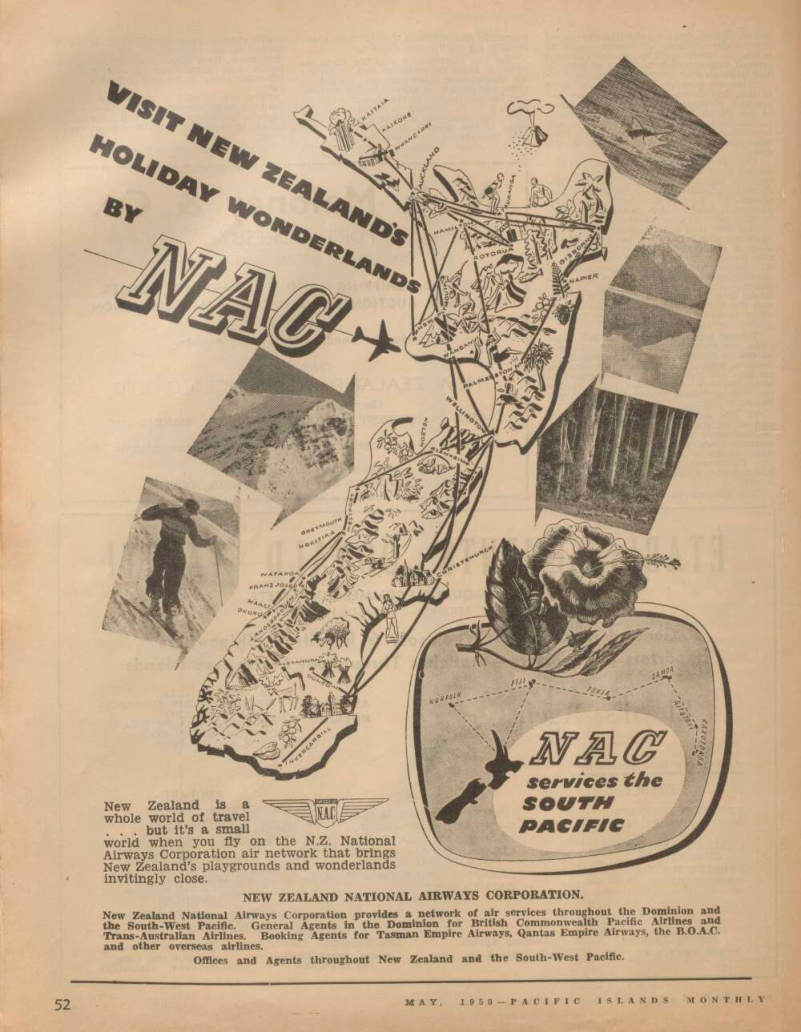
Another Plan For Co-ordination of Islands Administration and Policies Gets Off to Good Start
From R. W. Robson
SUVA put on its most charming cool weather dress of green and gold to greet the opening of the South Pacific Conference at Nasinu Training College (5 miles out towards Nausori) on April 25. Hundreds of interested people of all races gathered to watch the assemb ling of delegates from 15 Territories, and to hear the formal opening addresses of the Governor of Fiji (Sir Brian Freeston) and other high officials.
Behind the constitution of this Con ference there was a magnificent job of organisation, for which full credit must be given the Secretary-General of the South Pacific Commission (Mr. W. D. Forsyth) and his team of able assistants. Most of the delegates were strangers to each other and were seeing Fiji for the first time.
They spoke not only their own languages, but English, or French, or Dutch, as well, and each called for special help and con sideration.
The world’s newspaper Press was well represented. Present were the represent atives of world-wide news agencies, and also distinguished correspondents like David McNicoll, of Sydney Telegraph, Guy Herriott, of Sydney Morning Herald, Colin Simpson, famous radio commenta tor and producer. These men needed fac tual “background material,” so the Commission very wisely borrowed from Wellington (NZ) Post the services of Eric Ramsden, well-known writer on Pacific affairs, and R. G. Pauli, of the ABC, and their services as Public Rela tions Officers were of inestimable value.
As a result of it all, the Conference ran very smoothly from the first auspicious moment of its assembly; it was skillfully and sympathetically directed from the chair by Sir Brian Freeston; and at the stage of this writing (part-way through) it looks as if it will be completely suc cessful in the objects which its planners hoped to achieve.
The following are the names of those present:— Chairman Sir Leslie Brian Freeston, KCMG, OBE, Governor of Fiji, High Commissioner for the Western Pacific.
Representatives from Territories Netherlands New Guinea. —Delegates: N. Jouwe, M. Kasiepo. Alternates: Dr J. V. de Bruyn, P. J. Merkelljn.
Papua.—Delegates: Willie Gavera, Bondai Pita.
Alternates; Prank Aisl. Mirla Gavera, Aisa Gu’u. Advisers: Dr. J. T. Gunther and Mr.
W. C. Groves.
New Guinea.—Delegates: Waiau Ahnon, George Kassi. Alternates; Kamono Walo, Aisoli Salin. Advisers: R. H. Boyan and S. H, Christian.
British Solomon Islands Protectorate. —Delegates: Belade, Gina. Advisers: Mr. M. J. Forster (Administrative Officer), Dr. J. S. MacKenzie- Pollock.
New Hebrides.—Delegates: Petero (Catechist at the Marist Mission, Tanna), John Kalsakau.
New Caledonia. —Delegates: M. Raphael Bouan ani, M. Maou Djoel. Adviser: M. Lescan du Plessix, Nauru.—Delegate: Jacob. Alternate: Raymond Gadabu. Adviser: Mr. T. H. Cude.
Gilbert Islands. —Delegates: Mr. I. G. Turbot (Acting Co-operative Societies Officer), Tutu Tekanene (Senior AMP).
Ellice Islands.—Delegates: F. Penltala Teo (Administrative Officer), losefa (Acting Head master of the King George V School).
Fiji.—Delegates: Hon. Joell Ravai, Hon. Vishnu Deo. Alternates: Hon. Ratu E. T. Cakobau, Hon. M. S. Buksh.
Kingdom of Tonga.—Delegates: HRH Tungi (Premier of Tonga), HRH Tu’lpelehake (Governor of Vava’u). Adviser; Mr. P. A.
Richardson (Secretary to the Government of Tonga).
Western Samoa.—Delegates: Hon. Tamasese, and Hon. Malietoa (both members of the Council of State). Alternates: Hon. Tualaulelei (Mem ber of Legislative Assembly), Paipule Anapu (Chairman of Pono of Paipule). Adviser: Ainoa Kalapu.
American Samoa.—Delegates: High Chief Tufele, High Chief Tultele. Advisers: High Talking Chief Tuiasosopo, Lieut. Edward V. P. Horne
(Usn).
Cook Islands and Niue. —Delegates: Makea Nui Toremoana Ariki, Robert Rex. Alternates or Advisers: Rongomatane Ariki, Albert R. Henry.
French Oceania.—Delegates: M. Luclen Vayssiere (Director of Education), M. Paul Berniere
sur stD,legate ° Permanent Officers of South Pacific Commission Secretary-General; Mr. W. D. Forsyth.
M. Baas-Becking. ° r L '
Member for Health, Research Council: Dr. E.
Massal.
Member for Economic Development, Research Council: Dr, H. G. MacMillan.
Member for Social Development, Research Council; Mr. H. E. Maude.
Observers
Commissioners and Advisers nominated by Participating Governments Australia. —Acting Senior Commissioner: Rev. Dr.
J. W. Burton, Ex-President General oi the Methodist Church of Australia. Adviser: Mr.
T. A. Pyman, Officer in Charge. South Pacific Section, Pacific Division, Department of External Territories, Canberra. Adviser- Secretary: Mr. C. H. Cox. Department of External Territories, Canberra, Prance. —Senior Commissioner: M. Robert Las salle-Sere (Inspector-General of Colonies).
Commissioner; M. Pierre C. J. Bonnard (Administrator of Colonies and Director of the Cabinet of the French High Commissioner in the Pacific).
Netherlands. —-Senior Commissioner: Mr. J. B. D.
Pennink (Netherlands Minister, Wellington, NZ).
New Zealand.—Commissioner: Lieut.-Colonel P.
W. Voelcker, CBE, DSO, MC (formerly High Commissioner of Western Samoa). Adviser: Dr. T. R. A. Davis (Chief Medical Officer, Rarotonga).
United Kingdom.—Commissioner; Mr. H. H.
Vaskess, CMG, OBE (formerly Secretary, Western Pacific High Commission). Alter nate: Mr. H. A. C. Dobbs (First Assistant Secretary, Wiestern Pacific High Com mission) .
United States. —Senior Commissioner: Dr. Felix M.
Keesing (Professor of Anthropology, Stanford University). Commissioner; Mr. Milton Shal leck (Attorney and Counsellor-at-Law, New York). Advisers; Mr. Claude G. Ross (US Consul, Noumea). Mr. Robert R. Robbins (Department of State, Washington DC).
Associate Members of Research Council Mr. Howard Hayden (Director of Education. Fiji, and Educational Adviser, Western Pacific High Commission).
Mr. B. E. V. Parham (Senior Agricultural Officer, Fiji).
Dr. J, M. Crulkshank (Inspector-General of South Pacific Health Service and Director of Medical Services. Fiji).
Representatives from Official and Non-Official Institutions Father Doherty.—The Roman Catholic Missionary Organisations in the South Pacific.
Rev. C. F. Gribble. —The National Missionary Council of Australia.
Archdeacon Hands.—The National Missionary Council of New Zealand, (The Reverend C. F. Gribble and Archdeacon Hands jointly represent the International Missionary Council.) Dr. Harold J. Coolidge.—Pacific Science Board of the National Research Council (USA).
M. Michel Legand.—The French Institute of Oceania.
Dr J. van Beusekom. —Division of Information, from Non-Self-Governing Territories, Depart ment of Trusteeship, United Nations Organi sation.
Mr. C. H. Moore. —The World Health Organi sation.
Mr. Andrew Hammond—The Caribbean Com mission.
“Never Before In History”
THE first day’s proceedings consisted
wholly of formalities and the pre
sentation of opening addresses. One
of the outstanding contributions to the
Conference was the address wherein the
Chairman (Sir Brian Freeston) declared
the Conference open. Here is its full text: — “Sitting before me in this hall during the next ten days I hope to see chosen
spokesmen of three million people. You
will have come from an area of the earth’s
surface which extends for five thousand
miles from east to west, and for nearly two thousand miles from north to south.
“All the major races inhabiting that
area are represented among you; Melan
esian, Polynesian, Micronesian, European
and Indian; and every territory—every
political unit within that area—has been
invited to send its representatives to take
part in this Conference.
“Never before in the history of the world have all the peoples of the South Pacific met together under one roof; never
before has an opportunity been afforded
for spokesmen from all the islands, spread over many millions of square miles of ocean, to meet each other on common ground, united by a community of interest, and animated by a common purpose.
“Need we wonder, then, that the news of this first South Pacific Conference has aroused attention far beyond the limits of the Pacific; and that our proceedings in this hall during the next ten days will be watched with interest, and let us hope with sympathy, from every corner of the globe.
“Of the various political units repre sented here to-day, all but one still oc cupy a dependent status. We are im mensely gratified that Her Majesty the Queen of Tonga has been graciously pleased to send her two distinguished sons to take part in our proceedings.
“But the rest of you come from com munities which have not yet reached the stage of political development, where they can stand upon their own feet; each is still subject to the tutelage and control, in varying degrees, of one of the six great Srs —Australia, France, the Nether - , New Zealand, the United Kingdom and the United States of America—which share between them the ultimate respon sibility for the South Pacific.
“I need hardly remind you that three years ago these six great powers solemnly agreed to establish a South Pacific Com mission, with the object of promoting, on an international basis, the economic and social welfare and advancement of the non-self-governing peoples in the South Pacific region.
“Of the activities of the Commission and of its Research Council you will be hearing more at a later stage. For the moment I am concerned to express to you what, to my mind, is the true purpose of this Conference, and its relation to the South Pacific Commission. Put shortly it is this.
“The Commission represents the Gov
ernments of the South Pacific; this Con ference represents the peoples. ‘‘For the information and the ideas on which it bases its activities and its advice the Commission relies normally, as is only right and proper, on governmental sources.
But the sole object of the Commission, as defined in its charter, is to promote the social and economic welfare and advance ment of the peoples in the Pacific; and this Conference has been devised as a means whereby those peoples, through
their chosen representatives, can make known to the Commission, direct and at first-hand, their hopes, their wishes, their needs and aspirations In all matters affecting their social and economic wel fare.
“You are, in fact, a Parliament of the South Pacific peoples, subject to two im portant limitations which will have to be borne in mind throughout our proceed ings.
(Continued on page 62)
“First, your functions, like those of the Commission itself, are advisory only; you can express opinions and offer your advice upon matters of common interest—l need hardly say how warmly such advice will be welcomed; but you cannot, of course, take decisions.
“Secondly, the matters with which you are concerned relate only to social and
economic welfare; politics are no concern either of the Commission or of this Con ference; and, as your Chairman, I do not propose to allow any member of this assembly to waste his own time and that of the Conference by talking politics.”
His Excellency then, as Governor of Fiji, extended a warm welcome to the visitors from other Pacific countries. He assured
them of the warm and sympathetic in terest of the King of England, and read a goodwill message from the British Secretary of State for the Colonies. His Excellency concluded:— “Let me conclude by reminding you that, during the next ten days, you will be making history; and that throughout the length and breadth of the Pacific, the generations to come will look back on this Conference as an outstanding land mark in their progress. Let us remember that we are embarking together on a momentous experiment, and setting our hands to a great adventure; and let each and every one of us determine that the experiment shall be fruitful of good, and that the adventure shall be crowned with success.”
What Research Council Is Doing
IN a friendly, informative address, the Deputy Chairman of the Research Council (Dr. Baas Becking) explained to the Conference the purpose of the Re search Council, and its relationship to both the Conference and the Commission.
“In order to illustrate the work of the Commission,” said Dr. Baas Becking, “let us compare it to the ways of a medical man. He is called to see a patient and his first duty is to find out the nature of the ailment. The process by which he arrives at this, what he calls his diagnosis, may be easy in some cases, long and laborious in others. From this diagnosis the nature and the stage of the disease, the general condition of the patient and Of his environment, he ventures a predic tion as to the course the disease will take and this he calls the prognosis. From the diagnosis and the prognosis he builds up his treatment. This treatment may be either active or preventive, medicative or surgical.
“Now, the work of our Commission may be compared to the work of medical men in more than one respect. In the first place, it has nothing to do with politics,
colour or creed; it only wants to see a sane organism. You will object, perhaps, that it seems unflattering to compare communities to diseases. We must re member, however, that a great deal of the work of a modern doctor lies in the pre vention of trouble rather than in an active fight against it. Preventative medicine requires also rigid diagnosis and prog nosis.
“The goal we are all aiming at is a happy community with a low mortality, and a still lower infant mortality, where people are free from the great diseases of the region, where they are able to procure adequate food by adequate agricultural methods, where they will form a market centre from which they will guide and equilibrate the inflow and the outflow of goods necessary to maintain the economy of their community.
“In some cases, now, we have most of the data. We know what is the matter with a certain community. In other cases we are still ignorant. Therefore we have still much work to do in diagnosis, in finding out things.
“We are still studying the preparation of suitable infant food, prepared from the usual village staples and accessories. We are still gathering data on the existing diet and nutrition of communities. We are still studying what pasture grass will be suited to a region, what soils are pre sent and what we can do with them; now land is used and whether it is used for the proper purpose; whether land is wasted.
“We know next to nothing of the habits and the quantity of fish present in our vast ocean.
“We have to investigate the social structure of communities in order to see in what way they can best be brought to greater prosperity.
“We have to know these things and many more things and there are only few of us and there are many things to be done. For, after we have made our diagnosis, after we know a certain con dition, we have to make a good guess as to where it will lead to, and, the more regions we have studied, the more similar data we can compare, the more confident we will become as to the validity of our prognosis.
“This is why one of us has made a study of the copra situation, both in this region and in the consumers’ area. This is the reason why he studies our economic main stay, the cocoa palm, in every aspect.
“Never has there been a time when the world, apart from a circumscript area, has been so open to inspection. Excellent statistical surveys will give us at a moment’s notice data on the infant mor tality in Sweden, of the milk production in New Zealand, on the import of textiles in almost any small island. Because the world lies open to inspection we may start to compare. Because now we have a basis for comparison. We will say that the people in a certain community are far from healthy. But we know now how far.
“Comparison of our area with other tropical areas will show clearly where our problems lie. Like in trade, we cannot in our diagnosis remain isolated. Let us suppose we know where the evils lie, what are we going to do about it?
“There are a great many people all over the world who like to sit under the tree and wait to be saved. Wait for a marvel lous ship to come, in which are all the things they need. Even if such a ship did exist, it would not solve our troubles.
For Man has created his own condition by sitting under the tree. By holding up the hand like a beggar we will remain beggars, and beggars are poor.
“It is therefore that the greatest thing that could happen to this region (and it has happened and is happening right in this place where we gather now), is that education in all the skills necessary to promote the development of a healthy community is extended to all of those that are capable and willing to take it.
“I do not mean primarily the graces to be derived from the reading of news papers, but development of good crafts men who may build upon the foundations given by their own culture. Good hygienists and medicos, agriculturists and fisheries specialists, who may graft new scions on the old traditional stock. For the old plant of your own civilisation should not be uprooted, because that is not only a treasure to you but also a treasure for the whole world.
“And now for the treatment. One can lead a horse to water, but one cannot make it drink. All measures which are imposed upon you, sometimes well meant but ill fitting in your scheme of things, will remain useless unless they find a resonance in yourself, unless you are will ing to take over yourself and shape your own community, self-respecting, open to all inspection and for the world to see.
“If 'the specialists interested in this region may take part in this work, it will be a great thing for them to witness a development by the people and for the people and they will find their reason for existence in the fact that they are wanted as friends and as advisors to help you prepare a better future.”
The General Plan
out of the 28 projects, that is approximately two-thirds of the projects recommended by the first meeting of the Research Council of the South Pacific Commission less than a year
ago, are already in operation,” said the Secretary-General, Mr. W. D. Forsyth, in
a prepared statement, on the opening day. In connection with nine of these projects, experts are or have been at work in the field in territories of the South Pacific. It is less than two years since the Agreement establishing the Commis sion came into force.
“The Commission’s tuberculosis team has almost finished the first stage of its work in New Guinea and will shortly go on to New Caledonia and later to Western Samoa and Tahiti to continue its work.
“A nutritionist is at work in New Guinea.
“A study of the best ways of using motion pictures and other visual aids in schools in the islands has been completed.
“A study, which promises to be of im mense importance to the area, of the needs for technical education in the South Pacific territories, is in progress.
“Gardens, in which plants which may usefully be grown in the region can be tested, have been begun in Fiji and New Caledonia.
“Some study of the possibilities for pro duction of cocoa in the region has been made.
“The weeds which menace agricultural production in the South Pacific are being studied, with a view to finding methods for combating them.
“In addition to these and similar inves tigations the Commission’s staff has begun to collect and distribute technical infor mation.”
Mr. Forsyth said that the idea of a South Pacific Conference had been in the minds of men of vision for many years.
In this wide oceanic region, sprinkled with a multitude of islands, they could see, as well as the wide expanses of sea dividing them and the differences of language and custom, many similar features of geo graphy and climate, of natural resources
and economic life. They could see the need of the peoples to find ways of pre serving the best in themselves in the face of a vigorous alien culture. They could see also that peoples and governments to do.this mlgbt(Mr ° n6 another s suc " cesses ana mistakes.
But this could not easily be done. In the course of the past century the islands had become divided between six govern marts these be- Sns oS toe whole P there w?nnta £ons. On the whole, there was not a separate authorities. Useful work done in one territory might never be heard of in others. o nmp nennie hari hnneri thp Hav w were for fnri
thLne<Ses
wito toe peoples of toe South Pacific could come together and compare notes on what they were doing. Some looked further forward to the day when the peoples of the territories them selves would not only play a greater part in improving their own conditions but would
also be able to meet people from the other islands labouring to the same end, and by talking with them, discover what each might have to learn from the other.
These hones have he<nm to hear fruit T h? South P PaSflc Commlssto auxiliary bodies, the Research Council and the South Pacific Conference, have been set up for these purposes, Thpi . p nf bnv J he f nurnose f though tasks arp
ent . P Th? Research CounciltdvSS
the Commission in what ways scientific methods can be applied in the territories evenpp C pvivt« a t!? ?pu d the ci° n - oomerence exists to ten toe Commission what the people think about these things, what their needs are, what things the Commission might give atten tion to, how the Commission can help them bU ~~’ . . . .
The Governments have not set up the Commission to rule the territories. There has been and is no idea of the Commis sion becoming a super-state. Just as the Conference and the Research Council ad
vise the Commission, so the Commission is an adviser to the Governments. What the Commission, with the help of the Re search Council and the Conference, can do, is to bring together the experience and opinions of people in and out of gov ernment services, whether living in the islands or elsewhere, and define certain practical things that can be done to make life better for the peoples living in the area.
Advertisements & other items, pp. 51-54 (1 item)
Pacific Islands Trading Co.
facil
School o yy^r
US( C
LEARN TO PLAY the Hawaiian Steel Guitar or Ukulele in the modern manner. Complete postal course available. Full details free ... no obligation. Send 4d. in stamps for full particulars to
SECRETARY,
PACIFIC SCHOOL OF MUSIC
P.O. Box 487, Palmerston North, New Zealand.
Let us do your buying in
America . .
PACIFIC ISLANDS TRADING CO.
244 CALIFORNIA STREET, SAN FRANCISCO 11,
CALIFORNIA, U.S.A.
Direct from Factory to you. Direct
from Mills to you:
Cannon Towels Sheets Pillow Cases Cotton Blankets Sewing Threads Dress Goods Ready-made Dresses Men's Shirts Undershirts Shorts Trousers Groceries Canned Fruits Canned Vegetables Canned Milk Coffee, etc.
Refrigerators Clocks and Watches Aladdin (kerosene) Lamps—Mantles—Burners—Chimneys Hardware Glassware Paints Flashlights Batteries Plumbing Supplies Electrical Goods Gasoline Kerosene Oil WE EXPORT TO MERCHANTS IN ALL THE PACIFIC ISLANDS.
Give us a triul!
PACIFIC ISLANDS TRADING CO.
A £ & Made in the Australian Branch Factory of
BLUNDELL SPENCE & CO., LTD., Hull,
B. & S. SUPER PREPARED PAINT embodies the knowledge and experience gained from nearly 140 years of Paint manufacture.
Tested and proved for tropical conditions, B. & S. PREPARED PAINT is also available in a special Lead-free series for use in volcanic and other sulphurous regions. (Specify B. & S.-Series 2301).
Ask for supplies of these and other BLUN- DELL Paints and Enamels from your local Storekeeper, or write for particulars and colour-cards to the Agent for Pacific Islands :
KERR BROTHERS PTY. LTD.
4 YORK STREET, SYDNEY
N. F. Maloney & Co.
Phone 268. PORT MORESBY Phone 268.
Cables, Radios, etc., “Malco,” Port Moresby.
CUSTOMS, SHIPPING, AND FORWARDING AGENTS.
LICENSED AUCTIONEERS AND GENERAL COMMISSION
AGENTS.
House, Land, and Estate Agents.
Chief Agents:
NEW ZEALAND INSURANCE CO. LTD.
(Incorporated in New Zealand) FIRE . . ACCIDENT . . MOTOR VEHICLE . . MARINE, ETC.
Importers and Exporters ;; Manufacturers Representatives.
Australian Representatives'.
E. J. GOUGH & CO., 1 BOND STREET, SYDNEY.
ETABLISSEMENTS DONALD TAHITI
HEAD OFFICE—QUAI DU COMMERCE—PAPEETE
TELEGRAPHIC ADDRESS—“DONALD, PAPEETE”
General Merchants (Wholesale Cr Retail) & Shipowners
Importers & Exporters—Branches Throughout Marquesas Islands
Lloyd’s Agents
A. B. DONALD, LTD.
ASSOCIATE AUCKLAND, NEW ZEALAND.
RnTrcpo • A. B. DONALD, LTD.
RAROTONGA, COOK ISLANDS.
DOMINION FRUIT CO..
SUVA, FIJI ISLANDS.
Agents and Distributors for :
FRANCE:
HENNESSY COGNACS
MARIE BRIZARD & ROGER
LIQUEURS
CHARLES HEIDSIECK
CHAMPAGNES
PERRIER WATER
GRUBER BEER
Sydney Agents:
U.S.A.:
GENERAL STEAMSHIP CORP.
RADIO CORP. OF AMERICA
BROWN & WILLIAMSON, LTD.
CIGARETTES: LUCKY STRIKE,
WINGS, OLD GOLD
CHAMPION SPARK PLUG CO.
RAINIER BEER
ENGLAND:
RECKITTS & COLMAN
( OVERSEAS), LTD.
PHILLIPS BICYCLES
THE BANK LINE LTD.
NEW ZEALAND:
VACUUM OIL CO. PTY., LTD
PETROLEUM PRODUCTS
SWEDEN:
HJORTH & CIE
PRIMUS STOVES
Agents: Agents in France:
HARTH * CIE, PARIS.
A. BICKABT. MARSEILLES
BURNS, PHILP A CO., LTD.
London Agents:
BURNS, PHILP A CO.. LTD.
San Francisco
BURNS, PHILP CO. OF
SAN FRANCISCO.
o & Ar i 5k ,'V/ Av § Hr.
A » s A ** » s I »» -> • r
Jti!
/£ Ap»e* 02^ ♦ 4 X (A ft pA* * n 3* />. j* /#" : • - * * ; <£*■? 1 ' • rv rr
fB AN2
/ *sr a •<a3? . • £/ j'* m» a *« *£? ■nr f' J 'o*. n m 1 * . J ■ V ■■■-. /> X *j
the
services
SOUTH
'EC
PACIFIC
New Zealand Is a whole world of travel . . . but it’s a small world when you fly on the N.Z. National Airways Corporation air network that brings New Zealand’s playgrounds and wonderlands invitingly close.
NEW ZEALAND NATIONAL AIRWAYS CORPORATION.
New Zealand National Airways Corporation provides a network of air services throughout the Dominion and the South-West Pacific. General Agents in the Dominion for British Commonwealth Pacific Airlines and Trans-Australian Airlines. Booking Agents for Tasman Empire Airways, Qantas Empire Airways, the 8.0.A.C. and other overseas airlines.
Offices and Agents throughout New Zealand and the South-West Pacific.
Magazine Section
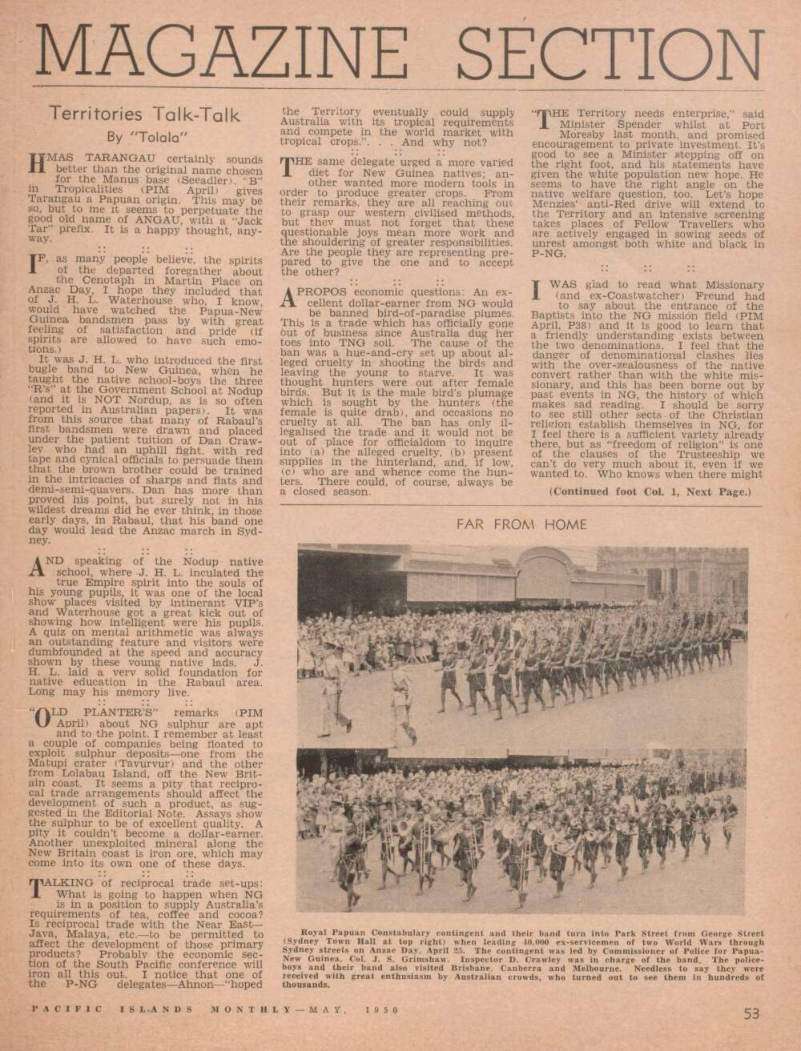
Territories Talk-Talk
By "Tolala"
HMAS TARANGAU certainly sounds
better than the original name chosen for the Manus base (Seeadler). ' B” in Tropicalities (PIM April) gives Tarangau a Papuan origin. This may be so, but to me it seems to perpetuate the good old name of ANGAU, with a “Jack Tar" prefix. It is a happy thought, any way.
IF, as many people believe, the spirits of the departed foregather about the Cenotaph in Martin Place on Anzac Day, I hope they included that of J. H. L. Waterhouse who, I know would have watched the Papua-New Guinea bandsmen pass by with great feeling of satisfaction and pride (if spirits are allowed to have such emo tions.) It was J. H. L. who introduced the first bugle band to New Guinea, when he taught the native school-boys the three “R’s” at the Government School at Nodup (and it is NOT Nordup, as is so often reported in Australian papers). It was from this source that many of Rabaul’s first bandsmen were drawn and placed under the patient tuition of Dan Craw ley. who had an uphill fight, with red tape and cynical officials to persuade them that the brown brother could be trained in the intricacies of sharps and fiats and demi-semi-quavers. Dan has more than proved his point, but surely not in his wildest dreams did he ever think, in those early days, in Rabaul, that his band one day would lead the Anzac march in Syd ney.
AND speaking of the Nodup native school, where J. H. L. inculated the true Empire spirit into the souls of his young pupils, it was one of the local show places visited by intinerant VlP’s and Waterhouse got a great kick out of showing how intelligent were his pupils.
A quiz on mental arithmetic was always an outstanding feature and visitors were dumbfounded at the speed and accuracy shown by these voung native lads. J.
H. L. laid a verv solid foundation for native education in the Rabaul area.
Long may his memory live.
“/"|LD PLANTER’S” remarks (PIM w April) about NG sulphur are apt and to the point. I remember at least a couple of companies being floated to exploit sulphur deposits—one from the Matupi crater (Tavurvur) and the other from Lolabau Island, off the New Brit ain coast. It seems a pity that recipro cal trade arrangements should affect the development of such a product, as sug gested in the Editorial Note. Assays show the sulphur to be of excellent quality. A pity it couldn’t become a dollar-earner.
Another unexploited mineral along the New Britain coast is iron ore, which may come into its own one of these days.
TALKING of reciprocal trade set-ups: What is going to happen when NG is in a position to supply Australia’s requirements of tea, coffee and cocoa?
Is reciprocal trade with the Near EasL- Java, Malaya, etc. —to be permitted to affect the development of those primary products? Probably the economic sec tion of the South Pacific conference will iron all this out. I notice that one of the P-NG delegates—Ahnon—“hoped
the Territory eventually could supply Australia with its tropical requirements and compete in the world market with tropical crops. . . . And why not? ■ HE same delegate urged a more varied diet for New Guinea natives; another wanted more modern tools in order to produce greater crops. From their remarks, they are all reaching ouc to grasp our western civilised methods, but thev must noti forget that these questionable joys mean more work and the shouldering of greater responsibilities.
Are the people they are representing prepared to give the one and to accept the other? :: v .
PROPOS economic questions: An excellent dollar-earner from NG would be banned bird-of-paradise plumes, This is a trade which has officially gone but of business since Australia dug her toes into TNG soil. The cause of the ban was a hue-and-cry set up about alleged cruelty in shooting the birds and leaving the young to starve. It was thought hunters were out after female birds. But it is the male bird’s plumage which is sought by the hunters (the female is quite drab), and occasions no cruelty at all. The ban has only illegalised the trade and it would not be out of place for officialdom to inquire into (a) the alleged cruelty, (b) present supplies in the hinterland, and, if low, (c) who are and whence come the hunters. There could, of course, always be a closed season.
“mHE Territory needs enterprise,’’ said X Minister Spender whilst at Port Moresby last month, and promised encouragement to private investment. It’s good to see a Minister stepping off on the right foot, and his statements have given the white population new hope. He seems to have the right angle on the native welfare question, too. Let’s hope Menzies’ anti-Red drive will extend to the Territory and an intensive screening takes places of Fellow Travellers who are actively engaged in sowing seeds of unrest amongst both white and black in
P-Ng.
T WAS glad to read what Missionary X (and ex-Coastwatcher) Freund had to say about the entrance of the Baptists into the NG mission field (PIM April, P3B) and it is good to learn that a friendly understanding exists between the two denominations. I feel that the danger of denominational clashes lies with the over-zealousness of the native convert rather than with the white mis sionary, and this has been borne out by past events in NG, the history of which makes sad reading. I should be sorry to see still other sects of the Christian religion establish themselves in NG, for i feel there is a sufficient variety already there, but as “freedom of religion” is one of the clauses of the Trusteeship we can’t do very much about it, even if we wanted to. Who knows when there might
(Continued foot Col. 1, Next Page.)
not be an influx of Moslem, Buddhist or Shinto missionaries bent on propagating each his own particular creed?
With that old-time sentimental poetess, Ella Wheeler Wilcox, I agree So many gods, and so many creeds, And so many paths that wind q,nd wind, While just the art of being kind Is all this sad world needs.
SEEMS a pity NG’s delegates to the SPC at Suva could not have been dinkum New Guineaites. with the true native outlook. Ahnon is a half caste Chinese and Kassi’s mother was a Caroline Islander. The latter’s as sociations have for years been non native. As a records clerk in Administra tion he is “tops,” but that does not necessarily qualifv him to sneak for the native peoples. Perhaps the selection shows how backward these people are in not having appointed a full-blooded native to this all-important gathering.
Far From Home
Royal Papuan Constabulary contingent and their band turn into Park Street from George Street (Sydney Town Hall at top right) when leading 40,000 ex-servicemen of two World Wars through Sydney streets on Anzac Day, April 25. The contingent was led by Commissioner of Police for Papua- New Guinea, Col. J. S. Grimshaw. Inspector D. Crawley was in charge of the band. The police boys and their band also visited Brisbane, Canberra and Melbourne. Needless to say they were received with great enthusiasm by Australian crowds, who turned out to see them in hundreds of thousands.
home on the range
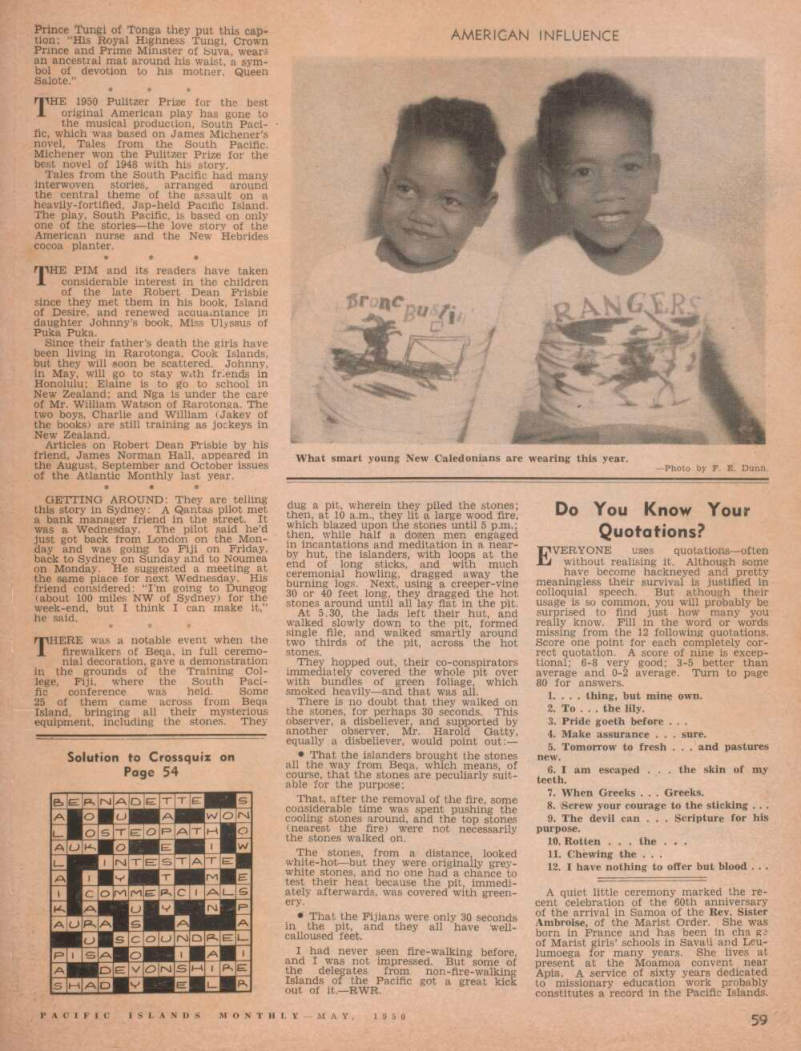
By Our Honiara Correspondent
YOUR correspondent has just moved in to a new house in Honiara. The house is part of the new Government building scheme; it is made of plywood on concrete piles, built in an L-shape, with bedroom and bathroom mosquito-proofed; has an open living room in the corner of the L; and'a neat little kitchen, all shining clean and smelling of new wood.
Prom the living room you can look across at a bush-covered hillside, or down a slope towards the road, and beyond the road the sea dreams or surges (according to mood) between Guadalcanal and the blue islands of Savo and Nggela, and the point of Cape Esperance towards the West.
This house, like all the other new houses, has all mod. cons., including plenty of cupboard space, a refrigerator and a septic tank. (Some of the new residences hereabouts have a plumbing system that specialises in extraordinary rumblings and roarings, so that the sur prised visitor emerges from the bathroom like a shot out of a gun, in case there might be some misunderstanding. This noise was once used, deliberately but not unkindly, to accompany a budding saxo phone player who was playing Isa Lei at a party, and the result out-Spiked Jones.
Reason for noise is supposed to be the excellence of the pressure in the mains).
THE move to this house was a Caution.
A large Works Department truck arrived at 11 in the morning and was loaded (by four lethargic types) with packing cases, suitcases, five chairs, a large cane settee, a year-old hibiscus in a box of earth, a large Malaita-work cane screen, a saucepan full of black coffee (brainwave of the staff in case Missus demanded it on arrival), a wheelbarrow, a mattress and about a hundredweight of firewood which the cookie had thought fully chopped beforehand and which was put on the truck by two, big-eyed picca nins who sprang up somehow from the earth as soon as the truck appeared.
Truck, cookie and labour moved off up the hill in the midday heat.
Missus walked, followed by the two piccanins, each with a large knife, a small biscuit and the expression of a boxing fan with a ringside seat.
Missus carried an ex-Army hat, and in it, kept carefully level, two eggs, more precious than rubies between Morinda’s; a bottle of Angostura; a bottle of Chanel
No. 5; and another of Shanghai. None of these had any effect on the aroma of the party, each one of which could have been used as a drag for hounds, including Missus who had had only an intermit tent water supply at the last abode for nearly a week. (It was thought at first that Prawns in the Filter were the trouble, as our water supply is piped from river springs; however, a check revealed no prawns, only a broken underground pipe.) THE new house is built in a small flat area cut out of the side of the hill.
The garden has all to be made yet, from heavy rich black soil, with here and there lumps of buried coral bigger than your head. All the scrub has been cleared from the hillside except for countless young paw-paw trees. Some of them have had to go, although I apologise to each one pulled up for end ing its young life —but you can’t have about an acre of garden entirely made up of paw-paw trees.
I have planted some Giant Zinnias— the pictures on the packet were nearly as big as saucers; and certainly they are going ahead like bean stalks. And there are hibiscus and frangipani, and I shall have some lagerstroemia, which we call Pride of India, and bauhineas, and the cookie has found in the bush (where a friend of his, now gone home, put them to makim line round a garden) plenty too much Bird of Paradise trees. The Agri cultural Department has provided seed for a lawn, and some young flowering shrubs.
Sixteen packets of flower seeds are on the next ship, and the vegetable garden is partly planted already.
t' l ' * s °dd what a difference there is be- JL tween anybody else’s newly-cleared hillside and your own. No doubt they all look alike to an impartial eye—but anybody else’s is just rather desolate ground, while your own is full of entranc ing possibilities. Already I can see the still unplanted shrubs and annuals flower ing in a glow of colour. I think the pub will see much less of me (it is our only community meeting place until the new Club is built) and I shall gradually be come one of those comfortable, fat middle aged gardening women, It only remains to develop a sense of proportion about things that go bump in the night. Certainly, my house is a little remote from the main settlement: if it was not there would not be all the beau tiful green jungle hillside to look at.
Sometimes it would be nice to feel more like Major Jim Corbett, the hunter of man-eating tigers, who, having considered the terrain on one occasion, “knew that he was quite safe as long as the tigress was behind him” And I should like to know who invented the phrase about land ing as lightly as a cat. He couldn’t have heard the crash-landings made by my cat.
The cat comes on big dog’s feet, hoping at 4 a.m. for something to eat. ov , .- . , .
Sumns floor ght U enmohnHv °^’ii^ C !™ t^^L some k oc * y tneep no more, There are only two ways about the Solomons—either you can’t wait to get out; or else they get you in. They’ve got me in—the sea, and the warmth, and the strong smell of copra; screaming white cockatoos, and red parrots, green plan tain leaves; sparkle of fireflies on the hillsides. Mud and mildew and all.
thrince Tungi of Tonga they put this cap tion: “His Royal Highness Tungi, Crown Prince and Prime Minister of Suva, wears an ancestral mat around his waist, a sym bol of devotion to his mother, Queen Salote.” * * ♦ THE 1950 Pulitzer Prize for the best original American play has gone to the musical production, South Paci fic, which was based on James Michener’s novel, Tales from the South Pacific.
Michener won the Pulitzer Prize for the best novel of 1948 with his story.
Tales from the South Pacific had many interwoven stories, arranged around the central theme of the assault on a heavily-fortified, Jap-held Pacific Island.
The play, South Pacific, is based on only one of the stories —the love story of the American nurse and the New Hebrides cocoa planter. * * * THE PIM and its readers have taken considerable interest in the children of the late Robert Dean Frisbie since they met them in his book, Island of Desire, and renewed acquaintance in daughter Johnny’s book, Miss Ulyssus of Puka Puka.
Since their father’s death the girls have been living in Rarotonga, Cook Islands, but they will soon be scattered. Johnny, in May, will go to stay with friends in Honolulu; Elaine is to go to school in New Zealand; and Nga is under the care of Mr. William Watson of Rarotonga. The two boys, Charlie and William (Jakey of the books) are still training as jockeys in New Zealand.
Articles on Robert Dean Frisbie by his friend, James Norman Hall, appeared in the August, September and October issues of the Atlantic Monthly last year. * * * GETTING AROUND: They are telling this story in Sydney: A Qantas pilot met a bank manager friend in the street. It was a Wednesday. The pilot said he’d just got back from London on the Mon day and was going to Fiji on Friday, back to Sydney on Sunday and to Noumea on Monday. He suggested a meeting at the same place for next Wednesday. His friend considered: “I’m going to Dungog (about 100 miles NW of Sydney) for the week-end, but I think I can make it,” he said. * * * THERE was a notable event when the firewalkers of Beqa, in full ceremo nial decoration, gave a demonstration in the grounds of the Training Col lege, Fiji, where the South Paci fic conference was held. Some 25 of them came across from Beqa Island, bringing all their mysterious equipment, including the stones. They
dug a pit, wherein they piled the stones; then, at 10 a.m., they lit a large wood fire, which blazed upon the stones until 5 p.m.; then, while half a dozen men engaged in incantations and meditation in a near by hut, the islanders, with loops at the end of long sticks, and with much ceremonial howling, dragged away the burning logs. Next, using a creeper-vine 30 or 40 feet long, they dragged the hot stones around until all lay flat in the pit.
At 5.30, the lads left their hut, and walked slowly down to the pit, formed single file, and walked smartly around two thirds of the pit, across the hot stones.
They hopped out, their co-conspirators immediately covered the whole pit over with bundles of green foliage, which smoked heavily—and that was all.
There is no doubt that they walked on the stones, for perhaps 30 seconds. This observer, a disbeliever, and supported by another observer, Mr. Harold Gatty, equally a disbeliever, would point out:— • That the islanders brought the stones all the way from Beqa, which means, of course, that the stones are peculiarly suit able for the purpose; That, after the removal of the fire, some considerable time was spent pushing the cooling stones around, and the top stones (nearest the fire) were not necessarily the stones walked on.
The stones, from a distance, looked white-hot—but they were originally grey white stones, and no one had a chance to test their heat because the pit, immedi ately afterwards, was covered with green ery. • That the Fijians were only 30 seconds in the pit, and they all have Well calloused feet.
I had never seen fire-walking before, and I was not impressed. But some of the delegates from non-fire-walking Islands of the Pacific got a great kick out of it. —RWR.
PIM Crossquiz No. 5
(Solution on page 59)
Across
1. —Who saw a vision at Lourdes? 6. —Which word is now the other way? 7. —Who medically treats by the manipulation of the joints? 8. —Which extinct sea bird only laid one egg a year? 9. How would you des cribe a person who dies without leaving a will? 12.—What is the term used for radio advertise ments? 14.—What subtle emana tion is an important part of Laura? 16. —Noel Coward’s first picture was “The . . . .”? 18.—Which Italian city has Leghorn for its port? 20. —What is the second largest county in England? 21. —What over-sized her ring is caught in the Hudson River in the shadow of New York sky-scrapers?
Down
1.-—Which play title was taken from a musical instrument?
2. —Another name for the castle in chess? 3. —What is the term for a writing published under the author’s real name? 4. —For what is Bayeux famous? 5. —What does the adjective “nival” relate to? 6. —Which famous American had the Christian name of Walt? 10. —Who fell into the sea when his waxen wings were melted by the sun?
11.—What is a fruit-tree trained on lattice work? 13.—What duck has a peculiar odour? 15.—Which plant produces seeds used in cordial making? 17. Anagram of liar? 18. —Step in French?
IS.—What cannot one do with figures on a slide rule?
Advertisements & other items, pp. 56-57 (2 items)
54
MAY, 1350 PACIFIC ISLANDS MONTHLY
Talk-Talk (Continued from page 53)
American Influence
What smart young New Caledonians are wearing this year. —Photo by F. E. Dunn.
Quotations?
Do You Know Your Quotations?
EVERYONE uses quotations—often without realising it. Although some have become hackneyed and pretty meaningless their survival is justified in colloquial speech. But athough their usage is so common, you will probably be surprised to find just how many you really know. Fill in the word or words missing from the 12 following quotations.
Score one point for each completely cor rect quotation. A score of nine is excep tional; 6-8 very good; 3-5 better than average and 0-2 average. Turn to page 80 for answers. 1. . . . thing, but mine own. 2. To . . . the lily. 3. Pride goeth before . . . 4. Make assurance . . . sure. 5. Tomorrow to fresh . . . and pastures new. 6. I am escaped . . . the skin of my teeth. 7. When Greeks . . . Greeks. 8. iScrew your courage to the sticking . . . 9. The devil can . . . Scripture for his purpose. 10. Rotten . . . the . . . 11. Chewing the . . . 12. I have nothing to offer but blood . . .
A quiet little ceremony marked the re cent celebration of the 60th anniversary of the arrival in Samoa of the Rev. Sister Ambroise, of the Marist Order. She was born in France and has been in cha ga of Marist girls’ schools in Savaii and Leu lumoega for many years. She lives at present at the Moamoa convent near Apia. A service of sixty years dedicated to missionary education work probably constitutes a record in the Pacific Islands.
Advertisements & other items, pp. 57-63 (6 items)
59
PACIFIC ISLANDS MONTHLY— MAY, 1950
Solution to Crossquiz on Page 54
fashion...
JpORMAL, but cool, in block chiffon. Bodice is simple, trimmed with row of small covered buttons. Skirt is draped and very full.
Corner For The Children
Burns Philp (New Guinea) Limited
General Merchants (Wholesale and Retail)
Shipping, Customs and General Agents
Head Office: PORT MORESBY, PAPUA
BRANCHES:
NEW GUINEA: Rabaul, Kokopo, Lae Cr Madang.
PAPUA: Samarai.
REPRESENTATIVES FOR:
AUSTRALIAN AGENTS:
LONDON AGENTS:
SAN FRANCISCO AGENTS;
QUEENSLAND INSURANCE CO. LTD.
LLOYD'S OF LONDON
BURNS PHILP TRUST CO. LTD,
BURNS, PHILP & CO. LTD.
All States.
BURNS, PHILP & CO. LTD.
"London House", 35 Crutched Friars, E.C.3.
BURNS, PHILP CO. OF SAN FRANCISCO INC. 510 Matson Building.
Distributing Agents, Territory of Papua-New Guinea for:
SHELL COMPANY OF AUSTRALIA LIMITED
Petroleum Products
GENERAL MOTORS CORPORATION
Chevrolet, Buick, Pontiac and Oldsmobile Cars Chevrolet and GMC Trucks Frigidaire Refrigerators
VAUXHALL MOTORS LIMITED
Vauxhall Cars and Bedford Trucks
R. A. LISTER & CO., BRISTOL
Producers of Petrol, Paraffin and Diesel Engines Pumps and Lighting plants
RUSTON HORNSBY LIMITED
Engines
CROSSLEY MARINE ENGINES
Sails, Covers, Awnings
TENTS, TARPAULINS, and all classes CANVAS GOODS for industrial and home use FLAGS AND PENNANTS FOR CLUBS AND ASSOCIATIONS Send your inquiries through your agent,
to HARRY WEST
"SYDNEY'S SAILMAKER"
DUKE ST. (WATERFRONT) EAST BALMAIN, SYDNEY, N.S.W.
Phone: WBIIOS, W 82284.
WHM
->-_-r :-5-'--'x : ~'--r---:-v>;-
90 rMXS 0P /SM/VOl
rwowa
-WHOLESALE SHIPMENTS
-EJFICIENTLY EXECUTED
AT
LOWEST PRICES
G. H. ROBINSON
EXPORTS & IMPORTS PTY. LTD.
51 Macquarie St., Sydney.
TELEGRAMS: "SUNRISE" SVDNEV
% / / Huu*. IH,„ PACIFIC ISLAND DISTRIBUTORS FOR: BRADFORD COMMERCIAL VEHICLES AND JOWETT JAVELIN CARS
\m *-*
SPECIALISING IN
PACIFIC ISLAND INSURANCES
FIRE—MOTOR VEHICLE
MARINE—HULLS AND CARGO
EMPLOYER’S LIABILITY
BONDS—In accordance with
ADMINISTRATION ORDINANCES.
COPRA INSURED PROM DRIER
TO BUYER.
AND ALL OTHER CLASSES ARRANGED
AT LOWEST CURRENT RATES.
Established Agencies throughout the Territory of Papua and New Guinea.
Managing Agents: New Guinea Company, Limited.
Island Representative: G. D. A. Kent, Babaul Branch.
SOUTHERN PACIFIC INSURANCE
CO.. LTD.
HEAD OFFICE: 60 HUNTER STREET,
SYDNEY.
• V:
SSS
m
mm y\
CON
*5
HAT
P© V
YOU I
You can be confident that you are getting the best that science can produce when you buy genuine Vincent’s A.P.C. Vincent’s A.P.C is prepared to the original hospital prescription first used by the Medical Superintendent of one of Australia’s largest public hospitals. Take Vincent’s A.P.C with confidence for Headaches, Rheumatism, Lumbago, Sciatica and all nerve and muscular pain. Genuine Vincent’s A.P.C Powders and Tablets are the safest and best!
The Famous Pink Powders d Tablets!
VINCE
NC4D9
tAKey/HCBNTS A.P.C, WtTH CONFfOBNCB
For HEADACHES, Rheumatism, Neuralgia
tttrm?
POWDERS AND TABLETS
to
. - It’s a
H£G° o
OSE^‘
bor^ s
OR° \MM^
VCE*
The perfect trouble-free
LUXURY LIGHT. 300 CANDLE
POWER. MADE IN TWO SIZES,
“THE QUEEN,” 2IJ" TALL AND
“THE PRINCESS,” I6J" TALL. CREAM AND POLISHED BRASS FINISH WITH SHADE TO MATCH, GIVING 12 HOURS LIGHT ON ONE FILLING; (IJ PINTS OF KEROSENE).
“THE LOVELY LAMP” FITTED WITH THE “HAPPY MANTLE.”
THE TILLEY LAMP COMPANY, LTD. HeNDON, ENGLAND
REPRESENTATION :
MELBOURNE: T. H. Bentley, Pty. Ltd., 123-125 William Street, Melbourne, C.l.
TASMANIA: Mr. H. V. Sellers, 108 a Charles Street, Launceston.
FIJI: Mr. K. Witherington, 2 Burns Philp Buildings, Suva.
Cfinidhed by
DAVI SON
For Tropical conditions
Velvene Water Paint and Davison's Zinc Base Paints are used extensively throughout the islands and Mandated Territories on Government and Private buildings, giving full satisfaction under severe tropical conditions.
DAVISON PAINTS LTD.
BOX 24, AUBURN, N.S.W.
A. B. DONALD LIMITED
RAROTONGA COOK ISLANDS
TELEGRAPHIC ADDRESS: “DONALD, RAROTONGA.”
General Merchants (Wholesale & Retail) and Shipowners Importers & Exporters Branches Throughout Cook Islands Fire Marine Cr Motor Vehicles Insurance Agents for Yorkshire
Insurance Co.
Lloyd’s Agents.
Agents and Distributors for : ENGLAND.—Austin Cars & Trucks, Pye Radios, Dunlop Rubber Co., Ltd., Vauxhall Cars & Trucks, R. A. Lister & Co., Ltd., Phillips' Cycles, Marples Tools.
U.S.A.—Remington Rand Corp., Radio Corp. of America, Champion Spark Plug Co., Firestone Tyres, General Steamship Corp.
NEW ZEALAND.—Vacuum Oil Co. Pty., Ltd. Petroleum Products.
AUSTRALlA.—Wunderlich, Ltd., Cement Asbestos Products.
NORWAY. —O. Mustad & Sons, Fish Hooks.
SWEDEN.—B. A. Hjorth & Co., Primus Products.
Sydney Agents: London Agents : San Francisco Agents : BURNS, PHILP & CO., LTD. BURNS, PHILP & CO., LTD. BURNS, PHILP CO. OF SAN FRANCISCO.
Head Office: — A. B. DONALD, LTD., Auckland.
Associate Houses:—
ETABLISSEMENTS DONALD TAHITI,
Papeete, Society Islands.
DOMINION FRUIT CO., Suva, Fiji Islands.
CODES: Bentley's Complete Phrase, Acme
62
MAT, 1 950 PACIFIC ISLANDS MONTHLY
FIRST SOUTH PACIFIC CONFERENCE
(Continued from page 51)
63
PACIFIC ISLANDS! MONTHLY-MAY, 1950
What the Powers Give to the Islands
Islands
IN the combination of gifts together with experience, which each of the Powers represented brings to the South Pacific Commission, we see a flow ing together of the histories of those countries and their best ideals and as pirations for the benefit of the peoples of
the South Pacific,’* said the Prime Ministei and Crown Prince of Tonga (Prince Tugi) in a special statement, after the Confer ence had opened. “A body founded under such auspices must surely meet with great success in all its endeavours.”
Each of the Powers represented, de clared Prince Tugi, had in its past history struggled for certain ideals for its own people. “This effort to assist the peoples of the South Pacific to meet modern con ditions seems to be an extension to others of what they have already achieved for themselves.”
Each Power had something unique in its past history and present circumstances that appeared to make its contribution a very natural development.
The United Kingdom, said Prince Tugi, was probabaly the first of the great Powers to achieve liberty and equality, re spect for law and order, and Parliament ary sovereignty. While her long experi ence in governing colonies was incom parable, it was the lesson of the American Revolution that had taught Britain how best to deal with the national aspirations of her dependent peoples. Britain’s ex perience had fitted her peculiarly for the role she had played, and would continue to play, in colonial affairs.
France was possibly the first nation on the continent of Europe to emerge from the inequalities and the swaddling clothes of feudalism into the light of what was now regarded as democratic political life.
Much of her experience and thinking had been based on the organic unity of her colonies with metropolitan France, and the solidarity of the colonial peoples with Frenchmen in all aspects of life. That assimilation of colonial peoples, rightly or wrongly, had been something unique in the history of colonial powers. “So that France, too, has something from her history and nature to contribute towards the efforts of the Commission,” he said.
The United States, Prince Tugi con tinued, began her history with what was
probably the biggest revolution against a modem power known until then. To-day, the United States led the world in very many branches of physical and social science as well as in technology. That fund of expert knowledge, together with her short but honourable career as a colonial power, fitted the United States to make her own peculiar and unique con tribution to the success of the Commis sion.
The Netherlands began her national existence with a long struggle against Spain for religious and political liberty, and, through her own efforts, gathered unto herself a great colonial empire. Her statesmanlike settlement of differences with Indonesia had resulted perhaps in the most recent example of nation-build ing by a great colonial Power.
Australia must be given credit, said Prince Tugi, for having possessed the courage and enterprise and vision to in itiate the Commission. The Common wealth was fast developing into a highly industrialised country, and was already in a position to supply many of the manu factured commodities, apart from prim ary products such as flour, which the Pacific peoples required.
“So that her interest and participation must be of inestimable value to the at tainment of the aims of the Commission,” added Prince Tugi, who also pointed out that Australia had colonial interests that were essential to her security and welfare.
“Prom the viewpoints of security and defence, New Zealand is vitally concerned with the Pacific. New Zealand is the nearest British Dominion to many of the South Pacific areas. As such she is the country to which the greater number of students from these Pacific countries must go for their higher education. New Zea land has also been remarkably successful, I think, in handling her race relation problems with respect to her own Maori people, and, therefore, should have much of the experience and goodwill so neces sary for the success of an organisation of this kind.”
Goodwill From Overseas
messages of greeting and J goodwill were received from different parts of the world and read to the Conference by the chairman. They in cluded radiograms from the Australian Minister for External Affairs and Terri tories, Mr. Spender; the New Zealand Minister for External Affairs, Mr. Doidge; the High Commissioner for Western Samoa, Mr. Powles.
Mr. Spender expressed confidence “that your deliberations will assist the Commis sion and its Member Governments to in tensify their efforts to bring to the peoples of the territories which you represent, im proved standards of living through the use of all available resources in the fields of education, health and economic devel opment. In all these matters, increasing knowledge is required and the utmost confidence and co-operation between ad ministrations and all sections of the com munity in each territory.”
Mr. Doidge said that “the wishes, inten tions and responsibilities of the six administering Governments cannot ac complish all that must be accomplished without the continued efforts of the peoples of the Territories. The under standing, knowledge and co-operation which are esential to the success of this great venture must, in fact, come from the people themselves. If the South Pacific Commission is to work successfully, it must have your enthusiasm, your interest, understanding and co-operation.”
Control of Mosquito Pest
ON Wednesday, April 26, the Conference got down to serious business. Seven papers, on matters of Importance to the native communities of all the South Pacific Territories had been prepared. Each of these was presented, in turn; discussed by the delegates; and, in relation to each,
a series of resolutions was adopted, to go as recommendations to the South Pacific Commission.
The first or these was a paper on Mos quito Control, prepared by the Papua- New Guinea delegation. After some several hours discussion, the following resolutions were adopted:— This Conference has greatly welcomed the opportunity of exchanging information and views regarding the problems of mos quito control in the different territories and the means hitherto taken to over come them.
The Conference recognises that to achieve success permanent collaboration is necessary between the expert, the ad
ministration and the people, each having' its own part to play.
The Conference is convinced of the im portance of ensuring that each territorial administration should have expert advice at its disposal, and urges the Commission to consider the provision of a team of ex
perts in mosquito control whose services could be placed at the disposal of any territory which asks for such services: full information should be provided by all territories and made available through the Commission.
The Conference feels that in order to enable the populations to play their part, emphasis must be laid on propaganda— eg., by means of cinema films, particularly in the schools.
The Conference suggests that in view of the work which is at present being carried on against fllariasis in several South Pacific territories the Commission should arrange for a conference of experts to meet next year, possibly in Tahiti, where one of these projects is in progress.
As regards the control of mosquitoes in villages the Conference brings to the notice of the Commission the following suggestions: (a) that at least one day in each month should be devoted to mos quito eradication (b) that each village should appoint its own mosquito con troller, either voluntary or paid (c) that in each village a system of raising funds by means of a voluntary levy should be put into effect. The Conference recog nises that mosquitoes are not limited to villages and equal attention should be given to eradication in townships and larger settlements.
The Conference recommends that the Commission should examine the question of training mosquito control personnel with a view to extending such facilities as and when required.
The Commission is invited to consider the possibility of providing or increasing the supply of Gambusia affinis for terri tories where the need exists.
The Conference recognises the serious ness of the possibility that dangerous mos quitoes may be introduced into parts of the area where they do not at present exist, and urges all concerned to take all possible steps against such introduction.
The Healthy Village
A PAPER on the Healthy Village, pre pared by the American Samoa delegation, produced an interesting discussion.
“In these Pacific Islands it is hard to change the customs of the people,” de clared the Hon. Tamasese, MLC, one of the Western Samoan high chiefs.
“You must educate them first —you must tell them the reason why change is neces sary,” continued Tamasese. “Our people cannot be driven.” The speaker com mended the work of women’s committees in Western Samoan villages, emphasised the importance of preventive medicine, and urged that the South Pacific Com mission should consider ways and means to improve water supplies in his territory.
There was no short cut to good health, said the Prime Minister of Tonga (Crown Prince Tugi), but rather it was a subject for long term planning. Dress was a fac tor to be considered, likewise the cultures of the people concerned. Some Pacific peoples, he said had as yet no conception of a scientific approach to the problem, but clung to what was traditional. Others believed that disease was a form of punishment for wrong doing. “We have to depend on education and time for solv ing these problems,” he added.
A recent survey in Rarotonga showed that sanitation was still faulty, remarked the Makea Nui Toremoana Anki, and that between 80 and 90 per cent, of the people suffered from intestinal worms, particu larly hookworm, and in that manner the vitality of the villagers was lowered. The speaker criticised the European-patterned houses in use in Rarotonga, and asked the Commission to consider the designing of a type of dwelling suitable for the tropics.
“Tuberculosis is the scourge of the Pacific,” the Makea declared. “We know that. There is no need for us to wait for that superfluous information.” Progress
could not be achieved by individual terri tories, she said, but only by united action.
The Makea also directed attention to the fact that the Cook Islanders had now acquired a taste for European food, thus introducing into their diet debris-forming food “without the benefit of tooth brushes.” The consequence was that dental health in those islands was in a very sorry state. While general medical treatment was free, the people had to pay for dental services. Unfortunately, the
average Cook Islander was economically unable to afford dental treatment.
After other sneakers related exnerienees Alter otner speaKers matea experiences on their islands, the Commission’s Member for Social Development, Mr. H. E. Maude, referred to the projects approved, which included teacher and training facilities, extension of visual Etids in teaching, a study to ensure more efficient methods of teaching to read and write in the various vernaculars of the South Pacific area, a survey of the languages, another on house building types, especially for school buildings in the tropics, and pilot expenments in community development. lt had been decided to hold a conference of educational experts from the area, said
Mr. Maude, but for various reasons that had been postponed.
The Conference approved of the followreenmmendations*— mg recommeauauuns.
The Commission was advised that in the low coral islands further advice was needed concerning the protection of wells against pollution, also as to the best types of latrines The problem of health should be regarded as one having economic, cultural, and educational aspects, and all those aspects should be taken into any programme for the improvement of health in the villages.
Emphasis was placed on the importance of greater attention to preventative public
health measures in villages rather than on merely curative measures.
Attention was drawn to the importance of education and propaganda for public health. It was recommended that films suitable for public health education be made available for distribution to terri tories.
The outstanding part played by women in the health of the village was recognised, particularly the value of women’s commit tees as a means of promoting knowledge in the practice of hygiene. It was .sug gested that where such committees do not exist they should be established.
The South Pacific Commission’s Re search Council was invited to advise ter ritorial administrations on modern tech niques for the conversion of house and village refuse into compost for the en richment of the soil.
Education Problems
THERE was an interesting discussion on The Village School, a paper pre sented by the Research Department of the Papua-New-Guinea Department of Education.
While parents permitted their sons to go to school in Dutch New Guinea, said Nicholas Jauwe (one of the two native delegates from that territory) there was opposition to the instruction of girls in the schools. The argument used by parents concerning girls, was that if they learned to write they would cause “too much nuisance” by sending letters to young men in the villages in a language the parents could not understand.
Furthermore, if the girls were educated, he said, they would no longer submit to the old marriage customs of New Guinea and the parents would lose their dowries.
Jauwe advocated the separation of parish work from the usual duties of school teachers, and said that the former work should be carried out by mission workers solely. He asked the South Pacific Commission to give special atten tion to educational problems of New Guinea.
Hon. Vishnu Deo, MLC, of Fiji, com menting on the parents’ objection to sending girls to school, remarked: “If you teach them English or any other language they will write to young men in precisely the same way!’’
Tonga’s Prime Minister, Prince Tugi, (who is also Minister of Education) said that English should be the second mother tongue of Pacific Islanders, and so enable them to adjust themselves to a modern tongue. At the same time he favoured the retention of the local languages. The Islanders, he declared, no longer lived in the days of whaling vessels: “Nowadays we are within eight hours of Sydney and five days of London. We have to accept this world whether we like it or not.”
“The aim among our people must ulti mately be English as a second mother tongue. Those people associated with FTance and Holland must have three mother tongues. That is not so ridicu lous as it sounds. The Swiss have four mother tongues!”
However, the indigenous languages, in Prince Tugi’s opinion, embodied certain ways of feeling and thinking, and should certainly be retained, as they contained thoughts that in many cases could not be translated into English. “The position is that the South Pacific child cannot do without English and attain the benefits which modern civilisation can provide,” he added.
While it was necessary to supply liter ature in the local languages, he reminded the Conference that the mass of tech nical information from Britain and Ameri can sources was in the English language and it was most important in their own interests that the Pacific Islanders should have access to it.
M. Lucien Vaissiere, Director of Educa tion for French Oceania, said that France believed in teaching the native peoples in the French language. But that did not necessarily mean that the local languages were to be ignored, the French view being that such instruction should come later, and not in the early stages. He suggested that the Commission should consider an exchange of teachers, possibly during the holiday periods, between the territories, also the establishment of what he called “a pool of literature” for schools to be compiled in both French and English.
Of the one and a half million people in New Guinea and Papua, said Aisoli Salin (who came from Kavieng) very few were literate. The difficulty of so many languages and dialects, he declared, ac centuated the problem. “We have no common tongue,” commented Salin. “To make our people literate is the job of the village schools. It is a most difficult and complex problem. We have a long way to go along the road of education. As yet we have hardly taken the first steps.”
Future of Co-operative Societies
AN outstanding feature among many native peoples in the Pacific to-day is the establishment of co-operative societies. A discussion on this subject was led by Ratu Edward Cakabau when a paper was nresented by the Registrar of Co-operative Societies in Fiji. The co operative societies, he declared, offered a new development from the old form of communal life, and assisted the people to adjust themselves to modern conditions.
When the peoples of the Gilbert and Ellice Group first began the movement, said Mr. I. G. Turbot (.who spoke on behalf of the delegation), there was a tendency to dismiss staff over-night However, that situation had been remedied with understanding, and officials now generally fulfilled their full term of a year. The movement now owned two 120 ft. vessels, each with a capacity of 100 tons, for the collection of copra amone the islands, and had also pur chased several trucks.
Branch stations had been established at Canton and Ocean Islands, he con
tinned, and had been most successful.
While the movement generally had been guided by the administration which, in certain instances had advanced finance,
there were inherent co-operative charac teristics in the people themselves on which to build (Continued on page up
The South Pacific Commission was asked by this delegation to explore the possibilities of an inter-territorial buying and selling co-operative society with headquarters, either in Australia or New Zealand so as to facilitate both imports and exports for the islanders.
ASAD story of the destruction of the co-operative movement by the Japanese during their occupation of Nauru was related by Raymond Gadabu, a delegate from that island. Prior to the war, he said, the co-operatives had in vested £5,000 in Australia. All stores and equipment were lost during the war.
However, with Government assistance the movement had been re-established, and was now venturing into the field of fur niture manufacturing for the new homes now under construction at Nauru.
“Apart from keeping a fatherly eye on the accounts, which are audited by Euro peans,” said the delegate, “the adminis tration does not interfere and we are left to manage our own affairs.” Profits were accumulating, he added, so as to facilitate trading conditions, and, for the present no bonuses would be distributed.
“Our co-operative societies are the fruit of much labour and concentrated effort,” he said. “We believe that co-operative societies should be established for the benefit of all the peoples, and not merely for a section.”
Land transport was a serious problem for the co-operatives, said George Kassi, of the Australian New Guinea delegation, because of vast distances and difficult ter rain, and the only means available for communication with remote areas was by human portage.
This speaker asked for the compilation of literature concerning co-operative societies in other parts of the world, and for its distribution through the Commis sion. “We want to know what the other fellow is doing,” he said.
Though no co-operative societies had as yet been established in New Caledonia, stated M. Raphael Boumari, a native dele gate from that colony, he supported the request for information through the Com mission. “We want to know how to adapt this movement to requirements in our own territory,” he remarked.
Miria Gavera, who has had a wide ex perience with co-operative societies in New Guinea, and is secretary of a con cern with an annual turnover of £lO,OOO, asked: “Would it be better for one society in the village to handle marketing, store-keeping, community advancement, and other activities of the villagers, or would it be preferable that a separate society should be established for each activity?” The tendency in Papua, he said, was definitely towards multi-pur pose societies.
ALBERT HENRY said the Cook Islands Producers’ Co-operative Society had a membership of 6,000. Financial re sources were meagre, but the New Zea land Government eventually advanced £ll,OOO, and that enabled a vessel to be purchased. The latter left on its first trading voyage among the islands in May, 1949.
While certain difficulties had to be overcome in Western Samoa, said high chief Tamasese, the movement for co operatives was well worthy of study. It was his opinion that it was more suitable for some territories than others. “People should be careful though,” he observed, “that Government advice and help do not necessarily mean Government control!”
Tire movement was still in its infancy in French Oceania, declared M. Paul Berniere, of Tahiti, but it had emerged spontaneously in the Tuamotus and Aus trals as a natural characteristic of the peoples. Each worker who went from Kurutu to the phosphate island of Maka
tea sent home a proportion of his wages to be used at home to build a trading schooner. It was essential to make a be ginning with the most simple and elementary types of co-operative societies.
The scheme, he believed, could be intro duced in districts in Tahiti, where the people could share a tractor or an electric plough, and that would involve only the cost of a mechanic for maintenance pur
poses to be paid by -the society. The plan could be still further expanded in time by the provision of copra dryers and storage facilities.
As yet, only one co-operative had been established in Dutch New Guinea, that had stood up against the competition of Chinese and other shopkeepers, said Nicholas Jauwe. He supported a request from the Gilberts that the Commission should obtain the fullest possible infor mation of the movement in other parts of
the world and disseminate it through the territorial administrations.
The chairman (Sir Brian Freeston) in formed the Conference that a project in relation to. co-operative societies had already been approved by the Commission, and would be undertaken as soon as pos sible throughout the Pacific area.
IN a series of resolutions, the conference noted that delegates from territories where the movement had not been
established had derived help and en couragement from accounts given by others where it was firmly established.
The Commission was requested to ex plore the possibility of establishing an inter-territorial co-operative buying and selling society in Australia or New Zea land. The purpose of such an organisa tion, it was stated, comprising all terri tories participating in the conference, would be to facilitate transactions be tween co-operatives in the territories.
The Commission was recommended to collect, at its headquarters, full informa tion on the functioning of such societies, in the South Pacific and elsewhere; the documentation to include information concerning community advancement societies. The information, it was sug gested, should be available to administra tions.
The Conference suggested, further, that the Commission should recommend mem ber governments that they provide facilities for representatives of other ad ministrations to study on the spot in South Pacific territories the practical functioning of co-operatives.
The Conference noted that the Com mission, on the recommendation of its research council, had already included in its list of approved projects a study of the development of the co-operative move ment throughout the area.
Problem of the Islands’
Future Food
ONE of the most interesting discussions took place on May 1, when a paper on the Improvement and Diversifi cation of Pood and Export Crops was pre sented by the Papua-New Guinea delega tion.
“We do not want to stay on Australia’s back for all time,” said Waiau Ahnon, a delegate from Australian New Guinea,”
so, therefore, we are casting our eyes in fields of economic development beyond our country.” The economy of his territory, he declared, was dangerously tied to copra production. But it was felt that the co-operative societies would stimulate the native population in other directions.
For example, New Guinea at present im ported some 10,000 tons of rice, but there was no reason why that commodity should not be produced locally in con siderable quantities. More attention must also be given to the production of nutritious foods.
“That we lack a nutritious diet has been demonstrated to us clearly at this conference,” stated Ahnon, who is a man of small stature. “There are men here from other territories of considerable height and physique, while we are men of comparatively small size.” One method by which the physical stature of peoples in New Guinea and Papua might be in creased, said Ahnon, would be by the provision of meals at schools for under nourished children.
THE peoples of the Solomons, said Bel shazar Gina, were not allied so closely to a copra economy. “Those who have coconut trees have all the money they require at the moment,” he remarked, “but those who do not possess them have no money.” It was felt that in the event of a fall in price of copra it was essential that other crops should be developed, and the delegate asked for expert advice.
At the conference, said Gina, he had observed many people eating chocolate.
There were numerous cocoa plants in his territory, but at present the seeds were wasted as the people did not know how to make the best use of them. Pepper, which was now in much demand, was also grown easily in his territory. The islanders wanted to know which were the best varieties of trees to plant, and about marketing possibilities.
A COUNTRY’S best asset was a healthy population, declared the Hon. M. S.
Buksh, of Fiji, and a balanced agri cultural programme spelled health. One of the most serious problems that faced the South Pacific peoples was the lack of proteins both for man and beast. Fiji, realising the situation, was making a suc cessful attempt to increase the colony’s milk production.
“The Gilbertese have rightly been called ‘the Lowlands Scots of the Pacific,’ ” said Mr. I. G. Tubott (Gilbert Islands) “be cause their time and effort are mainly employed in a subsistence agriculture.
But then- desire is to rise above that state. They cannot advance rapidly while they remain on a subsistence level.
Through their co-operative societies they now have the necessary capital to enter into a modern economic enterprise.”
Mr. Turbott asked for guidance in the establishment of alternative cash crops from copra, improvement in coconut planting methods, and the introduction of additions of diet for the Gilbert and Ellice Islanders.
MARCUS KASIEPO, from Dutch New Guinea, declared that his people de sired to be informed as to the best methods of storing and conserving food.
Considerable supplies of foodstuffs were now wasted, following meetings of his people.
Public enemy No. 1 in Western Samoa, said the Hon. Tamasese, MLC, was the rhinoceros beetle which was accidentally introduced into that territory in 1910.
While it was being reduced, it was still a serious menace, and he asked the Com mission to find a parasite that would re lieve his islands of that pest.
Bananas still led in food value in Western Samoa and, with taro, was the principal crop, said the delegate. During 1948-49, some 15,000 tons of copra were exported, also 2,900 tons of cocoa, and
87,000 tons of bananas. Tamasese believed that those three principal exports would retain their premier position for many years to come, also that high rates would be obtained for them.
Speaking of the production difficulties in Western Samoa, Tamasese said that the growing of cotton had been abandoned because the work was considered laborious and the return uncertain. There were, nevertheless, other products that could be developed. His own belief was that the
territory's future food supplies would be abundant.
The difficulties of living on a small island with only a small portion available for the growing of foodstuffs, combined with an inadequate supply of water, were commented upon by Jacob of Nauru, When the phosphate there was worked out, he declared, much of the area would be waste. Most of the soil was porous and unsuitable for agriculture, except on a minor scale. He requested that one of
the Commission’s experts should visit Nauru and advise as to what crops could be grown there successfully.
PRINCE TUGI, Prime Minister of Tonga, a keen advocate of mechanis ation in agriculture, said: “If we do not improve our tools for tilling, weeding, and harvesting, we cannot hope for much progress. At present we are merely plant ing to keep our people alive —we are not planning for export. Mechanisation would change that situation. To-day we expend many man-hours in cultivation, whereas the work could so easily be per formed by machinery. I believe that the use of the latter is of crucial importance if we are to raise the living standard of the Pacific peoples.”
While the New Hebrides was not so de pendent upon copra as were other terri tories, said John Kalsakau, a compre hensive survey of the resources there was essential. He asked for a soil survey, an economic survey, and information as to the marketing of new products in the Pacific. His people were anxious to ex port provided they had the necessary in formation and understanding of safe guards.
Makea Nui Toremoana Ariki, of Raro tonga, urged the necessity of afforestation for the Cook Islands in an effort to pre vent further erosion, which was a serious problem, and to provide timber for orange and tomato shipments. Though rats were one of the main causes of the loss of food crops, she said, haphazard and in effectual methods were employed to eradi cate them.
Experts believed that there would be a large increase in population in the Group within the next decade; therefore, it was essential to plan for future food supplies.
There were many points, Makea added, on which the Commission could give ad vice.
HOW the American administration had controlled the sale of copra in his territory on a non-profit making basis, and disposed of it in San Francisco to the highest bidders, was related by high Chief Tufele, of Eastern Samoa, and he thought that information of the system would be of value to other Pacific groups.
A complete study both of local con ditions, particularly of soils, also of mar kets overseas, was essential, said M. Maou Djoel, of New Caledonia, if plans to ex port were to succeed.
An increase in population in French Oceania had brought new problems in its train, said M. Paul Berniere, of Tahiti.
The people were now consuming consider able quantities of canned foods, though experts had directed attention to its dis advantages, and were not producing suf ficient natural foods. The peoples had yet to be convinced of the necessity for a balanced diet, and that could only be accomplished by propaganda methods.
Much could be done to influence parents by establishing gardens at schools.
As for exports, it was his opinion pro ducers would have first to be assured of stable and remunerative markets. What was the use, he asked, of diversifying foods and improving crops if, overnight, prices fell? Such tendencies had in the past discouraged people from experiment ing with new crops. The speaker asked for experts to give practical advice on these problems.
The Importance of Fish
AN introductory paper on fisheries methods in the South Pacific terri tories, was presented by M. M.
Legand, oceanographer at the French In stitute of Oceania, Noumea.
If there was too great exploitation, said M. Paul Berniere, of Tahiti, there was a
grave danger of causing irreparable danger to fish supplies, and he instanced tuna. He urged that the South Pacific Commission be requested to institute an investigation into resources, techniques, and market possibilities.
Much could be done to re-awaken the native peoples’ interest in fishing, declared M. Raphael Bouanani (New Caledonia), if pilot fishing enterprises were undertaken; and he asked that documentation be supplied to the territories concerning fish, also as to illnesses caused by eating poisoned fish from the lagoons.
There was a wide variety of fish catching methods in New Guinea, said Willie Gavera, a delegate from that ter ritory, and research had been undertaken by the Australian Government with a view to exploiting resources commercially.
There were vast lakes in Papua which, he believed, would prove suitable for fish culture. This delegate asked for infor mation on research into pond fish culture.
Tutu Tekanene, a senior assistant medi cal practitioner from the Gilbert Islands, said there had been no commercial fish ing by Europeans in his Group; but the co-operative societies had for some time been exporting sun-dried fish to other islands quite successfully, and had plans for deep-sea fishing on a commercial basis. However, technical advice was ne cessary on certain aspects before the scheme could be proceeded with.
Michael Belade, of the British Solomon Islands, who spoke in his own tongue, asked the Commission “to make a book with pictures in it to show the different fish.”
As commercial fishing was likely to be undertaken on a considerable scale in Fijian waters, said Ratu Edward Cakabau, it was essential that care should be exercised to see that the local domestic
supply was not diminished. He questioned the wisdom of sending women out into the water to fish, at all hours of the night, which took place in some districts, and which he believed was detrimental to health. “And health, sir,” Ratu Edward added, “we have made No. 1 priority at this conference!”
Nicholas Jauwe, of Netherlands New Guinea, asked for information concern ing deep-sea fishing. His people, he said, had had experience only of shore fishing.
Few Nauruans were now engaged in fishing, said Raymond Gadabu, as they found more profitable work elsewhere— yet the waters around Nauru teemed with fish. No scientific survey of resources, he said, had yet been undertaken.
The method of stupefying fish by vege table poisons put into the lagoons, and so catching them, claimed Tamasese, MLC, of Western Samoa, was introduced by missionaries on returning from New Guinea. “Is this fish good for human
consumption?” he asked. He also re minded the conference that quantities of young fish were destroyed in that way, and he asked for an investigation.
“Why are some fish poisonous in one region and not in another?” was a question concerning which he asked for more information.
Petero, a New Hebrides delegate who spoke in French, also asked for an in vestigation into fish resources in his ter ritory, and for protection against the use of explosives in catching fish.
There was a possibility that commercial fishing in the Cook Group, said Rongo matane Ariki. of Atiu, would upset the local economy of the atolls. At the same time, he favoured sending fish to those islands which were constantly without such a diet.
The use of both poison and explosives was prohibited by the Government in American Samoa, said the high chief Tutele, who suggested a recommendation on those lines to the Commission. “If we continue such habits,” he said, “in 50 years’ time we will not see any fish around our beautiful reefs!”
The balance of our report of the discussions and recommendations of the South Pacific Conference will be published in the June issue.
The Rev. R. P. Garrity, vicar of All Saints’, Birkenhead, New Zealand, has been accepted for mission work by the Melanesian Mission. He will be stationed in Honiara. He has had two previous terms in the diocese of Melanesia. His wife and son will go with him.
Mr. John W. Cox, who recently spent his leave in Queensland, has returned to Kieta, Bougainville, where he has been promoted to Works Supervisor, PWD.
Mr. C. Baines who is on the staff of one of the Administrative Departments in Port Moresby, and is also local scout master, arrived in Brisbane recently on leave. He said that there were now two groups of scouts in Papua numbering 54 youngsters Papuan scouts wore a lap lap with the scout emblem sewn on one corner. The idea was to teach them self reliance —a quality which Papuan natives had lost since the days of their fathers and grandfathers.
The twin daughters of Mr. Frank Mills, head councillor of Naghir Island, in the Torres Group (Torres Strait), were married recently. The photograph shows the two brides, Misses Cessa and Ina Mills, outside the church. The Mills family are held in high esteem in the Torres Islands.
Advertisements & other items, pp. 64-77 (4 items)
Watson Is.
YOUR FUTURE CAREER . . .
Merchants, Accountants, Secretaries, Bankers and Business Managers ... all hold responsible positions with commensurate salaries. You too can enhance your prospects in this ever-expanding commercial field, which yields abundant returns to those with adequate qualifications. H.R.I. prepare ambitious men and women for all business positions from junior to senior executive. Tuition is practical authoritative up-to-date—time saving . . . and certain in its successful results. Ihe H.R.I. is available always to advise you write or wire for information free and without obligation.
H.R.I. tutorial service is proved by the winning of more honours than all coaches in Australasia combined.
H.R.I, Career Training • ACCOUNTANCY • SECRETARYSHIP • COST ACCOUNTANCY
• PRACTICAL BOOKKEEPING • MARKETING SELLING
ADVERTISING • BANKING • LOCAL GOVERNMENT EXAMS.
Hemingway Kobcrtson Institute
Founded and Owned by Hemingway & Robertson Pty. Ltd.
Consulting Accountants :: :; Professional Tutors 126 BANK HOUSE BANK PLACE. MELBOU RN E 126 BARRACK HOUSE. 16 BARRACK STREET, SYUNTBY 126/815
COLYER WATSON C.=.l ITP7
WATSON IS.
.'a'7«Mv -mm*: Tmxwmzjm
RABAUL & KAVIENG
Wholesale and Retail Merchants. Shipowners. Sawmillers.
General Engineers. Customs and Shipping Agents.
Catering for all Plantation Supplies. Buyers of Island Produce.
Plantation Owners and Managing Agents.
Agents for:— Australia-West Pacific Line.
Canton Insurance Office, Ltd.
Union Assurance Society, Ltd.
Aust. T. & G. Mutual Life Society, Ltd.
Guinea Air Traders, Ltd. fit. LTD COLtf*. Briab*® c ‘ C °, „ \AA\yov™ r ' — ■ mi Auo***
« CO. I*®*
CcV " ltA ' Wellington, Ann Distributing Agents in New Guinea for:— Hillman, Humber, Sunbeam-Talbot .
Chrysler and Plymouth Cars.
Commer, Harrier and Fargo Trucks.
Willys Overland Jeeps.
G.M. Marine and Industrial Engines.
Olympic Tyres and Cables.
Hygeia Dissolvenators.
Sherwin-Williams Paints.
Prefect Refrigerators.
Mullard Radios.
Aladdin Lamps.
Ewo Beer.
Snowflake Unsweetened Evaporated Milk.
Pental Soaps.
N
Send us your orders for
DEVELOPING, PRINTING
Enlarging and
COPYING FROM OLD PHOTOS
All Photographic Supplies.
CAINE’S STUDIOS, SUVA
Box 8. (Estb. 1904) ’Phone: 68.
CUT YOUR DENTIFRICE
BILLS IN HALF!
OUU
OH
\HOH
m m*
VOOH
£ D.
JL out o r <P £P 5» •? m tHtofrtfc 0 Six#
COUC
LOUw
SO ft Lft^ t\jOt Of ■ryjßtS
i&TNO
Pt&fflOOf" ny\o\U^
KOLYNOS
DENTAL CREAM
TASTES BETTER CLEANS BETTER LASTS LONGER
Va Va Va Va ■f. % ■■ *.r
From
Australia’s
Finest Fat
Stock
■ ■I
BRONTE BRAND;
Chili Con Came Braised Steak and Onions Curried Beef Curried Mutton Steak and Onions Mutton and Peas Irish Stew Beef Steak Pudding Corned Beef Hash Corned Beef Loaf With Cereal Mutton Broth Mulligatawny Soup Tomato Soup Vegetable Soup From the finest fat stock and the rich-
est vegetables in Australia we produce
these high-grade canned meats and
soups. BRONTE BRAND meats,
hotmeals and soups are deliciously
flavoured and are made from
ONLY meats and vegetables
of the highest quality. . . . ★
THE COLONIAL WHOLESALE MEAT CO.
PTY. LTD.
Canning Factory, State Abattoirs, Homebush Bay, Sydney.
N.S.W.
PHONE: UM 8436.
CABLE ADDRESS:
WOOLMILL. SYDNEY.
i WjKs)vti*i * mkteo. i mm.
BERRY’S BAY
BOATYARD
(B. J. Halvorsen—Manager)
Specialists in Island vessels.
All kinds of boat-building and repairing.
New and used boats and engines for sale.
Quotations and estimates free.
BERRY’S BAY BOATYARD
John Street, North Sydney. N.S.W.
NELSON and ROBERTSON Pty. Ltd.
Established 1895
Shipowners - Brokers and
Islands Merchants
All classes of Merchandise purchased at Best Wholesale Prices. Original Invoices supplied to Island Clients. Cocoa Beans, Copra, Rubber, Trochus Shell and All Islands Produce Sold on Commission.
Entrust your requirements to the firm with fifty-five years' practical experience in the Pacific Islands.
Sole Agents:
SKANDIA DIESEL ENGINES
Agents in Papua-New Guinea and the Solomon Islands for:
BRECKWOLDT Cr CO.
Inquiries Solicited.
Prompt attention given to all inquiries
NELSON & ROBERTSON Ki
12 SPRING STREET, SYDNEY, AUSTRALIA
Telegraphic Address: IVAN, SYDNEY.
OVERSEA INDENTS
ARRANGED FOR
CLIENTS.
REPRESENTED IN
ALL PARTS OF
THE WORLD.
TAHITI
To Shipmasters and Visitors When calling at Tahiti, and seeking SHIPS SUPPLIES and FRESH
PROVISIONS, see—
OSCAR G. NORDMAN
Supply Agent for Messageries Maritimes, Union S.S. Co. of N.Z., Ltd., Matson- Oceanic Line, United States Line, General S.S. Corp., Etc.
We supply General Service—lnformation about the Islands— Real Estate Service—Make Reservations—Act as Shipping Agents Wire before your arrival to
OCEANIC PAPEETE—Our
registered cable address.
OSCAR G. NORDMAN
Ship Chandler
PAPEETE. TAHITI
Wf. % M w V/. vy By Appointment Gin Distillers to H.M. King George VI Tanqueray, Gordon & Co. Ltd.
DISTILLED
"K «!# 00 012 f\ i&Z
Qua/ifa
Sbvccrm^a/LU&e
Gordon's
Stands Supk&wJL
Allen Taylor & Co. Ltd.
COMMERCIAL ROAD, ROZELLE
SYDNEY
Sawmillers and Wholesale Suppliers of Hardwoods for Constructional Purposes GIRDERS ... PILES .. . POLES . . . SLEEPERS, Etc.
EXPORTING TO PACIFIC ISLANDS SINCE 1893
A 0
FOR
VERANDAHS
SUNROOMS
LOUNGE-ROOMS
KITCHENS
LAUNDRIES
This ultra modern window comprises a series of glass blades swung one above the other and inclinable to any angle.
Air entering the room is diverted towards the ceiling, thus preventing draughts. AGCO Supaluvres have all the advantages of other louvre windows plus exclusive features.
HOW THEY WORK:—
1. Handle automatically locks louvres in closed position. 2. Pawl holds louvres locked open in four positions. 3. Pinion engages driving rack to revolve louvres. 4. Patent “Rainguard” stops rain entering between glass -holders and channel.
Full light and air with yearround weather protection. ax.
FULLY OPEN
ROBERT GILLESPIE PIT IT?
54* PITT ST.,SYDNEY-PHONES-1W4782- 81305
The features of this unusual XVlth Century key illustrate its owner s connection with the sea'—-a trader on the African coast, no doubts— the key obviously being that of his sea-chest. no 0 DU X
The key
to smoking pleasure
i m M S ED
CAPSTAN
820-1 1-49
FINE CUT „
NAVY CUT
TOBACCOS
WICO MAGNETOS
(made in England)
For original or replacement
equipment on engines
Clockwise or anti-clockwise rotation all with built-in Impulse Coupling. 4 Cyl £lO 5 0 Twin Cyl £7 17 0 Single Cyl £6 18 0 (Prices plus tax)
PRICES ON APPLICATION
for Flange Mountings Vertical type Flywheel type Spare parts.
Trade Enquiries Invited
HARDMAN & HALL
44-48 Missenden Road, Newtown. ’Phone: LA 3597.
For ALL PROCUREMENT ENQUIRIES Hongkong & Far East Merchandise Consult : —
~AUSTRALIAN INTERSTATE AGENCIES
(15 Years 7 Pacific Islands Experience) EXPORTERS OF AIL TRADE GOODS 4 CHINA PRODUCTS
CANE FURNITURE
RUBBER FOOTWEAR
VACUUM FLASKS
BROCADES
TEXTILES
PLASTIC RAINCOATS
CAMPHOR-WOOD CHESTS
FLASHLIGHTS
BASKET-WARE
CURIOS
UMBRELLAS
ENAMELWARE, BOWLS, ETC.
Direct connections with manufacturers and personal inspection
of all cargoes
QUOTATIONS AND FULL INFORMATION AIRMAILED UPON REQUEST
AUSTRALIAN INTERSTATE AGENCIES
G.P.O. BOX 2207, HONGKONG. Cable Address: "Austproduct," Hongkong.
U.S.L.
BATTERIES
FOR
MOTOR CAR AND TRUCK
SOLE DISTRIBUTORS for NEW GUINEA, PAPUA
AND PACIFIC ISLANDS,
VENTURA TRADING COMPANY PIY. LID.
26 BRIDGE STREET, SYDNEY
Cables: “VENTURA,” Sydney.
THE “IZOD*
COCONUT PARER
THE 'CHULA"
COCONUT
DISINTEGRATOR
THE "CHULA"
DESICCATED COCONUT
DRYER
v) —8
Desiccated Coconut f
• This is the product which uses every particle of the coconut, without waste—the kernel becomes desiccated coconut, the parings are dried to recover their oil content, and even the husks and shell provide fuel for the drying fires.
The machines here illustrated have been specially designed to carry out the various processes in the making of desiccated coconut in such a way as to produce a product of the highest possible quality at the lowest possible cost per ton.
Further, as the "Chula” Dryer produces 1,500 lbs. of desiccated coconut per 10 hour day, it is not too big for the smaller plantation, while the owner of the large plantation will still find it an economical proposition to instal a battery of "Chula” dryers, with the necessary number of parers, disintegrators and sifters.
By using Tyneside Foundry machines, you can vary your outlay on machinery to match your crop production.
Write for further details TO-DAY!
THE "CHULA”
DESICCATED COCONUT
SIFTER
TYNESIDE FOUNDRY & ENGINEERING CO. LTD.
ELSW I C K
NEWCASTLE
UPON TYNE
ENGLAND
Established 1898.
Telegrams & Cables :
" FOUNDRY.
NEWCASTLE-ON-TYNE "
Codes : ABC. sth & 6th Edna.
OUR HANDS MAKE GOOD ARMS
S I L
For your Fishing and Shooting Wants Consult Us.
Lithgow .22 Cal. Repeating Rifles ... £ll 14 01 Post Lithgow .22 Cal. Single Shot 5 1 3( Extra.
RO H U 143 ELIZABETH STREET, SYDNEY.
£f ©JQjy r r
(DIF
The Shell Company of Australia Ltd. (Inc. in Gt. Britain)
GSOIH
w. m /■ & B
DRY
NOTICE
IS HEREBY GIVEN
that the labels shown in the margin hereof are now the exclusive property and proper TRADE MARKS of
THE UNITED DISTILLERS
PROPRIETARY LIMITED,
of Byrne Street, South Melbourne, Victoria, Australia, Distillers; used by them in respect of
WHISKY,
BRANDY, GIN and
RUM,
and the Trade and Public are hereby cautioned against any infringement or improper use of the same.
aBB’
Legal proceedings will be Instituted against any person or persons selling or offering for sale goods, not the manufacture of the aforesaid The United Distillers Proprietary Limited, bearing any representation of either of the said Trade Marks or any colourable imitation thereof.
EDWD. WATERS & SONS
Patent and Trade Mark Attorneys, 433-438 Collins Street, Melbourne, Victoria, Australia
I s m m A % ■ 9 t
NOTICE
est donne ci-dessous que les etiquettes montrees dans le marge de celui-ci sont maintenant I’exclusive propriete et les vraies
MARQUES DE FABRIQUES
de la UNITED DISTILLERS
PROPRIETARY LIMITED,
de Byrne Street, South Melbourne, Victoria, Australia, Distilleurs; employes par eux en ce qui concernent
WHISKY,
BRANDY, GIN et
RHUM,
©(UMEiiu
et I’lndustrie et le Public sont prevenus par cette annonce centre toute fraude ou abus de ces Marques.
Les precedes legaux seront instituees centre toute personne vendant ou offrant pour la vente, les marchandises qui ne sont pas factures par la-dite United Distillers Proprietary Limited, portant aucune representation de I’une ou I’autre de ces Marques de Fabriques ou aucune imitation specieuse de ces Marques.
EDWD. WATERS & SONS
Patent and Trade Mark Attorneys, 432-428 Collins Street, Melbourne, Victoria, Australia.
BURNS PHILP (New Hebrides) LTD.
Registered Office: VILA, NEW HEBRIDES
Branch Office at SANTO
Exporters, Importers and General Merchants
(Retail and Wholesale) Commission, Shipping
and Customs Agents
Representatives for BURNS PHILP TRUST COMPANY LIMITED, QUEENS- LAND INSURANCE CO., LTD., and LLOYD’S OP LONDON. Agents for SOCIETE DES PETROLES SHELL DES ILES FRANCAISES DU PACIFIQUE, and numerous overseas manufacturers of all classes of merchandise.
Sydney Agents: Burns, Philp A Co., Ltd., 7 Bridge Street.
San Francisco Agents; Burns, Philp Co. of San Francisco, Matson Building, 215 Market Street.
London Agents: Burns, Philp A Co., Ltd., 35 Crutched Friars, E.C.3
BUDGE
REFRIGERATION and
ICE MAKING
EQUIPMENT
COMMERCIAL AND INDUSTRIAL
UNITS
(not domestic) Ammonia and Methyl Chloride machines of large or small capacity.
The illustration is of a small (nine 28 lb. blocks) electric, Methyl Chloride Ice making plant.
Enquirers should mention dimensions of cold room (or cabinet) and of amount of ice (if any) required per day; also if electric motor or internal combustion engine is to be included.
JAMES BUDGE PTY. LTD.
REFRIGERATION ENGINEERS
McEyoy Street, Alexandria, Sydney
Telephones: LA 5034-5-6 Established 1890
I I 3/2 H.P. Blaxland “Pup. 5/7 H.P. Blaxland “Twin ' '( iVi H.P. “Super-Pup :hapi
I.REYHI
6/8 H.P. “Greyhound.
BLAXLAND RAE PTY. LTD.
Successors to Chapman & Sherack
MAKERS OF
BLAXLAND - CHAPMAN
Marine Engines * Wonder Launches
Pumps and Engineering Equipment
Enthusiastic boat owners everywhere testify to the reliability of Blaxland-Chapman marine engines, famous for over 40 years.
Made in Australia by Blaxland Rae Pty., Ltd.—successors to the well-known firm of Chapman & Sherack, who pioneered the small horse-power marine engine—there is a range of these engines, from 21 H.P. to 20 H.P., suitable for many boating applications and embodying features that give safe, simple and economic operation.
These features, which make Blaxland-Chapman engines easy to start and simple enough for a child to operate, are covered by world-patents and are the result of_ constant research by marine engineers in the largest plant for the manufacture of marine engines in the Southern Hemisphere.
Each Blaxland or Blaxland- Chapman Marine Engine is guaranteed for five years and is supplied complete with all accessories and fittings. The complete range, available for forward delivery, comprises;— For launches up to 16 ft.—
2\ H.P. BLAXLAND-CHAPMAN
“Standard Pup.”
3 H.P. BLAXLAND-CHAPMAN
“Master Pup.” 3\ H.P. BLAXLAND “Pup” (Model
SXT).
For launches from 16 to 30 ft.—
41 H.P. BLAXLAND-CHAPMAN
“Super Pup” 5/7 H.P. BLAXLAND Twin (Model
TXR).
6/8 H.P. BLAXLAND-CHAPMAN
“Greyhound.”
10 H.P. BLAXLAND-CHAPMAN
“Seadog.”
20 H.P. BLAXLAND-CHAPMAN
“Twin Seadog.”
Models from 41 H.P. upwards are reversible: direction of rotation being changed by a mere flick of the patented magneto.
Notable, too, for style and performance are the Chapman Wonder Launches; these launches are made in 16 ft. open and halfcabin models and 18 ft. half-cabin models. They are outstanding for safety and seaworthiness.
Here's Appreciation!
Nambucca Heads, NjSW.
“I must say that my enthusiasm for these SXT types is greater than before and they are very popular with the public. Their performance and reliability in all types of weather and, in particular against fast running tides and high wind, is outstanding. . . , I’ll not be satisfied until the complete fleet of 10 launches are SXT models.” (Signed) S. Chequer.
ISLANDS SERVICE
Islands residents can rely on prompt attention to inquiries and orders for Blaxland-Chapman Marine Engines, Launches, Pumps and other Engineering Products from Kerr Bros. Pty., Ltd., Sole Pacific Distributors for Blaxland Rae Pty., Ltd. (successors to Chapman & Sherack).
Enquiries are invited : Pumping Unit.
KERR BROS
(Sole Pacific Distributors for BLAXLAND BAE PTY., LTD.)
4 YORK ST., SYDNEY, AUSTRALIA
Box 3838, G.P.O. Cables: “CARE,” Sydney.
FRANCIS HOOVER
4 Castlereagh Street, Sydney Cables: Petwer, G.P.O. Box 4623.
EXPORTERS
All classes of merchandise supplied. Careful attention given to big and small orders.
! m i
There’s a lot of
BEEF in a little
BOVRIL
Bovril is the concentrated goodness of beef, and you only need a little Bovril to give your meat dishes a lot of flavour . . . a lot of appetising tastiness. Your family will enjoy Bovril dishes and you will enjoy making them because they are sure to please. Always have Bovril in the house, and drink it daily. * Remember BOVRIL makes excellent sandwiches, and improves all dishes
Agents: BURNS, PHILP & CO., LTD.
BE.Iy
67
PACIFIC ISLANDS MONT II I, Y MAY, 1350
70
M", AY, 1950 PACIFIC ISLANDS M ON T H L Y
71
PACIFIC I S I. A N 1) S MONTHLY MAY, 1950
Cigarettes Join Fiji's
Prices-Spiral
DEVALUATION has meant an increase in the price of American tobacco and consequently an increase in the price of English cigarettes sold in Fiji.
Prices recently went up one penny for 10 cigarettes—that is 1/1 for a packet of 10; 2/1 for 20 and 5/2 for a tin of 50.
Answers to: Do you know your quotations?
(From Page 59.)
YOU will probably be surprised to find how few you really knew. Congratulate yourself if you scored two or more. No need though, to give up using quotes.
Origins now are sometimes obscure but in their more commonly used form they have become part of our language.
1. An ill-favoured (not poor). 2. Paint (not gild). The full quotation
reads, To gild refined gold, to paint the lily. 3. Destruction (not fall). Again, the full quotation runs: Pride goeth before de struction, and an haughty spirit before a fall. 4. Double (not doubly). 5. Woods (not fields). 6. With (not by). 7. Joined (not meet). The quotation ends: . . . then was the tug of war. 8. Place (not point). 9. Cite (not quote). 10. At . . . heart (not to . . . core). Full quotation: A goodly apple rotten at the heart. 11. Food (not cud). The quotation goes on: ... of sweet and bitter fancy. 12. Toil, tears and sweat; the correct order is often mixed.
Why Fiji Banned Citrus
Fruit Imports
LIVE fruit-fly maggots found during a routine inspection of Australian oranges at Suva were the cause of the Agriculture Department’s ban on the importation of all citrus fruits to Fiji.
Imposed last October and rigidly en forced, the ban is officially stated to have been clamped down to protect the local fruit industries against the risk of Mediterranean and Queensland fruit-fly damage.
Advertisements & other items, p. 78 (2 items)
80
MAY, 1950 PACIFIC ISLANDS MONTH L Y
Mary’S
AUNT
BAKING POWOEfI
For the best in delicious baking results A product of TILLOCK AND CO. PTY. LTD. manufacturers of all the famous Aunt Marys Pure Foods
IN THIS PART OF THE WORLD TOO/ K T <***.
J«"«r fin •*rw.:M£
UNITED
IJL Ci
E A 2f j/ r~tf J A *x ry 435 <w %* «j»ish»u •♦ ?r X b» h
mߣ&jTmiks m
V f c«o*&*q ''' »»tA fi. Ltct tf •Sp**<*i ,/• r *3 ' i ’■■ m f *** 11 «r **«»#{«»» if
Mf ACTU^t*
**o« Wmwt Tr~T '"/ ‘"y > u»»
LJt§
*<£*& m srTwaßWf M if yj 'W »V •»^w.
TOft*; ■ *■• T^i <*** SV fAftk * y***is*£
Throughout the Pacific, as
with other parts of the world,
ROBERT KOSAK, representing
leading English, Continental
and U.S.A. manufacturers, offers all the advantages of an old-established importexport service.
ISLAND PRODUCTS
SOLD ON ALL
WORLD MARKETS
ON A COMMISSION
BASIS
Inquiries invited
ROBERT KOSAK
Exporters and Manufacturers’ Representatives,
77 KING STREET, SYDNEY, AUSTRALIA
Cable Address: “ROKOSTRA,” Sydney.
Bankers: National Bank of Australasia, Ltd., Sydney.
Bank of New South Wales, Sydney.
Half-Forgotten Paradise
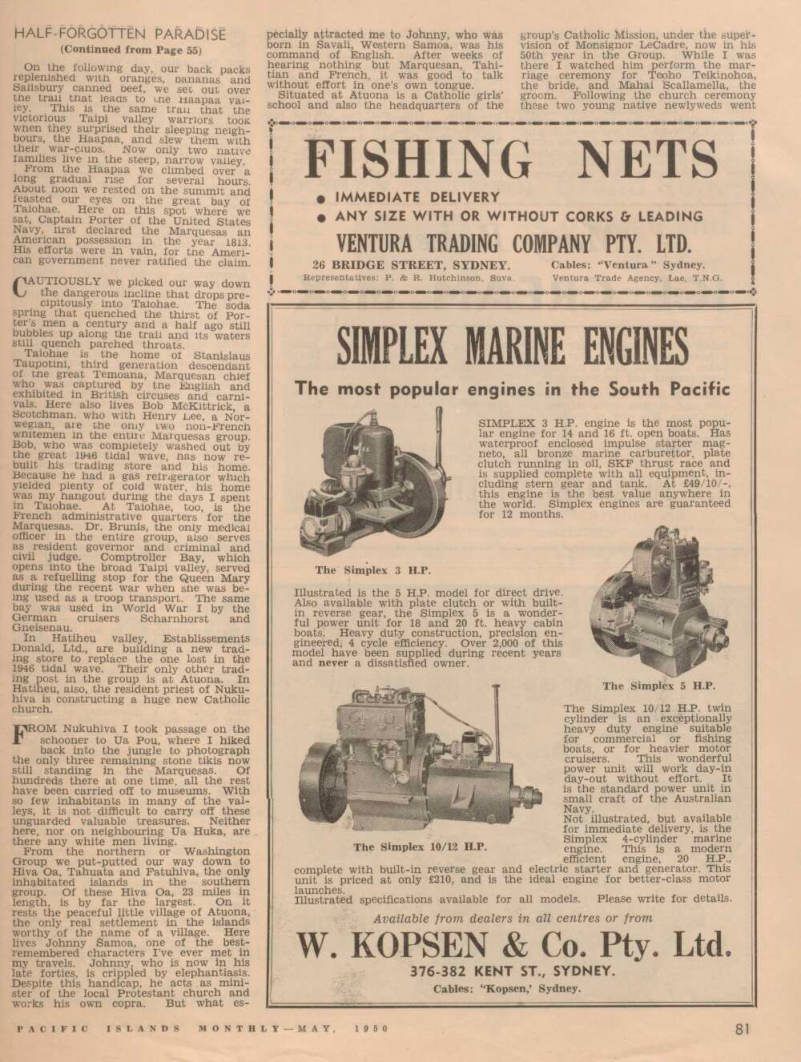
(Continued from Page 55) On the following day, our back packs replenished with oranges, oananas and Salisbury canned beef, we sec out over the trail that leads to me Haapaa val ley. This is the same trail that the victorious Taipi valley warriors tooK when they surprised their sleeping neigh bours, the Haapaa, and slew them with their war-ciuos. Now only two native families live in the steep, narrow valley.
From the Haapaa we climbed over a long gradual rise for several hours.
About noon we rested on the summit and feasted our eyes on the great bay of Taiohae. Here on this spot where we sat, Captain Porter of the United States Navy, first declared the Marquesas an American possession in the year 1813.
His efforts were in vain, for tne Ameri can government never ratified the claim.
CAUTIOUSLY we picked our way down the dangerous incline that drops pre cipitously into Taiohae. The soda spring that quenched the thirst of Por ter’s men a century and a half ago still bubbles up along the trail and its waters still quench parched throats.
Taiohae is the home of Stanislaus Taupotini, third generation descendant of tne great Temoana, Marquesan chief who was captured by the English and exhibited in British circuses and carni vals. Here also lives Bob McKittrick, a Scotchman, who with Henry Lee. a Nor wegian, are the omy two non-French wnitemen in the entire Marquesas group.
Bob, who was completely washed out by the great 1946 tidal wave, has now re built his trading store and his home.
Because he had a gas refrigerator which yielded plenty of cold water, his home was my hangout during the days I spent in Taiohae. At Taiohae, too, is the French administrative quarters for the Marquesas. Dr. Brunis, the only medical officer in the entire group, also serves as resident governor and criminal and civil judge. Comptroller Bay, which opens into the broad Taipi valley, served as a refuelling stop for the Queen Mary during the recent war when she was be ing used as a troop transport. The same bay was used in World War I by the German cruisers Scharnhorst and Gneisenau.
In Hatiheu valley, Establissements Donald, Ltd., are building a new trad ing store to replace the one lost in the 1946 tidal wave. Their only other trad ing post in the group is at Atuona. In Hatiheu, also, the resident priest of Nuku hiva is constructing a huge new Catholic church. rOM Nukuhiva I took passage on the schooner to Ua Pou, where I hiked back into the jungle to photograph the only three remaining stone tikis now still standing in the Marquesas. Of hundreds there at one time, all the rest have been carried off to museums. With so few inhabitants in many of the val leys, it is not difficult to carry off these unguarded valuable treasures. Neither here, nor on neighbouring Ua Huka, are there any white men living.
From the northern or Washington Group we put-putted our way down to Hiva Oa, Tahuata and Fatuhiva, the only inhabitated islands in the southern group. Of these Hiva Oa, 23 miles in length, is by far the largest. On it rests the peaceful little village of Atuona, the only real settlement in the islands worthy of the name of a village. Here lives Johnny Samoa, one of the best remembered characters I’ve ever met in my travels. Johnny, who is now in his late forties, is crippled by elephantiasis.
Despite this handicap, he acts as mini ster of the local Protestant church and works his own copra. But what es
pecially attracted me to Johnny, who was born in Savaii, Western Samoa, was his command of English. After weeks of hearing nothing but Marquesan, Tahitian and French, it was good to talk without effort in one’s own tongue.
Situated at Atuona is a Catholic girls’ school and also the headquarters of the
group’s Catholic Mission, under the super vision of Monsignor LeCadre, now in his 50th year in the Group. While I was there I watched him perform the mar riage ceremony for Teoho Teikinohoa, the bride, and Mahai Scallamella, the groom. Following the church ceremony these two young native newlyweds went
to the home of the bride where they entered the house by walking over the bodies of their parents, who, in old Marquesan custom, had prostrated themselves, white suits and dresses notwith- SniT gr o oU £ d - ne ° f weirdest sounds I ever heard was on the night before the wedding, when the female relatives of the betrothed couple wandered through the valley, at 2 a.m., chanting the genealogv of their forebears back through some 40 generations.
Despite the power of the Catholic church, these old Marquesan tribal customs continue to thrive.
Following the housewarming for the pair, a feast was held in a specially-built pavillion in which 500 friends and rela fives gorged themselves for five hours on breadfruit, poi, popoi, fish and the roasted meat of nine beef cattle and 10 n ;_ c , p gS- , eig^. ln the evemn S a dance as he This one th e , few dances allowed by the Catholic Mission aries in Hiva Oa, and the dancers made use of the occasion by continuing, with only brief breaks until 6 p.m. the fol lowing evening. As an American, whose knowledge of the native dance is defi
nitely limited, 1 provided the comic re lief.
IN the valley of Tahauka, close by Atuona, lives M. Leßrunnec, who with Henry Lee of Eiaone valley, Bob McKittrick and Father LeCadre, are the veterans of the Marquesas. Leßrunnec and Lee both have spent 39 years in the islands, while McKittrick has been there for only a few less. Formerly the three of them worked for the German firm, Societe Commerciale de I’Oceanie, as sailors aboard their copra schooners.
When the company went out of business at the time of the first war, the men took plantations of their own and have been copra men ever since.
Each of them is an expert in the lore of the ancient Marquesans, but I dis covered that Leßrunnec, an inveterate reader, was the only one who had heard of the A-bomb. (This is before the an nouncement of the H-bomb). Therein lies the happiness of these islands; their isolation from all the fears and strifes of the modern workaday world.
The Marquesas, like the Tuamotus and the Australs, never knew the presence of troops and airplanes and implements of war as did 90 per cent, of all the other Pacific islands. That, if nothing else, has kept them happy and still “native.”
It is good to know that there is still somewhere in this world where one can go to escape, if not the effects, at least the worries of the H-bomb and kindred items of our new horror warfare. It may be like the ostrich hiding his head in the sand and making believe no trouble exists, but as someone has said, “If the ostrich hides his head in fear of the atom bomb, he is wiser than we are; he may soon be the onlv fellow with a head.”
THERE are, of course, two schools of thought on this isolation business.
One school chastises the French Government for not taking better care of the natives’ medical, educational and economic needs; the others credit the colonial administration for its fore sight in the policy of laissez faire, hands off, and leaving the natives pretty much to their own devices.
I am not sure that I favour either school completely. I do feel this: I dis cussed the disease rates in the islands with the colonial doctor. His figures on the high percentages of leprosy, venereal disease and elephantiasis shocked me.
Despite the fact that the doctor makes rounds of the group whenever he can by boat (which is woefully inadequate) and that there is a disnensary at Atuona with Nurse Salmon in charge, there just isn’t anywhere near enough medical at tention. In such highly-unprofitable islands the administration of course, is not willing to increase its appropriations for upkeep. But one small seaplane, based anywhere in the islands. cou l d handle a Plying Doctor service set-up on the Aus tralian plan. It would mean adding small radio transmitters on Ua Huka, Ua Pou, Fatuhiva and Tahuata. but these need not be manned b TT special onerators. The vallev chief could be instructed in their use for medical emergencies. The same plan could be used to advantage in the Tuamotus and the Australs without really depriving the natives of any of their isolation and yet giving them great benefits.
The economy of the islands, a copra economy, is no worse and no better than that of any other Pacific island which rests its entire fortunes on copra. The Marquesas, which boast the largest coco nuts to be found anywhere, produce just over 2 000 tons of conra annually at pre sent. They have nroduced much more; and much less. Droughts that seem to
run in seven-year cycles plague the islands and force the copra output way down. They are still recovering from the latest drought that hit them four years ago. The large plantation in Tahauka valley, which formerly be longed to the German firm, but which is now operated by a young red-headed Frenchman just out from metropolitan France, last year was able to produce omy 25 tons. Five years before it was producing 70 tons annually.
It does seem to me, though, that much of the fertile land is lying useless.
Though the population of the group is now nearing 3,uou from its low of 2,100 a decade ago, there is still arable land and nsh in the sea to support ten, may be 20 or 30, times that many people, on the Ahoa plateau, wmch ues above Hanamenu on Hiva Oa, thousands of people could find living and farming room. In many of the valleys where only 200 or 250 people live now, once 4,000 or 5.000 people supported themselves. As recently as 100 years ago, more than 100.000 people lived in the Marquesas.
With our new knowledge of scientific farming, and with our need for room for Europe’s unfortunate DP’s, surely there is an opportunity going begging in the Marquesas.
Until transportation improves, there is no real reason for increasing the pro duction of fruit in the Marquesas, al though the oranges I ate there were sweeter and juicier than any I had ever tasted anywhere (Florida and California Chambers of Commerce, please note!).
Breadfruit, mangoes, tapotapo, bananas, limes, lemons, grapefruit, and various native fruits grow easily and without much care. Were transportation to an available market an easy matter, surely the Marquesas could become one of the world’s greatest fruit-growing areas.
In fields other than agriculture, the Marquesas have no real outlook, except
the chance presented by tourism. While there is no hotel and no cafe in all the islands, there are tourists who would de light to hear that fact. One cannot venture into the Marquesas without hav ing the closest contact with • the natives, which in Polynesia is a pleasant thougnc: in Melanesia it would be to the contrary.
For the person who would really like to get away from it all, and live on native fruits and fish, without all the accoutre
ments and paraphernalia of a holiday in a more complexlv civilised place, there is nowhere in this world like the Mar quesas.
Mr. J. D. A. Germond, a senior District Officer from the British Solomon Islands, who has acted on occasion as Resident Commissioner, passed through Sydney in May on his way to Britain on long leave.
It is reported that his next post will be m Bechuanaland.
The Noumea «fire brigade has received a cheque for 10,000 frs. from Establissements Ballande for their success in putting out a fire which started in their estimated a'Tlfooo frs Th6 damage is esLimarea ar irs.
New Caledonian jam producers are unable to compete, so far as price is concerned, with Australian imports. Australian jam sells at 18.18 francs a kilo (2.2 lb.), whereas the Caledonian product is retailed at 40 francs a kilo.
Advertisements & other items, pp. 79-81 (1 item)
Nets
• IMMEDIATE DELIVERY
• ANY SIZE WITH OR WITHOUT CORKS & LEADING
VENTURA TRADING COMPANY PTY. LTD.
26 BRIDGE STREET, SYDNEY. Cables: “Ventura” Sydney.
Representatives: P. & R. Hutchinson, Suva. Ventura Trade Agency, Lae, T.N.G.
SIMPLEX MARINE ENGINES
The most popular engines in the South Pacific V L SIMPLEX 3 H.P. engine is the most popular engine for 14 and 16 ft. open boats. Has waterproof enclosed impulse starter magneto, all bronze marine carburettor, plate clutch running in oil, SKF thrust race and is supplied complete with all equipment, including stern gear and tank. At £49/10/this engine is the best value anywhere in the world. Simplex engines are guaranteed for 12 months.
The Simplex 3 H.P.
Illustrated is the 5 H.P. model for direct drive.
Also available with plate clutch or with builtin reverse gear, the Simplex 5 is a wonderful power unit for 18 and 20 ft. heavy cabin boats. Heavy duty construction, precision engineered; 4 cycle efficiency. Over 2,000 of this model have been supplied during recent years and never a dissatisfied owner.
M mm ' m The Simplex 10/12 H.P.
The Simplex 5 H.P, The Simplex 10/12 H.P. twin cylinder is an exceptionally heavy duty engine suitable for commercial or fishing boats, or for heavier motor cruisers. This wonderful power unit will work day-in day-out without effort. It is the standard power unit in small craft of the Australian Navy.
Not illustrated, but available for immediate delivery, is the Simplex 4-cylinder marine engine. This is a modern efficient engine, 20 H.P., complete with built-in reverse gear and electric starter and generator. This unit is priced at only £2lO, and is the ideal engine for better-class motor launches Illustrated specifications available for all models. Please write for details.
Available from dealers in all centres or from
W. KOPSEN & Co. Pty. Ltd.
376-382 KENT ST., SYDNEY.
Cables: “Kopsen,’ Sydney.
Mary Baker
ICE CREAM MIX
Based on the American Army ice cream making formula that became such a favourite during the war years in all the South Pacific Islands, Mary Baker Ice Cream Mix is now made in Australia, incorporating all the latest developments and improvements on the original.
Packed in 16 oz. tins for home servings or in 5 lb. and 32 lb. tins for milk bars and traders with refrigerators, the tasty quick-selling Mary Baker Ice Cream Mix now is available for export to Pacific Islands storekeepers and traders.
Write to-day for a sample—it will be promptly forwarded for your consideration . . . and enjoyment.
J. C. MERRILLEES PTY. LTD.
104 HUNTER ST... SYDNEY
Telegrams: “MERRILLEES,” Sydney Agents ;
WALTER GRAND,
PAPEETE, TAHITI.
HUNTS AGENCY,
SUVA, FIJI.
B R A NO
31 Iff 1 ■>■ll k <1 mm?: mm
QUALITY
p/ n ■hpint
I PINT
54 GALL
k 2 gall
GALL TINS
H
Scott’s “Renown” Brand Rope,
Cordage and
Binder
Twine
Cable Address: Ropeyard.
Sydney. * - 55 SS *
of Every
Description
MANUFACTURED AT
MASCOT, N.S.W.
By
J. SCOTT
PTY. LTD.
Head Office and Store
163 CLARENCE STREET,
SYDNEY,
N.S.W.
A. H. BUNTING LIMITED
SAMARAI PAPUA
SOLE AGENTS IN PAPUA/NEW GUINEA FOR:
SAMARAI AGENTS FOR:
Vacuum Oil Co. Pty. Ltd.
South British Insurance Co.
National Mutual Life Association Polarizers (U.K.), Ltd.—Polaroid Sun Glasses.* C.S.A. Industries Eng.— Dual Freeze Refrigerators.
Webley & Scott, Ltd.—Shot Guns, Air Pistols, etc.
Le Bryan Group Products (Great Britain) Ltd.—Powermaster Electric Refrigerators.
“Getula.”—Nylon Monofilament Fish Lines. • Trade mark patented in U.S.A., Great Britain, and other countries
REGULAR SUPPLIES OF EASTERN GOODS
WHOLESALE & RETAIL MERCHANTS IMPORTERS PLANTERS
On Loose Again!
Seadog and Tiger
Another Tongan Gaol-break
From our own correspondent
Nuku’Alofa, April 20.
rrHE Kingdom’s two most notorious X criminals, Mahe Tupou (alias the Seadog), ’ and Tupou Ngata (alias the Tiger) have once again made a bold
bid for freedom by breaking from the Mataki’eua Prison with another prisoner, a youth named Viliami Maka, on the night of April 11.
After evading a determined police search, the escapees got away from the Kingdom on the night of April 18 on a 14 ft. sailing boat (belonging to M!r. R.
Skeen, Government Printer) which had been anchored at the Nuku’alofa water front.
This was Mahe Tupou’s fourth escape from the Kingdom. On the first three, he and his companions landed on islands of the Lau Group, Fiii, whither most likely they are making on their present venture.
Mahe Tupou’s first escape from the Kingdom was remarkable for the fact that it was made in a crudely made canoe, and during the 15 days he and his companions drifted across the 400 miles of windswept ocean between Tonga and Fiji they lived almost solely on coco nuts, plus some raw shark meat.
Tupou Ngata, on the other hand, has never gone beyond the Kingdom before this, but he caused a sensation some years ago when he escaped from prison and ventured across the treacherous passage between Tongatapu and ’Eua on a frail canoe. By hiding in almost inac cessible parts of the island of ’Eua, he defied police searchers for weeks before he was captured on one of his forays for food into one of the villages on the island.
The alarming increase in prison escapes in the last few years and their resultant unnecessary wasteful expense of public money is causing much public criticism of the Gaol Department. (Editorial Note: We seem to remember that a year or so ago, the necessary legislation was passed in Fiji and Tonga whereby criminals from Tonga could be made to serve their sentences in the greater security of Suva gaol.)
Advertisements & other items, p. 82 (1 item)
pawM
Rheumatism, Ankles Puffy Backache, Kidneys Strained!
If you’re feeling out o-sorts, have Sleepless nights, or suffer from Dizziness, Nervousness, Backache, Leg Pains, Swollen Ankles, Rheumatism, Excess Acidity, or Loss of Energy and feel old before your time, Kidney Trouble is the true cause.
Wrong foods and drinks, worry, colds or overwork may create an excess of acids and place a heavy strain on your kidneys so that they function poorly and need help to properly refresh your blood and maintain health and energy.
HeSp Kidneys Doctors’ Way
Many doctors have discovered by scientific clinical tests and in actual practice that a quick and sure way to help the kidneys clean out excess poisons and acids is with a scientifically prepared prescription called Cystex Hun-
dreds and hundreds of doctors’ records prove this.
The very first dose of Cystex goes right to work helping your kidneys remove' excess acids.
Quickly, this makes you feel like new again. And so certain are the makers that Cystex will satisfy you completely they ask you to try it under a money back guarantee. You be the judge. If not entirely satisfied just return the empty package and get your money back.
Cystex costs little at chemists and stores and the money back guarantee protects you.
No Benefit —No Pay
Cystex?
R for
KIDNEYS
■B L A D D E R
RHEUMATISM
The Guaranteed Treatment
DIESEL
pawM
Coventry "Victor" is the finest of all Diesel Power IS MOST RELIABLE AND EFFICIENT WHEN IT'S A
COVENTRY “VICTOR” ENGINE
Ideal for all uses where low weight Diesel Power is required. The Coventry VICTOR is a sound investment. Remarkably smooth running at all speeds.
Instant starting from cold. All enclosed and dust-proof.
Model W.D.I 5/7 H.P £125.
Model W.D.2 7/9 H.P £145.
F. 0.8. Brisbane (including Packing ). IMMEDIATE DELIVERY.
COMPLETE LIGHTING PLANTS
MARINE USE
Dependable Home Lighting Plants, powered by Coventry VICTOR Diesel Engines, are available. Supplied with common base plate and switch boards.
Coventry VICTOR Diesels for marine application either as main or auxiliary propulsion, or marine auxiliaries are available. These engines are ideal Power Units for craft from 16 feet to 22 feet.
For further details, write to distributors : HAWLEY’S PTY. LTD. 52 BOWEN st., BRISBANE or to local Sales and Service Representative: C. C. EVANS, c/o Bank of N.S.W., Port Moresby.
Cargo Cult
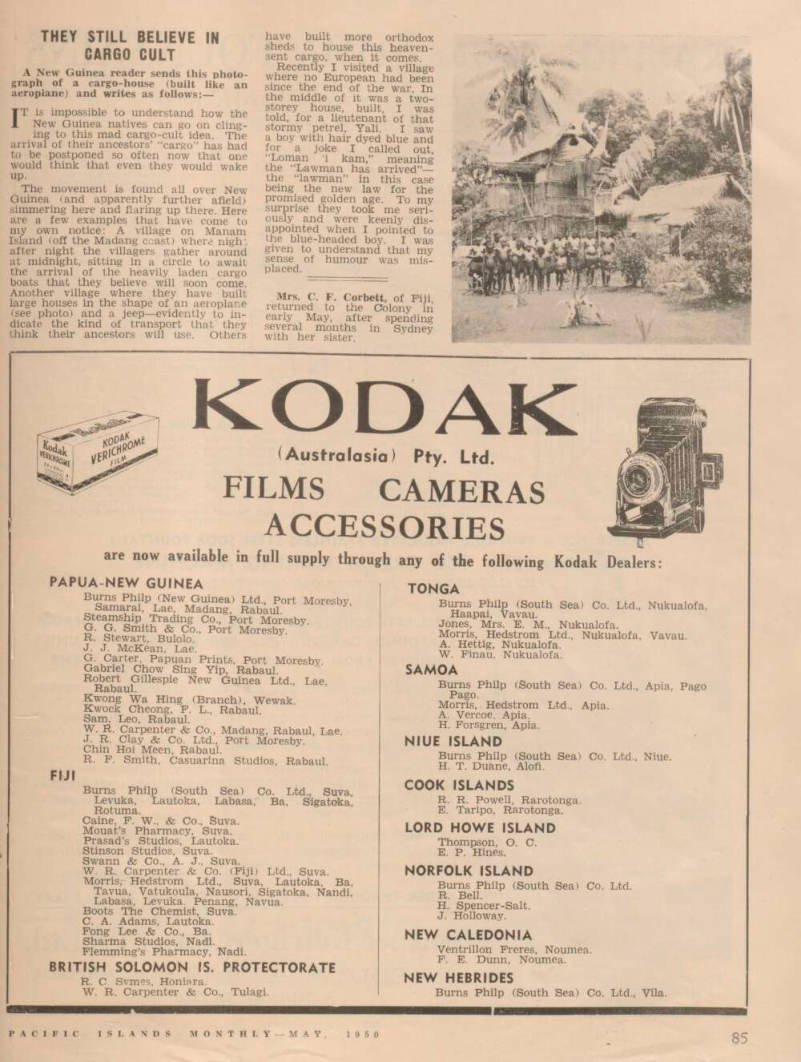
They Still Believe In
A New Guinea reader sends this photo graph of a cargo-house (built like an aeroplane) and writes as follows: IT is impossible to understand how the New Guinea natives can go on cling ing to this mad cargo-cult idea. The arrival of their ancestors’ “cargo” has had to be postponed so often now that one would think that even they would wake up.
The movement is found all over New Guinea (and apparently further afield) simmering here and flaring up there. Here are a few examples that have come to my own notice; A village on Manam Island (off the Madang coast) where night after night the villagers gather around at midnight, sitting in a circle to await the arrival of the heavily laden cargo boats that they believe will soon come.
Another village where they have built large houses in the shape of an aeroplane (see photo) and a jeep—evidently to in dicate the kind of transport that' they think their ancestors will use. Others
have built more orthodox sheds to house this heaven sent cargo, when it comes.
Recently I visited a village where no European had been since the end of the war. In the middle of it was a two storey house, built, I was told, for a lieutenant of that stormy petrel, Yali. I saw a boy with hair dyed blue and for a joke I called out, “Loman ‘i kam,” meaning the “Lawman has arrived”— the “lawman” in this case being the new law for the promised golden age. To my surprise they took me seri ously and were keenly dis appointed when I pointed to the blue-headed boy. I was given to understand that my sense of humour was mis placed.
Mrs. C. F. Corbett, of Fiji, returned to the Colony in early May, after spending several months in Sydney with her sister.
Advertisements & other items, pp. 83-84 (1 item)
Accessories
KOD
(Australasia) Pty. Ltd.
FILMS CAMERAS
ACCESSORIES
are now available in full supply through any of the following Kodak Dealers:
PAPUA-NEW GUINEA
Burns Philp (New Guinea) Ltd., Port Moresby, Samarai, Lae, Madang, Rabaul.
Steamship Trading Co., Port Moresby.
G. G. Smith & Co., Port Moresby.
R. Stewart, Bulolo.
J. J. McKean, Lae.
G. Carter, Papuan Prints, Port Moresby Gabriel Chow Sing Yip, Rabaul.
Robert Gillespie New Guinea Ltd., Lae, Rabaul.
Kwong Wa King (Branch), Wewak.
Kwock Cheong, F. L., Rabaul.
Sam. Leo, Rabaul.
W. R. Carpenter & Co., Madang, Rabaul, Lae.
J. R. Clay & Co. Ltd., Port Moresby.
Chin Hoi Meen, Rabaul.
R. F. Smith, Casuarina Studios, Rabaul.
FIJI
Burns Philp (South Sea) Co. Ltd., Suva, Levuka, Lautoka, Labasa, Ba, Sigatoka, Rotuma.
Caine, F. W., & Co., Suva.
Mouat’s Pharmacy, Suva.
Prasad’s Studios, Lautoka.
Stinson Studios, Suva.
Swann & Co., A. J., Suva.
W. R. Carpenter & Co. (Fiji) Ltd., Suva.
Morris, Hedstrom Ltd., Suva, Lautoka, Ba, Tavua, Vatukoula, Nausori, Sigatoka, Nandi, Labasa, Levuka, Penang, Navua.
Boots The Chemist, Suva.
C. A. Adams, Lautoka.
Fong Lee & Co., Ba.
Sharma Studios, Nadi.
Flemming’s Pharmacy, Nadi.
BRITISH SOLOMON IS. PROTECTORATE
R. C. Svmes, Honiara.
W. R. Carpenter & Co., Tulagi.
TONGA
Burns Philp (South Sea) Co. Ltd., Nukualofa, Haapai, Vavau.
Jones, Mrs. E. M., Nukualofa.
Morris, Hedstrom Ltd., Nukualofa, Vavau.
A. Hettig, Nukualofa.
W. Finau, Nukualofa.
SAMOA
Burns Philp (South Sea) Co. Ltd., Apia, Pago Pago.
Morris, Hedstrom Ltd., Apia.
A. Vercoe. Apia.
H. Forsgren, Apia.
NIUE ISLAND
Burns Philp (South Sea) Co. Ltd., Niue.
H. T. Duane, Alofi.
COOK ISLANDS
R. R. Powell, Rarotonga.
E. Taripo, Rarotonga.
LORD HOWE ISLAND
Thompson, O. C.
E. P. Hines.
NORFOLK ISLAND
Burns Philp (South Sea) Co. Ltd.
R. Bell.
H. Spencer-Salt.
J. Holloway.
NEW CALEDONIA
Ventrillon Freres, Noumea.
F. E. Dunn, Noumea.
NEW HEBRIDES
Burns Philp (South Sea) Co. Ltd., Vila.
KASPER Superior SODA FOUNTAINS
'KASPER' SUPER SODA FOIUINTAIIN N° 6
SPECIALLY MADE FOR TROPICAL CONDITIONS
SOSA FOll/l AIN 1 ) feet long, 33 inches high serving side t 29 inches wide.
FRAME 2 inch Angle Iron Frame, SEEDED construction, rust-proofed FOUNTAIN TOP ’lB gauge, mirror finish, English, stainless steel.
SEHVXNG' SIDS 20 gauge, satin finish, stainless steel.
SURKOUKD Special rust-proofed aluminium finish, wide range of colours.
Glass Rinser.
Milk Shake Sixer Swivel tap.
INSULATION Special insulation 4 ine Spanish cork board on bottom sides Sc top, heavily pitched and sealed. 2 Arm Soda Station,--' Drip Tray Sc 2 Running Viater 4 Syrup Jars Dishe
Spoon Receptac
Note Ice Cream Pressing Head extra to fountain.
Complete with 1/3 bp motor and fittings plus switch.
Ice Cream Head 6 special 18 gauge, stainless steel, mirror finish, interlocking raised hinge, Soda Fountain Lids.
Hermetically sealed Waterproof Surround Raised non-splash lip Rubbish Shut* ✓? 11 o Syrup ;cK *> cs Block maker
KEY
SECTION
DIAGRAM
Section Refrigerator unit located here Drain Board, swivel tap a Double sinks welded into drain board Towel ratl-pSink taps
'Storage rack
2 inch toe recess Chrome wheel valves for thermo-syphoning brine.
Enables operator to easily regulate temperature fruit juice and soda sections Section Section Section Section Section Bottle storage or food storage Compartment (1J cubic feet) Double Hole for Sods * Water Coils, plus Fruit Salad Container on top of coil space.
Double Hole lor Fruit Juices.
Double Hole lor Milk and/or Fruit Juices Double Hole for serving Ice Cream Double Hole Ice Cream hardening section Double Hole opening consisting of one x nail hole storage spece lor ice blocks and/or ice cream.
Each ‘Kasper* Super Fountain fitted with Sales •Sspter* tnermrselatic valves.
KASPER NO. 6 TROPICAL INSULATED STAINLESS STEEL SODA FOUNTAIN
Complete with ICE CREAM MAKING MACHINE
SPECIALLY DESIGNED FOR TROPICAL CONDITIONS.
i m
Kasper Superior Soda Fountain of all
stainless steel welded construction
surfaces.
COMPLETE FOUNTAINS, INCLUDING METAL RUST-PROOF
SURROUND, CARBONATORS AND REFRIGERATOR UNITS
SHIPPED FROM AUSTRALIA THROUGH YOUR AGENT
For beauty, for low lifetime cost, for convenience, for dependability, for profit-making power, “Kasper” Fountains stand supreme in Australia to-day. The “Kasper” Fountain is years ahead of conventional models. Every detail has been thoroughly worked out and tested in the factory and in use.
“Kasper” superior fountains are of all steel, lifetime construction with stainless steel. WELDED surfaces and chromeplated fittings. Adequate cork board insulation helps assure
lowest operating costs.
“Kasper” equipment operates on 240 Volt A.C. supply or power units (petrol or kerosene engines), which can be supplied by the
manufacturers to suit individual requirements.
ORDER THROUGH YOUR AGENT NOW AND AVOID DELAY
Kasper Refrigerators Pty. Ltd.
77 RAILWAY PARADE, ERSKINEVILLE, N.S.W., AUSTRALIA
Telephone: LA 1326
Hebrides New Volcano
Letter to the Editor IWAS most interested in the photo graph appearing in your issue of November, 1949, under the caption “Birth of a Pacific Island.”
As resident missionary on the island of Tongoa, New Hebrides, I have had the opportunity of watching this island from its beginning to its present stage of de velopment. Actually, the first activity in the formation of the island took place early in 1948, when a submarine volcano began eruption approximately midway between the islands of Tongoa and Epi.
The spot lies some two miles off shore from a thermal region on Tongoa and is probably from the water which was active at the end of last century when an island, which later subsided, was formed. A very graphic account of this earlier eruption is to be found in “Misi,” the autobiography of the Rev. O. Michelsen.
At the commencement of the recent ac tivity, I submitted a brief report to the Government Meteorologist in Vila, who, I understand, forwarded the observations to the Commonwealth Meteorological Bureau. Eruptions were fairly consistent over a period of approximately two months, during which time the crater threw up smoke, steam, ash and rubble; and during this period a low island (some ten feet high and about one hundred yards long) was formed. Then activity ceased and during the following south east season, the rubble was washed below the surface. The volcano was dormant for some months until in October of the same year activity recommenced with greater force. Since then the eruptions have been fairly consistent (with brief quiescent periods) so that now an island of 300 feet has been raised.
When the volcano is performing it presents a most impressive* sight. Ash
laden smoke is thrown high into the air; and, as well, molten rocks are catapulted to fall sizzling into the sea. Sometimes a few minor explosioas are followed by a large one and then activity is subdued for a matter of minutes till the perform ance is repeated. At other times as mani as five major bursts follow one another from the crater, the last issuing while the first is still ascending.
As I have not yet set foot on the island, I cannot give an accurate estimate as to area, but it must now be a few acres in extent.
I am, etc.,
Robert W. Murray.
Tongoa, New Hebrides, April 1, 1950. (Editorial Note: After our November photograph, we published (in March issue) an account of how two New Hebrides residents landed on the new island and named it Karua.)
For Cairns
Lone Voyager Sails From Suva For Cairns
Prom Our Own Correspondent
Suva, May 1.
SAILING alone, Mr. Patrick David Dil lon, a young Irishman who came to Fiji last December, left Suva in his 30 ft. yacht, Tara, on April 29 bound for Cairns, Queensland, which he hopes to reach in about two weeks. The Tara has no engine but carries water and pro visions sufficient for a much longer voy age than that to Queensland. Well fitted-out and Marconi-rigged as a cut ter, the Tara was built at Suva this year by Mr. Frank Woodhouse to Mr.
Dillon’s order.
Advertisements & other items, p. 85 (1 item)
Heinzt.
MAGAZINES
AMERICAN.
Saturday Evening Post ..
Ladies' Home Journal National Geographic Magazine Life (International!
Time New Yorker Harper’s Bazaar Woman’s Home Companion ..
Mademoiselle . , Yachting Popular Photography Red Book McCall’s ' ’
Theatre Arts Glamour
ENGLISH.
Britannia & Eve Blackwood’s Magazine Illustrated London News .
Country Life Punch Queen Sketch Sphere .. ’
Woman’s Journal Harper’s Bazaar Harper’s Bazaar New Statesman & Nation .
Geographical Magazine Golfing Autocar W.
M.
M.
P.
W.
W.
M.
M.
M.
M.
M.
M.
M.
M.
M.
M.
M.
W.
W.
W.
P.
P.
W.
M.
M.
M.
W.
M.
M.
W. £4 19 1 13 2 14 3 9 4 16 4 12 3 0 1 11 2 19 2 14 1 16 1 12 1 11 3 5 1 11 £1 13 0 1 17 6 6 11 5 4 2 5 3 0 8 3 6 6 113 1 10 0 2 16 3 2 16 3 2 10 15 3 10 0 3 16 3 2 3 0 0 All prices are for 12 months’ Subscription and will be delivered direct from the Publisher to you. We hold Publishers’ Accreditation.
Send for our Subscription Lists. Any Magazine from Anywhere.
BOOKS.—Technical, Medical, Biography, Travel, Arts and Crafts supplied, at lowest rates, by return.
Write ;
S.E.
BOOK CO.
88 Pitt Street, SYDNEY, or Box 30, G.P.0., Sydney, AUSTRALIA.
*W**l
Works wonders
at meal time!
Made from firm, red-ripe “aristocrat” tomatoes, and fragrant spices. Tomato Sauce that’s better than ever . . . made as only Heinz know how. Be sure to put HEINZ Tomato Sauce on your grocery list always.
HEINZt.
\V m m o** 0f S 7 4*ll T\* S
bmafo Sauce
H. J. HEINZ CO. PTY., LTD.,
479 Bourke Street, Sydney, and 6 Watt Street, Newcastle.
MX HE
fOMATO
J**. ■UP' ®|Z
TOMA^P
SAU Ct
40939^
Price Of Pearl Shell Soars
MENDIS AND SONS, representing Mil tenberg, New York, in mid-April at Thursday Island, offered £575 a ton for top grade pearl shell, an increase of £llO on last season’s price.
It is the second highest price ever offered. Several contracts have already been closed at this price.
Interesting developments are expected shortly.
Sunshine Gold
development, LTD., cleaned up 202 oz. gold for February, March, and part of April, at its leases in Morobe district, NG.
Heavy rains caused the company to lose 49 days’ sluicing.
Amblypelta
Parasite War On Amblypelta Combatting Nutfall in BSI
From Our Own Correspondent HONIARA, April 30.
MX*. B. A. O’CONNOR, Fiji Govern ment entomologist, is expected to arrive in the British Solomon Islands in May to investigate the pos sibility of establishing a parasitic fly on Amblypelta cocophaga, the bug which is responsible for premature nutfall of coconuts.
The fly, Trichopoda pennipes, was im ported into Fiji from Florida in Decem ber last year and is being bred in the laboratory at Suva. Main reason for its importation was to attempt its es tablishment in the Solomons to control Amblypelta. The parasite lays its eggs on bugs which act as host for hatching eggs and are destroyed in the process, and it is hoped that it will lay them on Amblypelta. Secondary object of this research is to see if the parasite fly will lay eggs on another bug, Axiagastus campbelli, which would offer a useful host for it in areas where Amblypelta is not plentiful and enable a constant sup ply of hatching, mating and breeding parasites to be maintained as an in surance against Amblypelta. Axiagastus occurs in considerable numbers on coco nut spadices in nutfall areas on Guadal canal, and other islands.
Mr. O’Connor may begin his research on Fairymead’s Baimunu plantation on Malaita.
With Mr. R. Leach, plant mycologist from Cambridge, he visited the Solomons in 1948 on behalf of Lever’s. A summary of their report on nutfall was published in the PIM during 1948.
Advertisements & other items, p. 86 (1 item)
C. Sullivan Pty. Ltd.
Jr V Stewarts and Lloyds (Australia) pt y . Ltd.
Manufacturers of "S&L" PIPES and FITTINGS for GAS, WATER, STEAM and other purposes.
AND Distributors of:
MILD STEEL BARS, PLATES and SECTIONS;
GALVANISED IRON; BOLTS and NUTS; ELECTRODES
and WELDING EQUIPMENT.
Stewarts and Lloyds (Australia) Pty. Ltd.
SYDNEY WAREHOUSE - - - Herbert Street, St. Leonards BRISBANE WAREHOUSE - Montague Road, South Brisbane MELBOURNE WAREHOUSE - - City Road, South Melbourne Telegraphic Address: "Tubes ' — Sydney, Brisbane or Melbourne
C. SULLIVAN PTY. LTD.
Island Merchants
Over 30 years' experience in the Pacific Island Trade.
Expert Buying Service Original Invoices Furnished Sellers of Island Produce.
Represented in all Australian States, New Zealand, England, France, United States, etc.
BANKERS: Bank of New South Wales, and Comptoir National d’Escompte de Paris.
C. SULLIVAN PTY. LTD.
379 KENT STREET, SYDNEY
And at Melbourne and Brisbane.
Telegrams & Cables: “CHASULL,” Sydney. Phone: MJ4657 (6 lines).
Associate Co.: C. SULLIVAN, INC., 230 California St., San Francisco, U.S.A.
South Seas Artifacts
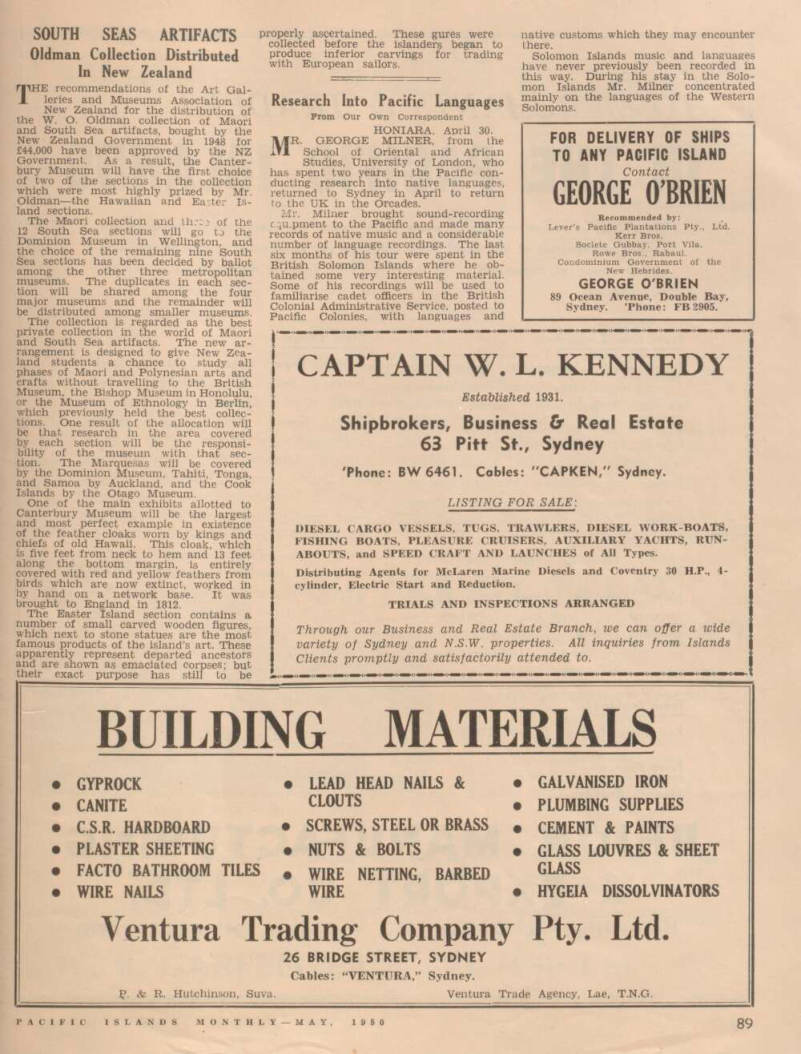
Oldman Collection Distributed In New Zealand
THE recommendations of the Art Gal leries and Museums Association of New Zealand for the distribution of the W. O. Oldman collection of Maori and South Sea artifacts, bought by the New Zealand Government in 1948 for £44,000 have been approved by the NZ Government. As a result, the Canter bury Museum will have the first choice of two of the sections in the collection which were most highly prized by Mr.
Oldman —the Hawaiian and Easter Is land sections.
The Maori collection and three of the 12 South Sea sections will go to the Dominion Museum in Wellington, and the choice of the remaining nine South Sea sections has been decided by ballot among the other three metropolitan museums. The duplicates in each sec tion will be shared among the four major museums and the remainder will be distributed among smaller museums.
The collection is regarded as the best private collection in the world of Maori and South Sea artifacts. The new ar rangement is designed to give New Zea land students a chance to study all phases of Maori and Polynesian arts and crafts without travelling to the British Museum, the Bishop Museum in Honolulu, or the Museum of Ethnology in Berlin, which previously held the best collec tions. One result of the allocation will be that research in the area covered by each section will be the responsi bility of the museum with that sec tion. The Marquesas will be covered by the Dominion Museum, Tahiti, Tonga, and Samoa by Auckland, and the Cook Islands by the Otago Museum.
One of the main exhibits allotted to Canterbury Museum will be the largest and most perfect example in existence of the feather cloaks worn by kings and chiefs of old Hawaii. This cloak, which is five feet from neck to hem and 13 feet along the bottom margin, is entirely covered with red and yellow feathers from birds which are now extinct, worked in by hand on a network base. It was brought to England in 1812.
The Easter Island section contains a number of small carved wooden figures, which next to stone statues are the most famous products of the island’s art. These apparently represent departed ancestors and are shown as emaciated corpses; but their exact purpose has still to be
properly ascertained. These gures were collected before the islanders began to produce inferior carvings for trading with European sailors.
Research Into Pacific Languages
Prom Our Own Correspondent HONIARA, April 30.
MR. GEORGE MILNER, from the School of Oriental and African Studies, University of London, who has spent two years in the Pacific con ducting research into native languages, returned to Sydney in April to return to the UK in the Orcades.
Mr. Milner brought sound-recording equipment to the Pacific and made many records of native music and a considerable number of language recordings. The last six months of his tour were spent in the British Solomon Islands where he ob tained some very interesting material.
Some of his recordings will be used to familiarise cadet officers in the British Colonial Administrative Service, posted to Pacific Colonies, with languages and
native customs which they may encounter there.
Solomon Islands music and languages have never previously been recorded in this way. During his stay in the Solo mon Islands Mr. Milner concentrated mainly on the languages of the Western Solomons.
Advertisements & other items, pp. 87-88 (1 item)
Building Materials
FOR DELIVERY OF SHIPS
TO ANY PACIFIC ISLAND
Contact
GEORGE O'BRIEN
Recommended by: Lever’s Pacific Plantations Pty., Ltd.
Kerr Bros.
Societe Gubbay, Port Vila.
Rowe Bros., Rabaul.
Condominium Government of the New Hebrides.
GEORGE O'BRIEN
89 Ocean Avenue, Double Bay, Sydney. ’Phone: FB 2905.
CAPTAIN W. L. KENNEDY
Established 1931.
SKipbrokers, Business & Real Estate
63 Pitt St., Sydney
'Phone: 8W6461. Cables: "CAPKEN," Sydney.
LISTING FOR SALE:
DIESEL CARGO VESSELS, TUGS, TRAWLERS, DIESEL WORK-BOATS, FISHING BOATS, PLEASURE CRUISERS, AUXILIARY YACHTS, RUN- ABOUTS, and SPEED CRAFT AND LAUNCHES of All Types.
Distributing Agents for McLaren Marine Diesels and Coventry 30 H.P., 4cylinder, Electric Start and Reduction,
TRIALS AND INSPECTIONS ARRANGED
Through our Business and Real Estate Branch, we can offer a wide variety of Sydney and N.S.W. properties. All inquiries from Islands Clients promptly and satisfactorily attended to.
BUILDING MATERIALS
• GYPROCK
• CANITE
• C.S.R. HARDBOARD
• PLASTER SHEETING
• FACTO BATHROOM TILES
• WIRE NAILS
• LEAD HEAD NAILS &
CLOUTS
• SCREWS, STEEL OR BRASS
• NUTS & BOLTS
• WIRE NETTING, BARBED
WIRE
• GALVANISED IRON
• PLUMBING SUPPLIES
• CEMENT & PAINTS
• GLASS LOUVRES & SHEET
GLASS
• HYGEIA DISSOLVINATORS
Ventura Trading Company Pty. Ltd,
26 BRIDGE STREET, SYDNEY
Cables: “VENTURA,” Sydney. & R. Hutchinson, Suva.
Ventura Trade Agency, Lae, T.N.G.
TO MERCHANTS & TRADERS
IN THE PACIFIC ISLANDS
We ore direct representatives of many of the major manufacturers in the important producing countries of the world. We con offer you an unusual service of providing a vast range of commodities, particularly Food, Building Materials, and General Merchandise.
From New Zealand— Tinned Meats, Tinned Fish, Tinned Soups, Tinned Vegetables, Tinned Tomato Juice, Tinned Tomato Puree, Butter, Cheese, Dried Milk, etc., Coffee Essence, Baking Powder, Cordials, Onions, Potatoes, Blue and Maple Dried Peas, Seeds, Animal Foods, Live Stock, Washing Soaps, Toilet Soaps, Cosmetics, Tennis Shoes, Leather Footwear, Leather Bends, etc., Plywoods, Wall boa rds. Paints and Varnishes, Building Papers, Bituminous Sealers, Asbestos Cement Sidings, Metal Window Frames, Sawn Timber (treated for Islands use), Furniture (Assembled and Unassembled), Mattresses and Pillows, Radios, Medicinal Preparations.
From England— Red Tower Lager. Gravity 1053.
From France— Monnet Brandy.
From Europe— German Export Lager (Light and Dark), German Bock Beer (Light), German Stout (Dark), Cartridges and Explosives, Shot Guns, Prefabricated Houses, Asbestos Sheets (Coloured), Fiat and Corrugated, Asbestos Pipes, Galvanised Pipes, Salt, Sugar, Gelatine, Textiles—Linen and Canvas, Household Earthenware, Glassware and Crystalware, Cutlery, Aluminium Products, Freezers, Household Chemicals, Insecticides, Pharmaceutical Products, Cosmetics, Jewellery (Imitation), Photographic Equipment—Cameras, etc., Typewriters, Wristlet Watches, Mouth Organs, Cigarette Lighters, Steam Coal, Steam Boilers and Heating Appliances, Tools, Axes, Choppers and Edged Earth Tools, Diesel Trucks and Tractors, Motor Cars and Motor Cycles.
From Australia— Our associate Company in Sydney can arrange your requirements from that country.
UNION MANUFACTURING
& EXPORT CO. LTD.
Heed Office: G.P.O. Box 1060, Wellington, NEW ZEALAND Cables: "UMEC," Wellington.
Sydney-NZ-Fiji-Hawaii-Nth. America
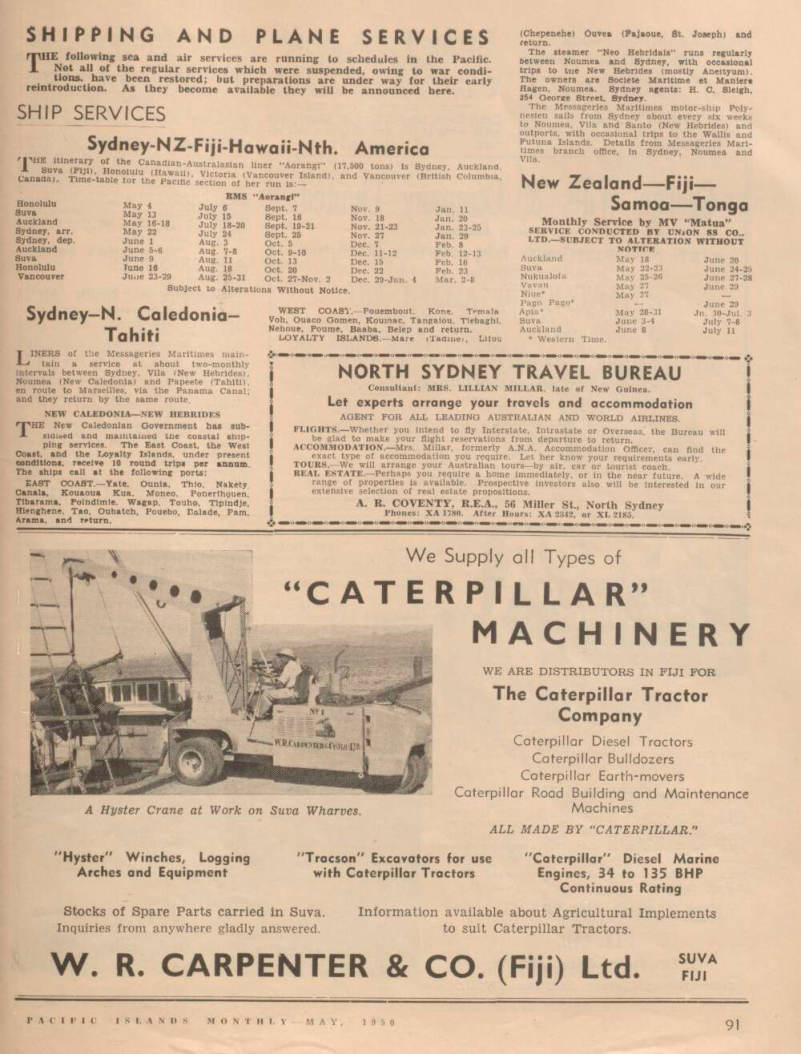
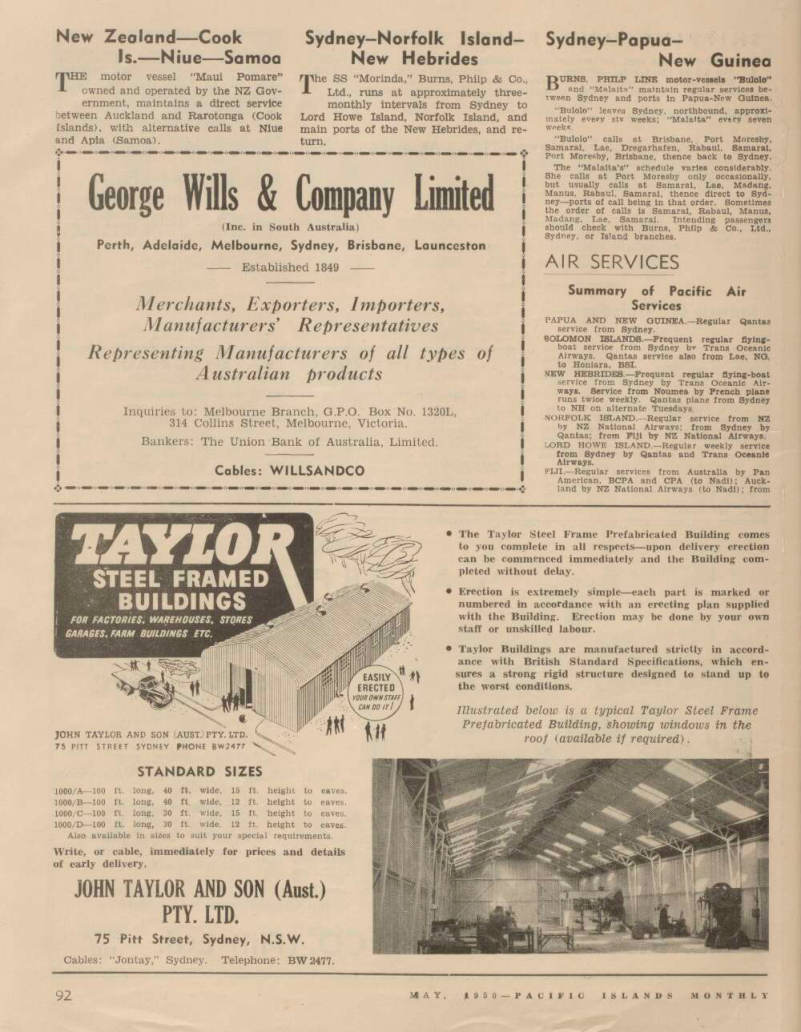

Shipping And Plane Services
THE following sea and air services are running to schedules in the Pacific.
Not all of the regular services which were suspended, owing to war condi tions. have been restored; but preparations are under way for their early reintroduction. As they become available they will be announced here.
Ship Services
Sydney-NZ-Fiji-Hawaii-Nth. America
T H suv a ln (Fnn Cans *; dian " Austr alaslan liner "Aorangi” (17,500 tons) is Sydney, Auckland.
Canada) Time’tah?e D aWa li’' Victoria (Vancouver Island), and Vancouver (British Columbia.
Canada), xime-table tor the Pacific section of her run is:—
Sydney-N. Caledonia- Tahiti
LINERS of the Messageries Maritimes main tain a service at about two-monthly intervals between Sydney, Vila (New Hebrides), Noumea (New Caledonia) and Papeete (Tahiti), en route to Marseilles, via the Panama Canal; and they return by the same route.
New Caledonia—New Hebrides
THE New Caledonian Government has sub sidised and maintained me coastal ship ping services. The East Coast, the West Coast, and the Loyalty Islands, under present conditions, receive 10 round trips per annum.
The ships call at the following ports: EAST COAST.—Yate. Ounla. Thio. Nakety Canala, Kouaoua Kua. Moneo, Ponerlhouen, Tlbarama, Polndlmie. Wagap, Touho, Tlpindje, Hienghene. Tao, Oubatch, Pouebo, Ealade, Pam.
Arama, and return.
WEST COAST.—Pouembout. Kone. Temala Voh, Ouaco Gomen, Kouiaac. Tangalou. Tlebaghl.
Nehoue. Poume, Baaba, Belep and return.
LOYALTY ISLANDS.—Mare (Taoinei, Lliou
(Chepenehe) Ouvea (Pajaoue, Bt. Joseph) and
return.
The steamer “Neo Hebrldais” runs regularly between Noumea and Sydney, with occasional trips to trie New Hebrides (mostly Aneltyum).
The owners are Soclete Maritime et Manlers Hagen, Noumea. Sydney agents: H. C. Sleigh, 254 George Street. Sydney.
The Messageries Maritimes motor-ship Poly nesian sails from Sydney about every six weeks to Noumea, Vila and Santo (New Hebrides) and outports, with occasional trips to the Wallis and Futuna Islands. Details from Messageries Mari times branch office, in Sydney, Noumea and Vila.
New Zealand—Fiji—
Samoa—Tonga
Monthly Service by MV “Matua”
Service Conducted By Un»On 88 Co..
Ltd.—Subject To Alteration Without
Notice
Honolulu Suva Auckland ui
Rms
“Aorangl” jĵ urir hj j uMay 4 July 6 Sept. 7 Nov. 9 Jan. 11 May 13 May 16-18 July 15 July 18-20 Sept. 16 Sept. 19-21 Nov.
Nov. 18 21-23 Jan.
Jan. 20 23-25 Sydney, arr.
May 22 July 24 Sept. 25 Nov. 27 Jan. 29 Sydney, dep.
June 1 Aug. 3 Oct. 5 Dec. 7 Feb. 8 Auckland June 5-6 Aug. 7-8 Oct. 9-10 Dec. 11-12 Feb. 12-13 Suva June 9 Aug. 11 Oct. 13 Dec. 15 Feb. 16 Honolulu Tune 16 Aug. 18 Oct. 20 Dec. 22 Feb. 23 Vancouver June 23-29 Aug. 25-31 Oct. 27-Nov. 2 Dec. 29-Jan. 4 Mar. 2-8 Subject to Alterations Without Notice.
Auckland May 18 June 20 Suva May 22-23 June 24-25 Nukualofa May 25-26 June 27-28 Vavau May 27 June 29 Niue* May 27 Pago Pago* — June 29 Apia* May 28-31 Jn. 30-Jul. 3 Suva June 3-4 July 7-8 Auckland June 8 July 11 * Western Time.
New Zealand—Cook
Is.—Niue—Samoa
THE motor vessel “Maui Pomare” owned and operated by the NZ Gov ernment, maintains a direct service between Auckland and Rarotonga (Cook islands), with alternative calls at Niue and Apia (Samoa).
Sydney-Norfolk Island-
New Hebrides
The SS “Morinda,” Burns, Philp & Co., Ltd., runs at approximately three monthly intervals from Sydney to Lord Howe Island, Norfolk Island, and main ports of the New Hebrides, and re turn.
Sydney-Papua-
New Guinea
DURNS, PHILP LINE motor-vessels "Bulolo” and “Malaita” maintain regular services be tween Sydney and ports In Papua-New Guinea.
“Bulolo” leaves Sydney, northbound, approxi mately every six weeks; “Malaita” every seven weeks.
“Bulolo” calls at Brisbane, Port Moresby, Samarai, Lae, Dregarhafen, Rabaul, Samaral.
Port Moresby, Brisbane, thence back to Sydney.
The “Malaita’s” schedule varies considerably.
She calls at Port Moresby only occasionally, but usually calls at Samaral, Lae, Madang, Manus, Rabaul, Samaral, thence direct to Syd ney—ports of call being in that order. Sometimes the order of calls is Samaral, Rabaul, Manus, Madang, Lae, Samarai. Intending passengers should check with Burns, Phllp & Co., Ltd., Sydney, or Island branches.
Air Services
Summary of Pacific Air
Services
PAPUA AND NEW GUlNEA.—Regular Qantaa service from Sydney.
SOLOMON ISLANDS.—Frequent regular flying boat service from Sydney bv Trans Oceanic Airways. Qantas service also from Lae, NG, to Honiara, BSI.
NEW HEBRIDES. —Frequent regular flying-boat service from Sydney by Trans Oceanic Air ways. Service from Noumea by French plane runs twice weekly. Qantas plane from Sydney to NH on alternate Tuesdays.
NORFOLK ISLAND.—Regular service from NZ by NZ National Airways; from Sydney by Qantas; from FIJI by NZ National Airways.
LORD HOWE ISLAND. —Regular weekly service from Sydney by Qantas and Trans Oceanic Airways.
FIJI. —Regular services from Australia by Pan American. BCPA and CPA (to Nadi); Auck land by NZ National Airways (to Nadi); from
Australia by Qantas (to Laucala Bay, Suva) • from Auckland by NZ National Airways (to Laucala Bay, Suva). Irregular calls from Australia to Laucala Bay, Suva, by Trans Oceanic Airways. Regular service from Suva to Labasa by NZ National Airways.
Western Samoa, Cook Islands And
TONGA. —Regular service from FIJI bv NZ National Airways.
TAHlTl.—Monthly service from Noumea by TRAPAS plane via FIJI, W. Samoa, Cook Is.
DUTCH NEW GUlNEA.—Regular weekly service fi-om Batavia by KLM.
AUSTRALIA-NEW ZEALAND.—ReguIar service by Tasman Empire Airways.
AUSTRALIA-NORTH AMERICA.— Regular Trans pacific services by Pan American Airwavs BCPA and CPA. y '
Europe - Indo-China -N. Caledonia Fort
nightly service by Air France,
Sydney-Vancouver
BCPA Service
ORITISH Commonwealth Pacific Airlines, Ltd., •L* opeiate a twice weekly trans-Paciflc service from Sydney to Vancouver, via Fiji, Canton Island, Honolulu and Ran Francisco; and a weekly service between Auckland and Vancouver, via the same ports.
Planes leave Sydney every Wednesday and Saturday, and Vancouver on the Southbound trip every Monday and Thursday. Every fourth trip from Sydney terminates at San Francisco Instead of Vancouver.
Planes leave Auckland every Tuesday and arrive in Vancouver the following Wednesday.
The Southbound trip to Auckland commences from Vancouver every alternate Friday. Every other Friday the service commences at San Francisco. 8.0.P.A. services make regular connections at both San Francisco and Vancouver for onward carriage, via either New York or Montreal to the United Kingdom or Europe. The through fare from Sydney to London is £325 (Aust.).
The fares for the Pacific flight are: Sydney- Nandi (Fiji), £AS7/15/- single, £AIO3/19/- re turn. Sydney-San Francisco, Seattle, Portland, Los Angeles or Vancouver. £A265/8/- single, £ A477/14/- return. Auckland-Nandi (Fiji), £NZ3I single, £NZSS/16/- return. Auckland- San Francisco, Seattle, Portland, Los Angeles or Vancouver, £NZI97/2/- single, £NZ3S4/15/- re turn.
Douglas DC6 aircraft carrying 48 passengers (seated) or 37 passengers (in sleepers) and a crew of nine are used on the service.
Pan-American
Trans-Pacific Service
DAN-AMERICAN World Airways clippers now *■ provide the following services in the South Pacific, using DC4 planes, equipped with Sleep erettes:— Planes leave Sydney Monday and Friday for San Francisco, via Tontouta (New Cale donia), Nadi (FIJI), Canton Island and Hono lulu.
The return flights are made from San Francisco every Monday, Thursday, via Honolulu, Canton Island, Nadi and Tontouta; and from Seattle every Monday, via Portland, Honolulu, Canton Island, Nadi and Tontouta.
Planes leave Auckland every Wednesday, and fly via Nadi, Canton Island and Honolulu to San Francisco. They leave San Francisco for Auckland every Saturday by the same route.
Pares, in Australian currency, are:—
(Time-tables and fares subject to alteration without notice.) To convert to FIJI currency, reduce above each kilogram of excess.
Free baggage allowance is 30 kilos per person Excess baggage at 1 per cent, of single fare for figures by about 10 per cent.
Sydney-New Hebrides
A QANTAS plane leaves Sydney for New Hebrides on alternate Tuesdays. It flies via Noumea and Port Vila to Santo, and returns.
Sydney-Lord Howe ls.-
Norfolk Is.
QANTAS, Sydney, run a Sandringham once weekly from Sydney to Lord Howe Island.
Pare, single, £l2. Return, £2l/12/-.
Qantas run a DC4 Skymaster alt. Thursdays (returning same day) from Sydney to Norfolk Island. Fare, £22 single; £39/12/- return.
(For Norfolk Island, see also under NZ National Airways, For Lord Howe, see also under TOA.)
£ s d. £ s. d £ s. d. £ s. d.
Single.
Return
Sydney-Seattle
265 10 0 477 18 0
Sydney-’Frisco
265 10 0 477 18 0
Sydney-Piji
58 0 0 104 8 0
Sydney-Honolulu . ,.
217 15 0 391 19 0 Auckland-Seattle . . . 246 5 0 443 5 0 Auckland-Honolulu 199 0 0 358 4 0
Auckland-Fiji
39 0 0 70 4 0 Auckland-’Frisco . .. 246 5 0 443 5 0
Trans-Tasman Service
Sydney—Auckland
TASMAN Empire Airways, Ltd., operate a flying-boat service between Rose Bay, Sydney, and Mechanics Bay, Auckland. Large flying-boats, capable of carrying 45- passengers, are employed. The trip is comfortable, and takes approximately 6 hours.
Flying-boats now depart Sydney and Auckland daily.
Aircraft leave Rose Bay at 8.30 a.m., and Mechanics Bay at 11.15 a.m.
Fares: £35 (A) (£2B NZ currency) single; £63 (A) (£5O/8/- NZ currency) return.
Bookings may be made at Tasman Empire Airways in Auckland and at Qantas Empire Air ways, Carrington Street, Sydney.
N. Caledonia-Tahiti
TRAPAS (Soclete Francals de Transports Aeriens du Pacific Sud-Noumea) runs a monthly service from New Caledonia to Tahiti, Departing at 8 a.m. from Noumea, every third Thursday, the plane flies via Fiji (Nadi), Western Samoa (Paleolo), Cook Islands (Aitu takl) to Papeete, where it arrives at about 11.4 u a.m. two days later. One evening is spent in Nadi and one night in Aitutakl. The plane re turns by the same route in the following week.
Pare from Noumea to Papeete is 16,000 Pacific francs single, and 28,800 return. (160 Pacific francs equal £1 Australian.) While the plane is at Papeete it runs one round trip between Papeete and Bora Bora.
New Caledonia-
New Hebrides
TRAPAS (French Air Line) operates a service between Noumea and the New Hebrides.
The plane leaves Noumea every Tuesday, and flies direct to Vila and Santo, and returns. Re turn fare for the journey, Noumed-Santo, is approximately £42 Australian.
KLM Dutch New Guinea
Service
K.L.M. Royal Dutch Airlines run a regular weekly sef-vice from Batavia to Dutch New Guinea, via Sourabaya, Makassar and Ambon, on the following schedule: Batavia dep. Sundays at 10.30 a.m,, Biak Island arr. Mondays at 4.40 p.m.; dep. Tuesdays at 6 a.m., Hollandia arr. Tuesdays at 8.10 a.m. On the return journey the aircraft leaves Hollandia at 9 a.m. on Tuesdays: Biak Island arr. 11.10 a.m., dep. 12.15 p.m. on Tuesdays; and Batavia arr. 6 p.m. on Wednesdays.
The aircraft used are C. 475, a type of DC-3, and the single fares are Batavia-Biak Island £A80; Batavia-Hollandia £A9I/15/-; and Biak Island-Hollandia £AII/15/-. Return fares, double single.
France-Indo-China-
Aust.—N. Caledonia
r pHE French national airways, Air France.
A runs a fortnightly service between Paris and New Caledonia, and return. Stops are made at Cairo. Karachi, Calcutta, Saigon, Djakarta, Darwin. Brisbane.
Constellations and DC4 Skymasters are used in the service, and Messageries Maritimes are agents in Australia.
Pare between Brisbane and Tontouta (New Caledonia) has been fixed at £A29/8/- (one way), and £AS2/18/- (return ticket). Sydney- Tontouta £A3S single; £A63 return.
Sydney—Queensland—
New Guinea
QANTAS Empire Airways, Ltd., employing DC3 planes, operate a regular service between Sydney, Port Moresby, Lae. Plnschhafen.
Madang, Rabaul, Bulolo and Wau, and return via Brisbane, Rockhampton, Townsville and Cairns.
This service is now known as the “Bird of Paradise” Service. Skymaster and DC3 aircraft are used.
Skymaster aircraft leave Sydney every Tues day and Saturday at 8.30 p.m., and making a night-flight calling only at Brisbane, arrive at Port Moresby the following morning at 7.20 a.m.
They return to Sydney the same day (Wednesday and Sunday). A DC3 shutlle service operates between Moresby and Lae to connect with Sky master service. This is only a temporary mea sure, pending repairs on Lae strip, when Sky masters will complete the journey as formerly.
DC3 aircraft leave Sydney every Monday, Wednesday and Friday at 8.35 a.m. for Lae, calling at Brisbane, Rockhampton, Townsville, Cairns, Cooktown, Port Moresby. An overnight stop is made at Townsville and Port Moresby
is reached at 11.10 a.m. the day after leaving Sydney.
Return trips are made from Lae to Sydney (calling at the same intermediate airports as on the northern journey) each Wednesday, Saturday and Sunday. Planes depart Lae at 5.45 p.m. and reach Sydney at 10.15 p.m. the same day.
The plane that reaches Lae from Sydney on Tuesdays later that afternoon flies on to Bulolo and Wau and returns to Lae.
The plane that reaches Lae from Sydney on Thursday flies on to Rabaul on Friday, via Finschhafen, returning to Lae the same after noon.
The plane that reaches Lae from Sydney on Saturday at 1 p.m. flies on to Madang, re turning to Lae the same afternoon.
Bookings may be made at Qantas offices at any of the towns named. At present, berths are available only to passengers holding official per mits to visit Papua or New Guinea.
Qantas Subsidiary Services In
Papua-New Guinea-Solomons
Qantas Empire Airways run the following sub sidiary services in Papua, New Guinea, and British Solomons; — A Douglas DCS leaves Lae, New Guinea, every
Wednesday, and flies to Rabaul, and Kavleng, and returns to Lae; but every alternate Wed nesday the plane goes on from Kavleng to Manus, and returns via Kavleng to Rabaul (overnight) and returns to Lae on the Thursday morning.
Every Wednesday a plane flies from Lae to Madang and Wewak, and thence ' direct to Rabaul. It returns from Rabaul to Lae on Thursday. This service is primarily for the carriage of native labour to and from Wewak, and Europeans travelling on this service are always advised of the fact.
Every alternate Monday, a Qantas Catalina flies from Port Moresby, westward to Daru, via Yule Island, Kerema, Klkorl, Lake Kutubu and Lake Murray, remaining overnight at Klkori and returning to PM next morning.
Every alternate Wednesday, a Qantas Calalina flies from Port Moresby eastward (dep. 9 a.m.) and calls at Abau and Samarai before flying out to the Archipelagoes in the afternoon. Calls are made at Esa’ala and Losuia (where an over night stop is made), and the following day (alternate Thursdays) at Deboyne Lagoon, before returning to Port Moresby, via Samarai and Abau.
Every alternate Monday, a Qantas Catalina leaves Port Moresby for Rabaul. via Moewe Har bour, and Talasea (New Britain); next morning (Tuesday) it flies to Buka, Kieta and Buln (Bougainville) and returns to Rabaul; next morning (Wednesday) it flies to Talasea, Moewe Harbour and Jacqulnot Bay, and returns to Rabaul; and next morning (Thursday) it re turns from Rabaul direct to Port Moresby.
Every alternate Monday a Qantas Douglas flies from Lae to Rabaul, and continues on to Honiara (British Solomon Islands), via Torokina; remains overnight at Honiara; and returns to Lae the following day (Tuesday), via Torokina and Rabaul.
Every Tuesday and Friday a plane leaves Port Moresby at 7 a.m., reaches Higatura (Popen detta) at 8 a.m., departs at 8.30 a.m.. arrives at Kokoda at 8.35 a.m. and departs again for Moresby at 9.15 a.m.
NZ National Airways
South Pacific Services
'"J''HE Pacific services run by the New Zealand ■- National Airways Corporation are as follows:
Auckland-Laucala Bay (Suva): A “Sun
derland” flying-boat leaves Mechanics Bay, Auckland, at 11.30 p.m. each Monday for Laucala Bay, Suva (arrives 8.10 a.m. the follow ing day).
The aircraft departs from Laucala Bay, Suva, on the return journey at 7.30 a.m. each Wednes day, and arrives at Mechanics Bay, Auckland, at 4.15 p.m.
Laucala Bat (Suva)-Labasa (Vanua
LEVU): A "Sunderland” flying-boat operates this service on a charter basis. A return trip is made between Laucala Bay and Labasa each Tuesday.
Auckland-Nobfolk Island-Fiji-Tonga
Western Samoa-Cook Islands: A "Douglas”
airliner leaves Whenuapai, Auckland, on alter nate Tuesdays at 9 a.m. (May 16, 30, June 13. ett.) for Norfolk Island (arr. 12.55 p.m.; dep. 2 p.m.), Nadi (arr. 8.40 p.m., dep. 5.40 a.m.
Thursday), Nausori (arr. 6.25 a.m., dep. 7.30 a.m.), Tonga (arr. 10.50 a.m., dep. 11.50 a.m.), •Paleolo, Western Samoa (arr. 4.5 p.m. Wednes day, dep. 8 a.m. Thursday), Altutaki, Cook Islands (arr. 1.50 p.m. Thursday, dep. 2.50 p.m.), Rarotonga, Cook Is. (arr. 4.5 p.m.).
The aircraft departs from Rarotonga on the return journey on alternate Saturdays (May 20, June 3, 17, etc.), at 8 a.m. for Aitutakl (arr. 9.15 a.m., dep. 10 a.m.), Paleolo, W. Samoa (arr, 3.15 p.m., dep. 8 a.m. Sunday), *Tonga (arr. 10.55 a.m. Monday, dep. 11.50 a.m.), Nausori (arr. 2.40 p.m., dep. 3.40 p.m.), Nadi (arr. 4.25 p.m., dep. 5 a.m. Tuesday), Norfolk Is. (arr. 10.55 a.m., dep. 12 noon), Whenuapai, Auckland (arr. 4.50 p.m.). •Crosses International Date Line.
Auckland-Norfolk Island: A "Douglas”
airliner leaves Whenuapai, Auckland, every Sun day at 8.15 a.m. for Norfolk Island (arr. 12.10 p.m.), and departs on the return flight at 1.10 p.m., arriving at Whenuapai at 6 p.m. fares, single (in NZ currency); Auckland to Norfolk, £l2/10/-; to Fiji, £3l; to Tonga, £3l; to Samoa, £34; to Altutaki, £39; to Raro tonga, £39/10/-. Norfolk to Fiji, £l9. Fiji to Tonga, £B/15/-; to Samoa, £l3; to Altutaki, £29/15/-; to Rarotonga, £3l. Samoa to Raro tonga, £l7/15/-; to Altutaki, £l6/10/-; Suva to Labasa, £4/10/-. Return fares, less 10 per cent.
BOOKING OFFICES: Wellington, Govt. Life Bldg., Customhouse Quay; Auckland, Airways Rouse, Customs St.; Dunedin, 8-10 Manse St.; Christchurch, 104 Gloucester St.; Gis borne, 74 Peel st.; Palmerston North, 107 Broadway Ave.; Hamilton, 8 Alma St.; New Plymouth, Grand Central Building, Egmont St.; Blenheim, 13 Queen St.; Hokitika, South side Airport; Norfolk Is., Burns Philp, Ltd.; Fiji, NAC at Nadi and Suva; Burns Philp, Labasa and Lautoka; Tonga, Mrs. F. F. Melhose, Pou-amotu Airfield; W. Samoa, Burns Philp (SS), Ltd., Apia; Cook Is., Mrs. P. McVeagh, Aitutaki, and Mr. J. D. Campbell, Rarotoga.
TOA Services
TRANS Oceanic Airways run the following Pacific services:— SYDNEY-LORD HOWE IS.: A regular fort nightly service with large four-engine flying boats from Rose Bay. Fare: £l2 single; £2l/10/- return. Free baggage allowance 50 lb.
Excess baggage and freight rate Bd. per lb.
SYDNEY-NEW HEBRIDES: A regular monthly service with large four-engine flying-boats from Sydney, via Noumea, to Vila and Bspiritu Santo (overnight stop). Pare: Sydney-Vila, £45; Sydney-Santo, £5O; Noumea-Vlla, £l2/10/-, Noumea-Santo, £lB/15/-. Freight: Sydney-Vila, V- per lb.; Sydney-Santo, 2/3.
Sydney-Solomon Islands: A Regular
monthly service from Sydney, via New Cale donia and New Hebrides to Tulagi and Honiara, Solomon Islands. This service is frequently ex tended to Llngatou, in the Russell Islands, and calls are sometimes made at Vanikoro, in the Santa Cruz Group. Pares; Sydney-Tulagi- Honlara, £65. Free baggage allowance, 60 lb.; excess baggage and freight, 3/6 per lb.
Papua-NG Local
Services
MANDATED Airlines, Ltd., of Lae, New Guinea, and other private operators, run air ser vices between Lae and the New Guinea mainland centres of Wau, Bulolo, Madang, Wewak. Aitape, Mt. Hagen, Flnschhafen, Moresby, Kokoda—ln fact anywhere in Papua or New Guinea where there is an air-strip. These planes carry pas sengers, malls and cargo on regular schedules or charter flights
Sydney-Noumea-Suva
THE following is the time-table of the Qantas Sandringham flying-boat:—
intending passengers may book through Qan*as offices in Australia. Burns, Philp (South Sea<> Company, in Suva; and T. Johnston In Noumea.
The fares for this service in Aust. currency
CPA Sydney-VancouvGf
Service
C CANADIAN Pacific Airlines, Ltd., run a trans- A Pacific service between Sydney and Van couver. For the present there will be one northbound and one southbound trip per fort night. Stops are made at Nadi (Fiji), Canton Island, Honolulu and San Francisco. The north bound flight commences from Sydney every alter nate Tuesday.
Four-engined, pressurised “Canadalr” aircraft are used; 36 passengers can be carried and a crew of 7. Flying is done in daylight. Over night accommodation is provided at hotels in Nadi and Honolulu, which is, of course, com plimentary.
Fares are (in Australian .currency: Sydney- Vancouver, San Francisco-Los Angeles and Port land-Seattle, £265/10/- single, £477/18/- return; Fiji-Vancouver, £207/10/- single, £373/10/- re
Sydney .. . . . . .. dep. 10 p.m. alt.
Tues.
Noumea . . . . .. arr. 6.30 a.m. alt.
Wed.
Noumea .. . . .. dep. 7.30 a.m. alt.
Wed.
Suva .. .. . . . . arr. 2 p.m. alt.
Wed.
Suva . . .. . . .. dep. 6 a.m. alt.
Fri.
Noumea .. . . .. arr. 10.30 i a.m . alt . Fri.
Noumea , . . . .. dep. 11.30 a.m. alt Fri.
Sydney .. . arr. 6 p.m, alt . Fri.
are: Single.
Return Sydney-Noumea .. . £37 10 0 £67 10 0 Sydney-Suva 55 10 0 99 18 0 Noumea-Suva ... , 20 5 0 36 9 0
turn; Sydney-Fijl, £5B single, £lO4/8/- return; Sydney-Honolulu, £217/15/- single, £391/19/return.
Bookings may be made at the Union Steam Ship Company of New Zealand, Limited, Sydney, or Melbourne: Union Steam Ship Co. of NZ, Ltd., Fiji; Canadian Pacific Airlines, Vancouver.
Advertisements & other items, pp. 89-96 (2 items)
91
PACIFIC ISLANDS M O N T II L V M A Y , 1950
“Caterpillar”
NORTH SYDNEY TRAVEL BUREAU
Consultant: MRS. LILLIAN MILLAR, late of New Guinea.
Let experts arrange your travels and accommodation AGENT FOR ALL LEADING AUSTRALIAN AND WORLD AIRLINES.
FLlGHTS.—Whether you intend to fly Interstate, Intrastate or Overseas,' the Bureau will be glad to make your flight reservations from departure to return.
ACCOMMODATION.—Mrs. Millar, formerly A.N.A. Accommodation Officer, can find the exact type of accommodation you require. Let her know your requirements early.
TOURS.—We will arrange your Australian tours —by air, car or tourist coach BEAL ESTATE.—Perhaps you require a home immediately, or in the near future. A wide range of properties is available. Prospective investors also will be interested in our extensive selection of real estate propositions.
A. R, COVENTY, R.E.A., 56 Miller St., North Sydney Phones: XA 1780. After Hours: XA 2343, or XL 3185.
o A mt j.
A Hyster Crane at Work on Suva Wharves.
We Supply all Types of
“CATERPILLAR”
MACHINERY
WE ARE DISTRIBUTORS IN FIJI FOR
The Caterpillar Tractor
Company
Caterpillar Diesel Tractors Caterpillar Bulldozers Caterpillar Earth-movers Caterpillar Road Building and Maintenance Machines
ALL MADE BY “CATERPILLAR
'Hyster" Winches, Logging Arches and Equipment Tracson" Excavators for use with Caterpillar Tractors 'Caterpillar" Diesel Marine Engines, 34 to 135 BMP Continuous Rating Stocks of Spare Parts carried in Suva. Information available about Agricultural Implements Inquiries from anywhere gladly answered. to suit Caterpillar Tractors.
W. R. CARPENTER & CO. (Fiji) Ltd.
SUVA
FIJI
George Wills & Company Limited
(Inc. in South Australia) Perth, Adelaide, Melbourne, Sydney, Brisbane, Launceston Established 1849
Merchants, Exporters, Importers,
Manufacturers Representatives
Representing Manufacturers of all types of
Australian products
Inquiries to: Melbourne Branch, G.P.O. Box No. 1320 L, 314 Collins Street, Melbourne, Victoria.
Bankers: The Union Bank of Australia, Limited.
Cables: WILLSANDCO
STEEL FRAMED
BUILDINGS
m?
EASILY \ 11
ERECTED \
your own mm i , CAN DO IT I J I
W flf
, FOR FACTORIES. WAREHOUSES. STORES
! GARAGES. FARM BUILDINGS ETC.
JOHN TAYLOR AND SON (AUST.) PTY. LTD.
75 PITT STREET SYDNEY PHONE 8W2477
STANDARD SIZES
1000/A —100 ft. long, 40 ft. wide, 15 ft. height to eaves. 1000/B —100 ft. long, 40 ft. wide, 12 ft. height to eaves. 1000/C —100 ft. long, 30 ft. wide, 15 ft. height to eaves. 1000/D—loo ft. long, 30 ft. wide, 12 ft. height to eaves.
Also available in sizes to suit your special requirements.
Write, or cable, immediately for prices and details of early delivery.
The Taylor Steel Frame Prefabricated Building comes to you complete in all respects—upon delivery erection can be commenced immediately and the Building completed without delay. • Erection is extremely simple—each part is marked or numbered in accordance with an erecting plan supplied with the Building. Erection may be done by your own staff or unskilled labour. • Taylor Buildings are manufactured strictly in accordance with British Standard Specifications, which ensures a strong rigid structure designed to stand up to the worst conditions.
Illustrated below is a typical Taylor Steel Frame Prefabricated Building, showing windows in the roof (available if required) .
JOHN TAYLOR AND SON (Aust.)
PTY. LTD.
75 Pitt Street, Sydney, N.S.W.
Cables: “Jontay,” Sydney. Telephone: 8W2477. r;
msm
i- |Sf| U' 1
LIPSTICK
and Refills
In Wooden and Metal Cases.
Suitable for Islands Trade.
Prices Are Right—Trade Enquiries Welcomed
M. GOODMAN
432 Pitt St., Sydney, N.S.W.
A Guaranteed Sanitary System
Approved by the N.S.W. Board of Health.
THE HYGEIA DISSOLVENATOR
Established 1927.
No Water Supply Required
The Sewage matter is chemically transformed into a sterile solution which is absorbed by the surrounding soil.
NO FLIES
NO GERMS
NO SMELLS
NO EMPTYING
AUTOMATIC
Any hondy man can install.
HYGEIA SANITARY COMPANY PTY. LTD.
26-30 BRIDGE STREET, SYDNEY, N.S.W.
Phone: BU 2521 Cables: “Berbl,” Sydney : I Correspondence Invited.
Pimples and Bad Skin Attacked In 24 Hours
Since the discovery of Nixoderm, the .scientific medicine, it is no longer necessary for anyone to suffer from ugly, disgusting and disfiguring skin blemishes such as Pimples, Rash, Ringworm, Psoriasis, Acne, Blackheads, Scabies and Red Blotches. Don’t let a bad skin make you feel inferior and cause you to lose your friends. Clear your skin this new scientific way.
A New Discovery
Nixoderm is an ointment, but different from any ointment you have ever seen or felt. It is a new discovery, and is not greasy but feels almost like a powder when you apply it. It penetrates rapidly into the pores and fights the cause of surface skin blemishes.
Nixoderm contains 9 ingredients which fight skin troubles in these 3 ways: 1.
It fights and kills the microbes or parasites often responsible for skin disorders. 2. It stops itching, burning and smarting in 7 to 10 minutes, and cools and soothes the skin. 3. It helps nature heal the skin clear, soft and velvety smooth.
Works Fast
Because Nixoderm is scientifically compounded to fight skin troubles, il works fast. It stops the itching, burning and smarting in a few minutes, then starts to work immed'ately, clearing and healing your skin, making it softer, whiter and velvety smooth. In
just a day or two your mirror will tell you that here at last is the scientific treatment you have been needing to clear your skin—the treatment to make you look more attractive, to help you win friends. Nixoderm has brought clearer, healthier skins to thousands such as Mr. Bob Weedon, Edmund Street, Fremantle, who writes : “I was troubled with pimples ever since I was 13, and have spent pounds and pounds on so-called cures without results. I then tried Nixoderm with astounding effect. The pimples seemed to fade away, and after a week there was not the slightest trace of them.”
Satisfaction Guaranteed
Get Nixoderm from your chemist or store to-day. Look in the mirror in the morning and you will be amazed at the improvement. Then just keep on using Nixoderm for one week and at the end of that time it must have made your skin soft, clear, smooth and magnetically attractive—must give you the kind of skin that will make you admired wherever you go, or you simply return the empty package and your money will be refunded in full. Get Nixoderm f rom your chemist or store to-day. Tim "■"arantec protects you.
Nixoderm
Skin Sores, Pimples and Itch.
IN THE COOK ISLANDS
United Island Traders Ltd.
(Established 1930).
WHOLESALE AND RETAIL TRADERS
IMPORTERS AND EXPORTERS
P.O. BOX 42, RAROTONGA, COOK ISLANDS
Telegraphic Address: "Unitrode," Rarotonga.
Associated with: W. H. WATSON & CO.— Manufacturers of Broad-last Footwear.
SCOTT & WATSON CO. LTD.— Manufacturers of "Palm" brand clothing.
If you require information concerning the trade qnd tourist possibilities of the Cook Islands, please write to us.
There are so many things which cannot be learned from official publications that it is often difficult for overseas traders and intending visitors to obtain information which will satisfy their particular needs.
With 20 years' trading experience behind us, and with intimate connections in all the islands of the Group, we feel that we can probably help you.
The Cook Islands are both beautiful and fertile, inhabited by a splendid branch of the Polynesian family. The climate is unsurpassed.
Of course, no obligation attaches to your enquiry—we shall be pleased to do what we can.
As agents for Whites Aviation Ltd., of Auckland, we con supply a very fine series of aerial photographs and scenes of native life.
We are also licensed Stamp Dealers, and are in touch with philatelists all over the world. We offer complete sets of new issue Cook Islands postage stamps for 9/- in New Zealand currency ($1.30) per set.
Many kinds of interesting and beautiful Seashells and Shell Necklaces are available for immediate supply.
FOR INFORMATION AND SERVICE WRITE TO:
United Island Traders Ltd.
“The House of Progress”
Bankers: Bank of New Zealand, Queen Street, Auckland, C. 1., N.Z.
Weary, Dreary
People
Put Some GO Into Your Life
Too many men, women and girls suffer aching backs, headaches, and feel dreadfully tiredtired, always tired. The cause? Very often, anaemia or bloodlessness.
You see the symptoms in dull eyes, pallid cheeks and lips, breathlessness, vague aches, exhaustion after the slightest exertion. Young children, especially girls, suffer frequently.
If you haven’t blood normal in red corpuscles, you are not receiving sufficient energy-giving oxygen which is dispersed by the blood throughout your body every second of the day and night. Your nerves, organs and, tissues are not properly nourished and you remain weary and dreary.
Get the GO which rich red blood can give you. Take the famous Dr. Williams’ Pink Pills for a few weeks. Dr. Williams’ Pink Pills are specially compounded to provide you with a normal rich blood supply. Always at your chemist or store.
For the RIGHT TIME Rely on WESTCLOX The finest, smartest clocks in Westclox history—that’s what Westclox has in store for you! A wide range of stunning clocks for every room— spring-wound and electric alarm models—wall clocks for your kitchen and time clocks for the living room— yes, wrist and pocket watches, too— all with traditional Westclox dependability and smartness that have made Big Ben and other members of this time-keeping family famous all over the world.
“It’s a Westclox” is the finest thing you can say about a clock or watch.
Some Westclox have luminous dials that you can see in the dark.
• QUALITY •
• RELIABILITY •
a 10 You can buy any Westclox with confidence. Look for that trade mark on the dial of the next clock or watch you buy.
Baby Ben—This alarm may be adjusted to loud or soft. Quiet tick. Made in two finishes— ivory and gold colour; also black with nickel trim.
wfSTCLOX
BIG
ben Big Ben is made two ways—There’s Big Ben Loud Alarm with booming intermittent call. If you want a more gentle awakening, there’s Big Ben Chime Alarm which first calls you with soft chimes. If you ignore these chimes, there’s a loud call in reserve.
PACIFIC ISLANDS TRADING CO.
244 CALIFORNIA ST., SAN FRANCISCO, CALIF., U.S.A.
Books For Every Reader
THE BEDSIDE ESQUIRE, edited by Arnold Gingrich. Here are gathered, in one pleasure-laden volume, some of the best and most diverting writing of our time, taken from the magazine “Esquire.” Price 15/-.
SIR HUBERT MURRAY OF PAPUA, Statesman and Empire Builder, by Lewis Lett. A book which must be regarded as the definitive biography of the outstanding personality of Papua’s great administrator. Price 21/-.
MAKE YOUR MONEY GROW, By W. H. Roberts, B.Ec. A thoroughly practical guide to Stock Exchange dealings, giving invaluable information and guidance to both the novice and the experienced speculator. Price 8/6.
THE DUKAYS, by Lajos Zilahy. A long compactly written novel set in the glorious sunset of European aristocracy, richly entertaining, brilliant in colour, packed with real characters. Price 14/-.
FLOWERS ON THE GRASS, by Monica Dickens. “A book that cannot fail to give pleasure ... a completely satisfying novel without a superfluous line or a dull moment.”—Liverpool Post. Price 11/9.
PRIVATE ARMY, by Vladimir Peniakoff (‘Popski’). The story of the smallest independent unit of the British Army, working behind the enemy lines, and their amazing exploits. Price 25/-.
POSTAGE EXTRA.
ANGUS & ROBERTSON LTD.
89 CASTLEREAGH STREET, SYDNEY.
* Hi *O% ... m m t t AH dosses of merchandise purchased for Island clients throughout the South-west Pacific.
Island produce sold on Australian and overseas markets on a commission basis. ■**?: ...
ROBERT GILLESPIE PTY IT?
54. PITT BT..BTDNEY- PHONES'BW4792- BliOS
fe RobH|6iLdney*" - *3 -
y Sv A
?Tte
m *^3 R
u Fly British to Britain
—and almost anywhere /”
From the “New” world to the Old . . . from Sydney to London, or any airport en route via the colourful East ... or on, across the globe, to other Continents . . . you can fly British by 8.0.A.C. Book in Australia and fly in comfort, without delay, on one ticket all the way. Enjoy 8.0.A.C.’s traditional standards of unfailing personal attention, wherever you travel on 175,000 miles of Speedbird routes to 51 countries.
CHEAT BRITAIN • USA • BERMUDA • CANADA • WEST INDIES • CENTRAL & SOUTH AMERICA MIDDLE EAST • WEST AFRICA • EAST AFRICA • SOUTH AFRICA • PAKISTAN INDIA • CEYLON • INDONESIA • FAR EAST • HONG KONG • JAPAN
8.0.A.C. TAKES GOOD CARE
YOU
FL Y ■ BOAT
Al2/AU-b Information & Bookings : Qantas Empire Airways Ltd. ( 8.0.A.C. General Agents in Australia) at Sydney, Melbourne, Brisbane, Tozvnsville, Cairns, Dane in or from Travel Agents in all cities and tozvns.
BRITISH OVERSEAS AIRWAYS CORPORATION WITH QANTAS EMPIRE AIR- WAYS LTD., TASMAN EMPIRE AIRWAYS LTD. & SOUTH AFRICAN AIRWAYS
Executor - Trustee - Attorney
Sr i
Spare
your best friend
The An inexperienced, overworked private executor quickly gets out of his depth. When he is remote from sound advice, the danger to the estate is greatly increased. Yet the fault really lies with the well-meaning person who made an unwise choice. Fortunately, it is a simple matter to transfer all responsibility to Burns Philp Trust Company Limited. By appointing this Company as your executor or trustee in the first place, you avoid placing a trusted friend in a most difficult position. More important still, your beneficiaries are permanently safeguarded from the hazards of inexperienced administration.
Full particulars of the Company’s many services are given in “Hands That Never Leave the Wheel.’’ A complimentary copy of this 20-page booklet can be obtained from any branch of Burns Philp (South Sea) Company, Burns Philp (New Guinea) Limited, or direct from the head office of this Company.
DIRECTORS:
James Burns Joseph Mitchell P. T. W. Black Eric Priestley Lee MANAGER: L. S. Parker SECRETARY: E. R. Overton, F.F.I.A.
BURNS PHILP TRUST
COMPANY LIMITED
Constituted by Special Act of the N.S.W. Parliament
Head Office: 7 BRIDGE STREET, SYDNEY
TEL. BU 5901 BOX 543, G.P.O.
BP6-50
More Nauru Records
In March
From a Special Correspondent NAURU, April 10.
THE announcement by Mr. R. B. Kirk, Nauru manager for the British Phosphate Commissioners, that the record monthly drying figures, established in May, 1940, had been exceeded by 800 tons in March of this year, is eloquent of the magnificent effort made by all con cerned since the Commissioners resumed their activities after the war.
Phosphate raised in May, 1940, was 101,500 tons while the new record stands at 102,300 tons.
The extent of this colossal output, can not be fully realised until the numerous development projects have been taken in to consideration. Number One priority over the past twelve months has been the erection of houses for the native popula tion. In that time a hundred homes of concrete blocks and wood-frames have been completed and many more are in various stages of erection. These houses are large and airy. They are in every way superior to the palm-thatch, or rusty iron, huts they replaced, but the dreamer, perhaps may sigh with regret when the last of these age-old habitations has given way to the march of time.
The building of more houses for the European employees has been kept up, and a fine new hospital to cater for the 1,500 Chinese workers has just been completed.
It is a scant five years since the BPC stepped ashore to face its gigantic task of rehabilitation. There was chaos every where. Machinery lay rusting, phosphate cars had been cemented into strong points for machine-gun crews, cableway towers stripped of their steel for a dozen other purposes. Hardly a building stood.
All this, plus the shortage of all types of material in the post-war world, stamps the creating of an all-time record at this stage, as a truly remarkable achievement.
Pacific Islands Society
THE next meeting and social gathering of the Pacific Islands Society will be held at History House, Sydney, on May 24. Films of topical interest will be shown.
The June meeting will be held on the 28th and the annual general meeting is set down for July 26. Nominations for office bearers must be in the hands of the secretary of the Society by July 5.
New Guinea
Buntings Expand To
Mr. Henry G. Eekhoff, Who Has
been in business in Lae, New Guinea, for many years (recently trading under the name of Ventura Trade Agency) has sold his interest to the well-known Samarai (Papua) firm of A.
H. Bunting.
The new owners of the business are erecting a steel building in which the premises of Alnderson’s meat shop will also be incorporated.
Madang Newsletter

From Our Own Correspondent MADANG, April 29.
DURING their recent visit to Madang. the Australian Minister for External Territories and External Affairs, Mr.
Spender, and his wife stayed with the dis trict officer and his wife, Mr. and Mrs. C.
Bates. In the official party were the Ad ministrator, Col. J. K. Murray; the Sec retary for Department of External Terri tories, Mr. J. R. Halligan; the Director of Planning and Development, Mr. J. H.
Jones; general manager in New Guinea for Qantas, Mr. Norm Denny; and Mr.
Spender’s personal secretary.
During his visit, Mr. Spender saw repre sentatives of all sections of the business community, various departments of the Administration and natives in their villages. Two announcements pleased the district very much. That consideration will be given to extending native labour contracts to two years; and the promise of a High School at Wau, before the end of the year.
Mr, Spender replied to a suggestion by the Planters’ Association that he would not permit a return to private recruiters as it would flout world opinion too much.
Two jetties for small craft were pro mised for Madang in the near future.
A buffet dinner at the home of Mr. and Mrs. Bates gave Mr. and Mrs. Spender an opportunity for meeting representatives from various departments, missions, and private enterprise. Later in the evening they were welcomed at the Madang Social Club and met other members of the com munity.
Wherever the Minister and his wife went, residents were impressed by his personality and by his wife’s outstanding poise and charm.
METRO GOLDW'yn MAYER repre
sentative, Mr. Noel Forde has been in the Territory to interview picture theatre owners and managers. A library supplying one new film a month and orner films in Port Moresby will be at disposal of theatres.
THE Anglican Bishop of Papua and New Guinea, The Rt. Rev. P. N. Strong, visited Madang in mid-April as guest of the district officer, Mr. Bates and Mrs.
Bates. He was given the opportunity of meeting people in the district at an afternoon tea given by Mrs. Bates. His visit was made to discuss the formation of a church in Madang. During the visit the Bishop conducted services and com munion in the European School.
ONE hectic week-end was spent by Madangites in Rabaul at Easter.
Basketball, tennis, cricket, baseball, swimming, billiards and snooker were participated in by the two teams while rain stopped much of the play at Ko kopo. Two wins were recorded for Madang in tennis and basketball.
MRS PERKINS of Potsdam is in Madang hospital at present. She has been in the Territory for 37 years and this is her first trip to Madang from Potsdam in four years. She says that Potsdam residents have lost their weekly refrigeration plane service owing to the sudden (and unexplained) closing
of the Aerodrome. As the drome was kept in order by Mr. Rouse, as his own ex pense, this seems unusual. In Mrs. Per kin’s case, it meant an unexpected delay of medical attention for more than a week. At times a delay like this could mean life or death to planters and their families.
MR. TOM CUNNINGHAM, public health inspector, is making a fine job of cleaning up Madang. He is being supported ably by a line of Highlanders.
It is a joy to see decrepit Army gear being trucked off to Astrolabe Bay for final burial. With it go old coconut stumps, relics of many bombed palms Mr. Cunningham has declared war on the rats and though they do not follow him like the Pied Piper, at least his assistant from Chinatown (called Masta-bilog-Rat) bags them each morning and takes them away, not by pipe, but by bike.
MR. JACK GOAD is relieving Mr. A.
Shields as Collector of Customs for a few months. Mrs. Goad is with her husband.
OUR relieving police master, Jack Grainger, in April, went to Australia with the Papua-New Guinea native police band. Mr. Grainger has been re lieving Mr. Allen Phillips who is on leave with his wife in Australia.
LT.-Col. Maahs and his wife of the American Lutheran Mission have de layed their leave to America in the interests of movie making. Assigned the job of illustrating a mission script, they reconstructed settings from the story at Amele Mission station. The script called for a witchdoctor, who was not forth coming at the mission, so a mission boy dressed up and obliged.
MADANG Native Hospital has been transferred from Gum to a point near the Agricultural Station resid ence on the Modillon Road. Mr. Ron Chugg is in charge. In recent weeks his daughter Audre (now married and living in Melbourne) has been staying with him.
MR. and' ' MRS. ' JOCK ' ESSON and small son Sandy expected from South in early May. Mr. Esson is
a seasoned Territorian, an inspector, for Expropriated Properties.
MR. AND MRS. BEN HALL were in town for the Minister’s visit. He is busy with plans for the new all electric bakery which he intends to build.
MR. DAVE REES representing Madang at the recent RSSAILA conference at Lae.
SOME interesting visitors to the port over the past two months included the District Officer from Rabaul, Mr. J. K. McCarthy, the inspector of police in Rabaul, Mr. Chris Normayle; the District Officer from Manus, Mr.
Tom Aitchison; Mr. A. A. Roberts, As sistant Director of District Services, Port Moresby, and Mr. A. Duncan, treasury inspector.
CONSIDERABLE interest is being shown by prospective tenderers for certain blocks in the recently ac quired Modillon Estate. The number of blocks for lease are much less than the number of people requiring them.
THE delayed arrival of the MV Malaita caused some shortages in the town.
These included eggs, butter, flour of all kinds and variety of tinned meat. By the way—l/- for one orange seems an astounding price to pay, even in New Guinea.
ELECTRIC light bills retrospective to September hit the townspeople with a smack recently. Most of the stoics, made that way by an excessively high cost of living, remarked, “Well now we can go bankrupt properly.”
ON Anzac Eve a dinner was held at the Club for all returned men. On Anzac morning a dawn service was
held. At the eleven o’clock service, Mr.
Lloyd Noland conducted the service, while Mr. C. D. Bates gave an address to the Europeans and, in Pidgin, to the as sembled natives. The Anzac verse was read by the president Mr. A. J. Clarke After wreaths were laid at the landing plaque, they were carried by diggers on the march to the cemetery.
TOWARDS the end of April, Messrs.
Caldwell and Frazer of the Com monwealth Treasury, were in
Madang, during a Territory-wide survey of the Administration stores.
AN unfortunate incident occurred in Madang on April 26 when Mr. J.
L. Tolgetti, a recent arrival to the Territory and a member of the staff of Mr. Roy McGreggor took his life. Mr.
Tolgetti was a member of the armed services and his home is in Sydney. A coroner’s inquest was held on April 27.
Appeals against the Fiji Magistrate’s Court conviction in January of Ratu Apa kuki Nanovo, Roko Tui Kadavu. on a charge of converting to his own use £BO/19/-, the property of the people of Kadavu; and of Bull Epeli, of Naceva, Kadavu, who was found guilty of the fraudulent conversion of £47/8/6, the property of the people of Kadavu, have been allowed by the Supreme Court.
Advertisements & other items, pp. 97-100 (1 item)
Gabriel Achun
William E. Reed
(Established 1913) Island Trade Broker & Commission Agent 145 a GEORGE ST., CIRCULAR QUAY, SYDNEY For more than 36 years the PERSONAL buying services of WILLIAM E. REED, backed by an experienced staff has ensured prompt and reliable service at lowest cost to Missions, Planters and Traders throughout the Pacific. We operate on a WHOLESALE basis only. You receive original invoices at invoiced cost.
Enquiries invited for all plantation and trading requirements. Island products sold on a commission basis.
Cables: "WILREED," Sydney
WANTED!
Your Printing . . .
We have much pleasure in announcing that we can now accept your orders for all classes of printing.
Take advantage of our "proof" by airmail, saves time, and gives you "City Service."
For craftsman printing with a minimum of delay and cost.
FRANK NIBBLE SON & COMPANY
175 Pitt Street, Sydney.
Cables: “Frahibs.” ’Phone: 8L3334.
GABRIEL ACHUN
Importer and Wholesale Merchant
Specialises in:
BEERS
BICYCLES
AERATED WATER MANUFACTURING
COTTON PIECEGOODS FOR NATIVE TRADE
AGENT FOR “STANDARD” AND “TRIUMPH” CARS
Malaguna Road
RABAUL
Territory of New Guinea Proprietor:
RABAUL CORDIAL FACTORY.
Telegraphic Address:
“GABRIEL ACHUN,” RABAUL.
COLDSTREAM EQUIPPED
REFRIGERA TION FOR EVERY NEED
Storage
MODELS
■ 12 Cubic Fee* • 5 Cubic Feet 2S Cubic Fee* *%■ m* ■ m v,<sr tW."
You can rely on Co'dstream ! Here is ret rigeration equipment that is dependable and economical —that has been designed, tested and built by specialists, with years of experience making commercial and domestic refrigeration units and accessories.
N.S.W. Representatives : REFRIGERATOR INSTALLATION & SERVICE GO. PTY. LTD, 8 Bridge Road, GLEBE. ’Phone: MW 2588. Telegrams & Cables. “Ryker”
Manufacturers of pre-fabricated cool rooms, food and ice cream storage cabinets, showcases and all special industrial applications.
This equipment is engineered specifically for your requirements 0 and has an ample balance of power under tropical conditions.
ENQUIRIES TO:—
W. S. Taif fir Co. Pty. Ltd., 8 Spring Street, Sydney.
Model 1301 r ft
fiJ
Uti
fi u -I/* Coldstream Water Cooler.
Capacity, 5-7 gals, per hour Coldstream Deep Freeze Cabinet.
Coldstream Peroscope Combination and Ice Cream Storaae Cabinet.
HEALTH HORIZON
An illustrated quarterly magazine to interest the overseas reader Contents of the April issue include :
INDUSTRIAL HEALTH IN
INDIA.
BIRD MIGRATION.
THE SEVEN-HEADED SERPENT
OF CYPRUS.
THE CARE OF THE CRIPPLE.
Subscription—five shillings a year.
TAVISTOCK HOUSE NORTH
Tavistock Square, London, W.C.1., England.
CBB 5 3
/■ H. /j ' « A.
the
C A LI
J is /° r
GILBEY’S
ltd.
SYd N£y, e R I s B ANfi Address all enquiries to W. & A. GILBEY LTD., 33 Rosslyn Street, West Melbourne.
WORLD PARITY FOR YOOR PRODUCE!
We are outright buyers of—
TROGHUS SHELL M.O.P. SHELL
IVORY NUTS GREEN SNAIL SHELL
As direct exporters to World’s consuming centres we can offer
TOP PRICES.
We supply TIMBER, DOORS, JOINERY, MOULDINGS, Etc.
W. BALCHIN PTY. LTD.
(Established 1848).
TIMBER, IMPORT & EXPORT MERCHANTS
Head office SYDNEY: 247 George St. ’Phones: BW 1538-9 Cables: Also at LONDON: 78 Gt. Bushey Drive Totteridge
“BALCHINCO”
GEORGE Kill
* Specialist in ladies’ and gentlemen’s wear, Eastern fancy goods, embroidered silk wear, embroidered linen table sets, carved camphorwood trunks, cane furniture, curios and general merchandise, etc.
LARGE SHIPMENT AND VARIETY ARRIVES WITH
EVERY HONG KONG BOAT
GENERAL MERCHANT & IMPORTER
Always Prompt New Chinatown, corner of Main Street, Attention and Service. RABAUL, New Guinea.
Plantation
Payment For Ng Copra At
WHEN Mr. Max Babbage, secretary of the Bougainville Planters’ Associa tion interviewed officials of the De partment of External Territories in Can berra in mid-March, one of the things discussed was the payment for copra held by planters in their own stores.
Later, Mr. Babbage said that the Aus tralian government was favourably in clined to institute a scheme where by copra which, due to shipping difficul ties, cannot be got away quickly, can be paid for up to about 70 per cent, of its value on a written certificate from a local government official.
It is understood that the Commonwealth Bank has agreed to finance such a scheme, which would be of great benefit to planters in isolated putports where; shipping has been, since the war, most erratic.
New Mission Ketch For
G & E Colony
Early Troubles on Voyage to Home Port
THE delivery voyage of the 80-ft. ketch, Halgard, from Sydney to the Gil bert and Ellice Island Colony (where she will be used by the Sacred Heart Mission) was not without incident in its early stages.
Halgard left Sydney on April 25 but struck engine trouble 350 miles out and returned to port on April 30. The trouble was rectified and the ketch got away again, Noumea-bound, on Mav 3.
Three priests (including Father Klip fel who will take charge of her from Suva to the G & E Colony) and three nuns were passengers. Crew members were Mr. George O’Brien, skinper as far as Suva; D. W. Reed (of the islands firm of William Reed) who sailed as radio operator; Les Williams, as engineer; W.
Ruder, cook; and Martin, a Giltaertese deckhand.
The second trip to Noumea from Sydney has been described as “difficult” —the steering cable broke and a hand tiller had to be used. But Noumea was reached on May 10 where the steering was repaired before the ketch left on the second leg of the journev with Suva the next port of call.
Mr. Ruder, the cook, was sick for most of the voyage to Noumea, the result of a recent smallpox vaccination it is be lieved. He left the ketch in Noumea and flew back to Sydney on May 11.
Good Relations
Between
Fijians And Papuans
A WARM friendliness which quickly developed between the Papua-New Guinea delegates and the Fijians was commented upon by the Papua-New Guinea Director of Education, Mr. W. C.
Groves, when he passed through Sydney on his return to the Territories, in the second week of May, with the Papua-New Guinea delegates.
Mr. Groves did not join much in the Fiji junketings—he remained mostly with the New Guinea native delegates, and assisted them wherever he could in their activities outside the Conference room.
“I was most interested in noting the interest and friendship that developed between our fellows and the Fijians” he said. “The Fijians might be described as being at one end of the Melanesian scale, and the Papuans at the other end; but the Fijians extended a warm greeting to our fellows, and took an interest in their viewpoint, and showed them round, and treated them most hospitably.
“I formed a warm admiration for the Fijians—their fine spirit and pride of race. I only hope that, in course of time, our policy of helping and training our native people will bring them to the stage where the Fijians are now.
“I had a look at the students we sent to the Suva Medical School. One man is in his third year, and doing well. Two others, who had to undergo a couple of years of training in simple education, in Suva, before they could enter the School, are now coming along satisfactorily.”
The old-established Newsagency busi ness conducted for many years in Vic toria Parade, Thursday Island, by E. H. and E. A. Vowels, has been sold owing to the continued ill-health of Mr. E. H.
Vowels. The business has been taken over as from March 1, by Mr. Richard James Moore, who recently went to TI from Queensland.
News From New Ireland
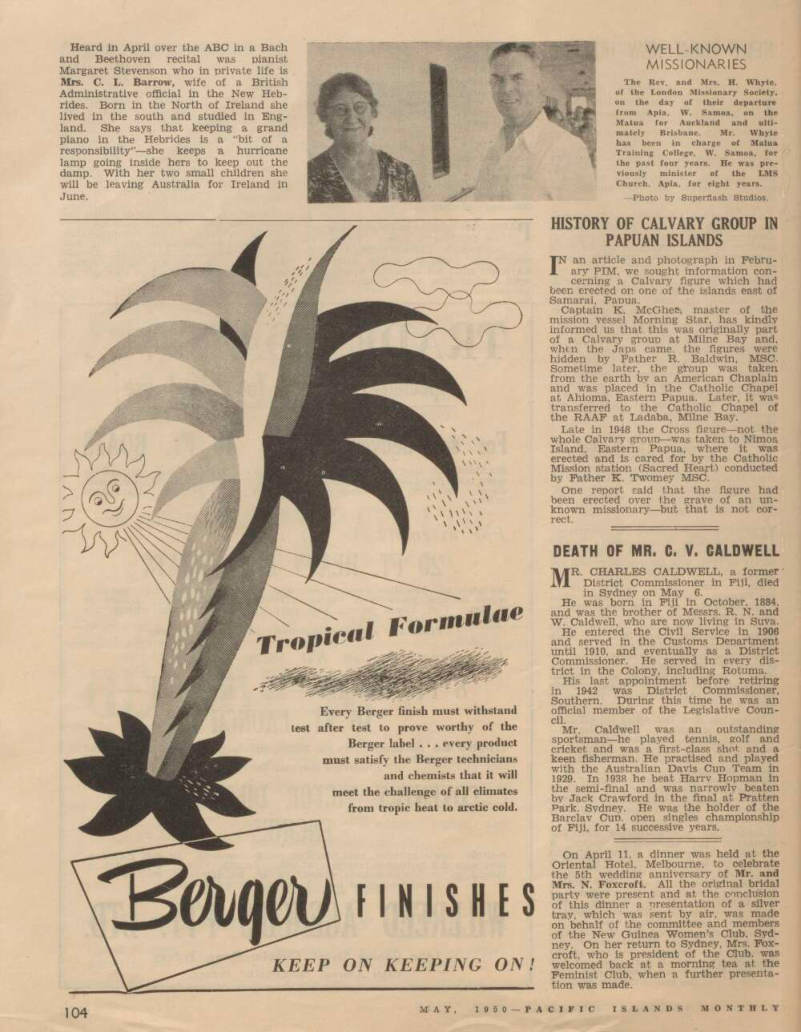
From Our Own Correspondent KAVIENG, April 30.
Tomalabatt Plantation, Tabar
Islands, formerly the property of the late Mr. J. S. Talmage, has been bought by Mr. Woo You, one of Kavieng’s most popular Chinese residents.
Seeto Young, 51, who had been in New Guinea for 37 years, died at Put Put near Kavieng, on March 20. He was a brother of Seeto Gui, well-known New Britain planter and trader.
The Minister for External Territories Mr. Spender, and Mrs. Spender seemed delighted with their short stay at Kavieng in April. Arrangements for their reception and well-being went off without a hitch.
They received addresses of welcome in English by prominent natives; Mr. Sen der listened attentively to the woes of the planters; and a Chinese deputation, also a half-caste deputation waited upon him. He seemed to have had the situa tion well sized up before he came to Kavieng, judging by his general know ledge and grip of New Guinea’s problems.
He did not fail to emphasise that the Territory was costing the Australian tax payer £4,000,000 a year, and said that if residents wanted further facilities and amenities they would have to pay for them.
Largest European gathering for years was at the residence of Mr. Peter V.
Saunders, where the planters provided an excellent buffet supper in honour of the distinguished guests, among whom was an old New Guinea friend, Captain “Orm”
Denny, popular pre-war goldfields pilot of Guinea Airways, Ltd.
HAPPY, unsophisticated Chimbu natives are working conscientiously around Kavieng. They seem to be taking kindly to their new surroundings and are being watched with much interest.
There have been many visitors to Kavieng recently. We have had anthropologists, dieticians, nutritionists, baby-welfare nurses, doctors and a col lector of native curios for a Swiss museum. If one among them can stick some vitamins into the local lads so that they will at least have energy enough to bring their sick offspring to the free hos pitals so generously supplied by a paternal Administration, and by various mission bodies, then their visits will not be in vain.
Unless our New Irelanders get off their backsides and work—for work is the anti dote for most ills —then they must die off much faster than they did before the war Mr. Love, cousin of the world-famed Maori anthropologist, Sir Peter Buck, is doing some X-ray work among the natives here. He never fails to extol the virtues of “God’s Own Country’’ (New Zealand) but so far he has passed little comment on NG!
Anzac Dav was celebrated with due solemnity, but subsequent revelry. A ceremony took place at the flagstaff and an address was given by the Rev. Ben Chenoweth, Methodist Overseas Mission.
The smart detachment of the New Guinea Police Force was under the command of A/Sub-Inspector P. E. Towner. The “Last Post’’ and “Reveille” were sounded, and the large gathering lifted up its voice and sang “O God, Our Help in Ages Past.” A Digger of the two world wars ulaced a lone wreath at the foot of th° flagstaff, after which native women and children placed small bunches of flowers around it. At the end of the two minutes’
silence, a fine, well-sounding voice rent tne quiet air— “ They shall not grow old . . .”
It was Kavieng’s most impressive and best-attended post-war Anzac Day ceremony. Chinese tiade stores supplied native ex-servicemen with free lemonade, biscuits and sweets.
Later py cprvipp m pn f “KmrfJ’ adjourned to sung and the old ti?H S °mvf Z*™ flowed and h th o e l^| t r o ns ie w?n\ d^n T i e n b ln bee e r rag w e hich Ch show? h bottles ° H f peer, which shows that those who served
a. u ssrsf ssar’fflhss be emulatins
PALM trees swaying in the gentle breeze and fringing a silvery, white-sand beach with rollers breaking over the nearby “pslutog for ApH 1° w hen Amp C WPirf! ed ? mg ° n p il 8 when Miss Anne Weldon Lowrey,
formerly of London, England, and now a stenographer with the Administration at Rabaul married Mr. Kenneth James Kablul* 1 patrol -° mcer ’ also Rationed at
™ Udui -
The y were married at “Lebrechtshof,” near Kavieng, the plantation home of Mr. and Mrs. H. L. Schultze. Officiating minister was the Rev. Ben Chenowach, Methodist Overseas Mission. Best man was Mr - Jack Percival, of the Department
&SStoS SSmS"
made a host Mr H L Schultze gave the hririe
awaywith **'<***■
Twenty-four guests, some of whom had flown from Rabaul for the occasion, were the rece Ption. After spending their honeymoon at Soubu Plantation, the New by plane on A ? ril 20 ’ where they will re sume their former duties.
Heard in April over the ABC in a Bach and Beethoven recital was pianist Margaret Stevenson who in private life is Mrs. C. L. Barrow, wife of a British Administrative official in the New Heb rides. Born in the North of Ireland she lived in the south and studied in Eng land. She says that keeping a grand piano in the Hebrides is a “bit of a responsibility”—she keeps a hurricane lamp going inside hers to keep out the damp. With her two small children she will be leaving Australia for Ireland in June.
Well-Known
Missionaries
The Rev. and Mrs. H. Whyte, of the London Missionary Society, on the day of their departure from Apia, W. Samoa, on the Matua for Auckland and ulti mately Brisbane. Mr. Whyte has been in charge of Malua Training College, W. Samoa, for the past four years. He was pre viously minister of the LMS Church, Apia, for eight years. —Photo by Superflash Studios.
Advertisements & other items, pp. 101-102 (1 item)
Ffillreed Agencies Pty. Itd.
TRADE BOATS . . .
especially designed for Island use
For sea delivery
40 FT. BOATS
Standard hull built to first-class specifications. Designed and equipped as work boats for Islands traders, Missions, etc. Complete with 30 H.P. Lister mfles e^lvere d from Gladstone (Qld.) to any destination within 2,000 Inquiries invited.
For assembly—in Kit for
m
20 FT. HEAVY DUTY BOATS
All materials including keel, ribbing and planking, cut to exact size and shape for easy assembly of strong, carvel-built Islands vessel. Length 20 4-, \ ft., round bottom, tuck stern. Available with or without 5/7 H.P. Coventry marine diesel.
Prices and approximate delivery date on application.
For assembly—in Kit form
8 FT. DINGHY—I 2 FT. SKIFF-
-16 FT. LAUNCH
Complete kits for marine plywood light duty craft of beautiful design and immense strength.
Illustrated brochure on request.
COVENTRY VICTOR DIESEL
ENGINES
4-stroke, single cylinder, cold starting, totally enclosed tion with 2/1 reduction-reverse gear-box.. Length 41 Height, 26i in. Approximate weight, 358 lb. 5/7 HP Inquiries invited for 5/7 H.P. also 7/9 HP
MARINE
In unit construcin. Width, 16i in. engines.
ffILLREED AGENCIES PTY. ITD.
145 a George Street, Circular Quay, Sydney.
Cable Address: “REEDAGE,” Sydney.
Formu
Trop*
Every Berger finish must withstand test after test to prove worthy of the Berger label . . . every product must satisfy the Berger technicians and chemists that it will meet the challenge of all climates from tropic heat to arctic cold.
FINISHES
KEEP ON KEEPING ON!
History Of Calvary Group In
Papuan Islands
IN an article and photograph in Febru ary PIM, we sought information con cerning a Calvary figure which had been erected on one of the islands east of Samarai, Panua.
Captain K. McGheei, master of the mission vessel Morning Star, has kindly informed us that this was originally part of a Calvary group at Milne Bay and, when the Japs came, the figures were hidden by Father R. Baldwin, MSC.
Sometime later, the glroup was taken from the earth by an American Chaplain and was placed in the Catholic Chapel at Ahioma, Eastern Papua. Later, it was transferred to the Catholic Chapel of the RAAF at Ladaba, Milne Bay.
Late in 1948 the Cross figure—not the whole Calvary group—was taken to Nimoa Island, Eastern Papua, where it was erected and is cared for by the Catholic Mission station (Sacred Heart) conducted by Father K. Twomey MSC.
One report said that the figure had been erected over the grave of an un known missionary—but that is not cor rect.
Death Of Mr. C. V. Caldwell
Mr. Charles Caldwell, A Former
District Commissioner in Fiji, died in Sydney on May 6.
He was born in Fiji in October. 1884. and was the brother of Messrs. R. N. and W. Caldwell, who are now living in Suva.
He entered the Civil Service in 1906 and served in the Customs Denartment until 1910, and eventually as a District Commissioner. He served in every dis trict in the Colony, including Rotuma.
His last appointment before retiring in 1942 was District Commissioner, Southern. During this time he was an official member of the Legislative Coun cil.
Mr. Caldwell was an outstanding sportsman—he played tennis, golf and cricket and was a first-class shot and a keen fisherman. He practised and played with the Australian Davis Cun Team in 1929. In 1938 he beat Harrv Hopman in the semi-final and was narrowly beaten by Jack Crawford in the final at Pratten Park. Svdney. He was the holder of the Barclay Cun. open singles championship of Fiji, for 14 successive years.
On April 11, a dinner was held at the Oriental Hotel, Melbourne, to celebrate the sth wedding anniversary of Mr. and Mrs. N. Foxcroft. All the original bridal party were present and at the conclusion of this dinner a presentation of a silver tray, which was sent by air, was made on behalf of the committee and members of the New Guinea Women’s Club, Syd ney. On her return to Sydney, Mrs. Fox croft, who is president of the Club, was welcomed back at a morning tea at the Feminist Club, when a further presenta tion was made.
Advertisements & other items, pp. 103-104 (2 items)
105
PACIFIC ISLANDS MONTHLY MAY, 1950
SIDELIGHTS ON SOUTH PACIFIC
CONFERENCE
(Continued from page 11)
jAy ON MftCPOfF/
who hasn’t read How bold Macbeth was slain.
But now he’s been so long since dead, Why rake him up again?
Then let him rest, he’s out of date, We’ll turn to something newer, If you’ve a cold be not too late.
Take Woods’ (treat Peppermint Cure. -r
GILLESPIE
The Flour trade
MARK
’S of the Islands
Telephone 136. Telegrams: “AKUN,” RABAUL.
ALOIS AKUN & COMPANY
RABAUL, TERRITORY OF NEW GUINEA
Also at 180 NATHAN ROAD, KOWLOON, HONG KONG.
Planters, Shipowners and General
Merchants
(1) Embroidered Silkware.
Camphor-wood Boxes.
Fancy Goods. (2) The Best of Beers, in different Brands “Three Horse” “San Miguel” “Red Horse”
“Allsopp’s”. (3) Cotton Piece Goods suitable for trade and issues. (4) Trade goods of all descriptions; Wholesale and Retail.
WE CARRY STOCKS OF:—
Carved Eastern Prompt attention to all orders Sydney Representatives; NELSON & ROBERTSON PTY., LTD., Electra House, 12 Spring Street, Sydney, N.S.W.
Wli
m
mmsml
WHITE SATIN
GIN
WHITE SATIN
NOTICE
IS HEREBY GIVEN
that the labels shown in the margin hereof are now the exclusive property and proper TRADE MARKS of
THE UNITED DISTILLERS
PROPRIETARY LIMITED,
of Byrne Street, South Melbourne. Victoria, Australia, Distillers; used by them in respect of
WHISKY,
BRANDY, GIN ond
RHUM,
and the Trade and Public are hereby cautioned against any infringement or improper use of the same.
Legal proceedings will be instituted against any person or persons selling or offering for sale goods, not the manufacture of the aforesaid The United Distillers Proprietary Limited, bearing any representation of either of the said Trade Marks or any colourable imitation thereof.
EDWD. WATERS &
SONS
Patent and Trade Mark Attorneys, 422-428 Collins Street, Melbourne, Victoria, Australia.
as? m
WHITE SATIN
C N
itim
/yrfjj
WHITE SATIN
NOTICE
est donne ci-dessous que les etiquettes montrees dans la marge de celui-ci sont maintenant Texclusive propriete et les vraies
MARQUES DE FABBIQUES
de la UNITED DISTILLERS
PROPRIETARY LIMITED,
de Byrne Street. South Melbourne, Victoria, Australia, Distilleurs; employes rmr eux en ce qui concernent
WHISKY,
BRANDY, GIN et
RHUM,
et I’lndustrie et le Public sont prevenus par cette annonce centre toute fraude ou abus de ces Marques.
Les precedes legaux seront instituees centre toute personne vendant ou offrant pour la vente, les merchandises qui ne sont pas lactures par la-dite United Distillers Proprietary Limited, portan,t aucune representation de I’une ou 1 autre de ces Marques de Fabriques ou aucune imitation specieuse de ces Marques.
EDWD. WATERS &
SONS
Patent and Trade Mark Attorneys, 423-428 Collins Street, Melbourne, Victoria, Australia.
Burns Philp (SS) Co. Pays
10 Per Cent.
THE accounts of Burns Philp (SS) Co., Ltd. (which is that section of the big firm that operates in the Pacific Islands from the New Hebrides east wards! show that in the year ended January 31 a profit was made of £96 702 compared with £94,018 in the previous year. The dividend, increased to 10 per cent., absorbed £75,000.
This Co. has an issued capital of £750,000 and it uses over £775,000 of re serves in the business. Its assets include £594 000 in real estate, shipping and shares and bonds; £975,000 in merchan dise; and £lOO,OOO in book debts. £170,000 owing by a subsidiary company in the previous year, has been paid and is now included in an investment of £304.000 in a subsidiary co. The directors are Messrs.
James Burns. Joseph Mitchell. P. T. W.
Black, John Trotter, F. E. Loxton, and Sir Henry Milne Scott.
Who Has Longest Fijian Name?
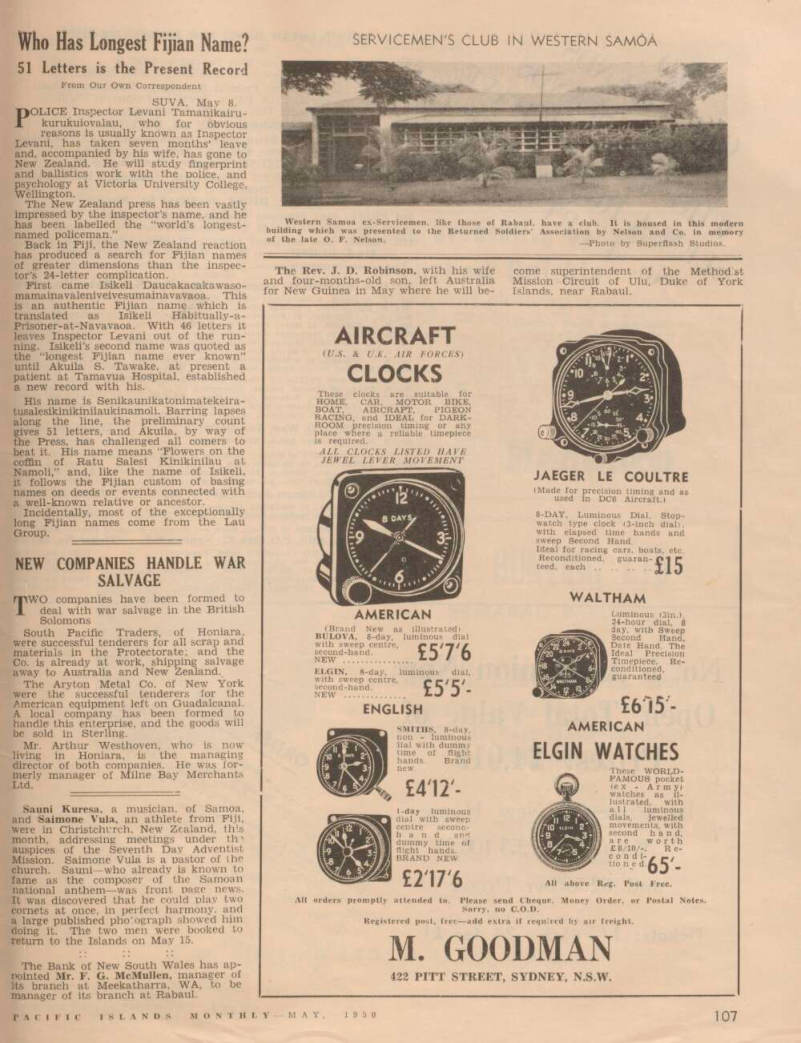
51 Letters is the Present Record
From Our Own Correspondent
Suva. Mav 8.
POLICE Inspector Levant Tamanikairu kurukuiovalau, who for obvious reasons is usually known as Inspector Levant, has taken seven months’ leave and, accompanied by his wife, has gone to New Zealand. He will study fingerprint and ballistics work with the police, and psychology at Victoria University College, Wellington.
The New Zealand press has been vastly impressed by the inspector’s name, and he has been labelled the “world’s longest named policeman.’’
Back in Fiji, the New Zealand reaction has produced a search for Fijian names of greater dimensions than the inspec tor’s 24-letter complication.
First came Isikeli Daucakacakawaso mamainavaleniveivesumainavavaoa. This is an authentic Fijian name which is translated as Isikeli Habitually-a- Prisoner-at-Navavaoa. With 46 letters it leaves Inspector Levant out of the run ning. Isikeli’s second name was quoted as the “longest Fijian name ever known” until Akuila S. Tawake, at present a patient at Tamavua Hospital, established a new record with his.
His name is Senikaunikatonimatekeira tusalesikinikinilaukinamoli. Barring lapses along the line, the preliminary count gives 51 letters, and Akuila, by way of the Press, has challenged all comers to beat it. His name means “Flowers on the coffin of Ratu Sales! Kinikinilau at Namoli,” and, like the name of Isikeli, it follows the Fijian custom of basing names on deeds or events connected with a well-known relative or ancestor.
Incidentally, most of the exceptionally long Fijian names come from the Lau Group.
New Companies Handle War
Salvage
TWO companies have been formed to deal with war salvage in the British Solomons South Pacific Traders, of Honiara, were successful tenderers for all scrap and materials in the Protectorate; and the Co. is already at work, shipping salvage away to Australia and New Zealand.
The Aryton Metal Co. of New York were the successful tenderers for the American equipment left on Guadalcanal.
A local company has been formed to handle this enterprise, and the goods will be sold in Sterling.
Mr. Arthur Westhoven, who is now living in Honiara, is the managing director of both companies. He was for merly manager of Milne Bay Merchants Ltd.
Sauni Kuresa, a musician, of Samoa, and Saimone Vula, an athlete from Fiji, Were in Christchurch, New Zealand, this month, addressing meetings under th 1 auspices of the Seventh Day Adventist Mission. Saimone Vula is a pastor of (he church. Sauni—who already is known to fame as the composer of the Samoan national anthem —was front page news.
It was discovered that he could play two cornets at once, in perfect harmony, and a large published pho'.ograph showed him doing it. The two men were booked to return to the Islands on May 15.
The Bank of New South Wales has ap pointed Mr. F. G. McMullen, manager of its branch at Meekatharra, WA, to be manager of its branch at Rabaul.
Servicemen's Club In Western Samoa
The Rev. J. D. Robinson, with his wife and four-months-old son, left Australia for New Guinea in May where he will be
come superintendent of the Method'st Mission Circuit of Ulu, Duke of York Islands, near Rabaul.
Western Samoa ex-Servicemen, like those of Rabaul, have a club. It is housed in this modern building which was presented to the Returned Soldiers’ Association by Nelson and Co. in memory of the late O. F. Nelson. —Photo by Superflash Studios.
Advertisements & other items, pp. 105-106 (1 item)
M. Goodman
AIRCRAFT
( U.S. & U.K. AIR FORCES)
CLOCKS
These clocks are suitable for
HOME, CAR, MOTOR BIKE,
BOAT, AIRCRAFT, PIGEON
RACING, and IDEAL for DARK-
ROOM precision timing or any place where a reliable timepiece is required.
ALE CLOCKS LISTED HAVE
JEWEL LEVER MOVEMENT
8 • :9 \/ *
AMERICAN
(Brand New as illustrated!
BULOVA, 8-day, luminous dial with sweep centre, second-hand.
NEW
£s'7'6 ELGIN, 8-day, luminous with sweep centre, dial, second-hand.
NEW
£s's'-
ENGLISH
% SMITHS, 8-day, non - luminous dial with dummy time of flight hands. Brand new £4'l2'- I-day luminous dial with sweep centre seconah a n d and dummy time of flight hands.
BRAND NEW
£2176 r
JAEGER LE COULTRE
(Made for precision timing and as used in DC6 Aircraft.) 8-DAY, Luminous Dial. Stopwatch type clock (3-inch dial), with elapsed time hands and sweep Second Hand.
Ideal for racing cars, boats, etc.
Reconditioned, guaranteed, each £l5
WALTHAM
Luminous (3in.). 24-hour dial, 8 day, with Sweep Second Hand, Date Hand. The Ideal Precision Timepiece. Reconditioned, guaranteed £6ls'-
AMERICAN
ELGIN WATCHES
These WORLD- FAMOUS pocket (ex - Army) watches as illustrated. with a 11 luminous dials. jewelled movements, with second hand, are worth £B/10/-. Recon d i- . r j tio n e d.A K m All above Reg. Post Free.
All orders promptly attended to. Please send Cheque, Money Order, or Postal Notes Sorry, no C.O.D.
Registered post, free—add extra if required by air freight.
M. GOODMAN
422 PITT STREET, SYDNEY, N.S.W.
ss> % IV
MOUNT COLAH HOME FOR EX-SERVICE-MEN
No. 4 Art Union
Drawn on 28th February, 1950, at
Air Force House, 97 Goulburn Street, Sydney, By Mr. C. J. Austin, Federal Secretary of Air Force Assn, in presence of the Police, Press and General Public,
Under Government Supervision.
PRIZE-WINNERS ARE AS FOLLOWS:
Ist PRIZE: One New Brick House (Unfurnished), VP., Situated
at Kingsgrove, Sydney. Ticket No. 152250
Mr. E. A. KRAUSE, Trungley, Temora, N.S.W. 2nd PRIZE: One DK725 Coldstream Domestic Refrigerator.
Ticket No. 304905.
Mr. R. J. S. HICKS, 36 Alfred St., Mascot. 3rd PRIZE: One Simpson Washing Machine. Ticket No. 682493.
Mr. JIM ARROLD, 23 Commissioner St., Cooma. 4th PRIZE: One Hotpoint Ironing Machine. Ticket No. 594231.
Mr. L. BURTON, c/o Mr. J. Murphy, Hillside, Victoria. sth to 14th PRIZES (10 Prizes): Each one (No. 1050) English 8-Day Chromium Clocks™™ Mr. C. E. EICHHORN, Angoram, Sepik Rv., N.G. Ticket No. 30716 Mrs. F. ARCHER, 6 Carruthers Street, Penshurst Ticket No. 556267 Mrs. R JOHNSTON, 2 Dalmar Street, Croydon Ticket No. 677777 Mrs. G. L. GIGNEY, 32 Frederick Street. Oatley Ticket No. 332313 Mr. K, L. GIBSON, 15 Henry Street, Randwick Ticket No. 664421 Mr. D. ALLAN, 20 Melbourne Street, Abermain Ticket No. 128022 Mrs. A. J. SEAMONS, Mclntosh Street. Echuca East, Victoria . . Ticket No. 80848 Mr. J. MONAGHAN, 31 Edwin Street, Croydon Ticket No. 348484 Mr. R. F. O’HARA, 41 O’Mara Street, Mayfield, Newcastle .. .. Ticket No. 707533 Mrs. BAKER, 89 Hubert Street, Victoria Park, Western Australia Ticket No. 88639 15th to 20th PRIZES (6 Prizes): Each one Formost Electric Radiator— Mr. R. BALK, 20 Worrail Avenue, Kingsgrove Ticket No. 146798 Mr. D. J. FOREMAN, Norwood Guest House, Blackheath . . . . Ticket No. 22601 Mr. C. L. TURNER, Garfield Road. Riverstone Ticket No. 32698 Miss E. BARTLEY, 39 Currawang Street, Concord West Ticket No. 568758 Mr. H. CLISSOLD, Wau, New Guinea .. Ticket No. 42992 Mr. H. MURPHY Clear Ridge, West Wyalong Ticket No. 385629 21st to 28th PRIZES (6 Prizes): Each one Hotpoint Chevron Electric Toaster Mrs. H. JAMES, Flat 63, Hargrave Park Ticket No. 392130 Mrs J. McNAMARA, Murdock Street, Turramurra Ticket 'No. 108906 Mr. R. F. ALLEN, 45 Georgina Street, Newtown Ticket No. 50706 Mr. J. ROSS, 16 Stuart Park, Darwin, N.T Ticket No. 83411 Mrs. R. ANDERSON, 16 Smithfleld Avenue, Coogee Ticket No. 73268 Miss C. McNABB, 96 Railway Road, St. Peters Ticket No. 406644 27th to 32nd PRIZES (6 Prizes): Each one Hotpoint Standard Electric Iron Mr. K. WILLIAMS, P.O. Box 23, Napier, N.Z. .. Ticket No. 202780 Mrs. D. M. BELL, 1414 Canterbury Road, Punchbowl Ticket No. 151562 Mr. E. H. MORTON, Box 24, Stockinbingal Ticket No. 157577 Mrs. L. DOHERTY, 187 Mowbray Road, Willoughby Ticket No. 555301) Mr. B. BUCKLEY, Pierce Street, Sydney Ticket No! 224654 Mrs. A. WINMILL, 139 Taylor Street, Armidale Ticket No. 524054
No. 5 Art Union Now
Open. Total Value of
Prizes: £4,019
Ist Prize —A New Home
Valued at £3,100
and 62 other Prizes
Tickets: 1/- each -24 for £1 .. ■.• c e^ e >V N x v , « M'S \ v % etoAo^V , ° 6 \ „s- -\ \ V^"‘ #*■ \ & V
Delegates to Fiji Hosts
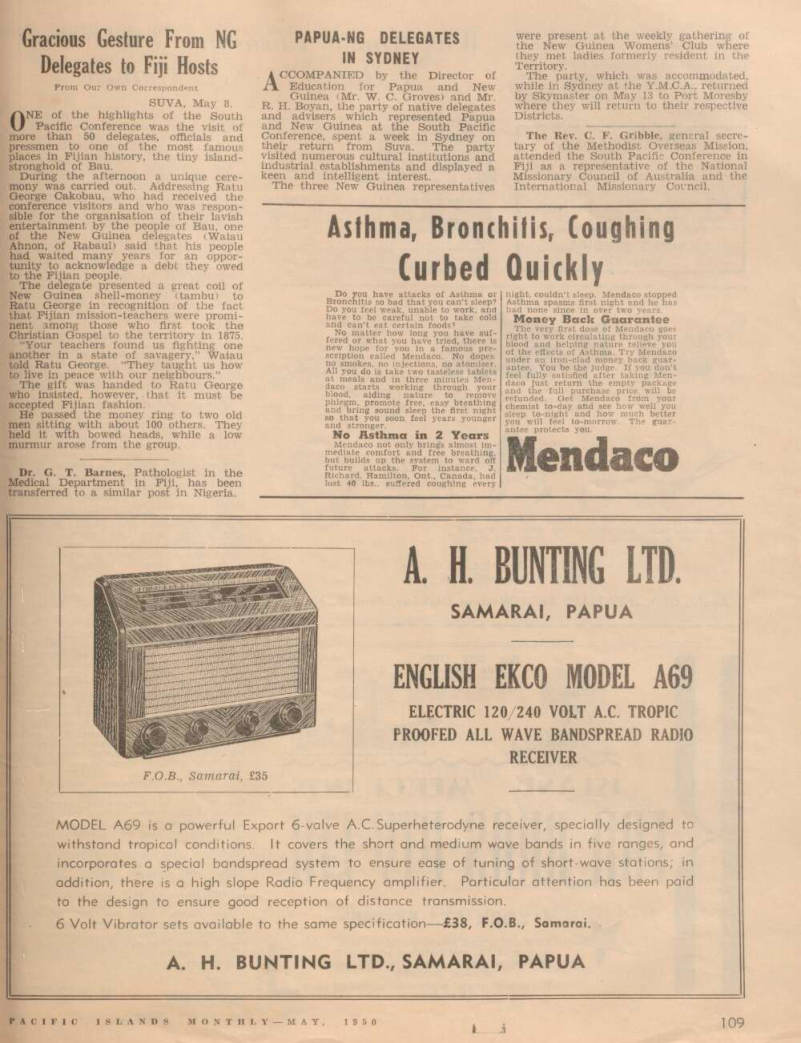
Gracious Gesture From NG Delegates to Fiji Hosts
From Our Own Correspondent
Suva, May 8.
ONE of the highlights of the South Pacific Conference was the visit of more than 50 delegates, officials and pressmen to one of the most famous places in Fijian history, the tiny island stronghold of Bau.
During the afternoon a unique cere mony was carried out. Addressing Ratu George Cakobau, who had received the conference visitors and who was respon sible for the organisation of their lavish entertainment by the people of Bau, one of the New Guinea delegates (Waiau Ahnon, of Rabaul) said that his people had waited many years for an oppor tunity to acknowledge a debt they owed to the Fijian people.
The delegate presented a great coil of New Guinea shell-money (tambu) to Ratu George in recognition of the fact that Fijian mission-teachers were promi nent among those who first took the Christian Gospel to the territory in 1875.
“Your teachers found us fighting one another in a state of savagery,” Waiau told Ratu George. “They taught us how to live in peace with our neighbours.”
The gift was handed to Ratu George who insisted, however, that it must be accepted Fijian fashion.
He passed the money ring to two old men sitting with about 100 others. They held it with bowed heads, while a low murmur arose from the group.
Dr. G. T. Barnes, Pathologist in the Medical Department in Fiji, has been transferred to a similar post in Nigeria.
Papua-Ng Delegates
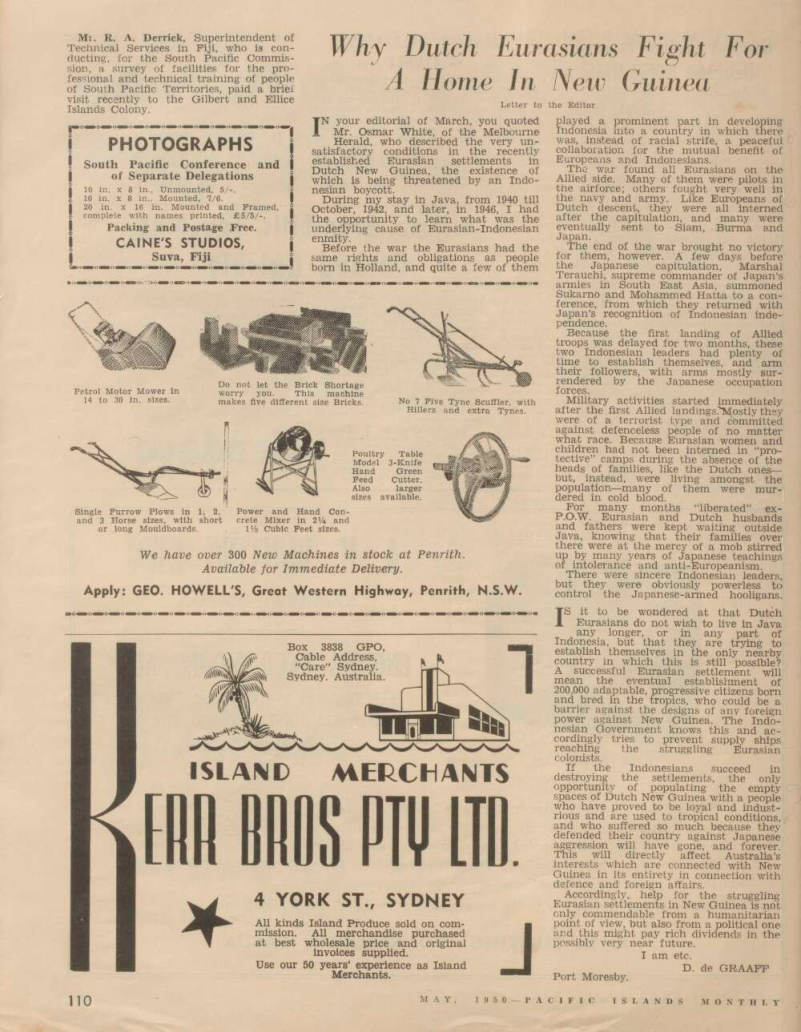
In Sydney
ACCOMPANIED by the Director of Education for Papua and New Guinea (Mr. W. C. Groves) and Mr.
R. H. Boyan, the party of native delegates and advisers which represented Papua and New Guinea at the South Pacific Conference, spent a week in Sydney on their return from Suva. The party visited numerous cultural institutions and industrial establishments and displayed a keen and intelligent interest.
The three New Guinea representatives
were present at the weekly gathering of the New Guinea Womens’ Club where they met ladies formerly resident in the Territory.
The party, which was accommodated, while in Sydney at the Y.M.C.A., returned by Skymaster on May 13 to Port Moresby where they will return to their respective Districts.
The Rev. C. F. Gribble, general secre tary of the Methodist Overseas Mission, attended the South Pacific Conference in Fiji as a representative of the National Missionary Council of Australia and the International Missionary Council.
Mi. R. A. Derrick, Superintendent of Technical Services in Fiji, who is con ducting, for the South Pacific Commis sion, a survey of facilities for the pro fessional and technical training of people of South Pacific Territories, paid a brief visit recently to the Gilbert and Ellice Islands Colony.
Advertisements & other items, pp. 107-108 (1 item)
A. H. Bunting Ltd.
Asthma, Bronchitis, Coughing Curbed Quickly
Do you have attacks of Asthma or Bronchitis so bad that you can’t sleep?
Do you feel weak, unable to work, and have to be careful not to take cold and can’t eat certain foods?
No matter how long you have suffered or what you have tried, there is new hope for you in a famous prescription called Mendaco. No dopes no smokes, no injections, no atomiser.
All you do is take two tasteless tablets at meals and in three minutes Mendaco starts working through your blood, aiding nature to remove phlegm, promote free, easy breathing and bring sound sleep the first night so that you soon feel years younger and stronger.
No Asthma in 2 Years
Mendaco not only brings almost immediate comfort and free breathing, but builds up the system to ward oft future attacks. For instance, J.
Richard, Hamilton, Ont., Canada, had lost 40 lbs., suffered coughing every
night, couldn’t sleep. Mendaco stopped Asthma spasms first night and he has had none since in over two years.
Money Back Guarantee
The very first dose of Mendaco goes right to work circulating through your blood and helping nature relieve you of the effects of Asthma. Try Mendaco under an iron-clad money back guarantee. You be the judge. If you don’t feel fully satisfied after taking Mendaco just return the empty package and the full purchase price will be refunded. Get Mendaco from your chemist to-day and see how well you sleep to-night and how much better you will feel to-morrow. The guarantee protects you.
Mendaco
A. H. BUNTING LTD.
SAMARAI, PAPUA
ENGLISH EKCO MODEL A 69
ELECTRIC 120/240 VOLT A.C. TROPIC
PROOFED ALL WAVE BANOSPREAD RADIO
RECEIVER
MODEL A 69 is a powerful Export 6-valve A.C.Superheterodyne receiver, specially designed to withstand tropical conditions. It covers the short and medium wave bands in five ranges, and incorporates a special bandspread system to ensure ease of tuning of short-wave stations; in addition, there is a high slope Radio Frequency amplifier. Particular attention has been paid to the design to ensure good reception of distance transmission. 6 Volt Vibrator sets available to the same specification —£38, F. 0.8., Samara!.
A. H. BUNTING LTD., SAMARAI, PAPUA
F. 0.8., Samarai, £35
PHOTOGRAPHS
South Pacific Conference and of Separate Delegations 10 in. x 8 in., Unmounted, 5/-. 10 in. x 8 in., Mounted, 7/6. 20 in. x 16 in. Mounted and Framed, complete with names printed, £5/5/-.
Packing and Postage Free.
CAINE'S STUDIOS,
Suva, Fiji
Petrol Motor Mower In 14 to 30 In. sizes.
Do not let the Brick Shortage worry you. This machine makes five different size Bricks.
No 7 Five Tyne Scuffler, with Hillers and extra Tynes.
Single Furrow Plows in 1,2, and 3 Horse sizes, with short or long Mouldboards.
Poultry Table Model 3-Knife Hand Green Peed Cutter.
Also larger sizes available.
Power and Hand Concrete Mixer in 214 and IV2 Cubic Feet sizes.
We have over 300 New Machines in stock at Penrith.
Available for Immediate Delivery.
Apply: GEO. HOWELL'S, Great- Western Highway, Penrith, N.S.W.
Box 3838 GPO, Cable Address, “Care” Sydney.
Sydney. Australia. r PH
ISLAND MERCHANTS
4 YORK ST., SYDNEY
All kinds Island Produce sold on commission. All merchandise purchased at best wholesale price and original invoices supplied.
Use our 50 years’ experience as Island Merchants.
J
Why Dutch Eurasians Fight
A Home In Guinea
Letter to the Editor
IN your editorial of March, you quoted Mr. Osmar White, of the Melbourne Herald, who described the very un satisfactory conditions in the recently established Eurasian settlements in Dutch New Guinea, the existence of which is being threatened by an Indo nesian boycott.
During my stay in Java, from 1940 till October, 1942, and later, in 1946, I had the opportunity to learn what was the underlying cause of Eurasian-Indonesian enmity.
Before the war the Eurasians had the same rights and obligations as people born in Holland, and quite a few of them
played a prominent part in developing Indonesia into a country in which there was, instead of racial strife, a peaceful collaboration for the mutual benefit of Europeans and Indonesians.
The war found all Eurasians on the Allied side. Many of them were pilots in the airforce; others fought very well in the navy and army. Like Europeans of Dutch descent, they were all interned after the capitulation, and many were eventually sent to Siam, Burma and Japan.
The end of the war brought no victory for them, however. A few days before the Japanese capitulation, Marshal Terauchi, supreme commander of Japan’s armies in South East Asia, summoned Sukarno and Mohammed Hatta to a con ference, from which they returned with Japan’s recognition of Indonesian inde pendence.
Because the first landing of Allied troops was delayed for two months, these two Indonesian leaders had plenty of time to establish themselves, and arm their followers, with arms mostly sur rendered by the Jananese occupation forces.
Military activities started immediately after the first Allied landings.'Mostly they were of a terrorist tvpe and committed against defenceless people of no matter what race. Because Eurasian women and children had not been interned in “pro tective” camps during the absence of the heads of families, like the Dutch ones— but, instead, were living amongst the population—many of them were mur dered in cold blood.
For many months “liberated” ex- P.O.W. Eurasian and Dutch husbands and fathers were kept waiting outside Java, knowing that their families over there were at the mercy of a mob stirred up by many years of Japanese teachings of intolerance and anti-Europeanism.
There were sincere Indonesian leaders, but they were obviously powerless to control the Japanese-armed hooligans.
IS it to be wondered at that Dutch Eurasians do not wish to live in Java any longer, or in any part of Indonesia, but that they are trying to establish themselves in the only nearby country in which this is still possible?
A successful Eurasian settlement will mean the eventual establishment of 200,000 adaptable, progressive citizens bom and bred in the tropics, who could be a barrier against the designs of any foreign power against New Guinea. The Indo nesian Government knows this and ac cordingly tries to prevent supply ships reaching the struggling Eurasian colonists.
If the Indonesians succeed in destroying the settlements, the only opportunity of populating the empty spaces of Dutch New Guinea with a people who have proved to be loyal and indust rious and are used to tropical conditions, and who suffered so much because they defended their country against Japanese aggression will have gone, and forever.
This will directly affect Australia’s interests which are connected with New Guinea in its entirety in connection with defence and foreign affairs.
Accordingly, help for the struggling Eurasian settlements in New Guinea is not only commendable from a humanitarian point of view, but also from a political one and this might pay rich dividends in the possibly very near future.
I am etc.
D. De Graaff
Port Moresby.
Search For Oil In Papua
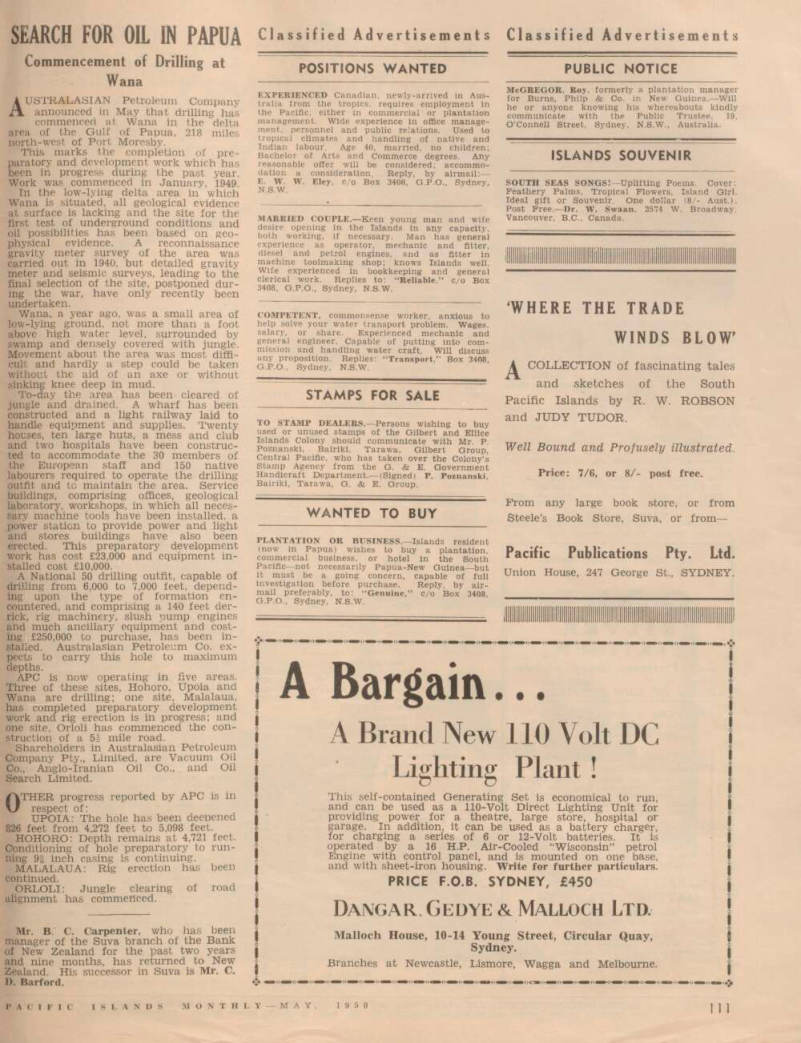
Commencement of Drilling at Wana
AUSTRALASIAN Petroleum Company announced in May that drilling has commenced at Wana in the delta area of the Gulf of Papua. 218 miles north-west of Port Moresby.
This marks the completion of pre paratory and development work which has been in progress during the past year.
Work was commenced in January, 1949.
In the low-lying delta area in which Wana is situated, all geological evidence at surface is lacking and the site for the first test of underground conditions and oil possibilities has been based on geo physical evidence. A reconnaissance gravity meter survey of the area was carried out in 1940, but detailed gravity meter and seismic surveys, leading to the final selection of the site, postponed dur ing the war, have only recently been undertaken.
Wana, a year ago, was a small area of low-lying ground, not more than a foot above high water level, surrounded by swamp and densely covered with jungle.
Movement about the area was most diffi cult and hardly a step could be taken without the aid of an axe or without sinking knee deep in mud.
To-day the area has been- cleared of jungle and drained. A wharf has been constructed and a light railway laid to handle equipment and supplies. Twenty houses, ten large huts, a mess and club and two hospitals have been construc ted to accommodate the 30 members of the European staff and 150 native labourers required to operate the drilling outfit and to maintain the area. Service buildings, comprising offices, geological laboratory, workshops, in which all neces sary machine tools have been installed, a power station to provide power and light and stores buildings have also been erected. This preparatory development work has cost £23,000 and equipment in stalled cost £lO,OOO.
A National 50 drilling outfit, capable of drilling from 6,000 to 7,000 feet, depend ing upon the type of formation en countered, and comprising a 140 feet der rick, rig machinery, slush pump engines and much ancillary equipment and cost ing £250,000 to purchase, has been in stalled. Australasian Petroleum Co. ex pects to carry this hole to maximum depths.
APC is now operating in five areas.
Three of these sites, Hohoro, Upoia and Wana are drilling; one site, Malalaua, has completed preparatory development work and rig erection is in progress; and one site, Orloli has commenced the con struction of a 5J mile road.
Shareholders in Australasian Petroleum Company Pty., Limited, are Vacuum Oil Co., Anglo-Iranian Oil Co., and Oil Search Limited.
OTHER progress reported by APC is in respect of: UPOIA; The hole has been deepened 826 feet from 4,272 feet to 5,098 feet.
HOHORO: Depth remains at 4,721 feet.
Conditioning of hole preparatory to run ning 9g inch casing is continuing.
MALALAUA: Rig erection has been continued.
ORLOLI: Jungle clearing of road alignment has commenced.
Mr. B. C. Carpenter, who has been manager of the Suva branch of the Bank of New Zealand for the past two years and nine months, has returned to New Zealand. His successor in Suva is Mr. C. 1). Barford.
Advertisements & other items, p. 109 (2 items)
111
PACIFIC I S L A N D S MONTHLY MAY, 1950
A Bargain...
Classified Advertisements
POSITIONS WANTED
EXPERIENCED Canadian, newly-arrived in Australia from the tropics, requires employment in the Pacific, either in commercial or plantation management. Wide experience in office management, personnel and public relations. Used to tropical climates and handling of native and Indian labour. Age 40, married, no children: Bachelor of Arts and Commerce degrees. Any reasonable offer will be considered; accommodation a consideration. Reply, by airmail:— E. W. W. Eley, c/o Box 3408, G.P.0., Sydney,
N.S.W.
MARRIED COUPLE.—Keen young man and wife desire opening in the Islands in any capacity, both working, if necessary. Man has general experience as operator, mechanic and fitter, diesel and petrol engines, and as fitter In machine toolmaking shop; knows Islands well.
Wife experienced in bookkeeping and general clerical work. Replies to; “Reliable,” c/o Box 3408, G.P.0., Sydney, N.S.W.
COMPETENT, commonsense worker, anxious to help solve your water transport problem. Wages, salary, or share. Experienced mechanic and general engineer. Capable of putting into commission and handling water craft. Will discuss any proposition. Replies: “Transport,” Box 3408, G.P.0., Sydney, N.S.W.
STAMPS FOR SALE
TO STAMP DEALERS.—Persons wishing to buy used or unused stamps of the Gilbert and Ellice Islands Colony should communicate with Mr. P.
Poznanski, Bairiki, Tarawa, Gilbert Group, Central Pacific, who has taken over the Colony’s Stamp Agency from the G. & E. Government Handicraft Department.— (Signed) P. Poznanski, Bairiki, Tarawa, G. & E. Group.
WANTED TO BUY
PLANTATION OR BUSINESS.—IsIands resident (now in Papua) wishes to buy a plantation, commercial business, or hotel in the South Pacific —not necessarily Papua-New Guinea —but it must be a going concern, capable of full investigation before purchase. Reply, by airmail preferably, to: “Genuine,” C/o Box 3408, G.P.0., Sydney, N.S.W.
Classified Advertisements
PUBLIC NOTICE
McGREGOR, Roy, formerly a plantation manager for Burns, Philp & Co. in New Guinea. —Will he or anyone knowing his whereabouts kindly communicate with the Public Trustee, 19, O’Connell Street, Sydney, N.S.W., Australia.
ISLANDS SOUVENIR
SOUTH SEAS SONGS!—Uplifting Poems. Cover; Feathery Palms, Tropical Flowers, Island Girl.
Ideal gift or Souvenir, One dollar (8/- Aust.).
Post Free. —Dr. W. Swaan, 2574 W. Broadway, Vancouver, 8.C., Canada.
‘WHERE THE TRADE
WINDS BLOW’
COLLECTION of fascinating tales and sketches of the South Pacific Islands by R. W. ROBSON
and JUDY TUDOR.
Well Bound and Profusely illustrated.
Price: 7/6, or 8/- post free.
From any large book store, or from Steele’s Book Store, Suva, or from —
Pacific Publications Pty. Ltd.
Union House, 247 George St., SYDNEY.
A Bargain...
A Brand New 110 Volt DC
Lighting Plant !
This self-contained Generating Set is economical to run, and can be used as a 110-Volt Direct Lighting Unit for providing power for a theatre, large store, hospital or garage. In addition, it can be used as a battery charger, for charging a series of 6 or 12-Volt batteries. It is operated by a 16 H.P. Air-Cooled “Wisconsin” petrol Engine with control panel, and is mounted on one base, and with sheet-iron housing. Write for further particulars,
PRICE F. 0.8. SYDNEY, £450
Dang a r Gedye & Malloch Ltd.
Malloch House, 10-14 Young Street, Circular Quay, Sydney.
Branches at Newcastle, Lismore, Wagga and Melbourne.
Islands Produce
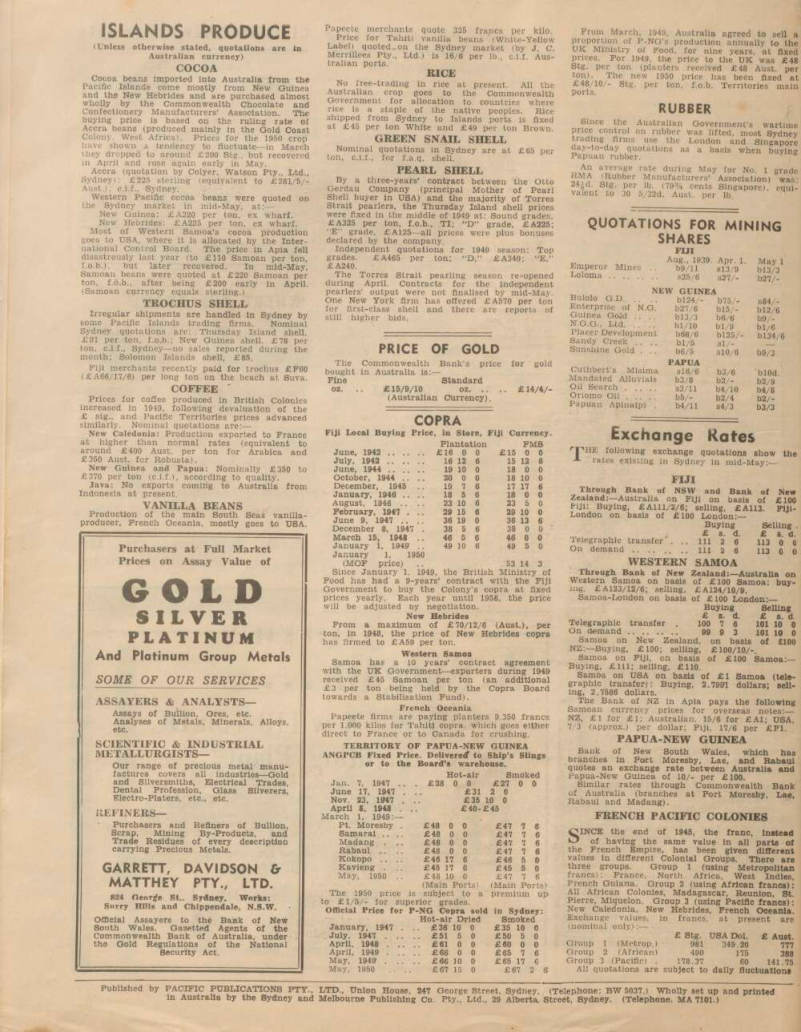
(Unless otherwise stated, quotations are in Australian currency)
Cocoa
Cocoa beans Imported into Australia from the Pacific Islands come mostly from New Guinea and the New Hebrides and are purchased almost wholly by the Commonwealth Chocolate and Confectionery Manufacturers’ Association. The buying price is based on the ruling rate of Accra beans (produced mainly in the Gold Coast Colony, West Africa). Prices for the 1950 crop have shown a tendency to fluctuate —in March they dropped to around £2OO Stg., but recovered in April and rose again early in May.
Accra (quotation by Colyer, Watson Pty., Ltd., Sydney): £225 sterling (equivalent to £2Bl/5/- Aust.), c.i.f., Sydney.
Western Pacific cocoa beans were quoted on the Sydney market in mid-May, at: — New Guinea: £A22O per ton, ex wharf.
New Hebrides: £A225 per ton, ex wharf.
Most of Western Samoa’s cocoa production goes to USA, where it is allocated by the Inter national Control Board. The price in Apia fell disastrously last year (to £llO Samoan per ton, f.0.b.), but later recovered. In mid-May, Samoan beans were quoted at £220 Samoan per ton, f.0.b., after being £2OO early in April. (Samoan currency equals sterling.)
Trochus Shell
Irregular shipments are handled In Sydney by some Pacific Islands trading firms. Nominal Sydney quotations are; Thursday Island shell, £9l per ton, f.0.b.; New Guinea shell, £7B per ton, c.i.f., Sydney—no sales reported during the month; Solomon Islands shell, £B5.
Fiji merchants recently paid for trochus £P6O (£A66/17/6) per long ton on the beach at Suva.
Coffee
Prices for coffee produced in British Colonies increased in 1949, following devaluation of the £ stg., and Pacific Territories prices advanced similarly. Nominal quotations are:— New Caledonia: Production exported to France at higher than normal rates (equivalent to around £4OO Aust. per ton for Arablca and £350 Aust. for Robusta).
New Guinea and Papua: Nominally £350 to £370 per ton (c.i.f.), according to quality.
Java: No exports coming to Australia from Indonesia at present.
Vanilla Beans
Production of the main South Seas vanilla producer, French Oceania, mostly goes to USA.
Papeete merchants quote 325 francs per kilo.
Price for Tahiti vanilla beans (White-Yellow Label) quoted..on the Sydney market (by J. C.
Merrillees Pty., Ltd.) is 16/6 per lb., c.i.f. Aus tralian ports.
Rice
No free-trading in rice at present. All the Australian crop goes to the Commonwealth Government for allocation to countries where rice is a staple of the native peoples. Rice shipped from Sydney to Islands ports is fixed at £45 per ton White and £49 per ton Brown.
Green Snail Shell
Nominal quotations in Sydney are at £65 per ton, c.i.f., for f.a.q. shell.
Pearl Shell
By a three-years’ contract between the Otto Gerdau Company (principal Mother of Pearl Shell buyer in USA) and the majority of Torres Strait pearlers, the Thursday Island shell prices were fixed in the middle of 1949 at; Sound grades, £A.325 per ton, f.0.b., TI; “D” grade, £A225; “E” grade, £AI25 —all prices were plus bonuses declared by the company.
Independent quotations for 1949 season: Top grades. £A465 per ton; "D,” £A34O; “E,” £ A 240.
The Torres Strait pearling season re-opened during April. Contracts for the independent pearlers’ output were not finalised by mid-May.
One New York firm has offered £AS7O per ton for first-class shell and there are reports of still higher bids.
Advertisements & other items, p. 110 (1 item)
Price Of Gold
The Commonwealth Bank’s price for gold bought in Australia is:— Pine Standard OZ. .. £l5/9/10 oz £l4/4/- (Australian Currency).
Rubber
Copra
(MOP price) .. 53 14 3 Since January 1, 1949, the British Ministry of Food has had a 9-years’ contract with the Fiji Government to buy the Colony’s copra at fixed prices yearly. Each year until 1958, the price will be adjusted by negotiation.
New Hebrides Prom a maximum of £7O/12/6 (Aust.), per ton, in 1948, the price of New Hebrides copra has firmed to £AS9 per ton.
Western Samoa Samoa has a 10 years’ contract agreement with the UK Government —exporters during 1949 received £45 Samoan per ton (an additional £3 per ton being held by the Copra Board towards a Stabilisation Fund).
French Oceania Papeete firms are paying planters 9,350 francs per 1,000 kilos for Tahiti copra, which goes either direct to France or to Canada for crushing.
Territory Of Papua-New Guinea
ANGPCB Fixed Price. Delivered to Ship’s Slings or to the Board’s warehouse.
From March, 1949, Australia agreed to sell a proportion of P-NG’s production annually to the UK Ministry of Pood, for nine years, at fixed prices. For 1949, the price to the UK was £4B Stg. per ton (planters received £4B Aust. per ton). The new 1950 price has been fixed at £4B/10/- Stg. per ton, f.o.b. Territories main ports.
Rubber
Since the Australian Government’s wartime price control on rubber was lifted, most Sydney trading firms use the London and Singapore day-to-day quotations as a basis when buying Papuan rubber.
An average rate during May for No. 1 grade RMA (Rubber Manufacturers’ Association) was: 24>d. Stg. per lb. (79% cents Singapore), equi valent to 30 5/32d. Aust. per lb.
Fiji Local Buying Price
in Store, Fiji Currency Plantation
Pms
June, 1942
£16 0 0 £15 0 0
July, 1942
16 12 6 15 12 6 June, 1944 19 10 0 18 0 0 October, 1944 .. .. 20 0 0 18 10 0
December, 1945 . .
19 7 6 17 17 6
January, 1946 .. ..
18 5 6 18 0 0
August, 1946 ,. ..
23 10 6 23 5 0
February, 1947 . ..
29 15 6 29 10 0 June 9. 1947 .. ., 36 19 0 36 13 6 December 8, 1947 . 38 5 6 38 0 0
March 15, 1948 ..
46 5 6 46 0 0
January 1, 1949 ..
49 10 6 49 5 0 January 1, 1950
Hot-air Smoked Jan. 7, 1947 .. . £28 0 0 £27 0 0 June 17, 1947 £31 2 0 Nov. 23, 1947 . £35 10 0 April 8, 1948 . £40- £45 March 1, 1949:— Pt. Moresby . £48 0 0 £47 7 6 Samaral .. £48 0 0 £47 7 6 Madang . .. £48 0 0 £47 7 6 Rabaul .. £48 0 0 £47 7 6 Kokopo .. £46 17 6 £46 5 0 Kavieng . .. £45 17 6 £45 5 0 May, 1950 . . £48 10 0 £47 7 6 (Main Ports) (Main Portsi The 1950 price is subject to a premium up to £1/5/- for superior grades.
Official Price for P-NG Copra sold in Sydney: Hot-air Dried Smoked January, 1947 . .. £36 10 0 £35 10 0 July, 1947 . .. .. £51 5 0 £50 5 0 April, 1948 . .. .. £61 0 0 £60 0 0 April, 1949 . . . .. £66 0 0 £65 7 6 May, 1949 . .. .. £66 10 0 £65 17 6 May, 1950 £67 15 0 £67 2 6
Quotations For Mining
Shares
Emperor Mines ..
Fiji
Aug., 1939.
Apr. 1. b9/ll SI3/9 bl3/3 Loloma S25/6 s27/b27/-
New Guinea
Bulolo G.D. bl24/b75/s84/- Enterprise of N.G. b27/6 b!5/b!2/6 Guinea Gold .. .. b!3/3 b6/ti b9/- •N.G.G., Ltd bl/10 bl/9 bl/6 Placer Development b68/6 b!25/b!34/6 Sandy Creek ., bl/5 Si/- Sunshine Gold . b6/5 slO/6 b9/3 Cuthbert’s Misima
Papua
S16/6 b3/6 blOd.
Mandated Alluvials b3/8 b2/b2/9 Oil Search S3/11 b4/10 b4/8 Oriomo Oil b5/b2/4 b2/- Papuan Apinaipi . b4/ll s4/3 b3/3
Exchange Kates
'T'HE following exchange quotations show the ra tes existing in Sydney in mid-May;—
Fiji
Through Bank of NSW and Bank of New Zealand:—Australia on Fiji on basis of £lOO Fiji: Buying, £Alll/2/6; selling. £AII3. Flji- London on basis of £lOO London:—
Western Samoa
Through Bank of New Zealand:—Australia on Western Samoa on basis of £lOO Samoa: buy ing, £AI23/12/6; selling, £AI24/10/9.
Samoa-London on basis of £lOO London;—
Samoa on New Zealand, on basis of £lOO NZ:—Buying, £100; selling, £lOO/10/-.
Samoa on Fiji, on basis of £lOO Samoa:— Buying, £111; selling, £llO.
Samoa on USA on basis of £1 Samoa (tele graphic transfer): Buying, 2.7991 dollars; sell ing, 2.7586 dollars.
The Bank of NZ in Apia pays the following Samoan currency prices for overseas notes;— NZ, £1 for £1; Australian, 15/6 for £AI; USA, 7/3 (approx.) per dollar; Fiji, 17/6 per £FI.
Papua-New Guinea
Bank of New South Wales, which has branches in Port Moresby, Lae, and Rabaul quotes an exchange rate between Australia and Papua-New Guinea of 10/- per £lOO.
Similar rates through Commonwealth Bank of Australia (branches at Port Moresby, Lae.
Rabaul and Madang).
French Pacific Colonies
SINCE the end of 1945, the franc, Instead of having the same value in all parts of the French Empire, has been given different values in different Colonial Groups. There are three groups. Group 1 (using Metropolitan francs): France, North Africa, West Indies.
French Guiana. Group 2 (using African francs): All African Colonies, Madagascar, Reunion, St Pierre, Miquelon. Group 3 (using Pacific francs); New Caledonia, New Hebrides, French Oceania.
Exchange values, in francs, at present are (nominal only):
Buying Selling . £ s. d. £ s. d Telegraphic transfer . .. Ill 2 6 113 0 0 On demand .. .. 113 0 0
Buying Selling £ s. d. £ s. d Telegraphic transfer . 100 7 6 101 10 0 On demand 99 9 3 101 10 0
£ Stg.
USA Dol. £ Aust.
Group 1 (Metrop.) 981 349.20 777 Group 2 (African) 490 175 388 Group 3 (Pacific* . 178.37 60 141.75 All quotations are subject to dally fluctuations
Advertisements & other items, pp. 110-113 (3 items)
Published by PACIFIC PUBLICATIONS PTY., LTD., Union House, 247 George Street, Sydney. (Telephone: BW 5037.) Wholly set up and printed
in Australia by the Sydney and Melbourne Publishing Co. Pty., Ltd., 29 Alberta. Street, Sydney. (Telephone. MA 7101.)
Gold
Purchasers at Full Market Prices on Assay Value of
SILVER
PLATINUM
And Platinum Group Metals
SOME OF OUR SERVICES
ASSAYERS & ANALYSTS—
Assays of Bullion, Ores, etc.
Analyses of Metals, Minerals, Alloys, etc.
SCIENTIFIC & INDUSTRIAL
METALLURGISTS—
Our range of precious metal manufactures covers all industries—Gold and Silversmiths, Electrical Trades, Dental Profession. Glass Sllverers, Electro-Platers, etc., etc.
REFINERS—
Purchasers and Refiners of Bullion, Scrap, Mining By-Products, and Trade Residues of every description carrying Precious Metals.
GARRETT, DAVIDSON &
MATTHEY PTY., LTD.
824 George St., Sydney. Works: Sorry Hills and Chippendale, N.S.W.
Official Assayers to the Bank of New South Wales. Gazetted Agents of the Commonwealth Bank of Australia, under the Gold Regulations of the National Security Act.
Tooth’S
m'c & - -vJ G
gjvrlr
ood company deserves the best, and it is a thoughtful and discerning host who serves his guests sparkling K.B. Lager. For “K. 8.” adds enjoyment to any gathering, and it’s one drink that’s appreciated by everybody, men and women alike.
TOOTH’S
LAGER
’Ooth ,
-francs ' /Cans (Whiteey market (bv /' - B f-
MERCHANTS, <3c SHIP OWNERS
Capital £500,000
ESTABLISHED 1914
\gIRARY Op
> |r ItV OOf MAT fu 1
ENERAL MERCHANTS
AND
PROVIDORES
TRADE THROUGHOUT THE PACIFIC.
THIRTY-FIVE YEARS OF PACIFIC ISLANDS DEVELOPMENT AND SERVICE.
BUYERS AND EXPORTERS OF ALL KINDS
OF ISLAND PRODUCE, COPRA, COCOA,
M.O.P. SHELL, TROCAS SHELL, ETC.
AGENTS FOR AUSTRALIAN, EUROPEAN
AND AMERICAN MANUFACTURERS.
DISTRIBUTORS OF EVERY DESCRIPTION
OF MERCHANDISE.
Through our Sydney office , branches and agents , we distribute a wide and comprehensive range of general merchandise.
W. R. CARPENTER & CO. LTD.
Head Office: 16 O'CONNELL STREET, SYDNEY, N.S.W.
Cable Address:
“CAMOHE.”
Telephone: BW 4421.
Postal Address; G.P.0., BOX 168, Sydney.
In London: W, R. Carpenter & Co. (London), Ltd., Coronation House, 4 Lloyd's Ave., London, EC
ASSOCIATED COMPANIES THROUGHOUT THE PACIFIC:
IN NEW GUINEA:
New Guinea Company, Limited, Rabaul, Lae, Madang, Kavieng.
IN PAPUA:
J. R. Clay & Co., Ltd., Port Moresby.
IN FIJI:
W. R. Carpenter & Co. (Fiji), Ltd., Suva.
PACIFIC
BOOK HOUSE
PACIFIC
PRESS
PACIFIC BOOK HOUSE
BILL & PATRICIA MCGRATH
ESTABLISHED
1984 Dealers in quality used and rare books, new and out-of-print books, mainly about the Pacific, Antarctica, Australia, Local History, Queensland, Japan, Indonesia, S.E.
Asia, Melanesia, Micronesia, Polynesia, Pacific War, Korean War, Vietnam War, Militaria, Aviation, Railways, Travel & Exploration, Natural History and Anthropology. • WE SEARCH FOR OUT-OF-PRINT BOOKS • YOUR WANTS LISTS ARE ALWAYS WELCOME • WE WILL RESPOND TO YOUR ENQUIRIES Catalogues on the above subjects are produced regularly. ■ Ask to be placed on our mailing list for free catalogues. ■ Please specify your interests. ■ Bookrooms by Prior Appointment only ■ Quality Books at Reasonable Prices ■ All major credit cards accepted.
NEW GUINEA IS OUR SPECIALITY
"Recognised as the Pacific's leading specialist in new, out-of-print, used, scarce and rare books on the Pacific islands, particularly New Guinea" 17 PARK AVENUE, BROADBEACH WATERS, GOLD COAST, QUEENSLAND, AUSTRALIA 4218 TEL (07) 5539 0446 * INTERNATIONAL TEL 617 5539 0446 * [email protected] FAX (07) 5538 4114 * INTERNATIONAL FAX6I7 5538 4114 * VVEB S TE www.pacificbookhousc.com.au