Islands
Pacific
Monthly
March 19. 1948
Vol. Xviii. No. 8.
Established 1930.
VRegistered\at the G.P.0., Sy^^y^tor K transmission hy post as a newspaper ]
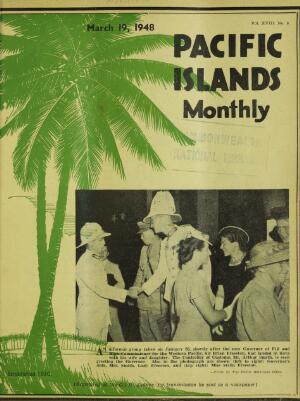
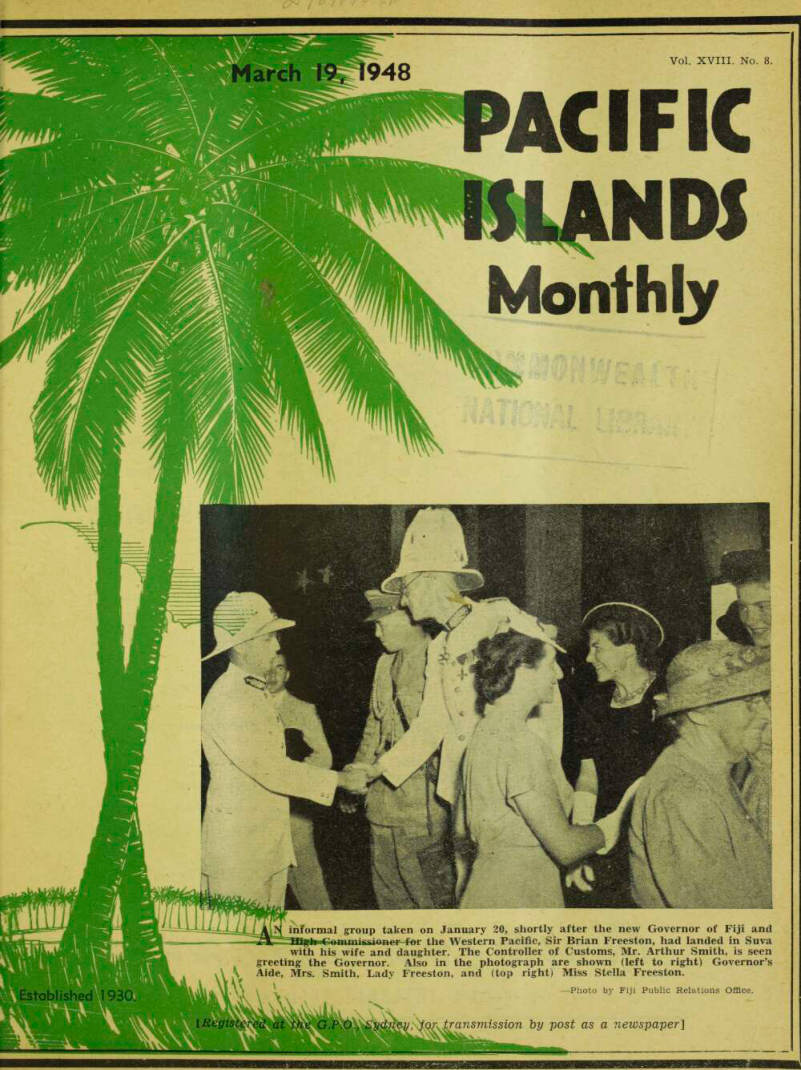
AN informal group taken on January 20, shortly after the new Governor of Fiji and High Commissioner for the Western Pacific, Sir Brian Freeston, had Ianded in Suva with his wife and daughter. The Controller of Customs, Mr. Arthur Smith, is seen greeting the Governor. Also in the photograph are shown (left to right) Governor’s Aide, Mrs. Smith, Lady Freeston, and (top right) Miss Stella Freeston. —Photo by Fiji Public Relations Office.
Advertisements & other items, pp. 2-4 (1 item)
Cfanfa
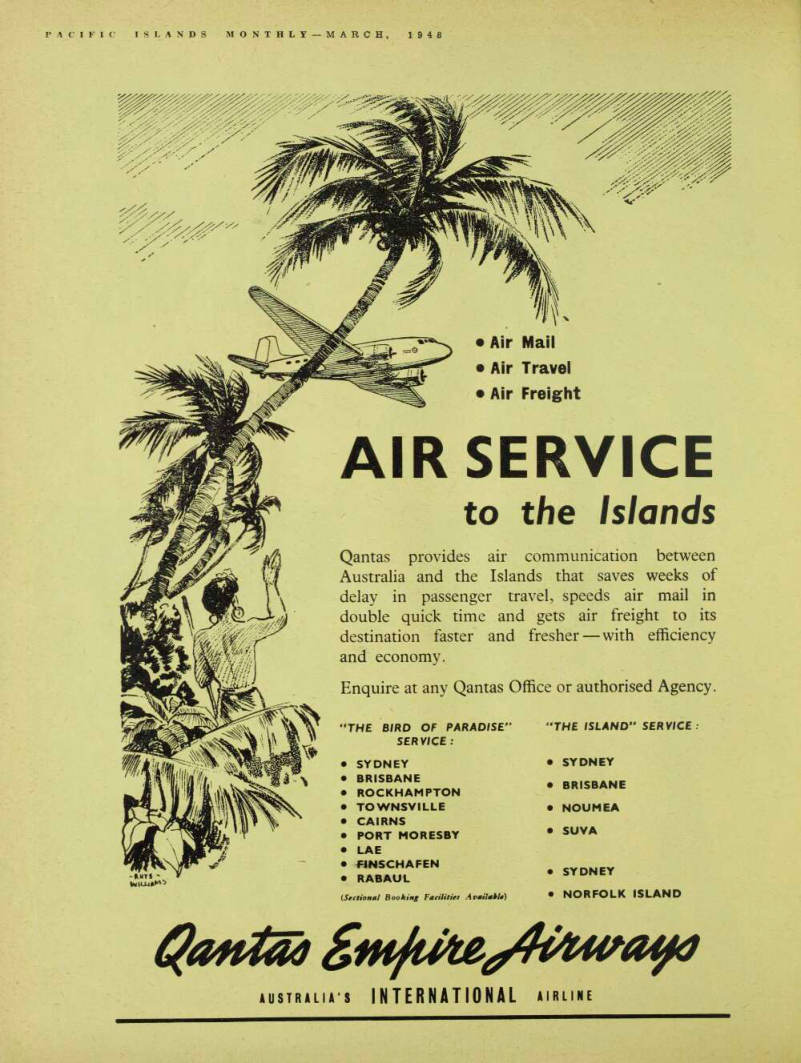
If. • Air Mail • Air Travel • Air Freight »»S=a 7> \ \ % P A 2 r\ ' >7--'
AIR SERVICE
to the Islands
Qantas provides air communication between Australia and the Islands that saves weeks of delay in passenger travel, speeds air mail in double quick time and gets air freight to its destination faster and fresher —with efficiency and economy.
Enquire at any Qantas Office or authorised Agency.
“THE BIRD OF PARADISE"
SERVICE :
• SYDNEY
• BRISBANE
• ROCKHAMPTON
• TOWNSVILLE
• CAIRNS
• PORT MORESBY
• LAE
• PINSCHAFEN
• RABAUL
(Sectional Booking Facilities Available)
THE ISLAND" SERVICE
• SYDNEY
• BRISBANE
• NOUMEA
• SUVA
• SYDNEY
• NORFOLK ISLAND
Cfanfa
AUSTRALIA’S INTERNATIONAL airline
SoAe, yppub
KffiCff/lf
Coleman’s fuel irons have dominated the field for over 30 years, and will continue to do so, for the experience they have gained has not been enjoyed by other makers.
Whichever you choose, petrol or kerosene, you can be sure you have the “Best of its kind Kerosene Iron Requires preheating with methylated spirits I Petrol Iron This model requires no preheating.
Both these self-heating irons are streamlined and have hand protected air-cooled hoods. They are light, and perfectly balanced to eliminate fatigue.
The irons can be used in and out of doors as there are no wires or connections. The bodies are ventilated, the edges tapered for ironing pleats and around buttons, and additional heat is developed at points for fine ironing work. Efficient, simple, economical.
Representatives for the Pacific Islands
ROBERT GILLESPIE PTY. LTD.
54a PITT STREET, SYDNEY
PEARCE & CO. LTD
SUVA
FOR FIJI ISLANDS
ISLANDS MONTHLY
% % ! •A P:\ A.r I A B
BRONTE BRAND
9 Chili Con Came • Braised Steak and Onions 9 Curried Beef • Curried Mutton 9 Steak and Onions 9 Mutton and Peas 9 Irish Stew • Beef Steak Pudding • Corned Beef Hash • Corned Beef Loaf With Cereal • Mutton Broth • Mulligatawny Soup • Tomato Soup 9 Vegetable Soup
From
Australia’s
Finest Fat
Stock ...
From the finest fat stock and the richest vegetables in Australia we produce these high-grade canned meats and soups. BRONTE BRAND meats, hotmeals and soups are deliciously flavoured and are made from
ONLY meats and vegetables
of the highest quality
THE COLONIAL WHOLESALE MEAT CO.
PTY. LTD.
Canning Factory, State Abattoirs, Homebush Bay, Sydney.
N.S.W.
PHONES:
PHONE: UM 8436.
CABLE ADDRESS:
WOOLMILL. SYDNEY.
ft p
Advertisers
Aluminium Union, Ltd 33 Angliss & Co. ... 36 Atkins Pty., Ltd., Wm 24 Anchor Hocking Glassware ... 73 Australian Block & Chain Co. Pty., Ltd. ... 33 Amalgamated Hatcheries ... 26 Australian Yeast Co 63 Bethell, Gwyn & Co. 22 Brunton’s Flour . 33 Berger, Lewis & Sons 48 Bestseller Book Club 13 Burns, Philp (New Hebrides), Ltd. . 15 Bank of NSW ... 16 Brial & Ball ... 19 Burns, Philp (NG), Ltd 45 Boxley Pty., Ltd. . 17 Burns, Philp Trust Co., Ltd 64 Budge, James, Pty., Ltd .56 Broomflelds ... 78 BP (SS) Co. . . . 34 W. R. Carpenter & Co. (Fiji), Ltd. . 66 Caine’s Studios, Suva 23 Carpenter. Ltd., W. r cov. iv.
Colonial Wholesale Meat 2 Colyer Watson (New Guinea), Ltd. . . 76 Corrie & Co. . . .75 Costello, Vince Garrick Hotel . . 74 “Cystex” 72 Copra Growers’
Union 76 Cinevox Precision Engineering Co.
Pty., Ltd. ... 47 Donaghy & Sons . 46 Donald, Ltd., A. B. 56 Davison Paints Pty., Ltd. . 68 Dr. Williams Pink Pills 30 Dangar, Gedye & Malloch ... 3 Dunlop Rubber (A/sia), Ltd. . . 30 Electrolux Refrigerators . . 62 Excelsior Supply Co. 59 Ford Sherington . 28 Garrett & Davidson 80 Gillespie Pty., Ltd..
Robert . . . 1 & 25 R o b t, Gillespie (NG), Ltd. ... 79 Goode Lynes ... 52 Gilbey’s Gin ... 70 Gillespie’s Flour . 22 Gough & Co.. E. J. 15 Grand Pacific Hotel 4 Grove & Sons, W.
H 60 Heinz & Co. Pty., Ltd., H. J. . . .63 Hemingway & Robertson ... 24 Hughes. Hamilton A 17 Ipana Tooth Paste 57
Jenkins Emporium 25 Kopsen & Co., Ltd. 54 Kolynos, Inc. ... 35 Kodak (Aust.) Pty., Ltd 58 Kerr Brothers ... 22 Lockyer, Geo. J. . . 52 Levy, Noel ... 65 Manstocks ... 50 Mail Publicity Co. . 69 Merrillees, J. C., & Co. 71 Millers, Ltd., Suva 19 Miscellaneous ... 13 “Mum” Deodorant 23 “Mendaco” ... 59 Mcllraths Pty., Ltd. 18 Moore & Moore . . 71 Morris, Hedstrom, Ltd., Suva ... 12
N.A.P.T 51
Nelson & Robertson Pty., Ltd. ... 46 “Nixoderm” ... 50 Nordman, Oscar . . 48 Pacific Is. Society 36 Pan American Air ways 14 “Pinbettes” ... 66 Pitt & Scott, Ltd. 21 Qantas Empire Air ways . . . cov. ii.
Queensland Insur ance Co. ... 34 Robinson, G. H. . 26 Renton, G 60 Ransomes, Sims & Jefferies ... 58 Rose’s Eye Lotion, 24 & 53 Rohu, Sil . . . . 50 Scott, Ltd., J. . .60 Shell Co 28 Southern Pacific Insurance Co. . 29 Steamships Trading Co., Ltd 78 Sullivan & Co.. C. 67 Swallow & Ariell . 65 Taylor & Co., A, . 49 Tillock & Co.. Ltd. 32 Tooth & Co., Ltd. . . . cov. iii.
Thornycroft (Aust.) Pty., Ltd. ... 75 Tilley’s Lamps . .61 Tyneside Foundry & Engineering Co., Ltd 71 Union Manufactur ing & Export Co. 49 Undersee Swimmers Mask ... 74 Vacuum Oil Co..
Ltd 27 Vincent Chemical Co. ... 18 “Vitalis” Hair Tonic ... 53 Viz-ed Equipment (Qld.) Pty.. Ltd. 69 Ventura Trading Co. Pty., Ltd. . 21 Watson, Wm. H. . 29 Watson-Victor . . 20 Harry West . . .32 Westclox ... 55 Widdop, H., & Co., Ltd 51 Where The Trade Winds Blow . . 77 Wills, W. D. & H. 0 31 Wright & Co.. Ltd..
E. . 72 Yorkshire Insur ance Co., Ltd. . 15
A Paris newspauer reports that the day after publishing an article on New Caledonia, over 200 reauests for informa tion were received from people who wanted to emigrate. Another Paris paper reports that Jean Cangby, a French car penter with his wife and two children is setting out for New Caledonia in a 37-foot boat which he has built, the “Bob-Annie III.” He intends to make the Atlantic crossing to Martinique, and then to continue via Panama, the Gam bier group, Tahiti and Tonga. He was to make a start in February.
Advertisements & other items, p. 5 (1 item)
sXirJ diesels
if#
“The wisest move I ever made
was to
GET A LISTER DIESEL
says Charlie Messenger, well-known Sydney boatowner and waterfront identity.
“After years of tough work, ferrying and towing, my 16 h.p. Lister Diesel, in the ‘Lady Dudley,’ runs as sweetly as ever.
“It has had only one major overhaul and with normal routine maintenance hasn’t given a moment’s trouble. It’s the easiest engine to keep running I’ve ever struck.”
TOTALLY ENCLOSED for protection but
EASILY ACCESSIBLE for maintenance.
Large inspection doors give Lister marine diesels complete protection but make maintenance extremely simple.
SPECIAL FEATURES:
Variable compression provides easy starting and freedom from carbon even at “ticking-over” speed or on light loads; internal pressures are reduced to a minimum on full load, resulting in less bearing wear; dry sump lubrication means cooler and cleaner oil; Listard, cylinder liners give 400 per cent, longer life.
Call, phone or write to-day for further details of Lister Propulsion and Auxiliary Diesels from 8-65 h.p. -j m
MARIN E
sXirJ diesels
PROPULSION & AUXILIARY
Sole Distributors in N.S.W.:
Dangar, Gedye & Malloch Limited
Head Office: 10-14 YOUNG STREET, CIRCULAR QUAY, SYDNEY.
Telephone: B 6095.
MARINE WORKSHOP: Careening Cove. Telephone: X 84387.
In This Issue:
Editorial: “The Socialists and the Big Firms in the Pacific 5 No Inquiry on New Guinea Mr.
White’s Motion Killed by Party Vote 6 N, Guinea Timber Lease Case Four Men for Trial 7 NZ Police Sent to Rarotonga Red CIPA Bid to Control Shipping .. 7 Prom Cattle to Timber N. Hebrides Enterprise 7 Buloio’s Future —. Limited Life for Dredges 8 Separate BP Co. for New Hebrides .. 8 “John Williams VI” New Mission Ship Due at end of the Year .. 8 Copra Around £ABo—London Analysis 9 Copra Stabilisation “Out” in Fiji .. 9 Sugar Stabilisation Fund Proposed for Fiji 9 Conference of District Officers in Moresby 9 G & E Colony HQ Will Probably Re main on Tarawa 10 NG Goods Worth £240,000 Reported Stolen 10 W. Samoa’s Rising Living Costs .. 10 Mr. D. A. Butler Back in Fiji ... 10 Dodging the Wolf in BSI 11 Australian Mission to New Caledonia 11 Noumea-Tahiti Airmail 11 N. Hebrides Air Services 11 No Paris Representation for N Heb rides French 11 “Tiare Taporo” and Captain Andy Weather the Hurricane 13 Members of the NGVR Hold a Happy Re-union at Bulolo 15 Gaol for Two New Guinea Officials .. 16 Excessive Rain Damages Samoan Cocoa Crop 17 More Unexploded Bombs Found in Fiji 19 New Daily Newspaper for Fiji ... 20
Flour and Cotton Prices Australia Punishes Island Buyers 20 Concern for Cook Islanders’ Welfare CIPA and Union Bosses Battle On 21 How the First Rabaul was Sunk .. 22 Mixed Blood in Fiji Native Student Discusses Problem 23 French Airways Call at Cook Island —But Private Local Services Banned 25 N. Caledonia May Get Labour from
Nei 26
Australia Takes Over Manus 26 Fiji Copra Price Protest by Cham ber of Commerce 28 Grim Position of islands Pensioners 28 23 “Marching Rule” Leaders Sent to Gaol Extraordinary Movement in BSI Broken Up 29 New Hebrides Labour Problems Neither Natives nor Imported Labourers Want to Work 32 Birth-Pangs of Democracy in Western Samoa 33 Fiji’s Rare Lizard is Not so Rare .. 34 40 Fijians Charged With Rioting .. 34 End of Samoans’ Piracy Adventure .. 36 Three Men Missing in Fiji Storms .. 36 Territories Talk-Talk 37 Memories of Wakaya 38 Book Review: House on the Hill .. 38 Tropic Verse 39 A Trader’s Tale 39 “Operation Screwball” 40 Bun-Fight in BSI 41 Tropicalities 42 White Mother of a Brown Sister hood 44 W. Samoa Exports at Record High .. 46 Hurricane Circles Around Fiji 46 Reminiscences on a Journey 47 More Roads for Western Samoa ... 48 Rarotongan Entertainers in Fiji ... 48 Sandals for Fiji Police 49
Finschhafen News 50 Papain A New Product in Africa .. 51 Were There Pigmies in W. Samoa? .. 53 Madang Newsletter 54 Bad Weather in Blue Lagoon .. .. 58 Canadians in Trouble in Suva Fiji Police on Alert 58 Norfolk Island Has no Green Grass or Leafy Lanes 59 Position of Euronesians in Future of Samoa Broadcast Causes a Stir 63 Samoan Custom Versus the Law .. 66 European Members of W. Samoan Legislative Assembly Not Elected Yet 66 Life in Moresby 67 Too Many White Collar Aspirants in W. Samoa 68 Scarcity of Banana Cases in Fiji .. 69 Shipping and Plane Services and Timetables 72 Au Revoir to Norfolk Island 76 Gold Mines of Papua 77 Plea for Great Airport Near Lae .. 78 Commercial, Markets, etc 80 OBITUARY: S. Hopkins, 8; Mrs.
Maude Sabben, 19; Ratu Savenaca Veikoso, 49; Mrs. Jane Morrison, 56.
Organisations: Ngvr, 15; New
Guinea Club (Rabaul) 18; Kokopo Sports Club, 18; New Guinea Memorial Scholarship Fund, 20; Suva Yacht Club, 56, 76; Brisbane NG Assn., 60; Pacific Islands Society, 71.
Miss Alwyn Slack-Smith, of Pillaga, NSW, was married in Rabaul on Febru ary 18, to Mr. C. F. Evans, of Witu. Mr.
Evans was one of the lucky few who es caped in an open boat from New Ire land when the Japs invaded, and he was afterwards with the Commandos, in the Islands, during the attack upon the Japanese.
Advertisements & other items, p. 6 (1 item)
wm
As ° VeT * n U A ?ac^' c . n ' . Gr^ d A ' ,, rb oor- in ~w des'S 0 ® iU ' W , s be»^ 0 ' o( fty. SpeC '\ w& serv^e
& Te '*** t*
«** er . a nts- tor ** su a \n^' a ° . “G^ tr^ ed C^ 6, r daV- |c P ef
Pacific Islands Monthly
The Newspaper-Magazine of the South Seas
[Registered at the G.P.0., Sydney, lor transmission by post as a newspaper .] Published Once Each Month and Circulated in Australia and New Zealand and in the following Pacific Territories and Islands Groups:
Australian Territory of Papua.
Mandated Territory (Australia) of New Guinea.
Australian Territory of Norfolk Island.
New Zealand Territory of Cook Islands.
Mandated Territory (NZ) of Western Samoa.
British Colony of FIJI.
British Solomon Islands Protectorate.
British Protectorate of Tongan Islands.
British Crown Colony of Gilbert and Ellice Islands.
Mandated Territory of Nauru
British and Free French Condominium c* New Hebrides.
French Colony of New Caledonia.
French Colony of Oceania (Tahiti, etc.).
American Territory of Eastern Samoa.
American Territory of Hawaiian Islands.
Owned and Produced by Pacific Publications Pty. Ltd., Union House, 247 George Street, Sydney.
Telephones: General Office and Advertising, BW 5037.
P.O. Box 3408
Registered Address for Telegrams, Radiograms, and Cables: “Pacpub”, Sydney.
Contributions.
Articles, Stories, and Photographs dealing with Pacific Islands subjects are invited and will be paid for on publication.
Subscription Rates.
Per Annum, Pre-paid, Including Postage.
In Australia, New Zealand, Fiji, New Guinea, Papua, Western Samoa, Cook Islands, Tonga, British Solomons, Gil bert and Ellice Colony, Nauru, and United Kingdom 15 0 Elsewhere 18 0 Single copies 1 6
Editor and Publisher:
R. W Robson. P.R.G.S.
Assistant Editor: JUDY TUDOR.
General Office: Union House, 247 George Street, Sydney. Telephone; BW 5037.
Advertising Manager: W. E. Rogers.
Representative In London.
J. T. Wallis, Coronation House, 4 Lloyds Avenue, London, E.C.3, from whom may be obtained copies of Pacific Islands Monthly, Pacific Is. Year Book, advertising schedules, etc.
Representative In U.S.A.
Pacific Islands Trading Co.,
244 CALIFORNIA ST.. SAN FRANCISCO, U S.A.
Agents.
The following are authorised to receive sub scriptions for Pacific Islands Monthly:— Burns, Philp & Co., Ltd., and Burns Phllp (South Sea) Co., Ltd. All branches.
W. R. Carpenter & Co., Ltd. All branches.
Morris, Hedstrom, Ltd. All branches.
Steamships Trading Co., Papua. All branches.
W. M. Caldwell. Suva, Fiji.
Cook Islands Trading Co., Rarotonga, Cook Is.
Oscar Nordman, Papeete, Tahiti.
Islands Branches and Representatives of W. H.
Grove & Sons, Ltd., Auckland, New Zealand.
Ed. Pentecost, Noumea, New Caledonia.
Societe Gubbay Kerr et Cle, Noumea, N. Caledonia.
Vol. Xvtii. No. 8.
March )9, 1948
( 1/6 Per Copy Price \ Prepaid, p.a.: 15/- Aus.
I In USA. p.a.: $3.
The Pacific
THE SOCIALISTS AND THE "BIG FIRMS" IN
THERE seems to be neither rhyme nor reason in the invasion of the South Pacific’s trade and com merce by the British Socialist Gov ernments. What are they seeking to achieve? What sort of price must we pay, eventually, for these appar ently blind experiments in Socialism?
The unfortunate plantation-owners of the Australian Territories, suffer ing the far-reaching disturbances of the Eddie-Wardian era, imagine that they are the outstanding victims of Socialism in the South Seas. But changes have taken place also in the economic set-up in Solomons, Gilbert and Ellice Colony, and to a lesser extent in Fiji, Samoa and Cook Islands. They are not so deep and far-reaching as events in Papua and New Guinea; but they have the same general origin and character.
In the Australian Territories, the trading stores have been placed under certain restrictions; sea and air transport have been made a Govern ment monopoly; and the handling of all Territories produce is now another Government monopoly.
In the British Territories of Solo mons and Gilbert and Ellice much the same thing has been achieved by the establishment of Government “Trade Schemes,” which purchase all copra and supply all necessary stores.
The effect of all this, of course, is to very sharply limit the activities
and the powers of the Big Firms. It is easily seen that that was the target aimed at, and it has been achieved.
PRIOR to World War 11, the Big Firms exercised extraordinary power in all the Territories of the South Pacific. They controlled the transport of most goods and pas sengers; 90 per cent, of distribution was in their hands; they bought most of the Territories’ produce, for mar keting overseas; and they did most of the financing required by planters and small traders.
It would be useless to say that the majority of Europeans liked this system. The majority did not: and a proportion of them were most vociferous in their disapproval. It was the fashion in those days to speak of “robbers” and “bloody pirates.” A section of each com munity—sober and responsible people —would say that they always had had a square deal from the Big Firms.
But their voices were drowned in the hate song of the majority. The loudest singers usually were gentle men who had tried get-rich-quick methods with Big Firm finance, and had collected a hiding, accordingly.
That is not to say that the Big Firms did not overstep the mark, at times. They did. Having command of transport, distribution and finance,
they had great power, which on occasion they abused in a way that gained them many critics.
WHEN the Jap invasion destroyed the South Pacific economic set up, the way was open for a change that, previously, had never seemed possible. All the Planners, and all little people with grievances against the Big Firms, got to the ears of the Socialist Governments, and whispered busily. Being Socialist Governments, they were only too willing to listen.
“This,” said the Socialist Govern ments, “is our great opportunity. We shall break the power of the vested interests and the monopolists. The white communities of the South S-eas, being freed of the domination of the Big Firms, will bless our name.”
The sequel is widely known. The Big Firms are again distributing goods in some of the South Pacific Territories; but the Socialist adminis trations have not only deprived them of their command over transport, finance and the handling of produce —they also have partially crippled both traders and producers by creat ing entirely new conditions governing the use of native labour.
For months past, London, Canberra and Wellington have been inviting the Europeans of the South Seas to sing the praises of Socialism. There has been a singularly dull response, however. The gallant young Planners of the Socialist regimes, here and there, have tried to start a chorus.
But the planters and the traders, the
missionaries and—yes, let us whisper this! —most of the old-timers among the Administrative officials, are either silent, or condemn the present set up in simple and direct language.
One man has written to the editor: “We thought that conditions under the rule of the Big Firms were pretty foul—they did some blood-thirsty things—but they weren’t half as bad as this. Now, we are tied hand and foot with blasted regulations, we can not get shipment for our supplies in or our produce out, and we are being robbed of a large proportion of our earnings by the Governments and their stabilisation funds. In the old days, Big Firms and all, we did have some life and hope, and we could make some plans. Under this lot, everything is depressed and dead.
I’d ten times rather have the Big Firms again, than this set-up.”
And another: “Under the old re gime, if we got a bad deal from the Companies, we could appeal to the Government, and it would bring the Companies up to scratch. But now we get walked on by woolly-brained bureaucrats, and we have no one to appeal to. Canberra treats us like dirt.”
HOWEVER, whether it is a success from the Europeans’ viewpoint or not, the fact is that Socialistic control has been fastened upon the South Pacific Territories by the three Pink Governments. And now, what?
What do the Planners imagine they are going to achieve? Where do the Territories go from here?
Apparently, the idea is that the Territories generally are to be kept as a close preserve for the natives, who are to be “educated to a standard where they can run their own economy and control their own administration” (to quote the cheery words of one enthusiastic young Planner). The Territories are to be a happy hunting-ground for hundreds and hundreds of officials who—at the expense of taxpayers of Britain, Australia and New Zealand—will de vote their talents, and a comfortable proportion of their time, to training the natives.
It may work for a time, as it is working now. But the revolt of the taxpayers is coming; and then the native Islanders will have to use their own resources in preparing them selves for future responsibilities.
Thereafter, the age-old systems of barter and trade will be restored; and the native peoples will continue their progress to their pre-destined goal, under the conditions which they knew so well, and which worked so successfully on the whole, prior to 1940.
The period 1920-1940 may yet be known as the age of Private Enter prise, when the exploiter was allowed far too much power. The period 1940-1950 will be the Socialist Age, wherein the Planner rode high to disaster. From 1950 onwards, we hope, the pendulum will swing more towards centre, and we shall see a period of comparative sanity, of well balanced partnership between Euro pean and native in Islands economy
—during which an over-populated world, growing ever more hungry, will require everything that the Pacific Islands can produce.
No Inquiry On
N. Guinea
Mr. White's Motion Killed
By Party Vote
ON a party division, by 35 to 25, the Australian House of Representatives, on 4, rejected the following motion by Mr. T. W. White: That a Joint Select Committee be appointed to inquire into and report upon the following:— (a) the inadequacy of the administration which has been set up under the New Guinea Act; (b) the failure of the administration to main tain production of essential commodities; (c) the lack of a policy for the economic development of the Territories which could proceed hand in hand with a progressive native policy: (d) the unbalanced native policy and its adverse effect upon the natives and upon economic development; and (e) the unrest which exists in the Public Service in the Territories due to unsettled conditions and the failure of the Govern ment to provide suitable living conditions, adequate classification, and to deal with the high cost of living.
The motion was originally moved many months ago, and the debate was ad journed on October 2.
Mr. White, and several other speakers who supported him, then made out a clear case for inquiry by a select com mittee; but the Government, using its big majority, simply ignored the argu ments then presented and accepted the statements of the Minister for External Territories (Mr. Ward) that the condi tions in the Territories were good, and improving; that all the complaints came from disgruntled private enterprise and “vested interests”: and there were no evils to be inquired into.
Mr. White carried on the debate on March 4, and delivered a lively, vigorous speech, in which he again pressed for a general inquiry into conditions in the two Territories. He emphasised that, as the Commonwealth Government was in different to the voteless people in the Territories, the Territories had become the plaything of a Socialist Minister: that they had been arbitrarily deprived of their onlv mouthpiece—the Legislative Councils: that the Minister’s activities had practically destroyed the native labour force, and had contributed noth ing to the re-establishment of the plant ing and mining industries —which in the case of TNG alone, pre-war gave exports worth £3,000,000 per annum; that, owing to the absence of medical services, there had been heavy mortality in some dis tricts (especially Tabar Islands and the Bainings); that copra producers were being robbed, and several planters were making preparations to leave the coun try; that men with little knowledge or experience of the country were being ap nointed to high administrative posts; and that any criticism of these conditions were always met by the Minister with a blast of abuse.
Mr. White read various letters from residents of the Territories to support his statements that absence of adequate transport and labour was crippling enter prise.
The Minister did not reply, and the motion was put and defeated.
Territories ' Personal Notes
Port Moresby, March 8.
THE Administrator and Mrs. Murray left for Australia on March 3. Mr.
Justice Gore took over at Govern ment House.
On the same plane were Mr. Roger, Commonwealth Forestry Chief, who had been making a survey of the Territory’s timber stands, arid the Claude Cham pions, departing on leave. Mr. M. C.
Rich, who has been DO, Moresby, since the war, relieved Mr. Champion as As sistant in the Government Secretary’s Department.
Others who have left for leave include Mr. A. A. Timperley, who has been Act ing DO, Moresby; Mr. C. Davidson, of the Lands Department, with Mrs. David son and kiddies: and Mr. w. Sansom, recently Magistrate at Rabaul District Court, who spent a day or two in Moresby on the first lap of a trip to England.
Many locals have also returned from leave. They include Mr. and Mrs. S.
Willis and family; Mr. W. Cottrell- Dormer; Mr. Len Odgers, who has been appointed chief clerk and cost accountant with the Agricultural Department, and Mrs. Odgers; Mr. H. Niall, DO, Wewak, who broke off from the boat to attend the DO’s conference on his way through; and Dr. Sinclair, who put in an appear ance on his way back to Rabaul.
Colin Sefton has left for Australia. It is believed that his business is matri monial.
Mr. J, R. Black, Assistant Director of District Services and Native Affairs, has tendered his resignation. It is under stood that he is going into business in the Lae area. Mr. Black is an experi enced field officer, and gained further valuable experience in Borneo during the war, in which he reached the rank of Lieutenant-Colonel.
Mr. Olsen, who was successful in or ganising army gardens along the Laloki during the war, has returned to the milk bar business. His new premises are at the far end of Ela Beach. Pre-war he ran a similar venture in Wau. We wish him well: all amenities are welcome in Moresby at the moment.
There recently have been quite a few missionaries about town. Rev, Harold Thompson, of New Britain, and Mrs. J.
Smeaton, of Kwato, nassed through on the “Malaita.” Rev. fi. E. Short, of the LMS, snent some weeks at headquarters before going on leave. Mr. C. Fisher, also of the LMS, made a quick trip to Aus tralia recently, and Mrs. Fisher also came in from Veiru to see the family off to school. The Rev. and Mrs. W. Reilly, from the Daru LMS Station, were also in town, awaiting the arrival of a new addition to the family.
Dr. J. Gunther, Director of Public Health, and Mr. P. Vidgin, Controller of Works and Housing in the Territory, flew to Rabaul last month to select the site for a base hospital to serve natives of the Kokopo area. It is understood that the site of the old wireless station at Bitapaka was selected.
On his return from leave the Director of Agriculture, Stock and Fisheries, Mr.
W. Cottrell-Dormer, inspected agricul tural stations throughout the Territory.
For the first part of the journey he ac companied the Administrator, Colonel Murray, himself a keen agriculturalist, to Higaturu, Lae and Madang. They in snected the Iran Experimental Station, in the Markham Valley, where considerable work is beine- done in the field of animal husbandry. Mr. Dormer left the party at Madang and went on to Wewak.
With his wife and small son, Mr. J. L. d’Espeissis returned to Fiji from leave in the United Kingdom and Australia, at the end of January. He is a forestry official in Fiji and at one time held a similar position in New Guinea.
Conspiracy
N. Guinea Timber
Lease
Four Men Charged With Conspiracy
SOME time after J. S. Garden was com mitted for trial on charges of forg ery, etc., in connection with the suggested issue of timber leases in New Guinea (see February PIM), the follow ing four men were formally charged, before a Federal Special Court in Sydney, with conspiracy to defraud Hancock and Gore Ltd., of Queensland: Harcourt Garden (son of J. S. Garden) John Smith Garden Edward Farrell Raymond Parer.
The hearing of the charges against these men commenced on February 23, in Sydney, and ended on March 10, when they were committed for trial before the Court Quarter Sessions.
The charges arise out of the circum stances set out in the hearing of the case against J. S. Garden; and the evidence in the second case was very largely a recapitulation of that heard in the first.
In the second case, however, it was the purpose of the Crown to show that the four men conspired to defraud Han cock and Gore ,Ltd., of the sums which that Queensland timber company paid over to them (£12,500 and £37,500) in the belief that they, as a syndicate owned a timber-getting permit which had been given to Parer by the Minister for External Territories. In the first case, the object of the Crown was to show that whatever document had been given to Parer had been improperly and without authority issued by J. S. Garden, who was an official in Commonwealth employ, and very closely associated with E. J. Ward.
AS in the first case, bitter clashes be tween the accused’s council and Minister Ward provided the news papers with headlines. The Minister re peated, substantially, the evidence he had given before—the point of which was that he had issued no permit to Parer and had given no one else auth ority to do so.
Ward denied that Harcourt Garden was his dummy in the syndicate; that W. M. Urquhart (whom he had recom mended for a high commercial appoint ment) was his dummy for the receipt of moneys; that he had ever had a bank account in the name of E. J. Brooks; that his share was £5,000 out of the £12,500 and £15,000 out of the £37,000.
Mr, Isaacs questioned Mr. Ward about the promulgation of a New Guinea ordinance.
He asked whether this ordinance altered the monetary qualification for workers’ compensation, and whether it had not been ante-dated to January, so that the widow of Mr. Ward’s nephew could get workers’ compensation.
Mr. Ward: That was not the purpose of the alteration; it may have had that effect.
Other evidence was brought to show that Farrell (a member of the syndicate) had loaned £2OO to R. M. Service, and Service lived next-door to a man named E. J. Brooks. The significance of this evidence, if any, was not made clear.
THE manager of the Bank of NSW at Collaroy, Sydney, V. K. Llovd, gave evidence that Farrell, an old friend, opened a trust account in his bank for
£37 000 odd. Farrell had said the per sons’ interested in the trust were Garden, his son, Ray Parer, himself (Farrell) and one other. Lloyd offered no objection to the subsequent transfer of the money from the trust account into a private account, because there was no trust deed.
Farrell, as far as he knew officially, was the only man he was dealing with.
A Court stir was caused when Service stated in evidence that Farrell had not told him he had personally seen the Minister in connection with the timber lease application; and then acknowledged, the following day, that he had told an untruth—that Farrell did tell him he had seen the Minister. The point was that the Minister had stated in evidence he had not seen Farrell. Service ex plained that he had given false evidence because he did not wish to embarrass the Minister.
None of the four accused men gave evi dence.
In their final addresses to the Court, counsel for the defence made sharp at tacks upon the Minister for External Territories (Mr. E. J. Ward) and argued that Mr. Ward must have known and approved what was going on in 1945, 1946 and 1947, Mr. Simon Isaacs (for the Gardens) attacked the evidence of the Minister whom he described as an “unmitigated liar, quite unworthy of the slightest cre dence in any court whatever,” on whose evidence “nobody would dream of hang ing a dog.”
Mr. J. E. Cassidy, KC (for Farrell) suggested that J. S. Garden was the in strument of Mr. Ward in negotiations over a New Guinea timber lease.
From Cattle To
Timber
N. Hebrides Enterprise
VILA, March 3.
ABOUT a year ago, the former British plantation known as Fysh Estate, situated at St. Philip and St. James Bay (commonly called “Big Bay”) on the island of Espiritu Santo, in the New Heb rides, was purchased by French interests and formed into a company called “Societe Agricole et d’Elevage.”
It proposed to go in for stock-breeding on a large scale, and for this purpose it brought over stockmen from New Cale donia. The climate of Big Bay, however, is notoriously unhealthy, and one of the stockmen died there, and others had to be taken to hospital.
The stockraising project seems now to be in abeyance, but an offshoot of the company has been formed and is known as the “Exploitation Porestiere de la Societe Agricole et d’Elevage.” It pro poses to go in for timber-cutting on the east and north coasts of Espiritu Santo, and has acquired a quantity of machinery suitable for this purpose.
It is known that rosewood, along with other marketable timber, exists in the locallity but the stands are small and it remains to be seen whether the extraction of such timber will be a paying proposition.
It will be remembered that the Ameri cans cut and used large quantities of local timber in their various construc tions; but the Americans, of course, were a military and not a commercial organisa tion.
The wet season has been in full swing in Suva. Recently 16 inches of rain were recorded between Friday and Sunday night.
Rarotonga
Nz Police Sent To
Red CIPA Tries to Control Shipping Industry In Cooks
A PARTY of police, sent from New Zealand by air, arrived in Raro tonga, Cook Islands, in the first week of March, to prevent members of the Cook Island Progressive Association continuing a campaign of lawlessness.
The CIPA, which consists mostly of natives under the leadership of a man named Albert Henry, and which is sus pected of Communist associations through the Auckland waterside workers, prevented the unloading of the Union steamship “Wairuna”, when it arrived from Australia and New Zealand on March 1.
There are two organisations in the Cook Islands —the CIPA, and the Cook Islands Industrial Union of Workers. The latter, which includes regular waterside workers, was prepared to work the “Wai runa.” The CIPA, which claims exclu sive rights regarding industrial affairs, would not supply labour for the steamer and, by carefully organised picket lines, succeeded in preventing other men from working.
The “Wairuna” carried only a small quantity of foodstuffs for Rarotonga, and so it sailed without unloading.
The steamer “Wairata” sailed from Auckland for Rarotonga on March 3, with a heavy cargo of essential goods for the Cook Islands; end the NZ Government immediately took steps to protect the waterside workers who were prepared to handle the cargo there.
The nolice left Auckland by NZ Air Force Dakota on March 6, and ap peared to be in command of the situation in Rarotonga before the “Wairata” arrived.
Great satisfaction has been expressed in the Cook Islands that at last the Gov ernment has taken steps to curb the CIPA, whose silly activities have caused inconvenience and dislocation of normal business life. It had been allowed to interfere in local government for far too long.
The CIPA, under Henry’s leadership, is trying to prevent all ships except those owned or approved bv CIPA from opera ting in the Cook Islands. It obtained some hold over a vessel called the “Rosa lie,” but lost it again before it really got going. Now the CIPA is trying to get another ship, and calling unon its mem bers for £9,000 of the £lB,OOO required.
On account of CIPA’S obstruction, the “Tirara Tanoro” was unable to land sup plies at Mangaia in December (her last call before the hurricane season closed the island to ships) and, as a result, the February mail plane from Samoa to Rarotonga had to fly on to Mangaia and drop urgent medical supplies by para chute.
Off Again —On Again!
AUCKLAND, March 9.
When the 12 police, under Senior Ser geant Willis Brown, reached the airport at dawn on the sth, they got orders to go home again. The Prime Minister had had word from Rarotonga that the Pro gressive Association and the Union of Workers were trying to settle their dif ferences.
But, late on the sth, the police were ordered to leave on the 6th. And they did so. They reached Nausori (Suva’s airfield) that afternoon; and they were to leave Fiji for Rarotonga the follow ing morning.
Bulolo's Future
Short Life For 6 Dredges
LAE, Feb. 29.
UNLESS some suitable area is found to which its dredges could be trans ferred, six of them will be closed down at intervals during the next six or seven years, said the Hon. Charles A.
Banks, CMG, speaking for the Directors of Bulolo Gold Dredging, Ltd., at the company’s Ordinary General Meeting held at Vancouver, BC, on December 19 last.
He added that the other two, both large deep-digging dredges, Nos. 5 and 7. would probably continue for about 15 years; and there were still 21 million yards of gravel, unsuitable for dredging, which would be treated when several of the dredges had closed down.
Two new gold areas in New Guinea had been acquired, and scout-drilling on one of these had been proceeding for some months. While results to date had not been encouraging, further drilling might possibly develop worthwhile values.
It was hoped to resume the payment of regular dividends in the latter part of 1948, but future earnings were not likely to justify the pre-war distribution of 3 dollars a share.
Continuing, Mr. Banks referred to the stupendous task of refloating No. 5 dredge. This weighed 4,000 tons, but plans for its raising were worked out as far back as 1944. The dredge was refloated exactly to plan, on September 16 last.
Suspension of the gold tax resulted in a saving of 17/- per fine ounce of gold.
The company now has seven dredges in operation. It is in hoolthv position, and its five dollar shares are worth about £9/10/- on the Australian market.
Koranga Gold Sluicing, Ltd.
THIS prosperous little sluicing company, with an issued capital of £28,000, is working the Wau alluvials under tribute to New Guinea Goldfields, Ltd., and under the energetic and efficient management of Mr. W. R. (Roy) McCon non. much progress has been made in rehabilitating the property. Recently a dividend of 10% was paid from gold won prior to the close-down in 1942. Mr.
Julius Kruttschnitt is now on the Board of Directors.
Gold & Power, Ltd.
ANOTHER progressive little sluicing company, with small capital, which should not be long before it is show ing a healthy profit, is Gold & Power.
Ltd., Upper Watut River. Recently 4,257 shares were offered to shareholders in the proportion of one share for every four shares held. The company has been for tunate in acquiring two new properties immediately adjoining its own area, with valuable water-races and water-rights from Big Slate Creek and Roaring Creek.
Finschhafen's New Ado
Mr. Malcolm H.
Wright has recently been appointed Assistant District Officer, Finschhafen, New Guinea. He is a pre-war member of New Guinea’s Dis trict Services Depart ment, and was one of Eric Feldt’s fam ous coast-watchers during the war. For his services in the South Pacific he was awarded the DSC.
Advertisements & other items, p. 10 (1 item)
Fiji Legislative Council
To Meet
Our Own Correspondent SUVA, March 1.
THE Governor (Sir Brian Freeston) will open the next sitting of the Legislative Council of Fiji on March 19.
Separate Bp Co. In
N. Hebrides
Prom Our Own Correspondent VILA, March 7. |7K)R greater convenience in administra l 1 tion, the Vila branch of Burns Philp (South Sea) Co., Ltd., has been formed into a separate company, and is now styled Burns Philp (New Heb rides) Limited. The new company, which used to get along with a manager and subordinate staff, now has a managing director and two directors.
Thieves Busy On Territories
Cargo
From Our Own Correspondent LAE. March 7.
THIS is a snapshot of the citizens of Lae, lined up in a beer queue— typical of conditions in our once prosperous and happy little town. W. R.
Carpenter & Co. imported a consignment of bottled beer on the “River Mitta.”
So much had been stolen en route that the firm simply sold the balance to the first-comers hence the anxious queue.
So bad has cargo pillaging become that even the Administration is trying to do something about it. The Customs shed officials now simply pile all broached cargo at the end of the shed, and there one may see empty cartons which should have contained beer, soap, nails, canned foods, and what-not just thrown in a heap, awaiting “survey.”
Many losses are due to bad packing in Australia. Many agents apparently simply pick up goods in cartons from the manu facturers and deliver to ship in that un protected condition. What is not crushed under machinery, galvanised iron, and so on, is quite easily pillaged. A little care and co-operation, and a few vigilant guards, would avoid heavy losses.
The beer queue.
"John Wiliiams VI"
New Mission Ship Due at End Of Year
IN a North of England shipyard on August 5, 1948, Her Royal Highness Princess Margaret will name the Lon don Missionary Society’s new vessel “John Williams VI.”
Beginning with the “Duff” in 1795, the London Missionary Society has main tained a line of ships serving mission in terests in the South Pacific, For more than 100 years there has been a ship called the “John Williams” in these waters, named after the pioneer missionary who was murdered by savages at Erromanga in 1843.
Each vessel of the “John Williams” line has been bought and maintained by the collections of the children of Con gregational Churches and Sunday Schools in Britaih, Australia, and New Zealand.
With the exception of “John Williams V” (an auxiliary schooner which is to be sold after 18 years of service) these vessels have been well known in Sydney and other Australian ports.
The new vessel was purchased by the Society shortly after her launching, and for some months has been in the British coastal trade, earning her keep by carry ing food and vegetables to and from the Continent.
She is a single screw diesel-driven ship of 300 tons burthen, and she will have a far wider cruising range than her im mediate predecessor. She will sail be tween (Fiji, Samoa, Niue. Cook Islands, Gilbert and Ellice Group, and Papua, conveying missionaries and Islands pastors and teachers, carrying food, building sup plies, medicines and school material. The “John Williams” is usually the only means of carrying children, who are to have higher education, to one centre, and taking them home again.
It is expected that the vessel will leave Britain in September for her Suva base.
After an initial visit to the Gilbert and Ellice Islands, she will go to Brisbane, Sydney, Melbourne, Hobart, Wellington, and Auckland, in order to give the chil dren, her “owners,” an opportunity of inspecting her.
Death Of Mr. S. Hopkins
THE death occured at Rarotonga Hos pital on February 9 of Mr. Sidney Hopkins, well-known professional
photographer. He had been in declin ing health for a con siderable time.
Mr. Hopkins had resided in Rarotonga for nearly 30 years.
He was born in Lon don and he served in South Africa, first with the cavalry and, later, as a mounted policeman.
From Africa he wandered in North America and thence to the Islands. He spent a number of years in Tahiti and Raiatea before settl ing in Rarotonga.
The funeral, con- , . ducted by the LMS, was attended by many European friends, including the Resident Commissioner.
Mr. Sprilyan, radio operator from Nauru Island, arrived in Sydney on leave in February, and went on to West Aus tralia.
Copra Around
£Abo
London Analysis Of Market
From a Special Correspondent
London. Feb. 13.
I HAVE not written much lately about the copra market, as conditions are so confused it is difficult to write anything of much interest.
The prices of all commodities are high and it is difficult to give you comparative values. Although there was a large pro duction in the Philippines in 1947, prices steadily advanced during the latter part of the year until, at one time, it was about 340 dollars (£AIO6) FOB for Copra in bulk. , „ The last fortnight has seen a fall, and to-day we could probably find sellers at 260 dollars (£ABI/5/-.) The reason for the advance towards the end of the year was that some of the dealers have over-sold, and some of the local dealers defaulting on contracts, caused buyers to buy prompt delivery, owing to steamers waiting to load the contracts previously made.
While this squeeze for near copra was on, the Philippines were suffering from serious earthquakes and typhoons, which made the position even more complicated, and instead of some of the buyers holding off, they even tried to buy during these difficult times, because they did not want to have dead freight.
With the shortage of dollars here, some of the buyers have refrained from buy ing as much as possible, and we think they are very pleased to see this set-back.
Owing to some of the European buyers having difficulty in getting Philippines copra at a reasonable price, a certain amount of business has been done in Dutch East Indies copra, which was smuggled into Malaya, and up to £B5/£9O (sterling) FOB was paid for Straits copra in bags. The Malayan authorities also allowed local oil millers to export an equivalent quantity of oil, as they sold to the Ministry of Food, and from the end of November to the beginning of January, 10,000/12,000 tons of coconut oil was sold to’ various European markets at prices ranging from £l2O to £135 sterling (Aus tralian, £l5O-£168.) The Dutch East Indies appear to be more peaceful, and we are hoping that supplies will increase during this year, but so far the exports for the recent months have not come up to expectations.
Copra continues to be a very popular oilseed among all consuming countries m Europe, and there has been a good de mand for same, and the demand has been far from satisfied.
I would like to see prices recede to a more normal level of trading. This pre sent level is dangerous, as markets are subject to very sharp fluctuations: and with the general unsettled political posi tion one does not like to have too many contracts open, especially for forward de livery, at this level of prices.
As you know, conditions are very dif ficult. The fault may sometimes be in bad administration; but after the World War which we went through, with the huge devastation and general loss of goods and property, it would be unwise not to expect some trouble of some sort.
While it is still difficult to see very clearly, I still have hopes that we shall gradually get out of our difficulties.
Miss E. E. Edwards who has been con nected with the SDA Mission since 1904 returned to the Fulton Mission at Tai levu, Fiji at the end of January. She had been visiting Australia.
Copra Stabilisation Is
"Out" In Fiji
Prom Our Own Correspondent SUVA, Mrch 1. rE Government of Fiji has decided to drop the Copra Bill, which embraces the proposed stabilisation fund, and which has been under fire by planters for many months.
A stabilisation fund, financed by levies on copra of anything from £2 to £lO per ton, was proposed, to cushion the industry against any future recession. Most Fiji planters have been against the creation of such a fund, some on the grounds that a similar fund, which was created years ago by the Government and financed by the planters for the repatria tion of Indian indentured labourers, was unsatisfactory. Few of the Indians were ever repatriated, but the fund was not refunded to the planters, and ultimately found its way into consolidated revenue.
When the Government’s Economic Ad visor, Mr. R. M. Taylor, visited Taveuni (Fiji’s chief copra producing area) re cently he suggested that the price of Fiji copra should be tied to the British price index figure. Some elements of this scheme are obscure, but it appears that one immediate result would be that Fiji copra wou4d rise about £B. to £5O (Fijian) per ton, FOB Suva. The price would thereafter fluctuate with the index figure, but would not be permitted to fall below a certain price—about £22 or £25 per ton.
The planters agreed to this scheme, provided that Mr. Taylor advised his Gov ernment to drop the Copra Bill first. (The Fiji Government may have been trying to pattern its copra stabilisation fund on the Australian government model. Under the appropriate Australian regulation, an amount of something like £6 per ton is arbitrarily levied on Papua- New Guinea producers of copra. The fund was first introduced in February, 1947; the levy was then £1 per ton. Since then it has been raised to £6. The Papua-New Guinea planters were allowed no say in the matter. The Australian government makes the rules, through the Department of External Territories, and holds the money, and the planters obey—or get out.)
Copra Rise
IT has been announced in Suva that as from March 15, the price of copra will be £46 per ton FMS and £46/5/6 plan tation grade (Fijian currency) fob Suva.
Sugar Stabilisation Fund
From Our Own Correspondent
March 1, 1948.
HAVING scrapped the copra stabilisa tion fund, the Government now pro poses to introduce a Sugar (Stabil isation Fund) Bill at this month’s sitting of the Legislative Council.
The Bill, if passed, will give statutory authority for the levying of contributions upon the sale proceeds of sugar exports.
Statutory authority is necessary, so it is said, to prevent any questions arising as to the payment of income tax on con tributions to the fund.
Engagement
THE engagement has been announced of Miss Erna Winnifred Lyons only daughter of Mr, and Mrs. A. P.
Lyons of 12 Rialto Street, Cooparoo, Bris bane, formerly of Port Moresby, to Mr.
Leonard Grayson Lee, second son of Mr. and Mrs. L. G. Lee of West End, Brisbane.
Sir Henry Milne Scott, of Suva, entered St. Vincents (Private) Hospital, Sydney, early in March, for medical attention.
Moresby Hq
Do's Confer At
Prom Our Own Correspondent
Port Moresby, March 6.
A CONFERENCE of District Officers from all parts of the Territory has just concluded here. Among the DO’s seen in the town were:— A. A. Roberts and C. D. Bates, both of whom won MC’s for their wartime ex ploits in New Britain, and who now reign over Lae and Rabaul respectively; J. Reid, also known during the war for his invaluable work behind the Jap lines at Bougainville, and now DO Kavieng; S. E. Middleton, from Samarai, whose transfer to headquarters is rumoured; J. K. McCarthy, from Madang, famous for his caricatures and for his fine job in getting people out of New Britain in 1942; Highlander J. L. Taylor; The Healy Brothers, of Kerema and Kikori; That imposing personality, J. R. Foldi, of Daru; W. Bloxham, who spent his early days in the service consolidating administra tive control over the Sepik people and is now attempting a similar task with the Yanks at Manus; And old Papuan identity O. J. Atkin son, of Higaturu.
The DO’s seemed to enjoy the Moresby social round. During their stay they were entertained at Government House, and at the homes of the Ivan Champions, Mr. and Mrs. J. H. Jones, Dr. and Mrs.
J. T. Gunther and Mr. and Mrs. W. C.
Groves. And, anyhow, as our informant pointed out, the pub was nice to come home to!
"Matua" Passengers
Among passengers who sailed from the Islands for Auckland, NZ, on the January “Matua” were:— Mr. P. A. Snow and Mr. M. Fenn, both of Suva, and both members of the representative Fiji cricket team now touring the Dominion.
Commander W. Burrows, of Suva, who was going to Australia, Mrs. W. Hansen, who in tended to holiday in New Zealand.
Inspector and Mrs. R. B. Winthrop, also on their way to New Zealand on leave.
Abemama "Out"
G. and E. Headquarters Probably Will Remain On Tarawa
IT would appear that that section of the British High Commission for the Western Pacific that is responsible for the administration of the Gilbert & Ellice Colony has abandonded its plan to establish its Headquarters on the atoll of Abemana. Indications are that Head quarters will remain on Tarawa, 100 miles north of Abemana.
When the Pacific war came, and the Japs invaded the Gilbert &' Ellice Group, the Colony’s Headquarters were on Ocean Island, where there were large Adminis tration buildings and one oi the finest Residencies in the South Pacific. The Ocean Island installation, including the fine big Residency, was completely des troyed; and when the Americans threw the Japs out of the Gilberts, in 1943, Headquarters were established tempor arily on Tarawa atoll and it was an nounced that permanent Headquarters would be built on Abemama, and far reaching plans were made to that end.
The decision not to return to Ocean Island was understandable, in that Ocean Island is not really part of the Gilbert & Ellice group and there are no harbour facilities there. All the Gilbert & Ellice islands are atolls and some of the lagoons will accommodate ships up to 3,000 or 4,000 tons. Three of the best lagoons are Abemama, Tarawa and Butaritari, and the authorities selected Abemama as the best. Architects and surveyors were set to work.
But Administrative officers, like doctors, rarely agree. Abemama was the selection of Sir Alexander Grantham, Mr. Vaskess and Mr. H. E. Maude and there are few men who know more about the Gil bert & Ellice Colony and its peculiar ad ministrative problems than Messrs. Vas kess and Maude.
However, Sir Alexander has moved on to a higher post; Mr. Vaskess has retired; and Mr. Maude has been absent on long leave for about a year. The new regime apparently does not like the Abemama plan, and all preparations in relation thereto have ceased.
Present indications are that the Ad ministration will stay on Tarawa and that, in view of the great difficulties in the way of getting building materials, the establishment will be housed in build ings of pandanus construction.
In the old days there was an adminis trative establishment on Betio islet, in the Tarawa atoll. It was a pretty place, covered with coconut and pandanus palms, and there was a large native vil lage. But the Japs turned Betio into a fortress, and the Americans literally blew it to pieces. The new Administrative Headquarters, therefore, were placed on the adjoining islet of Baireke, and they still are there.
The present official set-up shows an in clination to return to the now barren Betio and make Headquarters there apparently because it bought, for 6,000 dollars, a huge dump of American equip ment on Betio, and because the Ameri cans constructed a small boat harbour in the lagoon off Betio. Reports state that there are now only a few hungry natives on Betio the people who comprised the native village there in pre-war days have moved to the other islets of the atoll, of which there are about a dozen. It is stated that there are only 55 coconut trees left on Betio.
Dr. R. .T. Snodgrass, Deputy Director of Medical Services, Fiji, who recently re turned from leave , is Acting Director in the absence of Dr. J. C. R. Buchanan, who left for the United Kingdom re cently.
Worth £240,000
New Guinea Goods Worth £240,000 Said To Be Stolen
THERE is likely to be a demand at an early date that an official enquiry be made into the allegations that building materials of an estimated value of £240,000 have been misappropriated in New Guinea.
There are so many rumours bearing upon this matter that it is difficult to say which reports have substance and which should be ignored as mere imag ination.
Like the timber lease reports, however, it can be said that there is so much smoke about, relating to these alleged misappropriations, that there is little doubt that there is a fire somewhere.
Ever since the war ended, and count less millions of pounds’ worth of goods were diverted from war purposes and offered to civilians, there have been mis appropriations. Not only in Australia, but in scores of places where Australian dumps had been organised, there was wholesale theft. Thousands of men, in spired by the Australian Government’s readiness to grab anything it could for itself out of the public purse, stole goods unblushingly; and only a comparative few of them were discovered and punished.
In New Guinea, certain elem«nts “made it a welter” and some of them took little trouble to conceal what they were doing.
If ever an investigation is ordered, and the full truth comes out, it will be found that £240,000 is an understatement of the value of goods purloined.
12 Ft. Marlin Caught
Near Savai'i
From Our Own Correspondent APIA, March 1. is thought to be a record catch Tf in Samoan waters caused a great deal of interest in Apia recently.
When the motor launch “Gaualofa” ar rived on February 17 after a trip to
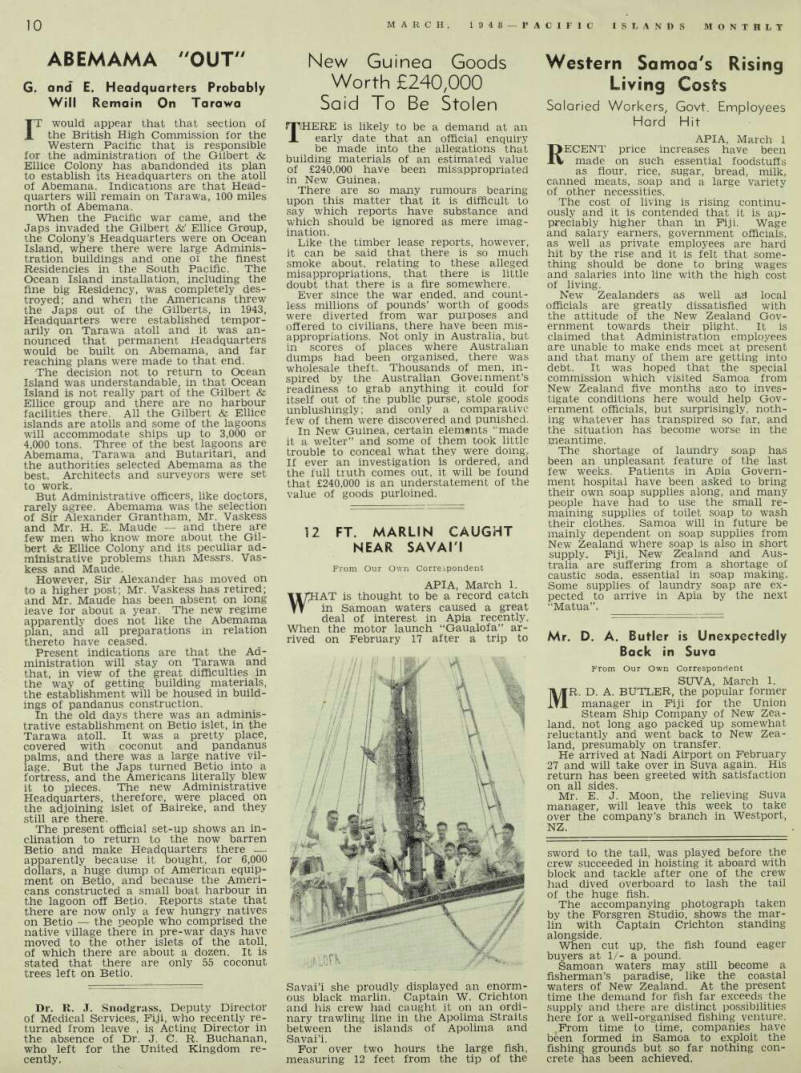
Savai’i she proudly displayed an enorm ous black marlin. Captain W. Crichton and his crew had caught it on an ordi nary trawling line in the Apolima Straits between the islands of Apolima and Savai’i.
For over two hours the large fish, measuring 12 feet from the tip of the
sword to the tail, was played before the crew succeeded in hoisting it aboard with block and tackle after one of the crew had dived overboard to lash the tail of the huge fish.
The accompanying photograph taken by the Forsgren Studio, shows the mar lin with Captain Crichton standing alongside.
When cut up, the fish found eager buyers at 1/- a pound.
Samoan waters may still become a fisherman’s paradise, like the coastal waters of New Zealand. At the present time the demand for fish far exceeds the supply and there are distinct possibilities here for a well-organised fishing venture.
From time to time, companies have been formed in Samoa to exploit the fishing grounds but so far nothing con crete has been achieved.
Living Costs
Western Samoa's Rising Living Costs Salaried Workers, Govt. Employees Hard Hit
APIA, March 1 RECENT price increases have been made on such essential foodstuffs as flour, rice, sugar, bread, milk, canned meats, soap and a large variety of other necessities.
The cost of living is rising continu ously and it is contended that it is ap preciably higher than in Fiji. Wage and salary earners, government officials, as well as private employees are hard hit by the rise and it is felt that some thing should be done to bring wages and salaries into line with the high cost of living.
New Zealanders as well ad local officials are greatly dissatisfied with the attitude of the New Zealand Gov ernment towards their plight. It is claimed that Administration employees are unable to make ends meet at present and that many of them are getting into debt. It was hoped that the special commission which visited Samoa from New Zealand five months ago to inves tigate conditions here would help Gov ernment officials, but surprisingly, noth ing whatever has transpired so far, and the situation has become worse in the meantime.
The shortage of laundry soap has been an unpleasant feature of the last few weeks. Patients in Apia Govern ment hospital have been asked to bring their own soap supplies along, and many people have had to use the small re maining supplies of toilet soap to wash their clothes. Samoa will in future be mainly dependent on soap supplies from New Zealand where soap is also in short supply. Fiji, New Zealand and Aus tralia are suffering from a shortage of caustic soda, essential in soap making.
Some supplies of laundry soap are ex pected to arrive in Apia by the next “Matua”.
Mr. D. A. Butler is Unexpectedly
Back in Suva
From Our Own Correspondent SUVA, March 1.
MR. D. A. BUTLER, the popular former manager in Fiji for the Union Steam Ship Company of New Zea land, not long ago packed up somewhat reluctantly and went back to New Zea land, presumably on transfer.
He arrived at Nadi Airport on February 27 and will take over in Suva again. His return has been greeted with satisfaction on all sides.
Mr. E. J. Moon, the relieving Suva manager, will leave this week to take over the company’s branch in Westport, NZ.
With Foodstuffs
Dodging The Wolf
Honiara Has Trouble With Foodstuffs
From Our Own Correspondent HONIARA. February 17.
JUST how close to tne wind B&.LP must sail tnese days, owing to shipping shortages, was made embarrassingly clear in January, when tne breakdown of the Government-owned TSMV Kun marau led to a serious scarcity of staple loods in Honiara.
Kunmarau—the only regular link with the outside world, witn an approximately six-weekly run to Suva and maximum capacity for 210 tons of cargo—has been laid up in Suva indefinitely, for repairs, since mid-January.
At the time, 430 tons of urgently needed cargo had .banked up in Suva lor tne Protectorate, and Government had to make strenuous efforts to charter a sub stitute ship, meanwhile carefully hus banding ration supplies and sending out to districts to buy any available lood stuffs.
The Government ration strength of 1,000 natives, concentrated in Honiara, was hastily reduced by repatriating all labour no longer required, as well as many patients discharged from hospital.
The two-masted auxiliary schooner Miena, engaged in concentrating copra at Yandina, was chartered and rushed off to Suva for rice, flour and personal cargo for Europeans. Bad weather upset this scheme, and Miena did not reach Suva until the date originally planned for her arrival back at Honiara.
The critical situation was eased by the Seventh Day Adventist vessel, “Ambon,” making a special trip down from Rabaul, with rice and biscuits, to Faisi, whence a Government M-class vessel rushed them down to Honiara.
Private food stocks, with the two months’ shipping gap and no imported freezer meat and butter to ease the situ ation (there is no fresh meat supply in Honiara) also showed signs of strain. A two-day Government-organised fishing expedition brightened matters with a moderate catch of fish, plus a bag of pigeons.
Now the first of the Suva cargo, plus mail accumulated in Suva over the past nine weeks, is on the way to BSIP, in the London Mission Society vessel, “John Williams,” due here about February 22, with “Miena” and Burns Philp’s “Moala” (each carrying about 140 tons) follow ing behind.
Noumea-Tahiti Airmail
WE are advised by the Vice-Consul for France in Australia that, as a re sult of representations made, airmail facilities between New Caledonia and French Oceania have been approved by the Australian Postmaster-General as from March 1.
This means that not only will airmail letters from French Oceania continue to be delivered in Australia, but that air mail letters for French Oceania may now be posted in Australia. The latter will go by air to New Caledonia and from there will be picked up by the TRAP AS Service and carried on to Tahiti at least twice each month.
The airmail fees agreed to in Australia on letters addressed to French Oceania are Airletters 7d. each; post-cards sd. each; other articles, 9d. per I oz.
Mr. H. Huntly of Station ZJV Suva, Fiji, paid a business visit to Australia in February.
Australian Mission
To N. Caledonia
AUSTRALIAN officials who recently visited New Caledonia and the New Hebrides included Mr. T- G. Sinclair and Mr. R. A. P. Jackson, both of the Com monwealth Bank of Australia. They had discussions with the British and French officials with a view to ironing out some currency difficulties. The Noumea man ager of the Bank of Indo-China also took part in the discussions.
A rumour, in Noumea, that the visit was in order to establish a Condominium Bank in Vila, New Hebrides, has no foundation.
Also visiting the French colonies at the same time were Mr. J. T. Smith of the Commonwealth Department of Com merce and Agriculture, in relation to Commonwealth trade with New Cale donia; and Mr. R. Gray, Commonwealth Forestry inspector, of Melbourne, who was looking into the possibilities of find ing timber in the Colony for Australian
building projects.-
H.E.L.P.
N. Hebrides Air Services
VILA, March 7.
THE Trans Oceanic Airways flying boat “Australis” which operates a more or less regular monthly service from Sydney to the New Hebrides, occasionally extending to the British Solomon Islands Protectorate, left Noumea for Vila on Thursday, February 19, but had to re turn to Noumea with engine trouble.
It arrived at Vila the following day and left on the return trip on February 21, with about 30 passengers for Noumea and Sydney.
The weekly service operated by TRAPAS, between Noumea and the New Hebrides, will soon be resumed, following extensive overhauls to motors.
Rule Over New
Hebrides
Dual Set-up Causes Rejection Of Plan
AMOVE made in Paris by the New Caledonian representative in the French Senate (M, Henri Lafleur) to secure representation for the French settlers resident in the Condominium of New Hebrides in one of the French Houses of Parliament was rejected after dis cussion.
M. Lafleur said that although the Hebrides were a Franco-British Condo minium, such a representative naturally would only represent French interests. He described the archipelago as a group of 37 islands, with 80 per cent, of its economy in French hands, and pointed out that during the war the French settlers had splendidly shown their patriotism in the way they rallied and in the work they did for the Allied cause.
M. Lafleur also thought that the exist ing Planters’ Syndicat, which worked closely in co-operation with the French ' Resident Commissioner, would be a suit able body to nominate a representative to the Union Francaise assembly.
In rejecting the suggestion on behalf of the Government, the French Minister for Overseas Territories explained that to admit a French representative for the New Hebrides to a French assembly would be an act of doubtful international morality and might place France in a delicate position. Those were the grounds on which he asked the Senate to reject the proposal. Furthermore, the New Caledonian representatives, as M. Lafleur himself had shown, were largely in a position to look after New Hebridean in terests. It was rather like asking for Morocco to be represented without ask ing the consent of the Sultan —H.E.L.P.
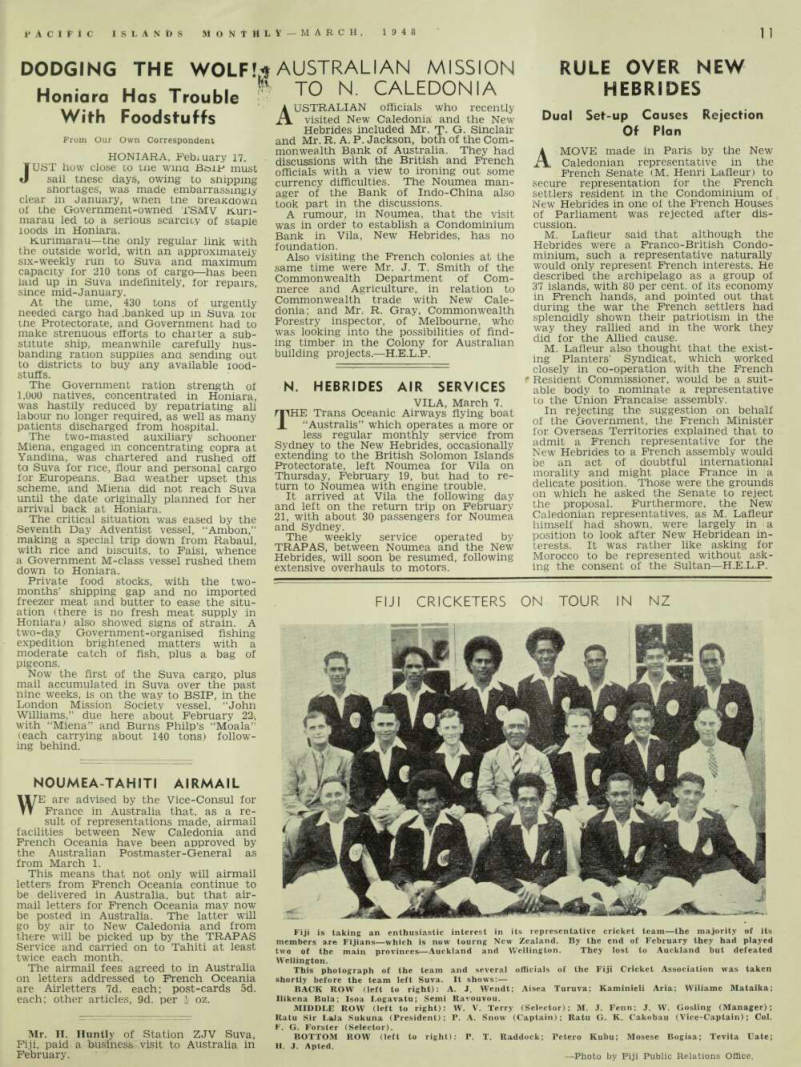
Fiji Cricketers On Tour In Nz
Fiji is taking an enthusiastic interest in its representative cricket team —the majority of its members are Fijians—which is now tourng New Zealand. By the end of February they had played two of the main provinces—Auckland and Wellington. They lost to Auckland but defeated Wellington.
This photograph of the team and several officials of the Fiji Cricket Association was taken shortly before the team left Suva. It shows:— BACK ROW (left to right): A. J. Wendt; Aisea Turuva; Kaminieli Aria; Wiliame Mataika; Ilikena Bula; Isoa Logavatu; Semi Ravouvou.
MIDDLE ROW (left to right): W. V. Terry (Selector); M. J. Fenn; J. W. Gosling (Manager); Ratu Sir Lala Sukuna (President); P. A. Snow (Captain); Ratu G. K. Cakobau (Vice-Captain); Col.
F. G. Forster (Selector).
BOTTOM ROW (left to right): P. T. Raddock; Petero Kubu; Mosese Bogisa; Tevita Date; H. J. Apted. —Photo by Fiji Public Relations Office.
Advertisements & other items, pp. 13-14 (2 items)
11
PACIFIC ISLANbS MoKtHLV-MARCH, 1948
Morris Hedtsrom Limited
General Merchants, Importers and Exporters,
Shipowners, Plantation Owners,
Commission and Insurance Agents
HEAD OFFICE
SUVA, FIJI
Established 1868
SERVICE IN THE SOUTH PACIFIC TERRITORIES
rpHROUGH our Large Establishments in Suva and our Numerous Branches, we distribute a wide and comprehensive range of General Merchandise and provide almost every kind of service. Our departments and associated businesses include:
DRAPERY
MOTOR SALES
AND SERVICE
TOBACCO
TIMBER AND
BUILDING
GROCERY
CONFECTIONERY
HARDWARE
ELECTRICAL
LIQUORS
DRUGS
Branches Throughout Fiji, Samoa and Tonga
There is o Branch or Agent of Morris Hedstrom Limited in every Town in the Three Territories.
We ore Sole Agents in these Territories for British Drug Houses Ltd.
Electrolux Ltd.
Ford Motor Co.
General Electric Co. Ltd.
Goodyear Tyre Gr Rubber Co.
B. A. Hjorth Gr Co. (Primus Products) Imperial Chemical Industries Ltd.
International Harvester Export Co.
Matson Navigation Company Max Factor and Co. Inc.
Ransomes, Sims & Jefferies Ltd Ruston Gr Hornsby Ltd.
Vacuum Oil Co. Pty. Ltd.
Yorkshire Copper Works Ltd.
Morris Hedstrom Limited, are LLOYD'S AGENTS in Fiji and Samoa.
IN AUSTRALIA:
Morris Hedstrom (Aust.) Pty. Ltd.,
Asbestos House, 65 York Street, SYDNEY
IN GREAT BRITAIN:
Morris Hedstrom Limited,
Africa House, Kingsway, LONDON
"Tiare Taporo" And Captain Andy
Weather The Hurricane
By A. J. Sheat
C Captain Andy Thomson, That Re
j doubtable skipper of the Cook Is lands schooner “Tiare Taporo” has had another adventure perhaps the most exciting of his career.
In February, and in sight of the Fiji group, the “Tiare Taporo” ran into the hurricane which was centred off Kadavu, and for five days, filled with the fury of wind and waves, she fought desperately for her life. Captain Thomson believes that if his ship had had to take that buffeting just a few hours more, she would
have foundered.
It is reported that the barometer at one time fell to 28.32, where it stayed for hour upon hour, watched by a Mrs. Hall, a European pas senger on the ship who had been assigned the nerve racking task of keeping the readings.
Captain Thomson was at the wheel himself for over four days and nights, with only the briefest periods of rest.
WHEN I read that “Tiare Taporo” had survived — but only just—l thought of a 23-day voyage I had experi enced in the same stoutly built vessel under the care of her stoutly-built skipper, Captain Andy. It was a voy age, under sail, along from the Northern Cooks to Raro tonga in 1945.
By sheer mischance the Tiare’s engine had failed and there was nothing left but to sail the 700 miles (as the albatross flies) without the aid of the propeller.
We had dead calms, when the “Tiare” rolled in the swell with sails down, con trary winds and no rains to replenish the water supply. It was a voyage that tested the resourcefulness of Skipper Thomson. The water problem was acute when the volcanic peaks of Rarotonga showed up over the horizon on the 23rd day. The “Tiare” had travelled then about the distance ’from Auckland to Sydney 1,200 miles.
I learned that “Tiare Taporo” is Poly nesian for “The Lime Flower,” and that this Auckland-built schooner was so named because the founder of the firm of A. B. Donald & Co. (Tiare’s owners), established the family fortunes by a suc cessful venture into the manufacture of lime juice in Tahiti and the supplying of it to shins.
Whatever the origin of the name the schooner has at all events a spray of citrus leaves and fruit under her bowsprit.
Captain Andy Thomson says that one of his most pleasant memories was meet ing, during a visit to Auckland, the man who designed and built the “Tiare.” I think that just as the men of the HMS “Calliope” attributed their escape from the Apia hurricane of 1889 to good steam coal from Westport. NZ, so Andv Thom son will modestly give much of the credit for the way his schooner survived the recent hurricane to the designer and shipwirghts who built her. * During the war years the “Tiare Taporo” virtually was the only means of communication between isolated islands of the Cook Group. Since copra began soaring in price she has been kept mov ing constantly bringing load after load to Rarotonga, especially from the isolated Northern Group (Manihiki, Rakahanga, Pukapuka and Penrhyn).
Because of the complete absence of
land-locked harbours in the Cooks it has been customary during the hurricane season for island schooners to make a voyage to another part of the Pacific at that time of the year.
Previously the “Tiare Taporo” has sailed eastward to Tahiti, to undergo overhaul, but a change of p>lans was made this year, the “Tiare” sailing westward to Suva. It is said that the difficulty of getting ship repairs carried out at Tahiti nowadays prompted this variation from the usual.
So the “Tiare” ran away from prob-
able hurricanes in the Cook Group to run slap, bang into an Old Man hurri cane in the Fiji Group!
It’s all in the luck of the sea!
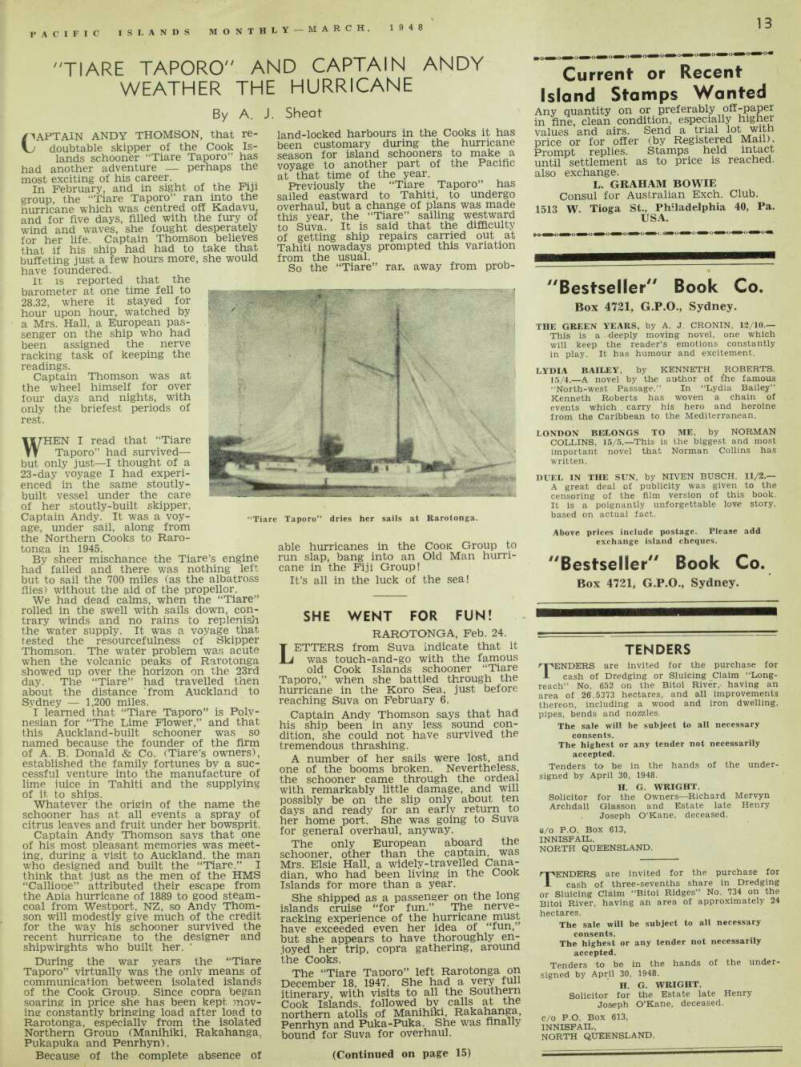
“Tiare Taporo” dries her sails at Rarotonga.
She Went For Fun!
Rarotonga, Feb. 24.
LETTERS from Suva indicate that it was touch-and-go with the famous old Cook Islands schooner “Tiare Taporo,” when she battled through the hurricane in the Koro Sea, just before reaching Suva on February 6, Captain Andy Thomson says that had his ship been in any less sound con dition, she could not have survived the tremendous thrashing.
A number of her sails were lost, and one of the booms broken. Nevertheless, the schooner came through the ordeal with remarkably little damage, and will possibly be on the slip only about ten days and ready for an early return to her home port. She was going to Suva for general overhaul, anyway.
The only European aboard the schooner, other than the captain, was Mrs. Elsie Hall, a widely-travelled Cana dian, who had been living in the Cook Islands for more than a year.
She shipped as a passenger on the long islands cruise “for fun.” The nerve racking experience of the hurricane must have exceeded even her idea of “fun, but she appears to have thoroughly en joyed her trip, copra gathering, around the Cooks.
The “Tiare Taporo” left Rarotonga on December 18, 1947. She had a very full itinerary, with visits to all the Southern Cook Islands, followed by calls at the northern atolls of Manihiki, Rakahanga, Penrhyn and Puka-Puka. She was finally bound for Suva for overhaul.
(Continued on page 15)
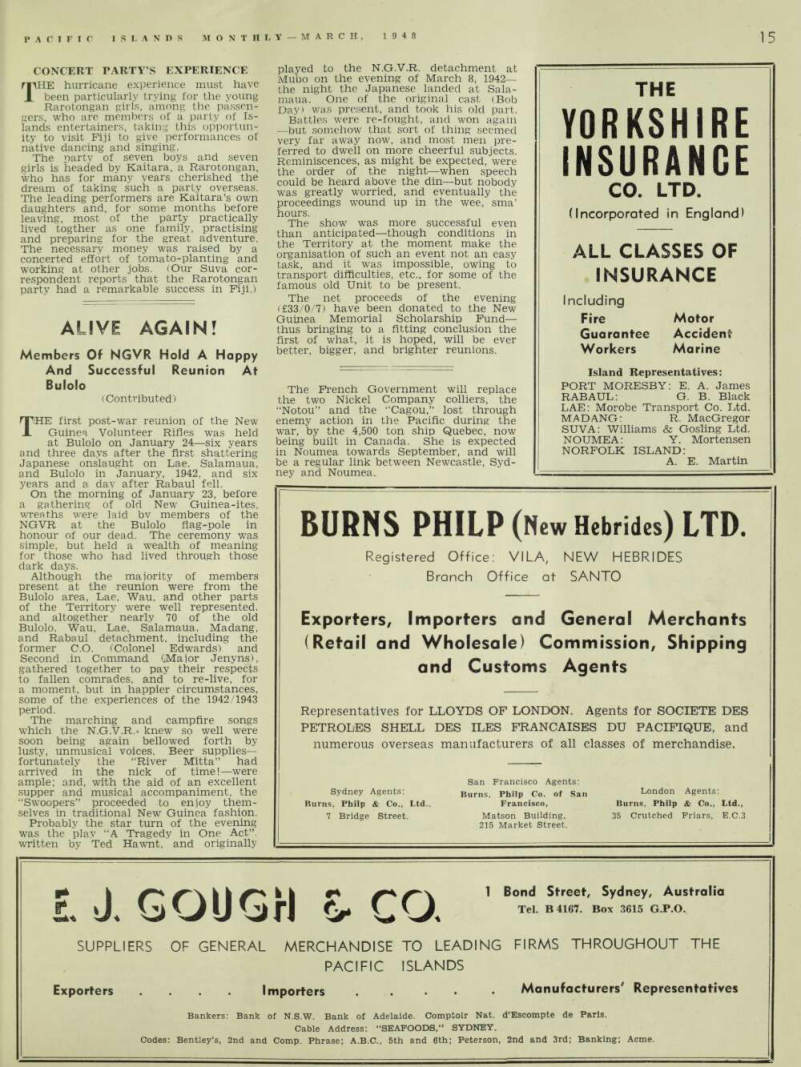
Concert Party’S Experience
rpHE hurricane experience must have X been particularly trying for the young Rarotongan girls, among the passen gers, who arc members of a party of Is lands entertainers, taking this opportun ity to visit Fiji to give performances of native dancing and singing.
The party of seven boys and seven girls is headed by Kaitara, a Rarotongan, who has for many years cherished the dream of taking such a party overseas.
The leading performers are Kaitara’s own daughters and, for some months before leaving, most of the party practically lived togther as one family, practising and preparing for the great adventure.
The necessary money was raised by a concerted effort of tomato-planting and working at other jobs. (Our Suva cor respondent reports that the Rarotongan party had a remarkable success in Fiji.)
Advertisements & other items, pp. 15-16 (1 item)
Island Stamps Wanted
Current or Recent
Any quantity on or preferably off-paper in fine, clean condition, especially higher values and airs. Send a trial lot’With price or for offer (by Registered Mail).
Prompt replies. Stamps held intact until settlement as to price is reached, also exchange.
L. GRAHAM BOWIE
Consul for Australian Exch. Club. 1513 W. Tioga St., Philadelphia 40, Pa.
USA.
"Bestseller" Book Co.
Box 4721, G.P.0., Sydney.
THE GREEN YEARS, by A. J. CRONIN, 12/10.
This is a deeply moving novel, one which will keep the reader’s emotions constantly in play. It has humour and excitement.
LYDIA BAILEY, by KENNETH ROBERTS.
15/4. —a novel by the author of ftie famous “North-west Passage.” In ‘‘Lydia Bailey”
Kenneth Roberts has woven a chain of events which carry his hero and heroine from the Caribbean to the Mediterranean.
LONDON BELONGS TO ME, by NORMAN
COLLINS. 15/s.—This is the biggest and most important novel that Norman Collins has written.
DUEL IN THE SUN, by NIVEN BUSCH, 11/2.
A great deal of publicity was given to the censoring of the film version of this book.
It is a poignantly unforgettable love story, based on actual fact.
Above prices include postage. Please add exchange island cheques.
"Bestseller" Book Co.
Box 4721, G.P.0., Sydney.
TENDERS
TENDERS are invited for the purchase for cash of Dredging or Sluicing Claim “Longreach” No. 652 on the Bitoi River, having an area of 26.5373 hectares, and all improvements thereon, including a wood and iron dwelling, pipes, bends and nozzles.
The sale will be subject to all necessary consents.
The highest or any tender not necessarily accepted.
Tenders to be in the hands of the undersigned by April 30, 1948.
H. G. WRIGHT,
Solicitor for the Owners —Richard Mervyn Archdall Glasson and Estate late Henry Joseph O’Kane, deceased. o/o P.O. Box 613,
INNISFAIL,
NORTH QUEENSLAND.
TENDERS are invited for the purchase for cash of three-sevenths share in Dredging or Sluicing Claim “Bitoi Ridges” No. 734 on the Bitoi River, having an area of approximately 24 hectares.
The sale will be subject to all necessary consents.
The highest or any tender not necessarily accepted.
Tenders to be in the hands of the undersigned by April 30, 1948.
H. G. WRIGHT.
Solicitor for the Estate late Henry Joseph O’Kane, deceased. c/o P.O. Box 613,
INNISFAIL,
NORTH QUEENSLAND.
LONDON
visit leading U.S. cities
by Flying Clipper
□Eaal
45"AVt IKTST
i Travel to London is easy and interesting; —the Pan American way. And now it costs only £2l extra to go via the U.S. One fare (purchased in pounds) takes care of all transportation. From
Sydney to London £346/6/-. Stopovers along
the route can be arranged.
A Flying Clipper leaves Sydney every Wednesday.
Saturday and Sunday at 11.59 p.m.
You’ll relax in a down-soft Sleeperette* chairlounge as your Flying Clipper speeds via lovely Hawaii to San Francisco or Los Angeles. (There you can visit Hollywood, fabulous film centre.) From California to New York see the sights, enjoy the theatres and smart shops.
From New York. Clipper departs daily for London on the fastest and only non-stop service. Or you can leave from Boston or Washington. Call your travel agent or Pan American Mezzanine Floor, Hotel Australia, Sydney.
Telephone BW 4701 Rue Jean Joures,
NOUMEA.
Bank of N.S.W.
Building. SUVA.
Trade-Mark, Pan American Airways, Inc.
Fifth Avenue, New York
Pa m American
World Airways
System of Clippers
Pan American Airways, Inc. (Incorporated in U.S.A. —Liability Limited.)
Alive Again!
Members Of NGVR Hold A Happy And Successful Reunion At Bulolo
(Contributed) T'HE first post-war reunion of the New Guinea Volunteer Rifles was held at Bulolo on January 24 —six years and three days after the first shattering Japanese onslaught on Lae. Salamaua, and Bulolo in January, 1942, and six years and a day after Rabaul fell.
On the morning of January 23, before a gathering of old New Guinea-ites, wreaths were laid bv members of the NGVR at the Bulolo flag-pole in honour of our dead. The ceremony was simple, but held a wealth of meaning for those who had lived through those dark days.
Although the majority of members present at the reunion were from the Bulolo area, Lae, Wau, and other parts of the Territory were well represented, and altogether nearly 70 of the old Bulolo. Wau, Lae, Salamaua, Madang, and Rabaul detachment, including the former C.O. (Colonel Edwards) and Second in Command (Major Jenyns), gathered together to pay their respects to fallen comrades, and to re-live, for a moment, but in happier circumstances, some of the experiences of the 1942/1943 period.
The marching and campfire songs which the N.G.V.R.» knew so well were soon being again bellowed forth by lusty, unmusical voices. Beer supplies— fortunately the “River Mitta” had arrived in the nick of time! —were ample; and, with the aid of an excellent supper and musical accompaniment, the “Swoopers” proceeded to enjoy them selves in traditional New Guinea fashion.
Probably the star turn of the evening was the play “A Tragedy in One Act”, written by Ted Hawnt, and originally
played to the N.G.V.R. detachment at Mubo on the evening of March 8, 1942 the night the Japanese landed at Sala maua. One of the original cast (Bob Day* was present, and took his old part.
Battles were re-fought, and won again —but somehow that sort of thing seemed very far away now, and most men pre ferred to dwell on more cheerful subjects.
Reminiscences, as might be expected, were the order of the night—when speech could be heard above the din —but nobody was greatly worried, and eventually the proceedings wound up in the wee, sma’ hours.
The show was more successful even than anticipated—though conditions in the Territory at the moment make the organisation of such an event not an easy task, and it was impossible, owing to transport difficulties, etc., for some of the famous old Unit to be present.
The net proceeds of the evening (£33/0/7) have been donated to the New Guinea Memorial Scholarship Fund — thus bringing to a fitting conclusion the first of what, it is hoped, will be ever better, bigger, and brighter reunions.
The French Government will replace the two Nickel Company colliers, the “Notou” and the “Cagou,” lost through enemy action in the Pacific during the war, by the 4,500 ton ship Quebec, now being built in Canada. She is expected in Noumea towards September, and will be a regular link between Newcastle, Syd ney and Noumea.
Advertisements & other items, p. 17 (1 item)
£. J. Gough S. Co.
THE
YORKSHIRE
INSURANCE
CO. LTD.
(Incorporated in England)
ALL CLASSES OF
INSURANCE
Including
Fire Motor Guarantee Accident Workers Marine Island Representatives:
PORT MORESBY: E. A. James
RABAUL: G. B. Black LAE: Morobe Transport Co. Ltd.
MADANG: R. MacGregor SUVA: Williams & Gosling Ltd.
NOUMEA: Y. Mortensen
NORFOLK ISLAND:
A. E. Martin
BURNS PHILP (New Hebrides) LTD.
Registered Office: VILA, NEW HEBRIDES Branch Office at SANTO
Exporters, Importers and General Merchants
(Retail and Wholesale) Commission, Shipping
and Customs Agents
Representatives for LLOYDS OF LONDON. Agents for SOCIETE DES PETROLES SHELL DES ILES FRANCAISES DU PACIFIQUE, and numerous overseas manufacturers of all classes of merchandise.
San Francisco Agents: Sydney Agents; Burns. Philp Co. of San London Agents: Burns, Philp & Co., Ltd.. Francisco, Burns, Philp & Co., Ltd., 7 Bridge Street, Matson Building, 35 Crutched Friars, E.C.3 215 Market Street.
£. J. GOUGH S. CO.
1 Bond Street, Sydney, Australia Tel. B 4167. Box 3615 G.P.O.
SUPPLIERS OF GENERAL MERCHANDISE TO LEADING FIRMS THROUGHOUT THE
PACIFIC ISLANDS
Exporters ... Importers Manufacturers' Representatives Bankers: Bank of N.S.W. Bank of Adelaide. Comptoir Nat. d’Escompte de Paris.
Cable Address; “SEAFOODS.” SYDNEY.
Codes: Bentley’s, 2nd and Comp. Phrase; A.8.C., sth and 6th; Peterson, 2nd and 3rd; Banking: Acme.
2Ap Apia In Operation
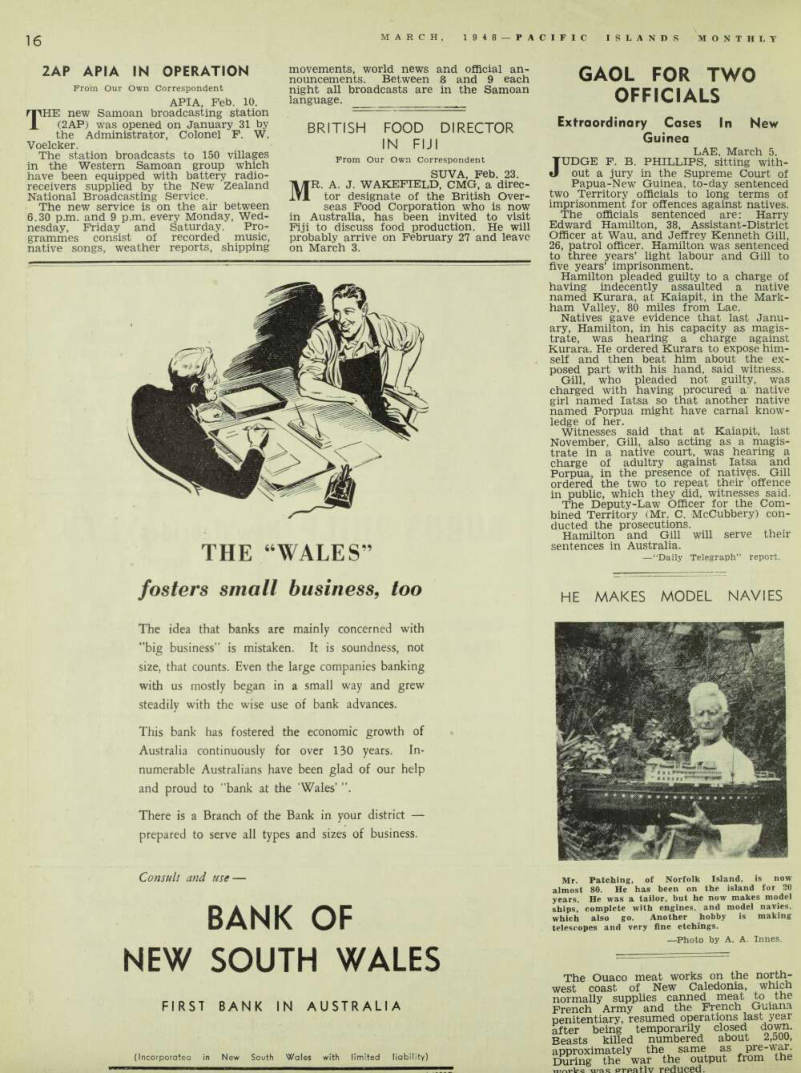
From our own correspondent
Apia, Feb. 10.
THE new Samoan broadcasting station (2AP) was opened on January 31 by the Administrator, Colonel P. W.
Voelcker. ■ T s£ St & io ? broadcasts t 0 1 5?„ villa ? e ® in the Western Samoan group which have been equipped with battery radio receivers supplied by the New Zealand National Broadcasting Service.
The new service is on the air between 6.30 p.m. and 9 p.m. every Monday, Wed nesday, Friday and Saturday. Pro grammes consist of recorded music, native songs, weather reports, shipping
movements, world news and official an nouncements. Between 8 and 9 each night all broadcasts are in the Samoan language.
British Food Director
In Fiji
Prom Our Own Correspondent
Suva, Feb. 23.
It/fR. WAKEFIELD, CMG, a direc -IYI tor designate of the British Over seas Food Corporation who is now in Australia, has been invited to visit Fiji to discuss food production. He will probably arrive on February 27 and leave on March 3.
Officials
Gaol For Two
Extraordinary Cases In New Guinea
LAE, March 5.
JUDGE F. B. PHILLIPS, sitting with out a jury in the Supreme Court of Papua-New Guinea, to-day sentenced two Territory officials to long terms of imprisonment for offences against natives.
The officials sentenced are; Harry Edward Hamilton, 38, Assistant-District Officer at Wau, and Jeffrey Kenneth Gill, 26, patrol officer. Hamilton was sentenced to three years’ light labour and Gill to five years’ imprisonment.
Hamilton pleaded guilty to a charge of having indecently assaulted a native named Kurara, at Kaiapit, in the Mark ham Valley, 80 miles from Lae.
Natives gave evidence that last Janu ary, Hamilton, in his capacity as magis trate, was hearing a charge against Kurara. He ordered Kurara to expose him self and then beat him about the ex posed part with his hand, said witness.
Gill, who pleaded not guilty, was charged with having procured a native girl named latsa so that another native named Porpua might have carnal know ledge of her.
Witnesses said that at Kaiapit, last November, Gill, also acting as a magis trate in a native court, was hearing a charge of adultry against latsa and Porpua, in the presence of natives. Gill ordered the two to repeat their offence in public, which they did, witnesses said.
The Deputy-Law Officer for the Com bined Territory (Mr. C. McCubbery) con ducted the prosecutions.
Hamilton and Gill will serve their sentences in Australia. —“Daily Telegraph” report.
He Makes Model Navies
The Ouaco meat works on the north west coast of New Caledonia, which normally supplies canned meat to the French Army and the French Guiana penitentiary, resumed operations last year after being temporarily closed down.
Beasts killed numbered about 2,000, approximately the same as pre-war.
During the war the output from the w/vrlrc w OTftatlV r6dUCO(I.
Mr. Patching, of Norfolk Island, is now almost 80. He has been on the island for 20 years. He was a tailor, but he now makes model ships, complete with engines, and model navies, which also go. Another hobby is making telescopes and very fine etchings. —Photo by A. A. Innes.
Advertisements & other items, p. 18 (1 item)
Bank Of
UK n z>
THE “WALES’’
fosters small business, too
The idea that banks are mainly concerned with "big business” is mistaken. It is soundness, not size, that counts. Even the large companies banking with us mostly began in a small way and grew steadily with the wise use of bank advances.
This bank has fostered the economic growth of Australia continuously for over 130 years. Innumerable Australians have been glad of our help and proud to "bank at the 'Wales’ ”.
There is a Branch of the Bank in your district prepared to serve all types and sizes of business.
Consult and use
BANK OF
NEW SOUTH WALES
FIRST BANK IN AUSTRALIA
(Incorporated in New South Wales with limited liability)
N. Guinea Goldfield Pioneers
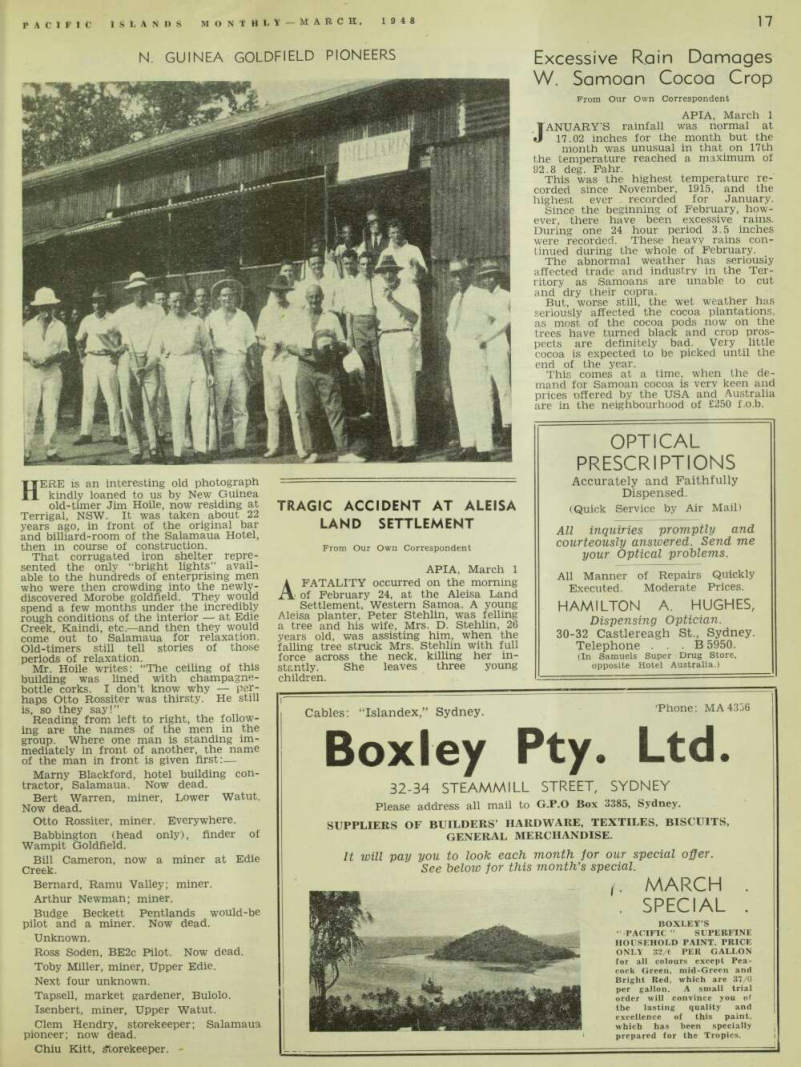
HERE is an interesting old photograph kindly loaned to us by New Guinea old-timer Jim Hoile, now residing at Terrigal, NSW. It was taken about 22 years ago, in front of the original bar and billiard-room of the Salamaua Hotel, then in course of construction.
That corrugated iron shelter repre sented the only “bright lights” avail able to the hundreds of enterprising men who were then crowding into the newly discovered Morobe goldfield. They would spend a few months under the incredibly rough conditions of the interior at Edie Creek, Kaindi, etc. —and then they would come out to Salamaua for relaxation.
Old-timers still tell stories of those periods of relaxation.
Mr. Hoile writes: “The ceiling of this building was lined with champagne bottle corks. I don’t know why per haps Otto Rossiter was thirsty. He still is, so they say!”
Reading from left to right, the follow ing are the names of the men in the group. Where one man is standing im mediately in front of another, the name of the man in front is given first;— Marny Blackford, hotel building con tractor, Salamaua. Now dead.
Bert Warren, miner, Lower Watut.
Now dead.
Otto Rossiter, miner. Everywhere.
Babbington (head only), finder of Wampit Goldfield.
Bill Cameron, now a miner at Edie Creek.
Bernard, Ramu Valley; miner, Arthur Newman; miner.
Budge Beckett Pentlands would-be pilot and a miner. Now dead.
Unknown.
Ross Soden, BE2c Pilot. Now dead.
Toby Miller, miner, Upper Edie.
Next four unknown, Tapsell, market gardener, Bulolo.
Isenbert, miner, Upper Watut.
Clem Hendry, storekeeper; Salamaua pioneer; now dead.
Chiu Kitt, Storekeeper.
Tragic Accident At Aleisa
Land Settlement
From Our Own Correspondent APIA, March 1 A FATALITY occurred on the morning of February 24, at the Aleisa Land Settlement, Western Samoa. A young Aleisa planter, Peter Stehlin, was felling a tree and his wife, Mrs. D. Stehlin, 26 years old, was assisting him, when the falling tree struck Mrs. Stehlin with full force across the neck, killing her in stantly. She leaves three young children.
W. Samoan Cocoa Crop
Excessive Rain Damages W. Samoan Cocoa Crop
Prom Our Own Correspondent APIA, March 1 JANUARY’S rainfall was normal at 17.02 inches for the month but the month was unusual in that on 17th the temperature reached a maximum of 92.8 deg. Fahr.
This was the highest temperature re corded since November, 1915, and the highest ever recorded for January.
Since the beginning of February, how ever, there have been excessive rains.
During one 24 hour period 3.5 inches were recorded. These heavy rains con tinued during the whole of February.
The abnormal weather has seriously affected trade and industry in the Ter ritory as Samoans are unable to cut and dry their copra.
But, worse still, the wet weather has seriously affected the cocoa plantations, as most of the cocoa pods now on the trees have turned black and crop pros pects are definitely bad. Very little cocoa is expected to be picked until the end of the year.
This comes at a time, when the de mand for Samoan cocoa is very keen and prices offered by the USA and Australia are in the neighbourhood of £250 f.o.b.
Advertisements & other items, pp. 19-20 (1 item)
Boxley Pty. Ltd.
OPTICAL
PRESCRIPTIONS
Accurately and Faithfully Dispensed. (Quick Service by Air Mail) All inquiries promptly and courteously answered. Send me your Optical problems.
All Manner of Repairs Quickly Executed. Moderate Prices.
HAMILTON A. HUGHES,
Dispensing Optician. 30-32 Castlereagh St., Sydney.
Telephone . . . B 5950. (In Samuels Super Drug Store, opposite Hotel Australia.)
Cables; “Islandex,” Sydney.
’Phone: MA 4356
Boxley Pty. Ltd.
32-34 STEAMMILL STREET, SYDNEY
Please address all mail to G.P.O Box 3385, Sydney.
SUPPLIERS OF BUILDERS’ HARDWARE, TEXTILES, BISCUITS,
GENERAL MERCHANDISE.
It will pay you to look each month for our special offer.
See below for this month's special.
i. MARCH .
. SPECIAL .
BOXLEY’S
‘PACIFIC’’ SUPERFINE
HOUSEHOLD PAINT. PRICE
ONLY 32/6 PER GALLON
for all colours except Peacock Green, mid-Green and Bright Red, which are 37/G per gallon. A small trial order will convince you of the lasting quality and excellence of this paint, which has been specially prepared for the Tropics.
McILRATH’S OFFER
Pure Qrarigc Fruit Juice
in 28 oz. cans-per doz. 11/6
5 case lots, 11/- doz. 10 case lots, 10/6 doz.
Cases contain 24 cans Each can contains the juice of approximately 24 oranges. This fruit juice will maintain perfect condition for days if transferred to bottles or jars and kept in a cool place. Every tin is guaranteed.
McILRATH’S specialise in PACKING and SHIPPING individual orders to
PACIFIC ISLANDS RESIDENTS.
Write for our special export grocery price list All shipments are insured against pillage — theft — non-delivery.
McILRATH’S PTY. LTD.
Export Department, 202 Pitt Street, Sydney, Australia
m
ipl
Gi mm
l^iC£/
AND WHAT IT
MEANS TO YOU!
a- \« sw. The success of the most photogenic model depends on her charm poise, deportment and, most of all, IW her confidence! Place your confidence in the \ r better-balanced formula of Vincent’s a.p.c.
Vincent’s a.p.c is prepared to the original TAKE hospital formula and is a proved and , accepted medical prescription.
m'CENTS A.P.C
WITH
COKffCEKCE
For HEADACHES.
ALL NERVE AND
MUSCULAR PAIN
VINCE
TojOaOSX
SAJ
niCjiiX
SAFEST & BEST
Being Rebuilt
New Guinea Club Being Rebuilt And Reconstituted
A SPECIAL general meeting of mem bers of the New Guinea club was held in Rabaul on January 23, and the following executives were appointed: President: Mr. A. J. Gaskin.
Vice-President: Mr. J. J, Gilmore.
Treasurer: Mr. A. J. Thomas.
Secretary: Mr. L. H. Corbett.
Committee: Messrs. W. C. Rowe, L.
Hyland, E. S. L. Burke, G. D. Kent, P. F.
Bailey.
It was the wish of members that im mediate steps be instituted to re-form the Club and plans are being prepared for the erection of a temporary Club building.
Members not now in Rabaul will be interested to learn that the walls of the old building are in good condition, except for a few scars, from bomb splinters. The whole of the concrete flooring is in ex cellent condition.
The executives are very anxious to com pile a complete list of members. All known members are being notified of the Club’s intended activities, and requested to furnish details to the Secretary of mem bership—that is, date of joining, date to which subscriptions were paid, and whether town or country members.
It is realised that, through lack of pre sent addresses, notices will not reach all members, and so former members who wish to continue membership, and who have not been communicated with, are being asked to send their addresses direct to The Secretary, New Guinea Club, Rabaul, at once.
Appeal To Former Sports Club Members AT the request of Mr. V. B. Pennefather, president of the Kokopo Sports Club, we publish the following; “All former members of the Kokopo Sports Club now resident in Australia are requested to communicate with the honorary secretary as soon as possible.
The club is desirous of ascertaining whether the said members wish to retain membership as country members. Write to The Secretary, Sports Club, Kokopo, New Guinea.
Rotuman Murderer
Sentenced
Prom Our Own Correspondent
Suva, Feb. 1.
AFTER a quarrel over the partitioning of family lands, Pauriasi Manaki, a 65-year-old villager of Itumata, Rotuma, last year, killed Antonio Meka ere with a home-made bullet, fired from a shotgun at close range.
Pauriasi was sentenced to death at the District Officer’s Court, Rotuma, on December 8. Subsequently, after the sentence had been considered by the Executive Council, the Acting Governor of Fiji commuted it to imprisonment, with hard labour, for life.
Fiji's War Pensions
From Our Own Correspondent
Suva, Feb. 19.
THE Fiji War Pensions Board reports that exnenditure on pension pay ments in 1947 was £11,300 which, added to bonus payments of £6,700, gives a total of £lB,OOO.
Of 185 ex-Servicemen drawing pensions at the end of 1947, 166 were Fijians, 18 were Europeans or part-Europeans, and one was an Indian.
At the end of the year, 17 pensioners were in hospital for treatment.
Concern For Cook Islanders' Welfare
CIPA and Union Bosses Battle Grimly On
See also later article: “NZ Police Go To Rarotonga.”
From Our Own Correspondent
Rarotonga, Jan. 25.
THERE has been no improvement in relations between the local sup porters of the Cook Islands Pro gressive Association and the Cook Islands Workers’ Union. But they watch in tently the battle being waged in New Zealand between the Labour Government, Federation of Labour, Waterside Workers’
Union and Communists for the welfare of the Cook Islanders.
The government and the Federation continue to recommend the advance ment of a solid “workers’ union” as the best assurance of fair conditions for the workers, while the NZ Waterside Workers and the Communists remain the staunch allies of the “down-trodden” Raroton gans in the fight against the capitalistic employers.
All parties overlook the fact that Rarotonga is essentially a peasant com munity, that the total number of persons engaged in regular jobs is comparatively small and those who engage in water side work only do so for quite a small number of days per year.
It seems certain now that some sort of delegation will visit Rarotonga soon. Con siderable publicity has already been given to this matter as a result of the insis tence of -the NZ Waterside Workers’
Union that they be represented in any such delegation.
ACTING upon suggestions contained in a letter from the president of the Federation of Labour, the local secretary of the Cook Islanders Workers’
Union earlv in January requested the manager of the Union Steam Ship Co.,
to draw up a register of workers who had customarily performed waterside work over the past five years. When the list was completed the secretary then in vited representatives of the CIPA to attend a meeting with representatives of the Workers’ Union and the manager of the shipping company in the USS Co. office.
The meeting took place on January 9.
An hour before it was due to start a message was received from the president of the CIPA which stated that Mr. Albert Henry had been appointed to appear on behalf of the CIPA. Mr. Henry duly arrived, accompanied by another CIPA member. . A , .
After the register of workers had been examined by both parties, the secretary of the Workers’ Union explained the reason for the meeting, and read a pas sage from the Federation president’s letter which suggested that all regular water side workers who were not already mem bers of the Workers’ Union should be re quested to join.
Mr. Henry then refused to have any thing to do with such suggestions and said that he would wait until the ar rival of the NZ delegation. This brought the meeting to a close.
THE determined attempt to control ship-handling labour throughout these islands, in particular, appear as part of the next step in the CIPA “independence” plan which aims at wrest ing the trade of the group from the hands of established business.
Mr. Henry himself denies any such am bitions: but other CIPA supporters are
not so reticent regarding the aims of the movement.
Throughout the lower and northern groups, large quantities of copra, as well as other native products, have been accu mulated by the CIPA for shipment in a chartered vessel of their own.
The recent sale of the motor-vessel “Rosalie” to a French company in New Caledonia, came as a severe blow to the CIPA, as this was the ship which was supposed to have been coming to collect for the' organisation.
For many months the arrival of their “own ship” had been keenly anticipated by CIPA followers throughout the group, but for reasons not generally known it was continually delayed, and now comes the news that the vessel has been sold to outside interests.
Any further plans in this direction have not yet been revealed.
Advertisements & other items, pp. 21-22 (1 item)
Wc Will Buy
It For You
Any goods you may require from English shops or factories Purchased and Shipped.
Small or large orders catered for.
ALL SERVICES UNDER-
TAKEN FOR RESIDENTS
ABROAD.
PITT & SCOTT
LIMITED
(Established 1876) General Shipping and Buying Agents. 1/3, St. Paul's Churchyard, London, England Cables. Shipping London.
t
LON DON-SUVA
tf^ECT
VIA
PANAMA
For Sailings and Further Particulars Apply To: BETHELL, GWYN & CO., BURNS, PHILP (SOUTH SEA) 138 LEADENHALL ST., co > LTD -
LONDON, E.C.3. SUVA.
c
GILLESPIE’S
TRADE
MARK
The Flour of the Islands
- S Y DN EY -
Box 3838 GPO, Sydney. Australia.
ISLAND MERCHANTS
4 YORK ST., SYDNEY
All kinds Island Produce sold on commission. All merchandise purchased at best wholesale price and original invoices supplied.
Use our 50 yea r s’ experience as Island Merchants.
J
Reds And Pinks In The
Cook Islands
THE struggle in the Cook Islands be tween the Cook Islands Progress As sociation and the Waterside Union there is now being carried on among New Zealand trade unionists. The CIPA is sponsored by the Auckland Watersiders, who are suspected of having strong Com munist associations. The Cook Islands Waterside Union seems to be attached in some way to the New Zealand Federation of Labour which claims to be Pink rather than Red —but which nevertheless has a strong nuisance value. About the middle of February, the Federation and the Waterside Workers’ Union were having a Cook Islands squabble in New Zealand, the probable outcome of which was the despatch of a special investigator to the Cook Islands.
How The First "Rabaul"
Was Sunk
THE story of how the Carpenter Line’s first “Rabaul” was lost during the war, was told recently in Fiji by a young officer, Mr. Bruce Wharton, who is now serving on an American ship.
Carpenter’s first “Rabaul” was built by a Danish firm during World War 1, and purchased by the firm in 1934 and re named. With the “Salamaua” she be came the Carpenter line. Later, the “Suva” was added.
“Rabaul’ was taken over by the British Admiralty after the outbreak of war in September, 1939, and went to England.
From there she was engaged in convoy duty in the Atlantic, and down the Afri can coast.
While on duty in the Atlantic, about 500 miles off Capetown, in May 1941, she was sighted by a German raider. The enemy vessel was equipped with 8-inch guns and could steam at 25 knots. The old “Rabaul” had 4.7-inch guns, and few of them, and could not move faster than nine knots. However, “Rabaul” engaged the raider and fought gallantly for about 40 minutes, during which time nine of her crew were killed. “Rabaul’s” master, Captain Miller, then ordered the ship to be abandoned and the survivors of the action took to the boats. The Germans sank the “Rabaul” by shell-fire and then machine-gunned the men in the boats, during which Mr. Wharton was wounded in the shoulder.
In suite of the fact that the boats had been machine-gunned, the raider then launched fast boats and picked up the survivors. Later, the German com mander explained that he was acting under strictest orders to sink all vessels without trace.
The “Rabaul’s” crew was given che run of the German shin and treated extra ordinarilv well. Some weeks later the raider contacted her supply ship and, with the execution of Wharton, who was still in hosuital, transferred the prisoners.
The supulv vessel was soon after caught bv British destroyers, and the prisoners released, but Wharton was taken on to Bordeaux and later interned in Germany, where he remained until April, 1945.
In 1946 the Carpenter Line was able to replace the “Rabaul” with a new vessel. The second “Rabaul” was in the Pacific trade. Recently her name was changed to “Dongola.” She is now on the Australia-India run.
Mixed Blood In Fiji
Native Student Discusses A Very Difficult Problem
Letter to the Editor RACIAL discrimination in Fiji seems to be the most pressing problem for the future and as a solution I suggest the abolition of what might be called racial mongrelisation.
To-day, the three major communities of Fiji are the Fijians, Europeans and Indians and which community is to be come dominant is largely dependent upon racial strength.
The Fijian is still too weak, both cul turally and economically, and to overcome this they must be trained to make the best use of their lands, and also be made to understand what national spirit and idealism really mean. They will then appreciate the true importance of popu lating their country and the ugliness of racial segregation.
People of mixed blood, to-day, make up a large number of the Colony’s popu lation and their future is yet to be de termined. The Fijian should realise that by marrying outside his own community he or she not only increases the half caste population but “gives away” a good many numbers from what should be a 100 per cent, pure Fijian community.
“Mongrelisation” is an ugly name, simply because it implies impurity of breeding— but in Fiji to-day the problem is not only a racial one but has, as well be come a matter of politics.
I should like to see my own people increase in numbers, not as distin guished mixed-bloods, but as full Fijians.
Seventy years ago, Fijian chiefs put themselves under the protection of the Great Queen and, in return, their land was secured to them for all time. How ever, if the mating of people of different blood is permitted to go on unchecked in years to come, who will be the brave native to claim his father’s right in 500 years’ time?
The Indians, who are blamed for many of Fiji’s troubles, cannot, however, be blamed for the mixed-blood problem, They realise that caste and blood go to gether and have thus indirectly been the saviours of the Fijian race. What would have happened to the Fijians if the Hindu faith had permitted indiscriminate in rer-marriage?
To make the Fijians strong they must increase their own numbers, at the same time reviving their own traditions and cultures and a spirit of nationalistic idealism. An investigation into the Fijian life of to-day would show that the mixed-blood population is a menace to the way of pure Fijian life even the Fijian language has deteriorated at their hands.
Measures should be taken, by the Legis lative Council of Fiji, if necessary to check intermarriage of Fijians with other people, otherwise the Colony will in time become a land of mixed-bloods, as other Pacific islands have become already.
A special court of the Colony should be formed to deal with these unfortunate people and, if any fund is required to maintain it, perhaps the people of mixed blood could contribute towards it in the form of a tax. In my opinion, any mis cegenation is criminal and should be dealt with harshly and, if possible, the people concerned should be sent away from the Colony.
This would be for the good of my people; it would make them respect and protect their blood and make them realise that an increase in their numbers would mean strength. Above all, purity of blood brings national pride and through it. national unity. The term “Fijians” would then stand for the indigenous natives of
Fiji and not for the thousands of hybrid people in the Colony, I am, etc.,
E. Raivoka.
Agricultural High School & College,
Lawes, Queensland.
Editorial Note
IT is interesting and stimulating to sec that an educated Fijian can write so well and thoughtfully on a subject of such complexity and delicacy. We are happy to give space to his letter, although we may not agree with all his conclusions, There is a half-caste problem in the South Pacific, but it is not as difficult as some suggest. There are so many mixed
blood communities in the Islands that, many years ago, at the suggestion of a Fijian school-master, the “PIM” used the word “Euronesian” to describe them, and this has been generally accepted.
Our correspondent, like some others,
takes the view that the Euronesian is an undesirable person, and he would formulate policy accordingly. But.this is wrong, There are in the South Pacific very many thousands of Euronesians who usually are in every way excellent citizens intelligent, industrious and socially attractive. Where the Euronesian community is big enough, they- usually inter-marry, and they have a definite place in their country. All through the South Seas, there are Euronesian women, who as the
wives of leading citizens, quite naturally take a leading place in the community.
In the minds of some people, the Euro nesian community may represent a head ache (see article elsewhere in this issue concerning the position of “local-born” in Samoa); but the Euronesian communities have a place and a status in the South Pacific, and they must be accepted. Per haps the European-Polynesian unions which produced children of mixed-blood were socially unwise; but only the very foolish would expect people to refrain from such unions on that account. Also, it would be silly, as well as impracticable, to punish the offspring of such unions by imposing social and industrial handi caps upon them. Far better to accept the Euronesian communities as has been done this last half-century as a very happy and colourful and attractive sec tion of life in the South Seas.
We agree entirely with our correspon dent that racial puritv is a thing emi nently desirable, and all Administrations should strive for it. But that does not mean that people of mixed blood are un desirable anyone who tries to argue that way will find himself in holts with science and with experience.
Man-made laws do not favour mixed unions. But natural law seems to offer no barrier whatever in fact, the age old tendency, throughout human history, has been towards what we call miscegena tion. towards an amalgamation of races; and our records, as far back as we can go, are full of examples of racial union— some so complete that certain races have disappeared entirely.
Mr. Elliot BoUand, father of Mr. W. S.
Bolland (Thursday Island), passed away recently at his home in East Brisbane.
The late Mr. Bolland was known through out Australia for his scale models of famous engineering projects.
Advertisements & other items, pp. 23-24 (1 item)
big problem. Honey!
Send us your orders for
DEVELOPING, PRINTING,
ENLARGING
We Sell Kodak Films and Supplies Wholesale and Retail.
Caine's Studios, Suva
P.O. Box 8. (Estab. 1904) ’Phone 68.
% tc *s* I M
-Hips aren't your
big problem. Honey!
YOU CAN TAKE your mind off your hips, dearie! No one finds fault with your figure!
You’d be smart to exercise a little more care about personal charm. Being streamlined, you know, won’t protect you against underarm odour. Or lessen the offence when others find you guilty of it.
So keep on trusting your bath— for past perpiration but put your trust in Mum to prevent risk of future underarm odour.
Creamy, snowy-white Mum smooths on in 30 seconds. Keeps you fresh and fr.e from underarm odour all day or evening.
Mum is gentle—harmless to skin and fabrics. So why take chances when you can be sure with Mum?
Ask for it today.
MUM
TAKES THE ODOUR OUT OF PERSPIRATION
For Inflamed Eyes and Eyelids ... Sold Everywhere H. Rose & Co.. Ply.. Ltd.. King Street. Sydney.
YOUR FUTURE CAREER . . .
Merchants, Accountants, Secretaries, Bankers and Business Managers ... all hold responsible positions with commensurate salaries. You too can enhance your prospects in this ever-expanding commercial field, which yields abundant returns to those with adequate qualifications. H.R.I. prepare ambitious men and women for all business positions from junior to senior executive. Tuition is practical authoritative up-to-date time saving . . . and certain in its successful results. The H.R.I. is available always to advise you write or wire for information free and without obligation.
H.R.I, tutorial service is proved by the winning of more honours than all coaches in Australasia combined.
H.R.I. Career Training • ACCOUNTANCY O SECRETARYSHIP • COST ACCOUNTANCY
• PRACTICAL BOOKKEEPING • MARKETING SELLING
ADVERTISING 9 BANKING 9 LOCAL GOVERNMENT EXAMS.
II o 111 in«* war K o bertso n Institute Founded and Owned by Hemingway & Robertson Pty. Ltd.
Consulting Accountants :: :: Professional Tutors
126 BANK HOUSE. BANK PLACE MELBOURNE
126 BARRACK HOUSE. 16 BARRACK STREET, SYDNEY 126/815
Willia
I I
Atkins Pty. Ltd.
Head Office, 449-451 KENT ST., SYDNEY
Iron & Steel Merchants—Engineers' Supplies
Coach & Motor Hardware
ESTABLISHED OVER 50 YEARS
TRADE MARK
Cable Address: WILATKXN. Sydney.
STEEL DEPARTMENT
MILD STEEL:
Rounds, Squares, Flats, Half-rounds, Hexagons, Bevel, Shoeing, Tyre, Angles, Tees, Sheets, Plates, Girder Plates, Chequer Plates, Channels, Hoops, Etc.
BRIGHT STEEL:
Rounds, Squares, Hexagons.
Extra Special High Speed Tool Steel, Mining Steel, Blister Steel and Spring Steel, Rounds, Flats & Squares.
Bar Iron—All sections and sizes.
Engineers' Supplies:
Set Screws, Studs, Metal Thread Screws, Coach Screws, Files, Cotter Pins, Bright and Black Bolts, Rivets, Etc., Hack Saw Blades.
Power Transmission Gear: Including Plummer Blocks, Couplings, Collars, Etc.
Coach and Motor Hardware: Axles, Springs, Wheelstuff, Duck, Paints.
Farriers' Supplies: Horse Nails, Anvils, Vices, Etc.
Motor-Trimmers and Motor Builders' & Motor Painters' Requirements Pacific Island Agents: Come & Co., Suva, Fiji DUCO Lacquers and DULUX Enamels—FAßßEX Motor Toppings and Leather Cloths, House & Decorators' Points, Varnishes & Brushwore.
Sole Distributors of CHAMPION'S Decorators Paint Products.
Distributing Agents for BROLITE Lacquers, SYNFLEX Enamels and "POLYGLOSS Finish.
Cook Is.
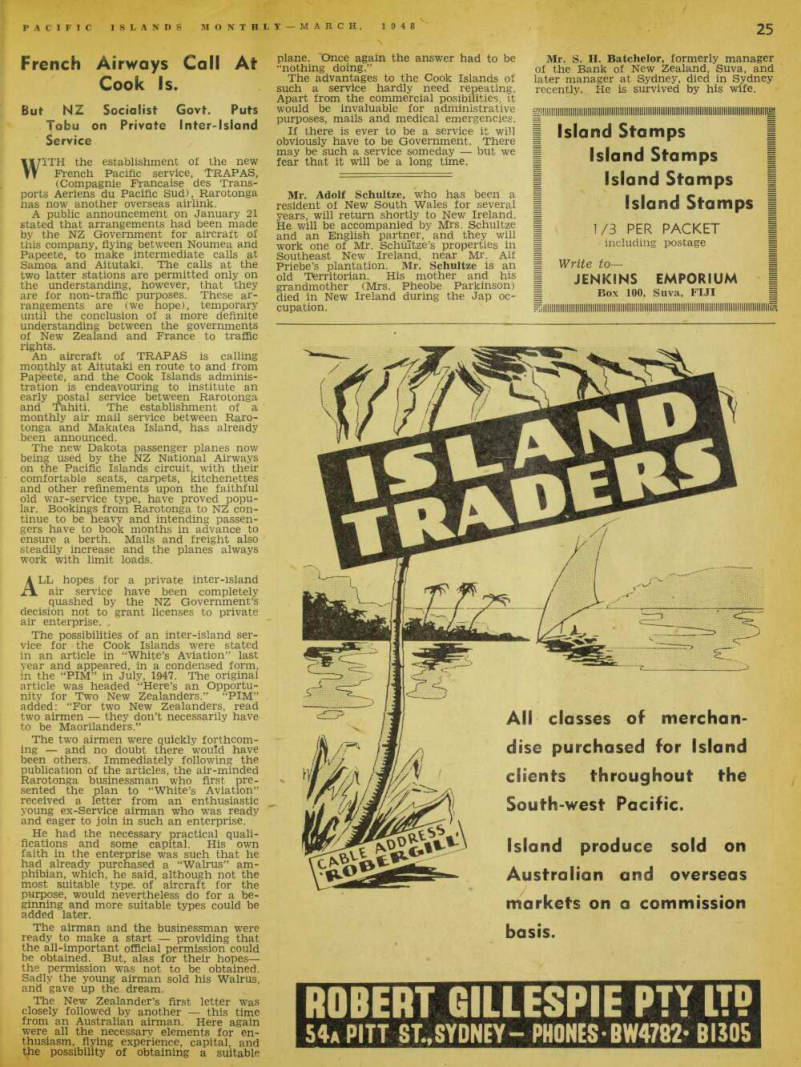
French Airways Call At
But NZ Socialist Govt. Puts Tabu on Private Inter-Island Service
WITH the establishment of the new French Pacific service, TRAPAS, (Compagnie Francaise des Trans ports Aeriens du Pacific Sud), Rarotonga has now another overseas airlink.
A public announcement on January 21 stated that arrangements had been made by the NZ Government for aircraft of this company, flying between Noumea and Papeete, to make intermediate calls at Samoa and Aitutaki. The calls at the two latter stations are permitted only on the understanding, however, that they are for non-traffic purposes. These ar rangements are (we hope), temporary until the conclusion of a more definite understanding between the governments of New Zealand and France to traffic rights.
An aircraft of TRAPAS is calling monthly at Aitutaki en route to and from Papeete, and the Cook Islands adminis tration is endeavouring to institute an early postal service between Rarotonga and Tahiti. The establishment of a monthly air mail service between Raro tonga and Makatea Island, has already been announced.
The new Dakota passenger planes now being used by the NZ National Airways on the Pacific Islands circuit, with their comfortable seats, carpets, kitchenettes and other refinements upon the faithful old war-service type, have proved popu lar. Bookings from Rarotonga to NZ con tinue to be heavy and intending passen gers have to book months in advance to ensure a berth. Mails and freight also steadily increase and the planes always work with limit loads.
ALL hopes for a private inter-island air service have been completely quashed by the NZ Government’s decision not to grant licenses to private air enterprise. , The possibilities of an inter-island ser vice for the Cook Islands were stated in an article in “White’s Aviation” last year and appeared, in a condensed form, in the “PIM” in July, 1947. The original article was headed “Here’s an Opportu nity for Two New Zealanders.” “PIM” added: “For two New Zealanders, read two airmen they don’t necessarily have to be Maorilanders.”
The two airmen were quickly forthcom ing and no doubt there would have been others. Immediately following the publication of the articles, the air-minded Rarotonga businessman who first pre sented the plan to “White’s Aviation” received a letter from an enthusiastic young ex-Service airman who was ready and eager to join in such an enterprise.
He had the necessary practical quali fications and some capital. His own faith in the enterprise was such that he had already purchased a “Walrus” am phibian, which, he said, although not the most suitable type, of aircraft for the purpose, would nevertheless do for a be ginning and more suitable types could be added later.
The airman and the businessman were ready to make a start providing that the all-important official permission could be obtained. But, alas for their hopes— the permission was not to be obtained.
Sadly the young airman sold his Walrus, and gave up the dream.
The New Zealander’s first letter was closely followed by another this time from an Australian airman. Here again were all the necessarv elements for en thusiasm, flying experience, capital, and the possibility of obtaining a suitable
plane. Once again the answer had to be •‘nothing doing.”
The advantages to the Cook Islands of such a service hardly need repeating.
Apart from the commercial posibilities, it would be invaluable for administrative purposes, mails and medical emergencies.
If there is ever to be a service it will obviously have to be Government. There may be such a service someday but we fear that it will be a long time.
Mr. Adolf Schultze, who has been a resident of New South Wales for several years, will return shortly to New Ireland.
He will be accompanied by Mrs. Schultze and an English partner, and they will work one of Mr. Schultze’s properties in Southeast New Ireland, near Mr. Alt Priebe’s plantation. Mr. Schultze is an old Territorian. His mother and his grandmother (Mrs. Pheobe Parkinson) died in New Ireland during the Jap oc cupation.
Mr. S. H. Batchelor, formerly manager of the Bank of New Zealand, Suva, and later manager at Sydney, died in Sydney recently. He is survived by his wife.
Advertisements & other items, pp. 25-26 (1 item)
Robert Gillespie Pit It?
Island Stamps
Island Stamps
Island Stamps
Island Stamps
1/3 PER PACKET
including postage Write to —
JENKINS EMPORIUM
Box 100, Suva, FIJI
N \ \ 7^ t i All classes of merchandise purchased for Island clients throughout the South-west Pacific.
Island produce sold on Australian and overseas markets on a commission basis.
ROBERT GILLESPIE PIT IT?
S4> PITT ST..SYDNEY-PHONES 8W4782- BI3OS
Day-Old
Chicks
BY AIR
Amalgamated Hatcheries
(Reg.) of Bankstown, near Sydney, N.S.W., can dispatch limited numbers of chicks by
PLANE TO
RABAUL, PORT MORESBY,
LAE, NOUMEA, SUVA.
and all other islands of the Pacific served Toy present AND PROJECTED air Services.
Amalgamated Hatcheries are the largest distributors of dayold chicks in Australia, last year over 1,000,000 chicks being sold by us in N.S.W. alone.
Our scientific method of packing and dispatch has resulted in a loss of less than 1 per cent, of chicks sent by plane.
If any chicks in your consignment arrive dead, we will replace them free, provided the extra freight is paid by the purchaser.
Chicks available are R.1.R., Austrolorps, and W.L.
Price, £lO per 100, landed at your airport, for unsexed chicks, and £l4 per 100 for all pullets. (Guaranteed 96 per cent, accurate sexing.) These chicks are the cream of Australia’s stock, produced under ultra - violet rays to guard against disease; the adult stock is blood-tested monthly by veterinary officers and each individual order carries a N.S.W.
Government certificate that the chicks are healthy and from tested stock.
Payment for chicks should be made by draft with the order, or credit arranged through our Bankers, the Commercial Bank of Australia, Ltd., Bankstown,
N.S.W.
Drafts and remittances can be sent direct to Amalgamated Hatcheries, Bankstown, N.S.W., or to the following agents: Messrs. Burns, Philp (South Sea) Co., Suva-Ba-Fiji, or any Island Branch. Also to: Marcel Legras, 38 Rue de Verdun, Noumea.
WRITE BY AIR-MAIL OR
CABLE.
AMALGAMATED
HATCHERIES
BANKSTOWN, N.S.W.
N. Caledonia May Get
Labour From NEI.
NEW Caledonian industrialists and others hope that their labour diffi culties will shortly be solved. It was announced recently that the Netherlands Government has accepted a suggestion to discuss possible terms and conditions for the introduction of new labour from the Netherlands East Indies.
The Caledonian General Council has met to formulate proposals, and the Cale donian representatives in the French Parliament have been promised the sup port of the French Minister for Over seas Territories in solving the labour problem.
Lack of labour as well as a shortage of Australian coal supplies has been holding up mining production in New Caledonia.
New Sda Boat For
Solomons
THE motor-vessel “Batuna,” purchased and equipped for the use of the Superintendent of SDA Missions in the British Solomon Islands, left Sydney in February with a European crew and some European passengers. When she arrives at SDA headquarters, near Hon iara, she will be given a native crew. The “Batuna” has twin screws, is 65 feet long, and her equipment includes refrigeration.
There is comfortable accommodation for eight Europeans and a native crew.
Mr. Sprilyan, radio operator from Nauru, arrived in Sydney on leave in February, and went on to West Australia.
Decaying Manus
Australia Takes Over Former USA Base
THE last of the Americans were in pro cess of withdrawal from the Manus Base (in the Admiralty Islands, north of New Guinea) in March, and a small party of Australians was moving in.
It was anticipated, after Japan sur rendered, that the United States would retain the Manus Base, upon the con struction of which they had spent an enormous sum. It was expected that Aus tralia would agree gladly to United States holding title over this bastion, because the presence of Americans in such a posi tion would automatically give protection to Australia against Asia.
The Australian Socialist Government, however, insisted upon its “rights.” Manus was part of the Mandated Territory of New Guinea, and Australia is the Man datory—therefore, Manus must be Aus tralian. But Messrs. Chifley and Evatt, in a moment of expansion and great generosity, did say that, under certain conditions, they might permit the Ameri cans to retain occupancy of Manus.
The United States reply, given about the end of 1946, was an announcement that America would abandon the Base, and American ships have been removing equipment ever since.
Little parties of officials from Australia and New Guinea have been visiting Manus and looking over their new king dom, and Australian Ministers have an nounced that an Australian naval and air base will be maintained there. Ac tually, Australia has neither the resources nor the men to maintain even half the base in the manner intended by the American designers.
An American newspaper correspondent was in Manus in February and, in his despatches, published on March 1, this is how he describes the Manus of the present day; As soon as the Americans leave, the Australians, who include three Air Force officers and 15 Government employees now stationed on the other side of the island, will move into the port area.
The port, which once harboured 1,000 war vessels, now contains a single ship, loading surplus equipment for China.
Victoria-avenue, main street of the crumbling base, is lined with deserted warehouses and rusting earth-moving equipment. Asphalt roads have long since gone to pieces, and jungle vines are begin ning to march across them. Bridges con structed only four years ago to carry Allied invasion forces already .are be ginning to crack up.
Ng Trade Stores
Letter to the Editor I AM jealous of the trade stores that are making fortunes from black brother, and am of opinion that, in order to give everyone a chance, no trader should be permitted to have more than one store unless there are at least two other opposition stores in between. Some persons are going in for chain stores.
Where there is no competition, prices are high and the native cannot possibly get as fair a go as he should.
I am, etc.,
Pair Play.
Lae, 27/2/48.
A New Caledonian soldier. Augustin Demene, has been postumously awarded the Medaille Militaire and Croix de Guerre for exceptional bravery at Hanoi, in Indo china,
Advertisements & other items, pp. 26-28 (2 items)
G. H. Robinson
ISLAND SUPPLIES
of all kinds—Selected and Shipped to order at lowest possible prices—Piecegoods in Wool, Cotton and Silk, Under and Outerwear, Manchester, Drapery, Grocery, Hardware, Engineers and Leathergoods trade supplies a specialty.
Indents and Transhipments arranged. Large or small orders treated with equal care.
Use our 25 years’ extensive experience.
Enquiries solicited to —
G. H. ROBINSON
51 Macquarie Street, Sydney, N.S.W.
Telegrams: Sunrise, Sydney.
Letters: Box 3317, G.P.0., Sydney.
lobfloil
/PE? .1 Ho .
CP
QAM 0^
v Bi ♦♦♦ r^Kss * 7 I
lobfloil
From Vacuum's refineries comes the New Mobiloil. This New Mobiloil will keep engines cleaner, make them snappier and more efficient, and economise on petrol. ma? 32 VACUUM OIL COMPANY PTY. LTD. [lnc. in Aust.]
T4e fatesf Otfeveb ma
VACUUM
QUALITY PROOUCr
GIOBITE
TRAVEL CASE
They're lighter, stronger, longerlasting. That's why a Globite costs less in the long run.
Made by
FORD SHERINGTON LTD.
its Dray free
in tropic heat
Wi 'Ji owe fs K 4 7 •✓A
SHELL
MOTOR OIL
SHELL COMPANY (PACIFIC ISLANDS) LTD.
(Incorporated in Great Britain) Agents: BURNS PHILP (South Sea) Co. Ltd.'
Fiji Copra Price
Sharp Protest by Chamber of Commerce
Prom Our Own Correspondent
T™ „ Suva, Feb. 2.
HE Suva Chamber of Commerce has sent a sharp protest to the Govern ment, on the grounds that while all copra produced in Fiji is compulsorily sold to the British Ministry of Food at about £42 a ton f.0.b., (United States prices go as high is £7O a ton), con sumers in Fiji have to pay unduly high prices for imported goods from sterling area countries.
When the protest was being discussed, Mr. John Trotter (Burns, Philp, (SS) Ltd.) pointed out that Fiji pays £46 a ton over the domestic price of Soap and an extra shilling on butter. On a recent invoice of £2,000 for cotton goods, an additional £4OO had been added on by Australia.
If Fiji received the San Francisco price for copra, it would mean nearly £750,000 per annum to the Colony said Mr.
Trotter. That sum could be used to cut the rising cost of living.
Islands Pensioners
Grim Position Caused by Inflation
ONE of the most difficult problems created in this period of currency inflation and ever-rising prices is the position of retired public servants, who are trying to live on a pension which may have seemed adequate when they retired, but has been rendered sharply inadequate by increasing prices.
The position of former public servants, superannuated from Papua and New Guinea, is particularly bad. Their pensions never were over-generous; and now they are feeling the shrinkage of money values very severely. The Aus tralian Government has made certain ad justments in regard to Commonwealth pensions, to take care of the, inflation problem, but —probably because they are unrepresented in Parliament and conse quently are without political teeth —the superannuated men of the Territories Services have had nothing done for them.
As public affairs in Australia are now governed by the desires of political opinions of the big unskilled trade unions, the outlook for the public service pensioner is pretty grim. Nonetheless, any organisation interested should take up the cudgels on their behalf and at least keep on hammering until one of the three helpless P's (Parliament, Press and Public) becomes aware of their plight.
Lae Says Morobe Should
Change Its Name
A CORRESPONDENT in Lae urges that the small coastal station named Morobe (on the mainland, down near the Papuan border) should have its name changed, as it causes confusion. Many people think that Morobe must be the of the District of Mor obe, whereas that distinction is held by Lae. “Morobe” he says, “has a population of about three white people and a dog, whereas in Lae we have a picture show and a pub, and are getting more civilised every day!”
A New Caledonian fisherman in the ex treme north of the colony is exporting fish liver to New Zealand, where it is being processed as a chemical food pro duct.
Advertisements & other items, p. 28 (1 item)
28
MARCH, 1948 P ACIFIC ISLANDS MONTHLY
By Government
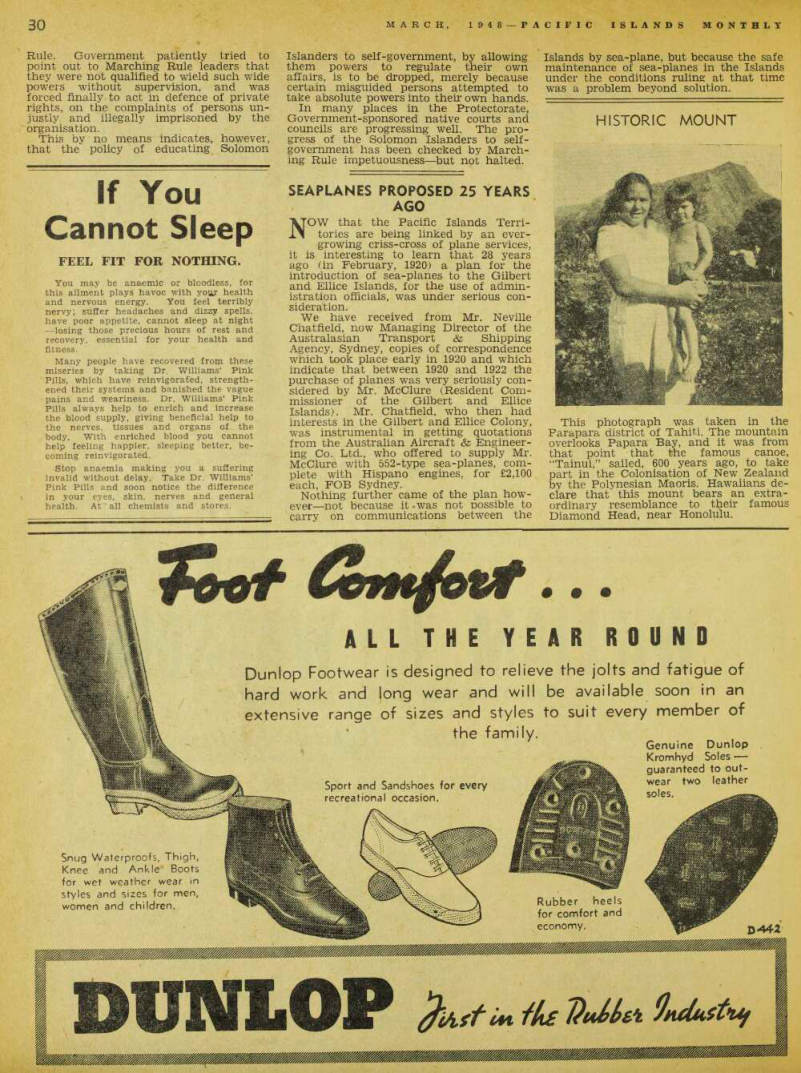
23 "MARCHING RULE" LEADERS SENT TO GAOL Extraordinary Movement In Solomons Broken Up By Government
From Our Own Correspondent
Honiara. Feb. 16.
WHEN 29 leaders of the “Marching Rule” Movement (“Marching Rule” was coined as the result of the at tempt by natives to say “Marxian Law”), were brought to trial here, an important stage was reached in one of the most remarkable developments in this part of the South Pacific.
The trial, which lasted 25 days, was concluded here on February 14.
Six of the accused were found not guilty; nine were sentenced to six years’ imprisonment with hard labour; the re mainder received sentences ranging from five years to one year.
In giving judgment, the Judicial Com missioner (Mr. W. T. Charles) said that the cause of the case was the legality of Marching Rule on Malaita. Marching Rule would, under the law, be illegal if it— • had some members who. as a re quirement of Marching Rule, were under an agreement not to disclose any sed itious activities of the movement to the Government: or • was part of a wider movement in other islands also and as such had its own separate delegates, or acted inde pendently of the other party; or • had appointed delegates to obtain re cruits or to confer with delegates of other branches of the society.
He said that the movement would not be illegal if its aims were exclusively re ligious or charitable.
The accused’s defence was that March
ing Rule aims were the protection of pro perty; the care of children, the aged, in firm and sick; the preservation of native customs, and similar objects.
The Judicial Commissioner found, how ever, that Marching Rule had in fact— (l) disclosed to those it was persuading to join the movement that, secretly, Marching Rule was to prevent workers from accepting employment, to take over courts, the means of punishment, and all other Government functions: (2) set up private police forces known as “duties,” who made arrests, acted as guardians of persons accused and con victed by Marching Rule, and were often armed with truncheons or bayonets. (The Judicial Commissioner said that, in the face of the evidence, the accused’s contention that the function of “duties” was to act as a fire brigade and as nursemaids and kindergarten attendants had received the consideration it de served) . (3) Marching Rule had set up illegal courts in deliberate defiance of Govern ment and had illegally held people prisoner.
In consequence, the Judicial Commis sioner held that Marching- Rule on Malaita was an illegal organisation and that the convicted persons were members of it.
GOVERNMENT for nearly three now has been trying to direct the energies of Marching Rule into more productive channels and, in particular, into the native councils and courts set up as
a training ground in democracy, and operating under Government advice and control —a policy instituted, it must be stressed, long before Marching Rule was heard of.
These courts and councils have wide legal powers, including all those demanded by Marching Rule, with the single ex ception that gerieral control and power to review court sentences was insisted upon by Government and denied by Marching
Rule. Government patiently tried to point out to Marching Rule leaders that they were not qualified to wield such wide powers without supervision, and was forced finally to act in defence of private rights, on the complaints of persons un justly and illegally imprisoned by the organisation.
This by no means indicates, however, that the policy of educating Solomon
Islanders to self-government, by allowing them powers to regulate their own affairs, is to be dropped, merely because certain misguided persons attempted to take absolute powers into their own hands.
In many places in the Protectorate, Government-sponsored native courts and councils are progressing well. The pro gress of the Solomon Islanders to self government has been checked by March ing Rule impetuousness—but not halted.
Advertisements & other items, pp. 29-30 (1 item)
William H. Watson
SPECIALISING IN
PACIFIC ISLAND INSURANCES
FIRE—MOTOR VEHICLE
MARINE—HULLS AND CARGO
EMPLOYER’S LIABILITY
BONDS—in accordance with
ADMINISTRATION ORDINANCES.
COPRA INSURED FROM DRIER
TO BUYER.
AND ALL OTHER CLASSES ARRANGED
AT LOWEST CURRENT RATES.
Established Agencies throughout the Territory of Papua and New Guinea.
Managing Agents: W. R. Carpenter (New Guinea), Ltd.
Island Representative: G. D. A. Kent, Rabaul Branch.
SOUTHERN PACIFIC INSURANCE
CO., LTD.
HEAD OFFICE: 60 HUNTER STREET,
SYDNEY.
ESTABLISHED 1930
WILLIAM H. WATSON
RAROTONGA, COOK ISLANDS
W hole sale and Retail Trader
LICENSED STAMP DEALER
Agent For:—
BRITISH TRADERS' INSURANCE CO.
CORONA & L. C. SMITH TYPEWRITERS
KAISER & FRAZER MOTOR CARS
B.S.A, CYCLES AND MOTOR CYCLES
AMERICAN LEAD PENCIL CO.
WHITES AVIATION LTD.
Manufacturers of: FOOTWEAR, ALL CLASSES SUITABLE FOR NATIVE TRADING . . . MO P. PRODUCTS, INCLUDING ROUND EAR-RING BLANKS AND BUITON BLANKS Exporter of: “Rarotonga” Hula-Skirts.
Sea-Shell Necklaces.
M.O.P. Jewellery.
Island Produce.
Wholesale and Retail Inquiries Invited.
Prepared to Consider Agencies for all Class of Goods.
Importer of: Textiles.
General Hardware'.
Fancy Goods.
General Merchandise.
Cable Address: “Watson” Rarotonga Bankers: Bank of New Zealand, Auckland.
If You
Cannot Sleep
FEEL FIT FOR NOTHING.
You may be anaemic or bloodless, for this ailment plays havoc with your health and nervous energy. You feel terribly nervy; suffer headaches and dizzy spells, have poor appetite, cannot sleep at night —losing those precious hours of rest and recovery, essential for your health and fitness.
Many people have recovered from these miseries by taking Dr, Williams’ Pink Pills, which have reinvigorafed, strengthened their systems and banished the vague pains and weariness. Dr. Williams’ Pink Pills always help to enrich and increase the blood supply, giving beneficial help to the nerves, tissues and organs of the body. With enriched blood you cannot help feeling happier, sleeping better, becoming reinvigorated.
Stop anaemia making you a suffering invalid without delay. Take Dr. Williams’
Pink Pills and soon notice the difference in your eyes, skin, nerves and general health. At all chemists and stores.
So/ Comfas#
• Snug Waterproofs, Thigh, Knee and Ankle Boots for wet weather wear in styles and sizes for men, women and children.
AIL THE YEAR ROUND
Dunlop Footwear is designed to relieve the jolts and fatigue of hard work and long wear and will be available soon in an extensive range of sizes and styles to suit every member of
the family.
Genuine Dunlop Kromhyd Soles guaranteed to outwear two leather soles.
Sport and Sandshoes for every recreational occasion.
Rubber heels for comfort and economy.
DUNLOP fti/iftUi the VM&'i
D 4 41
Seaplanes Proposed 25 Years
Ago
NOW that the Pacific Islands Terri tories are being linked by an ever growing criss-cross of plane services, it is interesting to learn that 28 years ago (in February, 1920) a plan for the introduction of sea-planes to the Gilbert and Ellice Islands, for the use of admin istration officials, was under serious con sideration.
We have received from Mr. Neville Chatfield, now Managing Director of the Australasian Transport & Shipping Agency, Sydney, copies of correspondence which took place early in 1920 and which indicate that between 1920 and 1922 the purchase of planes was very seriously con sidered by Mr. McClure (Resident Com missioner of the Gilbert and Ellice Islands). Mr. Chatfield. who then had interests in the Gilbert and Ellice Colony, was instrumental in getting quotations from the Australian Aircraft & Engineer ing Co. Ltd., who offered to supply Mr.
McClure with 552-type sea-planes, com plete with Hispano engines, for £2,100 each, FOB Sydney.
Nothing further came of the plan how ever—not because it-was not possible to carry on communications between the
Islands by sea-plane, but because the safe maintenance of sea-planes in the Islands under the conditions ruling at that time was a problem beyond solution.
Historic Mount
This photograph was taken in the Parapara district of Tahiti. The mountain overlooks Papara Bay, and it was from that point that the famous canoe, “Tainui,” sailed, 600 years ago, to take part in the Colonisation of New Zealand by the Polynesian Maoris. Hawaiians de clare that this mount bears an extra ordinary resemblance to their famous Diamond Head, near Honolulu.
Mrs. N. Sinclair, formerly of Wau (NG), placed her home in Brisbane at the disposal of a number of ex-Territorians who held a Christmas party there last Decern
ber. Each guest was presented with a shoulder-spray of frangipani by Miss Daphne Mills, an ex-resident of Witu.
Advertisements & other items, pp. 31-32 (1 item)
grand cigarette
is a
for all occasions-
Capstan’s own blend
of fine Virginia
leaf cannot
I
be equalled
I Navy Cut
riCigareltes.
,Wi m $ ¥ That's why it's always
TIME FOR A CAPSTAN
380PI-7.47
THE EMPIRE’S FAVOURITE CIGARETTE
AMERICAN, ENGLISH AND AUSTRALIAN PERIODICALS
AND TRADE JOURNALS POSTED DIRECT TO YOU
The N.S.W. Bookstall Co. Pty. Ltd.
Can supply all available Oversea and Local Subscription Magazines. Let us know your requirements.
Subscription Lists Available on Application .
N.S.W. BOOKSTALL COMPANY PTY. LTD.
Market and Castlereagh Streets, Sydney, Australia
AUNT
MARYS
CREAM OF TARTAR
BAKING POWDER
< Now Better than Ever!
t
Problems
N. Hebrides Labour
Neither Natives nor Imported Labour Keen To Work
From Our Own Correspondent T to , u . A . VILA, Feb. 10.
HE labour position in the New Heb rides is becoming increasingly acute.
The few Tonkinese who are left, being citizens of the “free, independent and democratic republic” of Viet Nam, are now free to work, or not, as they please, and it is difficult to obtain suffi cient labour to carry on plantations.
Some planters, in order to get their copra cut are offering half of it to any Tonkinese or natives who may be willing to do the work. As a rule, however, the Tonkinese prefer to be their own masters.
Many of them, both at Vila and at Santo, have their own jeeps, which they run as taxis, while others are contractors, market gardeners, barbers, motor mech anics, small shopkeepers, etc.
The natives are as reluctant as ever to engage in toil and when they do get the urge to work they demand fantastic wages. Casual labour in Vila now costs 6/- to 7/- per day, with meals thrown in, hours 7 to 5 with a nice long spell in the middle of the day; and, even under these conditions, the employer who is unwilling to break the law by giving his boys an “appetizer” finds it difficult to keep them.
A well-known planter, who incidentally was primarily responsible for the intro duction of Tonkinese labour into the New Hebrides, proposes to go to Java shortly to investigate the possibility of obtaining indentured labour from the island. His efforts will be watched with great interest by the planters in this Group; but, in view of the Communistic outlook of the Javanese, it is doubtful whether the situation would be much improved by the introduction of such labour.
It has been reported that the difficulty of geting sufficient labour was one of the reasons for the recent sale to French interests (at a figure of about £36,000) of the largest British-owned plantation in this Group.
New Caledonian Natives
Now Increasing
rjIHE native population of New Cale- X donia and the Loyalty Islands now is on the increase. Last year the official figure was 31,481, an increase of 728 on the previous year and of more than 2,000 over the count in 1939.
The intelligent Loyalty Islanders, who migrate in large numbers to Noumea to find work and sell their vegetable crops, make up 12,000 of this total.
The fall and rise of native population in this French territory corresponds with what has gone on in other parts of the Pacific. When Captain Cook discovered it the population is supposed to have been between 200,000 and 300,000, and terraced native plantations covered miles of hillsides; yet to-day, a much smaller population, white, Asiatic and Melanesian, cannot feed itself and has to live on im ports. , By 1887, the native population, dis couraged by disease and abortive revolts, numbered only 42,000, and in 1906 it was only 28,000. ... .
These adverse population trends did not affect the Loyalty Group to such an ex tent; in recent decades population de cline has not been noticeable.
Mr. V. Whittaker of Brisbane, spent the school vacation on his parents plan tation “Awilunga,” New Guinea.
Advertisements & other items, p. 32 (1 item)
32
MARCH, 1948 PACIFIC INLANDS MONTHLY
Birth-Pangs of Democracy
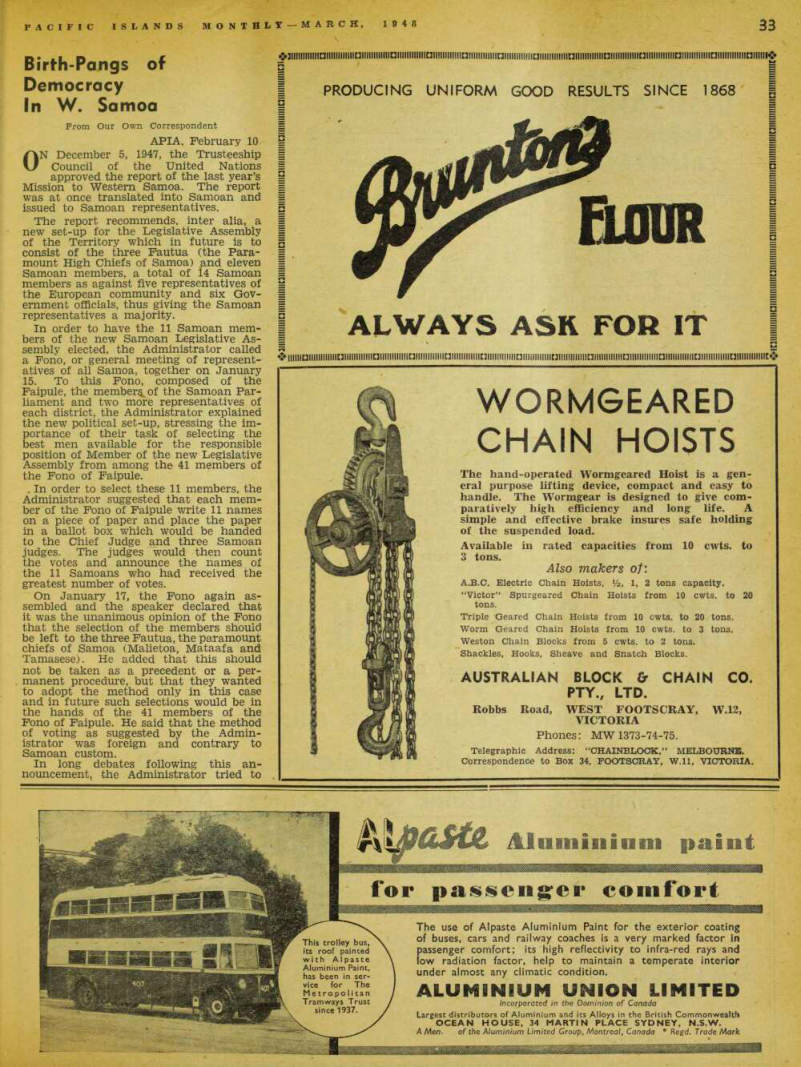
Democracy In W. Samoa
Prom Our Own Correspondent APIA. February 10 ON December 5, 1947, the Trusteeship Council of the United Nations approved the report of the last year’s Mission to Western Samoa. The report was at once translated into Samoan and issued to Samoan representatives.
The report recommends, inter alia, a new set-up for the Legislative Assembly of the Territory which in future is to consist of the three Fautua (the Para mount High Chiefs of Samoa) and eleven Samoan members, a total of i 4 Samoan members as against five representatives of the European community and six Gov ernment officials, thus giving the Samoan representatives a majority.
In order to have the 11 Samoan mem bers of the new Samoan Legislative As sembly elected, the Administrator called a Fono, or general meeting of represent atives of all Samoa, together on January 15. To this Fono, composed of the Faipule, the of the Samoan Par liament and two more representatives of each district, the Administrator explained the new political set-up, stressing the im portance of their task of selecting the best men available for the responsible position of Member of the new Legislative Assembly from among the 41 members of the Fono of Faipule. , In order to select these 11 members, the Administrator suggested that each mem ber of the Fono of Faipule write 11 names on a piece of paper and place the paper in a ballot box which would be handed to the Chief Judge and three Samoan judges. The judges would then count the votes and announce the names of the 11 Samoans who had received the greatest number of votes.
On January 17, the Fono again as sembled and the speaker declared that it was the unanimous opinion of the Fono that the selection of the members should be left to the three Fautua, the paramount chiefs of Samoa (Malietoa, Mataafa and Tamasese). He added that this should not be taken as a precedent or a per manent procedure, but that they wanted to adopt the method only in this case and in future such selections would be in the hands of the 41 members of the Fono of Faipule. He said that the method of voting as suggested by the Admin istrator was foreign and contrary to Samoan custom.
In long debates following this an nouncement, the Administrator tried to
persuade the Samoans to take the re sponsibility of the selection on them selves, but the Faipule persisted in their attitude.
The position at present is that the Fautua have agreed to make the selection from 31 names submitted to them. They presumably are still deliberating on their choice as no announcement has yet been made as to who will be the 11 Samoan members of the new Legislative Council.
Advertisements & other items, pp. 33-34 (1 item)
>aste.
PRODUCING UNIFORM GOOD RESULTS SINCE 1868
ALWAYS ASK FOB IT
WORMGEARED
CHAIN HOISTS
The hand-operated Wormgeared Hoist is a general purpose lifting device, compact and easy to handle. The Wormgear is designed to give comparatively high efficiency and long life. A simple and effective brake insures safe holding of the suspended load.
Available in rated capacities from 10 cwts. to 3 tons.
Also makers of: A.B.C. Electric Chain Hoists, V 2, 1, 2 tons capacity.
“Victor” Spurgeared Chain Hoists from 10 cwts. to 20 tons.
Triple Geared Chain Hoists from 10 cwts, to 20 tons.
Worm Geared Chain Hoists from 10 cwts. to 3 tons.
Weston Chain Blocks from 5 cwts. to 2 tons.
Shackles, Hooks, Sheave and Snatch Blocks.
AUSTRALIAN BLOCK & CHAIN CO.
PTY., LTD.
Robbs Road, WEST FOOTSCRAY,
VICTORIA
Phones: MW 1373-74-75.
W. 12, Telegraphic Address: “CHAINBLOCK.” MELBOURNE.
Correspondence to Box 34, FOOTSCRAY, W.ll, VICTORIA.
>aste.
Alum in in ni paint
*r.
for paisenger comfort
This trolley bus, its roof painted with Alpaste Aluminium Paint, has been in service for The Metropolitan Tramways Trust since 1937.
The use of Alpaste Aluminium Paint for the exterior coating of buses, cars and railway coaches is a very marked factor in passenger comfort; its high reflectivity to infra-red rays and low radiation factor, help to maintain a temperate interior under almost any climatic condition.
ALUMINIUM UNION LIMITED
Incorporated in the Dominion of Canada Largest distributors of Aluminium and its Alloys in the British Commonwealth OCEAN HOUSE, 34 MARTIN PLACE SYDNEY. N.S.W.
A Alen. of the Aluminium Limited Group, Montreal, Canada * Regd. Trade Mark m ' 1 .1
QUEENSLAND
INSURANCE
COMPANY
LIMITED
(Incorporated 1886 In Australia)
ASSETS EXCEED £4,000,000
Head Office :
QUEENSLAND
INSURANCE BUILDING,
80-82 PITT STREET, SYDNEY.
Specialists in South Seas Fire,
Marine & Accident Insurances
Apply to:—
FIJTL
Branch Office: I. B. Chalmers, Manager.
Burns Phllp (South Sea) Co., Ltd.
VILA.
Burns Phllp (South Sea) Co., Ltd.
Comptoirs Francals Des Nouvelles Hebrides (Marine).
NOUMEA.
L. <fe W. Johnston.
PORT MORESBY:
Burns, Phllp & Co., Ltd.
W. A. Anderson, Resident Officer,
PAGO PAGO.
Burns Phllp (South sea) Co., Ltd.
G. H. C. Reid & Co.
OTHER SOUTH SEA ISLANDS.
Burns Phllp (South Sea) Co., Ltd.
Also to any of the Company’s Offices in Australia or New Zealand.
BURNS PHILP (SOUTH SEN) Go. Ltd.
Registered Office: SUVA, FIJI
Code Address: “BURNSOUTH”
ISLAND TRADERS AND SHIPOWNERS
General Merchants (Wholesale and Retail)
Shipping, Customs and General Agents
Representatives for QUEENSLAND INSURANCE CO. LTD.
Distributing Agents for SHELL COMPANY (PACIFIC ISLANDS) LTD.
BRANCHES:
FIJI—
SUVA.
LEVUKA.
LAUTOKA.
LAB AS A.
BA.
SIGATOKA.
ROTUMA ISLAND.
NORFOLK IS.— NIUE IS.—
SAMOA—
APIA.
PAGO PAGO.
TONGA—
NUKUALOFA.
HAAPAI.
VAVAU.
Sydney Agents:
BURNS, PHILP & CO., LTD.,
7 Bridge Street.
London Agents:
BURNS, PHILP & CO., LTD.,
35 Crutched Friars, E.C.3.
San Francisco Agents:
BURNS, PHILP CO. OF SAN FRANCISCO,
Matson Building, 215 Market Street, Agencies Throughout the World.
Fiji's "Rare" Lizard Not
So Rare
Letter to the Editor 1WAS interested in the short article on page 78 of your December issue, regarding the Pacific iguana. This lizard is anything but rare, being found quite close to Suva, and a small reward will always bring a “vokai” in a short time. Besides being abundant on Viti Levu and Taveuni (I have not seen one on Vanua Levu), it also occurs on the small islands in Lau and extends, as you state, into Tonga.
Anyone interested in its exact distribu tion in Fiji should consult a paper by the Burts, published by, I think, the Chicago or Washington museum, where details of the localities from which their specimens were taken are listed. Publi cation was in the middle thirties, I think.
The specific name is fasciatus — not fusciatus — given in allusion to the bands encircling its body. This lizard is well known to planters in Fiji and is popu larly called the chameleon, as it under goes a slight colour change, according to its immediate surroundings.
One or two that I dissected had leaves and leaf remains in the stomach, and a new species of round worm in the in testine.
I am, etc.,
Malaya, Feb. 18.
R. A. Lever.
40 Fijians Charged With Rioting
Rioting
Sequel To Goldminers 7 Strike
Prom Our Own Correspondent
Suva. Feb. 10.
REPORTS of the strike at the Vatu koula goldfields in December, when more than 900 Fijian employees were involved, have been very sketchy.
Fragments of information have now come out as a result of a court case at Tavua, in which 40 Fijians were charged with taking part in a riot at the Vatu koula police sub-station on December 11, during the strike period.
Following complaints of strike-intimid ation, the police (considerably reinforced by drafts from outside the mining area) had apparently taken two Fijians from their barracks at the mines to the Vatu koula sub-station for questioning. Be lieving the men to have been unlawfully arrested, a crowd of between 200 and 300 strikers moved on the station and sub jected the building and the Fijian and European policemen who lined the com pound hedges, to concentrated stoning.
The police subsequently released the men.
At the trial, twenty-four of the 40 accused were released on probation under bond for two years, and the remaining 16, including those judged to be ring leaders, received gaol sentences ranging from one month to six months.
Public reaction to the whole business is that it was “not Fijian.” But the question of origin is still open.
Mr. John W. Cox, of the New Guinea Public Works Department, fell heavily and injured his foot and leg rather severely while on furlough at Manly, Syd ney. His return to the Territory, in con sequence, has been somewhat delayed.
Advertisements & other items, pp. 35-36 (1 item)
-Ss2Ss=
/ / CL£ 4n rVsTr^T^)
*OV* *££*** FO * a* ‘
.MW B *■*£
fei/y mo ***a Hu* tH ,rMAPt
-SS2SS=
»-| ‘sssssz***
r~ \; A 1 % K: 0,, w.
A \ K4B-I3 /
,v w
»*nta v
c KtAl*
STOP PA/A/ FASTER/
ANACIN stops pain faster because it contains an extra ingredient. ANACIN is a prescription for pain. Keep it handy for those “difficult” days.
Trade Mark .
PACIFIC ISLANDS SOCIETY
Visitors from the Islands to Sydney (or these interested in Islands affairs), are advised to communicate with the honorary secretary of the above Society, which has been formed to study the history, traditions, economics, and political developments of the Pacific Islands.
Regular monthly meetings are held at History House, 8 Young Street, Sydney.
Address for Correspondence:
THE PACIFIC ISLANDS SOCIETY,
Box 2434 MM., G.P.0., Sydney.
«=* & St Energy lost during the day is speedily restored when Imperial Hampe is served for the evening meal Hampe, sliced or diced, makes cool, energising salads, sandwiches and savouries, and the satisfying flavour lasts to the very end.
Quick and simple to prepare, Hampe is a treat for all the family. iAim Try Imperial Meatreat, Corned Beef, Hot Meals
Imperial
Flavour Sealed Canned Foods Riverstone Meat Co., 5-7 O’Connell Street, Sydney Fiji Representative: Pearce & Co. Ltd., Suva
Mother India Day Not
Publicised In Suva
Prom Our Own Correspondent
Suva, Jan. 27.
AFTER earnest research, this corres pondent discovered that Bharat Mata (Mother India Day) was to be celebrated on January 25 and not, as reported earlier, on January 18.
The result, however, was the same to non-Indians in Suva. A few Dominion of India flags were the only outward sign.
Adventure
End of Samoans' Piracy Adventure
SIX young men appeared before the High Court of Apia, on February 4, on a charge of theft of the motor launch “Wyben” belonging to Messrs. A.
G. Smyth &} Co., Ltd., of Apia and of the cargo contained in the vessel.
The evidence disclosed that one night in August 1947, the launch, fully laden with stores, was towed from the harbour and then went to sea under her engines.
The purpose of the instigator of the theft was to sail to Tahiti.
Fuel for the engine gave out after a week, and the crew used sails for a day or two until they were blown out in heavy weather. Thereafter the launch drifted, and after a couple of months at sea, was finally wrecked on Vanikoro reef, in the Southern Solomons.
Responsibility for the theft was ad mitted by Eddie Ah Siu and Isumu Ah Siu, two Chinese-Samoans. The watch man, a Samoan, Lolesea, stated that he was asleep on board and did not wake up till the launch was out to sea. As this was supported by the evidence of three others, the Court dismissed the charge against him.
The remaining three accused, Vincent Pereira (18), Moti Pereira (14), and Ben Brewster (15) all swore that they had been invited to go to the Government launch “Pilot II” by Eddie Ah Siu, who was employed aboard that vessel, and then were asked by him to go across with him to the “Wyben” to pick up something belonging to him. After they had boarded the “Wyben” they were held up by Eddie Ah Siu at the point of a service rifle, and forced to go to sea with the others.
The Court considered that their ex planation was open to some doubt, but as it could not be proved that they in tended to steal the launch and it was possible that they were enticed on board and shanghaied, they were found not guilty.
In sentencing those convicted, allow ance was made for the fact that they had been in custody for three months. Eddie Ah Siu, the ringleader, was sentenced to three years nine months; Isumu Ah Siu to 2 years’ imprisonment.
Three Men Missing In Fiji
Storms
From Our Own Correspondent
Suva Feb. 16.
THREE casualties resulted from the storm which swept Viti Levu early this month. All were Fijians.
Four punts left Navua, on the southern coast of Viti Levu, for the island of Beqa, early on the morning of February 4.
Distributed among the four vessels were nine men, including Ratu Kepueli Tavu anavesi, Buli Beqa.
All went well until the first punt, in which were the buli and four others, capsized near the Beqa reef. The buli, an elderly man, was taken aboard an other punt which contained only two men, Osea Vakurivalu and Ilimotau.
Just as the first punt was righted the storm broke and a high gale swept down between Viti Levu and Beqa. The punt to which the buli had transferred was carried far to the east; another, which contained two men, Sekaia Tui and Sakaia Tui, disappeared so far with out trace of men or boat being found.
The others went ashore safely at Beqa.
The storm-driven punt ultimately went ashore at Wakaya island, in the Koro Sea, 100 miles away. Somewhere past south-eastern Viti Levu the craft cap sized at the height of the storm, and it was then that the buli was lost.
The other two men clung to the over turned craft until it went ashore.
Magazine Section
Territories Talk-Talk
By "Tolala"
SEEING a tall figure swinging down Castlereagh street, Sydney, the otner day jerked my memory back a quarter of a century to Rabam, in the ney-day of the Exproboard. It was jovial Harold Coldham (known to ms intimates as 3LO because of the timbre of his voice); he seemed as young and virile as when, shortly after World War I he was a Board plantation man ager (or maybe overseer).
There aren’t very many of them left now. “Blue” Allen is another and was, in those days, looking after one of the ex-German plantations for the Board along the Kavieng Road. Jack Mullaly was an auditor with the board tnen, so also was Clarrie Archer (now a PCB dictator) while Jack Gilmore and Fred Archer were doing a job in what usea to be called the Workshop section, with popular old Nobby Clark. Tony Edgen was one of the crowd, but he has more or less shaken the Islands white sand out of his socks, and is now running that most successful canning business in Sydney.
Others in the same category are Bill Watson and Herk. Bradaon. A. M.
Stewart was one of the early ones, and he is still seeing that the copra is properly dried and that no one has got aown on any of the fish-hooks in the trade-store somewhere between Wanimo and Buin.
The indomitable Richards, of course, is still going strong, like the well-known beverage, but he had not risen to lame 25 years ago, being a minor cog in the Exproboard machine down Kieta way.
They were happy, care-free days, be fore nylons and black-markets or bobby soxers. “Boys” took a pride in their work, and did it with a smile and oft-times at the double.
Yes, a lot of water has flowed under the bridge since Harold Coldham mixed a drink in the old Rabaul Club and yarned with Fred Jolley (the then Busi ness Manager of the Board, but now quietly retired somewhere across the Har bour, these many years). Harold, by-the way, was up from Melbourne, making preparations to take his wife up to his Bali property in the Witu Group. They sail sometime in June. ♦ * ♦ rTHER Chaize hit the news again last month, when he paid a visit to Can berra, and Prime Minister Chifiey gave him the run of the PM’s Lodge in the capital. That’s no trouble to Father Chaize, who’d take it all in his stride.
For years before the Second War he was looking after his Marist flock down Buka way; making his HQ around the Passage.
He is a loveable character, and can do almost anything with natives; rolls his own cigars from the native “brus,” and is imbued with a wonderful sense of humour.
During the war he did a good job with the French Navy around the Islands and collected a couple of decent-sized decora tions out of the job. He’s attached to the Mater Misericordiae Hospital at North Sydney now; and I’ll bet his genial smile does more for the patients than many of the tonics they put up in bottles.
AT a recent Government House inves titure in Sydney a couple of war veierans, wno lound themselves in Changi prison camp, eacn had a Bntisn Empire Meaai pinned on their cnests lor maintaining secret wireless sets in tne camp.
Occupied in this same hazardous game in tne Rabaul prison camp was niiau cameron/ wno was electrician witn tne rwD during normal times. Allan, wnose occupation was known to the oaps (tney had everyone’s History down to tne smallest detail), was given tne job of re pairing wireless sets oy the dap Army, wnose members had tossed most of tne sets out m tne street during tne first few days of the Rabaul occupation thinx mg they were some Kind oi boooy-trap.
Allan wonted overtime, out he managed to make up a set of ms own, which Kept tne camp au fait with doings outside, in cluding Curtin’s remarks aoout the i'ol massacre. The little set was of great value to the chaps in the camp up to tne time they sailed on the ill-fated - Monte video Maru.”
Allan did not sail on that vessel, put was detained in Rabaul because of ms technical knowledge, which incidentally might have been tne cause, or a con tributing factor, to his death. The Japs perhaps found a receiving set he was working. Allan was with Cnancey, Albert Evensen and that crowd wno, officially, disappeared into thin air. A good cove, was Allan. * ♦ * THE WRC freighter “Rabaul II” her namesake was sunk in the Atlantic in 1941 and was well-known in Terri torial waters before the War has cnanged its name and is now known as “Dongola.” iShe’s on the Australia-india run. Islanders will be sorry for the change; it was a link with the old town.
Still, what’s in a name? It’s the cargo space they want up there now. Cargo space and bags. One planter recently told me he had 250 tons of copra waiting in his sheds because he couldn’t procure bags. And that with the shortage of fats in the world seems . . . Well, wouldn’t it? u _i * * * m. LESLIE McALPINE, of Drummoyne, X in an individual who is determined to leave no stone unturned in order to have a Royal Commission appointed to “inquire into New Guinea affairs.”
Any letter touching on the Territory, which appears in “Granny” Herald, is in variably followed in a day or two by a request from Mac for a Commission. He’s been steadily trying now, for years, and eventually (we hope) will wear down Mr.
Chifley’s objections by sheer perseverance.
He knows his Islands, too, and was for many years in the BSI and Bougainville before being an inspector for one of the Big Firms. * * * NEW GUINEA was in the news last month (and I don’t mean about timber leases) when a Yankee mis sionary put up the suggestion in Wash ington (DC) that US should part up £32 million to Australia and Holland for New Guinea and start a Japanese settle ment there.
No need to describe what Canberra re actions were, or Holland’s either, for that matter. But it does raise the point as to what is going to be done with those exceptionally rich highlands.. To quote J. L. Taylor, leader of the famous Mount
Hagen expedition in 1938-39: “The exis tence of these highland areas makes New Guinea . . . something between a second Java and a second New Zealand ... It has a golden future, I have no doubt, and I trust we may see it in our time— upon our energy and initiative this de pends.” If we don’t do something about it, then somebody else will.
BITS AND PIECES: Judy Street was married in Melbourne on February 25, to Nicolas Adrian Job. It was a quiet affair at Christ Church, South Yarra. Congratulations . . . Josephine Pederson, only daughter of the late Mr.
C. Pederson and Mrs. Pederson, of Rose Bay, married Dr. James O’Keefe, of Cooma, last month at Sacred Heart Church, Fymble ... An old-timer has gone to his rest: William James V.
Saville, formerly of Mailu, Papua. Passed away on February 7 at West Wickham, Kent. He was 75 . . . Karl Albert Otto Soltwedel, well-known on the Morobe goldfields, is applying for Australian naturalisation . . . Joan Pennefather, daughter of the genial Vic of Tokua plan tation. in the Kokopo district, was married to Ken Jones, eldest son of J. H. (Bert) Jones, of the District Services. The cere mony took Diace at Shore Chapel on March 4 . . . Fred Cook, who has been running Cliffside for Doris Booth, is hav ing a look at the Big Smoke . . . Ben Parer is down from Rabaui to have a
(See Next Page)
THE above is the result of a sketch made on board “Montoro” when the artist was travelling back to New Guinea some months ago. The victim is Captain Duddell, .former master of that well known vessel, who is soon to leave for Scotland to bring out the luxury ship, “Bulolo.” Well-known to both New Guinea-Papua residents and to the folk at Singapore, Captain Duddell is most popular.
broken wrist re-set . . . Colin Marr and family are visiting Sydney, and expect to be down for a few months . . . Perc Blanden, after his crash into the Bulolo tree-tops, we are glad to say is now able to hobble about a bit out of hospital— at long last . . . Mick Thomas, from Bitapaka, is down with his family on a spot of holidaying . . . George Robins, of BP, Lae, arrived recently for medical treatment. His wife accompanied him . . . . Ted Edols, one-time of Wau, has been browsing around the Pacific since the War, having a look at Borneo, New Hebrides and so forth. He’s returning to Singapore, and then journeys on to Borneo once again . . . Reg Duncan, one-time master of the old “Durour,” is now skippering “Eastern Venture” . . .
Tom Yeomans, arriving down from the Bulolo, looks the picture of health. He doesn’t talk, but he looks happy enough, so I expect the dredges are turning out their modicum of gold these days. There are five of them working.
Memories of Wakaya
By W. E. Newton
MRS. ALLEN INNES’S photographs,
with description of Wakaya, in De cember issue of “PIM” held more than a passing interest for Mrs. Violet Longdale, now living in Sydney.
In 1866, Mrs. Mary Pflugger, a young Irish-French woman who became noted for her extraordinary beauty and courage (and they were the days when plenty of courage was both needed and shown by pioneers) went out to Fiji with her hus band and was the first white woman to live in Rewa and Ba.
Her daughter, afterwards Mrs. Lang dale, was born there and was a god daughter of the celebrated King Cakabau, who bestowed on her the title of Princess of Ba.
Forty-one years ago, Mrs. Langdale spent her honeymoon on the small, beautiful island of Wakaya, which was then owned by Captain Fred Lennox- Langdale, RN, who lent it for the occasion.
He had stocked it with deer and pea cocks and had built himself a picturesque, long-roomed coral house, in Tudor style.
It was a remarkable place altogether, its inside walls being painted by the artist-owner with portraits of European kings and queens from the 11th century onwards. The cemented floors were covered with rare tapestry rugs which, with furniture including a big ancestral four-poster bed, and suits of armour, he had brought from his home in England.
“Being born in Fiji in the cannibal days,” says Mrs. Langdale, “I had no familiarity with the things of the more civilised world, such as overwhelming four-posters and awe-inspiring suits of armour.”
They were too much for her imagin ative temperament, particularly the suits of armour. She thought that they housed fearsome warriors. She was in terror every night in the darkness that they would walk about and the obsessing anxiety reached a climax one night dur ing a raging storm. The furies were at their worst when suddenly there were queer sounds all about her in the black ness, uncanny metallic sounds. The iron men were walking!
She became hysterical and her startled husband lit a candle. It illuminated a creepy enough scene, even if the iron
men were not walking. The floor was moving with thousands of small crabs which had come in to shelter from the storm. The light sent them scuttling like a retreating army into the violent night and next morning dead crabs were piled high outside.
Wakaya has known many owners since it first belonged, nearly sixty years ago, to Captain Lennox-Langdale, who in herited a fortune and returned to Eng land where he died 32 years ago. And no trace now remains of the unique coral house. Like a helpless sand castle erased overnight by the sea, it was obliterated with all its belongings by a disastrous tidal wave that did a lot of other damage to the island and killed four natives, a few years after Mrs. Langdale honeymooned there.
Four Samoan candidates have been suc cessful in passing the New Zealand School Certificate examination. They are Suia Matatumua, Fred Williams and Billy Williams (who went to NZ with Govern ment scholarships in 1945) and Lisi Leota, who is at present on the staff of Malifa Girls’ School, W. Samoa, and who studied by correspondence.
These old photographs are of Mrs. Violet Langdale, when a young woman, and her husband.
Book Review
The House On The Hill: This
happy little book is by Helen D. Cato, wife of the Rev. A. C. Cato, of the large Methodist Mission educational establish ment at Richmond, Kadavu group, Fiji.
The story does not aim to be an ac count of missionary enterprise; such in sights into missionary work among the Fijians as there are, are incidental to the tale of a young wife coping with hurricanes and isolation and the language difficulty in a very strange country.
Mrs. Cato arrived at Richmond as a young wife. She, her husband and their infant daughter had come from Suva in a catainless cutter, accompanied by 40 cases containing their worldly goods, a milking cow and a medium grand piano.
There is no jetty at Richmond, so the piano (and presumably the cow) pre sented some pretty problems in landing The Catos soon settled in to the House on the Hill, which was at that time, empty. It stood on a hill with views over the sea and coastline and was not merely the home of the superintendent missionary, but was as well a post-office, a dispensary, a store, the setting for native weddings and the meetings of various organisations and the rendezvous of nearly 7,000 parishioners.
Apart from her usual household chores, the author was expected to assist in the store, or post office, or act as a leader of the Girl Guide troop. She thus had little time for boredom and this is reflected in her book which has few passages which do not end in humour. Life among the Fijians was far from dull, but what was polite usage with Europeans was not always so with them.
Writing of the Quarterly Meeting which brings the native ministers and lay rep resentatives from the various districts to Richmond, Mrs. Cato says that even the apparently simple business of providing afternoon tea had its pitfalls, due to the Fijians’ idea of hospitality in comparison with our own.
“Quite a number of representatives had never before been entertained in a Euro pean house,” she writes, “and while out wardly composed, they clung desparately to the ideal of lavish hospitality which is Fijian. Thus it happened that when large dinner plates heaped with buttered scones or generous ‘ploughman’s’ sand wiches were proffered, one Fijian accepted a plateful gracefully and cleaned it as as if by magic.
“A more knowledgeable companion sug gested that he was meant to deal with one small piece at a time. Disbelief flickered across his face, to be superseded at once by courteous acquiescence—but, truly, the mean ways of the white strangers were past finding out!”
It might be mentioned that the Catos had first encountered Fijian hospitality from the crew of the cutter that brought them to Richmond—huge mugs of tea, heavily laden with sweetened condensed rflilk, plates heaped with twelve-to-six teen-ounce pieces of boiled dalo, and slabs of canned corned beef. In the mistaken belief that the 25/- fare from Suva in cluded meals, they had been left with the remains of a packet of dry biscuits for their breakfast.
Our copy from The Book Depot, 288 Little Collins St., Melbourne, Cl. Price 8/6).
Mr. and Mrs. F. Cooley left Brisbane for Thursday Island by the “Wandana” on February 7. Mr. Cooley is on the teaching staff of the TI School.
Advertisements & other items, p. 38 (1 item)
Talk-Talk:
(Continued From Previous Page)
Guadalcanal Garden
Tropic Verse Guadalcanal Garden
High on a hilltop ringed with sea, Where crimson lories trim each tree, O, good it is to plant again A garden after tropic rain: Hibiscus, balsam, frangipani, Croton, orchid, oleander, Canna, phlox and zinnia — These shall make a patchwork glory.
High on a hilltop ringed with sea, Where men fought long and bitterly, O, strange it is to come upon The weeds of battles dead and gone: Shrapnel, bullet, cartridge shell, Shattered helmet, trenching tool, Rusted knife and bayonet — These shall cease to tell their story.
R.M.
Honiara, BSI.
Brown Study
No Fuzzy Wuzzy Angels have I met, But yet, I like this land and its brown people too, And love the small shack we have made our home with bushland view across the broad blue bay.
Behind which mountains rise in steep ascent.
To-day I saw brown bodies bending o'er Tall kunai grass, swinging their saraf knives In rhythm slow, chanting monotonous Melodies of their distant villages; The tune goes on and on, as time does here.
The paw-paws turn from green to mellow ripe, And Sibu holds a golden leaf against the fruit To show us they are ready to be plucked.
We fear the flying foxes in the night, Black Bockis, Sibu calls them, so we gather them Against a background of the setting sun.
The marys go into the garden. One Her piccaninny slings across her shoulders, He swings as she above the flowers stoops.
It is a primitive but pretty sight To watch the marys watering at night.
Blue is the morning glory, in the fore ground The slender stalk of bird-of-paradise Parades in yellow a most elegant sight.
I love my island garden, yet to-day What would I give to see the wattles bloom And feel the frost upon the paths at home!
It’s Friday, and across the air comes the purr of a plane.
Sibu and Sangi dart out of the house and call “Balus ’e come!” They watch and so do I Waiting mv letters from home. Oh Friday, How I wait for you all the week!
I gave my husband’s helmet to a mary And told her, clean it as she cleans my shoes: (I didn’t say white shoes) and I saw her take Black brush and nugget. Was it lucky that I looked— The nearest store’s a hundred miles away!
The marys have gone to the bush and brought armfuls Of yellows and reds in colourful con trasts— Red poincianas are challenging crotons; There a r e balsams in gay little bowls on the tables And orchids are leaning against Mother’s photo.
All this is much more than mere decoration— The heart of this tropical land it ex presses.
Yet my thoughts turn to snowdrops, freezias and violets And bitter bleak winds that come in September In far-away Sydney. * * * Sibu has gone with his gun some pigeons to shoot; He never tires of this day-belong-shoot, so like limlimboo, Though he must go to the mangrove swamps before sunrise.
At two he returns. I see his empty gun, “Me find ’im, find ’im, me no look ’im,” he says.
I stoically turn to the store and take out a tin And turn it into yet another dinner dish.
But Sibu went again, and this time we said If he brought back six, one pigeon would be for him.
He showed a flash of white teeth, and we wondered . . .
Mid-day came, and I saw Sibu returning.
Over his back he proudly bore his gun, And I counted a number of pigeons slung upon it.
“Six fellah, Missus!” he called trium phantly, Sitting down under the paw-paws to pluck them. * * * Out of the night arises a terrible storm; Rain runs swiftly across the open rooms.
We wake, aware of rain upon our faces.
Three o’clock! The dread of empty tanks recedes.
At home the milkman’s cart will be clat tering down the street, Perhaps a goods train is puffing its way up-hill— And is it starry or stormy down there to-night?
The rats that run along the roof at night With sinister sounds of scuffling feet And keep us wakeful, yet are not as hard to bear As that intangible monotony, the dread Of nothing fresh to do, no difference In any day. More sapping than the steamy skies Is this unchanging sameness all the year.
Flame trees fling their flowers against the sky Their scarlet brings to Sydney’s winter, warmth, How often have I seen them m the South!
But here I saw a Chinese-red canna erowine Out of a cliff against the Coral Sea— The most arresting sight I saw that day.
The quiet bush is mirrored in the bay, Canoes sail slowly in the tropic noon, Clouds lightly float upon the mountain sides.
We drove alone along the silent sands, The sea reflected the rose-radiant sky, A silhouette of natives spearing fish Stood darkly out against the setting sun.
I never tire of seeing the moon through palms— Though often how I yearn to watch it rise Above the camphor-laurel trees at home, And see the lighted fire, and oh, just once To hear the postman’s whistle in this land. ♦ * * But, though no Fuzzy Wuzzy Angels have I met, I like this land, and its brown people, too, And love the small shack that we made our home.
Freda Macdonnell.
Islands Songsmith
Trader’s Tale: The Art Of The Cook
By "Tukapa Koko"
TO a European the monosyllable “E” —as in “bet” hasn’t much in it.
But this invocation, similar to the “O” in “True, O King” in its meaning, and also to the other “O” that most Scottish poets use to end their lines, is a mighty useful item in the Tin Pan Alley of the Cook Islands.
Without “E” the Cook Island song smith would certainly have to shut up shop. But no one who has not lived in Central Polynesia can know just what the monosyllable can represent in the way of tortuous monotony.
Rendered in English, some of the efforts are a little better though the range of subjects seems to be confined to women and our local substitute for wine bush beer. Still a brain-wave does sometimes go the round of the villagers. How is this for a sweet sample:— (Guitar; Blunk, Blunk.) I like-a you, You like-a me, I come-a you, You come-a me, We no care pleecee-mun, No let him see!
I like-a you, You like-a me!
It is perhaps not necessary to explain that the is Cupid’s worst enemy in the Cook Islands.
Then there was that adaption of the well-known “I Want to be Happy” sung at a school concert here many moons ago when I first came to the Island. The words were, I suppose, English, but it may as well have been Tibetan to me. At rehearsals one Tumu was leading soloist and this unfortunate youth had to sing the ballad while performing the then popular Charlston under the baton of a sort of ballet-master who did not spare the rod (the only time I have ever seen a native child disciplined). Under this genial mentor the unhappy singer was very sincere in the announcement of his requirements for the stick was laid on so willingly that the tears positively cas caded down his face.
I rather fancy that the song, “I’m Dancing with Tears in My Eyes” did not come out until later, but it would have been singularly approoriate on this oc casion.
"Operation screwball"
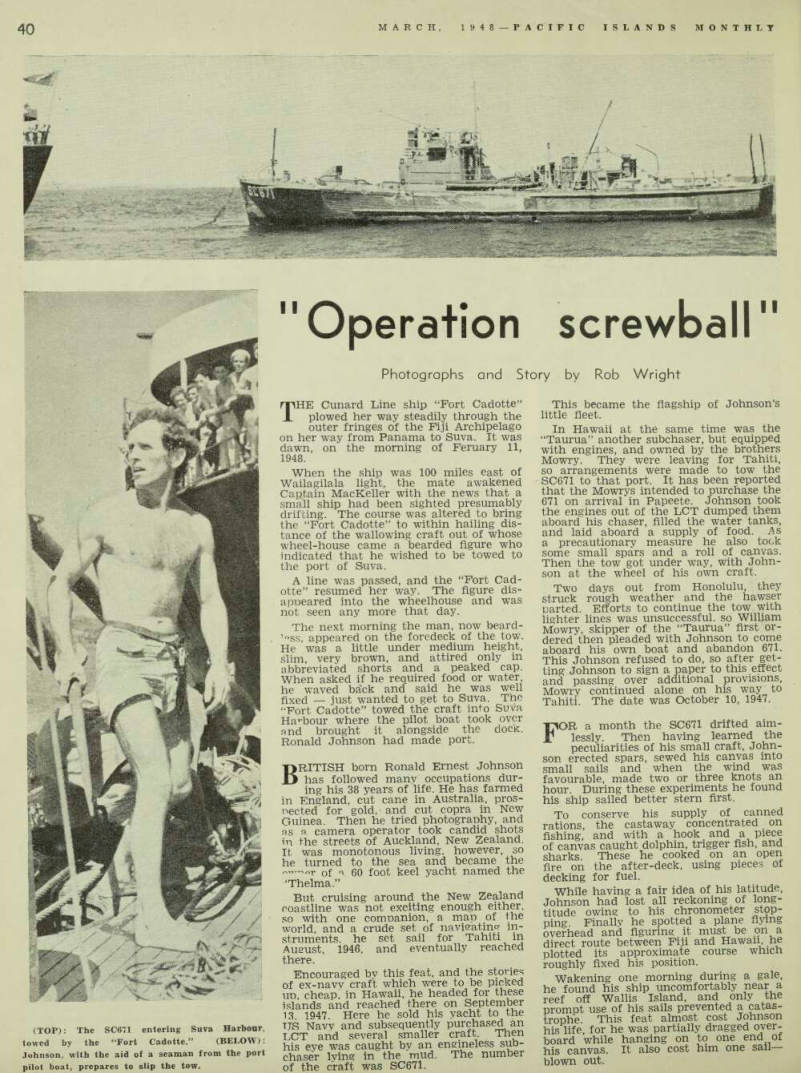
Photographs and Story by Rob Wright
THE Cunard Line ship “Fort Cadotte” plowed her way steadily through the outer fringes of the Fiji Archipelago on her way from Panama to Suva. It was dawn, on the morning of Feruary 11, 1948.
When the ship was 100 miles east of Wailagilala light, the mate awakened Captain Mac Keller with the news that a small ship had been sighted presumably drifting. The course was altered to bring the “Fort Cadotte” to within hailing dis tance of the wallowing craft out of whose wheel-house came a bearded figure who indicated that he wished to be towed to the port of Suva.
A line was passed, and the “Fort Cad otte” resumed her way. The figure dis apneared into the wheelhouse and was not seen any more that day.
The next morning the man, now beard -Iqss, appeared on the foredeck of the tow.
He was a little under medium height, slim, very brown, and attired only in abbreviated shorts and a peaked cap.
When asked if he required food or water, he waved back and said he was well fixed just wanted to get to Suva. The “Fort Cadotte” towed the craft into Suva Harbour where the pilot boat took over and brought it alongside the dock.
Ronald Johnson had made port.
BRITISH born Ronald Ernest Johnson has followed many occupations dur ing his 38 years of life. He has farmed in England, cut cane in Australia, pros pected for gold, and cut copra in New Guinea. Then he tried photography, and as a camera operator took candid shots in the streets of Auckland, New Zealand.
It was monotonous living, however, so he turned to the sea and became the of n, 60 foot keel yacht named the ‘Thelma.”
But cruising around the New Zealand coastline was not exciting enough either, so with one companion, a man of the world, and a crude set of navieratin*? in struments. he set sail for Tahiti in August, 1946, and eventually reached there.
Encouraged bv this feat, and the stories of ex-navv craft which were to be picked un, cheap, in Hawaii, he headed for these islands and reached there on September 13 1947. Here he sold his yacht to the US Navv and subsequently purchased an LCT and several smaller craft. Then his eve was caught by an eneineless sub chaser lying in the mud. The number of the craft was SC67I.
This became the flagship of Johnson’s little fleet.
In Hawaii at the same time was the “Taurua” another subchaser, but equipped with engines, and owned by the brothers Mowry. They were leaving for Tahiti, so arrangements were made to tow the SC67I to that port. It has been reported that the Mowrys intended to purchase the 671 on arrival in Papeete. Johnson took the engines out of the LCT dumped them aboard his chaser, filled the water tanks, and laid aboard a supply of food. x4s a precautionary measure he also took some small spars and a roll of canvas.
Then the tow got under way, with John son at the wheel of his own craft.
Two days out from Honolulu, they struck rough weather and the hawser parted. Efforts to continue the tow with lighter lines was unsuccessful, so William Mowry, skipper of the “Taurua” first or dered then pleaded with Johnson to come aboard his own boat and abandon 671.
This Johnson refused to do, so after get ting Johnson to sign a paper to this effect and passing over additional provisions, Mowry continued alone on his way to Tahiti. The date was October 10, 1947.
FOR a month the SC67I drifted aim lessly. Then having learned the peculiarities of his small craft, John son erected spars, sewed his canvas into small sails and when the wind was favourable, made two or three knots an hour. During these experiments he found his ship sailed better stern first.
To conserve his supply of canned rations, the castaway concentrated on fishing, and with a hook and a piece of canvas caught dolphin, trigger fish, and sharks. These he cooked on an open fire on the after-deck, using pieces of decking for fuel.
While having a fair idea of his latitude, Johnson had lost all reckoning of long titude owing to his chronometer stop ping. Finallv he spotted a plane flying overhead and figuring it must be on a direct route between Fiji and Hawaii he plotted its approximate course which roughly fixed his position.
Wakening one morning during a gale, he found his ship uncomfortably near a reef off Wallis Island, and only the prompt use of his sails prevented a catas trophe This feat almost cost Johnson his life, for he was partially dragged over board while hanging on to one end of his canvas. It also cost him one sail blown out.
(TOP): The SC671 entering Suva Harbour, towed by the “Fort Cadotte.” (BELOW): Johnson, with the aid of a seaman from the port pilot boat, prepares to slip the tow.
He next found that his ship was mak ing water which weary hours of pump ing could not lower. Waist deep, he ex plored the bilges and finally found a broken toilet-connection through which the sea was gushing. This was his worst anxiety during the whole voyage.
Later he sighted Niuafo’ou (Tin Can Island) and was able to chart his posi tion accurately. Then the south east trades took a hand in his destiny and blew the ship into the Fiji Archipelago.
Early on the morning of February IQ, 1948, Johnson awakened to find a large
IN December, “PIM” published what was apparently the first account of Johnson’s strange journey. At that time he had already been adrift for two months and had not been sighted since he had parted with his tow. The “PIM” story was based on a despatch from our Papeete correspondent.
Although shipping between Australia and Honolulu had been instructed to keep a watch for the disabled sub-chaser, nothing further was heard of the 671, or Johnson, until he was recently taken in tow by the “Fort Cadotte.”
The exploit has since become front-page news in Australasia, and the Pacific, and has excited general interest.
About a month before he was found, the Cruising Club of Hawaii issued a bulletin called “Operation Screwball” in which Johnson’s latest adventure was set out. Yachtsmen who knew him were apparently of the opinion that he would turn up somewhere, possibly on some isolated atoll.
The details of Johnson’s earlier history are contradictory, but it is apparent that he had his fair share of troubles, both before and after he purchased his sub-chaser and other equip ment ex-US Navy. One of his chief embarrass ments appears to have been the exchange re strictions between New Zealand and Hawaii.
Rob Wright states that Johnson sailed “Thelma” to Tahiti in August. 1946. Another account states that “Thelma” was sailed to Tahiti early in the war, and that Johnson went back there and retrieved her in 1946. But, whichever it is, there is no doubt that Johnson had plenty of what the Yanks sometimes have railed intestinal fortitude, or what plain Aus tralians usually describe as guts.
ship bearing down on him. The captain hailed and asked if he could be of as sistance, and when asked for a tow, passed a line aboard and at 4.30 p.m. on Feb ruary 12, when his ship berthed at Suva Dock, the saga of the 5C671—41 months adrift in the Pacific was ended.
Johnson did not suffer a day’s illness during his four months at sea. His plans are indefinite but he says he would like to stay in Suva for a while and refit his craft.
When asked if there was any question of salvage, Captain Mac Keller of the “Fort Cadotte” replied, “Anyone with guts enough to stick out four months adrift on that craft, is worthy of assis tance free of charge.”
At the end of February, Johnson was selling all the ex-Navy gear which he had on the 671 —radar and sonar apparatus, an air-conditioning set-up and a whole assortment of cargo brought in the chaser from Honolulu.
Johnson, who says he wants to clear things out so that he can move round will also sell the chaser if he gets a good offer. (He sold a similar vessel for 10,000 dollars at Honolulu).
If he sells Ex-SC67I, he hopes to have a cutter built in Suva. If he doesn’t sell, he wants to fit up the chaser. Suva, he says, is superior to either Honolulu or Papeete as a South Seas centre and he would like to go in for small-scale trad ing among the Islands.
Bun-Fight In Bsi
By Rosa Moore
IF there is one form of entertainment which follows in the Islands a set and regular pattern to which one ad heres through pressure of circumstances rather than the conviction that it is all that it should be, it is the tropical after noon tea party.
A few days beforehand, one sends out a shower of little notes. Simultaneously one looks through recipe books with com parative confidence until one remembers the Egg Situation: tropical hens are in variablystanding with reluctant feet Where the brook and river meet or else sitting on lumps of coral with a hypnotised look and a high fever.
Various ladies now indicate their wil lingness to come and see how the doy leys are standing up to the vigorous tac tics of the washboy and whether suffi cient of the flowered teacups are still intact to go round.
One then settles for two eggless re cipes and one in which powdered egg may be introduced without too revolting an effect. One goes into the kitchen and surrounds oneself with basins, under the black scrutiny of the cookboy.
Said cookboy suffers so severely from a feeling of plagiarism that he instantly behaves as though the stove were a boiler required to reach dangerously high pressure. He will pile on wood in such a subtle manner that only when the kettle tan-dances across the top does one realise that the anpropriate temperature has now turned into a raging inferno.
He will noiselessly open the stove door and stare accusingly at cakes having the temerity to rise; this cures them.
He will beat a reconstituted egg with such vigour that the ball-bearings drop out of the egg-beater and he will butter tins so lavishly that melting moments skate about on a glaciarium of grease.
He will then go outside and call upon all his ancestral debbil-debbils to cause biscuits to spread, scones to taste of bak ing powder and pikelets to be suitable for patching jeep tyres.
HOWEVER, the happy moment comes, the ladies arrive and as usual seem seated so far apart that conversa tion must be shouted across the arena, as though all we need is the bull and the matador.
These appear only it turns out to be a bull in a china shoo Wakio nush ing the tea-trolley which has chosen this moment to cast a tyre. It comes hopping into the room on three legs while the china jingles like mad and the milk (verv tinned) throws itself in an abandoned manner into saucers, sugar and tea strainer.
The dainty afternoon fare (looking, alas, like something run up for an an nual picnic of hungry footballers) is laid on the little table. Four hundred and ninety-two flies, who have been com plaining that nothing ever happens around here, promptly converge on the icing of the ginger cake, which is al ready fainting in the tropical heat and giving a good imitation of a brown glacier.
One pours out the tea. The lid of the silver teapot crashes into the third tea-cup. Wakio, summoned, opines: “Him’e beggar ud finish now” only he doesn’t say beggar.
It may be so, but one carries on bravely.
Bending over the array of food, for one moment one finds oneself on the verge of saying, “I have much pleasure in de claring this sale of cakes now open, in such a deserving cause.”
Conversation now falls into Groove Number I—cooking;1—cooking; failures with damp flour, triumphs with powdered eggs, sur prises with moths in the raisins, unre hearsed effects with ovens that refuse to heat.
Groove Number 2 is cookboys; cookboys who can make real scones, cookboys who whisk unfinished cakes out of the oven if not watched, cookboys whose fathers are building new houses and need them at home, cookboys very sulky because they’ve sent home for a wife and nobody applies.
The ladies nibble politely, growing sticky with the glacier icing, slipping easily into Groove Number 3—cats: cats that won’t eat tinned meat, cats that are pregnant AGAIN, cats that must be re lated to the Major’s cat because of the same striped tail.
WAKIO comes and gathers up cups, knocking a hat sideways here, treading on a toe there, interrupting a tete-a-tete elsewhere. Hot, sticky, over fed, one feels an incipient attack of hos tess neurosis.
The ladies rise to go, “You will come to me next Wednesday?”
“Now don’t forget Friday week.”
“It has been delightful we must fix a day quite soon,” they say.
Good! Then it will be their turn to try to cream the butter with the sugar and plumb the mysteries of the wood stove and the cookboy with the evil eye.
Photographer Wins Praise
MR. ROB WRIGHT, of the Public Re lations Office, Suva, well-known throughout the Pacific as an ex tremely competent photographer, has landed in the top flight by the inclusion of his “Goldmines at Dusk,” in the latest issue of the London annual, “Photography To-day.”
The photograph shows a wide sweep of the Vatukoula mining area and, by capturing the dramatic quality of the flare and glow of distant furnaces against a darkening mountain background, the picture represents a notable technical achievement “S.”
Miss T. M. O’Brien, of Madang, New Guinea, is spending portion of her three months’ vacation in Brisbane and the south coast of Queensland.
When he arrived in Brisbane recently after a 12-day flying visit to Islands’ war cemeteries, Brigadier Brown (secretary general of the Imperial War Graves Commission), said that the graves were extremely well kept. The cemeteries at Lae, and near Port Moresby, and at Bita paka, near Kopoko, in New Britain, had been made the chief cemeteries in the islands area. More than 9,000 war dead were buried there. Brigadier Brown ex pressed the hone that when transport became available, people in Australia would visit those places and see the beauty of the cemeteries for themselves.
Tropicalities
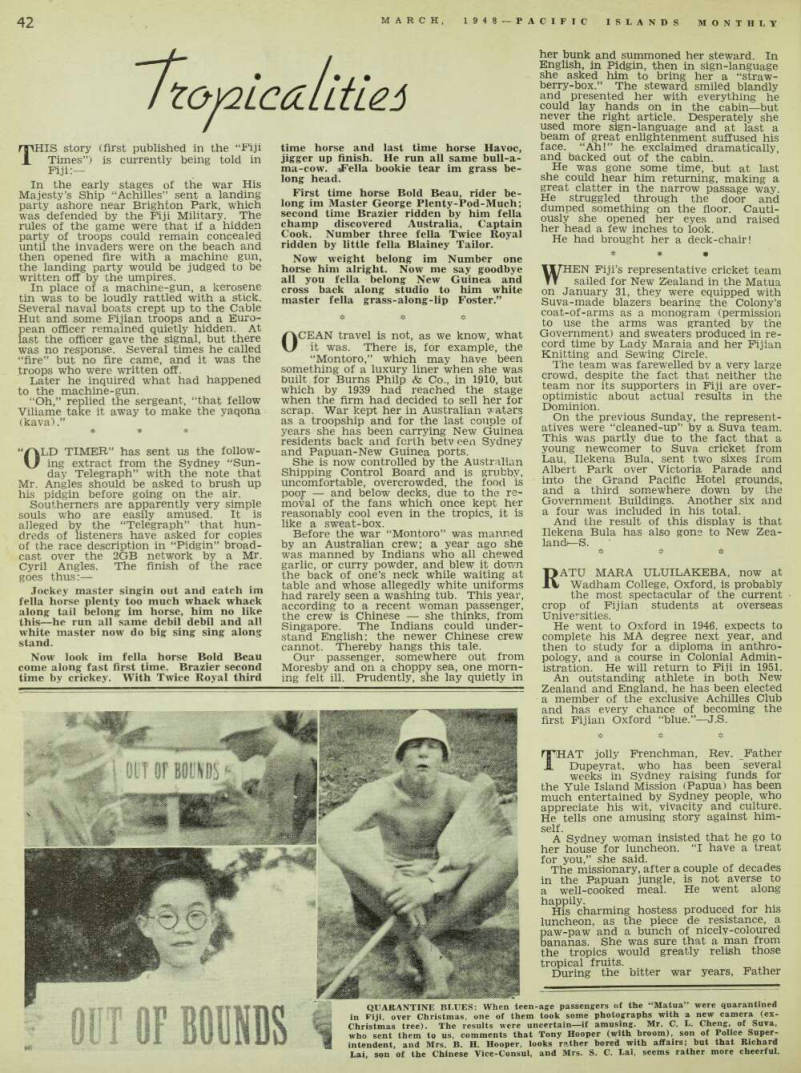
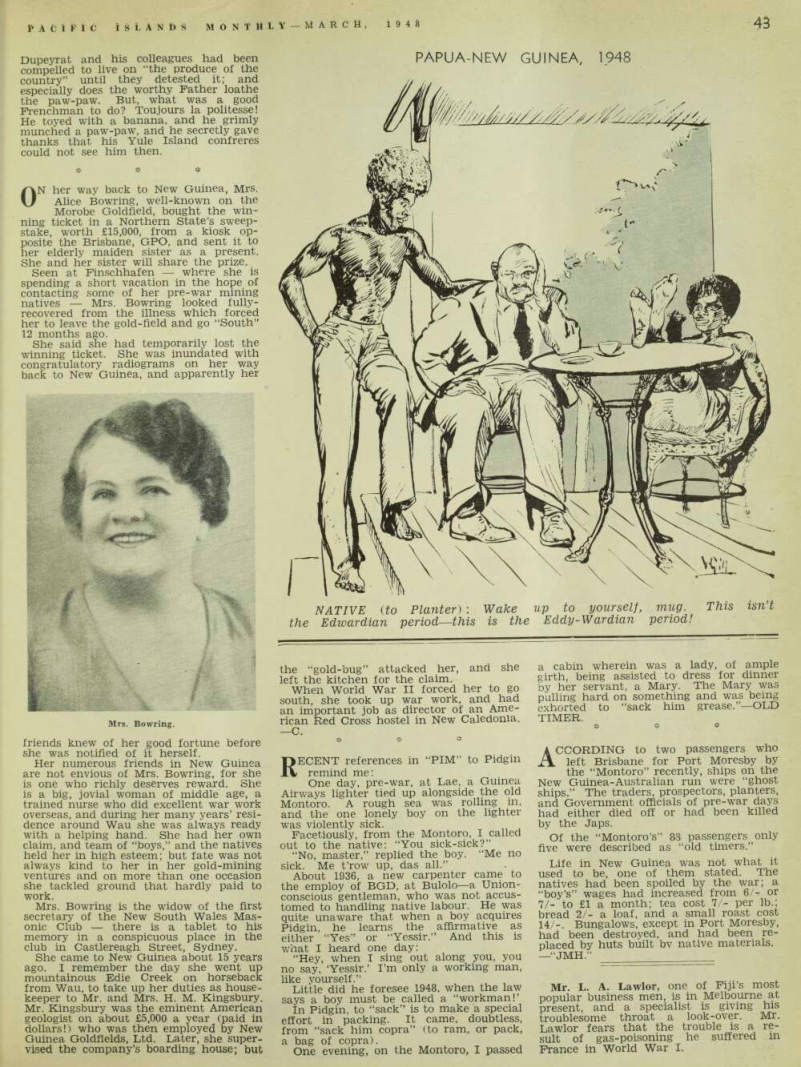
THIS story (first published in the “Fiji Times”) is currently being told in Fiji;— In the early stages of the war His Majesty’s Ship “Achilles” sent a landing party ashore near Brighton Park, which was defended by the Fiji Military. The rules of the game were that if a hidden party of troops could remain concealed until the invaders were on the beach and then opened fire with a machine gun, the landing party would be judged to be written off by the umpires.
In place of a machine-gun, a kerosene tin was to be loudly rattled with a stick.
Several naval boats crept up to the Cable Hut and some Fijian troops and a Euro pean officer remained quietly hidden. At last the officer gave the signal, but there was no response. Several times he called “fire” but no fire came, and it was the troops who were written off.
Later he inquired what had happened to the machine-gun.
“Oh,” replied the sergeant, “that fellow Viliame take it away to make the yaqona (kava).” * * * “/"VLD TIMER” has sent us the follow- U? ing extract from the Sydney “Sun day Telegraph” with the note that Mr. Angles should be asked to brush up his pidgin before going on the air.
Southerners are apparently very simple souls who are easily amused. It is alleged by the “Telegraph” that hun dreds of listeners have asked for copies of the race description in “Pidgin” broad cast over the 2GB network by a Mr.
Cyril Angles. The finish of the race goes thus;—- Jockey master singin out and catch im fella horse plenty too much whack whack along tail belong im horse, him no like this —he run all same debil debil and all white master now do big sing sing along stand.
Now look im fella horse Bold Beau come along fast first time. Brazier second time by crickey. With Twice Royal third
time horse and last time horse Havoc, jigger up finish. He run all same bull-a ma-cow. *Fella bookie tear im grass be long head.
First time horse Bold Beau, rider be long im Master George Plenty-Pod-Much; second time Brazier ridden by him fella champ discovered Australia, Captain Cook. Number three fella Twice Royal ridden by little fella Blainey Tailor.
Now weight belong im Number one horse him alright. Now me say goodbye all you fella belong New Guinea and cross back along studio to him white master fella grass-along-lip Foster.” * * OCEAN travel is not, as we know, what it was. There is, for example, the “Montoro,” which may have been something of a luxury liner when she was built for Burns Philp & Co., in 1910, but which by 1939 had reached the stage when the firm had decided to sell her for scrap. War kept her in Australian waters as a troopship and for the last couple of years she has been carrying New Guinea residents back and forth between Sydney and Papuan-New Guinea ports.
She is now controlled by the Australian Shipping Control Board and is grubby, uncomfortable, overcrowded, the food is poor and below decks, due to the re moval of the fans which once kept her reasonably cool even in the tropics, it is like a sweat-box.
Before the war “Montoro” was manned by an Australian crew; a year ago she was manned by Indians who all chewed garlic, or curry powder, and blew it down the back of one’s neck while waiting at table and whose allegedly white uniforms had rarely seen a washing tub. This year, according to a recent woman passenger, the crew is Chinese she thinks, from Singapore. The Indians could under stand English: the newer Chinese crew cannot. Thereby hangs this tale.
Our passenger, somewhere out from Moresby and on a choppy sea, one morn ing felt ill. Prudently, she lay quietly in
her bunk and summoned her steward. In English, in Pidgin, then in sign-language she asked him to bring her a “straw berry-box.” The steward smiled blandly and presented her with everything he could lay hands on in the cabin —but never the right article. Desperately she used more sign-language and at last a beam of great enlightenment suffused his face. “Ah!” he> exclaimed dramatically, and backed out of the cabin.
He was gone some time, but at last she could hear him returning, making a great clatter in the narrow passage way.
He struggled through the door and dumped something on the floor. Cauti ously she opened her eyes and raised her head a few inches to look.
He had brought her a deck-chair! * * « VITHEN Fiji’s representative cricket team TT sailed for New Zealand in the Matua on January 31, they were equipped with Suva-made blazers bearing the Colony’s coat-of-arms as a monogram (permission to use the arms was granted by the Government) and sweaters produced in re cord time by Lady Maraia and her Fijian Knitting and Sewing Circle.
The team was farewelled bv a very large crowd, despite the fact that neither the team nor its supporters in Fiji are over optimistic about actual results in the Dominion.
On the previous Sunday, the represent atives were “cleaned-up” by a Suva team.
This was partly due to the fact that a young newcomer to Suva cricket from Lau, Ilekena Bula, sent two sixes from Albert Park over Victoria Parade and into the Grand Pacific Hotel grounds, and a third somewhere down by the Government Buildings. Another six and a four was included in his total.
And the result of this display is that Ilekena Bula has also gone to New Zea land —S. * * *
Ratu Mara Uluilakeba, Now At
Wadham College, Oxford, is probably the most spectacular of the current crop of Fijian students at overseas Universities.
He went to Oxford in 1946. expects to complete his MA degree next year, and then to study for a diploma in anthro pology, and a course in Colonial Admin istration. He will return to Fiji in 1951.
An outstanding athlete in both New Zealand and England, he has been elected a member of the exclusive Achilles Club and has every chance of becoming the first Fijian Oxford “blue.” —J.S. $ THAT jolly Frenchman, Rev. Father Dupeyrat, who has been several weeks in Sydney raising funds for the Yule Island Mission (Papua) has been much entertained by Sydney people, who appreciate his wit, vivacity and culture.
He tells one amusing story against him self.
A Sydney woman insisted that he go to her house for luncheon. “I have a treat for you,” she said.
The missionary, after a couple of decades in the Papuan jungle, is not averse to a well-cooked meal. He went along happily.
His charming hostess produced for his luncheon, as the piece de resistance, a paw-paw and a bunch of nicely-coloured bananas. She was sure that a man from the tropics would greatly relish those tropical fruits.
During the bitter war years, Father
QUARANTINE BLUES: When teen-age passengers of the “Matua” were quarantined in Fiji, over Christmas, one of them took some photographs with a new camera (ex- Christmas tree). The results were uncertain —if amusing. Mr. C. L. of Suva, who sent them to us, comments that Tony Hooper (with broom), son of Police Super intendent, and Mrs. B. H. Hooper, looks rather bored with affairs: but that Richard Lai, son of the Chinese Vice-Consul, and Mrs. S. C. Lai, seems rather more cheerful.
Dupeyrat and his colleagues had been compelled to live on “the produce of the country” until they detested it; and especially does the worthy Father loathe the paw-paw. But, what was a good Frenchman to do? Toujours la politesse!
He toyed with a banana, and he grimly munched a paw-paw, and he secretly gave thanks that his Yule Island confreres could not see him then. * * ON her way back to New Guinea, Mrs.
Alice Bowring, well-known on the Morobe Goldfield, bought the win ning ticket in a Northern State’s sweep stake, worth £15,000, from a kiosk op posite the Brisbane, GPO, and sent it to her elderly maiden sister as a present.
She and her sister will share the prize.
Seen at Finschhafen where she is spending a short vacation in the hope of contacting some of her pre-war mining natives Mrs. Bowring looked fully recovered from the illness which forced her to leave the gold-field and go “South” 12 months ago.
She said she had temporarily lost the winning ticket. She was inundated with congratulatory radiograms on her way back to New Guinea, and apparently her
friends knew of her good fortune before she was notified of it herself.
Her numerous friends in New Guinea are not envious of Mrs. Bowring, for she is one who richly deserves reward. She is a big, jovial woman of middle age, a trained nurse who did excellent war work overseas, and during her many years’ resi dence around Wau she was always ready with a helping hand. She had her own claim, and team of “boys,” and the natives held her in high esteem; but fate was not always kind to her in her gold-mining ventures and on more than one occasion she tackled ground that hardly paid to work.
Mrs. Bowring is the widow of the first secretary of the New South Wales Mas onic Club there is a tablet to his memory in a conspicuous place in the club in Castlereagh Street, Sydney.
She came to New Guinea about 15 years ago. I remember the day she went up mountainous Edie Creek on horseback from Wau, to take up her duties as house keeper to Mr. and Mrs. H. M. Kingsbury, Mr. Kingsbury was the eminent American geologist on about £5,000 a year (paid in dollars!) who was then employed by New Guinea Goldfields, Ltd. Later, she super vised the company’s boarding house; but
the “gold-bug” attacked her, and she left the kitchen for the claim.
When World War II forced her to go south, she took up war work, and had an important job as director of an Ame rican Red Cross hostel in New Caledonia. —C.
RECENT references in “PIM” to Pidgin remind me: One day, pre-war, at Lae, a Guinea Airways lighter tied up alongside the old Montoro. A rough sea was rolling in, and the one lonely boy on the lighter was violently sick.
Facetiously, from the Montorp, I called out to the native: “You sick-sick?”
“No, master,” replied the boy. “Me no sick. Me t’row up, das all.”
About 1936, a new carpenter came to the employ of BGD, at Bulolo —a Union conscious gentleman, who was not accus tomed to handling native labour. He was quite unaware that when a boy acquires Pidgin, he learns the affirmative as either “Yes” or “Yessir.” And this is what I heard one day; “Hey, when I sing out along you, you no say, ‘Yessir.’ I’m only a working man, like yourself.”
Little did he foresee 1948. when the law says a boy must be called a “workman!’
In Pidgin, to “sack” is to make a special effort in packing. It came, doubtless, from “sack him copra” (to ram, or pack, a bag of copra).
One evening, on the Montoro, I passed
a cabin wherein was a lady, of ample girth, being assisted to dress for dinner by her servant, a Mary. The Mary was pulling hard on something and was being exhorted to “sack him grease.’’—OLD
Timer.
- * * ACCORDING to two passengers who left Brisbane for Port Moresby by the “Montoro” recently, ships on the New Guinea-Australian run were “ghost ships.” The traders, prospectors, planters, and Government officials of pre-war days had either died off or had been killed by the Japs.
Of the “Montoro’s” 83 passengers only five were described as “old timers.”
Life in New Guinea was not what it used to be, one of them stated. The natives had been spoiled by the war; a “boy’s” wages had increased from or 7/- to £1 a month; tea cost 7/- per lb.; bread 2/- a loaf, and a small roast cost 14/-. Bungalows, except in Port Moresby, had been destroyed, and had been re placed by huts built bv native materials.
—“Jmh.”
Mr. L. A. Lawlor, one of Fiji’s most popular business men, is in Melbourne at present, and a specialist is giving his troublesome throat a look-over. Mr.
Lawlor fears that the trouble is a re sult of gas-poisoning he suffered m Prance in World War I.
Mrs. Bowring.
Advertisements & other items, p. 43 (1 item)
Papua-New Guinea, 1948
NATIVE (to Planter) : Wake up to yourself, mug. This isn’t the Edwardian period—this is the Eddy-Wardian period!
White Mother of A Brown
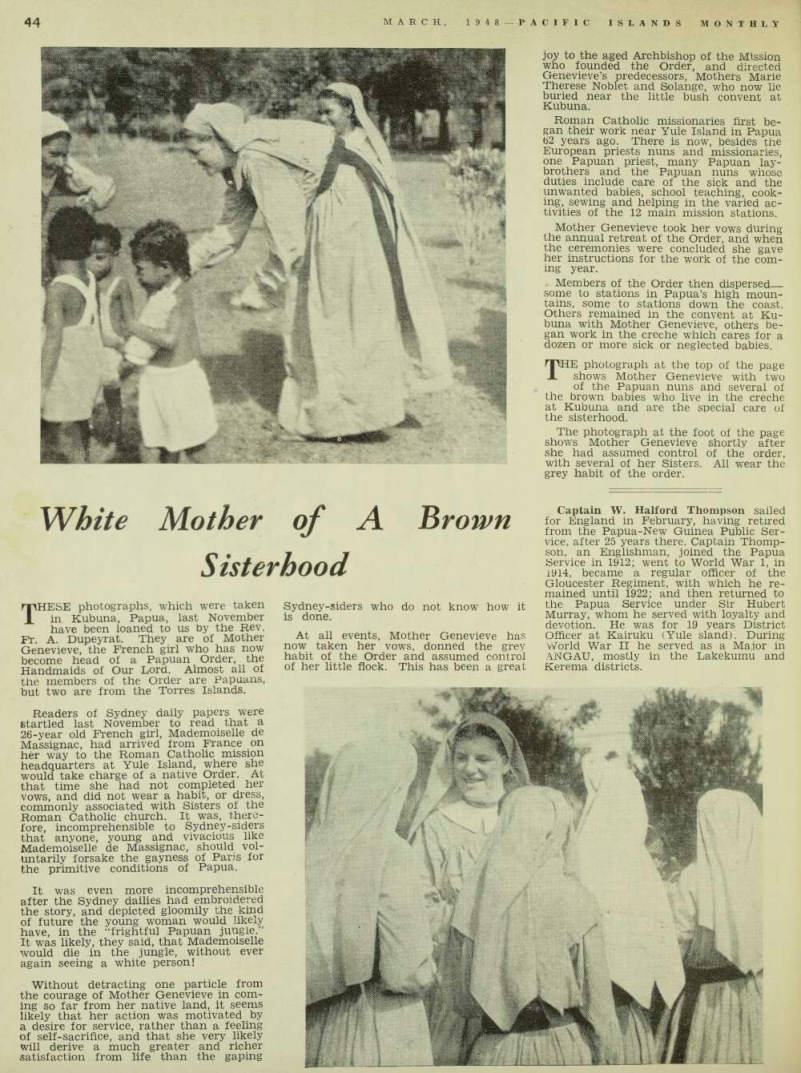
Sisterhood
THESE photographs, which were taken in Kubuna, Papua, last November have been loaned to us by the Rev.
Fr. A. Dupeyrat. They are of Mother Genevieve, the French girl who has now become head of a Papuan Order, the Handmaids of Our Lord, Almost all of the members of the Order are Papuans, but two are from the Torres Islands.
Readers of Sydney daily papers were startled last November to read that a 26-year old French girl, Mademoiselle de Massignac, had arrived from Prance on her way to the Roman Catholic mission headquarters at Yule Island, where she would take charge of a native Order. At that time she had not completed her vows, and did not wear a habit, or dress, commonly associated with Sisters of the Roman Catholic church. It was, there fore, incomprehensible to Sydney-siders that anyone, young and vivacious like Mademoiselle de Massignac, should vol untarily forsake the gayness of Paris for the primitive conditions of Papua.
It was even more incomprehensible after the Sydney dailies had embroidered the story, and depicted gloomily the kind of future the young woman would likely have, in the “frightful Papuan jungle.’’
It was likely, they said, that Mademoiselle would die in the jungle, without ever again seeing a white person!
Without detracting one particle from the courage of Mother Genevieve in com ing so far from her native land, it seems likely that her action was motivated by a desire for service, rather than a feeling of self-sacrifice, and that she very likely will derive a much greater and richer satisfaction from life than the gaping
Sydney-siders who do not know how it is done.
At all events, Mother Genevieve has now taken her vows, donned the grey habit of the Order and assumed control of her little flock. This has been a great
joy to the aged Archbishop of the Mission who founded the Order, and directed Genevieve’s predecessors, Mothers Marie Therese Noblet and Solange, who now lie buried near the little bush convent at Kubuna.
Roman Catholic missionaries first be gan their work near Yule Island in Papua 62 years ago. There is now, besides the European priests nuns and missionaries, one Papuan priest, many Papuan lay brothers and the Papuan nuns whose duties include care of the sick and the unwanted babies, school teaching, cook ing, sewing and helping in the varied ac tivities of the 12 main mission stations.
Mother Genevieve took her vows during the annual retreat of the Order, and when the ceremonies were concluded she gave her instructions for the work of the com ing year.
Members of the Order then dispersed some to stations in Papua’s high moun tains, some to stations down the coast.
Others remained in the convent at Ku buna with Mother Genevieve, others be gan work in the creche which cares for a dozen or more sick or neglected babies. riIHE photograph at the top of the page A shows Mother Genevieve with two of the Papuan nuns and several of the brown babies who live in the creche at Kubuna and are the special care of the sisterhood.
The photograph at the foot of the page shows Mother Genevieve shortly after she had assumed control of the order, with several of her Sisters. All wear the grey habit of the order.
Captain W. Halford Thompson sailed for England in February, having retired from the Papua-New Guinea Public Ser vice, after 25 years there. Captain Thomp son, an Englishman, joined the Papua Service in 1912; went to World War 1, in 1914, became a regular officer of the Gloucester Regiment, with which he re mained until 1922; and then returned to the Papua Service under Sir Hubert Murray, whom he served with loyalty and devotion. He was for 19 years District Officer at Kairuku (Yule sland). During World War II he served as a Major in ANGAU, mostly in the Lakekumu and Kerema districts.
Advertisements & other items, p. 45 (1 item)
Burns Philp (New Guinea) Limited
General Merchants (Wholesale and Retail)
Shipping, Customs and General Agents
Head Office: PORT MORESBY, PAPUA
BRANCHES:
NEW GUINEA; Rabaul, Kokopo, Lae & Madang.
PAPUA; Samarai.
REPRESENTATIVES FOR:
AUSTRALIAN AGENTS:
LONDON AGENTS:
SAN FRANCISCO AGENTS:
LLOYDS OF LONDON
QUEENSLAND INSURANCE CO. LTD.
BURNS PHILP TRUST CO. LTD.
BURNS, PHILP Cr CO. LTD.
All States.
BURNS, PHILP & CO. LTD.
"London House", 35 Crutched Friars, E.C.3.
BURNS, PHILP CO. OF SAN FRANCISCO INC. 510 AAatson Building.
Distributing Agents, Territory of Papua-New Guinea for:
SHELL COMPANY OF AUSTRALIA LIMITED
Petroleum Products
GENERAL MOTORS CORPORATION
Chevrolet, Buick, Pontiac and Oldsmobile Cars Chevrolet and GMC Trucks Frigidaire Refrigerators
VAUXHALL MOTORS LIMITED
Vauxhall Cars and Bedford Trucks
R. A. LISTER & CO., BRISTOL
Producers of Petrol, Parrafin and Diesel Engines Pumps and Lighting plants
RUSTON HORNSBY LIMITED
Engines
CROSSLEY MARINE ENGINES
Fiji Executive Council
Appointment
From Our Own Correspondent
Suva. Jan. 30.
MR. R. N. Caldwell, CMG, MC, Ratu G. C. Tuisawau, MLC, and Mr, K.
B. Singh have been appointed pro visional members of the Executive Coun cil of Fiji for six months.
Record High
W. Samoa's Exports At Record High
From Our Own Correspondent
Apia, Feb. 10.
FGURES released recently by the Gov ernment show that total exports from Western Samoa during the calendar year 1947 will be over two million pounds in value. Total value for 1946 was £1,197,745 and for 1945, £1 029 206 increase is due mainly to the higher price being paid in world markets for cocoa and copra but quantities ex ported have also increased, copra rising from 13,795 tons in 1946 to 18,181 tons in 1947; and cocoa beans from 1,886 tons in 1946 to 2,378 tons in 1947.
Rubber exports, however, fell from 80 tons to 25 tons probably due to the recent low price being paid for rubber.
It is of interest to note that, for the first time, the value of dried bananas exported exceeded value of fresh bananas. „ United Kingdom took the bulk of the copra and United States the bulk of the cocoa beans. New Zealand took all the bananas (fresh and dried), rubber and desiccated coconut.
Another point of interest was that 163 pounds of papain (product of the paw paw) were exported to the United States.
Its value was £193. -
Seeking Pen Friends
JOHN and James MacDonald, who are twins, aged 13, interested in stamp collecting and scouting, and who 'reside at 140 New Brighton Road, Bur wood, Christchurch, New Zealand, seek pen-friends in the Pacific Islands.
Hurricane Circles Around
Fiji
From Our Own Correspondent
Suva, Feb. 10.
STARTING somewhere near Rotuma, a hurricane last week circled to the west of the Yasawas and then dis appeared south-east beyond Kadavu.
Heavy gales and torrential rain swept Viti Levu and all rivers were in high flood. Highways were blocked for two days. Fruit and cane crops suffered some damage.
The Cook Islands schooner “Tiare Tapero” was badly battered when she was caught and held by the hurricane for five days, off Kadavu. Captain Andy Thomson and the 27 persons aboard (mainly Cook Islanders, including the Ramtongan Concert Party on its way to perform in Suva) had a bad time but emerged without injury. (See elsewhere this issue.) The “Blue Lagoon” film unit in the Yasawas escaped the hurricane despite sensational reports (of unknown origin) to the contrary.
Air mails from Suva could not get across to Nadi for a week. In conse quence, this article, and various other news of early February, reached Sydney too late for publication in February
“Pim.”
Flying-Boat Hits Reef At
Labasa
Suva, Feb. Itb.
THE NZNAC Sunderland flying-boat “Mataatua” was slightly damaged recently when taking off at Labasa for Laucala Bay, Suva. She struck a small and hitherto uncharted patch of coral. The plane’s scheduled flight to Auckland next day was delayed for 24 hours.
Advertisements & other items, p. 46 (1 item)
Nelson & Robertson
KANGAROO BRAND
Ropes,
Cordage,
and Twines for every purpose Backed by 86 years of service Manufactured by:
M. DONAGHY AND SONS,
Pty. Ltd., Geelong and Sydney. ff'iji Representatives :
PEARCE AND CO.
LIMITED
P.O. BOX 237, SUVA
NELSON and ROBERTSON Pty.
Established 1895
Shipowners - Brokers and
Islands Merchants
Ltd
All classes merchandise purchased at Best Wholesale Prices Original Invoices supplied to Island Clients. Cocoa Beans, Copra, Rubber, Trochus Shell and All Islands Produce Sold on Commission.
Entrust your requirements to the firm with fifty yeors' practical experience in the Pacific Islands.
REPRESENTED IN
ALL PARTS OP
THE WORLD.
Sole Agents :
SKANDIA DIESEL ENGINES
ARCHIMEDES MOTORS
OVERSEA INDENTS
ARRANGED FOR
CLIENTS.
Prompt attention given to all enquiries.
NELSON & ROBERTSON
PTY.
LTD.
12 SPRING STREET, SYDNEY, AUSTRALIA
Telegraphic Address: IVAN, SYDNEY.
Journey
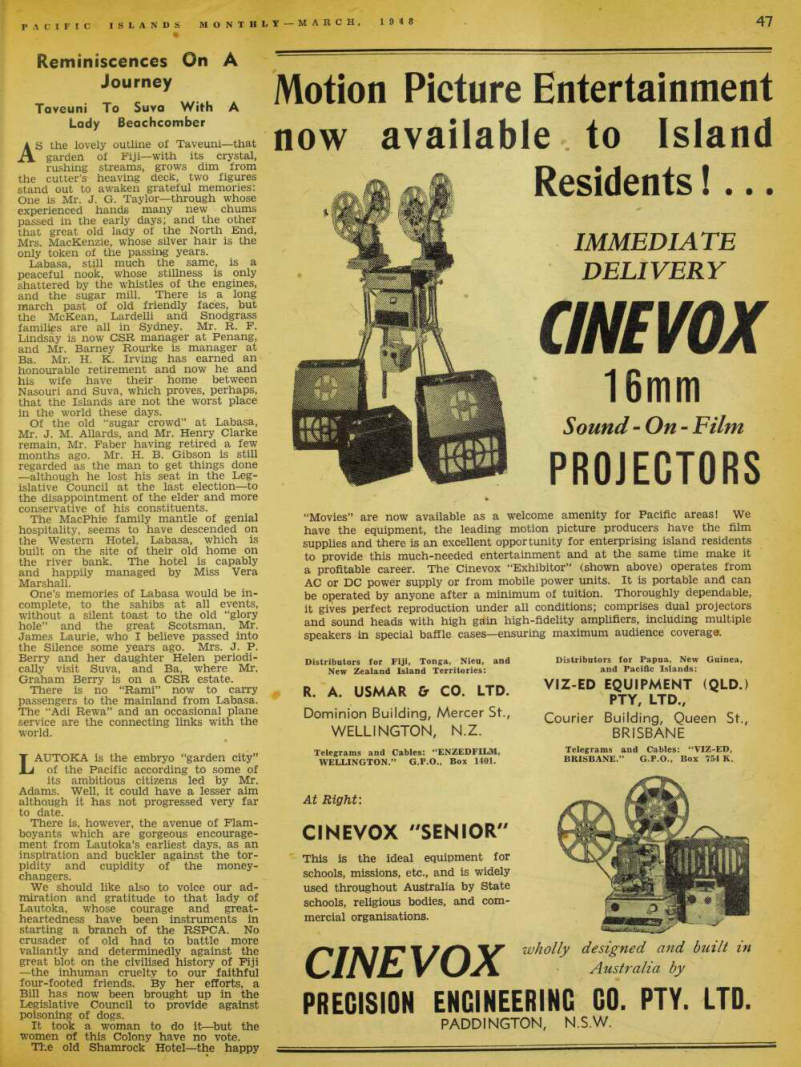
Reminiscences On A Journey Taveuni To Suva With A Lady Beachcomber
AS the lovely outline of Taveuni—that garden of Fiji—with its crystal, rushing streams, grows dim from the cutter’s heaving deck, two figures stand out to awaken grateful memories: One is Mr. J, G. Taylor—through whose experienced hands many new chums passed in the early days; and the other that great old lady of the North End, Mrs. MacKenzie, whose silver hair is the only token of the passing years.
Labasa, still much the same, is a peaceful nook, whose stillness is only shattered by the whistles of the engines, and the sugar mill. There is a long march past of old friendly faces, but the McKean, Lardelli and Snodgrass families are all in Sydney. Mr. R. F, Lindsay is now GSR manager at Penang, and Mr. Barney Rourke is manager at Ba. Mr. H. K. Irving has earned an honourable retirement and now he and his wife have their home between Nasouri and Suva, which proves, perhaps, that the Islands are not the worst place in the world these days.
Of the old “sugar crowd” at Labasa, Mr. J. M. Allards, and Mr. Henry Clarke remain, Mr. Faber having retired a few months ago. Mr. H. B. Gibson is still regarded as the man to get things done —although he lost his seat in the Leg islative Council at the last election —to the disappointment of the elder and more conservative of his constituents.
The MacPhie family mantle of genial hospitality, seems to have descended on the Western Hotel, Labasa, which is built on the site of their old home on the river bank. The hotel is capably and happily managed by Miss Vera Marshall.
One’s memories of Labasa would be in complete, to the sahibs at all events, without a silent toast to the old “glory hole” and the great Scotsman, Mr.
James Laurie, who I believe passed into the Silence some years ago. Mrs. J. P.
Berry and her daughter Helen periodi cally visit Suva, and Ba, where Mr.
Graham Berry is on a CSR estate.
There is no “Rami” now to carry passengers to the mainland from Labasa.
The “Adi Rewa” and an occasional plane service are the connecting links with the world.
LAUTOKA is the embryo “garden city” of the Pacific according to some of its ambitious citizens led by Mr.
Adams. Well, it could have a lesser aim although it has not progressed very far to date.
There is, however, the avenue of Flam boyants which are gorgeous encourage ment from Lautoka’s earliest days, as an inspiration and buckler against the tor pidity and cupidity of the money changers.
We should like also to voice our ad miration and gratitude to that lady of Lautoka, whose courage and great heartedness have been instruments in starting a branch of the RSPCA. No crusader of old had to battle more valiantly and determinedly against the great blot on the civilised history of Fiji —the inhuman cruelty to our faithful four-footed friends. By her efforts, a Bill has now been brought up in the Legislative Council to provide against poisoning of dogs.
It took a woman to do it—but the women of this Colony have no vote.
The old Shamrock Hotel—the happy
and a modern wing, but the same brand of hospitality from the large, cool dininglounge with private bar.
The road winds on to an unchanged Ba. Mr. and Mrs. Christmas are the popular hosts of the hotel, now one of a chain sponsored by our old friend Sir Hugh Ragg. All remember that he never begrudged a helping hand to the old timers.
Along a very dusty highway full of bends and hurtling buses, we come to Tavua, where a second unit of Northern Hotels revives us bodily, and mentally takes us back to the beginning of it all. oasis of earlier days—has a new name
To old Bill Borthwick, who discovered the field; to the stark unbelief, the mud, the heat, and a crazy jumble of names: Pat Costello, Dr. Loftus Hill, Mr. Theo dore and, bit by bit, the emergence of solidity and gold from the rainbow hues of surmise and wishful thinking.
That remarkable Australian, Mr. Pat Costello, has never lost his faith in Fiji as a whole. He and his charming wife live at Suva Point now, daughter Peg is married and Pat is a grandfather, to add to his experiences.
Over the hills past Yangara and still on. Where the little Rest House stood at Rake Rake the hub of the travelling
mining men in the gold era, there is another up-to-date Northern Hotel unit.
The next break on the long hot jour ney is at Tailevu where we greet Mr.
Bob McPhie (of Brodziaks, Labasa, in the old days) and Mr. Tom Gatwood.
Nasouri is much the same—heat, rain and mildew. The bridge is the town’s greatest improvement. And so we come to Suva, on the whole, not changed for the better; but with its full complement of Town Planners and New Plans, and Economic Advisers. Something may come of one, or all of them.
A. D. Spencer
Advertisements & other items, pp. 47-48 (1 item)
Cinevox
Motion Picture Entertainment
now available to Island
Residents!...
IMMEDIATE
DELIVERY
CINEVOX
16mm
Sound - On -
PROJECTORS
“Movies” are now available as a welcome amenity for Pacific areas! We have the equipment, the leading motion picture producers have the film supplies and there is an excellent opportunity for enterprising island residents to provide this much-needed entertainment and at the same time make it a profitable career. The Cinevox “Exhibitor” (shown above) operates from AC or DC power supply or from mobile power units. It is portable and can be operated by anyone after a minimum of tuition. Thoroughly dependable, it gives perfect reproduction under all conditions; comprises dual projectors and sound heads with high gain high-fidelity amplifiers, including multiple speakers in special baffle cases—ensuring maximum audience coverage.
Distributors for Fiji, Tonga, Nieu, and New Zealand Island Territories:
R. A. USMAR & CO. LTD.
Dominion Building, Mercer St.,
WELLINGTON, N.Z.
Telegrams and Cables: “ENZEDFILM,
WELLINGTON.” G.P.0., Box 1401.
Distributors for Papua, New Guinea, and Pacific Islands:
VIZ-ED EQUIPMENT (QLD.)
PTY, LTD.,
Courier Building, Queen St.,
BRISBANE
Telegrams and Cables: “VIZ-ED,
BRISBANE.” G.F.0., Box 754 K.
At Right :
CINEVOX “SENIOR"
This is the ideal equipment for schools, missions, etc., and is widely used throughout Australia by State schools, religious bodies, and commercial organisations.
CINEVOX
i wholly designed and built in
Australia by
PRECISION ENGINEERING CO. PTY. LTD.
PADDINGTON, N.S.W.
: /' ' ' y"<-v-r-v ’,'/ i - <s - ", f k . - ■■ m ' - <" ■ ■; ' 7f ;S' T o' 'v.v''; 1 » :V I# ? ili r ''
Trop
io„t formulae
Every Berger finish must withstand test after test to prove worthy of the Berger label . . . every product must satisfy the Berger technicians and chemists that it will meet the challenge of all climates from tropic heat to arctic cold.
'Sakmi
FINISHES
KEEP ON KEEPING ON!
More Roads For Western
Samoa
From Our Own Correspondent
Apia, Feb. 10.
ROAD construction work is progressing in Western Samoa although lack of equipment and material have caused some delays.
The road across the island of Upolu to Safata on the south coast which was built by the Americans during the war has been improved. It is used now by all kinds of traffic.
The people of Siumu, Mulivai and Fale alili have done much good work in build ing the roads connecting their districts.
There was much heavy bush work to be done and at times 600 men were em ployed.
On Savai’i, good progress has been made with the roads in the heavily popu lated Faasaleleaga district. It is hoped that the 23 miles stretch of road between Lano and Papa will soon be open for traffic. Other roads will also be com menced shortly and it is hoped that by the end of the year the proposed coastal road round Savai’i will be completed from Lano as far as Fagamalo.
It is planned that both the main is lands of Western Samoa will be encircled by roads as soon as possible.
Rarotongan Entertainers
In Fiji
Prom Our Own Correspondent
Suva, Feb. 17.
A CONCERT party of Rarotongans ar rived in Fiji by the hurricane battered “Tiare Taporo” and have given very successful performances.
The 15 youngsters who are led by Mr.
Kaitara Pupuke, gave a three-night con cert season at the Suva Town Hall and, each member of the party being an ex pert, scored a thumping (and profitable) success by the simple process of keeping everything strictly Polynesian and avoid ing everything that was American pseudo- Hawaiian.
The audiences were composed almost entirely of Fijians, Polynesians and Euro peans, with Indians in an inconspicuous minority another curious angle of the unacknowledged but marked racial line up that has emerged in Fiji since the Second World War, and which the In dians themselves are doing their best ..to cultivate.
The Rarotongans arrived diffidently as pioneers and appear as much surprised as anyone at their success, which they thoroughly deserved.
Cleverly overcoming the stage limita tions of the Suva Parish Hall, the Fiji Arts Club on February 19. presented its first play A. A. Milne’s “To Have the Honour,” produced by Howard Hayden, who was also a member of the cast. The performance went down excellently with a large audience.
Sandals for Fiji Police
Prom Our Own Correspondent
Suva. Feb. 2.
“ a POLICEMAN’S feet are not usually A objects of sentiment except to the owner,” stated a recent “Fiji Times” report, but last week the feet of at least 50 Fijian policemen nearly became a national calamity.
The Police Force of Fiji is predomi nantly Fijian, with European officers in the higher posts and with an Indian minority group within the Force which works remarkably well with the Fijians.
But as far as the public is concerned, “the police” in Fiji means a massive bushy-haired Fijian with an excellent knowledge of his job, tact, toughness when it is required, and usually a limit less fund of good-humour.
The on-duty uniform of the Fijian con stable or non-commissioned-officer ends with the pointed scallops of his white sulu. Bare feet, up to now, have been a tradition. , „ But for a long time a number of police men have been suffering at intervals from troublesome feet. Although har dened to travel on bush tracks or beaches or even coral reefs, they do ndt stand up so well to hours of duty on chilly or burning hot pavements, or to concrete floors during the cool-season nights.
In 1946, a number of Fijian policemen in Suva asked for permission to wear sandals while on duty, and in 1946 the Legislative Council agreed to a vote of £6OO to provide sandals. But the Police were still without their footwear when last week the Police Guard of Honour marched to the King’s Wharf for the arrival of the new Governor. The blaz ing heat was surging up from Suva’s bitumen streets and concrete pavements.
A few men had to fall out on the march.
The guard which was drawn up in front of the wharf entrance for a lengthy period of ceremonial slowly grilled. Many of them were barely able to walk back to the central station.
Next day it was reported that the num ber of casualties was 58.
After a considerable amount of public indignation had manifested itself it was stated that “sandals will be available for issue to Fijian members of the Force within the next two weeks.”
Well-Known N.M.P. Dies
In Samoa
From Our Own Correspondent
Suva Feb. 16.
Ratu Savenaca Veikoso, Bem,
one of the first Native Medical Prac titioners, and a man who has given notable service to Fiji and other Island groups, died in Suva on February 11. at the age of 54.
Known throughout Fiji as a thorough and conscientious practitioner, Ratu Sav enaca held the respect and affection of people of all races in the Colony. His services, which began in 1914. were ac knowledged by the award of the British Empire Medal.
During his career Ratu Savenaca was stationed in many parts of the Colony, In the between-wars period, when he was at Kadavu, he interested himself in the construction of a golf course. He was a keen golfer.
Dr. Katherine Luomala, Associate in Anthropology to the Bishop Museum, Honolulu, is to make an intensive study of the culture of the Gilbert Islanders.
She will arrive in Fiji in May, on her way to the Gilberts, where she will spend six months.
It has been reported that the British Pood Mission, which recently made an aerial survey of Queensland, for the purpose of locating food potential areas, may include New Guinea in its scheme if
suitable conditions exist there. It is un derstood that tflans for New Guinea are included in the Overseas Resources De velopment Act, which authorises the Overseas Food Corporation.
In moonlight and calm waters, the SS “Quetta,” when on its way to England, 58 years ago, on February 28, struck an unchartered rock in the Adolphus Channel (off Cape York), and sank in three minutes. Of the 293 souls on board, 133 perished. Misses Emily Lacy and Alice
Nicklin were the only two white women survivors. Miss Nicklin, then only 19 years of age, was accompanying her parents to England; her mother and father were drowned. In memory of the tragic occurrence a memorial cathedral was erected at Thursday Island.
Advertisements & other items, pp. 49-50 (1 item)
A New Shipping Service
Allen Taylor & Co. Ltd.
COMMERCIAL ROAD, ROZEULE,
SYDNEY
Sawmillers ond Wholesale Suppliers of Hardwoods for Constructional Purposes GIRDERS . . . PILES . , . POLES . . . SLEEPERS, Etc.
EXPORTING TO PACIFIC ISLANDS SINCE 1893
A NEW SHIPPING SERVICE
TO THE ISLANDS
=== from New Zealand
The Union Manufacturing and Export Company Limited, Wellington have pleasure in announcing that they have obtained and will commence shortly to operate two modern Motor Vessels with a carrying capacity of approximately 250 tons each.
These vessels can be made available for any Island trade either on charter or on other arrangements for which propositions are invited.
It is our intention to build up trade between New Zealand and the Pacific Islands and we shall be pleased to contact individuals and Companies interested in the import and export of all trade commodities.
Your further inquiries mil he welcomed.
UNION MANUFACTURING
& EXPORT CO. LTD.
G.P.0., Box 1060, Wellington, NEW ZEALAND Cables: “UMEC,” Wellington.
Branches at Auckland, Christchurch, Sydney, Melbourne.
Agents throughout the World.
FOR IMPORT
We are interested in purchasing all types of Island produce for New Zealand's own use and re-export to other countries all raw materials, fruit, shells, timber, hides, skins, bones, and scrap metal of all kinds.
FOR EXPORT
We can offer for prompt delivery a wide range of New Zealand products, including cheese, apples, canned foods, tinned butter, condensed milk, milk powder and all classes of manufactured goods, hardware, * textiles and machinery.
A Limited Quantity Only
COLT PATTERN .45 cal. AUTOMATICS
SPECIAL TROPICAL FINISH.
At the all-time low price of £lO each. Postage extra. Powerful, accurate, they are a weapon you will be proud to own. Ammo, plentiful, 25/per 100.
S. n i i Quality Firearms and Fishing I L HO M U Tackle . 143 ELIZABETH ST. (near Market St.), SYDNEY. Phone; MA 3540.
Hard to Get?
FOR
1. TRADE TOBACCO
2. LAP LAP MATERIAL
3. CANNED GOODS
4. PERFUMERY
5. PRIMUS STOVES
6. KEROLAMPS
7. SHOES, SANDALS
8. UMBRELLAS
9. CHILDREN'S CLOTH-
ING
10. SADDLERY & HARNESS
11. HOME LIGHTING PLANTS
12. WINES AND SPIRITS
13. NON-ELECTRIC WASHING
MACHINES
14. PUMPS, IRRIGATION
PLANTS
15. CROCKERY
16. HAIRDRESSING SUPPLIES
17. HARDWARE
18. AIR CIRCULATORS
0 8a Castlereagh Street,
XVldllSl IrUVIVv Sydney, Australia
ISLAND TRADERS
Cable and Telegraphic address: “MANSTOCKS,” SYDNEY Telephones: 8W7405, 8W1237, 850T6, FM2766
Itching Skin Killed in 3 Germs Days
Praised by Doctors
Dr. T. A. Ellis, well-known physician of Toronto, Canada, recently stated: “Skin disorders caused by parasites, as many are, to Nixoderm. These parasites are invisible to the naked eye. They eat away the skin, forming ugly eruptions. Ordinary ointments or remedies fall completely, or give only temporary results because they do not reach the cause of the condition. It is this value about Nixoderm in attacking parasites which impresses me most favorably, and explains in large measure the success it enjoys over many stubborn cases.”
Guaranteed Results
Get Nixoderm to-day. Put it to the test. In a few minutes you will find that the itching has stopped, and in 24 hours you can see for yourself that your skin is clearer. And it is guaranteed that, within one week, Nixoderm must make your skin soft, clear, smooth and attractive or money back on return of empty package. Get Nixoderm from your chemist or store to-day. The guarantee protects you. So don’t delay. Get Nixoderm to-day.
Nixoderm z/-&4/-
For Skin Sores, Pimples and Itch.
Thanks to the discovery of an American physician, it is now possible to kill and remove the true cause of most skin troubles. Your skin has nearly 50 million tiny seams and pores where invisible germs and parasites can hide, and which are the true cause of terrible Itching, Cracking, Peeling, Burning, Ringworm, Acne, Psoriasis, Blackheads, Pimples, Foot Itch and other disfiguring blemishes.
Blemishes such as these make you look and feel embarrassed, unattractive and handicapped in life, both socially and In business. You can’t get rid of these disfigurements with ordinary treatments, which give only temporary relief, because they do not kill the germs or parasites responsible for your trouble. .
New Discovery Kills Cause
Former skin sufferers throughout the world are now praising Nixoderm, the discovery of a leading American skin specialist. This remarkable new preparation quickly penetrates into the pores of the skin and kills the germs and parasites responsible for your trouble in 7 minutes, stopping the itch almost Instantly. At the same time, this wonderful preparation acts as a tonic and skin food, so that as the cause of your trouble Is removed, your skin becomes soft, smooth and clear. This clear, healthy complexion will give you new charm and make it easy to win friends.
Finschhafen News
Finschhafen. Feb. 28.
LAE police did smart work here re ently in arresting four men for break ing and entering a warehouse. The case will be heard at the Supreme Court, Lae, and is likely to have wide ramifica tions.
The accused are all young, post-war arrivals. In many instances, there is no real criminal intent, but war-time “scrounging” has created an appetite which will be hard to appease. When we see otherwise respectable citizens “lifting” anything they can lay their hands on and encroaching on other people’s preserves it certainly sets a bad example to others.
We are fast developing into a territory of kleptomaniacs, and, until every con ceivable item of abandoned war material is dumped far out at sea I can see no hope of reversion to our placid pre-war moral state. * * ♦ A DAUGHTER was born to the Rev. and Mrs. Keith Nagel, on February 3, at Lutheran Mission Hospital, Finschhafen. * * * A WELL-KNOWN Chinese trader of Madang, Mr. Leong Hop, died at the Lutheran Mission Hospital, Finsch hafen, on January 28. He had flown from Madang and passed away about 20 minutes after his arrival at the hospital.
He was 56, and had been in New Guinea 30 years. He leaves a family of five chil dren. ♦ * * MRS. G. L. Bugg, the charming wife of popular Gil. Bugg, head of the Department of Civil Aviation, has arrived to join her husband. * ♦ ♦ rpHIS correspondent tasted some really X good Arabica coffee recently—equally as good as Wilde’s famous Wau variety. It should have a ready sale in Australia. It grows at elevations above 2,000 feet, in some parts of the Finsch hafen hinterland, and was introduced by Lutheran missionaries before the war. Its exploitation seems warranted. * * * Finschhafen is now a “port” and henceforth all vessels calling here will have to pay for water and the customary harbour dues, wharfage, etc. • • • r seems certain that there is going to be a shortage of native “stick” to bacco. Local rumour has it that there is to be no further importations of plantation twist. I remember that back in 1932-33, Messrs. Money and Reynolds put on the local market a very fair type of twist suitable for natives, and though the imported type was more- popular with the natives then I think the boys will soon be only too pleased to rush this Siassi product should it open up again. * * * CARGO-CULT still has many adherents in the hinterland of Finschhafen.
They have neglected their gardens, and are waiting for canned food, planes, electric-lighting plants, etc., that will never come. They already have selected their “customs officers,” I believe.
The cost of the new 78-foot yacht be ing built in Brisbane for the Australian Board of Missions, has far exceeded the original estimates owing to the 40-hour week and increased cost of material. Al ready it has cost £lO,OOO. Owing to shor tage of materials the vessel is not expected to be launched until April next. It is named “Maclaren King,” and will re place an older one of the same name lost during the war. She will serve mission stations along 400 miles of the Papuan coast.
Papain Is A New Product In Africa
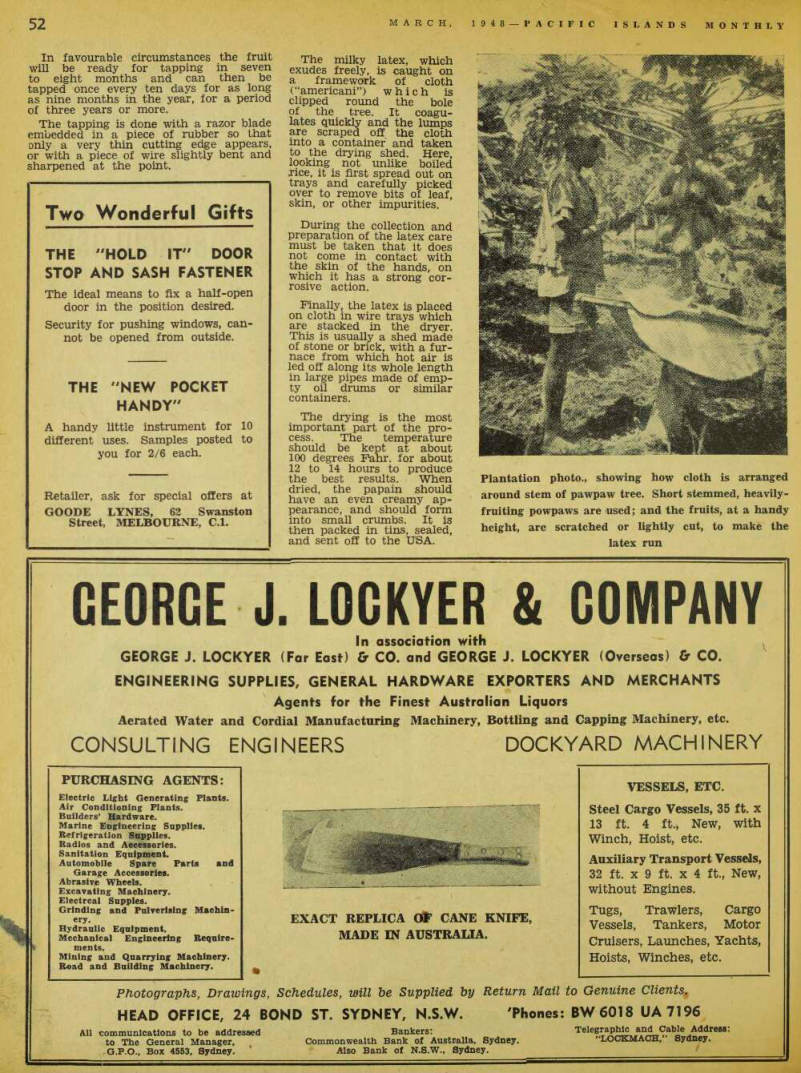
How The Latex is Gathered and Treated
THE following article, which sug gests that a use may be found for the common paw-paw, is from an article by J. P. Moffett, in the November issue of the “Crown Colonist” It is based on a recent development in Northern Tanganyika.
Unfortunately, Mr. Moffett says very little about marketing—only that the latex is “much in demand in America ” The “PIM” has put in hand inquiries, to find out the best way of marketing the product; and this information will be published when it comes to hand.
It is worth noting that Western Samoa regularly produces and sells a small quantity of papain—worth about £2OO in 1947. rE pawpaw “tree” and its delicious fruit are familiar to all who live in the tropics. But papain, the dried latex which exudes when the skin of the fruit is scratched, is perhaps not so familiar.
Yet it is now extensively used in the manufacture of certain medicines and cosmetics, for such processes as chill proofing beer, tanning leather, tenderising meat and de-gumming natural silk when this is associated in fabrics with rayon and wool. It is much in demand in America.
Buyers are prepared to offer high prices to obtain it, and its production has grown from 10,480 lb., valued at £3.500, in 1939, to 109,760 lb., valued at £49,392, in 1945. (Prices are in sterling. This is equal to an average of 11/- per pound Australian.)
Most of this comes from the Northern Province of Tanganyika, where the acre age under pawpaw is now being extended to the maximum permitted by the Depart ment of Agriculture. Unrestricted plant ing cannot be allowed because of the prior necessity for food production, but the pawpaw is rapidly taking the place of the coffee tree in those “marginal” areas where coffee-growing is rather a gamble but where pawpaws flourish.
There is a story-book flavour about the origin of this new industry. Ten years ago no papain at all was produced in Tanganyika. But about 1935 a German missionary at Arusha chanced to read an article about it and began to experi ment. He found no difficulty in growing paw-paws on the rich volcanic soil on the southern slopes of Mount Meru and, with advice and encouragement from the local Agricultural Officers, soon succeeded in producing papain of the quality desired by the trade.
His neighbours followed his example, until there are to-day few planters in Arusha who are not producers. The price of papain is now 25/- per lb. for the pure product and, since the pawpaw tree produces fruit less than a year after germination and an acre will yield from 60 to 100 lb. per annum, it is not sur prising that the industry has grown rapidly.
Planters are now using a short-stemmed variety of tree, which makes tapping easier. The seedlings are usually planted, five at a time, in rows about 8 ft. apart.
The plantations are kept clean-weeded.
This is usually done with the hoe, but small tractors are now being increasingly used with success.
grow strongly—provided the cut-worms do not get at them—and the others will then be removed. Not until the young tree floW ers can it be seen whether it is a male or a female plant—this is one of the hazards of pawpaw growing, for only the female plant produces fruit. The ma i es are cut out and any empty spaces a up a in. Soon there appear symmetrical rows of heavily laden female p i an ts, with a male here and there for fertilisation purposes.
In favourable circumstances the fruit will be ready for tapping in seven to eight months and can then be tapped once every ten days for as long as nine months in the year, for a period of three years or more.
The tapping is done with a razor blade embedded in a piece of rubber so that only a very thin cutting edge appears, or with a piece of wire slightly bent and sharpened at the point.
The milky latex, which exudes freely, is caught on a framework of cloth (“americani”) which is clipped round the bole of the tree. It coagu lates quickly and the lumps are scraped off the cloth into a container and taken to the drying shed. Here, looking not unlike boiled xice, it is first spread out on trays and carefully picked over to remove bits of leaf, skin, or other impurities.
During the collection and preparation of the latex care must be taken that it does not come in contact with the skin of the hands, on which it has a strong cor rosive action.
Finally, the latex is placed on cloth in wire trays which are stacked in the dryer.
This is usually a shed made of stone or brick, with a fur nace from which hot air is led off along its whole length in large pipes made of emp ty oil drums or similar containers.
The drying is the most important part of the pro cess. The temperature should be kept at about 100 degrees Fahr. for about 12 to 14 hours to produce the best results. When dried, the papain should have an even creamy ap pearance, and should form into small crumbs. It is then packed in tins, sealed, and sent off to the USA.
Plantation photo., showing how cloth is arranged around stem of pawpaw tree. Short stemmed, heavily fruiting powpaws are used; and the fruits, at a handy height, are scratched or lightly cut, to make the latex run
Advertisements & other items, pp. 51-52 (1 item)
Widdop
NAPT
TUBERCULOSIS
is the enemy of mankind.
It affects people of every age and country.
Yet with modern hygiene and preventive medicine,
TUBERCULOSIS can be
conquered. The first weapon is Knowledge. The NAPT exists to provide the vital information.
Membership ; Five shillings per year.
Tavistock House North, London W.C.I. England.
NATIONAL ASSOCIATION FOE THE
PREVENTION OF TUBEECULOSIS.
DIESEL ENGINES
BY
WIDDOP
5 H-P TO 300 H• P
H • WIDDOP & CO LTD
GREENGATE KEIGHLEY ENGLAND
Telephone; Keighley 3727-8 Telegrams: Widdop Keighley Codes: A.B.C. 6th Edition, Bentley’s, Bentley’s Second
JUi
r £ Above: (D-Type) 36/45 H.P.
V On left: (X-Type) 120 H.P.
Direct reversing
Two Wonderful Gifts
THE "HOLD IT" DOOR
STOP AND SASH FASTENER
The ideal means to fix a half-open door in the position desired.
Security for pushing windows, cannot be opened from outside.
THE "NEW POCKET
HANDY"
A handy little instrument for 10 different uses. Samples posted to you for 2/6 each.
Retailer, ask for special offers at GOODE LYNES, 62 Swanston Street, MELBOURNE, C.l.
GEORGE J. LOCKYER & COMPANY
In association with
GEORGE J. LOCKYER (Far East) & CO. and GEORGE J. LOCKYER (Overseas) & CO.
ENGINEERING SUPPLIES, GENERAL HARDWARE EXPORTERS AND MERCHANTS
Agents for the Finest Australian Liquors
Aerated Water and Cordial Manufacturing Machinery, Bottling and Capping Machinery, etc.
CONSULTING ENGINEERS DOCKYARD MACHINERY
PURCHASING AGENTS:
Electric Light Generating Plants.
Air Conditioning Plants.
Builders’ Hardware.
Marine Engineering Supplies.
Refrigeration Supplies.
Radios and Accessories.
Sanitation Equipment.
Automobile Spare Parts and Garage Accessories.
Abrasive Wheels.
Excavating Machinery.
Eiectrcal Supples.
Grinding and Pulverising Machinery.
Hydraulic Equipment.
Mechanical Engineering Requirements.
Mining and Quarrying Machinery.
Road and Building Machinery.
Titiia
EXACT REPLICA OP CANE KNIFE,
MADE IN AUSTRALIA.
VESSELS, ETC.
Steel Cargo Vessels, 35 ft. x 13 ft. 4 ft., New, with
Winch, Hoist, etc.
Auxiliary Transport Vessels,
32 ft. x 9 ft. x 4 ft., New,
without Engines.
Tugs, Trawlers, Cargo
Vessels, Tankers, Motor
Cruisers, Launches, Yachts,
Hoists, Winches, etc.
Photographs, Drawings, Schedules, will be Supplied by Return Mail to Genuine Clients.
HEAD OFFICE, 24 BOND ST. SYDNEY, N.S.W. 'Phones: BW6OIB UA7196 All communications to be addressed to The General Manager, G.P.0., Box 4553, Sydney.
Bankers: Commonwealth Bank of Australia, Sydney.
Also Bank of N.S.W., Sydney.
Telegraphic and Cable Address: “LOCKMACH,” Sydney.
Were There Pigmies
In W. Samoa?
By C. Philipp
ONE night in 1918, Johnny Smith, of Safotu, Savaii, accompanied by a Samoan native, was watching for turtles on the sandy beach some distance from the village. The following is his account of what he saw on that night.
“Waiting for turtles to come up to lay their eggs is a monotonous business, and only occasionally profitable. The moon was already well up and it must have been after midnight. My friend and I were thinking of giving up the watch and returning to the village. Suddenly we were surprised to see some shadowy forms walking out on to the beach from the dark bush, close by. They were about the height of ten or twelve-year old boys, and there were more than a dozen of them. I had often heard the natives talking about these strange little men, but this was the first time that I had actually seen them, and it was the last time too.
“They behaved timidly and seemed to be on the alert for a possible enemy, I could hear their voices as they spoke to one another in a queer tongue. They did not spot us, because we were lying on the sand, and for a minute or so we watched them as they waded into the shallow water along the shore. Soon they were groping about the sandy bottom with their hands in search of sea-urchins. By this time, my companion and I decided to try and catch one of them.
“Together we sprang to our feet and ran straight at them, but no sooner did they see us than a confusion of cries arose, and before you could ‘Jack Robinson’ they dived into the bush where It was useless to follow them. Their swiftness on foot was amazing.
“Next morning when I returned with some villagers to the spot we found a multitude of footprints on the sand as proof that my friend and I were not tell ing fairy-tales.”
THE belief in the existence of pigmies in various parts of Savaii seems to be supported by various accounts among the natives who refer to them as the “Au totoe” or “the remnants.” They are believed to be the remnants of a race which once, centuries ago, inhabited the island in great numbers. At the western end of the island are to be found caves which, it is said, were lived in by a small band of pigmies only as far back as 30 years ago.
Invariably they are described as timid and showing no inclination to fraternize or trust the Samoans.
Though it is generally believed that they have now become extinct, Mr. Smith believes that they may have retreated in land to the mountainous regions of the rugged island of Savaii.
A RATHER different story, told by the people of Samauga and neighbour ing villages, relates to an orator known as Maua’i, who lived about 50 years ago. But for the fact that it bears out the existence of pigmies, it might be discredited as a tale of pure imagination.
Maua’i was a great hunter, his chief sport being to track down wild pigs with the assistance of his dogs. One day, while out hunting, so the story goes, he lost his dogs for a while and when next he saw them they were wet and flecked with sand. This puzzled him as there was no sand in the vicinity and he was a great distance from the beach. He also noticed that the dogs behaved strangely, so much so that instead of following him home they ran back in
the direction from whence they had just come.
Following them, Maua’i was led to a cave into which the dogs disappeared.
Finding some dry brushwood, he made a torch and entered. For a short dis tance he followed the course of the tunnel till he reached a subterranean stream, the banks of which were sandy. Obvi ously this was where the dogs had been.
Continuing on, he reached a broad and spacious chamber where he saw an amazing sight. The story does not men tion the means by which the place was illuminated, but it is taken for granted that there was an opening in the roof as is often the case with old tunnels in a state of collapse.
The chamber in which he stood was actually a village, inhabited by bearded dwarfs who now gathered around him,
and in demonstrations of eager friend liness, offered him food and prevailed upon him to stay. How long he' did so is not known, but when he eventually left it was understood that he was their king and that he was to visit them often.
When confronted with any difficulty in
his own village, in the matter of food, he was to seek their assistance. There was one requirement, however, by which he had to abide, this being that he re vealed the secret to no one.
Maua’i kept the secret for some time.
Often his mysterious disappearance into the forest and his return with cooked pigs baffled his people. He was pestered with questions, and attempts were made to follow him, but without success.
A time came, however, when under the cunning flattery of chiefs and fellow orators, he weakened and betrayed the source of his wealth. But so fantastic was his story that no one believed him, and in the end he had to lead them to the cave. Torches were lit and the party entered, but they never reached the chamber of the dwarfs. The roof of the tunnel had collapsed and sealed off the chamber. Maua’i believed that this was the result of his betrayal.
Though he stuck to his story, no trace of the dwarfs was ever again found in the vicinity. But, to this day, when
feasts are held in the villages of Samauga and Safune, it is still the practice of the villagers to set aside a token-presentation of food to the “Au totoe.”
Who these pigmies were, or whence they came, may never be known. Per haps they were related to the race which is known to have inhabited the Carolines before the arrival there of the Chamorros and Malayans.
On the initiative of M. Cosnier, physical instructor at the Noumea College de la Perouse, 18 New Caledonian pupils will fly to Sydney to take part in athletic events against Australian public school boys. They will travel at their own ex pense, and will be lodged in Sydney schools or with private families.
Mr. C. Burge left Brisbane for Thursday Island by the “Wandana” on February 7, to take up duties with the education de partment." He was accompanied by his wife and three children.
Advertisements & other items, pp. 53-54 (1 item)
V It Mr!?
c eVEBRATeJS
EYE LOTION
For Inflamed Eyes and Eyelids ... Sold Everywhere H.Rose&Co..Pty..Ltd.. Kinq Street. Sydney
n **r< a&t
kT*i£ $JuW&H't
*A
HEALTHY
NEAT-LOOKING
HAIR
✓« <Z\ £r\ sPL Vu s^\ \' y \ s 3 VK He’s found the key that unlocks the door to social success and popularity.
Attractive girls take pride in being seen with him . . , a well-groomed escort. He studies his appearance . . . knows the value of first impressions . . . realises the advantage of handsome, well-kept hair. So he uses VITALIS, and the “60-second drill”. 1 50 Seconds to Rob—Cir- O 10 Sec ° nds to C o ™* 3 and 1 eolation quickens thus * Brush—Hair hos a lustre scalp stimulation gives hair —no objectionable patenta chance. leather look. 3304
V It Mr!?
SVimu'°* e 4 Vfr
w AP2
INDOORS or OUT
BRILLIANT LIGHTING
WHEN & WHERE REQUIRED
The vapour lamps are the last word in efficiency in modern kerosene lighting. Burn for 10 hours on 1} pints kerosene. All spare parts available.
Obtainable in two models, the AP2 and KL7. Write for leaflet.
HL7
DEKOL
Guards Wood and Canvas from the Ravages of White Ants, Borers, Dry Rot, Mildew, etc.
DEKOL penetrates deeply, permanently protecting wood and fabrics from ro* and attacks by fungi and insects. It is simple to apply and when dry can be painted and varnished. DEKOL also prevents attack by marine borers on wood immersed in sea water.
ZI i Q> ® a* /
DON'T WAIT
TILL THIS
HAPPENS.
I Trade Inquiries Invited.
C.Q.R. ANCHORS
The light-weight anchor with three times the holding power of any other anchor. Designed for positive and quick “dig in,” the C.Q.R. anchor is two well-designed ploughshares welded together.
Write for another leaflet.
W. Kopsen & Co. Pty. Ltd.
SHIPCHANDLERS & MARINE ENGINEERS
376-380 KENT ST., SYDNEY. MA6336 (9 lines).
Cables: “KOPSEN” Sydney.
Madang Newsletter
From a Special Correspondent
Madang, Feb. 26.
THE Administrator, Col. J. K. Murray, visited Madang on February 5 and 6.
Main object was to inspect the agricultural station and view the general progress of the district.
Col. Murray was the guest of the District Officer and his wife, Mr. and Mrs. J. K. McCarthy.
In the party were Mr. W. Cottrell- Dormer, Director of Agriculture, Stock and Fisheries who later visited Wewak; Mr. Pearsall of the Administrator’s office, Mr. Young of Public Health Department and Messrs. Vigden and Griffiths of the Department of Works and Housing.
During the Administrator’s visit an op portunity was taken to present Mr. W.
Dolby with the British Empire Medal.
Mr. Dolby, who until recently has been recruiting in the Sepik River District, has now left Madang to undertake the man agement of one of Mr. H. G. Murray’s plantations at Kavieng.
On the second day of Colonel Murray’s visit he interviewed local residents and at night His Honour met members of the Progress Association at the home of the District Officer. In outlining Admin istration policy Colonel Murray discussed priorities for construction of buildings and wharves.
Mrs. McCarthy left with the party for Port Moresby by the C 47. She entered hospital for examination. * * * On February 1, the native market was re-opened. It is of great advantage to all white women in Madang as it over comes the necessity for natives peddling their wares haphazardly from door to door, at their own price. * * * Mrs. F. Brosgarth took charge of the European School on February 3. She has 10 children ranging in age from six to 14 years and in six grades.
The, wet season has caused havoc to local roads, but it is understood the road grader will be available at the first op portunity. As the Meiro River Ford has been impassable on many occasions the need for a bridge across the river is now more apparent. * * * Mrs. John Griffin was recently flown by chartered plane from Saidor to Madang to enter hospital. Later she went to Finschhafen for surgical treat ment at the Lutheran Mission Hospital. * * * Preparations for the installation of buildings for the Air Radio and Air Con trol have been commenced. * * * Mr. Ron Chugg, formerly Senior Medi cal Assistant at Madang, has returned to the Territory. During leave spent in Melbourne, he and his wife made the acquaintance of their two new grand daughters. The Chuggs will be moving to Wewak shortly. * * * ' Charged with theft of fly-wire from Finschhafen, three Europeans were sen tenced recently to a fortnight’s imprison ment by the District Court. ** * * At a meeting of the RSSAILA jflans for a club-house, regular social activity and Anzac Day Celebrations were dis cussed. A worth-while suggestion for a pavilion on the oval was made, upper section to be used exclusively by the Asso ciation; lower section to be devoted to dressing rooms and seating accommoda tion for sports spectators. * * ■ The Chief Judge, Judge Phillips pre sided at a sitting of the Supreme Court on February 25 and 26, in Madang. Three
natives appeared before the Court on charges of unlawful killing. G One of the natives received a sentence of 10 years’ imprisonment while the other two were each sentenced to 18 months. ♦ Hs jj« Mrs. C. I. H. Maclean, who has been visiting her son Colin at Saidor, left Madang for Rabaul by Catalina recently.
In Rabaul she will stay with her son Alistair.
A housing committee to investigate the establishment of a scheme of public housing on the lines suggested in the Colony’s Ten-Year Plan has been set up by the Government of Fiji. It consists of Mr. R. N. Caldwell (chairman), the Director of Lands (Mr. W. H. B. Buck hurst), Messrs. A. A. Ragg, Vishnu Deo, C. Came, R. L. Munro, C. N. Nettleton, C. R. Stephen, Dr. J. Taylor and Mr. W.
Whan. Mr. A. L. Baker is secretary.
Advertisements & other items, pp. 55-56 (1 item)
Westclox
N EVER has performance been more trustworthy than in the beautiful Westclox of today . . . famous Big Ben and other spring wound clocks, electric clocks, wrist watches and pocket watches. When you buy your next clock or watch, look for the trade mark “Westclox” on the dial . . . your assurance of quality.
POCKET BEN A thin model watch with many features. Highly polished, plated finish; silvered dial; attractive numerals and hands. Unbreakable crystal.
SPUR Luminous A thin case, one-day alarm. Black finish with nickel trim. 41 inches square.
Steady alarm. Unique base.
Luminous dial.
Chime
BIG
BEN
BIG BEN Chime Alarm The highest standard of alarm clock quality. Quiet tick and gentle two-voiced alarm. First there’s a gentle call, then if he’s not shut off. there’s a lusty shout. Dustproof attachments. 5h inches high. Ivory finish with gold colour trim. Luminous dial. « M * S*:-, 'v.
I a * WESTCLOX • M
8 4 7 6 5 10 BABY BEN A smart looking alarm clock, 3'h inches / high.
Quiet tick; steady alarm that rings loud or soft. Legible dial.
Two finishes . . . black with nickel trim, and ivory with gold colour trim. Made in plain and luminous dial. w LA SALLE A handsomely designed wrist watch. Chrome finish case, stainless steel back, curved to fit the wrist. Sturdy movement, regulated to run in any position. Equipped with conventional second hand; rustproof hairspring.
ORDER THROUGH YOUR LOCAL STORE
PACIFIC ISLANDS TRADING
COMPANY
244 CALIFORNIA STREET, SAN FRANCISCO, CAL., U.S.A.
Bankers: Bank uf America (Main Office) San Francisco.
Cables:
PITCO
SAN FRANCISCO
A. B. DONALD Ltd.
AUCKLAND
ISLAND TRADERS & GENERAL MERCHANTS
P.O. Box 1509. Cables £r Telegrams, "Kingdom/ 7 Auckland.
v ♦ ♦' aw wroaw hk: i f m i I
BUDGE
REFRIGERATION and
sJ St
ICE MAKING
EQUIPMENT
COMMERCIAL AND INDUSTRIAL
UNITS
(not domestic) Ammonia and Methyl Chloride machines of large or small capacity.
The illustration is of a small (nine 28 lb. blocks) electric, Methyl Chloride Icemaking plant.
Enquirers should mention dimensions of cold room (or cabinet) and of amount of ice (if any) required per day; also if electric motor or internal combustion engine is to be included.
S
I JAMES BUDGE PTY. LTD.
REFRIGERATION ENGINEERS
McEvoy Street, Alexandria, Sydney
Established 1890 m
Suva Yacht Club's Good
Year
From Our Own Correspondent
Suva, Feb. 1.
WiEETH a membership of 264 and an excess of income over expenditure of £4BB, the Suva Yacht Club had one of its best seasons to date in 1947.
This was reported by the club’s secretary (Mr. B. A. Lee) and treasurer (Mr. V.
Hawksley) at the annual meeting re cently.
A new development was a scheme under which members could build their own yachts with materials provided by the club and paid for on the instalment plan.. Three new vessels have been launched since the end of the season and six more are well on the way.
Death Of Mrs. Jane
Morrison
From Our Own Correspondent
Suva, Jan. 30.
THE death has occurred of Mrs. Jane Emmeline Morrison, widow of Mr.
J. Morrison, formerly with the CSR Co., at Nausori and later of Rakiraki.
Mrs. Morrison, who was 75 years of age, had lived in Fiji for almost 60 years. Her father, Mr. W. Mune, was manager of the Koronivia estate, which possessed one of the first sugar-mills in the Colony.
The Morrisons’ hospitality and gener osity are still remembered among the older residents. Three sons and two daughters survive their mother, including Nurse Morrison, who has conducted a Suva nursing-home for nearly 20 years.
Miss Lenore Craig and Mr. Jack Pound were married recently in Brisbane, They will make their home in New Guinea.
Advertisements & other items, pp. 56-57 (2 items)
56
march, iHs-t acif ic islands monthly
re {resjH‘ 1 l
f OU
Ci a&tee
TOOTH PASTE
It's
re {resjH‘ 1 l
You’ll agree, too, when you use IPANA. It’s refreshingly different, with a distinctive, pleasant taste, that makes your mouth feel grand.
IPANA’S cleaning and polishing qualities give you sparkling teeth and a sunny smile.
With massage, too, IPANA helps ensur firm, healthy gums so vital to sound teeth.
Bad Weather In The

Blue Lagoon
From Our Own Correspondent
Suva, Feb. 23.
THE individual Pictures (J, Arthur Rank Organisation) unit, now film ing part of “The Blue Lagoon” on location in the Yasawa Group, has been
delayed by bad weather (Suva’s record has been more than 16 inches of rain in the last three days) and will not leave Nadi for London, via the United States, until March 15.
Mrs. M. Bruckshaw, formerly of Rabaul and Madang, left for England early in March on a 12 months’ trip.
Fijian Police On
Alert
Canadians in Trouble in Suva
From Our Own Correspondent
Suva, Feb. 17.
A FIJIAN Post Office employee who chased a Canadian sailor after the Canadian had smashed a window of Widdowson’s jewellery shop was warmly praised by the Magistrate at the conclu sion of a recent court case.
The Canadian went to gaol.
Another Canadian sailor, illegally busy in a hatch of his ship at 2 o’clock one morning last week, had not allowed for the excellent ears of a Fijian wharf labourer.
Result: When the sailor heaved up a case containing 12 bottles of brandy, he unintentionally heaved it into the hands of the chief officer, grimly waiting at the top. The sailor was given four months’ hard labour.
It was another Fijian, a police sergeant, who arrested three sailors (not Cana dians) who had appropriated a car out side the Town Hall. The drive lasted only 100 yards and cost the visitors £3 each in fines.
Another Canadian who walked out of a shop with a sun-hat for which payment had been overlooked, was briskly pursued by a shop-assistant and was ultimately bagged by a Fijian corporal when blandly wearing the hat in a hotel bar. He was fined £5.
When a ship with a Canadian crew comes in, Suva’s instinct nowadays is to batten up and take cover.
EDITORIAL NOTE: What a welcome would be given to a few score of these Fijian policemen in Australia and New Zealand, which are literally being over run by thieves!
Advertisements & other items, p. 58 (1 item)
Rodar= —
For perfect cutting
under all conditions
There is a Ransomes Mower for every lawn our range covers machines for every requirement from the smooth, even surface of the putting green to the sports ground, golf course or aerodrome.
The "MOON" Mower
GANG
MOWERS
For grass such as couch, klkuyu, buffalo, etc., and grass longer than the average. 14-in. and 18-ln. wide. 50 acres a day can easily be cat with a Ransomes Quintuple Mower drawn by a tractor and even larger outfits up to Z 5 ft. wide are available.
ansomes
Lawn Mowers
Write for illustrated literature and all information
MORRIS, HEDSTROM LTD.,
Suva, Lautoka, and Ba.
Made by RANSOMES, SIMS 6- JEFFERIES LTD., IPSWICH, ENGLAND.
RODAR= —
FOR EVERYTHING PHOTOGRAPHIC
and Comprehensive Service
Kodak Film, Plates and Sensitised Papers . . Super-X Cine-Kodak Safety Film . . . 35mm Kodachrome Film . . Australian-made 35mm. Enlargers, Single Unit Reflectors, Floor Lights, Spotlights and general Floodlighting Equipment . . . Austral Projection Screens . . . Shelton 35mm. Film Strip Projectors .. . Tripods . . Carrying Cases . . . Lens Hoods . Celestion Enlargers . . Enlarging Focus Finders . . . Enamel and Plastic Developing Dishes . . . Film Clips . . . Stirring Rods . . . Print Paddles . . . Printing Frames . . . Developing Tanks . . .
Australasian Photo-Review . . . Photographic Books . . . Kodak Developing, Printing, Enlarging and Colouring Service . . . Kodak Technical Advisory Service Inquiries invited and advice gladly given. OF ALL KODAK DEADERS THROUGHOUT THE ISLANDS.
KODAK (AUSTRALASIA) PTY. LTD.
379 and 386 George Street, Sydney
NEWCASTLE, KATOOMBA AND ALL STATES
Norfolk Is. Has No Green
Grass Or Leafy Lanes
Letter to the Editor IN “Tropicalities” (January “PIM”) you publish some notes regarding Nor folk Island by Mrs. Alice Innes, who spent last Christmas there.
As one who has visited the island three times since 1931, and who lived there for a total period of nearly two years I cannot understand why short-term visitors who write about this picturesque and interesting island should deem it necessary to depart from the factual and wander into the imaginative, Mrs. Innes’s statement that “even every shop building was set away in a quiet retreat and garden area” is incorrect.
The principal general stores (BP’s, Joe Jenkins’s, Martin’s, Jack Jenkins’s and C. C. R. Nobbs’s) abut directly on to the roadway, as do the butcher’s, the baker’s, and the Gift Store. Further, regarding Mrs. Innes’s account of a shopping tour —she was lucky to see any green grass at all, to say nothing of lawn-like pad docks with carpets of Norfolk Oak petals. (By “Norfolk Oak” Mrs. Innes probably means the tree known to the Islanders as the “White Oak,” a name given by the convicts over a century ago to one of the most plentiful native trees on the island and, perhaps the most beautiful.) As to the “leafy lanes” I would very much like to know where these are. Most of the roads on the island, as I remem ber them, were about a chain wide, and I cannot remember any one of them which could, with any degree of accuracy, be described as a “leafy lane.” My wife and I, while on the island, were engaged in collecting insect and plant specimens, in the course of which work we traversed the whole island, probablv seeing more of it than any individual Norfolk* Islander has ever done.
Regarding Mrs. Innes (or even Mr.
Innes) “climbing the orange tree to ‘pick our purchases’ off an old veteran of the citrus world”—as one who has had a lengthy experience of the spiny nature of the branches of orange trees and the gathering of oranges (in my case with a suitable appliance attached to the end of a pole) I can only say that I regret that I was not present when the tree climbing act was performed.
With reference to Mrs. Innes’s further contribution, “Norfolk News,” (in the same issue of the “PIM”) —the surname of the driver of the so-called “grog wag gon” is Buffett, not Burfit. He is a descendant of John Buffett, an English man, who landed on Pitcairn Island in 1823 to become its first school-master.
In my opinion, visitors to Norfolk Is land would render a useful service to its inhabitants by speaking and writing the truth about it; most of the articles which I have seen of recent years have, I consider, done more harm than good.
I am, etc.,
J. D. Mccomish.
Wahroonga, NSW.
February 10.
(Ed. Note: The unfortunate mis-spell ing of Mr. Buffett’s name was due to a typographical error not to Mrs. Innes.) Sir Maynard and Lady Hedstrom, of Suva, arrived in Sydney in February from Auckland, where Sir Maynard had spent a few weeks in hospital. In March, they went on to Victoria and Tasmania, and they will return to Sydney in April.
While they were in Sydney they received much hospitality from numerous old friends. Twice Sir Maynard was the honoured guest at the weekly luncheons of the Old Fijians.
Miss Peggy Byron, who visited Brisbane for the Christmas vacation, has returned to Rabaul. She was secretary of the Brisbane-New Guinea Association during the evacuee period.
Miss Flora Stewart, daughter of Mrs.
P. Stewart of Lae, New Guinea, revisited Toowoomba recently. She was formerly a pupil of the Presbyterian Girls’ College there.
The Director of Agriculture, Mr. C.
Harvey, and Mr. C. A. Adams, have been appointed to the Central Board of Health.
Advertisements & other items, pp. 59-60 (1 item)
Asthma, Bronchitis Coughing,
Curbed in 3 Minutes
Do you have attacks of Asthma or Bronchitis so bad that you can’t sleep? Do you feel weak, unable to work, and have to be careful not to take cold and can’t eat certain foods?
No matter how long you have suffered or what you have tried, there is new hope for you In a doctor’s prescription called Mendaco.
No dopes, no smokes, no injections, no atomizer.
All you do Is take two tasteless tablets at meals and in 3 minutes Mendaco starts working through your blood, aiding nature to remove phlegm, promote free easy breathing and bring sound sleep the first night, so that you soon feel years younger and stronger.
No Asthma in 2 Years
Mendaco not only brings almost Immediate comfort and free breathing but builds up the system to ward off future attacks. For Instance, J. Richards, Hamilton, Ont., Canada, had lost 40 lbs., suffered coughing every night, couldn't sleep. Mendaco stopped Asthma
spasms first night and he has had none since in over two years.
Money Back Guarantee
The very first dose of Mendaco goes right to work circulating through your blood and helping nature relieve you of the effects of Asthma. Try Mendaco under an iron-clad money back gaurantee. You be the judge. If you don’t feel fully satisfied after taking Mendaco just return the empty package and the full purchase price will be refunded. Get Mendaco from your chemist to-day and see how well you sleep to-night and how much better you feel to-morrow. The guarantee protect/
RELIEVES ASTHMA
Mendaco
Now in 2 sizes ... 6/- and 12/-
The Most Extensive Manufacturers in the British Empire of
RUBBER STAMPS,
INKS, STENCILS,
Marking Devices,
ACME STAMP PADS
OFFICE S STATIONERY SUPPLIES
m % u 5 I
We also Manufacture & Supply
a Complete Line of
LIMEWASHING AND
SPRAYING MACHINES
for all purposes.
Let ns know your requirements and we will quote by return.
WRITE FOR OUR GENERAL CATALOGUE
Limewashing Machine
EXCELSIOR SUPPLY CD. PTY. LTD.
278 Post Office Place,
MELBOURNE, VIC.
HEAD OFFICE :
160 BROADWAY,
Formerly known as George St., West,
SYDNEY, N.S.W.
50 Victoria Street,
WELLINGTON, N,Z.
Gilbert Renton
AUCTIONEER, VALUER,
ESTATE AGENT.
Storage and Repository Travellers Sample Rooms For General Information and Service.
P.O. Box Rabaul, TNG
Scott’s “Renown” Brand Rope,
Cordage and
Binder
Twine
of Every
Description
Cable Address; Ropeyard Sydney. ss
MANUFACTURED AT
MASCOT, N.S.W.
J. SCOTT
PTY. LTD.
Head Office and Store
163 CLARENCE STREET,
SYDNEY.
N.S.W. •
W. H.GROVE £ SONS
Limited Established 1896.
AUCKLAND
Island Traders. P 0 BOX m Telegraphic and Cable Address: “Grove", Auckland.
Entrust Your Orders to the Firm with Fifty Years Practical Experience in the Island Trade.
Shippers of all classes of New Zealand products.
Representing English Manufacturers throughout the Cook and Society Islands, Fiji, Tonga, Samoa, Niue, New Caledonia, New Guinea, etc.
In FIJI as—W. H. Grove & Sons (Fiji) Ltd.
Fiji Police Disinter
Stolen Safe
Suva Feb. 16.
NO one outside of higher police cir cles (and they don’t talk) knows how it was done, but on February 9, the police discovered an office safe, stolen from Morris Hedstrom’s Nadi branch on January 14, buried in the Nadi River mud near the Nadi Bridge.
When trying to open the safe, the thieves had wrenched off the handle and front of the lock. After the police had forced the safe they found the original £392 inside —soaked but intact.
Next day three Indians were arrested and on February 11, Bikha Prasad, Ram Prasad and Lalaram, aged 25, 22 and ltB respectively, were sentenced at the Nadi Magistrate’s Court. The first two were gaoled for two years. Lalaram, owing to his youth, got *six months.
Foley-Huggins Wedding
In Rabaul
From a Special Correspondent THE marriage took place at the Romar Catholic Presbytery, Rabaul, on Janu ary 31, of Miss Peggy Huggins, whc is on the staff of the local branch oj Burns Philp & Co. (NG) Ltd., and Mr Matthew Foley, of New Britain, and ol coast-watching fame.
The brother of the bride flew up fron Sydney to represent her family at th< wedding. He acted as best-man; Mrs Phil. Lyons was matron of honour.
Orchids were flown from Sydney foi the bride’s bouquet and were off-loadec at Port Moresby! However. Mrs. Bourki of Rabaul. made a beautiful substitute bouquet of local frangipani and maidei hair fern. The cake was also importe* from Sydney, and opened in a somewha battered condition. Mrs. Guy Black save< this situation and did a most successfu reconditioning iob, after which the cak probably looked better than it had whei it was sent from Sydney.
The reception for over 120 people wa held at the Cosmopolitan Hotel.
Brisbane Ng Association
ALTHOUGH it once had a member ship of 70, the Brisbane-New Guine Association now has only 16 mem bers. Those reduced numbers, howevei do not detract from the interest and en thusiasm displayed at the meetings whic are held at this Brisbane Lyceum Clul Queen Street, on the second Saturday c each month.
Most of the former members have re turned to the Islands and the remainde are now permanent residents of Queens land.
Mrs. Glad vs Forsyth is still entruste with the office of President which sb has carried out with ability for two year The secretarial duties are carried out i an able and efficient manner by Mrs. L Jamieson, a former Territorian, now li\ in°- in Sherwood.
Visitors from New Guinea are assured of a warm welcome at tt monthlv meetings of the Association.
Mrs. Forsyth was hostess to 25 childre and 2ft adults at her at Taring during Do ember. Mrs. Jack formerlv of Rabaul supervised the eami of the children, each of whom received present.
Moslems
No Liouor For Fiji
From Our Own Oorresonndent
Suva Feb. 16.
Heartrending human mtere from Macuata. Vanua Levu: Under the amended constitution of tl Fiii Muslim League, no drinker of ir toxicants may hold office, and so, befoi n certain member could become a cai didate at the recent annual election ■ officers of the Macuata branch of tl league. be was reouired publicly to tej un his liounr nermit.
This sacrifice resulted in the cand date’s unanimous election.
Mr. M. E. Wollister-Short arrived from the UK at the end of Januar TTe has been appointed Labour Officer the Colony.
The Bishot) of New Guinea the Ft. R« P. N. W. Strong was nresent at the r cent consecration of the Bishop of Norl Queensland in St John’s Church of Em land Cathedral, Brisbane. Blshon Stroi said there was a tremendous surge Qhristianitv in Northern Papua, and th teachers and nurses were still needed.
Advertisements & other items, pp. 61-62 (1 item)
Tilley Lamp
burn ordinary kerosene The Modern Form of PORTABLE LIGHTING
PRODUCTION FOR EXPORT
WE ARE PLEASED TO INFORM OUR
FRIENDS OVERSEAS OF NEW AND
IMPORTANT PREMISES ACQUIRED TO
FACILITATE PRODUCTION FOR EXPORT.
ALSO OUR POST-WAR MODELS ARE
NOW IN FULL PRODUCTION AND WILL
BE ON OFFER IN ALL PARTS OF THE
WORLD. TILLEY STANDARDS ARE MAIN-
TAINED AND INCORPORATED IN COM-
PLETELY MODERN DESIGNS OF LAMP<
BRENT WORKS, NEW BRENT WORKS,
HENDON, N.W.4 CRICKLEWOOD, N.W.2.
THE TILLEY LAMP CO. LTD., of ENGLAND London Offices and Showroom : 33 SACKVILLE STREET, PICCADILLY, W.l.
REPRESENTATION :
MELBOURNE: T. H. Bentley, Pty. Ltd., 123-125 William Street, Melbourne, C.l.
TASMANIA : Mr. C. Sellars, 108 a Charles Street, Launceston.
FIJI ; Mr. K. Witherington, 2 Burns Philp Buildings, Suva.
There Is only one
ELECTROLUX
THE MODERN KEROSENE-OPERATED REFRIGERATOR
THAT ACHIEVES THE MIRACLE OF ICE FROM HEAT
Lasting Efficiency, Silent Operation, Streamlined Beauty
i Economically operated by kerosene, with a simple precision-built freezing unit that has no moving parts and is GUARANTEED FOR
FIVE (5) YEARS.
Obtainable from : W. R. CARPENTER (New Guinea), LTD.
Rabaul, Madang, Lae, Kavieng, Wau.
J. R. CLAY & CO., LTD., Port Moresby.
W. R. CARPENTER & CO. (Sol. Is.), LTD., Tulagi.
For New Hebrides, Butaritari, Noumea, New Caledonia. Apply—
W. R. CARPENTER & CO. LTD.
Model LKSSI Storage capacity: 5i cub. ft. (approx); shelf area, 9 sq. ft.; food shelves, six—five removable; 2 self-supporting when half drawn. Ice-making: Four trays—s lb. ice per freezing: 80 cubes. Fuel consumption: 1.8 pints kerosene per day (approx.).
Height: 4 ft. 10 in. Depth: 2 ft. 3i in.
Weight, unpacked, 434 lb. Packed, 700 lb.
Head Office: 16 O'Connell St., Sydney, N. S. Wales
Samoa
Position Of Euronesian In Future Of
Administrator's Broadcast Causes A Slight Stir
AN address was broadcast over the Samoan Radio Station 2AP on February 21 by the Administrator of Western Samoa, Colonel F. W. Voelcker.
It seems to have caused some indigna tion in Samoa residents, writing to the “PIM,” say: “The part-Samoans are incensed in that it would appear that our existence here must be apologised for to the Samoans”: and “It was strongly ob jected to by local-born Europeans, as it practically apologised for their presence in Samoa. . . . and blamed former German and New Zealand Administra tions for allowing ‘foreigners’ to settle in Samoa, and humbly pleaded with the Samoans to treat the ‘foreigners’ as brothers.”
The following is the text of the address.
Readers may judge of its character for themselves.
“/CHIEFS, orators and people of Samoa: I was reading a book the other day about the islands of the Pacific —Hawaii, Tonga, Fiji, Western Samoa, American Samoa, Tahiti and the Solo mons, as well as other islands. The book described how each of the foreign nations —British, Germans, Americans, New Zea landers, Australians, French and Japanese —had governed and were governing the island people under their care.
“As the Hon. Malietoa pointed out in his speech last Monday, in Hawaii the Americans have settled the problem by allowing every sort of people to come in over the last 50 years, with the result that only two out of every hundred in habitants of Hawaii are pure Hawaiians.
“This has also been done, on not such
a big scale, by the French at Noumea and Tahiti.
“In Fiji, the Indians were brought by a private company, and not by the Gov ernment, and now outnumber the Fijians themselves.
“On the other hand, in some islands of the Solomons, the British are keeping out all foreigners and are isolating the people under the conditions of life that their forefathers lived. These people dress as did their forefathers, without foreign cloth, use stone implements instead of steel knives and axes, and catch their fish and grow taro without the tinned food of the papalagi. No doubt they are happy and healthy.
“The Japanese treated the island people as slaves and were not concerned with their welfare at all. ”T ET us look at the history of these 1 1 islands of Samoa and the present position. In the last century, many Europeans came to Samoa and married Samoans and, in the troubled times of civil war, there was nobody to prevent them.
“Then, in 1900, the Germans came, and Samoa was declared German soil. Thou sands of Chinese were imported to work in Samoa; and few can deny that it is largely from the cocoa and coconut trees that were planted in those days by these hard-working people that there is pros perity in Samoa to-day.
“Then New Zealand came in 1914; and, to-day, the situation is that New Zealand is endeavouring to help Samoa to stand on her own feet, and is not allowing any more Chinese, Solomon Islanders or Euro
peans to come and settle in Samoa. In German times, there were between two and three thousand Chinese here, and to day there are only 290, and arrangements are being made to send 126 of these back to China. Instead of many hundreds of Solomon Islanders, there are no more coming, and many have been sent home.
“During my time as Administrator, I have received many letters from Euro peans wishing to settle here, and to all of them I give the same answer: ‘Come on a short visit, if you like, to see our beautiful country, but not to stay, be
cause this country belongs to the Samoans,’
“The past has, however, left behind many problems to settle. We have stopped any more people wbo are not of the Samoan race from coming, but there are still rne descendants ot tnose who came in the past ana who now call Samoa tneir home, These children of Europeans —(German, American and Bntisn —and oi other races, Chinese, Solomon islands and others, all had Samoan motners, and therefore have a claim lor sympathy and understanding.
“Surely Samoa nas a big enough heart to take all these people and to absorb them into her family. Samoa nas much to thank New Zealand lor, in that, as 1 have explained, she has taken seeps to ensure that tne problem does not be come more confused by allowing more foreigners to come in.
“But let us face the present situation as wise and Christian people. Tne past has left us with two mam problems — people and land.
“As the result of lack of unity in the past, we have here in Samoa over 5,000 people of mixed blood. As the result of the foolishness of our forefathers, much of the best land in Samoa is not owned by the bamoan people, but has been sola to foreigners.
“I tell you that time and understanding will put these things right, and Samoa can gain and is gaining advantages from both these things, which at first might appear misfortunes.
“These people, to whom Samoa means home, have proved in the fields of trading and business that they can succeed ana assist Samoa, and if you treat them as brothers and builders with you of the oamoa of tomorrow, I am sure that Samoa will be the richer for their help, /vs regards land, New Zealand is bound by the Trusteeship Agreement that no further land, belonging to the Samoans, will be sold to Europeans; and not only that, but tne profits made on the Crown Estates will be used for the benefit of Samoa.
“As time goes on, means will be found for Samoa, which in the past has sold some of her birthright, to re-purchase it and, in the meanwhile, the profit from the comparatively small portion which is being worked by the Crown Estates will be returned to Samoa. Very few people realise that one fifth of the cocoa and one-sixth of the copra of Samoa, as well as the dried banana and all the desic cated coconut, are produced by the Crown Estates. Over 2,000 Samoans and part- Samoans obtain employment thereby, and only 17 Europeans are required. It would be foolishness if, in a night, this source of revenue for Samoa was cut off.
“Let us use our brains, all of us, Samoans, part-Samoans and New Zea landers, to work out the happy future of Samoa with unity and understanding.
Soifua.”
Advertisements & other items, pp. 63-64 (1 item)
fotdesfiesh'^'
"Your Yeast’
has No Rival"
From MADIRI, Fly River, via Daru, Papua, comes the following Testimonial to MALTO-PEPTONE DRIED YEAST: “For the Tropics, your Yeast has no rival. We have found it entirely satisfactory and are very pleased we learned of it.” (Sgd.) T.H.
MALTO-PEPTONE
DRIED YEAST
is 100% Pure Yeast. It has been on the Market for 12 years and is GUARANTEED to retain its vitality for months in ANY Climate. Ready for use in a matter of minutes, and users claim that, through its aid, they can Bake Bread in 3V2 hours! Trial Size Carton (2 oz.) 1/7— V* lb. 2/B—Vi lb. 4/9 1 — all Post Free. Send Stamps, Postal Note, Money Order or Cheque for a supply—NOW! !
AUSTRALIAN YEAST CO.
Oakleigh, Victoria —Australia.
K'ns*: -r r
Taste the
fotdesfiesh'^'
mm
CDOKIO
HOT
■m,
green
PEAS
433E3> Hi -M t\H2 CO The sweetest, tenderest green peas you ever tasted grown for Heinz in Australia’s “garden”, N.W. Tasmania. Picked the moment they’re perfect cooked and canned the same day!
Two varieties Heinz Green Peas, full and tender and Heinz SMALL Green o** 4 OF rA V Peas, young, sweet, extra-delicate.
They’re at your grocer’s NOW! % *(0
TO S&
°» COLD sg <1
PUL
CO
AtfSTRALIA
GREEN
PEAS
THI MOMINT TH f y'RI PIHTI CT
the
A Brief Word
on a
Serious Subject
task of the private executor and trustee is thankless, onerous and never-ending. It is a tax upon time, happiness and contentment of mind. It is a task few men would undertake had they any fore-knowledge of its exacting implications.
Burns Philp Trust Company Ltd. is a solidly financed organisation comprising officers and executives of the highest probity: thoroughly experienced in the administration of Estates and trusts. When an estate is adminstered by this Company, the future of its affairs does not depend upon the fallible judgment of one or two people, but upon the co-operative judgment of a large group of highly qualified experts; men of wisdom, integrity and wide experience.
The capifal and assets of Burns Philp Trust Company Limited are available as security for the protection of your beneficiaries.
It is suggested that you icrite for a copy of a booklet entitled , “Hands That ISerer Leave the Wheel”—a publication which explains fully the facilities and services available through Burns Philp Trust Company Ltd.
BOARD OF DIRECTORS:
James Burns Joseph Mitchell P. T. W.
Frederick Ewen Loxton Eric Priestley Lee MANAGER: L. S. Parker SECRETARY: E. R Overton. A.F.I.A
Burns Philp Trust
COMPANY LIMITED
EXECUTOR* TRUSTEE • AGENT
HEAD OFFICE: 7 BRIDGE STREET, SYDNEY
Tel. BU 5901 Box 543, G.P.0., Sydney
Mixed Blood Community
Editorial Note Mixed Blood Community In Samoa The Solution Of A Problem
READERS who have not lived in Samoa, and know nothing of the hates and prejudices which can sway that small community, probably will say that there appears little in the Administrators ad dress to give anyone offence.
But Western Samoa is a queer place.
For one hundred years (so far as Euro pean records go) it has been the home of petty intrigue, factional jealousies, and plain back-biting; and it does not tend to lose its character. Its people are among the most intelligent, charming and hospitable Polynesians in the South Seas —the visitor departs feeling that, what
ever else life may hold for him, he must go back to Samoa, and be really happy.
But life for the Samoans is very easy.
Their beautiful, fertile valleys and their sun-bathed seas provide them with all they need; so that their main problem is how best to employ their leisure time.
In Polynesia, they fill in the lazy hours with gossin. In Samoa, traditionally split among three or more warring chieftains, inter-community gossip and political oratory provide much of the village pas time.
Thus it was when the Europeans came, and thus it has been ever since.
In course of time, the Europeans stopped inter-tribal fighting. So then the Samoans, for gossip and entertain ment, turned to an intent, ceaseless scru tiny of their European governors. The gentleman whose lot is cast in Vailima knows what the poet meant when he wrote about the white light that peats upon a throne. There is gossip, gossip all the time. There is no escape for the Ad ministrator.
For fifteen years after New Zealand assumed control, the Samoans played savage politics, ending in the blood-letting of the Mau. For the last ten or fifteen vears, there has been complete peace in Samoa. The old generation of fire-eaters is passing awav, and there is no likelihood of disorder. But, fundamentally, the character of the Samoan has not changed: he still is an irresponsible gos sip, a political orator and happy, lovable intriguer. He still likes to watch, and study and stick pins into his Administra tor. In this respect the Euronesians are very like the Samoans, THE only kind of Administrator who could be a hundred-per-cent, suc cess in Samoa would be the cold, aloof English type living onlv for the job, his sense of justice and balance be vond question, and maintaining always between himself and the Samoans a frozen wall of ceremonial and an imnene trable cloud of impressive phrases. That, franklv. is what the native Samoans like and respect.
Colonel Voelcker is neither cold nor aloof. He is full of enthusiasm for his job, he is bubbling over with plans for the advancement of Samoa, and he is so eager for the goodwill and co-operation of the native Samoans that he goes out personallv into the market-place and seeks it. ’ With the result that the native Samoans, with all the goodwill in the world, are inclined to play tig with him; they like to see him funning about.
There is nothing wrong in or with Samoa a good time is being had by all, Wellington has given to the present Administrator more backing and co-op eration in one year than it had given to his predecessors in 20 years, and Samoa is getting the benefit of it. The overall picture is good, and happy.
BUT the “local-born” position (we much prefer to call it the Euronesian posi tion") is a somewhat delicate one; and it may be that the Administrator has been a little impetuous in his handling of it. He went to the natives with his broadcast, in a praiseworthv attempt to create goodwill between Samoans and nart-Samoans; and achieved the irrita tion of the Euronesians, to the Puck-like delight of some mischievous Samoans.
It is not fair to say that Colonel Voel cker was apologising for the presence of the Euronesians; but his approach was wrong. The Euronesians are as much entitled to a place in Samoa as the white New Zealanders are to a place in the land of the Maori. They were bom there, trained there, and in everything but the colour of their skin they are Samoan.
The native Samoans must accept that fact. There should be neither argument nor discussion.
The Euronesians are really not a prob
lem actually, they solve a problem.
Politicians, in their wisdom, have accepted the policy of “Samoa for the Samoans.’’
So it must be. The Europeans already are on their wav out there are only two or three hundred of them there, now.
The native Samoans themselves are scarcely ready to take over administration, trade, commerce, finance. But the Euro nesians are.
If it were not for the Euronesians, the Europeans might have to remain in Samoa for another generation or two. As it is, slowly and steadily, their places are being taken by Euronesians, and a steadily increasing number of educated Samoans. The presence of the Euro nesians helps to solve Samoa’s problem and bridge the gap.
It is only right and proper that it should be so. The European-Samoan unions have provided Samoa with some very able as well as some very attractive people. And there is nothing incongruous In such a union.
THE right type of Polynesian is a fit ting mate for a European, and there is no reason, scientific or social, why their children, trained in the right envi ronment, should not aspire to any place held by a European. All over the Pacific, and in many countries in Europe and the Americas, there are men and women with 50 and 25 ner cent. Polynesian blood holding high places in the professional,
commercial and social world.
On his fundamental qualities, the pure
Polynesian also may aspire to such places; but he generally is under some handicap of environment he can be described in most cases, as two or three generations behind the Euronesians.
Colonel Yoelcker, as the man on the spot, should know his Samoans. He is perfectly right in planning a Samoa in which Samoan and part-Samoan should go on happily together. But he is wrong in asking the Samoans to accept the part- Samoans. The part-Samoans already are there, irrevocably, as part of Samoa, a
Advertisements & other items, p. 65 (1 item)
CruucSi
TIME-PIECES
REPAIRED
We employ a Fully Qualified
Staff and we are equipped to undertake repairs of
WATCHES CLOCKS
MARINE CHRONOMETERS
We undertake Locksmithing, Key-cutting, etc.
Any goods sent to us by post are attended to promptly and with care.
NOEL LEVY
Victoria Parade, Suva, Fiji Phone 39. P.O. Box 88.
Cablegrams: “Noel,” Suva
\ \' V \' \ \\ \ -" I agjt ji n" n/'/,
Butler
CruucSi
.* m ■■■ m % Wm
* CLuiHvth,
SWALLOW’S
SWALLOW & A 8 I ELL
11 8R tT t 0 , • / «•: iAaUton&H, Hf, V9U C
Your Eye
The Twinkle in Your Eye
Comes From Active
Digestion
Good normal digestive and liver activit* means good, normal health and fitness. If yo’ are becoming gloomy and feel tired out, the cause may be a congested state of your intes tinal tract. So many people are troubled with constipation, which, through the retention of waste in the digestive system, causes sick head ache, biliousness, pimply skin, unpleasant breath, irritability, slackness and dull eyes.
Regain your bright and attractive appearance by banishing constipation with Pinkettes. Tiny, perfectly harmless, gentle yet effective, these famous laxative and liver pills painlessly exercise and strengthen the bowels, keep the food tract clean and active, stir the liver, and thus banish sick headache, bilious attacks, pimples, un pleasant breath and gloom. All chemists and stores sell Pinkettes, the perfect laxative and liver pills.
strong and influential community of 5,000, and capable in themselves of solving, in time, Samoa’s thorniest problem.
The Administrator’s approach suggested a divided community and there really is no division.
No harm has been done. In fact, if the stir caused by the “Administrator’s local-born broadcast” serves to clarify the position of the Euronesians, it will have done a lot of good.—RWß.
Samoan Custom Versus
The Law!
Prom Our Own Correspondent APIA, March 1 SKIN and hair flew recently when Samoan custom clashed with the Law. Several village chiefs and officials were ultimately brought before the High Court in Apia.
It appears that the Ali’i and Faipule (chiefs and officials), of the village of Sapapali’i in Savaii had decided to build a large Samoan house in the village for the Hon. Tanu Malietoa, one of the three paramount chiefs of Samoa, In the absence of the owner, a man named Mose, they ordered some poumuli trees cut down for the building.
When Mose returned and found his trees cut, he strongly objected and quarelled with the builder and another of the chiefs. The Ali’i and Faipule considered this a severe breach of village laws and village discipline, and at a meeting they resolved that one of the old traditional ways of punishment was warranted: either to tie him up like a pig and place him on the village malae (common); or to kill him; or to take
all his movable property such as pigs and fowls as a fine for his offence.
They decided on the last punishment and forcibly took all his pigs and fowls, which were consumed by the whole village.
In the view of the village chiefs this settled the case, but Mose did not take all this lying down. He went to the Court in Apia and the whole matter was subsequently threshed out in Court.
The Court, under Chief Judge C. C.
Marsack, found that the action of the village chiefs constituted a flouting of the existing laws, and the village was fined and ordered to make restitution to Mose for his pigs and fowls.
Legislative Council
European Members Of W. Samoan Legislative Council No Election Yet
Prom Our Own Correspondent APIA, March 1 NO date has been fixed yet for the election of five European members of the new Samoan Legislative Assembly. It is believed that the elec tion will take place in April.
The names of the eleven Samoan rep resentatives for the Assembly, who were to be chosen by the three Fautua for the Faipule, have not been announced yet.
Among Europeans mentioned as prob able candidates are Messrs. Smyth, Stowers, Glover and Gurau.
Advertisements & other items, p. 66 (1 item)
“Caterpillar”
. \ u lIIMII I^.ll mt A Hyster Crane at Work on Suva Wharves.
We Supply all Types of
MACHINERY
WE ARE DISTRIBUTORS IN FIJI FOR
The Caterpillar Tractor
Company
Caterpillar Diesel Tractors Caterpillar Bulldozers Caterpillar Earth-movers Caterpillar Road Building and Maintenance Machines Hyster" Winches, Logging Arches and Equipment "Tracson" Excavators for use with Caterpillar Tractors
ALL MADE BY “CATERPILLAR.”
"Caterpillar" Diesel Marine Engines, 34 to 135 BHP Continuous Rating Stocks of Spare Parts carried in Suva. Information available about Agricultural Implements Inquiries from anywhere gladly answered to suit Caterpillar Tractors.
W. R. CARPENTER & CO. (Fiji) Ltd.
SUVA
FIJI
Life In Moresby
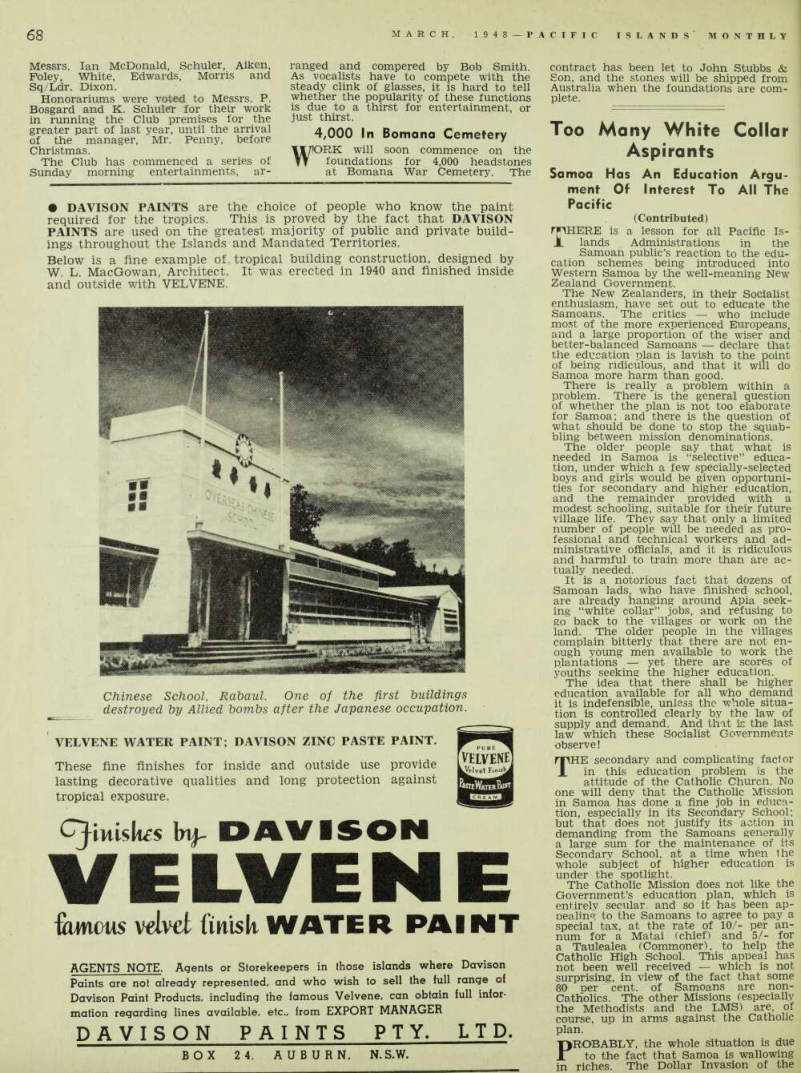
Depressing Picture
Port Moresby March 3.
AT the risk of being credited with a persecution complex, we must give you yet another chronicle of frus tration and despair. Two months of the new year have fled, and with them most of the optimism we managed to affect during the festive season. Living in Port Moresby is becoming an increasingly dif ficult and unpleasant business, and the problem is getting on the community’s nerves.
Possibly the most profoundly shockir g experience of the last few months was the sight of people in a local store sadly handing over 7 6 in exchange for a dozen eggs. One felt that this was the last straw.
Many of our difficulties, however, derive from the fact that Moresby is now a town of 1,500, with public utilities to serve 500.
The electric supply provides the Ex ample of the moment. The power-house could not stand the load which a greatly increased and fairly extravagant popula tion has in recent months imposed upon it, and three out of a total of five en gines have broken down. New engines have been on order for some time, but have not yet arrived. We are therefore rationed at the moment to one electric light bulb per house, and as often as not there is not even power for that.
The water supply has a similar history.
Throughout February, water was cut off from 9 p.m. to 6 a.m. daily. Residents were forbidden to run hoses unattended, and reouested to turn off leaking taps.
In an official “handout” it was explained that the daily water consumption was too high. The pumping plant simply can not maintain the load.
Then there are the roads, which have been so churned up by the recent north west rains and the heavy drainage from the hills that they now resemble ploughed paddocks. Here, again, the facilities are inadequate these roads were built and maintained by an army. Perhaps there will be some improvement when Works and Housing become established in a big way, but one wonders whether Moresby’s rugged hills will ever be suitable for the efficient running of a large and busy town.
Spectacular Fire
IT was bound to happen, and at last Moresby’s gloomy prophets have scored. One of the town’s many paper houses has been burnt to a cinder.
The house in question was at Idubada Training Centre, around the bay beyond Hanuabada. It was the honeymoon home of newlyweds Maynard and Lettie Lock, but had been handed over to Mr. and Mrs. W. MacMahon, of the Education De partment, who were also on the way out when the fire hastened their departure.
Mrs. McMahon had already left for Wewak on the “Montoro,” but Mr. Mc- Mahon’s personal belongings and some Administration furniture went up in the blaze.
The fire caught hold of the house in a few seconds. Looking across the bay from Paga Hill, one could see what ap peared to be a huge box of flames, belch ing forth black smoke, quickly give way to a few sticks of burning timber. Noth ing was saved. “Happy” Finn's brand new streamlined firecart was on the scene with commendable and somewhat as tonishing speed, but could do nothing.
The house had sisalkraft walls and plaited coconut ceiling. So have thirty other Administration houses at Kone dobu!
Sundry Annoyances
MONDAY, February 23, brought Mores by residents another catalogue of broadcast cheer.
First, a warning to mariners—the Basi lisk Light, guide to ships entering Mores by harbour, had gone out.
Second, those stern words to land lubbers from the Public Works Depart ment; the engines at the nowerhOuse had broken down, and householders were warned to use no more than one electric light bulb at night or else power would cut out completely.
Third, the ABC itself announced its intention of badgering the listening pub lic with the highly original idea of pre senting a recorded programme of listeners’ requests. The thought of requesting the ABC to nlay one of the so oft-heard discs in 9PA’s meagre repertoire was by far the most hurtful of the three.
The radio was not our only source of annoyance that week-end. The water went off; the phones refused to work; the electricity supply changed its mind every few minutes; and it seemed that the only thing likely to preserve our sanity would be a visit to the local pic ture theatre. Unfortunately the techni cians failed us even there. Barbara Stan wyck looked comely enough, but “The Lady Eve” might just as well have been a “silent.” Several lip-readers enjoyed the show.
RSL Meeting
rpHE Annual General Meeting of the 1. RSL was held in mid-February.
Most of those who held office last year were re-elected, including the Presi dent. Vice-president, Secretary and Treas urer (Messrs. S. E. Reillv, D. L. Pullen, P. Bosgard and K. Scott respectively).
Among those elected to the Council were
Messrs. lan McDonald, Schuler, Aiken, Foley, White, Edwards, Morris and Sq/Ldr. Dixon.
Honorariums were voted to Messrs. P.
Bosgard and K. Schuler for their work in running the Club premises for the greater part of last year, until the arrival of the manager, Mr. Penny, before Christmas.
The Club has commenced a series of Sunday morning entertainments, ar
ranged and compered by Bob Smith.
As vocalists have to compete with the steady clink of glasses, it is hard to tell whether the popularity of these functions is due to a thirst for entertainment, or just thirst.
4,000 In Bomana Cemetery
117TORK will soon commence on the Yf foundations for 4,000 headstones at Bomana War Cemetery. The
contract has been let to John Stubbs & Son, and the stones will be shipped from Australia when the foundations are com plete.
Advertisements & other items, pp. 67-68 (1 item)
Cls Ipte,
ISLAND MERCHANTS
and AGENTS.
GENERAL MERCHANTS.
CLS IPte,
379 KENT ST., SYDNEY.
Cable & Telegraphic Address : ,t Chasull, ,> Sydney. ° ers f yp Qs Merchandise to the Pacific Islands • Representing Australian, British and American Manufacturers rrr r r I • • Buyers for Leading Pacific Islands Traders • Sellers of Island Produce on Consignment Importers, Distributors and Manufacturers of Foodstuffs, Softgoods, Textiles, Hardware, Tobaccos, Wines and Spirts, etc.
"Ultima" Kerosene Stoves and Heating Appliances • Distributors of High-grade Shirts, Pyjamas and Clothing • "Southern Queen' Canned Fruits • Forwarding and Transhipment Agents ft a b v • Hill's English Cigarettes n) When in Sydney, call and see us!
• DAVISON PAINTS are the choice of people who know the paint required for the tropics. This is proved by the fact that DAVISON PAINTS are used on the greatest majority of public and private buildings throughout the Islands and Mandated Territories.
Below is a fine example of tropical building construction, designed by W. L. MacGowan, Architect. It was erected in 1940 and finished inside and outside with VELVENE. ■ ► i «« 01 0 0 Chinese School, Rabaul. One of the first buildings destroyed by Allied bombs after the Japanese occupation.
VELVENE WATER PAINT; DAVISON ZINC PASTE PAINT.
These fine finishes for inside and outside use provide lasting decorative qualities and long protection against tropical exposure.
bif- DAVISON
VELVENE
famous wlvet finish WATER PAINT
VELVENE
AGENTS NOTE. Agents or Storekeepers in those islands where Davison Paints are not already represented, and who wish to sell the full range of Davison Paint Products, including the famous Velvene, can obtain full information regarding lines available, etc., from EXPORT MANAGER
DAVISON PAINTS PTY. LTD.
BOX 24. AUBURN, N.S.W.
Aspirants
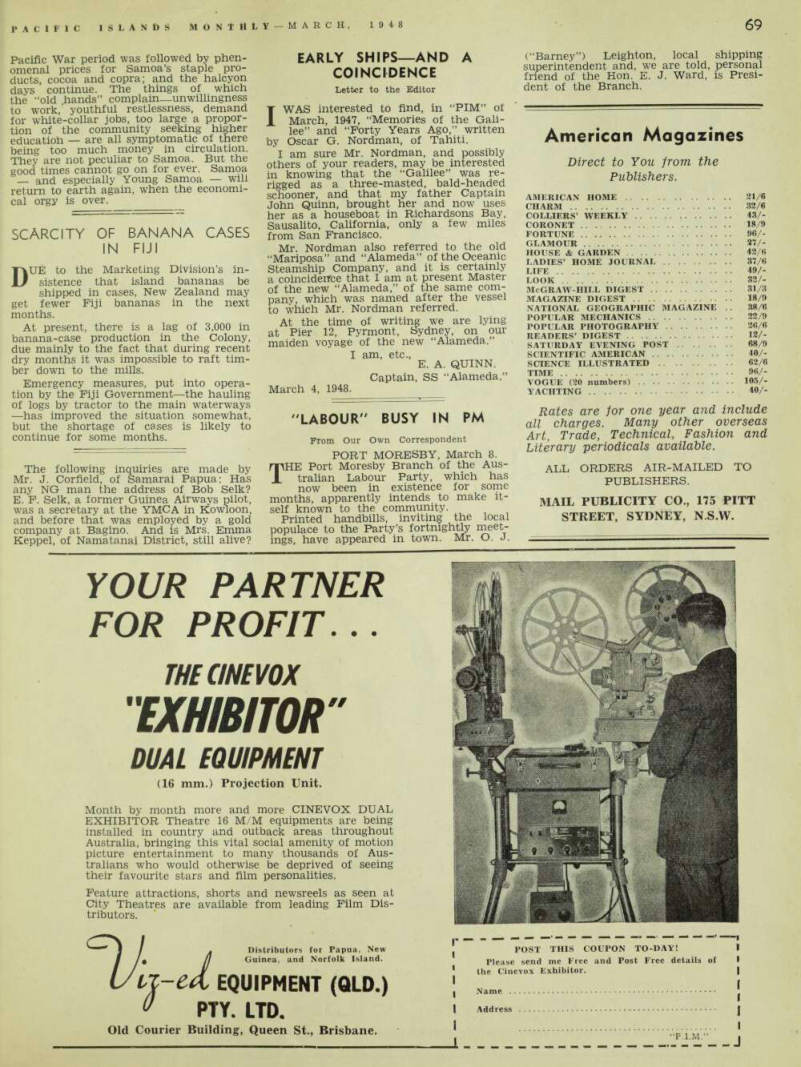
Too Many White Collar
Samoa Has An Education Argu ment Of Interest To All The Pacific
(Contributed) fIHHERE is a lesson for all Pacific Is- JL lands Administrations in the Samoan public’s reaction to the edu cation schemes being introduced into Western Samoa by the well-meaning New Zealand Government.
The New Zealanders, in their Socialist enthusiasm, have set out to educate the Samoans. The critics who include most of the more experienced Europeans, and a large proportion of the wiser and better-balanced Samoans declare that the education plan is lavish to the point of being ridiculous, and that it will do Samoa more harm than good.
There is really a problem within a problem. There is the general question of whether the plan is not too elaborate for Samoa; and there is the question of what should be done to stop the squab bling between mission denominations.
The older people say that what is needed in Samoa is “selective” educa tion, under which a few specially-selected boys and girls would be given opportuni ties for secondary and higher education, and the remainder provided with a modest schooling, suitable for their future village life. They say that only a limited number of people will be needed as pro fessional and technical workers and ad ministrative officials, and it is ridiculous and harmful to train more than are ac tually needed.
It is a notorious fact that dozens of Samoan lads, who have finished school, are already hanging around Apia seek ing “white collar” jobs, and refusing to go back to the villages or work on the land. The older people in the villages complain bitterly that there are not en ough voung men available to work the plantations yet there are scores of youths seeking the higher education.
The idea that there shall be higher education available for all who demand it is indefensible, unless the whole situa tion is controlled clearly by the law of supply and demand. And that is the last law which these Socialist Governments observe!
THE secondary and complicating factor in this education problem is the attitude of the Catholic Churcn. No one will deny that the Catholic Mission in Samoa has done a fine job in educa tion, especially in its Secondary School; but that does not justify its action in demanding from the Samoans generally a large sum for the maintenance of its Secondary School, at a time when the whole subject of higher education is under the snotlight.
The Catho'lic Mission does not like the Government’s education plan, which is entirely secular, and so it has been ap nealing to the Samoans to agree to pay a special tax, at the rate of 10/- per an num for a Matai (chief) and 5/- for a Taulealea (Commoner), to help the Catholic High School. This appeal has not been well received which is not surprising, in view of the fact that some 80 per cent, of Samoans are non- Catholics. The other Missions (especially the Methodists and the LMS) are, qf course, up in arms against the Catholic plan.
PROBABLY, the whole situation is due to the fact that Samoa is wallowing in riches. The Dollar Invasion of the
Pacific War period was followed by phen omenal prices for Samoa’s staple pro ducts, cocoa and copra; and the halcyon days continue. The things of which the “old hands” complain_unwillingness to work, youthful restlessness, demand for white-collar jobs, too large a propor tion of the community seeking higher education are all symptomatic of there being too much money in circulation.
They are not peculiar to Samoa. But the good times cannot go on for ever. Samoa and especially Young Samoa will return to earth again, when the economi cal orgy is over.
Scarcity Of Banana Cases
In Fiji
DUE to the Marketing Division’s in sistence that island bananas be shipped in cases, New Zealand may get fewer Fiji bananas in the next months.
At present, there is a lag of 3,000 in banana-case production in the Colony, due mainly to the fact that during recent dry months it was impossible to raft tim ber down to the mills.
Emergency measures, put into opera tion by the Fiji Government —the hauling of logs by tractor to the main waterways —has improved the situation somewhat, but the shortage of cases is likely to continue for some months.
The following inquiries are made by Mr. J. Corfield, of Samarai Papua; Has any NG man the address of Bob Selk?
E. F, Selk, a former Guinea Airways pilot, was a secretary at the YMCA in Kowloon, and before that was employed by a gold company at Bagino. And is Mrs. Emma Keppel, of Namatanai District, still alive?
Early Ships—And A
Coincidence
Letter to the Editor IWAS interested to find, in “PIM” of March, 1947, “Memories of the Gali lee” and “Forty Years Ago,” written by Oscar G. Nordman, of Tahiti.
I am sure Mr. Nordman, and possibly others of your readers, may be interested in knowing that the “Galilee” was re rigged as a three-masted, bald-headed schooner, and that my father Captain John Quinn, brought her and now uses her as a houseboat in Richardsons Bay, Sausalito, California, only a few miles from San Francisco.
Mr. Nordman also referred to the old “Mariposa” and “Alameda” of the Oceanic Steamship Company, and it is certainly a coincidence that I am at present Master of the new “Alameda,” of the same com pany, which was named after the vessel to which Mr. Nordman referred.
At the time of writing we are lying at Pier 12, Pyrmont, Sydney, on our maiden voyage of the new “Alameda.”
I am, etc.,
E. A. Quinn.
Captain, SS “Alameda.”
March 4, 1948.
"Labour" Busy In Pm
Prom Our Own Correspondent
Port Moresby, March 8.
THE Port Moresby Branch of the Aus tralian Labour Party, which has now been in existence for some months, apparently intends to make it self known to the community.
Printed handbills, inviting the local populace to the Party’s fortnightly meet ings, have appeared in town. Mr, O. J.
(“Barney”) Leighton, local shipping superintendent and, we are told, personal friend of the Hon. E. J. Ward, is Presi dent of the Branch.
Advertisements & other items, pp. 69-70 (2 items)
69
PACIFIC ISLANDS MoNtflLf - MARCH, 1948
For Profit...
American Magazines
Direct to You from the Publishers.
AMERICAN HOME 21/6
CHARM 32/6
COLLIERS’ WEEKLY 43/-
CORONET 18/9
FORTUNE 96/-
GLAMOUR 27/-
HOUSE & GARDEN 42/6
LADIES’ HOME JOURNAL 37/6
LIFE 49/-
LOOK 32/-
McGRAW-HILL DIGEST 31/3
MAGAZINE DIGEST 18/9
NATIONAL GEOGRAPHIC MAGAZINE . . 38/6
POPULAR MECHANICS 22/9
POPULAR PHOTOGRAPHY 26/6
READERS’ DIGEST 12/-
SATURDAY EVENING POST 68/9
SCIENTIFIC AMERICAN 40/-
SCIENCE ILLUSTRATED 62/6
TIME 96/-
VOGUE (20 numbers) 105/-
YACHTING 40/-
Rates are for one year and include all charges. Many other overseas
Art, Trade, Technical, Fashion and
Literary periodicals available.
ALL ORDERS AIR-MAILED TO
PUBLISHERS.
MAIL PUBLICITY CO., 175 PITT
STREET, SYDNEY, N.S.W.
YOUR PARTNER
FOR PROFIT...
THCCINCVOX
' EXHIBITOR "
DUAL [QUIPMINT
(16 mm.) Projection Unit.
Month by month more and more CINEVOX DUAL EXHIBITOR Theatre 16 M/M equipments are being installed in country and outback areas throughout Australia, bringing this vital social amenity of motion picture entertainment to many thousands of Australians who would otherwise be deprived of seeing their favourite stars and film personalities.
Feature attractions, shorts and newsreels as seen at City Theatres are available from leading Film Distributors.
Distributors for Papua, New Guinea, and Norfolk Island.
'l-eA EQUIPMENT (QLD.)
0 PTY. LTD.
Old Courier Building, Queen St., Brisbane.
POST THIS COUPON TO-DAY!
Please send me Free and Post Free details of 1 the Cinevox Exhibitor.
I I Name I Address
DON'T SAY C* I M
G SAY
DON/
Ci D(
DONT SAY GIN
G I N DON'T SAY
DON'T SAY G I N
.«88L JL w
J DON'T SAY
m
DONT SAY GIN
GIN DON'T SAY
DON'T SAY fj J |\ :
Y
, I 1\ DON'T SAY
DON'T SAY fj
C 4 "W MT
I I M DONT SAY
DONT SAY G I N
G I M DON'T SAY
■ v«w ■ ■ wvv\ r p M 1%
G I M DON'T SAY
DONT SAY G I N
fp I M DON'T SAY
DON'T SAY GIN
DON'T SAY G I N
GIN DON'T SAY
DONT SAY GIM
GIM DON'T SAY
omMou rn > wi
DON'T SAY G I N
GIN DON'T SAY
DON'T SAY G I N
G I M DON'T SAY
DON'T SAY fill
GIM DON'T SAY
DONT SAY GIM
G I M DON'T SAY
DON'T SAY GIM
Address all inquiries to: Z7Z7 s ; n L c .::z. W. & A. GILBEY LTD. 33 ROSSLYN STREET, WEST MELBOURNE. 109 REGENT STREET, SYDNEY. .AY M
SAY
IN
—- T SAY
DONT SAY G I M I M DON'T SAY G I M DON'T SAY G I M G SAY G I M DON'T SAY
DON
G
M DON'T SAY ft I M
DON'T SAY
D T S AY G/vV M, ir 0 °Ur * C oc
SAY
e y Osij Q/j
T SAY
i m mj
DONT
GIM DON'T
DONT SAY GIM
DONT
Telegrams and Cables; “GILBEYS,” Sydney.
Compared
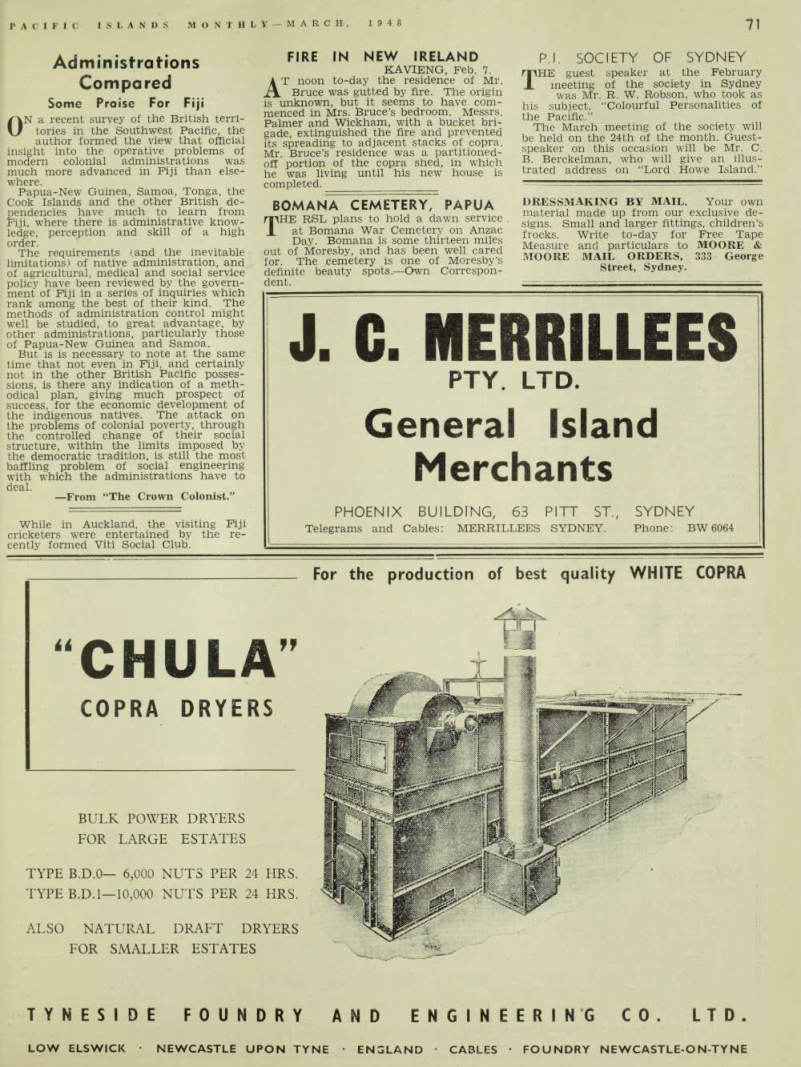
Administrations Compared Some Praise For Fiji
ON a recent survey of the British terri tories in the Southwest Pacific, the author formed the view that official insight into the operative problems of modern colonial administrations was much more advanced in Fiji than else where.
Papua-New Guinea, Samoa, Tonga, the Cook Islands and the other British de pendencies have much to learn from Fiji, where there is administrative know ledge, perception and skill of a high order.
The requirements (and the inevitable limitations) of native administration, and of agricultural, medical and social service policy have been reviewed by the govern ment of Fiji in a series of inquiries which rank among the best of their kind. The methods of administration control might well be studied, to great advantage, by other administrations, particularly those of Papua-New Guinea and Samoa.
But is is necessary to note at the same time that not even in Fiji, and certainly not in the other British Pacific posses sions, is there any indication of a meth odical plan, giving much prospect of success, for the economic development of the indigenous natives. The attack on the problems of colonial poverty, through the controlled change of their social structure, within the limits imposed by the democratic tradition, is still the most baffling problem of social engineering with which the administrations have to deal. —From “The Crown Colonist.”
While in Auckland, the visiting Fiji cricketers were entertained by the re cently formed Viti Social Club.
Fire In New Ireland
Kavieng, Feb. 7.
AT noon to-day the residence of Mr.
Bruce was gutted by fire. The origin is unknown, but it seems to have com menced in Mrs. Bruce’s bedroom. Messrs.
Palmer and Wickham, with a bucket bri gade, extinguished the fire and prevented its spreading to adjacent stacks of copra.
Mr. Bruce’s residence was a partitioned off portion of the copra shed, in which he was living until his new house is completed.
Bomana Cemetery, Papua
THE RSL plans to hold a dawn service at Bomana War Cemetery on Anzac Day. Bomana is some thirteen miles out of Moresby, and has been well cared for. The cemetery is one of Moresby’s definite beauty spots.—Own Correspon dent.
P.I. Society Of Sydney
THE guest speaker at the February meeting of the society in Sydney was Mr. R. W. Robson, who took as his subject, “Colourful Personalities of the Pacific.”
The March meeting of the society will be held on the 24th of the month. Guest speaker on this occasion will be Mr. C.
B. Berckelman, who will give an illus trated address on “Lord Howe Island.”
Two Samoans, a man and a woman, were charged on February 7, with break ing the local quarantine regulations which have been imposed against the introduction of infantile paralysis from New Zealand. One was Tapu Leota, a Native Medical Practitioner who had re cently returned to the Territory from Fiji where he had completed his medical course, and who had been placed in quarantine for two weeks. The other was Lemaota, a female employee of the quarantine station. They left the station together and spent some time in a neighbouring village.
Advertisements & other items, pp. 71-72 (1 item)
J. G. Merrillees
DRESSMAKING BY MAIL. Your own
material made up from our exclusive designs. Small and larger fittings, children’s frocks. Write to-day for Free Tape Measure and particulars to MOORE &
MOORE MAIL ORDERS, 333 George
Street, Sydney,
J. G. MERRILLEES
PTY. LTD.
General Island Merchants
PHOENIX BUILDING, 63 PITT ST., SYDNEY
Telegrams and Cables: MERRILLEES SYDNEY. Phone; BW 6064
ii
CHULA
COPRA DRYERS
BULK POWER DRYERS
FOR LARGE ESTATES
TYPE B.D.O — 6,000 NUTS PER 24 HRS.
TYPE B.D. I—lo,ooo NUTS PER 24 HRS.
ALSO NATURAL DRAFT DRYERS
FOR SMALLER ESTATES
For the production of best quality WHITE COPRA
TYNESIDE FOUNDRY AND ENGINEERING CO. LTD.
LOW ELSWICK • NEWCASTLE UPON TYNE • ENGLAND • CABLES • FOUNDRY NEWCASTLE-ON-TYNE
Rid Kidneys Of
Poisons And Adds
If you suffer sharp, stabbing pains, If Joints are swollen, It shows your blood Is poisoned through faulty kidney action. Other symptoms of Kidney Disorders are Backache, Aching Joints and Limbs, Sciatica, Neuritis, Lumbago, Sleepless Nights, Dizziness, Nervousness, Circles under Eyes, Loss of Energy and Appetite and Frequent Headaches and Colds, etc. Ordinary medicines can’t help much because you must get to the root cause of the trouble.
The Cystex treatment is specially compounded to soothe, tone and clean kidneys and bladder and remove acids and poisons from your system safely, quickly and surely, yet contains no harmful or dangerous drugs. Cystex works in 3 ways to end your troubles. 1. Starts killing the germs which are attacking your Kidneys, Bladder and Urinary System In two hours, yet Is absolutely harmless to human tissue. 2. Gets rid of health-destroying, deadly poisonous acids with which your system has become saturated. 3. Strengthens and reinvigorates the kidneys, protects from the ravages of disease-attack on the delicate filter organism, and stimulates the entire system.
Praised by One-time Sufferers Cystex Is approved by one-time sufferers In T 3 countries from the troubles shown above.
Mr. Reg Thomas, Townsville, Queensland, recently wrote: “My Joints were all stiff, I had leg pains, my back used to ache day and night.
My bladder was weak. I had headaches and no appetite. The first dose of Cystex helped me and before I finished three boxes my health and strength came back.”
Guaranteed to Satisfy or Money Back Get Cystex from your chemist or store to-day.
Give It a thorough test. Cystex Is guaranteed to make you feel younger, stronger, better Iv every way, or your money back If you return the empty package.
Now in 2 sizes—4/-, •/-.
GUARANTEED CVfiflCX
Treatment
for Your Kidneys, Bladder, Rheumatism.
Woven Wire for all Industry \
COPRA DRYING TRAYS, FLOORS, Etc.
FRUIT DRYING TRAYS, MINING SCREENS.
Heavy Mosquito Gauze in Phosphor Bronze and other Metals Impervious to Salt Sea Air.
WIRE DOOR MATS AND GENERAL WIRE WORKS f- Or £
E. WRIGHT & CO. LTD.
Office and Works: 148-152 Cleveland Street, Sydney, N.S.W.
Telegraphic Address: “Wrightmake,** Chippendale, \
Sydney—Queensland —
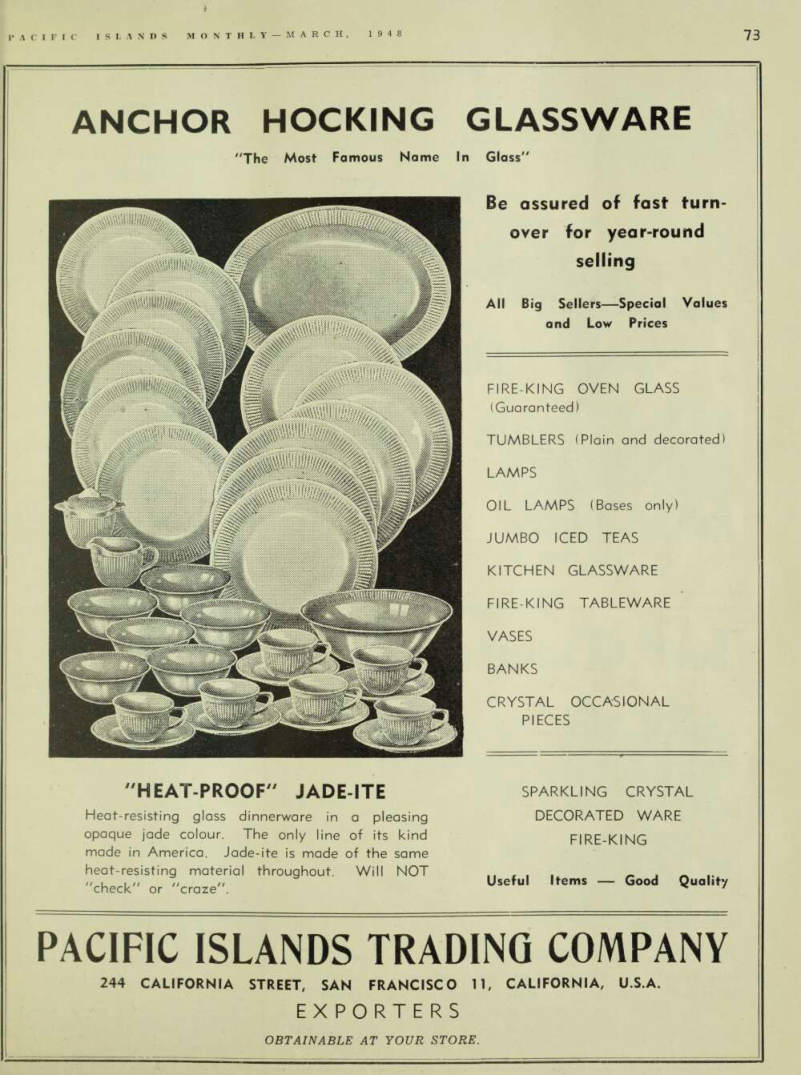
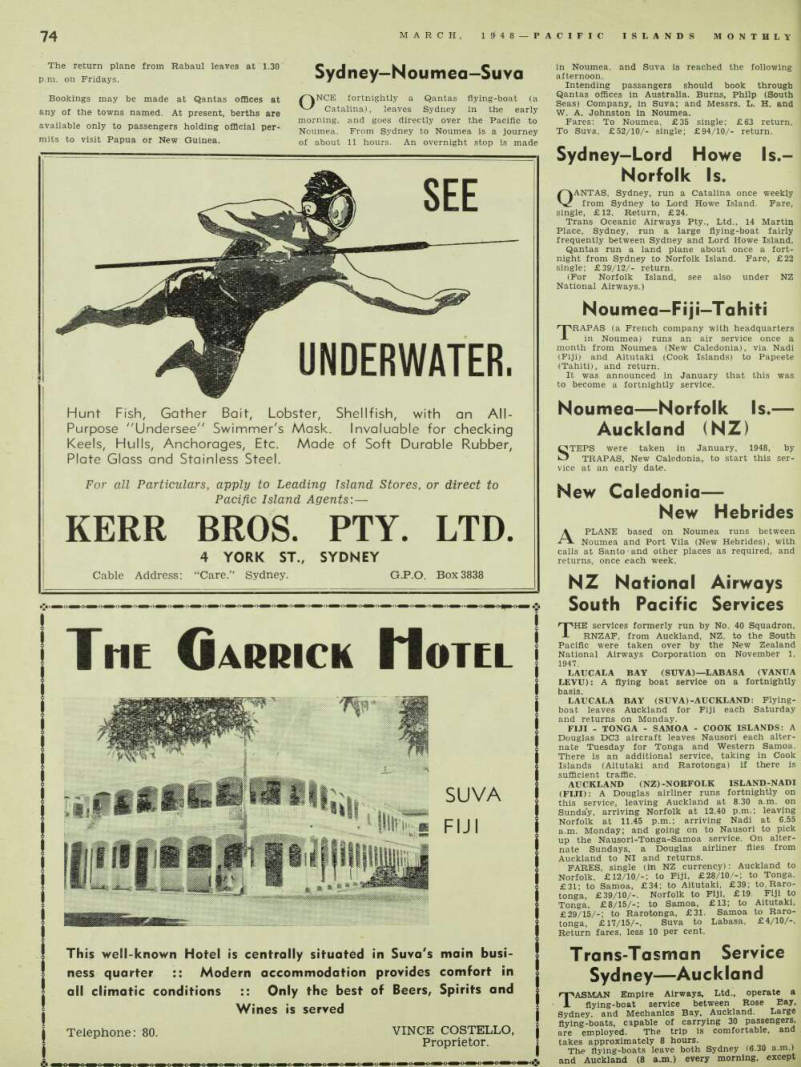
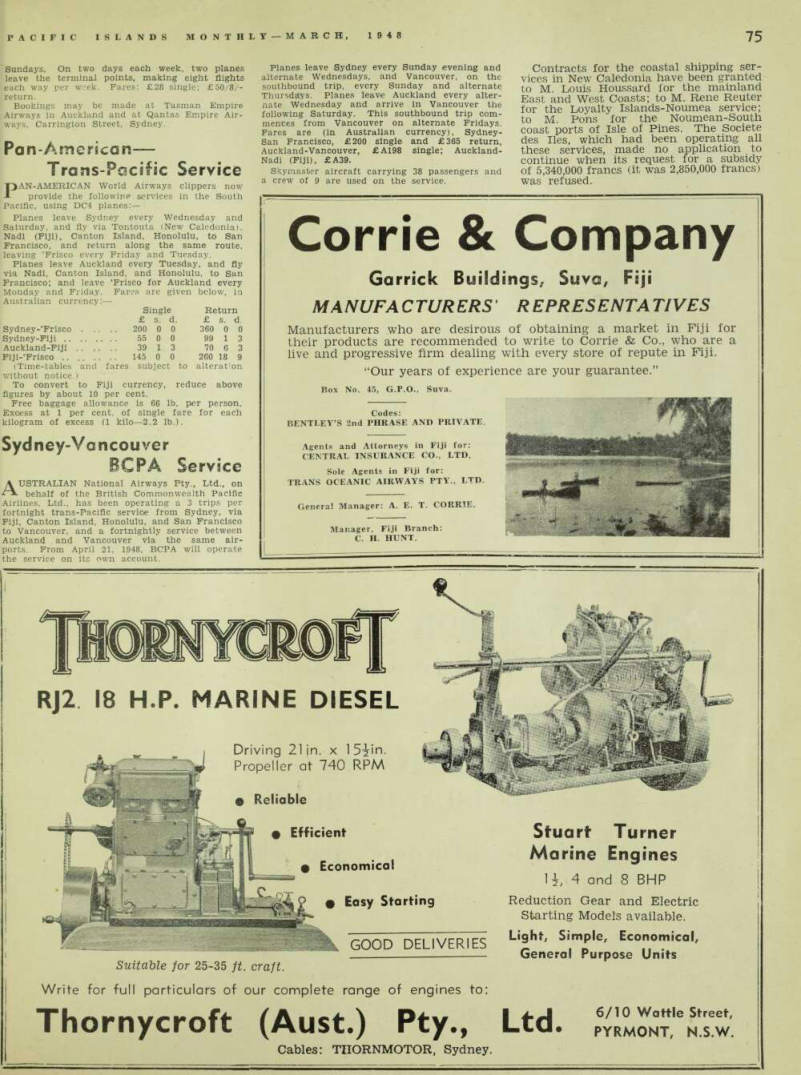
Shipping And Plane Services
THE following sea and air services are running to schedules in the Pacific.
Not all of the regular services which were suspended, owing to war condi tions, have been restored; but preparations are under way for their early rcintroduction. As they become available they will be announced here.
Ship Services
Australia—North
America
THE regular passenger Trans-Pacific liners, withdrawn during the war, have not yet been restored.
Canadian-Pacific liner “Aorangi” (Sydney- Auckland-Suva-Honolulu-Vancouver) may re sume about May, 1948.
Matson liners “Monterey” and “Mariposa” are being reconditioned, but are not expected back in service in 1948. Matson ship “Marine Phoenix,” carrying passengers, runs on a regular schedule —San Francisco-Honolulu-Suva-Auckland- Sydney.
New Zealand —Cook
Is. —Niue —Samoa
rE motor vessel “Maui Pomare.” owned and operated by the NZ Gov ernment, maintains a direct service between Auckland and Rarotonga (Cook Islands), with alternative calls at Niue and Apia (Samoa).
On arrival in Auckland In early January, “Maui Pomare” was withdrawn for survey. She will resume in Cook Is. service about March.
Sydney—Norfolk Island-
New Hebrides
THE SS “Morinda,” Burns Philp & Co., Ltd., runs at approximately six seven weeks’ intervals from Sydney to Lord Howe Island, Norfolk Island, and main ports of the New Hebrides, and return. A regular fixed timetable is not
yet practicable.
The “Morinda” at present is undergoing over haul and the small “Muliama” is carrying on the service.
New Caledonia
THE New Caledonian Government has sub sidised and maintained the coastal ship ping services. The East Coast, the West Coast, and the Loyalty Islands, under present conditions, receive 10 round trips per annum.
The ships call at the following ports: EAST COAST.—Yate, Ounia, Thio, Nakety, Canala, Kouaoua Kua. Moneo, Ponerihouen, Tibarama, Poindlmie, Wagap, Touho, Tipindje, Hienghene, Tao, Oubatch, Pouebo, Balade, Pam.
Arama, and return.
WEST COAST. —Pouembout, Kone, Temala, Voh. Ouaco Gomen, Koumac, Tangaiou, Tiebaghl, Nehoue Poume, Baaba, Belep and return.
LOYALTY ISLANDS.—Mare (Tadine), Lifou (Chepenehe) Ouvea (Fajaoue, St. Joseph) and return.
The steamer “Neo Hebrldais” runs regularly between Noumea and Sydney, with occasional
trips to the New Hebrides (mostly Aneityum).
The owners are Societe Maritime et Maniere Hagen, Noumea. Sydney agents: H. C. Sleigh, 254 George Street, Sydney.
New Zealand—Fiji—
Samoa—Tonga
Monthly Service by MV “Matua”
Service Conducted By Union Ss Co.,
Ltd.—Subject To Alteration Without
Notice
Air. Services
Summary of Pacific Air
Services
PAPUA AND NEW GUlNEA.—Regular Qantas service from Sydney.
SOLOMON ISLANDS. —Frequent irregular flying boat service from Sydney by Trans Oceanic Airways.
NEW HEBRIDES. —Frequent irregular flying-boat service from Sydney by Trans Oceanic Air ways. Weekly service from Noumea by French plane.
NORFOLK ISLAND.—Regular service from NZ by NZ National Airways; from Sydney by Qantas.
LORD HOWE ISLAND. —Regular weekly service from Sydney by Qantas and irregular service by Trans Oceanic Airways.
FIJI. —Regular services from Australia by Pan American and ANA (to Nadi): from Noumea by TRAPAS (to Nadi); from Auckland by NZ National Airways (to Nadi); from Australia by Qantas (to Laucala Bay, Suva); from Auckland by NZ National Airways (to Laucala Bay, Suva). Irregular calls from Australia to Laucala Bay, Suva, by Trans Oceanic Air ways.
Western Samoa, Cook Islands And
TONGA. —Regular service from Fiji by NZ National Airways.
TAHITI. —Regular service from Noumea by TRAPAS plane.
AUSTRALIA-NEW ZEALAND.—ReguIar service by Tasman Empire Airways.
AUSTRALIA-NORTH AMERICA.—Regular Trans pacific services by Pan American Airways and
Ana.
Sydney—Queensland —
New Guinea
QANTAS Empire Airways, Ltd., employing DC3 planes, operate a regular service between Sydney, Port Moresby. Lae. Pinschhafen and Rabaul, and return, via Brisbane, Rock hampton, Townsville and Cairns.
This service is now known as the “Bird of Paradise” Service. DC3 aircraft, carrying 19 passengers, are used.
Planes leave Sydney on Mondays, Wednesdays, and Fridays at 9 a.m., and arrive at Lae at noon on Tuesdays, Thursdays and Saturdays. The plane which leaves Sydney on Wednesday and arrives at Lae on Thursday then goes on to Rabaul. It returns on Friday.
Planes leave Lae at 5.45 a.m. on Wednesdays, Fridays and Saturdays, and arrive in Sydney at 10 p.m., accomplishing the Lae-Sydney run in a day.
Auckland .. Mar. 11 Apl. 8 Suva Mar. 15-16 Apl. 12-13 Nukualofa .. — Apl. 15-16 Vavau ... — Apl. 17 Niue — Apl. 17 Apia . .. Mar. 17-20 Apl. 18-21 Vavau . . .. Mar. 22 — Nukualofa .. Mar. 23-24 — Suva . . . . Mar. 26-27 Apl. 24-25 Auckland .. Mar. 31 Apl. 29 •Western Time.
The return plane from Rabaul leaves at 1.30 p.m. on Fridays.
Bookings may be made at Qantas offices at any of the towns named. At present, berths are available only to passengers holding official per mits to visit Papua or New Guinea.
Sydney-Noumea-Suva
fortnightly a Qantas flying-boat (a Catalina), leaves Sydney in the early morning, and goes directly over the Pacific to Noumea. From Sydney to Noumea is a journey of about 11 hours. An overnight stop is made
in Noumea, and Suva is reached the following afternoon.
Intending passangers should book through Qantas offices in Australia. Burns, Philp (South Seas) Company, in Suva; and Messrs. L. H. and W. A. Johnston in Noumea.
Fares: To Noumea, £35 single; £63 return.
To Suva, £52/10/- single; £94/10/- return.
Sydney-Lord Howe ls.-
Norfolk Is.
QANTAS, Sydney, run a Catalina once weekly from Sydney to Lord Howe Island. Pare, single, £l2. Return, £24.
Trans Oceanic Airways Pty., Ltd., 14 Martin Place, Sydney, run a large flying-boat fairly frequently between Sydney and Lord Howe Island.
Qantas run a land plane about once a fort night from Sydney to Norfolk Island. Fare, £22 single; £39/12/- return. (For Norfolk Island, see also under NZ National Airways.)
Noumeo-Fiji—'Tahiti
TRAPAS (a French company with headquarters in Noumea) runs an air service once a month from Noumea (New Caledonia), via Nadi (Fiji) and Aitutaki (Cook Islands) to Papeete (Tahiti), and return.
It was announced in January that this was to become a fortnightly service.
Noumea—Norfolk Is.—
Auckland (NZ)
STEPS were taken in January, 1948, by TRAPAS, New Caledonia, to start this ser vice at an early date.
New Caledonia—
New Hebrides
A PLANE based on Noumea runs between Noumea and Port Vila (New Hebrides), with calls at Santo and other places as required, and returns, once each week.
NZ National Airways
South Pacific Services
THE services formerly run by No. 40 Squadron, RNZAP, from Auckland, NZ, to the South Pacific were taken over by the New Zealand National Airways Corporation on November 1, 1947.
Laucala Bay (Suva)—Labasa (Vanua
LEVU): A flying boat service on a fortnightly basis.
Laucala Bay (Suva)-Auckland: Flying
boat leaves Auckland for Fiji each Saturday and returns on Monday.
FIJI - TONGA - SAMOA - COOK ISLANDS; A Douglas DCS aircraft leaves Nausori each alter nate Tuesday for Tonga and Western Samoa.
There is an additional service, taking in Cook Islands (Aitutaki and Rarotonga) if there is sufficient traffic.
Auckland (Nz)-Norfolk Island-Nadi
(FIJI): A Douglas airliner runs fortnightly on this service, leaving Auckland at 8.30 am. on Sunday, arriving Norfolk at 12.40 p.m.; leaving Norfolk at 11.45 p.m.; arriving Nadi at 6.55 a.m. Monday: and going on to Nausori to pick up the Nausori-Tonga-Samoa service. On alter nate Sundays, a Douglas airliner flies from Auckland to NI and returns.
FARES, single (in NZ currency): Auckland to Norfolk, £l2/10/-; to Fiji, £2B/10/-: to Tonga. £3l; to Samoa, £34; to Aitutaki, £39: to, Raro tonga, £39/10/-. Norfolk to Fiji, £l9. Fiji to Tonga. £B/15/-; to Samoa, £l3; to Aitutaki, £29/15/-; to Rarotonga, £3l. Samoa to Raro tonga, £l7/15/-, Suva to Labasa, £4/10/-.
Return fares, less 10 per cent.
Trons-Tasmon Service
Sydney—Auckland
TASMAN Empire Airways, Ltd., operate a flying-boat service between Rose Bay, Sydney, and Mechanics Bay, Auckland. Large flying-boats, capable of carrying 30 passengers, are employed. The trip is comfortable, and takes approximately 8 hours.
The flying-boats leave both Sydney (6.30 a.m.) and Auckland (8 a.m.) every morning, except
Sundays. On two days each week, two planes leave the terminal points, making eight flights each way per week. Fares: £2B single; return.
Bookings may be made at Tasman Empire Airways in Auckland and at Qantas Empire Air ways, Carrington Street, Sydney.
Pan-American—
Trans-Pacific Service
PAN-AMERICAN World Airways clippers now provide the following services in the South Pacific, using DC4 planes:— Planes leave Sydney every Wednesday and Saturday, and fly via Tontouta (New Caledonia), Nadi (Fiji), Canton Island, Honolulu, to San Francisco, and return along the same route, leaving ’Frisco every Friday and Tuesday.
Planes leave Auckland every Tuesday, and fly via Nadi, Canton Island, and Honolulu, to San Francisco: and leave ’Frisco for Auckland every Monday and Friday. Fares are given below, in Australian currency:—
(Time-tables and fares subject to alteration without notice.) To convert to Fiji currency, reduce above figures by about 10 per cent.
Free baggage allowance is 66 lb. per person.
Excess at 1 per cent, of single fare for each kilogram of excess (1 ki10—2.2 lb.).
Syd n ey-Va n cou ve r
BCPA Service
AUSTRALIAN National Airways Pty., Ltd., on behalf of the British Commonwealth Pacific Airlines, Ltd., has been operating a 3 trips per fortnight trans-Paciflc service from Sydney, via Fiji, Canton Island, Honolulu, and San Francisco to Vancouver, and a fortnightly service between Auckland and Vancouver via the same air ports. Prom April 21, 1948, BCPA will operate the service on its own account.
Planes leave Sydney every Sunday evening and alternate Wednesdays, and Vancouver, on the southbound trip, every Sunday and alternate Thursdays. Planes leave Auckland every alter nate Wednesday and arrive in Vancouver the following Saturday. This southbound trip com mences from Vancouver on alternate Fridays.
Fares are (in Australian currency), Sydney- San Francisco, £2OO single and £365 return, Auckland-Vancouver, £AI9B single; Auckland- Nadi (Fiji), £A39.
Skymaster aircraft carrying 38 passengers and a crew of 9 are used on the service.
Contracts for the coastal shipping ser vices in New Caledonia have been granted to M. Louis Houssard for the mainland East and West Coasts; to M. Rene Reuter for the Loyalty Islands-Noumea service; to M. Pons for the Noumean-South coast ports of Isle of Pines. The Societe des lies, which had been operating all these services, made no application to continue when its request for a subsidy of 5,340,000 francs (it was 2,850,000 francs) was refused.
Single Return £ s. d. £ s. d.
Sydney-’Frisco . .. 200 0 0 360 0 0 Sydney-PIJi 55 0 0 99 1 3 Auckland-Fljl .. .. 39 1 3 70 6 3 Fiji-’Frisco 145 0 0 260 18 9
Mr. J. L. Mulholland of the Overseas Telecommunications Commission (Aus tralia), and Mr. C. T. Halsted of Cable and Wireless Ltd., were, in February, visiting Suva for discussions with the Fiji Government on the subject of telecom munication services.
Advertisements & other items, pp. 73-75 (1 item)
Pacific Islands Trading Company
ANCHOR HOCKING GLASSWARE
"The Most Famous Name In Glass" •.'i
Be assured of fast turn-
over for year-round
selling
All Big Sellers—Special Values and Low Prices
FIRE-KING OVEN GLASS
(Guaranteed) TUMBLERS (Plain and decorated)
LAMPS
OIL LAMPS (Bases only)
JUMBO ICED TEAS
KITCHEN GLASSWARE
FIRE-KING TABLEWARE
VASES
BANKS
CRYSTAL OCCASIONAL
PIECES
"HEAT-PROOF" JADE-ITE
Heat-resisting glass dinnerware in a pleasing opaque jade colour. The only line of its kind made in America. Jade-ite is made of the same heat-resisting material throughout. Will NOT "check" or "craze".
SPARKLING CRYSTAL
DECORATED WARE
FIRE-KING
Useful Items Good Quality
PACIFIC ISLANDS TRADING COMPANY
244 CALIFORNIA STREET, SAN FRANCISCO 11, CALIFORNIA, U.S.A.
EXPORTERS
OBTAINABLE AT YOUR STORE.
UNDERWATER.
Hunt Fish, Gather Bait, Lobster, Shellfish, with an All- Purpose "Undersee" Swimmer's Mask. Invaluable for checking Keels, Hulls, Anchorages, Etc. Made of Soft Durable Rubber, Plate Glass and Stainless Steel.
For all Particulars, apply to Leading Island Stores, or direct to Pacific Island Agents :—
KERR BROS. PTY. LTD.
4 YORK ST., SYDNEY
Cable Address; “Care.” Sydney.
G.P.O. Box 3838
Inc Garrick Hotcl
SUVA
FIJI
This well-known Hotel is centrally situated in Suva's main business quarter Modern accommodation provides comfort in ail climatic conditions :: Only the best of Beers, Spirits and Wines is served Telephone: 80. VINCE COSTELLO, Proprietor.
Corrie & Company
MANUFACTURERS' REPRESENTATIVES
Manufacturers who are desirous of obtaining a market in Fiji for their products are recommended to write to Corrie & Co., who are a live and progressive firm dealing with every store of repute in Fiji.
“Our years of experience are your guarantee.”
Box No. 45, G.P.0.. Suva.
Garrick Buildings, Suva, Fiji
Codes:
BENTLEY S 2nd PHRASE AND PRIVATE.
Sole Agents in Fiji for:
TRANS OCEANIC AIRWAYS PTY.. LTD.
Genera! Manager: A. E. T. CORRIE.
Agents and Attorneys in Fiji for:
CENTRAL INSURANCE CO., LTD.
Manager, Fiji Branch:
C. H. HUNT.
RJ2 18 H.P. MARINE DIESEL
Driving 21 in. x 1 siin.
Propeller at 740 RPM $ Reliable • Efficient Economical Easy Starting
Stuart Turner
Marine Engines
4 and 8 BHP Reduction Gear and Electric Starting Models available.
GOOD DELIVERIES Li % ht ' Si , m D ple ' Ec ° I n , omical ' General Purpose Units Suitable for 25-35 ft. craft.
Write for full particulars of our complete range of engines to:
Thornycroft (Aust.) Pty., Ltd.
Cables: TIIORNMOTOR, Sydney. 6/10 Wattle Street,
PYRMONT, N.S.W.
Au revoir, Norfolk Island
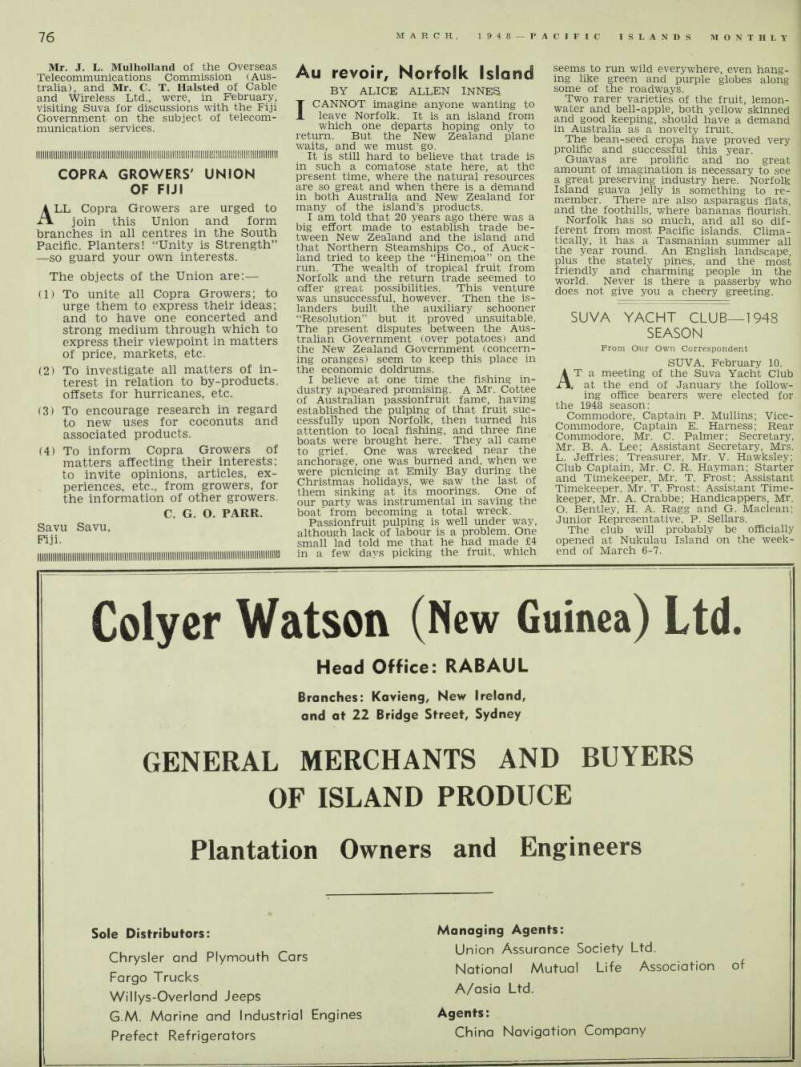
Copra Growers' Union
Of Fiji
ALL Copra Growers are urged to join this Union and form branches in all centres in the South Pacific. Planters! “Unity is Strength” —so guard your own interests.
The objects of the Union are:— (1) To unite all Copra Growers; to urge them to express their ideas; and to have one concerted and strong medium through which to express their viewpoint in matters of price, markets, etc. (2) To investigate all matters of in terest in relation to by-products, offsets for hurricanes, etc. (3) To encourage research in regard to new uses for coconuts and associated products. (4) To inform Copra Growers of matters affecting their interests; to invite opinions, articles, ex periences, etc., from growers, for the information of other growers.
C. G. O. Parr.
Savu Savu, Fiji.
Au revoir, Norfolk Island
By Alice Allen Innes
1 CANNOT imagine anyone wanting to leave Norfolk. It is an island from which one departs hoping only to return. But the New Zealand plane waits, and we must go.
It is still hard to believe that trade is in such a comatose state here, at the present time, where the natural resources are so great and when there is a demand in both Australia and New Zealand for many of the island’s products.
I am told that 20 years ago there was a big effort made to establish trade be tween New Zealand and the island and that Northern Steamships Co., of Auck land tried to keep the “Hinemoa” on the run. The wealth of tropical fruit from Norfolk and the return trade seemed to offer great possibilities. This venture was unsuccessful, however. Then the is landers built the auxiliary schooner “Resolution” but it proved unsuitable.
The present disputes between the Aus tralian Government (over potatoes) and the New Zealand Government (concern ing oranges) seem to keep this place in the economic doldrums.
I believe at one time the fishing in dustry apneared promising. A Mr. Cottee of Australian passionfruit fame, having established the pulping of that fruit suc cessfully upon Norfolk, then turned his attention to local fishing, and three fine boats were brought here. They all came to grief. One was wrecked near the anchorage, one was burned and. when we were picnicing at Emily Bay during the Christmas holidays, we saw the last of them sinking at its moorings. One of our narty was instrumental in saving the boat* from becoming a total wreck.
Passionfruit pulping is well under way, although lack of labour is a problem. One small lad told me that he had made £4 in a few days picking the fruit, which
seems to run wild everywhere, even hang ing like green and purple globes along some of the roadways.
Two rarer varieties of the fruit, lemon water and bell-apple, both yellow skinned and good keeping, should have a demand in Australia as a novelty fruit.
The bean-seed crops have proved very prolific and successful this year.
Guavas are prolific and no great amount of imagination is necessary to see a great preserving industry here. Norfolk Island guava jelly is something to re member. There are also asparagus flats, and the foothills, where bananas flourish.
Norfolk has so much, and all so dif ferent from most Pacific islands. Clima tically, it has a Tasmanian summer all the year round. An English landscape, plus the stately pines, and the most friendly and charming people in the world. Never is there a passerby who does not give you a cheery greeting.
Suva Yacht Club—1948
Season
From Our Own Correspondent SUVA, February 10.
AT a meeting of the Suva Yacht Club at the end of January the follow ing office bearers were elected for the 1948 season: Commodore, Captain P. Mullins; Vice- Commodore, Captain E. Harness; Rear Commodore, Mr. C. Palmer; Secretary, Mr. B. A. Lee; Assistant Secretary, Mrs.
L. Jeffries; Treasurer, Mr. V. Hawksley; Club Captain, Mr. C. R. Hayman; Starter and Timekeeper, Mr. T. Frost: Assistant Timekeeper, Mr. T. Frost: Assistant Time keeper, Mr. A. Crabbe; Handicappers, Mr.
O. Bentley, H. A. Ragg and G. Maclean; Junior Representative. P. Sellars.
The club will probably be officially opened at Nukulau Island on the week end of March 6-7.
Advertisements & other items, p. 76 (1 item)
Colyer Watson (New Guinea) Ltd.
Head Office: RABAUL Branches: Kavieng, New Ireland, and at 22 Bridge Street, Sydney
GENERAL MERCHANTS AND BUYERS
OF ISLAND PRODUCE
Plantation Owners and Engineers
Sole Distributors: Chrysler and Plymouth Cars Fargo Trucks Willys-Overland Jeeps G.M. Marine and Industrial Engines Prefect Refrigerators Managing Agents: Union Assurance Society Ltd.
National Mutual Life Association of A/asia Ltd.
Agents: China Navigation Company
What Do You Know Of
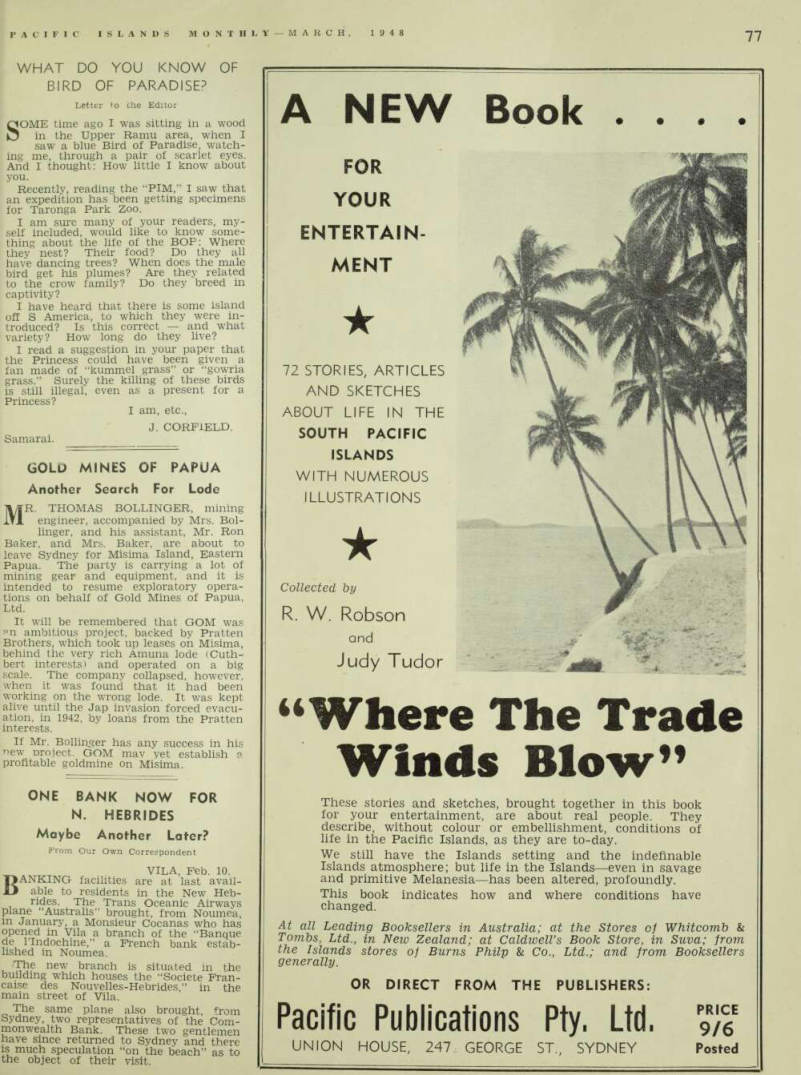
Bird Of Paradise?
Letter to the Editor SOME time ago I was sitting in a wood in the Upper Ramu area, when I saw a blue Bird of Paradise, watch ing me, through a pair of scarlet eyes.
And I thought: How little I know about you.
Recently, reading the “PIM,” I saw that an expedition has been getting specimens for Taronga Park Zoo.
I am sure many of your readers, my self included, would like to know some thing about the life of the BOP; Where they nest? Their food? Do they all have dancing trees? When does the male bird get his plumes? Are they related to the crow family? Do they breed in captivity?
I have heard that there is some island off S America, to which they were in troduced? Is this correct and what variety? How long do they live?
I read a suggestion in your paper that the Princess could have been given a fan made of “kummel grass” or “gowria grass.” Surely the killing of these birds is still illegal, even as a present for a Princess?
I am, etc.,
J. Corfield.
Samarai.
Gold Mines Of Papua
Another Search For Lode
Mr. Thomas Bollinger, Mining
engineer, accompanied by Mrs. Bol linger, and his assistant, Mr. Ron Baker, and Mrs. Baker, are about to leave Sydney for Misima Island, Eastern Papua. The party is carrying a lot of mining gear and equipment, and it is intended to resume exploratory opera tions on behalf of Gold Mines of Papua, Ltd.
It will be remembered that GOM was ? n ambitious project, backed by Pratten Brothers, which took up leases on Misima, behind the very rich Amuna lode (Cuth bert interests) and operated on a big scale. The company collapsed, however, when it was found that it had been working on the wrong lode. It was kept alive until the Jap invasion forced evacu ation, in 1942, by loans from the Pratten interests.
If Mr. Bollinger has any success in his n ew nroject. GOM mav yet establish a profitable goldmine on Misima.
One Bank Now For
N. Hebrides
Maybe Another Later?
Prom Our Own Correspondent
Vila, Feb. 10.
¥>ANKING facilities are at last avail 1J able to residents in the New Heb rides. The Trans Oceanic Airways plane “Australis” brought, from Noumea, m January, a Monsieur Cocanas who has opened in Vila a branch of the “Banque de ITndochine,” a French bank estab lished in Noumea. '"The new branch is situated in the building which houses the “Societe Fran caise des Nouvelles-Hebrides,” in the main street of Vila.
The same plane also brought, from Sydney, two representatives of the Com monwealth Bank. These two gentlemen have since returned to Sydney and there is much speculation “on the beach” as to the object of their visit.
Advertisements & other items, p. 77 (1 item)
“Where The Trade
A NEW Book . . . .
FOR
YOUR
ENTERTAIN-
MENT
72 STORIES, ARTICLES
AND SKETCHES
ABOUT LIFE IN THE
SOUTH PACIFIC
ISLANDS
WITH NUMEROUS
ILLUSTRATIONS
★ Collected by
R. W. Robson
and
Judy Tudor
* w
“Where The Trade
Winds Blow”
These stories and sketches, brought together in this book for your entertainment, are about real people. They describe, without colour or embellishment, conditions of life in the Pacific Islands, as they are to-day.
We still have the Islands setting and the indefinable Islands atmosphere; but life in the Islands—even in savage and primitive Melanesia —has been altered, profoundly.
This book indicates how and where conditions have changed.
At all Leading Booksellers in Australia; at the Stores of Whitcomb & Tombs, Ltd., in New Zealand; at Caldwell’s Book Store, in Suva; from the Islands stores of Burns Philp & Co., Ltd.; and from Booksellers generally.
OR DIRECT FROM THE PUBLISHERS:
Pacific Publications Pty. Ltd, 9)“
UNION HOUSE, 247 GEORGE ST., SYDNEY Posted
Airmails
Weak Link In Fiji
IT would appear that an absurd situa tion exists in relation to Fiji air mails. Planes run between Australia and Nadi (northwest Fiji) four and five times each week, both ways; but mails from Suva (where all Fiji business and administration is concentrated) reach Australia only once and sometimes twice each week. That is because there are over 100 miles of road between Suva and Nadi, and no regular air connection. ..
Neither the Fiji Government nor the
commercial community has been suffi ciently enterprising to organise a more frequent conection between the airport and the capital. Because of that one small missing link, the Fiji public fail to get full benefit from the Trans-Pacific air services, among the most modern in the world.
It is reported from Noumea that the Queensland Soccer Football Association has accepted an invitation to send a team to play matches in New Caledonia during the coming winter season.
Great Airport Near
Lae
Plea That Plan Should Provide Industries to Replace Goldfield
(Contributed.) WE understand that the recommenda tions of the Lae Citizens’ Associa tion to the Administrator, on the plan for the new town of Lae, are almost identical with the conclusions of the ex perts who conferred at Moresby.
A most important consideration is a decision —still somewhat “Hush-hush” —to build a great international air-port at a cost of some £3,000,000. This will replace the old Lae Airport, which has given such long and good service. (It will be re membered that the PIM, over a year ago, forecast the establishment of a great air-port in the vicinity of Nadzab.) The abandonment of Lae airport will mark the closing of the first chapter of the history of Morobe goldfield. Every one knows that the goldfield has a limited life—say, 25 years. And this raises a question concerning the future of Lae.
What is the use of building a new town at Lae, to take the place of that de stroyed in the war, if no plan is to be made for the development of other in dustries to take the place of gold. The great air-port will have significance in international aviation, and in defence; but Lae would have no further raison d’etre.
Will Lae simply become a ghost town, like many other centres which died with their goldfields; or will it, like Chartres Towers, Gympie, etc., gain a new lease of life from agricultural industries which were established to take the place of mining?
It is entirely a matter of whether the Administration has any vision. Lae is not only the outlet for the Morobe gold field: it alsq. is the natural port (both sea and air) for the vast, fertile plateaus which stretch from the head of the •Markham Valley to Mount Hagen—a region that has more than once been called “a second Kenya.”
An agricultural policy for this region would not only provide a future for Lae.
It would give this hungry world new sources of supply for tea, coffee, cocoa, rubber, hemp, and many similar products —not forgetting a certain type of tobacco that is much in demand. It would pro vide a home and occupation for many ex-services personnel, it would supply the natives with a means of gaining know ledge and experience, it would be a market for Australian goods, and it would give some justification for trusteeship, and create a bulwark against aggression.
New Guinea Cricket
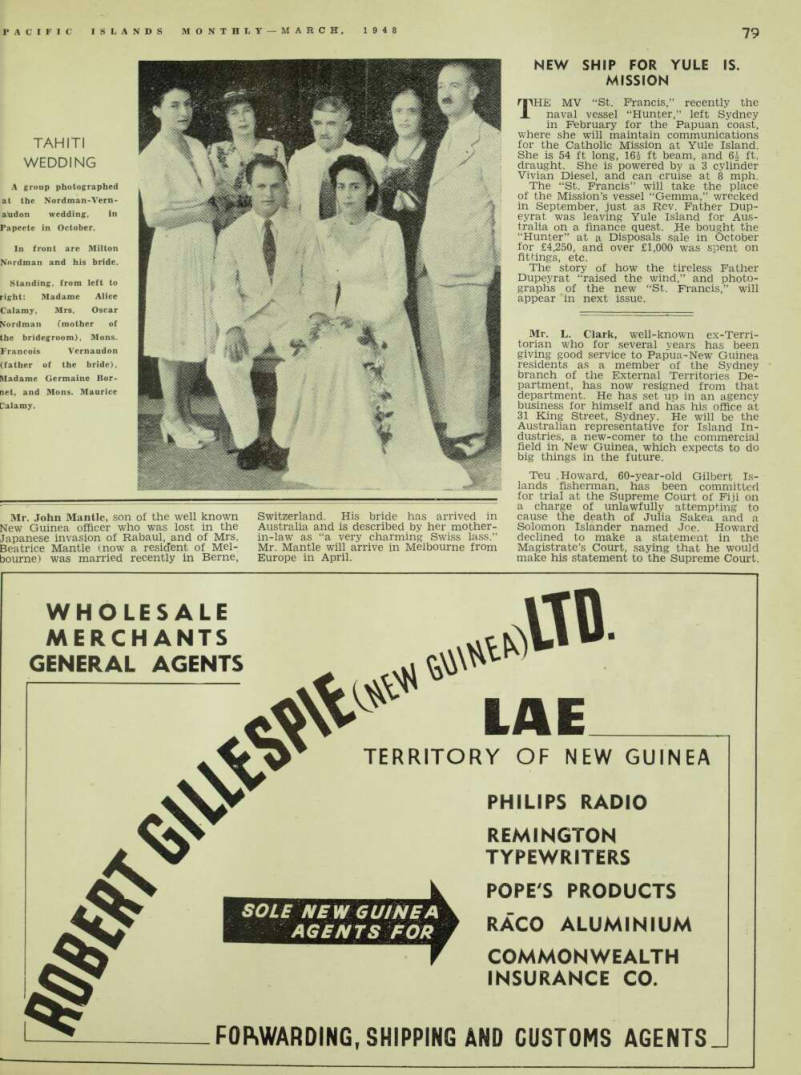
THE opening cricket match of the 2nd post-war LeVien Trophy series, played at Bulolo, New Guinea, be tween Bulolo and Lae, resulted: — Lae, first innings 90; second innings, declared 8 for 142.
Bulolo, first innings, 129; second inn ings 1 for 49.
Lae declared at 4.45 p.m., leaving Bulolo to try to score 104 in one hour lor an outright win Lae hoping for a batting collapse. Bulolo, however, were content to play out time, and enjoy a first innings victory of 39 runs.
Mr. John Mantle, son of the well known New Guinea officer who was lost in the Japanese invasion of Rabaul, and of Mrs.
Beatrice Mantle (now a resident of Mel bourne) was married recently in Berne,
Switzerland. His bride has arrived in Australia and is described by her mother in-law as “a very charming Swiss lass.”
Mr. Mantle will arrive in Melbourne from Europe in April.
Tahiti
Wedding
A group photographed at the Nordman-Vern audon wedding, in Papeete in October.
In front are Milton Nordman and his bride.
Standing, from left to right: Madame Alice Calamy, Mrs. Oscar Nordman (mother of the bridegroom), Mons.
Francois Vernaudon (father of the bride), Madame Germaine Hor net, and Mons. Maurice Dalamy.
Advertisements & other items, p. 78 (1 item)
Broomfields Ltd.
Steamships Trading
Company Limited
PORT MORESBY
SAMARAI
PAPUA.
WHOLESALE & RETAIL MERCHANTS, SHIPOWNERS,
PLANTERS, ENGINEERS & SLIP PROPRIETORS.
Customs, Shipping, Insurance, and 1 orwarding Agents.
MANAGING AGENTS AND VISITING REPRESENTA-
TIVES FOR COCONUT AND RUBBER ESTATES.
SYDNEY REPRESENTATIVES: Nelson & Robertson Pty. Ltd-, 12 Spring Street
BROOMFIELDS Ltd.
Suppliers of Building Hardware General Hardware
Ship Chandlery
Paint Materials
WRITE DIRECT TO
Broomfields Ltd.
152 SUSSEX STREET, SYDNEY
Sole Agents for: P H MUNTZ & CO v ’s 3-CROWN BRAND METAL
SHEATHING.
PEACOCK & BUCHANS’ ENGLISH READY-
MIXED PAINTS.
41/i
New Ship For Yule Is.
Mission
THE MV “St. Francis,” recently the naval vessel “Hunter,” left Sydney in February for the Papuan coast, where she will maintain communications for the Catholic Mission at Yule Island.
She is 54 ft long, 16i ft beam, and 6i ft, draught. She is powered by a 3 cylinder Vivian Diesel, and can cruise at 8 mph.
The “St. Francis” will take the place of the Mission’s vessel “Gemma,” wrecked in September, just as Rev. Father Dup eyrat was leaving Yule Island for Aus tralia on a finance quest. He bought the “Hunter” at a Disposals sale in October for £4,250, and over £l,OOO was spent on fittings, etc.
The story of how the tireless Father Dupeyrat “raised the wind,” and photo graphs of the new “St. Francis,” will appear in next issue.
Mr, L. Clark, well-known ex-Terri torian who for several years has been giving good service to Papua-New Guinea residents as a member of the Sydney branch of the External Territories De partment, has now resigned from that department. He has set uo in an agency business for himself and has his office at 31 King Street, Sydney. He will be the Australian representative for Island In dustries, a new-comer to the commercial field in New Guinea, which expects to do big things in the future.
Teu .Howard, 60-year-old Gilbert Is lands fisherman, has been committed for trial at the Supreme Court of Fiji on a charge of unlawfully attempting to cause the death of Julia Sakea and a Solomon Islander named Joe. Howard declined to make a statement in the Magistrate’s Court, saying that he would make his statement to the Supreme Court.
Advertisements & other items, p. 79 (1 item)
Wholesale
MERCHANTS
GENERAL AGENTS
A / no
LAE
TERRITORY OF NEW GUINEA
PHILIPS RADIO
REMINGTON
TYPEWRITERS
SOLE NEW GUINEA
AGENTS FOR
POPE'S PRODUCTS
RACO ALUMINIUM
COMMONWEALTH
INSURANCE CO.
FORWARDING, SHIPPING AND CUSTOMS AGENTS
Islands Produce
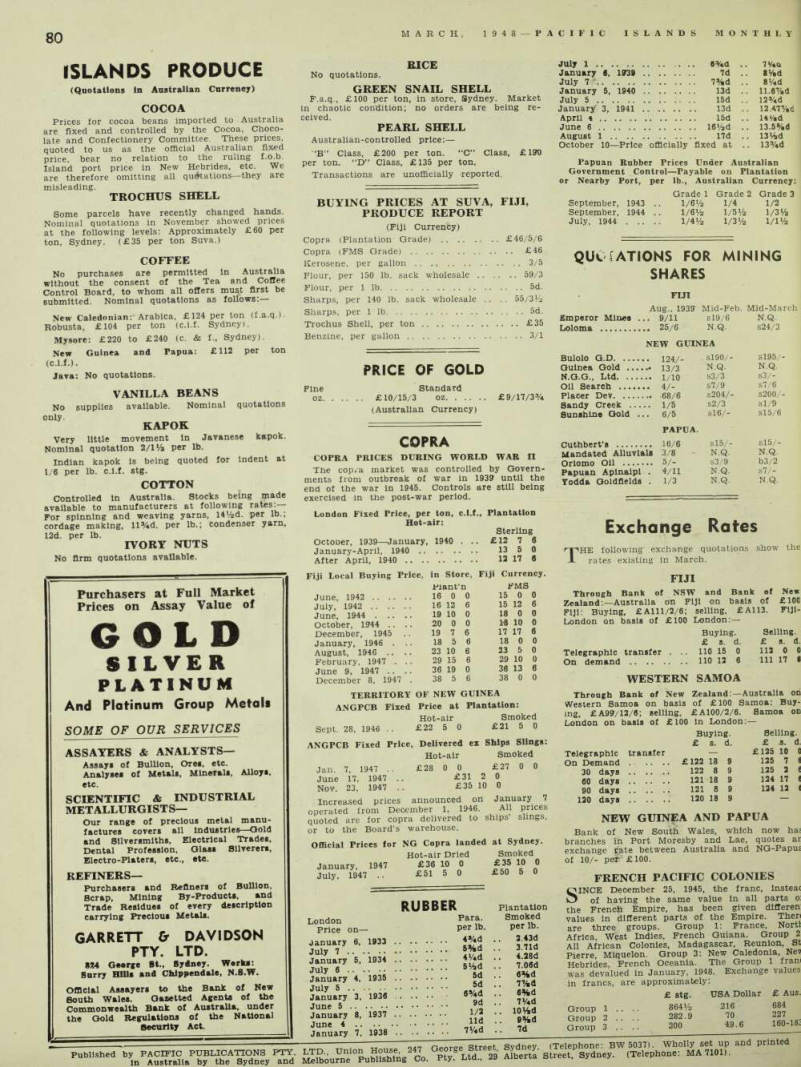
(Quotations In Australian Currency)
Cocoa
Prices for cocoa beans imported to Australia are fixed and controlled by the Cocoa, Choco late and Confectionery Committee. These prices, quoted to us as the official Australian fixed price, bear no relation to the ruling f.o.b.
Island port price in New Hebrides, etc. We are therefore omitting all quotations—they are misleading.
Trochus Shell
Some parcels have recently changed hands.
Nominal quotations in November showed prices at the following levels: Approximately £6O per ton, Sydney. (£35 per ton Suva.)
Coffee
No purchases are permitted In Australia without the consent of the Tea and Coffee Control Board, to whom all offers must first be submitted. Nominal quotations as follows: New Caledonian; Arabica, £124 per ton (f.a.q.).
Robusta, £lO4 per ton (c.i.f. Sydney).
Mysore: £220 to £240 (c. & f., Sydney).
New Guinea and Papua: £ll2 per ton (c.i.f.).
Java: No quotations.
Vanilla Beans
No supplies available. Nominal quotations only.
Kapok
Very little movement In Javanese kapok.
Nominal quotation 2/1 Va per lh.
Indian kapok is being quoted for Indent at 1/6 per lb. c.i.f. stg.
Cotton
Controlled in Australia. Stocks being made available to manufacturers at following rates:— For spinning and weaving yarns, 14V2d. per lb.; cordage making, ll%d. per lb.; condenser yarn, I2d. per lb.
Ivory Nuts
No firm quotations available.
Rice
No quotations.
Green Snail Shell
F.a.q., £lOO per ton, in store, Sydney. Market in chaotic condition; no orders are being re ceived.
Pearl Shell
Australian-controlled price:— ‘B” Class, £2OO per ton. “C” Class, £l9O per ton. “D” Class, £135 per ton.
Transactions are unofficially reported.
Buying Prices At Suva, Fiji,
Produce Report
(Fiji Currency)
Copra (Plantation Grade) £46/5/6 Copra (FMS Grade) £46 Kerosene, per gallon 3/5 Flour, per 150 lb. sack wholesale 59/3 Flour, per 1 lb 5d.
Sharps, per 140 lb. sack wholesale .. .. 55/3% Sharps, per 1 lb 5d.
Trochus Shell, per ton £35 Benzine, per gallon 3/1
Advertisements & other items, p. 80 (1 item)
Price Of Gold
Pine Standard oz £lO/15/3 oz £9/17/3% (Australian Currency)
Rubber
Copra
Copra Prices During World War Ii
The copra market was controlled by Govern ments from outbreak of war in 1939 until the end of the war in 1945. Controls are still being exercised In the post-war period.
Territory Of New Guinea
ANGPCB Fixed Price at Plantation: Hot-air Smoked Sept. 28, 1946 .. £22 5 0 £2l 5 0 ANGPCB Fixed Price, Delivered ex Ships Slings: Hot-air Smoked Jan. 7, 1947 .. £2B 0 0 £27 0 0 June 17, 1947 .. £3l 2 0 Nov. 23, 1947 .. £35 10 0 Increased prices announced on January 7 operated from December 1, 1946. All prices quoted are for copra delivered to ships’ slings, or to the Board’s warehouse.
Official Prices for NG Copra landed at Sydney.
Hot-air Dried Smoked January. 1947 £36 10 0 £35 10 0 July, 1947 .. £5l 5 0 £5O 5 0
London Fixed Price, per ton, Hot-air: c.I.f, ., Plantation Sterling October, 1939 —January, 1940 . .. £12 7 6 January-April, 1940 .. 13 5 0 After April, 1940 .. . 12 17 6 Fiji Local Buying Price, in Store, Fiji Currency.
Plant’n
Fms
June, 1942 16 0 0 15 0 0 July, 1942 16 12 6 15 12 6 June, 1944 19 10 0 18 0 0 October, 1944 .. .. 20 0 0 1-8 10 0 December, 1945 19 7 6 17 17 6 January, 1946 . .. 18 5 6 18 0 0 August, 1946 .. 23 10 6 23 5 0 February, 1947 . .. 29 15 6 29 10 0 June 9, 1947 .. 36 19 0 36 13 6 December 8, 1947 . 38 5 6 38 0 0
London Price ona 1933
Rubber
Para, per lb. 4»/ 4 d Plantation Smoked per lb. 2.43d * 6Hd 3.71d 1934 4V*d 4.28d July 6 BVfcd 7.06d 1935 5d 6%d January Till v 5 ... 5d 7%d u ui y u • 3 1936 6*/ 4 d 6Hd January Tun a S . .. 9d 7V 4 d JULic ti Q 1937 1938 1/2 .. lOttd January June 4 O' 7 lid 7V 4 d 9%d 7d J anuary
July l 8*4(1 .. 7*4(1 January 8, 1939 . 7d .. l L '»d July 7 7%d .. sy.d January 5, 1940 . 13d .. ll.8%d July 5 15d .. 12*4d January 3, 1941 . 13d .. 12.47y,d April 4 15d .. 14V«d June 6 16y 2 d .. 13.5%d August 1 17d .. 13M,d October 10—Price officially fixed at .. 13 3 /4d Papuan Rubber Prices Under Australian Government Control—Payable on Plantation or Nearby Port, per lb., Australian Currency: Grade 1 Grade 2 Grade 3 September, 1943 1/6 y 2 1/4 1/2 September, 1944 1/61/2 I/51/2 i/3y 2 July, 1944 . .. 1/4V2 I/31/2 I/I1/2
Quotations For Mining
Shares
Fiji
Aug., 1939 Mid-Feb.
Mid-March Emperor Mln-ea .. . 9/11 S19/6 N.Q.
Loloma 25/6 N.Q.
S24/3 Bulolo Q.D
New Guinea
• 124/- s!90/sl95/- Guinea Gold •- 13/3 N.Q.
N.Q.
N.G.G., Ltd s3/3 s3/- Oil Search 4/s7/9 s7/6 Placer Dev .. 68/6 $204/s200/- Sandy Creek .. 1/5 s2/3 sl/9 Sunshine Gold .. . 6/5 sl6/- S15/6 Cuthbert’s
Papua.
sl5/sl5/- Mandated Alluvlals 3/8 N.Q.
N.Q.
Orlomo OH s3/9 b3/2 Papuan Aplnalpl . 4/11 N.Q. s7/- Todda Goldfields . 1/3 N.Q.
N.Q.
Exchange Rates
THE following exchange quotations show the rates existing in March.
Fiji
Through Bank of NSW and Bank of New Zealand:—Australia on FIJI on basis of £lOO FIJI: Buying, £Alll/2/6; selling, £AII3. FIJI - on basis of £lOO London; —
New Guinea And Papua
Bank of New South Wales, which now has branches in Port Moresby and Lae, quotes ar exchange rate between Australia and NG-Papm of 10/- pe£ : £100.
French Pacific Colonies
SINCE December 25, 1945, the franc, insteac of having the same value In all parts o: the French Empire, has been given dlfleren values in different parts of the Empire. Then are three groups. Group 1: Prance, Nortl Africa, West Indies, French Guiana. Group 2 All African Colonies, Madagascar, Reunion, St Pierre, Mkjuelon. Group 3: New Caledonia, Nev Hebrides, French Oceania. The Group 1 fram was devalued in January, 1948. Exchange values in francs, are approximately:
Buying.
Selling. £ s. d. £ 8. d.
Telegraphic transfer . .. 110 15 0 112 0 0 On demand 110 12 6 111 17 1
Western
Samoa
Through Bank of New Zealand:— Australia on Western Samoa on basis of £100 Samoa; Buying. £ A99/12/6; selling, £ A100/2/6.
Samoa on London on basis of £100 In London: Buying.
Selling. £ s. d. £ s. d.
Telegraphic transfer — £125 10 0 On Demand £122 18 9 125 7 « 30 days 122 8 9 125 2 e 60 days 121 18 9 124 17 t 90 days 121 8 9 124 12 e 120 days 120 18 9 —
£ stg. USA Dollar £ Aus.
Group 1 .. .. 864 V2 216 684 Group 2 .. . . 282.9 70 227 Group 3 . . . . 200 49.6 160-18.
Advertisements & other items, pp. 80-82 (2 items)
Gold
Purchasers at Full Market Prices on Assay Value of
SILVER
PLATINUM
And Platinum Group Metals
SOME OF OUR SERVICES
ASSAYERS & ANALYSTS—
Assay* of Bullion, Ore*, etc.
Analyse* of Metal*, Mineral*, Alloy*, etc.
SCIENTIFIC & INDUSTRIAL
METALLURGISTS—
Our range of precious metal manufactures covers all Industries —Gold and Silversmiths. Electrical Trades, Dental Profession, Glass Sllverer*.
Electro-Plater*, etc., etc.
REFINERS—
Purchasers and Refiners of Bullion, Scrap, Mining By-Products. and Trade Residues of every description carrying Preclou* Metal*.
GARRETT b DAVIDSON
PTY. LTD.
*24 George St., Sydney. Work*: Surry HIU* and Chippendale, N.B.W.
Official Assayers to the Bank of New South Wales. Oaaetted Agent* of the Commonwealth Bank of Australia, under the Gold Regulations of the National Security Act.
tropical thirst...
To quench a
K c °Oi v ' <: ffipß yiyiuu!
Ti iQnr 4 -
° OT H tCO UMITfO
4Uf T*aua ..ft m M V Ik When you’re hot and tired,
there is nothing quite so satisfying
and thirst quenching as a long, cold glass of “K. 8.” Your friends and guests, too, will ap-
preciate this really fine
Lager, for “Everybody
drinks K. 8.”
TOOTH’S
LAGER
yM M
ERCHANTS
. Qc SHIP OWNERS
Capital £1,000,000
ESTABLISHED 1914
COPRA MERCHANTS & MILLERS
BRANCHES THROUGHOUT THE PACIFIC ISLANDS
REGULAR CARGO AND PASSENGER SERVICE BETWEEN EUROPE AND
PACIFIC ISLAND PORTS WAS ESTABLISHED BY
W. R. CARPENTER & CO. LTD.
Head Office: 16 O'CONNELL STREET, SYDNEY.
Cable Address:
CAMOHE.
Telephone: BW 4421.
Postal Address: P.O. Box No. 168, Sydney.
I 1 I