Islands
Pacific
Monthly
April 19, 1948
Vol.j XVIII. No. 9.
Established 1930.
L Registered at the G.P.0., Svdmy,\iqr. transmission hy post as a newspaper]
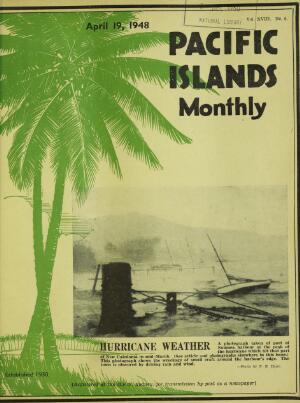
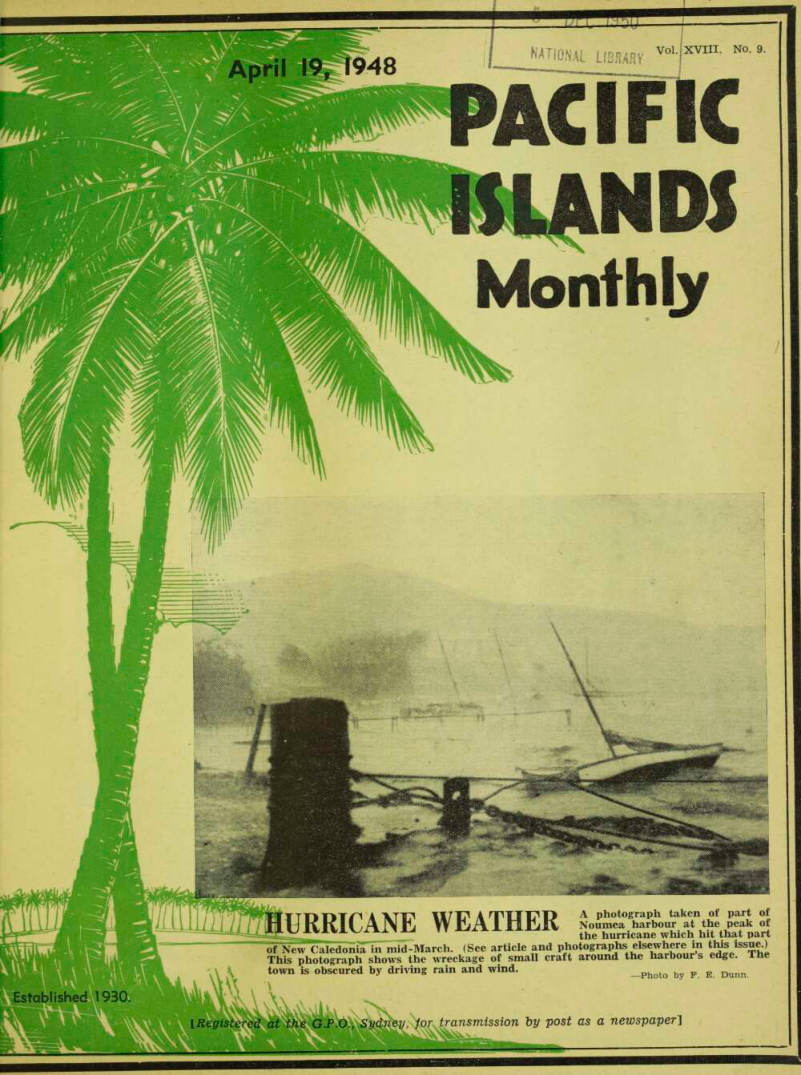
Hurricane Weather
A photograph taken of part Noumea harbour at the peak of the hurricane which hit that part of New Caledonia in mid-March. (See article and photographs elsewhere in this issue.) This photograph shows the wreckage of small craft around the harbour's edge. The town is obscured by driving rain and wind. - Pho to by F. E. Dunn
Advertisements & other items, pp. 2-4 (1 item)
Services
wmmm ■■■ ••• s//, w p| » A/R
TO THE ISLANDS
The Bird of Paradise Service to New Guinea leaves Sydney three times weekly.
The “Island” Services fly regularly to Noumea, Suva and Norfolk Island. Enquire at any authorised Agency or V Qantas Office for intermediate J X. stops and all details of S times, fares, etc.
V.v,:> 1 : i (& s
AUSTRALIA’S
INTERNATIONAL airline
AIR MAIL
AIR TRAVEL
AIR CARGO
- vou
mm jm\
.aJHg;
CAN DEPEND ON
’BS.nJL'eS
Any kerosene or petrol stove which bears the name of Coleman is as dependable and efficient as over 40 years’ intensive specialisation can make a product . . . in fact it is the “Best of its kind.”
This two-burner petrol portable stove illustrated at right requires no preheating and has instant heat control—safety shut-off valve makes it unnecessary to repump each time stove is lighted — has removable fuel tank for safe and easy filling.
In ivory and brown baked enamel finish. Weight 16 lbs.
Although only 8f ins. high
and 4J ins. wide this pocket stove illustrated below boils a pint inside 5 minutes.
Made of corrosion-resistant
metal... lights instantly...
needs no priming . . . burns any kind of petrol and cannot spill fuel even when
tipped over.
his quick-heating “Speedmaster”
ortable stove lights instantly and an be regulated to any degree of eat. Has odorless windproofurner, rust resisting brass fount of pints, and is unspillable. Boils a int in 2\ minutes. Height 7 ins., 5 lbs. ddth 10J ins., Weight A 3 burner kerosene stove finished in glistening white baked enamel with ample cooking top of heavy steel grates. Two-quart fuel tank . . • needle valve asbestos wick. Hot blast cap induces extra oxygen and hastens combustion. Supplied with or without oven.
Representatives for the Pacific Islands;
ROBERT GILLESPIE PTY. LTD
54a PITT STREET, SYDNEY
PEARCE & CO. LTD
SUVA
FOR FIJI ISLANDS
55 %
From
4-v ' mm m 0 *k m~ * * £l* -4 PP feg <# SI 51 %•*
Australia’s
Finest Fat
Stock ...
BRONTE BRAND:
• Chili Con Came • Braised Steak and Onions • Curried Beef • Curried Mutton O Steak and Onions • Mutton and Peas • Irish Stew • Beef Steak Pudding • Corned Beef Hash • Corned Beef Loaf With Cereal • Mutton Broth • Mulligatawny Soup • Tomato Soup • Vegetable Soup From the finest fat stock and the rich-
est vegetables in Australia we produce
these high-grade canned meats and
soups. BRONTE BRAND meats,
hotmeals and soups are deliciously
flavoured and are made from
ONLY meats and vegetables
of the highest quality
THE COLONIAL WHOLESALE MEAT CO.
PTY. LTD.
Canning Factory, State Abattoirs, Homebush Bay, Sydney.
N.S.W.
PHONES:
PHONE: UM 8436.
CABLE ADDRESS:
WOOLMILL. SYDNEY.
-r
cam
p m
Advertisers
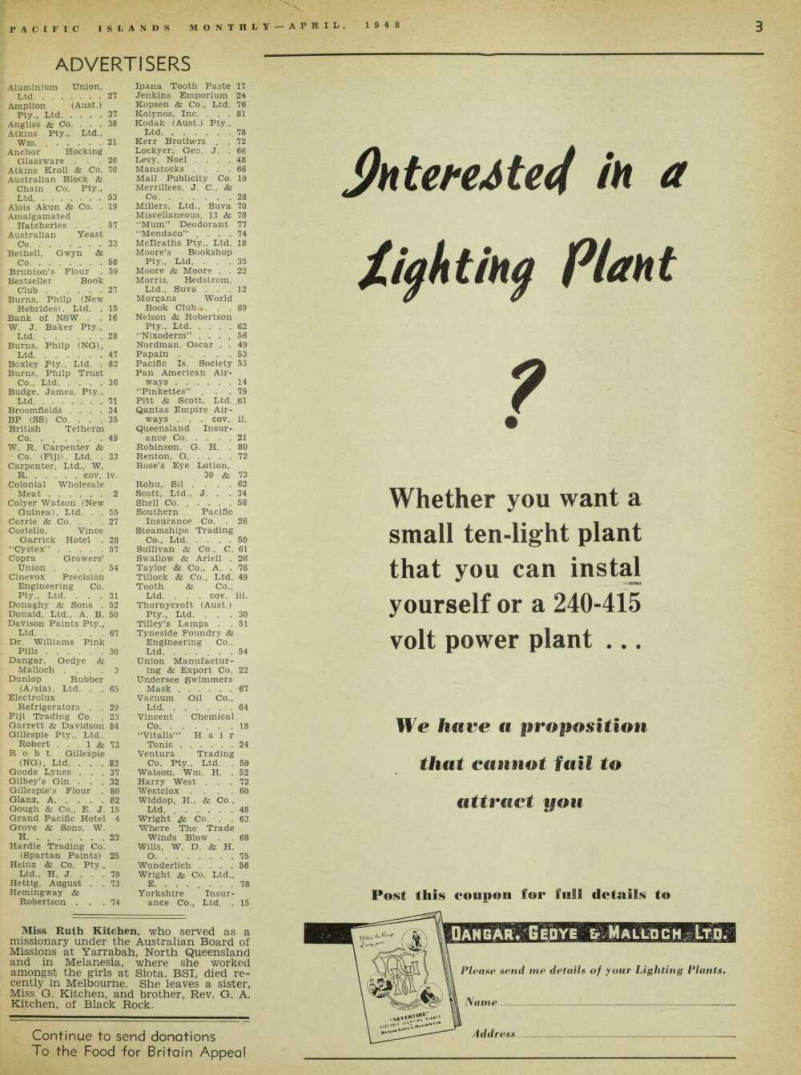
Aluminium Union, Ltd 27 Amplion (Aust.) Pty., Ltd 37 Angliss & Co. ... 38 Atkins Pty., Ltd., Wm. 21 Anchor Hocking Glassware ... 20 Atkins Kroll & Co. 70 Australian Block & Chain Co. Pty., Ltd 53 Alois Akun & Co. . 19 Amalgamated Hatcheries ... 57 Australian Yeast Co 33 Bethell, Gwyn & Co 58 Brunton’s Flour . 59 Bestseller Book Club 27 Burns, Philp (New Hebrides). Ltd. . 15 Bank of NSW . . 16 W. J. Baker Pty., Ltd 28 Burns, Philp (NG), Ltd 47 Boxley pty.. Ltd. . 82 Burns, Philp Trust Co., Ltd 36 Budge, James, Pty., Ltd 71 Broomfields ... 34 BP (SS) Co. . . . 35 British Tetherm Co 49 W. R. Carpenter & Co. (Fiji). Ltd. . 33 Carpenter, Ltd., W.
R cov. iv.
Colonial Wholesale Meat 2 Colyer Watson (New Guinea), Ltd. . . 55 Corrie & Co. ... 27 Costello, Vince Garrick Hotel . 28 “Cystex” 57 Copra Growers’
Union 54 Cinevox Precision Engineering Co.
Pty., Ltd. ... 31 Donaghy & Sons . 52 Donald, Ltd., A. B. 50 Davison Paints Pty., Ltd 67 Dr. Williams Pink Pills 30 Dangar, Gedye & Malloch ... 3 Dunlop Rubber (A/sia), Ltd. . . 65 Electrolux Refrigerators . . 29 Fiji Trading Co. . 23 Garrett & Davidson 84 Gillespie Pty., Ltd..
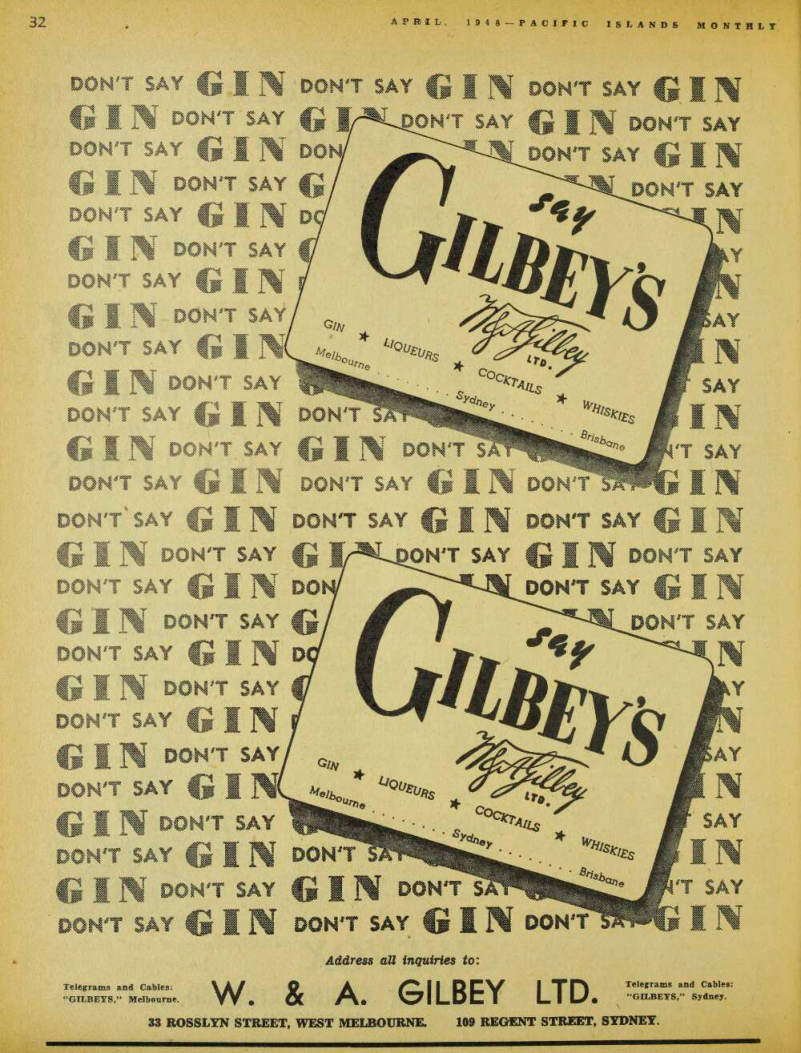
Robert . . . 1 & 73 R o b t. Gillespie (NG), Ltd. ... 83 Goode Lynes ... 37 Gilbey's Gin ... 32 Gillespie’s Flour . 80 Glanz, A 82 Gough & Co.. E. J. 15 Grand Pacific Hotel 4 Grove & Sons, W.
H. 23 Hardie Trading Co. (Spartan Paints) 25 Heinz & Co. Pty., Ltd., H. J. . . .79 Hettig, August . . 73 Hemingway & Robertson ... 74
Ipana Tooth Paste 17 Jenkins Emporium 24 Kopsen & Co., Ltd. 76 Kolynos, Inc. ... 81 Kodak (Aust.) Pty., Ltd 78 Kerr Brothers . . 72 Lockyer, Geo. J. . 66 Levy, Noel ... 48 Manstocks ... 66 Mail Publicity Co. 19 Merrillees, J. C., & Co 28 Millers, Ltd., Suva 70 Miscellaneous, 13 & 78 “Mum” Deodorant 77 “Mendaco” ... 74 Mcllraths Pty., Ltd. 18 Moore’s Bookshop Pty., Ltd. ... 35 Moore & Moore . . 22 Morris, Hedstrom, Ltd., Suva ... 12 Morgans World Book Club -. . .69 Nelson & Robertson Pty., Ltd 62 “Nixoderm” ... 56 Nordman, Oscar . . 49 Papain 53 Pacific Is. Society 53 Pan American Air ways 14 “Pinkettes” ... 79 Pitt & Scott, Ltd. 61 Qantas Empire Air ways . . . cov. ii.
Queensland Insur ance Co 21 Robinson, G. H. . 80 Renton, G 72 Rose’s Eye Lotion, 30 & 72 Rohu, Sil . . . . 62 Scott, Ltd., J. . .34 Shell Co. ... 58 Southern Pacific Insurance Co. . 26 Steamships Trading Co., Ltd 50 Sullivan & Co., C. 61 Swallow & Ariell . 26 Taylor & Co., A. . 76 Tillock & Co., Ltd. 49 Tooth & Co., Ltd. . . . cov. iii.
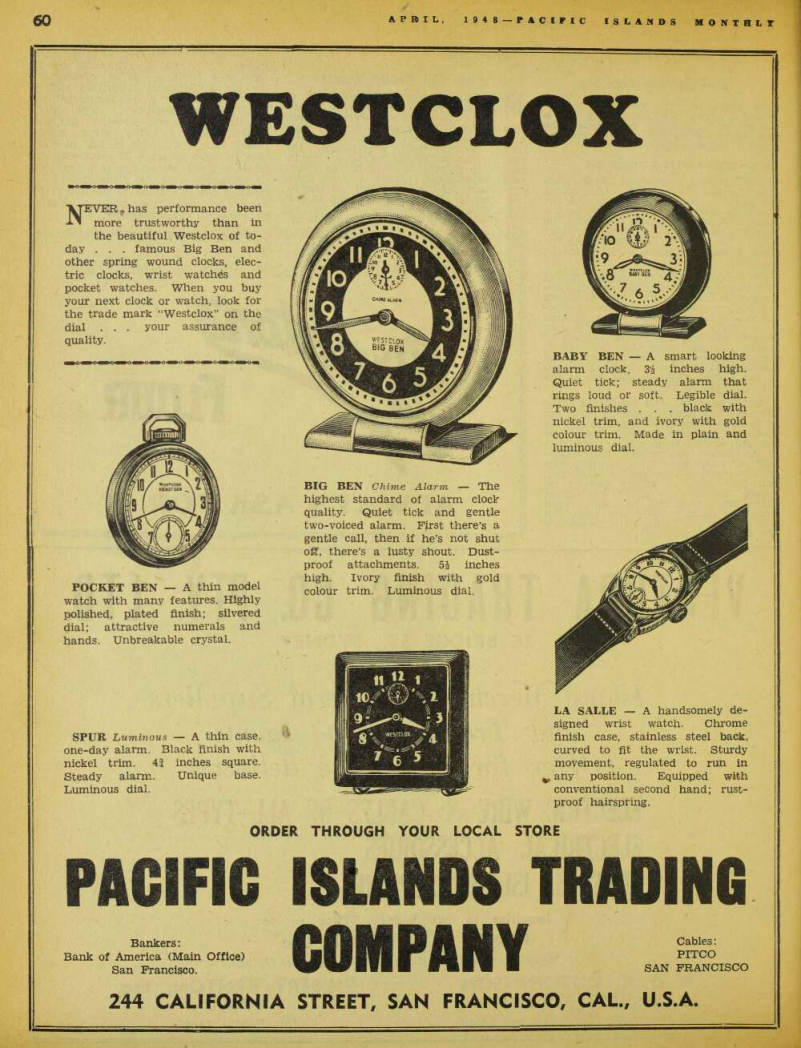
Thornycroft (Aust.) Pty., Ltd. ... 30 Tilley’s Lamps . .51 Tyneside Foundry & Engineering Co., Ltd. ... 54 Union Manufactur ing & Export Co. 22 Undersee Swimmers Mask 67 Vacuum Oil Co., Ltd 64 Vincent Chemical Co. ... 18 “Vitalis”’ Hair Tonic 24 Ventura Trading Co. Pty., Ltd. . 59 Watson, Wm. H. . 52 Harry West ... 72 Westclox ... 60 Widdop, H., & Co., Ltd. 48 Wright Co. . . 63 Where The Trade Winds Blow . 68 Wills, W. D. & H. 0 75 Wunderlich ... 56 Wright & Co. Ltd., E. ... 78 Yorkshire Insur ance Co., Ltd. . 15
Miss Ruth Kitchen, who served as a missionary under the Australian Board of Missions at Yarrabah, North Queensland and in Melanesia, where she worked amongst the girls at Siota, BSI, died re cently in Melbourne. She leaves a sister, Miss G. Kitchen, and brother, Rev. G. A.
Kitchen, of Black Rock.
Advertisements & other items, p. 5 (1 item)
lighting Plant
Jftt teteA te4 in a
Whether you want a
small ten-light plant
that you can instal
yourself or a 240-415
volt power plant ...
We have a proposition that cannot fail to attract yon Post this coupon for full details to Dan gar, Gedye &. Hallo ch Please send me details of your Lighting Plants.
I\ame Address I ***
Continue to send donations To the Food for Britain Appeal
In This Issue:
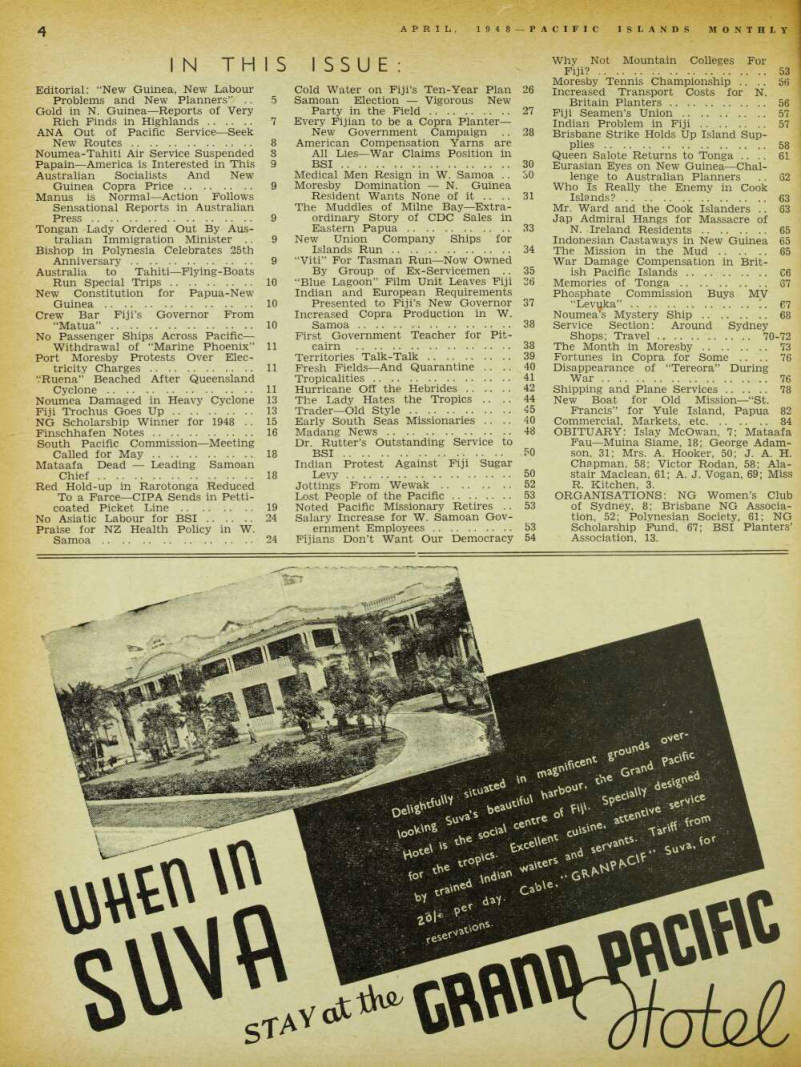
Editorial: “New Guinea, New Labour Problems and New Planners” .. 5 Gold in N. Guinea —Reports of Very Rich Finds in Highlands 7 ANA Out of Pacific Service —Seek New Routes 8 Noumea-Tahiti Air Service Suspended 8 Papain—America is Interested in This 9 Australian Socialists And New Guinea Copra Price 9 Manus is Normal —Action Follows Sensational Reports in Australian Press 9 Tongan Lady Ordered Out By Aus tralian Immigration Minister .. 9 Bishop in Polynesia Celebrates 25th Anniversary 9 Australia to Tahiti —Flying-Boats Run Special Trips 10 New Constitution for Papua-New Guinea 10 Crew Bar Fiji’s Governor From “Matua” 10 No Passenger Ships Across Pacific — Withdrawal of “Marine Phoenix” 11 Port Moresby Protests Over Elec tricity Charges 11 VRuena” Beached After Queensland Cyclone 11 Noumea Damaged in Heavy Cyclone 13 Fiji Trochus Goes Up 13 NG Scholarship Winner for 1948 .. 15 Finschhafen Notes 16 South Pacific Commission —Meeting Called for May 18 Mataafa Dead Leading Samoan Chief 18 Red Hold-up in Rarotonga Reduced To a Farce—ClPA Sends in Petti coated Picket Line 19 No Asiatic Labour for BSI 24 Praise for NZ Health Policy in W.
Samoa 24
Cold Water on Fiji’s Ten-Year Plan 26 Samoan Election Vigorous New Party in the Field 27 Every Fijian to be a Copra Planter — New Government Campaign .. 28 American Compensation Yarns are All Lies—War Claims Position in
Bsi 30
Medical Men Resign in W. Samoa .. SO Moresby Domination N. Guinea Resident Wants None of it ... 31 The Muddles of Milne Bay—Extra ordinary Story of CDC Sales in Eastern Papua 33 New Union Company Ships for Islands Run 34 “Viti” For Tasman Run —Now Owned By Group of Ex-Servicemen .. 35 “Blue Lagoon” Film Unit Leaves Fiji 36 Indian and European Requirements Presented to Fiji’s New Governor 37 Increased Copra Production in W.
Samoa 38 First Government Teacher for Pit cairn 38 Territories Talk-Talk 39 Fresh Fields—And Quarantine .. .. 40 Tropicalities 41 Hurricane Off the Hebrides 42 The Lady Hates the Tropics .. .. 44 Trader —Old Style 45 Early South Seas Missionaries .. .. 40 Madang News 48 Dr. Rutter’s Outstanding Service to
Bsi 50
Indian Protest Against Fiji Sugar Levy 50 Jottings From Wewak 52 Lost People of the Pacific 53 Noted Pacific Missionary Retires .. 53 Salary Increase for W. Samoan Gov ernment Employees 53 Fijians Don’t Want Our Democracy 54
Why Not Mountain Colleges For Fiji? 53 Moresby Tennis Championship .. .. 56 Increased Transport Costs for N.
Britain Planters 56 Fiji Seamen’s Union 57 Indian Problem in Fiji 57 Brisbane Strike Holds Up Island Sup plies 58 Queen Salote Returns to Tonga ... 61 Eurasian Eyes on New Guinea —Challenge to Australian Planners .. 62 Who Is Really the Enemy in Cook Islands? 63 Mr. Ward and the Cook Islanders .. 63 Jap Admiral Hangs for Massacre of N. Ireland Residents 65 Indonesian Castaways in New Guinea 65 The Mission in the Mud 65 War Damage Compensation in Brit ish Pacific Islands 66 Memories of Tonga 67 Phosphate Commission Buys MV
“Levyka” !. 67
Noumea’s Mystery Ship 68 Service Section; Around Sydney Shops; Travel 70-72 The Month in Moresby 73 Fortunes in Copra for Some .. .. 76 Disappearance of “Tereora” During War 76 Shipping and Plane Services 78 New Boat for Old Mission—“ St.
Francis” for Yule Island, Papua 82 Commercial, Markets, etc 84 OBITUARY: Islay McOwan, 7; Mataafa Fau —Muina Siame, 18; George Adam son, 31; Mrs. A. Hooker, 50; J. A. H.
Chapman, 58; Victor Rodan, 58; Ala stair Maclean, 61; A. J. Vogan, 69; Miss R. Kitchen, 3.
ORGANISATIONS: NG Women’s Club of Sydney, 8: Brisbane NG Associa tion, 52; Polynesian Society, 61; NG Scholarship Fund, 67; BSI Planters’
Association, 13.
Advertisements & other items, p. 6 (1 item)
swgfi
Pacific Islands Monthly
The Newspaper-Magazine of the South Seas l ßegistered at the G.P.0., Sydney, for transmission by post as a newspaper ]
Published Once Each Month and Circulated in Australia and New Zealand and in the following Pacific Territories and Islands Groups:
Australian Territory of Papua.
Trustee Territory (Australia) of New Guinea.
Australian Territory of Norfolk Island.
New Zealand Territory of Cook Islands.
Trustee Territory (NZ) of Western Samoa.
British Colony of Fiji.
British Solomon Islands Protectorate.
British Protectorate of Tongan Islands.
British Crown Colony of Gilbert and Ellice Islands.
Trustee Territory of Nauru.
British and French Condominium of New Hebrides.
French Colony of New Caledonia.
French Colony of Oceania (Tahiti, etc.).
American Territory of Eastern Samoa.
American Territory of Hawaiian Islands.
Owned and Produced by Pacific Publications Pty., Ltd., Union House, 247 George Street, Sydney.
Telephone: General Office and Advertising, BW 5037.
P.O. Box 3408
Registered Address for Telegrams, Radiograms, and Cables: “Pacpub,” Sydney.
Contributions.
Articles, Stories, and Photographs dealing with Pacific Islands subjects are invited and will be paid for on publication.
Subscription Rates.
Per Annum, Pre-paid, Including Postage.
In Australia, New Zealand, Fiji, New Guinea, Papua, Western Samoa, Cook Islands, Tonga, British Solomons, Gil bert and Ellice Colony, Nauru, and United Kingdom 15 0 Elsewhere 18 0 Single Copies 1 6
Editor and Publisher:
R. W. Robson, P.R.G.S.
Assistant Editor: JUDY TUDOR.
General Office: Union House, 247 George Street, Sydney. Telephone: BW 5037.
Advertising Manager: W. E. Rogers.
Representative In London.
J. T. Wallis, Coronation House, 4 Lloyds Avenue, London, E.C.3, from whom may be obtained copies of Pacific Islands Monthly, Pacific Is. Year Book, advertising schedules, etc.
Representative In U.S.A.
Pacific Islands Trading Co.,
244 California St., San Francisco, U.S.A.
Agents.
The following are authorised to receive sub scriptions for Pacific Islands Monthly:— Burns, Philp & Cos., Ltd,, and Burns Philp (South Sea) Cos., Ltd. All branches.
W. R. Carpenter & Cos., Ltd. All branches.
Morris, Hedstrom, Ltd. All branches.
Steamships Trading Cos., Papua. All branches.
W. M. Caldwell, Suva, Fiji.
Cook Islands Trading Cos., Rarotonga, Cook Is.
Oscar Nordman, Papeete, Tahiti.
Islands Branches and Representatives of W. H.
Grove & Sons, Ltd., Auckland, New Zealand.
Ed. Pentecost, Noumea, New Caledonia.
Societe Gubbay Kerr et Cie, Noumea, New Caledonia.
Vol. Xviii. No, 9.
April 19, 1948
i 1/6 Per Copy Price i Pf epaid, p.a.: 15/- Aus. ( In USA, p.a.: $3.
Planners
New Guinea, New Labour Problems, and New Planners
THE labour supply problem in all the Territories of the South Pacific is serious, and in some cases is becoming worse. For the most part, the problem is blandly ignored by the nations concerned—especially by Britain, Australia, New Zealand and France—which are happy to think that an absence of labour embarrasses the accursed capitalist more than anyone else.
No one expects that much of value will be accomplished by the South Pacific Commission—not because the idea is not sound, but because of the source of the thing. The SPC is essentially a product of the tireless brain of Australia’s Dr. Evatt, cordially supported by New Zealand; and nothing of real value in the way of international co-operation has yet been produced by the New Planners of Canberra and Wellington. (One of the brightest cartoons recently produced was in “Sydney Bulletin.”
The scene portrayed was the Sydney Royal Show’s cattle-ring; and in the picture was Old Farmer Evatt, leading an ungainly and depressed bull, The bull was labelled “UNO,” and on Evatt’s lapel was a ticket “Bull Exhibitor”!) Yet if the South Pacific Commission—scheduled to meet in Sydney in May—would only apply itself to the problem of a labour supply for the South Pacific, it could do much to assist the economy of some of the
most important and valuable Terri tories. Here are some examples.
BECAUSE the Solomon Island -t* natives have been drinking deeply of a special Malaita brew of Marxist doctrine, the natives gener ally are withdrawn and sulky, and will not work. BSI copra is in keen demand, but planters cannot get labour. Levers Pacific Plantations Ltd., proposed to bring in a few hundred Chinese from Hongkong.
The British Socialist Government condemns the plan—not because it is economically unsound, but because it may harm the indigenous natives, So the hungry world goes without BSI copra, and the rehabilitation of BSI plantations becomes almost im possible.
In Papua and New Guinea, Aus tralia holds some of the richest Territories in the South Pacific.
They could be enormously developed for the production of essential foods and materials, if private enterprise were allowed to run free, and labour were provided. But Socialistic Aus tralia taboos private enterprise and exotic labour. All considerations are subverted to Mr. Ward’s Utopian plan of keeping the Territories a close preserve for a million Melan esians, who are only just emerging from Stone Age conditions.
Monsignor Hannan, a very well known and experienced Roman
Catholic missionary, just arrived in Sydney from Bougainville, said: “One way in which Australia can secure her hold on her islands possessions is by encouraging Chinese immigra tion. Chinese are among the best settlers in the Territories to-day.”
We may not agree with the idea 01 Asiatic immigration; but It is sig nme ant that this leading missionary sees the real character of the prob lerP Papua-New Guinea, . -New Caledonia, a great metal industry is in danger of being crippled because the Planners cannot a £f e f. on a of indenturing Asiatic labour. There is a similar position in the New Hebrides, where planting industries based on copra, conee and cocoa, cannot get labour to replace the departing Tonkinese, Similar labour problems, varying according to local conditions, may be uncl . ln Samoa, and French Oceania, , T , , T N all these rich Islands there are ± opportunities for development, Given the labour to till the soil and tend and harvest the crops, they can produce on an enormous scale, for the assistance of a hungry world, and the benefit of their native in habitants.
In all the countries of south-east Asia, there are literally millions of men who would sell their souls, as well as the labour of their bodies, for a chance to go away to these happy Islands as indentured labourers.
We need only bring the two to gether—the opportunities and the
labour forces —to achieve incalculable economic good. The New Planners of London, Canberra and Wellington retort that we should also achieve incalculable social harm.
That is where we join issue. There is no reason why, if the repatriation clauses of the indenture contract are firmly policed, there should be any harm at all. We have Chinese per manently established in Tahiti and New Guinea, and IndianJs in Fiji, thus creating difficult racial prob lems, because the repatriation pro visos of the indenture systems were not adhered to. But there is no such problem in New Caledonia, Samoa, New Hebrides, where the system of bringing in Asiatic labour was strictly policed.
THE men who advocate the proper development of the South Seas Territories are just as sensitive as the Planners concerning the welfare of native races. In Fiji, for example, every European in Big Business—the “ruthless exploiters,” according to Mr. Ward—is the friend and well wisher of the natives, jealously guarding their rights and helping them, as individuals and as a com munity, towards higher cultural standards and the ability to govern themselves.
Men without knowledge and experi ence—and that term comprises the majority of the Planners—commit the gravest sin against the natives by “spoiling” them. The natives generally react splendidly to dis cipline, strength, jyjd firm, scrupulous justice. But' their re action to weakness, and indulgence, and the Brown Brother complex is calamitous —as is being proved in New Guinea now.
However, the Planners are in the box seats, for the moment; and their invariable reply to anyone who argues in favour of firm, disciplined control of the natives, and the use of private enterprise in developing the Territories, is “Oh, he’s only the mouthpiece of the vested interests.”
They can see no good in the old regime, such as that directed by the late Sir Hubert Murray.
THERE are high-class native popu lations in the phosphate islands of Nauru and Ocean—or there were, until they were decimated by the murderous Japanese invaders —and they have not been harmed by the introduction of many hundreds of Chinese and Gilbertese labourers, to work the phosphate deposits.
On the contrary, because a phos phate royalty is paid scrupulously to the indigenous landowners, the Nauruans and the Banabans of Ocean Island are the richest and best educated native communities in the Pacific. Because the world had to have phosphates, and local labour was undependable, the indentured labour system was made to work — with very happy results.
Similarly, the world now wants, most urgently, the products of the other Pacific Islands. Local labour is undependable—there is no reason
why the indigenous land-owners should work, anyhow. Indentured labour could be used there just as successfully as in Nauru and Ocean Islands—and for the enrichment and benefit of the natives. Why not?
It is all a matter of a realistic approach to these matters, of firm administration—and of keeping the Planners in their place.
Papua
Oil Drilling Ceased In Papua But Three More Bores Being Prepared
DRILLING at the APC Go’s Kariava bore, in Central Papua, ceased on March 25, after the bore had reached 12,621 feet (nearly 2£ miles). Data is now being studied, for guidance in regard to future policy.
Drilling at Kariava commenced ten years ago, but was suspended for five years, during World War 11.
The Company is now preparing to put down three more bores in Papua—at Hohoro, Upoia and Oroi.
Correction
Old Salamaua Photo
LAST month we published a photo graph, kindly loaned by Mr. Jim Hoile, now of Terrigal, NSW.
It showed a group, taken about 1927, of New Guinea goldfields pioneers outside the Salamaua Hotel. One member of the group was Mr. Clem Hendry, whom we reported dead. A reader now informs us that Mr. Hendry is very much alive.
He left New Guinea about 1935. He was in business in NSW for several years.
He is now living in Caulfield, Melbourne, and is in the Records Branch of the RAN.
He has married again since leaving New Guinea.
This reader also explains the cham pagne corks referred to by Mr. Hoile: apparently the roofing nails protuded through the battens beneath. It became a matter of friendly rivalry between Harry Darbv and Hector Wales, who were then doing well on Edie Creek, to see who could first fill a row of nails with cham pagne corks. Later the custom became general and anyone who bought cham pagne was privileged to stxid a “monkey up to fix the cork to a nail.
New Hebrides News
From Our Own Correspondent VILA, April 1.
THE March cyclone, which passed to the south-west of the New Hebrides and did so much damage in Noumea, also left a trail of destruction in these islands. Although the wind did not reach hurricane force, there was a heavy swell with thick rain squalls and several ves sels are reported lost, without, however, any loss of life.
The m/v “Resolution” (Burns Philp (New Hebrides) Ltd.) was returning to Vila when the engine broke down and the vessel was not heard of for about ten days. It eventually turned up on the north-east coast of New Caledonia, where it had been carried by the wind and sea. The Captain (Mr. Keith Sol way) and the Supercargo (Mr. R. Paul) and crew are safe in Noumea.
The vessel is said to be only slightly damaged, and is now being towed back to Vila by the “Avalon” (formerly the “Taipan”). * * * AT Espiritu Santo (New Hebrides) on March 21, an American four-engined plane, after circling over the other two airfields constructed by the Ameri cans during the war and known as “Bomber I" and “Bomber II,” touched down on the Pallikulo airstrip.
The plane, which is said to have come from Suva, appeared to have landed to carry out minor adjustments and re mained on the field only half an hour.
There are persistent rumours at Espi ritu Santo about the projected arrival of an American “Survey Mission” compris ing about 300 personnel. * * * SINCE the damage to “Trapas” aircraft during the March hurricane, the New Hebrides are now without regular air communication with Sydney. Trans oceanic Airways operate a service, via Noumea, but do not run to any specified schedule. That is because the Australian Government will not give the Company a license to fun regular services.
Archbishop Visits
RGS Aword for A. J. Marshall
MR. A. J. MARSHALL, who became well-known to residents of both the New Hebrides and northern New Guinea in the thirties, has been awarded the Back Grant by the Royal Geographi cal Society for his work as leader of the Oxford University Exploration Club,
Fiji
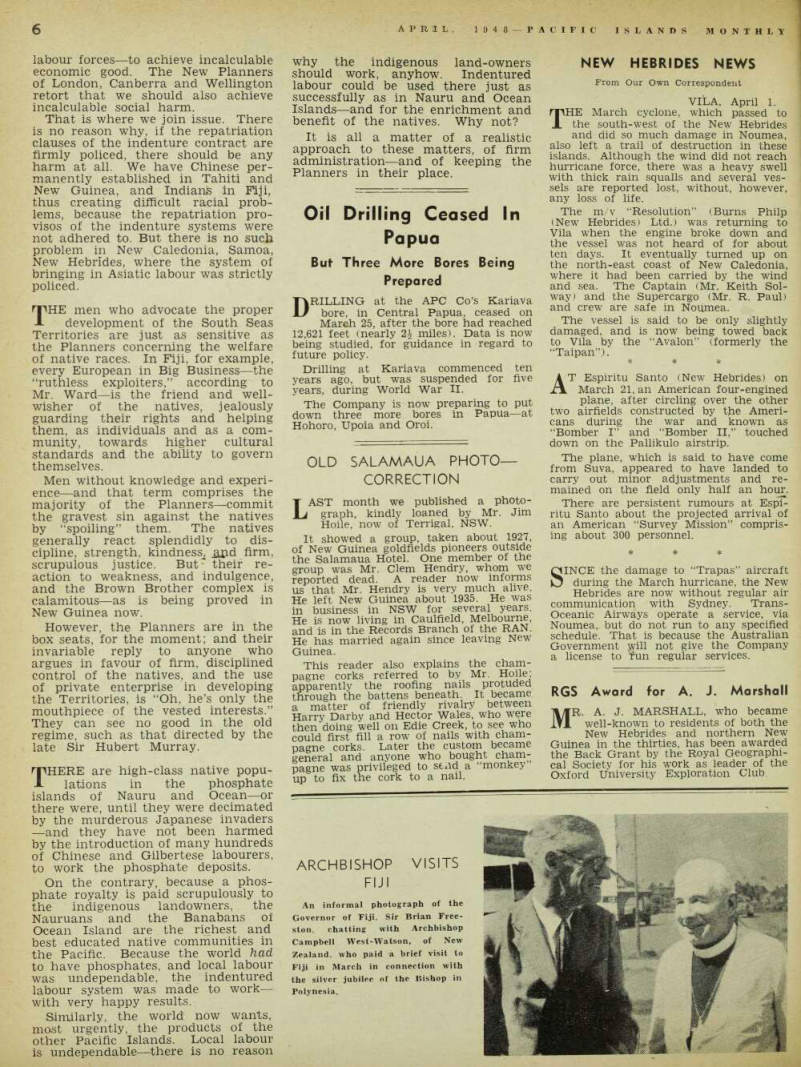
An informal photograph of the Governor of Fiji. Sir Brian Free ston, chatting with Archbishop Campbell West-Watson, of New Zealand, who paid a brief visit to Fiji in March in connection with the silver jubilee of the Bishop in Polynesia.
New Gold
In Ng
Reports of Very Rich Find In Western Highlands
From Our Own Correspondent
Port Moresby. April 7.
REPORTS— all unofficial as yet, but generally accepted here as substan tially correct —indicate that a rich new goldfield has been found at a point westward of Mount Hagen, towards the headwaters of the Strickland River, near a place called Wabag.
It is also stated in reliable quarters that the find is colossally rich—but that it may be found to be too big for small syndicates to handle.
Information has been hard to get. The Administration follows its usual invari able hush-hush policy, and the gold seekers primarily concerned are, of course, refusing to talk.
A “rush” is believed to have started.
Right in the forefront are members of the Leahy family, John Black (former public servant), and various old-timers, as well as representatives of Bulolo Gold Dredging, one of the pioneers of the Bul olo field. mo understand what is happening, it is J. necessary to recount a little history.
When the Bulolo-Morobe goldfield was established, in the late twenties, the interior of the great island of New Guinea, comprising thousands of square miles around the point where the bor ders of Papua, Mandated New Guinea and Dutch New Guinea meet in the centre, was marked “unexplored.” From 1930 onwards, exploration commenced.
A most formidable mountain range runs the entire length of the great island, and this backbone separates Papua and Mandated Territory. On the south side it descends steeply into Papua, forming a terrifying barrier. On the north side, it stretches away in a series of great plateaus, cut up by minor mountain ranges.
Some very large rivers take their origin in these plateaus, break through the island’s backbone in a series of tremen dous gorges, and flow southwards into the Gulf of Papua. Most notable of these are the Purari, the Kikori and the Strickland (largest of the tributaries of the mighty Fly). Only one great river flows northwards from these central plateaus—that, of course, is the Sepik, largest river in New Guinea.
Papuan officers, following up those great rivers, gradually penetrated the unknown region from the south, notable among them being the Champion broth ers and the late Jack Hides. Hides, on his last patrol before he died, reported gold in the Upper Strickland.
On the New Guinea side, young ex plorers tackled the unknown from the north-east, from the headwaters of the Markham, and the region behind Madang. The first notable patrols were made about 1932 bv the brothers Leahy and an Administration officer, Mr. James L. Taylor, who penetrated from Benna Benna to Mount Hagen—all new coun try, There were some minor expeditions by private gold-seekers.
The next notable patrol was in 1937- 38, when J. L. Taylor and John Black travelled across the plateaus from the Benna Benna region, to Mount Hagen, and on westwards towards Wabag. They were then apparently not far from the region that Hides had reached from the Upper Strickland.
Leahy Brothers —Jim, Mick and D an — W ere more or less closely asso ciated with all these explorations: and they located gold near Mount Hagen about the time of the Taylor-Leahy ex pedition. Later, owing to trouble with the natives, the whole area was “closed”; but the Leahys were allowed to retain and work their gold leases.
It was generally believed that the Taylor-Black expedition found import ant gold prospects; but the war came soon afterwards, and little was said about it.
After the war, both Taylor and Black occupied positions of responsibility in the Administration. Taylor, after being Dir ector of Natiye Labour, went over to the Highland Division (the central plateaus) as District Officer; Black was in the District Services Department in Port Moresby.
The secret has been well kept for some years, and it is not known why this sud den move has taken place. Probably, it is because other prospectors—especially a BGD expedition—have begun to push into the interior. Many old-timers have been hungry, for years, for a peep at the virtually unknown region westward of Mount Hagen; but they have been kept out by the Administration’s strict orders. This was, and still is, “uncon trolled territory.”
However, Mr. Black is reported to have resigned his job and departed with Mr.
Mick Leahy for Mount Hagen, there to await a Government permit to go into the uncontrolled area. Also on the way are the BGD outfit, and several experi enced prospectors.
IT was generally understood that dead line was April 1; all in the line-up were then to get permits. Then the date was altered to May 1; and now the lads are cooling their heels at Mount Hagen and other hill stations there abouts.
It is reported that two well-known officials have resigned their Administra tive posts in the Highlands Division, and are joining in the “rush.”
It is believed that the decision to post pone the deadline to May 1 was the result of the Administration’s anxiety concerning the effects of the influx on the Wabag natives, who have seen few white men. The Director of Health, Dr. Gunther, has been busy in the Gar oka-Mt. Hagen area during April—which strengthens the general belief that the Administration has decided to let the miners in, at last.
THE Wabag area towards which Leahy and Black are believed to be head ing, is called “inaccessible,” and this will be a handicap. However, the diffi culties of terrain and isolation are not expected to be any greater than those experienced by prospectors in the early days of Wau and Edie Creek, and they are unlikely to stop the local populace who. tired of the frustrating daily round of the rehabilitation era, is in a mood to rush to the Highlands with all speed at the slightest justification.
The prospect of a gold-rush in the carefully preserved Highlands seems scarcely to accord with the Wardian policy of “New Guinea for the Fuzzy wuzzies.” Perhaps, however, Mr. Ward and his advisers have seen the light, and are thinking about Highlands gold in terms of American dollars.
Congratulations were showered upon Mr. W. H. (“Tavua”) Johnson, who at tained his 86th birthday in Suva on April 10. He has been in Fiji for 56 years. The story of “Tavua” Johnson’s adventurous life will be published in the “PIM” in May or June.
Mcowan
Death Of Mr. I.
THE death occurred in Sydney on April 4 of Mr. Islay McOwan, CMG, who was one of the most highly esteemed and respected of the retired Public Ser vants of Fiji. He was 77 years old and had been suffering some illness during the past two years.
Mr. McOwan was born and educated in Melbourne, and became a clerk in the office of the Colonial Secretary, Fiji, in 1892. During the ensuing 15 years he rose step by step in the Administrative ser vice, being stationed successively in Lau, Navua, Lomai Viti and Levuka. He was Acting Native Commissioner in 1913, and was in command of the Fiji Defence Forces when World War I came.
From 1917, for ten years (except for a year as Acting Colonial Secretary) he was British Agent and Consul in Tonga; and then, from 1926 until his retirement in the middle thirties, he was Secretary for Native Affairs. He filled numerous other important positions temporarily— he acted as Colonial Secretary and Gov ernor’s Deputy several times, and was Acting Governor on at least two occa sions. He was, of course, a member of the Executive and Legislative Councils.
It was said of him that if he had joined the Service from England instead of Aus tralia, he would have been an outstanding colonial Governor.
Mr. and Mrs. McOwan lived in Auck land for several years, and about 1941 they moved to Sydney. Mr. McOwan, all his life was a notable athlete, and in his later years, in Sydney, he was an active member of the Cammeray, Manly and Long Reef Golf Clubs. He is survived by his widow and by one daughter (Mrs.
Judd, a resident of Fiji).
Mr. Brian Charles Shaw was enter tained by family friends in Wagga, NSW, recently, on the occasidn of his 21st birth day. He was born in Samarai, Papua, where his father Mr. Ron J. Shaw was relieving the late Mr. George Aumuller as manager of the BP branch Mr.
Shaw was well known in Papua and New Guinea during two decades. Brian is a grandson of the Rev. Charles Rich, who was at one time stationed in New Guinea.
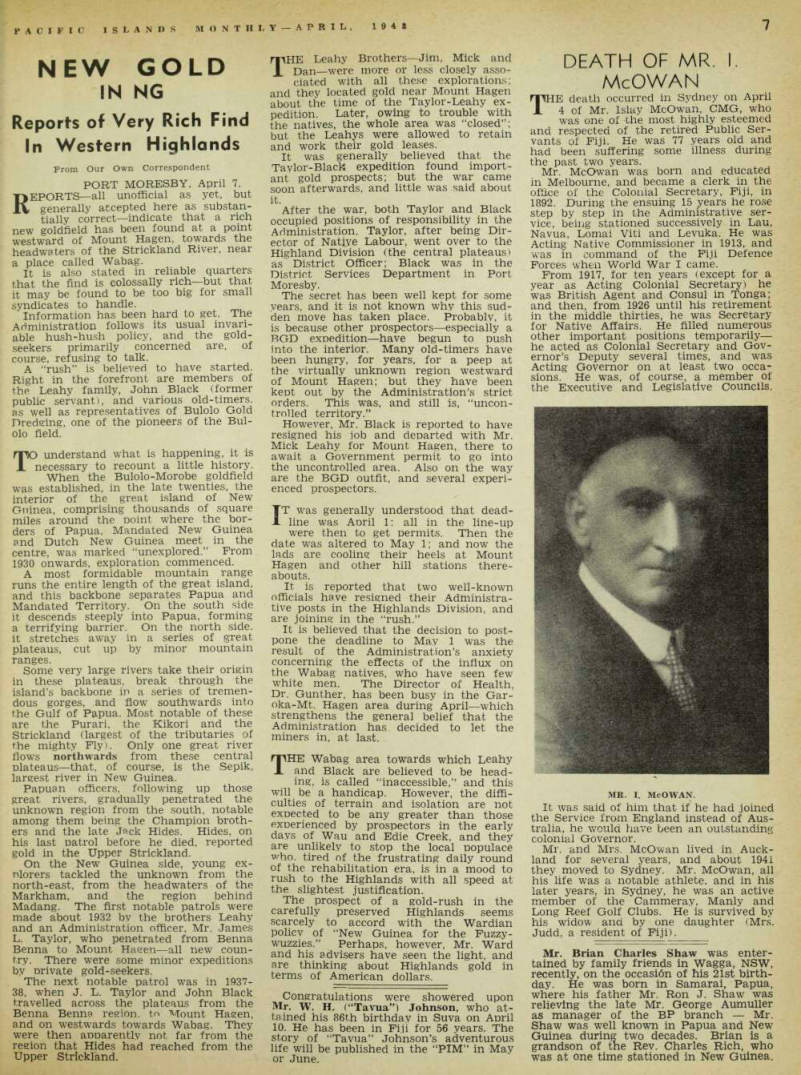
Mr. I. Mcowan.
Planters Alleged
Exploitation of Fijian Planters Alleged Fijian "Copra Ventures"
May Be Answer
From Our Own Correspondent SUVA, March 30.
FLAGRANT exploitation of Fijian
copra-growers by traders (mostly Chinese storekeepers) in some of the outer islands of the group, where there are no alternative buyers, is alleged by correspondents who have written to the local press.
In some cases copra is said to have been bought at £2B a ton—nearly £2O under the present official price in Fiji— and one writer states that there have
been cases in recent months where the price has been as low as £lO.
The only remedy suggested is for one or other of the big firms to arrange for a hawker-licensed auxiliary vessel to serve the outer islands, selling goods and buy ing copra.
Incidentally, there has been a chorus of praise for the Government-sponsored and Fijian-organised and controlled Bua Copra Venture, which was started last year to encourage production and to eli minate middleman profits (a very sore point with the Fijians) by dealing direct with the Copra Board. The plan is a complete success in every way—a fact which is responsible for the new Macuata Copra Venture.
Ng Women's Club Of
Sydney
'THE New Guinea Women’s Club of Sydney will hold an American Tea (“bring a gift and buy a gift”) in the Feminist Club Rooms, 77 King Street, on May 14. Proceeds will go to wards club funds. During the evening, musical items will be given by guest-artists and supper will be available.
Misima Gold
Cuthbert's Mine Resumes Production
ALTHOUGH the directors of Cuth bert’s Misima Goldmine Ltd., in Eastern Papua, tried to resume operations in .1947, they encountered the almost insuperable difficulties inherent in the Wardist regime—shortage of labour and absence of sea transport—and they won no gold. But by the end of Decem ber, they had managed to obtain 100 native labourers, and they now are run ning their rich goldmine on about 50 per cent, of pre-war operations. Share holders should get back into the money at the end of 1948, after a five years’ interregnum.
On the same island (Misima) Gold Mines of Papua have surprisingly re sumed operations, in the belief that they can get onto the Cuthbert lode, or some where near it. When the Mount Sisa Company got an injection of the powerful Pratten capital, and became GMOP, in the early thirties, the experts were con fident they were on the good lode, and GMOP 5/- shares went to 15/-. When they found they were on a dud, there was a collapse and shares fell to one penny, nominal. Now the shares are moving again—the latest quote is 6d.
Service
ANA Out of Pacific Service But Plan New Overseas Routes
FROM April 21, British Commonwealth Pacific Airlines will operate the trans-Pacific service which has until now, been conducted, on their behalf, by Australian National Airways Pty., Ltd.
Australian National Airways, however, plan to conduct other overseas air ser vices. They have already applied for permits to conduct a service to London via New York and Mexico City. This, they claim, would earn valuable dollars for Australia. The Australian Govern ment, however, whose policy is the nationalisation of all air services, has not as yet approved the company’s plans.
When the general manager of ANA returned to Australia from the United States recently, he said that his company planned to operate an overseas service under a foreign flag if they cannot get permission from the Australian Govern ment to operate on their own behalf. If this course is necessary they would begin operations “fairly soon.”
Noumea-Tahiti Air Service
Suspended
AS a result of the damage done to its equipment in the Noumea cyclone, the French airline TRAPAS has been forced to suspend its regular service between New Caledonia and Tahiti, inaugurated only three months ago.
One plane was destroyed and another badly damaged. It may be possible to resume the service about September next.
April 15 was the 80th birthday of Mr.
Percy Morris, of Bellevue Hill, Sydney, one of the founders of Morris, Hedstrom Ltd. He is remarkably well and cheerful.
The other founder of the big firm, Sir Maynard Hedstrom, now in his seventies, was in Sydney .in mid-April, after a pleasant holiday spent in Tasmania with Lady Hedstrom.
"Matua" Passengers
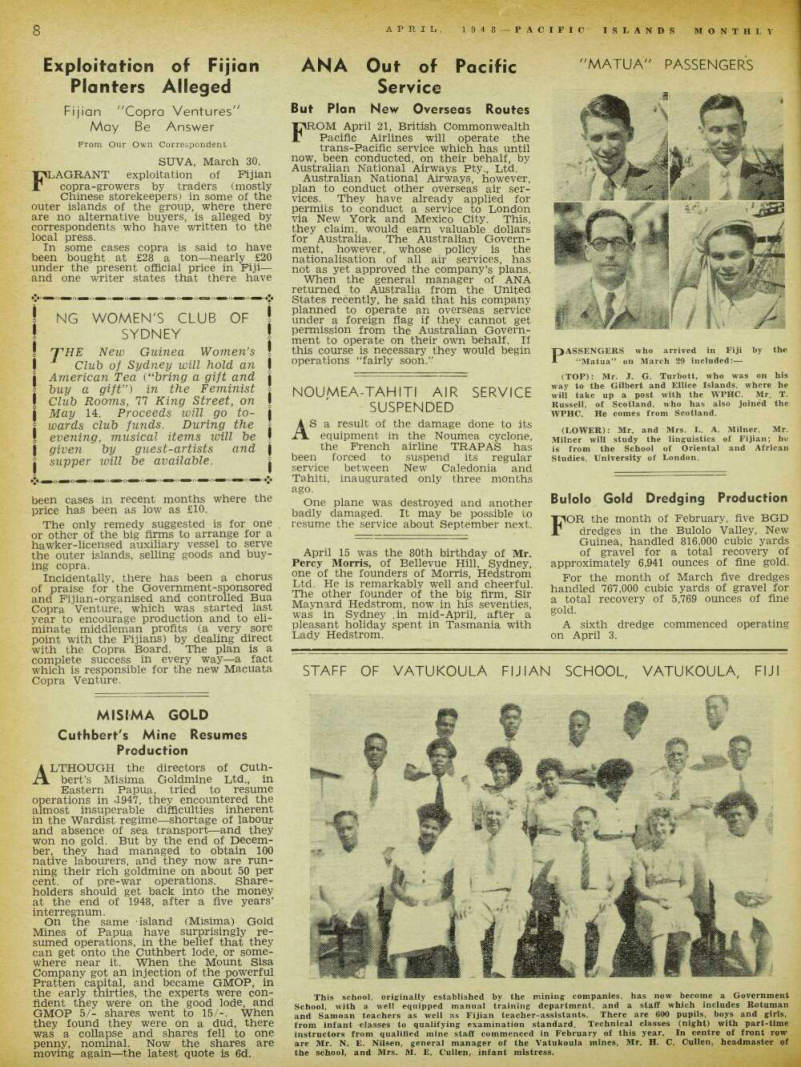
PASSENGERS who arrived in Fiji by the “Matua” on March 29 included :— (TOP): Mr. J. G. Turbott, who was on his way to the Gilbert and Ellice Islands, where he will take up a post with the WPHC. Mr. T.
Russell, of Scotland, who has also joined the WPHC. He comes from Scotland. (LOWER): Mr. and Mrs. L. A. Milner. Mr.
Milner will study the linguistics of Fijian; he is from the School of Oriental and African Studies, University of London.
BuSolo Gold Dredging Production
FOR the month of February, five BGD dredges in the Bulolo Valley, New Guinea, handled 816,000 cubic yards of gravel for a total recovery of approximately 6,941 ounces of fine gold.
For the month of March five dredges handled 767,000 cubic yards of gravel for a total recovery of 5,769 ounces of fine gold.
A sixth dredge commenced operating on April 3.
Staff Of Vatukoula Fijian School, Vatukoula, Fiji
This school, originally established by the mining companies, has now become a Government School, with a well equipped manual training department, and a staff which includes Rotuman and Samoan teachers as well as Fijian teacher-assistants. There are 600 pupils, boys and girls, from infant classes to qualifying examination standard. Technical classes (night) with part-time instructors from qualified mine staff commenced in February of this year. In centre of front row are Mr. N. E. Nilsen, general manager of the Vatukoula mines, Mr. H. C. Cullen, headmaster of the school, and Mrs. M. E. Cullen, infant mistress.
Papain
America Interested In This Product
AN article on the possibility of estab lishing the Papain industry in the South Pacific Islands was published .in the “PIM” in March. It was an nounced that a sound industry had been established in East Africa, based on the American demand for the latex of the pawpaw tree.
We wrote to a firm in San Francisco, the Pacific Islands Trading Company, conducted by Mr. A. G. Andrews; and we asked about the reported American de mand. Was Papain really wanted by American manufacturers?
Mr. Andrews replied by radiogram, ad vising us that American manufacturers are keenly interested in securing supplies, and giving us details about the methods of obtaining Papain. He urged Pacific planters to interest themselves in this product. An advertisement arranged by Mr. Andrews appears in this issue.
We have sent all the above details to the Directors of Agriculture in Fiji and New Guinea. We understand that the Latex is worth from 25/- to 30/- Australian per pound.
Australian Socialists
And New Guinea Copra Price
DESPITE the stimulus of the highest average price in the history of the coconut planting industry, the pro duction of copra in New Guinea and Papua this year is not expected to exceed 40,000 tons.
The best production recorded in one year in New Guinea before the war was 86,000 tons, while Papua usually could be depended on for 10,000 or 12,000 tons— say, 100,000 tons per annum, altogether.
The difference between then and now is directly attributable to Socialistic in terference by the Australian Government in the economy of the two Territories.
The native labour set-up has been torn to pieces by Mr. Ward, making labour in adequate and undependable: all sea trans port is Government-controlled, so that it also is inadequate and undependable; while the Government-controlled Produc tion Control Board, which buys all copra at a fixed price, contributes nothing to the industry in the way of efficiency, encouragement or direct help.
Although the prices being paid by the Socialists to the New Guinea planters are much below world parity, it is reported that the latest official plan is to make a difference of £3 per ton between hot-air and sun-dried copra—not by raising the price of the hot-air product, but by ie ducing the rates for sun-dried.
Yet all the sun-dried that New Guinea can produce can be sold immediately on the world market to-day for anything from £lO to £2O per ton more than the Australian Government is now reluctantly paying for hot-air-dried.
Rev. Father Jullien Droneau, MSC, is in Sydney, receiving medical attention, after 37 years’ continuous service on the atoll of Maiana, in the Gilbert Islands. He suffered privations and great loneliness during the Jap occupation, but the Jap anese did not harm him—which he ascribes to his age and his large, white beard. He is eager to return to Maiana, but he probably will be sent home to France to recuperate.
Manus Is Normal
Action Follows Sensational Reports In Australian Press
THE sensational stories which were published in the Australian press in March, concerning an alleged Chinese uprising in Manus (New Guinea), appear to have had little basis in fact.
It was stated that 300 of the Chinese employed in dismantling ana packing US Navy stores and installations, had dug themselves in in a defensive perimeter, complete with machine-gun posts, tommy-gun, etc., and were defying the Australian Administration.
After this account had been published in Australian, a party left Port Moresby for Manus by air. The party consisted of Police Superintendent Grimshaw, three European police officers and 46 native police. They were equipped with rifles, tommy-guns, and 2,000 rounds of am munition.
On his return to Fort Moresby, some days later, Superintendent Grimshaw said that conditions on Manus were normal. Natives had made complaints against certain Chinese who allegedly had assaulted some native women. The Chinese had challenged the authority of Australian officials to interfere in the matter.
During his visit, Superintendent Grim shaw said, the Chinese had been as sembled in an identification parade. Two of them were subsequently arrested and charged with assaulting natives.
Bishop Kempthorne's Silver
Jubilee
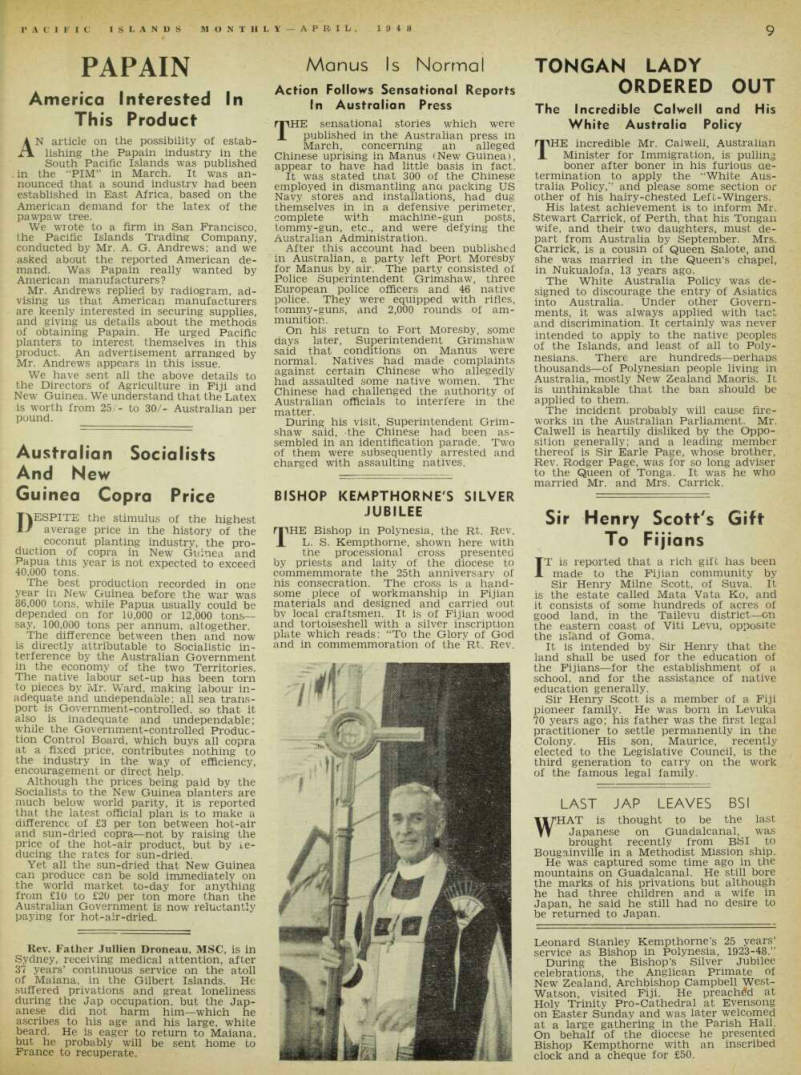
THE Bishop in Polynesia, the Rt. Rev.
L. S. Kempthorne, shown here with the processional cross presented by priests and laity of the diocese to commemmorate the 25th anniversarv of his consecration. The cross is a hand some piece of workmanship in Fijian materials and designed and carried out by local craftsmen. It is of Fijian wood and tortoiseshell with a silver inscription plate which reads: “To the Glory of God and in commemmoration of the Rt. Rev.
Leonard Stanley Kempthorne’s 25 years’ service as Bishop in Polynesia, 1923-48.”
During the Bishop’s Silver jubilee celebrations, the Anglican Primate of New Zealand, Archbishop Campbell West- Watson, visited Fiji. He preached at Holy Trinity Pro-Cathedral at Evensong on Easter Sunday and was later welcomed at a large gathering in the Parish Hall.
On behalf of the diocese he presented Bishop Kempthorne with an inscribed clock and a cheque for £5O.
Ordered Out
Tongan Lady
The Incredible Colwell and His White Australia Policy
THE incredible Mr. Calwell, Australian Minister for Immigration, is pulling boner after boner in his furious de termination to apply the “White Aus tralia Policy,” and please some section or other of his hairy-chested Left-Wingers.
His latest achievement is to inform Mr.
Stewart Garrick, of Perth, that his Tongan wife, and their two daughters, must de part from Australia by September. Mrs.
Garrick, is a cousin of Queen Salote, and she was married in the Queen’s chapel, in Nukualofa, 13 years ago.
The White Australia Policy was de signed to discourage the entry of Asiatics into Australia. Under other Govern ments, it was always applied with tact and discrimination. It certainly was never intended to apply to the native peoples of the Islands, and least of all to Poly nesians. There are hundreds —perhaps thousands —of Polynesian people living in Australia, mostly New Zealand Maoris. It is unthinkable that the ban should be applied to them.
The incident probably will cause fire works in the Australian Parliament. Mr.
Calwell is heartily disliked by the Oppo sition generally: and a leading member thereof is Sir Earle Page, whose brother, Rev. Rodger Page, was for so long adviser to the Queen of Tonga. It was he who married Mr. and Mrs. Garrick.
To Fijians
Sir Henry Scott's Gift To Fijians
IT is reported that a rich gift has been made to the Fijian community by Sir Henry Milne Scott, of Suva. It is the estate called Mata Vata Ko, and it consists of some hundreds of acres of good land, in the Tailevu district—on the eastern coast of Viti Levu, opposite the island of Goma.
It is intended by Sir Henry that the land shall be used for the education of the Fijians—for the establishment of a school, and for the assistance of native education generally.
Sir Henry Scott is a member of a Fiji pioneer family. He was born in Levuka 70 years ago; his father was the first legal practitioner to settle permanently in the Colony. His son, Maurice, recently elected to the Legislative Council, is the third generation to carry on the work of the famous legal family.
Last Jap Leaves Bsi
WHAT is thought to be the last Japanese on Guadalcanal, was brought recently from BSI to Bougainville in a Methodist Mission ship.
He was captured some time ago in the mountains on Guadalcanal. He still bore the marks of his privations but although he had three children and a wife in Japan, he said he still had no desire to be returned to Japan.
Australia to Tahiti
Flying-Boats Run Special Trips
PAPEETE, April 4.
C CARRYING a London Films production ) unit, which is preparing to film the story, “The Marriage of Loti,” a Trans-Oceanic flying-boat, under Captain Brian Monckton, arrived here on April 2, from Sydney, via Noumea and Fiji, and was warmly greeted by the populace.
This was the first plane to come in here flying the Australian flag. Passen gers and crew were lavishly decorated with leis.
The Governor, M. Pierre Maestracci, gave a special dinner in honour of the visitors, and most of our leading citizens were present.
Trans Oceanic Airways are anxious to get permission to run from Sydney to Tahiti, via New Caledonia, Fiji and Samoa, with parties of tourists; but the Governor told Captain Monckton that, while special charter trips were in order, and an occasional tourist trip allowed, generally the policy of the Administration was to reserve the air business of French Oceania for French airlines, such as
Trap As.
It is not expected that any such pro tection of airlines is practicable, however.
Parties of tourists, from United States, Australia, and elsewhere, are anxious to visit Tahiti, and may be expected to travel in whatever air and sea craft are available.
The people of Tahiti are anxious to see the Australian planes coming here frequently. Trans Oceanic should take the matter up with the French authorities in Paris.
Trans Oceanic will run another charter trip, Sydney-Tahiti, in April, and a tourist trip in May.
EDITORIAL NOTE: Trans Oceanic are under the disadvantage that, in order to discuss this matter with Paris, they must work through the Australian Government.
And the policy of the Socialist Govern ments of Australia and France is to en courage State-owned lines and knock back private enterprise. Trans Oceanic, for example, are prepared to supply the Pacific Islands with services which are most valuable, in the continued absence of shipping. But they can get no licenses for regular schedules the fana tical Australian Government gives licenses only to Government-owned lines.
Tahiti Chinese Return
To China
PAPEETE, March 27.
A REMARKABLE number of Chinese are leaving French Oceania. The “Ville de Strasbourg” sailed to-day for France, via Hongkong and Indo china, carrying 206 Chinese, 130 Anna mite and 70 European passengers, and loaded to capacity with the produce ot Oceania. The Chinese are returning to China, and the Annamites to Annam.
The “Sagittaire,” due here in April, also will go to France via Hongkong, with an other large party of Chinese who are returning to their homeland after many years in Tahiti.
The Australian diver, Mr. J. E. John stone, who was one of those who re covered £2,397,000 worth of gold from the sunken “Niagara” in 1941-42 says that the remaining £150,000 worth will have to remain there until the present high cost of salvage has been reduced.
The “Niagara” was sunk by a mine off the Hen and Chickens (north of Auck land) early in the war. She was carry ing between two and three million pounds’ worth of bullion to USA.
Governor And
Crew
Peculiar Incident When "Matua"
Berthed at Suva
AN incident which gave the Governor of Fiji, Sir Brian Freestone, much annoyance, and is typical of the dis orderliness of the times, occurred in Suva at the end of March.
The “Matua” arrived in port, on her way to Tonga and Samoa, and aboard was Dame Salote, Queen of Tonga, returning to Nukualofa from her New Zealand holi day. The Governor wished to go aboard to formally greet the head of the Tongan kingdom; but he was turned away at the gangway.
Because of the infantile paralysis re strictions in New Zealand, the Fiji health authorities still enforce quarantine on ships from that country—although they long have been more honoured in the breach than the observance, and are gen erally condemned.
Fiji passengers arriving on ships from NZ are allowed ashore on condition that they report daily; but other passengers, and crews, cannot land.
When the Governor arrived, he was met at the gangway by the captain and in formed that the crew had decided that, if he came aboard, they would insist on going ashore. The Governor protested that he intended to strictly comply with quarantine regulations—he would report daily to the port doctor.
This was conveyed to the members of the crew: but those arrogant gentlemen would not alter their decision: If His Ex cellency came aboard, they would go ashore.
The attitude of the crew was stupid and unreasonable: and the Governor would have been quite justified in insist ing on his right to go aboard. But it might have led to serious trouble between crew and health officials; so the Gov ernor, rather than embarrass the captain, went away.
Papua-N.Guinea
The New Constitution
THE Bill to authorise a united Admin istration in Papua-New Guinea is expected to come before the Aus tralian Parliament during the present session, and should soon become law. It will establish and make permanent the present administrative system.
The Bill may have some surprises. It may provide for a Legislative Council for Europeans, for example. This is not ex pected; but Minister Ward seems deter mined to incorporate some sort of repre sentative chamber for natives in the new constitution. And how can he do this, while withholding some sort of repre sentation from Europeans?
The Bill has been giving the draughts men some headaches. It is not easy to amalgamate the administration of two Territories, one of which is simply an Australian Territory, and the other is held under a Trusteeship Agreement from the now half-moribund United Nations.
Mr. Reg Eginton, the active and popular manager of the two Port Moresby hotels, accompanied by Mrs. Eginton and daughter, Coleen, arrived in Sydney on leave in March. Mrs. Eginton came suc cessfully through a rather severe opera tion at Gloucester House at the end of March. The family expect to return to Moresby in May.
A Verdict Quashed
Papeete, Feb. 10.
THE former Governor of French Oceania, M. J. C. Haumant, left by the “Wairuna” at the end of Janu ary, for France, via Canada.
Before his departure, an Appeal Court quashed a verdict that was given against M. Robert Charon, last year, under which M. Charon was ordered to pay 3,000 francs for alleged defamation of Governor Haumant. M. Charon was en tirely exonerated. M. Charon is a veteran of World War I, and is personally popu lar here, and he holds the office of Con sul for Norway.
Airways Passengers To
Papua-Ng
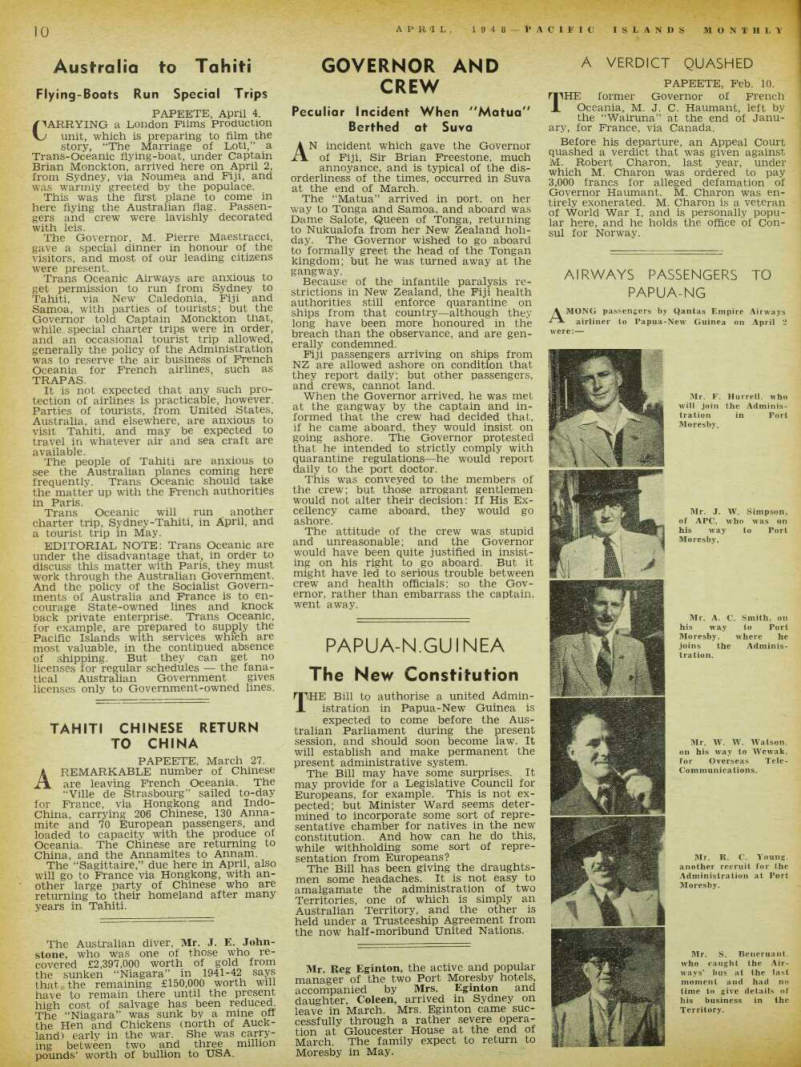
AMONG passengers by Qantas Empire Airways airliner to Papua-New Guinea on April 2 were:—
Mr. F. Hurrell, who will join the Adminis tration in Port Moresby.
Mr. J. W. Simpson, of APC, who was on his way to Port Moresby.
Mr. A. C. Smith, on his way to Port Moresby. where he joins the Adminis tration.
Mr. W. W. Watson, on his way to Wewak, for Overseas Tele communications.
Mr. R. C. Young, another recruit for the Administration at Port Moresby.
Mr. S. Beneruant, who caught the Air ways’ bus at the last moment and had no time to give details of his business in the Territory.
Across Pacific
No Passenger Ships
Withdrawal of "Marine Phoenix"
FOR the first time in generations there will be no regular sea passenger ser vice between Australia and New Zealand and the Pacific coast of North America after the “Marine Phoenix” com pletes her present voyage at San Fran cisco. She leaves Sydney on April 16.
The “Marine Phoenix” has been under charter to the Matson Line from the US Maritime Commission and it is under stood that on the ten trips she has under taken between Australia and San Fran cisco she has lost over £A92,000. “Marine Phoenix” has passenger accommodation for 500, but no cargo space.
When the Matson Line announced that the “Marine Phoenix” would be with drawn, they stated also that the pre-war trans-Pacific ships “Mariposa” and •Monterey,” which were to have come back on the Pacific run after refitting, would now be -sold. Refitting work stopped suddenly last year on these ves sels when increased wages and costs in dicated to the company that the recon version of the ships for the Pacific trade would be uneconomical.
The Union Steamships Company liner “Aorangi” which has been refitting in Sydney for the last two years will, it is hoped, be back on the run later this year.
July or August was the last date men tioned.
Dollar restrictions in Australia and New Zealand have contributed to the costli ness of running passenger traffic across the Pacific.
It is understood that Australia is anxi ous for the “Marine Phoenix” to con tinue her service, but will not con sider paying the Company a subsidy. The ship will therefore be withdrawn unless the Australian and US Governments act as the last moment.
Then And Now A Contrast
117'HAT a dismal picture for this year ff of grace 1948!
Back in 1914, before World War I, the Pacific Territories were better served by trans-Pacific lines than at any time since.
Then, 35 years ago, there was a British line running from Australia to Vancouver, via NZ, Fiji and Hawaii; another run ning via NZ, Cook Islands and Tahiti to San Francisco. An American line ran from Australia to San Francisco, via NZ, Fiji and Hawaii.
A British line used three or four large modern steamers in a service which con nected Sydney with Auckland, via Fiji, Tonga and Samoa. German and French lines criss-crossed the Pacific in all directions.
Fares were low, cargo rates were low, and in all the Islands Territories there were indications of development and pro gress, which benefited all classes, natives included.
Between the Wars, the shipping lines were only partly restored. Never, between 1920 and 1940, did Pacific dwellers enjoy the communications they experienced prior to 1914.
To-day, apart from the stir caused by the excessive nrice of coora, there is general stagnation, the result of Socialist administration and frustration.
There is now not one regular line of passenger ships crossing South Pacific.
Travellers who can afford it go by air, at excessive cost. The great majority simply stay at home.
Mr. K. N. Allen, of 89 Mimi Street, Oatley, NSW, is an amateur stamo col lector and is seeking correspondents in the Pacific with whom he can exchange low-value stamps, first-dav covers, etc.
Nearly Complete!
Airport Commission's Deliberations In Fiji
Prom Our Own Correspondent SUVA. March 31.
TIHE Commission appointed to investi gate and make recommendations on a site for an international airport has completed its deliberations and some of its members have already left the Colony.
The Commission’s report, which is now being completed, will be submitted to the four Governments concerned —Australia, New Zealand, United Kingdom and Fiji, and no announcement can be made until these Governments have accepted the re port and agree that a decision can be made known.
As the Commission was required to con sider Nadi or Nausori, or any other pos sible solution which would result in over all economy, it was necessary to investi gate thirteen possibilities in Fiji and one in Tonga. Housing, staff requirements, social, economic and administrative as pects were all considered, and opera tional, engineering and meteorological in formation was checked.
After many delays, the NZNAC flying boat “Mataatua,” which was damaged in a mishap at Labasa, Fiji, in February, went back on the Auckland-Suva run on March 31.
Queensland Cyclone
"Ruena" Beached After Queensland Cyclone
AFTER barely a year in the service of her owners, the Fairymead Sugar Co., Ltd., the 100-ton motor vessel “Ruena” now lies beached near Double Island on the North Queensland coast. was caught in the pre-Easter cyclone which did extensive damage to the Queensland and Northern NSW coastal areas.
The vessel was purchased in Newcastle by the owners and refitted in Sydney for tropical conditions. She carried about 100 tons of cargo and when she was put into commission about a year ago began running supplies between Sydney and the company’s properties in the British Solomon Islands, via Bunda berg, Queensland. .
“Ruena” has been one of the few ship ping links between Australia and BSI ports and has on several occasions carried Solomons planters back to the Protectorate. She left Sydney on March 19.
On March 23, when the “Ruena’s” plight first became known, her master, Captain Arthurson, radioed that there
were several feet of water in her engine-room and that he was having a great battle to keep the vessel afloat. He finally beached her near Double Island on March 26 and the crew swam ashore through a terrific sea. They were finally rescued from the mainland —3 Europeans and 9 Solomon Islanders.
On March 31. the Sydney office of the company reported that “Ruena” was resting on sand, that the cargo was be ing salvaged and that it was expected that the vessel would be refloated. There appeared to be no great damage to the hull, although most of the superstructure had been carried away.
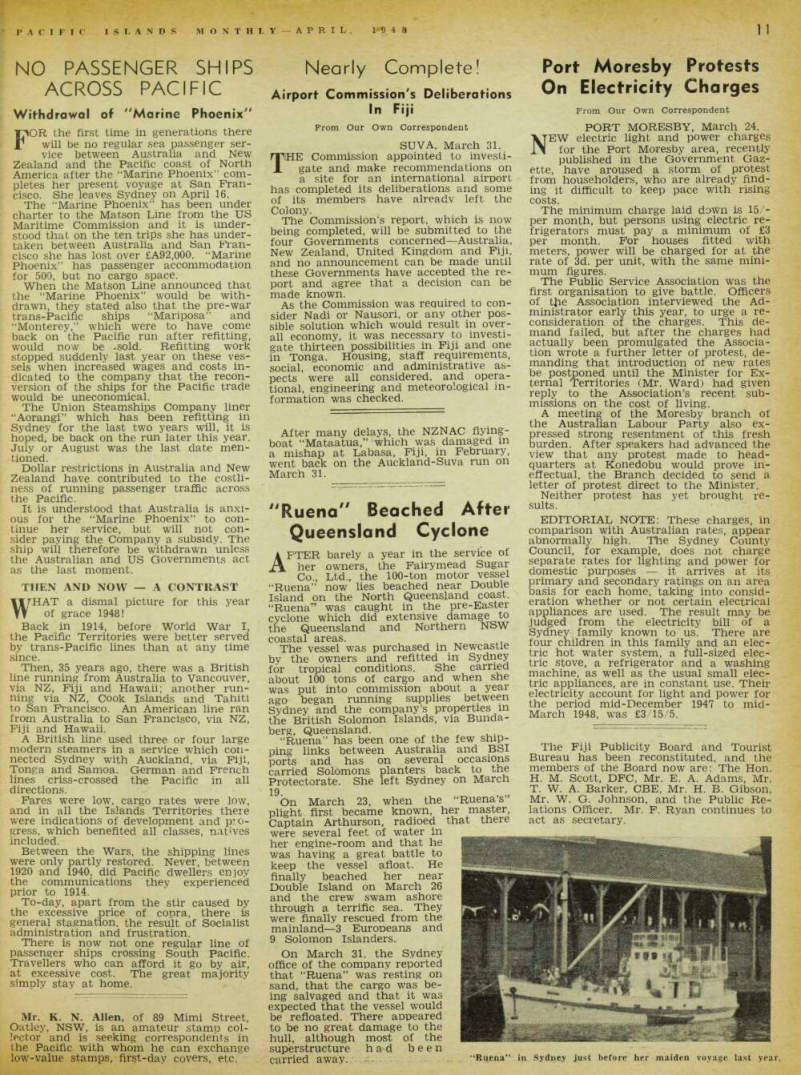
"Ruena" in Sydney just before her maiden voyage last year.
On Electricity Charges
Port Moresby Protests On Electricity Charges
From Our Own Correspondent
Port Moresby, March 24.
NEW electric light and power charges for the Port Moresby area, recently published in the Government Gaz ette, have aroused a storm of protest from householders, who are already find ing it difficult to keep pace with rising The minimum charge laid down is 15/per month, but persons using electric re frigerators must pay a minimum of £3 per month. For houses fitted with meters, power will be charged for at the rate of 3d. per unit, with the same mini mum figures.
The Public Service Association was the first organisation to give battle. Officers of tjie Association interviewed the Ad ministrator early this year, to urge a re consideration of the charges. This de mand failed, but after the charges had actually been promulgated the Associa tion wrote a further letter of protest, de manding that introduction of new rates be postponed until the Minister for Ex ternal Territories (Mr. Ward) had given reply to the Association’s recent sub missions on the cost of living.
A meeting of the Moresby branch of the Australian Labour Party also ex pressed strong resentment of this fresh burden. After speakers had advanced the view that any protest made to head quarters at Konedobu would prove in effectual. the Branch decided to send a letter of protest direct to the Minister.
Neither protest has yet brought re sults.
EDITORIAL NOTE: These charges, in comparison with Australian rates, appear abnormally high. The Sydney County Council, for example, does not charge separate rates for lighting and power for domestic purposes it arrives at its primary and secondary ratings on an area basis for each home, taking into consid eration whether or not certain electrical appliances are used. The result may be judged from the electricity bill of a Sydney family known to us. There are four children in this family and an elec tric hot water svstem, a full-sized elec tric stove, a refrigerator and a washing machine, as well as the usual small elec tric appliances, are in constant use. Their electricity account for light and power for the period mid-December 1947 to mid- March 1948, was £3/15/5.
The Fiji Publicity Board and Tourist Bureau has been reconstituted, and the members of the Board now are: The Hon.
H. M. Scott, DFC, Mr. E. A. Adams, Mr.
T. W. A. Barker, CBE, Mr. H. B. Gibson, Mr. W. G. Johnson, and the Public Re lations Officer. Mr. F. Ryan continues to act as secretary.
Advertisements & other items, p. 14 (1 item)
Morris Hedstrom Limited
General Merchants, Importers and Exporters,
Shipowners, Plantation Owners,
Commission and Insurance Agents
HEAD OFFICE
SUVA, FIJI
Established 1868
SERVICE IN THE SOUTH PACIFIC TERRITORIES
'J’HROUGH our Large Establishments in Suva and our Numerous Branches, we distribute a wide and comprehensive range of General Merchandise and provide almost every kind of service. Our departments and associated businesses include:
DRAPERY
MOTOR SALES
AND SERVICE
TOBACCO
TIMBER AND
BUILDING
GROCERY
CONFECTIONERY
HARDWARE
ELECTRICAL
LIQUORS
DRUGS
Branches Throughout Fiji, Samoa and Tonga
There is a Branch or Agent of Morris Hedstrom Limited in every Town in the Three Territories.
We are Sole Agents in these Territories for British Drug Houses Ltd.
Electrolux Ltd.
Ford Motor Co.
General Electric Co. Ltd.
Goodyear Tyre £r Rubber Co.
B. A. Hjorth & Co. (Primus Products) Max Factor and Co. Inc.
Ransomes, Sims £r Jefferies Ltd.
Imperial Chemical Industries Ltd. Ruston £r Hornsby Ltd.
International Harvester Export Co. Vacuum Oil Co. Pty. Ltd.
Matson Navigation Company Yorkshire Copper Works Ltd.
Morris Hedstrom Limited, are LLOYD'S AGENTS in Fiji and Samoa.
IN AUSTRALIA:
Morris Hedstrom (Aust.) Pty. Ltd.,
Asbestos House, 65 York Street, SYDNEY
IN GREAT BRITAIN:
Morris Hedstrom Limited,
Africa House, Kingsway, LONDON
Heavy Cyclone
Noumea Damaged in Heavy Cyclone Worst Blow Since 1933
From a Special Correspondent NOUMEA. March 20.
SINCE April, 1933, Noumea has not known the full effects of a cyclone, but on Sunday, March 14, the run of good luck was broken. After several days of oppressive weather, the wind from the East in the early hours of Sunday
morning developed gale force.
Later it veered to the north and finally, in the afternoon, reached the west, where it reached its peak velocity of about 150 kilometres per hour. A west wind in New Caledonia always means trouble.
The damage on land and sea was great. At least eight houses in and around Nou mea were demolished com pletely. The roofs were torn off dozens of others and practically every building was damaged in some way.
It is estimated that over 3,000 sheets of iron will be needed to effect repairs.
Trees and palms in town streets and gardens were up rooted and most streets were impassable, due to tree debris and fallen electricity wires.
In the usually calm har bour the waves ran feet high.
At least a dozen inter-island boats were washed ashore; about ten were sunk at their moorings and several left, of their own accord, for the high seas. Their owners are still looking for them.
The French Navy was a heavy loser. Three of their big 40-ft. patrol boats stove in and sank. Barges broke loose and went on a ram page, which added to the confusion, several boats being sunk in collision with Ameri can caisson-type barges. The loss in the harbour of Nou mea alone runs into over a million francs.
No news is yet to hand of the coastal service boats “Rosalie” and “Phoque,” but it is assumed that they found shelter in coastal ports.
The French aviation company. Trapas, was struck a heavy blow when their two Catalina-type planes were struck at Magenta airport. One plane was com pletely destroyed and the other badly damaged.
At Tontouta international aerodrome damage was heavy. Radio installations were demolished and as a result, no planes will be able to land there for probably two weeks. Passengers from Sydney for Noumea aboard Sunday’s clipper were carried on to Fiji.
NO news is yet to hand from country districts, but as the disturbance covered a good area of the island it is thought that damage is likely to be extensive. The nickel centre of Thio, on the east coast, is known to have been badly hit. No news has been received from the Loyalty islands and it is feared that damage has been extensive there also.
One woman lost her life during the storm. She was carrying her child to
safety when she was struck by a truck and killed. Many suffered slight in juries and others had miraculous escapes.
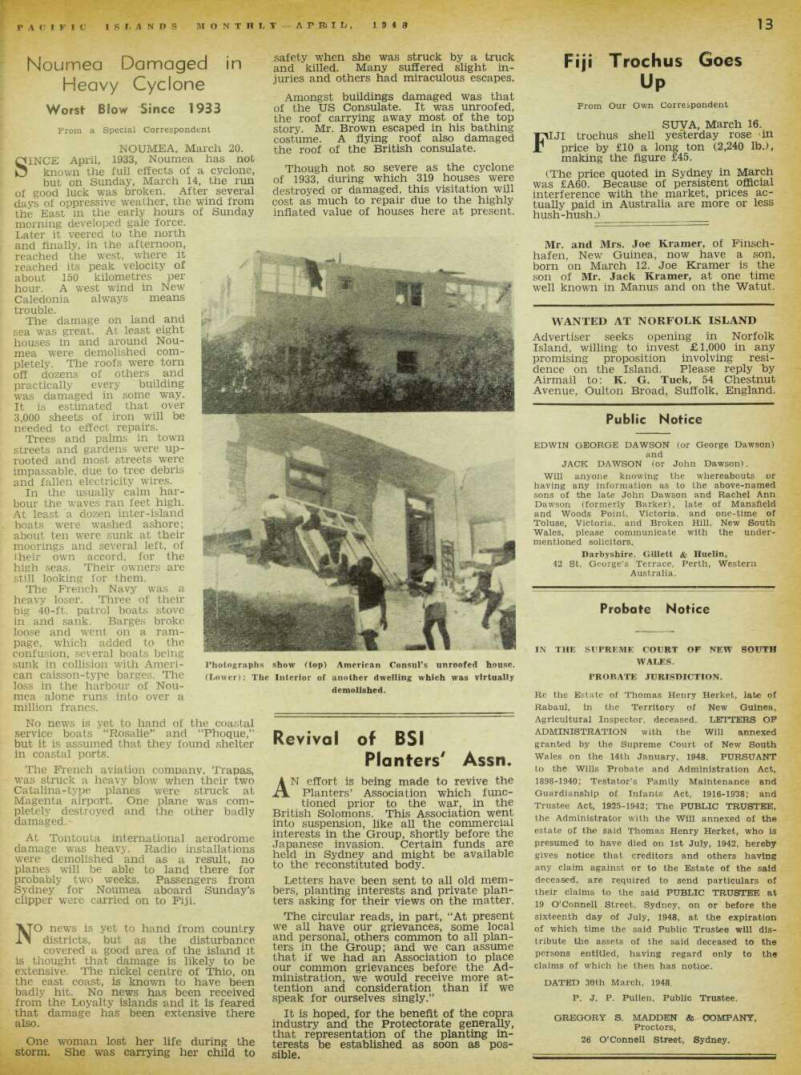
Amongst buildings damaged was that of the US Consulate. It was unroofed, the roof carrying away most of the top story. Mr. Brown escaped in his bathing costume. A flying roof also damaged the roof of the British consulate.
Though not so severe as the cyclone of 1933, during which 319 houses were destroyed or damaged, this visitation will cost as much to repair due to the highly inflated value of houses here at present.
Photographs show (top) American Consul’s unroofed house. (Lower): The Interior of another dwelling which was virtually demolished.
Planters' Assn.
Revival of BSI Planters' Assn.
AN effort is being made to revive the Planters’ Association which func tioned prior to the war. in the British Solomons. This Association went into suspension, like all the commercial interests in the Group, shortly before the Japanese invasion. Certain funds are held in Sydney and might be available to the reconstituted body.
Letters have been sent to all old mem bers, planting interests and private plan ters asking for their views on the matter.
The circular reads, in part, “At present we all have our grievances, some local and personal, others common to all plan ters in the Group; and we can assume that if we had an Association to place our common grievances before the Ad ministration, we would receive more at tention and consideration than if we speak for ourselves singly.”
It is hoped, for the benefit of the copra industry and the Protectorate generally, that representation of the planting in terests be established as soon as pos sible.
Fiji Trochus Goes
Up
From Our Own Correspondent SUVA, March 16.
FIJI trochus shell yesterday rose in price by £lO a long ton (2,240 lb.), making the figure £45, (The price quoted in Sydney in March was £A6O. Because of persistent official interference with the market, prices ac tually paid in Australia are more or less hush-hush.) Mr. and Mrs. Joe Kramer, of Finsch hafen, New Guinea, now have a son, born on March 12. Joe Kramer is the son of Mr. Jack Kramer, at one time well known in Manus and on the Watut.
Advertisements & other items, pp. 15-16 (3 items)
13
PACIFIC I R L A N D S MONTHLY APRIIL, 1948
Probate Notice
WANTED AT NORFOLK ISLAND
Advertiser seeks opening in Norfolk Island, willing to invest £l,OOO in any
promising proposition involving resi-
dence on the Island. Please reply by Airmail to: K. G. Tuck, 54 Chestnut
Avenue, Oulton Broad, Suffolk, England.
Public NoHce
EDWIN GEORGE DAWSON (or George Dawson) and JACK DAWSON (or John Dawson), Will anyone knowing the whereabouts or having any information as to the above-named sons of the late John Dawson and Rachel Ann Dawson (formerly Barker), late of Mansfield and Woods Point, Victoria, and one-time of Toluse, Victoria, and Broken Hill, New South Wales, please communicate with the undermentioned solicitors.
Darbyshire, Gillett & Huelin, 42 St. George’s Terrace, Perth, Western Australia.
Probate Notice
IN THE SUPREME COURT OF NEW SOUTH
WALES.
PROBATE JURISDICTION.
Re the Estate of Thomas Henry Herket, late of Rabaul, in the Territory of New Guinea, Agricultural Inspector, deceased. LETTERS OP ADMINISTRATION with the Will annexed granted by the Supreme Court of New South Wales on the 14th January, 1948. PURSUANT to the Wills Probate and Administration Act, 1898-1940; Testator’s Family Maintenance and Guardianship of Infants Act, igie-IS’SS; and Trustee Act, 1925-1942; The PUBLIC TRUSTEE, the Administrator with the Will annexed of the estate of the said Thomas Henry Herket, who is presumed to have died on Ist July, 1942, hereby gives notice that creditors and others having any claim against or to the Estate of the said deceased, are required to send particulars of their claims to the said PUBLIC TRUSTEE at 19 O’Connell Street, Sydney, on or before the sixteenth day of July, 1948, at the expiration of which time the said Public Trustee will distribute the assets of the said deceased to the persons entitled, having regard only to the claims of which he then has notice.
DATED 30th March, 1948.
P. J. P. Pullen, Public Trustee.
GREGORY S. MADDEN & COMPANY,
Proctors, 26 O’Connell Street, Sydney.
I* 5« TO
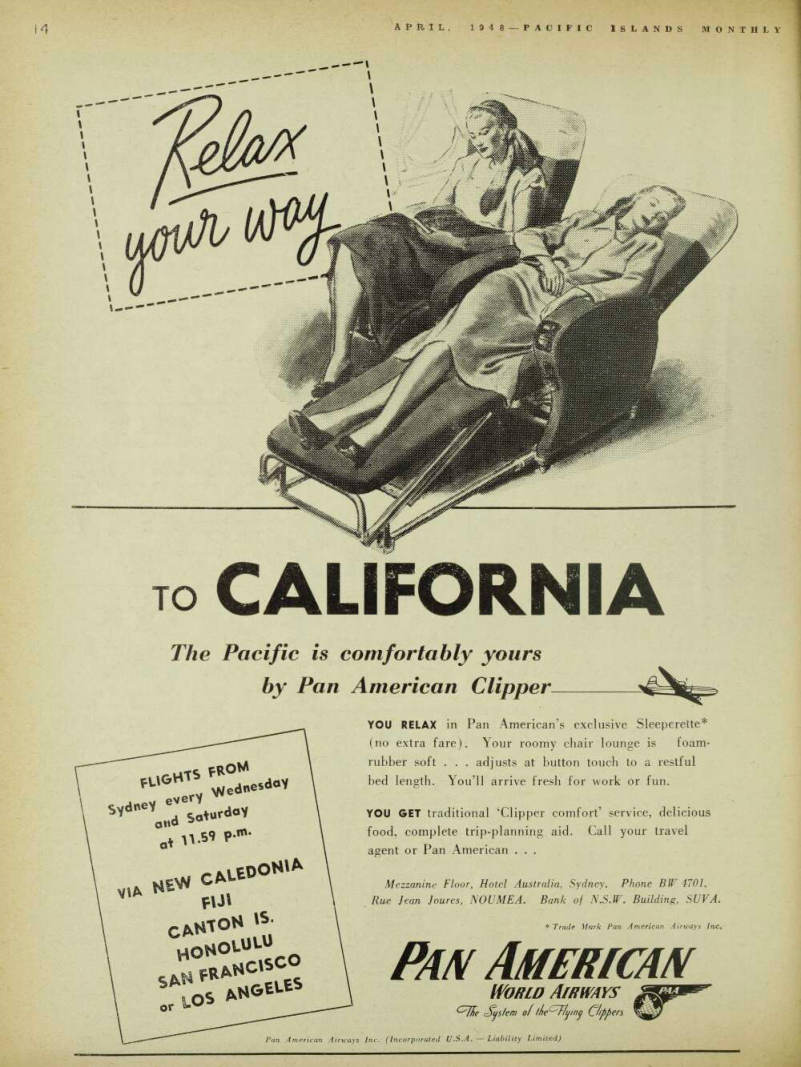
CALIFORNIA
The Pacific is comfortably yours
by Pan American Clipper.
S from
rV \NednesdoV
jaturdoV 1.59 P m c aUO° N ' A F\J'
hT ON »•
oholulu
i F»W Cl ?f£
YOU RELAX in Pan American’s exclusive Sleeperette* (no extra fare). Your roomy chair lounge is foamrubber soft . . . adjusts at button touch to a restful bed length. You’ll arrive fresh for work or fun.
YOU GET traditional ‘Clipper comfort’ service, delicious food, complete trip-planning aid. Call your travel agent or Pan American . . .
Mezzanine Floor, Hotel Australia, Sydney. Phone BW 4701.
Rue Jean Joures, NOUMEA. Bank of N.S.W. Building, SUVA. * Trade Mark Pan American Airways Inc.
Pan American
World Airways
c -'lJie System of C/ippers Pan American Airways Inc. (Incorporated U.S.A. —Liability Limited)
14
At»ft 1 L . 19 4 8 —-PACIFIC ISLANDS MONTHLY
Mr. H. King Irving
Now Settled Near Suva
HAVING retired (in October) after 36 years in the Fiji service of the Colonial Sugar Refining Company— the last 15 as Chief Manager in Fiji—Mr.
H. King Irving has settled down with his charming wife and children at Nai Vui Vui, Princes Road, Suva.
Mr. King Irving went to Fiji in 1908.
His service was interrupted in 1914 when he joined the AIF and fought, in World War 1, in Gallipoli and France. Back in Fiji, devoting his life and energy to the sugar industry, he saw and had a per sonal share in some interesting and
significant developments and changes.
He was, for years, a member of both the Legislative and Executive Councils.
In both positions, he left his mark per manently upon the Colony of Fiji.
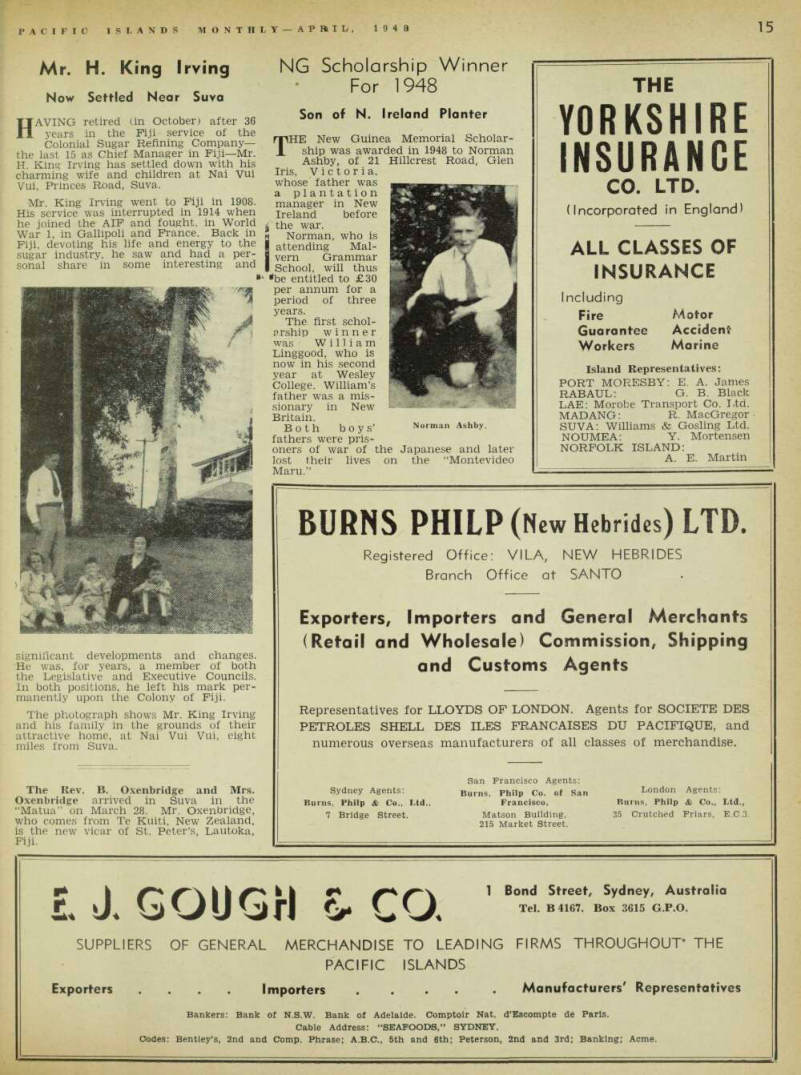
The photograph shows Mr. King Irving and his family in the grounds of their attractive home, at Nai Vui Vui, eight miles from Suva.
The Rev. B. Oxenbridge and Mrs.
Oxenbridge arrived in Suva in the “Matua” on March 28. Mr. Oxenbridge, who comes from Te Kuiti, New Zealand, is the new vicar of St. Peter’s, Lautoka, Fiji.
NG Scholarship Winner
For 1948 Son of N. Ireland Planter
THE New Guinea Memorial Scholar ship was awarded in 1948 to Norman Ashby, of 21 Hillcrest Road, Glen
Iris, Victoria, whose father was a plantation manager in New Ireland before the war.
Norman, who is attending Mal vern Grammar I School, will thus *be entitled to £3O per annum for a period of three years.
The first schol arship winner was William Linggood, who is now in his second year at Wesley College. William’s father was a mis sionary in New Britain.
Both boy s’ fathers were pris-
oners of war of the Japanese and later lost their lives on the “Montevideo Maru.’’
Norman Ashby.
Advertisements & other items, p. 17 (1 item)
Yorkshire
THE
INSURANCE
CO. LTD.
(Incorporated in England)
ALL CLASSES OF
INSURANCE
Including Fire Motor Guarantee Accident Workers Marine Island Representatives:
PORT MORESBY: E. A. James
RABAUL; G. B. Black LAE: Morobe Transport Co. Ltd.
MADANG: R. MacGregor SUVA; Williams & Gosling Ltd.
NOUMEA; Y. Mortensen
NORFOLK ISLAND:
A. E. Martin
BURNS PHILP (New Hebrides) LTD.
Registered Office: VILA, NEW HEBRIDES
Branch Office at SANTO
Exporters, Importers and General Merchants
(Retail and Wholesale) Commission, Shipping
and Customs Agents
Representatives tor LLOYDS OF LONDON. Agents for SOCIETE DES PETROLES SHELL DES ILES FRANCAISES DU PACIFIQUE, and numerous overseas manufacturers of all classes of merchandise.
Sydney Agents: Burns, Phllp & Co., Ltd., 7 Bridge Street.
San Francisco Agents: Burns, Philp Co. of San Francisco, Matson Building, 215 Market Street, London Agents: Burns, Philp & Co., Ltd., 35 Crutched Friars, E.C.3
I* 1 Bond Street, Sydney, Australia XJpy l j |"J \ V Tel. B 4167. Box 3615 G.P.O.
SUPPLIERS OF GENERAL MERCHANDISE TO LEADING FIRMS THROUGHOUT* THE
PACIFIC ISLANDS
Exporters ... Importers Manufacturers' Representatives Bankers: Bank of N.S.W. Bank of Adelaide. Comptoir Nat. d’Escompte de Paris.
Cable Address: “SEAFOODS.” SYDNEY.
Codes: Bentley’s, 2nd and Comp. Phrase; A.8.C., sth and 6th; Peterson, 2nd and 3rd; Banking; Acme.
Finschhafen Notes
New ADO Settles Down to Work
Finschhafen, Mar. 26.
ASSISTANT District Officer Malcolm H. Wright and his charming wife are now comfortably housed at “Windy Point,” Gagidu, overlooking a magnifi cent expanse of Vitiaz Straits —with them is their young daughter, Robyn.
Mr. Wright has already settled down to work, and there is an air of quiet
efficiency at the Sub-District Office.
Typewriters click, and streams of natives pass through the Holy of Holies airing their complaints, seeking advice and of fering suggestions.
A pleasing and much-needed feature of Finschhafen now is the centrally-situ ated “bung” (native market), where vegetables may be purchased at reason able prices The courtesy with which Mr. Wright deals with Europeans is the subject of favourable comment, and every native in this large Sub-district should know Mr.
Wright personally within a few months,
for he intends embarking on a vigorous
patrolling campaign.
* * * BEFORE packing up for the Central Highlands “gold rush” I’ve decided to do a little fossicking in the Finsch hafen hinterland. Oh, yes, I know you’ll laugh—but he who laughs last laughs, laughs! Even old “Shark Eye” said there was no gold above 3,000 ft. elevation— and then Bill Royal went on and found Edie at 7,000 ft! * * * ARAAF plane periodically sprays the local naval base and Administration Headquarters with DDT. It certain ly is effective. Recently, while flying just over the tree-tops, spurting out great volumes of disinfectant, a five-feet piece of one of the wings was knocked off. Fortunately, the plane landed with out mishap. * * * MR CYRIL PARER, with his wife and child, is now residing in Finschhafen.
Parer is a director of the enterpris ing New Guinea Industries, Ltd., and, as such, he has been loading thousands of empty petrol drums which the company purchased from “Disposals.” * * * CAPTAIN C. H. Brooks, RAN, Naval Officer in Charge New Guinea, gave a farewell cocktail party to HMAS “Condamine” at “Westward Ho!” on March 17. . . . ADO Jack Keenan left for Sydney with “Condamine” on March 18. He and his successor, Mr. Malcolm H. Wright, were given a “Farewell-Wel come” at the residence of Patrol Officer and Mrs. R. A. Webb some nights pre viously. A large gathering of Administra tion Officers and a big sprinkling of the gold braid from HMAS “Tarangau” (local naval base) were in attendance. Danc ing went on until the early hours of the morning. * * * BAROFA, formerly an NGIB corporal, was presented with the Military Medal at Finschhafen on March 17.
He comes from Bogia, near Madang, but now resides, with his wife, in the Hube area of Finschhafen. During the war he rescued two wounded white non commissioned officers under direct enemy fire, and also directed half a patrol in the Hupai River area, enabling the pla toon sergeant to concentrate on the larger portion of the attacking force. For his investiture he was fitted out with the undress uniform of the NGIB —bright green lap-lap, shirt and beret. A detach ment of the New Guinea Police Force formed a guard of honour, and there was a large gathering of native officials and other natives. The presentation was made by Lieut.-Col. B. S. Hall, who was passing through Finschhafen on HMAS “Kanimbla.” * * * THERE’S no rest for that popular, sought-after Lutheran Mission medico, Dr. Theo G. Braun. He and his wife had decided to take a rest to the Central Highlands District, but before they step ped into the plane there were four sum monses for him. Fortunately Dr. Agnes Hoeger was locum tenens.
Dr. Braun’s income from private prac tice would probably be the biggest in New Guinea were he to seek monetary reward, but this talented American surgeon, with a life-time experience of tropical medi cine, has devoted himself to missionarv work. I often wonder whv our medical missionaries are not included in the Honours Lists. Their good work, how ever, should be recognised in some way or other.
Dr. Lindsay Verrier, of the Fiji Medical Service, who spent six months leave in Australia, departed from Sydney for Suva, via New Zealand, on April 2. Dr.
Verrier spent most of his six months’ furlough at the Walter & Eliza Hall In stitute of Research in Pathology and Medicine, in Melbourne.
Advertisements & other items, pp. 18-20 (2 items)
Bank Of
HOW THE “WALES” WORKS
Branch Series No. 1
The Branch Manager
Mr. N, T. Kingsmill, M.C. .
Manager of Chatswood Branch (N.S.W.).
Joined the Bank at Albury in 1907. A First A.I.F. veteran.
INTERVIEWS with clients, correspondence, supervising accounts and getting new business; these are the tasks of the Branch Manager.
He is well-known in his community, for he is active in promoting the economic growth of the district and makes it his business to know local conditions. His training and experience give him a wide knowledge of the financial needs of business and of how the Bank can meet them.
If you have any financial problem (business or personal) discuss it in confidence with the Manager of your local Branch of the “Wales”. He is there to help you if he can.
Consult and use
BANK OF
NEW SOUTH WALES
FIRST BANK IN AUSTRALIA
Incorporated in New South Wales with limited liability ' ■ »11. "
i % *■-V
Don’t risk the loss
of a
Pleasant Smile
JF your gums flash a warning tinge of “pink” on your tooth brush, comult your dentist.
There may be nothing seriously wrong . . . but don’t take chances ... let your dentist decide. He may explain (( a simple case of sensitive gums gums robbed of work by to-day's soft and creamy foods" . His advice will probably be (< more work and resistance for lazy gums" and often, (< the helpful stimulation of Ip ana Tooth Paste and massage" .
Adopt this simple dental health routine : Brush your teeth with Ipana every morning and evening, followed by vigorous gum massage with Ipana on the finger-tip. Gums become firmer, healthier; teeth brighter, more lustrous.
IPANA TOOTH PASTE
McILRATH’S OFFER
Pure Orange Fruit Juice
in 28 oz. cans-per doz. 11/6
5 case lots, 11/- doz. 10 case lots, 10/6 doz.
Cases contain 24 cans Each can contains the juice of approximately 24 oranges. This fruit juice will maintain perfect condition for days if transferred to bottles or jars and kept in a cool place. Every tin is guaranteed.
McILRATH’S specialise in PACKING and SHIPPING individual orders to
PACIFIC ISLANDS RESIDENTS.
Write for our special export grocery price list All shipments are insured against pillage — theft — non-delivery.
McILRATH’S PTY. LTD.
Export Department, 202 Pitt Street, Sydney, Australia
tam mcmi a pc
ww C
For PAIN and
Nervous Depression^
Sate Sure Speedy Reliable Pain is W quickly relieved by IpF the bettcrf balanced formula of genuine Vincent’s a.p.c. 5*5
VINCE;
R SAFETYJ
17
pacific islands monthly apr. 1 l, i 9 4 8
Meeting Called For May
South Pacific
Commission
THE Australian Government has sent to all the countries interested in the South Pacific Commission formed at a Conference in Canberra in January, 1947, an invitation to send delegates to the first formal meeting of the Com mission on May 10 next. The suggested meeting-place is the block of ex-military buildings on St. Gedrge’s Heights, Mos man, Sydney, which now houses the Commission’s temporary offices, and the Australian School of Tropical Adminis tration.
The countries concerned are Britain, United States, France, Holland, Australia and New Zealand. All have ratified the agreement constituting the Commission, except France and Holland.
An early question to be settled is the venue of the Commission’s headquarters —Sydney is only temporary. Suva is generally favoured; but Suva is desper ately short of accommodation. The French are urging the claims of Noumea, and point out that Noumea has plenty of accommodation.
Mataafa Dead
Leading Samoan Chief
fpHE head of one of the three “Royal”
JL families of Western Samoa, Mataafa Faumuina Siame, died at his home at Lepea, near Apia, on March 27, after a severe illness.
Mataafa was an outstanding person ality and one of the highest-ranking citizens of Western Samoa. He was one of the three Fautua and a member of the Council of State of Western Samoa established recently in connection with the revision of the Samoan Constitution.
Mataafa was the head of two large family groups based largely on the south east coast of Upolu. He held his earlier title of Siame as a leader of the Salevalasi; and the two families, as distinct from the Malietoa and Tupua lines, were predom inant in conferring the title Mataafa upon him. He lived usually in Lepea, near Apia, where he was also a leading chief and held the title of Faumunia.
Mataafa was appointed a Fautua early in 1944 following a generally-expressed desire of the Samoans for a third Fautua in addition to the two existing titleholders, Malietoa and Tamasese. Although a leader of the Mau and its president for some years, Mataafa was always highly respected by the then Administration and all parties to the disputes of those days.
Mataafa is survived by his widow, Fa’amusami, a daughter of the late King Malietoa Laupepa, and an aunt of the present Fautua, and member of the Coun cil of State, Malietoa, and by a son and a daughter.
Buka Boy Dies In
Brisbane
OEWISI, a 10-year old native boy who arrived in Brisbane, from Buka, by air on Septemoer 21 last for plastic surgery treatment after having been shockingly burned and disfigured by an incendiary bomb at Bougainville, died re cently in the Brisbane General Hospital. (See October “PIM.”)
Birth Notice
AT the Women’s Intermediate Hospital, Brisbane, to Mr. and Mrs. S. C. Ken sett, of Rabaul, a daughter (Kay Anne). Mr. Kensett and family are on extended leave from Rabaul.
Red Hold-Up In Rarotonga Reduced To
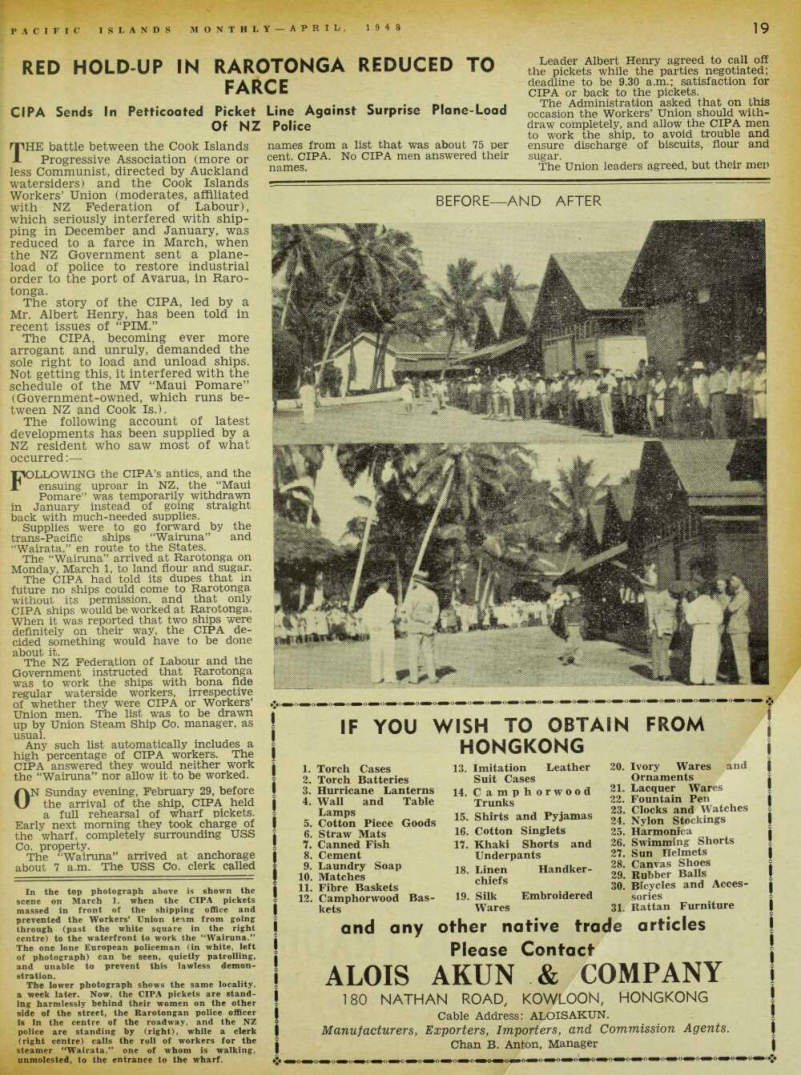
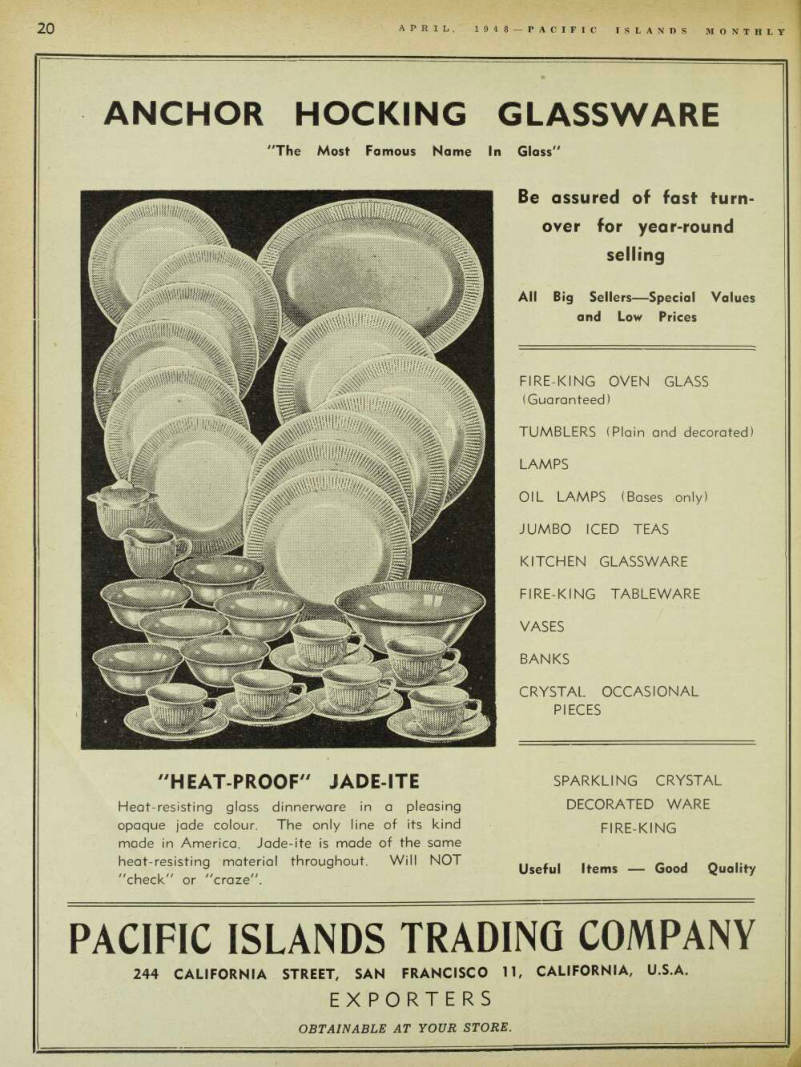
Farce
CIPA Sends In Petticoated Picket Line Against Surprise Plane-Load Of NZ Police
THE battle between the Cook Islands Progressive Association (more or less Communist, directed by Auckland watersiders) and the Cook Islands Workers’ Union (moderates, affiliated with NZ Federation of Labour), which seriously interfered with ship ping in December and January, was reduced to a farce in March, when the NZ Government sent a plane load of police to restore industrial order to the port of Avarua, in Raro tonga.
The story of the CIPA, led by a Mr. Albert Henry, has been told in recent issues of “PIM.”
The CIPA, becoming ever more arrogant and unruly, demanded the sole right to load and unload ships.
Not getting this, it interfered with the schedule of the MV “Maui Pomare” (Government-owned, which runs be tween NZ and Cook Is.).
The following account of latest developments has been supplied by a NZ resident who saw most of what occurred:— |7V3LLOWING the CIPA’s antics, and the 1: ensuing uproar in NZ, the “Maui Pomare’’ was temporarily withdrawn in January instead of going straight back with much-needed supplies.
Supplies were to go forward by the trans-Pacific ships “Wairuna” and “Wairata,” en route to the States.
The “Wairuna” arrived at Rarotonga on Monday, March 1, to land flour and sugar.
The CIPA had told its dupes that in future no ships could come to Rarotonga without its permission, and that only CIPA ships would be worked at Rarotonga.
When it was reported that two ships were definitely on their way, the CIPA de cided something would have to be done about it. , The NZ Federation of Labour and the Government instructed that Rarotonga was to work the ships with bona fide regular waterside workers, irrespective of whether they were CIPA or Workers’
Union men. The list was to be drawn up by Union Steam Ship Co. manager, as usual.
Any such list automatically includes a high percentage of CIPA workers. The CIPA answered they would neither work the “Wairuna” nor allow it to be worked.
ON Sunday evening, February 29, before the arrival of the ship, CIPA held a full rehearsal of wharf pickets.
Early next morning they took charge of the wharf, completely surrounding USS Co. property.
The “Wairuna” arrived at anchorage about 7 a.m. The USS Co. clerk called
names from a list that was about 75 per cent. CIPA. No CIPA men answered their names.
Leader Albert Henry agreed to call off the pickets while the parties negotiated; deadline to be 9.30 a.m.; satisfaction for CIPA or back to the pickets.
The Administration asked that on this occasion the Workers’ Union should with draw completely, and allow the CIPA men to work the ship, to avoid trouble and ensure discharge of biscuits, flour and sugar.
The Union leaders agreed, but their men
Before—And After
In the top photograph above is shown the scene on March 1, when the CIPA pickets massed in front of the shipping office and prevented the Workers’ Union team from going through (past the white square in the right centre) to the waterfront to work the “Wairuna.”
The one lone European policeman (in white, left of photograph) can be seen, quietly patrolling, and unable to prevent this lawless demon stration.
The lower photograph shows the same locality, a week later. Now. the CIPA pickets are stand ing harmlessly behind their women on the other side of the street, the Rarotongan police officer is in the centre of the roadway, and the NZ police are standing by (right), while a clerk (right centre) calls the roll of workers for the steamer “Wairata.” one of whom is walking, unmolested, to the entrance to the wharf.
were not pleased about it. However, the Workers’ Union withdrew.
But CIPA still were not satisfied. They now sought complete control—and would not start work unless handed the edulvalent of the sum of money paid out in wages to Workers’Union men for working the last Maui Pomare !
The deadline (9.30) came. The whistle tooted again and the pickets surrounded the wharf sheds and entrances. The USS Co. called out a new list—this time, Workers’ Union men.
The WU men collected in a group and, accompanied by the one lone European police officer, approached the picket line.
The pickets bunched up and refused a passage. The police officer called upon the pickets to allow the Union men to P ass - „ The request was refused and the officer then ordered the Union men to retire.
Shortly afterward the ship proceeded on her way, with the badly-needed foodstuffs aboard. u This was called a victory for the CIPA. The Union men were lumping rnad, and the Europeans gravely concerned. Were they to be simply handed over to the Communists?
What about the “Wairata” (due on Monday, March 8), and her 1,200 tons of
cargo 9 Rarotonga was now desperately
short'of foodstuffs, oil, motor fuel, etc.
The NZ Government was privately and urgently warned that a very ugly situation was developing.
CIPA meetings held every day were now very anti-European, and gloating over European discomfiture at foodshortage. “We can live on Maori kai and go barefooted—only the Europeans will suffer,” they said. Part of the CIPA basic plan was to make it as uncomfortable as
possible for the Europeans, and chase them out. .. “to be worked The? „ot know—no one in ex cept the Resident Commissioner, knew— tviot tbp isrz Government was now busv
to°be seS
by plane. (See March PIM.) on Wednesday, following departure of “Wairuna,” Mr. Tuaine Nicholas, secre tary of the Workers’ Union, approached Albert Henry and suggested peaceful co operation in working the “Wairata,” so as to supply food to women and children, Henry said that he personally agreed but he would have to see his People. The reply on Thursday was No —CIPA re fu P now Stffig tougher' and W |he to be the big showdown—but what was the Govem ment doing about it ? what could be done by the lone police officer (Superintendent Best) and his half-a-dozen Maori assist ants (all rather timid under the circum stances-and half of them CIPA!)?
Public tribute should be paid to that wb ite policeman—a fine, fearless type of British officer. Throughout all this Com munist trouble he was jumping mad at bis own en f o rced impotence, but he was under strict orders not to “start anything,” no matter what the provocation, and he was not even armed. All this, of course, for the benefit of the Red howlers in NZ.
One can imagine his anger at having to meekly turn away from that Maori picket, after being defied. He was quite ready and willing to deal with the arrogant lawbreakers single-handed—but he had his orders, and he loyally obeyed them, And what did he get for his restraint from the CIPA? Scorn and derision for being “scared of them —the whole several hundred of them! Yet, if he had laid a finger on one of them it would have been screeched over the length of NZ.
By Friday, March 5, there were per sistent reports that a plane was on the way. It was thought to be some sort of “delegation,” and CIPA was sure it would include some of “our men.” CIPA women started to prepare flower leis for the wel come visitors.
Out of the grey and rainy dusk, on Friday, a plane came in over the sea.
A small group at the airfield watched breathlessly as the door opened. Out stepped a very large policeman, and another, and another! Fourteen of them!
Thunderbolt! Never had the coconut radio worked so fast and furiously. Gen eral reactions: Europeans, Workers’ Union, and associates —astonishment, pleasure and relief. ClPA—amazement and vast anger.
On Saturday morning, March 6, there was a great CIPA meeting, and an extra ordinary exhibition of dramatics. “The government has sent guns against us, but we shall fight to the end.” The heroic leader stood up and squared his shoulders; “I am not afraid to die. I will take the first bullet!”
A female fanatic (since named Joan
of-Arc) in an impassioned outburst, said: “I will stand in front of Albert and take the first bullet!” She hysterically urged the women to fight to the bitter end. It was grand stuff for the Communist papers. Albert Henry told the people that if there were any present who wished to withdraw from the decision to fight to the bitter end they were free to do so, and nothing would be said or done to them. He called for those who wished to withdraw to raise their hands. Only three hands were raised —and the first was that of Mr. Henry.
The other two gentlemen who raised their hands had previously attempted to make appeals to reason, but had been told to “shut up or get out.” Henry him self made an appeal to his people to abandon their course of violence. These CIPA acrobatics are a bit puzzling, until you get used to them.
Mr. Henry then instructed the CIPA to gather at the waterfront at 4 a.m. on Monday for an important last word.
On Saturday morning there also arrived a further surprise in the public display of new official regulations, added to the Cook Islands Act. dated March 6, 1948, which made an offence of any act calcu lated to interefere with the peaceful pur suance of industry such as the working of a ship.
ON Monday, March 8, the police force was on duty at 3 a.m. The CIPA gathered at 4 a.m. The “Wairata” arrived at anchorage at 6 a.m.
The 14 policemen were placed along the wharf approaches, short-sleeved and empty-handed, nonchalantly leaning and smoking cigarettes. Facing the wharf sheds and police, from the opposite side of the road, the CIPA in a semi circle, with a large mass of spectators be hind. The Workers’ Union men were at rear of the crowd.
About 7 a.m., lust before the USS Co. clerk was to call the names of workers, CIPA women, at a given signal, charged across the road and formed a determined looking picket line, hemming in the still nonchalantly smoking policeman. So this was Henry’s trump card!
Now the crowd was on its toes. How were the police going to deal with these prim-looking women who. for days, had been screaming of fighting to the bitter end? . , , One policeman and a few quiet words supplied the answer. Officer-in-charge, Senior Sgt. Brown, went over to Albert Henry and in his best heavy, police sarcasm, remarked; “So this is your idea of a picket—hiding behind women’s skirts!”
Albert seemed angry and awkward.
Sergeant Brown then quietly asked the women if they were acquainted with the new regulations on the notice boards.
They admitted they were not The officer pointed out that all were liable to fines or imprisonment for being where they were, and suggested they move back to the other side of the road.
The ladies rather sheepishly retired.
And that was the end of the great CIPA rebellion.
The workers’ roll was called. The CIPA would not respond. Other men who an swered their names passed on to the wharf, and unloading commenced.
The CIPA moved away en masse to their meeting hall, for more theatricals.
Some workers of the ship’s crew (New Zealanders) attended the CIPA meeting, burned to the ship: and the whole crew ceased work. The ship was idle most of the day while the crew awaited instructions fl The instructions from the Federation of Labour were that the crew were to work with either Workers’ Union or CIPA men.
(Continued on page 63.)
Unloading was resumed at 6 p.m. There was no more trouble. But has anyone calculated the cost of all this—all caused by a few irresponsible Auckland agitators?
The CIPA continued to hold meetings and there was talk of refusal to pick oranges for ‘‘Maui Pomare.” due about Marcn 26. But the NZ police remained in Rarotonga until after the “Maui Pomare’’ had departed, and there was no intereference with ship or fruit gathering.
At a special court session on March 22, twenty members of the CIPA. including Albert Henry, were fined £1 each on the charge of obstructing the public highway on March 1 The prosecution was conducted by Senior Sgt. Brown. CIPA are naturally very annoyed at this affront— thev sav these are “Nazi methods ” “Re- SnTto' I force ar t e o deny pe"freed*m ° f -® P f e^,? nd freedom ° f aCtion ln their a , ' T , , , , , Albert Henry left Rarotonga by plane A/r „„ n v, oq on March 23.
The “captain of the CIPA ship”—ihat is, a gentleman said to be considering part-ownership with the CIPA of a vessel of 150 tons, the “Avow”—visited Rarotonga late in March. There is a report that he turned the proposition down flat when he saw the local situation.
Txm p. • rwi w U * fv,oT f Mrs- Eloua Lambert, widow'of that famous Dr. b. M. Lambert who conquered the hookworm disease, and whose name always will be held in honour in the Pacific Islands, is now living at 2854 Webster Street, Berkeley, USA. In a letter to the editor of the “PIM,” she sends greetings and good wishes to old friends in the South Seas.
Advertisements & other items, pp. 21-24 (1 item)
Alois Akun & Company
IF YOU WISH TO OBTAIN FROM
HONGKONG
1. Torch Cases 2. Torch Batteries 3. Hurricane Lanterns 4. Wall and Table Lamps 5. Cotton Piece Goods 6. Straw Mats 7. Canned Fish 8. Cement 9. Laundry Soap 10. Matches 11. Fibre Baskets 12. Camphorwood Baskets 13. Imitation Leather Suit Cases 14. Camphorwood Trunks 15. Shirts and Pyjamas 16. Cotton Singlets 17. Khaki Shorts and Underpants 18. Linen Handkerchiefs 19. Silk Embroidered Wares and 20. Ivory Wares Ornaments 21. Lacquer Wares 22. Fountain Pen 23. Clocks and Watches 24. Nylon Stockings 25. Harmonica 26. Swimming Shorts 27. Sun Helmets 28. Canvas Shoes 29. Rubber Balls 30. Bicycles and Accessories 31. Rattan Furniture
and any other native trade articles
Please Contact
ALOIS AKUN & COMPANY
180 NATHAN ROAD, KOWLOON, HONGKONG
Cable Address: ALOIS AKUN.
Manufacturers, Exporters, Importers, and Commission Agents.
Chan B. Anton, Manager
ANCHOR HOCKING GLASSWARE
"The Most Famous Name In Glass" s*-:
"HEAT-PROOF" JADE-ITE
Heat-resisting glass dinnerware in a pleasing opaque jade colour. The only line of its kind made in America. Jade-ite is made of the same heat-resisting material throughout. Will NOT "check" or "craze".
Be assured of fast turn-
over for year-round
selling
All Big Sellers—Special Values and Low Prices
FIRE-KING OVEN GLASS
(Guaranteed) TUMBLERS (Plain and decorated)
LAMPS
OIL LAMPS (Bases only)
JUMBO ICED TEAS
KITCHEN GLASSWARE
FIRE-KING TABLEWARE
VASES
BANKS
CRYSTAL OCCASIONAL
PIECES
SPARKLING CRYSTAL
DECORATED WARE
FIRE-KING
Useful Items Good Quality
PACIFIC ISLANDS TRADING COMPANY
244 CALIFORNIA STREET, SAN FRANCISCO 11, CALIFORNIA, U.S.A.
EXPORTERS
OBTAINABLE AT YOUR STORE.
QUEENSLAND
INSURANCE
COMPANY
LIMITED
(Incorporated 1886 In Australia)
ASSETS EXCEED £4,000,000
Head Office :
QUEENSLAND
INSURANCE BUILDING,
80-82 PITT STREET, SYDNEY.
Speciolists in South Seos Fire,
Marine Cr Accident Insurances
Apply to: —
FIJI.
Branch Office: I. B. Chalmers, Manager.
Burns Phllp (South Sea) Co., Ltd.
VILA.
Burns Phllp (South Sea) Co., Ltd.
Comptoirs Francais Des Nouvelles Hebrides (Marine).
NOUMEA,
L. Sc W. Johnston.
PORT MORESBY:
Burns, Phllp & Co., Ltd.
W. A. Anderson, Resident Officer.
PAGO PAGO.
Burns Phllp (South Sea) Co., Ltd.
G. H. C. Reid Sc Co.
OTHER SOUTH SEA ISLANDS.
Burns Phllp (South Sea) Co., Ltd.
Also to any of the Company's Offices in Australia or New Zealand .
William Atßlns p*y. Ltd.
Head Office, 449-451 KENT ST., SYDNEY
Iron & Steel Merchants-Engineers' Supplies
Coach fir Motor Hardware
ESTABLISHED OVER 50 YEARS
Cable Addreea: WHATUN, Sydney.
STEEL DEPARTMENT
MILD STEEL;
Rounds, Squares, Flats, Half-rounds, Hexagons, Bevel, Shoeing, Tyre, Angles, Tees, Sheets, Plates, Girder Plates, Chequer Plates, Channels, Hoops, Etc.
BRIGHT STEEL:
Rounds, Squares, Hexagons.
Extra Special High Speed Tool Steel, Mining Steel, Blister Steel and Spring Steel, Rounds, Flats Gr Squares.
Bar Iron—All sections and sizes.
Engineers' Supplies: Set Screws, Studs, Metal Thread Screws, Coach Screws, Files, Cotter Pins, Bright and Black Bolts, Rivets, Etc., Hack Saw Blades.
Power Transmission Gear: Including Plummer Blocks, Couplings, Collars.
Etc.
Coach and Motor Hardware: Axles, Springs, Wheelstuff, Duck, Paints.
Farriers' Supplies: Horse Nails, Anvils, Vices, Etc.
Motor-Trimmers and Motor Builders' fir Motor Painters' Requirements Pacific Island Agents : Corrie 6* Co., Suva, Fiji DUCO Lacquers and DULUX Enamels—FAßßEX Motor Toppings and Leather Cloths, House & Decorators' Paints, Varnishes & Brushware.
Sole Distributors of CHAMPION'S Decorators Paint Products.
Distributing Agents for BROLITE Lacquers, SYNFLEX Enamels and "POLYGLOSS" Finish.
DRESSMAKING BY MAIL. Your own
material made up from our exclusive designs. Small and larger fittings, childrerj’s frocks. Write to-day for Free Tape Measure and particulars to MOORE &
MOORE MAIL ORDERS, 333 George
Street, Sydney.
SHIPPING NOW AVAILABLE
FROM NEW ZEALAND
TO NEW CALEDONIA, NEW HEBRIDES. SOLOMONS, NEW GUINEA
AND ADJACENT AREAS.
A regular shipping service is now available to the Pacific Islands, not only for direct shipping, but also for Inter-Island work and on special charter for passengers and general cargo.
We will have a major vessel (3,000 tons) leaving New Zealand for the Western Pacific through to New Guinea, sailing approximately June, 1948, with cargo space available both outwards and return. Three smaller vessels are available immediately and are now operating.
We can supply at fair prices and deliver promptly all classes of general merchandise, including Canned Meat, Dairy Produce.
Vegetables, Clothing and Textiles, Footwear, Canvas Shoes, Jewellery, Silverware, Builders’ Hardware and all traders’ requirements.
We are buyers of all classes of Island Produce, and can provide immediate shipment for raw and processed materials, including native products, fruit, shells, timber, hides and skins, and scrap metals of all kinds.
Your further inquiries will be welcomed.
UNION MANUFACTURING
& EXPORT CO. LTD.
G.P.O. Box 1060, Wellington, NEW ZEALAND Cables : “UMEC,” Wellington.
Branches at Auckland, Christchurch, Sydney, Melbourne.
Western Pacific Office, P.O. Box 78, Noumea.
Reorganised
N. Guinea Missions
Australian Franciscans Replace SVD Personnel in the North- West
MISSIONARIES of the Franciscan Order of the Australian Province have now taken over practically all of the Catholic Mission work on the western section of the north coast of Australian New Guinea.
Until the Japanese invasion, this re gion had been in the care of the mission aries of the Order of the Divine Word since 1896. It was administered in two ecclesiastical divisions the Vicariate Apostolic of Central New Guinea, with headquarters at Kairiku, near Wewak; and the Vicariate Apostolic of Eastern New Guinea, with headquarters at Alexishaven, near Madang.
The Japanese did fearful havoc in these two districts. At least 53 per cent, of the Mission personnel including many leaders were either killed or died as the result of war conditions, and 90 per cent, of the Mission properties (about 700 buildings) were totally destroyed.
IN 1946, the SVD Catholics found them selves faced with an enormous task of rehabilitation; and it was then decided that, as they could not easily get new personnel from Europe, they should seek help from the Australian Francis cans.
Eight Franciscan Priests and one lay brother were sent from Australia to Madang: then to Aitape, 15 miles west of which they established the head quarters of their Mission, at a place called Malol, in May, 1947. Within a year, they had opened several Stations along the coast. At Sissano, 20 miles further west, the Franciscans erected a central hospital which accommodates 50 in-patients and treats about 1,500 out patients per month. A young Sydney man, Dr. Harold Tindale, MB, BS, is in charge of the hospital. He has volun teered to help the Mission for some years. Another Station is at Wanimo, 18 miles further west, near the Dutch border.
This coastal region is poorly populated.
Consequently, not content with their work there, the Franciscan missionaries went inland, among the Wape tribes, who live on the southern slopes of the Torricelli Mountains. There are about 18,000 natives in this area, who were re garded as hostile and savage. The Franciscans succeeded in establishing at once two Stations, at Lumi and Miwaute, about 40 miles inland from Malol (a good five days walk, as distances are evaluated in the islands).
Their success among the Wapes is so patent that the Franciscans plan to open new Stations all over the Torricellis, as soon as possible. Three additional priests are about to join the pioneer band, and Nuns of the newly-founded Order of the Franciscan Sisters of the Immaculate Conception (Brisbane) will proceed to the Mission in a few months’ time.
It is interesting to note that the mis sionary neighbours of the Australian Franciscans to the west, over the Dutch border are Dutch Franciscans, whose headquarters are near Hollandia.
Rev. father ignatius donnell, Superior of the newly-established Franciscan Mission in New Guinea, arrived recently in Svdney to seek a suitable vessel for maintaining commu nications along the north coast. He pur chased a former RAN steel vessel of 80 tons, with twin engines; and she is now being fitted and equinped under the supervision of Father Justin.
Advertisements & other items, pp. 25-26 (1 item)
W. H. Grove & Sons
Limited
Established 1896.
AUCKLAND
Island Traders. po - BOX 490 ‘ Telegraphic and Cable Address: “Grove”, Auckland.
Entrust Your Orders to the Firm with Fifty Years Practical Experience in the Island Trade.
Shippers of all classes of New Zealand products.
Representing English Manufacturers through-
out the Cook and Society Islands, Fiji, Tonga, Samoa, Niue, New Caledonia, New Guinea, etc.
In FIJI as—W. H. Grove & Sons (Fiji) Ltd.
THE FIJI TRADING
COY.
Victoria Parade, SUVA.
Cables “Fijitrade.”
AUSTIN CARS & TRUCKS.
PHILIPS RADIOS.
Sales and Service for:
B.T.H.
(British Thompson-Houston)
16 mm. SOUND PROJECTORS
Twice the sound . Twice the light .
Half the weight .
This projector is a precision instrument with features not in any other similar equipment, such as quick adjustment for exciter lamp and exciter optic system. Detachable unit construction. It is the perfect theatre exhibitor’s projector for performance, long life and ease of maintenance. Price competitive with similar equipment.
Ex bond shipments arranged to any part of Pacific.
Island Stamps
Island Stamps
Island Stamps
Island Stamps
1/3 PER PACKET
including postage Write to —
JENKINS EMPORIUM
Box 100, Suva, FIJI
S,
unproof your Hair
* S
Hie Tonic Hair Dressing
SUN, WIND and WATER really do their worst to your hair.
Hair-shielding scalp oils are baked out by the sun, washed out by water, dried out by the wind . . . but you can counteract all this by using Vitalis.
Vitalis' pure vegetable oils supplement your scalp oils, giving your hair and scalp that added protection.
Massage Vitalis on your scalp : feel the pleasant tingle as you rout loose dandruff, check falling / hair. Vitalis makes your scalp feel good, your hair look good. ft s '4516
The Solomons
No Asiatic Labour
Official Statement In The Solomons
Prom Our Own Correspondent
Honiara, Feb. 28.
F BLOWING a report, from an un known source, published in “PIM” in December, 1947, that a commer cial firm here was contemplating the im portation of 600-700 foreign labourers lor plantation work, the following official statement was issued to-day; It is not contemplated that any con siderable number of exotic labourers, from any Asiatic or any foreign country,
will be encouraged to come to the Solo mon Islands.
The British Government does not agree that the work cannot be done without importing labour, or that any such dras tic measure is essential to the economic recovery of the Protectorate.
A certain number of Fijian and Indian artisans are being employed on a purely temporary basis in the construction of the new capital at Honiara.
According to the merits of each par ticular case, consideration will be given to the return of Chinese.
Note. —This subject is discussed in our first article this month, on page 5.
Praise for NZ Health
Policy In Samoa
THE public health programme carried out by the New Zealand Govern ment in Western Samoa has been praised by the Department of Social Affairs Department of the United Nations, The Department has just brought out a report which states that the year 1920, when Western Samoa became a New Zealand Mandate, marked a new epoch of Samoan population history.
Because due regard has been paid to improving health and sanitation in the Territory, the population has increased steadily at an average rate of 2.5 per cent, oer annum which is one of the highest rates of increase recorded in any country in the world in recent decades.
One of the most notable achievements, according to the report, is the prevention of any large-scale epidemics such as in fluenza, dysentery, measles, etc., between the time the Mandate was granted and the present day, (In 1918 the disastrous influenza .epidemic carried off between 8,000 and 9,000 Samoans.) The report sounds a warning that the mounting density of population might, however, create its own problems in years to come. At the present rate of increase the population of Western Samoa will be 150,000 in 30 years’ time (compared with 70,000 to-day).
If the present living standards are to remain as they are, this means that all available resources must be ener getically developed.
Inquiry by Australian Syndicate
Solomons Gold
FUR young men, John Grover, Arthur Moore, Roy Hudson and Terence Conolley the latter a well-known geologist arrived in Sydney by Trans oceanic flying-boat on March 24 with samples of gold-bearing rock, which they had gathered in Guadalcanal, Solomon Islands, and which were to be assayed.
Mr. Hudson said he held an option over the area concerned, which was about 20 miles inland from Honiara. The area had been inspected on behalf of an Australian gold syndicate.
It will be remembered that Theodore interests (Emperor Goldmines, Fiji) were prospecting Guadalcanal gold indications before the war; that operations were suspended during hostilities; that they were resumed in 1946; but were promptly and completely discontinued when it was learned that the Socialist Government of Britain had introduced new laws which reserved to the Crown a substan tial and disproportionate share in any new gold-mine enterprise. It was pointed out in this journal, at the time, that the heavy cost and risk of gold pros pecting, in a place like the Solomons, is simply not worth while, under such regulations. , , , The position has not been changed.
Any BSI gold-find would have to be ex traordinarily rich to justify developm r
Advertisements & other items, pp. 27-28 (1 item)
Hardiproof
Your home and outbuildings—white-anted!
...and YOU’VE
SEEN THIS !
in your stack covers and tarpaulins.
HARDIPROOF (Green) and HARDIPROOF Clear can be safely applied to all types of textile fabrics, and renders them immune to fungus attack. You can readily apply HARDIPROOF (Green) or HARDIPROOF Clear to canvas, tarpaulins, ropes, jute goods, tents, sails and nets. HARDIPROOF (Green) is guaranteed to contain 20 per cent, of Copper Naphthenate and can be dipped, brushed, or sprayed. It is insoluble in water and does not leach out like other preservatives.
Left: The White Ant family of destroyers. (a) Queen. (c) Worker. (b) Male. (d) Soldier.
But it is too late when you see it. If you are planning a new house, new stables, or other structure, it is an easy job to render your timber immune to attack by ter-
mites with HARDIPROOF. SPARTAN HARDI-
PROOF also protects against dry-rot.
TEREDO WORM
WREAKS HAVOC IN
TROPICAL WATERS
Combot it with HARDIPROOF!
Th# Australian Army Specification
for small craft, pontoons, etc.,
calls for all wood surfaces to be treated with an approved antiborer and anti-rot process such as copper naphthenate in a 20%
solution. Spartan Hardiproof con-
forms to this specification and is guaranteed to contain not less
than 20% copper naphthenate.
HARDIPROOF
Agents: NEW GUINEA, SOLOMONS, NEW HEBRIDES, NEW CALEDONIA, NORFOLK ISLAND, LORD HOWE ISLAND.
KERR BROS. PTY. LTD., P.O. BOX 3838, SYDNEY F,J,: COLONIAL TRADE DEVELOPMENT AGENCY OF FIJI, P.O. Box 273, Suva
m
SPECIALISING IN
PACIFIC ISLAND INSURANCES
FIRE—MOTOR VEHICLE
MARINE—HULLS AND CARGO
EMPLOYER’S LIABILITY
BONDS—in accordance with
ADMINISTRATION ORDINANCES.
COPRA INSURED PROM DRIER
TO BUYER.
AND ALL OTHER CLASSES ARRANGED
AT LOWEST CURRENT RATES.
Established Agencies throughout the Territory of Papua and New Guinea.
Managing Agents: New Guinea Company, Limited.
Island Representative: G. D. A. Kent, Rabanl Branch.
SOUTHERN PACIFIC INSURANCE
CO., LTD.
HEAD OFFICE: 60 HUNTER STREEP,
SYDNEY.
Butler /
Crunch '
r- * ■ C -..
* OLaLk
SWALLOW’S
“Jhutouh,
SWALLOW & AftlE Li
, - v. .i j m «rVcv, \, .0k Wade*. (kerffaHto *W, T&cuit &ndudtyMHce
New Governor, However, Emphasises Colony's

Cold Water On Fiji's Ten-Year Plan
New Governor, However, Emphasises Colony's Boundless Possibilities
From Our Own Correspondent
SUVA, March 22. rE Legislative Council of Fiji to-day completed one of its shortest sit tings for years. The council was in session for only five hours, spread over two days. If the European member for the Southern Division (Mr. A. A. Ragg) had not come to light with a motion about forestry and reafforestation, the sitting would have been complete in the three hours of the opening day, March 19.
There was little controversial material in this, the first sitting presided over by the new Governor, Sir Brian Free ston.
No Financial Splashes
The Governor’s opening address was not calculated to encourage the cus tomary clamour for increased expendi ture on social and other services very much the reverse.
In a speech of admirable terseness, which contained some diplomatically presented plain speaking, His Excellency told Fiji that its cherished Ten-Years Plan has to be remodelled to meet the
exigencies of the economic situation, “with more emphasis on projects which are likely to provide an early return, and less emphasis on unproductive works.”
It came as something of a jolt to a good many people when the Governor reminded them that the plan, drawn up in 1946 and adopted by the Legislative Council at the November session in that year, still awaited the final go-ahead signal from the Secretary of State for the Colonies.
“Very Cold Water”
Since his arrival in Fiji in January, the Governor said, he had inquired about the progress of the plan at the Colonial Office and had received in return what he described as a dash of cold water — “very cold but very salutary.”
“We are reminded that there hangs over our financial heads an unresolved commitment of £3,096,000 on account of war advances,” the Governor continued.
“There is ground for hoping that much, if not all, of this paper indebtedness will in due course be written off; but there is no certainty of so favourable an outcome. . . .
“Secondly. I am informed that there is virtually no prospect of our receiving permission to raise a £3,000,000 loan on the London market for some years to come. ...”
The Colonial Office also pointed out that the Colony’s plan contemplated heavy capital expenditure on public works which would produce relatively little annual return to revenue; and, lastly, that there would be “extraordinary difficulties” in getting steel and other es sential materials for building schemes envisaged in the plan.
Temporarily Shelved
In short, the Colony’s Ten-Year De velopment and Welfare Plan is “dished,” at least temporarily.
In its final form it covered an expen diture of nearly £4,500,000, of which £1,110,000 was to be provided by the British taxpayer under the Colonial De velopment and Welfare Fund, £3,000,000 by a loan on the London market, and the balance from local surpluses and revenues.
In the meantime, said the Governor, the Government will look round in the hope of raising part if not all the £3,000,000 from sources other than Lon don, and will revise the whole plan to push up some priorities and push down others.
As a sort of sugar coating to the Colonial Office pill, the Governor men tioned two important proposals which have gone to the Colonial Development Corporation in London (which has no thing to do with the Development and
Welfare Fund).
Electricity And Beef
These are: A hydro-electric plant a few miles from the mouth of the Navua River, as recommended in the report of the New Zealand experts called in to make an investigation; and, secondly, a large-scale beef cattle-raising project on 60,000 acres of Fijian-owned lands in Ra Province, Viti Levu. (Earlier this year a committee was appointed to in vestigate the nossibilities of a Fijian sug gestion that Fijians might profitably be encouraged to become pastoralists on their own lands).
(Continued on Page 59.)
In conclusion, the Governor admin istered a sharp rap to the Colony, as a whole, for its tardiness in reducing the gap between what Fiji is producing and what it might produce.
What Fiji Could Do
The Governor emphasised the develop mental possibilities of Fiji. Considering the natural advantages of Fiji and the fact that hungry markets overseas are eager to accept practically everything the islands can produce, a newcomer may well be pardoned if he feels he has en tered upon a potential island paradise, he said.
Sir Brian said that on his first hurried tour round the main island of Viti Levu he had noted its fertile soil, abundant rainfall, extensive forest cover, includ ing much valauble timber, and freedom from nearly all of the major pests and diseases whether of mankind, animals or plants. He also noted that the over-all density of population was only 27 to the square mile, compared with about 500 in the United Kingdom, and 250 in the sub-continent of India.
“But,” remarked His Excellency, “the newcomer’s second impression will not be so complacent or so comforting,” He proceeded to point out that the colony was still driven to import a large part of its timber requirements, that thous ands of acres were lying virtually idle or were covered with useless vegetation, and that state of affairs was by no means limited to native occupation.
There was a wide gulf, he said, between what Fiji could produce and what Fiji was in fact producing. The immediate aim was to reduce that gulf.
Advertisements & other items, p. 28 (1 item)
26
APRIL, 1948 PACIFIC ISL AN DS MONTHLY
Vigorous New Party In
Samoan Election
Vigorous New Party In The Field
From Our Own Correspondent APIA. March 25.
KEEN public interest is being taken in the election of five European mem bers to the Legislative Assembly, constituted under the new Constitution for Samoa. The election will take place on April 28, and over 1,000 persons will vote.
It will be noted that, for electoral pur poses, the large Euronesian population of Samoa, comprising over 5,000 persons, takes the status of Europeans. There are only some 200 full Europeans now re maining in Samoa.
It is expected that the election will be strongly contested between two parties— the United Citizens Party, which is backed by the leading businessmen of Apia—and the Saimoa Labour Party, at the head of which is Mr. A. Stowers.
The Hon. A. G. Smyth, MLC, called a meeting on March 16 and announced that he intended to retire from the adminis trative body. The meeting was called originally to discuss the nomination of candidates and to listen to addresses of prospective candidates; but a motion to form a new political party, to be called United Citizens Partyy was moved by Messrs. E. F. Paul and E. Annandale, and carried. A committee of 30 residents was nominated: and from members of this committee 5 candidates will be selected as the candidates of the Citizens Party.
Three men who announced that they would seek election are Messrs. E. F. Paul, J. Helg and P. W. Glover. Mr. A. M.
Gurau also addressed the meeting and said that he would stand as an Inde pendent candidate, in the interests of wage-earners and officials outside the new party.
At a second meeting, on March 23, a total of nine candidates for election was announced, and the party will now hold a ballot to select the five candidates for election on April 28. As the Labour Party is certain to nominate at least five can didates, it is expected that there will be from 10 to 15 candidates for the five As sembly seats.
One of the hardest workers and most enthusiastic members behind the new United Citizens Party is Miss Billy Nelson, daughter of the late Hon. O. F. Nelson, who took such a prominent part in Western Samoan politics twenty years ago. rpHE aims and objects of the United
X Party are:
“To combine the European citizens of
Western Samoa as a Party to work shoulder to shoulder in the development of Samoa, along democratic lines of modern thought and progress, at the same time giving due courtesy to the traditions and dignity of Samoa.
“To educate public opinion regal’ding the rights and duties of citizens.
“To defend every European citizen's statutory acquired and legitimate rights, and those of their dependants, and to support and to protect their status and their interests, and to do such things as are incidental or conducive to the at tainment of the above objects.
“To nominate selected candidates to the Legislative Assembly and to support, wholeheartedly, those nominations and assist the candidates in their election campaigns.”
Major-General Basil Morris, who com manded in Papua Guinea until ANGAU was formed, and then had charge of ANGAU, is now living quietly in Upper Beaconsfield, Victoria. It will be remembered that General Morris re tired at the end of 1946, and then (see “PIM” of January, 1947) was openly critical of the policy of Mr. E. J. Ward’s civil government. His friends say that everything that has happened in the Territories since 1946 has justified his criticism.
Advertisements & other items, pp. 29-30 (1 item)
Corrie & Company
"Bestseller" Book Co.
Box 4721, G.P.0., Sydney.
THE GREEN YEARS, by A. J CRONIN, 12/10 This is a deeply moving novel, one which will keep reader’s emotions constantly in play. It has humour and excitement.
LYDIA BAILEY, by KENNETH ROBERTS.
15/4. —A novel by the author of the famous “North-west Passage.” In “Lydia Bailey”
Kenneth Roberts has woven a chain of events which carry hjs hero and heroine from the Caribbean to the Mediterranean.
LONDON BELONGS TO ME. by NORMAN
COLLINS, 15/5. —This is the biggest and most important novel that Norman Collins has written.
DUEL IN THE SUN, by NIVEN BUSCH, 11/2.
A great deal of publicity was given to the censoring of the film version of this book.
It is a poignantly unforgettable love story, based on actual fact.
Above prices include postage. Please add exchange island cheques.
"Bestseller" Book Co.
Box 4721, G.P.0., Sydney.
Corrie & Company
Garrick Buildings, Suva, Fiji
MANUFACTURERS’ REPRESENTATIVES
Manufacturers who are desirous of obtaining a market in Fiji for their products are recommended to write to Corrie & Co., who are a live and progressive firm dealing with every store of repute in Fiji.
“Our years of experience are your guarantee.”
Box No. 45, G.P.0., Suva.
Codes:
BENTLEY’S 2nd PHRASE AND PRIVATE.
Agents and Attorneys in Fiji for:
CENTRAL INSURANCE CO., LTD.
Sole Agents in Fiji for:
TRANS OCEANIC AIRWAYS PTY., LTD.
General Manager: A. E. T. CORRIE.
Manager, Fiji Branch:
C. H. HUNT.
1 This trolley bus, its roof painted with Alpaste Aluminium Paint, has been in service for The Metropolitan Tramways Trust since 1937.
Aluminium paint
for passenger comfort
The use of Alpaste Aluminium Paint for the exterior coating of buses, cars and railway coaches is a very marked factor in passenger comfort; its high reflectivity to infra-red rays and low radiation factor, help to maintain a temperate interior under almost any climatic condition.
ALUMINIUM UNION LIMITED
Incorporated in the Dominion of Canada Largest distributors of Aluminium and its Alloys in the British Commonwealth OCEAN HOUSE. 34 MARTIN PLACE SYDNEY, N.S.W.
A Men of the Aluminium Limited Group, Montreal. Canada * Regd. Trade Mark
VETERINARY
INSTRUMENTS
For Sheep and Cattle can be
Supplied Immediately
EARMARKERS.
SPEYING INSTRUMENTS.
BULLRINGS.
FIRE BRANDS.
EMASCULATORS.
W. JNO. BAKER
PTY. LTD.
3 Hunter Street, Sydney, N.S.W., Australia
Brisbane Co. To Supply
War Graves' Headstones
Messrs, p. j. lowther &; son, PTY., LTD., Bowen Bridge Road, Brisbane, have signed contracts with the Imperial War Graves Commis sion, to supply marble headstones for the graves of British, Australian and Indian Servicemen and women in the Pacific area.
Each headstone will be 3 ft. 3 in. high, 15 inches wide, and 3 inches thick, with a 7 inch badge of the soldier’s regiment, and a cross in the case of Christians.
The name, number and rank will be in scribed, and provision is made for one three lines of inscription to be supplied by relatives.
Sir Henry Milne Scott, of Suva, who underwent a succassful operation in St.
Vincent’s HospitaJ, Sydney, in March, has made a good recovery and is now staying at the Australian Club, Sydney.
Copra Planter
Every Fijian A
"Plant More Coconuts"
Campaign
BELIEVING that the world shortage of fats will last from 15 to 20 years, the Government of Fiji has launched a campaign amongst the Fijians for a whole sale planting of coconuts.
Two-thirds of Fiji’s production of copra (it was 34,000 tons in 1947) is already produced by Fijians.
On March 17 (following a flying visit by one of the heads of the British Direct orate of Food) it was announced that every able-bodied Fijian was being asked to plant as many nuts as possible on every scrap of Fijian land suitable for the purpose.
A minimum of 250 new palms for every adult male was suggested as a desirable achievement, and even school children in the provinces are being urged to plant.
Special care is being urged in the selec tion of nuts for planting. The early bearing (4 years) dwarf type of Malayan coconut is preferred and will be planted as they are forthcoming from Fiji's chief copra producing areas on Taveuni.
All existing Fijian plantations are be ing cleaned up, in order that nothing of the present crop will be lost.
The Fijians usually respond well to Government-sponsored campaigns and they no doubt will respond to this call for the production of more fats.
Presumably the Fiji Government is bas ing its appeal on a belief that negotia tions between the Governments of Fiji and UK, which are proceeding with re gard to a guaranteed price for Fiji copra over a long term, will be successful. It is reasonable to expect, however, that by the time that the “campaign coconuts ’ are in full bearing (about eight years from now) the world vegetable oil posi tion will have improved considerably— providing, of course, that there is no Third World War.
British officials, however, argue that the vegetable oil storage will last for a generation. They say that not only will India (population increasing 5,000,000 p.a.) cease to export vegetable oil—she may have to commence importing.
The British Government’s scheme for growing vast quantities of ground-nuts (peanuts) in East Africa is now a year under way.
It will be remembered that the scheme provided for the development of 3i million acres of new land within five years and the production of something like 600,000 tons of peanuts per year. The scheme is being put into operation only at the cost of large quantities of British capital, manpower and equipment and at the end of the. first year there are only 8,000 acres under cultivation with a pos sible production of 3,000 tons of peanuts.
The scheme has been criticised by many on the score that it is not producing the vegetable fats required by Britain at this acute stage of her economy and that it would have been more satisfactory if only part of the capital, fertiliser and labour had been used in bumping up produc tion on existing farms in the British Commonwealth, and the United Kingdom had confined itself to producing consumer goods.
The fact remains, however, that if the East African plan of large-scale growing of peanuts is proceeded with, within the time that the new Fijian plantations are producing copra, a great deal of vegetable oil will be available to the United King dom from East Africa.
Advertisements & other items, pp. 30-32 (2 items)
J. G. Merrillees
PTY. LTD.
General Island Merchants
PHOENIX BUILDFNG, 63 PITT ST., SYDNEY
Telegrams and Cables: MERRILLEES SYDNEY, Phone: 8W6064
The Garrick Hotel
1 ii % *
SUVA
Pill-® FIJI
This well-known Hotel is centrally situated in Suva's main business quarter :: Modern accommodation provides comfort in all climatic conditions :: Only the best of Beers, Spirits and Wines is served Telephone: 80.
VINCE COSTELLO,
Proprietor.
Electrolux
There is only one
THE MODERN KEROSENE-OPERATED REFRIGERATOR
THAT ACHIEVES THE MIRACLE OF ICE FROM HEAT
Lasting Efficiency, Silent Operation, Streamlined Beauty
Economically operated by kerosene, with a simple precision-built freezing unit that has no moving parts and is GUARANTEED FOR
FIVE (5) YEARS.
Model LKSSI Obtainable from: W. R. CARPENTER (New Guinea), LTD.
Rabaul, Madang, Lae, Kavieng, Wau.
J. R. CLAY & CO., LTD., Port Moresby.
W. R. CARPENTER & CO. (Sol. Is.), LTD., Tulagi.
For New Hebrides, Butaritari, Noumea, New Caledonia. Apply— Storage capacity: cub. ft. (approx); shelf area, 9 sq. ft.; food shelves, six—five removable; 2 self-supporting when half drawn. Ice-making: Four trays—s lb. ice per freezing: 80 cubes. Fuel consumption: 1.8 pints kerosene per day (approx.).
Height: 4 ft. 10 in. Depth: 2 ft. in.
Weight, unpacked, 434 lb. Packed, 700 lb. w. R. CARPENTER & CO. LTD. Head Office: 16 O'Connell St., Sydney, N. S. Wales
EYE LOTION
For Inflamed Eyes and Eyelids ... Sold Everywhere H.Rose&Co..Pty„Ltd.. King Street. Sydney.
If You
Cannot Sleep
FEEL FIT FOR NOTHING.
You may be anaemic or bloodless, for this ailment plays havoc with your health and nervous energy. You feel terribly nervy; suffer headdches and dizzy spells, have poor appetite, cannot sleep at night —losing those precious hours of rest and recovery, essential for your health and fitness.
Many people have recovered from these miseries by taking Dr. Williams’ Pink Pills, which have reinvigorafed, strengthened their systems and banished the vague pains and weariness. Dr. Williams’ Pink Pills always help to enrich and increase the blood supply, giving beneficial help to the nerves, tissues* and organs of the body. With enriched blood you cannot help feeling happier, sleeping better, becoming reinvigorated.
Stop anaemia making you a suffering invalid without delay. Take Dr. Williams’
Pink- Pills and soon notice the difference in your eyes, skin, nerves and general health. At all chemists and stores.
'American Compensation'
Yarns Are Lies War Claims Position In The Solomons
HONIARA. March 1.
“ ASTONISHING” was a mild word rl, to apply to the American letter to a Solomon Islands land-owner (pub lished in December PIM) in which the American writer declared that “the British claim that United States troops invaded the Islands, and thus our Gov ernment must pay for the damage caused by either our shells or Jap shells,” and further alleging that one Protectorate firm was already in receipt of Ameri can compensation.
The strange beftef that America is be ing called upon to pay war damage com pensation, and the old canard about a certain BSIP sbap firm being paid £1 per lost coconut palm, are both lies, as every Islands resident knows: and both should be flatly contradicted whenever encountered, before 'can do any more harm.
Here are the actual facts.
No compensation for war damage has been paid by America to anybody in the Solomons in the past, and no claim for any war damage will be made on the Americans in the future.
A War Damage Commission for the Western Pacific High Commission ter ritories is functioning in Suva now, cor relating facts and investigating the position as regards war damage claims; but it must be fully understood in the meantime that the British Government has not yet assumed any responsibility
ta r the e soiomons. ol war damage claims No pronouncement on the subject is likely to be made by the British Gov eminent until the War Damage Claims Commission has reported on the position, and it has been decided what steps to take.
Erhre^have r °r^sie l i^d 1 Vn a m d fhp n
Two Incidents Annoy
W Samoa
From our own correspondent APIA, March 23.
TWO recent events here have stirred up some criticism of the Adminis tration.
All four of the medical men stationed in Western Samoa—among them two Erhre^have r °r^sie l i^d 1 Vn a m d fhp n service here cause of inadeou^te sa ri el n nd nn^t' isfactorv r?ndft?nn? salaries and unsat lslactory conditions, All a re good men—especially the two doctors from India. They say they like the country, but that the Administra tion is too stingy in relation to salaries and allowances. If we lose the services of these four men there is going to be “nSfv reaction among the Population s y ‘ The other matter which has aroused criticism of the Administration is an other escape from gaol. Four Samoan prisoners got away from Gafaigata Prison on March 24, and have not yet been retaken. Some of them were under sentence for stealing Messrs. Smyth & Go’s, motor-launch, “Wyben,” which they cast away on Vanikoro, in the Southern Solomons. The frequent escapes of prisoners from custody indicate a weak ness somewhere in the organisation
Advertisements & other items, p. 32 (2 items)
30
APRIL, 1948 P ACIFIC ISLANDS MONTHLY
Thornycroft (Aust.) Pty., Ltd.
0 0
RJ2. 18 H.P. MARINE DIESEL
Driving 21 in. x 1 siin, Propeller at 740 RPM Reliable I Efficient Economical C- • Easy Starting
Stuart Turner
Marine Engines
U, 4 and 8 BHP Reduction Gear and Electric Starting Models available.
GOOD DELIVERIES L ' 9ht ' Simple ' Eeonomieol, General Purpose Units Suitable for 25-35 ft. craft.
Write for full particulars of our complete range of engines to:
Thornycroft (Aust.) Pty., Ltd.
Cables: THORNMOTOR. Sydney. 6/10 Wattle Street,
PYRMONT, N.S.W.
A Correspondent in Madang
Moresby Domination
A Correspondent in Madang Wonts None Of It
MADANG, March 9.
THE proposed amalgamation of Papua and New Guinea is still the main topic of conversation here.
It is felt that if the territories are joined the mam benefits will be felt by Papuan people. It is noteworthy that people who have lived on the Papuan side, enter the arena on the side of amalgamation whereas people who have experienced living on both sides and who, therefore, are better equipped to size up the situation, advise against any com bination. * In Madang, the general opinion is that the very different natives in the New Guinea area will be retarded attempts will be made to develop them on lines found suitable in Port Moresby.
Racially, socially and educationally they are poles apart. In many instances, due to prewar training, they are easier to handle than the sophisticated natives of Port Moresby.
From the European standpoint it is felt that people living in or close to the Papuan ports will be first to receive such benefits as furniture, refrigerators, and timber. In any case if administrative headquarters central for both territories are desired, it is unwise to select a capital in a district that is relatively small in population and area. If experiments for the whole area are to be conducted among a handful of natives it is better to select those natives from a wider sphere and cbnduct classes and government close to their local environment.
If the present set-up is any indication of what we might expect in the future then we may well shake our heads.
Under the present set-up we have seen an extremely poor shipping service, a steadily increasing cost of living that is crippling almost everyone in the islands, and an Administration which is a shadow of the pre-war competent service. As well, we see an educational system de void of teachers but talking glibly of long range planning; a salary system whereby men of one and two years’ service earn as much or more than men of over ten years’ service; and last, but not least, a pathetic brown man who is trying to dis cover what it is all about.
In trying to find out any advantages of the present combined Administration set-up, I ask everywhere: “What are the advantages of the present set-up?”
The typical Aussie reply is “Slowed if I know.”
Death Of Mr. George
Adamson, Of Apia
From Our Own Correspondent APIA, March 25.
ONE of the old settlers of the Terri tory and a popular resident of Apia died suddenly on March 8, at the age of 65.
He was Mr. George Adamson, an Aus tralian. He was a veteran of the Boer and First World Wars and came to Samoa in 1920 for Burns Philp & Co., Ltd. He later ran a small cocoa planta tion, and in recent years, was in charge of the Administration liquor shop.
Mr. Adamson is survived by his widow and three children.
A woman doctor has been appointed to the Anglican Mission in Papua. She is Dr. Blanche Biggs of Tasmania. Dr.
Biggs, who will supervise all Anglican medical facilities in Papua, will have her headquarters at the hospital at Eroro.
She will, however, travel extensively by mission boat and will supervise medical work done by missionaries at lonely New Guinea coastal stations.
Advertisements & other items, pp. 33-34 (1 item)
Cinevox
Motion Picture Entertainment
now available to Island
Residents!
IMMEDIATE
DELIVERY
CINEVOX
16mm
Sound - On - Film
PROJECTORS
“Movies” are now available as a welcome amenity for Pacific'areas! We have the equipment, the leading motion picture producers have the film supplies and there is an excellent opportunity for enterprising island residents to provide this much-needed entertainment and at the same time make it a profitable career. The Cinevox “Exhibitor” (shown above) operates from AC or DC power supply or from mobile power units. It is portable and can be operated by anyone after a minimum of tuition. Thoroughly dependable, it gives perfect reproduction under all conditions; comprises dual projectors and sound heads with high gain high-fidelity amplifiers, including multiple speakers in special baffle cases—ensuring maximum audience coverage.
Distributors for Fiji, Tonga, Nieu, and New Zealand Island Territories:
R. A. USMAR 6- CO. LTD.
Dominion Building, Mercer St.,
WELLINGTON, N.Z.
Telegrams and Cables: “ENZEDFILM,
WELLINGTON.” G.P.0., Box 1401.
At Right : Distributors for Papua, New Guinea, and Pacific Islands:
VIZ-ED EQUIPMENT (QLD.)
PTY, LTD.,
Courier Building, Queen St,,
BRISBANE
Telegrams and Cables: ‘‘VIZ-ED,
BRISBANE.” G.P.0., Box 754 K.
CINEVOX "SENIOR
This is the ideal equipment for schools, missions, etc., and is widely used throughout Australia by State schools, religious bodies, and commercial organisations.
W m W\ 1 jr* ¥ I wholly designed and built in
VXI# w Australia by
PRECISION ENGINEERING CO. PTY. LTD.
PADDINGTON, N.S.W.
DON'T SAY G I IN
IS I IN DON'T SAY
DON'T SAY filNf
G I IN DON'T SAY
DON'T SAY 1
I M DON'T SAY
DON'T SAY jj f j^ T
G I M DON'T
DON'T SAY
GIN DON'T SAY
DON'T SAY G I IN
GIN DON'T SAY
DON'T SAY G I IN
DON'T SAY GIN
GIN DON'T SAY
DON'T SAY G I IN
GIN DON'T SAY
DON'T SAY G I IN
GIN DON'T SAY
DON'T SAY GIN
GIN DON'T SAY
DON'T SAY § HI
GIN DON'T SAY
DON'T SAY GIM
GIN DON'T SAY
DON'T SAY ©I M
DON'T SAY fill
G SAY
DO G DO
DON'T SAY G.IN
GIM DON'T SAY
DON'T SAY
DON'T SAY
N Y S Gift
I 'QU
*lb I T/> °Ur * c O C 'IS ydn e y
SfC!P
*sh Q rt e
DON'T
1 MDON'T S
DON'T SAY I N
DON'T SAY G I M
_ON'T SAY
DO 7 AY IN
SAY
I IN
T SAY
DON'T SiW-G I IN
DON'T SAY G I M
GUN DON'T SAY
DON'T SAY
DON'T SAY
m Y D S AY Gift * N UQu M *Ib 0 ‘To * Co
SAY
*iis s y<b * IM ey Bn Dqtj
T SAY
IM T
DON'
DON'T
GIM DON'T
DON'T SAY GIN
Address all inquiries to: Telegrams and Cables: "GILBEYS,” Melbourne.
W. & A. GILBEY LTD.
Telegrams and Cables: “GILBEYS,” Sydney. 33 ROSSLYN STREET, WEST MELBOURNE. 109 REGENT STREET, SYDNEY.
The Muddles Of Milne Bay
Extraordinary Story of CDC Sales In Eastern Papua
By "Waika"
IN 1942 Milne Bay became headline news as the place where the Japanese invasion was turned. From then un til now, Milne Bay has been a place of conflict.
After the war, (the shooting war) was over and the Allied troops left the Bay, much equipment wa? left behind, which became the property of the Common wealth Disposals Commission. This body sent representatives on several fleeting visits over a period of months, during which period the equipment de teriorated considerably, particularly the small boats.
A few sales were made to those lucky enough to meet the CDC men. It was particularly annoying to the local resi dents who could see the material and who needed it badly and yet who could not manage to get it legally.
Then word went round that the CDC were to go to the Bay and sell. Local people managed to get down and meet them. All the furniture went first; but, just as the salesman moved away, an excited Administration official arrived and pointed out that nearly 60 per cent, of the furniture sold belonged to the Administration! This matter was straightened out and, over a period of a month, most of the urgent local require ments were filled.
A shortage of transport caused many to miss out and, due to the CDC per sonnel being changed and each lot taking their records away, some items were sold twice.
The barges at Gamadodo were sold, sales cancelled and eventually all except four were auctioned, with the whole area.
Many buildings which had been sold pre viously were left standing -until after this sale, owing to labour and transport difficulties, and some were included in the sale by mistake.
The day of the auction was again a mix-up. Word was first sent round that the sale would take place at 7 p.m. on Wednesday. On Monday the time was altered to 7 p.m. and Tuesday; and on Tuesday morning it was again altered to 1 p.m. Tuesday; at which time it took place—or rather, at about 12,15 p.m.
Owing to this, many people missed the sale.
Purchase price was £14,730 for the whole of the Milne Bay area, being sold in six lots:— Cattle & horses £3O Fuel Tanks £1,600 Power House £1,600 Oil Inst £5OO Gamadodo side £5,500 Ahioma side £5.500 THE area was bought by a syndicate of which John Stubb & Sons were the Papuan representatives. On taking over, they discovered that many items which they understood had been included in the sale were already sold to others.
Over a month later, people were still producing Sales Advice Notes dealing with goods at Milne Bay. The Admin istration produced some for large articles, which rather complicated matters.
After some of the items had been sold by the syndicate the whole area was bought from them by the Standard Oil Co., mainly because of the large number
of drums which were lying about—pur chase price said to be six figures.
American representatives of the Oil Co. were in charge, with John Stubbs & Sons as contractors.
Shortly after the finalisation of the sale had taken place, Standard Oil found that there were considerably less drums available than what they had estimated, and a lot of those were too rusted to be of much use. Recriminations were the order of the day, arid the Vacuum Oil Co. took over, with another change in
the administrative personnel, and John Stubbs & Sons retiring from the field as contractors Some equipment and 80,000 odd drums had been shipped away; and then a period of “active inactivity” took place, ending with the sale of the area to an Australian Co., Milne Bay Merchants, for something in the vicinity of £70,000.
This company again had the same trouble with items listed, and not there.
Also, one of the first actions was over some Sea Mules which had been sold and then the sale cancelled, but after the main auction had taken place. The company understood that the goods be longed to them, and were surprised when some workmen arrived representing a
Port Moresby firm, to remove them. In the subsequent action the Port Moresby firm was established as the owner.
Milne Bay Merchants Are At
present in the Bay trying to sell the remaining goods at a price sufficient to show them a profit. Just what the result of their battle will be is still unknown, but opinion is that odds are against Milne Bay Merchants.
Of the many incidents which took place, from the time of the sale until now quite a long story could be written.
Labour problems, fights, strikes, thieves, lunatics not a dull moment, all going towards making the history of Milne Bay interesting.
Advertisements & other items, pp. 35-36 (1 item)
Gardner Diesel Marine
"Your Yeast
has No Rival"
From MADIRI, Fly River, via Daru, Papua, comes the following Testimonial to MALTO-PEPTONE DRIED YEAST: "For the Tropics, your Yeast has no rival. We have found it entirely satisfactory and are very pleased we learned of it." (Sgd.) T.H.
MALTO-PEPTONE
DRIED YEAST
is 100% Pure Yeast. It has been on the Market for 12 years and is GUARANTEED to retain its vitality for months In ANY Climate. Ready for use in a matter of minutes, and users claim that, through its aid, they can Bake Bread In 3V2 hours! Trial Size Carton (2 oz.) 1/7—V< lb. 2/8— V 2 lb. i/9 —all Post Free. Send Stamps, Postal Note, Money Order or Cheque for a supply—NOW! !
AUSTRALIAN YEAST CO.
Oakleigh, Victoria—Australia.
GARDNER DIESEL MARINE
ENGINES
There is a type available for every class of vessel requiring power from 24 BHP to 152 BHP. Direct or reduction gears.
GARDNER stationary engines for all classes of work, including electrical
generation
MORRIS MARINE ENGINES
Petrol Driven. Direct or Reduction Gears
VEDETTE, 6-12 H.P.
NAVIGATOR, 12-24 H.P.
CHAPMAN PUP
and
SUPER-PUP
Engines
3 H.P.—4i H.P.
GRANTEX RICE MILLS
with stationary engines suitable for their operation
DISTRIBUTORS IN FIJI :
W. R. CARPENTER & CO. (Fiji) LTD.
General Merchants, SUVA, FIJI
Scott’s “Renown” Brand Rope,
Cordage and
Binder
Cable Address: Ropeyard, Sydney.
IMS
ill > ■'
Twine
of Every
Description
MANUFACTURED AT
MASCOT. N.S.W.
By
J. SCOTT
PTY. LTD.
Head Office and Store
163 CLARENCE STREET,
SYDNEY,
N.S.W.
BROONPIELDS Ltd.
Suppliers of
Building Hardware
General Hardware Ship Chandlery Paint Materials
WRITE DIRECT TO
Broomfields Ltd.
152 SUSSEX STREET, SYDNEY
Sole Agents tor: P. H. MUNTZ & CO.’s 3-CROWN BRAND METAL
SHEATHING.
PEACOCK & BUCHANS’ ENGLISH READY-
MIXED PAINTS.
New Union Ship for Island Run?
Island Run?
THE Union Steamship Company is considering having built in the United Kingdom a new 4,000-ton ship for the South Pacific trade. The new ship would be designed to carry fruit, and also 100 passengers.
The route would be a duplication of that run now by the 4,193-ton motor vessel “Matua” that is, Auckland, Suva, Tonga, Western Samoa.
The “Matua,” which was built in the days when there were numerous ships on trans-Pacific routes, was designed to carry only 40-odd passengers, in single and double cabins. Cabin accommoda tion was good, but neither this nor the limited dining and lounging facilities were sufficient to cope with the greatly enlarged passenger lists of the post-war period. About 100 passengers are ac commodated now between Auckland and Suva the majority of them in shake downs.
Two or three 6,000-ton cargo ships are also under consideration by the USS Co., for the trans-Tasman run.
Convisctsons Of Europeans
At Port Moresby
Prom a Special Correspondent
Port Moresby, March 26.
ON Monday, March 15, in the Supreme Court at Port Moresby, Henry Baird Forsyth, Civil Servant, was found guilty of the attempted murder of Amy Gladys Holt, married woman. The accused was sentenced to seven years’ imprisonment with hard labour by the trial judge (Mr. Justice Gore).
The offence took place at the Admin istration Women’s Hostel, in Douglas Street, where Forsyth drew a razor and, after inflicting severe wounds on Mrs.
Holt, attempted to cut his own throat.
He failed to achieve both his aims by the narrowest of margins.
He will probably serve his sentence in Austr^liQi Shortly afterwards Lewis Flood, store man, formerly of the Public Works De partment, was found guilty of stealing a quantity of building materials from the Public Works Store at the 4-Mile, and fined £5, in default six months’ imprison ment. The trial judge was again Mr.
Justice Gore.
Several other cases recently heard in Moresby have been concerned with al leged thefts from the 4-Mile store. An other man, who was fined on one such charge, is now wanted to stand trial on others. A Bench warrant has been issued for his arrest by the District Magistrate.
It is understood that he is in Australia.
Preponderance Of Indian
Patients In Fiji Hospital
Prom Our Own Correspondent SUVA, March 16.
THE Fiji Medical Department’s annual report for 1946, makes a belated ap pearance as Council Paper No. 1 of 1948. It reveals that despite the per petual Indian wail for more and more medical and health services for Indians, all the principal hospitals of Fiji, with the exception of Levuka and the Tama vua Tuberculosis Sanatorium, are “swamped” by Indians.
At the Colonial War Memorial Hospi tal, Suva, at Lautoka, and at Labasa, there wqre more Indian patients in 1946 than there were patients of all other races combined.
The report suggests that the Indian preponderance is largely due to the fact that the largest hospitals are mostly m areas where there is a big Indian popu lation.
"Viti" for Tasman
Run Bought by Group of Servicemen
THE Fiji Government’s motor-ship “Viti,” which was built in Hong kong in 1940 for £69,000, and was intended for use as the Governor’s yacht, has been bought by the Tasman Steam ship Company Ltd., of Auckland.
It is rumoured that the price paid was £20,000 although the Fiji Government was asking for more than twice that amount when “Viti” was first offered for sale towards the end of 1946.
“Viti” had little use as a Governor’s yacht, although she carried Sir Harry Luke to Noumea in August, 1940, during the disturbances prior to the French colonies declaring for de Gaulle.
During the war, “Viti” was commis sioned as a RNZN ship, her duties in cluding salvage work, escort and supply duties, and troop transportation. Be tween the end of the war and when she was offered for sale, she ran frequent passenger trips between Suva and Auck land.
The Tasman Shipping Company was formed in 1947 by 16 ex-Servicemen, one of whom has since dropped out. They purchased a former minesweeper, refitted her to carry 100 tons of refrigerated cargo and, since October, have made numerous voyages between New Zealand and Aus tralian ports.
“Viti” will be taken to Auckland for refitting and will then engage in carrying refrigerated cargoes between that port and Australia.
Captain W. Clough Blair, of the Tas man Steamships Co. said that the “Viti” was considerably larger than the com pany’s present ship and this would assist them to meet the large volume of busi ness offering.
Tokelau Stamps
Letter xo the Editor THE approaching date of issue of the of the Tokelau Islands’ postage stamps prompts me to write in sup port of Mr. McKay’s letter in the Novem ber issue of “PIM.”
The revenue accruing from the sale of the stamps will not enrich “some New Zealand Department,” but will enrich the Tokelau Islands Account a very good
way of doing so, in my opinion (I speak as a stamp collector). Better than calling upon the NZ taxpayer to foot the bill for all services rendered to the Tokelau people.
I am, etc,,
F. H. E. King.
Wellington, 7/3/48.
Mr. and Mrs. Pat Costello, of Suva, Fiji, arrived in Sydney on holiday in March.
Advertisements & other items, pp. 37-38 (1 item)
Burns Philp (South Sea) Go. Ltd.
4,000 BOOKS
FOR SALE
We have for Sale, 4,000 Paper-Covered Books —some Fiction, some Biography, some Travel, some Humorous.
Catalogue Prices range from 1/3 to 2/5 each; but we are prepared to sell all these at 6d. each, in one lot, F. 0.8. Sydney.
As we have no room for Expanding Stocks, and we are prepared to dispose of these books at the low price quoted in order to obtain room, this is a good opportunity for Island Traders to obtain a stock of books at a price that is not likely to be offered again.
MOORE’S Bookshop Pty. Ltd.
264 Pitt Street, Sydney
BURNS PHILP (SOUTH SEA) Go. Ltd.
ISLAND TRADERS AND SHIPOWNERS
General Merchants (Wholesale and Retail)
Shipping, Customs and General Agents
Representatives for QUEENSLAND INSURANCE CO. LTD.
Distributing Agents for SHELL COMPANY (PACIFIC ISLANDS) LTD.
Registered Office: SUVA, FIJI
Code Address: “BURNSOUTH”
FIJI—
SUVA.
LEVUKA.
LAUTOKA.
LABASA.
BA.
SIGATOKA.
ROTUMA ISLAND.
BRANCHES:
SAMOA—
APIA.
PAGO PAGO.
Sydney Agents:
BURNS, PHILP & CO., LTD.,
7 Bridge Street.
TONGA—
NUKUALOFA.
HAAPAI.
VAVAU.
London Agents:
BURNS, PHILP & CO., LTD.,
35 Crutched Friars, E.C.3.
San Francisco Agents:
BURNS, PHILP CO. OP SAN FRANCISCO,
Matson Building, 215 Market Street,
NORFOLK IS.—
NIUE IS.—
Agencies Throughout the World.
'VHAT
* 'C THt
A Brief Word
on a
Serious Subject
*|*HE task of the private executor and trustee is thankiess, onerous and never-ending. It is a tax upon time, happiness and contentment of mind. It is a task few men would undertake had they any fore-knowledge of its exacting
implications.
Burns Philp Trust Company Ltd. is a solidly financed organisation comprising officers and executives of the highest probity: thoroughly experienced in the administration of Estates and trusts- When an estate is adminstered by this Company, the future of its affairs does not depend upon the fallible judgment of one or two people, but upon the co-operative judgment of a large group of highly qualified experts; men of wisdom, integrity and wide experience.
The cap]fa! and assets of Burns Philp Trust Company Limited are available as security for the protection of your beneficiaries.
It is suggested that you write for a copy of a booklet entitled , “Hands That Never Leave the Wheel”—a publication which explains fully the facilities and services available through Burns Philp Trust Company Ltd.
BOARD OF DIRECTORS:
James Burns Joseph Mitchell P. T. W. Black Frederick Ewen Loxton Eric Priestley Lee MANAGER: L. S Parker SECRETARY: E. R Overton. A.F.I.A.
Burns Philp Trust
COMPANY LIMITED
EXECUTOR* TRUSTEE • AGENT
HEAD OFFICE: 7 BRIDGE STREET, SYDNEY
Tel. BU 5901 Box 543, G.P.0., Sydney
Europeans Ape
Kanakas
Letter to the Editor INHERE have been several articles in the “Pacific Islands Monthly” in re cent months dealing with the New Guinea and Papuan natives aping the white man by wearing boots, shirts, long trousers, etc. So far I have not seen any article dealing with the white man aping the native by walking about in public like a white kanaka and lowering the prestige of the white man.
Before the war, the average European was, at most times, decently dressed, par ticularly when in public. He also did what he could to uphold European pres tige.
During the war hundreds of American and Australian troops were in the habit of working and walking about in a semi nude state, dressed only on the lower part of the body. Those felows were only here for a short time and naturally could not be expected to know any better.
Some old-timers tried to advise them a number of times, but they naturally knew better than we did.
Since the war there has been a great influx of Americans and Australians to New Guinea to work for various private and mission organisations. I have seen dozens of these fellows working and walking about in public in a semi-nude state and I know that most of them have been advised by old timers that it is just not the right thing to do in New Guinea.
In addition to its being injurious to the health, it lowers the prestige of the white man. Needless to say, most of the ones that have been given good advice are too thick in the skull to take any notice of it. They are of the type that knows everything after being in the country a day or so. > It is well-known in New Guinea that the average native has the intellect of a normal white person of 10 or 11 years of age. Pre-war he always looked to the white man to set an example. Is it any wonder that these days big-headed natives ape the white man when they see the white man aping them?
I am, etc.,
Old Timer
Rabaul, March 8, 1948.
"Blue Lagoon" Film
Unit Leaves Fiji
From Our Own Correspondent SUVA, March 16.
THE “Blue Lagoon” film production unit left Nadi Airport last evening for London by way of the United States.
Most of the unit will be in London in five days’ time, but Miss Jean Simmons, the star, will make a short stay in Holly wood, to be feted on orthodox lines.
The unit achieved 90 per cent, of its objective, despite bad weather.
A slightly sour note appears in the “Fiji Times” with the news that film publicity in London has announced that during her stay at the Yasawa Group.
Miss Simmons was made “a Princess of Yasawas.”
What happened, was that last month Miss Simmons celebrated her 19th birth day on location, had a birthday party, to which the people of a nearby village were invited. Tney formally presented gifts and that was that.
Previously an inquiry had been made in Suva as to whether there were any honorary Fijian distinction which could be bestowed on the young actress, an in quiry which did not get very far.
Requirements
Indian (And European) Requirements Presented to Governor
Prom Our Own Correspondent SUVA, March 9. 11/IHATEVER other impressions he has ff gained on his just-completed first official tour of the northern and western districts of Viti Levu, the Gov ernor of Fiji (Sir Brian Freeston), must by now have an excellent Idea of what the more vocal people want. “Vocal” ap plies more particularly to the Europeans and Indians, and in the case of the In dians the wants, apparently, are endless.
An address of welcome, presented by the Indians of Nadi or rather, pre sented by Mr. A. D. Patel, MLC, on be half of the Indians of Nadi lost no time in getting down to the things re quired. They started with Fijian lands (this request is always presented in the guise of “security of tenure’.’) and moved through medical services, education ser vices, a great many other amenities for Indians in rural areas, and “easy acces sibility txD police protection” whatever that means to a plea for the virtual abandonment of the Immigration Ordi nance, which was passed last November and, in the view of a great many Euro peans, Fijians and even some Indian or ganisations, was years overdue.
The Nadi address lingered on the plight of Indians in Fiji, who, “anxious to main tain social and cultural contacts with our cousins and relatives in India” are now permitted only a year in which to galli vant if they wish to avoid making appli cation, like everyone else, for permission to re-enter Fiji.
When Indian members were fighting the Immigration Bill, tooth and nail, in
the Legislative Council in November, and when at least one Indian organisation was firing off cablegrams to New Delhi, and to practically anyone else who might be in a position to help block the Bill, it was pointed out in the press that the shrillest advocates of “non-discrimi nation” were now demanding discrimin ation for the sole benefit of Indians who made money in Fiji and then went to India to spend it.
THIS criticism is incidentally, sup ported by many Fiji-born Indians who, like the Fijians and many part- Europeans, are finding themselves squeezed out of business by sharp-eyed newcomers from India.
In the Legislative Council in November Mr. Patel himself was tersely reminded by the former Financial Secretary (Mr.
A. W. R. Robertson) that he was not Fiji-born.
During the famous Indian demand for the “Fijianisation” otherwise Indian isation of the Civil Service, Mr. Patel (a prominent lawyer) referred somewhat slightingly to people whom he called “im ported officials.”
“As one of those so labelled,” said Mr.
Robertson icily, “I have been wondering why not ‘imported solicitors’ as well?”
At all events, the string of Indian re quests put to the Governor at Nadi does not seem to have been received with marked warmth.
His Excellency invited his Indian hearers to compare the lot of the Indians in Fiji with that of their kinsfolk in India.
SOMEWHAT on Indian lines, in the opinion of some, was the address, presented to the Governor on his arrival, by Sir Hugh Ragg, on behalf of the unofficial members of the Legis lative Council. This asked for the speed
ing-up of Fiji’s journey towards self government.
Admirable in theory, “democratic self government” sends cold shivers down the spines of those who see in it the threat of still further Indian political power and still further satisfaction for Indian avari ciousness.
A son was born to Mr. and Mrs. Arthur Wheeler, of Gilalum Plantation Kokopo, New Britain on February 21.
Advertisements & other items, p. 39 (1 item)
Amplioh
Two Wonderful Gifts
THE "HOLD IT" DOOR
STOP AND SASH FASTENER
The ideal means to fix a half-open door in the position desired.
Security for pushing windows, cannot be opened from outside.
THE "NEW POCKET
HANDY"
A handy little instrument for 10 different uses. Samples posted to you for 2/6 each.
Retailer, ask for special offers at GOODE LYNES, 62 Swanston Street, MELBOURNE, C.l.
Flood your home with brilliant light!
t Imagine it just flick a switch and on comes a flood of electric light. How the children and Mother will delight in this new pleasure which every home needs to be really restful and cheery!
With the Amplite Farm Lighting Unit, you can serve every room, and outhouses, grounds, garage— with pulsing current—even run a vacuum cleaner!
We would like you to have our buy.
Manufactured by—
aMPLIOh
Australasia Pty. Ltd.
YOU'LL FIND IT
FASCINATING
READING
• SOME QUICK FACTS
ABOUT THIS GREAT UNIT
• Light in weight. Plant weighs , only 70 lbs. • Runs for 8-10 hours on one gallon of petrol. • Air-cooled, 4 cycle engine. • Run a few hours per week, will keep your batteries charged. • Electrical self-starting. No cranking of engine.
Messrs. AMPLION (A/ASIA) PTY., LTD.,
36-40 Parramatta Road, Camperdown, N.S.W.
Dear Sirs: Please let me have your illustrated Farm Lighting Unit brochure, Publication APC7C.
Name Address I,” 9/47.
Increased Copra
Production In W. Samoa
From Our Own Correspondent APIA, March 25.
OVER 3,600 tons of copra were lifted by two Bank liners during March from Apia copra sheds, for shipment to the Ministry of Pood in England.
These shipments have completely cleared
TTT-4.E o^r^4- S^e<^s ' iu
With better weather conditions, copra cutting, on a large scale, has now been re sumed by Samoan producers.
Oil In Fiji
mHE statement about the suspected Presence Of oil in Fiji, made by Mr.
Roskelly (October “PIM”) has been the subject of a good deal of comment in letters to the editor. The following is typical: “When I was connected with a Govern ment Department in Suva, many years ago, I recollect Ratu Popi Seniloli wrote Roko Tui Tailevu saying' that ‘kerosene’ had been discovered somewhere in or near his province. May be this is the same oil discovery that Mr. Roskelly refers to ”
Fiji's Forestry Policy
Dollar Saving is Immediate Need
Prom Our Own Correspondent
„ SUVA, March 22. 11/tHEN Mr. A. A. Ragg produced a T? motion in the Fiji Legislative Council recently, calling for more use of Fiji’s timber resources, the saving of dollars by cutting timber imports, and the immediate reafforestation of all areas which have already been denuded of timber, everybody agreed in principle.
The motion, however, was pruned before it went through.
The Director of Agriculture (Mr. C.
Harvey) said he was pleased at the “change of heart” of the unofficial mem bers who were disinterested in forestry in the past but pointed out that immediate reafforestation of only 10,000 acres would cost £lOO,OOO even if the trained staff to do the job were in existence, which it is not. He concluded by saying that, in any case, the Government is planning a long-term and a short term forestry policy, for the next sitting of the Council.
Mr. Ragg’s motion was accordingly whittled down to a plea for dollar-saving utilisation of Fiji’s resources and an affirmation that a long-range policy of reafforestation should be initiated “as soon as possible.”
First Government Teacher
For Pitcairn
Pre-Fob. Schoolhouse Goes As Well
ALTHOUGH education has been com pulsory on Pitcairn Island for many years, the island has only recently had its first official teacher appointed n nd has been given its first school house a prefabricated building, now on its way from the United Kingdom.
The school-teacher is Mr. A. W. Mover ley, of New Zealand, who is under a year’s contract to the Western Pacific High Commission, which administers Pitcairn. He and his wife and nine year-old daughter left Auckland by the “Matua” on March 24. In Fiji they will transfer to the small “Awahou” which will carry the family, plus a prefabricated house for themselves, the school, and sufficient furniture for both, to Pitcairn.
John Adams, one of the original mutineers, was the first teacher on Pit cairn. Since then education has been an intermittent affair although in more recent years most of the teaching was left .to the Seventh Day Adventist Mis sion. There never has been a school house, however. The prefabricated school and master’s residence will be something new to Pitcairn, where most of the buildings are made of pit-sawn timber.
Mr. Moverley, who has had 20 years’ teaching experience in NZ. said that he was looking forward to the experience.
He understood that there were about two dozen children, between six and 16 years, and that he would take them to what ever standard they were capable of going.
Fiji-Produced Butter
UP BY ld.
SUVA, March 16.
IN the middle of one of Fiji’s more or less chronic butter shortages, comes the announcement that the con trolled price of locally-produced butter has been increased another penny a pound.
The butter-consuming public, as usual, accepts the increase without a murmur.
It is worth noting, however, that no matter how drastically the unofficial butter ration may be cut by the dealers, no one ever hears of a shortage of Indian ghee—ghee being more profitable.
Advertisements & other items, p. 40 (1 item)
imperial
«=f SI & Energy lost during the day is speedily restored when Imperial Hampe is served for the evening meal Hampe, sliced or diced, makes cool, energising salads, sandwiches and savouries, and the satisfying flavour lasts to the very end.
Quick and simple to prepare, Hampe is a treat for all the family. fit m m Try Imperial Meatreat, Corned Beef, Hot Meals
Flavour Sealed Canned Foods Riverstone Meat Co., 5-7 O’Connell Street, Sydney Fiji Representative: Pearce & Co. Ltd., Suva
Magazine Section
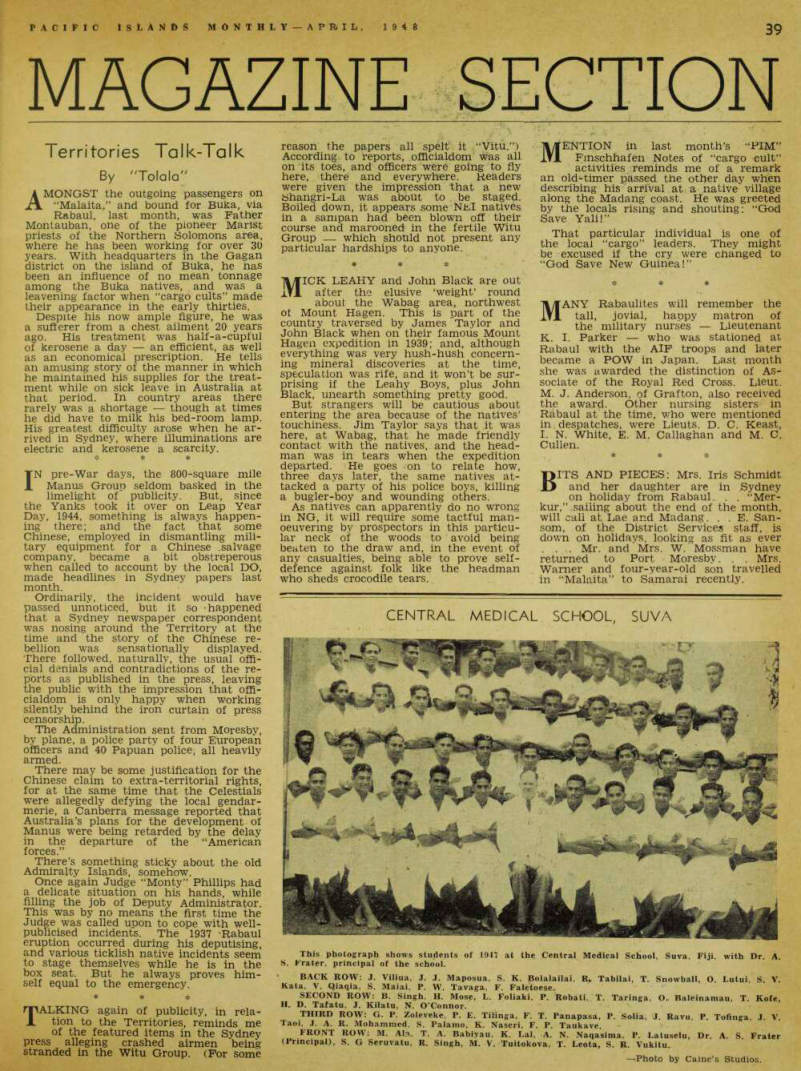
Territories Talk-Talk
By "Tolala"
AMONGST the outgoing passengers on “Malaita,” and bound for Buka, via Rabaul, last month, was Father Montauban, one of the pioneer Marist priests of the Northern Solomons area, where he has been working for over 30 years. With headquarters in the Gagan district on the island of Buka, he has been an influence of no mean tonnage among the Buka natives, and was a leavening factor when “cargo cults” made their appearance in the early thirties.
Despite his now ample figure, he was a sufferer from a chest ailment 20 years ago. His treatment was half-a-cupful of kerosene a day an efficient, as well as an economical prescription. He tells an amusing story of the manner in which he maintained his supplies for the treat ment while on sick leave in Australia at that period. In country areas there rarely was a shortage though at times he did have to milk his bed-room lamp.
His greatest difficulty arose when he ar rived in Sydney, where illuminations are electric and kerosene a scarcity. * * ♦ IN pre-War days, the 800-square mile Manus Group seldom basked in the limelight of publicity. But, since the Yanks took it over on Leap Year Day, 1944, something is always happen ing there; and the fact that some Chinese, employed in dismantling mili tary equipment for a Chinese .salvage company, became a bit obstreperous when called to account by the local DO, made headlines in Sydney papers last month.
Ordinarily, the incident would have passed unnoticed, but it so ’happened that a Sydney newspaper correspondent was nosing around the Territory at the time and the story of the Chinese re bellion was sensationally displayed.
There followed, naturally, the usual offi cial denials and contradictions of the re ports as published in the press, leaving the public with the impression that offi cialdom is only happy when working silently behind the iron curtain of press censorship.
The Administration sent from Moresby, by plane, a police party of four European officers and 40 Papuan police, all heavily armed.
There may be some justification for the Chinese claim to extra-territorial rights, for at the same time that the Celestials were allegedly defying the local gendar merie, a Canberra message reported that Australia’s plans for the development of Manus were being retarded by the delay in the departure of the “American forces.”
There’s something sticky about the old Admiralty Islands, somehow.
Once again Judge “Monty” Phillips had a delicate situation on his hands, while filling the job of Deputy Administrator.
This was by no means the first time the Judge was called unon to cope with well publicised incidents. The 1937 Rabaul eruption occurred during his deputising, and various ticklish native incidents seem to stage themselves while he is in the box seat. But he always proves him self equal to the emergency. * * « TALKING again of publicity, in rela tion to the Territories, reminds me of the featured items in the Sydney press alleging crashed airmen being stranded in the Witu Group. (For some
reason the papers all spelt it “Vitu,”) According to reports, officialdom was all on its toes, and officers were going to fly here, there and everywhere. Readers were given the impression that a new Shangri-La was about to be staged.
Boiled down, it appears some NEI natives in a sampan had been blown off their course and marooned in the fertile Witu Group which should not present any particular hardships to anyone. * * * MICK LEAHY and John Black are out after the elusive ‘weight’ round about the Wabag area, northwest of Mount Hagen. This is part of the country traversed by James Taylor and John Black when on their famous Mount Hagen expedition in 1939; and, although everything was very hush-hush concern ing mineral discoveries at the time, speculation was rife, and it won’t be sur prising if the Leahy Boys, plus John Black, unearth something pretty good.
But strangers will be cautious about entering the area because of the natives’ touchiness. Jim Taylor says that it was here, at Wabag, that he made friendly contact with the natives, and the head man was in tears when the expedition departed. He goes on to relate how, three days later, the same natives at tacked a party of his police boys, killing a bugler-boy and wounding others.
As natives can apparently do no wrong in NG, it will require some tactful man oeuvermg by prospectors in this particu lar neck of the woods to avoid being beaten to the draw and, in the event of any casualties, being able to prove self defence against folk like the headman who sheds crocodile tears.
MENTION in last month’s “PIM”
Fmschhafen Notes of “cargo cult” activities reminds me of a remark an old-timer passed the other day when describing his arrival at a native village along the Madang coast. He was greeted by the locals rising and shouting: “God Save Yali!”
That particular individual is one of the local “cargo” leaders. They might be excused if the cry were changed to “God Save New Guinea!” * * * MANY Rabaulites will remember the tall, jovial, hanpy matron of the military nurses Lieutenant K. I. Parker who was stationed at Rabaul with the AIF troops and later became a POW in Japan. Last month she was awarded the distinction of As sociate of the Royal Red Cross, Lieut.
M. J. Anderson, of Grafton, also received the award. Other nursing sisters in Rabaul at the time, who were mentioned in despatches, were Lieuts, D. C. Keast, I. N. White, E. M. Callaghan and M. C.
Cullen. * * « BITS AND PIECES: Mrs. Iris Schmidt and her daughter are in Sydney on holiday from Rabaul. . . “Mer kur,” sailing about the end of the month, will call at Lae and Madang. . . E. San som, of the District Services staff, is down on holidays, looking as fit as ever . . . Mr. and Mrs. W. Mossman have returned to Port Moresby. . . Mrs.
Warner and four-year-old son travelled in “Malaita” to Samarai recently.
Central Medical School, Suva
This photograph shows students of 1947 at the Central Medical School. Suva, Fiji, with Dr. A.
S. Frater, principal of the school.
BACK ROW: J. Viliua, J. J. Maposua, S. K. Bolalailai, R. Tabilai, T. Snowball, O. Lutui, S. V.
Kata, V. Qiaqia, S. Maiai, P. W. Tavaga, F. Faletoese.
SECOND ROW: B. Singh, H. Mose, L. Foliaki, P. Robati, T. Taringa, O. Baleinamau, T. Kofe, H. D. Tafatu, J. Kilatu, N. O’Connor.
THIRD ROW: G. P. Zoleveke, P. E. Tilinga, F. T. Panapasa, P. Solia, J. Ravu, P. Tofinga, J. V.
Taoi, J. A. R. Mohammed, S. Palamo, K. Naseri, F. P. Taukave.
FRONT ROW: M. Ala, T. A. Babiyau, K. Lai, A. N. Naqasima, P. Latuselu, Dr. A. S. Frater (Principal), S. G Seruvatu, R. Singh, M. V. Tuitokova, T. Leota, S. R. Vukitu. —Photo by Caine’s Studios.
FRESH FIELDS —and Quarantine
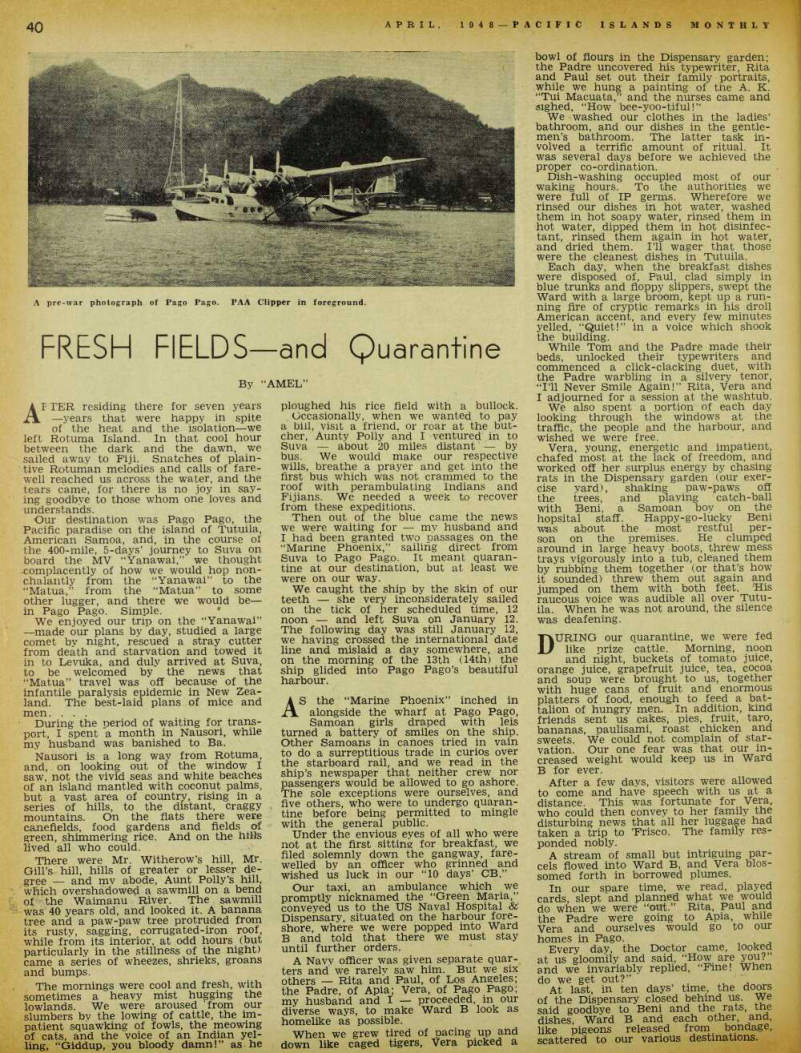
By “Amel”
AFTER residing there for seven years —years that were happy in spite of the heat and the isolation—we left Rotuma Island. In that cool hour between the dark and the dawn, we sailed away to Fiji. Snatches of plaintive Rotuman melodies and calls of farewell reached us across the water, and the tears came, for there is no joy in saying goodbve to those whom one loves and understands.
Our destination was Pago Pago, the Pacific paradise on the island of Tutuila, American Samoa, and, in the course of the 400-mile, 5-days’ journey to Suva on board the MV “Yanawai,” we thought .complacently of how we would hop nonchalantly from the “Yanawai” to the “Matua,” from the “Matua” to some other lugger, and there we would be— in Pago Pago. Simple. * We enjoved our trip on the “Yanawai” —made our plans by'day, studied a large comet bv night, rescued a stray cutter from death and starvation and towed it in to Levuka, and dulv arrived at Suva, to be welcomed by the news that “Matua” travel was off because of the infantile paralysis epidemic in New Zealand. The best-laid plans of mice and men. . . .
During the period of waiting for transport, I spent a month in Nausori, while my husband was banished to Ba.
Nausori is a long wav from Rotuma, and, on looking out of the window I saw, not the vivid seas and white beaches of an island mantled with coconut palms, but a vast area of country, rising in a op-pip*? nf hills to the distant craggv mountains. On the flatf there wele caneflelds, food gardens and fields of h?eT'a!r“could riCe ' And ° n hI “ S There were Mr, WitheroWs hill, Mr.
Yree S - aYd h mv MU, of h dhe OV WMmiX d ßVer m ThrstvXm was 40 vears old, and looked it. A banana tree and a paw-paw tree protruded from its rustv sagging corrugated-iron roof, while from itfmferiS?. at odd hours (but particularly in the stillness of the night) came a series of wheezes, shrieks, groans and bumps. sometlme°s rn a B he W av r y Tagging 'Yhe
sa* b,T«. K-afsi?. s
patient squawking of fowls, the meowing of cats, and the voice of an Indian yelling, “Giddup, you bloody damn!” as he
ploughed his rice field with a bullock.
Occasionally, when we wanted to pay a bill, visit a friend, or roar at the but cher, Aunty Polly and I ventured in to Suva about 20 miles distant by bus. We would make our respective wills, breathe a prayer and get into the first bus which was not crammed to the roof with perambulating Indians and Fijians. We needed a week to recover from these expeditions.
Then out of the blue came the news we were waiting for mv husband and I had been granted two passages on the “Marine Phoenix,” sailing direct from Suva to Pago Pago. It meant quaran tine at our destination, but at least we were on our way.
We caught the ship by the skin of our teeth she very inconsiderately sailed on the tick of her scheduled time, 12 noon and left Suva on January 12.
The following day was still January 12, we having crossed the international date line and mislaid a day somewhere, and on the morning of the 13th (14th) the ship glided into Pago Pago’s beautiful harbour.
AS the “Marine Phoenix” inched in alongside the wharf at Pago Pago, Samoan girls draped with leis turned a battery of smiles on the ship.
Other Samoans in cahoes tried in vain to do a surreptitious trade in curios over the starboard rail, and we read in the ship’s newspaper that neither crew nor passengers would be allowed to go ashore.
The sole exceptions were ourselves, and five others, who were to undergo quaran tine before being permitted to mingle with the general public.
Under the envious eyes of all who were not at the first sitting for breakfast, we filed solemnly down the gangway, fare welled by an officer who grinned and wished us luck in our “10 days’ CB,”
Our taxi, an ambulance which we promptly nicknamed the “Green Maria,” conveyed us to the US Naval Hospital &' Dispensary, situated on the harbour fore shore, where we were popped into Ward B and told that there we must stay until further orders.
A Navv officer was given separate quar ters and we rarelv saw him. But we six others Rita and Paul, of Los Angeles; the Padre, of Apia; Vera, of Pago Pago; my husband and I proceeded, in our diverse ways, to make Ward B look as homelike as possible.
When we grew tired of pacing up and down like caged tigers, Vera picked a
bowl of flours in the Dispensary garden; the Padre uncovered his typewriter, Rita and Paul set out their family portraits, while we hung a painting of the A. K.
“Tui Macuata,” and the nurses came and sighed, “How bee-yoo-tiful!”
We washed our clothes in the ladies’ bathroom, and our dishes in the gentle men’s bathroom. The latter task in volved a terrific amount of ritual. It was several days before we achieved the proper co-ordination.
Dish-washing occupied most of our waking hours. To the authorities we were full of IP germs. Wherefore we rinsed our dishes in hot water, washed them in hot soapy water, rinsed them in hot water, dipped them in hot disinfec tant, rinsed them again in hot water, and dried them. I’ll wager that those were the cleanest dishes in Tutuila.
Each day, when the breakfast dishes were disposed of, P'aul, clad simply in blue trunks and floppy slippers, swept the Ward with a large broom, kept up a run ning fire of cryptic remarks in his droll American accent, and every few minutes yelled, “Quiet!” in a voice which shook the building.
While Tom and the Padre made their beds, unlocked their typewriters and commenced a click-clacking duet, with the Padre warbling in a silvery tenor, “I’ll Never Smile Again!” Rita, Vera and I adjourned for a session at the washtub.
We also spent a portion of each day looking through the windows at the traffic, the people and the harbour, and wished we were free.
Vera, young, energetic and impatient, chafed most at the lack of freedom, and worked off her surplus energy by chasing rats in the Dispensary garden (our exer cise yard), shaking paw-paws off the trees, and playing catch-ball with Beni, a Samoan boy on the hopsital staff. Happy-go-lucky Beni was about the most restful per son on the premises. He clumped around in large heavy boots, threw mess trays vigorously into a tub, cleaned them by rubbing them together (or that’s how it sounded) threw them out again and jumped on them with both feet. His raucous voice was audible all over Tutu ila. When he was not around, the silence was deafening.
DURING our Quarantine, we were fed like prize cattle. Morning, noon and night, buckets of tomato juice, orange juice, grapefruit juice, tea, cocoa and soup were brought to us, together with huge cans of fruit and enormous platters of food, enough to feed a bat talion of hungry men. In addition, kind friends sent us cakes, pies, fruit, taro, bananas, paulisami, roast chicken and sweets. We could not complain of star vation. Our one fear was that our in creased weight would keep us in Ward B for ever.
After a few days, visitors were allowed to come and have speech with us at a distance. This was fortunate for Vera, who could then convey to her family the disturbing news that all her luggage had taken a trip to ’Frisco. The family res ponded nobly.
A stream of small but intriguing par cels flowed into Ward B, and Vera blos somed forth in borrowed plumes.
In our spare time, we read, played cards, slept and planned what we would do when we were “out.” Rita, Paul and the Padre were going to Apia, while Vera and ourselves would go to our homes in Pago.
Every day, the Doctor came, looked at us gloomily and said, “How are you?” and we invariably replied, “Fine! When do we get out?” . A At last, in ten days’ time, the doors of the Dispensary closed behind us. We said goodbye to Beni and the rats, the dishes, Ward B and each other, and, like pigeons released from bondage, scattered to our various destinations.
A pre-war photograph of Pago Pago. PAA Clipper in foreground.
Tropicalities
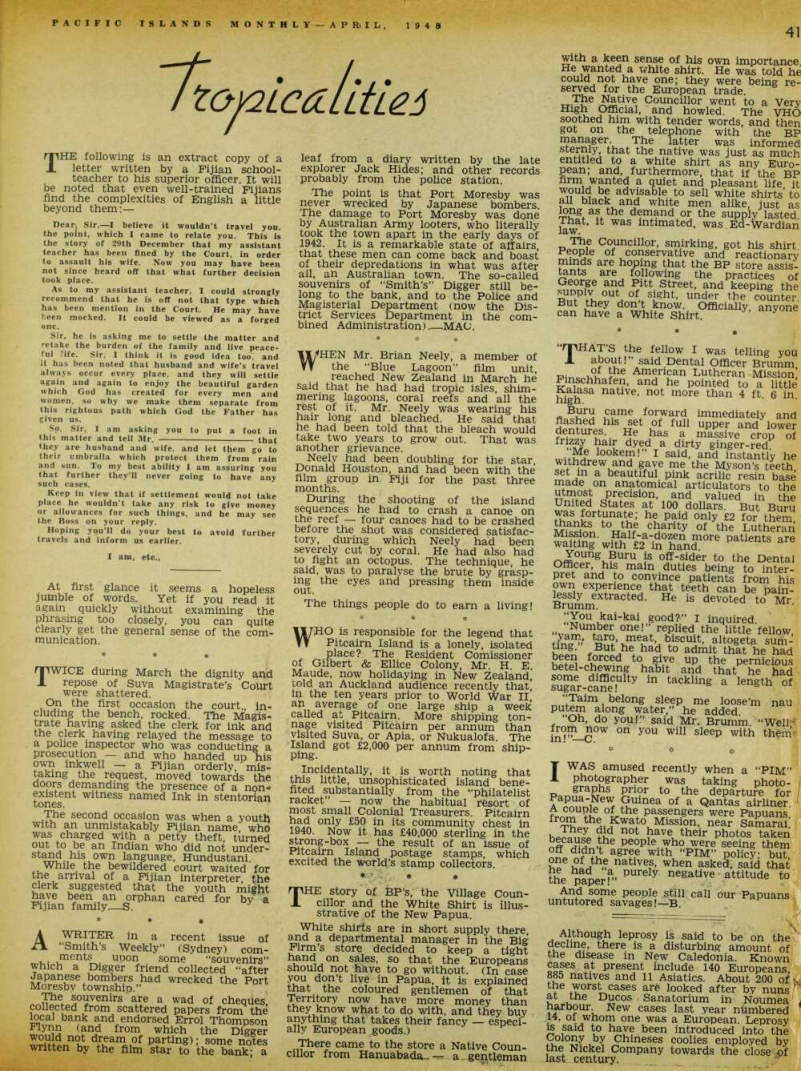
THE following is an extract copy of a letter written by a Fijian school teacher to his superior officer. It will be noted that even well-trained Fijians find the complexities of English a little
beyond them:—
Deai-j Sir, —I believe it wouldn’t travel you. the point, which I came to relate you. This is the story of 29th December that my assistant teacher has been fined by the Court, in order to assault his wife. Now you may have been not since heard off that what further decision took place.
As to my assistant teacher, I could strongly recommend that he is off not that type which has been mention in the Court. He may have been mocked. It could be viewecf as a forged one.
Sir, he is asking me to settle the matter and retake the burden of the family and live peace ful life. Sir, I think it is good idea too. and it has been noted that husband and wife’s travel always occur every place, and they will settle again and again to enjoy the beautiful garden which God has created for every men and women, so why we make them separate from this rightous path which God the Father has given us.
So, Sir, I am asking you to put a foot in this matter and tell Mr. that they are husband and wife, and let them go to their umbralla which protect them from rain and sun. To my best ability I am assuring you that further they’ll never going to have any such cases.
Keep in view that if settlement would not take place he wouldn’t take any risk to give money or allowances for such things, and he may see the Boss on your reply.
Hoping you’ll do your best to avoid further travels and inform us earlier.
I am, etc., At first glance it seems a hopeless jumble of words. Yet if you read it again quickly without examining the
phrasing too closely, you can quite
clearly get the general sense of the com munication. * * *
TWICE during March the dignity and
repose of Suva Magistrate’s Court were shattered.
On the first occasion the court., in cluding the bench, rocked. The Magis trate having asked the clerk for ink and the clerk having relayed the message to a police inspector who was conducting a prosecution — and who handed un his own inkwell — a Fijian orderly, ‘ mis taking the request, moved towards the doors demanding the presence of a non existent witness named Ink in stentorian tones.
The second occasion was when a youth with an unmistakably Fijian name, who was charged with a petty theft, turned out to be an Indian who did not under stT^?Mhls^ 0W , n ianguage, Hundustani.
While the bewildered court waited for the arrival of a Fijian interpreter, the clerk suggested that the vouth might have been an orphan cared for bv a
Fijian family..
s.
* * * A WRITER in a recent issue of “Smith’s Weekly” (Sydney) com , . jnents upon some “souvenirs” which a Digger friend collected “after Japanese bombers had wrecked the Port Moresby township.” •n'k 0 * souvenirs are a wad of cheques collected from scattered papers from the meal bank and endorsed Errol Thompson Flynn (and from which the Digger 52555« n V? d Ji! an L of P artin g): some notes written by the film star to the bank- a
leaf from a diary written by the late explorer Jack Hides; and other records probably from the police station.
The point is that Port Moresby was never wrecked by Japanese bombers.
The damage to Port Moresby was done by Australian Army looters, who literally took the town apart in the early days of 1942. It is a remarkable state of affairs, that these men can come back and boast of their depredations in what was after all, an Australian town. The so-called souvenirs of “Smith’s” Digger still be long to the bank, and to the Police and Magisterial Department (now the Dis trict Services Department in the com
bined Administration)
Mac.
* * * IIifHEN Mr. Brian Neely, a member of TT the “Blue Lagoon’’ film unit, reached New Zealand in March he said that he had had tropic isles, shim mering lagoons, coral reefs and all the rest of it. Mr. Neely was wearing his hair long and bleached. He said that he had been told that the bleach would take two years to grow out. That was another grievance.
Neely had been doubling for the star, Donald Houston, and had been with the film group in Fiji for the past three months.
During the shooting of the island sequences he had to crash a canoe on the reef four canoes had to be crashed before the shot was considered satisfac tory, during which Neely had been severely cut by coral. He had also had to fight an octopus. The technique, he said, was to paralyse the brute by grasp ing the eyes and pressing them inside out.
The things people do to earn a living!
V ♦ WHO is responsible for the legend that Pitcairn Island is a lonely, isolated * lace ? Tlle Resident Comissioner of Gilbert & Ellice Colony, Mr. H. E.
Maude, now holidaying in New Zealand, told an Auckland audience recently that, In the ten years prior to World War II an average of one large ship a week called at Pitcairn. More shipping ton nage visited Pitcairn per annum than visited Suva, or Apia, or Nukualofa. The Island got £2,000 per annum from ship ping. *i_P lc MS?t a lly, it is worth noting that this little, unsophisticated island bene fited substantially from the “philatelist racket” now the habitual resort of most small Colonial Treasurers. Pitcairn “ ad only £5O in its community chest in 1940. Now it has £40,000 sterling in the strong-box the result of an issue of Pitcairn Island postage stamps, which excited the world’s stamp collectors. * ♦ ♦ THE story of BP’s, the Village Coun cillor and the White Shirt is illus strative of the New Papua.
White shirts are in short supply there and a departmental manager in the Big Firm’s store decided to keep a tight sa^es » So that the Europeans should not have to go without. (In case y° u , liv £ in Pa P ua - it is explained mat the coloured gentlemen of that Territory now have more money than they know what to do with, and they buy anything that takes their fancy especi ally European goods.) There came to the store a Native Coun cillor from Hanuabada.. a gentleman
with a keen sense of his own importance He wanted a white shirt. He was told he could not have one; they were being re served for the European trade.
T T T ? e Councillor went to a Verv High Official, and howled. The VHO soothed him with tender words, and then got on the telephone with the BP 1^ ter was informed sternly, that the native was just as much entitled to a white shirt as any Euro pean; and, furthermore, that if the BP firm wanted a quiet and pleasant life, it would be advisable to sell white shirts to all black and white men alike, just as a ®4. the demand or the supply lasted That, it was intimated, was Ed-Wardian c ° uncillor > smirking, got his shirt.
People of conservative and reactionary minds are hoping that the BP store assis tants are following the practices of George and Pitt Street, and keeping the S , lght ’ undPr - the counter.
But they don t know. Officially, anyone can have a White Shirt. y
THAT’S the fellow I was telling you about'” said Dental Officer Brumm wwhhoS® Am^ ri £ an Luthe ran Mission,’
Finschhafen, and he pointed to a little high* 1 natlVo, not more than 4 ft. 6 in. a B u ame forward immediately and ripnfnrpc hls w 6t fud u PP er and lower dentures. He has a massive crop of al f dyed a dirty ginger-red. w n^ e J°° ke^ r 1 said> and in stantly he withdrew and gave me the Myson’s teeth set in a beautiful pink acrilic resin base made on anatomical articulators to the rnJKSf Precision, and valued in the United States at 100 dollars. But Buru was fortunate; he paid only £2 for them csarity 5 arity of the Lutheran Mission. Half-a-dozen more patients are waiting with £2 in hand. P are n£^? g y? uru I s °ff-s id er to the Dental Officer, his main duties being to inter pret and to convince patients from his own experience that teeth can be pain lessly extracted. He is devoted to Mr .tsrumm. ‘‘You kai-kai good?” I inquired M Number one!” replied the little fellow rjf.?’ , meat -, biscuit, altogeta sum- E f £ut he had to admit that he had an P d sugl e r-cane°! Ulty “ tackling a len S th of “Taim belong sleep me loose’m nau Putem alon £ water,” he added.
“Oh, do you!” said Mr. Brumm. “Well from now on you will sleep with them
In!”-
c.
I WAS amused recently when a “PIM” photographer was taking photo- £ n ? r to * the de P a rture for ? a PUf "New Guinea of a Qantas airliner. fwSS °t the . Passengers were Papuans, fr m2 O T th S i^ wa i'°t- Mlsslon ’ near Samarai. hpTolfL ?v? not ? ave^ their Photos taken i he P e °P le who were seeing them agree with “PIM” policy; but, £L th ® natlve f when asked, said that the paper f” PUfe y ne « ati ve attitude to And some people still call our Papuans
untutored savages!-
B.
Although leprosy is said to be on the deelme, there is a disturbing amount of the disease in New Caledonia. Known cases at present include 140 Europeans, 885 natives and 11 Asiatics. About 200 of the worst cases are looked after by nuns at the Ducos Sanatorium in Noumea harbour. New cases last year numbered 14, of whom one was a European. Leprosy is said to have been introduced into the Colony by Chineses coolies employed by the Nickel Company towards the close of last century.
Hurricane of
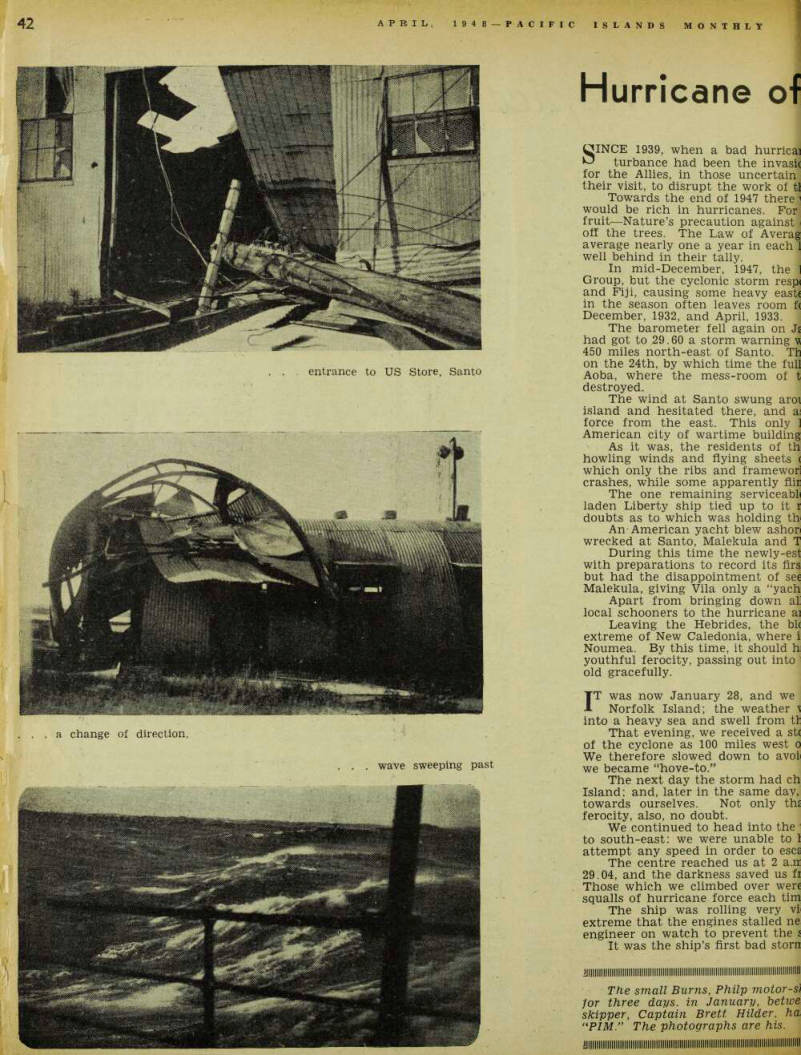
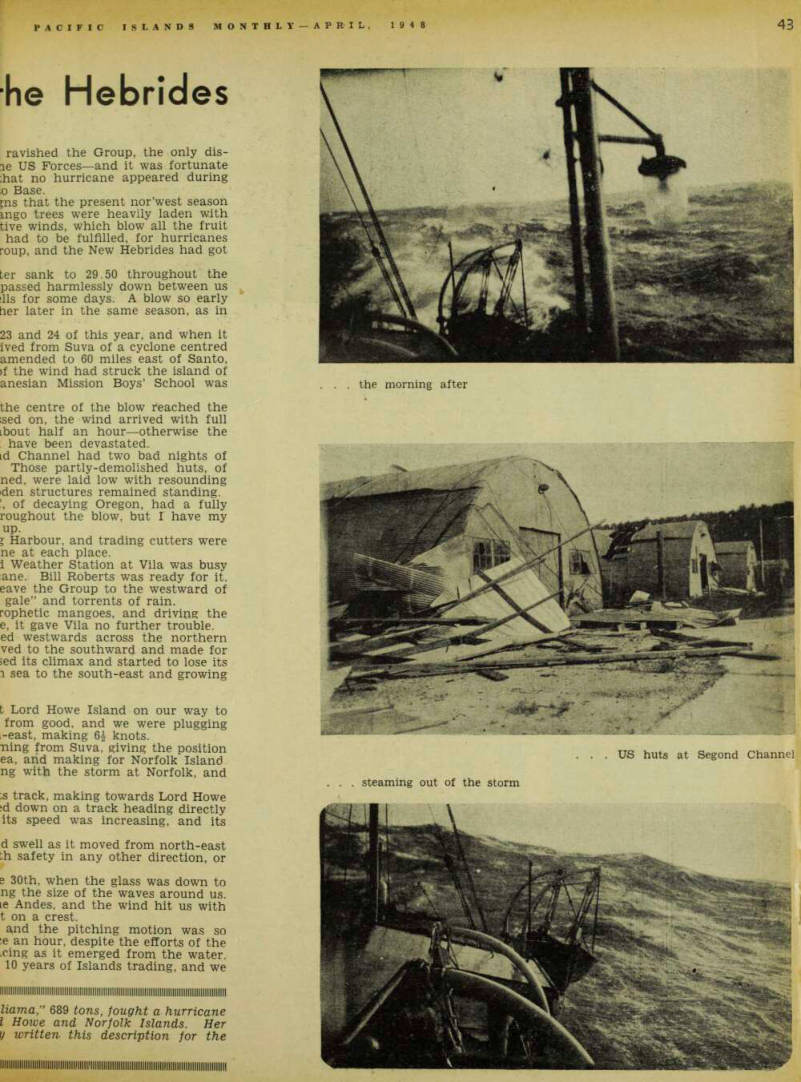
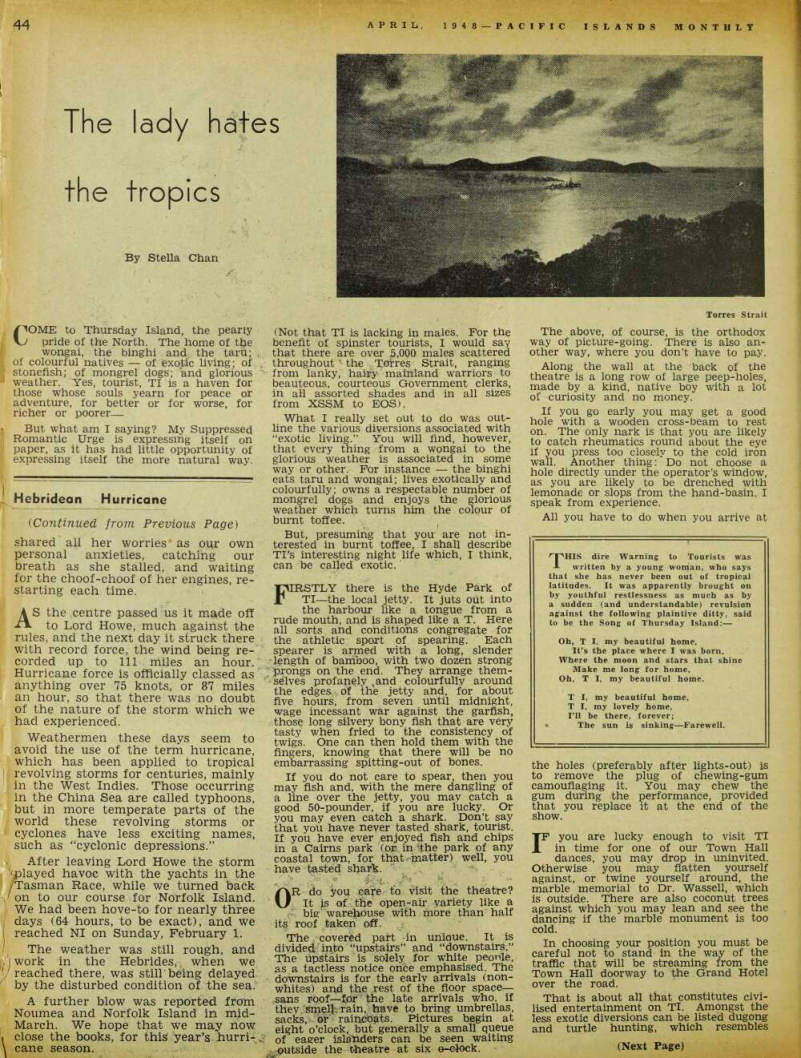
SINCE 1939, when a bad hurricai turbance had been the invasic for the Allies, in those uncertain their visit, to disrupt the work of tl Towards the end of 1947 there i would be rich in hurricanes. For fruit—Nature’s precaution against \ off the trees. The Law of Averag average nearly one a year in each 1 well behind in their tally.
In mid-December, 1947, the 1 Group, but the cyclonic storm resp< and Fiji, causing some heavy easte in the season often leaves room ft December, 1932, and April, 1933.
The barometer fell again on Ji had got to 29.60 a storm warning v 450 miles north-east of Santo. Th on the 24th, by which time the full Aoba, where the mess-room of t destroyed.
The wind at Santo swung aroi island and hesitated there, and a; force from the east. This only 1 American city of wartime building As it was, the residents of th howling winds and flying sheets ( which only the ribs and frameworl crashes, while some apparently flir The one remaining serviceabk laden Liberty ship tied up to it r doubts as to which was holding th An American yacht blew ashon wrecked at Santo, Malekula and T During this time the newly-est with preparations to record its firs but had the disappointment of see Malekula, giving Vila only a “yach Apart from bringing down all local schooners to the hurricane ai Leaving the Hebrides, the blc extreme of New Caledonia, where i Noumea. By this time, it should hi youthful ferocity, passing out into old gracefully.
IT was now January 28, and we Norfolk Island; the weather \ into a heavy sea and swell from tb That evening, we received a stc of the cyclone as 100 miles west o We therefore slowed down to avob we became “hove-to.”
The next day the storm had ch Island: and, later in the same day, towards ourselves. Not only tha ferocity, also, no doubt.
We continued to head into the ' to south-east: we were unable to 1 attempt any speed in order to esca The centre reached us at 2 a.ir 29.04, and the darkness saved us fr Those which we climbed over were squalls of hurricane force each tim The ship was rolling very vi< extreme that the engines stalled ne engineer on watch to prevent the s It was the ship’s first bad storn
The small Burns, Philp motors) for three days, in January, hetwe skipper, Captain Brett Hilder. ha, “PIM ” The photographs are his.
. . . entrance to US Store, Santo
... a change of direction.
. . . wave sweeping past
ravished the Group, the only dis le US Forces—and it was fortunate ;hat no hurricane appeared during 0 Base. pis that the present nor’west season ingo trees were heavily laden with tive winds, which blow all the fruit had to be fulfilled, for hurricanes roup, and the New Hebrides had got ter sank to 29.50 throughout the passed harmlessly down between us ills for some days. A blow so early her later in the same season, as in 23 and 24 of this year, and when it ived from Suva of a cyclone centred amended to 60 miles east of Santo, >f the wind had struck the island of anesian Mission Boys’ School was the centre of the blow reached the ised on, the wind arrived with full ibout half an hour—otherwise the have been devastated, id Channel had two bad nights of Those partly-demolished huts, of ned, were laid low with resounding den structures remained standing. :, of decaying Oregon, had a fully roughout the blow, but I have my up. £ Harbour, and trading cutters were ne at each place. 1 Weather Station at Vila was busy ane. Bill Roberts was ready for it. eave the Group to the westward of gale” and torrents of rain, rophetic mangoes, and driving the e, it gave Vila no further trouble, ed westwards across the northern ved to the southward and made for >ed its climax and started to lose its i sea to the south-east and growing fc Lord Howe Island on our way to from good, and we were plugging -east, making 6£ knots, ning from Suva, giving the position ea, arid making for Norfolk Island ng with the storm at Norfolk, and ;s track, making towards Lord Howe id down on a track heading directly its speed was increasing, and its d swell as it moved from north-east :h safety in any other direction, or s 30th, when the glass was down to ng the size of the waves around us. ie Andes, and the wind hit us with t on a crest. and the pitching motion was so :e an hour, despite the efforts of the ,cing as it emerged from the water. 10 years of Islands trading, and we
Hama,” 689 tons, fought a hurricane I Howe and Norfolk Islands. Her y written this description for the
. . . the morning after
... US huts at Segond Channel
. . . steaming out of the storm
shared all her worries as our own personal anxieties, catching our breath as she stalled, and waiting for the choof-choof of her engines, re starting each time.
AS the centre passed us it made off to Lord Howe, much against the rules, and the next day it struck there with record force, the wind being re corded up to 111 miles an hour.
Hurricane force is officially classed as' anything over 75 knots,, or 87 miles an hour, so that there was no doubt of the nature of the storm which we had experienced.
Weathermen these days seem to avoid the use of the term hurricane, which has been applied to tropical revolving storms for centuries, mainly in the West Indies. Those occurring in the China Sea are called typhoons, but in more temperate parts of the world these revolving storms or cyclones have less exciting names, such as “cyclonic depressions.”
After leaving Lord Howe the storm 'played havoc with the yachts in the /Tasman Race, while we turned back ' on to our course for Norfolk Island.
We had been hove-to for nearly three days (64 hours, to be exact), and we reached NI on Sunday, February 1.
The weather was still rough, and j work in the Hebrides, when we / reached there, was still being delayed by the disturbed condition of the sea.
A further blow was reported from Noumea and Norfolk Island in mid- March. We hope that we may now close the books, for this year’s hurri-. cane season.
the tropics
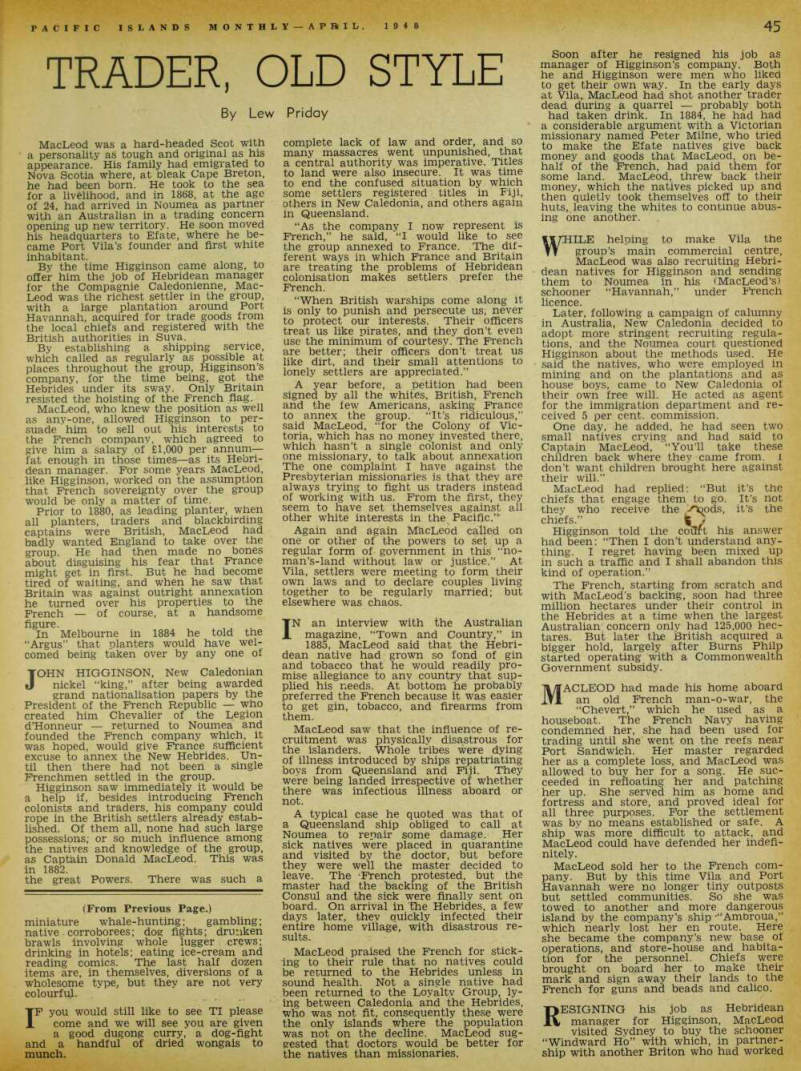
The lady hates the tropics
By Stella Chan
to Thursday Island, the pearly J pride of the North. The home of tlje wongai, the binghi and the taru; of colourful natives of exotic living; of stonefish; of mongrel dogs; and glorious weather. Yes, tourist, TI is a haven for those whose souls yearn for peace or adventure, for better or for worse, for richer or poorer— But what am I saying? My Suppressed Romantic Urge is expressing itself on paper, as it has had little opportunity of expressing itself the more natural way.
(Not that TI is lacking in males. For the benefit of spinster tourists, I would say that there are over .5,000 males scattered throughout ' the Torres Strait, ranging from lanky, hairy mainland warriors to beauteous, courteous Government clerks, in all assorted shades and in all sizes from XSSM to EOS).
What I really set out to do was out line the various diversions associated with “exotic living.’’ You will find, however, that every thing from a wongai to the glorious weather is associated in some way or other. For instance the binghi eats taru and wongai; lives exotically and colourfully; owns a respectable number of mongrel dogs and enjoys the glorious weather which turns him the colour of burnt toffee.
But, presuming that you are not in terested in burnt toffee, I shall describe Tl's interesting night life which, I think, can be called exotic.
FIRSTLY there is the Hyde Park of Tl—the local jetty. It juts out into the harbour like a tongue from a rude mouth, and is shaped like aT. Here all sorts and conditions congregate for the athletic sport of spearing. Each spearer is armed with a long, slender length of bamboo, with two dozen strong prongs on the end. They arrange them selves profanely ,and colourfully around the edges of the jetty and, for about five hours, from seven until midnight, wage incessant war against the garfish, those long silvery bony fish that are very tasty when fried to the consistency of twigs. One can then hold them with the fingers, knowing that there will be no embarrassing spitting-out of bones.
If you do not care to spear, then you may fish and, with the mere dangling of a line over the jetty, you mav catch a good 50-pounder, if you are lucky. Or you may even catch a shark. Don’t say that vou have never tasted shark, tourist.
If you have ever enjoyed fish and chips in a Cairns park (or in the park of any coastal town, for that matter) well, you have tasted shark. rt ■ . - AR do you care to visit the theatre?
V/ It is of the open-air variety like a big warehouse with more than half its roof taken off.
The covered part in uniaue. It is divided into “upstairs” and “downstairs.”
The upstairs is solely for white peonle, as a tactless notice once emphasised. The downstairs is for the early arrivals (non whites) and the rest of the floor space— sans roof—for the late arrivals who. if they smell rain, have to bring umbrellas, sacks, or raincoats. Pictures begin at eight o’clock, but generally a small queue of eager islanders can be seen waiting outside the theatre at six o-clock.
The above, of course, is the orthodox way of picture-going. There is also an other way, where you don’t have to pay.
Along the wall at the back of the theatre is a long row of large peep-holes, made by a kind, native boy with a lot of curiosity and no money.
If you go early you may get a good hole with a wooden cross-beam to rest on. The only nark is that you are likely to catch rheumatics round about the eye if you press too closely to the cold iron wall. Another thing; Do not choose a hole directly under the operator’s window, as you are likely to be drenched with lemonade or slops from the hand-basin, I speak from experience.
All you have to do when you arrive at
THIS dire Warning to Tourists was written by a young woman, who says that she has never been out of tropical latitudes. It was apparently brought on by youthful restlessness as much as by a sudden (and understandable) revulsion against the following plaintive ditty, said to be the Song of Thursday Island:— Oh, T I, my beautiful home, It’s the place where I was born.
Where the moon and stars that shine Make me long for home, Oh, T I, my beautiful home.
T I, my beautiful home, T I, my lovely home, I’ll be there, forever; The sun is sinking—Farewell.
the holes (preferably after lights-out) is to remove the plug of chewing-gum camouflaging it. You may chew the gum during the performance, provided that you replace it at the end of the show.
IF you are lucky enough to visit TI in time for one of our Town Hall dances, you may drop in uninvited.
Otherwise you may flatten yourself against, or twine yourself around, the marble memorial to Dr. Wassell, which is outside. There are also coconut trees against which you may lean and see the dancing if the marble monument is too cold.
In choosing your position you must be careful not to stand in the way of the traffic that will be streaming from the Town Hall doorway to the Grand Hotel over the road.
That is about all that constitutes civi lised entertainment on TI. Amongst the less exotic diversions can be listed dugong and turtle hunting, which resembles
(Next Page)
Torres Strait
(From Previous Page.)
miniature whale-hunting; gambling; native corroborees; dog fights; drunken brawls involving whole lugger crews; drinking in hotels; eating ice-cream and reading comics. The last half dozen items are, in themselves, diversions of a wholesome type, but they are not very colourful.
IF you would still like to see TI please come and we will see you are given a good dugong curry, a dog-fight and a handful of dried wongais to munch.
Advertisements & other items, p. 46 (1 item)
44
APRIL, 1948 PACIFIC ISLANDS MONTHLY
Hebridean Hurricane v— {Continued from Previous Page )
Trader, Old Style
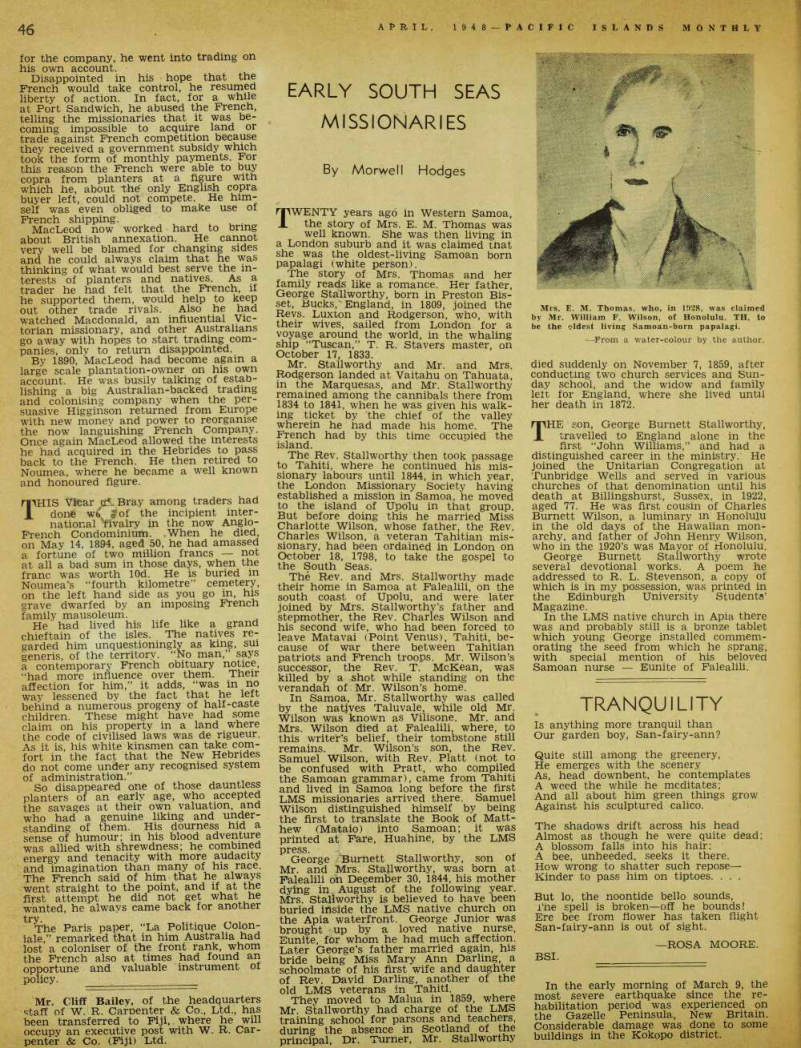
By Lew Friday
MacLeod was a hard-headed Scot with a personality as tough and original as his appearance. His family had emigrated to Nova Scotia where, at bleak Cape Breton, he had been born. He took to the sea for a livelihood, and in 1888, at the age of 24, had arrived in Noumea as partner with an Australian in a trading concern opening up new territory. He soon moved his headquarters to Efate, where he be came Port Vila’s founder and first white inhabitant.
By the time Higginson came along, to offer him the job of Hebridean manager for the Compagnie Caledonienne, Mac- Leod was the richest settler in the group, with a large plantation around Port Havannah, acquired for trade goods from the local chiefs and registered with the British authorities in Suva.
By establishing a shipping service, which called as regularly as possible at places throughout the group, Higginson’s company, for the time being, got the Hebrides under its sway. Only Britain resisted the hoisting of the French flag, MacLeod, who knew the position as well as any-one, allowed Higginson to per suade him to sell out his interests to the French company, which agreed to give him a salary of £l,OOO per annum — fat enough in those times —as its Hebri dean manager. For some years MacLeod, like Higginson, worked on the assumption that French sovereignty over the group would be only a matter of time.
Prior to 1880, as leading planter, when all planters, traders and blackbirding captains were British, MacLeod had badly wanted England to take over the group. He had then made no bones about disguising his fear that France might get in first. But he had become tired of waiting, and when he saw that Britain was against outright annexation he turned over his properties to the French of course, at a handsome figure.
In Melbourne in 1884 he told the “Argus” that olanters would have wel comed being taken over by any one of JOHN HIGGINSON, New Caledonian nickel “king,” after being awarded grand nationalisation papers by the President of the French Republic who created him Chevalier of the Legion d’Honneur returned to Noumea and founded the French company which, it was hoped, would give France sufficient excuse to annex the New Hebrides. Un til then there had not been a single Frenchmen settled in the group, Higginson saw immediately it would be a help if, besides introducing French colonists and traders, his company could rope in the British settlers already estab lished. Of them all, none had such large possessions; or so much influence among the natives and knowledge of the group, as Captain Donald MacLeod. This was in 1882. the great Powers. There was such a
complete lack of law and order, and so many massacres went unpunished, that a central authority was imperative. Titles to land were also insecure. It was time to end the confused situation by which some settlers registered titles in Fiji, others in New Caledonia, and others again in Queensland.
“As the company I now represent is French,” he said, “I would like to see the group annexed to France, The dif ferent ways in which France and Britain are treating the problems of Hebridean colonisation makes settlers prefer the French.
“When British warships come along it is only to punish and persecute us, never to protect our interests. Their officers treat us like pirates, and they don't even use the minimum of courtesy. The French are better; their officers don’t treat us like dirt, and their small attentions to lonely settlers are appreciated.”
A year before, a petition had been signed by all the whites, British, French and the few Americans, asking France to annex the group. “It’s ridiculous,” said MacLeod, “for the Colony of Vic toria, which has no money invested there, which hasn’t a single colonist and only one missionary, to talk about annexation The one complaint I have against the Presbyterian missionaries is that they are always trying to fight us traders instead of working with us. From the first, they seem to have set themselves against all other white interests in the Pacific.”’
Again and again M&cLeod called on one or other of the powers to set up a regular form of government in this “no man’s-land without law or justice.” At Vila, settlers were meeting to form their own laws and to declare couples living together to be regularly married; but elsewhere was chaos.
IN an interview with the Australian magazine, “Town and Country,” in 1885, MacLeod said that the Hebri dean native had grown so fond of gin and tobacco that he would readily pro mise allegiance to anv country that sup plied his needs. At bottom he probably preferred the French because it was easier to get gin, tobacco, and firearms from them.
MacLeod saw that the influence of re cruitment was physically disastrous for the islanders. Whole tribes were dying of illness introduced by ships repatriating boys from Queensland and Fiji. They were being landed irrespective of whether there was infectious illness aboard or not, A typical case he quoted was that of a Queensland ship obliged to call at Noumea to repair some damage. Her sick natives were placed in quarantine and visited by the doctor, but before they were well the master decided to leave. The French protested, but the master had the backing of the British Consul and the sick were finally sent on board. On arrival in the Hebrides, a few days later, thev ouickly infected their entire home village, with disastrous re sults.
MacLeod praised the French for stick ing to their rule that no natives could be returned to the Hebrides unless in sound health. Not a single native had been returned to the Loyalty Group, ly ing between Caledonia and the Hebrides, who was not fit, consequently these were the only islands where the population was not on the decline. MacLeod sug gested that doctors would be better for the natives than missionaries.
Soon after he resigned his job as manager of Higginson’s company. Both he and Higginson were men who liked to get their own way. In the early days at Vila, MacLeod had shot another trader dead during a quarrel probably both had taken drink. In 1884, he had had a considerable argument with a Victorian missionary named Peter Milne, who tried to make the Efate natives give back money and goods that MacLeod, on be half of the French, had paid them for some land. MacLeod, threw back their money, which the natives picked up and then quietlv took themselves off to their huts, leaving the whites to continue abus ing one another.
ITTHILE helping to make Vila the ff group’s main commercial centre, MacLeod was also recruiting Hebri dean natives for Higginson and sending them to Noumea in his (MacLeod’s) schooner “Havannah,” under French licence.
Later, following a campaign of calumny in Australia, New Caledonia decided to adopt more stringent recruiting regula tions, and the Noumea court questioned Higginson about the methods used. He said the natives, who were employed in mining and on the plantations and as house boys, came to New Caledonia of their own free will. He acted as agent for the immigration department and re ceived 5 per cent, commission.
One day, he added, he had seen two small natives crying and had said to Captain MacLeod, “You’ll take these children back where they came from. 1 don’t want children brought here against their will.”
MacLeod had replied; “But it’s the chiefs that engage them to go. It’s not they who receive the snoods, it’s the chiefs.” k * Higginson told the court his answer had been: “Then I don’t understand any thing. I regret having been mixed up in such a traffic and I shall abandon this kind of operation.”
The French, starting from scratch and with MacLeod’s backing, soon had three million hectares under their control in the Hebrides at a time when the largest Australian concern onlv had 125,000 hec tares. But later the British acquired a bigger hold, largely after Burns Philp started operating with a Commonwealth Government subsidy.
MACLEOD had made his home aboard an old French man-o-war, the “Chevert,” which he used as a houseboat. The French Navy having condemned her, she had been used for trading until she went on the reefs near Port Sandwich. Her master regarded her as a complete loss, and MacLeod was allowed to buy her for a song. He suc ceeded in refloating her and patching her up. She served him as home and fortress and store, and proved ideal for all three purposes. For the settlement was by no means established or safe. A ship was more difficult to attack, and MacLeod could have defended her indefi nitely.
MacLeod sold her to the French com pany. But by this time Vila and Port Havannah were no longer tiny outposts but settled communities. So she was towed to another and more dangerous island bv the company’s ship -“Ambroua,” which nearly lost her en route. Here she became the company’s new base of operations, and store-house and habita tion for the personnel. Chiefs were brought on board her to make their mark and sign away their lands to the French for guns and beads and Calico.
RESIGNING his job as Hebridean manager for Higginson, MacLeod visited Sydney to buy the schooner “Windward Ho” with which, in partner ship with another Briton who had worked
for the company, he went into trading on his own account.
Disappointed in his hope that the French would take control, he resumed liberty of action. In fact, for a while at Port Sandwich, he abused the French, telling the missionaries that it was be coming impossible to acquire land or trade against French competition because they received a government subsidy which took the form of monthly payments. For this reason the French were able to buy copra from planters at a figure with which he, about the only English copra buyer left, could not compete. He him self was even obliged to make use of French shipping. .
MacLeod now worked hard to bring about British annexation. He cannot very well be blamed for changing sides and he could always claim that he was thinking of what would best serve the in terests of planters and natives. As a trader he had felt that the French, if he supported them, would help to keep out other trade rivals. Also he had watched Macdonald, an influential Vic torian missionary, and other Australians go away with hopes to start trading com panies, only to return disappointed.
By 1890, MacLeod had become again a large scale plantation-owner on his own account. He was busily talking of estab lishing a big Australian-backed trading and colonising company when the per suasive Higginson returned from Europe with new money and power to reorganise the now languishing French Company.
Once again MacLeod allowed the interests he had acquired in the Hebrides to pass back to the French. He then retired to Noumea, where he became a well known and honoured figure.
THIS Vicar cd* Bray among traders had done wfe £of the incipient inter national Rivalry in the now Anglo- French Condominium. .When he died, on May 14. 1894, aged 50, he had amassed a fortune of two million francs not at all a bad sum in those days, when the franc was worth lOd. He is buried in Noumea’s “fourth kilometre” cemetery, on the left hand side as you go in, his grave dwarfed by an imposing French family mausoleum.
He had lived his life like a grand chieftain of the isles. The natives re garded him unquestioningly as king, sui generis, of the territory. “No man,” says a contemporary French obituary notice, “had more influence over them. Their affection for him,” it adds, “was in no way lessened by the fact that he left behind a numerous orogeny of half-caste children. These might have had some claim on his property in a land where the code of civilised laws was de rigueur.
As it is, his white kinsmen can take com fort in the fact that the New Hebrides do not come under any recognised system of administration.”
So disappeared one of those dauntless planters of an early age, who accepted the savages at their own valuation, and who had a genuine liking and under standing of them. His dourness hid a sense of humour; in his blood adventure was allied with shrewdness; he combined energy and tenacity with more audacity and imagination than many of his race.
The French said of him that he always went straight to the point, and if at the first attempt he did not get what he wanted, he always came back for another try.
The Paris paper, “La Politique Colon iale,” remarked that in him Australia had lost a coloniser of the front rank, whom the French also at times had found an opportune and valuable instrument of policy.
Mr. Cliff Bailev, of the headquarters staff of W. R. Carpenter & Co., Ltd., has been transferred to Fiji, where he will occupy an executive post with W. R. Car penter & Co. (Fiji) Ltd.
Missionaries
Early South Seas
By Morwell Hodges
TWENTY years ago in Western Samoa, the story of Mrs. E. M. Thomas was well known. She was then living in a London suburb and it was claimed that she was the oldest-living Samoan born papalagi (white person).
The story of Mrs. Thomas and her family reads like a romance. Her father, George Stall worthy, born in Preston Bis set, Bucks,' England, in 1809, joined the Revs. Luxton and Rodgerson, who, with their wives, sailed from London for a voyage around the world, in the whaling ship “Tuscan,” T. R. Stavers master, on October 17, 1833.
Mr. Stallworthy and Mr. and Mrs.
Rodgerson landed at Vaitahu on Tahuata, in the Marquesas, and Mr. Stallworthy remained among the cannibals there from 1834 to 1841, when he was given his walk ing ticket by the chief of the valley wherein he had made his home. The French had by this time occupied the island.
The Rev. Stall worthy then took passage to Tahiti, where he continued his mis sionary labours until 1844, in which year, the London Missionary Society having established a mission in Samoa, he moved to the island of Updlu in that group.
But before doing this he married Miss Charlotte Wilson, whose father, the Rev.
Charles Wilson, a veteran Tahitian mis sionary, had been ordained in London on October 18, 1798, to take the gospel to the South Seas.
The Rev. and Mrs. Stallworthy made their home in Samoa at Falealili, on the south coast of Upolu, and were later joined by Mrs. Stallworthy’s father and stepmother, the Rev. Charles Wilson and his second wife, who had been forced to leave Matavai (Point Venus), Tahiti, be cause of war there between Tahitian patriots and French troops. Mr. Wilson’s successor, the Rev. T. McKean, was killed by a shot while standing on the verandah of Mr. Wilson’s home.
In Samoa, Mr, Stallworthy was called by the natives Taluvale, while old Mr.
Wilson was known as Vilisone. Mr, and Mrs. Wilson died at Falealili, where, to this writer’s belief, their tombstone still remains. Mr. Wilson’s son, the Rev.
Samuel Wilson, with Rev. Platt (not to be confused with Pratt, who compiled the Samoan grammar), came from Tahiti and lived in Samoa long before the first LMS missionaries arrived there. Samuel Wilson distinguished himself by being the first to translate the Book of Matt hew (Mataio) into Samoan; it was printed at Fare, Huahine, by the LMS press.
George Burnett Stall worthy, son of Mr. and Mrs. Stallworthy, was born at Falealili on December 30, 1844, his mother dying in August of the following year.
Mrs. Stallworthy is believed to have been buried iriside the LMS native church on the Apia waterfront. George Junior was brought up by a loved native nurse, Eunite, for whom he had much affection.
Later George’s father married again, his bride being Miss Mary Ann Darling, a schoolmate of his first wife and daughter of Rev. David Darling, another of the old LMS veterans in Tahiti.
They moved to Malua in 1859, where Mr. Stallworthy had charge of the LMS training school for parsons and teachers, during the absence in Scotland of the principal, Dr. Turner, Mr. Stallworthy
died suddenly on November 7, 1859, after conducting two church services and Sun day school, and the widow and family lelt for England, where she lived until her death in 1872, THE son, George Burnett Stallworthy, travelled to England alone in the first “John Williams,” and had a distinguished career in the ministry. He joined the Unitarian Congregation at Tunbridge Wells and served in various churches of that denomination until his death at Billingshurst, Sussex, in 1922, aged 77. He was first cousin of Charles Burnett Wilson, a luminary m Honolulu in the old days of the Hawaiian mon archy, and father of John Henry Wilson, who in the 1920’s was Mayor of Honolulu.
George Burnett Stallworthy wrote several devotional works. A poem he addressed to R. L. Stevenson, a cony of which is in my possession, was printed in the Edinburgh University Students’
Magazine.
In the LMS native church in Apia there was and probably still is a bronze tablet which young George installed commem orating the seed from which he sprang, with special mention of his beloved Samoan nurse Eunite of Falealili.
Mrs. E. M. Thomas, who, in 1928, was claimed by Mr. William F. Wilson, of Honolulu, TH, to be the oldest living Samoan-born papalagi. —From a water-colour by the author.
Tranquility
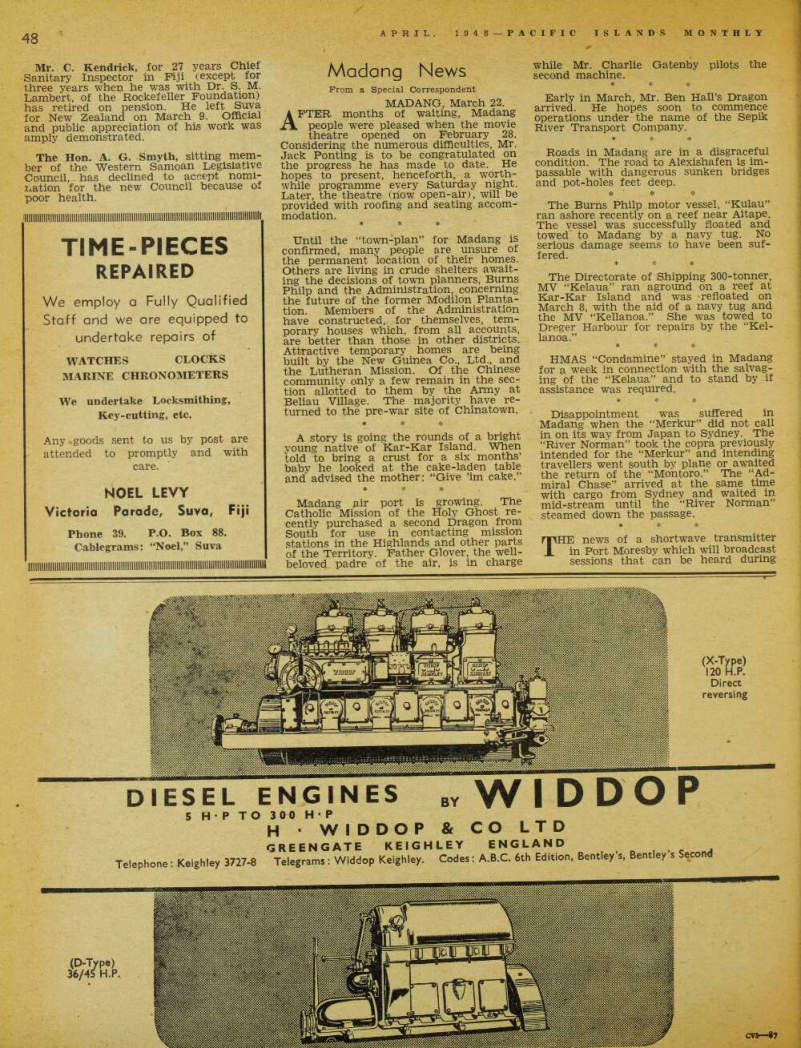
Is anything more tranquil than Our garden boy, San-fairy-ann?
Quite still among the greenery, He emerges with the scenery As, head downbent, he contemplates A weed the while he meditates: And all about him green things grow Against his sculptured calico.
The shadows drift across his head Almost as though he were quite dead; A blossom falls into his hair; A bee, unheeded, seeks it there.
How wrong to shatter such repose— Kinder to pass him on tiptoes. . . .
But 10, the noontide bello sounds, i’he spell is broken —off he bounds!
Ere bee from flower has taken flight San-fairy-ann is out of sight.
Rosa Moore.
Bsi.
In the early morning of March 9, the most severe earthquake since the re habilitation period was experienced on the Gazelle Peninsula, New Britain.
Considerable damage was done to some buildings in the Kokopo district.
Mr. C. Kendrick, for 27 years Chief Sanitary Inspector in Fiji (except for three years when he was with Dr. S. M.
Lambert, of the Rockefeller Foundation) has retired on pension. He left Suva for New Zealand on March 9. Official and public appreciation of his work was amply demonstrated.
The Hon. A. G. Smyth, sitting mem ber of the Western Samoan Legislative Council, has declined to accept nomi nation for the new Council because of poor health.
Advertisements & other items, pp. 49-50 (1 item)
Burns Philp (New Guinea) Limited
General Merchants (Wholesale and Retail)
Shipping, Customs and General Agents
Head Office: PORT MORESBY, PAPUA
BRANCHES:
NEW GUINEA: Rabaul, Kokopo, Lae Cr Madapg.
PAPUA: Samarai.
LLOYDS OF LONDON
QUEENSLAND INSURANCE CO. LTD.
BURNS PHILP TRUST CO. LTD.
BURNS, PHILP & CO. LTD.
All States.
BURNS, PHILP & CO. LTD.
"London House", 35 Crutched Friars, E.C.3.
BURNS, PHILP CO. OF SAN FRANCISCO INC. 510 Matson Building.
Distributing Agents, Territory of Papua-New Guinea for;
SHELL COMPANY OF AUSTRALIA LIMITED
Petroleum Products
GENERAL MOTORS CORPORATION
Chevrolet, Buick, Pontiac and Oldsmobile Cars Chevrolet and GMC Trucks Frigidaire Refrigerators
VAUXHALL MOTORS LIMITED
Vauxhall Cars and Bedford Trucks
R. A. LISTER & CO., BRISTOL
Producers of Petrol, Parrafin and Diesel Engines Pumps and Lighting plants
REPRESENTATIVES FOR:
AUSTRALIAN AGENTS:
LONDON AGENTS:
SAN FRANCISCO AGENTS:
RUSTON HORNSBY LIMITED
Engines
CROSSLEY MARINE ENGINES
TIME-PIECES
REPAIRED
We employ a Fully Qualified
Staff and we are equipped to undertake repairs of
WATCHES CLOCKS
MARINE CHRONOMETERS
We undertake Locksmithing, Key-cutting, etc.
Any goods sent to us by post are attended to promptly and with care.
NOEL LEVY
Victoria Parade, Suva, Fiji Phone 39. P.O. Box 88.
Cablegrams: “Noel,” Suva
Madang News
From a Special Correspondent MADANG. March 22.
AFTER months of waiting, Madang people were pleased when the movie theatre opened on February 28.
Considering the numerous difficulties, Mr.
Jack Ponting is to be congratulated on the progress he has made to date. He hopes to present, henceforth, a worth while programme every Saturday night.
Later, the theatre (now open-air), will be provided with roofing and seating accom modation. * * * Until the “town-plan” for Madang is confirmed, many people are unsure of the permanent location of their homes.
Others are living in crude shelters await ing the decisions of town planners, Burns Philp and the Administration, concerning the future of the former Modilon Planta tion. Members of the Administration have constructed, for themselves, tem porary houses which, from all accounts, are better than those in other districts.
Attractive temporary homes are being built by the New Guinea Co., Ltd., and the Lutheran Mission. Of the Chinese community only a few remain in the sec tion allotted to them by the Army at Beliau Village. The majority have re turned to the pre-war site of Chinatown. * * * A story is going the rounds of a bright young native of Kar-Kar Island. When told to bring a crust for a six months’ baby he looked at the cake-laden table and advised the mother: “Give ’im cake.”
M= * * Madang #ir port is growing. The Catholic Mission of the Holy Ghost re cently purchased a second Dragon from South for use in contacting mission stations in the Highlands and other parts of the Territory. Father Glover, the well beloved padre of the air, is in charge
while Mr. Charlie Gatenby pilots the second machine. * * « Early in March, Mr. Ben Hall’s Dragon arrived. He hopes soon to commence operations under the name of the Sepik River Transport Company. * * * Roads in Madang are in a disgraceful condition. The road to Alexishafen is im passable with dangerous sunken bridges and pot-holes feet deep. * * * The Burns Philp motor vessel, “Kulau” ran ashore recently on a reef near Aitape.
The vessel was successfully floated and towed to Madang by a navy tug. No serious damage seems to have been suf fered. * * * The Directorate of Shipping 300-tonner, MV “Kelaua” ran aground on a reef at Kar-Kar Island and was -refloated on March 8, with the aid of a navy tug and the MV “Kellanoa.” She was towed to Dreger Harbour for repairs by the “Kel lanoa.” * * * HMAS “Condamine” stayed in Madang for a week in connection with the salvag ing of the “Kelaua” and to stand by if assistance was required. * * * Disappointment was suffered in Madang when the “Merkur” did not call in on its way from Japan to Sydney. The “River Norman” took the copra previously intended for the “Merkur” and intending travellers went south bv plane or awaited the return of the “Mohtoro.” The “Ad miral Chase” arrived at the same time with cargo from Sydney and waited in mid-stream until the “River Norman” steamed down the passage. * * * THE news of a shortwave transmitter in Port Moresby which will broadcast sessions that can be heard during
the day, will delight Madang. It is under stood that educational sessions will be set aside for the natives. *■ * * During the wet season tennis has been at a standstill. With the return from leave of Mr. and Mrs. J. Allan Phillips, a renewed enthusiasm for the game is noted. ♦ * * To farewell Mrs. T. Aitchison, a sur prise morning tea party was held recently py Mrs. J. K. McCarthy at her home at Kalibobo, About twenty ladies attended and the informal atmosphere was en hanced by the unknowing guest of honour sitting modestly in the background on the doorstep. The Aitchisons will spend their leave in Victoria. * * * The Rev. W. E. Moren, Church of Eng land chaplain at Lae, visited Madang on March 19-20, when he discussed the pos sibilities of forming a church. Holy Communion was celebrated during his visit. * * ♦ A regular church service for Europeans is conducted by the American Lutneran Mission at the home of the Rev. Haahs. * * * The local Catholic Mission is planning to build a convent and presbytery in Madang. * * * On March 20 an enjoyable evening was held to celebrate the coming of age of Mrs. A. J. Shields, who was formerly Miss Marjorie Brodie of Rabaul. The in vited guests were Mr. and Mrs. J. K. Mc- Carthy, Mr. and Mrs. T. Aitchison, Mr. and Mrs. L. Hurrell, Mr. and Mrs. J. A.
Phillips, Mr. and Mrs. R. Weidenhofer, Mr. arid Mrs, Gordon Clark, Mr. and Mrs.
McGregor, Mr. and Mrs. K. Hicks, Mr. and Mrs. D. Williams, Mr. and Mrs.
James, Sister Jones, and Mr. W. Batters.
Advertisements & other items, p. 50 (1 item)
Diesel Engines By Wid D O P
MM •;• -.<: : ;-' ••:.•••>■£ •; •, ...
Suiulr (X-Type; 120 H.P, Direct reversinj DIESEL ENGINES by WID D O P 5 H P TO 300 H• P
H • WIDDOP & CO LTD
GREENGATE KEIGHLEY ENGLAND
Telephone; Keighley 3727-8 Telegrams: Widdop Keighley. Codes: A.B.C. 6th Edition, Bentley s, Ben ey s (D-Type) 36/45 H.P. «■«. v. ■■■ UK* V,- '? /' -V lli
iiiiilili
• mm-" [ ... ■■■ •• ■ . p*
CVS—*7
Nz Rock Carvings
Letter to the Editor IN your issue of February, 1948, you print a short item headed “Ancient rock drawings in southern NZ caves.” which refers to discoveries said to have been made recently by a young Dutch painter named Theo Schoon.
The inference is that Schoon was the original discoverer of these rock-drawings.
This is not the case. He may have made some new discoveries, but many have been known for 50 years or prob ably for a much longer period, and have been investigated, written about, and the identity of the artists discussed in the columns of “The Journal of the Polyne sian Society”(a New Zealand publica tion) by NZ scientists as well as by over seas scientists, I have before me a cutting from the Auckland (NZ) “Weekly News” of August 24, 1943, in which complaint is made that “some American museums had been allowed to remove the best of these draw ings to America.” There is, or has been, a diversity of opinion among those scientists who have studied the question of the origin of the rock-drawings, and I am not aware if any agreement has yet been reached.
I regret to notice that you fall into error in the concluding paragraph of your item when you say “the ancient artists ... may have been Morioris dwellers in NZ before the Maoris came from Poly nesia, and who now survive only on the Chathams a small, bleak group east ward of NZ.”
Please see your own publication, “Pacific Islands Year Book,” for 1942 s page 228, where you say (regarding the Chatham Islands): “There is no pure
native race in the group, the original natives, the Morioris, having been exterminated by the Maoris.”
The last full-blooded Moriori, Tami Horomona, also known as Tommy Solomon, who weighed about 26 stone, died on March 19, 1933, vide “SM Herald,” 15/4/1933.
I am, etc.,
J. D. Mccomish, Frgs.
Wahroonga, Sydney, March 8, 1948.
In the Suva Supreme Court recently, Paul Foster, part-Rotuman, was sen tenced to five years’ imprisonment for the manslaughter of an Indian fellow-em ployee of-Millers, Ltd., of Suva,
Mrs. Norma Venning, of Lae (NG), was visiting her mother, Mrs. C. Cassel of Woody Point, Queensland, in March.
Mr. Ken Cahill has resumed his medi cal studies at the Brisbane University after spending the vacation period with his parents at Madang, New Guinea.
Advertisements & other items, p. 51 (1 item)
Marys
TO SHIPMASTERS
When calling at Tahiti, see C)scar G.
Nordman for ships’ supplies and fresh provisions. Wire before your arrival to OCEANIC, PAPEETE (my registered cable address)
OSCAR G. NORDMAN,
Ship Chandler, Papeete, Tahiti
AUNT
MARYS
CREAM OF TARTAR
BAKING POWDER
Now Better than Ever!
NOW AVAILABLE WITHIN
SIX WEEKS OF ORDERING !
★ TELT H E RM DIAL
THERMOMETERS
MANUFACTURERS TO: N.Z.
Railways, State Hydro and Public Works Depts., etc.
This British Company has recently built a modern equipped factory in New Zealand for the manufacture of all types of Industrial Dial Temperature Instruments.
The High Standard—Temperature Controlled Contact, Rigid Stem and Capillary Type Write for Thermometers, etc., etc., can now be details and manufactured and dispatched withleaflets. in six weeks of receipt of order.
BRITISH TELTHERM Go. Ltd.
NEWMARKET. AUCKLAND.
NEW ZEALAND.
CABLES: TELTHERM NEWMARKET
Dr. Rutter's Outstanding
Service To Bsi
Prom a Special Correspondent THE outstanding service of Dr. A. G.
Rutter to the people of the British Solomon Islands was referred to at the annual meeting of the NZ Methodist Foreign Mission Board held in Auckland in February.
Dr. Ritter was for 10 years the medical officer in charge of Methodist missionary health work in the Solomon islands.
Since the war he has been on loan to the BSI Administration as -Senior medical officer.
Dr. and Mrs. Rutter have been visit ing New Zealand as a preliminary to de parting in March for England.
In an address to the Methodist Mis
sionary Board, Dr. Rutter said that, in addition to whatever medical work the BSI Government might do, there was still a wide field in which medical mis sionaries could do most effective work.
He urged the need for reconstructing the Methodist Mission Hospital which was destroyed during the Japanese invasion of the Central Solomons. He also urged the appointment of a doctor and of ad ditional nurses.
Uraia Koroi, who was sent to the Gat ton Agricultural College (Qld.) by the Fijian Government for a two-year course was recently pictured in the Bris bane “Courier-Mail” carrying out a tooth-inspection of a champion Clydes dale.
Fiji's Sugar Levy
Indian Protest Against Fiji's Sugar Levy Tax On Fiji Copra Forecast
W{HEN the Government indicated the continuance of the export levy of 10/- a ton on sugar (divided be tween the cane-farmers and the proces sors in the ratio of 40 to 60), five Indian members of the Legislative Council of Fiji figuratively raised their ten hands in horror and proceeded to declaim at length upon this iniquity.
However, nobody else seemed to regard it as such and the motion went through serenely.
Many months ago a prediction was made that when the British Government granted a rise in the price of sugar, on condition part of the increase was used as a stabilisation fund, the deduc tion would be denounced by the Indians through the years as a shameless theft from the pockets of the exploited. It has been, is being, and will be denounced as foretold.
An Indian endeavour to show that the Government is more or less bleeding the sugarcane-growers and is simultaneously nursing the copra-producers unfairly was given short shrift in Council.
IN his opening address the Governor had said that in view of the fact that in the last 12 months the price of copra had risen from under £33 to nearly £5O a ton, and in view of the further fact that the Government was negotiating with London for a price guarantee for 10, 15 or 20 years, the Government in tended, this year, to introduce a measure to divert to public uses “some portion of the very handsome profits which are at present being derived by the copra pro ducer, European and Fijian, from the distresses of the outside world.”
Which, considering that the Indian cane-growers were reasonably secure in the days when copra was down and out, did not leave the Indian complaint about sugar much of a leg to stand on.
Rush Of Fijians To Enrol
As Territorials
From Our Own Correspondent SUVA, March 16.
THE Fiji Military Forces announced on March 12, that two Territorial units would be established. Volunteers were called for.
On the first day of application for en rolment at the Colonial Barracks, near Suva, no fewer than 149 Fijians presented themselves.
The military authorities were not sur prised by this enthusiasm. They say, that Europeans and part-Europeans, however, will talk things over until some of them make a move, but there is little doubt that the enrolments will be ade quate.
The Indians, as before and during the war, have so far shown a complete de tachment in the defence of the Colony.
Death of Mrs. Alice Hooker
THE death occurred, some weeks ago, in New Zealand of Mrs. Alice Hooker, well-known in Levuka, Fiji, in the early days of the Colony. She was 96.
Mrs. Hooker was an Englishwoman; she arrived in New Zealand in 1861. When she was 21 she went to Levuka to marry Mr. B. Hooker. She has been living in Auckland now for many years.
Mrs. A. E. Noerr, of Suva, is a grand daughter of Mrs. Hooker.
Advertisements & other items, pp. 52-53 (2 items)
A. B. Donald Ltd.
AUCKLAND
ISLAND TRADERS & GENERAL MERCHANTS
P.O. Box 1509. Cables £r Telegrams, ''Kingdom,"' Auckland
Steamships Trading
Company Limited
PORT MORESBY
SAMARAI
PAPUA.
WHOLESALE & RETAIL MERCHANTS, SHIPOWNERS,
PLANTERS, ENGINEERS & SLIP PROPRIETORS.
Customs, Shipping, Insurance, and forwarding Agents.
MANAGING AGENTS AND VISITING REPRESENTA-
TIVES FOR COCONUT AND RUBBER ESTATES.
SYDNEY REPRESENTATIVES: Nelson & Robertson Pty. Ltd., 12 Spring Street.
Tilley Lamps
BURN ORDINARY KEROSENE
The Modern Form of PORTABLE LIGHTING
m / THE OWL IS PROVERBIALLY A WISE BIRD, SO BE SURE YOU FOLLOW HIS EXAMPLE! TILLEY LAMPS ARE SO SUCCESSFUL THAT COPIES OF THEM ARE BEING MARKETED. TILLEY LAMPS ARE MADE ONLY IN ENGLAND THE TILLEY LAMP CO. LTD., of ENGLAND
REPRESENTATION :
MELBOURNE : T. H. Bentley, Pty. Ltd., 123-125 William Street. Melbourne, Cl.
TASMANIA ; Mr. C. Sellars, 108 a Charles Street, Launceston.
FIJI : Mr. K. Witherington, 2 Burns Philp Buildings, Suva.
Jottings From Wewak
From a Special Correspondent WEWAK, March 10.
STIRRED from our sloth by the con stantly appearing items on Angoram, we submit the following Wewak News:— Our popular District Officer Mr. Horrie Niall has returned to the Islands, and has been in Port Moresby attending the
District Officers Conference. We are glad to have both Mr. and Mrs. Niall back with us. * * * Also aboard the “Montoro” are Mr. and Mrs. R. Chugg, well-known in the Terri tory pre-war. It is hoped that this popu lar Medical Assistant and his wife will enjoy their sojourn with us as much as they did their long stay in Madang. ♦ * * Mrs. Ellis, with her two children will soon arrive in Wewak from Port Moresby, to join her husband who has recently resigned from the Administration to take up mining in the Maprik District. This family is a welcome addition to our popu lation. * * * Recent departures from Wewak are Mrs. England, wife of Mr. Peter England ex Native Labour Inspector of Wewak; Mrs. Mclnerney the popular wife of our local medico, Dr. John Mclnerney; Mr. J.
Theskston our well-liked “Cop,” together with his sister-in-law, Mrs. G. Dainty; and Mr. N. Paterson a trader from But, who is also in ex-administration man. * • ♦ Wewak has had already this year, many distinguished Administration, Service and Commercial visitors. Amongst these were — Mr. J. Wakefield of the British Pood Co-operative; Mr. Larry Dwyer; Mr.
Grainger; Mr. Conroy; Mr. J. Millar, Dr. lan Hogbin; Mr. Doherty from the War Gratuity Department; Mr. Cotterell- Dormer, Director of Agriculture; and Mr.
Reik, Veterinary Surgeon.
According to the Queensland Public Works Minister (Mr. Power), local gov ernment will be restored to Thursday Is land from July 1, 1948, and an election will be held on June 19, to choose a council of seven members.
Annual Meeting Of
Brisbane Ng Association
From Our Own Correspondent THE annual meeting of the Brisbane- New Guinea Association was held at the Lyceum Club, Queen Street, on March 13. About 14 ex-New Guinea residents, representing varied callings in the Islands, were present. Considering the number of Territorians who have re turned, the attendance was satisfactory.
Mrs. S. J, (“Jock”) Campbell, formerly of Rabaul, was elected president for the ensuing 12 months; Mrs. A. Jamieson was re-elected secretary, and Mrs. Stan Mc- Cosker, treasurer.
In declining re-election, the immediate past-president, Mrs. Gladys Forsyth said that she considered two years should be the limit for any person to hold office as president. Her decision not to seek re-election was accepted with genuine regret.
Despite its dwindling membership, the Brisbane-New Guinea Association is de termined to carry on. No more co operative and loyal body of women exists in Brisbane; and, if only to recall happy pre-war times in the Islands, its con tinuation is justified.
The bright companionship found at the Club is a solace to the women who lost their husbands on the “Montevideo Maru” in June, 1942.
Apia Observatory
BECAUSE of its position in the South west Pacific, the observatory at Apia, Western Samoa, has made valuable contributions to international scientific research about terrestrial mag netism, seismology, tidal activity and meteorology, its director, Mr. J. W. Beag ley, told NZ newspapers lately, when he arrived in the Dominion on furlough.
Advertisements & other items, p. 54 (2 items)
Ropes,
KANGAROO BRAND
Cordage,
ond Twines for every purpose Backed by 86 years of service Manufactured by:
M. DONAGHY AND SONS,
Pty. Ltd., Geelong and Sydney.
Fiji Representatives:
PEARCE AND CO.
LIMITED
P.O. BOX 237, SUVA
William H. Watson
ESTABLISHED 1930
RAROTONGA, COOK ISLANDS
Wholesale and Retail Trader
LICENSED STAMP DEALER
Agent For;—
BRITISH TRADERS 7 INSURANCE CO.
CORONA Cr L C. SMITH TYPEWRITERS
KAISER & FRAZER MOTOR CARS
B.S.A. CYCLES AND MOTOR CYCLES
AMERICAN LEAD PENCIL CO.
WHITES AVIATION LTD.
Manufacturers of: FOOTWEAR, ALL CLASSES SUITABLE FOR NATIVE TRADING . . . M.O.P. PRODUCTS, INCLUDING ROUND EAR-RING BLANKS AND BUITON BLANKS Exporter of: “Rarotonga” Jlula-Skirts.
Sea-Shell Necklaces.
M.O.P. Jewellery.
Island Produce.
Cable Address: “Watson” Rarotonga Wholesale and Retail Inquiries Invited.
Prepared to Consider Agencies tor all Class of Goods.
Bankers: Importer of: Textiles.
General Hardware.
Fancy Goods.
General Merchandise.
Bank of New Zealand, Auckland.
Lost People Of The
Pacific
Intriguing Discoveries In New Caledonia
PASTOR M. LEENHARDT, author and chief living authority on the natives of New Caledonia and of the Island’s pre-history, who is a prominent member of the Institut Francais d’Oceanie, ap peals to Caledonians to interest them selves in the island’s long distant past before it was peopled by Melanesians.
He draws attention to remains that have recently been found of the Lost People of the Pacific.
In 1939 a roadmender, working on the main road to Bouloupari, found what ap peared to be an earthenware pot which he proceeded to break with his pick. Some of the pieces were kept by the director of Public Services and found their way to the Musee de I’Homme at Paris, where they were found to resemble specimens sent from the same area in 1886, Two years ago Professor Orcel, the museum’s mineralogist, in a talk about these remains, said a microscopic exami nation proved them to have been fashioned from volcanic tufa such as is to be found in the Teremba Valley, be tween Ourail and La Foa, about 20 miles north-west of Bouloupari, It appeared that the pot in question had not been treated with fire.
M. Leenhardt adds that since then geologists have found similar remains also in the south-west region of the Colony— remains of whose existence colonists were already aware. At Moindou, M. Dijou had found such debris 18 feet down, generally the thicker parts of the arti facts, such as arms and legs, and more rarely the sides. But the island’s Melane sian pottery is made of clay, clumsily baked, and with neither arms nor legs.
Also found in the Colony are stones, apparently of serpentine, but of a rock less brittle than that used for native axes, and capable of being scratched with a knife. Sometimes these stones are pointed at each extremity, sometimes curved, sometimes in the form of an axe with stone handle but always with a boss, or gorge, showing a form of workmanship quite different from that of the kanakas, whose axes were directly polished on the stone. M. Leenhardt says these remains are no more of kanaka origin than the Archambault rock carvings or petroglphs (recently described in my story in “PIM” about traces of the lost Children of the Sun).
He adds that at the Isle' of Pines Messrs. De Sedouy, Lenormand and the geologists, Arnould and Avias, have found in a mound remains of vases and pottery, of which one notably seems to show that the isle was the calling place of ancient and civilised voyagers. These are now in the possession of the Musee de I’Homme, at Paris, or of the Institute.
He appeals to anybody who finds such relics to send them on to the Institute, together with particulars of exact posi tion, soil, depth, and so on, as such dis c' series are a great help in forming a more exact idea of the Lost People of
the Pacific.-
H.E.L.P.
Salary Increases For W.
Samoa Govt. Employees
From Our Own Correspondent APIA, March 25.
SUBSTANTIAL wage increases have been granted to Administration offi cials,, particularly to those in the lower salary groups, according to wire less instructions received on March 16.
Government officials have been asking for these increases for some time. A commission of investigation visited Samoa six months ago.
Noted Pacific Missionary
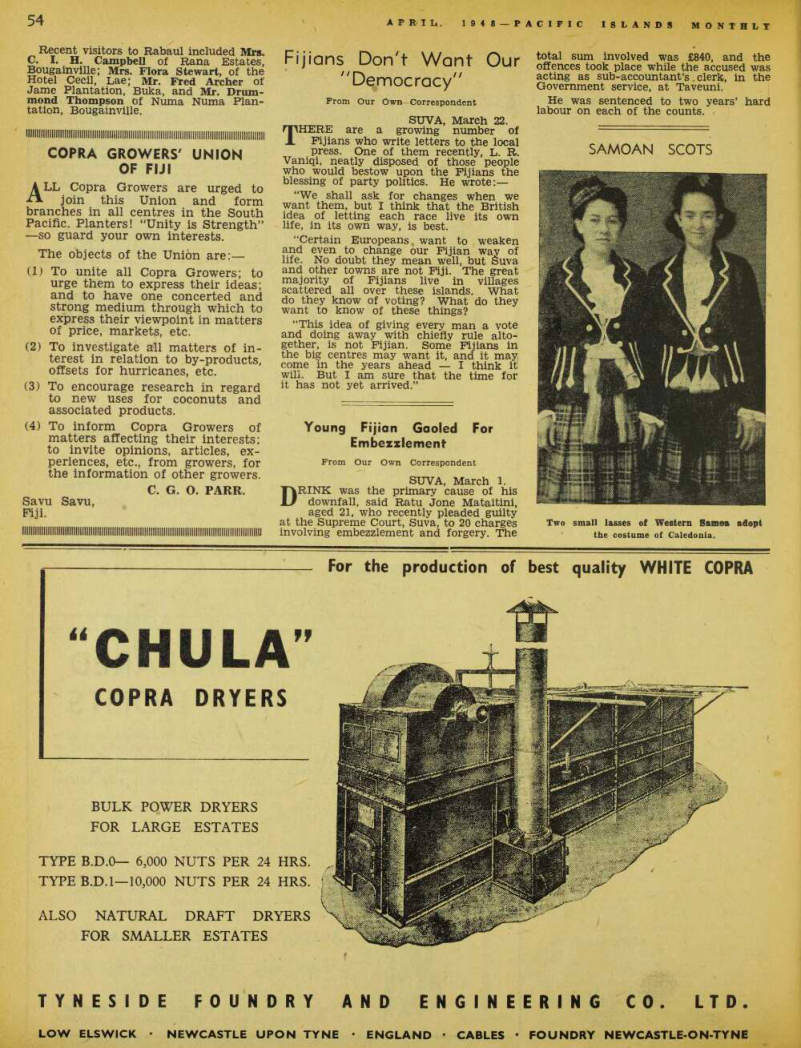
Retires
AT a gathering of the Auckland (NZ) Auxiliary of the London Missionary Society at the end of March, tri butes were paid to the services of the Rev. and Mrs. G. H. Eastman, who re cently completed 35 years’ service in the South Pacific, mainly in the Cooks and Gilbert and Ellice Islands.
Speakers at the meeting included Sir Albert Ellis and Mr. H. E. Maude, Resi dent Commissioner of the G & E Colony, now on long leave.
During the Japanese occupation of the Gilberts, Mr. Eastman twice returned to comfort and assist the people. For this
he was awarded the QBE.
The Eastmans have now retired from the mission field and are returning to England.
Recent visitors to Rabaul included Mrs.
C. I. H. Campbell of Rana Estates, Bougainville; Mrs. Flora Stewart, of the Hotel Cecil, Lae; Mr. Fred Archer of Jame Plantation, Buka, and Mr. Drum mond Thompson of Numa Numa Plan tation, Bougainville.
Advertisements & other items, pp. 55-56 (1 item)
Papain Wanted
PACIFIC ISLANDS SOCIETY
Visitors from the Islands to Sydney (or those Interested in Islands affairs), are advised to communicate with the honorary secretary of the above Society, which has been formed to study the history, traditions, economics, and political developments of the Pacific Islands.
Regular monthly meetings are held at History House, 8 Young Street, Sydney.
Address for Correspondenee:
THE PACIFIC ISLANDS SOCIETY,
Box 2434 MM., G.P.0., Sydney.
PAPAIN WANTED
To Planters and Traders in the
South Pacific Islands
We have Urgent Inquiries, by United States Interests, for Supplies of Papain (the Latex of the Paw-paw Tree).
The price offered is high, and the market firm. Here is a new means of increasing your income, at little cost and trouble. Pawpaw Trees can be “milked” a year after planting. §end your Inquiries to us—air-mail, where possible.
PACIFIC ISLANDS TRADING COMPANY
244 California Street, San Francisco 11, U.S.A.
CABLES and RADIOS; “PITCO,” San Francisco..
WORMGEARED
CHAIN HOISTS
The hand-operated Wormgeared Hoist is a general purpose lifting device, compact and easy to handle. The Wormgear is designed to give comparatively high efficiency and long life. A simple and effective brake insures safe holding of the suspended load.
Available in rated capacities from 10 cwts. to 3 tons.
Also makers of: A.B.C. Electric Chain Hoists, Vz, 1, 2 tons capacity.
“Victor” Spurgeared Chain Hoists from 10 cwts. to 20 tons.
Triple Geared Chain Hoists from 10 cwts. to 20 tons.
Worm Geared Chain Hoists from 16 cwts. to 3 tons.
Weston Chain Blocks from 5 cwts. to 2 tons.
Shackles, Hooks, Sheave and Snatch Blocks,
AUSTRALIAN BLOCK & CHAIN CO.
PTY., LTD.
Robbs Road, WEST FOOTSCRAY, W. 12,
VICTORIA
Phohes: MW 1373-74-75.
Telegraphic Address: “CHAINBLOCK,” MELBOURNE.
Correspondence to Box 34, FOOTSCRAY, W.ll, VICTORIA.
COPRA GROWERS' UNION
OF FIJI
ALL Copra Growers are urged to join this Union and form branches in all centres in the South Pacific. Planters! “Unity is Strength” —so guard your own interests.
The objects of the Union are:— (1) To unite all Copra Growers; to urge them to express their ideas; and to have one concerted and strong medium through which to express their viewpoint in matters of price, markets, etc. (2) To investigate all matters of interest in relation to by-products, offsets for hurricanes, etc. (3) To encourage research in regard to new uses for coconuts and associated products. (4) To inform Copra Growers of matters affecting their interests; to invite opinions, articles, experiences, etc., from growers, for the information of other growers.
C. G. O. PARR.
Savu Savu, Fiji.
"Democracy"
Fijians Don't Want Our "Democracy"
From Our Own Correspondent SUVA, March 22.
T H nj?ans r who a wrfte°^letters toThe^ocal Tr . p . ress - ° ne o f them recently, L. R.
Vaniqi, neatly disposed of those people who would bestow upon the Fijians the “s °£ Party politics. Rewrote:- We shall ask for changes when we ant them, but 1 think that the British idea of letting each race live its own life, in its own way, is best, “Certain Europeans, want to weaken and even to change our Fijian way of life . no doubt they mean well, but Suva anc * other towns are not Fiji. The great majority of Fijians live in villages scattered all over these islands. What do the y know of voting? What do they want to know of these things?
“™s idea of giving every man a vote and doing away with chiefly rule alto gather, is not Fijian, some Fijians in
Sme fn^th^year^ ahead -Ttolnk U
W ili. But I am sure that the time for n has not yet arrived.”
Young Fijian Gaoled For Embezzlement
Embezzlement
From Our Own Correspondent SUVA> March 1 was the primary ’cause of his U downfall, said Ratu Jone Mataitini, aged 21, who recently pleaded guilty at the Supreme Court, Suva, to 20 charges involving embezzlement and forgery. The
total sum involved was £B4O, and the offences took place while the accused was acting as sub-accountant’s. clerk, in the Government service, at Taveuni.
He was sentenced to two years’ hard labour on each of the counts.
Advertisements & other items, p. 56 (2 items)
Samoan Scots
Two small lasses of Western Samoa adopt the costume of Caledonia.
Chula
For the production of best quality WHITE COPRA ii
COPRA DRYERS
ff
BULK POWER DRYERS
FOR LARGE ESTATES
TYPE 8.D.0 6,000 NUTS PER 24 HRS.
TYPE B.D. I—lo,ooo NUTS PER 24 HRS. j
ALSO NATURAL DRAFT DRYERS
FOR SMALLER ESTATES
TYNESIDE FOUNDRY AND ENGINEERING CO. LTD.
LOW ELSWICK • NEWCASTLE UPON TYNE • ENGLAND • CABLES * FOUNDRY NEWCASTLE-ON-TYNE
Houlfln
Why Not Mountain Colleges For Fiji?
(Contributed)
Mr. F. Stansfield, lately Government Printer.
Trinidad. has been appointed Government Printer, Fiji. He is expected to arrive in the Colony about the end of June. Since the depar ture on leave last year of Mr. F. W. Smith, and his subsequent transfer to an African Colony, Mr. A. J. Elphick has been acting Government Printer, and during that time has done “a good job of work.” It is regretted that he was not given the substantive post which he certainly deserved on his past record, but this appoint ment unfortunately is made by the Colonial Office, not by the local Administration. —“Fiji Times,” March 4.
ONCE again we have an example of how unjustly the local man is treated when he is in line for the key job.
Surely someone in authority could have recommended the appointment of Mr.
Elphick to the post of Government Printer, in which capacity he has acted for the past year. The Colony then would save the cost of transporting the new appointee from Timbuctu, or wherever he is coming from, plus a sav ing in long overseas leave later on.
Surely the appointment of the local man would not have put Colonial Office policy out of gear.
Our new Governor has been accorded the usual warm welcome, which has its roots in an upsurge of hope that perhaps this Governor will leave some memorial behind him to mark his term of office. His Excellency has started off on the right foot by spending at least a few hours, and sometimes a whole day, in the main towns of Viti Levu, so he can see for himself how the other half lives.
e have heard how impressed he was w ith the possibilities of Nadarivatu, our only mountain resort. There is a rumourthat the place is to be rehabilitated for the use of tired colonists—but that probably means tired Government officials.
The writer can suggest a fitting and wor thy mark for Sir Brian to leave. It is incumbent on the Government to find more suitable sites for the Grammar Schools, at present in cramped and inadequate quarters, and there is no doubt that hundreds of thousands of pounds will have to be spent in the near future.
XT AD ARIVATU offers hundreds of acres breat tain air, bG rn&dG practically self supporting by having their own supply of milk, vegetables, fruit, eggs, etc.^ Local people would not then be burdened with the expense the S wrench that"this* united family life.
The scheme would need careful planning in the establishment of separate houses for each race, when the school day was finished. Preeston House would be or tor the European lads; Archibald (named after our part-European Member—good luck to him)—House would be for the part-Europeans; Sukanaivalu (in honour of our Fijian VC) House would be for the Fijians; and Gandhi House for the Indians. , AH races could school together and a?rang^d U whic C hTou!d o develon in these vnii'np -t ;fpr <: ; nride of race and pride of
Houlfln
general conduct would be supervised by selected House Masters, and each race could thus preserve what is best in its way of life. Each race would eat separately
and have meals most suited to its taste.
For instance, the Fijians could have their native foods prepared in true native fashion, with a degree of culture enforced; the same with the Indian—separate caste cooks would have to be provided, as no Hindu will eat food handled by a Mahommedan.
Practical farming could be taught at first hand> and lectures given by agri cultural officers, so that the benefit of their University training and degrees could be passed on, instead of being buried in obscurity except when they can be
Stheffectolcal?^“Son“d
“Girls’ Grammar School could be
run Snstaila?^*withstLHupe^
vision aftpr school hours qnH q miqlifipri Matron in charge " “ qualified ~™ “ ™ B „ lm . i( Its a lovely dream, is it not.
T'O carry the idea further: When the A boys’ and girls’ are functioning properly, there is noth mg to prevent the inauguration of a South Seas University, to be recognised by the British Universities throughout the world.
Getting back to Nadarivatu and 'its potentialities: Some outside amenities would have to be provided to cater for the teachers. Perhaps Sir Hugh Ragg could be persuaded to complete his chaiS of hotels by erecting a modern hotel here, where be tun? encourage Mr. John Grant to build a picture theatre. As he naively puts it. ;Where «r Hugh builds a pub I follow with a movie show Local people would also be tdmpted to put up country homes at Nadarivatu, and have a change of climate from the low
lying areas, and thus recuperate without the heavy expense of going overseas.
Commercial houses in the Colony are concerned in maintaining properly trained staffs, which they have to import from overseas. Sometimes these prove mixed blessings. Why should they not be able to select promising girls and boys locally, and if necessary, see they get specialised training? With thfe establishment of a University in Fiji, sponsored by the Colonial Development Scheme, this grand little Island could mean more than a fly-
speck on the map of the world, EDITORIAL NOTE: One of the grimmest problems to-day facing the Fiji European on a fixed income is that of maintaining his position properly in the Colony, while providing adequately for the education and maintenance of his grow ing family in a cool country. His pro blem would be simplified if he could send his children to a good secondary school in one of Fiji’s cool districts. Fiji has several attractive cool areas—all neglected and undeveloped.
Advertisements & other items, pp. 57-58 (1 item)
Colyer Watson (New Guinea) Ltd.
Head Office: RABAUL Branches: Kovieng, New Ireland, and at 22 Bridge Street, Sydney
GENERAL MERCHANTS AND BUYERS
OF ISLAND PRODUCE
Plantation Owners and Engineers
Sole Distributors: Chrysler and Plymouth Cars Fargo Trucks Willys-Overland Jeeps G.M. Marine and Industrial Engines Prefect Refrigerators Managing Agents: Union Assurance Society Ltd.
National Mutual Life Association of A/asia Ltd.
Agents: China Navigation Company
Pimples and Bad Skin Fought in 24 Hours
Since the discovery of Nlxoderm by an American physician It is no longer necessary for anyone to suffer from ugly, disgusting and disfiguring skin blemishes such as Eczema, Pimples, Rash, Ringworm, Psoriasis, Acne, Blackheads, Scabies and Red Blotches. Don’t let a bad skin make you feel inferior and cause you to lose your friends. Clear your skin this new scientific way.
A New Discovery
Nixoderm is an ointment, but different from any ointment you have ever seen or felt. It is a new discovery, and is not greasy but feels almost like a powder when you apply it. It penetrates rapidly into the pores and fights the cause of surface skin blemishes. Nlxoderm contains 9 ingredients which fight skin troubles in these 3 ways. I.—lt fights and kills the microbes or parasites often responsible for skin disorders. 2. —It stops Itching, burning and smarting in 7 to 10 minutes, and cools and soothes the skin. 3. —It helps nature heal the skin clear, soft and velvety smooth.
Works Fast
mediately, clearing and healing your skin, making it softer, whiter and velvety smooth Because Nlxoderm is scientifically compounded to fight skin troubles, it works fast.
It stops the Itching, burning and smarting in a few minutes, then starts to work im-
In Just a day or two your mirror will tell you that here at last is the scientific treatment you have been needing to clear your skin—the treatment to make you look more attractive, to help you win friends. Nixoderm has brought clearer, healthier skins to thousands, such as Mr. Bob Weedon, Edmund Street, Fremantle, who writes; ‘‘I was troubled with pimples ever since I was 13, and have spent pounds and pounds on so-called cures without results. I then tried Nixoderm with astounding effect.
The pimples seemed to fade away, and after a week there was not the slightest trace of them.”
Satisfaction Guaranteed
Get Nixoderm from your chemist or store to-day. Look in the mirror in the morning and you will be amazed at the Improvement.
Then just keep on using Nixoderm for one week and at the end of that time it must have made your skin soft, clear, smooth and magnetically attractive —must give you the kind of skin that will make you admired wherever you go, or you simply return the empty package and your money will be refunded in full. Get Nixoderm from your chemist or store to-day.
The guarantee protects you.
Nixoderm 2/-&4/-
For Skin Sores, Pimples and Itch.
ORDER ROOFING FOR YOUR NEW HOME NOW Decide to use WUNDERLICH METAL TILE for roofing your new home , . . place your order now and be assured of supplies when you build.
Wunderlich Metal Tile is stamped from 24-gauge Zincanneal and is finished an attractive Russet-Red.
'Phone MX 2411, write Box 474, G.P.0., Sydney, or call at our Baptist Street, Redfern, Office for prices, illustrated leaflet and fixing details.
)fj^y^uru/e^t/cc^
PIETAL TILE ROOFING
1 1 STAMPED AND STOVE ENAMELLED ZINCANNEAL
Championship
Moresby Tennis Championship Win for Trimm
From a Special Correspondent
Port Moresby. March 22.
A GALLERY of over 50 people at the Ela Beach courts watched the final of the first singles championship held in Moresby since the war. The two top seeded players, P. Trimm and G. Crouch, gave a display of high-quality tennis which earned frequent bursts of applause for both players.
Serving strongly, Crouch took the first game, then broke through Trimm’s service, and again won his own to lead 3 —o. Trimm found his touch in the fourth game, which he won after a struggle. Crouch then lost length, on his ground shots, which enabled Trimm to advance on the net. Crouch’s volleying and service also lost their sting. Trimm, always brilliant over head, took the next five games to win the set at 6—3.
In the eighth gahie he aced Crouch twice with two brilliant cannon-ball deliveries, and his smashing was always both powerful and per fectly placed.
Trimm also took the first game in the second set, but Crouch then obtained more length on his ground shots, came to the net, and, although his service and volleying still lacked pace, fought back with some cleverly angled placements and long sweeping drives to the corners. Games went with service to 3 all, when Crouch, now attack ing his opponent’s backhand, frequently found the forehand corner open and took the game with winners down the line. Trimm then put away Crouch’s slow second serves to win the eighth game. The next two games were keenly fought, but Trimm, the younger man, now had the upper hand and took the set and match at 6—3, 6—4.
'T'HESE two players stand out above any A others in Moresby at present, and tennis enthusiasts look forward to some further battles between them. Unfortunately, neither plays fre quently, as Crouch is stationed at Sogeri, and Trimm spends much of his time playing cricket and baseball, at both of which he also excels.
Miss Ann Sefton defeated Mrs. A. Lockrey in the final of the-ladies’ singles, which was played some weeks before the men’s matches. The number of entries from the ladies was extremely disappointing.
Increased Transport
Costs For N. Britain Planters
From Our Own Correspondent RABAUL, March 16.
P BLOWING a recent visit to Rabaul and district by the Chairman of the Production Control Board, it has been decided that the transport of copra from Kokopo to Rabaul (a distance by water of about 12 miles) should be taken entirely out of the hands of private en terprise and be given to Government motor vessels.
Subsequently planters in the Kokopo district have been notified that trans port costs on their copra will be increased 12/6 per ton.
In addition, for some reason known only to the commissars of remote-con trol in Port Moresby, 25 per cent, of the value of their copra is withheld from planters on their delivery of it to the store or ships in Rabaul.
Two faults occurred in the trans pacific cable shortly before Easter and the NZ Government ship “Matai” was requisitioned for repair purposes. The faults are between Auckland and Nor folk Island and between Norfolk Island and Suva.
Fiji Seamen's Union
Letter to the Editor WITH reference to the leading article in the January 1948 issue of the “PIM,” and your letter to the Hon.
Mr. E. J. Ward (copy of which is pub lished in your same issue), and the Edi torial note which immediately follows your publication of our letter, the Com mittee cf this Union (which Committee consists of 25 Fijian seamen) has directed me to state as follows: — (a) Mr. Ward did not, on his own in itiative, interest himself in this Union.
We requested his -help in having our letter published. (b) Our letter was drafted at a meet ing of the Committee, -at which only members of the Committee were present, and was not drafted by a non-member. (c) There is nothing whatever behind the organisation of this Union except a desire to carry out the objects of the Union as printed in the Rules, which were approved and registered by the Registrar, viz: To promote harmony and efficiency and make amicable agreements whenever possible. (d) This Union is not under the in fluence of any outside individual or body. (e) Since the Agreement between ship owners and the Union was signed, the relations between the parties thereto have been of a cordial nature.
Yours faithfully,
Luke Vukivuki.
Hon. Secretary.
Fiji Seamen’s Union.
Suva, 20/2/48.
The Indian Problem
Of Fiji
Letter to the Editor 1 WOULD like to comment on the letter by Major W. Willoughby-Tottenham which you reproduced from the “United Empire” in your magazine under the heading, “Problem of the Indians in Fiji.”
What the Major alleges in the fourth paragraph of his letter is out-of-date and, when argued from the Indian view point, who have been equally loyal, would place the Major in an embarrassing posi tion.
The Indian view point can concisely be expressed in the lines of Johnson:— “And I never made munitions at fifteen quid a week, Equality’s all eye-wash; I hate that sort of tripe.
I’ve no use for armchair critics, who won the war at home.
I hate conscientious humbugs and ideo logists, So to hells with cranks and faddists, and I’ll end as I began.”
The Major has evidently let himself go and hit wide of the mark in paragraph eight, presumably swayed by his pre conceived ideas for everything Indian.
Pe sons of mixed Euronean descent had been and are rarely employed in Gov ernment offices; therefore his accusa tion that “the Indian firmly entrenched in Government offices” has no ground to stand upon, to say mildly.
In the whole of his letter the state ment, “The only hope lies in the parties gradually merging their interests” can be appreciated as sound politics.
Without being personal: If all overseas recruited civil servants and archaic poli ticians were to be exported, and Fiji left to those who have no other country to migrate to, all would become smooth sailing. These archaic politicians stand in the way of progress and hinder Fiji becoming one united whole, where all to be for one and one for all, because
they have their vested interests to protect and augment.
The rest of his letter can easily be dismissed as a mere propaganda designed to appeal to pride and prejudice of his calibre, for obvious reasons.
It is not expected that the archaic politics of the Major will provide the problem of finding a solution for peace and harmony for the Colony of Fiji. Only those who have no axe to grind can with their disinterested and free mind find the solution for the various races of Fiji.
I am, etc.,
H. S. Singh.
Suva, 12/3/48.
EDITORIAL NOTE: One assumes, from the letter of Mr. Singh, that his solution of the Fiij problem would be the removal of the British entirely, leaving the rich Colony to the Fijians and Indians. What a pity that that plan cannot be adopted! And the warriors of Fiji, who find life somewhat dull between wars, and who probably subscribe gener ally to the sentiments of Major Wil loughby-Tottenham, doubtless echo our regret!
Mr. Theo Thomas of Rainau Planta tion, New Britain, was in a Sydney hos pital in March recovering from a recent operation. He is reported to be making satisfactory progress.
Advertisements & other items, pp. 59-60 (1 item)
Day-Old
Chicks
BY AIR
Amalgamated Hatcheries
(Reg.) of Bankstown, near Sydney, N.S.W., can dispatch limited numbers of chicks by
PLANE TO
RABAUL, PORT MORESBY,
LAE, NOUMEA, SUVA.
and all other islands of the Pacific served by present AND PROJECTED air services.
Amalgamated Hatcheries are the largest distributors of dayold chicks in Australia, last year over 1,000,000 chicks being sold by us in N.S.W. alone.
Our scientific method of packing and dispatch has resulted in a loss of less than 1 per cent, of chicks sent by plane.
If any chicks in your consignment arrive dead, we will replace them frees provided the extra freight is paid by the purchaser.
Chicks available are R.1.R., Austrolorps, and W.L.
Price, £lO per 100, landed at your airport,-for unsexed chicks, and £l4 per 100 for all pullets. (Guaranteed 96 per cent, accurate sexing.) These chicks are the cream of Australia’s stock, produced under ultra - violet rays to guard against disease; the adult stock is blood-tested monthly by veterinary officers and each individual order carries a N.S.W- Government certificate that the chicks are healthy and from tested stock.
Payment for chicks should be made by draft with the order, or credit arranged throngh onr Bankers, the Commercial Bank of Australia, Ltd., Bankstown,
N.S.W.
Drafts and remittances can be sent direct to Amalgamated Hatcheries, Bankstown, N.S.W., or to the following agents: Messrs. Burns, Philp (South Sea) Co., Suva-Ba-Fiji, or any Island Branch. Also to: Marcel Legras, 38 Rue de Verdun, Noumea.
WRITE BY AIR-MAIL OR
CABLE.
AMALGAMATED
HATCHERIES
BANKSTOWN, N.S.W.
Rid Kidneys Of
Poisons And Acids
If you suffer sharp, stabbing pains, if Joint* are swollen, it shows your blood is poisoned through faulty kidney action. Other symptoms of Kidney Disorders are Backache, Aching Joints and Limbs, Sciatica, Neuritis, Lumbago, Sleepless Nights, Dizziness, Nervousness, Circles under Eyes, Loss of Energy and Appetite and Frequent Headaches and Colds, etc. Ordinary medicines can’t help much because you must get to the root cause of the trouble.
The 'Cystex treatment Is specially compounded to soothe, tone and clean kidneys and bladder and remove acids and poisons from your system safely, quickly and surely, yet contains no harmful or dangerous drugs. Cystex works in 3 ways to end your troubles. 1. Starts killing the germs which are attacking your Kidneys, Bladder and Urinary System in two hours, yet Is absolutely harmless to human tissue. 2. Gets rid of health-destroying, deadly poisonous acids with which your system has become saturated. 3. Strengthens and reinvigorates the kidneys, protects from the ravages of disease-attack on the delicate filter organism, and stimulates the entire system.
Praised by Onc-timc Sufferers
Cystex IS approved by one-time sufferers In 73 countries from the troubles shown above.
Mr. Reg Thomas, Townsville, Queensland, recently wrote: “My joints were all stiff, 1 had leg pains, my back used to ache day and night.
My bladder was weak. 1 had headaches and no appetite. The first dose of Cystex helped me and before I finished three boxes my health and strength came back.”
Guaranteed to Satisfy or Money Back
Get Cystex from your chemist or store to-day.
Give it a thorough test. Cystex Is guaranteed to make you feel younger, stronger, better U every way, or your money back If you return the empty package.
Now in 2 sizes—4/-, 8/-.
GUARANTEED
Treatment for Your Kidneys, Bladder, Rheumatism.
LONDON-SUVA
pVP-ECT S£^.
C <* For Sailings and Further Particulars Apply To: — BETHELL, GWYN & CO., BURNS, PHILP (SOUTH SEA) 138 LEADENHALL ST., co -» LTD >
LONDON, E.C.3. SUVA.
I’M SURE OF SHELL"
3 m “I’ve got a large family and an old car. The family certainly makes a hole in the weekly budget. The car could, too, if I’d let it. Had it for years and clocked up countless thousands of miles but the figures I’ve kept show that, over that period, operation and upkeep costs have been light. I learned the secret soon after I bought the car. I got on to Shell products —now wild horses wouldn’t drag me from the Shell symbol”
YOU CAN BE SURE OF
THE SHELL COMPANY OF AUSTRALIA LIMITED
(Incorporated in Great Britain)
SHELL
Island Supplies
Brisbane Strike Holds Up Island Supplies
IT was reported from Rabaul, New Guinea, on March 23, that due to a complete cessation of work on the Brisbane waterfront, Rabaul and outer districts were running out of supplies of some vital commodities.
The waterside strike, which started in sympathy with the Queensland railway maintenance men (who have been out for over eight weeks) but is now proceed ing under its own steam, has prevented the shipping of sufficient diesel oil to the islands and it is feared that inter-island shipping will cease if supplies are not forthcoming shortly.
P'etrol for Rabaul and other New Guinea ports is also held up in Brisbane. (The railway strike and the wharf strike ended in early April in complete victory for the Queensland Government).
Fiji Residents
Death Of Two Old
Messrs. J. A. H. Chapman and Victor Rodan
TSUVA, March 22.
WO of Fiji’s most picturesque figures have died recently.
One is Mr. J. A. H. Chapman, who came to the Rewa River with his parents 80 years ago when a child of seven.
Mr. Chapman was born in Victoria, but lived most of his life on the family property at Wainivou, where he saw the rise and decline of the European planters in the Rewa River area. To-day there virtually are none left.
A good deal of planting was once done at Wainivou and later Mr. and Mrs. Chap man (formerly Miss Minnie Cant, of Melbourne) ran a general store there.
Several years ago they closed the store and let the land to Indian tenants.
Mrs. Chapman, at the age of 85, is now the sole survivor of the early Europeans on the Rewa. s A son, Mr. W. Chapman, is on the engineering staff of the CSR Co. at Nausori.
MR. VICTOR ROD AN, a part-European reputed to be 108 years old, died at his home at Lami, Suva, on March 4.
His father, the late Frank Rodan, was believed to have been born in Spain and to have arrived in Fiji as a member of the crew of the French barque “Aimable Josephine,” which was wrecked at Kaba, not far from Bau, in 1834. (The ship’s anchor is still at Bau).
Rodan, Snr., was befriended by King Cakobau himself —who had a war with Rewa on his hands at that moment.
It is recorded that Frank Rodan made bullets of lead salvaged from the ship and thus became of considerable use to Cako bau in the struggle between Bau and Rewa.
Victor Rodan was the last survivor of three sons and a daughter. He worked in several parts of the Group (including several years as overseer for Mr. J?
Palmer, at Levuka) but for 30 years he has lived at Lami. Three of his six chil dren are alive, as well as 12 grandchildren and many great-grandchildren.
Teu Howard, the 66-year-old Ellice Islander who was charged with attempted murder and unlawful wounding in the Suva knife-slashing case of December 23, was sentenced on March 15, by the Chief Justice (Sir Claud Seton), to seven years’ hard labour on the first count and three years’ hard labour on the second, the sentences to run concurrently.
What Fiji Really Wants
Editorial Note.
TSUI’S new governor is evidently a J shrewd observer; so probably he al ready has noted something peculiar re i at ion to the Colony-namely, that a very i arge sum of privately-owned money is lying there, unemployed. No one least of all the owners wants money to remain unemployed; so there must be a cause. .There is more than one reason for the idle funds, it should not take Sir Brian Preeston long to get them into focus. , It really is not necessary for Fiji to go
to London at all for developmental money. It is not governmental money that Fiji lacks it is opportunity for the employment of private money, and protection and encouragement for private enterprise. The story of the CSR, and of the Emperor Mines, and of other great enter prises, can be repeated in Fiji in rela tion to other things if private enter prise is given reasonable facilities, and an assurance that the structures of its creation are not going to be robbed by Socialistic tax-gatherers or torn to pieces by gangs of New Planners.
Advertisements & other items, pp. 61-62 (3 items)
59
PACIFIC ISLANDS MONTHLY APRIL, 194 &
FIJI'S TEN-YEAR PLAN
(Continued from Page 26.)
Floor
PRODUCING UNIFORM GOOD RESULTS SINCE 1868
ALWAYS ASK FOR IT
VENTURA TRADING GO. PTY. LTD.
26 BRIDGE ST., SYDNEY
Cables: Ventura Sydney
Island Merchants, General Suppliers
and Transhipment Agents
Offer for immediate delivery
ELECTRIC WIRE & CABLES OF ALL TYPES
ELECTRICAL ACCESSORIES
GENERAL ISLAND SUPPLIES
Inquiries to our Sydney Office or to:
HENRY G. EEKHOFF, La©
Our Agents for Papua and the Mainland of New Guinea.
P. & R. HUTCHINSON GILBERT RENTON, Esq.
THOMSON ST., SUVA RABAUL
Our Agents for Fiji, Tonga, and Samoa. Our Rabaul Agent.
WESTCLOX
t has performance been more trustworthy than in the beautiful Westclox of today . . . famous Big Ben and other spring wound clocks, electric clocks, wrist watches and pocket watches. When you buy your next clock or watch, look for the trade mark “Westclox” on the dial . . . your assurance of quality.
POCKET BEN A thin model watch with many features. Highly polished, plated finish; silvered dial: attractive numerals and hands. Unbreakable crystal.
SPUR Luminous A thin case, ne-day alarm. Black finish with dckel trim. 41 inches square.
Jteady alarm. Unique base, juminous dial.
I
BIG
BEN
BIG BEN Chime Alarm The highest standard of alarm clock quality. Quiet tick and gentle two-voiced alarm. First there’s a gentle call, then if he’s not shut off. there’s a lusty shout. Dustproof attachments, 5 h inches high. Ivory finish with gold colour trim. Luminous dial. ti n i 10 BABY BEN A smart looking alarm clock. 3i inches high.
Quiet tick; steady alarm that rings loud or soft. Legible dial.
Two finishes . . . black with nickel trim, and ivory with gold colour trim. Made in plain and luminous dial.
LA SALLE A handsomely designed wrist watch. Chrome finish case, stainless steel back, curved to fit the wrist. Sturdy movement, regulated to run in any position. Equipped with conventional second hand; rustproof hairspring.
ORDER THROUGH YOUR LOCAL STORE
PACIFIC ISLANDS TRADING
Bankers: Bank of America (Main Office) San Francisco.
COMPANY
Cables:
PITCO
SAN FRANCISCO
244 CALIFORNIA STREET, SAN FRANCISCO, CAL, U.S.A.
60
APRIL, 1948 PACIFIC ISLANDS MONTHLT
Polynesian Society
Journal
THIS quarter’s “Journal of the Poly nesian Society” contains its usual interesting assortment of articles for the ethnologically minded.
Most of the articles, in this issue, deal with the New Zealand Maori. Of par ticular interest is the article on the ori ginal kumara, or sweet-potato, which tradition says Whaka-o-te-Rangi sal vaged from the Arawa canoe and planted shortly after those first trans-Pacific voyagers reached Aotearoa.
W. H. Newell describes the kava cere mony in Tonga, in detail.
This number contains a tribute to the late Mrs. H. B. R. P'arhaiA, of Fiji, a member of the Polynesian Society of long standing; book notices; and the index to volume 56.
American's Scheme For
Buying Fiji
From Our Own Correspondent SUVA, April 6. mWO schemes —which, it may be said, Jl are not likely to succeed—have been put forward in Honolulu by Mr. Otto Degener, an American botanist who visited Fiji in 1940. (He arrived in the American-owned Chinese junk “Cheng Ho.”) Mr, Degener advocates (a) the impor tation of 6,000 Fijian labourers to work in Hawaii; and (b) the United States to buy, for an unspecified number of dollars, Fiji and other parts of the British South Pacific.
Assorted Fijian and European com ments, publicised in the local press, might be described as sulphurous.
The schemes were outlined in a letter written by Mr. Degener to Mr. Sahodar Singh, and published in the Indian weekly paper “Fiji Samachar.”
To Tonga
Queen Salote Returns To Tonga
From Our Own Correspondent SUVA, March 30.
QUEEN Salote Tupou was a passenger on the March "Matua” from Auck land. She is now back in Tonga after a health visit of several months to New Zealand.
The ship called at Suva on March 28- 29, but because of the poliomyelitis quarantine restrictions, the Queen, like the other passengers, did not leave the ship.
Family
Death Of Mr. Alastair
Maclean
Tragedy Dogs N. Britain Family
THE death occurred suddenly in Rabaul New Guinea, on March 24, of Mr.
Alastair Maclean, well-known in the planting community of New Britain.
He was the son of Mrs. Emmeline Maclean, of Sydney and the late C. H. R.
Maclean, of Rabaul.
The Macleans were one of the best known New Britain families in the thirties, but tragedy has stalked them persistently since 1941. Mrs. Maclean, Sr., was evacuated with the other women from Rabaul in December of that year.
Her husband, of W. R. Carpenter & Co., and son, lan, who was Rabaul’s popular dentist, remained behind and she did not see them again—both were lost on the “Montevideo Maru.”
Some months ago Mrs. Maclean went to New Guinea to visit her remain ing sons, and has been staying with Mr.
Colin Maclean, at Saidor, near Madang.
More recently she went to Rabaul to visit her other sons, Donald and Alastair, She was there when Alastair was brought in suffering from pneumonia. He died a few hours after being admitted to hospital.
Alastair Maclean was unmarried. He served with distinction with the AIF in the Middle East and, later, in New Guinea with the famous Coast-watchers, with whom he attained the rank of Captain.
Advertisements & other items, p. 63 (1 item)
C. Sullivan Pty. Ltd.
Wc Will Buy
It For You
Any goods you may require from English shops or factories Purchased and Shipped.
Small or large orders catered for.
ALL SERVICES UNDER-
TAKEN FOR RESIDENTS
ABROAD.
PITT & SCOTT
LIMITED
(Established 1876) General Shipping and Buying Agents. 1/3, St. Paul's Churchyard, London, England Cables. Shipping London.
C. SULLIVAN PTY. LTD.
Island Merchants
Over 30 years' experience in the Pacific Island Trade.
Expert Buying Service Original Invoices Furnished Seilers of Island Produce.
Represented in all Australian States, New Zealand, England, France, United States, etc.
BANKERS: Bank of New South Wales, Comptoir National d’Escompte de Paris, Bank of New Zealand.
C. SULLIVAN PTY. LTD.
379 KENT STREET, SYDNEY
Telegrams & Cables: CHASULL, Sydney. Phone: MJ 4657 (6 lines).
Challenge to Australia's Socialist Planners
Eurasian Eyes On New Guinea
rjTHE Eurasians of South-east Asia, of A whom there are a very large num ber, are now seeking permission of the Australian Government to organise settlement on a considerable scale in Aus tralian New Guinea. The matter is under consideration by the Australian Govern ment.
During 1947, a movement was started among Dutch Eurasians for the settle ment of a Eurasian colony in Dutch New Guinea. The plan went a considerable distance, and Dutch Eurasians called on Eurasians generally to support it. Some 400 Eurasians in Singapore district got ready to migrate—some even gave up their jobs. But the Dutch authorities in tervened and announced that, quite apart from Eurasian ambitions, Dutch New Guinea was not ready for such a plan; and the plan collapsed.
The Eurasians then turned their atten tion to the rich uplands of Central New Guinea, which are more suitable than the more primitive western (or Dutch) end of the great island to be the Eurasians’ national home.
It is not expected that Australia will
approve the plan, although there is much to be said in its favour.
THE possibilities of New Guinea main land are getting increased attention.
It was urged, last year, that the great island should be thrown open to Japanese immigrants. Australian dis approval was loudly expressed.
New Guinea is capable of carrying a very much larger population than its pre sent total of a million and a quarter primitive Melanesians. It cannot remain empty, while one thousand millions of people surge around in overcrowded South east Asia.
Yet, apart from a few fumbling plans for the training and encouragement of Fuzzy-wuzzy, Australia seems to have no policy for the settlement and develop ment of New Guinea (with which are necessarily associated the big islands of New Britain, New Ireland and Bougain ville).
The Methodist Mission Board is appeal ing for nursing and teaching staff for stations in Papua.
Valuable Now
The Odd Palms Are Valuable Now
I N Fiji, as in other tropical Islands, the x self-sown coconut palms—as distinct irom palms planted—belong, generally, to the native community.
For the most part, if they are of poor quality, they are not claimed by anyone.
But if the self-sown palms are good healthy trees, they may be valuable in the eyes of some native: whereupon he ties a split palm-frond in a peculiar fashion around the trunk of the tree Thereupon that tree is tabu, so far as all natives are concerned—a nasty course immediately manifests itself upon any other native who takes awav the nuts of that palm.
In normal times, a very small propor tion of self-sown palms were tabu’d in this fashion, but recent travellers in Fiji report that to-day practically every palm tree capable of producing a nut carries the danger signal—meaning that it has become the private property of some Fijian.
This, of course, is the result of the very high price of copra. The Fijian natives are making copra now, to the ex clusion of all other industries, and every coconut, no matter how insignificant or lonely, has a definite value.
The engagement has been announced of Miss Mary Baker, daughter of Mr. W.
H. Baker, Goodwood, Adelaide and the late Mrs. A. Baker, to Mr. A. T. (Fred) Holland, son of Mrs. W. Holland of East Malvern, Melbourne and the late Mr.
H. D. Holland, formerly of Rabaul.
Advertisements & other items, p. 64 (2 items)
62
APRIL,, 1948 P ACIFIC ISLANDS MONTHLY
Nelson & Robertson "I:
A Limited Quantity Only
COLT PATTERN 45 cal. AUTOMATICS
SPECIAL TROPICAL FINISH.
At the all-time low price of £lO each. Postage extra. Powerful, accurate, they are a weapon you will be proud to own. Ammo, plentiful, 25/per 100. g| l p Q Quality Firearms and Fishing 143 ELIZABETH ST. (near Market St.), SYDNEY. Phone: MA 3540.
NELSON and ROBERTSON Pty. Ltd.
Established 1895
Shipowners - Brokers and
Islands Merchants
All classes merchandise purchased at Best Wholesale Prices. Original Invoices supplied to Island Clients. Cocoa Beans, Copra, Rubber, Trochus Shell and All Islands' Produce Sold on Commission.
Entrust your requirements to the firm with fifty years' practical experience in the Pacific Islands. ■ iwmpi uiicimwii yiTcn iw uii cni|umca.
NELSON & ROBERTSON "i:
12 SPRING STREET, SYDNEY, AUSTRALIA
Telegraphic Address: IVAN, SYDNEY.
"The Enemy"
Who Is Really "The Enemy"
In Cook Islands?
THE untidy array of Commos, Pinks and Near-Pinks, who have been causing so much petty mischief in the Cook Islands lately, and who were routed on March 8 by a plane-load of mild young policemen from New Zea land, had been debating with some marks of favour a proposal that the United States be asked to take over the Cook Islands from New Zealand.
These are the same restless gentlemen who were stimulated and encouraged by a book recently published in New Zea land, called “Frontiers Forsaken.” It is an irresponsible, one-eyed compilation, which generally endorses the anti-Euro pean viewpoint of the CIPA. The fol lowing is an extract:— “The Cook Islands are our northern frontier.
If a country leaves its frontier forsaken for long enough, then powerful aggressors outside will start to move in, as the barbarians did on the old Roman Empire. And that is precisely what is happening in this case. In 1946 the United States began to put pressure on the British, Australian and New Zealand Govern ments to hand over, as strategic bases. 25 Pacific Islands. Of these, seven are NZ territory and four are in the Cook Group. A continued policy of muddle and drift not only means a con tinuation of injustice to the Islanders and loss to ourselves; it may well mean that the United States can bring their war preparations right to our door.”
According to “Frontiers Forsaken,” the Yanks are The Enemy. According to the CIPA, licking it wounds after March 8,
NZ is the enemy, and the Yanks the Saviours.
The Comrades do get their wires crossed on occasions.
Mr. Ward And The Cook

Islanders
Letter to the Editor IN his article on “Frontier Forsaken,’’ in the “PIM,” the Rev. James E.
Cormack refers to Mr. Harold Ward as a “veritable bird of passage.” This seems to be an inconsistent “crack,” coming from a professed clergyman, more particularly so when this description des cribes Mr. Cormack himself more aptly than it does Mr. Ward. During the short time he has been in the Cook Islands, Mr. Cormack seems to have been almost continuously on the move, and he re cently returned from an extensive air tour covering several thousands of miles in the tropics, New Zealand and Aus tralia.
Mr. Ward’s position is pretty well known among his friends in the Cook Islands. As a result of war injuries he is totally and permanently disaoled, and his physical condition is such that he cannot stand the rigours of the New Zealand winter. In consequence, he spends several months of each year in the tropics, usually in the Cook Islands.
He travels at his own expense and de votes his time in a truly altruistic manner to the well-being of Natives and Europeans in the Group.
It is perfectly fair to state that few, if any, Europeans have ever been so con scientious in their efforts on behalf of Cook Islanders. His efforts have always been constructive, and have never been even remotely identified with any Lettish section. Mr. Ward’s achievements on be half of the ex-Servicemen, the school teachers, the labourers at Makatea, are
fine and lasting tributes to his altruistic efforts. We could do with many more “birds of passage” of his calibre.
I am, etc.,
Quarter Century Cook Is.
Auckland, 15/3/48.
EDITORIAL NOTE: Everyone will support our correspondent’s praise of good work done by Mr. Ward. It was just unfortunate that his work and ac tivities should have been seized upon and used as arguments by the compilers of a cock-eyed, anti-British book. It is our duty to attack and expose anti-British propaganda in the Islands, wherever we may find it; and if Mr. Ward, no matter how good his motives, should ally him self with our enemies, he cannot hope to escape criticism.
Advertisements & other items, pp. 65-66 (2 items)
63
RED HOLD-UP IN RAROTONGA
(Continued from page 22.)
PACIFIC ISLANDS MuNTHLY A P R» 1 I>, 1948
the shafting that's virtually everlasting
n 0=
Monel is a registered Trade Mark covering a rich nickel alloy, nined in Canada and rolled in Great Britain.
MONEL PROPELLER SHAFTING is renowned the world over for long, dependable service. Being strong and tough, it withstands hard knocks, is highly resistant to corrosion, and guaranteed entirely rustless since Monel contains no iron.
In service, Monel propeller shafting also quickly develops a mirror-like polish which reduces bearing and packing wear to a minimum.
Isn't this the kind of shafting you want in your boat? Then ask your boat-builder to quote you to-day for a MONEL propeller shaft ... or 'phone.
WRIGHT AND COMPANY
SOLE AUSTRALIAN DISTRIBUTORS OF MONEL
81 CLARENCE STREET, SYDNEY : : : : : 'Phone: BX 1211 (Six Lines)
mm gllTTl U
with
LAUREL KEROSENE
Your refrigerator will operate more efficiently and economically on Laurel the cleanest, purest kerosene you can buy. Laurel burns steadily to the last drop, without smoke or smell. It is the perfect kerosene for refrigeration.
VACUUM OIL COMPANY PTY. LTD. (Incorp. in Aust.)
LAUREL
For Lighting, Heating, Cooking, Cleaning,
Alt - purpose
KEROSENE
23 Australian Dead
Jap Admiral Hung for Crime
ON March 16, in Hongkong Gaol, the arrogant Japanese Admiral, Tamura Ryukichi was hanged.
Thus, in a small degree, was vengeance taken for the murder of 23 men. mostly Australian civilians, in New Ireland, in 1944.
The Admiral, who was in charge of that area, was tried in Hongkong by an Aus tralian War Crimes Court.
The 23 Australians (one of whom was the 14-year-old son of H. J. Topal) were captured by the Japs in New Ireland in 1942, and interned near Kavieng. In that year, Tamura ordered a Commander Yoshino to execute the prisoners if an Allied landing appeared likely. The order was put into effect about March, 1944, by a Lieut.-Commander Mori. Three other
Japs carried out the execution by strangu lation methods.
All six Japanese involved were found guilty and sentenced.
Indonesian Castaways In
New Guinea
THERE were several reports in Aus tralian newspapers at the end of March concerning the alleged dis covery of the survivors of a plane crash in New Guinea. It was reported that half a dozen Indonesians had been found in the Witu Islands (a small group just north of New Britain). They could not speak English but it was understood from what they said that they were the sur vivors of a Dutch plane which had crashed there a couple of years ago.
Preparations were made to fully in vestigate this occurrence: but later in formation indicated that the Indonesians had arrived there in a prau some two years ago, having been blown far out of their course when they were trying to get from Morotai to the Dutch East Indies.
Captain Charles Blake, who runs a small vessel out of Rabaul, told the American United Press on the radiophone that he had seen the Indonesians lately, and he did not think that they were the survivors of a plane complement.
After that, preparations to send a Cata lina from Port Moresby to investigate were cancelled.
Mr. Gobrait Ballow, aged 89, died in Tahiti in March, after a long illness. His son, Adram, is part owner of the new motorship “Vaihinano,” which arrived re cently in Papeete to join the merchant marine in French Oceania.
"The Mission in the Mud"
Mud"
Mrs. Standen is Battling On in Western Papua
A LETTER from Mrs. Eva Standen, written in Maipani, on the Bamu River, in the Western Divisipn of Papua, indicates that the “Mission in the Mud” is still making slow, steady pro gress.
Mrs. Standen returned to her work on the Bamu River after the war, and she decided that she would concentrate on an anti-tuberculosis campaign. She was encouraged in this by the late Dr. Ver non; and eventually s‘he launched an ap peal for funds for building the “Vernon Memorial TB Hospital.” She has £4OO in hand, now, but it is a hard, up-hill fight little money, no building mater ials, no transport, little skilled labour.
She has gone 100 miles up the Bamu to find a site for the hospital, to the village of Bibisa, where the land is high enough to escape the salt tidal waters which cover hundreds of square miles of the filthy river flats every full moon.
There is much virgin bush to clear away —but the better soil will help food pro duction.
Meanwhile, Mrs. Standen’s head quarters remain in the mud of Maipani.
Few Pacific missionaries are battling against more discouraging conditions — endless mud, everlasting heat, and in creasing disease among these poor natives —but she says she is encouraged to go ahead bv the sympathy and help of the Papuan Administrative and Health officials.
Advertisements & other items, p. 67 (1 item)
DUNLOP ili£ Du&b&'t 9nUuft > Uf
/ N
%\ DUNLOP
S' \ srftllS Dunlop sporting equipment enjoys worldwide popularity amongst all players of sport. You can be sure, always, of getting the best products of their kind available when you specify Dunlop Tennis Rackets, Tennis Balls, Sports Shoes, Golf Balls and Bowls.
They're still difficult to obtain but keep asking for the Dunlop Brand.
D. 443
DUNLOP ili£ Du&b&'t 9nUuft > Uf
War Damage Compensation
In British Islands
mHE Commissioner appointed by the 1 Western Pacific High Commission to report claims for war damage com pensation, lodged by residents of the Gil bert and Ellice Islands Colony and the British Solomon Islands, was in Australia in March and April, pursuing his in vestigations. A good deal of Australian
money was invested before the war in Solomons plantations.
It has been explained that although the British authorities are investigating all claims for compensation in British Pacific Territories affected by Japanese invasion, the British Government has not yet accepted any liability in connection there with. It would appear that the payment of compensation, if it ever takes place, will be dependent upon the payment of substantial reparations by Japan.
Substitutes For
Soap?
A Development of Interest
IF there is anything in the persistent rumours that a new technique for pro ducing soap (or a substitute for soap l is now being employed in Britain, the world demand for vegetable oils may be affected.
According to some observers, the pre sent world demand for copra will continue for one or two decades, because coconut oil is primarily a foodstuff. But a great part of the world’s demand is based also on soap-making; and if soapmakers can find a completely new substitute, the de mand must be affected.
A well-informed London business man, writing to the “PIM,” on March 12, said this: “I am afraid these new deturgents, which are being synthetised by the petroleum companies, etc., are going to shock the soap world very heavily. That is why Lever Bros, are now working in close touch with the ICI and the petro leum companies. I have used some of the substances, such as Shell Mex’s “Tee pol,” and others, and soap is nowhere in the picture.”
Mrs. E. Good arrived recently in Rabaul, New Guinea, from Sydney. She will visit her property, Kessa Plantation, Small Buka. She is one of the many New Guinea war-widows who are trying to carry-on despite existing difficulties — her husband was murdered by the Japs on Buka early in 1942.
Advertisements & other items, p. 68 (3 items)
66
APRIL, 194 8 P ACIFIC ISLANDS MONTHLY
Hard to Get? lr v us
FOR
1. TRADE TOBACCO
2. LAP LAP MATERIAL
3. CANNED GOODS
4. PERFUMERY
5. PRIMUS STOVES
6. KEROLAMPS
7. SHOES, SANDALS
8. UMBRELLAS
9. CHILDREN'S CLOTH-
ING
10. SADDLERY & HARNESS
11. HOME LIGHTING PLANTS
12. WINES AND SPIRITS
13. NON-ELECTRIC WASHING
MACHINES
14. PUMPS, IRRIGATION
PLANTS
15. CROCKERY
16. HAIRDRESSING SUPPLIES
17. HARDWARE
18. AIR CIRCULATORS
8o Costlereagh Street Ifldllv V Sydney, Australia
ISLAND TRADERS
Cable and Telegraphic address: “MANSTOCKS,” SYDNEY Telephones: 8W7405, 8W1237, 85076, FM2766
George J. Logkyer & Company
In association with
GEORGE J. LOCKYER (Far East) & CO. and GEORGE J. LOCKYER (Overseas) & CO.
ENGINEERING SUPPLIES, GENERAL HARDWARE EXPORTERS AND MERCHANTS
Agents for the Finest Australian Liquors
Aerated Water and Cordial Manufacturing Machinery, Bottling and Capping Machinery, etc.
CONSULTING ENGINEERS DOCKYARD MACHINERY
PURCHASING AGENTS:
Electric Light Generating Plants.
Air Conditioning Plants.
Builders’ Hardware.
Marine Engineering Supplies.
Refrigeration Supplies.
Radios and Accessories.
Sanitation Equipment.
Automobile Spare Parts and Garage Accessories.
Abrasive Wheels.
Excavating Machinery.
Electrcal Supples.
Grinding and Pulverising Machinery.
Hydraulic Equipment.
Mechanical Engineering Requirements.
Mining and Quarrying Machinery.
Road and Building Machinery.
Photographs, Drawings,
.UYY
EXACT REPLICA OF CANE KNIFE,
MADE IN AUSTRALIA.
VESSELS, ETC.
Steel Cargo Vessels, 35 ft. x 13 ft. 4 ft., New, with
Winch, Hoist, etc.
Auxiliary Transport Vessels,
32 ft. x 9 ft. x 4 ft., New,
without Engines.
Tugs, Trawlers, Cargo
Vessels, Tankers, Motor
Cruisers, Launches, Yachts,
Hoists, Winches, etc.
Schedules, will be Supplied by Return Mail to Genuine Clients.
HEAD OFFICE, 24 BOND ST. SYDNEY, N.S.W. 'Phones: BW6OIB UA7196 All communications to be addressed to The General Manager, G.P.0., Box 4553, Sydney.
Bankers: Telegraphic and Cable Address: Commonwealth Bank of Australia, Sydney. "LOCKMACH,” Sydney.
Also Bank of N.S.W., Sydney.
Memories Of Tonga
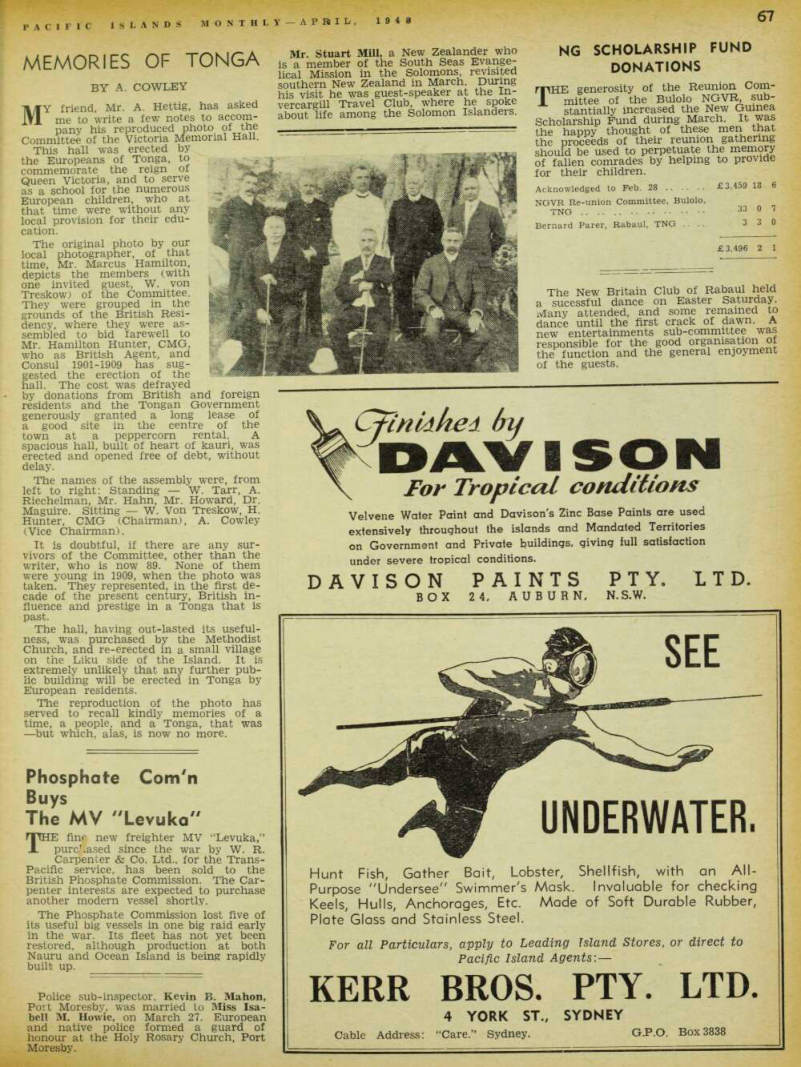
By A. Cowley
MY friend, Mr. A. Hettig, has asked me to write a few notes to accom pany his reproduced photo of the Committee of the Victoria Memorial Hall.
This hall was erected by the Europeans of Tonga, to commemorate the reign of Queen Victoria, and to serve as a school for the numerous European children, who at that time were without any local provision for their edu cation.
The original photo by our local photographer, of that time, Mr. Marcus Hamilton, depicts the members (with one invited guest, W. von Treskow) of the Committee.
They were grouped in the grounds of the British Resi dency, where they were as sembled to bid farewell to Mr. Hamilton Hunter, CMG, who as British Agent, and Consul 1901-1909 has sug gested the erection of the hall. The cost was defrayed
by donations from British and foreign residents and the Tongan Government generously granted a long lease of a good site in the centre of the town at a peppercorn rental. A spacious hall, built of heart of kauri, was erected and opened free of debt, without delay.
The names of the assembly were, from left to right: Standing W. Tarr, A.
Riechelman, Mr. Hahn, Mr. Howard, Dr.
Maguire. Sitting —W. Von Treskow, H.
Hunter, CMG (Chairman), A. Cowley (Vice Chairman).
It is doubtful, if there are any sur vivors of the Committee, other than the writer, who is now 89. None of them were young in 1909, when the photo was taken. They represented, in the first de cade of the present century, British in fluence and prestige in a Tonga that is past.
The hall, having out-lasted its useful ness, was purchased by the Methodist Church, and re-erected in a small village on the Liku side of the Island. It is extremely unlikely that any further pub lic building will be erected in Tonga by European residents.
The reproduction of the photo has served to recall kindly memories of a time, a people, and a Tonga, that was —but which, alas, is now no more.
Mr. Stuart Mill, a New Zealander who is a member of the South Seas Evange lical Mission in the Solomons, revisited southern New Zealand in March. During his visit he was guest-speaker at the In vercargill Travel Club, where he spoke about life among the Solomon Islanders.
Buys
Phosphate Com'n Buys The MV "Levuka"
fITHE finr new freighter MV “Levuka,”
X purchased since the war by W. R.
Carpenter & Co. Ltd., for the Trans pacific service, has been sold to the British Phosphate Commission. The Car penter interests are expected to purchase another modern vessel shortly.
The Phosphate Commission lost five of its useful big vessels in one big raid early in the war. Its fleet has not yet been restored, although production at both Nauru and Ocean Island is being rapidly built up.
Police sub-inspector, Kevin B. Mahon, Port Moresby, was married to Miss Isa bell M. Howie, on March 27. European and native police formed a guard of honour at the Holy Rosary Church, Port Moresby,
Donations
Ng Scholarship Fund
THE generosity of the Reunion Com mittee of the Bulolo NGVR, sub stantially increased the New Guinea Scholarship Fund during March. It was the happy thought of these men that the proceeds of their reunion gathering should be used to perpetuate the mempry of fallen comrades by helping to provide for their children.
Acknowledged to Feb. 28 £3,459 18 6 NGVR Re-union Committee, Bulolo,
Tng 33 0 7
Bernard Parer, Rabaul, TNG ... 330 £3,496 2 1 The New Britain Club of Rabaul held a sucessful dance on Easter Saturday.
Many attended, and some remained to dance until the first crack of dawn. A new entertainments sub-committee was responsible for the good organisation of the function and the general enjoyment of the guests.
Advertisements & other items, p. 69 (1 item)
Opnidked
I
For Tropical conditions
Velvene Water Paint and Davison's Zinc Base Paints are used extensively throughout the islands and Mandated Territories on Government and Private buildings, giving full satisfaction under severe tropical conditions.
DAVISON PAINTS PTY. LTD.
BOX 24, AUBURN, N.S.W.
UNDERWATER
Hunt Fish, Gather Bait, Lobster, Shellfish, with an All- Purpose "Undersee" Swimmer's Mask. Invaluable for checking Keels, Hulls, Anchorages, Etc. Made of Soft Durable Rubber, Plate Glass and Stainless Steel.
For all Particulars, apply to Leading Island Stores, or direct to Pacific Island Agents :—
KERR BROS. PTY. LTD.
4 YORK ST., SYDNEY
Cable Address: “Care.” Sydney. G.P.O. 80x3838
leave nlners arriv? rom Australia
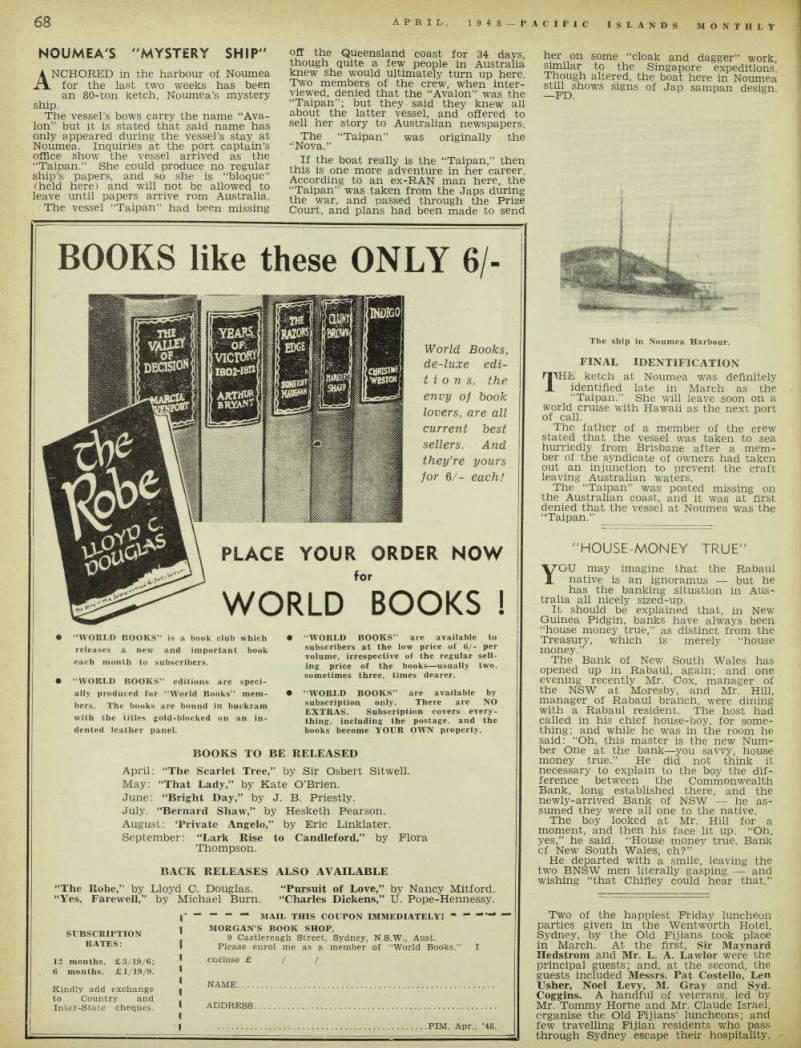
Noumea's "Mystery Ship"
ANCHORED in the harbour of Noumea for the last two weeks has been an 80-ton ketch, Noumea’s mystery ship.
The vessel’s bows carry the name “Ava- Ion” but it is stated that said name has only appeared during the vessel’s stay at Noumea. Inquiries at the port captain’s 6 no vleulLr shin’snaners andso she is “bf<Sue”
nhiuf
leave nlners arriv? rom Australia
leave until papers arrive rom Australia.
The vessel ‘Taipan had been missing
off the Queensland coast for 34 days, though quite a few people in Australia knew she would ultimately turn up here, Two members of the crew, when inter viewed, denied that the “Avalon” was the ‘ Taipan”; but they said they knew all about Matter vessel, and offered to her story to Australian newspapers, The “Taipan” was originally the “Nova.” ♦J f the boat 18 the “Taipan,” then A hls 18 .° ne more adventure in her career, According to an ex-RAN man here, the “Taipan” was taken from the Japs during the wai . ( and Dasse( i through the Prize Court, and plans had been made to send
her on some “cloak and dagger” work, similar to the Singapore expeditions.
Though altered, the boat here in Noumea still shows signs of Jap sampan design.
FD.
Final Identification
THE ketch at Noumea was definitely identified late in March as the “Taipan.” She will leave soon on a world cruise with Hawaii as the next port of call.
The father of a member of the crew stated that the vessel was taken to sea hurriedly from Brisbane after a mem ber of the syndicate of owners had taken out an injunction to nrevent the craft leaving Australian waters.
The “Taipan” was posted missing on the Australian coast, and it was at first denied that the vessel at Noumea was the ‘“Taipan.”
The ship in Noumea Harbour.
"House-Money True"
YOU may imagine that the Rabaul native is an ignoramus but he has the banking situation in Aus tralia all nicely sized-up.
It should be explained that, in New Guinea Pidgin, banks have always been “house money true,” as distinct from the Treasury, which is merely “house money.”
The Bank of New South Wales has opened up in Rabaul, again; and one evening recently Mr. Cox, manager of the NSW at Moresby, and Mr. Hill, manager of Rabaul branch, were dining with a Rabaul resident. The host had called in his chief house-boy, for some thing; and while he was in the room he said: “Oh, this master is the new Num ber One at the bank—you savvy, house money true.” He did not think it necessary to explain to the boy the dif ference between the Commonwealth Bank, long established there, and the newly-arrived Bank of NSW he as sumed they were all one to the native.
The boy looked at Mr. Hill for a moment, and then his face lit up. “Oh, yes,” he said. “House money true. Bank of New South Wales, eh?”
He departed with a smile, leaving the two BNSW men literally gasping and wishing “that Chifley could hear that.”
Two of the happiest Friday luncheon parties given in the Wentworth Hotel, Sydney, by the Old Fijians took place in March. At the first, Sir Maynard Hedstrom and Mr. L. A. Lawlor were the principal guests; and, at the second, the guests included Messrs. Pat Costello, Len Usher, Noel Levy, M. Gray and Syd.
Coggins. A handful of veterans, led by Mr. Tommy Horne and Mr. Claude Israel, organise the Old Fijians’ luncheons; and few travelling Fijian residents who pass through Sydney escape their hospitality.
Advertisements & other items, p. 70 (1 item)
BOOKS like these ONLY 6/-
i %
for
World Books,
de-luxe editio n s, the envy of book lovers, are all current best sellers. And
they’re yours
for 6/- each!
PLACE YOUR ORDER NOW
WORLD BOOKS !
• “WORLD BOOKS” is a book club which releases a new and important book each month to subscribers. • “WORLD BOOKS” editions are specially produced for “World Books” members. The books are bound in buckram with the titles gold-blocked on an indented leather panel. • “WORLD BOOKS” are available to subscribers at the low price of 6/- per volume, irrespective of the regular selling price of the books—usually two. sometimes three, times dearer. • “WORLD BOOKS” are available by subscription only. There are NO EXTRAS. Subscription covers everything, including the postage, and the books become YOUR OWN property.
BOOKS TO BE RELEASED
April: “The Scarlet Tree,” by Sir Osbert Sitwell.
May: “That Lady,” by Kate O’Brien.
June: “Bright Day,” by J. B. Priestly.
July. “Bernard Shaw,” by Hesketh Pearson.
August: ‘Private Angelo,” by Eric Linklater.
September: “Lark Rise to Candleford,” by Flora Thompson.
BACK RELEASES ALSO AVAILABLE
“The Robe,” by Lloyd C. Douglas.
“Yes, Farewell,” by Michael Burn.
“Pursuit of Love,” by Nancy Mitford. ‘Charles Dickens,” U. Pope-Hennessy.
SUBSCRIPTION
RATES:
12 months, £3/19/6; 6 months, £l/19/9.
Kindly add exchange to Country and Inter-State cheques.
MAIL THIS COUPON IMMEDIATELY! •» - -
MORGAN’S BOOK SHOP,
9 Castlereagh Street, Sydney, N.S.W., Aust.
Please enrol me as a member of “World Books.” I enclose £ / /
NAME...
ADDRESS.
.PIM, Apr.,
The Nutritional Value
Of Sago Grubs Eight Scientists Visit New Guinea to Find Out
ALONG, “human-interest” story in the Wellington (NZ) “Evening Post’’ of March 25, tells how two Australian girl scientists ate grubs and other native New Guinea delicacies. The two girls were dietitian members of a team of eight who made a survey of New Guinea natives last year.
The leader of the team, the article says, was a doctor, who medically exam ined the natives. There was an agricul turalist, to see how the food was grown; the two nutritionists, to see what was eaten, a bio-chemist, to see how healthy the natives were on that diet; a parasito logist, to see what other diseases they might have; and an anthropologist, to study their general social background and any customs that might affect the food situation. A dental team also joined them for three of the five villages.
The remarkable thing is that little, if anything, has been heard in Australia of the excursion of the Australian scien tists. Presumably this is because Aus tralian taxpayers who have to pay lor the upkeep of New Guinea are not ex pected to be interested in diet surveys; New Zealanders, on the other hand, have no financial obligations in New Guinea and therefore have no kick coming.
Part of the job of the dietitians, apart from eating sago grubs, was to weigh everything that was cooked and eaten in the villages they visited right down to the last bit of sugar-cane the children nibbled. In the course of their survey they visited villages where they were, in evitably, “the first white women’’ to have been there. They were suitably received.
While realising that such expeditions constitute a good talking-point with the UN Trusteeship Council, we still have room left to wonder why the diet of Australians in the Territories is not causing the Commonwealth similar worry; or why an expedition could not be sent to the Territories to find out why planters cannot take full advantage of world prices for copra.
Vogan
Death Of Mr. A. J
THE death occurred on February 27, in Manly District Hospital, as the re sult of an accident, of Mr. Arthur J.
Vogan, who had reached the great age of 89 years.
Mr. Vogan was well-known in some of the Pacific Islands, where he had made investigations relating to archaeology. He was intensely interested In the history of the native ra es, and his theories relating to their origin aroused controversies, in which he took a vigorous part. He went originally to the Islands as a correspon dent-and-artist member of an exploring expedition, which visited the Fly River area of Papua more than 60 years ago.
He travelled widely as a correspondent and adviser of British mining interests and when he retired, some 20 years ago, he visited parts of the Pacific, including New Guinea and Fiji. He claimed credit for discovering ancient Chinese inscrip tions on the wall of a cave in the Yasawa Islands (North-western Fiji).
Scholarly and erudite, Mr. Vogan was a tireless writer and maintained a corre spondence with persons all over the world, until the moment of his accident. He had a bad fall about 12 days before his death, and did not recover consciousness.
Advertisements & other items, p. 71 (1 item)
“Where The Trade
A NEW Book . . . .
FOR
YOUR
ENTERTAIN-
MENT
72 STORIES, ARTICLES
AND SKETCHES
ABOUT LIFE IN THE
SOUTH PACIFIC
ISLANDS
WITH NUMEROUS
ILLUSTRATIONS
★ Collected by
R. W. Robson
and
Judy Tudor
' ■ ' '"'L A. X” . ;>ir >. ■ify&t.r. !V..
W. ■ i tT- - £ v * ' £ -c *2
“Where The Trade
Winds Blow**
These stories and sketches, brought together in this book for your entertainment, are about real people. They describe, without colour or embellishment, conditions of life in the Pacific Islands, as they are to-day.
We still have the Islands setting and the indefinable Islands atmosphere; but life in the Islands—even in savage and primitive Melanesia—has been altered, profoundly.
This book indicates how and where conditions have changed.
At all Leading Booksellers in Australia; at the Stores of Whitcomb & Tombs, Ltd., in New Zealand; at Caldwells Book Store, in Suva; from the Islands stores of Burns Philp & Co., Ltd.; and from Booksellers generally.
OR DIRECT FROM THE PUBLISHERS:
Pacific Publications Pty. Ltd.
UNION HOUSE, 247 GEORGE ST., SYDNEY Posted
Service Section
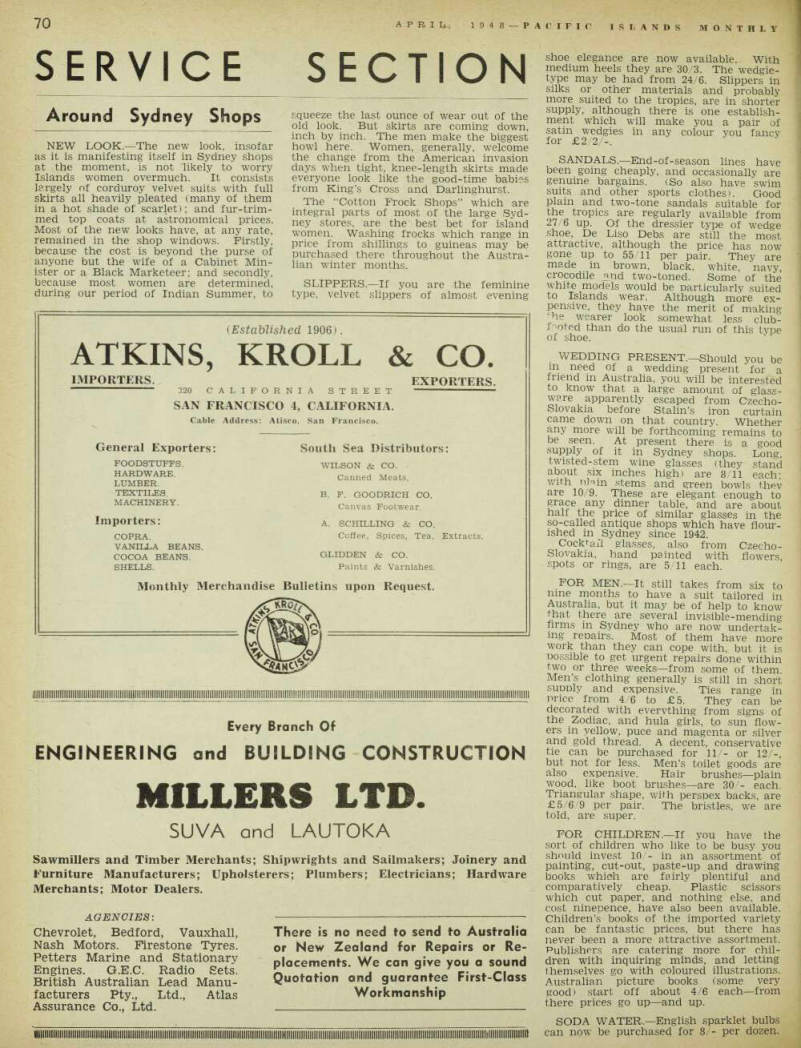
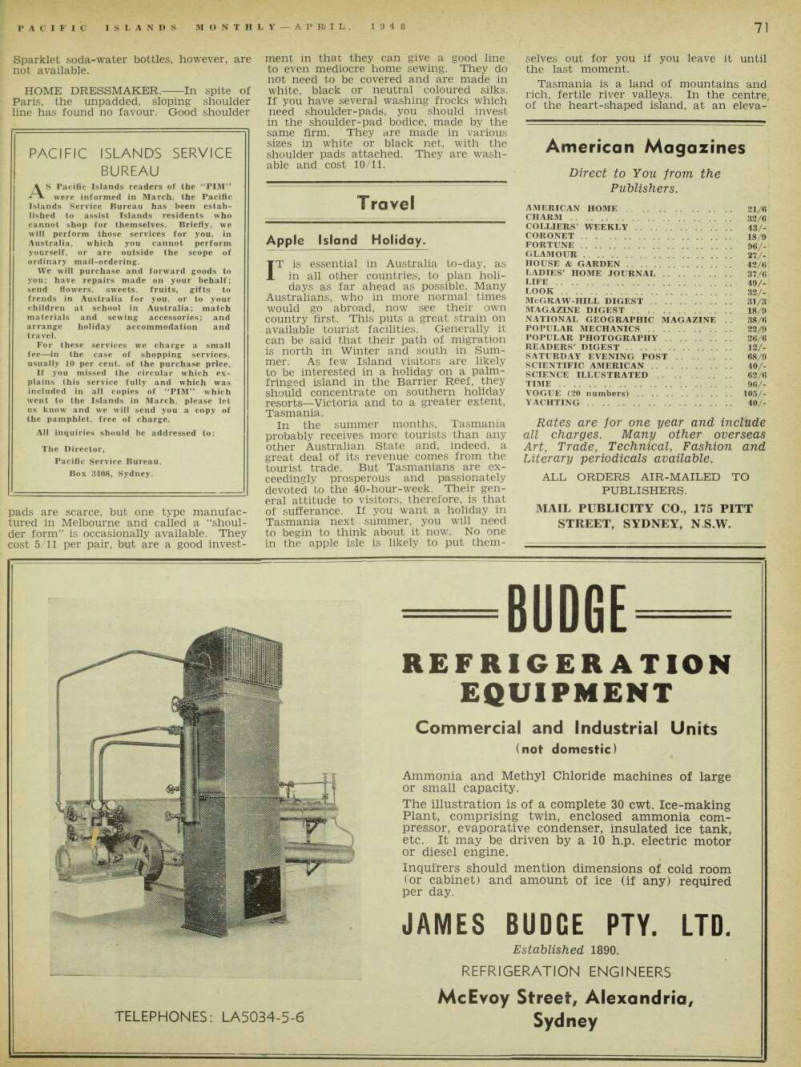
Around Sydney Shops
NEW LOOK. —The new look, insofar as it is manifesting itself in Sydney shops at the moment, is not likely to worry Islands women overmuch. It consists largely of corduroy velvet suits with full skirts all heavily pleated (many of them in a hot shade of scarlet); and fur-trim med top coats at astronomical prices.
Most of the new looks have, at any rate, remained in the shop windows. Firstly, because the cost is beyond the purse of anyone but the wife of a Cabinet Min ister or a Black Marketeer; and secondly, because most women are determined, during our period of Indian Summer, to
squeeze the last ounce of wear out of the old look. But skirts are coming down, inch by inch. The men make the biggest howl here. Women, generally, welcome the change from the American invasion days when tight, knee-length skirts made everyone look like the good-time babies from King’s Cross and Darlinghurst.
The “Cotton Frock Shops” which are integral parts of most of the large Syd ney stores, are the best bet for island women. Washing frocks which range in price from shillings to guineas may be purchased there throughout the Austra lian winter months.
SLIPPERS. —If you are the feminine type, velvet slippers of almost evening
shoe elegance are now available. With medium heels they are 30/3. The wedgie type may be had from 24/6. Slippers in silks or other materials and probably more suited to the tropics, are in shorter supply, although there is one establish ment which will make you a pair of satin wedgies in any colour you fancy for £2/2/-.
SANDALS.—End-of-season lines have been going cheaply, and occasionally are genuine bargains. (So also have swim suits and other sports clothes). Good plain and two-tone sandals suitable for the tropics are regularly available from 27 6 up. Of the dressier type of wedge shoe, De Liso Debs are still the most attractive, although the price has now gone up to 55/11 per pair. They are made in brown, black, white, navy, crocodile fmd two-toned. Some of the white models would be particularly suited to Islands wear. Although more ex pensive, they have the merit of making f he wearer look somewhat less club footed than do the usual run of this tvpe of shoe.
WEDDING PRESENT.—ShouId you be in need of a wedding present for a friend in Australia, you will be interested to know that a large amount of glass ware apparently escaped from Czecho slovakia before Stalin’s iron curtain came down on that country. Whether any more will be forthcoming remains to be seen. At present there is a good supply of it in Sydney shops. Long, twisted-stem wine glasses (they stand about six inches high) are 8 11 each with nKm stems and green bowls thev are 10/9. These are elegant enough to s r^ i any dinner table, and are about half the price of similar glasses in the so-called antique shops which have flour ished in Sydney since 1942.
Cocktail glasses, also from Czecho slovakia, hand painted with flowers, spots or rings, are 5/11 each.
FOR MEN. —It still takes from six to nine months to have a suit tailored in Australia, but it may be of help to know that there are several invisible-mending firms in Sydney who are now undertak ing repairs. Most of them have more work than they can cope with, but it is possible to get urgent repairs done within two or three weeks—from some of them Men’s clothing generally is still in short supply and expensive. Ties range in price from 4/6 to £5. They can be decorated with everything from signs of the Zodiac, and hula girls, to sun flow ers in yellow, puce and magenta or silver and gold thread. A decent, conservative tie can be purchased for 11/- or 12/-, but not for less. Men’s toilet goods are also expensive. Hair brushes—plain wood, like boot brushes—are 30 - each.
Triangular shape, with perspex backs, are £5/6/9 per pair. The bristles, we are told, are super.
FOR CHILDREN.—If you have the sort of children who like to be busy you should invest 10 - in an assortment of painting, cut-out, paste-up and drawing books which are fairly plentiful and comparatively cheap. Plastic scissors which cut paper, and nothing else, and cost ninepence, have also been available.
Children’s books of the imported variety can be fantastic prices, but there has never been a more attractive assortment.
Publishers are catering more for chil dren with inquiring minds, and letting themselves go with coloured illustrations.
Australian picture books (some very good) start off about 4/6 each —from there prices go up—and up.
SODA WATER—English sparklet bulbs can now be purchased for 8/- per dozen.
Sparklet soda-water bottles, however, are not available.
HOME DRESSMAKER. In spite of Paris, the unpadded, sloping shoulder line has found no favour. Good shoulder
pads are scarce, but one type manufac tured in Melbourne and called a “shoul der form’’ is occasionally available. They cost 5/11 per pair, but are a good invest
ment in that they can give a good line to even mediocre home sewing. They do not need to be covered and are made in white, black or neutral coloured silks.
If you have several washing frocks which need shoulder-pads, you should invest in the shoulder-pad bodice, made by the same firm. They are made in various sizes in white or black net, with the shoulder pads attached. They are wash able and cost 10/11.
Advertisements & other items, pp. 72-73 (1 item)
Millers Ltd.
(Established 1906).
ATKINS, KROLL & CO.
IMPORTERS. EXPORTERS.
— 320 CALIFORNIA STREET “
SAN FRANCISCO 4, CALIFORNIA.
Cable Address: Atisco, San Francisco.
General Exporters:
South Sea Distributors;
FOODSTUFFS.
HARDWARE.
LUMBER.
TEXTILES.
MACHINERY.
WILSON & CO.
Canned Meats.
B. F. GOODRICH CO.
Canvas Footwear.
Importers:
A. SCHILLING & CO.
COPRA. Coffee, Spices, Tea, Extracts.
VANILLA BEANS.
COCOA BEANS. GLIDDEN & CO.
SHELLS. Paints & Varnishes.
Monthly Merchandise Bulletins upon Request.
Every Branch Of
ENGINEERING and BUILDING CONSTRUCTION
MILLERS LTD.
SUVA and LAUTOKA
Sawmillers and Timber Merchants; Shipwrights and Sailmakers; Joinery and Furniture Manufacturers; Upholsterers; Plumbers; Electricians; Hardware Merchants; Motor Dealers.
AGENCIES :
Chevrolet, Bedford, Vauxhall, Nash Motors. Firestone Tyres.
Fetters Marine and Stationary Engines. G.E.C. Radio Sets.
British Australian Lead Manufacturers Pty., Ltd., Atlas Assurance Co., Ltd.
There is no need to send to Australia or New Zealand for Repairs or Replacements. We can give you a sound Quotation and guarantee First-Class Workmanship
PACIFIC ISLANDS SERVICE
BUREAU
AS Pacific Islands readers of the “PIM” were informed in March, the Pacific Islands Service Bureau has been established to assist Islands residents who cannot shop for themselves. Briefly, we will perform those services for you, in Australia, which you cannot perform yourself, or are outside the scope of ordinary mail-ordering.
We will purchase and forward goods to you; have repairs made on your behalf; send flowers, sweets, fruits, gifts to frends in Australia for you, or to your children at school in Australia; match materials and sewing accessories; and arrange holiday accommodation and travel.
For these services we charge a small fee—in the case of shopping services, usually 10 per cent, of the purchase price.
If you missed the circular which explains this service fully and which was included in all copies of “PIM” which went to the Islands in March, please let us know and we will send you a copy of the pamphlet, free of charge.
AH inquiries should be addressed to: The Director, Pacific Service Bureau, Box 3408, Sydney.
Travel
Apple Island Holiday.
IT is essential in Australia to-day, as in all other countries, to plan holi days as far ahead as possible. Many Australians, who in more normal times would go abroad, now see their own country first. This puts a great strain on available tourist facilities. Generally it can be said that their path of migration is north in Winter and south in Sum mer. As few Island visitors are likely to be interested in a holiday on a palm fringed island in the Barrier Reef, they should concentrate on southern holiday resorts —Victoria and to a greater extent, Tasmania.
In the summer months, Tasmania probably receives more tourists than any other Australian State and, indeed, a great deal of its revenue comes from the tourist trade. But Tasmanians are ex ceedingly prosperous and passionately devoted to the 40-hour-week. Their gen eral attitude to visitors, therefore, is that of sufferance. If you want a holiday in Tasmania next summer, you will need to begin to think about it now. No one in the apple isle is likely to put them
selves out for you if you leave it until the last moment.
Tasmania is a land of mountains and rich, fertile river valleys. In the centre, of the heart-shaped island, at an eleva
tion of about 4,000 feet is the Great Lake, from which hydro-electricity is generated and reticulated to all parts of the State, providing cheap industrial
power which has encouraged some of the largest manufacturing establishments in the Commonwealth to make Tasmania their headquarters.
The two main cities are Launceston in the north (population about 37,000) and Hobart, the capital, in the south, with about twice as many people. Both are prosperous, wealthy, well-built and laid out, and have an air of pride about them found in few mainland cities of the same size. Both have excellent hotels —and some bad ones, which are a trap for un wary tourists.
Outside of Launceston and Hobart, however, the hotel accommodation is at best third-rate, and in many instances frightful. This should not, however, de ter the tourist. Tasmania is a small island and scarcely any part of it is out of reach of a day’s journey from either Launceston or Hobart. The Great Lake, for example, is within three hours’ drive of Launceston, and there on the hottest
summer day one may enjoy bone-freez ing weather. There are chalets and caoins on the Lake, which is the Mecca of local and overseas trout fishermen, Tasmanians treat their railways as a joke, and practically all travelling is done oy service-car or coach, of which there literally are thousands, running to all points and linking every part of the island. The distance between Launceston and Hobart is about 120 miles by the mam highway, and this is accomplished by service car in a few hours.
CONDUCTED tours of the island are virtually in the control of Pioneer Tours, a subsidiary company of Ansett Airways, but because of the country ac commodation (already mentioned) con ducted tours of this type are best left alone. The tourist is recommended to make Launceston and Hobart his head quarters and arrange his sightseeing from those points.
In the summer Tasmania is certainly the most attractive place in the Com monwealth, and the food is uniformly excellent. You may wallow in apples, raspberries, the largest strawberries this side of Devonshire, gooseberries, and any variety of currant you fancy. There is cream and butter galore, in spite of rationing; fish, with a flavour not known in northern waters, and crayfish is as common as shark in the rest of Aus tralia. Beer is better and more plentiful on the island than anywhere else in the Commonwealth.
The country is beautiful in the way New Zealand and Southern England are beautiful —but with an Australian flav our; and finally, one is confronted around every bend of the road with history of the very earliest days of British colon isation of the antipodes.
Island visitors to Australia, who only Sydney know, should think well about a visit to the island State. There is some thing there for everyone; the student of history, the seeker of peace and beauty or of health; the tropically-pale child; those who like good food; and —the beer connoisseur.
Advertisements & other items, pp. 73-74 (1 item)
-Budge-
American Magazines
Direct to You from the
Publishers.
AMERICAN HOME 21/6
CHARM 32/6
COLLIERS’ WEEKLY 43/-
CORONET 18/9
FORTUNE 96/-
GLAMOUR 27/-
HOUSE & GARDEN 42/6
LADIES’ HOME JOURNAL 37/6
LIFE 49/-
LOOK 32/-
McGRAW-HILL DIGEST 31/3
MAGAZINE DIGEST 18/9
NATIONAL GEOGRAPHIC MAGAZINE 38/6
POPULAR MECHANICS 22/9
POPULAR PHOTOGRAPHY 26/6
READERS’ DIGEST 12/-
SATURDAY EVENING POST 68/9
SCIENTIFIC AMERICAN 40/-
SCIENCE ILLUSTRATED 62/6
TIME 96/-
VOGUE (20 numbers) 105/-
YACHTING 40/-
Rates are for one year and include all charges. Many other overseas
Art, Trade, Technical, Fashion and
Literary periodicals available.
ALL ORDERS AIR-MAILED TO
PUBLISHERS.
MAIL PUBLICITY CO., 175 PITT
STREET, SYDNEY, N.S.W.
TELEPHONES:
LA5034-5-6
-BUDGE-
REFRIGERATION
EQUIPMENT
Commercial and Industrial Units (not domestic) Ammonia and Methyl Chloride machines of large or small capacity.
The illustration is of a complete 30 cwt. Ice-making Plant, comprising twin, enclosed ammonia compressor, evaporative condenser, insulated ice tank, etc. It may be driven by a 10 h.p. electric motor or diesel engine.
Inquirers should mention dimensions of cold room (or cabinet) and amount of ice (if any) required per day.
JAMES BUDGE PTY. LTD.
Established 1890.
REFRIGERATION ENGINEERS
McEvoy Street, Alexandria,
Sydney
Gilbert Renton
AUCTIONEER, VALUER,
ESTATE AGENT.
Storage and Repository Travellers Sample Rooms For General Information and Service.
P.O. Box Rabaul, TNG
Box 3838 GPO, Sydney. Australia.
Cable Address, “Care” Sydney.
I"
ISLAND MERCHANTS
4 YORK ST. f SYDNEY
All kinds Island Produce sold on commission. All merchandise purchased at best wholesale price and original invoices supplied.
Use our 50 years’ experience as Island Merchants.
J
A GOOD COOK BOOK
AND A WORTHY CAUSE
IF you need a good, simple and reliable household manual you are recommended to the “Carry On’’ Cookery Book which is now obtainable from all Australian booksellers at 3/- per copy.
This book was compiled by Mrs. A.
King, of Alstonville, NSW, and proceeds are devoted to patriotic funds. Over 22,000 copies of the book were sold and now it has been revised and brought up to date by Mrs. King and the copyright given to the Totally and Permanently Disabled Soldiers’ Association. The whole of the proceeds from the sale of the book goes to this worthy organisation.
There are over 1,500 recipes and reliable household hints in the book, all of which are fully indexed.
If you have a Kitchen Tea on your social list, there could be no more appropriate gift than this. Or buy yourself a copy you will be helping a good cause as well as yourself.
Sails. Covers, Awnings
AND ALL CLASSES CANVAS GOODS FOR
INDUSTRIAL AND HOME USE
ALSO: FLAGS, ALL NATIONS
Send your inquiries to
HARRY WEST
"SYDNEY'S SAILMAKER"
DUKE ST. (WATERFRONT) EAST BALMAIN, SYDNEY, N.S.W.
Phone: WBIIOS, W 82284.
EYE LOTION
For Inflamed Eyes and Eyelids ... Sold Everywhere H.Rose4Co..Pty,Lld.. King Street Sydney.
Moresby
The Month In
From a Special Correspondent
Port Moresby, April 5.
rpHE Administrator (Colonel J. K. Mur- X ray) has returned from his three weeks’ visit to Australia, but the gen eral public is as much “in the dark’’ as ever about developments ifi Canberra, and plans for the Territory’s future.
Apart from an ABC news item which stated that the Minister hoped to have the new Bill ready before the present Parliamentary session ends in May, no one seems to have any idea just who is planning what.
There has not been so much as a mur mur from official sources about the vari ous matters which have lately been agitating the locals. “Marginal increases” in public service salaries seem to have been forgotten—if indeed, they were ever contemplated. Protests over the newly imposed electricity charges have not vet been acknowledged from Canberra. The cost of living is still climbing heaven wards. And Canberra has now com menced its second year of complete silence in response to persistent requests by the Administration, and by local parents, for financial assistance to per sons whose children have to go to Aus tralia for secondary education. * * * A CROWD of over 100 watched the final of the local table tennis competi tion, which was held in the RSL Clubrooms recently. A team from the Australasian Petroleum Company won comfortably from a Commonwealth Bank foursome. After the matches various trophies, including a competition shield donated by Mr. Reg. Eginton, were presented. A. Ashton and G. Crouch, winner and runner-up respectively in a Singles Championship held earlier this year, also received their prizes. * * * MR D. PULLEN has replaced Mr. L.
Clout as the Public Service Asso ciation representative on the Gov ernment Housing Committee. The scheme allowing officers a grant to build their own houses has been reopened, and the foundations are at present being excavated in the Lawes Road area for a group of prefabricated houses which are shortly to be erected. The Housing- Committee is therefore busy at the moment. ♦ ♦ * MR. R. MONSON, of the Sydney “Telegraph,” has been in Moresby on the last stage of a tour of the Territory, during which he has been col lecting material for a new magazine which the “Te’igraph” plans to put out shortly. Mr. Monson also started a minor international crisis, for it was he who first gave the Australian press the story of strife between Australians and Chinese at Manus.
At first it was reported that Chinese at Manus had attacked natives and then, armed with machine-guns, had defied Australian administrative officers. On the Saturday night Mr. Ward announced that the Territory’s Superintendent of Police (Mr. J. S. Grimshaw) had left for Manus, and that an early report from him was expected. Mr. Grimshaw was seen in Moresby on the following Monday and Tuesday, and had apparently not been to Manus. He did get away later that week, however, and two Chinese were arrested. No machine-guns misbehaved, and the incident was not revived by the press.
THE town-planners have moved in and are installed in the Lands Depart ment office. It is understood that they have already commenced the job of dreaming up a better and brighter Moresby. The Lawes Road area ap pears to have received attention. The Anglican Mission was about to subdivide an estate in that part of the town for building blocks when they were informed that their plans conflicted with those of the planners. They have had to post pone the subdivision. On the whole, however, Moresby certainly needs expert planning if it is to serve as the per manent capital, and it is pleasing to hear that the work is being handled. * * * AT the annual meeting of the Parents’
Association of the local European school, held last month, Mr. J.
Lyons and Mrs. Price were elected presi dent and secretary respectively. At the meeting there was considerable discus
sion about the constitution of the Asso ciation; no final constitution has yet been adopted. * * * DR. and Mrs. Washington Gray have left. Dr. Gray, who has been chief geologist with the Australasian Petroleum Company, will take up an executive position with the firm’s Lon don office. They will be missed. * * * THE vegetable markets run by the Agriculture Department every Friday
are now being handled by G. G.
Smith and Co., a firm which continues to show commendable enterprise in meeting the public’s needs. It is understood that this firm plans to provide bootrepairing facilities in the near future.
The greater part of Moresby’s citizenry have been literally down-at-heel since the war. * * *
Tttt-, ~1 „ , ' ,
HE Malaita brought a small quantity of sugar last week. Private pantries have been right out of sugar for some time, and housewives want to know
why this consignment was delivered to the “lolly water” factory, * * * A orri , , T AST week brought another anomaly . bgnt. A local lad has been wait or c °Pies of the Melbourne ‘ A S® reach the !ocal public library 80 that he could discover how he fared in last year’s university exams. Think ing that the papers would arrive by the first surface mail, he did not bother to ask any friends to check up on his result, He still doesn’t know them, as the latest “Age” available at the library is dated
January 19. There been four surface mails since then.
The explanation given is that news papers are purchased through Govern ment Stores as freight, and are subject to the usual lag in Administration cargoes. We would have thought that the library could have papers posted to it, like anyone else. A recent surface mail brought southern newspapers up to March 20 to private citizens.
Advertisements & other items, pp. 75-76 (1 item)
Exporters
ART POSTCARDS OF
TONGA
Per Dozen, Postage Paid: 6/- (one US Dollar).
TONGAN PHOTOS BUREAU
Nukualofa, Tonga
r
IMPORTERS
EXPORTERS
All classes of merchandise purchased for Island clients throughout the South-west Pacific.
Island produce sold on Australian and overseas markets on a commission basis.
54a Pitt Street
Sydney
Cable Address: “ROBERGILL,” Sydney
YOUR FUTURE CAREER . . .
Merchants, Accountants, Secretaries, Bankers and Business Managers ... all hold responsible positions with commensurate salaries. You too can enhance your prospects in this ever-expanding commercial field, which yields abundant returns to those with adequate qualifications. H.R.I. prepare ambitious men and women for all business positions from junior to senior executive. Tuition is practical authoritative up-to-date time saving . . , and certain in its successful results. The H.R.I. is available always to advise you write or wire for information free and without obligation.
H.R.I. tutorial service is proved by the winning of more honours than all coaches in Australasia combined.
H.R.I. Career Training • ACCOUNTANCY • SECRETARYSHIP • COST ACCOUNTANCY
• PRACTICAL BOOKKEEPING • MARKETING SELLING
ADVERTISING • BANKING • LOCAL GOVERNMENT EXAMS.
Hemingway Robertson Instit u i e
Founded and Owned by Hemingway & Robertson Pty. Ltd.
Consulting Accountants ;; Professional Tutors
126 RANK HOUSE. BANK PLACE, MELBOURNE
126 CHALFONT CHAMBERS, 142 PHIL I. 1 P STREET, SYDNEY 126/815
Asthma Curbed In 3 Minutes
Since the discovery of Mendaco by a famous physician sufferers can get relief from Asthma. Mendaco does away with expensive injections and offensive smokes.
All you ao is to take 2 tasteless tablets with meals and Mendaco starts circulating through the blood in 10 minutes. You breathe easily and freely. Your nerves relax, you get good, fresh, pure air into your lungs, and vigour returns.
Sleep Like a Baby
Thousands of former sufferers from Asthma say that the very first dose of Mendaco brought them glorious ease and comfort, and that they slept soundly the very first night. Then their vigour returned and they felt healthier and stronger, and 5 to 10 years younger. The reason for this is that Mendaco acts in natural ways to overcome the effects of Asthma. (1) It removes the mucus or phlegm; (2) It relaxes thousands of tiny muscles in your bronchial tubes so that the air can get in and out of your lungs; (3) It promotes body vigour, and stimulates the building of rich, revitalised blood.
No Asthma for Five Years
Mendaco not only brings almost Immediate results, free breathing and comfort and enables you to sleep, but also builds up the system to ward off future attacks. Mr.
J. R. writes: “I was almost dead with Asthma. Dad lost 40 lbs. in weight, saf-
fered coughing; every night—couldn’t sleep.
Mendaco stopped spasms first night. 1 have had no Asthma since in over 2 years.”
Mrs. A. W. writes: “I had Asthma for 25 years. After using Mendaco I can sleep all night and have not had an attack since taking it.” Mrs. G. E. C. writes: “I bless the day I first beard of Mendaco. What a godsend it is to a poor woman like me who for 35 years never knew what it was to have a good night’s rest. The constant fight between Asthma and sleep was wearing me down, but I feel now I want to forget my past suffering.”
Benefits Immediate
The very first dose of Mendaco goes right to work circulating through your blood and helping nature rid you of the effects of Asthma. Try Mendaco under an iron-clad money back guarantee. You be the judge.
If you don’t feel fully satisfied after taking Mendaco just return the package and the purchase price will be refunded. Get Mendaco from your chemist to-day and see how well you sleep to-night and how much better you will feel.
RELIEVES ASTHMA
Mendaco
Now in 2 sizes 6/- and 12/-
Mixed Company of 36
Seeks A Tropical Isle
IT has happened again. This is the 104th enterprise of the kind recorded by the “PIM” in its long and useful life.
Thirty-six young men and women of Vancouver, led by 23-years-old Mark Price, described as an Australian press man, are planning an expedition to estab lish a “model community” in 1949 on an island in either Fiji or Tonga.
Price advertised his Utopian plan in a Vancouver newspaper; and had to engage a porter to carry home the replies. As Barnum said, there is one born every minute.
The plan is that they shall all retire “while they are young enough to enjoy life.” None of the group is over 30.
They are now trying to raise funds wherewith to buy a 60 ft. ketch. No con sideration appears yet to have been given to such mundane things as how they are going to eat, or what Sir Brian Freeston or Queen Salote will say when they learn that one of their islands is being pinched.
The idea is that one just sits in the sun, and makes love, and eats bananas.
The other 103 grouns had the same idea.
High Costs In Fiji
rE high cost of European living, heavy building costs, and the diffi culty of obtaining adequate house service were three things that impressed Mr. J. R. Hawcridge, a New Zealand en gineer, on a recent visit to Fiji.
Mr. Hawcridge said that repercussions of the war and of the American occupa tion were being keenly felt by those who wanted labour. Native domestic servants were almost as fickle in their service as were servants in the Dominions. Indian cooks were difficult to retain, even at double pre-war wages, and it was strange to see laundry work being done in Euro pean households instead pf being sent out to the inevitable dhobi boys as be fore, when personal laundry was done on a contract basis of 10/- a month.
“To-day’s slogan is piece-work only, ’ he said.
After a suspension of five years due to the war, the oldest sports club of Apia, the Ania Rifle Club, has been revived due mainly to the efforts of Mr. D. R. Eden, who is general manager of Reparation Estates. His call to start the activities of the 25 year old club was enthusiastically responded to by the many followers of the sport. At a general meeting in Nov ember a new executive was elected.
Mr D R. Eden was re-elected president; Mr A B. Stewart, secretary and treas urer; and Messrs. A. M. Gurau, A P.
King F I. Pritchard and E. L. Ruland members of the committee; while Inspec tor M. McLeod was elected Captain of the Club. The rifle range at Vaivase Plantation, which was used during the war by American occupation forces and the Local Defence Force, is in splendid condition and was opened by the Admin istrator. Colonel F. W. Voelcker, Patron of the Club, on Sunday, November 30.
Mr. Colin A. Allen, Western District Commissioner in the Solomon Islands, arrived in Auckland recently on long leave. He is visiting his home before pro ceeding to Cambridge University, for a post-graduate course—he has an anthro pological-cum-cultural study in mind.
Advertisements & other items, pp. 76-77 (2 items)
74
APRIL, 194 8— P ACIFIC ISLANDS MONTHLY
Capstan *
grand cigarette
for all occasions-
Capstan’s own blend
£
of fine Virginia
leaf cannot
be equalled
ms m o
SYD
That's why it's always
TIME FOR A CAPSTAN
380?!-? 47
THE EMPIRE'S FAVOURITE CIGARETTE
Progress of ARC Pty., Ltd.
AUSTRALASIAN Petroleum Company Pty., Ltd., reports that, as at Feb ruary 28, 1948, drilling of the bore at Kariava, Papua, had reached a depth of 12,178 feet; depth drilled since Feb ruary 1, 1948, being 496 feet.
Fortunes In Copra
For Some Planters
SUVA, March 16.
IF Fiji’s copra production is maintained this year, several European planters should have 1948 incomes of about £20,000 each.
But even outside Government circles, there are some signs of public criticism at what is regarded as the “isolationist” attitude adopted by some of the planters, and correspondence in the “Fiji Times” has produced a red-hot demand that the Government should leave the Europeans in their preferred “isolation” and en courage the formation of a powerful, in dependent, all-Fijian copra organisation.
The Fijians, incidentally, are officially reported to produce two-thirds of the Colony’s copra.
A sign of the times may possibly be found in a Fiji Royal Gazette notice last week which states that Mr. C. A. Stokes, a New Zealander who has been in Fiji for 23 years, has been appointed organ ising manager of the Macuata Copra Venture.
Few people had heard of the Macuata Copra Venture, but it is an organisation planned to provide for the pooling of all the Fijian-produced copra in the Macu ata Province, the selling of the copra direct to the Copra Board, the elimina tion of the middlemen, and the use of the returns for the benefit of the pro vince.
Unsolved Mystery Of The
War
Prom Our Own Correspondent PAPEETE. March 15.
TT is probable, now, that the fate of the 1 Tahitian schooner “Tereora” will never be known. On January 16, 1942, with several passengers she sailed out of Papeete for Uturoa, Raiatea; and was never seen again. She is thought to have been destroyed by an enemy raider.
The “Tereora” had been built in Auck land 20 years before, and she traded in the Tuamotu and Marquesas groups for many years, for her owners, Messrs. A. B.
Donald, Ltd.
About the time of her disappearance, a Japanese raider was in the vicinity—it sank the American Matson steamer “Malama,” Captain Malcolm Peters formerly an executive officer on the “Mari posa.” The “Malama” left Honolulu for French Oceania to load copra, a few days before Pearl Harbour. She suspected a raider, and she zigzagged through the Tuamotus to Tubuai.
On New Years Day, 1942, Captain Peters radio’d: “Plane overhead, pro bably enemy.” Then came silence —nothing more of the “Malama” was heard until the end of the war. Then Captain Peters and his crew were found in a prison camp in Japan. They said the “Malama” was torpedoed and they were taken by the raider to Japan. It seems likely that the raider disposed of the “Tereora”; but Captain Peters knew noth ing of the fate of the schooner.
Clean-Up In Tahiti
PAPEETE. March 27.
ENERGY and activity continue to mark the administration of the new Gov ernor. M. Pierre Maestracci.
The Works Department is restoring the Broom Road, which runs right around the island; while the Health Department, intent on general sanitarv improvement, is co-operating with the Mayor in remov ing old shacks and eyesores, and fumi gating suspected residential.
Advertisements & other items, p. 78 (1 item)
W. Kopsen & Go. Pty. Ltd.
Allen Taylor & Co. Ltd.
COMMERCIAL ROAD. ROZELLE,
SYDNEY
Sawmillers and Wholesale Suppliers of Hardwoods for Constructional Purposes GIRDERS . . PILES , . . POLES . . . SLEEPERS, Etc.
EXPORTING TO PACIFIC - ISLANDS SINCE 1893
From WHOA!
SIMPLEX
MARINE ENGINES
3. 5 and 10/12 h.p. Suitable for all crafts from 14-32 ft. The 5 and 10 h.p. are supplied with built-in reverse gear. All Australian made. Prices and specifications on request.
C.Q.R. ANCHORS
The lightweight anchor with three times the holding power of any other anchor. No more efficient tool for quick and positive “dig-in” has ever been found than the ploughshare. The C.Q.R. is two well designed ploughshares welded together. Write for C.Q.R. Anchor leaflet.
to GO!
W. KOPSEN & GO. PTY. LTD.
Have EVERYTHING for Boats
FISHING
TACKLE
Our new Fishing Department has been opened to provide the utmost service and satisfaction in all classes of fishing gear. Marlin Gut lines, Fishkil Nylon Twist, Geisha Wire Traces, Linen and Cotton lines, Rangoon and Split Cane Rods, Reels and numerous other lines.
KAYEN PRESSURE LAMPS
The all Australian made vapour lamps— reliable—efficient—safe—easy to operate.
Burns for 10 hours on VU pints of kerosene. The lamp illustrated is of 300 C.P. and is the table model (HL7); the allpurpose lamp (AP2) is windproof and ideal for outdoor work. Burn ordinary kerosene. Write for illustrated leaflet.
SHIPCHANDLERS & MARINE ENGINEERS
376-380 KENT ST., SYDNEY. MA 6336 (9 lines).
Cables: “KOPSEN” Sydney.
Empire's £'s Are Out
Of Balance Fantastic Results of Interference With Economic Laws
THE attempts of the Australian Social ist Government to keep control of the national economy under the chaotic conditions produced in the world by World War 11, are having fantastic results.
For example, as everyone knows, the value of the £ Sterling is a very un certain quantitv it is, if anything, steadily falling. But the financial moguls of the Empire are trying to hold it at a fixed lvalue in relation to gold, and in re lation to the Dollar. The Australian £, which is valued in terms of gold at 25 per cent, less than Sterling, is steadily in creasing in value.
These things are the result of simple economics. Britain is buying more than she is selling and is not only using up all her money reserves, but is actually getting into debt. Therefore, of course, the unit of her monetary system (the £ Sterling) is decreasing in value. Aus tralia, on the other hand, is selling far more than she is buying, and is getting richer every month her credit balances abroad (except in Dollar areas) are large, and are steadily increasing.
It is ridiculous that the Australian £ should be valued at 25 per cent, under Sterling and the proof of it is seen in what is haopening in free exchange markets of the* East. In Singapore, for example, the Australian £ is at par with Sterling. Shrewd people to-day are en riching themselves rapidly by taking Aus tralian £’s to Singapore, converting them into Sterling at par, and bringing Ster ling back to Australia, or to some other controlled exchange market, where they are converting it back into Australian £’s, and getting the full benefit of 25 per cent.
Or take gold, of which Australia and her Territories (especially New Guinea) produce a great deal. Oh a free market, gold is worth a good deal more than the £lO per fine ounce which is the value fixed in Australia’s controlled markets.
There is a black market price for fine gold which is very much greater. In London recently, for example, gold buyers were publicly offering £37/10/- Sterling per ounce for fine gold, for the purpose of making wedding rings.
These are outstanding examples to prove that economic laws cannot be interfered with on a half-and-half basis. We either must let trade and commerce run en tirely free throughout the world, sub ject only to the laws of supply and de mand, and of competition (with proper safeguards, of course, against monopo listic organisation) or we must put all international economic relations under strict control, in the manner planned by the Communists.
The present fumbling efforts of the Democracies to control world-wide econo mic conditions and international finan cial relationships reminds one of Aesop’s Fable about the monkey and the cheese.
The monkey put two pieces of cheese on a balance and tried to get them exactly even. Greedily he took a bite of one; then he found it necessary to bite at the other; and so he alternated between the two lots of cheese until he had consumed the lot.
Fijians' Bright Cricket
Pleases New Zealand
From a Special Correspondent SUVA, March 17.
'T'HE Fijian Representative Cricket Team, now A- touring New Zealand, has been praised in the Dominion press for the wholesome effect it has had on the game there.
In recent years, it is said, the aim to win
has become more important than the game itself. The Fijians have played uniformly bright cricket in the 10 games already played.
They are at present engaged in a three-days match against Otago, winners of the Plunket Shield for the present season.
Results have been as follows, in their ten matches:: — Against Northland, won by 69 runs on first innings: Waikato, won by 9 wickets; Auckland, lost by 168 runs; Wanganui, drawn; Taranaki, won by 8 wickets; Rangitikei, lost on first innings; Wellington, won by 1 wicket; Sth.
Canterbury, won by 130 runs on first innings; Canterbury, lost by 36 runs; Southland, won by 7 wickets.
Archdeacon 11. V. C. Reynolds is now a member of the BSI Advisory Council.
Advertisements & other items, p. 79 (1 item)
£ome things
S.O.S. TO ISLANDERS
Widow and/or son (18) desperately keen return Islands immediately. Desire, preferably, positions or advice and pen friends. Lady experienced secondary teacher, broadcasting, journalism, receptionist, manageress, housekeeper. Lad experienced farming and Merchant Navy.
Please write to 5.0.5., C/o G.P.O. Box 3408, Sydney.
£ome things
just can't
mask, Rgeon !
Cute costume, slave girl.
But what good is your masquerade if underarm odour gives you away? Don’t take chances. Rely on Mum.
Tonight’s bath was line . . . for washing away past perspiration. But to guard against future underarm odour, play safe use Mum !
Snow-white Mum is gentle, harmless to skin and fabrics.
Mum gives sure protection
against underarm odour all day or evening.
Mum
Samoa—Tonga
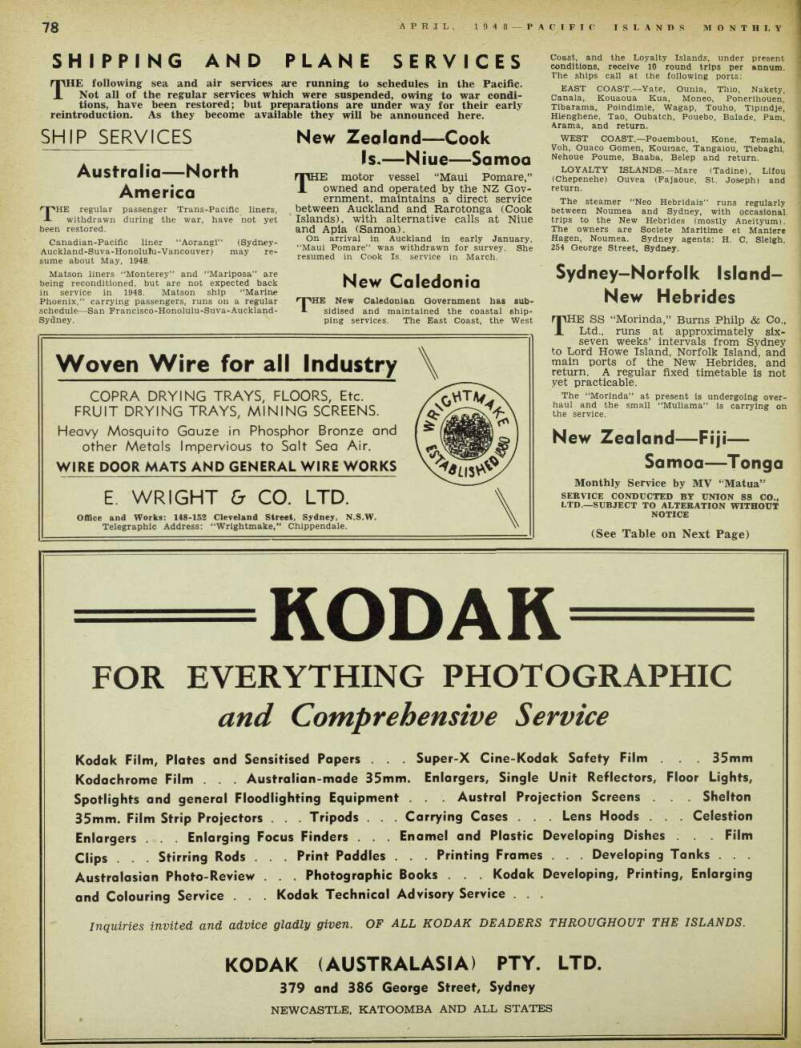
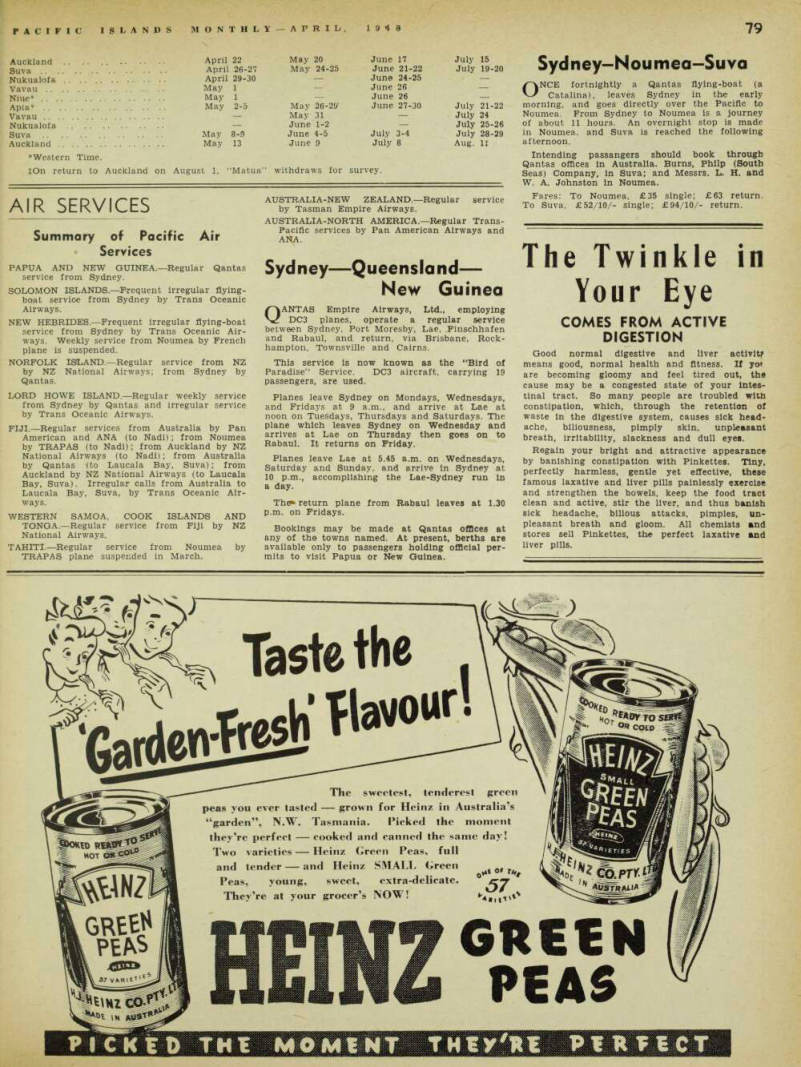
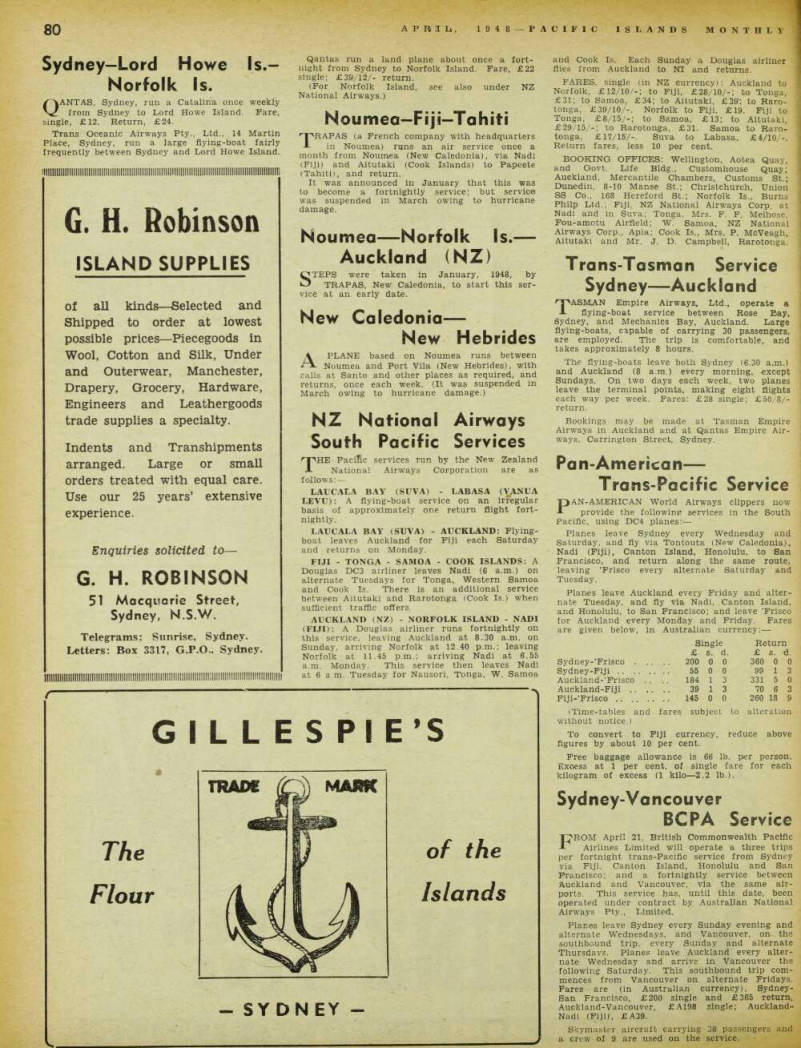
Shipping And Plane Services
THE following sea and air services are running to schedules in the Pacific.
Not all of the regular services which were suspended, owing to war condi tions, have been restored; but preparations are under way for their early reintroduction. As they become available they will be announced here.
Ship Services
Australia—North
America
THE regular passenger Trans-Pacific liners, withdrawn during the war, have not yet been restored.
Canadian-Pacific liner “Aorangl” (Sydney- Auckland-Suva-Honolulu-Vancouver) may re sume about May, 1948.
Matson liners “Monterey” and “Mariposa” are being reconditioned, but are not expected back in service in 1948. Matson ship “Marine Phoenix,” carrying passengers, runs on a regular schedule —San Francisco-Honolulu-Suva-Auckland- Sydney.
New Zeoland—Cook
Is.—Niue—Samoa
rE motor vessel “Maui Pomare,” owned and operated by the NZ Gov ernment, maintains a direct service between Auckland and Rarotonga (Cook Islands), with alternative calls at Niue and Apia (Samoa).
On arrival in Auckland in early January, “Maui Pomare” was withdrawn for survey. She resumed in Cook Is. service in March.
New Caledonia
THE New Caledonian Government has sub sidised and maintained the coastal ship ping services. The East Coast, the West
Coast, and the Loyalty Islands, under present conditions, receive 10 round trips per annum.
The ships call at the following ports; EAST COAST.—Yate, Ounia, Thio, Nakety, Canala, Kouaoua Kua, Moneo, Ponerlhouen, Tibarama, Poindimie, Wagap, Touho, Tipindje, Hienghene, Tao, Oubatch, Pouebo, Balade, Pam, Arama, and return.
WEST COAST. —Poaembout, Kone, Temala, Voh, Ouaco Gomen, Koumac, Tangaiou, Tiebaghl, Nehoue Poume, Baaba, Belep and return.
LOYALTY ISLANDS.—Mare (Tadine), Lifou (Chepenehe) Ouvea (Fajaoue, St. Joseph) and return.
The steamer “Neo Hebrldais” runs regularly between Noumea and Sydney, with occasional trips to the New Hebrides (mostly Aneityum).
The owners are Societe Maritime et Manlere Hagen, Noumea. Sydney agents; H. C. Sleigh, 254 George Street, Sydney.
Sydney-Norfolk Island-
New Hebrides
THE SS “Morinda,” Burns Philp & Co., Ltd., runs at approximately six seven weeks’ intervals from Sydney to Lord Howe Island, Norfolk Island, and main ports of the New Hebrides, and return. A regular fixed timetable is not
yet practicable.
The “Morinda” at present is undergoing over haul and the small “Muliama” is carrying on the service.
New Zealand—Fiji—
Samoa—Tonga
Monthly Service by MV “Matua”
Service Conducted By Union Ss Co.,
Ltd.—Subject To Alteration Without
Notice
(See Table on Next Page)
Air Services
Summary of Pacific Air
Services
PAPUA AND NEW GUlNEA.—Regular Qantas service from Sydney.
SOLOMON ISLANDS. —Frequent irregular flying boat service from Sydney by Trans Oceanic Airways.
NEW HEBRIDES. —Frequent irregular flying-boat service from Sydney by Trans Oceanic Air ways. Weekly service from Noumea by French plane is suspended.
NORFOLK ISLAND. —Regular service from NZ by NZ National Airways; from Sydney by Qantas.
LORD HOWE ISLAND. —Regular weekly service from Sydney by Qantas and irregular service by Trans Oceanic Airways.
FIJI. —Regular services from Australia by Pan American and ANA (to Nadi); from Noumea by TRAPAS (to Nadi); from Auckland by NZ National Airways (to Nadi); from Australia by Qantas (to Laucala Bay, Suva); from Auckland by NZ National Airways (to Laucala Bay, Suva). Irregular calls from Australia to Laucala Bay, Suva, by Trans Oceanic Air ways.
Western Samoa, Cook Islands And
TONGA. —Regular service from Fiji by NZ National Airways.
TAHITI. —Regular service from Noumea by TRAPAS plane suspended in March.
AUSTRALIA-NEW ZEALAND.—ReguIar service by Tasman Empire Airways.
AUSTRALIA-NORTH AMERICA—Regular Trans pacific services by Pan American Airways and
Ana.
Sydney—Queensland—
New Guinea
QANTAS Empire Airways, Ltd., employing DC3 planes, operate a regular service between Sydney, Port Moresby, Lae, Finschhafen and Rabaul, and return, via Brisbane, Rock hampton, Townsville and Cairns.
This service is now known as the “Bird of Paradise” Service. DC3 aircraft, carrying 19 passengers, are used.
Planes leave Sydney on Mondays, Wednesdays, and Fridays at 9 a.m., and arrive at Lae at noon on Tuesdays, Thursdays and Saturdays. The plane which leaves Sydney on Wednesday and arrives at Lae on Thursday then goes on to Rabaul. It returns on Friday.
Planes leave Lae at 5.45 a.m. on Wednesdays, Saturday and Sunday, and arrive In Sydney at 10 p.m., accomplishing the Lae-Sydney run In a day. return plane from Rabaul leaves at 1.30 p.m. on Fridays.
Bookings may be made at Qantas offices at any of the towns named. At present, berths are available only to passengers holding official per mits to visit Papua or New Guinea.
Syd ney-N ou mea-Su vo
ONCE fortnightly a Qantas flying-boat (a Catalina), leaves Sydney in the early morning, and goes directly over the Pacific to Noumea. From Sydney to Noumea is a journey of about 11 hours. An overnight stop is made in Noumea, and Suva is reached the following afternoon.
Intending passangers should book through Qantas offices in Australia. Burns, Philp (South Seas) Company, in Suva; and Messrs. L. H. and W. A. Johnston In Noumea.
Fares: To Noumea, £35 single; £63 return.
To Suva, £52/10/- single; £94/10/- return.
Auckland April 22 May 20 June 17 July 15 Suva April 26-27 May 24-25 June 21-22 July 19-20 Nukualofa April 29-30 — June 24-25 — Vavau May 1 — June 26 — Niue* May 1 — June 26 — Apia* May 2-5 May 26-29' June 27-30 July 21-22 Vavau — May 31 — July 24 Nukualofa — June 1-2 — July 25-26 Suva May 8-9 June 4-5 July 3-4 July 28-29 Auckland May 13 June 9 July 8 Aug. If ♦Western Time. tOn return to Auckland on August 1, “Matua” withdraws for survey.
Sydney-Lord Howe ls.-
Norfolk Is.
QANTAS, Sydney, run a Catalina once weekly from Sydney to Lord Howe Island. Fare, single, £l2. Return, £24.
Trans Oceanic Airways Pty., Ltd., 14 Martin Place, Sydney, run a large flying-boat fairly frequently between Sydney and Lord Howe Island.
Qantas run a land plane about once a fort night from Sydney to Norfolk Island. Fare, £22 single: £39712/- return. (For Norfolk Island, see also under NZ National Airways.)
Noumea—Fiji—Tahiti
TRAPAS (a French company with headquarters in Noumea) runs an air service once a month from Noumea (New Caledonia), via Nadi (Fiji) and Aitutaki (Cook Islands) to Papeete (Tahiti), and return.
It was announced in January that this was to become a fortnightly service; but service was suspended in March owing to hurricane damage.
Noumea—Norfolk Is. —
Auckland (NZ)
were taken in January, 1948, by TRAPAS, New Caledonia, to start this ser vice at an early date.
New Caledonia—
New Hebrides
A PLANE based on Noumea runs between Noumea and Port Vila (New Hebrides), with calls at Santo and other places as required, and returns, once each week. (It was suspended in March owing to hurricane damage.)
NZ National Airways
South Pacific Services
THE Pacific services run by the New Zealand National Airways Corporation are as follows: —
Laucala Bay (Suva) - Labasa (V/\Nua
LEVU): A flying-boat service on an irregular basis of approximately one return flight fort nightly.
Laucala Bay (Suva) - Auckland: Flying
boat leaves Auckland for Fiji each Saturday and returns on Monday.
FIJI - TONGA - SAMOA - COOK ISLANDS: A Douglas DC3 airliner leaves Nadi (6 a.m.) on alternate Tuesdays for Tonga, Western Samoa and Cook Is. There is an additional service between Aitutaki and Rarotonga (Cook Is.) when sufficient traffic offers.
AUCKLAND (NZ) - NORFOLK ISLAND - NADI (FIJI); A Douglas airliner runs fortnightly on this service, leaving Auckland at 8.30 a.m. on Sunday, arriving Norfolk at 12.40 p.m.; leaving Norfolk at 11.45 p.m.; arriving Nadi at 6.55 a.m. Monday. This service then leaves Nadi at 6 a.m. Tuesday for Nausori, Tonga, W. Samoa
and Cook Is. Each Sunday a Douglas airliner flies from Auckland to NI and returns.
FARES, single (in NZ currency): Auckland to Norfolk, £l2/10/-; to Fiji, £2B/10/-; to Tonga, £3l; to Samoa, £34; to Aitutaki, £39’; to Raro tonga, £39/10/-. Norfolk to Fiji, £l9. Fiji to Tonga, £B/15/-; to Samoa, £l3; to Aitutaki, £29/15/-; to Rarotonga, £3l. Samoa to Raro tonga, £l7/15'/-. Suva to Labasa, £4/10/-.
Return fares, less 10 per cent.
BOOKING OFFICES: Wellington, Aotea Quay, and Govt. Life Bldg., Customhouse Quay; Auckland, Mercantile Chambers, Customs St.; Dunedin, 8-10 Manse St.; Christchurch, Union SS Co., 168 Hereford St.; Norfolk Is., Burns Philp Ltd.; Fiji, NZ National Airways Corp, at Nadi and in Suva; Tonga, Mrs. F. F. Melhose, Fou-amotu Airfield; W. Samoa, NZ National Airways Corp., Apia; Cook Is., Mrs. P. McVeagh, Aitutaki and Mr. J. D. Campbell, Rarotonga.
Trans-Tasman Service
Sydney—Auckland
TASMAN Empire Airways, Ltd., operate a flying-boat service between Rose Bay, Sydney, and Mechanics Bay, Auckland. Large flying-boats, capable of carrying 30 passengers, are employed. The trip is comfortable, and takes approximately 8 hours.
The flying-boats leave both Sydney (6.30 a.m.) and Auckland (8 a.m.) every morning, except Sundays. On two days each week, two planes leave the terminal points, making eight flights each way per week. Fares: £2B single; £5O/8/return.
Bookings may be made at Tasman Empire Airways in Auckland and at Qantas Empire Air ways, Carrington Street, Sydney.
Pan-American—
Trans-Pacific Service
PAN-AMERICAN World Airways clippers now provide the following services in the South Pacific, using DC4 planes;— Planes leave Sydney every Wednesday and Saturday, and fly via Tontouta (New Caledonia), Nadi (Fiji), Canton Island, Honolulu, to San Francisco, and return along the same route, leaving ’Frisco every alternate Saturday and Tuesday.
Planes leave Auckland every Friday and alter nate Tuesday, and fly via Nadi, Canton Island, and Honolulu, to San Francisco; and leave ’Frisco for Auckland every Monday and Friday. Fares are given below, in Australian currency:—
To convert to Fiji currency, reduce above figures by about 10 per cent.
Free baggage allowance is 66 lb. per person.
Excess at 1 per cent, of single fare for each kilogram of excess (1 ki10—2.2 lb.).
Sydney-Vancouver
BCPA Service
FROM April 21, British Commonwealth Pacific Airlines Limited will operate a three trips per fortnight trans-Pacific service from Sydney via Fiji, Canton Island, Honolulu and San Francisco; and a fortnightly service between Auckland and Vancouver, via the same air ports. This service has, until this date, been operated under contract by Australian National Airways Pty., Limited.
Planes leave Sydney every Sunday evening and alternate Wednesdays, and Vancouver, on the southbound trip, every Sunday and alternate Thursdays. Planes leave Auckland every alter nate Wednesday and arrive in Vancouver the following Saturday. This southbound trip com mences from Vancouver on alternate Fridays.
Pares are (in Australian currency), Sydney- San Francisco, £2OO single and £365 return, Auckland-Vancouver, £AI9B single; Auckland- Nadi (Fiji), £A39.
Skymaster aircraft carrying 38 passengers and a crew of 9 are used on the service.
Single Return £ s. d. £ s. d.
Sydney-’Frisco 200 0 0 360 0 0 Sydney-Piji 55 0 0 99 1 3 Auckland-’Frisco .. .. 184 1 3 331 5 0 Auckland-Fiji 39 1 3 70 6 3 Fiji-’Frisco 145 0 0 260 18 9 (Time-tables and fares subject to alteration without notice.)
An early development following the establishment of the British Colony of North Borneo (taking the place of Terri tories which formerly were merely under British protection) is the appearance of the North Borneo News, now published regularly at Sandakan by Mr. R. F, Vaughan. It has been enthusiastically received by the population and consider ing that it is all hand-set by Asiatic com positors, it is a creditable production. It looks as if it is going to be well sup ported by local and British advertisers.
Mission Ship And Amateur Crew
TOP: The MV “St. Francis,” as she lay in Sydney Harbour in February. ABOVE (left to right): Leonard Howie, Father Dupeyrat, Captain Muir, Maurice Fricker, Terence Borger, In front: John Kennedy, Janies Thompson. Absent: K. McGhee.
Advertisements & other items, pp. 80-84 (1 item)
dsdfdf
KODAK
FOR EVERYTHING PHOTOGRAPHIC
and Comprehensive Service
Kodak Film, Plates and Sensitised Papers . . . Super-X Cine-Kodak Safety Film . . . 35mm Kodachrome Film . . . Australian-made 35mm. Enlargers, Single Unit Reflectors, Floor Lights, Spotlights and general Floodlighting Equipment . . . Austral Projection Screens . Shelton 35mm. Film Strip Projectors . . . Tripods . . . Carrying Cases . . . Lens Hoods . . . Celestion Enlargers . . . Enlarging Focus Finders . . . Enamel and Plastic Developing Dishes . . . Film Clips . . . Stirring Rods . . . Print Paddles . . . Printing Frames . . Developing Tanks .
Australasian Photo-Review . . . Photographic Books . . . Kodak Developing, Printing, Enlarging and Colouring Service . . . Kodak Technical Advisory Service Inquiries invited and advice gladly given. OF ALL KODAK DEADERS THROUGHOUT THE ISLANDS.
KODAK (AUSTRALASIA) PTY. LTD.
379 and 386 George Street, Sydney
NEWCASTLE, KATOOMBA AND ALL STATES
The Twinkle in
Your Eye
COMES FROM ACTIVE
DIGESTION
Good normal digestive and liver activity means good, normal health and fitness. If yor are becoming gloomy and feel tired out, the cause may be a congested state of your intestinal tract. So many people are troubled with constipation, which, through the retention of waste in the digestive system, causes sick headache, biliousness, pimply skin, unpleasant breath, irritability, slackness and dull eyes.
Regain your bright and attractive appearance by banishing constipation with Pinkettes. Tiny, perfectly harmless, gentle yet effective, these famous laxative and liver pills painlessly exercise and strengthen the bowels, keep the food tract clean and active, stir the liver, and thus banish sick headache, bilious attacks, pimples, unpleasant breath and gloom. All chemists and stores sell Pinkettes, the perfect laxative and liver pills.
Taste the
flavour
% V The sweetest, tenderesl green peas you ever tasted grown for Heinz in Australia’s “garden”, N.W. Tasmania. Picked the moment they’re perfect cooked and canned the same day!
Two varieties Heinz Green Peas, full and tender and Heinz SMALL Green Qf Peas, young, sweet, extra-delicate. 0 er-r They’re at your grocer’s NOW!
li t 0
h ot 70
Ih- T Oft COLD
AUSTRALIA
HEINZ
GREEN
PEAS
THE MOMENT THEy'RE PEREECT
G. H. Robinson
ISLAND SUPPLIES
of all kinds—Selected and Shipped to order at lowest possible prices—Piecegoods in Wool, Cotton and Silk, Under and Outerwear, Manchester, Drapery, Grocery, Hardware, Engineers and Leathergoods trade supplies a specialty.
Indents and Transhipments arranged. Large or small orders treated with equal care.
Use our 25 years’ extensive experience.
Enquiries solicited to —
G. H. ROBINSON
51 Macquarie Street,
Sydney, N.S.W.
Telegrams: Sunrise, Sydney.
Letters; Box 3317, G.P.0., Sydney.
GILLESPIE’S
The Flour
MARK
TRADE
of the Islands
SYDNEY
xX /'/X A!
'V.‘. #S»
- etP^fsO**
**,%***!& K
J iH\
foR •\\\ Ml/tL V vf «IW r 06* r pL A* 6 .V '/& ik
N EARLY CURE FOR
TOOTHACHE WAS THE
POWDERED BEAKS
OF VULTURES/
TODAY WE
HAVE KOLVNOS
FOR PROPER
DENTAL CARE,
ACTIVE KOLYNOS
BUBBLES REMOVE
DECAY BREEDING
FOOD DEPOSITS
CLEAN TEETH SURGICALLY/
O, *0
Y'CBT MORE
KOIYNOi
f'R V MONEY!"
m i ?
TP rm e)Cf NR s^ lL it f|
Jui *" f ?r i
mzssgzto.
'--aesA**
of rm , j^\ ■o
K4O-I4
00, 100
DENTAL
CREAM'%
f/*i JJ? :^Vt€' 0 / * * j c <Ss*!4 SX cf^ V ■>
ANACIN stops headaches faster because it contains an extra ingredient. It is a prescription for pain and aches. Always ask for ANACIN.
&NAC/y
REGD. TRADE MARK
BUTTERFLIES
and the Larger Moths
WANTED
From all sections of the Pacific Islands.
Will pay not less than: $5.00 per hundred for common attractive Butterflies. $7.50 to $50.00 and more per 100 for extra showy, large Butterflies and large Moths.
Collectors or Missionaries who can supply us, please get in touch with us. Will pay for sample selection, and advance money to good collectors.
MUST BE PERFECT FIRST
QUALITY ONLY.
Butterfly World Supply House,
289 Eost 98th Street,
Brooklyn, 12,
New York, U.S.A.
Cables: “Islandex,” Sydney.
’Phone: MA4856
Boxley Pty. Ltd.
Please address all mail to G.P.O Box 3385, Sydney.
SUPPLIERS OF BUILDERS’ HARDWARE, TEXTILES, BISCUITS,
GENERAL MERCHANDISE.
It will pay you to look each month -for our special offer.
See below for this month's special.
32-34 STEAMMILL STREET, SYDNEY
“ PACIFIC ” SUPERFINE
HOUSEHOLD PAINT. PRICE
ONLY 32/6 PER GALLON
for all colours except Peacock Green, mid-Green and Bright Red, which are 37/6 per gallon. A small trial order will convince you of the lasting quality and excellence of this paint, which has been specially prepared for the Tropics.
APRIL
SPECIAL .
BOXLEY’S
r?IFTr ” STIPERFINF
Old Mission
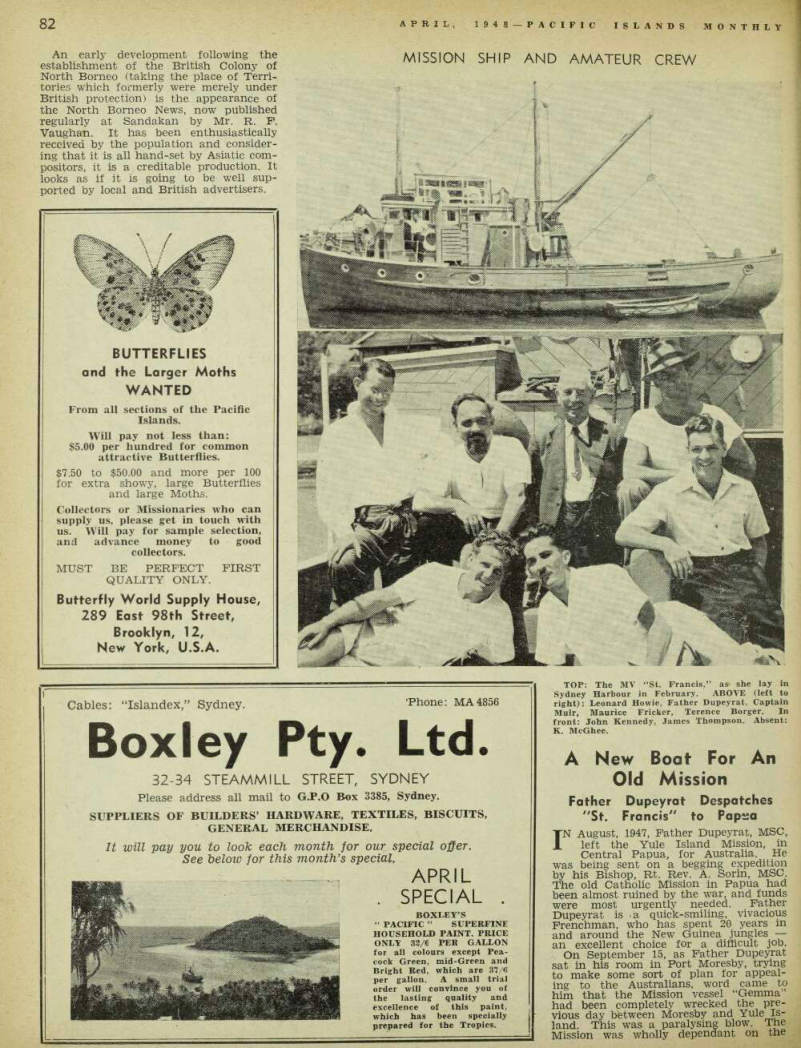
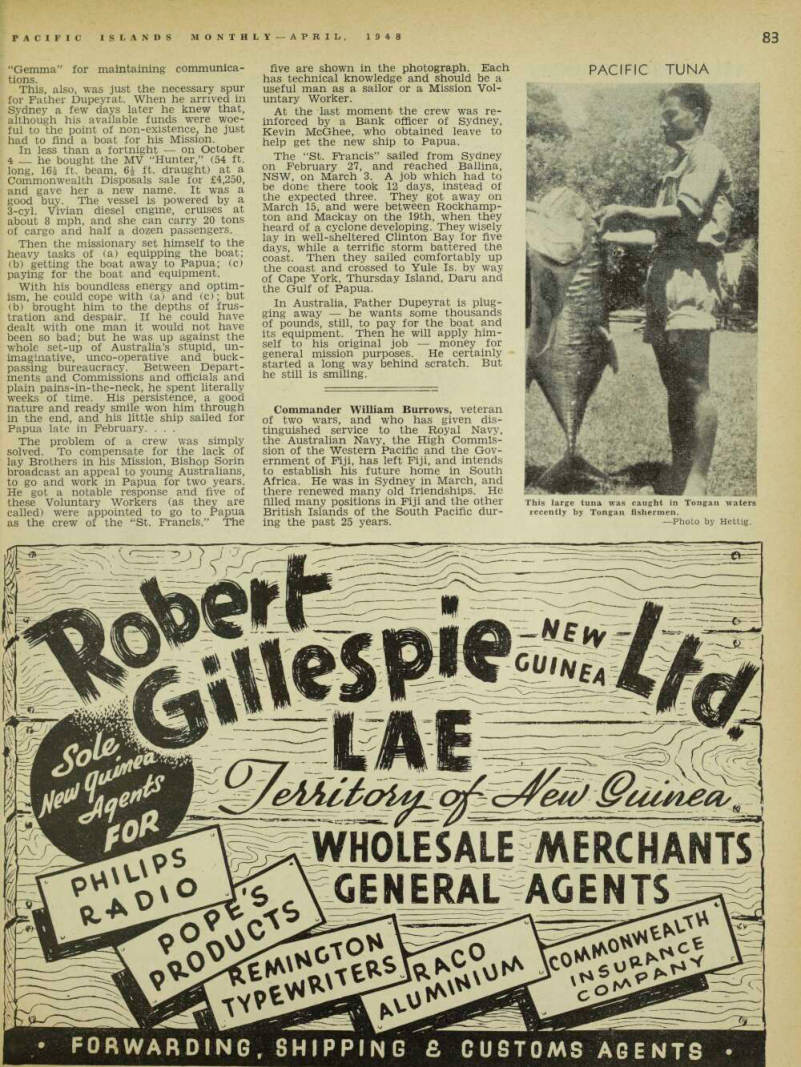
A New Boat For An Old Mission Father Dupeyrat Despatches "St. Francis" to Papua
IN August, 1947, Father Dupeyrat, MSC, left the Yule Island Mission, in Central Papua, for Australia. He was being sent on a begging expedition by his Bishop, Rt. Rev. A. Sorin, MSC.
The old Catholic Mission in Papua had been almost ruined by the war, and funds were most urgently needed. Father Dupeyrat is a quick-smiling, vivacious Frenchman, who has spent 20 years in and around the New Guinea jungles an excellent choice for a difficult job.
On September 15, as Father Dupeyrat sat in his room in Port Moresby, trying to make some sort of plan for appeal ing to the Australians, word came to him that the Mission vessel “Gemma” had been completely wrecked the pre vious day between Moresby and Yule Is land. This was a paralysing blow. The Mission was wholly dependant on the
“Gemma” for maintaining communica tions.
This, also, was just the necessary spur for Father Dupeyrat. When he arrived in Sydney a few days later he knew that, although his available funds were woe ful to the point of non-existence, he just had to find a boat for his Mission.
In less than a fortnight on October 4 he bought the MV “Hunter,” (54 ft. long, I6h ft. beam, 6i ft. draught) at a Commonwealth Disposals sale for £4,250, and gave her a new name. It was a good buy. The vessel is powered by a 3-cyl. Vivian diesel engine, cruises at about 8 mph, and she can carry 20 tons of cargo and half a dozen passengers.
Then the missionary set himself to the heavy tasks of (a) equipping the boat; (b) getting the boat away to Papua; (c) paying for the boat and equipment.
With his boundless energy and optim ism, he could cope with (a) and (c); but (b) brought him to the depths of frus tration and despair. If he could have dealt with one man it would not have been so bad; but he was up against the whole set-up of Australia’s stupid, un imaginative, unco-operative and buck passing bureaucracy. Between Depart ments and Commissions and officials and plain pains-in-the-neck, he spent literally weeks of time. His persistence, a good nature and ready smile won him through in the end, and his little ship sailed for Papua late in February. . . .
The problem of a crew was simply solved. To compensate for the lack of lay Brothers in his Mission, Bishop Sorin broadcast an appeal to young Australians, to go and work in Papua for two years.
He got a notable response and five of these Voluntary Workers (as they are called) were appointed to go to Papua as the crew of the “St. Francis.” The
five are shown in the photograph. Each has technical knowledge and should be a useful man as a sailor or a Mission Vol untary Worker.
At the last moment the crew was re inforced by a Bank officer of Sydney, Kevin McGhee, who obtained leave to help get the new ship to Papua.
The “St. Francis” sailed from Sydney on February 27, and reached Ballina, NSW, on March 3. A job which had to be done there took 12 days, instead of the expected three. They got away on March 15, and were between Rockhamp ton and Mackay on the 19th, when they heard of a cyclone developing. They wisely lay in well-sheltered Clinton Bay for five days, while a terrific storm battered the coast. Then they sailed comfortably up the coast and crossed to Yule Is. by way of Cape York, Thursday Island, Daru and the Gulf of Papua.
In Australia, Father Dupeyrat is plug ging away he wants some thousands of pounds, still, to pay for the boat and its equipment. Then he will apply him self to his original job money for general mission purposes. He certainly started a long way behind scratch. But he still is smiling.
Commander William Burrows, veteran of two wars, and who has given dis tinguished service to the Royal Navy, the Australian Navy, the High Commis sion of the Western Pacific and the Gov ernment of Fiji, has left Fiji, and intends to establish his future home in South Africa. He was in Sydney in March, and there renewed many old friendships. He filled many positions in Fiji and the other British Islands of the South Pacific dur ing the past 25 years.
Pacific Tuna
This large tuna was caught in Tongan waters recently by Tongan fishermen. —Photo by Hettig.
Advertisements & other items, p. 85 (1 item)
Generai^Agents
V \? S 9> O* 'O r V s : t&.
WHOLESALE MERCHANTS
FORWARDING, SHIPPING fi C U STO MS AG E NTS
Islands Produce
(Quotations in Australian Currency)
Cocoa
Prices for cocoa beans imported to Australia are fixed and controlled by the Cocoa, Choco late and Confectionery Committee. These prices, quoted to us as the official Australian fixed price, bear no relation to the ruling f.o.b.
Island port price in New Hebrides, etc. We are therefore omitting all quotations—they are misleading.
Trochus Shell
Some parcels have recently changed hands.
Nominal quotations in March showed prices at the following levels; Approximately £6O per ton, Sydney. (£45 per ton Suva.)
Coffee
No purchases are permitted in Australia without the consent of the Tea and Coffee Control Board, to whom all offers must first be submitted. Nominal quotations as follows; New Caledonian: Arabica, £124 per ton (f.a.q.).
Robusta, £lO4 per ton (c.i.f. Sydney).
Mysore: £220 to £240 (c. & f., Sydney), New Guinea and Papua: £ll2 per ton (c.i.f.).
Java: No quotations.
Vanilla Beans
No supplies available. Nominal quotations only.
Kapok
Very little movement in Javanese kapok.
Nominal quotation 2/1 Va per lb.
Indian kapok is being quoted for Indent at 1/6 per lb. c.i.f. stg.
Cotton
Controlled in Australia. Stocks being made available to manufacturers at following rates:— For spinning and weaving yarns, 14Vad. per lb.; cordage making, ll%d. per lb.; condenser yarn, 12d. per lb.
Ivory Nuts
No firm quotations available.
Rice
No quotations.
Green Snail Shell
P.a.q., £lOO per ton, in store, Sydney. Market in chaotic condition; no orders are being re ceived.
Pearl Shell
Australian-controlled price;— "B” Class, £2OO per ton. “C” Class, £l9O per ton. “D” Class, £135 per ton.
Transactions are unofficially reported.
Buying Prices At Suva, Fiji,
Produce Report
(Fiji Currency) Copra. (Plantation Grade) .. £46/5/6 Copra (FMS Grade) ,. .. £46 Kerosene, per gallon .. .. 3/5 Flour, per 150 lb. sack wholesale .. .. .. 59/3 Flour, per 1 lb .. .. 5d.
Sharps, per 140 lb. sack wholesale .. .. 55/3Va Sharps, per 1 lb . . .. 5d.
Trochus Shell, per ton .. .. £45 Benzine, per gallon .. .. 3/1
Advertisements & other items, p. 86 (1 item)
Price Of Gold
Pine Standard oz. . .. .. £10/15/3 oz £9/17/3% (Australian Currency)
Copra
Prices During World War Ii
The copra market was controlled by Govern ments from outbreak of war in 1939 until the end of the war in 1945. Controls are still being exercised in the post-war period.
London Fixed Price, per ton, c.i.f., Plantation Hot-air:
Increased prices announced on January 7 operated from December 1, 1946. All prices quoted are for copra delivered to ships’ slings, or to the Board’s warehouse.
Official Prices for NG Copra landed at Sydney.
Sterling October, 1939—January, 1940 . . . £12 7 6 January-April, 1940 13 5 0 After April, 1940 .. 17 6 Fiji Local Buying Price, in Store, Fiji Currency.
Plant’n
Fms
June, 1942 16 0 0 15 0 0 July, 1942 16 12 6 15 12 6 June, 1944 19 10 0 18 0 0 October, 1944 .. .. 20 0 0 1-8 10 0 December, 1945 .. 19 7 6 17 17 6 January, 1946 . .. 18 5 6 18 0 0 August, 1946 .. .. 23 10 6 23 5 0 February. 1947 . .. 29 15 6 29 10 0 June 9, 1947 .. 36 19 0 36 13 6 December 8, 1947 . 38 5 6 38 0 0 March 15, 1947 .. 46 5 6 46 0 0
Territory Of New Guinea
ANGPCB Fixed Price at Plantation: Hot-air Smoked Sept. 28, 1946 .. £22 5 0 £21 5 0 ANGPCB Fixed Price, Delivered ex Ships Slings: Hot-air Smoked Jan. 7, 1947 .. £28 0 0 £27 0 0 June 17, 1947 .. £31 2 0 Nov. 23, 1947 .. £35 10 0
Hot-air Dried Smoked January, 1947 £36 10 0 £35 10 0 July, 1947 ,. £51 5 0 £50 5 0
Rubber
Plantation
Papuan Rubber Prices Under Australian Government Control—Payable on Plantation or Nearby Port, per lb., Australian Currency:
London Para. Smoked Price on— per lb. per lb.
January 8. 1933 4%d .. 2.«d July 7 6% d • • 3.71d January 5, 1934 4V 4 d .. 4.28d July 6 BVfcd • • 7.06d January 4. 1935 6d .. 6%d July 6 5d .. 7%d January 3. 1936 8%d .. 6Hd June 5 9d .. 7Vid January 8, 1937 1/2 •• 10J^ d June 4 H d • • 8^d
January 7. 1938 . 7d July l 7y«a January 6, 1?39 . 7d . 8V»d July 7 7%d . 8Vid January 5, 1940 . 13d . . 11.6%d July 5 15d . . 12 %d January 3, 1941 . 13d . . 12.47y,d April 4 15d . . 14V.d June 6 16Vad . . 13.5%d August 1 17d . . 13ttd October 10 —Price officially fixed at . . 13 3 /«d
Grade 1 Grade 2 Grade 3 September, 1943 . 1/6 % 1/4 1/2 September, 1944 . 1/6% 1/5% 1/3% July, 1944 . .. . 1/4% 1/3% 1/1%
Quotations For Mining
Shares
Fiji
Aug., 1933 Mid-Feb.
Mid-April Emperor Mines . .. 9/11 N.Q.
S17/6 Loloma .. 25/6 S24/3 S23//9 Bulolo G.D
New Guinea
■ • 124/- sl95/sl75//- Guinea Gold - 13/3 N.Q.
N.Q.
N.G.G., Ltd s3/- S2/11 Oil Search s7/6 S6/10 Placer Dev s200/sl82/- Sandy Creek ... sl/9 bl/6 Sunshine Gold .. .. 6/5 S15/6 bl3/6 Cuthbert’s
Papua.
sl5/- Sl4/- Mandated Alluvlals 3/8 N.Q. s9/6 Orlomo Oil .. 5/b3/2 s3/6 Papuan Aplnalpl . 4/11 s7/s7/- Yodda Goldfields . 1/3 N.Q.
N.Q.
Exchange Rates
THE following exchange quotations show the rates existing in March.
Fiji
Through Bank of NSW and Bank of New Zealand:—Australia on FIJI on basis of £lOO Fiji: Buying, £Alll/2/6; selling, £AII3. FIJI - on basis of £lOO London; —
Western Samoa
Through Bank of New Zealand: —Australia on Western Samoa on basis of £lOO Samoa: Buy ing, £ A99/12/6; selling, £AIOO/2/6. Samoa on London on basis of £lOO in London: —
New Guinea And Papua
Bank of New South Wales, which now has branches in Port Moresby and Lae, quotes an exchange rate between Australia and NG-Papua of 10/- per £llO.
French Pacific Colonies
SINCE December 25, 1945, the franc, Instead of having the same value in all parts of the French Empire, has been given different values in different parts of the Empire. There are three groups. Group 1: France, North Africa, West Indies, French Guiana. Group 2: All African Colonies, Madagascar, Reunion, St.
Pierre, Miquelon. Group 3: New Caledonia, New Hebrides, French Oceania. The Group 1 franc was devalued in January, 1948. Exchange values, in francs, are approximately:
Buying.
Selling. £ a. d. £ a. d.
Telegraphic transfer . .. 110 15 0 112 0 0 On demand .. 110 12 6 111 17 I
Buying.
Selling. £ s. d. £ s. d.
Telegraphic transfer — £125 10 0 On Demand .. .. .. £122 18 9 125 7 6 30 days 122 8 9 125 2 9 60 days 121 18 9 124 17 6 90 days 121 8 9 124 12 I 120 days 120 18 9 —
£ stg. USA Dollar £ Aus.
Group 1 .. .. 864% 216 684 Gro\ip 2 . . .. 282.9 70 227 Group 3 .. . . 200 49.6 160-183
Advertisements & other items, pp. 86-88 (4 items)
84
APRIL, 1948 PACIFIC ISLANDS MONTHLY
Published PACIPIC PUBLICATIONS PTY. LTD., Unlo„_House. 24, George Street Sydney. “*
Gold
Purchasers at Full Market Prices on Assay Value of
SILVER
PLATINUM
And Platinum Group Metals
SOME OF OUR SERVICES
ASSAYERS & ANALYSTS—
Assays of Bullion, Ores, etc.
Analyses of Metals, Minerals, Alloys, etc.
SCIENTIFIC & INDUSTRIAL
METALLURGISTS—
Our range of precious metal manufactures covers all Industries—Gold and Silversmiths, Electrical Trades, Dental Profession, Glass Sllverers, Electro-Platers, etc., etc.
REFINERS—
Purchasers and Refiners of Bullion, Scrap, Mining By-Products, and Trade Residues of every description carrying Precious Metals.
GARRETT & DAVIDSON
PTY. LTD.
BZ4 George St., Sydney. Works: Surry Hills and Chippendale, N.S.W.
Official Assayers to the Bank of New South Wales. Gazetted Agents of the Commonwealth Bank of Australia, under the Gold Regulations of the National Security Act.
tropical thirst...
To quench a
* COo t nng o « 4 4 SovrilP 0 i vs When you’re hot and tired,
there is nothing quite so satisfying
and thirst quenching as a long, cold glass of “K. 8.” Your friends and guests, too, will appreciate this really fine
Lager, for “Everybody
drinks K. 8.”
TOOTH'S
LAGER
Capital £1,000,000
ESTABLISHED 1914
it ★
COPRA MERCHANTS & MILLERS
BRANCHES THROUGHOUT THE PACIFIC ISLANDS
Buyers and exporters of all kinds of Islands produce. Copra Merchants and Millers.
Agents for Australian, European and American Manufacturers. Distributors of every description of merchandise.
Thirty years of Pacific Islands development and service.
REGULAR CARGO
PACIFIC
Head
W.
Office:
AND PASSENGER SERVICE BETWEEN EUROPE AND
ISLAND PORTS WAS ESTABLISHED BY
R. CARPENTER & CO. LTD.
16 O'CONNELL STREET, SYDNEY.
Cable Address:
CAMOHE.
Telephone; BW 4421.
Postal Address: P.O. Box No. 168, Sydney.