Islands
Pacific
Monthly
February 18 1948
Vol. Xviii. No. 7.
Established 1930.
IRegistered at the G.P.O., Sy&$By . SQJ\sL ra nsmlssion by post as a newspaper ]
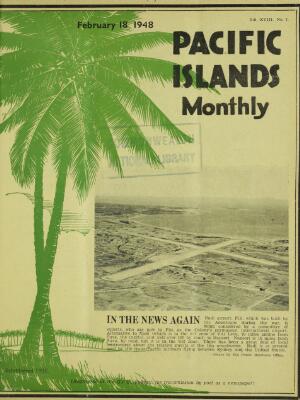
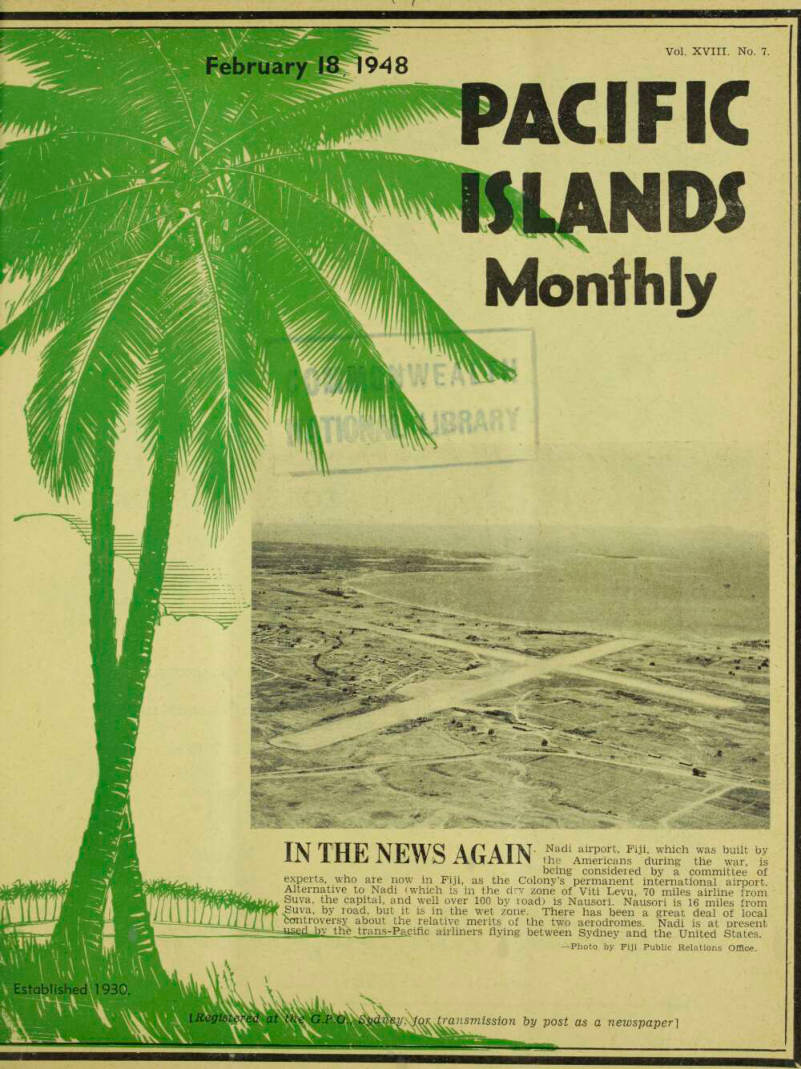
IN THE NEWS AGAIN Nadi airport, Fiji, which was built by the Americans during the war, is being considered by a committee of experts, who are now in Fiji, as the Colony’s permanent international airport.
Alternative to Nadi (which is in the dry zone of Viti Levu, 70 miles airline from Suva, the capital, and well over 100 by road) is Nausori. Nausori is 16 miles from Suva, by road, but ut is in the wet zone. There has been a great deal of local controversy about the relative merits of the two aerodromes. Nadi is at present used by the trans-Pacific airliners flying between Sydney and the United States. —Photo by Fiji Public Relations Office.
Advertisements & other items, pp. 2-4 (2 items)
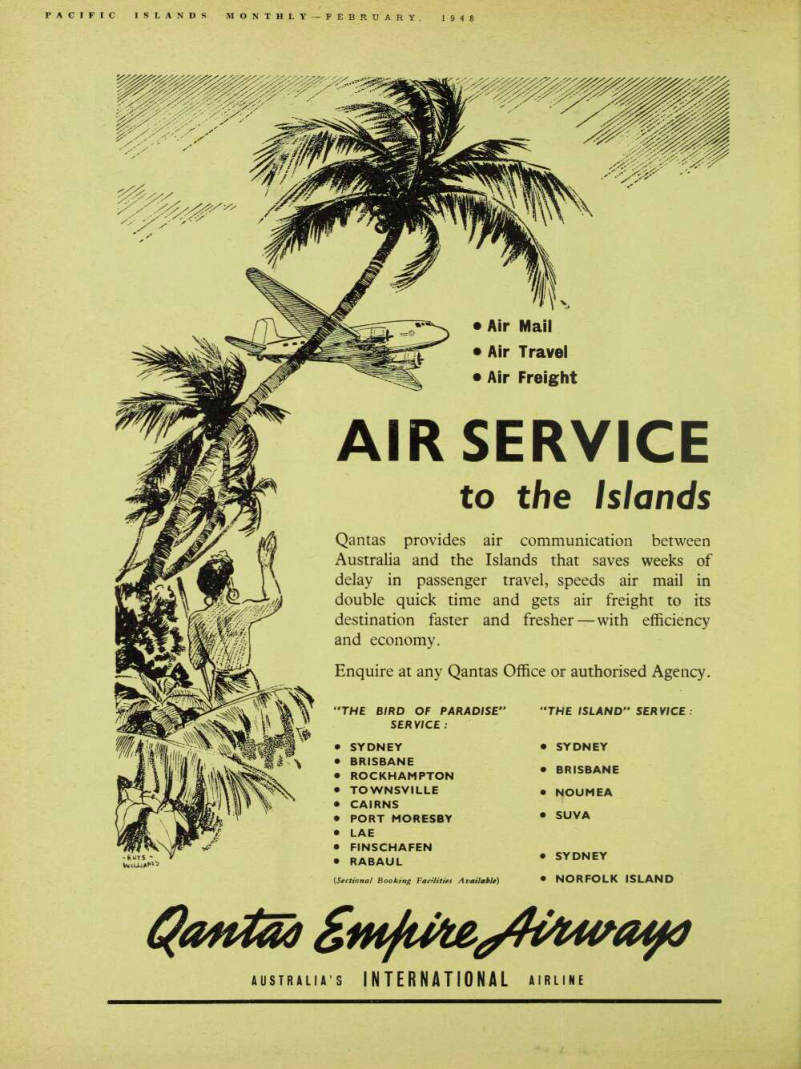
Qantab
• Air Mail • Air Travel • Air Freight
AIR SERVICE
m m A /■ « \ I m 'AC ss,
to the Islands
Qantas provides air communication between Australia and the Islands that saves weeks of delay in passenger travel, speeds air mail in double quick time and gets air freight to its destination faster and fresher —with efficiency and economy.
Enquire at any Qantas Office or authorised Agency.
-RHYS
THE BIRD OF PARADISE”
SERVICE :
• SYDNEY
• BRISBANE
• ROCKHAMPTON
• TOWNSVILLE
• CAIRNS
• PORT MORESBY
• LAE
• FINSCHAFEN
• RABAUL
(Sectional Booking Facilities Available)
THE ISLAND” SERVICE
• SYDNEY
• BRISBANE
• NOUMEA
• SUVA
• SYDNEY
• NORFOLK ISLAND
Qantab
AUSTRALIA’S INTERNATIONAL airline
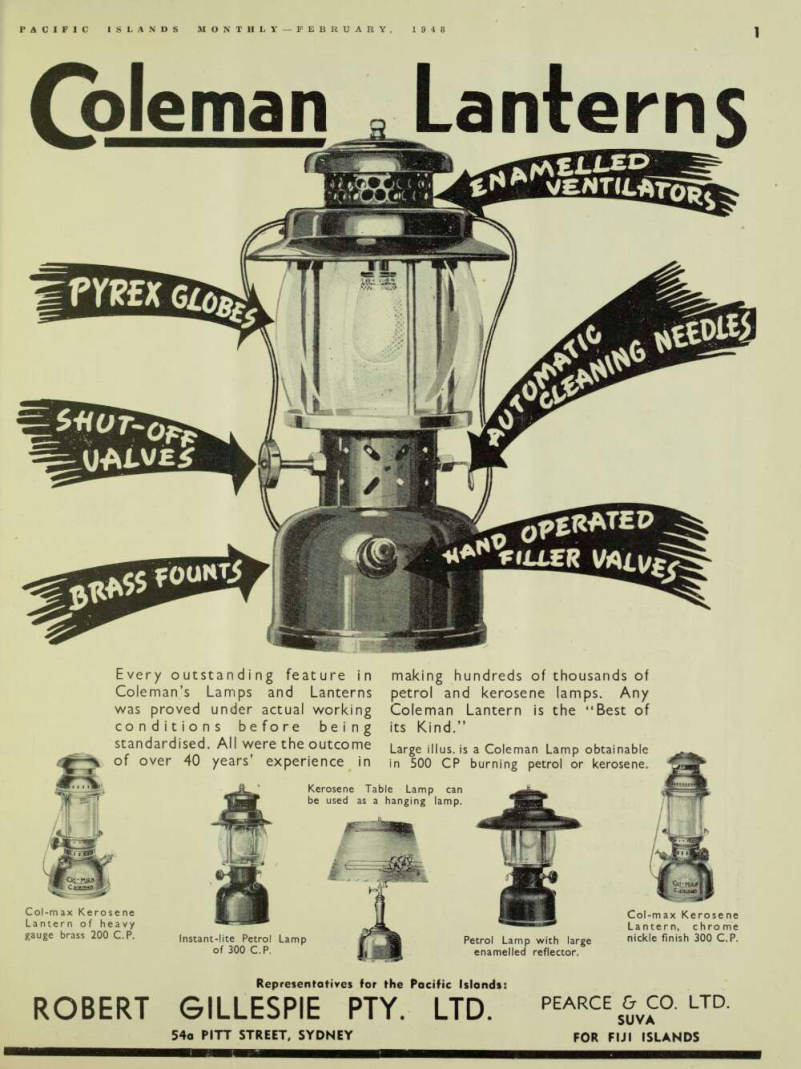
Coleman , Lanterns
rm \ L / C^;
Every outstanding feature in
Coleman’s Lamps and Lanterns was proved under actual working conditions before being standardised. All were the outcome of over 40 years experience in making hundreds of thousands of
petrol and kerosene lamps. Any
Coleman Lantern is the “Best of its Kind.”
Large ill us. is a Coleman Lamp obtainable in 500 CP burning petrol or kerosene.
Col-max Kerosene Lantern of heavy gauge brass 200 C.P.
Kerosene Table Lamp can be used as a hanging lamp.
Instant-lite Petrol of 300 C.P.
Lamp Petrol Lamp with large enamelled reflector.
Col-max Kerosene Lantern, chro me nickle finish 300 C.P.
Representatives for the Pacific Islands;
ROBERT GILLESPIE PTY. LTD
54a PITT STREET, SYDNEY
PEARCE & CO. LTD.
SUVA
FOR FIJI ISLANDS
% Va *« Hr'' WUm I B
BRONTE BRAND:
Chili Con Came Braised Steak and Onions Curried Beef Curried Mutton Steak and Onions Mutton and Peas Irish Stew Beef Steak Pudding Corned Beef Hash Corned Beef Loaf With Cereal Mutton Broth Mulligatawny Soup Tomato Soup Vegetable Soup
From
Australia’s
Finest Fat
Stock ...
From the finest fat stock and the rich-
est vegetables in Australia we produce
these high-grade canned meats and
soups. BRONTE BRAND meats,
hotmeals and soups are deliciously
flavoured and are made from
ONLY meats and vegetables
of the highest quality
THE COLONIAL WHOLESALE MEAT CO.
PTY. LTD.
Canning Factory, State Abattoirs, Homebush Bay, Sydney.
N.S.W.
PHONES:
PHONE : UM 8436.
CABLE ADDRESS:
WOOLMILL. SYDNEY.
„>am p B ire mmmmm
2
FEBRUARY, IMS-tACIFIC ISLANDS MONTHLY
Advertisers
Aluminium Union, Ltd 33 Angliss & Co. ... 36 Amplion (A/sia) Pty., Ltd. . . 23 Atkins Pty., Ltd., Wm . 71 Anchor Hocking Glassware ... 65 Australian Block & Chain Co. Pty., Ltd 70 Amalgamated Hatcheries ... 73 Australian Yeast Co. ... 19 Bethell, Gwyn & Co 71 Brunton’s Flour . 24 Bestseller Book Club 76 Burns, Philp (New Hebrides), Ltd. . 15 Bank of NSW ... 16 Brial & Ball ... 19 Burns, Philp (NG), Ltd 45 Baker, W. Jno. . 24 Burns, Philp Trust Co., Ltd 49 British Teltherm Co.. Ltd. ... 33 Budge, James, Pty., Ltd 35 Broomflelds ... 24 BP (SS) Co. . . . 21 W. R. Carpenter & Co. (Fiji), Ltd. . 78 Carlton & United Breweries, Ltd. . 77 Caine’s Studios, Suva 29 Carpenter, Ltd., W.
R cov. iv.
Chemical Indus tries 14 Colonial Wholesale Meat 2 Colyer Watson (New Guinea), Ltd. . . 47 Costello, Vince Garrick Hotel . . 35 “Cystex” 73 Copra Growers’
Union 68 Donaghy & Sons . 64 Donald. Ltd., A. B. 48 Davison Paints Pty., Ltd 76 Dr. Williams Pink Pills 21 Dangar. Gedye & Malloch ... 3 Dunlop Rubber (A/sia), Ltd. . . 74 Electrolux Refrigerators . . 29 Ford Sherington . 56 Garrett & Davidson 80 Gillespie Pty., Ltd., Robert . . . 1 & 20 R o b t. Gillespie (NG), Ltd. ... 79 Goode Lynes ... 46 Gilbey’s Gin ... 28 Gillespie’s Flour . 60 Gough & Co., E. J. 15 Grand Pacific Hotel 4 Grove & Sons, W.
H 31 Heinz & Co. Pty., Ltd., H. J. . . . 32
Hemingway &
Robertson ... 70 Ipana Tooth Paste l
Jenkins Emporium . 30 Kopsen & Co.. Ltd! 57 Kolynos, Inc. ... 69 Kodak (Aust ) Pty., Ltd .. . 66 Kerr Brothers . . 47 Lockyer, Geo. J. . 55 Levy, Noel ... 53 Manstocks ... 50 Mail Publicity Co. . 55 Merrillees. J. C., & Co 62 Millers, Ltd., Suva 58 Miscellaneous ... 13 “Mum” Deodorant 67 “Mendaco” ... 58 Mcllraths Pty., Ltd. 33 Moore & Moore. 27-67 Morris, Hedstrom, Ltd.. Suva ... 12 Nelson tc Robertson Pty., Ltd. ... 64 NSW Bookstall Co.
Pty., Ltd. ... 70 “Nixoderm” ... 52 Nordman, Oscar . 71 Pacific Is. Society 36 “Pinkettes” ... 74 Pitt & Scott, Ltd. 18 Qantas Empire Air ways . . . cov. ii.
Queensland Insur ance Co. ... 32 Robinson, G. H. . 52 Renton, G 20 Rose’s Eye Lotion, 53-34 Rohu, Sil ... 58 Scott, Ltd., J. . .26 Shell Co 62 Southern Pacific Insurance Co. . . 27 Steamships Trading Co., Ltd. ... 23 Sullivan & Co., C. 48 Swallow & Ariell . 50 Taylor & Co., A. . 26 Tillock & Co., Ltd. 56 Tooth & Co., Ltd. . . . cov. iii.
Thornycroft (Aust.) Pty., Ltd. ... 27 Tilley’s Lamps . . 61 Tyneside Foundry & Engineering Co., Ltd 46 Union Manufactur ing & Export Co. 34 Undersee Swimmers Mask ... 60 Vacuum Oil Co., Ltd 75 “Vitalis” Hair Tonic 30 Viz-Ed Equipment Pty., Ltd 25 Ventura Trading Co. Pty., Ltd. . 68 Watson, Wm. H. . 53 Wright & Company 29 Harry West ... 56 Westclox ... 51 Widdop, H., & Co., Ltd 31 Wunderlich, Ltd. . 26 Where The Trade Winds Blow . . 59 Wills, W. D. & H.
O. ... 63 Wright & Co., Ltd., E. 22 Young, Harry J., Pty., Ltd. ... 17 Yorkshire Insur ance Co., Ltd. . 15
, An APC vessel, 103 feet long, called Vaihmmo,” bought by Mr. Ted Smith of Redondo Beach, California, left the American coast early in February, with a Tahitian crew. It will be sold to a Chinese syndicate in Tahiti; and it is intended to take the place of the “Potii,” of Raiatea, which went on a reef at Rurutu.
The engagement has been announced of Miss Shirley Weston, only child of Mr. and Mrs. B. E. Weston, South Coast of NSW, and formerly of Salamaua, New Guinea, to Mr. Richard McKenzie, of Chatswood, Sydney, and formerly RAAF.
Advertisements & other items, p. 5 (1 item)
fighting
J}n teteA te4 a
Whether you want a
small ten-light plant
that you can install
yourself or a 240-415
volt powerjplanti...
We have a proposition that cannot fail to attract yon Post this eoiifioiß for full dolails to Dan gar, Gedye & Malloch Ltd.
H Please send me details of your Lighting Plants.
Maine Address AS
In This Issue:
Editorial: “The Ewes, the Samoans, and the Trusteeshin Council” .. 5 Early Visit of Mr. Ward to New Guinea Now Unlikely 7 New Governor Arrives in Fiji ... 7 Price Rise of Fiji Sugar 7 New French Airways in Pacific ... 8 Third Trans-Pacific Air Service? .. 8 All-Fiji "Cricket Team on New Zea land Tour 8 APC Bore Now Down Over Two Miles 8 Gold Co’s Troubles in New Guinea 8 January 23 Remembrance Services in Sydney and Rabaul 9 American Citizenship for Te Rangi Hiroa? •• 9 Fiji’s Perennial Airport Problem Relative Merits of Nadi and Nausori Considered 9 Jock Garden Goes to Trial on For gery and Fraud Charges Queer Mixture of Politics in NG Timber
Case • • • 10
Less Quarantine and More Politics Polio Panic in W. Samoa Wanes 13 W. Samoa is Still Booming 13 Timber for Coal Aust. Trade Mis sion Goes to N. Caledonia 14 Mysterious Outbreak of Polio in BSI 15 No Tahiti-Australia Airmail 15 South Pacific Regional Commission- First Meeting in 1948 16 No Ship Yet for Sydney-Frisco Run— “Aorangi” May be Back in mid 1948 17 Neglected Wealth NG Timber In dustry 19 Cost of Running New Guinea Terri tories 20 Paper Pulp Co’s Interest in Papua .. 21 Mahogany in Fiji 21
Bishop Kempthorne’s 25th Anniver sary 21 Mr. Ward’s Report on NG to United Nations 22 Giant Snails 24 BSI “Wet” Begins with Floods ... 24 Anglo-French in New Hebrides Raise £6OO for Britain 24 Copra Values How New Guinea Copra Producers are being Robbed 25 BSI Buys Native Copra Trade Scheme Venture 26 Fiji Quarantine Relaxed 27 Popular BSI Officials Farewelled .. 27 Highlands Shooting Belated State ment About NG Shooting incident 29 “Frontier Forsaken” is Twaddle Communistic Mischief-Making in Cook Islands 30 BSI Administrative Division into Northern and Southern Districts 33 New Guinea’s “New Deal” Propa gandist Blurb gets World-Wide Circulation 34 Mother India Day Un-noticed in Fiji 36 Territories Talk-Talk 37 Producing Cocoa in W. Africa ... 38 Short Story: “You’ve got to be Subtle” 39 One-Horse Shay 40 Tropicalities 41 The Griegs of the Line Atolls ... 42 Book Review: “Tales from the South Pacific” 43 Short Story: “Reward for Valour.” .. 44 How Suva Tribe Got its Revenge— Pre-European Events 46 Hydro-Electric Experts Report on Fiji 52 Pastoral Farming for Fijians .. .. 52 Lae Has a Theatre Now 53 Improving Honiara Port Facilities .. 56
N. Caledonia is Feeling Currency Shortages 56 How You can Teach Children About South Pacific 57 Life in the Cocos Islands 58 Madang Newsletter 59 Restless Sepik Natives Adherents of Cargo Cult 62 Brave New World in Solomons Planter Sceptical of Results ... 64 Attempted Murder Charge in Moresby 65 Rehabilitation in New Britain Planters and Traders Association Sees Progress 67 Moresby Memorial to Queensland Flier 68 The Month in Moresby 70 Moresby RSL Discusses War Memorial 74 Shipping and Plane Services 76 Resurrecting Medical Equipment from New Guinea’s Jungles ... 78 Climate is unkind to Blue Lagoon Unit 79 Commercial, Markets, etc 80 OBITUARY: J. Nobbs, 8; Judge Ayson, 13; M. Colombel, 13; J, Scobie, 21; J. Sim, 24; J. Scott, 34; Madame Besnault, 64, ORGANISATIONS: New Guinea Scholarship Fund, 18; Lae Citi zens’ Association, 21; Planters’ and Traders’ Association (New Britain), 67; Retd. Officers (Papua) Association, 74.
Mr. Duncan Caldwell, son of Mr. and Mrs. R. M. Caldwell, of Suva, was mar ried in Sydney on February 12 to Miss Ninette Gibson, member of a well known family at Forbes, NSW. Mr. Caldwell is a member of the British Colonial Ser vice, and the young couple will live in Malaya. They met during the war, when Mr. Caldwell was serving with the RAAF.
Advertisements & other items, p. 6 (1 item)
so*
Pacific Islands Monthly
The Newspaper-Magazine of the South Seas [Registered at the G.P.0., Sydney, for transmission by post as a newspaper .]
Published Once Each Month and Circulated in Australia and New Zealand and in the following Pacific Territories and Islands Groups:
Australian Territory of Papua.
Mandated Territory (Australia) of New Guinea.
Australian Territory of Norfolk Island.
New Zealand Territory of Cook Islands.
Mandated Territory (NZ) of Western Samoa.
British Colony of Fiji.
British Solomon Islands Protectorate.
British Protectorate of Tongan Islands.
British Crown Colony of Gilbert and Ellice Islands.
Mandated Territory of Nauru.
British and Free French Condominium C* New Hebrides.
French Colony of New Caledonia.
French Colony of Oceania (Tahiti, etc.), American Territory of Eastern Samoa.
American Territory of Hawaiian Islands.
Owned and Produced by Pacific Publications Pty. Ltd., Union House, 247 George Street, Sydney.
Telephones: General Office and Advertising, BW 5037.
P.O. Box 3408
Registered Address for Telegrams, Radiograms, and Cables: "Pacpub”, Sydney.
Contributions.
Articles, Stories, and Photographs dealing with Pacific Islands subjects are invited and will be paid for on publication.
Subscription Rates.
Per Annum, Pre-paid, Including Postage.
In Australia, New Zealand, Fiji, New Guinea, Papua, Western Samoa, Cook Islands, Tonga, British Solomons, Gil bert and Ellice Colony, Nauru, and United Kingdom 15 0 Elsewhere 18 0 Single copies 1 6
Editor and Publisher:
R. W Robson. P.R.G.S.
Assistant Editor: JUDY TUDOR.
General Office: Union House, 247 George Street, Sydney. Telephone: BW 5037.
Advertising Manager: W. E. Rogers.
Representative In London.
J. T. Wallis, Coronation House, 4 Lloyds Avenue, London, E.C.3, from whom may be obtained copies of Pacific Islands Monthly, Pacific Is. Year Book, advertising schedules, etc.
Representative In U.S.A.
Pacific Islands Trading Co.,
244 CALIFORNIA ST., SAN FRANCISCO. U S.A.
Agents.
The following are authorised to receive sub scriptions for Pacific Islands Monthly:— Burns, Philp & Co., Ltd., and Burns Phllp (South Sea) Co., Ltd. All branches.
W. R. Carpenter & Co., Ltd. All branches.
Morris, Hedstrom, Ltd. All branches.
Steamships Trading Co., Papua. All branches.
W. M. Caldwell, Suva, Fiji.
Cook Islands Trading Co., Rarotonga, Cook Is.
Oscar Nordman, Papeete, Tahiti.
Islands Branches and Representatives of W. H.
Grove <fe Sons, Ltd., Auckland, New Zealand.
Ed. Pentecost, Noumea, New Caledonia.
Societe Gubbay Kerr et Cle, Noumea, N. Caledonia.
Vol. Xviii. No. 7.
February 18, 1948
r 1/6 Per Copy Price ] Prepaid, p.a.: 15/- Aus. ( In USA, p.a.: $3.
Trusteeship Council
The Ewes, the Samoans, and the Trusteeship Council
IF Sir Carl Berendsen was correctly reported, Sir Carl hoisted himself high on the petard of his own logic, when he returned recently to Wel lington, NZ.
Sir Carl is a distinguished New Zealander—probably, in the realm of public affairs, one of the brainiest men the Dominion has produced in a quarter-century. But he is not an elected man—he started life as a public servant, and is now a kind of super-bureaucrat. Gentlemen of statesmanlike stature seldom reach Parliamentary rank nowadays, any way—that being the measure of the deterioration of the ballot-box system.
Sir Carl has been NZ’s represen tative at various United Nations conferences, and he came back with some hopeful things to say about the future of the United Nations. (His intelligence should not be judged by that. All returning delegates are expected to say such things, although the United Nations structure, be cause it lacks its first essential, unity, is plainly disintegrating before our eyes.) Especially did he praise the work of the Trusteeship Council, and what it had accomplished in re lation to Western Samoa.
Then, to show the problems con fronting the Trusteeship Council, Sir Carl mentioned the Ewe people of
Togoland, Africa, who, he said, by a historical accident, had for many years been divided among three territories, although they belonged to the same tribe and had the same tradition of unity. However, Britain and France were now trying to find a way of uniting the Ewes. (Both Britain and France, it appears, possess a share of Ewe territory.) WE find ourselves, in great surprise, directing the attention of Sir Carl Berendsen to the Territory of Eastern (or American) Samoa —surprise, because we were under the impression that Sir Carl, in his more humble and less titled years, had a good deal to do with the adminis tration of the (then) Mandated Terri tory of Western Samoa. It is reason able to suppose that Sir Carl is aware of the existence of Eastern Samoa— maybe, he has even made a call there.
Back in the bad old days of peace, prosperity and progress, when In dividualism and Power Politics ran international affairs, and freaks like Red New Planners had the inevitable tin-can tied to their tails—some 60 years ago—Britain, Germany and America were squabbling over their respective interests in the Samoan archipelago. Finally, in 1899, they settled matters thus: Western Samoa
was allotted to Germany; Eastern Samoa, with its exceedingly useful land-locked harbour at Pago Pago, was handed over to America; and Britain, on condition that Germany withdrew her claims in respect of Vavau (Tonga), Niue (Cook Islands) and all the Solomon Islands south east of Bougainville, withdrew en tirely from Samoa. Fifteen years later, in 1914, the British, in the persons of the New Zealanders, dis placed Germany in Western Samoa.
Ever since, the native inhabitants of the Territories of Western and Eastern Samoa, although one people in character, colour, language, history and tradition, have been separated as completely as the unhappy Ewes of Togoland. Probably, the Samoans have a better case than the Ewes for national unity. We know nothing about the Ewes; but of the Samoans we can say that they are a superior type of Polynesians, and the Poly nesians—as demonstrated by the people of Tonga, and the Maoris of New Zealand—are capable of assum ing a large and increasing measure of self-government.
TO unbiased observers, the predica ment and embarrassment of certain UNO planners in relation to the Samoan archipelago is quite funny. The spokesmen of both the United States and of New Zealand are sincere when they declare that their respective countries are banner bearers in the campaign for human liberty, racial freedom, national unity, and so forth—the history of both the
big and the little nation is full of examples to prove it.
But neither United States nor New Zealand will even discuss the subject of Samoan unity, although, in all the world, there probably is no clearer example of a people being held in two completely separated communities by Power Politics.
America, of course, is not going to abandon its hold on Eastern Samoa— first, because of the excellence of Pago Pago harbour, and second, because possession of Eastern Samoa gives America a position of great strategical value in the very centre of the South Pacific—and America has no other base anywhere in the Pacific south of the equator. The Americans salve their consciences by giving to the 14,000 natives of Eastern Samoa a very excellent Administration.
New Zealand has indicated her readiness to withdraw from Western Samoa, if and when the Western Samoans are capable of self-govern ment. The Samoans are very capable people; but the main argument against NZ’s withdrawal is that the 65,000 natives in Western Samoa, in stead of forming a Government on Western European lines, probably would be split up among two or three rival kings, and start fighting in the manner that caused so much trouble half a century ago.
IN history, geography, politics or commerce there are few if any reasons why New Zealand should have supreme power over Western Samoa. There are some good reasons why the responsibility should be assumed by the British Colonial Office or the United States, which have far greater facilities and resources in this kind of colonial administration. How ever, New Zealand is extremely jealous of her authority in Western Samoa; and the present set-up is as good as any, while Samoans remain d'vided.
As Uncle Sam is now the Policeman of the Pacific, and therefore should have at least a toe-hold south of the equator, it probably is in the best interests of everyone that Eastern Samoa should remain under the Stars and Stripes. But, while the Samoans are thus separated, Trusteeship Council spokesmen should not talk hastily about the unhappy Ewes.
Anyway, what is wrong with the idea of leaving Eastern Samoa per manently under United States pro tection, and uniting Eastern and Western Samoa by placing Western Samoa also under the American flag?
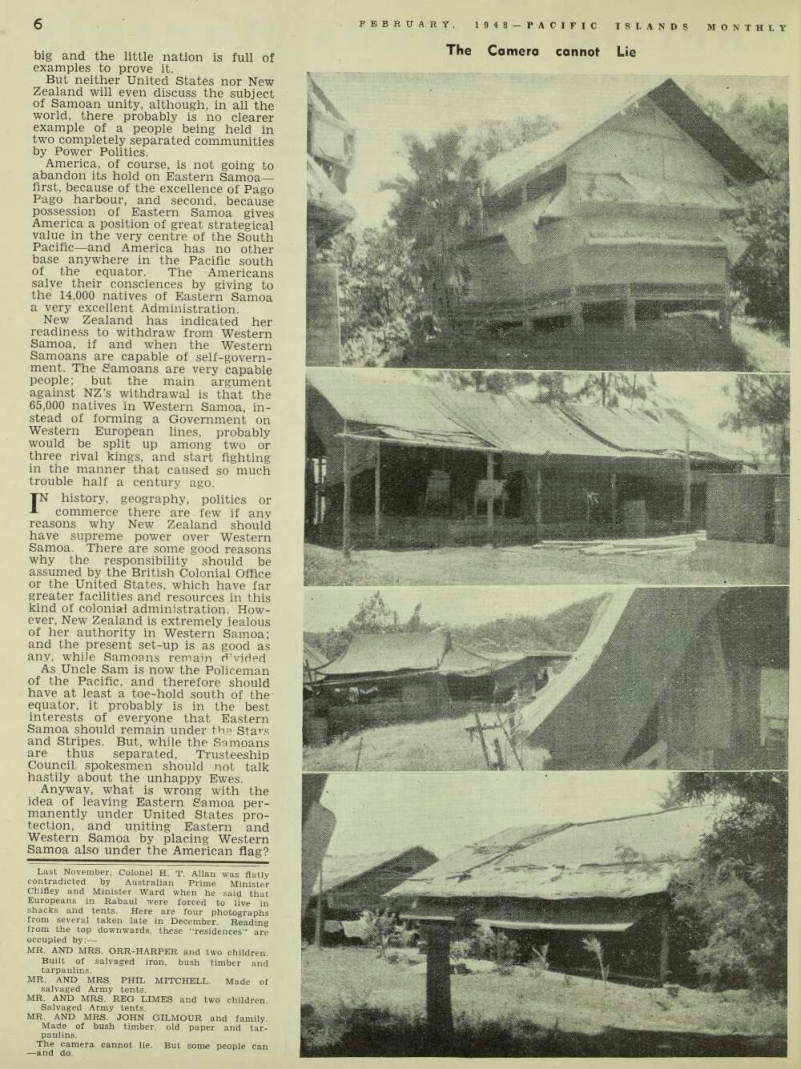
The Camera cannot Lie
Last November, Colonel H. T. Allan was flatly contradicted by Australian Prime Minister Chifley and Minister Ward when he said that Europeans in Rabaul were forced to live in shacks and tents. Here are four photographs from several taken late in December. Reading from the top downwards, these “residences” are occupied by:— MR. AND MRS. ORR-HARPER and two children.
Built of salvaged iron, bush timber and tarpaulins.
MR. AND MRS. PHIL MITCHELL. Made of salvaged Army tents.
MR. AND MRS. REG LIMES and two children.
Salvaged Army tents.
MR. AND MRS. JOHN GILMOUR and family.
Made of bush timber, old paper and tar paulins.
The camera cannot lie. But some people can —and do.
Hon. E. J. Ward
Early Tour of Territories Now Unlikely
IT had been reported that the Australian Minister for External Territories, Mr.
Ward, may visit Port Moresby on February 18 and there meet a large number of Administration officials, who have been called from various districts to Port Moresby for consultation. This is now stated, officially, as unlikely.
Mr. Ward’s plans to make a tour of Papua and New Guinea in January were dislocated by his obligation to attend the enquiry into the Garden timber-lease matter, which did not finish until early February.
Mr. Ward is also obliged to be present in Canberra on February 18 for the opening of Parliament. The trial of Garden may come on any time after March 1.
The Administrator of New Guinea, Colonel J. K. Murray, arrived in Sydney on February 12 for consultation with Mr.
Ward, and is expected to return to Port Moresby on February 18.
It is probable that he will then meet a conference of District Services officials.
It is reported that one of the matters to which the Minister is giving particular attention, in consultation with his De partmental and Administration officials, is the formal acceptance by the Australian Parliament of the Trusteeship Agreement in relation to New Guinea.
This is a double-barrelled plan. It pro vides for the transfer of the New Guinea Mandate from the now defunct League of Nations to the Trusteeship Council of the United Nations (already accepted by ttnO) and it is also proposed at the same time to create one permanent Adminis tration for the Trustee Territory of New Guinea and Australian Territory of Papua.
Papeete Council
Papeete, Dec, 23.
IT is formally announced that M. Alfred Poroi has been re-elected Mayor and that the following three gentlemen have been elected Members of the Muni cipal Council: Messieurs Georges Pam brun, Andre Junventin and Charles Levy.
To Work For Usa
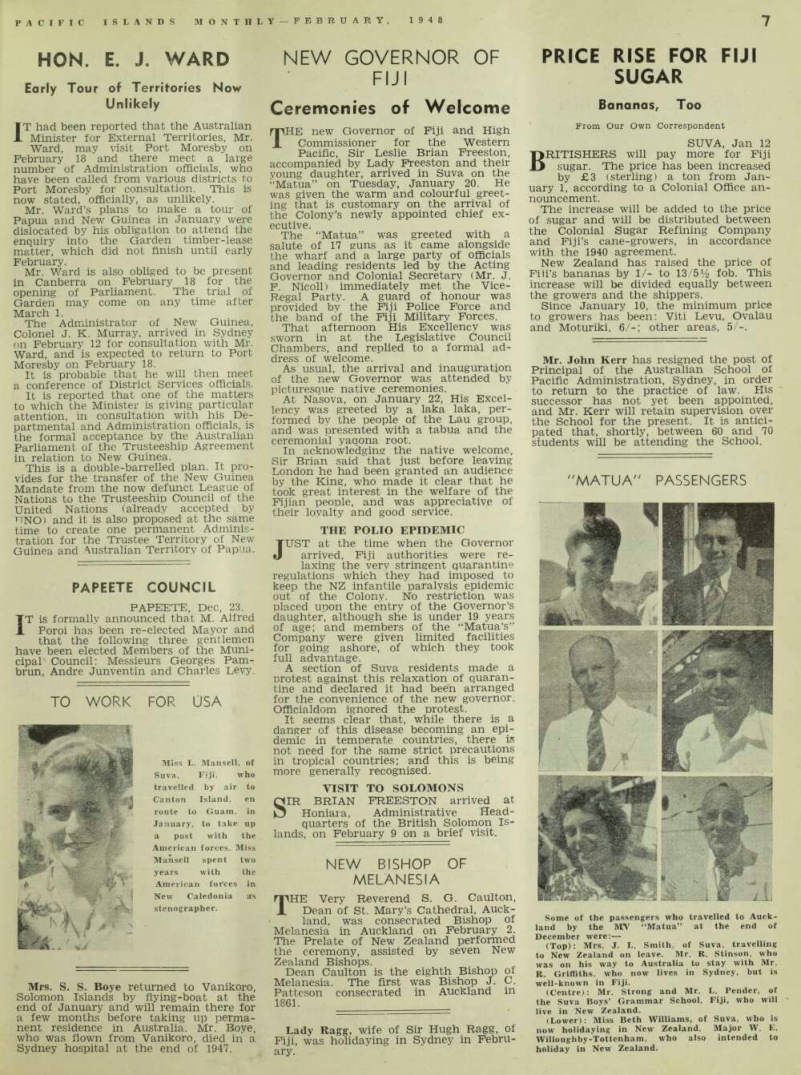
Mrs. S. S. Boye returned to Vanikoro, Solomon Islands by flying-boat at the end of January and will remain there for a few months before taking up perma nent residence in Australia. Mr. Boye, who was flown from Vanikoro, died in a Sydney hospital at the end of 1947.
Miss L. Mansell, of Suva, Fiji, who travelled by air to Canton Island, en route to Guam, in January, to take up a post with the American forces. Miss Mansell spent two years with the American forces in New Caledonia as stenographer.
New Governor Of
Fiji
Ceremonies of Welcome
THE new Governor of Fiji and High Commissioner for the Western Pacific, Sir Leslie Brian Freeston, accompanied by Lady Freeston and their young daughter, arrived in Suva on the “Matua” on Tuesday, January 20. He was given the warm and colourful greet ing that is customary on the arrival of the Colony’s newly appointed chief ex ecutive.
The “Matua” was greeted with a salute of 17 guns as it came alongside the wharf and a large party of officials and leading residents led by the Acting Governor and Colonial Secretary (Mr. J.
F. Nicoll) immediately met the Vice- Regal Party. A guard of honour was provided by the Fiji Police Force and the band of the Fiji Military Forces.
That afternoon His Excellency was sworn in at the Legislative Council Chambers, and replied to a formal ad dress of welcome.
As usual, the arrival and inauguration of the new Governor was attended by picturesque native ceremonies.
At Nasova, on January 22, His Excel lency was greeted by a laka laka, per formed by the people of the Lau group, and was presented with a tabua and the ceremonial yaqona root.
In acknowledging the native welcome, Sir Brian said that just before leaving London he had been granted an audience by the King, who made it clear that he took great interest in the welfare of the Fijian people, and was appreciative of their loyalty and good service.
The Polio Epidemic
JUST at the time when the Governor arrived, Fiji authorities were re laxing the very stringent quarantine regulations which they had imposed to keep the NZ infantile paralysis epidemic out of the Colony. No restriction was placed upon the entry of the Governor’s daughter, although she is under 19 years of age; and members of the “Matua’s”
Company were given limited facilities for going ashore, of which they took full advantage.
A section of Suva residents made a nrotest against this relaxation of quaran tine and declared it had been arranged for the convenience of the new governor.
Officialdom ignored the protest.
It seems clear that, while there is a danger of this disease becoming an epi demic in temperate countries, there is not need for the same strict precautions in tropical countries; and this is being more generally recognised.
Visit To Solomons
SIR BRIAN FREESTON arrived at Honiara, Administrative Head quarters of the British Solomon Is lands, on February 9 on a brief visit.
New Bishop Of
Melanesia
THE Very Reverend S. G. Caulton, Dean of St. Mary’s Cathedral, Auck land, was consecrated Bishop of Melanesia in Auckland on February 2.
The Prelate of New Zealand performed the ceremony, assisted by seven New Zealand Bishops.
Dean Caulton is the eighth Bishop oi Melanesia. The first was Bishop J. C.
Patteson consecrated in Auckland in 1861.
Lady Ragg, wife of Sir Hugh Ragg, of Fiji, was holidaying in Sydney in Febru ary.
Price Rise For Fiji
Sugar
Bananas, Too From Our Own Correspondent
Suva, Jan 12
BRITISHERS will pay more for Fiji sugar. The price has been increased by £3 (sterling) a ton from Jan uary 1, according to a Colonial Office an nouncement.
The increase will be added to the price of sugar and will be distributed between the Colonial Sugar Refining Company and Fiji’s cane-growers, in accordance with the 1940 agreement.
New Zealand has raised the price of Fiii’s bananas by 1/- to IS/S 1 fob. This increase will be divided equally between the growers and the shippers.
Since January 10, the minimum price to growers has been: Viti Levu, Ovalau and Moturiki, 6/-; other areas, 5/-.
Mr. John Kerr has resigned the post of Principal of the Australian School of Pacific Administration, Sydney, in order to return to the practice of law. His successor has not yet been appointed, and Mr. Kerr will retain supervision over the School for the present. It is antici pated that, shortly, between 60 and 70 students will be attending the School.
"Matua" Passengers
Some o f the passengers who travelled to Auck land by the MV “Matua” at the end of December were:— (Top): Mrs. J. L. Smith, of Suva, travelling to New Zealand on leave. Mr. R. Stinson, who was on his way to Australia to stay with Mr.
R. Griffiths, who now lives in Sydney, but is well-known in Fiji. (Centre): Mr. Strong and Mr. L. Pender, of the Suva Boys’ Grammar School, Fiji, who will live in New Zealand. (Lower): Miss Beth Williams, of Suva, who is now holidaying in New Zealand. Major W. E.
Willoughby-Tottenham, who also intended to holiday in New Zealand.
Services
French Airways
Noumea to Tahiti
Papeete. Jan. 10,
THE newly-formed Societe Francais de Transports Ariens du Pacifique Sud (abbreviated to TRAP AS), is show ing enterprise and energy in developing and extending its new monthly Noumea- Tahiti service, carried on with Catalina amphibians.
Its plane, making its second trip be tween New Caledonia and Tahiti, arrived at Papeete on December 13 and departed on December 18 with a full complement of passengers. It is due here again about January 12.
The route now being followed is Noumea-Nadi (Fiji) Aitutaki (Cook Islands)—Papeete. It may be possible to arrange a regular call at Apia Western Samoa.
TRAPAS hopes to maintain in Tahiti a sufficient establishment to provide air services between the islands of French Oceania The founder, M. Henri Dewez, hopes soon to purchase sufficient additional equipment for a twice-a-month service between New Caledonia and Tahiti. It is also announced that M. Dewez has plans for stimulating the tourist traffic to French Oceania.
French Air Link With Nz
Auckland. Jan. 24.
DISCUSSIONS are in progress here be tween NZ Civil Aviation officials and Colonel R. Migeon (director of Civil Aviation in the French South Pacific). and it is possible that the TRAPAS service between Noumea and Tahiti will be synchronised with the NZ services to Fiji, etc.
Two TRAPAS Catalina amphibians have been here recently. (Dne brought the crew of the MV “Rosalie” from Noumea, and the other brought Colonel Migeon and various civil and TRAPAS officials.
There is some possibility of TRAPAS run ning a service from Noumea to Auckland, via Norfolk Is.
Third Trans-Pacific
Air Service?
IT has been rumoured in Australia that Australian National Airways Pty., Ltd., may start a third air-ser vice between the North American Pacific coast and Australia.
ANA have been contractors to British Commonwealth Pacific Airlines (a com bination representing the socialist gov ernments of Australia, New Zealand and Great Britain); but that arrange ment is to end and BCPA will run their own service shortly.
If ANA does introduce a new service it probably would be under charter to America’s Trans-World Airways which means that probably it would be carried on with Constellation planes.
It is doubtful if the Pacific route war rants a third service at the present time.
With dollar restrictions prevailing in Australia and New Zealand, the existing services are not being run with capacity bookings.
Advertisements & other items, p. 10 (1 item)
Gold Production In New
Guinea
BULOLO Gold Dredging Ltd., brought a fifth dredge into operation in New Guinea, in January; and, in January, recovered 7,057 ounces of fine gold, worth over £70,000.
All-Fiji Cricket Team
Now On Tour In NZ
THE 16 members of the Fijian repre sentative cricket team arrived in Auckland by air in mid-February.
The team is comprised of 12 Fijians and four Europeans. The Fijians will play in bare feet and white lava-lavas, it has been reported from Auckland.
The 1948 Tour
From a Special Correspondent
Suva, Jan. 3.
Arrangements are complete for the All-Fiji cricket team to make a tour of New Zealand. The team will leave Fiji in February and return six weeks later, after playing in the four major provinces, Auckland, Wellington, Canterbury and Otago, as well as in minor districts.
This is the third tour in Fiji cricket history. The first was organised by the Hon. Mr. J. S. Udal, Attorney General and MCC player, in 1895, following much the same itinerary as the 1948 team will follow. That side was half European and half-Fijian.
In 1908, a Fijian team from the island of Bau, toured Australia and met with much success.
The present tour has been organised by Mr. P. A. Snow, Administrative Officer of Fiji and former Leicestershire County cricketer. He is expected to lead the team. Other members of the team are likely to be Mr. D. L. Freeman, well known in New Zealand test cricket be fore he joined the CSR in Fiji; Ratu George Cakobau who is a successful bow ler and Ratu Edward Cakobau who played first class cricket for Auckland province when he was at school at Wan ganui College.
Ratu Sir Lala Sukuna, the most out standing Fijian of the present day, is President of the Fiji Cricket Association and a keen supporter of the game.
Papuan Bore Down Over Two Miles Progress
Two Miles Progress of APC
THE Australian Petroleum Company Pty., Ltd., reported at the end of January that their bore at Kariava, Papua had reached a depth of 11,682 feet that is, slightly over two and one quarter miles down into the earth.
In spite of a rumour in Australia, last year, of an oil strike, no oil-bearing strata has yet been reached.
APC’s new general manager, Mr. L. A.
Pym, arrived in Melbourne at the end of December. He is an Australian by birth but has had extensive experience in petroleum production with Anglo Iranian Oil Company Ltd., in Iran.
Gold Co.'s Troubles
In N. Guinea
A DISMAL story of frustrations and difficulties, created by the Wardist Administration of New Guinea, was told by the chairman of New Guinea Goldfields Ltd., at the annual meeting on January 23.
NGG Ltd. hold very large areas of rich gold-bearing country in the Bulolo Valley, on the southern side of the Bulolo Gorge, and extending up Edie Creek. The Com pany have ample funds —saved from the 1942 invasion, plus substantial war-dam age compensation—and it made, in 1946, elaborate plans for resuming gold recovery operations on a big scale.
But the programme has been defeated by a multitude of difficulties, all trace able, more or less, to the muddling Socialist policy which has brought about in New Guinea an acute shortage of ship ping, of supplies and of native labour. The chairman gave the shareholders lengthy details of these difficulties —all familiar to readers of the PIM.
Gold is the one remaining commodity which has immediate and unquestioned value in all international finance. One would have imagined that the Australian Government would have done everything possible to assist gold production—such as providing a company like NGG Ltd. with ample transportation and facilities.
But the Socialists, in their hatred of pri vate enterprise, have given this and other mining companies little real help. The Company won little gold in 1947. Its native labour force in 1947, instead of being numbered in thousands, was 247. The chairman points out that this was for tunate —if the Company had had more native labourers, they would have starved, owing to the inefficiency and inadequacy of the Government Shipping Service, on which they depend for supplies.
Death Of Joseph Nobbs
Of Norfolk Is.
ON New Year’s Day a large gathering of Norfolk Island residents at tended the funeral of the late Mr.
Joseph Nobbs. Canon Rook and the Rev. Mr. Gerber conducted the service at the Chapel and at the graveside where sincere tributes were paid to Mr.
Nobbs’s many fine qualities.
Every Island family was represented.
The impressive service and the singing of the anthem written by Driver Chris tian over 100 years ago (“Come Ye Blessed of My Father”) will be long re membered.
Mr. Nobbs belonged to the Pitcairn family of that name. He was held in great esteem by the islanders and was outstanding in his knowledge of agricul ture. It is said of him that he was one of the last of the Master Ploughmen— and on Norfolk Island that still means a great deal. —AAI.
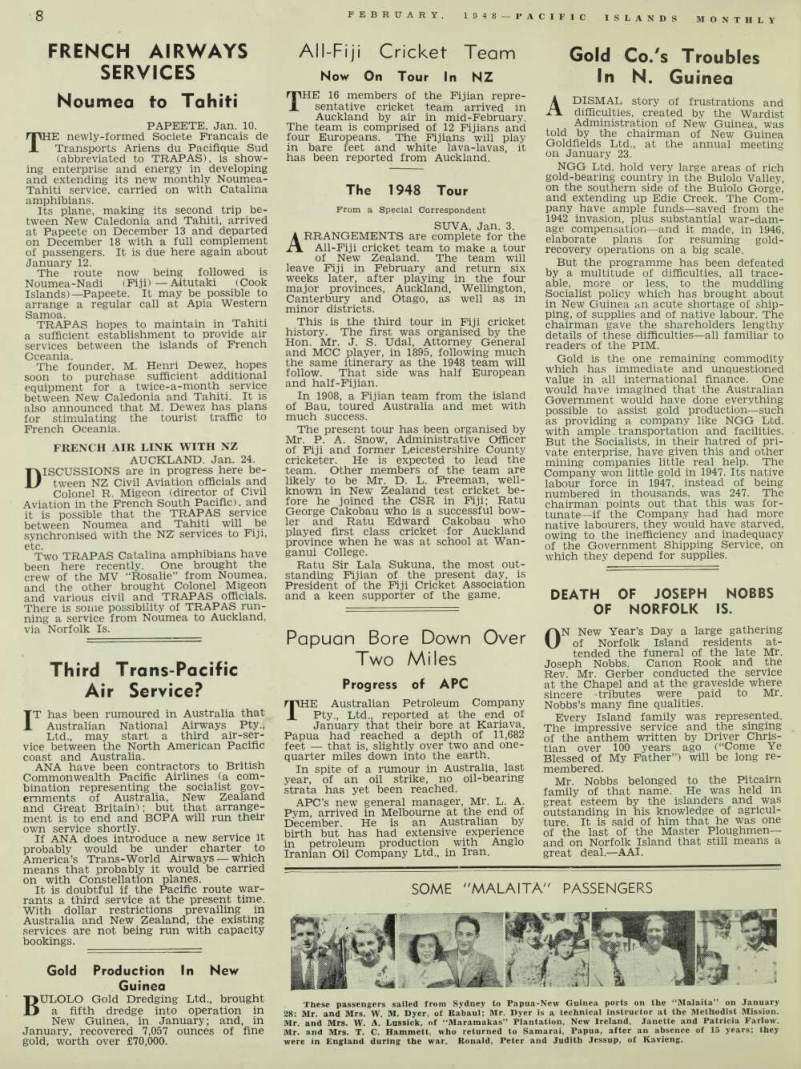
Some "Malaita" Passengers
These passengers sailed from Sydney to Papua-New Guinea ports on the “Malaita” on January 28: Mr. and Mrs. W. M. Dyer, of Rabaul; Mr. Dyer is a technical instructor at the Methodist Mission.
Mr. and Mrs. W. A, Lussick, of “Maramakas” Plantation, New Ireland. Janette and Patricia Farlow.
Mr. and Mrs. T. C. Hammett, who returned to Samarai, Papua, after an absence of 15 years; they were in England during the war. Ronald, Peter and Judith Jessup, of Kavieng.
January 23
Remembrance Services in Sydney and Rabaul
MEMBERS of the New Guinea com munitv met as usual in Martin Place, Sydney, on the morning of January 23, and placed wreaths upon the Cenotaph in memory of those men who fell in the defence of Rabaul.
It was noticeable this year, however, that those who attended the little mem orial ceremony were mostly women, many of them widows of the men who were killed in Rabaul, in January, 1942, or who were subsequently lost.
Although the floral tributes placed upon the Cenotanh made an impressive display, it was noted that, for the most part, they came from individuals rather than from institutions. Wreaths usually sent in by some large institutions were missing, this year.
Ceremonies in Rabaul IF, however, the numbers attending the service in Sydney have diminished during the passing years, January 23 was well marked in Rabaul.
A Dawn Service was held at 5.45 a.m. at the Memorial Stone which has been erected on the shores of Blanche Bay where the NGVR made their heroic stand. The Rev. Mr. Mannering con ducted a simple service after which wreaths were placed on the Stone, by the following: Mr. A. J. Gaskin, on behalf of the local branch of the RSSAILA; Matron Hanlan, for the De partment of Public Health, Rabaul; Mr.
L. Corbett, for Colyer Watson (NG) Ltd.; Mr. G. Smart, for Burns Fhilo & Co. (NG), Ltd.; Captain J. W. Backhouse, for the Ist Ausc. War Criminals Com pound; Mrs. U. Adams, for the New Guinea Women’s Club of Sydney; Miss Dorothy Stewart, for the New Guinea Women’s Association of Melbourne.
There were numerous other tributes on behalf of private individuals.
After this service most of those who had participated returned to Rabaul for breakfast, before attending the second service at 7.30 a.m. at the old Coal Wharf in Rabaul, the place from where the “Montevideo Maru” sailed in June, 1942. There was no service; but wreaths were placed there by a number of local institutions, firms and residents amongst whom were: the RSSAILA; NG Women’s Club of Sydney; New Guinea Women’s Association of Melbourne; Australian War Criminals Compound; Colyer Wat son: Burns Philo, Kuo Ming Tang; New Guinea Chinese Union; Rabaul Citizens Association, etc.
Neglected Stone A RABAUL resident has written us as follows: “The ceremony at the Memorial Stone went off without a hitch, but I still felt a little annoyed with everyone, including myself.
“On the evening before the 23rd., I took the car and drove out to try and find the road to the Stone which stands on the Rabaul side of Vulcan Island. The road was so overgrown as to be impas sible —so I returned home. On the next morning, however, we drove over a road on which the undergrowth had been freshly cut. All the area surrounding the Stone has heavy kunai. and this also had been freshly cut.
“As the service proceeded I couldn’t help but think that it was an unworthj way to remember our dead. Surely these places could be kept free of undergrowth for the entire year. If I were one of those listed for remembrance that day I would wonder at the generosity of spirit which could make a great play and hold special services on one day per* year, yet could not spare the time to keep the
jungle from encroaching on the tiny spot of hallowed ground for the rest of the time.
“I spoke to Mrs. Una Adams about it.
She said that when she first arrived last year the whole thing was so overgrown that she and Mrs. Greenwood cleared the stone with their own hands the day they first went to view it.”
In spite of dollar restrictions 11,000 cases of Canadian canned salmon arrived in Fiji, in January, on the Carpenter ship “Salamaua.” This is the first ship ment since the war.
American Citizenship
For Te Rangi Hiroa?
IT is reported from New Zealand that Sir Peter Buck (Te Rangi Hiroa) is seeking American citizenship.
This has caused some surpise in the Dominion, where Sir Peter is credited with having said: “I was born a Maori and a British subject and shall die as such.” He received his knighthood in the 1946 Birthday Honours.
He has been working with the Ameri cans since 1927 and has, for a number of years, been Director of the Bishop Museum in Honolulu.
Although he is now an international figure and has not taken any active part in New Zealand affairs for many years, he is still regarded by the Maoris as one of their leaders.
He was born in Urenui, NZ, 68 years ago, of a Maori mother and an Irish father. He qualified as a medical man and between 1909 and 1914 entered the New Zealand Parliament as Maori MP.
He served in the Maori Battalion in World War I, and won the DSO. After his return to the Dominion he became increasingly absorbed in Polynesian ethnology.
It was argued that, because of his Polynesian ancestry, he was not eligible for American citizenship. It is reported that to overcome this a special bill was recently introduced in Congress by Mr.
Joseph R. Farrington, the Congressman representing Hawaii, and that the matter has now been referred to the Senate Im migration Committee.
Fiji's Perennial Airport
Problem
Commission Will Consider The Relative Merits of Nausori and Nadi
From Our Own Correspondent
Suva. Jan. 19.
A DECISION on the question of Fiji’s international airport (Nadi or Nausori), which showed signs of be ing delayed for all eternity, may be reached in 1948.
A commission consisting of represent atives of the Governments of Great Britain, New Zealand, Australia and Fiji will start investigations in Fiji on Feb ruary 2.
Unofficial members of the Fiji Legis lative Council, town boards and chambers of commerce have been invited to sub mit memoranda.
It may be concluded that the Lautoka- Suva “war,” which broke out between re sidents on opposite sides of Viti Levu when the question was first raised, will be on again!
In making recommendations, the com mission will consider engineering pro blems, annual and recurrent costs, and social and economic problems connected with the establishment of the main air port.
The Rev. W. J. V. Saville, who spent many years as a missionary in Papua, and retired in 1935, died recently in UK.
Returning To Papua-New Guinea
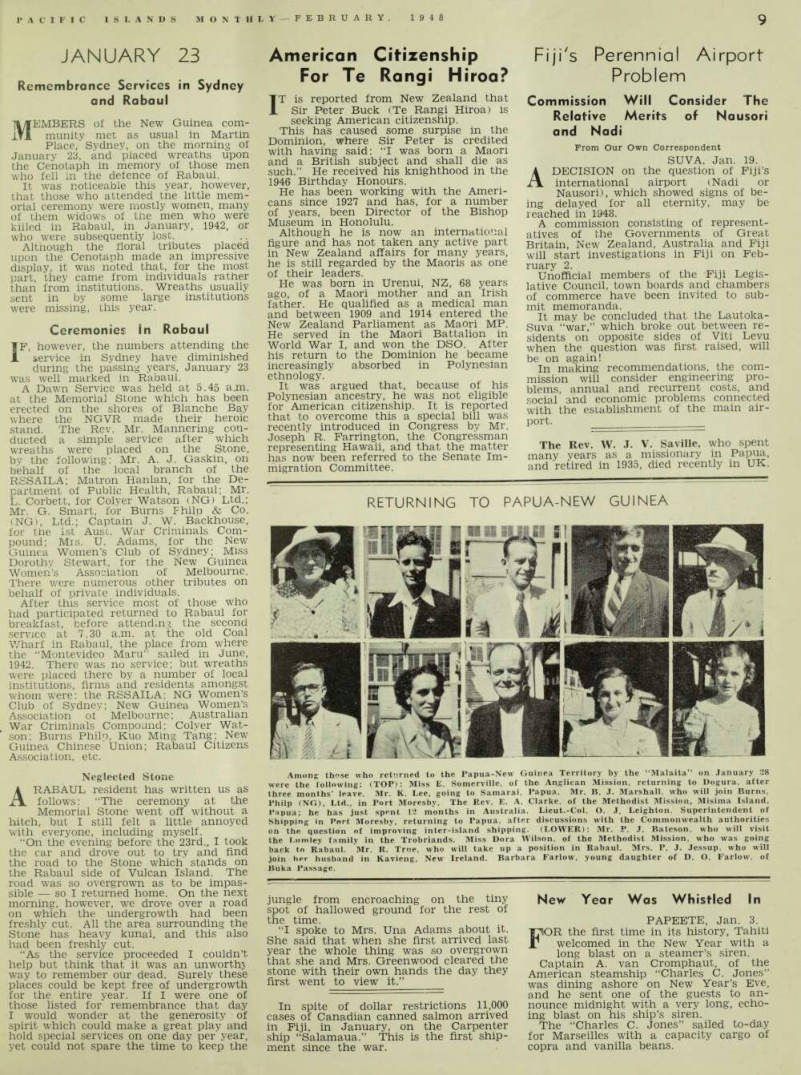
Among those who returned to the Papua-New Guinea Territory by the “Malaita” on January 28 were the following; (TOP): Miss E. Somerville, of the Anglican Mission, returning to Dogura, after three months’ leave. Mr. K. Lee, going to Samarai, Papua. Mr. B. J. Marshall, who will join Burns, Philp (NG). Ltd., in Port Moresby. The Rev. E. A. Clarke, of the Methodist Mission, Misima Island, Papua; he has just spent 12 months in Australia. Lieut.-Col. O. J. Leighton, Superintendent of Shipping in Port Moresby, returning to Papua, after discussions with the Commonwealth authorities on the question of improving inter-island shipping. (LOWER): Mr. P. J. Bateson, who will visit the Lnmley family in the Trobriands. Miss Dora Wilson, of the Methodist Mission, who was going back to Rabaul. Mr. R. True, who will take up a position in Rabaul. Mrs. P. J. Jessup, who will join her husband in Kavieng, New Ireland. Barbara Farlow, young daughter of D. O. Farlow, of Buka Passage.
New Year Was Whistled In
Papeete, Jan. 3.
FOR the first time in its history, Tahiti welcomed in the New Year with a long blast on a steamer’s siren.
Captain A. van Cromphaut, of the American steamship “Charles C. Jones” was dining ashore on New Year’s Eve, and he sent one of the guests to an nounce midnight with a very long, echo ing blast on his ship’s siren.
The “Charles C. Jones” sailed to-day for Marseilles with a capacity cargo of copra and vanilla beans.
Fraud Charges
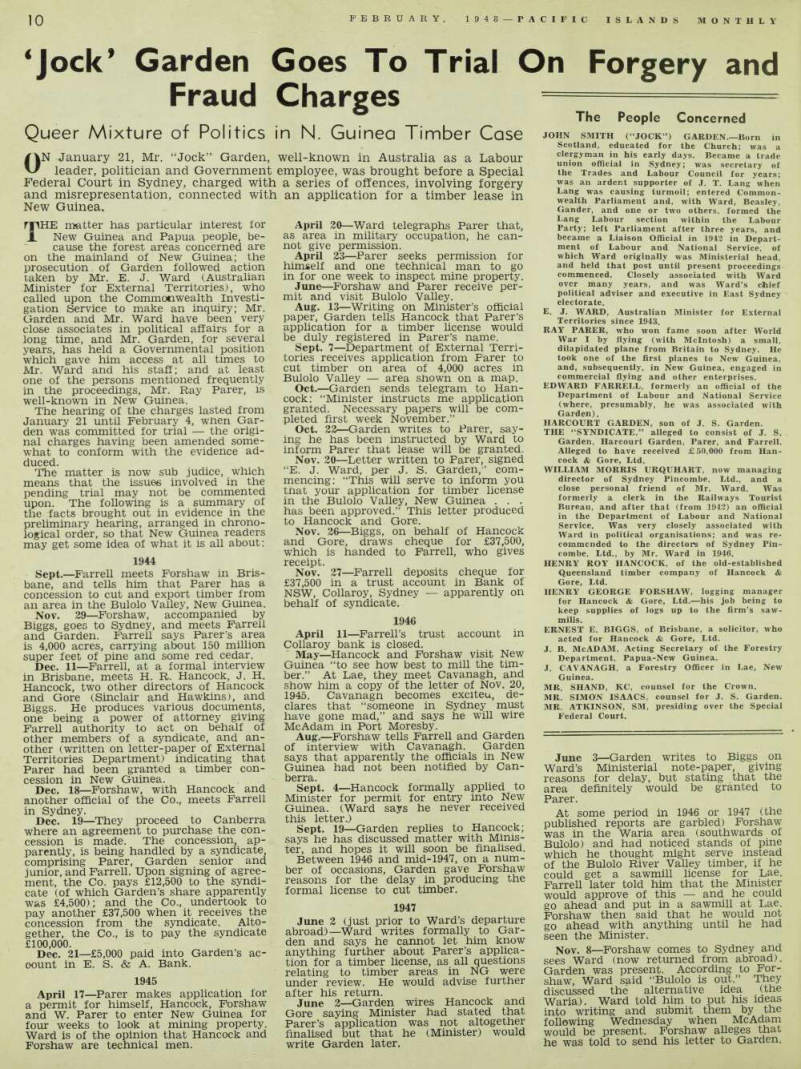
'Jock' Garden Goes To Trial On Forgery and
Fraud Charges Queer Mixture of Politics in N. Guinea Timber Case
ON January 21, Mr. “Jock” Garden, well-known in Australia as a Labour leader, politician and Government employee, was brought before a Special Federal Court in Sydney, charged with a series of offences, involving forgery and misrepresentation, connected with an application for a timber lease in New Guinea.
THE matter has particular interest for New Guinea and Papua people, be cause the forest areas concerned are on the mainland of New Guinea; the prosecution of Garden followed action taken by Mr. E. J. Ward (Australian Minister for External Territories), who called upon the Commonwealth Investi gation Service to make an inquiry; Mr.
Garden and Mr. Ward have been very close associates in political affairs for a long time, and Mr. Garden, for several years, has held a Governmental position which gave him access at all times to Mr. Ward and his staff; and at least one of the persons mentioned frequently in the proceedings, Mr. Ray Parer, is well-known in New Guinea.
The hearing of the charges lasted from January 21 until February 4, when Gar den was committed for trial the origi nal charges having been amended some what to conform with the evidence ad duced.
The matter is now sub judice, which means that the issues involved in the pending trial may not be commented upon. The following is a summary of the facts brought out in evidence in the preliminary hearing, arranged in chrono logical order, so that New Guinea readers may get some idea of what it is all about: 1944 Sept.—Farrell meets Forshaw in Bris bane, and tells him that Parer has a concession to cut and export timber from an area in the Bulolo Valley, New Guinea.
Nov. 29—Forshaw, accompanied by Biggs, goes to Sydney, and meets Farrell and Garden. Farrell says Parer’s area is 4,000 acres, carrying about 150 million super feet of pine and some red cedar, Dec. 11— Farrell, at a formal interview in Brisbane, meets H. R. Hancock, J. H.
Hancock, two other directors of Hancock and Gore (Sinclair and Hawkins), and Biggs. He produces various documents, one being a power of attorney giving Farrell authority to act on behalf of other members of a syndicate, and an other (written on letter-paper of External Territories Department) indicating that Parer had been granted a timber con cession in New Guinea.
Dec. 18 —Forshaw, with Hancock and another official of the Co., meets Farrell in Sydney.
Dec. 19 —They proceed to Canberra where an agreement to purchase the con cession is made. The concession, ap parently, is being handled by a syndicate, comprising Parer, Garden senior and junior, and Farrell. Upon signing of agree ment, the Co. pays £12,500 to the syndi cate (of which Garden’s share apparently was £4,500); and the Co., undertook to pay another £37,500 when it receives the concession from the syndicate. Alto gether, the Co., is to pay the syndicate
£Loo,Ooo.
Dec. 21—£5,000 paid into Garden’s ac count in E. S. & A. Bank. 1945 April 17 —Parer makes application for a permit for himself, Hancock, Forshaw and W. Parer to enter New Guinea for four weeks to look at mining property.
Ward is of the opinion that Hancock and Forshaw are technical men.
April 20 —Ward telegraphs Parer that, as area in military occupation, he can not give permission.
April 23 —Parer seeks permission for himself and one technical man to go in for one week to inspect mine property.
June —Forshaw and Parer receive per mit and visit Bulolo Valley.
Aug. 13 —Writing on Minister’s official paper, Garden tells Hancock that Parer’s application for a timber license would be duly registered in Parer’s name.
Sept. 7—Department of External Terri tories receives application from Parer to cut timber on area of 4,000 acres in Bulolo Valley area shown on a map, Oct. —Garden sends telegram to Han cock: “Minister instructs me application granted. Necessary papers will be com pleted first week November.”
Oct. 22—Garden writes to Parer, say ing he has been instructed by Ward to inform Parer that lease will be granted.
Nov. 20—Letter written to Parer, signed “E. J. Ward, per J. S. Garden,” com mencing: “This will serve to inform you that your application for timber license in the Bulolo Valley, New Guinea . . . has been approved.” This letter produced to Hancock and Gore.
Nov. 26 —Biggs, on behalf of Hancock and Gore, draws cheque for £37,500, which is handed to Farrell, who gives receipt.
Nov. 27 —Farrell deposits cheque for £37,500 in a trust account in Bank of NSW, Collaroy, Sydney apparently on behalf of syndicate. 1946 April 11 —Farrell’s trust account in Collaroy bank is closed.
May—Hancock and Forshaw visit New Guinea “to see how best to mill the tim ber.” At Lae, they meet Cavanagh, and show him a copy of the letter of Nov. 20, 1945. Cavanagn becomes exciteu, de clares that “someone in Sydney must have gone mad,” and says he will wire McAdam in Port Moresby.
Aug. —Forshaw tells Farrell and Garden of interview with Cavanagh. Garden says that apparently the officials in New Guinea had not been notified by Can bcrra Sept. 4— Hancock formally applied to Minister for permit for entry into New Guinea. (Ward says he never received this letter.) Sept. 19 —Garden replies to Hancock; says he has discussed matter with Minis ter, and hopes it will soon be finalised.
Between 1946 and mid-1947, on a num ber of occasions, Garden gave Forshaw reasons for the delay in producing the formal license to cut timber. 1947 June 2 (just prior to Ward’s departure abroad) —Ward writes formally to Gar den and says he cannot let him know anything further about Parer’s applica tion for a timber license, as all questions relating to timber areas in NG were under review. He would advise further after his return.
June 2—Garden wires Hancock and Gore saying Minister had stated that Parer’s apnlication was not altogether finalised blit that he (Minister) would write Garden later.
June 3 —Garden writes to Biggs on Ward’s Ministerial note-paper, giving reasons for delay, but stating that the area definitely would be granted to Parer.
At some period in 1946 or 1947 (the published reports are garbled) Forshaw was in the Waria area (southwards of Bulolo) and had noticed stands of pine which he thought might serve instead of the Bulolo River Valley timber, if he could get a sawmill license for Lae.
Farrell later told him that the Minister would approve of this and he could go ahead and put in a sawmill at Lae.
Forshaw then said that he would not go ahead with anything until he had seen the Minister.
Nov. B—Forshaw comes to Sydney and sees Ward (now returned from abroad).
Garden was present. According to For shaw, Ward said “Bulolo is out.” They discussed the alternative idea (the Waria). Ward told him to put his ideas into writing and submit them by the following Wednesday when McAdam would be present, Forshaw alleges that he was told to send his letter to Garden.
Later, this day, Forshaw asked Garden if everything was in order. Garden as sured him that it was.
Nov. 10—Back in Brisbane, Forshaw drafts a letter to Ward, complaining strongly about delay and frustration.
This is typed by Briggs’s typist, and sent to Garden. (When the letter is produced in evidence, it is shown that the last page has been re-typed, on different paper, and Forshaw’s signature forged.
One of Ward’s Departmental typists gave evidence that she re-typed that page on Garden’s instructions, before it went to the Minister. The page, as re-typed, omitted all references to Parer’s conces sion and the payment of money to the syndicate.) Dec. 6—Forshaw has another interview in Sydney with Ward. Garden and Mc- Adam are present. McAdam told For shaw that Parer had no license to cut timber in New Guinea. Forshaw, now suspicious and alarmed, reports back to Brisbane.
Dec. 15 —Forshaw again sees Ward taking with him a copy of the letter of Nov. 20, 1945. Ward says he has not known anything of this. He calls in Garden, who admits having signed the letter. - Ward says Garden had no authority to do this and then consults Commonwealth Solicitor, and places matter in hands of Commonwealth Inves tigation Service. 1948 Jan. 2—Garden is summoned to appear before Special Federal Court, on charges involving forgery and fraud.
Mr. Ward’S Evidence
ACCORDING to Mr, Ward’s evidence, Garden on many occasions in 1945, 1946 and 1947 discussed with him the application for a timber license made by Parer; but he had never approved the issue of a license. He had, on the contrary, repeatedly indicated to Garden that the grant of a concession to cut timber in New Guinea was subject to im portant Government policy, which had not been finalised. He denied that he had ever met Ray Parer, Garden had an office close to his office in the Com monwealth Bank Chambers, Sydney; but he had never given Garden permission to use his note-paper or autnority to sign his name. Garden acted for him in many electorate matters. Garden had no staff —when he wanted staff help, he made use of the Minister’s staff.
Ward, under cross-examination, denied that he saw Parer in his office in May, 1944; that Parer said he wanted a tim ber concession; that he had said he would do anything he could for Parer, because he recognised what the Parers had done for New Guinea, but that they would have to move cautiously, because there were others in the field, among them Brett and E. G. Theodore. He also denied that he was to receive £20,000 as his share from the sale of timber con cessions in New Guinea; that he had le ceived £5,000 in £lO notes, in his office, as part of the deal; that he had directed all monies for him to his friend Urquhart; that his wife had told friends that she had won £ll,OOO by backing a horse called Precise. He made his safety deposit box in the Bank of NSW avail able. and it was duly examined, and dis closed nothing that would throw light upon the inquiry.
During this cross-examination of Ward by Isaacs, there were some very angry scenes, in which Ward showed great re sentment of the questions.
No Witnesses For Defence
MR. ISAACS called no evidence for the defence he relied upon his cross examination of the various wit nesses for the Crown to prove his con tention that all that had been done had been done with the knowledge, if not the consent, of the Minister. There were
some bitter clashes between Mr. Isaacs and Mr, Ward when the latter was in the box.
Isaacs brought out the fact that Urquhart, Ward’s closest friend, had risen from the position of railway clerk to the managing directorship of a Sydney company, at some £2,000 per annum, via Mr. Ward’s former Department, in recent years; that large sums of money had
SS*to'wded b too4h OU iS- :
Ward amdlcatlons° for nermits totoDOTt mods- and that Mr Wkrd and Mr Urquhart .were together in 1947. (Urquhart in evidence said he got most of his money on the racecourse, especially in backing a horse called Precise; and Ward said that the meeting of himself and Urouhart in London was quite accidental.) The Crown, in this case, apparently made no attempt to trace the fate of the £37,500 paid by Hancock and Gore on November 26, 1945. Altogether, this Co. Paid out £50,000. £12,500 seems to have been divided up in some way between members of the syndicate (Garden, Garden junior, Parer and Farrell); but the balance of £37,500 is lost to sight after it was paid into Farrell’s Trust Account on November 27, 1945. .
A Full Inquiry Needed leadin.r artiole- g ’ as ,ts I ieaa ng article.
N 'due course a jury will determine whether Mr. J. S. Garden is innocent or guilty of the charges on which he has been committed from the Special Court.
But evidence given at the preliminary hearing has raised other questions touch ing public administration which call for the strictest inquiry, whatever the out come of the Garden case. Public opinion has been deeply disturbed by some of the disclosures made and their implications.
These clearly call for a thorough inves tigation by a Royal Commission with wide terms of reference.
The Government should need no prompting in this regard. If there has been administrative laxity, the facts should be fully explored and revealed.
It must seem extraordinary that though Mr. Garden, as a “liaison officer,” had nothing to do with Mr. Ward’s de partment, he should have had such ready access to the Ministerial suite, and should have been able, as late as November last, according to evidence given, to employ the services of a typist in the External Territories Department.
Another matter requiring further eluci dation is the relationship between Mr.
Ward and the former national service officer whose appointment as managing director of a typewriter agency he was in strumental in procuring. When this company sought a licence to import type writers from Sweden, Mr. Ward became, as he admitted, the intermediary between the firm and the Department of Import Procurement.
Is it customary for a Minister to give this kind of assistance? Does the favoured applicant thereby obtain an ad vantage not available to other business concerns?
Mr. Urquhart seems to have been most fortunate in his Ministerial friend.
(Continued on page 13)
French Pacific
Air Service
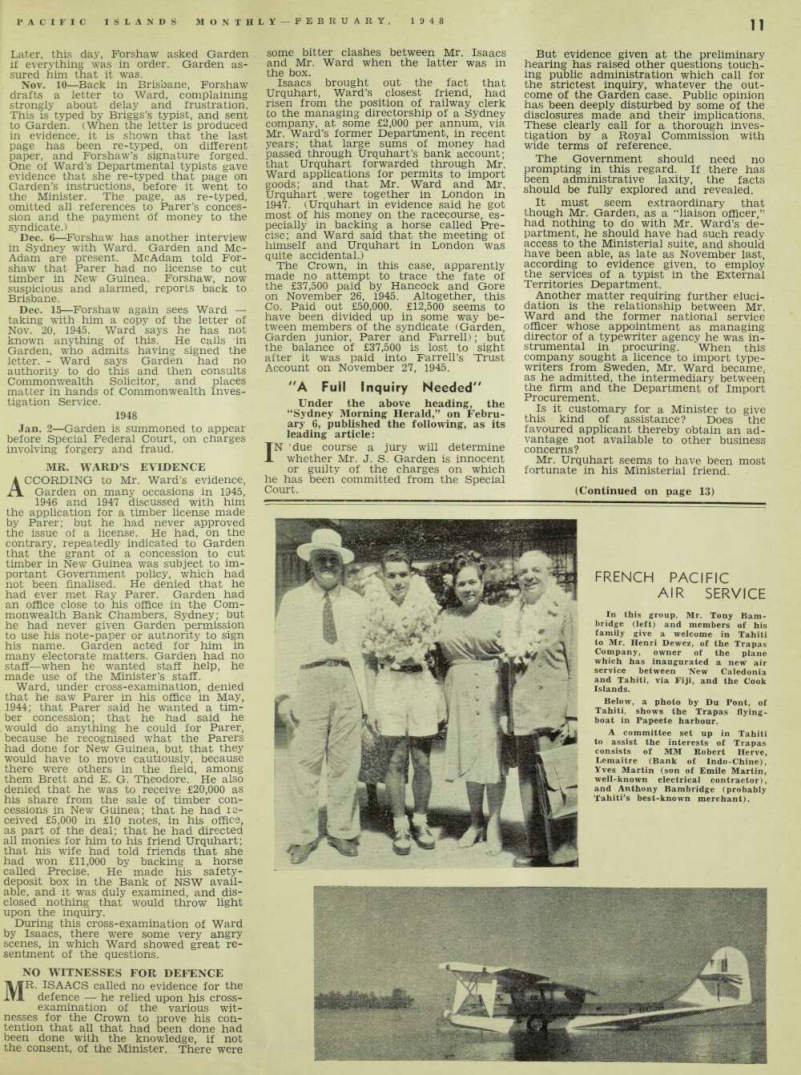
In this group. Mr. Tony Bam bridge (left) and members of his family give a welcome in Tahiti to Mr. Henri Dewez, of the Trapas Company, owner of the plane which has inaugurated a new air service between New Caledonia and Tahiti, via Fiji, and the Cook Islands.
Below, a photo by Du Pont, of Tahiti, shows the Trapas flying boat in Papeete harbour.
A committee set up in Tahiti to assist the interests of Trapas consists of MM Robert Herve, Lemaitre (Bank of Indo-Chine), Yves Martin (son of Emile Martin, well-known electrical contractor), and Anthony Bambridge (probably Tahiti’s best-known merchant).
Apart from these matters, there is ob vious need for an investigation into both policy and administration where the dis posal of New Guinea timber lands is concerned. Rightly or wrongly, grave misgivings as to the present state of affairs have been aroused by some of the evidence given in the Special Court.
For this reason also the Government has a duty to assure the public that it will appoint a Royal Commission as soon as the Garden case Is disposed of.
Possible Attack On Ward
IT was reported in the “Sunday Tele graph” of February 8, that, when Parliament assembles this month, the Opposition will move for the sus pension of Mr. Ward from Ministerial office until the “Jock” Garden trial is disposed of.
When the renort was referred to Mr.
Ward on February 9, he ridiculed it. He said: “There is nothing original in the idea. Anti-Labour forces have been de siring my resignation ever since I became Cabinet Minister. The ‘Sunday Tele graph’ had the report in the wrong sec tion of the paper. It should have been on the comic page.”
The People Concerned
John Smith (“Jock”) Garden.—Born In
Scotland, educated for the Church; was a clergyman in his early days. Became a trade union official in Sydney; was secretary of the Trades and Labour Council for years; was an ardent supporter of J. T. Lang when Lang was causing turmoil; entered Common wealth Parliament and, with Ward, Beasley, Gander, and one or two others, formed the Lang Labour section within the Labour Party; left Parliament after three years, and became a Liaison Official in 1942 in Depart ment of Labour and National Service, of which Ward originally was Ministerial head, and held that post until present proceedings commenced. Closely associated with Ward over many years, and was Ward’s chief political adviser and executive in East Sydney electorate.
E. J. WARD, Australian Minister for External Territories since 1943.
RAY PARER, who won fame soon after World War I by flying (with Mclntosh) a small, dilapidated plane from Britain to Sydney. He took one of the first planes to New Guinea, and, subsequently, in New Guinea, engaged in commercial flying and other enterprises.
EDWARD FARRELL, formerly an official of the Department of Labour and National Service (where, presumably, he was associated with Garden).
HARCOURT GARDEN, son of J. S. Garden.
THE “SYNDICATE,” alleged to consist of J. S.
Garden, Harcourt Garden, Parer, and Farrell.
Alleged to have received £50,000 from Han cock & Gore, Ltd.
WILLIAM MORRIS URQUHART, now managing director of Sydney Pincombe, Ltd., and a close personal friend of Mr. Ward. Was formerly a clerk in the Railways Tourist Bureau, and after that (from 1942) an official in the Department of Labour and National Service. Was very closely associated with Ward in political organisations; and was re commended to the directors of Sydney Pin combe, Ltd., by Mr. Ward in 1946.
HENRY ROY HANCOCK, of the old-established Queensland timber company of Hancock & Gore, Ltd.
HENRY GEORGE FORSHAW, logging manager for Hancock & Gore, Ltd.—his Job being to keep supplies of logs up to the firm’s saw mills.
ERNEST E. BIGGS, of Brisbane, a solicitor, who acted for Hancock & Gore, Ltd.
J. B. McADAM, Acting Secretary of the Forestry Department, Papua-New Guinea.
J. CAVANAGH, a Forestry Officer in Lae, New Guinea.
MR. SHAND, KC, counsel for the Crown.
MR. SIMON ISAACS, counsel for J. S. Garden.
MR. ATKINSON, SM, presiding over the Special Federal Court.
Advertisements & other items, p. 14 (1 item)
Morris Hedtsrom Limited
General Merchants, Importers and Exporters,
Shipowners, Plantation Owners,
Commission and Insurance Agents
HEAD OFFICE
SUVA, FIJI
Established 1868
SERVICE IN THE SOUTH PACIFIC TERRITORIES
our Large Establishments in Suva and our Numerous Branches, we distribute a wide and comprehensive range of General Merchandise and provide almost every kind of service. Our departments and associated businesses include:
DRAPERY
MOTOR SALES
AND SERVICE
TOBACCO
TIMBER AND
BUILDING
GROCERY
CONFECTIONERY
HARDWARE
ELECTRICAL
LIQUORS
DRUGS
Branches Throughout
Fiji, Samoa and Tonga
Agent of Morris Hedstrom Limited in every Town in the Three Territories.
We are Sole Agents in these Territories for There is a Branch or British Drug Houses Ltd.
Electrolux Ltd.
Ford Motor Co.
General Electric Co. Ltd.
Goodyear Tyre & Rubber Co.
B. A. Hjorth & Co. (Primus Products) Imperial Chemical Industries Ltd.
International Harvester Export Co.
Matson Navigation Company Max Factor and Co. Inc.
Ransomes, Sims & Jefferies Ltd.
Ruston Gr Hornsby Ltd.
Vacuum Oil Co. Pty. Ltd.
Yorkshire Copper Works Ltd.
Morris Hedstrom Limited, are LLOYD'S AGENTS in Fiji and Samoa.
IN AUSTRALIA:
Morris Hedstrom (Aust.) Pty. Ltd.,
Asbestos House, 65 York Street, SYDNEY
IN GREAT BRITAIN;
Morris Hedstrom Limited,
Africa House, Kingsway, LONDON
More Politics
Less Quarantine and More Politics Polio Panic Wanes In West Samoa
From Our Own Correspondent
Apia, Feb. 1.
EXCITEMENT over the infantile para lysis epidemic in New Zealand, and the possible introduction of the disease into Western Samoa, is dying down although quarantine precautions are still being enforced.
There are no indications that the epidemic will reach here and as it ap pears now to be on the wane in New Zealand, the present strict restriction on travellers wishing to enter the Territory will probably be lifted in the near future.
Meantime, public interest is turning again to politics. In January the Samoans held large political meetings with the intention of selecting eleven Samoan representatives for the new Legislative Council.
As usual in Samoan gatherings, the proceedings were lengthy and the district representatives could not agree on eleven candidates, but submitted a list of 31 candidates, asking the Fautua (Malietoa, Mataafa and Tamasese) to pick out the necessary 11 from the 31 names sub mitted.
The date for the election of the five European representatives has not yet been announced.
Death Of An Official
Papeete, Jan. 3.
NEWS has been received here that M.
Colombel who was for many years in the service of the local govern ment, was found dead in his home on the island of Tubuai, on December 28, in circumstances which indicated suicide.
The French sloop “Durmont D’urville” has left for Tubuai with M. Alfred Ahnne,, Administrator of the Austral Group, to make enquiries.
Mrs. E. A. James of Port Moresby and Miss Lorna James arrived in Sydney in January. They will spend three months there. Mr. E. A. James will join them for a few weeks in February.
M. Louis Alexis Martin was married in Papeete on December 8 to Miss Lizette Levy. The bridegroom is the son of M.
Emile Martin, one of the leaders of the commercial community in Papeete.
Ayson
Death Of Judge
Notable Cook Islands Administrator
MR. H. F. Ayson, formerly Resident Commissioner and Chief Judge in the Cook Islands, died at his home in Days Bay, Wellington, NZ, on Febru ary 1, at the age of 63.
Judge Ayson (as he was usually known) had a lengthy and distinguished career in the Cook Islands, with which he was associated for over 27 years. He administered the territory with wisdom and kindness, which particularly en deared him to the islanders.
Judge Ayson first went to the Cook Is lands in 1916, when he was appointed Judge of the High Court and Native Land Court at Rarotonga. In 1922 he was appointed Resident Commissioner and Chief Judge, which positions he held continuously, except for an absence of one year (during which he was attached to the Native Department), until near the end of 1943, when he retired owing to ill-health. The CMG was conferred on him in 1930. He is survived by his wife and two daughters, Mesdames T. N.
N. Rogers (Palmerston North) and K.
E. Francis (Whakatane).
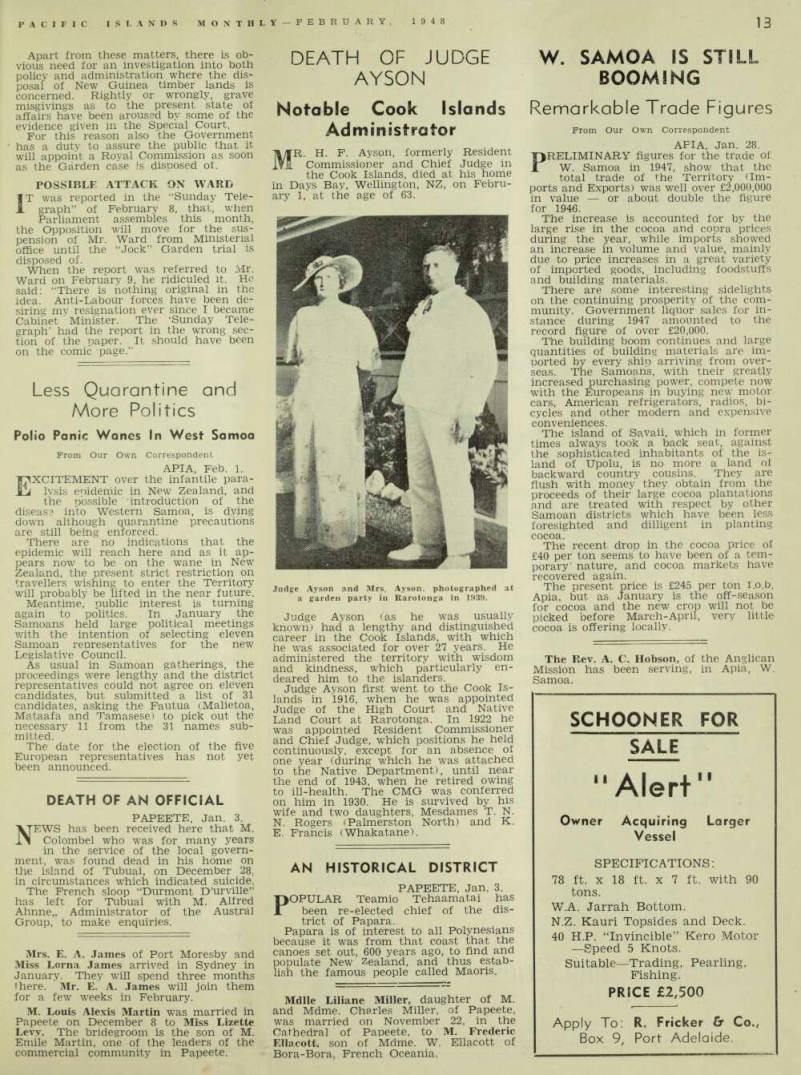
Judge Ayson and Mrs. Ayson, photographed at a garden party in Rarotonga in 1939.
An Historical District
Papeete, Jan. 3.
POPULAR Teamio Tehaamatai has been re-elected chief of the dis trict of Papara.
Papara is of interest to all Polynesians because it was from that coast that the canoes set out, 600 years ago, to find and populate New Zealand, and thus estab lish the famous people called Maoris.
Mdlle Liliane Miller, daughter of M. and Mdme. Charles Miller, of Papeete, was married on November 22, in the Cathedral of Papeete, to M. Frederic Ellacott, son of Mdme. W. Ellacott of Bora-Bora, French Oceania,
Remarkoble Trade Figures
W. Samoa Is Still
Booming
From Our Own Correspondent
Apia, Jan. 28.
PRELIMINARY figures for the trade of W. Samoa in 1947, show that the total trade of the Territory (Im ports and Exports) was well over £2,000,000 in value or about double the figure for 1946.
The increase is accounted for by the large rise in the cocoa and copra prices during the year, while imports showed an increase in volume and value, mainly due to price increases in a great variety of imported goods, including foodstuffs and building materials.
There are some interesting sidelights on the continuing prosperity of the com munity. Government liquor sales for in stance during 1947 amounted to the record figure of over £20,000.
The building boom continues and large quantities of building materials are im norted by every shin arriving from over seas. The Samoans, with their greatly increased purchasing power, compete now with the Europeans in buying new motor cars, American refrigerators, radios, bi cycles and other modern and expensive conveniences.
The island of Savaii, which in former times always took a back seat, against the sonhisticated inhabitants of the is land of Upolu, is no more a land of backward country cousins. They are flush with money they obtain from the proceeds of their large cocoa plantations and are treated with respect by other Samoan districts which have been less foresighted and dilligent in planting cocoa.
The recent dron in the cocoa price of £4O per ton seems'to have been of a tem porary' nature, and cocoa markets have recovered again.
The present price is £245 per ton f.o.b.
Apia, but as January is the off-season for cocoa and the new crop will not be picked before March-April, very little cocoa is offering locally.
The Rev. A. C. Hobson, of the Anglican Mission has been serving, in Apia, W.
Samoa.
Advertisements & other items, p. 15 (1 item)
" Alert"
SCHOONER FOR
SALE
Owner Acquiring Lorger Vessel
SPECIFICATIONS:
78 ft. x 18 ft. x 7 ft. with 90 tons.
W.A. Jarrah Bottom.
N.Z. Kauri Topsides and Deck. 40 H.P. “Invincible” Kero Motor —Speed 5 Knots.
Suitable —Trading, Pearling, Fishing.
PRICE £2,500
Apply To; R. Fricker fir Co., Box 9, Port Adelaide.
Aust. Trade Mission Will Attempt
Timber For Coal
Aust. Trade Mission Will Attempt To Iron Out Difficulties With N. Caledonia
BECAUSE France is ham-strung by wild politicians who keep her gov ernment continually in turmoil, Australia has at present a unique trade opportunity in New Caledonia and New Hebrides—although this, of course, de pends to a large degree upon Australia’s own domestic set-up and whether or not her trade unionists can be persuaded to produce sufficient to have a surplus for export.
Before 1939 metropolitan France was keen to hold every economic advantage she had in her Pacific colonies. How ever, from the time France fell to the Nazis in 1940, until 1945, these Colonies were forced to turn more and more to wards Australia, the United States and
New Zealand for essential goods, and since the end of hostilities frequent poli tical disturbances in France plus lack of transport, have resulted in a continua tion of this policy.
It is interesting to note that, in the first nine months of 1947, New Caledonia imported from Australia 160,000,000 francs worth of goods, and from USA a similar amount, and from France only 74,000,000 francs worth. New Caledonia’s balance of trade is very much against her, however, and in the same period the Colony sold to Australia only 13,000,000 francs worth of woods. Australia’s main purchase from New Caledonia is nickel.
AGROWING demand for self-deter mination in Colony affairs over re cent years has made New Cale donians, as a whole, anxious to get closer to Australia in the economic field. In many respects the French colonials of New Hebrides and New Caledonia feel more closely akin to Australasia, now
than they do to Europe. They therefore will probably welcome the Australian banking and trade mission which left for the French Colonies in January.
The idea of the mission is to iron out difficulties and discuss reciprocal trade between Australia and New Caledonia and the New Hebrides.
Australia already has large land in terests in the New Hebrides which could under an expansionist government, be utilised in several ways. The present Australian Government, however, cannot be called expansionist and it is unlikely that much will be done with that land at present unless it is utilised for timber development.
Timber is probably Australia’s greatest need at present and there are hopes that the mission will at least be able to make some arrangements in that direction.
Australia would be willing to take £1,000,000 worth of timber per year from New Caledonia alone, if that colony would make it available.
NEW CALEDONIAN authorities are expected to press, in return, for in creased coal shipments from Aus tralia, upon which Caledonian smelters are dependent. That, however, is quite another matter, and one dependent upon the good-will of the capricious New South Wales coal miners.
Australian industrv itself is in a state of slow starvation because of the con tinually diminishing margin between coal production and coal consumption in the Commonwealth. Scarcely one month passes in New South Wales when either gas, electricity, train service or industry (or all of them) is not interrupted be cause of hold-ups and failing production on the New South Wales coal-fields. In dustry and services in Victoria and South Australia, which also are largelv depen dent on NSW coal, fare even worse If Australia’s chances of securing tim ber from New Caledonia are dependent upon increased shipments of coal to that Colony, the Australian mission will not only have to do some fast thinking but also some very smart work in inducing the NSW coalminers to work more fre quently and much harder. To date, neither coal tribunals, coal commissions, conciliation commissioners, union leaders, mine owners nor State and Federal poli ticians have been able to achieve this.
Recently, the Broken Hill Proprietary Ltd., decided not to exploit New Cale donia’s vast iron ore deposits, which it had been investigating. The reason given by BHP was that nickel and chrome were present in the ore; but a contribu tary factor may have been the lack of a firm guarantee from the Colony that ex port tax on iron ore would not be im posed.
It is obvious that at present Australia has a good opportunity of finding a handy market for her coal, foodstuffs and manufactured goods, by assisting in developing, if their Governments permit it, New Caledonia’s and New Hebrides’ mineral and timber resources. But it should be remembered that Australia has vast mineral and timber resources in New Guinea and Papua, also. There has been absolutely no attempts by the Aus tralian Government to develop these, even though they are in her own Terri tories.
Devaluation of the Franc
SINCE the Australian mission left for the French colonies, metropolitan France has created a specially de valued Export Franc, with a view to stimulating her exports. This, naturally, has caused devaluation of the Metropoli tan Franc. There has, as yet, been no devaluation of the Pacific Franc, although some uneasiness has been felt in New Caledonia in recent months that some thing of the sort may be attempted.
To date, it seems that trade agreements
between the United Kingdom and France will prevent undue upsets in the balance of trade at least for the present.
What affect this devaluation will have in Pacific trade particulars between Australasia and the French Pacific Colo nies is, unpredictable, at the present time.
Advertisements & other items, p. 16 (1 item)
Wanted
AGENT
BRITISH MANUFACTURER OF COSMETICS desires contact with Agent willing to consider appointment as Sole Distributor.
Stocks available for immediate shipment, generous discount allowed. Extensive advertising. Details required concerning import restrictions and duties, registration of Trade Mark, credentials.
Write:— “COSMETICS,”
c/o W. H. EMMETT (OVERSEAS), LTD.,
30 BOUVERIE STREET,
LONDON, E.C.4, ENGLAND.
PEST Controllers ..
Ants, Flies, Mosquitoes, Silverfish, White Ants,
Cockroaches and Bugs Scientifically Eliminated
ANT CONTROL.
For all types of ants, including white ants (4 per cent. D.D.T.)
PEST CONTROL.
Spray for control of flies, mosquitoes, silverfish, etc. (contains D.D.T. and Pyrethrum)
VERMIN POWDER.
For cockroaches, bugs and silverfish (4 per cent. D.D.T.)
Chemical Industries
LAE, T.N.G.
Manufacturers of COSMETIC OILS, DYES
AND POWDERS, AGRICULTURAL
SPRAYS AND D.D.T. PREPARATIONS
BRILUANTINE
4\iW\ .1 m "*i
PRODUCT OF
CHEMICAL INDUSTRIES
LAE. NEWGUINEA
Sole Distributors for Papua
BURNS PHIILP & CO., LTD.
Mysterious Outbreak of Polio
Polio In BSI No Contacts With Infected Areas In Aust.-NZ
Honiara, Jan. 22.
POLIOMYELITIS appeared mysteri ously among the native population of the BSI Protectorate on Decem ber 15, when a native prisoner at Honiara proved to be an infantile paralysis victim.
Simultaneously in Christmas week, 17 other cases were reported from three widely separated areas at Hobu Hobu (Western Solomons), on Malaita, at Ruavatu (on the Guadalcanal coast).
There was also one more case in Honiara.
A special announcement by the SMO over the Government radio station, was made on January 5, urging all Govern ment and mission personnel to be on the look-out for cases and outlining isolation measures and treatment.
Meanwhile reports coming in from scattered areas, many of them of cases dating back as far as mid-November, brought the total cases up to 76, by January 18.
It has been impossible to trace the origin of the outbreak or to link it with outside sources. In some instances, cases occurred in remote villages having no contact with the out side world. In Honiara, where close on 1,000 natives are now on the Government pay-roll and where any epidemic might be expected to take its toll the disease has been comparatively light only 16 patients being admitted to the special ward set aside for polio sufferers at Central Hospital. The only conclusion seems to be that a mild form of polio is endemic in BSI.
Male adolescents have been the most affected age-group, with' young women and children in the minority.
It is too early as yet to say what pro portion of patients will show permanent crippling. The majority of cases have been extremely light, the patients being no more troubled than as sufferers from a common cold. Death has occurred in only two or three instances.
To protect those areas unaffected, local shipping will be controlled until Febru ary 22, when the position will again be reviewed.
The little Honiara school for eight European children is closed until further notice. No Europeans have contracted the disease to date.
No shipping from the Protectorate is allowed to visit New Guinea ports. By arrangement with the New Hebrides,
special precautions are being observed in connection with the Trans-Oceanic plane due to visit here on January 24 to pick up seven passengers for Sydney, via Santo and Vila.
It will land at Tulagi, as the Nggela area is totally unaffected.
Sydney, Feb. 2.
WHEN Mr. B. Monkton of Trans oceanic Airways returned from BSI to-day he said that Solomon Islanders had thrown off the disease in a remarkable fashion. They were mak ing full recoveries within 10 days.
No Australia-Tahiti Air
ALTHOUGH letters from Tahiti, bear ing airmail postage, are regularly de livered in Australia, the Australian Post Office refuses to accept mail for de livery to Tahiti by air—everything must go surface mail. This, according to the Australian Postmaster General’s Depart ment, is because there is no reciprocal agreement regarding airmail postage revenue between French Oceania and Australia.
The matter is now under discussion be tween the two countries.
The Australian Department of External Territories has received over £706 from the people of Nauru as a contribution to the Food for Britain Fund.
Advertisements & other items, p. 17 (1 item)
£. J. Gough S- Co
THE
YORKSHIRE
INSURANCE
CO. LTD.
(Incorporated in England)
ALL CLASSES OF
INSURANCE
Including Fire Motor Guarantee Accident Workers Marine Island Representatives:
PORT MORESBY: E. A. James
RABAUL: G. B. Black LAE: Morobe Transport Co. Ltd.
MADANG: R. MacGregor SUVA: Williams & Gosling Ltd.
NOUMEA; Y. Mortensen
NORFOLK ISLAND:
A. E. Martin
BURNS PHILP (New Hebrides) LTD.
Registered Office: VILA, NEW HEBRIDES Branch Office at SANTO
Exporters, Importers and General Merchants
(Retail and Wholesale) Commission, Shipping
and Customs Agents
Representatives for LLOYDS OF LONDON. Agents for SOCIETE DES PETROLES SHELL DES ILES FRANCAISES DU PACIFIQUE, and numerous overseas manufacturers of all classes of merchandise.
San Francisco Agents: Sydney Agents: Burns. Philp Co. of San London Agents: Burns, Philp & Co., Ltd., Francisco, Burns, Philp & Co., Ltd., 7 Bridge Street. Matson Building, 35 Crutched Friars, E.C.3. 215 Market Street,
£. J. GOUGH S- CO
Bond Street, Sydney, Australia Tel. B 4167. Box 3615 G.P.O.
SUPPLIERS OF GENERAL MERCHANDISE TO LEADING FIRMS THROUGHOUT THE
PACIFIC ISLANDS
Exporters ... Importers Manufacturers' Representatives Bankers: Bank of N.S.W. Bank of Adelaide. Comptoir Nat. d’Escompte de Paris.
Cable Address: “SEAFOODS,” SYDNEY.
Codes; Bentley’s, 2nd and Comp. Phrase; A.8.C., sth and 6th; Peterson, 2nd and 3rd; Banking; Acme.
Western Samoa's New Radio Station
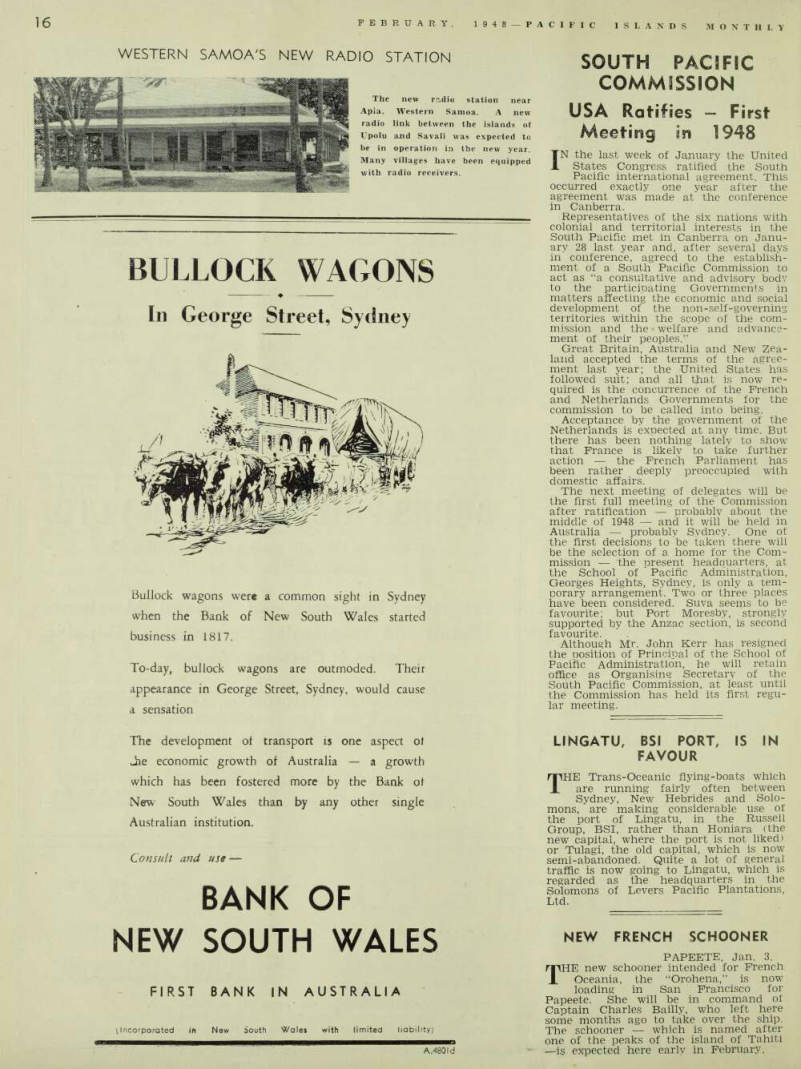
The new radio station near Apia, Western Samoa. A new radio link between the islands of Upolu and Savali was expected to be in operation in the new year.
Many villages have been equipped with radio receivers.
Commission
South Pacific
USA Ratifies-First Meeting in 1948
IN the last week of January the United States Congress ratified the South Pacific international agreement. This occurred exactly one year after the agreement was made at the conference in Canberra.
Representatives of the six nations with colonial and territorial interests in the South Pacific met in Canberra on Janu ary 28 last year and, after several days in conference, agreed to the establish ment of a South Pacific Commission to act as “a consultative and advisory bodv to the participating Governments in matters affecting the economic and social development of the. non-self-governing territories within the scope of the com mission and the welfare and advance ment of their peoples.”
Great Britain, Australia and New Zea land accepted the terms of the agree ment last year; the United States has followed suit; and all that is now re quired is the concurrence of the French and Netherlands Governments for the commission to be called into being.
Acceptance by the government of the Netherlands is expected at any time. But there has been nothing lately to show that France is likelv to take further action the French Parliament has been rather deeply preoccupied with domestic affairs.
The next meeting of delegates will be the first full meeting of the Commission after ratification probatalv about the middle of 1948 and it will be held in Australia probably Sydney. One of the first decisions to be taken there will be the selection of a home for the Com mission the present headauarters, at the School of ‘ Pacific Administration, Georges Heights, Sydney, is only a tem porary arrangement. Two or three places have been considered. Suva seems to be favourite: but Port Moresby, strongly supported by the Anzac section, is second favourite.
Although Mr. John Kerr has resigned the position of Principal of the School of Pacific Administration, he will retain office as Organising Secretary of the South Pacific Commission, at least until the Commission has held its first regu lar meeting.
Lingatu, Bsi Port, Is In
Favour
THE Trans-Oceanic flying-boats which are running fairly often between Sydney, New Hebrides and Solo mons, are making considerable use of the nort of Lingatu, in the Russell Group, BSI, rather than Honiara (the new capital, where the port is not liked) or Tulagi, the old capital, which is now semi-abandoned. Quite a lot of general traffic is now going to Lingatu, which is regarded as the headquarters in the Solomons of Levers Pacific Plantations, Ltd.
New French Schooner
Papeete, Jan. 3.
THE new schooner intended for French Oceania, the “Orohena,” is now loading in San Francisco for Papeete. She will be in command of Captain Charles Bailly, who left here some months ago to take over the ship.
The schooner which is named after one of the peaks of the island of Tahiti —is expected here early in February.
Advertisements & other items, p. 18 (1 item)
Bank Of
BULLOCK WAGONS
In George Street, Sydney
mm % Bullock wagons were a common sight in Sydney when the Bank of New South Wales started business in 1817.
To-day, bullock wagons are outmoded. Their appearance in George Street, Sydney, would cause a sensation The development ot transport is one aspect ol Jie economic growth of Australia a growth which has been fostered more by the Bank ol New' South Wales than by any other single Australian institution.
Consult and use
BANK OF
NEW SOUTH WALES
FIRST BANK IN AUSTRALIA
1 incorporated in New South Wales with limited liability; A.4801d
Sydney-Frisco Run
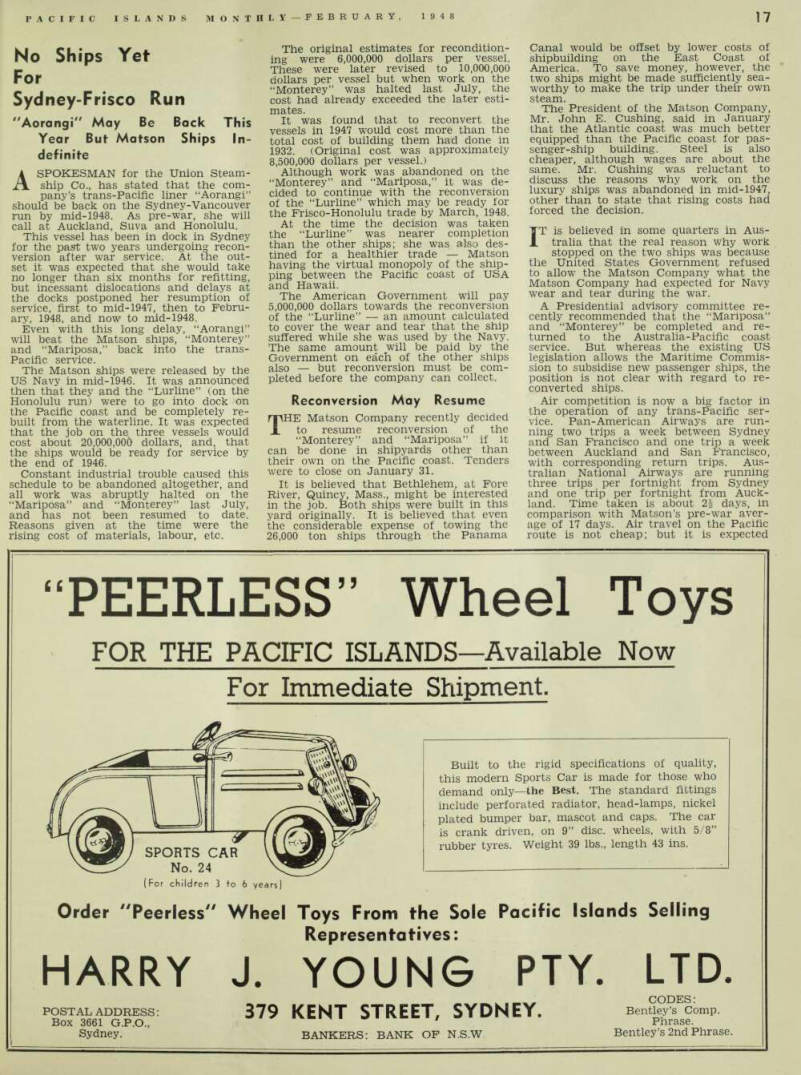
No Ships Yet For
"Aorangi" May Be Back This Year But Matson Ships In definite
A SPOKESMAN for the Union Steam ship Co., has stated that the com pany’s trans-Pacific liner “Aorangi” should be back on the Sydney-Vancouver run by mid-1948. As pre-war, she will call at Auckland, Suva and Honolulu.
This vessel has been in dock in Sydney for the past two years undergoing recon version after war service. At the out set it was expected that she would take no longer than six months for refitting, but incessant dislocations and delays at the docks postponed her resumption of service, first to mid-1947, then to Febru ary, 1948, and now to mid-1948.
Even with this long delay, “Aorangi” will beat the Matson ships, “Monterey” and “Mariposa,” back into the trans pacific service.
The Matson ships were released by the US Navy in mid-1946. It was announced then that they and the “Lurline” (on the Honolulu run) were to go into dock on the Pacific coast and be completely re built from the waterline. It was expected that the job on the three vessels would cost about 20,000,000 dollars, and, that the ships would be ready for service by the end of 1946.
Constant industrial trouble caused this schedule to be abandoned altogether, and all work was abruptly halted on the “Mariposa” and “Monterey” last July, and has not been resumed to date.
Reasons given at the time were the rising cost of materials, labour, etc.
The original estimates for recondition ing were 6,000,000 dollars per vessel.
These were later revised to 10,000,000 dollars per vessel but when work on the “Monterey” was halted last July, the cost had already exceeded the later esti mates.
It was found that to reconvert the vessels in 1947 would cost more than the total cost of building them had done in 1932. (Original cost was approximately 8,500,000 dollars per vessel.) Although work was abandoned on the “Monterey” and “Mariposa,” it was de cided to continue with the reconversion of the “Lurline” which may be ready for the Frisco-Honolulu trade by March, 1948.
At the time the decision was taken the “Lurline” was nearer completion than the other ships; she was also des tined for a healthier trade Matson having the virtual monopoly of the ship ping between the Pacific coast of USA and Hawaii.
The American Government will pay 5,000,000 dollars towards the reconversion of the “Lurline” an amount calculated to cover the wear and tear that the ship suffered while she was used by the Navy.
The same amount will be paid by the Government on each of the other ships also but reconversion must be com pleted before the company can collect.
Reconversion May Resume
THE Matson Company recently decided to resume reconversion of the “Monterey” and “Mariposa” if it can be done in shipyards other than their own on the Pacific coast. Tenders were to close on January 31.
It is believed that Bethlehem, at Fore River, Quincy, Mass., might be interested in the job. Both shins were built in this yard originally. It is believed that even the considerable expense of towing the 26,000 ton ships through the Panama
Canal would be offset by lower costs of shipbuilding on the East Coast of America. To save money, however, the two ships might be made sufficiently sea worthy to make the trip under their own steam The President of the Matson Company, Mr. John E. Cushing, said in January that the Atlantic coast was much better equipped than the Pacific coast for pas senger-ship building. Steel is also cheaper, although wages are about the same. Mr. Cushing was reluctant to discuss the reasons why work on the luxury ships was abandoned in mid-1947, other than to state that rising costs had forced the decision.
IT is believed in some quarters in Aus tralia that the real reason why work stopped on the two ships was because the United States Government refused to allow the Matson Company what the Matson Company had expected for Navy wear and tear during the war.
A Presidential advisory committee re cently recommended that the “Mariposa” and “Monterey” be completed and re turned to the Australia-Pacific coast service. But whereas the existing US legislation allows the Maritime Commis sion to subsidise new passenger ships, the position is not clear with regard to re converted ships.
Air competition is now a big factor in the operation of any trans-Pacific ser vice. Pan-American Airways are run ning two trips a week between Sydney and San Francisco and one trip a week between Auckland and San Francisco, with corresponding return trips. Aus tralian National Airways are running three trips per fortnight from Sydney and one trip per fortnight from Auck land. Time taken is about 2 h days, in comparison with Matson’s pre-war aver age of 17 days. Air travel on the Pacific route is not cheap; but it is expected
that travel on the reconverted trans pacific luxury ships will not be cheap, either.
Present dollar restrictions in Australia have curtailed all travel from the Com monwealth to the United States, and it was stated recently that planes have been leaving Sydney with only one-third of seating capacity booked. Therefore, trans-Pacific passenger ships would have to depend for much of their trade upon American tourists, or travellers from in termediate ports to and from Sydney and San Francisco.
At all events, it appears quite definite that “Monterey” and “Mariposa” will not be back on their old run this year.
"Bulolo" Will Return to Pacific
THE modern motor-vessel “Bulolo,” which was well known to New Guinea travellers just before the war, should be back in the Pacific by the end of this year.
“Bulolo” was taken over by the British Admiralty at the outbreak of war in 1939, and saw a great deal of service, both in the Mediterranean and the North Sea.
She was at almost every Allied invasion in the Northern hemisphere, and became qne of the best known Naval ships. Early in 1942, she was allocated to Admiral Mountbatten, then chief of combined
operations, as the first headquarters ship.
“Bulolo” was retained by the Admiralty until recently. Now, however, she is at a shipbuilding yard in the Clyde under going reconversion. This is expected to be complete by May, 1948.
The ship, when she was taken over in 1939, was owned by Burns Philp & Co., Ltd. Since then, however, much has altered in the Australian shipping world and most of Burns Philps 4 island ships are still controlled by the Australian Shipping Board.
It is unknown, at present, whether or not “Bulolo” will be returned to the Big Firm; or what Pacific run she will under take. The Papua-New Guinea service is more in need of a ship of the “Bulolo’s” capacity now, however, than it ever was when the ship was first put on the run in 1938.
The “Montoro,” which had been re tired and virtually disposed of at the outbreak of war, is still doing the bulk of the work on the Sydney-New Guinea route.
Advertisements & other items, pp. 19-20 (1 item)
‘PEERLESS” Wheel Toys
FOR THE PACIFIC ISLANDS—Available Now
For Immediate Shipment.
w
SPORTS CAR
No. 24 9. hild rcn Built to the rigid specifications of quality, this modern Sports Car is made for those who demand only—the Best. The standard fittings include perforated radiator, head-lamps, nickel plated bumper bar, mascot and caps. The car is crank driven, on 9” disc, wheels, with 5/8” rubber tyres. Weight 39 lbs., length 43 ins. years) Order "Peerless" Wheel Toys From the Sole Pacific Islands Selling
Representatives:
HARRY J. YOUNG PTY. LTD.
POSTAL ADDRESS:
Box 3661 G.P.0., Sydney.
379 KENT STREET, SYDNEY.
BANKERS: BANK OF N.S.W
CODES:
Bentley’s Comp.
Phrase.
Bentley’s 2nd Phrase.
We Will Buy
It For You
Any goods you may require from English shops or factories Purchased and Shipped.
Small or large orders catered for.
ALL SERVICES UNDER-
TAKEN FOR RESIDENTS
ABROAD.
PITT & SCOTT
LIMITED
(Established 1876) General Shipping and Buying Agents. 1/3, St. Paul's Churchyard, London, England Cables. Shipping London.
co> \J< . ' i Confidence and what it means to you!
Head down, eye on the ball, feet correctly BjJRr Placed, club held firmly, smooth follow-through.
All this detail is lost without confidence ! .. The medical profession and public S “ have had absolute confidence in genuine Vincent’s A.P.C for over 25 years.
Vincent’s A.P.C is prepared to the original hospital formula and, therefore, is a proved and fully accepted medical prescription!
Take Vincent's A.P.C for HEADACHE. FATIGUE,
NERVE & MUSCULAR PAIN
i /
VINCEN;
Over a Quarter of a Century of Pain Relief!
A
VINCE
[ToOSIIII
NC.6D.19
NTSIH
POWDERS & TABLETS
Ng Scholarship Fund
THE New Guinea Scholarship Fund showed a substantial increase dur
ing January. Miss Dorothy Stewart,
Secretary of the Fund, reports from
Rabaul that the following amounts were received:— Acknowledged to December 31, 1947 £3,416 5 6 Mrs. L. Pratt, 31 Alma Street, East Malvern, Vic. (Proceeds raffle fountain pen) 4 12 0 Mrs. E. D. and Miss Betty Gas coigne, 21 Clark Street, Prahran, Vic 500 Mrs. Ray and Miss Valda Youlden, 21 Clark Street, Prahran, Vic. . 2 2 0 S. M. Ruddell, Palms Theatre, Rabaul 220 Mr. and Mrs. Dal Chambers, Induna Plantation, Rabaul ... 550 Mr. and Mrs. W. A. P. Luke, Wire less Station, Rabaul 10 10 0 Anglican Mission and Diocese of New Guinea, Samarai, Papua .. 10 0 0 Total as at January 31, 1947 .. £3,455 16 6
Meaning "Experts"
Native Races And Well
A NOTE from Dr. Francis W. Hughes, of Edenton, North Carolina, USA: I take this opportunity to commend your policy of conservation against the way present-day governments are making asses of themselves in native adminis tration, guided principally by “experts” who have never seen a native except per haps on a casual visit.
I lived two years at a MG Hospital in the Marshall Islands; I speak Marshal lese fluently, and believe that I know the people better than most Americans; and I am familiar with Samoans to a lesser extent.
We have little to offer the Marshallese culturally or economically other than medical care. Their clan form of social organisation meets their every social problem their islands, while affording a comfortable and secure living, cannot produce money to buy much outside goods. Yet our Government discourages their clan and chieftainship systems and offers but a poor substitute.
It appears to us that the ideal govern ment there would be based on that of Tonga, with a minimum of interference by officious pedagogues who don’t under stand and don’t care to understand native psychology.
I am, etc.,
Dr. Francis W. Hughes
Neglected Wealth
The Dismal Story Of The New Guinea Timber Industry
From a Special Correspondent
Port Moresby, Jan. 23
APROPOS of the inquiry concerning New Guinea leases, now proceeding in Sydney—if you will turn to page 23 of the “PIM” of October, 1945 (over two years ago) you will see that you published the following, based on an in terview with Mr. Tom Flower, the Papua sawmiller: — “One report says that the Government —or, at least, four minor Ministers, re presenting a little-respected section of the Government has been carrying on discussions with a ‘local syndicate,’ headed by a Wau dentist and a New Guinea aviator, and that the negotia tions had proceeded a considerable dis tance. It was not indicated that any of the interests concerned had any prac tical knowledge of the lumber industry— the profit motive seemed to be the main consideration.
“Well-wishers of New Guinea hope still that the Australian Government will display enough vision to use Australia’s clamant hunger for timber to establish a new and profitable industry in that Territory. The only certain way to do this is to throw the situation wide open to private enterprise, under proper con trol. But no such decision is expected from the people who now are in charge in Canberra. Thev are more likely to try to establish a State-owned industry.”
At that time (1945), Mr. Flower said he had all the plant and facilities avail able for quickly developing a big timber export industry, for the great benefit of
these Territories, but he could not get the Australian authorities to move, in his favour, or in any other direction.
It is interesting to know now, after the lapse of more than two years, that Mr. Flower is still trying to get some as sistance and co-operation from the Ad ministration, but in vain. He says he has enough equipment at hand to supply all the needs of two Territories—but he cannot get logs to saw.
He has been granted an area about 18 miles from Port Moresby—but this is on the other side of a range, and he can not get at it until he has constructed six miles of road. He cannot now work this area, in any event, because this is the wet nor’west season. When he asked permission to get logs off another area, near a river on which he could have floated the logs out, the Administration said it was agreeable—but it would have to call public tenders.
No one objected to that —but the Ad ministration is still dithering around, and nothing is done in the way of formula ting a timber policy.
Why—O why—do the powers-that-be not get on with the job, and give the Territories a chance to benefit substan tially from this world-wide clamour for timber! Inquiries for timber are arriv ing here from all parts of the world.
The demand is incredible.
Mr. Flower tells me that he is ship ning logs regularly to Australia —mostly Ilimo, from the Laloki River —and his Sydney buyers have given him carte blanche to supply as much as he can. Il imo in Sydney is commanding 99/3 per hundred super ft., fixed price, which is 47/- more than NSW hardwoods. Yet the Port Moresby experts class Ilimo as third-class timber and fix the price of
1-inch planks at 52/6, less 10 per cent, to the Government —which is 10/- per hundred super feet less than local hard woods.
Papua and New Guinea have sources of great wealth in their gold, coconuts, timber, and so forth, all more or less awaiting the magic touch of private enterprise to bring large revenues to all concerned. But the Government hates private enterprise, and does little or
nothing to help miners, planters, traders and sawmillers. But it is spending Aus tralian taxpayers’ money at the rate of about £3,000,000 per annum, in an attempt to establish a kind of Elysium for natives who are not yet out of the Stone Age.
What a set-up!
Advertisements & other items, p. 21 (1 item)
Brial & Ball
"Your Yeast
has No Rival"
From MADIRI, Fly River, via Dam, Papua, comes the following Testimonial to MALTO-PEPTONE DRIED YEAST: “For the Tropics, your Yeast has no rival. We have found it entirely satisfactory and are very pleased we learned of it.” (Sgd.) T.H.
MALTO-PEPTONE
DRIED YEAST
is 100% Pure Yeast. It has been on the Market for 12 years and is GUARANTEED to retain its vitality for months in ANY Climate. Ready for use in a matter of minutes, and users claim that, through its aid, they can Bake Bread In 3*A hours! Trial Size Carton (2 oz.) 1/7 — V* lb. 2/8— Vs lb. 4/ff —all Post Free. Send Stamps. Postal Note, Money Order or Cheque for a supply—NOW! !
AUSTRALIAN YEAST CO.
Oakleigh, Victoria —Australia.
BRIAL & BALL
Can Supply you with
SANDSHOES
RUNACAN” BRAND.
IN UNLIMITED QUANTITIES AND IN A WIDE RANGE OF
STYLES AND PRICES
Inquire through your usual channels for full particulars
SOLE DISTRIBUTING AGENTS FOR PACIFIC ISLANDS:
BRIAL & BALL
1 BOND ST., SYDNEY.
31 QUEEN ST., MELBOURNE.
"Cheng Ho" At Tahiti
Papeete, Jan. 19.
THE French junk “Cheng Ho” arrived here in December, from Honolulu, via Christmas Island. She is in command of her new owner, Mr. Eric de Bishop. They expect to leave in a few days on the return voyage to Honolulu.
A new bi-weekly newspaper, “Le Cale donien,” founded and directed by Mr. P.
Jeanson, has made its appearance in Noumea, New Caledonia.
The Change Among The
Territories' Costs
The Change Among The Natives
Prom a Special Correspondent
Port Moresby. Jan. 17.
ALL costs in the Australian Pacific Territories are soaring, and it is be coming increasingly difficult to pro fitably conduct any kind of enterprise, in the face of an unsympathetic Admin istration.
It now costs 18/- per week to feed a native labourer, and it is common to hear of them getting £lO per month, and found.
Even so, most of them seem to have lost the will to work, and their ways of life are changing. By the appearance of some of them—who prefer a bottle of lolly-water and a loaf of white bread to their old kai-kai of rice and bully beef —the change is not to their advantage.
It is sheer folly to try to bring them from the Stone Age to the present period in one generation.
We have been accused of “exploiting” the natives, in the 20 years between the Wars. But, by comparison, the New Planners have done the natives far more harm in the last seven or eight years than we did in 20 years. Our natives were much better off, happier and healthier —they were making the grade, from Stone Age to Petrol Age, quite sat isfactorily. The present-day natives are bewildered, depressed and unhealthy— they don’t know where they are, or where they are going.
One never hears natives nowadays sing ing, as they used to do. Now, when they put on a dance or sing-sing, they dodge the native dress, and wear singlets, shorts, shirts —almost everything except a mess jacket and black pants.
They are now full of big ideas about what their pay and conditions should be —the New Planners have crippled the white employers and more or less ruined the native labourers.
I sometimes wonder what our old friend Sir Hubert Murray would say if he could see the conditions that have developed within so short a time in the country he loved and understood so well.
Outstanding Young Fijians
Returning Home
Prom Our Own Correspondent
Suva, Jan 12
TWO young Fijian leaders, Ratu Ed ward Cakobau, MC, and Ratu Penaia Ganilau, have completed their course in administration at Oxford University, and sailed from England for Fiji at the end of January.
Dr. J. A. R. Dovi, who had a bril liant career as a medical student in New Zealand and later served in Fiji and with the Fijian forces during the war, is now returning to Fiji from the British Solomons, where he has been stationed for 18 months.
He will go to England this year for further study.
Samoa's Big Surplus
Apia, Jan. 12
THE Administrator, Colonel F. W, Voelcker, reported to the Samoan Legislative Council to-day that the revenue anticipated at the end of the present year was approximately £529,760 and expenditure £442,170. It was re ported that Administration salaries and wages would amount to about £lOO,OOO, but would probably be increased by £50,000.
Advertisements & other items, p. 22 (1 item)
Robert Gillespie Ptv Ltd
Gilbert Renton
AUCTIONEER, VALUER,
ESTATE AGENT.
Storage and Repository Travellers Sample Rooms For General Information and Service.
P.O. Box Rabaul, TNG
IMPORTERS
EXPORTERS
ALL CLASSES OF MERCHANDISE PURCHASED FOR ISLAND CLIENTS
THROUGHOUT THE SOUTH-WEST PACIFIC.
ISLAND PRODUCE SOLD ON AUSTRALIAN AND OVERSEAS MARKETS
ON COMMISSION BASIS.
ROBERT GILLESPIE PTV LTD
I ANKERS; BANK OF N.S.W.
COMPTOIR NATIONAL
DESCOMPTE DE PARIS
54a PITT ST. SVDNEV N.S.W.
CABLE ADDRESS:
“ROB ERG ILL"
PHONES BW 4782-B 1305
Paper Pulp Co's Interest
In Papua
IT is interesting to note, from the list of Crown Lease rents, published in the Papua-New Guinea Gazette of January 19, that the British Australian Pulp and Paper Co., Ltd., now has ex tensive leases in north and north-eastern Papua.
Total area of the Company’s leases is between 60 and 70 thousand acres, an nual rental amounting to over £BOO.
An exclusive right to cut kurukuru grass (called kunai, in the old Mandated Territory) was granted the company in this area last July. Kurukuru has been compared to Esparto and is capable of being manufactured into high grade paper.
There has been no indication from Papua that the company has, as yet, cut any grass or began operations on its leases.
Mahogany In Fiji
Experiments in the cultivation of large-leafed mahogany which have been carried out in Fiji indicate that it will be a useful asset to the colony.
Small-scale experiments have been started to examine the possibility of improving the natural forest by means of strip-planting mahogany at wide in tervals. Eight-year-old trees have now grown to between 30 and 40 feet high.
During the war seed was unobtainable, but supplies have since been received from Ceylon, and large-scale planting will now be undertaken.
Some years ago two trees from Fiji were sent to the Imperial Institute in London. A very favourable report on the qualitv of the mahogany was re ceived and it appeared that the tree was suited to Fiji’s needs. —“NZ Herald.”
Bishop Kempthorne's
25th Anniversary
ON March 4 this year the Rt. Rev. L.
S. Kempthorne will have attained the 25th anniversary of his conse cration as Bishop in Polynesia. His headquarters are in Suva, Fiji where he is well-known and highly esteemed.
Bishop Kempthorne is a New Zea lander, and is a member of a well-known clerical family. He took his degree at Oxford in 1914, and .later went as a missionary to West Africa for two years.
This was followed by a few years in Eng land. In 1920 he returned to the mission field, this time to the Federated Malay States. He was still there when the New Zealand Bishops chose him to succeed Bishop Twitchell as Bishop in Polynesia.
Bishop Kempthorne’s 25 years’ service constitutes a record unequalled by any Anglican Bishop in the South Pacific.
Death Of Mr. James Scobie
MR. JAMES SCOBIE, who was well known before the war, on the Morobe goldfield, in New Guinea, where he was connected with the Black Cat Mine, died in the Royal North Shore Hospital, Sydney, on January 21, aged 67. He served on “the small ships” in the waters north of Australia during the war, but his health by then had broken, and he did not return to the Territory.
As a veteran, he took a keen interest in the affairs of the Returned Soldiers League, and he was a foundation member of the organisation which is establishing an RSL Club at Milsons Point. RSL men were strongly represented at the funeral on January 23.
Lae Citizens Association
AT a recent meeting of the Lae branch of the New Guinea Citizen’s Asso ciation the following officers were elected! ■ President, Mr. P. Phillips; vice-presi dent, Mr. Forbes; treasurer, Mr. L. Webb; secretary, Mr. H. G. Eekhoff; publicity officer, Mrs. Phillips. Committee: Messrs.
Thompson, Boettcher, Whittaker, Peter son, Marchant, Jenyns and Mrs. F.
Stewart.
Advertisements & other items, pp. 23-24 (1 item)
Burns Phiip (South Sea) Go. Ltd.
If You
Cannot Sleep
FEEL FIT FOR NOTHING.
You may be anaemic or bloodless, for this ailment plays havoc with your health and nervous energy. You feel terribly nervy; suffer headaches and dizzy spells, have poor appetite, cannot sleep at night —losing those precious hours of rest and recovery, essential for your health and fitness.
Many people have recovered from these miseries by taking Dr, Williams’ Pink Pills, which have reinvigoraTed. strengthened their systems and banished the vague pains and weariness. Dr. Williams’ Pink Pills always help to enrich and increase the blood supply, giving beneficial help to the nerves, tissues and organs of the body. With enriched blood you cannot help feeling happier, sleeping better, becoming reinvigorated.
Stop anaemia making you a suffering invalid without delay. Take Dr. Williams’
Pink Pills and soon notice the difference in your eyes, skin, nerves and general health. At all chemists and stores.
BURNS PHIIP (SOUTH SEA) Go. Ltd.
ISLAND TRADERS AND SHIPOWNERS
General Merchants (Wholesale and Retail)
Shipping, Customs and General Agents
Representatives for QUEENSLAND INSURANCE CO. LTD.
Distributing Agents for SHELL COMPANY (PACIFIC ISLANDS) LTD.
Registered Office: SUVA, FIJI
Code Address: “BURNSOUTH”
FIJI—
BRANCHES:
SAMOA—
APIA.
PAGO PAGO.
Sydney Agents;
BURNS, PHILP & CO., LTD.,
7 Bridge Street.
SUVA.
LEVUKA.
LAUTOKA.
LAB AS A.
BA.
SIGATOKA.
ROTUMA ISLAND.
TONGA—
NUKUALOFA.
HAAPAI.
VAVAU.
San Francisco Agents:
BURNS, PHILP CO. OF SAN FRANCISCO,
Matson Building, 215 Market Street, London Agents;
BURNS, PHILP & CO., LTD.
UKJNo, irniJ-iir esj ovj., uj-u., 35 Crutched Friars, E.C.3.
NORFOLK IS.—
NIUE IS.—
Agencies Throughout the World.
Woven Wire for all Industry
COPRA DRYING TRAYS, FLOORS, Etc.
FRUIT DRYING TRAYS, MINING SCREENS.
Heavy Mosquito Gauze in Phosphor Bronze and other Metals Impervious to Salt Sea Air.
WIRE DOOR MATS AND GENERAL WIRE WORKS
E. WRIGHT & CO. LTD.
Office and Works: 148-152 Cleveland Street, Sydney, N.S.W.
Telegraphic Address: “Wrightmake,” Chippendale.
VICTORIA
BITTER
BIEVEB IT
CARLTON & UNITED BREWERIES LIB.
Mr. Ward Reports To
Last Year In New
Guinea
Mr. Ward Reports To United Nations
From Our Own Correspondent
I Pt. Moresby. Feb. 1
N presenting the 1946-47 Annual Report of the Territory of New Guinea to the cv.3^ steeshl ? Council, Australia has shown exemplary promptitude, for which members of the Council expressed appre ciaxion.
The report, however, does not fully cover the questionnaire issued as a guide to Trustee nations. In a brief intro ductory apologa, Mr. Ward explains that shortage of time, the considerable diffi culties of rehabilitation, and disruption caused by the war, prevented the com pilers from complying fully with the sug gestions made in the questionnaire. . A brief statement of Australian policy in New Guinea is given in the most gen eral terms, and it closely follows Mr.
Ward’s famous second reading speech of 1945. The statement is as follows “ The cardinal points of the Govern ment's policy are the fullest possible de velopment of the Territory, and the social economic and political advancement of its inhabitants, both native and non-native The basis for the economy of the area will be native and European Industry working side by side, but with the limit of non-native expansion determined bv the welfare of the natives generally.
“The Government aims to provide full facilities for better health, better educa tion. and for an increasing participation by the natives in the wealth of their country and eventually in its govern ment.”
The Report lists three major difficulties with which the Administration has been confronted since the war:— • Shipping: Apart from the general shortage of overseas ships, the number of coastal small craft was also greatly re duced by the war. To restore an adequate coastal service, eight vessels of 100 tons each have been, or soon will be, con structed in Australia. • Native Labour: The war considerably reduced native population figures, caused the destruction of villages, and generally disturbed the equilibrium of native com munal life. Therefore,, states the Report, “even under favourable conditions it will be difficult to supply fully the native labour requirements of the Territory.” • Materials and supplies: Serious short ages have prevented large-scale rebuild ing. rE Report then claims the following achievements for the present Ad ministration: — • The re-establishment of adminis trative machinery and the resumption of contact with the native peoples. • “The rehabilitation of commercial enterprises.” • The disposal of services stores and equipment. • The provision of shipping services. • Preparation for the rebuilding of the townships and settled areas: “Although major works in this connection had not been commenced at the close of the year, extensive examinations had been carried out by town-planners and other technical officers.” • The provision of wharf facilities. • The organisation of a Public Service and the appointment of officers thereto. • The establishment of the Australian School of Pacific Administration. • Re-establishment training for natives
under the Department of Post-war Re construction’s Training Scheme. • The introduction of a new Native Labour Code.
'• The organisation of a Nutritional Survey of the inhabitants. • The appointment of an Inter-De partmental Committee to co-ordinate plans for the development of the Territory.
Trade Balance
Import and export statistics have, of course, shown an extreme deterioration compared with the position in 1940.
P 1939-40 1946-47 Exports 3.247,585 415,12o Gold exports .. 2,797,226 179,000 Imports 962.129 1,151,811
They Had What It Took
Letter to the Editor IN November “PIM” under the heading “Survey of New Guinea,” there ap peared a paragraph stating that most of the AIF who obtained their discharge here were leaving NG, as they were not suited to Islands life, with its demands on endurance and patience.
Those boys must have had endurance and patience, plus, to carry on here dur ing the war years. The inference per taining to stolen motor parts, was written in very bad taste, and the smug re mark that such thefts were foreign to this part of the world pre-war is rather amusing. I have recollections of a gold brick disappearing in this part of the world before the war.
If New Guinea was again threatened by a foreign power, we would possibly be a little more tolerant with these boys when we welcomed them back.
I am, etc.,
One Of The B4’S
New Guinea.
The Reverend Father Chervier, of the Roman Catholic mission on Ovea, Loyalty Group, recently died as a result of injuries received when he was gored by a bull.
The Rt. Rev. J. M. Aubin, Roman Catholic Bishop of the South Solomons,
left Guadalcanal in January for his first visit to Rome since his consecration in 1935. The war intervened when he was planning a visit for 1941. He will be away for six months, including a visit to his native country Prance and to England and America.
Advertisements & other items, pp. 25-26 (1 item)
akPUOh
Steamships Trading
Company Limited
PORT MORESBY
SAMARAI
PAPUA.
WHOLESALE & RETAIL MERCHANTS, SHIPOWNERS,
PLANTERS, ENGINEERS & SLIP PROPRIETORS.
Customs, Shipping, Insurance, and forwarding Agents.
MANAGING AGENTS AND VISITING REPRESENTA-
TIVES FOR COCONUT AND RUBBER ESTATES.
SYDNEY REPRESENTATIVES: Nelson & Robertson Pty. Ltd- -12 Spring Street
Flood your home with brilliant light!
Imagine it just flick a switch and on comes a flood of electric light. How the children and Mother will delight in this new pleasure which every home needs to be really restful and cheery!
With the Amplite Farm Lighting Unit, you can serve every room, and outhouses, grounds, garage— with pulsing current—even run a vacuum cleaner!
We would like you to have our buy.
Manufactured hy —
akPUOh
Australasia Pty. Ltd. m 4
• SOME QUICK FACTS
ABOUT THIS GREAT UNIT
• Light in weight. Plant weighs only 70 lbs. • Runs for 8-10 hours on one gallon of petrol. • Air-cooled, 4 cycle engine. • Run a few hours per week, will keep your batteries charged. • Electrical self-starting. No cranking of engine.
WfT
YOU'LL FIND IT
FASCINATING
READING
Messrs. AMPLION (A/ASIA) PTY„ LTD.,
36-40 Parramatta Road, Camperdown, N.S.W.
J Dear Sirs: Please let me have your Illustrated Farm Lighting Unit brochure, Publication APC7C.
I Name Address “MM," 9/47.
VETERINARY
INSTRUMENTS
For Sheep and Cattle can be
Supplied Immediately
EARMARKERS.
SPEYING INSTRUMENTS'.
BULLRINGS.
FIRE BRANDS.
EMASCULATORS.
W. JNO. BAKER
FTY. LTD.
3 Hunter Street, Sydney, N.S.W., Australia
PRODUCING UNIFORM GOOD RESULTS SINCE 1868
ALWAYS ASK FOR IT
BROOMFIELDS Ltd.
Suppliers of
Building Hardware
General Hardware
Ship Chandlery
Paint Materials 4i
WRITE DIRECT TO
Broomfields Ltd.
152 SUSSEX STREET, SYDNEY
Sole Agents tor : P. H. MUNTZ & CO.’s 3-CROWN BRAND METAL
SHEATHING.
PEACOCK & BUCHANS’ ENGLISH BEADY-
MIXED PAINTS.
Giant Snails
Rabaul, Jan. 8.
fTIHE giant snail increases apace.
X This evil could be greatly curtailed if District Officers were instructed to make the native villagers gather and burn them. Black brother has deterior ated so greatly of late, through inactivity, that the gentle art of catching snails might be a good way to set him in motion again without administering too great a shock to his system.
Prices Rise In Fiji
rERE was a sharp increase in the controlled prices of essential com modities in Fiji in November. Flour and sharps rose from Sid. for 2 pounds to for one pound. Petrol was in creased in nrice from 2/7 to 3/- per gallon.
BSI Wet Season Begins
With Floods
From Our Own Correspondent • honi ARA, Jan. 22.
BNORMAL rams for a fortnight opening the wet or Nor’-west season i to • the worst flooding of Guadalcanal rivers on January 6 7 8 Sir C^i h6 t^ ar ' time bri dges were erected’
Rlv £- was the chief culprit. In spite of combined American and British reinforcement late last month of the br?d^ ree fhl ear "°J d A m eri can-built timber bridge, the entire 200-feet length of a^J mg and maston matting was SSrtrf&fiT?. downstream ° n «» r * ver rose more than 12-feet, over w b / nks hal - f a mile each si de, buried Henderson airfield under a foot nnr^ofi 1 * a ?i? st retched a mile wide where fnto the sea 6 separate mouths empty Luckily the little-used upper Lunga bridge stood up to the strain of the flood —mainly because the main flood channel tvJo b K 1^S b. d v, bri i? fallen trees broke over the bank higher up and made a detour n £ w . P recar i°usly carrying essential camn KjS 6 ? th s US headquarters at LST’s tS u d 1 and Kukum ’ wher e US v o S ßbna £: ly ’ he - BSI Government will fw?}% Ce missing bridge with one of the five Bailey bridges imported last year but the equipment essential for their erection has not arrived yet.
Death Of Mr. James Sim
HIS many Solomon Island friends will regret to learn of the death at his home m Chatswood, NSW, of Mr James Sim, on January 30. Death came with tragic suddenness. Mr. Sim ap peared to be in his normal good health on rising; but soon afterwards he was stricken with heart seizure, which almost immediately proved fatal.
James Sim was born in Scotland, and, after a varied and adventurous career went to the Solomons over 30 years ago as a plantation manager for Levers Pacific Plantations Ltd. At that time, the way of the pioneer was rough, and conditions were hard and precarious.
In later years, and up to the time of ms retirement, Mr. Sim was Inspector of Plantations for LPPL, a position which gave scope to his undoubted talent for efficient organisation and sound ad ministration. He is survived by Mrs Sim, their daughter Jean (Mrs P F Wilson) and grand-daughter, Helen
Anglo-French Raise £600 For
Britain In N. Hebrides
THE British Community of the New Hebrides recently organised a drive to raise funds for sending food par cels to Britain. The French community also were most generous in their support.
A sum of over £6OO was thus obtained.
Entertainments took the form of a dance, children’s gymkhana, a quiz and variety show, and a card evening.
The functions afforded much pleasure, no less from the spontaneity of the or ganisation than from a desire to parti cipate in such a worthy cause.
A new Land Board was appointed by the Administrator of Papua-New Guinea at the end of December. It now is com prised of Mr. E. E. Washington, chair man; and Messrs. W. W, Watkins, I.
Champion and M. C. W. Rich members.
Retiring members are Mr. E. P. Holmes, chairman and Messrs. E. B. Bignold and W. R. Humphries, members.
Copra Values
How New Guinea Producers Are Being Robbed
The following letter was sent to the editors of Australian Metropolitan newspapers on January 27 by the editor of the “Pacific Islands Monthly”. Most of them printed it:— THE difference to the primary producer between Socialist control of mar kets and a free market is illustrated by the case of the New Guinea coco nut planters.
For copra delivered into depots at Rabaul, Samarai, or Port Moresby, the Commonwealth Government to-day pays the planter £35/10/- per ton—£34/17/6 in the case of Madang, Kavieng and Kokopo. That copra is sold by the Com monwealth in Sydney at between £5O and £5l/10/- per ton. In British Colonies—such as Fiji, Ceylon, Malaya— the price is controlled under a system whereby the British Socialist Govern ment compels its Governors to buy all copra for the British Department of Food on contracts extending over 2, 3 or 5 years. The price paid in Fiji de livered into store is now £3B per ton (Fijian Currency, equal to nearly£43 per ton Australian). The price in Ceylon and in Malaya is considerably more—the latest report puts Ceylon copra at about £6O sterling per ton.
But in the world’s only free market— that is in the north Pacific, where the law of supply and demand operates with out restriction between the great copra producing territory of Philippines, and North America —the price of copra a fortnight ago was 345 dollars per ton C.I.F. Vancouver —well over £lOO Aus tralian. Prices quoted in the Chicago Journal of Commerce of December 9 and December 19 show that vegetable oils (soya bean, cotton seed, corn, peanut, linseed and coconut) range from 21 cents to 33 cents per lb. Crude coconut oil on December 9 was quoted on the Pacific coast at 25 cents per lb. —equal to over £2OO Australian per ton.
Why should New Guinea coconut pro ducers be robbed in this outrageous fashion? Australian growers of wool and wheat, because they have representa tion in Parliament and can pack a heavy political kick, get something like world parity. New Guinea planters having no representation and being com pletely at the mercy of Minister Ward’s bureaucracy, are robbed, on British Empire prices, of anything from £lO to £2O per ton on copra, and on world free market prices of very much more.
Seeing that New Guinea planters suffered far more in the war than any other Australian producing class, surely political decency and common justice might have insured that these people were allowed to benefit to the fullest extent from the world’s present extra ordinary prices.
It was shown months ago that New Guinea copra producers were being grossly underpaid by the Socialist Gov ernment. Driven into a corner, the Gov ernment then announced that it was withholding £6 per ton from copra producers and creating a “stabilisation” fund—for what purpose has never been explained. The planters, for a variety of reasons, have no confidence in any such plan—all they ask is that they be freed of Government interference and be given the benefit of world parity, like any other Australian producers.
Advertisements & other items, pp. 27-28 (1 item)
Cinevox
Motion Picture Entertainment
now available to Island
Residents!...
IMMEDIATE
DELIVERY
CINEVOX
16mm
Sound - On -
PROJECTORS
“Movies” are now available as a welcome amenity for Pacific areas! We have the equipment, the leading motion picture producers have the film supplies and there is an excellent opportunity for enterprising island residents to provide this much-needed entertainment and at the same time make it a profitable career. The Cinevox “Exhibitor” (shown above) operates from AC or DC power supply or from mobile power units. It is portable and can be operated by anyone after a minimum of tuition. Thoroughly dependable, it gives perfect reproduction under all conditions; comprises dual projectors and sound heads with high gain high-fidelity amplifiers, including multiple speakers in special baffle cases—ensuring maximum audience coverage.
Distributors for Fiji, Tonga, Nieu, and New Zealand Island Territories:
R. A. USMAR Cr CO. LTD.
Dominion Building, Mercer St.,
WELLINGTON, N.Z.
Telegrams and Cables: “ENZEDFILM,
WELLINGTON.” G.P.0., Box 1401.
Distributors for Papua, New Guinea, and Pacific Islands:
VIZ-ED EQUIPMENT (QLD.)
PTY, LTD.,
Courier Building, Queen St.,
BRISBANE
Telegrams and Cables: ‘‘VIZ-ED,
BRISBANE.” G.F.0., Box 754 K.
At Right:
CINEVOX "SENIOR"
This is the ideal equipment for schools, missions, etc., and is widely used throughout Australia by State schools, religious bodies, and commercial organisations.
CINEVOX
y mm a * wholly designed * and built in
Australia by
PRECISION ENGINEERING CO. PTY. LTD.
PADDINGTON, NSW.
Washing up is child's play . .
No broken or chipped dishes, none of the drudgery of constantly rubbing and scrubbing a worn and stained sink when you instal a satin smooth hygienic Wunderlich Unit in your kitchen. Available for immediate delivery in standard sizes 4 ft., 5 ft. and 6 ft. long by I’6" wide, the unit features a commodious bowl and is backed with timber to simplify installation.
Ask your local Hardware Merchant, 'phone MX 2411, or write to Box 474, G.P.O. Sydney, for particulars and prices.
INK UNITS
' IN STAIN LESS STEEL
Allen Taylor 81 Co. Ltd.
COMMERCIAL ROAD, ROZELLE,
SYDNEY
Sawmillers and Wholesale Suppliers of Hardwoods for Constructional Purposes GIRDERS . . . PILES . . . POLES , . SLEEPERS, Etc
EXPORTING TO PACIFIC ISLANDS SINCE 1893
Scott's “Renown” Brand Rope,
Cordage and
Binder
Twine
of Every
Description
3able Address Ropeyard, Sydney.
MANUFACTURED AT
MASCOT, N.S.W.
J. SCOTT
PTY. LTD.
Head Office and Store
163 CLARENCE STREET.
SYDNEY,
N.S.W.
Native Copra
BSI Government Buys Native Copra New Venture By "Trade Scheme"
From Our Own Correspondent
Honiara, Dec. 29
A RECENTLY introduced method of dealing with copra produced by Solomon Islanders, appears to be working well. Previously, the Govern ment shipped native-produced copra to Yandina, in the Russell Group, on con signment. (Fairymead Sugar Company, of Yandina, are BSI copra agents). Now the Government Trade Scheme (which takes the place of the pre-war trade stores run by commercial firms no longer operating here) will buy copra on the beach from native producers at the fixed price of £26 per ton.
District Commissioners act as agents for the Trade Scheme, which will not purchase copra in areas where private copra buyers are operating. The Gov ernment aim is to assist producers by providing equal marketing facilities in areas where none exist.
If producers prefer to ship their copra to Yandina for sale themselves, the Gov ernment assists them with freight space on Government vessels, but, the producer himself is then responsible for handling the financial transaction involved.
Western Solomon Island producers, who are responsible for the bulk of native-produced copra here, have wel comed the scheme and sold 120 tons of copra in the first three weeks it was in operation. At the same time they are inquiring how soon before they can hope to see more trade goods available.
A new Government B-class vessel, “Biliki,” arrived in the Group in mid- December. She has been allotted to the Trade Scheme and will work in the Wes tern Solomons for the first few months, carrying copra to Yandina and trade goods back to the West.
High Cost Of Moving
Us War Dead
From Our Own Correspondent
Honiara, Jan. 19.
AT the moment, nearly 6,000 American war dead are concentrated at Ku kum, main port for Honiara. They are due to leave within a few days for Oahu, Hawaii and the United States.
A Victory ship arrived here last week carrying 2,400 dead from US cemeteries in Australia, to add to the 3,400 dis interred from Lunga war cemetery, Guadalcanal.
The bodies are all contained in bronze handled, stainless-steel caskets, lined with linen and satin.
A US officer unofficially this week estimated that the cost of re-casketing and removing each body to its destination will run into nearly 1,000 dollars apiece.
The cost of this particular operation, therefore, is in the vicinity of six million dollars.
Prom here, the War Graves’ Registra tion Service personnel, with their work ing gang of 500 Filipinos, will go on to similar operations in Saipan.
Mr. R. R. Mason, formerly a member of the Huntingdonshire War Agricultural Executive Committee, and ex-RAP, has been appointed to the Colonial Service in London and will go to Fiji as an
agricultural officer.
Fiji Quarantine
Relaxed
Outbreak of Poliomyelitis in BSI Admitted
Prom Our Own Correspondent
Suva, Jan. 19.
ABOUT 16 cases of poliomyelitis have been reported in the British Solomon Islands Protectorate. Vague rumours about the outbreak were confirmed by a “Fiji Times” announcement, backed by a seemingly reluctant and very brief com ment extracted from the Western Pacific High Commission. (It appears to be one of the Commission’s most cherished tra ditions that publicity might have calami tous effects on the British Empire.) There is a suspicion that the disease is endemic in parts of the Solomons, but this has in no way allayed the alarm of many people in Fiji over the relaxation of quarantine at a time when New Zea land, Australia and the Solomons are all infected areas.
Despite the fact that the epidemic in New Zealand shows no sign of waning, people from the Dominion who come to Fiji are subjected only to “medical sur veillance,” whatever that may be, as an effective safeguard.
Western Samoa still refuses to allow any passenger from New Zealand to land, but, barring the Christmas quarantine of 40-odd children, Fiji, has done little.
Further, the Medical Department ap pears to out undue stress on the mislead ing word “infantile” when it is clear that poliomyelitis is no longer confined to infants.
Public opinion to-day is sharply de fined: Fiji, and more especially the Fijians, have suffered too much in the past from needlessly - introduced epi demics.
Bsi Farewells Popular
Officials
From Our Brisbane Correspondent
Honiara, Jan. 9.
DEPARTED from the Protectorate on January 8 four well-known identi ties:—Major G. E. D. Sandars, Dr. and Mrs. A. G. Rutter, and Dr. Dovi.
Major Sandars is on leave prior to re tirement, after an early 20 years’ service in the Solomons. He entered Government service in 1928, as Sub-Inspector of Con stabulary, shortly after the murder of Mr. Bell and Mr. Lillies on Malaita.
He subsequently joined the adminis trative service and became District Offi cer, Malaita, in April, 1936. He was a member of the Advisory Council in 1939- 40, when Government Secretary, and he had a year’s secondment in New Hebrides in 1941-42. He will be greatly missed by the natives of Malaita and all Protec torate residents.
Dr. Rutter came to the Protectorate in 1938 as a doctor with the Methodist Mis sion, and after the Jap invasion made a precarious escape by small vessel to Aus tralia. Later he went on to New Zealand to join Mrs. Rutter, who had been evacu ated earlier.
Soon after Dr. Rutter returned to BSIP in 1944, he was appointed Senior Medi cal Officer and held that post through what was probably the most difficult period in the Protectorate’s history. Mrs.
Rutter has filled radiography duties at Central Hospital, Matanikau.
With their three children they are off to England, where Dr. Rutter will do a post-graduate course in surgery at the British Post-Graduate Medical School, at Hammersmith Hospital. The new SMO has not yet been appointed but in the in terim Dr. Freeman wil be acting-SMO.
Dr. Dovi, popular Fijian medical officer who has been serving on Malaita for the past two years, is also going to England
to do a post-graduate course in general medical and chest diseases at Hammer smith Hospital.
Advertisements & other items, pp. 29-30 (1 item)
Thornycroft (Aust.) Pty., Ltd.
DRESSMAKING BY MAIL. Your own
material made up from our exclusive designs. Small and larger fittings, children’s f ocks. Write to-day for Free Tape Measure and particulars to MOORE &
MOORE MAIL ORDERS, 333 George
Street, Sydney.
m
SPECIALISING IN
PACIFIC ISLAND INSURANCES
FIRE-MOTOR VEHICLE
MARINE—HULLS AND CARGO
EMPLOYER'S LIABILITY
BONDS —in accordance with
ADMINISTRATION ORDINANCES.
COPRA INSURED FROM DRIER
TO BUYER.
AND ALL OTHER CLASSES ARRANGED
AT LOWEST CURRENT RATES.
Established Agencies throughout the Territory of Papua and New Guinea.
Managing Agents: W. R. Carpenter (New Guinea), Ltd.
Island Representative: G. D. A. Kent, Rabaul Branch.
SOUTHERN INSURANCE
CO., LTD.
HEAD OFFICE: 60 HUNTER STREET,
SYDNEY.
m Of □
RJ2 18 H.P. MARINE DIESEL
Driving 21 in. x 1 siin.
Propeller at 740 RPM • Reliable • Efficient' Economical • Easy Starting
GOOD DELIVERIES
Suitable for 25-35 ft. craft.
Write for full particulars of our complete range of engines to:
Thornycroft (Aust.) Pty., Ltd.
Cables: THORNMOTOR, Sydney.
Stuart Turner
Marine Engines
4 and 8 BHP Reduction Gear and Electric Starting Models available.
Light, Simple, Economical, General Purpose Units 6/10 Wattle Street,
PYRMONT, N.S.W.
DON'T SAY |p I f% T
G I M DON'T SAY
DON'T SAY G I M
G I m DON'T SAY
DON'T SAY G I M
DON'T SAY ft I N
G SAY
DON
G DO
GIN DON'T SAY
DON'T SAY GIM
G I M DON'T SAY
DON'T SAY G I M<
CA -VVVW 1 'WWV \°
I I M DON'T SAY
DON'T SAY ft I M
G I M DON'T SAY
DON'T SAY GIM
DON'T SAY GIM
GIM DON'T SAY
DON'T SAY GIM
G I M DON'T SAY
DON'T SAY GIM
GIM DON'T SAY
DON'T SAY G I M
GIM DON'T SAY
DON'T SAY G I M(
GIM DON'T SAY
DON'T SAY GIM
GIM DON'T SAY
DON'T SAY G I M
DON'T SAY G I M
G-MCOfr' 5M666. 'W
I M DON'T SAY
DON'T SAY ftlM
DON'T SAY
N 5 out- -4 c oc YC//7 w *il ey
SKIP
T
DON
G I
DON'T S
DON'T SAY fp I M
DON'T SAY G I M
G SAY
DO G D AY
SAY
IM
T SAY
DON'T SP|i I M
DON'T SAY GIM
GIM DON'T SAY
DON'T SAY G I M
DON'T SAY
M Y 5 AT G/jV ♦ N U ou V e j b I To °ur n * °°C K
SAY
IIV
e y SfC/p r >s b
T SAY
11M
DON'
T
DON'T
GIM DON'T
DON'T SAY GIM
Telegrams and Cables: “GILBEYS,” Melbourne.
Address all inquiries to:
W. & A. GILBEY LTD.
33 ROSSLYN STREET, WEST MELBOURNE.
Telegrams and Cables: “GILBEYS,” Sydney.
109 REGENT STREET, SYDNEY.
Shooting
Highlands
Belated Statement About New Guinea Incident
AFTER persistent prodding by the Aus tralian newspapers, which had heard some of the many reports in cir culation, the Minister for Territories, Mr.
Ward, on January 20, made a statement about the shooting of natives in the Highlands Division of New Guinea.
The Minister said the incident occurred last July. A native police party, tem porarily in charge of an inexperienced patrol officer, had some sort of collision with natives in uncontrolled territory, and as a result, five natives of the village of Dika lost their lives.
The matter was reported to the district officer of the division, who had taken action, but had not reported the matter to the Administrator until October.
“I then ordered a full inquiry, and the district officer and the patrol officer in charge of the party were suspended,” Mr. Ward added. “The senior administrative officer, as Inspector of Police, also held an inquiry. After con sideration of information available, the suspension of the officers was removed, and they returned to duty.”
The Minister, in his wisdom, may have considered that an adequate statement; but, in view of the numerous reports in circulation in Australia, it fell far short of what was required.
The incident occurred in the area for which District Officer James H. Taylor is responsible. Mr. Taylor, one of the Ter ritory’s most highly-esteemed senior officers, gave up the Directorship of Native Labour last year in order to return to the work (District Services) which he likes best, and to the territory (Purari- Mount Hagen uplands) which he was the
first to explore, 15 years ago. There is nothing extraordinary in a fatal collision between native police and wild bush natives; but, in this case, there were ex traordinary circumstances. It is alleged that the natives, having thrown their spears or arrows harmlessly, were running away when they were fired upon; and they were hit in the back. When the incident was reported to Mr. Taylor, he recognised its seriousness, and took steps to placate and compensate the native community concerned.
But he made the great mistake of not reporting the incident at once to Port Moresby. He is a man of kind and gen erous disposition, and he evidently tried to protect the youngster who was in charge of the police when the unfortun ate shooting occurred. Consequently, the Administrator knew nothing about it until a report reached him through mis sionary channels.
Colonel Murray then took very drastic steps. Mr. Taylor and the patrol officer were suspended and brought to Port Moresby; Mr. Ivan Champion was de tached from the Assistant Directorship of Native Labour and sent to report on the whole affair. One report said that the young patrol officer was charged with murder, and Mr. Taylor with being an accessory after the fact, or something like that. It is certain that Mr. Taylor was in Sydney for a brief time, and very con cerned with the position that had arisen.
However, Mr. MacDonald s report tended to exonerate the two officers from che more serious charges; early in January they were reinstated in the Service.
The fundamental error was made by Mr. Taylor in not immediately report ing the matter. A bad thing was made worse by the failure of Administrator or Minister, or both, to make some sort of public statement, and thus allowing a lot of fantastic stories to get into cir culation.
Resident Complains of Papua's
Rising Costs
Prom a Brisbane Correspondent MR. G. T. GEMMELL, of Mariboi Estate, Papua, who recently arrived in Brisbane, said that Australian traders in New Guinea were being treated as foreigners by the Federal Gov ernment. He recently bought a fan belt for his car, but was told that it was a prohibited export item to New Guinea.
An export license, he said, was required to send many essential goods to the territory and traders were being driven away by rising costs and lack of labour.
Native rubber tappers, according to Mr.
Gemmell, were being paid £3 a month on Government plantations as against 15/a month by plantation owners, who could not afford to pay them more and feed them, too.
Cost of labour and native rations had trebled since 1939, and many traders were finding it impossible to make a profit.
Mr. Gemmell said that many natives, who had participated in the Federal Gov ernment’s native war damage compensa tion payments (totalling £1,500,000) would not work while they had money.
Mr. Gemmell is visiting Queensland on two months holiday.
Advertisements & other items, pp. 31-32 (1 item)
Propeller Shaft
Send us your orders for
DEVELOPING, PRINTING,
ENLARGING
We Sell Kodak Films and Supplies Wholesale and Retail.
Caine's St-udios, Suva
P.O. Box 8. (Estab. 1904) ’Phone 68.
For long and reliable service,
instal a .. .
PROPELLER SHAFT
Monel shafts are renowned for their rugged strength, stiffness and freedom from whip. These characteristics are very important since a good, stiff shaft reduces vibration, transmits more power to propeller and thereby increases speed and efficiency. Of still greater importance is the fact that Monel retains these properties indefinitely, because Monel cannot rust and is not corroded by fresh or salt water. That is why a Monel shaft, stronger than others when new, is still in perfect condition after years of continuous service.
Complete information on Monel will gladly he forwarded by:
WRIGHT AND COMPANY
SOLE AUSTRALIAN DISTRIBUTORS OF MONEL,
81 CLARENCE ST., SYDNEY BX 1211 (SIX LINES) Monel is a registered trade-mark covering a rich nickel alloy, mined in Canada and rolled in Great Britain.
Island Stamps
Island Stamps
Island Stamps
Island Stamps
1/3 PER PACKET
including postage Write to —
JENKINS EMPORIUM
Box 100, Suva, FIJI
rt.
'I'MJuU '6 H£ a*4 .
za 0)f 3
HEALTHY
NEAT
LOOKING
HAIR
A / > A 7S aeA U \f 'r < lA CM \ -^£S He’s found the key that unlocks the door to social success and popularity.
Attractive girls take pride in being seen with him . . . a well-groomed escort. He studies his appearance • • . knows the value of first impressions . . . realises the advantage of handsome, well-kept hair. So he uses VITALIS, and the “60-second drill”. 50 Seconds to Rub—Cir- ■ culation quickens thus scalp stimulation gives hair a chance. 2 10 Seconds to Comb and “ Brush—Hair has a lustre —no objectionable "patentleather" look. 3304 the hair seolp dr.* 4 ** ♦he v/r. s «m»lo' eJ
"Frontier Forsaken" Is Twaddle
More About Mischief-Makers In the Cook Islands
By James E. Carmack
rAT the Cook Islands is “a house divided against itself” must be patent to readers of this journal.
The screeching of our Polynesian oreed of Kilkenny cat is stirred to a crescendo by a group of Leftists who, fitting into the pattern of the times, stand at a dist ance with upraised hands, suddenly aware of a great regard for Brown Brother— whom they had never before seen, and of whose economy they are crassly ignorant.
Into the arena has now been flung a
bundle of paper-covered books bearing the melodramatic title appearing at the head of this article. This impassioned contri bution from “Challenge Publication” press, Auckland (where red ink flows freely* is designed to educate the ignorant in the history of the peoples of the Cook Group —a history punctuated with such provok ing expressions as: “Once again they were driven downhill”; “We found them free and we reduced them to servitude”; “We found them prosperous and we reduced them to direst poverty;” “Their protests were so successfully stifled that few out side the islands even heard them.”
This little book —which resolves itself into an indictment of the white man and his efforts to uplift the Maori people—is a heterogeneous mass of truth, error and gross exaggeration, so crudely stated as to be easily recognised by local residents, but calculated to deceive unwary wharfingers and their ilk, who will greedily lap up such intoxicating brew.
This is not intended as a review of “Frontier Forsaken,” nor is it the writer’s purpose to give expression to the pros and cons of Cook Islands problems. The froth and bubble we leave as so much trash, while most of its falsity is treated with the contempt deserved.
But I feel in duty bound to give the lie to Chapter 13, a section dealing with “The Scandal That Could Not Be Hushed Up.” Not only does the author reveal his ignorance of the facts (or contempt of the truth) but he deals the Resident Commissioner a dirty blow beneath the belt. rE subject is introduced with: “The year 1945 marks the turning point in the native struggle for emancipa tion. In that year New Zealand heard the story of the abominable scandal at Makatea, the worst labour scandal in New Zealand history.
“The Makatea case was fully investi gated at a meeting at the house of Mrs.
Love (Makea Nui Takau Ariki) in Raro tonga, on April 18, 1945. Besides Mrs.
Love, there were present other leading members of the community—the Revs.
J. E. Cormack (who presided) and R.
Chains, Father Übald, Colonel Marshall, Judge McCarthy, Messrs. R. Tepuretu and H. Ward, an interpreter and a steno grapher.
“Twenty natives were in attendance to give evidence concerning the appalling conditions they had endured on the French phosphate island of Makatea.
“The evidence showed conclusively that over 400 Cook Island Maoris had been virtually ‘biackbirded’ to slave for a French" Company (whose headquarters at the time were under Hitler domination) —and this with the complicity of the Cook Island Administration.”
The remainder of the chapter is punctuated with such conclusive ex pressions as “charges proved to the hilt,”
“having heard these appalling revelations, the Rarotonga meeting unanimously passed a vote of condemnation on Maka tea,” etc.
Not only do I challenge the veracity of the statements, but I strongly protest against the low rating thus placed upon the intelligences of the people named. It would be absurd, to say the least, for a meeting of representative citizens to even attempt to “prove to the hilt” the charges put forth. It is utterly false to state that the meeting “unanimously passed a vote of condemnation on Makatea.”
Intelligent persons do not condemn on hearsay, nor do they stoop to the methods of modem “champions” of native races by
passing judgment or drawing conclusions at such a distance from the area under review.
IN reality, the meeting was called to hear a report by a Mr. Ward, a verit able bird of passage, on alleged con ditions obtaining at Makatea, more par ticularly the conditions which affected the social lives, health, etc., of the Cook Islanders there. After hearing Mr. Ward, the meeting addressed itself to question ing three (not twenty) natives who had recently returned from the phosphate fields.
Far from attempting to “prove the charges to the hilt,” it was decided by the meeting to pass on a report of the proceedings to the correct authorities, with a strong recommendation that the charges be investigated on the spot by a competent officer. Instead of “unanimously passing a vote of condemnation,” the meeting asked me to head a delegation, comprising Makea Nui Takau Ariki and three clergymen, to wait upon the Re sident Commissioner with a report of the public meeting, and with the request that the document be forwarded by him to New Zealand.
AGAIN I quote: “If the matter had been confined to official circles, its ulti mate fate would probably have been to lie in the office files. But it did not end there. Documented reports of the meeting were sent to Mr. T. (Pat) Potter, Maori Liaison Officer to the Auck land Trades Council. Immediately he had the whole affair published in the Trade Union paper, ‘Challenge’! It is said that copies of this reached the Government before ever the Resident Commissioner got his report in.”
Let it be clearly understood that no reports were sent officially, or with the knowledge of the people present at the meeting, to this self-styled “Maori Liaison Officer” at Auckland.
The celar inference from the paragraph quoted is that the Resident Com-
missioner purposely delayed forwarding
the report to the New Zealand Government till the Government had received a copy from another quarter. That is untrue.
This is what transpired in the Resident Commissioner’s office: The report was presented, read and freely discussed. official correspondence with the New Zealand Government on the Makatea question was produced, which satisfied the
delegation that the matter was already well in hand, and it was unanimously requested that the report be not forwarded for the time being, pending the outcome of official representations already being made. The Resident Commissioner under took to forward the report later if he felt that his own representations needed seconding, fIIHE meeting is reported as having evid- JL ence which “showed conclusively that over 400 Cook Islands Maoris had
hcen virtually ‘blackbirded’ to slave for a French Company and this with the complicity of the Cook Islands Administrauon.
This is more unadulterated twaddle. I have a copy of the report before me and it does not contain one word to support this ridiculous untruth on an aspect of the question which was certainly not discussed at the meeting. On the contrary, amazement was expressed at the eagerness of so many ex-Makatea men to return to the alleged “shocking” conditlons - Actually, labour is recruited without constraint or coercion, entirely free from peremptoriness; at each recruiting many volunteers are turned away disappointed, T . he ,, men are returned to their homes at the expiry of one year’s service at Makatea and there is always' a rush to sign up again.
So these “blackbirded” Cook Islanders slaved “for a French company whose headquarters at that time were under Hitler domination!” Actually, during the war years, these brown “slaves” did their bit in fighting Hitler and Tojo as surely as did the rifle-to-shoulder heroes overseas. When New Zealand and Australia were divorced from their phosphate sources (Nauru and Ocean Island) Makatea and the Cook Islands stepped into ttie breach the former supplying the
fuccceKtful camplten to the* fmd
£ a „P algn t 0 asslst tne f °odproduction front. vro Mason and Dixon’s line exists in JN the Cook Islands, where Europeans and Maoris mix without distinction in business, pleasure and domestic life, “Frontier Forsaken” notwithstanding.
The subtle falsity of the book is noticed in the illustrations, which have been carefully chosen to show the native at a disadvantage. Page 101 comprises a delightful picture of the palm-fringed rinks
of the Rarotonga Bowling Club, with the footnote: “European traders and top ranking members of the Administration relax in the pleasant atmosphere of the Rarotonga Bowling Club. The one native present is a special exception, as in all realms of sport a colour-bar exists in the Cook Islands, despite—or may be rather, because of—the native’s natural aptitude.’’
Naturally, European residents like to have a corner where they can gather to gether to enjoy the society of their fellow countrymen. But this does not indicate a colour-bar! And what native would in terest himself in bowls, anyway?
Maori members are included in the tennis club, and some of them are fine players. As Treasurer of the Rarotonea Sailing Club, I am able to say that the membership list includes several natives some of whom own and sail their own boats. Every effort possible is made to encourage Maori members of the corn munity to take an interest in the club and at each regatta special prizes are offered as an inducement to natives, Attend the ballroom, and you will find our most respected European ladies danc ing with Maori partners, the only re quirement being courtesy and sobriety In other realms of sport natives and Euro peans mix with the utmost freedom and goodwill.
W e are interested to learn that -“to day the ' slanders a l e °. nce « aln a “tertog on a period of awakening, of striving to wards national unity and emancipation.”
M&i? £ e
failings ofm’esent and pas^Adndnkh^ 8 tions but we do deotore ttjp
Sment of this flie race o™opkTat
the hands of a few 111-advised, mendacious meddlers whose interference in the affairs of the Cook Islands is an evil calculated to bring untold harm to a people de serving of the best we can give them in leadership, precept and example.
Advertisements & other items, pp. 33-34 (1 item)
W. H. Grove A Sons
Limited
Established 1896.
AUCKLAND
Itlond Traders. p o. Box 490.
Telegraphic and Cable Address: “Grove”, Auckland.
Entrust Your Orders to the Firm with Fifty Years Practical Experience in the Island Trade.
Shippers of all dosses of New Zealand products.
Representing English Manufacturers through-
out the Cook and Society Islands, Fiji, Tonga, Samoa, Niue, New Caledonia, New Guinea, etc.
In FIJI at—W. H. Grove & Son* (Fiji) Ltd.
DIESEL ENGINES
BY
WIDDOP
5 H-P TO 300 H P
H • WIDDOP & CO LTD
GREENGATE KEIGHLEY ENGLAND
Telephone: Keighley 3727-8 Telegrams: Widdop Keighley Codes: A.B.C. 6th Edition, Bentley’s, Bentley’s Second
jjW
% -J C-J fc I Above: (D-Type) 36/45 H.P.
On left: (X-Type) 120 H.P.
Direct reversing
CVS—B6
QUEENSLAND
INSURANCE
COMPANY
LIMITED
(Incorporated 1886 In Australia)
ASSETS EXCEED £4,000,000
Head Office:
QUEENSLAND
INSURANCE BUILDING,
80-82 PITT STREET, SYDNEY.
Specialists in South Seos Fire,
Marine & Accident Insurances
Apply to:—
TUI.
Branch Office: I. B. Chalmers, Manager.
Burns Phllp (South Sea) Co., Ltd.
VILA.
Burns Phllp (South Sea) Co., Ltd.
Comptolrs Francals Des Nouvelles Hebrides (Marine).
NOUMEA.
L. & W. Johnston.
PORT MORESBY:
Burns, Philp & Co., Ltd.
W. A. Anderson, Resident Officer,
PAGO PAGO.
Burns Phllp (South Sea) Co., Ltd.
G. H. O. Reid <fe Co.
OTHER SOUTH SEA ISLANDS.
Burns Philp (South Sea) Co., Ltd.
Also to any of the Company’s Offices in Australia or Hew Zealand.
f
Hein*
« M 57 t»» s Heinz beans are oven baked the way you like them ! They taste good and they good ... they’re full of nourishment... a real energygiving food.
Ask your grocer , too, for Heinz Vegetarian Baked Beans . . they’re delicious
HEUVZ^BGMS
BSI Administrative
Division Northern ond Southern Districts
From Our Own Correspondent
Honiara, Jan. 8.
THE British Solomon Islands Protec torate has now been divided experi mentally into two divisions for ad ministrative purposes Northern and Southern Solomons.
Northern Solomons comprises the Western and Central districts, with head quarters at Auki.
The two divisions are in charge of two Grade I, administrative officers newly ar rived in the Protectorate. Mr. P. Hughes (Divisional Officer, Northern) comes from a post in Basutoland. Mr. J. Germonde (Divisional Officer, Southern) .was formerly stationed in Bechuanaland.
There are now ten administrative offi cers on duty in the Protectorate, plus four away on leave.
Tulagi’S Glory Is Gone
TULAGI’S sole claim to fame these days is as Northern Solomons head quarters, Before the war it was, of course, the capital of BSI. The three houses left standing there after the fierce Tulagi campaign now house three ad ministrative officers and their wives. Mr.
Hughes occupies the old Residency; Dis trict Commissioner A. Davidson lives in Mr. “Spearline”'Wilson’s old home; and the newly-arrived Assistant District Com missioner, Mr. Johnson, on secondment from New Hebrides, has moved into the former postmaster’s old house.
The main Tulagi wharf, enlarged con siderably by the Americans, was recently patched up to allow handling of local shipping and cargo but it is still weak in places. Other war-time edifices, which were not bought as scrap by Messrs. W.
R. Carpenter & Co., are in an advanced state of decomposition.
Messrs. Carpenter still have a quantity of their vehicles, etc., which they pur chased from the US authorities, con centrated on the waterfront awaiting shipment at some future date.
There is also a mooring buoy for flying boats (BSIP possesses three at Tulagi, Honiara and Hobu Hobu) which has been used, to date, by visiting aircraft; but in good weather the new Honiara one (off Point Cruz) will supplant this.
A detachment of about 15 Solomon Is land Armed Constabulary is based on Tulagi for general duties.
Mrs. Douglas Higlet of Port Moresby was holidaying in Southport, Queensland in January.
Father Paul Sorin, who has been the business executive of the Yule Island Mission, Papua, for about ten years, has retired from the mission field, owing to persistent ill-health, and has gone to France. Father D. Coltre, who has spent 20 years in the mission field, at Yule Island, left Australia in February by the “Briancon”, on a visit to Italy.
Advertisements & other items, pp. 35-36 (1 item)
Thermometers
McILRATH’S OFFER
Pure Orange Fruit Juice
in 28 oz. cans—per doz. 11/6
5 case lots, 11/- doz. 10 case lots, 10/6 doz.
Cases contain 24 cans Each can contains the juice of approximately 24 oranges. This fruit juice will maintain perfect condition for days if transferred to Pottles or jars and kept in a cool place. Every tin is guaranteed.
McILRATH’S specialise in PACKING and SHIPPING individual orders to
PACIFIC ISLANDS RESIDENTS.
Write for our special export grocery price list All shipments are insured against pillage — theft — non-delivery.
McILRATH’S PTY. LTD.
Export Department, 202 Pitt Street, Sydney, Australia
NOW AVAILABLE WITHIN
SIX WEEKS OF ORDERING !
★ TELTHERM DIAL
THERMOMETERS
manufacturers TO: N.z. This British Company has recently built a Railways, state Hydro and modern equipped factory in New Zealand for Public Works Depts., etc. the manufacture of all types of Industrial Dial Temperature Instruments.
The High Standard—Temperature Controlled Contact, Rigid Stem and Capillary Type Write for Thermometers, etc., etc., can now be details and manufactured and dispatched with- Icaflets. in six weeks of receipt of order.
BRITISH TELTHERM Co. Ltd.
NEWMARKET. AUCKLAND.
NEW ZEALAND.
CABLES: TELTHERM NEWMARKET
408.
This trolley bus, its roof painted with Alpaste Aluminium Paint, has been in service for The Metropolitan Tramways Trust since 1937.
WUHiSte. A 1 11 in in ill m paint
for passenger comfort
The use of Alpaste Aluminium Paint for the exterior coating of buses, cars and railway coaches is a very marked factor in passenger comfort; its high reflectivity to infra-red rays and low radiation factor, help to maintain -a temperate interior under almost any climatic condition,
UNION LIMITED
Incorporated in the Dominion of Canada Largest distributors of Aluminium and its Alloys in the British Commonwealth OCEAN HOUSE. 34 MARTIN PLACE SYDNEY, N.S.W.
A Men. of the Aluminium Limited Group, Montreal. Canada * Regd. Trade Mark
a m For Inflamed Eyes and Eyelids ... Sold Everywhere H. Rose& Co..Pty..Ltd.. Kinq Street. Sydney.
A NEW SHIPPING SERVICE
TO THE ISLANDS
=■- from New Zealand .
The Union Manufacturing and Export Company Limited, Wellington have pleasure in announcing that they have obtained and will commence shortly to operate two modern Motor Vessels with a carrying capacity of approximately 250 tons each.
These vessels can be made available for any Island trade either on charter or on other arrangements for which propositions are invited.
It is our intention to build up trade between New Zealand and the Pacific Islands and we shall be pleased to contact Individuals and Companies interested in the import and export of all trade commodities.
Your further inquiries will he welcomed.
UNION MANUFACTURING
& EXPORT CO. LTD.
G.P.0., Box 1060, Wellington, NEW ZEALAND
Cables : “UMEC,” Wellington.
Branches at Auckland, Christchurch, Sydney, Melbourne.
Agents throughout the World.
FOR EXPORT
We can offer for prompt delivery a wide range of New Zealand products, including cheese, apples, canned foods, tinned butter, condensed milk, milk powder and all classes of manufactured goods, hardware, textiles and machinery.
FOR IMPORT
We are interested in purchasing all types of Island produce for New Zealand’s own use and re-export to other countries all raw materials, fruit, shells, timber, hides, skins, bones, and scrap metal of all kinds.
Americans Investigate
Death Of Mr. J. Scott
At Lae
FOLLOWING the death of Mr. John Scott early in January, an American Army Skymaster arrived in Lae on January 18, carrying a party of Americans to investigate the cause.
During an argument between Filipino US Army personnel at a New Year’s Eve dance, in Lae, Mr. Scott was struck on the head with a bottle. His skull was fractured and he subsequently died.
Mr. Scott was Lae manager of New Guinea Goldfields Ltd. He was held in high esteem in the Morobe district.
He is survived by his wife.
Mr. G. A. Loudon, of Port Moresby, has been spending a long-overdue holi day in and around Sydney.
Ng's 'New Deal'
Propagandist Biurb Gets World- Wide Circulation
Y'HE following article appeared re
cently in “World Digest”—pub
lished in London and circulated
throughout the English-speaking
world. It is a condensation of an article by Douglas Liversidge in
“Volksgazet” published in Brussels.
We do not know who Mr. Liversidge is, or his qualifications to write about
New Guinea. Judging by his article,
he could be one of the 50 or so publicity gentlemen now in the em ploy of the Australian Government.
Our comments on the article are numbered, and will be found at the end.
A MILLION black, fuzzy-haired natives, many of whom have progressed at one bound from the Stone Age to the era of lipstick and canned meat, are struggling with a handful of white planters for social and economic better ment. (1).
It is a bloodless revolution that is going on in the jungle wastes of New Guinea.
When the Allied armed forces smashed the Japs, they brushed away the old colonial system. Money flowed freely.
The native tasted the luxuries of the western world; these he seeks to re tain. Completely unorganised though he is, he refuses to work under the old conditions. Occasionally he has gone on strike. (2).
The Australian government, faithful to its declarations in world councils, has endowed New Guinea with a new deal, increasing the wages of native labour, and framing an economic programme, which augurs prosperity. But the white coconut planter is trying to restore pre war standards. (3).
Australia’s new deal breaks brusquely with tradition, and ends the indenture system whereby professional recruiters were paid so much per head of native labour by the planter. These men trekked round the villages, offering gifts to the headmen in return for young man power. To-day, natives can be engaged only by an employer licensed by the Ad ministration. To safeguard populations, the number of employees is limited. A tentative minimum rate of 15/- a month —plus rations, housing, medical care and other amenities—has been fixed, com pared with the pre-war 10/- in Papua and 5/- in New Guinea. Rations com prise a scientifically balanced diet. Hours of labour have been reduced to 44 from the former 55 in New Guinea and 50 in Papua. The period of employment is limited to 12 months (as against the pre war three years), and re-engagement is not permitted until the native has re turned home for three months at the employers’ expense. (4).
Commercial interests oppose the new deal chiefly because of the increased labour costs. They quote the low wages of Ceylon, the Philippines, and the Dutch East Indies, and claim that the new rates impose hardship in competitive markets. But Mr. Ward, Australia’s Minister for External Territories, has re affirmed that Australia declines to change her policy. In future, he stresses, the basis of the island’s economy will be native and European industry, with the limit of non-native expansion determined by the natives’ welfare. (5).
Unlike the planters, traders generally (often Chinese) welcome the increased wages. More money means more trade.
And although the planter is disgruntled, Minister Ward confidently predicts that the new deal will be found advantageous
to both natives and Europeans, while en hancing Australian prestige in the eyes of the world.
THE task of bringing New Guinea’s inhabitants from savagery required immense patience and skill. Head hunting, cannibalism, immolation of widows, infanticide, and inter-tribal war fare were practices which beset the pioneers. Tropical diseases, especially malaria, and great diversity of languages and dialects were other problems. Witch craft, too, hampered early attempts to bring civilisation to the island. Even to-day primitive superstition is rife, for the native is. essentially a fatalist.
Years ago black magic prevailed on a horrifying scale. Witch-doctors claimed the ability to take the form of birds and bring death to selected victims. Poison ing was another common crime, and the natives, in their scattered communities, lived in constant fear of magic. Nowa days these rituals are suppressed where the activities of sorcerers create dis harmony and terror. (6).
Much has been achieved by anthropo logical research. Experts trained at the School of Anthropology at the University of Sydney blazed the trail. And language barriers were surmounted by an ever widening use of pidgin English. Science fought disease. Scientists from Austra lia’s School of Tropical Medicine and Hygiene penetrated into the island fast nesses to study strange peoples. This pioneer work paid dividends in the New Guinea campaign in the war. (7), In New Guinea’s renaissance the natives have been free to choose their sites for village communities. Now, vil lage planning caters for hospitals and first-aid posts and, when opportunity permits, for schools and churches. In future the first charge on the soil will be provision for its inhabitants accord
ing to a positive plan of development. In this way, Australia claims, a big contri-
bution should be made to the history of the government of dependent peoples, to
which the empire building of the past was no more than a primitive prelude.
Pertinent Comment
1- —According to this, the planters are opposing the “social and economic better ment” of Brown Brother. That seems to be the official view. 2.—Characteristic of the cheap “penny a-liner,” the world over. The natives never “refused to work,” except for a brief period after peace came. The old contract-labour system was suddenly swept away by the Australian Socialists; and New Guinea’s Stone-Age man, com
pletely bewildered, just sits around wait ing for someone to tell him what to do next. 3-—-The only “prosperity” New Guinea now knows comes from the £3,000,000 per annum which Canberra is taking from Australia’s unfortunate taxpayers and distributing in the Territories. 4. —And now the thrilled and exagger ating writer should go to New Guinea and see the result of The New Deal! 5. The persistent suggestion by this class of writer that “commercial interests” always oppose the “social and economic betterment” of the natives that only persons like Mr, Ward and his Planners want to lift the standards of native life —is a very irritating thing. Planters, and employers generally, probably have given these primitive natives more prac tical and substantial help (in better food, better health, and better rules for com munity life) than all the Planners and bureaucrats have ever achieved. 6. —Although it carries the usual marks of sensational journalism, much of what is stated here is true. But the natives were brought from Stone-Age savagery, to at least a recognition of European control, not by .Mr. Ward and his teams of experts, but by the planters, miners, traders and missionaries of the pre-1942 era, working in friendly understanding with the pre-Wardian officials. 7. —ln this and the next paragraph there is a complete departure from truth —a quaint mixture of idealistic wish fulness with the usual propagandist blurb in favour of the Australian Socialist Government.
Advertisements & other items, pp. 36-38 (2 items)
34
FEBRUARY, 1948 PACIPIC ISLANDS MONTHLY
Budge
The Garrick Hotel
% m* 111 m
!llltt
SUVA
FIJI
This well-known Hotel is centrally situated in Suva's main business quarter :: Modern accommodation provides comfort in all climatic conditions :: Only the best of Beers, Spirits and Wines is served Telephone: 80. VINCE COSTELLO, Proprietor.
TELEPHONES: LA5034-5-6
BUDGE
REFRIGERATION
EQUIPMENT
Commercial and Industrial Units (not domestic) Ammonia and Methyl Chloride machines of large or small capacity.
The illustration is of a complete 30 cwt. Ice-making Plant, comprising twin, enclosed ammonia compressor, evaporative condenser, insulated ice tank, etc. It may be driven by a 10 h.p. electric motor or diesel engine.
Inquirers should mention dimensions of cold room (or cabinet) and amount of ice (if any) reqqired per day.
JAMES BUDGE PTY. LTD.
Established 1890.
REFRIGERATION ENGINEERS
McEvoy Street, Alexandria,
Sydney
PACIFIC ISLANDS SOCIETY
Visitors from the Islands to Sydney (or those interested in Islands affairs), are advised to communicate with the honorary secretary of the above Society, which has been formed to study the history, traditions, economics, and political developments of the Pacihe Islands Regular monthly meetings are held at History House, 3 Young Street, Sydney.
Address for Correspondence:
THE PACIFIC ISLANDS SOCIETY,
Box 2434 MM., G.P.0., Sydney.
*9 X Energy lost during the day is speedily restored when Imperial Hampe is served for the evening meal Hampe, sliced or diced, makes cool, energising salads, sandwiches and savouries, and the satisfying flavour lasts to the very end.
Quick and simple to prepare, Hampe is a treat for all the family.
Ouo&ynt
f 14 1 r- Try Imperial Meatreat, Corned Beef, Hot Meals
Imperial
Flavour Sealed Canned Foods Riverstone Meat Co., 5-7 O’Connell Street, Sydney Fiji Representative: Pearce & Co. Ltd., Suva
Mother India Day Passes
Un-Noticed In Fiji!
From Our Own Correspondent
Suva, Jan. 19.
UNLESS someone has muddled the date, yesterday was Mother India Day (Bharat Mata).
Last year’s celebration saw masses of Indian schoolboys, looking like little Pandit Nehrus in white tunics and caps, all waving Congress flags in street pro cessions. Some of the processions sang songs, and one of the most popular songs consisted of Indian politics set to the tune of the Fijians’ own “Isa Lei.”
It was the Indianised “Isa Lei” that on that occasion sent Suva’s indefati gable newspaper correspondents rushing for their fountain pens. The Indian reply was: “Well, as Fijians, we have every right to do what we like with Tsa Lei’.” Nevertheless, the howl of protest was sufficient to divorce “Isa Lei” per manently from New Delhi politics.
Mother India Day, 1947, was also the occasion for a special front-page for an Indian weekly publication: an illustration depicting a typical little Pandit Nehru, with his feet firmly planted on a map of Viti Levu, and flourishing a Congress (now Dominion of India) flag.
MOTHER India Day, 1948, however, was different. No processions, no poli tical songs; no aggressive flag-wav ing and no advance publicity.
Non-Indians would not have known it was Mother India Day at all, if an In dian hadn’t written to the “Fiji Times” to say that he couldn’t understand why the day was to be celebrated “under the auspices of an individual” and not, like the famous Independence Day splash, under the auspices of the Indian Associa tion of Fiji.
Something seems to have gone amiss— because wherever and however the cele brating was done it was not before the somewhat critical Fijian-European public.
Mr. Gerald Smith has gone to Port Moresby to manage the hotels there for the owners, during the manager’s absence on leave.
Magazine Section
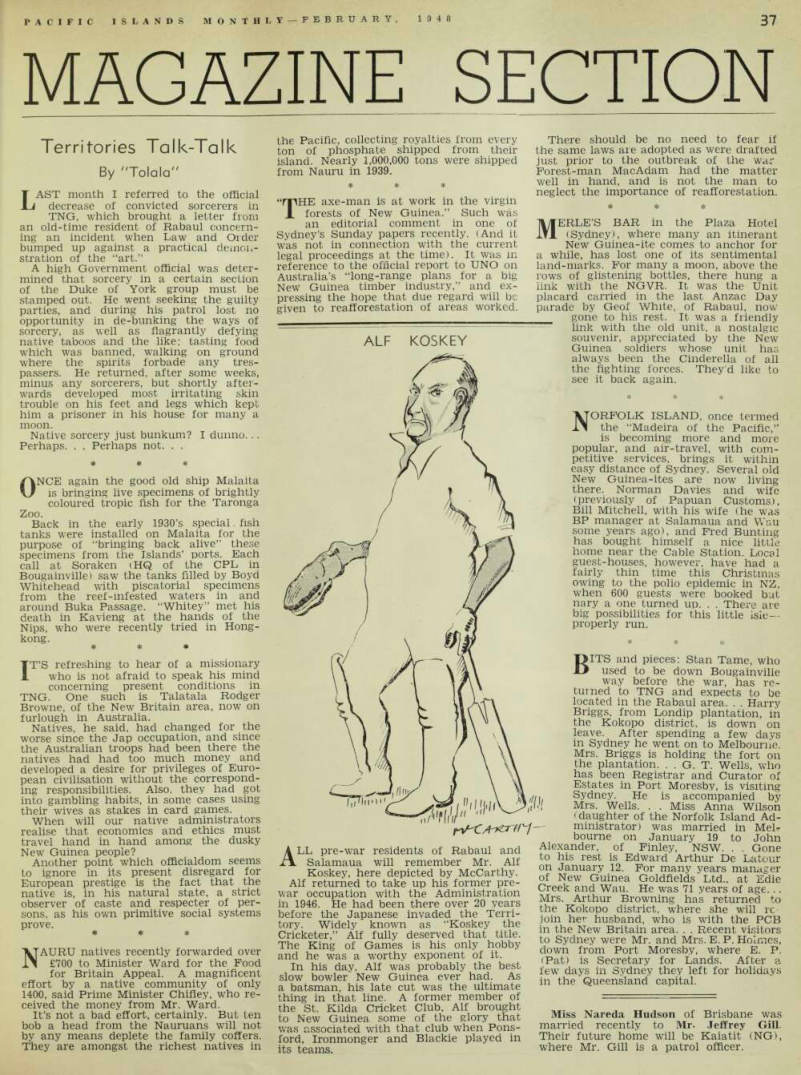
Territories Talk-Talk
By "Tolala"
LAST month I referred to the official decrease of convicted sorcerers in TNG, which brought a letter from an old-time resident of Rabaul concern ing an incident when Law and Order bumped up against a practical demon stration of the “art.”
A high Government official was deter mined that sorcery in a certain section of the Duke of York group must be stamped out. He went seeking the guilty parties, and during his patrol lost no opportunity in de-bunking the ways of sorcery, as well as flagrantly defying native taboos and the like; tasting food which was banned, walking on ground where the spirits forbade any tres passers. He returned, after some weeks, minus any sorcerers, but shortly after wards developed most irritating skin trouble on his feet and legs which kept him a prisoner in his house for many a moon.
Native sorcery just bunkum? I dunno...
Perhaps. . . Perhaps not. . . ♦ ♦ ♦ ONCE again the good old ship Malaita is bringing live specimens of brightly coloured tropic fish for the Taronga Zoo.
Back in the early 1930’s special. fish tanks were installed on Malaita for the purpose of “bringing back alive” these specimens from the Islands’ ports. Each call at Soraken (HQ of the CPL in Bougainville) saw the tanks filled by Boyd Whitehead with piscatorial specimens from the reef-infested waters in and around Buka Passage. “Whitey” met his death in Kavieng at the hands of the Nips, who were recently tried in Hong kong. * * ♦ IT’S refreshing to hear of a missionary who is not afraid to speak his mind concerning present conditions in TNG. One such is Talatala Rodger Browne, of the New Britain area, now on furlough in Australia.
Natives, he said, had changed for the worse since the Jap occupation, and since the Australian troops had been there the natives had had too much money and developed a desire for privileges of Euro pean civilisation without the correspond ing responsibilities. Also, they had got into gambling habits, in some cases using their wives as stakes in card games.
When will our native administrators realise that economics and ethics must travel hand in hand among the dusky New Guinea people?
Another point which officialdom seems to ignore in its present disregard for European prestige is the fact that the native is, in his natural state, a strict observer of caste and respecter of per sons, as his own primitive social systems prove. * ♦ * NAURU natives recently forwarded over £7OO to Minister Ward for the Food for Britain Appeal. A magnificent effort by a native community of only 1400, said Prime Minister Chifley, who re ceived the money from Mr. Ward.
It’s not a bad effort, certainly. But ten bob a head from the Nauruans will not by any means deplete the family coffers.
They are amongst the richest natives in
the Pacific, collecting royalties from every ton of phosphate shipped from their island. Nearly 1,000,000 tons were shipped from Nauru in 1939. * * * ‘TITHE axe-man is at work in the virgin 1 forests of New Guinea.” Such was an editorial comment in one of Sydney’s Sunday papers recently. (And it was not in connection with the current legal proceedings at the time). It was in reference to the official report to UNO on Australia’s “long-range plans for a big New Guinea timber industry,” and ex pressing the hope that due regard will be given to reafforestation of areas worked.
Alf Koskey
ALL pre-war residents of Rabaul and Salamaua will remember Mr. Alf Koskey, here depicted by McCarthy.
Alf returned to take up his former pre war occupation with the Administration in 1946. He had been there over 20 years before the Japanese invaded the Terri tory. Widely known as “Koskey the Cricketer,” Alf fully deserved that title.
The King of Games is his only hobby and he was a worthy exponent of it.
In his day, Alf was probably the best slow bowler New Guinea ever had. As a batsman, his late cut was the ultimate thing in that line. A former member of the St. Kilda Cricket Club. Alf brought to New Guinea some of the glory that was associated with that club when Pons ford, Ironmonger and Blackie played in its teams.
There should be no need to fear if the same laws are adopted as were drafted just prior to the outbreak of the war Forest-man Mac Adam had the matter well in hand, and is not the man to neglect the importance of reafforestation. * * * MERLE’S BAR in the Plaza Hotel (Sydney), where many an itinerant New Guinea-ite comes to anchor for a while, has lost one of its sentimental land-marks. For many a moon, above the rows of glistening bottles, there hung a link with the NGVR. It was the Unit placard carried in the last Anzac Day parade by Geof White, of Rabaul, now
gone to his rest. It was a friendly link with the old unit, a nostalgic souvenir, appreciated by the New Guinea soldiers whose unit has always been the Cinderella of all the fighting forces. They'd like to see it back again. * * * NORFOLK ISLAND, once termed the “Madeira of the Pacific,” is becoming more and more popular, and air-travel, with com petitive services, brings it within easy distance of Sydney. Several old New Guinea-ites are now living there. Norman Davies and wife (previously of Papuan Customs), Bill Mitchell, with his wife (he was BP manager at Salamaua and Wau some years ago), and Fred Bunting has bought himself a nice little home near the Cable Station. Local guest-houses, however, have had a fairly thin time this Christmas owing to the polio epidemic in NZ. when 600 guests were booked but nary a one turned up. . . There are big possibilities for this little isle— properly run. * * * BITS and pieces: Stan Tame, who used to be down Bougainville way before the war, has re turned to TNG and expects to be located in the Rabaul area. . . Harry Briggs, from Londip plantation, in the Kokopo district, is down on leave. After spending a few days in Sydney he went on to Melbourne.
Mrs. Briggs is holding the fort on the plantation. . . G. T. Wells, who has been Registrar and Curator of Estates in Port Moresby, is visiting Sydney, He is accompanied by Mrs. Wells. . . Miss Anna Wilson (daughter of the Norfolk Island Ad ministrator) was married in Mel bourne on January 19 to John
Alexander, of Finley, NSW. . . Gone to his rest is Edward Arthur De Latour on January 12. For many years manager of New Guinea Goldfields Ltd., at Edie Creek and Wau. He was 71 years of age...
Mrs. Arthur Browning has returned to the Kokopo district, where she will re join he*' husband, who is with the PCB in the New Britain area. . . Recent visitors to Sydney were Mr. and Mrs. E. P. Holmes, down from Port Moresby, where E. P. (Pat) is Secretary for Lands. After a few days in Sydney they left for holidays in the Queensland capital.
Miss Nareda Hudson of Brisbane was married recently to Mr. Jeffrey Gill.
Their future home will be Kaiatit (NG), where Mr. Gill is a patrol officer.
Producing Cocoa In British West Africa
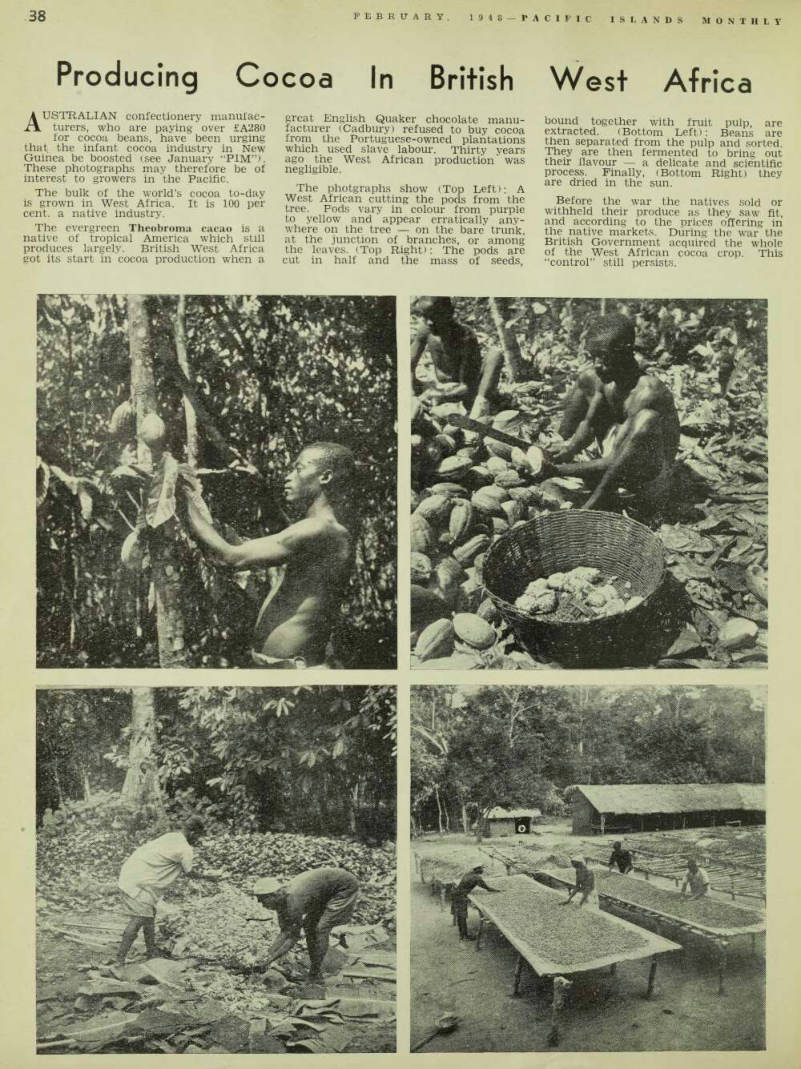
AUSTRALIAN confectionery manufac-
turers, who are paying over £A2BO ihot f 2L T„ C f°^ bea ,. nSI ha !f V een - ur f, mB
January
SMo Ot Xw P e h r S s be ° £ The bulk of the world’s cocoa to-dav is grown in West Africa. It is 100 per cent, a native industry. an-io ovornrm, u The evergreen Theobroma cacao is a native of tropical America which still produces largely. British West Africa got its start in cocoa production when a
great English Quaker chocolate manufacturer (Cadbury) refused to buy cocoa fr °“ the plantations rgl^the^^e^ 2 Vfc b a°n Ur pro^Sn ye w a al
negUßible -
The photgraphs show (Top Left): A Yjf®® 4 4 f ni c c an cutt - ng tl ? e P° ds from il \ e free. Pods va r y ln colour from purple ye U° w and a PP ea r erratically anywhere on the tree on the bare trunk, at the junction of. branches, or among the leaves. (Top Right): The pods are cut in half and the mass of seeds,
bound together with fruit pulp are extracted (Bottom Left)' Beans are then separated from the pulp and sorted
S iTeS
are°dr S ied We’s^ 0 " 1 Blght) they Before the war the natives sold or withheld their produce as they saw fit, and according to the orices offering in the native markets. During the war the British Government acquired the whole of the West African cocoa crop This “control” still persists
You've Got To Be Subtle!
Short Story:
By "Amel"
IN the short time at his disposal before the steamer bore him away, Dickson, keeping up a rapid-fire monologue of information, cynical comment and witti cisms, piloted his successor around to points of local interest. He introduced him to the two trading store managers, a priest, the five Hohongi chiefs, Paul Smith, a thin, wiry little half-caste, who was clerk, interpreter and sometimes ad visor at the Government station, and to the native pastor, Jeremiah.
An hour before the steamer sailed, Dickson gave John Farnley some parting advice, over drinks on the verandah of the DO’s spacious bungalow.
“I think you’ll be all right, Farnley.
In a place like Hohongi Island, you’ve got to use a lot of your own initiative, and it isn’t always easy. Be firm with the missionaries, but don’t tread too hard on their corns. Don’t let those chiefs bluff you they’re a wily crowd. Be as severe as you like about refusing to grant per mission to leave the island. The natives are not supposed to go gallivanting in war-time. But above all be subtle.
That’s what you need subtlety!”
And now Farnley was alone, deep in the intricacies of his position, learning how to combine the three qualities of in itiative, firmness and subtlety. As Dick son had remarked, it was not easy.
In Hohongi at that time, a large amount of copra awaited shipment, and copra buying had had to be curtailed until the pressure on storage space had been relieved. An overseas steamer was expected at any time, and, one afternoon the District Officer had a code message to say that she would be at Hohongi within a week. He had a conference with the store managers, who assured Farnley that everything was in readi ness to load the steamer.
Their biggest worry was labour. They were not sure whether the Hohongi natives, who were very reluctant workers, would come forward in sufficient numbers.
Farnley said he would do everything in his power to assist. He called a meeting of the chiefs, who, for once, were without wiles and in agreement. They would supply all necessary labour.
Farnley breathed a sigh of relief. So far, so good. But something seemed to tell him that there was bound to be a hitch. It was too much to expect that it would be all plain sailing.
Five days later the copra steamer ar rived, and dropped anchor a mile from shore. After preliminary talks with the Captain, loading was commenced. Lorries brought the promised labourers from their villages, and” presently the usually sleepy waterfront at Hohongi was a buzzing hive of activity.
From his office at the Government Station, Farnley could see the lighters chugging busily to and fro. Visions of the vessel being loaded in record time rose dizzily in his mind.
Then Paul came in with a letter. Farn ley opened it. It was from one of the store managers, and said that they were having difficulty in arranging for the labour to work on Sunday. The labourers were willing, the chiefs were agreeable and the priest had given permission for his people to do so but it was Jeremiah, head of the other sect, who refused to fall in with popular opinion. Would the DO please use his influence?
“Influence, is it?” muttered Farnley.
“Since when, I’d like to know? I might use some diplomacy, and persuade Jere miah to be reasonable, but ‘influence’ no. Paul give this chit to a policeman, and tell him to take it to Jeremiah.”
A few hours later, Jeremiah, mounted on his chestnut horse, a straw hat on his head, and a fly-switch in his hand, jogged into the Government compound.
Dismounting with dignity, he tied the horse to a tree and, his stubborn face set in haughty lines, moved unhurriedly into the DO’s office. Paul placed a chair, upon which Jeremiah composed himself, holding his hat and his fly-switch on his lap.
Farnley eyed him with what he hoped was the right blend of diplomacy, autho rity and sympathy. Jeremiah’s gaze was inscrutable. It went past the DO’s left shoulder, and concentrated itself on a large map which hung on the wall.
Farnley decided to go straight to the point. Quibbling would be wasted on this old—on Jeremiah.
“I sent for you, Jeremiah,” he began, “to discuss the matter of members of your church working on Sunday. I understand that you object?”
The minister gave a tight-lipped affir mative.
“What are your reasons?” asked Farn ley.
“To work on Sunday is against the teachings of our church,” stated Jeremiah.
“But this is a special occasion. This is war-time —and it will be to the bene fit of your people if they work on Sun day and help to give the steamer a quick dispatch. The sooner she is loaded, the sooner they can commence to sell their copra again.”
“To work on Sunday is against the teachings of our church,” Jeremiah re iterated.
Farnley was patient, “The people are willing,” he said, “the priest is permitting his people to co-operate and the chiefs have given their consetn. Cannot you give yours also?”
Jeremiah’s eyes left the map and went to the floor. He did not look at the DO.
He pondered deeply for several minutes.
He looked very sulky. Then he nodded, almost imperceptibly.
Farnley’s eyebrows rose slightly. “You give your permission, Jeremiah?” he asked, unable to believe his eyes. Again the nod.
“Thank you,” said the DO. Jeremiah departed without another word.
“What do vou think, Paul? Can we trust Jeremiah?”
Paul blinked rapidly, and replied. “He is a minister, sir.”
“Yes, Paul, but even ministers some times have lapses,” Paul, not quite sure what a lapse was, said nothing.
SUNDAY came, and Jeremiah’s flock worked with the rest. Two days later, the copra boat departed. On the following Monday, Paul came to Farnley, in great agitation.
“Sir —” he began. Farnley put his pen down and looked at him.
Paul swallowed, and tried again. “Sir, I can scarcely find the words to tell you.
It gives me much pain that a Minister should play so false. Sir Jeremiah has broken his word. He told the men he would not punish them for working on Sunday, but now he will not let them come to church, and they are very dis tressed. sir.”
Farnley muttered under his breath.
“The men were not allowed into church yesterday, sir. Isn’t it wicked? It gives me much shame, sir —”
“Very well, Paul. Leave me for a while, will you? I want to think.”
Dickson would say, reflected Farnley, that this was an occasion which called for subtlety. Very well, he would be
subtle. He studied a sheet of paper which lay on the desk in front of him. He took up his pen and wrote quickly on a special form. Then he called the inter preter.
“Paul give this to a policeman to take to Jeremiah.” Paul hurried out. a gleam in his eye. He felt pretty certain that Jeremiah would be arrested.
But that did not happen. Instead, a mystified Paul, with wonder in his voice, came to Farnley on Thursday afternoon, and said, “Sir a strange thing has happened. Jeremiah has changed his mind. He says there will be no punish ment for the men who worked on Sun day. What did you say to him, sir?”
Farnley smiled, and shook his head.
He would have been extremely gratified could he have seen Jeremiah, who, at that moment, was chewing his lip, and staring in frustration at a well-thumbed piece of paper which stated that; “Be cause Jeremiah Tolagi is so necessary to. the spiritual welfare of his people, the permission he desires, to travel on the next steamer, cannot be granted.”
Jeremiah recognised subtlety when he saw it.
Isle Of Eternal
Spring
ON Norfolk Island stately pines, Lift upturned boughs in thanks to God.
New roads of joy—old roads of pain— The coast roads hint of agony.
The country roads knew footsteps free, Each winding to the deep blue sea. (Now airmen trace the fine red trails And know them roads where friendship trod!) Here, where the soothing song of pines, Lulls one to loiter on life’s way.
So mild, and velvet-soft the wind, Each passerby gives greeting kind, In every view a charm I find, A birdnote taunts the sighing breeze, A parrakeet darts through the trees, (The ruins but remembering “This Other Eden” once knew strife Yet every season here is spring!) By “Bloody Bridge” and “Gallows Gate,”
The tourists gossip, Kingstown way; With gratitude they contemplate The Fate that brought this happier day— This isle of infinite hope achieved, With fertile foothills, valley farms, With lush wealth of banana groves; Or where the oak’s mauve carpetings Hedge patterned by Hakea arms.
By lovely roads, now pleasure-trod, The stately pines breathe thanks to God.
Alice Allen Innes.
Norfolk Island, January, 1948.
Recently a Dragon aircraft owned by the Roman Catholic Mission at Alexi shaven (NG), carrying one priest as pilot and one as a passenger, landed on Horn Island (Torres Strait) in heavy rain. Alter tying the plane down to blocks of concrete the occupants went on to Thursday Island by boat. Accord ing to 'Mrs. Thorpe, wife of the civil aviation superintendent at Horn Island, a cyclone then blew straight from the sea and struck the Island. The plane broke loose from the tie-lines and swung its tail round. Although struck by flying pieces of timber and branches, Mr. and Mrs. Thorpe, after about an hour’s terri fying experience, succeeded in securely anchoring the bucking and leaping plane.
The only damage it sustained was a hole through the rudder.
One-Horse Shay
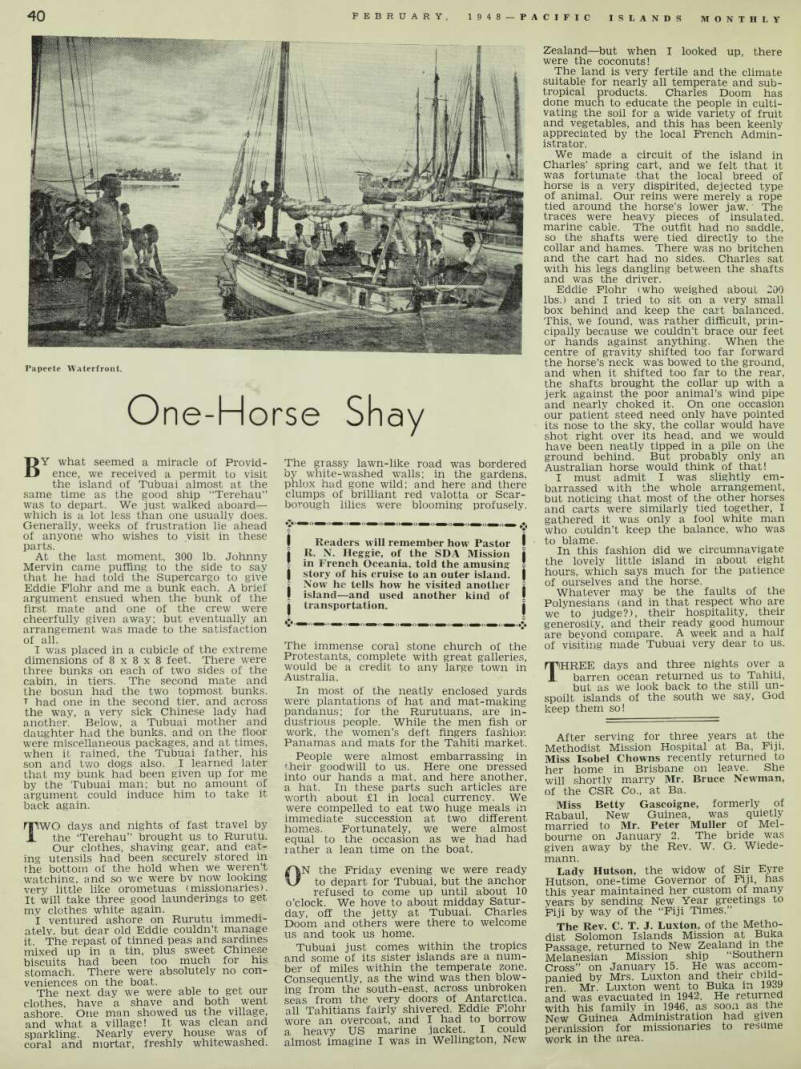
BY what seemed a miracle of Providence, we received a permit to visit the island of Tubuai almost at the same time as the good ship “Terehau” was to depart. We just walked aboard — which is a lot less than one usually does.
Generally, weeks of frustration lie ahead of anyone who wishes to visit in these parts.
At the last moment, 300 lb. Johnny Mervin came puffing to the side to say that he had told the Supercargo to give Eddie Flohr and me a bunk each. A brief argument ensued when the bunk of the first mate and one of the crew were cheerfully given away; but eventually an arrangement was made to the satisfaction I was placed in a cubicle of the extreme dimensions of 8 x 8 x 8 feet. There were three bunks on each of two sides of the cabin, in tiers. The second mate and the bosun had the two topmost bunks. t had one in the second tier, and across the way, a very sick Chinese lady had another. Below, a Tubuai mother and daughter had the bunks, and on the floor were miscellaneous packages, and at times, when it rained, the Tubuai father, his son ana two dogs also. I learned later that my bunk had been given up for me by the Tubuai man; but no amount of argument could induce him to take it back again. , . , , . „ . . .
WO days and nights of fast travel by the ‘Terehau” brought us to Rurutu.
Our clothes, shaving gear, and eating utensils had been securely stored in the bottom of the hold when we weren’t watching, and so we were by now looking very little like orometuas (missionaries).
It will take three good launderings to get my clothes white again. ! ventured ashore on Rurutu immediately. but dear old Eddie couldn t manage it The repast of tinned peas and sardines mixed up in a tin, plus sweet Chinese hi<?r > iiit«; had been too much for his stomach There were absolutely no convpniences on the boat The next day we were able to get our clothes, have a shave and both went ashore. One man showed us the village, and what a village! It was clean and sparkling. Nearly every house was of coral and mortar, freshly whitewashed,
The grassy lawn-like road was bordered by white-washed walls: in the gardens, phlox had gone wild; and here and there clumps of brilliant red valotta or Scar borough lilies were blooming profusely,
Readers will remember how Pastor R. N. Heggie, of the SDA Mission in French Oceania, told the amusing story of his cruise to an outer island.
Now he tells how he visited another island—and used another kind of transportation.
The m f nse coral stone church of the Protestants, complete with great galleries, would be a credit to any large town in Australia.
In most of the neatly enclosed yards were plantations of hat and mat-making pandanus; for the Rurutuans, are in dustrious people. While the men fish or work, the women’s deft fingers fashion Panamas and mats for the Tahiti market, People were almost embarrassing in their goodwill to us. Here one pressed i n to our h ands a mat, an d here another, a h a t. j n these parts such articles are worth about £1 in local currency. We were compelled to eat two huge meals In immediate succession at two different homes. Fortunately, we were almost equal to the occasion as we had had r a ther a lean time on the boat, /f\N the Friday evening we were ready t 0 de p ar t f or Tubuai, but the anchor refused to come up until about 10 0 - clock We ho ve to about midday Satur day, off the jetty at Tubuai. Charles Doom and others were there to welcome and took us home us ana look us nome.
Tubuai just comes within the tropics and some of its sister islands are a num ber of miles within the temperate zone, Consequently, as the wind was then blow ing from the south-east, across unbroken seas from the yery dpors of Antarctica, all Tahitians fairly shivered. Eddie Fiohi wore an overcoat, and I had to borrow a heavy US marine Jacket. I could almost imagine I was in Wellington, New
Zealand—but when I looked up, there were the coconuts!
The land is very fertile and the climate suitable for nearly all temperate and sub tropical products. Charles Doom has done much to educate the people in culti vating the soil for a wide variety of fruit and vegetables, and this has been keenly appreciated by the local French Admin istrator.
We made a circuit of the island in Charles’ spring cart, and we felt that it was fortunate that the local breed of horse is a very dispirited, dejected type of animal. Our reins were merely a rope tied around the horse’s lower jaw. The traces were heavy pieces of insulated, marine cable. The outfit had no saddle, so the shafts were tied directly to the collar and hames. There was no britchen and the cart had no sides. Charles sat with his legs dangling between the shafts and was the driver.
Eddie Flohr (who weighed about 200 lbs.) and I tried to sit on a very small box behind and keep the cart balanced.
This, we found, was rather difficult, prin cipally because we couldn’t brace our feet or hands against anything. When the centre of gravity shifted too far forward the horse’s neck was bowed to the ground, and when it shifted too far to the rear, the shafts brought the collar up with a jerk against the poor animal’s wind pipe and nearly choked it. On one occasion our patient steed need only have pointed its nose to the sky, the collar would have shot right over its head, and we would have been neatly tipped in a pile on the ground behind. But probably only an Australian horse would think of that!
I must admit I was slightly em barrassed with the whole arrangement, but noticing that most of the other horses and carts were similarly tied together, I gathered it was only a fool white man who couldn’t keep the balance, who was to blame.
In this fashion did we circumnavigate the lovely little island in about eight hours, which says much for the patience of ourselves and the horse.
Whatever may be the faults of the Polynesians (and in that respect who are we to judge?), their hospitality, their generosity, and their ready good humour are bevond compare. A week and a half of visiting made Tubuai very dear to us.
THREE days and three nights over a barren ocean returned us to Tahiti, but as we look back to the still un spoilt islands of the south we say, God keep them so!
After serving for three years at the Methodist Mission Hospital at Ba, Fiji, Miss Isobel Chowns recently returned to her home in Brisbane on leave. She will shortly marry Mr. Bruce Newman, of the CSR Co., at Ba.
Miss Betty Gascoigne, formerly of Rabaul, New Guinea, was quietly married to Mr. Peter Muller of Mel bourne on January 2. The bride was given away by the Rev. W. G. Wiede mann.
Lady Hutson, the widow of Sir Eyre Hutson, one-time Governor of Fiji, has this year maintained her custom of many years' by sending New Year greetings to Fiji by way of the “Fiji Times.”
The Rev. C. T. J. Luxton, of the Metho dist Solomon Islands Mission at Buka Passage, returned to New Zealand in the Melanesian Mission ship “Southern Cross” on January 15. He was accom panied by Mrs. Luxton and their child ren. Mr. Luxton went to Buka in 1939 and was evacuated in 1942, He returned with his family in 1946, as soon as the New Guinea Administration had given permission for missionaries to resume work in the area.
Papeete Waterfront.
Tropicalities
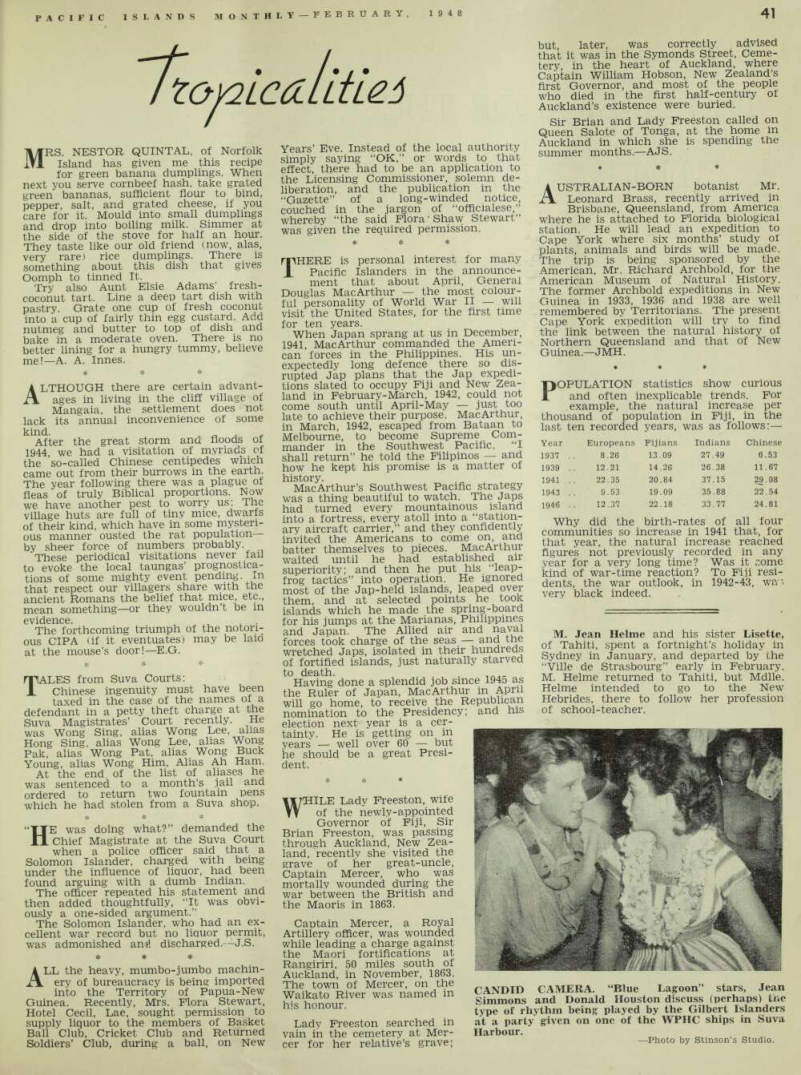
MRS. NESTOR QUINTAL, of Norfolk Island has given me this recipe for green banana dumplings. When next you serve cornbeef hash, take grated green bananas, sufficient flour to bind, pepper, salt, and grated cheese, if you care for it. Mould into small dumplings and drop into boiling milk. Simmer at the side of the stove for half an hour.
They taste like our old friend (now, alas, very rare) rice dumplings. There is something about this dish that gives Oomph to tinned It.
Try also Aunt Elsie Adams’ fresh coconut tart. Line a deep tart dish with pastry. Grate one cup of fresh coconut into a cup of fairly thin egg custard. Add nutmeg and butter to top of dish and bake in a moderate oven. There is no better lining for a hungry tummy, believe
me!
A. A. Innes.
ALTHOUGH there are certain advant ages in living in the cliff village of Mangaia, the settlement does not lack its annual inconvenience of some kind. , „ , „ After the great storm and floods of 1944 we had a visitation of myriads of the ’so-called Chinese centipedes which came out from their burrows in the earth.
The year following there was a plague of fleas of truly Biblical proportions. Now we have another pest to worry us; The village huts are full of tiny mice, dwarfs of their kind, which have in some mysteri ous manner ousted the rat population— by sheer force of numbers probably.
These periodical visitations never fail to evoke the local taungas’ prognostica tions of some mighty event pending. In that respect our villagers share with the ancient Romans the belief that mice, etc., mean something—or they wouldn’t be in evidence.
The forthcoming triumph of the notori ous CIPA (if it eventuates) may be laid
at the mouse’s door!
E.G.
rLES from Suva Courts; Chinese ingenuity must have been taxed in the case of the names of a defendant in a petty theft charge at the Suva Magistrates’ Court recently. He was Wong Sing, alias Wong Lee, alias Hong Sing, alias Wong Lee, alias Wong Pak, alias Wong Pat, alias Wong Buck Young, alias Wong Him, Alias Ah Ham.
At the end of the list of aliases he was sentenced to a month’s jail and ordered to return two fountain pens which he had stolen from a Suva shop. * * * HE was doing what?” demanded the Chief Magistrate at the Suva Court when a police officer said that a Solomon Islander, charged with being under the influence of liquor, had been found arguing with a dumb Indian.
The officer repeated his statement and then added thoughtfully, “It was obvi ously a one-sided argument.”
The Solomon Islander, who had an ex cellent war record but no liquor permit,
was admonished ansi discharged.
J.S.
ALL the heavy, mumbo-jumbo machin ery of bureaucracy is being imported into the Territory of Papua-New Guinea. Recently, Mrs. Flora Stewart, Hotel Cecil, Lae, sought permission to supply liquor to the members of Basket Ball Club, Cricket Club and Returned Soldiers’ Club, during a ball, on New
Years’ Eve. Instead of the local authority simply saying “OK,” or words to that effect, there had to be an application to the Licensing Commissioner, solemn de liberation, and the publication in the “Gazette” of a long-winded notice, couched in the jargon of “officialese,” whereby “the said Flora ■ Shaw Stewart” was given the required permission. * * * THERE is personal interest for many Pacific Islanders in the announce ment that about April, General Douglas MacArthur the most colour ful personality of World War II will visit the United States, for the first time for ten years.
When Japan sprang at us in December, 1941, MacArthur commanded the Ameri can forces in the Philippines. His un expectedly long defence there so dis rupted Jap plans that the Jap expedi tions slated to occupy Fiji and New Zea land in February-March, 1942, could not come south until April-May just too late to achieve their purpose. MacArthur, in March, 1942, escaped from Bataan to Melbourne, to become Supreme Com mander in the Southwest Pacific. “I shall return” he told the Filipinos and how he kept his promise is a matter of history. .
MacArthur’s Southwest Pacific strategy was a thing beautiful to watch. The Japs had turned every mountainous island into a fortress, every atoll into a “station ary aircraft carrier,” and they confidently invited the Americans to come on, and batter themselves to pieces. MacArthur waited until he had established air superiority; and then he put his “leap frog tactics” into operation. He ignored most of the Jap-held islands, leaped over them, and at selected points he took islands which he made the spring-board for his jumps at the Marianas, Philippines and Japan. The Allied air and naval forces took charge of the seas and the wretched Japs, isolated in their hundreds of fortified islands, just naturally starved to death. .
Having done a splendid job since 1945 as the Ruler of Jaoan, MacArthur in April will go home, to receive, the Republican nomination to the Presidency; and his
election next year is a cer tainty. He is getting on in years well over 60 but he should be a great Presi dent. * * * Lady Freeston, wife of the newly-appointed Governor of Fiji, Sir Brian Freeston, was passing through Auckland, New Zea land, recently she visited the grave of her great-uncle, Captain Mercer, who was mortally wounded during the war between the British and the Maoris in 1863.
Captain Mercer, a Royal Artillery officer, was wounded while leading a charge against the Maori fortifications at Rangiriri, 50 miles south of Auckland, in November, 1863.
The town of Mercer, on the Waikato River was named in his honour.
Ladv Freeston searched in vain in the cemetery at Mer cer for her relative’s grave;
but, later, was correctly advised that it was in the Symonds Street, Ceme tery, in the heart of Auckland, where Captain William Hobson, New Zealand’s first Governor, and most of the people who died in the first half-century of Auckland’s existence were buried.
Sir Brian and Lady Freeston called on Queen Salote of Tonga, at the home in Auckland in which she is spending the
summer months.-
Ajs.
Australian-born botanist Mr.
Leonard Brass, recently arrived in Brisbane. Queensland, from America where he is attached to Florida biological station. He will lead an expedition to Cape York where six months’ study of plants, animals and birds will be made.
The trip is being sponsored by the American, Mr. Richard Archbold, for the American Museum of Natural History.
The former Archbold expeditions in New Guinea in 1933, 1936 and 1938 are well remembered by Territorians. The present Cape York exoedition will try to find the link between the natural history of Northern Queensland and that of New Guinea. —JMH. ♦ * * Population statistics show curious and often inexplicable trends. For example, the natural increase per thousand of population in Fiji, in the last ten recorded years, was as follows: —
Why did the birth-rates of all four communities so increase in 1941 that, for that year, the natural increase reached figures not previously recorded in any year for a very long time? Was it come kind of war-time reaction? To Fiji resi dents, the war outlook, in 1942-43, w er> very black indeed.
M. Jean Helme and his sister Lisette, of Tahiti, spent a fortnight’s holiday in Sydney in January, and departed by the “Ville de Strasbourg” early in February.
M. Helme returned to Tahiti, but Mdlle.
Helme intended to go to the New Hebrides, there to follow her profession of school-teacher.
CANDID CAMERA. “Blue Lagoon” stars, Jean Simmons and Donald Houston discuss (perhaps) the type of rhythm being played by the Gilbert Islanders at a party given on one of the WPHC ships in Suva Harbour. —Photo by Stinson’s Studio.
Year Europeans Fijians Indians Chinese 1937 .. 8.26 13.09 27.49 6.53 1939 .. 12.21 14.26 26.38 11.67 1941 .. 22.35 20.84 37.15 29.08 1943 .. 9.53 19.09 35.88 22.54 1946 .. 12.37 22.18 33.77 24.81
The Greigs Of The
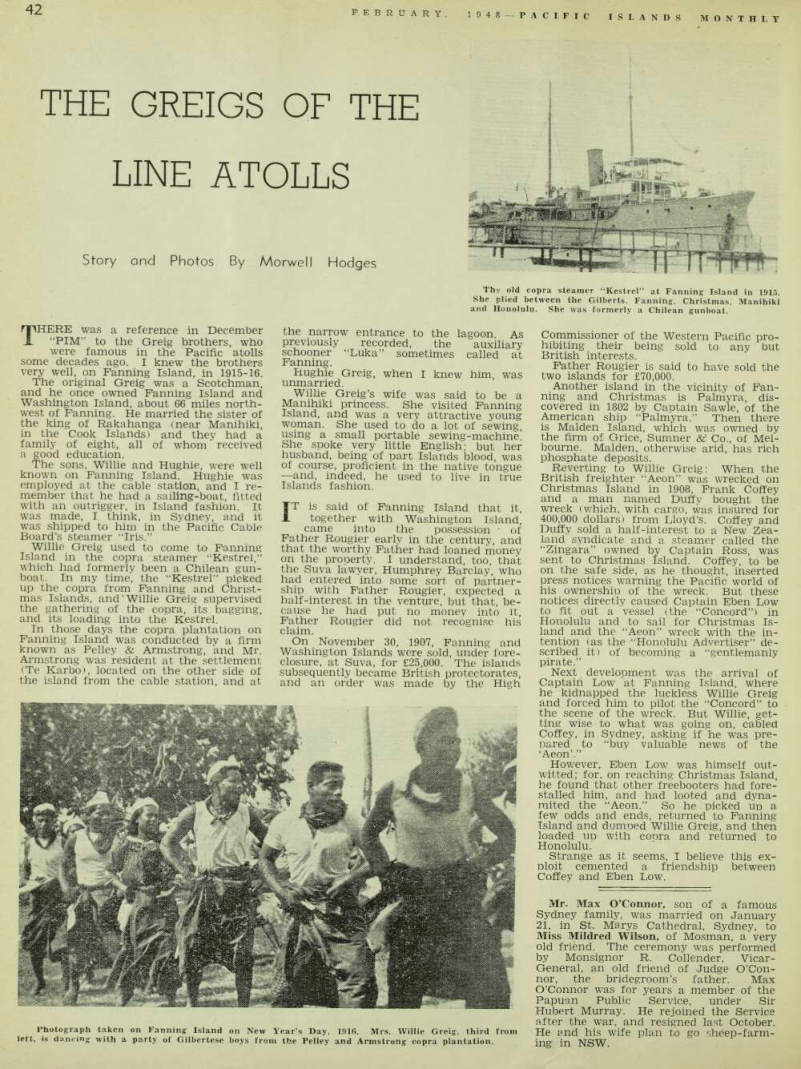
Line Atolls
Story and Photos By Morwell Hodges
THERE was a reference in December “PIM” to the Greig brothers, who were famous in the Pacific atolls some decades ago. I knew the brothers very well, on Fanning Island, in 1915-16.
The original Greig was a Scotchman, and he once owned Fanning Island and Washington Island, about 66 miles north west of Fanning. He married the sister of the king of Rakahanga (near Manihiki, in the Cook Islands) and they had a family of eight, all of whom received a good education.
The sons, Willie and Hughie, were well known on Fanning Island. Hughie was employed at the cable station, and I re member that he had a sailing-boat, fitted with an outrigger, in Island fashion. It was made, I think, in Sydney, and it was shipped to him in the Pacific Cable Board’s steamer “Iris.”
Willie Greig used to come to Fanning Island in the copra steamer “Kestrel,” which had formerly been a Chilean gun boat. In my time, the “Kestrel” picked up the copra from Fanning and Christ mas Islands, and’Willie Greig supervised the gathering of the coora, its bagging, and its loading into the Kestrel.
In those days the copra plantation on Fanning Island was conducted by a firm known as Pelley & Armstrong, and Mr.
Armstrong was resident at the settlement (Te Karbo), located on the other side of the island from the cable station, and at
the narrow entrance to the lagoon As previously recorded, the auxiliary schooner “Luka” sometimes called at Fanning.
Hughie Greig, when I knew him, was unmarried.
Willie Greig’s wife was said to be a Manihiki princess. She visited Fanning Island, and was a very attractive young woman. She used to do a lot of sewing, using a small portable sewing-machine.
She spoke very little English; but her husband, being of part Islands blood, was of course, proficient in the native tongue —and, indeed, he used to live in true Islands fashion.
IT is said of Panning Island that it, together with Washington Island, came into the possession • of Father Rougier early in the century, and that the worthy Father had loaned money on the property. I understand, too, that the Suva lawyer, Humphrey Barclay, who had entered into some sort of partner ship with Father Rougier, expected a half-interest in the venture, but that, be cause he had put no money into it, Father Rougier did not recognise his claim.
On November 30, 1907, Fanning and Washington Islands were sold, under fore closure, at Suva, for £25,000. The islands subsequently became British protectorates, and an order was made by the High
Commissioner of the Western Pacific pro hibiting their being sold to any but British interests.
Father Rougier is said to have sold the two islands for £70,000.
Another island in the vicinity of Pan ning and Christmas is Palmyra, dis covered in 1802 by Cantain Sawle, of the American ship “Palmyra.” Then there is Malden Island, which was owned by the firm of Grice, Sumner &' Co., of Mel bourne. Malden, otherwise arid, has rich phosphate deposits.
Reverting to Willie Greig: When the British freighter “Aeon” was wrecked on Christmas Island in 1908, Frank Coffey and a man named Duffv bought the wreck (which, with cargo, was insured for 400,000 dollars! from Lloyd’s. Coffey and Duffy sold a half-interest to a New Zea land syndicate and a steamer called the “Zingara” owned by Captain Ross, was sent to Christmas Island. Coffey, to be on the safe side, as he thought, inserted press notices warning the Pacific world of his ownership of the wreck. But these notices directly caused Captain Eben Low to fit out a vessel (the “Concord”) in Honolulu and to sail for Christmas Is land and the “Aeon” wreck with the in tention (as the “Honolulu Advertiser” de scribed it) of becoming a “gentlemanly pirate.”
Next development was the arrival of Captain Low at Fanning Island, where he kidnapped the luckless Willie Greig and forced him to pilot the “Concord” to the scene of the wreck. But Willie, get ting wise to what was going on, cabled Coffey, in Sydney, asking if he was pre pared to “buy valuable news of the ‘Aeon’.”
Hov/ever, Eben Low was himself out witted; for. on reaching Christmas Island, he found that other freebooters had fore stalled him, and had looted and dyna mited the “Aeon.” So he picked up a few odds and ends, returned to Fanning Island and dumped Willie Greig, and then loaded up with copra and returned to Honolulu.
Strange as it seems, I believe this ex ploit cemented a friendship between Coffey and Eben Low.
Mr. Max O’Connor, son of a famous Sydney family, was married on January 21, in St. Marys Cathedral, Sydney, to Miss Mildred Wilson, of Mosman, a very old friend. The ceremony was performed by Monsignor R. Collender, Vicar- General, an old friend of Judge O’Con nor, the bridegroom’s father. Max O’Connor was for years a member of the Papuan Public Service, under Sir Hubert Murray. He rejoined the Service after the war, and resigned last October.
He and his wife plan to go sheep-farm ing in NSW.
Photograph taken on Fanning Island on New Year’s Day. 1916. Mrs. Willie Greig, third from left, is dancing with a party of Gilbertese boys from the Pelley and Armstrong copra plantation.
The old copra steamer “Kestrel” at Fanning Island in 1915.
She plied between the Gilberts, Fanning, Christmas, Manibiki and Honolulu. She was formerly a Chilean gunboat.
Island-Happy Yanks Play Pranks (and Make War)
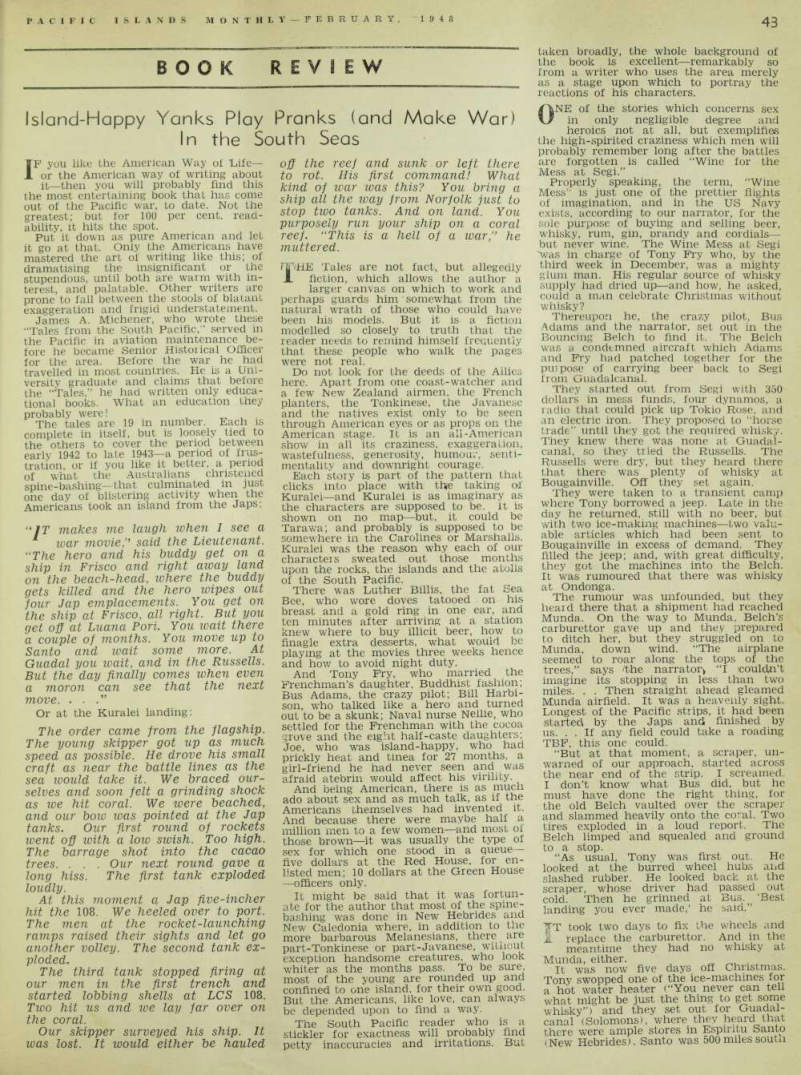
Book Review
Island-Happy Yanks Play Pranks (and Make War) In the South Seas
IF you like the American Way of Life— or the American way of writing about it—then you will probably find this the most entertaining book that has come out of the Pacific war, to date. Not the greatest; but for 100 per cent, read ability, it hits the spot.
Put it down as pure American and let it go at that. Only the Americans have mastered the art of writing like this; of dramatising the insignificant or the stupendous, until both are warm with in terest, and palatable. Other writers are prone to fall between the stools of blatant exaggeration and frigid understatement.
James A. Michener, who wrote these “Tales from the South Pacific,’’ served in the Pacific in aviation maintenance be fore he became Senior Histoiical Officer for the area. Before the war he had travelled in most countries. He is a Uni versity graduate and claims that before the “Tales,” he had written only educa tional books. What an education they probably were!
The tales are 19 in number. Each is complete in itself, but is loosely tied to the others to cover the period between early 1942 to late 1943—a period of frus tration, or if you like it better, a period of what the Australians christened spine-bashing—that culminated in just one day of blistering activity when the Americans took an island from the Japs; “IT makes me laugh when I see a 1 war movie,” said the Lieutenant.
“The hero and his buddy get on a ship in Frisco and right away land on the beach-head, where the buddy gets killed and the hero wipes out four Jap emplacements. You get on the ship at Frisco, all right. But you get off at Luana Pori. You wait there a couple of months. You move up to Santo and wait some more. At Guadal you wait, and in the Russells.
But the day finally comes when even a moron can see that the next move. ...”
Or at the Kuralei landing; The order came from the flagship.
The young skipper got up as much speed as possible. He drove his small craft as near the battle lines as the sea would take it. We braced our selves and soon felt a grinding shock as we hit coral. We were beached, and our bow was pointed at the Jap tanks. Our first round of rockets went off with a low swish. Too high.
The barrage shot into the cacao trees. . . . Our next round gave a long hiss. The first tank exploded loudly.
At this moment a Jap five-incher hit the 108. We heeled over to port.
The men at the rocket-launching ramps raised their sights and let go another volley. The second tank ex ploded.
The third tank stopped firing at our men in the first trench and started lobbing shells at LCS 108.
Two hit us and we lay far over on the coral.
Our skipper surveyed his ship. It was lost. It would either be hauled
off the reef and sunk or left there to rot. His first command! What kind of war was this? You bring a ship all the way from Norfolk just to stop two tanks. And on land. You purposely run your ship on a coral reef. “This is a hell of a war,” he muttered.
FT'iHE Tales are not fact, but allegedly JL fiction, which allows the author a larger canvas on which to work and perhaps guards him somewhat from the natural wrath of those who could have been his models. But it is a fiction modelled so closely to truth that the reader needs to remind himself frequently that these people who walk the pages were not real.
Do not look for the deeds of the Allies here. Apart from one coast-watcher and a few New Zealand airmen, the French planters, the Tonkinese, the Javanese and the natives exist only to be seen through American eyes or as props on the American stage. It is an all-American show in all its craziness, exaggeration, wastefulness, generosity, humour, senti mentality and downright courage.
Each story is part of the pattern that clicks into place with the taking of Kuralei—and Kuralei is as imaginary as the characters are supposed to be. It is shown on no map—but, it could be Tarawa; and probably is supposed to be somewhere in the Carolines or Marshalls.
Kuralei was the reason why each of our characters sweated out those months upon the rocks, the islands and the atolls of the South Pacific.
There was Luther Billis, the fat Sea Bee, who wore doves tatooed on his breast and a gold ring in one ear, and ten minutes after arriving at a station knew where to buy illicit beer, how to finagle extra desserts, what would be playing at the movies three weeks hence and how to avoid night duty.
And Tony Pry, who married the Frenchman’s daughter, Buddhist fashion; Bus Adams, the crazy pilot; Bill Harbi son, who talked like a hero and turned out to be a skunk; Naval nurse Nellie, who settled for the Frenchman with the cocoa grove and the eight half-caste daughters; Joe, who was island-happy, who had prickly heat and tinea for 27 months, a girl-friend he had never seen and was afraid atebrin would affect his virility.
And being American, there is as much ado about sex and as much talk, as if the Americans themselves had invented it.
And because there were maybe half a million men to a few women —and most of those brown —it was usually the type of sex for which one stood in a queue— five dollars at the Red House, for en listed men; 10 dollars at the Green House —officers only.
It might be said that it was fortun ate for the author that most of the spine bashing was done in New Hebrides and New Caledonia where, in addition to the more barbarous Melanesians, there are part-Tonkinese or part-Javanese, without exception handsome creatures, who look whiter as the months pass. To be sure, most of the young are rounded up and confined to one island, for their own good.
But the Americans, like love, can always be depended upon to find a way.
The South Pacific reader who is a stickler for exactness will probably find petty inaccuracies and irritations. But
taken broadly, the whole background of the book is excellent—remarkably so from a writer who uses the area merely as a stage upon which to portray the reactions of his characters.
ONE of the stories which concerns sex in only negligible degree and heroics not at all, but exemplifies the high-spirited craziness which men will probably remember long after the battles are forgotten is called “Wine for the Mess at Segi.”
Properly speaking, the term, “Wine Mess” is just one of the prettier flights of imagination, and in the US Navy exists, according to our narrator, for the sole purpose of buying and selling beer, whisky, rum, gin, orandy and cordials— but never wine. The Wine Mess at Segi Avas in charge of Tony Pry who, by the third week in December, was a mighty glum man. His regular source of whisky supply had dried up—and how, he asked, could a man celebrate Christmas without whisky?
Thereupon he, the crazy pilot, Bus Adams and the narrator, set out in the Bouncing Belch to find it. The Belch was a condemned aircraft which Adams and Fry had patched together for the pm pose of carrying beer back to Segi from Guadalcanal.
They started out from Segi with 350 dollars in mess funds, four dynamos, a radio that could pick up Tokio Rose, and an electric iron. They proposed to “horse trade" until they got the required whisky.
They knew there was none at Guadal canal, so they tried the Russells. The Russells were dry, but they heard there that there was plenty of whisky at Bougainville. Off they set again.
They were taken to a transient camp where Tony borrowed a jeep. Late in the day he returned, still with no beer, but with tv/o ice-making machines —two valu able articles which had been sent to Bougainville in excess of demand. They filled the jeep; and, with great difficulty, they got the machines into the Belch.
It was rumoured that there was whisky at Ondonga.
The rumour was unfounded, but they heard there that a shipment had reached Munda. On the way to Munda, Belch’s carburettor gave up and they prepared to ditch her, but they struggled on to Munda, down wind. “The airplane seemed to roar along the tops of the trees,” says -'the “I icouldn’t imagine its stopping in less than two miles. . . Then straight ahead gleamed Munda airfield. It was a heavenly sight.
Longest of the Pacific strips, it had been started by the Japs and finished by us. . . If any field could take a roading TBF, this one could.
“But at that moment, a scraper, un warned of our approach, started across the near end of the strip. I screamed.
I don’t know what Bus did, but he must have done the right thing, for the old Belch vaulted over the scraper and slammed heavily onto the, coral. Two tires exploded in a loud report. The Belch limped and squealed and ground to a stop.
“As usual, Tony was first out. He looked at the burred wheel hubs arid slashed rubber. He looked back at the scraper, whose driver had passed out cold. Then he grinned at Bus. ‘Best landing you ever made,’ he said.”
TT took two days to fix the wheels and 1 replace the carburettor. And in the meantime they had no whisky at Munda, either. .
It was now five days off Chrrstmas.
Tony swopped one of the ice-machines for a hot water heater (“You never can tell what might be just the thing to get some whisky”) and they set out for Guadal canal (Solomons), where they heard that there were ample stores in Espiritu Santo (New Hebrides). Santo was 500 miles soutn
and the Belch had no compass, but they arranged a satisfactory deal with a New Zealand pilot who waited in the clouds for them next morning, and they trailed him down.
At Santo there was still no whisky, but Tony heard, for certain, that there was more than a 1000 cases at Noumea (New Caledonia). They flew down to Efate, fol lowed a big plane, and were in Noumea by five that afternoon.
This time Tony was right. There were barrels of whisky in Noumea. With their 350 dollars, dynamos, ice-machine, elec tric iron and water-heater they got 22 cases. They locked it in a warehouse, gave the mechanics at Megenta two bottles for checking the engine, and then commenced their homeward journey, tagging along north behind more airworthy planes. At Guadalcanal, they landed spitting hydraulic fluid and, even as they watchea her, the undercarriage of the Belch folded up. More whisky to the mechanics, who promised to fix her up well enough for them to take off: "But I ain’t sayin’ that you can get her down later.”
"You see to it that she gets up, pal,”
Bus says, “I’ll get her down.”
But when Bus and the narrator look around, Tony had gone. . . Near the time of take-off, an ambulance careers furi ously across the field.
"Where’s the Bouncing Belch,” the driver asks, in some agitation.
“My God,” shouts the narrator, “What’s up? What’s happened?”
“Nothing,” the ambulance driver replies “I just want to get rid of this damned washing-machine and get back to the hos pital.” He thereupon jumps out and throws the doors open. There was Tony Fry riding in comfort, with the “prettiest white washing machine you ever saw!”
"Don’t ask me where I got it,” he yelled, “give the driver two cases of whisky,” The whisky was handed over to the driver, who shook Tony’s hand warmly and drove off while “we loaded the washing machine, priceless above opals, in the Belcii.’’
Then they set off on the Belch’s last journey. The take-off time was critical but without undue difficulty they were airborne.
“Are the wheels up” asked Bus.
Tony’s voice came, after a moment, from the bomb-bay. “All but the starboard,” he said languidly, “and the port is dragging, too!”
They were content for a while merely to be up—even if the wheels were not.
Then Bus says: “It’s a tough decision.
If we try to snap those wheels into posi tion we’ll probably spring the oomb-bay doors and lose the whisky. If ws belly land we’ll break every bottle anyway.”
“There was a grim silence,” says the narrator, “I had no suggestions but slowly from the bottom of the plane Tony’s voice came over the interphone. ‘I thought of that,’ he said, ‘All the whisky’s moved out of the bomb-bay—inside. I’m sitting on it.’ ”
Bus thereupon climbs to 9,000 feet and dives steeply, but to no avail. The wheels still trail and there is nothing foi it but a belly-landing.
“Bus cleared with the tower. Word sped through the men of Segi. To heighten their apprehension and relieve his own, Bus announced: ‘l’ve got a washing machine, nineteen cases of whisky and Tony Fry in the bomb compartment.’
“Bus did his job well. . . He skimmed the strip for perhaps a thousand feet, feeling for the coral with his tail wheel.
Slowly, slowly while we ate up the safe space on the runway, Bouncing Belch reached for the coral. Then with a grind ing crunch she felt it. . . The old Belch pancaked and screamed ahead, cutting herself to death upon the coral.
“This time Tony was the last man out.
In fact, we had to cut him out; and then he handed us first the 19 cases of whisky and next the washing machine. He
grinned at Bus. . . ‘Best landing you ever
i lO .
“That night on Segi Point we celebrated. Many toasts were drunk to the Bouncing Belch. There would never be another like her! Our beer ship was gone! Tony, in honour of the occasion, set up his washing machine and ran through a preliminary laundry of six
khaki shirts and some underwear. Already the washer was supplanting the Belch in his affections.”
There are many more stories like that —J.T. „ Cur copy from Messrs. Macmillan & Co., Ltd., London. Retail price is 12/6 stg
Reward For Valour
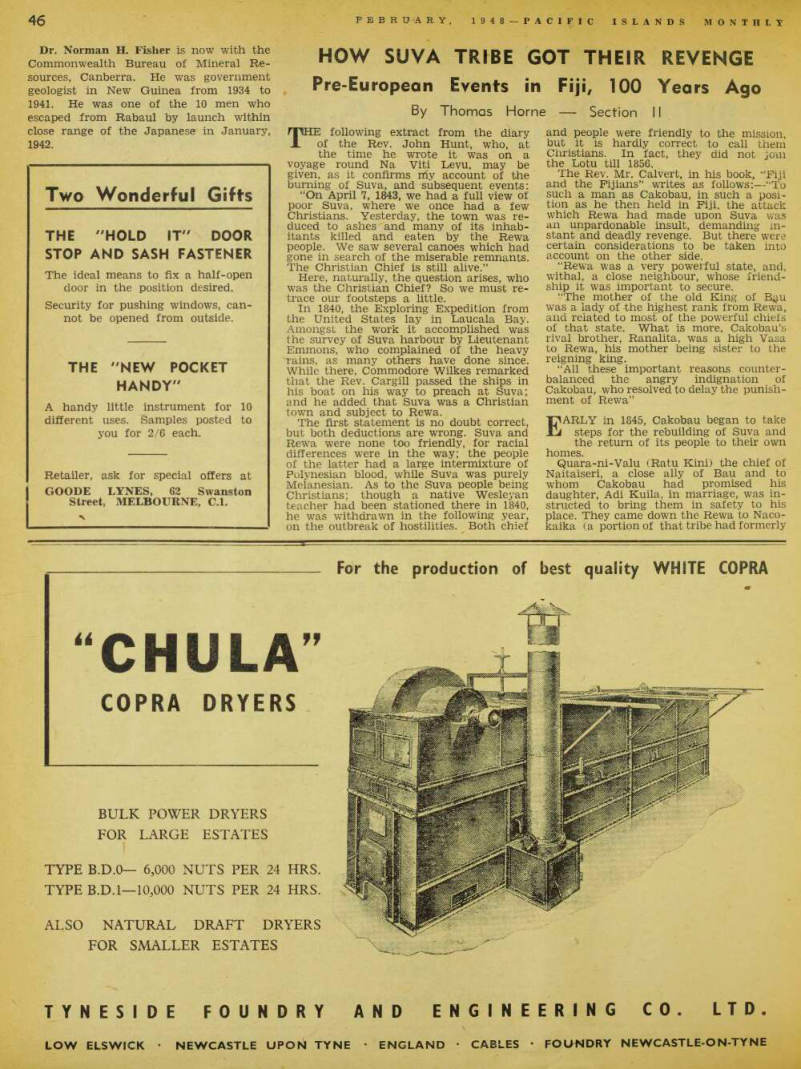
Short Story:
By Lorna Crouch
HE held the two yellow steamer tickets in his moist fingers and gloated over them. Then he dropped them on to the top of his desk, and gazed with complete absorption at the printing that meant paradise for him. To the East for his three months’ leave, with Frances.
Frances! A vivid ’picture of her was forever before him: A serious, small face, behind those large tortoiseshell rims and with that ungainly straw hat she wore in the villages.
Those dirty native villages! He hated them, for they had kept Frances from him for many months.
Frances was an anthropologist, although it seemed ridiculous with such a small, feminine, sprightly young woman. And she was engaged to ercy Wats more. He grinned proudly, and lovingly and reverently folded the tickets and put them back in his pocket-book.
To-day, with the tropic sun shining on the mango tree outside his office, he would tell her of his surprise. The sur prise he’d kept for many long weeks: his planning of an ideal honeymoon.
Ever since that day when he had told her that he couldn’t stand it any longer, he had kept his secret.
“Listen, darling” he had said, “ I can't stand much more of this —seeing you for about two minutes at a time. I want to have you all to myself. Now, my job finishes early in the afternoon, while you keep on working at those beastly reports!”
“They’re not beastly!” Frances stood on the tips of her toes, the better to look sternly into his fiery eyes.
“They are most interesting and neces sary. How can the Government expect to help these people if we don’t study them?”
“Let them help themselves!” Percy W T atsmore stormed vehemently and ir reverently, and attempted to kiss her.
She struggled free, sat down under the mango tree, stretched out her slim legs and relaxed with a sigh.
“How 1 can love such an inhuman creature I’m sure I don’t know.”
He stared gloomily down at her.
“You work too hard,” he said stubbornly.
“You’re doing the complaining.”
“And so I should seeing my girl fade away before my very eyes. Slaving from morn till night! I say —l’ve an idea!”
She smiled indulgently and threw the dilapidated straw hat on the ground.
“Let’s have it then, Percy Watsmore.”
He crumpled up into an untidy heap of creased white duck at her feet, “I’ve decided I’ll help you. I’ll help you all I can, Frances.”
He traced a tiny vein across her brown ankle with a piece of grass. “I’ll taring the office typewriter over every night, and I’ll type your reports. The boss won’t mind. I’ll even come on the week ends with you and the native carriers.
I’ll go into the villages with you and help you discover those things you have to discover.”
She chuckled, and appeared to be con sidering the proposition carefully, screw ing up the already upturned nose that had captivated him long ago.
“You know, Percy, I think if you’re
willing to work hard, you could be a great help to me.”
He swallowed. She studied the clouds above the horizon about a thousand miles away.
“You could write down the dialectic sounds as the natives speak to me. Tnat would save a lot of time. Yes! You shall! The hike at the week-ends will do you a world of good, after sitting in the office all the week.”
She clapped her small, brown hands.
"You could then type my reports in tne evenings. Why, I might easily finish this series weeks before time!”
Then the inspiration had come. “Why not months before time?”
“It’s possible, if we work really hard.”
He felt the strength of leviatham with in him—and so it oecame an agreement.
HE now knew the pronoun endings of this coastal tribe. He knew how they ate, how they thought, and how they lived. In short, he knew everything that Frances, with her amazing inquir ing mind, had discovered. On this hot tropical day with a mighty effort, he put the thoughts of a coastal Papuan tribe as far in the back of his mind as pos sible, and, putting his bleached head out the ever open door, he watched the long road for the first sign of the only girl in the world.
There she came. Business-like as al ways. A large bundle of books and papers were under an arm and in her free hand she waved a piece of paper.
His heart was beating like a sledge hammer. Yes, that’s it, he thought, a sledge hammer. That’s because this is the most wonderful day of my life. I’ll be telling her soon now . . .
Frances was walking quickly. She be gan to run towards him, and he stepped giddily down the path and held out his arms.
“Darling, darling” she called, breathless from hurrying. The venerable straw hat had blown off, her unruly hair was fly ing about, and her eyes were large and shining, behind the horn-rims.
“What do you think has happened?” she ran down the slope and was clasped by two strong, arms. “My reports—the ones you helped me with! They’re good, they say. Look at this radio! It says they have granted me a scholarship to go right ahead at once and investigate that inland tribe we heard of. That one a hundred miles inland. Isn’t it won derful? And, Oh Percy, to think I owe it all to you.”
“You what?” he demanded. The sun was going in fast. The tropical even ing seemed to have taken on a chill.
“I’ve accepted it, of course,” she said complacently her mind evidently already with the inland tribe, “I’ve already radioed my acceptance. I’ll start to morrow. There’s nothing I’d like better!”
The steamer tickets inside his pocket book shrivelled into two shapeless bits of paper that represented nothing at all.
Certainly not a honeymoon at sea. The sun fell beneath the horizon at an alarming rate and sudden night com pletely engulfed Mr. Percy Watsmore,
Dr. Norman H. Fisher is now with the Commonwealth Bureau of Mineral Re sources, Canberra. He was government geologist in New Guinea from 1934 to 1941. He was one of the 10 men who escaped from Rabaul by launch within close range of the Japanese in January, 1942.
Advertisements & other items, pp. 47-48 (1 item)
Burns Philp (New Guinea) Limited
General Merchants (Wholesale and Retail)
Shipping, Customs and General Agents
Head Office: PORT MORESBY, PAPUA
BRANCHES:
NEW GUINEA: Rabaul, Kokopo, Lae £r Madang.
PAPUA: Sama rai.
REPRESENTATIVES FOR:
AUSTRALIAN AGENTS:
LONDON AGENTS:
SAN FRANCISCO AGENTS;
LLOYDS OF LONDON
QUEENSLAND INSURANCE CO. LTD.
BURNS PHILP TRUST CO. LTD.
BURNS, PHILP Cr CO. LTD.
All States.
BURNS, PHILP Cr CO. LTD.
"London House", 35 Crutched Friars, E.C.3.
BURNS, PHILP CO. OF SAN FRANCISCO INC. 510 Matson Building.
Distributing Agents, Territory of Papua-New Guinea for:
SHELL COMPANY OF AUSTRALIA LIMITED
Petroleum Products
GENERAL MOTORS CORPORATION
Chevrolet, Buick, Pontiac and Oldsmobiie Cars Chevrolet and GMC Trucks Frigidaire Refrigerators
VAUXHALL MOTORS LIMITED
Vauxhall Cars and Bedford Trucks
R. A. LISTER Cr CO., BRISTOL
Producers of Petrol, Parrafin and Diesel Engines Pumps and Lighting plants
RUSTON HORNSBY LIMITED
Engines
CROSSLEY MARINE ENGINES
Two Wonderful Gifts
THE "HOLD IT" DOOR
STOP AND SASH FASTENER
The ideal means to fix a half-open door in the position desired.
Security for pushing windows, cannot be opened from outside.
THE "NEW POCKET
HANDY"
A handy little instrument for 10 different uses. Samples posted to you for 2/6 each.
Retailer, ask for special offers at GOODE LYNES, 62 Swanston Street, MELBOURNE, C.l.
For the production of best quality WHITE COPRA U
CHULA
COPRA DRYERS
11
BULK POWER DRYERS
FOR LARGE ESTATES
TYPE B.D.O — 6,000 NUTS PER 24 HRS.
TYPE 8.D.1—10,000 NUTS PER 24 HRS.
ALSO NATURAL DRAFT DRYERS
FOR SMALLER ESTATES
TYNESIDE FOUNDRY AND ENGINEERING CO. LTD.
LOW ELSWICK • NEWCASTLE UPON TYNE • ENGLAND • CABLES • FOUNDRY NEWCASTLE-ON-TYNE
How Suva Tribe Got Their Revenge
Pre-European Events in Fiji, 100 Years Ago
By Thomas Horne Section II
rpHE following extract from the diary A of the Rev. John Hunt, who, at the time h& wrote it was on a voyage round Na Viti Levu, may be given, as it confirms ihy account of the burning of Suva, and subsequent events; “On April 7, 1843, we had a full view of poor Suva, where we once had a few Christians. Yesterday, the town was re duced to ashes and many of its inhab itants killed and eaten by the Rewa people. We saw several canoes which had gone in search of the miserable remnants.
The Christian Chief is still alive.”
Here, naturally, the question arises, who was the Christian Chief? So we must re trace our footsteps a little.
In 1840, the Exploring Expedition from the United States lay in Laucala Bay.
Amongst the work it accomplished was the survey of Suva harbour by Lieutenant Emmons, who complained of the heavy rains, as many others have done since.
While there, Commodore Wilkes remarked that the Rev. Cargill passed the ships in his boat on his way to preach at Suva; and he added that Suva was a Christian town and subject to Rewa.
The first statement is no doubt correct, but both deductions are wrong. Suva and Rewa were none too friendly, for racial differences were in the way; the people of the latter had a large intermixture of Polynesian blood, while Suva was purely Melanesian. As to the Suva people being Christians; though a native Wesleyan teacher had been stationed there in 1840, he was withdrawn in the following year, on the outbreak of hostilities. Both chief
and people were friendly to the mission, but it is hardly correct to call them Christians. In fact, they did not join the Lotu till 1856.
The Rev. Mr. Calvert, in his book, ‘"Fiji and the Fijians” writes as follows:—“To such a man as Cakobau, in such a posi tion as he then held in Fiji, the attack which Rewa had made upon Suva was an unpardonable insult, demanding in stant and deadly revenge. But there were certain considerations to be taken into account on the other side.
“Rewa was a very powerful state, and, withal, a close neighbour, whose friend ship it was important to secure.
“The mother of the old King of Bsu was a lady of the highest rank from Rewa, and related to most of the powerful chiefs of that state. What is more, Cakobau’s rival brother, Ranalita, was a high Vasa to Rewa, his mother being sister to the reigning king.
“Ail these important reasons counter balanced the angry indignation of Cakobau, who resolved to delay the punish ment of Rewa”
EARLY in 1845, Cakobau began to take steps for the rebuilding of Suva and the return of its people to their own homes.
Quara-ni-Valu (Ratu Kini) the chief of Naitaiseri, a close ally of Bau and to whom Cakobau had promised his daughter, Adi Kuila, in marriage, was in structed to bring them in safety to his place. They came down the Rewa to Naco kalka (a portion of that tribe had formerly
settled at Uluvatu) they left Nacokaika for Navuso and some months afterwards they were taken in canoes to Bau.
Then Verani, the chief of Viwa, was ordered by Cakobau to take the Suva people to their old town. They landed at Nukui, a fortified town on the coast close to Rewa, but held for Bau by Komai-Na- Mana (or “Mr. Phillips” as he called him self, as he had gone on a voyage to America in a whaler). They were joined there by Ratu Nailemba. who had been staying at Vutia; and the whole party, led by “Mr. Phillips” and his warriors, returned to Suva. They rebuilt the town, and restored its war-fences. Afterwards, the Suva people built a little town at Ba Walai, near Tamavua, as a check on the Lomai Vuna people.
The Suva people crossed the bay to Korobaba, and cut down two big Damanu trees, and built two large canoes, which they loaded with taro and breadfruit and turtle, and sent as a thanksgiving offer ing to Cakobau, receiving in return gifts of whales’ teeth and tappa.
After the fall of Rewa, in 1846, the people of Mou Vesari (which was a large town even in my early days in Fiji), Laim and Tamavua returned to their homes. . , After the burning of Rewa, in 1846, and the slaughter of its king and over 400 of its people, Qaraniqio—the prime mover in starting the war, and the bitter foe of Bau till his death—took refuge m the Lomai Vuna town of Vuniveilakau, on the Samabula RiVer, and retired to Colo-i-Suva and my old friend, Tamela, says he lived at my place, Vui Vui Ni Kawai, which was a fortified town—the remains of the ramparts are still there. % THE Lomai Vune people seem, for a time, to have been wary of making raids into Suva territory; but about 1850 the Suva people got their revenge.
A party of seven of the Lomai Vuna,
who came down by Vuniveilakau and Kinoya on a hunt for shell-fish at the mouth of the Vatuwaga river, were sur prised just after dawn by a party of five “Bati Kadi” (scouts) of Suva. The scouts crept down on them through the bush till close enough, and one of their number, Koli, with a blow of his club, killed Sinekudre, and the rest of the Vuna men fled. The victim gave his name to the Southern point of the entrance of the river, which is still known as
Ucunisinekudre.
This Koli was a native of Kolobo. who probably for very good reasons shifted to Suva. He was not a chief by birth, but what is known as a Tamata gaga (strong man).
The word “Koli” is really a title not a name. When a Fijian had killed his first enemy in battle, he was raised to the rank of Kori, and from Kori to Koli.
It was this skirmish at the Vatuwaga creek that led to the second Vuna war,
h&& g r «ssa of B e au. awFrotteW trelchlry
* ™S; ■«? £Svs
their stre^thened d "*« in T M» f r t g« si »TtCu d ( & « ‘ w « Sm'” “ the f ° rmer had “* WTn
clan on the Waimanu, and what warriors Qaraniquio could spare him, and he raised levies from as far North as Solo-i-Ra; and, with these, he marched past what is now my place, Na Vui Vui Ki, Kawai and Colo-i-Suva and Tamavua, gather ing what recruits he could, including a few from Wai Vuso and Lami. The latter clan was, as usual, divided, more joining Suva than the enemy.
From there, avoiding Ba Walai, to gain the advantage of a surprise, he reached Vuniveilakau. Next day he crossed the mouth of Kindya and Vatuwaga creeks and, passing up the old track and through the ruined town of Vatuwaga, camped for the night at Matailaivo, the site of Sir Henry Scott’s residence.
Here, in the early morning, they started to paint their faces and arrange their finery, for at no time is a Fijian such a dandy as when going into a fight.
Had they only made their toilets quietly, all might have been well.
But a Fijian seldom does anything quietly, and the sound of their voices reached a woman, who was cutting cou (grass) for the sleeping places in her house, near where Cakobau Road cuts through the Nai Bua rise. She raised the warning cry of the Fijians, “Nai Valu,’’ and instantly the town was roused.
First, a party of scouts rushed out, and quickly reached what used to be called Mr. Borron’s paddock (next to Sir Henry Scott’s, then called Nai Drewa, which was in,those days partly a swamp), and at once got in touch with the enemy.
The first to fall was a Suvan named Wogadrau, who, not side-stepping quickly enough, was killed by a spear thrown by Bai Ko Rewa. Then a Lami man, Toalilili, fighting with the Kai Lomai Vuna, had a bullet put clean through both cheeks by Kure Kadua.
Then the scouts fell back on the town;
and, as they did so, the woman Aisega, who had been cutting grass, called out to them. “Give me the gun! I will fight them if you men are afraid!” For memories of the awful day at Na Ca still burned in the minds of the women of Suva.
But, even as she spoke, Tabukaucoro and his men came rushing out of the town.
The two forces met about what is now the junction of Dennison and Duncan Roads.
The Lomai Vuna leader. Ca Mai Sala, had a spear driven through him by Koroverela. It pierced him through the chest, the point coming out near the shoulder blade.
The wounding of their leader threw the enemv into confusion, and they soon Mattered and fled before the Suva warriors.
Yet their leader, though wounded, was not abandoned. A faithful few bore him away, but were closely pressed by Koh Nigasele, the Mata-Ko-Bau and Vita. Just up the little cutting in Street they came to close quarters in the then thick bush.
Ligasele was seized by the throat by a Vuna warrior, who was about to club him, when Vita rushed to the rescue and knocked his brains out.
After this, the retreat became a rout.
Next day the dead body of Ca Mai Sala was found in the scrub in Rewa Street, being easily identified by its necklace of sharks’ teeth, for gales’ teeth were then almost unknown in Colo. The Dqay, suspended from a pole in the authorised manner, was carried into the help to fill the food ovens, and tjie head, fixed on a post at low water mark in front of the place whe / e ta^Y e^ r m the House now is, served as a target tor tne
youngsters.
Only one man, Wogadrau, is said to have fallen on the Suva side. In the hot pursuit, the warriors of Suva got back, in part at least, payment of the debt owing to them for the slaughter of then wives and sweethearts and children on the Bluff of Na Ca; and that night their ovens were full of the dead bodies of their enemies.
On that night the second Vuna war ended in victory, while the warriors feasted, the women and children danced, and this is the song that they sang m honour of Koli who, by starting the war, had given them their longed-for revenge.
The allusions in it to red and black are but allusions to the paint all warriors used in going into battle; Na meke ni tu Ro Suva Makawa Ena Gauna Ellu Na Koli Damu, na Kuli damn Na Koli Lou, Na L Kuli Loa.
Asese a meke I wau (Repeated three times).
A bo vata a meke I waw A tale ai valu Colo A tale ki lomanikoro A Butu aria Atu-u.
Some of those words are now almost obsolete. I will now give you the inter pretations. It is a song of the chiefs of Suva in the olden times; The Red Chief, the Red Chief, The Black Chief, the Black Chief, Stamp round to the chant of the song of the club (Repeated four times).
Come back from the fight with the mountaineers Come back to the middle of the town Stamp truce and then stand Shout together.
After the battle there was a lot of in termittent fighting along the borders. At one time the Vuna people attacked Kolobo, at other times the Suva warriors,
aided by those of Nataiseri, raided the enemy’s lands.
DURING this period the prettily situ ated town of Kaukalou, on the Tamavua River, was abandoned and destroyed. The site was a little below the present bridge, carrying the water mains, and is still marked by a few coconut trees and the large artificial mound on which the temple once stood.
Vakalailaibula, the brother of Tam bukaucoro, had taken refuge here, after boasting he was the true Chief of Suva; but his brother, not seeing the necessity of two kings, had him killed by some of his “Bati Kadi” (scouts). It had also given refuge to the party from Lami. who had joined Ca Mai Sala in the late fight ing. and so was doomed and wiped out.
The last time the war drum was beaten in Suva, summoning the warriors to the fray, was towards the close of the Vugali war, about 1865, when, aided by an in road to the Nataiseri clan on the people of Waimanu, they took and burned the towns of Lami and Tamavua. and brought their inhabitants prisoners to Suva, where they were detained for a while. But as, bv this time, the Kai-Suva had become Christians, their ovens were heated only for feasts of turtle and dalo.
Tabu-Kau-Coro married Adi Mili, the daughter of Kau-Mai-Ni-Ua. and by her he had three children. Rusieta was bom in 1852. but he did not live long. When, with his mother, he was returning to Suva, and crossing the Rewa Bar, a heavy sea swept the canoe; and when the con fusion it caused was over, all that could be found of the little chief was the mat on which he had been lying.
At his birth, his father had sent to Vesari for two men, and he ordered them to club two Suva men. whom he named, and one body was sent to Rewa and the other to Sawani, as a hint to his enemies that a son was born to carry on the old feud if necessary.
His other children were Tui Buia, better known to old residents of Suva as Ratu Ambrose, and a daughter, Di Salote.
Ratu Ambrose had bv his wife, Adi Kelera of Rewa, three children. They died and left no offspring and with them ended the race of the old chiefs of Suva.
Tabu-Kau-Coro (he who evaded the snare of the club of the mountaineers) died in Bau about 1857. and was buried in the old Vata-Ni-Tawaki.
It is uncertain if he became a Christian, but as he is sometimes termed Ratu Joshua it is likelv that he did. In the missionary records he is always called by his second name, Ravulo.
After his death. Cakobau brought the widow and her children to Bau, where they were brought up; but the lady soon afterwards became the wife of Ratu Golea, of Taveuni, and the mother of the Chiefs of Somo Somo.
NOW, about the history of the clans on the western side of the Bay. The people of Mou Kaloko Levu, Wai Vuso and Lami are said to be of one race, coming originally from the region a few miles west of Suva, known as Vlu Mou, or Na Sakalo.
The people of Vesari, now settled on the western point of Suva harbour, at Wai ga-ake, came down from the mountains at a somewhat later period, under a chief called Roko-ba-lena, from the district now known as Solo-i-ra, and settled at Nai Duva, a little further up the creek from the site of the town as I knew it in 1884.
About 1855, the Vesari people, helped by their friends from Solo-i-ra. burned the town of Na Qele Dina, on the Wai Vuso river. Not long after this, a more serious affair happened, for Liga-ca, or Na-Solia, Chief of the Wai Vuso clan, made a raid from his town of Na Toa
upon the island of Namuka, then occupied by two Americans.
One American was wounded and cap tured, but the other, a Mr. Colittle, escaped, and with the help of a party of
mountaineers sent by Koroduadua, the chief of Namosi, and led by the late Ezra Work (known to us boys as Moses Work—he was on the Mississippi with Mark Twain and settled on the Sigatoka) the wounded man was rescued, and the town of Na Moli, on the Wai Vuso creek was burned.
This led to an American warship burn ing most of the towns along the coast, including Nai Duva.
So ends my history of Suva, prior to the coming in of the Polynesian Company and the European.
Advertisements & other items, pp. 49-54 (1 item)
Kerr Bros. Ptv. Ltd.
4 YORK STREET, SYDNEY
ASSEMBLY HALL,
Island Merchants and
Address mail: Box 3838, G.P.O., Sydney, Australia.
Cable Address:
“CARE" SYDNEY.
Codes: ABC 6th & 7th.
BENTLEYS COMPLETE
PHRASE.
BENTLEYS SECOND
PHRASE.
Agents
50 YEARS' PRACTICAL EXPERIENCE IN ISLAND REQUIREMENTS All kinds of Island Produce sold on commission at best prices. Liberal advances on consignments. All merchandise for Island Requirements purchased at best wholesale price and original invoices supplied.
BANKERS: AGENTS FOR AIR SERVICE:
Commonwealth Bank of Australia, Head Office, Trans Oceanic Airways Pty., Ltd.
Sydney. Sunderland Flying Boats to pacific Islands— Comptoir National d’escompte de Paris, Sydney. charters arranged any place. ♦ KERR BROS. PTY. LTD. for integrity, stability and dependability.
Colycr Watson (New Guinea) Ltd.
Head Office: RABAUL Branches: Kavieng, New Ireland, and at 22 Bridge Street, Sydney
GENERAL MERCHANTS AND BUYERS
OF ISLAND PRODUCE
Plantation Owners and Engineers
Managing Agents: Union Assurance Society Ltd.
National Mutual Life Association of A/asia Ltd.
Agents: China Navigation Company Sole Distributors: Chrysler and Plymouth Cars Fargo Trucks Willys-Overland Jeeps G.M. Marine and Industrial Engines Prefect Refrigerators
A. B. DONALD Ltd.
AUCKLAND
ISLAND TRADERS & GENERAL MERCHANTS
P.O. Box 1509. Cables £r Telegrams, "Kingdom/ 7 Auckland.
ISLAND MERCHANTS
and AGENTS.
GENERAL MERCHANTS
C® Sallivan Iffef® Jylji
AJ C ) • Shippers of all types of Merchandise to the Pacific Islands • Representing Australian, British and American Manufacturers rr r r
rum r>CCCc;
• Buyers for Leading Pacific Islcnds Traders * Sellers of Island Produce on Consignment
379 KENT ST., SYDNEY.
Cable & Telegraphic Address: “Chasull ” Sydney. • Importers, Distributors and Manufacturers of Foodstuffs, Softgoods, Textiles, Hardware, Tobaccos, Wines and Spirts, etc. 0* t • "Ultima" Kerosene Stoves and Heating Appliances A,
Pyjamas and Clothing (/j j* \\j
• Distributors of High-grade Shirts, • "Southern Queen' Canned Fruits y &r Forwarding and Transhipment Agents / j ■m Hill's English Cigarettes When in Sydney, call and see us!
-f wr * V
Relief from
a major anxiety
Even the most expert and conscientious individual executor is subject to accident, illness and incapacitation.
Continuity of administration and uninterrupted attention to your estate and your beneficiaries are of paramount importance. Both can be positively assured by appointing this Company your sole Executor or as co-Executor with your present appointee. An interesting explanatory booklet will be forwarded on request.
DIRECTORS:
James Barns. Joseph Mitchell. F. T. W. Black.
Frederick Ewen Loxton. Eric Priestley Lee.
MANAGER: L. S. Parker.
SECRETARY; E. R. Overton, A.F.I.A.
BURNS PHILP TRUST
COMPANY
LIMITED
EXECUTOR
TRUSTEE
AGENT
7 BRIDGE
TELEPHONE: BU 5901.
STREET
SYDNEY
Box 543, G.P.0., Sydney
BPI .45
Hard to Get? Tn_ US
FOR
1. TRADE TOBACCO
2. LAP LAP MATERIAL
3. CANNED GOODS
4. PERFUMERY
5. PRIMUS STOVES
6. KEROLAMPS
7. SHOES, SANDALS
8. UMBRELLAS
9. CHILDREN'S CLOTH-
ING
10. SADDLERY & HARNESS
11. HOME LIGHTING PLANTS
12. WINES AND SPIRITS
13. NON-ELECTRIC WASHING
MACHINES
14. PUMPS, IRRIGATION
PLANTS
15. CROCKERY
16. HAIRDRESSING SUPPLIES
17. HARDWARE
18. AIR CIRCULATORS
8a Castlereagh Street
IflAllS iUVIiS Sydney, Australia
ISLAND TRADERS
Cable and Telegraphic address: “MANSTOCKS,” SYDNEY Telephones: 8W7405, 8W1237, 85076, FM2766
'*V\ v v A [a La " 1111 H" w/,
Butler
Crunch
* npi > i ** m
* CLuMuK,
SWALLOW’S
"}toA}ouh,
SwftL L 0 W & A .1.1 ELL • • i 11 «K r T• I• Qp;|| y|||i|lv;S|t ffliaafat Cia/fartem. 4 the 3&|||
#MCu4ityJmce /854
WESTCLOX
"VTEVER has performance been more trustworthy than in the beautiful Westclox of today . . . famous Big Ben and other spring wound clocks, electric clocks, wrist watches and pocket watches. When you buy your next clock or watch, look for the trade mark “Westclox” on the dial . . . your assurance of quality.
POCKET BEN A thin model cvatch with many features. Highly polished, plated finish; silvered iial; attractive numerals and lands. Unbreakable crystal.
SPUR Luminous A thin case, ne-day alarm. Black finish with ickel trim. 41 inches square, iteady alarm. Unique base, uminous dial. 6 5 BIG BEN Chime Alarm The highest standard of alarm clock quality. Quiet tick and gentle two-voiced alarm. First there’s a gentle call, then if he’s not shut off. there’s a lusty shout. Dustproof attachments. 5 i inches high. Ivory finish with gold colour trim. Luminous dial. * 10/ W \ * 'i
WESTCLOX y
7 6 5 10 BABY BEN A smart looking alarm clock. 3*£ inches high.
Quiet tick; steady alarm that rings loud or soft. Legible dial.
Two finishes . . . black with nickel trim, and ivory with gold colour trim. Made in plain and luminous dial.
LA SALLE A handsomely designed wrist watch. Chrome finish case, stainless steel back, curved to fit the wrist. Sturdy movement, regulated to run in any position. Equipped with conventional second hand; rustproof hairspring.
ORDER THROUGH YOUR LOCAL STORE
PACIFIC ISLANDS TRADING
COMPANY
244 CALIFORNIA STREET, SAN FRANCISCO, CAL., U.S.A.
Bankers: Bank of America (Main Office) San Francisco.
Cables:
PITCO
SAN FRANCISCO
G. H. Robinson
ISLAND SUPPLIES
of all kinds—Selected and Shipped to order at lowest possible prices—Piecegoods in Wool, Cotton and Silk, Under and Outerwear, Manchester, Drapery, Grocery, Hardware, Engineers and Leathergoods trade supplies a specialty.
Indents and Transhipments arranged. Large or small orders treated with equal care.
Use our 25 years’ extensive experience.
Enquiries solicited to —
G. H. ROBINSON
51 Macquarie Street, Sydney, N.S.W.
Telegrams: Sunrise, Sydney.
Letters: Box 3317, G.P.0., Sydney.
Pimples and Bad Skin Fought in 24 Hours
In just a day or two your mirror will tell you that here at last is the scientific treatment you have been needing to clear your skin—the treatment to make you look more attractive, to help you win friends. Nixoderm has brought clearer, healthier skins to thousands, such as Mr. Bob Weedon, Edmund Street, Fremantle, who writes: “I was troubled with pimples ever since I was 13, and have spent pounds and pounds on so-called cures without results. I then tried Nixoderm with astounding effect.
The pimples seemed to fade away, and after a week there was not the slightest trace of them.”
Satisfaction Guaranteed
Get Nixoderm from your chemist or store to-day. Look in the mirror in the morning and you will be amazed at the improvement.
Then Just keep on using Nixoderm for one week and at the end of that time it must have made your skin soft, clear, smooth and magnetically attractive—must give you the kind of skin that will make you admired wherever you go, or you simply return the empty package and your money will be refunded in full. Get Nixoderm from your chemist or store to-day.
The guarantee protects you.
Nixoderm 2/- & 4/-
For Skin Sores, Pimples and Itch .
Since the discovery of Nlxoderm by an American physician it is no longer necessary for anyone to suffer from ugly, disgusting and disfiguring skin blemishes such as Eczema, Pimples, Rash, Ringworm, Psoriasis, Acne, Blackheads, Scabies and Red Blotches. Don’t let a bad skin make you feel Inferior and cause you to lose your friends. Clear your skin this new scientific way.
A New Discovery
Nlxoderm Is an ointment, but different from any ointment you have ever seen or felt. It is a new discovery, and is not greasy but feels almost like a powder when you apply it. It penetrates rapidly into the pores and fights the cause of surface skin blemishes. Nlxoderm contains 9 ingredients which fight skin troubles in these 3 ways. I.—lt fights and kills the microbes or parasites often responsible for skin disorders. 2.—lt stops Itching, burning and smarting in 7 to 10 minutes, and cools and soothes the skin. 3,—lt helps nature heal the skin clear, soft and velvety smooth.
Works Fast
mediately, clearing and healing your skin, making it softer, whiter and velvety smooth.
Because Nlxoderm is scientifically compounded to fight skin troubles, it works fast.
It stops the itching, burning and smarting in a few minutes, then starts to work 1m-
Hydro-Electric Experts
Report on Fiji
Prom Our Own Correspondent
Suva. Jan. 19.
npHE possibilities of hydro-electric power X development in Fiji are the subject of a voluminous report from the New Zealand consulting engineers, Messrs.
Vickerman and Lancaster.
Some time ago they were called upon by the Fiji Government to make an ex haustive study.
The basic conclusion reached in the re port is that the Navua River is an eminently practicable source of power which could be reticulated throughout the southern part of Viti Levu.
Several good dam sites are available about five miles from the mouth. A dam 180 ft. high is recommended, and it is stated that this would provide sufficient power to allow a 50 per cent, surplus on present requirements.
The report also recommends partial de velopment of the Wainanuku River and Monasavu Falls to provide power for Tavua, Ba, Lautoka and Nadi, on the opposite side of the island.
This would include a dam 150 ft. high, making it possible to geperate 5000 kilo watts.
In the opinion of the consultants, the south-eastern (Suva) and north-western districts of Viti Levu are the only areas in the Colony which warrant extensive development at present.
Fijians
Pastoral Farming For Fijians Government Committee To Draw Up Plan
Prom Our Own Correspondent
Suva, Jan. 19.
LARGE-SCALE pastoral development of land by Fijian farmers, discussed spasmodically in the past, has been brought into the forefront of the Colony’s affairs by an announcement by the Act ing-Governor (Mr. J. F. Nicoll). It is stated that a committee has been set up to examine the whole question and to draw up a plan covering such points as the acquisition of suitable land, the amount of capital investment, the source of finance, management, returns, and allied matters.
At the November sitting of the Legis lative Council, the Fourth Fijian Member (Joeli K. Ravai) suggested that it might be possible to obtain assistance from the United Kingdom Colonial Develop ment Fund for a scheme to establish Fijian dairy-farmers.
Captain A. R. W. Robertson, who was then Acting Colonial Secretary, com mented later that after the many Euro pean and Indian demands for new ser vices and other forms of expenditure, this Fijian suggestion was extremely refresh ing. The Fijian member, he said, had not demanded that the taxpayers should pay up and hand over; he had simply sug gested a loan for the supply of ments and other essentials for Fijian farmers.
Joeli Ravai has been appointed a mem ber of the new committee; so has Mr. H.
Maurice Scott, who supported his proposal in the Legislative Council. The Economic Adviser (Mr. R. M. Taylor) is chairman, and the other members are the Secre tary for Fijian Affairs (Ratu Sir Laia Sukuna), the Director of Lands (Mr.
W. H. B. Buckhurst), the Senior Agri cultural Officer (Mr. B. E. V. Parham), Mr. H. King Irving (ex-general manager of the Colonial Sugar Refining Com pany, Fiji), Mr. J. H .H. MUlett and the Acting Accountant-General (Mr. W. E.
Donovan).
Ancient Rock-Drawings
In Southern NZ Caves
ANCIENT rock-drawings of known animals and of what look like fabu lous creatures of the imagination have recently been found in lonely caves of the South Island by a young Dutch painter Theo Schoon.
Carrying his tent and camping gear, Schoon has spent the past few months in a one-man investigation of primitive art in New Zealand.
Moving slowly down the east coast of the South Island, he has made discoveries in Marlborough, Canterbury, and Otago Provinces—among them caves with floors strewn with the bones of the extinct moa, and walls covered with drawings, some of them nine feet long.
Local experts have not yet seen all Schoon’s finds, but he says these ancient pictures show a high degree of skill.
Schoon has now traversed the whole length of the island, and the other day in Southland he announced that he had found more drawings.
No one has yet estimated the age of' these cave-pictures or made a pronounce ment, on who the ancient artists were, but they may have been Morioris— dwellers in New Zealand before the Maoris came from Polynesia, and who now survive only on the Chathams a small, bleak group eastward of NZ.
Lae Now Has A Theatre
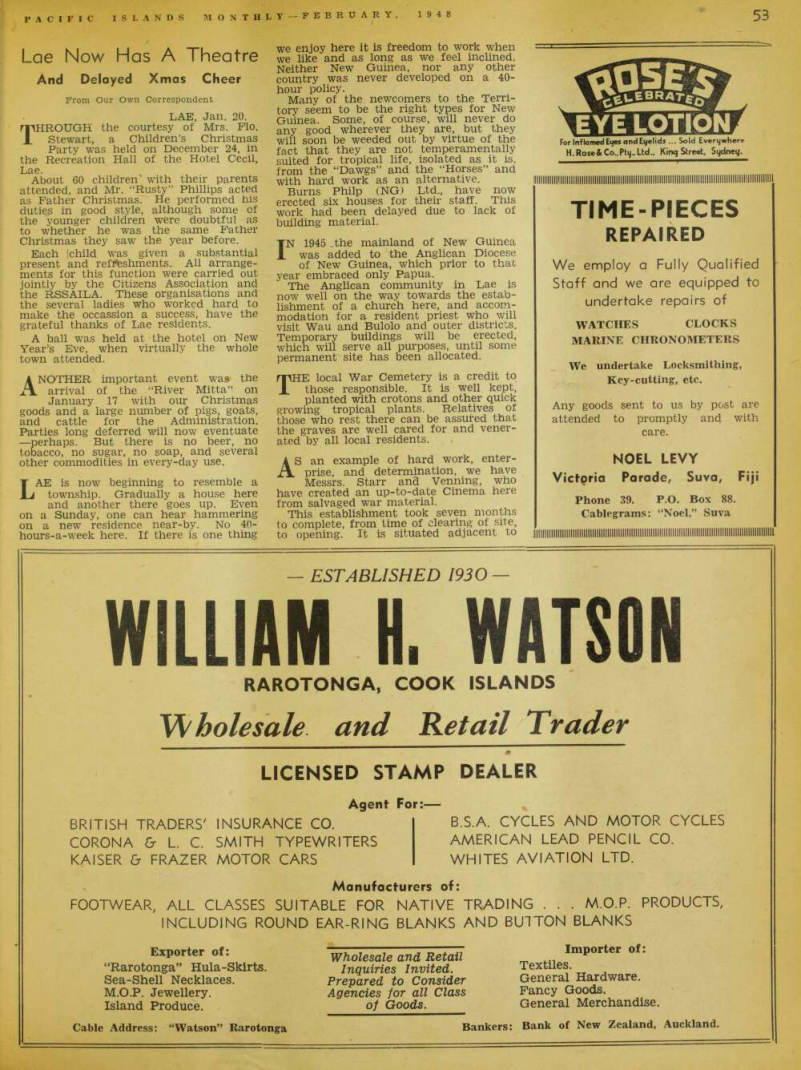

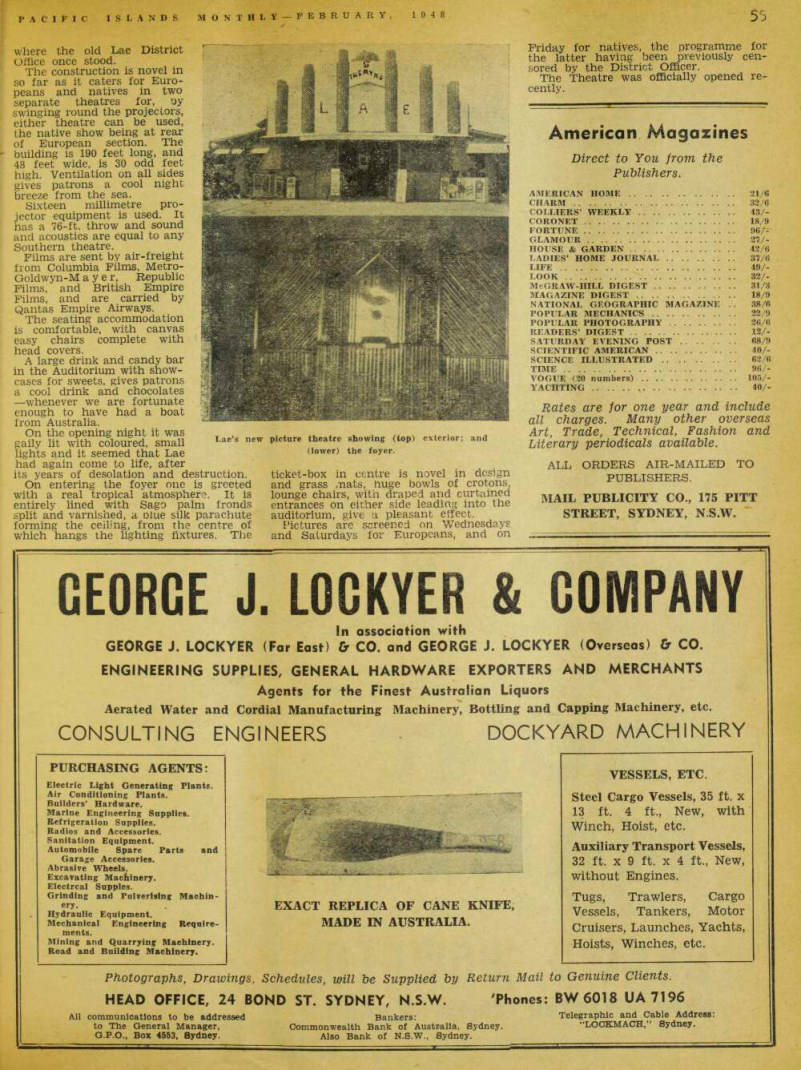
And Delayed Xmas Cheer
Prom Our Own Correspondent LAE, Jan. 20.
THROUGH the courtesy of Mrs. Flo.
Stewart, a Children’s Christmas Party was held on December 24, in the Recreation Hall of the Hotel Cecil, Lae.
About 60 children' with their parents attended, and Mr. “Rusty” Phillips acted as Father Christmas. He performed his duties in good style, although some of the younger children were doubtful as to whether he was the same Father Christmas they saw the year before.
Each |child was given a substantial present and refreshments. All arrange ments for this function were carried out jointly bv the Citizens Association and the RSSAILA. These organisations and the several ladies who worked hard to make the occassion a success, have the grateful thanks of Lae residents.
A ball was held at the hotel on New Year’s Eve, when virtually the whole town attended.
A NOTHER important event was the arrival of the “River Mitta” on January 17 with our Christmas goods and a large number of pigs, goats, and cattle for the Administration.
Parties long deferred will now eventuate —perhaps. But there is no beer, no tobacco, no sugar, no soap, and several other commodities in every-day use.
LAE is now beginning to resemble a township. Gradually a house here and another there goes up. Even on a Sunday, one can hear hammering on a new residence near-by. No 40hours-a-week here. If there is one thing
we enjoy here it is freedom to work when we like and as long as we feel inclined.
Neither New Guinea, nor any other country was never developed on a 40hour policy.
Many of the newcomers to the Terri tory seem to be the right types for New Guinea. Some, of course, will never do any good wherever they are, but they will soon be weeded out by virtue of the fact that they are not temperamentally suited for tropical life, isolated as it is. from the “Dawgs” and the “Horses” and with hard work as an alternative.
Burns Philp (NG) Ltd., have now erected six houses for their staff. This work had been delayed due to lack of building material.
IN 1945 ,the mainland of New Guinea was added to the Anglican Diocese of New Guinea, which prior to that year embraced only Papua.
The Anglican community in Lae is now well on the way towards the estab lishment of a church here, and accom modation for a resident priest who will visit Wau and Bulolo and outer districts.
Temporary buildings will be erected, which will serve all purposes, until some permanent site has been allocated.
THE local War Cemetery is a credit to those responsible. It is well kept, planted with crotons and other quick growing tropical plants. Relatives of those who rest there can be assured that the graves are well cared for and vener ated by all local residents.
AS an example of hard work, enter prise, and determination, we have Messrs. Starr and Venning, who have created an up-to-date Cinema here from salvaged war material.
This establishment took seven months to complete, from time of clearing of site, to opening. It is situated adjacent to
where the old Lae District Office once stood.
The construction is novel in so far as it caters for Euro peans and natives in two separate theatres for, oy swinging round the projectors, either theatre can be used, the native show being at rear of European section. The building is 190 feet long, and 48 feet wide, is 30 odd feet high. Ventilation on all sides gives patrons a cool night breeze from the sea.
Sixteen millimetre pro jector equipment is used. It has a 76-ft. throw and sound and acoustics are equal to any Southern theatre.
Films are sent by air-freight from Columbia Films, Metro- Goldwyn-M aye r, Republic Films, and British Empire Films, and are carried by Qantas Empire Airways.
The seating accommodation is comfortable, with canvas easy chairs complete with head covers.
A large drink and candy bar in the Auditorium with show cases for sweets, gives patrons a cool drink and chocolates —whenever we are fortunate enough to have had a boat from Australia.
On the opening night it was gaily lit with coloured, small lights and it seemed that Lae had again come to life, after
its years of desolation and destruction.
On entering the foyer one is greeted with a real tropical atmosphere. It is entirely lined with Sago palm fronds split and varnished, a Dlue silk parachute forming the ceiling, from the centre of which hangs the lighting fixtures. The
ticket-box in centre is novel in design and grass mats, nuge bowls of crotons, lounge chairs, with draped and curtained entrances on either side leading into the auditorium, give a pleasant effect.
Pictures are screened on Wednesdays and Saturdays for Europeans, and on
Friday for natives, the programme for the latter having been previously cen sored bv the District Officer.
The theatre was officially opened re cently.
Lae’s new picture theatre showing (top) exterior; and (lower) the foyer.
Mr. E. J. Moon has succeeded Mr. D.
A. Butler as manager of the Union Steamship Company’s branch in Suva,
Fiji. Mr. Butler left Suva recently for New Zealand, after 10 years service with his company there.
Advertisements & other items, pp. 55-58 (1 item)
William H. Watson
EYE LOTION
For Inflamed Eyes and Eyelid J... Sold Everywhere H. Rose & Co., Pty- Ltd.. King Street. Sydney.
TIME-PIECES
REPAIRED
We employ a Fully Qualified
Staff and we are equipped to undertake repairs of
WATCHES CLOCKS
MARINE CHRONOMETERS
We undertake Locksmithing, Key-cutting, etc.
Any goods sent to us by post are attended to promptly and with care.
NOEL LEVY
Victoria Parade, Suva, Fiji Phone 39. P.O. Box 88.
Cablegrams: “Noel,” Suva
ESTABLISHED 1930
WILLIAM H. WATSON
RAROTONGA, COOK ISLANDS
Wholesale and Retail Trader
0
LICENSED STAMP DEALER
Agent For:—
BRITISH TRADERS' INSURANCE CO.
CORONA & L. C. SMITH TYPEWRITERS
KAISER & FRAZER MOTOR CARS
B.S.A. CYCLES AND MOTOR CYCLES
AMERICAN LEAD PENCIL CO.
WHITES AVIATION LTD.
Manufacturers of: FOOTWEAR, ALL CLASSES SUITABLE FOR NATIVE TRADING . . . M.O.P. PRODUCTS, INCLUDING ROUND EAR-RING BLANKS AND BUITON BLANKS Exporter of: “Rarotonga” Hula-Skirts.
Sea-Shell Necklaces.
M.O.P. Jewellery.
Island Produce.
Cable Address: “Watson” Rarotonga Wholesale and Retail Inquiries Invited.
Prepared to Consider Agencies for all Class of Goods.
Bankers; Importer of: Textiles.
General Hardware.
Fancy Goods.
General Merchandise.
Bank of New Zealand, Auckland.
TILLEY LAMPS
BURN ORDINARY KEROSENE
The Modern Form of PORTABLE LIGHTING
Mr m / wm o THE OWL IS PROVERBIALLY A WISE BIRD, SO BE SURE YOU FOLLOW HIS EXAMPLE! TILLEY LAMPS ARE SO SUCCESSFUL THAT COPIES OF THEM ARE BEING MARKETED. TILLEY LAMPS ARE MADE ONLY IN ENGLAND THE TILLEY LAMP CO. LTD., of ENGLAND
REPRESENTATION :
MELBOURNE : T. H. Bentley, Pty. Ltd., 123-125 William Street, Melbourne. Cl.
TASMANIA ; Mr. C. Sellars, 108 a Charles Street, Launceston.
FIJI : Mr. K. Witherington, 2 Burns Philp Buildings, Suva.
American Magazines
Direct to You from the
Publishers.
AMERICAN HOME 21/6
CHARM 32/6
COLLIERS’ WEEKLY 43/-
CORONET 18/9
FORTUNE 967-
GLAMOUR 277-
HOUSE & GARDEN 42/6
LADIES’ HOME JOURNAL 37/6
LIFE 497-
LOOK 32/-
McGRAW-HILL DIGEST 31/3
MAGAZINE DIGEST 18/9
NATIONAL GEOGRAPHIC MAGAZINE . . 38/6
POPULAR MECHANICS 22/9
POPULAR PHOTOGRAPHY 26/6
READERS’ DIGEST 12/-
SATURDAY EVENING POST 68/9
SCIENTIFIC AMERICAN 407-
SCIENCE ILLUSTRATED 62/6
TIME 967-
VOGUE (20 numbers) 1057-
YACHTING 40/-
Rates are for one year and include
all charges. Many other overseas
Art, Trade, Technical, Fashion and
Literary periodicals available.
ALL ORDERS AIR-MAILED TO
PUBLISHERS.
MAIL PUBLICITY CO., 175 PITT
STREET, SYDNEY, N.S.W.
GEORGE J. LOGKYER & COMPANY
In association with GEORGE J. LOCKYER (Far East) & CO. and GEORGE J. LOCKYER (Overseas) & CO.
ENGINEERING SUPPLIES, GENERAL HARDWARE EXPORTERS AND MERCHANTS Agents for the Finest Australian Liquors Aerated Water and Cordial Manufacturing Machinery, Bottling and Capping Machinery, etc.
CONSULTING ENGINEERS DOCKYARD MACHINERY
PURCHASING AGENTS:
Electric Light Generating Plants.
Air Conditioning Plants.
Builders’ Hardware.
Marine Engineering Supplies.
Refrigeration Supplies.
Radios and Accessories.
Sanitation Equipment.
Automobile Spare Parts and Garage Accessories.
Abrasive Wheels, Excavating Machinery.
Electrcal Supples.
Grinding and Pulverising Machinery.
Hydraulic Equipment.
Mechanical Engineering Requirements.
Mining and Quarrying Machinery.
Road and Building Machinery.
EXACT REPLICA OF CANE KNIFE,
MADE IN AUSTRALIA.
VESSELS, ETC.
Steel Cargo Vessels, 35 ft. x 13 ft. 4 ft., New, with Winch, Hoist, etc.
Auxiliary Transport Vessels, 32 ft. x 9 ft. x 4 ft., New, without Engines.
Tugs, Trawlers, Cargo Vessels, Tankers, Motor Cruisers, Launches, Yachts, Hoists, Winches, etc.
Photographs, Drawings , Schedules, will be Supplied by Return Mail to Genuine Clients.
HEAD OFFICE, 24 BOND ST. SYDNEY, N.S.W. 'Phones: BW6OIB UA7196 All communications to be addressed Bankers: Telegraphic and Cable Address; to The General Manager, Commonwealth Bank of Australia, Sydney. “LOCKMACH,” Sydney.
G.P.0., Box 4553, Sydney. Also Bank of N.S.W., Sydney.
-Z///M Airway Cases, In woven-striped, waterproofed canvas with leather-bound edges, are made for flying. The supply is limited . . . but increasing!
Made by FORD SHERINGTON LTD.
Wholesale only
Sails, Covers, Awnings
AND ALL CLASSES CANVAS GOODS FOR
INDUSTRIAL AND HOME USE
ALSO; FLAGS, ALL NATIONS
Send your inquiries to
HARRY WEST
"SYDNEY'S SAILMAKER"
DUKE ST. (WATERFRONT) EAST BALMAIN, SYDNEY, N.S.W.
Phone: WB1105, WB2284.
AUNT
MARYS
CREAM OF TARTAR
BAKING POWDER
Now Better than Ever!
Improving Honiara Port
Facilities
From Our Own Correspondent
Honiara, Dec. 29
Commander Bolton, Of The Hy
drographic Branch of the RAN, is expected to arrive here by Trans oceanic flying-boat at the end of Jan uary, He is to make an accurate survey of Point Cruz (Honaira) and the bays on each side of the point, in order that plans for new wharves may be drawn.
At present, local shipping, guided by recently erected markers, anchors on both westerly and easterly sides of the point.
Last week a pontoon dock was towed into position on the eastern side. A ramp is under construction to permit loading directly from trucks. From this point a new road has been bulldozed, as a short cut to the Government stores.
Heavy cargo unloading, such as from RMS “Kurimarau” (BSl’s main link with the outside world as it makes fairly regu lar six-weekly runs to Suva and back), is done at Kukum, two miles down the coast, at one of the big American-built docks which, patched and repaired, is still in usable condition.
Sophisticated Natives
VISITING a coastal village during the Festive Season (writes a New Guinea resident) I was guest-of-honour at the “House Picture.”
A bed-sheet was rigged up and the operator stood behind it with a “shoot lamp,” while the artists performed in silhouette. The whole affair was highly amusing and caused roars of laughter, especially as the “announcer,” mimicking a white man, announced what was hap pening in Pidgin English.
I was warned not to tell the “Kiap,” otherwise I would also be reported for playing “Lucky”—that notorious, “sudden death” coons’ game. I had played it. I was anxious to procure a couple of sticks Of tobacco to reward a native, and the only way of obtaining it was by entering the gambling school in an attempt to win two sticks from the pool. It cost me two shillings before I got my tobacco.
A table-tennis table was in the middle of the village, chairs arranged around it, and the game proceeded quietly among friends in the moonlight.
N. Caledonia Now Feeling
Currency Shortages
THE exhaustion of the New Caledonian overseas funds caused a run on the Noumea stores recently. People be sieged the counters offering to buy al most anything available, at almost any price. There was a special run on dress material and shoes, and motorists bought up all the petrol available, until sales were suspended.
About the same time, the Administra tion informed the public of the gravity of the flour position. It was admitted that stocks in hand were only sufficient to supply the bakers for a short period. The Administration stated it was not proposed to introduce bread rationing yet, but it issued a warning against household wast age, and urged the constant need for economy.
V ' ■ It would be a good idea to ask candi dates in the next Australian General Election not what they stand for, but what they won’t stand for!
Sir Maynard and Lady Hedstrom left Suva on January 12, on a visit to New Zealand.
How You Con Teach
UK Children About the S. Pacific
Letter to the Editor IT is a recognised fact that the British people in the UK are profoundly ignorant of life in the countries of the Empire.
The best way to educate a nation is obviously to get at the children while their ideas are in the development stage and give them the facts in a way that they can absorb.
The Imperial Institute in London, whose job it is to educate the nation about the Empire has created a scheme called the “Empire Lecture Scheme to Schools.”
They have a panel of lecturers, of which I am one, who between them cover the whole British Empire with personal experience. These men and women are sent into every type of school all over the country to give a 40-minutes talk, with 20 minutes question time after wards, on any country of the Empire re quested by the Headmaster or Mistress.
The Scheme has been an outstanding success from the start, and is growing every year and the interest of the chil dren is great.
The Lecturers mostly use 34 x 34 inch lantern slides and sometimes films. The majority of lecturers have their own sets taken by themselves in the countries where they have been resident. I have been using slides presented to the in stitute by Sir Harry Luke.
Up to the end of last year a District Officer from Fiji was available to talk to the children on the British Pacific Islands, but when he returned to the Pacific it fell to my lot to deal with these lectures.
I have found that even the best “geog raphers,” whose job is to instruct the children, are almost completely ignorant of the Pacific. It is certainly the least known part of the British Empire. I have heard a geographer of a Grammar School say (on being offered a talk on the Pacific Islands) “Oh no, they are of no commercial importance.” This state ment reveals a complete ignorance of Pacific Islands products.
THERE are many difficulties. One of these is a shortage of comprehen sive sets of visual aids (chiefly lan tern slides) and an almost entire absence of coloured pictures of the peoples and products of the British Pacific Islands.
How can the children be made to com prehend the beauty of the Pacific or the appearance of the -peoole without the beautiful colours of ocean, bush and flowers and the lovely golden-skinned Polynesians or the dark skinned Melane sians?
Even with experience to draw from it is difficult to convey a clear idea of the place without such pictures to show them.
The essence of the whole scheme is to send someone right into the class room who can tell the story from personal experience and bring the very atmos phere of the place with him.
If any of your readers can help with “natural” pictures of life and labour in the Pacific Islands we would be im mensely grateful. Negatives are best for the making of slides, but coloured slides would be even more acceptable.
Such help would be of untold value to British children who will one day have a hand in running the “Old Country” and a voice on what our Empire policy is to be.
Any pictures should be accompanied by a descriptive caption so that the lec turer knows what he is talking about when the picture appears on the screen.
Children are very interested in mis
sionary work. We often get requests for such people to lecture them and the children appreciate their detailed know ledge. Therefore any nicture contrast ing the “wild islander” with the clean, happy-looking Christian islander, to show the value of mission work, would be welcome. Also, the work of medical missions and welfare work.
I am, etc.,
Norman G. Manley.
3 Queens Av., Woodford Green, Essex, England.
Type of Negatives Required
ANYONE who is interested in teaching British children more about the South Pacific should contact Mr.
Manley direct. The type of pictures he requires are as follows: — (1) A typical Polynesian family (father, mother, and children together); (2) a typical Melanesian family (father, mother, and children together); (3) a typical Micronesian family (father, mother, and children together); (4) native school children of each of the races; (5) native dress (showing the various types of lava-lava); (6) native dances; (7) a native wedding; (8) natives preparing food; (9) natives fishing; (10) natives swimming (preferably showing small children as well); (11) a group of girls, aged 9-14, swimming; (12) launching a canoe through the surf; (13) a crowd of wild natives on the beach with a “bush” background; (14) a trader bargaining with natives for copra; (15) a two masted trading schooner (close up and also sail ing); (16) a close up of a coconut crab (with nut to show relative size): (17) beche-de-mer fishing (with a close up of the beche-de-mer showing relative size); (18) a coconut in the
hands of a native child and in its various stages of being cut up—a green coconut, a ripe coconut in husk, a coconut with husk off show
ing coir in one hand and nut in other, a split nut showing close up of copra being extracted, copra strung on line for sale to trader; (19) a
banana palm in full fruit, with native in pic ture, to show relative size; (20) bread fruit tree in full fruit and close up of fruit showing re lative size, with native in picture; (21) paw paw, various melons, limes, oranges, citrons, passion-fruit, yams, taro, ti-root, and any other tropical fruit or vegetable shown close up and showing relative size with hand or part figure of native in picture; (22) picture of coral sea bottom taken through window in bottom of boat (if possible showing beche-de-mer on white coral sand); (23) picture of natives cutting sugar-cane; (24) any pictures of Pitcairn Island—(Pitcairn Island is the only settled Colony in the Empire not represented in the Institute Exhibition Galleries); (25) picture of pretty Polynesian girls wearing hibiscus flower in ear (with coloured close up of hibiscus); (26) pictures of particu larly good-looking natives, which will show that Europeans are not the only good-looking people in the world.
Advertisements & other items, pp. 59-60 (1 item)
W. Kopsen & Co. Pty. Ltd.
r
INDOORS or OUT. ..
BRILLIANT LIGHTING
WHEN AND WHERE
REQUIRED
KAYEN
The All Australian Kerosene Pressure Lamp
DORMAN
MARINE DIESELS
British made quality power units 15 h.p. to 100 h.p. 6 models, all electric. Suitable for commercial, fishing or pleasure boats. Specification on request. r- J 1 Prevention is Better than Cure o
PREVENT DECAY WITH
DEKOL
Guards Wood and Canvas from the Ravages of White Ants, Borers, Dry Rot, Mildew. Etc.
DEKOL penetrates deeply and permanently protects wood and fabrics from rot and attacks by fungi and insects. It is simple to apply and when dry can be painted and varnished. DEKOL prevents attack by marine borers on wood Immersed in sea water.
W. Kopsen & Co. Pty. Ltd.
SHIPCHANDLERS AND MARINE ENGINEERS
376-382 KENT STREET, SYDNEY. PHONE: MA 6336 (9 lines).
Cables: “KOPSEN” Sydney.
A Limited Quantity Only
COLT PATTERN 45 cal. AUTOMATICS
SPECIAL TROPICAL FINISH.
At the all-time low price of £lO each. Postage extra. Powerful, accurate, they are a weapon you will be proud to own. Ammo, plentiful, 25/per 100.
SI L RO H U
Quality Firearms and Fishing Tackle. 143 ELIZABETH ST. (near Market St.), SYDNEY. Phone: MA 3540.
Every Branch Of
ENGINEERING and BUILDING CONSTRUCTION
MILLERS LTD.
SUVA and LAUTOKA
Sawmillers and Timber Merchants; Shipwrights and Sailmakers; Joinery and Furniture Manufacturers; Upholsterers; Plumbers; Electricians; Hardware Merchants; Motor Dealers.
AGENCIES :
Chevrolet, Bedford, Vauxhall, Nash Motors. Firestone Tyres.
Fetters Marine and Stationary Engines. G.E.C. Radio Sets.
British Australian Lead Manufacturers Pty., Ltd., Atlas Assurance Co., Ltd.
There is no need to send to Australia or New Zealand for Repairs or Replacements. We can give you a sound Quotation and guarantee First-Class Workmanship
Asthma Curbed In 3 Minutes
Since the discovery of Mendaco by a famous physician sufferers can get relief from Asthma. Mendaco does away with expensive injections and offensive smokes.
All you ao is to take 2 tasteless tablets with meals and Mendaco starts circulating through the blood in 10 minutes. You breathe easily and freely. Your nerves relax, you get good, fresh, pure air into your lungs, and vigour returns.
Sleep Like a Baby
Thousands of former sufferers from Asthma say that the very first dose of Mendaco brought them glorious ease and comfort, and that they slept soundly the very first night. Then their vigour returned and they felt healthier and stronger, and 5 to 10 years younger. The reason for this is that Mendaco acts In natural ways to overcome the effects of Asthma. (1) It removes the mucus or phlegm; (2) It relaxes thousands of tiny muscles in your bronchial tubes so that the air can get in and out of your lungs; (3) It promotes body vigour, and stimulates the building of rich, revitalised blood.
No Asthma for Five Years
Mendaco not only brings almost immediate results, free breathing and comfort and enables you to sleep, but also builds up the system to ward off future attacks Mr.
J. R. writes; *T was almost dead with Asthma. Had lost 40 lbs. In weight, saf-
fared coughing; every night—couldn’t sleep.
Mendaco stopped spasms first night. I have had no Asthma since in over 2 years.”
Mrs. A. W. writes: “I had Asthma for 25 years. After using Mendaco I can sleep all night and have not had an attack since taking it.” Mrs. G. E. C. writes: “I bless the day I first heard of Mendaco. What a godsend it is to a poor woman like me who for 35 years never knew what it was to have a good night’s rest. The constant fight between Asthma and sleep was wearing me down, but I feel now I want to forget my past suffering.”
Benefits Immediate
The very first dose of Mendaco goes right to work circulating through your blood and helping nature rid you of the effects of Asthma. Try Mendaco under an iron-clad money back guarantee. You be the judge.
If you don’t feel fully satisfied after taking Mendaco Just return the package and the purchase price will be refunded. Get Mendaco from your chemist to-day and see how well you sleep to-night and how much better you will feel.
RELIEVES ASTHMA
Mendaco
Now in 2 sizes •/- and 12/-
Life In The Cocos Islands
THE social system of the Cocos Islands in the Indian Ocean was described by Group-Captain R. Stone, in a recent broadcast in the Home Service, as producing a standard of living sur passing any other he had seen in the East.
The system was evolved some 100 years ago by the Ross Family, John Clunies Ross having been one of the co-founders of the community in 1825 when a trad ing depot was set up on Cocos.
Under the present system children are recorded in the State Roll at birth. Boys come in the pay roll at 14 and girls at 13, if they want to work. Boys are taken into the workshop for a period of training lasting two years, before being given permanent jobs. The hours of work are nine hours daily, six days a week, for everyone. Boys marry at 18, girls at 16. The State presents young couples with a house and furniture on marriage, though this has not always been possible recently, due to the effects of the war on the supply of building materials, and Japanese air raids which destroyed houses. Boys get full wages at 20; women, irrespective of age, unless en gaged in specialist work, get half men’s wages. Everyone may cease work if this is wished, at 65, and draw half-pay for the rest of their lives. Sick pay is half pay and medical attention is free.— Crown Colonist.
Washington-Jones
Wedding
TWO young people of Port Moresby were married in St. Mary Magda lene Church, Rose Bay, Sydney, on January 31. They were Miss Therese Washington, only daughter of Mr. and Mrs. E. Washington, Port Moresby, and Mr. Laurence J. Jones, son of the late Mr. C. E. Jones, and Mrs. Jones of Vaucluse. The ceremony was performed by Very Rev. Monseignor O’Regan, as sisted by the Rev. Father Dupeyrat, of the Yule Island Mission, Papua. The bride was given away by her uncle, Mr.
H. Scotts. About 150 guests were en tertained at a reception at Florida House, Rose Bay.
The newly-married couple will make their future home in Port Moresby.
Archdeacon H. V. C. Reynolds, who has been in charge of the Melanesian Angli can Mission in the British Solomon Is lands and New Hebrides since the resig nation of Bishop Baddeley last year, ar rived m New Zealand aboard the mission vessel “Southern Cross” on January 15.
Archdeacon Reynolds has been in the New Hebrides and Solomons since 1935.
He remained there throughout the war years. Other members of the mission who returned in the “Southern Cross” were Sisters C. M. Woods and C. I. Pet trie, medical missionaries, and Miss M.
Scrimgeour.
Madang Newsletter
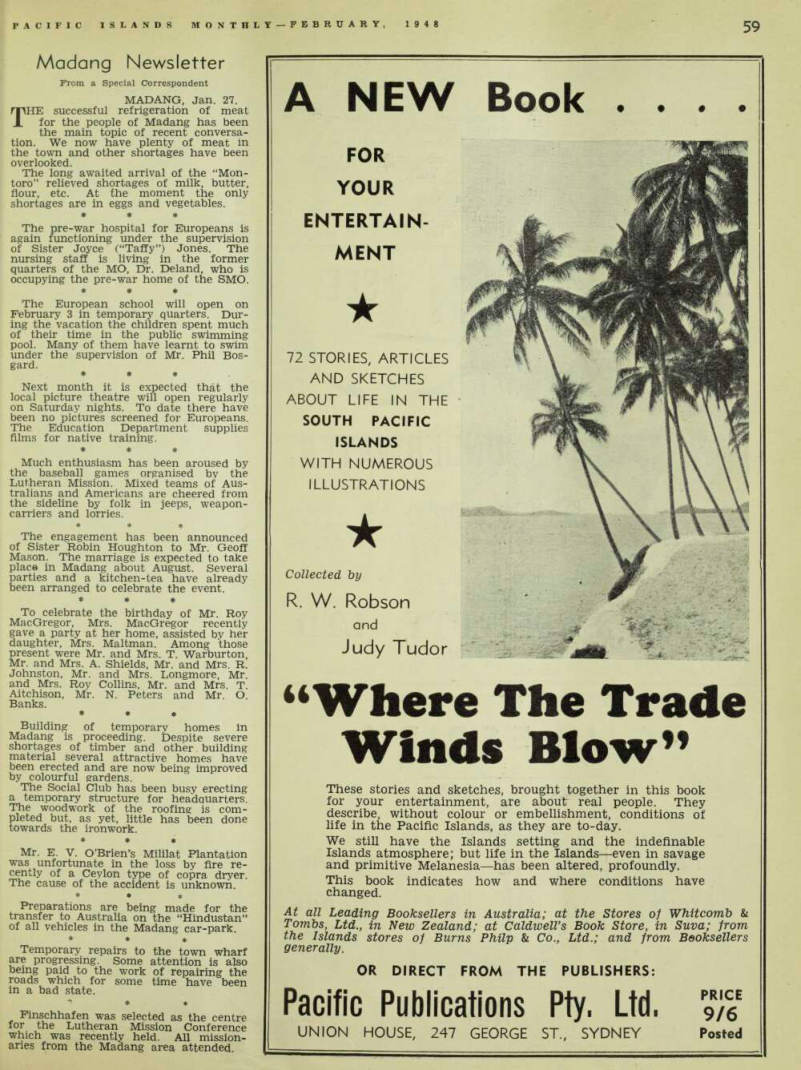
From a Special Correspondent
Madang, Jan. 27.
THE successful refrigeration of meat for the people of Madang has been the main topic of recent conversa tion, We now have plenty of meat in the town and other shortages have been overlooked.
The long awaited arrival of the “Mon toro” relieved shortages of milk, butter, flour, etc. At the moment the only shortages are in eggs and vegetables. ♦ ♦ ♦ The pre-war hospital for Europeans is again functioning under the supervision of Sister Joyce (“Taffy”) Jones. The nursing staff is living in the former quarters of the MO, Dr, Deland, who is occupying the pre-war home of the SMO. ♦ ♦ ♦ The European school will open on February 3 in temporary quarters. Dur ing the vacation the children spent much of their time in the public swimming pool. Many of them have learnt to swim under the supervision of Mr. Phil Bos gard. ♦ ♦ ♦ Next month it is expected that the local picture theatre will open regularly on Saturday nights. To date there have been no pictures screened for Europeans.
The Education Department supplies films for native training. ♦ ♦ ♦ Much enthusiasm has been aroused by the baseball games organised bv the Lutheran Mission. Mixed teams of Aus tralians and Americans are cheered from the sideline by folk in jeeps, weapon carriers and lorries. * ♦ ♦ The engagement has been announced of Sister Robin Houghton to Mr. Geoff Mason. The marriage is expected to take place in Madang about August. Several parties and a kitchen-tea have already been arranged to celebrate the event. * * ♦ To celebrate the birthday of Mr. Roy MacGregor, Mrs. MacGregor recently gave a party at her home, assisted bv her daughter, Mrs. Maltman, Among those present were Mr. and Mrs. T. Warburton, Mr. and Mrs. A. Shields, Mr. and Mrs. R.
Johnston, Mr. and Mrs. Longmore, Mr. and Mrs. Roy Collins, Mr. and Mrs. T.
Aitchison, Mr. N. Peters and Mr, O.
Banks. ♦ ♦ * Building of temporary homes in Madang is proceeding. Despite severe shortages of timber and other building material several attractive homes have been erected and are now being improved by colourful gardens.
The Social Club has been busy erecting a temporary structure for headquarters.
The woodwork of the roofing is com pleted but, as yet, little has been done towards the ironwork. ♦ ♦ ♦ Mr. E. V. O’Brien’s Mililat Plantation was unfortunate in the loss by fire re cently of a Ceylon type of copra dryer.
The cause of the accident is unknown. * * * Preparations are being made for the transfer to Australia on the “Hindustan” of all vehicles in the Madang car-park. * * * Temporary repairs to the town wharf are progressing. Some attention is also being paid to the work of repairing the roads which for some time have been in a bad state. -> ♦ ♦ Pinschhafen was selected as the centre for the Lutheran Mission Conference which was recently held. All mission aries from the Madang area attended.
Several Catholic priests arrived by air from America early in January. They will undertake duties in the district of Madang. * * * Expected departures in the next “Montoro” (probably in February), include Mr. and Mrs. Schilling, and Mrs. Ruby Luff.
Mrs. Luff goes to Sydney for health reasons. Until she enters Concord Hospital she will be at the Hotel Arcadia.
Mr. and Mrs. H. Jolly have left Madang for Lae. Mr. Jolly has been appointed accountant for Burns Philp in Lae. He was replaced at Madang by Mr.
Sherry.
The Samoans who awaited transport to Fiji by the “Admiral Chase” and who were unable to get passage because they neglected to book through Sydney office., were still delayed in the village on the day of the sing-sing. If it is possible, arrangements will be made to fly them out by Catalina. ♦ ♦ ♦ The Chinese settlement has been re turned to its pre-war position. Trade stores and houses are all nearing com pletion.
Madang still shows some battle scars but economically it is recovering more quickly than the majority of coastal towns on the mainland of New Guinea.
Advertisements & other items, pp. 61-62 (1 item)
Winds Blow”
A NEW Book . . . .
FOR
YOUR
ENTERTAIN-
MENT
72 STORIES, ARTICLES
AND SKETCHES
ABOUT LIFE IN THE
SOUTH PACIFIC
ISLANDS
WITH NUMEROUS
ILLUSTRATIONS
★ Collected by
R. W. Robson
and
Judy Tudor
“Where The Trade
Winds Blow”
These stories and sketches, brought together in this book for your entertainment, are about real people. They describe, without colour or embellishment, conditions of life in the Pacific Islands, as they are to-day.
We still have the Islands setting and the indefinable Islands atmosphere; but life in the Islands—even in savage and primitive Melanesia —has been altered, profoundly.
This book indicates how and where conditions have changed.
At all Leading Booksellers in Australia; at the Stores of Whitcomb & Tombs, Ltd., in New Zealand; at CaldwelVs Book Store, in Suva; from the Islands stores of Burns Philp & Co., Ltd.; and from Booksellers generally.
OR DIRECT FROM THE PUBLISHERS:
Pacific Publications Pty. Ltd.
UNION HOUSE, 247 GEORGE ST., SYDNEY Posted
SEE
UNDERWATER
Hunt Fish, Gather Balt, Lobster, Shellfish, with an All- Purpose "Undersee" Swimmer's Mask. Invaluable for checking Keels, Hulls, Anchorages, Etc. Made of Soft Durable Rubber, Plate Glass and Stainless Steel.
For all Particulars, apply to Leading Island Stores, or direct to Pacific Island Agents :—
KERR BROS. PTY. LTD.
4 YORK ST., SYDNEY
Cable Address; “Care.” Sydney. G.P.O. Box 3838
G The Flour I L L E S PI E’S of the Islands
- SYDNEY -
MARK
TRADE
Technical Progress
And An Islander's Visions
By F. H., Suva
1 RECENTLY got a request from a manufacturer in Birmingham for an assortment of cancelled Islands stamps. I thought a good practical way to comply would be to wrap up three different copies of the “PIM” and plaster the addressed wrappers over with stamps, as thickly as barnacles on a South-Sea derelict. Out of that may be born rami fications of imnort. Those “PlM’s,” like some strange fish from far-off waters, may swim from hand to hand among the magnates of Brum’s Vulcan forges, foundries and warehouses; visions of Captain Cook’s, Bougainville’s, and Captain Bligh’s days will vanish in a moment, as they note the advertisements displayed within the pages of the “PIM.”
“Are these places where cannibals feasted on our missionaries in the days of our fathers? My eye! What a revo lution has taken place!”
“We believe the slogan, ‘Export or Perish,’ is, all kidney-pie! ‘Export and Cherish’ is the ideal we’re solid for.
Trade needs a chest-expander and this revelation to us of this South Seas field is inspiring. We, and they, being in terested in the progress and the onward march of man must become business pen-friends.”
October’s “PIM” covered matters relative to the commercial devil tries of “ruthless international money powers,” and international monstrosi ties generally chiselling into the copra trade, etc. The worst part of these chilling affairs is their likeness to icebergs, for nine-tenths of their des tructive qualities are hidden from vision.
But the quickening pace and expand ing volume of great technical giants, their chemical and engineering strides now overtaking the world, will have such an impact that within the next two years the whole structure of economics and fi nance may be overwhelmed by a tidal wave of progress, which no combination of Shylock and Babylonian techniaue can withstand. International smart alecry will end in spontaneous combus tion.
Inside a year or two cheap oxygen, at 8/- a ton. as against about £2O a ton to-day, will be on tap. That item alone will give cheao petrol, diesel oil, ethyl, and methyl alcohols and ask any commercial chemist what cheap oxygens will do for a troubled world.
Another factor: Take the helicopter.
Inside a year or two ft will be daily carrying planters and tourists in safety into the most difficult Islands terrain.
Helicopters are now operating an air ferry-system across the Straits of Mes sina. Helicopters are going to replace motor cars in a big way, and their ad vent in the Islands is near.
October “PIM” states that a certain Mr. Rosskellv found oil in Fiji in 1930 decade. Quite possible; and if, and when, a lot of old geological ‘theories are discarded, a tin-field is likely to be unearthed in Fiji. Tin will always be in big demand but, as for oil cheap oxygen will render oil-field exploration and exploitation obsolete.
The big thing to swallow and digest is the fact that all the visions Jules Verne had came into the world later as facts One year’s progress in to-day s lines of invention can beat all those of the past century. Watchman! what of to morrow!
The motor-ship “Reynella,” which was pulled off a reef in Eastern Papua and towed to Sydney some months ago, is now to be towed to Newcastle, to undergo repairs.
Advertisements & other items, pp. 63-64 (1 item)
Jre^Vl
'etc
a&bee —
TOOTH PAST
It's
Jre^Vl
■ i 1 I You’ll agree, too, when you use IPANA. It’s refreshingly different, with a distinctive, pleasant taste, that makes your mouth feel grand.
IPANA’S cleaning and polishing qualities give you sparkling teeth and a sunny smile.
With massage, too, IPANA helps ensure firm, healthy gums so vital to sound teeth.
'for G °Oo r **o,
gum.
% 4257
J. C. MERRILLEES
PTY. LTD.
General Island Merchants
PHOENIX BUILDFNG, 63 PITT ST., SYDNEY
Telegrams and Cables: MERRILLEES SYDNEY. Phone: BW 6064
ft's Dray-free
yet TOUGH
in tropic /teat
i % K y -y *e*
SHELL
MOTOR OIL
SHELL COMPANY (PACIFIC ISLANDS) LTD.
(Incorporated in Great Britain) Agents: BURNS PHILP (South Sea) Co. Ltd.'
Restless Serik
Natives
Adherents of 'Cargo Cult'
Prom a Special Correspondent
Finschhafen, Feb. 1.
AT a given signal all whites were to be murdered by “Cargo Cult” fanatics at the last Christmas “sing-sing” at Angoram, Sepik District, New Guinea!
At least, that was the rumour prevalent at the time, said Father Wm. Saiko, SVD, who took over the mission field, in what he terms the “grass country” of the Sepik District, from the late Father Schwab, who was a frequent contributor to “PIM.”
“Cargo Cult” is rampant, continued the jovial American priest, and many of his native adherent are susceptible to its in fluence. “Why,” they ask, “have the missionaries been here so long without bringing us any ‘cargo’?” He is pro ceeding to Port Moresby to lay before the proper authorities the evils of this “cargo mania.” But, among those who had not come under its influence or been affected by wrong contacts during the war, there were many who were keen to become Catechists.
Father Saiko’s district embraces 46 vil lages, with a population of about 7,000, but it is a widely-scattered area, and some villages are as much as two-days’ walk apart.
He is specially interested in the study of Sepik folk-lore, and spends many hours a day listening to the stories of the old men of the villages. His predecessor, Father Schwab, had compiled a 652-page book of Sepik folk lore, and had put many of their “sing-sings” to music and trans lated the words. Unfortunately, this valuable data was destroyed during the war; and, apparently, it is Father Saiko’s aim in some small measure to partially restore it.
A Matter Of Diet
SPEAKING of crocodiles, for which the Sepik River is renowned, Father Saiko said the season was now com ing in. From all accounts the natives had little fear of them, for they caught them by hand, on land, first jumping on their backs and jamming a log into their mouths as they opened their jaws. This log was eventually securely fastened, so as to keep the jaw harmless.
“Have you ever tasted crocodile meat?”
I nervously inquired.
“Boy!” he said, in his rollicking good humour, “it sure is delicious — just like chicken with a little fish sauce over it!”
But he said that the native food he liked best were the “binatangs belong sac-sac” (grubs in the sago palms).
“They’re just like fat beans when they’re roasted,” he added, “and they taste like barley-sugar. But the wings are apt to stick in the throat as they go down!”
Then I realised that my leg was being pulled.
You would like meeting this big, bright, breezy, clean-shaven American priest. He might be in the early forties —but I did not inquire, he kept me laughing so much.
He has thin, blonde hair, receding at the temples, and his delightfully-cheerful boisterous manner, with a big measure of broadmindedness thrown in, gives tonic to the depressed. Whatever his diet—even crocodile meat and grubs — it agrees with him, for, if anything, he has a ten dency to overweight!
While at Finschhafen he was the guest of his old school-mate Father Ed. Misik, SVD, with whom he was also a Chaplain with the American Forces in New Guinea during the war. Father Saiko hails from St. Paul, Minn., USA.
Death of Madame Besnault Madame christiane besnault, wife of the esteemed director of the Veterinary Department in Tahiti, died in Papeete on December 23, aged 27. The funeral service, at the Cathedral on December 24, was numer ously attended.
Advertisements & other items, pp. 64-66 (2 items)
62
PEBfttJAflY, 1948 BACIfIC ISLANDS MONTHLY
Capstan«
grand cigarette
for all occasions-
Capstan’s own blend
of fine Virginia
leaf cannot
be equalled
That's why it's always
TIME FOR A CAPSTAN
THE EMPIRE'S FAVOURITE CIGARETTE
380R10.4T EN Wl L 0 w
KANGAROO BRAND
Ropes,
Cordage,
and Twines for every purpose Backed by 86 years of service Manufactured by:
M. DONAGHY AND SONS,
Pty. Ltd., Geelong and Sydney.
Fiji Representatives :
PEARCE AND CO.
LIMITED
R.O. BOX 237, SUVA
NELSON and ROBERTSON Pty. Ltd.
Established 1895
Shipowners - Brokers and
Islands Merchants
All classes merchandise purchased at Best Wholesale Prices. Original Invoices supplied to Island Clients. Cocoa Beans, Copra, Rubber, Trochus Shell and All Islands' Produce Sold on Commission.
Entrust your requirements to the firm with fifty years' practical experience in the Pacific Islands.
NELSON & ROBERTSON "i:
12 SPRING STREET, SYDNEY, AUSTRALIA
Telegraphic Address: IVAN, SYDNEY.
Solomons
"Brave New World" In Solomons Did Planter and Trader is Bitterly Sarcastic
By R. C. Laycock
(From a letter to a friend in Suva, who had expressed curiosity concerning con ditions in the British Solomon Islands.)
Ysabel, Dec. 28.
ICAN only say that ’‘Nationalisation of Industry” has produced all that could reasonably be expected—a complete state of muddle!
The old adage about the “silk purse and sow’s ear” applies with striking force.
But it is hardly fair to put the blame on local personnel, which is largely “Rubber-Stamp.”
It is said that in a Democracy a country gets the Government it deserves! Under “dictatorship”—God have mercy on you!
If the fools who are really to blame only had the mentality to see the harm they are doing to everyone concerned —including, of course, the unfortunates so keenly in need of our products, not alone as food, but as a medium of employment in the manufacture of goods to send us in payment—then, and only then, would there be hope of getting on to the road back.
They led off here with the institution of “Native Councils” and so displayed profound ignorance as to whether the native is “advanced” sufficiently for such a move.
This, naturally, threw him, collectively, into a mental maze which was really the fore-runner of what became known as “marching rule” (mainly) or “Mercy Marsina,” “Marxian” or several other fantastic names, according to the fancy
of the person who thought he heard it correctly.
Magsters lost no time in elevating them selves to leadership—just as they are do ing the world over, which somewhat ex plains the whole chaotic state of affairs.
The unfortunate native did not under stand head or tail of the stupid business; but, with his natural bent for admiration of authority—so woefully lacking in our Government—he was all too ready to follow blindly the dictates of the “maggle traps.” Said one of the dupes to me “Gub men (Government) he allesame! (putting his hand on the ground). But ‘Brown’ (local leader of MR) he big fellow master allesame:” With this he reached towards high Heaven to illustrate the difference.
WHAT is all this crazy chatter about “uplifting” the native actually doing for him?
There can be no shadow of doubt that, collectively, he is poorer in character than he was forty years ago. “Blind Freddie” could see that the more we “teach” him the more he despises yet envies us. No!
We are merely robbing him of his own simple ideas of happiness, and replacing it with —what?
What do these muddled wand-wavers hope to accomplish? Even if we concede that they themselves might think they know, can anyone—outside a straight jacket—agree that they are within their rights in mucking away hundreds of thousands of pounds of British tax payers’ money, chasing “furphies” in days such as we are passing through?
AS for the new “Capital” at Honiara (now being spoken of as “Holy Horror” or “Helofanerror”) —this is destined to be a loadstone round the neck of the Group for all time.
The Yankee roads, bridges, wharves, and junk of which it was born, have been
claimed by jungle and rot, and only colossal expenditure, far above the pos sible economy of the Group, can replace them.
The whole sorry business suggests that we are starting to build our castle from the roof down, when our finance is more in keeping with a bark hut.
There is some confusion as to which “Five-years Plan” we are now working under! Several have been scrapped, and it looks as though several more will follow before we reach bed-rock.
C’IOST of shipping tots up to an amazing J sum, compared with pre-war, but it is exceedingly doubtful if it does as much work for the money. There seems to be a queue of ships going to Fiji for re pairs. That these new vessels, built re gardless, as it were, should fade out so soon after arrival, rather suggests laxity in one direction or another.
Carpenters, naturally, turned-m the handling of copra. The astonishing thing is that they ever took it on. with no chance whatever of showing a profit under “nationalisation.”
It is little short of a certainty that, had the big companies been encouraged to come back and operate on the open market, all hands and the cook’s off sider, not to mention the Government it self, would have been a great deal better off. . , If producers had to pay their pound of flesh under the pre-war system, they now have the uncomfortable feelmg that about 2 lbs. are being extracted, as things are to-day.
Doubtless, the very heavy export tax on copra would be even higher under open market conditions; but the producer would not cavil at that, since it would mean shipping facilities now denied him. to say nothing of a hundred and one other benefits. By the higher export tax, I
mean, of course, that production would be stepped up, and a few more starving mouths in Europe would be fed, DO these Brave New World fanatics ever think on these lines and realise that they are standing in the light of production so urgently required? Obvi ously, they do not know and do not want to be told. Like the Colonel, in Tom Hanley’s show.
When Tom asked him what he was taking for a very red nose, he replied, “Whisky, sir.” On Tom’s remarking that he knew something far better, he re plied: “Then don’t tell me. sir. I don’t want to know!”
As was inevitable under such a set-up, the big companies could not see then way to show profit, and so refused the stupid invitation to take over the “Trade Scheme” under a set of conditions that the blindest optimist would shy at.
We now learn that the Government in tends launching out as a common or garden trader—that awful word, which down the years has heaped condemnation and disdain upon all who dabbled in it, and implied a thief and a rogue, and the depths of degradation.
A small but very expensive vessel has arrived to carry an impossible burden.
But, of course, there will be a fleet of them—to take their places in the queue for repairs, and help hoist “overhead” to the skies.
All this to “uplift” the poor native and give him “service” he doesn’t actually need, more especially when he finds it is cost ing him more than it used to under de spised individualism. It goes without say ing that it is going to be a case of “poor old British tax-payer.”
The largest planting company started dabbling in trading and made a most suc cessful failure of it. Then a smaller planting show was equally “successful”;
and both dropped it like a hot spud when they realised that their particular job was planting. The big trading companies never made a brass razoo out of planting. But then, nobody did in the Solomons, though this was mostly due to fact of the market being in the hands of the vulture.
The moral of all this is that the Gov ernment’s job is “governing,” and the best ends of all concerned would be served if it pulled up its socks and started in to teach the native that it does not pay to allow thousands of tons of a much needed product to rot on the ground, what time Brave New World fanatics hatch out inanities to “uplift” him to his white brother’s vices—which is the inevitable result of tampering with funda mentals.
Advertisements & other items, pp. 67-68 (1 item)
Pacific Islands Trading Company
ANCHOR HOCKING GLASSWARE
"The Most Famous Name In Glass" 9 m
"HEAT-PROOF" JADE-ITE
Heat-resisting glass dinnerware in a pleasing opaque jade colour. The only line of its kind made in America. Jade-ite is made of the same heat-resisting material throughout. Will NOT "check" or "craze".
Be assured of fast turn-
over for year-round
selling
AH Bicj Sellers—Special Values and Low Prices
FIRE-KING OVEN GLASS
(Guaranteed) TUMBLERS (Plain and decorated)
LAMPS
OIL LAMPS (Bases only)
JUMBO ICED TEAS
KITCHEN GLASSWARE
FIRE-KING TABLEWARE
VASES
BANKS
CRYSTAL OCCASIONAL
PIECES
SPARKLING CRYSTAL
DECORATED WARE
FIRE-KING
Useful Items Good Quality
PACIFIC ISLANDS TRADING COMPANY
244 CALIFORNIA STREET, SAN FRANCISCO 11, CALIFORNIA, U.S.A.
EXPORTERS
OBTAINABLE AT YOUR STORE.
KODAK
FOR EVERYTHING PHOTOGRAPHIC
and Comprehensive Service
Kodak Film, Plates and Sensitised Papers , Super-X Cine-Kodak Safety Film 35mm Kodachrome Film . . Australian-made 35mm. Enlargers, Single Unit Reflectors, Floor Lights, Spotlights and general Floodlighting Equipment . Austral Projection Screens Shelton 35mm. Film Strip Projectors . Tripods Carrying Cases Lens hoods Celestion Enlargers . Enlarging Focus Finders . . . Enamel and Plastic Developing Dishes Film Clips Stirring Rods . . . Print Paddles . . . Printing Frames Developing Tanks Australasian Photo-Review . . . Photographic Books Kodak Developing, Printing, Enlarging and Colouring Service . . . Kodak Technical Advisory Service inquiries invited and advice gladly given. OF ALL KODAK DEADERS THROUGHOUT THE ISLANDS.
KODAK (AUSTRALASIA) PTY. LTD.
379 and 386 George Street, Sydney
NEWCASTLE, KATOOMBA AND ALL STATES
Attempted Murder Charge
In Port Moresby
Prom a Special Correspondent
Port Moresby, Jan. 29.
AT a special sitting of the Port Mores by Court of Petty Sessions held to day at the European Hospital, be fore Magistrate J. L. O’Malley, Henry Baird Forsyth, fitter, of the Provisional Administration, was charged with un lawfully attempting to kill Amy Gladys Holt.
The hearing was adjourned.
On the night of January 22, Forsyth and Mrs. Holt were admitted to hospital, in a critical condition, with severely lacerated throats. Radio appeals were immediately made for blood donors; the Director of Public Health, Dr, J, T. Gun ther, subsequently thanked members of the public for their fine response to the appeal.
It is understood that the condition of both patients has improved.
Planters' and Traders' Assn. Sees Progress
Rehabilitation In New Britain
A PROGRESS report was submitted to the Planters’ and Traders’ Associa tion of New Guinea by the secretary of the Association at a meeting on De cember 13.
A controversy raged in Australia and New Guinea in October and November concerning the supply of goods and ser vices to the New Guinea Territories and particularly New Britain. The report in dicates that by mid-December the Asso ciation was generally satisfied with the rate of progress being made in the Rabaul district with regard to rehabilitation, pro duction, etc.
The report deals with the following items:
Native Labour
PRIOR to the introduction of the New Native Labour Ordinance, a number of members of the Association de cided to try and arrange for a supply of native labour from the Mainland. Mr.
J. C. Corrigan, of Wewak, was contacted and he undertook to recruit for the mem bers of the Association. This arrange ment was started early in October and, despite the time lag in mailing and ship ping arrangements, 104 recruits had been delivered at various plantations in the Kokopo district before the end of No vember.
The average cost per unit was £9/7/-.
The most expensive item in this under taking is the cost of 2/- per day main tenance cost per unit whilst awaiting transport. The cost, ten pounds per unit, is very high when consideration is given to the fact that these labourers are only indentured for twelve months. On the average, the planters will have about ten months at most of effective employment from these. Nor can they be re-engaged but must be returned to their villages after their twelve months of indenture.
The new Native Lab(?ur Ordinance has created added burdens in the way of cost.
Acting on a suggestion made as the re sult of correspondence between the Pre sident of the Association and the Ad ministrator, members have formed them selves into an Employers’ Association in order to conform with the requirements of the new Ordinance. However, the As sociation has encountered all kinds of petty technical difficulties regarding the registration of the Association or its mem bers as an association of employers.
It must not be misunderstood that any friction exists, or has existed, between th?
Association and the District Labour Officer. This officer has done everything he can to assist us. The difficulty seems to be in placing a correct interpretation on the various requirements of the new Labour Ordinance, and where this inter pretation is in doubt, obtaining advice from Moresby. The lack of mail facil ities between Rabaul and Moresby is deplorable—there are no surface mail facilities and in-coming airmails cannot be replied to until the following week as the plane leaves Rabaul within a couple of hours of its arrival.
To date, under the new arrangement, members have made application for up wards of 400 recruits. A number are awaiting shipment and it is expected that early in the New Year a consider able number will be available.
Co-operative Buying
A NUMBER of planters are interested in co-operative buying and more planters than were at first expected have placed their estimates and require ments for the next six months with the Association.
Buying in this manner will ultimately result in very considerable savings to the members. A much more detailed state ment regarding this business will be sub mitted to the members after December 15. It is expected that by that date we will be able to tabulate the quotations for the various plantation items required, as several business houses here and in Australia are prepared to quote and sup ply goods.
Facilities for the despatch of all goods ex Rabaul can be arranged and should
any planter desire storage facilities this can be arranged through the Association.
The shortage of fresh food and copra sacks was recently brought under the notice of the Minister of External Terri tories, by this Association. His prompt response to our appeals will ensure almost immediate relief as a large consignment
of freezer cargo will arrive this week and a much greater supply of copra sacks than was expected will arrive before Christmas.
Visit of Govt. Secretary RECENTLY the Government Secretary visited Rabaul. During his stay the opportunity was afforded us of plac
ing before him the various matters affect ing the progress and welfare of the Territory. Subjects discussed were medical services, native labour indenture, shipping services, the matter of essential supplies for both Europeans and natives, arterial roads, dynamiting of fish, the tele phone services between the Kokopo dis trict and Rabaul, etc. The Associaiion hopes to be in a position to communicate progress at an early date. The roadway between Rabaul and Kokopo and the North Coast road has been greatly im proved. The telephone system between Kokopo and Rabaul will be completed shortly.
Shipping
INTRA island shipping is improving but the size of the ships available for this service is still a severe handicap. This matter was particularly stressed to the Government Secretary on his recent visit and the matter of having such ships as the “Malaita” and the “Montoro” call at the main outports was submitted to him.
A serious matter, and one that affects practically all planters throughout the Territory, is the allocation of quotas on goods available in Australia and the allocation of shipping space on vessels trading between Australia and che Territory. This matter has been brought before the Administration and the Min ister of External Territories.
If some improvement in these two items cannot be effected at an early date it will seriously impede the progress and main tenance of all productive activities.
As wages keep rising, you must expect an increase in the cost of living. The whole spiral is like a dog chasing its tail the faster he goes, the farther away his tail gets.—Lord Nuffield.
Advertisements & other items, pp. 69-70 (1 item)
big problem, Honey!
DRESSMAKING BY MAIL. Your own
material made up from our exclusive designs. Small and larger fittings, children’s frocks. Write to-day for Free Tape Measure and particulars to MOORE &
MOORE MAIL ORDERS, 333 George
Street, Sydney.
Vj A
"Hips aren't your
big problem, Honey!
YOU CAN TAKE your mind off your hips, dearie! No one finds fault with your figure!
You’d be smart to exercise a little more care about personal charm. Being streamlined, you know, won’t protect you against underarm odour. Or lessen the offence when others find you guilty of it.
So keep on trusting your bath— for past perpiration but pul your trust in Mum to prevent risk of future underarm odour .
Creamy, snowy-white Mum smooths on in 30 seconds. Keeps you fresh and free from underarm odour all day or evening.
Mum is gentle—harmless to skin and fabrics. So why take chances when you can be sure with Mum?
Ask for it today.
MUM
TAKES THE ODOUR OUT OF PERSPIRATION
COPRA GROWERS' UNION
OF FIJI
ALL Copra Growers are urged to join this Union and form branches in all centres in the South Pacific. Planters! “Unity is Strength” —so guard your own interests.
The objects of the Union are:— (1) To unite all Copra Growers; to urge them to express their ideas; and to have one concerted and strong medium through which to express their viewpoint in matters of price, markets, etc. (2) To investigate all matters of interest in relation to by-products, offsets for hurricanes, etc. (3) To encourage research in regard to new uses for coconuts and associated products. (4) To inform Copra Growers of matters affecting their interests; to invite opinions, articles, experiences, etc., from growers, for the information of other growers.
C. G. O. PARR.
Savu Savu, Fiji.
* w* s i r p>
rtl II U
si AIRSPEED, having blades of hew and scientific design, are much superior in operation to ordinary fans as, without disturbance from noise or motor resonance, these units keep in circulation up to 10,000 cubic feet of air per minute. Where silent and efficient circulation is required nothing is Superior to AIRSPEED.
Leading Australian Clubs, Hotels and Cafes are equipped with AIRSPEED as these units are especially suited to large interiors as well as domestic and business premises. Available for immediate shipment.
VENTURA
TRADING GO. PTY.
26 BRIDGE ST., SYDNEY Cables:
LTD.
“Ventura, Sydney.”
In association with P. & R. HUTCHINSON, THOMSON ST., SUVA AND GILBERT RENTON, RABAUL
Queensland Flier
Moresby Memorial To
Prom a Special Correspondent
Port Moresby, Feb. 2.
SQUADRON Leader “Johnny” Jackson, heroic leader of the first squadron of fighter aircraft to operate in the Territory the Kittyhawk “75,” which flew in from Australia in the pre-AIF dog-days of early 1942 and who lost his life in the ' one-sided engagements against the hordes of Jap air invaders over Moresby, will have his own special memorial in the Territory.
The pre-war drome at Moresby, then known as the Seven-Mile, which belongs to the RAAF but is used by Civil Avia tion, is nowadays always referred to as “Jackson’s” in commemoration of the gallant “Johnny.”
His mates, of the St. George Sub branch of the RSL in Queensland, clubbed together to provide funds for a special memorial to the late “Johnny.”
Their funds being insufficient, they re ferred the matter to the Australian Battlefields Memorial Committee.
Mr, McDonald Richardson, a Moresby contractor who served as a lieutenant in the AIF in Papua during Jackson’s time, has offered to provide all the materials for the memorial; and John Stubbs & Son, local building contractors, are to undertake its actual erection, without charge.
The memorial will be at the entrance to Jackson’s Drome, where the road lead ing on to the drome itself forks from the Rouna Road. The site will remain RAAF property, thus ensuring maintenance of the memorial as part of RAAF installa tions. Bronze plaques are being cast in Australia, and the actual design of the memorial structure has been worked out by a special committee in consultation with the St. George Sub-branch of the
Rsl.
Advertisements & other items, pp. 71-72 (1 item)
stfs?
- iC-sss*;
» - Dt
r;r sv ' ? "“«*
V HA/ R ON PRiPAy ur
<Z°“ LD « EVER ™*e
smy r# «\l
uS^ V Jou?" wASH ] J* A- -01/00^*' O(J t Bftitf"
NCi Z sP^ iB " rUf! ‘\lo* sM ' a .C , L/ O O' ’ On*
\)tNTA£ CrEA^
st' g
/teadacbe STOPPPP
Stop it faster with ANACINI Anacin contains an extra ingredient. It is a prescription for pain and aches.
MtAC/y
** Trade Mark
AMERICAN, ENGLISH AND AUSTRALIAN PERIODICALS
AND TRADE JOURNALS POSTED DIRECT TO YOU
The N.S.W. Bookstall Co. Pty. Ltd.
Can supply all available Oversea and Local Subscription Magazines. Let us know your requirements.
Subscription Lists Available on Application.
N.S.W. BOOKSTALL COMPANY PTY. LTD.
Market and Castlereagh Streets, Sydney, Australia
YOUR FUTURE CAREER . . .
Merchants, Accountants, Secretaries, Bankers and Business Managers ... all hold responsible positions with commensurate salaries. You too can enhance your prospects in this ever-expanding commercial field, which yields abundant returns to those with adequate qualifications. H.R.I. prepare ambitious men and women for all business positions from junior to senior executive. Tuition is practical authoritative up-to-date time saving . . . and certain in its successful results. The H.R.I. is available always to advise you write or wire for information free and without obligation.
H.R.I. tutorial service is proved by the winning of more honours than all coaches in Australasia combined.
H.R.I. Career Training • ACCOUNTANCY • SECRETARYSHIP • COST ACCOUNTANCY
• PRACTICAL BOOKKEEPING • MARKETING SELLING
ADVERTISING • BANKING • LOCAL GOVERNMENT EXAMS.
II v 111 ■its* u a v II o berf §o n Insi i i n i e Founded and Owned by Hemingway & Robertson Pty. Ltd, Consulting Accountants ;: ;: Professional Tutors
126 BANK HOUSE. BANK PLACE, MELBOURNE
126 BARRACK HOUSE. 16 BARRACK STREET, SYDNEY 126/815
CM
WORMGEARED
CHAIN HOISTS
The hand-operated Wormgeared Hoist is a general purpose lifting device, compact and easy to handle. The Wormgear is designed to give comparatively high efficiency and long life. A simple and effective brake insures safe holding of the suspended load.
Available in rated capacities from 10 cwts. to 3 tons.
Also makers of: A.B.C. Electric Chain Hoists, Vi, 1, 2 tons capacity.
“Victor” Spurgeared Chain Hoists from 10 cwts. to 20 tons.
Triple Geared Chain Hoists from 10 cwts. to 20 tons.
Worm Geared Chain Hoists from 10 cwts. to 3 tons.
Weston Chain Blocks from 5 cwts. to 2 tons.
Shackles, Hooks, Sheave and Snatch Blocks.
AUSTRALIAN BLOCK Cr CHAIN CO.
PTY., LTD.
Robbs Road, WEST FOOTSCRAY, W. 12,
VICTORIA
Phones: MW 1373-74-75.
Telegraphic Address; “CHAINBLOCK,” MELBOURNE.
Correspondence to Box 34, FOOTSCRAY, W.ll, VICTORIA.
Moresby
The Month In
Port Moresby, Feb. 3.
DURING the unloading of supply ships from Australia, the Customs Shed presents a heart-rending sight to thirsty locals. Cases of beer he smashed around the floor with broken glass and dark stains on the concrete —all pointing to the wastage of gallons of the precious fluid. Pilfering is also causing losses at this end, as well as on Australian wharves.
Moresby’s wharf facilities served well enough when a three-weekly ship brought the few hundred tons of cargo which suf ficed for the town’s pre-war needs, but they are hopelessly inadequate to cope with the thousands of tons now being dis charged. * * * riIHE Administration was fortunate in A clearing its accumulated cargo from Sydney by the “Nellore,” which arrived here on February 1. Her agents demanded a guarantee that she would be unloaded at the rate of 500 tons per day.
The Administration, however, knowing the facilities available, beat them down to 300 tons and the “Nellore” was diverted to call at Moresby on her regular Eastern run. At the moment, we are waiting to see whether the unloading will be com pleted according to schedule —it will cer tainly not be an easy task. * * * WORD has been received that, after completing the normal three months’ short course, students of the first “long” course (of two years’ duration) at the Australian School of Pacific Admin istration are at present “doing research projects,” which apparently means writ ing essays in the library. No one seems yet to know what they will do for the other eighteen months of the course. It has been announced that formal tuition will be resumed in March. * * * MORESBY Sub-branch of the RSL is engaging in an active programme.
On January 31, members attended an interesting general meeting at which the subject of war memorials was ex haustively discussed (see elsewhere this issue). The Annual General Meeting, at which office-bearers for the coming year will be elected, is scheduled for next month. President of the Branch is popular Mr. Syd Reilly, veteran of World War I.
Mr. Peter Bosgard, a Moresby-ite of pre war vintage, who enlisted early in the AIF and was captured during the Greece and Crete campaign, is the efficient and popular secretary. These two have done yeoman service and are almost certain to be re-elected this year. * * * PRIOR to leaving for the Lambeth Conference—and, incidentally, his first furlough since his arrival in the Territory eleven years ago—the Bishop of New Guinea, the Right Reverend P. N. W.
Strong, opened the new Martyrs’ Memorial School for natives at Sangara, in the Northern Division of Papua, scene of the martyrdom of three mission sisters in 1942, and later the centre of heavy fight ing during the Jap retreat. * * * MORESBY’S new European , school, at the town end of Ela Beach, has been completed. Cool, airy, well furnished and tastefully decorated, the buildings give no indication of their army hut ancestry. The Public Works Depart ment is to be congratulated on a very satisfactory job. , Mr G. Stanton Crouch, who was in charge of the European School last year,
has gone to Sogeri this year, and the local kiddies are to have Mr. Woods, a Westralian, who has more recently been teaching at Camberwell Grammar School, Melbourne, as their new headmaster. Mr.
Woods served as a fighter pilot in “Johnny’' Jackson’s Kittyhawk Squadron, the “75”, in the earliest air scraps over Moresby, and later flew widely in New Guinea as a Squadron Leader. * * * THE local Fire Brigade, equipped with a brand-new, bright-red engine, has recently put out three dangerous fires in the Moresby area. Two of them broke out near the RAAF Camp at Kone dobu. The other, at Elavata, endangered one of the large oil tanks on the fore shore, but was extinguished in time. It could well have done considerable dam age. * * * THE Yanks are still with us—only a dozen or so at a time, it is true, but a dozen suffice to remind us now and again of the days when these Allied troops in thousands brightened our towns and cities. These small groups of American soldiers are sent down from Manus for short periods of leave 'mid the “bright lights” of Moresby. Occasionally we come upon one of them lounging on the corner, clearly asking himself the forlorn ques tion we all ask at times: “Where are the ‘bright lights?’ ”
A group of higher officers, who appear to be in town on business of some kind, recently gave up the search for these non-existent “bright lights,” and decided instead to amuse themselves by paying calls in their special four-engined Sky master. They intended to visit Garoka, but finding the weather against them at that station, went on to Madang. The Madang strip is not nearly the length ie
quired by a plane of that size, but our trans-Pacific friends brought their Sky master down without causing any damage worse that a flat tyre.
In taking off for the return trip, how ever, the tyre in question was dislodged.
Our friends took this news with com plete equanimity, merely requesting that an ambulance and fire-cart stand by at Moresby while they attempted to iaxid on two of their three wheels. Fire-cart, ambulance and doctor speeded to the drome.
After making a perfect landing, the skipper asked what all the fuss was about. * * * IT is understood that a conference of all District Officers of the Territory is to be arranged in the near future. Prob able location of the parley is Moresby.
A SEEDED singles tournament has been arranged by the Moresby Tennis Club.
Some first-class struggles are ex pected, and it is hoped that the tourna ment will effect a rejuvenation of local tennis, which has been in the doldrums.
Most interest lies in the probable duel between Trimm and Crouch.
Advertisements & other items, pp. 73-74 (1 item)
Ect S £V? V;
TO SHIPMASTERS
When calling at Tahiti, see Oscar G.
Nordman for ships’ supplies and fresh provisions. Wire before your arrival to OCEANIC, PAPEETE (my registered cable address)
OSCAR G. NORDMAN,
Ship Chandler, Papeete, Tahiti
LONDON-SUVA
ECT S £V? V;
«\v «* 7 cv
> PANAMA V
For Sailings and Further Particulars Apply To: — BETHELL, GWYN & CO., BURNS, PHILP (SOUTH SEA)
138 LEADENHALL ST., CO., LTD.,
LONDON, E.C.3. SUVA.
William Atkins Pty. Ltd.
Head Office, 449-451 KENT ST., SYDNEY
Iron & Steel Merchants—Engineers' Supplies
ESTABLISHED OVER 50 YEARS
Coach & Motor Hardware Cable Address: WTLATKIN, Sydney.
STEEL DEPARTMENT
MILD STEEL:
Rounds, Squares, Flats, Half-rounds, Hexagons, Bevel, Shoeing, Tyre, Angles, Tees, Sheets, Plates, Girder Plates, Chequer Plates, Channels, Hoops, Etc.
BRIGHT STEEL:
Rounds, Squares, Hexagons.
Extra Special High Speed Tool Steel, Mining Steel, Blister Steel and Spring Steel, Rounds, Flats & Squares.
Bar Iron —All sections and sizes.
Engineers' Supplies: Set Screws, Studs, Metal Thread Screws, Coach Screws, Files, Cotter Pins, Bright and Black Bolts, Rivets, Etc., Hack Saw Blades.
Power Transmission Gear: Including Plummer Blocks, Couplings, Collars, Etc.
Coach and Motor Hardware: Axles, Springs, Wheelstuff, Duck, Paints.
Farriers' Supplies: Horse Nails, Anvils, Vices, Etc.
Motor-Trimmers and Motor Builders' Cr Motor Painters' Requirements Pacific Island Agents : Corrie & Co., Suva, Fiji DUCO Lacquers and DULUX Enamels—FAßßEX Motor Toppings and Leather Cloths, House & Decorators' Paints, Varnishes & Brushware.
Sole Distributors of CHAMPION'S Decorators Paint Products.
Distributing Agents for BROLITE Lacquers, SYNFLEX Enamels and "POLYGLOSS" Finish.
*There is only one
ELECTROLUX
THE MODERN KEROSENE-OPERATED REFRIGERATOR
THAT ACHIEVES THE MIRACLE OF ICE FROM HEAT
Lasting Efficiency, Silent Operation, Streamlined Beauty
i & Ml :-v 1 I H Economically operated by kerosene, with a simple precision-built freezing unit that has no moving parts and is GUARANTEED FOR
FIVE (5) YEARS.
Obtainable from: W. R. CARPENTER (New Guinea), LTD.
Habaul, Madang, Lae, Kavieng, Wau.
J. R. CLAY & CO., LTD., Port Moresby.
W. R. CARPENTER & CO. (Sol. Is.), LTD., Tulagi.
For New Hebrides, Butaritari, Noumea, New Caledonia. Apply— Model LKSSI Storage capacity: cub. ft.- (approx) shelf area, 9 sq. ft.; food shelves, six—fiv< removable; 2 self-supporting when hal drawn. Ice-making: Four trays —5 lb. ice per freezing: 80 cubes. Fuel consumption 1.8 pints kerosene per day (approx.) Height: 4 ft. 10 in. Depth: 2 ft. 3i in Weight, unpacked, 434 lb. Packed, 700 lb W. R. CARPENTER & CO. LTD. Head Office: 16 O'Connell St., Sydney, N. S. Wales
New Guinea Travellers
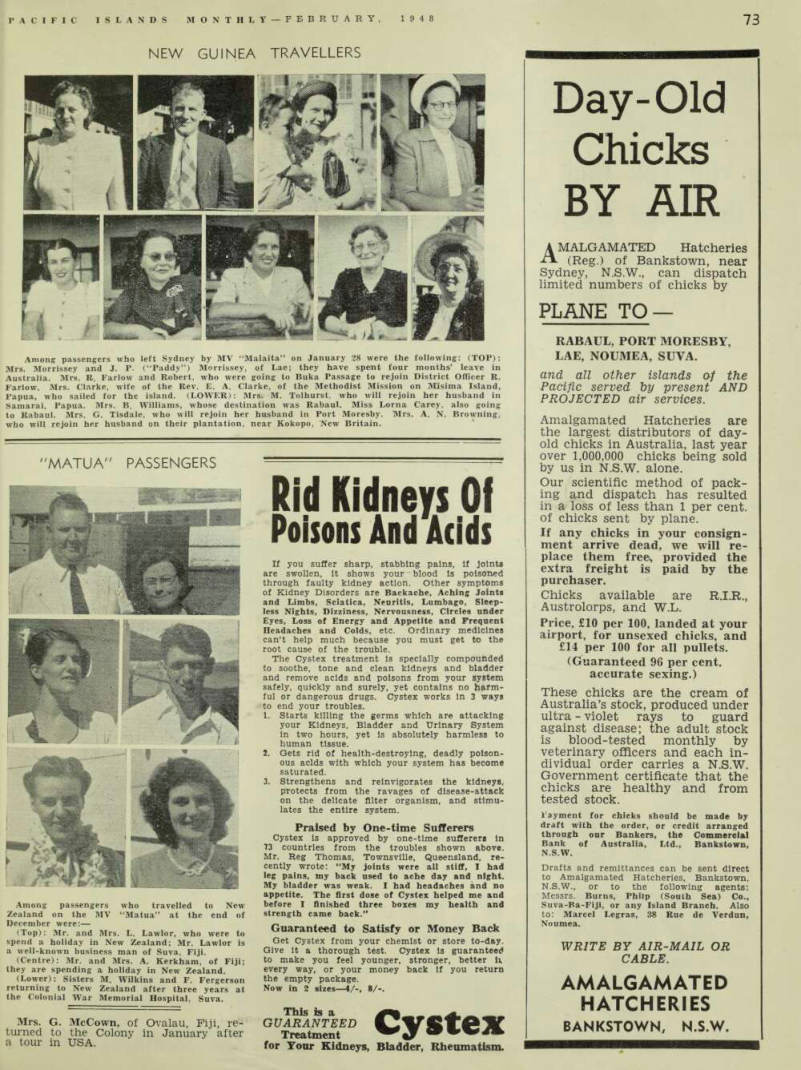
Among passengers who left Sydney by MY “Malaita” on January 28 were the following: (TOP): Mrs. Morrissey and J. P. (“Paddy”) Morrissey, of Lae; they have spent four months’ leave in Australia. Mrs. R. Farlow and Robert, who were going to Buka Passage to rejoin District Officer R.
Farlow. Mrs. Clarke, wife of the Rev. E. A. Clarke, of the Methodist Mission on Misima Island, Papua, who sailed for the island. (LOWER): Mrs. M. Tolhurst, who will rejoin her husband in Samarai, Papua. Mrs. B. Williams, whose destination was Rabaul. Miss Lorna Carey, also going to Rabaul. Mrs. G. Tisdale, who will rejoin her husband in Port Moresby. Mrs. A. N. Browning, who will rejoin her husband on their plantation, near Kokopo, New Britain.
"Matua" Passengers
Mrs. G. McCown, of Ovalau, Fiji, re turned to the Colony in January after a tour in USA.
Among passengers who travelled to New Zealand on the MV “Matua” at the end of December were:— (Top): Mr. and Mrs. L. Lawlor, who were to spend a holiday in New Zealand; Mr. Lawlor is a well-known business man of Suva, Fiji. (Centre): Mr. and Mrs. A. Kerkham. of Fiji; they are spending a holiday in New Zealand. (Lower): Sisters M. Wilkins and F. Fergerson returning to New Zealand after three years at the Colonial War Memorial Hospital, Suva.
Advertisements & other items, p. 75 (1 item)
Day-Old
Chicks
BY AIR
Amalgamated Hatcheries
(Reg.) of Bankstown, near Sydney, N.S.W., can dispatch limited numbers of chicks by
PLANE TO
RABAUL, PORT MORESBY,
LAE, NOUMEA, SUVA.
and all other islands of the Pacific served hy present AND PROJECTED air services.
Amalgamated Hatcheries are the largest distributors of dayold chicks in Australia, last year over 1,000,000 chicks being sold by us in N.S.W. alone.
Our scientific method of packing and dispatch has resulted in a loss of less than 1 per cent, of chicks sent by plane.
If any chicks in your consignment arrive dead, we will replace them frees provided the extra freight is paid by the purchaser.
Chicks available are R.1.R., Austrolorps, and W.L.
Price, £lO per 100, landed at your airport, for unsexed chicks, and £l4 per 100 for all pullets. (Guaranteed 96 per cent, accurate sexing.) These chicks are the cream of Australia’s stock, produced under ultra - violet rays to guard against disease; the adult stock is blood-tested monthly by veterinary officers and each individual order carries a N.S.W.
Government certificate that the chicks are healthy and from tested stock, Payment for chicks should be made by draft with the order, or credit arranged through our Bankers, the Commercial Bank of Australia, Ltd., Bankstown,
N.S.W.
Drafts and remittances can be sent direct to Amalgamated Hatcheries, Bankstown, N.S.W., or to the following agents: Messrs. Burns, Phiip (South Sea) Co., Suva-Ba-Fiji, or any Island Branch. Also to: Marcel Legras, 38 Rue de Verdun, Noumea.
WRITE BY AIR-MAIL OR
CABLE.
AMALGAMATED
HATCHERIES
BANKSTOWN, N.S.W.
Rid Kidneys Of
Poisons And Adds
If you suffer sharp, stabbing pains, If Joints are swollen, It shows your blood Is poisoned through faulty kidney action. Other symptoms of Kidney Disorders are Backache, Aching Joints and Limbs, Sciatica, Neuritis, Lumbago, Sleepless Nights, Dizziness, Nervousness, Circles under Eyes, Loss of Energy and Appetite and Frequent Headaches and Colds, etc. Ordinary medicines can’t help much because you must get to the root cause of the trouble.
The Cystex treatment Is specially compounded to soothe, tone and clean kidneys and bladder and remove acids and poisons from your system safely, quickly and surely, yet contains no harmful or dangerous drugs. Cystex works In 3 ways to end your troubles. 1. Starts killing the germs which are attacking your Kidneys, Bladder and Urinary System in two hours, yet Is absolutely harmless to human tissue. 2. Gets rid of health-destroying, deadly poisonous acids with which your system has become saturated. 3. Strengthens and reinvigorates the kidneys, protects from the ravages of disease-attack on the delicate filter organism, and stimulates the entire system.
Praised by One-time Sufferers Cystex is approved by one-time sufferers In 73 countries from the troubles shown above.
Mr. Reg Thomas, Townsville, Queensland, recently wrote: “My joints were all stiff, I had leg pains, my back used to ache day and night.
My bladder was weak. I had headaches and no appetite. The first dose of Cystex helped me and before I finished three boxes my health and strength came back.”
Guaranteed to Satisfy or Money Back
Get Cystex from your chemist or store to-day.
Give It a thorough test. Cystex Is guaranteed to make you feel younger, stronger, better Iv every way, or your money back If you return the empty package.
Now in 2 sizes—l/-, 8/-.
GUARANTEED CVfitfiX
Treatment J ®
for Your Kidneys, Bladder, Rheumatism.
Pen Friend Wanted
MISS E. CLAYTON, of 2 Rawson Street, Newtown, Sydney, seeks an other young woman about 18-26 years of age, living in Western Samoa, Tonga or New Zealand, as a pen friend.
Moresby RSL Discusses
War Memorial
Prom a Special Correspondent
Port Moresby, Feb. 2.
A GENERAL meeting of the Port Moresby sub-Branch of the RSL, at which the Administrator, Colonel J. K. Murray, was present as a member, was held at the RSL Club Rooms on January 31.
Special visitors were Brigadier Browne, well-known in and out of Moresby dur ing the war days, now Secretary-General of the ANZAC Division of the Imperial War Graves Commission and also Hono rary Secretary and executive member of the Australian Battlefields Memorial Committee; Colonel Murphy, veteran of the 10th Battalion, Ist AIF, who has lived in England since the first World War and represents the United Kingdom Division of the War Graves Commission; and Air Commodore Anderson, of the RAAF, They had just completed a short visit to the war cemeteries at Rabaul and Lae. Colonel Murphy interested the veterans of World War I with his ac count of the condition of Australian war cemeteries in England and Europe and told of arrangements made in connection with Australian dead of the 1939-45 war in those areas.
The main business of the evening was discussion of the proposal of the Aus tralian Battlefields Memorial Committee for the erection, at Port Moresby, of one of the three Australian national war memorials.
There had been much local opposition
to memorials of a conventional non utilitarian type, but after hearing Briga dier Browne, who stressed the idea of parmanency in such memorials (and in this he was supported by the Administra tor) the meeting unanimously endorsed the proposal to erect a non-utilitarian memorial. % There was also considerable discus sion as to the suitability of Moresby as a site for such a memorial. Brigadier Brown pointed out that no final decision had been made on this, nor as to the exact type of structure, which would probably be selected by a panel of ex perts from designs submitted competi tively.
About 120 people attended the meeting.
A quantity of American canned beer was made available by the Club, and there was a friendly old-soldier atmosphere about the social side of the function.
The gathering was extremely representa tive, with members who had served in every branch of the service and every theatre of war, in attendance.
Retired Officers 1
Association
rRMER officers of the Papua Admin istration have formed the “Retired Papua Officers Association” and on January 19 at a meeting in Sydney the following officers were elected for 1948 — president, J. T. Bensted; hon. secretary, A. C. Rentoul; committee, Messrs. Bros sey, Greenland and Logan. The objects of the Association are to protect the in terests of retired officers in any way necessary, and to afford the “exiles” a chance to get in touch with each other.
Advertisements & other items, pp. 76-78 (2 items)
DUNLOP i*t fltS Du&bs'i
Do You Nod
Over Your Work?
IT’S PROBABLY
LIVERISHNESS.
Drowsiness, especially in the afternoon, bothers many men and women, when they particularly want to be alert and alive. The trouble is often due to the liver not functioning with its usual efficiency, and the digestive system being congested. You feel like an afternoon nap, but work will not permit it.
To avoid this hindrance to your job, the best way is to take better care of your liver by helping it with a dose of Pinkettes, preferably when going to bed. whenever you feel slack. These tiny laxative and liver pills also correct constipation, aid digestion, banish bilious attacks and sick headaches, dispel the causes of coated tongue, and bitter taste in the mouth. Your chemist or storesupply Pinkettes, the perfect tiny laxative and liver pills.
DUNLOP i*t fltS Du&bs'i
D 446
DUNLOP
RUBBER
AUSTRALIA
You'll always
get the best
from the
PLUME
m In
pump
& . 888 s.
Today, Plume is the best motor spirit you can buy. And as soon as world conditions permit, the Plume Pump will lead in serving the highest quality motor spirits, made by revolutionary methods developed by the world’s largest research staff. So form the habit now of going to the Plume Pump, where you’ll always get the best motor spirit.
VACUUM
PRODUCT,
VACUUM OIL COMPANY PTY. LTD. [lncorporated in Australia]
"BESTSELLER" BOOKS
Box 4721, G.P.0., Sydney.
We have pleasure in supplying
Island residents with the latest best-
sellers.
BEHIND BAMBOO, by ROHAN RIVETT, 12/11.
The grim and splendid story of the Australian prisoners of Japan is simply and forcefully told by Rohan Rivett, himself a prisoner for three and a half years.
SHADOW ON THE TRAIL, by ZANE GREY, 9/9. —This new novel is a story only a superb craftsman such as Zane Grey could have written. It is filled with danger and romance.
THE HUCKSTERS, by FREDERIC WAKEMAN,
12/9. —This is the story of a bitter, bright and successful business man in the hardselling, treacherous world of radio and advertising.
QUALITY, by CID RICKETTS SUMNER, 10/10.
As she got off the train at Liberty Grove, Mississippi, the tweed-suited girl with the curly, light brown hair might have been any college girl home for vacation. She wasn’t.
Above prices include postage. Please add exchange island cheques.
"BESTSELLER" BOOKS
Box 4721, G.P.0., Sydney.
C flnldked Ini
DAY ISON
For Tropical conditions
New Guinea Club, RABAUL, painted prior to the war with DAVISON Velvene Water Paint and Velustre House Paint.
Velvene Water Paint and Davison's Zinc Base Paints are used extensively throughout the islands and Mandated Territories on Government and Private buildings, giving full satisfaction under severe tropical conditions.
DAVISON PAINTS PTY. LTD
BOX 24. AUBURN. N.S.W.
Sydney—Queensland —
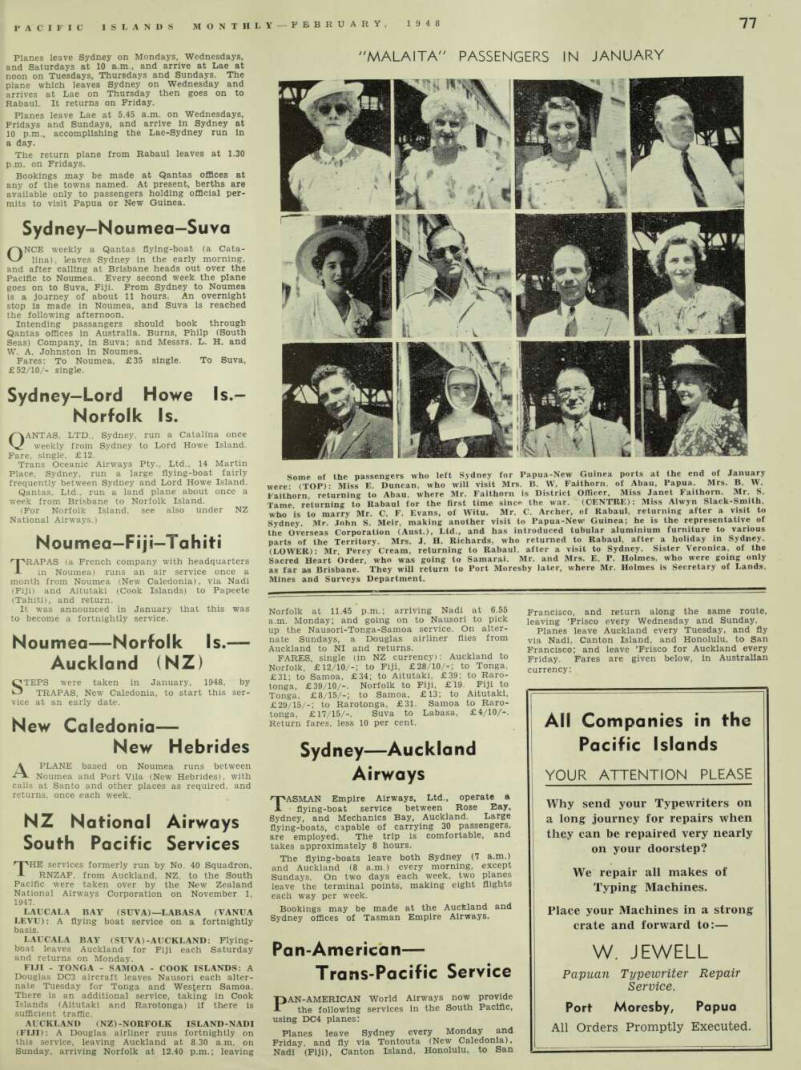
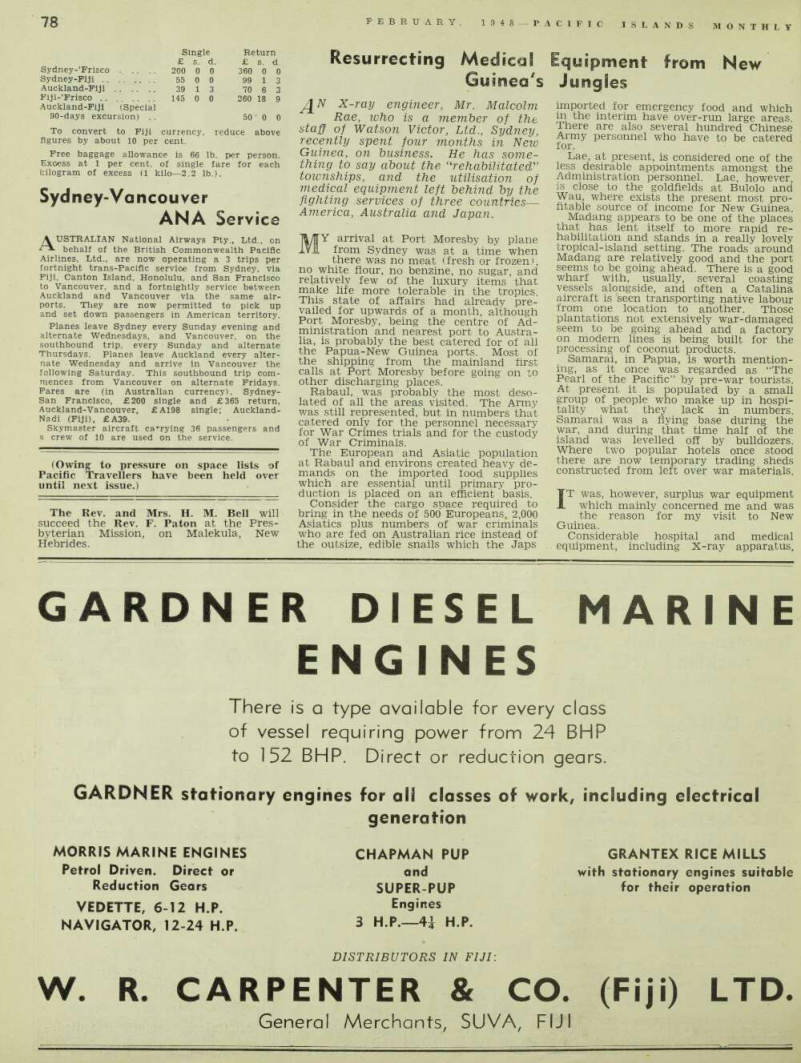
Shipping And Plane Services
THE following sea and air services are running to schedules in the Pacific.
Not all of the regular services which were suspended, owing to war condi tions, have been restored; but preparations are under way for their early reintroduction. As they become available they will be announced here.
Ship Services
Australia —North America THE regular passenger Trans-Pacific liners, withdrawn during the war, have not yet
been restored.
Canadian-Pacific liner “Aorangi” (Sydney- Auckland-Suva-Honolulu-Vancouver) may re sume about May, 1948.
Matson liners “Monterey” and “Mariposa” are being reconditioned, but are not expected back in service in 1948. Matson ship “Marine Phoenix,” carrying passengers, runs on a regular schedule —San Francisco-Honolulu-Suva-Auckland- Sydney.
New Zealand—Cook
Is.—Niue—Samoa
mHE motor vessel “Maui Pomare,”
J. owned and operated by the NZ Gov ernment, maintains a direct service between Auckland and Rarotonga (Cook Islands), with alternative calls at Niue and Apia (Samoa).
On arrival in Auckland in early January, “Maui Pomare” was withdrawn for survey. She will resume in Cook Is. service about March.
Sydney—Norfolk Island-
New Hebrides
THE SS “Morinda,” Burns Philp & Co., Ltd., runs at approximately six seven weeks’ intervals from Sydney to Lord Howe Island. Norfolk Island, and main ports of the New Hebrides, and return. A regular fixed timetable is not
yet practicable.
The “Morinda” at present is undergoing over haul and the small “Muliama” is carrying on the service.
New Caledonia
THE New Caledonian Government has sub sidised and maintained the coastal ship ping services. The East Coast, the West
Coast, and the Loyalty Islands, under present conditions, receive 10 round trips per annum.
The ships call at the following ports; EAST COAST. —Yate, Ounia, Thio, Nakety, Canala, Kouaoua Kua, Moneo, Ponerihouen, Tibarama, Poindimie, Wagap, Touho, Tipindje, Hienghene, Tao, Oubatch, Pouebo, Balade, Pam, Arama, and return.
WEST COAST.—Pouembout, Kone, Temala, Voh, Ouaco Gomen, Koumae, Tangaiou, Tiebaghl, Nehoue Poume, Baaba, Belep and return.
LOYALTY ISLANDS.—Mare (Tadine), Lifou (Chepenehe) Ouvea (Fajaoue, St. Joseph) and return.
The steamer “Neo Hebridais” runs regularly between Noumea and Sydney, with occasional trips to the New Hebrides (mostly Aneityum).
The owners are Societe Maritime et Maniere Hagen, Noumea. Sydney agents: H. C. Sleigh. 254 George Street, Sydney.
New Zealand—Fiji—
Samoa—Tonga
Monthly Service by MV “Matua”
Service Conducted By Union Ss Co.,
Ltd.—Subject To Alteration Without
Notice
Auckland .. Feb. 12 Mar. 11 Apl. 8 Suva .. .. Feb. 16-17 Mar. 15-16 Apl. 12-13 Nukualofa .. Feb. 19-20 Apl. 15-16 Vavau .. .. Feb. 21 Apl. 17 Niue Feb. 21 Apl. 17 Apia Feb. 22-25 Mar. 17-20 Apl. 18-21 Vavau ... Mar. 22 Nukualofa .. Mar. 23-24 Suva .. .. Feb. 28-29 Mar. 26-27 Apl. 24-25 Auckland .. Mar. 4 Mar. 31 Apl. 29 •Western Time.
Air Services
Summary of Pacific Air
Services
PAPUA AND NEW GUlNEA.—Regular Qantas service from Sydney.
SOLOMON ISLANDS.—Frequent irregular flying boat service from Sydney by Trans Oceanic Airways.
NEW HEBRlDES.—Frequent irregular flying-boat service from Sydney by Trans Oceanic Air ways. Weekly service from Noumea by French plane.
NORFOLK ISLAND. —Regular service from NZ by NZ National Airways; from Brisbane by Qantas.
LORD HOWE ISLAND. —Regular service from Sydney by Qantas and irregular service by Trans Oceanic Airways.
FIJI. —Regular services from Australia by Pan American and ANA (to Nadi); from Noumea by TRAPAS (to Nadi); from Auckland by NZ National Airways (to Nadi); from Australia by Qantas (to Laucala Bay, Suva); from Auckland by NZ National Airways (to Laucala Bay, Suva). Irregular calls from Australia to Laucala Bay, Suva, by Trans Oceanic Air ways.
Western Samoa, Cook Islands And
TONGA. —Regular service from Fiji by NZ National Airways, TAHITI. —Regular service from Noumea by TRAPAS plane.
NAURU. —Irregular service from Australia by Qantas.
AUSTRALIA-NEW ZEALAND.—ReguIar service by Tasman Empire Airways, AUSTRALIA-NORTH AMERICA—Regular Trans pacific services by Pan American Airways and
Ana.
Sydney—Queensland —
New Guinea
QANTAS Empire Airways, Ltd., employing DC3 planes, operate a regular service between Sydney, Port Moresby, Lae and Rabaul, and return, via Brisbane, Rockhampton, Towns ville and Cairns.
This service is now known as the “Bird of Paradise” Service. DCS aircraft, carrying 21 passengers, are used.
Planes leave Sydney on Mondays, Wednesdays, and Saturdays at 10 a.m., and arrive at Lae at noon on Tuesdays, Thursdays and Sundays. The plane which leaves Sydney on Wednesday and arrives at Lae on Thursday then goes on to Rabaul. It returns on Friday, Planes leave Lae at 5.45 a.m. on Wednesdays, Fridays and Sundays, and arrive in Sydney at 10 p.m., accomplishing the Lae-Sydney run In a day.
The return plane from Rabaul leaves at 1.30 p.m. on Fridays.
Bookings may be made at Qantas offices at any of the towns named. At present, berths are available only to passengers holding official per mits to visit Papua or New Guinea.
Sydney-Noumea-Suva
ONCE weekly a Qantas flying-boat (a Cata lina), leaves Sydney in the early morning, and after calling at Brisbane heads out over the Pacific to Noumea. Every second week the plane goes on to Suva, Fiji. From Sydney to Noumea is a journey of about 11 hours. An overnight stop is made in Noumea, and Suva is reached the following afternoon.
Intending passangers should book through Qantas offices in Australia. Burns, Philp (South Seas) Company, in Suva; and Messrs. L. H. and W. A. Johnston in Noumea.
Fares: To Noumea, £35 single. To Suva, £52/10/- single.
Sydney—Lord Howe ls.-
Norfolk Is.
QANTAS, LTD., Sydney, run a Catalina once weekly from Sydney to Lord Howe Island.
Fare, single, £ 12.
Trans Oceanic Airways Pty., Ltd., 14 Martin Place. Sydney, run a large flying-boat fairly frequently between Sydney and Lord Howe Island.
Qantas, Ltd., run a land plane about once a week from Brisbane to Norfolk Island. (For Norfolk Island, see also under NZ National Airways.)
Noumea—Fiji-Tahiti
r pRAPAS (a French company with headquarters A in Noumea) runs an air service once a month from Noumea (New Caledonia), via Nadi (Fiji) and Aitutaki (Cook Islands) to Papeete (Tahiti), and return.
It was announced in January that this was to become a fortnightly service.
Noumea—Norfolk Is. —
Auckland (NZ)
STEPS were taken in January, 1948, by TRAPAS, New Caledonia, to start this ser vice at an early date.
New Caledonia—
New Hebrides
A PLANE based on Noumea runs between Noumea and Port Vila (New Hebrides), with calls at Santo and other places as required, and returns, once each week.
NZ National Airways
South Pacific Services
THE services formerly run by No. 40 Squadron, RNZAF, from Auckland, NZ. to the South Pacific were taken over by the New Zealand National Airways Corporation on November 1, 1947.
Laucala Bay (Suva)—Labasa (Vanua
LEVU): A flying boat service on a fortnightly basis.
Laucala Bay (Suva)-Auckland: Flying
boat leaves Auckland for Fiji each Saturday and returns on Monday.
FIJI - TONGA - SAMOA - COOK ISLANDS: A Douglas DC3 aircraft leaves Nausori each alter nate Tuesday for Tonga and Western Samoa.
There is an additional service, taking in Cook Islands (Aitutaki and Rarotonga) if there is sufficient traffic.
Auckland (Nz)-Norfolk Island-Nadi
(FIJI): A Douglas airliner runs fortnightly on this service, leaving Auckland at 8.30 a.m. on Sunday, arriving Norfolk at 12.40 p.m.; leaving
Norfolk at 11.45 p.m.; arriving Nadi at 6.55 a.m. Monday; and going on to Nausori to pick up the Nausori-Tonga-Samoa service. On alter nate Sundays, a Douglas airliner flies from Auckland to NI and returns.
PARES, single (in NZ currency): Auckland to Norfolk, £l2/10/-; to Fiji, £2B/10/-; to Tonga. £3l; to Samoa, £34; to Aitutaki, £39; to Raro tonga, £39/10/-. Norfolk to Fiji, £l9. Fiji to Tonga, £B/15/-; to Samoa, £l3; to Aitutaki, £29/15/-; to Rarotonga, £3l. Samoa to Raro tonga, £l7/15/-. Suva to Labasa, £4/10/-.
Return fares, less 10 per cent.
Sydney—Auckland
Airways
TASMAN Empire Airways, Ltd., operate a flying-boat service between Rose Bay, Sydney, and Mechanics Bay, Auckland. Large flying-boats, capable of carrying 30 passengers, are employed. The trip is comfortable, and takes approximately 8 hours.
The flying-boats leave both Sydney (7 a.m.) and Auckland (8 a.m.) every morning, except Sundays. On two days each week, two planes leave the terminal points, making eight flights each way per week.
Bookings may be made at the Auckland and Sydney offices of Tasman Empire Airways.
Pan-American —
Trans-Pacific Service
PAN-AMERICAN World Airways now provide the following services in the South Pacific, using DC4 planes: Planes leave Sydney every Monday and Friday, and fly via Tontouta (New Caledonia).
Nadi (Fiji), Canton Island, Honolulu, to San
Francisco, and return along the same route, leaving ’Frisco every Wednesday and Sunday.
Planes leave Auckland every Tuesday, and fly via Nadi, Canton Island, and Honolulu, to San Francisco: and leave ’Frisco for Auckland every Friday. Fares are given below, in Australian currency:
To convert to Fiji currency, reduce above figures by about 10 per cent.
Free baggage allowance is 66 lb. per person.
Excess at 1 per cent, of single fare for each kilogram of excess (1 kilo —2.2 lb.).
Sydney-Vancouver
ANA Service
AUSTRALIAN National Airways Pty., Ltd., on behalf of the British Commonwealth Pacific Airlines, Ltd., are now operating a 3 trips per fortnight trans-Pacific service from Sydney, via Fiji, Canton Island, Honolulu, and San Francisco to Vancouver, and a fortnightly service between Auckland and Vancouver via the same air ports. They are now permitted to pick up and set down passengers in American territory.
Planes leave Sydney every Sunday evening and alternate Wednesdays, and Vancouver, on the southbound trip, every Sunday and alternate Thursdays. Planes leave Auckland every alter nate Wednesday and arrive in Vancouver the following Saturday. This southbound trip com mences from Vancouver on alternate Fridays.
Fares are (in Australian currency), Sydney- San Francisco, £2OO single and £365 return, Auckland-Vancouver, £AI9B single: Auckland- Nadi (Fiji), £A39.
Skymaster aircraft carrying 36 passengers and a crew of 10 are used on the service.
(Owing to pressure on space lists of Pacific Travellers have been held over until next issue.)
The Rev. and Mrs. H. M. Bell will succeed the Rev. F. Paton at the Pres byterian Mission, on Malekula, New Hebrides.
Single
Return £ s. d. £ s. d.
Sydney-'Frisco
200 0 0 360 0 0
Sydney-Plji
55 0 0 99 1 3
Auckland-Fijl
39 1 3 70 6 3 Fiji-’Frisco .. 145 0 0 260 18 9
Auckland-Fiji (Special
90-days excursion) ..
50 0 0
"Malaita" Passengers In January
Some of the passengers who left Sydney for Papua-New Guinea ports at the end of January were: (TOP): Miss E. Duncan, who will visit Mrs. B. W. Faithorn, of Abau, Papua. Mrs. B. W.
Faithorn returning to Abau, where Mr. Faithorn is District Officer. Miss Janet Faithorn. Mr. S.
Tame returning to Rabaul for the first time since the war. (CENTRE): Miss Alwyn Slack-Smith, who is to marry Mr. C. F. Evans, of Witu. Mr. C. Archer, of Rabaul, returning after a visit to Sydney. Mr. John S. Meir, making another visit to Papua-New Guinea; he is the representative of the Overseas Corporation (Aust.), Ltd., and has introduced tubular aluminium furniture to various parts of the Territory. Mrs. J. H. Richards, who returned to Rabaul, after a holiday in Sydney. (LOWER): Mr. Percy Cream, returning to Rabaul, after a visit to Sydney. Sister Veronica, of the Sacred Heart Order, who was going to Samarai. Mr. and Mrs. E. P. Holmes, who were going only as far as Brisbane. They will return to Port Moresby later, where Mr. Holmes is Secretary of Lands, Mines and Surveys Department.
Advertisements & other items, pp. 79-80 (1 item)
Pacific Islands
All Companies in the
YOUR ATTENTION PLEASE
Why send your Typewriters on a long journey for repairs when they can be repaired very nearly on your doorstep?
We repair all makes of Typing Machines.
Place your Machines in a strong crate and forward to:—
W. JEWELL
Papuan Typewriter Repair Service.
Port Moresby, Papua All Orders Promptly Executed.
GARDNER DIESEL MARINE
ENGINES
There is a type available for every class of vessel requiring power from 24 BHP to 152 BHP. Direct or reduction gears.
GARDNER stationary engines for all classes of work, including electrical
generation
MORRIS MARINE ENGINES
Petrol Driven. Direct or Reduction Gears
VEDETTE, 6-12 H.P.
NAVIGATOR, 12-24 H.P,
CHAPMAN PUP
and
SUPER-PUP
Engines
3 H.P.—4i H.P.
DISTRIBUTORS IN FIJI:
GRANTEX RICE MILLS
with stationary engines suitable for their operation W. R. CARPENTER & CO. (Fiji) LTD.
General Merchants, SUVA, FIJI
Resurrecting Medical Equipment from New
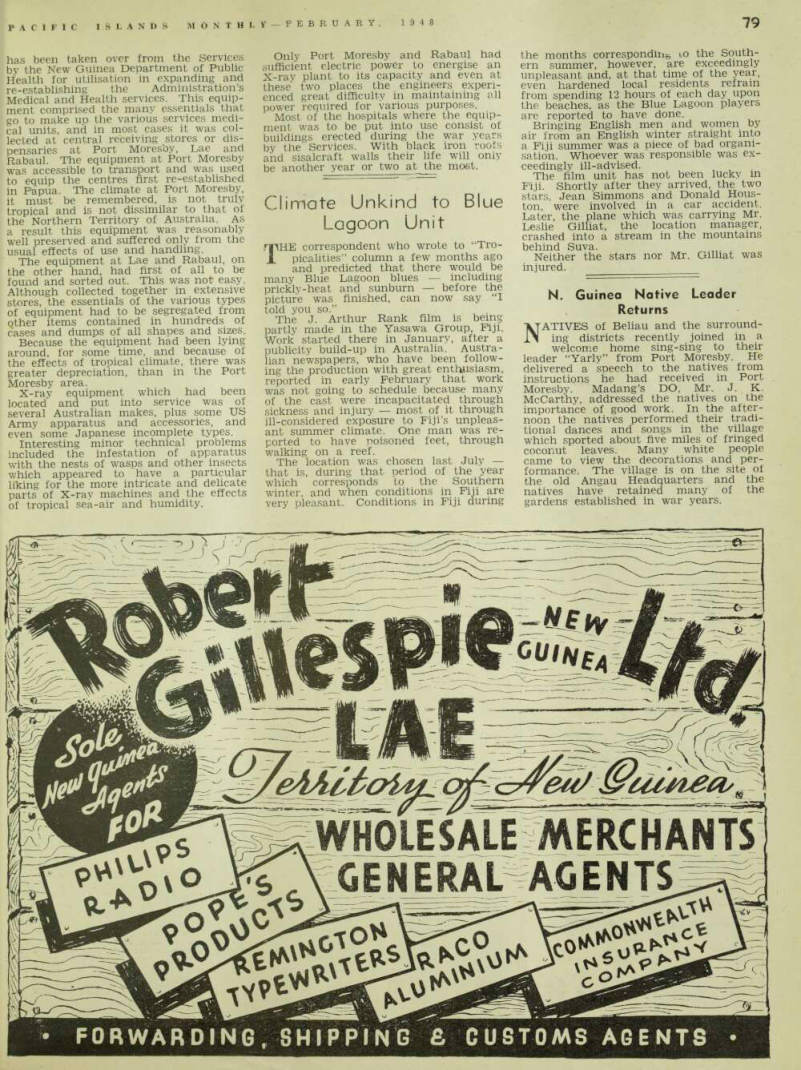
Guinea's Jungles
X-ray engineer, Mr. Malcolm
Rae, who is a member of the
staff of Watson Victor, Ltd., Sydney,
recently spent four months in New Guinea, on business. He has some thing to say about the “rehabilitated ” townships, and the utilisation of
medical equipment left behind by the
fighting services of three countries —
America, Australia and Japan.
MY arrival at Port Moresby by plane from Sydney was at a time when there was no meat (fresh or frozen), no white flour, no benzine, no sugar, and relatively few of the luxury items that make life more tolerable in the tropics.
This state of affairs had already pre vailed for upwards of a month, although Port Moresby, being the centre of Ad ministration and nearest port to Austra lia, is probably the best catered for of all the Papua-New Guinea ports. Most of the shipping from the mainland first calls at Port Moresby before going on to other discharging places.
Rabaul, was probably the most deso lated of all the areas visited. The Army was still represented, but in numbers that catered only for the personnel necessary for War Crimes trials and for the custody of War Criminals.
The European and Asiatic population at Rabaul and environs created heavy de mands on the imported food supplies which are essential until primary pro duction is placed on an efficient basis.
Consider the cargo space required to bring in the needs of 500 Europeans, 2,000 Asiatics plus numbers of war criminals who are fed on Australian rice instead of the outsize, edible snails which the Japs
imported for emergency food and which m the interim have over-run large areas.
There are also several hundred Chinese Army personnel who have to be catered for.
Lae, at present, is considered one of the less desirable apnointments amongst the Administration personnel. Lae, however, is close to the goldfields at Bulolo and Wau, where exists the present most pro fitable source of income for New Guinea.
Madang appears to be one of the places that has lent itself to more rapid re habilitation and stands in a really lovely tropical-island setting. The roads around Madang are relatively good and the port seems to be going ahead. There is a good wharf with, usually, several coasting vessels alongside, and often a Catalina aircraft is seen transporting native labour from one location to another. Those plantations not extensively war-damaged seem to be going ahead and a factory on modern lines is being built for the processing of coconut products.
Samarai, in Papua, is worth mention ing, as it once was regarded as “The Pearl of the Pacific” by pre-war tourists.
At present it is populated by a small group of people who make up in hospi tality what they lack in numbers.
Samarai was a flying base during the war, and during that time half of the island was levelled off by bulldozers.
Where two popular hotels once stood there are now temporary trading sheds constructed from left over war materials.
IT was, however, surplus war equipment which mainly concerned me and was the reason for my visit to New Guinea.
Considerable hospital and medical equipment, including X-ray apparatus,
has been taken over from the Services by the New Guinea Department of Public Health for utilisation in expanding and re-establishing the Administration’s Medical and Health services. This equip ment comprised the many essentials that go to make up the various services medi cal units, and in most cases it was col lected at central receiving stores or dis pensaries at Port Moresby, Lae and Rabaul. The equipment at Port Moresby was accessible to transport and was used to equip the centres first re-established in Pdpua. The climate at Port Moresby, it must be remembered, is not truly tropical and is not dissimilar to that of the Northern Territory of Australia. As a result this equipment was reasonably well preserved and suffered only from the usual effects of use and handling.
The equipment at Lae and Rabaul, on the other hand, had first of all to be found and sorted out. This was not easy.
Although collected together in extensive stores, the essentials of the various types of eauipment had to be segregated from other items contained in hundreds of cases and dumps of all shaoes and sizes.
Because the equipment had been lying around, for some time, and because of the effects of tropical climate, there was greater depreciation, than in the Port Moresby area.
X-ray equipment which had been located and out into service was of several Australian makes, plus some US Army apparatus and accessories, and even some Japanese incomplete types.
Interesting minor technical problems included the infestation of apparatus with the nests of wasps and other insects which appeared to have a particular liking for the more intricate and delicate parts of X-rav machines and the effects of tropical sea-air and humidity.
Only Port Moresby and Rabaul had sufficient electric power to energise an X-ray plant to its capacity and even at these two places the engineers experi enced great in maintaining all power required for various purposes.
Most of the hospitals where the equip ment was to be put into use consist of buildings erected during the war years by the Services. With black iron roots and sisalcraft walls their life will only be another year or two at the most.
Lagoon Unit
Climate Unkind to Blue Lagoon Unit
mHE correspondent who wrote to “Tro- JL picalities” column a few months ago and predicted that there would be many Blue Lagoon blues including prickly-heat and sunburn before the picture was finished, can now say “I told you so.”
The J. Arthur Rank film is being partly made in the Yasawa Group, Fiji.
Work started there in January, after a publicity build-up in Australia. Austra lian newspapers, who have been follow ing the production with great enthusiasm, reported in early February that work was not going to schedule because many of the cast were incapacitated through sickness and injury most of it through ill-considered exposure to Fiji’s unpleas ant summer climate. One man was re ported to have poisoned feet, through walking on a reef.
The location was chosen last July that is, during that period of the year which corresponds to the Southern winter, and when conditions in Fiji are very pleasant. Conditions in Fiji during
the months corresponding to the South ern summer, however, are exceedingly unpleasant and, at that time of the year, even hardened local residents refrain from spending 12 hours of each day upon the beaches, as the Blue Lagoon players are reported to have done.
Bringing English men and women by air from an English winter straight into a Fiji summer was a piece of bad organi sation. Whoever was responsible was ex ceedingly ill-advised.
The film unit has not been lucky in Fiji. Shortly after they arrived, the two stars, Jean Simmons and Donald Hous ton, were involved in a car accident.
Later, the plane which was carrying Mr.
Leslie Gilliat, the location manager, crashed into a stream in the mountains behind Suva.
Neither the stars nor Mr. Gilliat was injured.
N. Guinea Native Leader
Returns
NATIVES of Beliau and the surround ing districts recently joined in a welcome home sing-sing to their leader “Yarly” from Port Moresby. He delivered a speech to the natives from instructions he had received in Port Moresby. Madang’s DO, Mr. J. K.
McCarthy, addressed the natives on the importance of good work. In the after noon the natives performed their tradi tional dances and songs in the village which sported about five miles of fringed coconut leaves. Many white people came to view the decorations and per formance. The village is on the site of the old Angau Headquarters and the natives have retained many of the gardens established in war years.
Advertisements & other items, p. 81 (1 item)
Wholesale Merchants
CFsa uttteev *
?GE N E RAL AG E NIS \9 S O 9 O 9> V *o* 9 o c o *o* \o^ 9 0 C° cO* 0 y o* 0^ 9- 6 P 9 hA 0* o c FORWARDING. SHIPPING fi C U STO MS AG E NTS •
Islands Produce
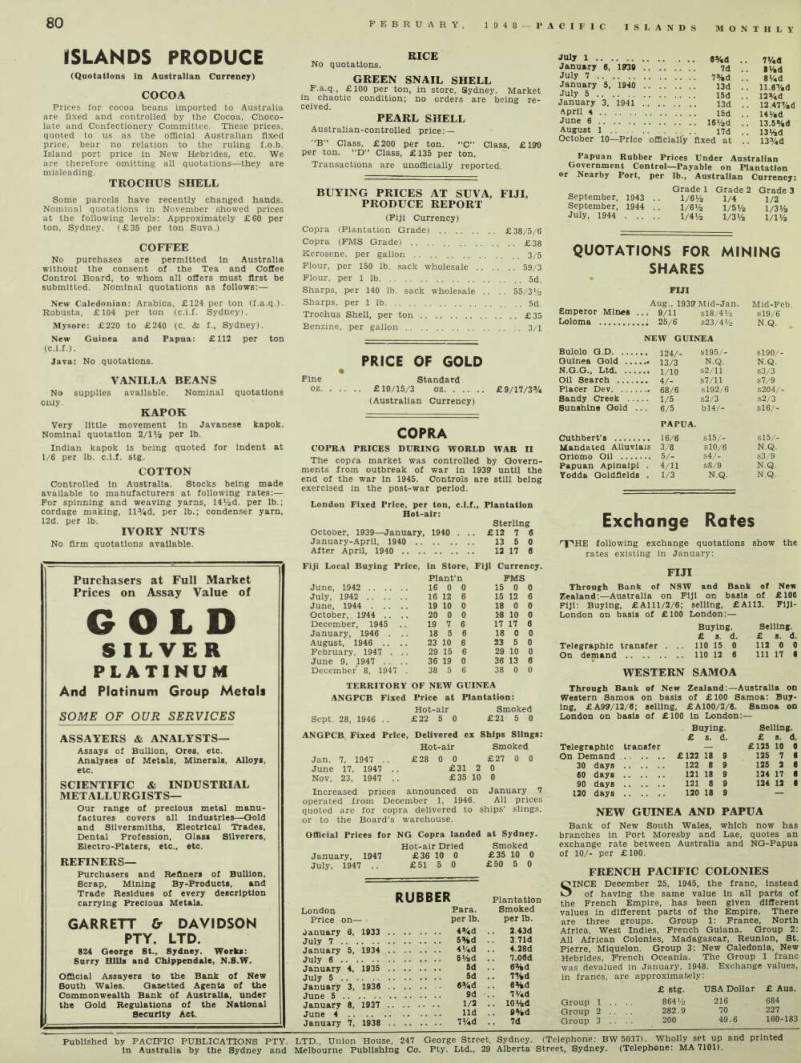
(Quotations in Australian Currency)
Cocoa
Prices for cocoa beans imported to Australia are fixed and controlled by the Cocoa, Choco late and Confectionery Committee. These prices, quoted to us as the official Australian fixed price, bear no relation to the ruling f.o.b.
Island port price in New Hebrides, etc. We are therefore omitting all quotations—they are misleading.
Trochus Shell
Some parcels have recently changed hands.
Nominal quotations in November showed prices at the following levels; Approximately £6O per ton, Sydney. (£35 per ton Suva.)
Coffee
No purchases are permitted in Australia without the consent of the Tea and Coffee Control Board, to whom all offers must first be submitted. Nominal quotations as follows: — New Caledonian: Arabica, £124 per ton (f.a.q.).
Robusta, £lO4 per ton (c.i.f. Sydney).
Mysore: £220 to £240 (c. & f., Sydney).
New Guinea and Papua: £ll2 per ton (c.i.f.).
Java: No quotations.
Vanilla Beans
No supplies available. Nominal quotations only.
Kapok
Very little movement in Javanese kapok.
Nominal quotation 2/1 Vi per lb.
Indian kapok is being quoted for Indent at 1/6 per lb. c.i.f. stg.
Cotton
Controlled in Australia. Stocks being made available to manufacturers at following rates:— For spinning and weaving yarns, 14%d. per lb.; cordage making, ll%d, per lb.; condenser yarn, 12d. per lb.
Ivory Nuts
No firm quotations available.
Rice
No quotations.
Green Snail Shell
F.a.q., £lOO per ton, in store, Sydney. Market in chaotic condition; no orders are being re ceived.
Pearl Shell
Australian-controlled price:— "B” Class, £2OO per ton. “C” Class, £l9O per ton. “D” Class, £135 per ton.
Transactions are unofficially reported.
Buying Prices At Suva, Fiji,
Produce Report
(Fiji Currency) Copra (Plantation Grade) £3B/5/6 Copra (FMS Grade) £33 Kerosene, per gallon 3/5 Flour, per 150 lb. sack wholesale 59/3 Flour, per 1 lb sd.
Sharps, per 140 lb. sack wholesale .. .. 55/3% Sharps, per 1 lb sd.
Trochus Shell, per ton £35 Benzine, per gallon 3/1
Advertisements & other items, p. 82 (1 item)
Price Of Gold
Fine Standard oz £lO/15/3 oz £9/17/3% (Australian Currency)
Copra
Prices During World War Ii
The copra market was controlled by Govern ments from outbreak of war in 1939 until the end of the war in 1945. Controls are still being exercised in the post-war period.
London Fixed Price, per ton, c.i.f., Plantation Hot-air:
Fiji Local Buying Price, in Store, Fiji Currency.
Territory Of New Guinea
ANGPCB Fixed Price at Plantation:
ANGPCB Fixed Price, Delivered ex Ships Slings:
Increased prices announced on January 7 operated from December 1, 1946. All prices quoted are for copra delivered to ships’ slings, or to the Board’s warehouse.
Official Prices for NG Copra landed at Sydney.
Sterling October, 1939—January, 1940 ... £12 7 6 January-April, 1940 13 5 0 After April, 1940 12 17 8
Plant’n
Pms
June, 1942 16 0 0 15 0 0 July, 1942 16 12 6 15 12 6 June, 1944 19 10 0 18 0 0 October, 1944 .. .. 20 0 0 1-8 10 0 December, 1945 19 7 6 17 17 6 January, 1946 . .. 18 5 6 18 0 0 August, 1946 .. 23 10 6 23 5 0 February, 1947 . .. 29 15 6 29 10 0 June 9, 1947 . . 36 19 0 36 13 6 December 8, 1947 . 38 5 6 38 0 0
Hot-air Smoked Sept. 28, 1946 .. £22 5 0 £21 5 0
Hot-air Smoked Jan. 7, 1947 .. £28 0 0 £27 0 0 June 17. 1947 .. £31 2 0 Nov. 23, 1947 .. £35 10 0
Hot-air Dried Smoked January, 1947 £36 10 0 £35 10 0 July, 1947 .. £51 5 0 £50 5 0
Rubber
Papuan Rubber Prices Under Australian Government Control—Payable on Plantation or Nearby Port, per lb., Australian Currency:
Plantation
London Para.
Smoked Price onper lb. per lb.
January 0. 1933 .. .. ... 4%d 2.43d July 7 . 3.71d January 5, 1934 .. .. ... 4‘Ad 4.28d July 6 . ... 6ttd 7.06d January 4, 1935 .. .. ... 5d 6%d July 5 . ... 5d 7%d January 3, 1936 . . .. ... 6y 4 d 6%d June 5 . 9d 7Vid January 8, 1937 .. .. .. lOVid June 4 ... lid 9%d January 7. 1938 . . .. ... 7ftd 7d
J , ul y 1 8%d .. 7V«a January 6, 1939 7d ivid July 7 7%d .. 8V 4 d January 5, 1940 13d .. ll.6%d July 5 15d .. i2>/ 4 d January 3, 1941 13d 12,47 7 /«d * 15d .. 14Vad June 6 16‘/ad .. 13.5%d August 1 17d .. 13ttd October 10—Price officially fixed at .. 13y 4 d
DfĎ
Grade 1 Grade 2 Grade 3 September, 1943 . 1/6% 1/4 1/2 September, 1944 . 1/6V 2 I/51/2 1/3 y a July, 1944 . ..
I/41/2 I/31/2 1/1 i/a
Quotations For Mining
Shares
Fiji
Aug., 193? Mid-Jan.
Mid-Feb.
Emperor Mines . .. 9/11 S18/4V2 S19/6 Loloma .. 25/6 s23/4V 2 N.Q.
Bulolo Q.D
New Guinea
.. 124/- 8195/sl90/- Guinea Gold •* 13/3 N.Q.
N.Q.
N.G.G., Ltd 1/10 S2/11 S3/3 Oil Search .. 4/- S7/11 s7/9 Placer Dev .. 68/6 S192/6 s204/- Sandy Creek ... .. 1/5 s2/3 s2/3 Sunshine Gold .. . 6/5 bl4/sl6/- Cuthbert’s
Papua.
sl5/sl5/- Mandated Alluvlais 3/8 slO/6 N.Q.
Orlomo Oil ... 5/s4/s3/9 Papuan Aplnalpl . 4/11 s8/9 N.Q.
Yodda Goldfields . 1/3 N.Q.
N.Q.
Exchange Rates
HTHE following exchange quotations show the rates existing in January:
Fiji
Through Bank of NSW and Bank of New Zealand:—Australia on FIJI on basis of £lOO FIJI: Buying, £Alll/2/6; selling, £AII3. PIJI - on basis of £lOO London:—
Western Samoa
Through Bank of New Zealand;—Australia on Western Samoa on basis of £lOO Samoa: Buy ing, £ A99/12/6; selling, £AIOO/2/6. Samoa on London on basis of £lOO in London:—
New Guinea And Papua
Bank of New South Wales, which now has branches in Port Moresby and Lae, quotes an exchange rate between Australia and NG-Papua of 10/- per £lOO.
French Pacific Colonies
SINCE December 25, 1945, the franc, Instead of having the same value in all parts of the French Empire, has been given different values in different parts of the Empire. There are three groups. Group 1: France, North Africa, West Indies, French Guiana. Group 2: All African Colonies, Madagascar, Reunion, St.
Pierre, Miquelon. Group 3: New Caledonia, New Hebrides, French Oceania. The Group 1 franc was devalued in January, 1948. Exchange values, in francs, are approximately:
Buying, Selling. £ s. d. £ s. d.
Telegraphic transfer . .. 110 15 0 111 0 0 On demand 110 12 6 111 17 •
Buying.
Selling. £ s. d. £ s. d.
Telegraphic transfer — £125 10 0 On Demand £122 18 9 125 7 6 30 days 122 8 9 125 2 6 60 days 121 18 9 124 17 0 90 days 121 8 9 124 12 • 120 days 120 18 9 —
£ stg. USA Dollar £ Aus.
Group 1 . . . . 864V2 216 684 Group 2 . . .. 282.9 70 227 Group 3 . . . . 200 49.6 160-183
Advertisements & other items, pp. 82-84 (3 items)
80
FEBRUARY. 1948 PACIFIC ISLANDS MONTHLY
Published by PACIFIC PUBLICATIONS PTY. LTD., Union House, 247 George Street. Sydney. (Telephone; BW 5037). Wholly set up and printed in Australia by the Sydney and Melbourne Publishing Co. Pty. Ltd., 29 Alberta Street. Sydney. (Telephone: MA7101).
Gold
Purchasers at Full Market Prices on Assay Value of
SILVER
PLATINUM
And Platinum Group Metals
SOME OF OUR SERVICES
ASSAYERS & ANALYSTS—
Assays of Bullion, Ores, etc.
Analyses of Metals, Minerals, Alloys, etc.
SCIENTIFIC & INDUSTRIAL
METALLURGISTS—
Our range of precious metal manufactures covers all industries—Gold and Silversmiths, Electrical Trades, Dental Profession, Glass Silverers, Electro-Platers, etc., etc.
REFINERS—
Purchasers and Refiners of Bullion, Scrap, Mining By-Products, and Trade Residues of every description carrying Precious Metals.
GARRETT Cr DAVIDSON
PTY. LTD.
824 George St., Sydney. Works: Surry Hills and Chippendale, N.B.W.
Official Assayers to the Bank of New South Wales. Gazetted Agents of the Commonwealth Bank of Australia, under the Gold Regulations of the National Security Act.
tropical thirst...
To quench a
J"” ks
* » / nng D « - Iflnr * SOTn.o m- ° or H CO limited a V?
When you’re hot and tired, there is nothing quite so satisfying and thirst quenching as a long, cold glass of “K.B/’ Your friends and guests, too, will appreciate this really fine
Lager, for “Everybody
drinks K. 8.”
TOOTH’S
LAGER
Vi
MERCHANTS, & SHIP OWNERS
1W 1 Capital £1,000,000
ESTABLISHED 1914
COPRA MERCHANTS & MILLERS
BRANCHES THROUGHOUT THE PACIFIC ISLANDS
Buyers and exporters of all kinds of Islands produce. Copra Merchants and Millers.
Agents for Australian, European and American Manufacturers. Distributors of every description of merchandise.
Thirty years of Pacific Islands development and service.
REGULAR CARGO
PACIFIC
Head
W.
Office:
AND PASSENGER SERVICE BETWEEN EUROPE AND
ISLAND PORTS WAS ESTABLISHED BY
R. CARPENTER & CO. LTD.
16 O'CONNELL STREET, SYDNEY.
Cable Address:
CAMOHE.
Telephone BW 4421.
Postal Address: P.O. Box No. 168, Sydney. (