Pacific
Islands
Monthly
February 15, 1946
Vol. Xvi. No. 7.
Established 1930
[,Registered at transmission by post as a newspaper ]
II-
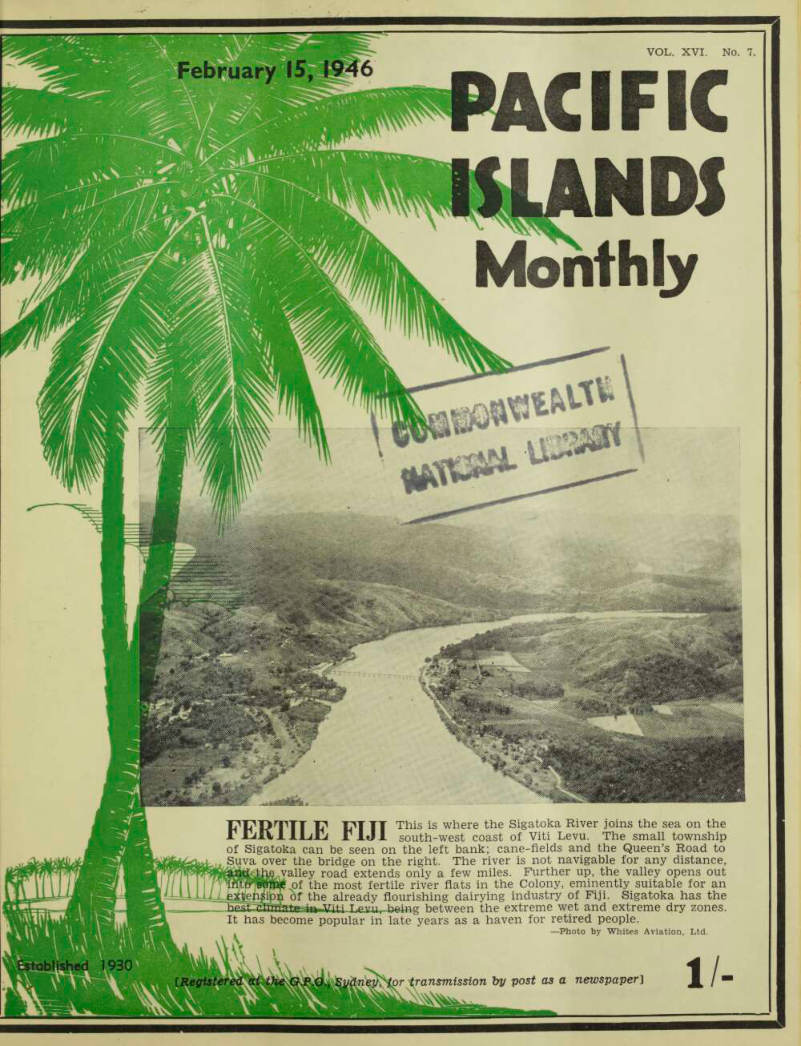
FERTILE FIJI This is where the Sigatoka River joins the sea on the south-west coast of Viti Levu. The small township of Sigatoka can be seen on the left bank; cane-fields and the Queen’s Road to Suva over the bridge on the right. The river is not navigable for any distance, and the valley road extends only a few miles. Further up, the valley opens out in to som of the most fertile river flats in the Colony, eminently suitable for an extension of the already flourishing dairying industry of Fiji. Sigatoka has the best climate in Viti Levu, being between the extreme wet and extreme dry zones.
It has become popular in late years as a haven for retired people. —Photo by Whites Aviation, Ltd.
Advertisements & other items, p. 2 (1 item)
ontAfae
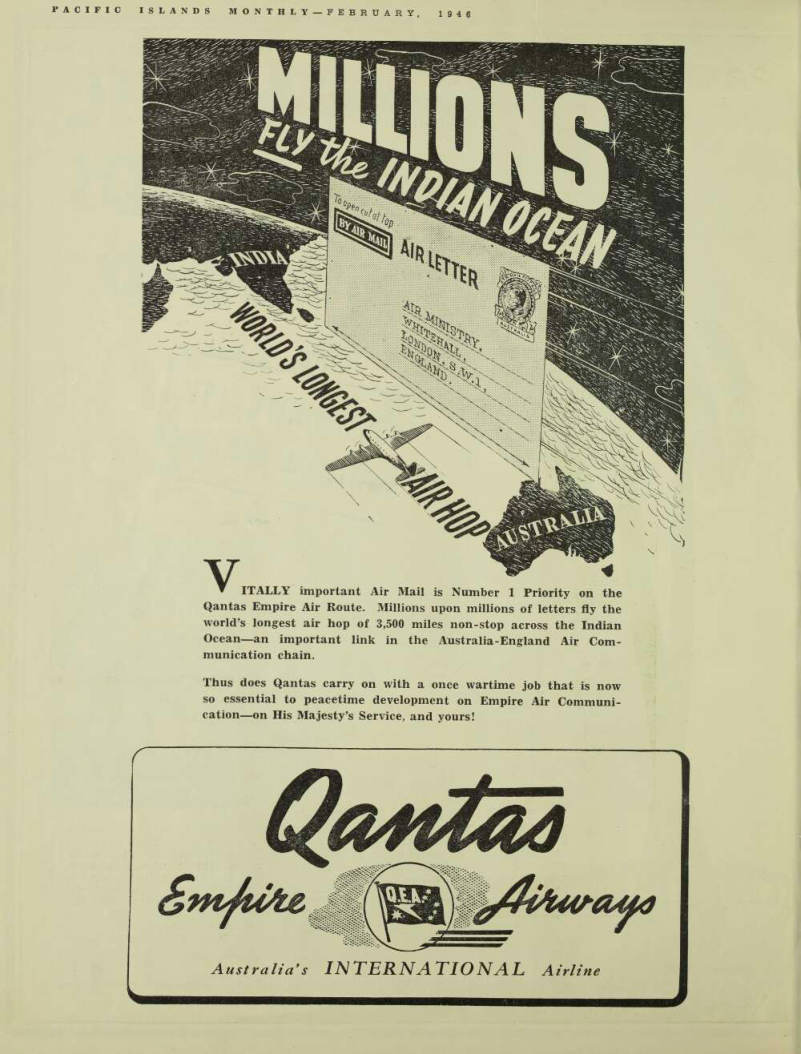
/ z SR % % 1% V -ftt % & 16 cT & Jv- V ITALLY important Air Mail is Number 1 Priority on the Qantas Empire Air Route. Millions upon millions of letters fly the world’s longest air hop of 3,500 miles non-stop across the Indian Ocean—an important link in the Australia-England Air Communication chain.
Thus does Qantas carry on with a once wartime job that is now so essential to peacetime development on Empire Air Communication—on His Majesty’s Service, and yours!
Australia* s INTERNATIONAL Airline
Pacific News-Review
Notes And Comment On
International Affairs
From Jan. 18 To Feb. 10
Jan. 18: Certain members of the US Senate have banded together to fight any move to have international control or supervision over enemy islands in the Pacific which were captured by the Americans during the war, and whose continued fortification is considered essen tial to American security needs.
Jan. 20: The Persian delegation to UNO (which is now meeting in London) has decided to bring Persia’s dispute with Russia to the notice of the Security Council. Persia is demanding a cessa tion of alleged Russian support for the autonomy movement in the northern pro vinces of Persia and the removal from the country of Russian and British garri sons. The settlement of this dispute will be UNO’s first test.
Jan 20: The British Ambassador to Russia. Sir Archibald Clark Kerr, who was in London attending the UNO Conference, is on his wav to Batavia as a special ambassador. The move has the approval of the Netherlands Government.
Jan. 21: General de Gaulle has re signed as President of France and is leaving Paris. He says his decision is irrevocable, and that he never intended to retain power once he considered his task completed and Prance’s transitional
period completed.
Jan. 22; Apparently as a diversionary move to Persia’s request to UNO, Russia has demanded an inquiry, by the Security Council, into Britain’s conduct in Greece and Indonesia.
Jan. 24: Felix Gouin, a Socialist, has been elected Premier of France in succes sion to de Gaulle, and is attempting to form a Cabinet. French observers, how ever, do not expect his Government to nave a very long life.
Jan. 26: Mr. Churchill has sold a copy of the speech which he made to a secret session of the House of Commons in April, 1942, concerning the fall of Singa pore, to an American magazine for pub lication. In the speech Mr. Churchill said that 100.000 defenders of Singapore surrendered to 30.000 Japanese; that there was much recrimination; that the Australians blamed Indian troops, and others disparaged the Australians. There has been Quick reaction in Australia where some individuals and organisations imagine the AIF has been libelled; and a demand for a public inquiry.
Jan. 29: The Lieut.-Governor of the Netherlands, Dr. van Mook, will present a 15-point plan, which he recently brought from Holland, to the Indonesian “Premier” Sjahrir when the British special Ambassador, Sir Archibald Clark Kerr, arrives in early February.
Jan. 30: M. Trygve Lie, Norwegian Foreign Minister, has been selected by UNO as Secretary-General. The Big Five selected him for his capabilities and be cause the choice of a Norwegian ruled out any suggestion of influence by the Great Powers. He will be chief adminis trative officer of UNO.
Jan. 30: Mr. Harry Hopkins, the late President Roosevelt’s most trusted ad viser. died to-day after a long illness.
Jan. 30: After lengthy and bitter dis cussion, UNO decided to leave the Per sian complaint to amicable adjustment between Persia and Russia.
Feb. 1: The Soviet delegate to UNO has introduced to the Security Council Russia’s complaint that British forces are controlling and directing political affairs in Greece. He said that Russia had drawn the Allies’ attention to it at the
Yalta, Berlin and Moscow Conferences.
After the Russian case is stated, replies will be made by British and Greek repre sentatives.
Feb. 4: Concurrently with a Soviet press campaign against Britain, the Rus sian delegate to UNO accused the British Foreign Minister, Mr. Bevin, of presenting the facts about Britain’s pre sence in Greece “very carelessly.” He has repeated the Soviet’s demand for the im mediate and unconditional withdrawal of British troops from Greece, but so far has not asked the Council to take action.
If a vote is taken, seven other members beside Russia must vote for withdrawal; this is considered unlikely. Mr. Bevin has repudiated the Russian suggestion of undue interference and his plea that the British are there at Greece's invitation is supported by the Greek delegation.
Feb. 4: The possibility that the pro posed £l,OOO million loan from the United States to Britain will be rejected, or de layed, by US Congress, is worrying British Cabinet. It was hoped that Con gress would debate the Bill by April, but it seems certain now that it will not be discussed before June. In the meantime the British standard of living continues to fall.
Feb. 6: The Security Council of UNO last night did not clear Britain of the Soviet’s charge of endangering world peace by maintaining armed forces in Greece, as demanded by Mr. Bevin. To day, Mr. Bevin reported on the Greek situation to an urgent special meeting of British Cabinet.
Feb. 7: By general agreement, the Security Council of UNO has decided to consider as closed the question of the presence of British troops in Greece.
Feb. 7: The General Assembly of the League of Nations has been summoned to meet in Geneva on March 8, for what will probably be its last session.
Feb. S : In order to meet the acute food situation in Britain, it may be neces sary for the Government to reduce dras tically the importation of American films, petrol and tobacco in order to save dollars for essential food from America.
Fresh cuts in the food ration have been received unfavourably everywhere in Britain. Criticism is levelled at the Minis try for its failure to warn the public of the grave developments now suddenly dis closed, and secondly for its failure to pre pare the farmers. Food shortage, amounting to famine in some cases, is general throughout Europe.
Feb. 8: The execution of convicted Japanese war criminal, General Yama shita, which had been stayed pending action by President Truman, has been ordered to proceed, and Yamashita will be stripped of all decorations and hanged.
Feb. 10: A new UNO “crisis” mav be caused by Russia’s sunport of the Ukrai nian complaint regarding the presence of British troops in Indonesia. Russia asks that Britain, Russia, China, America and the Netherlands be represented on a commission of investigation on Indonesia.
Feb. 10: UNO is being asked by France, Britain, Russia. United States and China to urge the world to grow all the food possible in order .to avoid a famine.
Washed Away
Fijian Villages Washed Away
NEWS received in Australia on Feb ruary 1, indicates that following hurricane weather, several villages were washed away as the result of tor rential rains in the northern and eastern districts of Viti Levu, Fiji. Loss of life is feared.
The Wainibuka River rose 70 feet, and the Rewa River 40 feet.
Fourteen inches of rain fell in this area over a 13-hour period.
The Rev. D. Fullerton, of the Metho dist Church, was recently ordained in Fiji. He is to be married in Lautoka, Fiji, as soon as his fiancee arrives from Australia.
Mr. A. E. Rudder has been elected chairman of the board of Tasman Empire Airways, Ltd., in succession to the late Brigadier N. S. Falla, who had held that office since the company’s inception. He is vice-chairman of Qantas Empire Air ways, Ltd., and a representative in Aus tralia and New Zealand of British Over seas Airways Corporation.
Like so many others, the Bignell family (Solomon Islands and New Guinea) suf fered heavily in the Rabaul tragedy. The Japs made prisoners of Mrs. Kathleen Bignell, her son Charlie, and her son-in law, Dudley Roberts. Mrs. Bignell was liberated after imprisonment in Japan, but both young men were lost on the “Montevideo Maru.’’ Charlie Bignell, who was employed by the New Britain Timber Co., was one of the first Terri tories men to enlist in Australia in 1939. but he was later discharged on medical grounds. In Rabaul, however, in 1941. he enlisted again in the Machine-Gun Company of the 22nd Battalion, AIF, and he took part in the town’s last battle against the invaders. Dudley Roberts, who married Jean Bignell -in 1939, was a Govenment teacher on New Ireland.
The young widow has a child, 3£ years old, born in Sydney after the women were evacuated from New Guinea.
Advertisements & other items, p. 3 (1 item)
Pinkettes
After taking Pinkettes you should feel brighter, happier, and free from sick headaches, bilious attacks and liverishness. For
are tiny laxative and liver pills, which painlessly exercise the digestive system.
Advertisers
Adams, Clayton & Co 57 Angliss & Co. . . .21 Atkins Pty., Ltd., Wm 36 AWA, Ltd 23 Brial & Ball ... 17 Brown & Co., Ltd. 11 Brunton’s Flour . . 34 Burns, Philp Trust Co., Ltd 13 BP (SS) Co. . . . 11 Bhindi, P. K. . . .45 Baker, W 45 Carlton & United Breweries, Ltd. . 37 Carpenter, Ltd., W.
R 72 Chivers & Sons, Ltd 44 Church, R. H., & Sons 50 Coleman Lamp & Stove Co 38 “Cystex” ... 52 Consolidated Export & Import Group of Australia ... Iff Donaghy & Sons . 44 Donald, Ltd., A. B. 24 Dr. Williams Pink Pills 41 Electrolux Refrigerators . . 20 Eckhoff, H. G. . . 16 Ford Sherington Pty., Ltd. ... 50 Clark, Foster ... 25 Garrett & Davidson 70 Gibson & Co., Ltd.,
J. A. D 39
Gillespie Pty., Ltd..
Robert ... 33, 58 Gilbey’s Gin ... 63 Gillespie’s Flour . . 69 Gough & Co., E. J. 35 Grand Pacific Hotel 4 Grove & Sons, W.
H 28 Heinz & Co. Pty., Ltd., H. J. . . .51
Hemingway & Robertson ... 56 Hyde, Victor ... 68 Horlicks 47 Jenkins, Reg. ... 40 Kopsen & Co., Ltd. 29 Merrillees, J. C., & Co 31 Masschelien, O. F. 17 Miscellaneous . 37, 60 “Mendaco” ... 54 Mcllraths Pty., Ltd. 59 Nelson & Robertson Pty., Ltd. ... 43 Newman, M. . . .43 “Nixoderm” ... 46 Noyes Bros. ... 66 Pacific Islands Yearbook .
Pacific Planters’
Handbook ... 42 Pacific Islands Monthly ... 28 Pacific Territories Association ... 10 Parish, Patience & Mclntyre ... 14 Pacific Is. Society 59 “Pinkettes” ... 3 Qantas Empire Air ways 2 Queensland Insur ance Co 26 Raymond, Lance, Pty., Ltd. ... 53 Robinson, G. H. . 34 Rose’s Eye Lotion . 53 Rohu, Sil . . . .41
Rur 22
Scott, Ltd., J. . .32 Southern Pacific In surance Co. . 12 Steamships Trading Co., Ltd 35 Shepherd, A. O. . 14 Sullivan & Co.. C. 61 Swallow & Ariell . 67 Taylor & Co., A. . 52 “Tenax” Soap . . 31 Tillock & Co.. Ltd. 55 Turner, F. W. . . 24
Thornycroft (Aust.) Pty., Ltd. ... 16 Tooth & Co., Ltd 71 Toogood, J. J. . . 64 Tullochs Pty., Ltd. 15 Watson, Wm. H. 64 Wunderlich, Ltd. . 62 Widdop, H., & Co., Ltd 65
Wesley College . . 48 Wright & Co. . . 16 Wills, W. D. & H. 0 49 Wright & Co., Ltd., E 60 Young Pty., Ltd., Harry J 30 Yorkshire Insur ance Co., Ltd. . 11
Contents
Pacific News Review 3 Editorial: “Territorial and Political Changes Coming in Indonesia and Pacific Territories” 5 Rabaul Honours Its Dead —Services on Anniversary of Jap Invasion ... 7 Tragedy of Ocean Island—Six Euro peans and Hundreds of Natives Killed by Japs 8 Victims of Rabaul Invasion—Photo . 9 Trans-Pacific Airways Americans Moving But British Dither ... 9 Mr. Ward Appears in His True Colours—Effect of Demand by Territories’ Public Servants ... 10 Phosphate from Nauru in July—But 500 Islanders Still Missing .. .. 11 Tropicalities 12 Polynesian Workers Make Big Demands in Cooks 14 Blasts by Atomic Bombs May Do Damage Among Atolls 16 Fiji Copra Goes Up—And Down! .. 17 The Distinguished Career of Harold H. Page is “Bill” Korn Disappearance in Rabaul in 1942 21 Tulagi Weighed in the Balance and Found Wanting But Bishop Criticises Honiara for Capital .. 22 Morobe Road —NG Government Demands Toll 25 The Fijian Becomes a Miner 26
Mr. Ward Has No Objection to Rabaul Inquiry 27 “PIM” Short Story: An Old Fool !! 31 Fiji’s Legislative Council at Work 23 Vegetable Production in New Guinea 34 “PIM” Editor Not Allowed to Visit Australian Territories 36 N. Caledonia Returing to Peacetime Lethargy 37 Trader’s Tale: Drinks on the House 40 Foretellers of Ships 42 Slow Progress of Rehabilitation’ of
Ngg 43
The Story of Rabaul—First of a Series of Articles by Gordon Thomas 45 Inside Story of AlB—Functions and Exploits of Famous Unit 43 Irony: A True Story of Old Fiji ... 52 Torres Strait Pearls Memories of James Clark 54 Future of Manus Base Australian General Speaks His Piece 57 Ambon’s Place in Western Pacific His tory-Link Between British and Dutch for Four Centuries ... 59 The Bonins Jap Base May Now Become American 60 Value of Franc Effect of New Exchange on Colonial Pacific Trade 62 1,000 Australians Sacrificed—Unneces sary Jungle Campaign 62 Storm Damage in Cook Islands— Orange Crop Suffers 63 Strong Criticism of Solomons Ad ministration-Indifference Towards Plight of the Displaced Planters . 65 Pensions for Civilians—Dependants of Men Lost in New Guinea and Papua 67 Shipping and Plane Services—Pacific Travellers 68 Commercial Markets, etc 70
Advertisements & other items, p. 4 (1 item)
%
so*
Pacific Islands Monthly
Tlio Newspaper-Magazine of the South Seas [Registered at the G.P.0., Sydney, for transmission by post as a newspaper.]
Published Once Each Month and Circulated in Australia and New Zealand and in the following Pacific Territories and Islands Groups:
Australian Territory of Papua.
Mandated Territory (Australia) of New Guinea.
Australian Territory of Norfolk Island.
New Zealand Territory of Cook Islands.
Mandated Territory (NZ) of Western Samoa.
British Colony of Fiji.
British Solomon Islands Protectorate.
British Protectorate of Tongan Islands.
British Crown Colony of Gilbert and Ellice Islands.
Mandated Territory of Nauru.
British and Free French Condominium of New Hebrides.
Free French Colony of New Caledonia.
Free French Colony of Oceania (Tahiti, etc.).
American Territory of Eastern Samoa.
American Territory of Hawaiian Islands.
Owned and Produced by Pacific Publications Pty. Ltd., Union House, 247 George Street, Sydney.
Vol. XVI. No. 7.
February 15, 1946.
Pr\ra l/ Per Copy ''ice Prepaid: 10/- p.a.
Territorial and Political Changes Coming in
Indonesian and Pacific Territories
THE shape of post-war territorial re adjustments to come should be seen, fairly soon. They will include the re arrangement of boundaries between nations, according to what the dominant Powers believe to be ethnological con siderations: the reallocation of responsi bility for government of the territories formerly held by Germany, Italy and Japan (including the colonies taken from Germany after World War I and par celled out under Mandates); and the granting of necessary bases to those Powers which will undertake the policing of the world in the interests of peace.
We here are concerned mainly with the political changes likely to occur in the Pacific. They are many, and they prob ably will affect the following Territories; IN INDONESIA: Netherlands Indies; Malaya; Burma; Indo-China; Philip pines; , Northern Borneo; Dutch New Guinea; Portuguese as well as Dutch Timor.
IN NORTH PACIFIC: Bonin Islands; Caroline Islands; Mariana Islands; Mar shall Islands.
IN SOUTH PACIFIC: Mandated Ter ritory of New Guinea; Mandated Terri tory of Nauru; British Solomon Islands; Condominium of New Hebrides; Man dated Territory of Western Samoa.
Whatever changes occur in Indonesia will be brought about almost wholly by the increasingly clamant demand for in dependence by races hitherto governed by Europeans. Agitation, based generally on this blind desire, but stirred up to a very great extent by Communists whose main purpose is the embarrassment of the Western European Democracies, is seen at the moment in Netherlands Indies, Burma, Indo-China.
We Cannot Trust Indonesians
NOT only are these various races of Indonesians incapable of complete self-government: we dare not take a chance, and grant them full indepen dence because, to an extent few people realise, they hold the bridge between overcowded Asia and the under-populated white countries of the South Pacific. If there are to be any white nations in existence in Oceania at the end of the twentieth century, then Britain, Prance
and Holland must retain control over the countries of South-east Asia and Indonesia. It is a plain policy of self preservation.
The Indonesians, generally, are of a poor racial type, and it is in their own interests that they be governed by a people like the Dutch, who will treat them with strict justice, insist that they conform to a decent standard of living, and do everything possible and practic able to improve the race, from genera tion to generation.
The ideal set-up in the Indies would be that now proposed by the Dutch them selves, in which this Indonesian Terri tory of over 70,000,000 people will have a clear-cut national status within the Netherlands Empire.
Nothing has shown more clearly the feebleness and stupidity of the present Australian Government than the official attitude of Australia towards the cur rent Indonesian trouble. Instead of as sisting the Dutch, in every possible way, to establish a strong, orderly adminis tration in the East Indies, Australia has allowed its policy to be dictated for it by a few of the more ignorant, Com munist-dominated Trade Unions, like the waterside labourers, who have made common cause with the Indonesian agi tators. The British Labour Government, which is supposed to be assisting the Dutch in restoring order in the Indies, has been more or less accepting the lead of Australia, and has not given real co operation to the Dutch.
While Australia and Britain have been dithering, and the outraged and help less Dutch silently cursing, the skinny shanked, squealing legions of Indonesians have been making a most unholy mess of the administrative and economic struc ture in the East Indies —which the de feated Japs apparently had left in fairly good order.
The Australian Labour Government has no more imagination than the ass, which should be emblazoned on its ban ner. It cannot see that if the East Indies were handed over to the Indo nesians, the further occupancy of Aus tralia by the white race would become a matter of simple calculation. Austra lians were saved by the United States in 1942 from extermination at the hands
of Asiatics. Do they imagine that they can expect that protection indefinitely?
Communism A Real Danger
WE have stressed this point of view— the fact that the European nations must control Indonesia, if there is to be any security for the white races in Oceania —because it colours all future territorial considerations in the Pacific.
The outstanding fact, in relation to the future of the Pacific, is the proximity of overcrowded Asia.
Behind that fact there looms another fact, which also we dare not ignore.
Communist Russia (which itself is half Asiatic) seems determined to encourage the growth of Communism in Asia, and then to make common cause in world affairs —including the future of the Pacific —with Communist Asia.
Communism is the most deadly men ace in the world to-day. It actually is the product of the Asiatic type of mind; and maybe it represents, for Asiatic masses, some progress in human living standards. But, for Western Europeans, it is the antithesis of everything that makes life decent, and worth while.
Communism will try to force open the land-bridge between Asia and Australia.
If the peoples of the United States and the Western Democracies, in planning the future Pacific set-up, ignore Over crowded Asia and Communist Russia, the outlook will be very ugly and disturbing.
Unhappily, the governments of many of the nations have fallen temporarily into the hands of Leftist bureaucrats and dream-happy theorists, who imagine that the organisation of the united Nations is simply a matter of giving indepen dence to every large community that howls for it.
Future Of The “Line” Islands
rE former German colonies of Caro line, Marshall and Mariana Islands, and the Bonin Islands —all of which were removed from Japanese possession by the Americans —clearly must lie at the disposal of the United States.
The “trusteeship” arrangement that is coming out of UNO has yet to be seen and assessed; so it is not possible to say whether such a trusteeship over the four groups named will satisfy the Americans. The character of the groups and of the people do not suggest that they could be trained, as in the case of the Philippines, for establishment as an
independent nation. The widely-scat tered groups have no great economic value. The Americans may want the Carolines and the Marianas as bases for policing purposes, but the Marshalls would not be of much use.
The Marshalls are nearly all atolls, like the Gilbert and Ellice Islands, which, economically and administratively, are one of Britain’s headaches. One solu tion would be the transfer of the Mar shalls to Britain, to be administered jointly with the Gilbert and Ellice Is lands Colony.
Ocean Island, now the seat of the Gilbert and Ellice Islands administra tion, should be detached from that Colony, with which it has no community of interest whatever, and it should be tied up with Nauru, 180 miles westward, in one administration. Ocean Island and Nauru are of similar character—merely two large lumps of valuable phosphatic rock, now the location of an enormously valuable industry, operated on both islands by the British Phosphate Com pany.
Complications enter, however, in the fact that Nauru, as a former German colony, is a three-party Mandate (ad ministered by Australia on behalf of Britain and New Zealand). The Man dates are being wiped out, however. This may be an opportunity to place these two BPC-dominated islands under one administration, and to compensate the G. and E. Colony for the loss of Ocean Island by bringing in the Marshall Islands—if the Americans do not want the Marshalls. That might not be suf ficient compensation, however the British paid most of the cost of ad ministering the G. and E. Colony out of the phosphate revenues of Ocean Island.
Australia’S Defensive Islands
Arc
AUSTRALIA, on her administrative record in Papua and New Guinea, may claim enlarged administrative re sponsibilities in the South-west Pacific Islands.
The point is not worth pursuing, how ever. Australia, if she is to survive as a white nation, must have adequate pro tection against Asia; and an essential part of that protection is the control by Australia of most of the rampart of Paci fic Islands which stretches from Timor, in the north-west, through New Guinea, New Britain, the Solomon Islands, the New Hebrides, New Caledonia, to Nor folk Island, in the east.
There is little to prevent Australia holding control of all those Territories, with the exception of the French Colony of New Caledonia. Western Timor and Western New Guinea are held by the Dutch: eastern Timor by the Portuguese; all the rest, except the French colony, are British or have British connections.
There is a strong suggestion that the Dutch may be induced to transfer Wes tern Timor and Western New Guinea to Australia, in return for Britain’s interests in northern Borneo (Sarawak. Brunei and British North Borneo). The loss of oil possibilities in Dutch New Guinea might be compensated for by oil pos sibilities in British Borneo. The only
value which eastern Timor could have for Portugal would be its possible use as an airport. From the administrative viewpoint, it is so clearly an embarrass ment to Portugal that its transfer to Australia should be easily arranged.
Transfer of the British Solomons to Australian administration has been dis cussed on many occasions. There seem to be no grave obstacles to the plan— except that most of the planters there, who know Australia too well, prefer British rather than Australian govern ment. The trade of the Solomons is al most wholly in Australian hands; its cur rency is the Australian currency.
New Hebrides—A Headache
NEW CALEDONIA is part of the peri meter; and this old-established French colony belongs always to France, But what of another unit of the peri meter, the Anglo-French New Hebrides, between New Caledonia and the Solo mons? Here is a headache!
The group became the joint adminis trative responsibility of Britain and France because the numerous, poten tially-valuable islands were coveted by both French and British settlers. It was decided to let the nations of both Powers go in freely, and colonise.
Generally, the Condominium has been a complete failure. Settlement and development have been limited and spiritless and, whatever has been done, has been done by the French. The French definitely helped their settlers, by giving them a supply of indentured Asiatic labour, and compensating them when their plantations were more or less wiped out by hurricanes. The British would not help their nationals in any way; and a proportion of the few British planters who remained sought French nationality, in order that they might have a depend able labour supply.
The two British institutions which have hung on in this group—Burns Philp and Co., Ltd., and the Presbyterian Mis sion—are both Australian. The Big Firm, at one time, had very large land in terests there; and these were presented by James Burns to the Australian Gov ernment, evidently in the hope that Aus tralia would show some colonising enter prise in this direction. But Australia officially never has taken the slightest interest in the Territory—except that Labour politicians, occasionally, have shouted against the presence of inden tured Asiatic labourers so near their sacred shores.
If New Caledonia were not lying along side the New Hebrides, it could be argued that the New Hebrides should be trans ferred to Australia, on the grounds of Australian security. But, whatever hap pens, the French will remain in New Caledonia—which is the right (or south eastern) flank of Australia’s Islands perimeter of defence. Australia must look to France to maintain that par ticular bastion.
There, as Australia’s record shows that Australia officially is not interested in the settlement or development of the New Hebrides, and as it is to Australia’s interest to build up French strength in this area, it is a sound proposition that
the futile Condominium should be wiped out, and New Hebrides handed over to France.
This, of course, is a matter for the British Colonial Office—and the latter will discuss it with Australia. If Aus tralia is wise, Australia will be in favour of the transfer to France —but with cer tain very definite conditions relating to the admittance of Australian trade, com munications and missionary activities.
Co-operation between the French and the Australians, relating to the defence of the perimeter, would be essential, Aus tralia has large land rights in the group, to bargain with.
Future Of Samoa
APART from defence considerations, there are few calls for territorial changes in the South Pacific.
The liquidation of the Western Samoa Mandate almost certainly will be made the occasion for an examination of the possibilities of self-government by the Samoans. There are no reasons, economic or cultural, why New Zealand should re tain control over the Territory—certainly not the present tight control.
UNO probably will consider various al ternatives, in relation to Samoa. Why should Eastern Samoa (now American) and Western Samoa not be brought to gether as one administration—they al ways have constituted one country and one people, with a common language under the care of a Trustee Commission?
Or, Samoa might be placed in the care of the British Western Pacific High Commission, which has had remarkable success in teaching the natives of the Gilbert and Ellice groups—people very similar to the Samoans —to govern them selves.
Miss Ethel Nordman, of Papeete, had 36 hectic hours on November 10 and 11.
She received from her fiancee, Mr. Pierre Villebois, a radiogram that he had been released from the French Navy, and had joined the staff of the Compagnie du Nickel, in Noumea, and she was to join him forthwith, by the SS “Permanente” (then at Tahiti and due to leave in 36 hours), and be married. It was a mad rush —but the lady made it. While she stood on the deck, covered with garlands of Tiare (the love-flower of Tahiti), and being farewelled by innumerable friends, her father, Mr. Oscar Nordman, formerly of the Oceanic Line, was enjoying a lively quarter-hour aboard—he had discovered an old shipmate in the person of Chief Steward Eddie Mason.
Letters have been received by Mrs.
Flo Stewart from her sister, Mrs. Carl Humbert (formerly Mrs. James Baldie), who had been lost sight of, in Germany, since the outbreak of World War 11. Mrs.
Humbert, who managed the Lae Hotel for Mrs. Stewart, was well known in New Guinea. About 1939 she married Mr.
Humbert, a German technician attached to the Lutheran Mission, and she had been only two weeks in Germany when war came. She writes graphically of the terrible sufferings of the German people—especially in the later years, when the Allies organised their great air at tack on Germany. She somehow had learned of the death of her son, Squadron-Leader Stanley Baldie, of the RAF, who was killed in India. She hopes soon to return to New Guinea.
Tragedy Of Ocean Island
Six Europeans, With Hundreds of Natives, Killed by Japs
THERE now seems no doubt that an other grave tragedy occurred on Ocean Island, after the evacuation of the island by the British, and its occupation by the Japanese.
When the Europeans were withdrawn, the following remained voluntarily on the island, to care for the natives, and the European installations there: Mr. C. G. F. Cartwright, Government Secretary.
Mr. R. W. Third, Government radio operator.
Mr. Cole and Mr. H. A. Mercer, mem bers of the staff of the British Phos phate Commission.
Father Pujebet and Brother Brummell, Roman Catholic missionaries.
Careful investigations which have been made since Australian and British Forces occupied the island in September indicate that all of those men died in 1943.
Mr. Cartwright died in April and Mr.
Mercer in June, both from malnutrition.
Father Pujebet died in August, 1943, after an operation performed by a Japanese doctor. Mr. Cole died in Sep tember, while in a hospital.
There is no conclusive evidence re garding the fate of Mr. Third and Brother Brummell; but one native report
indicates that they were killed by an
injection given them by the Japanese.
There is no evidence of their having been removed from Ocean Island. unfortunately, the massacre of natives and of labourers from the other Groups, oeiore our reoccupation, has left us witn out any direct evidence of the fate of the Europeans. The sole survivor of the massacre lacked any personal know ledge of what occurred.
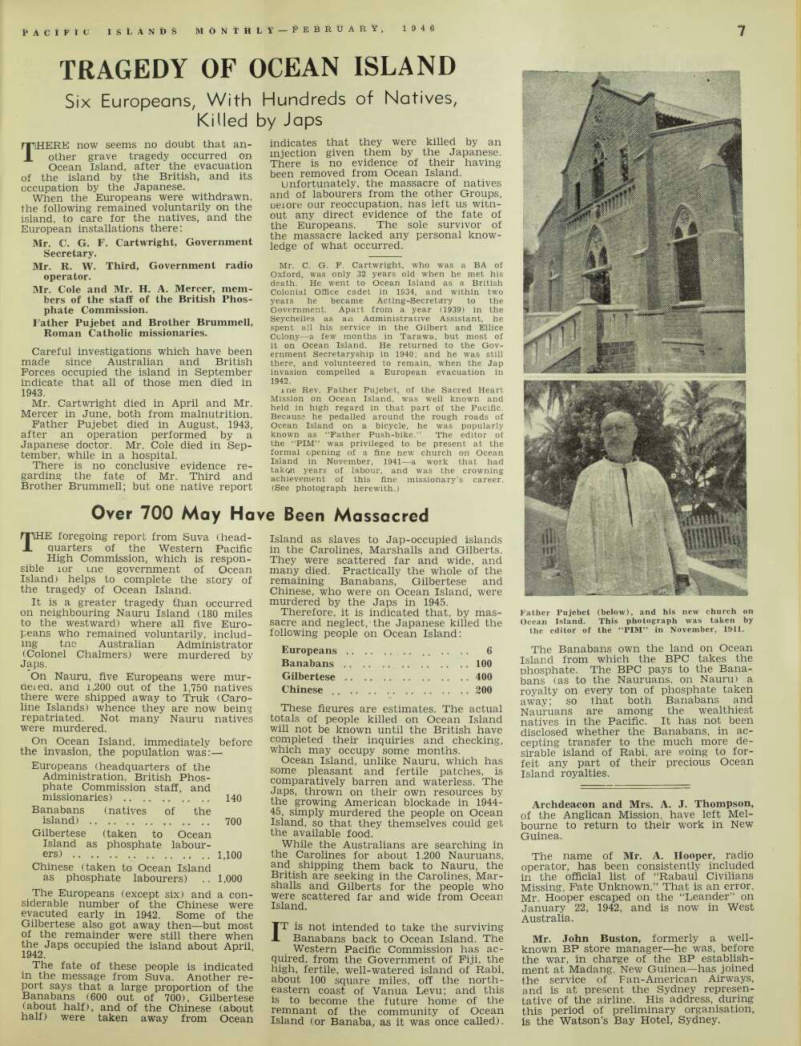
Mr. C. G. F. Cartwright, who was a BA of Oxford, was only 32 years old when he met his death. He went to Ocean Island as a British Colonial Office cadet in 1534, and within two years he became Acting-Secretary to the Government. Apart from a year (1939) in the Seychelles as an Administrative Assistant, he spent all his service in the Gilbert and Ellice Colony—a few months in Tarawa, but most of it on Ocean Island. He returned to the Gov ernment Secretaryship in 1940; and he was still there, and volunteered to remain, when the Jap invasion compelled a European evacuation in 1942. me Rev. Father Pujebet, of the Sacred Heart Mission on Ocean Island, was well known and held in high regard in that part of the Pacific.
Because he pedalled around the rough roads of Ocean Island on a bicycle, he was popularly known as “Father Push-bike.’’ The editor of the “PlM’’ was privileged to be present at the formal opening of a fine new church on Ocean Island in November, 1941 —a work that had takon years of labour, and was the crowning achievement of this fine missionary’s career. (See photograph herewith.)
Over 700 May Have Been Massacred
rE foregoing report from Suva (head quarters of the Western Pacific High Commission, which is respon sible xor me government of Ocean Island) helps to complete the story of the tragedy of Ocean Island.
It is a greater tragedy than occurred on neighbouring Nauru Island (180 miles to the westward) where all five Euro peans who remained voluntarily, includ ing tnc Australian Administrator (Colonel Chalmers) were murdered by Japs.
On Nauru, five Europeans were mur deied, and 1,200 out of the 1,750 natives there were shipped away to Truk (Caro line Islands) whence they are now being repatriated. Not many Nauru natives were murdered.
On Ocean Island, immediately before the invasion, the population was: — Europeans (headquarters of the Administration, British Phos phate Commission staff, and missionaries) 140 Banabans (natives of the island) 700 Gilbertese (taken to Ocean Island as phosphate labour ers) .. 1,100 Chinese (taken to Ocean Island as phosphate labourers) .. 1,000 The Europeans (except six) and a con siderable number of the Chinese were evacuted early in 1942. Some of the Gilbertese also got away then —but most of the remainder were still there when the Japs occupied the island about April, 1942.
The fate of these people is indicated in the message from Suva. Another re port says that a large proportion of the Banabans (600 out of 700), Gilbertese (about half), and of the Chinese (about half) were taken away from Ocean
Island as slaves to Jap-occupied islands in the Carolines, Marshalls and Gilberts.
They were scattered far and wide, and many died. Practically the whole of the remaining Banabans, Gilbertese and Chinese, who were on Ocean Island, were murdered by the Japs in 1945.
Therefore, it is indicated that, by mas sacre and neglect, the Japanese killed the following people on Ocean Island: Europeans .. .. 6 Banabans 100 Gilbertese 400 Chinese 200 These figures are estimates. The actual totals of people killed on Ocean Island will not be known until the British have completed their inquiries and checking, which may occupy some months.
Ocean Island, unlike Nauru, which has some pleasant and fertile patches, is comparatively barren and waterless. The Japs, thrown on their own resources by the growing American blockade in 1944- 45, simply murdered the people on Ocean Island, so that they themselves could get the available food.
While the Australians are searching in the Carolines for about 1.200 Nauruans, and shipping them back to Nauru, the British are seeking in the Carolines, Mar shalls and Gilberts for the people who were scattered far and wide from Ocean Island.
IT is not intended to take the surviving Banabans back to Ocean Island. The Western Pacific Commission has ac quired, from the Government of Fiji, the high, fertile, well-watered island of Rabi, about 100 square miles, off the north eastern coast of Vanua Levu; and this is to become the future home of the remnant of the community of Ocean Island (or Banaba, as it was once called).
The Banabans own the land on Ocean Island from which the BPC takes the phosphate. The BPC pays to the Bana bans (as to the Nauruans, on Nauru) a royalty on every ton of phosphate taken away; so that both Banabans and Nauruans are among the wealthiest natives in the Pacific. It has not been disclosed whether the Banabans, in ac cepting transfer to the much more de sirable island of Rabi, are froing to for feit any part of their precious Ocean Island royalties.
Archdeacon and Mrs. A. J. Thompson, of the Anglican Mission, have left Mel bourne to return to their work in New Guinea.
The name of Mr. A. Hooper, radio operator, has been consistently included in the official list of “Rabaul Civilians Missing, Fate Unknown.” That is an error.
Mr. Hooper escaped on the “Leander” on January 22, 1942, and is now in West Australia.
Mr. John Boston, formerly a well known BP store manager—he was, before the war, in charge of the BP establish ment at Madang, New Guinea—has joined the service of Pan-American Airways, and is at present the Sydney represen tative of the airline. His address, during this period of preliminary organisation, is the Watson’s Bay Hotel, Sydney.
Father Pujebet (below), and his new church on Ocean Island. This photograph was taken by the editor of the “PIM” in November, 1941.
Advertisements & other items, p. 7 (1 item)
7
Pacific isLAnPs monPhly February, 1946
Raboul Honours Its
Dead
Services on Anniversary of Jap
Invasion ALTHOUGH, for the four years since the fall of Rabaul on January’ 23, 1942, memorial services have been held on that day in most of the Aus tralian capital cities, this is the first year that it has been possible to hold a commemorative service in the town of Rabaul itself.
Arrangements were made some time ago by the New Guinea Branch of the RSSAILA, and permission given by the GOC of Rabaul area, Major-General K.
W. Eather, to hold two ceremonies in Itabaul on the morning of this year’s anniversay day, in homage to those who gave their lives during the enemy land ing and, subsequently, during the Jap occupation of New Britain.
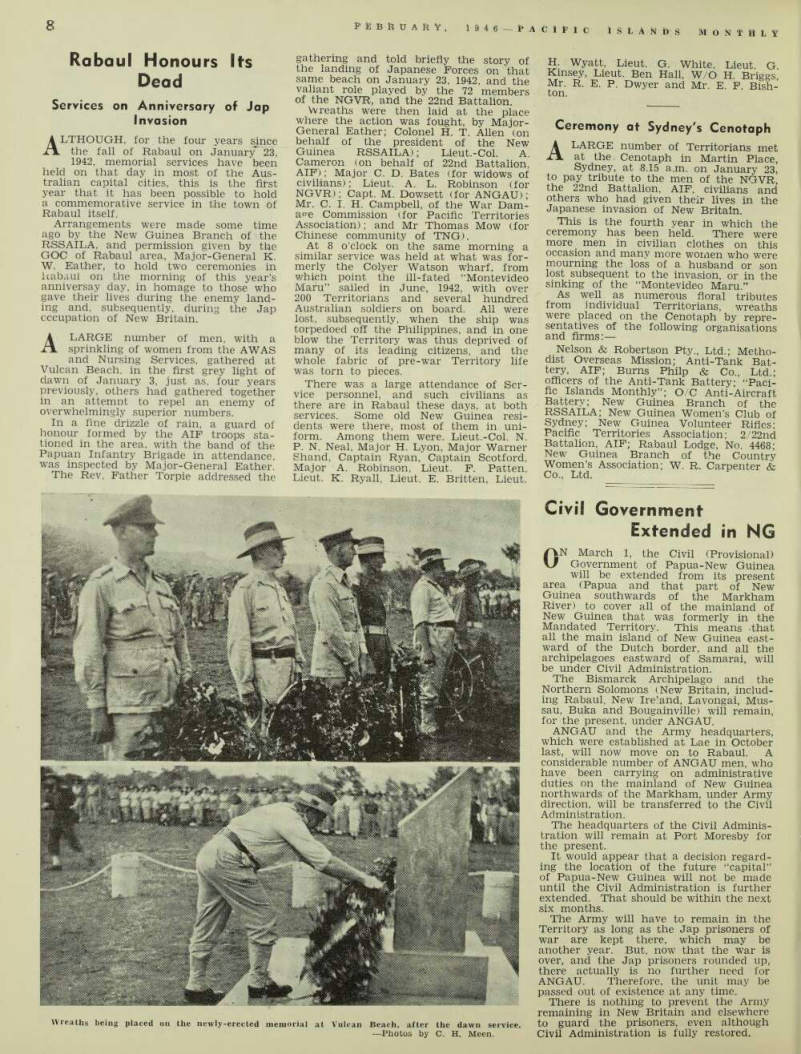
A LARGE number of men, with a sprinkling of women from the AWAS and Nursing Services, gathered at Vulcan Beach, in the first grey light of dawn of January 3, just as, four years previously, others had gathered together in an attemnt to repel an enemy of overwhelmingly superior numbers.
In a fine drizzle of rain, a guard of honour formed by the AIF troops sta tioned in the area, with the band of the Papuan Infantry Brigade in attendance, was inspected by Major-General Eather.
The Rev. Father Torpie addressed the
gathering and told briefly the story of the landing of Japanese Forces on that same beach on January 23. 1942, and the valiant role played by the 72 members of the NGVR, and the 22nd Battalion.
Vvreaths were then laid at the place where the action was fought, by Major- General Father; Colonel H. T. Allen (on behalf of the president of the New Guinea RSSAILA); Lieut.-Col. A.
Cameron (on behalf of 22nd Battalion, AIF); Major C. D. Bates (for widows of civilians); Lieut. A. L. Robinson (for NGVR); Capt. M. Dowsett (for ANGAU); Mr. C. I. H. Campbell, of the War Dam age Commission (for Pacific Territories Association); and Mr Thomas Mow (for Chinese community of TNG).
At 8 o’clock on the same morning a similar service was held at what was for merly the Colyer Watson wharf, from which point the ill-fated “Montevideo Maru” sailed in June, 1942, with over 200 Territorians and several hundred Australian soldiers on board. All were lost, subsequently, when the ship was torpedoed off the Philippines, and in one blow the Territory was thus deprived of many of its leading citizens, and the whole fabric of pre-war Territory life was torn to pieces.
There was a large attendance of Ser vice personnel, and such civilians as there are in Rabaul these days, at both services. Some old New Guinea resi dents were there, most of them in uni form. Among them were. Lieut.-Col. N.
P. N. Neal, Major H. Lyon, Major Warner Shand, Captain Ryan, Captain Scotford, Major A. Robinson, Lieut. F. Patten, Lieut. K. Ryall, Lieut. E. Britten, Lieut.
H. Wyatt, Lieut. G. White, Lieut. G.
Kinsey, Lieut. Ben Hall, W/O H. Briggs, Mr. R. E. P. Dwyer and Mr. E. F. Bish ton.
Ceremony at Sydney's Cenotaph
A LARGE number of Territorians met at the Cenotaph in Martin Place, Sydney, at 8.15 a.m. on January 23, to pay tribute to the men of the NGVR, the 22nd Battalion, AIP, civilians and others who had given their lives in the Japanese invasion of New Britain.
This is the fourth vear in which the ceremony has been held. There were more men in civilian clothes on this occasion and many more women who were mourning the loss of a husband or son lost subsequent to the invasion, or in the sinking of the “Montevideo Maru.”
As well as numerous floral tributes from individual Territorians, wreaths were placed on the Cenotaph by repre sentatives of the following organisations and firms:— Nelson & Robertson Pty., Ltd.; Metho dist Overseas Mission; Anti-Tank Bat tery, AIF; Burns Philp & Co., Ltd.; officers of the Anti-Tank Battery; “Paci fic Islands Monthly”; O/C Anti-Aircraft Battery; New Guinea Branch of the RSSAILA; New Guinea Women’s Club of Sydney; New Guinea Volunteer Rifles; Pacific Territories Association: 2/22nd Battalion, AIF; Rabaul Lodge, No. 4468; New Guinea Branch of the Country Women’s Association; W. R. Carpenter & Co., Ltd.
Wreaths being placed on the newly-erected memorial at Vulcan Beach, after the dawn service. —Photos by C. H. Meen.
Civil Government
Extended in NG
ON March 1, the Civil (Provisional) Government of Papua-New Guinea will be extended from its present area (Papua and that part of New Guinea southwards of the Markham River) to cover all of the mainland of New Guinea that was formerly in the Mandated Territory. This means -that all the main island of New Guinea east ward of the Dutch border, and all the archipelagoes eastward of Samarai, will be under Civil Administration.
The Bismarck Archipelago and the Northern Solomons (New Britain, includ ing Rabaul, New Ire’and, Lavongai, Mus sau, Buka and Bougainville) will remain, for the present, under ANGAU.
ANGAU and the Army headquarters, which were established at Lae in October last, will now move on to Rabaul. A considerable number of ANGAU men, who have been carrying on administrative duties on the mainland of New Guinea northwards of the Markham, under Army direction, will be transferred to the Civil Administration.
The headquarters of the Civil Adminis tration will remain at Port Moresby for the present.
It would appear that a decision regard ing the location of the future “capital” of Papua-New Guinea will not be made until the Civil Administration is further extended. That should be within the next six months.
The Army will have to remain in the Territory as long as the Jap prisoners of war are kept there, which may be another year. But, now that the war is over, and the Jap prisoners rounded up, there actually is no further need for ANGAU. Therefore, the unit may be passed out of existence at any time.
There is nothing to prevent the Army remaining in New Britain and elsewhere to guard the prisoners, even although Civil Administration is fully restored.
Victims Of Jap Invasion
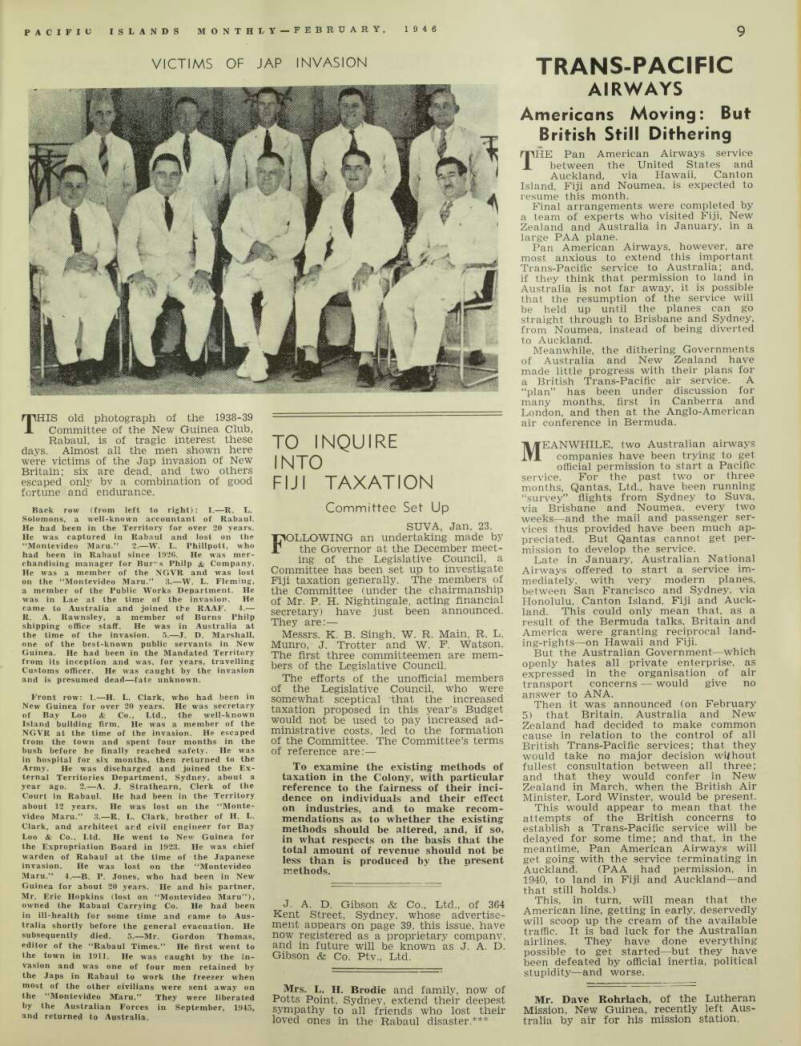
THIS old photograph of the 1938-39 Committee of the New Guinea Club, Rabaul, is of tragic interest these days. Almost all the men shown here were victims of the Jap invasion of New Britain; six are dead, and two others escaped only by a combination of good fortune and endurance.
Back row (from left to right): I.—R. L.
Solomons, a well-known accountant of Rabaul.
He had been in the Territory for over 20 years.
He was captured in Rabaul and lost on the “Montevideo Maru.” 2.—W. L. Phillpott, who had been in Rabaul since 1926. He was mer chandising manager for Bur's Philp & Company.
He was a member of the NGVR and was lost on the “Montevideo Maru.” 3.—W. L. Fleming, a member of the Public Works Department. He was in Lae at the time of the invasion. He came to Australia and joined the RAAF. 4.
R. A. Rawnsley, a member of Burns Philp shipping office staff. He was in Australia at the time of the invasion. 5.—J. D. Marshall, one of the best-known public servants in New Guinea. He had been in the Mandated Territory from its inception and was, for years, travelling Customs officer. He was caught by the invasion and is presumed dead—fate unknown.
Front row: I.—H. L. Clark, who had been in New Guinea for over 20 years. He was secretary of Bay Loo & Co., Ltd., the well-known Island building firm. He was a member of the NGVR at the time of the invasion. He escaped from the town and spent four months in the bush before he finally reached safety. He was in hospital for six months, then returned to the Army. He was discharged and joined the Ex ternal Territories Department, Sydney, about a year ago. 2.—A. J. Strathearn, Clerk of the Court in Rabaul. He had been in the Territory about 12 years. He was lost on the “Monte video Maru.” 3.—R. L. Clark, brother of H. L.
Clark, and architect ard civil engineer for Bay Loo & Co.. Ltd. He went to New Guinea for the Expropriation Board in 1923. He was chief warden of Rabaul at the time of the Japanese invasion. He was lost on the “Montevideo Maru.” 4. —B. P. Jones, who had been in New Guinea for about 20 years. He and his partner, Mr. Eric Hopkins (lost on “Montevideo Maru”), owned the Rabaul Carrying Co. He had been in ill-health for some time and came to Aus tralia shortly before the general evacuation. He subsequently died. s.—Mr. Gordon Thomas, editor of the “Rabaul Times.” He first went to the town in 1911. He was caught by the in vasion and was one of four men retained by the Japs in Rabaul to work the freezer when most of the other civilians were sent away on the “Montevideo Maru.” They were liberated by the Australian Forces in September, 1945, and returned to Australia.
To Inquire
Into
Fiji Taxation
Committee Set Up
Suva, Jan. 23.
FOLLOWING an undertaking made by the Governor at the December meet ing of the Legislative Council, a Committee has been set up to investigate Fiji taxation generally. The members of the Committee (under the chairmanship of Mr. P. H. Nightingale, acting financial secretary) have just been announced.
They are:— Messrs. K. B. Singh, W. R. Main, R. L.
Munro, J. Trotter and W. F. Watson.
The first three committeemen are mem bers of the Legislative Council.
The efforts of the unofficial members of the Legislative Council, who were somewhat sceptical that the increased taxation proposed in this year’s Budget would not be used to pay increased ad ministrative costs, led to the formation of the Committee. The Committee’s terms of reference are;— To examine the existing methods of taxation in the Colony, with particular reference to the fairness of their inci dence on individuals and their effect on industries, and to make recom mendations as to whether the existing methods should be altered, and, if so, in what respects on the basis that the total amount of revenue should not be less than is produced by the present methods.
J. A. D. Gibson & Co.. Ltd., of 364 Kent Street, Sydney, whose advertise ment appears on page 39, this issue, have now registered as a proprietary companv, and in future will be known as J. A. D.
Gibson & Co. Ptv., Ltd.
Mrs. L. H. Brodie and family, now of Potts Point, Sydney, extend their deepest sympathy to all friends who lost their loved ones in the Rabaul disaster.***
Trans-Pacific
Airways
Americans Moving: But British Still Dithering
THE Pan American Airways service between the United States and Auckland, via Hawaii, Canton Island, Fiji and Noumea, is expected to resume this month.
Final arrangements were completed by a team of experts who visited Fiji, New Zealand and Australia in January, in a large PAA plane.
Pan American Airways, however, are most anxious to extend this important Trans-Pacific service to Australia; and, if they think that permission to land in Australia is not far away, it is possible that the resumption of the service will be held up until the planes can go straight through to Brisbane and Sydney, from Noumea, instead of being diverted to Auckland.
Meanwhile, the dithering Governments of Australia and New Zealand have made little progress with their plans for a British Trans-Pacific air service. A “plan” has been under discussion for many months, first in Canberra and London, and then at the Anglo-American air conference in Bermuda.
MEANWHILE, two Australian airways companies have been trying to get official permission to start a Pacific service. For the past two or three months. Qantas, Ltd., have been running “survey” flights from Sydney to Suva, via Brisbane and Noumea, every two weeks—and the mail and passenger ser vices thus provided have been much ap preciated. But Qantas cannot get per mission to develop the service.
Late in January, Australian National Airways offered to start a service im mediately. with very modern planes, between San Francisco and Sydney, via Honolulu, Canton Island, Fiji and Auck land. This could only mean that, as a result of the Bermuda talks, Britain and America were granting reciprocal land ing-rights—on Hawaii and Fiji.
But the Australian Government —which openly hates all private enterprise, as expressed in the organisation of air transport concerns would give no answer to ANA.
Then it was announced (on February 5) that Britain, Australia and New Zealand had decided to make common cause in relation to the control of all British Trans-Pacific services; that they would take no major decision without fullest consultation between all three; and that they would confer in New Zealand in March, when the British Air Minister, Lord Winster, would be present.
This would appear to mean that the attempts of the British concerns to establish a Trans-Pacific service will be delayed for some time; and that, in the meantime, Pan American Airways will get going with the service terminating in Auckland. (PAA had permission, in 1940, to land in Fiji and Auckland —and that still holds.) This, in turn, will mean that the American line, getting in early, deservedly will scoop up the cream of the available traffic. It is bad luck for the Australian airlines. They have done everything possible to get started —but they have been defeated by official inertia, political stupidity—and worse.
Mr. Dave Rohrlach, of the Lutheran Mission, New Guinea, recently left Aus tralia by air for his mission station.
Effect of Remarkable Demonstration by Territories
MR. WARD APPEARS IN HIS TRUE COLOURS Effect of Remarkable Demonstration by Territories Public Servants
THE revolt of the Papua-New Guinea public servants against intolerable conditions imposed by the Aus tralian Department of External Terri tories, at Canberra, early this month, may not achieve much in the way of reform; but it at least brought the re sponsible Australian Minister, Mr. Eddie Ward, out into the open, so that he dis closed himself clearly for what he is—a nasty, snarling demagogue, whose out look and policy in administering Aus tralia’s Territories are hopelessly coloured by the gutter politics on which he was suckled.
The New Guinea and Papua Public Service Associations held a meeting in Port Moresby; and, after some frank speaking, the following radiogram was sent to the Department in Canberra: “Our Associations view with the greatest alarm the failure of the Minister for External Territories, Mr.
Ward, to honour promises and obligations contained in his letter of November 9, 1944. Certain appointments made are considered to be unfair and contrary to the principles of the ALP. Morale of the Service is being undermined.
Officers are so incensed at unfair ap pointments that stop-work meetings have been suggested. The Appeals Board promised by the Minister is an immediate necessity.”
Speakers on behalf of the public ser vants made a number of points. They said that junior officers of the pre-war Services have been appointed by Can berra to high positions over senior officers on the grounds that the present Administration is purely provisional.
They claim that all that officers have striven for during many years of tropical service has been swept away by Canberra overnight. Officers alleged that they were tricked into returning to the Terri tories by a circular promising them better jobs, but that they were now for gotten.
THE fact that old and tried senior officers of the Territories’ service associated themselves with this criticism shows how deep is the sense of injustice under which they now are labouring. Such a thing has never hap pened before, in the history of the Terri ties.
It would not have happened, now, had Canberra given any indication at all that the growing volume of protests and complaints was receiving any con sideration.
One very significant fact emerged. The officials, in their public protest, specifically excluded the new Administrator, Colonel J. K. Murray, from any share of the blame—they felt that Colonel Murray had done everything possible on their behalf, and was as much the victim of Canberra as they were. But they did include in their attack the permanent head of the Department at Canberra, Mr. J. R. Halligan.
THE reaction of Minister Ward was typical. He sent the following radiogram; “I am in receipt of your wire, and have also read contents to-day’s anti-Labour Press. Would like you furnish specific instances where any promises made by me have not or are not to be honoured, also what particular appointments are considered to be unfair. All complaints will be promptly investigated.”
Except for the reference to the “anti- Labour Press,” that was a reasonably proper reply. But then the politician took control of the Minister, and Mr.
Ward, in a statement to the same “anti- Labour Press,” let himself go in this fashion: “One of my greatest difficulties has been the apparent disapproval of the policy of the Commonwealth Govern ment by a minority of the former mem bers of the old Civil Service, who were anxious to have the pre-war set-up restored and were always singing the praises of the private commercial in terests which previously had a strangle hold on the Territories.
“This noisy minority, in my opinion, is out to embarrass the Government under all circumstances if it can do so. The fact that a section of the anti-Labour newspapers was able to quote much more fully the views of this minority than contained in the message received either by myself or the Prime Minister is cer tainly evidence of the closest liaison with anti-Labour interests.
“I have nothing but the very highest praise for the splendid co-operation of the great bulk of those members of the former Civil Service who have returned to duty in the Territories.”
MR. WARD, in thus giving expression to his bad temper, supplies a com plete explanation of what is wrong with the Territories to-day.
Mr. Ward deliberately uses the term “minority” of public servants. That, of course, is the typical politician’s wriggle.
This is not a demonstration by a minority.
It represents the views of the great majority of the public servants —and that majority includes practically all the experienced men of the two former public services—the only men whose opinion in such matters is worth having.
Naturally, those men are opposed to the policies which Mr. Ward is trying to apply to the Territories. All around them, they see the destruction of private enterprise and of native morale, as the result of the fantastic plans put into operation by the King’s Cross economist; and they are resentful of the harm that is being done to the Territories which they love, and which have been their home for so long.
The Minister’s snarling reference to “a noisy minority always singing the praises of the private commercial interests which previously had a stranglehold on the Territories” lets in a whole flood of light upon recent events.
We had long suspected that there was a struggle going on behind the scenes between this Socialist Minister, who is trying to keep individualism and private enterprise out of the Territories, and the responsible and experienced senior officials, who know that there is no future for these countries, unless private enter prise is admitted and encouraged.
THESE Territories public servants will gain nothing from their protest.
They must have known that, before they protested. The Minister flatly denies that he has failed to honour any of his promises. He asks for details of particular cases; but the public servants realise that, under the present set-up in Canberra, any man who sticks up his head to voice a grievance, will only get the official axe well sunk into his neck.
The present confusion, discontent and
hideous administrative expense will con tinue during the regime of Mr. Ward— that is certain. Our only hope is that Mr. Ward’s regime may end suddenly with the Australian general election in six months’ time.
Meanwhile, every Territorian is under a debt of gratitude to those senior
rfHE New Guinea Women’s Club of Sydney, re-opened on Thursday, February 7, after its Christmas recess.
All Territorians are invited to attend the Thursday morning get-together meetings at the Feminist Club Rooms, 77 King Street, Sydney.
officers. Knowing the type of people with whom they were dealing, the officers knew that, in making their pro test, they were possibly signing the death-warrant of their own careers. But their demonstration has succeeded, as nothing else could have done, in letting Australia see what really is happening in the Territories—a mad-headed Socia listic policy being resisted, as far as possible, by experienced officials, who have some sense of public duty.
Ship With Measles Banned
Papeete, Dec. 31
THE steamer “Permanente,” believed to be under charter to certain interests in Hawaii, arrived off Papeete on December 28. intending to pick no some thousands of tons of copra. She was r>nf nllnwpri however, because she had 15 cases of German measles— a disease which may play havoc among Pacific Islanders.
She sailed the same dav. after taking aboard several Tahiti passengers and about 900 tons of water.
The engagement is announced of Miss Peggy Pyne, eldest daughter of Mr. and Mrs. N. A. Pyne. of Roseville. Sydney, but formerly of Tonga, where Mr. Pyne was Collector of Customs, to Mr. Colin Hud son, only son of Mr. and Mrs. C. Hudson, of Roseville. Sydney.
Advertisements & other items, p. 10 (1 item)
Notice of Meeting
PACIFIC TERRITORIES
ASSOCIATION
A general meeting of the Association will be held on Tuesday, March 19, 1946, at 8 p.m., in Teachers' Federation Hall, 166 Phillip Street, Sydney (seventh floor).
BUSINESS:
To receive report from the Executive on activities to date.
To deal with any other business that may arise.
C. A. M. ADELSKOLD,
Secretary.
Nauru by July
Phosphate From Nauru by July 500 Nauruans Still Missing
IT was announced in Canberra on Jan uary, 17 that considerable progress had been made by the Administration and the British Phosphate Commissioners in the rehabilitation of the island of Nauru which was occupied by Japanese forces in August, 1942, and remained in
enemy control until the surrender of the Japanese forces on the island to an Aus tralian force on September 13, 1945.
All buildings and installations of both the Administration and of the British Phosphate Commissioners had been de molished or considerably damaged.
The general administration of the island, including the care of the native population, is a matter for the Adminis tration, and the mining and shipment of phosphate is a function of the British Phosphate Commissioners comprising representatives of the United Kingdom, Australia and New Zealand. At present, the representatives are: Mr. W. Bankes Amery, United Kingdom; Sir Clive McPherson, Australia; and Sir Albert Ellis, New Zealand.
Temporary buildings for administration purposes, including the wireless station, have been completed and a permanent wireless station is in course of erection.
The wireless station was equipped and staffed by Amalgamated Wireless (A/asia), Ltd., and has been open for normal traffic since the middle of Novem ber. The native community generally is happy and contented and has shown con siderable improvement in health since the re-occupation of the island.
AFTER the surrender of the Japanese, it was found that 1,200 Nauruans had been transferred by the Japanese from Nauru to the Caroline Islands, and inquiries made disclose now that 762 of these natives are located at Truk. The Director of Police of the Nauruan Administration (Mr. T. H. Cude) was despatched some time ago to Truk to contact these natives and to arrange for their repatriation to Nauru, and also to make inquiries .as to the fate of the other natives who were said to have been transferred from Nauru Arrangements have been made to des patch a vessel of the British Phosphate Commissioners to the Caroline Islands to transfer the natives to their home on Nauru.
The extensive buildings and plant of the British Phosphate Commissioners were destroyed and damaged to an even greater extent than had been anticipated, but the plans of the Commissioners for reconsruction are well advanced, and it is expected that phosphate shipments will commence not later than July 1, 1946.
Quantities will be limited for the first 12 months, but thereafter will increase rapidly.
Sydney Harbour Cruise
For Territorial
A N evening's cruising on Sydney Harbour is being arranged for Territorians by the Pacific Territories Association.
A ferry will leave No. 7 Wharf, Circular Quay, at 8 p.m., on Thursday, March 7, and all Territorians are cordially invited to go along as the guests of the PTA. For those who desire it, supper will be available, at a small charge.
The PTA entertained between 700 and 800 guests in this way, last February; and, although some of these people have since returned to New Guinea, it is hoped to repeat the success of the party. On that occasion music was provided, but Terri torians showed pretty con clusively that music has few charms when forced to compete with reunions and yarn-swop ping. There will, therefore, be no music this year.
Advertisements & other items, p. 11 (1 item)
Burns Philp
THE
YORKSHIRE
INSURANCE
CO. LTD.
(Incorporated in England)
FIRE
ACCIDENT
MARINE
FIRE POLICIES ISSUED
IN PAPUA
All information from —
E. A. JAMES,
TeL 86347. Attorney for Papua, 14 Spring St., Sydney.
BURNS PHILP
(SOUTH SEA) CO. LTD.
Inc. in Fiji Island Traders and Shipowners Registered Office :
SU V A
FIJI
Also Branches at: \Fiji: Levuka, Lautoka, Labasa, Ba, Sigatoka, Rotuma Tonga: Nukualofa, Haapai, Vavau.
Samoa: Apia, Pago Pago (American Samoa).
Solomons: Makambo, Gizo, Faisi.
New Hebrides: Vila.
Code Address: Gilberts: Tarawa.
"Bumsouth k . Norfolk Is. Niue. Wallis Is. Futuna Is.
Sole Australian Concessionaries :
GEORGE BROWN & CO. PTY. LTD.
267 Clarence Street, Sydney.
The Ultimate factory has made the change-over from its wartime set-up.
Designs for the new models are now completed and production is about to commence.
These models should be available early in 1946—they will be well worth waiting for. Watch for further announcements.
SERVICE: Servicing of all kinds of radio sets, amplifiers and Rola speakers will continue to be available.
Tropicalities
HAS any Territorian heard of this episode which apparently oc curred during the early days of the Japanese occupation of Rahaul? The story is reprinted here from the current issue of the “Catholic Mission Magazine .”
Immediately after the Battle of the Coral Sea (the first check to Japan’s southward drive), the Imperial High Command in Rabaul was considerably puzzled. They could not understand why the gods had commenced to frown on the fortunes of Nippon.
They finally decided, however, in all seriousness, that it was because the ghosts of the Australians killed in the Japanese landing at Rabaul—in particu lar the ghost of a Captain Grey—had not been properly put to rest, in accord ance with Japanese traditions.
A grand parade was aranged; a special cemetery was prepared, the bodies of the Australian soldiers were exhumed and en cased in beautifully worked coffins; a monument to the Australian dead was erected, and, in the reburial and dedica tion ceremony the Australian flag was raised and saluted by all present.
Then came a hitch. In accordance with Japanese custom, a small bowl of rice and a vessel of sake (Japanese spirit) must be placed pn the grave of the departed— so that the ghost need not be restless, but may find meat and drink close at home.
A deputation of Japanese officers waited on Bishop Scharmach at the Vunapope Mission. The trouble was, they said, they did not think that the Australian ghosts would relish rice and sake; could the Bishop suggest something that could be put on the grave to keep the ghosts at home?
The Bishop, with heavy irony, suggested that the best thing to keep the ghosts of Australian soldiers at home in their graves would be two bottles of beer!
Not a smile greeted this —only serious consideration, until the Japanese mili tary priest (Shintoist) solved the prob lem by deciding, that the only nationality in the land of ghosts is Japanese, anyway,
and therefore the rice and sake would serve just as well on the graves of the Australian dead! * OUR old friend, Mr. Oscar Nordman, of Tahiti, is a proud, if unorthodox, grandfather. He writes cheerily from Papeete as follows: “My son, Milton, who volunteered his services for the duration of the war, and served in the Marine Nationale, is now in Paris, awaiting transportation to his native land (Tahiti).
“I am afraid that our Milton is an amusing lad. One day, to our surprise, a young woman entered our house here, with a child in her arms.
“ ‘Here,’ she said, ‘This baby belongs to your son, Milton/ “We looked at the child. She cer tainly resembled our Milton. So we ac cepted them.
“Some time afterwards, another girl arrived, also with an infant in her arms.
“ ‘Hello,’ I said . ‘What have we here?’
“ ‘This baby girl belongs to your son.’ she answered.
“I did not argue. They also joined our household. But I remembered with some trepidation the old saying ‘Never two without three.’
“So we were not surprised to learn that Milton had another child —another baby girl, born on Raiatea. In due course, the mother arrived here, and pre sented us with a lovely baby girl.
“We have named the three little girls Sierra, Sonoma and Ventura —after the three famous Oceanic liners, on the Trans-Pacific run, on which I served so happily in my younger years.
“We are a happy family here—the three young mothers, and the three little girls, are being well taken care of. We think that Milton will be stirred by their greeting, when he arrives.” * HE who imagines that the Sacred Heart Mission Fathers are men of solemn and dismal piety, of the “hair-shirted” school, is quite wrong.
The late Father “X,” a most dignified man, told me this tale: He had a native convert, rather a wag, and I fear, one more interested in hand outs than holiness. There are such.
Petero (that was the name the Father gave him, after St. Peter) was once caught red-handed, by his confessor, eating puakatoro (tinned meat) on Friday. This, of course, was against the canon. The Father rebuked Petero.
“Now, Petero, this won’t do! Beef—on Friday! I’m ashamed of you.”
“No. Father! He no meat. He fish.”
“Now. now! You know where liars go.
Don’t add to your sin, my son.”
“He fish all right, Boss —dinkum!”
Petero seemed serious, and unconvinced of error. Here is his defence (in his own idiom, as related): “Orraright, Father, true! You pipi (christen) me, call me Petero. Okay! I rome hnngery. I pipi my meat—call him fish!”—Eli. * A BROADCAST recently from Los Angeles stated that the New Zea land Maori originated in Mexico, migrated to Peru, sailed thence to Easter Island (where they cast the images, in moulds, using a secret formula of con crete), and. from Easter Island, voyaged to New Zealand.
The gentleman who broadcast this extraordinary fairy tale probably acquired
his story from the eminent Dr. Blunder hoven, PhD (Gastab). The learned scientist received his degree from Gasta bula University—situated in the natural gas area of the Taxas Panhandle. (Gastab.) looks so much like (Cantab.) that US scientists eagerly seek degrees from that seat of learning.—A. C. R. m AN intelligent “monkey” whom I lately acquired in Talasea as a cook-boy, laboriously sang through “God Save the King” while at work in the kitchen —just to air his knowledge.
When he had finished I asked him if he had learned the “Star Spangled Banner” while the Yanks were here. He said he had not, but that he knew the Jap national anthem. To prove it, he immediately gave quite a fair rendition.
“The Japs taught you that?” I asked.
But he answered “No,” again. He was, he said, at school in the senior class at the mission when it was learned that the Japs had attacked Pearl Harbour.
Immediately, orders came from mission headquarters that the children were to learn the Japanese anthem.
I have nothing against missions; but when will enemy aliens be replaced by our own missionaries, or those of our loyal Allies?—JW. * 'TTERE is a statement which will cause XX Australians to foam at the mouth.
A scholarly and far-seeing French man—whom I know well and esteem highly—expressed the opinion, to me in Tahiti lately, that within a period of 10 years, France, the British Empire and the United States will find it expedi ent to negotiate an alliance with Japan!
Stranger things than that have hap pened in the past. One must not over look that China has lately attempted to seize Hong Kong.”
The foregoing paragraph was written six months ago, in a letter to the editor of the “PIM.” Subsequent events (especially the behaviour of Russia at UNO. in London) tend to give it special significance.
AN English lady, Miss Irene Margesson, who took a keen interest in the life-story of Captain “Jimmy”
Smith, of Abemama (he died a few weeks ago in Fiji), sends us two amusing stories from the Overseas League, of which she is an active member; “A member in New Zealand wrote: T am now in New Zealand. I am anxi ous to read again a little article called “Candle-lighting Time.” It appeared in an English magazine. I have forgotten the name of the author and the name of the magazine—but I think it was published about 1906. Please send it to me.’
“But this was beaten by another mem ber, in Nigeria, who wrote to the London hostess of the Overseas League, saying: T enclose some stamps for a man in Poland—l don’t know'his name or ad dress, but will you kindly send them to him.’ But she found this man! She searched through old numbers of the ‘Overseas Journal’ (which had a stamp collectors’ page) till she discovered a notice from a Polish citizen asking for stamps. She sent them ‘on spec,’ and he replied: T am not the man. but I know who he is and will forward them.’ ” * ALTHOUGH for obvious, reasoik/t has not been possible to mention it, two well-known sailing vessels have been frequent visitors to Rarotonga during the last few years. These are the former
Cook Islands Trading Co. schooner “Tagua,’ y and the Auckland ketch “Golden Hind.” Both ships have been doing valuable work servicing lonely Island outposts over a wide area of the Pacific.
One interesting result of these visits is that a number of Pitcairn Islanders have been ashore in Rarotonga on vari ous occasions—one was the Chief Magis trate of Pitcairn, Mr. Parkin Christian— and similarity of the old-English dialect of the Pitcairn Islanders to that of the Marsters of Palmerston Atoll was re marked upon. Mr. Christian says that he was well acquainted with William Marsters, “father” of Palmerston, who had visited Pitcairn a number of times many years ago when working as mate on sailing vessels.
ON her last visit to Rarotonga, the “Golden Hind” brought a radio tech nician. returning from Pitcairn to New Zealand, who happens to be an enthuiastic bagpipist.
He carried his bagpipes with him when, with his shipmates, he made a motor trip around Rarotonga and he created a great sensation when he marched through the villages with the bagpipes a-skirling. This was the first time the natives had seen, or heard, this strange musical instrument.
On returning to the township of Avarua he provided a final thrill by marching through the hospital, leaving both patients and nurses open-mouthed and goggle-eyed with delighted astonish ment. Dr. Ellison, himself of part- Scottish descent, acted as pipe-major, leading the way through the wards
twirling a walking-stick for a mace.
W.B.
Advertisements & other items, p. 12 (2 items)
12
PEBRtJARY, 1946 P ACIFIC ISLANDS MONTHLY
Specialising
IN
PACIFIC ISLAND INSURANCES
FIRE MOTOR VEHICLE
MARINE HULLS AND CARGO
EMPLOYER’S LIABILITY
GUARANTEES including those for—
DYNAMITE PERMITS.
RECRUITERS’ LICENCES.
DEFERRED WAGES
AND ALL OTHER CLASSES ARRANGED
AT LOWEST CURRENT RATES.
Established Agencies:
W. R. CARPENTER & CO., LTD.
Throughout the Territory of New Guinea.
SOUTHERN PACIFIC INSURANCE
CO., LTD.
HEAD OFFICE; 60 HUNTER STREET,
SYDNEY.
Missing Territorian
BEFORE he enlisted in the AIF, Ser geant R. J. Pascoe, of the Head quarters Company, 2/19th Battalion, Bth Division, was postmaster at Kavieng, in the Mandated Territory of New Guinea. His relations have had no in-
formation about him since he was re ported missing in Malaya in January, 1942. If any returned member of his battalion should know anything to give a clue to his fate, they are requested to kindly communicate with his mother (Mrs. E. Pascoe, 78 Church Street, New town, Sydney—Telephone LA 4073) or his wife (Mrs. Pascoe, 154 Anzac Parade, Kensington, Sydney—Telephone FF1610),
Advertisements & other items, p. 13 (1 item)
This Codicil?
HAVE YOU
CONSIDERED
By adding a simple codicil to your Will you can guard against difficulties and loss which might arise should your Executor die or become incapacitated.
By means of such a codicil you can name Burns Philp Trust Co. Ltd. as joint Executor with your present appointee or, if you wish, as sole Executor. In this way you gain positive assurance of continuous and sound administration and are relieved of a serious anxiety. The Company will willingly forward full particulars.
'THAT
The t Lewis Armstrong.
R. J. Nosworthy.
DIRECTORS:
James Burns.
Joseph Mitchell.
P. T. W. Black.
MANAGER: L. S. Parker.
BURNS PHILP TRUST
COMPANY LIMITED
7 BRIDGE STREET, SYDNEY
PHONE: B 7901. BOX 543 > ©-P.0.. SYDNEY. 8.F.2-45
Polynesian Workers
Make Big Demands Repercussions From Labourites' Howling About Makatca
From Our Own Correspondent
Ratotonga, Feb. 1.
RAROTONGA experienced a period of turmoil in January. While the elements raged without, Administra tion and business offices wrestled with the problems presented by a strike of wharf labourers.
The wharfies announced a strike a few days before the arrival of the “Maui Pomare.” Their demands were that they should be paid 8/- per day, and 2/- per hour overtime, also that they should be paid 10/- for Sundays, receive an in crease in food rations, and not be re quired to work in rough or wet weather.
The existing rate of pay is 4/6 per day and 9d. overtime.
These demands were laid before the manager of the USS Co., and the Ad ministration. The USS Co. countered with an offer of 6/- per day and 1/overtime. This offer was turned down, and the situation remained in a state of deadlock while the “Maui Pomare.” which had arrived in the meantime, wal lowed in the heavy seas left by the pass ing storm.
In view of the alternative of sending the ship away without unloading, plus
the fact that food supplies were urgently needed in the storm-battered outer islands, the leading local traders, in con ference, decided on this occasion to make good the difference between the USS Co’s offer and the men’s demands. This sug gestion was finally permitted by the Administration, and the shipping com pany and the men agreed to commence work the following morning (Saturday).
ON Saturday morning the seas proved to be still too rough to work the cargo, but the passengers were brought ashore in surf-boats through a passage on the leeward side of the island.
The men stood by to work the ship as soon as possible. On Sunday morning, however, there was a further slight de lay caused by the tally-clerks, who were anxious to know whether they were to receive the same rate of pay as the labourers. They were assured by the traders’ representative that thev would, and all hands then proceeded work.
There really was no unavoidable delay in working the ship, as weather condi tions had made it impossible up to the time when the men were ready to start.
Mr. Montgomery, a NZ Trade Unions inspector, who has been in Makatea in vestigating labour conditions, will be back in Rarotonga in a few days when he will examine the wharf labourers' case.
FOR some time, Rarotonga has been disturbed bv labour unrest, led by a few agitators of both races. At tention has been directed to the Cook Islands because of preoccupation of some people with the workers employed by the French phosphate company at Makatea, over in French Oceania.
Since first complaints were made re garding the living conditions of the Makatea workers, improvements have been made in general conditions and in wages, but agitation has continued, and in some quarters has been ridiculously exaggerated. One NZ Labour journal headed an article. “Have New Zealand Subjects Been Sold Into Slavery?” and
asked, “Has the local administration of the Cook Islands virtually connived at the ‘blackbirding’ of hundreds of Islanders for the French Phosphate Com pany?”
In view of sensational allegations, it would seem peculiar that Cook Island workers continue to eagerly volunteer for a spell in Makatea. Many sign on again and again.
The Phosphate Company’s reply has
been quiet but effective. When workers from the outer islands were returned to their home islands recently, on the com pletion of their twelve months’ spell-on Makatea, they were told, to their dismay, that no further recruits would be re quired from those islands.
It is believed there is a strong pos sibility that when the Rarotonga con tingent is returned home, they also may find that their services are no longer required.
As a result of the publicity given the “Makatea scandal,” Mr. Montgomery, a NZ Trade Unions official, has been mak ing an investigation of conditions in Makatea and the results of his visit are awaited with interest.
We Wonder Why . . .
]\/[ANY millions of feet of timber, corrugated iron, plywood, fly-wiring and other materials have been spirited away from a town desperately wanting them (Port Moresby ), by troops who had no more need for them.
The “Marella,” down at the town wharf, has been unloading building timber from Australia.
Around Port Moresby, some time in the past year, great quantities of seasoned timber were destroyed when Service in stallations were dismantled.
Barrels of bitumen were tipped on to an unholy blaze. To-day Moresby’s roads need bitu men. . . . —From “Melbourne Herald” Travelling Correspondent, 30/1/46.
Death Of Well-Known
Morobe Woman
THE death in Sydney on February 5, of Mrs. A. J. Peadon, one of New Guinea’s best-known women, has been a great blow to her many friends.
She had been seriously ill for a long time and, since October, 1945, an inmate of Petersham Hospital, Sydney, where she appeared, at one stage, to be re sponding to treatment.
Her husband has mining interests in the Ramu district and Mrs. Peadon lived there until the evacuation of women at the end of 1941. During her “exile” in Sydney she organised the New Guinea Branch of the Country Women’s Asso ciation and had been the branch’s presi dent since its inception.
Mrs. Peadon was an extremely good hostess, with a gift for organisation and gathering people around her, and these attributes she had used unstintingly on behalf of New Guinea residents and Servicemen during the hard, evacuee years.
The Peadons had no children. Mr.
Peadon is at present living at Dover Heights, Rose Bay, Sydney.
Advertisements & other items, pp. 14-15 (2 items)
A. O. Shephard
PARISH, PATIENCE
& Mclntyre Solicitors Union Trustee Building 2 O’Connell Street, SYDNEY Telephone BW 4305-6 Cable and Telegraphic Address : “Parish, Sydney”
Agents and Correspondents throughout Australia and Overseas
A. O. SHEPHARD
General Merchant and Exporter
379 KENT STREET, SYDNEY
Concentrating on all supplies for Island Planters, Mining Companies and Institutions. Ample stocks available for immediate shipment of—
FULL GROCERY RANGE, MANCHESTER,
CUTLERY, Etc., Etc.
ENQUIRIES WELCOMED FOR YOUR NEEDS.
(We have a Customer-care complex.) Telephones MA8179. Code Address:
MA 1142. “CHRISSHEP,” Sydney.
XN3N3DNDONNV
Building Frames
Economically Yours
* 1 • -«i An example : 77ie sfeeZ frame of this house was erected in ONE DAY by four men.
OF “ECONO-STEEL”
* Prefabricated portable structures, obtainable for all purposes, 100% demountable and possessing a maximum salvage value.
These structural frames may be obtained for practically any use:—
Managers' Homes
9 Simply erected in a minimum of man-hours. 9 Foolproof assembly by semi-skilled labour. 9 Proof against white-ants, rats, fire, and corrosion.
Stares
Native Labour
Huts
Any further information will be supplied upon request. 9 Minimum packing space and freight rates. 9 Adaptable to bundling for shipping or air freight.
TULLOCH'S BUILDING
DEPARTMENT
Rhodes, Sydney, N.S.W., Australia.
lIIIIIIIIIIIIIIIIIIIIIIIIIIIIIIIIIIIIIIIIIH
“Econo-steel”
(Economical Construction in Steel)
TULLOCHS’
Pty. Ltd.
RHODES, SYDNEY, N.S.W.
AUSTRALIA
Cable: TULSTEEL.
Makea Ariki-Nui Married
THE Makea Ariki-nui, Mrs. Takau Love, was quietly married in Rarotonga, on January 26, to Tutupu Ariki Ara-ite. There were no public celebra tions. Mrs. Love’s late husband, Lieut.- Col. E. T. Love, commander of the NZ Maori Battalion, was killed in action in Libya in 1942.
The engagement has been announced of Miss Marjorie Brodie, daughter of Mrs. Lucy H. Brodie. formerly of Rabaul, to Sergeant Archie Shields, of Deniliquin Sergeant Shilds is in the ANGAU Ser vice, and is at present stationed at Lae, New Guinea.
Rev. Cecil Gribble, of the Methodist Mission, has written a text-book on hygiene in the Tongan language. The book is to be used in both the Church and the Government primary schools.
May Do Damage Among
Blasts By Atomic
Bombs
May Do Damage Among the Atolls
T HE possibility that United States experiments with the atomic bomb, this year, in the Marshall Islands neighbourhood, will do much damage to the equatorial atolls was emphasised in a letter in the “Sydney
Morning Herald,” by a man formerly
well known among the Line Islands : I HAVE noted, in connection with the atomic bomb experiments, that they are to be carried out in the Marshall Islands. Unless I have misunderstood the press notice, the Americans wish them carried out that distance from their shores for fear of reactions deleterious to their country and to them.
I have also read that it is anticipated that a wind approaching 1,000 miles per hour will be created, and a tidal wave of about 100 ft. high.
I have waited to see if anyone had the welfare of the Pacific Islanders living in the Marshall, Gilbert and Ellice Groups sufficiently at heart to ask what will be the position of these unfortunate people if these experiments are carried out.
None of the islands in the three above mentioned Groups are more than about six feet out of the water at high tide; and in 1905, when a small tidal wave passed along the southern Marshall Islands, it completely overwhelmed the Island of Milli. and did tremendous damage on other atolls.
The disaster which could take place would be too awful to contemplate. Should any of the people be still alive after the wind and tidal wave have passed they probably would not have a coconut tree left, nor would there be much likelihood of any fish living within the vicinity of the Islands.
As one who traded among those islands for over a decade, and knowing how much the British Government has done to help these people in the past, I feel confident that Britain will, before it is too late, take steps to see that these people are simply not wiped off the face of the earth, so that American theories may be proved. (EDITORIAL NOTE: It is very un likely that the Americans deliberately would do anything to cause destruction and loss of life, in the manner suggested There are plenty of ocean areas, in the centre of the Northern Pacific, or in the south-east of the Southern Pacific, where tempests and tidal waves could do no harm. A tidal wave could do enormous damage among the equatorial atolls. A reassuring statement by the United States Navy would be welcome.) Mr. V. Neumann, who gave distin guished service in the Allied Intelli gence Bureau in 1942-43, and who later served for 21 years in ANGAU, passed through Sydney in January, en route to headquarters of the Australian-Lutheran Mission, at Horsham, Victoria. In civil lifer Mr. Neumann is a Lutheran mis sionary; and, when the Jap invasion came, he was manager of the Lutheran Mission plantation at Gizirum, Rooke Island, New Guinea. He expects to re turn to his work in the Territory soon.
Advertisements & other items, p. 16 (3 items)
16
H66t461 ’ 1946 pacific Islands MONtBLt
H. G. Eekhoff
LAE, NEW GUINEA
—EST. 1921
Miners', Manufacturers' and
General Commission Agent
As in the past, so in the future—
AT YOUR SERVICE
Address until March 31st: C/o Bank of N.S.W., Sydney.
Ycbo
jm
n
RJ2 18 H.P. MARINE DIESEL
Driving 21 in. x 1 5i in.
Propeller at 740 r.p.m. 0 Reliable % Efficient Economical Stuart Turner
Generating Sets
500, 750, 1,000, 1,500 and 3,000 Watts. 32v, 50v, 1 1 Ov.
Simple, Economical
GOOD DELIVERIES
Write for full particulars
Thornycroft
(Aust.) Pty., Ltd.
Cables: TIIORNMOTOR, Sydney. 6/10 Wattle Street,
PYRMONT, N.S.W.
Fiji Copra Goes Up
—And Down!
Suva, Jan. 8.
rERE has been another adjustment in the price of Fiji copra. Dating from January 14, FMS grade will rise 2/6 per ton, making the price to growers shipping from the norts of Suva and Levuka, £lB per ton. Dating from Jan uary 28. however, there will be a fall of 22/6 per ton in the price of plantation grade" copra. That is, planters will re ceive £lB/5/6 at the above ports.
The price of both grades fell 10/- on December 1, 1945. The reason given then by the local Department of Agriculture was that this represented an adjustment between the Fiji copra pool price to the grower and the price naid by the Minis try of Food in London. The present adjustment was decided upon by the Fiji Copra Committee in order that the dif ference in nrice of the two grades should be the same as the difference in price paid for the grades by the Ministry—that is, 5/6 per ton.
The reason that the new price for plan tation grade does not operate until Jan uary 28, is to allow planters to sell plantation grade already on hand, at the higher price.
From January 14, all copra delivered at Suva and Levuka and graded at 42 h points or under will be reconditioned at the shipper’s expense. A £1 per ton re inspection fee will also be charged after the reconditioning- is finished.
This measure is apparently designed to deter those planters who may be in clined to allow the standard of their copra to drop now that there is not the same incentive to produce the high-grade
product.
Australasian Petroleum To
Resume In Papua
Australasian petroleum co.
PTY.. LTD. expect to restart oil prospecting operations in Papua in February.
Estimated r*ost of the programme of geological and other field surveys during 1946, and continuation of the Kariava deep bore, alreadv at 5,000 feet, is about £200,000.
Capital is to be increased by £205,000.
Of this, the quota of Oil Search, Ltd., is £43,982, and 200,000 shares of 5/- each at par are offered to shareholders, who may apply for as many shares as they desire.
Terms are 6d. a share on application, 6d on allotment, and balance in calls not exceeding 1/- at not less than monthly intervals.
Oil Search capital is at present £369,811.
Other concerns interested in the operat ing company are Anglo-Iranian Oil and Vacuum Oil.
Advertisements & other items, p. 17 (1 item)
O. F MASSCHELEIN. Exporter
-■ v V; it&i %
MACARONI
m r -- ■ \\ ■ m m *s>
Sri
k m ■ f • SKWvwixft
VERMICELLI
;...• V'":. ■
fill
Sim
' J m : t: ] Sole Distributing Agents for the Pacific Islands:
BRIAL & BALL
528 COLLINS STREET,
MELBOURNE.
’Phone: MU4837.
1 BOND STREET,
SYDNEY.
’Phone: B 7371.
O. F MASSCHELEIN. Exporter
SHIPPER OF AUSTRALIA'S BEST TO THE PACIFIC PRICE LISTS, CATALOGUES AND ALL OTHER INFORMATION AVAILABLE ON INQUIRY Andrews Building, General Exporter of Australian Quality Products 40 King Street, Sydney. —Only— Te l MA 1242. Cables: OSNALINE.
Rabaul Tragedy
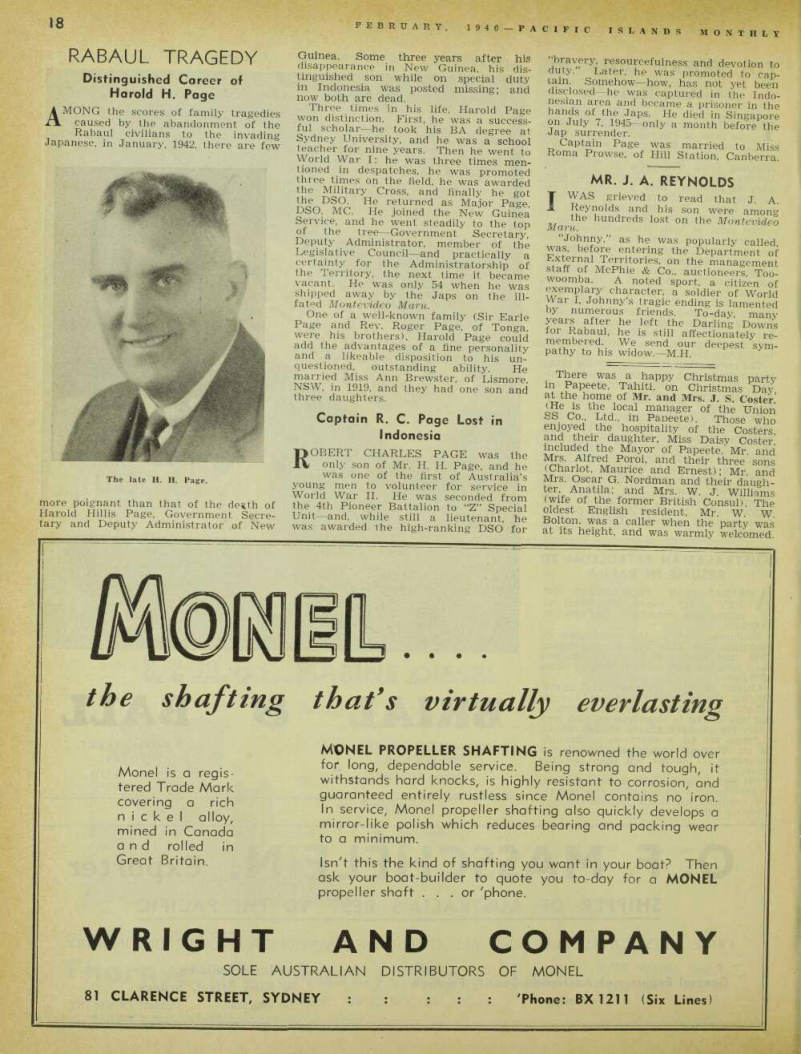
Distinguished Career of Harold H. Page AMONG the scores of family tragedies caused by the abandonment of the Rabaul civilians to the invading Japanese, in January, 1942, there are few
more poignant than that of the of Harold Hillis Page, Government Secre tary and Deputy Administrator of New
Guinea. Some three years after his disappearance in New Guinea, his dis tinguished son while on special duty in Indonesia was posted missing; and now both are dead.
Three times in his life, Harold Page won distinction. First, he was a success ful scholar —he took his BA degree at Sydney University, and he was a school teacher for nine years. Then he went to World War I: he was three times men tioned in despatches, he was promoted three times on the field, he was awarded the Military Cross, and finally he got the DSO. He returned as Major Page, DSO, MC. He joined the New Guinea Service, and he went steadily to the top of the tree—Government Secretary, Deputy Administrator, member of the Legislative Council—and practically a certainty for the Administratorship of the Territory, the next time it became vacant. He was only 54 when he was shipped away by the Japs on the ill fated Montevideo Maru.
One of a well-known family (Sir Earle Page and Rev. Roger Page, of Tonga, were his brothers), Harold Page could add the advantages of a fine personality and a likeable disposition to his un questioned, outstanding ability. He married Miss Ann Brewster, of Lismore NSW. in 1919, and they had one son and three daughters.
Captain R. C. Page Lost in
Indonesia
Robert Charles page was the only son of Mr. H. H. Page, and he was one of the first of Australia’s young men to volunteer for service in World War 11. He was seconded from the 4th Pioneer Battalion to “Z” Special Unit—and, while still a lieutenant, he was awarded the high-ranking DSO for
bravery, resourcefulness and devotion to duty. Later, he was promoted to cap lain. Somehow—how, has not yet been disclosed he was captured in the Indo nesian area and became a prisoner in the hands of the Japs. He died in Singapore on July 7, 1945—0n1y a month before the Jap surrender.
Captain Page was married to Miss Roma Prowse, of Hill Station, Canberra.
Mr. J. A, Reynolds
IWAS grieved to read that J. A.
Reynolds and his son were among Mam h 0 hundreds lost on the Montevideo “Johnny,” as he was popularly called was, before entering the Department of ™ Territories, on the management staff of McPhie & Co., auctioneers, Too woomba. A noted sport, a citizen of exempiary character, a soldier of World War I. Johnny’s tragic ending is lamented by numerous friends. To-day, many £l ar £ S fte , r ? e - left the Darling Downs for Rabaul, he is still affectionately re membered. We send our deepest sym pathy to his widow.—M.H. * There was a happy Christmas party m Papeete, Tahiti, on Christmas Day at the home of Mr. and Mrs. J. S. Coster (He is the local manager of the Union SS Co Ltd., in Papeete). Those who enjoyed the hospitality of the Costers, and their daughter, Miss Daisy Coster included the Mayor of Papeete, Mr and Mrs. Alfred Poroi, and their three sons (Chariot, Maurice and Ernest); Mr. and Mrs. Oscar G. Nordman and their daugh ter. Anatila; and Mrs. W. J. Williams (wife of the former British Consul). The oldest English resident, Mr. W. W Bolton, was a caller when the party was at its height, and was warmly welcomed.
The late H. H. Page.
Advertisements & other items, p. 18 (2 items)
18
FEBRUARY, 1946-PACIPIC ISLANDS MONTHLY
the shafting that’s virtually everlasting
a
Monel is a registered Trade Mark covering a rich nickel alloy, mined in Canada and rolled in Great Britain.
MONEL PROPELLER SHAFTING is renowned the world over for long, dependable service. Being strong and tough, it withstands hard knocks, is highly resistant to corrosion, and guaranteed entirely rustless since Monel contains no iron.
In service, Monel propeller shafting also quickly develops a mirror-like polish which reduces bearing and packing wear to a minimum.
Isn't this the kind of shafting you want in your boat? Then ask your boat-builder to quote you to-day for a MONEL propeller shaft ... or 'phone.
WRIGHT AND COMPANY
SOLE AUSTRALIAN DISTRIBUTORS OF MONEL
81 CLARENCE STREET, SYDNEY : : : : : Phone: BX 1211 (Six Lines)
Decorations
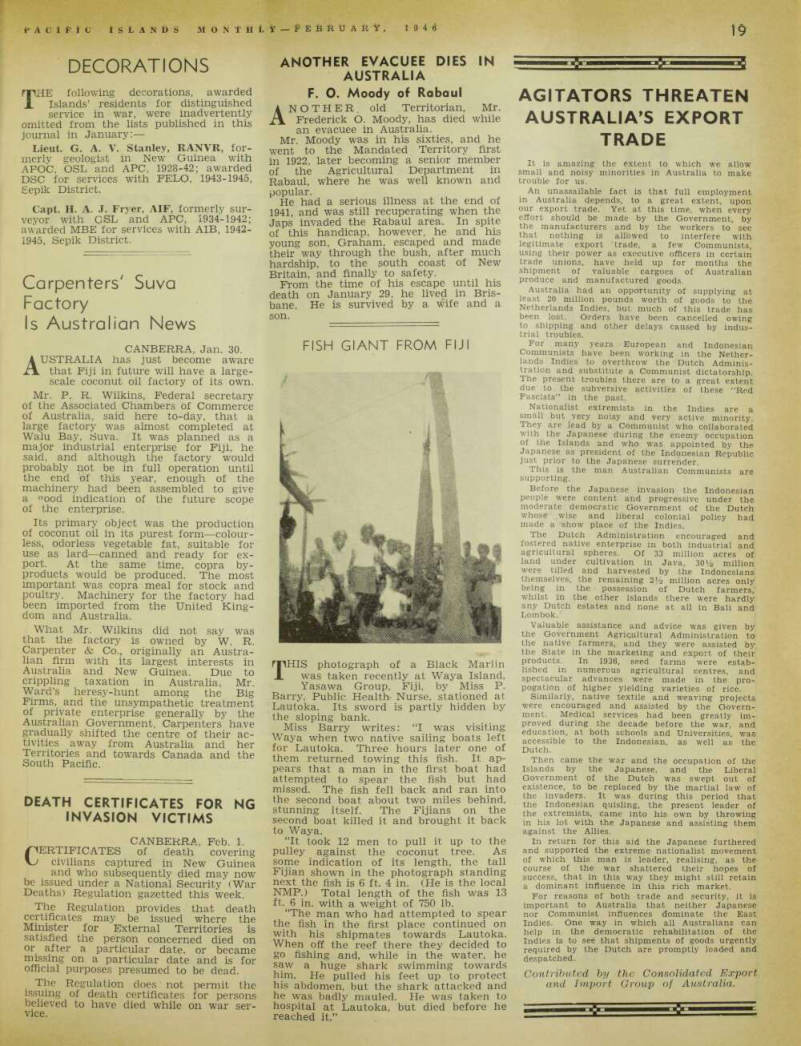
THE following decorations, awarded Islands’ residents for distinguished service in war, were inadvertently omitted from the lists published in this journal in January:— Lieut. G. A. V. Stanley, RANVR, for merly geologist in New Guinea with APOC, OSL and APC, 1928-42; awarded DSC for services with FELO, 1943-1945, Sepik District.
Capt. H. A. J. Fryer, AIF, formerly sur veyor with CSL and APC, 1934-1942; awarded MBE for services with AIB, 1942- 1945, Sepik District.
Carpenters' Suva
Factory Is Australian News
Canberra, Jan. 30.
AUSTRALIA has just become aware that Fiji in future will have a large scale coconut oil factory of its own.
Mr. P. R. Wilkins, Federal secretary of the Associated Chambers of Commerce of Australia, said here to-day, that a large factory was almost completed at Walu Bay, Suva. It was planned as a major industrial enterprise for Fiji, he said, and although the factory would probably pot be in full operation until the end of this year, enough of the machinery had been assembled to give a °uod indication of the future scope of the enterprise.
Its primary object was the production of coconut oil in its purest form—colour less, odorless vegetable fat, suitable for use as lard—canned and ready for ex port. At the same time, copra by products would be produced. The most important was copra meal for stock and poultry. Machinery for the factory had been imported from the United King dom and Australia.
What Mr. Wilkins did not say was that the factory is owned by W. R.
Carpenter & Co., originally an Austra lian firm with its largest interests in Australia and New Guinea. Due to crippling taxation in Australia, Mr.
Ward’s heresy-hunt among the Big Firms, and the unsympathetic treatment of private enterprise generally by the Australian Government, Carpenters have gradually shifted the centre of their ac tivities away from Australia and her Territories and towards Canada and the South Pacific.
Death Certificates For Ng
Invasion Victims
Canberra, Feb. 1.
CERTIFICATES of death covering civilians captured in New Guinea and who subsequently died may now be issued under a National Security (War Deaths) Regulation gazetted this week.
The Regulation provides that death certificates may be issued where the Minister for External Territories is satisfied the person concerned died on or after a particular date, or became missing on a particular date and is for official purposes presumed to be dead.
The Regulation does not permit the issuing of death certificates for persons believed to have died while on war ser vice.
Another Evacuee Dies In
Australia
F. O. Moody of Roboul
ANOTHER, old Territorial!, Mr.
Frederick O. Moody, has died while an evacuee in Australia.
Mr. Moody was in his sixties, and he went to the Mandated Territory first in 1922, later becoming a senior member of the Agricultural Department in Rabaul, where he was well known and
popular.
He had a serious illness at the end of 1941, and was still recuperating when the Japs invaded the Rabaul area. In spite of this handicap, however, he and his young son, Graham, escaped and made their way through the bush, after much hardship, to the south coast of New Britain, and finally to safety.
From the time of his escape until his death on January 29, he lived in Bris bane. He is survived by a wife and a son.
Fish Giant From Fiji
THIS photograph of a Black Marlin was taken recently at Waya Island, Yasawa Group, Fiji, by Miss P.
Barry, Public Health Nurse, stationed at Lautoka. Its sword is partly hidden by the sloping bank.
Miss Barry writes; “I was visiting Waya when two native sailing boats left for Lautoka. Three hours later one of them returned towing this fish. It ap pears that a man in the first boat had attempted to spear the fish but had missed. The fish fell back and ran into the second boat about two miles behind, stunning itself. The Fijians on the second boat killed it and brought it back to Waya.
“It took 12 men to pull it up to the pulley against the coconut tree. As some indication of its length, the tall Fijian shown in the photograph standing next the fish is 6 ft. 4 in. (He is the local NMP.) Total length of the fish was 13 ft. 6 in. with a weight of 750 lb.
“The man who had attempted to spear the fish in the first place continued on with his shipmates towards Lautoka.
When off the reef there they decided to go fishing and, while in the water, he saw a huge shark swimming towards him. He pulled his feet up to protect his abdomen, but the shark attacked and he was badly mauled. He was taken to hospital at Lautoka, but died before he reached it.”
Agitators Threaten
Australia’S Export
Trade
It is amazing the extent to which we allow small and noisy minorities in Australia to make trouble for us.
An unassailable fact is that full employment in Australia depends, to a great extent, upon our export trade. Yet at this time, when every effort should be made by the Government, by the manufacturers and by the workers to see that nothing is allowed to interfere with legitimate export trade, a few Communists, using their power as executive officers in certain trade unions, have held up for months the shipment of valuable cargoes of Australian produce and manufactured goods.
Australia had an opportunity of supplying at least 20 million pounds worth of goods to the Netherlands Indies, but much of this trade has been lost. Orders have been cancelled owing to shipping and other delays caused by indus trial troubles.
For many years European and Indonesian Communists have been working in the Nether lands Indies to overthrow the Dutch Adminis tration and substitute a Communist dictatorship.
The present troubles there are to a great extent due to the subversive activities of these “Red Fascists’’ in the past.
Nationalist extremists in the Indies are a small but very noisy and very active minority.
They are lead by a Communist who collaborated with the Japanese during the enemy occupation of the Islands and who was appointed by the Japanese as president of the Indonesian Republic just prior to the Japanese surrender.
This is the man Australian Communists are supporting.
Before the Japanese invasion the Indonesian people were content and progressive under the moderate democratic Government of the Dutch whose wise and liberal colonial policy had made a show place of the Indies.
The Dutch Administration encouraged and fostered native enterprise in both industrial and agricultural spheres. Of 33 million acres of land under cultivation in Java, 30 V 2 million were tilled and harvested by the Indonesians themselves, the remaining 2V Z million acres only being in the possession of Dutch farmers, whilst in the other islands there were hardly any Dutch estates and none at all in Bali and Lombok.
Valuable assistance and advice was given by the Government Agricultural Administration to the native farmers, and they were assisted by the State in the marketing and export of their products. In 1936, seed farms were estab lished in numerous agricultural centres, and spectacular advances were made in the pro pogation of higher yielding varieties of rice.
Similarly, native textile and weaving projects were encouraged and assisted by the Govern ment. Medical services had been greatly im proved during the decade before the war, and education, at both schools and Universities, was accessible to the Indonesian, as well as the Dutch.
Then came the war and the occupation of the Islands by the Japanese, and the Liberal Government of the Dutch was swept out of existence, to be replaced by the martial law of the invaders. It was during this period that the Indonesian quisling, the present leader of the extremists, came into his own by throwing in his lot with the Japanese and assisting them against the Allies.
In return for this aid the Japanese furthered and supported the extreme nationalist movement of which this man is leader, realising, as the course of the war shattered their hopes of success, that in this way they might still retain a dominant influence in this rich market.
For reasons of both trade and security, it is important to Australia that neither Japanese nor Communist influences dominate the East Indies. One way in which all Australians can help in the democratic rehabilitation of the Indies is to see that shipments of goods urgently required by the Dutch are promptly loaded and despatched.
Contributed by the Consolidated Export
and Import Group of Australia.
Advertisements & other items, pp. 19-20 (3 items)
19
FACIFiC ISLANDS MONTHLY FEBRUARY, 1946
20
PfefefeUAßlf. 1946 t‘ACiPiC ISLANDS MONtflL
Refrigerator
Modern Refrigeration for the South Sea Islands
The ELECTROLUX kerosene operated
MARVEL
OF
MODERN
SCIENCE
THE
MIRACLE
OF
ICE
FROM
HEAT
ELECTROLUX offers economical, modern and completely efficient
REFRIGERATION FOR ISLANDS' HOMES.
FREEZES CONTINUOUSLY WHILE SMALL LAMP BURNS.
Freezing controlled by simply regulating height of flame. Uses only 3 gallon of kerosene per week MOTORLESS ... NO PARTS TO GET OUT OF ORDER.
MODEL L 22
Capacity 2.2 coble feci.
MODEL L3BO
las Illustrated) Capacity 4 cubic feet.
MODEL LKSSO
Capacity 5.6 cubic feet.
GUARANTEED FOR TWO YEARS
• Write to your Local Distributor for prices and full details OBTAINABLE FROM ALL W. R. CARPENTER & CO LTD.
BRANCHES THROUGHOUT THE ISLANDS
Representation in Papua and New Hebrides.
"Bill" Korn
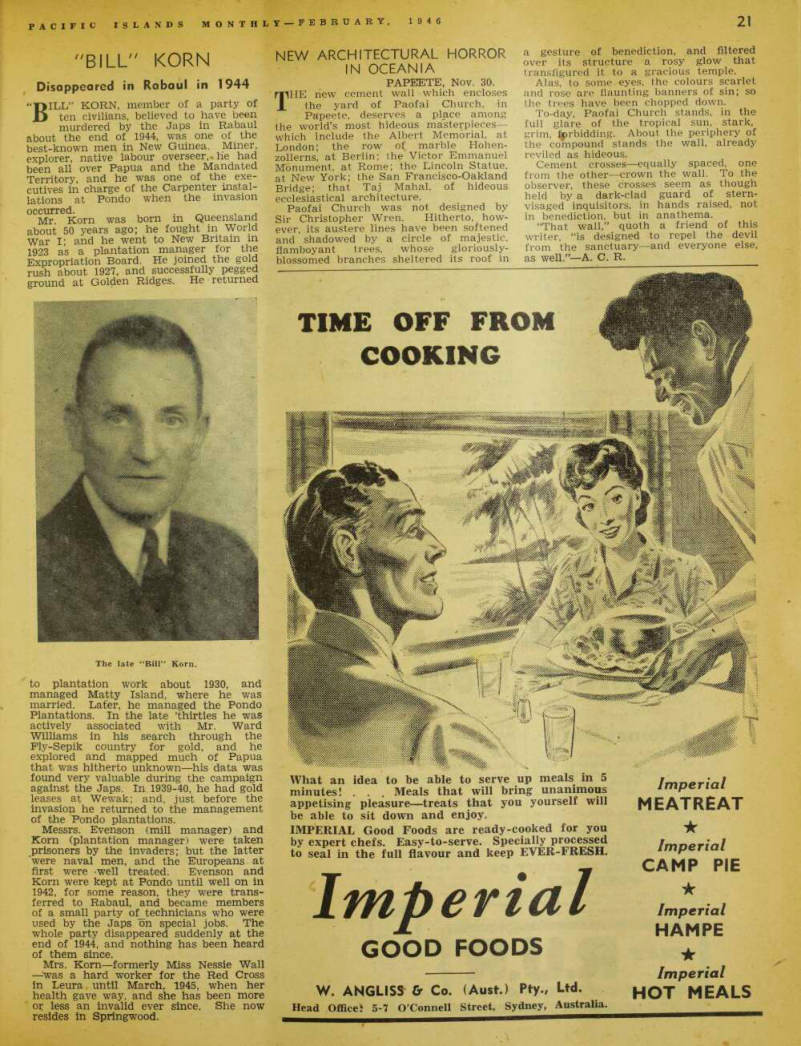
Disappeared in Rabaul in 1944
“■piLL” KORN, member of a party of t> ten civilians, believed to have been murdered by the Japs in Rabaul about the end of 1944, was one of the best-known men in New Guinea. Miner, explorer, native labour overseer,, he had been all over Papua and the Mandated Territory, and he was one of the exe cutives in charge of the Carpenter instal lations at Pondo when the invasion occurred. . . .
Mr. Korn was born in Queensland about 50 years ago; he fought in World War I; and he went to New Britain in 1923 as a plantation manager for the Expropriation Board. He joined the gold rush about 1927, and successfully pegged ground at Golden Ridges. He returned
to plantation work about 1930, and managed Matty Island, where he was married. Later, he managed the Pondo Plantations. In the late ’thirties he was actively associated with Mr. Ward Williams in his search through the Fly-Sepik country for gold, and he explored and mapped much of Papua that was hitherto unknown —his data was found very valuable during the campaign against the Japs. In 1939-40, he had gold leases at Wewak; and, just before the invasion he returned to the management of the Pondo plantations.
Messrs. Evenson (mill manager) and Korn (plantation manager) were taken prisoners by the invaders; but the latter 'were naval men, and the Europeans at first were -well treated. Evenson and Korn were kept at Pondo until well on in 1942, for some reason, they were trans ferred to Rabaul, and became members of a small party who were used by the Japs on special jobs. The whole party disappeared suddenly at the end of 1944, and nothing has been heard of them since.
Mrs. Kom—formerly Miss Nessie Wall —was a hard worker for the Red Cross in Leura until March, 1945, when her health gave way, and she has been more or less an invalid ever since. She now resides in Springwood.
The late “Bill” Korn.
In Oceania
New Architectural Horror
Papeete, Nov. 30.
THE new cement wall which encloses the yard of Paofai Church, in Papeete, deserves a place among the world’s most hideous masterpieces— which include the Albert Memorial, at London; the row of marble Hohen zollerns, at Berlin; the Victor Emmanuel Monument, at Rome; the Lincoln Statue, at New York; the San Francisco-Oakland Bridge; that Taj Mahal, of hideous ecclesiastical architecture.
Paofai Church was not designed by Sir Christopher Wren. Hitherto,, how ever, its austere lines have been softened and shadowed by a circle of majestic, flamboyant trees, whose gloriously blossomed branches sheltered its roof in
a gesture of benediction, and filtered over its structure a rosy glow that transfigured it to a gracious temple.
Alas, to some eyes, the colours scarlet and rose are flaunting banners of sin; so the trees have been chopped down.
To-day, Paofai Church stands, in the full glare of the tropical sun, stark, grim, fprbidding. About the periphery of the compound stands the wall, already reviled as hideous.
Cement crosses —equally spaced, one from the other —crown the wall. To the observer, these crosses seem as though held by a dark-clad guard of stern visaged inquisitors, in hands raised, not in benediction, but in anathema.
“That wall,” quoth a friend of this writer, “is designed to repel the devil from the sanctuary—and everyone else,
as well.”
A. C. R.
Advertisements & other items, p. 21 (1 item)
Imperial
TIME OFF FROM
COOKING
V i m m *5 i r '*o m i m v *■ What an idea to be able to serve up meals in 5 minutes! . . . Meals that will bring unanimous appetising pleasure—treats that you yourself will be able to sit down and enjoy.
IMPERIAL Good Foods are ready-cooked for you by expert chefs. Easy-to-serve. Specially processed to seal in the full flavour and keep EVER-FRESH.
Imperial
GOOD FOODS
W. ANGLISS fr Co. (Aust.) Pty., Ltd.
Head OfficeJ 5-7 O’Connell Street, Sydney, Australia.
Imperial
MEATREAT
Imperial
CAMP PIE
Imperial
HAMPE
Imperial
HOT MEALS
Wanting
Tulagi Weighed In Balance And Found
But Bishop Baddeley Sharply Criticises Selection of Honiara as "Capital" of Solomon Islands
T*HE Solomon Islands Administration X has settled itself permanently into new headquarters at Point Cruse— officially called Honiara—and has aban doned the old capital on Tulagi Island.
Honiara is on the northern shore of the large island of Guadalcanal, close to the native village of Kukum. Tulagi is a small island off the coast of Gela, about 20 miles away from Honiara, across the central Solomon Islands sea.
Honiara is on an open beach, sheltered during nine months of the year, but open to the north-west winds. Tulagi harbour enclosed between Tulagi Island, the islet of Makambo and the southern shores of Gela, is one of the most convenient and safest havens in the Group.
The choice of Honiara as the new capi tal has been acclaimed by those who like room to move around and build, but it has not been well received by shipping interests. rE rival merits of Honiara and Tulagi were summed up in a discussion in the Solomon Islands Advisory Coun cil in October last. The majority of the Council favoured Honiara; but the Bishop of Melanesia (Dr. Baddeley) very strongly criticised the choice.
Dr. Baddeley said it was the depth of .absurdity that in a Group where there were many excellent harbours, the new capital should be placed on what was practically an open beach. The lives and livelihood of most people in the Solomons were bound up with small seagoing craft; and everyone, sooner or later, had to visit administrative headquarters. It was most important that they should be able to anchor their boats there in safety.
There was an excellent harbour, with first-class wharves, at Tulagi. Neither
was available at Honiara, nor likely to be—except at a cost that could not be contemplated. They had said there was no room for expansion in Tulagi. Why could they not move some of the ad ministrative buildings, if necessary, from Tulagi Island to the nearby mainland of Gela?
During 13 years, proceeded the Bishop, the only anti-Tulagi argument he had heard sustained was that the place lacked amenities. It would be much cheaper to build a road from a point opposite Tulagi, on Gela mainland, to a first-class residential area on Gela. than it would be to maintain a road and bridge system at and around Honiara.
The Bishop indicated that in his belief the administrative headquarters had gone to Honiara because the Americans had placed expensive establishments there— the British had hoped (though in vain) for some crumbs from the rich man’s table.
“I honestly believe that had head quarters been re-established at Tulagi late in 1943, we should have had infinitely less of the chatter which has gone on indeed, which is still going on—among the natives here in the Central Solo mons,” he said. “We should not have been ‘English No. 2’ to ‘America’s No 1 ’
Even now, I think the psychological effect of such a return would be an im portant factor in re-establishing (what has undoubtedly been lost to no small degree) the former native confidence in the British Administration. 9 “TJERE at Honiara,” proceeded the XI Bishop, “employing the advantages and the amenities which the presence of the American Forces has provided some have formed quite wrong ideas as
to what life is like in the Solomons in normal times. The ‘African mind’—if I may say so with all respect, although I do not refer to the Resident Commis sioner—has for the past two or three years envisaged Guadalcanal in terms of great open spaces of Africa, with motor roads, airfields, farms and goldfields, with millions of natives available as labour.
They think of the Solomons generally as a potentially prosperous African Colony.
“Apart from the terrific—and, I think most unjustifiable expenditure at Honiara itself, how can we possibly hope to maintain even the portion of the pre sent road system which the proposed lay out of Honiara would demand, with our annual income of about £70,000 and a native population of under 100,000?
“Is there any justification for believ mg that an airfield will be maintained on Guadalcanal? Is it not much more likely that a small seaplane base in the neighbourhood of Halavo or Gavutu (Tulagi area) will be the terminus of a small supplementary air service, connect ing with the main trans-Pacific routes?
“Some have put forth the argument that, as gold will be found on Guadal canal, the capital should be there. That should be one of the strongest argu ments why the administrative centre should be placed somewhere else!”
The Bishop pointed out that Tulagi now has a system of roads, many con venient buildings, a water supply, and substantial wharves, “which will be stand ing when the wharves at Honiara will be floating away across the Pacific before a north-west gale.” Tulagi would give a sense of security never to be found at Honiara, with its leaf tenements, its dust storms, its shifting beach, and its drag ging anchors.
ARGUMENTS for Honiara and against -Tulagi were presented by Wing- Commander C. V. Widdy. Honiara gave a healthv situation. Facilities existed which could allow the residents to go to residential areas on higher and cooler levels. There were excellent port facilities at Tulagi, while Honiara was exposed to north-west weather. But Tnlagi’s new wharves had been hurriedly built of timbers not borer-proofed, and would not last more than two or three years. He thought that adequate shelter against north-westers could be provided at Honiara at reasonable cost.
There was no room for expansion at Tulagi, proceeded Mr. Widdy, except to wards the Gela mainland, where expen sive road construction would be needed.
There was room at Honiara. Honiara was near a good airfield although no one knew, yet, whether it would be used in the future.
Food crops could be produced in abun dance and cattle could be grazed in the Guadalcanal regions around Honiara. So far as industrial development was con cerned, he thought the low-level grass lands of Guadalcanal held considerable promise. The gold industry of Guadal canal had only just begun to move in 1941-42—but it still had to be proved worth while. He believed that, on all considerations, the balance lay strongly with Honiara.
Major Rutter and Major Sinclair ex pressed the opinion that the infrequent strong winds from the north-west would not interfere seriously with shipping at Honiara. On all counts other than port facilities, they favoured Honiara—espe cially in relation to health.
Mr. D. Mackinnon acknowledged the claims of Tulagi as a port; but, he said, “weighing all the foreseeable factors, the balance would appear to favour Honiara.”
Advertisements & other items, pp. 22-24 (3 items)
Stomach Troubles
Kidney, Liver and
QUICKLY EASED BY THIS
SYSTEM-CLEANSING
laxative, blood corrective and acid eliminative.
Internal Bath'
Indigestion, dizziness, headaches, sleepless nights, stiff, painful joints and muscles, are symptoms which show your vital organs of elimination are out of order. 5-fold Treatment Gets at Cause Thousands have found blessed relief in R.U.R., containing the five essentials for success a liver stimulant, kidney cleanser,
GUARANTEED TO SATISFY OR
MONEY BACK
R.U.R. is a real “internal bath, quickly and safely cleansing the system of accumulated poisons, acids, and wastes which cause your troubles. Yet R.U.R. contains no dangerous or habitforming drugs.
Used and Proved by Thousands Ex-Superintendent of Police, Stuart Robson , uirites: “/ had serious illhealth-muscles and joints causing much pain and stiffness, in addition to liver and kidney trouble. I feel 10 years younger after taking R.U.R. Back and muscular pains have gone . . . general relief has been m vilfc I DMvl\ general relief R.U.R. will put you right or cost you nothing, extremely great, Money-back guaranteed full treatment 7/6, smaller size 4/-. At all chemists and stores. a R.U
AND
N/CNr rOUADJ?/
nummi
FACILITIES
NOW AVAILABLE
PjpHE Beam Wireless Service now operating on a full Peacetime basis offers the public fast and accurate wor’.d-wide communication services.
Messages are accepted for transmission to the United Kingdom, the Continent of Europe, the Middle East, Canada, United States, South America, India and the Philippines.
Commercial Wireless Services have recently been re-opened for messages between Australia and Lae, Port Moresby, Java and Nauru.
Codes are again permissible and you can use your registered code name as address and signature.
Specially trained telephonists are available for the acceptance and delivery of Beam Wireless messages.
We will be pleased to open a Credit Account for you. Complete information available regarding codes, classes of messages, rates, routes, etc.
Beam Wireless messages may be lodged at:
BEAM WIRELESS OFFICES,
47 York St., Sydney 167 Queen St., Melbourne Telephone: B 0522. Telephone: MU 9161.
OR AT ANY TELEGRAPH OFFICE
AMALGAMATED WIRELESS (ASIA) LTD.
AUSTRALIA'S NATIONAL WIRELESS ORGANISATION
23
pacific islands m ont'hLy February, 1946
S hSes.^iv^
BEER'S ON!
Twelve-hours Day Restored in Suva Hotels
* SUVA, Jan. 4.
ALL wartime emergency liquor restric tions have been repealed and, so long as supplies hold out, one may now drink from 10 a.m. to 10 p.m. in Suva’s hotels.
Adjustments have also been made relating to the amount of liquor one may purchase wholesale, During the period of wartime “shortages” one was per mitted to buy lots of half a gallon, or three bottles. This has now reverted to two gallons, or 12 bottles.
EDITORIAL NOTE: It may interest Fiji readers who are able to drink Aus tralian beer for 12 hours per day, that it is still impossible, in Australia, to buy bottled beer (except on the black market), or practically any liquor of any other kind. Publicans may keep their establishments open between 10 a.m. and 6 p.m., but under some Emergency Regu lation they need open their doors only between 2 p.m. and 6 p.m.; furthermore, they are forced to sell beer only between 4.30 and 6 p.m. (for the benefit of the “pore worker”).
The majority of pubs, therefore, although they meticulously opsn a door or two after 2 p.m., are not open to business before the 4.30 rush. Some, how ever, out of the goodness of their hearts, Open for a brief period around lunch
time—but this is a movable feast and patrons can never be sure just when it YJJL ha P pen -. the sights of the Australian jungle to-day, therefore, is the large crowd of gentlemen who take up their P° sition s outside the hotels a - m - each day. They sit on
S hSes.^iv^
carts and trucks all cVmnpc -d The capacity of ISstra fan P to drink beer is limited only bv the l Tnetb of his pocket! We cSn conclude Jb on that, although he may be dry he is still riding the crest of the biggest thing in prosperity waves the Commonwealth has ever seen And this in snite of tav«tinn strikes and the evil of^thi o£ The War as the standard excuse for inefficient and slackness of all kinds.
Territorians Married
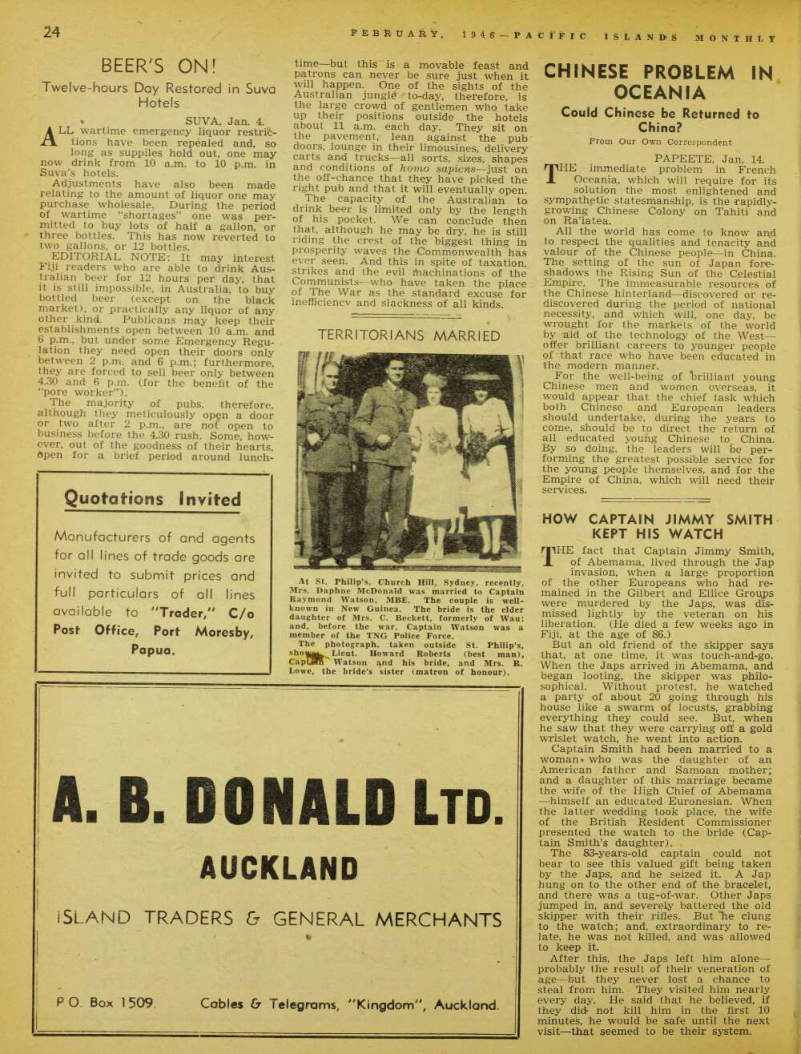
At St. Philip’s, Church Hill, Sydney, recently, Mrs. Daphne McDonald was married to Captain Raymond Watson, MBE, The couple is well known in New Guinea. The bride is the elder daughter of Mrs. C. Beckett, formerly of Wau; and, before the war, Captain Watson was a member of the TNG Police Force.
The photograph, taken outside St. Philip’s, Lieut. Howard Roberts (best man), Watson and his bride, and Mrs. R.
Lowe, the bride’s sister (matron of honour).
Chinese Problem In
Oceania
Could Chinese be Returned to Chino?
From Our Own Correspondent
Papeete, Jan. 14.
THE immediate problem in French Oceania, which will require for its solution the most enlightened and sympathetic statesmanship, is the -rapidly growing Chinese Colony on Tahiti and on Ra’iatea.
All the world has come to know ar\d to respect the qualities and tenacity and valour of the Chinese people—in China.
The setting of the sun of Japan fore shadows the Rising Sun of the Celestial Empire. The immeasurable resources of the Chinese hinterland—discovered or re discovered during the period of national necessity, and which will, one day, be wrought for the markets of the world by aid of the technology of the West — offer brilliant careers to younger people of that race who have been educated in the modern manner.
For the well-being of T>rilliant young Chinese men and women overseas, it would appear that the chief task which both Chinese and European leaders should undertake, during the years to come, should be to direct the return of all educated young Chinese to China.
By so doing, the leaders will be per forming the greatest possible service for the young people themselves, and for the Empire of China, which will need their services.
How Captain Jimmy Smith
Kept His Watch
THE fact that Captain Jimmy Smith, of Abemama, lived through the Jap invasion, when a large proportion of the other Europeans who had re mained in the Gilbert and Ellice Groups were murdered by the Japs, was dis missed lightly by the veteran on his liberation. (He died a few weeks ago in Fiji, at the age of 86.) But an old friend of the skipper says that, at one time, it was touch-and-go.
When the Japs arrived in Abemama, and began looting, the skipper was philo sophical, Without protest, he watched a party of about 20 going through his house like a swarm of locusts, grabbing everything they could see. But, when he saw that they were carrying off a gold wrislet watch, he went into action.
Captain Smith had been married to a woman ♦ who was the daughter of an American father and Samoan mother; and a daughter of this marriage became the wife of the High Chief of Abemama —himself an educated Euronesian. When the latter wedding took place, the wife of the British Resident Commissioner presented the watch to the bride (Cap tain Smith’s daughter).
The 83-years-old captain could not bear to see this valued gift being taken by the Japs, and he seized it. A Jap hung on to the other end of the bracelet, and there was a tug-of-war. Other Japs jumped in, and severely battered the old skipper with their rifles. But Tie clung to the watch; and, extraordinary to re late, he was not killed, and was allowed to keep it.
After this, the Japs left him alone — probably the result of their veneration of age—but they never lost a chance to steal from him. They visited him nearly every day. He said thaj he believed, if they did- not kill him in the first 10 minutes, he would be safe until the next visit —that seemed to be their system.
Advertisements & other items, p. 24 (1 item)
A. B. Donald Ltd.
Quotations Invited
Manufacturers of and agents for all lines of trade goods are invited to submit prices and full particulars of all lines available to "Trader/' C/o Post Office, Port Moresby, Papua.
AUCKLAND
ISLAND TRADERS & GENERAL MERCHANTS
% PO Box 1509. Cables & Telegrams, "Kingdom", Auckland.
Morobe Road
NG Government Demands Toll, Although It Has Taken Nearly One Million Pounds in Road Tax.
rERE have been contradictory reports about the value of the military-built road between the Bulolo Valley and the mouth of the Markham River. Some have called it a ”30 miles an hour road”; others have declared the cost of main tenance to be fantastic, owing to land slides in the mountain valleys—especially the Snake Valley.
It also was reported that difficulties had arisen with the Administration, which wanted to impose a heavy toll on the users of the road—irrespective of the fact that gold-producers paid, in a special road tax, between 1930 and 1941 (when there was no road whatever), a sum equivalent to nearly £1,000,000.
The whole position was explained by the chairman (Mr. J. Kruttschnitt) at the annual meeting of New Guinea Gold fields, Ltd., in Sydney, on January 18: “Mention was made in my last report of the military road connecting Wau and Bulolo with the coast at Labu—a point iust across the Markham River from Lae.
Portions of the road, particularly in the steep-sided valley of the Snake River, have given trouble due to landslides and floods, and our engineer reports that re locations are being made by the Armv engineers for the general betterment and stability of the road before it is turned over to civilian administration.
“In connection with the maintenance of this road the Minister for External Territories recently called a meeting of representatives of Bulolo Gold Dredging, ourselves and other mining companies, to discuss the imnosition of a toll for the use of the road as a means of providing funds for its upkeep. The Minister sug gested that the users of the road, who will be chiefly the mining companies, should pay a toll sufficient to meet the entire cost of maintenance. The toll rate proposed was approximately £4/13/4 per ton of freight.
“The mining companies contended that as the royalty payable on the gross value of all gold won was in 1929 raised from 1 per cent, to 5 per cent., for the object of building a road to the coast (although it has not been used for that purpose) and as a special gold excise tax of half of any excess over £9 per oz. has also been paid since 1941 by New Guinea miners to a New Guinea Trust Fund for application within the Territory, a portion of those funds should be used for the mainten ance of the road.
“Moreover, we anticipate the quantity of freight which will be carried over the road during the next two years, for the rehabilitation of the mining industry and general businesses, will be much in excess of the average pre-war tonnage, and a toll of even £2/6/8 per ton will provide substantially more than half the cost of road maintenance. Thereafter, as the road consolidates, the maintenance expense will diminish.
“A final decision on this matter has not yet been announced.”
The Rev. Dr. R. M. Stevenson, who was in charge of St. Paul’s Presbyterian Church in Suva for some years, has re cently been filling temporary posts in Queensland, while waiting for an oppor tunity to return to Fiji. During Jan uary he preached in St. Paul’s Presby terian Church, Mackay.
Anglican Synod Meets In
Suva
Suva, Jan. 22.
A CONFERENCE of Anglican Bishops from the whole Pacific area wil], meet in Honolulu in November this year. They will discuss the possibilities of forming an Oceanic Province of the Anglican Communion. This was an nounced by the Bishop of Polynesia, the Rt. Rev. L. S. Kempthorne, at the sixth triennial synod of the Polynesian diocese, which was in session in Suva at the end of January.
There was a full attendance of dele gates from Fiji, Tonga, Samoa and other islands in the Central Pacific at the Suva Synod. One of their first decisions was approval of the utilisation of a copra estate on Vanua Levu for the establishment of a settlement of Solomon Islanders. They will live there com munally and on a profit-sharing basis.
These Islanders were brought to the
Colony as indentured labourers for the sugar plantations, in the early days of this century. They elected to remain on and have now severed all ties with their homeland. The establishment of this estate on Vanua Levu will give them an independence which they have not previously enjoyed in Fiji. * === Two Samoans who had stowed away on an American ship and travelled to Vancouver, appeared in the Magistrate’s Court in Suva, Fiji, on December 6. They were convicted of having committed breaches of the Merchant Shipping Act.
They had been in custody in Vancouver and placed on board the “Sunnyside Park” which was Suva-bound. Off Hono lulu they had attempted to escape in a liferaft which they threw overboard but they were recovered after a few hours. They will be returned to Apia as soon as possible.
Advertisements & other items, p. 25 (1 item)
Foster Clark’S
r r \ sj />
LIKE A TRIFLE WITHOUT
Rich, velvet-smooth Foster Clark s Cveamy Custard is indeed essential for a trifle . . . and the real enjoyment of other sweets, too! It’s always welcome! Would you like to try intriguing new recipes, which save on rationed butter?
Write for the free Toiler Clark Recipe Book to Foster Clark (Aust.) Ltd.. Dept. R. 8., Red fern. N.S. Wenclosing 2\d. post.
FOSTER CLARK’S
* * <**4 a $ M T'V'f /i/t /i I/ ?' 0 ii/IWtf l/l# dV Uf m y.(j 4f)n
FCI 5
Vatukoulan Valleys
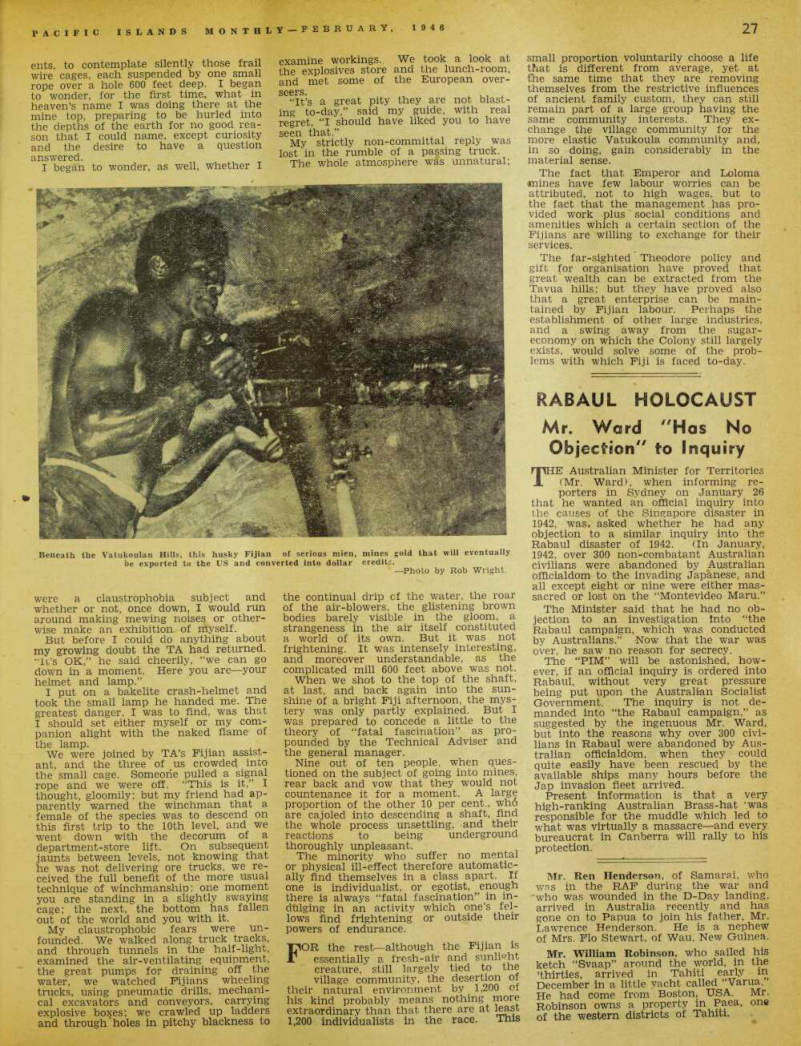
The Fijian Becomes A Miner
And a Member of a New Community in the Vatukoulan Valleys
By Judy Tudor
rERE was the usual hiatus Between getting into the bus at Tavua, and the start of the seven-mile jour ney out to the goldmines. A small Fijian girl lost sixpence outside one of the stores, and spent 10 minutes in frantic search, while bus passengers and driver' offered advice. The sixpence was not found and, reconciled at last to her loss,, she climbed back inside and we were off on the dry, dusty, snaking road to Vatukoula.
I had been told that I “must see the mines” and here I was off to see them.
But I had had too much sun the pre vious day and this, too, promised to be a scorcher. My knees began to buckle in anticipation as we rounded the last bend, shot through a Fijian mine “vil lage” ground and wound up hills and past stores, machine-shops, clubs, and suburban villas for 10 minutes, until -foe reached my objective—the office on the brow of a mountain.
So this is how they mined in Fiji; that pulsing township, sprawled over the valleys. I had been told that it was a “millionaire’s mine”; I was now pre pared to believe it.
The office interior was, by comparison with the white heat of the road, cool, and the general manager of the two Theodore companies, Loloma and Em peror, immediately set my mind at rest concerning the task of visiting his domain. There was, he said, his own technical adviser to show me round, and his own car and driver to drive us.
“Now,” he said, “I believe you want to go underground?” Technical Adviser, whom I had met the previous day, had suggested as much, and I had agreed that it might be interesting.
“We have made it a rule never to let women go underground. Anyhow, you wouldn’t like it and you would have no idea what you were looking at. It would be much better to concentrate on the social side of affairs—the schools, the hospital and the community life of the work-people generally. See the mill and the open cut by all means—but, no, underground wouldn’t interest you at all.”
“You mean the ‘woman’s angle’?” Pos sibly I looked unenthusiastic at the pros pect; and, after a moment’s pause, he hastened to say, “Well, yes. But if you have a quarter of an hour to spare after you’ve seen everything else maybe you could go down just for a quick trip— for the experience.”
WE let it go at that, and my escort and I started on our rounds. There is mighty little of the squalor and dirt of the old-fashioned mining town about Vatukoula. Everything, so far as it is compatible with utility, is plan ned to give pleasure to the eye as well as to the pocket.
I had already gathered from conver sations in the office, that the companies exercised a sort of benevolent dictator ship over the Vatukoulan valleys, and that, on the whole, the inhabitants thrived on it. There are schools for the Euronesians, for the European child ren. and a large one for the 400 Fijian children. The Fijians pay one-quarter of the cost of their school, the com panies one-quarter, and the Fiji Govern ment one-half.
There is a maternity hospital for Fijian women, a native medical prac titioner, and an ambulance to take all emergency cases to the hospital in the neighbouring town of Ba. Houses are rented to employees at a nominal figure, and electricity and water are supplied to the Europeans. Sports are encour aged among all sections of the com munity, and particularly among the Fijians, who take an avid interest in all games.
WE visited the tremendous open-cut, now almost worked out, but where giant electric excavators still tear tons of gold-bearing rock from the face of the workings: and the mill itself, where the complicated and inexplicable (to the novice) processes of turning lead grey lode into gold bricks, are carried out.
One can appreciate the vastness of the enternrise; the organising ability of E.
G. Theodore, who took hold when Vatu koula was nothing but dry, brown hill sides, in which gold was known to exist in crude state; and the scientific and technical knowledge necessary to turn the ore into commercial gold. There is romance enough in that and the story of the discovery of gold there, when looked at objectively, but there is extremely little in the actual processes of the mill itself; it is too bewildering, too vast.
I have known the thrills of alluvial goldmining: chasing elusive colours up New Guinea’s streams for days, and weeks; the good “prospect” suddenly re
vealed in some hitherto untried stream— . the heavy grains of yellow metal that wink back from the black sand in a deftly-handled prospecting dish; the nightly “wash-up” of a primitive sluice box. All that is real and intimate part of the gold lust that is almost one of man’s fundamental urges.
But there is nothing of that lure Vatukoula. The mill might be process ing pudding or some other prosiac com modity.
First, it is a grey substance studding a soft quartz, then a mass of pulped rock, or a simmering mud-bath, or a clear liquid—but never real honest-to-good ness gold. I examined that mine from its murky depths to its last refining pro cess, but the only recognisable metal I saw was in a few small gold slugs in the assayer’s office.
Over £6.000,000 worth of gold has come out of Vatukoula, I am told; but after the first frenzied efforts to grasp how the identifiable lode becomes so many gold bricks, I gave up; and the how and the wherefore of the technical processes I witnessed remains to me as clear as the sludgy by-products of the mine itself.
BUT the Theodore interests, one begins to realise, are determinedly a Fijian enterprise. A few Indians are em ployed as motor drivers, but the bulk of the labour is supplied by Fijians from all over the Colony, who work under European supervision. I saw them as sisting the assayer and copying accur ately plans of the mine workings, em ployed as miners and as labourers above ground, while their wives and children lived in model villages near-by.
The Fijian worker is supplied with a house, is paid well, gets a basic ration for himself and his wife; his health is cared for and so are his social pleasures.
But this did not satisfy wholly the large question-mark that was beginning to form itself in my mind: why did the Fijians leave home to do this sort of work, obviously so alien to their own traditional way of life?
I had been instructed that the Fijian has no love of money—if having money means routine employment; that all are landholders, sharing in community rights that suffice for their simple needs, and that the genesis of the present “Indian problem” is due to their aversion to hir ing themselves out as workers. Obser vations lead to the same general con clusions.
Why, then, were 1,200 Fijians living contentedly at Vatukoula, working what, to them were long hours, sometimes dur ing the night, and at a job far removed from that which one would believe they were fitted by nature, culture and en vironment?
No labour contracts exist between management and employee; the manage ment is free to dismiss a man when it wishes: the employee is free to go when he wishes. The conditions of work and pay are good, but in return the com panies demand efficient service. Most of the Fijians employed at the mines, nevertheless, have been there for years— many since the mines began operations eight or 10 years ago.
Both the general manager and my escort had tried to explain to me the fotal fascination that mining had for the Fijians, but I still could not see it. Per haps the answer lay underground.
BY tacit consent, we somehow found ourselves at the head of Smith shaft, where two small wire cages whizzed madlv into the earth, or ap peared abruptly on the surface and were delivered of ore-filled trucks.
“Half a tick while I see if it is OK."
My companion left me for a few mom
rope over a hole 600 feet deep. I began heave o nt e n’am°e r l' the the 1 depths no U good “£ son that I could name, except curiosity “d the desire to have a question I began to wonder, as well, whether I
and met some of the European over
Sef ‘^: s 0 Sith^eal
regret, “I should have liked you to have seen that. rpnlv was The whole atmosphere was unnatural,
were a claustrophobia subject and whether or not, once down, I would run around making mewing noises or otherwise make an exhibition of myself.
But before I could do anything about my growing doubt the TA had returned. ‘Tu’s OK,” he said cheerily, "we can go down in a moment. Here you are—your helmet and lamp.”
I put on a bakelite crash-helmet and took the small lamp he handed me. The greatest danger, I was to find, was that I should set either myself or my companion alight with the naked flame of the lamp.
We were joined by TA’s Fijian assistant, and the three of us crowded into the small cage. Someone pulled a signal rope and we were off. "This is it,” I thought, gloomily; but my friend had apparently warned the winchman that a female of the species was to descend on this first trip to the 10th level, and we went down with the decorum of a department-store lift. On subsequent jaunts between levels, not knowing that he was not delivering ore trucks, we received the full benefit of the more usual technique of winchmanship; one moment you are standing in a slightly swaying cage; the next, the bottom has fallen out of the world and you with it.
My claustrophobic fears were unfounded. We walked along truck tracks, and through tunnels in the half-light, examined the air-ventilating equipment, the great pumps for draining off the water, we watched Fijians wheeling trucks, using pneumatic drills, mechanical excavators and conveyors, carrying explosive boxes; we crawled up ladders and through holes in pitchy blackness to
the continual drip cf the water, the roar of the air-blowers, the glistening brown bodies barely visible in the gloom, a strangeness in the air itself constituted a world of its own. But it was not frightening. It was intensely interesting, and moreover understandable, as the complicated mill 600 feet above was not.
When we shot to the top of the shaft, at last, and back again into the sun shine of a bright Fiji afternoon, the mys tery was only partly explained. But I was prepared to concede a little to the theory of "fatal fascination” as pro pounded by the Technical Adviser and the general manager, Nine out of ten people, when ques tioned on the subject of going into mines, rear back and vow that they would not countenance it for a moment. A large proportion of the other 10 per cent., who are cajoled into descending a shaft, find the whole process unsettling, and their reactions to being underground thoroughly unpleasant, The minority who suffer no mental or physical ill-effect therefore automatic ally find themselves in a class apart. If one is individualist, or egotist, enough there is always "fatal fascination” in in dulging in an activity which one’s fel lows find frightening or outside their powers of endurance, . ... . .. w ITVDR the rest—although the Fijian £ essentially a fresh-air and sunlight creature, still largely tied to tne village community, the desertion oi their natural environment by 1,200 oi his kind probably means nothing more extraordinary than that there are at least 1,200 individualists in the race. inis
small proportion voluntarily choose a life that is different from average, yet at the same time that they are removing themselves from the restrictive influences of ancient family custom, they can still remain part of a large group having the same community interests. They ex change the village community for the more elastic Vatukoula community and, in so doing, gain considerably in the material sense.
The fact that Emperor and Loloma mines have few labour worries can be attributed, not to high wages, but to the fact that the management has pro vided work plus' social conditions and amenities which a certain section of the Fijians are willing to exchange for their services.
The far-sighted Theodore policy and gift for organisation have proved that great wealth can be extracted from the Tavua hills; but they have proved also that a great enterprise can be main tained by Fijian labour. Perhaps the establishment of other large industries, and a swing away from the sugar economy on which the Colony still largely exists, would solve some of the prob lems with which Fiji is faced to-day.
Beneath the Vatukoulan Hills, this husky Fijian of serious mien, mines gold that will eventually be exported to the US and converted into dollar credits. —Photo by Rob Wright.
Advertisements & other items, p. 26 (1 item)
Queensland
INSURANCE
COMPANY
LIMITED
(Incorporated 1886 In Australia)
ASSETS EXCEED £4,000,000
Head Office:
PITT Cr BRIDGE STS.,
SYDNEY
Specialists in South Seos fire,
Marine Cr Accident Insurances
Apply to: —
FIJI.
Branch Office: I. B. Chalmers, Manager.
Burns Phllp (South Sea) Co., Ltd.
VILA.
Burns Phllp (South Sea) Co., Ltd.
Comptoirs Francals Des Nouvelle* Hebrides (Marine).
NOUMEA,
L. & W. Johnston.
PAGO PAGO.
Burns Phllp (South Sea) Co., Ltd.
G. H. C. Reid & Co.
OTHER SOUTH SEA ISLANDS.
Burns Phllp (South Sea) Co., Ltd.
Also to any of the Company’s Offices in Australia or New Zealand.
Objection" to Inquiry
Rabaul Holocaust
Mr. Ward "Has No Objection" to Inquiry
rE Australian Minister for Territories (Mr. Ward), when informing re porters in Sydney on January 26 that he wanted an official inquiry into the causes of the Singapore disaster in 1942, was. asked whether he had any objection to a similar inquiry into the Rabaul disaster of 1942. (In January, 1942, over 300 non-combatant Australian civilians were abandoned by Australian officialdom to the invading Japanese, and all except eight or nine were either mas sacred or lost on the “Montevideo Maru.”
The Minister said that he had no ob jection to an investigation Into “the Rabaul campaign, which was conducted by Australians.” Now that the war was over, he saw no reason for secrecy.
The “PIM” will be astonished, how ever, if an official inquiry is ordered into Rabaul, without very great pressure being put upon the Australian Socialist Government. The inquiry is not de manded into “the Rabaul campaign,” as suggested by the ingenuous Mr. Ward, but into the reasons why over 300 civi lians in Rabaul were abandoned by Aus tralian officialdom, when they could quite easily have been rescued by the available ships many hours before the Jap invasion fleet arrived.
Present information is that a very high-ranking Australian Brass-hat 'was responsible for the muddle which led to what was virtually a massacre —and every bureaucrat in Canberra will rally to his
protection.
Mr. Ren Henderson, of Samarai, who wns in the RAF during the war and who was wounded in the D-Day landing, arrived in Australia recently and has gone on to Papua to join his father. Mr.
Lawrence Henderson. He is a nephew of Mrs. Flo Stewart, of Wau. New Guinea.
Mr. William Robinson, who sailed his ketch “Svaap” around the world, in the ’thirties, arrived in Tahiti early in December in a little yacht called “Varua, ’
He had come from Boston, USA. Mr.
Robinson owns a property in Paea, one of the western districts of Tahiti.
Advertisements & other items, p. 28 (1 item)
Rarotonga's New Hospital
Rarotonga’s new TB hospital, which was opened in December by Dr. E. P. Ellison, since retired, (See story below.)
Islanders
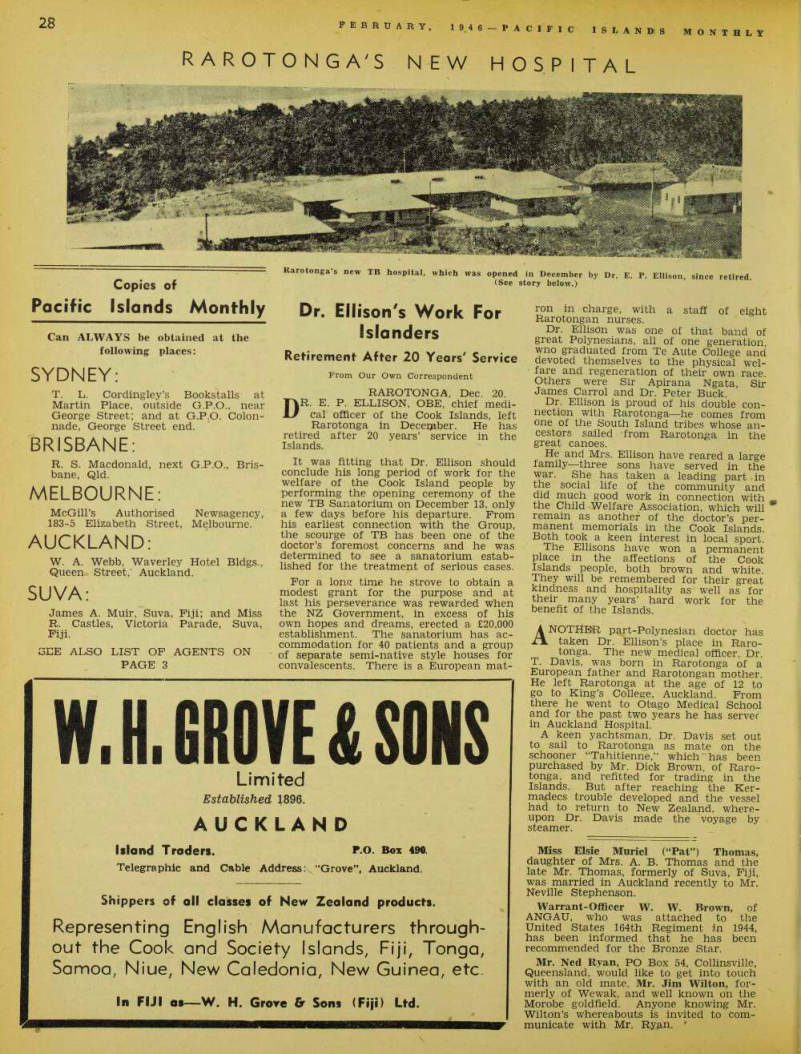
Dr. Ellison's Work For Islanders Retirement After 20 Years' Service
From Our Own Correspondent
Rarotonga, Dec. 20.
DR. E. P. ELLISON, OBE, chief medi cal officer of the Cook Islands, left Rarotonga in December. He has retired after 20 years’ service in the Islands.
It was fitting that Dr. Ellison should conclude his long period of work for the welfare of the Cook Island people by performing the opening ceremony of the new TB Sanatorium on December 13, only a few days before his departure. From his earliest connection with the Group, the scourge of TB has been one of the doctor’s foremost concerns and he was determined to see a sanatorium estab lished for the treatment of serious cases.
For a long time he strove to obtain a modest grant for the purpose and at last his perseverance was rewarded when the NZ Government, in excess of his own hopes and dreams, erected a £20,000 establishment. The sanatorium has ac commodation for 40 patients and a group of separate semi-native style houses for convalescents. There is a European mat
ron in charge, with a staff of eight Rarotongan nurses.
Dr. Ellison was one of that band of great Polynesians, all of one generation wno graduated from Te Aute College and devoted themselves to the physical wel fare and regeneration of their own race.
Others were Sir Apirana Ngata, Sir James Carrol and Dr. Peter Buck.
Dr. Ellison is proud of his double con nection with Rarotonga—he comes from one of the South Island tribes whose an cestors sailed from Rarotonga in the great canoes.
He and Mrs. Ellison have reared a large family—three sons have served in the war. She has taken a leading part in the social life of the community and did much good work in connection with the Child Welfare Association, which will remain as another of the doctor’s per manent memorials in the Cook Islands.
Both took a keen interest in local sport.
The Ellisons have won a permanent place in the affections of the Cook Islands people, both brown and white.
They will be remembered for their great kindness and hospitality as well as for their many years’ hard work for the benefit of the Islands.
ANOTHER part-Polynesian doctor has taken Dr. Ellison’s place in Raro tonga. The new medical officer, Dr.
T. Davis, was born in Rarotonga of a European father and Rarotongan mother.
He left Rarotonga at the age of 12 to go to King’s College, Auckland. From there he went to Otago Medical School and for the past two years he has server in Auckland Hospital.
A keen yachtsman, Dr. Davis set out to sail to Rarotonga as mate on the schooner “Tahitienne,” which has been purchased by Mr. Dick Brown, of Raro tonga, and refitted for trading in the Islands. But after reaching the Ker madecs trouble developed and the vessel had to return to New Zealand, where upon Dr. Davis made the voyage by steamer.
Miss Elsie Muriel (“Pat”) Thomas, daughter of Mrs. A. B. Thomas and the late Mr. Thomas, formerly of Suva, Fiji, was married in Auckland recently to Mr.
Neville Stephenson.
Warrant-Officer W. W. Brown, of ANGAU, who was attached to the United States 164th Regiment in 1944, has been informed that he has been recommended for the Bronze Star.
Mr. Ned Ryan, PO Box 54, Collinsville, Queensland, would like to get into touch with an old mate, Mr. Jim Wilton, for merly of Wewak, and well known on the Morobe goldfield. Anyone knowing Mr.
Wilton’s whereabouts is invited to com municate with Mr. Ryan. *
Advertisements & other items, p. 28 (2 items)
28
Id. 46 PACIFIC ISLAND! S MONTHLY
February,
W. H. Grove & Sons
Copies of
Pacific Islands Monthly
Can ALWAYS be obtained at the following places:
SYDNEY;
T. L. Cordingley’s Bookstalls at Martin Place, outside G.P.0., near George Street; and at G.P.O. Colonnade, George Street end.
BRISBANE:
R. S. Macdonald, next G.P.0., Brisbane, Qld.
MELBOURNE:
McGill’s Authorised Newsagency, 183-5 Elizabeth Street, Melbourne.
AUCKLAND:
W. A. Webb. Waverley Hotel Bldgs., Queen Street, Auckland,
SUVA:
James A. Muir, Suva, Fiji; and Miss R. Castles, Victoria Parade, Suva, Fiji.
GEE ALSO LIST OF AGENTS ON
PAGE 3
W. H. GROVE & SONS
Limited Established 1896.
AUCKLAND
Island Traders. PO. Box 490.
Telegraphic and Cable Address; “Grove”, Auckland.
Shippers of all classes of New Zealand products.
Representing English Manufacturers throughout the Cook and Society Islands, Fiji, Tonga, Samoa, Niue, New Caledonia, New Guinea, etc.
In FIJI at— W. H. Grove & Sons (Fiji) Ltd.
Engaged
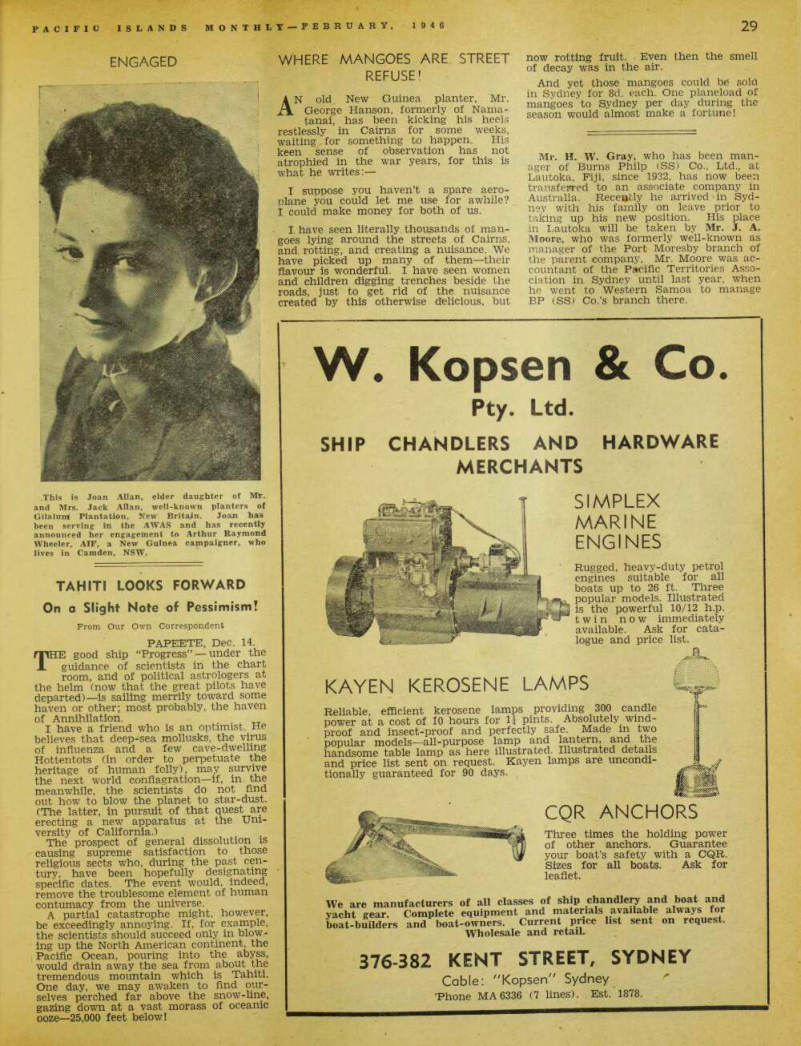
This is Joan Allan, elder daughter of Mt. and Mrs. Jack Allan, well-known planters of Gilaluiri Plantation, New Britain. Joan has been serving in the AWAS and has recently announced her engagement to Arthur Raymond Wheeler, A IF, a New Guinea campaigner, who lives in Camden, NSW’.
Tahiti Looks Forward
On a Slight Note of Pessimism!
From Our Own Correspondent
Papeete, Dec. 14.
fITHE good ship “Progress” under the JL guidance of scientists in the chart room, and of political astrologers at the helm (now that the great pilots have departed)—is sailing merrily toward some haven or other; most probably, the haven of Annihilation.
I have a friend who is an optimist. He believes that deep-sea mollusks, the virus of influenza and a few cave-dwelling Hottentots (in order to perpetuate the heritage of human folly), may survive the next world conflagration—if, in the meanwhile, the scientists do not find out how to blow the planet to star-dust. (The latter, in pursuit of that quest are erecting a new apparatus at the Uni versity of California.) The prospect of general dissolution is causing supreme satisfaction to those religious sects who, during the past cen tury, have been hopefully designating specific dates. The event would, indeed, remove the troublesome element of human contumacy from the universe.
A partial catastrophe might, however, be exceedingly annoying. If, for example, the scientists should succeed only in blow ing up the North American continent, the Pacific Ocean, pouring into the abyss, would drain away the sea from about the tremendous mountain which is Tahiti.
One day, we may awaken to find our selves perched far above the snow-line, gazing down at a vast morass of oceanic 00ze—25,000 feet below!
Where Mangoes Are Street
Refuse!
AN New Guinea planter, Mr, George Hanson, formerly of Nama tanai, has been kicking his heels restlessly in Cairns for some weeks, waiting for something to happen. His keen sense of observation has not atrophied in the war years, for this is what he writes:— I suppose you haven’t a spare aero plane you could let me use for awhile?
I could make money for both of us.
I have seen literally thousands of man goes lying around the streets of Cairns, and rotting, and creating a nuisance. We have picked up many of them —their flavour is wonderful. I have seen women and children digging trenches beside the roads, just to get rid of the nuisance created by this otherwise delicious, but
now rotting fruit. Even then the smell of decay was in the air.
And yet those mangoes could be sold in Sydney for Bd. each. One planeload of mangoes to Sydney per day during the season would almost make a fortune!
Mr. H. W. Gray, who has been man ager of Burns Philp (SS) Co., Ltd., at Lautoka, Fiji, since 1932, has now been transferred to an associate company in Australia. Recently he arrived in Syd nev with his family on leave prior to taking up his new position. His place in Lautoka will be taken by Mr. J. A.
Moore, who was formerly well-known as manager of the Port Moresby branch of the parent company. Mr. Moore was ac countant of the Pacific Territories Asso ciation in Sydney until last year, when ho went to Western Samoa to manage BP (SS) Co.’s branch there.
Advertisements & other items, pp. 29-30 (2 items)
W. Kopsen & Co.
Pty. Ltd.
SHIP CHANDLERS AND HARDWARE
MERCHANTS
h-
SIMPLEX
MARINE
ENGINES
Rugged, heavy-duty petrol engines suitable for all boats up to 26 ft. Three popular models. Illustrated is the powerful 10/12 h.p. twin now immediately available. Ask for catalogue and price list.
KAYEN KEROSENE LAMPS
Reliable, efficient kerosene lamps providing 300 candle power at a cost of 10 hours for li pints. Absolutely windproof and insect-proof and perfectly safe. Made in two popular models —all-purpose lamp and lantern, and the handsome table lamp as here illustrated. Illustrated details and price list sent on request. Kayen lamps are unconditionally guaranteed for 90 days.
CQR ANCHORS
Three times the holding power of other anchors. Guarantee your boat’s safety with a CQR.
Sizes for all boats. Ask for leaflet.
We are manufacturers of all classes of ship chandleir and boat and yacht gear. Complete equipment and materials available always for boat-builders and boat-owners. Current price list sent on request.
Wholesale and retail.
376-382 KENT STREET, SYDNEY
Cable: "Kopsen" Sydney
’Phone MA 6336 (7 lines). Est. 1878.
HfIRRT J. TOMNQ
Sole Pacific Islands
Selling Representatives
For
Bond’s
V
LTD.
Quality
Underwear
H2O V. \212 sc zn P 212 [ W 212
MATCHING SETS
/ JO
Harry J. Young
Pty. Ltd.
379 KENT ST., SYDNEY
Codes: Bentley’s Comp. Phrase Bentley’s 2nd Phrase Bankers: Bank of N.S.W.
Postal Address: Box 3661, G.P.0., Sydney.
30
FEBRUARY, 1946 PACIFIC ISLAND! S MONTHLY
An Old Fool
“PIM” Short Story
A Story of Old Samoa told by A.M.G.
WE were sitting one afternoon on the verandah of the International Hotel. It was the usual afternoon crowd of beach acquaintances, drinking lager beer or whisky, and discussing the topics of the day—the copra price, news of traders, arrivals of coastal vessels, the latest scandals talked about on scandal mongering Apia beach.
An undersized, shrivelled, pale-skinned Malay came on the verandah. He was of indeterminate age, ragged and dusty, clad in an old pair of dungaree pants and a not-too-clean singlet. Throwing a specu lative glance at our group at the large round table he passed on and sat down on the verandah steps, bidding us a “good evening.”
“Hullo,” called Schluter, captain of the “Anna Godeffroy,” “where do you come from? And who are you, The Malay removed his smoke-stained old clay pipe, on which he had been sucking, made some vague movement with his hand and, emitting a stream of tobacco juice from between his blackened teeth, replied quietly, “Oh, from some where!”
We suspected he had run away from some vessel. Against that view, however, was the fact that during the last four weeks no ship had called at Apia or anywhere in the neighbourhood. But it came out later that we were right. The Malay told Charley Oswald that he came from a Swedish brig, which had loaded guano at Baker Island and that, when the brig passed the Samoan coast, he had jumped overboard and swum ashore about 20 miles above Apia. On his way to town, the Samoans of the various villages had supplied him with ample food.
“What is your name?” asked Schluter.
“Rex,” said the stranger.
“What do you want here?”
“Oh, just a bit of tobacco and a few dollars; I’ll pay all back soon.”
“Oh, you will —and when?” continued Schluter, while Hamilton, the pilot, shook his head incredulously.
Rex made again that vague movement with his hand holding the clay pipe.
“Well, to-morrow night, maybe before.”
WE gave the old fellow some tobacco and matches, and -also presented him with four half-dollar pieces.
Whereupon, after thanking us, he at once hurriedly repaired across the road to Neumann’s general trading store and bar.
“Aha!” laughed Hamilton, “now he will invest the money in a bottle of Geneva.”
“And he has well earned it!” said Oswald. “A man of his age, who manages to jump overboard from his ship, and swim to this rotten country, should be given a whole case of Geneva —and also a knife to cut his throat, after having drunk all the Geneva.”
After awhile, the old fellow came out
of Neumann’s store. He had bought some strong fishing lines, a lew packets of fish-hooks, ana some biscuits. He grinned at us as he passed the Inter national; and then he sat down in the grass, close by, and started to prepare his fishing tackle.
The old chap worked quickly and cleverly, with his slender brown nngers.
Apparently, he was no beginner at the fishing game.
“Where are you going to fish?’’ asked Oswald.
“Oh, far outside the reef, in about 70 or 80 fathoms of water.’’
Charley left him and went back on board his schooner, one of the oldest vessels of the “Firm” (the old German “long-handle” concern, of Apia).
About half an hour later, Rex paddled off in a small, fragile-looking canoe, with an outrigger, which appeared in danger of dropping off, all the time. He passed Charley’s schooner, and twisted his face into what was meant as a friendly grin, when he saw the young master standing at the railing. Then he went straight on through the narrow passage leading out of the harbour, through the reef and the boiling surf beating on it, out into the open sea.
IT was about 10 o’clock that evening, and Charley Oswald and his super cargo were sitting in the small cabin of their schooner, having a nip of gin before turning in, when they heard canoe paddles. Rex had brought his canoe alongside, and now he climbed on deck.
He had two large bonito of about 10 lb. each in his hands, and he threw these down, pointing at them with his finger, “Plenty more of them in the canoe,” he said, “plenty more. Want me to fetch them?”
Charley went to the rail and looked down. The canoe was filled to the brim with large fish,, of a kind which the lazy, indolent natives of Apia rarely manage to catch.
The next morning, he paid back his loan, and showed Charley 15 more dollar pieces, which he had made as a result of his first night of work in Samoa.
The saloon-keepers and barmen con sidered Rex a wonderful fellow, as fish were rare in Apia at the time and hard to obtain, even for good pay. Rex was a hard worker, and made so much money that he was able to enter the holy and desirable state of matrimony on the Sun day following his arrival at Apia. The ceremony took place at the Tongan Church, at Matafele, Apia, and with com mendable taste, Rex had chosen a very pretty and attractive Samoan damsel, with a fairly good reputation. The parents of the bride probably considered the old boy a worthy son-in-law, whose
money-making abilities promised the family unlimited advantages, and untold dollars. , The merry wedding feast was embel lished with numerous innocent porkers, cooked in the delicate Samoan fashion.
It was assisted further by a battery of Geneva bottles, and by the somewhat noisy and not always melodious tunes of a Samoan string band —the members of which, when sufficiently fortified with Geneva, seemed to violently disagree amongst each other as to what tune they were playing at the one time. Charley Oswald was the guest of honour. He presented the bride with a kiss and a gold five-dollar piece after he had arranged with the happy, if slightly in
u i^ d fr^ 1 t 0 return the moneys value m fish. rnHE relations of the young wife now X came together and built for the young married couple a large and roomy Samoan house at Matautu Point.
After its completion, Rex gave a feast for the family and all friends, which
oojji mm d 5 dollars. ,
The news of the feast and the liberal ways of the new member of the commumty spread like wildfire in the usual way of the Samoan beach. From all sides came the various remote halfuncles, half-aunts, half-cousins, nephews, nieces and in-laws, of the young wife of Rex in a great hurry to participate in Rexs splendid hospitality.
Rex, at first, did what he could. But, very soon, he sadly remarked that he would be unable to catch sufficient fish for all requirements in his miserable small canoe. If only he had a real boat he would undertake to earn at least 50 dollars a week; and, with an income of 50 dollars a week, he would be able to entertam all relations of his dear wife in a way befitting such excellent people A family council was held. The family agreed it would be a paying investment, and they all contributed, and bought a boat—not paying cash, of course, but takmg it out on credit, mortgaging as security a piece of land. Then they presented the boat to Rex. with all due ceremony and with long and elaborate sP A^ nes ‘ j . , .
Afterwards they met again and. in Rex’s absence, laughed and hugged each other with joy at the prospect—how the old fool should in fpture work for them, and how they had outwitted him by their smartness.
American Consul. With the aid ot some faded and dirty-looking official documents he introduced himself as a citizen of the United States. He asked for the protection of the great Republic against the family of his wife, who intended to swindle him out of the possession of the boat, which they had just wa^theTega 8 ! ° f WhiCh he was tne legal owner.
1116 Consul afc once made out an im portant-looking and lengthy document, warning 11 “damned 1l kanaka°s’’ tl to keep their hands off the boat and informing them that Rex would from now on dwell under the protection of the whole Ameri can Navy Rex then, with great satisfaction, re turned to his home, gave his young wife _by means of a handy canoe-paddle—a thorough hiding, threw her out of the house, and then turned the whole crowd 0 f relations out, uttering wild and blood curdling threats and curses in assorted languages and swinging in his hand an impressive-looking kukri (large cane knife). This done, he left Apia’s inhos pitable shore, got into his boat, and set sail for Falealili, on the south coast of the island, where he sold the boat to a trader J or 200 dollars. He then returned to Apid, went on board Charley Oswald’s vessel and asked him to give him a pas sage to Tutuila. Charley wds willing to take him and Rex remained on board The German firm had meanwhile seized the piece of land mortgaged for the boat, as no payment had been made within the terms of the agreement. The family had assembled on the beach. Wildly excited and disappointed, they ran about uttering wi i d threats, and with murder in their hearts against the elusive and slippery Rex . He, meanwhile, was sitting quietly and contentedlv at the rail of Charley’s sh i p , the 200 dollars in hard cash in his pocket, and between half-closed eyelids he was watching the excitement of his ex relations and their fruitless efforts of intimidation /"IHARLEY took him to Leone Bay, on the west point Qf Tutuilaj and t j iere had his good points In Leone a fertile district nf Tntniia Rex settled down and opened a trading station buying coura from the natives The Samoans soon’were attracted by the way he did business and by his conscien tious wav of dealing with them and the store flourished g wei^ their Co P ra he used an old beam scale, hanging the baskets
of copra from a hook on the beam of the scale, which was made for a load up to 150 10. He always used to point out to the Samoan seller of copra the numbers on the beam showing the weight of the copra, when he moved the weight along on the beam, so that they might convince themselves that every thing was in best order.
But one day an inquisitive Samoan, who had been educated at the Pago Pago School, looked more closely at the weight on the scale and then impudently claimed, that this weight came originally from a 400 lb. scale. Rex felt very much offended by such an unwarranted in sinuation, he jumped into his boat, paddled out through the reef and dropped scale, weight and all the fittings into the blue Pacific where it was 50 fathoms deep.
Returning home, he took a sad fare well of his wife—he had married a Leone girl—and also of all his good friends and acquaintances. He said he would be un able to remain longer; the malicious calumnies of a base Samoan pig, which had been taught a bit to read in a mis sion school, had broken his tender heart.
He would now return to his beloved Apia.
ABOUT midnight, Rex’s house and trading station were burned to the ground in a sudden, unexpected out burst of flame. The unfortunate owner, Rex. followed by his wife, despairingly shouting the Samoan call of exaspera tion: “Fia ola! Fia ola!” rushed out to the beach, jumped into the water, climbed into their boat and rowed as fast as pos sible out to sea. The Leone people, be lieving that the two had gone crazy through their misfortune, shook their heads and peered after them till the boat disappeared on the horizon, then they hurried to attempt to save from the burning house anything of value remain ing.
Rex and his wife —who was a great, fat woman named Taumafa when out of sight of Leone, set sail along the coast to a remote bay, where they went ashore and dug a hole in the sand, hiding away a bag with 700 dollars and some of their more valuable belongings, which they had removed to the boat before the outbreak of the fire. Then they set sail again for Apia, to obtain their rights from the American Consul.
With a very serious face the Consul lis tened to their story of woe, then stated that here indeed was a. case requiring severe atonement. The captain of the USS “Adirondack,” lying in Apia har bour, was of the same opinion, and so it happened that the cruiser, with the poor insulted Rex and his wife on board, de parted for Leone Bay, where the captain sent the surprised villagers an ultimatum.
They were to decide whether they pre ferred to pay 1,000 dollars damages in hard cash to Rex, or to see their village razed. They paid 600 dollars in the end, all they could collect, then they sat down on the beach and, not compre hending anything, stared dumbly, and stunned by misfortune, out to the “Adirondack,” now steaming back to Apia.
Rex gave his wife a small share of the “takings” and sent her back to her people. Rex disappeared from sight for a long time.
One day, when I met my friend Char ley, he told me that he had found Rex at Levuka, in Fiji. There he was the owner of a boarding-house, had married a young local girl, and had a houseful of children. He seemed to prosper ex ceedingly, and was overjoyed to meet Charley again, and offered, in his exalta tion, to give him board and lodging free for a whole year.
Advertisements & other items, pp. 31-32 (1 item)
Refreshing
as a plunge
into a lagoon!
cidal
permi c i d a 1
and fragrant
TENAX TOILET SOAP is
a rapid safeguard against external skin infections, yet it is soothing and kind to the most sensitive skin —even a baby’s!
ORDER TENAX FROM
YOUR ISLAND SUP-
PLIERS. STOCKS ARE
PLENTIFULLY AVAIL-
ABLE.
J. C. MERRILLEES & COMPANY, Martin Place, SYDNEY Buyers of All Islands Requirements. Suppliers of oil Australian Goods, AGENTS FOR: PETER DAWSON'S WHISKY, COATES PLYMOUTH GIN, ST. AGNES BRANDY, CHATEAU GROVE BRANDY, "MARKO" VERMOUTH, WINES. ALSO COWRIE SHARPS & FLOUR.
We wish to notify our old and new clients that Mr. Merrillees,
WRITE OR WIRE
for
QUOTATIONS.
who has been away with the R.A.A.F. for four years, has resumed business.
INQUIRIES WELCOMED.
’PHONE BW 6569
Telegrams: “Merrillees”
Challis House, Sydney.
Scott’s “Renown” Brand Rope,
Cordage and
Binder
Twine
of Every
Description
Cable Address; Ropeyard.
Sydney. -
MANUFACTURED AT
MASCOT, N.S.W.
By
J. SCOTT
PTY. LTD.
Head Office and Store
163 CLARENCE STREET,
SYDNEY,
N.S.W.
Fiji's Legislative Council At Work
From A Special Correspondent
Suva, Dec. 21.
rE Legislative Council of Fiji—part elected, part nominated, and with an official majority—assembled on December 14 for its Budget session. The Governor, Sir Alexander Grantham, KCMG, presided over the 16 official members, all Departmental heads, and the unofficial section of five European, five Fijian, and five Indian members.
The Council was opened with the usual ceremony and dignity, and with presen tation of honours —an MBE to Adi Maraia Vosawale (wife of Ratu Sir Lala Sukuna), an OBE to Major S. G. Cowled, and a CISO to Mr. R. C. Farquhar (Post and Telegraph Department). Then came the Governor’s speech, and the intro duction of the Budget. The main points from the Vice-Regal address were: • Fiji’s post-war development plan, now in London, calls for an expenditure of £4,500,000 over a 10-years period, and the Colony’s grant from the Imperial Government, under its Colonial Develop ment and Welfare Act, over the same period, is £1,000,000. • Increases in income tax (mainly from companies), Estate Duty, and Resi dential Tax. • Increase in the unofficial member ship of Executive Council from two to four, the new appointees being the Hon.
Ratu George Tuisawau and the Hon. K.
B. Singh. This means that in Execu tive Council, where the Colony’s policy is mainly determined, the Governor will preside over five official and four un official members.
The Budget was not a record one.
Estimated expenditure is around £1,650,000, and the hoped-for revenue is approximately £1,550,000, with an esti mated deficit of close to £lOO,OOO.
WHAT did excite taxpayers, however, was the proposal to raise an extra £43,000 by way of increased income tax from individuals, an extra £45,000 from companies, and to raise the annual Resi dential Tax (i.e., Poll Tax) from £l/10/to £2.
The new scale has little effect on in comes under £1,200. Company tax rises from 5/- to 6/3 in the £1; pre-war it was 1/-.
The income taxation changes were described in detail in an article in Jan uary “PIM.”
The Government has officially stated that the increase in taxation is designed “to preserve existing items of revenue and to obtain additional revenue so as to preserve surplus balances, having regard in part to the need for financing the development plan which will be placed before Council in due course,”
What the public fears, however, is tha f much of the extra revenue is required to meet proposed increased administra tion costs, mainly in the form of larger salaries for officials.
Unofficial members exercised their privilege during the Budget debate of rajnging widely over the Colony’s public pffairs. and manv interesting topics were discussed. What brought forth good fruit was the suggestion from several members that taxation generally should be inves
tigated, and the Governor undertook to set up a committee for that purpose.
A Bill to provide for the settlement on Rabi Island of the Banaban natives of Ocean Island, and a Bill to provide for the reinstatement in Civil employment of ex-Servicemen. met with general ap proval and were passed.
TWO unofficial motions provided vigor ous debate. One was sponsored by the Hon. Mr. H. B. Gibson and read: “That this Council is of the opinion that in view of the constantly reiterated prin ciple of policy of the Colonial Office— ‘as much self-government as possible as soon as possible for Colonial Territories’ —and in view of the present and pro posed increases in taxation, that (sic) our Constitution be revised and amended to increase the number of elected re presentation (sic) of the people so that a significant measure of control may be exercised over the raising and the spend ing: of these comparatively huge sums of money which the people of this Colony will be called upon to provide.”
Not only was the motion badly worded, but the tactics of mover and seconder (Hon. A. A. Ragg) were weak, as they put forward proposals in debate which, had they been made part of the motion, would have led to a really constructive debate. As it was, it could only be abortive. It revealed divided opinion amongst both European and Indian un official members, but it did nroduce some very desirable plain-speaking, directed principally at the Indian members.
The Governor later commented on the hiph standard of debate.
The motion was lost.
The other unofficial motion came from the Hon. Vishnu Deo. and it proposed that the Colony’s sugar industry should
be nationalised, the CSR Co., Ltd., taken over, and the whole enterprise run by a Government Commission!
While both mover and seconder (Hon.
K. B. between them addressed a weary Council for close on three hours, they failed to produce a single argument to justify the proposal. No evidence was offered of how the grower or the Colony would benefit, no proof was given of how the growing, the processing, or the marketing of sugar cane and its pro ducts could be done more efficiently, if the motion were carried.
This was a further example of poli
tical theorising, with a view to catching votes from an almost illiterate Indian electorate. The only members to support the motion were the Indians, and it was lost by 22 votes to 5.
This debate concluded the session and the Council was adjourned sine die at 10.40 p.m. on December 21.
THE Council preserved its dignity throughout the session, in which it was no doubt assisted by its impres sive surroundings. There was straight talking but no mud-slinging.
The Governor’s sprightly entries, his courteous “Good morning, gentlemen,” at the commencement of each day’s work, and the firmness of his rulings, left no doubt as to who was in command, and that that authority was firm and con siderate.
It was fascinating to see Indian mem bers feverishly writing out their speeches, as others delivered theirs—which pos sibly accounted for the irrelevancy and unimnortance of many of their remarks No Indian member seemed capable of sneaking to the point and doing it briefly—verbosity seemed more desirable than relevancy.
Whether the ability of Fijian members to doze as easily in the mornings as after lunch, while Indian memers were sneak ing. was iust contempt or native casual ness, is debatable—it was certainly profit able to the sleepers.
The public showed little interest in the debates and -after the opening the gal leries were almost deserted.
Among passengers who returned to Samoa by the “Maui Pomare” in early December were Mr. A. G. Smyth, MLC, and Mrs. Smyth. They are much im proved in health after their holiday in Australia and New Zealand.
In a manslaughter case heard before Chief Judge J. R. Herd and four assessors in Apia High Court on December 10 and 11, a part-Samoan, George Schwenke, was charged with killing, on November 16, a Samoan named Tino in the bakery of Emil Fabricius. The evidence showed that Tino had threatened a woman, Mrs.
Laurenson, and the accused, in an aggres sive manner, and that Schwenke, in order to protect the woman had hit Tino with a piece of firewood, accidentally striking him in a vital spot, so that he later died of the injury. The case was dismissed for lack of evidence.
Advertisements & other items, pp. 33-34 (1 item)
54A Pitt St. Sydney N.S.W.
IMPORTERS
EXPORTERS
Island Distributors for
"COLEMAN" HEATING AND LIGHTING APPLIANCES
DINOX " AND " DIX " BRANDS OF BROOMS, BRUSHES AND MOPS i'/ !/’■
Ml- i 4
■'■/ 7
BANKERS: BANK OF N.S.W.
COMPTOIR NATIONAL
D ESCOMPTE DE PARIS
54a PITT ST. SYDNEY N.S.W.
4-:
CABLE ADDRESS:
“ROBERGILL"
PHONES BW 4782-B 1305
G. H. Robinson
ISLAND SUPPLIES
of all kinds—Selected and Shipped to order at lowest possible prices—Piecegoods in Wool, Cotton and Silk, Under and Outerwear, Manchester, Drapery, Grocery, Hardware, Engineers and Leathergoods trade supplies a specialty.
Indents and Transhipments arranged. Large or small orders treated with equal care.
Use our 25 years’ extensive experience.
Enquiries solicited to—
G. H. ROBINSON
51 Macquarie Street, Sydney, N.S.W.
Telegrams: Sunrise, Sydney.
Letters: Box 3317, G.P.0., Sydney.
PRODUCING UNIFORM GOOD RESULTS SINCE 1868
Flour
ALWAYS ASK FOR IT
Vegetable Production in
New Guinea What Was Done by the Australian Army
PROOF that the coastal areas of New Guinea can grow good vegetables, in overwhelming quantity, was sun plied to the Australian authorities dur ing the past three years by Lieutenant T. A. Olsson and his brother, Staff-Ser geant J. C. Olsson.
Before the coming of the Jap, Lieuten ant Olsson was a successful merchant at Wau, TNG. Forced to leave, he joined the Australian Army Service Corps, and was sent to a special duty—namelv, growing vegetables for the Forces. With 14 Europeans and about 100 native labourers, he was established on an area of river-flat, near the Laloki River, about 13 miles from Port Moresby.
He was provided with an irrigation system, which drew six million gallons of water, each week, from the river, to be spread over 120 acres. In other words, the whole of the vast gardens got about one innh of water per acre each week.
Production was phenomenal. They grew French beans, New Guinea “snake” beans. English cabbage. Chinese cabbage ('mostly for salads), lettuce (during the “winter” months), pumpkins, corn, silver beet, water melons, squash, radishes, car rots, beetroot, tomatoes, and many others.
Some of the vegetables were most pro lific. Chinese cabbage produced 40,000 lb. to the acre, in 10 w'eks. Corn pro duced 5.000 lb. of green cobs to the acre.
“If we had been getting the Australian contract price paid in the Northern Territory, we should have been making £lO,OOO per month,” said Lieutenant .Olsson, wistfully.
The armed Services received enormous quantities of green vegetables. The de parture of five 3-ton Army trucks for Port Moresby, laden with vegetables, was a common morning occurrence.
But it was not all plain sailing. There were many pests—infestations of rats and visitations by the stink bug were com mon—but the real enemy was the green vegetable bug, which attacked and des troyed everything it coula reach. Experts of all kinds tried to find a compound to beat this pest, but nothing was really effective. Lieutenant Olsson kept it in check by putting on lines of natives to go across the gardens at frequent intervals, picking the bugs off the plants into buckets. Towards the end, however, the experts were confident they could check the bug with DDT.
Lieutenant Olsson was sent to control new Army gardens at Erap, near Nadzab, in the Markham Valley, in 1944. This place was higher and colder, with a beautiful sandy loam, and here he was able to get even more satisfactory pro duction. In 1945, he was transferred to Lae, to take charge of gardens on the Busu River, at the back of Lae; and this enterprise was well under way when Lieutenant Olsson came to Australia, on leave. Vegetable-growing conditions at Lae were similar to those near Port Moresby.
He now has received his discharge, and hopes to return to the Morobe district of New Guinea, at an early date.
Mrs. P. Hufton, who was well known in Rabaul and Port Moresby before the war —when she was on the staff of Burns Philp & Co., Ltd. —returned to Port Moresby in January, to work again for the Big Firm.
Advertisements & other items, p. 34 (1 item)
34
FEBRUARY, 1946 PACIFIC ISLANttS MONTHLY
Sudden Collapse of Japan
The Atomic Bomb
Did It
IT was the atomic bomb which brought about the sudden collapse of Japan and the end of the Pacific war,” said Mrs. Kathleen Bignell, MBE, for merly of Rabaul and the Solomons, in a chat with the editor of the “PIM.” Mrs.
Bignell was captured near Rabaul in 1942, after being a refugee in the jungle for 5i weeks; and she, with a party of Australian nurses, then spent three years in a POW camp in Japan. Mrs. Bignell lost a son and a son-in-law on the ill fated “Montevideo Maru.”
Mrs. Bismell described the terrible American air assault upon Japan which, during 1945, increased steadily in fre quency ana intensity. Although the nurses were in great and growing peril from bombs, they could not resist ex pressing their delight as the great fleets of B29’s roared overhead, day and night, on their deadly missions.
“And I suppose you witnessed the steady deterioration of Japanese morale,” remarked the ‘TIM’ editor.
“Not at all,” said Mrs. Bignell. “It was nothing like that. Those well drilled masses of Japanese simply ac cepted the propaganda of their official classes, and were quite sure they were winning the war. They were assured that the Americans in the Okinawas were be ing led on to destruction; and that, al though many big American planes came over with bombs, few of them ever re turned home—the Jap air fleets were waiting for them out over the sea, and most of them were destroyed. The Japs were as cocky and arrogant as ever — until the first atomic bomb.
“Then the whole scene changed, liter ally within a few hours. The boss of our camp sent for us, relieved us of all dirty work, gave us a special issue of food, and said we should be back in Aus tralia in two months. It was so sudden that we were staggered—we thought it some kind of trick. He told us that Japan was finished —that the Americans were using a new kind of bomb —that 240,000 people had been wiped out in a moment. He was white and shaking.
“The news spread very quickly. That day we saw long lines of common people toddling along to their shrines to pray, their clasped hands held out in front of them and their attitude indicating terror and despair. Only a few hours earlier, they had still believed they were to be masters of the world.
“From what I saw, I believe the war would have gone on for a long time, with bitter fighting and heavy loss of life, had it not been for the atomic bomb.”
Future Of Truk
"Bermuda of Pacific"?
From Our Own Correspondent papfftf inn ?
ONE radio commentator who broadcasts NE radio commentator who oroaocasts from the North American West Coast has expressed an opinion that the Caroline Island galaxy known as Truk is destined to become the Bermuda of the Pacific.
Anyone who knew the tranquil charm of those fascinating Atlantic islands dur mg the later years of the Nineteenth Century, and their subsequent trans formation as a popular tourist resort, may foreshadow the fate in store for Truk. Surely—under the law of compen sation, after 25 years of the unspeak able Jap these wretched Caroline Islanders deserve a happier destiny.
Bermudians, who bartered their tran quillity for a mess of pottage, lived to see their beautiful land become a sort of Coney Island. Later, every native of Bermuda able to do so, has packed his chattels and, with his family, has fled to Turk’s Island, in the Bahamas, or to some obscure dot in ’the West Indies, at the beginning of the tourist season.
To comprehend why tourism blights
every land it invades, one may find an explanation in the fact that average tourists come from lands where a per son’s importance in the community, his or her rank in §pciety, the standards of success or failure in the battle of life, are measured solely in terms of the coin of the realm. A tourist entering a strange country naturally wishes to- convey the impression that he is a person of conse quence in his native land, and spends accordingly. This awakens the cupidity which, apparently, sleeps in every human breast.
As tourism proceeds, this spirit of ac quisitiveness spreads, until the whole community becomes infected. In the end, the once tranquil, neighbourly native population—transformed as by a thirst for blood into a pack of preda tory high-binders—seek to prey on each other, as well as on the stranger within their gates.
To-day, the visitor to the South Paci fic Islands who is prudent with his purse, is looked upon with contempt and con signed to the classification of “Banana Tourist.”
Eleven Samoans and two part-Samoans have won NZ Government scholarships for 1945. They are to leave for New Zealand early in 1946.
Advertisements & other items, p. 35 (1 item)
I J. Gough S. Co
Steamships Trading
Company Limited
PORT MORESBY SAMARAI PAPUA.
WHOLESALE & RETAIL MERCHANTS, SHIPOWNERS,
PLANTERS, ENGINEERS & SLIP PROPRIETORS.
Customs, Shipping, Insurance, and Forwarding Agents.
MANAGING AGENTS AND VISITING REPRESENTA-
TIVES FOR COCONUT AND RUBBER ESTATES.
*SYDNEY REPRESENTATIVES: Nelson & Robertson Pty. Ltd., 12 Spring Street.
I J. GOUGH S. CO
1 Bond Street, Sydney, Australia.
TeL B 4167. Box 3615 G.P.O.
SUPPLIERS OF GENERAL MERCHANDISE TO LEADING FIRMS THROUGHOUT THE
PACIFIC ISLANDS
Manufacturers' Representatives Exporters Importers Bankers: Bank of N.S.W. Bank of Adelaide. Comptoir Nat. d’Eacompte de Paris.
Cable Address: “SEAFOODS,” SYDNEY.
Codes: Bentley’s, 2nd and Comp. Phrase; A.8.C., sth and 6th; Peterson, 2nd and 3rd; Banking; Acme.
Australian Territories
"PIM" Editor Not Allowed to Visit Australian Territories
Letter to the Editor ALL sorts of strange things have been happening in the Territories of New Guinea and Papua—matters which should be of interest to the “Pacific Islands Monthly” and its readers. There fore, Mr. Editor, why do you not pay us a visit? You would find plenty to write about, and many of us here would like to have a chat with you. We can talk well enough, and we have a lot of things to talk about, believe me—but when it comes to writing, we are not so ~ood. That is your job, anyway. We thought the “PIM” editor or his repre sentative would have been along this way as soon as the war was over. Don’t depend on half-baked reports—come and see for yourself.
I am, etc.,
“Fed-Up Planter.”
P. Moresby, 20/12/45.
Editorial Note.—Thanks for the invi tation; but the plain fact is that the Editor of the “PIM” is regarded by the gentlemen in authority in Australia as a dangerous person, and he is not allowed to visit the Australian Territories. Per mission to go was sought soon after Japan surrendered, and was refused. The application was renewed a few weeks ago.
Mr. Eddie Ward himself replied that he could see no good and sufficient rea son why Mr. Robson should visit his domains at the present time, and he, therefore, refused to issue a travel per mit. He added, graciously, that if Mr.
Robson would renew his application in
six months’ time, the matter would again be considered.
Therefore, it is unlikely that the “PIM” representative will visit the Territories in 1946; but we shall visit the Territories many, many times after Minister Ward, and the quaint Socialistic structure he has erected in the Territories, have been consigned to the limbo of forgotten poli ticians.
In Rarotonga
Club Fills Long Felt Want
From Our Own Correspondent
Rarotonga, Dec. 20.
ASOCIAL need has been filled in Rarotonga with .the formation of a men’s club. The formation of such a club had long been considered, but energetic Major H. Ward gave the necessary final push to set the idea in motion. Once a start was made there has been no lack of support.
The Committee, elected by the vote of foundation members, is: President, Major H. Ward; vice-president, Mr. J. H. Webb; secretary, Mr. J. Ingram; committeemen, Messrs. W. H. Watson, J. Morgan, and R.
Anderson.
A suitable building pleasantly situated on the waterfront has been found. Origi nally it was the home of the late Cap tain T. Harries, well-known trader and pearler.
The club has the use of a full-size billiard table, donated by Mr. W. H.
Watson. There -are also a ping-pong table and facilities for various other pastimes.
It was wisely decided to permit Eurone sians and prominent native residents to be nominated for membership.
Within a short time of its opening the club enjoyed three very interesting and
instructive talks. The first, on the study of the ionosphere, was given by Mr.
Stewart Kinghan, of the NZ Institute of Industrial Research, who is director of the experimental ionosphere station in Rarotonga.
The second was by Mr. Roger Duff, Assistant Director of the Christchurch, NZ, Museum, who called here in the ketch “Golden Hind,” en route to Pit cairn Island. And the last was by Mr.
Bateson, Rarotonga manager for A. B.
Donald, Ltd., who is an active member of the Astronomical Society of New Zealand.
Solomon Island Pastor In
Australia
A SOLOMON ISLAND pastor, Sasa Rore, of the Seventh Day Adventist Mission in BSI, visited Melbourne in January, to be present at a 10 days’ session of the Victorian Conference of Seventh Day Adventists.
Billed by the popular press as “an island chief, son of a headhunter,” he received considerable publicity. His rea son for coming to Australia was to thank Australia and the other Allies for the help they gave the Solomons during the war and for assisting in mission work there.
Rore was chief printer at the mission as well as pastor at the time of the Jap invasion of the Solomons. When the European missionaries were evacua ted he carried on as head of the mis sion, and was responsible for more than 20 stations.
He speaks English; but, while in Vic toria, he addressed meetings through Pastor J. D. Anderson, also of the SDA Mission in BSI.
Advertisements & other items, p. 36 (2 items)
36
FfcßßtJAfeY, 1946 PACIFIC ISL A N til S MONtttt!
Willia
I I
Atkins
Pty. Ltd.
Head Office 449-451 KENT ST., SYDNEY,
iron & Steel Merchants-Engineers' Supplies
Coach & Motor Hardware
ESTABLISHED OVER 50 YEARS
TRADE
MARK
Cable Address: WILATKIN, Sydney.
—STEEL DEPARTMENT—
MILD STEEL:
Rounds, Squares, Flats, Half-rounds, Hexagons, Bevel, Shoeing, Tyre, Angles, Tees, Sheets, Plates, Girder Plates, Chequer Plates, Channels, Hoops, Etc.
BRIGHT STEEL:
Rounds, Squares, Hexagons.
Extra Special High Speed Tool Steel, Mining Steel, Blister Steel and Spring Steel, Rounds, Flats & Squares.
Bor Iron—All sections and sizes.
Engineers' Supplies: Set Screws, Studs. Metal Thread Screws, Coach Screws. Files, Cotter Pins, Bright and Black Bolts, Rivets, Etc., Hack Saw Blades.
Power Transmission Gear: Including Plummer Blocks, Couplings, Collars, Etc.
Coach and Motor Hardware: Axles, Springs, Wheelstuff, Duck, Paints.
Farriers' Supplies: Horse Nails, Anvils, Vices, Etc.
Motor-Trimmers ond Motor Builders' & Motor Painters' Requirements
C. A. WILLEY'S
Quick-Drying Coach and Car Paints, Roughstuff, Elastic Gloss, Synflex Enamels, Lacquers.
DUCO Lacquers and DULUX Enamels—FAßßEX Motor Toppings and Leather Cloths, House & Decorators' Paints, Varnishes & Brushware.
Sole Distributors of CHAMPION'S Decorators Point Products.
Distributing Agents for BROLITE Lacquers, SYNFLEX Enamels ond "POLYGLOSS" Finish.
to Peacetime Lethargy
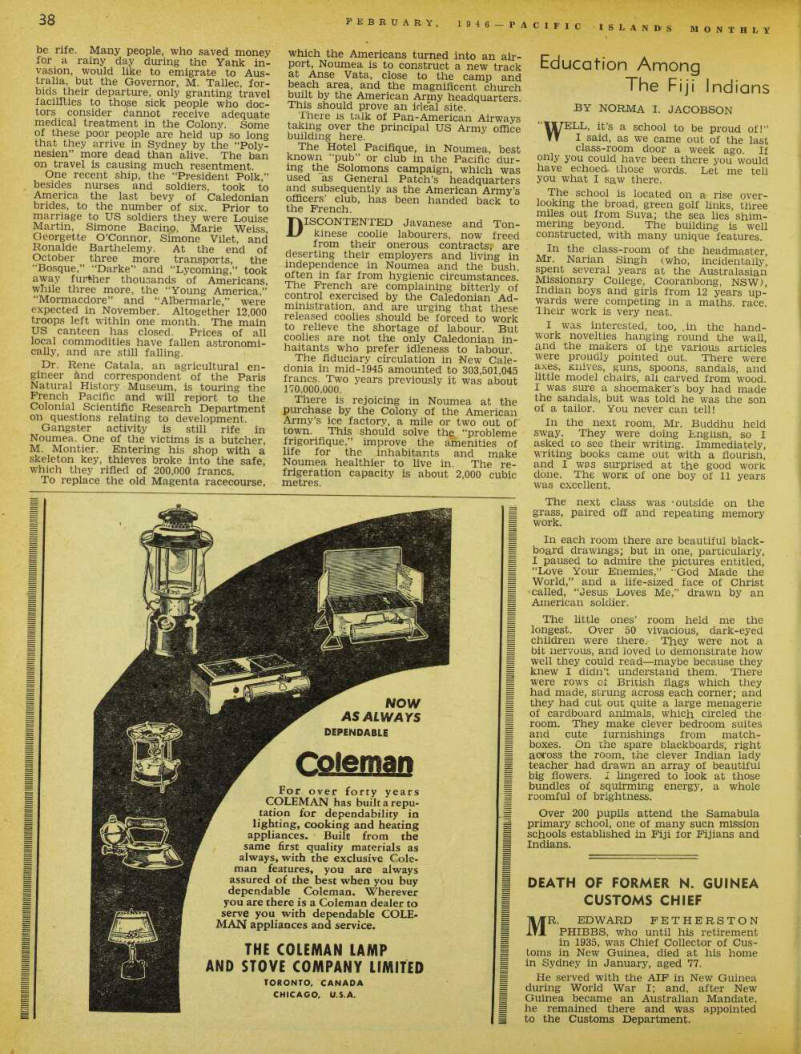
N. Caledonia Returning to Peacetime Lethargy Departure of the Troops
Prom a Special Correspondent FINANCIALLY, economically, we are not yet masters of our destiny—we must still submit to a regime of government by decree,” says Roger Gervolmo, recently-elected New Cale donian representative to the French National Assembly.
It has taken nearly a century for the Colony to have her own deputy in Paris.
The Colony argues that it should no longer have to pay the “depenses obliga toires” over which it had no control; while decisions taken by the French “high ups” and applied to all Colonies left out of account the island’s geo graph'cal position and the fact that this is the one French Colony suitable for European settlement. These are factors calling for special treatment.
New Caledonia is comparable to a French province, and her people have the qualities and the defects of the French. But as “mere colonials” they are unfortunately regarded by the “big shots” of the Rue Oudinot (in Paris) as ungovernable people, always dissatis fied and even would-be autonomists. The truth is that they wish to remain French, but they want to be treated the same as metropolitan Frenchmen and not as subjects insufficiently evolved to control their own affairs. Such are the argu ments of the Caledonian Party which backed M. Gervolino.
IN the New Caledonian elections held on October 21 for a representative to the French Constituent National Assembly in Paris, M. Gervolino, the Caledonian party’s candidate, won an absolute majority of 375. Voting was as follows:
The result is a victory for the demo cratic element which rallied the coun try in the dark days of 1940, the element which demands a larger share of self government and limitation of the powers of the Governor.
On the same day, the population voted on the question as to whether to keep or reject the French Constitution of 1875. Like the French, Caledonians showed themselves by a large majority (4,701 against 125) in favour of reject ing the Constitution of the Third Repub lic.
Jean Laubreaux, a New Caledonian member of the Resistance Movement in France, and at present an artillery lieu tenant in French occupied Germany, has been awarded the Croix de Guerre.
After an absence of over five years, Captain Jego, master of the New Cale donian nickel collier, “Notou,” sunk by a German raider in the South Pacific on August 16, 1940, has returned to Nou mea. The captain, member of an old Breton seafaring family, and highly respected by the seagoing fraternity in Sydney and Newcastle, as well as by his compatriots in the French Pacific, was for many months in German hands. rE French colony in the New Hebrides mourns the loss of Edmond Colar deau, one of their pioneers. He won the Croix de Guerre in Prance, 1918.
Thirty-two Caledonian sailors who played their part in the European cam paigns arrived in Noumea on October 14 by an American vessel. They had left Cherbourg on July 11.
Because New Caledonia is geographic ally so isolated from France, a campaign has been going on for the abandon ment of French exchange control. This would make for freer trade with Pacific countries, notably USA, Australia and New Zealand. It was announced, in December, that the franc of New Cale donia is to be rated higher, in sterling and dollar terms, than the franc of France.
Occasionally news arrives of New Caledonians living in Indo-China. From Saigon comes word that former Noumea magistrate Janvier and his wife and son are in good health in Saigon, where M. Janvier fills the office of Public Prose cutor. News has also been received of Henri Evelia, of the Bank of Indo china’s Saigon headquarters.
M. Goulet has found gold in associa tion with copper deposits in his “New Caledonia” mine at Moindah. Analysis, it is said, shows 33 grammes to the ton. 117TTH every departing American ves ff sel, Noumea is falling back into its old state of stagnation, and soon it seems possible that unemployment will
Noumean Bush Total Gervolino ... 1,419 1,830 3,249 Verges 1,142 819 1,961 Paladini 180 357 537
be rife. Many people, who saved money for a rainy day during the Yank in vasion, would like to emigrate to Aus tralia, but the Governor, M. Tallec, for bids their departure, only granting travel facilities to those sick people who doc tors consider cannot receive adequate medical treatment in the Colony. Some of these poor people are held up so long that they arrive in Sydney by the “Poly nesien” more dead than alive. The ban on travel is causing much resentment.
One recent ship, the “President Polk,” besides nurses and soldiers, took to America the last bevy of Caledonian brides, to the number of six. Prior to marriage to US soldiers they were Louise Martin, Simone Bacino, Marie Weiss, Georgette O’Connor, Simone Vilet, and Ronalde Barthelemy. At the end of October three more transports, the “Bosque,” “Darke” and “Lycoming,” took away further thousands of Americans, while three more, the “Young America,”
“Mormacdore” and “Albermarle,” were expected in November. Altogether 12,000 troops left within one month. The main US canteen has closed. Prices of all local commodities have fallen astronomi cally, and are still falling.
Dr. Rene Catala, an agricultural en gineer and correspondent of the Paris Natural History Museum, is touring the French Pacific and will report to the Colonial Scientific Research Department on questions relating to development.
Gangster activity is still rife in Noumea. One of the victims is a butcher, M. Montier. Entering his shop with a skeleton key, thieves broke into the safe, which they rifled of 200,000 francs.
To replace the old Magenta racecourse,
which the Americans turned into an air port, Noumea is to construct a new track at Anse Vata, close to the camp and beach area, and the magnificent church built by the American Army headquarters This should prove an ideal site.
There is talk of Pan-American Airways taking over the principal US Army office building here.
The Hotel Pacifique, in Noumea, best known “pub” or club in the Pacific dur ing the Solomons campaign, which was used as General Patch’s headquarters and subsequently as the American Army’s officers’ club, has been handed back to the French.
DISCONTENTED Javanese and Ton kinese coolie labourers, now freed from their onerous contracts, are deserting their employers and living in independence in Noumea and the bush, often in far from hygienic circumstances.
The French are complaining bitterly of control exercised by the Caledonian Ad ministration, and are urging that these released coolies should be forced to work to relieve the shortage of labour. But coolies are not the only Caledonian in haitants who prefer idleness to labour.
The fiduciary circulation in New Cale donia in mid-1945 amounted to 303,501,045 francs. Two years previously it was about 170,000,000.
There is rejoicing in Noumea at the purchase by the Colony of the American Army’s ice factory, a mile or two out of town. This should solve ths “probleme frigorifique,” improve the amenities of life for the inhabitants and make Noumea healthier to live in. The re frigeration capacity is about 2,000 cubic metres.
Advertisements & other items, pp. 37-38 (2 items)
37
islands monthly February, 1946
Vtdbia
WANTED IN SYDNEY
House or flat, furnished or unfurnished, urgently required by mother and adult daughter.
Excellent references. ’Phone FM 4340
VTDBIA
BITTER
ALE
O
SIEVED IT
CARLTON & UNITED BREWERIES LTR.
v.l
NOW
AS ALWAYS
DEPENDABLE
roieman
For over forty years COLEMAN has built a reputation for dependability in lighting, cooking and heating appliances. Built from the same first quality materials as always, with the exclusive Coleman features, you are always assured of the best when you buy dependable Coleman. Wherever you are there is a Coleman dealer to serve you with dependable COLE- MAN appliances and service.
THE COLEMAN LAMP
AND STOVE COMPANY LIMITED
TORONTO. CANADA
CHICAGO. U.S.A.
Education Among
The Fiji Indians
By Norma I. Jacobson
WELL, it’s a school to be proud of!”
I said, as we came out of the last class-room door a week ago. If only you could have been there you would have echoed* those words. Let me tell you what I saw there.
The school is located on a rise over looking the broad, green golf links, three miles out from Suva; the sea lies shim mering beyond. The building is well constructed, with many unique features.
In the class-room of the headmaster, Mr. Narian Singh (who, incidentally, spent several years at the Australasian Missionary College, Cooranbong, NSW), Indian boys and girls from 12 years up wards were competing in a maths, race.
Their work is very neat.
I was interested, too, .in the hand work novelties hanging round the wall, and the makers of the various articles were proudly pointed out. There were axes, Knives, guns, spoons, sandals, and little model chairs, ah carved from wood.
I was sure a shoemaker’s boy had made the sandals, but was told he was the son of a tailor. You never can tell!
In the next room, Mr. Buddhu held sway. They were doing English, so I asked co see their writing. Immediately, writing books came out with a flourish, and I was surprised at the good work done. The worx of one boy of 11 years was excellent.
The next class was 'outside on the grass, paired off and repeating memory work.
In each room there are beautiful black board drawings; but in one, particularly, I paused to admire the pictures entitled, “Love Your Enemies,” "God Made the World,” and a life-sized face of Christ called, “Jesus Loves Me,” drawn by an American soldier.
The little ones’ room held me the longest. Over 50 vivacious, dark-eyed children were there. They were not a bit nervous, and loved to demonstrate how well they could read —maybe because they knew I didn’t understand them. There were rows of British flags which they had made, strung across each corner; and they had cut out quite a large menagerie of cardboard animals, which circled the room. They make clever bedroom suites and cute furnishings from match boxes. On the spare blackboards, right across the room, the clever Indian lady teacher had drawn an array of beautiful big flowers. I lingered to look at those bundles of squirming energy, a whole roomful of brightness.
Over 200 pupils attend the Samabula primary school, one of many such mission schools established in Fiji for Fijians and Indians.
Death Of Former N. Guinea
Customs Chief
Mr. Edward Fetherston
PHIBBS, who until his retirement in 1935, was Chief Collector of Cus toms in New Guinea, died at his home in Sydney in January, aged 77.
He served with the AIF in New Guinea during World War I; and, after New Guinea became an Australian Mandate, he remained there and was appointed to the Customs Department.
Advertisements & other items, p. 38 (1 item)
38
FEBRUARY, 1946 PACIFIC ISLAND.' S MONTHLY
Phantasy And
Farce
A Tabulated Account of What a Man Must Do in Order to Get Official Permission to Return to
the Australian Pacific Territories
Letter to the Editor YOU were good Enough to invite me to tell you how I fared, when I had made up my mind to make formal application—after my return from abroad —to return to my old home in the Aus tralian Pacific Territories.
The following is an exact tabulation of what I had to go through before I could start off on the first stage (to Port Moresby) of my return. The thing is a combination of farce and phantasy.
I shall give a full account of it in my forthcoming 1 book, “Three Months Among Savages.” which deals with my “holiday” in South-eastern Australia; (1) Applied to Department of External Territories, Canberra: Three let ters; one urgent telegram. (2) Saw a kind friend at Victoria Bar racks, Sydney: One trunk-line call to (1). (3) Applied to Dept, of External Ter ritories, Sydney: Three personal calls, (4) Call at Income Tax Dept., Sydney: Spent 85 rhinutes standing in a queue; had a five minutes’ inter view with young man of majestic manner. (5) Army Movements Control, Sydney; One personal call.
(6) Priorities Officer, Dept, of Civil Aviation: Final seal of approval from this outfit.
At any rate, I feel that I have done my bit towards solving unemployment in Australia.
I am, etc.,
Queensland.
“Planter.”
Bureaucratic System in Cook Islands
Cook Islands
By Edwin Gold, Of Mangaia
AT the present time there is unrest and dissatisfaction in *the “orange islands” of the Cook Group.
This unrest is not a new thing, nor due to self-seeking agitators. It is caused by the present administrative system, and a revision of that system is needed.
Here are a few facts: — The “Resident Agent” system, upon the outer islands, while well-intended in its original conception, is not now praised.
Like all “one-man” rule, any abuse of the Resident Agent’s comprehensive powers can create a petty dictatorship.
Resident Agents are appointed from NZ, for a term of three years. By the time the official has gained experience, he is ready to return to NZ again, and another inexperienced man takes the vacated post.
The retention in the Cl judicial code of harsh, archaic laws (e.g., prison sen tences for adultery) and their continued enforcement, puts the RA again in the position of a Nazi Judge. These antique laws are never apnlied to the wealthy; but “poor whites” and Polynesians who break them may expect rigorous penalty.
The island of Mangaia is notorious in the
archipelago for its “Seventh Command ment fines” (up to £5).
The low standard of native education makes local schools a failure in the in culcation of ideals of good citizenship, and as at present conducted they are merely a drain on the New Zealand tax payer, and lead nowhere.
Native living standards are low — “coolie” is the only fitting adjective. The 6/- per case offered for Mangaia oranges (the best in the Cl market) does not repay the expense and exertion of pick ing, packing and transportation. Man gaians earn money only during four months each year; but their needs, and their expenses, continue from January 1 to December 31.
“Big Business” has the monopoly of all inter-island and CI-NZ shipping com munications. The planters are thus at the mercy of one firm in shipping their produce, and must suffer the deduction, from fruit payments, of whatever charge this firm makes. The same rates appear to apply when fruit is shipped per NZ Government vessel.
In 20 years’ residence at Mangaia, the has never seen a Resident Agent who was able to convince the islanders that the prevailing legal, political and commercial systems were for their good.
The native still believes that he is being misruled, and held down to a coolie liv ing standard, without voice or vote, by New Zealand. Being uneducated, he can
not protest.
Summing up, it would appear that, in the Cooks, rule is arbitrary, without re course for the ruled, or redress in case of abuses. The official oligarchy is re sponsible only to itself, and there is little more actual freedom than in the Ges tapo-ridden lands recently conquered in the name of liberty.
Advertisements & other items, p. 39 (1 item)
Gibson’S
★ TRY IT ... . YOU’LL LIKE IT!
GREEN LABEL
TEA
Blended and packed by— J. A. D. GIBSON & CO. LTD. |i \ 364 KENT STREET, SYDNEY. 'Phone: M 2328. i Also GIBSON'S GREEN LABEL COFFEE and COFFEE ESSENCE
Cinchona Plantation In New Guinea
By “New Guinea Planter”
PRICES of all tropical products are high, and appear likely to continue high for several years to come, thus providing a unique opportunity for New Guinea to rehabilitate itself without cost to Australia.
This fertile territory has great agri cultural possibilities, and, if Government control and restrictions .are lifted, to take advantage of the present high prices, no subsidies, bonus or preferences are needed to assist development—only rational Labour Ordinances and liberty to return quickly to normal conditions.
Shipping, the present bugbear, will quickly right itself as the Allied armies are demobilised.
The groundwork of agricultural experi mentation was well laid in the past by the small but efficient Agricultural Department; and those men who did so much, and have since been victims of the war—George Murray, Clive Green, and Lieut. Bechin, among others —should not be forgotten. Back on the job is* Proggatt, Larry Dwyer and Richards, out to redeem the past and build for the future.
We may perhaps see Keravat Experi mental Station doing its good work again. Aiyura, the highland Experi mental Station, despite an enemy almost on its boundary, and much bombing and strafing, never ceased its good work, and the Territory will benefit accordingly.
It is interesting to note that Mr.
Bechin first planted cinchona at Aiyura nine or ten years ago. General MacArthur, escaping from Bataan, brought out cinchona seed and some of
this is said to have reached Aiyura With invasion, ANGAU, for the Army, took over Aiyura and, as a war measure, in creased the planting of cinchona and, seedlings included, the cinchona plants possibly number 140,000 to 150,000 now.
The planting of this cinchona was a sound, long-sighted war measure, and, had the war dragged on, would have been of immeasurable value to the Allies The Russians, it is said, had found a means of extracting quinine from three years-old cinchona plants.
Despite the work involved with cin chona, as a war emergency measure, the task of experimenting, breeding, and recording of ~eneral economic and ex perimental crops (including coffee, tea and cocoa crops) never ceased at Aiyura, and the results are there for the bene fit of those now returning to the Terri tory.
Also it is of interest to note that Aiyura is probably the best and largest example of soil erosion prevention, by the contour terrace and drain system, to be seen in this part of the world.
New Guinea is a great territory with a great agricultural future for both native and European, and it is imperative that we get on to the job quickly. • Lieut. K. H. McColl, RANVR formerly a plantation manager in the Solomons and New Guinea, received his discharge in Sydney recently, after nearly four years’ service in the Allied Intelligence Bureau. He plans to return to the Islands when normal conditions return.
Drinks on the House
Trader’s Tale:
By Tukapa Koko
APRIL of each year in Mangaia sees our release from gloomy forebodings, enc * of ma d March is also the end of the cyclone season. A special celebration is held (among such as are wont to quaff the flowing bowl), over the dead body of defunct March, that enemy of all who have anything in the way of worldly goods to lose. pnce, however, we* islanders of Man gaia drank a different toast, in which the natives also joined. The liquor was neither wine nor beer, but carbon tetra (which science briefly calls CCh I understand?).
For non-islanders there exists, in all tropical lands, a parasite, which is called the hook-worm. Natives, or any other persons going habitually barefooted, are liable to become victims. The parasite enters, as a microscopic object, the skin of unprotected feet, and gets into a human body, to flourish (and grow to large size) in the digestive tract.
Fully developed, this awful scourge attaches itself to the intestinal walls and sucks, leech-like, its victim’s life-blood The anaemia that results is fatal—the victim “goes into a decline,” and soon passes away.
This horrible fate, however, no longer threatens Polynesians since Dr. Sylvester Lambert, the famous tropical scientist, discovered that the use of CCh prevents the parasite from getting its grip on even natives who live in infested territory. finHE Cook Islands are not included in JL the danger area; but, owing to a few cases being diagnosed in some parts of the Group, a medical fiat went forth that all persons upon this island of Mangaia should, in common with the rest of the Cook Islands population, take a dose of the newly discovered panacea as a safety measure; and “DoC” (our college-trained Rarotongan physician, a youth of 22) prepared the medicine in a large glass jug, which he proceeded to take around all the villages.
Now, in this, the “cliff village,” I am the only European. Does a chief die, I must attend his funeral; if a neighbour marries, it’s my duty to produce material congratulations. In other words, to assist the wedding feast with timely largesse; and in many other ways, too, I must shoulder the local version of the white man’s burden.
The load usually is not very heavy to bear; but when I, upon a day, saw “Doc” and his jug of vairakau (“tree-water”— Maori for medicine) coming in state up the village road, I quaked a bit.
“Face,” be it noted, is just as impor tant in Polynesia as it is in Far Cathay, And white man’s face doubly so. Let a European dodge his clearly indicated duty, and his name, thereafter, is mud.
Thus far, I’d been remarkably lucky in preserving that all-important prestige, both socially and in trade. But “Doc” was approaching, and his eye was on me!
“Doc,” of course, spoke English as a mother tongue, and was counted, as European. A nice lad but as he approached, followed by a big convict helper carrying the muslin-covered jug-, and that stalwart followed by others bearing measuring glasses and various beakers, he looked, to me, like a par ticularly vicious Gestapo executioner.
A convict at the rear bore a bowl of clear water for cleansing the glasses.
Amid the shouts of the villagers, this procession, accompanied by a Deacon with flapping shirt-tails, halted opposite my palace of commerce.
There was no help for it, short of
aetual and undignified flight into the bush at the back of the store. Even to feign indisposition was no go, with a qualified physician in charge—he’d taring me “round” first, and then dose me!
“Courage, Danton, mon brave!”
Under such conditions, it’s always better to march to the guillotine without police escort, as it were. I stepped out on the road. “Doc” measured out my “toddy,” and I drank it down, with all the dignity I could put on. The stuff tasted like bath-water mixed with var nish.
The ceremony over, the glass was washed, and everybody else, in turn, quaffed confusion to the enemy of health. The villagers appeared to be agreeably surprised that neither I nor they fell to earth in convulsions after imbibing great Dr. Lambert’s specific at the hands of his young Rarotongan disciple. 1 RETURNED to my counter and shelves. The villagers sat around in the shade, conversing, or wound fish lines in preparation for a little wooing of the finny denizens of the Pacific.
Children played (heir games upon the almost deserted road, and all was nor mal (“Doc” and his helpers had des cended to the beach villages, there to bestow again Dr. Lambert’s scientific blessing).
Now, I very seldom drink —it’s no good to a white man in the tropics—and never, at any time, over-indulge. But, at my store counter, I was beginning to feel that the cans of meat, the calico and prints, and the other trade items, were waltzing around me in a circle; and when the birdcage-like building began to join the contents, there was no denying that I ftelt very, very, dizzy. So much so that at last I had to lie down.
But before so doing, I looked out the window of my bedroom (an unglazed aperture, covered occasionally by a shutter). , , .
Gone was the enthusiasm of the in tending fishers, and gone the vivacity of the gossips. All were lying on the road side, with hands at head or middle.
Children, their play no further attrac tion, grinned and pointed; others, how ever ran forward with alarmed howls to peer’ dismally at prostrate parents A godly Deacon essayed to go home; but his progress down the village street suggested that he found the middle of the broad highway as hard to tread as any tightrope. .
Others made no attempt to rise at an, with feeble groans they lay where they had collapsed. Having noted this sad state of affairs, I flopped upon my bea, dead to the world—blotto!
The long day, as writers say, wore on.
Everyone but the children was hors de combat” for some five hours. I, having quaffed first, recovered first, when even ing’s shadows began to fall.
Later, I found out the whys and wherefors.
The CCh should have been taken fasting. But we hadnt known that By eating beforehand, the specific had acted upon us like a very generous dose of undiluted alcohol! m There is, I must mention, a heavy legal penalty in these islands for sup plying liquor to Polynesians. Many Euro peans have been deported for such offences, or heavily fined. On this occasion, however, all of Mangaia Island was under the influence —and Authority had given the order!
Samoan-born soldiers recently re turned to the Territory from active ser vice are: Sgt. E. Cook, Pte. S. P.
Churchward, Pte. C. Reid, Pte. H. Rea, and W/O Henry Krone.
Advertisements & other items, p. 40 (1 item)
Jenkin’S
BOX 100
SUVA, FIJI
THE LEADING STORE FOR ISLAND
CURIOS AND SOUVENIRS
We con supply— Tortoiseshell Goods in bracelets, necklets, brooches.
Tortoiseshell Watch-Bands—made to measure.
Tortoiseshell, with "Cat's Eye" Mountings, in bracelets, necklets, brooches, ear drops.
"Cat's Eyes" set in Silver Filigree, in sets of necklace and bracelet.
We can also supply Tappa Cloth.
Fiji-made Novelties in Large Variety.
QUALITY GOODS AT
REASONABLE PRICES
Write for Our Descriptive Catalogue.
We Will Gladly Forward One. ± . , * W ■I ; ■
Guinea
Future of Papuo-New Guinea
Letter to the'Editor AS one who has climbed over the razor backs and down the gullies of a large portion of Papua and New Guinea since 1921 In various activities, and personally controlled all types of native labour, from “calaboose” from in terior bush areas to sophisticated “townies” with chests besmaUered with betel-nut and metal tokens, I have been rather struck by the pessimistic outlook of many ex-European residents of Papua and New Guinea.
The main thought behind this pessim ism is that the native has been spoilt and will not be the useful economic unit he was in the “good old days” of pioneer ing.
The logical answer to such a point of view is that what is happening is a per fectly natural racial and economic development in a land full 9! natural amenities and boundless possibilities. You can no more set back this evolution than you can back-pedal on history.
The natives of New Guinea are no bet ter or worse than their past environ ment has made them, and a cross section of native psychology compares very favourably with a similar cross section of any other race of human be ings. . . . .
Adverse influences have certainly been thrust on these people during the re cent war years, and this will make the task of those responsible for their im mediate control and guidance much more difficult than heretofore. To have a clas sical and not entirely self-interested out look on native control, the following salient features of native character should be borne in mind;— • The average native has a fair amount of commonsense and natural ability, and the task is to develop these traits. , . . x , © Control must be firm but fair. No native has much respect for an ingratiat ing approach, which tries to cover its uncertainty of what is required by un due familiarity or a cajoling attitude. • The native is quick to appreciate a person’s worth, whatever his immediate social grading, and consequently responds to examples of conduct and character.
Political economy will naturally en velop the Territories, but why not do it gracefully and with as much con sideration for its indigenous inhabitants and European pioneers as possible? It may be a long-term investment, but will eventually pay a good dividend in a very important field of Australian interest.
As the poet laureate John Masefieid hoped for post-war England, we do not want the New Guinea of our discontent “where life-long weariness just paid the rent, and long dead custom set the dreary tune”; but a country controlled by a progressive Administration unfettered oy the absentee Canberra “lobbyists,” and opened up by finance with a more local interest than making profits there to feed interests elsewhere. . .
A suggestion to employ these principles in native and natural development would
be the formation of a Native Manpower Directorate firmly operated by experi enced European and native personnel, and governed by a Board composed on similar lines to the former Legislative Council, plus a delegate on the spot from the Minister for External Territories. The direction to employment should be, as far as possible, in the native’s home area.
Exceptions from direction could be made at the Board’s discretion, but its general application under protected con ditions would be a practical intermediate stage between the old indentured system and the maturing of academic and poli tical objectives for the native’s welfare, and advancing his education and stan dard of living.
I am, etc.,
H. C. Strong.
14 Wallace Street, Greenwich Point, Sydney.
House Shortage In Tahiti
Papeete, Dec. 15.
fTTHE housing problem is quite as serious I in these islands, as elsewhere.
For example, a friend of. mine, who has disposed of his house property at an astronomical price, is faced with the pros pect of living under the stars on the sea shore-should the new owner evict him.
Ancient, weather-beaten houses com mand rentals which may be described as beyond the dreams of avarice.
Because they are the highest bidders, Chinese usually secure the tenancy of houses vacated as a result of the general exodus of Europeans.
Miss Audrey Jean Donne, elder daughter of the Rev. and Mrs. R. A. Donne, of Suva, Fiji, has announced her engage ment to P O A. C. Johnson, RNZVR.
Advertisements & other items, pp. 41-42 (1 item)
Tired,Sleepless
When Worried
AND YOU FEEL RUN-DOWN
Worry is Inescapable. Everyone has a share of it more or less. The great trouble about worry is that it plays havoc with your health and fitness if you let it. You become mentally and bodily weary, depressed; cannot sleep at night, lose appetite and begin to feel a nervous breakdown is impending. That starts the vicious circle. You worry, become run-down and nervy, and that makes you worry more than ever.
Meet your troubles all the way by reinvigorating your system and keeping it fit and well by taking Dr. Williams’ Pink Pills. These pills help to restore the red corpuscles and iron content of the blood to their normal quantity.
This enables life-giving oxygen and nourishment to be carried to the nerves, organs and tissues of the body. In that way you become invigorated, strengthened by Dr. Williams’ Pink Pills, the vague aches and pains disappear and you are fit again to deal confidently with all your worries. At chemists and stores.
C T 0 buy—QUALITY GUNS AND RIFLES HIGHEST PRICES GIVEN. WILL ALSO EXCHANGE GUNS.
New .303 Short Service Barrels, 25*4”. without Sights and Platform, £2/15/- each.
Postage extra.
CI I RO H U Quality Firearms and Fishing Tackle. 148 ELIZABETH STREET (Near Market St.) SYDNEY. ’PHONE: MA 3540.
PRELIMINARY ANNOUNCEMENT;
PACIFIC
PLANTER’S
HANDBOOK
Publication in 1946 TN response to a strong and growing demand for an authoritative Handbook covering the whole field of Planting and Agriculture in the Pacific Islands, the compilation of the “Pacific Planter’s Handbook” was commenced in 1945. It has been much delayed by strikes, but publication is planned for 1946.
The Handbook is designed to give standard instruction on all the branches of Tropical Planting which might be undertaken in the Pacific Islands, and to be regarded as an indispensable part of a Pacific Planter’s equipment.
SECTIONS of the Handbook deal separately with Palms (Including Coconuts and the Manufacture of Copra) Cocoa, Coffee, Rubber, Citrus, Bananas] Vanilla, Spices, Kapok, Pineapples, etc.
The production of every plant grown for profit in the islands is described.
Other Sections cover such subjects as: Livestock on the Plantations; Revenue from Non-Agricultural Products (Sea, Forest, Minerals); How to Ensure Comfortable and Healthy Living Conditions in the Islands; Etc.
SPECIAL SECTIONS: Survey of Opportunities; Selection of Territory (Malarial and non- Malarial, Melanesians and Polynesians, Climate and Rainfall); Lands and Land Laws; Labour Conditions in the Various Territories; Importance of Transport; What You Must Provide For and Against in Choosing Your Plantation.
The subject of MARKETING is dealt with very fully. It is no use planning your plantation until you know where you will find a profitable market for your product, and whether it is dependable.
EACH SECTION WRITTEN BY AN
EXPERT
Numerous Photographs, Diagrams,
Drawings, etc.
PUBLISHED PRICE : Not less than 35/- Australian. (NOTE: Owing to the present difficulty of obtaining paper and binding service, it is .mpossible to fix a price, until the work is near completion. It will be between 35/- and 40/-, Australian, The edition will be limited. Persons who wish to be sure of a copy may order in advance; and if 35/- is sent, that will be accepted as the price of the book, although the final published price may be higher.) Orders may be sent to:
PACIFIC PUBLICATIONS
PTY. LTD.,
Union House, 247 George Street,
Sydney
or to the PUBLISHERS DIRECT :
PACIFIC PUBLICATIONS (FIJI)
LTD.
P.O. Box 281, Bank of N.S.W. Building,
SUVA, FIJI. SUVA, FIJI.
Foretellers Of Ships
By “Tui Navosa”
rE Ellice Islands are a group of nine f)°Ws ly * ng the southward of the Gilberts, and between 325 and (jtSO miles north of Fiji. They cover a large sea area, but they are in tnemseives quite small—only a few square miles each on which it is possible to live.
Only two of them, Funafuti (the capi tal) and Nukufetau, have lagoons capaoie 01 being used by ships. Going ashore on the others means jumping tne reef by canoe or specially built flat-bottomed whaler, both of which require expert
handling.
On eight of these islands—the ninth being uinnnauiteu—live over 4,000 Ellice Islanders, They are Polynesian except for one island, i\ui, where the people are part Micronesian. in the ’twenties of this century they were indeed an isolated group; no wire less and little communication between them. The old days of ocean-going canoes, by which the great migrations took place, had passed, and the modern fishing canoes are quite unsuitable for ocean travel. ino two islands are in sight of one another.
No regular ships called, but a small steamer, a very small motor vessel and several auxiliary schooners traded in this part of the South Pacinc. The trade was copra, in exchange lor which goods and provisions were landed. On the average each island might get a visit from a trading vessel three or lour times in the year.
It can be realised what an important event it was for a ship to arrive off one of the islands. Not only for mails, but for general supplies and necessities. Such would include supplies for the local hos pital, kerosene, soap, fish hooks, material for canoe sails, cotton print for the women and a few other items.
The day w'as always made a feast-day, but as a vessel's stay was seldom more than 24 hours, a serious difficulty arose in the matter of preparations for it. A pig or two would be killed, extra fish caught and more vegetables dug. Also, the cooking would take at least a whole night, for the method used is always that of stone and earth pit-ovens. And yet, time after time, a vessel has arrived at dawn and found the feast prepared and the copra in bags ready for shipping.
This happened when I visited Nanumea for the first time. I was travelling in one of the trading schooners, and we closed the island in the early morning.
On landing I was met by the Magis trate and, as we walked into the village, I noticed that the women were opening up some of the ovens. Knowing that the food must have been put in on the previous evening, I asked him how he knew that I was arriving. He replied that he did not know that I was on board, but that he expected a ship that morning. vv xxad he heard this? The official “foreteller of ships,” an old man named Foilape, had told him on the previous afternoon.
An interview with Foilape later in the day produced no explanation. He simply said that he always knew when there was a ship near the island. His father had done so before him.
On several subsequent occasions the same thing happened; at Nanumanga and at Vaitupa, but still with no feasible ex planation. Then I was told of an in cident which had occurred at Niutau. - At a time when no vessel was ex pected, the local prophet announced that a ship would arrive on the following day. The Magistrate therefore gave the
usual orders for the preparation of food tor the feast and for the bagging up of copra.
On the morrow, however, no ship appeared; nor did one on the day after.
The prophet, meanwhile, persisted that a ship was not far off and he declared that he would touch no food until she did arrive. On the third day a small motor vessel limped up to the Island Her captain explained that his ship had broken down, and had been drifting at sea, out of sight of land, for the past three days.
Surely this was confirmation of the
inexplicable.
* * * THE Ellice people have a curious habit of keeping tame Frigate Birds, for what purpose I have never heard.
Outside a number of their houses is a perch on which one roosts every night.
They are quite tame and free, ana during the day roam far and wide/ When fish ing canoes are at sea they can be seen overhead waiting to be fed. This is done by throwing up pieces of fish which the birds swoop down and catch in the air.
Here is an example of the habits and tameness of these birds. I was at Nuku laelae, on an occasion when supplies were short at that island, and whilst fishing in the lagoon one afternoon a frigate bird appeared and started circling overhead.
It was fed by pieces of fish thrown up; but, when this stopped, it came down and perched on the outrigger. One of the crew of the canoe said: “I know that bird. It belongs to a relation of mine in Vaitupu.”
I was reasonably sure that one of Burns Philp’s schooners was at Vaitupu at this time, and an idea struck me. Tearing a leaf from my notebook I wrote a message to the captain of the schooner, saying that Nukulaelae had copra ready to ship and was short of supplies. The bird was then caught, which it did not resent, and the mes sage tied on to its leg. It was given some more fish, and thrown up into the air.
The time was about 4.0 p.m., and it was on its perch in Vaitupu before dark that afternoon—a , distance of 130 miles.
Its owner noticed the piece of paper on the leg of the bird and delivered it to the ship, which happened to be there, that same evening. * * * MAY it be that a number of frigate birds collect over a ship at sea, ex pecting to be fed as from canoes?
The foreteller of ships may be a keen observer of their movements, and knows where the canoes are. He is probably blessed with phenomenal eyesight, and has no difficulty in spotting the birds in the air over a ship below the horizon.
It would be a fair guess that the ship was approaching the island, for .there are no shipping routes through the group.
In any case, he keeps his art to him self, and whether this is the solution or not he fulfils a most useful role in the Ellice Islands.
Wing-Commander Walter Kerr, son of the late Mr. J. R. Kerr, of the New Hebrides, and Mrs. Kerr, of Mosman, Sydney, was married on January 21 to Miss Krijna Engels. His bride is a Dutch girl who, before the Pacific war, was attached to the Netherlands Indies Gov ernment Information Office in Batavia.
She arrived in Sydney recently, after being interned for three years.
Advertisements & other items, p. 42 (1 item)
42
February, nu-rAcihc islands monthly
Slow Progress In N. Guinea Goldfield
Effect of Eddie Ward on Territory' s Rehabilitation
WHY progress towardjs the re habilitation of the valuable Morobe goldfields industry of New Guinea is slow, is set forth in the re cent report made to 'shareholders by the chairman (Mr. J. Kruttschnitt) of New Guinea Goldfields, Ltd.
The chairman does not say so; but, reading between the lines, it is apparent that, up to the middle of January, this company (typical of the New Guinea gold-mining concerns) was suffering great inconvenience and delay from the Canberra policy of “socialising” the Australian Pacific Territories, and discouraging private enterprise and “exploitation” gener ally.
Far more rapid progress towards the re-establishment of settlers, in dustries and profitable production could have been made in New Guinea and Papua if the Australian Govern ment had handed over the job of rehabilitation to private enterprise.
Instead, it has been trying to d,o the job at the expense of the Australian taxpayers, with an enormously ex pensive ANGAU-Provisional Govern ment set-up.
The Ward regime will break down under its own weight, eventually— but, meanwhile, the recovery of the Territories is being much retarded,
and the Australian taxpayer is pay ing the hill.
The NGG chariman’s statement is
as follows :
ORDERS are being placed for metal fluming to replace the wooden flumes, which would require many months to rebuild. Surveys are now be ing made by our chief surveyor, Captain Owers, to enable us to order the re quisite amount of light structural steel flume supports.
To supply lighting and power for pre liminary operations a 100-kilowatt diesel alternator is considered necessary and the market is being canvassed for a unit of this type available for earjy delivery.
A survey is being undertaken for a high level water race from Big Wau Creek to Little Wau Creek with the object of delivering the water into the Koranga Deep Alluvial water race system through a hydro-electric plant of approximately 800 h.p. If this plan proves feasible it will replace the Kunai steam turbo alternator set, destroyed by the Army under its scorched earth policy, and at the same time it will make us indepen dent in the matter of our major power supply.
ALTHOUGH a number of Administration staff and assistants proceeded to Port Moresby in October last, the Territory of New Guinea is as yet lack ing an effective form of government. In December, after some delay, permits to enter New Guinea were obtained for our Chief Surveyor, Captain N. Owers, and
Mr. Roy McConnon, of Koranga Gold Sluicing Company. The permits were granted with the understanding that these men would have to rely on their own resources for accommodation and food supplies.
The reports which have reached us from Captain Owers throw light on the obstacles still to be overcome before anything approaching normal conditions can be realised. A report dated at Wau on December 19 advised that the civilian personnel in the Wau-Bulolo area con sisted of the ADO, mines inspector, one clerk, a farm platoon, five Bulolo Gold Dredging employees, and Messrs. Mc- Connon and Owers.
Transport is difficult, and the War Dis posals is not prepared as yet to release Army motor cars. The works that Cap tain Owers can perform will be hampered, restricted and difficult until suitable means of transport are procurable. One 3-ton truck has been ordered through the Production Control Board, and an other will probably be ordered shortly.
Application has been made for a store area at Labu for handling our incoming supplies.
The Edie Creek road has had no use. for some time and is closed by slides and a damaged bridge at Kunai Creek, reports Captain Owers.
There are no natives in the district available for indenture, but it is hoped this condition will be remedied later.
Rations and gear are not easily obtain able because of lack of regular transport from Lae. As no store has been estab lished at Wau, dry type Army rations have been ordered in sufficient supply to carry the working force through any interruptions to transport on the Wau- Labu road. (Continued on Next Page)
A S y° u know the company owned at the time of the evacuation a sawmill located in a good stand of timber and served by a pressure pipe line and a Pelton wheel.
Captain Owers advises that all the machinery, saws and tools have been removed and that the water race is heavily scoured and otherwise damaged by secondary growth. Extensive repairs to connecting Wau and the sawmill will be required. Application has been filed for a timber cutting permit on the opposite side of the Bulolo from the old sawmill site. Sawmilling equipment is scarce, but an attempt is being made to obtain a suitable Army portable type of sawmilling outfit from War Disposals.
A site has been chosen for temporary
staff quarters and a native labour com pound for New- Guinea Goldfields and Koranga Gold Sluicing Company, A supply of tools and building materials, stretchers, bedding, mess gear and fur nishings has been requisitioned through the Production Control Board As soon as rations and accommodation have been arranged the nucleus of a working staff and sawmill personnel will be sent to the field to advance progres sively the rehabilitation of the company’s operations as planned, This citation taken from reports of Captain Owers reveals the present state of affairs and indicates that progress towards the stage when we can sub stantially expand our programme of re construction will be slow.
Advertisements & other items, pp. 43-44 (2 items)
43
PACIFIC ISLANDS MONTHLY FEBRU A-R Y , 19 4 6
Nelson & Robertson Ki
NELSON and ROBERTSON Pty. Ltd.
Established 1895
Shipowners - Brokers and
Islands Merchants
All classes merchandise purchased at Best Wholesale Prices. Original Invoices supplied to Island Clients. Cocoa Beans, Copra, Rubber, Trochus Shell and All Islands' Produce Sold on Commission.
Entrust, your requirements to the firm with fifty years' practical experience in the Pacific Islands.
NELSON & ROBERTSON Ki
12 SPRING STREET, SYDNEY, AUSTRALIA
Telegraphic Address: IVAN, SYDNEY.
KANGAROO BRAND
Ropes,
Cordage,
and Twines for every purpose
Backed by
86 years of service Manufactured by:
M. DONAGHY AND SONS,
Pty. Ltd., Geelong and Sydney.
Fiji Representatives:
PEARCE AND CO.
LIMITED
P.O. BOX 237, SUVA
From
Factory
in the
English
Orchards
has always come the finest jam it is possible to make. Freshness, allied to purity, alone can produce such perfection. From Chivers Orchards—adjoining the Factory come plump, luscious strawberries, with the « warmth of the sun still on their CnV zm-
CHIVERS
rosy-red cheeks, and many other English fruits “just right”for preserving. No wonder Chivers Jams have a worldwide reputation for quality.
Supplies are still limited but shipments will be resumed as soon as possible. , ;
ENGLISH J*
JAMS
Made in the heart of the English countryside by
CHIVERS & SONS Ltd.
The Orchard Factory, Histon, Cambridge, England t.
Mission
Bishop Wade Rebuilds His
BISHOP T. WADE, Vicar Apostolic of the North Solomons, is facing a tremendous task at the present time.
A prisoner of the Japanese for one month, he escaped and lived for the fol lowing 20 in the interior of his mission territory in Bougainville, sometimes en tirely alone. He came out in 1943, under considerable pressure, but has been back in his mission area, off and on, since the Americans landed at Empress Augusta Bay.
To-day he faces a complete programme of rebuilding—nothing whatsoever is left.
Of his Catholic population—and the Catholic population of the North Solo mons was more than 85 per cent, of the total—he calculates that about 25 per cent, have died of disease and starvation in the last two years. Most of his mis sionaries are dead or have disappeared; many more will be unfit to work again. —The Catholic Mission Magazine.
Miss Jean Charters, a member of the Suva Grammar School staff, was married in Suva on January 4 to Mr. Geoffrey Morris.
Twenty-One
ONE of the civilians lost in the Rabaul disaster (when over 300 civilians were abandoned by Australia to the Japanese, and fleath) was Mr. Thomas V.
Wallace, a planter. He did not take a prominent part in public affairs; but he was a man of culture, and of marked literary ability. JVhen he was lost, he was only 41 years old. On the eve of his 21sf birthday, at Nice, Southern France, he wrote the following verses. We are indebted to his mother for a copy of this composition, which is of outstanding merit: They’re holding a dance, I fancy, in a pension across the street.
I can hear the lilt of a violin, and the throb of the dancers’ feet, But I’m here in my bedroom thinking of the great things yet to be done In the years that are looming ahead of me, for— .
To-morrow I’m twenty-one.
Yes, twenty-and-one in the morning. Just a few short hours’ space, And the boy that was must pass away, and a man must take his place, With a grown man’s troubles to weigh him down, in the race that has just begun, And the work of a man to do in the world, for— To-morrow I’m twenty-one.
I’ve had my share of gladness and more than my share of pain, But taking them both together I could live my boyhood again.
I’ve wasted some chances and, maybe, have done as I shouldn’t have done.
But a fig for the things of yesterday— To-morrow I’m twenty-one.
I have dreamed the dreams of ambition when all seemed bright and fair; I have tasted the golden wine of success and the bitter draught of despair.
I have felt the thrill of creative work— though it’s little enough I’ve done: But there’s time enough ere my light grows dim— To-morrow I’m twenty-one.
It’s a dreary stretch that’s before me, and a, toilsome road to tread, But I’ll leave my mark in the world, I swear, ere they number me with the dead.
Though the odds are heavy against me in the fight that has scarce begun, They’ll find I’ve a punch when I start to scrap— To-morrow at twenty-one.
Well —twenty-and-one in the morning.
God! if I’d ever a prayer To make to whatever deity is watching me from up there, It would be that, during my battles in this life that has scarce begun, May I always face them as cheerfully as— To-morrow at twenty-one.
Thomas V. Wallace.
Lieut. Meadi Gobray, of the Free French nursing service, and formerly of Tahiti, was in New Zealand in Decem ber on her way home to visit her parents in Papeete. She was in New Zealand, where she did her nursing training, when war broke out. From there she went to North Africa, via Syria, to join up with the FF Forces. She was with the first Allied Forces to land in the south of France and one of 20 French nurses to be first across the Rhine. She wears the ribbons of the Croix de Guerre, the Medal of Honour for Health, and the Medal de la Resistance.
Thirty-five Years a South Seas Storm Centre
The Story Of Rabaul
FOR a description of Rabaul’s scenic pharms we should have Mr. Fitz patrick, of travelogue fame, to detail the beauties that are to be seen on entering Blanche Bay, with its semi circle of green hills; the high plateau to the west, with coconut palms silhouetted along the skyline; and to the east and north the cone-like mounts of the Mother and her two Daughters.
At the head of the bay lies Simpson Harbour —a huge horse-shoe, and one of the finest harbours in the world. The bay derived its name from the British warship HMS Blanche, and the harbour from its commander, Captain Simpson, who did valuable survey work in these waters during the early 70’s.
Rabaul, or Simpsonhaven, as it was called in the early days, was by no means the first capital of New Guinea; it was, in fact, the fifth.
The first German capital was estab lished in the late 70’s or early 80’s on Karawara Island, in the Duke of York Group. For the island of New Britain at that time was too wild and the natives were, if reports of the pioneers are cor rect, the fiercest cannibals in the Pacific.
Of this first capital now only a few con crete blocks remain, covered with vines.
The second site to be selected was at Finschhaven, and after only a short period it was moved to Frederichswilhelmshaven (or Madang), the centre of the agricul tural development and exploration of the Neu Guinea Compagnie, which had a charter from the German Government to administer the Bismarck Archipelago and North-east New Guinea.
From Madang the capital was moved to Herbertshohe (better known by its native name of Kokopo), for in the middle 80’s trading and planting activities had been started there by the famous “Queen” Emma, who had arrived from Samoa. Madang also an exceed ingly unhealthy area.
It was not until as late as 1905 that Rabaul, or Simpsonhaven, was selected as the capital. The open roadstead at Kokopo was found to be unsuitable for shipping and, as an inducement to the NDL to erect a wharf and supply a re gular shipping service, the German Government agreed to allow the NDL freehold rights of the new township, which at that time was a swampy waste, lying between the hills and the shores of the bay. In fact, Rabaul in Blanche Bay dialect means “the swamp.”
In 1905, building operations commenced on the big jetty that later jutted out from the end of Namanula Street. The town was carefully planned, surveyed, trees planted along the roadways, and residen tial sites prepared beneath the shade of Mount Mother on the Namanula Ridge.
Pioneer Personalities
BUT let us leave the NDL constructors at their work of creating their Garden City of the Pacific for a few moments and take a look at the back ground of the town.
I maintain that every town or city, hamlet or metropolis, is something more than streets and shops and rows of houses. It reflects the individuality of its people. It grows or prospers accord ing to the interest and the affection shown by the inhabitants. There is a subtle “Something” which greets the visitor. You may call it background or atmosphere—or what you like. It is some thing more than the bricks and weather board and galvanised iron. If you have
dynamic, colourful citizens, you will find a clean, progressive town.
So let me tell yotf something of those pioneer personalities that formed the background of Rabaul in the early 1900’s.
'THIS is the first of three articles which tell the story of Rabaul—a town which began as a swamp and ended as a pile of rubble, completing its life cycle in 35 years.
The articles are based on a talk given by Mr. Gordon Thomas to the Pacific Islands Society on January 30. Mr. Thomas went to Rabaul in 1911, when the town was one year old; he left it in September, 1945, having spent his four last years there as a prisoner in Japanese hands.
The most colourful of them all was Mrs. E. E. Forsyth, better known as Queen Emma, who hailed from Samoa, and brought with her a retinue of sisters, nieces and ladies-in-waiting. She took* up land around Ralum, Matanatar and Malapao—later to be known as the Kokopo district. Her trading schooners travelled as far as Buka, the Mortlocks and the Tasmans —500 miles away. She established trading stations far and wide, and later built herself a very fine re sidence at Gunantambu, which in the local native dialect means “sacred place.”
Here she entertained on a lavish scale and in truly tropical fashion. Her hospitality was known throughout the Pacific, and Men-of-war of several nations always anchored whenever they were pass ing, well knowing the welcome* they would be accorded.
She gathered about her a cosmopolitan staff of workers: Danes, Englishmen, Swedes, Australians and a few Germans; all hard-workers, hard-drinkers. Many of them were the rolling-stones, the wan
derers, the adventurers of the Pacific. A brother-in-law of hers was Parkinson, whose name has gone down in anthro pological history as the writer of “Thirty Years in the South Seas” —a classic on the native life of New Guinea which has never been surpassed.
As an example of these “good old days” when fortunes were made and lost, the story is told of a good-looking English man, employed by Queen Emma, as a bookkeeper. One evening during a par ticularly happy period, Queen Emma developed a match-making mood, and, glancing at one of her Samoan girls and then at .the Englishman, said: “Charlie! Why don’t you marry Tessie? If you do I’ll give you the So and-so group of islands,” —naming a very productive atoll some hundreds of miles distant.
“Right!” said Charlie. “Here’s ten pfenning. Now you put that in writing.”
She did.
Next morning—when this sort of trans action is usually forgotten—Charlie dis covered the receipt for the ten pfenning 'ind the undertaking signed by Mrs.
Forsyth; he reminded her of it, and she laughingly fulfilled her promise and the one-time bookkeeper became a wealthy planter. (Continued on Next Page)
AN outstanding character of even earlier days was George Brown, the Methodist missionary. It was he who did much to pacify the cannibals of the Duke of York Group and natives on the Gazelle Peninsula. He it was who first stepped ashore on Vulcan Island in Blanche Bay, when that isle made its first appearance following a night of full-scale eruption in 187& It was through his efforts, also, that many of the survivors of the ill-fated Marquis de Ray expedition were rescued trom the south coast of New Ireland.
ND there was Peter Hansen, King of the French Islands, better known as the Witu Group. He made a fortune trading there for the Neu Guinea Compagnie, and spent it every time he made a visit to Sydney. History relates how, attired in top-hat and frock coat, he used to invite the entire Tivoli chorus out to supper, where champagne flowed lavishly.
He had a misunderstanding with some of his Witu Islanders one day and they burned his steamer; he managed to escape, however, owing to the faithfulness of his native wife—to whom, mcidentally, he was later legally married.
HERE was August Englehardt. Tall, with uncut hair and beard, a graduate of Bonn University, he styled himself a sun-worshipper and lived on coconuts at his home, on Kabakon Island, in the Duke of York Group, He used to advertise for disciples. Some Thase . w . l }° did not die, went away and to ° k P TTpw!SS 2,0 K g ‘ i , .. wore no clothes when by himself, and donned only a loin-cloth when m‘all°ri e »V ° alled for him to sit in the sun all day.
He would sometimes have a real beano and open tins of German sausage, pumpermckle, washing them down with bottles of Rhine wine. One of his stipulations to his intending disciples was that no one was allowed *to bring
with him, or her, more than one rooster The crowing used to get on his nerves rpHE Governor of those times was Dr 1 Hahl. In the days when the NGC ran the country he was the Judge, He made a point of learning the Blanche Bay dialect and tWfe natives called him “Patuan”—their highest term of respect, He was a very just man and did all he could to eradicate the sectional jealousies which are more rife in an island com munity than anywhere else in the world, Another outstanding character of the later Years was Heinrich Rudolph Wahlen. A man endowed with a keen business sense and long vision. From a clerk in one of the smaller companies he became the owner of the Western Islands: Maron, Ninigo, Matty and Aua Islands, where the waters were filled with trocas and tortoiseshell, and where on the top of Maron Island he built the biggest house in the Territory, and in stalled electric light in the rooms and deer in the park, It was these people who were taming the cannibals of New Britain, teaching them the spiritual and material ways of the white man, who formed the back ground of Rabaul during the years before its establishment as the capital; it was their influence which was felt through out the land, fTIHERE were also the Government X officials. They wielded, for the most part, a leavening’ influence, They were young men of good families who had passed through \n intensive £ rair V ng in Germany for the Colonial Service. Included in the curriculum was the Pidgin-English language, which they learned as distinct from English proper lV hose da y s u had a vocabulary of only 300 words. The clerical staff of the NGC were also highly-trained men, and the plantation managers were picked for their knowledge of tropical agriculture attained theoretically in Germany, or from experience in Africa and South America.
Rabaul the Capital
THE administrative offices of the Gov ernment were transferred to Rabaul in 1910. The NGC executive offices followed at the same time, and Queen Emma also opened a branch store there, but keeping her headquarters at Ralum.
The “Long-handle Company” or the DHPG remained at Mioko in the Duke of York Group, where it supervised the recruiting of labour for its plantations in Samoa.
To the north of the town a separate area had been allotted to the Chinese community, where the dwellings of artisans were erected and small native trading stores were opened. The Botanic Gardens were also situated in the northern area of the town, and here plants, trees and shrubs from every tropical country were planted out
artistically.
MY first arrival in Rabaul was in May, 1911. I travelled on the NDL liner Coblenz, whose terminal port was Hong Kong, after calling at Maron and Yap.
Rabaul’s European population was only a few hundred then, and the whole Territory had less than 700 Europeans, mainly Government officials and mis sionaries.
The town was a conglomerate mix ture of East and West: The Germans, attired in starched, white clothes and pith helmets: Chinese and Malay clerks, similarly attired, but keeping obse quiously off the foothpaths when a European approached; red lava-lava-ed natives padded along silently in the middle of the road.
There was an occasional horse and sulky, driven by a native boy, with a European woman, seated beside him, holding a parasol against the tropic heat; or bullock-carts, drawn by slowly moving zebus, swayed from side to side of the roadway. Narrow gauge rails led from the NDL wfrarf to the NGC store and up the centre of Namanula Street to the police compound. It was before the day of the motor car.
The town’s rendezvous was the Bis marcker Hof Hotel, located where later Gascoigne’s auction mart was estab lished. It was essentially a beer garden.
I don’t think they catered for accom modation.
On my first night in Rabaul I slept at Louri’s pub—a small rest-house which has long ago been forgotten. It was later used as the headquarters of a mis sionary society.
It was here that I had my first ex perience of Rabaul social life. During the night I was suddenly awakened by an irate husband rushing through my room, holding a revolver, seeking for a departing Government official whose attentions to his wife he did not ap preciate.
The official made good his escape into the folds of the tropic night.
I was only 21 at the time and wondered what sort of a country I had come to, and whether chasing lovers with a re volver, at night, was a usual practice.
A further instalment will appear in March.
Captain E. C. Vider, formerly skipper of Administration vessels under the old New Guinea Administration, is return ing to a similar position under the Papua-New Guinea Provisional Govern ment. Since 1942, he has been engaged mostly in running small boats for the Army in the South-West Pacific area.
Advertisements & other items, pp. 45-46 (1 item)
‘‘Kill two birds with one stone”
Your old SCISSORS, RAZORS
and KNIVES can be
SHARPENED and REPAIRED
• .> Send them to—
W. JNO. BAKER EK:
3 HUNTER STREET,
SYDNEY.
‘‘Kill two birds with one stone”
Send for your personal
Souvenirs and also some
as gifts.
SOUTH SEA SOUVENIRS
STORE
Thomson Street, Suva Opp. G.P.O. P.O. Box 83.
Manufacturer and Exporter of: Tortoise-shell Goods, Silver Filigree and Cat’s-eye Ornaments. Dealers in Cat’s-eyes and Island Curios.
Write for our Price List.
Wholesale and Retail Inquiries Invited.
BANKERS: Bank of New South Wales, Suva, Fiji.
Pimples and Bad Skin Fought in 24 Hours
Since the discovery of Nlxoderm by an American physician It Is no longer necessary for anyone to suffer from ugly, disgusting and disfiguring skin blemishes such as Eczema, Pimples, Rash, Ringworm, Psoriasis, Acne, Blackheads, Scabies and Red Blotches. Don’t let a bad skin make you feel inferior and cause you to lose your friends. Clear your skin this new scientific way.
A New Discovery
Nlxoderm is an ointment, but different from any ointment you have ever seen or felt. It is a new discovery, and Is not greasy but feels almost like a powder when you apply It. It penetrates rapidly into the pores and fights the cause of surface skin blemishes. Nlxoderm contains 9 ingredients which fight skin troubles in these 3 ways. I.—lt fights and kills the microbes or parasites often responsible for skin disorders. 2.—lt stops itching, burning and smarting in 7 to 10 minutes, and cools and soothes the skin. 3.—lt helps nature heal the skin clear, soft and velvety smooth.
Works Fast-
Because Nlxoderm is scientifically compounded to fight skin troubles, it works fast.
It stops the Itching, burning and smarting In a few minutes, then starts to work Immediately, clearing and healing your skin, making It softer, whiter and velvety smooth
In just a day or two your mirror will tell you that here at last is the scientific treatment you have been needing to clear your skin—the treatment to make you look more attractive, to help you win friends. Nixoderm has brought clearer, healthier skins to thousands, such as Mr. Bob Weedon, Edmund Street, Fremantle, who writes: “I was troubled with pimples ever since I was 13, and have spent pounds and pounds on so-called cures without results. I then tried Nixoderm with astounding effect.
The pimples seemed to fade away, and after a week there was not the slightest trace of them.”
Satisfaction Guaranteed
Get Nixoderm from your chemist or store to-day. Look in the mirror in the morning and you will be amazed at the improvement.
Then just keep on using Nixoderm for one week and at the end of that time it must have made your skin soft, clear, smooth and magnetically attractive —must give you the kind of skin that will make you admired wherever you go, or you simply return the empty package and your money will be refunded in full. Get Nixoderm from your chemist or store to-day.
The guarantee protects you.
Nixoderm 21- & 4/-
For Skin Sores, Pimples and Itch.
Depart on
Disillusioned Tourists Depart on An Unsavoury Ship
From Our Own Correspondent
Papeete, Dec. 1.
WHEN a certain ship, which we christened “Aua Pua’a Painu,”
J sailed from Papeete recently she ‘ carried away a goodly number from a I long waiting list of men and women who, r for many months, have watched the horizon for the smoke plume of a steamer , which would serve them as a transport to I “get away from it all.” ] So eager, indeed, were these people to [ get away to some place—any place— \ which is not a South Sea island, that they crowded aboard the already over crowded vessel; disregarding all warnings i of the awaiting them.
I One is astonished to learn of the num ber of people—in the States and else where—who still believe that the South ! Pacific Islands in general and (what has been the most tourist-ridden piece of ter ritory on earth) Tahiti, in particular, remain Utopian refuges inhabited by simple, happy natives who pass the time singing and dancing.
Well, there are quite as many people in the States who steadfastlv believe that Hawaii is still inhabited by descendants of the cannibals who ate Captain Cook, and that Honolulu is a primitive Poly nesian village. . , . .
The product of this undying belief is the long waiting list here, and the frantic rush aboard the most unsavoury steamship that has ever entered our port.
It is rumoured that commercial estab lishments which manufacture the en trancing paraphernalia of South Sea glamour for night clubs in West Coast cities, have been commissioned to supply some nice, bright-leaved palm-trees; so that tourists may find, in our island honky-tonks, the authentic atmosphere of South Sea romance to which they have been accustomed at home.
Our other tourist industries are buzz ing like a hive of bees, when the first warm rays of the vernal sun announce the end of a long, bleak winter.
The influenza epidemic brought to Tahiti by that squalid, reeking tourist ship—so aptly named by Tahitians “Te Aua Pua’a Painu” (the floating pig sty) —has assumed formidable proportions.
This means that the plague ship may in fect the whole Pacific area.
Is this a foretaste of what the post-war period will bring upon the wretched people of Polynesia?
America, India And The
Philippines
IDO wish that our United States would abandon the “holier than thou” atti tude toward India (writes Mr. A. C.
Rowland, of Papeete).
We shall not have heard the last of thd Philippines when we have withdrawn from -that archipelago. The optimists who believe that the war-like Mohamme dan Moro people of the southern islands will remain supine under the rule of the Mestizo politicians at Manila, are defi cient in their knowledge of human nature.
The India Congress Party has sent an army of clever, highly-paid propagan dists to the States and, as usual,, America’s believing citizenry accept eagerly anything, however fantastic, about a distant country.
The persistent popular belief in a Utopia on the South Sea Islands, is an excellent example.
Advertisements & other items, p. 47 (1 item)
Horlicks
Sleepless
' \\ ( 1 y
Eat less
m ■■
A l li
W'i V i : j ***^ r
Mtapeless I
Drink a cup of hot Horlicks last thing before bed. You’ll sleep . . . deep, sound sleep.
And you’ll also build new energy for to-morrow.
Of course, some people wake tired even after they do manage to sleep. If that goes for you—then read this
35,000 heartbeats
while you sleep!
All the time you're sleeping , your body burns up energy, keeping your heart and lungs at work. Unless energy is replaced, you wake up feeling tired.
A cup of Horlicks before bed restores this lost energy. It pours proteins into you fot repairing body tissues and carbohydrates to build new energy. You’ll wake full of life —ready for anything—when you take Horlicks.
No trouble to prepare Horlicks. Simply add hot water and mix well. In handy glass jars, or tins, m
Get
HORLICKS
today
and SLEEP to-night More ENERGY to-morrow
Governor's Absence From
French Oceania
Prom Our Own Correspondent
Papeete, Jan. 2.
rriHE Governor of French Oceania, X Colonel Orselli, left in mid-Decem ber, for France.
It is expected that he will return to Papeete to resume his duties of Governor, after an absence of five or six months.
There are rumours, however, that Colonel Orselli will be offered a much higher post elsewhere in the French Empire.
Colonel Orselli took over this Governor ship in 1941, when the general war out look was very black, and the local poli tical situation greatly disturbed. Since he took charge, Tahiti has known peace and tranquillity. Wartime and post-war problems have been competently handled.
He has been a very good Governor.
Resuming Practice In P.
Moresby
Mr.' James Irwin Cromie Re
turned to Port Moresby in early February to re-start his legal prac tice. He was a well-known solicitor in pre-war Rabaul, and has been serving in ANGAU until reecntly.
For the time being, he will use Port Moresby as his headquarters, from which to conduct business in Papua and the old Mandated Territory, and Territorians who wish to contact him should write care of his office there.
Mr. Cromie’s Sydney agents, who are doing a great deal of his New Guinea work for him, are: Messrs. Dowling, Tay ler, McDonald and Pratt, solicitors, Win gello House, Angel Place.
Inside Story Of Aib
Functions and Exploits of the Famous "Hush-Hush"
Unit
JUST prior to the declaration of war with Germany, in 1939, there was formed, in New Guinea, by a well known Administration officer, an organi sation known as the Ferdinand Coast Watchers.
Personnel was drawn from the ranks of administrative officers and planters.
Radio transmitting sets were installed at vantage points along the coast and reports were made of shipping and air craft observations to headquarters in Port Moresby.
In 1942, the entry of the Japanese into the war changed the situation completely and the Coast Watchers were called upon to take up a new and dangerous role, and thus did Allied Intelligence Bureau, North-Eastern Area, commence operations, with volunteers from the three Services, preferably men with Islands’ experience.
The writer was accepted as a volun teer and 'can, therefore, record a few facts about an organisation that has meant much to the satisfactory conclu sion of the Pacific war. Recently the daily newspapers have published Veird and wonderful concoctions concerning the role of AIB. I term them “concoctions” because many of them did not give a true picture. Many of the stories told were true in substance, but exaggerated bits and nieces were added to complete a “scoop.” rpHE purpose of the Allied Intelligence ± Bureau was to: (1) Enter enemy ter ritory and report on enemy troop concentrations and movements; (2) report on enemy shipping movements; (3) report movements of enemy aircraft; (4) rescue Allied pilots who had been forced down in enemy territory; (5) con tact natives in enemy territory and free them from the yoke of the Japanese oppressor; (6) organise (in the latter months) guerilla warfare, aided by natives trained for that purpose.
The landings in enemy-occupied terri tories were, in most cases, made bv sub marine. The party, usually consisting of three white men, landed with a light pack of dehydrated rations sufficient for one month. Later, usually at monthly inter vals, planes dropped foodstuffs (tinned), medical and other supplies at an inland base. The Allied pilots performed an excellent job of work in this respect.
Once landed, it was the first job of the party, which was equipped with a portable transmitter, to move inland and set up a base camp. To remain on the beach was asking for trouble.
After the base had been established in some secluded spot away from native vil lages and roads, members of the party set out to secure contact with the natives.
This was essential, but one had to be careful to contact the right kind of native in view of the fact that the natives had been under enemy domina tion-for long periods. Knowledge of the country and native peoples was a great benefit, hence the preference for men with island knowledge. Selected natives were, in due course, attached to the party as guides and agents. Natives known to party members were usually selected.
Very few mistakes occurred in the selec tion of these natives —such mistakes cost valuable lives.
In 1944 it was decided that two parties of increased strength, would enter enemy occupied territory in New Britain and organise and train in the field, a native
guerilla force. This venture met with exceptionally good success and about 1,000 natives joined up and commenced to take revenge on the Japanese forces a nd settle old It was P a? efforTweh
'J'HIS article, read and author ised by the Controller of AIB in Brisbane, was written by Eric J. Robson, who served in the unit until it was disbanded after the end of hostilities.
worthy of the praise given by high officers of the Allied Forces. Similar guerilla tactics were later employed by AIB on Bougainville Island, with out standing success.
The parties also helped the sick and suffering native populations—disease and starvation caused the death of hundreds of natives prior to the arrival of the AIB parties. Thousands of injections were administered behind the enemy lines, and although the risk of discovery was great, many friends were made because of this service. Food and clothing supplies were issued to the native population when ever necessary also.
AT the latter part of 1944, Allied In telligence Bureau formed a native infantry battalion in New Guinea.
This new organisation was an integral part of AIB. and was most useful to field parties. (This unit must not be confused with other native forces, such as ANGAU, the Pacific Island Regiment, which in cluded the Papuan Infantry Battalion and the New Guinea Infantry Battalion, and the Royal Papuan Constabulary.) The AIB army, or as it was officially known, “M” Special Unit Native Infantry Battalion, carried out duties with the field staff. A number of these natives rec ceived Army decorations for brave and faithful performance of duty in the face of the enemy.
It was not until peace was declared that members of Allied Intelligence * Bureau were permitted to discuss the “hush-hush” doings in the field, and quite a lot must remain a secret for some time to come. A naval officer (Comman der Feldt, RANR. nreviouslv of the New Guinea Administration) will shortly pub lish a book covering the early days of the organisation.
There were good and bad times for us all, and many happy days were spent by the “gang” at the rest camp at Tabra galba, near Brisbane, but these, as the war continued, became less frequent.
There was, too, on all occasions, that spot of humour to make life worth while. 1 REMEMBER back in 1942, when a patrol was being carried out by canoes in enemy waters near Salamaua. A member of the party, a New Guineaite, accompanied by a native, was slowly pad dling towards an enemy-occupied island when, without warning on went the searchlights of an enemy aircraft car rier, which was about 100 yards away.
Our Sydney water speedsters had nothing on my old friend. He grabbed the oar from the native and went full speed ashore. On arrival, in record time, he spent about eight hours in the smelly swamps.
And there is the story from Buna of
of our AIB men that Sr°power sary to win the war. He had been talkmg air power for at least two hours, and Sk n an e o ver S aeam t £?nnS m6nCe h yf served *if 8 W6re ° b ‘ Thp Salamaua. t n T J| tood - U P on the pmflance the h t irt S aSi r ori P °h er . cl 9 sely > but and nS ab:eady ™9 ard ® d a canoe nnt* T £?L Y f nk called hv ait r?mxir en ? : That l What I made those yefiowso-andS savvv^o 6 dav ” y so ana so s savvy to- . A The Aussie wasn t interested in the Yanks speech for he had identified them as Nips, but he was soon forced to go back to save his drowning buddy who, finally realising his error, plunged head first into the sea, or more correctly, coral.
After a local MO had inserted several sutures, the Yank turned to the Aussie: B° y . I guess our lads will give those Nips hell when they get to Port Moresby.
We ve got air strength there.”
On one occasion when I was instructed to join up with my party, it was decided * y there in an old Anson. A Middle East fighter-pilot was obtained, so off we went, with stacks of precious gear.
As we had to fly over enemy territory I interested myseff in the armament of the
.twsns s:.ss;
roared out: “Don’t worry about that—it hasn’t got a magazine.”
After this setback my thoughts centred on parachutes. I searched unsuccessfully and appealed to the pilot: “I suppose those silly cows left them out, as usual.”
The silly cows had, much to my dismay, but we went along very smoothly until we located an air pocket, and the old kite took a header, a few rolls, and numerous tosses. In the general upheaval, I watched, with ever-increasing interest,’ pieces of the wing go merrily away and then with even more interest, half the floor follow in its wake. I took a grip on myself and waited. Soon I was overcome with an avalanche of batteries, clocks, altimeters, speedometers, tins of jam, bully beef, all floating merrily around me like Balinese dancing girls. I was becoming down in the dumps when the plane sud denly righted itself and the pilot yelled out that everything was OK. We then circled around for nearly two hours while the pilot studied maps. I was trying to work out how we could get anywhere without instruments, wihgs and parts of the engine. At last we returned to the home base where I was met by one of our lads, who asked, “What the heck are you doing back here? I thought you were going to .”
In 1943, we moved out of a certain area by ship, a dirty-looking affair of prac tically no speed. We went on joyfully through the night, but at dawn our journey ceased abruptly. We had struck
a reef The skipper informed us that we had lost the rudder, and that we were there to stay for an indefinite period.
In those days my knowledge of radio was just about nil. l could transmit Morse at about a word a week and knew where the aerial went, but that was all. On this occasion I, with another member of the party, was “escorting” a transmitter back to headquarters, as our operator had been removed to hospital.
I was now asked to rig the set and send out an SOS. After an hour’s hard work in the rough sea I managed to instal it, and together with a few. volunteers, i commenced to tap out a message. This went on for hours without success.
Eventually the ship got off the reef and managed to sneaK into an anchorage and procure a tow. Months later I was told that our operator had taken half of the set with him when he left to go to hospital. One cannot usually transmit witnout valves and other important bits and pieces!
ON my recent departure -from New Britain I was invited to attend a farewell function by local natives, I was a resident of New Guinea prior to the war, but never before have I been overwhelmed with such a display of loyalty and devotion. Every man, woman and child for miles around, joined in this hectic royal farewell. I was given gifts in large numbers, including tribal articles retained for generations. If this display is any criterion, then AIB headquarters know that its members’ interest in the welfare and wellbeing of the natives has not been in vain.
Neither does one forget those who paid the supreme sacrifice in the cause of duty. Fortunately our losses were com paratively few, but we did lose good men —men with whom we were proud to be associated, and who were the cream of the Islands.
The organisation has made history Friendships have been created that can never be forgotten, even in the passage of time. Hardships have been endured without complaint.
AIB days of toil are over, and it dons civvy clothes knowing full well that it has done its share, as a small cog in a mighty wheel, to bring about a satisfac tory conclusion of this war.
Advertisements & other items, pp. 48-50 (3 items)
48
FEBRUARY, 1946 PACIFIC ISLAND; S MONTHLY
Wesley College.
PAERATA, N.Z.
A Boarding School for Boys 'Forms I to VI), under the control of the Methodist Church of New Zealand.
Set in attractive surroundings, with swimming - baths, extensive playing-fields, modern buildings.
Special attention given to Physical Education, Clubs, Carpentry, Crafts. An Education with a Religious background.
A full General Course for Junior Forms. Specialist training for Seniors in one of the following:— Academic and Professional subjects; Agricultural or Animal Husbandry; Woodwork, Commercial and Accountancy subjects.
Fees for all Courses, £75 per annum, plus incidentals.
Applications for Enrolment should he made to The Principal, Wesley College, Paerata, Auckland, N.Z.
Capstan
All over the British Empire, every minute of every day, more and more smokers are saying, “Better buy Capstan (tobacco and cigarettes)—theyVe blended better.
TOBACCO and CIGARETTES
i 3 * L I 111 J JUST RfG HT Wft fin KG'
UGHTWUGHT LUGGAGt
Every effort is being made to increase manufacture, so don't risk missing one . . , ask first for an Airway!
Made by FORD SHERINGTON LTD
l-‘ ■ Kootf.facfurers of CTOBITE Travel Coses
ISLAND STOREKEEPERS ISLAND STOREKEEPERS
IN NEW CALEDONIA
FIJI
TONGA
COOK ISLANDS
v
SEND YOUR ORDER TO
NUIE
TAHITI
WESTERN SAMOA
PAGO PAGO
R. H. CHURCH & SON
AUCKLAND, NEW ZEALAND
... FOR COMPETITIVE BUSINESS
Your supplies carefully selected, packed and promptly despatched.
Form a connection of advantage to your business. Write to— G.P.O, Bbx 1548, Hellabys Buildings, 27 Queen Street, Auckland, C.T., New Zealand.
New Public Building On
Tahiti
From Our Own Correspondent
T Papeete, Nov. 30.
HE completion and dedication of the solid and handsome meeting-house by the Ra’iatea Colony on Tahiti, has initiated a new train of thought in the young people of both Tahiti and Ra mtea.
The experience of a whole week of joyous, healthy festivity, of singing and feasting from which all alcohol was rigidly excluded—has awakened our young Tahitians to the lasting value of the clean customs of their grandfathers, as compared with the shoddy, unwhole some atmosphere of the honky-tonks.
A revival of the old, beautiful choral singing—which fits perfectly the tem perament of the Polynesian—is in the making, Ra’iatea’s achievement in erecting the most handsome and stately Fareputu puturaa (district meeting-house) in Poly nesia, has aroused all the other districts and islands to emulation.
Advertisements & other items, p. 50 (1 item)
50
February, 19 4 6 -pa cific islands monthl
Preparations by BGD
New Guinea Goldfields
Healthy Movement of Shares rjIHERE has been a steady rise in the I quoted value of the ordinary shares of New Guinea Goldfields, Ltd., in recent months.
One explanation is the fact that, amid all the confusion and uncertainties of the post-war world, there is no suggestion that gold is going to lose its value as a medium of international exchange. NGG have a valuable and (in 1941) a well equipped property in New Guinea, in cluding a great deal of country carrying considerable deposits which has not even been touched yet.
Another reason for the rise may be seen in the speech of the chairman at the recent annual meeting in Sydney.
The company is in a position to resume operations on a big scale without finan cial embarrassment iust as soon as Mr.
Eddie Ward allows the miners to return.
The company not only has £146,000 avail able in cash and bohds—it alsy expects to receive, at an early date, a very sub stantial sum in War Damage compensa tion. It has been engaged for months in elaborating its claim before the War Damage Commission and the total amount of War Damage insurance, after making provision for depreciation is not less than £250,000. This means that share holders will not have to bear much of the heavy cost of repairing war damage.
The capital of the company was written down, by 75 per cent., several years ago, so that the ordinary £1 shares, of which some five millions had been issued, were given a nominal value of 5/-. For some years, the quoted value of the shares was under 2/-. Under the stimulus of regu lar dividends, they improved in value.
Lately, they have been moving along.
They are well past 3/-; and there are some students of Morobe goldfield condi tions who think they may go to par (5/-).
Preparations by BGD
ADDRESSING the annual meeting of Bulolo Gold Dredging, Ltd., in Van couver, on November 30, the chair man (Mr. H. A. Gould) said that everything possible was being done to reinstate the industry in New Guinea (closed down on January 22, 1942). Con siderable orders for plant and material had been placed, and some equipment had been shipped. Their most pressing need on the field was hydro-electric power (the two power stations having been destroyed). A temporary hydro electric generator, of about 250 h.p., had already been installed, allowing the dredges’ motors to be operated and the dredges to be overhauled. The shipment of equipment was causing difficulties, owing to lack of shipping services be tween Australia and New Guinea. They were trying to get release of their key men from the Australian Armed Services, and the construction of houses, stores, workshops, etc., at Bulolo and Lae, would be gone on with as soon as conditions permitted. •‘lt is contemplated that equipment will be transported by road from Lae to Bulolo,” said the chairman. “Air trans port may be used for personnel and the rapid delivery of small parts and perish able goods.”
The accounts showed that BGD (whose issued capital is 5,000,000 dollars), has the following cash available, or nearly liquid:—
Dollars Cash in hand 944,846 Stores and supplies 141,907 Investments 809,142 Amortisation Fund (in Govern ment bonds) 3,106,980 The company is in the happy position that it can either resume operations (which it is doing) or return, in cash, nearly the whole of its subscribed capital. .
Death Of John Larsen, Of
Papeete
Link With Stevenson
A LAST link with Robert Louis Steven son was broken on December 23, when Mr. John Larsen died in Papeete, Tahiti.
Mr. Larsen first visited Tahiti in the late ’eighties, as a member of the crew of Stevenson’s yacht “Casco.” He re mained for some time with “Tusitala,” on the “Casco,” and then he served on the Oceanic liners “Australia” and “Zea landia.” But the call of beautiful Tahiti was ever with him; and he finally left the “Zealandia” in Papeete, and remained there for over 50 years, until his death.
His death occurred almost exactly 51 years after Stevenson died in Samoa, in 1894.
Mr. Larsen commanded several schooners belonging to S. R. Maxwell & Co., running out of Papeete, but ill-health finally compelled him to remain ashore.
For many years, his has been a familiar figure on the benches, under the trees, on Papeete’s famous waterfront esplanade.
Clcan up Campaign in Tahiti's
Chief Town
THE new Mayor of Papeete (Tahiti), M. Alfred Poroi, has started the Municipal staff on a town-cleaning campaign, and a number of insanitary places have had a thorough doing over.
The clean-up was overdue.
The Mayor gave special attention to the food-shops in the market-place. Some butchers were annoyed when they were told that they could not smoke while cutting up meat. But the great majority of townsfolk, food distributors included, warmly approve of the new move.
A new recruit to the Anglican Mission, Papua, is the Rev. J. C. V. Anderson, who will leave for the Territory in February.
Advertisements & other items, pp. 51-52 (1 item)
t ol f
ITo* <c> & & 9*
frait} and/ <tpice-
an<d thing} nice-
t ol f
HD4S/19
Rid Kidneys Of
Poisons And Adds
If you suffer sharp, stabbing pains, If Joints are swollen, It shows your blood Is poisoned through faulty kidney action. Other symptoms of Kidney Disorders are Backache, Aching Joints and Limbs, Sciatica, Neuritis, Lumbago, Sleepless Nights, Dizziness, Nervousness, Circles under Eyes, Loss of Energy and Appetite and Frequent Headaches and Colds, etc. Ordinary medicines can’t help much because you must get to the root cause of the trouble.
The Cystex treatment Is specially compounded to soothe, tone and clean kidneys and bladder and remove acids and poisons from your system safely, qiilckly and surely, yet contains no harmful or dangerous drugs. Cystex works In 3 ways to end your troubles. 1. Starts killing the germs which are attacking ' your Kidneys, Bladder and Urinary System In two hours, yet Is absolutely harmless to human tissue. 2. Gets rid of health-destroying, deadly poisonous acids with which your system has become saturated. 3. Strengthens and reinvigorates the kidneys, protects from the ravages of disease-attack on the delicate filter organism, and stimulates the entire system.
Praised by One-time Sufferers Cystex Is approved by one-time sufferers In 73 countries from the troubles shown above.
Mr. Reg Thomas, Townsville, Queensland, recently wrote: “My joints were all stiff, 1 had leg pains, my back used to ache day and night.
My bladder was weak. I had headaches and no appetite. The first dose of Cystex helped me and before I finished three boxes my health and strength came back.”
Guaranteed to Satisfy or Money Back Get Cystex from your chemist or store to-day.
Give it a thorough test. Cystex Is guaranteed to make you feel younger, stronger, better In every way, or your money back If you return the empty package.
Now in 2 sizes—4/-, 8/-.
guaranteed
Treatment W
for Your Kidneys, Bladder, Rheumatism.
Allen Taylor & Co. Ltd.
COMMERCIAL ROAD. ROZELLE,
SYDNEY
Sawmillers ond Wholesale Suppliers of Hardwoods for Constructional Purposes GIRDERS . . . PILES . . . POLES . . , SLEEPERS, Etc.
EXPORTING TO PACIRC~ ISLANDS SINCE 1893
IRONY: A True Story of Old Fiji
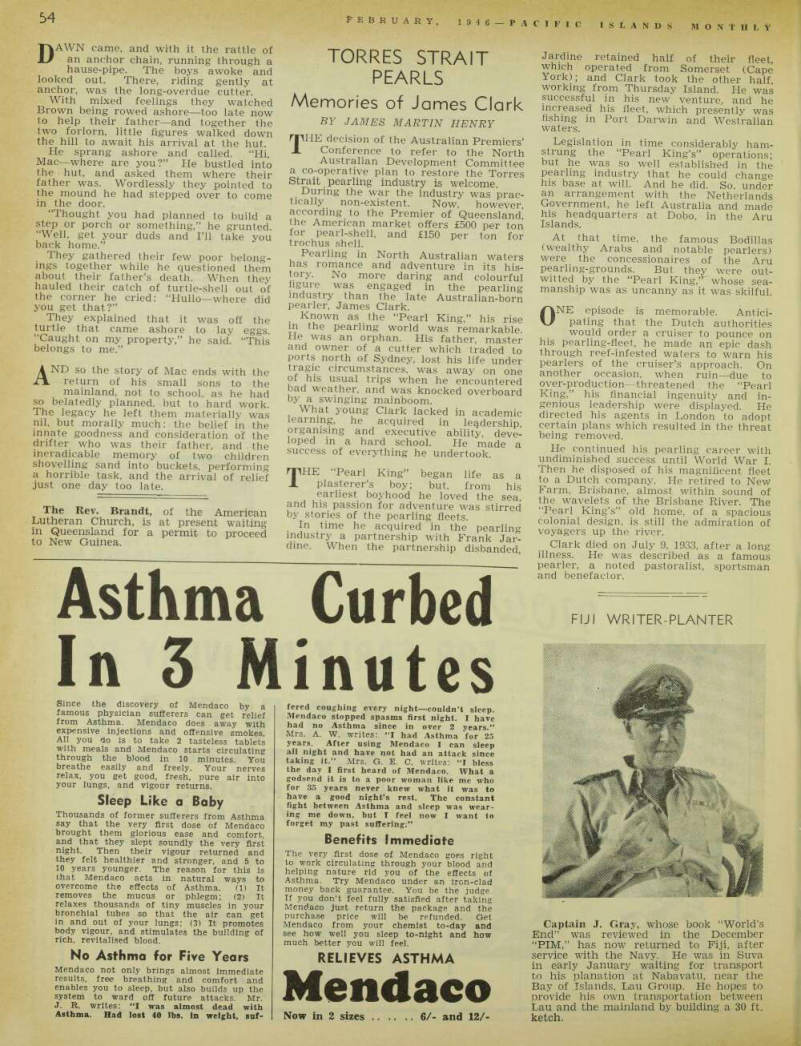
By A. Cross
THIS is a story of old Fiji, of my friend Mac—and the working of a malign Fate.
Mac was the son of a planter, born at a time when planting coconuts was profitable; he was expensively educated abroad. Not until his father was dead, and he was a young man fully grown did he return to the land of his birth and to an inheritance that was large: a coconut plantation on an isolated island and credit in the local bank.
He was easy-going and good natured in a way known only to the sons of rich men, and the friends he made were many, and eager to teach him the more pleasant ways of the tropics. He put up at the best hotels, saw his plantation seldom, and made free use of his cheque book both for himself and to finance his friends, who grew in number and in creased in demands, even as his bank balance decreased.
So, one day, as was inevitable, Mac found himself thrown back on the world with a college education, expensive tastes and an inheritance that had gone on the tropic breeze and was no more. Without money to ease his way through life, and suddenly bereft of friends, who now found business elsewhere, he became a first-class drifter, finally coming to rest as an overseer on a plantation.
During this period, he married a native woman of high caste, with land of her own, and by whom he had two children.
Many years passed, his wife died, and then, with his children almost grown, he began once more the old habit of physical and mental drift.
Again he married, this time to a woman who had as few roots as Mac himself, and they finally settled down on a small piece of land within sight of the island-pantation that Mac himself had owned. It seemed to please him to let his eyes wander over the outline of the distant island, and at the same time point out to his children the evils that befall one through bad companions and extravagance.
AFTER his second wife died he tried to do his best for her two sons; but what small ties he had had in the district were broken and he wandered from one job to another, taking the children with him. As well as they were able, they kept house for him, but they learned, too, the native arts; to keep a fire going for months without matches by banking the logs with ashes; to throw an unerring spear into a school of fish; to dig for wild yams; to be children of the natural environment in which they lived. In the evening Mac would bring out books and pencils, and by the light of an old oil lamp would teach the boys to read and write.
When Jim was 12 years old and George nine, a certain gentleman—we will call him Brown—offered Mac a job of plant
ing up a small island with coconuts.
Affairs in the Mac menage had been go ing more ill than was even usual, and the job was accepted without much questioning, a contract drawn up and and he and his two small sons 'embarked on Brown’s cutter for their new home.
The island was miles off the beaten track of any shipping, one of the most god-forsaken, isolated spots in an ocean famous for its tiny islands and atolls, scattered far from the haunts of civi lisation. It was perhaps 50 acres in extent, encircled by beaches of fine, white sand, behind which, in some places, towered limestone cliffs full of dry, sandy caves, the home of a tiny native bat no larger than a butterfly. Dense under growth covered the island —wild plan tains, citrus, a few welcome breadfruit trees and coconuts planted by visiting natives on turtle fishing expeditions.
There was a grass hut for their shelter and a small spring to supply them with water, and here on this island outpost they were put ashore with sufficient stores to last them three months.
THE days of the father and his sons were full of hardship and toil.
Together they would cut the under brush and clear the land with long cane knives until their hands were blistered and then gather the sprouting coconuts and plant them in rows, each small tree a measured distance from its neighbour to prevent overcrowding when they should, at last, be grown into tall, grace ful palms.
For diversion they collected turtle shell. The island was the breeding-place for huge shell-bearing turtles that waddled ashore to deposit their eggs, and under the guidance of Mac the lads soon learned the art of turning them helplessly on their backs. Turtle eggs and turtle steak made a welcome change from their monotonous diet, and the valu able shell was saved carefully against the day when they should return to civilisation and be able to convert it into cash.
But Mac himself was not well. For years he had been a martyr to malaria and elephantaisis; one leg and one arm were swollen to twice normal size. And now his attacks became more frequent, and he would be forced to retire to their miserable shack, turn into bed with all their stock of blankets upon him and dose himself with aspirin and quinine.
During these periods the children carried on the job of weeding and planting alone, stopping only long enough during daylight hours to brew their father hot lemon drinks or to spear a fish to make him nourishing soup.
Days became weeks, and the weeks months, but still no sign of the returning cutter rewarded their sometimes thrice daily climbs to the knoll behind the hut, from whose summit a huge expanse of ocean could be seen. The cutter was long overdue; they lived on boiled plan tains and fish, their tea, sugar and other foodstuffs having finished long ago.
Mac's medicine was finished also, and now, without his drugs, his attacks of fever became more frequent, more weakening and of greater length.
Still they plodded on, planting, weed ing and clearing when they could and adding to the store of turtle shell. “Some thing towards getting you lads fitted out for school," Mac would say. Weak and foolish in his youth, a drifter still, he was to the two boys all that was fine
and great in a man. He was their fount of knowledge, their world.
But soon old Mac took to his bed again, in a more severe attack than any he had suffered previously. He alter nately shivered and burned with fever while the boys boiled water and filled empty bottles in an endeavour to bring heat and relief to the shaking limbs; or cooked soup that would give him strength.
ON the third day of his illness he asked them to make up a bed for him on the floor just near the front door of the hut—“so as to get some fresh air,” he explained—and when it was finished they lifted him on to it. “And now,” he said, “I want you to dig me a deep trench beside the door—l will tell you why later.”
Obediently, but not understanding, the boys began to dig, excavating a hole in the sand 8 ft. long, which hourly grew deeper. When they came inside for rest periods, Mac woud ask them how deep it was and urge them on to fresh efforts.
He wanted it for a well, he said.
This they could scarcely believe, as they had no use for a well, but Mac had a way of exacting unquestioned obedience and the boys dug on until late after noon when, standing at the bottom, they could no longer see over the rim of it.
It was sufficient for the time being, Mac told them—George could go now and spear a fish for supper.
The lad bounded away, glad to be re leased from monotonous sand-shifting, and Mac called the elder lad to him.
“Jim,” he said, “I wanted you alone. I must say what I want while there is still time. My boy, I am going to leave you.
I know this attack is the last—l have no strength to fight it off. My hours are numbered. That is why I made you both dig that hole. It is my grave.”
Horror looked out of the child’s eyes.
He clung to the man’s wasted hands, crying his father’s name.
“You are the elder, son,” Mac told him. “You must face this and help George to face it, too. Listen, now —if when you should call me I fail to answer you will know someone else has called and that I have gone to His bidding.
Don’t disturb me, but leave me a while.”
He explained to the boy the signs of rigor mortis and directed him to bury him in the grave he and George had dug that day. Jim could reply only with sobs.
“The turtle shell is to be used for your schooling—and the balance of the wages due to me, too. When Brown comes, collect from him, and, when you can, strike back to some township and get a bit of schooling for your brother and yourself. The rest of your life, son, depends on yourself. Never forget that a man’s best friend is his pocket and never be afraid of honest work. I wish that I could leave you more, but it is no use having regrets at this stage.
“Now, run along and get George, and see that the fish is cooked for me.”
OBEDIENTLY, his eyes streaming, Jim stumbled off to the beach, where he threw himself down in a fury of weeping at the thought of the task he had promised that he would do for his father. He had never seen death, but the idea filled him with horror and that such a thing could happen to his beloved father was almost beyond belief.
The paroxysm of weeping past, he tried to comfort himself. His father was weak and low-spirited from his illness, the lateness of the boat and lack of proper medicine. He sat up, wiped the tears away with his hand and it was so George found him, telling him of the large sea-crab he had secured.
Together they went back to the hut.
“Father, we’ve caught you a crab as well
as some fish,” George called through the door. But there was no reply.
Suddenly panic-stricken, Jim pushed past him. He had not looked upon death before, but he realised that he looked upon it now, and that the old man had been thoughtful to the last in sending him away on a pretext so that he should not witness his father’s end.
He took his young brother’s hand and led him away up the knoll behind the hut, and there, with the wide sweep of empty sea before them, he told him that their father was at rest and that they must now carry on alone. The younger boy was heart-broken, and, together on that lonely hill-top, the two children wept together. Tropic sunshine never fell upon a more desolate pair.
At last they returned to the hut, Jim mindful of his father’s last instructions.
They lined the grave with ferns, and, sobbing bitterly, lowered the big form into it, covering his body with their few pitiful blankets in order that the sand should not touch it.
It was dusk by the time the grave was filled-in and crowned with stones. Sadly they went into the now empty hut, but the sight of the bed alongside the open door was more than could be borne. They fled, filled with a nameless terror, until they came to the opposite side of the island, where they crept into a cave, and, locked in each other’s arms, cried them selves into an exhausted sleep.
(Continued on Next Page)
DAWN came, and with it the rattle of an anchor chain, running through a hause-pipe. The boys awoke and looked out. There, riding gently at anchor, was the long-overdue cutter.
With mixed feelings they watched Brown being rowed ashore—too late now to help their father—and together the two forlorn, little figures walked down the hill to await his arrival at the hut.
He sprang ashore and called. “Hi, Mac—where are you?” He bustled into the hut, and asked them where their father was. Wordlessly they pointed to the mound he had stepped over to come in the door.
“Thought you had planned to build a step or porch or something,” he grunted.
“Well, get your duds and I’ll take you back home.”
They gathered their few poor belong ings together while he questioned them about their father’s death. When they hauled their catch of turtle-shell out of the corner he cried: “Hullo—where did you get that?”
They explained that it was off the turtle that came ashore to lay eggs.
“Caught on my property,” he said. “This belongs to me.”
AND so the story of Mac ends with the return of his small sons to the mainland, not to school, as he had so belatedly planned, but to hard work.
The legacy he left them materially was nil, but morally much: the belief in the innate goodness and consideration of the drifter who was their father, and the ineradicable memory of two children shovelling sand into buckets, performing a horrible task, and the arrival of relief just one day too late.
The Rev. Brandt, of the American Lutheran Church, is at present waiting in Queensland for a permit to proceed to New Guinea.
Advertisements & other items, pp. 52-53 (2 items)
52
FEBRUARY, 1946 PACIFIC ISLANDjS MONTHLY
/Array
SE s
LOTI
F«r Ibluiml £▼•• wtdl EnlUa
■ OLD EVEITWIKII
H. A. W»»» 4 C«. rty. LtL. Klm t- iorrfaw
(WfiA W
FOR
Built to the same rigid specifications of quality and workmanship as laid down by the Army, the new LANRAY Line of Metal Products for civilian requirements is going to mean big business for dealers throughout Australia. Place your order NOW for— LANRAY Kerosene Pressure Stoves and Blow Lamps Holloware Light Fittings Key Blanks Industrial Reflectors.
EARLY DELIVERY OF
/ARRAY
METAL PR O DUCTS PTY. LTD.
METAL PRODUCTS FOR
CIVILIAN USE
Distributors LANCE RAYMOND Pty. Ltd.
m 11-19 Hargrave St., Sydney Phone FL 3132 i * and of King House, Queen St.
Brisbane
LANRAY DISTRIBUTORS
Temple Court, Collins St., Melbourne
Torres Strait
Pearls
Memories of James Clark
By James Martin Henry
The decision of the Australian Premiers’
Conference to refer to the North Australian Development Committee a co-operative plan to restore the Torres Strait pearling industry is welcome.
During the war the industry was prac tically non-existent. Now, however according to the Premier of Queensland’ the American market offers £5OO per ton for pearl-shell, and £l5O per ton for trochus shell.
Pearling in North Australian waters has romance and adventure in its his tory. No more daring and colourful figure was engaged in the pearling industry than the late Australian-born pearler, James Clark.
Known as the “Pearl King,” his rise m the pearling world was remarkable.
He was an orphan. His father, master and owner of a cutter which traded to ports north of Sydney, lost his life under tragic circumstances, was away on one of his usual trips when he encountered bad weather, and was knocked overboard by a swinging mainboom.
What young Clark lacked in academic learning, he acquired in leadership, organising and executive ability, deve loped in a hard school. He made a success of everything he undertook.
THE “Pearl King” began life as a plasterer’s boy; but, from his earliest boyhood he loved the sea, and his passion for adventure was stirred by stories of the pearling fleets.
In time he acquired in the pearling industry a partnership with Frank Jar dine. When the partnership disbanded,
Jardine retained half of their fleet, which operated from Somerset (Cape York); and Clark took the other half, working from Thursday Island. He was successful in his new venture, and he increased his fleet, which presently was fishing in Port Darwin and Westralian waters.
Legislation in time considerably ham strung the “Pearl King’s” operations; but he was so well established in the pearling industry that he could change his base at will. And he did. So, under an arrangement with the Netherlands Government, he left Australia and made his headquarters at Dobo, in the Aru Islands.
At that time, the famous Bodillas (wealthy Arabs and notable pearlers) were the concessionaires of the Aru pearling-grounds. But they were out witted by the “Pearl King, ,T ~whose sea manship was as uncanny as it was skilful.
ONE episode is memorable. Antici pating that the Dutch authorities would order a cruiser to pounce on his pearling-fleet, he made an epic dash through reef-infested waters to warn his pearlers of the cruiser’s approach. On another occasion, when ruin—due to over-production—threatened the “Pearl King,” his financial ingenuity and in genious leadership were displayed. He directed his agents in London to adopt certain plans which resulted in the threat being removed.
He continued his pearling career with undiminished success until World War I.
Then he disposed of his magnificent fleet to a Dutch company. He retired to New Farm, Brisbane, almost within sound of the wavelets of the Brisbane River. The “Pearl King’s” old home, of a spacious colonial design, is still the admiration of voyagers up the river.
Clark died on July 9, 1933, after a long illness. He was described as a famous pearler, a noted pastoralist, sportsman and benefactor.
Fiji Writer-Planter
Captain J. Gray, whose book “World’s End” was reviewed in the December “PIM,” has now returned to Fiji, after service with the Navy. He was in Suva in early January waiting for transport to his planation at Nabavatu, near the Bay of Islands, Lau Group. He hopes to provide his own transportation between Lau and the mainland by building a 30 ft. ketch.
Advertisements & other items, p. 54 (1 item)
Asthma Curbed
In 3 Minutes
Since the discovery of Mendaco by a famous physician sufferers can get relief from Asthma. Mendaco does away with expensive injections and offensive smokes.
All you do is to take 2 tasteless tablets with meals and Mendaco starts circulating through the blood in 10 minutes. You breathe easily and freely. Your nerves relax, you get good, fresh, pure air into your lungs, and vigour returns.
Sleep Like a Baby
Thousands of former sufferers from Asthma say that the very first dose of Mendaco brought them glorious ease and comfort, and that they slept soundly the very first night. Then their vigour returned and they felt healthier and stronger, and 5 to 10 years younger. The reason for this is that Mendaco acts in natural ways to overcome the effects of Asthma. (1) It removes the mucus or phlegm; (2) It relaxes thousands of tiny muscles in your bronchial tubes so that the air can get in and out of your lungs; (3) It promotes body vigour, and stimulates the building of rich, revitalised blood.
No Asthma for Five Years
Mendaco not only brings almost Immediate results, free breathing and comfort and enables you to sleep, but also builds up the system to ward off future attacks. Mr.
J. R. writes: “I was almost dead with Asthma. Had lost 40 lbs. In weight, snf-
fered coughing every night—couldn’t sleep.
Mendaco stopped spasms first night. I have had no Asthma since in over 2 years.”
Mrs. A. W. writes: “I had Asthma for 25 years. After using Mendaco I can sleep all night and have not had an attack since taking it.” Mrs. G. E. C. writes: “I bless the day I first heard of Mendaco. What a godsend it is to a poor woman like me who for 35 years never knew what it was to have a good night’s rest. The constant fight between Asthma and sleep was wearing me down, but I feel now I want to forget my past suffering;”
Benefits Immediate
The very first dose of Mendaco goes right to work circulating through your blood and helping nature rid you of the effects of Asthma. Try Mendaco under an iron-clad money back guarantee. You be the judge.
If you don’t feel fully satisfied after taking Mendaco just return the package and the purchase price will be refunded. Get Mendaco from your chemist to-day and see how well you sleep to-night and how much better you will feel.
RELIEVES ASTHMA
Mendaco
Now in 2 sizes 6/- and 12/-
Restocking New Guinea
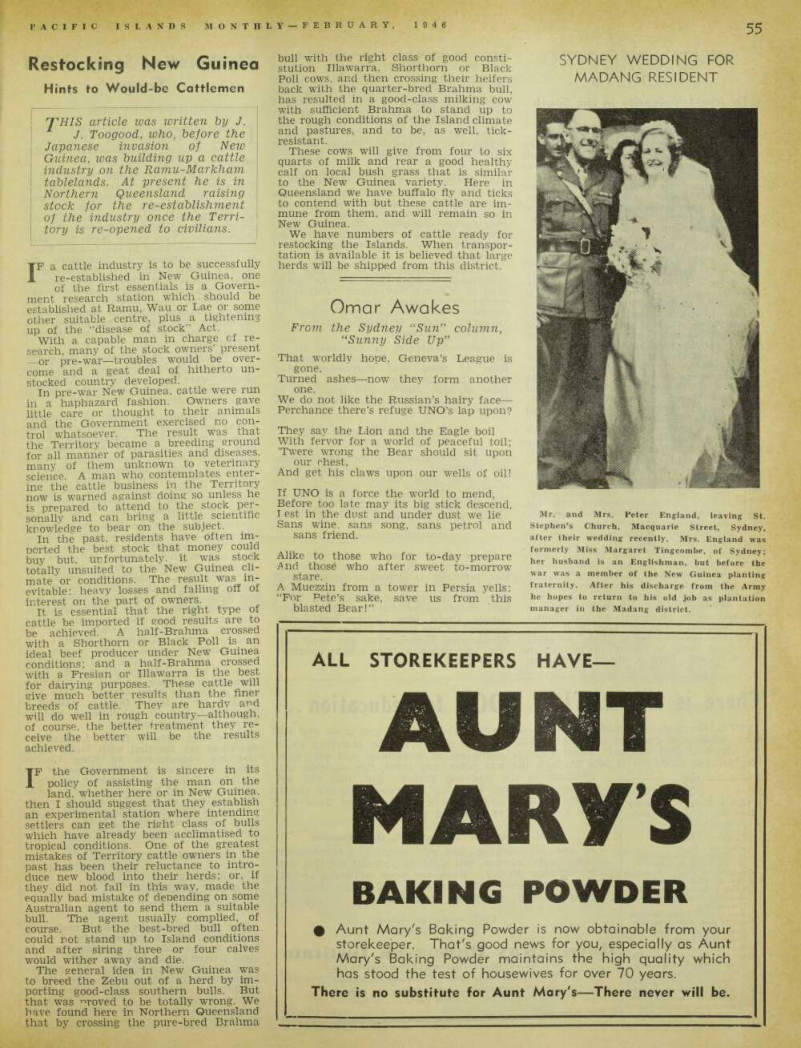
Hints to Would-be Cattlemen
'THIS article was written by J.
J. Toogood, who, before the Japanese invasion of New Guinea, was building up a cattle industry on the Ramu-Markham tablelands. At present he is in Northern Queensland raising stock for the re-establishment of the industry once the Terri tory is re-opened to civilians.
IF a cattle industry is to be successfully re-established in New Guinea, one of the first essentials is a Govern ment research station which should be established at Ramu, Wau or Lae or some other suitable centre, plus a tightening up of the “disease of stock” Act.
With a capable man in charge cf re search, many of the stock owners’ present —or pre-war—troubles would be over come and a geat deal of hitherto un stocked country developed.
In pre-war New Guinea, cattle were run in a haphazard fashion. Owners gave little care or thought to their animals and the Government exercised no con trol whatsoever. The result was that the Territory became a breeding around for all manner of parasities and diseases, many of them unknown to veterinary science. A man who contemplates enter ing the cattle business in the Territory now is warned against doing so unless he is prepared to attend to the stock per sonally and can bring a little scientific knowledge to bear on the subject.
In the past, residents have often im ported the best stock that money could buy but. unfortunately, it was stock totally unsuited to the New Guinea cli mate or conditions. The result was in evitable: heavy losses and falling off of interest on the part of owners.
It is essential that the right type of cattle be imported if good results are to be achieved. A half-Brahma crossed with a Shorthorn or Black Poll is an ideal beef producer under New Guinea conditions; and a half-Brahma crossed with a Fresian or Illawarra is the best for dairying purposes. These cattle will eive much better results than the finer breeds of cattle. They are hardy and will do well in rough country— although, of course, the better treatment they re ceive the better will be the results achieved.
IF the Government is sincere in its policy of assisting the man on the land, whether here or in New Guinea, then I should suggest that they establish an experimental station where intending settlers can get the right class of bulls which have already been acclimatised to tropical conditions. One of the greatest mistakes of Territory cattle owners in the past has been their reluctance to intro duce new blood into their herds; or, if they did not fail in this wav, made the equally bad mistake of depending on some Australian agent to send them a suitable bull. The agent usually complied, of course. But the best-bred bull often could rot stand up to Island conditions and after siring three or four calves would wither away and die.
The general idea in New Guinea was to breed the Zebu out of a herd by im porting good-class southern bulls. But that was "roved to be totally wrong. We have found here in Northern Queensland that by crossing the pure-bred Brahma
bull with the right class of good consti stution Illawarra, Shorthorn or Black Poll cows, and then crossing their heifers back with the quarter-bred Brahma bull, has resulted in a good-class milking cow with sufficient Brahma to stand up to the rough conditions of the Island climate and pastures, and to be, as well, tick resistant.
These cows will give from four to six quarts of milk and rear a good healthy calf on local bush grass that is similar to the New Guinea variety. Here in Queensland we have buffalo fly and ticks to contend with but these cattle are im mune from them, and will remain so in New Guinea.
We have numbers of cattle ready for restocking the Islands. When transpor tation is available it is believed that large herds will be shipped from this district.
Omar Awakes
From the Sydney “Sun” column,
“Sunny Side Up”
That worldly hope, Geneva’s League is gone, Turned ashes—now they form another one.
We do not like the Russian’s hairy face — Perchance there’s refuge UNO’s lap upon?
They say the Lion and the Eagle boil With fervor for a world of peaceful toil; ’Twere wrong the Bear should sit upon our chest, And get his claws upon our wells of oil!
If UNO is a force the world to mend, Before too late may its big stick descend, l est in the dust and under dust we lie Sans wine, sans song, sans petrol and sans friend.
Alike to those who for to-day prepare £nd those who after sweet to-morrow stare, A Muezzin from a tower in Persia yells: “For Pete’s sake, save us from this blasted Bear!”
Sydney Wedding For
Madang Resident
Mr. and Mrs. Peter England, leaving St.
Stephen’s Church, Macquarie Street, Sydney, after their wedding recently. Mrs. England was formerly Miss Margaret Tingcombe, of Sydney; her husband is an Englishman, but before the war was a member of the New Guinea planting fraternity. After his discharge from the Army he hopes to return to his old job as plantation manager in the Madang district.
Advertisements & other items, p. 55 (1 item)
Marys
ALL STOREKEEPERS HAVE—
AUNT
BAKING POWDER
Aunt Mary's Baking Powder is now obtainable from your storekeeper. That's good news for you, especially as Aunt Mary's Baking Powder maintains the high quality which has stood the test of housewives for over 70 years.
There is no substitute for Aunt Mary's—There never will be.
Tourists
Some Advice To
To Avoid Vulgarity in the South Seas
Ratatea, Nov. 12.
UNITED States soldiers, on duty abroad, were supplied with a book of instructions on how to behave in foreign countries.
Now that the tourist traffic to the South Seas is soon to be resumed, a few items of instruction on how to behave in Polynesia may be of value to pros pective travellers,
Pointers For Male Tourists
1- —Do not imagine that a Polynesian girl, who happens to be smiling when she glances at you, is a strumpet. South Sea Island girls are usually smiling at their own thoughts and are, probably, not thinking about you at all. Few Poly nesian women are strumpets—Hollywood and the crack-pot writers to the con trary, notwithstanding. 2.—lf you are looking for that sort of thing, go to the honky-tonks—that is what they are there for. But, if you do frequent the honky-tonks, bear in mind that the “thorn in the South Sea Rose” is quite as dangerous as the dorsal spines of the Nohu fish. 3 Do not barge, uninvited, into native compounds and houses. The charming South Seas hospitality you read about in books was bled to death by your pre decessors of the Notorious 1920 Decade. 4. —Do not twist bills of local currency into spills with which to light your cigar ettes. The native by-standers will not think you are a millionaire; but will con sider you an ill-mannered boor. 5. —Avoid the Islands male as you would the plague. He is usually a European who has lived in the South Seas long enough to have contracted a form of Cerebrosis, characterised by a progressive decay of the Cortex. The disease is highly infectious. 6.—When looking at light from a tropical moon glistening on the ripples of a Romantic Lagoon, keep well away from the coconut trees. Ripe coconuts are more likely to fall at night than in the day-time. Such a missile, landing on
one’s occiput—after a drop of 70 feet— will seriously damage romance. 7- —Bathing in the lagoon may wreck it irrevocably. The Nohu fish—half buried in the sand, the hollow needles of his dorsal spine poised to inject virulent venom into your foot—is lying in wait.
So are numerous other denizens—equally unpleasant. Prudent peope do not bathe in coral lagoons.
Advice To Women Tourists
1-—Never, never, never dance the Hula —unless you have a good working know ledge of the ribald colloquialism in the Polynesian language. You will then comprehend what the bystanders are saying, and will never repeat the per formance. 2. —Never appear in the costume of a Hollywood Bathing Girl on the public road of a South Sea island. Polynesian women never expose their bodies. They consider such exposure the height of vulgarity—again, Hollywood to the con trary notwithstanding. 3. —Never assume a superior air of patronage toward Polynesian women.
Bear in mind that Polynesian ladies trace their genealogy through genera tions of high chiefs, into the mists of time. You can trace your ancestry only to the Barbary Ape.
Advice To Both Men And
Women Tourists
1. —Good manners are the rule through out Polynesia. Do not, therefore, leave your own good manners at home in Gophers Corners, when you voyage to the South Sea Islands.—T.l.H.—(These initials represent the writers Polynesian name: Tauraatua-i-Hitia’a.) Major “Ted” Fulton, AIF, who was well known in New Guinea before the war, returned to Australia from Borneo in November. He enlisted a few weeks after the outbreak of World War II in 1939. He served in the Middle East, Greece, Crete, New Guinea and, lastly, attached to the British Forces in Borneo.
He married a Melbourne girl early last year, and they now have a baby daughter a few weeks old.
Blackbirding Story of Old
Tonga
Letter to the Editor I WAS interested in the “White Flying Fox at Kolovai” and “Memories of Old Tonga,” published in the May and July issues of the “PIM.”
The story of the “White Flying Fox at Kolovai” I wrote 50 years ago, and had it published in the Sydney Morning Herald, after it had been told to me by Mr. G. Skudder, a trader at Kolovai, and who was the actor of “the White Flying Fox” trick. Two years later, the same story was published in the London Times by Walter Parker, of Nukualofa, one time a sheep farmer on the Island of Eua. Parker had changed the name of the old chief to “Kata” and the trader to “Jimmy the Beachcomber,” who wanted to marry Kata’s daughter, and to obtain his consent he played “the White Flying Fox” trick on the old gentleman.
In “Memories of Old Tonga” the writer must have been misinformed, as the Ata people were not taken to Raga Iti, Tahiti, but to Chile, where they had to work in nitrate and cobalt mines.
In 1894, while on a visit to Auckland, I was invited by friends of mine to go with them to a Maori village, near Auck land, where the Maoris were having a horse-race on the beach. Here I met a native of Tonga, Isileli Latu, about 60 years of age, who was the only survivor of the ill-fated blackbirding people of Ata. The story he told me was the same as published in the “PIM.”
One day, when he was quite young, about 17 years of age, a ship called at Ata. The best of the young men pad died out in their canoes, and were en couraged on board to trade, exchanging oil, vegetables, island curios for knives, axes, spades, clothing, etc. Suddenly, the hatches closed down over their heads.
The ship sailed off. It was a black birding ship, and after several months’ sailing, they landed in Chile, where he had to work in nitrate and cobalt mines for about 15 years. Latu became ill, had to leave the mine, and was taken care of by a Catholic priest, who later obtained a passage for him on a British ship sailing for New Zealand. Latu first worked for a Maori farmer, married a Maori girl, had several children, and, as he said, felt very happy.
After my return from Auckland I described my meeting with Isileli Latu, and his experiences, to King George Tubou 11. I gave him the names of my Auckland friends, the name of the Maori village, etc., and he promised me to write to Auckland to the Government agent, to get into communication with Isileli Latu. But I am afraid it was a case of “out of sight, out of mind.”
I am, etc.,
F. T. Goedicke.
Nukualofa, September 12, 1945.
The price of whisky, rum, brandy, gin and wines will be increased by 3/- per bottle as a result of a Customs amend ment passed by the Fiji Legislative Coun cil at its December meeting. It is esti mated that revenue will be increased by £24,000 per annum thereby—unless Fiji’s drinking habits fall off considerably or consumption is adversely affected by the rise in price.
Advertisements & other items, p. 56 (1 item)
There is NO RATION BOOK for education...
BUT in the post-war business world success will be rationed . . . and those who are trained and qualified in some specific business subject will be preferred for a share of that success! Those who are untrained or unqualified and who have observed the profusion of jobs through the war years may think the situation will continue in the post-war period. But, this will not necessarily be so! Now that war production has ended, many of these people will be supplanted by those who are thoroughly trained and qualified. ew H.R.I. Career Training Dept, of Acc’t’cy & C’merce Accountancy- Secretaryship Cost Acc’ncy Si Factory Mgt.
Banking and Securities Insurance Exams.
Local Government Exams.
Effective Correspondence Psychology Si Human Relatione Dept, of Distribution Selling Si Sales Management Marketing Si Advertising Retail Selling Show Card Si Ticket Writing Dept, of Bus, Administrate Business Administration Plan To-day for To-morrow’s Opportunities If you are seeking post-war security, advancement, opportunity, success, you must fit yourself for the task by training NOW! Whatever your objective in the field of business, H.R.I. can train you quickly, conveniently and with a certainty of success.
Call, write or ’phone for free information.
Modem Merchandising Fact. Mang’t. Si Foremans'll Dept, of General Education Public Service Grade, School, Police Si Nurses’ Exams.
The constantly improving standard of H.R.I. tutorial service is demonstrated byresults,for H.R I. have won more honours than all coaches in Australasia combined.
Hemingway Robertson Institute
( Founded and Owned by Hemingway & Robertson Pty. Ltd.) Professional Tutors Consulting Accountants 126 a Chalfont Chambers, 142 Phillip St., Sydney 126 a Bank House . . . Bank Place . . . Melbourne Offices in all Ca; ira| Cilit-s. Newcastle .S Lau:ueslun. 126a/747
Base
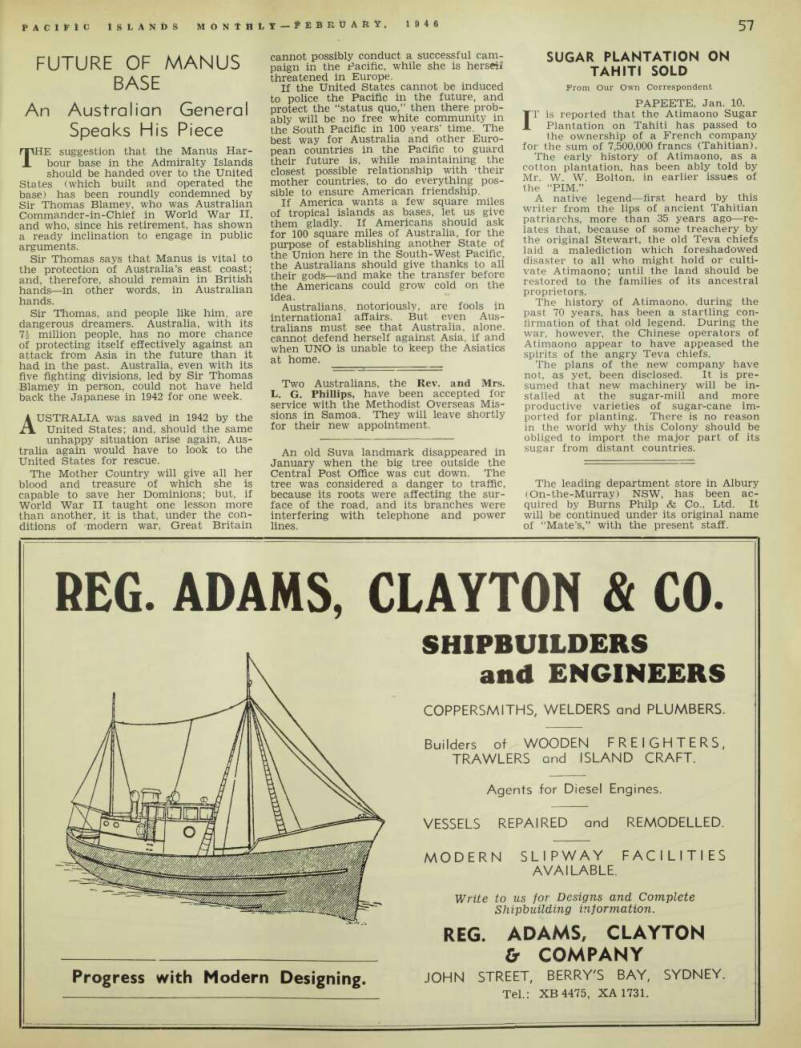
Future Of Manus
An Australian General Speaks His Piece
THE suggestion that the Manus Har bour base in the Admiralty Islands should be handed over to the United States (which built and operated the base) has been roundly condemned by Sir Thomas Blarney, who was Australian Commander-in-Chief in World War 11, and who, since his retirement, has shown a ready inclination to engage in public arguments.
Sir Thomas says that Manus is vital to the protection of Australia’s east coast; and, therefore, should remain in British hands —in other words, in Australian hands.
Sir Thomas, and people like him. are dangerous dreamers. Australia, with its 11 million people, has no more chance of protecting itself effectively against an attack from Asia in the future than it had in the past. Australia, even with its five fighting divisions, led by Sir Thomas Blarney in person, could not have held back the Japanese in 1942 for one week.
AUSTRALIA was saved in 1942 by the United States; and, should the same unhappy situation arise again, Aus tralia again would have to look to the United States for rescue.
The Mother Country will give all her blood and treasure of which she is capable to save her Dominions; but, if World War II taught one lesson more than another, it is that, under the con ditions of modern war, Great Britain
cannot possibly conduct a successful cam paign in the Pacific, while she is herseif threatened in Europe.
If the United States cannot be induced to police the Pacific in the future, and protect the “status quo,” then there prob ably will be no free white community in the South Pacific in 100 years’ time. The best way for Australia and other Euro pean countries in the Pacific to guard their future is, while maintaining the closest possible relationship with 'their mother countries, to do everything pos sible to ensure American friendship.
If America wants a few square miles of tropical islands as bases, let us give them gladly. If Americans should ask for 100 square miles of Australia, for the purpose of establishing another State of the Union here in the South-West Pacific, the Australians should give thanks to all their gods—and make the transfer before the Americans could grow cold on the idea.
Australians, notoriously, are fools in international affairs. But even Aus tralians must see that Australia, alone, cannot defend herself against Asia, if and when UNO is unable to keep the Asiatics at home.
Two Australians, the Rev. and Mrs.
L. G. Phillips, have been accepted for service with the Methodist Overseas Mis sions in Samoa. They will leave shortly for their new appointment.
An old Suva landmark disappeared in January when the big tree outside the Central Post Office was cut down. The tree was considered a danger to traffic, because its roots were affecting the sur face of the road, and its branches were interfering with telephone and power lines.
Sugar Plantation On
Tahiti Sold
From Our Own Correspondent
Papeete, Jan. 10.
IT is reported that the Atimaono Sugar Plantation on Tahiti has passed to the ownership of a French company for the sum of 7,500,000 francs (Tahitian).
The early history of Atimaono, as a cotton plantation, has been ably told by Mr. W. W. Bolton, in earlier issues of the “PIM.”
A native legend—first heard by this writer from the lips of ancient Tahitian patriarchs, more than 35 years ago—re lates that, because of some treachery by the original Stewart, the old Teva chiefs laid a malediction which foreshadowed disaster to all who might hold or culti vate Atimaono; until the land should be restored to the families of its ancestral proprietors.
The history of Atimaono, during the past 70 years, has been a startling con firmation of that old legend. During the war, however, the Chinese operators of Atimaono appear to have appeased the spirits of the angry Teva chiefs.
The plans of the new company have not, as yet, been disclosed. It is pre sumed that new machinery will be in stalled at the sugar-mill and more productive varieties of sugar-cane im ported for planting. There is no reason in the world why this Colony should be obliged to import the major part of its sugar from distant countries.
The leading department store in Albury (On-the-Murray) NSW, has been ac quired by Burns Philp & Co., Ltd. It will be continued under its original name of “Mate’s,” with the present staff.
Advertisements & other items, pp. 57-58 (3 items)
57
pacific islands MdNtHLT February, iH 6
Reg. Adams, Clayton & Co.
n? □ o
Progress with Modern Designing.
SHIPBUILDERS
and ENGINEERS
COPPERSMITHS, WELDERS and PLUMBERS.
Builders of WOODEN FREIGHTERS
TRAWLERS and ISLAND CRAFT.
Agents for Diesel Engines.
VESSELS REPAIRED and REMODELLED.
MODERN SLIPWAY FACILITIES
AVAILABLE.
Write to us for Designs and Complete Shipbuilding information.
REG. ADAMS, CLAYTON
Cr COMPANY
JOHN STREET, BERRY'S BAY, SYDNEY.
Tel.: XB 4475, XA 1731.
m ft
peats
fre/uttoC
&6z4ft&M, Si
$ l: : ; 1
asrss 5 * >
ijSr.f*
r " S '*' one K" ,n9 °* n , t u ,s on ° ne n 1 quo' 1 .»"” a .•'" „»»>••■ ?“ I wotet < ony pos' 1 . c or' ie<l fuel-* 60 ''
..thou' *
rr^vss
to ° „t and fOS t-P' 00 * Q v ftintu* other »yP es \l 'I %N *>=**> . >!
Poftr^ N
Day offer day, week
after week, for over
40 years Coleman's
have specialised in
making Stoves and
Lamps. Is it any
wonder, then, that
their products give
the utmost in satis-
faction and service.
Thi & tWn L sfoy e tQ . Ur ner . ,n 9 °nd T' es oo p S°? tr °l t o * ' nsf on H ofet y *hut. Q ff an y d Unn ece 5Sn y °lye , e och *• SSQ ry t Has ' me sf oy e /, , rC ‘ /or so 7 foe ' 9 Al„d e ® eo* y ' P'ooFJ b . fv ®rd u / i*On, bat <cd >ri /6 7 ° nd br ° / Weir, Representatives for the Pacific Islands:
ROBERT GILLESPIE PTY. LTD.
54a PITT STREET, SYDNEY
PEARCE & CO. LTD,
SUVA
FOR FIJI ISLANDS
58
PEB&trAfcV, 1946-tACIFIC ISLANDS MONtHLt
History
Ambon's Place In Western Pacific
Link Between Dutch and British Extends Over Four Centuries
By A. G. Miller
THE trial and punishment of Japanese war criminals at Ambon recalls a curious footnote to history.
It is a far cry from London to the Moluccas, still farther from James I to Hirohito. But the infamous “Amboina Massacre” embittered Anglo-Dutch rela tions for half a century, while the minor role played by Japanese is a startling reminder of infiltration into the Indies 300 years ago.
The English were late-comers to the fabulous Spice Islands. A Portuguese squadron reached Ternate, a tinv vol canic island off the west coast of Halma hera in 1514. Forts and “factories” were built at various points in the Moluccas.
Spices—pepper, nutmeg, and cloves— brought enormous profits to daring ad venturers. The survivors of Magellan’s expedition, for instance, sold their cargo of cloves to Seville merchants at a profit of 2,500 per cent.!
Naturally, Europeans did not care to share this El Dorado with all-comers.
The Dutch drove the Portuguese from Ternate in 1574, five years before Francis Drake’s “Golden Hind” anchored there.
However, the Portuguese retained foot holds on Tidore, a few miles from Ter nate, and on Ambon until 1605. English and Spanish traders still threatened the Dutch monopoly. The latter seized the abandoned Portuguese fort at Tidore, while the East India Company opened a factory at Cambello (Ambon) in 1615.
BITTER rivalry led to distrust and intrigue. Eight years passed before an open breach developed on Am bon, an island three times the size of Malta. The English staff, about a dozen in all, were arrested by Dutch soldiers.
They were charged with conspiring with Japanese soldiers to attack the Dutch fort, and also with storing up revolts on Ceram and Run. It is not quite clear what the Japs were doing in the Moluccas, but they appear to have escaped punishment.
Hollanders were ruthless where trade was concerned, and their Ambon agents were no exception to this rule. Evidence against the unlucky factors and clerks was flimsy, so the prisoners were put to the torture. Some were given the “water treatment”: water was poured down their throats until they choked.
Others merely had lighted candles held under their armpits. The rack, that reliable aid to justice, does not seem to have been available.
No wonder the unfortunate prisoners “confessed.” Ten were promptly executed —and the spice trade saved for the shareholders of the Netherlands East Indies Company.
NEWS of this atrocity caused great in dignation in England. Had a Tudor sat on the throne, prompt action might have been taken. But James I and Charles I both failed to take action against the Dutch.
The “massacre” rankled in English memories for 30 years. After the Civil War, Oliver Cromwell’s strong hands beat the dust from the yellowed files. In December, 1653, the Lord Protector for mally demanded satisfaction from Hol land’s all-powerful Eastern monopoly.
No longer wracked by internal strife, England was in a position to pursue a vigorous foreign policy, with the back
ing of the New Model Army and a powerful Navy.
Victories over the Dutch Fleet in June and July had raised the Commonwealth’s prestige to a high level. Yet Cromwell did not rely on the threat of force: he was perfectly willing to allow Swiss arbi trators to decide the issues should a joint panel of Anglo-Dutch experts disagree.
For once, intervention by a third party proved quite unnecessary. Relatives of the murdered men received compensation to the tune of £3,615, while the English company accepted £85,000, which included damages for the loss of Pularoon, its last remaining post in the Spice Islands. As for the officials responsible for this out rage, the records are silent—it is pos sible that they were no longer alive.
Despite Cromwell’s action, the ghosts of these poor fellows continued to haunt London’s counting-houses and taverns.
In 1673. with another Stuart on the British throne. John Dryden, famous playwright and poet, produced his tragedy, “Amboyna, or the Cruelties of the Dutch to the English Merchants.”
Another war had been fought with Hol land since the Restoration, and the dramatist may have felt he was on solid ground as regards box-office receipts.
“ JOHN COMPANY” never recovered J the lost factories in the Spice Islands, yet strategic Ambon has been twice under the Union Jack. A French invasion of the Low Countries, following on the Terror, obliged the Royal Navy to seize ports in the Nether lands East Indies. French warships and privateers could not be permitted to re fit in Dutch colonial harbours, so Admiral Rainier’s squadron captured Ambon in 1796.
Six years later, all occupied territory was handed back to Holland under the terms of the Peace of Amiens. This un easy truce did not last long; Napoleon merely wanted a breathing space before turning armies loose on Europe. Despite Nelson’s victory at Trafalgar, the block
ade of Occupied Europe was the Navy’s primary job.
Not until February, 1810, did three British frigates capture the island of Ambon, a step which added to the security of the young colony of New South Wales.
WITH the collapse of Napoleon’s bayonet-built empire, Stamford Raffles’ wise rule of the East Indies came to an end. Once again the Eng lish redcoats withdrew to their transports, turning their backs on an empire as rich as India. British headstones and memorial tablets remained behind to keep company with relics of the first occupation of Ambon.
The gallant stand at Ambon of Aus tralia’s small, poorly-equipped “Gull force” in January-February, 1942, en sures the island a lasting place in Aus tralian history. After Japan’s surrender, it was fitting that Australian troops should be the first to land, marking the fourth occasion on which British Forces have aided both Dutch and Ambonese in a time of dire peril.
Perhaps some sentry, on a still and moonless night, has heard faint whisper ings from the ancient fort, and ghostly voices muttering, not of forgotten wrongs by forgotten men, but of Japanese bar barity enacted on a scale that makes the original “Amboina Massacre” a tiny foot note to history.
Mademoiselle Simone Legras, daughter of Monsieur and Madame Legras, of Noumea, New Caledonia, was married on January 5 at the Noumea Cathedral, to Mr. Ronald Loubert, of Maine, USA. The bride’s father is the owner-editor of Noumea’s newspaper.
Advertisements & other items, p. 59 (1 item)
Mcilrath’S
PACIFIC ISLANDS SOCIETY
Visitors from the Islands to Sydney (or those interested in Islands affairs), are advised to communicate with the honorary secretary of the above Society, which has been formed to study the history, traditions, economics, and political developments of the Pacific Islands.
Regular monthly meetings are held at History House, 8 Young Street, Sydney.
Address for Correspondence:
THE PACIFIC ISLANDS SOCIETY.
Box 2434 MM., G.P.0., Sydney.
McILRATH’S
FOR
High Quality Food
at Bedrock Prices Orders and enquiries to—
McILRATH’S PTY. LTD.
Export Department,
202 PITT ST., SYDNEY, AUSTRALIA
More Ships For
Tahiti
But European Visitors Not Wanted
From Our Own Correspondent
Papeete, Jan. 12.
WE are informed that the Union Steamship Company of NZ is put ting freight steamers on the San Francisco-Papeete-New Zealand route, so that we shall have, approximately, a monthly service. There will be no pas senger accommodation on these steamers.
Even if passengers were carried to Tahiti, there would be no place for them to lodge when they arrived. The hous ing shortage is so acute that local people, whose leases are about to expire, are in great difficulty as to where they will find new abiding-places.
Moreover, no person is permitted to tarry on Tahiti, except by special per mission of the Governor. No foreigner is allowed to buy land in the Colony.
The outer islands are closed absolutely against visit or settlement by anyone— except actual natives of the several islands so interdicted. rE younger generation of Polynesians in French Oceania are modern, sophisticated, well educated (most of them speak French and English), and, as full citizens of France, they are politic ally conscious. They look with critical eyes on every newcomer and judge him (or her) with uncanny accuracy. Readers of crack-pot South Sea literature should note that the Tahitian word for a white person is “papaa”—which means, “a crab.” The while visitor is, in every case, regarded as a crab (crawling ashore from the sea), until he proves himself (or herself) worthy to rank as a mem ber of the human race.
An expedition to the early morning market would establish, beyond cavil, that the old story of cheap provender in the South Seas is a myth. This concerns the foodstuff of the Islands. The average visitor to the Islands derives most of his sustenance from tins, bearing enticing labels, imported expensively from far countries.
The Bonins
Jop Base That May Now be American
ALTHOUGH the question of American bases in the Pacific is still ruffling the pellucid waters of early peace at irregular intervals—so far without anything definite being done—it does seem likely that the United States will be permitted to retain those islands and territories held formerly by the Japan ese. These are, the Marshalls, the Marianas, the Carolines, Volcano Islands and the Bonins.
Of all of these—from the point of view of keeping an eye on Japan—the Bonins, only 500 miles from the Japanese main land, are the most valuable strategically, and possibly the least known.
Economically, their value is almost nil.
All 20 of them are volcanic in origin, most of them are small, and only three are inhabited. The name Bonin is sun nosed to have been derived from the Japanese words “Bu-nin Jima”—meaning “without people”—the name given the group by castaway Jap fishermen in the 17th century.
The islands were discovered, lost, and then rediscovered many times by adven turers up to the beginning of the 19th century, since when they have remained permanently upon our maps. The Japan ese knew of their existence for centuries and some attempts were made to colonise them: but during their era of voluntary seclusion the Bonins were practically cut off from them and they were almost forgotten.
In the 17th and 18th centuries, the Portuguese and Dutch are believed to have visited the group, and in 1823 came Captain Coffin, an American whaling captain, who called at the southern islands. His visit had only one result— it aroused the interest of the British, who immediately despatched a survey ship, the “Blossom,” in command of Captain Beechev. who took formal pos session of the islands in the name of his king, by nailing a copper sheet upon a tree.
The following year, a Russian warship called. The captain of this ship immedi ately took possession, for the Czar of the time.
Six years later the first inhabitants arrived—five Europeans (two of them American and one English) and 25 Hawaiians. Thev brought seeds, which they planted, and a Union Jack which they hoisted. They apparently considered themselves the beginning of a British colony, but the British Government gave them no help in the way of supplies or protection; one of the five Europeans governed the settlement after a fashion but thev were virtually independent of any nation.
THIS was the state of affairs when Commodore Perry went that way Perry was a century before his countrymen in his interest in Pacific bases, and the Bonins had long appealed to him as excellent for United States purposes.
He visited the “British” settlement on Peel Island; observed that the land was fertile, the climate excellent, the water supply adequate and that the harbour at Port Lloyd sufficient for most purposes.
He noted, further, that the people vir tually owed allegiance to no one and he thereupon bought from one of them, an American, Nathaniel Savory, a piece of land for $5O and appointed Savory United States agent.
Again the British were roused from their lethargy and an account of Perry’s dealing with islanders who were “held to be British” was demanded. There was a series of exchanges between Britain and America on the subject, while Perry at home tried to arouse interest in the Bonins as an American base. The States were, however, drifting rapidly towards civil war at this time, and no one was particularly interested in acquiring over seas bases in the Pacific or anywhere else Once America lost interest, England lapsed once more into her customary apathy and the Bonins were again neglected and forgotten.
Japan now emeged from seclusion and made the next move. The Jananese Government announced suddenly in November, 1875, that the Bonins had never been anything else but a Japan ese possession and that a ship was about to leave for the Group.
Britain, roused to action, despatched a warship. HMS “Curlew,” immediately, but when it arrived the Japanese had al ready occupied the islands in force. • were 5.000 people on the three inhabited islands in 1937. They grew sweet potatoes, onions, sugar cane; and maintained a fishing industry. Surplus products were exported to Japan in ex chane-e for rice and other staple foods Almost a hundred years have passed since Commodore Perry gave Nathaniel Savory an American flag and made him a United States agent. Indications at present are that the Bonins might now Play the part designed for them then by the far-seeing American seafarer.
Heavy Rains In French
Oceania
From Our Own Correspondent
Papeete. Jan. 14.
HERE is a saying that “when rain begins at Tahiti, it never knows when to stop.” During the past eight days, the islands in this part of the Pacific have experienced a wide spread storm which, in some quarters, has assumed hurricane proportions.
Mo orea, Ra’iatea and Bora Bora are reported to have suffered considerable damage from violent winds. On Tahiti, the deluge of rain has swollen our rivers, and three major bridges, on the highway around the island, have been swept away.
The high central mountains of Tahiti usually protect the narrow coastal areas from the violence of high winds. Pre cisely 20 years ago—during January, 1926 —a similar storm wrought great damage in Mo’orea, Ra’iatea and Bora Bora. The formation of the shallow valleys on those islands causes violent winds to assume the character of whirl winds, which twist away the top of coconut trees and disintegrate buildings to fragments.
Advertisements & other items, pp. 60-61 (3 items)
Woven Wire for all Industry
FLAT WANTED
Business Lady requiring Unfurnished or Furnished Flat.
Wishes contact person going abroad. Elizabeth Bay to Rose Bay.
Please ’Phone M 3230 or FM 4319.
Woven Wire for all Industry
COPRA DRYING TRAYS, FLOORS, Etc.
FRUIT DRYING TRAYS, MINING SCREENS.
Heovy Mosquito Gauze in Phosphor Bronze and other Metals Impervious to Salt Sea Air.
WIRE DOOR MATS AND GENERAL WIRE WORKS
E. WRIGHT & CO. LTD.
Office and Works: 148-152 Cleveland Street, Sydney, N.S.W, Telegraphic Address: "Wrlghtmake,” Chippendale. 71 Q: £
61
PACIFIC ISLANDS MONtHtY FEBRUARY, 1C46
Edgell Tomato
Products
We have received advice from Messrs. Gordon Edgell & Sons that their tomato crop is expected to be very favourable and, in consequence, good supplies of Edgell tomato products appear possible when the new season’s canning takes place about February-March, 1946.
EDGELL TOMATO JUICE: 10 oz., 16 oz. and 30 oz. cans will be available, packing 4 doz., 3 doz. and 2 doz. respectively.
EDGELL TOMATO PUREE; 16 oz. and 30 oz. cans will be the standardised pack, cases 3 doz. and 2 doz. respectively.
EDGELL WHOLE PEELED TOMATOES: 16 oz. and 30 oz. cans are proposed, packing 3 doz. and 2 doz. respectively.
EDGELL TOMATO SAUCE: Proposed standardised pack 10 oz. and 20 oz. bottles, cases 4 doz. and 2 doz. respectively. It is also proposed to pack this line in 10 oz., 16 oz. and 30 oz. cans, the advantage being seriously reduced transport costs, coupled with the total elimination of bottle breakage.
EDGELL TOMATO SOUP: 16 oz. cans, and it is now proposed to have available ex-new season’s pack, 8 oz. and 30 oz. cans.
Should you be interested in these lines we should appreciate your tentative orders so that we may make the necessary reservations.
Prices are not yet to hand from the Commonwealth Prices Commissioner, but as soon as we receive them we shall advise you.
WRITE TO YOUR SYDNEY AGENT, OR
C. SULLIVAN PTY. LTD. 379 Kent St. Sydney
C. SULLIVAN Pty. Ltd.
GENERAL MEACHANTS . . EXPORT AGENTS
REPRESENTING LEADING FIRMS IN THE PACIFIC ISLANDS.
Islands Produce sold on Shippers' Account—Liberal Advances against Consignments.
Buyers of all Islands’ Requirements on Commission —Original Invoices Furnished.
Bankers ; Bank of New South Wales .. Bank of New Zealand .. Comptoir National d’Escompte de Paris.
Cable Address: Chasull, Sydney.
379 KENT STREET, SYDNEY, N.S.W.
Value Of The Franc
Effect of New Exchange on Colonial Pacific Trade
rpHE franc of Metropolitan France has A been stabilised at 480 to the £ sterling, and 119 to the United States dollar (which means, in terms of gold, that the franc is now worth about one half-penny). This has been done to stimulate French exports, and induce a flow of Anglo-American funds into France.
Those who remember the events of 1920-30, following World War I, have no doubt about what will happen. France will suffer considerably for a few years, in an economic sense, but she will sell abroad everything she can export.
Meanwhile, to get the cheap living accorded by the cheap franc, hundreds of thousands of Anglo-Americans— especially those on small incomes—will go to France as soon as transport is avail able. Tourism will be worth countless millions to France in the future, as it was in the past.
But the franc has been given a dif ferent value in different parts of the French Colonial Empire just as the value of the £ varies in different parts of the British Empire. These values, in relation to the £ sterling, are as follow:
This further table also is of interest:— 100 Pacific francs equal 240 Metropolitan francs. 100 African francs equal 170 Metropolitan francs. 100 West Indies francs equal 170 Metro politan francs.
Actually, there has been no change in the relationship between the Pacific franc
and the Anglo-American currency. The Australian or New Zealand £ is still equal to about 160 Pacific francs, and about 180 Pacific francs go to the Fiji £.
The Pacific franc holds its value because both New Caledonia and French Oceania have accumulated substantial credit balances in dollars and pounds.
Prices in France will rise, of course, but not enough to wipe out the exchange ad vantage. The effect of all this upon trade in the French Pacific Colonies will be worth watching. The tendency prob ably will be the resumption of purchases m France by the French Colonies. But that cannot come for a considerable time —not until there is transportation, and France has enough goods for her own needs and to meet nearby demands. The strong trade relationships created between the French Colonies and the British Dominions and the United States since 1940, almost certainly will continue for some years.
As the United States dollar is now as important in the South Pacific Territories as the various £’s, this table also is of interest:— £1 sterling equals .. .. 4.00 US dollars £1 Aust. (or NZ) equals 3.19 US dollars £1 Fiji equals 3.50 US dollars One US dollar equals 119.1 Metro, francs One US dollar equals 49.6 Pacific francs Warrant-Officer J. S. H. Doran, of ANGAU, lost his life through drowning, at Bougainville, on May 23, 1945, and was buried at Torokina. He was for merly a resident of Bulolo, New Guinea.
Mr. H. A. E. Tanks, civil engineer, of the New Guinea Administration Service, who for four years was engaged on the construction of the Sydney graving dock, and was in July last appointed temporar ily to the Department of Works and Housing, Melbourne, as Area Planning Officer for Victoria and Tasmania, left Sydney by air on January 2 to resume duty in the Territories, with the Provi sional Administration,
Number to Franc £ sterling France 480 Pacific 200 Africa 265 West Indies 265
Australians
1,000
Sacrificed
Unnecessary Jungle Campaigns in NG
THESE men need not have died” is the title of a striking article in Australian newspapers of February 7, by Noel Ottaway, a well-known war correspondent.
Mr. Ottaway gives effective phrasing to a thought that has been in the minds of most students of the Pacific War. In 1944, the Forces of the United States, having smashed Jap offensive power in the South-west Pacific, moved on north of the Equator, towards Japan. They handed over the whole area to Austra lain divisions.
As the Yanks moved out of Bougain ville, New Britain, and the Wewak re gions, the Australians moved in.
The malaria-ridden jungles of Bou gainville, eastern New Britain and nor thern New Guinea still were full of Japs; “but,” said the Americans, “don’t worry about them. Their bases have been smashed, their sea communications are totally destroyed, they are getting no supplies—just sit tight and let the jungle and the fever do the rest. The Japs will be defeated in Japan. ' Very wisely, once they had broken up the Japs’ organisation and driven them into the jungles, the Americans had made no move to follow up. They just re mained in their well-equipped bases, where their men could be properly fed and cared for, and left the rest to Nature.
BUT the Australian High Command, for some unexplained reason, de cided to organise campaigns to root those Japs out of the jungles. And so we saw months of cruel and bitter fight ing in Bougainville and northern New Guinea. The Australians probably killed 5,000 Japs; but the Japs and the jungle killed not less than 1,000 Australians.
Mr. Ottaway says that those campaigns were certainly not ordered by General MacArthur. It was apparent to any aver age intelligence that they were unneces sary, and a waste of life. 150,000 Japs were gathered in in these areas after Japan surrendered. The Australian jungle campaigns had not the slightest bearing on Japan’s decision to capitulate.
There are no better soldiers in the world than Australians—every nation acknowledges their dash, and courage, and genius in open warfare. But there never has been any praise for that mys terious institution called the Australian High Command. On the contrary, there has been much severe criticism and sus picion that responsibility for grave de cisions has been left with some very incompetent and over-fed professional job-holders.
The “PIM” will lay a penny to a gooseberry that the decision of January y 1942, to keep the 300 civilians in Rabaul when the Japs were invad ing (resulting in a terrible loss of life) can be traced back to the same bright intelligence which ordered the
wholly unnecessary Australian jungle
campaigns in 1945.
Advertisements & other items, p. 62 (2 items)
62
FEBRUARY, 1546-BACIFIC ISLANDS MONTHLY
2 Bedrooms
BACK
VeAAfiDAM
SUN .
ROOM
K/TCNEN
3'6’-9'
2 BEDROOMS
0/N/NO R*f\
9'6‘-9
and a SUN - ROOM
is an advantage a family of four or more gain in this "Durabestos" home, which can be erected
economically! Terra-cotta
tiled roofing adds attractiveness and ensures permanent protection.
L/VINO AN
£NT
BED ROQM
BED ROOM
HAL
C*>~B
WUNDERLICH
DESIGN 2261 A
WUNDERLICH LIMITED
MANUFACTURERS
will answer enquiries.
Phone MX 241 I, or write to 0.P.0. Box 474, Sydney.
ORDER THROUGH
YOUR REGULAR
ISLAND TRADER.
ASIIESIOS *f-EME NT SHEETS, FOR A BEAUTIFUL HOME
Orange Crop Severely
Storm Damage In
Cook Is.
Orange Crop Severely Damaged
From Our Own Correspondent
Rarotonga, Feb. 1.
IN January, the Cook Islands were swept by a cyclonic storm. Material dam age was comparatively light, but destruction of food crops and damage to the forthcoming orange crop was severe tnroughout the Group.
From the beginning of the disturbance, the inhabitants were kept posted with weather bulletins, and all possible pre cautions were taken to prevent property damage.
The first warnings were received from Wellington and Apia on Saturday morn ing, January 12, when the storm centre was reported to be midway between Aitutaki and Mauke. Mitiaro reported bad storm and increasing wind.
The next day, the centre was re ported moving slowly SW and approach ing Rarotonga. At Rarotonga, the wind was coming from the ESE at gale force, with heavy rains and mounting sea.
At 7.30 a.m. on the 14th. the storm centre was midway between Aitutaki and Rarotonga and, while there was a tem porary lull at Rarotonga, all other islands except Mangaia were experiencing heavy storm conditions, with barometers still falling. Palmerston atoll had to remove population and radio equipment inland.
During the evening and night of the 14th, the storm centre passed close by Rarotonga, while the barometer fell to 28.56. Seas crossed the road at a number of places around the island, doing some damage to bridges and the road surface.
Along the Avarua waterfront the road was littered with coral debris, especially near the wharves and the hotel.
Messrs. A. B. Donald’s wharf in Avatiu was partly destroyed.
At Ngatangiia, seas crossed the road, destroying the church wall and washing the fragments, together with coral boulders from the seashore, into the church grounds.
Cant. D. Cambridge’s ketch. “Taipi,” which was anchored in Ngatangiia har bour, was washed ashore and denosited 20 yards inland, fortunately without damage. A number of large trees were felled in this area. Muri snorts ground was inundated and the sports house col lapsed when a large tree fell across it.
There was very little damage to build ings but food crops suffered badly and it is feared that this season’s orange crop will be seriously affected.
OF the outer islands, Mangaia, which has had its full share of misfortune during the last few years, appears to have suffered least on this occasion.
Of the other islands. Aitutaki. Atiu and Mauke reported only slight damage to native dwellings and administration buildings, but general destruction of food crops and damage to orange crops.
The low-lying island of Mitiaro was badly hit, reporting a 60 per cent, loss of crops. Palmerston atoll also suffered loss of food-crops.
High seas and heavy intermittent rains continued for some days, the low-lying areas of Rarotonga remaining deeply flooded. The “Maui Pomare” arrived at Rarotonga on the 17th, but was not able to discharge her cargo until three davs later. As soon as she was cleared she made a run round the outer islands to deliver supplies of staple foods.
Civil Affairs School To
Close
THE School for Civil Affairs, which un til recent months was conducted at Duntroon Military College, Can berra, now is carried on at Holdsworthy, near Liverpool, NSW. It will soon close its doors permanently.
With the termination of the present 15-weeks’ course, the Armv will cease to operate the school and will turn out no more patrol officers for that portion of New Guinea still run by the Army. The present class numbers 40; they will gradu ate (or fail) in March, and the success ful ones will go to work for ANGAU in that part of the Mandated Territory not under civil administration.
The first principal of the school was Col. J. K. Murray, now administrator of the Provisional Administration in Papua and New Guinea. His place at the school has been taken by Col. J'. R. Kerr, a Sydney barrister.
No indication has been given as to whether the school or a similar institu tion will be carried on by the Depart ment of External Territories, who helped father the original scheme. Last month, applications were called for patrol offi cers. medical assistants and clerks for the Provisional Administration, or whatever
administration ultimately succeeds it. It was not stated that successful applicants would be required to attend a school of colonial administration.
The 85 men who have now passed through the Army school are of a fine type, most of them keen to have a post war career in the Islands. It might have been imagined that sufficient patrol officers for civilian administration could have been obtained from these graduates.
Dr. F. J. Williams, who has been a Government Medical Officer in Fiji for some two years, is going to Wellington, New Zealand, where he will engage in private practice. He has had much tropi cal experience in the past 20 years. He went to the New Hebrides as a medical missionary in 1923; he spent two years in North and Central China, in 1925-26, as a medical man in the service of the LMS; he served the Methodist Mission in Papua for some little time; and in 1930 he entered the Papuan Administra tion service, and he was CMO at Port Moresby when evacuation occurred in 1942. He would have liked to have re turned to Papua; but the claims of a growing family, plus “a skinful of malaria,” induced him to settle in a cold country.
Any news of the fate or whereabouts of Mr. Arnold Davies, who was a well known resident of Wallif and Tarawei, Wewak area of New Guinea, before the Japanese invasion, would be gladly re ceived by his wife, Mrs. M. Davies, of 328 Kooyong Road, Caulfield, Victoria. Mr.
Davies was well known among the old hands in the gold-mining areas as “Uncle”—but he seems to have been lost sight of between 1938 and 1940.
The Rev. Harlan and Dr. Dorothy Del bridge, of the Methodist Mission, Fiji, with two of their children, are now on furlough in Australia. Mr. Delbridge is having his first furlough for eight years.
Advertisements & other items, pp. 63-64 (1 item)
"Pont iau Qln ..
-K*v?*v?-v? < v? <^, v? < {2 j? «£? -y? •v?
.£
★ LIQUEURS ★ COCKTAILS ★ WHISKIES
Address all enquiries to;
W. & A. GILBEY LTD.,
33 ROSSLYN STREET, WEST MELBOURNE.
Telegraphic and Cable Address; "Gilbey's,'' Melbourne.
109 REGENT STREET, SYDNEY.
Telegraphic and Cable Address; "Gilbey's," Sydney. air \ **
Livestock for Islands
People who intend to take Stock to New Guinea are hereby notified that I have on hand the right class of
Cattle—
Mules—
Horses
to suit both the Climate and the Pastures of the Territories.
When shipping is available, I can deliver, on the ship in Cairns or Townsville, Stock intended for any of the Pacific Islands, including Netherlands Indies, Singapore and the Philippines.
I will take all care of Stock and will be responsible for their delivery on the Ship in Sound Condition.
For further particulars, apply to
J. J. TOOGOOD
Rollingstone, via Townsville, Queensland.
Orders accepted through any Stock Agent, or Bank, in Cairns or Townsville, or direct.
"Ward Damage"
Territories May Seek "Ward Damage"
Compensation
CABLING from Koitaki, Papua, on February 5, a Sydney “Sun” corres pondent reported that, while the European staffs were on the job on the Papuan rubber plantations, the planters, for the most part, were still without native labour. Consequently, pro duction has fallen off very much and the Papua industry, capable of giving Australia 2,000 tons per annum (one tenth of the country’s vital demand for rubber), is more or less paralysed.
On Koitaki, 60 men are working, out of a normal labour force of 600—and Koitaki is one of the lucky plantations.
Last October, when the change-over from military to civil government was due. it was necessary to transfer the native labour contracts from one regime to the other. It could have been done, quite simply, without disturbing the natives, or the industries they served.
But Australian Minister Ward, eager to make a grand gesture that would be praised in Leftist meeting-places, can celled all the contracts, and told the natives they were free to go home or re-engage, as they pleased. The natives, almost to a man, went home. They are still at home.
There still is nractically no native lab our available. Plantations are languish ing. mines cannot get back to production, and the public servants in Port Moresby are washing their own shirts.
A return of native labour is exnected in two or three months’ time. Mean while, the Territories’ oninion of Mr.
Ward and his native labour ideas is ex
pressed in simple words of one syllable!
There is talk of demanding “Ward
Damage Compensation”!
Officer
Court-martial of AIB Officer
Jap Evidence Against J. J. Murphy
THE court-martial of Captain John Joseph Murphy, of the AIB, and formerly a patrol officer in Man dated New Guinea, commenced at Lae in late January.
Murphy is accused of having given in formation to the enemy when he was captured in New Britain in October, 1943 after landing with a party from a sub marine. Three other members of the party were killed but Murphy was taken prisoner and was recovered in Rabaul when the Japanese surrendered.
Chief witness against Murphy, in Lae, was Captain F. Yoshishiko, of the Japan ese Forces, who stated that he com manded a naval unit at Gasmata at the time Murphy was ambushed and cap tured. He saw Murphy on October 5 and 6, and interrogated him. Murphy is alleged to have given the name of at least one member of his party, the information that a number of similar parties had landed in New Britain and that an Allied force would land in New Britain in October. (An Allied force did norland in New Britain until December, Murphy appeared at the court-martial wearing the 1930-45 and Pacific Star rib bons. He pleaded not guilty.
Only Japanese evidence was taken in Lae. The court-martial was then ad journed to a date and nlace yet to be fixed—probably in the vicinity of Sydnev
Advertisements & other items, p. 64 (1 item)
Wm. H. Watson
Established 1930.
Bankers: Bank of New Zealand, Auckland.
iiiiiiiiiiiiiiiiiiiiiiiiiiiiiiiiiin
Wholesole and Retail Trader
RAROTONGA, COOK ISLANDS
Cable Address: Watson, Rarotonga.
AGENTS WANTED.
American Servicemen in the Pacific: Sell Island curios In the Pacific now, and in the U.S.A. when you return home. Send 20.00 to 100.00 dol. for trial order of Mother- -2n^ earl n BrooC m^ S and strin gs of Sea-Shells, all guaranteed Sith rS ‘ , The £ e f oods are sent Parcel post franked re-sale*valu^ lUe C °° k Islands stam P s > which have a high
PRESENTS FROM THE PACIFIC.
The following 5.00 dol. parcel sent post free to any address in the Pacific or the U.S.A.: 1 Bright coloured Hula-Skirt, with decorated waistband. 3 Strings Assorted Sea-Shells, 60 in. long. 1 Mother-of-Pearl Brooch, 1 Cook Island Pennant—island scene in colours.
ISLAND BOOKS BY
ROBERT DEAN FRISBIE.
This well-known American writer has autographed a limited number of his two latest books, “Island of Desire” and “Amaru,” so that a lew of his fans can secure something that is always treasured, an “Author’s Copy.” The price, 7.00 dol. for the two, sent registered mail'to any address. When remitting dollar bills, please register the
"THE READER'S DIGEST."
.T, Ha r T e o^ e world ’ s best Digest posted direct to you from the U.S.A. at the following attractive rates: One year’s subscription, 12/-; two year’s subscription, 20/-; post free.
Send your full name and address and subscription to above Rarotonga address.
STAMP DEALERS AND COLLECTORS.
ucorei!l uouai rates, collectors: Send one dollar for two covers franked with the current issue of the Cook Islands stamps, y 2 d. to 1/- (eight stamps per cover). Sent air-mail to any address. To Cover collectors: Here is a “rare” offer—First Day Cover Cook Island, King George V Jubilee, 1935, complete set’ only 5.00 dol. Used sets off cover, Cook Island, King George VI Coronation, 50 cents, per set.
"PARAU" M.O.P. PRODUCTS.
We manufacture a large assortment of lovely designs made by native craftsmen from Penrhyn Island Pearl Shell.
"RAROTONGA" HULA-SKIRTS.
The finest Hula-Skirts made in the South Seas come from Rarotonga; over 50,000 sold. These are made in bright colours with floral decorated waist-bands.
SHELL NECKLACES.
White, Yellow and assorted Shells, each string 60 in. long. Any quantity can be supplied. Over half a million strings of these popular shells have been exported. Terms — D/P your own bank.
ISLAND FOOTWEAR.
Made in our own factory here in Rarotonga. At present specialising in women’s Road and Evening Sandals. Extra wide lasts, suitable for native trade. Best materials used.
Sizes, 3-7. Colours: white, black and brown. Be the first in your territory to stock this good seller by cabling for trial order of dozen pair, assorted colours, designs and sizes.
Administration
Strong Criticism Of Solomons
Indifference Towards Plight of the Displaced Planters
From a private letter from Lieut. Leslie F. Gill, an old BSI planter, who rendered notable service during the Pacific war. fITHERE is little hopeful news that can X be told to the displaced planters and traders of the British Solomons, who for several years have been eating out their hearts in exile in Australia and elsewhere. When questioned regarding war damage compensation, or rehabilita tion policy, the invariable official reply is: “There is no oolicy.’’ And we are supposed to be satisfied with that!
Why is there not a policy? Ample time has elapsed in which to formulate one —since the Japanese invasion, in fact.
It was solely due to Colonial Office flat footedness and lack of foresight that the overseas British Colonies and Depen dencies were caught without a war damage insurance scheme similar to those operating in Britain, Australia, and the Australian-controlled islands. The same official ineptitude which let us down in the first place now expects us to rot and languish while it plays around with gran diose schemes for the dim future.
The official attitude is cold-bloodedly legalistic: “You have no contract, so you have no legal claim.” No moral obliga tion seems to be felt at all. We and our problem are to be written off, apparently.
THE High Commissioner says he wel comes criticism When asked re cently about rehabilitation he ans wered that more important countries must come first.
What countries? Apart from Malaya
and Hong Kong, which of the Colonial Office’s proteges has been more war ravaged than the Solomons?
We learn in the press that the wealthy Malayan interests have a scheme to re habilitate themselves; that the British Government guarantees to protect the interests of the small Malayan producers; that the Siamese Government has pro mised to pay for war damage suffered by British interests in Siam—all of which takes care of a considerable liability in that important area.
What of the British Solomons? The amount involved here is a bagatelle— probably less than a million , sterling— about two hours’ cost to Great Britain of running the war. But to many of the settlers in the British Solomons it is a matter of life and death; of justice and fair play; principles for which we fought the war.
IT cannot be entirely a question of money. Money is being poured out like water in the Solomons to-day, in Governmental expenditure and schemes in which it would be wise to defer, or limit, outlay until costs fell to a more normal level, and the post-war outlook was more clearly discernible.
I refer particularly to the expenditure on the new capital, engineering work shops, sawmill, roads and bridges motorised equiment and vehicles, and a great outlay for vessels for District Ad ministration —all of whicn are being bought at the top of the market, by an Administration whose personnel are of wartime vintage, and who are conse
quently sublimely ignorant of our normal needs and our capacity to bear the re current expenditure that such public works and services will entail.
We displaced settlers maintain that a large portion of the above expenditure would have been more profitably and equitably employed in re-establishing us and restarting tne plantation industry.
The Administration must face the bald fact that the copra industry is the basis of this country’s economy, Commonsense should dictate its early re-establishment while the price for copra is still highly profitable. First things first. Get our basic industry operating immediately, thereby helping to rehabilitate natives and whites alike, and providing an ever increasing revenue for the Government.
Gold, timber, and agricultural develop ment schemes of a more or less nebulous nature may well be left to fall into step behind the copra industry, and to gradu ally develop as the country recovers.
WE old-timers stand appalled at the orgy of Governmental expenditure in the Solomons compared with pre-war days. We feel that 'we are the victims of High Policy.
The fall of Malaya marked the end of an era in British Colonial Administra tion. Arraigned before the court of world opinion for not having done enough for the native peoples in its care, the British Government is now frantically spending money in the over seas Dependencies in a belated effort to justify its holding of such countries.
In pre-war days, when we were solvent, we were starved for funds to aid our development. Now that we are bank rupt, hundreds of thousands of pounds are being rapidly spent in hastily con ceived schemes. Ail in the name of PROGRESS. The idea seems to be to spend a lot of money as quickly as pos sible —for window dressing and face sav
■reas°ns..
The principal recommendation for an object oi expendituie seems to be tticit it must be new. That is PROGRESS. The past must be ignored, apparently. Yet true progress is usually a matter of has tening siowly under cautious and expertenced guidance not rushing into schemes ? P U a P V rrin eXPenditUre Under lnex P enencea leaaersnip. * MIDST the welter of new Ideas and plans for spending thousands of n ° thmg “ heard of P ]ans fo \ reimbursing the natives lor personal losses suffered during the occupation and A/ri™?* 10 ?;. J.- . . . , Many of the natives sustained heavy losses, particularly • the natives of the Western Solomons. Their houses were looted, possessions stolen, and their gardens despoiled—not so much by the Japanese wh 9 were not so numerous, as b y i he Americans and New Zealanders.
The natives said that they were very scared when the Japanese first invaded; but when the Nips did not harass them unduly, they became adjusted, though still watchful and actively hostile. When the liberating forces swarmed in, the natives were jubilant then became fa a r r dens ag a a nS S The nativesunderetrod P thenecessity for and were ohilosoohic about the desfaction tLff coconut eroves to make roads airfields and defence areas Thev S ’ H a S™. s ’ f retired before the storm But they did
having thefr gardens ra"theta pos-'
sessions taken, and followed into their new fastnesses by Servicemen.
The stealing of their canoes and the raiding of their gardens imperilled the native food supply. These were ungenerous and thougntiess actions on the part of well-fed troops to a friendly, brave, and helpful people—already underfed as a result of the Japanese invasion.
Nevertheless, they continued to fight the Japs and to help us 100 per cent.
I would make it clear that the above is a record of what occurred only during the first stage of the liberation—the combat period. Subsequently, the troops, USA and NZ, were generous to a fault to the natives and won their hearts.
But that did not replace the lost pos sessions, canoes, sewing machines, boats, clothing hiiilriinp’ iron
Surefy
that job is up to us at present, and for several months x\. past, surplus war material is hpine
disposK b 7 the “can Gov?
ernment in the Solomons. A thousand
rehabmtltton ’“SnSSSTSS betas’ so?d
cheaply, dumped into the sea, or burned: The waste of valuable building material, foodstuffs, equipment and other articles makes bleed the hearts of natives and whites alike. Because of the lack of cash they are missing the chance of a lifetime, Simply because the Government has no policy, and is making no payments for war damage compensation, m addition, at such a time, the Gov ernment in its wisdom has seen nt to col iect Customs duty on articles purchased from the Americans, Surely the Govern ment could have been more generous and waived its doubtful rights to such an onerous impost on a war-ravaged com munity. The Americans are generous and want to help us but the Government steps in and exacts its pound of flesh.
The Government itself, and the mis sions’ are rea P in 8 a rich harvest in gifts and cheap material: medical stores, jeeps, trucks ’ lumber ’ tools ’ foodstuffs, etc. For tunately> some of the missions have large funds in hand, subscribed by the over seas c h urc h es f or rehabilitation, so are « advantage of present opportunities, But the ruined, or half-ruined, planters can °my stand on the sidelines and look on hungrily, knowing that soon the golden opportunity will have gone for ever, A more far-seeing Government would have acquired a stock-pile of many of these items, and reserved them for sale to the exiled planters upon their return, A small loan would have financed the deal, the Government being recouped principal and interest on resale. It would have been a sound investment. As it is, the goods, as I have said, have been burned or dumped into the ocean, Governments, apparently, are good only at spending. When it comes to taking advantage of a heaven-sent opportunity
they seem totally lacking in ordinary business acumen and foresight—or think only of themselves.
Advertisements & other items, pp. 65-66 (1 item)
Wid D O P
=Jfi
fit
■» i f W’JW ' p I P
DIESEL ENGINES
WID D O P
5 H.P. to 500 H.P.
H. WIDDOP & CO., LTD.
Telephone ; Keighley 3727-8 :: :: Codes A.B.C. 6th Edition, Bentleys, Bentley's Second We are prepared to consider Agencies for certain territories
GREENGATE, KEIGHLEY
ENGLAND
Telegrams : Widdop Keighley Motor Coaster S. America.
Tug, England Passenger Boar Middle East.
V \\\' x , 9 5' ,781 O 0 Ht''
,SYD
BR oS
YE^ H°
Noy®S
RANGE COVERS:
O ELECTRICAL GENERATING
EQUIPMENT. TRANSFORMIRo
AND SWITCHGEAR.
O ELECTRIC MOTORS AND
CONTROL APPARATUS.
9 ELECTRIC CABLES AND IN-
SULATING MATERIALS.
O FLUORESCENT AND INCAN-
DESCENT LIGHTING,
o COMMERCIAL COOKING &
HEATING EQUIPMENT,
o DOMESTIC ELECTRIC APPLI-
ANCES, RADIO & WIRING
ACCESSORIES.
© MATERIALS HANDLING
EQUIPMENT,
o MACHINERY & ENGINEER-
ING EQUIPMENT, METALS,
CHEMICALS.
• COAL MINING EQUIPMENT
o METALLIFEROUS MINING.
QUARRYING AND CEMENT
MAKING MACHINERY.
WOYEf BffOf. IfYPWFV ITP.
115 CLARENCE STREET, SYDNEY j
e NEWCASTLE • WOLLONGONG • 0 RIS BA N
Morobe Warriors
A NEW generation of warriors now lie beside the old pioneers in Salamaua’s Cemetery . These verses, written to their memory, are by Alice Allen Innes.
The jungle’s most luxuriant shawl Has draped from sight the shame-scarred land.
Soft winds play down from rugged heights To whisper prayers, fair grasses fanned, ’
And stirs to swaying reverence, boughs Tender and green; a living shawi lt guards the graves of heroes now.
In still suspense of tropic night Shall muted drums of battle call?
Do ghost-men through leaf-caverns glide, From far green worlds, defiant all?
Do ghost-canoes still haunt the strand, Wreck’d barge, by craft of yesteryear, Since fire and terror smote this land?
When from the henceforth sacred hills, When planes from Missim to the Sea Shall zoom by Lae to Parsee Heads And breast the winds contemptuously, There, strong sou’-east or wild nor’-west Shall vie with rain-squalls on the bay To echo paeans of pioneers, And spirits brave of long-past years.
So we must see, though through our tears This voiceless song shall live for aye . .
The victory notes each sleeper hears Saluting conquerors of to-day.
Papua
Laws of New Guinea and Papua An Invaluable Consolidation
A MONUMENTAL work for the Aus tralian Pacific Territories has been carried out by a section of the Aus tralian Army Directorate of Research and Civil Affairs, in the consolidation of the laws of Papua and New Guinea. The work was done by Lieut.-Colonel T. P.
Fry and a staff of trained legal men, who had been enlisted in the Army. The director, in civil life, is Dr. Fry, head of the Law School of Queensland Uni versity.
The laws of the two Territories con sisted of hundreds of Ordinances, adopted Acts of Queensland, Orders-in-Council, Regulations, Proclamations, By-laws and Notices. The number of such documents, and the partial destruction of records in Rabaul and Port Moresby, provided legal practitioners and Crown Law people with a kind of nightmare.
The work of consolidation occupied over a year. The task of printing—now in hand—is a huge job: there will be about 5,000 pages. But it has been done so well, with collation, annotation and in dexing, that the nightmare no longer exists. Once UNO has had its say, and the future of the two Territories is clear, and the “Provisional” phase is past, the work of administering the laws will be comparatively simple.
As the printing of the consolidation will not be complete for some time, the com pilation is being photostated, and three photostat copies will be available for the early use of the Administration and the Department.
This expensive consolidation represents at least one benefit which these Terri tories derive from the war. It has been done by the Army, at Army cost. It never would have been done, in so complete a fashion, in any other way.
Advertisements & other items, p. 66 (1 item)
66
FEBRUARY, 1946 PACIFIC ISLAND! S MONTHLY
Civilians
Pensions For
Dependants of Men Lost in Aust. Territories
Canberra, Feb. 8.
IT was officially announced here to-day that the position of dependants of Australians who lost their lives as a direct result of the Japanese invasion of part of New Guinea and Papua, has been considered by the Government. The statement continues: — “As, in the opinion of the Government, the lives lost were given in the national service of Australia, it has been decided to grant pensions to their dependants under conditions of eligibility similar to those nrescribed in the Australian Sol diers’ Repatriation Act for a soldier with the rank of Private.
“It will be recalled that at the time of the Japanese invasion of Rabaul, and other parts of New Guinea and Papua, early in 1942, there were a considerable number of Administration officials, mis sionaries and other civilians in the area in addition to the Army Garrison. In formation received in October, 1945, shows that many of those persons lost their lives on the prisoner of war ship SS ‘Montevideo Maru’ which was torpedoed near Luzon on July 1, 1942.”
EDITORIAL NOTE; The widow of an Australian Private Soldier is entitled to £5 per fortnight, and the first child is entitled to 35/- per fortnight. Pensions are granted to other dependants accord ing to circumstances.
Procedure in relation to applications for the pension has not yet been worked out. It is presumed that the pension will
be payable from July, 1942; that any pay ments made by the Commonwealth to de pendants since 1942, will be set against the dependant’s claim for pension since 1942; and that applications will have to be made to the Department of External Territories. We hope to publish a state ment about procedure in the March
“Pim.”
It should be noted that the pension is not confined to the dependants of the men lost in Rabaul: it goes to the de pendants of all civilians lost in New Guinea and Papua as the result of the Jap invasion.
Not Accomplished by Australian
Climbing Mt. Balbi
Not Accomplished by Australian Sergeant
“T SHOULD tear a strip of skin off you X for your November Tropicality where you make me say that the Aussie sergeant climbed Balbi (Bougain ville).” writes Mr. F. R. Charlton, of Fiji “This was not so. I was told that he crossed the divide to the south of Balbi where it is comparatively low—about 2,700 feet I think—and he followed the mean dering native paths.
“In mv own attack on the mountain, which was made from Oisimakoia village, I disregarded the paths and followed up a major mountain spur because I was in terested in charting the topography of the region. The attempt on Balbi was of secondary importance and was not pressed because of the time factor and the discomfort to my boys. My main object was to obtain ■ a bird’s-eye view of the valleys leading down to Numa Numa and to locate the main features of the villages in them.
“I was accompanied by a Captain
Richardson, who subsequently became a planter in New Britain, and an NCO named Millthorpe, from NSW.”
The Simple Life on Tahiti
From Our Own Correspondent
Papeete, Jan. 3.
THE volume of noise in and about Papeete is steadily increasing and, inasmuch as an internal combustion motor has been attached to everything movable on the island, this statement applies to the country districts, as well.
The Tahitian loves noise. During in tervals, when his gramophone is not blaring or he, himself, is not smiting a piece of roofing iron with a hammer, an empty petrol tin and some sticks, in the hands of his offspring, supply entertain ment.
The 10 p.m. curfew abates, but does not extinguish, the confusion of noises; for at that hour the Brotherhood of the Bottle begin to circulate in ancient motor-cars, to make the welkin ring with drunken cries.
The procession of trucks, which travel by night through the district with open exhausts and blaring horns, ensure that country-folk shall not sleep too soundly.
The average Polynesian has abandoned all curiosity as to happenings in the out side world. Even the arrival of a ship interests no one —except the proprietors of honky-tonks and the vendors of “curios.”
“Our own problems,” the Tahitians say, “are sufficiently pressing to require all our attention. Why, then, should we trouble our minds with the quarrels of distant peoples?”
Advertisements & other items, p. 67 (1 item)
Swallow I Ariel!
U • H (STORY tells us that the discovery ™ w ■ , n iBsi 0 f g o ij ; n Victoria did much to encourage the success and prosperity of the State. One authority reported:- So great were the numbers setting off for the goldfields of New South Wales it seemed likely that Victoria would sink into a very insignificant place among the Australian colonies. In alarm, a number of leading citizens united to form the Gold Discovery Committee’, and offered a reward of <£2oo for the first intimation of gold within 200 miles of Melbourne.”
The first useful discovery seems to have been made at dunes on Ist July by a Californian named Esmond, who despite the counter-claims of a party which made a simultaneous discovery at Anderson's Creek (near Warrandyte) "received honours and emoluments as the first discoverer. Within a month,” continues the historian, "Ballarat took rank as the richest goldfield in the world. Ten thousand men were at work on the Yarrowce . , . toiling beneath the ground to excavate the soil and pass it on to companions who hurried to the creek, where twelve hundred cradles, worked by brawny arms were washing the sand from the gold.”
It was Ballarat and its goldfields uhich first attracted Thos. Swallow, founder of Swallow & Art ell. But according to a eulogy of a later day, "the scope of his ambition was not to he limited within the bounds of a provincial town, however flourishing. He returned to Ae metropolis, and seized upon a business site on the sea-board."
NO. 2 OF A SERIES
SERVING AUSTRALIA
IN PEACE AND WAR
V A
SWALLOW i ARIEL!
LIMITED
LEADERS IN THE RISCUIT INDUSTRY SINCE 1854 HaKtflS AIM Uf THE MM HUS (WALLOW A ADIEU. HUM I'UnOINGS. CAKES, AND ICE CBEAM r<6)
Sydney—Queensland—
Shipping And Plane Services
milE following sea and air services are running to schedules in the Pacific be°en e rvices ,. which were suspended, owing to war conditions, have a c t Preparations are under way for their early re-introduction.
As they become available they will be announced here.
New Zealand—Fiji—
Samoa— Tonga
Service Conducted By Union Ss Co.,
Ltd-—Subject To Alteration Without
Notice
New Zealand—Cook
Is.-—Niue—Samoa
THE motor vessel “Maui Pomare,” owned and operated by the NZ Gov ernment, maintains a direct service between Auckland and Rarotonga (Cook Island), with alternative calls at Niue and Apia (Samoa).
Auckland Dec. 4 Jan. 5 Rarotonga Jan. 11 Niue* Jan. 14 Apia* Dec. 11-12 Jan. 17-18 Niue* Jan. 21 Rarotonga Dec. 16-17 Auckland Dec. 25 Lyttelton . Jan. 30 ‘Western Time.
“Maui Pomare,” after completion of discharge at Lyttelton on January 30, proceeds to Wel lington where she will withdraw for survey.
Details from Islands Department, Gov ernment offices, Wellington, NZ.
New Caledonia
THE New Caledonian Government has sub sidised and maintained the coastal ship ping services. The East Coast, the West
Sydney—Queensland—
Port Moresby Airways
Q ANTAS Empire Airways, Ltd., employing DC3 planes, operate a regular service between Sydney, Port Moresby and Lae, and return, via Brisbane, Rockhampton, Townsville and Cairns.
Planes leave Sydney on Mondays, Wednesdays and Fridays at 10 a.m., and arrive at Lae at noon on Tuesdays, Thursdays and Saturdays.
Planes leave Lae at 5.45 a.m. on Wednesdays, Fridays and Sundays, and arrive in Sydney at 10 p.m., accomplishing the Lae-Sydney run in a day.
Bookings may be made at Qantas offices at any of the towns named. At present, berths are available only to passengers holding official per mits to visit Papua or New Guinea.
Coast, and the Loyalty Islands, under present conditions, receive 10 round trips per annum.
The ships call at the following ports: EAST COAST.—Yate, Ounia, Thio, Nakety, Canala, Kouaoua Kua, Moneo, Ponerihouen,’
Tibarama, Poindimie, Wagap, Touho, Tipindje!
Hienghene. Tao, Oubatch, Pouebo, Balade, Pam’
Arama, and return.
WEST COAST.—Pouembout, Kone, Temala, V°h, Ouaco Gomen, Koumac, Tangaiou, Tiebaghi Nehoue Poume. Baaba, Belep and return LOYALTY ISLANDS.—Mare (Tadine), Lifou (Chepenehe) Ouvea (Fajaoue, St. Joseph) and return.
The steamer “Neo Hebridais” runs regularly between Noumea and Sydney, with occasional trips to the New Hebrides (mostly Aneityum).
The owners are Societe Maritime et Maniere Hagen, Noumea. Sydney agents: H. C Sleigh 254 George Street, Sydney.
Sydney-Norfolk Island-
New Hebrides
rE SS “Morinda,” Burns Philp & Co., Ltd., runs at punroximatelv six seven weeks’ intervals from Svdnev to Lord Howe Island, Norfolk Island, and mam ports of the New Hebrides, and return. A regular fixed timetable is not yet practicable.
SS “Morinda” will sail approximately on Dec. 1, 1945, Jan. 16, 1946, and March 2, 1946.
Sydney—Auckland
Airways
nHASMjAN Empire Airways, Ltd., operate a J- flying-boat service between Rose Bay, Sydney, and Mechanics Bay, Auckland. Large flying-boats, capable of carrying 20 passengers, are employed. The trip is comfortable, and takes from 8 to 10 hours, according to weather.
The flying-boats usually leave Sydney at day light on Tuesdays. Thursdays and Saturdays, and leave Auckland at daylight on Mondays, Wednesdays and Fridays.
Bookings may be made at the Auckland and Sydney offices of Tasman Empire Airways.
“Matua”
“Matua”
Feb.-Mar.
Mar.-Apl.
Auckland . .. 21 (Feb.) 21 (Mar.) Suva 25-26 25-26 Vavau Nukualofa 28-1 28-29 Vavau 2 30 Apia* 2-5 31-2 Suva . . 8-9 5-6 Auckland 13 10 ♦Western time.
Pacific Travellers
PASSENGERS who left Auckland per MV “Matua” on December 7;— FOR SUVA: Mrs. J. S. Ackland (and 4 chil dren), Master G. A. Adams, Miss J. D. Arthur, Miss D. Barnfather, Miss E. L. Bremer, Masters D. G. and B. R. Brown, Mr. A. M. Bush, Master P. Chapman, Mr. A. J. Cooper, Miss S. A.
Cooper, Miss M. G. Costello, Master D. Costello, Mr. R. B. Daniels, Mrs. N. Dietrich, Miss E. M.
Ezzy, Mr. G. W. Pong, Master A. Garnett, Mrs.
M. H. Goodair (and 2 children), Master A.
Copalan, Mr. W. H. Hansen, Miss W. Hayward, Mr. J. M. and Mrs. Hedstrom (and 4 children), Mrs. G. A. Herbert, Miss R. L. Hodgson, Mr. C.
H. G. Honson (and 3 children), Miss J. B. Hulek, Mr. J. Kapadia, Master F. Koster, Mr. s. m!
Koya, Master J. Knox, Master K. Lee Huon!
Misses Lee Houn (2), Mrs. R. Main, Masters D. N. and H. M. Major, Mr. V. P. Mahara, Miss M. E. Maybin, Mr. H. C. Melville, Miss P. M.
Macfarlane, Mrs. W. M. McHugh, Master K McKenny, Mrs. M. E. Pike, Mr. S. R. Rex, Mr.
P. T. Rice, Mrs. M. T. Ricmenschneider (and daughter), Mr. A. H. Sahu Khan, Mr. W. R.
Samson, Mr. A. Savery, Mrs. G. Sheaves (and daughter), Master D. Sharma, Mr. D. Singh, Mrs. D. A. Small, Mrs. H. M. Smith, Miss R.
A. Stapleton, Master W. D. Sorby, Miss M. N.
Surridge, Miss T. P. Tarte, Mr. A. R. Tarte Master S. Tarte, Mr. M. R. Uluilskeba, Master F. M. Waddingham, Masters G. and N. B Wright, Misses Trotter (2).
FOR NUKUALOFA: Mr. A. Johansson, Mr.
Juhei Nakao.
FOR VAVAU: Mr. R. J. and Mrs. Woodbridge (and 3 children).
PASSENGERS who left Auckland per MV “Matua” on December 30:— FOR SUVA: Mr. W. A. and Mrs. Brain, Mr.
J. T. Boyle, Mrs. Burness (and 4 children), Mr.
E. J. Cotter, Mr. N. F. C. Cowan, Mr. T. W.
Davis, Mrs. V. C. Dyer (and daughter), Miss N L. Ewert, Mrs. M. N. Godfrey (and 2 children), Miss H. I. Gordon, Mrs. K. A. Gray, Mr. M. A.
T. Khan, Mr. B. J. Klein, Mr. D. G. Macalister, Bro. C. Mahoney, Mr. C. D. P. and Mrs!
McCutcheon, Major A. H. Millar, Miss P. Patton, Miss K. Peaks, Lieut, and Mrs. C. H. Phelps, Messrs. S. and J. Prasad, Mr. B. Prowellef, Bro.
T. P. O’Donnell, Mr. R. Robertson, Mrs. R. D.
Sharma, Miss A. M, Simmons, Miss A. M.
Sollitt, Bro. E. Spurway, Mr. R. J. V. Thomas, Mr. P. L. Wiseman, A/B P. A. Addis, A/B E.
Harman, Messrs. H. R. and V. R. Speight, CPO E. L. Speight.
FOR APIA: Mr. C. Anderson, Mr. H. B. and Mrs. Christian (and daughter), Mrs. N. J. Eden (and child), Bro. J. Krieger, Mrs. A. N. Kuresa (and daughter), Sister J. Lebeau, Miss C. M. J.
McKitterick, Mrs. D. N. Robson (and 2 children).
FOR NUKUALOFA: Messrs. W. G. and N. G.
Bagnall, Misses J. F. and C. T. Cocker, Master S. Leger, Mrs. I. Mollerup.
PASSENGERS who arrived in Auck land per MV “Matua” on December 19:— FROM SUVA: Mrs. M. Arbuthnot, Mr. E. D.
Berry, Mr. H. H. and Mrs. Bock (and 3 chil dren), Mr. A. C. and Mrs. Cato (and 2 children), Mr. W. J. and Mrs. Clark, Miss E. D. Creedon, Mr. F. H. Devlin, Mrs. P. Donnithorne, Mr. P.
Drumm, Miss A. L. Edmonds, Mr. R. C. and Mrs.
Evetts (and 2 children). Miss O. H. Flemons, Mrs. E. M. Fry, Mr. G and Mrs. Garrick, Mrs.
E. R. Gaspard, Mrs. M. F. Goodwin, Miss P. L.
Hely, Capt. C. R. Hervey, Miss F. M. Irvine,
Mrs. T. A. Jenkins, Mr. Lee Loong, Mr. W. P. and Mrs. Marr (and daughter), Mr. D. A. Mar shall, Miss M. M. McCann, Miss G. M. McKay, Miss P. Murane, Miss M. Ogden, Mr. L. V.
Osborn (and child), Mr. N. Rasmussen, Mr. G.
A. and Mrs. Read (and 4 children), Mr. B. C.
Robertson, Miss E. Rounds, Mr. G. S. and Mrs.
Rowley, Mr. A. Shearer, Miss A. M. Smaill, Miss E. H. Smith, Mr. D. W. Strong, Mrs. A. I.
Turner, Miss A. M. Walton, Mrs. W. L. War burton (and child), Mrs. F. J. Ward (and child), Mrs. M. E. Webster, Miss S. E. Whippy, Mr. E.
W. Wilson, Mr. G. F. and Mrs. Witty (and daughter), Mr. J. M. Witty, Mr. E. C. Wood ward, Miss B. H. Wright.
FROM VAVAU: Mr. J. F. Hutchinson.
FROM NUKUALOFA: Mr. F. Cowley, Mrs. H.
Sheal, Mr. G. Heenan, Master B. Moore, Master D. Moore, Mr. L. R. and Mrs. Nash (and 2 children), Mr. G. R. and Mrs. Shaw (and 1 child), Mr. M. Santos.
PASSENGERS who arrived in Auck land per MV “Matua” on January 17:—
From Nukualofa: Hon. Ata, Miss M.
Ahomee, Miss Mele Moe’ia, Mr. S. V. Stratford, Mr. D«vid Soakai.
FROM VAVAU; Mrs. A. Carlson (and 2 children), Mrs. D. E. Denny (and 2 children).
FROM APIA: Master E. W. Allen, Mr. W. M. and Mrs. Burnett, Mrs. E. Churchward (and 2 children), Mr. K. Dank-Brown, Rev. E. J. and Mrs. Edwards (and 3 children), Mrs. D. R.
Hellesoe (and child), Mr. H. Irwin, Miss E.
Trwin, Mrs. L. C. Kruse (and child), Mr. E. M.
Keil (and child), Mr. W. M. Laban, Miss Mans field, Lieut. J. S. McDougall, Dr. P. J. Monaghan, Mr. H. F. and Mrs. Rea, Mrs. M. Skelton (and child). Miss G. H. Stoeckicht, Master F. W.
Wetzell, Master R. C. Wetzell, Miss M. L.
Warren, Mr. W. H. Yandall.
FROM SUVA: Mr. H. T. and Mrs. Allen, Mr.
B. S. and Mrs. Ambler, Mrs. M. L. Baker, Mr.
P. A. and Mrs. Brock, Mr. P. J. and Mrs. Bull (and 2 children), Mr. W. J. Bull, Mrs. E. F.
Caine, Miss K. Castles, Mr. P. C. and Mrs.
Chapman, Mrs. A. Cronin (and daughter), Mr.
S. E. and Mrs. Esam, Mr. A. S. Farebrother, Mr. G. P. Green, Mr. R. Harph, Mr. A. W.
James, Master L. Keegan, Mrs. A. King Irving (and 3 children), Mr. B. D. and Mrs. Lawlor, Miss K. Little, Mrs. P. McFarlane, Mr. F. F. A. and Mrs. McMillan (and 2 children), Miss M.
Ohlson, Master M. L. Palmer, Mr. E. R, Pat terson, Mrs. M. H. Philpott, Master J. Prasad, Mrs. E. R. St. Julian, Mr. E. Speight, Mr. V.
Speight, Mr. H. Speight, Mr. C. Storck, Mr. C.
Sunderland, Mr. J. and Mrs. Taylor, Mrs. D. W.
Tilley (and daughter), Rev. L. and Mrs. White head (and child), Mrs. N. Windrum.
PASSENGERS who arrived in Auck land per MV “Matua” on January 25: FROM SUVA: Mr. I. B. Abel, Mr. Acharu, Mr.
F. E. Blomfield, Mr. W. Alport Barker, Mr. R.
V. C. and Mrs. Bentley (and 3 daughters), Miss D. M. Buchanan, Miss H. M. Bilkey, Mr. Willie Bun, Mr. E. A. and Mrs. Crane (and child), Mr. J. Cooke, Mr. R. and Mrs. Dawson, Mr. S.
Deoji, Miss K. Duncan, Mrs. D. F. Edwards (and daughter), Mr. J. M. and Mrs. Gaffney, Mr. L. and Mrs. Genge, Mr. L. and Mrs. Griffiths, Miss P. Hely, Mr. E. and Mrs. Harrison, Mr. A. and Mrs. Herrick, Mr. R. C. Jacomb, Mr. C.
Kennedy, Pte. S. O. C. Kirkham, Messrs. R. L. and R. A. Lowell, Col. J. P. Magrane, Miss D.
M. Mulvey, Mrs. M. E. Mahon, Mr. F. J. A.
Mote, Lieut.-Col. D. E. McCaig, Miss E. I. Mac dougall, Miss M. Ogden, Miss T. Osborne, Mr.
H. M. Poole, Mrs. W. Reeves, Miss N. B. Sinclair, Mrs. C. M. Spivey (and 2 children), Miss A. M.
Smaill, Mr. J. A. R. Scott, Rev. W. J. and Mrs.
Taylor, Mrs. A. Thomas, Mr. C. F. Thompson, Mr. A. F. Toogood, Mrs. van Gelderen, Mrs. N.
E. Walker (and 2 children), Mrs. E. E. Watkins, Mr. A. Yee.
FROM APIA: Mr. C. R. Anderson, Mrs. K.
Boyce, Mr. G. and Mrs. Chapman, Mr. G. S.
Chisolm (and daughter), Miss J. M. Dulcy, Mr.
W. J. and Mrs. Edwards, Mr. D. Griffin, Mr. W.
H. and Mrs. Kelly, Dvr. K. and Mrs. Leng, Rev.
Fr. A. Martin, Miss S. C. Miller, Mr. A. Mar shall, Mr. W. R. and Mrs. McCulloch, Mr. F. R.
Ott, Mr. H. P. Retzlaff, Mr. W. D. Woodham.
FROM NUKUALOFA: Mr. P. L. and Mrs. Bed well (one child), Mrs. N. V. Brown (and one child), Miss D. Cocker, Mr. F. J. B. and Mrs.
Protheroe (and child).
PASSENGERS who left Australia by
Qantas Airways on January 13:—
FOR NOUMEA; Mr. Ellis, Mr. Christessen, Miss
Meehan, Mrs. Germain, Mrs. Jore, Mr. Perwey, Mr. Bow.
FOR SUVA: Mr. Ross, Mr. Parker, Mrs.
Ransey, S/Lieut. Stinson, Mrs. Stinson, Mr. Kerr, Mrs. Moore, Mrs. Fulver, Miss Noore, Major Bent, Miss Newland.
PASSENGERS who arrived in Australia
by Qantas Airways on January 16;—
FROM SUVA; Mr. W. R. Main, M. P. Wilson, Mr. C. M. Chapman, Mrs. G. I. Chapman, Miss J. Chapman, Dr. L. B. Hart, Mrs. M. R. Hart, Master K. R. Handley, Mrs. Wilson, Master G.
R. Ludolph, Mr. R. O. Ludolph, Mrs. M. Ludolph, Master A. O. Ludolph, Mrs. Y. E. Newman, Miss Y. E. Newman, Mr. H. R. Hazewinkel, Mr. D.
Riemy, Chimanbhai Patel, Hirabhai B. Patel, Devchand Fakir, Gangaram Fakir, Narottam R.
Patel, Mr. H. K. Irving, Liladhai Devji, Major Bent.
PASSENGERS who arrived in Australia from New Guinea by Qantas Air ways:— JAN. 15: Lieut.-Col. Balffe, Lieut.-Col. Hugh Smith, Major Badgery Parker, Lieut. Cleland, Sgt. Baehnisch, Cpl. Grant, W/02 Waillie, L/Sgt. Page, Cpl. Balhorn, Lieut. Gilmour, Lieut.
Griffin, Lieut. Dunn, Capt. Farries.
JAN. 16: Rev. M. A. Warren, Mr. H. Lucas, Mr. C. D. Madden, Lieut.-Col. Briendley, Lieut.- Col. Fletcher, Capt. Haughton, Major Hague, Lieut. McCoy, Pte. Vaughan, Lieut. McDonald, Mr. F. Bagnall.
JAN. 18: Comm. Jones, Mr. E. Parker, Mr. E.
Cameron, Dr. E. T. Brennan, Mr. R. E. Pope, Mr. F. Milnamow, Col. Larkins, Major I. Leeson, Mr. E. Richardson.
FEB. 1: Comm. Jones, Mr. E. Parker, Mr. E.
Cameron, Dr. E. T. Brennan, Mr. R. E. Pope, Mr. F. Milnamow, Col. Larkins, Major I. Leeson, Mr. E. Richardson, Mr. E. S. Miller, Mr. C.
O’Dea, Lieut.-Col. King, Capt. Stubbs, Miss Fair hall, Mr. C. McKimley, Mrs. M. Jewell, Mr. B.
Harris, Mr. N. Owers, Mr. W. R. McConnon, Mr. J. Kemp, Mr. C. M. Cox.
FEB. 1: Mrs. V. Morton, Master N. Egelstaff, Miss J. Egelstaff, Mr. F. Champion, Capt. Orr, Capt. Ireland, Sgt. Gilmour, Capt. Scott, Pte.
Lee, Capt. Kong.
FEB. 3: Capt. Sangster, Mr. L. Coleman, Master R. Chester, Mr. R. Greene.
FEB. 6-8: Capt. McPhee, Capt. Guest, Mr. H.
D. L. McGilvery, Lieut.-Col. Crossing, Mr. R. G.
Cox, Mrs. J. Nicholson, Master A. Nicholson, Miss Ure, Master R. Rankin, Miss J. Cameron, Mr. S. Haig, Mr. D. Nielson.
PASSENGERS who left Australia for
New Guinea by Qantas Airways:—
JAN. 12: Mr. C. W. J. Ingold, Mr. A. E. Lee, Mr. F. O’Hara, Lieut. A E. Ray, Mr. G. C.
Smith, Mr. R. Eldridge, Mr. J. Ingold.
JAN. 14: Mr. A. Moore. Mr. R. McGlynn,
Major Draper, Mr. E. S. Miller, Mr. J. Miller, Mr. J. Stubbs, Mr. F. Moller, Dr. E. Brennan, Mr. S. Milnamow, Mr. Edelsten-Pope, Major- Gen. Morriss.
JAN. 16: Lieut.-Col. Murn, Mr. S. Bradford, Mr. J. G. Buhl, Col. Irvine, Lieut.-Col. Murphy, Mr. Learmonth, Mr. C. O’Dea, Mr. Frazer, Mr.
Hainke, Mr. T. Flowers. Lieut.-Col. Murn.
JAN. 30: Mrs. Sinclair, Mr. J. Leslie, Mr. S.
Clark, Mr. Neilsen, Mr. Collins, Mr. Spence, Mr.
Brandt, Mr. Anderson.
FEB. 2: Mr. Coleman, Mr. E. M. Howitt, Mr.
J. W. Hinks, Mr. W. B. Blackley, Mr. N.
Cameron, Mr. P. L. Allen, Mr. C. A. Trever, Mr F. J. Hardwick, Miss B. A. Beer, Mr. F. J.
Warrant, Mr. G. Greathead, Mr. L. C. Cole man, Mr. Hawitt, Lieut.-Col. J. Moyes, Mr. G.
Hornley, Mr. D. Juides, Mr. E. A. Cox, Mr.
Gelbart, Mr. H. Williams, Mr. L. V. Haack, Mr.
J. H. Richards, Mr. H. Rowe, Mr. A. Camp bell, Col. Hennington, Mr. H. H. Stubbs, Mrs.
V. Hamilton, Mr. A. Polland, Mr. Naylock- Howe, Dr. A. B. Sinclair, Mr. G. M. Gemmel, Mr. H. V. Maxwell, Mr. L. Behrendorff, Mr.
West, Mr. Glazner, Mrs. Doe, Mr. C. M. Cox, Mr. Scholes, Mr. Doe, Mr. Frame, Mr. Cox, Mr. Erskine, Mr. Speedie, Mr. Burston, Mr. H.
Saville, Mrs. G. Saville, Mr. E. Saville, Mr. J.
Saville, Col. Stewart, Mr. M. Chester, Mr. F.
Howard, Mr. Chester, Mr. Howard, Mr.
Cossner, Lieut.-Col. Murew, Mr. S. Bradford, Mr. J. G. Buhl, Col. Irvine, Lieut.-Col. Murphy, Mr. Learmonth, Mr. C. O’Dea, Mr. Frazer, Mr.
Hainke, Mr. M. T. Flowers, Lieut.-Col. Murn, Lieut.-Col. Lawson, Mr. J. Williamson, Mr. A.
J. Gaskin, Mr. Rowles, Mr. T. Grahamshow, Mr. F. B. Godson, Mr. J. R. Kennan, Mr. D.
G. Ford, Mr. E. J. Frame, Mr. L. B. Scholes.
FEB. 2: Mr. A. L. Malcolm, Mr. N. Luttrell, Miss Aspinall, Mr. J. H. McDonald, Mr. Behren dorff, Mr. Bertelsmeier, Lieut.-Col. J. Cromie, Mr. Gemmel, Mr. J. L. Chipper, Mr. Martin, Lieut, van Woerden, Mr. Barrett.
FEB. 4: Mrs. Hillard, Miss Grahamslaw, Mrs.
Frame, Miss Frame, Eng. E. McDonald, Capt. Power, Mr. W. Payne, Mr. H. T. Ham mond, Mrs. R. Hofton, Mr. A. K. Walker.
FEB. 6: Brig. Monaghan, Cpl. Spears, Mr. J.
Kemp, Major Ashton, Mrs. J. Burke, Mr. R. F.
Bunting, Mr. R. F. Bunting, Miss P. Ball, Mr.
F. J. MacKenzie, Mrs. T. Donaldson, Mr. F. A.
Jullian.
Four months after the surrender of the Japanese at Rabaul, two Jap women have been found living with the prisoners.
They came to New Guinea as part of a Japanese “amenities service” in June, 1943. They were the only two who re mained after several thousand Japanese women were sent home some time before the surrender. They have been at Tobera, 20 miles out of Rabaul, employed as cooks and waitresses.
Advertisements & other items, pp. 68-69 (2 items)
Stromberg-Carlson
From factory Straight to You
New Dual Wave Radios.
Air Circulators.
MULTIPLO INCUBATORS
Kerosene and Electric Incubatt rs WE ARE ON THE SPOT TO SEE THAT YOU GET YOUR QUOTA.
WRITE DIRECT TO:
3RLGS sepvice TELEPHONE :8W5157 0 SCOTTISH HOUSE ®l9 BRIDGE STREET® SYDNEY • AUSTRALIA 1
G I L L E S Pi
The Flour
TRADE
MARK
- SYDNEY -
’S of the Islands
Islands Produce
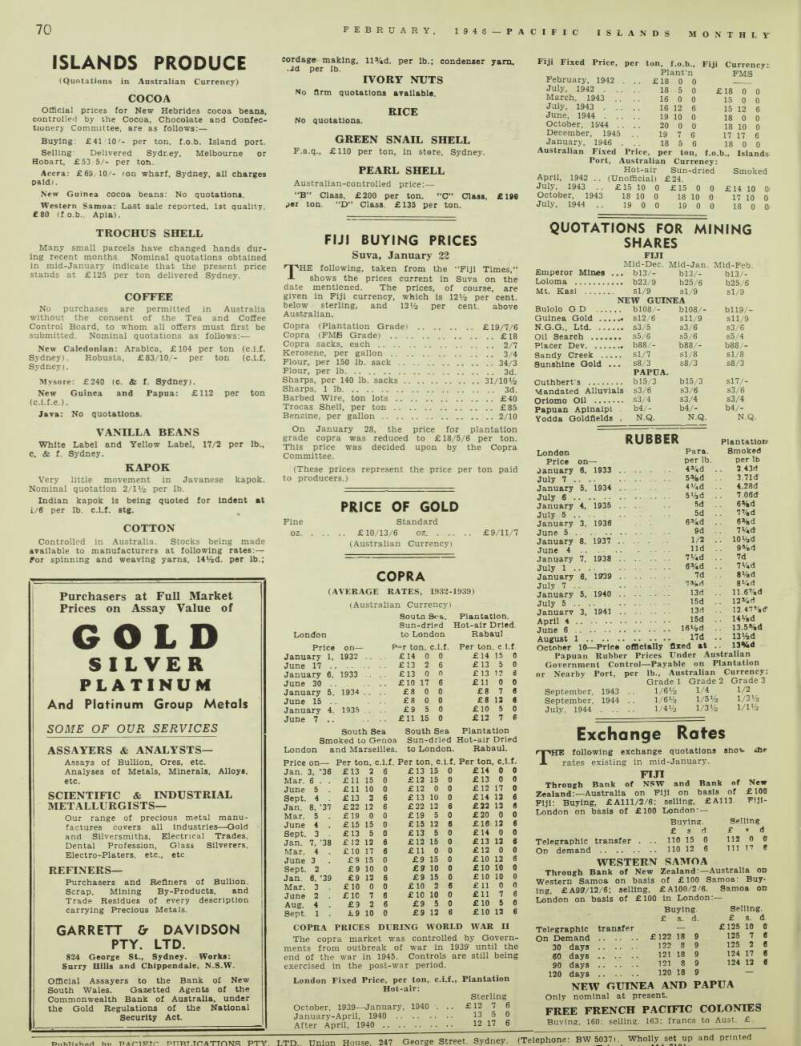
(Quotations in Australian Currency)
Cocoa
Official prices for New Hebrides cocoa beans, controlled by the Cocoa, Chocolate and Confec tionery Committee, are as follows: Buying: £4l 10/- per ton, f.o.b. Island port.
Selling: Delivered Sydney, Melbourne or Hobart, £53 5/- per ton.
Accra: £69,10/- ion wharf, Sydney, all charges paid).
New Guinea cocoa beans: No quotations.
Western Samoa: Last sale reported, Ist quality, £BO (fo.b., Apia).
Trochus Shell
Many small parcels have changed hands dur ing recent months. Nominal quotations obtained in mid-January indicate that the present price stands at £125 per ton delivered Sydney.
Coffee
No purchases are permitted in Australia without the consent of the Tea and Coffee Control Board, to whom all offers must first be submitted. Nominal quotations as follows: New Caledonian: Arabica, £lO4 per ton (c.i.f.
Sydney). Robusta, £B3/10/- per ton (c.i.f.
Sydney).
Mysore; £240 (c. & f. Sydney).
New Guinea and Papua: £ll2 per ton (c.i.f.e.).
Java: No quotations.
Vanilla Beans
White Label and Yellow Label, 17/2 per lb., c. & f. Sydney.
Kapok
Very little movement in Javanese kapok.
Nominal quotation 2/I*/ 2 per lb.
Indian kapok is being quoted for Indent at 1/6 per lb. c.i.f. stg.
Cotton
Controlled in Australia. Stocks being made available to manufacturers at following rates: For spinning and weaving yarns, 14V 2 d. per lb.;
cordage making, ll%d. per lb.; condenser yam, .2d per lb.
Ivory Nuts
No Arm quotations available.
Rice
No quotations.
Green Snail Shell
F.a.q., £llO per ton, in stare, Sydney.
Pearl Shell
Australian-controlled price:— ”B” Class, £2OO per ton. “C” Class, £196 •>er ton. ”D” Class. £135 per ton.
Fiji Buying Prices
Suva, January 22
THE following, taken from the "Fiji Times,” shows the prices current in Suva on the date mentioned. The prices, of course, are given in Fiji currency, which is 12 V 2 per cent, below sterling, and 12 Vz per cent. above Australian.
Copra (Plantation Grade) £l9/7/6 Copra (FMB Grade) £lB Copra sacks, each 2/7 Kerosene, per gallon 3/4 Flour, per 150 lb. sack 34/3 Flour, per lb 3d.
Sharps, per 140 lb. sacks 31/10 V 2 Sharps, 1 lb 3d.
Barbed Wire, ton lots £4O Trocas Shell, per ton £B5 Benzine, per gallon 2/10 On January 28, the price for plantation grade copra was reduced to £lB/5/6 per ton.
This price was decided upon by the Copra Committee. (These prices represent the price per ton paid to producers.)
Advertisements & other items, p. 70 (1 item)
Price Of Gold
Fine Standard oz. . . . .. £10/13/6 oz £9/11/7 (Australian Currency)
Copra
(Average Rates, 1932-1939)
(Australian Currency)
South Sea South Sea Plantation Smoked to Genoa Sun-dried Hot-air Dried London and Marseilles, to London. Rabaul.
Price on— Per ton, c.i.f. Per ton, c.i.f. Per ton, c.i.f.
Copra Prices During World War Ii
The copra market was controlled by Govern ments from outbreak of war in 1939 until the end of the war in 1945. Controls are still being exercised in the post-war period.
London Fixed Price, per ton, c.i.f., Plantation Hot-air:
Australian Fixed Price, per ton, f.0.b.. Islands Port, Australian Currency;
Souto Sea, Plantation.
Sun-dried Hot-air Dried London to London Rabaul Price on— P°r ton, c.I.f. Per ton. c l.f.
January 1. 1932 . . .. £ 14 0 0 £14 15 0 June 17 £13 2 6 £ 13 5 0 January 6. 1933 . . £13 0 0 £13 1? 6 June 30 £10 17 6 £11 0 0 January 5, 1934 .. .. £800 £876 June 15.. £800 £8 12 8 January 4. 1935 £950 £10 50 June 7 .. ... £11 15 0 £12 7 6
Jan. 3, ’36 £13 2 6 £13 15 0 £14 0 0 Mar. 6 . . £11 15 0 £12 15 0 £13 0 0 June 5 . £11 10 0 £12 0 0 £12 17 0 Sept. 4 . £13 2 6 £ 13 10 0 £14 12 6 Jan. 8. ’37 £22 12 6 £22 12 6 £22 12 6 Mar. 5 . £19 0 0 £19 5 0 £20 0 0 June 4 . £15 15 0 £15 12 6 £16 12 6 Sept. 3 . £13 5 0 £13 5 0 £14 0 0 Jan. 7, ’38 £ 12 12 6 £12 15 0 £13 12 6 Mar. 4 . £10 17 6 £11 0 0 £12 0 0 June 3 £9 15 0 £9 15 0 £10 12 6 Sept. 2 £9 10 0 £9 10 0 £10 10 0 Jan. 6, ’39 £9 12 6 £9 15 0 £10 10 0 Mar. 3 . £ 10 0 0 £10 2 6 £11 0 0 June 2 . £10 7 6 £10 10 0 £11 7 6 Aug. 4 . £9 2 6 £9 5 0 £10 5 0 Sept. 1 . £9 10 0 £9 12 6 £10 12 6
Sterling October. 1939—January, 1940 ... £12 7 6 January-Aprll, 1940 13 5 0 After April, 1940 12 17 6
Fiji Fixed Price, per ton, f.o.b., Fiji Plant’n FMS February, 1942 ... £ 18 0 0 Jul y- 1942 18 5 0 £18 0 0 March, 1943 ... 16 0 0 15 0 0 July, 1943 16 12 6 15 12 6 June, 1944 19 10 0 18 0 0 October, 19'44 . . .. 20 0 0 18 10 0 December, 1945 19 7 6 17 17 6 January, 1946 ... 18 5 6 18 0 0
Hot-air Sun-dried Smoked April, 1942 .. (Unofficial) £24.
July, 1943 .. £15 10 0 £15 0 0 £14 10 0- October, 1943 18 10 0 18 10 0 17 10 0 July. 1944 .. 19 0 0 19 0 0 18 0 a
Quotations For Mining
Shares
Fiji
Mid-Dec.
Mid-Jan.
Mid-Feb.
Emperor Mines . .. b!3/b!3/bl3/- Loloma .. b23/9 b25/6 b25/6 Mt. Kasi sl/9 sl/9 sl/9
New Guinea
Bulolo G D .. bl08 bl08/bll9/- Guinea Gold .« sl2 6 sll/9 sll/9 N.G.G., Ltd S3/6 s3/6 Oil Search .. s5/6 s5/6 s5/4 Placer Dev b88/b88/- Sandy Creek ... .. sl/7 sl/8 sl/8 Sunshine Gold .. . s8/3 s8/3 S8/3
Papua.
Cuthbert's .. b!5/3 bl5/3 sl7/- Mandated Alluvials s3/6 s3/6 s3/6 Orlomo Oil .. s3/4 S3/4 s3/4 Papuan Apinalpl . b4/b4/b4/- Yodda Goldfields . N.Q.
N.Q.
N.Q.
Rubber
Plantation
Papuan Rubber Prices Under Australian Government Control —Payable on Plantation or Nearby Port, per lb., Australian Currency:
London Para.
Smoked Price onper lb. per lb January 6. 1933 4 3 4d 2 43d July 7 5%d 3.71d January 5. 1934 4V 4 d 4.28d July 6 . 5 V a d 7.06d January 4. 1935 5d 6%d July 5 . 5d 7%d January 3. 1936 6 3 4d 6^d June 5 9d 7V 4 d January 8. 1937 1/2 .. 10 Vad June 4 lid 9%d January 7, 1938 7V 4 d 7d July 1 . 6 3 / 4 d 7 V 4 d January 6. 1JT39 7d 8V 8 d July 7 . 7 3 4d 8 V 4 d January 5. 1940 13d .. 11.6%d July 5 . 15d .. 12 3 4d January 3. 1941 13d . . 12 47 T/ *<?
April 4 15d .. 14Vsd June 6 16»/,d . . 13.5%d August : L . 17d .. 13V4d October 10—Price officially fixed at 13%d
Grade 1 Grade 2 Grade 3 September, 1943 .. 1/6 Va 1/4 1/2 September, 1944 .. l/6Va 1/5Va 1/3Va July, 1944 l/4Va l/3Vi 1/lVa
Exchange Rates
THE following exchange quotations snov the rates existing in mid-January.
Fiji
Through Bank of NSW and Bank of New Zealand: —Australia on Fiji on basis of £lOO Fiji: Buying, £Alll/2/6: selling. £AII3 Fiji- London on basis of £lOO London' —
Western Samoa
Through Bank of New Zealand: —Australia on Western Samoa on basis of £lOO Samoa: Buy ing. £A99/12/6; selling, £AIOO/2/6. Samoa on London on basis of £lOO in London: —
New Guinea And Papua
Only nominal at present.
Free French Pacific Colonies
Buying:. 160: selling. 163: francs to Aust. £.
Buying. Selling £ s d £ « d Telegraphic transfer ... 110 15 0 112 0 0 On demand 110 12 6 111 I 7 *
Buying Selling. £ s. d. £ s. d Telegraphic transfer — £125 10 0 On Demand £122 18 9 125 7 6 30 days 122 8 9 125 2 6 60 days 121 18 9 124 17 6 90 days 121 8 9 124 12 « 120 days 120 18 9 —
Advertisements & other items, pp. 70-72 (4 items)
70
FEBRUARY, 1946 PACIFIC ISLANDS MONTHLY
PnhiichpH hv PAnFir prrRT.TOATTONS PTY. LTD.. Union House, 247 George Street. Sydney. (Telephone; BW 5037). Wholly set up and printed
Gold
Purchasers at Full Market Prices on Assay Value of
SILVER
PLATINUM
And Platinum Group Metals
SOME OF OUR SERVICES
ASSAYERS & ANALYSTS—
Assays of Bullion, Ores, etc.
Analyses of Metals, Minerals, Alloys, etc.
SCIENTIFIC & INDUSTRIAL
METALLURGISTS—
Our range of precious metal manufactures covers all Industries—Gold and Silversmiths, Electrical Trades.
Dental Profession, Glass Silverers, Electro-Platers, etc., etc
REFINERS—
Purchasers and Refiners of Bullion.
Scrap. Mining By-Products, and Trade Residues of every description carrying Precious Metals.
GARRETT & DAVIDSON
PTY. LTD.
824 George St., Sydney. Works: Surry Hills and Chippendale, N.S.W.
Official Assayers to the Bank of New South Wales. Gazetted Agents of the Commonwealth Bank of Australia, under the Gold Regulations of the National Security Act.
A Tropical Thirst
demands a Satisfying Drink
that’s why KB is so popular
south of (( the Line”
All through the tropics, wherever there are men who like good beer, you'll always find KB. It's the drink that men appreciate —a drink just made to satisfy a tropical thirst 1 m a cool pi If*
ySTRAL'^
QNL ' y feo* the finest m al
AND MTTLE0 BT
T °OTH & Co.. LI Ml
Sydney, australi s\ X I
TOOTH'S
KB
LAGER.
Established 1914
THIRTY YEARS OF PACIFIC ISLANDS
DEVELOPMENT AND SERVICE.
W. R. CARPENTER & GO. LTD.
Capital £1,000,000.
GENERAL MERCHANTS AND SHIPOWNERS
Buyers and Exporters of All Kinds of Islands Produce p p wm+km wll U II I g-Ti n d Millers Hhd American Manufacturers Distributors of
AGENTS FOR
FORD OF CANADA. DODGE BROTHERS, INC.
ELECTROLUX REFRIGERATORS. WESTINGHOUSE ELECTRICAL CO.
T. G. & C. BOLINDERS (ENGINES). CATERPILLAR TRACTORS.
Etc., Etc.
BRANCHES THROUGHOUT THE PACIFIC ISLANDS
Head Office: 16 O'CONNELL STREET, SYDNEY
In London: W. R. Carpenter & Co. (London) Ltd., Coronation House, 4 Lloyd's Avenue, London, EC.
The W.R.C. Line
The first Direct and Regular Cargo and Passenger Service between Europe and Pacific Islands’ ports was established by W. R. Carpenter & Co. Ltd.
S M A