Monthly
Pacific
Islands
March 15, 1946
Vol. Xvi. No. 8.
Established 1930|
[Registered at the Sydn&fr. for transmission hy post as a newspaper ]
1/-
Solomon Islands Residents Return Home
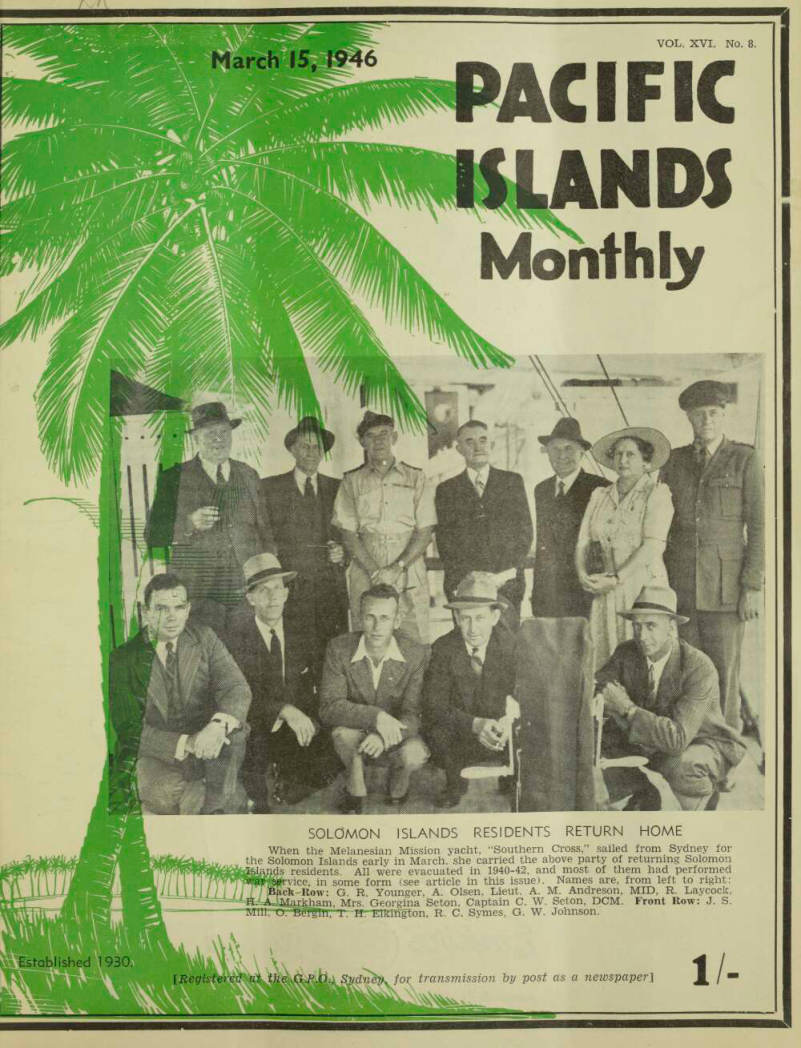
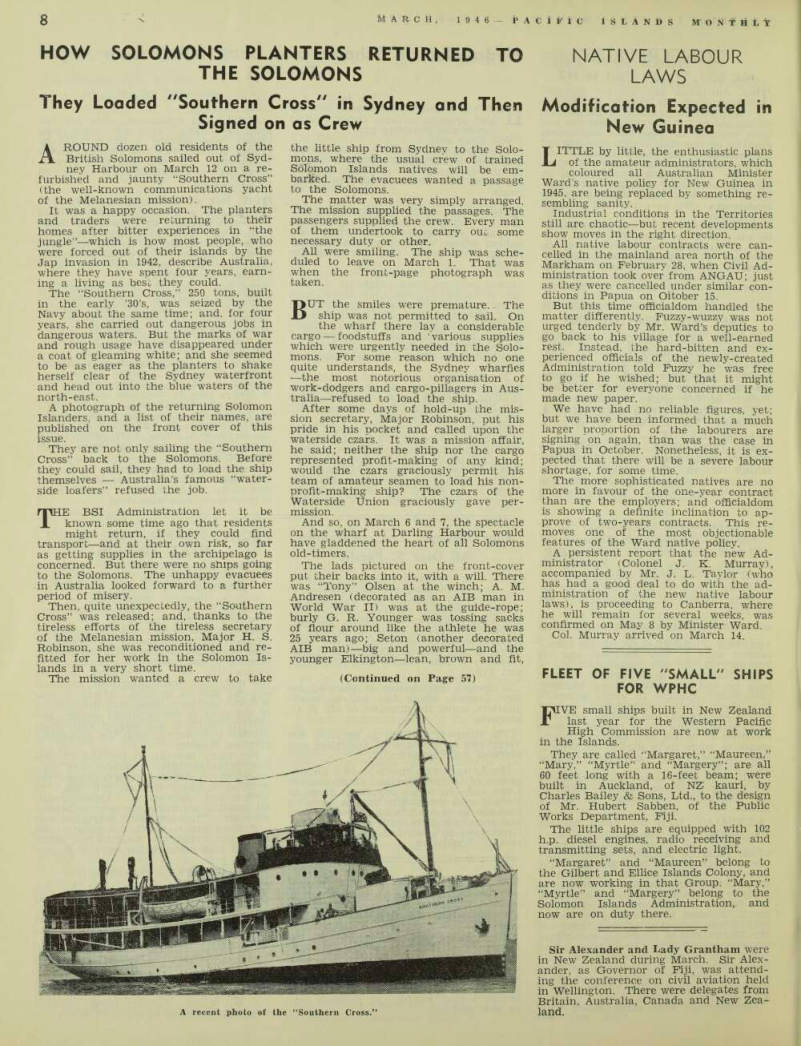
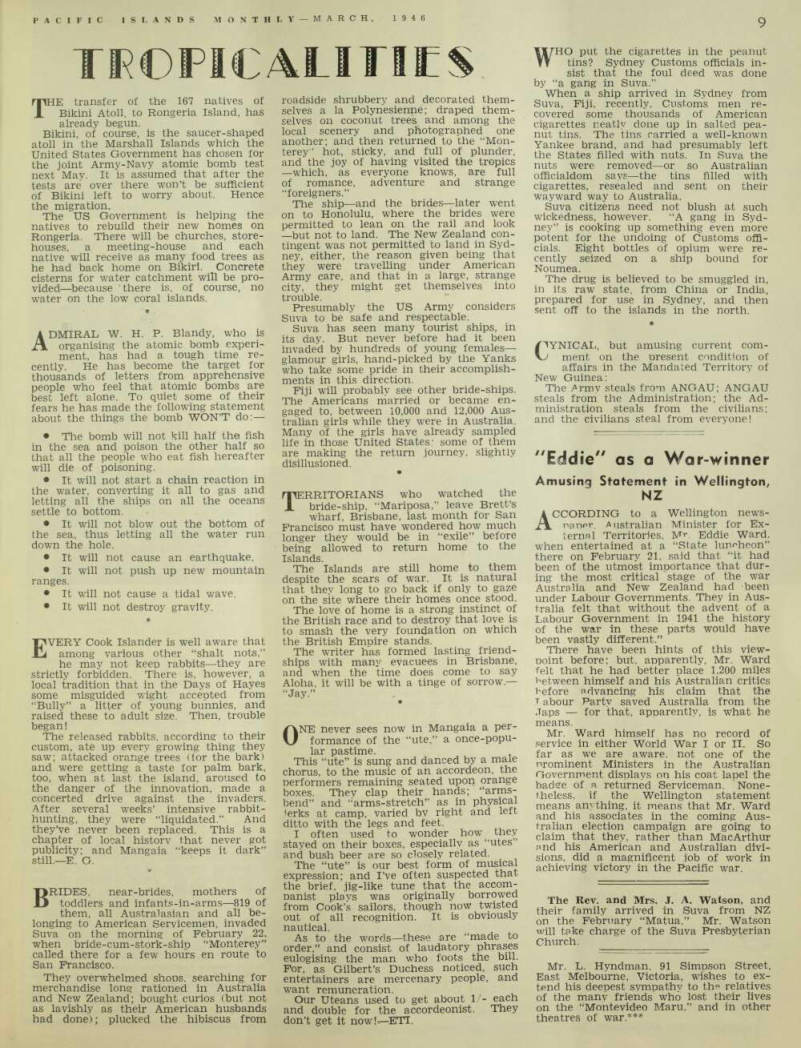
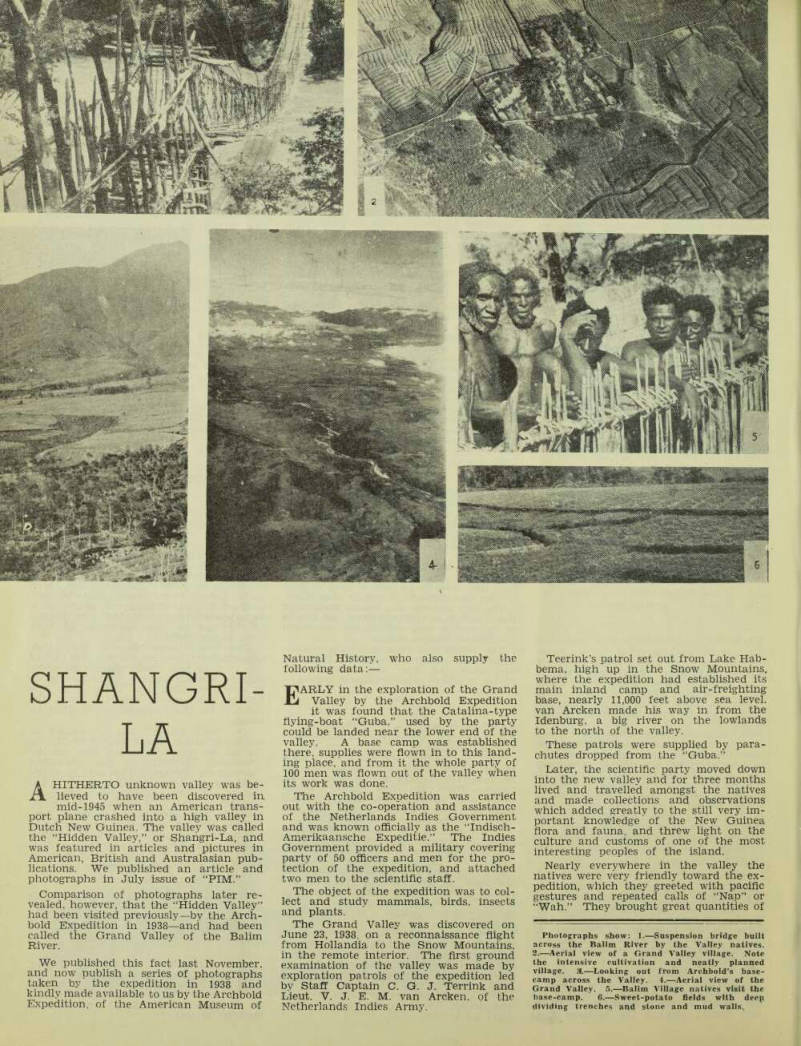
When the Melanesian Mission yacht, “Southern Cross,” sailed from Sydney for the Solomon Islands early in March, she carried the above party of returning Solomon Islands residents. All were evacuated in 1940-42, and most of them had performed war service in some form (see article in this issue). Names are, from left to right: Back Row: G. R. Younger, A. Olsen, Lieut. A. M. Andreson, MID, R. Laycock, H. A. Markham, Mrs Georgina Seton, Captain C. W. Seton, DCM. Front Row: J. S.
Miĺ, O. Bergin, T. H. Elkihgton, R. C. Symes, G. W. Johnson.
Advertisements & other items, pp. 2-3 (1 item)
Qarita/t
m&m
HUGHES
m 3 1920 in
'JWENTY-FIVE YEARS
Australia under nine Ministers is one of "Qantas" achievements transportation. \ r> of to service the the field of air successive Prime records of Serving without prejudice from Hughes in 1920 to Chifley to-day, from peace, through war and on to peace, 144,000,000 passenger miles have been flown by "Qantas" aircraft in establishing and maintaining Australia's overseas air links.
Equipped with experience based on past achievements, "Qantas" is pre-eminently qualified to assist in developing Australia's International routes.
Qarita/t
CM? m Australias INTERNATIONAL Airline
TILLEY LAMPS
BURN ORDINARY KEROSENE
The Modern Form of PORTABLE LIGHTING
iM* , 9 m W' .JlmWmi * jf >V !
TiLLEY LAMP C» 'MR
j OF HENOON
i, THE OWL IS PROVERBIALLY A WISE BIRD, SO BE SURE YOU FOLLOW HIS EXAMPLE! TILLEY LAMPS ARE SO SUCCESSFUL THAT COPIES OF THEM ARE BEING MARKETED. TILLEY LAMPS ARE MADE ONLY IN ENGLAND Shipments available four weeks from receipt of order THE TILLEY LAMP CO., HENDON, N.W.4, ENG.
REPRESENTATION :
MELBOURNE : T. H. Bentley, Pty, Ltd., 123-125 William Street, Melbourne, Cl.
TASMANIA : Mr. C. Sellars, 108 a Charles Street, Launceston.
FIJI ; Mr. K. Witherington, 2 Burns Philp Buildings, Suva.
Advertisers
Adams, Clayton & Co 57 Angliss & Co. . . 51 Atkins Pty., Ltd., Wm 29 Australan Alu minium ... 17 Brial & Ball ... 17 Brown & Co., Ltd. 11 Brunton’s Flour . . 30 Burns, Philp Trust Co., Ltd 13 Broomfields . .16
Bp (Ss) Co. . . 11
Bhindi, P. K. . . .31 Berger & Sons . . 23 Carlton & United Breweries, Ltd. . 33 Carpenter, Ltd., W.
R cov. iv. drivers & Sons, Ltd 45 Church, R. H., & Sons 22 Coleman Lamp & Stove Co 39 “Cystex” 21 Casino Hotel, Apia . 62 Consolidated Export & Import Group of Australia ... 23 Colonial Whole sale Meat ... 25 Donaghy & Sons . 57 Donald, Ltd., A. B. 34 Dr. Williams Pink Pills 44 Excelsior Supply Co 36 Electrolux Refrigerators . - 20 H. G. Eekhoff ... 43 Ford Sherington Pty., Ltd. ... 42 Garrett & Davidson 64 Gibson & Co., Ltd.,
J. A. D 53
Gillespie Pty., Ltd., Robert ... 14, 15 Gilbey’s Gin ... 12
Gillespie’s Flour . . 32 Gough & Co., E. J. 37 Grand Pacific Hotel ii.
Grove & Sons, W.
H 19 Heinz & Co. Pty., Ltd., H. J. . . .55 Hemingway & Robertson ... 50 Hyde, Victor ... 54 Jenkins, Reg. ... 40 Kopsen & Co., Ltd. 47 Merrillees, J. C., & Co 21 Masschelien, O. F. 41 Miscellaneous . 48, 52, 55, 57, 58, 60 “Mendaco” ... 58 Mcllraths Pty., Ltd. 43 Nelson & Robertson Pty., Ltd. ... 38 Newman, M. . . .37 “Nixoderm” ... 61 Noyes Bros. ... 44 Napt 59 Pacific Planters’
Handbook ... 46 Pacific Islands Monthly ... 22 Pacific Is. Society 45 “Pinkettes” ... 18 Qantas Empire Air ways ... cov. ii.
Queensland Insur ance Co 41 Raymond, Lance, Pty., Ltd. ... 35 Robinson, G. H. . 16 Rose’s Eye Lotion . 42 Rohu, Sil . . . .43
Rur 62
Ransome, Sims & Jeffries ... 26 Scott, Ltd., J. . .61 Southern Pacific Insurance Co. . . 12 Steamships Trading Co., Ltd 28 Shepherd, A. O. . . 18 Sullivan & Co., C. 42
Swallow & Ariell . 27 Taylor & Co., A. . 55 “Tenax” Soap . . 52 Tillock & Co.. Ltd. 48 Turner, F. W. . . 50 Thornycroft (Aust.) Pty., Ltd 59 Tooth & Co.
Ltd cov. HI.
Toogood, J. J. . . 54 Tullochs Pty., Ltd. 63 Tilley’s Lamps . . . i.
Watson, Wm. H. . 42 Widdop, H.. & Co., Ltd 60 A. Willison ... 14 Wills, W. D. & H. 0 24 Wright & Co., Ltd., E 60 Young Pty., Ltd., Harry J 56 Yorkshire Insur ance Co., Ltd. . 11
Contents
Pacific News Review i Editorial: The Indians in Fiji Is Reversal of Government Policy Forecast? i Two Trans-Pacific Airlines to Operate Soon 2 The Unexpired Term of Papua’s Ad ministrator 3 Mr. E. J. Ward’s Visit to New Zea land 7 Progress of Rehabilitation in New Guinea and Paoua—All Classes Crippled by Lack of Shipping and Labour 4 A Hint of a Strange Coincidence — The Hell-ship “Yoizuki” and the Abandoned Rabaul Civilians ... 5 Yes—We Have No Copra! Australian Bureaucrats’ Indifference to Trade 5 Elected Town Councils for Fiji ... 6 How Solomon Islands Planters Re turned to the Solomons 8 Modification of NG Labour Laws Expected 8 Tropicalities 9 Shangri-la 10 Piii Copra Price Guaranteed 11 Will Deported Enemy Aliens Return to New Guinea? 12 Fiji Refuses Rule-bv-Regulation ... 13
Pacific Shipping War? Report from Tahiti 16 Brass-hats Blunder Over Murphy Court-martial 16 ‘ Blue” Allen Leaves PIR Job Wanted for Staff Man 17 Less Experimentation Wanted in Fiji Agriculture 18 Alarming Incidence of TB in Port Moresby 21 Communist Busy in BSI 22 UNO Trusteeship for W. Samoa ... 25 Skymaster in Fiji—Trans-Pacific in 39 Hours 25 You Wouldn’t Know the Old Town— Post-war Moresby 26 The Story of Rabaul—Second Instal ment of Gordon Thomas Story .. 30 “PIM” Short Story; “Oysters and the Law” 32 Jap Ceremony to Australian Dead— Extraordinary Episode in Rabaul in 1942 36 The Unlucky “Glide” Early Ship wreck in Fiji 39 Pam Millar Tells a Story 43 Captain Cambridge Will Bring the “Tahitienne” Home 45 World Copra Situation Reviewed ... 46 "Bulolo’s” War Record 48 New Caledonia—Aerial Crossroads of the Pacific 50 Indians Want Sugar Industry Nationalised 54 How Chinese Fared in Occupied Rabaul —Murder of Kwong Chong Brothers 58 Shipping and Plane Services :: Paci fic Travellers 59 Commercial, Markets, etc 64 Roll of NGVR Wanted—But Bureau crats Won’t Hein 66 Territories “Talk-Talk” 66
Advertisements & other items, p. 4 (1 item)
As ° ver '
eot pac ' fic srtU »tei w bo ur. ** des'S" 6 ' 1 , s b "* pV . * eC * 1 nl ■ , cet>« e ' . -e. alte « (r° rt ' e' »*“ S °r t**"** C V ** '^'**?*>'**- „a\oei 9 Ca b\e. r d»Yel* pe s as#®***®
Pacific Islands Monthly
The Newspaper-Magazine of the South Seas [Registered at the G.P.0., Sydney, for transmission by post as a newspaper .]
Published Once Each Month and Circulated in Australia and New Zealand and in the following Pacific Territories and Islands Groups:
Australian Territory of Papua.
Mandated Territory (Australia) of New Guinea.
Australian Territory of Norfolk Island.
New Zealand Territory of Cook Islands.
Mandated Territory (NZ) of Western Samoa.
British Colony of Fiji.
British Solomon Islands Protectorate.
British Protectorate of Tongan Islands.
British Crown Colony of Gilbert and Ellice Islands.
Mandated Territory of Nauru.
British and Free French Condominium of New Hebrides.
Free French Colony of New Caledonia.
Free French Colony of Oceania (Tahiti, etc.).
American Territory of Eastern Samoa.
American Territory of Hawaiian Islands.
Owned and Produced by Pacific Publications Pty. Ltd., Union House, 247 George Street, Sydney.
( Managing Director .. BW 5037 iJEULrnowis £ Business and Editorial MA 4369
P.O. Box 3408 R
Registered Address of Telegrams, Radiograms, and Cables: “Pacpub”, Sydney.
Contributions.
Articles, Stories, and Photographs dealing with Pacific Islands subjects are invited and will be paid for on publication.
Subscription Rates.
Per Annum, within British Empire, Prepaid, Post Free 10/- Per Annum, elsewhere, Prepaid, Post Free 12/6 Single Copies 1/-
Editor and Publisher:
R. W Robson, F.R.G.S.
Advertising Manager: W. E. Rogers. Tel. B 7815.
Advertising Office and Printing-House: 29 Alberta Street, Sydney.
Advertising rates furnished on application.
Representative In Fiji.
Pacific Publications (Fiji), Ltd., Bank of NSW Building, Suva (same office as W. H. Grove & Sons, Ltd.). Stocks of Pacific Islands Monthly and Pacific Islands Yearbook on hand.
Representative In London.
J. T. Wallis, Coronation House, 4 Lloyds Avenue, London, E.C.3, from whom may be obtained copies of Pacific Islands Monthly, Pacific Is. Year Book, advertising schedules, etc.
Agents.
The following are authorised to receive sub scriptions for Pacific Islands Monthly:— Burns, Philp & Co., Ltd., and Burns Phllp (South Sea) Co., Ltd. All branches.
W. R. Carpenter & Co., Ltd. All branches.
Morris, Hedstrom, Ltd. All branches.
Steamships Trading Co., Papua. All branches.
Whitten Bros., Ltd., Samaral, Papua.
B.N.G. Trading Co., Ltd., Port Moresby, Papua J. Muir, Suva, Fiji.
Miss R, Castles, Suva, Fiji.
N. C. Mackenzie Hunt, Walnunu, Bua, Fiji.
Cook Islands Trading Co., Rarotonga, Cook Is A. C. Rowland, Papeete, Tahiti.
Islands Branches and Representatives of W. H Grove & Sons, Ltd., Auckland, New Zealand Ed. Pentecost, Noumea, New Caledonia.
Societe Gubbay Kerr et Cie, Noumea, N. Caledonia.
Vol. Xvi. No. 8.
March 15, 1946
PrirP l/ Per Copy * rnce prepaid; 10/- p.a.
Policy Forecast?
The Indians in Fiji—ls Reversal of Government Policy Forecast?
AFTER a decade of nominated Municipal Councils, the Government of Fiji proposes to wipe out the system introduced in 1936, and to elect the governing bodies of the towns on popular franchise. This may indicate a return, in due course, to popular government in the Colony generally. If the principle is good for the towns of Suva and Lautoka, it should be good for the whole of Fiji.
Our correspondent, reporting the new development, expresses the opinion that, “except among the old die-hards, there is nothing either to fear or worry about.” We hope he is right. But if the memories of the “old die-hards” take in the events of the quarter-century which preceded the introduction of the present system, in 1936, they have cause for all the trepidation which they may feel, This writer has a clear recollection of a long conversation with Sir Murchison Fletcher, in 1936. That far-seeing Governor of Fiji did not wipe out the remnants of democratic government there because he was a conservative “die-hard.” He was a clear-thinking man of liberal ideas; and, after struggling with his peculiar problems for years, he realised that if Fiji’s most cherished democratic institutions were not to be swamped by the jealous and clamorous Indian vote, his only course was to revert entirely to the nominative system.
It looked like a retrograde step, even then. Now, in the view of the young Europeans who have reached
voting age since 1936, it definitely was a retrograde step.
Nevertheless, in the face of ail the circumstances as we knew them prior to 1936, the Governor took the only course possible. Led by professional agitators, the Indian community had made life a misery to the Government. The basis of all Fiji Indian policy was their demand for the “common roll”—demand for official acknowledgment that an Indian was equal in all respects to a European, and that his vote should have the same weight.
However delightful in theory this may be, the British could not accept it in practice in Fiji, where the first duty placed upon the British Adminis tration is the fullest protection of the fundamental rights of the indigenous people, as defined in the terms of Cession. The Government put an end to it by making the whole system nominative.
Compared with the 1926-36 period, the decade since then has been a period of peace and tranquillity— except, maybe, that the shrill pro tests of the Indian leaders have been replaced, to a degree, by the more lusty arguments of the European Electors’ Association.
Certain evils were expected to follow the change in 1936; and, ac cording to our correspondent, those evils have developed, full-feathered and capable of much mischief. So, as memories of 1926-36 conditions
faded, there has grown up a demand by Europeans for a larger voice in the government of the Colony. To-day, the Fiji Qovernment, responsive to Whitehall (which is especially sensi tive at present on the subject of democratic institutions and racial liberty) is giving ear to the Euro peans’ demands. The pendulum swings again.
HOWEVER, there is no need for alarm. The plan, presumably, is to liberalise the system in relation to the government of towns. If it works satisfactorily, well and good. But if the Indians, as expected, take con trol of the towns, and display racial bias, then the warning may be taken, and there will be no change in the major administrative system affecting the Colony as a whole. It will be an interesting experiment.
Our Suva correspondent, represent ing youth and optimism, says of the Indian voter: “He will be as keen as any European in getting the best town Council he can, irrespective of race.” We hope so—but we do not believe it. We have a long memory of Fijian politics, and a knowledge of Indian ways and opinions, gained in various places where Indian com munities have established them selves.
The Indian character does not change in a decade or two. The in dividual Indian may be—and fre auently is—an intelligent and charm ing person. The probity and industry of certain Indians in Suva have done much to strengthen the economic structure of the whole Colony. But the dominant sentiments of the
Indian community of Fiji—estab lished there by accident, in defiance of good sense, and as a menace to the welfare of the Fijian race—are re sentment of the power and influence of the Europeans, and hunger for land. We dare not forget that fact— just as we may not forget the terri fying fecundity of the Indian.
There are less than 10,000 Euro peans in Fiji. There are 120,000 Indians there; and already the Fijians, in spite of their physical health and fine spirit, are being out bred and out-numbered by the Indians. In these circumstances, we British realise that there is no future for our race in Fiji; but that does not in any degree absolve us from our re sponsibilities there. We agreed, in 1874, that the care and protection of the Fijian people, and the security of their land rights, should be our obligation for all time. We, and not the Fijians, introduced to Fiji the restless and land-hungry Indians.
Similarly, but in a much lesser degree, the care and protection of the Indians are our responsibility. We have clear-cut obligations there, too, from which we may not escape.
WE may not forget the events of World War 11, in which our existence as a nation was at stake.
The Fijians, to a man, rallied to the help of the hard-pressed British. As soldiers and as labourers, they rendered distinguished service. In the Solomons and in Bougainville there was established, between British and Fijians, a blood brotherhood we never shall forget. The Indian community, on the other hand, was sour and un co-operative. By comparison, the war effort of the Fiji Indians was un inspiring—in fact, it should be for gotten—except at a time like this, when the future of Fiji is under con sideration.
The events of 1939-45 may regulate Fiji policy for a long time to come.
It is far too soon to give the Indian much share in the Government of Fiji. Politically and psychologically, he still is far too much under the influence of Mother India. But we must accept facts. Eventually, by sheer weight of numbers, the Indians will rule Fiji.
It is the duty of the British, while ensuring the progress and security of the Fijian race, to prepare the Indian for his future responsibility. That can be done only by properly edu cating and training the future generations of Fiji Indians. Indians who are deeply attached to Mother India are of no use in the Pacific Islands. But Indians who, for two or three generations, have been divorced from Asia might be entrusted with administrative responsibility.
French Colonial Administrator Nouvel de la Fleche, who was Governor Pelicier’s Chef de Cabinet in 1940 just prior to the arrival from Vila of Governor Sautot, and who later refused to rally to General de Gaulle, preferring to sail for Indo-China by the “Pierre Loti,” has been removed from the roll of French Administrators.
Two Trans Pacific Airlines To Operate
Soon
British Want Nationalisation and Rates-control
IT seems quite definite that there will be both an American and a British Trans-Pacific Air Service in opera tion before the end of June perhaps sooner.
The determination of the three British Empire Socialist Governments (Great Britain, Australia and New Zealand) to keep control over the British service, and to force the Americans into some sort of rate-governing convention, has delayed airways plans on both sides of the Pacific.
The Pan-American Airways Trans pacific Service, between the Pacific Coast of the United States and Auckland, via Honolulu, Canton Island, Suva and Nou mea, which was to have been resumed in February, cannot be started until certain discussions now going on between the United States and the British Empire Governments are completed.
It is generally expected that the United States-New Zealand service will com mence in April.
The extension of this PAA service to Sydney, however, cannot take place until a licence has been issued by the Ameri can Board of Civil Aviation; and this, in turn, depends upon the granting of reciprocal tending rights by Australia.
Mr. Harold Gatty, South Pacific mana ger of PAA, will arrive in Suva at the end of March, and will take up his per manent residence there.
BRITISH Commonwealth Pacific Air lines (BCPA) will be established shortly by British, Australian and New Zealand interests approved by the Governments of those countries, to oper ate a service between Sydney and Van
couver. This decision was reached by a conference of Ministers representing the three countries, which met in Wellington in the first week of March. Details are now being worked out.
BCPA will be registered in Australia, and will operate “in parallel partner ship” with a Canadian Government air line.
The Wellington conference made plans for airlines linking all British Territories in the Pacific, including ground facili ties and meteorological services.
There will be a South Pacific Air Trans port Council, representing all these British interests, established in Australia, with a permanent secretariat.
INDICATIONS are that strong efforts are being made to get some sort of agreement, between British and American interests, on the lines of the recent Bermuda Conference, to avoid cut throat competition.
In view of various “official” announce ments, of which the foregoing is a sum mary, the position of the Australian operating companies is obscure.
Qantas, all ready and equipped to start a trans-Pacific service, has been run ning fortnightly experimental trips from Sydney to Suva, via Noumea, for months past. Australian National Airways has imported four fine Skymaster planes, and similarly announced readiness to start the trans-Pacific run. It was definitely stated by some newspapers in March that ANA would inaugurate the Pacific service very shortly; but that has noc been offi cially confirmed.
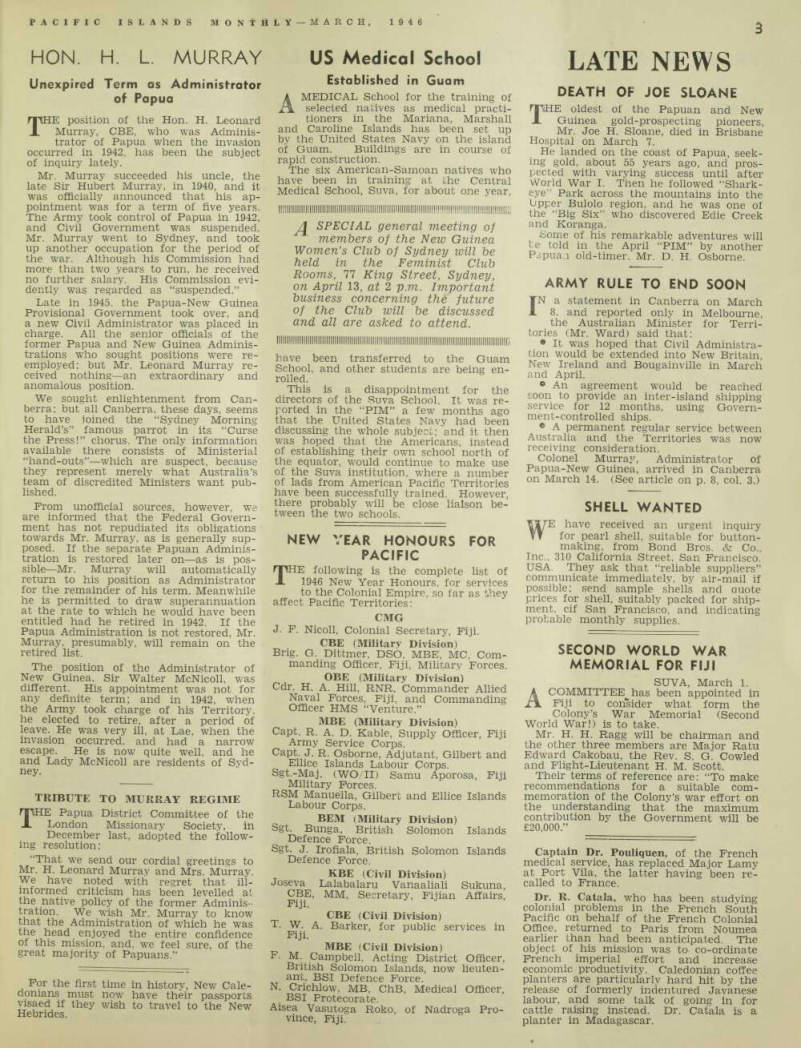
Rabaul— 1946
(1) Once the Government wharf, only a skeleton remains to-day. It was bombed by the RAAF in 1942. (2) Lieut. J. Dowsett (ANGAU) plays the bagpipes to the amazement of China town. (3) Wrecked Jap bomber in the harbour.
Hon. H. L. Murray
Unexpired Term as Administrator of Papua
rE position of the Hon. H. Leonard Murray, CBE, who was Adminis trator of Papua when the invasion occurred in 1942. has been the subject of inquiry lately.
Mr. Murray succeeded his uncle, the late Sir Hubert Murray, in 1940, and it was officially announced that his ap pointment was for a term of five years.
The Army took control of Papua in 1942, and Civil Government was suspended.
Mr. Murray went to Sydney, and took up another occupation for the period of the war. Although his Commission had more than two years to run, he received no further salary. His Commission evi dently was regarded as “suspended.”
Late in 1945. the Papua-New Guinea Provisional Government took over, and a new Civil Administrator was placed in charge. All the senior officials of the former Papua and New Guinea Adminis trations who sought positions were re employed; but Mr. Leonard Murray re ceived nothing—an extraordinary and anomalous position.
We sought enlightenment from Can berra: but all Canberra, these days, seems to have ioined the “Sydney Morning Herald’s” famous parrot in its “Curse the Press!” chorus. The only information available there consists of Ministerial “hand-outs” —which are suspect, because they represent merely what Australia’s team of discredited Ministers want pub lished.
From unofficial sources, however, we are informed that the Federal Govern ment has not repudiated its obligations towards Mr. Murray, as is generally sup posed. If the separate Papuan Adminis tration is restored later on—as is pos sible —Mr. Murray will automatically return to his position as Administrator for the remainder of his term. Meanwhile he is permitted to draw superannuation at the rate to which he would have been entitled had he retired in 1942. If the Papua Administration is not restored, Mr.
Murray, presumably, will remain on the retired list.
The position of the Administrator of New Guinea, Sir Walter McNicoll, was different. His appointment was not for any definite term; and in 1942, when the Army took charge of his Territory, he elected to retire, after a period of leave. He was very ill, at Lae, when the invasion occurred, and had a narrow escape. He is now quite well, and he and Lady McNicoll are residents of Syd ney.
Tribute To Murray Regime
rE Papua District Committee of the London Missionary Society, in December last, adopted the follow ing resolution: “That we send our cordial greetings to Mr. H. Leonard Murray and Mrs. Murray.
We have noted with regret that ill informed criticism has been levelled at the native policy of the former Adminis tration. We wish Mr. Murray to know that the Administration of which he was the head enjoyed the entire confidence of this mission, and, we feel sure, of the great majority of Papuans.”
Fcpr the first time in history, New Cale donians must now have their passports visaed if they wish to travel to the New Hebrides.
US Medical School
Established in Guam
A MEDICAL School for the training of selected natives as medical practi tioners in the Mariana, Marshall and Caroline Islands has been set up by the United States Navy on the island of Guam. Buildings are in course of rapid construction.
The six American-Samoan natives who have been in training at the Central Medical School, Suva, for about one year,
SPECIAL general meeting of members of the New Guinea Women’s Club of Sydney will be held in the Feminist Club Rooms, 77 King Street, Sydney, on April 13, at 2 p.m. Important business concerning the future of the Club will be discussed and all are asked to attend.
have been transferred to the Guam School, and other students are being en rolled.
This is a disappointment for the directors of the Suva School. It was re ported in the “PIM” a few months ago that the United States Navy had been discussing the whole subject; and it then was hoped that the Americans, instead of establishing their own school north of the equator, would continue to make use of the Suva institution, where a number of lads from American Pacific Territories have been successfully trained. However, there probably will be close liaison be tween the two schools.
New Year Honours For
Pacific
rE following is the complete list of 1946 New Year Honours, for services to the Colonial Empire, so far as they affect Pacific Territories:
Cmg
J. F. Nicoll, Colonial Secretary, Fiji.
CBE (Military Division) Brig. G. Dittmer, DSO, MBE, MC, Com manding Officer, Fiji, Military Forces.
OBE (Military Division) Cdr. H. A. Hill, RNR, Commander Allied Naval Forces, Fiji, and Commanding Officer HMS “Venture.”
MBE (Military Division) Capt. R. A. D. Kable, Supply Officer, Fiji Army Service Corps.
Capt. J. R. Osborne, Adjutant, Gilbert and Ellice Islands Labour Corps.
Sgt.-Maj. (WO/II) Samu Aporosa, Fiji Military Forces.
RSM Manuella, Gilbert and Ellice Islands Labour Corps.
BEM (Military Division) Sgt. Bunga, British Solomon Islands Defence Force.
Sgt. J. Irofiala, British Solomon Islands Defence Force.
KBE (Civil Division) Joseva Lalabalaru Vanaaliali Sukuna, CBE, MM, Secretary, Fijian Affairs, Fiji.
CBE (Civil Division) T. W. A. Barker, for public services in Fiji.
MBE (Civil Division) F. M. Campbell, Acting District Officer, British Solomon Islands, now lieuten ant, BSI Defence Force.
N. Crichlow, MB, Chß, Medical Officer, ESI Frotecorate.
Aisea Vasutoga Roko, of Nadroga Pro vince, Fiji.
Late News
Death Of Joe Sloane
rE oldest of the Papuan and New Guinea gold-prospecting pioneers, Mr. Joe H. Sloane, died in Brisbane Hospital on March 7.
He landed on the coast of Papua, seek ing gold, about 55 years ago, and pros pected with varying success until after World War I. Then he followed “Shark eye” Park across the mountains into the Upper Bulolo region, and he was one of the “Big Six” who discovered Edie Creek and Koranga.
Some of his remarkable adventures will te told in the April “PIM” by another Papuan old-timer. Mr. D. H. Osborne.
Army Rule To End Soon
IN a statement in Canberra on March 8, and reported only in Melbourne, the Australian Minister for Terri tories (Mr. Ward) said that: • It was hoped that Civil Administra tion would be extended into New Britain, New Ireland and Bougainville in March and April. ° An agreement would be reached soon to provide an inter-island shipping service for 12 months, using Govern ment-controlled ships. ® A permanent regular service between Australia and the Territories was now receiving consideration.
Colonel Murray, Administrator of Papua-New Guinea, arrived in Canberra on March 14. (See article on p. 8, col. 3.)
Shell Wanted
WE have received an urgent inquiry for pearl shell, suitable for button making, from Bond Bros. & Co..
Inc., 310 California Street. San Francisco.
USA. They ask that “reliable suppliers” communicate immediately, by air-mail if possible; send sample shells and auote prices for shell, suitably packed for ship ment, cif San Francisco, and indicating probable monthly supplies.
Second World War
Memorial For Fiji
SUVA, March 1. has been appointed in Fiji to consider what form the Colony's War Memorial (Second World War!) is to take.
Mr. H. H. Ragg will be chairman and the other three members are Major Ratu Edward Cakobau, the Rev. S. G. Cowled and Flight-Lieutenant H. M. Scott.
Their terms of reference are: “To make recommendations for a suitable com memoration of the Colony’s war effort on the understanding that the maximum contribution by the Government will be £20,000.”
Captain Dr. Pouliquen, of the French medical service, has replaced Major Lamy at Port Vila, the latter having been re called to France.
Dr. R. Catala, who has been studying colonial problems in the French South Pacific on behalf of the French Colonial Office, returned to Paris from Noumea earlier than had been anticipated. The object of his mission was to co-ordinate French imperial effort and increase economic productivity. Caledonian coffee planters are particularly hard hit by the release of formerly indentured Javanese labour, and some talk of going in for cattle raising instead. Dr. Catala is a planter in Madagascar.
Advertisements & other items, p. 7 (1 item)
3
PACIFIC ISLANDS MONTHLV MARCH, 1946
More Civilians Returning, But All Classes Crippled by
Progress Of Rehabilitation In N. Guinea
And Papua
More Civilians Returning, But All Classes Crippled by Lack of Shipping and Labour
rE rehabilitation of the Australian Territories, W'hich was delayed for a long time, first by the reluctance of the Military Administration to get out of the way, and second, by the attempts of Australia’s Leftist Minister, Mr. Ward, to introduce startling systems of his own planning—is now beginning to take shape and gather speed. These things have happened recently, or are now happening: • The Production Control Board, which was planned to take the place of the big trading firms, and “prevent ex ploitation of producers and natives,” is steadily shrinking. More and more of its functions are now being permitted to go to common, profit-making traders. The Board seems even to be partly vacating the field of native trade. • A crippling lack of shipping has re tarded development; but as described elsewhere—the position is likely to im prove in the latter part of March. • It is becoming easier to get travel permits, and more and more Territorians are moving homewards—as soon as trans port is available. But persons desiring to travel still have to go the wearisome round of bureaucrats External Terri tories, Movements Control, Shipping Office, Customs, Taxation, etc. Days are wasted in these maddening and senseless formalities. • The Army and ANGAU have vacated Lae and moved out of all the New Guinea mainland northward of the Markham River, and the Provisional Civil Govern ment has moved in. The Army, with new headquarters at Rabaul, still controls all New Britain, New Ireland, Bougainville and Manus, and will hold on there for another three months. • Now that Canberra is allowing nor mal procedure and machinery to function in the Territories, the Administration seems more inclined to encourage civilians to restore industry and settlement. But both Administration and civilians are greatly handicapped, by lack of transport and lack of labour.
The Army Leaves Lae
rE Army and ANGAU vacated all New Guinea mainland north of the Markham on February 28, and the Administration simultaneously moved in.
The transfer was a job of some magni tude; and the Civil Administrator, Colonel J. K. Murray, left Judge Gore behind in Port Moresby as Acting Administrator over Papua and the Morobe end of New Guinea, while he went north and person ally supervised the change-over.
Head'quarters of the Civil Administra tion north of the Markham are in Lae, of course; and the new staff, which formally took over this region on February 28, is under the immediate charge of Mr. K. C.
McMullen, who is now the official in charge at Lae. Mr. McMullen is held in high regard by everyone—and especially by old Territorians, who knew him as a District Officer in the old regime—and there has been almost a total absence of complaints and criticism from Lae since March 1.
Directing the re-establishment of Civil Administration over Northern New Guinea. Mr. McMullen has a staff of well over 100—many of them recently taken over from ANGAU. He has 4 District Officers, 14 ADO’s, 25 Patrol Officers, 8 police officials, and 15 European medical assistants. He has not one qualified medi cal officer.
The Minister announced on March 8 that Civil Administration probably would be extended over the remainder of New Guinea (except the area in the Gazelle Peninsula occupied by the Army) in April.
The native labour position is described in another article.
Stores and Storekeepers LARGE quantities of stores, accumulated by the military authorities in the Lae district, were disposed of before the Army and ANGAU moved out.
Everyone was eager to get some share of the goods; but the Army—doubtless in structed by Canberra —decided that dis tribution should be through the usual trading channels. The goods consequently were offered to firms which were trad ing in New r Guinea before the war—4o per cent, to Burns Philp & Co., Ltd.; 40 per cent, to W. R. Carpenter & Co., Ltd.; and 20 per cent, to Greenwood & Laws, Ltd. The latter did not accept.
The stores of Burns Philp & Co., Ltd., and Steamships Trading Co., Ltd., are again open and active in Port Moresby; and both big firms are ready to re-estab lish themselves in Samarai as soon as facilities nermit. This move may take some time", however, because all the busi ness area of Samarai, including the wharves, was destroyed by fire early in 1942. Although the Japs never reached Samarai, the destruction of the business area there was greater than in Port Moresby, which was frequently bombed.
Moresby suffered more from looting than from bombs. Steamships Trading have already opened a trading depot in Samarai It is expected that Burns Philp & Co., Ltd., will open up in Lae, as soon as
conditions permit.
There are no indications that W. R.
Carpenter & Co., Ltd., will resume their retail distributing business in New Guinea —the big firm apparently will be content with wholesaling, shipping, planting (in cluding desiccated coconut production) and air transport.
Apparently, storekeeping will not be re sumed by Messrs. Greenwood & Laws, Ltd. The old company is being liquidated, and Mr. R. A. Laws will devote his atten tion to a wholesale organisation, which will include other Western Pacific Terri tories, as well as New Guinea.
This means that, unless Steamships Trading Co., Ltd., decide to cross the old frontier between Papua and the Mandated Territory, Burns Philp & Co., Ltd., will, for the present, be without big competitors in retail storekeeping in New Guinea.
Port Moresby and Lae rE three main towns of the present combined Territory of Papua-New Guinea are Port Moresby (present headquarters of the Provisional Civil Government), Lae (an important Civil Administration centre and apparently to be the nort of entry for the Morobe gold fields—Bulolo, Wau, Edie Creek, etc.), and Rabaul (the old capital of the Man dated Territory, and now the head quarters of the Army, and of ANGAU, administering the islands of New Britain.
New Ireland. Manus and Bougainville).
Some people assume that Port Moresby will remain the administrative centre so long as Papua and New Guinea are ad ministered (as at present) as one Terri tory Others believe that, when ANGAU
moves out altogether (probably in April or May) and the Civil Government takes complete charge, a choice of ad ministrative headquarters will have to be made between Lae (or Finschhafen) and Port Moresby.
If UNO (if and when it decides the future of these Territories) is in favour of the two Territories being kept separate, then Port Moresby will remain as the headquarters of Papua, and Lae (or some other choice) will be headquarters of what is now the Mandated Territory. But UNO may not get around to this decision for another year or more.
Meanwhile, Lae is growing in both ad ministrative and commercial importance, and various civilians are making plans to re-establish themselves there.
Transport From Lae to Bulolo
IT is presumed that a bridge will be built across the Markham River, fairly near the mouth, so that goods from Lae for the goldfields can be carried on the new road. That is the military-built road which comes from the Bulolo Valley, via the Snake Valley, to the Huon Gulf, along the south bank of the Markham.
This will cut out much air transportation, which laid such a heavy burden upon the goldfields between 1927 and 1941.
For several weeks, an argument has been in progress between the Australian Government, which is trying to impose a toll upon this new road, and the gold mining community. The latter points out that this same Government, between 1930 and 1941, levied upon the industry, in the shape of a gold royalty, a heavy tax which was imposed for the specific purpose of building and maintaining a road. The sum thus taken from the gold-miners re presents a huge total—and it was NOT used for road-making. Therefore, the present attempt to impose a heavy toll naturally is regarded as a bureaucratic double-cross.
The argument is not concluded; but the road is likely to come into frequent use before 1946 is gone.
Communications Problem
rE only really reliable communications service between Australia and her Territories at nresent is that pro vided by Qantas Airways, which runs a regular three-times-a-week schedule be tween Sydney and Port Moresby—now being extended to Lae. This takes care of urgent passengers, mails and goods.
The shipping service has been deplor able. Shipping is controlled by a Gov ernment body in Australia; the Australian Army and the Provisional Government apparently fight each other for shipping space; and there is confusion and dis satisfaction.
For some two or three months, the Burns Philp liner “Marella” (which is in the possession of the Australian Govern ment —BP’s merely run their own ship as agents for the Government!) was kept on a fairly regular schedule between Sydney and the Territories ports, and carried a lot of cargo and many passengers. Then the bureaucrats got to fighting—and the “Marella,” for some obscure reason, was sent off to West Australia, and the Ter ritories, for some weeks, were left wholly without a ship.
The position improved in mid-March.
The Australian coastal liner “Ormiston” is to make a run to the Territories about March 25 with cargo and passengers, and two or three small freighters will sail for Territories ports before March 31. Main problem is absence of refrigerated cargo space.
The coastal shipping position in the Territories is fantastic. The Administra tion have seized all the little ships, which
(Continued on Page 65)
are so mis-managed and neglected that reliable service does not exist.
It is obvious, of course, that it is most difficult for civilian interests to make any plans for rehabilitation and the restora tion of industries while such chaotic con ditions govern transportation.
It was renorted, in mid-March that the following shipping had been made available: — “Ormiston,” exnected to sail for Fort Moresby and New Guinea ports about March 25 with cargo and some 200 pas sengers.
“Canberra,” to call at Townsville, Cairns and Rabaul.
“Comara,” freighter, from Sydney to Port Moresby and Samarai.
“Bingara.” freighter, from Sydney to Papuan ports.
“Muliama,” freighter, to Papua and New Guinea, about end of month.
Uncooperative Brass hats THERE is suspicion that a primary cause of the present confusion in the Aus tralian Territories are the Brass-hats of Australia. These gentlemen apparently recent the restoration of Civil Government —they certainly have retired very un wilfingly. They made a great effort, in 1945, to retain their administration, in the shape of ANGAU; and, since they were defeated, they have been sullen and unco-operative.
A sign of the times was the disclosure that many Brass-hats had been chasing jobs to keep them 90 days in New Guinea, so that they could thus escape Australian Income tax.
The confusion created by Mr. Ward’s Socialistic, pro-Fuzzy-wuzzy planning was bad enough; but it has become worse confounded as Mr. Ward’s team of bureau crats got into holts with the Army on matters of common interest, like ship ping.
When Civil Government has been ex tended over the rest of the Territory, and has shed some more of Mr. Ward’s ideas relating to tropical administration, the two Territories should regain some sem blance of ordered Government. Then civilians may begin to receive some prac tical help and encouragement, and may enjoy some of the services especially transport—which are essential to their rehabilitation.
Restoration of Air Services
NEW GUINEA’S internal air transport services—once the largest and most famous air transport service in the world —may be restored at an early date.
Before evacuation, three companies maintained the network of air services which covered the Morobe-Wewak dis tricts—Guinea Airways, Ltd., with head quarters at Lae; Mandated Airlines, Ltd., with headquarcers at Salamaua; and Stephens Airways, based on Wau.
It is expected that Mandated Airlines, Ltd. (W. R. Carpenter & Co., Ltd.) will resume operations within a very few weeks, using Lae as a base. Mr. Arthur Collins, Chief Pilot, has been in Sydney lately, busy on activities which are be lieved to presage an early return of the organisation. Here, as in so many other directions, planning has been crippled by lack of shipping.
It is stated that Mr. Hammond recently visited New Guinea, to report on che situation for Guinea Airways, Ltd. Guinea Airways’ plans have not been announced; but it is believed that, while Mr. Ham mond was not favourably impressed with what he found in New Guinea, a small
GA plane will be sent there at an early date to “test out the market and condi tions.”
Restoration of Towns SALAMAUA, which was the main sea port and an important airport of the Morobe district of New Guinea before the war, and which was demolished in the fighting in 1943, is not being rebuilt. It has been tidied up, and a couple of ad ministrative officials are located there; but both port and airport are regarded as a write-off. The halcyon days of 1926-41, when the eager crowds for the goldfields streamed through the Salamaua gateway, will not return.
The future of Wau is doubtful. Much of the little town was destroyed in 1942-43.
Almost certainly, it will be again the centre for New* Guinea Goldfields, Ltd., and other companies operating at that end of the Bulolo Valley; but, with the open ing of the Markham Road, the importance of the Wau airfield in the air freighting organisation will be much reduced.
It is possible that Bulolo township, on the other side of the Gorge, will outrank Wau in size and importance. Enough gold remains in the famous Bulolo flats to justify Bulolo Gold Dredging, Ltd., proceeding with a big programme of re building and development. There should be from 15 to 20 years further life in the goldfield.
Only one building in Bulolo survived the enthusiastic scorced-earth policy of the defending troops in 1942-43; all others were razed. Nothing much can be done until rebuilding is completed—and that will occupy many months of 1946.
Restoration of Gold Industry
rE eight Bulolo dredges are in fairly good shape; but no dredge can operate until electric power is avail able. Both of the big hydro-electric stations were destroyed. Generators for the Upper Station are ready for despatch, but that work is being held up pending the restoration of the water-races, which suffered a bad washout a couple of years ago. Generators for the Lower Station are being made in America, and will not be available until June.
A great deal of preparatory work is being done by BGD. but rehabilitation will not begin to take definite shape on the Bulolo leases until well on in 1946.
Lack of shipping still is a serious problem.
BGD apparently has no intention of us ing big planes again for freighting. Its three famous big Junkers were bombed and destroyed on the ground at Bulolo by Jap planes in January, 1942.
New Guinea Goldfields, Ltd., and the smaller gold companies are also actively engaged in preparation for resumption; but all are held up by lack of ships. All will be able to use the new road.
The restoration of the gold-mining in dustry generally is also being hampered by lack of labour —primarily the result of Mr. Eddie Ward’s new Fuzzy-wuzzy policy. The companies have been re cruiting around the Morobe and Waria areas—out chose natives live on good pro ductive lands, and they are not eager to “make paper.”
The companies hope that, as Civil Ad ministration extends over the north they will be permitted to recruit northwards and westwards of the Markham region, where there is much better labour. So far, labour is as big a headache as is sea transport in the task of rehabilitation.
Territorians are chuckling over an ex perience reported by NGG recruicers.
They found a number of natives who were
prepared to sign on—but the recruits objected strongly to the contract period of one year (the maximum allowed by the Ward Fuzzy-wuzzy policy). They said thev would sign on for two years, or nothing. The NGG people referred their problem to bureaucracy; and one report (unconfirmed) is that bureaucracy has graciously permitted a two years’ contract.
Advertisements & other items, p. 8 (1 item)
4
MARCH. 1946 PACIFIC ISLANDS MONTHLV
Strange
A Hint of a Strange Coincidence
From Our Own Correspondent CANBERRA, March 12.
APART from the fact that the Japanese “hell-ship” has been sent to Rabaul for examination, the “Yoizuki” in cident has a special and peculiar interest for residents of New Guinea.
Back in January, 1942, a plea by the New Guinea Deputy Administrator,. Mr.
H. H. Page, that the non-combatant civi lians be evacuated, in view of the in creasing threat of Japanese attack, was refused by a “high authority.” The civi lians were forced to remain, and were there when the Jans came in. As a result, between 200 and 300 civilians (including Mr. Page) lost their lives.
There have been repeated demands for the name of the “high authority.” If he cannot be punished for his stupidity and his error, 'his name at least should be known. But the Australian Govern ment consistently “covered up.” There has been no official inquiry.
Now, four vears later, comes incident No. 2. Military officers in Sydney held up the loading of repatriates on to a Jap “hell-ship”; thev would not force women and children to travel under such foul conditions. But. some hours later they were instructed by a “higher authority” to proceed with the job. The wretched repatriates were driven aboard, and the “Yoizuki” sailed. The Australian public was so indignant, however, that the “Yoizuki” was ordered into Rabaul for an official examination after which the women and children were ordered ashore.
As this is written the row is still on.
The public wants the name of the “higher authority”; and the Government is “covering up.”
Would it not be a remarkable coinci dence if the name of the officer who ordered the Rabaul civilians to stay in Rabaul in 1942, and the name of the officer who insisted that the women and children be put aboard the “Yoizuki” (to be unloaded in Rabaul in 1946) were one and the same?
"Yes—We Have No Copra!"
Australian Bureaucrats ' Indifference to Trade
rE indifference towards commerce and trade of the Australian military and quasi-military administrations which ru i e the Australian Pacific Territories is almost beyond belief. xhe world is hungry for vegetable oil.
So is Australia. There is a report current that Australia lately has anpealed to the Allied authority which controls world food distribution for permission to import a ve rv large quantity of copra—otherwise various Australian' industries (especially soap-making) will be crippled.
Yet—believe it or not—many thousands of tons of copra have been Ivmg detenorating in the wharf sheds in New Guinea, once the biggest copra-nroducing group in the SoUth Pacific—and still capable of big production. The muddled Australian « controls >- which cannot provide ships to carry this Australian copra to Australia are stm trying to buy overseas copra, for wb i cb overseas exchange and ships must h nrnv idPd ** . , ' .. .. ... ... *t is fantastic but on all-fours with the action of the Brass-hats in Rabaul.
Tbey have seized a large number of the bes t coconu t plantations in the Gazelle Peninsula as self-supporting camps for the 100,000 or more Jap prisoners now concentrated there.
The Japs are being made to grow their own food, as far as possible. The net result is that the valuable coconut trees are being destroyed in thousands Instead of trying to save the plantations for urgently needed copra production, the military gentlemen took the easy way, and “nicked the eyes out of the plantations.” They could have found plenty of non-coconut land where the Japs could have been made to establish food gardens but that was much more difficult. mERRITORIANS generally are com- X plaining bitterly about lost oppor tunities. The world is crying out for copra, rubber, gold, shell — practically all the products of the tronical Territories are at high price levels—but the authorities have been much more concerned
about Fuzzy-wuzzy than about the re establishment of industries, Trocas shell now is abundant—the reefs have had a wonderful chance to recover.
Despite the fact that the industries which use shell (mos j; ly i? 1 Czechoslovakia and Ja P an > are sadly disorganised parcels of shell have been selling at from £lOO to £l4O Australian per to i. But b^Tern tonans, mostly held in Australia by un sympathetic officials and given no help ™ any case can do little to take advantage of t J“ s wonderful chance to recoup their Scores of little ships have been seized by the bureaucrats for administra tive pur y p oses-there are none for com mon trade. We heard recently of one group of would-be trocas fishers who went from Thursday Is. to Melbourne, seeking suitable craft —and failed. They got no help from the Government—they are just ordinary, common profit-seekers— “exploiters,” in the words of Mr. Ward,
New Governor For Tahiti
LIEUT.- COLONEL Georges Orselli, who has been Governor of Tahiti since September, 1941, has left for France via the United States. He will be suc ceeded as Governor of Tahiti by Monsieur Haumant, Administrateur en Chef des Colonies.
Governor Orselli was appointed by General de Gaulle at a most difficult time in French colonial history and, by his fine character and ability, he won the respect and admiration of the people of French Oceania. The hope was expressed some months ago that Tahiti would be able to retain the services of such an able Governor, but apparently Paris has decided otherwise.
Lieutenant de Vaisseau Pierre Mariotti is in command of French naval forces in New Caledonia, where he recently arrived by air.
Burns Philp (Ss) Co., Ltd. Launches Handy New Ships At Suva
ON February 20. Messrs. Burns Philp (SS) Co., Ltd., Suva, had the satis faction of seeing the first two of six small, new ships go down to the sea.
The new craft have pleasing lines, combined with rugged construction, and were built at the yards of Mr. Charles Whippy, a well-known Suva shipbuilder.
Details are as follow; Length overall,
83.8 feet; beam, 22 feet; net tonnage, 82; gross tonnage, 125. They are to be powered with British Crossley direct re versing diesel engines of 125 b.h.p., at 450 r.p.m., giving an approximate speed of 8i knots. The ships will carry 14 of a crew, and passenger accommodation will be provided by four four-berth cabins.
Additional equipment will be electric light, power pumps, and a power derrick
capable of lifting 30 cwt. in single blocks.
About 125 tons of general cargo will be carried.
Photos show (left); Lady Grantham, wife of the Governor of Fiji, christening one of the ships, at the launching. Also on the platform is Sir Henry Milne Scott, a director of Burns Philp (SS) Co., Ltd. (Right): The two ships, after launching. (Photos by Rob Wright.)
Tahiti Closed
Significant Act Likely to Protect Peoples of Polynesia
Prom Our Own Correspondent
Papeete, Feb. 1.
WHILE there is no official announce ment on the subject, it is generally understood that the islands of French Oceania have been closed against all visitors or settlement from abroad.
The sole exception is the port of Papeete. Papeete, being the port-of-call for the Colony will, of course, remain open to visitors. But even there —I am informed —passengers and crews of pass ing ships will be allowed ashore only until their ship is ready to sail; when all must depart with the vessel.
A number of people I know tell me that they have had to write friends and relatives (in the States and elsewhere) who had planned a visit to Tahiti, to give up any thought of coming to these South Seas, for a long time in the future.
In the first place, even should they be able to wangle permission to tarry on Tahiti (which they could not), there would be no place for them to lodge. The hous ing shortage is so serious that the prob lem of where to shelter any newcomers is, at present, beyond solution.
Old residents in the South Pacific have foreseen this isolation of the Polynesian islands as inevitable. A repetition of the notorious 1920 decade would not only threaten the annihilation of the Poly nesian race (as has happened in Hawaii), but would degrade white man’s prestige.
The United States Navy—which is a “hard-boiled,” realistic institution—was the first to put into force a policy of isolation at American Samoa.
It is the opinion of this writer that all Pacific archipelagoes (save only ports-of call, such as Apia, Pago-Pago, Papeete, etc.) will eventually be closed tight against visit or settlement. The trustees, on whom rests the responsibility, owe this protection to the Polynesian people.
New Guinea Casualty List
Became missing, and is now presumed dead.—NG4o3s Johnson. E. F.; NG4064 Johnston, L.: NG4063 Paul. K. B.; NG4036 Street, J. L. (All riflemen, of Infantry, Rabaul.) Previously reported missing, now re ported died of wounds.—NGXlo Captain Grimson, J. E., HQ Unit, Rabaul.
Previously reported missing, believed killed, now reported died whilst prisoner of war.—P377 Lieutenant Austen, L. E., HQ Unit, Papua.
Previously reported missing, believed killed, now reported killed in action.— NGXIB9 Captain Evensen, M. G., Infan try, Rabaul.
Became missing, and is now presumed dead.—NG4o39 Bdr. Barrie, J.; NG4062 Rflm. Geldard, G. A.: NG4061 Rflm.
Houghton, C. W. B.; NG4060 Rflm. Ran kin, D. J.,; NG4041 Bdr. Stewart, A. D.; NG4OIO Rflm. Goodwyn, H. R.; NG4034 Cpl. Haslem, F. (All of Infantry, Rabaul.) Previously reported missing, now re ported presumed dead. NG3002 Pte.
Johnson, A. A., Infantry, Rabaul.
Mr. and Mrs, Norman Casey left Fiji on the “Lurline” on March 8. They will make their home in Australia. Mr. Casey was until recently Superintendent of Prisons in the Colony, a position he has held since 1923. He went to Fiji first in 1908, as overseer of the Suva gaol. He was an official member of the Legisla tive Council until his recent retirement.
For Fiji
Elected Town Councils For Fiji Result Largely in Indian Hands
SUVA, March 4.
IN mid-February, and just after Legis lative Council had adjourned, the Government circulated its Municipal Corporations Bill, which “provides for the incorporation and government of cities and towns.”
The Bill’s implications are considerable, and an advance on our present municipal set-up. By and large the Bill is a tricky piece of legislation, about which the Gov ernment itself may have qualms, as in dicated by the fact that it withheld the Bill until Legislative Council had dis persed.
What the Bill proposes is merely fun damental municipal democracy: It en trusts ratepayers 'with the administration of their own towns. This is no generous gesture or flash of administrative genius.
It is merely a reluctant surrender to public pressure and a belated withdrawal of official interference in local govern ment.
HERE in Suva for a decade, municipal control has been both impossible and absurd. Since January 1, 1936, there has been a wholly Government-nominated Town Board consisting of a chairman, six or seven civil servants, and two Euro pean and two Indian business men.
The Civil Service members, continually changing, have been reluctant to serve, regarding their duties merely as extra unpaid work; rarely, if ever, have they been ratepayers. The chairman, untiring in his efforts, has consequently had to work with an ill-constituted Board, which was not responsible to the public and in whom the public, consequently, has never had any confidence. The results are an undeveloped town and a lack of civic pride on the part of its residents.
For towns of the size of Suva and Lautoka the new Bill proposes a Coun cil of twelve, of whom ten will be elected, and two nominated by the Government.
The councillors will elect their own Mayor, who is to receive out of town funds an annual entertainment allowance not ex ceeding £lOO.
In a sentence the proposed change means public elections and a direct re sponsibility by the Council to the public.
AN all-important result of the proposed set-up is that, in Suva as well as in all other towns in the Colony, the Indian population will possess a majority vote, and so will be able to elect its own Council. Local opinion, except amongst the old die-hards, is that this is nothing either to fear or worry about. The Indian politician may find it easy to sway the mass of illiterate Indian peasant farmers, but the urban Indian business man or householder thinks for himself.
He will be as keen as any European in getting the best Council he can, irre spective of race, and he will be as ready to elect a capable European as an Indian.
After a residence in the Colony of half a century, Mr. and Mrs. J. T. John son left Suva, Fiji, bv the Matson liner “Lurline” on March 8. They will make their home in Australia. Both are very well known in Fiji, where they have in terested themselves in social and patrio tic work. Mr. Johnson has been secretary and treasurer of the Suva Agricultural Show from its Inception, and his work on its behalf will be greatly missed.
In Terms of Men
Fiji's War Effort In Terms of Men
FIGURES showing the wartime strength of the Fiji Military Forces were re leased in Fiji on February 26. More than 11,000 men served in the FMF dur ing the war years with a peak strength on August 29, 1943, of 8,513 serving mem bers, as follows (part-Europeans are shown as Europeans):— Europeans (FMF) 1,070 Europeans (NZEF) 808 Fijians 6,371 Indians 264 8,513 Of this number 3,083 were members of the Fiji Labour Corps; and 158 mem bers of the Indian Labour Corps.
Casualties for the whole forces were: killed in action, 38; wounded, 135; died of wounds, 5; died of sickness or acci dent, 84 (of whom 74 were Fijians).
Royal Navy Volunteer Reserve
THE peak strength of the Fiji Royal Navy Volunteer Reserve was 497, in December, 1943. At that time the FRNVR was manning HMS “Viti,”
HMAK “Kia-Kia,” several examination vessels at Nadi, signal stations in Suva and Momi, boom defences, harbour patrols, coast-watching and radio stations, etc.
Of members serving at the peak period 98 were European members of the RNZN, 87 were European members of FRNVR, 289 .were Fijians, 21 Gilbertese and 2 Indians.
Casualties were; 2 killed in action and 4 died of sickness or accident.
Raf
TWO RAF contingents, numbering 40 in all, were sent from Fiji. One mem ber was a Fijian, the rest were Europeans.
In Other Allied Services
IT is estimated that about 40 men of the Colony went overseas and enlisted in other forces; or, being domiciled in other countries enlisted there.
Death Of Harry O'kane
Well-known Morobe Miner
NEWS of the death of Harry O’Kane, well-known Morobe miner has been received in Sydney recently; but no details are available. He was serving in ANGAU as a Warrant-Officer, and it is believed that he was in Bougainville at the time of his death.
He was a cane-farmer in Northern Queensland before he went to New Guinea about 1927 or 1928. He walked in from Salamaua to Wau; and, later, went on to Edie Creek. In the ’3o’s he and Mr. Bob Parer were partners in the Black Cat mine at Bitoi.
A Tribute From a Territorial!
“i~VNE by one go the merry hearts”— Vf and now Harry O’Kane!
Many an eye will smart at the news of his passing at Bougainville, and many a tale will be re-told.
Surely the old Bitoi will pause a second in grief and the tall trees around the camp rustle in sympathy, for all these things Harry O’Kane loved well.
The footsore and weary were received with open arms and treated right royally at his camp Harry loved his fellow men. A “wee drop” was always forth coming, and no one ever hurried from Black Cat mine; Harry O’Kane, with his Irish charm, wit and warm hospitality, held them there.
"Conferences"
Mr. E. J. Ward's Visit to NZ
rE Australian Minister for External Territories, Mr. Eddie Ward, has been in New Zealand. He announced, on his return to Australia, that he had been engaged in important conferences relating to the health and education of the natives of the Pacific Islands.
This was interesting; so our NZ repre sentative was requested to send us, by air-mail, everything that had been pub lished in New Zealand relating to the conferences. We have received a bunch of clippings.
We learn that Mr. Ward, accompanied by his private secretary, flew from Syd ney to Auckland on February 16; on February 17, the Australian Minister, scorning the lowly train and the utili tarian aeroplane, left Auckland for Wel lington by car, travelling via Waitomo
and New Plymouth—one of the plea santest tours in New Zealand; and on February 21, he was entertained at “a State luncheon” in Wellington, where both he and the Acting Prime Minister (Mr. Nash) indulged in windy generali ties about their responsibility to the native peoples of the Pacific, and the great good fortune of the peoples of both countries in having had Labour Govern ments to guide them during the critical years of war! A few days later, he flew back to Sydney.
Otherwise, there is hot one word about the nature of, or the decisions taken at the “important conferences” on Island affairs. ?
ACTUALLY, there are many matters bearing upon the health and edu cation of Pacific Islands people which could be profitably discussed be tween Australia and New Zealand. But these are matters for the consideration of men who have devoted a lifetime of study to the problems of native education and health. Professional politicians like Mr. E. J. Ward have nothing to contri bute to a discussion of such subjects.
Mr. Ward’s 1944-45 record, in over-riding his experienced Territories advisers, and trying to introduce measures of full blooded Socialism to the Papua and New Guinea communities, and the chaos which followed his blundering efforts, are a sufficient proof of that.
Let Australia have consultations with
New Zealand by all means —they are long overdue—but let them be carried out by medical specialists, and men who really know something of the problems of native education.
However, we may be comforted by the thought that, while New Guinea’s ad ministrative officials were struggling with chaotic transport and change-over prob lems and labour shortage in the Aus tralian Territories, their Minister was having a cool, restful and pleasant tour in New Zealand.
For Fiji
Hydro-electric Scheme and Land Subdivision Urged For Fiji
SUVA, March 4.
HOW can a modern community develop and progress without cheap electric power and available land?
Fiji lacks both.
The blame rests squarely on the narrow shoulders of our public officials—that is, on the Government. It alone has had the power, and the ability, to supply both items. fllO-DAY in Suva particularly there 1 are unlimited avenues for commerdal development, but there are neither offices to let, land available for purchase or lease, nor electricity for power.
But let it not be thought there is no vacant land on Suva peninsula. There are thousands of acres of it there—both Government-owned and privately-owned land growing weeds in the heart of Suva.
There are hundreds of acres of undeveloped land within two to five miles of the Government offices—yet there is a grave shortage of sites for industries and homes.
The position is serious, yet no steps are being taken to cope with it. Even when building materials* become available there will be no housing boom, because there are so few building sites.
Of course, the Government might leave it to private land-owners to provide the sites in their own good time, and at their own good price. But if it does, the position will be scandalous. Already the housing shortage is so serious that the Government should step in immediately.
acquire privately-owned land, subdivide
and develop it, and lease it out to home builders, Factory and commercial sites are not available either. Men are being pre vented from earning a living, and the Colony is losing revenue, because private land-owners will not, and the Govern ment has not compelled them to, cut up their holdings, mHE lack of electricity in Suva and Lautoka over the past few years has been serious. In Suva extra house lighting has been forbidden and domestic as well as commercial nower has been severely rationed. There’ will be an im provement here soon when new plant arrives from London T,. lf lrmo .
Dl t too is ca ?rvine its maximum lo^
£nd Suva is S in Sinnlv^’
Neither will fhe g new plant reduce PP the *S e n tic lighting in P Suva costs s?d a y ‘ki?ovStt : U ’ po^®r J What the Colony needs is a hydro electric scheme on Vitilevu. The sugges tion is an old one, and the official reply is always that it would be expensive, Given an adequate supply of electricity at reasonable prices, the Colony would develop ,! n . man y new directions, th . e standard of living of the people would substantially rise, and the scheme would P ay for An admirable opportunity to develop the Colony by satisfying its land hunger and giving it cheap electric power awaits a progressive administration.
Robt. Gillespie, Ltd., to Operate
All Over S. Pacific
rE firm of Robert Gillespie Pty., Ltd., now is building an organiscation to carry on wholesale merchandising in all the Territories of the South Pacific.
The three directors Messrs. Gillespie, Howarth and R. A. Laws propose to travel frequently on behalf of the com pany in the various Territories. Mr.
Howarth is now visiting New Caledonia and Fiji.
A special organisation is planned for New Guinea, where Lae will be head quarters, under the direction of Mr. R. G.
Morgan.
The company will act as agent in the Territories for well-known Australian and overseas manufacturers.
Mr. Laws is well known in New Guinea as one of the principals of Greenwood & Laws, Ltd. He was a prominent figure in Rabaul until the middle ’thirties, when he took charge of his firm’s business at Wau, and remained there until the evacuation.
Greenwood & Laws, Ltd., is now in pro cess of liquidation.
Pacific Islands Year Book
Next Edition
IF conditions permit, a new edition of the Pacific Islands Year Book will be published in 1946. On present in dications, however, publication in 1946 is unlikely. The last edition (1944) was produced in the middle of the Pacific War: and most references to the various Pacific Territories, and a great deal of the descriptive matter were necessarily affected by war conditions and rules. This means that the next edition, covering the return to peace conditions, demands a great deal of revision. Much of that revision has been done, and the balance of the work is comparatively simple. The chief difficulty in the way of early pub lication is connected with the Australian
printing industry.
For many months, at the end of 1945 and early in 1946, Australia was con vulsed by industrial troubles, and the printing industry had its full share of strikes and dislocations. Consequently, all printing contracts are months behind schedule. They are being overtaken and —if there are no further industrial dis locations —it may be possible to publish late in 1946 books which were due early in the year.
Planters’ Handbook
rE foregoing applies also to the Pacific Planters’ Handbook. It was scheduled for printing early in 1946; but there now is little prospect of the work being completed until late in the year.
Miss Joan Voelcker arrived in Suva on February 26 to join her father, Lieut.- Colonel Frank W. Voelcker. They both left Suva by the “Matua” on March 4 for W. Samoa, where Colonel Voelcker assumed his duties as Administrator.
Advertisements & other items, p. 11 (1 item)
Ball For Territorians
A BALL will he held in the State Ballroom, Market Street, Sydney, on Friday, March 22, hy the New Guinea Women’s Club of Sydney.
Dancing will he from 8.30 to 12.30 and tickets at 6/2 each (including tax) can he obtained from either Mrs. A.
Meldrum (Tel. XB 3558) or Mrs. N.
Foxcroft (LX 1778).
All Territorians are invited to attend and make this function — which is in the nature of the culminating point of the New Guinea women’s six years' war effort —a success.
YOUNGER SET DANCE
The New Guinea Club Younger Set will hold a dance at the Coronet Ballroom in George Street, Sydney, on April 18. Tickets are available at the Feminist Club, 77 King Street, or by ringing Miss J. Pennefather on FA 3174.
The Solomons
How Solomons Planters Returned To
They Loaded "Southern Cross" in Sydney and Then Signed on as Crew
AROUND dozen old residents of the British Solomons sailed out of Sydney Harbour on March 12 on a refurbished and jaunty “Southern Cross” (the well-known communications yacht of the Melanesian mission).
It was a happy occasion. The planters and traders were returning to their homes after bitter experiences in “the jungle”—which is how most people, who were forced out of their islands by the Jap invasion in 1942, describe Australia, where they have spent four years, earning a living as best they could.
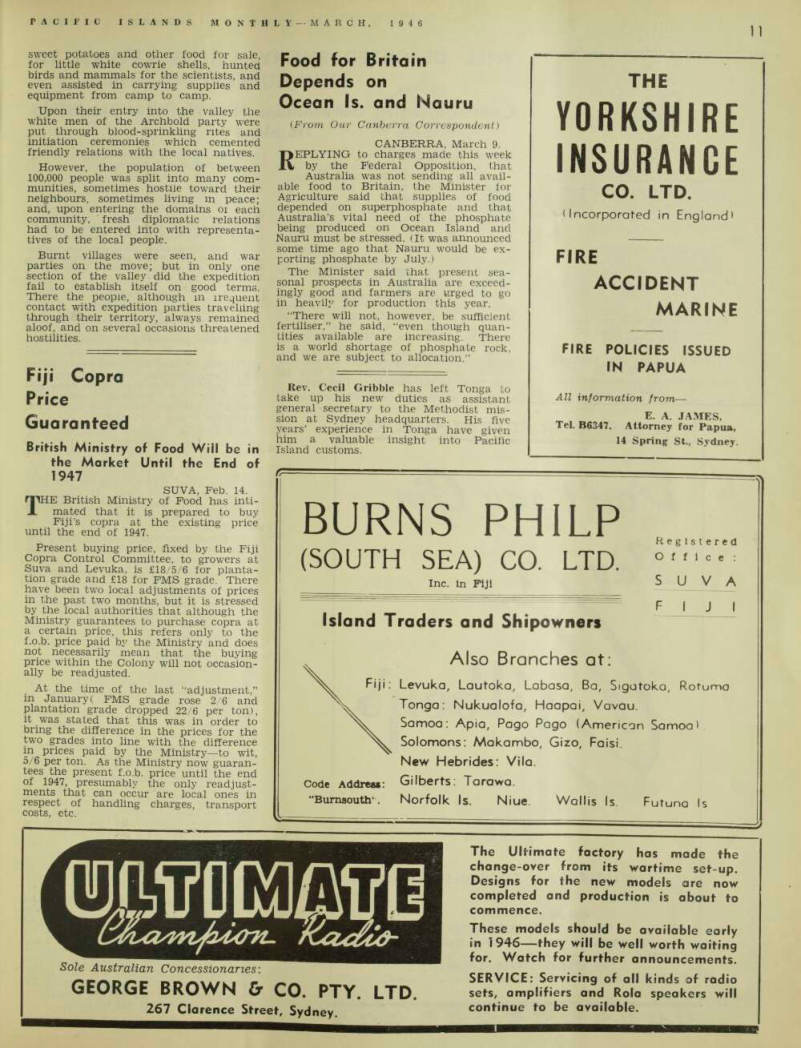
The “Southern Cross,” 250 tons, built in the early '3o’s, was seized by the Navy about the same time; and. for four years, she carried out dangerous jobs in dangerous waters. But the marks of war and rough usage have disappeared under a coat of gleaming white; and she seemed to be as eager as the planters to shake herself clear of the Sydney waterfront and head out into the blue waters of the north-east.
A photograph of the returning Solomon Islanders, and a list of their names, are published on the front cover of this issue.
They are not only sailing the “Southern Cross” back to the Solomons. Before they could sail, they had to load the ship themselves Australia’s famous “waterside loafers” refused the job. mHE BSI Administration let it be J. known some time ago that residents might return, if they could find transport—and at their own risk, so far as getting supplies in the archipelago is concerned. But there were no ships going to the Solomons. The unhappy evacuees in Australia looked forward to a further period of misery.
Then, quite unexpectedly, the “Southern Cross” was released; and, thanks to the tireless efforts of the tireless secretary of the Melanesian mission. Major H. S.
Robinson, she was reconditioned and refitted for her work in the Solomon Islands in a very short time.
The mission wanted a crew to take
the little ship from Sydney to the Solo mons, where the usual crew of trained Solomon Islands natives will be em barked. The evacuees wanted a passage to the Solomons.
The matter was very simply arranged.
The mission supplied the passages. The passengers supplied the crew. Every man of them undertook to carry out some necessary duty or other, All were smiling. The ship was sche duled to leave on March 1. That was when the front-page photograph was taken.
T>UT the smiles were premature. The £> s hip was not permitted to sail. On the wharf there lay a considerable cargo foodstuffs and ‘various supplies which were urgently needed in the Solo mons. For some reason which no one qu it e understands, the Sydney wharfies —the most notorious organisation of work-dodgers and cargo-pillagers in Aus tralia—refused to load the ship.
After some davs of hold-up the mis sion secretary, Major Robinson, nut his pr ide in his Docket and called upon the waterside czars. It was a mission affair, he said; neither the ship nor the cargo represented profit-making of any kind; would the czars graciously permit his team of amateur seamen to load his non profit-making ship? The czars of the Waterside Union graciously gave per mission.
And so, on March 6 and 7, the spectacle on the wharf at Darling Harbour would have gladdened the heart of all Solomons old-timers.
The lads pictured on the front-cover put their backs into it, with a will. There was “Tony” Olsen at the winch; A. M.
Andresen (decorated as an AIB man in World War II) was at the guide-rope; burly G. R. Younger was tossing sacks 0 f flour around like the athlete he was 25 years ago; Seton (another decorated AIB man)—big and powerful—and the younger Elkington—lean, brown and fit,
(Continued on Page 57)
A recent photo of the “Southern Cross.”
and smiling cheerfully—were down in the hold, stacking the cargo; Mill and “Dick” Laycock—whose sardonic sense of humour was given full play—were hand ling the cargo on the wharf; even “Pop”
Markham, now over 70, was giving a hand—and all the cargo that was wait ing was stowed in creditable time.
A similar scene was enacted on March 7. And then Captain Upwood and his officers and passenger-crew stood by.
Surely now they would be permitted to get away.
First one formality and then another held up the ship. But she finally sailed on March 12.
FEW of the returning Islanders knew, when they left how they were going to get from their port of disem barkation to their homes. They did not know whether there was anything left of their homes, except a few charred sticks.
But they went gladly, nonetheless.
Take the case of Mr. H. A. Markham, which is typical. The veteran was sent away from his beautiful plantation on Marovo Lagoon—one of the show places of the Solomons —in 1942. He has spent most of the intervening four years in hospital. His plantation was In the middle of one of the major Solomon Is lands battlefields (Munda), and there is nothing of it left —even the coconut trees were cut down to make way for an air field.
But Mr. Markham was one of the most excited and sprightly of the returning Islanders. He did not know what he was going to do —he wanted only to get back to the site of his old home, where he would make plans for the future.
“Better to sleep on the beach, and try to build up something again, than kick your heels uselessly in this goddam place,’’ said one of the travellers; and they all signified hearty agreement.
That started them off on tales of their battles with Australian officialdom battles for passports, battles with ration ing and taxation authorities, battles for permission to carry luggage endless, merciless battles with bureaucrats whose one apparent ambition is to knock back the urgent suppliant, and who cannot get the idea that these were people gladly de parting from a strange land for their own homes, and rehabilitation. rERE are no general stores in the Solomons, yet. Every returning resident has to make his own arrangements. Consequently, every man was anxious to buy foodstuffs, clothing, tools, engine parts and supplies—a hun dred and one things needed on a remote plantation, dependent on its own re sources.
It is the hot season in Sydney. Goods generally are hard to find, and sales people unfriendly and unco-operative.
The evacuees' task, in trying to buy and ship stores, in the circumstances, was very difficult and discouraging. How ever, after days of effort, most of their goods had been bought and transported to the wharf beside the friendly “Southern Cross.”
Then, as already described, they had to set to and load the ship themselves! fITHERE is one man who will fervently X welcome the sprightly white ship, when she arrives in the Central Solomons —namely, Dr. Baddeley, Bishop of Melanesia.
The “Southern Cross” —seventh of her line —was specially constructed for his work, in the ’thirties. Everything to
make life in the tropics more endurable —refrigeration, ventilation, cleanliness and comfort had been provided for; there is a chapel and an altar, alongside the Bishop’s suite. This is the handy little ship that was taken from the Bishop by the Navy, and sent to war, crippling the mission’s far-flung activities, which are carried on mostly by water trans port.
But the Bishop of Melanesia stayed on in the Solomons and got around some how in anything that would float. Came May, 1942, and the Jap invasion. Still the Bishop stayed, ducking from native village to native mission station, mostly afoot, and often just one hop ahead of the hurrying Japs. As he himself des cribed it, he “lived like a rat” —but he did not leave the Solomons until the Japs had gone; and he carried on the work of the Melanesian mission.
If —as so many of us believe—ships are sentient beings, the “Southern Cross” probably will wag her tail when she greets the Bishop, after this long parting.
Native Labour
Laws
Modification Expected in New Guinea
LITTLE by little, the enthusiastic plans of the amateur administrators, which coloured all Australian Minister Ward's native policy for New Guinea in 1945, are being replaced by something re sembling sanity.
Industrial conditions in the Territories still are chaotic —but recent developments show moves in the right direction.
All native labour contracts were can celled in the mainland area north of the Markham on February 28, when Civil Ad ministration took over from ANGAU; just as they were cancelled under similar con ditions in Papua on Oitober 15.
But this time officialdom handled the matter differently. Fuzzy-wuzzv was not urged tenderly by Mr. Ward’s deputies to go back to his village for a well-earned rest. Instead, the hard-bitten and ex perienced officials of the newly-created Administration told Fuzzy he was free to go if he wished; but that it might be better for everyone concerned if he made new paper.
We have had no reliable figures, yet; but we have been informed that a much larger proportion of the labourers are signing on again, than was the case in Papua in October. Nonetheless, it is ex pected that there will be a severe labour shortage, for some time.
The more sophisticated natives are no more in favour of the one-year contract than are the employers; and officialdom is showing a definite inclination to ap prove of two-years contracts. This re moves one of the most objectionable features of the Ward native policy.
A persistent renort that the new Ad ministrator (Colonel J. K. Murray), accompanied by Mr. J. L. Taylor (who has had a good deal to do with the ad ministration of the new native labour laws), is proceeding to Canberra, where he will remain for several weeks, was confirmed on May 8 by Minister Ward.
Col. Murray arrived on March 14.
Fleet Of Five "Small" Ships
For Wphc
FIVE small ships built in New Zealand last year for the Western Pacific High Commission are now at work in the Islands.
They are called “Margaret,” “Maureen,”
“Mary,” “Myrtle” and “Margery”; are all 60 feet long with a 16-feet beam; were built in Auckland, of NZ- kauri, by Charles Bailey & Sons, Ltd., to the design of Mr. Hubert Sabben, of the Public Works Department, Fiji.
The little ships are equipped with 102 h.p. diesel engines, radio receiving and transmitting sets, and electric light.
“Margaret” and “Maureen” belong to the Gilbert and Ellice Islands Colony, and are now working in that Group. “Mary,”
“Myrtle” and “Margery” belong to the Solomon Islands Administration, and now are on duty there.
Sir Alexander and Lady Grantham were in New Zealand during March. Sir Alex ander, as Governor of Fiji, was attend ing the conference on civil aviation held in Wellington. There were delegates from Britain, Australia, Canada and New Zea land.
Tropicalities
THE transfer of the 167 natives of Bikini Atoll, to Rongeria Island, has already begun.
Bikini, of course, is the saucer-shaped atoll in the Marshall Islands which the United States Government has chosen for the joint Army-Navy atomic bomb test next Mav. It is assumed that after the tests are' over there won’t be sufficient of Bikini left to worry about. Hence the migration.
The US Government is helping the natives to rebuild their new homes on Rongeria. There will be churches, store houses, a meeting-house and each native will receive as many food trees as he had back home on Bikirl. Concrete cisterns for water catchment will be pro vided —because there is, of course, no water on the low coral islands. * ADMIRAL W. H. P. Blandy, who is organising the atomic bomb experi ment, has had a tough time re cently. He has become the target for thousands of letters from apprehensive people who feel that atomic bombs are best left alone. To quiet some of their fears he has made the following statement about the things the bomb WON’T do: — • The bomb will not kill half the fish in the sea and poison the other half so that all the people who eat fish hereafter will die of poisoning. • It will not start a chain reaction in the water, converting it all to gas and letting all the ships on all the oceans settle to bottom. • It will not blow out the bottom of the sea, thus letting all the water run down the hole. • It will not cause an earthquake. • It will not push up new mountain ranges. • It will not cause a tidal wave. • It will not destroy gravity.
EVERY Cook Islander is well aware that among various other “shalt nots,” he may not keep rabbits —they are strictly forbidden. There is, however, a local tradition that in the Days of Hayes some misguided wight accepted from “Bully” a litter of young bunnies, and raised these to adult size. Then, trouble began!
The released rabbits, according to their custom, ate up every growing thing they saw; attacked orange trees (for the bark) and were getting a taste for palm bark, too, when at last the island, aroused to the danger of the innovation, made a concerted drive against the invaders.
After several weeks’ intensive rabbit hunting, they were “liquidated.” And they’ve never been replaced. This is a chapter of local historv that never got publicity; and Mangaia “keeps it dark” still.—E. G. * BRIDES, near-brides, mothers of toddlers and infants-in-arms—Bl9 of them, all Australasian and all be longing to American Servicemen, invaded Suva on the morning of February 22. when bride-cum-stork-ship “Monterey” called there for a few hours en route to San Francisco.
They overwhelmed shops, searching for merchandise long rationed in Australia and New Zealand; bought curios (but not as lavishly as their American husbands had done); plucked the hibiscus from
roadside shrubbery and decorated them selves a la Polynesienne; draped them selves on coconut trees and among the local scenery and photographed one another: and then returned to the “Mon terey” hot, sticky, and full of plunder, and the joy of having visited the tropics —which, as everyone knows, are full of romance, adventure and strange “foreigners.”
The ship—and the brides —later went on to Honolulu, where the brides were permitted to lean on the rail and look —but not to land. The New Zealand con tingent was not permitted to land in Syd ney, either, the reason given being that they were travelling under American Army care, and that in a large, strange city, they might get themselves into trouble.
Presumably the US Army considers Suva to be safe and respectable.
Suva has seen many tourist ships, in its day. But never before had it been invaded by hundreds of young females— glamour girls, hand-picked by the Yanks who take some pride in their accomplish ments in this direction.
Fiji will probably see other bride-ships.
The Americans married or became en gaged to, between 10,000 and 12,000 Aus tralian girls while they were in Australia.
Many of the girls have already sampled life in those United States; some of them are making the return journey, slightly disillusioned. m mERRITORIANS who watched the X bride-ship, “Mariposa,” leave Brett’s wharf, Brisbane, last month for San Francisco must have wondered how much longer thev would be in “exile” before being allowed to return home to the Islands.
The Islands are still home to them despite the scars of war. It is natural that they long to go back if only to gaze on the site where their homes once stood.
The love of home is a strong instinct of the British race and to destroy that love is to smash the very foundation on which the British Empire stands.
The writer has formed lasting friend ships with many evacuees in Brisbane, and when the time does come to say Aloha, it will be with a tinge of sorrow. — “Jay.” ♦ ONE never sees now in Mangaia a per formance of the “ute,” a once-popu lar pastime This “ute” is sung and danced by a male chorus, to the music of an accordeon, the performers remaining seated upon orange boxes. Thev clap their hands; “arms bend” and “arms-stretch” as in physical jerks at camp, varied bv right and left ditto with the legs and feet.
I often used to wonder how they stayed on their boxes, especially as “utes” and bush beer are so closely related.
The “ute” is our best form of musical expression; and I’ve often suspected that the brief, jig-like tune that the accom nanist plays was originally borrowed from Cook’s sailors, though now twisted out of all recognition. It is obviously nautical.
As to the words —these are “made to order,” and consist of laudatory phrases eulogising the man who foots the bill.
For, as Gilbert’s Duchess noticed, such entertainers are mercenary people, and want remuneration.
Our Uteans used to get about 1/- each and double for the accordeonist. They don’t get it now!—ETT.
WHO put the cigarettes in the peanut tins? Sydney Customs officials in sist that the foul deed was done by “a gang in Suva.”
When a ship arrived in Sydney from Suva, Fiji, recently, Customs men re covered some thousands of American cigarettes neatly done up in salted pea nut tins. The tins carried a well-known Yankee brand, and had presumably left the States filled with nuts. In Suva the nuts were removed —or so Australian officialdom says—the tins filled with cigarettes, resealed and sent on their wayward way to Australia.
Suva citizens need not blush at such wickedness, however. “A gang in Syd ney” is cooking up something even more potent for the undoing of Customs offi cials. Eight bottles of opium were re cently seized on a ship bound for Noumea.
The drug is believed to be smuggled in, in its raw state, from China or India, prepared for use in Sydney, and then sent off to the islands in the north. * C CYNICAL, but amusing current com- J ment on the present condition of affairs in the Mandated Territory of New Guinea; The Army steals from ANGAU; ANGAU steals from the Administration; the Ad ministration steals from the civilians: and the civilians steal from everyone!
"Eddie" as a War-winner
Amusing Statement in Wellington, NZ
ACCORDING to a Wellington news ranpr, Australian Minister for Ex ternal Territories, Mr Eddie Ward, when entertained at a “State luncheon” there on February 21. said that “it had been of the utmost importance that dur ing the most critical stage of the war Australia and New Zealand had been under Labour Governments. They in Aus tralia felt that without the advent of a Labour Government in 1941 the history of the war in these parts would have been vastly different.”
There have been hints of this view noint before; but, apparently, Mr. Ward felt that he had better place 1.200 miles between himself and his Australian critics before advancing his claim that the t abour Party saved Australia from the Japs for that, apparently, is what he means.
Mr. Ward himself has no record of service in either World War I or 11. So far as we are aware, not one of the prominent Ministers in the Australian Government displays on his coat lapel the badge of a, returned Serviceman. 'None theless, if the Wellington statement means anything, it means that Mr. Ward and his associates in the coming Aus tralian election campaign are going to claim that they, rather than MacArthur and his American and Australian divi sions, did a magnificent job of work in achieving victory in the Pacific war.
The Rev. and Mrs. J. A. Watson, and their family arrived in Suva from NZ on the February “Matua.” Mr. Watson will take charge of the Suva Presbyterian Church.
Mr. L. Hyndman, 91 Simpson Street, East Melbourne, Victoria, wishes to ex tend his deepest sympathy to the relatives of the many friends who lost their lives on the “Montevideo Maru,” and in other theatres of war.***
Shangri
LA
A HITHERTO unknown valley was be lieved to have been discovered in mid-1945 when an American trans port plane crashed into a high valley in Dutch New Guinea. The valley was called the “Hidden Valley,” or Shangri-La, and was featured in articles and pictures in American, British and Australasian pub lications. We published an article and photographs in July issue of “PIM.”
Comparison of photographs later re vealed, however, that the “Hidden Valley” had been visited previously—bv the Arch bold Expedition in 1938—and had been called the Grand Valley of the Balim River.
We published this fact last November, and now publish a series of photographs taken by the expedition in 1938 and kindly made available to us by the Archbold Expedition, of the American Museum of
Natural History, who also supply the following data: — EARLY in the exploration of the Grand Valley by the Archbold Expedition it was found that the Catalina-type flying-boat “Guba,” used by the party could be landed near the lower end of the valley. A base camp was established there, supplies were flown in to this land ing place, and from it the whole party of 100 men was flown out of the valley when its work was done.
The Archbold Expedition was carried out with the co-operation and assistance of the Netherlands Indies Government and was known officially as the “Indisch- Amerikaansche Expeditie.” The Indies Government provided a military covering party of 50 officers and men for the pro tection of the expedition, and attached two men to the scientific staff.
The object of the expedition was to col lect and study mammals, birds, insects and plants.
The Grand Valley was discovered on June 23, 1938. on a reconnaissance flight from Hollandia to the Snow Mountains, in the remote interior. The first ground examination of the valley was made by exploration patrols of the expedition led by Staff Captain C. G. J. Terrink and Lieut. V. J. E. M. van Arcken, of the Netherlands Indies Army.
Teerink’s patrol set out from Lake Hab bema, high up in the Snow Mountains, where the expedition had established its main inland camp and air-freighting base, nearly 11,000 feet above sea level, van Arcken made his way in from the Idenburg, a big river on the lowlands to the north of the valley.
These patrols were supplied by para chutes dropped from the “Guba.”
Later, the scientific party moved down into the new valley and for three months lived and travelled amongst the natives and made collections and observations which added greatly to the still very im portant knowledge’ of the New Guinea flora and fauna, and threw light on the culture and customs of one of the most interesting peoples of the island.
Nearly everywhere in the valley the natives were very friendly toward the ex pedition, which they greeted with pacific gestures and repeated calls of “Nap” or “Wah.” They brought great quantities of
Photographs show: 1.—Suspension bridge built across the Balim River by the Valley natives. 2.—Aerial view of a Grand Valley village. Note the intensive cultivation and neatly planned village. 3. —Looking out from Archbold’s base camp across the Valley. 4.—Aerial view of the Grand Valley. 5.—Balim Village natives visit the base-camp. 6.—Sweet-potato fields with deep dividing trenches and stone and mud walls.
sweet potatoes and other food for sale, for little white cowrie shells, hunted birds and mammals for the scientists, and even assisted in carrying supplies and equipment from camp to camp.
Upon their entry into the valley the white men of the Archbold party were put through blood-sprinkling rites and initiation ceremonies which cemented friendly relations with the local natives.
However, the population of between 100,000 people was split into many com munities, sometimes hostile toward their neighbours, sometimes living in peace; and, upon entering the domains oi each community, ' fresh diplomatic relations had to be entered into with representa tives of the local people.
Burnt villages were seen, and war parties on the move; but in only one section of the valley did the expedition fail to establish itself on good terms.
There the people, although in irequent contact with expedition parties travelling through their territory, always remained aloof, and on several occasions threatened hostilities.
Fiji Copra
Price Guaranteed British Ministry of Food Will be in the Market Until the End of 1947
Suva, Feb. 14.
fTIHE British Ministry of Food has inti- JL mated that it is prepared to buy Fiji’s copra at the existing price until the end of 1947.
Present buying price, fixed by the Fiji Copra Control Committee, to growers at Suva and Levuka, is £lB/5/6 for planta tion grade and £lB for FMS grade. There have been two local adjustments of prices in the past two months, but it is stressed by the local authorities that although the Ministry guarantees to purchase copra at a certain price, this refers only to the f.o.b. price paid by the Ministry and does not necessarily mean that the buying price within the Colony will not occasion ally be readjusted.
At the time of the last “adjustment,” in January ( FMS grade rose 2/6 and plantation grade dropped 22/6 per ton), it was stated that this was in order to bring the difference in the prices for the two grades into line with the difference in prices paid by the Ministry—to wit, 5/6 per ton. As the Ministry now guaran tees the present f.o.b. price until the end of 1947, presumably the only readjust ments that can occur are local ones in respect of handling charges, transport costs, etc.
Depends on
Food for Britain Depends on Ocean Is. and Nauru
{From Our Canberra Correspondent) CANBERRA, March 9.
REPLYING to charges made this week by the Federal Opposition, that Australia was not sending all avail able food to Britain, the Minister for Agriculture said that supplies of food depended on superphosphate and that Australia’s vital need of the phosphate being produced on Ocean Island and Nauru must be stressed. (It was announced some time ago that Nauru would be ex porting phosphate by July.) The Minister said that present sea sonal prospects in Australia are exceed ingly good and farmers are urged to go in heavily for production this year.
“There will not, however, be sufficient fertiliser,” he said, “even though quan tities available are increasing. There is a world shortage of phosphate rock, and we are subject to allocation.”
Rev. Cecil Gribble has left Tonga to take up his new duties as assistant general secretary to the Methodist mis sion at Sydney headquarters. His five years’ experience in Tonga have given him a valuable insight into Pacific Island customs.
Advertisements & other items, pp. 15-16 (1 item)
Burns Philp
THE
YORKSHIRE
INSURANCE
CO. LTD.
(Incorporated in England*
FIRE
ACCIDENT
MARINE
FIRE POLICIES ISSUED
IN PAPUA
All information from —
E. A. JAMES,
Tel. 86347. Attorney for Papua, 14 Spring St., Sydney
BURNS PHILP
Registered
(SOUTH SEA) CO. LTD.
Inc. In Fiji SUVA
11=1 = FIJI
Island Traders and Shipowners \Also Branches at; Fiji; Levuka, Lautoka, Labasa, Ba, Sigatoka, Rotumo Tonga; Nukualofa, Haapai, Vavau.
Samoa: Apia, Pago Pago (American Samoa' Solomons: Makambo, Gizo, Faisi.
New Hebrides; Vila.
Code Addrcw: Gilberts: Tarawa. ‘‘Burnsouth* . Norfolk Is. Niue. Wallis Is. Futuna Is
Sole Australian Concessionaries :
GEORGE BROWN fir CO. PTY. LTD.
267 Clarence Street, Sydney.
The Ultimate factory has made the change-over from its wartime set-up.
Designs for the new models are now completed and production is about to commence.
These models should be available early in 1946—they will be well worth waiting for. Watch for further announcements.
SERVICE: Servicing of all kinds of radio sets, amplifiers and Rolo speakers will continue to be available.
SPECIALISING
IN
PACIFIC ISLAND INSURANCES
TIRE MOTOR VEHICLE
MARINE HULLS AND CARGO
EMPLOYER’S LIABILITY
GUARANTEES including those for—
DYNAMITE PERMITS.
RECRUITERS’ LICENCES.
DEFERRED WAGES
AND ALL OTHER CLASSES ARRANGED
AT LOWEST CURRENT RATES.
Established Agencies:
W. R. CARPENTER & CO., LTD.
Throughout the Territory of New Guinea.
SOUTHERN PACIFIC INSURANCE
CO., LTD.
HEAD OFFICE; 60 HUNTER STREET,
SYDNEY.
‘Pont iau (Jin ..
Sc
★ LIQUEURS ★ COCKTAILS ★ WHISKIES
Address all enquiries to;
W. tr A. GILBEY LTD.,
33 ROSSLYN STREET, WEST MELBOURNE.
Telegraphic and Cable Address: "Gilbey's," Melbourne.
109 REGENT STREET, SYDNEY.
Telegraphic and Cable Address: "Gilbey's," Sydney.
New Guinea?

Will Deported Enemy Aliens Return To
Commonwealth Government Has Not Yet Made Up Its Mind
NINE months after the surrender of Germany to the Allies the “PIM” wrote to Security Services in Sydney, asking; TD what was the policy of the Australian Government with regard to interned enemy nationals; (2) how many New Guinea German residents had been interned: (3) were they being released from internment camp; (4) would they be permitted to return to the Territory of New Guinea, remain in Australia or be repatriated to Germany; or would each case be considered on its merits?
Many German residents of New Guinea, missionary and layman, are or have been interned at Tatura internment camp, Victoria, during the war. Their fate is naturally of interest to “PIM” readers.
The officer in charge, Sydney office of Security Services, replied that he was un able to make a statement and that he had referred the matter to Canberra.
In due course we received the follow
ing letter from the Commonwealth Inves
tigation Branch, Canberra; —
Dear Sirs, — I refer to your letter of February 5, addressed to the Officer-in-Charge, Security Service, Sydney, asking for particulars of persons who have been interned from New Guinea for pub lication in the “Pacific Islands Monthly.”
It is not the practice to furnish information of this nature except for official purposes, and accordingly this Service is unable to accede to your request.
Yours faithfully,
W. Mcgregor,
(For Longfield Lloyd, Director-General).
So speaks Australian bureaucracy!
WE hold no brief for those New Guinea Germans with Nazi sympathies— and the fact that they were in terned by the Australian authorities should be sufficient proof that they were dangerous to the Allied cause.
New Guinea residents are agreed that generally the authorities were right in taking the action which they did, and that in many cases this. action was be lated. A few rabid Nazis were sent to Australia from New Guinea in the first months of World War 11, but the majority of the members of the German community were permitted to remain in the Territory.
This was satisfactory enough until the Nazis over-ran France, Belgium, Holland and began their blitz on London.
Then many of those New Guinea Ger mans were misguided enough to abuse British leniency by exulting in public and displaying Nazi emblems. Protests were heard from all sections of the New Guinea public, and particularly from the Returned Sailors and Soldiers Imperial League. Finally, most of New Guinea’s German nationals were sent to Australia for internment.
But the enemy is now vanquished; the internees obviously cannot remain in Tatura for ever; and the general public, including Territorians, should be per mitted to know what is to become of them.
The only conclusion to be drawn from the letter sent us from Canberra, is that the Australian Government has, in this, as many other things, no policy at all.
However, concurrently with our inquiry in Sydney, a “civilian internee inquiry” began at Tatura camp; proceedings were occasionally reported in the Melbourne newspapers, but were almost entirely ig nored by the Sydney press.
With this clue we tried again, having in the meantime found out the name of one of the officials in Security Services in Sydney.
This official admitted that there had been an inquiry at Tatura; that the press had been admitted; that the Minister had made a statement to that effect when the inquirv began. But, no—he could not say what the inquiry was for, or when it began, or when the Minister’s statement was issued to the press. In fact, as an officer of a Government Department, he was not permitted to make any statements at all. The Minister did all that.
(Continued on page 53)
“Well, who is your Minister?’’ we asked.
He had a sufficiently large sense of humour to chuckle. “Mr. Calwell,’’ he said.
We saw it all, then!
FOR the uninitiated, Mr. Calwell is the Minister for Information and Immi gration. Since the Australian news papers defied his political censorship back in 1944, he has run a one-man war against what he calls “the capitalistic press.”
Mr Calwell also issues passports. He personally scrutinises every application to leave Australia, and has absolute power to grant or refuse passports and permits—an authority he exercises to the full. His particular delight is refusing to allow Australian women to leave the country to take up important work over seas. He says tney are all needed in Australia to work in the canneries and the textile mills.
For this he has frequently been attacked by the daily newspapers and, in retaliation, some months ago, he and his various Departmental officers went into seclusion. The officers are not permitted to give press interviews; and he will not.
Consequently, Mr. Calwell goes his way ward wav and gives no explanation of his actions to the public whom he has sworn to serve. , , , . , The fact that he was somewhere behind the scenes in Security Services was news to us; but it explained much, if not all.
And at this stage the Sydney official broke down sufficiently to explain the] Mr. Justice Simpson had been appomred by the Commonwealth Government to hear the depositions of aliens still in
terned at Tatura and their reasons, if any why thev should be permitted to return to the work they were engaged in at the time of their internment, as an alternative to deportation to Germany.
Mr. Justice Simpson made a report of his findings and this will be submitted to the Commonwealth Government. Pre sumably an internee policy will be based on this.
AS this broadly answers our most im portant querv it might be asked why it was necessary to indulge in official hush-hush, humbug and buck-passing.
It does, however, serve as an example of bureaucracy in full blast. Instead of one man answering a simple and legiti mate question in two sentences, we have the spectacle of half a dozen public ser vants hiding coyly behind the skirts of the Minister; and the Minister retiring behind a thick wall of political preroga tive, or something he imagines is preroga tive.
And, although we know that some ex residents have released from Tatura. we still do not know how many, or what is to become of them. As the Naxi sym pathisers are still in Tatura, presumably those who are out have been given com plete freedom. Will they now be per mitted to return to the Territory?
It was alleged by some members of the Pacific Territories Association last year that Germans who had been brought down from New Guinea under guard in 1940 were permitted to return in 1945.
A concise, comprehensive statement on the whole enemv alien position, as it applies to New Guinea, is overdue.
Rule-by-Regulotion
Fiji Refuses Rule-by-Regulotion Fight Against High-handed Government Action
rE abhorrence of Fiji residents for continued rule-by-Regulation was demonstrated between February 4 (when new Price Order Regulations were suddenly announced) and February 12 (when they were as hastily withdrawn).
The Prices of Goods Ordinance, 1940, under which price control in the Colony has ©Derated, exoired in February. Fiji residents generally are agreed that some measure of nrice control should continue, but they did object to having a com pletely new set of Orders sprung on them —not as an amendment to the old Ordinance, which would have had to be debated in Legislative Council, but as an Order-in-Council, to be known as the Price Control Regulations, 1946, which was the pure, unadulterated product of the Government machine in which the public had no voice.
The new Regulations gave the Price Controller (Mr. R. W. Parkinson) almost unlimited nowers—some of which he had asked for under the old Ordinance, and had been refused —and virtually did away with the services of the Central Price Control Committee, which had been set up in November, 1942, to assist the Con troller in an advisory capacity.
They gave the Controller even greater powers than the police, in that he could require a person to answer any question at any time, even if that answer should be incriminating; and he was permitted to administer an oath to any person if he required to force a statement which he could later use in Court. Briefly, as the secretary of the European Electors’
Association (Mr. Roy Barnsfather) stated, it gave to the Controller, in peacetime, powers which had been refused him in war.
During the eight days between the pub lication of the Regulations in the Gov ernment “Gazette,” and its withdrawal, Fiji residents seethed with resentment.
Five members of the Central Price Control Committee (Messrs. C. W. Aidney, L. C. Bentley. R. A. Crompton, K. R.
Sands and J. Trotter) resigned “en bloc” (resignations were withdrawn after the Government backed down on February 12); the Chamber of Commerce arranged a protest meeting, and the European Electors’ Association registered vigorous
protests.
On February 12, the Government made the following announcement;— “In view of the objections which have been made to the proposal to control prices by the Price Control Regulations, 1946, of February 4, 1946, which were to come into force on February 15, this Order has now been withdrawn. It has been decided that a new Prices of Goods Bill will be presented to Legislative Coun cil at an early session.”
It was further announced that in the interval between the expiry of the old Ordinance and the preparation of the new Bill, for Legislative Council, price control would be effected by other Regu lations made under the Supply and Ser vices (Transitional Powers) Act, 1945, of the United Kingdom.
EDITORIAL NOTE.—It is to be hoped that, some day, we shall have the “inside story” of this extraordinary attempt to put a bureaucratic muzzle upon the people of Fiji. The “Regulations,” by their character and by their lofty dis regard of the liberty of the individual, Ward in Canberra or Mr. Stalin in Mos might have been framed by Mr. Eddie
cow, instead of by a presumably British official in Suva. Australians are becom ing accustomed to the gradual filching of their individual freedom, and have little kick left. But by what process of post war reasoning did the 'Colonial Office officials imagine that the people of Fiji would accept a monstrous plan of that kind? Whose plan was it, anyway?
Fiji should be giving a lead to the in dividualist communities of the South Pacific, by getting rid of their Price Con trol machinery, instead of devising new muzzles for the people.
During 1945 New Caledonian imports were valued at 436,084,000 francs and exports at 178,610,000 francs. Much of the excess of imports over exports was on account of goods imported to satisfy the demand of American troops stationed in the Colony, who at one time numbered 150.000. Caledonia received goods to the value of 208,337,000 francs from the United States; to the value of 207,684,000 francs from Australia; and from French Colonies to the value of 5,114,000 francs.
Imports from France and from other countries was negligible. Exports to the USA were valued at 139,212,000 francs; to Australia 5,638,000; and to France 32.548.000.
Advertisements & other items, pp. 17-18 (1 item)
a major anxiety
Relief from
Even the most expert and conscientious individual executor is subject to accident, illness and incapacitation.
Continuity of administration and uninterrupted attention to your estate and your beneficiaries are of paramount importance. Both can be positively assured by appointing this Company your sole Executor or as co-Executor with your present appointee. An interesting explanatory booklet will be forwarded on reguest.
DIRECTORS:
Tames Burns.
Lewis Armstrong.
R. J. Nosworthy.
MANAGER: L. S. Parker, Joseph Mitchell.
P. T. W. Black.
SECRETARY: E. R. Overton, A.F.I.A.
BURNS PHILP TRUST
COMPANY
LIMITED
7 BRIDGE
TELEPHONE: B 7901
STREET.
SYDNEY
Box 543, G.P.0., Sydney
BPI .45
STAMPS
We buy collections, also all issues in quantity, either off or on paper. Top prices. Send registered mail.
Agents required in Pacific Islands, Papua and New Guinea to service covers and send mint stamps.
A. Willison, Box 128, Burnie, Tasmania.
American Equipment In New Guinea
Worth Countless Millions
Australia Wants "Compensation" For Manus Base
AfTrimT--. . CANBERRA, March 6.
USTRALIA is unlikely to sanction America’s application for the use of Manus as a post-war military base unless she is adequately compensated.
This is clearly indicated by statements made here by the Prime Minister (Mr.
Chifley) and other responsible officials.
Mr. Chifley told pressmen here there had been no Ministerial talks between repre sentatives of the US and Australia re garding the post-war use of Manus. Dis cussions might have taken place between less responsible authorities, he said.
Mr. Chifley stated that an Australian engineer had estimated that American installations on Manus were worth about £100,000,000 Australian. This huge expen diture, he remarked, would seem to sup port America’s claims for the use of Manus as a Pacific base. Previously, it had been stated that Australia would not mind America using Manus as a base pro vided Australia were allowed to retain her administrative control of the island, and the Empire’s ships were given free use of the harbour there.
Mr. Chifley also announced that the Australian Government was arranging with the United States to buy thousands of pounds worth of American equipment lying in the islands north of Australia.
The Americans claimed that at Finsch hafen alone installations and equipment cost more than £40,000,000. US authorities are not keen on having the equipment re
turned to America because of shipping shortages and storage difficulties.
In addition, strong industrial pressure groups in the US strongly oppose any recommendation to return the goods.
They point out this would not only use up vital shipping but would clutter up the markets and bar the sale of new goods being produced in the States.
On the other hand, Mr. Chifley has made it clear to US authorities that the equipment’s value to Australia is not one tenth of its original price. Mr. Chifley has also stressed that Australia wants only a fraction of the equipment stored in the islands. He has pointed out that Australia faces the same problems as America. She does not want to use up vital shipping to bring goods without real economic value from the islands. For that reason the Commonwealth was dumping much of its own equipment in the islands.
Official opinion is that America will have to sell dirt cheap if she hopes to realise at all on equipment and tools left in the South-west Pacific. Other wise, Australia’s attitude will be: “There it is, take it back ... if you can.”
The Rev. John Dixon, of the Methodist Overseas Mission, arrived in Sydney by ’plane from Port Moresby in February.
He is accompanied by a Papuan, who is to assist in the completion of some trans lation work.
The Rev. j. W. Burton, who is visiting North America, has had the degree of Doctor of Divinity conferred on him by the Victorian University, Toronto, Canada.
Advertisements & other items, pp. 18-20 (1 item)
Robert Gillespie Ptv Ltd
IMPORTERS
EXPORTERS
// Island Distributors for
"COLEMAN" HEATING AND LIGHTING APPLIANCES
DINOX " AND " DIX " BRANDS OF BROOMS, BRUSHES AND MOPS
ROBERT GILLESPIE PTV LTD
BANKERS: BANK OF N.S.W.
COMPTOIR NATIONAL
D’ESCOMPTE DE PARIS
54a PITT ST. SVDNEV N.S.W.
CABLE ADDRESS:
“ROBERGILL”
PHONES BW 4782-B 1305
S' IwV” IRONS PEP
PERFECTLY
Coleman’s Petrol and Kerosene Lamps in 300 and 500 C.P.
M Coleman’s Kerosene Table Lamp can be used as hanging Lamp ■ M •% I 1/ w & It took 40 ycors intensive specialisation to bring the Coleman Petrol Iron to its present state of perfection. Coleman
Irons require no preheating, they light
instantly and can be used either indoors or outdoors.
The ventilated body prevents sides from scorching light fabrics and the ventilated lid keeps the handle cool.
Tapered edge for ironing pleats and around buttons.
Pointed heel gives wrinkle-proof ironing on back and forward strokes. 4 Built-in cleaning needle, cleans gas - tip automatically, without turning off iron and also regulates heat. 2 3 Coleman’s Petrol or Kerosene Lamp with large enamelled reflector.
Representatives for the Pacific Islands: ROBERT GILLESPIE PTY. LTD. pearce £ va co ltd 540 PITT STREET, SYDNEY FOR FIJI ISLANDS
G. H. Robinson
ISLAND SUPPLIES
of all kinds—Selected and Shipped to order at lowest possible prices—Piecegoods in Wool, Cotton and Silk, Under and Outerwear, Manchester, Drapery, Grocery, Hardware, Engineers and Leathergoods trade supplies a specialty.
Indents and Transhipments arranged. Large or small orders treated with equal care.
Use our 25 years’ extensive experience.
Enquiries solicited to —
G. H. ROBINSON
51 Macquarie Street, Sydney, N.S.W.
Telegrams: Sunrise, Sydney.
Letters; Box 3317, G.P.0., Sydney.
Interesting Report From
Pacific Shipping
War?
Interesting Report From Tahiti
From Our Own Correspondent
Papeete, Feb. 10.
A PACIFIC traffic war appears to be in the making; although the details are not yet clear.
Rumour and the indications so far lead us to believe that the Big Five, of Hawaii, covet the monopoly of trans-Pacific freight and passenger steamship service, between the USA West Coast and Australasia.
The ill-fated voyage of the steamer (affectionately named by Tahitians “Te Aua Pua’a Painu” —“The Floating Pig Sty”) was the initial skirmish. This vessel was chartered by the Big Five.
The Union Steamship Company of New Zealand has immediately challenged this invasion into its territory, by re-establish ing a monthly cargo-steamer service over the San Francisco-Tahiti-Rarotonga- Australasia route.
During the past 30 years, the Union Company has held the monopoly of this route, and has defended it with all the resources at its command.
The Union Company is reputed to be owned and directed by a very canny asso ciation of Aberdeen Scotsmen. The Big Five will discover them to be able oppo nents. Indeed, all such contests, hitherto, have been mere repetitions of the Battle of Bannockburn. Invariably, the Scots men have returned from the field of com bat, with pipes skirling and banners wav ing, bearing the fruits of victory.
The Rev. C. F, Gribble, who has served with the Methodist Overseas Mission in Tonga for many years, and who at pre sent is Director of Education for the Tongan Government, has been appointed Assistant Secretary-General of Overseas Missions in Australia.
Brass-hats Blunder
Captain J. J. Murphy Honourably Acquitted of Treason Charge
IT is now evident that Captain J. J.
Murphy, AIB, and formerly a patrol officer in the old New Guinea Ad ministration, who recently was honourably acquitted on four charges of giving in formation to the enemy, should never have been brought before a court-martial.
Murphy, who was captured while on a dangerous mission to then enemy-held New Britain, in October, 1943, was arrested by the Australian military authorities after the liberation of Rabaul in October, 1945. He has since been in custody, al though the only evidence against him was accusations made by Jap officers.
Some pin-headed Brass Hat, seized with misplaced zeal, has evidently blundered.
Murphy had a line record in the New Guinea service before the war. After the Japanese came in, he became attached to AIB and trained in Queensland for the New Britain mission. He was warned by a superior officer at that time of the extreme danger of the venture, and told that he could withdraw if he wished. He decided to go on and, with a party, was landed from a submarine on the New Britain coast in September, 1943. He was subsequently led into an ambush by unfriendly natives, captured by the Japs and taken to Rabaul.
He was there questioned and, when he refused to give information, he was handcuffed, hurled to the floor, beaten and bayonetted in the chest. Later, he was refused food, tied to a tree and hung by the wrists, with his heels off the ground, for a day at a time.
Later still, he was told he was to be beheaded. In his own account, at the court-martial, Murphy said: “Two officers came to my cell and told me to put my shirt on as I was to be decapitated. I told them not to be silly and spoil a shirt when the prisoners were so short of shirts.
“The interpreter told me the Jap com mander had ordered my execution at 2.30 p.m. It was then 2.5 p.m.
“I shook hands with the other prisoners and went with the three Japs to a clearing. There I was handed a shovel and told to dig my own grave. I refused, saying I wanted the other prisoners to do it. I did this because I wanted wit nesses.
“The Japs refused, so I asked one of the officers for a cigarette. I smoked this and then, to put off the evil hour, I asked for another and received it.
“When I had finished it I was again handed a shovel but again I refused to dig, and told them to clean up their own mess. A scuffle took place and I was then led back to my cell.”
Murphy's fellow officers and those who knew him in pre-war days are indignant that a man of his reoutation and charac ter should have been arrested on the flimsy evidence provided by the enemy; or that, knowing the character of the alleged evidence against him, the Brass Hats should have considered it necessary to hold a full-blown court-martial.
Measures have been taken to tighten up control of Javanese and Tonkinese residents in New Caledonia following the abolition of their indentured contracts as coolies. To obtain employment, each of these “immigrants" is now required to show a properly stamped card supplied him by the Immigration Syndic. Em ployers are made responsible for seeing that this is done. The employer must pay the Syndic or Union a fee of 10 francs a month.
Advertisements & other items, p. 20 (1 item)
# Ship Chandlery
FOR
WRITE FOR OUR CATALOGUE
Ship Chandlery
® Builders 9 Hardware
* General Hardware
• Paint Materials
BOAT AND YACHT GEAR OF ALL TYPES
BROOMFIELDS LTD.
152 SUSSEX STREET, SYDNEY.
Special “in Bond” Prices for all Island Requirements Quoted on Application.
Vnlo Anoni* iw p H - MUNTZ & CO.’s 3-CROWN BRAND METAL SHEATHING, oute jur. peacock & BUCHANS’ ENGLISH READY-MIXED PAINTS.
"Blue" Allen Leaves
the PIR Australia Wanted His Job For a Staff Man
HIS many friends learned with aston ishment in lyiarch that Colonel H. T.
Allen, OBE, had been relieved of the command of the Pacific Islands Regi ment, in New Guinea, and was returning to Australia. He is being replaced by someone from the Australian General Staff.
“Blue” Allen,- a World War I veteran, deserted his nrofitable goldmine in Wau, TNG, as soon as he heard the drums of World War II awaken, and lie enlisted in the AIF. He saw much service in the Middle East, was decorated for his good work at Tobruk, and he returned with his division with the rank of Lieut.- Colonel.
In the last two years of the war he was back on his own stamping-ground, in New Guinea; and again he rendered dis tinguished service, and was promoted full Colonel. When Japan surrendered, he re turned to Australia, and sought discharge.
He and Mrs. Allen already had planned a long holiday—when he was invited to go tfack to New Guinea and take charge of the PIR.
“Blue” was not happy about this pro posal. He had had all the military ser vice he wanted. But it was pointed out to him that few men could fill the posi tion for which he was slated. After doing a fine wartime job, the 5,000 natives of the PI Regiment had been badly handled and officered, and they were very gravely out of hand. Colonel Allen, with his good record, and his long experience and understanding of natives, was re garded as the ideal man for the com mand. Australia wanted discipline re stored, so that the regiment could be used to guard Jap prisoners, thus releas ing a corresponding number of Australian soldiers. So Colonel Allen, as a matter of duty, returned to New Guinea in Octo ber, and applied himself immediately to a difficult and uninspiring task. He per suaded a number of his experienced brother-officers (including his old friend, Lieut.-Colonel Norman Neal) to return to New Guinea with him.
The only reason (according to report) given Colonel Allen for the change is that “Australia has a lot of high-ranking permanent officers on her hands at the present Jdme, and is trying to find jobs for them.” It is greatly to be regretted that Australia did not find this out in October, instead of February, and thus
have saved Colonel Allen a lot of arduous and comfortless work. In most matters affecting New Guinea, however, Australia displays a degree of intelligence worthy of the primary school-room.
It is reported that a number of other officers will depart with Colonel Allen.
The Pacific Islands Regiment, not being commanded by men with practical exnerience of New Guinea and NG natives, became restive and undisciplined, in 1945. Unless the new commander has been selected with great care, some development of the same kind may be ex-
pected again.
Lieutenant F. A. Rhoades received his discharge from the AIF recently in Syd ney, anc j w ni return to Bougainville again, as pi anta tion manager for Messrs. Burns Philp & Co., Ltd. He was one of the original coast-watchers in the Solomons black days of 1942 He was by nSpnna until the Ameri hmiEsclf on Quad; ?Q49-in Naval cans landed in August 1942 in Naval Intelligence in 1943; and then he became a" member of the famous Allied Intelli gence Bureau. He was awarded the Dis tinguished Service Cross and the United States Silver Star.
Advertisements & other items, p. 21 (1 item)
freshest powdered milk
See if COWLAC isn’t the CrGcUTHGStj
you’ve ever tasted!
One 12-oz. can of Cowlac Dried Milk gives you half a gallon of farm-fresh milk, containing nearly half a pint of cream.
Order your usual channels.
ATRUFOOD PRODUCT
ORDER FROM
BRIAL and BALL
528 Collins St., Melbourne, MU4837 1 Bond Street, Sydney . . . B 737'i tofc
lipputf
p&C\f' C
\\,^ u
NOW
d*
CREAW
IB
RICH
FULL
I 1 D R a is od IRa 3S& Ua
LTD
AUS
1202 s CM
This Company supplies Aluminium and its Alloys to all specifications and for every commercial application where these give better service over other metals.
PLATE . SHEET . STRIP . SLABS . CIRCLES
BAR WIRE SECTIONS . FORGINGS
TUBING . ROD .
ALLOY INGOT.
Please Consult our Technical Service Department regarding your Light Metal Problems.
AUSTRALIAN ALUMINIUM COMPANY
p no p a/ eta p limited
(INC9RPORATED IN THE STATE OF VICTORIA)
GENERAL OhFI C ES AND FABRICATION DIVIS I O N: GRANV I L L E. SYDNEY, N. S. W.
Spare Copies Of "Roll Of
Honour"
ADDITIONAL copies of the January issue of the “Pacific Islands Monthly,” which contained the lists of Pacific Territories residents who be came casualties, or won decorations, in World War 11, are available to anyone who wants them. Copies can be had by writing to Pacific Publications Pty., Ltd., PO Box 3408, Sydney, and enclosing 6d. in postage stamps, to cover postage.
If only the Supplement, containing the lists of names, is wanted, please say so; and, in that case, send only 3d. in stamps for each copy required.
Agriculture
Less Experimentation Wanted In Fiji
Unofficial Members of Council Demand Positive Action
rIE principal business of the recent Legislative Council session was the debate on the Government’s agricul tural policy. The Governor, Sir Alexan der Grantham, commended it to members in his opening speech by saying that: “it was well conceived and carefully thought out.” The unofficial members, with the exception of the Fijians, dis agreed, and criticised it sharply.
After the cane strike in 1943, which cost the misled strikers more than £1,000,000 in gross income, and the Colony very considerable revenue, the Government had (1) Professor Shephard, and (2) Pro fessor Patterson and Dr. Dodds (all members of Trinidad’s Imperial College of Tropical Agriculture), draft an agri cultural policy for Fiji and the Western Pacific.
The two reports were later worked on by a Committee in Fiji. The Govern ment’s agricultural proposals for Fiji in volve an estimated capital expenditure of £92,150, and an annuallv recurrent expen diture of £42,363 (£13,000 more than it spends now). This had the*, approval of the Secretary of State for the Colonies.
The policy, as capably outlined by the Director of Agriculture (Mr. C. Harvey), was not revolutionary in itself. It pres cribed an experimental and investiga tional programme “limited to work on practical problems of immediate import ance,” with large-scale field extension work, and called for a 1,000-acres experi ment station near Suva, a station near Lautoka, and a smaller one near Labasa.
IN the day and a half which unofficial members took in February to criticise the proposals, the main point which they made was that the Government’s main emphasis was on experimentation—
SUVA, March 1. when it should have been on immediate extension work, on the education of farmers’ sons and agricultural officers, on experimentation, and on marketing—in that order.
They argued that the' Department should apply its considerable existing knowledge to immediate extension work, and have two stations only, one near Suva, the other near Labasa, as train ing institutions, and that the proposed short-term experiment work should be carried on subsidiary to instructional work.
The Government partially accepted these criticisms.
Considerable criticism was directed by the Indian members at the Government’s land tenure policy. They described it as “anti-tenant,” with its too rigid control.
The policy, giving a 30-years term for agricultural leases, with 15-years re newals, and compensation for •unex hausted improvements, was, nonetheless, a great improvement on the past. It would go far towards making the peasant farmer more contented and secure on his holding, but it was obviously not the work of the Director of Lands, and had had, literally, to be wrung out of the- Government over his unappreciative head.
• Traffic Bill
rE only other Bill of any importance in this early session was the Traffic Bill, designed to consolidate and amend the Colony’s traffic laws, and to make further and' better provision for the control of bus services.
Whether, as the Governor said in his address, the Colony should continue to have a multiplicity of bus owners and operators, or whether an exclusive fran chise should be given to one company, or whether a statutory body should own all services, is for the newly created Trans port Control Board to consider.
But the unofficial members, and parti cularly the Indians, almost unanimously opposed the suggestion of Government control. The Indians on the other hand would like the Government to nationalise the sugar industry!
ON the whole the session was an in teresting one; but as usual, little public interest was evident, and the galleries were for the most part empty.
One constant visitor was Western Samoa’s Administrator designate, Lieut.- Colonel P. W. Voelcker, DSO, MC, who no doubt wished to imbibe the local politi cal atmosphere prior to his becoming em broiled in similar proceedings in Samoa.
A sad feature of local debates is the lack of debate, due entirely to the Gov ernment’s inability to put up official members after the unofficial speakers have spoken their pieces. It relies on the departmental head concerned, or the Colonial Secretary, to make the one and only reply. More official intervention— if it were able intervention—would both enliven and shorten the proceedings.
The Liberation Cross has been awarded to four members of the French Pacific Battalion; Captain Robert Herve and Adjutant Bernard Bernardino are from Tahiti; Lieutenant Pierre Pannetier and Sub-Lieutenant Rene Petre are from New Caledonia.
Advertisements & other items, p. 22 (1 item)
Your Eye
The Twinkle in
COMES FROM ACTIVE
DIGESTION
Good normal digestive and liver activity means good, normal health and fitness. If you are becoming gloomy and feel tired out, the cause may be a congested state of your intestinal tract. So many people are troubled with constipation, which, through the retention of waste in the digestive system, causes sick headache, biliousness, pimply skin, unpleasant breath, irritability, slackness and dull eyes.
Regain your bright and attractive appearance by banishing constipation with Pinkettes. Tiny, perfectly harmless, gentle yet effective, these famous laxative and liver pills painlessly exercise and strengthen the bowels, keep the food tract clean and active, stir the liver, and thus banish sick headache, bilious attacks, pimples, unpleasant breath and gloom. All chemists and stores sell Pinkettes, the perfect laxative and liver pills.
Efficiency & Service.., are yo t S e ne E *" at We offer you . . . • Thorough efficiency and speed in execution of orders. • Personally selected quality goods. • Our personal attention to orders from companies or individuals. • All perishable products sealed in airtight containers.
SERVICE
OF COURSE
THEY ARE
and knowing your need we aim at fulfilling it . . . Let us help with your supply problems and avail yourself of our
EFFICIENT
HANDLING
AND
SWIFT DESPATCH.
Write or call :
MARCH
SPECIALS:
• Dehydrated Potatoes. • Dehydrated Vegetables, either mixed or straight. • Easily mix cream dessert powder.
Same as Cream . • Canned Soups and Vegetables.
QUALITY
A. 0. SHEPHARD
Telephones: General Merchant and Exporter Code Address: MA8179 379 KENT STREET “Chrisshep” ’
MA1142 SYDNEY Sydney
Storm . . . .
Brain
TOCALITY : Canberra, Australia.
Scene : The Cabinet room, Par liament House. Time : During a
Cabinet meeting.
Prime Minister Chifley presiding.
The other gentlemen of the Cabinet doze, or try to take an intelligent interest in proceedings.
Mr. Chifley: I see Judy Tudor has been to Fiji.
Other Gentlemen (in chorus): Not
Judy Tudor?
Mr. Chifley: Yes. I saw in the “Sydney Morning Herald”
Other Gentlemen (breaking in): THE Judy Tudor? My! My!
Mr. Calwell (Immigration) (modestly): Yes. I ok’d her passport some months ago. That proves that I do let women out of Australia sometimes.
Mr. Chifley: That’s not the point. She says that in Fiji the inhabitants simply wallow in Australian beer —bottled, mark you—while you know as well as I do that the Australian worker has to queue up practically all day long to get in the 4.30 rush when the pubs open. Now is this right? Is it good for industry? Above all, is it good just nine months before the elections? What have you got to say, Mr. Minister for Customs?
Senator Keane (Trade and Customs); Well, I’ve given Fiji a quota, of course.
Its part of our post-war export plan.
They like our beer over there. But I didn’t realise that they were wallowing.
They simply didn’t say a word! How ever, maybe we could cut down on it— specially if Judy Tudor says so. (The door opens and another gentle man enters.) Mr. Chifley: You’re late, Eddie.
Mr. Ward; Sorry, Ben. I’ve been work ing out a set of Trade Union rules for the New Guinea native plantation workers. What’s this about that Judy Tudor?
Mr. Chifley: Well, it- appears like she’s been to Fiji, and she says that the in habitants wallow in our beer. We’re thinking of cutting down their quota.
Mr, Ward: A class-war, that’s what it is! Take no notice of what she says!
She’s the tool of capitalistic interests.
You know what the paper she works for called me in its last issue? “A gutter politician and a snarling demagogue!”
It’s nothing but a plot to deprive the Fiji workman of his beer—and the Fijian, let me tell you, is a cousin of my own Fuzzy-wuzzies. If you must do something about the Fiji beer quota, Keane—increase it. Increase it! It’s a plot nothing less ” (Curtain.) ♦ * * fITHE following clipping from a Suva X paper, dated January 17 (sent in by “A Friend”) brought on that brain storm.
“Fiji to-day is out of this world.
Imagine, if you can, a land where there is no rationing; where English spirits, Australian beer, and American cigar ettes are to be had in apparently in exhaustible supply.” This appears in the “Sydney Morning Herald” and is signed by Judy Tudor, apparently a recent visitor to Fiji. Residents will not need to be reminded that to-day cigarettes are not even under the coun ter, English spirits are hard to procure, we are rationed by Australia in regard to draught beer and bottled Australian beer is unprocurable. In view of the fact that Fiji is rationed by Australia in regard to beer, and is on a quota from Australian whisky distributors,
the wrong impression given by these remarks might easily have a detrimen tal effect on future supplies.
HOW things must have changed in Fiji between November* (when I left) and January 17. 1 repeat (but now in a meek voice) that while I was “appa rently visiting Fiji” I saw more bottled Australian beer in two months than I saw in Australia in the two previous years. Moreover, that wherever I went people had Scotch whisky (and gin and sherry and most things one could fancy).
I don’t know where they got it. I didn’t ask. I only know that they had it.
By comparison: none of the people I know in Sydney have any whisky (or if they have, they drink it in secret be hind locked doors). Occasionally, they have a little local gin, or a bottle of pure, unadulterated “plonk.” It is impossible to buy bottled beer (unless one is re lated to the publican) and one of the disgraces of Australia at the present time is the 4.30 to 6 p.m. pig-swill at the public bars.
I am quite ready to believe that Fiji, in company with the rest of the world, suffers great shortages. The only dif ference is that while people, in the Outer Darkness, really go without, Fiji resi dents, by some manner of contrivance, still have. The miracle of the loaves and fishes is just old stuff now.
The thought that I am believed to have such influence with the Commonwealth Government has kept me in high fettle for a month past. My ego is now fit to bust.
However, if the idea were not quite so quaint, I might have been badly cast down to think that I had, all blunder ing, hurt Fiji (which I liked and did find out-of-this-world) on its tenderest part: to wit, its beer and whisky ration!
I think of the feelings of that poor bloke as he penned that paragraph, be lieving, as he did, that I had gummed up the works; and believe me, my withers are wrung—well, some! —JUDY TUDOR.
Moscow Radio claimed recently that the Russian Institute of Malaria Medi cal Parasitology has developed a new drug. Known as streptotrycin, it is said to destroy certain bacteria,hitherto im pervious to known drugs.
i n N ew -| re |and
Stevenson Relics lost i n N ew -| re |and
SOME of the last relics of Robert Louis Stevenson’s sojourn' in the Pacific were lost in the Japanese invasion of New Guinea. They were articles of furni ture, and were the property of Mr. H. L.
Schultze, of Titingo Plantation, New Ireland.
There were two wardrobes, a glass cabinet and a great four-poster bed, all carved distinctively and made in the heavy fashion of the Victorian period.
Stevenson lived in Samoa between 1890 and 1894; and about that time the viva cious and attractive Emma Coe (Mrs.
E. E. Forsayth), who had established her self in New Britain as the rich and in fluential “Queen Emma,” visited her re lations in Samoa. The colourful person ality of “Queen Emma” greatly intrigued Stevenson; and he made a gift to her of this richlv carved suite of furniture-.
Mrs. Forsayth took the furniture back to New Britain. She bequeathed the suite to one of her nieces, Mrs. Edith Kaufmann—Mrs. Kaufmann’s mother was Carolina Coe. Years later, Mrs. Kauf mann presented the furniture to Mr. apd Mrs. Schultze. Mr. Schultze’s mother was Mrs. Kaufmann’s sister.
The Schultzes left New Ireland late in 1941, and when the Japs came in, their plantation home and everything in it was completely destroyed.
Mr. Schultze enlisted in the AIF. Some time later, to his astonishment, he was discharged, because he “was not a British subject and was an enemy alien.”
His father had become a naturalised British subject in Queensland, in 1896, and his children, therefore, assumed they were British. But Mr. Schultze had not re-applied for naturalisation after Aus tralia became a Commonwealth, and the children had not lived for any time in Australia, and therefore, according to this unexpected interpretation of the law, although their father remained British, they were aliens. Mr. Schultze has now formally applied for naturalisation.
Archdeacon and Mrs. A. J. Thompson, of the Anglican Mission, Papua, re turned to their station in January. Two nursing recruits, Sisters Rawlings and Jean Henderson, accompanied them.
Advertisements & other items, pp. 23-24 (1 item)
W 1 Grove £ Sons
Limited Established 1896.
AUCKLAND
Island Traders. p -°- Box 49 * Telegraphic and Cable Address: “Grove”, Auckland. • ——■■ - Shippers of all classes of New Zealand products.
Representing English Manufacturers throughout the Cook and Society Islands, Fiji, Tonga, Samoa, Niue, New Caledonia, New Guinea, etc.
In FIJI at—W. H. Grove & Sent (Fiji) Ltd.
Modern Refrigeration for the South Sea Islands «
The ELECTROLUX KEROSENE OPERATED
REFRIGERATOR
MARVEL
OF
MODERN
SCIENCE
A*-*-aft. ■
THE
MIRACLE
OF
ICE
FROM
HEAT
ELECTROLUX OFFERS ECONOMICAL, modern and completely efficient
REFRIGERATION FOR ISLANDS' HOMES.
FREEZES CONTINUOUSLY WHILE SMALL LAMP BURNS.
Freezing controlled by simply regulating height of flame. Uses only J gallon of kerosene per week.
MOTORLESS ... NO PARTS TO GET OUT OF ORDER.
MODEL
Capacity 3.3 cubic feat.
MODEL L3BO
(as Illustrated) Capacity 4 cubic feet.
MODEL LKSSO
Capacity 5.5 cubic f«et.
GUARANTEED FOR TWO YEARS.
® Write to your Local Distributor for prices and full details.
OBTAINABLE FROM ALL W. R. CARPENTER & CO. LTD.
BRANCHES THROUGHOUT THE ISLANDS
Representation in Papua and New Hebrides
Alarming TB
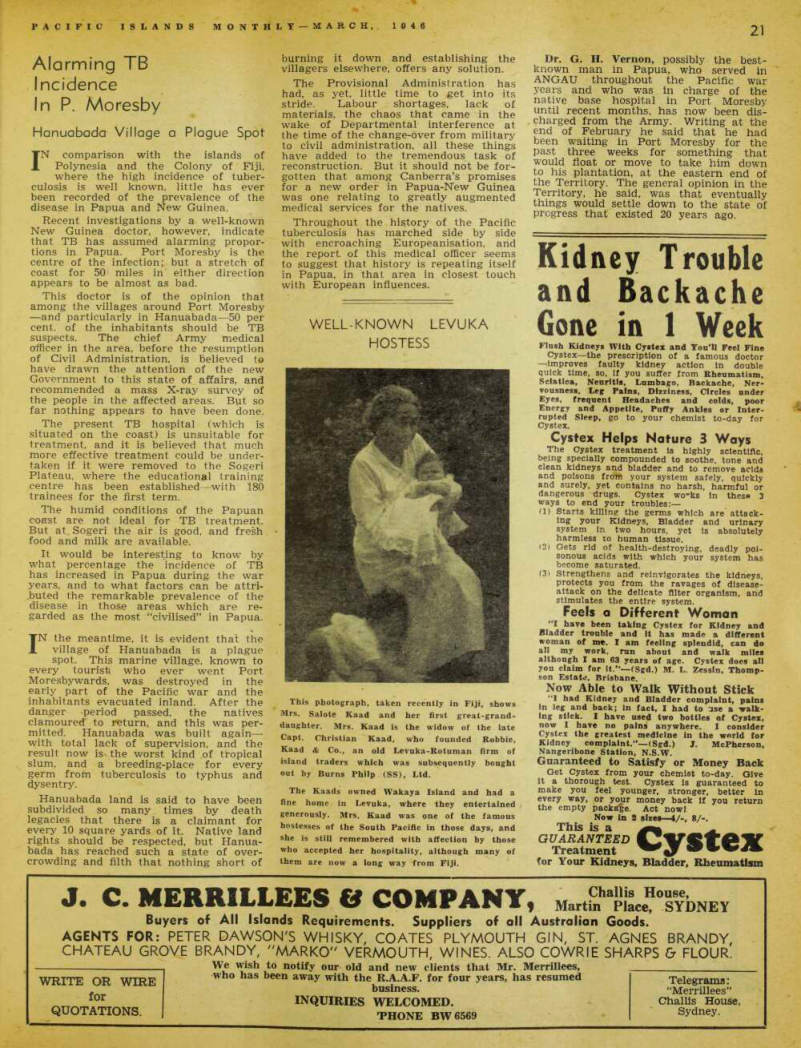
Incidence In P. Moresby Hanuabada Village a Plague Spot
IN comparison with the islands of Polynesia and the Colony of Fiji, where the high incidence of tuber culosis is well known, little has ever been recorded of the prevalence of the disease in Papua and New Guinea.
Recent investigations by a well-known New Guinea doctor, however, indicate that TB has assumed alarming propor tions in Papua. Port Moresby is the centre of the infection; but a stretch of coast for 50 miles in either direction appears to be almost as bad.
This doctor is of the opinion that among the villages around Port Moresby —and particularly in Hanuabada —50 per cent, of the inhabitants should be TB suspects. The chief Army medical officer in the area, before the resumption of Civil Administration, is believed to have drawn the attention of the new Government to this state of affairs, and recommended a mass X-ray survey of the people in the affected areas. But so far nothing appears to have been done.
The present TB hospital (which is situated on the coast) is unsuitable for treatment, and it is believed that much more effective treatment could be under taken if it were removed to the Sogeri Plateau, where the educational training centre has been established —with 180 trainees for the first term.
The humid conditions of the Papuan coast are not ideal for TB treatment.
But at. Sogeri the air is good, and fresh food and milk are available.
It would be interesting to know by what percentage the incidence of TB has increased in Papua during the war years, and to what factors can be attri buted the remarkable prevalence of the disease in those areas which are re garded as the most “civilised” in Papua.
IN the meantime, it is evident that the village of Hanuabada is a plague spot. This marine village, known to every tourist* who ever went Port Moresbywards, was destroyed in the early part of the Pacific war and the inhabitants evacuated inland. After the danger period passed, the natives clamoured to return, and this was per mitted. Hanuabada was built again— with total lack of supervision, and the result now is the worst kind of tropical slum, and a breeding-place for every germ from tuberculosis to typhus and dysentry.
Hanuabada land is said to have been subdivided so many times by death legacies that there is a claimant for every 10 square yards of it. Native land rights should be respected, but Hanua bada has reached such a state of over crowding and filth that nothing short of
burning it down and establishing the villagers elsewhere, offers any solution.
The Provisional Administration has had, as yet, little time to get into its stride. Labour shortages, lack of materials, the chaos that came in the wake of Departmental interference at the time of the change-over from military to civil administration, all these things have added to the tremendous task of reconstruction. But it should not be for gotten that among Canberra’s promises for a new order in Papua-New Guinea was one relating to greatly augmented medical services for the natives.
Throughout the history of the Pacific tuberculosis has marched side by side with encroaching Europeanisation, and the report of this medical officer seems to suggest that history is repeating itself in Papua, in that area in closest touch with European influences.
Well-Known Levuka
Hostess
Dr. G. H. Vernon, possibly the best known man in Papua, who served in ANGAU throughout the Pacific war years and who was in charge of the native base hospital in Port Moresby until recent months, has now been dis charged from the Army. Writing at the end of February he said that he had been waiting in Port Moresby for the past three weeks for something that would float or move to take him down to his plantation, at the eastern end of the Territory. The general opinion in the Territory, he said, was that eventually things would settle down to the state of progress that existed 20 years ago.
This photograph, taken recently in Fiji, shows Mrs. Salote Kaad and her first great-grand daughter. Mrs. Kaad is the widow of the late Capt. Christian Kaad, who founded Robbie, Kaad & Co., an old Levuka-Rotuman firm of island traders which was subsequently bought out by Burns Philp (SS), Ltd.
The Kaads owned Wakaya Island and had a fine home in Levuka, where they entertained generously. Mrs. Kaad was one of the famous hostesses of the South Pacific in those days, and she is still remembered with affection by those who accepted her hospitality, although many of them are now a long way from Fiji.
Advertisements & other items, p. 25 (1 item)
Kidney Trouble
and Backache
Gone in 1 Week
Flush Kidneys With Cystex and Ton'll Feel Fine Cystex—the prescription of a famous doctor —lmproves faulty kidney action in double quick time, so, if you suffer from Rheumatism, Sciatica, Neuritis, Lumbago, Backache, Nervousness. Leg Pains, Dizziness, Circles under Eyes, frequent Headaches and colds, poor Energy and Appetite, Puffy Ankles or Interrupted Sleep, go to your chemist to-day for Cystex.
Cystex Helps Nature 3 Ways
The Cystex treatment is highly scientific, being specially compounded to soothe, tone and clean kidneys and bladder and to remove acids and poisons from your system safely, quickly and surely, yet contains no harsh, harmful or dangerous drugs. Cystex wo-ks In these 3 ways to end your troubles:— H) Starts killing the germs which are attacking your Kidneys, Bladder and urinary system In two hours, yet Is absolutely harmless to human tissue. (2) Gets rid of health-destroying, deadly poisonous acids with which your system has become saturated. (3) Strengthens and reinvigorates the kidneys, protects you from the ravages of diseaseattack on the delicate filter organism, and stimulates the entire system.
Feels a Different Woman
“I have been taking Cystex for Kidney and Bladder trouble and it has made a different woman of me. I am feeling splendid, can do all my work, run about and walk miles although lam 63 years of age. Cystex does all you claim for it.”— (Sgd.) M. L. Zessln, Thompson Estate, Brisbane.
Now Able to Walk Without Stick
“1 had Kidney and Bladder complaint, pains in leg and back; in fact, I had to use a walking stick. I have used two bottles of Cystex, now I have no pains anywhere. I consider Cystex the greatest medicine in the world for Kidney complaint.”—(Sgd.) J. McPherson.
Nangeribone Station, N.S.W.
Guaranteed to Satisfy or Money Back Get Cystex from your chemist to-day. Give It a thorough test. Cystex Is guaranteed to make you feel younger, stronger, better In every way, or your money back If you return the empty packaTge. Act now I Now in 2 sizes—4/-, 8/-.
This is a a
GUARANTEED CVCTPV
Treatment
for Your Kidneys, Bladder, Rheumatism
J. C. MERRILLEES & COMPANY, M .,,“ "“v-dney Buyers of All Islands Requirements. Suppliers of all Australian Goods.
AGENTS FOR: PETER DAWSON'S WHISKY, COATES PLYMOUTH GIN, ST. AGNES BRANDY, CHATEAU GROVE BRANDY, "MARKO" VERMOUTH, WINES. ALSO COWRIE SHARPS & FLOUR.
WRITE OR WIRE
for
QUOTATIONS.
We wish to notify our old and new clients that Mr. Merrillees, who has been away with the R.A.A.F. for four years, has resumed business. inquiries welcomed.
’PHONE BW 6569
Telegrams: “Merrillees”
Chains House, Sydney.
Us Plane Crashes In Fiji
A MITCHELL bomber, on its way from Noumea to Fiji, crashed into the sea near Vatia Point, Fiji, on February 19, and the occupants of the plane, an American colonel, a lieutenant and a ser geant, were all killed.
There was heavy rain at the time of the accident, and visibility was practic ally nil.
Mr. Chalmers, of Vatia, heard explo sions and hurried out to the scene of the wreck in the Emperor Gold Mines’ launch, which was at the wharf. He and the members of the launch crew, work ing under great difficulties, recovered the body of the colonel, together with the aircraft’s papers and a number of per sonal possessions of the men who had been on board.
Communist Busy in the Solomons Extraordinary Story
Solomons Extraordinary Story of Native Unrest
ACCORDING to a report received re cently in Sydney, a Communist agi tator has been stirring up the natives in the Solomon Islands; and there is so much unruliness in some places—Malaita especially is mentioned —that experienced men are feeling anxiety.
The agitator is a mystery man. All that is known about him outside the Solomons is that he is an American, that he appears to have gained an extraordi nary influence over the natives, and that he proposes soon to go to America.
He has persuaded the natives that they have been exploited by white men, and he has induced large numbers of natives to give a pledge that they will not work in future for less than £l2 per month.
He has had his most marked success in Malaita, source of much of the best Solo mons labour; but also he has affected the natives in Guadalcanal, St. Christoval and Gela.
He has told the natives that, when he goes to America, he will lay their case before the international authorities, so that they may secure some measure of independence, both political and econo mic.
It is reported that the natives have subscribed not less than £5,000 for this man, to “assist him in fighting for their freedom.”
It appears a fantastic report; but we are assured that the situation is ugly, and that the natives, as a result of the “Dollar Invasion”' of 1942-44, have a large amount of money hidden awav.
EDITORIAL NOTE.—We present the above report for what it is worth. It does not seem credible; yet it reaches us through a channel which demands respect.
Presumably, if there is a Communist agitator at work, he is receiving some attention from the administrative officers of the British Colonial Office. The lat ter, however, do not broadcast their business —what they have to say goes in confidential reports to London.
It must be remembered that Communist agitators, apparently inspired and directed and financed by Moscow, are at work all over the world to-day. Their activities and venom are being directed primarily against the v ßritish—the Americans and the French are being left comparatively alone. The Americans have no colonial empire. The French have a very great colonial empire but France already is partly under Communist domination, so that the good work is being done in Paris itself.
Because of her situation in the world, and the individualist character of her people, Britain is regarded by the Com munists as their chief enemy, and Com munists throughout the world are work ing like furies to embarrass and weaken her.
If anyone doubts this, let him examine one week’s newspapers, and note what is being done to embarrass the British in the Balkans; Syria; Palestine; Egypt; Persia; India; Malaya; Netherlands Indies; Hong Kong. In every one of those places we may discern the hand of the Soviet-inspired Communist. Look at what is happening in Canada and Australia!
With these events in focus, it will not be in the least surprising to find that Communists are at work among the more primitive natives of the Pacific Islands, It would be surprising, however, to find that such fanatics were allowed by British officials to carry on without interference.
French or Australian officials, instructed respectively by Patis and Canberra, might be expected to tolerate the Com munists—but surely not the British.
Pt. Moresby
Geo. Aumuller Bock in Pt. Moresby E. J. Frame in Bad Accident in Lae
MR. GEORGE AUMULLER, well known and very popular in Papua—he was manager of Burns Philp & Co., Ltd., Samarai, for many years, and until the evacuation in 1942 ■ — is going at short notice this month to Port Moresby, where he has taken charge of all Burns Philp interests in Papua.
He took over from Mr. E. F. Frame, who had suffered a very severe accident at Lae. Mr. Frame was travelling in a jeep, in Lae, when his vehicle was run down by a big military lorry. Mr. Frame suffered a broken leg' and broken ribs — he was lucky to escape withs his life.
After he had been patched up in Lae Hospital, he was transferred by plane— well encased in plaster—to Port Moresby, where he did his best to cope with busi ness, nending the arrival of Mr. Aumul ler. Then he was taken south.
Mr. Frame will return to Port Moresby when he has recovered. It is expected that Messrs. Aumuller and Frame then will share the responsibilities of manage ment in Papua—Mr. Frame on the BNG side, and Mr. Aumuller attending directly to the BP store.
Nominally, Mr. Aumuller still is a mem ber of the Legislative Council of Papua.
But there is no indication if and when the old individual Governments will be restored —the Provisional - Government will carry on for a long time yet. So Mr.
Aumuller is not worrving unduly about his “hon.” and his “MLC.”
The price of petrol in Suva, Fiji, has been reduced to 2/71 —a reduction of 2id. on the price that has ruled since Decem ber 1. when an increase of 3d. per gallon was made by the local Controller of Prices.
Advertisements & other items, p. 26 (1 item)
RH.fHURcH&Son
Copies of
Pacific Islands Monthly
Can ALWAYS be obtained at the following: places:
SYDNEY:
T. L. Cordingley’s Bookstalls at Martin Place, outside G.P.0., near George Street; and at G.P.O. Colonnade, George Street end.
BRISBANE:
R. S. Macdonald, next G.P.0., Brisbane, Qld.
MELBOURNE:
McGill’s Authorised Newsagency, 183-5 Elizabeth Street, Melbourne.
AUCKLAND:
W. A. Webb, Waverley Hotel Bldgs., Queen Street, Auckland.
SUVA:
% James A. Muir, Suva, Fiji; and Miss R. Castles, Victoria Parade, Suva, Fiji.
C E ALSO LIST OF AGENTS ON
PAGE 3
RH.fHURcH&Son
islandtrad^oV 6
AUCKLAND, NEW \c
Cable Address " CHURSHIP,’’ Auckland Codes: BENTLEY’S 2nd Phase BENTLEY’S Complete Phase Postal:
P O. BOX 1548
u PEACE BRINGS A NEW ERA TO THE PACIFIC We are catering thoroughly for Island trade and can fulfil your order with competitive merchandise
R. H. CHURCH & SON
Merchants & Island Traders 27 Queen St., Auckland, N.Z.
Refer your order to us for New Zealand’s Island famous products
IZZSI
Netherlands Indies
Secondary Industries in Netherlands Indies
MANY people think of the Netherlands Indies as a vast tropical plantation on which is produced rubber, coffee, quinine and other products for which the islands are famous.
All this is true up to a point, but at the outbreak of the war the Netherlands East Indies was also a ‘manufacturing country of no mean proportion. The Dutch had encouraged the Indonesians to embark on manufacturing, and many in dustries had their beginnings in the homes of the people. By 1939 many of these Indonesian-controlled industries had become expanding and prosperous enter prises.
Let us examine the textile industry.
This started as a cottage industry, and in 1930 there were only 500 modern hand looms and 40 mechanical looms in the whole of Java. The islands were being swamped with cheap Japanese piecegoods to the detriment of local industry, and the Dutch were forced to introduce the quota system on Japanese imports. At the same time the Government assisted in the construction and purchase of cheap and practicable looms and in the distribu tion of good quality cotton yarns and dyes. Expert weavers were called in to train the native operatives in the use and care of the new looms, and every help was given in the marketing of the finished product.
This wise policy produced spectacular results. In 1941 there were 49,000 modern hand looms and 9,800 mechanical looms in Java alone, and it was estimated that there were more than 2,000,000 Indone sians engaged in small-scale industries, chiefly in the textile trade. In addition to textiles, household utensils, agricultural implements and packing materials were all manufactured within the islands.
Since the Japanese occupation many of these industries have been disrupted and disorganised, and the Dutch are faced with a colossal task of reconstruction. At the present time this is being delayed by the revolutionary activities of the ex tremists amongst the young Indonesian Nationalists.
Until these disturbances settle down prosperity cannot fully return to the Indies or the standard of living of the people be restored to that of pre-war years.
Even under presen# conditions the Netherlands Indies require a variety of Australian goods and these thicky-populated Islands offer amazing trade opportunities in the post-war years.
Australia is fortunate in being relatively close to these markets, but, unfortunately, a small noisy section in this country (a section that is composed of Communists or unthinking people egged on by these “Red Fascists”) has done its best to destroy that advantage by holding up the despatch of Dutch ships from Australian ports.
Consequently, orders for Australian goods have been cancelled and orders that Australia could have had have gone to other countries.
Foreign workers are thus getting the jobs Australians could have had making the goods the Netherlands Indies requires.
Surely this is a matter calling for team work, the Government, the manufac turers, and the workers, pulling together, could ensure that this trade builds em ployment for Australian workers. —Contributed by CEIGOA Pty., Ltd. (Con solidated Export and Import Group of Australia).
The Bishop in Polynesia, the Rt. Rev.
L. S. Kempthorne, arrived in Auckland by the February “Matua” to attend the Synod of the Anglican Church of New Zealand which is being held in Dunedin.
W/O R. P. Phillips and W/O R. A. Car ter, both of the RNZAF, recently returned home to Apia. W. Samoa. Both have seen active service abroad.
Bishop Henry Newton celebrated his 80th birthday at the beginning of Jan uary. He has completed 46 years of missionary service. He served for many years in New Guinea, then was called to
the Episcopate as the second Bishop of Carpentaria. Some years later he was made Bishop of his old diocese in New Guinea. He has since retired.
Mr. H. Gow, formerly of Burns Philp staff in Fiji, recently was appointed manager of the Apia branch, in succes sion to the late Mr. R. H. Brown.
War Damage Insurance claims lodged by the Methodist Overseas Mission in respect of damage done to mission pro perty in Papua and New Guinea amount to £83,000.
Advertisements & other items, pp. 27-28 (1 item)
Ber g e r’s Paint
rf y ;r■: n'B m >
POST-WAR
PALETTE
Many notable Berger brands will return soon to colour your post-war palette . . . and with them will come new finishes developed under the stimulus of Avar.
New materials, new processes, new application techniques are the fruits of Berger research and a tradition of 185 years’ manufacturing experience will transform these advances into high-grade paints for post-war homes.
Ber g e r’s Paint
“Keeps on Keeping on”
All over the British Empire, every minute of & every day, more and more smokers are saying, "Better buy Capstan (tobacco and cigarettes)—they're blended better."
CAPSTAN
TOBACCO and CIGARETTES
UNO Trusteeship for
W. Samoa But New Zealand Expects to Continue to Administer the Territory.
From Our Own Correspondent
Apia, Feb. 2.
rE recent decision of the New Zea land Government to place the Man dated Territory of Western Samoa under the Trusteeship Council of the United Nations has been much publicised in New Zealand.
This step is considered here in Wes tern Samoa to be a guarantee to the Samoans of ultimate self-government and independence.
It might also be said to signify the faith of the present New Zealand Gov ernment in the United Nations Organi sation; and their belief that the Territory will most certainly continue to be ad ministered by New Zealand under the New Trusteeship Council.
Under the new system it is believed that the Council will have the right to inspect any of the territories under its jurisdiction and to call for reports on specific subjects. Native peoples ad ministered under trusteeship will also have the right to appeal to the Council.
As far as the Samoans are concerned, they will have no serious objection to continue to be administered by New Zealand. It is believed that this will ensure a far greater share in the govern ment of the country in the shortest pos sible time.
Complaints of the Samoans are be lieved to have borne fruit in New Zea
land and it is expected that certain changes in political, social and economic policy will be put into effect after the arrival of the new Administrator in March.
The retiring Administrator, Sir Alfred Turnbull, who has guided the Territory through great difficulties in the past 10 years, leaves here at a time when the Samoans are happy and prosperous. This fortunate state of affairs should contri bute greatly to the solution of any out standing political differences with which his successor may be faced.
Sir Alfred and Lady Turnbull will leave Apia on February 20 for New Zea land, where he will attend an investiture in which he will receive the KBE awarded him in the New Year Honours.
At present the approaching departure of the Turnbulls is being made the occa sion for numerous farewell functions.
Trans-Pacific by Skymaster
Skymaster In Thirty-nine Hours
Suva, Feb. 10.
FIJI saw its first Skymaster ’plane on February 8, when the first of four machines ordered by Australian National Airways, Ltd., landed at Nadi aerodrome, 28 hours (flying-time) out from San Francisco.
The ’plane left again early on Feb ruary 9, non-stop to Melbourne—the first time this long hop has been attempted.
It is reported that the four Skymasters, on order by ANA, are for a trans-Pacific service which the company has offered to run between Sydney and San Fran
cisco. The proposed passenger fare is £l5O Australian between Sydney and San Francisco and £lO5 between Sydney and Honolulu. This is a reduction on pre war fares charged by PAA.
EDITORIAL NOTE: The four Sky masters were ordered from America by ANA for their services between Austra lian capital cities and not for a trans pacific service. The first Skymaster (which arrived in Melbourne 11 hours after its take-off from Nadi) has already had its trial run from Melbourne to Perth. However, about two months ago, when it became evident that Pan- American were making plans for resum ing their service, with a terminus in Sydney instead of Auckland as pre-war, ANA did make an offer to the Common wealth Government. They undertook to operate, with their Skymaster ’planes, an air-service between Sydney and San Francisco, either permanently or until the Dominion and British Governments had got around to agreeing on a Pacific air programme. The Commonwealth Government did not take up the offer.
Interstate airways in Australia are in the process of being nationalised and if this move.should weather an appeal to the High Court, then the new Skymasters will be grabbed by the Commonwealth’s Socialist Government, along with all other airways assets.
The Rev. R. T. Campbell-Williamson has been chosen as a missionary for the Presbyterian Overseas Mission in the New Hebrides.
Mr. D. P. Parry, formerly chief clerk of the Union Steamship Company in Suva, recently was appointed assistant manager of the Wellington Branch of the company.
Advertisements & other items, p. 29 (1 item)
Equal to the World’s Best
Throughout Australia and Overseas there it an ever-increasing demand for
COLONIAL & BRONTE
HIGH-GRADE CANNED MEATS
There is no better quality—none more wholesome.
TRADE MEATS FOR THE ISLANDS
order
‘COLONIAL’ BRAND
Roast, Corned and Boiled Beef Packed in 6,5, 4,3, 2, 1 lb. and 12 oz. tins.
Also Corned Beef in 12 oz. Taper Tins.
Roast, Corned and Boiled Mutton. 1 lb. and 12 oz. tins.
Choice Dripping
36 lb., 2 lb., 1 lb. tins, and 1 lb. packets.
Under present conditions it is wise to ensure that you % m m n have ample stocks of all our lines .
The Colonial Wholesale Meat Coy. Pty. Ltd.
30 GROSVENOR STREET, SYDNEY
Moresby's War-wonders Have Departed
You Wouldn't Know The
Old Town Now!
rOOPS who passed through Moresby when it was a military boom town would not know the old place now.
Its returning civilian residents will hardly recognise it if the recently drawn plan for a new town is ever approved and carried out.
In the office of one of the busiest offi cials here—the Director of Public Works (Mr. J. Lyons)—l have been looking at the plan of a future Port Moresby.
It provides for two new shipping repair basins and a new wharf to replace the present ramshackle facilities, opens up residential sites around a harbour front which was befouled with the sheds and shanty depots of the Services, razes one town block to put in a group of administrative offices—and goes one bet ter than many Australian cities by pro viding a civic square.
All of which, in the raw, frontier atmo sphere of to-day, looks somewhat ambi tious. All activity here may be qualified by the word “provisional” in the title of the Provisional Administration of Papua- New Guinea.
The one impressive amenity of which Moresby has fairly sound hopes is a club.
The spacious and pleasant premises built in 1944 by the Australian Army Canteen Services on the Ela Beach Road will soon be handed over —temporarily, at least— for the use of the civilian community.
But the Public Works Department has more urgent matters on its mind.
The most striking point in the problem of turning an erstwhile war-base back into a peaceful trading port of the tropics is that nearly all of its wartime develop ment is useless for civil purposes.
A network of wide and finely surfaced roads now leads nowhere. The great air strips which they served are deserted.
The vast maze of telephone communica tions is valueless. Much of its equipment cannot be converted, because it was de signed only for a short life.
Already one of the great signals feats of the war—the a telephone line over the Kokoda Trail to link Lae
through Moresby with Australia has been scrapped.
It required a maintenance team of 130 men to keep that line working over the Owen Stanleys. To-day, radio communi-
By Frederick Howard
Now Touring the Islands for Melbourne "Herald"
cation is cheaper and just as effective, it isnt worth repairing the broken sub marine cable between Moresby and Thursday Island. rE urgent municipal things are to ensure the town’s water supply, maintain its lighting and refrigerat ing power, patch its houses for habita tion, and keep the one or two essential roads from washing out.
Pre-war Moresby was far from being a well-planned tropical town. Too many of its homes were fibro-plaster shells, comparing unfavourably with the veran dah-shaded solidity of “garden city”
Rabaul. The planners now hope to give Moresby a new deal. In doing so, they must start from scratch.
They would have started with some advantage if the outgoing Allied forces had not removed or destroyed so much.
Here, as elsewhere in the islands, there is evidence of a destructiveness which may have some subtle explanation in the niceties of Lend-Lease accounting, but which does not make sense to the plain man.
The burning of sound timber and bitu men, the machine-gunning of parks of cars ; trucks and tractors into scrap metal, are among victory’s mysteries in these parts.
But there is no mystery about the abandoning of the causeway ■ which was built out to Tatana Island, in Moresby’s inner harbour, and Jhe decay of that island’s wharves and roads which re
ceived huge American war cargoes.
Moresby’s economic needs have shrunk back to the capacity of a one-wharf town.
Down at Papua’s eastern tip, at Milne Bay, a far greater wharf system is decaying. Throughout New Guinea, jungle and tide are gradually destroy ing works which costs millions, and which are not worth saving. rE Administrator of Papua-New Guinea (Col. J. K. Murray) has sketched in outline to me a possible future of hydro-electric power; of copra, coffee, cocoa and rubber plantations pro cessing their products with that power; of native agriculture being improved through scientific research, and a mil lion natives rising in literacy, health and technical skill.
It is a level-headed concept—a 50 years plan. Meanwhile, the man who voices it lives in an ancient Government House (sometime General MacArthur’s head quarters) where Papuan painters and carpenters are' frugally patching.
He lives simply. The one sadly battered car that was saved for him from the lavish transport of Moresby’s military days is now unusable. The Administra tor must go by Jeep when he tours hi* “capital.” There are plenty of jolts for him, and for every resident of these Ter ritories, on the road to reconstruction.
For Which They
Fought
Peace has returned to bless your shores Where seeds of tragedy have scattered far and wide.
Only the ghosts of memory remain To haunt those places that we used to know.
Now tall weeds wave amidst the ruined homes, No smiles of welcome await us at Rabaul, Yet in this new New Guinea still survives The spirit of those men who fought for you.
Despair must never dim your eyes, Your scars will heal and you will find abiding strength Deep-rooted in your soil, a legacy Left by those daring men who fought for you.
And when the moon drifts o’er Kokoda’s trails Speak to your heart and swear you will not lose The things for which they fought—those simple things Of faith in man and God and love of home.
Freda MacDonnell.
Flight-Lieutenant F. L. Burrow was included in a recent list of Australian officers who were Mentioned in Des patches. He conducted an engineering business in Samarai, Papua, before the war, and he enlisted as a fitter in the RAAF in 1940. He saw much service in North Australian and East Indies areas and had over 1,000 flying-hours when he was commissioned as an Engineer Officer.
Part of his citation reads: “He has dis played outstanding ability, leadership, and determination and, by his tireless devotion to duty has made a most valu able contribution to the achievements of his squadron.” Flight-Lieutenant Burrow is still in the RAAF. but probably will be discharged within the next few months.
Advertisements & other items, p. 30 (1 item)
Ransomes IMPLEMENTS
Q52&44
Perfect
results
in any class of soil can be obtained with one implement or other in the wide selection The illustration shows the “Victory", a popular light all - steel plough, combining maximum strength with minimum weight and draught. which we offer Our range covers share and disc ploughs for animal and tractor draught,
cultivators, disc
harrows, planters, etc.
Ransomes IMPLEMENTS
Ransomes other manufactures Include hand, horse and motor.lawn mowers, aerodrome eauiDment, etc. Write for Illustrated literature and all information. 4 P
MORRIS, HEDSTROM LTD.,
Suva Lautoka Be.
Made by: RANSOMES, SIMS & JEFFERIES, LTD., IPSWICH, ENG.
Love Is Blind
Trade's Tale:
By “Tukapa Koko”
rEY buried Porie-Porie yesterday. I attended her simple laying-away.
Gone; and, in accord with the stern philosophy of local native life, best forgotten, for the sake of those who, havfria fn qfriifrfyip fnr a hard livine nrefer not to thtak of the dead , . , . . c . TQC I shall not forget Pone-Pone. She was the greatest self-sacrmcer i ever Knew, You don’t know Kata the Leper. All the better for you; he is an unlovely sight in our village! Noseless, without lips or eyelids, Kata looks like a fiend out of Dante’s Inferno. Yet he is a hard-working quiet native; and, more, no leper at all His tace was ruined by yaw !i .? r f at r e “L i h sy,? saved that terrible disfigurement—but Kata’s childhood was in pre-hospital days. So he goes through life without a face, and strangers shudder when they see him. But he had his hour.
I remember Porie-Porie as a pretty native girl, when I first came to live upon the isle. She was of part-Italian blood. Pietro Giacomini, that knifeartist, who with old Agostini, the Corsican, terrorised our village in the ’seventies, was Porie-Porie’s grandfathers Joe left no issue. Pietro did. A strain of Southern European blood adds beauty to the Polynesian girl, Kata the Leper, misnamed, has two children now They are very fair; and whole andTound as the island’s best. A compensation, perhaps. Thus is the Giacomini strain continued. „
WHEN Porie-Porie married Ruko, in 1928, it “looked all right.” They had the usual “akaipoipo,” that public setting-up-in-housekeeping of every young village couple, in which all the neighbours partake. Later, Ruko went to Rarotonga. He stayed there— and married another woman.
Later came a new protector, Maro the Manihikian. Desecrating an old marae, on which he planted kumaras, Maro in curred the vengeance of the old gods.
Maro died, in agony, of no known cause.
I met Porie-Porie in the taro fields, weeping. Her world had dissolved again.
Porie-Porie worked, weeded, and planted, fished, and wove mats. She worked in all weathers, all day, all the week save Sunday. Church was both holiday and tavern, to her.
A few more years went by, in the rhythm of the island. Por 3rty, from Sep tember to April. Money in the orange season. A leaky and comfortless hut, devoid of all plenishings, was Porie- Porie’s home.
The hurricane of 1941 blew the hut down. Kata the faceless it was who built her a new one . . . and, later, aided the struggler to weed her plantation.
So once more, a protector. But work, still, in rain, in cold, in blazing summer.
The birth of two children was the only respite ... a pause.
Porie-Porie was unwell when this year’s orange season began. But she worked hard —at picking, packing, and driving pack-horses, each laden with two cases, to the beach, as she had always done.
After the ship went, just before the “pay-out” that brought joy to the poor, I was called to the hut. Porie-Porie lay on her sleeping-mat. A village deacon knelt praying at her side. An aged native
woman—her mother—was holding Porie- Porie’s jaw, to prevent the nerveless mouth opening in an unsightly gape.
Tears cascaded down the old mother’s leathery cheeks. When daughter dies be fore mother, it is tragedy! And nothing, too, in which to dress Porie-Porie for her funeral —nothing but “veru-veru” — old rags.
That, we could not allow. My wife supplied fitting raiment. Porie-Porie went to the grave a European lady, and her last day was her best.
Kata is mateless now. But the Giacomini strain goes on in the tribe.
The battered and ruined face expresses nothing but resignation. The “leper” has had his hour; and it has passed.
Mr. L. A. Westcott, of Brisbane, has been appointed a director of, and mining consultant to, Cuthbert’s Misima Gold mine, Ltd. He is a former general mana ger of Mount Morgan, Ltd.
Major L. W. (“Bill”) Heinicke re ceived his discharge in Sydney last month, after six years’ service in the Middle East, and with ANGAU in New Guinea. He was very well known as a Burns Philp and Carpenter employee in New Guinea before the war; he was awarded the British Empire Medal for distinguished service during the Rabaul eruption in 1937; and he was in charge of the first draft of New Guinea volun teers for the AIF in late 1939. His specialty is shipping—he was second in command of the 3rd Australian Port Operating Group in New Guinea. He hopes to return to the Territory, when opportunity presents itself and Mr.
Ward permits.
Advertisements & other items, p. 31 (1 item)
Swallow I Ariell
f&J THE ARABS ATTACK IN 1885, Australia was still an infant colony.
Federation was but a dream of a few nationally-minded politicians..
But the Sudanese Campaign was the focal point of Empire news . . . so Australia sent a contingent to fight for "Queen and Country." A historical comment is;— "The colony was stirred by a great wave of enthusiasm when it was known that its Government had offered to England a regiment of soldiers to fight side by side with British troops. The offer was accepted, and some seven or eight hundred soldiers, well equipped and fiill of high hopes, sailed for Africa. The war was too soon over for them to have any chance of displaying what an Australian force may be like upon a battle-field ... but it showed that the Australian Colonics arc proud of their mother country; that their eyes arc fondly turned to her . . . and that if ever she needed their help, assistance would flow spontaneously from the fullness of loving hearts.” ■The illustration above is based on a popular lithograph print of the day. Over the impressive title "The Arabs Attack the Commissiariat,” it depicts agroup of stalwart, red-coated soldiery embattled behind stacks of cases labelled "Su/allow and Ariell Biscuits"!
While the compliment is unusual, the fact remains that Swallow & Ariell Ltd. have supplied essential foods and comforts for Australian troops in the four wars in which Australia has been represented.
SWALLOW i ARIELL
LIMITED
IN THE BISCUIT INDUSTRY SINCE 1854
UiKtRS ALSO (IF THE FAMOUS SWALLOW S ADIEU FlUH PU0DIN08, CARES. AND ICE CREAM .GV.
SERVING
IN PEACE
AUSTRALIA
AND
WAR
,FS"' £
AR> E !i
tw""
SWALLOW & ARIELL
LIMITED
LEADERS IN THE BISCUIT INDUSTRY SlJNCE 1854 MAKERS ALSO OF THE FAMOUS SWALLOW A AHULL PIUM FU 0D7NC8, CARES, AND ICE CREAM
Hurricane: A Near Miss
Heavy Rains in NE Districts of Fiji
Suva, Feb. 9.
WHAT might have been a bad hurri cane disturbed us last week here in Fiji, but it fortunately spent its force at sea.
What it did leave behind in the Colony, however, was a distinct impression of excellent service given us by the Meteoro logical Office.
Fit.-Lieut. Ralph Dyer and his assist ants continually broadcast weather re ports, and their frequent, and regular, bulletins kept everyone posted. They in spired a general feeling of confidence, and we felt that if the worst were to occur we should at least have good notice of it.
Although the hurricane passed to the south of the Colony, its passing was fol lowed by severe rain and subsequent flooding in the north-east districts of Viti Levu.
Several villages have been damaged as
a result of the torrential rain and an estimated £5,000 worth of damage has been done to the King’s Road between Lautoka and Raki Raki. Approaches to bridges have been washed away and there have been landslides on other por tions of the road.
The sugar industry (which has not had a capacity season since the 1943 strikes) is likely to be adversely affected. Both the 1946 and 1947 crops have been dam aged by river silt and flood waters. Cane farmers may, however, have a chance to replant the 1947 crop if the weather re mains fine for the next couple of months.
Miss Nita Inman, a well-known mem ber of the staff of the New Guinea Mis sion in Papua, died in Sydney on Decem ber 23. The Rev. James Benson, lately released from a Japanese prison camp, was able to be present at the burial ser vice, and paid a striking tribute to her life. Miss Inman remained behind at her mission station for about a year after the general evacuation of women from Papua and had many adventures at the time the Japanese attempted to establish a base in Milne Bay.
Jubilee Of Popular Priest
Twenty-five years ago the Rev. Father Joseph Deihl, of Apia, Western Samoa, was ordained as a priest and, on the occasion of his jubilee recently, he was feted by members of the Catholic Church in Apia.
Fr. Deihl is well-liked by all sections of the com munity in Samoa. His edu cational work has been of great value to the Terri tory, and his knowledge of Polynesian lore and history is extensive.
He is an enthusiastic photographer, and this photograph was taken some years ago by the editor of “PIM” while the popular priest was himself posing some youngsters in a Samoan village.
War-time Dollars
NZ Benefits From Samoa's War-time Dollars
From Our Own Correspondent
Apia, Feb. 2,
TTNLIKE New Zealand, which has a U large adverse trade balance with the United States, the New Zealand Mandated Territory of Western Samoa has a favourable balance, due to large wartime shipments of copra and cocoa beans.
These dollar credits thus established have been augmented by the large amount of dollar currency spent in the Territory during the 1942-44 period of the American “invasion.”
Trade restrictions in America and im port control laws in Western Samoa have prevented the Territory utilising all of these credits. Consequently, New Zea land is now benefiting by using Samoan dollar credits for her own American pur chases—besides making a profit on the exchange.
Rarotongan "Nuku"
Prom Our Own Correspondent
Rarotonga. Jan. 31.
TH E biennial New Year “nuku” per formed by the combined district organisations of the London Mis sionary Society was held before a large gathering at Ngatangiia on January 9.
The “nuku” usually consists of a num ber of playlets depicting familiar in cidents from the Bible, each district contributing one or more .items. One is always assured of entertainment at the “nuku,” if only because of the remark able ingenuity displayed in the way of “props,” stage effects and costumes. As at most village concerts, the world over, there are often unrehearsed effects which add to the general amusement.
This year a departure was made from the usual biblical scenes, and we were given instead representations of the ori ginal landings of the renowned mis sionary, John Williams, and his followers, on the various islands of the Cook Group.
The usual inventiveness was demon strated in the construction of the missionaries’ ship. The vessel, complete with sails, was made of saplings and plaited coconut fronds arranged round a motor truck, so that it was able to cruise under its own power. The canoes which put out from the shores of the newly discovered islands were also made of plaited coconut fronds and propelled by their occupants.
Missionaries and sailors were attired in “period” costumes, John Williams be ing unmistakable in his black, long tailed coat and top-hat. (Many old Raro tongans carefully preserve the Sunday clothes of earlier days, although they are no longer worn.) One of the day’s highlights was the stirring episode of the first attempted landing on Mangaia. We saw the in trepid Tahitian missionary, Papeiha, with two other native missionaries and their wives, seized and rough-handled by the Mangaian savages. Witnessing this through his telescope, John Williams ordered his captain to fire a warning shot. The cannon represented by a length of down-pipe—was brought to bear on the “island” and a large dance-drum concealed within the vessel provided a very effective concussion—which caused the Mangaians to release their victims and scamper away in alarm.
All agreed that the “nuku” was up to the usual standard.
Advertisements & other items, p. 32 (1 item)
Steamships Trading
Company Limited
PORT MORESBY SAMARA) PAPUA.
WHOLESALE & RETAIL MERCHANTS, SHIPOWNERS,
PLANTERS, ENGINEERS & SLIP PROPRIETORS.
Customs, Shipping, Insurance, and Forwarding Agents.
MANAGING AGENTS AND VISITING REPRESENTA-
TIVES FOR COCONUT AND RUBBER ESTATES.
SYDNEY REPRESENTATIVES: Nelson & Robertson Pty. Ltd., 12 Spring Street.
In Sunny Fiji!
Servicemen —Grow Bananas In Sunny Fiji!
New Blood Needed in the Industry
Suva, Jan. 9.
WHAT is wrong with the Fiji banana industry? Forty years ago the Colony’s banana exports were over the million mark. Compare our recent figures: —
Exports are mostly to New Zealand.
A recent Commission attributed the deterioration of the industry to three fac tors; (1) Unsatisfactory, or even total lack of cultural methods; (2) inefficient grading and packing: and (3) unstimulat ing markets leading to careless market ing.
That is a severe castigation of the Ad ministration and of the few middlemen connected with the industry, and it re veals a disgraceful state of affairs in the Colony. It seems clear enough that the public is satisfied to let a few buyers make what there is to be made out of the fruit without attempting to build up the industry into something really worth while, much less develop it and make more out of it.
What happens in Fiji for the most part is that natives in a few areas sell their fruit from their small, uncultivated
patches—the trees grow almost un tended—to European buyers.
The buyers collect the fruit, ship it, and make all the profit. In other words, they batten on the native growers and exploit them. The New Zealand public, and those in Fiji who still eat bananas, get a poor product from wild trees.
The whole industry is chaotic and needs firm public control.
Here is another instance of a wonder ful opportunity awaiting a few indus trious men with a little capital. There is money to be made out of bananas. A few middlemen are doing very nicely out of them now, and they would not like to see competitors appear. But the spirit of enterprise is dead if there is no Britisher prepared to grow and export his own fruit.
A few practical outdoor, ex-soldiers, running their own plantations, willing to work and not leave things to the natives, would have a healthy life and a profitable occupation. The possibilities of our local fruit industries are great, but they re main neglected. (ED. NOTE: Another article on Fiji’s banana industry appeared in the Octo ber issue of “PIM.” In this present article, our correspondent does not make it clear whether the exports of 40 years ago ran into a million of money, or a million bunches. Either seems excessive.) Mr. C. Winterstein, a well-known mar iner and trader of Western Samoa, died at sea recently when returning from the island of Savaii.
Rev. E. Paul Helbig, who had been re siding for some time in South Australia, returned to New Guinea last month. Mr.
Helbig, a Lutheran missionary, has com pleted 40 vears’ service in the New Guinea field.
£ 1936 85,548 1937 80,071 1938 73,578 1942 42,400 1943 38,508 1944 . . 18,565 1945 42,954
Honiara
Absence of Port Resented by BSI People
THERE are indications that commer cial, shipping and planting interests may refuse to accept the British Solomon Islands Government’s choice of Honiara (north coast of Guadalcanal) as the future administrative centre of the Protectorate: and that they will try to make Tulagi (20 milds away, on the coast of Gela) the commercial “capital.”
The argument, of course, turns on the relative merits of the two places as ports.
Honiara has nothing but an ooen beach, where there always is something of a surge, coming in from the Central Solo mons Sea, and where conditions can be dangerous during the three months’ north-west season. Tulagi is a delight fully sheltered haven, and one of the best harbours in that nart of the Pacific.
A man who recently returned to the Solomons, and who usually maintains communications between his home and the capital by means of his own cutter, expressed himself auite definitely latelv: “After a man has been tossing about in a small boat for a few days, he looks forward to a quiet snell in a sheltered nort. where he can load and unload com fortablv. and lie safelv alongside a wharf when reouired. Honiara is no good to me. If there is any kind of a store at Tiilael. and arrangements can b* 1 mad* 1 for shinping our produce there. T shall certainly not go to Honiaira, except when I’ve got official business to do.”
The Commissioner of the American Lutheran Church Missionary Society, the Rev. Fricke, recently returned from an Inspection tour of New Guinea.
Advertisements & other items, p. 33 (1 item)
Head Office 449-451 KENT ST. f SYDNEY.
William Atkins p ty . m.
Iron & Steel Merchants-Engineers' Supplies
Coach fir Motor Hardware
STEEL DEPARTMENT
MILD STEEL:
Rounds, Squares, Flats, Half-rounds, Hexagons, Bevel, Shoeing, Tyre, Angles, Tees, Sheets, Plates, Girder Plates, Chequer Plates, Channels, Hoops, Etc.
BRIGHT STEEL:
Rounds, Squares, Hexagons.
Extra Special High Speed Tool Steel, Mining Steel, Blister Steel and Spring Steel, Rounds, Flats & Squares.
Bar Iron—All sections and sizes.
ESTABLISHED OVER 50 YEARS
TRADE MARK
Cable Address: WILATKIN, Sydney.
Engineers 1 Supplies: Set Screws. Studs. Metal Thread Screws. Coach Screws. Files, Cotter Pins. Bright and Black Bolts, Rivets, Etc., Hack Saw Blades.
Power Transmission Gear: Including Plummer Blocks, Couplings, Collars, Etc.
Coach and Motor Hardware: Axles, Springs, Wheelstuff. Duck, Paints.
Farriers 1 Supplies: Horse Nails, Anvils, Vices, Etc.
Motor-Trimmers and Motor Builders' Cr Motor Painters' Requirements
C. A. WILLEY'S
Quick-Drying Coach and Car Paints, Roughstuff. Elastic Gloss. Synflex Enamels, Lacquers.
DUCO Lacquers and DULUX Enamels—FAßßEX Motor Toppings and Leather Cloths, House & Decorators' Paints, Varnishes & Brushware.
Sole Distributors of CHAMPION'S Decorators Paint Products.
Distributing Agents for BROLITE Lacquers, SYNFLEX Enamels and POLYGLOSS Finish.
The Story Of Rabaul
Thirty-five Years a South Seas Storm Centre
RABAUL social life in those pre-World War I days was pleasant. It was a salaried—and a good-salaried— community of Government officials and executives of the Big Companies together with their wives. There were no cock tail parties or cinemas; no motoring or bridge evenings; but there were tennis, and informal dinner parties; there was always plenty of beer and champagne— both of which were cheap in comparison with present-day prices.
Contact with the outside world was restricted—every three weeks a NDL steamer called either going north to Hong Kong from Sydney, or returning to Sydney from Hong Kong. The hurry and bustle of big cities were a far cry from Rabaul. There was no sensational radio news to upset the calm of the tropic world. There were certainly occa sional purple patches, like the incident of my friend, the irate husband, but tran quillity was the keynote of existence.
There was no such thing as a European gaol. Anyone deserving to be imprisoned, said officials, should not be in the coun try, and it was an unwritten law that if a misdemeanour were committed the offender should immediately be given the opportunity of making a graceful escape.
If no escape were made, ansi officialdom were forced to catch up with the offender, then he was given the job of roadmaster in some far-off district.
The imprisonment of a white man in a black country would have a prejudicial effect upon, the minds of the natives, it was believed. The prestige of the white race was an all-important matter in those days when the natives were only one jump ahead of cannibals—even on the outskirts of Rabaul. This common dan ger was one reason, I am sure, why there was such little sectional jealousy then compared to that which made itself appa rent in later years. Manual labour was never undertaken by a European.
Chinese artisans had been brought from Hong Kong for this work, and a number of half-castes were also employed as apprentices.
Speaking of half-castes recalls an in cident which occurred when a rather prominent Government official returned from Germany, where he had been mar ried. He brought his wife back with him,
and all Rabaul gathered on the wharf as the ship came alongside; cheers and greetings were exchanged with the newly-married couple, who stood near the top of the gangway.
Then two little children, daintily dressed, and each carrying an armful of beautiful tropical flowers, mounted the gang-plank, curtsied before the bride and presented the bouquets. Imagine the embarrassment of the groom when ne recognised in the children two of his own half-caste offspring!
ONE contributing factor to the peace ful life of Rabaul then was the absence of political friction and the general internal contentment. Dr.
Hahl, the Governor, proved himself not
By Gordon Thomas
The Second of Three Articles
only a diplomat by maintaining the bal ance between the various European sec tions, but was also possessed of great initiative. An essential quality in those days when the Colonial Office in Berlin was many thousands of miles away, and the nearest cable station at Yap, in the Carolines, over a thousand miles from Rabaul.
Administrative decisions had to be made on the spot by the Governor, and were, therefore, compatible with local conditions —a far better system than that which was introduced later, when every other matter had to be referred to bureaucrats in Melbourne or Canberra.
Dr. Hahl inaugurated also a most repre sentative Advisory Council with at least two members from every section of the community.
Another influence for congenial living during those days was the absence of any financial worry. There were no banks, and therefore, no such things as over drafts. The big commercial concerns acted as bankers, where necessary. But you did not write out cheques, merely scribbled an order to the accountant of the firm with which you did business. It
went something like this; “Dear Johann— Please pay Fritz Schnieder, M5OO. and debit my account.”
There were, however, occasions when some of the more extravagant junior members of the companies discovered that they had spent 12 months’ wages in advance.
In our stern British way, we would have looked upon such a situation with a very jaundiced eye. Not so the Ger man firm where Carl—we’ll call him— was employed. Certainly he would be* reprimanded for his extravagance, but there was a simple process of adjustment.
Carl would be sent out as manager of a plantation where the production was high, and receive 10 marks a ton com mission for the copra produced, as well as his usual salary. Thus, his account would soon be in credit again, and he would return t<p Rabaul, just in time, per haps, to be relieved by some other extra vagant youngster who was on the wrong side of the books. That is what may be termed financial co-oneration as it should be!.
It' was a common thing in those days for an employee of one of the big com panies to take up land, be financed by his employer and start his own planta tion, keeping the wolf from the door by trading with the natives, or by extended credit. Over on the mainland of New Guinea, especially in the Aitape district, most of the private plantations were brought through the pre-bearing stage by shooting birds-of-paradise. That was a profitable business until some energetic, good ladies in Europe got the idea that the mother birds were shot when they were feeding their young. They had bird-of-paradise shooting stopped. (Actually it is the male bird which is sought for the best plumage.) But this “live and let live” policy, so prevalent amongst the Europeans at that time made life enjoyable. There was no depression, no economic pressure, and therefore a better co-operative spirit between all sections of the European com munity.
The First World War
AND then came World War I. The younger'Germans formed themselves into a sort of volunteer unit, some 50 or 60 strong. The Australian troops landed at Kabakaul. not far from Kokopo, in early September, 1914. There were a few casualties on both sides along the Bitapaka road, and then the Germans surrendered.
But war was different in those days.
The Australian commander allowed the German officials to proceed to their homes in Germany after the surrender.
Some private residents were interned, but for the most part, business was carried on under a military administration which lasted until May, 1921.
Rabaul during this time was a typical garrison town. They were not really happy years for the town. The old social life had disappeared. Queen Emma had sold her extensive interests to the HSAG. Private credits were frozen; mili tary restrictions and national feelings tended to create a tension to spoil the happy, carefree life. Only a few wives of the senior military officers were allowed to join their husbands.
The natives could not understand the change. The soldier was a type of white man they did not know. There was little or no development in Rabaul, or through out the whole Territory for that matter, during those years of military occupation.
The military had no interest, no civic pride in a mere garrison town. To them it was all part of the war—a nice little backwater in which to bide the time until peace came again.
The personnel were birds of passage;
the houses became drab and shoddy for want of paint and attention; the gardens were overgrown. The well-groomed white-coated “Masters” gave place to men in khaki tunics.
There were few women about, and when the female of the species is not in evi dence, then the male is apt to become careless in dress, manners and habits, and Rabaul was no exception to this rule.
Towards the end of 1920 came the fore runner of the European Board —a quasi- Government concern which was to over turn completely the Islands’ economic structure. All private property of enemy nationals was to be taken over, as well as the big businesses. It was a colossal undertaking to repla.ee all those men who were experienced in tropical commerce and agriculture.
Rabaul stirred from its military lethargy, and with somewhat of a bad grace gave way to a large influx of civi lians, who were, however, in every in stance demobilised Diggers from France and Palestine, returning to civilian life and somewhat intolerant of the Rabaul military whom they termed “Coconut Lancers.”
The Ex-Pro Board takes Over rE first few months of 1921 saw Rabaul the centre of a double transition: Preparation for the change-over from a military to a civil administration, and the Ex-Pro Board taking over from the- German owners.
They were busy days in Rabaul. Club and pub life in. the Garden City flourished. There was little organised sport; spare time was devoted mainly to steady drinking. The restraining in fluence of female society had diminished with the departure of the wives of the officers, and Ex-Pro Board members were not permitted to bring their wives with them.
May, 1921, saw the civil administration functioning, and there was a general re adjustment of residences. The Govern ment were confined to their own bunga lows; the XPB took over the houses of the commercial companies.
Two- clubs were in full swing and three hotels were busy almost 24 hours a day, for liquor laws were somewhat expansive at that time. There was no street light ing. A usual nightly sight outside the clubs and pubs was a squatting crowd of native servants armed with raincoats and hurricare lanterns, for the purpose of guiding their masters home to their respective bungalows.
Then, towards the end of 1921, as a result, of strong representations to the Australian Government, the wives of the XPB officials began to arrive, and the ladles had their troubles in adjusting themselves to tropic conditions where social laws had been for so long an un known quantity, and coloured house ser vants, with their Pidgin-English. an additional worry. Government officials’ wives had already been installed again, but the language hurdle was just as high for them as for the XPB coterie.
It took some time for a carefully brought up matron to accustom herself to some of the Pidgin-phrases: a language which originated amongst hard-bitten island traders and Germans who had little knowledge of true English. Many a blushing bride endeavoured to intro duce new words to substitute for Pidgin English for the bottom of a saucepan or plate, the ashes in the kitchen stove— and shuddered visibly, at first, when the house-boy, with a guilty face, brought her the best tea-pot with a broken spout and informed her: “Missus! Mouth belong tea-pot he bugger up finish?”
The general economy of words in Pidgin often bewildered her. The Pidgin
word “su-su” is much overworked, and refers to “milk,” or any substance re sembling milk, the breast or any rounded formation or contour resembling a breast.
The story is told of one young matron during this period, giving an afternoon tea party on her verandah, and most anxious to be at her best before some dozen of her new female acquaintances.
Johnny, the house-boy, had forgotten to cover the milk jug with the orthodox fandangle of net and dangling beads so dear to the heart of woman.
“Johnny,” she called, “You come!”
Johnny appeared; “Yes, Missus.”
Turning, she instructed him: “You ketchem this fella something belong cover him up su-su.”
Johnny retired obediently to reappear a moment later, with a rather puzzled expression on his face: “Im here?” he inquired, holding up for view a dainty pink brassiere. “Something belong cover im up su-su, uh?”
The language was only one of the prob lems with which the newly-arrived white women had to contend in those days.
Fever was particularly rife, and it was about this time that Dr. Cilento took charge of the health of Rabaul, and started a full-scale offensive against the anopheles. This changed the town from a malarial-infected area into a com paratively healthy town, though fever was often blamed for indispositions really caused by “hang-overs” and late nights!
The transition period in Rabaul lasted for five to six years. During this time the Administration was getting into its stride and the FPB winding up the Ger man affairs and making preparations for putting the properties up for tender. Pri vate enterprise was gradually becoming established. The big firms of Burns Philp & Co., Ltd., and W. R. Carpenter & Co., Ltd., were working up connections. Here and there new Government buildings were being erected. Motor cars were making their and by 1925 the social life was once more indicating its presence by the formation of little cliques headed by Mrs. Thousand-a-Year and Mrs.
Four Hundred-a-Year.
Rabaul was becoming quite civilised with its sectional jealousies and parochial partisanships. Housewives held sort of unofficial competitions. At one time it would be to see who could accumulate
the most brassware (much to the disgust of the house servants who had to clean it); at another there would be a craze for growing orchids or maidenhair ferns.
Cocktail parties were another social game—the newest drinks and the greatest assortment of savouries gaining the highest marks. If Mrs. Blondie Locks launched a party to which she invited 20 guests .it meant that each of the 20 guests would have to arrange “pay-back” parties. It was much the same as shout ing in a bar, only on a more elaborate scale. And the frockings at these parties!
They were right up to the minute! One of the secrets of this, was that the latest models could be imported from Paris at most reasonable prices, the explanation being that a considerate customs tariff levied only a flat 10 per cent, on all im ports irrespective of the country of origin. (To be Concluded in April)
Advertisements & other items, p. 34 (1 item)
Producing Uniform Good Results Since 1868
ALWAYS ASK FOR IT
Another Anti-Malaria
Drug
A TEAM of ICI chemists and biologists has discovered a new anti-malarial drug, to be known as Paludrine.
This is a much simpler chemical com pound than any anti-malarial drug pre viously known. It is much more powerful, and has a much wider influence upon malaria than any known specific.
Paludrine was first administered to human patients by the Liverpool School of Tropical Medicine, and clinical trials began at the school in February.
In the course of the work more than 100 cases were successfully treated. Sup plies of the new drug were flown to Australia for most extensive clinical trials, which confirmed that this new drug is not only more effective, but is also considerably less toxic than either mepacrine or quinine. —Prom the “Crown Colonist.”
Mr. and Mrs. James Norman Hall re turned to Tahiti in November, and plan to remain there for about three years.
The famous writer has been living in the United States for some time. His collaborator in may best-sellers, Mr.
Charles B. Nordhoff, is residing in the Western States, at present.
Advertisements & other items, p. 35 (2 items)
31
PACIFIC ISLANDS MONtHLiT MARCH, 1946
“Kill two birds with one stone
-fe ¥
Send for your personal
Souvenirs and also some
as gifts.
SOUTH SEA SOUVENIRS
STORE
Thomson Street, Suva Opp. G.P.O. P.O. Box 83.
Manufacturer and Exporter of: Tortoise-shell Goods, Silver Filigree and Cat’s-eye Ornaments. Dealers in Cat’s-eyes and Island Curios.
Write for our Price List.
Wholesale and Retail Inquiries Invited.
BANKERS: Bank of New South Wales, Suva. Fiji.
Oysters And The Law
“PIM” Short Story:
PAULA was a middle-aged Fijian whose wife had died without providing him with a son. Above all things a son was what he wanted; for who else would there be to slip the necessary Tambua into his burial mats and ensure his safe conduct to Burotu?
He was a man of minor rank and his tribe owned much land. His share of the rents for those portions which were leased to the Sugar Company was not inconsiderable, and his house was a large one. Who was there to cook his food and wash his clothes? No one but old Maraia, whose grumbling and idle habits irritated him to distraction.
Yes, he would look for a young woman of the village who would, in spite of his being a little older than he used to be, not be unwilling to share his comfortable house and his rent moneys. There was Lavinia, for instance; she was a good looking young woman, with no attach ments, as far as he knew. Her parents were not well-off, and she worked hard to help them. Perhaps she would ex change her lot and marry him. Perhaps, also, she would give him what he craved above all things.
He found he had to recompense the girl’s parents for the loss to them of her services—but Lavinia was willing; in fact, anxious, to escape; and the marriage took place.
After some months of what, to Paula, was happiness and comfort, he had to leave home to give evidence in a land claim case in the Supreme Court. This entailed a trip to Suva and meant that he would be away for at least three weeks. He left his house without mis givings. By now he was thoroughly in love with his wife and trusted her com pletely. And he would return with some new dress material of a kind which was only obtainable in Suva to compensate her for her loneliness. At least, this was his train of thought.
On his return Lavinia appeared to be well and showed signs of being glad to see him. She seemed to be reserved in manner, however, and when the parcel of dress material was opened she voiced
open disapproval. Why hadn’t Paula brought her something more like the Chief’s wife wore? Didn’t he notice that what he had chosen was similar to that worn by half the girls of the vil lage? And so on.
Paula concealed his disappointment as best he could; but, somehow, there seemed to be something wrong. Perhaps Lavinia was not well. Anyhow, she would probably be her cheerful self again by the following day.
The large double bed at one end of the house was well covered with a pile of good mats and was an extremely corn-
By "Tui Navosa"
fortable one. But that night Paula could not sleep. True it was a par ticularly hot night, but that did not account for it.
The fact was that he found he could not control his annoyance at his wife’s behaviour. In his uneasiness he rolled over to one side—and what was that hard thing under the edge of the top mat? His hand went under it. and closed round a wooden pipe, Paula himself had never owned a pipe in his life; his smoking had always been cigarettes, with an occasional Fiji cigar.
Then whose pipe could this be?
Lavinia was sound asleep, and he re strained his first impulse, which was to wake her up. Until morning, he was tormented with his thoughts. What could the explanation be? Could there be an explanation? And, in the morn ing, he hid the pipe in a tin box of which he had the key.
For days after this, Paula was in a dangerous state of suppression. He found himself watching his wife; looking for anything unusual in her behaviour, But he said nothing, It was a fortnight later that they began practising for the dance which would be performed during the visit of
the Commissioner. Paula was over the normal age for this, but Lavinia was not, and would take her place with the other young women and men in the ordinary course of events.
Paula’s role, with several others, was that of critic, to watch at the rehearsals; but he found that he could watch no other performer than his wife. His eyes never left her.
But what was young Joni, the chief’s son, doing? Was he not continually close to her? Did not Lavinia seem to be dancing at him? There was no doubt of it; and then, in a flash, he knew.
Joni, who swaggered about the village with a European pipe in his mouth, was the owner of the pipe left in his bed. * * * THE village was in an uproar; women wailing; men running; and the village policeman standing guard over the door of Paula’s house. For in side the house, on the floor, lay Lavinia —dead, with her head nearly severed from her body. Already a messenger on horseback was galloping to the police station, 12 miles distant.
When the Police Officer arrived he went direct to Paula’s house, followed by two constables. Here he found a woman lying on the floor. One glance told him she was dead; and Paula was sitting in a corner, smoking a Fijian cigar. He arrested him, and then started to examine the contents of the house.
Almost the first thing he noticed was the handle of a cane knife protruding from the thatch, close by the door. Pull ing this out, he saw that the blade was covered with blood stains. To him the case was clear: Paula had obviously slashed his wife with the cane knife and here was the blood on the blade—hadn’t even taken the trouble to wipe it off.
Caucus brute.
Paula was formally charged. He said nothing, and was- taken to the pcflice station. Here, again, he to answer any questions whatsoever.
At this time, there was a lawyer named Johnstone living in the neigh bourhood. He had been in the country for many years; knew Fijians and their customs well; and had often befriended them when in trouble, either for a fee or without.
He, knowing no more than has been told in this story, was-in the Magistrate’s Court when Paula appeared for the preliminary hearing. The charge was that Paula had, on a certain day, killed his wife Lavinia by severing her spinal cord with a cane knife. Johnstone offered to defend him, and this was agreed to.
Other than asking a few questions in cross-examination, he did not appear to be greatly interested. He called no wit nesses for the defence, neither did he put Paula into the box. He said that he reserved the defence for the Supreme Court and asked that two Fijians, whom he named, from Paula’s village, should be subpoenaed.
The case was heard at the next sitting of the Supreme Court on circuit, and the evidence against Paula seemed damning, although circumstantial. But when the cane knife was produced by the Police Officer, Johnstone, in cross-examination, asked if the stains on it were those of blood. The answer was that it certainly looked like it. Yes, this he admitted.
But were they human blood? The Police Officer replied: What else could they be?
Johnstone pressed the point, and the Police Officer had lo admit that he did not know.
For the defence, Johnstone put one of the Fijians from Paula’s village in the
witness box. His first question was: Did he remember the day before Lavinia was killed? Yes, he did, very well. And what happened in the village that night?
There was a big feast, he replied. Did he take any part in it? Yes, he had helped Paula to kill and prepare two goats for it. How were the goats killed? he was asked. With a cane knife, was the reply. Was the cane knife anything like the one now in Court? That is the one we used—it is Paula’s knife, was the answer.
The second witness corroborated what the first had said; he had also helped Paula in the killing of the goats. Cross examination shook neither of them.
The prosecution had depended on the cane knife. No motive had come to light as to Paula having any cause to kill his wife; and Paula had not incriminated himself in any way.
There could be but one decision; Paula was acquitted. * * * A MONTH or t\sK) later, when the rent moneys had been paid out to the Fijians who owned large cane fields in the district, Johnstone had a visit from Paula. He sat cross-legged in his office, and produced a tied-up hand kerchief which he opened. In it was a pile of coins and notes which he pro ceeded to divide into two halves, one of which he put on Johnstone’s table. He said he hfd just received his rent money and wanted to share it with the “Turanga” who had helped him. And. in addition, he said, he would continue to share his rent moneys in the same way whenever they were paid.
This put Johnstone in a difficulty, for he knew very well that the rent moneys that Paula would be drawing were not strictly his personal property to dispose of. Paula was head of one division of his tribe, and what he drew he should share with the several families belong ing to this division.
He thanked Paula for what he had done and proposed, and then he suddenly remembered that Paula’s family owned an oyster bed in a nearby river. Not only were these “Svdney Rock,” but they were the only sizeable oysters to be found in that part of Fiji. And he was very fond of oysters.
So he suggested that further payment should be in kind. Whenever the oysters were being collected, one basket should be set aside for him.
This was agreed to, and for some years Johnstone was periodically supplied—a basket deposited at Johnstone’s house by Paula himself.
And then, one day, Johnstone noticed that he had not had the usual visit for some time. So he inquired from a Fijian he met in the town, &nd who he knew belonged to Paula’s village, whether Paula had gone away. No, was the reply, but Paula was very ill and would probably die. Paula had mentioned something about “the Turanga,” but no one knew what he meant.
That afternoon, Johnstone got into his car and drove to Paula’s village. He had never been clear as to what had hap pened on the night of the tragedy, and he thought perhaps Paula wanted to tell him. On reaching the house he found a number of relations sitting about in it, and for the moment he thought that he was too late.
Paula, however, stirred himself and firmly told them all to “get out.” When they were alone, Paula told him the whole story of his second marriage, and what he had done.
“You were quite right about the cane
knife, Turanga; that I had killed the goats with. I used my axe on the woman.
I knew that wouldn’t be found, for no one saw me throw it into the deep pool in the river which runs past the village.”
Advertisements & other items, p. 36 (1 item)
Gillespie’S
TRADE
MARK
The of the Flour Islands
-SYDNEY-
Fiji Builds Mobile Clinic
For Tonga
, A MOBILE Child Welfare clinic which was built by the Fiji Public Works Department to the order of the Health Department, Tonga, was sent to Nukualofa, on the January “Matua.”
The clinic has two compartments—one for the examination of patients, and the other to be used as a dispensary. It will be used to service outlying villages on Tongatabu.
At the Holy Trinity Pro-Cathedral, Suva, Fiji, on February 16, Miss Audrey Jean Donne, the elder daughter of the Rev. and Mrs. R. A. Donne, was married to Petty Officer Athol Chalmers Johnson, of the RNZN.
Mrs. Flo. Stewart, well-known Morobe goldfields pioneer, former proprietress of the Bulolo Hotel, Wau, who was eva cuated to Australia just before the Jap invasion at the end of 1941, returned to New Guinea this month, after four years’ absence. She has gone to Lae, where she will examine the possibilities of re-establishing the Lae Hotel, which she owned. The hotel building and con tents were completely destroyed during the Jap occupation; but Mrs. Stewart still owns the licence and the land. She is not, at the moment, interested in the re establishment of the hotels at Wau.
Advertisements & other items, p. 37 (1 item)
Brewed
CARLTON & UNITED
BY
BREWERIES LTD.
Where Australia's Money
Went Construction of "Brass-hats' Shangri-La," Behind Pt. Moresby
PORT MORESBY, the Cinderella of the Islands World, the Bone Yard of the Pacific, mention of which brings a contemptuous smile to the lips of superior folk who do not have to live there— Moresby has a surprisingly large number of small tourist attractions which help to fill in the time that so many travellers have to put in there.
In addition to the native sea villages, the Rona Falls, and, paradoxically, the fine military cemetery, there now exists a very curious showplace half-way up the slopes of Hombron Bluff. It is variously known as “Blarney’s Hideout,” “Brass hats’ Shangri-La,” or, more prosaically, “The Fauna and Flora Park.”
Nature here has constructed a peculiar terrace of some length and extent, mid way down one of Papua’s steepest hillsides.
There is even a small mountain lake im pounded in the hollow of the terrace, around which mountain scrub of a most luxurious description grows freely.
The Army has come along and trans formed this strip of jungle into a charm ing park, with winding paths, rockwork terraces, rustic seats, and lovers’ retreats, in a Blue Mountains setting. An Apostle of the Obvious has been at work with botanical labels; and, from them, tourists are introduced by name to the Pawpaw, the Banana, the Breadfruit, and other tropical commonplaces.
On the day of our visit, the Fauna con sisted of a native caretaker and police man. apparentlv placed there to watch that tourists didn’t pinch the flowers: but the finest specimens are said to have returned to Australia with the Army.
The whole set-up is amazing. Setting aside its undoubted beauty, one wonders what part this Garden of the Gods played in winning the New Guinea cam paign, how many thousands of pounds and units of native labour were expended in its construction—and what will hap pen to it after the next rainy season when the road of access, which even now might be described as a bad specimen of goat track, gets finally and utterly
washed down into the Laloki Gorge.
Had the money and the work been put into a small experimental tropical gar den, on a site not in danger of sliding down to perdition at any moment, and some assortment of useful tropical plants that every child of six does not know by name, collected the expenditure would have been justified on educational and economic grounds.
As it is. The Fauna and Flora Park of Papua is just another monumen t to Army Brass-hat love of luxury and waste of public money.—G.H.V.
Fijians Growing
Individualism A Headache for Rehabilitation Board
Suva, Feb. 15.
THE Rehabilitation Board of Fiji (whose function is to assist, finan cially and in an advisory capacity, the return of the ex-Serviceman to civilian life) is having a certain amount of trouble with the applications of some Fijians.
The majority, of course, simply want to go back to communal life; but others, havihg learned some of the joys of in dividualism, do not, and wish to branch out as large-scale farmers or go into business. The problem is complicated by the fact that under the Native Deal ings Ordinance the recoverable debt from a Fijian is limited to £2O. In the past, business ventures by Fijians have almost all been failures due to the fact that the would-be business man could not escape communal obligations. It is equally as difficult for the Fijian to branch out as a farmer —an almost insuperable prob lem is the communal ownership of Fijian land.
So far. the Board has given 70 men a free issue of tools of trade. During the month of January five grants of money were made for educational pur poses; four loans were granted for the establishment of businesses, and one for a farm. Six applications for aid were deferred and two were refused.
Orderly Tahiti
Memories of Ships, Honky-tonks and the Yacht Club
rHITI, one of the most orderly and law-afoiding communities on earth, becomes aware of the ugly spirit of disorder and lawlessness prevailing else where, whenever a ship calls at the port of Papeete.
Our unsavoury heritage from Honolulu, the honky-tonk, is the neutron which dis integrates the atoms descending from the ships, into' a hideous explosion that transforms Papeete to the pattern of the Hawaiian metropolis. This sort of thing does not enhance the white man’s pres tige.
Island authorities are at a dis advantage. Whenever they cast any of a ship’s company into gaol, the long arm of the distant Labour Leader immobilises the ship in port. The law of the Labour Union in an alien country, challenges the power of the Government in the Islands. The world is dancing to some strange tunes.
The honky-tonks, of late, have emerged from these Walpurgis nights somewhat like a shambles. The goodly sums de rived from “rectified” booze and maenad percentages, however far exceed the ac tual cost of repairs. So, the attendants sweep away the broken glass, patch up the cheap furniture, and the Palaces of Delight are speedilv made ready for an other argosy from overseas.
ALL this brings memories of the now defunct and decidedly not-lamented Tahiti Yacht Club.
The “Yacht” was a bit of airy imagina tion. But the title served certain mem bers of both sexes as a passport to the quarter-deck of incoming yachts, where they constituted themselves a “Welcome to Our City” committee.
The people aboard —who were so fed up with each other after the long voyage that the yachting party, like a delayed time-bomb, was on the point of blowing up—were pleased to see any new faces, and were flattered by what seemed to be an official welcome. Cocktail shakers were agitated, and the explosion of the time-bomb was delayed until the yacht was actually* at the quay.
Yachting parties always blew up at Papeete during the notorious 1920 decade.
The Tahiti Yacht Club was the place where the several scattered orphans could soothe their wounded spirits until mail-steamers came to take them away.
JThe barman was an artist; the booze 'was good, although costly; the gossip
was spicy.
Nor was there lack of other entertain ment. One of the charter members —a merry gentleman—had the engaging habit of punching the nose of any per son who declined to drink with him.
The whoopee parties, on steamer days, brought spectators from all parts of the Colony to witness pageants recalling the “Decay of the Roman Empire.”
The Tahiti Yacht Club was “of the tourist, by the tourist, for the tourist.”
As tourism diminished, the club faded, and finally vanished. Its disappearance was a, major contribution to the peace and good order of the community.—
Acr.
Apia (W. Samoa) rainfall during 1945 was 127.46 inches, according to figures just released by the local observatory.
Rainfall for January. 1946, was 23.98 inches and heavy rains were continuing in early February.
Advertisements & other items, p. 38 (2 items)
34
march, 19 4 6 fac i H o islands monthly
A. B. Donald Ltd.
AUCKLAND
ISLAND TRADERS & GENERAL MERCHANTS
PO Box 1509. Cobles & Telegrams, "Kingdom", Auckland.
Do Mosquitoes Bother
You?
Remedies—Scientific and Otherwise
A CONSIDERABLE amount of interest has been raised by the publication, in an American magazine, of an alleged sure-fire mosquito repellent—to wit, the consumption of large quantities of Vitamin B pills.
An extract from this article was re printed in the March issue of the Fiji “Agricultural Journal,” and this has brought forth the following additional information about repelling mosquitoes from Mr. J. R. Terry, of the Department of Agriculture, British Columbia, Can ada: “ ... By accident, some years ago, I found a remedy in the old-fashioned spring medicine, ‘brimstone and treacle.’
Mosquitoes apparently do not like a sul phurous content in one’s body perspira tion. When away from home I have found the ordinary sulphur tablets, ob tainable at chemists, iust as effective.
Three tablets per day are sufficient.”
Another remedy, quoted by the “Agri cultural Gazette,” comes from “The Rotarian”: “A medical adviser assures us that by taking vitamin D (thiamin chloride) a person is not only made tolerant to the bite of mosquitoes, but a situation is set up in the blood which is highly distasteful to the mosquitoes themselves. Persons taking thiamin chloride have noticed that their ner spiration has a peculiar odour and that whenever a mosquito alights on the skin it departs in haste. Putting the thiamin on the skin seems to have no effect; it must be taken internally.”
The original article, which recom mended Vitamin B, stresses the fact that
large doses must be taken; and in this case, too, it was remarked that a “strange body odour” resulted. The taking of Vitamin B. or D or A or Z seems to be a direct challenge to the manufacturers of “BO” soap and other deodorants, who have spent the last 20 years making the public conscious of the things that even their best friends won’t tell them—and the cure may therefore prove worse than the disease.
APART from its use as a mosquito re pellent, Vitamin B (either 1 or 2) has become a fashionable fad in some countries —notably New Zealand.
Visitors to New Zealand, who have only been dimly aware of that particular vita min before, are not left long in ignor ance. Every chemist shop (and there are thousands in that Social-Security happy Dominion) is crammed to its doors with bottles of Vitamin B pills, and everyone is begged by hoarding, shop window placard, movie screen and news paper to swallow them ad lib, for almost everything that ails one, but particu larly for that state blessed of patent medicine manufacturers—nerves and all their associated works.
As a further inducement to become pill addicts, residents of New Zealand are informed that Vitamin B comes within the orbit of Social Security benefits— unlike most patent medicines.
There probably is quite a lot of virtue in Vitamin B, but why it should be neces sary for Dominion citizens, whose land is one of milk and honey and untold delights in beautiful food, to be flum moxed into swallowing it by the cartload, is one of the minor mysteries of the age.
A leading chieftain of Rarotonga.
Ngoroio Makea Ariki, died on January 22.
Death Of Fiji Pioneer
Mrs. F. M. Conrody
ONE of Fiji’s oldest residents, Mrs. F.
M. Conrady, died in January at Wainiloka, Ovalau, at the home of her son-in-law, Mr. A. G. McCown.
Mrs. Conrady was born on October 6, 1864. almost 10 years before the cession of Fiji to Great Britain. She was the second European child registered under the Cakobau Government, which was in existence prior to cession.
Mrs. Conrady’s grandfather was the Rev. David Darling, who left England as a missionary to Tahiti in the early 19th century and who later, after the death of his wife, settled in Sydney at what is now known as “Darling Point.”
In the middle of the century his daughter met, on a missionary boat in Sydney, a young Spaniard, named John Rosa, who, at the age of 16. had run away from Santiago, in Chile, on a whal ing boat.
Rosa and Miss Darliner married and eventually came to Fiii where they first settled in Levuka. and later on the island of Koro, where Mrs. Conrady was born.
Mrs. Conrady was married in 1894; her husband was a young engineer from Hanover. —From Fiji Public Relations Office Bulletin.
Another large cargo of Samoan pro duce left Apia in December by the United States ship “Augustus Thomas ”
The shipment included over 1,700 tons of copra and about 400 tons of cocoa. Owing to some cases of mumos on board the ship was under quarantine during her stay, and Samoan labourers working the ship were also nlaced in quarantine after the ship had left.
Advertisements & other items, p. 39 (2 items)
35
PACIFIC ISLANDS' MONTHLY MARCH. 1646
[An Ray
War Restrictions Lifted...
Civilian Stocks Ready
After years of restricted supplies you once again look forward to getting regular stocks of LANRAY Products. More altrac tive in appearance, better material, modern machinery and an extensive advertising campaign, together make the New Lanray Line a real business booster!
[AN RAY
can M ular t ac- M rn t /
METAL PRODUCTS PTY .
MANUFACTURERS OF
LANRAY Kerosene Pressure Stoves and Blow Lamps—Holioware— Light Fittings Key Blanks—lndustrial Reflectors. at KING
SOLE DISTRIBUTORS:
LANCE RAYMOND Pty. Ltd.
IM9 Hargrave St.. Sydney—Phone FL3132 Qjj een st„ Brisbane LANRAY Distributors, Temple Court, 422 Collins St., Melbourne
Extraordinary Episode Near Rabaul in 1942
Jap Ceremony To Australian Dead
T H E extraordinary episode of the Japanese ceremony to the Aus tralian dead—arranged in Rabaul in 1942, when the Japs decided that their defeat in the Battle of the Coral Sea was due to their gods' anger at the way they had mistreated their enemies—was briefly described in the “PIM” in February. A further account is published hereunder.
The writer is Mrs. Kathleen D.
Bignell, BEM, who was released from captivity in Japan in September, 1945. When the Japs invaded Rabaul in January, 1942, Mrs. Bignell was on her plantation near Kokopo, south of Rabaul. She, with several others, tried to escape towards the south east; but, after wandering for some weeks in the jungles of the south coast, they were caught by the Japs.
They were kept in a POW camp near Kokopo until they were shipped away to Japan in July, 1942. Mrs. BignelVs
son and son-in-law lost their lives at Rabaul.
Mrs. Bignell was present at the ceremony to the Australian dead.
She writes as an eye-witness.
I WAS a prisoner at Vunapope at the time. Father Barrau had told me of Captain Gray’s terrible death.
Details had been furnished by two native catechists who had been eye-witnesses.
The natives had seen Captain Gray brought out and forced to dig his own grave. It was just at the side of our prison home, but some 200 yards away.
He was tied to a tree, and periodically questioned for three days. Later, he was tortured by vivisection, and finally executed.
Shortly after that, the Japs went out to the battle of the Coral Sea (May, 1942). There was great preparation, and excitement. Rabaul harbour was full of magnificent battleships and cruisers. I counted over 30 first-class battleships, and six aircraft-carriers, besides de stroyers and tankers. Submarines were much in evidence, also.
I watched over 60 vessels leave Rabaul.
Our camp was left in the charge of a few naval men.
After four days, 32 battered and broken vessels crawled back to port.
There was much consternation, and all Jap personnel wore a crestfallen look and said nothing. A few weeks later, we were told we were to attend a ceremony to honour the Australian dead A cross was to be erected, and there would be a large gathering. I was one of the few from our camp who went.
Q ON the day (which I think was about May 25) I made two wreaths. On one I wrote “Prom the Civilians of Rabaul.” On the other, “Prom the Mothers of the Men of the 2/22 Bat talion.” % With six Army nurses, two civilian nurses, and eight nuns, I walked to the appointed spot. It was about 300 yards from the back of Keith Munro’s house at Kokopo.
On a small knoll, the Japs had erected a large wooden cross, with two steps, inside a bamboo railing enclosure. About 100 half-castes were lined up on the left of the cross, and on the right and in the front about 600 Jaoanese soldiers stood at attention. The Mission’s native band was also in attendance.
The cross was about 18 feet high, and was painted white. Down the main stem, and on the step, were characters in Hirokana, painted black and red.
The place was bristling with Japanese officers, who strutted about in their per fect uniforms and leather trappings.
When we arrived we were told to stand well back. 1 PLACED the two wreaths on the steps, and two of the nuns added their con tributions. The Japanese stared and commented, but raised no objection.
There was a beautiful white parchment scroll lying on the top step.
The band struck up. and the half castes a religious tune which I did not recognise, after which a staff entered the enclosure and picked up and unrolled the scroll.
While the soldiers stood rigidly at at tention, he read the script in Japanese.
It was very long, and he laboured over it in a sing-song voice. When finished, he replaced it on the cross and left the enclosure at the salute.
The band again played and the half castes sang. We all dispersed.
The staff-officer who had read the scroll offered to drive us back in his car.
We accepted—and he walked!
AT no time did I see any food or saki on the cross. No flag, either British or Japanese, was flown.
The ceremony was a farce, the gestures an insult—but quietlv done. I felt thev were trying to still their consciences after the massacre at Tol Plantation. and the murder of Captain Gray and others As I left the place, I hoped the paint on the cross would not be dry before thev were biting the dust at its foot.
This is a true description of the cere mony at Kokono, which was held to honour the dead who fell at the taking of Rabaul—and especially Captain Grav who was murdered within a few feet of where the cross stood.
Colonel Frank Williams, of Suva, cele brated his 80th birthday on February 19.
He was in Fiji before cession and is one of the Colony’s oldest residents. He served overseas with the Fiji Labour Corps in the 1914-18 war, and when the Labour Corps was created during World War 11, he was made its honorary colonel.
Advertisements & other items, p. 40 (1 item)
Limewashing And
The Most Extensive Manufacturers in the British Empire of
RUBBER STAMPS.
INKS, STENCILS,
Marking Devices,
ACME STAMP PADS
OFFICE & STATIONERY SUPPLIES
*»: We also Manufacture & Supply a Complete Line of
LIMEWASHING AND
SPRAYING MACHINES
for all purposes.
Let us know your requirements and we will quote by return.
WRITE FOR OUR GENERAL CATALOGUE
Limewashing Machine
EXCELSIOR SUPPLY CO. PTY. LTD.
278 Post Office Place,
MELBOURNE, VIC.
HEAD OFFICE :
160 BROADWAY,
Formerly known as George St., West,
SYDNEY, N.S.W.
50 Victoria Street,
WELLINGTON, N Z.
New Guinea
Indonesia and New Guinea
Letter to the Editor AS an employee in the old Mandated Territory of New Guinea in pre-war days, and one who hopes to return there on discharge from the Army, I am keenly interested in the post-war pro gress and development of this Territory.
That such progress and development is being unduly hindered by Canberra should be obvious to any resident of Aus tralia. It is painfully evident to us ex- Territorians.
We can hope that our new Adminis trator, with his brilliant military and academic background, will be able to brin~ pressure to bear in a bold en deavour to bring the Territory back to some semblance of its former self.
There is, however, a point that does not appear to have been investigated to any extent, although it should act as a finger-board pointing to “Danger Ahead.”
I refer to the Indonesian question.
CENTURIES ago the people of Holland, bent on the acquisition of a Colonial Empire, annexed what are now known as the Dutch East Indies, and proceeded to develop the country—and the people. In the development of the country they appear to have made good progress, but what of their policy with the natives of the country?
After some 300 years can they say that, in the eyes of the world, the develop ment of the native has been successful?
I doubt it very much when the present unrest obtains. Some years ago the Indo nesians made an attempt at an uprising.
Now, once again, they have made a more successful attempt. In fact, it is more than an attempt. It is an accomplished fact. What has been the cause of this unrest?
The Dutch have been very hard task masters. They have been hard, and in some cases ruthless, over a long period.
The natives were ground down. They were allowed no freedom. They suffered mentally and physically. Their work became irksome and they began to tire -of their oppressors.
Then the Dutch decided that a scheme of education would be of benefit. And that is where the trouble started. The natives were to be given the benefit of Western education, of Western culture, and were to be given a certain social status.
But the transition was too quick. The native mind could absorb the subjects taught—but they could not apply the principles of Western ideas, and that is the rock on which untold schemes perish, even in the Western world with Western Ideas.
Before one race can understand the principles of the living and Government of another race, the race wishing to learn must first of all study the psychology of the race from whom they wish to learn.
And the converse applies when one race is attempting to teach another race new forms of Government and living.
NOW, let us quickly compare our 30 years in the Mandate with the Indo nesian position.
The policy of our Teutonic predeces sors in New Guinea was one of exploita tion and extreme harshness. Far be it from me or any Britisher to condone the exploitation of our boys. Far be it from any of us to grind down the boys as did the Teutons of yesteryear. No, that will not pay.
What of the education of the boys— that is, Western education? On an ex amination of the Indonesian position, does this pay? I think not.
We should educate the boys on lines of communal happiness, hygiene, cam paigns against disease. Educate them in the elementary work of useful trades— machinery, woodwork and metalwork.
Try and make them follow out easy reasoning in their own mind, in their own way, by watching the various “Mas ters” work. But do not teach them in English. The language is cumbersome even for those who have learned it from the cradle. How can we expect to teach these boys a new way of thinking, a new way of reasoning, in a new tongue?
If they are to be taught Christianity, the> should first be taught the meaning of the word “love,” and have inculcated into them the difference between “love” and “like.” It will take many generations but it will be worth it. We may then be able to give them some idea of our religion.
We are too proud of what the natives did in 1942-45 to see them finish up as the Indonesians, and when those who condemn us for ill-treating and exploit ing them stop and think of how they stuck to us, can they still honestly say the boys were ill-treated and exploited?
Let the Territory be administered and developed with the old “masters” at the helm, plus selected new blood to replace the civilians so tragically and needlessly lost in 1942-45, and all will be well. What ever improvements and innovations may be necessary let these experienced stal warts decide.
I am, etc.,
Sgt. A. O. Berry, Qx4183.
Brisbane, Jan. 29, 1946.
Editorial Note THESE are Sgt. Berry’s own ideas, and he is at liberty to express them.
Presumably, he has studied the Dutch Colonial system and the present Indonesian problem. However, in all
fairness, it should be pointed out that until the recent Leftish trend of world mass-opinion, the Dutch were considered, generally, to be among the world’s best colonisers. Their Empire was not a fault less institution, particularly in its early days; but the British Empire was, if anything, even less so.
If the Indonesians suffered mentally and physically at the hands of the Dutch, as Sgt. Berry states, then they made a remarkable recovery in the 19th and 20th centuries, when their numbers increased by about 30 millions—or 70 per cent.
Probably the best answer to the cur rent criticism of Dutch policy in Indo nesia, by Australian (and other) social ists, is the following statement by two Australian Labour MPs who went to Indonesia to "see for themselves” and who returned in early February and stated: The Australian boycott of Dutch ship ping is a “stupid misunderstanding”; only 15 per cent, of the Indonesians were sup porting the republican movement, the remaining 85 per cent, were loyal to the
Dutch. At Ambon the Indonesians were 100 per cent, behind the Dutch.
At Macassar there had been no medi cal supplies until the “Kanimbla” (in which they travelled) arrived, and if she had not brought them, half the popula tion would have died of disease and under-nourishment.
The people were practically naked, and were steeping in the streets in Macassar, because so many of the buildings had been shattered and the Australian Labourites would not allow supplies to be shipped from Australia.
Advertisements & other items, p. 41 (1 item)
Jackets
500,000
Men's Second-hand
and
TROUSERS
SUITABLE FOR PACIFIC
ISLANDS TRADE
Price: 4/- Each
Quick Shipment—Pressed Bales containing 1,000 Assorted Garments.
Establish Confirmed Credits for Payment for Any Quantity on Any English Bank.
M. NEWMAN
(Contractors) LTD.
Government Contractors
HEAP ST., MANCHESTER 7,
ENGLAND
Cable Address: Harbinger, Manchester.
Jf I Ll £ 1 Bond Street, Sydney, Australia.
LJ* b'JU'Jfl O* \*\J* Tel 84167. Box 3615 G.P.O.
SUPPLIERS OF GENERAL MERCHANDISE TO LEADING FIRMS THROUGHOUT THE
PACIFIC ISLANDS
Exporters ... Importers ... . Manufacturers' Representatives Bankers: Bank of N.S.W. Bank of Adelaide. Comptolr Nat. d’Escompte do Paris.
Cable Address: “SEAFOODS,” SYDNEY.
Codes: Bentley’s, 2nd and Comp. Phrase; A.8.C., sth and 6th; Peterson, 2nd and 3rd; Banking; Acme.
Levuka's Wireless School
PRINCIPAL of one of the most unusual schools in the British Colonial Empire is Mr. E. C. Higgins who, in addition to his duties as postmaster of Levuka, Fiji, also supervises Fiji’s School of Wireless Telegraph, at which natives from a variety of Pacific islands are trained as wireless operators Among Mr. Higgins’s pupils in the last few years have been Fijians, Fiji-born Indians, Gilbertese, Ellice Islanders, and Solomon Islanders. Many graduates of his little school gave valuable service to the Allies by operating radio stations on remote island outposts.
Mr. Higgins, a former Dulwich Hill man, is married to a daughter of Mr.
Maurice Reymond, a Swiss national, who was living on the Gilbertese island of Makin when the Japanese invaded the Group. He was a captive of the Japanese for two years, until the American coun ter invasion freed him. Serving with the American Forces which landed on Makin was his own son, Lieut. Bruno Reymond, of the RAN.
Tourist: Stay
Away From My Door!
Tahiti Correspondent's Warnings Taken to Heart
Letter to the Editor I NEVER wanted to go to Tahiti, any how, But after a steady diet of your Papeete correspondent’s views on Europeans in general, and tourists in par ticular, I should be ashamed to show my face there.
If the Government of French Oceania has appointed your correspondent Chief of the Anti-Tourism Bureau, then it has chosen well; I am convinced that no one else would want to go there either—where there are juke-boxes, or Hollywood blondes, or just no Polynesian welcome at all.
Don’t mistake me: I hold no brief for tourists. I do not know the semi-perma nent variety that apparently foist them selves upon long-suffering Papeete: I did know the hot, perspiring kind that decanted themselves from cruise-ships ( and for a brief day or so infested a par ticular Pacific port, and then went their way. And I certainly liked them not.
But there are tourists and tourists.
Once in so often you come across quite a decent kind of bloke, who might, with a little encouragement, turn into a regular Pacific citizen. No long-term resident of Oceania, who is worth his salt to-day, can look back on his beginnings there without a blush or two. They all had to learn something.
I gather that your correspondent is an American. How then came he to the
blessed South Seas? Was he not a tourist who lingered over-long?
In the half-dozen Pacific Island Terri tories which I know personally, no such acute state of affairs as he depicts, exists. If Tahiti is besieged by immoral, predatory, swing-age, moronic migrants, then it must be because they found the atmosphere propitious, the Tahitians willing and the Government encourag ing.
The solution lies in the hands of the Tahitians and their Government.
I’d like to suggest that we have fewer tirades about tourists, the notorious ’2O decade (which is past history, anyhow), Hollywood clowns, blondes, etc., and more of the good stuff about Tahiti which he can write in his less acidulated moods.
I am, etc.,
Martin Mackinlay.
Sydney, NSW.
February 16, 1946.
The Rev. J. H. S. Smith, formerly of Armidale, NSW, has been accepted by the Bishop of New Guinea for missionary service in Papua.
Freeman Keyte, a pupil of the Boys’
Grammar School, Suva, has been awarded the Fiji Scholarship for 1946. The Scholarship is for £l2O and is designed to assist students from the Colony who wish to attend a University overseas.
Dr and Mrs. Charles Leleu and their two children arrived in Suva by flying boat on February 4. Dr. Leleu has been appointed medical ofiicer with the CSR Co.
Advertisements & other items, p. 42 (1 item)
Nelson & Robertson Si
NELSON and ROBERTSON Pty. Ltd.
Established 1895
Shipowners - Brokers and
Islands Merchants
All classes merchandise purchased at Best Wholesale Prices. Original Invoices supplied to Island Clients. Cocoa Beans, Copra, Rubber, Trochus Shell and All Islands 7 Produce Sold on Commission.
Entrust your requirements to the firm with fifty years' practical experience in the Pacific Islands.
Prompt attention given to all enquiries.
NELSON & ROBERTSON Si
12 SPRING STREET, SYDNEY, AUSTRALIA
Telegraphic Address: IVAN, SYDNEY.
The Unlucky "Glide"
Tale of an Early Shipwreck in Fiji
By R. C. Macpherson
IN the early days of the 19th century, when the Fiji Group was first be coming known to the civilised world as a place where could be obtained many commodities like sandalwood, beche-de mer and tortoiseshell, bringing big prices in the markets of the East, many adven turous seamen set sail for the Islands, and many a fine ship left her bones on the then little-known reefs.
The port of Salem, Massachusetts, was the home of many of the early trading vessels, and of all the stories of the vessels that cleared from Salem for the South Seas, one of the strangest must be that of the Glide, 306 tons, built in Salem in 1811 for Joseph Peabody and Samuel Tucker. After one successful voyage to the “Feejees” and several narrow escapes from shipwreck, it was finally lost in a storm on the coast of Vanua levu. The tale, as pieced together from various sources, is a tribute to the hardi hood and resourcefulness of the seamen of the day, who thought nothing of undertaking major repairs to their ships, unaided by anything in the nature of docks, or even proper tools.
Before venturing to Fiji the Glide had made 13 voyages to the Mediterranean, Archangel, South America, India, and the East Indies. Her South Seas voyages had their genesis on board another Salem ship, the China, when this vessel was homeward bound from China, Calcutta, and Manila through the South Seas.
The then mate of the China, Henry Archer, Jr., heard much of the Islands beche-de-mer trade, and on arrival in Salem he put a proposition for a voyage to the South Seas to the Salem mer chant, Joseph Peabody, the upshot being the commissioning of the Glide for the voyage with Archer in command.
THE Glide left Salem on May 21, 1829, shaping a course for the Cape Verde Islands, thence to double the Cape of Good Hope. A call was made at New Zealand for provisions, and an other at one of the islands of the Tongan Group for a similar purpose; and, on October 10, the Glide passed Vatoa, or Turtle Island, the southernmost of the Fiji Group, and headed north for “Miam boo” (Bua) Bay. • had to lie to during the night, the imperfect charts and surveys making it dangerous to proceed till day light, but by 11 a.m. the next day she was through the reef, but still in danger from sunken rocks and shoals. She cen tred to make sail for the bay until 1.30 p.m., when a rock was sighted directly ahead.
Despite every effort to avoid it, the ship struck on the port bow, then being about 12 miles from the anchorage.
Sails were laid aback, and she slid off, but when the pumps were sounded it was found she was leaking 1,400 strokes an hour.
The ship anchored and a well-armed boat was sent off to examine the bay. It returned in the evening, and a start was made in the morning with raising the anchor. However, this proved to be a danger to the vessel, and the anchor was cut adrift, sail being made for the bay, where the Glide anchored at noon Examination showed the keel to be split badly and the ship injured so much that repairs would be necessary before the voyage could continue. Difficulty was immediately met with, as no suit
able place could be found to heave her down or haul ashore.
It was learned from the natives that there was another ship at Bau, and a boat was sent to secure assistance.
However, before the boat reached Bau the brig Quill, of Salem, stood into the bay. Captain Kinsman, of the Quill, in formed those on the Glide of the great danger to their boat from natives, and another boat was immediately despatched in support, both boats getting safely back a few days later.
When it was found impossible to repair the Glide on shore it was determined to construct a raft from spars and timber on board and heave the ship down to the raft in the bay. Cargo and .stores were transferred to the Quill, and the was prepared, coconut trees being purchased from a native chief to complete the raft.
This done, it was found there was no rope on either vessel of sufficient strength for the job. However, the crew suc ceeded in making a rope and hove the ship’s keel out of water, when it was found the keel had been split and the stem started.
AS it was impossible properly to repair the damage to the stem in the cir cumstances, iron cramps were manufactured by the armourers of both vessels, and these used to stop the leak
as much as possible, with the aid of wedges, sheathing and tar. It was November 19 before the job was com pleted and the ship righted, when it was found the leak had been stopped.
Negotiations were then started with the chief ashore, and he contracted to build houses for curing the beche-de mer, and on December 9 the purchase of the sea slugs was commenced.
The Quill, having seen repairs com pleted to the Glide, and taken in a cargo of 800 piculs of beche-de-mer and a quan tity of tortoiseshell, sailed for Manila on December 21.
Work went on apace until December 30, when natives set fire to the curfng house, and destroyed 60 piculs of beche de-mer, trade goods and clothes, the men who had been working ashore getting aboard with difficulty at midnight. In the morning it was discovered that the boiling-kettles had been smashed by the natives for the sake of their wrought iron.
Naturally annoyed, Captain Archer sent for the chief of the bay, whose excuse was that the houses had been built by an inferior chief, and were more liable to interference than if they were built by him. He advised the use of the houses built for the Quill by himself, which the natives would not dare to touch. So, later, a start was made cur ing fish in these houses, the blacksmith having repaired the damaged kettles.
The scarcity of beche-de-mer in the locality caused a move to “Aloa” (Ngaloa) Bay, where the curing con tinued uninterrupted for some months.
Continued On Next Page
BY April 9, the Glide had on board 1,000 piculs of beche-de-mer, 350 lb. of tortoiseshell and some sandalwood. Her cargo completed, the curing houses were burnt so they could not be used by other traders, and the ship prepared for sea, sailing out of the bay on April 15, 1830, Manila bound. She had to anchor for the night near a small island, “Anganga” (Yaqaqa), with reefs and breakers all around, waiting for daylight to find a passage through the
reef - .
During the night the wind increased to a violent gale, and the crew had to get the topmasts down and pay out all they could on both cables. The blow continued for four days, the ship being in a very dangerous position, with a large reef only two cables astern.
On the 20th, the weather moderated, and with her topmasts rigged again the Glide got under way and returned to Bua Bay on the 22nd, lying there until the 25th, waiting for a favourable wind.
On that date she was able to set a course for Manila Bay, where she anchored on June 22, and discharged her cargo.
The cargo being disposed of successfully, another voyage to the Fijis was decided on, and Glide sailed on July 17 calling at the Sandwich Islands (Hawaii) en route and sighting Vatoa on November 18. Later, she anchored off Ovalau and the first officer and an interpreter interviewed Ratu Tanoa (father of Cakobau) who later visited the ship. The master contracted with him for the building of two large curing-houses on an island a short distance from Bau, and purchased from him some tortoiseshell C TTOT . T , * , URING was commenced on December 1, but as beche-de-mer was scarce, a move to another place was
planned. Before this could be executed, however, the Glide again found herself in difficulties. A violent gale sprang up from the north, and on December 16, as the ship lay in the open roadstead, her position became dangerous.
The vessel started to drift and both anchors were let go and the topgallants got down.
Then came a succession of disasters.
The force of the gale increased and the chain cable parted. The “stream,” a small anchor, was let go, but that parted also, and the ship drifted to within a cable-length of the breakers, the sea running very high. The sheet anchor cable still held, and she managed to ride it out till morning, when this cable also parted and she drove on the reef, before the crew could get sail on her.
However, a fortunate change of wind enabled her to get clear without dam age, and she made sail for Somo Somo, where the master purchased from the natives the cables and anchors of the brig Fawn, lately wrecked there (August, 1830). Unsuccessful efforts were made to recover the Glide’s own anchors.
HERE there was a clash with the natives. Some of the Fijians attacked a party ashore with the carpenter, to cut stocks for the anchors.
Two of the seamen were clubbed and killed, one of the victims having shot the leader of the attackers before he died.
After an armed party had recovered and buried the bodies the ship sailed for Bua Bay, arriving on December 31. She went on and anchored in Ngaloa Bay on January 1, 1831, when the fish-houses were completed and a start made with curing fish and the repair of rigging, by then in a bad state.
More trouble was experienced with the
natives, the principal fish-house being set on fire on January 29 and 100 piculs of beche-de-mer destroyed. Another incen diary attempt was made on February 13, and there was a disposition on the part of the natives to attack the men. So the ship shifted to what an old chronicler calls Mutt Water, probably the present day Macuata. By February 21, the curing-houses were completed, and the local chief agreed to stay aboard the ship as hostage for the behaviour of the people.
THE ship lay in a channel between a small island and the north end of “Takanova” (Cakaudrove), when “an excessive hard gale” came down from the south-east, about 8 p.m. on March 12. At 10 all hands were called, and the sheet anchor was let go, but as the other cable was paid right out it could bring no strain until the ship be gan to drift.
It continued to blow, with every ap pearance of more to come, and yards and topgallants and the main topmast were brought down. When the ship was found to be drifting the chain anchors were immediately let go, one being backed with the ship’s kedge, and “paid out a long scope on all the cables.”
Next the fore-topmast and lower yards were brought down. But by 9.30 p.m. the ship had drifted so far as to be ex posed to the full force of the seas, all cables being paid out to the bitter end.
All through the night the struggle with the elements continued, and by 10 a.m. next day it could be seen by the land, sighted only occasionally, that the vessel had drifted seven or eight miles along the coast and was in a most dangerous position, the current setting against her and the wind having in creased to full hurricane force, with high seas.
Breakers were all around, and there was obviously little chance oT saving the ship, so the lower masts were cut away, these taking with them almost every movable article on the deck.
The breakers were soon astern and at 11 a.m. on the 13th, the Glide struck the shore reef, having drifted 10 miles from her original anchorage. The seas soon drove her well on the reef, where she bilged and fell over on her side, leaning in towards the land, and, as a result, giv ing the crew some protection from the seas beating against her.
OF the events which followed, William Endicott, who was third mate, says; “We were fortunate in having a chief aboard of considerable influence with the natives, who advised us to land if possible and proceed to, his town, as the mountaineers would come on board for plunder and would not scruple to take our lives, which he could not pos sibly prevent. Accordingly, the ship was delivered to the chief, and we prepared to clear away the boats.”
The launch had been lost at the be ginning of the gale, and when the quarter boat was lowered it immediately went to pieces. Only two boats were left, and in these the crew managed to make the shore with only the clothes they wore.
Even these they were not to retain for long, for soon after landing they en countered a party of mountaineers “exceedingly fierce,” who robbed them of their clothes, leaving them naked in the storm and ignorant of the way to the friendly chief’s town.
This they reached next morning, after much trouble, and were given a large house, but no provisions, so had to wait two days for the return of the chief, who had plundered the ship. He pro claimed that the lives of the seamen
should be spared and that they might secure what provisions they could from the wreck.
A visit disclosed that every part had been ransacked, the hull having been hacked about for the iron work in it, but they managed to obtain 14 lb. of salt meat and a few cases of bread.
News of another vessel in the Group reached them, and the captain left in one of the boats for Bau on March 28 to try to obtain relief.
In the meantime it was learned that natives from another village had set fire to what was left of the Glide. On April 20 the second officer learned that another vessel had been wrecked in the same gale and that the officers and men were living at Bau, and it was later learned that this was the brig Niagara, Captain Nathaniel Brown, of Salem.
It was not until May 22 that relief came, when a sail was seen standing in for the anchorage; and, later, the Harriet, Captain Young, from the Sand wich Islands, anchored and picked up the Glide's men. After collecting the Glide’s anchors she sailed for Bau, and later, left with the crew of the Glide, who finally lost sight of Fiji on June 26, 1831, homeward bound.
Fuller details of the story of the Glide can be found in “Wreck of the Glide, with an Account of Life and Manners at the Fiji Islands,” Boston, 1846; and “Wrecked Among Cannibals in the Fijis,” by William Endicott, with notes by Lawrence W. Jenkins, Salem, Mass., 1923.
Advertisements & other items, pp. 43-44 (1 item)
fvrst^!
AL AS
HOW
rep vU V)* \o. ba s *** U*b e* co^ dep dVve* ioc a* tb e \n*S do* £ro*t coo ta V\t as Vvn*& a\s tel* nS ces cD-a s n e Ua* d* apP
fvrst^!
e> aV tb e **« at* e tVv o* r es \^ S ieat* tibe C o\e^ a
CoV^
s nte da^ as vs tb^ e e* dep o* a^ b*j r.oVev» a 0 .„- e . vice dep set da a* vn ces Vva* apP
THE LEADING STORE FOR ISLAND
CURIOS AND SOUVENIRS
We can supply— Tortoiseshell Goods in bracelets, necklets, brooches.
Tortoiseshell Watch-Bands—made to measure.
JENKIN’S
BOX 100
SUVA, FIJI
Tortoiseshell, with "Cat's Eye" Mountings, in bracelets, necklets, brooches, ear drops.
"Cat's Eyes" set in Silver Filigree, in sets of necklace and bracelet.
We can also supply Tappa Cloth.
Fiji-made Novelties in Large Variety.
QUALITY GOODS AT
REASONABLE PRICES
Write for Our Descriptive Catalogue.
We Will Gladly Forward One.
Fiji Iron Ore Deposits To
Be Surveyed
Suva, Feb. 28.
fITHE Fiji Department of Mines will X soon make a survey of iron ore de posits which have been known for some years to exist in Nadroga and Navosa provinces. Equipment for a mag netic survey of the area, in order to ascertain the extent of the deposits, has now arrived in the Colony.
Use has already been made of the ore as an ochre for colouring paints and cement. Roofing paint made from the local ochre is weathering as well as the imported article and cement floors which have been coloured with it are standing up well under heavy use.
It is hoped in some quarters, that the deposits will provide a new industry, but apart from ochre and similar manufac tures, the establishment of a real iron industry is extremely doubtful. It would fail for the same reason that the large iron ore deposits in New Caledonia re main virtually unexploited—namely, the lack of local coal for smelting.
To His
Markham Returns To His Ruined Plantation
THE following appeared in the
Sydney “Sunday Sun ,” in Feb
ruary. A photograph of Mr. Mark ham, one of a group of returning Solomons residents, is published on
the front cover of this journal.
PR more than 35 years, Harry Mark ham worked to build a Garden of Eden on a Pacific island In the Solomons.
In February, 1942, he left it at 20 minutes’ notice because the Japs were coming.
In Sydney this week, almost penniless, 71-years-old Markham decided to returp to his tiny kingdom by taking a job as able seaman on a ship sailing for the Islands.
One of the most colourful figures the Pacific has known, Markham went to the Solomons at 30 as mate of a labour recruiting schooner. Soon he began trad ing on his own. He sold out profitably, established himself in New Georgia, at Marovo Lagoon.
Besides his prosperous coconut planta tion there, he planted avocado pears from Mexico, cherries from Brazil, plums from Madagascar, lichee nuts from China, mangoes from Colombo and Singapore, all Queensland’s edible fruits. He sur rounded his bungalow with colourful shrubs, set in a 40-acre lawn of evergreen clover he imported from Japan.
Markham’s Garden of Eden has figured in many books on the Pacific, including Oso Johnson’s latest “Brides in the Solo mons.”
Markham has learned the garden is now a ruin. His £4OO beauty-lined road way is pitted with bomb-holes, his bunga low battered in savage fighting between the Japs and liberating Americans.
Markham’s diary (90,000 words, written over 30 years) has been scattered. Books from his library (including autographed copies from his friend and visitor Jack London) have been found, bloodied and battered, on the bodies of dead Japs on several Pacific fronts.
To make an airstrip, the Americans who drove out the Japs cut down 3,500 of his best palm trees—and copra to-day is worth £lB a ton in Fiji.
Markham says an official has told him not to expect compensation from the) British Treasury. Markham grinned and took it, applied to Admiral Nimitz for compensation from the American Govern ment. He hopes for a favourable reply soon, isn’t dismayed that he will get no copra profits for nine years. He will be 80 then.
Fiji War Loan Closes
rE Fiji War Loan, which has been open since September, 1943, closed on February 28.
It was authorised for £750,000 (in £lOO and £5 Bonds) and to the end of 1945, £552,570 has been subscribed. About £500,000, from this amount, had been lent to the British Government for Reciprocal Aid expenditure in Fiji; and about £50,000 for expenditure in the WPHC territories.
In the first 11 days of February, 11,338 cases of bananas were shipped from Suva, Fiji, to New Zealand. The shipping period coincided with the severe storm that hit the eastern districts, otherwise it Is believed that 15,000 cases would have been shipped. These figures compare favourably with the pre-war monthly export of the fruit to the Dominion.
A large-scale missionary demonstration was held in the Sydney Town Hall on February 19, when the Rev. Rodger Page, president of the Tonga Conference, pre sided. Mr. Page has been for the past 38 years a missionary leader in Tonga.
Suva (Fiji) had 25 wet days in January, when 14.42 inches fell (3.57 of them on the wettest day, January 30). Average rainfall for January over the last 62 years was 11.49 inches.
Advertisements & other items, pp. 45-46 (2 items)
41
PACIFIC ISLANDS MONffiLP MARCH, 1046
O. F. MASSCHELEIN. Exporter
QUEENSLAND
INSURANCE
COMPANY
LIMITED
• Incorporated 1886 In Australia)
ASSETS EXCEED £4,000,000
Head Office:
PITT & BRIDGE STS.,
SYDNEY
Specialists in South Seas Fire /
Marine & Accident Insurances
Apply to:
FIJI.
Branch Office: I. b. Chalmers, Manager.
Burns Phllp (South Sea) Co., Ltd.
VILA.
Burns Phllp (South Sea) Co., Ltd.
Comptoirs Francals Des Nouvelles Hebrides (Marine).
NOUMEA.
L. & W. Johnston.
PAGO PAGO.
Burns Phllp (South Sea) Co.. Ltd.
G. H. C. Reid <Sc Co.
OTHER SOUTH SEA ISLANDS
Burns Phllp (South Sea) Co., Ltd.
Also to any of the Company’s Offices in Australia or New Zealand.
O. F. MASSCHELEIN. Exporter
SHIPPER OF AUSTRALIA'S BEST TO THE PACIFIC PRICE LISTS, CATALOGUES AND ALL OTHER INFORMATION AVAILABLE ON INQUIRY General Exporter of Australian Quality Products —Only— Andrews Building, 40 King Street, Sydney.
Tel. MA 1242. Cables: OSNALINE.
*•«•#*! *it ■■ni **!sn *o * •*•!! *v h
XIZHMJLB3A3 (ZIOI
p«w»sxq J»J uun S oH H
csaxAe
GLOB IT E
TRAVEL CASES
As manpower and raw materials available, increased quantities of Globites will be manufactured. So ask first for Globite!
Made by ford sherington ltd.
On Mangaia
Treasure Trove On Mangaia
From Our Own Correspondent
Mangaia, Cl.
ONE of the advantages of local time lag—we still live in the past—has been, that certain “non-Polynesian” museum treasures still lie awaiting the arrival of some European with a passion for antiques.
This writer has acquired, during his residence here:— Two of the original “Berliner” gramo phone records, issued 1908, and still in playing order; a ship’s watch-lantern of solid brass, immensely strong and former property of the famous Captain Bully Hayes (the lantern is now in a NZ museum); a two-century-old copy of “Culpeper’s Herbal” (a medical work that must have come from Cook’s own ship.
The natives say it was acquired on board a “papaa-ship like a garden” in pre-mis sion days. This might be Cook’s ship, or ‘‘Breadfruit Bligh’s”).
Many other .relics, old horse pistols, etc., lie hidden in native homes, and these are kept hidden. Our people have a curious tendency to hold on tight to old-fashioned European items of this kind, while not in any way valuing or appreciating them in a historic sense.
One sees also many anachronisms in the machinery line. Old sewing machines, of earliest vintage, rust out the last of their days. In time, the dismembered frames of some of these will undoubtedly appear under pots and kettles, acting as grate-bars. Old gun barrels, of the “muzzle-loader” variety, also function in this way.
Outside a cliff-village house, a great iron “try-pot” of whaling days, that was used as a water tank till it decayed lies upturned. This has one side flattened, to allow the pots to be stowed in pairs on the whaler’s deck.
But oddly enqugh our once numerous fleet of fairly modern carts and buggies has not survived. The last one recently broke down. To this writer’s observation, a fine market is open, now, to some firm of wheelwrights.
USA papers please copy!
Mrs. Gustave Wetzell, of Western Samoa, died in the Apia Hospital on January 11, at the age of 67. She was the widow of Clemens Wetzell, one of the pioneer cocoa-planters of the Territory, and the sister of the late O. F. Nelson.
After her husband died, in 1915, she con tinued to manage their Siusega planta tion.
Advertisements & other items, p. 46 (1 item)
Wm. H. Watson
Established 1930.
Bankers: Bank of New Zealand, Auckland.
Wholesale and Retail Trader
RAROTONGA, COOK ISLANDS
Cable Address: Watson, Rarotonga.
AGENTS WANTED.
American Servicemen in the Pacific: Sell Island curios in the Pafcific now, and in the U.S.A. when you return home. Send 20.00 to 100.00 dol. for trial order of Motherof-Pearl Brooches and strings of Sea-Shells, all guaranteed good sellers. These goods are sent by parcel post franked with high value Cook Islands stamps, which have a high re-sale value.
PRESENTS FROM THE PACIFIC.
The following 5.00 dol. parcel sent post free to any address in the Pacific or the U.S.A.: 1 Bright coloured Hula-Skirt, with decorated waistband. 3 Strings Assorted Sea-Shells, 60 in. long. 1 Mother-of-Pearl Brooch. 1 Cook Island Pennant—island scene in colours. •
ISLAND BOOKS BY
ROBERT DEAN FRISBIE.
This well-known American writer has autographed a limited number of his two latest books, “Island of Desire” and “Amaru,” so that a lew of his fans can secure something that is always treasured, an “Author’s Copy.” The price, 7.00 dol. for the two, sent registered mail to any address. When remitting dollar bills, please register the letter.
"THE READERS DIGEST"
Have the world’s best Digest posted direct to you from the U.S.A. at the following attractive rates: One year’s subscription, 12/-; two year’s subscription, 20/-; post free.
Send your full name and address and subscription to above Rarotonga address.
STAMP DEALERS AND COLLECTORS.
Covers serviced for Dealers at usual rates. Collectors: Send one dollar for two covers franked with the current issue of the Cook Islands stamps, to 1/- (eight stamps per cover). Sent air-mail to any address. To Cover collectors: Here is a “rare” offer —First Day Cover, Cook Island, King George V Jubilee, 1935, complete set, only 5.00 dol. Used sets off cover, Cook Island, King George VI Coronation, 50 cents, per set.
"PARAU" M.O.P. PRODUCTS.
We manufacture a large assortment of lovely designs made by native craftsmen from Penrhyn Pearl Shell.
"RAROTONGA" HULA-SKIRTS.
The finest Hula-Skirts made in the South Seas come from Rarotonga: over 50,000 sold. These are made in bright colours with floral decorated waist-bands.
SHELL NECKLACES.
White, Yellow and assorted Shells, each string 60 in. long. Any quantity can be supplied. Over half a million strings of these popular shells have been exported. Terms— D/P your own bank.
ISLAND FOOTWEAR.
Made in our own factory here in Rarotonga. At present specialising in women’s Road and Evening Sandals. Extra wide lasts, suitable for native trade. Best materials used.
Sizes, 3-7. Colours; white, black and brown. Be the first in your territory to stock this good seller by cabling for trial order of dozen pair, assorted colours, designs and sizes.
Sam Millar Tells A Story
By H. E. L. Priday
rE albatross, the frigate-bird, the mutton-bird in thousands haunt the shoals and reefs that run out hun dreds of miles into the Coral Sea in the direction of New Guinea. With one or two Melanesians for crew on his cutter.
Sam Miller, mariner and beche-de-mer fisherman, used to sail among them from the Chesterfields to Walpole Island—that is, when he was not mining in the New Caledonian mainland.
All his life a famous rescuer of ship wrecked seamen, Sam was one of those pioneers who. as Jospeh Furphy puts it, “never spared himself, but being a fool, built houses for wise men to live in, and omitted to gather moss.” Money flowed through his hands like water, and Sam’s most successful store was the store-house of his memories. Like many who have lived much alone, he was a great raconteur.
Through Sam’s pioneering of un known shoals, guano from the Coral Sea was, for some years, shipped to Melbourne, Australia, but to-day most of the old workings, save those on Wal pole, have disappeared. On one of his lone voyages, when quite a youngster, Sam found a bottle hanging on a tree on tiny desolate Pabre Islet, in the Surprise Group. (Fabre being named, like neigh bouring Leleizour, after a Noumea port pilot. A “fils” Leleizour is still living in Noumea.) Inside this bottle was the log of the “Maitland.” a 1,200 ton ship lost on the from Sydney to China. The crew had remained on Fabre five months, liv ing on sea birds, and, incredible though it may seem, had not attempted the com paratively short voyage to northern New Caledonia. Instead, part of the crew had left for Australia in a patched-up boat, .and were never heard of again.
Only five days before Sam got there, the captain and the 13 remaining mem bers of the crew, had left in a second boat. They had built it themselves using, in the absence of nails, steel wire taken from the rigging of the wreck.
Prom the description found in the bottle, this boat was* identified later when picked up at Cape York Peninsula. But no trace of the men was ever found.
On another occasion when Sam was out with Lind, the Danish skipper of the “Laura Lind,” sailing by the Hamp ton Reefs, they came on three white men completely naked and in a deplorable physical condition after havfng existed for six months on seabirds, shellfish, and what rainwater they could occasionally catch.
Back in Noumea, these men told the British Consul that their names were James Sly. William Steward Ladbrooke and William Belcher, and that they were survivors of the crew of the “Isabella,” of Plymouth, which had left Newcastle, NSW, for Hong Kong. Their captain, second mate and portion of the crew had left in a boat for* Queensland.
Also rescued from a neighbouring reef were four out of the 17 Chinese passen gers whom the crew had left on board when the ship struck. Theirs was a terrible story of exhaustion and despair.
Ten of their number had been drowned when they threw themselves in the water after they found that the white crew had deserted them.
Sails had passed in the distance; but no notice had been taken of their signals.
IN his later years, prior to World War I, Sam was mostly ashore, and known to every settler, French or Austra
lian, along the coasts of Caledonia.
Ouegoa, in the north, was the usual place of residence/ and a busy place it was then, when the copper and silver-lead mines were being exploited by an English company. To-day it is deserted.
It was near here that a friend of mine who recently died in Noumea had his one and only meeting with Sam. He was out with the local tribe of Nenemas spearing fish in the big nools which the outgoing tide had left, when “Tariki” Henry called him shorewards to introduce him to his old nal.
“Tariki” (“Ariki” to a Maori) too, was another interesting character. His name was Andrew and he was a Scotsman.
When 15 years old, hordes of cannibals had attacked the homestead at Oubatche where the elder Henry employed 80 Hebrideans cutting sandalwood. Of these, four were killed and six wounded.
Mother Henry hid her other and smaller children in the family clothes press, and then looking out of the window saw her eldest son fall wounded by a spear at the palisade. She ran out to him, and dragged him inside. He recovered arid eventually died in the Hebrides, where the natives, who worshipped him, gave him a grand funeral.
“Tariki” had brought Sam along in his cutter, the “Iris,” having found him in a spot of bother with a gendarme. In fact, he had discovered him in the lock up at Amoa charged with what the French call “tapage nocturne” which means he had been making an unholy row after midnight after a “trop forte cuite” or a “barbe a I’oeil”—we’d call it a binge.
“I shall always laugh,” says my friend, “at the memory of Sam’s first words, spoken in execrable French with a pure
Australian accent. ‘Je suis faim,’ he said, ‘how about a bite?’
“He drew from his pocket a long loaf of French bread and a slice of meat; also a bottle of whisky which ‘Tariki’ had given him. These he shared with me, then throwing the empty bottle away, cut up some fig tobacco in his horny palm and settled down to a smoke. I didn’t interrupt him, thinking he might pre sently open up on his old seafaring days.
To my surprise, and at first a little to my disappointment, he began talking horses, perhaps thinking that as a new chum from Australia, the subject would interest me. He had a good yarn to tell for all that.”
“T s’pose yoir_ never heard the story of JL that stallion 'of old Pere King?” 1 Sam had asked. “You know, the King who became the Mueo cattle king and opened up his own meat factory to sell ‘singe’ to the Frog Army and the Cayenne penitentiary?
“Well, I’d just come down from one of my trips for the Guano Company, when Gus Morin, the Hercules of the north, came up from Noumea to Ouegoa
with a big grey stallion named Guarini.
Pere King was farily dving of envy, and eyery time he saw Morin he would ask him to sell; and every time Morin would refuse, jumping his price above the Kingly offer. Eventually King was offer ing him 1,000 francs, which was a lot of money for a horse in Caledonia in those days.
“Some days after the horse sickened and died through eating some poisonous plant. Morin realised he would have to do something desperate if he didn’t want to lose his horse and his money, so he went along to King’s homestead and said he had been thinking things over and had decided to accept his 1,000 francs.
King gave him a cheque on the spot, and Morin told him he could pick up the horse as soon as he liked in the big paddock.
“Instead of going back home, Morin rode on to catch the ‘Ocean Queen,’ just leaving Pam for Noumea. He didn’t return on another of Higginson’s boats till a month later, when he had spent his 1,000 francs.
“For a while, you can bet your life, he did his best to keep out of Pere King’s way. But Ouegoa, though certainly big ger in those days with the mines work ing and barges on the Diahot carting ore down stream, was still a small place.
Sometime they were bound to meet.
“Gus, as I’ve indicated, was a thick skinned giant, but his conscience was still giving him a bit of trouble when Bastille Day came round. That day of festivity, curiosity overcame all his scruples; he .had to see Pere King again, or bust. So he went into the Hotel de France, run in those days by old Lou Perrin, put on an air as bold as brass and bowled up to Pere King in the bar-room.
“ ‘Eh bien, Tom,’ he said, ‘how did you get on with that stallion of mine?’
“ ‘All right, Gus, all right,’ said Pere King, not batting an eyelid.
“ ‘But,’ stammered the Frenchman, ‘the horse was stone dead!’
“ ‘lndeed and he was,’ said Pere King, ‘and well you knew it, you Frog rascal.
But as soon as I found that out, I put him up as a prize for a raffle, 100 num bered tickets at 20 francs a ticket. Sold out quick, too.’
“ ‘C’est vrai? You did that?’ said Gus, eyes popping out of his head. ‘But weren’t there any complaints?’
“ ‘Not as much as you’d think, Gus.
There was certainly some small fuss from one ticket holder, but as he held the winning ticket I gave him his money back when he found the horse was no longer in a fit state to ride. Being a real sport, he couldn’t verv well grumble at that.’” * * ♦ “IT this point,” my friend records, “Sam, J\ with a hoarse laugh, got up and moved towards the village. I left Noumea next morning and never saw him again—he made his final voyage from the Isle of Pott. But I remember him as a sort of Trader Horn of the South Pacific, a great rescuer of shipwrecked seamen, and in his old age a formidable raconteur.”
Advertisements & other items, pp. 47-48 (1 item)
Mcilrath’S
H. G. EEKHOFF
LAE, NEW GUINEA
—EST. 1921
Miners 7 , Manufacturers' and
General Commission Agent
As in the past, s© in the future—
AT YOUR SERVICE
Address until March 31st: C/o Bank of N.S.W., Sydney.
WANTED TO BUY—QUALITY GUNS AND RIFLES
HIGHEST PRICES GIVEN. WILL ALSO EXCHANGE GUNS.
New .303 Short Service Barrels, 25W, without Sights and Platform, £2/15/- each.
Postage extra.
SI L RO H U Quality Firearms and Fishing Tackle. 143 ELIZABETH STREET (Near Market St.) SYDNEY.
’PHONE; MA 3540.
McILRATH’S
FOR
High Quality Food
at Bedrock. Prices Orders and enquiries to —
McILRATH'S PTY. LTD.
Export Department,
202 PITT ST., SYDNEY, AUSTRALIA
When Worried
Tired,Sleepless
AND YOU FEEL RUN-DOWN
Worry is inescapable. Everyone has a share of it more or less. The great trouble about worry is that it plays havoc with your health and fitness if you let it. You become mentally and bodily weary, depressed; cannot sleep at night, lose appetite and begin to feel a nervous breakdown is impending. That starts the vicious circle. You worry, become run-down and nervy, and that makes you worry more than ever.
Meet your troubles all the way by reinvigorating your system and keeping it fit and well by taking Dr. Williams’ Pink Pills. These pills help to restore the red corpuscles and iron content of the blood to their normal quantity.
This enables life-giving oxygen and nourishment to be carried to the nerves, organs and tissues of the body. In that way you become invigorated, strengthened by Dr. Williams’ Pink Pills, the vague aches and pains disappear and you are fit again to deal confidently with all your worries. At chemists and stores.
o*o \W^ U (O'
izM
r/ice a sec 51 VS' tro“ lo^ ueS '. i P 9 cot° c' n 00 f ere Ne^ her© ioi” ciW d' s tion
pub'
JO w fn° nU oro /it* reP oily B*»’ 5 ' e*' 7 * 1 to-'
ISYO
6R° 5 qY* 5
N°yes
RANGE COVERS:
• ELECTRICAL GENERATING
EQUIPMENT, TRANSFORMERS
AND SWITCHGEAR.
• ELECTRIC MOTORS AND
CONTROL APPARATUS.
• ELECTRIC CABLES AND IN-
SULATING MATERIALS.
• FLUORESCENT AND INCAN-
DESCENT LIGHTING.
• COMMERCIAL COOKING &
HEATING EQUIPMENT.
• DOMESTIC ELECTRIC APPLI-
ANCES. RADIO & WIRING
ACCESSORIES.
• MATERIALS HANDLING
EQUIPMENT.
• MACHINERY & ENGINEER-
ING EQUIPMENT, METALS,
CHEMICALS.
• COAL MINING EQUIPMENT.
• METALLIFEROUS MINING,
QUARRYING AND CEMENT
MAKING MACHINERY.
NOVfJ SPOT. (fYDHPY ITD.
115 CLARENCE STREET, SYDNEY
NEWCASTLE • WOLLONGONG • BRISBANE
"Cohabiting"
Ridiculous and Archaic Cook Island Law Should be Thrown Out
From Our Own Correspondent rwrT MANGAIA, Dec., 1945. rjIHE old Blue Laws continue to be en- X forced, on this isle, after a tem porary slackening. The native popu lation still make no resistance to being dragged, with their opposite numbers, before a Court of Morals, and, after ans wering humilitating questions, to being fined (or, in default, put to prison labour) for all extra-marital sexual relations.
But one never sees a wealthy European come before these Courts, even where flagrant cohabiting, evidenced by the visible proof of offspring, constitutes an even greater breach of the law than the “road walking” of the natives.
The islanders’ grievances are as fol lows: A “cohabiting” native couple, without illegitimate children, will be punished under this harsh law. A “poor” Euro pean, with or without illegitimate half caste children, will also be punished for relations with a native mistress—he might even be deported to NZ. A “rich” Euro pean (say, some “big” trader) will not even be summonsed, though his case may constitute a most flagrant breach of the Statute.
The natives declare that the law is, in Cl, a respecter of persons, but it all de pends, actually, upon the Resident Agent of an island.
If he is an honest fellow who does an impartial job, he will have a well-satisfied population, even if he punishes them.
But if an RA palliates one man’s breach of the law, while fining others for per haps lesser immorality, he must expect ultimate mutiny.
A recently deceased Cl official, on his island, resolutely refused to hear any “cohabiting” charges at all. Here. I think, lies the remedy for all the discon tent. Out with this archaic Statute; it is no law for Britons, and has been allowed to exist too long.
Two New Inter-Island
Boats Built In Suva
riTWO new boats for the inter-island X trade were launched from Whippy’s shipyards at Walu Bav, Suva, on February 20.
They were built on behalf of Burns Philp (S.S.), Ltd., and named “Macuata” and “Taveuni” by Lady Grantham and Lady Scott, who launched them.
Both vessels are 83 feet long, with a 22 foot beam. They are ketch-rigged, -and will be fitted with 125 h.p. diesel engines—when these are available. In the meantime, they will be run under sail.
Flight-Lieutenant L. J. Henderson, for merly a resident of Samarai, Papua, who spent four years overseas in the RAAF, and who took part in many operational flights over Germany, was demobilised in Sydney in February. He has gone to Canada, where he intends to reside in future. He examined the possibilities of returning to Papua and making his home in the Territories—but decided “there is no room for a free man in Mr. Ward’s Fascist State.” Two of his cousins.
Flying-Officer Moresby Gofton, and Squadron-Leader Stan Baldie, were killed in the war.
Capt. Cambridge
Will Bring "Tahitienne" Home
From Our Own Correspondent
Rarotonga, Jan. 31.
(>APTAIN D. Cambridge, owner and J master of the ketch “Taipi,” left Rarotonga on the January “Maui Pomare” on a nautical “busman’s holi day.” He is to be in charge of a second attempt to sail the schooner “Tahitienne” back to the South Seas.
As already reported in the “PIM,” the “Tahitienne” has been purchased by Mr.
D. C. Brown, of Rarotonga, and refitted for trading in the Islands.
The schooner first set sail from Auck land, bound for Rarotonga, on October 30 last year. She carried an amateur crew which included Dr. T. R. A. Davis, the newly-appointed medical officer for Raro tonga, who shipped as mate.
Shortly after leaving Auckland rudder trouble developed and the vessel put back to Kawau for repairs.
Leaving again with a fair wind on November 3, good progress was made as far as the Kermadecs where calms were encountered. The new diesel engine was started, but it was found that the tail shaft was too light for the engine and was giving trouble. It was decided to put about and return to New Zealand where they arrived on November 14, having covered about 1,000 miles.
The “Tahitienne” is a handsome schooner of 94 tons, with a length of 102 feet, beam 20 feet, and draught of 10 ft. 6 in. She was built at Los Angeles in 1923 as a private yacht, but the owner died before the vessel was completed, and she was purchased by S. R. Maxwell & Co., who fitted her as a trading schooner.
She traded in the Eastern Pacific for a number of years.
Diminishing trade caused the schooner to be laid up in Papeete, and from that port she was later taken to Auckland, where she was purchased by Mr. A.
Donald who used her as a pleasure cruiser.
The “Tahitienne” has once more been overhauled and is now ready for sea again. In Auckland, Captain Cambridge will recruit a crew of experienced Cook Islands sailors for the voyage.
CAPTAIN Cambridge ahd his tubby little “Taipi” are real Cook Island “characters.” In his early days the imperturbable little skipper was in the NZ coastal trade. Later he sailed schooners to the Islands, and at one period was master of the mission ship “Southern Cross.” His first acquaintance with the Cook Islands was as captain of the “Tiare Taporo,” and he later sailed the “Tagua” to Suva.
In Suva he fulfilled a lifelong ambition by purchasing a small cutter that had been abandoned there by two yachtsmen after crossing the Pacific from America, and becoming an independent sea rover.
Stripping the hold for cargo space, he rigged the hull as a ketch, rechristened her with the romantic name of “Taipi,” and sailed her to Rarotonga. From there, with a crew of three Palmerston Is landers, he has traded among the Cook Islands throughout the war years, set ting out with flour, sugar, meat, soap and other essential supplies, retm* ig with salted fish, mats, hats, curie iruit and anything that the Islands have to offer.
Sometimes when the wind is kind the “Taipi” makes a fast passage; but other times she drifts for weeks waiting for a favourable slant to bring her home. But no matter how long or hard the passage,
the old man of the sea always turns up smiling—and makes preparations to be off again.
During the hurricane season the “Taipi” is laid up in Ngatangiia harbour, and, unable to live a conventional life after his sea-gypsying, Captain Cam bridge then plays at Robinson Crusoe. In Muri lagoon there are four picturesque islets; three of them are simply formed of banks of coral debris, but the fourth, Taa Koka, is a rugged pile of black vol canic rocks intermingled with patches of congealed larva and studded with fire baked stones. It looks as though the mass was thrown from a fiery furnace but recently. But with its coconut palms and other trees the pile presents a romantic picture and because they think it was flung from the top of a neighbouring mountain, the natives have enhanced the “motu” with colourful legends.
Captain Cambridge rents Taa Koka and makes his summer residence there. A white sand path ascends from the little beach to a tiny bird-cage hou£e with reed walls and coconut-frond thatch built on a stone “marae” or platform. The whole set-up looks like a little pagan temple.
Here, with a dog and a cat for com panions, a small outrigger canoe for fish ing and communication with the “main land,” the captain lives a contented Crusoe life—truly “monarch of all he surveys ”
The "Dreaded" Duk-
Duk
Letter to the Editor IN the “New Digest” published in New Zealand an article “Magic in the Jungle” appeared which contains the following:— “New Guinea, so much in the present war news, land of weird cults and many unsolved mysteries, contains immense tracts of country not yet trodden by the feet of white men. It is somewhere in these regions, mostly covered by virgin forests and densest of jungle, that the Billy Paaso and the Duk Duk, two of the most secret and mysterious cults in
the world, are believed to have their headquarters.”
I cannot speak about the “Billy Paaso” which plays its part in New Guinea, but I do know all about the “Duk Duk” of New Britain.
Through the influence of two petty chiefs, I became a member of the “Young Men’s Society,” a society of young people who have not been able to obtain a wife either through purchase or labour. They were living in a building about 40 feet long, close to my station in Kobaira.
When I became a member, after under going a lot of foolish doings, I found out that their society was nothing else than the so-much-dreaded “Duk Duk.” This “Duk Duk” cult, the entry into which is shrouded in the greatest secrecy, is the most dreaded of all the secret cults in the South Pacific. Its members wear the most terrifying masks.
No crime was too bad for them. In addition to being cannibals, they stole, blackmailed, and even murdered, defying the law with impunity because they had the reputation of being under the pro tection of “Tabasan,” the New Britain Devil of the Woods and Forests, the very mention of which makes Papuan non members of the “Duk Djuk” cult shiver and tremble—of which I was an eye witness during my three weeks’ member ship.
F. T. Goedicke.
Lotofoa, Tonga, 25/11/45.
Corporal Roger Ludeau, a New Cale donian who served in Libya, Tunisia and Italy, has been awarded the Croix de Guerre.
Advertisements & other items, pp. 49-50 (1 item)
Chivers
PACIFIC ISLANDS SOCIETY
Visitors from the Islands to Sydney (or those interested in Islands affairs), are advised to communicate with the honorary secretary of the above Society, which has been formed to study the history, traditions, economics, and political developments of the Pacific Islands.
Regular monthly meetings are held at History House, 8 Young Street, Sydney.
Address for Correspondence:
THE PACIFIC ISLANDS SOCIETY,
Box 2434 MM., G.P.0., Sydney.
This is the home of
chiversjamsM
S\Ol
rO« 0* Here, at Histon, near Cambridge, is Olivers Factory, surrounded by orchards and gardens where the choicest English fruits are grown. Sun-ripened and in perfect condition for preserving, these fruits come in all their freshness to Chivers Factory to be made into the finest jams it is possible to imagine.
War conditions still limit supplies hut full shipments will be resumed as soon as possible.
CHIVERS
ENGLISH JAMS
Made in the heart of the English countryside by
CHIVERS & SONS Ltd.
The Orchard Factory Histon, Cambridge, England
PRELIMINARY ANNOUNCEMENT:
PACIFIC
PLANTER’S
HANDBOOK
Publication in 1946 IN response to a strong and growing demand for an authoritative Handbook covering the whole field of Planting and Agriculture in the Pacific Islands, the compilation of the “Pacific Planter’s Handbook” was commenced in 1945. It has been much delayed by strikes, but publication is planned for 1946.
The Handbook is designed to give standard instruction on all the branches of Tropical Planting which might be undertaken in the Pacific Islands, and to be regarded as an indispensable part of a Pacific Planter’s equipment.
SECTIONS of the Handbook deal separately with Palms (including Coconuts and the Manufacture of Copra), Cocoa, Coffee, Rubber, Citrus, Bananas, Vanilla, Spices, Kapok, Pineapples, etc.
The production of every plant grown for profit in the islands is described.
Other Sections cover such subjects as: Livestock on the Plantations; Revenue from Non-Agricultural Products. (Sea, Forest, Minerals); How to Ensure Comfortable and Healthy Living Conditions in the Islands; Etc.
SPECIAL SECTIONS: Survey of Opportunities; Selection of Territory (Malarial and non- Malarial, Melanesians and Polynesians, Climate and Rainfall); Lands and Land Laws; Labour Conditions in the Various Territories; Importance of Transport; What You Must Provide For and Against in Choosing Your Plantation.
The subject of MARKETING is dealt with very fully. It is no use planning your plantation until you know where you will find a profitable market for your product, and whether it is dependable.
EACH SECTION WRITTEN BY AN
EXPERT
Numerous Photographs, Diagrams,
Drawings, etc.
PUBLISHED PRICE: Not less than 35/- Australian. (NOTE: Owing to the present difficulty of obtaining paper and binding service, it is impossible to fix a price, until the work is near completion. It will be between 35/- and 40/-, Australian. The edition will be limited. Persons who wish to be sure of a copy may order in advance; and if 35/- is sent, that will be accepted as the price of the book, although the final published price may be higher.) Orders may he sent to:
PACIFIC PUBLICATIONS
PTY. LTD.,
Union House, 247 George Street,
Sydney
or to the PUBLISHERS DIRECT:
PACIFIC PUBLICATIONS (FIJI)
LTD.
P.O. Box 281, Bank of N.S.W. Building,
SUVA. FIJI. SUVA, FIJI.
Reviewed
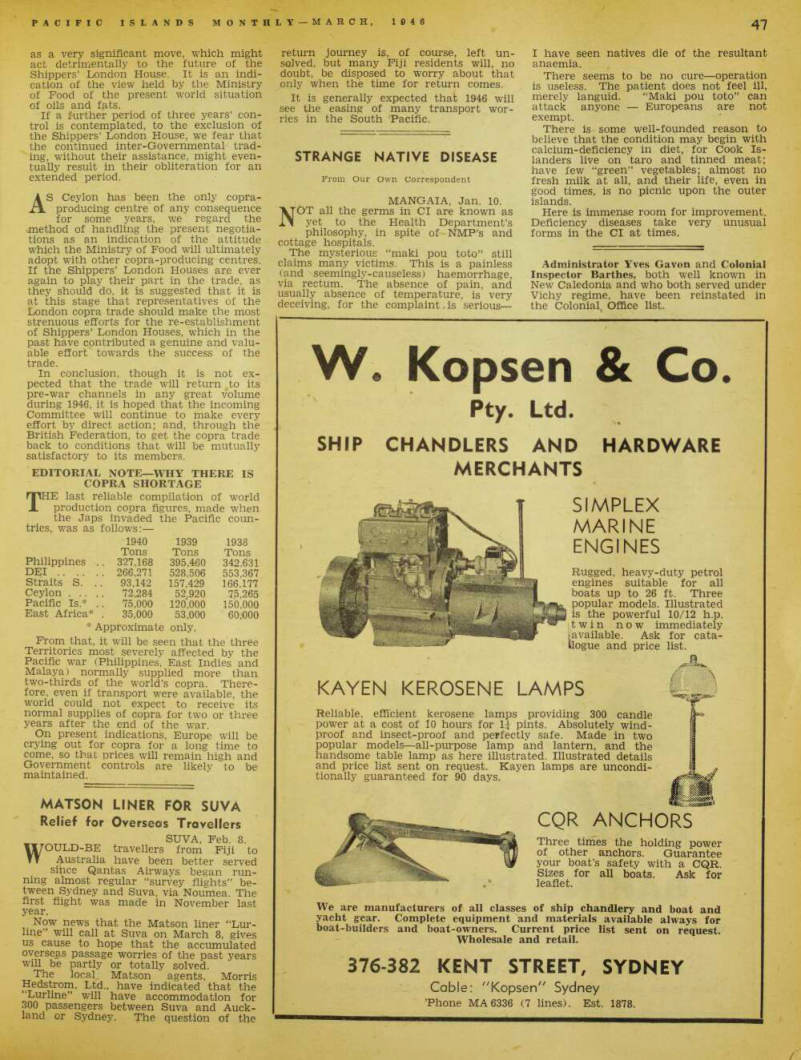
World Copra Situation
London Association Fears Further Period of Government Control
AN important and interesting survey of the world copra situation was pre sented to the annual meeting of the London Copra Association, held in Lon don in January. We are indebted to Mr.
Roy Fischel (L. M. Fischel & Co., Ltd.) for the following extracts from the annual report:—
South Sea Islands
No shipments of South Sea copra have been made to the United Kingdom and Continent since the outbreak of war, and there can be no prospect of the resump tion of shipments to the United Kingdom and Continent for a long period.
When the Japanese entered the war they quickly took possession of New Guinea, Solomon Islands and (to a cer tain extent) Papua. All buildings throughout New Guinea and the Solomon Islands were destroyed, and the pre-war shippers are not yet established in these districts.
Fiji, Tonga Islands and Samoa have not been affected, but the copra from these centres during the war has been shipped to either Canada or the Pacific coast of America.
Copra now available in Papua is being shipped to Australia for crushing there.
Pools under Government direction have been created in all centres, and no mer chant firms are allowed to either buy or sell copra.
In Fiji, crushing mills have been or are being erected, which may absorb a large proportion of the copra produced in Fiji.
To sum up, there is no likelihood of export of copra to the United Kingdom and Continent from the South Sea Is lands being continued at anything like the pre-war quantities, and so long as the present control continues, there is no possibility of merchants and brokers par ticipating in any shipments to the United Kingdom and Continent, which may be arranged through the various Govern ments and pools.
Straits
Most Singapore firms have made arrangements for the early reopening of their offices and, until then, it is difficult to obtain reliable information as to prospects of supplies.
All buying is at present in the hands of the Military Administration who are acting for the Ministry, of Food; but, while no details are available, it is be lieved that very little copra has been shipped. In view of the shortage of food supplies in the East it may be assumed that an increased percentage of produc tion will, for the time being, be absorbed locally.
Philippines
Not very much information has been received as to conditions in the Islands since their liberation, a year ago, and it will take a long time to repair the ravages of war, and enemy occupation for over three years.
From reports received, it is believed that very little damage has been done to the trees, and copra would be in full supply if it were not for land and inter island sea transportation, which was practically non-existent up to a few months ago.
The warehouses throughout the Islands, especially at the shipping ports, have
been in most cases totally destroyed, which will make a very acute storage problem until they can be rebuilt, A conservative estimate of exports of copra from the Philippine Islands in 1946 is in the neighbourhood of 150/200,000 tons.
It is expected that all this copra will be shipped to America, through the US Agency, the Copra Export Management Corporation (CEMCO).
It is believed, therefore, that Philip pine copra for the European market will not be available for, some time to come.
Dutch East Indies
As this district must still be considered occupied territory, very little, if any, in formation is available—though presum ably little damage has been done to trees, as in other districts. But exports, as elsewhere, will be dependent on land and sea transportation facilities.
Ceylon
At the end of hostilities, it was hoped that, as soon as reasonably possible, some move towards normal trading conditions might be made.
The necessity for a continuation of price control was evident; but it was hoped that the business could be handled in such a way as to bring back the Eastern Shippers’ London Houses into operation.
The Shippers’ London House has been entirely excluded from the copra business now for the last four years, and during that period has not enjoyed any remu neration, but it is felt that we have now arrived at the stage where they could perform useful service in assisting in the distribution of supplies, and could justify by their efforts a nominal margin of profit. There are no signs whatsoever, at present, of this taking place.
The purchasing of Ceylon copra during the past few years has been made by the Ministry of Food through their repre sentative, the Commodity Commissioner in Colombo, based on a contract made with the Ceylon Government at a fixed price. On each occasion, when negotiat ing a new contract, the price has been fixed at a higher level. The last contract agreement to expire was in December, 1945 r when the price stood at Rs. 92 per candy.
Negotiations between the Ministry and the Government failed to conclude in a new agreement and as a temporary ex pedient a price was fixed at Rs. 100 per candy, and the contract has beer ex tended to the end of March, pending further negotiations.
In addition to buying direct in Ceylon on a f.o.b. basis, the Commissioner, repre senting the Ministry of Food, has also figured as a shipper, and during the year 1945 exported 34 per cent, of the total quantity of copra shipped from Ceylon.
While during the war period, this may have been a necessity, it is thought with the war over the Commissioner should at least allow the total exports to be handled by the normal exporters. It is obvious that any shipments made by the Commis sioner are at the expense of the usual shippers.
It is common knowledge that the Ministry has recently offered to the Ceylon Government a contract covering the next three years, and this is regarded
as a very significant move, which might act detrimentally to the future of the Shippers’ London House. It is an indi cation of the view held by the Ministry of Food of the present world situation of oils and fats.
If a further period of three years’ con trol is contemplated, to the exclusion of the Shippers’ London House, we fear that the continued inter-Governmental trad ing, without their assistance, might even tually result in their obliteration for an
extended period.
AS Ceylon has been the only copra producing centre of any consequence for some years, we regard the method of handling the present negotia tions as an indication of the attitude which the Ministry of Food will ultimately adopt with other copra-producing centres.
If the Shippers’ London Houses are ever again to play their part in the trade, as they should do, it is suggested that it is at this stage that representatives of the London copra trade should make the most strenuous efforts for the re-establishment of Shippers’ London Houses, which in the past have contributed a genuine and valu able effort towards the success of the trade.
In conclusion, though it is not ex pected that the trade will return to its pre-war channels in any great volume during 1946, it is hoped that the incoming Committee will continue to make every effort by direct action; and, through the British Federation, to get the copra trade back to conditions that Will be mutually satisfactory to its members.
Editorial Note—Why There Is
Copra Shortage
rpHE last reliable compilation of world X production copra figures, made when the Japs invaded the Pacific coun tries, was as follows:
From that, it will be seen that the three Territories most severely affected by the Pacific war (Philippines, East Indies and Malaya) normally supplied more than two-thirds of the world’s copra. There fore, even if transport were available, the world could not expect to receive its normal supplies of copra for two or three years after the end of the war.
On present indications, Europe will be crying out for copra for a long time to come, so that prices will remain high and Government controls are likely to be maintained.
1940 1939 1938 Tons Tons Tons Philippines .. 327,168 395,460 342,631
Dei 266,271
528,506 553,367 Straits S. .. 93,142 157,429 166,177 Ceylon 72,284 52,920 75.265 Pacific Is.* .. 75,000 120,000 150,000 East Africa* . 35,000 53,000 60,000 * Approximate only.
Matson Liner For Suva
Relief for Overseas Travellers
Suva, Feb. 8.
WOULD-BE travellers from Fiji to Australia have been better served since Qantas Airways began run ning almost regular “survey flights” be tween Sydney and Suva, via Noumea. The first flight was made in November last year.
Now news that the Matson liner “Lur line” will call at Suva on March 8, gives us cause to hope that the accumulated overseas passage worries of the past years will be partly or totally solved.
The local Matson agents, Morris Hedstrom, Ltd., have indicated that the Lurline” will have accommodation for 300 passengers between Suva and Auck land or Sydney. The question of the
return journey is, of course, left un solved, but many Fiji residents will, no doubt, be disposed to worry about that only when the time for return comes.
It is generally expected that 1946 will see the easing of many transport wor ries in the South Pacific.
Strange Native Disease
From Our Own Correspondent
Mangaia, Jan. 10.
NOT all the germs in Cl are known as yet to the Health Department’s philosophy, in spite of NMP’s and cottage hospitals.
The mysterious “maki pou toto” still claims many victims. This is a painless (and seemingly-causeless) haemorrhage, via rectum. The absence of pain, and usually absence of temperature, is very deceiving, for the complaint. is serious—
I have seen natives die of the resultant anaemia.
There seems to be no cure —operation is useless. The patient does not feel ill, merely languid. “Maki pou toto” can attack anyone Europeans are not exempt.
There is some well-founded reason to believe that the condition may begin with calcium-deficiency in diet, for Cook Is landers live on taro and tinned meat; have few “green” vegetables; almost no fresh milk at all, and their life, even in good times, is no picnic upon the outer islands.
Here is immense room for improvement.
Deficiency diseases take very unusual forms in the Cl at times.
Administrator Yves Gavon and Colonial Inspector Barthes, both well known in New Caledonia and who both served under Vichy regime, have been reinstated in the Colonial, Office list.
Advertisements & other items, p. 51 (1 item)
W, Kopsen & Co.
Pty. Ltd.
SHIP CHANDLERS AND HARDWARE
MERCHANTS
SIMPLEX
MARINE
ENGINES
Rugged, heavy-duty petrol engines suitable for all boats up to 26 ft. Three popular models. Illustrated is the powerful 10/12 h.p. twin now immediately available. Ask for cataogue and price list.
JL.
KAYEN KEROSENE LAMPS
h Reliable, efficient kerosene lamps providing 300 candle power at a cost of 10 hours for l\ pints. Absolutely windproof and insect-proof and perfectly safe. Made in two popular models—all-purpose lamp and lantern, and the handsome table lamp as here illustrated. Illustrated details and price list sent on request. Kayen lamps are unconditionally guaranteed for 90 days.
CQR ANCHORS
Three times the holding power of other anchors. Guarantee your boat’s safety with a CQR.
Sizes for all boats. Ask for leaflet.
We are manufacturers of all classes of ship chandlery and boat and yacht gear. Complete equipment and materials available always for boat-builders and boat-owners. Current price list sent on request.
Wholesale and retail.
376-382 KENT STREET, SYDNEY
Coble: "Kopsen" Sydney
’Phone MA 6336 (7 lines). Est. 1878.
"Bulolo"
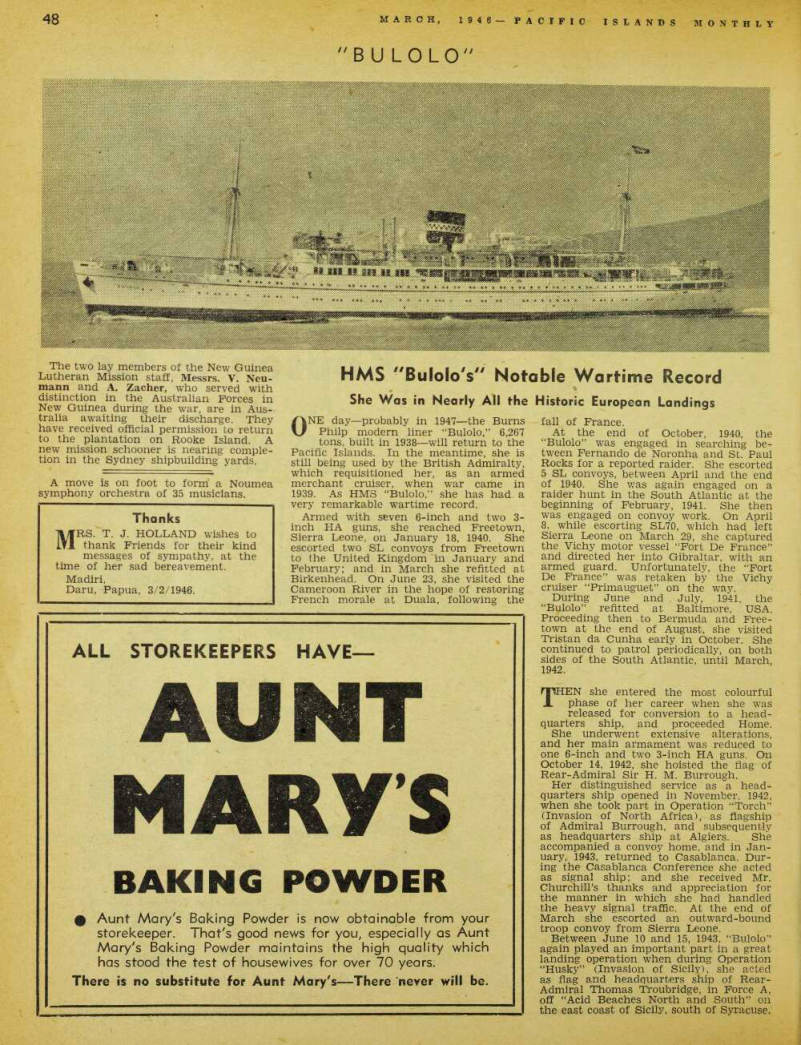
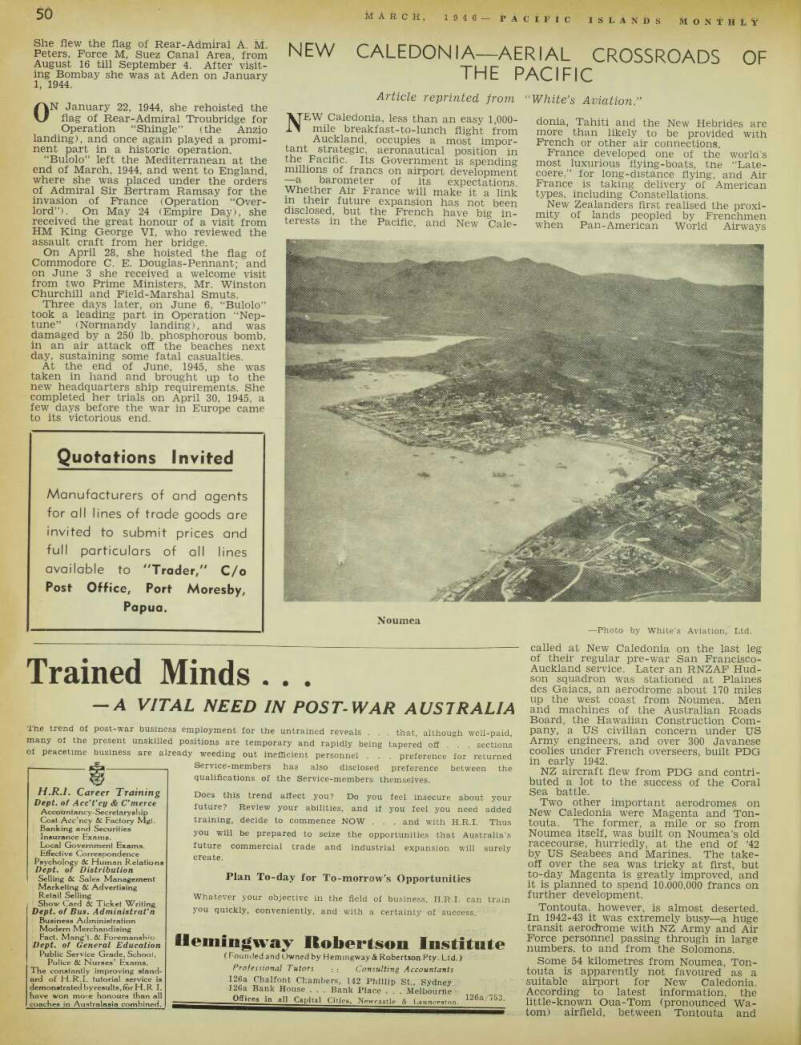
The two lay members of the New Guinea Lutheran Mission staff, Messrs. V. Neu mann and A. Zacher, who served with distinction in the Australian Forces in New Guinea during the war, are in Aus tralia awaiting their discharge. They have received official permission to return to the plantation on Rooke Island. A new mission schooner is nearing comple tion in the Sydney shipbuilding yards.
A move is on foot to form a Noumea symphony orchestra of 35 musicians.
HMS "Bulolo's" Notable Wartime Record
, * She Was in Nearly All the Historic European Landings
ONE day—probably in 1947 —the Burns Philp modern liner “Bulolo,” 6,267 tons, built in 1938 —will return to the Pacific Islands. In the meantime, she is still being used by the British Admiralty, which requisitioned her, as an armed merchant cruiser, when war came in 1939. As HMS “Bulolo,” she has had a very remarkable wartime record.
Armed with seven 6-inch and two 3inch HA guns, she reached Freetown, Sierra Leone, on January 18, 1940. She escorted two SL convoys from Freetown to the United Kingdom In January and February; and in March she refitted at Birkenhead. On June 23, she visited the Cameroon River in the hope of restoring French morale at Duala, following the
fall of France.
At the end of October, 1940, the “Bulolo” was engaged in searching be tween Fernando de Noronha and St. Paul Rocks for a reported raider. She escorted 5 SL convoys, between April and the end of 1940. She was again engaged on a raider hunt in the South Atlantic at the beginning of February, 1941. She then was engaged on convoy work. On April 8, while escorting SL7O, which had left Sierra Leone on March 29, she captured the Vichy motor vessel “Fort De France” and directed her into Gibraltar, with an armed guard. Unfortunately, the “Fort De France” was retaken by the Vichy cruiser “Primauguet” on the way.
During June and July, 1941, the “Bulolo” refitted at Baltimore, USA.
Proceeding then to Bermuda and Free town at the end of August, she visited Tristan da Cunha early in October. She continued to patrol periodically, on both sides of the South Atlantic, until March, 1942.
THEN she entered the most colourful phase of her career when she was released for conversion to a head quarters ship, and proceeded Home.
She underwent extensive alterations, and her main armament was reduced to one 6-inch and two 3-inch HA guns. On October 14, 1942, she hoisted the flag of Rear-Admiral Sir H. M. Burrough.
Her distinguished service as a head quarters ship opened in November. 1942, when she took part in Operation “Torch” (Invasion of North Africa), as flagship of Admiral Burrough, and subsequently as headquarters ship at Algiers. She accompanied a convoy home, and in Jan uary, 1943, returned to Casablanca. Dur ing the Casablanca Conference she acted as signal ship; and she received Mr.
Churchill’s thanks and appreciation for the manner in which she had handled the heavy signal traffic. At the end of March she escorted an outward-bound troop convoy from Sierra Leone.
Between June 10 and 15, 1943, “Bulolo” again played an important part in a great landing operation when during Operation “Husky” (Invasion of Sicily), she acted as flag and headquarters ship of Rear- Admiral Thomas Troubridge, in Force A, off “Acid Beaches North and South” on the east coast of Sicily, south of Syracuse.
She flew the flag of Rear-Admiral A. M.
Peters, Force M, Suez Canal Area, from August 16 till September 4. After visit ing Bombay she was at Aden on January 1, 1944.
ON January 22, 1944, she rehoisted the flag of Rear-Admiral Troubridge for Operation “Shingle” (the Anzio landing), and once again played a promi nent part in a historic operation.
“Bulolo” left the Mediterranean at the end of March, 1944, and went to England, where she was placed under the orders of Admiral Sir Bertram Ramsay for the invasion of France (Operation “Over lord”). On May 24 (Empire Day), she received the great honour of a visit from HM King George VI, who reviewed the assault craft from her bridge.
On April 28, she hoisted the flag of Commodore C. E. Douglas-Pennant; and on June 3 she received a welcome visit from two Prime Ministers, Mr. Winston Churchill and Field-Marshal Smuts.
Three days later, on June 6, “Bulolo” took a leading part in Operation “Nep tune” (Normandy landing), and was damaged by a 250 lb. phosphorous bomb, in an air attack off the beaches next day, sustaining some fatal casualties.
At the end of June, 1945, she was taken in hand and brought up to the new headquarters ship requirements. She completed her trials on April 30, 1945, a few days before the war in Europe came to its victorious end.
Advertisements & other items, pp. 52-54 (2 items)
Marys
Thanks MRS. T. J. HOLLAND wishes to thank Friends for their kind messages of sympathy, at the time of her sad bereavement.
Madiri, Daru, Papua, 3/2/1946.
ALL STOREKEEPERS HAVE—
AUNT
MARYS
BAKING POWDER
0 Aunt Mary's Baking Powder is now obtainable from your storekeeper. That's good news for you, especially as Aunt Mary's Baking Powder maintains the high quality which has stood the test of housewives for over 70 years.
There is no substitute for Aunt Mary's—There never will be.
CHATEAU D’OR
COGNAC VIEUX
☆ ☆ D
NET CONTENTS 26 FLUIDOUNCEs]
C. SULLIVAN & CO.
SYDNEY
PRODUCE OF AUSTRALIA
HILLS
FINE ENGLISH
CIGARETTES
•SPINET
•SUN R I P E
•GOLD FLAKE
• AIR MAIL
HIGH-GRADE
TOBACCOS
BADMINTON
SPINET
Pacific Islands Distributors'.
C. SULLIVAN Pty. Ltd., Sydney
PABST
BLUE RIBBON BEER
33 Fine Brews Blended into
ONE GREAT BE E R
Agents : C. SULLIVAN PTY. LTD., 379 Kent Street, Sydney
C. SULLIVAN Pty. Ltd.
GENERAL MERCHANTS EXPORT AGENTS
REPRESENTING LEADING FIRMS IN THE PACIFIC ISLANDS.
Islands Produce sold on Shippers’ Account—Liberal Advances against Consignments.
Buyers of all Islands’ Requirements on Commission —Original Invoices Furnished.
Bankers : Bank of New South Wales .. Bank of New Zealand .. Comptoir National d’Escompte de Paris.
Cable Address: Chasull, Sydney.
379 KENT STREET, SYDNEY, N.S.W.
Quotations Invited
Manufacturers of and agents for all lines of trade goods are invited to submit prices and full particulars of all lines available to "Trader," C/o Post Office, Port Moresby, Papua.
Trained Minds . . .
A VITAL NEED IN POST-WAR AUSTRALIA
The trend of post-war business employment for the untrained reveals . . . that, although well-paid, many of the present unskilled positions are temporary and rapidly being tapered off . . . sections of peacetime business are already weeding out inefficient personnel . . . preference for returned Service-members has also disclosed preference between the qualifications of the Service-members themselves. w H.R.I. Career Training Dept, of Acc’t’cy & C’merce Accountancy-Secretaryship Cost Acc’ncy Si Factory Mgt.
Banking and Securities Insurance Exams.
Local Government Exams.
Effective Correspondence Psychology & Human Relations Dept, of Distribution Selling 6C Sales Management Marketing SC Advertising Retail Selling i Show Card 6C Ticket Writing Dept, of Bus. Administrate Business Administration Modern Merchandising Fact. Mang’t. Si Foremanshio Dept, of General Education Public Service Grade, School, Police Si Nurses’ Exams.
The constantly improving standard of H.R.I. tutorial service is demonstrated by results,fbrH.R I. have won more honours than all coaches in Australasia combined.
Does this trend affect you? Do you feel insecure about your future? Review your abilities, and if you feel you need added training, decide to commence NOW . . . and with H.R.I. Thus you will be prepared to seize the opportunities that Australia’s future commercial trade and industrial expansion will surely create.
Plan To-day for To-morrow’s Opportunities Whatever your objective in the field of business, H.R.I. can train you quickly, conveniently, and with a certainty of Success.
Hemingway Robertson Institute
( Founded and Owned by Hemingway & Robertson Pty. Ltd.)
Professional Tutors : : Consulting Accountants
126 a Chalfont Chambers, 142 Phillip St., Sydney 126 a Bank House . . . Bank Place . . . Melbourne Offices in all Capital Chics. Newcastle A Launceston. 126a / 75 3.
49
I‘ACIFIC ISLANDS MoNttitlf MARCH, 1946
New Caledonia—Aerial Crossroads Of
The Pacific
Article reprinted from “White’s Aviation ”
NEW Caledonia, less than an easy 1,000mile breakfast-to-lunch flight from Auckland, occupies a most impor tant strategic, aeronautical position in the Pacific. Its Government is spending millions of francs on airport development —a barometer of its expectations.
Whether Air France will make it a link in their future expansion has not been disclosed, but the French have big in terests in the Pacific, and New Cale
donia, Tahiti and the New Hebrides are more than likely to be provided with French or other air connections.
France developed one of the world’s most luxurious flying-boats, tne “Late coere,” for long-distance flying, and Air France is taking delivery of American types, including Constellations.
New Zealanders first realised the proxi mity of lands peopled by Frenchmen when Pan-American World Airways
called at New Caledonia on the last leg of their regular pre-war San Francisco- Auckland service. Later an RNZAF Hud son squadron was stationed at Plaines des Gaiacs, an aerodrome about 170 miles up the west coast from Noumea. Men and machines of the Australian Roads Board, the Hawaiian Construction Com pany, a US civilian concern under US Army engineers, and over 300 Javanese coolies under French overseers, built PDG in early 1942.
NZ aircraft flew from PDG and contri buted a lot to the success of the Coral Sea battle.
Two other important aerodromes on New Caledonia were Magenta and Ton touta. The former, a mile or so from Noumea itself, was built on Noumea’s old racecourse, hurriedly, at the end of ’42 by US Seabees and Marines. The take off over the sea was tricky at first, but to-day Magenta is greatly improved, and it is planned to spend 10,000,000 francs on further development.
Tontouta, however, is almost deserted.
In 1942-43 it was extremely busy—a huge transit aerodrome with NZ Army and Air Force personnel passing through in large numbers, to and from the Solomons.
Some 54 kilometres from Noumea, Ton touta is apparently not favoured as a suitable airport for New Caledonia.
According to latest information, the little-known Oua-Tom (pronounced Wa tom) airfield, between Tontouta and
Noumea
Photo by White’s Aviation, Ltd.
PDG, is to be developed to serve even the biggest airliners.
Noumea Harbour itself is an ideal fly ing-boat base. The installation is on an island. He Nou. a few minutes from Noumea proper. In the war years, the roar of Coronados, Mariners and Cata linas, arriving and departing, was almost continuous. Thousands of passengers and tons of freight and mail were trans ported, for He Nou was a crossroads with routes radiating to NZ, Australia, the Solomons and the US.
An RNZAF station is established there —a stopover for Catalinas to refuel or moor for a night, but even this trans port has almost ceased.
Recent special Sydney-Suva flights by Qantas included calls at Noumea, and it is certain that New Caledonia is in a strong position to offer facilities to any international Pacific airline. NZ, Aus tralian. British, US, Canadian and Dutch interests are probable starters.
Sooner or later Air France may be in the picture. Meantime, several airfields will cater for internal airlines and pri vate flying in New Caledonia, and sur plus equipment is expected to be avail able there soon.
Away
Escape From
Rabaul
AWA Men Who Got Away
By Mrs. N. Luke (formerly Mrs. Boles)
IAM able to supplement Captain Vider’s account of the escape of the “Leander” from Rabaul on the eve of the Jap invasion, by supplying the names of various escapees, taken from notes I made at the time.
At 7 a.m. on January 22, 1942 —a few hours before the Jap invasion—l arrived off Gazelle Point on the motor vessel “Iboki,” with a load of timber. Not long afterwards we heard the explosions of bursting bombs, and saw columns of smoke in the direction of Rabaul. From our position we counted about 40 Jap planes. Little did I then realise I was witnessing the beginning of the most tragic incident in the history of the Ter ritory.
Four hours later, we chugged into Simpson Harbour, and finally tied up at Ah Tam’s wharf, with engine running and anchor up. On going ashore, we learned of the approach of the Jap Invasion fleet. We did not stay long.
At Ralum, outward bound, the “Iboki” picked up the following members of the staff of Amalgamated Wireless; Messrs, Farnsworth, Bishton, A. Hooper (whose name is in the list of missing, but who is very much alive in West Australia), James, Watson, Eldrige, Brown, Groom, and Luke.
During the night of the 22nd, as we headed southwards, a small steamer over took us, which we presumed to be the “Matafele.” The “Iboki” tried to con tact her. She answered, but did not appear to understand our signals, and was soon lost in the darkness.
We arrived at Tol Plantation at day light on the 23rd, and we noticed a few pinnaces, and the “Leander” at the anchorage. We soon found ourselves accepting the hospitality of George Naess, whose bungalow was at the disposal of all the weary and hungry folk who managed to reach Tol.
Let me here pay tribute to the memory of a brave and gallant soul George Naess. He refused to come away with us, and the last words I heard him speak, as
he entered his canoe, were: “I’m an old bloke —let the young blokes get away.”
And the old hero started on his journey into the unknown. So long, Old Timer!
I sent the “Iboki” over to Kiep to pick up anybody who might be over on that side of the bay, and I never saw her again. I have heard since that she “dis appeared.”
It was here at Tol that we from the “Iboki” joined the “Leander,” where we met Mr. Mac Adam, of the Customs. Eric Howitt told me he was on his way down the coast to take away as many as he could find.
In due course, we arrived at Cutarp Plantation, in Waterfall Bay. Accom panied by three of the men, I went across to the sawmill we had been using there, where we picked up my sawyer, A.
Schacht. I also got a few odds and ends which I thought might come in useful in the event of the schooner finding herself on the receiving end of a bomb, or meeting machine-gun bullets.
On the beach, I handed my teleradio over to an officer of the Air Force, and I was pleased to learn later it proved most useful.
Two of my Buka boys (ex-boat’s crews) came along with us, and made themselves useful on the “Leander.”
Mr. Frank Cutler joined us at Cutarp, and Mr. Bill Battis at Palmalmal.
At the Trobriands, Mr. Brewer, ARM (since killed in an aircraft accident), the Rev. Keith Gordon, and Mr. Cameron came on board.
We in the “Leander” finally reached Port Moresby via Samarai, where a fairly
large number of passengers came on board. Next day, I left for Australia per “Mako,” sailing in company with the “Muliama.”
I found the most nerve-racking experi ence of the whole trip was getting out of Rabaul Harbour, expecting Jap warships to come nosing round Praed Point at any moment.
Advertisements & other items, p. 55 (1 item)
Imperial
TIME OFF FROM
COOKING
m % V X m \ * if <3T X
't-wc i
What an idea to be able to serve up meals in 5 minutes! , . . Meals that will bring unanimous appetising pleasure—treats that you yourself will be able to sit down and enjoy.
IMPERIAL Good Foods are ready-cooked for you by expert chefs. Easy-to-serve. Specially processed to seal in the full flavour and keep EVER-FRESH.
Imperial
GOOD FOODS
W. ANGLISS & Co. (Aust.) Pty., Ltd.
Head Office: 5-7 O’Connell Street, Sydney, Australia.
Imperial
MEATREAT
★ Imperial
CAMP PIE
★ Imperial
HAMPE
★ Imperial
HOT MEALS
"New Guinea 'Cherries'
Caused Blindness"
riTWENTY-SEVEN soldiers now back in X England from the fighting in New Guinea are totally blind through eating what looked like ordinary English cherries, Mr. C. D. Torvell, Scientific Ad viser to the British Forces in the Far East, has stated. The fruit was discovered at the end of 1942. The lay name for it was “finger cherry,” and it looked and tasted like an English cherry. One or two of these “finger cherries” were eaten without anything happening, but soldiers who ate nine or ten were totally blind within a few hours. So far science has found no means of restoring sight in these cases. As soon as the properties in the fruit were discovered the authorities destroyed as many of the trees as pos sible.—“ Crown Colonist.”
Cyclones—Enemy of Pearling Fleets
Pearling Fleets
THE pearling fleets of the northern Australian waters have suffered as much destruction from cyclones as any other form of shipping.
Since the establishment of pearling, it is calculated more than 220 pearling vessels have been smashed by cyclones, with a death-roll of 1,280 men, including whites, Japanese and aborigines.
In December, 1869, thirteen pioneering pearling boats were destroyed by cyclones off the north-western coast of Western Australia, with a loss of 73 lives. Prac tically every year since, cyclones have killed pearlers and destroyed fleets.
March of 1946 is the 47th anniversary of the worst pearling disaster in Aus tralian history. The cyclone struck on Saturday, March 4, 1899, off Cape Mel ville, on the eastern coast of Cape York Peninsula. By sunset, five large schooners and 73 pearling luggers were anchored near the Cape. On those boats, all told, were about 350 men, women and children (including natives and whites). Shortly after sunset, steady rain began to fall; a breeze sprang up from the south-east, and the water in the bay got choppy. This was the forewarning of two terrific cyclones—one coming from the centre of the South Pacific, and the other from the Arafura Sea.
Towards midnight the wind increased, and waves rose to mountainous heights.
Soon, the two cyclones met in Princess Charlotte Bay, smashing, in their course,
77 boats and destroying 12 white people and 295 natives.
The storm raged for 10 hours and caused a tidal wave, which flooded the adjacent country for some three miles, leaving debris of human bodies, dead fish and animals.
The only boat to survive was the appro priately-named schooner “The Crest of the Wave,’’ owned by Captain Porter. His wife and baby were with him during the long hours of terror.
This narrative would be incomplete without the story of Muara Lifu—the heroine of the storm. She was a young native of Darnley Island (Torres Strait), and her husband was a diver on one of the luggers. She saved the lives of white men, displaying remarkable fortitude and endurance. Supporting them, she swam for five hours against terrific seas and got them to the shore nearly two miles away. Over her grave in Thursday Is land cemetery, where she was buried some 13 years ago, is a striking memorial. It is made of ground coral, and stands as a tribute to the bravery of Muara Lifu, whose heroism earned her the gold medal of the Royal Humane Society first coloured woman to be awarded the dis
tinction.-
J. H.
M. Fourcade, who has successfully filled a number of important administrative posts in the Hebrides and New Caledonia since he arrived with Admiral d’Argenlieu in 1941, has been appointed Chef de Cabinet to Governor Tallec. He succeeds M. Guedes, who has received a New Hebridean appointment.
In The Supreme Court Of The
Australian Capital Territory
No.n 5 of 1945
In the Matter of the Companies Ordin ances 1933-1936 (New Guinea) j , nyr 44. * And in the Matter of the Compames Ordinances 1911-1926 (Papua) And in the Matter of Greenwood & Laws Limited Laws ijimitea.
Notice Is Hereby Given That A
petition for the winding up of the above named Company by the Supreme Court of the Australian Capital Territory was on the twenty-ninth day of October, 1945, presented to the said Court by Darling Downs Co-op. Bacon Association Ltd., W. R. Carpenter & Co. Ltd., British Australian Lead Manufacturers Ltd., Paterson, Laing & Bruce Ltd., Thomas Playfair Ltd., Norco Co-op. Ltd., Edwards Dunlop & Co. Ltd., S. Hoffnung & Co.
Ltd., Mandated Airlines Ltd., Australian Soaps Ltd., Colyer Watson (New Guinea) Ltd., Vacuum Oil Co. Pty. Ltd., Simpson Bros. Pty. Ltd., Tooth & Co. Ltd., Morobe Bakery Ltd., Agnes Wilson Laws, Charles Chute Beckett, Claes Adolph Melbourne Adelskold, Queensland Meat Export Co.
Ltd., Guinea Airways Ltd., Annie Parer, Phillips Lamps (N.Z.) Ltd., Sullivan Enterprises Ltd., and C. Sullivan Pty. Ltd., being creditors of the said Company, Richard John Sinclair Laws, Charles Thomas Boodle Maisey, Broughton Gor don Edgell, Ernest Ralph Mitchell. Daniel Joseph Leahy, Robert George Morgan, George Henry Smith. Michael James Leahy, George Archibald Loudon, Wini fred Loudon, Charles Alfred deKantzow, Thomas Wood, Clifford Benjamin Austin, Davis Wood. Roy McConnon, Charles Wooller Marshall. Jack Mahalm Ireland, Patrick Leonard Byrne, Francis Martin
dale Blackwood, Ruby Budden, Walter William Taylor, Oscar George Hilbert, Gilbert Renton, Francis Murray Draper, Ina Sara Mingay Pryke, Roger Wheeler Watson, Margaret Gordon Hayes, Alan Roderick McCay, James Luby Leahy, John Maclean, Chiarina Cavaleiri.
Edward Roberts, Arthur Hyde, Kathleen Hyde and Winifred Olive Foreman being preference shareholders in the said Com
v,RiC Ar . Laws being
an ordinary shareholder in the said Com pany, and that the sald petition is directed to be heard before the Court on the first day of April, 1946, at 10 a.m. a t the Patent Office Building, Canberra, m the Australian Capital Territory, and an y creditor or contributory of the said Company desirous to support or oppose the making of an order on the said peti tkm may appear at the time of hearing in Person or by his Counsel for that purpose; and a copy of the petition will be furnished to any creditor or contri butory of the said Company requiring the same by the undersigned on payment of the regulated charge for the same.
H. T. Macready & Eric Jones.
Solicitors for the Petitioner, 133 Pitt Street,
Sydney.
NOTE— Any person who intends to appear on the hearing of the said peti tion must serve on or send by post to the abovenamed H. T. Macready and Eric Jones, notice in writing of his intention so to do. The notice must state the name and address of the person or if a firm the name and address of the firm and must be signed by the person or firm or his or their solicitor (if anv) and must be served or if posted must be sent by post in sufficient time to reach the above named not later than twelve o’clock noon on the 20th day of March, 1946.
Advertisements & other items, p. 56 (1 item)
tena*
Refreshin g
as a plunge
into a lagoon!
tena*
1 rM'C' dA
SOAP
i i
Germicidal
and fragrant
TENAX TOILET SOAP is
a rapid safeguard against external skin infections, yet it is soothing and kind to the most sensitive skin —even a baby’s!
ORDER TENAX FROM
YOUR ISLAND SUP-
PLIERS. STOCKS ARE
PLENTIFULLY AVAIL-
ABLE.
Lutheran Internees Who
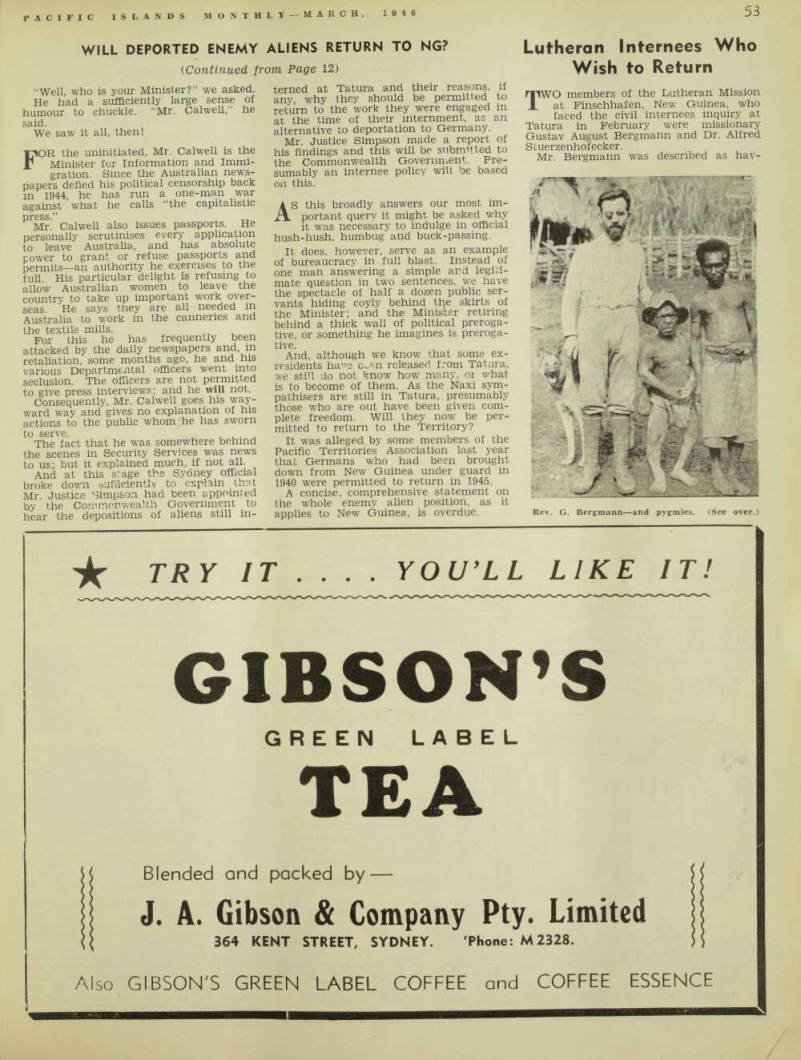
Wish to Return
TWO members of the Lutheran Mission at Finschhafen, New Guinea, who faced the civil internees inquiry at Tatura in February were missionary Gustav August Bergmann and Dr. Alfred Stuerzenhofecker.
Mr. Bergmann was described as hav-
Rev. G. Bergmann—and pygmies. (See over.)
ing appeared with a “black eye-patch, a van Dyke beard and a military bearing.”
He refused to take an oath of affirmation as he said he had never taken an oath in his life, and would not do so except on an appropriate occasion. He did not regard tne Tatura inquiry as “sufficiently important” to warrant a change of policy.
He asked that he, his wife and their six children be returned to their mis sion station in New Guinea, and if this were not permitted, he wished to return to Germany. He admitted that he had applied for membership of the Nazi Party but that he had cancelled his application later because the attitude of the Nazis to the church “was wrong.”
Dr. Stuerzenhofecker, in his evidence, said that he was mission doctor at Finsch hafen. He said that he was not anti semitic, but that in pre-Nazi days 90 per cent, of the influential positions in the medical profession in Germany were held by Jews. He said that there were too many Jews in Germany, and that they held all the best positions.
Mr. Justice Simpson suggested that per haps they had had more brains than the Aryans.
OUR photograph shows the Rev. Gustav Bergmann (still in black eye-patch
and van Dyke beard) with a mem ber of one of the famous pygmy tribes in the Boana Mountains, inland from Finschhafen. Between them stands a dwarf of the same tribe.
The photograph was taken some years ago by the Rev. P. Deutscher, also of the Finschhafen mission.
The well-known missionary and anthro pologist, Fr. Kirschbaum discovered the pygmies and described them in a scienti fic magazine years ago; but in 1936, the late Lord Moyne, wno was “exploring” along the northern New Guinea coast in his yacht, claimed to have found them.
Lord Moyne was assassinated about two years ago in the Middle East, where he held a British Government post.
THE Lutheran Mission of New Guinea was generally directed from Brisbane but actually it was in two sections— the Neuendettelsau Mission Society, at Finschhafen, and the American Lutheran Church Missionary Society, with head quarters at Madang.
The former branch was German and its missionaries came from Germany, al though many of its older members had severed all ties with the Fatherland, and were concerned with only one country— New Guinea. Several of these men gave outstanding service to the Allied cause during the war.
A number who came to the mission from Germany during the ’3o’s, however, had—or were suspected of—Nazi sym pathies; and these caused a great deal of heartburning among other New Guinea residents in the early davs of the war.
The number of Lutheran missionaries (or the number of New Guinea Germans, for that matter) interned during the war has not been disclosed. It is significant, however, that although 63 members of the Finschhafen branch were listed in the Pacific Islands Year Book of 1939, only four members were listed in the 1942 and 1944 editions.
The American Lutheran mission list, on the other hand, has remained sub stantially the same throughout. A num ber of the members of the Madang mission were captured by the Japs and those who survived the ordeal were subsequently liberated by the Americans at Hollandia, where they had been imprisoned.
Advertisements & other items, pp. 57-58 (2 items)
53
WILL DEPORTED ENEMY ALIENS RETURN TO NG? (Continued from Page 12)
PACIFIC ISLANDS MONTHLY MARCH, 1«46
Gibson's
★ TRY IT ... . YOU’LL LIKE IT!
GREEN LABEL
TEA
Blended and packed by— J. A. Gibson & Company Pty. Limited ( 364 KENT STREET, SYDNEY. 'Phone: M 2328. ) ] Also GIBSON'S GREEN LABEL COFFEE and COFFEE ESSENCE
Livestock for Islands
People who intend to take Stock to New Guinea are hereby notified that I have on hand the right class of
Cattle—
Mules—
Horses
to suit both the Climate and the Pastures of the Territories.
When shipping It available, I can deliver, on the ship in Cairns or Townsville, Stock intended for any of the Pacific Islands, including Netherlands Indies, Singapore and the Philippines.
I will take all care of Stock and will be responsible for their delivery on the Ship in Sound Condition.
For further particulars, apply to
J. J. TOOGOOD
Roiiingstone, via Townsville, Queensland.
Orders accepted through any stock Agent, or Bank, in Cairns or Townsville, or direct.
FIRST CIVILIAN WORLD RANGE
STROMBERG
-CARLSON
RECEIVER
This new 5-valve model has many features of the now-famous “Amenities Receiver,” perfected during the war. It will be available in April.
PRICE £26/19/6
Order Yours Now !
WRITE DIRECT TO:
SAL6S S6RVIC6
TELEPHONELBWSIS/# SCOTTISH HOUSE 9 19 BRIDGE STREET ® SYDNEY ® AUSTRALIA /• Z—
tC4Ci ,
of Sugar Industry
Indians Demand Nationalisation of Sugar Industry But Hands Off Transportation!
/I T the December session of the Fiji Legislative Council, the five Indian members supported a move to nationalise the Fiji sugar industry.
All official, European non-official,
and Fijian members voted against the proposal.
In the issue of the “Indian Times’' of January 30, the case for nation alisation is naively, if one-sidedly, presented. It should be remembered that the Indians, who are so enthus
iastically supporting “His Majesty’s
Government” control of the Euro pean-owned sugar interests, are com pletely opposed to Government control of transport services in Fiji, as suggested at the February session of the Legislative Council. (See else where this issue.) Could this be because the bus and taxi services in the Colony are wholly in the hands of the local Indians?
Communism is an ideal arranae ment—up to the point where the State begins to control your pos sessions instead of your neighbours’.
Extracts from the “Indian Times” article are : THE first part of the motion moved by the Indian members referred to the nationalisation policy of the Labour Government in England and supported their action in nationalising some of the powerful concerns in the United Kingdom.
By voting against the motion the offi cial, European unofficial and Fijian un official members have declared that they do not support His Majesty’s Government taking over the Bank of England, coal mines, Cable and Wireless, Ltd., and so many other concerns, in the public in terest.
This explains why they would not lend their support to the proposed action of advising His Majesty’s Government in Great Britain to take over the sugar industry from private monopoly even for the future good, not only of the in dustry but also of this Colony. This Colony depends very largely on the sugar industry which is the main industry here . . .
There is no doubt that the sugar mono poly exercises a very large influence on the economy and the administration of this Colony. Fiji sugar has assured mar ket in Canada and England. His Majesty’s Government subsidises the colonial sugar industry, and therefore, His Majesty’s Government ought to have more say as to whether the sugar industry in Fiji should remain in private hands or change to public ownership.
Moreover, the CSR Company, which is the sugar monopoly referred to above, is a non-Fijian company and its profits go overseas.
Owing to the policy of this company, the wages of workers and price to the pri mary producers of cane are kept low and so all attempts to improve the standard of living fail . . .
In the matter of price for sugar cane grown in Fiji. Dr. C. Y. Shephard’s re port says that the company’s books show 0.77 per cent, was available, on an average for 13 years, for distribution to shareholders as annual dividend . . . and so it could not pay more for the
sugar cane. Dr. Shepherd disagreed.
The nationalisation would help to im prove standard of living of all in Fiji, including the Fijian owners of land . . .
It would be in the interest of the company to see that the sugar industry in Fiji was nationalised too. Under public ownership the company would gain.
It was proposed that the mills and other assets of the company in Fiji be valued and the price so determined be paid to the company after 20 years and that for 20 years the company should receive a guaranteed rate of interest at 1 per cent, per annum—since this rate would be more than the low profit shown by the company for the past 13 years.
Solomons Gold?
May Affect Future of Honiara
rE future of the new administrative headquarters of the British Solomon Islands, Honiara (see article on page 29) is likely to be influenced by two fac tors —air transport, and gold.
Shipping and trading interests are still unwilling to accept Honiara as their headquarters, owing to the lack of ship ping facilities. It is understood that Mr.
Lotze. who visited the Solomons recently on behalf of W. R. Carpenter & Co., Ltd., has reported against Honiara and in favour of Tulagi, as future headquarters.
The presence of Henderson Field, on Guadalcanal, may tend to attract traffic towards Honiara. It is unlikely, however, that heavy air traffic will use Henderson Field. The Solomons, unlike Rabaul and Noumea, are not on the direct line of any of the Trans-Pacific air services; and
therefore probably will be serviced by smaller planes from New Caledonia or New Guinea, or direct from Australia, THERE are likely to be developments soon in relation to Solomon Islands gold. Many men prospected the Gua dalcanal valleys in the ’thirties, but rich promises .there were countered by the difficulties of communication: if it was to be a worthwhile field, it clearly would have to be a big-scale enterprise. Hopes rose high when, just before the war, the Theodore interests from Fiji began to in vestigate the possibilities of Guadalcanal.
The Theodore examination was held up between 1941 and 1945; but it now has been resumed. Mr. Cramer Roberts, one of the Theodore group’s engineers, was in Guadalcanal last month, and spent some days up in the hills. It is said that, if only shipping were available, goldmining would commence on a definite scale in June.
The Pacific war postponed the gold enterprise, but probably no real harm has been done. Where, in 1941, there was no settlement on Guadalcanal, and shipping
communications were sketchy and diffi cult, to-day there is a great airfield, many roads and bridges, and an established township (Honiara), which will demand a regular shipping service. All this will assist the gold-seekers.
There are indications, already, that the big gold-seeking company will be fol lowed into Guadalcanal by a number of individual prospectors. If there really is gold in the island, we may expect to see rapid developments there, as soon as ship ping communications are restored.
There are also reports that gold-seekers are headed towards other BSI islands, and Bougainville, and even the New Hebrides.
Advertisements & other items, pp. 59-61 (2 items)
Heinz**'- 1
STAMP COLLECTORS
STAMP collector in America desires correspondence with Philatelists throughout the Islands. Object: Exchange. — R.
Jackel. 5447 Flournay St.. Chicago 44, Illinois. U.S.A.
Allen Taylor & Co. Ltd.
COMMERCIAL ROAD, ROZELLE,
SYDNEY
Sawmillers and Wholesale Suppliers of Hardwoods for Constructional Purposes GIRDERS . . . PILES . . . POLES . . . SLEEPERS, Etc
EXPORTING TO PACIFIC ISLANDS SINCE 1893
njfiow
/ ]h£*i >u
they**
i'NZ
m\£? * TO oct S fV si *S M' tS t £Sfc
CHOV
«S" o* 6 " *% . 57 **l et' %s Scarcity of good ingredients still restricts output... so HEINZ, who place quality before quantity, can offer only small supplies of HEINZ
PERFECT SOUPS.. BAKED BEANS
...SPAGHETTI; but keep asking you may be fortunate enough to secure a tin of one favourite HEINZ variety.
HEINZ**'- 1
HP-4-6'!
“PEERLESS” WHEEL TOYS
FOR THE PACIFIC ISLANDS ...
mji
TRICAR No. 7.
AVAILABLE NOW!
We have pleasure in presenting the first of the post-war "Peerless" toys.
As in pre-war years, "Peerless" toys are finished in bright colours. Enjoyment and satisfaction are ensured by their quality.
SCOOTER No. 4.
BRIGHT COLOURS :: RUBBER TYRES
Available in April
7 W 1 J.
SPORTS CAR No. 24
UTILITY TRUCK.
These three attractive toys will be available from stocks during April
—ORDER NOW.
TRICAR No. 9.
Bright colours, rubber tyres, nickel plating and fittings which include horn, mascot, are some of the most attractive features of these toys.
Order "Peerless" Wheel Toys From the Sole Pacific Islands Selling
Representatives:
HfIRRT J. TOMNQ
POSTAL ADDRESS:
Box 3661 G.P.0., Sydney.
379 KENT STREET, SYDNEY.
BANKERS: BANK OP N.S.W.
FIT. LTD.
CODES:
Bentley’s Comp.
Phrase.
Bentley’s 2nd Phrase.
Position Wanted Ex-Serviceman, 30, requires position in Papua as fitter, mechanic, welder, etc.
Just completed four years’ war service in Papua with survey unit and ANGAU.
Knowledge Motuan. Civilian occupation: Fitter. Please address letters to “Mechanic,” C/o “PIM,” P.O. Box 3408,
SYDNEY.
KANGAROO BRAND
Ropes,
Cordage,
and Twines for every purpose Backed by 86 years of service Manufactured by:
M. DONAGHY AND SONS,
Pty. Ltd., Geelong and Sydney.
Fiji Representatives:
PEARCE AND CO.
LIMITED
P.O. BOX 237, SUVA
REG. ADAMS, CLAYTON & CO.
f=ff □n c
Progress with Modern Designing.
SHIPBUILDERS
and ENGINEERS
COPPERSMITHS, WELDERS and PLUMBERS.
Builders of WOODEN FREIGHTERS,
TRAWLERS and ISLAND CRAFT.
Agents for Diesel Engines.
VESSELS REPAIRED and REMODELLED.
MODERN SLIPWAY FACILITIES
AVAILABLE.
Write to us for Designs and Complete Shipbuilding information.
REG. ADAMS, CLAYTON
& COMPANY
JOHN STREET, BERRY'S BAY, SYDNEY.
Tel.: XB 4475, XA 1731.
57
PACIFtfc ISLANDS MONTHLY MARCH, 1946
SOLOMON ISLAND PLANTERS
RETURN
(Continued from Page 8)
Waltzed With the Princess!
A MEMBER of the Fiji RAF contin gent, Flight - Lieutenant Denis McCaig, who is still stationed in England, attended the West Norfolk Hunt Ball recently. There he met and danced four waltzes with Princess Elizabeth, whom he savs was: “Grand —very natural, attractive, a fine easy conversationalist, and a good dancer.”
In Occupied Rabaui
How Chinese Fared In Occupied Rabaui Kwong Chong Brothers Murdered by Japs
'Y'HE Methodist Overseas Mission which made the Chinese com munity in pre-war Rahaul its special charge, gives us our first real news
of how the Chinese fared during
the years of the Japanese occupation.
The following is condensed from an article which appeared in a recent issue of the “Missionary Review NOW comes news of our people who were lost during the occupation. One young man, Gerald Woo, who, with his young bride had moved out to the Baining Mountains, was killed and his body horribly mutilated because he re fused to hand over his wife to the Japanese. Leong Tim, a Chinese carpen ter, and for many years a faithful ser vant of the mission, was executed.
From another source we gather that the four Kwong Chong brothers, who were prosperous merchants and all pro minent members of the Kuo Ming Tang Party, were, with their wives and families, also executed. The sole surviving member of the Kwong Chong family was at our Newington College in NSW when war broke over Rabaul, and unfortunately he was found to be suffering from TB, and was sent to a hospital in NSW, where, after many months of nursing, he died, without knowing the fate that had over taken his family.
A letter from Mrs. Dorothy Ping Kwan, one of the brightest and smartest of our school girls who was married during the occupation, tells some harrowing stories of life in the internment camp.
In the first flush of victory, the Japan ese assaulted the Chinese women, but many of the young girls managed to hide in the jungle until some semblance of order was established. Things seemed to improve after the Japanese had estab lished their military police headquarters.
Let Mrs. Ping Kwan tell her own story.
“fIIHESE police were not good men, but X they did not commit any unlawful crime when they first captured us.
They tried to persuade us to run a Geisha house, but we refused to; at last they forced us to do so. But God helped us to remain firm in our attitude.
“They told us to hand out 20 girls from our party in two days’ time, but we would rather die than to be their victims. We had been praying day and night, and the next day, we thought they were coming to take the girls; fortunately one of them had dysentery and they sent a message to the doctor who was taken prisoner to come and see us. They were Doctors Cooper and Hosking (now presumed lost at sea), and when we saw them we told them the whole story about the girls. God gave us cleverness in handling this mat ter; what they did was they told the military police that it is better to restrict any soldiers entering the Chinese camp because the dysentery is flowing about the camp, and it was very infectious. This ended the Japanese thoughts of getting our girls, and when we all recovered our sickness it was time for us to return to Rabaul as ordered by the Commander in-Chief.
“T ATER from Rabaul we shifted to AJ Ratongo. They gave us no food we have to plant for ourselves.
Later a party of Japanese camped near us were also trying to get our girls, but there was a law and they could not lay their hands on us. But they are cunning; they were trying to cut out our food by taking over our farms for setting un AA gun. They thought that we will run out of food and have to sell our body to them, but fortunately God helped us again. We manage to get our food from other places.
“We were lucky to have such a big crowd in one camp, it is impossible for the Japs to attack the girls. We will tear them into pieces if they try to do so, but the Chinese who lived far away from Rabaul had suffered the worse, the women being raped and men being chopped.”
This extract from Mrs. Ping Kwan’s letter gives us an insight into the terrible life these cultured Chinese people were forced to live.
Sudden Death Of Mr. "Tom"
Targett
rpHE sudden death of Mr. Thomas Henry X Targett came as a shock to his many New Guinea friends who felt that “Tom was good for many years yet.” Although well on in his 50’s he was one of the few who escaped from New Britain at the time of the Japanese in vasion in 1942. He has since lived in Townsville.
He went to Rabaul about 1928, and managed both the Kokopo and Wunawu tung Hotels for brief periods; but spent most of his years there in the emnloy of Burns Philp & Co., and W. R. Car penter & Co.
Recently he visited Sydney, received a permit to return to the Territory—to work again for WRC—and was passing through Rockhampton, on March 4, on his way north, when he died.
Tom Targett was one of several Ter ritorial who, within recent months, have died suddenly. He will be missed from post-war Rabaul where, for long years before the invasion, he was popular with all sections of the community. He was a member of the Masonic Lodge and the bowling club, and his was the genial dis position that makes many friends.
Dr. G. R. Hemming, of the Fiji Medical Service, has now left the Colony, and is enjoying a well-earned vacation in Queensland with his wife and two children. Dr. Hemming is then due to go to the Solomons as a mission doctor, stationed at Aoba, for the LMS. We understand that a considerable amount of new medical equipment has been ob tained for this mission hospital at Aoba.
Advertisements & other items, p. 62 (1 item)
Asthma, Bronchitis Coughing,
POSITION WANTED
Ex-Territorian, anxious return to Islands, seeks position on plantation.
Would invest £3OO. —J. Orr-Harper, Flat 3, 54 Huntingdon St., Crow’s Nest, Sydney.
PACIFIC ISLAND FOR SALE
A small island (125 acres), in British Solomons, in a handy situation, is offered for sale. Partly planted: produces not less than 60 tons of copra per annum, with five units of labour. Improvements include bungalow, copra-house, shipping-shed, pig-pens, etc. Title: 99 years’ lease.
For further information write “Solomons Planter,’’ c/o “Pacific Islands Monthly,” PO Box 3408,
Asthma, Bronchitis Coughing, Curbed in 3 Minutes
Do you have attacks of Asthma or Bronchitis so bad that you can’t sleep? Do you feel weak, unable to work, and have to be careful not to take cold and can’t eat certain foods?
No matter how long you have suffered or what you have tried, there is new hope for you In a doctor’s prescription called Mendaco.
No dopes, no smokes, no injections, no atomizer.
All you do is take two tasteless tablets at meals and in 3 minutes Mendaco starts working through your blood, aiding nature to remove phlegm, promote free easy breathing and bring sound sleep the first night, so that you soon feel years younger and stronger.
No Asthma in 2 Years
Mendaco not only brings almost Immediate comfort and free breathing but builds up the system to ward off future attacks. For Instance, J. Richards, Hamilton, Ont., Canada, had lost 40 lbs., suffered coughing every night, couldn’t sleep. Mendaco stopped Asthma
spasms first night and he has had none since in over two years.
Money Back Guarantee
The very first dose of Mendaco goes right to work circulating through your and helping nature relieve you of the effects of Asthma. Try Mendaco under an iron-clad money back gaurantee. You be the judge. If you don’t feel fully satisfied after taking Mendaco just return the empty package and the full purchase price will be refunded. Get Mendaco from your chemist to-day and see how well you sleep to-night and how much better you feel to-morrow. The guarantee protect-'
you ’ RELIEVES ASTHMA
Mendaco
Now in 2 sizes . . . 6/- and 12/-
Samoa—Tonga
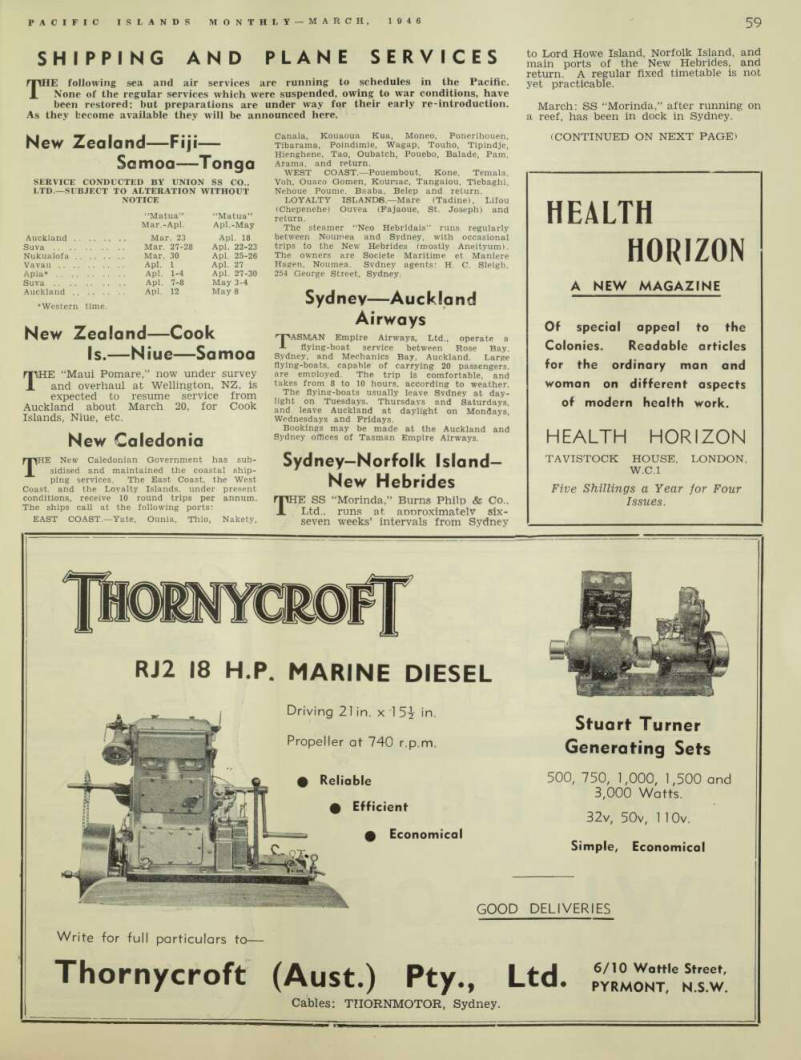
Shipping And Plane Services
THE following sea and air services are running to schedules in the Pacific.
None of the regular services which were suspended, owing to war conditions, have been restored; but preparations are under way for their early re-introduction.
As they become available they will be announced here.
New Zealand—Fiji—
Samoa—Tonga
Service Conducted By Union Ss Co.,
Ltd —Subject To Alteration Without
Notice
Canala, Kouaoua Kua, Moneo, Ponerihouen, Tibarama, Poindimie, Wagap, Touho, Tipindje, Hienghene, Tao, Oubatch, Pouebo, Balade, Pam, Arama, and return.
WEST COAST. —Pouembout, Kone, Temala, Voh, Ouaco Gomen, Koumac, Tangaiou, Tiebaghi, Nehoue Poume. Baaba, Belep and return.
LOYALTY ISLANDS.—Mare (Tadine), Lifou (Chepenehe) Ouvea (Fajaoue, St. Joseph) and return.
The steamer “Neo Hebridais” runs regularly between Noumea and Sydney, with occasional trips to the New Hebrides (mostly Aneityum).
The owners are Societe Maritime et Maniere Hagen, Noumea. Sydney agents; H. C. Sleigh, 254 George Street, Sydney.
Sydney—Auckland
Airways
TASMAN Empire Airways, Ltd., operate a flying-boat service between Rose Bay.
Sydney, and Mechanics Bay, Auckland. Large flying-boats, capable of carrying 20 passengers, are employed. The trip Is comfortable, and takes from 8 to 10 hours, according to weather.
The flying-boats usually leave Sydney at day light on Tuesdays. Thursdays and Saturdays, and leave Auckland at daylight on Mondays, Wednesdays and Fridays.
Bookings may be made at the Auckland and Sydney offices of Tasman Empire Airways.
Sydney-Norfolk Island-
New Hebrides
fTTHE SS “Morinda,” Burns Philp & Co..
A Ltd., runs at annroximatelv six seven weeks’ intervals from Sydney
New Zealand—Cook
Is.—Niue —Samoa
rE “Maui Pomare,’’ now under survey and overhaul at Wellington, NZ, is expected to resume service from Auckland about March 20, for Cook Islands, Niue, etc.
New Caledonia
THE New Caledonian Government has sub sidised and maintained the coastal ship ping services. The East Coast, the West Coast, and the Loyalty Islands, under present conditions, receive 10 round trips per annum.
The ships call at the following ports: EAST COAST. —Yate, Ounia, Thio, Nakety,
to Lord Howe Island, Norfolk Island, and main ports of the New Hebrides, and return. A regular fixed timetable is not yet practicable.
March: SS “Morinda,” after running on a reef, has been in dock in Sydney.
(Continued On Next Page)
“Matua”
“Matua”
Mar.-Apl.
Apl.-May Auckland Mar. 23 Apl. 18 Suva Mar. 27-28 Apl. 22-23 Nukualofa Mar. 30 Apl. 25-26 Vavau Apl. 1 Apl. 27 Apia* Apl. 1-4 Apl. 27-30 Suva Apl. 7-8 May 3-4 Auckland Apl. 12 May 8 ♦Western time.
Sydney—Queensland—
Port Moresby Airways
Q ANT AS Empire Airways, Ltd., employing DC3 planes, operate a regular service between Sydney, Port Moresby and Lae, and return, via Brisbane, Rockhampton, Townsville and Cairns.
Planes leave Sydney on Mondays, Wednesdays and Fridays at 10 a.m.. and arrive at Lae at noon on Tuesdays, Thursdays and Saturdays.
Planes leave Lae at 5.45 a.m. on Wednesdays, Fridays and Sundays, and arrive in Sydney at 10 p.m., accomplishing the Lae-Sydney run in a day.
Bookings may be made at Qantas offices at
any of the towns named. At present, berths are available only to passengers holding official per mits to visit Papua or New Guinea.
Advertisements & other items, pp. 63-64 (1 item)
vcsoiT
HEALTH
HORIZON
A NEW MAGAZINE
Of special appeal to the Colonies. Readable articles for the ordinary man and woman on different aspects of modern health work.
HEALTH HORIZON
TAVISTOCK HOUSE. LONDON.
W.C.I
Five Shillings a Year for Four Issues.
vcsoiT
RJ2 18 H.P. MARINE DIESEL
Driving 21 in. x 1 5i in.
Propeller at 740 r.p.m. 0 Reliable 0 Efficient 0 Economical Stuart Turner
Generating Sets
500, 750, 1,000, 1,500 and 3,000 Watts. 32v, 50v, 1 1 Ov.
Simple, Economical
GOOD DELIVERIES
Write for full particulars to—
Thornycroft (Aust.) Pty., Ltd.
6/10 Wattle Street,
PYRMONT, N.S.W.
Cables: TIIORNMOTOR, Sydney.
HOUSE WANTED
Ex-resident of New Guinea urgently wants to Rent or Buy 4 or 5- Roomed House. State full particulars, by letter, to G. A. Anderson, 51 High Street, Echuca, Victoria.
Woven Wire for all Industry
COPRA DRYING TRAYS, FLOORS, Etc.
FRUU DRYING TRAYS, MINING SCREENS.
Heavy Mosquito Gauze in Phosphor Bronze and other Metals Impervious to Salt Sea Air WIRE DOOR MATS AND GENERAL WIRE WORKS
E. WRIGHT & CO. LTD.
Office and Works: 148-152 Cleveland Street. Sydney. N.S.W.
Telegraphic Address ‘Wriehtmake.’' Chippendale. f* £ tr A
*6I IS^
Pacific Travellers
PASSENGERS who arrived in Auckland per MV “Matua” on February 15;— FROM NUKUALOFA; Mr. C. Brahne, Miss M.
Leger. Miss T. Fraser, Mr. L. Vea.
FROM VAVAU; Mr. K. Galloway, Master J.
Harris.
FROM APIA; Miss M. Apa, Mr. W. Cobcroft, Mr. H. Dearnley, Miss J. Easthope, Master d!
Eden, Master A. Eden, Miss K. Fiainu, Master G. Fa’Asau, Master S. Fau, Mr. E. Grey, Mr. W.
Hansell, Mr. A. Kalapu, Mr. F. Levi, Prof. P.
Marples, Miss M. Meredith, Miss E. Matatumua, Miss F. MaTa’i, Miss M. MacDonald, Miss S.
MacDonald, Miss K. McHugh, Mr. N. Paul, Master J, Pavitt, Mr. M. Poka, Mr. F. Petana’
Miss B. Stehiin, Mr. P. Su’a, Mr. S. Tuioti, Mr.
E. Thompson, Master S. Tupa’i.
FROM SUVA: Miss G. Arthur, Miss C. Ben jamin, Mr. J. Bish, Mr. D. Brown, Mr. B. Brown, Rev. E. Bucknill, Mr. R. - Burness, Mr. S. and Mrs. Bull (and daughter). Dr. C. Cameron, Mrs.
A. Clunie, Mr. D. Costello, Miss M. Costello, Mrs. A. Daniels. Mrs. M. Ellis, Mrs. B. Ginn (and two children), Miss H. Gordon, Mr. J.
Gopalan (and two children), Mr. J. Griffiths, Miss M. Hayward, Miss I. Hathaway, Miss J.
Hedstrom, Miss R. Hodgson, Master D. Honson, Master J. Hulek, Bishop L. Kempthorne, Master T. Knox, Master D. Leans, Miss E. Low, Mrs. B.
Lodge, Miss M. Maybin, Mr. D. Major, Mr. V.
Maharaj, Miss A. Monk, Miss J. MacArthur, Mr.
D. McAllister, Mr. K. McKenny, Mr. E. Naoioni toga, Mr. R. Parsotam, Mr. R. Pathak, Mr. J.
Qasevakatini, Mr. H. and Mrs. Ragg (and three children), Miss M. Reay, Mr. R. Regan, Mr. P.
Rice, Mrs. M. Ryan (and two children), Mr. S.
Sabharwal, Mr. V. Sharma, Mr. D. Singh, Mr.
W. Sorby, Mrs. K. Steenson, Miss I. Stinson, Miss J. Stinson, Miss M. Surridge, Mr. R. and sirs. Tamaibeka, Mrs. E. Tarte, Miss B.
Trotter, Miss M. Trotter, Mr. R. Uluilakeba, Mr.
J. Vint, Master S. Waddingham, Major W. and Mrs. Willoughby-Tottenham, Miss P. Wiley, Mr.
M. Young.
FROM SUVA, via ISLAND PORTS: Mr. W.
Candler.
PASSENGERS who left Auckland, NZ, per MV “Matua,” on Febrary 22; FOR SUVA: Mrs. M. A. Andrews, Mrs. M. K.
Amputch, Mr. S. J. and Mrs. Banks, Mrs. Z. C.
Borron, Mrs. M. R. Baker, Mr. P. J. and Mrs.
Bull (and daughter!, Mrs. E. M. Bowerman (and child), Mrs. E. Barton (and daughter), Mr. L.
J. Brundell, Mrs. C. L. Chowla, Capt. E. T.
Corrie, Mrs. S. E. Decki, Mrs. R. E. M. Franklin (and daughter), M r . W. E. Fowler, Mrs. K. F.
Forster (and daughter), Major C. L. R.
Griffiths, Mr. W. J. and Mrs. Gatward, Miss K.
H. Grant, Mr. J. N. Hallum, Mr. H. K. Irving, Miss G. M. Isherwood, Mr. W. G. and Mrs Johnson (and three children), Mr. C. A. and Mrs. Johnson (and two daughters), Mr. R. C. and Mrs. Kerkham, Miss I. E. Meady, Mrs. I. T.
McCaig, Mrs. M. R. Mouat (and child). Miss M.
A. Murray, Mr. H. N. Murray, Sister Mary Phillip, Mrs. J. L. Pike (and three children), Mr. G. S. and Mrs. Rowley, Mr. N. Rasmussen, Miss A. M. Smith, Mrs. M. F. Southey, Mrs. G.
M. Taylor, Mr. G. Thompson, Mr. C. S. Thiya garajan, Rev. J. A. and Mrs. Watson (and four children), Mr. G. R. and Mrs. Woods, Mr. Yee Tung.
FOR APIA: Miss M. T. Bogle, Gnr. Bridg house, Mr. I. H. and Mrs. Carruthers, Miss A.
E. Duggan, Mr. W. C. Fry, Mr. W. M. and Mrs.
Ford, Mrs. W. J. Heatley, Mr. T. P. Hunter, Dr. R. M. and Mrs. Irwin (and two children), Mr. P. A. and Mrs. Jensen, Mr. C. and Mrs.
Keil, Mrs. E. J. Morgan, Mr. H. E. Murray, Mr.
R. E. and Mrs. Prichard (and daughter), Mr.
P. and Mrs. Rasmussen (and daughter), Mr. L. and Mrs. Rasmussen (and daughter), Mr. G. L.
Schroder, Miss J. E. Voelcker, Mr. S. G. Young.
FOR NUKUALOFA: Hon. Ata, Mr. G. E. V.
Heenan.
FOR VAVAU: Mrs. A. K. Carlson, Miss S. D.
Storer.
PASSENGERS who left. Suva for Auck land ner RCS “Viti” on February 28:— Mr. T. Alcock, Mr. M.' M. Ashraf, Miss C.
Barlass, Mr. M. F. Clay, Mr. S. E. H. Coster, Mrs. V. M. P. Coster, Miss B. R. Coster, Mr. B.
R. Daniels, Mr. G. H. W. Griflfen, Miss M.
Griffen, Mrs. G. H. W. Griflfen, Mr. H. W.
Freeman, Master R. J. Freeman, Miss J. A.
Freeman, Mr. R. Harakh, Mr. V. C. Jacka, Miss M. C. Kerrigan, Mr. S. M. Koya, Miss C. M.
Milne, Mr. R. Narayan, Mr. S. Nelson, Mr. T.
Patton, Mr. J. W. T. B. Philpott, Mr. C. M.
Read, Miss W. Read, Miss S. E. Read, Mrs. W.
Read, Mr. B. Reddy, Mr. E. Setton, Mr. C. P.
Sharma.
PASSENGERS who left Australia for
Suva, via Noumea, on Qantas flying
boat, on February 17:
Mr. and Mrs. H. N. Witts, Mr. G. F. Grahame, Mrs. Sorrenson (and two children), Mr. J. A.
Buston, Miss H. J. Goode, Mrs. H. D. Patterson, Mr. McCullagh, MB, Mr. A. A. and Mrs. Mar riott (and two children), Mr. E. H. and Mrs.
Mcllwain (and three children), Mr. N. E. and Mrs. Nilsen, Mr. W. H. and Mrs. Nicholas, Mrs.
P. McConnell, Mrs. J. Curtis.
PASSENGERS who left Australia for
New Guinea by Qantas Airways:—
FEB. 8: Miss Dobbyns, Major Rees, Mr. H. M.
Shutt, Mr. S. H. Lucas, Mr. R. D. Lowe, Mr. R.
D. Mason, Mr. Battis, Capt. Maxwell, Miss M.
A. Franklin, Mr. Miller, Mrs. Pollard, Miss Rainey.
FEB. 11: Capt. Thompson, Rev. M. A. Warren, Major Hunter, Mr. Vandenberg, Major Corr, Mr.
Reaby, Major Fairfax-Ross, Mr. Mclntyre, Mr.
Poland, Mr. Cavanagh.
FEB. 13: Col. Stephens, Col. Spekman, Mr.
Brunby, Mr. McNamara, Mr. Temple-Watts, Commdr. Wilson, Mr. Galvin, Mr. Chan Wing Pak, Mr. Thomas, Mr. Aiken, Rev. Drabbe, Mr.
Helbig.
FEB. 16: Mr. Turner, Mr. Hore-Lacy, Brig.
McArthur-Onslow, Mrs. Stewart, Mr. Kienzle, Mrs. Jewell, Mr. Glover.
FEB. 16: Mr. L. Young, Mr. M. S. Helbig, Mr.
H. Knight, Mr. Thomas, Mr. J. H. Enser, Mr.
P. G. Freyberg, Mr. E. F. Hanneman, Mr. H. D.
L. McGilveray, Mr. J. E. L. Clarke, Mr. N.
Elliott, Mr. R. H. O’Neile, Mr. F. A. Jullian, Mr.
L. G. Palmer, W/G2 Young.
FEB. 20; Mr. Ellis, Mr. Hoddenott, Mr. Morgan, Mr. Leggett, Mr. Storey, Mr. O’Hara, Mr. Kerr, Lieut. Platt, Mr. Glowery, Miss McHugh, Miss Fitzgerald, Mr. Howard, Mrs. Purvis.
FEB. 23; Mr. Sullivan, Mr. Esplin, Mr. Perri man, Mr. Anthony, Mr. A. C. Frerichs, Mr. F. A.
Scherle, Mr. M. Heist, Mr. J. A. Irvine, Mr E.
S. Edwards, Mrs. J. Eglington, Cpl. Jentzsch, Mr. Sullivan.
FEB. 25: Mr. R. E. Hare, Mr. H. R. Banner man, Mr. C. Schneuker, Mr. L. H. White, Mr.
R. A. Battersbay, Mr. H. W. Chancellor, Mr. H.
W. Coles, Mrs. W. Cortis, Mr. S. Low, Mrs. W.
R. Dunstan, Mr. H. S. Heldig, Mrs. M. Leyden, Mrs. I. Baglini, Mr. J. C. Archer.
FEB. 27: Mr. Rickwood, Mr. de Verteuil, Mr.
M. P. Kirwan, Mr. W. R. McConnon, Mr. S. J.
Leyden, Mr. R. Perris, Mr. G. Abbott, Mr. N.
Pitt, Mr. R. Tyrer, Mr. A. Lewis, Mr. L. V. Wild, Mr. F. I. Rickwood, Mr. J. Dederteuil.
MAR. 5: Mr. Wettig, Mr. Winchester Stott, Mr. C. N. Helton, Grig. Barham, Mr. W. C.
Sparks, Mr. H. O’Brien, Mr. C. Bosgard, Mr. E.
C. Vider, Lieut.-Col. Anderson, Mr. Pritchard, Mr. R. C. Tiffin, Mrs. Hodgen, Mrs. Byrnes, Mr.
F. E. Loxton, Mr. Butler, Mr. Shannon, Mr. R.
F. Field, Cpl. Jentzsch.
MAR. 7: Mr. C. B. Davidson, Mr. J. D.
Flanagan, Mr. Field, Mr. J. Slattery, Miss H.
M. Savage, Mr. J. D. Ryan, Mr. J. B. White, Mr.
C. E. Bliss, Mr. E. E. Collins.
MAR. 9; Mr. K. M. Wynn, Mr. Goulton, Mrs.
Hurrell, Mr. Pasley, Mr. Hammond, Miss W. V.
Edwards, Mr. L. J. O’Malley, Mr. J. Nelson, Mr.
K. S. Wynne, Mr. A. D. Thomson.
PASSENGERS who arrived in Australia from New Guinea by Qantas Air ways:— FEB. 10: Lieut.-Col. Moffat, Mr. N. O’Brien, Col. Herbertson, Major Jenkinson, Mr. S. L.
Hempel, Mr. A. R. Read.
FEB. 13: Major Taylor, Lieut. Savage, Capt.
Ryan, Major Loughrey, Mr. A. L. Barnett, Mr.
W. Osborj, Mr. A. J. Hayes, Mr. A. O. Bunt, Mr. C. Glazner, Mr. R. Dwyer, Mr. T. D.
Neale.
FEB. 16: Mr. H. W. Hoyles, Master O. Middle ton, Mrs. C. Miller.
FEB. 17: Mr. W. M. Middleton, Mr. J. Hill, Capt. Quinn, Capt. Kilby, Capt. Payne, Mr. A.
Gazzard, Mr. Webb, Capt. Bridge, Commdr.
Brooks, Lieut. Radley, Mr. H. Speedie, Mr. H.
Temple-Watts.
FEB. 20: Mr. E. Miller, Mr. C. Burley, Mr. J.
Allan, Mr. H. M. Lock, Col. C. R. Speckman, Mr. L. A. Brumby, Mr. W. Hainke, Mr. J.
Stratton, Master W. Lambden.
FEB. 22: Mr. H. T. Hammond, Mr. M. Ridge way, Mr. S. M. Clarke, Mr. J. A. Johnson, Lieut.
L. van Woerden, Mr. J. Pithers, Commdr. J.
Wilson, Mr. J. Galvin, Mr. Wing Pak Chan, Mr.
G. Guthrie, Mr. F. Hains.
FEB. 24: Mr. J. Collins, Miss M. Aspinall, Mr.
C. V. Howard, Lieut. P. Osborn, Lieut. C. Thomas, Spr. Cook, Mr. I. G. Esplin, Lieut.-Col. O’Sullivan,
Capt. Patterson, Capt. Shaw, Major Rees, Major Pairfax-Ross.
MAR. 3: Mr. H. W. Chancellor, Mr. A. W.
Coles, Mr. P. j. Hoyle, Mr. G. M. Kerr Col Simpson.
Advertisements & other items, pp. 64-65 (2 items)
Widdop
BKJOOf
9
DIESEL ENGINES
WIDDOP
S H.P. to 500 H.P.
H. WIDDOP & CO., LTD.
GREENGATE, KEIGHLEY
ENGLAND
Telephone : Keighley 3727-8 :: :: Telegrams : Widdop Keighley Codes A.B.C. 6th Edition, Bentleys, Bentley’s Second We ore prepared to consider Agencies for certain territories /|\ 4\
, Z%A\ \/h \
Motor Coaster S. America Firefloat Egypt.
Passenger Ferry i I Nigeria Tug, England
mCu
D assenger Boat Middle East
Itching Skin Germs Killed in 3 Days
Thanks to the discovery of an American physician, it is now possible to kill and remove the true cause of most skin troubles. Your skin has nearly 50 million tiny seams and pores where Invisible germs and parasites can hide, and which are the true cause of terrible Itching, Cracking, Peeling, Burning, Ringworm, Acne, Psoriasis, Blackheads, Pimples, Foot Itch and other disfiguring blemishes.
Blemishes such as these make you look and feel embarrassed, unattractive and handicapped in life, both socially and in business. You can’t get rid of these disfigurements with ordinary treatments, which give only temporary relief, because they do not kill the germs or parasites responsible for your trouble. .
New Discovery Kills Cause
Former skin sufferers throughout the world are now praising Nixoderm, the discovery of a leading American skin specialist. This remarkable new preparation quickly penetrates into the pores of the skin and kills the germs and parasites responsible for your trouble in 7 minutes, stopping the itch almost instantly. At the same time, this wonderful preparation acts as a tonic and skin food, so that as the cause of your trouble is removed, your skin becomes soft, smooth and clear. This clear, healthy complexion will give you new charm and make it easy to win friends.
Praised by Doctors
Dr. T. A. Ellis, well-known physician of Toronto, Canada, recently stated: “Skin disorders caused by parasites, as many are, yield to Nixoderm. These parasites are invisible to the naked eye. They eat away the skin, forming ugly eruptions. Ordinary ointments or remedies fall completely, or give only temporary results because they do not reach the cause of the condition. It is this' value about Nixoderm in attacking parasites which impresses me most favorably, and explains in large measure the success it enjoys over many stubborn cases.”
Guaranteed Results
Get Nixoderm to-day. Put it to the test. In a few minutes you will And that the itching has stopped, and in 24 hours you can see for yourself that your skin Is clearer. And it is guaranteed that, within one week, Nixoderm must make your skin soft, clear, smooth and attractive or money back on return of empty package. Get Nixoderm from your chemist or store to-day. The guarantee protects you. So don’t delay. Get Nixoderm to-day.
Nixoderm 2/-&4/-
For Skin Sores, Pimples and Itch.
Scott’s “Renown” Brand Rope,
Cordage and
Binder
Twine
Address- Ropeyard, Sydney. ::: 8 I of Every Description
MANUFACTURED AT
MASCOT. N.S.W.
J. SCOTT
PTY. LTD.
Head Office and Store
163 CLARENCE STREET,
SYDNEY,
N.S.W.
61
HCItIC ISLANDS MON 1’ II LY MARCH, 1946
Snapshots of Bulolo Children
Available
A FORMER resident of Bulolo, TNG, Mr. V. Hearnes, has written to say that he still retains many negatives of snapshots he took of children of Bulolo employees and other residents.
Should parents wish to replace lost photographs of their children he will be happy to supply those from his nega tives. He has no photographic equip ment at present, but will have these done by a commercial photographer for them.
Mr. Hearnes can be contacted at this address: C/o Box 67, Bundaberg, Queens land. Money should not be sent with the order. He has no wish to make a profit on this work and the prints can be paid for, at Kodak prices, after they have been received.
The Hon. Solomone Ata, Premier of Tonga, has been enjoying a holiday in New Zealand. He was given a charming welcome by the Maori ladies at Rotorua.
On his return journey he was able to spend a week in Suva as the guest of Ratu Sir Lala Sukuna, and the friendly relations between the high chiefs of Tonga and Fiji were enhanced by this visit.
MV "Polynesian"
Breaks Down Off NSW Coast
rE “Polynesien,” the 1,422 tons motor ship which runs between Noumea and Sydney, had a narrow escape from destruction between March 1 and 4 when she became disabled in heavy seas off the New South Wales coast. She was take Ji m tow by another French vessel on March 4 when only half a mile off the rocks at Green Point. She was carrying 20 passengers from Noumea to Sydney; they were standing by ready to abandon ship when help came. i ip 1 !? ' F rP T ap if a,” the rescue ship, had left Port Kembla on March 1, with 3,000 to ™ °LP oal and coke for Noumea, but when 140 miles out picked up a wireless message from the “Polynesien” which said that she was disabled and drifting “Cap> Tarifa” was loaded to the plim sol and had to plough through a heavy SW PJ-, he dld not reach the “Polynesien” until late on March 4.
Captain Bois of the “Cap Tarifa” was unable to launch a boat in the heavy sea, and decided to take the “Polynesien” in tow, but in getting a line on board his vessel brushed against the “Polynesien’s” bows and a gaping hole about 6 feet deep was torn in the port side of the “Cap Tarifa. The tow was commenced
however, and both vessels arrived off Newcastle at noon on March 5. The Polynesien” was without power to operate her winches and could not drop o& Cl i° r 'i,- Th V‘ Cap Tarifa ” held the dis- % bl Q ed S S lp f 01 M Slx hours off Stockton Beach, Newcastle, until she was relieved by a port tug which took the “Polvne sien on to Sydney.
The Cap Tarifa” has had to go into dock at Newcastle for repairs to her damaged plates.
Correspondents
Answers to Correspondents
W.W (Rarotonga) .—Thanks for the Auckland “Star” cutting containing Marc Greene s splurge about the gentlemanly Japs We had already seen it. We sent the Auckland “Star” details of Jap mas sacres in Tol (New Guinea), Tarawa (Gil bert Islands), North-eastern Papua, Ocean Island—to mention only a few of the Pacific places where the semi-human animals that Mr. Greene so ferociously defends have committed horrible crimes against Europeans. But the “Star” did not publish the material.
R.A.V.—-Gan onyone really challenge TT l l S^, So^ndness of our argument that, if UNO is not going to take full control of international relations, and if the United States will not accept responsi bility for policing the South Pacific, there o f -^ tu ri for the whi te race in the South Pacific? The same Australians who wept with joy to see the Americans arriving in their ports in March, 1942 now are snarling because America wants to retain the use of the huge base she built in Manus. Australians, notoriously, are fools in most matters affecting their overseas and international relations. But surely even Australians can see they cannot survive in the South Seas for another hundred years unless thev have the active protection of some ‘ Great Power. Rocket propulsion and atomic bombs mean that Britain, in wartime will be pinned down in Europe. Russia is an enemy of the Australian way of life, only less menacing than the Asiatics themselves. So there is only one Power left to whom Australia can look— the United States. What goes for Aus tralia, goes also for all the Pacific Ter • X°u may not like our view of this situation. Many people—especi ally Americans—disagreed violently with pur warnings in relation to Japan in the long years before Pearl Harbour But events since 1941 proved us right. We now say that, since Russia is determined to raise Asia against the Western Demo cracies, the danger to the South Seas Territories from Asia is as great as ever was the danger from Japan.
Lieut.-Colonel F. W. Voelcker, new Ad ministrator of Western Samoa, who has been spending some weeks in Fiji, Tonga, and the Cook Islands, left Suva for Apia on March 6 to take up his new duties in the Territory.
Advertisements & other items, pp. 66-67 (1 item)
RheumafismKidneu
and Liver Troubles!
QUICKLY EASED BY THIS
SYSTEM-CLEANSING
“Internal Bath”
If you suffer the torture of swollen, stiff joints and muscles maybe your organs of elimination are not func. tioning as they should.
Rheumatism, sciatica, neuritis, lumbago, backache, sleepless nights, indigestion, dizziness, headaches—all these discomforts are often caused by faulty liver and kidney function.
You need the blessed relief of R.U.R.
It’s a “real internal bath”—clears away accumulated acids from the sys- GUARANTEED TO SATISFY OR MONEY BACK \ tem quickly and safely, yet contains no dangerous or habit-forming drugs.
R.U.R. soothes, tones and cleans kidney and bladder, stimulates the liver to get the bile flowing freely again.
THOUSANDS USE AND PRAISE R.U.R
Ex-Superintendent of Police, Stuart- Robson, whose letter is one of hundreds received, says: “During the past 5 years I have had serious illhealth—muscles and joints causing much pain and stiffness, in addition to liver and kidney trouble. I received little relief until I tried R.U.R. but to-day I feel 10 years younger The back and muscular pains have gone and general relief has been extremely great.”
Take R.U.R. and soon you will find your troubles disappear, to be replaced by suppleness, vigour and vibrant health. Full treatment with money-back guarantee 7/6, smaller size 4/-, all chemists & stores.
R.U.R
TA/C£
ano roe/a
WESTERN SAMOA
Most Delightful Holiday Resort in Polynesia
WHY NOT SPEND THE WINTER
MONTHS AT THIS SPACIOUS AND
BEAUTIFULLY-SITUATED HOTEL?
Write for Details to MRS. ANNIE M. JONES, Proprietress The Casino Hotel Apia - Western Samoa
m m.
B
Economically Yours
BUILDING FRAMES
An example of a Home Frame which was erected in ONE DAY by four men.
OF “ECONO-STEEL”
llllllllllllllilllllllllllllllllllllllllllllllllllllllllllllllllllllllllllllllllllllllllllll^ Also obtainable in Steel.
Prefabricated portable structures, obtainable for all purposes, 100% demountable and possessing a maximum salvage value.
These structural frames may be obtained for practically any use:—
Managers' Homes
Stores
0 Simply erected in a minimum of man-hours. 0 Foolproof assembly by semi-skilled labour. 0 Proof against white-ants, rats, fire, and corrosion. 0 Minimum packing space and freight rates. 0 Adaptable to bundling for shipping or air freight.
Native Labour
Huts
Any further information will he supplied upon request.
TULLOCH'S BUILDING
DEPARTMENT
Rhodes, Sydney, N.S.W., Australia.
lIIIIIIIIIIIIIIIIIIIIHIIIIiIIIIIiIIIIIIH
“Econo-steel”
(Economical Construction in Steel)
TULLOCHS’
Pty. Ltd.
RHODES, SYDNEY, N.S.W.
AUSTRALIA
Cable: TULSTEEL, Sydney.
Islands Produce
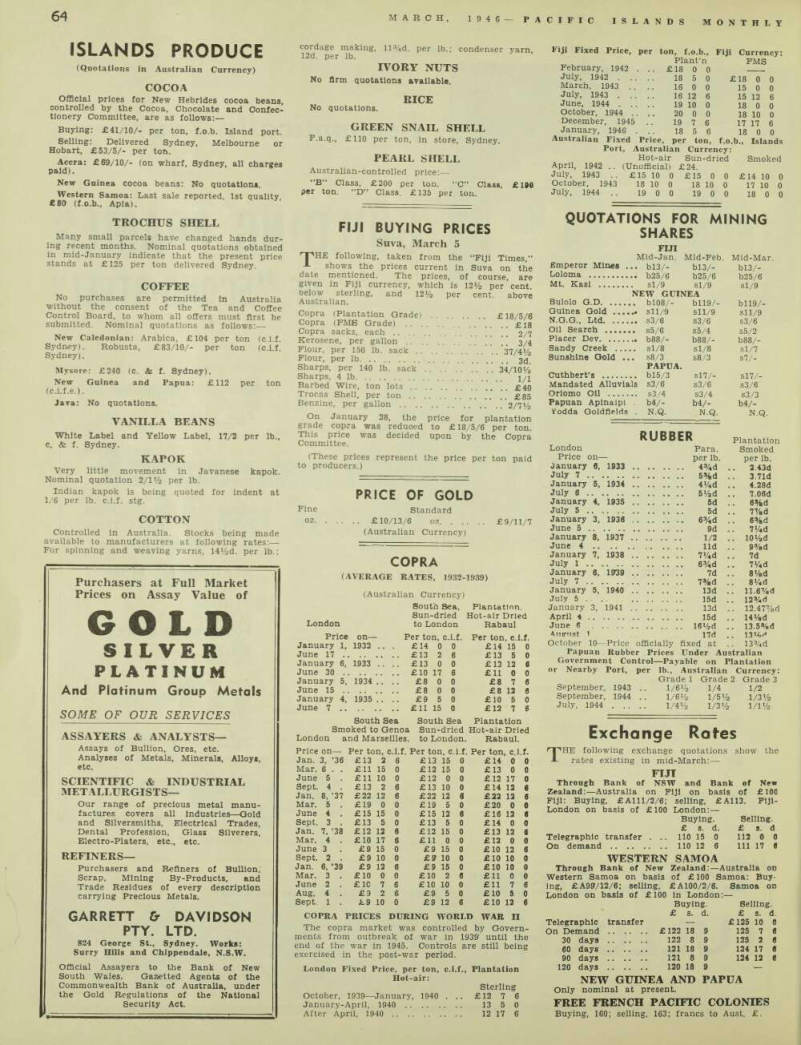
(Quotations in Australian Currency)
Cocoa
Official prices for New Hebrides cocoa beans, controlled by the Cocoa, Chocolate and Confec tionery Committee, are as follows: Buying: £4l/10/- per ton, f.o.b. Island port.
Selling: Delivered Sydney, Melbourne or Hobart, £53/5/- per ton.
Accra: £69/10/- (on wharf, Sydney, all charges paid).
New Guinea cocoa beans: No quotations.
Western Samoa: Last sale reported, Ist quality, £BO (f.0.b., Apia).
Trochus Shell
Many small parcels have changed hands dur ing recent months. Nominal quotations obtained in mid-January indicate that the present price stands at £125 per ton delivered Sydney.
Coffee
No purchases are permitted in Australia without the consent of the Tea and Coffee Control Board, to whom all offers must first be submitted. Nominal quotations as follows: New Caledonian; Arabica, £lO4 per ton (c.i.f.
Sydney). Robusta, £B3/10/- per ton (c.i.f, Sydney).
Mysore: £240 (c. & f. Sydney).
New Guinea and Papua: £ll2 per ton (c.i.f.e.).
Java: No quotations.
Vanilla Beans
White Label and Yellow Label, 17/2 per lb., c. & f. Sydney.
Kapok
Very little movement in Javanese kapok.
Nominal quotation 2/IV 2 per lb.
Indian kapok is being quoted for indent at 1/6 per lb. c.i.f. stg.
Cotton
Controlled in Australia. Stocks being made available to manufacturers at following rates:— For spinning and weaving yarns, 14Vs>d. per lb.;
cordage making, ll%d. per lb.; condenser yarn, 12d. per lb.
Ivory Nuts
No firm quotations available.
Rice
No quotations.
Green Snail Shell
F.a.q., £lio per ton, in store, Sydney,
Pearl Shell
Australian-controlled price:— “B” Class, £2OO per ton. “C” Class £lBO per ton. “D” Class. £135 per ton.
Fiji Buying Prices
Suva, March 5 'X'HE following, taken from the “Fiji Times,”
A shows the prices current in Suva on the date mentioned. The prices, of course, are given in Fiji currency, which is 12 % per cent, below sterling, and 12V 2 per cent, above Australian.
Copra (Plantation Grade) £lB/5/6 Copra (FMB Grade) £ig Copra sacks, each ” 2/7 Kerosene, per gallon . ’ ” 3/4 Flour, per 150 lb. sack 37/4% Flour, per lb 33 Sharps, per 140 lb. sack 34/iovi Sharps, 4 lb Barbed Wire, ton lots £4O Trocas Shell, per ton £gs Benzine, per gallon 2/7y 2 On January 28, the price for plantation grade copra was reduced to £lB/5/6 per ton.
This price was decided upon by the Copra Committee. (These prices represent the price per ton paid to producers.)
Advertisements & other items, p. 68 (1 item)
Price Of Gold
Pine Standard oz. . . . .. £10/13/6 oz £9/11/7 (Australian Currency)
Copra
(Average Rates, 1932-1939)
(Australian Currency)
Copra Prices During World War U
The copra market was controlled by Govern ments from outbreak of war in 1939 until the end of the war in 1945. Controls are still being exercised in the post-war period.
London Fixed Price, per ton, c.i.f., Plantation Hot-air:
Fiji Fixed Price, per ton, f.0.b., Fiji Currency:
South Sea.
Plantation.
Sun-dried Hot-air Dried London to London Rabaul Price on— Per ton, c.i.f.
Per ton, c.i.f.
January 1, 1932 . , £14 0 0 £14 15 0 June 17 . £13 2 6 £13 5 0 January 6, 1933 £13 0 0 £13 12 6 June 30 . £10 17 6 £11 0 0 January 5, 1934 . , £8 0 0 £8 7 6 June 15 . £8 0 0 £8 12 6 January 4, 1935 , , £9 5 0 £10 5 0 June 7 .. £11 15 0 £12 7 6 South Sea South Sea Plantation Smoked to Genoa Sun-dried Hot-air Dried London and Marseilles to London.
Rabaul.
Price on— Per ton, c.i.f. Per ton, c.i.f. Per ton. c.i.f.
Jan. 3, ’36 £13 2 6 £13 15 0 £14 0 0 Mar. 6 . . £11 15 0 £12 15 0 £13 0 0 June 5 . £11 10 0 £12 0 0 £12 17 0 Sept. 4 £13 2 6 £13 10 0 £14 12 6 Jan. 8, ’37 £22 12 6 £22 12 6 £22 12 8 Mar. 5 . £19 0 0 £19 5 0 £20 0 0 June 4 . £15 15 0 £15 12 6 £16 12 6 Sept. 3 . £13 5 0 £13 5 0 £14 0 0 Jan. 7, ’38 £12 12 6 £12 15 0 £13 12 6 Mar. 4 . £10 17 6 £11 0 0 £12 0 0 June 3 £9 15 0 £9 15 0 £10 12 6 Sept. 2 . £9 10 0 £9 10 0 £10 10 0 Jan. 6, ’39 £9 12 6 £9 15 0 £10 10 0 Mar. 3 . £10 0 0 £10 2 6 £11 0 0 June 2 £10 7 6 £10 10 0 £11 7 6 Aug. 4 . £9 2 6 £9 5 0 £10 5 0 Sept. 1 . £9 10 0 £9 12 6 £10 12 6
Sterling October, 1939 —January, 1940 . .. £12 7 6 January-April, 1940 , 13 5 0 After April, 1940 12 17 6
Plant’n
Fms
February, 1942 £18 0 0 July, 1942 . 18 5 0 £18 0 0 March, 1943 16 0 0 15 0 0 July, 1943 . 16 12 6 15 12 6 June, 1944 . 19 10 0 18 0 0 October, 19'44 20 0 0 18 10 0 December, 1945 . 19 7 6 17 17 6 January, 1946 18 5 6 18 0 0 Australian Fixed Price, per ton, f.o.b.. Islands Port, Australian Currency: Hot-air Sun-dried Smoked April, 1942 .. (Unofficial) £24.
July, 1943 £ 15 10 0 £15 0 0 £14 10 0 October, 1943 18 10 0 18 10 0 17 10 0 July, 1944 .. 19 0 0 19 0 0 18 0 0
Quotations For Mining
Shares
Fiji
Mid-Jan.
Mid-Feb.
Mid-Mar.
Emperor Mines . .. bl3/bl3/bl3/- Loloma b25/6 b25/6 Mt. Kasl . sl/9 sl/9 sl/9 Bulolo G.D
New Guinea
. bl08/- b!19/bll9/- Guinea Gold ...
Sll/9 sll/9 N.G.G., Ltd S3/6 s3/6 Oil Search . s5/6 s5/4 s5/2 Placer Dev b88/b88/- Sandy Creek , . sl/8 sl/8 sl/7 Sunshine Gold .. . s8/3 s8/3 s7/- Cuthbert’s
Papua.
.. bl5/3 sl7/sl7/- Mandated Alluvials s3/6 s3/6 s3/6 Orlomo Oil .. s3/4 s3/4 S3/3 Papuan Aplnaipl . b4/b4/b4/- Vodda Goldfields . N.Q.
N.Q.
N.Q.
Rubber
Plantation
London Para.
Smoked Price on— per lb. per lb.
January 6, 1933 4Aid .. 2.43d July 7 .. 5Aid .. 3.71d January 5, 1934 4 Aid .. 4.28d July 6 .. 5Vad .. 7.06d January 4, 1935 5d .. 6 Aid July 5 .. 5d .. 7 Aid January 3, 1938 6Aid . , 6Aid June 5 .. 9d .. 7 Aid January 8, 1937 . 1/2 .. 10 Aid June 4 lid . . 9 Aid January 7, 1938 7>/4d .. 7d July 1 .. . 6Aid .. 7 Aid January 6, 1939 7d .. 8 Aid July 7 .. . 7Aid .. 8V*d January 5, 1940 . 13d .. ll.GAid July 5 . . 15d .. 12Aid January 3, 1941 . 13d .. 12.47Aid April 4 .. 15d .. 14 Aid June 6 . . 16V,d .. 13.5 s /«d Aiiffust l 17d .. 13M>d October 10 — Price officially fixed at .. 13Aid Papuan Rubber Prices Under Australian Government Control — Payable on Plantation or Nearby Port, per lb., Australian 1 Currency: Grade 1 Grade 2 Grade 3 September, 1943 1/6 Aa 1/4 1/2 September, 1944 1/6 y 2 1/51/2 l/Si/a July, 1944 1/41/2 1/3% l/li/a
Exchange Rates
THE following exchange quotations show the rates existing in mid-March; —
Fiji
Through Bank of NSW and Bank of New Zealand: —Australia on FIJI on basis of £lOO FIJI; Buying, £Alll/2/6; selling, £AII3. PIJI - on basis of £lOO London:—
Western Samoa
Through Bank of New Zealand;—Australia on Western Samoa on basis of £lOO Samoa: Buy ing, £ A99/12/6; selling, £AIOO/2/6. Samoa on London on basis of £lOO in London:—
New Guinea And Papua
Only nominal at present.
Free French Pacific Colonies
Buying, 160; selling, 163; francs to Aust. £.
Buying.
Selling. £ s. d. £ s. d Telegraphic transfer . .. 110 15 0 112 0 0 On demand .. 110 12 6 in n e
Buying.
Selling. £ s. d. £ s. d.
Telegraphic transfer — £125 10 0 On Demand £122 18 9 125 7 6 30 days 122 8 9 125 2 0 60 days 121 18 9 124 17 0 90 days 121 8 9 124 12 0 120 days 120 18 9 —
Advertisements & other items, p. 68 (1 item)
Gold
Purchasers at Full Market Prices on Assay Value of
SILVER
PLATINUM
And Platinum Group Metals
SOME OF OUR SERVICES
ASSAYERS & ANALYSTS—
Assays of Bullion, Ores, etc.
Analyses of Metals, Minerals, Alloys, etc.
SCIENTIFIC & INDUSTRIAL
METALLURGISTS—
Our range of precious metal manufactures covers all Industries—Gold and Silversmiths, Electrical Trades, Dental Profession, Glass Silverers, Electro-Platers, etc., etc.
REFINERS—
Purchasers and Refiners of Bullion, Scrap, Mining By-Products, and Trade Residues of every description carrying Precious Metals.
GARRETT Cr DAVIDSON
PTY. LTD.
824 George St., Sydney. Works: Surry Hills and Chippendale, N.S.W.
Official Assayers to the Bank of New South Wales. Gazetted Agents of the Commonwealth Bank of Australia, under the Gold Regulations of the National Security Act.
School For NG Cadet
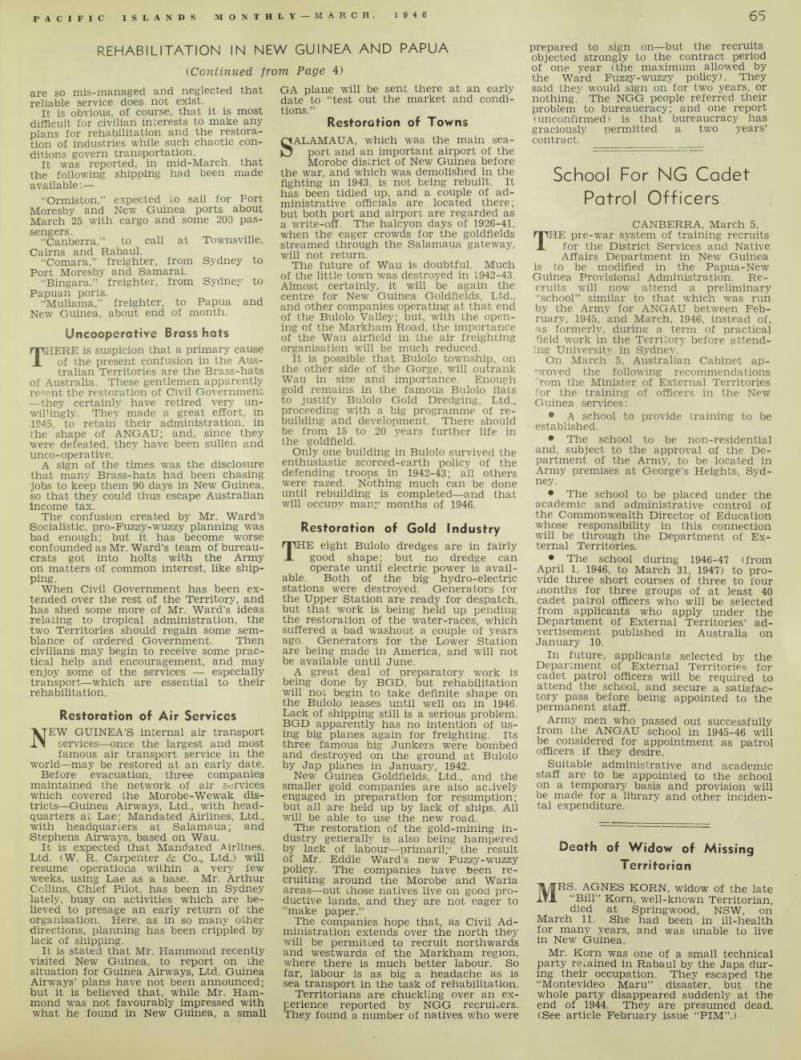
Patrol Officers
CANBERRA, March 5.
THE pre-war system of training recruits for the District Services and Native Affairs Department in New Guinea is to be modified in the Papua-New Guinea Provisional Administration. Re cruits will now attend a preliminary “school” similar to that which was run by the Army for ANGAU between Feb ruary, 1945, and March, 1946, instead of, as formerly, during a term of practical held work in the Territory before attend ing University in Sydney.' On March 5. Australian Cabinet ap nroved the following recommendations "rom the Minister of External Territories for the training of officers in the New Guinea services: • A school to provide training to be established. • The school to be non-residential and, subject to the approval of the De partment of the Army, to be located in Army premises at George’s Heights, Syd ney. • The school to be placed under the academic and administrative control of the Commonwealth Director of Education whose responsibility in this connection will be through the Department of Ex ternal Territories. • The school during 1946-47 (from April 1, 1946, to March 31, 1947) to pro vide three short courses of three to four months for three groups of at least 40 cadet patrol officers who will be selected from applicants who apply under the Department of External Territories’ ad vertisement published in Australia on January 10.
In future, applicants selected by the Department of External Territories for cadet patrol officers will be required to attend the school, and secure a satisfac tory pass before being appointed to the permanent staff.
Army men who nassed out successfully from the ANGAU school in 1945-46 will be considered for appointment as patrol officers if they desire.
Suitable administrative and academic staff are to be appointed to the school on a temporary basis and provision will be made for a library and other inciden tal expenditure.
Death of Widow of Missing
Territorian
MRS. AGNES KORN, widow of the late “Bill” Korn, well-known Territorian, died at Springwood, NSW, on March 11. She had been in ill-health for many years, and was unable to live in New Guinea.
Mr. Korn was one of a small technical party retained in Rabaul by the Japs dur ing their occupation. They escaped the “Montevideo Maru” , disaster, but the whole party disappeared suddenly at the end of 1944. They are presumed dead. (See article February issue “PIM”.)
Advertisements & other items, p. 69 (1 item)
65
REHABILITATION IN NEW GUINEA AND PAPUA
(Continued from Page 4)
PACIFIC ISLANDS MONTHLY MARCH. 1946
Wanted
Roll Of Ngvr
Australian Army Bureaucrats Will Not Help
HERE, for the delectation of residents of New Guinea, is another example of the efficiency of the bureaucrats of Australia.
A considerable time before Japan entered World War 11, there was formed in New Guinea a military unit called the New Guinea Volunteer Rifles —partly veterans of World War I, partly younger men resident in New Guinea. They were keen, and they trained assiduously.
Before Pearl Harbour, they were merely civilians trying to do their duty by their community. But when Japan struck, and invaded the Islands, they suddenly be came front-line troops.
Their record was magnificent. Almost every man who survived the first Jap on slaught gave distinguished service. But the organisation was cut to pieces in the early invasion. A considerable section was trapped in Rabaul, and these men were either killed in the fight near Vulcan Island on January 23, 1942; or cut down in the jungle; or murdered at Tol; or they were taken prisoners and perished on the Jap hell-ship, “Montevideo Maru.”
WE have been asked, again and again, to publish the full list of members of the NGVR, while their deeds and their record still are fresh in the memory of Territorians; but we could not obtain this list. Finally, in February, we appealed to the Australian Army. It stands to reason that that body nossesses the original roll; and, as it would mean the copying out of only two or three hun dred names, we felt that we might fairly ask for this information.
The following is the reply from the Secretary of the Australian Department of the Army, dated February 27: “Replying to your request of February 13, 1940, for a nominal roll of members of New Guinea Volunteer Rifles at the time of the Japanese invasion, you are advised that while the object is appreciated, it is regretted that at present it is impracticable to undertake the preparation of any such list.
“It appears likely that demands for nominal rolls of personnel who served in all the units of the AMF will arise, but it can readily be appreciated that as this will be a task of some magnitude, it has been necessary to postpone consideration of any immediate action in their preparation.
“The matter has not been lost sight of, but in all probability a commencement in the pre paration of rolls of this type could not be made until after demobilisation is complete, and more urgent tasks arising out of the finalisation of the services of personnel who served in the AMF have been disposed of.”
That elaborate terminology means simply that the Army classes the New Guinea Volunteer Rifles as “AMF”; that lots of other AMF units probably will want lists of personnel: and that the Army is much too busy to attend to our humble request.
If any person interested in New Guinea should have a list of NGVR per sonnel, even if it is only approximately correct, we should be very glad to have it. We should then try, with the help of various NGVR veterans, to build up a reasonably complete list, with a view to its publication as part of New Guinea’s wartime records. Obviously, it is no use looking to the Australian Army for any help.
Territories Talk-talk
By "Tolala"
GOLDFIELDS folk will remember s.
Richardson, who did such a good job with the “Morobe News” at Wau and later at Lae. He’s got his Bowler Hat and returned to where he can smell printer’s ink again and hear the click of the lino. He has taken over the “Picton Post,” NSW, from an old co worker of earlier days on the “Lithgow Clarion.” * * * AUSTRALIAN officialdom never seems to realise that white folk have really made their homes in New Guinea, and that they are as much domiciled there as an Australian cocky is domiciled at Woop Woop.
Servicemen who enlisted in this last war, gave their home addresses in certain parts of New Britain, New Ireland, Bou gainville or Morobe, and they are en titled to be discharged there. And what of the men appointed in the field, after the Japs’ arrival? Is it right that they should be discharged in Sydney or Mel bourne? Every man who enlisted, or was appointed, in New Guinea is entitled to be repatriated to his home—now. * * * JOHNNY TWITTER, in a letter from Moresby the other day, tells me there is a shortage of bread there, amongst other things. (Plenty of staff, but no staff of life!) The Army bakery closed down at the end of February. It was known that this would happen, weeks beforehand—but nothing was teed up to meet the emergencv. * * * SKIPPER BERTIE HALL had a real birthday the other day his 67th He’s still full of beans, and says that he’s headed for China waters once again.
I said waters! * * * LATEST jungle wireless to corroborate the fantastic reports circulated some yesrs ago, when a “cargo” movement was rife in New Ireland, and the “in snired ones” used to say that all planta tion properties would revert to the natives.
Present policy indicates that the only agricultural development receiving official encouragement and assistance is that of the native inhabitant.
Incidentally, war damage compensation on real property should not be paid in cash to the owner (who, in many cases is still the Custodian of Expropriated Property); instead, a credit should be established for the estate in question, in order to bring it back to its original con dition.
Rehabilitation of the country is as important as compensation to the in dividual—always providing, of course, the interested parties are allowed to resume their domicile in the country. * * *' “117’ e ’ d never have all this blurry ? i trouble about New Guinea,” said Big Bill the other day, as he sipped his lime juice and water, “if we had a representative in the Australian Parlia ment to air our grievances and safeguard our interests.”
And I told him he had certainly got something there. “But what about taxa tion?” said I. “ ‘No representation with out taxation.’ ”
“No, you’re wrong,” said he. “ ‘No taxation without representation’ but taxation is what’s been happening up there for years. Even if it does mean an income tax to raise a member’s salary and expenses, it would nay us. Take one
instance the ‘Montevideo Maru’ busi ness; would that have been shelved the way it has if we’d had a member of our own to track down the ‘responsible parties.’ ”
“Of course,” I agreed, “without a member we have to rely on individual agitation in the press—which we can’t always get.” * * * MET one of the old pioneers from the TNG the other day, and he was as hostile as the average man from up that way.
“Last war,” he said, “there was none of this so-and-so business between the civil and military authorities. In TNG,” he explained, “we had a military admin istration for nearly seven years—Septem ber, ’l4 to May, ’21 —and yet civilians, carried on with trading and the develop ment of their plantation businesses.”
According to his opinion, the Mandate came to an abrupt end with the con quest of the Territory bv the Japs in ’42, and it was no longer a Mandated Terri tory when the Allied troops re-conquered it in ’45.
So, where are we? Manus and the PIR further complicate the “mandate” status Seems to be a nut for Dr. Evatt to crack. * * * SEEN around about the Big City re cently: Jack Allen, from AWA and Gilalum plantation: also W. R. B.
Thomas, of the same organisation. Jack Mullaly, of the PIR, a Lieut.-Colonel, is also hereabout on a few days’ leave, looking up old friends: and the Harry Murrays (Witu and Kavieng) are both to be seen at stated intervals. Others are: Ted Fulton, Hugh Moccatta, Nip Burke, Ken Douglas and Ted Jenyns.
Road To Lappa-Pai
Village
Here are the sunlit spaces, The windswept open places, Where dragon-flies are darting, In pollen-drunken glee. (All velvet clad, they hover The drowsing shallows over, ’Neath Tula’s bamboo tree.) Now, come you through the lalang And feel the hint of sea tang, And catch the whispering huntsman Stalking piglets in the grass, The pathway upward winding, And soon, stray natives finding, We taunt them as we pass.
Now down to lower swamplands, The eerie, slimy, damp lands, Where creepers wreathe like ghost-hands And every song-bird, mute, Suspects a snake’s swift gliding, Or maybe demon hiding With face of age-old brute!
All childishly, we’re fearing Some hideous satyr leering, Maliciously or mockingly.
From out the gnarled trees.
The Pitcher plant that’s blooming, Gay little insects dooming, (For morbid swamps are these).
Come then in haste, ascending, Rai hill, a vista lending With graceful bend of river Where it flows to greet the sea.
Ah, welcome open spaces— The merry native faces!
And hear them call “Kai-u-u-un” (Old friend-belonga-me!) . . .
Alice Allen Innes.
Advertisements & other items, pp. 70-72 (2 items)
66
MARCH, 1946 PACIFIC ISLANDS MONTHLY
Published by PACIFIC PUBLICATIONS PTY. LTD., Union House, 247 George Street, Sydney. (Telephone: BW 5037). Wholly set up and printed in Australia by the Sydney and Melbourne Publishing Co. Pty. Ltd., 29 Alberta Street, Sydney. (Telephone: MA 7101)
A Tropical Thirst
demands a Satisfying Drink
that’s why KB is so popular
south of “the
All through the tropics, wherever there are men who like good beer, you'll always find KB. It's the drink that men appreciate —a drink just made to satisfy a tropical thirst 1
IN A COOL
9 1 t «am • O'w rtoN the finest
AND iOTTLEO 6T
' tooth a co.; tiMidj
AUSTRALIA
BHP
r 3 nMfo J i
TOOTH'S
KB
LAGER.
Established 1914
THIRTY YEARS OF PACIFIC ISLANDS
DEVELOPMENT AND SERVICE.
W. R. CARPENTER & GO. LTD.
Capital £1,000,000.
GENERAL MERCHANTS AND SHIPOWNERS
Buyers and Exporters of All Kinds of Islands Produce Copra Merchants and Millers Agents for Australian, European and American Manufacturers Distributors of Every Description of Merchandise
AGENTS FOR:
FORD MOTOR COMPANY OF CANADA. DODGE BROTHERS, INC.
ELECTROLUX REFRIGERATORS. WESTINGHOUSE ELECTRICAL CO.
T. G. & C. BOLINDERS (ENGINES). CATERPILLAR TRACTORS.
Etc., Etc.
BRANCHES THROUGHOUT THE PACIFIC ISLANDS
Head Office: 16 O'CONNELL STREET, SYDNEY
In London: W. R. Carpenter & Co. (London) Ltd., Coronation House, 4 Lloyd's Avenue, London, EC.
The W.R.C. Line
The first Direct and Regular Cargo and Passenger Service between Europe and Pacific Islands’ ports was established by W. R. Carpenter & Co. Ltd.