Pacific
Islands
Monthly
January 18,1946
Vol. Xvi. No. 6.
Established 1930
[Registered at by post as a newspaper]
II-
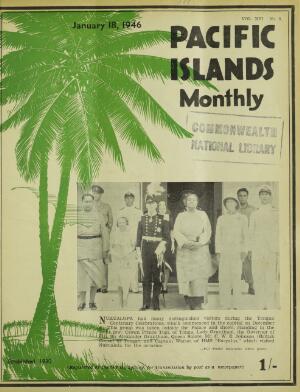
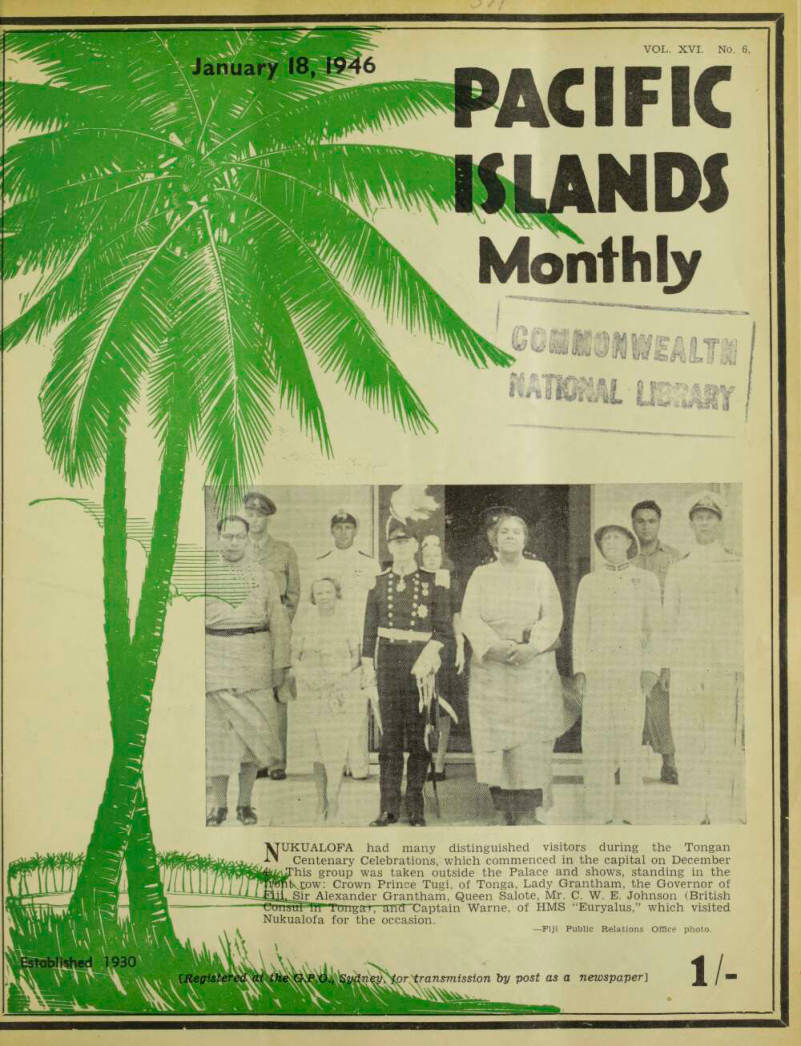
NUKUALOFA had many distinguished visitors during the Tongan Centenary Celebrations, which commenced in the capital on December 4. This group was taken outside the Palace and shows, standing in the front row: Crown Prince Tugi, of Tonga, Lady Grantham, the Governor of Fiji, sir Alexander Grantham, Queen Salote, Mr. C. W. E. Johnson (British Consul in Tonga) and Captain Warne, of HMS “Euryalus,” which visited Nukualofa for the occasion. —Fiji Public Relations Office photo.
Advertisements & other items, p. 2 (1 item)
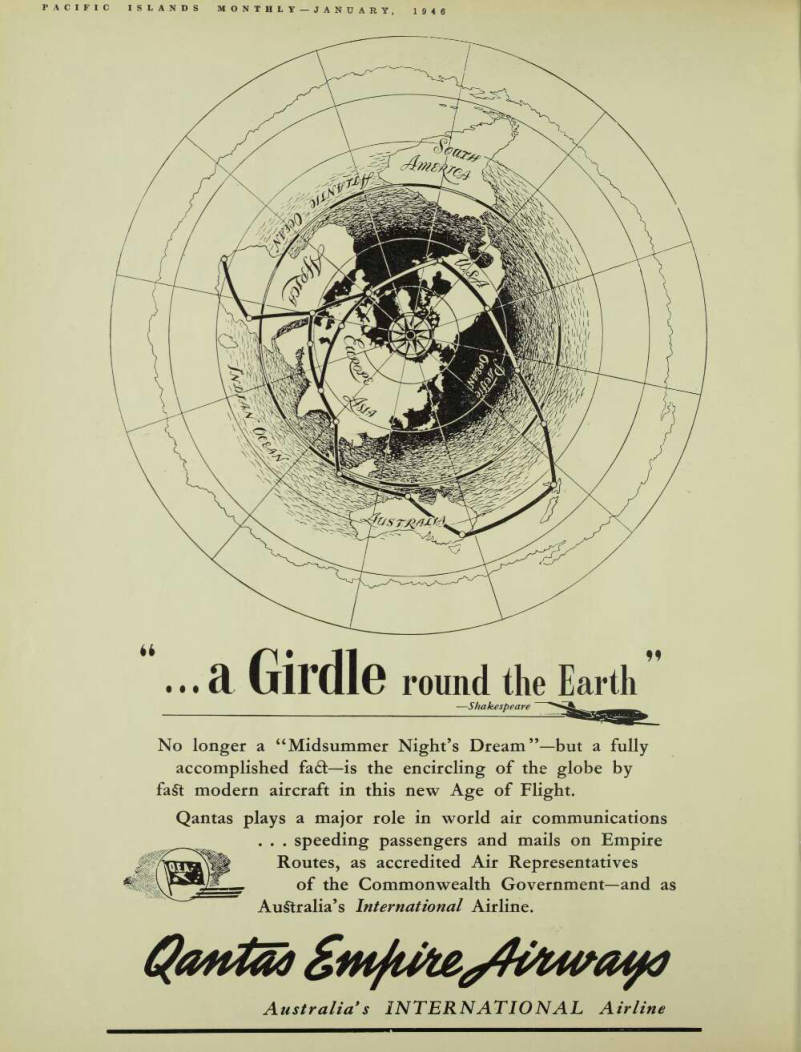
“... a Girdle round the Earth
50 % O ~z~ tfSTJMXm
—Shakespeare No longer a “Midsummer Night’s Dream”—but a fully accomplished faft—is the encircling of the globe by faSl modern aircraft in this new Age of Flight.
Qantas plays a major role in world air communications . . . speeding passengers and mails on Empire Routes, as accredited Air Representatives of the Commonwealth Government—and as Australia’s International Airline.
Australia 9 s INTERNATIONAL Airline
Pacific News-Review
Notes And Comment On
International Affairs
From Dec. 14 To Jan. 14
jj ec i 4 The Communist-controlled
Ironworkers’ Union has agreed to apply to the New South Wales Industrial Com mission for re-registration, thus sur rendering the main issue preventing the end of the strike that has caused in dustrial chaos in NSW. It is believed that the NSW miners will resume worK on Monday but, as they will have only five working days before their 16 days holiday commences on December 22, it is doubtful if there will be much relief from gas and power rationing which has tied up industry throughout the State.
Dec 17. —Prince Konoye, former Pre mier of Japan, committed suicide with poison early yesterday, before he was due to surrender himself as a war —New South Wales miners, after ’ voting to return to work by a narrow margin of 53 votes, resumed operations in all but five mines yester day. They are expected to hew about 200 000 tons of coal before their holi days begin. Gas and power restrictions and train cancellations remain. Sydney still has a 9 p.m. curfew.
Dec. 22.—1 t is believed that the United States has made proposals for reciprocity of landing rights in a trans-Pacific air service with Australia and New Zealand.
In return for permission to land in Aus tralia and New Zealand, Australasian air-services would land in Honolulu and San Francisco.
Dec 22—Russia has increased her de mands upon Turkey. Originally seeking the restoration of those areas taken by Turkey in 1921 when the British and White Russians withdrew from the Batum zone, the Soviet now wants the “ancient Georgian lands seized previ ously” and by which she will gam an important strategical strip on the Black >E)o£t Dec. 22.—General George (“Blood and Guts”) Patton, of the US Army, died in Germany. He was severely injured in a road accident on December 10. In July, 1944 he landed in France in command of the US Third Army. It was he who exploited the Normandy break-through, which led to the German rout in Nor thern France, and he successfully fol lowed similar tactics when the Rhine front began to crack.
Dec 26.—The Indonesians have agreed to hand over all Allied prisoners-of-war and internees and Japanese prisoners-of war in Java to the Allies.
Dec. 26.—France has reduced the in ternational exchange value of the franc by more than half, to assist her export trade. The new rate is 480 francs to the £ sterling (previously 200 to the £) and just over 119 to the dollar. The new exchange, however, does not apply to the French Pacific colonies, where rates re main unchanged.
Dec. 27.—The Foreign Ministers’ Con ference in Moscow ended to-day. A communique issued simultaneously in Moscow, Washington and London, an nounced Big-Three policy on many out standing questions, including the control of atomic energy, and a new Far-Eastern policy. A Commission has been formed to formulate policy towards Japan and to help the Supreme Commander adminis ter that policy.
Dec. 30. —General MacArthur does not approve of the new method of governing Japan, decided upon at the Foreign Ministers’ Conference in Moscow. He says he was not consulted before the plan was made, but he will “try to make it work.”
Jan. 2—Britain has opened its big new
overseas airport at Hounslow, Middle sex 15 miles from London. Named Heathrow, it cost £20,000,000 and is de scribed as the finest in the world. First plane to take off from one of the new runways was a Lancastrian airliner bound for Buenos Aires.
Jan. 3.—William Joyce (“Lord Haw Haw”), who broadcast for the Nazis dur ing the war and was convicted of high treason at a trial in England, was execu ted at Wandswoth Prison this morning.
Jan. 4.—Mass meetings of all striking steelworkers at Wollongong and New castle, New South Wales, accepted the decision of the NSW Industrial Commis sion and will return to work. The Com mission stood-over the application of the Ironworkers’ Union for re-registration because the Union failed to give an undertaking about its future conduct but it ordered Australian Iron & Steel, Ltd., to re-employ Donald Parker (about whom the dispute originally started), although it refused to make his reinstatement re trospective to the day of his dismissal in September.
Jan. 7.—Coalminers and steelworkers resumed work to-day in New South Wales and gas and power restrictions, which threw half a million people out of work, have been lifted.
Jan. 7—Delegates from most of the 51 participating States have arrived in Lon don for the first session of the General Assembly of the United Nations Or ganisation which begins on January 10. j a n. 9. —Neither UNRRA nor the Al lied Control Council is able to cope with the mass exodus of Jews from Poland.
This panic migration is flowing west ward and into Italy by unorthodox means. Lieut.-General Sir Frederick Morgan, UNRRA chief in Europe, whose public statement last week about a “highly organised Jewish infiltration into Germany.” roused a storm of pro test in America, has been recalled to London, but he is still carrying on his work in Germany and has not obeyed the summons.
Jan. 10.—Prime Minister Attlee wel comed delegates from 51 nations at the first UNO conference which opened in London today. He reaffirmed the pledge made by King George VI on January 9, that the British Commowealth and Em nire would be solidly behind UNO in its attempt to ensure world peace.
Jan. 14—Australia has been elected to fill one of the six non-permanent seats on the Security Council of UNO for two years.
Jan. 14. —United States, at UNO, dramatically admitted her error in with drawing from control of international affairs 25 years ago, and gave a solemn pledge to co-operate with other nations in maintaining world peace. The an nouncement evoked a spontaneous and remarkable ovation.
Roll of Honour Supplement
A LIMITED number of additional copies of the “Roll of Honour” supplement (distributed with this issue) are available; but early applica tion is necessary. Postage, 2d. per copy, should be forwarded with application for additional copies.
Death of Mrs. Mollie
Lett
death occurred in Melbourne, on December 9, of one of Papua’s best known residents —Mrs. Mollie Lett, wife of Mr. Lewis Lett. She had been suffering a serious and painful illness for some months; but, characteristically, she kept the fact secret, and her death came as a painful shock to her numerous friends.
Her father was Colonel Andrew Hon man, a very prominent medical man in Melbourne. He gave distinguished ser vice in World War I, and he was chief medical officer at Rabaul in the early ’twenties. In 1913, on a visit to Papua, he was accompanied by his daughter, Ida. She liked the country, and became a school teacher at Woodlark Island.
Her sister, Mollie, visited her there in 1914; and it was then that she met Lewis Lett, whom she married in 1916. Ida married Mr. Nurton, a patrol officer of the New Guinea service, who was very severely injured in an attack by natives about 1935.
Living in Port Moresby, Mollie Lett, with her infinite capacity for making friends, became well and happily known to most residents. She was a greatly esteemed friend of the famous Governor, the late Sir Hubert Murray, and her keen interest in and wide knowledge of native administration were of assistance to him on many occasions. She always was ready to assist in any public move ment. When World War II came, she immediately offered her services to the Red Cross, and carried on much of the work of the local depot, with the assist ance of one native helper.
Mollie Lett was the first Islands cor respondent of the “Pacific Islands Monthly,” when it was established 16 years ago, and she carried on that work until the evacuation of women from the Territories took place at the end of 1941.
She read widely, observed keenly, and she had a remarkable memory, so that every thing that she wrote for the “PIM” had definite value.
Very many people, who valued her friendship, and enjoyed the hospitality of herself and her well-known husband, will sincerely regret her passing.
Sudden Death Of "Pat"
Savage
rE death occurred very suddenly, in Sydney, on January 13, of Mr. J. E.
Savage, known to all New Guinea residents as Superintendent of Stores, a position he occupied in the Territory service for very many years. He was 64 years old.
Mr. Savage was universally known as “Pat,” and, in the halcyon days of the old capital, no social function was con sidered complete without the attendance of the genial “Pat,” and “Mabs,” his equally popular wife. “There just can’t be any Rabaul any more without Pat Savage,” remarked an old resident, on learning of his death, Mr. Savage prob ably was most famous as a producer of amateur theatricals. His productions were almost innumerable; almost always successful: and they were a distinct and happy feature of life in Rabaul. Hun dreds will regret his untimely death.
Mr. Savage leaves a widow, and one daughter—Mrs. Nancy Parks.
District Officer J. W. Gittens recently won the Fiji Golf Club Championship, over 36 holes at the Suva links, by de feating his fellow officer J. N. Falvey 3 up and 2 to play. Falvey had previously won the Open Championship.
Advertisements & other items, p. 3 (1 item)
1
PACIFIC ISLANDS MONTHLI JANUARY, 1946
Advertisers
Adams, Clayton & Co 16 Amplion (Aust.) Pty., Ltd. ... 15 Angliss & Co. ... 21 Atkins Pty., Ltd., Wm 33 Australian Alumi nium Company Pty., Ltd. ... 25 Brial & Ball, 17, 51 Berger & Sons . . 31 Broomfield, Ltd. . . 51 Brown & Co., Ltd. 11 Brunton’s Flour . . 38 Burns, Philp Trust Co.. Ltd 13 BP (SS) Co. . . . 11 Bhindi, P. K. . . .40 Colonial Wholesale Meat 35 Carlton & United Breweries, Ltd. . 18 Carpenter, Ltd., W.
H cov. iv.
Chivers & Sons, Ltd 14 Church, R. H.. & Sons 42 Coleman Lamp <fe.
Stove Co. . ... 30 “Cystex” 61 Donaghy & Sons . 42 Donald, Ltd.. A. B. 44 Dr Williams Fink Pills 63 Electrolux Refrigerators . . 20 Excelsior Supply Co 34 Ford Sherington Ptv.. Ltd. ... 47 Garrett & Davidson 60 G’hson Co., Ltd., J. A. D. . . . 47 Gillesnjp Ptv., Ltd..
Robert ... 41. 23 Gilhev’s G’n . . .12 Gillespie’s Flour . . 46
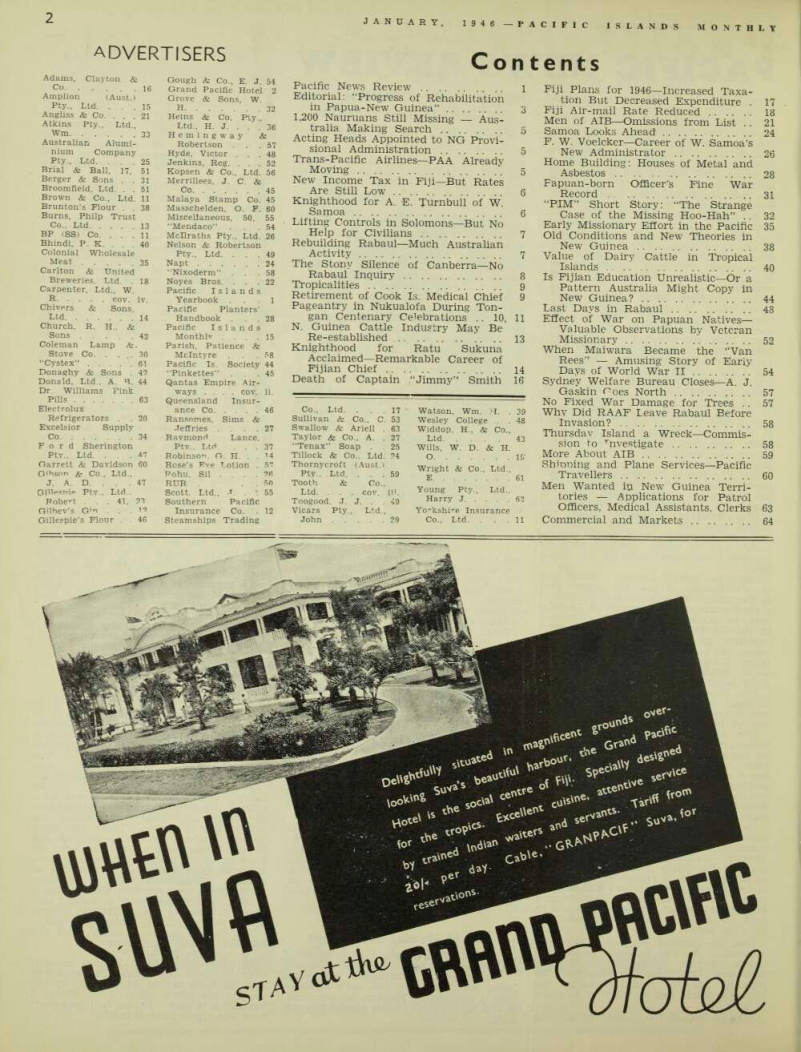
Gough & Co., e. j. 54 Grand Pacific Hotel 2 Grove & Sons, W.
H 32 Heinz & Co. Pty., Ltd., H. J. . . .36 Hemingway & Robertson ... 57 Hyde, Victor ... 48 Jenkins, Reg. ... 52 Kopsen & Co., Ltd. 56 Merrillees, J. C. & Co 45 Malaya Stamp Co. 45 Masschelden, O. F. 60 Miscellaneous, 50, 55 “Mendaco” ... 54 Mcllraths Pty., Ltd. 26 Nelson & Robertson Pty., Ltd. ... 49 Napt 24 ‘Nixoderm” ... 58 Noyes Bros. ... 22 Pacific Islands Yearbook ... 1 Pacific Planters’
Handbook ... 28 Pacific Islands Monthlv ... 15 Parish, Patience & Mclntyre .58 Pacific Is. Society 44 “Pinkettes” ... 45 Qantas Empire Air ways ... cov. ii.
Queensland Insur ance Co 46 Ransomes, Sims & Jeffries ... 27 Ravmond Lance, Ptv.. Ltd ... 37 Robinson. G. H. . . 14 Rose’s Eve Lotion . 57 Pohu, Sil ... 26
Rub . . 50
Scott. Ltd., J. . *. 55 Southern Pacific Insurance Co. . 12 Steamships Trading
Co., Ltd. ... 17 Sullivan & Co.. C. 53 Swallow & Ariell . 63 Taylor & Co., A. . 27 “Tenax” Soap . . 25 Tillock & Co.. Ltd. 24 Thornycroft (Aust.l Pty.. Ltd. ... 59 Tooth & Co., Ltd. . . . cov. iii.
Toogood. J. J. . .49 Vicars Pty., Ltd., John 29
Watson, Wm. >l. . 39 Wesley College . . 48 Widdop, H„ & Co., Ltd 43 Wills, W. D. & H.
O Id'
Wright & Co., Ltd., E 61 Young Pty., Ltd..
Harry J 62 Yorkshire Insurance Co., Ltd. . . .11
Contents
Pacific News Review ... 1 Editorial: “Progress of Rehabilitation in Papua-New Guinea” 3 1,200 Nauruans Still Missing Aus tralia Making Search 5 Acting Heads Appointed to NG Provi sional Administration 5 Trans-Pacific Airlines—PAA Already Moving 5 New Income Tax in Fiji—But Rates Are Still Low 6 Knighthood for A. E. Turnbull of W.
Samoa e Lifting Controls in Solomons —But No Help for Civilians 7 Rebuilding Rabaul—Much Australian Activity 7 The Stony Silence of Canberra—No Rabaul Inquiry 8 Tropicalities 9 Retirement of Cook Is. Medical Chief 9 Pageantry in Nukualofa During Ton gan Centenary Celebrations .. 10, 11 N. Guinea Cattle Industry May Be Re-established 13 Knighthood for Ratu Sukuna Acclaimed—Remarkable Career of Fijian Chief 14 Death of Captain “Jimmy” Smith 16
Fiji Plans for 1946—Increased Taxa tion But Decreased Expenditure . 17 Fiji Air-mail Rate Reduced 18 Men of AlB—Omissions from List .. 21 Samoa Looks Ahead 24 F. W. Voelcker —Career of W. Samoa’s New Administrator 26 Home Building: Houses of Metal and Asbestos 28 Fapuan-born Officer’s Fine War Record 31 “PIM” Short Story: “The Strange Case of the Missing Hoo-Hah” .. 32 Early Missionary Effort in the Pacific 35 Old Conditions and New Theories in New Guinea 38 Value of Dairy Cattle in Tropical Islands 40 Is Fijian Education Unrealistic—Or a Pattern Australia Might Copy in New Guinea? 44 Last Days in Rabaul 48 Effect of War on Papuan Natives— Valuable Observations by Veteran Missionary 52 When Maiwara Became the “Van Rees” Amusing Story of Eariy Days of World War II 54 Sydney Welfare Bureau Closes—A. J.
Gaskin Coes North 57 No Fixed War Damage for Trees .. 57 Why Did RAAF Leave Rabaul Before Invasion? 53 Thursday Island a Wreck—Commis sion to T nvestigate 58 More About AIB 59 Shinning and Plane Services—Pacific Travellers 60 Men Wanted ip New Guinea Terri tories Applications for Patrol Officers, Medical Assistants, Clerks 63 Commercial and Markets 64
Advertisements & other items, p. 4 (1 item)
s -rAV<*^
4£3 '
\ttW^
As ° ver " f e ot 8 r ° U " . p»c\f' c .„ , , A s \iu» ie<i ’ v, a vV) oUr ’ , a \W A 64 ' 606 bea^ U ' , fs. $p6C tW e *** <*«* cW \ ceowe a tten » ** , cs s erv^ S - so v»,«° r the *° P ' CS - ***» > (or tn ■ w dW" * M C^' e> b * d»Y- - i»l‘ P s
re serv^ 00 '
Pacific Islands Monthly
The Newspaper-Magazine of the South Seas [Registered at the G.P.0., Sydney, for transmission by post as a newspaper.]
Published Once Each Month and Circulated in Australia and New Zealand and in the following Pacific Territories and Islands Groups:
Australian Territory of Papua.
Mandated Territory (Australia) of New Guinea Australian Territory of Norfolk Island.
New Zealand Territory of Cook Islands.
Mandated Territory (NZ) of Western Samoa.
British Colony of FIJI.
British Solomon Islands Protectorate.
British Protectorate of Tongan Islands.
British Crown Colony of Gilbert and Ellice Islands.
Mandated Territory of Nauru
British and Free French Condominium of New Hebrides.
Free French Colony of New Caledonia.
Free French Colony of Oceania (Tahiti, etc.) American Territory of Eastern Samoa.
American Territory of Hawaiian Islands.
Owned and Produced by Pacific Publications Pty. Ltd., Union House, 247 George Street, Sydney.
tft FPwnwF f Managing Director .. BW 5037 Business and Editorial MA 4369
P.O. Box 3408 R
Registered Address of Telegrams, Radiograms, and Cables: •‘Pacpub”, Sydney.
Contributions.
Articles, Stories, and Photographs dealing with Pacific Islands subjects are invited and will be paid for on publication
Subscription Rates.
Per Annum, within British Empire, Prepaid, Post Free 10/- Per Annum, elsewhere, Prepaid, Post Free 12/6 Single Copies 1/-
Editor and Publisher:
R. W Robson, F.R.G.S.
Advertising Manager; W. E. Rogers. Tel. B 7815.
Advertising Office and Printing-House: 29 Alberta Street, Sydney.
Advertising rates furnished on application.
Representative In Fiji.
Pacific Publications (Fiji), Ltd., Bank of NSW Building, Suva (same office as W. H. Grove & Sons, Ltd.). Stocks of Pacific Islands Monthly and Pacific Islands Yearbook on hand.
Representative In London.
J. T. Wallis, Coronation House, 4 Lloyds Avenue, London, E.C.3, from whom may be obtained copies of Pacific Islands Monthly, Pacific Is. Year Book, advertising schedules, etc.
Agents
The following are authorised to receive sub scriptions for Pacific Islands Monthly:— Burns, Philp & Co., Ltd., and Burns Phllp (South Sea) Co., Ltd. All branches.
W. R. Carpenter «& Co., Ltd. All branches Morris, Hedstrom, Ltd. All branches.
Steamships Trading Co., Papua. All branches.
Whitten Bros., Ltd., Samaral, Papua.
B.N.U. Trading Co.. Ltd., Port Moresby, Papua.
J. Muir, Suva. FIJI.
Miss R, Castles, Suva, Fiji.
N. C. Mackenzie Hunt, Walnunu, Bua, FIJI.
Cook Islands Trading Co., Rarotonga. Cook Is.
A. C. Rowland, Papeete, Tahiti.
Islands Branches and Representatives of W. H.
Grove & Sons, Ltd., Auckland, New Zealand.
Ed. Pentecost, Noumea, New Caledonia.
Societe Gubbay Kerr et Cie, Noumea, N. Caledonia.
Vol. XVI. No. 6.
January 18, 1946.
Prirp I 1 7" Per Copy ' rnce £ Prepaid: 10/- p.a
Progress of Rehabilitation in Papua-
New Guinea
THE long, slow process of rehabilitation in the Australian Territories of Papua and New Guinea made longer and slower and very much more expensive because the Territories have become the Socialistic plaything of Mr.
Eddie Ward, an Australian Leftist Minis ter —is going on.
The new Administrator, Colonel J. K.
Murray, working with remarkable indus try and patience, is slowly bringing order out of the administrative chaos he found there when he took over at the end of October.
There has been some friction among the public servants—inevitable, in view of the far-reaching readjustments to be made, as between former Papuan and New Guinea officers but the great majority of the senior men have taken up their jobs in a good spirit, and are loyally and efficiently supporting Colonel Murray. The general atmosphere has improved very much.
Some heads of departments have been selected, apparently; in others, the posi tions still are uncertain. Canberra seems still to be seeking for a Government Secretary. Reports of the appointment of Mr. Melrose and, later, of Mr. Steve Lonergan, proved to be incorrect.
All-Civil Administration Soon
BEST-INFORMED opinion is that the Army will have finished with all of New Guinea (except a small area where over 100,000 Jap prisoners will be held for a long time, pending the provi sion of ships for their repatriation) by June 30, and that the Civil Administra tion then will be extended over the whole of the Territories. At present, all of the Mandated Territory except the portion
south of the Markham River, is con trolled by the Army and ANGAU.
A considerable number of Australian troops are being retained in New Guinea to guard Jap prisoners (who are on the coastal islands near Madang, and in the Rabaul-Kokopo area). The general policy appears to be to relieve the white troops by using the four battalions of Pacific infantry Regiment, as far as possible, for guard duty; and to compel the Japs to cultivate very extensive gardens, so as to grow as much as pos sible of their own food.
End Of The Mandate
ONE of the early duties of the United Nations, now meeting in London, will be the liquidation of the League of Nations Mandates, and the disposal of the Mandated Territories. This affects both New Guinea and Western Samoa, in the Pacific.
It is practically certain that New Guinea will be handed over to Aus tralia, under the new system of trustee ship.
Bp’S Return To Port Moresby
rE restoration of trade, industry and commerce in Papua-New Guinea is slow and fumbling conditions characteristic of Government control.
In view of the apparent determination of the Australian Minister Ward, in his initial stages, to attack and discourage all “exploitation”—by which he particu larly referred to “big companies, with absentee shareholders” —it is interesting to note that the Big Firms are now being permitted to return and re-establish themselves.
All the Burns Philp establishments re sumed operations in Port Moresby on January 1, under the general direction
of Mr. E. J. Frame. He now controls, as one unit, the general store, the hotel the picture theatre, the freezer, and the BNG company.
Steamships Trading Co., Ltd., similarly have resumed the operation of their i ar g e Port Moresby establishment, which has various departments.
These trading concerns have received sympathetic help and consideration from th e local Administration, and their opera tions are expanding satisfactorily.
The cre am of the Territory’s commerce, howe ver, is still in the hands of the Government concern, the Production Control Board-which controls practically everything relating to production, sale of prof ce native trade and transport This -Mr. Ward’s idea of preventing exploi- Actually, no one is worrying much abo ut the pCB just now The prices being obtained for copra, rubber, etc.. are so high that keen trading is not ca lled for. The plantation owners (in eluding the Big Firms) are getting such goo d returns, and obliged to accept such litt i e responsibiltiv, that thev are not at present troubled bv high prices of sup piieS) or cos t an d irregularitv of trans port—that all belongs to the PCB.
It w m be a very different story when prices fall. Then Government control will show its weakness.
Naxive La Bour-No. 1 Problem
rjIHE chief problem of course, is native 1 labour—and that remains still the Octo ber 15—when 95 per cent, of indentured labourers, suddenly released from their contracts, simply went home to their vil lages. Industry generally has been para lysed ever since, and fantastic wages have been paid to the few natives who bave remained at work. Experienced men, however, expect to see a trickle ot returning labour about March which should increase to a stream by June.
Mr. Ward’s delightful incursion into native affairs, however, has set back Ter ritories rehabilitation by many months.
It is not surprising to hear a report that there has been serious friction in Port Moresby in the department respon sible for the Native Labour Ordinance.
There will be no peace there until the idealists are shackled in their proper place, and some degree of realism is ad mitted. Labour supply is likely to re main the No. 1 problem of the Terri tories so long as the present Ordinances remain.
“Marella” On Regular Run
rE next most urgent problem is transport. At present, the Aus tralian Government, through Mr.
Ward and his creations, is the owner of all shipping used regularly in the Ter ritories. Maybe it is better that way, seeing the Government generally controls all production and trade, and the ship ment of produce.
The Burns Philp liner “Marella” appears to be running to a regular sche dule, from Sydney to Port Moresby and New Guinea ports, every six weeks. But this vessel actually is being run in the Government service, and the real owners (Burns Philp) are merely the agents who operate the ship for the' Government.
It is a ragtime set-up, worthy of Mr.
Ward, but it. should suit BP very well.
Whatever happens, they get compensa tion for the use of their ship, and com mission on all the trade she does, while the Government gets any profit that is available—and pays any losses that are incurred.
The Bp Fleet
THE Big Firm, in World War 11, lost two of its best ships. The “Macdhui” was sunk by Jap bombs at Port Moresby, the “Neptuna” was blown up in Darwin, the “Malaita” was badly damaged, and a number of little ships were sunk.
But the new liner “Bulolo,” although many times in dangerous waters, escaped.
She is now on her way from the Far East to Britain. She is going into deck for reconditioning, and she shouM be back in the Pacific services in 1947.
The gallant old “Montoro,” which sur vived so many perils before the war, and escaped doom at the hands of Japanese knackers by a narrow margin in 1939, is at present doing good service, and soon will be back in her old job.
The “Marella” is now on the New Guinea run; and the “Morinda” is doing her old-time Norfolk Is l and-New Hebrides service.
The “Malaita” now is in a Sydney dockyard, undergoing repairs, which will occupy another six months.
Report About Wau Drome
SOME development of air traffic appa rently is being planned. Australian Civil Aviation authorities have been making a survey.
Territorians were startled this month when it was reported that the famous Wau aerodrome had been condemned by the Australian authority. The Wau field, for many long years, was the busiest drome south of the equator. All sorts and conditions of planes landed on this noteworthy slope in the Bulolo Valley, in all sorts of weather —and rarely, if ever, was there an accident due to drome con ditions.
Wau’s peculiar hillside drome, in the eyes of Australian airmen, who know nothing of New Guineas queer condi tions, might appear undesirable. They should ask the experienced NG commer cial pilots about it.
Samarai Next?
rERE is no move,, as yet, to extend the operations of the Big Firms to other Territories towns.
The next place of interest, however, is likely to be Samarai. Some plantations are being brought back into production in Eastern Papua, and the restoration of Samarai —the port and commercial sec tion of which was destroyed—is now under consideration. Both Burns Philp and Steamships Trading Co. have every thing ready to move into Samarai or anywhere else, as soon as the Adminis tration gives permission.
Here, again, transport is the problem.
More ships, and bigger ships, are needed.
Future New Guinea Trade
BURNS PHILP appear to have made no plans yet for a return to the Terri tory of New Guinea—where they had branches at Rabaul, Kavieng, Kieta, Sala maua, Wau, Madang, Aitape and Manus —but one gathers that they are merely awaiting the development of Mr. Ward’s slow-moving plans. If Civil Administra tion is to be restored to those places, and facilities are provided for the re establishment of the big stores, Burns Philp will move in, accordingly.
It is not expected that W. R. Carpen ter & Co., Ltd., will return to storekeep ing in the Territory. They now are more interested in the development of primary and secondary industries, rather than in the distribution of goods; and, even before the war, they were inclined to restrict their storekeeping operations.
But Carpenters, like Burns Philp, own very considerable plantation interests in New Guinea, and they certainly will re tain in the Territory the necessary orga nisation to manage and service those plantations. The big Carpenter estab lishment at Pondo is likely to be re established at an early date. Pondo pro duced desiccated coconut and coir fibre, on a large scale. The company will be handicapped by the loss of skilled and trusted men like Evensen and Korn — both, unhappily, lost in the “Monte video Maru” disaster —but the industry will go on.
Civilians Still Held Back
MEANWHILE, what of the rehabilita tion of the Territories’ civi lians? Planters, miners, timber men, traders —all are eager to get back to their properties and to production of the many things for which the world now is clamouring.
But the attitude of the Department of External Territories is unhelpful, un friendly and even hostile. None may travel without a permit. Every applica tion for a permit must go to Canberra, through a slow, wearisome procedure— and the majority are refused. Canberra seems to hate every man who wants to plant, or mine or trade for profit.
The Department says that civilians cannot yet return freely, because there is a shortage of transport, of supplies, of labour, of most essential services. But practically all those shortages have been created or assisted by the Department itself, either through lack of apprecia tion of the position, or by deliberate policy (as, for example, the termination of native labour contracts).
Inquiries indicate that hundreds of new settlers are eager to go to the Ter ritories from Australia. Most of them are of a good type, and nearly all have some capital. But they are being knocked back at every corner by the Canberra bureaucrats. No machinery is planned, or even contemplated, for the reception, instruction and encouragement of new settlers.
Greater facilities for the return of
selected civilians will be provided within the next six months—sooner, if Civil Administration is extended sooner over the remainder of New Guinea—but it is most unlikely that anything worthwhile will be done to re-establish the Euro pean community in the Territory, on the 1940 scale, while the Labour Govern ment remains in power in Australia, and especially while a professional politician like Mr. Ward has charge of the Terri tories Department.
Should Lae Be The “Capital”?
MEANWHILE, there is speculation con cerning the location of the new “capital” of Papua-New Guinea, once Civil Administration is restored over both the Territories.
The general expectation is that Lae will be chosen but voices are being raised against that choice. Here is a letter from a man on the spot.
“It looks as if it will be Lae—seeing the heavy expenditure that is going into wharves, etc. Why this is being done, the good Lord knows! Every wharf so far built has just disappeared, or is about to.
Apparently, the Army wallahs cannot see that the everlasting sweep of the Markham current along the seafront at Lae, plus south-east weather, causes ceaseless erosion. They ought to read the history of Guinea Airways’ attempts to put in port facilities.
“If this very expensive wharf that is now being built survives this present south-east, it surely will not last through the next.
“Now that New Guinea no longer has any semblance of a complete town, why should we not make a new start, and build a worthwhile capital at the place that was made for it in 1943-45 in the Territory’s most central position—namely, Finschhaven?
“The harbour there is very good—Lae has no harbour at all. The Americans, while Finschhaven was their base, spent enormous sums on improvements be tween 30 and 50 miles of good roads, for one thing. The airstrip there is second to none in the Territory . . .at one time, it probably was the busiest strip in the world. The surrounding land is fertile, the timbers are outstanding, and the forest area is large, with healthy, cool mountains right in the background. The port is right on the point of Huon Peninsula, facing Vitiaz Strait, one of the natural gateways between Australian waters and the important seas of In donesia.”
Incidentally, the German New Guinea Company, which held the charter from the German Government, established its first headquarters at Finschhaven in 1884; but they were removed later to Bogadjim (just south-east of Madang), because of the amount of fever in Finschhaven.
There is no more fever there now than elsewhere in New Guinea,
Civil Laws Being Restored
Canberra, Dec. 21.
rE Supreme Court of Papua-New Guinea will now deal with cases formerly dealt with by the Supreme Court of the Australian Federal Terri tory. National Security Regulations gazetted to-day gave the ACT Court the power to conclude part-heard cases to avoid inconvenience that would ensue from shifting the hearing tp Port Moresby.
Hotels may now reopen throughout Papua and the part of New Guinea under Civil Administration. The suspension of publicans’ licences, which was ordered in 1942, ended to-day.
Anniversary of Fall
Fall of Rabaul Territorians Will Meet at Sydney Cenotaph on Jan. 23
TERRITORIANS will gather at Sydney Cenotaph again this year on Janu ary 23, at 8.15 a.m.
On that day four years ago Japanese Forces landed near Rabaul, New Britain, and wreaths will be placed on the Ceno taph in Martin Place in memory of the men who gave their lives on that occa sion or who lost them subsequent to the Japanese invasion.
The New Guinea Branch of the RSSAILA, the Pacific Territories’ Asso ciation, and the New Guinea Women’s Club of Sydney, the New Guinea Branch of the CWA, the 22nd Battalion, AIF, etc., will be represented at the ceremony.
Arrangements are in the hands of the New Guinea RSSAILA. Inquiries should be made from Mr. Les Clark, BW 1776.
Ceremonies In Rabaul
ARRANGEMENTS are being made by the New Guinea Branch of the RSSAILA (H.Q. in Svdney) with the Commanding Officer. 11th Australian Division who is in charge of operations in Rabaul, to hold commemoration cere monies there on January 23. One ser vice will be held at the spot from which the ill-fated “Montevideo Maru” sailed in June, 1942.
It has been arranged for wreaths to be made in Rabaul; but all ribbons, etc., are being sent bv air from Sydnev bv the New Guinea RSSAILA. It has been that Mai -Gen. K. W. Eather will represent the CVC Rabaul Garrison: Col. H. T. Allen, the Returned Soldiers’
Association: Lieut. A. L. Robinson, the NGVR; Major C. D. Bates, widows of civilians and Mrs. C. I. K Campbell, the Pacific Territories Association.
Pacific Airlines
Pan American Already Moving
fIIHERE are indications that the Paci- X. fic Islands Territories are going to get the benefit of trans-Pacific air services at an early date; but the posi tion at the moment is uncertain and nebulous because of obvious jockeying for position between British and United States aviation companies.
British-Australian-New Zealand avia tion interests have been urging alterna tive plans for trans-Pacific services upon the Australian-NZ-Canadian-British Gov ernments; but the politicians have been dithering around with these plans, for many months, in the most remarkable and exasperating way. Apparently, they cannot agree among themselves; and — although they must know it is impossible —they still hope to keep out the Ameri can services.
In accordance with their promise, given six months ago, Pan American Airways apparently are going to commence a trans-Pacific service in February. At the present moment, one of their big planes is engaged on a survey flight from San Francisco to Auckland and Sydney, via Canton Island, Noumea and Suva.
Aboard is Mr. Harold Gatty, manager of PAA’s South Pacific organisation. He expects to make his headquarters in Suva at an early date.
Pan American Airways want to run a service from USA to terminate in Aus tralia, instead of resuming the old ser vice, which terminated —so to speak, in mid-air—in Auckland.
British interests, however, are trying
to bargain. If the American airlines are to have facilities in Fiji, New Zealand and Australia, the British want similar facilities in Hawaii and the Western States.
There is no reason whatever why there should be any friction between British and American interests. The future of the Pacific is virtually in their hands.
It would be for the benefit of all the Pacific Territories that both British and Americans should run trans-Pacific air lines—and that is how it will all be arranged, in the end.
An Anglo-American conference, in which these differences respecting air lines are being ironed out, is now pro ceeding in Bermuda.
What is Southern Cross Airways?
ALTHOUGH it now seems certain that Pan-American Airways will re commence their trans-Pacific ser vice about February, the Australian and New Zealand Governments are still not talking. “Vague as ever” is how they were described in “White’s Aviation,” a New Zealand magazine. White's com ment: “Although NZ Defence Minister savs that arrangements have been made for an air-mail connection, apparently no one knows just how the mail is going to the US at nresent. Maybe it is via Japan and the Alaska route —maybe.
There is no regular US air service to Auckland, according to Whenuaoai ob servers. but a C47 poos in from Tontorta, New Caledonia, about once a week, bearing the strange device ‘South ern Cross Airwavs.’ Now what would that be? The whimsical humour of airmen? Is it named after the original pioneering Southern Cross? This stray may take our mail oart wav to US — or would it be carried via Lancastrian and over the Atlantic?”
Search Being Made by Australia
1,200 Nauruans Still Missing
Canberra, Jan. 15.
mHE Australian Department of External L Territories is trying to trace 1,200 Nauruans who disappeared from Nauru during its occupation by the Japanese.
The Secretary of the External Terri tories Department, Mr. J. R. Halligan, who onlv recently returned from a visit to Nauru, said tb-day that news is ex pected soon of the missing natives.
Inquiries carried out by his Department made it clear that 1,200 natives had been shipped bv the Japs from Nauru to Truk (Caroline’islands). Two Jap ships were supposed to have taken the natives away some time in 1943.
Mr. Halligan said that Police Inspec tor T. H. Cude, of Nauru, had been de tailed to trace the natives, and the External Territories Department was awaiting word from him before arranging the repatriation of the missing Nauruans.
Mr. Halligan remarked on the good
mb of cleaning uo that had been done on Nauru since its fecaoture from the Japs.
The officials of the British Phosphate Commission and the Administrator of Nauru, Mr. Ridgeway, had done excel lent work in restoring order in the island.
Phosphate was not yet being shipped from Nauru, but the work of reorganisa tion of the phosphate industry had made good progress.
Mr. Halligan said that officers of the Phosphate Commission had also visited nearby Ocean Island, to prepare for the re-establishment of the phosphate in dustry there.
During his recent trip, Mr. Halligan visited Papua, New Guinea. Nauru and, later, Norfolk Island. He did not go to Ocean Island, and heard nothing of the fate of the officials who remained on Ocean Island in 1942.
When he went to Norfolk, he was accompanied by Mr. Alex. Wilson, the new Administrator, in succession to Sir Charles Rosenthal.
New Administrator At
Norfolk Island
Canberra, Jan. 1.
MR. A. WILSON, former member for Wimmera in the House of Repre sentatives, formally took over the administration of Norfolk Island to-day.
He left Australia on December 22. with the Secretary of the External Territories Department (Mr. J, R. Halligan) for Norfolk.
Depts.
Acting Heads Of
In New Guinea Administration
Canberra, Jan. 15.
THE permanent heads of the Depart ments of the Panua-New Guinea Provisional Administration have not vet been apnointed. The following officers are acting in the positions indicated:— Government Secretary: R. Melrose.
Treasurer: W. N. M. Chester.
Public Health: Dr. B. A. Sinclair.
Trade and Customs: T. P. M. Byrne District Services and Native Affairs: E.
Taylor.
Native Labour: J. L. Taylor.
Land, Survey and Mines: E. P. Holmes.
Forests: J. B. McAdam.
Agriculture: W. E. Cottrell-Dormer.
Public Works: J. O. Lyons.
Applications have been invited for the position of Director of Education, but no selection has yet been made.
Memorial Service to NG
Invasion Victims
A MEMORIAL service for the men (including over 200 New Guinea civilians) who lost their lives in the “Montevideo Maru” in June, 1942, or who were lost in the Japanese invasion of New Britain, was held in St. Andrew’s Cathedral, Sydney, on December 16, 1945.
Relatives and friends of the victims filled the Cathedral to capacity.
Captain C. H. V. Hodgess has written from the Solomon Islands, expressing annoyance because, in an article about his .wartime service, published in the “PIM” in November, he is described as being in command of the Solomon Islands Labour Corps. This, it appears, is a completely wrong statement. The Corps was organised and commanded from its inception in November, 1942, up until now, by Commander C. V. Widdy, under whom Captain Hodgess served as a company commander. We regret the error and the natural annoyance felt by
Captain Hodgess.
New Income Taxes In Fiji
Rates Are Still Low on Incomes Under £1,000 p.a.
THE Government of Fiji has found it necessary to increase the rates of income tax payable in the Colony, At first sight, this would appear a retrograde step, because Fiji, on account of her low rates of income taxation, has been likely to become a haven for thou sands of people with small fixed in comes from pensions and investments, who have been cruelly and ruthlessly taxed by the Socialistic Governments of countries like Australia and New Zea land, and who will get no mercy in the post-war period.
However, the new rates do not seri ously affect incomes under £l,OOO per annum; it is company profits and per sonal incomes substantially over £l,OOO which will bear the really heavy in creases. Fiji still may be regarded as a place of refuge for the family that is trying to live reasonably well on an in come of between £5OO and £l,OOO.
The new taxation rates and conditons are contained in two Bills.
One of the Bills amends the Residen tial Tax Ordinance, 1923, by increasing the maximum annual tax that may be determined by Legislative Council from 30/- to 40/-. Before World War II the Residential Tax was £1 a year. Tax payers were then required to pay an extra 10/- as a War Tax. The new Bill removes the power of Council to describe anv part of the Residential Tax up to 40/- as a tax imposed for war purposes.
The second Bill amends the Income Tax Ordinance. It abolishes the War Tax at nresent payable, and provides for payment of normal tax on taxable in comes on a sliding scale which rises from a minimum of 1/3 in the £l, by .012 of a penny for everv £1 of taxable income, to a maximum rate of 6/3 in the £1 on incomes of £5.000 and over.
In other words, on the first £1 of tax able income the tax is l/3.012d.. on the second £1 it is 1 3.024 d„ on the third £1 it is and so on until on £5,000 the tax has reached 6/3. That is the maximum normal income tax. and on each £1 beyond £5,000 6/3 is payable.
The Bill provides for the payment of surtax upon all income in excess of £l,OOO at rates beginning at 1/3 in the £l. pnd rising to a maximum of 10/- in the £1 on income in excess of £3O 000.
On anv of his income above £30.000, therefore, a taxnaver will nay maximum income tax, or 6/3 in the £l, plus maxi mum surtax, which is 10/- in the £l, or a tot q 1 of 16/3 in the £l.
The Bill varies the existing statutory allowances bv making separate provision in resnect of the taxpayer, his wife, Children and dependents end by provid ing that no allowance shall be conceded in respect of a child who has an in come of his own of more than £5O. In effect, most existing statutory allow ances are not verv much changed.
The existing income tax exemption conceded in respect of pensions will be deleted if the new Bill is passed. This does not apply to war pensions.
THE Bill increases the rate of tax pay able on the profits of a company from 5/- to 6/3 in the £l. It pro vides for the payment of tax upon the income of an individual or company resi dent or incorporated in the Colony, not withstanding that such income is not earned or brought into the olony, unless it has already been taxed in some other part of the British Empire.
Another provision in the Bill is for the
issue of income tax “clearance” certifi cates before a person can leave the Colony. rE effect of the proposed revised rates of income tax can best be il lustrated by quoting examples. A single taxpayer, without dependents, pays no income tax on the first £l5O of his income. If he earns £5O more (that is, £2OO a year) at present he pays in in come tax £3/2/6 a year—so times 1/3.
Under the new rate, with its sliding scale, he will pay in income tax £3/5/- a year.
If his income is £5OO at present, he is liable to pay a total of 350 times 1/3, or £2l/7/6, plus £3/10/- War Tax, a total of £25/7 6. The new Bill requires him to pay £2B. If his income is £l,OOO a year he pays at present £B7/2/6. The new tax will be £B9/5/-.
Beyond £l,OOO, surtax is involved, and the differences between present and pro posed taxes become greater. If. for in stance, a single taxpayer, without depen dents, has an income of £2,000 a year, he now pays £282/2/6 in income tax. Under the proposed Bill he would pay £349/5/-.
Under the new Bill, as at present, a married taxpayer will not be taxed on the first £4OO of his income. He gets a further £5O exemption for each child, un to a total of five children. A married taxpayer, without children or depen dents, at present pays £6/5/- in tax on an income of £soo—loo times £l/3, be cause the first £4OO is exempt from tax.
The new Bill requires him to pay £6/15/-.
If his income is £7OO a year at present he pays £2l/15/-. Under the new rates he would pay £23/5/-. A married tax payer, with two children or dependents, pays no tay on the first £5OO of his in come. If he has £6OO, he pays at pre sent £6/5/-; under the new rate, £6/15/-.
On £BOO. he now pays £2l/15/-; the new rate is £33/5/-.
It is in the higher income brackets that the nroposed taxation increases are most clearly seen. A taxpayer with an income
of £lO,OOO, for instance, will pay £l,OOO more than he pays at present.
Pensions For Dependants
Of Civilians?
Canberra, Jan. 15.
rE Australian Government has not yet decided whether or not to make pension payments to the dependants of non-official personnel lost at Rabaul.
The full Federal Cabinet has con sidered a proposal to pay such pensions.
The Full Cabinet is meeting again this week, and the External Territories Minis ter (Mr. Ward) may then make an announcement.
Knighthood for Samoa's Retiring
Sir Alfred Turnbull
Knighthood for Samoa's Retiring Administrator
rRDY recognition of the good work done in Western Samoa during the past 15 years by Mr. A. C. Turnbull was contained in the New Year’s Honour List, where Mr. Turnbull was created a Knight.
The Administrator, whose retirement was announced last year, is on the point of handing over to his successor, Colonel F. W. Voelcker —but he and his many friends will have the satisfaction of knowing that he will leave Samoa, and his excellent record there, as Sir Alfred Turnbull.
Sir Alfred and Lady Turnbull experi enced many difficult and trying years in West Samoa. He was there as Govern ment Secretary from 1930 onwards, while there was much dangerous political tur moil; from the middle thirties onwards, he knew all the uneasiness of being “act ing” Administrator— the Labour gentle men in control in New Zealand, for some mysterious reason, refused for several years to give him the full official title; and Then, from the time he did become formallv Administrator, until his retire ment, he had to carry the heavy bur dens and embarrassments of war.
In the history of the Pacific Territories, few men have more comnletely earned the distinction of knighthood than Sir Alfred Turnbull.
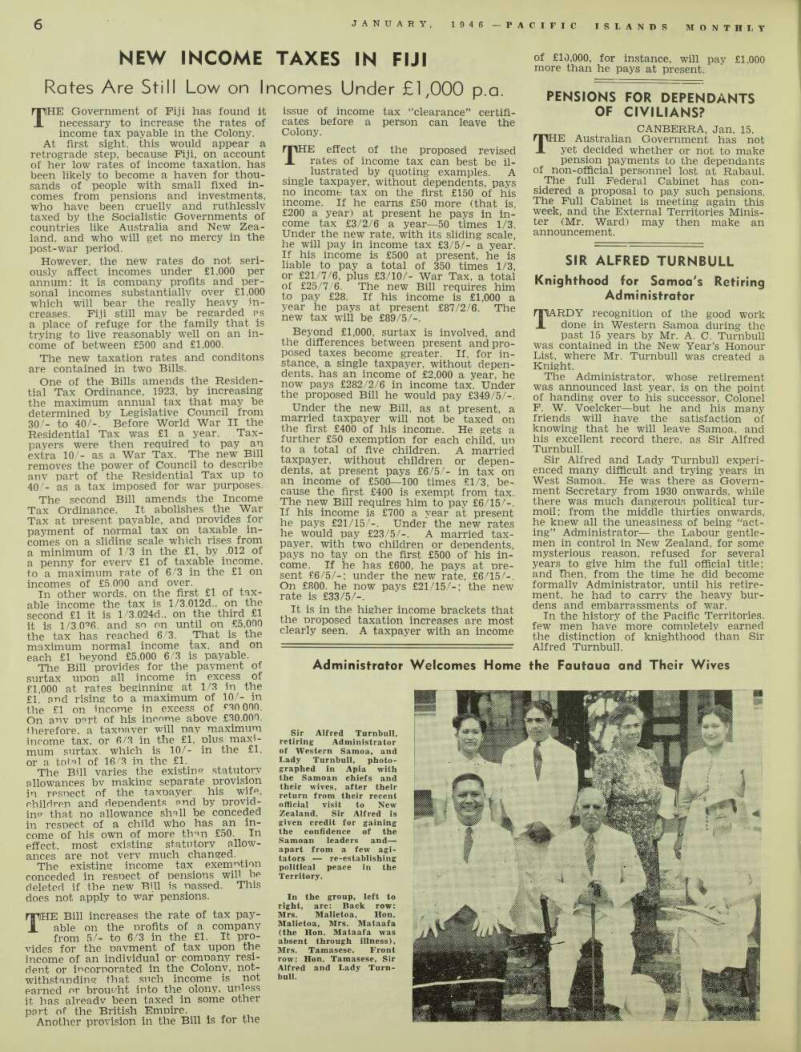
Administrator Welcomes Home the Fautaua and Their Wives
Sir Alfred Turnbull, retiring Administrator of Western Samoa, and Lady Turnbull, photo graphed in Apia with the Samoan chiefs and their wives, after their return from their recent official visit to New Zealand. Sir Alfred is given credit for gaining the confidence of the Samoan leaders and— apart from a few agi tators re-establishing political peace in the Territory.
In the group, left to right, are: Back row: Mrs. Malietoa, Hon.
Malietoa, Mrs. Mataafa (the Hon. Mataafa was absent through illness), Mrs. Tamasese. Front row: Hon. Tamasese, Sir Alfred and Lady Turn bull.
Advertisements & other items, p. 8 (1 item)
6
JANUARY, 1946 PACIFIC ISLANDS MONTH I. Y
From Solomons
Lifting Controls
Official Announcement
'T'HE following statement of the 1 rehabilitation position in the British Solomon Islands was issued from the office of the Resident Com missioner, at the Administration's new headquarters, Honiara, Guadal canal, on December 21.
It will be seen that it is the policy of the British Colonial Office authori ties to remove all the crippling and embarrassing wartime controls from their Territories at the earliest
possible moment.
THE public is advised that Special Regulation No. 1 of 1944, requiring persons entering and leaving the British Solomon Islands Protectorate to secure written permits, has been re pealed as from December 15, 1945.
It wifi, of course, be necessary for those entering the Protectorate to carry pass ports and go through the usual for malities.
While the Protectorate Government is anxious to encourage the early return to the Solomon Islands of all who have interests there, and is willing to assist to the extent that very limited facilities permit, it should be clearly understood that conditions are still by no means normal and that the Government cannot arrange or assist in arranging passages to and from the Protectorate.
It should also be clearly understood that the Government can in no way guarantee to provide supplies of any kind —neither can accommodation nor trans portation within the Group be assured.
Furthermore, as there are no commer cial firms yet operating, it will be neces sary for those who wish to return to make their own arrangements for the supply and shipment to the Protectorate of all provisions, equipment, fuel, etc., which they will need for their proposed operations.
At present, the only overseas shipping service is provided by the Government operated vessel, HMCS “Kurimarau,” ply ing between Guadalcanal and Suva.
While it is impossible at present to ac cept inward freights, shipping space on the outward voyage will be available.
Any person desiring to return to the Protectorate is strongly advised to con sult someone with personal knowledge of prevailing conditions before deciding whether or not to return at this time.
For the information of trading in terests, it is advised that, when private trade has been re-established and traders can show they have the neces sary facilities and organisation to cater for all trade requirements without re course to Government assistance, either for transport or distribution, it is pro posed that the Trade Rehabilitation Scheme be wound up, as circumstances permit, and stocks in hand made avail able for purchase by commercial in terests.
Firms previously operating in the Pro tectorate are invited to state their in tentions with reference to the resump tion of trading operations.
No Help For Civilians
AUSTRALIAN people with interests in the British Solomons have not re ceived the Resident Commissioner’s announcement with enthusiasm.
“All very well —but what are they really doing for the rehabilitation of civilians?” remarked one man. “It is reported that
they have been given £300,000 by the British Colonial Office for the re-estab lishment of the Administration in the Solomons. But there is not one penny piece for the assistance of the planters and traders, who lost practically every thing when the Japs invaded.
“There can be no rehabilitation of civilians, anyway, without a shipping ser vice. Nothing has been done to provide a shipping service, so far as we know.
“It looks as if the Administration is waiting for the trading and shipping in terests to do something. The latter are not likely to do anything unless they are assisted and encouraged by the Adminis tration.”
An Australian "Consul"
at Noumea
AUSTRALIA'S first Consul to the ad joining French Colony of New Cele donia, Mr. H. S. Barnett, was officially appointed on December 18. Mr.
Barnett, a Jervis Bay graduate, was a lieutenant-commander in the Australian Navy in 1939; but, during most of the Pacific war, he was Naval Liaison Officer at Noumea. He now becomes “Australian Consul—second class.”
Australia previously has been repre sented by a Trade Agent at Noumea— the last of whom was Mr. Noel Deschamps, who has now gone to “the Australian Legation” in Russia, as First Secretary and Charge d’Affaires.
Ng Casualty List
Includes 28 Members of NGVR
Previously reported prisoner of war, now reported died whilst prisoner of war: NGXI43 Gnr. B. L. J. Smeeton, Artillery, Rabaul, NG.
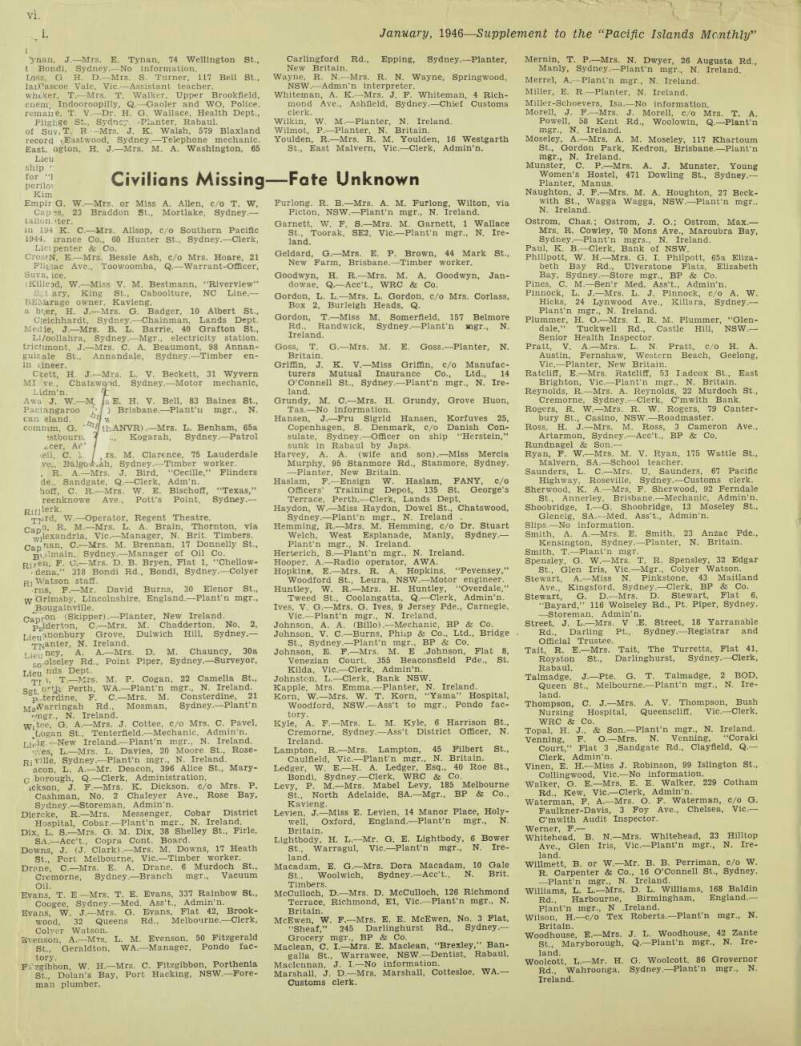
Became missing, and is now presumed dead: (All members of Infantry, Rabaul) NG4OOI Rifleman K. C. Allsop.
NG4002 Rifleman H. J. Beckett.
NG4042 Cpl. R. A. Bird.
NG3OOI Rifleman C. R. Bischoff.
NG4032 Rifleman F. C. Bryen.
NG4049 Rifleman L. A. Deacon.
NG4009 Sgt. W. J. Evans.
NG4OII Rifleman E. R. Hopkins.
NG4012 Rifleman W. A. Ledger.
NG4045 Rifleman E. G. Macadam.
NG4014 Sgt. W. F. McEwan.
NG4013 Sgt. C. I. Mac Lean NG4050 Rifleman C. H. Moore.
NG4052 Pte. J. F. Morrell.
NG4016 Rifleman W. H. Phillpott.
NG4019 Rifleman W. R. Reynolds.
NG4020 Rifleman H. J. Ross.
NG4043 Sgt. F. W. Ryan.
NG4021 Rifleman L. C. Saunders.
NG4033 Rifleman I. Shoobridge.
NG4040 Cpl. G. D. Stewart.
NG4024 Rifleman R. E. Tait.
NG4026 Cpl. G. E. Walker.
NG4028 Rifleman F. A. Waterman.
Removed from seriously ill list: NXI Sgt. W. H. Simpson, HQ Unit, NG.
Became missing, and is now presumed dead: NG4044 Cpl. R. M. Brain, Infantry, Rabaul.
NG4017 W/O H. O. Plummer, Infantry, Rabaul.
NG4031 Cpt. G. W. Spensley, Infantry, Rabaul. , , NG4025 Rifleman F. O. Venning, Infan try, Rabaul.
Previously reported missing, believed de ceased, now reported presumed dead: NGX Pte. C. E. Bignell, Infantry, Rabaul.
Rebuilding Of
Rabaul
Much Australian Activity
GOOD progress has been made in the heavy task of cleaning up Rabaul, which was completely wrecked by the Japanese occupation, and by the American and Australian bombers who went in after the Japs.
There were no buildings left, but the occupying troops soon had small towns of tents scattered around, lit by electric plants, and now groups of hutments are replacing the tents.
Sanitation has been restored, and the insect pests have been partly routed by DDT sprayed from aircraft. The jungle growth, which so quickly had taken pos session of the wrecked town, is being cleared away by Japanese labour gangs, and by bulldozers driven by Australians.
Working parties of Jap prisoners are erecting buildings, making new roads, working the ships, etc.
Communications are being restored.
Mr. Ted Bishton, well known in the Ter ritory for many years, is in charge of the AWA radio installation. Servicemen in Rabaul now can talk to Australian cities by radiophone.
Chinatown is being rebuilt, under the direction of the Australian officer in charge, Lieut. J. MacGregor Dowsett.
There is a Chinese Town Council of 14 members, with Mr. Thomas Y. K. Mow as president.
Rabaul may become an important com mercial town, but it is not likely to be an administrative centre again.
Jap Prisoners
JAPANESE prisoners still occupy 15,000 acres of the best garden country in the Gazelle Peninsula, reported a correspondent in November. Those eva cuated from Rabaul have been trans ferred to some of the best gardens south of the town. There are still 89,000 Japanese living off the land in the penin sula, and 35,000 natives waiting patiently for the Australian authorities to allow them to return to normal life there.
Before this can happen the Japanese must be transferred to compounds on the coast, in which they will have to grow their own food pending repatriation.
Meanwhile, they are appropriating more gardens and felling native coconut plan tations to clear camp sites. The irony of this situation is emphasised by the eager welcome the natives have given to their liberators and their complete de pendence on them for protection from further Japanese depredations.
Nz-Rarotonga Air Mail
Resumed
Rarotonga, Jan. 6.
riTHE New Zealand-Rarotonga air-mail X was temporarily suspended owing to the inadequacy of local radio equip ment for the direction of aircraft.
In the meantime, a large amount of valuable equipment and some technicians have been flown in, and a very powerful directional radio has now been installed.
The new plant is now functioning, con trolled by RNZAF operators, and the air mail service was resumed with the arrival of the mail-plane on January 5.
This will actually be the first really “official” air-mail.
So far, the letter rate to NZ has been only the ordinary ocean rate of 2d., and no extra charge on overseas mails. With the re-establishment of the service the Rarotonga-NZ rate has been fixed at sd.
by Australian Ministers
The Stony Silence Of Canberra
Demands for Inquiry Into Rabaul Disaster Ignored by Australian Ministers
VARIOUS people, including the Execu tive Committee of the Pacific Ter ritories’ Association and the editor of the “PIM,” have kept public opinion directed, in recent weeks, upon the de mand for an inquiry into the circum stances surrounding the capture of Rabaul by the Japs, and the useless and needless sacrifice of between 200 and 300 civilians, who subsequently lost their lives.
It is a matter of common knowledge that blame for the failure to evacuate those civilians, when it was known the Jap invasion fleet was coming, is being placed with a very highly-placed official personage in Australia. But, although all sorts of comparatively unimportant things have been officially inquired into by the Australian Government in the past two years, Canberra is resolutely deaf to the demand for an inquiry con cerning Rabaul.
The suspicion is growing into a con viction that Canberra is determined to dodge the inquiry, if possible, and thus save the high official personage referred to from embarrassment and perhaps worse.
Pending a formal inquiry, .it would appear that over 200 of New Guinea’s leading citizens were murdered in Rabaul by official blundering and inepti tude; but, in the viewpoint of the quaint people who now masquerade as Minis ters in Canberra, it is a matter of greater importance that the gentleman they recently selected for a high and
responsible post should not be asked to explain certain things that he is alleged to have done in January, 1942, which resulted in the civilians being held in Rabaul, in the face of the oncoming Japs.
There will be a session of the Aus tralian Parliament presentlv and then, on the floor of the House, these Minis ters will be forced to make some state ment about the demand for an inquiry.
As a matter of fact, interesting things should happen in this session. The in effable Mr. Ward, for instance, can hardly hope to escape sharp criticism there for the extraordinary set-up he has created in New Guinea.
A VALUABLE contribution to the dis cussion about the Rabaul disaster was the following letter (published in the “Sydney Morning Herald”) from Mr. Gordon Thomas, who was a prisoner in the hands of the Japs from January, 1942. until August, 1945, and who was one of tne \ery few civilians to escape death. Mr Thomas, referring to a pub lished statement by the editor of the “PIM” (that all non-combatant civilians could have been sent away from Rabaul in the then available ships) said:— “It is certainly news to me (a recently returned civilian internee from Rabaul) that the ‘Horstein’ could not have taken all the Rabaul civilians away days before the Jap landing (as mentioned in Mr.
Robson’s letter) had official permission been given for such use. This permis sion was refused—by whom I do not know.
“But I do know that I was informed by Mr. Page (the Deputy Administrator) that he had made two urgent requests to the authorities for permission to use the vessel for evacuating the civilians. The first request, so he informed me, was made as soon as he was aware of the ship’s tonnage and speed; both of which were quite suitable for such circum stances as existed at the time. The second request was made some days later, when word was received that an invasion was imminent.
“Several smaller Islands steamers and schooners left Rabaul a day or so before the invasion and most of them. I under stand, were fortunate in reaching safety.
Wife Of Ng Administrator
A “PIM” reader who knows Mrs. J. K.
Murray well, has written the follow ing article about the wife of the new Administrator of Papua-New Guinea:— New Guinea will like the wife of the Administrator. First contact will reveal a calm-eyed, gracious woman; but she
has a bright and vivacious personality; possesses ready wit and fluent tongue, and a keen sense of humour; decidedly friendly and approachable. It may take
a little time for the depth of her warm, sympathetic understanding to be dis cerned —enduring qualities are not al ways worn on the sleeve.
Evelyn Murray admits to having the degree of Bachelor of Science in Agri culture, but confesses that it happened a long time ago this said with a twinkle —and that she is much more in terested in being a housewife.
Books and music give her a great deal of pleasure—so do plays and films. She knows sport; she can appreciate the fine points of a football game, plays a neat game of tennis, and is quite at home in the saddle. In fact, she is a very human, delightful person, and in Australia those who know her are torn between two envies—the opportunity that takes her to New Guinea, and New Guinea, for possessing what we are losing.
“The reason why more civilians did not avail themselves of these opportunities of escape was through lack of informa tion as to enemy disposition; a total ignorance of what form the invasion would take, and from which direction it
would come. Sea travel at that time, with constant air raids in progress, seemed fraught with greater danger than remaining in Rabaul.
“There was no organisation for any re treat. There was, however, an official Refuge Gully, which was supposed to be a safety zone from naval bombardment, and to this gully a great many of the civilians Europeans, Asiatics and natives—retired in the afternoon of January 22 (the day before the landing).
“But many civilians left the gully dur ing the afternoon and made their way by car to Kokopo (20 miles away) and beyond. Many of these civilians managed to reach safety after weeks of hardship in the jungle. Some were more fortu nate, and connected with flying-boats down the coast —of whose presence, how ever, the civilians were in ignorance. A few may have been ‘in the know,’ but only a very few. Many others perished in the jungle.
“The general opinion—born of wishful thinking, of course, amongst the civilians left in the town was that it would only be a matter of a week or so when our own troops would again be in possession of Rabaul. Had the true position been known by them it is pretty certain that every one would have put on his running shoes, and made for the south coast of New Britain, and taken a risk, “Proper organisation for the evacua tion of civilians should have been car ried out. But there was no organisation whatsoever. The question now arises; Whose responsibility was it?
“Somebody, sheltering behind the stony silence of officialdom, must have an uneasy conscience.”
British Grant of £1,800,000
£1,800,000 To Fiji and Western Pacific
Suva, Dec. 20.
rE Western Pacific High Commission territories will receive £BOO,OOO from the Colonial Development and Wel fare Fund over a 10-year period ending in 1950. Fiji will receive £1,000,000 during the same time.
The Colonial Development and Wel fare Act was passed by the British Gov ernment in 1940 and was to extend for five years; Fiji and the WPHC received their first grants in 1943-44; £90,800 was voted to the use of a TB survey in the Western Pacific territories and Fiji, and the prevention of malaria in Fiji.
In December, 1945, the British Par liament increased the fund by voting £120,000,000 to it and lengthened its life by five years.
The extension of time is necessary if the Development Fund is to live up to its name. Little developmental work has been possible in any British Colony in the last five years but much needs to be done at the present time and in the immediate future.
The £BOO,OOO which is to go to the WPHC territories (of which BSI is one) presumably is for development, as dis tinct from rehabilitation, of which the Territories, particularly the Solomons, are in dire need. No scheme of war damage operates in these territories and although the BSI estimates for 1946-47 were discussed at the first meeting of the Protectorate’s Advisory Council in October, 1945, and expenditure of £379,522 (on a revenue of £76,515) is contem plated, no provision has been made for assistance to former residents who have lost their property and livelihood as a result of war in that area.
Tropicalities
ONE dismal result of World War II and its aftermath in the isolated Cook Islands, is the increasing scar city of charcoal-irons, used by the native women for pressing clothes. These irons are hollow, and the palm-bark fuel is slowly consumed inside, the smoke es caping through a curved chimney tube.
The “toko” soon rusts; and at the end of its usefulness the bottom falls out.
In normal times, one then buys anew one, for 15/-. But Birmingham has, for the’ last five years, been making goods of a sterner sort; so no new irons can be obtained at all. In consequence, the surviving “toko” are much borrowed, just as our wedding rings used to be. The difference is, though, that they are longer at loan, and do not always return in working order.
Pity the lender who, “issuing, ’ at urgent plea, a reasonably good, and irre nlaceable, iron, gets it back (six months later) with no bottom. War and near war is hell! —E. G. * * * THE wax impression of a signet ring, taken from a grave in Gasmata, New Britain, was recently accepted in England as evidence of the death of Mr John Levien. John Levien was a well-known plantation manager in New Guinea before the war, and no word had been heard of him from the time of the Jap invasion in early 1942. He was un married. and his next of kin was his sister, Miss Elizabeth Levien, Oxford, England. . , Natives say that Levien was murdered by the Japs about September or October, 1942, and, later, his grave was shown to investigating Australian officers. In the grave thev found a ring set with a milkish-wliite stone engraved in the form of an eye and inscribed with the words: “May it watch over you.”
A wax imnression was taken for Burns Philp Trust ’ Company and this was sent to the dead man’s sister in England. She identified it as coming from a ring given her brother by their mother many years ago. * * * ONLY privately-owned plane in Fiji at present was purchased recently by a resident, Mr. T. F. French. It is a two-seater cabin monoplane, and was offered for sale at Nadi (Fiji) air base.
Its new owner —a pre-war owner-pilot who holds a commercial licence— promptly flew round the coast of Viti Levu from Ba to Nausori in 70 minutes.
Mr. French joined the RAAF after the outbreak of World War 11, instructed for 18 months and then went north on opera tions. He has now returned to Fiji, and believes that there is a good future for commercial aviation within the Colony.
“Passenger and tourist services could be operated and fragile and perishable goods transported cheaply to provide the people of the entire group with a much needed service,” he says.
Mr. French’s own plans are not cer tain; but it is probable that he will use his new plane as a nucleus of such a service as he describes. * * * SO New Zealand manufacturers are to make a bid for Pacific trade? (“PIM” November). My opinion is that New Zealand manufacturers and the New Zealand workman will have to hustle themselves about quite a lot before the Dominion will get very far in this.
It is interesting to note that the first issue of the Fiji Public Relations Office
pamphlet, “Fiji Information,'’ quotes the fixed orice of a certain brand of tea packed* in Australia at 4/- per lb.; and the same brand of tea, but packed in New Zealand, at 4/6 per lb. Perhaps the Aus tralian-packed tea contains more twigs and dust—not being a housewife I wouldn’t know about that—but it is far more likely that the 6d. per lb. dif ference in price represents nothing more than the difference between the manu facturing methods of Australia and New Zealand.
Australia, and particularly NSW, to-day is a mad industrial wilderness, where jungle law prevails, but the traveller who comes here via New Zealand cannot help but notice that both in methods and costs the Commonwealth still has the Dominion licked. Manufactured goods are at least 12 per cent, dearer in New Zealand.
New Zealand is a 40-hours-a-week para dise carried to the point of fantasy; in this respect it is one election ahead of Australia. All retail shoos in Auckland, except food shoos, close on Saturday mornings. No work is done on the docks on race davs, and should an overseas ship be unfortunate enough to arrive after sundown it must wait until the next day to be cleared. The antics of the Auck land wharfies are now notorious all over the Pacific. Recently, Samoan wharf labourers in Apia unloaded, into lighters, in three what it had taken Auck land wharfies ten days to load with the most modern of equipment.
The idea of Auckland manufacturers competing in the open market with Aus tralia, England. India and the United States is unadulterated wishful-thinking, under the present set-up. New Zealand was a first-rate primary-producing coun try until the nresent Government’s, theorists began to .imagine they could turn it into a manufacturing country with the artificial aid of subsidies, bounties and tariffs. —“ISLANDER.” * * * mHE native of original mind is a fear- X some creature, and the bane of traders. One of my neighbours, known as “Banana,” once came to me with a note, and stood solemnly “at attention” while I read it.
The screed was from “Banana” him self; in surrealist English; and was in fact a request for “the lend of a loan of 2/6.” I disbursed and wrapped the coin in a return note, of polite reminder that loaner was not donor, which I handed to “Banana” to “deliver” to him self.
He went off with all the dignity in the world, as willing as a telegraph boy.
I presume the note was delivered. But I never saw my half-crown again! And “Banana” was artist enough not to vulgarise the strategy by trying it twice. —E. G. * * * IN the new book, “Australian Sketches,” by Stefan Kotze, the author tells again the story about the blackfellow who, when addressed in Pidgin, retorted in high-flown English, and adds an im provement on it. in this form.
“There was a blackfellow down in Vic toria. He had been caught by the mis sionaries and sent home to England. He was educated in Scotland and finally studied at the University of Aberdeen.
Then he returned to Australia to bestow on his tribal brethren the Presbyterian label. But once a nigger, always a nig ger. So. one bright day, he discarded his black clothes and his white neck
choker and went, armed with spears and boomerang, back to the bush. An old Scotch squatter, returning late at night in high spirits, met this blackfellow and thought it fun to address him in Gaelic.
The blackfellow listened attentively, got up, and replied in perfect Gaelic. The squatter believed himself to be in the presence oi the devil himself. He gave his horse the spurs and returned in record time to the station.” —AGS. * * ♦ A CORRESPONDENT, Mr. Davison, challenges a statement made by Mr.
Hettig in the December “PIM.” Mr.
Hettig, in his article on the early history of Tonga, says that it is believed that William Mariner was the sole survivor of the company of the “Port au Prince.”
Mr. Davison says there were 34 survivors —25 British, 1 Negro and 8 Hawaiians.
He states also that Mariner himself did not write the book. He supplied the material to a Dr. Martin, who did the actual writing.
Retirement Of
Cook Is.
Medical Chief
Dr. E. P. Ellison's 26 Years' Service
AFTER 26 years in the medical ser vices of New Zealand Pacific ter ritories, Dr. E. P. Ellison has retired.
He, with Mrs. Ellison, arrived in New Zealand from the Cook Islands on the December “Maui Pomare.’’
Edward Pohau Ellison was born near Dunedin, NZ, 61 years ago, and is a member of one of the best-known Maori
families of the South Island. He went to Te Aute College and later qualified in medicine at Otago University. He was appointed medical officer and Deputy Resident Commissioner to Niue in 1919 and later became Resident Commissioner of the island.
Later he was temporarily Resident Magistrate and Medical Officer in the Chatham Islands and then took a post graduate course in surgery and studied tropical diseases in Western Samoa and other Pacific groups.
In 1926 he was appointed Chief Medi cal Officer and Deputy RC in the Cook Group, but the following year he re turned to New Zealand to become Direc tor of Maori Hygiene, in succession to Dr. P. H. Buck. He held this position until 1930 when he returned to his for mer duties in the Cook Islands. In the 1938 New Year honours he was awarded the OBE for his outstanding work for New Zealand territories in the Pacific.
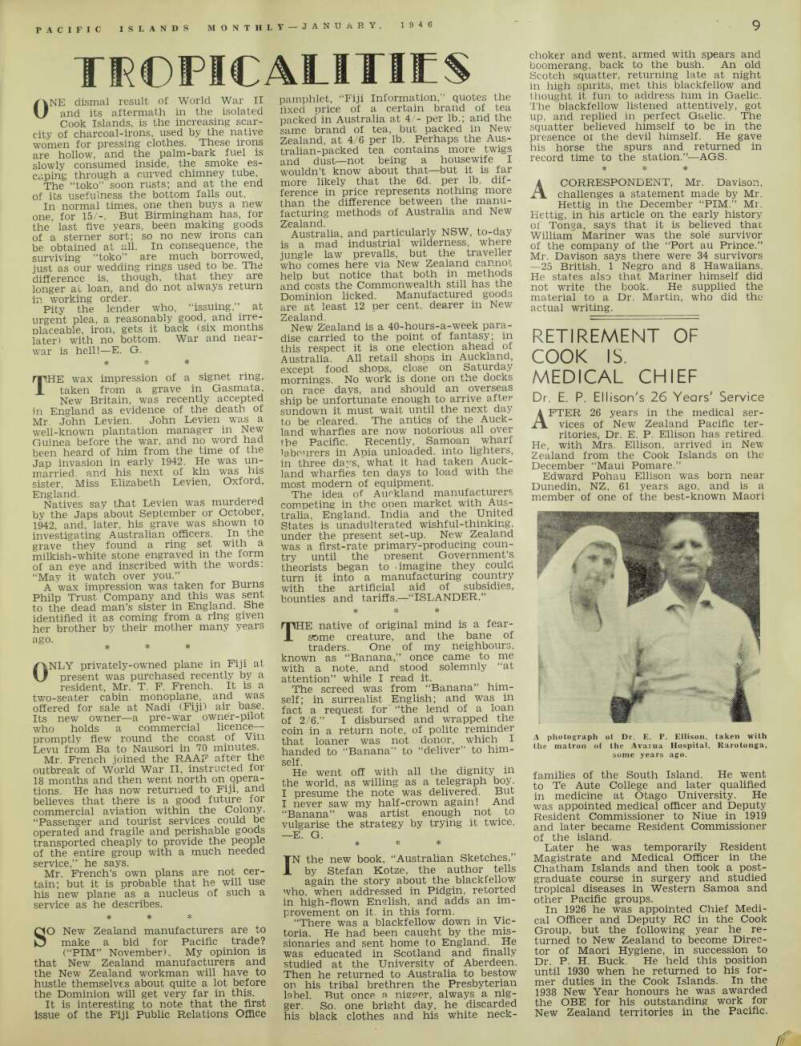
A photograph of Dr. E. P. Ellison, taken with the matron of the Avarua Hospital, Rarotonga, some years ago.
Around Nukualofa During The Centenary Celebrations
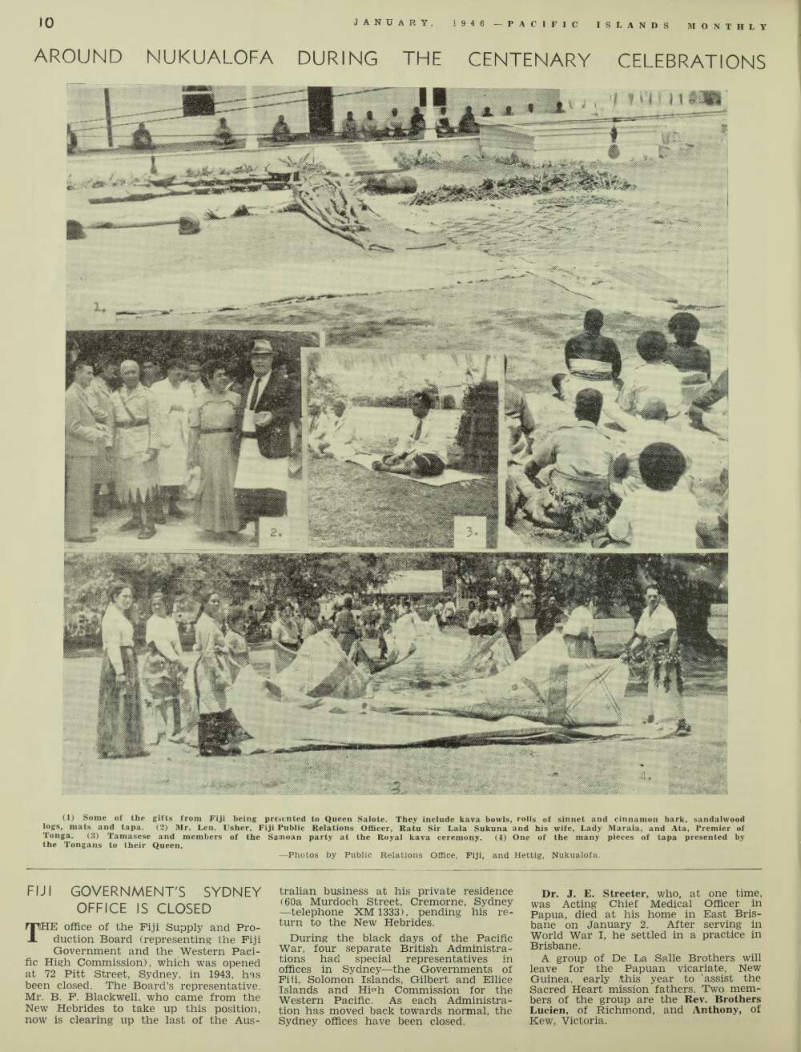
(1) Some of the gifts from Fiji being presented to Queen Salote. They include kava bowls, rolls of sinnet and cinnamon bark, sandalwood logs, mats and tapa. (2) Mr. Len. Usher, Fiji Public Relations Officer, Ratu Sir Lala Sukuna and his wife, Lady Maraia, and Ata, Premier of Tonga. (3) Tamasese and members of the Samoan party at the Royal kava ceremony. (4) One of the many pieces of tapa presented by the Tongans to their Queen. —Photos by Public Relations Office, Fiji, and Hettig, Nukualofa.
Fiji Government's Sydney
Office Is Closed
THE office of the Fiji Supply and Pro duction Board (representing the Fiji Government and the Western Paci fic High Commission), which was opened at 72 Pitt Street, Sydney, in 1943, has been closed. The Board’s representative.
Mr. B. F. Blackwell, who came from the New Hebrides to take up this position, now is clearing up the last of the Aus
tralian business at his private residence (60a Murdoch Street, Cremorne, Sydney —telephone XM 1333), pending his re turn to the New Hebrides.
During the black days of the Pacific War, four separate British Administra tions had special representatives in offices in Sydney—the Governments of Fiii, Solomon Islands, Gilbert and Ellice Islands and Hi°h Commission for the Western Pacific. As each Administra tion has moved back towards normal, the Sydney offices have been closed.
Dr. J. E. Streeter, who, at one time, was Acting Chief Medical Officer in Papua, died at his home in East Bris bane on January 2. After serving in World War I, he settled in a practice in Brisbane.
A group of De La Salle Brothers will leave for the Papuan vicariate, New Guinea, early /this year to 'assist the Sacred Heart mission fathers. Two mem bers of the group are the Rev. Brothers Lucien, of Richmond, and Anthony, of Kew, Victoria.
Pageantry In Nukualofa
Tongans and Distinguished Guests Celebrate a Century of Unity
A N account of the Tongan Centenary
Celebrations, supplied by Len.
Usher, Public Relations Officer, Fiji,
who was in Nukualofa with the official
Fiji party.
Nukualofa, Dec. 8.
Last Tuesday, December 4, was the 100 th anniversary of the coronation of King George Tupou I, first ruler of a united Tonga, and throughout the Kingdom there were elaborate celebra tions to mark the occasion.
For days beforehand, people from out lying districts and islands in the Tonga tabu Group were arriving here by cutter or in lorries or small horse-drawn carts and by Monday, December 3, there was a general air of excited anticipation in the crowded capital.
Parties of brightly dressed Tongans walked about the streets or gathered in open spaces to practise the dances which were to be part of the formal celebra tions.
The grounds of the palace of the pre sent ruler, Queen Salote, were filled with successive groups of people bringing gifts in honour of the centenary. Mats and great lengths of tapa were stretched out on the ground. There were dozens of roasted pigs and hundreds of baskets of native vegetables; there were bottles of coconut oil, roots of kava, native pud dings and elaborately iced cakes.
A DELEGATION from Fiji, headed by Ratu S. L. V. Sukuna, presented a huge pile of mats. One of the mats, about 24 feet square, had on it as decora tion 100 rows of wool, one for each year of the life of the Kingdom of Tonga.
The Fijians brought also kava bowls, lalis (wooden drums), wooden fish dishes, tapa, cinnamon bark, and sandalwood logs. Samoan delegates, with two high chiefs, Malietoa and Tamasese, at their head, presented some of the very fine mats which take years to make, and for which Samoa is famous throughout the Pacific.
Nukualofa’s malae, or public square, near the palace, had been completely encircled with hanging skirts made from undyed vau fibre. At one side a shelter had been built. It was walled with greenery and thatched with coconut leaves which were in turn covered with tapa. On the floor was a magnificent mat in which a pattern based on the cross, which has a prominent place in Tonga’s flag, was woven. The walls and ceiling of the shelter were covered with tapa decorated with the coats of arms of Tonga and of the Queen or with
stylised representations of elements of the coats of arms.
HMS “Euryalus M was in port; and, on Monday, four three-pounder guns, form ing a signal battery which she had brought as a gift from the Government of Great Britain to Tonga, were mounted on the seafront near the malae.
Riding off-shore near HMS “Euryalus ’ was HMNZS “Arabis,” a sloop made available byi the Government of New Zealand to take Queen Salote on a tour of her kingdom ana to attend the cen tenary celebrations at Haapai and Vavau.
The Governor of Fiji and. High Com missioner for the Western Pacific, Sir Alexander Grantham, had, with Lady Grantham, arrived from Suva by air some days before and was staying with the British Agent and Consul, Mr. C. W. T.
Johnson.
QUEEN SALOTE was awakened early on Tuesday, December 4, by a party of dancers. She began her official day with a gracious act. At eight o’clock, seven prisoners appeared before her at the palace. To five she granted free pardons, while the other two had their
sentences reduced from life to ten years’ imprisonment.
During the morning Sir Alexander Grantham and Mr. Johnson, and later, the Queen’s Ministers, paid official calls at the palace.
MEANWHILE, Tongans were gathering in thousands on the malae.. The palace guard paraded, and in line with them was a guard of sailors and another of Royal Marines from the war ships. Opposite the official shelter a choir of about 500 was drawn up. The singers were in white, with fine mats fastened round their waists with lengths of sinnet. The people seated on the ground nearby in the bright sunshine also wore mats or fibre skirts. In the official shelter were Tongan nobles or senior officials and, with them, were the Fijian and Samoan chiefs and their wives.
The Governor of Fiji, with Lady Grantham and Mr. Johnson, arrived just before eleven o'clock; he was re ceived with full honours. Then the Queen’s car drove through a decorated gateway and, as Her Majesty, a tall, dig nified figure, stepped on to a special mat leading to the official platform, the band played the Tongan National Anthem.
This was the signal for the beginning
of a salute of 21 guns fired in the Queen’s honour by HMS “Euryalus.”
Sir Alexander Grantham read to the Queen a message of greeting sent to her by His Majesty King George VI. A Tongan translation by the Premier, Ata, followed and then Sir Alexander pre sented to the Queen the insignia of Dame Grand Cross of the Order of the British Empire. A national service of commemoration then began.
Among the hymns included was one chosen because it was a favourite of King George Tupou I. The great choir sang superbly the “Hallelujah Chorus’’ from Handel’s “Messiah.”
The Queen spoke to her people and greetings from Fiji and Samoa were given by Ratu Sukuna and the Hon.
Malietoa.
As the Queen left the malae at the end of the service, the guns of the newly presented signal battery fired their first salute on Tongan soil.
In the afternoon the Queen and mem bers of the various official parties re turned to see the first of the native dances which went on then almost con tinuously throughout the afternoon, and during the next two days and nights.
AS,. the light failed Tongans began to gather along the foreshore, taking with them closely-bound bundles of coconut sheaths. At eight o’clock a signal gun was fired and each bundle quickly became a lighted torch.
Splashes of flame, spaced at intervals of a foot or two, stretched along the coast for over six miles. The searchlights of HMS “Euryalus” had been sweeping the sky for some minutes, forming a mag nificent background of broad light to the flaring torches pin-pointed along the shore.
Suddenly a salvo of rockets was fired from the ship and, as the white and coloured stars fell in a brilliant cascade, the Tongans who were following excitedly behind marching bands along the lighted coastal road, or dancing with their torches around the flagpole, near the malae, shouted their approbation.
It was a night to be spoken of for years to come.
December 5 was to have been given up to dancing on the malae. Forty-three separate dances had been planned, but heavy rain fell in the afternoon and some of them had to be postponed.
However, they began again at daylight the following morning, and then con tinued almost without a break until late on Friday night. Most of the dances were lakalakas, in which both men and women take part.
The whole town was filled by day and night- with almost continuous sound.
When the dancers slept was, to strangers to Tonga, a minor mystery.
On the Thursday (December 6) there was a sports meeting, and on the follow ing day, in perfect sailing weather, a regatta was held.
The official Nukualofa celebrations ended on the night of Friday, December 7, with a State dance at the Govern ment College Hall.
To-day, December 8, the Crown Prince of Tonga presented gifts to his mother, Queen Salote, in recognition of his hav ing had conferred on him the hereditary Tungi lands, bearing with them the title of Tungi, which he assumed during the celebrations. The gifts were on the grand scale.
A count made while they were stul being assembled revealed over 300 roasted pigs, together with great piles of native vegetables and fruits, lengths of tapa. over 100 kava roots, and some hundreds of native puddings.
Advertisements & other items, pp. 13-14 (1 item)
Burns Philp
THE
YORKSHIRE
INSURANCE
CO. LTD.
(Incorporated in England)
FIRE
ACCIDENT
MARINE
FIRE POLICIES ISSUED
IN PAPUA
All information from —
E. A. JAMES,
Tel. 86347. Attorney for Papua, 14 Spring St., Sydney
BURNS PHILP
(SOUTH SEA) CO. LTD,
Inc. in Fiji Island Traders and Shipowners Registered Office ;
SUVA
FIJI
\\ Also Branches at: Fiji: Levuka, Lautoka, Labasa, Ba ; Sigatoka, Rotuma.
Tonga: Nukualofa, Haapai, Vavau.
Samoa; Apia, Pago Pago (American Samoa).
Solomons; Makambo, Gizo, Faisi.
New Hebrides: Vila.
Code Addres.: Gilberts: Tarawa.
"Bumsouth‘. Norfolk Is. Niue. Wallis Is. Futuna Is.
Sole Australian Concessionaries :
GEORGE BROWN & CO. PTY.
267 Clarence Street, Sydney.
LTD.
The Ultimate factory has made the change-over from its wartime set-up.
Designs for the new models are now completed and production is about to commence.
These models should be available early in 1946—they will be well worth waiting for. Watch for further announcements.
SERVICE: Servicing of all kinds of radio sets, amplifiers and RoSa speakers will continue to be available.
SPECIALISING
IN
PACIFIC ISLAND INSURANCES
FIRE MOTOR VEHICLE
MARINE HULLS AND CARGO
EMPLOYER’S LIABILITY
GUARANTEES including those for-
DYNAMITE PERMITS.
RECRUITERS’ LICENCES.
DEFERRED WAGES
AND ALL OTHER CLASSES ARRANGED
AT LOWEST CURRENT RATES.
Established Agencies:
\V. R. CARPENTER & CO., LTD
Throughout the Territory of New Guinea.
SOUTHERN PACIFIC INSURANCE
CO., LTD.
HEAD OFFICE: 60 HUNTER STREET,
SYDNEY.
"Pont iau {fin ..
★ LIQUEURS ★ COCKTAILS ★ WHISKIES
Address all enquiries to:
W. Cr A. GILBEY LTD.,
33 ROSSLYN STREET, WEST MELBOURNE.
Telegraphic and Cable Address: "Gilbey's," Melbourne.
109 REGENT STREET, SYDNEY.
Telegraphic and Cable Address: "Gilbey's," Sydney.
N. Guinea Cattle
Industry
May be Re-established: Value of Zebu Strain
A PROMISING cattle-raising industry was being built up in the Markham- Ramu tablelands area of New Guinea before the Jap invasion. All the fresh beef that could be raised there found a ready market in the Morobe goldfield centres; and this profitable trade was assisting men like Mr. J. J.
Toogood to establish cattle-farms. Most of the early difficulties had been over come, and the herds were increasing steadily.
Mr. Toogood was in Sydney in Decem er, and eager to get back to New Guinea.
He expects that he will have to start cattle-raising all over again; but now he has learned much bv trial and error, and he expects to start on the job of re-establishing his herds as soon as the Canberra bureaucrats give him a travel permit.
“Regulations are urgently needed in New Guinea to control the spread of diseases in stock,” he said, when pointing out that Government assistance is neces sary. “Animals taken to the Territory are subject to all kinds of parasites— especially the buffalo fly and ticks. But some districts are still clean —and can be kept clean, if regulations were en forced. At present, cattle can be taken from one district to another without any inspection or check.
“Experience has shown that our Euro pean cattle will do no good in New Guinea unless they have from one sixteenth to one-eighth of Zebu strain.
That does not represent enough Zezu to spoil the beast’s Euronean qualities, but it does allow the animal to withstand the pests and rigours of the climate.
“Most people say that mules are bet ter than horses for New Guinea, and I agree. But one must net expect miracles from mules. The better a mule is treated the better the service he pives.”
Mr. Toogood estimated that there were 3.000 good cattle in the New Guinea area when the invasion came, but he thinks few herds are left. Many have been killed for food, and the remainder ap pear to have been widely dispersed.
He has great confidence in the future of the New Guinea cattle industry—but it is essential that it be intelligently and firmly controlled by the Administration.
Why Not Mangaia
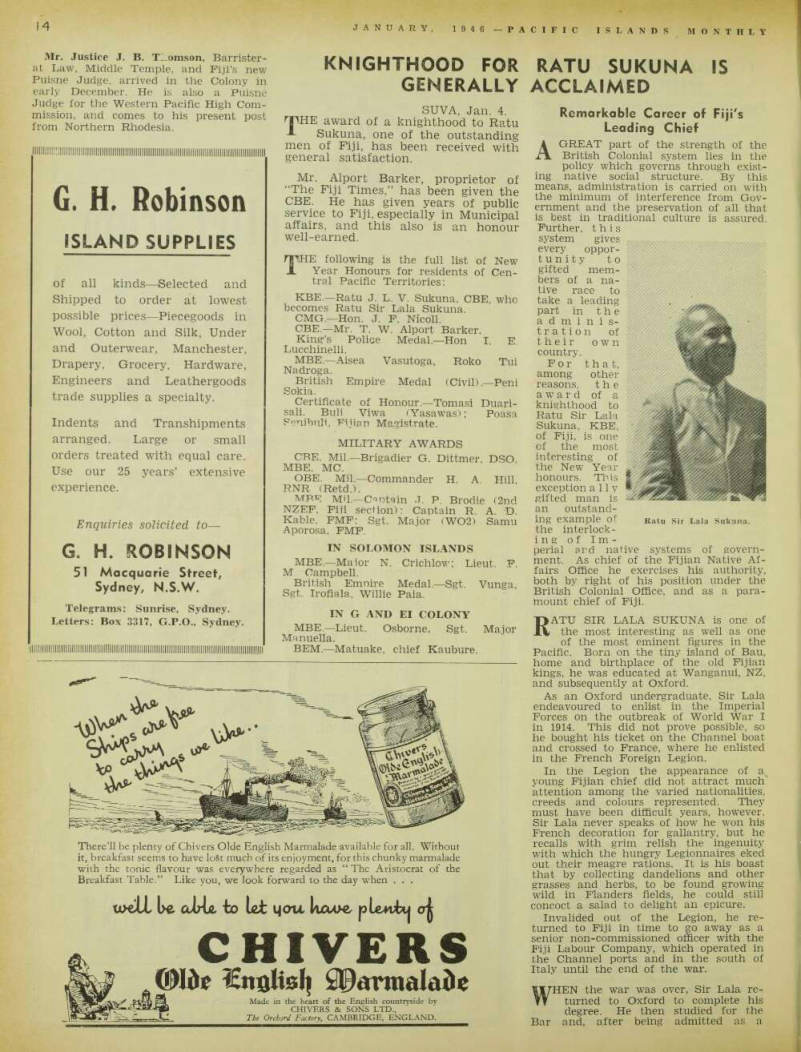
Arrowroot?
From Our Own Correspondent
Mangaia, Nov. 10.
WHEN this writer occupied a bed in a NZ hospital, the less-fortunate brethren in the wards, denied solid foodstuffs, consumed a large amount of gruel. Now, this island of Mangaia has no market for its splendid white “pia”— a powder of high food value, made from locally-grown arrowroot. We could supply, each year, the raw material for hospitals in NZ to provide for their pallid pil grims a far better gruel than the feeble stuff my ward mates used to curse.
Why 'is this Cl source of supply ignored? The island of Mangaia alone produces, every year, a supply of arrow root that would keep at least one hos pital going, and. I think, would be very much cheaper than the Eastern article.
Incidentally, local “pia,” mixed with ripe bananas and baked in an earth oven, makes a delicious pudding, that the medical menu has also overlooked as an invalid food of the very first rank.
Mr. Justice J. B. Thomson, Barrister at Law, Middle Temple, and Fiji’s new Puisne Judge, arrived in the Colony in early December. He is also a Puisne Judge for the Western Pacific High Com mission, and comes to his present post from Northern Rhodesia.
Advertisements & other items, pp. 15-16 (1 item)
a major anxiety
" The
Relief from
Even the most expert and conscientious individual executor is subject to accident, illness and incapacitation.
Continuity of administration and uninterrupted attention to your estate and your beneficiaries are of paramount importance. Both can be positively assured by appointing this Company your sole Executor or as co-Executor with your present appointee. An interesting explanatory booklet will be forwarded on reguest.
DIRECTORS:
Lewis Armstrong. lames Burns.
R. J. Nosworthy.
MANAGER: L. S. Parker.
Joseph Mitchell.
P. T. W. Black.
BURNS PHIIP TRUST
COMPANY
LIMITED
7 BRIDGE STREET. SYDNEY
TELEPHONE: B 7901 Box 543, G.P.0., Sydney
BPI .45
G. H. Robinson
ISLAND SUPPLIES
of all kinds—Selected and Shipped to order at lowest possible prices—Piecegoods in Wool, Cotton and Silk, Under and Outerwear, Manchester, Drapery, Grocery, Hardware, Engineers and Leathergoods trade supplies a specialty.
Indents and Transhipments arranged. Large or small orders treated with equal care.
Use our 25 years’ extensive experience.
Enquiries solicited to —
G. H. ROBINSON
51 Macquarie Street,
Sydney, N.S.W.
Telegrams: Sunrise, Sydney.
Letters: Box 3317, G.P.O., Sydney.
V*
avf 4
m x TO* ' There’ll be plenty of Chivers Olde English Marmalade available for all. Without it, breakfast seems to have lost much of its enjoyment, for this chunky marmalade with the tonic flavour was everywhere regarded as “ The Aristocrat of the Breakfast Table.” Like you, we look forward to the day when . . . ukII be airU to Let qau lartue plewtij a|j
CHIVERS
CWd* ?itiglis{| Marmalade
Made in the heart of the English countryside by
CHIVERS & SONS LTD.,
The Orchard Factory, CAMBRIDGE, ENGLAND.
Generally Acclaimed
Knighthood For Ratu Sukuna Is
Suva, Jan. 4.
T'HE award of a knighthood to Ratu A Sukuna, one of the outstanding men of Fiji, has been received with general satisfaction.
Mr. Alport Barker, proprietor of “The Fiji Times,” has been given the CBE. He has given years of public service to Fiji, especially in Municipal affairs, and this also is an honour well-earned.
THE following is the full list of New Year Honours for residents of Cen tral Pacific Territories: KBE.—Ratu J. L. V. Sukuna, CBE, who becomes Ratu Sir Lala Sukuna.
CMG. —Hon. J. F. Nicoll.
CBE.—Mr. T. W. Alport Barker.
King’s Police Medal.—Hon I. E Lucchinelli.
MBE.—Aisea Vasutoga, Roko Tui Nadroga.
British Empire Medal (Civil).—Peni Sokia.
Certificate of Honour.—Tomasi Duari sali. Buli Viwa (Yasawas); Poasa FenibnU, Fijian Magistrate.
Military Awards
CBE. Mil.—Brigadier G. Dittmer, DSO.
Mbe. Mc.
OBE. Mil—Commander H. A. Hill, RNR (Retd.). mbf MU.—Contain J. P. Brodie (2nd NZEF, Fiii section): Captain R. A. D.
Kable. FMF; Sgt. Major (WG2) Samu Aporosa, FMF.
In Solomon Islands
MBE. —Maior N. Crichlow; Lieut. F.
M Campbell.
British Emnire Medal.—Sgt. Vunga, Sgt. Irofiala, Willie Paia.
In G And El Colony
MBE.—Lieut. Osborne, Sgt. Major Manuella.
BEM. —Matuake, chief Kaubure.
Remarkable Career of Fiji's
Leading Chief
A GREAT part of the strength of the British Colonial system lies in the policy which governs through exist ing native social structure. By this means, administration is carried on with the minimum of interference from Gov ernment and the preservation of all that is best in traditional culture is assured.
Further, this
system gives every oppor t u n i t y to gifted mem bers of a na tive race to take a leading part in the adminis tration of their own country.
For that, among other reasons, the award of a knighthood to Ratu Sir Lala Sukuna, KBE, of Fiji, is one of the most
interesting of
the New Year honours. This exception ally gifted man is an outstand ing example of the interlock in g of Im -
perial ard native systems of govern ment, As chief of the Fijian Native Af fairs Office he exercises his authority, both by right of his position under the British Colonial Office, and as a para mount chief of Fiji.
RATU SIR LALA SUKUNA is one of the most interesting as well as one of the most eminent figures in the Pacific. Born on the tiny island of Bau, home and birthplace of the old Fijian kings, he was educated at Wanganui, NZ, and subsequently at Oxford.
As an Oxford undergraduate, Sir Lala endeavoured to enlist in the Imperial Forces on the outbreak of World War I in 1914. This did not prove possible, so he bought his ticket on the Channel boat and crossed to France, where he enlisted in the French Foreign Legion.
In the Legion the appearance of a young Fijian chief did not attract much attention among the varied nationalities, creeds and colours represented. They must have been difficult years, however.
Sir Lala never speaks of how he won his French decoration for gallantry, but he recalls with grim relish the ingenuity with which the hungry Legionnaires eked out their meagre rations. It is his boast that by collecting dandelions and other grasses and herbs, to be found growing wild in Flanders fields, he could still concoct a salad to delight an epicure.
Invalided out of the Legion, he re turned to Fiji in time to go away as a senior non-commissioned officer with the Fiji Labour Company, which operated in the Channel ports and in the south of Italy until the end of the war.
WHEN the war was over, Sir Lala re turned to Oxford to complete his degree. He then studied for the Bar and, after being admitted as a
Katu Sir Lala Sukuna.
barrister of the Inner Temple, returned to Fiji and joined the Civil Service.
His advancement was steady through out the years, and he filled several senior posts, until he crowned his career about 18 months ago with the appointment of Adviser on Native Affairs. He was the first native Fijian to hold the position, and, as never before, he is now the un disputed and supreme leader of the
Fijian people.
During the Second World War, he acted as recruiting officer for the Fiji Military Forces and, by his influence and authority, raised all the manpower for a force through which passed more than 11,000 men. He holds the rank of Lieut.- Colonel.
MANY New Zealanders who have served with the Fijians know Sir Lala.
The most fortunate are those who have been received in his home and entertained with the lavish hospitality for which he is so justly famed. A man of culture, a profound scholar, a polished and witty speaker, this Fijian is a colour ful and outstanding character.
In him is a splendid blend of European and Fijian characteristics. It is his regret that the requirements of his work in war time have interrupted the text-book on philosophy which has been under way for some years. He subscribes to literary and economic journals. He has enjoyed the confidence of Governors. His speech as a representative of Fiji at the Coronation celebrations was widely acclaimed in London.
Despite all this, he observes closely the customs and traditions of his own proud race. He habitually wears native cos tume, including the “sulu” —smart scol loped kilt—and leather sandals, with bare legs. He is just as likely to quaff “yaqona (the famed “kava” of Fiji) as whisky,
and a Sukima dinner party which begins with conventional “hors d’oeuvres” may continue with soused raw fish or turtle steaks.
IT is impossible to o'.er-emphasis 3 the influence of this man in the well being of his people. To them he is an unfailing oracle, and he rewards them with unfailing loyalty and the full power of his energies. As chairman of the Native Land Trust he has been and is being instrumental in the preservation of the Fijian’s richest heritage, the land.
In medicine, sanitation, education, re habilitation, communications, agriculture —in all these, and in many other direc tions, Ratu Sir Lala Sukuna is working for the welfare of his people.
It is by his wish that he is to be styled Ratu Sir Lala, and that is in itself significant. Ratu is his chiefly Fijian title, and it continues to take precedence over the highest honour bestowed by any other than his own people. .
THE new title, of course, is shared by his wife, who is to be known as Lady Maraia. She was herself awarded the MBE, in the last New Year honours.
Like her husband, Lady Maraia adheres closely to the customs of her race. A poised and polished hostess, speaking beautiful English, she still rarely wears shoes, and her hair is dressed in accord ance with the old-time style.
Lady Maraia is quite as much at home in the lounge of Government House as she is in the Fijian village houses, and her new dignity will sit easily upon her.—M.W.
Mr. Clive Brewster, who has been serv ing in the RAAF with the rank of group captain, has now been demobilised and has returned to Suva, Fiji.
Over 330 people were prosecuted in Fiji recently for non-payment of resi dential or income taxes. Europeans and Euronesians, although they form only 4 quarter of the number of prosecutions,
Advertisements & other items, p. 17 (2 items)
15
f AC iric islands monthly January, 194(1
Amplion
Copies of
Pacific islands Monthly
Can ALWAYS be obtained at the following places:
SYDNEY;
T. L. Cordingley’s Bookstalls at Martin Place, outside G.P.0., near George Street; and at G.P.O. Colonnade, George Street end.
BRISBANE:
R. S. Macdonald, next G.P.0., Brisbane, Qld.
MELBOURNE;
McGill’s Authorised Newsagency, ldd-5 Elizabeth Street, Melbourne.
AUCKLAND:
W. A. Webb, Waverley Hotel Bldgs., Queen Street, Auckland.
SUVA;
James A. Muir, Suva, Fiji; and Miss R. Castles, Victoria Parade, Suva, Fiji. :e also list of agents on
PAGE 3
M AK$
AMPLION
THE MOST
LIGHTING
ENGINE
ISLANDS.
AS you well know, island conditions impose exacting tests on mechanical equipment. But Amplion sets your mind at rest —for Amplion lighting plants and engines are built to last, to keep on operating under all conditions. If you require a 12 or 32 volt lighting plant, for city-light convenience in your house and outhouses, or a portable petrol engine to supply power on your station or plantation —remember Amplion is built to last.
For further particulars, send the coupon by next mail.
Model 3008, 12 volt, 300 watt (25 amps), £4B/12/-, plus 15/- casing.
Model 400, 32 volt, 320 watt (10 amps; £53/10/-, plus 15/- casing.
F. 0.8. Sydney. w. * »mpuon ■J
RELIABLE
PLANT OR
FOR THE
These are the 10 car engine features that guarantee reliability: 1. Oil bath air cleaner. 2.
Forced feed lubrication. 3.
Pneumatic speed governor. 4.
Float feed carburettor. 5.
Visible petrol filter. 6. Magneto ignition. 7. Petrol cutoff valve. 8. Heavy duty ballrace on crankshaft. 9, Self-starter. 10. Automatic cutout on generator.
AMPLION (A’ASIA) PTY.,
LTD.,
36-40 Parramatta Road, Camperdown, Sydney, Australia.
Please forward me fullest particulars of Amplion lighting plants and/or engines.
P.I.
Death Of Captain "Jimmy"
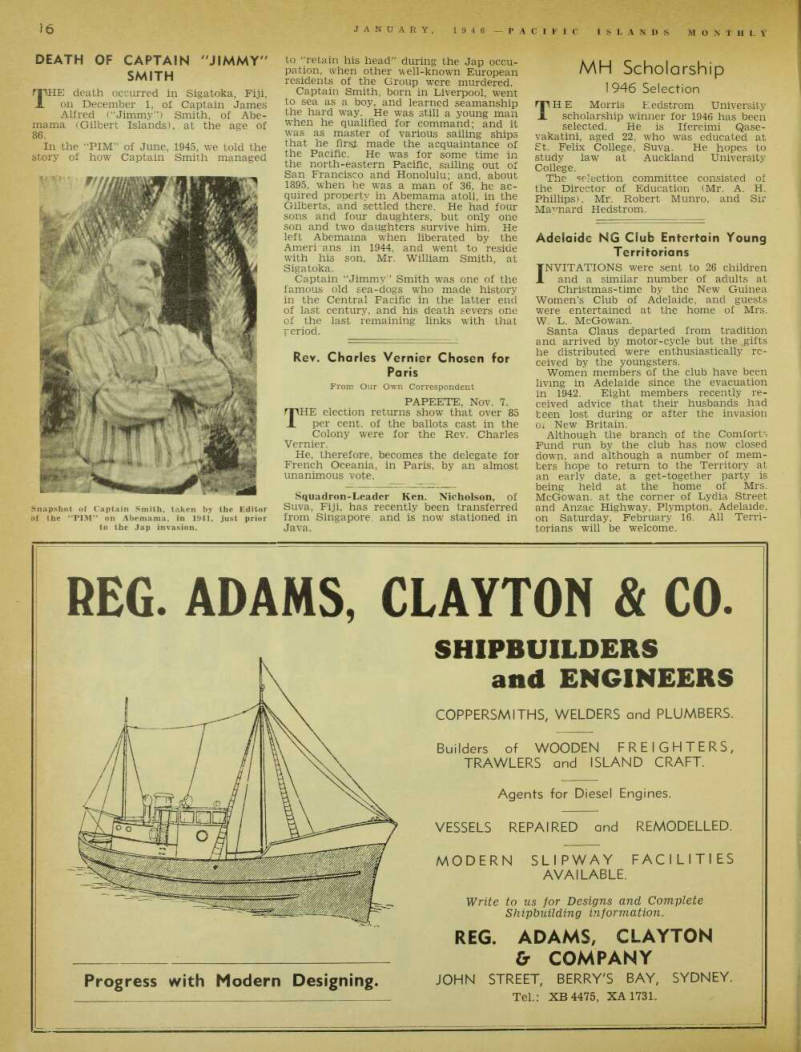
Smith
THE death occurred in Sigatoka, Fiji, on December 1. of Captain James Alfred (“Jimmy”) Smith, of Abe mama (Gilbert Islands), at the age of 86.
In the “PIM” of June, 1945, we told the story of how Captain Smith managed
to “retain his head” during the Jap occu pation, when other well-known European residents of the Group were murdered.
Captain Smith, born in Liverpool, went to sea as a boy, and learned seamanship the hard way. He was still a young man when he qualified for command; and it was as master of various sailing ships that he first made the acquaintance of the Pacific. He was for some time in the north-eastern Pacific, sailing out of San Francisco and Honolulu; and, about 1895, when he was a man of 36, he ac quired property in Abemama atoll, in the Gilberts, and settled there. He had four sons and four daughters, but only one son and two daughters survive him. He left Abemama when liberated by the Americans in 1944, and went to reside with his son, Mr. William Smith, at Sigatoka.
Captain “Jimmy” Smith was one of the famous old sea-dogs who made history in the Central Pacific in the latter end of last century, and his death severs one of the last remaining links with that period.
Snapshot of Captain Smith, taken by the Editor of the “PIM” on Abemama, in 1941, just prior to the Jap invasion.
Rev. Charles Vernier Chosen for Paris
Paris
From Our Own Correspondent
Papeete, Nov. 7.
THE election returns show that over 85 per cent, of the ballots cast in the Colony were for the Rev. Charles Vernier.
He, therefore, becomes the delegate for French Oceania, in Paris, by an almost unanimous vote.
Squadron-Leader Ken. Nicholson, of Suva, Fiji, has recently been transferred from Singapore and is now stationed in Java.
MH Scholarship
1 946 Selection
Ti H E Morris Kedstrom University scholarship winner for 1946 has been selected. He is Ifereimi Qase vakatini, aged 22, who was educated at St. Felix College, Suva. He hopes to study law at Auckland University College.
The selection committee consisted of the Director of Education (Mr. A. H.
Phillips), Mr. Robert Munro, and Sir Maynard Hedstrom.
Adelaide NG Club Entertain Young
Territorianc
INVITATIONS were sent to 26 children and a similar number of adults at Christmas-time by the New Guinea Women’s Club of Adelaide, and guests were entertained at the home of Mrs.
W. L. McGowan.
Santa Claus departed from tradition and arrived by motor-cycle but the gifts he distributed were enthusiastically re ceived by the youngsters.
Women members of the club have been living in Adelaide since the evacuation in 1942. Eight members recently re ceived advice that their husbands had teen lost during or after the invasion oi New Britain.
Although the branch of the Comforts Fund run by the club has now closed down, and although a number of mem bers hope to return to the Territory at an early date, a get-together party is being held at the home of Mrs.
McGowan, at the corner of Lydia Street and Anzac Highway, Plympton, Adelaide, on Saturday, February 16. All Terri torians will be welcome.
Advertisements & other items, p. 18 (1 item)
Reg. Adams, Clayton & Co.
C
Progress with Modern Designing.
SHIPBUILDERS
and ENGINEERS
COPPERSMITHS, WELDERS and PLUMBERS
Builders of WOODEN FREIGHTERS,
TRAWLERS and ISLAND CRAFT.
Agents for Diesel Engines.
VESSELS REPAIRED and REMODELLED.
MODERN SLIPWAY FACILITIES
AVAILABLE.
Write to us for Designs and Complete Shipbuilding information.
REG. ADAMS, CLAYTON
Cr COMPANY
JOHN STREET, BERRY'S BAY, SYDNEY.
Tel.; XB 4475, XA 1731.
Fiji Plans For 1946
Increased Taxation But Decreased Expenditure
Suva, Dec. 30.
FIJI, which appears to the overtaxed millions as a veritable paradise, is to have a slight increase in taxa tion in 1946 (see article elsewhere this issue), but that Authority in Fiji still sees the light is indicated by the Gover nor’s speech at the opening of Legis lative Council on December 14; “ To impose taxes,” said Sir Alex ander Grantham, “so high that the law of diminishing returns came into operation would be foolish and harm ful to our economy. Taxation should not be at such a high level that it hampers trade and frightens away capi tal. Nor should it be harsh, so far as the individual is concerned.”
He stated, however, that any Colony would be morally wrong to expect the Colonial Development and Welfare Fund, which is to allot £1,000,000 to Fiji in the next 10 years for m-gent development work, to supply one penny if residents of the Colony itself were not prepared to do everything in their power to stand on their own feet. The Development Fund is, of course, financed by the long suffering British taxpayer.
New direct taxation in Fiji will in 1946 produce an increase in revenue of £104,250.
Estimates for the year 1946 allow for an expenditure of £1,639,904 (almost £40,000 less than the estimates passed in 1945) and a revenue of £1,548,901. The £91,000 deficit will be met out of re serves, which stand at present at over £1,000,000.
In the past four years Fiji has spent £3.998,421 on war, of which £1,562,816 came directly out of the Colony’s revenue and the remaining £2,437,184 was provided by the Imperial Treasury. The position in regard to these British advances is not known at present, although the Colony is not required to pay interest on them.
War expenditure in 1946 will come under the -heading of “defence” and will be an estimated £151,000. Other expen diture taken into consideration in the estimates is, rehabilitation of Service per sonnel. reorganisation in the Agricultural, Education and Medical Departments and provisions for the Public Relations Office.
Governor Orselli—
An Appreciation
From Our Own Correspondent
Papeete, Nov. 7.
THOSE of us who are deeply interested in the welfare of this Colony and its people, venture to hope that French Oceania will be able to retain the services of Colonel Orselli as Governor.
His record throughout the most difficult war period has been admirable, and he has been long enough in the Colony now to understand the people and their problems.
Mr. and Mrs. S. Esam, formerly of Fiji, were on leave in the Colony in Novem ber and December. Mr. Esam was an accountant at Nadarivatu, for the Fiji Kauri Timber and Land Co., Ltd., and six years ago entered the service of a mining company at Singapore. After joining the defence Forces, he was cap tured by the Japanese and was a prisoner in Thailand for 3h years. His wife was formerly Miss M. Collins, of Suva.
Advertisements & other items, p. 19 (1 item)
freshest powdered milk
See if COWLAC isn’t the Creamiest,
you’ve ever tasted!
One 12-oz. can of Cowlac Dried Milk gives you half a gallon of farm-fresh milk, containing nearly half a pint of cream.
Order through your usual channels.
A TRUFOOD PRODUCT
ORDER FROM
BRIAL and BALL
528 Collins St., Melbourne, MU 4837 1 Bond Street, Sydney . . . B 737'i
iippUfc*
IS V.^OS
p*
CREAM
Rich
FUU
m A I m D R Sf of* JM UA
LTD
AUS
1202 s CM
Steamships Trading
Company Limited
SAMARA!
PAPUA.
PORT MORESBY
WHOLESALE & RETAIL MERCHANTS, SHIPOWNERS,
PLANTERS, ENGINEERS & SLIP PROPRIETORS.
Customs, Shipping, Insurance, and Forwarding Agents.
MANAGING AGENTS AND VISITING REPRESENTA-
TIVES FOR COCONUT AND RUBBER ESTATES.
SYDNEY REPRESENTATIVES: Nelson & Robertson Pty. Ltd-, 12 Spring Street.
WARTIME ADDRESS
Until further notice, clients may address all communications as follows: —
STEAMSHIPS TRADING COMPANY LIMITED,
C/o NELSON & ROBERTSON PTY. LTD.,
12 SPRING STREET, SYDNEY.
Death of Mrs. H. C. Monckton
THE death of Mrs. Monckton, wife of Mr. H. C. Monckton, formerly Ad viser on Native Affairs, Fiji, occur red in Sydney on December 15.
The Moncktons were well-known in the Colony, where they spent many years before retiring to Sydney a few years ago and a great number of Fiji friends will be sorry to hear of her passing.
A son, Mr. Basil Monckton, was until recently an engineer on the staff of the Suva Town Board; he is now living in Australia. A daughter, Mrs. E. H. Canard who married a member of the Fiji RAF contingent who was killed abroad, and a younger son, Hugh, are also in Aus tralia.
Miss Gibson, of the Suva Town Board, is a sister of Mrs. Monckton.
Castaways
Us-Ships Search For
Prom Our Own Correspondent
Papeete, Oct. 24.
AN assemblage of small US warships is at Bora Bora. They will severally visit every island and atoll in the South Pacific in quest of any survivors to their shores.
Two of these warships were at Papeete early this month. The less said about this visitation the better.
Lieut.-Col. A. B. Ackland, Captain I.
Cawa and Lieut. E. Waqa returned to Suva on November 25. The party left Fiji last February for Britain to study land settlement and development methods.
Fiji Air-Mail
Exorbitant Rate Now Reduced
rE Red Tape Wallahs who arrange such things as postage rates have had a change of heart. The air mail postage between Fiji and New Zea land and Fiji and Australia has been reduced.
Until August, 1945, air-mail letters were carried between Fiji and New Zea land for ordinary postage and between Fiji and Australia for sd. (sid. from Australia to Fiji because Australia has a id.-per-ounce war surcharge on all postages); then, for reasons that have never been successfully explained, some one decided that the rates should be 1/2 and 1/5 per half-ounoe, respectively— and this for a service that was neither regular nor predictable. (See “PIM,”
November). However, we are now in formed (but again without explanation), that from January 1, 1946, the rate will be sd. per half-ounce between Fiji and New Zealand, Samoa, Tonga and Nor folk Island; and lOd. per half-ounce be tween Fiji and Australia.
The Fiji-Australia rate is still too high; before the war it was possible to send a letter all the way to Britain for no more than the internal air-mail post age rate. There is no good reason why it should cost any more to send an air mail letter to Fiji than it does to New Zealand (surface mail costs are the same within the whole British Empire) other than the fact that the New Zealand- Fiji end of the air link is still in New Zealand Government hands.
Something seems to have delayed the “dawn of the Pacific air-age” which every ranting politician has promised us for four years. That something could easily be the reluctance of both the Aus tralian and New Zealand Governments to call in private enterprise; they still hope that they will be able to pluck a few nationalised plums for themselves.
IT was announced in New Zealand on December 20 that letters would be received in the Dominion for despatch to Tonga, Western Samoa, Norfolk Is land. New Caledonia and New Hebrides, as well as Fiji. All are at the rate of sd. per ounce, although no regular mail ing schedules can be issued, it is stated.
Trans-Pacific Flights by ANA
Australian national airways are bringing several new giant Sky master planes out from America in the early months of 1946. These are for use* in Australia between capital cities. The planes are being flown from the Pacific coast of the US via Suva, and passengers from Fiji will be accepted for Australia. The Union Steam Ship Company is the booking agent for ANA in Suva.
Some weeks ago the managing direc tor of ANA offered to run regular trans pacific services from Australia to link with PAA in Noumea or Suva but the Commonwealth Government apparently made no reply to the offer.
Brigadier G. Dittmer, officer com manding the Fiji Military Forces for the last two years, returned to New Zea land in November. He had a distin guished career in the First World War, and commanded the Maori Battalion dur ing the epic battle for Crete in 1941.
During his stay in Fiji he became popu lar with all sections of the community.
Formerly a keen footballer, he gave the greatest possible support and encourage ment to Rugby, both within and with out the Forces.
Advertisements & other items, pp. 20-22 (2 items)
Laser
CARLTON
BREWED BY
UNITED BREWERIES LTD.
Capstan
All over the British Empire, every minute of • % every day, more and more smokers are saying, "Better buy Capstan (tobacco and cigarettes)—theyVe blended better."
TOBACCO and CIGARETTES
Modern Refrigeration for the South Sea Islands
The ELECTROLUX
KEROSENE OPERATED
REFRIGERATOR
MARVEL
OF
MODERN
SCIENCE
-- . a .. ■ •; ... *1
THE
MIRACLE
OF
ICE
FROM
HEAT
ELECTROLUX offers economical, modern and completely efficient
REFRIGERATION FOR ISLANDS' HOMES.
FREEZES CONTINUOUSLY WHILE SMALL LAMP BURNS.
Freezing controlled by simply regulating height of flame. Uses only £ gallon of kerosene per week.
MOTORLESS ... NO PARTS TO GET OUT OF ORDER.
MODEL L 22
Capacity 3.3 cable feet.
MODEL L3BO
(a« illustrated) Capacity 4 cubic feet.
MODEL LKSSO
Capacity 5.6 cubic feet.
GUARANTEED FOR TWO YEARS.
© Write to your Local Distributor for prices and full details.
OBTAINABLE FROM ALL W. R. CARPENTER & CO.
BRANCHES THROUGHOUT THE ISLANDS
Representation in Papua and New Hebrides.
LTD.
Men Of Aib
Two Omissions from List
A CORRESPONDENT has pointed out that there are at least two omis sions from the list of men of the Allied Intelligence Bureau which was published in this journal in December, and described as complete. The two names are: W/O Victor Neumann Peter Kutis.
According to the records, Neumann did an extraordinarily good job in the dan gerous waters around New Britain dur ing 1942, as skipper of the 24-tons motor boat “Umboi.” He was associated with A. K. Smith, “Blue” Harris, Lincoln Bell and other men whose feats in penetrat ing Jap-held territory at that time, keep ing tab on the Japs and rescuing civilians and Servicemen, made history. Neumann was mentioned in despatches. In 1943, he was transferred to ANGAU, and was with that organisation until he obtained his discharge recently.
Peter Kutis was a man of Czecho slovak nationality, and came from the staff of the Catholic Mission at Sek. He was sent to a job on the “Umboi,” under Neumann, and he shared in all the re markable exploits of “Umboi” during 1942. He went away south, to some other service, early in 1943, and his la4er activities and present whereabouts are unknown.
The AIB was not fully organised until 1943-44, and that may explain the omis sion of names of men who served in 1942.
When Captain “Blue” Harris left Lae in February, 1942, in the “Umboi,” to rescue Europeans from the north coast of New Britain, he had with him 11 duly attested men of the NGVR. The job was completed some five or six weeks later, and the 11 were free to return, if they wished. Only three volunteered to remain with Captain Harris on the very risky Work of espionage—G. A. Obst, A.
P. H. Freund, and Victor Neumann. Obst was killed by Japs late in 1942, when carrying out a dangerous patrol in the Cape Gloucester region with A. K. Smith and W. A. H. Butteris. Butteris also was killed, but Smith escaped.
Additions and Corrections
A MEMBER of the AIB has sent us the following corrections and addi tions to the list of AIB men, pub lished in the “PIM” of December: Bengough, Lieut.-Col. C. N. F.; and Clemens, Major W—They were not mem bers of the AIB. They belonged to the Solomon Islands Administration and, un like their colleague, Major Kennedy, they never actually came under the command of the Supervising Intelligence Officer.
Colley, W/Q2. Don. —His name should be added. He joined early in 1945, after serving in Africa and New Guinea.
Train, Lieut. G. H. C.—Killed early in 1943.
Stephenson, Capt. G. —Killed in 1943.
Fay, F/Lieut. L. P. —Awarded MC in World War I.
The heading, “Served Prior to April, 1943,” is misleading. Many of the men shown as having served between April, 1943, and 1945, actually served' before the beginning of 1943. For instance, Waddell, Josselyn, Seton and Keenan were out on this work in 1942.
Some men whose names are not in the published list are claiming that they were members of the AIB, but they can not stand up to close questioning by the “old hands.”
Samoa's Mlc
Regrettable Incident at a Public Function
Letter to the Editor OLD residents of Western Samoa have openly expressed their regret and shame recently that they should be publicly represented by a man of the type who now occupies the position of their First Elected Member of the Legis lative Council.
This MLC has been carrying on in an irresponsible way, which may be ap plauded by beach hooligans, but is cer tainly not approved by all the better-class Europeans and Samoans. He chooses to regard the retiring Administrator, Sir Alfred Turnbull, as his particular enemy;
and recently, at a public function, he took it upon himself to denounce the Administration and the Administrator, and he proclaimed that Sir Alfred Turn bull had been “kicked out” through his influence. That, of course, is quite ridi culous-even the poorest-quality NZ Minister would take no notice of such a man—but it “went over big” with the gutter brigade, to whom this precious MLC makes his particular appeal.
It is a pity that Samoa had to go to such a man in order to find a Council representative. Fortunately, Mr. A. G.
Smyth is back again now from his Aus tralian holidays; he has always held the respect of the public and can represent us worthily in public functions.
I am, etc.,
“Old Resident.”
Apia, Jan. 2, 1946.
Advertisements & other items, p. 23 (1 item)
Imperial
TIME OFF FROM
COOKING
/ m * m v 9 r % <0 » i m m m yzz*-*. m k What an idea to be able to serve up meals in 5 minutes! . . . Meals that will bring unanimous appetising pleasure—treats that you yourself will be able to sit down and enjoy.
IMPERIAL Good Foods are ready-cooked for you by expert chefs. Easy-to-serve. Specially processed to seal in the full flavour and keep EVER-FRESH.
Imperial
GOOD FOODS
W. ANGLISS & Co. (Aust.) Pty., Ltd.
Head Office: 5-7 O’Connell Street, Sydney, Australia.
Imperial
MEATREAT
★ Imperial
CAMP PIE
★ Imperial
HAMPE
★ Imperial
HOT MEALS
Far-Seeing Ng
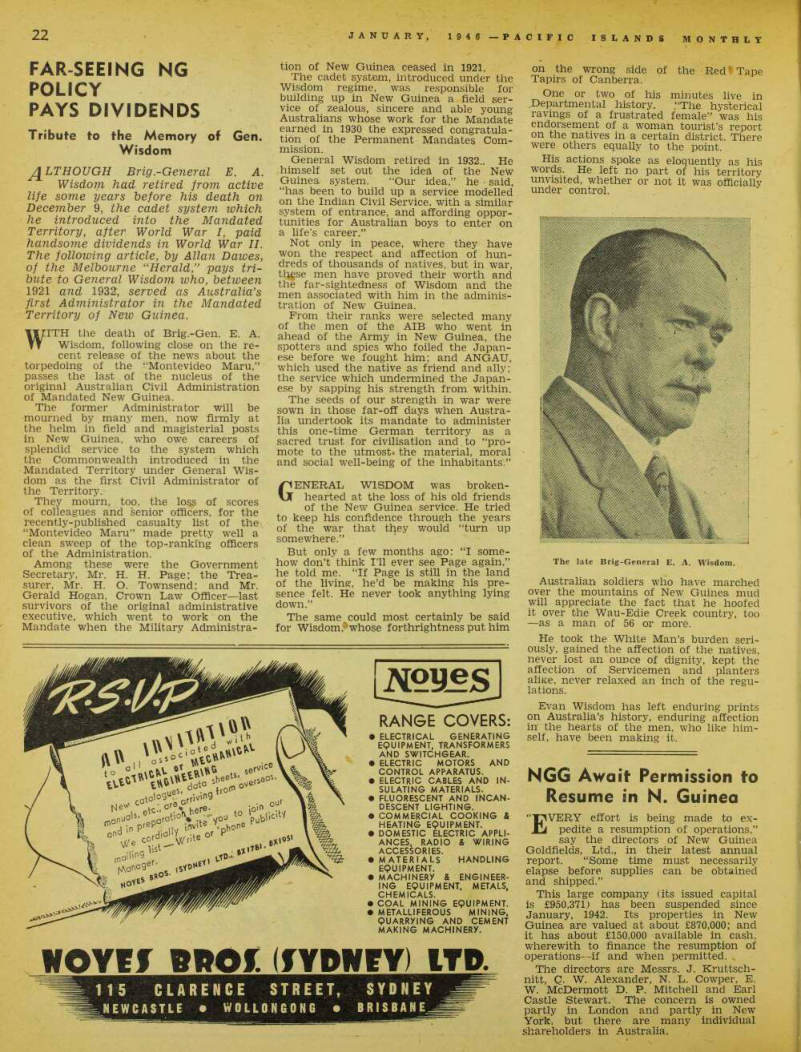
Policy
Pays Dividends
Tribute to the Memory of Gen.
Wisdom
Brig.-General E. A.
Wisdom had retired from active life some years before his death on December 9, the cadet system which he introduced into the Mandated Territory, after World War I, paid handsome dividends in World War 11.
The following article, by Allan Dawes,
of the Melbourne “Herald,” pays tri bute to General Wisdom who, between 1921 and 1932, served as Australia’s first Administrator in the Mandated
Territory of New Guinea.
WITH the death of Brig.-Gen. E. A.
Wisdom, following close on the re cent release of the news about the torpedoing of the “Montevideo Maru,” passes the last of the nucleus of the original Australian Civil Administration of Mandated New Guinea.
The former Administrator will be mourned by many men, now firmly at the helm in field and magisterial posts in New Guinea, who owe careers of splendid service to the system which the Commonwealth introduced in the Mandated Territory under General Wis dom as the first Civil Administrator of the Territory.
They mourn, too, the loss of scores of colleagues and senior officers, for the recently-published casualty list of the “Montevideo Maru” made pretty well a clean sweep of the top-ranking officers of the Administration.
Among these were the Government Secretary, Mr. H. H. Page; the Trea surer, Mr. H. O. Townsend; and Mr.
Gerald Hogan, Crown Law Officer—last survivors of the original administrative executive, which went to work on the Mandate when the Military Administra
tion of New Guinea ceased in 1921.
The cadet system, introduced under the Wisdom regime, was responsible for building up in New Guinea a field ser vice of zealous, sincere and able young Australians whose work for the Mandate earned in 1930 the expressed congratula tion of the Permanent Mandates Com mission.
General Wisdom retired in 1932.. He himself set out the idea of the New Guinea system. “Our idea,” he said, “has been to build up a service modelled on the Indian Civil Service, with a similar system of entrance, and affording oppor tunities for Australian boys to enter on a life’s career.”
Not only in peace, where they have won the respect and affection of hun dreds of thousands of natives, but in war, thfse men have proved their worth and the far-sightedness of Wisdom and the men associated with him in the adminis tration of New Guinea.
From their ranks were selected many of the men of the AIB who went in ahead of the Army in New Guinea, the spotters and spies who foiled the Japan ese before we fought him; and ANGAU, which used the native as friend and ally; the service which undermined the Japan ese by sapping his strength from within.
The seeds of our strength in war were sown in those far-off days when Austra lia undertook its mandate to administer this one-time German territory as a sacred trust for civilisation and to “pro mote to the utmost, the material, moral and social well-being of the inhabitants.”
GENERAL WISDOM was broken hearted at the loss of his old friends of the New Guinea service. He tried to keep his confidence through the years of the war that they would “turn up somewhere.”
But only a few months ago: “I some how don’t think I’ll ever see Page again,” he told me. “If Page is still in the land of the living, he’d be making his pre sence felt. He never took anything lying down.”
The same could most certainly be said for Wisdom,'whose forthrightness put him
on the wrong side of the Red Tape Tapirs of Canberra.
One or two of his minutes live in Departmental history. “The hysterical ravings of a frustrated female” was his endorsement of a woman tourist’s report on the natives in a certain district. There were others equally to the point.
His actions spoke as eloquently as his words. He left no part of his territory unvisited, whether or not it was officially under control.
Australian soldiers who have marched over the mountains of New Guinea mud will appreciate the fact that he hoofed it over the Wau-Edie Creek country, too —as a man of 56 or more.
He took the White Man’s burden seri ously, gained the affection of the natives, never lost an ounce of dignity, kept the affection of Servicemen and planters alixe, never relaxed an inch of the regu lations.
Evan Wisdom has left enduring prints on Australia’s history, enduring affection in the hearts of the men, who like him self, have been making it.
The late Brig-General E. A. Wisdom.
NGG Await Permission to Resume
Resume in N. Guinea
“TjWERY effort is being made to ex £j pedite a resumption of operations,” say the directors of New Guinea Goldfields, Ltd., in their latest annual report. “Some time must necessarily elapse before supplies can be obtained and shipped.”
This large company (its issued capital is £950,371) has been suspended since January, 1942. Its properties in New Guinea are valued at about £870,000; and it has about £150,000 available in cash, wherewith to finance the resumption of operations—if and when permitted.
The directors are Messrs. J. Kruttsch nitt, C. W. Alexander, N. L. Cowper, E.
W. McDermott D. P. Mitchell and Earl Castle Stewart. The concern is owned partly in London and partly in New York, but there are many individual shareholders in Australia.
Advertisements & other items, pp. 24-25 (2 items)
Hoges
\\*S \\\>i U l\X*' irof^ vin9 art' ore here x , 9 5' i76‘ 1.10 B*° S 0^ S
RANGE COVERS:
• ELECTRICAL GENERATING
EQUIPMENT, TRANSFORMERS
AND SWITCHGEAR.
• ELECTRIC MOTORS AND
CONTROL APPARATUS.
• ELECTRIC CABLES AND IN-
SULATING MATERIALS.
• FLUORESCENT AND INCAN-
DESCENT LIGHTING.
• COMMERCIAL COOKING &
HEATING EQUIPMENT.
• DOMESTIC ELECTRIC APPLI-
ANCES. RADIO & WIRING
ACCESSORIES.
• MATERIALS HANDLING
EQUIPMENT.
• MACHINERY & ENGINEER-
ING EQUIPMENT. METALS,
CHEMICALS.
• COAL MINING EQUIPMENT.
• METALLIFEROUS MINING.
QUARRYING AND CEMENT
MAKING MACHINERY.
NOYEf SMI IfYDNFV IT®.
115 CLARENCE STREET, SYDNEY
NEWCASTLE • WOLLONGONG • BRISBANE
lftk Nlc,ut
e
w * Coleman’s Petrol Iron lights instantly ... is evenly balanced . . . has ventilated body, tapered ironing edges, pointed heel and hot point.
Can be used in or out of doors.
Coleman’s SOLUS Stove assembled in 30 seconds. Bums AND Preheats with Kerosene. 5-6 Hours on one filling.
Boils 1 quart in 3 minutes.
May be carried in any position-fuel cannot leak.
I
ALL-PURPOSE LANTERN
STORM-PROOF . . . DEPEND-
ABLE AND SIMPLE IN
OPERATION
Coleman Pressure Lanterns are in two sizes and two types (Petrol and Kerosene). The perfect safety and trouble-free service which Coleman Lanterns have given over the past forty years are your guarantee of perfect satisfaction.
D PRIZE Kerosene Wickless Stoves, 2 and 3 Burner Models. Beautifully finished white baked enamel —ample cooking top with heavy steel grates. Glass fuel tanks.
Coleman’s Portable Cooking Stove lights instantly, has safety shut-off valves and instant heat control. Made of EVERDUR (rustproof), finished in ivory and brown baked enamel.
X Representatives for the Pacific Islands:
ROBERT GILLESPIE PTY. LTD.
54a PITT STREET, SYDNEY
PEARCE & CO. LTD.
SUVA
FOR FIJI ISLANDS
Death Of Old Fiji Planter
A WELL-KNOWN resident of Savu Savu district, Fiji, Mr. E. T. Francis, died at his home, Ono Estate, Cen tral Savu Savu, on November 30, at the age of 89. Mr. Francis arrived in Fiji 35 years ago, to take up planting. He came from Ontario, Canada, and was a son of Dr. Francis. He had been ill for a considerable time. He leaves a widow.
Among those who visited Tonga for the recent centenary celebrations (they commenced- on December 4) were the Governor of Fiji, Sir Alexander Grantham, and Lady Grantham, and a Fijian chiefly party, headed by Ratu Sukuna.
Samoa Looks Ahead
What is Necessary in the Way of Reforms
By A. M. Gurau
*\T EW ZEALAND’S Mandated Territory li of Western Samoa might be called the “India” of New Zealand. In spite of over 30 years of New Zealand’s Military and Civil Administration, under the National and Labour Governments; in spite of far-reaching concessions to the Samoans which have succeeded in creating a truce and resulted in the abandonment of active and non co-operative opposition by the Samoans; in spite of all this, the natives have in sisted and are still insisting on a larger measure of self-government.
The great importance that the New Zealand Government attaches to a final and satisfactory solution of Samoan prob lems is reflected in the three visits paid to Western Samoa by the Governor- General during the last two years, in the official visit paid by the New Zealand Prime Minister and in the recent visit to New Zealand by the three paramount High Chiefs of Samoa, as guests of the New Zealand Government. In addition, a delegation of Samoan political leaders will visit New Zealand shortly and in spections will be made of the Territory by the heads of the New Zealand Medi cal and Education Departments.
All these polite exchanges and the re organisation of several Departments in the Samoan Administration, obviously indicate radical changes in policy, and a realisation that the previous course has not produced satisfactory results.
Undoubtedly, the events of the war years, the American “invasion’ of the Territory, the attitude of the USA, post war developments in the Pacific gener ally, have appreciably contributed to the decision of the NZ Government to place its relations with the Mandated Terri tory on a more conciliatory and amiable basis than heretofore.
It is claimed in Samoa, that while the most successful and most popular Gover
nor of Samoa, the German Dr, Solf, was given a free hand by the Imperial Ger man Government to decide matters of policy on the spot, the retiring Executive head of the Samoan Administration, Sir Alfred Turnbull, was, for the 10 years of his office, greatly limited in his powers, and had to await the decisions of the Wellington bureaucracy even in minor matters of policy. It is sincerely hoped that the new Administrator shortly to succeed Sir Alfred, will be granted a far greater measure of liberty in this regard.
It is completely wrong to label the Samoans, simply because they demand a greater voice in the government of their country, “anti-Go' r ernment, N “anti-New Zealand” or “anti-British” (or even “pro- American” and “pro-German”). The simple fact is that the Samoans are “pro- Samoan” and, in fairness, nobody can blame them for that. rpHE new Administrator, Colonel J. Voelcker, will be welcomed to Samoa with an open mind. Though the “dollar” prosperity period is now de finitely finished, the economic situation in the Territory is very satisfactory.
Prices of Samoan produce are very good and there are indications that the next year will see the expansion of agricul ture, particularly the cocoa industry, and probably the establishment of secondary industries. This favourable development should go hand-in-hand with a political re-orientation of New Zealand policy.
A step in the right direction which the New Zealand Government has taken is the education and training of Samoan boys and girls for professions, trades and Government careers, as a necessary pre paration for giving qualified Samoans a greater share in the administration of the Territory. It would be a great mistake to neglect agricultural training as seems likely at present. Samoans should be trained as agricultural advisers of their people and a properly equipped and staffed Department of Agriculture estab lished. rE new Administrator would do well to establish more and better con tacts with the Samoan and European representatives than through the medium of rare Legislative Council meetings and the annual Fono of Faipule. Samoan and European leaders should, as fre quently as possible, be given the oppor tunity of submitting their views on mat ters of policy and needed reforms to the Administrator.
Apart from the Samoan demands for a greater share in self-government, there are a great many reforms which Samoans and Europeans have urged for years with out success.
For instance, the installation of a filter bed in the water supply scheme would, in the opinion of Apia residents, improve health in the Apia district. And, with the rapidly-increasing population, the present staff of the Medical Department of three European medical officers (or one to over 20,000 inhabitants) seems in sufficient. There should be at least an other medical officer stationed on the island of Savaii.
Cutting-up of the Government Repara tion Estates and leasing or selling Gov ernment land to landless part-Samoans and Samoans is also urgently necessary and would probably obviate the present large migration to New Zealand of young boys and girls who cannot find useful employment in their own country.
Advertisements & other items, p. 26 (1 item)
Marys
N APT
TUBERCULOSIS
a post-war problem tor the British Commonwealth For information on
• EDUCATION
• RESEARCH
• PROPAGANDA
WRITE TO
National Association for the Prevention of Tuberculosis Tavistock House North, London,
W.C.I.
Membership: Ten shillings per annum.
ALL STOREKEEPERS HAVE—
AUNT
MARYS
BAKING POWDER
Aunt Mary's Baking Powder is now obtainable from your storekeeper. That's good news for you, especially as Aunt Mary's Baking Powder maintains the high quality which has stood the test of housewives for over 70 years.
There is no substitute for Aunt Mary's—There never will be.
Tropical Islands
Future Government of Tropical Islands
A LTHOUGH the following statement by Colonel Oliver Stan ley (made recently while he still teas British Minister for the Colonies) dealt specifically with the situation in the West Indies , it gives an indication of Brtish policy in relation to tropical islands administration generally.
I HAVE been considering the question of constitutional policy in relation to the Colonies of the Caribbean (West Indies) area, considered as a whole.
It will. I think, be generally agreed that under modern conditions it has be come more difficult for very small units,whatever their outward political form may be, to maintain full and complete independence in all aspects of Govern ment. Nor do existing tendencies make it appear any more likely that such in dependence will be easier for these small communities in the future. Indeed, the trend of post-war development, under the stimulus of greatly improved air communications, mav well s * iQ w marked impulse towards a closer political and other association of those smaller territorial units which, through proximity or a common language, have mutual in tcrests I consider it important, therefore, that the more immediate purpose of develop ing self-governing institutions in the in dividual British Caribbean Colonies should keen in view the larger project of their political federation, as being the end to which in the view of the Royal Commission nolicy should be directed.
In spite of the desire which has been expressed in certain quarters for a West Indian federation, it may be that public opinion generally would not be ready to accept a federal constitution, and the British Government would not wish to enforce such a constitution against the wishes of any large section of the com munity. It is their considered view that movements towards such political unity must come from within and not from outside the area.
In view of the greater economy and efficiency in general of large-scale units of government under modern conditions.
I consider that the aim of British policy should be the development of federation in the Caribbean at such time as the balance of opinion in the various Colonies is in favour of a change, and when the development of communications makes it administratively practicable.
The ultimate aim of any federation which may be established would be full internal self-government within the British Commonwealth. But it will no doubt be generally appreciated that financial stability (which is of course very different from economic self sufficiency) is an essential accompani ment of iull self-government, and that the latter cannot be a reality witlmut the former One imnortant responsibility of any federation would, therefore, be to show that federal administration can be carried on without requiring recurrent financial assistance from outside.
Death Of Mrs. Elizabeth
Whippy
A WELL-KNOWN resident of the Levuka district of Fiji, Mrs. Eliza beth Whippy, died at the home of her daughter, Mrs. George Mitchell, in Levuka, on November 18. Mr. A. Whippy, her husband, died some years ago.
Mrs. E. Whippy, who was 56 years of age, was a daughter of the late Mr. David Riley, of Naigani Island, and was very widely known and respected. She is sur vived by a large family of sons and daughters—Mr. Everett Whippy (super cargo of Tui Natewa); Mrs. G. Mitchell and Miss Daisy Whippy (Levuka); Mrs.
G. Thomas (Levuka); Mrs. J. Robinson (Mango); Messrs. Mathew Whippy (Wai nunu), and Joseph Whippy (Tui Cakau); by her sisters —Mrs. E. Woodhouse (Levuka); Mrs. Walter Jamieson (Vanua Levu); Mrs. Charlotte Whippy (Yasawas); Mrs. H. D. Donnolly (New Zealand); and by her brothers —Messrs. W. and J. Riley (Levuka and Viti Levu).
Brigadier John D. Rogers was appointed as general manager for the Vacuum Oil Company in New South Wales in Novem ber. He has just returned from distin guished war service—he was Director of Military Intelligence with the rank of brigadier, and was awarded the OBE — and is well known in the oil industry. He served also in the first World War, from Gallopoli to the armistice, where he won the MC. He was educated at Geelong College, Victoria, and is a graduate in science of Melbourne University.
Invasion of New Guinea, 1942-45
Mr. And Mrs. C. H. Luxmoore,
of Rabaul and Buka Passage, New Guinea, extend their deep sympathy to all relations and friends of those gal lant men who paid the supreme sacri fice.***
Flight-Lieutenant W. S. Askew, who was well-known in the Pacific, both in New Hebrides, on a sulphur-mining enter prise, and in the Solomons on a copra plantation, has just concluded four years of active service in the Western Pacific in the RAAF. He is awaiting discharge; and his nose already is turned towards the Pacific Territories.
Advertisements & other items, p. 27 (1 item)
Australian Aluminium
Refreshing
as a plunge
into a lagoon!
Germicidal
and fragrant
TENAX TOILET SOAP is
a rapid safeguard against external skin infections, yet it is soothing and kind to the most sensitive skin —even a baby’s!
ORDER TENAX FROM
YOUR ISLAND SUP-
PLIERS. STOCKS ARE
PLENTIFULLY AVAIL-
ABLE.
ALUMINIUM and its ALLOYS
This company supplies Aluminium and its Alloys to all specifications and for every commercial application where these give better service over other metals.
Please consult our Technical Service Department regarding your light metal problems.
AUSTRALIAN ALUMINIUM
PROPRIETARY LIMITED
(INCORPORATED IN THE STATE OF VICTORIN)
GENERAL OFFICES AND FABRICATION DIVISION : GRANVILLE , SYDNEY. N.S. W.
Improvisation
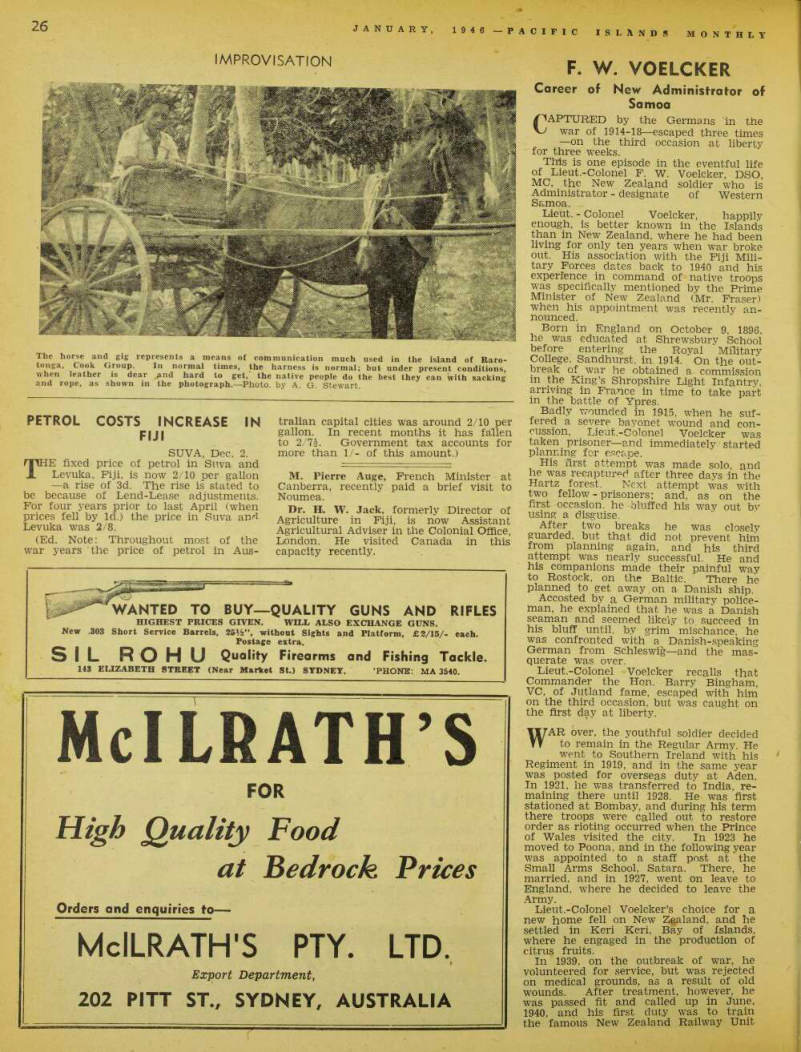
The horse and gig represents a means of communication much used in the island of Raro tonga, Cook Group. In normal times, the harness is normal; but under present conditions, when leather is dear and hard to get, the native people do the best they can with sacking and rope, as shown in the photograph.—Photo, by A. G. Stewart.
Petrol Costs Increase In
Fiji
Suva, Dec. 2.
fTTHE fixed price of petrol in Suva and J. Levuka, Fiji, is now 2/10 per gallon —a rise of 3d. The rise is stated to be because of Lend-Lease adjustments.
For four years prior to last April (when prices fell by Id.) the price in Suva and Levuka was 2 8. (Ed. Note; Throughout most of the war years the price of petrol in Aus
tralian capital cities was around 2/10 per gallon. In recent months it has fallen to 2/71. Government tax accounts for more than 1/- of this amount.) : . = M. Pierre Auge, French Minister at Canberra, recently paid a brief visit to Noumea.
Dr. h>. W. Jack, formerly Director of Agriculture in Fiji, is now Assistant Agricultural Adviser in the Colonial Office, London. He visited Canada in this capacity recently.
F. W. Voelcker
Career of New Administrator of Samoa
CAPTURED by the Germans in the war of 1914-18—escaped three times —on the third occasion at liberty for three weeks.
This is one episode in the eventful life of Lieut.-Colonel F. W. Voelcker, DSO, MC, the New Zealand soldier who is Administrator - designate of Western Samoa.
Lieut. - Colonel Voelcker, happily enough, is better known in the Islands than in New Zealand, where he had been living for only ten years when war broke out. His association with the Fiji Mili tary Forces dates back to 1940 and his experience in command of native troops was specifically mentioned by the Prime Minister of New Zealand (Mr. Fraser) when his appointment was recently an nounced.
Born in England on October 9, 1896. he was educated at Shrewsbury School before entering the Royal Military College. Sandhurst, in 1914. On the out break of war he obtained a commission in the King’s Shropshire Light Infantry, arriving in France in time to take part in the battle of Ypres.
Badly wounded in 1915, when he suf fered a severe bayonet wound and con cussion, Lieut.-Colonel Voelcker was taken prisoner—and immediately started planning for escape.
His first attempt was made solo, and he was recaptured after three days in the Hartz forest. Next attempt was with two fellow - prisoners; and, as on the first occasion, he bluffed his way out bv using a disguise.
After two breaks he was closely guarded, but that did not prevent him from planning again, and his third attempt was nearly successful. He and his companions made their painful way to Rostock, on the Baltic. There he planned to get away on a Danish ship.
Accosted by a German military police man, he explained that he was a Danish seaman and seemed likely to succeed in his bluff until, by grim mischance, he was confronted with a Danish-speaking German from Schleswig—and the mas querate was over.
Lieut.-Colonel Voelcker recalls that Commander the Hon. Barry Bingham, VC, of Jutland fame, escaped with him on the third occasion, but was caught on the first day at liberty.
WAR over, the youthful soldier decided to remain in the Regular Army. He went to Southern Ireland with his Regiment in 1919, and in the same year was posted for overseas duty at Aden.
In 1921, he was transferred to India, re maining there until 1928. He was first stationed at Bombay, and during his term there troops were called out to restore order as rioting occurred when the Prince of Wales visited the city. In 1923 he moved to Poona, and in the following year was appointed to a staff post at the Small Arms School, Satara. There, he married, and in 1927, went on leave to England, where he decided to leave the Army.
Lieut.-Colonel Voelcker’s choice for a new home fell on New Zealand, and he settled in Keri Keri, Bay of Islands, where he engaged in the production of citrus fruits.
In 1939, on the outbreak of war, he volunteered for service, but was rejected on medical grounds, as a result of old wounds. After treatment, however, he was passed fit and called up in June, 1940, and his first duty was to train the famous New Zealand Railway Unit
at Ngaruawahia. In November, 1940, he sailed for Suva, to command the Train ing Battalion in the Eighth Brigade Group.
He commanded the 30th Battalion at Namaka during the hurricane which swept through the Group early in 1941.
Twenty-two men of his battalion were selected for coast-watching duty at this time, and ten of thepi were among the 17 coast-watchers who were murdered by the Japanese at Tarawa in October, 1942.
Lieut.-Colonel Voelcker went to New Zealand in June, 1942, but returned to Fiji to command the 3rd Battalion of the newly-formed Fiji Infantry Brigade Group. After 18 months of garrison duty in Fiji, the battalion sailed for Bougainville early in 1944.
Commanding the battalion in action on Bougainville, Lieut.-Colonel Voelcker was awarded a DSO and the American Bronze Star. . Corporal Sefanaia Sukanaivalu, who was awarded a posthumous Victoria Cross for gallantry during the Maweraka action, came from his battalion.
On return from the Solomons, Lieut.- Colonel Voelcker had a furlough in New Zealand before returning to Fiji to pre pare his battalion for further action abroad. “VJ-Day” put an end to those plans, and he had returned to New Zea land when his new appointment to Samoa was announced.
Lieut.-Colonel Voelcker has two daughters.
Advertisements & other items, p. 28 (1 item)
Mcilbath’S
WANTED TO BUY—QUALITY GUNS AND RIFLES
HIGHEST PRICES GIVEN. WILL ALSO EXCHANGE GUNS.
New .303 Short Service Barrels, without Sights and Platform, £2/15/- each.
Postage extra.
SI L RO H U Quality Firearms and Fishing Tackle. 143 ELIZABETH STREET (Near Market St.) SYDNEY.
’PHONE: MA 3540.
McILBATH’S
FOR
High Quality Food
at Bedrock Prices
Orders and enquiries to—
McILRATH'S PTY. LTD.
♦ Export Department,
202 PITT ST. f SYDNEY, AUSTRALIA
Military Medal to Rotuman Soldier
THE Military Medal has been awarded to Staff Sergeant Josefa Rigampto, a former member of the Fiji Medical Corps. , Tfie citation accompanying the award states: “During the period of active ser vice on Bougainville, detachments of the Bearer Company were in the habit of accompanying the two Infantry Batta lions during their operations against the enemy, and did particularly fine work under trying and dangerous conditions.
“Staff Sergeant Rigamoto usually ac companied these detachments. During the 3rd Battalion operations on the Mawaraka the Bearer Company per sonnel, under the personal leadership of this NCO, carried out work of a decidedly high order in dealing with wounded under enemy fire and difficult circum stances. His energetic leadership and lack of thought for his personal safety were an example, not only to his own bearers, but to all with whom he came in contact.”
Staff Sergeant Rigamoto is a native of Rotuma. He has now been discharged from the Army, and has returned to Rotuma, where some months ago he was appointed Officer-in-Oharge.
Flying-Officer Les H. Wilkinson, for merly of Misima, Papua, arrived back in Sydney on the “Aquitania” in November after 2 h years in the RAAF abroad, mostly in England. He was in Lancaster bom bers, and he was 18 times in operational flights over Germany. He was a radio officer, and his pilot on all those flights was Flying-Officer Bill Passlow, who was on the Bulolo. Gold staff in New Guinea before the war, now back in Brisbane.
The crew included the two New Guinea men, one Scotchman, three Englishmen, and one Hong Kong colonial —a typical cross-section of Empire. Wilkinson and Passlow have •their noses turned New Guineawards; but there is little hope for the re-establishment there of such men while Wardism endures.
Lieut. Andresen
KICKING impatient heels in the RAN hospital “Canonbury,” in Queens land, while getting rid of a fine collection of fever, is Lieutenant A. M.
Andresen, RANVR, who was mentioned in despatches for good work in that very hush-hush unit of the South-west Pacific war, the Allied Intelligence Bureau.
From February until October, 1942, Mr.
Andresen —a former resident of the Solo mons—was a civilian coast-watcher on Guadalcanal and, according to official records, “he carried out courageous patrols in close proximity to the Japs.’’
He then was taken into the Navy, and was sent into the enemy-occupied Russell Islands.
When the Americans came in and took the Russells, Lieut. Andresen moved over to Ysabel, where, to keep watch over the Jap flying-boat base at Rekata, he estab lished a camp only two miles away, and reported enemy movements yntil October, 1943. He spent 1944 mostly watching the enemy in Choiseul; and early in 1945 he was sent to do similar intelligence work in the Green Island-Emirau-New Han over areas. His courage and efficiency have been warmly praised.
His performance is typical of that of scores of men who did most difficult and dangerous work in the AIB, without any publicity or praise—in fact, until the war ended, few civilians had ever heard of the AINAIB.
Mr. and Mrs. L. C. Bentley recently returned to Suva, Fiji, .after a short holi day in New Zealand.
W. Samoa's Revitalised
Banana Industry
From Our Own Correspondent
Apia, Nov. 19.
rE Samoan banana industry, the foundations for which were laid by Sir George Richardson when Ad ministrator of W. Samoa, is now 17 years old.
From small and difficult beginnings, the export shipments grew into an important factor in the Territory’s economy and promised to surpass in value the two old-established export Industries of copra and cocoa-beans. They actually took first place in exports in 1940 and 1941.
Then, however, with the coming of American defence Forces, the banana in dustry suffered a disastrous reverse; the Samoans left their plantations and the exports dropped from 177,416 cases in 1941 to 79 897 cases in 1942, 64,373 cases in 1943 and 32.486 cases in 1944.
At present, however, there is a distinct recovery of the industry, a factor of which is the new trans-island road built by the Americans which has opened up large and fertile stretches of land for banana planting and facilitated trans port, by trucks to Apia. It is expected that exports in 1945 will amount to about 100,000 cases and that further increases may be counted upon in the future.
According to official figures, since 1928 a total of 1,908,893 cases of bananas have been exported to New Zealand with total value of £500,000.
Advertisements & other items, pp. 29-30 (1 item)
nsomes
Allen Taylor 8i Co. Ltd.
COMMERCIAL ROAD, ROZELLE,
SYDNEY
Sawmillers and Wholesale Suppliers of Hardwoods for Constructional Purposes GIRDERS . . . PILES . . . POLES . . . SLEEPERS, Etc.
EXPORTING TO PACIFIC ISLANDS SINCE 1893
PLOUGHS for EVERY PLANTER
There is a Ransomes Plough for every planter. For nearly 150 years Ransomes have been leaders in plough design, and to-day they offer a range for animal and tractor draught covering all possible requirements. Whether a light steel plough or a tractor disc plough weighing more than 3 tons is required, there is a Ransomes model which will give complete satisfaction.
nsomes
THE
"CUB
PLOUGH
Write for illustrated catalogues and all information. Ask also for particulars of our lawn mowers, aerodrome equipment, etc
MORRIS, HEDSTROM LTD.
Suva, Lautoka and Ba.
Made by: RANSOMES, SIMS & JEFFERIES LTD., IPSWICH, ENG.
PRELIMINARY ANNOUNCEMENT;
PACIFIC
PLANTER’S
HANDBOOK
Publication in 1946 IN response to a strong and growing demand for an authoritative Handbook covering the whole field of Planting and Agriculture in the Pacific Islands, the compilation of the “Pacific Planter’s Handbook” was commenced in 1945. It has been much delayed by strikes, but publication is planned for 1946.
The Handbook is designed to give standard instruction on all the branches of Tropical Planting which might be undertaken in the Pacific Islands, and to be regarded as an indispensable part of a Pacific Planter’s equipment.
SECTIONS of the Handbook deal separately with Palms (including Coconuts and the Manufacture of Copra), Cocoa, Coffee, Rubber, Citrus, Bananas, Vanilla, Spices, Kapok, Pineapples, etc.
The production of every plant grown for profit in the islands is described.
Other Sections cover such subjects as: Livestock on the Plantations; Revenue from Non-Agricultural Products (Sea, Forest, Minerals); How to Ensure Comfortable and Healthy Living Conditions in the Islands; Etc.
SPECIAL SECTIONS: Survey of Opportunities; Selection of Territory (Malarial and non- Malarial, Melanesians and Polynesians, Climate and Rainfall); Lands and Land Laws; Labour Conditions in the Various Territories; Importance of Transport; What You Must Provide For and Against in Choosing Your Plantation.
The subject of MARKETING is dealt with very fully. It is no use planning your plantation until you know where you will find a profitable market for your product, and whether it is dependable.
EACH SECTION WRITTEN BY AN
EXPERT
Numerous Photographs, Diagrams,
Drawings, etc.
PUBLISHED PRICE : Not less than 35/- Australian. (NOTE: Owing to the present difficulty of obtaining paper and binding service, it Is impossible to fix a price, until the work is near completion. It will be between 35/- and 40/-, Australian. The edition will be limited. Persons who wish to be sure of a copy may order in advance; and if 35/- is sent, that will be accepted as the price of the book, although the final published price may be higher.) Orders may be sent to:
PACIFIC PUBLICATIONS
PTY. LTD.,
Union House, 247 George Street,
Sydney
or to the PUBLISHERS DIRECT:
PACIFIC PUBLICATIONS (FIJI)
LTD.
P.O. Box 281, Bank of N.S.W. Building,
SUVA, FIJI. SUVA, FIJI.
Houses of Metal and Asbestos
Home Building in the Pacific Islands:
The Second of a Series of Articles supplied by Wunderlich, Ltd., of Sydney.
MODERN architect-designed homes are now being erected in Sydney and Brisbane by Tullochs Pty,, Ltd., Rhodes, a well-known steel firm. They are soundly constructed homes of in dividuality and charm. Known as the “Econo-steel” framed house, they are built from pressed and rolled steel sec tions, designed to lesist rust and cor rosion under humic conditidns, and are immune to the ravages of white ants, borers, rot and fire.
The patented nailing slot enables asbestos-cement sheets, or other sheet materials, to be nailed direct to pressed metal studs and ceiling joists, which are set out to suit stock-sized sheets, thus eliminating waste and site cutting. Floor joists, bearers and piers are of rolled steel sections, braced and designed to re sist winds of hurricane force. Wood floor boards are nailed direct to the steel joists. Floor and ceiling joists are in long lengths, rigid, true and extraordinarily light to handle.
The “Econo-steel” frame comprises the floor members, wall studs and plates, with window and door trims, ceiling joists, of prefabricated light steel angles, and rolled sections. * Patented features reduce bolts to a minimum, and the entire steel skeleton may be erected by unskilled labour, using only a hammer and spanner, in a frac tion of the time taken with usual methods.
ALL “Econo-steel” sections are bundled into handy, freightable packages which fit together on the site in a foolproof manner, and may be assembled rapidly by labour unfamiliar with normal building practice. In fact, the “Econo steel” framing technique is not dissimilar to that used by a small boy with a Mec cano set.
Door and window positions are inter changeable, and may be inserted any where in the frame. All studs, ceiling and floor joists are identical in lengths and drillings, and cannot be misplaced.
When erecting, the frame automatically plumbs and squares itself, as the units are all precision built and designed to entirely eliminate cutting and fitting on the site.
Once the “Econo-steel” frame is erected, asbestos-cement wall and ceiling sheets may be fixed, and corrugated asbestos-cement roof sheets bolted or screwed to the roof members.
In the bathroom, laundry and kitchen, wall-tile patterned material may be nailed direct to the studs.
No woodwork is necessary, excepting for flooring boards, doors and windows, although the addition of wood ceiling battens simplifies the fixing of ceiling sheets.
The price of the “Econo-steel” frame is competitive with timber, and Tullochs Pty., Ltd., have prepared an unlimited range of home plans.
“T7ICONO-STEEL” homes and struc- Hi tures cover a wide field. Apart from homes there are available now numerous types of steel-framed, pre fabricated structures for use as cover sheds for equipment, stock, fodder and general merchandise. The basic principle of these structures is their folding trusses, or wall and roof frames. These may be quickly extended to spans of 18 ft., 20 ft., 30 ft. and 40 ft. wide, and in
lengths to suit units of 9 ft. and 10 ft. long, to any required overall length.
Horizontal roof purlins and wall girts are Z or L-shaped sections. Once again these are quite fool-proofed, bolting is reduced to a minimum and all members are of a convenient size, able to be sent anywhere, and erected rapidly by un skilled labour.
History Of New Guinea
Timbers
Letter to the Editor AS I was secretary of the first com pany to handle New Guinea timber on a commercial basis, I think the article on page 23 of .your October issue is most timely.
In 1910 a timber company was started and in 1912 it operated a sawmill at Manu Manu. ’The mill was collected from various parts of the Territory and the boiler was picked up on the banks of the Jones River in behind the island where the Bona Bona boys hailed from.
The small ketch, “Kia Ora ’—Bill Doig in charge—did the towing, and the old “Moresby” (Capt. Mclnnes) lifted her onto her decks and subsequently dis charged her onto the deck of the “Zolma,” skippered by Tommy Bakker, who took the essential piece of machin ery to Manu Manu by the creek which flowed into Galley Reach.
The history of the mill is most in teresting. The head sawman was a Scan dinavian whose name was Benson. He “broke down” Ilimo and another soft wood which sold very readily in Port.
Melila, a hardwood was also shaped and used for decking the PM wharf, whilst some mangrove was shaped into railroad ties, and sent to Java where, after treat ment, it was—so I am advised—used on the NEI railroads.
The barque “Okta,” Norwegian-owned, loaded nearly one million log feet of Ilimo at the Vari Vari’s, and the logs were towed by the “Dexter,” owned by Dexter and Izod, of Moresby. This was in March, 1914, and the whole shipment consigned to Gabriel, Sons and Burton, London. Soon after the “Okta” reached England, the 1914-1918 war started, and the whole shipment, instead of being a loss, sold for a handsome profit.
In behind Vilirupu, Galley Reach and parts of Kikori and the Western Divi sion, timber could be cut from the face; then, after breaking down, sorted into various kinds and would, I am sure, find a ready market not only in the Common wealth but in New Zealand.
I am, etc..
J. Nixon-West Wood.
Wellington, NZ, 3/12/1945.
Mr. E. R. Bevington, of the Colonial Service, Fiji, is at present on leave in England. Before he returns to the Colony he will undertake work in Nigeria on behalf of the Colonial Office. He has been appointed secretary of a Commission which will investigate cost of living there.
A visitor to Suva in December was Mr.
V. M. Brooker. chief officer of the Broad casting Division of Amalgamated Wireless (Australasia). Limited. He discussed with Government representatives, matters connected with broadcasting in the Colony.
Advertisements & other items, p. 31 (1 item)
S'utiiv**
HARRYJ
Sole Pacific Island Selling Representatives for
JOHN VICARS PI? Ll£
WOOLLEN
WORSTEDS
S'utiiv**
Sc - ?.3K- > rl
MADE FROM THE FINEST
AUSTRALIAN WOOLS
By using the most'scientific methods of manufacture, John Vicars Pty. Ltd. produce these outstanding materials.
Fine wools and fine workmanship have produced quality cloths. They are designed to give satisfaction in any climate.
HARRY J.YOUNG PTY.LTD.
Postal Address: Box 3661, G.P.0., Sydney.
379 KENT STREET, SYDNEY
Bankers: Bank of N.S.W.
Codes: Bentley’s, Comp. Phrase J Bentley’s 2nd Phrase M
The Scolia Wasp
Letter to the Editor
IT may interest your readers to know that in 1933 I sent to the authorities in Samoa a full translation of an article from a French agricultural maga zine, describing in detail the action of the Scolia wasp in relation to Rhino ceros beetle larvae. The origin of this particular wasp was given as Madagascar.
I had no acknowledgment from any source of the information I supplied hav ing been received; but I am pleased to learn now that something was done with this remarkable insect—although it was, seemingly, necessary to wait another six years, and for the stimulation of an en tomologist from a nearby Colony.
I think your readers would be interested in a description of the action of this valuable insect in combating the scourge of the Rhinoceros beetle. Perhaps some correspondent better able than I will move into the breach.
I am, etc.,
Massingham Folkard.
Suva, 26/11/45.
Mr. J. H. L. McGuigan, who was liberated from a POW camp in Singapore in September, is now back in Australia, and has received his discharge from the AIF. He expects to return to the New Guinea Administration Service in 1946.
Mr. and Mrs. McGuigan are residing at 150 The Esplanade, Middle Brighton, Vic toria.
Exports
All-Time High In Samoan
From Our Own Correspondent
T Apia, Nov. 19.
HE month of November promises to be an all-time record for exports from Western Samoa.
An American ship, “Alabaman,” which on November 8 with a 770-ton ship ment of cocoa-beans is clear evidence of how the local cocoa industry has been stimulated by the high prices now paid for Samoan cocoa-beans—they bring from £9O to £95 f.o.b. Apia.
Total value of the goods lifted from Apia by the “Alabaman” is estimated at
£Loo,Ooo.
The “Maui Pomare,” which left on November 14, lifted only a small ship ment of bananas for the New Zealand market; 2,500 cases were ready for ship ment but 500 cases were left behind for want of shipping space which was re served for bananas from Niue Island, her next port of call.
The “Matua,” which arrived here yes terday, is at present loading a shipment of about 9,000 cases of bananas.
Another American steamer is expected before the end of the month to lift ad ditional shipments of copra and cocoa beans.
Mr. H. E. Maude, who has filled nearly every senior office in the Western Pacific High Commission in the last seven years, has gone to Tarawa to act as Resident Commissioner of the Gilbert and Ellice Islands, during the absence of Colonel V.
Fox-Strang ways. He is accompaiiied by Mrs. Maude.
Returning home
Written in New Guinea in 1943, by
L. J. Gomm
Returning home
The simple things will please me most; Lights incandescent, childish laughter, The dim-lit room with firelight softly glowing; The emerald velvet of a lawn close cropped And many-scented fragrance of a garden’s flowers.
Damask-white cloths, Rich-laden with the fare of home-cooked food; Clean floors, and pictures, dear, familiar, The cool embrace of sheets upon the bed; And music lulling too-wrought nerves to slumber, And heart’s-ease in the spirit of a Home. i Surf tossing waves Upon the glorious beaches, The grace of athletes on the sparkling sands; Good roads, with cottages beside them, And horses’ hooves light-touching grassy turf, With cattle grazing ’neath the setting sun.
The sweet companionship Of noble books; and quiet meditation, The undisturbed talk of friend with friend; The glint of humour, swift, unvenomed kindly, And dewy evening softening into twilight Illumined best by understanding—mutual love. 4 These give to me In place of hate and carnage; These we have fought for and we shall retain; Warm blood has flowed to guard them from destruction And men who longed to live have died— but not in vain.
For we shall build a grateful strong mosaic Of paths undangered for our children’s feet, A world where living each for other The sons of freedom in full brotherhood may meet.
Returning home The simple things will please me most, And I shall dearly prize them, deep regretting That such an earth must cost so great a price.
The Rev. C. J. and Mrs. Williams, of the Methodist Mission, Western Samoa, are at present in Melbourne. They are wait ing for transport to return to their work.
Territorians who were seen recently in Cairns included: Two Torres Straits pilots, Captain Ted Clay (late of Samarai) and Captain Campbell (late of BP’s and now carrying some scars caused by Jap bombing attacks); Bishop Strong, return ing to Samarai; Captain Bill Wilding, of the SS “Mangola”; Captain James Dun can, ex-Harbour Master, Rabaul; Mr. Ted Evans, who for many years worked with Mr. Tex Roberts in Rabaul; and Mr. G. H.
Ranson, a Namatanai (New Ireland), planter, who was recently liberated in Germany. Messrs. Evans and Hanson have made their homes permanently in Cairns.
Advertisements & other items, p. 32 (1 item)
Dependable roleman
Q \\H/ / \ / \
NOW AS ALWAYS
For over forty years COLEMAN has built a reputation for dependability in lighting, cooking and heating appliances. Built from the same first quality materials as always, with the exclusive Coleman features, you are always assured of the best when you buy dependable Coleman. Wherever you are there is a Coleman dealer to serve you with dependable COLEMAN appliances and service.
THE COLEMAN LAMP AND STOVE COMPANY LIMITED
TORONTO, CANADA
CHICAGO, U.S.A,
Papuan-born Officer's
Fine War Record
IP the achievements of Pacific Islands men, between 1939 and 1945, could be collected into one volume, it would make probably the most remarkable re cord of adventure connected with World War 11. Every day, some new story of courage and initiative comes to light.
Here is the story of Major Gordon Lett, who was born in Papua in 1910, the son of well-known Lewis Lett. He became a professional soldier in 1931, and served in the East Surrey Regiment, and on the North-West Frontier of India. He went to Egypt with the 4th Indian Division when World War II be gan, in 1939.
Gordon Lett, between 1939 and 1942, fought through the campaigns in Abys sinia, Somaliland, Eritrea, and Libya. He was wounded once, three times men tioned in despatches, and twice recom mended for a decoration. He was cap tured by the Italians when Tobruk fell, in June, 1942, and sent to Chieti.
Enemies did not find Gordon Lett a nice man to know. He was so thoroughly unpleasant at Chieti that the Italians labelled him “dangerous,” and sent him to PG29, under v a special guard. But he was there only a month.
Italy capitulated in September, 1943, and Major Lett was released. He made his way northwards, behind the German lines, and got into the mountains north east of Siena. Here he organised a force, of released POW’s and Italian partisans, assumed control over an area of country, and carried on guerilla warfare against German transport and communications.
Major Lett’s force, and the extent of his operations, grew steadily. He got into direct touch with London. The War Office sent him radio sets, and author ised him to carry on as commander of “No. 5 Special Force.” Growing ever bolder and stronger, he led his men into Siena, drove out the German garrison, and carried on as Governor until the Allied armies arrived. He then was ap pointed military governor of Pontemoli, and remained there until the end of the European war.
The citizens of Pontemoli formally gave him the Freedom of their city; and in October of this year he received the “Distinguished Service Order.
W. Samoa's Infant Industry
Desiccated Coconut
From Our Own Correspondent
Apia, Nov. 19.
IN 1944, the New Zealand Reparation Estates’ factory at Mulifanua (it was opened in 1943) shipped to New Zea land a total of 297 tons of desiccated coconut at a value of about £BO per ton.
The factory has lately been using Samoan timber for the containers, this timber being sawn by the NZRE saw mill, situated on the new trans-island road leading from Leulomoega to Safata and Lefaga.
Unfortunately, the Samoan-made boxes seem to be quite unsuitable, and a large quantity of desiccated coconut has re cently been returned from New Zealand as mouldy and unacceptable. As the dumping of this shipment would involve a heavy loss, attempts are being made to recondition the desiccated coconut.
Missionary Dies in Sydney
rE death of Mr. Cameron R. Buffett, of the Melanesian Mission, occur red in Sydney in early November.
He had been associated with the mission for over 20 years as a builder, carpenter and launchman and was one of those who remained with the Bishop in the, Solo mons during the Japanese invasion.
Mr. Buffett is a member of the well known Buffett family, of Norfolk Island.
He was born on the island and is a son of Henry and Selina Buffett and great
grandson of John Buffett, who was a schoolmaster on Pitcairn Island before the migration to Norfolk.
M. Gervolino, New Caledonian repre sentative at the French Consultative Assembly, is understood to have been a member of the jury at the trial of Mar shal Petain. The jurors were chosen from the resistance movement. M. Gervolino left the island in May, 1941, with the
first Caledonian contingent.
H.E.L.P.
Advertisements & other items, p. 33 (1 item)
Ber g e r’s Paint
POST-WAR
PALETTE
Many notable Berger brands will return soon to colour your post-war palette . . . and with them will come new finishes developed under the stimulus of war.
New materials, new processes, new application techniques are the fruits of Berger research and a tradition of 185 years’ manufacturing experience will transform these advances into high-grade paints for post-war homes.
Ber g e r’s Paint
“Keeps on Keeping on”
The Strange Case Of The Missing Hoo-Hah
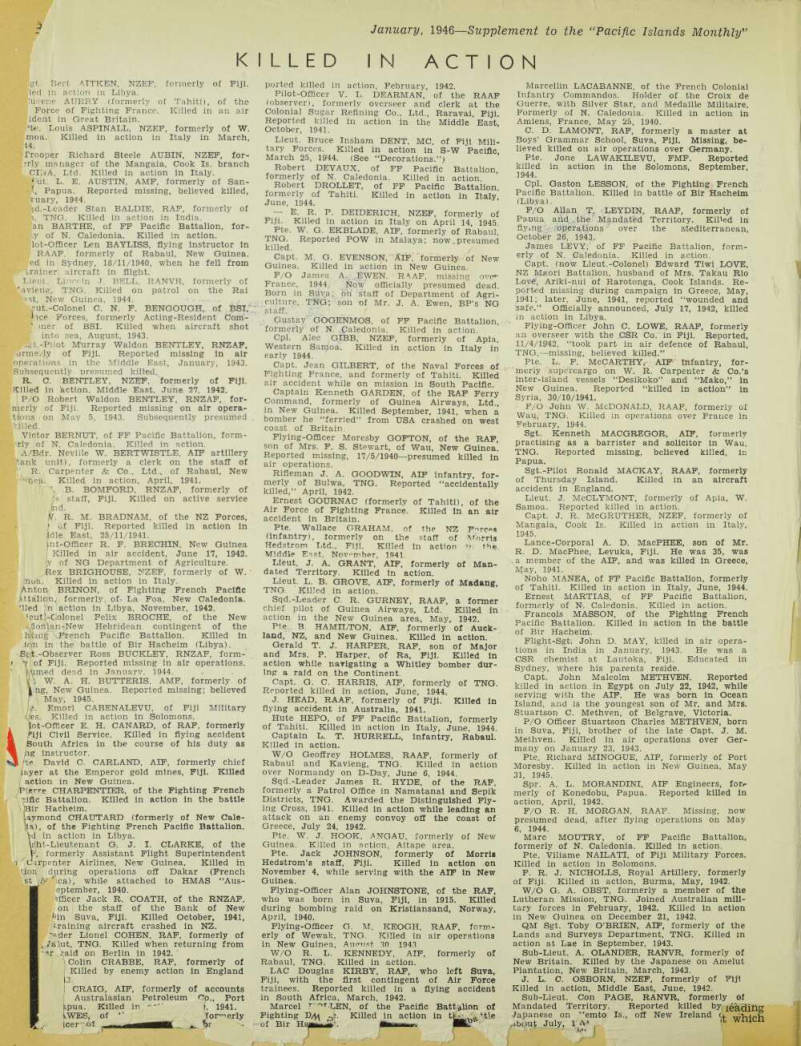
“Pim” Short Story :
By Russell N. Thomas
“IV|USIC hath charms ...” as the 111 poet said. But there appears to be widely divergent ideas as to what exactly constitutes music, even amongst musicians themselves. And so there was something to be said for old man Harrington, our Resident Agent, who really had a musical ear and would listen to Chopin or Beethoven on the gramophone until we were tired of wind ing it up, when a three-man native “band” started up in the middle of the settlement within a stone’s throw of his house. From being more or less of a joke at first it became eventually so dis tracting that he, Chief of Police and Judge of the Court, and general up holder of the law and order as he was, was driven to breaking the law himself because there was no other way out.
Did you know that we once had a brass band on Motu-Iti? Well, it was years and years ago, but we did. It didn’t last long—you know how careless people are with things, and it wasn’t long before the instruments were all tarnished, unplay able, battered caricatures of the resplen dent polished brass which had once glit tered in the island sunshine*.
All except one. Somehow or other it had been hidden away in the loft above old man Everitt’s store —I think the man who hid it there went away to another island and forgot all about it. Then Everitt died and the old store was left empty and rotting for years until one day Matangi broke in, and while poking around happened on the cornet. It was almost buried under dust and dirt; mason wasps had filled it up with mud nests, and cockroaches had laid their eggs in side its vitals, but a bath in water, fol lowed by another in kerosene worked wonders, and by the time Matangi had done with it, it actually produced three notes, all different.
I HAPPENED to be away from Motu- Iti when the momentous find was made. By the time I got back, Matangi had got together a band con
sisting of a drummer (kerosene tin), an ocarinist, or whatever it is that an ocarina player is called —though that was nothing to the things he got called later —and,- of course, the cornet, played by himself. Perseverance had added another note to its repertoire by this time, and it now produced four instead of the former three, but the effort required to achieve the extra one appeared to cause the player much pain, although the lis teners suffered even more.
I knew nothing of any of this. I’d been away as I said, and the day I got back on the schooner I thought I’d stroll over and see the RA after my evening meal. My cook, a most excruciatingly re ligious person—as only natives can be religious—who used to sing hymns from the time she came to prepare my even ing meal until the washing up was done, and she went home, had learned another hymn during my absence, and it didn’t sound so good to me. Usually her song cycle consisted of “Jesus Loves Me,” “On ward Christian Soldiers,” and “The Church’s One Foundation,” ,one follow ing the other with the persistence of re curring decimals, until by the end of the evening she had done full justice to each about 14 times.
With hymns ringing in my ears. I passed along the little main street of the settlement. Outside the village hall a “himene” was in full blast. I’ve never really got used to native singing, although I have to most other things native; it seems to speak of the reef, the men’s deep voices reminding one irresistibly of the boom of the breakers far out, while the women’s voices are like the rush of water through the coral close in, but I’ve never been able to get more out of it than that.
A little further along there was a gramophone, vintage 1904 —the kind with a big horn that you always expect to see a little fox terrior sitting beside— frightfully wheezy and scratchy, playing jazz. Sitting on the steps of another verandah was a party of four singing
softly to a guitar, and very nice it sounded, too; I stopped several minutes to listen to them.
By this time I was near the RA’s place, and as I approached it I became aware that something new had been added to our island symphony, although what it was exactly, I did not then know. The RA seemed pleased to see me, but I thought he was looking under the weather, and did not seem his usual cheerful self; he spoke feelingly of this new addition to the usual crop of wor ries to which RA’s seem always to be heir.
The band was in full blast by this time and the night air shuddered under the impact of jazz of a completely unknown variety. Ultra-modern stuff yet to be written, perhaps. It got on my nerves at once. “Whatever is that infernal racket going on over the road?” I asked.
“You’ve said it,” he replied, “what is it, indeed? It’s the devil’s own jam ses sion if you ask me. One of these un mentionable offspring of lady-dogs un earthed an artifact of Motu-Iti’s brass band age, and now from dawn to long after dark the sound of the sackbut, the psaltry, and the hoo-hah are heard in the land, and the cacophony deafens equally the just and the unjust.”
“And what is a hoo-hah when it is at home?” I asked. “It sounds like the name of a bird or some new tropica! disease.”
“Oh, that’s a cornet, or rather the re surrected corpse of what probably was one in the long, long ago. Someone called it that just after it was found, and the name stuck; I won’t tell you what I call it for I don’t want to spoil your even ing entirely, it’s spoiled enough as it is.” : “Can’t you do anything about it?” I asked. “I thought RA’s could always find ways and means of doing anything.”
“Not officially until Curfew at nine o’clock, pip-emma, precisely,” he replied.
“If I tried before, I’d be accused of being tyrannical to the poor defenceless in digene, and just at a time when it is becoming fashionable, and almost de rigueur, to spoil and pamper them. If I could only get possession of the hoo hah somehow, it would be like removing the main-spring from a clock or the Prince of Denmark from Hamlet, and the band would simply cease to exist. I’ve been trying all I know to think up a way of doing it without causing suspicion to fall on myself, but it’s anything but easy; you can imagine for yourself what sort of position I’d be likely to find myself in, if it became known that I had had anything to do with it? But I’ll simply have to think up some scheme or other; I’ll go mad else.”
“What happens at Curfew?”
“Oh, I send my sergeant of police over.
They make such a row they don’t hear the bell as often as not, and keep right on. They stop quick enough when the ser geant gets there, of course, but I won’t be able to stand this going on all through the evening for long. You know, I’ve always thought the Curfew rather an anachronism and an unwarranted inter ference with the people’s liberties, but now for the first time I see some use for it.” * * * I SAW nothing of the RA for two days, but when I reached his place on the second evening all was quiet. He was again his old jaunty self, and actually smiled as he greeted me, while the tone of parched despair I had remarked before was absent from his voice. Things were evidently looking up.
“So you succeeded?” I said interroga tively.
“Come and look-see,” he said, leading the way. to a camphor-wood chest which
stood in the passage, and which he un locked. Unwrapping something from several layers of old newspaper he un covered what had undoubedly at some time been a cornet.
“Behold, the hoo-hah,” he said. * * * MATANGI’S professed to be very much upset at the theft; she went to the RA’s office to report it, and gave a most circumstantial account of how on her return to her house after being absent for a few minutes she saw someone carrying something, which might have been the hoo-hah, dodge around the side of the house. But, alas—by the time she got there he had clean disappeared.
No. she couldn’t identify him. and could not even say for certain whether what he had been carrying was the hoo-hah or not.
The RA questioned her on various points, and then wrote it all down.
Several natives in the office who were listening were much impressed.
But Matangi’s wife was not nearly as much unset as Matangi, who refused to be comforted. His only consolation was his wife’s sympathy for his loss and her solicitude in his misfortune which he. had somehow not expected. But then women are always quite unpredictable, anyway. Just at this time, too, she had received, so she said, a present of £2 from some obscure relation on another island.
Matangi had never heard of this relation, but as his wife bought tins of beef for them both from the store, he was not dis posed to be too curious about this un expected windfall.
But what Matangi will never know is that the £2 came from the RA, who had conspired with Matangi’s wife, unlawfully and with malice aforethought, to steal from him an instrument of music, to wit, one hoo-hah aforementioned.
Advertisements & other items, pp. 34-35 (1 item)
W. H.Grove & Sons
Limited Established 1896.
AUCKLAND
Islond Traders. PO - Box 491< Telegraphic and Cable Address; “Grove”, Auckland.
Shippers of all classes of New Zealand products.
Representing English Manufacturers throughout the Cook and Society Islands, Fiji, Tonga, Samoa, Niue, New Caledonia, New Guinea, etc.
In FIJI at—W. H. Grore & Sent (Fiji) Ltd.
THE PRICE OF FREEDOM
/ Borneo, ) Pte. X A List of Names of Servicemen and Civilians of the South Pacific Territories Who Lost Their Lives, or Became Casualties, or Were Decorated in World War 11, fought in 1939-45 against the Fascist Powers —
Germany, Italy and Japan.
In total number, the men and women of the South Pacific Territories who served (mostly as volunteers) in World War II may not be impressive; but, in proportion to the total population of the communities from which the\ r ame, and in relat/Von to decorations won, it is a record not equalled c wl in th V" d - [fr'N.
RAAF,
rations ;d his 1
AAF,
on 3. of ain. iry, ion, 'Tew
Killed In Action
■gt. Bert AITKEN, NZEF, formerly of Fiji. ; led in action in Libya. 5 (ugene AUBRY (formerly of Tahiti), of the Force of Fighting France. Killed in an air ident in Great Britain. , J te. Louis ASPINALL, NZEF, formerly of W. moa. Killed in action in Italy in March, 44. . Trooper Richard Steele AUBIN, NZEF, for- Kprlv manager of the Mangaia, Cook Is. branch CRM, Ltd. Killed in action in Italy, jfcut. L. E. AUSTIN, AMP, formerly of San t, Papua. Reported missing, believed killed, luary, 1944. id.-Leader Stan BALDIE, RAP, formerly of i, TNG. Killed in action in India, an BARTHE, of FP Pacific Battalion, for y of N. Caledonia. Killed in action. lot-Officer Len BAYLISS, flying instructor in RAAF, formerly of Rabaul, New Guinea, ed in Sydney, 18/11/1940, when he fell from trainer aircraft in flight.
Lieut. Lincoln T. BELL, RANVR, formerly of 'avieng, TNG. Killed on patrol on the Rai 8 •’St, New Guinea, 1944. eut.-Colonel C. N. F. BENGOUGH, of BST, lice Forces, formerly Acting-Resident Com .’ mer of BSI. Killed when aircraft shot into sea, August, 1943. .gC.-Pilot Murray Waldon BENTLEY, RNZAF, ormerly of Fiji. Reported missing in air ./operations in the Middle East, January, 1943.
Subsequently presumed killed.
R. C. BENTLEY, NZEF. formerly of Fiji.
Killed in action. Middle East. June 27. 1942.
P/O Robert Waldon BENTLEY, RNZAF, for merly of Fiji. Reported missing on air opera tions on May 5, 1943. Subsequently presumed / killed.
Victor BERNUT, of FF Pacific Battalion, form erly of N. Caledonia. Killed in action.
A/Bdr. Neville W. BERTWISTLE, AIF artillery tank unit), formerly a clerk on the staff of R. Carpenter & Co., Ltd., of Rabaul, New ; ’flea. Killed in action, April, 1941.
'. B. BOMFORD, RNZAF, formerly of js staff, Fiji. Killed on active service hd.
V. R. M. BRADNAM, of the NZ Forces, [ of Fiji. Reported killed in action in Idle East, 25/11/1941.
Int-Offlcer R. F. BRECHIN, New Guinea Killed in air accident, June 17, 1942. jy of NG Department of Agriculture.
Rex BRTGHOUSE, NZEF, formerly of W. tooa. Killed in action in Italy.
Anton BRINON, of Fighting French Pacific Attalioh, formerly, of La Foa, New Caledonia. *lled n action in Libya, November. 1942. s eut)-Colonel Felix BROCHE, of the New Hebridean contingent of the hieing .French Pacific Battalion. Killed in iqn in the battle of Bir Hacheim (Libya).
Sut.-Observer Ross BUCKLEY, RNZAF, form f v of Fiji. Reported missing in air operations. ’ (Aimed dead in January. 1944.
W. A. H. BUTTERIS, AMF, formerly of I ng, New Guinea. Reported missing; believed May, 1945.
Emori CABENALEVU, of Fiji Military ik s. Killed in action in Solomons.
Jot-Officer E. H. CANARD, of RAF, formerly k Fiji Civil Service. Killed in flying accident A South Africa in the course of his duty as A hg instructor.
'te David C. GARLAND, AIF, formerly chief jayer at the Emperor gold mines, Fiji. Killed / action in New Guinea.
Pierre CHARPENTIER, of the Fighting French •Uflc Battalion. Killed in action in the battle Bir Hacheim. laymond CHAUTARD (formerly of New Gale na), of the Fighting French Pacific Battalion.
W in action in Libya.
Vght-Lieutenant G. J. I. CLARKE, of the F, formerly Assistant Flight Superintendent 't f Carpenter Airlines, New Guinea. Killed in I; tiou during operations off Dakar (French ica), while attached to HMAS “Aus eptember, 1940.
Officer Jack R. COATH, of the RNZAF, on the staff of the Bank of New .V J, in Suva, Fiji. Killed October, 1941, training aircraft crashed in NZ. fg “J>der Lionel COHEN, RAF, formerly of ~/a x ut, TNG. Killed when returning from -ar raid on Berlin in 1942. ) Colin CRABBE, RAF, formerly of Killed by enemy action in England I 3. ; ; CRAIG, AIF, formerly of accounts i ; Australasian Petroleum Co., Port apua. Killed in |, 1941.
VWES, of x ' formerly leer of hr
ported killed in action. February, 1942.
Pilot-Officer V. L. DEARMAN, of the RAAF (observer), formerly overseer and clerk at the Colonial Sugar Refining Co., Ltd., Raravai, Fiji.
Reported killed in action in the Middle East, October, 1941.
Lieut. Bruce Insham DENT, MC, of Fiji Mili tary Forces. Killed in action in S-W Pacific, March 25, 1944. (See “Decorations.”) Robert DEVAUX, of FP Pacific Battalion formerly of N. Caledonia. Killed in action Robert DROLLET, of FP Pacific Battalion formerly of Tahiti. Killed in action in Italy June, 1944.
E. R. P. DEIDERICH, NZEF, formerly of Fiji. Killed in action in Italy on April 14, 1945.
Pte. W. G. EKBLADE, AIF, formerly of Rabaul, TNG. Reported POW in Malaya; now.presumed killed.
Capt. M. G. EVENSON, AIF, formerly of New Guinea. Killed in actibn in New Guinea.
F/O James A. EWEN, R4.AP, missing ove*’
France, 1944. Now officially presumed dead.
Born in Suva; on staff of Department of Agri culture, TNG; son of Mr. J. A. Ewen, BP’s NG "staff.
Gustav' GOGENMOS, of FP Pacific Battalion, formerly of N. Caledonia. Killed in action.
CpL Alec GIBB, NZEF, formerly of Apia, Western Saipoa. Killed in action in Italy in early 1944.
Capt. Jean GILBERT, of the Naval Forces of Fighting France, and formerly of Tahiti. Killed air accident while on mission in South Pacific.
Captain Kenneth GARDEN, of the RAF Ferry Command, formerly of Guinea Airways, Ltd., in New Guinea. Killed September, 1941, when a bomber he “ferried” from USA crashed on west coast of Britain.
Flying-Officer Moresby GOFTON, of the RAP, son of Mrs. F. S. Stewart, of Wau, New Guinea.
Reported missing, 17/5/1940—presumed killed in air operations.
Rifleman J. A. GOODWIN, AIF infantry, for merly of Bulwa, TNG. Reported “accidentally killed,” April, 1942.
Ernest GOURNAC (formerly of Tahiti), of the Air Force of Fighting France. Killed in an air accident in Britain.
Pte. Wallace GRAHAM, of the NZ Fore** (infantry), formerly on the staff of Morris Hedstrom Ltd., Fiji. Killed in action *n tb e Middle East, November. 1941.
Lieut. J. A. GRANT, AIF, formerly of Man dated Territory. Killed in action.
Lieut. L. B. GROVE. AIF, formerly of Madang, TNG Killed in action.
Sqd.-Leader C R. GURNEY, RAAF, a former chief pilot of Guinea Airways, Ltd. Killed in action in the New Guinea area, May, 1942.
Pte. B. HAMILTON, AIF, formerly of Auck land, NZ, and New Guinea. Killed in action.
Gerald T. J. HARPER, RAF, son of Major and Mrs. P. Harper, of Ra, Fiji. Killed In action while navigating a Whitley bomber dur ing a raid on the Continent.
Capt. G. C. HARRIS, AIF, formerly of TNG.
Reported killed in action, June, 1944.
J. HEAD, RAAF, formerly of Fiji. Killed in flying accident in Australia. 1941.
Hute HEPO, of FF Pacific Battalion, formerly of Tahiti. Killed in action in Italy, June, 1944.
Captain L. T. HURRELL, Infantry, Rabaul.
Killed in action.
W/O Geoffrey HOLMES, RAAF, formerly of Rabaul and Kavieng, TNG. Killed in action over Normandy on D-Day, June 6, 1944.
Sqd.-Leader James R. HYDE, of the RAF, formerly a Patrol Office in Namatanal and Sepik Districts, TNG. Awarded the Distinguished Ply ing Cross, 1941. Killed in action while leading an attack on an enemy convoy off the coast of Greece, July 24, 1942.
Pte. W. J. HOOK, ANGAU, formerly of New Guinea. Killed in action, Aitape area.
Pte. Jack JOHNSON, formerly of Morris Hedstrom’s staff, Fiji. Killed In action on November 4, while serving with the AIF in New Guinea.
Flying-Officer Alan JOHNSTONE, of the RAF. who was born in Suva, Fiji, in 1915. Killed during bombing raid on Kristiansand, Norway, April, 1940.
Flying-Officer G. M. KEOGH, RAAF, form erly of Wewak. TNG, Killed in air operations in New Guinea, Aup-nst 30 1943.
W/O R. L. KENNEDY, AIF, formerly of Rabaul, TNG. Killed in action.
LAC Douglas KIRBY, RAF, who left Suva, Fiji, with the first contingent of Air Force trainees. Reported killed in a flying accident in South Africa, March, 1942.
Marcel T”' vr LEN, of the Pacific Battalion of Fighting I )M Killed in action in t>~ ■ +tle of Bir Ha mm**'. —■*£’“
Marcellin LACABANNE. of the French Colonial Infantry Commandos. Holder of the Croix de Guerre, with Silver Star, and Medaille Militaire.
Formerly of N. Caledonia. Killed in action in Amiens, France, May 25, 1940.
C. D. LAMONT, RAP, formerly a master at Boys’ Grammar School, Suva, Fiji. Missing, be lieved killed on air operations over Germany.
Pte. Jone LAWAKILEVU. FMF. Reported killed in action in the Solomons, September, 1944.
Cpl. Gaston LESSON, of the Fighting French Pacific Battalion. Killed in battle of Bir Hacheim (Libya).
P/O Allan T, LEYDIN, RAAF, formerly of Panua arid the' Mandated Territory. Kihed in flying operations over the Mediterranean, October 26, 1943.
James LEVY, of FF Pacific Battalion, form erly of N. Caledonia. Killed in action.
Capt. (now Lieut.-Colonel) Edward Tiwi LOVE, NZ Maori Battalion, husband of Mrs. Takau Rio Loy€', Ariki-nui of Rarotonga, Cook Islands. Re ported missing during campaign in Greece, May, 1941; later, June, 1941, reported “wounded and safe.” Officially announced, July 17, 1942, killed in action in Libya.
Flying-Officer John C. LOWE, RAAF, formerly an overseer with the CSR Co. in Fiji. Reported, 11/4/1942, “took part in air defence of Rabaul, TNG, —missing, believed killed.”
Pte. L. F. MCCARTHY, AIF infantry, for merly supercargo on W. R. Carpenter & Co.’s inter-island vessels “Desikoko” and “Mako,” in New Guinea. Reported “killed in action” in Syria, 30/10/1941.
P/O John W. MCDONALD, RAAF, formerly of Wau, TNG. Killed in operations over France in February, 1944.
Sgt. Kenneth MACGREGOR, AIF, formerly practising as a barrister and solicitor in Wau, TNG. Reported missing, believed killed, In Papua.
Sgt.-Pilot Ronald MACKAY, RAAF, formerly of Thursday Island. Killed in an aircraft accident in England.
Lieut. J. McCLYMONT, formerly of Apia, W.
Samoa. Reported killed in action.
Capt. J. R. McGRUTHER, NZEF, formerly of Mangaia, Cook Is. Killed in action in Italy, 1945.
Lance-Corporal A. D. MacPHEE, son of Mr.
R. D. MacPhee, Levuka, Fiji. He was 35, was a member of the AIF, and was killed in Greece, May, 1941.
Noho MANEA, of FP Pacific Battalion, formerly of Tahiti. Killed in action in Italy, June, 1944.
Ernest MARTIAS, of FF Pacific Battalion, formerly of N. Caledonia. Killed in action.
Francois MASSON, of the Fighting French Pacific Battalion. Killed in action In the battle of Bir Hacheim.
Plight-Sgt. John D. MAY, killed in air opera tions in India in January, 1943. He was a CSR chemist at Lautoka, Fiji. Educated in Sydney, where his parents reside.
Capt. John Malcolm METHVEN. Reported killed in action in Egypt on July 22, 1942, while serving with the AIF. He was born in Ocean Island, and is the youngest son of Mr, and Mrs.
Stuartson C. Methven, of Belgrave, Victoria.
P/O Officer Stuartson Charles METHVEN, born in Suva, Fiji, brother of the late Capt. J. M.
Methven. Killed in air operations over Ger many on January 23, 1943.
Pte. Richard MINOGUE, AIF, formerly of Port Moresby. Killed in action in New Guinea, May 31, 1945.
Spr. A. L. MORANDINI, AEP Engineers, for*merly of Konedobu, Papua. Reported killed In action, April, 1942.
F/O R. H. MORGAN, RAAF. Missing, now presumed dead, after flying operations on May 6, 1944.
Marc MOUTRY, of FF Pacific Battalion, formerly of N. Caledonia. Killed in action.
Pte. Viliame NAILATI, of Fiji Military Forces.
Killed in action in Solomons.
P. R. J. NICHOLLS, Royal Artillery, formerly of Fiji. Killed in action, Burma, May, 1942.
W/O G. A. OBST, formerly a member of the Lutheran Mission, TNG. Joined Australian mili tary forces in February, 1942. Killed in action in New Guinea on December 21, 1942.
QM Sgt. Toby O’BRIEN, AIF, formerly of the Lands and Surveys Department, TNG. Killed in action at Lae in September, 1943.
Sub-Lieut. A. OLANDER, RANVR, formerly of New Britain. Killed by the Japanese on Amelut Plantation, New Britain, March, 1943.
J. L. C. OSBORN, NZEF, formerly of Fiji Killed in action, Middle East, June, 1942.
Sub-Lieut. Con PAGE, RANVR, formerly oi Mandated Territory. Reported killed by leading Japanese on ' T emto Is., off New Ireland „7Uir.v, July, 1 wnicn
Pilot-Officer Ivan PALMER, RAP, formerly of Fiji Killed in air operations over Malta.
Lieut. R. G. M. PEMBERTON, AIF, formerly of Rabaul, New Guinea. Killed in action.
Capt. Raymond PERRAUD, FF Pacific Bat talion, formerly of Noumea. Killed in action in Europe, 1944. Holder of the Croix de Guerre and Liberation Cross. o. PILLING, RAF, formerly of Fiji. Missing; believed killed.
Lieut. Tony PHELPS, Fiji Military Forces.
Killed in action in the South Pacific, January, 1944 * Flight-Lieut. H. G. PILLING, DFC. of the RAF, formerly of Suva, Fiji. Killed on air operations, May 19, 1942.
Pte. Edward Harold PRICE, 2nd NZEF (27th Machine Gun Battalion), youngest son of Mr. and Mrs. J. Price, Savu Savu West, Fiji. Killed in action during the Libyan campaign, Middle East. 27/11/1941 Pte. Cecil PURCELL, NZEF, formerly of Aleipata. Samoa. First Samoan Euronesian to give his life in World War 11. Killed in action in Middle East.
P/O G. REES-JONES, RAAF, formerly of Labasa, Fiji. Killed in air operations over Ger many, August 16, 1942.
Capt. W. H. ROBERTS, NZEF, who was Accountant in the Samoa Treasury Department during 1934-35. Killed in action in Libya, December, 1941.
Pte. Kameli ROKOTUILOMA, of the Fiji Military Forces. Reported killed in action, December, 1943.
Major A. B. ROSS, NZEF, who, between 1923- 1929 was successively, Assistant Secretary for Native Affairs, Assistant Secretary to the Administration, and ADC to the Administrator of Samoa. Killed in action in Libya.
Cpl. Alex. C. SCOTT, AIF, formerly manager at Kieta, TNG, for Burns, Philp & Co., Ltd.
Killed in action in the Middle East, 19/6/1941.
J. SIMPSON, RAAF, formerly of Fiji. Killed in action over Malta, July, 1941.
Sgt. R. R. SHORT, AIF, formerly of Port Moresby. Killed in action.
Pte. G. E. SNELL, of Norfolk Island. Killed while serving with New Zealanders,
Lieut. GSTEVENSON, AIP lormerlyaPatrol Officer in New Guinea. Killed In action In New 3s.KSiedorr N o f KS: p d , i„ p 'a?t.o™fn K llpir Ai r;S or r, ly D^e^: 2* Islands. Reported ••missing after battle of Tahiti. Killed In action In Italy, Atera TEUIRA, of FP Pacific Battalion, for merly of Tahiti. Killed in action in Italy, June, Lawrence THO MPSON. RAAF, son of Mr. and Mrs. W. O. S. Thompson, Lord Howe Island. y.
Killed In action In Tunisia In April, 1943. &ST’ ■ n ß “' t c '° n an w ’ t ß h ‘£ e “eSoN, AIP, formerly of Lm. TNG. Reported killed in action. June 194 A J^D.
'%£££ Charles WITT, Battalion FF Forces, formerly of New Caledonia. Ki .ed in f ' AT? formerlv a Dls trict Officer in Fiji. and’BSl.’ Killed in actlot Sergeant Bryan de Bernal WHITE RAAF. Missing, believed dead, on operational
"W <2“ °Waf„t Net,
Son of Mr. Norman White, of Upper Watut, New Tf, L. YAGER, of Norfolk Island. Killed while serving with New Zealanders.
Died From Wounds
Pte. Roy lan BROWN, NZEF, formerly of Apia W. Samoa. Died of wounds in Italy, April, 1944 Pte. Ernest HENRY, AIF, formerly of the Raoaul (NG) staff of Burns, Phllp and Co.
Ltd. Died from wounds received in Battle ol Crete. 1/6/1941.
Pte. Alec. MUNRO, NZ Forces, formerly of Norfolk Island. Died in Libya (Middle East), December, 1941.
Adolphe Arthur LAHARRAGUE, formerly of Tahiti. Died of wounds received while serving in the Fighting French forces.
Pte. T. LAWREE, AIF, son of Mr. Lawrle, for-
merly of Fiji. Died of wounds in Middle East.
Pte. Walter PEARSON, of first NG quota o< AIF (infantry). Died from wounds received in action, 24/6/1941.
A/Bdr. W. R. SCOTT, AIF, of New Guinea.
Died from wounds, July, 1941.
Sgt. Charles SPITZ, of the Fighting French, Pacific Battalion, and formerly of Tahiti. Died from wounds received at Bir Hacheim, en June 21, 1943.
Sgt.-Pilot Peter Clarkson WISE, of the RAF. son of Mr. W. Wise, OBE, Director of Public Works, Fiji. Died from wounds received during bombing raid over Germany, January, 1941.
Accidentally Killed
Capt. F. P. BREWER, AIF, formerly of Papua.
Reported accidentally killed.
Lieut.-Colonel C. C. JUDD, formerly of Morobe, TNG. Accidentally killed in Australia in January, 1943.
A Cpl. P. A. McKEE, New Guinea Forces, formerly of Bulolo. Died of injuries.
Major N. V. McKENNA, AIF, formerly of Wau.
TNG. Accidentally killed, September 30, 1943.
Lieut. Harrowby RYDER, AIF, formerly of Fiji.
Accidentally killed on active service in New Guinea.
Major (Dr.) Alan SPENCE, formerly of Rabaul.
Lost his life in Ceylon, May, 1942.
Flight-Lieut. James Ba THOMPSON, RAAF.
formerly of Fiji. Killed in aricraft accident in India on April 1, 1945.
F/O Lee VIAL, DSC, formerly ADO, Mandated Territory. Killed in April, 1943, in a plane crash in Sepik district while on a special mission.
Capt. F. E. WILLIAMS, formerly Government Anthropologist in Papua. Killed in a plane acci dent while on duty in New Guinea, in 1943.
Sgt. Edward WILSON, of Suva, serving in the Fiji Defence Force. Accidentally drowned in the Lami River, Fiji, April, 1942.
Gnr. Robert J. WILSON, formerly of Port Moresby, Papua. Accidentally killed in troop train in Middle East in 1942.
Died From Illness
Gnr. N. H. AMOS, AIF, formerly of Papua.
Died of illness while POW.
Pte. C. E. BIGNELL, AIF, formerly of New Guinea. Died of illness while POW.
Pte. Lawrence BOYER, NZEF. formerly of Tonga and Fiji. Died on active service in Italy.
Gnr. John H. BUFFETT, AIF, Norfolk Island.
Died in Burma, July, 1943.
Pte. Tevita BUREKAMA, of Fiji Military Forces. Died of illness while on duty in the Solomons.
Sgt. Peter R. M. COGGINS, AIF, son of Mr. and Mrs. S. J. Coggins, Fiji. Died while POW, Borneo, February, 1945.
Pte. H. COOMBE, NZEF, formerly of Suva,
Fiji. Died in Middle East, April, 1944.
Major Charles DUCHATEL, formerly of TNG.
Died of scrub tvphus at Port Moresby, November 21, 1943.
W/02 G. F. HAMMOND, ANGAU, formerly of TNG Administration. Reported died of illness early 1945.
Pte. Clarence A. HUTTON, AIF, formerly of Edie Creek, TNG. Died from illness, April, 1941.
Cpl. D. C. IRVINE, AIF, formerly of New Guinea. Died of illness while POW.
Ratu Dovi KOMAISAVAI, RAF, formerly of Fiji. Died of illness in Britain, October 19, IP4<> Spr. A. G. LAPHAM, AIF, formerly of New
Guinea. Died of illness while POW.
W/O Walter D. MASON, formerly of Sangara Rubber Plantation, Papua. Died of illness.
Capt. W. J. MCDONALD, AIF, formerly of Morobe and Sepik districts. TNG. Died of ill ness in New Guinea, July 20, 1944.
Pte. Manoa NAKARU, of the Fiji Military Forces. Reported died on active service, Decem ber, 1943.
Pte. Isikeli NABOKO, of the Fiji Military Forces. Reported died on active service, Decem ber, 1943.
Seaman Malvin NELSON, of Fiji Royal Naval Volunteer Service. Death reported in May, 1943.
Spr. D. R. PHILLIPS, AIF, formerly of New Guinea. Died of illness while POW.
Gnr. Edward Arley QUINTAL, AIF, originally of Norfolk Island; Burma, July, 1943.
Pte. Inikasio SERU, of tne Piji Military Forces. Reported died on active service, Decem ber, 1943.
Gnr. B. L. J. SMEETON, AIF, formerly of New Guinea. Died of illness while POW.
Rifleman R. A. SMITH, HQ Unit. (Place of enlistment not stated.) Died of illness.
A/Sgt. J. H. STANE, Royal Australian Engineers, formerly of Port Moresby, Papua.
Died from illness. May, 1942.
Cpl. R. H. SUTTON, NGVR, formerly of Wau, TNG. Dieu from malaria and typhoid in October, 1942.
Pte. Mateo TUIDALA, of the Fiji Military Forces. Reported died on active service, Decem ber, 1943.
Pte. Emosi WAQA, of the Fiji Military Forces.
Reported died on active service, December, 1943.
Major P. J. WOODHILL, AIF infrantry, for merly legal assistant in the Crown Law Office, Rabaul, New Guinea. Reported died from illness, December, 1941.
Pte. F. WORK, of the Piji Military Forces.
Reported died on active service, December, 1943.
Missing
Louis ANGER, of Fighting French Pacific Battalion. Reported missing after battle of Bir Hacheim.
Pte, P. P. BAILEY, AIF infantry, of Rabaul, TNG. Reported missing, 17/2/1942. Now re ported prisoner of war.
Lieut. J. T. BARRACLUFF, AIF, formerly of New Guinea. Reported missing, December, 1943.
Cpl. Leon BARRENS, of Pacific Battalion of Fighting France. Missing after battle of Bir Hacheim (Libya).
Alexandre BLACK, of Pacific Battalion, FF Forces. Reported missing after Battle of Bir Hacheim.
T. BLAKELOCK, BEF, formerly of Fiji. Miss ing.
Sgt. Ronald Arthur BROODBANK, formerly of Samarai, Papua, now serving with the RAAF overseas. Reported missing on May 31 while on air operations.
Sgt. Alexander BROWN, RNZAF, formerly of Rarotonga. Reported missing over Germany, on September 15, 1942.
Reginald BOULANGER, of Fighting French Pacific Battalion. Reported missing after battle of Bir Hacheim.
Pte. H. G. BUCKNELL, AIF, formerly of Suva.
Missing in February, 1942. No further news.
Andre CHITTY, of Pacific Battalion of Fight ing France. Missing at battle of Bir Hacheirr (Libya).
Pte. E. L. CHRISTIE, AIF infantry, of Rabaul, TNG, Reported missing, 17/2/1942.
Georges CLEMEN, of FP Navy. Formerly of N. Caledonia. Missing in Mediterranean, March, 1942.
Victor DERVAUX, of Fighting French Pacific Battalion. Reported missing after battle of Bir Hacheim.
Lucien DEVAND, of Pacific Battalion of Fight ing France. Missing after battle of Bir Hacheim (Libya).
Pte. A. G. DICKSON, AIF infantry, of Rabaul, TNG. Reported “missing, believed wounded,” 17/2/1942.
Wing-Commander Donald DONALDSON, RAAF, formerly of Nauru. Missing on air operations over France in June, 1944. Later rejoined his squadron.
Pilot-Officer Norman R. FRAZER. RAAF, formerly of Wau, TNG. Reported missing on air operations over Germany, August 30, 1943. - Eion FIELD, RNZAF, formerly of staff of Kasi Mines, Fiji. Missing in Java.
Gath GELDARD, NGVR, of New Britain.
Missing after the battle of Rabaul, January, 1942.
Georges GOVETCHE, of FF Pacific Battalion, formerly of N. Caledonia. Reported missing.
Capt. J. E. CRIMSON, AIF, formerly of New
Guinea. Reported missing, 1944.
Acting Flight-Lieut, Don A. IRVING, RAAF, formerly chemist in CSR Co., Labasa, Fiji. Miss ing, presumed dead, in air operations over Germany, February 27, 1942.
Pte. Andrew A. (Billo) Johnson, Ngvr.
Reported missing in New Guinea on October 29, 1942.
Georges KABAR, of Fighting French Pacific Battalion. Reported missing after battle of Blr Hacheim.
Henri LANGLOIS, of Pacific Battalion of Fighting Prance. Missing after battle of Bir Hacheim (Libya).
Numa LETHESER, of Pacific Battalion of Fighting France. Missing after battle of Bir Hacheim (Libya).
Rene LETOCART, of Fighting French Pacific Battalion. Reported missing after battle of Bir Hacheim.
F/O Cecil MASON was in Rabaui until October, 19’42; then reported in Lakunai in January, 1943. No further information.
Cpl. E. G. MacADAM, NGVR. of Rabaui. TNG Reported missing after the battle of Rabaui, January 1, 1842.
P/O Denis McCRAIG, RAF, formerly of Fiji.
Posted missing on air operations over Europe, but believed to be POW.
Capt. J. J. MURPHY, AIF. formerly of New Guinea. Reported missing, December, 1943.
Capt. Robert Charles PAGE, AIF, formerly of Rabaui, TNG. Posted missing in operations early in 1945.
Pte. R. J. PASCOE, AIP infantry, of Rabaui, TNG. Reported missing, 27/1/1942.
Pilot Tom PATTERSON. of the RNZAF, formerly of Levuka, Fiji. Reported missing, in November, 1941, after bombing raid on the Continent.
Eugene PENE, of Fighting French Pacific Battalion. Reported missing after battle of Bir Hacheim.
Andre PETRE, of Fighting French Pacific Battalion. Reported missing after battle of Bir Hacheim.
Eugene POGNON, of Fighting French Pacific Battalion. Reported missing after battle of Bir Hacheim.
Pilot James SIMPSON, of the RAF, formerly of Vatukoula, Fiji. Reported missing after air operations over Malta, in the Mediterranean, 1/7/1941.
L/Bdr. G. G. SMITH, NZEP, formerly of Suva.
Fiji. Reported missing.
Louis SALOMAN, of FP Pacific Battalion, formerly of N. Caledonia. Reported missing.
Charles STIERMANS, of FF Pacific Battalion, formerly of N. Caledonia. Taken POW in Libya, but missing after transport was sunk in Medi terranean.
Pilot-Officer Neville George STOKES, of the RAF, formerly a pilot with Guinea Airways, Ltd., in New Guinea. Reported missing after air operations in Europe, December, 1941.
Chas. STIERMANS, of FF Pacific Battalion, formerly of N. Caledonia. Reported missing.
Louis VINDOUX, of FF Pacific Battalion, formerly of New Caledonia. Reported missing.
Sgt. Ted WINDEYER, AIF, formerly of New Guinea. Missing in Malaya since February, 1942.
Wounded
Sgt. Robert ASMUS, of the Fighting French Pacific Battalion. Wounded at Bir Hacheim and evacuated.
Rene AUFANT, of the Fighting French Pacific Battalion. Wounded at Bir Hachelm.
Cpl. Thomas BAMBRIDGE, of the Fighting French Pacific Battalion, Wounded at Blr Hacheim and evacuated.
Fit.-Lieut. J. W. BARTLETT, RAAF, formerly of TNG. Wounded in air operations over the Mediterranean on January 23, 1944.
BERBERS (alias ARESKY). of the Fighting French Pacific Battalion. Wounded at Blr Hacheim.
Henri BERTHELIN, of the Fighting French Pacific Battalion. Wounded at Bir Hacheim.
Pte. V. BLANCO, AIP infantry, of Thursday Island. Wounded in action, July, 1941.
L/Cpl. J. P. BLENCOWE, AIF infantry, of Rabaui, TNG. Wounded in action, July, 1941.
Jean BRIAL, of the Fighting French Pacific Battalion. Wounded at Bir Hacheim.
Pte. George BUCKNELL, AIP, son of Mr. and Mrs. C. Bucknell, of Korolevu, Fiji. Wounded in action in Malaya, January, 1942.
Pte. Thomas BYERS, AIF infantry, of Thurs day Island. Wounded in action, May, 1941.
Pte. Sekope CAMA, FMF. Reported wounded in action in Solomons, September, 1944.
Raymond CHAUTARD, of the Free French Pacific contingent from New Caledonia. Re ported a casualty in the Middle East, March, 1942 Pte. A. J. CORLASS, AIF, formerly of Rabaui.
Wounded in action.
Albert CUBADDA, of the Free French con tingent from New Caledonia. Reported a casualty in the Middle East, March, 1942.
WO2 J. W. CURRIE, now of ANGAU.
Charles DBVEAUX, of Pacific Battalion of Fighting France. Wounded at battle of Blr Hachelm (Libya) Sgt. EMERY, formerly of Lae. TNG. Wounded in New Guinea in October, 1942.
W/O P. N. ENGLAND, AIF, formerly of Bogia, TNG. Wounded in action January 27, 1944.
Lieut. M. G. EVENSEN, AIF, formerly of Rabaui. Wounded in action.
V. FAIRHALL, 2nd NZEF. formerly of the Treasury Department, Western Samoa. Reported wounded in action, February, 1942.
Trooper Arthur T. FILEWOOD, formerly of Thursday Island. Reported wounded in action, May. 1943.
Paroa FIU, of the Fighting French Pacific Battalion. Wounded at Bir Hacheim and evacuated.
Cpl. H. N. FORSYTH, formerly of New Guinea.
Reported wounded, June, 1944.
Acting Warrant-Officer V. M. I. GORDON, AIF infantry, of Wau, TNG. Wounded in action, February, 1942.
Henri GUILBAUD. of the Free French Pacific contingent from New Caledonia. Reported a casualty in the Middle East, March, 1942.
Sgt. C. HENDRICK, ALP Infantry, of Rabaui.
TNG. Wounded in action, July, 1941.
Stanley HIGGS, son of Mr. and Mrs. Gordon Higgs, of W. E. Carpenter and Co. Ltd., New Guinea. Member of an English Lancers’ regiment, wounded during British evacuation from Dun kirk (France), May, 1940.
Pte. W. HOLMES, of the Fiji Military Forces.
Reported wounded in action, December, 1943.
Alexandre HUYARD, of the Free French Pacific contingent from New Caledonia. Reported a casualty in the Middle East, March, 1942.
Pte. P. C. JEUNE, AIF, formerly of Morobe, TNG. Reported wounded, June, 1944.
Sgt.-Pilot Andrew KRONFELD, of the NZ Fighter Squadron attached to the RAP. Wounded in knee during operations over Prance, December, 1941.
Cpl. W. H. LANNEN, AIF artillery, of Rabaui, New Guinea. Wounded in action, June, 1941.
W/O T. W. J. LEGA, AIF, formerly of the Mandated Territory. Reported wounded in action, November, 1944.
Gnr. E. G. LOBAN, AIF artillery, of Thursday Island. Wounded during campaign in Greece, May, 1941; Invalided home after having his left forearm amputated.
Auguste LUTA, of the Fighting French Pacific Battalion. Wounded at Blr Hachelm and evacuated.
A/Sgt. Alastair MACLEAN, AIF Infantry, of Rabaui, New Guinea. Wounded in action, in Libya, June, 1941.
Sgt. J. D. McCLYMONT. NZEF, son of Capt D. McClymont, Harbourmaster of Apia, Western Samoa. Wounded in action, November. 1941.
Lieut. Jack McGRUTHER, NZEP, formerly of Mangala, Cook Is. Wounded in fighting in Libya. Later, killed in action.
Lieut. Colin McGRUTHER, NZEF, formerly of Mangaia. Wounded in action in North Africa.
Cpl R. McKERLIE, AIF, of Yandina, BSL wounded in face by bomb explosion, April, 1941 T. MANEA, of the Fighting French Pacific Battalion. Wounded at Blf Hachelm and evacuated.
Jean MERIGNAC. of the Free French Pacific contingent from New Caledonia. Reported s casualty in the Middle East. March, 1942.
Henri MEYER, of the Free French Pacific contingent from New Caledonia. Reported a casualty in the Middle East. March, 1942.
S / Se r t. Graham B. MTRFIELD, AIF engineers, of Rabau l Hp"' Guinea Wounded in action.
Pte. Apisai NAIKA, of Fiji Military Forces.
Wounded in action in Solomons.
Pte. Sowani NALICO, PMF. Reported wounded in action in Solomons, September, 1944.
Pte. James O’DWYER, NZEF, formerly of Apia, W. Samoa. Wounded in action in Italy, December, 1943.
Joseph OTHUS, of Pacific Battalion of Fight ing France. Wounded in battle of Bir Hachelm (Libya).
Edouard PAILLANDI, FF Forces, formerly of N. Caledonia. Wounded in France, November, 1944.
Lieut. A. G. PEARCE, AIF, formerly of Salamaua, TNG. Wounded in action.
Gnr. Geo. QUINTAL, of Norfolk Island, AIF.
Wounded, Singapore, February, 1942.
Pte. L. G. (“Mick”) REECE, AIF, of Bulolo, New Guinea. Wounded in action, July, 1941.
Henn RIVIERE, of the Free French Pacific contingent from New Caledonia. Reported a casualty in the Middle East, March, 1942.
Pte. H. St. George RYDER, AIF, formerly of Suva, Fiji. Wounded while serving in New Guinea.
Cpl. Luke SAILADA, of Fiji Military Forces.
Wounded in action in Solomons.
A/Opl. N. K. SAWYER, AIF Infantry, of Rabaui, TNG. Wounded in action, July, 1941.
July, 1941.
Pte. Frank M. SCHUSTER, NZEP, formerly of W. Samoa. Wounded in action in Tunisia, 1943.
Lieut, Jeffrey SEAGOE, serving with the British forces in the Far East, formerly of Vila, New Hebrides. Reported "wounded in action' , March, 1942.
Flt.-Sgt. B. SPILLER, RAAF, formerly of Papua. Wounded by flak while attacking enemy targets in Prance on July 28, 1944.
Pte. Lance STAMPER, AIF, formerly school master at Wau, New Guinea. Wounded in action, July 10, 1941.
Cpl. Esala TAWAKE, of Fiji Military Forces.
Wounded in action in Solomons.
Lieut.-Col. J. K. B. TAYLOR, of the Fiji Mili tary Forces. Wounded in action in Bougain ville, December, 1943.
Cpl. Raphael TEIHO, of the Fighting French Pacific Battalion. Wounded at Blr Hachelm ano evacuated.
Cpl. Terii TERHTUA, of the Fighting French Pacific Battalion. Wounded at Bir Hachelm and evacuated.
Lieut. A. THOMPSON, of the Fiji Military Forces, Reported wounded in action, December, 1943.
Lieut. P. A. TUCKEY, Infantry, formerly of New Guinea. Wounded in action.
Pte. Harold G. TURNER, AIF, of Samarai, Eastern Papua. Wounded in action at, Bardla (Libya), January, 1941.
Pte. F. D. TWISS, AIF infantry, of New Guinea. Wounded in action, August, 1941.
Camille VINCENT, of the Free French Pacific contingent from New Caledonia. Reported a casualty in the Middle East, March, 1942.
Driver Don P. WAUCHOPE, AIF. Pormerlj employed on his brother’s plantation in New Guinea. Wounded in action, July, 1942.
Lieut. B. E. WESTON, AIF, formerly of Salamaua, NG.
Lieut. F. R. G. WILSON, AIF, formerly of the Mandated Territory of New Guinea. Reported wounded in action, February, 1944.
Alex. WINCHESTER, of the Fighting French Pacific Battalion. Wounded at Bir Hachelm.
Pte. K. M. WHITE, AIF, formerly of Bulwa, TNG. Wounded in action.
Sgt.-Pilot W. WRIGHT, of the Australian Spitfire Squadron, attached to the RAP, for merly of New Guinea. Wounded in knee during aerial "dog-fight" over the English Channel.
March. 1942.
Spr. E. E. YOUNG, NZEP, son of Mrs. Rupert Young, of Norfolk Island. Wounded.
Prisoners Recovered in Japan
Archer, J. C.—Mrs. Nina Archer, c/o Mrs. Lux more, PO, Cribb Island, via Brisbane.
Beale, Miss D. L.—Miss N. R. Beale, “Athol Brae," Tank St., Gladstone, Q.
Bignell, Mrs. K.—Mrs. M. Clarence, 75 Lauder dale Ave., Balgowlah, Sydney.
Bowman, Miss A.—Mrs. G. Shand, Lawrence, via Grafton, NSW.
Christopher, J. —Mrs. W. Christopher, 52 Hay St., Kadina, SA.
Goss, Mrs. M. E.—Mr. Margrie, 27 Kulgoa Rd., Bellevue Hill, Sydney.
Green, Miss M. F.—Mrs. C. H. E. Green, “Hill View,” Miller’s Forest, Raymond Terrace,
Nsw.
Harris, Miss J. O. —Refer J. Oldroyd-Harris.
Hay, Sister D.—Mrs. A. Hay, 22 Karma Ave., East Malvern, Vic.
Kilner, C. G.—Mrs. V. Kilner, 3 Hunter St., Penshurst, Sydney.
Kruger, Miss G. D.—Mrs. S. B. Kruger, 8 Charters Towers Rd., Hermit Park, Towns ville, Q.
McGahan, Miss J.—Miss A. McGahan, c/o Mrs.
E. H. Lesberg, Scarborough Hotel, Brisbane.
McLellan, Miss J. M.—Mrs. L. J. McLellan, "Billabong,” Wenanga, via Dalby, Q.
Maye, Miss D.—Mrs. A. Williams, 22 Pickering St., Brompton Park, Adelaide, SA.
Watch, Dr. N. B—H. V. H.. Watch, Box 2816 N, GPO, Sydney.
Wilson, D. E. (Nurse). —Mrs. A. J. Wilson, Addison Rd., New Lambton, Newcastle, NSW.
Decorations Awarded
Sgt. Jlone AGARA, Fiji Military Forces, formerly of Tonga. Awarded the American Sil ver Star for gallantry in action in New Georgia, July, 1943.
Flight-Lieut. Don AIDNEY, RAF, formerly of Fiji. Awarded the Distinguished Flying Cross in September, 1944, Squadron-Leader G. U. (“Scotty”) aLLEN, RAAF, who is well-known in New Guinea and Papua, having been co-pilot on the “Faith in Australia”, on the first official air-mail flight to the Territories in 1934. Awarded the Air Force Cross for his work with Catalina flylng aoats in Australia and the Pacific.
Colonel H. T. ALLEN, AIF, formerly of Wau, Morobe District, TNG. Awarded the OBE.
Sub.-Lieut. A. M. ANDRESEN. RANVR, for merly of Solomons. Mentioned in despatches.
Lieut. S. L. ASHTON, ANGAU, formerly of TNG. Awarded Military Medal (as a Warrant- Officer) for conspicuous bravery while engaged in patrol work in New Guinea.
Capt. Jeff ARCHER, A 18, formerly of Wau, TNG. Awarded MC.
Flight-Lieut. Denis BAKER, RAAF, formerly of Fiji. Awarded DFC for services in Indonesia and Pacific.
Squadron-Leader C. A. BASKETT, formerly of Bulolo, TNG. Awarded Distinguished Flying Cross for raids over enemy territory while attached to Hampden bomber squadron in Eng land.
F/O L. W. G. BELL, RAAF, formerly of Kavieng, TNG. Awarded OBE, for outstanding service in the New Guinea area.
Sgt. Semisi BELO, of Fiji Military Forces.
Awarded DCM for services in South-west Pacific area.
Capt. F. N. BOISEN, ANGAU, formerly of administration TNG. Awarded Military Cross, June. 1945.
Lieut. Charles BLAKE, of ANGAU, formerly of Wau. TNG. Awarded the Military Medal (while serving as a W/O) for bravery and devotion to duty during and after the landing at Arawe, New Britain, January, 1944.
Captain H. M. BOOTH, FMF. Awarded Mili tary Cross for service on Bougainville.
Lieut. M. BOULTON, FMF. Awarded Military Cross for service on Bougainville.
Mrs. Ruby BOYE, of Vanlkoro, Santa Cruz Group. Awarded British Empire Medal for gal lant work in the Allied cause during the Jap anese occupation of the Solomons.
Victor BRIAL, Fighting French Pacific Battalion, formerly of New Caledonia. Awarded the Croix de Guerre and the Etolle d’Argent.
Jean BRIAL, of FF Forces, formerly of New Caledonia. Awarded Croix de Guerre.
Lieut. Kenneth T. BRIDGE, AIF, formerly ADO, New Guinea Administration. Awarded US Legion of Merit for services in reconnoitring the area of the Mambare River.
Captain E. CAKOBAU, FMF. Awarded Mili tary Cross for service on Bougainville. US Legion of Merit.
Pilot Eric (Mike) CLARKE. Awarded George Medal for gallantry in rescuing body of Kevin Parer from blazing plane at Salamaua on January 21, 1942. Killed in air crash in Queensland in June, 1944.
Lieut. Gordon CLARKE, formerly of TNG, AIF.
MID for good service at Cape Gloucester landing.
Major W. F. M. CLEMENTS, of the British Solomon Islands Defence Force. Awarded Military Cross for exceptional devotion to duty in a theatre of war.
Liei t. J. R. COLE, AIF, formerly of New Guinea. Awarded the Military Cross.
Major Mervyn CORNER, FMF, awarded Mili tary Cross for service on Bougainville.
Flight-Lieut. John Alan CORRIGAN, RAAF, formerly goldminer in New Guinea, awarded US Legion of Merit, also mentioned in Des patches Sgt. Henry C. S COTTON, of the RNZAF, who was born in Samoa (his father was Secre tary of Native Affairs during the NZ military occupation). Awarded the Distinguished Flying Cross.
Major S. G. C. COWLED, Senior Chaplain of Fiji Military Forces. Awarded OBE. His example to troops carrying out operations maintained a high spirit of morale.
Lieut. J. W. COX, ANGAU, formerly of TNG.
Awarded Military Medal for bravery and de votion to duty in the Salamaua area, 1943.
Flight-Lieut. R. N. DALKIN, RAAF, formerly of W. R. Carpenter and Co., Ltd., Salamaua TNG Awarded the DFC for bombing raids against the Japanese in Koepang area, DEL FREDERIC DELAVEUVE, formerly of New Caledonia. Awarded Croix de Guerre, while serving with Fighting French volunteers in Egypt. 2/Lieut. Bruce Insham DENT, of Fiji Military
Forces (killed in action, March 25, 1944).
Awarded Military Cross for services in South west Pacific.
Squadron-Leader R. A. DUNN, RAAF, formerly of Carpenter Airways New Guinea Service.
Awarded the Distinguished Flying Cross foi oravery while leading his squadron against the Japanese.
Chaplain N. J. EARL, AMP. formerly of Papua. Awarded MBE for bravery shown during early Papuan campaign.
F/O T. W. ELLIS, RAAF, formerly of New Guinea. Awarded DFC for gallantry in Amboina area, July, 1945.
Sgt. R. EMERY, NGVR, formerly of Lae.
Awarded Military Medal for gallantry in New Guinea.
Capt. W. M. ENGLISH, ANGAU. formerly a Patrol Officer in New Guinea. Awarded MBE, June, 1945.
Flight-Lieut. Norman FADER, RAAF, formerly a commercial pilot in New Guinea. Awarded the Air Force Cross for exploits in Bismarck Sea Battle.
Lieut J. FORBES, RNZNR, formerly of West ern Pacific. Awarded US Bronze Star for “heroic service while piloting * ships entering perilous waters.”
Capt. W. A. D. FORMAN, formerly skipper of “Leander,” New Guinea. MID for services at Milne Bay. 1943, and Legion of Merit for services with US Navy, 1944.
Rifleman H. W. FORRESTER, NGVR, formerly of Bulolo, TNG. Awarded the Military Medal for operations against Japanese in New Guinea.
Major R. O. FREEMAN, FMF. Awarded the Military Cross for devotion to duty while on service in Bougainville.
Cpl. Tevita FUSI, FMF. Awarded Military Medal for service on Bougainville.
Sgt. J. H. GILCHRIST, formerly of TNG.
Received Military Medal, April, 1944.
Squadron-Leader C. R. GURNEY. RAAF, for merly of Guinea Airways, Ltd., TNG. Posthu mously awarded the Air Force Cross, for bomb ing raids on Japanese-held ports in New Britain.
Major T. GRAHAMSLAW, AMP, formerly of Papua. Awarded OBE for conspicuous devotion to duty in the Buna area (Papua) during initial Japanese landings in the district.
Walter GRAND, Fighting French Pacific Battalion, formerly of Tahiti. Awarded Croix de Guerre, with one star, for bravery during the Battle of Bir Hacheim, 1942.
A./Sgt. B. W. G. HALL, formerly of TNG.
Received DCM in April, 1944. Later promoted to rank of Lieutenant.
W/O M. I. HARPER, RANR, formerly of BSI, awarded US Order of Merit for outstanding service in Solomons waters, 1943: Silver Star for courage and notable service, northern waters, 1944-45.
Squadron-Leader Godfrey HEMSWORTH, RAAF, formerly a well-known New Guinea pilot, who was killed in action against the Japanese In May. Posthumously awarded the Air Force 3ross.
Capt. L. HENDERSON. AMF, formerly of Papua. Awarded MBE for courage displayed during the Oro Bay operations when he was in charge of small ships operating in those waters. , LUCIEN HERVOUET, formerly of New Cale donia. Awarded Croix de Guerre while serving with Fighting French volunteers in Egypt.
Lieut. Colin HILL, RANR, of the Australian destroyer, “Waterhen”, formerly second officer on the trans-Pacific liner “Niagara”. Awarded the OBE.
Capt. Ernest HITCHCOCK, ANGAU, formerly of Mandated Territory. Awarded US Legion of Merit for assistance to American forces in Salamaua area. , Flying-Officer Victor HJORRING, of Fiji.
Awarded MBE.
Capt. HOLLAND, formerly of G. & E. Islands Colony, awarded George Medal for bravery in helping to maintain communications after Japanese invasion of Tarawa.
Commander D. S. HORE-LACY, RN, formerly of New Guinea. Four times mentioned in des patches. , . , Lieut. D. C. HORTON, RANVR, formerly of District Services, BSI. Awarded the United States Silver Star for distinguished services in the Solomons. , , Lieut, Gordon HOWE, RANR, formerly an offi cer in Burns Philp ships. Awarded the US Legion of Merit for meritorious service in lead ing a reconnaissance party to Russell Islands,
Bsi
P/O lan INNES, RAAF, formerly of Sala maua, TNG. Awarded Military Medal (while serving as a P/Sgt.) in France, I? 44 - Wing-Commander R. W. IREDALE, RAAF, for
merly of Lae and Rabaul, TNG. Awarded DFC and Bar, Mentioned in Despatches, during three tours of operation over Europe.
Capt. E. R. JOHANSON, of American liner “Monterey.” Awarded US Merchant Marine Dis tinguished Service Medal for service against the enemy.
Lieut. H. E. JOSSELYN, RANVR, formerly of District Services. BSI. Awarded United States Silver Star, for distinguished services in the Solomons.
Lieut. J. R. KEENAN, RANVR, formerly of New Guinea. Awarded the DSC.
Major D. G. KENNEDY, of BSI Defence Forces, formerly DO in Solomons. Awarded DSO for activities in New Georgia.
Capt. H. T. KIENZLE, ANGAU, formerly ol Papua. Awarded MBE for devotion to duty during the campaign in the Owen Stanley Ranges.
Lieut. Isereli KOROVULAVULA, FMF. Awarded the Military Cross for devotion to duty while serving in Bougainville.
Pte. Sairusi KOTO, Fiji Military Forces.
Awarded US Silver Star for bravery and de votion to duty in the Solomons.
Wing-Commander C. J. N. LELAU, RAAF, formerly of Suva, Fiji. Awarded the OBE for distinguished service.
Pte. Viliame LAUTIKI, of Fiji Military Forces.
Awarded MM for services in South-west Pacific area.
Sqd.-Ldr. lan LOUDON, RAAF, formerly of New Guinea. Awarded DFC and mentioned in despatches.
Cpl. Elaitia LEDUA, FMF. Awarded Military Medal for service on Bougainville.
Lieut. Paul LOBENDAHN, FMF. Awarded Military Medal for service on Bougainville.
L/Cpl. Viliame LOMASALATO, FMF. Awarded Military Medal for service on Bougainville.
Sgt. T. McADAM. NGVR, formerly of New Guinea Forestry Dept. Awarded Military Medal for gallantry in New Guinea.
Lieut. W. A. MacGREGOR, ANGAU, formerly of Wewak, TNG. MID for services during 1944.
Capt. John S. McLEOD, ANGAU. formerly a patrol-officer with the New Guinea Administra tion, for services in New Britain, organising and supervising native labour and guides and for reconnaissance patrol. Awarded US Legion of Merit.
Lieut.-Commander A. W. R. McNICOLL, RAN, son of Sir Ramsay McNlcoll, Administrator of New Guinea, and Lady McNicoll. Awarded the George Medal.
Sgt. Josefa MAINAVOLAU, FMF. Awarded Military Medal for service on Bougainville.
Pte. Akuila MARAIVALU, FMF. Awarded Military Medal for service on Bougainville.
Petty-Officer PAUL MASON. RANVR, formerly a plantation inspector at Inus, Bougainville.
TNG. Awarded American Distinguished Service Cross for “extraordinary heroism in action.”
Also awarded British DSC.
HENRI MAYER, formerly of New Caledonia Awarded Croix de Guerre while serving with Fighting French volunteers in Egypt.
Fit.-Lieut. George B. (Golly) MEIDECKE, RAAF, formerly of W. Samoa. Awardee: *he Distinguished Flying Cross.
Maurice MEUNIER, of FF Forces, formerly of New Caledonia. Awarded Croix de Guerre.
Capt. J. K. MCCARTHY, formerly of TNG Received the MBE, April, 1944.
Lieut.-Commander H. A. MACKENZIE, RAN, formerly of Rabaul, TNG. Awarded the US Legion of Merit for exceptionally meritorious services at Guadalcanal.
Capt. John Malcolm METHVEN, AIF. Men tioned in despatches for distinguished services during the seige of Tobruk. Since reported killed in action. (See section “Killed.”) John MILNE, Wireless Operator, Gilbert Islands. Awarded British Empire Medal for dis tinguished service.
Sgt. Geoffrey MOORE, of the RNZAF, formerly engineer on the NG inter-island vessel “Maiwara” and on the trans-Paciflc liner “Aorangi”. Awarded the Distinguished Plying Medal.
Capt, G. B. MORGAN, DSC, formerly of Union 5S Co. Awarded DSO and Lloyd’s war medal for his part in Allied landings in North Africa in 1942, when he was captain of the “Awatea.”
Lieut. R. G. MORGAN, of G. & E. Islands, awarded the George Medal (posthumously) for bravery in maintaining communication during the Japanese occupation of the Gilberts.
ANDRE MORNAGHINI, formerly of New Cale donia. Awarded Croix de Guerre while serving with Fighting French volunteers in Egypt.
Flight-Lieut. G. B. MEIDECKE, RAAF, formerly of W. Samoa. Awarded the DFC for “courage, coolness and tenacity, and flying skill of the highest order.”
Pte Fred Charles NARRUHN. Fiji Military Forces. Awarded US Silver Star for gallantry and devotion to duty at Butaritari, Gilbert Is.
Major H. L. R. NIALL, ANGAU, formerly ADO in New Guinea. Awarded MBE, June, 1945.
Lieut. Lyndon C. NOAKES, AIF, formerly of the Mines Department, Wau. Awarded US Legion of Merit for services when the enemy landed at the mouth of the Mambare River, when Noakes and his party killed several of the enemy and maintained constant watch on the remainder.
Plight-Lieut. M. O’CONNOR, RAAP, formerly of Suva, Fiji. Awarded the DFC for a “high record of success on operations” in the Middle East.
Lieut. S. S. PAGE, RNZNR, formerly of LMS ship “John Williams.” Awarded US Bronze Star for “heroic service while piloting ships entering perilous waters.”
Kima Jack PEDRO, G. & E. Islands, British Empire Medal.
Capt. Raymond PERRAUD, FF Pacific Bat talion. Awarded Croix de Guerre at Bir Hacheim m 1942. Awarded Liberation Cross in Europe in 1944. Later killed in action.
Lieut. B. PKILPOTT, FMF. Awarded Military Cross for service on Bougainville.
Plight-Lieut. H. G. PILLING, RAF, formerly of Suva, Fiji. Awarded the DFC. May, i&42. (Killed a few days later.) Sgt. Veneniki RAIWALUI, of FMF. Awarded BEM when he saved boxes of ammunition from a burning store, May, 1944.
Cpl. Jone RAVESOLI, FMF. Awarded Military Medal for service on Bougainville.
Lieut. W. T. READ. RANVR, formerly of Dis trict Services, TNG. Awarded American Distin guished Service Cross for “extraordinary heroism in action” while in South Pacific Waters.
Capt. J. DUNBAR-REID, formerly of TNG.
MID for services in New Guinea, July, 1945.
Lieut. A. RHODES, RANVR, formerly of BSI.
Awarded American DSC for heroism in SW Pacific in 1942. In June, 1943, awarded Ameri can Silver Star when he guided a party of US commandoes to the beach on Rondova.
Mentioned In
Despatches
Rifleman G. R. Archer,
Tng.
Captain A. H. Bald win, Papua.
Captain N. B. N.
Blood, TNG.
Rifleman J. Cavanagh,
Tng.
Rifleman J. W. Currie,
Tng.
Warrant-Officer J. B.
Davies, Papua.
Captain L. S. Dexter, Papua.
Lieut. C. G. Harris,
Tng.
Lieut. L. A. Hender son, FMP.
Lieut. L. F. Hewlett,
Tng.
Sgt. H. E. Jarrett, Papua.
Major E. W. Jenyns,
Tng.
Warrant-Officer I. P.
Jones, Papua.
Lieut. H. T. Kienzle, Papua.
Rifleman J. R. Kinsev,
Tng.
Cpl. Josefa Lorima,
Fmf.
Corporal Malakai Mo, Fiji.
Staff - Sgt. Manzoor Beg, FMF.
Corporal M. Marlay,
Tng.
Rifleman J. E. Mayos,
Tng.
CSM D. Miller, FMP.
Cpl. Jona Moli, FMF.
Corporal A. Moore,
Tng.
Captain J. J. Murphy,
Tng.
Lieut. K. C. McMullen,
Tng.
Pte. Apisai Naika,
Fmp.
Pte. Peni Nasuva,
Fmf.
W/O Victor Neuman,
Tng.
Captain N Owers.
Sub-Lieut. C. Page,
Tng.
Capt. W. M. Edwards,
Tng.
Major S. Elliott-Smlth, Papua.
Warrant-Officer P. R.
N. England, TNG.
Rifleman H. W. For rester, TNG.
Lieut. K. G. Puller, Tonga.
Sergeant V. H. Gil christ, TNG.
Lieut. S. G. Grimshaw,
Tng.
Lieut. R. H. Phillips.
Tng.
Lieutenant J. I. Rae, Papua.
Pte. A. A. Ramsden, Papua.
Pte. Inoke Rasiga,
Fmp.
Cpl. Nemani Ravia,
Fmp.
Major D. G, Rice.
Pte. S. M. Richie.
Papua.
Pte. J. E. Rosa, FMF.
Cpl. Luke Sailada,
Fmf.
Sergeant Akuila Sau kura, Fiji.
Lieut. T. C. Scott,
Fmf.
Lieut. W. W. Sherratt,
Fmf.
L/Cpl. Are Sitiveni.
Fmp.
Lieutenant C. H. Smith
Tng.
Warrant-Officer R. A.
Smith, Papua.
Lieut. A. P. Spittal,
Fmf.
Pte. R. M. Stewart.
Papua.
L/Cpl. Josefa Tatau,
Fmf.
Lieut. A. T. Timperl>' Papua.
Captain L. N. Tribolet,
Tng.
Lieutenant A. G. Vagg,
Tng.
Captain G. H. Vernon, MC, Papua.
wr Pil °w°o Ce !! at RI^ HARDSON . RAR , son of Rlch ardson, formerly of Penang. Fiji.
Awarded the Distinguished Plying Cross, Lieut. A. L. ROBINSON, ANGAU, formerly of New Guinea. Awarded DCM for distinguished service in Admiralty Islands.
Capt E D ROBINSON, A 18, formerly DO in Sepik District, TNG. Awarded MC.
Commander Aivord S. ROSENTHAL, RAN. son of Major-General Sir Charles Rosenthal, KCB, CMG, DSO, VD, Administrator of Norfolk Island. Awarded the DSO, November, 1941; awarded the Bar to DSO, February, 1942.
P/O T. F. ROSSER, RAAF, formerly of Port Moresby, Papua. Awarded DFC while serving in Europe.
Lieut. K. W. RYALL, of ANGAU, formerly of TNG. Awarded Military Medal for conspicuous service in the Arawe Peninsula area of New Britain - Cpl. Manoa ROKO, of Fiji Military Forces.
Awarded MM for services in South-west Pacific area - Flight-Lieut. Maurice SCOTT, Suva, Fiji.
Awarded DFC for services in Middle East.
Lieut. C. W. SETON, AMP, formerly of BSI.
Awarded DCM for work done under the Americans in the Solomons in 1942-3.
Squadron-Leader L. C. SHOPPEE, formerly of New Guinea. Awarded DSC. Prisoner in Java, 1942; liberated, 1945.
Capt. C. W. SLATTERY, ANGAU, formerly Patrol Officer in New Guinea. Awarded MBE, June, 1945.
F/O Basil SPILLER, RAAF, formerly of Papua.
Awarded DFC for his services as a navigator over enemy territory.
Capt. Allan W. STALEY, AIF, formerly Roadmaster in Rabaul. Awarded US Legion of Merit for services in New Guinea as liaison officer of a bombardment squadron.
Warrant-Officer (now Lieutenant) Lance STAMPER, ANGAU. Mentioned in despatches for services at Cape Gloucester landing, New Guinea.
Lieut. E. V. STEPHENSON, AIF, of Norfolk Island. Awarded Military Cross for bravery, New Guinea, 1943-4.
Capt. John STOKIE, AIB, formerly of New Britain. Awarded MC.
Cpl. Sefanaia SUKANAIVALU, FMP. Awarded the Victoria Cross posthumously, for conspicuous gallantry in Bougainville.
Cpl. TANAKESA, BSI Defence Force. Military Medal awarded.
Pte. N. TANI, BSI Defence Force. Awarded Military Medal.
Sgt. Atunaisa TAVUTU, FMP. Awarded Mili tary Medal for service on Bougainville Lieut.-Colonel J. B. K. TAYLOR Commander of Fiji Military Forces overseas. Awarded American Purple Heart, March, 1944 Awarded
Obe, 19'44.
Cpl. Manasa TIKOCA, FMF. Awarded Military Medal for service on Bougainville Capt. A. T. TIMPERLEY, AM?’ formerly of Papua. Awarded MBE for work on Good enough Island when he acted as a guide.
Lieut. Col. G. W. L. TOWNSEND, ANGAU for merly District Officer in New Guinea. Awarded OBE, June, 1945.
Major David TRENCH, formerly District Offl cer in BSI. Awarded the Military Cross for distinguished service and gallantry in the South-west Pacific.
Lieut.-Col. G. T. UPTON, FMP. Awarded American Bronze Star for outstanding leader ship while commanding Fijian troops on Bou gainville. Awarded DSO, 1944.
Cpl. Waisele VEIKOSO, FMF. Awarded Mili tary Medal for service on Bougainville.
F/O Leigh G. VIAL, RAAF, formerly ADO In TNG. Awarded American DSC for outstand ing heroism in New Guinea in September, 1942 Lieut.-Col. F. W. VOELCKER, FMF. Awarded American Bronze Star for outstanding Leader ship while commanding Fijian troops on Bou gainville.
Lieut. G. J. WEBSTER, RNZNR, formerly of Gilbert Is. Awarded US Bronze Star for “heroic service while piloting ships entering perilous waters.”
Squadron-Leader Charles WIDDY, RAAF, formerly of BSI. Awarded the US Legion of Merit for meritorious service in leading a reconnaissance party to Russell Islands, BSI.
Lieut, (then W/O) Raymond WATSON, AIF, formerly of TNG. Awarded MBE for bravery and devotion to duty during the Papuan cam paign.
Sgt. Haitia WAQA, of Fiji Military Forces.
Awarded MM for services in South-west Pacific area.
Capt. D. E. WILLIAMS, of Fiji Military Forces.
Awarded American Silver Star for gallantry in action while leading patrols in Guadalcanal.
Lieut. G. K. WHITTAKER, NGVR, formerly of Lae, TNG. Awarded MBE for gallantry in New Guinea.
Lieut. George Raymond WORLEDGE, of the* RANVR, formerly of Fiji. Awarded the MBB (Military).
Lieut. H, M. WRIGHT, RANVR, formerly of New Guinea. Awarded DSC.
Civilians Captured In Rabaul
Lost on "Montevideo Mom," June, 1942
Abbott, E. M.—Mrs. E. M. Abbott, c/o Aust.
Union Conference, Mizpah, Wahroonga, Sydney.—Missionary.
Adams, H. A.—Mrs. U. F. Adams, Flat 5, “Hinau,” Ashburner St., Manly, Sydney.— Planter. Well-known public man.
Allen, A. G. —Planter.
Allen, W. E.—H. A. Allen, MGO, Branch Stats., GHQ, APO, New Delhi, India Command.— Warrant-Officer, Police.
Alley, Rev. D. C.—Methodist missionary.
Ashby, S. A.—Mrs. E. M. Ashby, 30 Marungi St., Shepparton, Vic.—Plant’n mgr., New Ireland.
Atherton, J. W.—Mrs. J. W. Atherton, c/o Mrs.
Gadanis, Nebo Rd., Mackay, Q. —Dispensary ass’t, Admin’n.
Atkinson, W. —W. Atkinson, Portland St., New Lambton, NSW. —Timber lessee, N. Britain.
Banks, E.—Mrs. L. E. Banks, 4 Onslow Court Flats, 15 Onslow Ave., Elizabeth Bay, Sydney.—Hotel manager, Rabaul.
Barnes, C. W.—Mrs. J. D. Barnes, “Barneath,”
Robinson Ave., Margate, Redcliffe, Q. —Compositor, Rabaul.
Bath V. G. —Miss Beryl Bath, Valotta Flats, Wycombe Rd., Neutral Bay, Sydney.—Labour overseer, WRC.
Beasley, Rev. S. C. —Mrs. O. B. Beasley, Re creation Rd., Kalamunda, WA.—Missionary.
Beck, N. R. —Mrs. Lowe, No. 4 Bayview, 28 Albert St., Petersham, Sydney.—Roadmaster.
Bell. D. J.—Mrs. E. Bell, 9 Springfield Ave., King’s Cross, Sydney.—Plant’n mgr., N.
Britain.
Berriman, R. A. —Mrs. A. E. Berriman, 169 Longueville Rd., Lane Cove, Sydney.—Plant’n mgr., WRC & Co.
Bowman, H. —Mrs. E. M. Bowman, 49 West Terrace, Adelaide.- —Med. ass’t., Adm’n.
Box, W. C.—Mrs. J. E. Arkinstall (formerly Box), GympLe Rd., Thermside, Q. —Planter, N. Ireland.
Brennan, Rev. Bro. C. A. Catholic missionary.
Brett, G. L. —Miner, Papua.
Brinston, H. G. W.—Mrs. H. G. W. Brinston, Flat 23, “Texas,” Greenknowe Ave., Pott’s Point, Sydney.—Clerk, Admin’n.
Brown, R. A. L.—Mrs. F. Brown, c/o Halvorsen, Woodlands Rd., East Lindfield, Sydney.—Mgr., Gov’t garage.
Brown, T. G. —Mrs. L. Brown, c/o Mrs. B. Logan, 216 High St., Ashburton, Vic.—Warrant- Officer, Police.
Bruckshaw, A. F.—Mrs. A. Bruckshaw, c/o Mrs.
R. L. Jackson, 25 Abbott St., New Farm, Brisbane.—Clerk, Administration.
Bunny, J. —Mrs. K. Bunny, 62 Bundarra Ave., North Wahroonga, Sydney.—Plant’n inspect’r, BP.
Burke, J. D.—Mrs. M. Burke, Glamis Flats, 387 Maine St., Kangaroo Pt., Brisbane. —Clerk, Admin’n.
Bye, E. G. —Mr. N. Bye, Wamuran, Kilcoy Line, via Brisbane. —Master mariner, WRC & Co.
Cameron, A. —Mrs. E. Nolan, Box 924, GPO, Auckland, NZ. —Mechanic, Admin’n.
Campbell, Chas. J.—Mrs. Campbell, Pier Ave., Sandgate, Q. —Visitor only.
Cannon, C. F.—Mrs. C. F. Cannon, South Hall Terrace, Fairfield, South Q. —Ship’s mate,
Wrc & Co.
Carlysle, L. (known as James Hurst) j —Mrs.
Carlysle, 68a Carrington Rd., Randwick, Sydney.—Timber worker.
Carr, L. A. A.—Mrs. M. E. Carr, No. 1, “Dalian,* 1 Help St., Chatswood, Sydney.—Roadmaster.
Carson, L.—Mrs. R. E. Carson, 20 Shakespeare Grove, Hawthorn, Vic. —Planter, Fead Islands.
Clark, I.—Mrs. I. Clark, c/o J. R. McManus, “Inglewood,” Wallacia, NSW. —Med. ass’t., Admin’n.
Clark, R. L.—Mrs. G. Clark, 2 O’Connell St..
Greenwich Point, Sydney.—Well-known mgr. of Bay Loo.
Clunn, C. —Mrs. R. A. Clunn, Park St., SW3, Graceville, Q.
Graceville, Q. —Storeman, BP & Co.
Cobb, F.—Mr. H. Cobb, Hunter Springs, Scone, NSW.—Plant’n mgr., N. Ireland.
Coe, P. E. R.—Mrs. L. T. Coe, “Macquarie,” 25 Eurobine Ave., Manly, Sydney.—Customs clerk, Admin’n.
Collett, T. D.—Mrs. O. M. Collett, c/o Mrs. E.
A. Morton, Fraser St., Ashgrove, Brisbane. — Plant’n mgr., N. Ireland.
Considine, L. A.—Mrs. F. M. Considine, Box 94, Mt. Gambier, SA. —Clerk, Admin’n.
Cook, R. E.—Henry H. Cook, 6 High St., Hornsby, Sydney.—Acc’t., WRC & Co.
Coomber, A.—Mrs. O. F. Coomber, Box 42, Woy Woy, NSW.—Med. ass’t.. Admin’n.
Cooper, Dr. R. W.—Mrs. R. W. Cooper, 100 Princess St., Kew, Vic.—Administration.
Coote, P. —Mrs. P. Coote, 58 Springdale Rd., Killara, Sydney.—Manager, BP & Co.
Crocker, M. C. —Mr. F. S. Crocker, c/o Amal gamated Wireless, York St., Sydney.—Agri. inspect’”, Admin’n.
Cruise, J. B. —Mrs. J. B. Cruise, c/o Harry Cross, Millinery Creations, Rhoades Building, 116 Wickham St., Valley, Brisbane. —Head dis penser, Admin’n.
Davies, R.—Mrs. R. Davies, c/o Mrs. Endall, 136 Pittwater Rd., Manly, Sydney.—Med. ass’t., Admin’n.
Daymond, J. E. —Mrs. K. E. Daymond, 83 McCracken St., Essendon, Vic. —Asst. District Officer.
Dockrill, W. —Mrs. L. Dockrill, 582 Anzac Pde., Kingsford, Sydney.—Poultry farmer.
Dodd, H.—Mrs. H. Dodd, No. 2 Tidworth, 51 Glenayr Ave., North Bondi, Sydney.—Clerk, Copra Cont. Board.
Doyle, H. G. —Mrs. H. G. Doyle, 30 Fox Valley Rd., Wahroonga, Sydney.—Plant’n mgr., N.
Ireland.
Doyle, N. —Mr. P. M. Doyle, 30 Alma St., Pad dington, Brisbane. —Aerated water manf’r., Rabaul.
Drane, F. —Mrs. Olerenshaw, 32 Burn St., Elwood, Vic.—Plant’n mgr.
Duus, W. L.—Mech., PO, Rabaul.
Earl, R. B. —Mrs. R. B. Earl, “Brooklyn,” Spring field Ave., King’s Cross, Sydney.—Planter, N.
Britain.
Edwards, J. H.—Mrs. S. J. Edwards, 13 Young St., Annandale, Sydney.—Native labour over seer.
Edwards, M. S.—Mrs. Edwards, R. G. Shays, 86 Wilperry Terrace, Kilkenny, South Aust. — Assist. District Officer.
Eglinton, A. M. —c/o Mrs. Bostock-Jones, 13 Stanley Ave., Mosman, Sydney.—Storeman, Admin’n.
Einsiedel, E. R.—Mrs. D. E. Einsiedel, 451 Alfred St., North Sydney.—Clerk, BP & Co.
Field, C. R.—Miss M. Field, 83 First Ave., Mt.
Lawley, WA. —Director of Public Works.
Filan, S. H.- -Mr. and Mrs. J. Pilan, 254 Bourke St., Goulburn, NSW. —Clerk, Treasury.
Florence, V. A.—Mrs. J. Florence, 26 Highfleld Rd., Lindfleld, Sydney.—Solicitor, Rabaul.
Forsyth, R. H.—Mrs. G. Forsyth, “Beechwood,”
Goldsborough Rd., Taringa, Brisbane. —Clerk, Admin’n, Fulton, H.—Miss Fulton, Flat 3, Henly, 303 Bronte Rd., Charing Cross, Sydney.—Clerk,
Bp & Co.
Garrett, T. —Mrs. Garrett, 530 New South Head Rd., Double Bay, Sydney.—Planter, N. Britain.
Gascoigne, C. J.—Mrs. E. D. Gascoigne, 21 Clark St., Prahan, Vic.—Auctioneer, Rabaul.
Gascoigne, I. N.—Mrs. E. D. Gascoigne, 21 Clark St., Prahan, Vic. —Clerk, Rabaul.
Goad, J. C. —Mrs. M. Goad, 95 Francis St., Bondi, Sydney.—Med. Ass’t., N. Ireland.
Gray, K. M.—Mrs. M. E. H. Gray, Warradale PO, SA.—Med. Ass’t., Admin’n.
Green, A. S.—Mrs. M. Green, Flat 23, Orwill Court, 155 Powlett St., East Melbourne. — Plant’n mgr., N. Britain.
Green, E. C. D.—Mrs. G. E. Green, View St., Blaxland, NSW. —Agri. Kera wat.
Greenwood, F. O.—Mrs. E. Greenwood, 24 Port land St., Rose Bay, Sydney.—Merchant, Rabaul.
Greenwood, W.—Mrs. A. J. Greenwood, 39 Jacoboon Ave., North Brighton, Sydney.— Plant’n mgr., N. Britain.
Gregory, H. A.—Mrs. Gregory, 80 Cromwell Rd., South Yarra, Vic. —District Officer.
Hamilton. J. E.—Mrs. N. B. Hamilton, c/o Mrs.
Hawes, 245 Darlinghurst Rd., Sydney.—Store mgr., WRC & Co.
Hamilton, L. —G. K. Hamilton, Mairangi Bay, Auckland.—Plant’n mgr., N. Britain.
Hawnt, E. M.—Mrs. J. Hawnt, 3 Cameron Ave., Artarmon, Sydney.—Telephone engineer.
Hay, Dr. Alex. —Medical officer.
Hennessy, Rev. Father J.—Marist missionary.
Herket, T. H. —Miss Daniels, c/o Auckland Sav ings Bank, Queen St., Auckland, NZ.—
Heron, W. L.—Mrs. W. L. Heron, c/o N. C.
Clappervon, Tintern, Euroa, Vic. —Planter, N.
Britain.
Herron, G.—Mrs. B. A. Herron, 20 Berkley Rd., Manly, Sydney.—Clerk, Commw’lth Bank.
Hogan, G.—Mrs. Stella Hogan, c/o W. H. Thomp son & Co., 56 Young St., Sydney.—Crown Law Officer, Rabaul.
Holden, H.- Mrs. E. I. Holden, 231 Esplanade, Cairns, Q —Timber worker.
Holland, H. D.—Mrs. H. D. Holland, 676 Malvern Rd., Armadale, Vic. —Mgr., AWA, Rabaul.
Hoogerwerff, J.—Mr. T. O. Mouton, “Velaine,” 5 Benelong Crescent, Bellevue Hill, Sydney.— Mgr., Rabaul “Times.”
Hosking, Dr. H. C. —Mrs. H. C. Hoskin, c/o Mrs. Bailey, 15 Wootoona Terrace, Glen Osmond, SA. —Administration.
Houghton, C. W.—Mrs. V. L. Houghton, 159’6 Pacific Highway, Wahroonga, Sydney.— Plant’n mgr., New Britain.
Jervis, C. C.—Mrs. Kathleen Williams, No. 1 Flat, Trentbridge, St. Neots Ave., Pott’s Point, Sydney.—Plant’n mgr., Kieta.
Kelly, E. T. C. —Customs Officer, Kavieng.
Kennedy, R. L. —Mgr., Regent Theatre.
King, A. J.—Mrs. M. L. King. 42 Rowley St., Brighton-le-Sands, Sydney.—Commw’lth Audit Officer.
Lingood, L. I.—Mrs. L. Lingood, 21 Jordan St., Malvern, Vic. —Missionary.
Livingstone, W. J.—Mrs. M. E. S. Livingstone, Clifton Hall Flat, 88 Ocean Beach, Manly, Sydney.—Warrant-Officer, Police, Kavieng.
Lockhart, J.—Mrs. Isobel Lockhart, c/o Mrs.
Throsby, Throsby Park, Moss Vale, NSW. — Health inspector, Admin’n.
McArthur, L. A.—Mrs. L. A. McArthur, 14 Cedar Ave.. Woodville, SA. —Missionary.
McCullagh, Rev. Father D. —Sacred Heart mis sionary.
McDougall, D.—Mrs. J. E. Wilson, 12 Western Rd., Parramatta.—Warrant-Officer, PoVce.
McEvoy, J. T.—Planter, Manus.
Mackellar, C. —Mrs. J. A. Mackellar, 9 Home stead Ave., Collaroy, Sydney.—Planter, New Ireland.
McLaren, T. W.—Mrs. C. Tomms. 15 Elizabeth St., Paddington, Sydney.—Baker.
Maclean, C. H. R. —Mrs. Maclean, Marton Hall, Margaret St., Sydney.—Mgr., WRC & Co., Rabaul.
Macpherson, R. —Mrs. I. Macpherson, 272 Enog gera Rd., Newmarket, Brisbane. —Acc’t., Kavieng.
McSheane, G. —Mrs. M. H. McSheane, 53 Leich hardt St., Glebe Point, Sydney.—Butcher Mantle, F. W. —Mrs. D. B. Mantle, 40 Cremorne Rd., Cremorne, Sydney.—Senior Magistrate.
Mater, C. S. P. —Mrs. C. S. Mater, 12 Gartfern Mathis, P.—Plant’n mgr., Manus.
Millington. B.—Mrs. Millington. 55 Coronation Pde., Enfield, Sydney.—Purser, WRC & Co.
Mitchell, E. H. F.—Mrs. P. Mitchell. 25 Orwell St., Pott’s Point, Sydney.—Patrol officer.
Moore, C. H. G. —Plant’n mgr., Kokopo.
Moore, R. K. P.—Mrs. E. E. Moore. 9 Belgravia St., Moree, NSW.—Planter, New Britain.
Muggleton, H. A.—Mrs. J. Roberts, c/o M.
Roberts, station master, near Gympie, Q. — Trader, New Britain.
Mulligan, E. W. C.—Mrs. W. M. Mulligan, 451 Hannam St., Kalgoorlie, WA.—Baker.
Mulvey, N.—Mrs. J. Mulvey, 9 Bultell St., New Plymouth, NZ. —Engineer. Admin’n.
Murray. G. H.—Mrs. H. Murray, “Clifford.” 16 Waruda St., Kirribilli, Sydney.— Director of Agriculture.
Naulty, P. G.—Mrs. E. V. Naulty, 8 Cove St..
Prospect, SA. —Warrant-Officer. Police.
Nunan, C.—Mrs. A. Poole, Evans St., Moruya, NSW. —Timber worker.
Oakes, Rev. W. D.—Mrs. W. D. Oakes, c/o Rev.
Johnson, Muston St., Mosman, Sydney.— Missionary.
Oaten, F. E.—Mrs. S. Oaten, St. Weart St..
Seymour, Vic. —Plant’n mgr., N. Ireland.
O’Dwyer, N. A.—Mrs. M. Forsyth, 6 Nobel St.-, Mosman, Sydney.—Plant’n mgr., N. Britain.
O’Lander, B.—C. O’Lander, 14 Cook St.. Glebe Point, Sydney.— Plant’n mgr.— believed killed.
Ormond, J. L.—Mrs. E. M. Ormond, No. 5 Waratah St., Arncliffe, Sydney.— Plant’n mgr., N. Ireland.
Page, H. H.—Mrs. A. Page, Flat 2, “Casa Grande,” 11 Thrupp St., Neutral Bay, Sydney. —Government Secretary and Deputy Administ’r.
Parry, A. R.—Mrs. A. R. Parry, 6 Woniora Ave., Wahroonga, Sydney.
Pearce, E. W. —Mrs. E. E. Pearce, 3 Baker St..
Lenah Valley, Hobart, Tas.—Acc’t., Methodist Mission.
Pearson, H. J.—Mrs. H. J. Pearson, Marshall Terrace, Brookland Park, SA. —Missionary.
Perrett, A.—Mechanic, Admin’n.
Pickering, M. A. Pickering, Wilmington,
SA. —Clerk, Admin’n.
Pinching, E.—Mrs. H. Pinching, 31 King s ( • Randwick, Sydney.—Plant’n mgr., N. Brit? I Plunkett, T. M.— Poole, Rev. J. W.—Mrs. J. W. Poole, Man* St., Kiama, NSW.—Missionary. i Rail, G. S.—Clerk, C’wlth Bank. p aA Rand, Dixon.—Miss L Rand, c/o Rand S ir J" solicitors, Hunter St., Sydrie^j—Plant ef- N. Britain. allty.
Rankin, D. J.—Mrs. M. Rankin, who Balmoral, Sydney.—Storeman, Admin’i n cm- Read, E. C. (Sleevy) .—Dairyman. & .
Reed, A. R.—lnspectors Office, Bank NSW,„.« bane. —Clerk, Bank of NSW Renton, A. —Mr. G. Renton, 44 Stanmore, Sydney.—Plumber, etc. cialS Reynolds, J. A. —Mrs. A. Reynolds, 22 Mai a St., Cremorne, Sydney.—Clerk, Admin .king Roberts, D. L. —Mrs. D. Roberts, Station eail- Monkland, Q. —School teacher, N. Irel&fe! 5 Robinson, H. E. —Mrs. C. H. Robinson, c/o .
Lewis, Fenwick St., ’ IS Acc’t., Admin’n. at- Robinson, Wright.—R. E. Robinson, KitchiflOst Cessnock. —Plant’n mgr., N. Britain.
Rundnagel, H. —Mrs. Guy Broad, Coogee, £ on g Ryan, W. J. (Peter).—Mrs. F. Ryan, 9 .
Flats, Kirribilli, Sydney.—Hardware mgr 1 . & Co. eur ' Saunders, F. V. —Mrs. F. V. Saunders, 25G lO? - St., Bathurst. —Planter and trader. N. land.
Savage, S. K.—Mrs. Savage, 8a Upper Bay Rd., North Sydney.—Clerk, Admin’n., N.
land. y ' £
Sawkins, A.—Mrs. M. Sawkin|f No. 2 Flat..
Carrington St., Coogee, SyAey.— Plant’n An Kavieng. A to Schmidt, A. —Mrs. I. Schmid® c/o Mn 'She Flat 6, Manly Flat, 63 ArtMr St., Ranrers Sydney.—Head teacher, iere Scott, H.—Mrs. M. M. ScottMTie RaymCj n jy Raymond Rd., Neutral BajAfeydney.- :.: vp mgr., N. Britain. B Sedgers, J. C.—Mrs. R. Sedger™ Eastwobh 1111 Eastwood, Sydney.—Plant’n inspector, SG & Co. I Setchell, W. P.—Mrs. M. Setchell, 4 Gars.
Terrace, Devonport, NZ. —Plant’n mgr. ier Britain. ; n Shelber, A.—Mrs. E. A. Shebler, c/o Mrs. Bo * 195 Maribyrnong Rd., Ascot Vale, Melbo £ —Chemist. is Shelton, Rev. H. B.—Mrs. H. B. Sh / I Methodist Parsonage, South Bathurst, —Missionary.
Simpson, Rev. T. N. —Mrs. N. Simpson, 21 Cd y St., Hindmarsh, SA.—Missionary.
Smith, D. McD.—Mrs. L. C. Smith, Flat 3, Kellert St., King’s Cross, Sydney.—Fom;.
carpenter. f 3 \*
Smith, F. N.—Mrs. O. M. Smith, “Tyn «| Bailey St., New Farm, Q. —Storeman, Adrs|| Smith, J. O.—Mrs. R. R. Smith, 7 North Bondi, Sydney.—Roadmaster.
Smith, J. W.—Mrs. Priebe Smith, Ruper ; G Windsor, Brisbane. —Postmaster.
Snook, E. R. —Warrant-Officer, Police.
Solomon, E. E.—Mrs. E. Solomon, 56 Espla / Brighton Beach, Melbourne. IV ?cl -M Admin’n.
Solomons, R. L. —Misses Yvonne, Pamela 5: mons, 16 Ithica Plats, Ithica Rd., Eliza, Bay, Sydney.—Clerk, Admin’n.
Squires, R. T.—Mrs. J. Squires, 18 Jesmond Darlinghurst, Sydney.—Sen. Med. Ass’t. , Staley, W. G.—Mr. E. A .Koifatz, Pelican Chinchilla, Q. —Road overseer.
Stephen, R. J.—Mrs. J. J. Stephen, Rath Gosford, NSW. —Hardware mgr., WRC & bourne Terrace, Paddington, Brisbane. M Clerk, Admin’n.
Stevens, R. H.—Mrs. E. W. Stevens, 29 Rock bourne Terrace, Paddington, Brisbane.
Stewart, J. —Mrs. M. C. Stewart, 8 Marion St., Sans Souci, Sydney.—Road overseer.
Strathearn, A. J. —Mrs. A. Strathearn, 94 Parade, Norwood, Adelaide. —Clerk, Admin’n.
Symes, H. H. C.—Mrs. G. A. Symes, 41 Rath donnell St., Auchenfiower, Brisbane. —Plant’r mgr., N. Britain.
Thomas, C. —Mrs. C. Thomas, 58 Penkivil St.
Bondi, Sydney.—Warrant-Officer, Police.
Thompson, L. C.—Mrs. E. M. Tnompson, 5 Florence St., West Perth, WA. —Med. Ass’t.
Admin’n.
Titchener, J. W.—Mtr. H. O. Mocatta.—Med.
Ass’t., Admin’n. ( ' Townsend, H. O.—Mrs. H. O. Townsend, |c /o Mrs. M. E. Higgins, Central Ave., St. Luqia, Brisbane. Admin’n. Treasurer.
Trevitt, Rev. J. W.—Mrs. M. Trevitt, c/o Metho dist Mission, 139 Castlereagh St., Sydney.—' Missionary.
Tritton, A. J—Mrs. A. J. Tritton, 17 Beacons field Ave., Concord, Sydney.—Clerk, C’wltl- Bank.
Turnbull, H. F. —Timber worker, Mandrus.
Ynan, J. —Mrs. E. Tynan, 74 Wellington St., t Bondi, Sydney.—No information.
Loss. G H. D.—Mrs. S. Turner, 117 Bell St., larPascoe Vale, Vic. —Assistant teacher, whtker, T. —Mrs. T. Walker, Upper Brookfield, enem; Indooroopilly, Q. —Gaoler and WO, Police, remaiie, T. V.—Dr. H. G. Wallace, Health Dept., Flighge St., Sydney -Planter, Rabaul. of Suv.T. R —Mrs. J. K. Walsh, 579 Blaxland record (Eastwood, Sydney.—Telephone mechanic.
East, ngton, H. J. —Mrs. M. A. Washington, 65 Lieu
Carlingford Rd., Epping, Sydney.—Planter, New Britain.
Wayne, R. N.—Mrs. R. N. Wayne, Springwood, NSW. —Admn’n interpreter.
Whiteman, A. K.—Mrs. J. F. Whiteman, 4 Rich mond Ave., Ashfield, Sydney.—Chief Customs clerk.
Wilkin, W. M.—Planter, N. Ireland.
Wilmot, P.—Planter, N. Britain.
Youlden, R.—Mrs. R. M. Youlden, 16 Westgarth St., East Malvern, Vic. —Clerk, Admin’n.
Civilians Missing—Fate Unknown
ship ‘ for “1 periloi Kim
Empir G. W. —Mrs. or Miss A. Allen, c/o T. W.
Capes, 23 Braddon St., Mortlake, Sydney.— talion. <ter. in 194 K. C.—Mrs. Allsop, c/o Southern Pacific 1944. irance Co., 60 Hunter St., Sydney.—Clerk, Lieipenter & Co.
CrossN, E.—Mrs. Bessie Ash, c/o Mrs. Hoare, 21 Fligiac Ave., Toowoomba, Q. —Warrant-Officer, Suva, ice. (Killeod, W. —Miss V. M. Bestmann, “Riverview” 3st ary, King St., Caboolture, NC Line. — BEMarage owner, Kavieng. a bi.er, H. J.—Mrs. G. Badger, 10 Albert St., Qeichhardt, Sydney.—Chainman, Lands Dept.
Mcdie, J. —Mrs. B. L. Barrie, 40 Grafton St., Li/oollahra, Sydney.—Mgr., electricity station, trictimont, J.—Mrs. C. A. Beaumont, 98 Annan guisale St., Annandale, Sydney.—Timber en in i.ineer.
Ccett, H. J.—Mrs. L. V. Beckett, 31 Wyvern MI ve., Chatswood, Sydney.—Motor mechanic, Lldm’n. T: Awa J. W—M la E. H. V. Bell, 83 Baines St., Pacinngaroo f* I ] Brisbane. —Plant’ll mgr., N. can eland. jr l f v commm, G. * th-ANVR) .—Mrs. L. Benham, 65a 1 ~, Kogarah, Sydney.—Patrol A .cer, Ar’ j '.ell, C. I. I , rs. M. Clarence, 75 Lauderdale ve., Balgovkah, Sydney.—Timber worker. , R. A.—Mrs. J. Bird, “Cecille,” Flinders de., Sandgate, Q. —Clerk, Adm’n. hoflf, C. R.—Mrs. W. E. Bischoff, “Texas,” reenknowe Ave., Pott’s Point, Sydney.—
Rifjlerk-
Tl ,ird, W. —Operator, Regent Theatre.
CaD n, R. M.—Mrs. L. A. Brain, Thornton, via Alexandria, Vic. —Manager, N. Brit. Timbers.
CaD nan, C.—Mrs. M. Brennan, 17 Donnelly St., A.ilmain, Sydney.—Manager of Oil Co.
F. C.—Mrs, D. B. Bryen, Flat 1, “Chellow -dena,” 318 Bondi Rd., Bondi, Sydney.—Colyer R j Watson staff. .rns, P.—Mr. David Burns, 30 Elenor St., w Grimsby, Lincolnshire, England.—Plant’n mgr., Canf' on (Skipper).—Planter, New Ireland. p a lderton, C.—Mrs. M. Chadderton, No. 2, Lieu^ nonbur y Grove, Dulwich Hill, Sydney.— TN anter, N. Ireland. » jp„ ncy, A. A.—Mrs. D. M. Chauncy, 30a so ,olseley Rd., Point Piper, Sydney.— Surveyor, Lieu nds De Pt- TI i, T.—Mrs. M. P. Cogan, 22 Camelia St„ Set Qrt J£ Perth, WA. —Plant’n mgr., N. Ireland. p.terciine, F. C.—Mrs. M. Consterdine, 21 Ma Warringah Rd., Mosman, Sydney.—Plant’n rmgr., N. Ireland. w ,'tee, G. A.—Mrs. J. Cottee, c/o Mrs. C. Pavel, Logan St., Tenterfield.—Mechanic, Admin’n.
Li(.ig. —New Ireland.—Plant’n mgr., N. Ireland. r-.es, L.—Mrs. L. Davies, 20 Moore St., Rose- Ri ville, Sydney.—Plant’n mgr., N. Ireland. aeon, L. A.—Mr. Deacon, 396 Alice St., Mary q borough, Q. —Clerk, Administration, ickson, J. F. —Mrs. K. Dickson, c/o Mrs. P.
Cashman, No. 2 Chaleyer Ave., Rose Bay, Sydney.—Storeman, Admin’n.
Diercke, R. —Mrs. Messenger, Cobar District Hospital, Cobar. —Plant’n mgr., N. Ireland.
Dix, L. S.—Mrs. G. M. Dix, 38 Shelley St., Firle, SA. —Acc’t., Copra Cont. Board.
Downs, J. (J. Clark).—Mrs. M. Downs, 17 Heath St., Port Melbourne, Vic. —Timber worker.
Drane, C.—Mrs. E. A. Drane, 6 Murdoch St., Cremorne, Sydney.—Branch mgr., Vacuum Oil.
Evans, T. E Mrs. T. E. Evans, 337 Rainbow St., Coogee, Sydney.—Med. Ass’t., Admin’n.
Evans, W. J.—Mrs. G. Evans, Flat 42, Brook wood, 32 Queens Rd., Melbourne.—Clerk, Colyer Watson.
Svenson, A. —Mrs. L. M. Evenson, 50 Fitzgerald St., Geraldton, WA.—Manager, Pondo fac tory.
F, zgibbon, W. H. —Mrs. C. Fitzgibbon, Porthenia St., Dolan’s Bay, Port Hacking, NSW. —Foreman plumber.
Furlong. R. B.—Mrs. A. M. Furlong, Wilton, via Picton, NSW. —Plant’n mgr., N. Ireland.
Garnett, W. F. S. —Mrs. M. Garnett, 1 Wallace St., Toorak, SE2, Vic. —Plant’n mgr., N. Ire land.
Geldard, G. —Mrs. E. P. Brown, 44 Mark St., New Farm, Brisbane.—Timber worker.
Goodwyn, H. R. —Mrs. M. A. Goodwyn, Jan dowae, Q. —Acc’t., WRC & Co.
Gordon, L. L. —Mrs. L. Gordon, c/o Mrs. Corlass, Box 2, Burleigh Heads, Q.
Gordon, T. —Miss M. Somerfield, 157 Belmore Rd., Randwick, Sydney.—Plant’n mgr., N.
Ireland.
Goss, T. G. —Mrs. M. E. Goss.—Planter, N.
Britain.
Griffin, J. K. V. —Miss Griffin, c/o Manufac turers Mutual Insurance Co., Ltd., 14 O’Connell St., Sydney.—Plant’n mgr., N. Ire land.
Grundy, M. C. —Mrs. H. Grundy, Grove Huon, Tas. —No information.
Hansen, J.—Pru Sigrid Hansen, Korfuves 25, Copenhagen, S. Denmark, c/o Danish Con sulate, Sydney.—Officer on ship “Herstein,” sunk in Rabaul by Japs.
Harvey, A. A. (wife and son). —Miss Mercia Murphy, 95 Stanmore Rd., Stanmore, Sydney. —Planter, New Britain.
Haslam, F.—Ensign W. Haslam, PANY, c/o Officers’ Training Depot, 135 St. George’s Terrace, Perth. —Clerk, Lands Dept.
Haydon, W. —Miss Haydon, Dowel St., Chatswood, Sydney.—Plant’n mgr., N. Ireland .
Hemming, R.—Mrs. M. Hemming, c/o Dr. Stuart Welch, West Esplanade, Manly, Sydney.— Plant’n mgr., N. Ireland.
Herterich, S. —Plant’n mgr., N. Ireland.
Hooper, A.—Radio operator, AWA.
Hopkins, E.—Mrs. R. A. Hopkins, “Pevensey,”
Woodford St., Leura, NSW. —Motor engineer.
Huntley, W. R—Mrs. H. Huntley, “Overdale,”
Tweed St., Coolangatta, Q. —Clerk, Admin’n.
Ives, V. G. —Mrs. G. Ives, 9 Jersey Pde., Carnegie, Vic.—Plant’n mgr., N. Ireland.
Johnson, A. A. (Billo). —Mechanic, BP & Co.
Johnson, V. C. —Burns, Phup & Co., Ltd., Bridge St., Sydney.—Plant’n mgr., BP & Co.
Johnson, E. F. —Mrs. M. E .Johnson, Flat 8, Venezian Court, 355 Beaconsfield Pde., St.
Kilda, Vic.—Clerk, Admin’n.
Johnston, L.—Clerk, Bank NSW.
Kapple, Mrs. Emma.—Planter, N. Ireland.
Korn, W.—Mrs. W. T. Korn, “Yama” Hospital, Woodford, NSW. —Ass’t to mgr., Pondo fac tory.
Kyle, A. P.—Mrs. L. M. Kyle, 6 Harrison St., Cremorne, Sydney.—Ass’t District Officer, N.
Ireland.
Lampton, R. —Mrs. Lampton, 45 Filbert St., Caulfield, Vic.—Plant’n mgr., N. Britain.
Ledger, W. E.—H. A. Ledger, Esq., 40 Roe St., Bondi, Sydney.—Clerk, WRC & Co.
Levy, P. M.—Mrs. Mabel Levy, 185 Melbourne St., North Adelaide, SA.—Mgr., BP & Co., Kavieng.
Levien, J. —Miss E. Levien, 14 Manor Place, Holy well, Oxford, England.—Plant’n mgr., N.
Britain.
Lightbody, H. L.—Mr. G. E. Lightbody, 6 Bower St., Warragul, Vic. —Plant’n mgr., N. Ire land.
Macadam, E. G. —Mrs. Dora Macadam, 10 Gale St., Woolwich, Sydney.—Acc’t., N. Brit.
Timbers.
McCulloch, D.—Mrs. D. McCulloch, 126 Richmond Terrace, Richmond, El, Vic.—Plant’n mgr., N.
Britain.
McEwen, W. F.—Mrs. E. E. McEwen, No. 3 Flat, “Sheaf,” 245 Darlinghurst Rd., Sydney.— Grocery mgr., BP & Co.
Maclean, C. I.—Mrs. E. Maclean, “Brexley,” Ban galla St., Warrawee, NSW.—Dentist, Rabaul.
Maclennan, J. I.—No information.
Marshall, J. D.—Mrs. Marshall, Cottesloe, WA.— Customs clerk.
Mernin, T. P.—Mrs. N. Dwyer, 26 Augusta Rd., Manly, Sydney.—Plant’n mgr., N. Ireland.
Merrel, A. —Plant’n mgr., N. Ireland.
Miller, E. R. —Planter, N. Ireland.
Miller-Schoevers, Isa.—No information.
Morell, J. F.—Mrs. J. Morell, c/o Mrs. T. A.
Powell, 58 Kent Rd., Woolowin, Q. —Plant’n mgr., N. Ireland.
Moseley, A.—Mrs. A. M. Moseley, 117 Khartoum St., Gordon Park, Kedron, Brisbane.—Plant’n mgr., N. Ireland.
Munster, C. P.—Mrs. A. J. Munster, Young Women’s Hostel, 471 Dowling St., Sydney.— Planter, Manus.
Naughton, J. F. —Mrs. M. A. Houghton, 27 Beck with St., Wagga Wagga, NSW. —Plant’n mgr..
N. Ireland.
Ostrom, Chas.; Ostrom, J. O.; Ostrom, Max. — Mrs. R. Cowley, 70 Mons Ave., Maroubra Bay, Sydney.—Plant’n mgrs., N. Ireland.
Paul, K. B.—Clerk, Bank of NSW.
Phillpott, W. H.—Mrs. G. I. Philpott, 65a Eliza beth Bay Rd., Ulverstone Flats, Elizabeth Bay, Sydney.—Store mgr., BP & Co.
Pines, C. M.—Sen’r Med. Ass’t., Admin’n.
Pinnock, L. J. —Mrs. L. J. Pinnock, c/o A, W.
Hicks, 24 Lynwood Ave., Killara, Sydney.— Plant’n mgr., N. Ireland.
Plummer, H. O. —Mrs. I. R. M. Plummer, “Glen dale,” Tuckwell Rd., Castle Hill, NSW.— Senior Health Inspector.
Pratt, V. A.—Mrs. L. N, Pratt, c/o H. A.
Austin, Fernshaw, Western Beach, Geelong, Vic. —Planter, New Britain.
Ratcliff, E.—Mrs. Ratcliff, 53 Ladcox St., East Brighton, Vic. —Plant’n mgr., N. Britain.
Reynolds, R. —Mrs. A. Reynolds, 22 Murdoch St., Cremorne, Sydney.—Clerk, C’mwlth Bank.
Rogers, R. W. —Mrs. R. W. Rogers, 79 Canter bury St., Casino, NSW. —Roadmaster.
Ross, H. J.—Mrs. M. Ross, 3 Cameron Ave., Artarmon, Sydney.—Acc’t., BP & Co.
Rundnagel & Son.— Ryan, F. W.—Mrs. M. V. Ryan, 175 Wattle St., Malvern, SA. —School teacher.
Saunders, L. C.—Mrs. U. Saunders, 67 Pacific Highway, Roseville, Sydney.—Customs clerk.
Sherwood, K. A.—Mrs, F. Sherwood, 92 Ferndale St., Annerley, Brisbane. —Mechanic, Admin’n.
Shoobridge, I.—G. Shoobridge, 13 Moseley St., Glenelg, SA. —Med. Ass’t., Admin’n.
Slips.—No information.
Smith, A. A.—Mrs. E. Smith, 23 Anzac Pde., Kensington, Sydney.—Planter, N. Britain.
Smith, T.—Plant’n mgr.
Spensley, G. W.—Mrs. T. R. Spensley, 32 Edgar St., Glen Iris, Vic. —Mgr., Colyer Watson.
Stewart, A.—Miss N. Pinkstone, 43 Maitland Ave., Kingsford, Sydney.—Clerk, BP & Co.
Stewart, G. D. —Mrs. D. Stewart, Flat 6, “Bayard,” 116 Wolseley Rd., Pt. Piper, Sydney. —Storeman, Admin’n.
Street, J. L.—Mrs. V .E. Street, 18 Yarranable Rd., Darling Pt., Sydney.—Registrar and Official Trustee.
Tait, R. E. —Mrs. Tait, The Turretts, Flat 41, Royston St., Darlinghurst, Sydney.—Clerk, Rabaul.
Talmadge, J—Pte. G. T. Talmadge, 2 BOD, Queen St., Melbourne.—Plant’n mgr., N. Ire land.
Thompson, C. J.—Mrs, A. V. Thompson, Bush Nursing Hospital, Queenscliff, Vic. —Clerk,
Wrc & Co.
Topal, H. J., & Son. —Plant’n mgr., N. Ireland.
Venning, F. O—Mrs. N. Venning, “Coraki Court,” Flat 3 .Sandgate Rd., Clayfleld, Q. — Clerk, Admin’n.
Vinen, E. H.—Miss J. Robinson, 99 Islington St., Collingwood, Vic.—No information.
Walker, G. E.—Mrs. E. E. Walker, 229 Gotham Rd., Kew, Vic—Clerk, Admin’n.
Waterman, F. A.—Mrs. O. F. Waterman, c/o G.
Faulkner-Davis, 3 Foy Ave., Chelsea, Vic. — C’mwlth Audit Inspector.
Werner, F. — Whitehead, B. N—Mrs. Whitehead, 23 Hilltop Ave., Glen Iris, Vic.—Plant’n mgr., N. Ire land.
Willmett, B. or W.—Mr. B. B. Perriman, c/o W.
R. Carpenter & Co., 16 O’Connell St., Sydney. —Plant’n mgr., N. Ireland.
Williams, L. L.—Mrs. D. L. Williams, 168 Baldin Rd., Harbourne, Birmingham, England.— Plant’n mgr., N .Ireland.
Wilson, H. —c/o Tex Roberts. —Plant’n mgr., N.
Britain.
Woodhouse, E—Mrs. J. L. Woodhouse, 42 Zante St., Maryborough, Q.—Plant’n mgr., N. Ire land.
Woolcott, L.—Mr. H. G. Woolcott, 86 Grovernor Rd., Wahroonga, Sydney.—Plant’n mgr., N.
Ireland.
Cook Islanders on the Increase Latest Census Figures
Increase Latest Census Figures
From Our Own Correspondent
Raratonga, Nov. 2.
IT was refreshing to scan the results of the recently-completed Cook Islands census and find that these handsome and vigorous people are not in immedi ate danger of vanishing from the earth.
We find that there are over 2,000 more people living in the Group than in 1936 (the date of the last complete census) and a 4,000 increase since 1926.
As the European residents have de creased and there have been few im migrants from other Groups, the increase is mainly a natural one.
Actual population figures are: 1936, 12,246; 1945, 14,571. Of these, European residents numbered 253 in 1936 and 228 in 1945. Of the latter figure, 71 are part-native. Anyone with over 50 per cent. European blood is counted as Euro pean in the census.
A study of the returns shows a con siderable ebb and flow of the populations of the various islands within the Group.
The opportunities of employment and participation in the souvenir boom af forded by the construction of air bases and the movements of American troops have attracted many natives to Penrhyn, Aitutaki and Rarotonga. During the war years a large number of Cook Islanders have been employed on the phosphate island of Makatea (French Oceania) on yearly contracts. At the present .time, there are 483 Cook Islanders, including workers and their families, In Makatea.
Because of a strong policy of exclusion of other coloured races, the Cook
Islanders have remained characteristic ally Polynesian, but there has been a considerable infusion of European blood which has been to the advantage of the islands.
Many Polynesian women have a real handsomeness of their own; but the in fusion of white blood has a refining ef fect which produces remarkable beauty.
In Rarotonga, one finds many girls who would be called beautiful in any langu age. A portrait gallery of the part- Polynesian wives and children of Euro pean residents of the Cook Islands, which includes many Administration officials and leading businessmen, would reveal a remarkable collection of good-looking and intelligent women, and many beau tiful children.
This intermingling of the races is naturally selective. Europeans are at tracted to the best-looking and most Europeanised girls when seeking a wife, and the children of these unions are one step higher up the scale. Euronesian boys prove themselves fully equal to their white brothers, when given full oppor tunities of development.
Mrs. Eva Standen, who with her hus band founded the Bamu River Mission, in Western Papua, is about to return to her “mission in the mud.” Before she left Sydney, her friends and admirers organised a social gathering, where speaker after speaker praised, not only her good work among the poor natives of the Delta region, but also the splendid service she rendered as a hospital nurse and assistant during the war years, after she was compelled to leave Papua. Mrs.
Standen hopes soon to be joined by her husband, who also has been engaged in war work.
Advertisements & other items, p. 43 (1 item)
Head Office 449-451 KENT ST., SYDNEY.
William Atkins r, y . m.
Iron Cr Steel Merchants-Engineers' Supplies
Coach Cr Motor Hardware
ESTABLISHED OVER 50 YEARS
TRADE
Cable Address; WILATKIN, Sydney.
STEEL DEPARTMENT
MILD STEEL:
Rounds, Squares, Flats, Half-rounds, Hexagons, Bevel, Shoeing, Tyre, Angles, Tees, Sheets, Plates, Girder Plates, Chequer Plates, Channels, Hoops, Etc.
BRIGHT STEEL:
Rounds, Squares, Hexagons.
Extra Special High Speed Tool Steel,. Mining Steel, Blister Steel and Spring Steel, Rounds, Flats Gr Squares.
Bar Iron—All sections and sizes.
Engineers' Supplies:
Set Screws, Studs, Metal Thread Screws, Coach Screws Files, Cotter Pins, Bright and Black Bolts, Rivets, Etc., Hack Saw Blades.
Power Transmission Gear: Including Plummer Blocks, Couplings, Collars, Etc.
Coach and Motor Hardware: Axles, Springs, Wheelstuff, Duck, Paints.
Farriers' Supplies: Horse Nails, Anvils, Vices, Etc.
Motor-Trimmers and Motor Builders' fir Motor Painters' Requirements
C. A. WILLEY'S
Quick-Drying Coach and Car Paints, Roughstuff, Elastic Gloss, Synflex Enamels, Lacquers.
DUCO Lacquers and DULUX Enamels—FAßßEX Motor Toppings and Leather Cloths, House & Decorators' Paints, Varnishes & Brushwore.
Sole Distributors of CHAMPION'S Decorators Paint Products.
Distributing Agents for BROLITE Lacquers, SYNFLEX Enamels and "FOLYGLOSS" Finish.
Oxford In The
Pacific
( Contributed ) MOLLY FLUKES was enjoying a cigarette when the 12 o’clock lun cheon whistle blew.
In a few minutes her husband drove into the garage and. hearing voices, Molly guessed he had brought someone home for lunch. Mentally running over the menu, she decided that with a little judicious juggling there would be enough to go round.
Mr. Flukes introduced the visitor as Mr. Smith-Lloyd, the new District Com missioner. True to the traditions of hos pitality in the tropics, Molly invited him into the lounge for a glass of cold beer before sitting down to lunch.
After a few minutes’ conversation, Molly decided he was just another of the usual type of imported English cadet.
He had nothing good to say of Fiji; the social amenities were foul; the people were most ordinary, and the climate bearable—and that was all. He had really wanted to go to Malaya or India, where there were polo clubs, flirtatious women, hill stations, and glamour. Molly thought it a great pity he had not gone to Malaya!
During lunch, Molly drew her visitor out and learned quite a lot about how he had come to join the Colonial Ser vice. He had managed to win a scholar ship entitling him to a year at Oxford, so he called himself an Oxford graduate, and fondly imagined his accent was the correct reproduction of the King’s Eng lish as spoken at that University.
Then, of course, his hyphenated name was worth at least £5O a year on to his salary. Molly’s thoughts at this stage ran on to the time she had suggested to her husband that he use his name “Corney” and make Corney-Flukes out of it; but all the reply she got was that it reminded him of a breakfast cereal and he preferred his name without the prefix.
All things come to an end sometime; and eventually her husband and his com panion took their departure.
It was not the only visit Smith-Lloyd nade to the Flukes’s house and, while ne was quite amiable and enjoyed a good meal, Molly got very weary of hearing her beloved adopted country spoken of in contemptuous and disparaging terms.
It brought up the old question, which plagued many Fiji folk—the question of why the Colony should have these inane, uninterested, conceited young cadets foisted on it. The cadets came out on a very good salary for a term, at the end of which they enjoyed long leave and
return-passage to England. Very often they had not the slightest interest in the welfare of the Colony and merely re garded it as a term of apprenticeship to better posts.
ON the other hand, there is a real headache for European parents in finding a career for their children.
A local lad, to obtain any degrees, has to be sent either to New Zealand or Australia—a costly business when there is more than one son to consider If his parents cannot afford to send him out of the Colony, a boy can either join with one of the. .commercial firms in Fiji with not always attractive prospects, or he can join the Junior Division of the Fiji Government Service, commencing on a salai Y. of something like £72 p.a., so that he is still a liability to his family for several years. „ T he imported article gets all the plums in the way of remunerative posi tions The local lad, with his knowledge of the native language, his home in terests, and the fact of being acclima tised, gets all the hack work, and only in a very few cases has he ever been given a senior post.
There are in Fiji to-day several local men with long service, who “act” on many occasions, and prove themselves capable of doing the job, only to find an otlier J .I_importation 1 importation br °ught in over them, and they once again go through the pro cess of having their store of local know ledge and the peculiarities of the job sucked from them, while the other fellow gets the kudos.
HOWEVER (concluded Molly, solilo quising), I expect most people in this delightful Colony .would rather muddle through with the strange mix ture sent out by the Colonial Office, than have to suffer gladly the Administration as meted out to New Guinea residents, for instance, by the famous theorists of Canberra.
News of Skipper Carlson, of New Ireland
New Ireland
rpHE following information about X “Skipper” Carlson (whom we listed among New Guinea civilians “miss ing. but no information” in September) has been kindly sent to us by Lieut. A. J.
Corlass, now of the PCB, Madang. Lieut.
Corlass writes: “While out in the New Hanover dis trict this year on Intelligence work for AIB, I obtained some information about ‘Skipper’ Carlson. After the invasion of New Ireland by the Japs he was removed to Anelaua Island, which is the leper island about two or three miles off New Hanover, and while on the island it ap pears Mr. Carlson became ill and died.
“A Kavieng native named Skinmat looked after him right up to the time of his death. He told me that Carlson was in no way ill-treated by the Japs and that, once on the island, he was left alone.”
Lieut.-Colonel Norman Neal, who be lieved that his military service was over, and was waiting in Sydney for a chance to return to Wau, New Guinea, has suc cumbed to the blandishments of his friend Colonel H. T. Allen, and has gone north to assist “Blue” in his new and difficult task of introducing order and discipline into the three Pacific Infantry Battalions.
Colonel Allen is seeking, as general officers, men who have had experience of the New Guinea natives, as well as specialised military knowledge.
Advertisements & other items, p. 44 (1 item)
Sheaffer’S World Famous
Streamlined, Feather Touch PENS and PENCILS
If you want Design, Beauty and Quality buy
a SH EAE E E B
All Lifetime Pens are guaranteed for the life of the except against loss and wilful damage.
When serviced, they are subject to a small fee for insurance, postage and handling.
Beautiful and Useful Gifts for All Occasions.
SKBIP - The
Successor to Ink makes all Pens write better. 2 oz, 1/6, 4 oz. 2/6 Plus Postage Distributors Identify the Lifetime Hi Pen by the white dot
74T LTSC AA 3T
Feather Touch Lifetime Pencil Regular Pen Lifetime len Pencil 9 3 2b /- 761- each 361- ea. each each The working parts of the Sheaffer Pencil are guaranteed against wear for the lifetime of the user.
When serviced they are subject to a small fee for insurance, postage and handling.
All Sheaffer regular pens are guaranteed against defects of 1 material and work- ; manship.
Obtainable from Selected Jewellers and Stationers everywhere
EXCELSIOR SUPPLY CO. PTY. LTD.
HEAD OFFICE}
278 Post Office Place,
MELBOURNE, VIC.
160 BROADWAY,
SYDNEY, IM.S.W.
50 Victoria Street,
WELLINGTON, N.Z.
Pacific
Early Missionary Effort in the Pacific
By J. D. Whitcombe
ON October 12, 1835, just over 110 years ago, the Reverend William Cross and the Reverend David Cargill, Methodist missionaries, who were then labouring in the Friendly Islands, arrived at Lakeba, Fiji, in a sailing vessel named the “Blackbird.” They were accom panied by a small party of christianised Tongans.
Tradition runs that prior to this a few native Roman Catholic teachers from Tahiti came to this same island, Lakeba. but they were slain and eaten by the orders of the chief.
Although no opposition was offered to Cross and Cargill, it can be believed that these early nioneers encountered many adventures and endured much hardship.
Quickly acquiring a working knowledge of the Lakeba dialect, they set them selves the formidable task of converting a race of heathen cannibals to Chris tianity.
One of the first duties Cargill under took was that of reducing the native tongue to writing—no easy task. He ar ranged an alphabet to suit the phone tics of the language and, when a suffi ciently large vocabulary had been acquired, a catechism and some primers were translated and printed by the small hand press which the party had brought from Tonga.
Native converts were trained as teachers to help on the good work. The chiefs at first fought shy of the new religion, but they did not openly oppose the missionaries. The inevitable, how
ever, happened and one by one they were brought into the fold. Cannibalism, the strangling of widows, and other bar barous practices slowly faded out, and Fiji became Christianised from end to No account, however short, of the work of the Wesleyan Mission in Fiji would be complete without mention of the name of Thomas Baker, the only Euro pean who became a victim in the struggle against heathenism. This intrepid mis sionary penetrated far into the interior of Viti Levu, in what is now the Nadari vatu district, where he was clubbed and eaten by the mountaineers.
Centenary celebrations were held at Lakeba on October 12, 1935, the prin cipal guest being Queen Salote, of Tonga, who left Sydney a few days before with some four to five hundred members of the Australian Methodist Church to be present at the celebrations.
IN the early part of 1828, King George Tubou I of Tonga, then known as Tau faahau. King of Haapai, urged by the example of his uncle, Josaiah Tubou, King of Tonga Tabu, who had embraced Christianity in 1826, expressed a wish that a missionary might be sent to Haapai. None being at that time avail able, he undertook a voyage from Haapai to Tonga Tabu early in 1829 and begged that one of the missionaries would re turn with him to his kingdom. He was told that none could be spared, but the resident missionaries, the Rev. Nathaniel Turner and William Cross, at Nukualofa,
and the Rev. Mr. Thomas, at Hihifo, proposed that he should take back with him a recently-ordained Tongan teacher.
This, however, he at first peremptorily declined: “No, indeed,” said he, “he shall not go. He is only a Tongan man, and who will say that the people of Haapai will be content to imitate him, or pay heed to his religion? He shall not go.”
And Taufaahau returned in dudgeon to Haapai.
On his voyage, however, a violent storm was encountered, and for two days it was doubtful whether the canoe would ever reach its destination. Then having reached Haapai after great exertions, Taufaahau thought that this storm might have been sent as a punishment for refusing the offer made by the mis sionaries, and soon after he again re turned to Tonga Tabu seeking light, and this time he went to the missionaries and begged that the native teacher they had first designated might return with him.
Peter VI was the honoured man whom the missionaries employed as the very first native herald of Christianity among his own people. He had been their first and most earnest convert, and he it was whom they selected as sufficiently en lightened, even at that early period, to become the elementary instructor In Christian doctrines of Taufaahau him self. It fell to his lot to baptise the first king, who died in 1893 full of years and honours, and Peter VI was himself, when he died, not only the oldest minis ter but probably the oldest man in the Tongan Dominions, his age being set down as 103 years. He died a minister of the Free Church of Tonga, having from the first seceded with the great majority of the Tongan people from the Sydney Wesleyan connection.
The Rev. Mr. Thomas was sent to
Haapai from Tonga Tabu as soon as he could be spared, landing in Lifuka in January. 1830. Soon after his arrival in the latter place, he opened the first church ever erected in Haapai, and it was in connection with the opening of this church that the following amusing in cident occurred, as recorded by the Rev.
Mr. West; WHEN the church was opened, there was, of course, a pulpit in it. Little did the Rev. Mr. Thomas imagine how gravely he was encroaching upon sovereign rights when, in due course, he ascended the steps and took his stand in this elevated position.
King Taufaahau saw the superior elevation of Che minister with dismay. It would never do for a foreigner, even though he might be a missionary, to violate thus publicly the rules of Tongan decorum and etiquette, and so, to meet the difficulty, the King ordered his car penters to prepare him a pulpit of still loftier elevation opposite that of the officiating minister before the next ser vice, in which he might sit and hear the words of God without prejudice to his dignity in the presence of his people.
Great, therefore, was Mr. Thomas’s astonishment when, on the following Sunday, he was confronted by the op position pulpit, from the summit of which he saw His Majesty looking down upon him with a mingled look of drol lery and haughty superiority.
There King Taufaahau continued to sit, Sunday after Sunday, until he felt at last convinced that no intention existed of attempting to lower his authority and dignity, and that a pulpit was a usual and necessary appendage in all buildings devoted to public worship.
He then consented to the removal of the counter-pulpit, and took his seat on a level with the rest of the congregation.
Advertisements & other items, p. 45 (1 item)
Equal to the World’s Best
Throughout Australia and Overseas there is 01 ever-increasing demand for
COLONIAL & BRONTE
HIGH-GRADE CANNED MEATS
There is no better quality—none more wholesome. <<
TRADE MEATS FOR THE ISLANDS
order
COLONIAL' BRAND
Roast, Corned and Boiled Beef Packed in 6,5, 4,3, 2, 1 lb. and 12 oz. tins.
Also Corned Beef in 12 oz. Taper Tins.
Roast, Corned and Boiled Mutton. 1 lb. and 12 oz. tins.
Choice Dripping
36 lb., 2 lb., 1 lb. tins, and 1 lb. packets. i \b mti %
DELICIOUS
"BRONTE" HOT MEALS
Steak and Kidney Pudding.
Beef Steak Pudding.
Sanaagce and Tomato.
Sausages and Vegetable.
Lamb and Green Peas.
Corned Beef and Beaten Beans with Tomato Sanee.
Steak and Tomato.
Under present conditions it is wise to ensure that you have ample stocks of all our lines.
The Colonial Wholesale Meat Coy. Pty. Ltd
30 GROSVENOR STREET, SYDNEY
Pig-Hunt In Fiji
By W. H. Smith
rIS is an’ offering from young Fiji, now in Auckland (we imagine) at school. It was written by W. S. Smith, but whether the author is a boy or a girl we do not know.
PIG-HUNTING in Fiji is not an easy game, with the country’s tangled undergrowth and dense bush, which one has to penetrate. But after round ing up the dogs and getting ready for the march, it has a thrill of its own.
On entering the bush a beautiful scene is disclosed—the tall trees with their ever-winding streamers, running from branch to branch, the birds in their native haunts and the musical tinkle of a creek that seems to be ever-present.
The sky is scarcely visible as the mas sive trees stand stately around us; there is no path, except the narrow track be fore us; there are pig tracks, yet there is no sign of these bush dwellers.
In this region there exists a plant life of wild and superbly beautiful “Bala- Bala” palms, ferns in many varieties and fascinating climbing “Walai” —all this we see and enjoy in a leisurely way.
The bush is alive, one can feels its pulse.
We now pause while the dogs are out; silence reigns supreme, then at last, a bark of a dog breaks the stillness, and after exchanging words we follow hot in pursuit.
In our haste we stumble now and again as we follow in the direction of our quarry.
There is a scuffle and a grunt; a wild
pig is seen for a fleeting moment and the bush seems alive. Pigs always fol low low country when attacked.
Arriving on the scene, to our delight we find the dogs have bailed up the quarry.
The animal now cornered fights to the bitter end, in a furious rage; endeavour ing to break away from the attackers he scatters the dogs—but then the bullet finds its mark. fIIHE natives hunt these pigs for their X good-eating flesh, also because they are destructive to plantations. A full-grown boar stands about 2 ft. 6 in., has a long snout, is fleet of foot and keen of sense.
From the ivory-like tusks are made brooches, bracelets and other articles of adornment.
When young, they are easily domes ticated and become one of the best of pets, trotting along the road behind you just as any dog would do.
A troublesome weed called Paddy’s Lucerne has appeared on the north coast of Viti Levu, Fiji, where it is thought to have been introduced at Vatia in straw packing. It has already spread ail over the Vatia district and as far as the Colonial Sugar Refining Company’s estates at Yaqara and Caboni. The company is seriously alarmed, and states that unless it is controlled there will be no further cattle-raising in Viti Levu. Yaqara car ries thousands of head of beef cattle and draught horses. The weed grows 3 to 4 feet on poor land and 5 to 6 feet on good land, and completely destroys all grasses. —“Colonial Review.”
Advertisements & other items, p. 46 (1 item)
Ak Velvet ftnootk
uck. t-ais r/avour ,w- -$ *9 $ mb ss 00
HT4S/20
Typist in the Tropics
By One of Them
IN such an enviable position you just know you’re in for a good time.
You stroll into your office at nine o’clock, if vou don’t happen to have over slept that morning, and sit down quietly for ten minutes. It’s so hot and you must have time to get cool.
Then your boss wakes from the heavy doze he’d fallen into when he sat down in his chair half an hour ago. Presently, a languid voice bids you enter his office, together with notebook. You are nearly blown out again by the immense yawn with which you are greeted; but, collect ing yourself, you flop down in a chair, pencil poised.
Dictation begins. Pretty soon your boss’s voice, which had begun quite strongly, becomes slower. Another yawn, and he stops altogether to drink thirstily.
Then, petulantly pushing away the file he was'working on, he picks up the phone.
Looking over his shoulder at you, he indicates that he’ll call you in again later 01 So off you go with a half-dictated letter, and either sleep for an interval, or read the greater part of “Gone With the Wind.”
Snatches of telephone conversation reach you from the office you’d left.
“ . . . yes, kept very busy (yawn) . . . done so much dictation I can scarcely His voice becomes much brisker sud denly. “Did you sav a drink? Oh, boy!
I’ll be right with you.”
In less than a minute you find your boss standing in front of you. “Look here, Miss Typist,” he says, “I find I must take a quick trip into town—er-um
—urgent business I must see to. I’ll be back in next to no time and then we’ll get together again on those letters.”
His voice trails off as he vanishes quickly through the door.
In an hour’s time he’s back again.
What time you are awakened from your snooze by his voice saying “Ah, here’s tea —don’t bother to come in till you’ve quite finished your tea, Miss Typist.”
Of course, you’re ready for a cup of strong sweet tea and spend an ap preciative time munching your cake and talking to the rest of the staff in the office tea-room.
Finally, vou all disperse and all the men sit down for an unhurried smoke and all the girls freshen up their make- UP Then off for some dictation. You walk in a little guiltily—after all it’s quite some time since you first entered the tea room.
But your boss is not quite ready for you—he’s busy drinking his after-tea cup of Yoqona. “You have been quick!” he exclaims on seeing you, “but, look here,” consulting his watch, “it’s very nearly lunch-time. Good egg! I’m starving, positively starving. We’ll do some more work this afternoon.”
BACK to the office at 2 o’clock. No one is there yet. By half past two, dribs and drabs of the staff are in position. Three o’clock, your boss drifts in looking very cool. “Overslept myself again,” he murmurs. “Am I in time for afternoon tea? My word, isn’t it hot?”
When you’ve finished your afternoon tea you walk into his office with your notebook, ready to hurl it at him if he’s asleep. But he’s awake and manages to dictate another word or so before a visitor is shown in.
Much later still you return. Your boss
says, kindly: “Oh, that’s all right, Miss Typist. You can go now, it’s just on four. We’ll see if we can finish that letter to-morrow. I’ve been so busy to day I’m just about falling asleep in my chair. My, isn’t it hot?”
Off you go home, fresh as a daisy.
Patriots To Visit China
Nine Invitations to Fiji Chinese
Suva, Dec. 5.
NINE members of the Chinese com munity of Fiji have been invited to visit their homeland by the Over seas Department of the Chinese Govern ment. They are: K. W. March, F. S.
Kee, Say Tin, B. S. Seeto, Harm Nam, Mar Leong, Lee Wing Sing, Lum Hop and Lum Lock, and they expect to leave the Colony in order to reach Shanghai by June, 1946. All arrangements are be ing made by the Chinese Government, who will also meet the expenses of the visitors. The visit is being arranged in appreciation of generosity shown during China’s eight years’ struggle with Japan.
Mr. K. W. March has been chairman of the Fiji branch of the Kuo Min Tang for 17 vears.
In proportion to their numbers, the support of the Fiji Chinese community for China during the Japanese war has been immense. They have collected £50,000 for Chinese war purposes and supplied four fighter aircraft to the Chinese Air Force.
Major J. B. Reid, previously of the Bainings, New Britain, has returned to New Guinea, and is now at Kul Kul Plantation, Kar Kar, Madang.
Advertisements & other items, p. 47 (1 item)
lan ray
i» *« '“"Vo'* l »’jf CW®** 1 With the war in Europe over and the defeat of Japan drawing nearer every day» we are once more able to swing over to the manufacture of commercial products. The lessons and experience gained in the production of war requirements will be fully incorporated in our new Lanray Line of metal products.
9
METAL PRODUCTS PTY. LTD.
Manufacturers of LANRAY Kerosene Pressure Stoves and Blow Lamps— Holloware—Light Fittings—Key Blanks- Industrial Reflectors.
Sole Distributors: LANCE RAYMOND Pty. Ltd. "-J^TSISr Cable Address: LANRAY, SYDNEY. -
Old Conditions and New Theories in N. Guinea
Letter to the Editor
rjIHE “PIM” for October gives the name X of yet another pioneer who has gone to join the great majority. I well remember Les Joubert, both on his first trip to the Lakekamu, in partnership with Gus Nelsson, and his return, when he, with Gus, transferred their liquor licence to my room in Port Moresby. I should, however, think that his real pioneering days were in BNG when he started up around Buna, as partner with Ernie Oates. In all, he had three part ners—Oates, Nelsson and Pryke.
The issue now received indicates the great troubles the ex-residents of New Guinea are beset with, and it seems to be a case of begging “Solomon with all his wisdom” to come back to earth and assist in trying to unravel the mess these “La Poupa” Ministers are piling up.
The system of contract labour was about as fair as any system, and, with the native being sure of his £6 at the end of a year, plus a passage back to his nearest home port, there did not ap pear to be anything further to be done.
The worker signed the contract of his own free will, while the NLO, which in sisted on NLI being permitted to ques tion any worker, without the manager or overseer being present, was, I think, about as open a contract as possible. To regiment the worker, 90 per cent, of whom can’t read or write, and insist that they become members of a trade union, is only asking for very serious trouble, and once labour troubles start in New Guinea, the few hot-heads 'who do read and write will cause more trouble for the Commonwealth than even Mr. Ward could understand.
In my travels I have worked, addi tionally to Papuan, Kroo boys and Hausas on the West Coast of Africa, Chinese and Solomon Islanders in Samoa, Matabelelanders and Mashonas in Rhodesia, and the various races such as Malayans, Telegus, Tamils and Malays in the FMS; but I pass the credit to British New Guinea. The living condi tions were superior to any of the others, not excepting the Chinese conditions in British Samoa. 11TE all know that something must be ▼ T done to arrange conditions in the New World which—we hope— will emerge from the awful wreck brought about by the latest march of the twin devils, Hitler and Hirohito, but —let the
alterations be gentle, and allow these folk who have put their all into New Guinea to return, and as soon as the> feel their feet and know how their future is to be worked out, then ask some responsible man from the Common wealth to draw up, aided by the resi dents, a system of labour conditions which will be acceptable to all. But to pursue the policy, such as is contained in the various published articles, will only end in disaster, and cause more un rest than there is in Java.
Personally, I think some sort of im migration scheme should be con sidered, as there are millions of acres available for settlement which could be turned into productiveness by selected coloured races.
The trouble, however, is that the Aus tralians seem to think New Guinea may be a competitor in their field of pro duce, and therefore think they should keep their fingers on the whole terri tory, forgetting that the standards of living are so vastly different, and that in ordinary labouring work, it took (1908-1915) 11 boys one day to clear one acre of land, when in Australia some men boasted of being able to clear one acre per day themselves. The cost per boy per day at that period was 1/6 all in, so that the labour costs were 16/6 per acre. In NSW, I believe the white worker would get £1 for the same job.
Anyway, the men who have spent so many years in the country should be welcomed back and it is to them Mr.
Ward should appeal for advice as to the future conditions of the worker, and not to some of those folk whose knowledge of the country is encircled by the war years.
I am, etc.,
“Toaguba.”
Sydney, 2/12/1945.
Major E. B. Ayris, 1914-18 veteran, who fought his World War II on little ships around the New Guinea coasts, has finished a spell on a New South Wales sheep station, and is now kicking his heels on a comfortable beach in Sydney, while he awaits the restoration of che New Guinea gold industry and his old job. He was on the NGG staff in Wau until the international .argument com menced.
Mangaia Saw Dollars
Once
By Edwin Gold
“n OLLAR - pROSPERITY >” that most U mixed of wartime blessings, des cended upon this isolated little outpost called Mangaia only for one day since Pearl Harbour. The occasion Was the US transport “Hargreaves” called here, en route for NZ, from the States.
The great armed steamer was full of American sailors and marine personnel; and a large number of these were allowed ashore for a day that made 1943 famous.
Sixty singing seamen” were my share of the American “invasion”; which was, in fact, an historic occasion, being the only time, since Cook, that more than a dozen white men at a time had left shoeprints in the mud and dust of our village roads. Alas! The three score gobs” soon realised that Mangaia was nothing to sing about!
They, their imaginations nourished on rosy Hawaiian ballads about “Ukulele Dream Girls,” “Waikiki Mermaids,” “Kiss Me Good Night, Sweet Lei Lehua,” etc, etc., were very grieved to find the Man gaian damsels more anxious to sell bead ware and curios than their own charms.
There was, brutally and definitely, “nothing doing” in that line!
My disconsolate gobbies allowed me to show them the sights—resignedly. The 60, in time, faded to 12. Of these, I got six back to the canoe-landing. What became of the rest, I know not: I trust that they found their way out of the bush, and did not perish miserably of peanut and Spearmint starvation among the kumara fields. (The taro-swamps, of course, never give up their dead.) The number of Mangaians wearing gob-caps, an d • Ar . m y “glengarries,” late in 43, induced in me the most melancholy speculation. It still does!
Whatever their fate, hundreds of others survived; and dollars fell around like rain in the three villages. The US Marines spent “like drunken sailors.”
The compulsorily-sober Gobs scattered largesse, like inebriated troopers!
The Mangaians didn’t fail to take all they could, while they could. But our people gave a lot free, too. They loaded our generous Allies with oranges, bananas, paw-paws and similar native fruit, gratis, and charged only for the really valuable products.
Any old curio was saleable that day!
Beaded hat-bands that had lost their sense of direction, hula-skirts recalling Mr. Peggotty’s whiskers (and some shamelessly fudged-up from dried banana leaves) went like hot cakes, and US “greenbacks” were passed over in exchange. We grew familiar with all the grave imagery of the US Mint.
By 3 p.m. the joyous dollar-shower was over., I escorted my Gobs back to their ship. Very friendly was our parting. I was pressed to accept two bars of choco late, a packet of Spearmint, and a box of real matches. (I did—matches were unobtainable.) Mr. F. W. R. Godden, general manager of Bulolo Gold Dredging, Ltd., has been appointed a director of BGD and Placer, in the place of the late Mr. L. V. Water house.
Flight-Lieut. Roy Vicary, formerly of Misima, Papua, recently returned to Aus tralia from Japan. For the last 12 months he has been attached to the Ist US Army Corps HQ, and went through the Philippines campaign with them. He had previously spent 19 months with the RAAF in Dutch New Guinea.
Advertisements & other items, p. 48 (1 item)
Producing Uniform Good Results Since 1868
ALWAYS ASK FOR IT
Losing
How Territorions Are Losing Rehabilitation Chances
“mHIS Ward Administration in Papua J. and New Guinea is one of the cruel lest things in the history of Aus tralian connections with the Pacific Islands,” said a well-known New Guinea man who arrived in Sydney late in Dec ember, and who was then awaiting his discharge from the AIF.
“The two Australian territories now have the most marvellous chance of making large profits out of their chief products, and thus getting some com pensation for all the losses they have suffered through the war. Copra is in keen demand —so is shell, and timber and rubber. Because they have not been worked much for years, the shell-beds are in splendid condition, and the price of shell to-day is sensational.
“But the Territorians who ought to be getting the advantage of these condi tions are being kept in Australia by Mr.
Ward, and the big trading concerns, whose enterprise and organisation would provide the impetus and the machinery for development are being knocked back and limited in their operations by the same gentleman.
“All over these Melanesian islands the tale is the same—huge quantities of equipment are either being abandoned or destroyed, or are being sold to the few buyers available at ridiculously low prices. Here again is another cruel in justice to the Territorians.
“These people, whose homes and busi nesses have been damaged or destroyed by war, should be among the first to get the fullest advantage from the dis
carded war materials. All of them even tually will receive war damage compen sation. It would have simplified their problem if they had been supplied with their compensation money, and permit ted to return and buy freely of as much of this now useless war equipment as they may need. That would have as sisted very much in the general rehabi litation of the Territories.
“But, no! They are being held back here, while Mr. Ward gets his Socialis tic machine into operation. When even tually they are given permits to return, the best of these opportunities will have passed; and, to a corresponding degree, they will all be making demands for Government assistance —that is, for funds supplied by the Australian tax payers. , “Serve the Australian taxpayers right for putting people like Mr. Ward into the Australian Parliament!”
Historic Flag Presented To
Fijians
IN a brief, impressive ceremony on November 18, the flag which had been used to drape the coffins of men of the Fiji Military Forces who died dur ing the Solomons campaign, was pre sented to the congregation of the Jubilee Methodist Church in Suva.
The presentation was made by Major S. G. C. Cowled, formerly chaplain to the Forces, and was received by the Rev.
W. Green, chairman of the Methodist Mission, who handed it to Adi Maraia, as p, representative of the congregation.
In making the presentation. Major Cowled said that he hoped that the flag would be kept in a conspicuous place in
the church as a constant reminder to the congregation and visitors of those Fijians who had given their lives for the cause of freedom and justice. —Public Relations Office. Suva..
New Docks Company Being
Raised In Fiji
Suva, Dec. 2.
ANEW Docks Company is at present being recruited in Fiji for service with the Americans in the South Pacific.
Major-General Maxwell Murray of the US Army recently asked the Governor of Fiji if 200 men could be made available to him in winding-up American military operations in Guadalcanal, where de mobilisation had left insufficient Ameri cans to do the necessary stevedoring work.
Major-General Murray said that the request was made -because of the ex cellent stevedoring service given the Americans in Bougainville in 1944 and 1945 by the Fiji Docks Company.
Ratu Sukuna, Secretary of Fijian Af fairs, is now recruiting the men for the new unit, and it is expected that they will leave for Guadalcanal by the end of the month.
Recent appointments to executive posi tions in the Banlc of New Zealand include three men who were formerly well-known in Fiji. They are: Mr. H. R. H. Chalmers, who retires from the general manageship and becomes a director; Mr. P. L. Porter, who becomes general manager; and Mr.
O. M. Samuel, who becomes an inspector.
Advertisements & other items, p. 49 (1 item)
Wm. H. Watson
v Established 1930.
Bankers: Bank of New Zealand, Auckland.
iiiiiiiiiiiiiiiiiiiiiiiiiiiiiiiiiiiiiiiiiiiiiiiiiiiin
Wholesole and Retail Trader
RAROTONGA, COOK ISLANDS
Cable Address: Watson, Rarotonga.
STAMP DEALERS AND COLLECTORS.
Covers serviced for Dealers at usual rates. Collectors: Send one dollar for two covers franked with the current is§ue of the Cook Islands stamps, Vad. to 1/- (eight stamps per cover). Sent air-mail to any address. To Cover collectors: Here is a “rare” offer—First Day Cover, Cook Island, King George V Jubilee, 1935, complete set, only 5.00 dol. Used sets off cover, Cook Island, King George VI Coronation, 50 cents, per set.
"PARAU" M.O.P. PRODUCTS.
We manufacture a large assortment of lovely designs made by native craftsmen from Penrhyn Island Pearl Shell.
"RAROTONGA" HULA-SKIRTS.
The finest Hula-Skirts made in the South Seas come from Rarotonga: over 50,000 sold. These are made in bright colours with floral decorated waist-bands.
SHELL NECKLACES.
White Yellow and assorted Shells, each string 60 in. long Any quantity can be supplied. Over half a million strings of these popular shells have been exported. Terms— D/P your own bank.
ISLAND FOOTWEAR.
Made in our own factory here in Rarotonga. At present specialising in women’s Road and Evening Sandals. Extra wide lasts, suitable for native trade. Best materials used.
Sizes 3-7. Colours; white, black and brown. Be the first in your territory to stock this good seller by cabling for trial order of dozen pair, assorted colours, designs and sizes.
AGENTS WANTED.
American Servicemen in the Pacific; Sell Island curios in the Pacific now, and in the U.S.A. when you return home. Send 20.00 to 100.00 dol. for trial order of'Motherof-Pearl Brooches and strings of Sea-Shells, all guaranteed good sellers. These goods are sent by parcel post franked with high value Cook Islands stamps, which have a high re-sale value.
PRESENTS FROM THE PACIFIC.
The following 5.00 dol. parcel sent post free to any address in the Pacific or the U.S.A.: 1 Bright coloured Hula-Skirt, with decorated waistband. 3 Strings Assorted Sea-Shells, 60 in, long. 1 Mother-of-Pearl Brooch. 1 Cook Island Pennant —island scene in colours.
ISLAND BOOKS BY
ROBERT DEAN FRISBIE.
This well-known American writer has autographed a limited number of his two latest books, “Island of Desire” and “Amaru,” so that a lew of his fans can secure something that is always treasured, an “Author’s Copy.” The price, 7.00 dol. for the two, sent registered mail to any address. When remitting dollar bills, please register the letter.
"THE READER'S DIGEST."
Have the world’s best Digest posted direct to you from the U.S.A. at the following attractive rates: One year’s subscription, 12/-; two year’s subscription, 20/-; post free.
Send your full name and address and subscription to above Rarotonga address.
Plenty!
"What's in a Name?"
By Our Mangaia Correspondent RECENT experience inclines this writer to answer Shakespeare’s query with the assurance that though “a rose,” etc., there’s enough in names to warrant a loud demand for their correct rendition, anyway!
Our Islanders, who do not speak much English, have a most curious way of twisting European appellations out of recognition, by refusing to accept a sound not familiar to them and substituting for it one that they do know.
There was once on this isle a white child named Wendy. Now, Sir James Barrie being a total nonentity here, the natives threw “Wendy” aside for a better known sound, and—in spite of many cor rections—made “Wendy” into “Windy!”
This peculiar obstinacy with names is typical of the Mangaian, and often takes grotesque forms.
I was translating, some time ago, a few old Maori documents relating to local history of half a century back. In one of these, the coming to the island of “Miti Baranketi” (pron. “Mee-chee Bran ket”) was listed as a soul-stirring event.
The visitor was, the papers stated, a European “rangatira,” of mighty mans.
Mee-chee was “Mister.” I could see. But “Baranketi” (meaning blanket) beat me entirely. I made extensive inquiries of the elders; but for a long time my re searches went unrewarded, for nobody seemed to know the facts, beyond that “Mister Blanket” had come, seen, and departed, long, long ago.
At last, I looked up an old Govern ment publication, and then I got It. This oddly-appellated “Mr. Blanket” was the (then) Governor of New Zealand. “Meechee Baranketi,” correctly interpreted, became the Mangaian rendering of Lord Plunkett.
A masterpiece was committed at the VE- Day celebrations here. A certain choir had been coached, in their village, to render an armistice thanksgiving chant, in the best local style. That style is sound and fury to Europeans; so an English phrase was interpolated—“ Peace Be Unto You.”
On the day of rejoicing the paean
made an immense impression, and Man gaia-men said the local equivalent of “Whaur’s yer Wullie Shakespeare the noo!” amid great acclaim. To us “papa’as,” it wasn’t so hot. For, in our ears, the choir appeared to be saying “Fish be unto you!” Better, I suppose, than the transatlantic nuces vobiscum; but it wasn’t English, though it may have been Art!
Experiences in Fiji and Ceylon.
Value Of Dairy Cattle In Tropical
Islands
FROM the soft trade winds of Fiji to the mountain mists of Nuwara Eliya, in Ceylon, was a considerable change for Mr. C. R. Turbet, MRCVS.
BVSc, senior veterinary officer, Fiji, who has been loaned to the Ceylon Govern ment as Specialist in Animal Husbandry for three years.
The part played by Mr. Turbet in the successful development of animal hus bandry in Fiji, and his report on Agri cultural Rehabilitation and Development of the Solomon Islands, as a result of his mission to that Territory in 1944, no doubt influenced the Secretary of State for the Colonies in making his choice of an officer for Ceylon.
It may be news to some that the cattle of Fiji are considered by world authori ties to be about the best in the tropics, and that the dairy industry and animal husbandry in that country are well developed in proportion to the size of the Colony, and as compared with other tropical Islands Territories.
THE dairy industry in Fiji really commenced after 1919 when the returned soldiers dairy settlement scheme was established at Tailevu.
For several years the industry lan guished, because of the octopus growth of the weed curse “Clidemia hirta,” which grew at such a rate that two clearings each year were needed to keep the pas ture open for grazing.
The cost of this weeding was a millstone around the necks of the farmers: using
up a large part of the proceeds of their efforts, and so reducing their standard of living that it took a stout heart, indeed, for these pioneers to carry on.
The successful control of the curse by biological means was a great victory for the entomologists, and paved the way for the rapid development of the dairying industry.
During the days of the curse, there was much unjust and ill-founded criticism of the TDS, on the part of some unofficial members of the Fiji Legislative Council, and members of the public. Events have proved how wrong those criticisms were.
The £90,000 or so spent by Government from public funds turned out a good in vestment.
Before World War II, the dairy industry was providing all the needs of the Colony in fresh milk, butter and ghee. This asset proved of utmost value during the war period. To-day, the industry must be considered as well established.
IN contrast with the happy state of the animal industries of Fiji, Ceylon (a tropical island about four times the size of Fiji, and having a human popu lation of over 6,000,000, and over 1,000.000 cattle) has been very backward in develop ing the usefulness of its animal popula tion. The Government and the people of Ceylon have recently become conscious of this fact, so that to-day there is consider able enthusiasm for the development of animal industries and the greater use of animals in diversified farming.
As a result of this new interest and the demand for dairy and other animal products arising out of the threatened food shortage occasioned by the war, the Ceylon Government imported over 1,000 dairy cattle from Australia during 1943-44 as a nucleus in opening up a dairy-farm ing industry in the highlands of Ceylon.
Unfortunately, as in Fiji, the venture did not go well at first—owing, in this case, to lack of earlier preparation to receive the animals and of experienced animal husbandrymen. The effect of tick fever on non-immune animals had also not been taken into consideration, so that heavy mortality from this cause was ex perienced.
These earlier difficulties have been over come by the establishment of up-to-date dairy farms at Ambawela and Bopatalawa, at elevations of over 5,000 feet.
The Government of Ceylon has not spared expense in providing several millions of rupees for the development and maintenance of the farms, until they be come productive. Tick fever losses are now negligible, as a result of the elimina tion of ticks by dipping. As a further pro tection, artificial immunisation is being practised on young stock.
As in Fiji, efforts to establish commer cial dairy farming in Ceylon have had the usual surfeit of public criticism.
This, however, is now subsiding with the realisation that the Government means business, and that the venture will succeed.
APART from dairying in the uplands of Ceylon the acceptance of the fact that the keeping of animals in a system of diversified farming is essential for the maintenance of soil fertility, and the good health of the people, has led to a much greater interest being taken in the care of animals, the improvement of
their quality and the use of their pro ducts.
The experience gained in the develop
ment of animal industries in Fiji and in Ceylon should prove useful to those en gaged in the development of similar tropi cal territories in the Pacific zone.
TOP: The modern Ambawela dairy farm in the highlands of Ceylon which is described in the above article. BOTTOM: Ayrshire cows from the farm grazing in the pastures. ===
Mr. R. G. Kermode, son of Mr. and Mrs. G. Kermode of Suva, Fiji, was mar ried to Miss A. Marr, of New Zealand, in Suva Holy Trinity pro-Cathedral on November 16.
Fiji’s new Attorney-General, Mr. J. H.
Vaughan, who is also Legal Adviser to the Western Pacific, arrived in Suva from Tanganyika by Qantas flying boat at the end of November. ===
Advertisements & other items, p. 50 (1 item)
“Kill two birds with one stone"
Send for your personal
Souvenirs and also some
as gifts.
SOUTH SEA SOUVENIRS
STORE
Thomson Street, Suva Opp. G.P.O. P.O. Box 83.
Manufacturer and Exporter of: Tortoise-shell Goods, Silver Filigree and Cat’s-eye Ornaments. Dealers in Cat’s-eyes and Island Curios.
Write for our Price List.
Wholesale and Retail Inquiries Invited.
BANKERS: Bank of New South Wales, Suva, Fiji.
Rice Still Inadequate For
Fiji Demands
RICE is still withheld from Europeans and Fijians in Fiji, although stocks are adequate for other “traditional” rice consumers in the Colony.
Until May, 1945, stocks of rice were obtainable from Australia to supplement the locally-grown product, but in that month the Commonwealth informed the Fiji Supply and Production Board that no further shipments could be made for at least a year. It was estimated in Fiji in August, therefore, that stocks for the year would fall 1,102 tons short of de mand and it was decided to reserve stocks for the Asiatic races, who use rice as their staple diet.
The rice harvest in 1944 was the largest recorded in the Colony —15,488 tons. In 1945 it fell to 14,900, and estimates for the 1946 crop—planted about October, 1945—have not yet been made. Indians in the Colony consume about 250 lb. of rice per head per annum, or a total of 13,951 tons. Other races between them (when permitted) consume another 2,223 tons.
Should other sources of overseas sup ply become available, the local Supply and Production Board will review the present restrictions. In the meantime, Europeans and Fijians must forego their rice; and the slogan of the current issue of the Fiji “Agricultural Journal” is “Grow More Rice!” === Suva, Fiji, had 19 wet days during November—the wettest of them being on November 4 when 5.4 in. of rain fell. On the same day 6.79 in. were recorded at Suva Point.
Mr. Robert Munro, a Suva solicitor, has been appointed a temporary European nominated member of the Colony’s Legis lative Council.
Mr. and Mrs. W. Herbert-Hughes have gone to the Trobriands, in Eastern Papua, where he has taken over the management of the well-known Muwo plantation. Mr. Herbert-Hughes went to Papua some months ago, bound for the Conflict group, but he had to wait 11 weeks for transport. He signed on a team of native labourers. After they had waited five weeks for transport, Mr.
Eddie Ward’s “Black Fifteenth” was an nounced, and all the boys had to be paid off. The disgusted Mr. Herbert-Hughes turned his face back towards Australia, and the Conflicts estate was sold to Steamships Trading Co., Ltd. Then the chance to go to the Trobriands presented itself, and he altered his plans again.
Advertisements & other items, pp. 51-52 (1 item)
Robert Gillespie Pty. Ltd.
IMPORTERS
EXPORTERS
Island Distributors for
"COLEMAN" HEATING AND LIGHTING APPLIANCES
"DINOX " AND " DIX " BRANDS OF BROOMS, BRUSHES AND MOPS
ROBERT GILLESPIE PTY. LTD.
BANKERS: BANK OF N.S.W.
COMPTOIR NATIONAL
D'ESCOMPTE DE PARIS
54a PITT ST. SYDNEY N.S.W.
CABLE ADDRESS:
“ROBERGILL"
PHONES BW 4782-B 1305
KANGAROO BRAND
Ropes,
Cordage,
and Twines for every purpose Backed by 86_years of service Manufactured by:
M. DONAGHY AND SONS,
Pty. Ltd., Geelong and Sydney.
Fiji Representatives:
PEARCE AND CO.
LIMITED
P.O. BOX 237, SUVA
ISLAND STOREKEEPERS
ISLAND STOREKEEPERS
IN NEW CALEDONIA
FIJI
TONGA
COOK ISLANDS
NUIE
TAHITI
WESTERN SAMOA
PAGO PAGO
SEND YOUR ORDER TO '
R. H. CHURCH & SON
AUCKLAND, NEW ZEALAND
... FOR COMPETITIVE BUSINESS
Your supplies carefully selected, packed and promptly despatched.
Form a connection of advantage to your business. Write to — G.P.O. Box 1548, Hellabys Buildings, 27 Queen Street, Auckland, C. 1., New Zealand.
Last Journey
More Details
Of Bell's
IN 1942, Lincoln Bell and myself, as well as Bill Butteris, Andy Smith, DSC, MM, Bill Tupling, Bert Olander, Adolf Obst, Vic Neumann, Ken McColl, DSC, Harris, Freund, Lloyd Pursehouse, Mo Johnson and McNicoll, DSM, were a unit attached to the * Allied Intelligence Bureau, and engaged on coast-watching and general Intelligence duties in' the Madang area.
In October, 1942, Lincoln Bell and my self were ordered to proceed in the launch “Saemat” to Rooke Island, and set up a coast-watching station there covering the Vitiaz and Dampier Straits.
Andy Smith, Bill Butteris and Obst were ordered to proceed to Cape Gloucester on a similar mission, and Bill Tupling and Bert Olander went to the Arawe area, each party having a small launch for the purpose.
The object of these coast-watching stations was' to report the movement of any shipping, aircraft, etc., which might attempt to push through and land re inforcements at Buna, where a battle was still being bitterly fought.
From our CW station on Rooke Island, Lincoln and I sighted numerous vessels and we claimed at least four Jap de stroyers which we reported and which were sunk by US aircraft in the Huon Gulf.
IN December, 1942, the enemy occupied Madang, and we were then ordered to withdraw from Rooke Island and set up our CW station on the Rai coast.
We moved across to Saidor, and a station was opened a few miles inland, over looking the Saidor airstrip. We con tinued our duties in this area, reporting barge, shipping and aircraft movements until about March, 1943, when a party under the command of Lieut, (now Major) Fairfax-Ross was sent out to re lieve us.
About February, however, Lincoln started to feel the strain and began suf fering from bad and persistent attacks of malaria. It was decided, therefore, that it would be advisable for him to
move further into the Finisterre Moun tains and set up another camp, where he might have a chance to recuperate, while I remained at the beach camp.
This was done, and Lincoln moved up the Vankina Valley, taking a supply of provisions and spare W/T equipment, in case a hasty withdrawal was necessary from the beach camp.
Lincoln remained at this camp until Lieut. Fairfax-Ross arrived, and ap-
SOME months ago a request was made through the “PIM” for information regarding the death in the district, New Guinea, of Lieut. L. T. Bell, RANVR. The response was immedi ate, and in recent months two ac counts have been published in which events leading up to his death have been given in detail. The fol lowing story, however, is so graphic that it merits inclusion. It is told by Lieut. B. G. Hall, at present with the Production Control Board, Madang, who was probably the last European to see Bell alive. He was associated with Bell in his operations and is in a position to fill in some of the full story of Bell and his achieve ments—the full significance of which Hall feels was not sufficiently re cognised by those in authority.
At the time the request was made in “PIM,” Lieut. Hall was not in a position to reply. AIB parties were still operating and their security de* manded silence.
peared to be improving in health, al though it was evident he badly needed a rest away from New Guinea.
WITH the arrival of Lieut. Fairfax- Ross, Lincoln commenced to make preparations to proceed via Mato koto to cross the Finisterre Range at this point, then over Ramu and Markham Divides and so on to Bena Bena. I was not leaving with Lincoln, as I had re ceived permission to remain on duty with Fairfax-Ross. Had I left with Bell, no doubt I would have suffered the same fate as he did.
Just prior to the arrival of the relief party, an attempt was made by natives from the Siboa area to steal several ar ticles from Lincoln’s camp while he was away pig-shooting. He informed me that he returned to camp just as the culprits were preparing to leave, and as the position looked grim and he had noticed a number of natives slinking around the camp on other occasions, he decided drastic measures must be taken and opened fire on the thieves. He saw no one fall and did not think he wounded anyone, but the remedy was apparently effective as he was not again troubled with visitors.
When he was ready to commence the trip to Bena Bena, it was decided that Lieut. Dave Laws, AIB radio expert, who had accompanied Fairfax-Ross in order to service our radio equipment, should return to Bena Bena with Lincoln, as his work had been completed. A .half caste from Madang, who was working with us, named Otto Schulz, also de cided to leave with Lincoln.
AFTER this party, accompanied by one Rabaul native named Josef, and as sisted by carriers from Waibol vil lage, left the vicinity of my camp on the Nankina River, no further contact was ever made with them, although it is presumed that they arrived at Sibog the first night out, as this village was only a few miles away.
From reports it would appear that Nthe
following day, whilst proceeding from Sibog to the next village, the party was attacked by its own carriers and mur dered.
Bell and party had been warned that all natives on the northern side of Nan kina River must be considered hostile and every care was taken whilst on the Rai Coast side of the divide but beyond that point we had no information. Both Lieut. Fairfax-Ross and myself had suf fered as a result of the treachery of natives from Yaimas, Suit, Maipang and Bilbil, and our loyal natives from the southern side of Nankina River had re ported that a native named Kasan from Bilbil was organising the pro-Jap areas, intensifying the hunt for our parties.
They were not successful, and Kasan was eventually introduced to an exploding 500 lb. bomb, by the US Air Force, on his home ground.
IHOPE the foregoing may assist in clearing up any doubts that may have existed regarding the true story of Lincoln Bell, who for some unknown reason has not received from officialdom the recognition and reward which he merited. His wife and family can be very proud of his record.
In concluding, I would like to add that of those mentioned in this narrative, on the operations described, Bill Butteris and Qbst paid the supreme sacrifice at Cape Gloucester; and Bill Tupling and Bert Olander gave up their lives at Arawe. The details of the manner in which they died would add another glori ous chapter of bravery to the history of New Guinea. The loss of all was directly caused by the treachery of natives.
It is to be hoped we do not forget these brave men.
Were There Crocodiles In
Fiji?
Letter to the Editor AS a result of the interesting letter in July “PIM” by Mr. R. C. Macpherson, on the subject of crocodile re cords in Fiji, a paragraph was inserted in the local press on October 11, asking for any known instances of crocodiles in Fiji. No replies were forthcoming and a similar request, kindly put over the air by the Public Relations Officer, did not bring any replies.
For what they are worth, the writer gives the following oral records which he elicited: Ba and Naduri (Vanua Levu) both about 80 years a£o, and Sigatoka; as well as Rotuma and Butaritari (Gil bert Islands) outside of Fiji.
The reptile concerned is the estaurine crocodile, which ranges from India and Australia to the Solomons, where the writer has seen it swimming off the coast of Guadalcanal. It is far more likely that the early records of Mariner was concerned with a crocodile from the Solomons, than from the East Indies, as Seemann suggested in 1862.
In conclusion, one cannot resist refer ence to the description given in the offi cial “Dominions Office and Colonial Office List” where the crocodile of Papua is de scribed as an amphibian, the compiler presumably believing that its shape in dicated it to be a giant newt, or sala mander.
I am, etc.,
R. A. Lever.
Suva, 17/12/45.
The Military Medal has been awarded 'to Cpl. Biri, a Papuan, who attacked 12 Japanese and captured an enemy machine-gun post.
Oil Search, Ltd.
THE search for oil in New Guinea will be continued as soon as possible by Oil Search, Ltd., and, for this pur pose, it is intended to raise more capital.
It is proposed to offer a new issue to shareholders at par.
When permission to return to New Guinea is received, Australasian Petro leum Co., the operating company, will be ready to continue its search for oil.
To provide the funds it will issue new capital early next year, and Oil Search, Ltd., through its subsidiary, Nominated Holdings Pty., Ltd., will be offered its quota.
Rabaul Electricity Co.
Rabaul Electricity, Ltd., Ex
pected to receive in cash early next year a substantial proportion of its total war damage claims, said the chair man, Dr. C. T. B. Maisey, at the annual meeting in Sydney on December 19.
Advice on legal factors was being ob tained before a decision on future activi ties was made.
Miss Joan Marie Marr, daughter of Mr. and Mrs. W. P. Marr, of Suva, Fiji, was married to Mr. A. M. Ryan, of Petone, NZ, at the Sacred Heart Cathedral, Suva, on November 26. The couple will make their home in Suva.
Mr. E. J. Hart, of the staff of the Accountant General's Department in Fiji, has been transferred to Nigeria, and will be leaving shortly to take up his
new post.
Mr. W. P. Marr, who has been gaoler for some time at Suva Gaol, has now retired from the service.
Advertisements & other items, p. 53 (1 item)
Widdop
pjfSoT
umw xvenisr mmu
DIESEL ENGINES
WIDDOP
5 H.P. to SOO H.P.
H. WIDDOP & CO., LTD. greeng en t g e Land ighley Telephone : Keighley 3727-8 :: Telegrams : Widdop Keighley Codes A.B.C. 6th Edition, Bentleys, Bentley’s Second We are prepared to consider Agencies for certain territories
Is Fijian Education Unrealistic?
Or a Pattern Which Australia Might Follow in New Guinea?
By Judy Tudor
WITH few exceptions, an educated New Guinea native is one who can write . a f P r . m of who can say (with a faint chance of knowing what he is talking about): “Two now two ’e wbo can re P ea L a i so * n Pidgin, Had M s ry • .°5 the. Lord’s Prayer. nl „ educated Fijian can take his place alongside the educated New Zealander, the education mcihtues available—if not availed of being relatively the same in pom cases.
For the New Guinea native, education, even of the most elementary variety, was the exception and, except in Rabaul, was left entirely to the missions, whose sphere of influence was limited generally to those villages in close proximity to their stations. There was no compulsion, either from within the native community or without. If a child happened to live near a mission school, and his parents, or he, wished it, he could attend what elementary classes were available. Otherwise, he remained as blissfully ignorant as his forefathers of 1,000 years ago In Mandated New Guinea the old cry from Europeans was that an “educated” native was generally a pain in the neck The same variety of complaint, although in somewhat different form, is heard in Fiji to-day. Some believe that the whole educational policy for Fijians is hopelessly unrealistic; that it creates a person who is neither a good Fijian nor a good
European; and that the Fijians, by and large, would be better employed learning something of “practical value to their village community life.”
THERE is much good sense in some of these sentiments; certain aspects of the Government-set curriculum seem futile enough in all conscience. I felt so myself recently at the Ballantine Memo rial School for Fijian girls in Suva, when a teen-age lass recited the same old jingle I, too, had learned in New Zealand some years ago: The sand of the desert is sodden red, Red with the wreck of the square that broke; The gatling’s jammed and the Colonel’s dead And the regiment’s blind with dust and smoke . . .
I used to recite that with facility, also, but it is only in the last few years that I have learned what a gatling is, precisely; and as I listened to that Fijian maiden, who knew only Fiji, I wondered if deserts and gatlings conveyed very much to her, or whether a smattering of the British classics would avail her much in the life she would probably lead after school days are passed.
The same doubt can be expressed, of course, about the European slum child; and the fact remains that, impractical as the educational policy of Fiji may be, there is a policy of native education, and at present, anything up to 20,000 Fijian children receiving an elementary edu cation. If this is far from ideal, it is a beginning from which a great deal can be built, and half a century ahead of conditions in the South-west Pacific Territories, where almost nothing has been done.
The realists might comfort themselves, too, with the thought that if, as appears a mathematical certainty, the white race is on the way out and will in time be
supplanted by the, more prolific Asiatic and coloured races, it might be as well for the remnants of our race if we laid for the new masters of the world a foun dation of culture such as was laid for us by our forebears. Looked at in this light, there may be something in the Fijian girl knowing something of the voice of the school-boy that rallied the rafiks by shouting “play up and play the game” at the critical moment.
THE Fiji system, even as it stands to day, bears study by Australia and other countries with interests in the Pacific who have done virtually nothing to improve the intellectual capacity of their stone-age subjects.
The casual observer, comparing Fiji- Polynesia with Melanesia, is inclined to wipe off the Melanesian as an impossible subject for advancement or education of any kind, seeing only a near-savage in feathers and throwing-spear. But this is sheer nonsense.
Nothing ails the Melanesian intel lectually except his centuries - long isolation. The Fijian, too, is Melanesian, but his is probably now the finest race in the Pacific. Go into any isolated Aus tralian or New Zealand community to day—and there still are many—and there you will see people who look as though they have but recently crawled from beneath a stone; where inbreeding and insularity have produced intellects that are generally sub-normal.
The bulk of the natives of the South west Pacific still live in isolated village communities, speaking a language that is not understood by the village on the neighbouring hill. Such segregation does not make for intellectuals; yet any Euro pean resident of this part of the Pacific can name at least several natives who, within the limited scope of their en vironment, are 100 per cent, intelligent.
The South-west Pacific Melanesian is as capable of enlightenment as the Fijian Melanesian —but it will take possibly 50 years longer.
EDUCATION in Fiji is not free —each community contributes to the cost of its schools —and is compulsory only for Fijians, and then not through the Education Act, but through native regu lations, Two sets of schools flourish side by side: mission schools and those of the Government —although the former greatly outnumber the latter. Government schools have been in existence only since 1916; before that date education was solely in the hands-of the mission; after that year they were aided by Govern ment grants.
The Department of Education came into being in 1926 and the regulations were drawn up only in 1929. At the present time further reorganisation and the expenditure of £365,000 is contem plated, but new schemes of development await consideration of a report sub mitted by Mr. F. R. Stephens, of the New Zealand Department of Internal Affairs, and a further report on this report made by the Fiji Education Board and sub mitted to the Colonial Office Advisory Committee for Education in London.
Why Mr. Stephens, an economist at tached to the NZ Internal Affairs De partment/and with no previous connection with educational matters, should have been selected to make a report on the highly specialised policy of Fiji, is one of those mysteries of government that are without answer. His now famous report can be described, however, as be ing unanimously accepted in the Colony —unanimous, because neither the Edu cation Department or the missions, whom it most concerned, could see much sense in it.
One of his recommendations was that
mission schools should be taken over by the Government —some of them im mediately, and all as soon as possible.
The Education Department does not agree with this view; it is maintained that the missions have done, and do, extremely well, and should remain. It is expected, however, that the Depart ment will take over the training of teachers as soon as practicable.
The official attitude is that education in the Colony should have a religious background, whether it is Christian, Hindu or Moslem, and in this the mis sions are best qualified to give results.
The missions, in the past, have done a tremendous amount for education in Fiji, not only among the Fijians, but also among the Indians. Their teachers have been more than * teachers; they have been men and women who were con tent to devote their whole lives to the betterment of the native races and who looked upon 'their teaching as a means of service and not merely as a job.
The Department sets the mission syl labus and, of course,' maintains indirect control. There seems no good reason why Mr. Stephens should wish to make a clean sweep of these institutions which have been built up over so many years for the Colony’s good.
THERE are 157 Fijian district schools in the Colony; that is, primary schools built by the Fijians, staffed by trained native teachers (selected and paid by the District Officer) and assisted by untrained teachers. The Government is responsible for 80 per cent, of the salary of trained teachers, and the Fijian community pays for the rest. These schools teach up to class five, and pro mising pupils go on to one of the five provincial schools, mostly as boarders.
They pay no fees individually, but the Fiji districts pay at the rate of £lO per annum for each child sent.
From the provincial schools pupils may go to the Queen Victoria -Memorial School or other secondary schools, where they sit for the Qualifying Examination —a sort of Public Servi9e entrance. (About 250 sat for this examination in 1944; of those who qualified four or five become medical students at the Central Medical School; others enter the Teachers’
Training College, train as nurses, or be come clerks in Government Departments or the Colony’s business houses.) The standard required for this examination appears to be part-way between the old Proficiency Certificate at the end of the primary school period in New Zealand schools, and the NZ Intermediate.
The Methodist Mission started the first teachers’ training school without any aid from the Government, but in 1929 sup port was given and, at, the same time, the Government established a college of its own. The Catholic Mission also has an establishment.
During the war years the training schools have been combined and there are 116 teachers in training at present— a number far short of requirements.
THE aim of the Fiji Government in the education of Fijians is to give all a completely general education, based on the New Zealand system, but with emphasis on agriculture and hygiene.
Most of the schools have gardens which make them largely self-supporting in the way of food, and the Queen Victoria School has a small dairy herd.
At least two periods of instruction in hygiene are provided in all schools each week, where pupils learn rules for clean liness, health, food, etc., as well as ele mentary physiology.
Pupils can recite lengthy rules for fresh air, vitamins, and other oddments of useful knowledge—but these excellent theories are by no means always applied to everyday Fijian life.
I was dumbfounded at the modern Fijian’s appetite for jam-sponge and coloured fizzy drinks, and no less so by the amazing amount of clothing worn.
Even the smallest children in the villages wear clothes —as nearly as possible the same sort of clothes as their European brothers and sisters.
I recently travelled by bus along the King’s Road on one of the hottest days Fiji can produce, jammed tightly against a large-sized Fijian matron in all the neck-to-knee trappings of Fijian woman kind and her small son, aged about three.
Son was a fine little fellow —what you could see of him left over from a thick woollen jersey, origin Britain or New Zea land, several sizes too large, which re vealed only a perspiring little face from the chin upwards, his finger tips, and the calves of his legs. It would be interest ing to know the relative incidence of TB in Fiji and, for example, Papua, where neither men or women are permitted to
wear anything above the waist, and only the flimsiest covering below.
A SURVEY of Fiji education demon aY strates two things—how slow the whole process is, m general; and, at (he same time, the high results that can he obtained. It might be called un realistic; but, already, it has turned out
aVe ha £ a pro " influence for good upon their own \ e D sa 9fi e c r ?; nn ke sa of the South-west Pacific Territories, where no SuS I!°T f has K e ? orged froi T the known much beyond the confines of his own village.
This, of course, may be soon a thing of the past. Although Australia neglected native education in her Territories almost entirely, up until the outbreak of the Pacific war, Mr. Ward’s new set-up
plans great things in this direction. A team of anthropologists and other ex perts has been working on the new education scheme for the last two years, and a Director of Education, we are in formed, has been appointed to the Pro visional Government.
But what form Ihe education system is to take or what its aims are remains a dark secret. The scheme, if it is to be of any use at all, will necessarily have to be suited to the primitive conditions of the bulk of the natives concerned. The Australian Government might have done well to send an expert to Fiji to study elementary Fijian schools there.
The education of the Fijian is com paratively easy, in that they themselves desire it, or their chiefs desire it for them; and they are all nominally Chris tians.
In New Guinea and other South-west Pacific Territories there are none of the closely-knit community ties of Fiji. The village ip the unit; and, left to them selves, the natives seek no larger world Neither can the Luluai (or headman) lead or influence his flock to the same extent as the Fijian chief.
It will be interesting to see how the newly-appointed educational experts of the New Guinea Administration will set about the problem of inculcating, in these primitives, the desire to acquire knowledge outside of that necessary for the practical business of every-day exist ence. With the coastal natives, and those who have been long in contact with Europeans through indentured labour, the approach will not be so difficult.
ALL this prodding the simple savage into the highways and byways of our European-type education and speeding-up his thinking apparatus willy nilly may seem to the old-time resident pf the Pacific pure wasted effort. What is to become of the natives, once they have acquired the necessary classical knowledge? Will it help them to more efficiently cultivate the village taro patch; or be better natives?
Probably not. But if the purpose of education is to produce minds capable of far-thinking and planning, then, out of the welter of discontents and square pegs, which it will surely produce, it may produce, as well, a race of native people who will be capable of taking a more
realistic stand in the world that is steadily, year by year, being relinquished into their hands.
In the case of the Fijians, it might finally engender a national spirit suf ficiently bold to solve the so-called “Indian problem,” which the European residents of the Colony, up to date, have found insoluble.
Advertisements & other items, pp. 54-56 (2 items)
A. B. Donald Ltd.
PACIFIC ISLANDS SOCIETY
Visitors from the Islands to Sydney (or those interested in Islands affairs), are advised to communicate with the honorary secretary of the above Society, which has been formed to study the history, traditions, economics, and political developments of the Pacific Islands.
Regular monthly meetings are held at History House, 8 Young Street, Sydney.
Address for Correspondence:
THE PACIFIC ISLANDS SOCIETY,
Box 2434 MM.. G.P.0., Sydney.
A. B. DONALD Ltd.
AUCKLAND
ISLAND TRADERS & GENERAL MERCHANTS
P.O. Box 1509. Cables Gr Telegrams, "Kingdom", Auckland.
After taking Pinkettes you should feel brighter, happier, and free from sick headaches, bilious attacks and liverishness. For
PINKETTES
are tiny laxative and liver pills, which painlessly exercise the digestive system.
Pacific Islands Stamps
\kl A M'Tttrt Collections, also UNLIMITED quantities of Yl API 1 E/ 1) ALL ISSUES, VALUES, ERRORS and VARIETIES, including AIR MAILS of all the Pacific Islands, postally used preferred. Stamps surcharged by Japanese, used and mint, also wanted. Individual Island postmarks, Ships’, Paquebot and any unusual postal cancellations are required, and these should, as far as possible, be sent to us on the complete envelope bearing the full postmark. Register all packets containing stamps; no quantity is too large for us to handle. Immediate settlement IN FULL. Address all communications, preferably by AIR MAIL, to
MALAYA STAMP CO.
P.O. Box 361, Singapore.
J. C. MERRILLEES & COMPANY, Martin Place, SYDNEY Buyers of All Islands Requirements. Suppliers of all Australian Goods.
AGENTS FOR: PETER DAWSON'S WHISKY, COATES PLYMOUTH GIN ST. AGNES BRANDY/ CHATEAU GROVE BRANDY, "MARKO" VERMOUTH, WINES. ALSO COWRIE SHARPS & FLOUR.
We wish to notify our old and new clients that Mr. Merrillees, titt-di? who has heen away with the R.A.A.F. for four years, has resumed WRITE OR WIRE business.
for INQUIRIES WELCOMED.
QUOTATIONS. ’PHONE BW 6569
Telegrams: ‘•Merrillees”
Challis House, Sydney.
QUEENSLAND
INSURANCE
COMPANY
LIMITED
(Incorporated 1886 In Australia)
ASSETS EXCEED £4,000,000
Head Office:
PITT & BRIDGE STS.,
SYDNEY
Specialists in South Seas Fire,
Marine Cr Accident Insurances
Apply to: —
FIJI.
Branch Office: I. B. Chalmers, Manager.
Burns Phllp (South Sea) Co., Ltd.
VILA.
Burns Philp (South Sea) Co., Ltd.
Comptoirs Francais Des Nouvellea Hebrides (Marine).
NOUMEA.
L. & W. Johnston.
PAGO PAGO.
Burns Philp (South Sea) Co., Ltd.
G. H. C. Held & Co.
OTHER SOUTH SEA ISLANDS.
Burns Philp (South Sea) Co., Ltd.
Also to any of the Company’s Offices in Australia or New Zealand.
GILLESPIE’S
The Flour
TRADE
MARK
-SYDNEY
of the Islands
45
PACI F i C ISLANDS MONTHLY JANUARY, 1946
"Maclaren King"
Good Record of the "Maclaren King"
Letter to the Editor WITH reference to the Anglican Mis sion schooner “Maclaren King,” re ferred to in your November issue of the “PIM,” page 71: The schooner was impressed by ANGAU for and on behalf of the Australian Army, in August, 1942, and it was never used by the Americans, as stated by you.
Prior to the schooner being impressed, it was strafed up Buna way, and then brought back to Dogura, where Lieut.
Jimmy Ross, formerly of Samarai, brought it to Milne Bay. I was placed in charge of the schooner, from early in September to April, 1943, when it was taken around to Port Moresby by Major Len Dexter. Later on in that year, it ran aground on a' sandbank, broke up, a total wreck.
Some of the activities of the “Maclaren King” are listed herewith, for informa tion of anyone interested: Running supplies and troops during the later stages of the Milne Bay show, and around the coast to Taupota and Dogura.
There, the Japs were ambushed and cut to ribbons by these troops.
Then, it went on to Wanangala, for the first air-borne landing by a unit of the AIF. *At Goodenough Island, the “Maclaren King” really got into things. First, it landed troops and supplies from the “HMAS Arunta,” Into Mud Bay, where the landing was made. When leaving Mud Bay, with wounded and sick, the schooner was strafed by three Zeros, making three runs each. Many of the troops were again wounded, and “the Mac’ had many new port-holes after the show was finished. A half-caste boy, Francis Guise, of Dogura, was severely wounded and later on he died at sea, while being brought to Australia on the “Manunda.”
“The Mac” was on the job at Oro Bay and Porlock Harbour; and, after the Buna show finished, it carried on patrol work from Mullens Harbour to Misima Island, Woodlark, Trobiands and Milne Bay.
Amongst old Territorians she carried were Syd Ashton, Bill Money, Bill Moss man, Ken McMullen, Jack Doonar, Laurie Henderson, George Harrison, Frank Burke and many others whose names at the moment have slipped my memory.
I am, etc.,
R. B. Scholes
(Ex-Ngx 25).
190 Albion Road, Windsor, Brisbane.
Mrs. J. Beveridge has been living in Fiji since the evacuation of BSI in 1942.
She rejoined her husband who is in the Government service in the Solomons in December. This is the first record of a civilian woman having returned to the Protectorate since the evacuation period.
Nuffield Scholarship To
Fiji Resident
Suva, Dec. 23.
ONE of the five Nuffield Scholarships given this year in the whole of the Colonial Empire has come to Fiji.
It has been awarded to Mr. Edgar Wright, son of Mr. and Mrs. Maitland Wright of Suva, and it is to enable him to go to Sydney University to continue chemistry studies there.
Mr. Wright, who is attached to the research and laboratories division of the Department of Agriculture in Fiji, is an old boy of Suva Grammar School.
He comes from a family which has had long and distinguished associations with Fiji. His grandfather, Mr. Georgius Wright, came to the Colony as one of five soldiers recruited in Sydney by the Cakobau Government before Cession in 1874. He served in the Viti Levu cam paigns in the early seventies as an offi cer and after Cession he joined the Colonial Government. He held police and administrative posts until he retired in 1912. For a time after his retire ment he was curator of the Suva Museum.
Edgar Wright’s father, Mr. Maitland Wright, or “Matey” as he is more usually called, enlisted with the Australian Force early in World War 1 and served right through the 1914-18 period.
Mrs. Maitland Wright came from Tonga. Before her marriage she was Miss Boyer. —Fiji Public Relations Office.
Mr. L. Freeman, of Fiji, who joined the NZEF early in the war, and who spent several years in a German prison camp, returned to the Colony recently.
Director of Papuan Apinaipi
Death Of R. S. Haynes
MANY residents of Papua learned with regret of the untimely death of Mr.
R. S. Haynes, in Sydney, on Dec ember 9, at the early age of 56. He was the direpting force of the small com pany called Papuan Apinaipi Petroleum Co., Ltd., which carried on drilling opera tions on a small lease in Papua until the Jap invasion in 1942.
Mr. Haynes went first to Papua in 1918 in the service of the Anglo-Persian Oil Co., and when the latter withdrew from the search five years later he maintained his interest in Papua through other oil concerns. He never wavered in his be lief than an oilfield can be developed in Papua. When, in the middle thirties, most of Papua was divided, for oil search purposes, between the big oil companies, Haynes and Walter Marks, former Aus tralian MP, were able to Keep a few square miles reserved for the little
Apinaipi concern, and they commenced drilling there in the late thirties. They kept going with difficulty. Finally, all the funds subscribed by the public ran out, and they appealed for Australian Government assistance. On the good prospects they showed, they were granted help, and they were working on this finance when the 1942 blackout came.
Drilling for oil will undoubtedly be re sumed in Papua by the big concerns; but the fate of the Apinaipi enterprise probably will depend upon whether the company can find another man with the faith and driving force of R. S. Haynes.
Hon. W. G. Johnson, MLC, managing director of W. R. Carpenter’s Fiji busi ness, flew to Brisbane in November on the “Coriolanus.” Carpenters are get ting into the peanut-oil business; and, while in Queensland, Mr. Johnson in spected some likely areas.
The engagement has been announced of Sheila Colahan, late of Labasa, Fiji, to Lieut. Bill McCloy, of the CSR Co., Ltd., Lautoka. Lieut. McCloy is the eldest of a family of four boys, all of whom have seen long service in the war. - Sheila is the only daughter of Mr. and Mrs.
O. Colahan. He has recently retired after a long term of service with the CSR Co., Ltd., at Labassa, Fiji. The happy couple are looking forward to a prosperous future in Fiji.
Advertisements & other items, pp. 57-58 (1 item)
Gibson’S
STRONGER-LIGHTER LONGER-LASTING
GLOBITE
SCHOOL CASES
★ TRY IT ... YOU’LL LIKE IT!
GIBSON’S
GREEN LABEL
TEA
M Blended and packed by— M J. A. D. GIBSON & CO. LTD. 364 KENT STREET, SYDNEY. 'Phone: M 2328. >5 Also GIBSON'S GREEN LABEL COFFEE and COFFEE ESSENCE
£R\^
WESLEY COLLEGE,
PAERATA, N.Z.
A Boarding School for Boys (Forms I to VI), under the control of the Methodist Church of New Zealand, Set in attractive surroundings, with swimming - baths, extensive playing-fields, modern buildings.
Special attention given to Physical Education, Clubs, Carpentry, Crafts. An Education with a Religious background.
A full General Course for Junior Forms. Specialist training for Seniors in one of the following:— Academic and Professional subjects; Agricultural or Animal Husbandry; Woodwork.
Commercial and Accountancy subjects.
Pees for all Courses, £75 per annum, plus incidentals.
Applications for Enrolment should he made to The Principal, Wesley College, Paerata, Auckland, N.Z.
STROMBERG- AIR CIRCULATORS
ARMY TYPE RADIOS
OTHER ITEMS STILL COMING IN
DOMESTIC HARDWARE. BUILDERS’ HARDWARE, PLUMBERS’
BRASSWARE. SANITARY FURNISHINGS—FOR BATHROOM,
LAVATORY AND KITCHEN. ROOFING FELTS, WALL BOARDS, NUTS, BOLTS, SCREWS AND NAILS. VARNISHES, PAINTS, OILS, DRY COLOURS, AND BRUSHWARE. DOOR AND WINDOW
FURNISHINGS. IRRIGATION SUPPLIES. PUMPS.
WE ARE ON THE SPOT TO SEE THAT YOU GET YOUR QUOTA.
TELEPHONE; 8W5157© SCOTTISH HOUSE © 19 BRIDGE STREET & SYDNEY AUSTRALIA
CARLSON WORLD RANGE, TROPIC PROOFED
ARE STILL AVAILABLE
SRL6S S6RVIC6
WRITE DIRECT TO;
Last Days In Rabaul
By E. C. Vider, Formerly Skipper of the MV "Eros"
ACCORDING to Gordon Thomas’s lists, compiled in Rabaul prison camps in 1942, and published „in the “PIM” in November last, I was one of those believed to have been in Rabaul when the invasion occurred, and whose fate was then unknown. Actually, I was one of the fortunate few who escaped.
The story of what happened to us may now be of interest to New Guinea people.
On January 4, 1942, I was with A, D.
Creswick in the Rabaul Hotel, discussing, over a glass of beer, the work to be done on the engines of the “Eros.” Suddenly, gunfire started, and I walked onto the verandah —and then I yelled to Creswick to come and look.
Overhead, in perfect formation against a beautiful blue sky, there were 16 large planes, and our AA guns were firing at them. A moment later, we heard thrump! thrump! They were bombing the lower drome.
After they had dropped their bombs and departed, Creswick, the hotel mana ger, and I, went out to the drome. It was a sight I shouud not wish to see again. A number of natives had been killed and horribly multilated. Judging by the craters, they had dropped “daisy cutters ”
We returned to the hotel, and tried to decide what to do. Between 7 and 8 p.m., the alarms started again, and over came the planes. After what we had seen that morning, we lost no time in getting into the slit trenches. But the planes this time attacked the top drome.
After the “all clear.” I returned to “Eros.” My boys were very quiet. I asked them what was amiss. The boss boy said: “Too much fire.” They had had a clear view of the raid; and to watch from a distance the explosion of a large number of bombs is very impres sive. I had told the boys, long before this, to build themselves a good trench, but they did nothing. Next morning, they asked permission to go ashore and build it. I can say that they then con structed the best trench in Rabaul. rjTHERE were intermittent reconnais -1 sance raids until the 20th, when the
Nips came over in force, and dropped everything on Rabaul except the kitchen stove. From where I was, I had a clear view of what occurred.
The Norwegian cargo vessel “Berstein’’ was lying alongside the BP copra wharf.
In a few minutes, the ship was afire from stem to stern. Three bombs hit her— one at No. 1 hatch, one at No. 3, just forward of the bridge, and the third aft.
The Nips then turned their attention to the “Westralia,” the WRC coal hulk, and got her with bombs. Soon after wards she capsized and sank. I noticed that about 40 feet of her bulwarks were blown out and folded down the side at an angle. While this was going on, I thought that every bomb was going right into the middle of the shelter where I lay.
When the planes left, we gathered at the Rabaul Hotel again. Word reached us there that the house of the BP manager, Mr. Phil Coote, which was a conspicuous object, on the foreshore to wards Matupi, had been blown to pieces, and Mr. Coote, who was sheltering in a trench nearby, had a very narrow escape.
I do not think anyone was killed In this raid; and I was impressed by the fact that neither the wireless station nor the military camp was bombed.
Early in the morning of the 21st, I returned to the “Eros.” Later, my crew woke me up—and there was the “Her stein” nearly alongside. Burning and adrift, she had floated across the har bour, and was now aground in front of the Customs House. My engines were all in pieces; so I hastily called the skipper of the “Leander,” and he made fast alongside, and towed me across to the opposite side of the harbour, where both ships anchored.
By now, we were both worried about the outlook. We did not know what to do. After breakfast, we took “Leander” back to the old Government wharf, and set the crew to loading firewood. No one was about, so we kept the engines running. Near the Customs House, I met Mr. Bert Gaskin, of the Cosmopolitan Hotel, and asked him if there was an alarm on. He said there was; so I re turned to “Leander” and moved the boys back on board, and we returned to the other side of the harbour.
We put in the day at this anchorage.
One reconnaissance plane came over. ‘VTE'XT day, the 22nd (the day before the Jap invasion) we decided to walk round to Rabaul. We could see a continual stream of boys going away from the town, and we did not know what was happening. 'We left “Leander” tied up alongside “Eros,” with her anchors ready on deck, to go to sea.
I was waiting for Howitt, when I heard an extraordinary din the noise of scores of planes. We got the boys into the boats, and hurried ashore and up the side of the hill.
Over came about 80 planes. We could tell from their size that they were from aircraft carriers. They went straight to Praed Point, where were our batteries, and to the barracks close by. They blew our two 6-inch guns off their em placements, and set fire to everything that would burn. Howitt and I had a clear view of this attack, and it was not a pretty thing to see.
After the planes left, Howitt and I started to walk to Rabaul. A Chinese came along with a car and gave us a lift to the Customs House, where we saw Mr.
Whiteman, a senior clerk. He could give us neither information nor instructions.
We were able to get some rice from the Government Stores. Mr. Brown, of Motor Transport, supplied us with a truck. We asked both Whiteman and Brown to come along w T ith us, but they could not make up their minds to do so. We drove in the truck to the Gov ernment Secretary’s Office and the Dis trict Office, and then to the houses of those officials, but we could find no one.
Eo we decided to return to the ships.
PRIOR to this we had heard—l forget how—that there was a Japanese fleet of 19 shios approaching. We decided to make a break for it, and try and save “Leander.” We cast off from “Eros,” and nroceeded close inshore to Kokopo, at moderate speed. I felt sad at leaving “Eros” —I had been her master for five years.
We anchored off Kokopo, and we got a dozen of cold beer from the half-caste barman at the Kokooo Club. Ashore, we saw Tom Walker, in charge of his pri soners, and Greenwood (formerly of Greenwood & Laws), and we asked both men to come along with us. But both refused.
While anchored here we saw the “Kabakul” leaving. I afterwards saw this ship at Thursday Island.
We left about 5.30 p.m., only a few hours before the Japs arrived. In fact, Jap reconnaissance speed-boats were quite close to us, but we fortunately were hidden in rain-squalls.
We crept around the coast to Tol Plantation, in Wide Bay, scene a few da vs later of a ghastly massacre. There were a lot of people at Tol. We took aboard Mr. T. McAdam, Rabaul Collec
tor of Customs, and eight Europeans from AWA staff.
Then we went on to Jacquinot Bay, where we picked up a number of other refugees, whose names I have forgotten.
But among them was Mrs. Boles, of Waterfall, who did a wonderful job for us, later, in the cooking department.
When we were leaving Waterfall, the crew of the “Leander” deserted—they jumped overboard and swam ashore—all except my personal boy, who came right through with me.
We had some exciting moments when on this coast. The AWA men helped a lot by steering, and keeping a 24-hours radio watch. We were within a short distance of a Jap carrier, at one stage, but they did not see us.
We got clear away and ran for the Trobriands. We had no sooner got into a quiet anchorage in that group than the ARM, the local missionary and Mr.
Cameron, a planter, came along in a launch and joined us. At first, when they saw us, they mistook the “Leander” for a small Jap destroyer, and they went into hiding and dumped a perfectly good teleradio set.
We had good radio aboard. While we were at Tol, a large party of Air Force men came along, seeking a means of getting a message away. The AWA men on “Leander” sent their message, as a result of which Catalinas went along there, soon afterwards, and carried the Air Force and some Army men out.
WE proceeded from the Trobriands to Samarai, where I found a deserted township and much confusion. I was asked to take a vessel—l think it was the “Gili-gili” boat to Port Moresby with miners from Misima and Woodlark. I agreed and went aboard,
but I found that only 100 gallons of water were carried. This was not enough. I had noticed nother tank lying ashore. I told these chaps to get it and fill it with water. They demurred; I insisted; they started to hold a confer ence; and I went back to the “Leander. ’
We wanted to go on to Australia, but we were ordered to Port Moresby, and to Moresby we went. The “Leander” was immediately seized by the Navy, and we were all put ashore, to twiddle our fingers. There were soldiers everywhere, and much confusion. Everyone was a boss, and nothing was being effectively done. The air raid alarm system was very bad. Eventually, the report went around that the opening of fire by the
A A guns meant the opening of a raid.
As a result, when the raids started, panic started.
Mining people who had walked overland from New Guinea were continually arriving in the town. They needed food and attention, but there was no organisation to take care of them. There was an eating den near the Catholic Church —never have I seen such a place—in fact, I would go hungry rather than eat there.
But there was one man who deserved congratulations on the way he controlled affairs in his charge—Mr. Frame, of the BNG store. He had everything well organised, and those associated with him knew what they were doing. I assisted with the small ships and never have I seen ships’ engine-rooms in sucn a bad condition. The engine-rooms were filthy, compressors out of order, tools rusty and worn. Very few of these ships could leave Moresby for Australia, and as raids were frequent, the outlook was bad. ...
Eventually, I got away in “Veiya,” in company with “Nugineo.” All I had was a compass, and a couple of charts of
Fapua, on too small a scale. I had not even a parallel rule. Two days from Moresby, I was following “Nugineo,” with my engine hard-pressed to keep up, when there was a smash in the engine-room, The “Nugineo” steamed around us, but would not give us a tow, and then de parted. My engineer was of little use.
We drifted for some days and then reached Daru, and from there we got across to Thursday Island.
AFTER seeing the efficient way in which Rabaul was organised to meet air raids, I cannot understand why nothing was done to evacuate the middle aged civilians from the town, by using the available shipping. The system they had introduced in the town was most effective, and there was no shortage of slit trenches for both Europeans and natives.
I cannot understand why they did not use the MV “Dorunda.” She was on the New Guinea coast, and was a fast ship.
If we could get through in “Leander,” they could have got away in “Dorunda.”
After the “Berstein” was sunk, there still were two ships that could have been used —the Carpenter ship “Durem bah,” and the Chinese ship “Kwong Chow.” Surely, since we got away from Kokopo as late as 5.30 p.m. on the 22nd, they also could have got clear before the, Japs came in.
Archdeacon S. R. M. Gill recently com pleted 37 years’ service with the Angli can Mission on the north-east coast of Papua.
Mrs. E. M. Johnson, now a resident of South Brisbane, has learned from Lieut.
C. G. Kilner, who was liberated when Japan surrendered, that her son, Private A. A. Johnson (affectionately known in Rabaul as “Billo”) was almost certainly aboard the Jap prison ship “Montevideo Maru,” when she was lost in June, 1942, with all hands. “Billo’s” father, Mr. J.
A. Johnson (of Cape Rigney Plantation, Madang) has been very ill, and is re turning from New Guinea to Brisbane.
Advertisements & other items, pp. 59-60 (1 item)
Nelson & Robertson Si
Livestock for Islonds
People who intend to take Stock to New Guinea are hereby notified that I have on hand the right class of
Cattle—
Mules—
Horses
to suit both the Climate and the Pastures of the Territories.
When shipping is available, I can deliver, on the ship in Cairns or Townsville, Stock intended for any of the Pacific Islands, including Netherlands Indies, Singapore and the Philippines.
I will take all care of Stock and will be responsible for their delivery on the Ship in Sound Condition.
For further particulars, apply to
J. J. TOOGOOD
Roilingstone, via Townsville, Queensland.
Orders accepted through any Stock Agent, or Bank, in Cairns or Townsville, or direct.
NELSON and ROBERTSON Pty. Ltd.
Established 1895
Shipowners - Brokers and
Islands Merchants
All classes merchandise purchased at Best Wholesale Prices. Original Invoices supplied to Island Clients. Cocoa Beans, Copra, Rubber, Trochus Shell and All Islands' Produce Sold on Commission.
Entrust your requirements to the firm with fifty years' practical experience in the Pacific Islands.
NELSON & ROBERTSON Si
12 SPRING STREET, SYDNEY, AUSTRALIA
Telegraphic Address: IVAN, SYDNEY.
Position Wonted
STOREKEEPER
Ex-airman, years’ service, including tropical, requires position, preferably in Islands.
Single, perfect health, willing worker, excellent credentials, 31 years of age. Eight years’ grocery experience.
Storekeeper, Box 3408, G.P.0.,
SYDNEY.
RheumatismlCidneq
and Liver Troubles!
QUICKLY EASED BY THIS
SYSTEM-CLEANSING
“internal Bath”
If you suffer the torture of swollen, stiff joints and muscles maybe your organs of elimination are not functioning as they should.
Rheumatism, sciatica, neuritis, lumbago, backache, sleepless nights, indigestion, dizziness, headaches —all these discomforts are often caused by faulty liver and kidney function.
You need the blessed relief of R.U.R.
It’s a “real internal bath’’—clears away accumulated acids from the system quickly and safely, yet contains no dangerous or habit-forming drugs.
R.U.R. soothes, tones and cleans kidney and bladder, stimulates the liver to get the bile flowing freely again.
THOUSANDS USE AND PRAISE R.U.R.
Ex-Superintendent of Police, Stuart- Robson, whose letter is one of hundreds received, says; “During the past 5 years I have had serious illhealth —muscles and joints causing much pain and stiffness, in addition to liver and kidney trouble. I received little relief until I tried R.U.R., but to-day I feel 10 years younger.
The back and muscular pains have gone and general relief has been, extremely great.’’
GUARANTEED TO SATHSFY OR MONEY BACK
Take R.U.R. and soon you will find your troubles disappear, to be replaced by suppleness, vigour and vibrant ImaHh. Full treatment with money-back guarantee 7/6 smaller size 4/-, all chemists & stores.
Or write to R.U.R., 841 George Street, Sydney.
* SMSr R.U.R
AND Jf/c/tr V'OU ANN'
Reverse
Tourism Goes Into Reverse Mo'orea Methods
From Our Own Correspondent
Papeete, Nov. 7.
A DAY or two ago, I had a conversa tion with a member of our Tahitian Armed Forces about Mo’orea.
Mo’orea, which lies 12 miles to the westward from Papeete, is reputed to be one of the most beautiful islands in the Pacific. It has “eye-appeal,” the photo graphs of its mountains and deep Days are entrancing; but no one, except natives of Mo’orea, ever goes there.
Mo’orea—although situated within sight of the most civilized centre in the South Pacific—is the most terrible cannibal island in all Polynesia.
The cannibals of Mo’orea are more fierce and numerous than are those othei world-famous anthropophagi who inhabit the hinterland of New Jersey in the United States.
This writer is competent to make the comparison, for he has passed many summers in the several districts of New Jersey and is hardened by many years of battle with the denizens of the Hackensack and Passaic meadows. This writer, therefore, believed himself to be immune against anything which might lurk in the romantic jungles of Mo’orea.
After three separate attempts, how ever, he was compelled to retire in ig nominious defeat. I have not set foot on Mo’orea since that year—l92o.
My soldier friend testifies that the mos quito pest on Mo’orea has not abated.
His battalion was taken there for train ing. They could not endure the massed attacks by the filaria armed cannibal hordes. They, too, were compelled to retire, in disorder.
The Polynesian natives of Mo’orea do not like Europeans, and take little trouble to conceal tneir displeasure toward the stranger who ventures to tarry on then island.
At a happier period, the natives dwell ing in the neighbourhood of MacFarlane’s guest-house were coldly polite. A fellow guest, a courtly Anglican archdeacon, deceived by this sham courtesy, under took an expedition to the nearby district of Haapiti. He returned to MacFarlanes full of righteous indignation; his speech lurid with that churchly but pungent invective possessed by all archdeacons.
We never learned precisely what had happened, but, from the experience of others, however, we could infer that the technique at Haapiti resembles, some what, Gandhi’s method of passive re sistance —which, of course, is vastly more exasperating than open hostility. Passive resistance has worked wonders, on other islands, in “liquidating” unwelcome visitors.
Another thing which hastened the archdeacon on his travels was a column of exploring red ants who discovered him while he was taking an afternoon nap.
The sounds which came from his quar ters were not altogether churchly. Mac- Farlane, who knew the symptoms, has tened to the rescue, bearing a bottle of turpentine.
Centipedes seemed to be attracted to the archdeacon also, as were the rats of Hamlin to the Pied Piper. They did not bite him; but used his sleeping quar ters as a sort of convention hall. The archdeacon blamed the witch-doctors of Haapiti for this.
MANY old residents in the Islands have been given native names. We are very proud of these —especially when one is endowed (as is this writer)
with an ancestral name bestowed by r very distinguished Tahitian family.
By virtue of his Tahitian name, this writer was given a glimpse into the native mind as regards Europeans.
He had come, by invitation, to a memorial service at one of the church meeting-houses. In the large assembly, he was the only European. The several speakers—in their customary salutation —included the writer, using his Tahitian name. This, of course, meant nothing to the members of a delegation from a distant district, which the writer had not visited for more than 20 years. Neither did they know that the writer under stands the Tahitian language.
When it came the turn of the leader of the delegation to speak, he glared and without salutation, said: “I see in this assemble one who has not the face of a Polynesian. What is he doine here?” At that noint, someone whispered in his ear, and he sat down.
The writer was amused and thoroughly symnathetic. He knew that the speaker’s district had been the site of, perhaus the most poisonous settlement of “Get awav from it” tribesmen (and women! that had ever invaded the Islands.
Advertisements & other items, p. 60 (1 item)
50
January, i 9 4 6 pacific monthly
The Mystery of Isle
d'Croix Did the Japanese Find Treasure There?
By Edwin Gold
A PEW years before the Pacific War, a remarkable occurrence was reported in the newspapers. The Japanese “Reuter’s” was more communicative in those days and it gave the world a story of an unidentifiable native, clearly not a Caroline Islander —picked up in a canoe off the Carolines. This native, it was stated, died at once upon the Jap steamer that rescued him.
The man had clearly sailed a long dis tance in his frail craft, and was very emaciated —actually he died of thirst. In the canoe was a small, old-fashioned French jewel-box, the last thing one would expect to find there. And it con tained a rough map of an island, drawn on old sail-cloth, and a tattered paper.
On the latter was written an extra ordinary record of shiowreck and priva tion, suffered 150 years ago.
The name of D’Urville is well-known in the South Seas, and some D’Urville had written this old letter, describing the wreck of his shio on an island some where alone- the 7 degree line —he men tioned passing Voriape—which D’Urville named, because of its shape, “Isle d’Croix.”
The writing ended abruptly with the expressed intention of returning to tho cruciform islet, “to take off the treasure in the shin’s hold.”
HERE is a first-class Pacific mystery!
How did the native in the canoe get that old jewel-case? And where?
With the Jananese beaten, Micronesia is now onen to voyagers. And “Isle d’Croix” mie'ht be worth finding. True, it is a vague assignment to sail along the seventh narallel looking for an islet shaned like a cross, with the wreck of a French treasure-ship somewhere on its shores. Probably Hirohito’s men found, long ago. what there was to find. Yet, unless they first saw D’Urville’s rough chart —with the longitude of the isle pur nosely omitted—the Ninoonese may not have bothered to investigate “officially.”
It would be interesting, at this stage, to know which of the D’Urvilles, Alphonse or Dumont, met grief. and lost a for tune, on “Isle d’Croix.”
Advertisements & other items, p. 61 (2 items)
51
PACIFIC ISLAM)!) MONTHLY JANUARY. 1946
Brial & Ball
i 7l %• Q
yfi
m 7?CI 4 m !£ J J d ***■
Heaven
OBTAINABLE
At present being made in Australia— JEAN DIDIER'S Famous PERFUMES are NOW Available.
Sole Distributing Agents for the Pacific Islands:
BRIAL & BALL
528 COLLINS STREET, 1 BOND STREET,
MELBOURNE. SYDNEY.
’Phone: MU 4837. ’Phone: B 7371.
Ship Chandlery Hardware
r Write for j
j Ship Chandlery /
L Cafalnaup J
Catalogue
Special ‘ In Bond” Prices, for all Islands enquiries quoted on application.
BROOMFIELDS LIMITED
152 SUSSEX STREET SYDNEY
Cables: “Boom”, Sydney. t arge and Complete Stocks of
SHIP CHANDLERY
IRONMONGERY OF ALL KINDS. PAINTS
WHITE LEAD AND OILS.
Sole Agents for.
P H MUNTZ & CO.'S 3-CROWN BRAND METAL SHEATHING.
PEACOCK Si BUCHANS’ ENGLISH READY-MIXED PAINTS
Missionary
Effect Of War Upon Papuan Natives
Valuable Observations by Veteran Anglican Missionary
Letter to the Editor
IN the introduction to Mr. N. M. Bird’s contribution (“PIM” of November, 1945), entitled, “Is there a Danger of a Post-war Flare-up Among New Guinea Natives?,” one of the outstanding prob lems, it is stated, was provided by the missions, in that “they taught that all men were equal in the sight of God.”
Is the conclusion to be drawn that, of course, they are not?
The article by Mr. Bird, I take it, refers chiefly to conditions among the natives of the Territory of New Guinea; he may have solid grounds for his argu ment relative to native unrest and law lessness. But readers of the “PIM” should not necessarily include Papuan natives in all the strictures mentioned by him.
About the predisposing causes of the “Vailala Madness” I am largely in agree ment. I think it is certainly correct, up to a point, to say that this dementia has its roots in “ill-digested religious teach ing.” But it should be recognised that the impact of our sort of civilisation as a whole has contributed to these mental upheavals: Governmental and commercial, as well as religious. Besides the “hymn singing,” we see the mimic courts, wire less masts, transmitters, etc.
Here in Papua we have also seen out breaks of the “Vailala Madness” in parts other than those mentioned by Mr. Bird.
There was one just prior to the Japanese
landings at Gona and Buna, in the Isivita district; and it undoubtedly had a prejudicial effect during those early months of reverse.
BUT it should be noted, in so far as Papua is concerned, that all these sporadic outbursts have occurred in parts largely outside direct mission in fluence. Also, in the case of Papua, the un-Christian clashes between" differing religious denominations do not exist, except, perhaps, in one or two restricted areas. So 1 do not think bewilderment created in the way suggested by Mr. Bird is an important contributory cause.
And then there is the point raised by Mr. Bird concerning “ill-digested military training.” Again, I take it, he is think ing, perhaps entirely, of what has been happening in the Territory of New Guinea. He may be right in what he says about the native forces there; but there may be some among your readers, less well-informed, who will leap to the con clusion that the Papuan police and PIB are also included.
Such a sweeping conclusion would be unfortunate. It has been widely acknow ledged by all with first-hand knowledge that the Royal Papuan Constabulary has been, and is, a highly disciplined body; and, speaking generally, has exercised a very steadying influence upon the people as a whole. And as for the Papuan In
fantry Battalion, at any rate since 1943, their work and contribution to their country’s salvation has been beyond praise.
The battalion now in Bougainville has lately been receiving the highest com mendation from all who have seen their efficiency and discipline. The commander of the battalion has recently placed this on official record. Moreover, he most courteously went out of his way to ensure that it should be known “that the boys were a credit to the missions concerned.”
The remark about the “tens of thou sands of careless white soldiers” with whom our people have been in contact appears to- me to need some Qualification also. My own personal experience makes me feel that, as regards the Papuan natives who saw active service, they have not been harmed to the extent suggested or expected; but that on the contrary large numbers of our young men have had their eyes opened to the real heroism, fmtitude, and, in many cases, the up rightness of character of very many of the white soldiers. They have found themselves treated as men, and as com rades; and mutual respect has resulted.
Those whom I have so far seen have mostly come back better and stronger in character and self-discipline.
IDO not feel quite like that, though, about some who have returned from the “Labour Lines”; nor about many of those natives who remained in their villages, who have been so continuously impressed for service of one sort or an other.
They, as compared with the Police and FIB boys, who voluntarily enrolled, were conscripts. In fact, I fee! that they may indeed create a psychological problem, as suggested by Mr. Bird. And their im mediate reaction to the sudden rescinding of all labour contracts seems to bear this out.
It seems that they have so got into the habit of working only at the Adminis tration’s command, that a kind of slave mentality has been developed—the men tality which only reacts to coercion. In this respect, labour boys, and occasionally impressed village boys, differ greatly from those other two classes: perhaps it is be cause these latter have been under white leaders, and with white comrades in arms, who shared with them, in actual war fare, all that came in the way of hard ship, toil, and suffering.
From contact with those who have re turned to their villages, and from letters from many still in the Service, I must bear testimony that their respect for our white fighting men is very high.
Also, since the war came -into this Mamba (Mambare) River district, I and my people have come in contact with many white soldiers —Australian and American and, in ways that it is not necessary to dilate upon here, many of them have brought a new conception of the white man to these people—a con ception almost entirely to the good. It seems to me that those now initiating the New Order for Papua will have their work cut out if they want this new out look to last.
We sometimes hear people generously acknowledging that personal experience of mission work, and the lives of many Christian natives, have caused them “to change their views” about the value of missions to the heathen. Well, it is such men as many of these soldiers, who en able the Papuans to change some of their misconceptions concerning white men.
I am, etc.,
Anglican Mission, Mambare, via Samarai, December 27, 1945.
S. H. M. Gill.
Advertisements & other items, pp. 62-63 (1 item)
Jenkin’S
BOX 100
SUVA, FIJI
THE LEADING STORE FOR ISLAND
CURIOS AND SOUVENIRS
We con supply— Tortoiseshell Goods in bracelets, necklets, brooches.
Tortoiseshell Watch-Bands —made to measure.
Tortoiseshell, with "Cat's Eye" Mountings, in bracelets, necklets, brooches, ear drops.
"Cat's Eyes" set in Silver Filigree, in sets of necklace and bracelet.
We can also supply Tappa Cloth.
Fiji-made Novelties in Large Variety.
QUALITY GOODS AT
REASONABLE PRICES
Write for Our Descriptive Catalogue.
We Will Gladly Forward One.
Edgell Tomato
Products
We have received advice from Messrs. Gordon Edgell & Sons that their tomato crop is expected to be very favourable and, in consequence, good supplies of Edgell tomato products appear possible when the new season’s canning takes place about February-March, 1946.
EDGELL TOMATO JUICE: 10 oz., 16 oz. and 30 oz. cans will be available, packing 4 doz., 3 doz. and 2 doz. respectively.
EDGELL TOMATO PUREE: 16 oz. and 30 oz. cans will be the standardised pack, cases 3 doz. and 2 doz. respectively.
EDGELL WHOLE PEELED TOMATOES: 16 oz. and 30 oz. cans are proposed, packing 3 doz. and 2 doz. respectively.
EDGELL TOMATO SAUCE: Proposed standardised pack 10 oz. and 20 oz. bottles, cases 4 doz. and 2 doz. respectively. It is also proposed to pack this line in 10 oz., 16 oz. and 30 oz. cans, the advantage being seriously reduced transport costs, coupled with the total elimination of bottle breakage.
EDGELL TOMATO SOUP: 16 oz. cans, and it is now proposed to have available ex-new season’s pack, 8 oz. and 30 oz. cans.
Should you be interested in these lines we should appreciate your tentative orders so that we may make the necessary reservations.
Prices are not yet to hand from the Commonwealth Prices Commissioner, but as soon as we receive them we shall advise you.
WRITE TO YOUR SYDNEY AGENT, OR
C. SULLIVAN PTY. LTD. 379 Kent St. Sydney
C. SULLIVAN Pty. Ltd.
GENERAL MERCHANTS ISLANDS AGENTS
REPRESENTING LEADING FIRMS IN THE PACIFIC ISLANDS.
Islands Produce sold on Shippers’ Account—Liberal Advances against Consignments.
Buyers of all Islands’ Requirements on Commission—Original Invoices Furnished.
Bankers'. Bank of New South Wales .. Bank of New Zealand .. Comptoir National d’Escompte de Paris Wartime Cable Address: Sullivan, Kentstreet, Sydney.
379 KENT STREET, SYDNEY, N.S.W.
Peace, If is Wonderful!
From Our Own Correspondent
Mangaia, Nov. 10.
rE piping days we are now seeing are beginning to justify Father Divine’s endorsements of peace and plenty. Things that disappeared from the store-counters six years ago are now beginning to make a token re-appear ance. Lucky is he who has money just after the schooner calls.
It is good to see the old gay labels again, even though only two or three of the “57 varieties” (of pickled goods) are as yet available. One’s money does not, however, go far. A common kettle, of no very robust construction, now costs 24 9. NZ’s coinage is still as good as ever —it just takes more of it to get results, that’s all!
Mangaia’s frugal housekeeping did not greatly suffer, even in the tightest days following Pearl Harbour. There was enough soap, always; candlenuts and shellfish had at times to substitue for kerosene and “canned eatables”: but no one complained, and now our patience is rewarded.
The Administrator of Western Samoa.
Sir Alfred Turnbull, recently returned from his last trip of inspection of the Island of Savaii. He found the Savaii population happy and contented and re markably prosperous, owing mainly to the largely increased cultivation of cocoa beans, which, at the present high price, is proving very profitable.
When "Maiwara" Became "Van Rees"
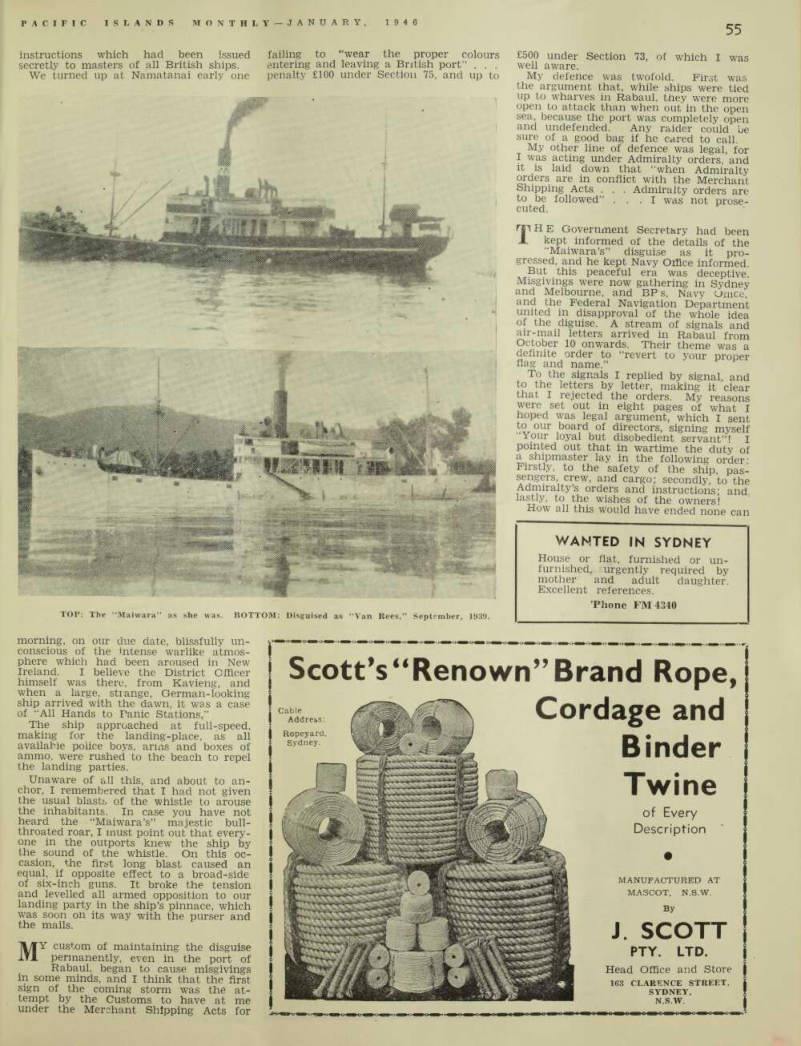
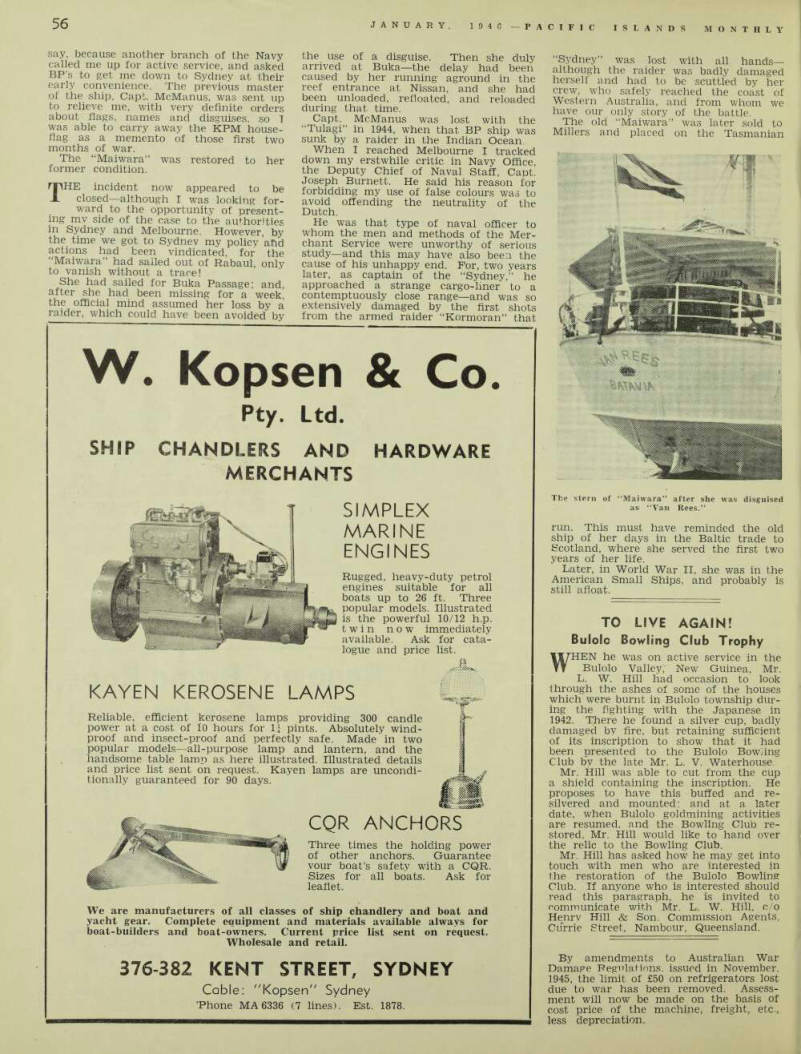
An Amusing Story of the Early Days of World War II
By Brett Hilder
THE capture of the BP steamer Matunga” by the German raider ‘Wolf,” near Rabaul, in 1917, had always seemed to me to be the classic example of successful raiding.
While it was customary and easy to blame the captain, the Navy, the owners or the Government, it was impossible to prevent the same thing happening again.
I was not worried, personally, because I was sure that when war did come it would find me serving in a well-armed warship, as I had belonged to the Naval Reserve for 10 years.
Imagine my added interest, therefore when the outbreak of war found me master of the “Maiwara,” a small, slow coal-burning steamer, lying at the open and undefended port of Rabayl, focal point of the area through which large fast German cargo-liners must pass on their way to the friendly ports of Japan, after slipping out of Australian ports a couple of days before the outbreak of war.
Such a vessel could so easily catch, and probably ram, a slower vessel, if he hadn’t sufficient arms to attempt a cap ture. I came to the conclusion that the only deterrent would be the disguise of the ship as a strong-minded neutral, such as Dutch, or even Japanese!
Ml Phil. Coote, the local manager, promised me all the paint or other materials needed, and was also prevailed
upon to part with one dozen rifles, as a second string to my bow in case the neutral disguise did not work.
Next came the job of squaring off the Government. Mr. Harold Page said that he would have to get Canberra’s and the Navy’s approval, and that would take time . . .
BY now it was September 6, and we were due to sail for the outports the next day. I decided to go ahead with the disguise as a Dutch ship of the KPM Line, to wit, the “van Rees,” which used to call at Rabaul a few years pre viously. By the end of the day the funnel had been scraped right down; and, in the evening, it was given a coat of cream paint, as the first step in the ship’s transformation.
It had been an ugly German-built funnel, with Scotch markings, but over night it became, if not a thing of pure beauty, at least the ship’s crowning glory.
And the effect it had on the ship’s char acter was like that on a woman who sallies out in a new red hat.
There were many people that day in Rabaul who failed to recognise the old ship, quite the best-known in the Terri tory. The ship’s appearance was greatly improved. The only man to object was the chief engineer, who believed that our attempt to hoax the enemy would bring down a great Hitlerite vengeance on our heads.
We took that added risk, and sailed off to the outports under a home-made Dutch ensign and KPM house-flag, while portion of our boat’s crew had the Her culean task of scraping down the entire hull, and replacing the old black paint with a coat of snowy white. This took two or three weeks, and, as we did one side of the ship first, and primed the hull with red lead under the white, we must have looked a bit weird at times.
The name “van Rees” had to be painted on each bow, and at the stern, where the port of registry was shown as “Batavia,” under a gold crown, to show the Royal patronage enjoyed by the KPM.
DURING this time our appearance had been deceiving, mystifying, and dis turbing the faithful folk of the out ports, whose confidence and faith in Providence rested on the übiquitous firm of “Bee Pees” and their local manifes tation, which snould have been the same old “Maiwara.”
Some of them even wrote in to the office about the loss of prestige caused by our dishonourably slinking around under false flags. None of the public, and few officials, were aware of the ample
instructions which had been issued secretly to masters of all British ships.
We turned up at Namatanai early one
morning, on our due date, blissfully un conscious of the intense warlike atmos phere which had been aroused in New Ireland. I believe the District Officer himself was there, from Kavieng, and when a large, strange, German-looking ship arrived with the dawn, it was a case of “All Hands to Panic Stations,”
The ship approached at full-speed, making for the landing-place, as all available police boys, arms and boxes of ammo, were rushed to the beach to repel the landing parties.
Unaware of all this, and about to an chor, I remembered that I had not given the usual blasts of the whistle to arouse the inhabitants. In case you have not heard the “Maiwara’s” majestic bull throated roar, I must point out that every one in the outports knew the ship by the sound of the whistle. On this oc casion, the first long blast caused an equal, if opposite effect to a broad-side of six-inch guns. It broke the tension and levelled all armed opposition to our landing party in the ship’s pinnace, which was soon on its way with the purser and the mails.
MY custom of maintaining the disguise permanently, even in the port of Rabaul, began to cause misgivings in some minds, and I think that the first sign of the coming storm was the at tempt by the Customs to have at me under the Merchant Shipping Acts for
failing to “wear the proper colours entering and leaving a British port” . . . penalty £lOO under Section 75, and up to
£5OO under Section 73, of which I was well aware.
My defence was twofold. First was the argument that, while ships were tied up to wharves in Rabaul, they were more open to attack than when out in the open sea, because the port was completely open and undefended. Any raider could be sure of a good bag if he cared to call.
My other line of defence was legal, for I was acting under Admiralty orders, and it is laid down that “when Admiralty orders are in conflict with the Merchant Shipping Acts . , . Admiralty orders are to be followed’' ... I was not prose cuted.
HE Government Secretary had been . kept informed of the details of the “Maiwara’s” disguise as it pro gressed, and he kept Navy Office informed.
But this peaceful era was deceptive.
Misgivings were now gathering in Sydney and Melbourne, and BP s, Navy omce. and the Federal Navigation Department united in disapproval of the whole idea of the diguise. A stream of signals and air-mail letters arrived in Rabaul from October 10 onwards. Their theme was a definite order to “revert to your proper flag and name.”
To the signals I replied by signal, and to the letters by letter, making it clear that I rejected the orders. My reasons were set out in eight pages of what I hoped was legal argument, which I sent to our board of directors, signing myself Your loyal but disobedient servant” l I pointed out that in wartime the duty of a shipmaster lay in the following order: Firstly, to the safety of the ship, pas sengers, crew, and cargo; secondly, to the Admiralty’s orders and instructions; and, lastly, to the wishes of the owners!
How all this would have ended none can
TOP: The “Maiwara” as she was. BOTTOM: Disguised as “Van Rees,” September, 1939.
say, because another branch of the Navy called me up for active service, and asked BP’s to get me down to Sydney at their early convenience. The previous master of the ship, Capt. McManus, was sent up to relieve me, with very definite orders about flags, names and disguises, so I was able to carry away the KPM house flag as a memento of those first two months of war.
The “Maiwara” was restored to her former condition.
THE incident now appeared to be closed—although I was looking for ward to the opportunity of present ing my side of the case to the authorities in Sydney and Melbourne. However, by the time we got to Sydney my policy ahd actions had been vindicated, for the “Maiwara” had sailed out of Rabaul, only to vanish without a trace!
She had sailed for Buka Passage: and, after she had been missing for a week, the official mind assumed her loss by a raider, which could have been avoided by
the use of a disguise. Then she duly arrived at Buka—the delay had been caused by her running aground in the reef entrance at Nissan, and she had been unloaded, refloated, and reloaded during that time.
Capt. McManus was lost with the “Tulagi” in 1944, when that BP ship was sunk by a raider in the Indian Ocean, When I reached Melbourne I tracked down my erstwhile critic in Navy Office, the Deputy Chief of Naval Staff, Capt.
Joseph Burnett. He said his reason for forbidding my use of false colours was to avoid offending the neutrality of the Dutch.
He was that type of naval officer to whom the men and methods of the Mer chant Service were unworthy of serious study—and this may have also been the cause of his unhappy end. For, two years later, as captain of the “Sydney,” he approached a strange cargo-liner to a contemptuously close range—and was so extensively damaged by the first shots from the armed raider “Kormoran” that
“Sydney” was lost with all hands— although the raider was badly damaged herself and had to be scuttled by her crew, who safely reached the coast of Western Australia, and from whom we have our only story of the battle.
The old “Maiwara” was later sold to Millers and placed on the Tasmanian
run. This must have reminded the old ship of her days in the Baltic trade to Scotland, where she served the first two years of her life.
Later, in World War 11, she was in the American Small Ships, and probably is still afloat.
The stern of “Maiwara” after she was disguised as “Van Rees.”
Advertisements & other items, pp. 64-66 (2 items)
Asthma, Bronchitis Coughing,
Curbed in 3 Minutes
Do you have attacks of Asthma or Bronchitis so bad that you can’t sleep? Do you feel weak, unable to work, and have to be careful not to take cold and can’t eat certain foods?
No matter how long you have suffered or what you have tried, there is new hope for you In a doctor’s prescription called Mendaco.
No dopes, no smokes, no injections, no atomizer.
All you do is take two tasteless tablets at meals and in 3 minutes Mendaco starts working through your blood, aiding nature to remove phlegm, promote free easy breathing and bring sound sleep the first night, so that you soon feel years younger and stronger.
No Asthma in 2 Years
Mendaco not only brings almost Immediate comfort and free breathing but builds up the system to ward off future attacks. For Instance, J. Richards, Hamilton, Ont., Canada, had lost 40 lbs., suffered coughing every night, couldn’t sleep. Mendaro stopped Asthma
spasms first night and he has had none since in over two years.
Money Back Guarantee
The very first dose of Mendaco goes right to work circulating through your blood and helping nature relieve you of the effects of Asthma. Try Mendaco under an iron-clad money back gaurantee. You be the judge. If you don’t feel fully satisfied after taking Mendaco just return the empty package and the full purchase price will be refunded. Get Mendaco from your chemist to-day and see how well you sleep to-night and how much better you feel to-morrow. The guarantee protects
RELIEVES ASTHMA
Mendaco
Now in 2 sizes ... 6/- and 12/-
£ J. GOUGH S* CO.
SUPPLIERS OF GENERAL MERCHANDISE TO LEADING FIRMS THROUGHOUT THE
PACIFIC ISLANDS
Exporters ... Importers ... Manufacturers' Representatives Bankers: Bank of N.S.W. Bank of Adelaide. Comptolr Nat. d’Escompte de Paris.
Cable Address; “SEAFOODS.” SYDNEY.
Codes: Bentley's, 2nd and Comp. Phrase; A.8.C., sth and 6th; Peterson, 2nd and 3rd; Banking; Acme.
Cordage and
WANTED IN SYDNEY
House or flat, furnished or unfurnished, urgently required by mother and adult daughter.
Excellent references. ’Phone FM 4340
Scott’s “Renown” Brand Rope,
Cordage and
Binder
4 momm SS
Twine
of Every Description
MANUFACTURED AT
MASCOT, N.S.W.
By
J. SCOTT
PTY. LTD.
Head Office and Store
163 CLARENCE STREET,
SYDNEY,
N.S.W.
W. Kopsen & Co.
Pty. Ltd.
SHIP CHANDLERS AND HARDWARE
MERCHANTS
SIMPLEX
MARINE
ENGINES
Rugged, heavy-duty petrol engines suitable for all boats up to 26 ft. Three popular models. Illustrated is the powerful 10/12 h.p. twin now immediately available. Ask for catalogue and price list.
KAYEN KEROSENE LAMPS
Reliable, efficient kerosene lamps providing 300 candle power at a cost of 10 hours for U pints. Absolutely windproof and insect-proof and perfectly safe. Made in two popular models —all-purpose lamp and lantern, and the handsome table lamp as here illustrated. Illustrated details and price list sent on request. Kayen lamps are unconditionally guaranteed for 90 days. mH i-
CQR ANCHORS
Three times the holding power of other anchors. Guarantee your boat’s safety with a CQR.
Sizes for all boats. Ask for leaflet.
We are manufacturers of all classes of ship chandlery and boat and yacht gear. Complete equipment and materials available always for boat-builders and boat-owners. Current price list sent on request.
Wholesale and retail.
376-382 KENT STREET, SYDNEY
Cable: "Kopsen" Sydney
’Phone MA 6336 (7 lines). Est. 1878.
Bulolo Bowling Club Trophy
To Live Again!
WHEN he was on active service in the Bulolo Valley; New Guinea, Mr.
L. W. Hill had occasion to look through the ashes of some of the houses which were burnt in Bulolo township dur ing the fighting with the Japanese in 1942. There he found a silver cup, badly damaged by fire, but retaining sufficient of its inscription to show that it had been presented to the Bulolo BowUng Club by the late Mr. L. V. Waterhouse.
Mr. Hill was able to cut from the cup a shield containing the inscription. He proposes to have this buffed and re silvered and mounted: and at a later date, when Bulolo goldmining activities are resumed, and the Bowling Club re stored, Mr. Hill would like to hand over the relic to the Bowling Club.
Mr. Hill has asked how he may get into touch with men who are interested in the restoration of the Bulolo Bowling Club. If anyone who is interested should read this paragraph, he is invited to nommunicate with Mr. L. W. Hill, c/o Henrv Hill & Son. Commission Agents, Currie Street, Nambour, Queensland.
By amendments to Australian War Damage Regulations, issued in November. 1945, the limit of £5O on refrigerators lost due to war has been removed. Assess ment will now be made on the basis of cost price of the machine, freight, etc.,
less depreciation.
Sydney Welfare Bureau
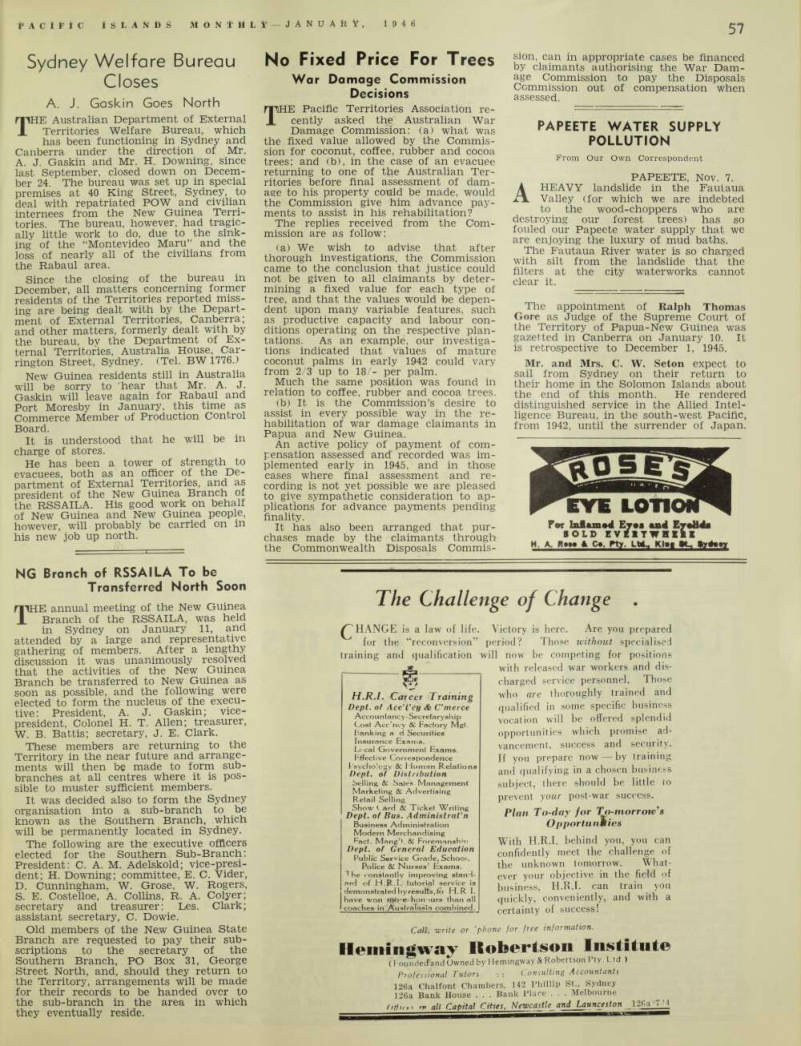
Closes
A. J. Gaskin Goes North
THE Australian Department of External Territories Welfare Bureau, which has been functioning in Sydney and Canberra under the direction of Mr.
A. J. Gaskin and Mr. H. Downing, since last September, closed down on Decem ber 24. The bureau was set up in special premises at 40 King Street, Sydney, to deal with repatriated POW and civilian internees from the New Guinea Terri tories. The bureau, however, had tragic ally little work to do, due to the sink ing of the “Montevideo Maru’’ and the loss of nearly all of the civilians from the Rabaul area.
Since the closing of the bureau in December, all matters concerning former residents of the Territories reported miss ing are being dealt with by the Depart ment of External Territories, Canberra; and other matters, formerly dealt with by the bureau, by the Department of Ex ternal Territories, Australia House, Car rington Street, Sydney. (Tel. BW 1776.) New Guinea residents still in Australia will be sorry to 'hear that Mr. A. J.
Gaskin will leave again for Rabaul and Port Moresby in January, this time as Commerce Member of Production Control Board.
It is understood that he will be in charge of stores.
He has been a tower of strength to evacuees, both as an officer of the De partment of External Territories, and as president of the New Guinea Branch of the RSSAILA. His good work on behalf of New Guinea and New Guinea people, however, will probably be carried on in his new job up north.
NG Branch of RSSAILA To be
Transferred North Soon
fTIHE annual meeting of the New Guinea 1 Branch of the RSSAILA, was held in Sydney on January 11, and attended by a large and representative gathering of members. After a lengthy discussion it was unanimously resolved that the activities of the New Guinea Branch be transferred to New Guinea as soon as possible, and the following were elected to form the nucleus of the execu tive: President, A. J. Gaskin; vice president, Colonel H. T. Allen; treasurer, W. B. Battis; secretary, J. E. Clark.
These members are returning to the Territory in the near future and arrange ments will then be made to form sub branches at all centres where it is pos sible to muster sufficient members.
It was decided also to form the Sydney organisation into a sub-branch to be known as the Southern Branch, which will be permanently located in Sydney.
The following are the executive officers elected for the Southern Sub-Branch; President: C. A. M. Adelskold; vice-presi dent: H. Downing; committee, E. C. Vider, D, Cunningham, W. Grose, W. Rogers, S. E. Costelloe, A. Collins, R. A. Colyer; secretary and treasurer: Les. Clark; assistant secretary, C. Dowie.
Old members of the New Guinea State Branch are requested to pay their sub scriptions to the secretary of the Southern Branch, PO Box 31, George Street North, and, should they return to the Territory, arrangements will be made for their records to be handed over to the sub-branch in the area in which they eventually reside.
No Fixed Price For Trees
War Damage Commission Decisions
THE Pacific Territories Association re cently asked the Australian War Damage Commission: (a) what was the fixed value allowed by the Commis sion for coconut, coffee, rubber and cocoa trees; and (b), in the case of an evacuee returning to one of the Australian Ter ritories before final assessment of dam age to his property could be made, would the Commission give him advance pay ments to assist in his rehabilitation?
The replies received from the Com mission are as follow: (a) We wish to advise that after thorough investigations, the Commission came to the conclusion that justice could not be given to all claimants by deter mining a fixed value for each type of tree, and that the values would be depen dent upon many variable features, such as productive capacity and labour con ditions operating on the respective plan tations. As an example, our investiga tions indicated that values of mature coconut palms in early 1942 could vary from 2/3 up to 18/- per palm.
Much the same position was found in relation to coffee, rubber and cocoa trees. (b) It is the Commission’s desire to assist in every possible way in the re habilitation of war damage claimants in Papua and New Guinea, An active policy of payment of com pensation assessed and recorded was im plemented early in 1945, and in those cases where final assessment and re cording is not yet possible we are pleased to give sympathetic consideration to ap plications for advance payments pending finality.
It has also been arranged that pur chases made by the claimants through the Commonwealth Disposals Commis
sion, can in appropriate cases be financed by claimants authorising the War Dam age Commission to pay the Disposals Commission out of compensation when assessed.
Papeete Water Supply
Pollution
Prom Our Own Correspondent
Papeete, Nov. 7.
A HEAVY landslide in the Fauiaua Valley (for which we are indebted to the wood-choppers who are destroying our forest trees) has so fouled our Papeete water supply that we are enjoying the luxury of mud baths.
The Fautaua River water is so charged with silt from the landslide that the filters at the city waterworks cannot clear it.
The appointment of Ralph Thomas Gore as Judge of the Supreme Court of the Territory of Papua-New Guinea was gazetted in Canberra on January 10. It is retrospective to December 1, 1945.
Mr. and Mrs. C. W. Seton expect to sail from Sydney on their return to their home in the Solomon Islands about the end of this month. He rendered distinguished service in the Allied Intel ligence Bureau, in the south-west Pacific, from 1942, until the surrender of Japan.
Advertisements & other items, p. 67 (1 item)
The Challenge of Change .
SO so
LOTI
For lalun«d £▼•■ EvtUa
EVEI7WIIII
BOLD
H. A. R*m & C*
py-
The Challenge of Change .
£ RANGE is a law of life. Victory is here. Are you prepared for the “reconversion” period? Those without specialised training and qualification will now be competing for positions with released war workers and dis-
charged service personnel. Those
who are thoroughly trained and qualified in some specific business vocation will be offered splendid
opportunities which promise ad-
vancement, success and security.
If you prepare now —by training and qualifying in a chosen business subject, there should be little to prevent your post-war success.
Plan With H.R.I, behind you, you can confidently meet the challenge of the unknown tomorrow. Whatever your objective in the field of business, H.R.I. can train you quickly, conveniently, and with a certainty of success!
Call, write or ’ph° ne l or l ree irifonnation.
Hemingway Robertson Institute
(l oundecfand Owned by Hemingway & Robertson I’ty. Ltd ) Professional Tutors : : Consulting Accountants 126 a Chalfont Chambers, 142 Phillip St., Sydney 126 a Bank House . . . Bank Place . . . Melbourne Othru all Capital Cities. Newcastle and Launceston 126 a 7' t To-day for To-morrotv s
Opportunities
H.R.I. Career Training Dept, of Acc’t’cy & C'merce Accountancy-Secretaryship Cost Acc’ncy SC Factory Mgt.
Banking a d Securities Insurance Exams.
Local Government Exams.
Effective Correspondence Psychology 6i Human Relations Dept, of Distribution Selling SC Sales Management Marketing Si Advertising Retail Selling Show V ard SC Ticket Writing Dept, of Bus. Administrat’n Business Administration Modern Merchandising Fact. Mang’t.& Foremanshm Dept, of General Education Public Service Grade, School, Police SC Nurses’ Exams.
The constantly improving standard of H.R.I. tutorial service is demonstrated by results, fo H.RI. have won m 6 e honours than all coaches in Australasia combined.
Sydney Legal Firm
To Specialise In
New Guinea Work
IN this issue there appears a profes sional announcement by Parish, Patience & Mclntyre, solicitors, of 2 O’Connell Street, Sydney.
This firm has been established in Syd ney for many years, and has an exten sive commercial and general practice, with connections in the Australian Capital Territory, throughout Australia and in England.
It is intended that an office will be opened at Port Moresby shortly, under the supervision of Mr. D. L. Mclntyre, a solicitor of the Supreme Court of New South Wales. This office will maintain direct contact with the Sydney office.
We are informed that it is the inten tion of this firm to “specialise” in all forms of New Guinea work, and especi ally the settlement of New Guinea estates. The death —and in many cases, intestacy—of so many New Guinea resi dents, and the innumerable claims upon the Way Damage Commission and other Government instrumentalities, have cre ated a great deal of business which can b dealt with advantageously by experi enced solicitors. The service offered by the firm should be of value to Territories residents and to commercial houses with interests extending to the mainland.
Rabaul Mystery
Why Did RAAF Leave on Jan. 21, 1942, While 300 Civilians Were Sacrificed?
ON Wednesday, January 21, 1942, 40 hours before the Japs occupied Rabaul, I was motoring from Keravat, via Toma, to Kokopo. Near Toma, we met a RAAF convoy, that was held up pending the arrival of petrol supplies. We helped the RAAF men, and talked to them.
“We were surprised to find that the column was bound for Put-Put, over on the south-east coast. They were sur prised to learn that we did not know that the Japs were expected in Rabaul on Friday morning. They had lost all their planes—there was nothing more they could do —so they were on their way out.
“When we got to Kokopo we met other people, who also had the story that the Japs were expected on Friday, and that a big Jap convoy was near. We asked why the shipping still in the harbour was not being used for the evacuation of civilians, but no one had any informa tion or any instructions—it was all con fusion.”
This important sidelight on pre invasion events in Rabaul was given to the “PIM” by Mrs. Kathleen Bignell, MBE, who was captured by the Japanese in Rabaul and sent to Japan, where she was liberated last August after three years as POW. Having seen much of what occurred in and around Rabaul in the terrible days between January 21 and 24, 1942, Mrs. Bignell heartily supports the public demand for an official inquiry into the circumstances, so that we may know who was responsible for the stupid and needless sacrifice of nearly 300 non combatant civilians.
Investigate
Thursday Island A
Wreck
Commission Sent to Investigate
ONE of the most shocking stories of official stupidity, muddle and wan ton waste, in the Pacific War, comes from Thursday Island.
In 1940, there were 240 residences and other buildings in TI. It was a pros perous little town, based on the shelling industry.
When the Pacific War came, Thursday Island, because of its strategic situation in relation to Torres Strait, became an important base for Allied defence Forces, of all classes. It was occupied by Army, Navy and Air Force detachments, nearly all Australian.
TI never was attacked. Except for an occasional Jap reconnaissance plane, the enemy never was within 500 miles of the place.
Yet, when the Pacific War ended, TI was a wreck. Half of the buildings had been demolished —for no reason that any one can see, except for use as firewood.
The valuable pearling industry has been practically destroyed. The boats have been generally “taken over” and most of the diving and shelling equipment has been either lost or smashed. Our in formant says the present appearance of the place suggests that it has been oc cupied by a race of lunatics.
Civilians naturally thought that, as soon as the war was over in August, they could return. They have not yet been allowed to go back.
Officialdom apparently hoped that it could hide the eyesore that once was Thursday Island. But very strong re presentations have been made to the Federal authority and the Queensland Government (TI is part of Queensland); and the latter finally has appointed a Commission to go to TI and report. The Commission, under the leadership of a Mr. Chuter, left for TI on January 14.
Its report will be more than interesting.
Expert opinion is that it will take years to re-establish TI as a pearl-shelling centre.
Continued Exodus Of
Young People From Samoa
Apia, Dec. 13.
A LARGE number of passengers left Apia by the last “Matua” for Nukualofa for the Tongan centenary celebrations. Others went on to New Zealand.
The continuous stream of part-Samoan boys and girls going to New Zealand for training and work is not abating in any way, and passages on the “Matua” and “Maui Pomare” are booked for many months ahead. Some of the passengers, tired of waiting for accommodation, are taking advantage of the government air line to New Zealand.
The New Zealand Press is taking notice of the arrival of large numbers of youngsters from Samoa, most of whom do not seem to find any difficulty in finding lucrative employment there.
The three Paramount Chiefs of Samoa —Mataafa, Tamasese and Malietoa —have returned from their visit to New Zealand and have expressed themselves very favourably regarding their welcome.
High Chiefs Tamasese and Malietoa left by plane for Nukualofa a few days after their return in order to represent the Samoan people at the centenary cele brations in Tonga.
Advertisements & other items, p. 68 (2 items)
58
JANUARY. 1946 PACIFIC ISLANDS MONTHLt
Itching Skin Germs
PARISH, PATIENCE
& Mclntyre Solicitors Union Trustee Building 2 O’Connell Street, SYDNEY Telephone BW 4305-6 Cable and Telegraphic Address : “Parish, Sydney”
Agents and Correspondents throughout Australia and Overseas
Itching Skin Germs Killed in 3 Days
Thanks to the discovery of an American physician, It is now possible to kill and remove the true cause of most skin troubles. Your skin has nearly 50 million tiny seams and pores where Invisible germs and parasites can hide, and which are the true cause of terrible Itching, Cracking, Peeling, Burning, Ringworm, Acne, Psoriasis, Blackheads, Pimples, Foot Itch and other disfiguring blemishes.
Blemishes such as these make you look and feel embarrassed, unattractive and handicapped in life, both socially and in business. You can’t get rid of these disfigurements with ordinary treatments, which give only temporary relief, because they do not kill the germs or parasites responsible for your trouble. .
New Discovery Kills Cause
Former skin sufferers throughout the world are now praising Nixoderm, the discovery of a leading American skin specialist. This remarkable new preparation quickly penetrates into the pores of the skin and kills the germs and parasites responsible for your trouble in 7 minutes, stopping the Itch almost instantly. At the same time, this wonderful preparation acts as a tonic and skin food, so that as the cause of your trouble is removed, your skin becomes soft, smooth and clear. This clear, healthy complexion will give you new charm and make it easy to win friends.
Praised by Doctors
Dr. T. A. Ellis, well-known physician of Toronto, Canada, recently stated: “Skin disorders caused by parasites, as many are, yield to Nixoderm. These parasites are invisible to the naked eye. They eat away the skin, forming ugly eruptions. Ordinary ointments or remedies fail completely, or give only temporary results because they do not reach the cause of the condition. It is this value about Nixoderm in attacking parasites which impresses me most favorably, and explains in large measure the success it enjoys over many stubborn cases.”
Guaranteed Results
Get Nixoderm to-day. Put it to the test. In a few minutes you will find that the Itching has stopped, and in 24 hours you can see for yourself that your skin is clearer. And it is guaranteed that, within one week, Nixoderm must make your skin soft, clear, smooth and attractive or money back on return of empty package. Get Nixoderm from your chemist or store to-day. The guarantee protects you. So don’t delay. Get Nixoderm to-day.
Nixoderm 2/. &4/-
For Skin Sores, Pimples and Itch.
More About The
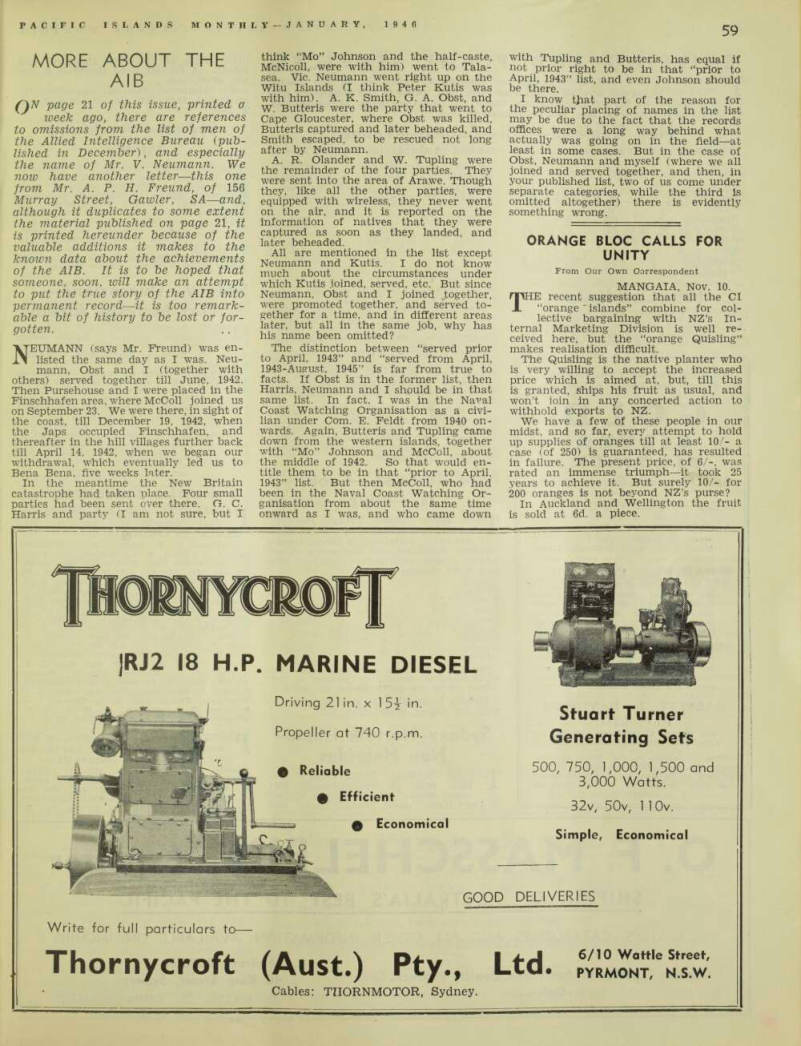
Aib
r\N page 21 of this issue, printed a week ago, there are references to omissions from the list of men of the Allied Intelligence Bureau (pub lished in December), and especially the name of Mr. V. Neumann. We now have another letter—this one from Mr. A. P. H. Freund, of 156 Murray Street, Gawler, SA — and, although it duplicates to some extent the material published on page 21, it is printed hereunder because of the valuable additions it makes to the known data about the achievements of the AIB. It is to be hoped that someone, soon, will make an attempt to put the true story of the AIB into permanent record—it is too remark able a bit of history to be lost or for gotten.
NEUMANN (says Mr. Freund) was en listed the same day as I was. Neu mann, Obst and I (together with others) served together till June, 1942.
Then Pursehouse and I were placed in the Finschhafen area, where McColl joined us on September 23. We were there, in sight of the coast, till December 19, 1942, when the Japs occupied Finschhafen, and thereafter in the hill villages further back till April 14, 1942, when we began our withdrawal, which eventually led us to Bena Bena, five weeks later.
In the meantime the New Britain catastrophe had taken place. Four small parties had been sent over there. G. C.
Harris and party (I am not sure, but I
think “Mo” Johnson and the half-caste, McNicoll, were with him) went to Tala sea. Vic. Neumann went right up on the Witu Islands (I think Peter Kutis was with him). A. K. Smith, G. A. Obst, and W. Butteris were the party that went to Cape Gloucester, where Obst was killed, Butteris captured and later beheaded, and Smith escaped, to be rescued not long after by Neumann.
A. R. Olander and W. Tupling were the remainder of the four parties. They were sent into the area of Arawe. Though they, like all the other parties, were equipped with wireless, they never went on the air, and it is reported on the information of natives that they were captured as soon as they landed, and later beheaded.
All are mentioned in the list except Neumann and Kutis. I do not know much about the circumstances under which Kutis joined, served, etc. But since Neumann, Obst and I joined .together, were promoted together, and served to gether for a time, and in different areas later, but all in the same job, why has his name been omitted?
The distinction between “served prior to April, 1943” and “served from April, 1943-August, 1945” is far from true to facts. If Obst is in the former list, then Harris, Neumann and I should be in that same list. In fact, I was in the Naval Coast Watching Organisation as a civi lian under Com. E. Feldt from 1940 on wards. Again, Butteris and Tupling came down from the western islands, together with “Mo” Johnson and McColl, about the middle of 1942. So that would en title them to be in that “prior to April. 1943” list. But then McColl, who had been in the Naval Coast Watching Or ganisation from about the same time onward as I was, and who came down
with Tupling and Butteris, has equal if not prior right to be in that “prior to April, 1943” list, and even Johnson should be there.
I know tjiat part of the reason for the peculiar placing of names in the list may be due to the fact that the records offices were a long way behind what actually was going on in the field —at least in some cases. But in the case of Obst, Neumann and myself (where we all joined and served together, and then, in your published list, two of us come under separate categories, while the third Is omitted altogether) there is evidently something wrong.
Orange Bloc Calls For
Unity
From Our Own Correspondent
Mangaia, Nov. 10.
rE recent suggestion that all the Cl “orange" islands” combine for col lective bargaining with NZ’s In ternal Marketing Division is well re ceived here, but the “orange Quisling” makes realisation difficult.
The Quisling is the native planter who is very willing to accept the increased price which is aimed at, but, till this is granted, ships his fruit as usual, and won’t ioin in any concerted action to withhold exports to NZ.
We have a few of these people in our midst, and so far, every attempt to hold up supplies of oranges till at least 10/- a case (of 250) is guaranteed, has resulted in failure. The present price, of 6/-, was rated an immense triumph—it took 25 years to achieve it. But surely 10/- for 200 oranges is not beyond NZ’s purse?
In Auckland and Wellington the fruit is sold at 6d. a piece.
Advertisements & other items, p. 69 (1 item)
Thornycroft (Aust.) Pty., Ltd.
A T tiMS HO n
JRJ2 18 H.P. MARINE DIESEL
a * Driving 21 in. x 1 5i in.
Propeller at 740 r.p.m. • Reliable £ Efficient Q Economical ■■■ Stuart Turner
Generating Sets
500, 750, 1,000, 1,500 and 3,000 Watts. 32v, 50v, 1 1 Ov.
Simple, Economical
GOOD DELIVERIES
Write for full particulars
Thornycroft (Aust.) Pty., Ltd.
6/10 Wattle Street,
PYRMONT, N.S.W.
Cables: TIIORNMOTOR, Sydney.
Sydney-Norfolk Island-
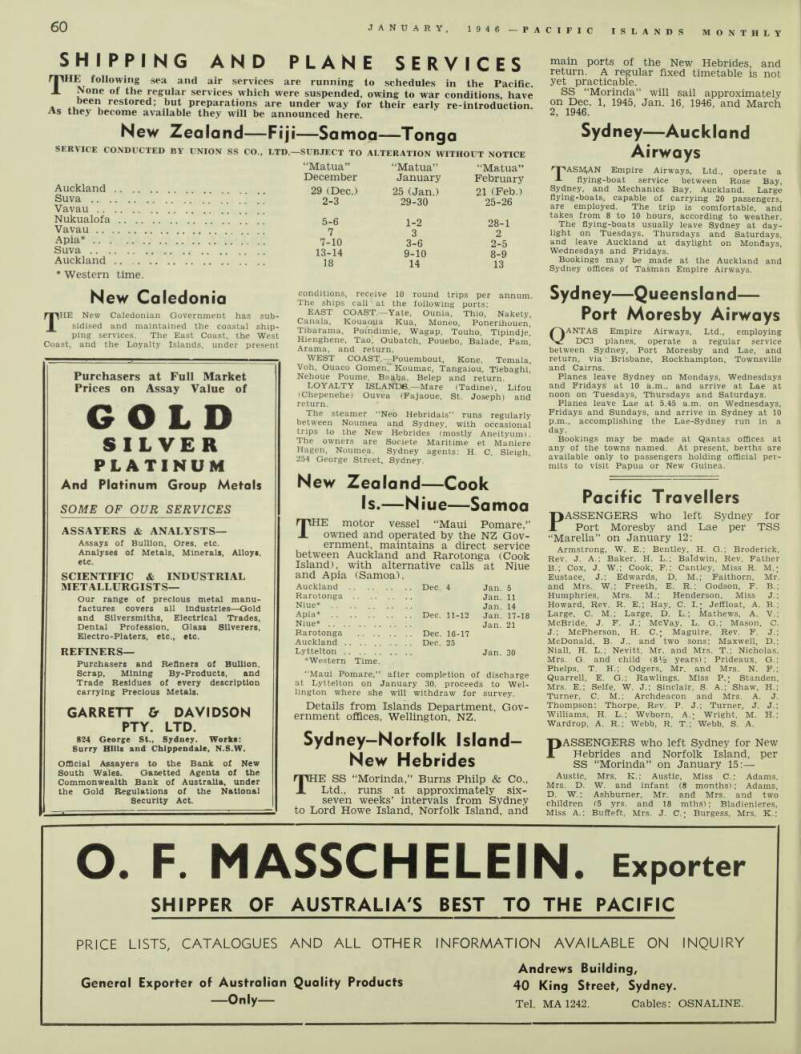
Shipping And Plane Services
THE following sea and air services are running to schedules in the Pacific.
None of the regular services which were suspended, owing to war conditions, have * beei ? restored ; but preparations are under way for their early re-introduction.
As they become available they will be announced here.
New Zealand—Fiji—Samoa— Tonga
SERVICE CONDUCTED BY UNION SS CO., LTD.-SUBJECT TO ALTERATION WITHOUT NOTICE
New Caledonia
THE New Caledonian Government has sub sidised and maintained the coastal ship ping services. The East Coast, the West Coast, and the Loyalty Islands, under present
conditions, receive 10 round trips per annum.
The ships call at the following ports: EAST COAST.—Yate, Ounia, Thio, Nakety, Canala, Kouaojua Kua, Moneo, Ponerihouen, Tibarama, Poi'ndimie, Wagap, Touho, Tipindje, Hienghene, Tao, Oubatch, Pouebo, Balade, Pam| Arama, and return.
WEST COAST.—Pouembout, Kone, Temala, V°h, Ouaco Gomen,' Koumac, Tangaiou, Tiebaghi, Nehoue Poume, Baaba. Belep and return.
LOYALTY ISLANDS.—Mare (Tadine), Lifou iChepenehe) Ouvea (Fajaoue, St. Joseph) and return.
The steamer “Neo Hebridais” runs regularly between Noumea and Sydney, with occasional trips to the New Hebrides (mostly Aneityum).
The owners are Societe Maritime et Maniere Hagen, Noumea. Sydney agents: H. C. Sleigh, 254 George Street, Sydney.
New Zealand—Cook
Is.—Niue—Samoa
THE motor vessel “Maui Pomare,” owned and operated by the NZ Gov ernment, maintains a direct service between Auckland and Rarotonga (Cook Island), with alternative calls at Niue and Apia (Samoa).
“Maui Pomare,” after completion of discharge at Lyttelton on January 30. proceeds to Wel lington where she will withdraw for survey.
Details from Islands Department, Gov ernment offices, Wellington, NZ.
Sydney-Norfolk Island-
New Hebrides
rE SS “Morinda,” Burns Philp & Co., Ltd., runs at approximately six seven weeks’ intervals from Sydney to Lord Howe Island, Norfolk Island, and
mam ports of the New Hebrides, and return. A regular fixed timetable is not yet practicable.
SS “Morinda” will sail approximately on Dec. 1, 1945, Jan. 16, 1946, and March 2, 1946.
Sydney—Auckland
Airways
TASMjAN Empire Ltd., operate a flying-boat service between Rose Bay, Sydney, and Mechanics Bay, Auckland. Large flying-boats, capable of carrying 20 passengers, are employed. The trip is comfortable, and takes from 8 to 10 hours, according to weather.
The flying-boats usually leave Sydney at day light on Tuesdays. Thursdays and Saturdays, and leave Auckland at daylight on Mondays, Wednesdays and Fridays.
Bookings may be made at the Auckland and Sydney oflices of Tasman Empire Airways.
Sydney—Queensland—
Port Moresby Airways
Q ANT AS Empire Airways, Ltd., employing DCS planes, operate a regular service between Sydney, Port Moresby and Lae, and return, via Brisbane, Rockhampton, Townsville and Cairns.
Planes leave Sydney on Mondays, Wednesdays and Fridays at 10 a.m., and arrive at Lae at noon on Tuesdays, Thursdays and Saturdays.
Planes leave Lae at 5.45 a.m. on Wednesdays, Fridays and Sundays, and arrive in Sydney at 10 p.m., accomplishing the Lae-Sydney run in a day.
Bookings may be made at Qantas oflices at any of the towns named. At present, berths are available only to passengers holding official per mits to visit Papua or New Guinea.
“Matua”
“Matua”
“Matua”
December January
February
Auckland 25 (Jan.) 21 (Feb.) Suva Vavau 29-30 25-26 Nukualofa 1-2 28-1 Vavau 3 2 Apia* 3-6 2-5 Suva 9-10 8-9 Auckland * Western time. 14 13
Auckland Dec. 4 Jan. 5 Rarotonga Jan. 11 Niue* Jan. 14 Apia* Dec. 11-12 Jan. 17-18 Niue* Jan. 21 Rarotonga Dec. 16-17 Auckland Dec. 25 Lyttelton Jan. 30 ♦Western Time.
Pacific Travellers
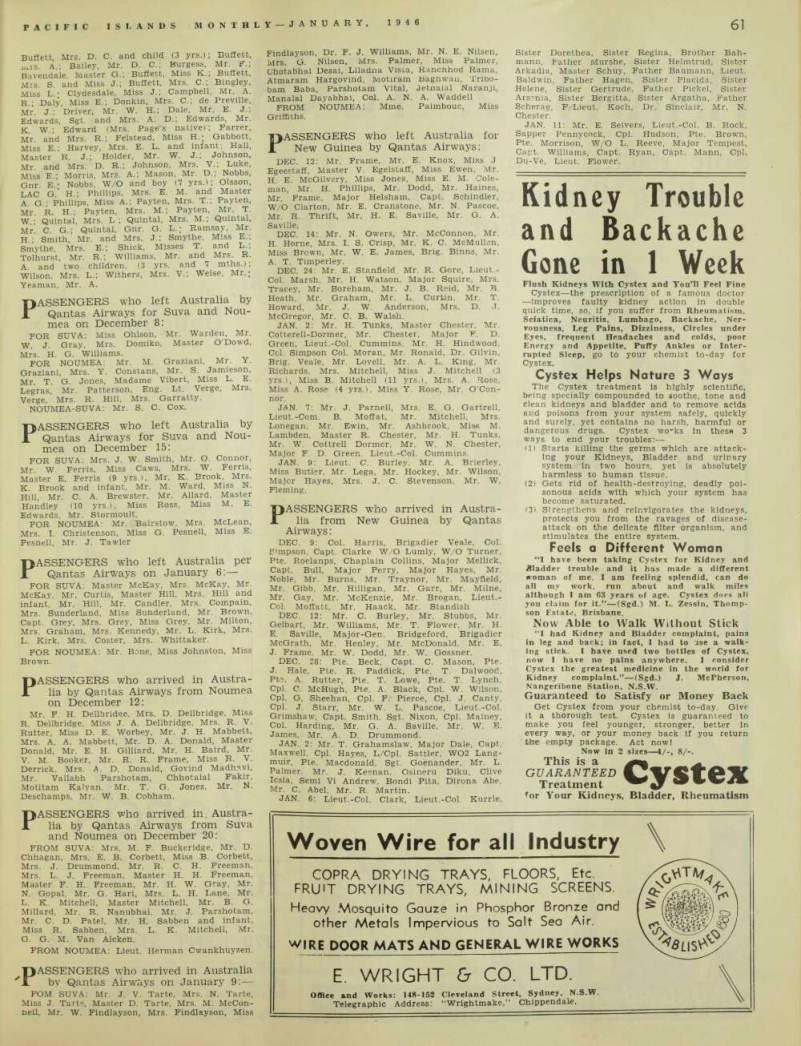
PASSENGERS who left Sydney for Port Moresby and Lae per TSS “Marella” on January 12: Armstrong, W. E.; Bentley, H. G.; Broderick, Rev. J. A.; Baker, H. L.; Baldwin, Rev. Father B.; Cox, J. W.; Cook, F.; Cantley, Miss R. M.; Eustace, J.: Edwards, D. M.; Faithorn, Mr. and Mrs. W.; Freeth, E. R.; Godson, F. B.; Humphries, Mrs. M.; Henderson, Miss J.; Howard, Rev. R. E.; Hay, C. I.; Jeffloat, A. B.; Large, C. M.; Large, D. L.; Mathews, A. V.; Mcßride, J. F. J.; McVay, L. G.; Mason, C.
J.; McPherson, H. C.; Maguire, Rev. F. J.; McDonald, B. J., and two sons; Maxwell, D.; Niall, H. L.; Nevitt, Mr. and Mrs. T.; Nicholas, Mrs. G. and child (8*72 years); Prideaux, G.: Phelps. T. H.; Odgers, Mr. and Mrs. N. F.; Quarrell, E. G.; Rawlings, Miss P. • Standen, Mrs. E.; Selfe, W. J.; Sinclair, S. A.;*Shaw, H.; Turner, C. M.; Archdeacon and Mrs. A. J.
Thompson; Thorpe, Rev. P. J.; Turner, J. J.; Williams, H. L.; Wvborn, A.- Wright, M. H.; Wardrop, A. R.; Webb, R. T.;’Webb, S. A.
PASSENGERS who left Sydney for New Hebrides and Norfolk Island, per SS “Morinda” on January 15:— Austic, Mrs. K.; Austic, Miss C.; Adams, Mrs. D. W. and infant (8 months); Adams, D. W.; Ashburner, Mr. and Mrs. and two children (5 yrs. and 18 mths); Bladienieres, Miss A.; Buffeft, Mrs. J. C.; Burgess, Mrs. K.;
Buffett Mrs. D. C. and child (3 yrs.); Buffett, ivxis. a.; Bailey, Mr. D. C.; Burgess, Mr. F.; Bavendale, Master G.; Buffett, Miss K., Buffett, Mrs. S. and Miss J.; Buffett, Mrs. C.; Bingley, Miss L • Clydesdale, Miss J.; Campbell, Mr. A.
R.; Daly, Miss E.; Donkin, Mrs. C.; de Preville, Mr J.; Driver, Mr. W. H.; Dale, Mr. E. J.; Edwards, Sgt. and Mrs. A. D.; Edwards, Mr.
K. W.; Edward (Mrs. Page’s native); Farrer, Mr, and Mrs. R.; Felstead, Miss H.; Gabbott, Miss E.; Harvey, Mrs. E. L. and infant; Hall, Master R. J.; Holder, Mr. W. J.; Johnson, Mr and Mrs. D. R.; Johnson, Mrs. V.; Luke, Miss E ; Morris, Mrs. A.; Mason, Mr. D.; Nobbs, Gnr E.- Nobbs, W/O and boy (7 yrs.); Olsson, LAC G.’ H.; Phillips, Mrs. E. M. and Master A G ; Phillips, Miss A.; Payten, Mrs. T.; Payten, Mr. R. H.; Payten, Mrs. M.; Payten, Mr. T.
W • Quintal, Mrs. L ; Quintal, Mrs. M.; Quintal, Mr! C. G.; Quintal, Gnr. G. L.; Ramsay, Mr.
H.; Smith, Mr. and Mrs. J.; Smythe, Miss E.; Smythe, Mrs. E.; Shick, Misses T. and L.; Tolhurst, Mr. R.; Williams, Mr. and Mrs. R.
A. and two children, (3 yrs. and 7 mths.); Wilson. Mrs. L.; Withers, Mrs. V.; Weise, Mr.; Yeaman, Mr. A.
PASSENGERS who left Australia by
Qantas Airways for Suva and Nou mea on December 8; FOR SUVA: Miss Ohlson, Mr. Warden, Mr.
W. J. Gray, Mrs. Domiko, Master O’Dowd, Mrs. H. G. Williams.
FOR NOUMEA: Mr. M. Graziani, Mr. Y.
Graziani, Mrs. Y. Constans, Mr. S. Jamieson, Mr. T. G. Jones, Madame Vibert, Miss L. E.
Legras, Mr. Patterson, Eng. Lt. Verge, Mrs.
Verge, Mrs. R. Hill, Mrs. Garratty.
Noumea-Suva; Mr. S. C. Cox.
PASSENGERS who left Australia by Qantas Airways for Suva and Nou mea on December 15; FOR SUVA: Mrs. J. W. Smith, Mr. O. Connor, Mr W Ferris, Miss Caws, Mrs. W. Ferris, Master E. Ferris (9 yrs.). Mr. K. Brook, Mrs.
K. Brook and infant, Mr. M. Ward, Miss N.
Hill, Mr. C. A. Brewster, Mr. Allard, Master Handley (10 yrs.), Miss Ross, Miss M. E.
Edwards, Mr. Stormoult.
FOR NOUMEA: Mr. Bairstow, Mrs. McLean, Mrs. I. Christenson, Miss G. Pesnell, Miss E.
Pesnell, Mr. J. Tawler PASSENGERS who left Australia per
Qantas Airways on January 6: —
FOR SUVA: Master McKay, Mrs. McKay, Mr.
McKay, Mr. Curtis, Master Hill, Mrs. Hill and infant, Mr. Hill, Mr. Candler, Mrs. Compain, Mrs. Sunderland, Miss Sunderland, Mr. Brown, Capt. Grey, Mrs. Grey, Miss Grey, Mr. Milton, Mrs. Graham, Mrs. Kennedy, Mr. L. Kirk, Mrs.
L. Kirk, Mrs. Coster, Mrs. Whittaker.
FOR NOUMEA: Mr. Bone, Miss Johnston, Miss Brown.
PASSENGERS who arrived in Austra
lia by Qantas Airways from Noumea
on December 12: Mr. F. H. Dellbridge, Mrs. D. Dellbridge, Miss R. Dellbridge, Miss J. A. Dellbridge, Mrs. R. V.
Rutter, Miss D. E. Worbey, Mr. J. H. Mabbett, Mrs. A. A. Mabbett, Mr. D. A. Donald, Master Donald, Mr. E. H. Gilliard, Mr. H. Baird, Mr.
V. M. Booker, Mr. R. R. Frame, Miss R. V.
Derrick, Mrs. A. D. Donald, Govind Madhavi, Mr. Vallabh Parshotam, Chhotalal Fakir.
Motitam Kalyan, Mr. T. G. Jones, Mr. N.
Deschamps, Mr. W. B. Cobham.
PASSENGERS who arrived in, Austra
lia by Qantas Airways from Suva
and Noumea on December 20: FROM SUVA: Mrs. M. F. Buckeridge, Mr. D.
Chhagan, Mrs. E. B. Corbett, Miss B. Corbett, Mrs. J. Drummond, Mr. R. C. H. Freeman, Mrs. L. J. Freeman, Master H. H. Freeman, Master P. H. Freeman, Mr. H. W. Gray, Mr.
N. Gopal, Mr. G. Hari, Mrs. L. H. Lane, Mr.
L. K. Mitchell, Master Mitchell, Mr. B. G.
Millard, Mr. R. Nanubhai, Mr. J. Parshotam, Mr. C. D. Patel, Mr. H. Sabben and infant, Miss R. Sabben, Mrs. L. K. Mitchell, Mr.
G. G. M. Van Aicken.
FROM NOUMEA: Lieut. Herman Cwankhuyzen.
PASSENGERS who arrived in Australia
by Qantas Airways on January 9:—
POM SUVA; Mr. J. V. Tarte, Mrs. N. Tarte, Miss J. Tarte, Master D. Tarte, Mrs. M. McCon , neil, Mr. W. Findlayson, Mrs. Findlayson, Miss
Findlayson, Dr. F. J. Williams, Mr. N. E. Nilsen, Mrs. G. Nilsen, Mrs. Palmer, Miss Palmer, Chotabhai Desai, Liladna Vista, Ranchhod Rama, Atmaram Hargovind, Motiram Baghwan, Tribo bam Baba, Parshotam Vital, Jetnalal Naranji, Manalal Dayabhai, Col. A. N. A. Waddell FROM NOUMEA: Mme. Paimbouc, Miss Griffiths.
PASSENGERS who left Australia for
New Guinea by Qantas Airways:
DEC. 12: Mr. Frame, Mr. E. Knox, Miss J Egeestaff, Master V. Egelstaff, Miss Ewen, Mr.
H. E. McGilvery, Miss Jones, Miss E. M. Cole man, Mr. H. Phillips, Mr. Dodd, Mr. Haines, Mr. Frame, Major Helsham, Capt. Schindler, W/O Clarion, Mr. E. Cranstone, Mr. N. Pascoe, Mr. R. Thrift, Mr. H. E. Saville, Mr. G. A.
Saville.
DEC. 14: Mr. N. Owers, Mr. McConnon, Mr.
H. Horne, Mrs. I. S. Crisp, Mr. K. C. McMullen, Miss Brown, Mr. W. E. James, Brig. Binns, Mr.
A. T. Timperley.
DEC. 24: Mr. E. Stanfield, Mr. R. Gore, Lieut.- Col. Marsh, Mr. H. Watson, Major Squire, Mrs.
Tracey, Mr. Boreham, Mr. J. B. Reid, Mr. B.
Heath, Mr. Graham, Mr. L. Curtin, Mr. T.
Howard, Mr. J. W. Anderson, Mrs. D. J.
McGregor, Mr. C. B. Walsh.
JAN. 2: Mr. H. Tunks, Master Chester, Mr.
Cotterell-Dormer, Mr. Chester, Major P. D.
Green, Lieut.-Col. Cummins. Mr. H. Hindwood, Col. Simpson Col. Moran, Mr. Ronald, Dr. Gilvin, Brig. Veale, Mr. Lovell, Mr. A. L. King, Mr.
Richards, Mrs. Mitchell, Miss J. Mitchell (3 yrs.), Miss B. Mitchell (11 yrs.), Mrs. A. Rose, Miss A. Rose (4 yrs.). Miss Y. Rose, Mr. O’Con nor.
JAN. 7: Mr. J. Parnell, Mrs. E. G. Gartrell, Lieut.-Com. B. Moffat, Mr. Mitchell, Mrs.
Lonegan, Mr. Ewin, Mr. Ashbrook, Miss M.
Lambden, Master R. Chester, Mr. H. Tunks, Mr. W. Cottrell Dormer, Mr. W. N. Chester, Major F. D. Green. Lieut.-Col. Cummins.
JAN. 9: Lieut. C. Burley. Mr. A. Brierley, Miss Butler, Mr. Lega, Mr. Hockey, Mr. Wilson, Major Hayes, Mrs. J. C. Stevenson, Mr. W.
Fleming.
PASSENGERS who arrived in Austra lia from New Guinea by Qantas
Airways:
DEC. 9: Col. Harris, Brigadier Veale, Col.
Simpson, Capt. Clarke W/O Lumly, W/O Turner, Pte. Roelanps, Chaplain Collins, Major Mellick, Capt. Bull, Major Perry, Major Hayes, Mr.
Noble, Mr. Burns, Mr. Traynor, Mr. Mayfield, Mr. Gibb, Mr. Hilligan, Mr. Garr, Mr. Milne.
Mr. Gay, Mr. McKenzie, Mr. Brogan, Lieut.- Col. Moffatt, Mr. Haack, Mr. Standish DEC. 12: Mr. C. Burley, Mr. Stubbs. Mr.
Gelbart, Mr. Williams, Mr. T. Flower, Mr. H.
E. Saville, Major-Gen. Bridgeford, Brigadier McGrath, Mr. Henley, Mr. McDonald, Mr. E.
J. Frame, Mr. W. Dodd, Mr. W. Gossner.
DEC. 28: Pte. Beck, Capt. C. Mason, Pte.
J. Hale, Pte. R. Paddick, Pte. T. Dalwood, Pte. A. Rutter, Pte. T. Lowe, Pte. T. Lynch, Cpl. C. McHugh, Pte. A. Black, Cpl. W. Wilson.
Cpl. G. Sheehan, Cpl. F. Pierce, Cpl. J. Canty, Cpl. J. Starr, Mr. W. L. Pascoe, Lieut.-Col.
Grimshaw, Capt. Smith, Sgt. Nixon, Cpl. Mainey, Col. Harding, Mr. G. A. Saville, Mr. W. E.
James, Mr. A. D. Drummond.
JAN. 2: Mr. T. Grahamslaw, Major Dale, Capt.
Maxwell, Cpl. Hayes, L/Cpl. Sattler, WO2 Lang muir, Pte. Macdonald, Sgt. Goenander, Mr. L.
Palmer. Mr. J. Keenan. Osineru Diku, Clive Icsia, Semi Vi Andrew, Bondi Pita, Dirona Abe, Mr. C. Abel, Mr. R. Martin.
JAN. 6: Lieut.-Col. Clark, Lieut.-Col. Kurrle,
Sister Dorethea, Sister Regina, Brother Bah mann, Father Murshe, Sister Helmtrud, Sister Arkadia, Master Schuy, Father Baumann, Lieut.
Baldwin, Father Hagen, Sister Placida, Sister Helene, Sister Gertrude, Father Pickel, Sister Arsenia, Sister Bergitta, Sister Argatha, Father Scherag, F/Lieut. Koch, Dr. Sinclair, Mr. N.
Chester.
JAN. 11: Mr. E. Seivers, Lieut.-Col. B. Rock, Sapper Pennycnck, Cpl. Hudson, Pte. Brown, Pte. Morrison, W/O L. Reeve, Major Tempest, Capt. Williams, Capt. Ryan, Capt. Mann, Cpl.
Du-Ve, Lieut. Flower.
Advertisements & other items, pp. 70-72 (2 items)
Gold
Purchasers at Full Market Prices on Assay Value of
SILVER
PLATINUM
And Platinum Group Metals
SOME OF OUR SERVICES
ASSAYERS & ANALYSTS—
Assays of Bullion, Ores, etc.
Analyses of Metals, Minerals, Alloys, etc.
SCIENTIFIC & INDUSTRIAL
METALLURGISTS—
Our range of precious metal manufactures covers all Industries—Gold and Silversmiths, Electrical Trades, Dental Profession, Glass Sllverers.
Electro-Platers, etc., etc.
REFINERS—
Purchasers and Refiners of Bullion.
Scrap, Mining By-Products, and Trade Residues of every description carrying Precious Metals.
GARRETT Cr DAVIDSON
PTY. LTD.
824 George St., Sydney. Works: Surry Hills and Chippendale, N.S.W.
Official Assayers to the Bank of New South Wales. Gazetted Agents of the Commonwealth Bank of Australia, under the Gold Regulations of the National Security Act.
O. F. MASSCHELEIN. Exporter
SHIPPER OF AUSTRALIA'S BEST TO THE PACIFIC PRICE LISTS, CATALOGUES AND ALL OTHER INFORMATION AVAILABLE ON INQUIRY Andrews Building, General Exporter of Australian Quality Products 40 King Street, Sydney. —Only Tel. MA 1242. Cables: OSNALINE.
Kidney Trouble
and Backache
Gone in 1 Week
Flush Kidneys With Cystex and You’ll Feel Fine Cystex—the prescription of a famous doctor —improves faulty kidney action In double quick time, so, if you suffer from Rheumatism, Sciatica, Neuritis, Lumbago, Backache, Nervousness, Leg Pains, Dizziness, Circles under Eyes, frequent Headaches and colds, poor Energy and Appetite, Puffy Ankles or Interrupted Sleep, go to your chemist to-day for Cystex.
Cystex Helps Nature 3 Ways
The Cystex treatment is highly scientific, being specially compounded to soothe, tone and clean kidneys and bladder and to remove acids and poisons from your system safely, quickly and surely, yet contains no harsh, harmful or dangerous drugs. Cystex wo'ks In these 3 ways to end your troubles;— (1) Starts killing the germs which are attacking your Kidneys, Bladder and urinary system in two hours, yet is absolutely harmless to human tissue. (2) Gets rid of health-destroying, deadly poisonous acids with which your system has become saturated. f 3) Strengthens and reinvlgorates the kidneys, protects you from the ravages of diseaseattack on the delicate filter organism, and stimulates the entire system.
Feels a Different Woman
"1 have been taking Cystex for Kidney and Bladder trouble and it has made a different woman of me. I am feeling splendid, can do all my work, run about and walk miles although I am 63 years of age. Cystex does all you claim for it.”—(Sgd.) M. L. Zessin, Thompson Estate, Brisbane.
Now Able to Walk Without Stick ”1 had Kidney and Bladder complaint, pains in leg and back; in fact, 1 had to use a walking stick. I have used two bottles of Cystex, now 1 have no pains anywhere. I consider Cystex the greatest medicine in the world for Kidney complaint.”—(Sgd.) J. McPherson, Nangeribone Station, N.S.W.
Guaranteed to Satisfy or Money Back Get Cystex from your chemist to-day. Give it a thorough test. Cystex is guaranteed to make you feel younger, stronger, better in every way, or your money back if you return the empty package. Act now!
Now in 2 sizes—l/-, 8/-.
TViJc ic O
GUARANTEED CVStfiX
Treatment w J
for Your Kidneys, Bladder, Rheumatism
Woven Wire for all Industry
COPRA DRYING TRAYS, FLOORS, Etc.
FRU'T DRYING TRAYS, MINING SCREENS.
Heavy Mosquito Gauze in Phosphor Bronze and other Metals Impervious to Salt Sea Air.
WIRE DOOR MATS AND GENERAL WIRE WORKS
E. WRIGHT & CO. LTD.
Office and Works: 148-152 Cleveland Street, Sydney, N.S.W.
Telegraphic Address: “Wrightmake,” Chippendale.
VVT/l/
f- Or £
HfIRRT J. TOMNQ FTT
Sole Pacific Islands
Selling Representatives
For . . .
BOND’S
LTD.
Quality
Underwear
■ i * V 212
SCJf2
P 212 1 W 212 1J
MATCHING SETS
PS 212 ;
/fs/e/w/f/f'fj
/ wm.
Harry J. Young
Pty. Ltd.
379 KENT ST., SYDNEY
STANDARD ATHLETICS FOR MEN f BOYS
Codes: Bentley’s Comp. Phrase Bentley’s 2nd Phrase Bankers: Bank of N.S.W.
Postal Address: Box 3661, G.P.0., Sydney.
Territories
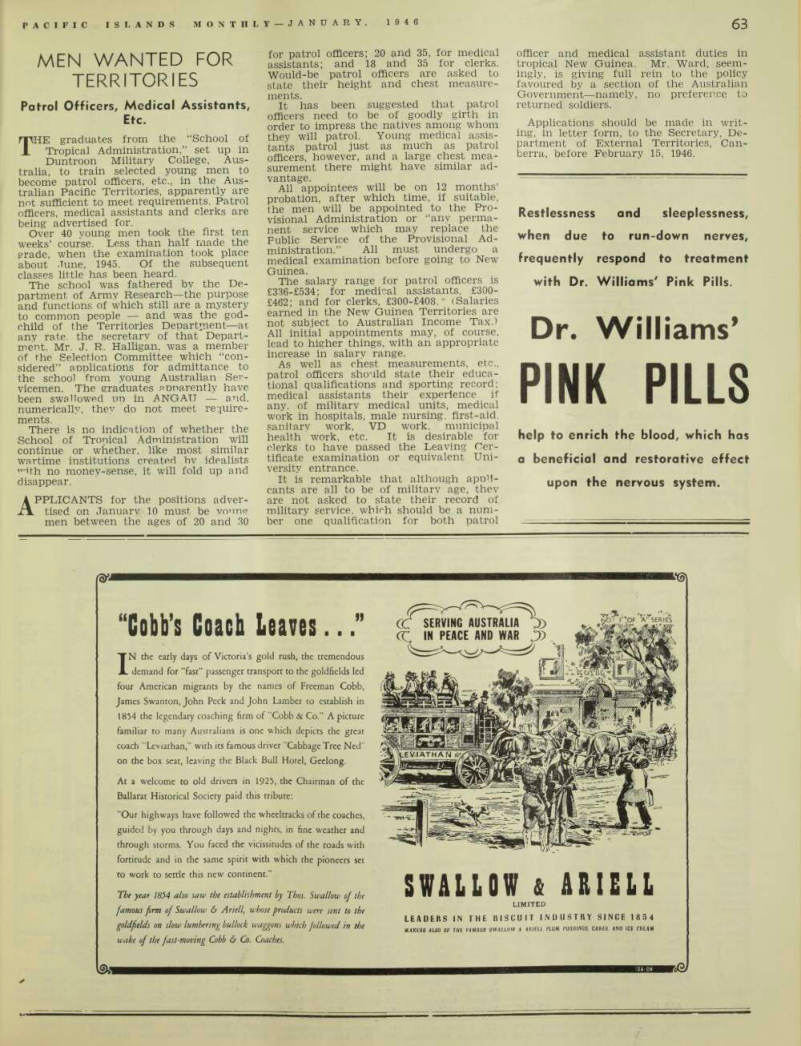
Men Wanted For
Patrol Officers, Medical Assistants, Etc.
THE graduates from the “School of Tropical Administration,” set up in Duntroon Military College, Aus tralia, to train selected young men to become patrol officers, etc., in the Aus tralian Pacific Territories, apparently are not sufficient to meet requirements. Patrol officers, medical assistants and clerks are being advertised for.
Over 40 young men took the first ten weeks’ course. Less than half made the grade, when the examination took place about -Tune, 1945. Of the subsequent classes little has been heard.
The school was fathered by the De partment of Army Research—the purpose and functions of which still are a mystery to common people and was the god child of the Territories Department—at any rate, the secretary of that Depart ment. Mr. J. R. Halligan, was a member of the Selection Committee which “con sidered” annlications for admittance to the school from young Australian Ser vicemen. The graduates annarently have been swallowed up in ANGAU and. numerically, they do not meet require ments.
There is no indication of whether the School of Tropical Administration will continue or whether, like most similar wartime institutions created bv idealists ' T, hh no money-sense, it will fold up and disappear.
APPLICANTS for the positions adver tised on January 10 must be younf? men between the ages of 20 and 30
for patrol officers; 20 and 35, for medical assistants; and 18 and 35 for clerks.
Would-be patrol officers are asked to state their height and chest measure ments.
It has been suggested that patrol officers need to be of goodly girth in order to impress the natives among whom they will patrol. Young medical assis tants patrol just as much as patrol officers, however, and a large chest mea surement there might have similar ad vantage.
All appointees will be on 12 months’ probation, after which time, if suitable, the men will be appointed to the Pro visional Administration or “any perma nent service which may replace the Public Service of the Provisional Ad ministration.” All must undergo a medical examination before going to New Guinea.
The salary range for patrol officers is £336-£534: for medical assistants, £3OO - and for clerks, £3OO-£4OB. (Salaries earned in the New Guinea Territories are not subject to Australian Income Tax.) All initial appointments may, of course, lead to higher things, with an appropriate increase in salary range.
As well as chest measurements, etc., patrol officers should state their educa tional qualifications and sporting record: medical assistants their experience if any. of military medical units, medical work in hospitals, male nursing, first-aid. sanitary work, VD work, municipal health work, etc. It is desirable for clerks to have passed the Leaving Cer tificate examination or equivalent Uni versity entrance.
It is remarkable that although apnfi cants are all to be of military age, they are not asked to state their record of military service, which should be a num ber one qualification for both patrol
officer and medical assistant duties in tropical New Guinea. Mr. Ward, seem ingly, is giving full rein to the policy favoured by a section of the Australian Government —namely, no preference to returned soldiers.
Applications should be made in writ ing, in letter form, to the Secretary, De partment of External Territories, Can berra, before February 15, 1946.
Advertisements & other items, p. 73 (1 item)
Pink Pills
Restlessness and sleeplessness, when due to run-down nerves, frequently respond to treatment with Dr. Williams' Pink Pills.
Dr. Williams’
help to enrich the blood, which has a beneficial and restorative effect upon the nervous system.
“Cobb’s Coach Leaves..
IN the early days of Victoria's gold rush, the tremendous demand for "fast” passenger transport to the goldfields led four American migrants by the names of Freeman Cobb, James Swanton, John Peck and John Lambcr to establish in 1854 the legendary coaching firm of "Cobb & Co." A picture familiar to many Australians is one which depicts the great coach "Leviathan," with its famous driver "Cabbage Tree Ned' on the box seat, leaving the Black Bull Hotel, Geelong.
At a welcome to old drivers in 1925, the Chairman of the Ballarat Historical Society paid this tribute: "Our highways have followed the whccltracks of the coaches, guided by you through days and nights, in fine weather and through storms. You faced the vicissitudes of the roads with fortitude and in the same spirit with which the pioneers set to work to settle this new continent."
The year 1834 also saw the establishment by Thos. Swallow of the famous frm of Swallow & Ariell, whose products were sent to the goldfields on slow lumbering bullock waggons which followed in the wake of the fast-moving Cobb & Co. Coaches. r*OF
CC SERVING AUSTRALIA
CT IN PEACE AND WAR
rf eviathan
SWALLOW i ARIELL
LEADERS IN THE BISCUIT INDUSTRY SINCE 1854 MAKERS AESO Of THE FAMOUS SWALLOW A ARIELL PLUM PUOOINCS. CAKES, AND ICE CREAM
Islands Produce
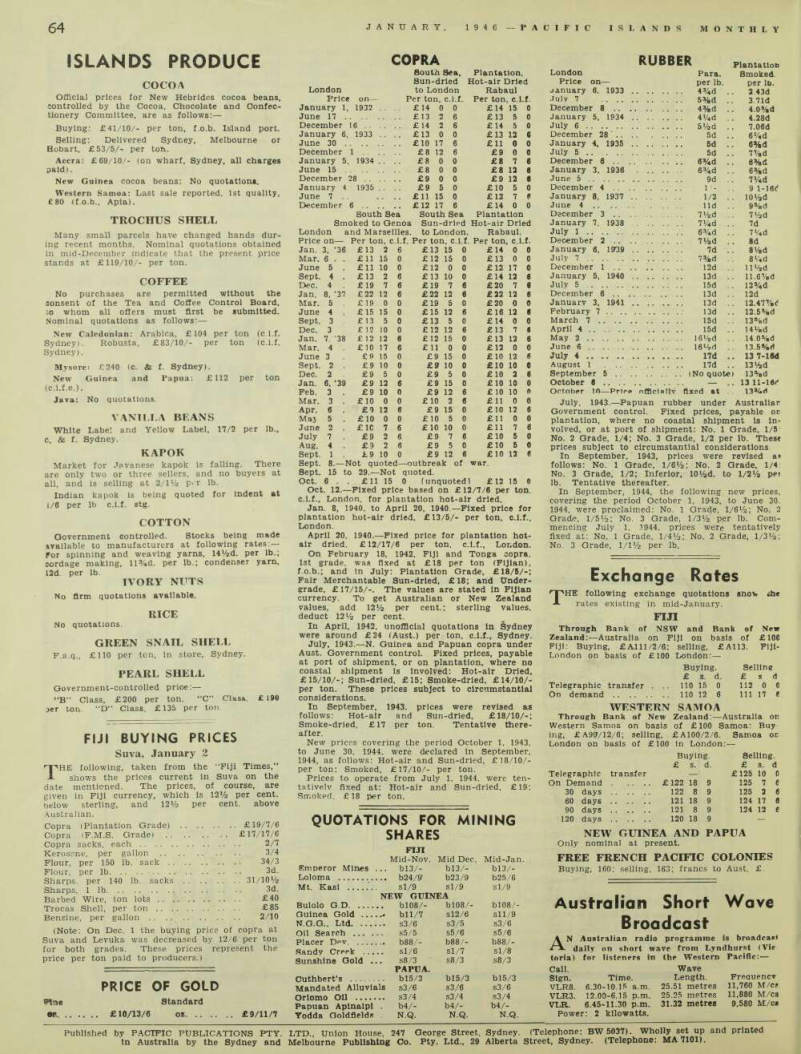
Cocoa
Official prices for New Hebrides cocoa beans, controlled by the Cocoa, Chocolate and Confec tionery Committee, are as follows: Buying: £4l/10/- per ton, f.o.b. Island port.
Selling: Delivered Sydney, Melbourne or Hobart, £53/5/- per ton.
Accra: £69/10/- (on wharf, Sydney, all charges paid).
New Guinea cocoa beans: No quotations.
Western Samoa: Last sale reported, Ist quality, £BO (f.0.b., Apia).
Trochus Shell
Many small parcels have changed hands dur ing recent months. Nominal quotations obtained in mid-December indicate that the present price stands at £ll9/10/- per ton.
Coffee
No purchases are permitted without the consent of the Tea and Coffee Control Board, :o whom all offers must first be submitted.
Nominal quotations as follows: — New Caledonian: Arabica, £lO4 per ton (c i.f.
Sydney). Robusta, £B3/10/- per ton (c.i.f.
Sydney).
Mysore. £240 (c. & f. Sydney).
New Guinea and Papua: £ll2 per ton (c.i.f.e.).
Java: No quotations.
Vanilla Beans
White Labe! and Yellow Label, 17/2 per lb., c. & f. Sydney.
Kapok
Market for Javanese kapok is falling. There are only two or three sellers, and no buyers at all, and is selling at 2/1 Vz por lb.
Indian kapok is being quoted for Indent at 1/6 per lb c.l.f. stg.
Cotton
Government controlled. Stocks being made available to manufacturers at following rates; — For spinning and weaving yarns, 14V2d. per lb.; cordage making, ll 3 /id. per lb.; condenser yarn.
L2d per lb.
Ivory Nuts
No firm quotations available.
Rice
No quotations.
Green Snail Shell
F.a.q., £llO per ton, in store, Sydney.
Pearl Shell
Government-controlled price:— “B” Class, £2OO per ton. “C” Class. £ 190 jer ton. “D” Class. £135 per ton.
Fiji Buying Prices
Suva, January 2
THE following, taken from the “Fiji Times,” shows the prices current in Suva on the date mentioned. The prices, of course, are given in Fiji currency, which is 12Vi per cent, below sterling, and 12 Vi per cent. above Australian.
Copra (Plantation Grade) £l9/7/6 Copra (F.M.S. Grade) £l7/17/6 Copra sacks, each 2/7 Kerosene, per gallon 3/4 Flour, per 150 lb. sack 34/3 Flour, per lb 3d.
Sharps, per 140 lb. sacks 31/10Vi Sharps, 1 lb. 3d.
Barbed Wire, ton lots £4O Trocas Shell, per ton £B5 Benzine, per gallon 2/10 (Note: On Dec. 1 the buying price of copra at Suva and Levuka was decreased by 12/6 per ton for both grades. These prices represent the price per ton paid to producers.)
Copra
Price Of Gold
Oct. 6 . . £ll 15 0 funquotedl £l2 15 0 Oct. 12.—Fixed price based on £l2/7/6 per ton. c.1.f., London, for plantation hot-air dried.
Jan. 8, 1940. to April 20. 1940 —Fixed price for plantation hot-air dried, £l3/5/- per ton, c.1.f., London.
April 20. 1940.—Fixed price for plantation hot air dried. £l2/17/6 per ton. c.1.f., London.
On February 18, 1942, Fiji and Tonga copra, Ist grade, was fixed at £lB per ton (Fijian), f.0.b.; and in July; Plantation Grade, £lB/5/-; Fair Merchantable Sun-dried, £18; and Under grade, £l7/15/-. The values are stated in Fijian currency. To get Australian or New Zealand values, add 12Vi per cent.; sterling values, deduct 12 V 2 per cent.
In April, 1942, unofficial quotations in Sydney were around £24 (Aust.) per ton, c.1.f., Sydney.
July, 1943.—N. Guinea and Papuan copra under Aust. Government control. Fixed prices, payable at port of shipment, or on plantation, where no coastal shipment is Involved: Hot-air Dried, £l5/10/-; Sun-dried. £l5; Smoke-dried, £l4/10/per ton. These prices subject to circumstantial considerations.
In September, 1943. prices were revised as follows: Hot-air and Sun-dried. £lB/10/-; Smoke-dried, £l7 per ton. Tentative there after.
New prices covering the period October 1, 1943, to June 30, 1944, were declared in September, 1944, as follows: Hot-air and Sun-dried. £lB/10/per ton; Smoked, £l7/10/- per ton.
Prices to operate from July 1, 1944, were ten tatively fixed at: Hot-air and Sun-dried, £l9; Smoked. £lB per ton.
91'ne Standard
Copra
South Sea, Plantation, Sun-dried Hot-air Dried London to London Rabaul Price on— Per ton, c.i.f.
Per ton, c.i.f.
January 1 1932 . £14 0 0 £14 15 0 June 17 . £13 2 6 £13 5 0 December 16 . . . £14 2 6 £14 5 0 January 6, 1933 . £13 0 0 £13 12 6 June 30 . £10 17 6 £11 0 0 December 1 . . . £8 12 6 £9 0 0 January 5 1934 . £8 0 0 £8 7 6 June 15 £8 0 0 £8 12 6 December 28 . . . £9 0 0 £9 12 6 January 4 1935 . £9 5 0 £10 5 0 June 7 . £11 15 0 £12 7 e December 6 . . £12 17 6 £14 0 0 South Sea South Sea Plantation Smoked to Genoa Sundried Hot-air Dried London and Marseilles to London.
Rabaul.
Price on— Per ton, c.l.f. Per ton. c.i.f.
Per ton, c.i.f.
Jan. 3, ’36 £13 2 6 £13 15 0 £14 0 0 Mar. 6 . . £11 15 0 £12 15 0 £13 0 0 June 5 £11 10 0 £12 0 0 £12 17 0 Sept. 4 . £13 : ! 6 £13 10 0 £14 12 6 Dec. 4 £19 7 6 £19 7 6 £20 7 e Jan. 8. '37 £22 12 6 £22 12 6 £22 12 8 Mar. 5 £ 19 ( ) 0 £19 5 0 £20 0 0 June 4 £15 15 0 £15 12 6 £16 12 6 Sept. 3 £ 13 ' > 0 £13 5 0 £14 0 0 Dec. 3 £ 12 10 0 £12 12 6 £13 7 6 Jan. 7. '38 £ 12 12 6 £12 15 0 £13 12 6 Mar. 4 £10 17 6 £ 11 0 0 £12 0 0 June 3 £9 15 0 £9 15 0 £10 12 6 Sept. 2 . £9 10 0 £9 10 0 £10 10 0 Dec. 2 £9 £ > 0 £9 5 0 £10 2 6 Jan. 6. '39 £9 12 6 £9 15 0 £10 10 0 Peb. 3 . £9 10 0 £9 12 6 £ 10 10 « Mar. 3 . £10 0 0 £10 2 6 £11 0 0 Apr. 6 £9 12 6 £9 15 0 £10 12 6 Maj 5 . £10 0 0 £10 5 0 £11 0 0 June 2 £ 1C 7 6 £10 10 0 £11 7 6
July 7 .
£9 : ! 6 £9 7 6 £10 5 0 Aug. 4 £9 : I 6 £9 5 0 £10 5 0 Sept. 1 £9 10 0 £9 12 6 £10 12 6 Sept. 8. —Not quoted—outbreak of war.
Sept. 15 to 29.—Not quoted.
Quotations For Mining
Shares
July, 1943. —Papuan rubber under Australlar Government control. Fixed prices, payable or plantation, where no coastal shipment is in volved, or at port of shipment: No. 1 Grade, 1/5- No. 2 Grade, 1/4; No. 3 Grade, 1/2 per lb. These prices subject to circumstantial considerations.
In September, 1943, prices were revised a» follows: No. 1 Grade, I/6V2: No. 2 Grade, 1/4: No. 3 Grade, 1/2; Inferior, lOVzd. to 1/2 Vi pe? lb. Tentative thereafter.
In September, 1944, the following new prices, covering the period October 1, 1943, to June 30, 1944, were proclaimed: No. 1 Grade, 1/6Vi; No. 2 Grade, I/5V2; No. 3 Grade, l/3Vz per lb. Com mencing July 1, 1944, prices were tentatively fixed at: No. 1 Grade. 1/4V 2 ; No. 2 Grade, 1/3Vi; No. 3 Grade, l/iy 2 per lb.
Fiji
Mid-Nov.
Mid Dec.
Mid-Jan.
Emperor Mines ... bl3/bl3/bl3/- Loloma b24/9’ b23/9 b25/6 Mt. Kasl sl/9 sl/9 sl/9
New Guinea
Bulolo G.D bl08/bl08/bl08/- Guinea Gold bll/7 S12/6 sll/9 N.G.G., Ltd s3/6 s3/5 s3/6 Oil Search s5/5 s5/6 s5/6 Placer Dpv b88/b88/b88/- Randy Creek sl/6 sl/7 sl/8 Sunshine Gold ... s8/3 s8/3 s8/3 Cuthbert's
Papua.
bl5/3 bl5/3 bl5/3 Mandated Alluvials s3/6 s3/6 s3/6 Orlomo Oil s3/4 s3/4 s3/4 Papuan Aplnaipl . b4/b4/~ b4/- Todda Goldfields N.Q.
N.Q.
N.Q.
Rubber
Plantation London Para.
Smoked Price on— per lb. per lb.
January 6, 1933 . 4y«d 2 43d .Iulv 7 3.71d December 8 . . . 4.0 9 /«d January 5, 1934 . 4V 4 d 4.28d July 6 5‘/ad 7.08d December 28 . . . 5d 6V4d January 4, 1935 . 5d 6Hd July 5 5d 7 7 /sd December 6 , 6%d 6%d January 3. 1936 6 3 4d 6%d June 5 9d 7‘/id December 4 1 - 9 l-iet 1 January 8, 1937 . 1/2 10‘/ad June 4 lid 9 9 4d December 3 .. . 7Vad 7‘/ad January 7. 1938 7‘/id 7d July 1 7 V 4 d December 2 .. . 7Vad 8d January 6, 1£39 . 7d 8Vad July 7 7%d 8‘/4d December 1 .. . 12d 11 ‘/ad January 5, 1940 . 13d 11.6 7 /«d July 5 15d 12 3 /4d December 6 .. .. 13d 12d January 3, 1941 . 13d 12.47%<* February 7 .. .. 13d 12.5 9 /ed March 7 15d 13 9 iid April 4 15d 14V B d May 2 16V*d
H.Ov.D
June 6 13.5%d July 4 17d 13 7-16d August 1 ... 17d 13Vid September 5 . . . (No quote! 13%d October 6 — 13 11-16^ October 10— Price officially fixed at l3»/-d
Exchange Rates
THE following exchange quotations snov <he rates existing in mid-January.
Fiji
Through Bank of NSW and Bank of New Zealand;—Australia on FIJI on basis of £lOO Fiji: Buying, £Alll/2/6: selling, £AII3. FIJI - on basis of £lOO London:—
Western Samoa
Through Bank of New Zealand;—Australia on Western Samoa on basis of £lOO Samoa: Buy ing, £A99/12/6; selling, £AIOO/2/6. Samoa oc London on basis of £lOO In London; —
New Guinea And Papua
Only nominal at present.
Free French Pacific Colonies
Buying, 160; selling, 163; francs to Aust. £.
Buying.
Selling £ s. d. £ s d Telegraphic transfer . 110 15 0 112 0 0 On demand .. 110 12 6 111 17 «
Buying.
Selling. £ s. d. £ s. d Telegraphic transfer — £125 10 0 On Demand £122 18 9 125 7 6 30 days 122 8 9 125 2 6 60 days 121 18 9 124 17 0 90 days 121 8 9 124 12 e 120 days 120 18 9 —
Australian Short Wave
Broadcast
AN Australian radio programme is broadca*< daily on short wave from Lyndhurst (Vic toria) for listeners in the Western Pacific:—
Call.
Wave Sign.
Time.
Length.
Prequencv
Vlr8.
6.30-10 15 a.m. 25.51 metres 11,760 M/c t
Vlr3.
12.00-6.15 p.m. 25.25 metres 11,880 M/cs
Vlr.
6.45-11.30 p.m. 31.32 metres 9,580 M/c« Power : 2 kilowatts.
Advertisements & other items, pp. 74-76 (2 items)
64
JANUARY. 1946 PACIFIC ISLANDS MONTHLY
Published by PACIFIC PUBLICATIONS PTY. LTD., Union House, 247 George Street, Sydney. (Telephone: BW 5037). Wholly set up and printed in Australia by the Sydney and Melbourne Publishing Co. Pty. Ltd., 29 Alberta Street, Sydney. (Telephone: MA7101).
A Tropical Thirst
demands a Satisfying Drink
F
A COOL p L
I I nun y s t
RAU
ONCV F«om the FINEST MAL+
ANt MTTLEO »T
T °PJH & CO.. LI Mil
SYDNEY- AUSTRALIA
that’s why K B is so popular
south of “the Line”
All through the tropics, wherever there are men who like good beer, you'll always find KB. It's the drink that men appreciate —a drink just made to satisfy a tropical thirst! m :;; fe n mmsm & & &
TOOTH'S
KB
LAGER.
Established 1914
THIRTY YEARS OF PACIFIC ISLANDS
DEVELOPMENT AND SERVICE.
W. R. CARPENTER & GO. LTD.
Capital £1,000,000.
GENERAL MERCHANTS AND SHIPOWNERS
Buyers and Exporters of All Kinds of Islands Produce Copra Merchants and Millers Agents for Australian, European and American Manufacturers Distributors of Every Description of Merchandise
AGENTS FOR;
FORD MOTOR COMPANY OF CANADA DODGE BROTHERS INC.
ELECTROLUX REFRIGERATORS WESTINGHOUSE ELECTRICAL CO.
T. G. & C. BOLINDERS (ENGINES) CATERPILLAR TRACTORS Etc., Etc.
BRANCHES THROUGHOUT THE PACIFIC ISLANDS
Head Office : 16 O'CONNELL STREET, SYDNEY 111 London: W. R. Carpenter & Co. (London) Ltd., Coronation House, 4 Lloyd's Avenue, London, EC.
The W.R.C. Line
The first Direct and Regular Cargo and Passenger Service between Europe and Pacific Islands’ ports was established by W. R. Carpenter & Co. Ltd.