Islands
Pacific
Monthly
December 17, 1945
Vol. Xvi. No. 5.
Established 1930
ißegistered by post as a newspaper ]
1/-
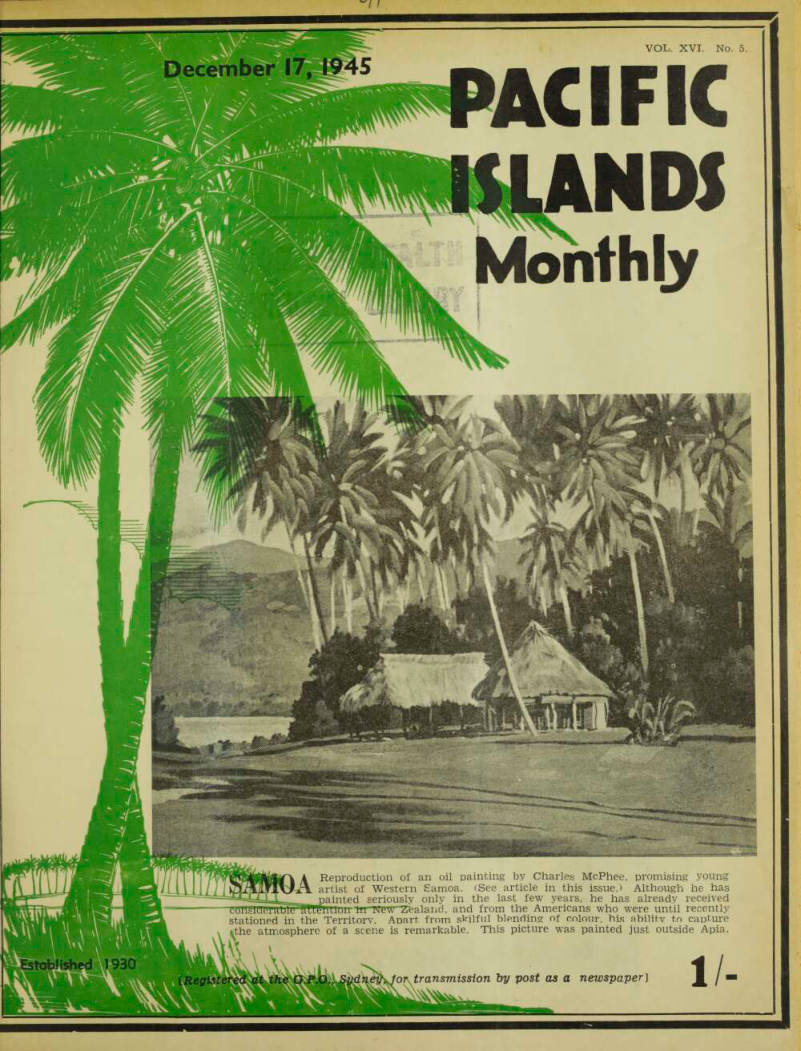
Samoa
Reproduction of an oil painting by Charles McPhee, promising young artist of Western Samoa. (See article in this issue.) Although he has painted seriously only in the last few years, he has already received considerable attention in New Zealand, and from the Americans who were until recently stationed in the Territory. Apart from skilful blending of colour, his ability to capture the atmosphere of a scene is remarkable. This picture was painted just outside Apia.
Advertisements & other items, p. 2 (1 item)
Qantw SfHjutej4fauray<j
$ f«7; C/D * >'
r /STJI^H
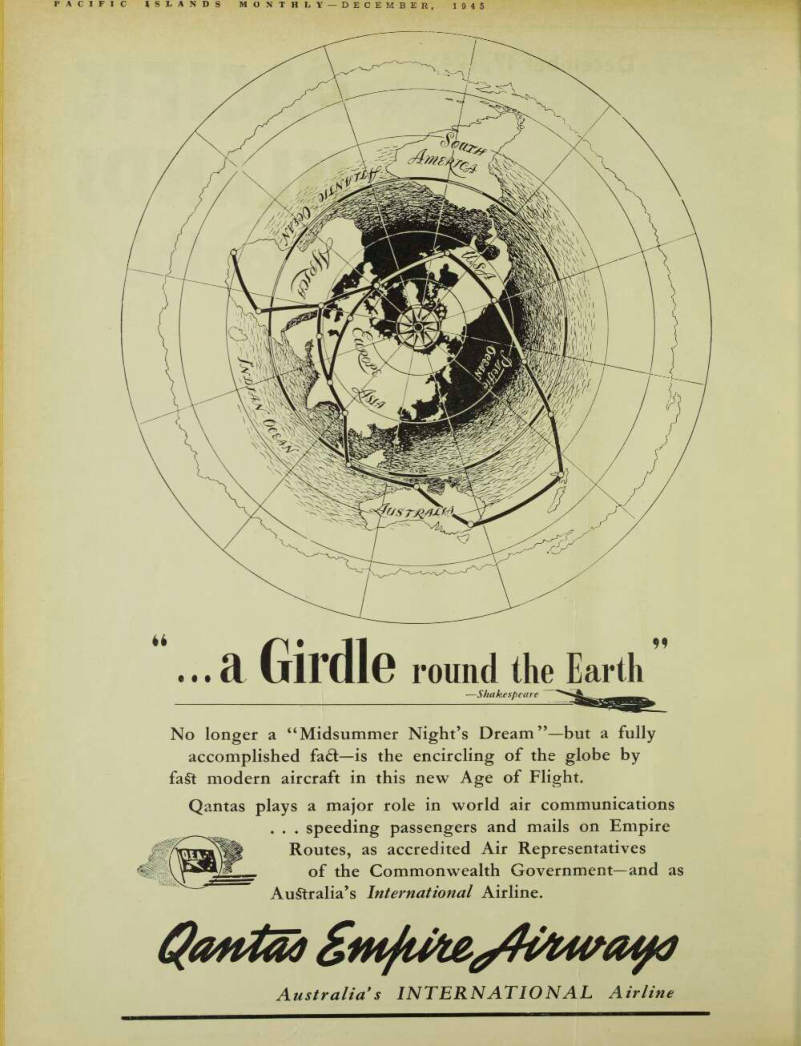
“...a Girdle round the Earth
—Shakespeare No longer a “Midsummer Night’s Dream” —but a fully accomplished faft —is the encircling of the globe by fa§t modern aircraft in this new Age of Flight.
Qantas plays a major role in world air communications . . . speeding passengers and mails on Empire Routes, as accredited Air Representatives of the Commonwealth Government—and as Australia’s International Airline.
Qantw SfHjutej4fauray<j
Australia*s INTERNATIONAL Airline
Pacific News-Review
Notes And Comment On
International Affairs
From Nov. 17 To Dec. 13
Nov. 17: Total elimination of Empire preference will be proposed in a US draft of an international trade charter now being prepared.
Nov. 18: No agreement has been reached in the talks between the Indo nesian Prime .Minister, Sultan Sjahrir. and Dutch representatives. Sjahrir says that the Indonesians refuse absolutely to accept the Dutch colonial system.
Nov. 20: Although the Broken Hill Pty.
Company’s works were open for normal operations to-day, the Newcastle (Aus tralia) steel strike committee decided yesterday to continue the strike which commenced when an employee who re fused to obey orders was dismissed. The Steelworkers’ Union was subsequently de registered for contempt of Court, and BHP refuses to recognise Union delegates until it applies for re-registration.
Nov. 20: General de Gaulle has chal lenged the Communists either to confirm or withdraw the mandate it unanimously gave him earlier to form a Government of National Unity.
Nov. 20: Twenty top-line Nazi war criminals were brought before the war criminal Court at Nuremberg to-day.
Eight United Nations Judges are presid ing. The prisoners appeared “unmoved and in good humour.” All pleaded “not guilty.”
Nov. 28: The Australian Seamen’s Union has threatened to strike in sym pathy with the steel workers. Twenty nine mines in NSW are idle. Miners de mand that the Commonwealth Govern ment intervene in the steel dispute.
Dec. 1: The Communist-Moderate fac tion fight in the Australian Labour Union Movement is nearing a climax.
The Seamen’s Union has decided to tie up all ships carrying NSW coal and the products of BHP, and the Miners’
Federation favours a general coal strike in NSW. The Railway Union has decided not to become involved in the strike, and the interstate ALP has announced that nc member of the party may speak at the same Labour function as official Communists. Power, rail and gas cuts are feared, with a possibility of a black out over Christmas.
Dec. 6: New South Wales is preparing for a blackout to-day, as a result of the miners’ strike. Due to rigid gas and electricity rationing, 250,000 people will soon be out of work in the State. Many of the miners have trekked to the sea side, near Newcastle, where they have set up camps with their families and are preparing to take a long Christmas holi day.
Dec. 6: The long-drawn-out financial talks between the United States and Great Britain have resulted in an agree ment, whereby USA will lend Britain about £1,100,000,000 sterling at 2 per cent, interest. Britain has had to make certain concessions to USA in relation to Im perial preference, but it is felt that this loan will give Britain valuable aid during the critical years of economic adjust ment. The tendency will be to create closer political relations between the English-speaking countries, as a result of their necessarily closer trade relations.
Dec. 9: It was decided at a conference in Singapore between British military authorities and Dutch and French poli tical leaders* that the British shall now proceed with the pacification of Java by force.
Dec. 11: New South Wales is entering its second week of blackout. To-day the Australian Prime Minister, Mr. Chifley, met union leaders who placed before him terms proposed by the ACTU for the settlement of strikes. These terms re
present a surrender to the Communistic faction that has plunged Australia into industrial chaos, but Mr. Chifley is not expected to countenance them. Gas and electricity cuts have been increased. All lights must be out by 9 p.m. and gas is to be used in homes for only two brief periods per day. Power to industry has been cut again and train and tram re strictions intensified. The whole indus trial life of NSW, Victoria and SA is slowing to a standstill.
Dec. 12; The strike conference which was held in Canberra yesterday ended in a deadlock. The Prime Minister refused to evade the Arbitration system, and there is now little likelihood of an early settlement of the strikes. The Christmas outlook is now grim, and it is expected that half a million people will be un employed in New South Wales to-day.
Death Of General
Wisdom
Brigadier- general e. a.
Wisdom, Cb, Cmg, Dso, Vd, Who
was Administrator of New Guinea from 1921 to 1932, died in Melbourne on December 9, aged 76. He was a member of the West Australian Parliament for six years; served with distinction in World War I, where he was awarded various decorations; and, after his retirement from New Guinea, he was on the direc torate of various companies. His wife died in 1931. He had no children.
Uss Company Personnel
Changes
fITHE following changes in the Union X Steamship Company’s personnel, following the death of the chair man and managing director (Mr. N. S.
Falla) have been announced: Mr. G. R.
Ritchie, a member of the board for 35 years, to be chairman of directors; Mr.
J. N. Greenland to be managing director and deputy chairman; Mr. M. B. Miller to be general manager; Messrs. R. R.
Dobie and A. N. Leslie to be assistant general managers.
Commonwealth Disposals
Purchases From
Commission
fTTHE War Damage. Commission recently X made with the Commonwealth Dis posals Commission an arrangement of interest to New Guinea residents:— A claimant for war damage compensa tion whose claim has not been paid will be permitted immediately to purchase equipment from the Commonwealth Dis posals Commission on the claimant giv ing the War Damage Commission autho rity to pay the agreed purchase price out of compensation when finally assessed.
Application for such accommodation should be made by the claimant to the Disposals Commission. The matter will then be referred through to the War Damage Commission for verification as to the sufficiency of the compensation to finance the contemplated purchase.
This arrangement should materially assist in the rehabilitation of claimants and the disposal of surplus equipment.
Sericw For "Montevideo
Maru" Victims In Adelaide
A MEMORIAL service to prisoners of war and civilian internees who lost their lives when the Japanese trans port, “Montevideo Maru," on which they were being taken from Rabaul to Japan, was sunk by Allied action in June, 1942, was held in Adelaide on Sunday, November 18.
When the women and children were evacuated from New Guinea early in the war, a number of Adelaide women, whose husbands remained at their posts, formed themselves into the New Guinea Women’s Club, with Mrs. Champion Hosking as president. These women have only re cently received information that their husbands were lost in the “Montevideo Maru.”
Memorial Service In Brisbane
THE Queensland New Guinea Associa tion held a memorial service at the Shrine of Remembrance, Anzac Square, Brisbane, at 3 p.m. on Sunday, November 25, to honour those who lost their lives on the “Montevideo Maru’’ and in the defence of New Guinea.
The service was conducted by Dean W. E. C. Barrett. Wreaths were laid on the shrine by the vice-president (Mrs.
Doris Booth), Captain Fraser, Ist Inde pendent Company, members of the 2/22nd the Rabaul nurses, Methodist Mission, Seventh Day Adventists, wives and re latives of the men.
Fiji Acquires Two Good
Permanent Residents
MARRIED recently in Auckland were Major Alex Millar and Miss Isobel McKenzie, who are to make their home permanently in Fiji. Major Millar, who is one of the most popular soldiers ever to serve in Fiji, joined the New Zea land Forces there in 1940, and served continuously until a few weeks ago.
Major Millar arrived in Fiji as a ser geant-major and his well-earned promo tions have ‘been spaced fairly evenly since. His last appointment was camp
rE New Guinea Women’s Club of Sydney will go into recess on December 20, and will not re open until the first Thursday in February, 1946.
commandant of the big camp at Sama bula—which was going home for him as he had started his military career as camp sergeant-major of that camp when he first went to Fiji.
Major Millar was a regular soldier more than 30 years ago, and his youthful appearance makes it difficult to realise that pride of place among his medal ribbons goes to the 1914 Star.
In Fiji, he' did much for sport and was the Army representative on the Rugby Union, as well as being actively in terested in cricket, running and boxing.
So much at home did he become in Fiji that the Emperor Gold Mines Com pany has offered ’him the position of community officer. After leave in New Zealand, Major and Mrs. Millar will accordingly return to Fiji to make their home at Vatukoula.
Mrs. Millar is a New Zealander, and has for some years been teaching ,ln Fiji, her recent schools being Levuka and Suva. It is understood that she is to teach at Vatukoula.
Advertisers
Adams, Clayton & Co . 16 Amplion (Aust.) Pty., Ltd. ... 41 Angliss & Co. . . 25 Atkins Pty., Ltd., Wm 43 Australian Alumi nium Company Pty., Ltd 10 AWA, Ltd 61 Brial & Ball, 17, 44, 49 Bond Bros. & Co., Inc Broomfield, Ltd. . . 38 Brown & Co., Ltd. 11 Brunton’s Flour . . 32 Burns, Philp Trust Co., Ltd 13 BP (SS) Co. . . . 11 Bhindi, P. K. . . . 60 Baker, W. J. . . . 53 Carlton & United Breweries, Ltd. . 22 Carpenter, Ltd., W.
R cov. iv. drivers & Sons, Ltd 33 Church, R. H., & Sons 57 Coleman Lamp & Stove Co 57 “Cystex” 30 David Trading Co. 30 Dean, S. N., & Co. 40 Donaghy & Sons . 50 Donald, Ltd., A. B. 10 Dr. Williams Pink Pills 48 Electrolux Refrigerators . . 20 Farnham, John R. . 39 Foster Clark, Ltd. . 28 Flit 36 Ford Sherington Pty., Ltd 34 Garrett & Davidson 40 Giboon & Co., Ltd.,
J. A. D 63
Gillespie Pty , Ltd., Robert ... 23, 27 Gilbey’s Gin ... 12 Gillespie’s Flour . . 42 Gough & Co., E. J. 17 Grand Pacific Hotel 2 Grove & Sons, W.
H 42 Heinz & Co. Pty., Ltd., H. J. . . . 55 Horlicks Malted Milk 31 Hyde, Victor ... 44 Jantzen 56 Jenkins, Reg. ... 18 Kalyan & Co., G. . 62 Kopsen & Co., Ltd. 19 Miscellaneous, 10, 24, 43. 60 “Mendaco” ... 52 Mcllraths Pty., Ltd. 46 Nelson & Robertson Pty., Ltd 35 “Nixoderm” ... 50
Noyes Bros. . . . .53
Pacific Islands Trading Co. . 34, 52 Pacific Is. Society . 59 “Pinkettes” ... 36 Qantas Empire Air ways ... cov. ii.
Queensland Insur ance Co 26 Raniga, V. M. . . 35 Raymond, Lance, Pty., Ltd 45 Robinson, G. H. . . 39 Rose’s Eye Lotion . 39 Rohu, Sil 54
Rur 38
Scott, Ltd., J. . . 62 Southern Pacific In surance Co. ... 12 Sharda Souvenir Store 51 Steamships Trading Co., Ltd 58 South Pacific Sou venirs 59
Sullivan & Co„ C. . 37 Swallow & Ariell . 59 Taylor & Co., A. . 26 “Tenax” Soap ... 24 Tillock & Co., Ltd. 18
rflornycroft (Aust.)
Pty., Ltd 21 Tooth & Co., Ltd cov. iii.
Trinity Grammar School 49 Union Assurance . 58 Vicars Pty., Ltd., John 29
Watson, Wm. H. . . 54 Wesley College . . 32 Wright & Co. ... 15 Widdop, H„ & Co., Ltd 51 Wills, W. D. & H. O. 14 Wright & Co., Ltd., E. ... 24 Wunderlich, Ltd. . . 33 Young Pty., Ltd., Harry J 47 Yorkshire Insurance Co., Ltd 11
Among the passengers on the “Matua’ 1 which arrived in Suva on November 16 from Auckland, was Commander W.
Burrows, who was for a number of years a District Commissioner in Fiji. Soon after war broke out he left for service overseas. He was in Singapore before the city fell and later served in Africa and Italy. He was seriously injured in Italy when ships carrying explosives blew up— his eyesight was affected, and he went to England for an operation. He has since made a good recovery. He intends to settle in Suva.
Contents
Pacific News-Review 1 Death of General Wisdom 1 Editorial: Can we Take the Gamble out of Pacific Islands Planting? . 3 Papuan-NG Public Service Appoint ments 4 New Administrator for Norfolk Island —Another Political Appoint ment 5 Pacific Air Service —PAA May Start in February 5 New Order in Territories —Government Controls all Ships and Stores 6 Central Medical School Hopes for US Support 7 The Rabaul Tragedy—Missing Men . 7 Tropicalities 9 Whither Bound Has Tonga a Future? 12 Post-war Conditions in BSI 15 Fiji Copra Falls 12/6 Pe*r Ton ... 17 Mr. Ridgeway Appointed Adminis trator of Nauru 19 Fine Record of Madang Patriots .. 21 Road to Wau—Should Miners Pay Again? 21
Men of AIB: Those Who Served in Famous Unit 22 Mr. Ward Defends His Adminis tration-Address to PI Society .. 25 Political Reform in Fiji—Electors’
Aims 30 Official Report on Samoa’s Dollar- Prosperity 31 Christmas Island Crabs 34 Seven Months in an Open Canoe .. 36 Cook Islands Contribution to War .. 38 When Fiji Wanted More Indians .. 40 “Malaita” to Sail Again 41 From Annie's to Aggie’s—And Some Points East of Apia 44 A Century of Unity Tongan Chronology 48 Home Building in the Pacific Islands 50 Fiji’s South Sea Bubble—The Story of the Polynesian Co 53 Navigating the Sepik 56 Quarterly Meeting of PTA 59 Life and Laughter in Lau—Book Review 60 Shipping and Plane Services—Pacific Travellers 62 Commercial, Markets, etc 64
Advertisements & other items, p. 4 (1 item)
S T*Vtf»"
As <**' t oro^ ds . fIC •r. c ent & A ?acrt' c . . e Gr** d a :C- -. c eoW® ° e , »* e 0 ~, (tor® sQ c'»' c c®' 5 ' tar'"
' t^' e ° A ,. suv».'° r "O' 0 " ***» > \V(d' * C^ e ’ . d*Y-
SOS®
Pacific Islands Monthly
The Newspaper-Magazine of the South Seas IRegistered at the G.P.0., Sydney, for transmission by post as a newspaper .]
Published Once Each Month and Circulated in Australia and New Zealand and in the following Pacific Territories and Islands Groups:
Australian Territory of Papua.
Mandated Territory (Australia) of New Guinea.
Australian Territory of Norfolk Island, New Zealand Territory of Cook Islands.
Mandated Territory (NZ) of Western Samoa.
British Colony of Fiji.
British Solomon Islands Protectorate.
British Protectorate of Tongan Islands.
British Crown Colony of Gilbert and Ellice Islands.
Mandated Territory of Nauru.
British and Free French Condominium of New Hebrides.
Free French Colony of New Caledonia.
Free French Colony of Oceania (Tahiti, etc.).
American Territory of Eastern Samoa.
American Territory of Hawaiian Islands.
Owned and Produced by Pacific Publications Pty. Ltd., Union House, 247 George Street, Sydney.
( Managing Director .. BW 5037 Business and Editorial MA 4369
P.O. Box 3408 R
Registered Address of Telegrams, Radiograms, and Cables: “Pacpub”, Sydney.
Contributions.
Articles, Stories, and Photographs dealing with Pacific Islands subjects are invited and will be paid for on publication.
Subscription Rates.
Per Annum, within British Empire, Prepaid, Post Free 10/- Per Annum, elsewhere, Prepaid, Post Free 12/6 Single Copies 1/-
Editor and Publisher:
R. W Robson, P.R.G.S.
Advertising Manager: W. E. Rogers. Tel. B 7815.
Advertising Office and Printing-House: 29 Alberta Street, Sydney.
Advertising rates furnished on application.
Representative In Fiji,
Pacific Publications (Fiji), Ltd., Bank of NSW Building, Suva (same office as W. H. Grove & Sons, Ltd.). Stocks of Pacific Islands Monthly and Pacific Islands Yearbook on hand.
Representative In London.
J. T. Wallis, Coronation House, 4 Lloyds Avenue, London, E.C.3, from whom may be obtained copies of Pacific Islands Monthly, Pacific Is. Year Book, advertising schedules, etc.
Agents.
The following are authorised to receive sub scriptions for Pacific Islands Monthly:— Burns, Phllp & Co., Ltd., and Burns Phllp (South Sea) Co., Ltd. All branches.
W. R. Carpenter & Co.,- Ltd. All branches.
Morris, Hedstrom, Ltd. All branches.
Steamships Trading Co., Papua. All branches.
Whitten Bros., Ltd., Samaral, Papua.
B.N.G. Trading Co., Ltd., Port Moresby, Papua.
J. Muir, Suva, Fiji.
Miss R. Castles, Suva, FIJI.
N, C. Mackenzie Hunt, Walnunu, Bua, FIJI.
Cook Islands Trading Co., Rarotonga, Cook Is.
A. C. Rowland, Papeete, Tahiti.
Islands Branches and Representatives of W. H.
Grove & Sons, Ltd., Auckland, New Zealand.
Ed. Pentecost, Noumea, New Caledonia.
Societe Gubbay Kerr et Cie, Noumea, N. Caledonia.
Vol. Xvi. No. 5.
December 17, 1945
PrirP f l/_ Per Copy ’ rnce Prepaid: 10/- p.a.
Can We Take The Gamble Out Of Pacific Islands Planting?
Pacific Islands Planting?
PRESENTLY perhaps before the end of 1946—0ur post-war crop of troubles will be passing. At present, what with widespread industrial disturb ances in all the bigger countries, revolu tionary movements throughout Indonesia, a crippling lack of transport, a mis guided politician’s attempt to Introduce a Socialist Utopia in New Guinea, and general economic dislocation, it is prac tically impossible to make any plans for the social progress and industrial develop ment of the Pacific Islands Territories.
Big events are pending. Even had there been no Anglo-American financial agree ment, the post-war drive for new Ameri can trade would have invaded all the Pacific Territories at an early date —it is already doing so in a number of cases— and the Territories would have benefited accordingly. As it is, with British and American plans for future world trade to be harmonised in accordance with their mutual interests, very 'important developments in all Pacific Territories capable of development are certain.
Leftist politicians are likely to be a nuisance generally, just as they already are a nuisance in New Guinea and Papua.
Perambulating 'theorists, like the irre pressible Evatt, of Australia, insisting that they have a mission to save the poor, unprotected Pacific Islands natives from “exploitation,” are going to sit around in all future international conferences, and howl about “trusteeship.” The in credible situation in New Guinea, where ignorant interference with 1 established conditions has paralysed, for the present, all enterprise and most settlement, may be repeated in a number of Islands Ter ritories.
It is no use telling these power-mad dened politicians that there is very little
wrong with the condition of the Pacific Islands natives and that* all that is wrong can be put right by the ex perienced authorities whose policies and methods have been evolved in long de cades of trial and error. They must save Fuzzy-wuzzy! These things will go on until the inevitable swing of the political pendulum wipes out the extremists, and gives us Governments of a different colour—dull unimaginative and re actionary, perhaps, but at least permit ting full play of the private enterprise, individualism and pioneering spirit, which represent all that is best in the Anglo- American character.
Even if there had been no political interference in Pacific Islands adminis tration, we should have experienced much of this exasperating delay in the restora tion of normal conditions, because nothing can be done in the Islands world with out sea transport, and the available sea transport is very limited. The demand for ships to feed and repatriate the Ser vicemen has been, and still is, almost as great as the demand for ships to carry the troops to the war zones, and take supplies to them there. But repatriation is proceeding rapidly. In a very few months, the ships will be returning to normal services. Then, the only obstacle to rapid Islands developments will be political.
ONCE all obstacles are cleared away, the movement of Europeans from all countries towards settlement in the Pacific Territories will attain proportions that are not even imagined now. Count less thousands of people, most of them with substantial private capital, will be seeking a home in the clean, isolated, fertile Islands, where they can produce
most of their own requirements, and be free from the punishing taxation and ceaseless social and industrial turbulence of the bigger countries. Inquiries from innumerable sources indicate that that “rush” will commence in 1946 or 1947.
Nearly all these new settlers, as well as residents already established, will wish to produce something from their gardens and plantations to supplement their modest incomes. In addition, if there is any real encouragement and protection of enterprise, hundreds of thousands of pounds and millions of American dollars will be available for investment in plan tation enterprises in all the worthwhile Pacific Territories.
Faced with this certainty—it is more than a probability—there is urgent need for united action by the Pacific Terri tories Administrations to direct —if not to control—the Pacific planting industries of the future. In the past, almost all planting enterprise has been blind and haphazard. The fact that a particular region can produce good coconuts, or cocoa, or rubber, or coffee, or innumer able other things, is not justification for a planting enterprise. Thousands of pioneering hearts have been broken and millions of money lost in the Islands because, when the enterprise had been launched, and the produce submitted for sale, it was found either that the market was over-supplied, or was in the grip of some ruthless, blood-sucking monopoly.
ONE meed only study the pre-war opera tions of a merciless combine like Unilever to realise that, under modern world conditions, the mar keting of primary products cannot be left to the old haphazard law of supply and demand. There is nothing wrong with the law—it is fundamentally sound. But, when an international combine like Unilever can control demand, it is neces sary that some other interest, equally powerful, shall control supply. Otherwise producers will be always at the mercy of the monopolists—just as the coconut
growers, for 15 years prior to World War 11, were merely helpless puppets in the hands of Unilever.
If these Leftist politicians who are rac ing around the globe, shouting about “trusteeship” and the rights of the in different natives, only would give some time and attention to the problem of creating an international authority, to direct and regulate production in the interests of the producers, we should view the future of Pacific Islands settlement with more confidence.
It is quite easy, now, to give would-be settlers information about the availability of lands, land tenures, the possible pro ducts of various districts, the labour supply, the rainfall, and so forth; but it it is quite possible, under present conditions, to say that any particular crop will be a payable nroduct a few years hence. And it takes anything from five to ten years to establish coconuts, rubber, coffee, cocoa, citrus, etc.
ANY reliable indication of future prices cauld come only from an interna tional authority with very wide, far reaching powers. We are to see much International .organisation in the early future. If there is to be any future security for primary producers, and any real attempt made to control cartels, some international body—the United Nations for preference—must take hold of the problems of marketing and distribution.
Even in the interests of Fuzzy-wuzzy, something of the kind should be urged.
It is no use introducing Fuzzy-wuzzy to higher standards of living, and teaching him to be a peasant producer, unless there are reasonably safe markets for the things he produces.
If it is possible for the world’s money changers to organise to beat the law of demand, it also is possible to similarly beat the law of supply.
Death Of Albert Dudley
Well-known Morobe Miner
ONE of the best-known miners of the Morobe district, New Guinea, Mr.
Albert Dudley, was killed in a _car accident in New South Wales on Novem ber 25. He had been in Australia since the evacuation of the Territory in 1942 but hoped to return to Wau soon.
Mr. Dudley was a World War I veteran and went to New Guinea for the Ex propriation Board soon after the armis tice. In 1926 he' left the Board and joined the prevailing gold-rush to the Morobe field, where he did well. He re mained in the district until evacuated by plane in early 1942 and was, in his last vears on the field, working a Bulolo Gold Dredging tribute.
During the evacuee period he first bought a newsagency on the North Shore in Sydnev and later sold that to go into the Camelia Grove Hotel in Alexandria.
He was known to most New Guinea people and well liked. He is survived by a wife and two daughters.
One of Noumea’s old weatherboard hotels, the Hotel Sebastopol alongside Government House, has been sold to M.
Bonnace for 1,600,000 francs (£10,000).
Recently the Hotel National, in the port area, changed hands also for a large sum.
Hotelkeepers have reaped a rare harvest over the war years, but now the Ameri cans have almost pulled out the town is dropping back to its state of pre-war stagnation. A number of French metro politan soldiers who have done their ser vice in the Colony have asked to be de mobilised here, with the idea of becom ing permanent settlers. They need the consent of the Governor. —H.E.L.P.
For Appointment
to the Colonial Service
Where And How To Apply
SOME months ago we published in the “PIM” a paragraph regarding post war opportunities in the British Colonial Service and stated that details could be obtained through the Colonial Secretary’s Office, Suva, Fiji.
A moving appeal has now come from the Fiji Secretariat for us to do some thing to counteract the effects of that paragraph. They say that a steady stream of inquiries has come from Aus tralia and all points north, with the re sult that their supply of Colonial Office pamphlets has dried up and they can only advise would-be Colonial officers to “try Australia.”
We have contacted the office of the High Commissioner for the United King dom in Canberra, whose secretary kindly sent us the Colonial Office pamphlet re ferred to by the Colonial Secretary’s of fice in Suva, and who informs us that those who consider that they have' the necessary qualifications should communi cate with: Dominion Liaison Officer, Colonial Appointments Committee, Mel bourne University, Melbourne N 3.
To save the time of both the Liaison Officer and applicants, the following de tails, from the pamphlet, may be of use: CANDIDATES must have reached the age of 20s at the time of taking up their duties, but they must not have been born later than January 1, 1905, for technical appointments, or January 1, 1910, for other appointments. Pre-war, the general 'preference was for candi dates under 30 and under 26, respectively, but the raising of the age limit is de signed so that those with war service are not penalised.
Credit for war service is given in initial salary, and marriage is no bar to ap pointment, officers being encouraged to have their wives with them as far as possible. Free passages are provided for officers, and free or assisted passages for wives. rfTHERE is no written examination and J. no entrance fee, but the standard set is very high. Candidates are selected by competitive selection, based on record and personal interview. Full account is taken of their general educa tional attainments, intellectual ability, their professional qualifications where applicable, their pre-war civil employ-» ment, if any, their record of service dur ing the war, their health, character and personal fitness. Standard of physical fitness required for the Service is high, as much of the Service involves work in the tropics.
Officers are required to serve in all parts of the Colonial Empire—East and West Africa, Malaya, Hong Kong, Ceylon, Fiji and the Western Pacific, Palestine, Cyprus, Aden, Basutoland. Bechuana land, Swaziland, West Indies, etc., and salaries range from £350 to £1.700 per annum (unless one eventually becomes a Colonial Governor on a salary of £B,OOO per annum). There are also housing al lowances, and free medical attention in some cases.
Officers may enter the Colonial Ad ministrative Service, the Agricultural Service, the Audit Service, Customs Ser vice, Education Service, Engineering and Town Planning Service, Forest Service, Legal Service, Medical Service, Police
Service, Survey Service, Veterinary Ser vice, or Chemical, Geological and Mining or Meteorological Service; there are also Labour and Social Welfare appointments and appointments for women in the medical, nursing or social welfare branches.
Qualifications for all these appoint ments are high and exacting. Generally, an appropriate University degree is necessary, plus qualities of leadership, character, physique, etc.
Entering His Majesty's Colonial Ser vice is on a somewhat higher plane than entering the Commonwealth Public Ser vice. The pamphlets describing post-war opportunities in detail can be obtained from the Dominion Liaison Officer, but only those who feel they have the neces sary qualifications should apply.
Papua-N. Guinea
Public Service Of
rE following list, kindly supplied by
the Department of External Terri tories, gives the names of the 111 officers who had been appointed to the Public Service of the Provisional Govern ment of Papua-New Guinea, up to the beginning of December:—
Adams, E. H.
Armstrong, R. F.
Ashley, C.
Atkinson, O. J.
Bartlett, J. W.
Barwick, R, F.
Bedser, W. H.
Beer, G. A.
Bensted, L. A.
Bignold, E. B.
Bitmead, H. F.
Blanden, O. P.
Bock, W. A.
Brammell, J. B. C.
Bremen, E. J.
Briant, S. G.
Bryant, L. K.
Burke, J. P. L.
Burns, P.
Byrne, T. P.
Byrne, T. P. M.
Cahill, P. D.
Chambers, K. M.
Champion I. F.
Chester, N. B.
Chester, W. N. M.
Chugg, R. C.
Clout, L. E. de Groen, A. L. A.
Dobbie, R. S.
Doering, I. (Miss).
Donaldson, P. R. Y.
Downs, I. F. G.
Dunlop, R. B.
Dunstan, J. M, (Miss) Ecclestone, J. W.
Ethell, A. L.
Evans, H. W.
Farlow, R. M.
Fisher, L. J. M.
Frank, P. (Mrs.) Froggatt, J. L.
Fry, A. E.
Fulford, J. A.
Glahville, H. R.
Gough, G. A.
Gough, T. P.
Grahamslaw, M. (Miss) Gray, G. L. W.
Hardy, H. W.
Healy, C. T.
Holmes, E. P.
Humphries, W. R.
Hurrell, A. L.
Lambden, W. J.
Lea, F. B.
Lewis, K. A.
Leydin, W. H.
Littler, I. C. (Miss) Logan, L.
Lonergan, S. A.
Long, A. J.
Lowney, T. V.
MacGowan, W. L.
MacLennan, G. I.
McArthur, I. M. (Miss) McGrath, E. (Mrs.) McLeod, J. S.
McMullen, K. C.
Mann, J. T.
Marshall, A. W.
Marshall, W. M.
May, A. J. (Dr.) Melrose, R.
Middleton, S. G.
Minogue, A. N.
Moline, E. L.
Morrissey, J. P.
Newman, F. G.
Nicholas, W. S.
Noble, A. L.
Nolan, R. H.
O’Brien, T. M.
Odgers, L.
Pearse, F. A.
Perichon, C. (Mrs.) Pullen, D. L.
Radford, G. A.
Ridge, A. A.
Rigby, J. R.
Rutledge, D. F. M.
Schacht, W. H.
Schuler, C. B.
Sheekey, K. S.
Sinclair, B. A. (Dr.) Steeples, E.
Stevens, R. N. B.
Stock, E. C. (Miss) Taylor, E.
Thomas, J. R.
Thwaite, V. I. (Miss) Toogood, G. W.
Tuckey, C. (Mrs.) Turner, G. V. M.
Wall, I. E. (Miss) Washington, E. E.
Watkins, A. E.
Way, A. E- White, H. N. (Dr.) Willis, R. S.
Woodman, H. E.
Norfolk Island
New Administrator For Norfolk Island Another Political Appointment
ITIHE appointment of Mr. Alex Wilson, X MP, as Administrator of Norfolk Island, was announced in Australia on November 23. He will replace Sir Charles Rosenthal, who will retire at the end of this year.
Mr. Wilson is an Independent whose influence has been used on occasions to assist the interests of the Australian Labour Government. It was stated, at the time of his appointment, that he in tended to retire from politics shortly “for health reasons,” but had been persuaded to accept the job of Administrator of Norfolk “under pressure.” It is a well-known fact, however, that Mr. Wil son was one of five highly-favoured ap plicants for the Administratorship of New Guinea. Three of the others were generals.
It would be interesting to know what special qualifications Mr. Wilson has for this job. He is a man of notable ability; but no one has heard of him in connec tion with administration, Islands or otherwise. Although no doubt Norfolk Island will benefit Mr. Wilson’s health, it remains to be seen whether Mr. Wilson, with his background and training, is go ing to be of very much benefit to Nor folk.
However, General Sir Charles Rosen thal suffered the same disabilities when he went to NI. But he applied himself to the work with great energy and shrewd commonsense, and despite wartime handicaps—he probably can be described as the most successful Administrator the little NI communitv has ever known.
Long Land Court
Deliberations End
Aerodrome Compensation
From Our Own Correspondent
Rarotonga, Nov. 18.
FINAL judgment has at last been pro nounced on the claims for compen sation for the native lands used in the construction of the Rarotonga air strip. The case took two months.
The hearing was conducted by Chief Judge Harvey, of the Native Land Court, NZ. Mr. J. D. Brosnan, Public Works Department, NZ, represented the Crown, while Mr. F. Baxter, Auckland (for merly of Samoa), was counsel for the land-owners. The claimants were headed by Mr. W. P. Browne.
Messrs. W. J. Wigmore, J. H. Webb, M. Estall, R. V. Hosking, all long-estab lished planters, and Mr. M. MacAulay, the airport manager for the PWD, were Crown witnesses.
The total area utilised for the air strip and roads was 80 acres. Approach areas at each end of the runway, which had to be cleared of standing trees, were not dealt with, but compensation will eventually be paid on these areas while the owners will retain possession and be allowed to plant ground crops.
The claims presented by the owners were £5O per acre for land, £2/10/- for each coconut tree, and various small claims for other trees and crops. The Crown witnesses assessed the value of the land at £lO to £2O per acre and coconut trees at 6/9 to 10/-.
The Court finally awarded £3O per acre for the best land and £lO for the poorest.
For 80 per cent, of the coconut trees the award was £l/2/8 per tree, and 10/each for the remainder, which were
old trees. Total compensation paid amounted to £5,185.
The landowners, on the whole, were satisfied with the awards and at the con clusion of the case combined to give the visitors a typical “umukai” (feast) and a hearty send-off.
During his stay, Judge Harvey took the opportunity of studying the native land tenure in the Cook Islands and will make a report in NZ.
MR. AND MRS. Q. H. CRESSWELL, of Edie Creek and the Bainings, New Guinea, wish to extend their deepest sympathy to the relatives of so many friends and citizens who lost their lives so galantly that we might enjoy peace and freedom.**
Strike Holds Up the "Roll
"Roll of Honour"
Supplement of the "PIM"
WE regret that, owing to our printing operations being restricted by the widespread industrial disturbances in Australia, we are not able to issue, this month, the special “Roll of Honour”
Supplement which we had prepared for publication, in December.
This Supplement contains the names of the great majoritv of Pacific Islands resi dents who were killed, wounded or missing in World War II; the names of most of those who were decorated for distinguished service; and a list of the large number of civilians who were lost at Rabaul, and who now are presumed to be dead.
Lack of electrical power has made it very difficult to carry on printing opera tions. We have been able to produce this December issue of the “fTM” only by severely reducing the quantity of letterpress in the journal.
We shall issue the “Roll of Honour”
Supplement as soon as the wheels are turning freely again—in January, we hope.
Settlement Of New Guinea
Estates
SCORES of persons in Australia are try ing to get some settlement of the estates of civilians who were lost in New Guinea, especially those who dis appeared after the invasion of Rabaul.
A New Guinea woman wife of a planter who now is presumed to be dead— has been informed by the Department of External Territories that a special tri bunal is being set up to deal with such cases. Something of the kind is most necessary. The fate of the person con cerned has to be investigated; probate has to be granted to someone; there necessarily are complications as between the laws of the Territories and of Aus tralia; in nearly every case, there is a claim loi compensation to be prosecuted before the War Damage Commission; ard the Australian Government wants :o re cover, from such people, the amounts it advanced them as living expenses between 1942 and 1945.
The majority of these claimants are women, who know nothing law. It is to be hoped that the PTA will ?-ee that they are properly protected, when they appear before the tribunal.
Many New Guinea evacuees have been awaiting a statement by the Australian Minister (Mr. Ward) about the promised pensions for dependants of Australian civilians lost in New Guinea. But nothing has been said.
Pacific Air Services
Pan American Promise a Start in February
IT has been definitely announced that the Pan-American Airways Trans pacific weekly service, between San Francisco and Auckland, via Fiji and New Caledonia, will be resumed at the end of January next.
There is probability that the service will be extended from New Caledonia to Aus tralia.
A Trans-Pacific service, conducted by the RAF, which carried some civilian pas sengers and mails, was discontinued in November. Britain, Canada, Australia and New Zealand have been trying to proceed with their joint plan for a Trans-Pacific service but little progress has been made.
Australia reported that suitable aircraft were unobtainable.
Trans-Pacific air services are most ur gently needed, for both passengers and mails. The people concerned are indif ferent as to what country or corporation runs them, so long as the services are provided.
The two “survey” flights made by a Qantas machine from Sydney to Suva, via Brisbane and Noumea, aroused high hopes in all the countries concerned that this service would become permanent. There seemed to be plenty of business avail able. But no announcement has been made.
Steamships Trading Co.
mo provide funds for rebuilding their JL premises in Papua, Steamships Trad ing Co., Ltd., is offering to share holders 50,000 ordinary shares of £1 each at par.
A condition of the Federal Treasurer’s consent is that the issue shall be free of brokerage and underwriting charges.
Primitive !
Two members of the Fiji Copra Com mittee, Mr. H. B. Gibson and Mr. W. G.
Johnson inspect an old oil mill on a plan tation on Vanua Levu.
The mill was used to produce coconut oil by using bullocks to rotate the post, crushing the copra against the side of the bowl. It was imported from Ceylon many years ago, weighs 15 tons and is buried 6 ft. in the ground.
Fiji Public Relations Office photo.
New Order In Territories
Government Controls all Ships and Native Stores
MOST of the Papuan plantations are closed down, and likely to remain so. No return of native labourers is expected much before February or March.
The new Administrator and his lieu tenants are slowly bringing some order out of the chaos they found when they arrived in Port Moresby. But much re mains to be done. Old residents are frankly critical. They see “far too many theorists and far too much anthropology” in the new set-up.
There is no indication of when civi lians, traders and private enterprise gen erally will return to the Territories.
There are two great obstacles in the way. The first is politics, the second transport. - Even if the new Administration is anxious to restore normal conditions, it cannot move far or fast without Mr.
Ward’s permission; and Mr. Ward is most determined to discourage private enter prise—especially the enterprise of the Big Firms. While those ideas persist, the rate of recovery will be slow and painful.
Transport is an example. Nothing much can happen until there is ample transport. The obvious thing to do was to pass the job of supplying transport on to the organisations which are equipped to provide and handle transport. But Mr.
Ward would have none of it. He has re tained control of the Burns Philp ships, and all other ships used in the Terri tories; the Australian Government has acquired scores of little ships, for carry ing on coastal transport; and he now has appointed Burns Philp & Co. and Steam ships Trading Co. agents for and opera tors of those vessels.
The “Marella” ran recently from Syd ney to the Territories with cargo and pas sengers. Because she departed from the BP wharf, manned by BP officers and bearing the old familiar check pattern on her funnel, everyone imagined that the BP services were being resumed. Not at all! The “Marella,” owned by BP, is running in the service of the Australian Government and Mr. Ward; and BP are merely “agents” for the vessel, getting their commission on what the vessel car ries. like any other agent. That applies to practically all the ships operating in and to New Guinea.
If there is insufficient transport, or if it is inefficiently scheduled, that is the responsibility of the Government, not of the Big Firms—who, as shipowners, have been wiped out, for the present.
The same confusion and uncertainty is seen in relation to the trading stores.
At first, Mr. Ward planned to keep the Big Firms out altogether, and leave all trading to the Government-owned Production Control Board. But it would not work.
So now the Big Firms are to be per mitted to operate stores—but all native trade must be controlled in some form or other by the FCB. The main lines sold to natives may be sold only on condi tions fixed by the PCB; all purchases of native produce are controlled by the PCB.
In these circumstances, the Big Firms are showing little interest in trading. The European trade, alone, is not worth the effort and expense of re-establishing the stores.
The Minister continues to promise that soon the return of civilians to the Ter ritories will be expedited. But, clearly, there can be neither place nor opportu
nity for civilians while the Minister’s policies are bent in every case to the same purpose the discouragement of private enterprise and the strict limita tion of profits.
New Administrator’S Heavy
Task
From a Special Correspondent
Port Moresby, Dec. 6.
The “PIM” has not been quite fair to X Colonel J. K. Murray, in suggesting that he stepped off from the wrong foot when assuming office as Adminis trator. True, he was unwise in praising his Minister, Mr. Eddie Ward, in the hearing of men who feel for that gentle man, and his politics and his so-called “policy,” nothing but dislike and con tempt. But, in giving prominence to that slight indiscretion (if it can be called so), we have said too little about the way in which Colonel Murray applied himself to a really heart-breaking task.
He arrived at the end of October to find almost complete chaos. Our well beloved Major-General, with his complete array of Brass-Hats, and practically the whole establishment of ANGAU, had moved on to Lae; and the spirit of their going was expressed in the condition in which they left Port Moresby.
Who is to blame, no man can say; but when Colonel Murray arrived on the aero drome, from Australia, there was no one to meet him. I am told that he had to kick his heels there for a considerable time, before some startled official came to the rescue in an agitated Jeep.
Port Moresby has become accustomed to seeing its Lord High Panjandrum arriving and departing with brass bands, and considerable parties of native police and uniformed Europeans. Colonel Mur ray’s modest arrival, therefore, was the more startling.
The Colonel found no mat with “Welcome” on it at Government House — in fact, he found very little of any thing. The military establishments, in moving out, had literally picked the place clean —furniture and linen and equipment generally had gone from Government House, as from most of the Administra tion Offices. Shocked officials tell me that the new Administrator had to be supplied with crockery by a neighbour before he could have a cup of tea.
But he wasted no time in lamentations.
That afternoon, he called together all the newly-arrived officials of the Provisional Administration who were within reach.
It was not a happy gathering. Scores of men had been arriving in Port Moresby, ready to “take over”; but they had found no facilities, no suitable quarters, no instructions, no servants, and all the confusion caused by Mr. Ward’s gallant gesture to Fuzzy-wuzzy—the can cellation of labour contracts on October 15. In these circumstances, men who had had to make their own beds and do their own washing were naturally in a sullen temper.
Colonel Murray showed sympathetic consideration for those with genuine grie vances—and there were plenty; but he was not prepared to mollycoddle those whom he suspected of being plain grousers. So the Administrator’s first meeting with his officials had some lively interludes.
(Continued on Page 58)
rE early confusion was appalling. A number of men knew what they had to do, and set about doing it; but very many others did not know what their duties were to be, and could get no direc tions. The fault lay in Canberra, not in Port Moresby. Canberra could not make up its mind concerning certain heads of Departments.
There was the Government Secretary ship, for instance. It was reported in November that Mr. Robert Melrose would fill the job, and so it was published. The names of others were bandied about. As the Government Secretaryship is one of the key positions, the uncertainty was
unfortunate. Late in November, it was known that the appointee was Mr. Steve Lonergan. Why could that not have been announced earlier? As the late Mr.
Harold Page’s assistant and deputy, Mr.
Lonergan was the obvious choice for the job.
A NUMBER of men from the old regimes did not like the new set-up at all. Some quarrelled with the status and work allotted to them —some with the general atmosphere. Naturally, there has been much jealousy displayed in the amalgamation of the two former services.
Some men have resigned already— others are threatening to do so. Some have genuine grievances—some are merely thin-skinned.
In the deplorable circumstances, the new Administrator is displaying much tact and patience, and he Is a tireless worker. He asks nothing from his assist ants in the way of hard work that he does not give himself. The complaints that are made against him seem to stem back to the one general criticism—that he is too much of a scholar and a gentle man. Those qualities are quite accept able in these Territories—provided they are attached to a man who, when occa sion requires, is rough and tough. Colonel Murray can be severe—but he is neither rough nor tough.
Nonetheless, the consensus of well balanced opinion here is that, if he Is given half a chance by the bureaucrats and professional politicians of Canberra, he will make a success of his very diffi cult job. rERE seems to have been some re sentment because “the new Adminis trator is a Roman Catholic.” Why there should be resentment. Heaven alone knows. Sir Hubert Murray was a Catho lic. and no one seemed to fret about it.
As a mater of fact, Colonel Murray is not a Catholic. He came from one of those numerous families in which religions are mixed. He acquired his early edu cation in Roman Catholic schools; but then, it appears, the other side of the
family took charge, and J. K. Murray entered adult life as a Presbyterian. I understand he still is a Presbyterian.
Not that it matters here. In the Terri tories, more than in most places, “a man’s a man for a’ that.”
SOME of our old, hands are inclined to criticise the Administration’s agri cultural policy. Natives are being urged to plant the tubers of the sweet potato (Kaima, or Kaukau) instead of sections of the vines. But the native knows what he is doing. If he plants the tubers (which give better crops) the rats destroy a proportion of the tubers. Plant ing of vines, which rats, do not attack, gives more reliable crops.
The natives are being urged to plant various things, presumably to provide a basis of barter and exchange. But little has been done to show the native the wisdom of extended planting. His age old custom is to plant just enough for his foreseen requirements—and he will take some shifting from that policy.
We learn that the Director of Agricul ture here is Mr, Cottrell Dormer, who is well known in the Central Pacific, where he was adviser on agriculture to the Government of Tonga.
His work probably was known to Colonel Murray some time ago, as Mr.
Dormer has been living for some time in Brisbane, where Colonel Murray had charge of the Queensland College of Agriculture.
Interesting news has come from Rabaul.
Our men, investigating the miles and miles of tunnels which the Japs con structed in the hillsides all around Rabaul, have discovered a large part of the invaluable and irreplaceable records of the old New Guinea Departments of Health and of Agriculture. These re cords should be of tremendous value to the new Administration.
Gloomy View Of Territories’
Future
MR. J. FULFORD, who left Sydney in November to join the staff of the new Provisional Administration in Papua, has resigned from the service and returned to Australia.
“Papua has gone so far downhill under recent conditions that it will be 15 or 20 years before we shall see the Territory again as we knew it before the war,” he writes. “But there may come a quick change if the Australian taxpayer wants to know what he is getting for the huge funds being poured into the Territories.
“I expect that a number of other offi cers will resign soon and return to Aus tralia.”
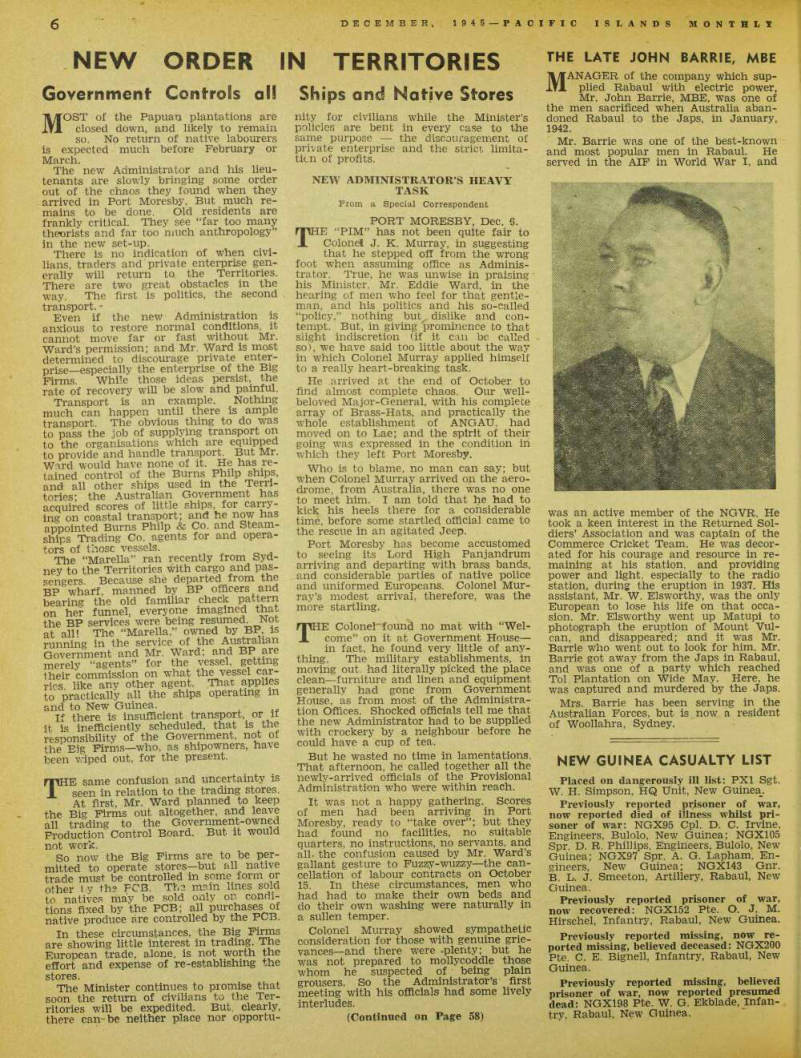
The Late John Barrie, Mbe
MANAGER of the company which sup plied Rabaul with electric power, Mr. John Barrie, MBE, was one of the men sacrificed when Australia aban doned Rabaul to the Japs, in January, 1942.
Mr. Barrie was one of the best-known and most popular men in Rabaul. He served in the AIF in World War I, and
was an active member of the NGVR. He took a keen interest in the Returned Sol diers’ Association and was captain of the Commerce Cricket Team. He was decor ated for his courage and resource in re maining at his station, and providing power and light, especially to the radio station, during the eruption in 1937. His assistant, Mr. W. Elsworthy, was the only European to lose his life on that occa sion. Mr. Elsworthy went up Matupi to photograph the eruption of Mount Vul can, and disappeared; and it was Mr.
Barrie who went out to look for him, Mr.
Barrie got away from the Japs in Rabaul, and was one of a party which reached Tol Plantation on Wide May. Here, he was captured and murdered by the Japs.
Mrs. Barrie has been serving in the Australian Forces, but is now a resident of Woollahra, Sydney.
New Guinea Casualty List
Placed on dangerously ill list: PX1 Sgt.
W. H. Simpson, HQ Unit, New Guinea,.
Previously reported prisoner of war, now reported died of illness whilst pri soner of war: NGX9S Cpl. D. C. Irvine, Engineers, Bulolo, New Guinea; NGXIOS Spr. D. R. Phillips, Engineers, Bulolo, New Guinea; NGX97 Snr. A. G. Lapham, En gineers, New Guinea; NGXI43 Gnr.
B. L. J. Smeeton, Artillery, Rabaul, New Guinea.
Previously reported prisoner of war, now recovered: NGXIS2 Pte. O. J. M.
Hirschel, Infantry, Rabaul, New Guinea.
Previously reported missing, now re ported missing, believed deceased: NGX2OO Pte. C. E. Bignell, Infantry, Rabaul, New Guinea.
Previously reported missing, believed prisoner of war, now reported presumed dead: NGXI9B Pte. W. G. Ekblade, Infan try, Rabaul, New Guinea.
Central Medical
School
Suva Hopes to Get Support of New USA Administrations
PLANS afoot for the future adminis tration of the Caroline, Marshall and Mariana Islands, taken by the Americans from the Japanese, and to be controlled in future by the United States, may have an important bearing upon the Central Medical School, Suva.
The CMS is the now famous institution to which are sent selected native students from all the Pacific Islands Territories in the Central and South Pacific, except the Australian-controlled Territories.
After a strict, intensive training extend ing over four years, the successful students qualify as native medical prac titioners, and return to their own Terri tories, where they devote themselves to medical work among their own people.
In preparing administrative plans, covering the new Territories which are to be the responsibility of America, the United States Navy has been giving care ful attention to the medical services to be made available to the native popula tions. The Navy has planned a school for the training of native doctors; and one of the alternatives under considera tion is a hook-up with the CMS in Suva.
THE Americans, in the end, may decide to establish their own school—but there are many sound, logical reasons why they should support the Suva Institution. The Americans are planning on behalf of the Micronesians of the Caroline, Marshall and Mariana Islands. Micronesians, already success fully trained in Suva, have come from the Gilberts, from Ocean Island, and from Nauru. Students from American Samoa have qualified at Suva as NMP’s and have served in the American Navy for many years.
Before World War 11, USA Navy men
were keen supporters of the CMS at Suva.
Plans for training at Suva, natives from Guam, sent by the American Administra tion there, were almost complete, before they were dislocated by World War 11.
Diseases in the Marshalls, Carolines and Marianas are similar to those met with in Polynesia and Melanesia. The charac ter and customs of the natives are alike.
The CMS in Suva is a flexible insti tution, designed to take care of the medi cal training of natives of all Pacific Territories. That is why the non-co-operative and apparently unfriendly attitude of the Australian Government to the school — which never has been explained—has been such a disappointment to the directors.
THE endeavour of the directors has been to maintain, at the school, very simple social conditions, so that students there are not in any way made unsuitable for their main purpose.
A great disservice to Islands natives generally could be done, for example, if the Americans, instead of supporting the CMS at Suva, were to establish a wholly American training school at Guam, where there is every likelihood of the students being treated in the too generous American way. A too great elaboration of living conditions in the school would produce a wrong type of NMP. The men who graduate in Suva are, for the most part, actuated by high ideals of service, and go willingly to the life which they have chosen in their vil lages, which is simple almost to the point of severity.
Twenty years of trial and error have proved the soundness of the methods fol lowed in Suva, in regard to living condi tions and the relationship between the different races trained there.
If, as is hoped, the new American controlled Administrations from north of the Equator should support the Central Medical School at Suva, the strength, value and usefulness of the institution will be greatly increased.
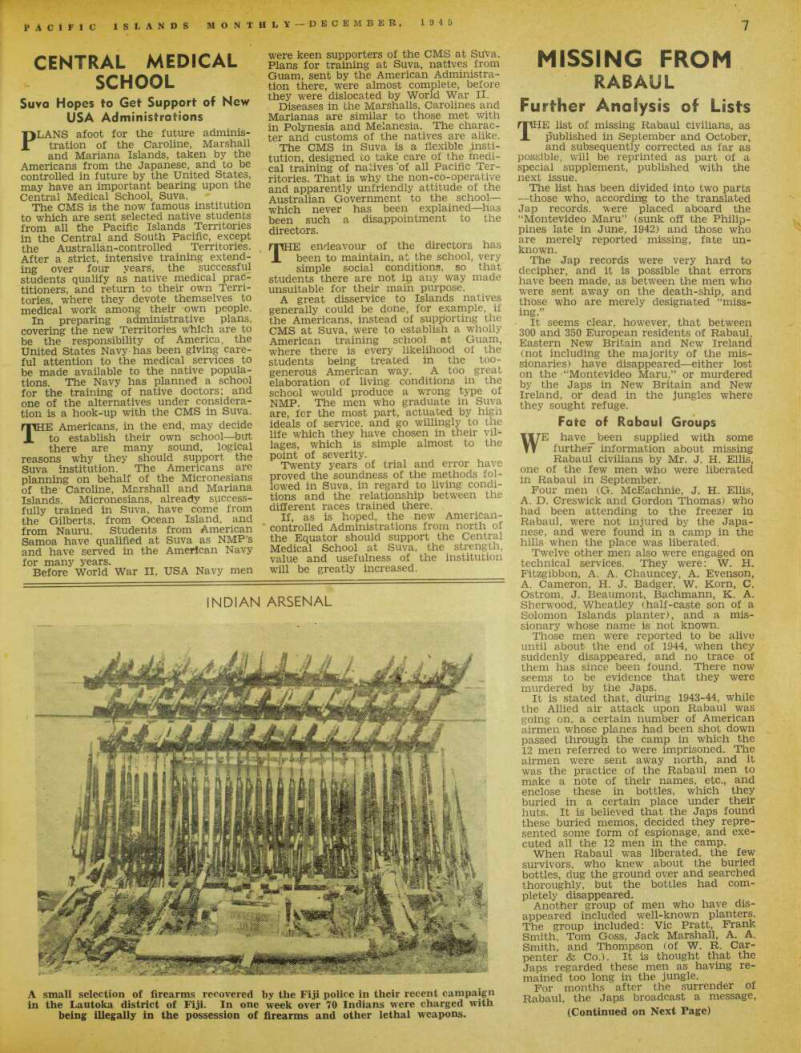
Indian Arsenal
A small selection of firearms recovered by the Fiji police in their recent campaign in the Lautoka district of Fiji. In one week over 70 Indians were charged with being illegally in the possession of firearms and other lethal weapons.
Missing From
Rabaul
Further Analysis of Lists
THE list of missing Rabaul civilians, as published in September and October, and subsequently corrected as far as possible, will be reprinted as part of a special supplement, published with the next issue.
The list has been divided into two parts —those who, according to the translated Jap records, were placed aboard the “Montevideo Maru” (sunk off the Philip pines late in June, 1942) and those who are merely reported missing, fate un known.
The Jap records were very hard to decipher, and it is possible that errors have been made, as between the men who were sent away on the death-ship, and those who are merely designated “miss ing.”
It seems clear, however, that between 300 and 350 European residents of Rabaul, Eastern New Britain and New Ireland (not including the majority of the mis sionaries) have disappeared—either lost on the “Montevideo Maru,” or murdered by the Japs in New Britain and New Ireland, or dead in the Jungles where they sought refuge.
Fate of Rabaul Groups
WE have been supplied with some further information about missing Rabaul civilians by Mr. J. H. Ellis, one of the few men who were liberated in Rabaul in September.
Four men (G. McEachnie, J. H. Ellis, A. D. Greswick and Gordon Thomas) who had been attending to the freezer in Rabaul, were not injured by the Japa nese, and were found in a camp in the hills when the place was liberated.
Twelve other men also were engaged on technical services. They were: W. H.
Fitzgibbon, A. A. Chauncey, A. Evenson, A. Cameron, H. J. Badger. W. Korn, C.
Ostrom, J. Beaumont, Bachmann, K. A.
Sherwood, Wheatley (half-caste son of a Solomon Islands planter), and a mis sionary whose name is not known.
Those men were reported to be alive until about the end of 1944, when they suddenly disappeared, and no trace of them has since been found. There now seems to be evidence that they were murdered by the Japs.
It is stated that, during 1943-44, while the Allied air attack upon Rabaul was going on, a certain number of American airmen whose planes had been shot down passed through the camp in which the 12 men referred to were imprisoned. The airmen were sent away north, and it was the practice of the Rabaul men to make a note of their names, etc., and enclose these in bottles, which they buried in a certain place under their huts. It is believed that the Japs found these buried memos, decided they repre sented some form of espionage, and exe cuted all the 12 men in the camp.
When Rabaul was liberated, the few survivors, who knew about the buried bottles, dug the ground over and searched thoroughly, but the bottles had com pletely disappeared.
Another group of men who have dis appeared included well-known planters.
The group included: Vic Pratt, Frank Smith, Tom Goss, Jack Marshall, A. A.
Smith, and Thompson (of W. R. Car penter & Co.). It is thought that the Japs regarded these men as having re mained too long in the jungle.
For months after the surrender of Rabaul, the Japs broadcast a message,
(Continued on Next Page)
in various ways, instructing all Euro peans to surrender themselves, and threatening penalties for those who did not. The group did not surrender until about July, 1942. The “freezer group” saw them arrive one day, in a lorry.
They were only about a fortnight in Rabaul. There was no one there to make an appeal to the Japs on their be half, as had been done successfully in so many cases by “Nobby” Clarke. By this time, Mr. Clarke and all his associates had been sent away on the “Montevideo Maru.” One day the Pratt group were ordered into a lorry, and told not to bring any baggage. They were taken away by the Japs, and were never seen again.
Men Lost In Rabaul
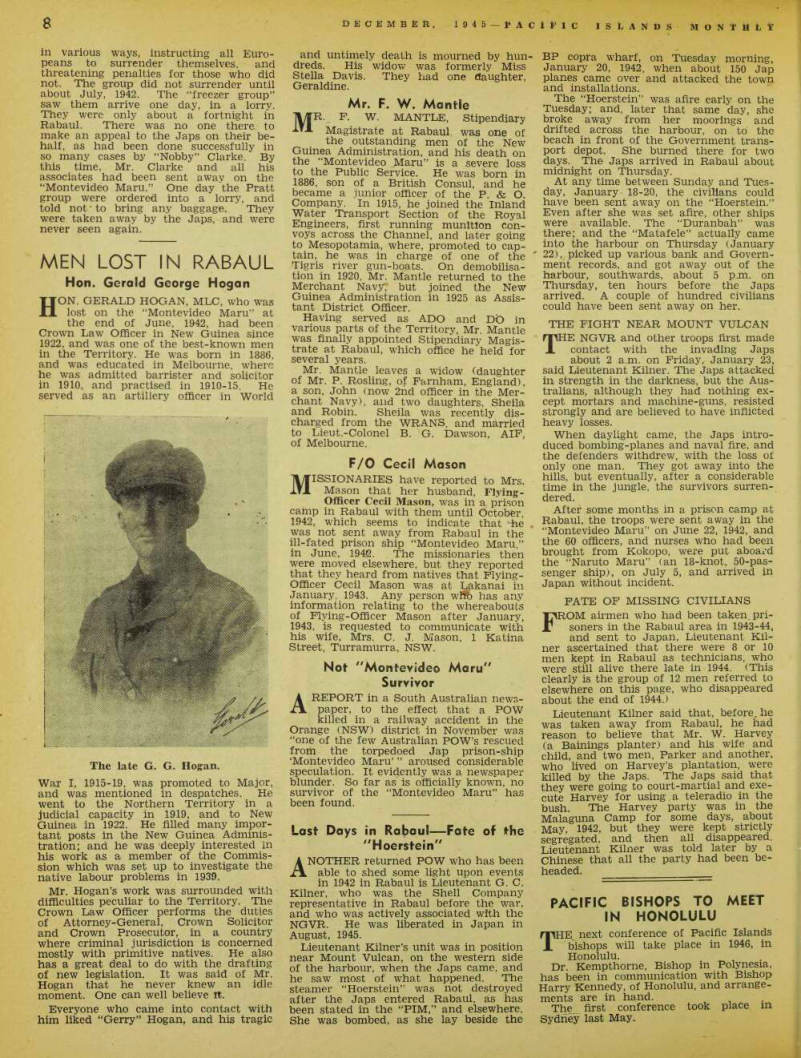
Hon. Gerald George Hogan
Hon. Gerald Hogan, Mlc, Who Was
lost on the “Montevideo Maru” at the end of June, 1942, had been Crown Law Officer in New Guinea since 1922, and was one of the best-known men in the Territory. He was born in 1886, and was educated in Melbourne, where he was admitted barrister and solicitor in 1910, and practised in 1910-15. He served as an artillery officer in World
War I, 1915-19, was promoted to Major, and was mentioned in despatches. He went to the Northern Territory in a judicial capacity in 1919, and to New Guinea in 1922. He filled many impor tant posts in the New Guinea Adminis tration; and he was deeply interested in his work as a member of the Commis sion which was set up to investigate the native labour problems in 1939.
Mr. Hogan’s work was surrounded with difficulties peculiar to the Territory. The Crown Law Officer performs the duties of Attorney-General, Crown Solicitor and Crown Prosecutor, in a country where criminal jurisdiction is concerned mostly with primitive natives. He also has a great deal to do with the drafting of new legislation. It was said of Mr.
Hogan that he never knew an idle moment. One can well believe it.
Everyone who came into contact with him liked “Gerry” Hogan, and his tragic
and untimely death is mourned by hun dreds. His widow was formerly Miss Stella Davis. They had one daughter, Geraldine.
Mr. F. W. Mantle
MR. F. W. MANTLE, Stipendiary Magistrate at Rabaul was one of the outstanding men of the New Guinea Administration, and his death on the “Montevideo Maru” is a severe loss to the Public Service. He was born in 1886, son of a British Consul, and he became a junior officer of the P. & O.
Company. In 1915, he joined the Inland Water Transport Section of the Royal Engineers, first running munition con voys across the Channel, and later going to Mesopotamia, where, promoted to cap tain, he was in charge of one of the Tigris river gun-boats. On demobilisa tion in 1920, Mr. Mantle returned to the Merchant Navy,' but joined the New Guinea Administration in 1925 as Assis tant District Officer, Having served as ADO and DO in various parts of the Territory, Mr. Mantle was finally appointed Stipendiary Magis trate at Rabaul, which office he held for several years.
Mr. Mantle leaves a widow (daughter of Mr. P. Rosling, of Farnham, England), a son, John (now 2nd officer in the Mer chant Navy), and two daughters, Sheila and Robin. Sheila was recently dis charged from the WRANS, and married to Lieut.-Colonel B. G. Dawson, AIF, of Melbourne.
F/O Cecil Mason
MISSIONARIES have reported to Mrs.
Mason that her husband, Flying- Officer Cecil Mason, was in a prison camp in Rabaul with them until October, 1942, which seems to indicate that he was not sent away from Rabaul in the ill-fated prison ship “Montevideo Maru,” in June, 1948. The missionaries then were moved elsewhere, but they reported that they heard from natives that Flying- Officer Cecil Mason was at Lakanai in January, 1943. Any person who has any information relating to the whereabouts of Flying-Officer Mason after January, 1943, is requested to communicate with his wife, Mrs. C. J. Mason, 1 Katina Street, Turramurra, NSW.
Not "Montevideo Maru"
Survivor
A REPORT in a South Australian news paper, to the effect that a POW killed in a railway accident in the Orange (NSW) district in November was “one of the few Australian POW’s rescued from the torpedoed Jap prison-ship ‘Montevideo Maru’ ” aroused considerable speculation. It evidently was a newspaper blunder. So far as is officially known, no survivor of the “Montevideo Maru” has been found.
Last Days in Rabaul—Fate of the
"Hoerstein"
ANOTHER returned POW who has been able to shed some light upon events in 1942 in Rabaul is Lieutenant G. C.
Kilner, who was the Shell Company representative in Rabaul before the war, and who was actively associated with the NGVR. He was liberated in Japan in August, 1945.
Lieutenant Kilner’s unit was in position near Mount Vulcan, on the western side of the harbour, when the Japs came, and he saw most of what happened. The steamer “Hoerstein” was not destroyed after the Japs entered Rabaul, as has been stated in the “PIM,” and elsewhere.
She was bombed, as she lay beside the
BP copra wharf, on Tuesday morning, January 20, 1942, when about 150 Jap planes came over and attacked the town and Installations.
The “Hoerstein” was afire early on the Tuesday; and, later that same day, she broke away from her moorings and drifted across the harbour, on to the beach in front of the Government trans port depot. She burned there for two days. The Japs arrived in Rabaul about midnight on Thursday.
At any time between Sunday and Tues day, January 18-20, the civilians could have been sent away on the “Hoerstein.”
Even after she was set afire, other ships were available. The “Duranbah” was there; and the “Matafele” actually came into the harbour on Thursday (January 22), picked up various bank and Govern ment records, and got away out of the harbour, southwards, about 5 p.m, on Thursday, ten hours before the Japs arrived. A couple of hundred civilians could have been sent away on her.
The Fight Near Mount Vulcan
THE NGVR and other troops first made contact with the invading Japs about 2 a.m. on Friday, January 23, said Lieutenant Kilner. The Japs attacked in strength in the darkness, but the Aus tralians, although they had nothing ex cept mortars and machine-guns, resisted strongly and are believed to have inflicted heavy losses.
When daylight came, the Japs intro duced bombing-planes and naval fire, and the defenders withdrew, with the loss of only one man. They got away into the hills, but eventually, after a considerable time in the jungle, the survivors surren dered.
After some months in a prison camp at Rabaul, the troops were sent away in the “Montevideo Maru” on June 22, 1942, and the 60 officers, and nurses who had been brought from Kokopo, were put aboard the “Naruto Maru” (an 18-knot, 50-pas senger ship), on July 5, and arrived in Japan without incident.
Fate Of Missing Civilians
FROM airmen who had been taken, pri soners in the Rabaul area in 1943-44, and sent to Japan, Lieutenant Kil ner ascertained that there were 8 or 10 men kept in Rabaul as technicians, who were still alive there late in 1944. (This clearly is the group of 12 men referred to elsewhere on this page, who disappeared about the end of 1944.) Lieutenant Kilner said that, before, he was taken away from Rabaul, he had reason to believe that Mr. W. Harvey (a Bainings planter) and his wife and child, and two men, Parker and another, who lived on Harvey’s plantation, were killed by the Japs. The Japs said that they were going to court-martial and exe cute Harvey for using a teleradio in the bush. The Harvey party was in the Malaguna Camp for some days, about May, 1942, but they were kept strictly segregated, and then all disappeared.
Lieutenant Kilner was told later by a Chinese that all the party had been be headed.
The late G. G. Hogan.
Pacific Bishops To Meet
In Honolulu
THE next conference of Pacific Islands bishops will take place in 1946, in Honolulu.
Dr. Kempthorne, Bishop in Polynesia, has been in communication with Bishop Harry Kennedy, of Honolulu, and arrange ments are in hand. first conference took place m Sydney last May.
Tropicalities
pROM Mr. J. D. Davidson, of the
Wembley Hotel, Sydney, we have
received the following : “I have been reading a book by Bodham Wetham, published in London, in 1876, and came across the following (/ have read of it before, but not in so much detail)”: The sinu gaga (excoecaria agolochia), or poison sinu, is found in mangrove swamps, has a glossy foliage, oblong leaves and small green flowers in catkins. When the tree is wounded a lot of white milky juice flows out which burns the skin. It is analogous to the Manzanillo of South America. It is an almost certain cure for leprosy.
The leper is rubbed with green leaves and then buried in them. A small fire is then kindled, and a few pieces of wood laid on. As soon as a thick black smoke arises the leper is bound hand and foot, a rope is fastened to his heels, by means of which he is drawn up over the fire so that his head is about 15 inches from the ground in the midst of the poi sonous smoke. The door of the house is then closed, and the sufferer allowed to remain, often for hours. When he is sufficiently smoked, the fire is removed, the slime scraped from his body, and deep gashes cut in the skin until the blood flows freely. The leper is then taken down, and laid in mats to recover, or die.
The agony is dreadful, but the cure is generally complete. rRRITORIES folk will be glad to know that Brigadier D. M. Cleland, who was the executive head of the Production Control Board in the Terri tories, is now a high executive official in the Australian Liberal Party. If the non-Labour parties should get control of the Australian Government next year— a consummation for which all Terri torians nightly pray—we shall have, close to the people in authority, a good friend who understands Territories’ problems and conditions. If Mr. Ward and his like should be thrown off the Govern ment benches in 1946—a thing that does not now appear probable—the Territories would have known 4£ years of rule by Brass-hats, professors and anthropolo gists—the most tragic and, economically and administratively, the most disastrous period in the history of New Guinea and Papua. • MORE about Western Samoa’s visitor, writer and artist, Robert Gibbings (November “PIM”), who plans to do a book on the Territory. He arrived in Apia on the October “Matua” but within a few days had departed for an outer island for the rising of the palolo— scheduled for October 26.
Mr.-Gibbings is an Irishman, son of a one-time Canon of Cork Cathedral; he was a lecturer of book production at the University of Reading for seven years and director of the Golden Cockerel Press for nine; he has written several books about England and his own country and one on Tahiti; and some of the world’s most famous museums exhibit his wood en gravings. Besides all this, he is a painter and sculptor.
He expects to spend a year in Samoa, living among the people, learning the language, making wood-cuts and gather ing material. The actual writing of the book will be done after he leaves the Territory.
Wpstern Samoa as far as anv serious wrfifnei? concerned is Dracticafiv a wmmg is concerned, is practically a vir tAere for a "everaT e books Maybe Mr Glbblnes will Eive us one of* them but at aU B events Bhe 8 he will be remembered there 1 AloSe to the route toTamoa he L Tlready rlferred to as “the pmnting bloke that’s going to Samoa—the one with the beard!” Mr. Gibbings is a large man, with a twinkle in his eye—and a beard—and is popularly supposed to look like an artist. Therefore, I guess he’ll be known as an artist in that part of the globe no matter what line of art he follows. It is to be hoped, for his sake, that underneath the rough and rude Samoan exterior of to-day (alleged to be due to the war) he will find something of that traditional Polynesian charm of which we have all heard so much.—JT. • RUMOUR, which is working overtime in Western Samoa at present, says, that Reparation Estates there is to go in for rubber production in a big way.
Experts are supposed to be in a huddle over the scheme, right now, in Welling ton Reparation Estates is, of course, the New Zealand Government; and a grow your-own-rubber campaign would be all in one piece with Dominion’s aim to be self-supporting. During the war years, a certain number of secondary indus tries have sprung up in New Zealand, and the New Zealand Government is anxious to retain these even at the ex pense of the country’s primary industries.
The reason is not far to seep: more in dustrialisation means more Labour votes; but it is unlikely that, in the post-war world, little New Zealand’s secondary in
dustries will be able to compete in a free world market.
The Dominion’s devotion to a 40-hour week has reached such ridiculous pro portions (it is alleged that doctors, who have already made fortunes out of Social Security, are now petitioning for a 40hours week) that it Is virtually impos sible for its manufacturers to turn out goods that will compete within pounds with countries whose methods are more scientific and whose workers are not quite so exacting. * AS far as rubber-growing is concerned, New Zealand and Samoa should both be interested in the report from in ternational rubber experts who met in New York recently, and forecast that there would be a huge surplus in rubber within the next year or two. The world’s rubber requirements are estimated at about 1,500,000 tons per year, of which the world’s synthetic factories can al ready supply 1,400.000 tons. The raw rubber output of the Far East Is expected to reach 600,000 tons next year and later increase to 1,500,000 tons.
By the time Samoan Reparation Es tates’ rubber trees (which are not yet planted) are in bearing, New Zealand should be able to import all she needs from the East at a fraction of a cost of that produced by the Samoans. However if New Zealand consumers of tyres and hot-water bottles wish to go on indefin itely paying twice as much as the rest of the world for these commodities, there may be merit in the new scheme. * MANY and varied are the reasons for the “unexpected” results of Octo ber 15, when Papuan natives de cided not to make new paper, but return forthwith *to their villages, leaving Papuan industry crippled.
A Sydney “Sunday Sun” correspondent
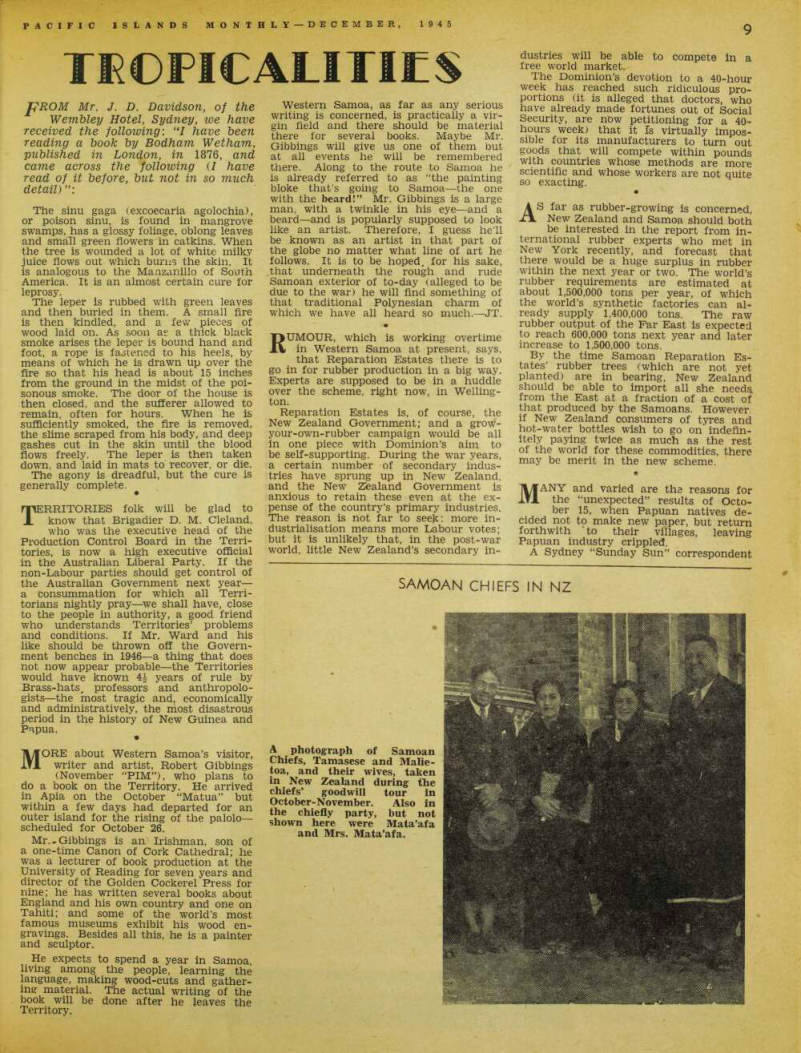
A photograph of Samoan Chiefs, Tamasese and Malie toa, and their wives, taken in New Zealand during the chiefs’ goodwill tour in Octoher-November. Also in the chiefly party, but not shown here were Mata’afa and Mrs. Mata’afa.
Samoan Chiefs In Nz
attributes it to the fact that pre-war, unscrupulous planters fed their labour on a straight diet of“kau-kau,” and that the prospect of returning to this, after several years on ANGAU rations, was just too utterly utter to contemplate.
Therefore, when offered the choice, they pulled up their stakes and lit out for home and mother.
In Sydney on November 30, Territories Minister Ward said that the results of October 15 were a “temporary difficulty and not unforeseen.” He said that natives would resume work in their own good time but in the meantime he refused to “conscript native labour.”
We have it on good authority, from men who were there at the time, that during the period of hiatus natives were conscripted—or, to be more accurate, forced to perform certain essential work.
But perhaps, as in the case of Cohen’s walking-stick (“PIM,” November) such gross details of ill-deeds done are best kept from the delicate susceptibilities of Mr. Ward. ♦ NOW that the attentive waiter belongs to the past, Territorians sigh for that little bit of attention given at meal times by a good house boy. Al though I remember one occasion when the fussiness of a native waiter caused
some embarrassment.
We had a guest for dinner. One of those passers-by who come chugging along in a schooner, drop their pick in the bay, dine and spend the evening, and then sail off over the horizon, perhaps never to be met with again.
This particular guest belonged to the rough diamond class. He was making a hearty meal and entertaining us with the story of his adventurous life, and using his knife to cut his meat, scoop up a piece of butter, or wave in the air to illustrate a point of his narrative. I could see that the boy who was waiting on the table seemed -agitated, but could not guess the reason. Finally, he picked up the butter-knife from the table, and held it before our guest’s eyes, and in a voice quivering with exasperation, said:— “ Tm ’e nife belong butter, Master!”— A.G. * AN article by, Mrs, K. Seton in June “PIM” stated that the only place where one can land between Faisi in the Shortlands, and Kieta in Bou gainville (which are under different ad ministrations) is Refuge Island. Mrs.
Seton commented on the fact that the island was barren and uninviting and that she had never heard of anyone who had landed there. Now a reader writes to tell of someone who did: “In the later part of November, 1916, Mr. Norman Wheatley’s schooner, ‘Niue,’ with a serious accident case from Vella La Vella on board, left Faisi for Kieta in the hope of getting surgical aid there.
The details of the journey then were much the same as Mrs. Seton described 12 or more years later—and a permit to land would only be granted in special circumstances.
“The ‘Niue’ was unprepared for the task; her engine was giving trouble and she also lacked the necessary power for such a trip through currents and tide rips. But there was no alternative —it was a case of urgent necessity.
“Making no headway, it was decided to anchor at Refuge Island and wait for the turn of the tide, which would then be in our favour, instead of dead against us. We had a couple of ‘boys’ taken on at Faisi for their local knowledge.
Trusting to them, we dropped anchor where they said ‘Jack’ did, and found ourselves tossing helplessly among the breakers, aground on the reef.
“All that could be done in such a pre dicament was tried. The engine failed to move her off astern; and gradually, as the tide fell, we took on a more and
more acute angle, ending up for a few hours with the good ship lying high and dry on her side—so that we could step ashore and explore Refuge Island in a vain search for badly-needed fresh water.
“The natives turned up in great force to help us—mostly with advice. Every thing movable was taken ashore—and taken back again when at last we had got back into deep water, through the combined effect of a rising tide and dy namiting the coral.
“The natives, after each explosion, would dive down to indicate to us the best place for the next charge. Norman Wheatley lit each fuse from his cigar.
I never shall forget the tall black figures moving about in the moonlight, the coco nut flares all around, and Norman direct ing operations in his own perfect and inimitable manner.
“There was no doctor at Kieta. Our patient was Captain McEachran, and his condition was serious. So we continued on to Rabaul. They amputated his arm, and he also lost the sight of his right eye.”
Captain McEachran lost his life at Port Moresby early in World War 11.
Advertisements & other items, p. 12 (1 item)
A. B. Donald Ltd.
Position Wanted
HOTEL MANAGER
Ex-Territorian, anxious resume residence when normal conditions prevail, seeks managership Hotel, Club or Guest House—anywhere. Health and appearance good, accurate, careful bookkeeper, wide knowledge Labour, Liquor and other Ordinances, good mixer, widely known, tactful and would capture trade from opposition.
Wife excellent supervisor kitchen boys and domestics.
Write:— “Islands Hotel Manager,”
Box 3408 G.P.0., SYDNEY.
A. B. DONALD Ltd.
AUCKLAND
ISLAND TRADERS & GENERAL MERCHANTS
P.O. Box 1509. Cobles Gr Telegrams, "Kingdom", Auckland.
a This Company supplies Aluminium and its Alloys to all specifications and for every commercial application where these give better service over other metals. Please consult our Technical Service Department regarding your light metal problems.
AUSTRALIAN ALUMINIUM COMPANY
PROPRIETARY lIMITED
( INCORPORATED IN THE .STATI OF VICTORIA!
GENERAL OFFICES AND FABRICATION DIVISION: GRANVILLE. SYDNEY. N.S.W.
Death Of Mr. Leslie V.
Waterhouse
A MAN high in the goldmining indus try of Australia and New Guinea, Mr. Leslie V. Waterhouse, BE, died
in Sydney on November 26, after a long illness, caused by an accident. He was 59 years old.
Mr. Waterhouse, Early in 1945, visited the United States. The ship in which he was returning to Sydney ran into very rough weather, and Mr. Waterhouse, one day, fell heavily, and fractured one or
more of the verterbrae of his spine. He was treated in a Sydney hospital for some months, and apparently was making a good recovery. But the injury set up a more dangerous and complicated condi tion, which led eventually to a relapse, and death.
The very large gathering of Sydney’s professional and commercial leaders at North Shore Crematorium on November 27 bore testimony to the respect and esteem with which “Les” Waterhouse was regarded by all who met him, in his long and successful career.
As a director of Placer, he was one of the founders of Bulolo Gold Dredging, Ltd., and Guinea Airways, Ltd., and his clever professional brain had much to do with the phenomenal success of those two New Guinea enterprises. It was sheer tragedy that war should have interrupted the progress of BGD, just after the big company had installed its eighth dredge and was reaching its maximum output.
Much of the strain and worry of the in vasion of the goldfield,and of the prob lem of rehabilitation, fell directly upon Mr. Waterhouse.
He is survived by his wife and rwo daughters.
The Rev. Campbell Williamson, of the Presbyterian Overseas Mission, has re cently been in New South Wales on leave from the New Hebrides. During Novem ber, while in the Richmond district, he gave a series of lectures on mission work in the Hebrides.
Mr. L. V. Waterhouse (on left) with the late Eric Chater and Pilot Bert Heath.
This photo was taken in NG in 1941.
Advertisements & other items, pp. 13-14 (2 items)
11
PACIFIC ISLANDS MONTH L 1 - DECEMBER, 1945
ffiLoyWlfaCTl-
THE
YORKSHIRE
INSURANCE
CO. LTD.
(Incorporated in England)
FIRE
ACCIDENT
MARINE
FIRE POLICIES ISSUED
IN PAPUA
m All information from —
E. A. JAMES,
TeL 86347. Attorney for Papua, 14 Spring St., Sydney.
BURNS PHILP
(SOUTH SEA) CO. LTD.
Inc. in Fiji Island Traders and Shipowners Registered Office:
SU V A
FIJI
\\ Also Branches at: Fiji: Levuka, Lautoka, Labasa, Ba, Sigatoka, Rotuma.
Tonga: Nukualofa, Haapai, Vavau.
Samoa: Apia, Pago Pago (American Samoa).
Solomons: Makambo, Gizo, Faisi.
New Hebrides: Vila.
Code Address: Gilberts: Tarawa.
"Burnsouth". Norfolk Is. Niue. Wallis Is. Futuna Is.
Oil
AVT
E Hi
ffiLoyWlfaCTl-
Sole Australian Concessionaries :
GEORGE BROWN & CO. PTY
267 Clarence Street, Sydney.
LTD.
The Ultimate factory has made the change-over from its wartime set-up.
Designs tor the new models are now completed and production is about to commence.
These models should be available early in 1946—they will be well worth waiting for. Watch for further announcements.
SERVICE: Servicing of all kinds of radio sets, amplifiers and Rola speakers will continue to be available.
\V\c
SPECIALISING
IN
PACIFIC ISLAND INSURANCES
FIRE MOTOR VEHICLE
MARINE HULLS AND CARGO
EMPLOYER’S LIABILITY
GUARANTEES including those for —
DYNAMITE PERMITS.
RECRUITERS’ LICENCES.
DEFERRED WAGES
AND ALL OTHER CLASSES ARRANGED
AT LOWEST CURRENT RATES.
Established Agencies:
W. R. CARPENTER & CO., LTD.
Throughout the Territory of New Guinea.
SOUTHERN PACIFIC INSURANCE
CO., LTD.
HEAD OFFICE: 60 HUNTER STREET,
SYDNEY.
"Pont my (yin,.
Sc
★ LIQUEURS * COCKTAILS * WHISKIES
Address ail enquiries to:
W. & A. GILBEY LTD.,
33 ROSSLYN STREET, WEST MELBOURNE.
Telegraphic and Cable Address: "Gilbey's," Melbourne.
109 REGENT STREET, SYDNEY.
Telegraphic and Cable Address: "Gilbey's/' Sydney.
Whither Bound?
If Tonga Has a Future, What Is It ?
WHEN Fiji residents round-trip to Tonga now, they take with them their cast-off shirts and frocks to trade for baskets, mats, trays, shells and other oddments of native manufacture.
To-day, superficially at least, Tonga is the poorest country in the South Pacific.
Nowhere else are the store shelves so unashamedly naked, the inhabitants so ragged, the prices of such consumer goods as there are so exorbitant.
It is almost impossible for the visitor to get® off the wharf at Vavau, which is some degrees worse off than Nukualofa, without scores of huge Tongans surrounding him or her, each clamouring for attention and the favour of an old shirt or frock. “Friend,” they say, “here is a nice basket. Give me a dress for it. My wife has no dress and cannot go out. Or (with a fanatical gleam in the old Polynesian eye) three packets, of American cigarettes—but don’t let the Customs officer see you!”
But the term, superficial poverty, is used advisedly. This apparent state of affairs is on the debit side. On the credit
it can be said that the Tongans look as healthy and well-fed as anyone else; they have no “Indian problem,” as in Fiji; domestic or national unrest as in Samoa; and no war-wounds to lick, as in other South Pacific Territories.
And, in spite of material shortages, it is probable that the Tongan is not less happy than his counterpart in the jungles of Sydney or London or Auck land, even though the wife of the Sydney sider, Londoner or Aucklander has at least one dress in which to go out.
BUT the mere fact of fundamental content does not explain why Tonga, which had its dollar-prosperity, and whose products are in greater demand to day than ever before, has bare store shelves and inhabitants who refuse money (because it will buy them nothing they want) in favour of cast-off European clothing. And this, mark you, wnile the neighbouring territories of Fiji and Samoa, by comparison, swim in manu factured goods.
Fiji may have had its brief period of shortages in 1943, but to-day there are plenty of piecegoods, food, household linen and wearing apparel, most of it imported from Britain or Australia, whose own inhabitants are strictly rationed. Samoa has an abundance of American goods, both clothing and food— including such canned delicacies as crab, olives, asparagus and salmon.
Tonga's unfortunate position, compared with neighbours, can be attributed to the facts that Tonga has little to sell, in order to obtain exchange; and, although Tonga does rejoice in independence, it Is of microscopic importance when it must take a chance with larger nations. Fiji sells sugar, gold and copra overseas, and Samoa sells cocoa, bananas and copra.
Both also gathered in a lot of American money, in exchange for curios, foodstuffs and general entertainment. Both conse quently established strong overseas credits.
Tonga has not had these advantages.
There were much fewer troops from America and New Zealand in Tonga.
Fiji, being a Crown Colony, was allotted her quota of British goods. Western Samoa, possibly due to the proximity of American Samoa and the presence in the Territory of large numbers of US troops, and certainly due to the fact that she was given a percentage of New Zealand’s own import quota, hasl had, and has still, plenty of consumer goods—although not always in sufficient quantities to please the newly dollar-conscious Samoans.
SUCH trade negotiations as Tonga has been able to arrange on her limited credits have been made through the British Consul in Nukualofa, and traders in the kingdom have been permitted to import only a fraction of the manufac tured goods they were bringing in before the war. The third largest importer in Tonga is permitted to order only 7 per cent, of what he imported in the base year of 1939. That is why the wife of our Vavau friend cannot have a new dress There appears, however, to have been no such restrictions on the importation of foodstuffs from New Zealand and, con sequently, during these last years Ton gans have been spending much of their limited dollar wealth on Dominion butter and bacon, while New Zealanders at home were restricted on both.
It is said in Tonga that the Tongans have saved little of the money they earned during the war from New Zealand and
American Forces. Part of it went to pay back debts to the stores, part in taxes, and the rest to feed themselves. Not withstanding the fact that the Tongan can grow much of his food, he does buy some imported lines, and it is easy to understand why this would eat into the family income when one sees the exorbitant prices which are charged in Tonga for ordinary commodities.
Flour is £3O per ton, at least 100 per cent, more than in Sydney, where it is bought. Tea is 5/3 per pound; butter 2/10; and everything else is in proportion.
It could be said, then, that Tonga’s dollar prosperity went into Tongan stomachs, and certainly there is little indication in the kingdom to-day that it went any where else.
IT will be interesting to see the trend of affairs in Tonga in the next ten years.
To-day, there is nothing there for the European, and every indication that there never will be anything. That, per haps, is not important. But what of the native Tongan?
Certainly, he has gained what every native race is bent on gaining to-day— technical freedom and independence.
But is he greatly benefited thereby?
In all the other Pacific Territories there is young blood, with new ideas, bursting to do something in the new world. Many of those ideas are crazy, but they are ideas.
In Tonga, one is conscious, at once, that there is nothing of this budding en terprise. No one pines there to can coconut-cream, or grow rubber, or process candle-nuts, or go in for tourism, or start a cannery. Or if they do, they pine in silence. Although the radical-minded may hate to accept these facts, this apathy can be attributed to lack of Euro peans as much as to lack of Tongan
enterprise.
WHAT, then, do the Tongans intend for their kingdom? If freedom from European competition and inter ference is a goal in itself, then they have reached that already. To keep it a self contained little backwater seems to be the only discernible plan at present; but, whatever authority may say in Tonga, it is evident that the rank and file Tongans, in their avid desire for the ordinary pro ducts of a 20th century world, have al lowed their minds to wander some dis tance from mediaeval Polynesia.
A hungry world can find a use for Ton gan products at the moment. But when that world returns to normal, it is doubt ful if there will be much clamouring at the gates unless Tonga does something to attract attention for herself. The king dom at present has nothing distinctive to offer the world—nothing even for the tourist, who can get better in a hundred other places—and there are no indica tions that there are any plans afoot to alter the set-up.
The policy of sinking out of sight of a crazy world may have much to commend it. But it remains to be seen whether, in the ultimate wash-up, it will be a good or bad thing, or whether mental, com mercial and political stagnation is what the ordinary Tongan really desires for himself and those who come after him.— J.T.
Mrs. E. A. James, Miss Lorna James and Mrs. J. C. Goad left Sydney by the “Marella,” on November 22, for Port Moresby. Mr. E. A. James represents the Australian War Damage Commission in New Guinea, and Mr. Goad is on the staff of the Commission there.
Advertisements & other items, pp. 15-16 (1 item)
a major anxiety
Relief from
Even the most expert and conscientious individual executor is subject to accident, illness and incapacitation.
Continuity of administration and uninterrupted attention to your estate arid your beneficiaries are of paramount importance. Both can be positively assured by appointing this Company your sole Executor or as co-Executor with your present appointee. An interesting explanatory booklet will be forwarded on request.
DIRECTORS:
Lewis Armstrong. James Burns. Joseph Mitchell.
R. J. Nosworthy. P. T. W. Black.
MANAGER: L. S. Parker.
BURNS PHILP TRUST
COMPANY LIMITED
7 BRIDGE STREET, SYDNEY
, TELEPHONE: B 7901 Box 543. G.P.0.. Sydney BP 1 .45
All over the British Empire, every minute of every day, more and more smokers are saying, "Better buy Capstan (tobacco and cigarettes)—theyVe blended better.
CAPSTAN
TOBACCO and CIGARETTES
Post-War Conditions In Bsi.
Huge Expenditure Planned —Nothing Yet For Evacuees
riTHE first post-war session of the X British Solomon Islands Protectorate Advisory Council opened at Honiara, Guadalcanal, on Monday, October 22.
His Honor, the Resident Commissioner, presided.
Members present were: Official — Colonel Noel (Resident Commissioner), Major Sinclair (legal adviser), Major Rutter (acting senior medical officer).
Non-official—Mr. D. Mackinnon, MBE, his Lordship the Bishop of Melanesia, and Wing-Commander Widdy.
The Resident Commissioner, in his address, said that the last meeting of the Advisory Council had taken place in November, 1941, prior to the Jap inva sion. He then made sympathetic refer ence to those former .residents of the Protectorate whose deaths had occurred since that date, and members of the Council paid tribute to their memory by observing a minute’s silence. The official list was as follows: Killed in Protectorate: Lieut.-Colonel C. N. F. Bengough, MBE, Lieut. G. H. C.
Train, Captain R. S. Taylor.
Roman Catholic personnel murdered by the Japanese: Father Arthur Duhamel, Father Henry Oude-Engberink, Sister Mary Sylvia, Sister Mary Odilia.
Missing: Hugh Wheatley, Johannes Klaucke.
Killed in action outside Protectorate: R. Chapman (at sea), P. Kneen (in New Guinea). Captain J. McEachran, and H.
Beck (at sea), J. Carey (in Middle East).
Died in Protectorate: W. Wilmott,
Father Tiggler, F. J. Hickie, S. C. Ashley.
Died outside Protectorate: G, Wilson, C. Beck, J. Webster, Agnew, H. L.
Freshwater. P. H. Mulvey, R. L. Threl fall, Father John Coicaud, Miss C. Deck.
It is feared that when complete records are available the list may be added to.
Training Of Natives
OTHER points of interest in the address related to native affairs.
The RC said native councils have been established wherever practicable.
These councils represent and offer native opinion. Local Rural Tax (formerly called Poll Tax) is now to be collected by the councils, and then proceeds are to be spent in each council area on essen tial village services and requirements.
Native Courts have been established, and are working satisfactorily. In this man ner the elders and people are being grad ually taught the art and responsibility of local rural administration.
The policy of Government is to develop agriculture so that the people shall have ample food and a well-bal anced diet. To assist in this direction, the services of an experienced agricul tural officer from Uganda have been ob tained, and he is now carefully survey ing the position. Several hundred acres of rice have been planted at an experi mental farm, and an effort is being made to popularise rice-growing at native villages.
Native Labour
fIIHE turnout of Solomon Islanders as X recruits for the Labour Corps has been magnificent; but this is a military unit, and is now being gradually demobilised. It seems reasonable to expect that most of the personnel will feel inclined to enjoy a rest. It must also be remembered that much work is necessary in the rebuilding of their vil lages and in cultivating their food gardens. In these circumstances a rush to recruit for employment is most un likely.
There is also the question of wages.
When prices dropped, during the lean years for the copra industry before the war, the Solomon Islander realised the position and accepted a fall in wages.
He is likely to adopt an equally realis tic view now when the prices are high, and will expect a rise in wages before he will offer his services.
Return Of Civilians—Shipping
Position
INQUIRIES are naturally being made as to the return of those people who were formerly employed in the Pro tectorate or owned their own businesses there. This, to a large extent, is bound up with the shipping question.
The Government has been able to secure the use of the Levers Pacific Plantations’ vessel “Kurimarau,” which is being operated on charter terms. Until business concerns can undertake to run ships to and from the Protectorate the supply link will depend entirely on the “Kurimarau,” and imports will neces sarily be limited accordingly. This, there fore, is the deciding factor for the present in regard to the number of Europeans who can reside in the Pro tectorate.
The difficulties in the way of re
settlement are very great, and must be given serious thought by those former residents who, naturally, wish to return at the earliest possible moment, fITHE business before the Council X was set out in the following papers:— • Draft Labour Regulation. • New site for Protectorate capital. • Draft Estimates for the financial year 1946-47. • Collection of Customs Duties on articles admitted duty free as .military stores and offered for sale to civilians. • Resumption of trade. • Draft Native Tax Regulation. • Draft Native Administration Regu lation. • Draft War Gratuities (SI Labour Corps Regulation). • Shipping position.
Labour Regulations
npHE draft. Regulation came in X for close examination and discus sion, and certain amendments were recommended.
Points of immediate interest concern recruiting and wages. The old system of recruiting labour is abolished, and in its place the Government has set up a Labour Exchange, through which requi sitions for labourers are passed to native councils, with whom are registered the names of natives who desire to offer for work. This method, which is designed to comply with the requirements of an International Convention, is generally regarded as cumbersome, and many con sider that it will prove unworkable in practice. Experience alone will show whether it will be adequate.
The minimum wage proposed was 25/per month, as against 10/- pre-war.
Members expressed agreement with the
heed to increase the minimum wage, but that it be fixed at 20/- if tobacco were continued as a free issue, or 25/- if such issue were discontinued.
New Site For Capital
AFTER careful consideration of several possible sites, a majority of the members favoured the choice of Honiara, Point Cruz, on Guadalcanal.
His Lordship the Bishop of Melanesia dissented from this decision, and argued the claims of Tulagi, the old capital.
It was felt by his colleagues, however, that Honiara, while lacking a satisfac tory all-weather anchorage for ships, possessed advantages over Tulagi in that it provides ample scope for expansion of administrative and business areas, has an adequate water supply, and is situated within easy distance of land on which native foodstuffs can be grown.
Making Use Of Military Stores
ON the subject of the collection of Customs duties on articles which were admitted duty-free as military stores, and are now offered for sale to civilians, non-official members were unanimously of opinion, ,and recom mended, that Customs duty on goods pur chased locally from the United States military authorities should be remitted, provided they are used by the purchasers in a manner that will aid in the general scheme of rehabilitation.
Huge Expenditure Proposed
rE Draft Estimates for 1946-47, sub mitted to Council, received tren chant criticism, and all three non official members availed themselves of the opportunity presented to express freely and forcefully their disagreement with many of the proposals.
The estimated revenue was shown as £76,515, and expenditure at £379,522, leav
ing a prospective deficit of £303,007, to be borne, apparently, by the British tax payer—who has quite a few financial headaches of his own at the moment.
It was indicated that expenditure of hitherto undreamed-of proportions was to be expected, for years to come, and the official hope is that nature will con tribute with an outpouring of gold from a' (so far) undiscovered El Dorado, and that a timber industry, not yet in being, will combine to provide the sinews of administration.
The value of gold won in the Solo mons during the last year of account ing was approximately £17,000; and, while it is true that timber resources are virtually untapped, it has yet to be proved whether the Solomon Islands product is marketable on an economic commercial basis.
Expenditure on vessels provided for district administration was criticised as extravagant and unwarranted.
But, generally speaking, members were moved to state the view that pruning in dividual items in the estimates would not meet the situation. There should be, they claimed, a complete recasting of the policy of Government in respect of the method of carrying on the administra tive service. This could be, and pre viously was over many years, effective on simple but adequate lines, and no ambi tious administrative scheme should be attempted.
The need to assist former residents to re-establish themselves in profitable occupations, to the benefit of trade and the public revenue, was stressed as being so potentially important as to de serve a prominent place in Government policy; and regret was expressed that apparently no form of assistance was contemplated when the Estimates were drafted.
Advertisements & other items, pp. 17-18 (1 item)
the shafting that’s virtually everlasting
e; A
Monel is a registered Trade Mark covering a rich nickel alloy, mined in Canada and rolled in Great Britain.
MONEL PROPELLER SHAFTING is renowned the world over for long^-dependable service. Being strong and tough, it withstands hard knocks, is highly resistant to corrosion, and guaranteed entirely rustless since Monel contains no iron.
In service, Monel propeller shafting also quickly develops a mirror-like polish which reduces bearing and packing wear to a minimum.
Isn't this the kind of shafting you want in your boat? Then ask your boat-builder to quote you to-day for a MONEL propeller shaft ... or 'phone.
WRIGHT AND COMPANY
SOLE AUSTRALIAN DISTRIBUTORS OF MONEL
81 CLARENCE STREET, SYDNEY : : : : : 'Phone: BXI2II (Six Lines)
REG. ADAMS, CLAYTON & CO.
n o
Progress with Modern Designing.
SHIPBUIDERS
and ENGINEERS
COPPERSMITHS, WELDERS and PLUMBERS.
Builders of WOODEN FREIGHTERS,
TRAWLERS and ISLAND CRAFT.
Agents for Diesel Engines.
VESSELS REPAIRED and REMODELLED.
MODERN SLIPWAY FACILITIES
AVAILABLE.
Write to us for Designs and Complete Shipbuilding information.
REG. ADAMS, CLAYTON
& COMPANY
JOHN STREET, BERRY'S BAY, SYDNEY.
Tel.: XB 4475, XA 1731.
Fiji Copra Falls by 12/6
Per Ton
Suva, Nov. 6.
rOM December 1, the buying price of copra in Suva and Levuka, Fiji, will fall by 12/6 per ton. This was re cently announced by the Director of Agriculture. Mr. C. Harvey.
Prices which will be paid at Suva and Levuka in future, therefore, will be: £l9/7/6 a ton, plantation grade; and £l7/17/6 FMS grade.
The decrease in price represents ,an adjustment between the local copra pool and the British Ministry of Food.
In October, 1944, Fiji producers were given a rise of 10/- a ton on their copra.
This was because of the desire of the local authorities that producers get full benefit from the price paid by the Minis try. But a warning was issued at that time that a revision upwards or down wards would probably become necessary from time to time.
After 12 months it has been found that the copra pool has been losing on the higher price, and, therefore, an adjust ment of 12/6 per ton has now been made.
Death Of C. R. Finney
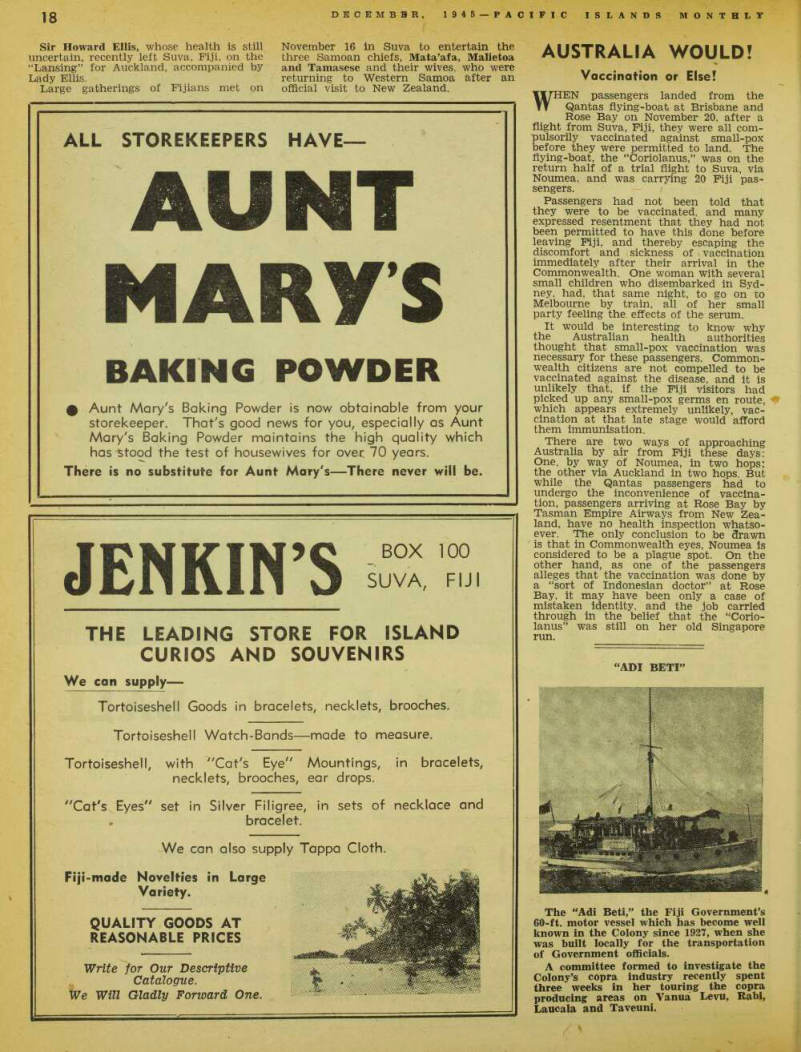
Former Administrator of Norfolk Island
Administrator, of Norfolk island, 1932-37, and also ' well known in Papua, where he served in the Gov ernment for many years, Charles Robert Pinney died in Sydney on November 18, on his 62nd birthday.
He was educated in Victoria, and in 1906 joined the Papuan Civil Service. He enlisted in 1914 as a trooper in the Light Horse, was commissioned in 1915, and was promoted to the rank of Captain in 1916.
In the same year he won the Military Cross, and was mentioned in despatches.
He returned to the Papuan Adminis tration in 1920, where he eventually became Commissioner of Lands and Director of Mines and Agriculture. He became a member of the Legislative and Executive Councils in Papua in 1930.
In 1932 he was appointed Administrator of Norfolk Island, where he remained until his retirement to Sydney in 1937.
In 1918 he married the only daughter of Sir Hubert Murray, Lieut.-Governor of Papua. They had one son and one daughter.
Owing to the “Matua” being diverted for a special trip to Fiji and Tonga, there will be no steamer from New Zealand to W. Samoa during December. The Novem ber “Matua” took a large number of pas sengers to Nukualofa to attend the Ton gan centenary celebrations.
Sir Howard Ellis, whose health is still uncertain, recently left Suva, Fiji, on the “Lansing” for Auckland, accompanied by Lady Ellis.
Large gatherings of Fijians met on
November 16 in Suva to entertain the three Samoan chiefs, Mata’afa, Malietoa and Tamasese and their wives, who were returning to Western Samoa after an official visit to New Zealand.
Advertisements & other items, pp. 19-20 (1 item)
Brial & Ball
■ . mm
MACARONI
s&pa
W:c " y ■ I 'i
v VERMICELLI
?»< - * / i. x * *V - *>&■
ini 1111
r :: Sole Distributing Agents for the Pacific Islands:
BRIAL & BALL
528 COLLINS STREET,
MELBOURNE.
1 BOND STREET,
SYDNEY.
’Phone: MU 4837. ’Phone: 87371,
k r% 1 Bond Street, Sydney, Australia. £* \}% U -j f| VTeL B 4167. Box 3615 G.P.O.
SUPPLIERS OF GENERAL MERCHANDISE TO LEADING FIRMS THROUGHOUT THE
PACIFIC ISLANDS
Exporters ... Importers ... Manufacturers' Representatives Bankers: Bank of N.B.W. Bank of Adelaide. Comptoir Nat. d’Escompte de Paris.
Cable Address: “SEAFOODS.” SYDNEY.
Codes: Bentley's, 2nd and Comp. Phrase; A.8.C., sth and 6th; Peterson, 2nd and 3rd; Banking; Acme.
ALL STOREKEEPERS HAVE—
AUNT
MARYS
BAKING POWDER
0 Aunt Mary's Baking Powder is now obtainable from your storekeeper. That's good news for you, especially as Aunt Mary's Baking Powder maintains the high quality which has stood the test of housewives for over 70 years.
There is no substitute for Aunt Mary's—There never will be.
JENKIN’S
_BOX 100
SUVA, FIJI
THE LEADING STORE FOR ISLAND
CURIOS AND SOUVENIRS
We can supply— Tortoiseshell Goods in bracelets, necklets, brooches.
Tortoiseshell Watch-Bands —made to measure.
Tortoiseshell, with "Cat's Eye" Mountings, in bracelets, necklets, brooches, ear drops.
"Cat's Eyes" set in Silver Filigree, in sets of necklace and • bracelet.
We can also supply Tappa Cloth.
Fiji-made Novelties in Large Variety.
QUALITY GOODS AT
REASONABLE PRICES
Write for Our Descriptive Catalogue.
We Will Gladly Forward One.
Australia Would!
Vaccination or Else!
11THEN passengers landed from the TT Qantas flying-boat at Brisbane and Rose Bay on November 20, after a flight from Suva, Fiji, they were all com pulsorily vaccinated against small-pox before they were permitted to land. The flying-boat, the “Coriolanus,” was on the return half of a trial flight to Suva, via Noumea, and was carrying 20 Fiji pas sengers.
Passengers had not been told that they were to be vaccinated, and many expressed resentment that they had not been permitted to have this done before leaving Fiji, and thereby escaping the discomfort and sickness of vaccination immediately after their arrival in the Commonwealth. One woman with several small children who disembarked in Syd ney, had, that same night, to go on to Melbourne by train, all of her small party feeling the effects of the serum.
It would be interesting to know why the Australian health authorities thought that small-pox vaccination was necessary for these passengers. Common wealth citizens are not compelled to be vaccinated against the disease, and it is unlikely that, if the Fiji visitors had picked up any small-pox germs en route, which appears extremely unlikely, vac cination at that late stage would afford them immunisation.
There are two ways of approaching Australia by air from Fiji these days: One, by way of Noumea, in two hops; the other via Auckland in two hops. But while the Qantas passengers had to undergo the inconvenience of vaccina tion, passengers arriving at Rose Bay by Tasman Empire Airways from New Zea land, have no health inspection whatso ever. The only conclusion to be drawn is that in Commonwealth eyes, Noumea is considered to be a plague spot. On the other hand, as one of the passengers alleges that the vaccination was done by a “sort of Indonesian doctor” at Rose Bay, it may have been only a case of mistaken Identity, and the job carried through in the belief that the “Corio lanus” was still on her old Singapore run.
“Adi Beti”
The “Adi Beti,” the Fiji Government’s 60-ft. motor vessel which has become well known in the Colony since 1927, when she was built locally for the transportation of Government officials.
A committee formed to investigate the Colony’s copra industry recently spent three weeks in her touring the copra producing areas on Vanua Levu, Rabi, Laucala and Taveuni,
Mr. Ridgway Appointed
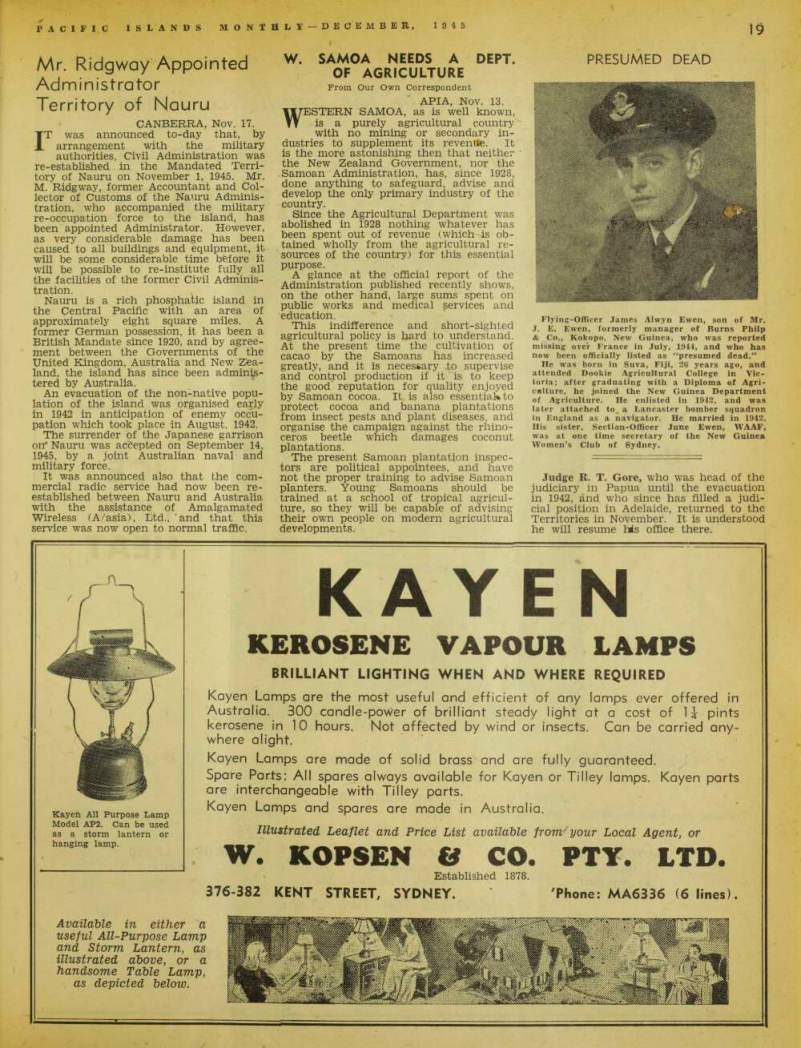
Administrator Territory of Nauru
Canberra, Nov. 17.
IT was announced to-day that, by arrangement with the military authorities, Civil Administration was re-established in the Mandated Terri tory of Nauru on November 1, 1945. Mr.
M. Ridgway, former Accountant and Col lector of Customs of the Nauru Adminis tration, who accompanied the military re-occupation force to the island, has been appointed Administrator. However, as very considerable damage has been caused to all buildings and equipment, it will be some considerable time before it will be possible to re-institute fully all the facilities of the former Civil Adminis tration.
Nauru is a rich phosphatic island in the Central Pacific with an area of approximately eight square miles. A former German possession, it has been a British Mandate since 1920, and by agree ment between the Governments of the United Kingdom, Australia and New Zea land, the island has since been adminis tered by Australia.
An evacuation of the non-native popu lation of the island was organised early in 1942 in anticipation of enemy occu pation which took place in August. 1942.
The surrender of the Japanese garrison on* Nauru was accepted on September 14, 1945, by a joint Australian naval and military force.
It was announced also that the com mercial radio service had now been re established between Nauru and Australia with the assistance of Amalgamated Wireless (A/asia), Ltd., ‘and that this service was now open to normal traffic.
W . Sa Moa Needs A Dept
Of Agriclture
From Our Own Correspondent
Apia, Nov. 13.
¥¥TESTERN SAMOA, as is well known, H is a purely agricultural country with no mining or secondary in dustries to supplement its revenue. It is the more astonishing then that neither the New Zealand Government, nor the Samoan Administration, has, since 1928, done anything to safeguard, advise and develop the only primary industry of the country.
Since the Agricultural Department was abolished in 1928 nothing whatever has been spent out of revenue (which is ob tained wholly from the agricultural re sources of the country) for this essential purpose.
A glance at the official report of the Administration published recently shows, on the other hand, large sums spent on public works and medical services and education.
This indifference and short-sighted agricultural policy is hard to understand.
At the present time the cultivation of cacao by the Samoans has increased greatly, and it is necessary to supervise and control production if it is to keep the good' reputation for quality enjoyed by Samoan cocoa. It is also essential to protect cocoa and banana plantations from insect pests and plant diseases, and organise the campaign against the rhino ceros beetle which damages coconut plantations.
The present Samoan plantation inspec tors are political appointees, and have not the proper training to advise Samoan planters. Young Samoans should be trained at a school of tropical agricul ture, so they will be capable of advising their own people on modern agricultural developments.
Presumed Dead
Judge R. T. Gore, who was head of the judiciary in Papua until the evacuation in 1942, and who since has filled a judi cial position in Adelaide, returned to the Territories in November. It is understood he will resume his office there.
Flying-Officer James Alwyn Ewen, son of Mr.
J. E. Ewen, formerly manager of Burns Philp & Co., Kokopo, New Guinea, who was reported missing over France in July, 1944, and who has now been officially listed as “presumed dead.”
He was born in Suva, Fiji, 26 years ago, and attended Dookie Agricultural College in Vic toria; after graduating with a Diploma of Agri culture, he joined the New Guinea Department of Agriculture. He enlisted in 1942, and was later attached to a Lancaster bomber squadron in England as a navigator. He married in 1942.
His sister, Section-Officer June Ewen, WAAF, was at one time secretary of the New Guinea Women’s Club of Sydney.
Advertisements & other items, pp. 21-22 (2 items)
Kayen
r Kayen All Purpose Lamp Model AP2. Can be used as a storm lantern or hanging lamp.
KEROSENE VAPOUR LAMPS
BRILLIANT LIGHTING WHEN AND WHERE REQUIRED
Kayen Lamps are the most useful and efficient of any lamps ever offered in Australia. 300 candle-power of brilliant steady light at a cost of H pints kerosene in 10 hours. Not affected by wind or insects. Can be carried anywhere alight.
Kayen Lamps are made of solid brass and are fully guaranteed.
Spare Parts: All spares always available for Kayen or Tilley lamps. Kayen parts are interchangeable with Tilley parts.
Kayen Lamps and spares are made in Australia.
Illustrated Leaflet and Price List available from / your Local Agent, or
W. KOPSEN & CO. PTY. LTD.
Established 1878. 376-382 KENT STREET, SYDNEY. 'Phone: MA6336 (6 lines).
Available in either a useful All-Purpose Lamp and Storm Lantern, as illustrated above, or a handsome Table Lamp, as depicted below.
'jd m a I? o‘ sHpi ' !l
Modern Refrigeration for the South Sea Islands
The ELECTROLUX KEROSENE OPERATED
REFRIGERATOR
MARVEL
OF
MODERN
SCIENCE
I iii
THE
MIRACLE
OF
ICE
FROM
HEAT
ELECTROLUX OFFERS ECONOMICAL, modern and completely efficient
REFRIGERATION FOR ISLANDS' HOMES.
FREEZES CONTINUOUSLY WHILE SMALL LAMP BURNS.
Freezing controlled by simply regulating height of flame. Uses only I gallon of kerosene per week.
MOTORLESS ... NO PARTS TO GET OUT OF ORDER.
MODEL LKSSO
Capacity 5.6 cubic fact.
MODEL L 22
Capacity 3 3 cubic feet.
MODEL L3BO
(as illustrated) Capacity 4 cubic feet.
GUARANTEED FOR TWO YEARS.
• Write to your Local Distributor for prices and lull details OBTAINABLE FROM ALL W. R. CARPENTER & CO. LTD.
BRANCHES THROUGHOUT THE ISLANDS
Representation in Papua and New Hebrides.
20
December, 1945 Pacific islands MONiaii
Madang Patriots
Fine Record of 113 Madang Patriots
mHE Repatriation Commission, which JL controls all patriotic funds, has approved of a proposal put forward by the Committee of the Madang War Charities’ Association to wind up the Association by paying the balance of funds in hand to the New Guinea Women’s Club for the fund for the re habilitation of civil internees and pri soners of war and their dependants.
The Association has done good work since its establishment in January, 1941.
From its inception it received the whole hearted support of the residents of the Madang District, and its disbursements include: — £lOO to London Relief Funds; £lOO to Lady Gowrie Red Cross Fund; £5O to the Salvation Army; £75 to the Rabaul Comforts Fund; £lOO to Great Britain Civilian War Victim Relief Fund; £25 to the Australian Red Cross: Presents to local AIF enlistees, £45 In April, 1941, a general meeting re solved that a drive be started to collect £75 per month to be forwarded to the Commonwealth Government for a war effort, and that sum was realised and despatched without fail up to the time of the Japanese invasion of the Terri tory.
Considering that the Madang District had a white population of about 113, aided generously by the Asiatic residents, the Association has a record of which it may well be proud.
Now that the war has ended, and the New Guinea Women’s Club had estab lished a fund for assistance of New Guinea
people, the Committee of the Association felt that it could not do better than hand over the balance of its funds for rehabilitation purposes. In doing so, it is hoped that the Asiatics who sup ported the effort, when they were able, and who have been through such stren uous and difficult times in enemy hands, will not be overlooked.
N. Caledonia Participates
In French Election
NEW CALEDONIA participated in the French elections on October 21, and voters were asked to nominate a candidate to represent the Colony on the new National Assembly in Paris. Though results are not to hand, it seems almost certain that M. Gervolino, candidate of the Caledonian Party, will be chosen by a handsome majority. He is also the sol diers’ representative, and has been for the past two years, Caledonian represen tative in North Africa and France on the Consultative Assembly. He has already placed the Colony’s urgent claims for a greater degree of self-government before French metropolitans.
Other candidates are: Florindo Pala dini, leader of the leftist party in the Conseil General, and the solicitor, Michel Verges, a crony of Admiral d’Argenlieu’s, a man who helped to rally the Colony to General de Gaulle, but who lost popularity later through his double-dealing schemes and anti-Sautot attitude.
The electoral roster included the names of 4,789 men and 4,401 women, the latter being allowed to vote for the first time; and there were also about 1,100 natives authorised to vote as French citizens.
A referendum concerning the proposal to alter the French Constitution of 1875,
was also taken.-
H.E.L.P.
Minister Wants Gold-
Road To Wau
Minister Wants Gold- Miners to Pay Part Cost
fTIHE Australian Minister for External J. Territories (Mr. Ward) already has given effect to his promise (see article elsewhere) that he would ask the New Guinea gold-mining interests to contribute substantially to the mainten ance of the Markham-Wau Road, esti mated to cost £45,000 per annum, Mr. Ward has been in conference with the big companies, and the matter is now under consideration.
The companies do not deny their obli gation in respect of this road, but they point out that, from 1929 until the out break of the Pacific war, they were heavily taxed, so that the usual facilities —including roads —could be provided.
They ask that this be taken into account in making an assessment against them.
From 1929 onwards, the gold producers had to pay a tax of 5 per cent, on the assessed value of the gold they produced.
From 1939, they were taxed, in addition, at the rate of 50 per cent, of the value of the gold in excess of £9 per oz. It always was distinctly understood, from various official utterances, that a part, at least, of these taxes, was being ear marked for reading purposes in the Morobe district. But the Morobe dis trict never was provided, prior to 1942, with a road connection with the coast.
A big effort is being made, at present, to get the new Markham-Wau Road into good order. Bridges are being renewed in the Snake Valley, and some hundreds of Japariese prisoners are being usefully employed on maintenance.
Advertisements & other items, p. 23 (1 item)
Thornycroft (Aust.) Pty., Ltd.
A
OFF
m. m
TYPE DB2
"HANDYBILLY" 9 H.P. HEAVY DUTY
MARINE ENGINE
SIMPLE, RELIABLE & ECONOMICAL
Avaiable for immediate delivery.
Requisite Stern Gear Made to Order.
Write for full particulars to—
Thornycroft (Aust.) Pty., Ltd.
Cables: THORNMOTOR, Sydney.
N. Caledonia Returns To
Nickel Economy
NOW that New Caledonia has to get back to a normal economy, which means 90 per cent, mineral exports, great interest attaches to post-war min ing problems.
The labour situation is aggravated by the release from their long-expired con tracts of 10,000 coolie labourers, and it remains to be seen if an effort will be made to reconstruct the industry on a basis of white and free native labour or Asiatic labour.
The managing director of the Societe le Nickel, M. Guenault, is expected to arrive in Noumea by air shortly. He will resume direct touch, so long suspended.
between the local mines and smelters, which have been under American con trol until recently, and Paris head quarters. The vice-president of the board of directors of the French company, M.
Dewez, who has been long in New York, where machinery orders have been placed, has already reached Noumea.
Meanwhile the Bienvenue mine at Nakety exploited by M. Lafleur, one of the most influential -business men in the Colony, has ceased operations for lack of labour. This mine has up to the present produced about 160,000 tons of
nickel ore.-
H.E.L.P.
Miss Emily Clarke, of the New Guinea Mission, left Sydney on November 14 to. visit relatives in England.
Men Of Aib
List of Territorions Who Served in Famous Unit
r BLOWING the complete list of Pacific Islands men who served in what was the most “hush-hush” and most dangerous service in the war in the South-West Pacific—the Allied Intelli gence Bureau (known usually as the
Aib).
Served Prior To April, 1943
Butteris, W. A. H., Sgt.
Obst, G. A., Wo.Il
Benham, G., Sub-Lieut.—DSC (killed in action).
Train, G. H. C., Lieut.
Tupling, W. L., Petty Officer.
Kyle, A. F., Lieut. —DSC (killed in action).
Served From April, 1943-August,
1945
Army Nco S
Elkington, T. H. C., Sgt.
Freund, A. P. H., WO.IL Healy, R., WO.IL Jeune, P. C., Cpl.—C in CC.
Johnson, H. M., WO.IL Kuper, H„ Pte., BSIP —BEM.
Monfries, R. 8., Sgt.—MM.
Selmes, J. G., Sgt.
Stamper, L., Sgt.
Naval Officers
(Unless otherwise shown, the rank is Lieut. or Sub-Lieut.) Andresen, A. M., Sub.-Lieut—MlD.
Bastin, R.
Bell, C. B.
Bell, L. J.
Bell, S. G. V.—Leg. of M.
Boye, R. 0., 3rd Officer, WRANS—BEM.
Bridge, K. W. T—DSC, Leg. of M.
Campbell, A.—MC, MID.
Douglas, K. C.
Evans, A. R.—DSC.
Feldt, E. A., Comr.—OßE.
Firth, R.—LM.
Hay, K. D.
Horton, D. C.—DSC, SS.
Josselyn, H. E. —DSC, SS.
Keanan, J. R. —DSC, LM.
Mackenzie, H. A., Lieut.-Comr.—LM.
Mason, P. E.—Dsc, Dsc (Us).
Mollison, P. J.
McColl, K. H.
Olander, A. R.
Page, C. L—MID.
Palmer, A. E.
Palmer, P. F.
Read, W. J.—Dsc (Us).
Reid, J. S.
Rhodes, F. A. —DSC, SS.
Sexton, T. O. —LM, MID.
Smith, A. K.—MM, DSC.
Drummond Thomson, A. —LM Waddell, A. N. A.—DSC.
Wright, M. H.—DSC.
Army Officers
Aiken, H. A., T/Capt.
Archer, G. R., T/Capt.—MC.
Ashton, L. E., T/Capt.
Bates, C. D., Capt.—MC.
Bengough, C. F, N., Lieut.-Colonel.
Bock, R. A., T/Capt.
Bullen, Capt.
Campbridge. R. C., Capt.
Chambers, D. G. N., Capt.
Clemens, W., Major.
Corlass, A. J., Lieut.
English, W. M., Capt.—MßE, MID.
Pairfax-Ross, 8.. Major.
Fryer, H. A. J., Capt.— MßE.
Gilmore, J. L., Lieut. —DCM.
Greathead, G., Major.
Hall, B. W. G., Lieut.—DCM.
Hamilton, H. E., Capt.
Harris, G. C., Capt.—MlD.
Johnson, C. K., Capt.—MlD.
Kennedy, G. D., Major—DSO, Navy Cross.
Laws, D. A., Lieut.
Maclean, A., Capt.
McCarthy, J. K. M., Major—MßE.
McKay, R. S.
Murray, H. J., Capt.—MC, DCM, SS.
Noakes, L. C—LM.
Pursehouse, L., Capt.
Reid, J. D.
Roberts, A. A., Major.
Robertson, H. W. F., Capt.
Robinson, E. D., Capt.—MC.
Searle, K. M., Capt.—MC.
Seton, C. W., Capt—DCM.
Skinner, R. 1., Major—MC.
Stephenson, G.
Stokie, L. J., Capt.—MC. •Waters, H. F„ Capt.
Williams, H. L., Capt.—MO.
Naval Ratings
Allen. J., CPO Tel.
Buckland, J., WO.
Dunstone, A. J., CPO.
McNicol, J. B„ A/B—DSM.
Neale, T. D„ CPO Tel.
Watson, W.. CPO Tel.
Young, L, T., CPO, Tel.
Raaf Officers
(Flight Lieut., unless otherwise stated) Corrigan, J. A.—LM, MID.
Fay, L. P.
Hooper, C. F.
Koch, H.—Mc, Mid.
Leydin, F. J.
Marsland, G. H.—MBE, MID.
Riddall, J. V., F/O.
Robinson, R. A., Sq.-Ldr.—MlD.
Robson, E., W/O.
Sandford, N. C.
Spencer, E. —LM, SS.
Stuart, R., F/O.
The AIB was organised originally, in 1939, by Commander Eric Feldt, who was a well-known District Officer in New Guinea. He directed the organisation, with success and distinction, until he was compelled to drop out, owing to ill health; and then Commander J. C.
McManus (a Royal Navy Intelligence Officer) took charge, with Lieut.-Com mander Hugh Mackenzie (formerly a planter at Rabaul) as second-in-com mand.
As time packed, and the organisation and trained personnel grew, the AIB did a job of extraordinary value in the Ter ritories where there had been Jap in vasion. The total strength of the unit was about 450 white men, with additional native helpers. All were specially selected and trained. Their .achievements already are legendary—it is to be hoped that someone will write their record while the memory of their experiences is still fresh in their minds.
Readers are asked to note the extra ordinary number of decorations awarded, both British and American, in proportion to the number who served. Many of these men lost their lives.
Abbreviations: DSC—Distinguished Service Cross (British and American). MM—Military Medal. DCM—Distinguished Conduct Medal.
MC —Military Cross. MBE—Member of Order of the British Empire. OBE—Officer of the Order of the British Empire. MlD—Mentioned in Despatches. LM--Member of the Legion of Merit (American I. SS —Awarded Silver Star (American). C in CC —Commended by Com mander-in-Chief. DSO —Distinguished Service Order.
It is rumoured in Apia, W. Samoa, that American interests will shortly build a large hotel in the town to cater for post war tourist traffic.
Advertisements & other items, p. 24 (1 item)
Bitter
VICTORIA
ALE
/ o V iie*e« it
CARLTON & UNITED BREWERIES IT I.
Sale
"PIM" Back Copies For Sale
MR. W. R. SMITH, Aitutaki, Cook Islands, has the following back numbers of the “PIM,” all in read able and fair to good condition, for sale.
Those interested should contact Mr.
Smith direct: — Vol. I—Nos.1 —Nos. 1,5, 6,7, 8,9, 10, 11, 12; Vol. ll—Nos. 1 to 10; Vol. Ill—Nos. 1,2, 3,4, 5,6, 7,8, 6', 11, 12; Vol. IV—Nos. 1,2, 3,4, 5, 6,’ 7, 8, 11, 12; Vol. V—Nos. 1 to 12, complete; Vol.
Vl—Nos. 1,3, 4,5, 6,7 r 8, 10, 12; Vol. Vll— complete; Vol. Vlll—complete; Vol. XlV— complete.
"PIM" Copies Wanted
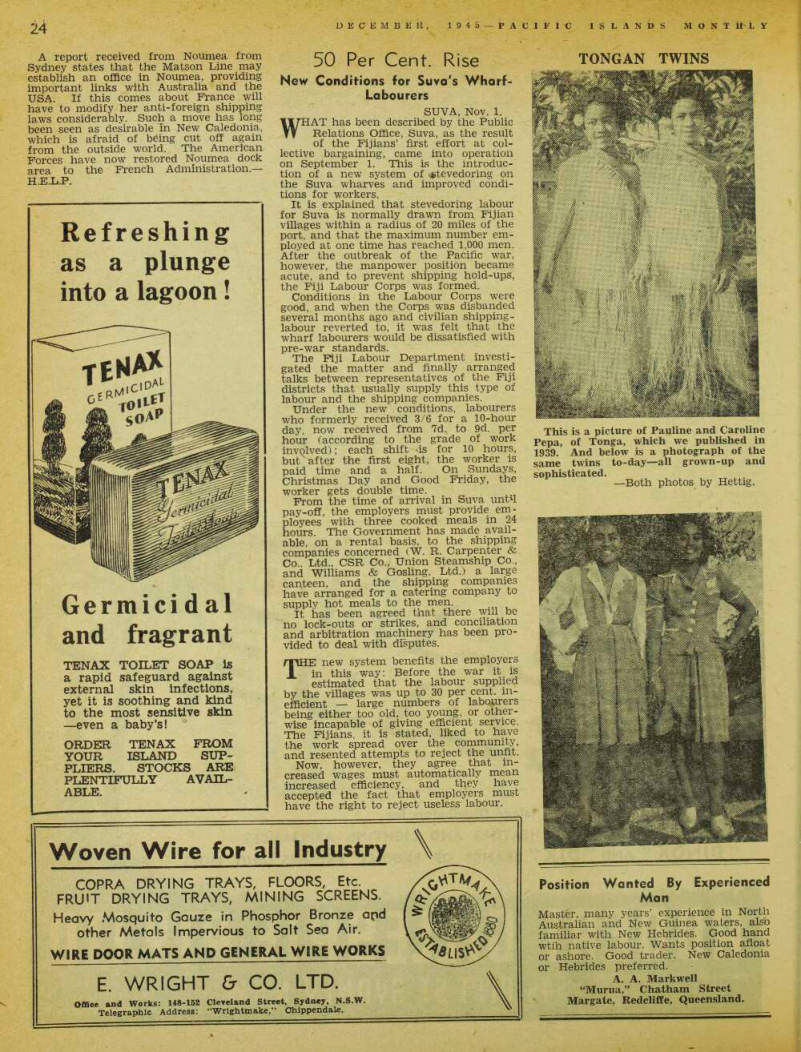
DR. G. HOELTKER, Anthropos Insti tute, Switzerland, would like to buy back numbers of the “Pacific Islands Monthly.” If any reader has any of the following numbers for sale, would they contact the Rev. I. Schwab, 99 Barrack Street, Hobart, Tasmania, who will act for Dr. Hoeltker:— Vol. 1 (1930-I)—Nos. 1. 2,3, 4,5, 6,7, 8,9, 10, 11, 12; Vol. II (1931-2)—Nos. 1, 2. 3,4, 5; Vol. V (1934-5) —No. 5; Vol. VI (1935-6)—Nos. 1, 4,5; Vol. X (1939-40)—Nos. 4,8, 9, 10, 11, 12; Vol. XI (1940-I)—Nos. 1,2, 3,4, 5,6, 7,8, 9, 10, 11, 12; Vol. XII (1941-2)—Nos. 1,2, 3,4, 5, 6,7, 8,9, 10, 11, 12; Vol. XIII (1942-3)—Nos. 1. 2,3, 4,5, 7,8, ff, 10; Vol. XIV (1943-44)—Nos. 2, 4.
Rainfall in the first nine months of 1945 was a record in Western Samoa.
Three times as much rain as normal fell in that period, and the 13.45 inches for June was the highest ever recorded for that month.
A report received from Noumea from Sydney states that the Matson Line may establish an office in Noumea, providing important links with Australia and the USA. If this comes about France will have to modify her anti-foreign shipping laws considerably. Such a move has long been seen as desirable in New Caledonia, which is afraid of being cut off again from the outside world. The American Forces have now restored Noumea dock area to the French Administration
H.E.L.P,
Advertisements & other items, pp. 25-26 (1 item)
Robert Gillespie Ptv.Ltd
IMPORTERS
EXPORTERS
k> a Island Distributors for
" COLEMAN "HEATING AND LIGHTING APPLIANCES
DINOX" AND " DIX" BRANDS OF BROOMS, BRUSHES AND MOPS .iiiii1A m, ...
ROBERT GILLESPIE PTV.LTD
“——T 54a PITT ST. SVDNEV N.S.W.
D ESCOMPTE DE PARIS
CABLE ADDRESS;
“ROBERGILL”
PHONES BW 4782-B 1305
Refreshing
as a plunge
into a lagoon!
o
$OA p
m
Germicidal
and fragrant
TENAX TOILET SOAP is
a rapid safeguard against external skin infections, yet it is soothing and kind to the most sensitive skin —even a baby’s!
ORDER TENAX FROM
YOUR ISLAND SUP-
PLIERS. STOCKS ARE
PLENTIFULLY AVAIL-
ABLE.
Woven Wire for all Industry
COPRA DRYING TRAYS, FLOORS, Etc.
FRUIT DRYING TRAYS, MINING SCREENS.
Heavy Mosquito Gauze in Phosphor Bronze and other Metals Impervious to Salt Sea Air.
WIRE DOOR MATS AND GENERAL WIRE WORKS
E. WRIGHT & CO. LTD.
Office and Works: 148-152 Cleveland Street, Sydney, N.S.W, Telegraphic Address: “Wrlghtmake,” Chippendale. 7Z Or £ &
50 Per Cent. Rise
New Conditions for Suva's Wharf- Labourers
Suva, Nov. 1.
WHAT has been described by the Public Relations Office, Suva, as the result of the Fijians’ first effort at col lective bargaining, came into operation on September 1. This is the introduc tion of a new system of stevedoring on the Suva wharves and improved condi tions for workers.
It is explained that stevedoring labour for Suva is normally drawn from Fijian villages within a radius of 20 miles of the port, and that the maximum number em ployed at one time has reached 1,000 men.
After the outbreak of the Pacific war, however, the manpower position became acute, and to prevent shipping hold-ups, the Fiji Labour Corps was formed.
Conditions in the Labour Corps were good, and when the Corps was disbanded several months ago and civilian shipping labour reverted to, it was felt that the wharf labourers would be dissatisfied with pre-war standards.
The Fiji Labour Department investi gated the matter and finally arranged talks between representatives of the Fiji districts that usually supply this type of labour and the shipping companies.
Under the new conditions, labourers who formerly received 3/6 for a 10-hour day, now received from 7d. to 9d. per hour (according to the grade of work invplved); each shift -is for 10 hours, but after the first eight, the worker is paid time and a half. On Sundays, Christmas Day and Good Friday, the worker gets double time.
From the time of arrival in Suva unt'l pay-off, the employers must provide em ployees with three cooked meals in 24 hours. The Government has made avail able, on a rental basis, to the shipping companies concerned (W. R. Carpenter & Co., Ltd., CSR Co., Union Steamship Co., and Williams & Gosling, Ltd.) a large canteen, and the shipping companies have arranged for a catering company to supply hot meals to the men.
It has been agreed that there will be no lock-outs or strikes, and conciliation and arbitration machinery has been pro vided to deal with disputes. rE new system benefits the employers in this way: Before the war it is estimated that the labour supplied by the villages was up to 30 per cent, in efficient large numbers of labourers being either too old, too young, or other wise incapable of giving efficient service.
The Fijians, it is stated, liked to have the work spread over the community, and resented attempts to reject the unfit.
Now, however, they agree that in creased wages must automatically mean increased efficiency, and they have accepted the fact that employers must have the right to reject useless labour.
Tongan Twins
This is a picture of Pauline and Caroline Pepa, of Tonga, which we published in 1939. And below is a photograph of the same twins to-day—all grown-up and
sophisticated.
Both photos by Hettig.
Advertisements & other items, p. 26 (1 item)
Position Wanted By Experienced
Man Master, many years’ experience in North Australian and New Guinea waters, also familiar with New Hebrides. Good hand wtih native labour. Wants position afloat or ashore. Good trader. New Caledonia or Hebrides preferred.
A. A. Markwell “Murua,” Chatham Street Margate, Redcliffe, Queensland.
Mr. Ward Defends His Administration
Accuses Big Companies of Exploitation—Describes How They Are to be Controlled
Resentment of the fact that the planters of Papua had appealed to the Prime Minister of Britain, and that a section of the Pacific Territories’
Association had tried to appeal to Great Britain and the United States against Australia’s oppressive rule in Papua and New Guinea, was expressed in strong terms by the Australian Minister for Ex ternal Territories (Mr. E. J. Ward) on November 28, when he addressed members of the Pacific Islands’ Society in Sydney.
Mr. Ward spoke for an hour about his administration in Papua and New Guinea, which he explained and defended. He indicated that the keystone of the Aus tralian Government’s policy was to pro tect the natives against exploitation by the white men, and protect planters and miners and other “small” Europeans against exploitation by the big com panies.
It was not true, he said, that the Aus tralian Government was lacking in con sideration for the white settlers who nad pioneered the Territories. What the Gov ernment was resolved to do was to pre vent the Territories being any longer a happy hunting-ground for the big com panies, owned by absentee shareholder:;, who got big profits out of the Terri tories and suffered none fo the hardships of life there. The GOTernment would lay down conditions which would give the natives some hope for the future.
He admitted he had little practical knowledge of the country, but he had had many discussions with people who did know New Guinea. He had conferred with missionaries (for whom he had nothing but commendation) and planters and old settlers and they had framed a policy which would give the Territories steady and orderly development, as com pared with the haphazard and unordered development which they had known in the past. The natives had no recognised protectors in the old set-up; they would have protection in the new. The people who had to do the work would receive their adequate reward.
He defended the principle of trustee ship, as enunciated by Australia at San Francisco, and he added that the an nouncement of Australia’s plan for pro tecting and training the natives had evi dently alarmed the interests which, in the past, had consistently exploited the natives. “Not only natives—there were many planters and settlers being ruth lessly exploited by the great companies, which had a throttle-hold on the Ter ritories,” said the Minister. “We are going to protect these people.”
AS an instance of how the natives were ill-treated, he said, it had been found that many natives employed in the goldmines of New Guinea had be come “dusted,” and had returned to their villages to die, victims of the white man’s greed. The Government not only would see that they had a sufficient wage in future, but that they got the full benefit of industrial compensation.
Maybe the natives did not require the full wage to which they were entitled— they might have no use for the money; but in that event the Government would take the surplus of wages from the em ployers, on behalf of the natives, and would use the money for the benefit of the natives in hospitals, and so forth.
No longer would the employers be allowed to batten on the native labourers, and pay them low-wages, because the natives
“had no use for the money.” The em ployers would pay the full wages. rE Government would develop the Territories, as quickly as possible. A Director of Education would be ap pointed very shortly. They had appointed, as Administrator, a man who was famous for his knowledge of agricultural develop ment. Already, Directors of Agriculture and of Health, had been appointed. The present Administration had to be pro visional, until the future of the Man
dated Territory was decided. As soon as they could recruit additional men for the Public Service, the Provisional Civil Ad ministration would be extended all over New Guinea. Large numbers of young men were needed for these services—a much bigger Public Service was planned than had been known in the past. They would be advertising for patrol officers at an early date.
The indentured labour system would be abolished in five years, it was hoped.
The Government’s action in terminating all the old contracts on October 15 had been criticised, and most urgent appeals had been made to the Governn*ent to hold its hand, for awhile. But the Government refused. Our soldiers were being alloweu to go home, after years of war; the Gov
eminent was determined that the natives should have the same post-war privilege, and return to their villages, if they wished. He had been told repeatedly that the natives themselves did not ob ject to indentured labour that they would sign on again and again. Well, this was the test. Would the natives demon strate their liking for the contract sys tem by signing on again after October 15?
Most of them had gone home—but he was sure the position would readjust itself presently. mHE Government was determined to X provide a good road, from the MarkH&m in to Wau. But the esti mated cost of maintenance was £45,000 per annum. As freight when flown in cost £l9 per ton, and as the same stuff by road would cost £8 or £9 per ton, he thought the mining companies should pay something towards the cost of maintain ing the road; and he was to meet the miners’ representatives at an early date, to discuss the amount they would con tribute for road maintenance.
Steps were being taken to permit the oil prospecting companies to resume their search for oil early in the New Year.
With regard to the development of the timber industry Ih the Territories, it had been decided, after much consideration, to allow the return of those people who had timber permits, and were operating mills.
But no timber could be cut for export— for the present, and until the needs of the Territories had been met, all timber cut in the Territories would be used there.
That was because there was much build ing to be done there, and the costs —if outside material had to be depended on —were enormous.
Tenders had been called for 24 tem porary dwellings in Port Moresby—tem porary, because until the future of the Mandated Territory was decided, they did not know whether they should have two administrative centres, or one, or where they would be —and the lowest quote was very close to £50,000. This example served to show that the cost of reconstruction in the Territories was going to be enormous.
It was hoped to soundly establish the timber industry and that, when local needs were met, large quantities of Terri tories timber would be available for the Australian market.
The overland telephones established by the fighting services were too costly to maintain, and would be abandoned; but communication would be kept up with radiophones, which would connect local telephone services with one another.
AN efficient transport system would be provided. They had entered into an agreement with the three Territories’ shipping companies to operate the Gov ernment ships—and it was intended that those ships should get the bulk of the Territories’ trade. No ship of more than 25 tons could compete in those waters against Government ships unless it had a Government licence.
There was some doubt whether the Gov ernment had the right to operate air ways in Australia; but in the Territories the Government had complete sovereignty and could operate services if it wished.
But if it ceuld not operate in Australia, it might not wish to operate in New Guinea, and in that event the air services would be privately operated.
It was now intended that native trade stores should be operated by private per sons for profit; but the Government would exercise strict control over them, more especially in regard to the chief lines in demand by natives.
IN response to Mr, Ward’s invitation, a number of members asked questions and made comments.
One member pointed out gently to the Minister that there was very little under ground mining in the Morotae field, and therefore, it was impossible that natives could have suffered to any extent from “dusting.”
Mrs Tex. Thomas asked why Mr. Ward should have addressed the Pacific Islands Society, which consisted mostly of people with only cultural interests in the Islands as a whole, and did not address the Pacific Territories’ Association, which
consisted entirely of “evacuees” whose in terests were wholly in their homeland of New Guinea. She described her experi ences as a pioneer, and declared that she and most other New Guinea settlers strongly resented the Minister’s descrip tion of them as exploiters.
Another woman member expressed the hope that all those additional public ser vants who were to be sent to the Terri tories would be carefully selected so that, under the new regime, there would be fewer square pegs in round holes.
Mr. R. W. Robson said that the Terri torial’ reaction against Australian mis government, expressed in their appeals and proposed appeals to Britain and the United States, was understandable and completely justified by events. The PTA, in Australia, suffering many grievances, had made appeal after appeal to the Department, the Minister, and the Prime Minister, but could get no interviews, no explanations, and no reassurances. Fin ally, in utter despair, they had proposed an appeal to Britain and the United States, to remove them from the cruel and oppressive administration of Australia.
The planters of Papua, after being en couraged by Canberra to re-establish their plantations, were suddenly deprived by Canberra of all their native labour, under Mr. Ward’s plan of native labour reform. The planters did not object so much to the new laws, as they did to the manner of their introduction, which was cruel and callous in the extreme. That was when they appealed to Britain. What else could they do—Canberra was quite indifferent to their plight?
Mr. R. A. Laws pointed out that various large sums had been earmarked already from the goldfields revenues for reading purposes—especially a portion of the gold royalty. Did the Minister propose to ignore all the gold royalties collected for the road, and impose further new taxa tion of the gold-mining community on the excuse that it was needed for road maintenance?
Mrs. Allen Innes described the good relations that always had existed between indentured native workers and European employers who understood the country.
The employers protected and trained and cleaned up the natives while the natives developed affection and loyalty for their employers. There was no exploitation in any shape or form. On the contrary, with the natives in their present stage of development* that was the only effective way of bringing them along from abso lutely primitive to better standards of life. rE Minister said that his only in formation about “dusting” was a report by a Mr. Arthur Blakeley, who said that many natives had been perma nently injured in this way. He did not regard all settlers as exploiters—far from it —his criticisms were levelled mostly at big companies with many absentee share holders.
Replying to the questions about the PTA, the & Minister at first said that he could not distinguish one Islands’ organi sation from another—there seemed to be several. But, replying to Mr. Robson, he declared that he had never left a PTA appeal unanswered, and he had never refused to meet the PTA—but “the Asso ciation might have done better for itself if it had couched its communications to him in a little more respectful language.”
He declared that the criticisms of his policy were not based on facts or reason, but on prejudice against the Australian Labour Government.
He said that what had not been done in relation to building a road—the matter referred to by Mr. Laws—had nothing to do with his administration. The blame, if any, lay with another Government.
Advertisements & other items, pp. 27-29 (1 item)
Imperial
TIME OFF FROM
COOKING
m k m <r* K %*arm ♦ i ■**- S' ** What an idea to be able to serve up meals in 5 minutes! . . . Meals that will bring unanimous appetising pleasure—treats that you yourself will be able to sit down and enjoy.
IMPERIAL Good Foods are ready-cooked for you by expert chefs. Easy-to-serve. Specially processed to seal in the full flavour and keep EVER-FRESH.
Imperial
GOOD FOODS
W. ANGLISS & Co. (Aust.) Pty., Ltd.
Head Office: 5-7 O’Connell Street, Sydney, Australia.
Imperial
MEATREAT
★ Imperial
CAMP PIE
★ Imperial
HAMPE
★ Imperial
HOT MEALS
QUEENSLAND
INSURANCE
COMPANY
. LIMITED
(Incorporated 1886 In Australia)
ASSETS EXCEED £3,500,000
Head Office:
PITT Gr BRIDGE STS.
SYDNEY
Specialists in South Seas Fire,
Marine & Accident Insurances
Apply to:—
FIJI.
Branch Office: I. B. Chalmers, Acting Manager.
Burns Phllp (South Sea) Co., Ltd.
VILA.
Burns Philp (South Sea) Co., Ltd.
Coxnptoirs Francals Des Nouvelle* Hebrides (Marine).
NOUMEA.
L. <fe W. Johnston.
PAGO PAGO.
Burns PhilQ (South Sea) Co., Ltd.
G. H. C. Reid & Co,
OTHER SOUTH SEA ISLANDS.
Burns Phllp (South Sea) Co., Ltd.
Also to any of the Company's Offices in Australia or New Zealand.
Allen Taylor & Co. Ltd.
COMMERCIAL ROAD, ROZELLE,
SYDNEY
Sowmillers and Wholesale Suppliers of Hardwoods for Constructional Purposes GIRDERS . . . PILES . . . POLES . . . SLEEPERS, Etc EXPORTING TO PACIFIC - ISLANDS SINCE 1893
e m V I
If tK^
■ w I Coleman’s Petrol Iron lights instantly ... is evenly balanced . . . has ventilated body, tapered ironing edges, pointed heel and hot point.
Can be used in or out of doors.
Coleman’s SOLUS Stove assembled in 30 seconds. Bums AND Preheats with Kerosene. 5-6 Hours on one filling.
Boils 1 quart in 3 minutes.
May be carried in any position-fuel cannot leak.
ALL-PURPOSE LANTERN
STORM-PROOF . . . DEPEND-
ABLE AND SIMPLE IN
OPERATION
Coleman Pressure Lanterns are in two sizes and two types (Petrol and Kerosene). The perfect safety and trouble-free service which Coleman Lanterns have given over the past forty years are your guarantee of perfect satisfaction.
D PRIZE Kerosene Wickless Stoves, 2 and 3 Burner Models. Beautifully finished white baked enamel—ample cooking top with heavy steel grates. Glass fuel tanks.
Coleman’s Portable Cooking Stove lights instantly, has safety shut-off valves and instant heat control. Made of EVERDUR (rustproof), finished in ivory and brown baked enamel.
Representatives for the Pacific Islands
ROBERT GILLESPIE PTY. LTD
54a PITT STREET, SYDNEY
PEARCE & CO. LTD.
SUVA
FOR FIJI ISLANDS
Judge Gore Returns To
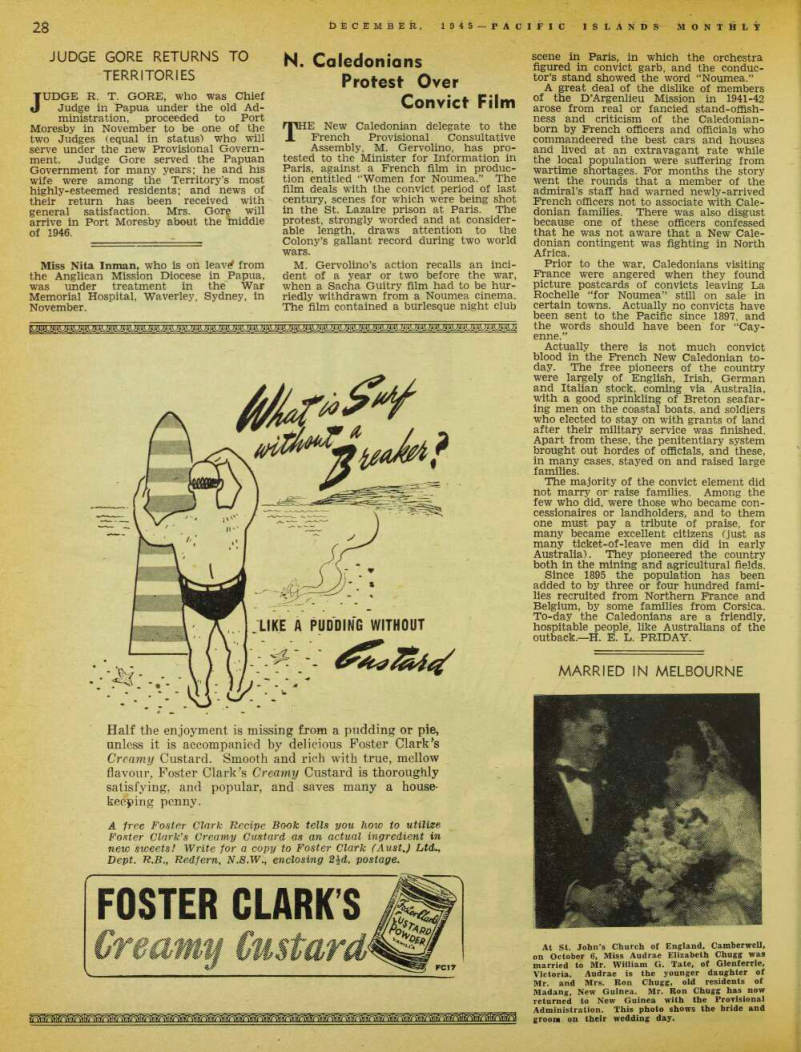
Territories
JUDGE R. T. GORE, who was Chief Judge in Papua under the old Ad ministration, proceeded to Port Moresby in November to be one of the two Judges (equal in status) who will serve under the new Provisional Govern ment. Judge Gore served the Papuan Government for many years; he and his wife were among the Territory’s most highly-esteemed residents; and news of their return has been received with general satisfaction. Mrs. Gore will arrive in Port Moresby about the middle of 1946.
Miss Nita Inman, who is on leav£ from the Anglican Mission Diocese in Papua, was under treatment in the War Memorial Hospital, Waverley, Sydney, in November.
N. Caledonians
Protest Over Convict Film
riTHE New Caledonian delegate to the JL French Provisional Consultative Assembly. M. Gervolino, has pro tested to the Minister for Information in Paris, against a French film in produc tion entitled “Women for Noumea.” The film deals with the convict period of last century, scenes for which were being shot in the St. Lazaire prison at Paris. The protest, strongly worded and at consider able length, draws attention to the Colony’s gallant record during two world wars.
M. Gervolino’s action recalls an inci dent of a year or two before the war, when a Sacha Guitry film had to be hur riedly withdrawn from a Noumea cinema.
The film contained a burlesque night club
scene in Paris, in which the orchestra figured in convict garb, and the conduc tor’s stand showed the word “Noumea.”
A great deal of the dislike of members of the D’Argenlieu Mission in 1941-42 arose from real or fancied stand-offish ness and criticism of the Caledonian born by French officers and officials who commandeered the best cars and houses and lived at an extravagant rate while the local population were suffering from wartime shortages. For months the story went the rounds that a member of the admiral’s staff had warned newly-arrived French officers not to associate with Cale donian families. There was also disgust because one of these officers confessed that he was not aware that a New Cale donian contingent was fighting in North Africa.
Prior to the war, Caledonians visiting Prance were angered when they found picture postcards of convicts leaving La Rochelle “for Noumea” still on sale in certain towns. Actually no convicts have been sent to the Pacific since 1897. and the words should have been for “Cay enne.”
Actually there is not much convict blood in the French New Caledonian to day. The free pioneers of the country were largely of English, Irish, German and Italian stock, coming via Australia, with a good sprinkling of Breton seafar ing men on the coastal boats, and soldiers who elected to stay on with grants of land after their military service was finished.
Apart from these, the penitentiary system brought out hordes of officials, and these, in many cases, stayed on and raised large families.
The majority of the convict element did not marry or raise families. Among the few who did, were those who became con cessionaires or landholders, and to them one must pay a tribute of praise, for many became excellent citizens (just as many ticket-of-leave men did in early Australia). They pioneered the country both in the mining and agricultural fields.
Since 1895 the population has been added to by three or four hundred fami lies recruited from Northern France and Belgium, by some families from Corsica.
To-day the Caledonians are a friendly, hospitable people, like Australians of the
outback.
H. E. L. Friday.
Married In Melbourne
At St, John’s Church of England, Camberwell, on October 6, Miss Audrae Elizabeth Chugg was married to Mr. William G. Tate, of Glenferrie, Victoria. Audrae is the younger daughter of Mr. and Mrs, Ron Chugg, old residents of Madang, New Guinea. Mr. Ron Chugg has now returned to New Guinea with the Provisional Administration. This photo shows the bride and groom on their wedding day.
Advertisements & other items, pp. 30-31 (2 items)
Foster Clark’S
w.
LIKE A PUDDING WITHOUT
Half the enjoyment is missing from a pudding or pie, unless it is accompanied by delicious Poster Clark’s Creamy Custard. Smooth and rich with true, mellow flavour, Foster Clark’s Creamy Custard is thoroughly satisfying, and popular, and saves many a housekeeping penny.
A free Foster Clark Recipe Book tells you how to utilize Foster Clark's Creamy Custard as an actual ingredient in new sweets! Write for a copy to Foster Clark (AustJ Ltd*, Dept. R. 8., Redfern , N.8.W., enclosing 2\d. postage.
FOSTER CLARK’S
f 'lff f.l
m
FCI7
John Vicars Pefl™
m fcJSPBw
Sole Pacific Island Selling Representatives for
\£A£) 6\sp/)
WORSTEDS
WOOLLEN
At* im m ■ ■M: •■"'V P
MADE FROM THE FINEST
AUSTRALIAN WOOLS
By using the most scientific methods of manufacture, John Vicars Pty. Ltd. produce these outstanding materials.
Fine wools and fine workmanship have produced quality cloths. They are designed to give satisfaction in any climate.
HARRY J .YOUNG PTY. LTD.
Postal Address: Box 3661, C.P.0., Sydney.
379 KENT STREET, SYDNEY
Bankers: Bank of N.S.W.
Codes: Bentley’s, Comp. Phrase Bentley’s 2nd Phrase
Political Reform
In Fiji
European Electors' Aims
Suva, Nov. 1.
FIJI is not lagging behind other parts of the Colonial Empire in political activity. Nor, apparently, are all its European and Indian electors satisfied with their present share in the Colony’s Government.
A fairly large number of Europeans and part-Europeans here are united in what is called the European Electors’
Association of Fiji. One of the Associa tion’s principal objects is to obtain a majority of unofficial members in the Legislative Council.
Members of the Association have re cently been asked to approve a petition being sent to the Secretary of State for the Colonies in the following form;— (1) That your petitioners consider the electors of the Colony should be able to exercise greater control over the domestic and financial affairs of the Colony. (2) That your petitioners do not con sider a nominative system for the Legislative Council is in the best interests of the Colony. (3) That the elected representatives of the constituents should have a more effective voice in the Executive Council. (4) Your petitioners, therefore, humbly suggest that the constitution of the
Legislative Council should be altered and formed as follows: — Governor as President!
Colonial Secretary Ux-officio.
Attorney- General Financial Secretary J Seven nominated members.
Six elected European members.
Six elected Indian members.
Six elected Fijian members. (5) That all the above-mentioned elected (unofficial) members should be elected from three communal racial rolls. (6) That qualifications for registration as an elector be those provided in the present Letters Patent save and except the property and income qualification which should be abolished. (7) That the franchise be open to all British subjects, men and women, over the age of 21 years. (8) That the franchise be extended to civil servants. (9) That the Executive Council be re constituted as follows: — Governor, Colonial Secretary, Attorney-General, Financial Secretary, three elected mem bers of Legislative Council chosen by the Governor from the panel of elected members of the Council. (10) That on any matter of local concern finacial or otherwise where 14 out of the 18 elected members support any motion his Excellency the Governor of Fiji should have no right of veto except in exceptional circumstances, and then only after review by the Secretary of State for the Colonies.
There seems to be no doubt that the draft petition, after some brushing up, will go to London with the blessings of a majority of the Association. rE Association contends, and we quote from its circular: — “It should be fully realised that for all practical purposes the real source of executive authority and the fountain of policy in this Colony is the Executive Council. ... , .
“The present system pretends to give
electors, through their representatives, some control over their own affairs, when, in fact, they have no real control what ever.
“The Finance Committee, a recent in novation, pretends to give unofficial members some control of the finances of the Colony, but in practice it does nothing of the sort. The Finance Com mittee at its best is only an advisory body, but operating as it does behind closed doors it presents to the Legis lative Council a financial ‘fait accompli.’
“All deliberations of the Finance Com mittee are in secret, and electors do not know how any of their elected represen tatives have voted. This secret system is fundamentally wrong and should be abolished. We suggest that henceforth, where possible, all measures should be debated in open Council, and that some measure of real control should be vested in a designated sufficient majority of the elected members by specific provision in the Letters Patent.
“We do not suggest a completely demo cratic self-government for Fiji. The Colony is obviously not yet ready for this . . . We do submit that the peoples of Fiji, subject to suitable safeguards to prevent domination by any group of any other groups, are quite capable of tak ing much more control of, and interest in, their own affairs than they are permitted to have at present. The present Letters Patent, with no effective control exercis able by the elected representatives of the people prevent the practice of self-gov ernment, and lead inevitably to a wide spread apathy, instead of an intelligent progressive interest in the Government of this Colony.
“The chief reason for this present lack of interest in their own political affairs by the electors of this Colony is the cer tain knowledge that, irrespective of whom they elect to the Legislative Council under the present constitution such elected members are powerless effectively to succeed against the Government majority.” ¥¥THATEVERw.may be the result of the ff Association’s proposed petition, Fiji’s political position cannot re main static, and the Administration is in for some violent Headaches.
Out of 24 different foodstuffs listed in a questionnaire to 2,000 soldiers in the tropics, steak and eggs was the only item liked by everyone.
Advertisements & other items, p. 32 (1 item)
Rid Kidneys Of
Poisons And Adds
If you suffer sharp, stabbing pains, If Joints are swollen, It shows your blood Is poisoned through faulty kidney action. Other symptoms of Kidney Disorders are Backache, Aching Joints and Limbs, Sciatica, Neuritis, Lumbago, Sleepless Nights, Dizziness, Nervousness, Circles under Eyes, Loss of Energy and Appetite and Frequent Headaches and Colds, etc. Ordinary medicines can’t help much because you must get to the root cause of the trouble.
The Cystex treatment is specially compounded to soothe, tone and clean kidneys and bladder and remove acids and poisons from your system safely, quickly and surely, yet contains no harmful or dangerous drugs, Cystex works in 3 ways to end your troubles. 1. Starts killing the germs which are attacking your Kidneys, Bladder and Urinary System in two hours, yet is absolutely harmless to human tissue. 2. Gets rid of health-destroying, deadly poisonous acids with which your system has become saturated. 3. Strengthens and reinvigorates the kidneys, protects from the ravages of disease-attack on the delicate filter organism, and stimulates the entire system.
Praised by One-time Sufferers
Cystex is approved by. one-time sufferers in 73 countries from the troubles shown above.
Mr. Reg Thomas, Townsville, Queensland, recently wrote: “My joints were all stiff, I had leg pains, my hack used to ache day and night.
My bladder was weak. I had headaches and no appetite. The*first dose of Cystex helped me and before I finished three boxes my health and strength came hack.”
Guaranteed to Satisfy or Money Back
Get Cystex from your chemist or store to-day.
Give it a thorough test. Cystex is guaranteed to make you feel younger, stronger, better in every way, or your money back if you return the empty package.
Now in 2 sizes—4/- f 8/-.
GUARANTEED
Treatment
for Your Kidneys, Bladder, Rheumatism,
B. DA YIP Trading Co.
ISLAND TRADERS -
- EXPORT MERCHANTS
SHIPPERS OF ALL KINDS OF MERCHANDISE.
EXPORT REPRESENTATIVES OF LEADING
AUSTRALIAN MANUFACTURERS
Direct Enquiries to Head Office;
31 Queen Street, Melbourne, Vic.
Bankers: National Bank of Australasia.
Cable Address:
“DAVID TRADING
MELBOURNE”
Branches and Agents in All Ports.
OPEN TO APPOINT AGENCIES WHERE NOT REPRESENTED
Dollar-Prosperity
Official Report
On Samoa's
The 1941-45 Period in Statistics
From Our Own Correspondent
Apia, Nov. 5.
rR, the first time in four years an official report has been issued by New Zealand in respect of Western Samoa. This covers the period March, 1941, to March, 1945, inclusive.
In an introduction, the report discusses the arrival of the American Forces in March, 1942—the greatest single influence on the Territory in the period covered by the report; the construction of an airport out of Apia; and the appointment of Mr.
A. C. Turnbull as Administrator in Feb ruary, 1943. (Mr. Turnbull served as Act ing Administrator from 1935.) Other wise the report deals with the financial, economic and social conditions of the Territory, a summary of which follows: — Commerce r BLOWING the entry of the United States into thfc war, the prices for cocoa beans and copra rose consider ably. Since July, 1942, the total produc tion of copra has been purchased by the British Ministry of Food at a reasonable price, and appropriate prices to be paid by merchants to producers have been fixed by the Administration.
In 1942 the Food Controller purchased the cocoa bean crop for the year at satis factory prices, and the Administration fixed the prices payable to producers.
Since January, 1943, merchants have negotiated their own sales of cocoa beans at increased prices, and the Administra tion continues to watch the interests of producers.
The Price Tribunal established in Apia has controlled the prices of foodstuffs and other essential commodities such as petrol, kerosene and building material, so that the profit is limited to the amount of the monetary margin of profit obtain ing at September 3, 1939, on the same or similar goods.
In the past four years 224 Price Orders covering 1,016 lines of goods have been issued. In February, 1943, all goods not covered by specific Price Orders were brought under control by the issue of a Price Order which fixed the selling prices of these goods at landed cost, plus 30 per cent, in Apia or landed cost, plus 40 per cent, in out-districts.
Generally, the prices fixed have been observed by the trading community, but prosecutions for overcharging were taken in 90 cases and convictions obtained in 78 instances.
No special staff has been provided to implement the policy of price control, which has, nevertheless, been reasonably successful in retarding the rise in the cost of living.
Imports and exports have been as follows, in New Zealand £’s:—
The extraordinary leap of imports in 1943 corresponds .to the peak of the dollar-prosperity .period. Except in that year, 1943, New Zealand was the country of origin of the bulk of Samoan imports.
In 1943, however, America was respon sible for imports valued at £243,850 £lO,OOO more than from New Zealand, Almost the same tale can be told of
Imports Exports £ £ 1940 221,733 1941 . .. 154,335 242,881 1942 , .. 299,664 385,409 1943 . .. 605,911 278,213 1944 . .. 460,764 391,317
the exports. In 1941 New Zealand took the bulk of Western Samoan produce, but by 1944 the United States was receiving Samoan exports to the value of £242,188 —more than double of those to New Zea land. This was caused to a large extent by the Anglo-American Agreement with regard to copra. All copra in the South Pacific goes to America; that in the South-West Pacific to Australia and Britain.
It is interesting to note that at the peak of the dollar-prosperity period in 1943, exports reached a five-year low; this was due to the Samoans’ neglect of plantations in favour of more payable work for the Americans and in making curios.
Financial REVENUE during the five-year period increased sharply from £107,708 total revenue in 1940-41 to £28J.,092 in 1944-45, the bulk of the increase being obtained from the Treasury and the Customs Departments. During the period, however, expenditure also rose from £llO,OOO in 1940-41 to £225,879 in 1944-45.
From 1939 to 1941 the Treasury showed a small annual deficit, but in 1942-43 there was a £9,000 surplus which rose, by 1944-45 to £55,154.
No new direct taxes were introduced during the period, although the scope of some of them widened. Direct taxes are levied as store tax, salary tax, building tax and water rates.
There was a gradual increase in the number of savings bank depositors over the period, 1943 again being the peak year for total deposits (a rise of 40 per cent, on 1940 figures). But by 1944-45, although the number of depositors had again in creased, deposits had fallen to almost 1940 figures. The inference is plain: that the Samoans have saved very little from the period of dollar-prosperity, Social Conditions rE report has this to say about the social conditions of the Samoans, some of which will be disputed by some European residents who have lived through the American invasion period;— “Inevitable increases in the prices of goods, as to which assistance has been afforded by a Government price control of all imported, and some local, commo dities, have been offset by marked re coveries in the values of copra and cocoa, and financially the Samoans have ex perienced, during the last three years, a large increase of prosperity. Perhaps even more influential than the higher values of produce has been the amount of money released by the spending of United States Forces and personnel.
“The Samoan reaction was that they undoubtedly enjoyed the ability to spend, yet there are signs that the fundamentals of Samoan culture were not upset. The money was freely spent, but not so much on luxuries of European style as in a greater indulgence in Samoan forms of social intercourse.
“Now that the tide of money is reced ing to normal, the Samoans are fortu nately not in a position of having adopted a different standard of living while money flowed.
“The Samoans have always had suffi cient funds for their money needs, and
have recently had the experience of re munerative employment offered by the United States military authorities under comparatively easy conditions of labour.
They have, therefore, not been so willing to become employed in continuous plan tation work, and consequently there has been a difficulty in obtaining sufficient labour for that purpose.
“Attempts to alleviate the position by the engagement of labour from Niue and the Tokelau Islands were not successful in the case of the latter, and owing to sickness and incompatibility the Tokelau labourers were returned to their own Group after less than the period of service that had been agreed upon.
“The Niueans have given very satis factory service. The general position is likely to ease with altered war condi tions.”
Public health appears to be normal, al though the infant mortality rate is still excessively high—somewhere in the vici nity of 70 deaths per 1,000 of registered births in four of the years under review, but with an interesting rise to 124 deaths per 1,000 registered births in the dollar prosperity year of 1943.
In 1945 there were 2.161 Samoan births and 647 Samoan deaths; 135 European and part-European births and 14 deaths.
It is worth noting that the native Samoan population has doubled itself in the past 26 years. After the disastrous influenza epidemic of 1918 the population was esti mated at 31 200; to-day it is estimated at 62,000.
Advertisements & other items, pp. 33-34 (1 item)
Sleepless
PICTURE
9
m up
Eatless
r *s* / A
Hopeless
Drink a cup of hot Horlicks last thing before bed. You’ll sleep . . . deep, sound sleep.
And you’ll also build new energy for to-morrow.
Of course, some people wake tired even after they do manage to sleep. If that goes for you—then read this
35,000 heartbeats
while you sleep!
All the time you’re sleeping, your body burns up energy, keeping your heart and lungs at work. Unless energy is replaced, you wake up feeling tired.
A cup of Horlicks before bed restores this lost energy. It pours proteins into you for repairing body tissues and ■carbohydrates to build new energy. You’ll wake full of life —ready for anything—when you take Horlicks.
No trouble to prepare Horlicks. Simply add hot water and mix well. In handy glass jars, or tins, m
Get
HORLICKS
today
and SLEEP to-night More ENERGY to-morrow
WESLEY COLLEGE,
PAERATA, N.Z.
A Boarding School for Boys (Forms I to VI), under, the control of the Methodist Church of New Zealand.
Set in attractive surroundings, with swimming - baths, extensive playing-fields, modern buildings.
Special attention given to Physical Education, Clubs, Carpentry, Crafts. An Education with a Religious background.
A full General Course for Junior Forms. Specialist training for Seniors in one of the following l—' Academic and Professional subjects; Agricultural or Animal Husbandry; Woodwork.
Commercial and Accountancy subjects.
Fees for all Courses, £75 per annum, plus incidentals.
Applications for Enrolment should he made to The Principal, Wesley College, Paerata, Auckland, N.Z.
PRODUCING UNIFORM GOOD RESULTS SINCE 1868
Floor
ALWAYS ASK FOR IT
Armistice Day in Rabaul
Dutch and Territorians Remember
By Mancunian
ARMISTICE Day (November ID did not seem to arouse much enthu siasm in Rabaul except amongst some ot the old soldiers. Several chap lains made reference to the day. at the usual Sunday morning services, and in one or two instances special services were held.
Among the special services arranged was one at the CCS. A number of mem bers of the NEI Army attended. Another be-ribboned detachment consisted of old members of the NGVR. To most of this group the occasion brought forth many poignant memories of previous Armistice Days in Rabaul, whenthey had paraded with others of their comrades, not far from the spot where they were then standing.
These ex-NGVR’s came from ANGAU and Ist NGIB. They were: Captains V.
Maxwell and C. Barnard; Lieuts. J. Dow sett, Jock Ession, F. Patton, H. Wyatt; WO/II W. Forrester, MM; and ex-Rifle man Larry Dwyer, who was one of the few NGVR men to escape from Rabaul.
In a nearby ward, as patients, were two more old NG residents, Lieuts. Nip Burke and E. Britten. W/Os R. Sowerby and J.
Brennan were not able to be present.
During the period of silence, thoughts of old friends who had gone into the Great Beyond were brought to mind; memories of Rabaul in the old days—;SO different from its present state; memories of once familiar faces and scenes before all were swallowed up in the holocaust of war. Probably few towns in the Empire have suffered the damage Rabaul has suffered. The loss of life sustained has been tragic. . , imi „ The service concluded with “The King and the Dutch National Anthem. Thus was brought to a close the first post-war Armistice Day service attended in this place by ex-members of that gallant corps, the NGVR.
Was Bergmann
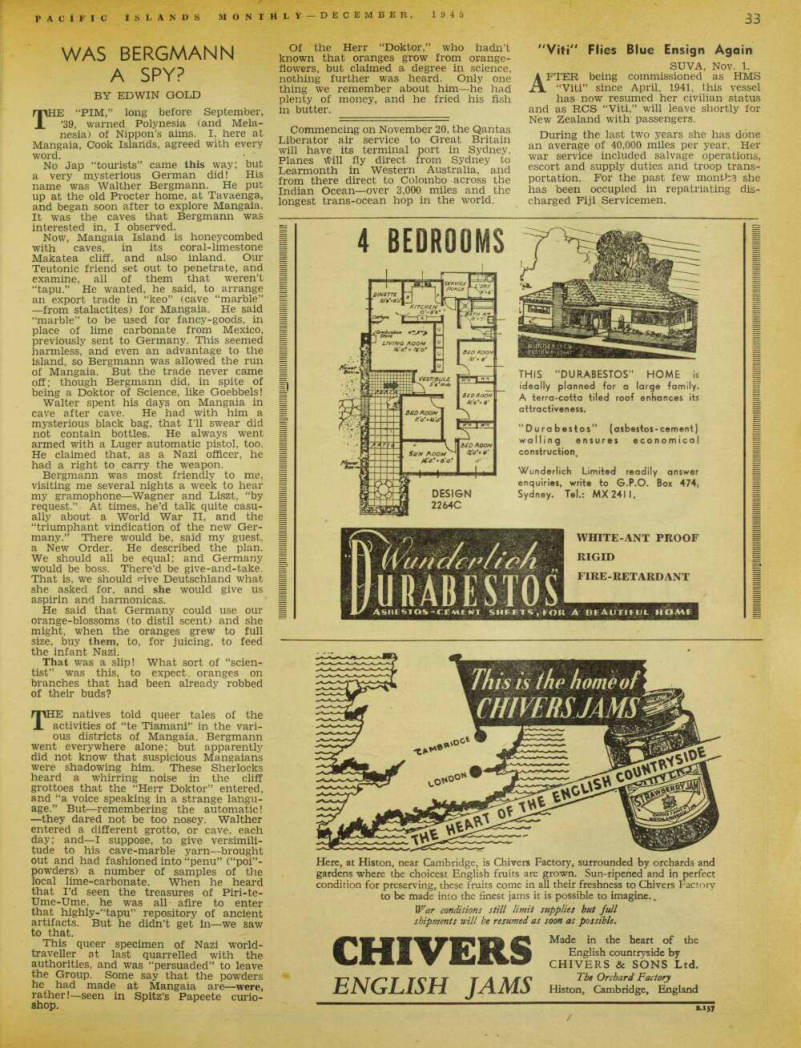
A Spy?
By Edwin Gold
rE “PIM,” long before September, ’39, warned Polynesia (and Mela nesia) of Nippon’s aims. I, here at Mangaia, Cook Islands, agreed with every word.
No Jap “tourists” came this way; but a very mysterious German did! His name was Walther Bergmann. He put up at the old Procter home, at Tavaenga, and began soon after to explore Mangaia.
It was the caves that Bergmann was interested in, I observed.
Now, Mangaia Island is honeycombed with caves, in its coral-limestone Makatea cliff, and also inland. Our Teutonic friend set out to penetrate, and examine, all of them that weren’t “tapu.” He wanted, he said, to arrange an export trade in “keo” (cave “marble” —from stalactites) for Mangaia. He said “marble” to be used for fancy-goods, in place of lime carbonate from Mexico, previously sent to Germany, This seemed harmless, and even an advantage to the island, so Bergmann was allowed the run of Mangaia. But the trade never came off; though Bergmann did, in spite of being a Doktor of Science, like Goebbels!
Walter spent his days on Mangaia in cave after cave. He had with him a mysterious black bag, that I’ll swear did not contain bottles. He always went armed with a Luger automatic pistol, too.
He claimed that, as a Nazi officer, he had a right to carry the weapon.
Bergmann was most friendly to me, visiting me several nights a week to hear my gramophone—Wagner and Liszt, “by request.” At times, he’d talk quite casu ally about a World War 11, and the “triumphant vindication of the new Ger many.” There would be, said my guest, a New Order. He described the plan.
We should all be equal; and Germany would be boss. There’d be give-and-take.
That is, we should pfve Deutschland what she asked for, and she would give us aspirin and harmonicas.
He said that Germany could use our orange-blossoms (to distil scent) and she might, when the oranges grew to full size, buy them, to, for juicing, to feed the infant Nazi.
That was a slip! What sort of “scien tist” was this, to expect oranges on branches that had been already robbed of their buds? fI\HE natives told queer tales of the A activities of “te Tiamani” in the vari ous districts of Mangaia. Bergmann went everywhere alone; but apparently did not know that suspicious Mangaians were shadowing him. These Sherlocks heard a whirring noise in the cliff grottoes that the “Herr Doktor” entered, and “a voice speaking in a strange langu age.” But—remembering the automatic! —they dared not be too nosey. Walther entered a different grotto, or cave, each day; and —I suppose, to give versimili tude to his cave-marble yarn—brought out and had fashioned into “penu” (“poi”powders) a number of samples of the local lime-carbonate. When he heard that I’d seen the treasures of Piri-te- Ume-Ume, he was all afire to enter that highly-“tapu” repository of ancient artifacts. But he didn’t get in—we saw to that.
This queer specimen of Nazi world traveller at last quarrelled with the authorities, and was “persuaded” to leave the Group. Some say that the powders he had made at Mangaia are—were, rather!—seen in Spitz’s Papeete curio shop.
Of the Herr “Doktor,” who hadn’t known that oranges grow from orange flowers, but claimed a degree in science, nothing further was heard. Only one thing we remember about him—he had plenty of money, and he fried his fish in butter.
Commencing on November 20, the Qantas Liberator air service to Great Britain will have its terminal port in Sydney.
Planes Will fly direct from Sydney to Learmonth in Western Australia, and from there direct to Colombo across the Indian Ocean—over 3,000 miles and the longest trans-ocean hop in the world.
"Viti" Flies Blue Ensign Again
Suva, Nov. 1.
AFTER being commissioned as HMS “Viti” since April, 1941, this vessel has now resumed her civilian status and as RCS “Viti,” will leave shortly for New Zealand with passengers.
During the last two years she has done an average of 40,000 miles per year. Her war service included salvage operations, escort and supply duties and troop trans portation. For the past few month 3 she has been occupied in repatriating dis charged Fiji Servicemen.
Advertisements & other items, p. 35 (1 item)
Chivers
4 BEDROOMS
DINETTE
/O'*''dO
K/TCHEN
• tO * 9‘6* ' f ■ Sfc—
LIVING AQOM
/s’of • /M.'o 1
OSD
BED AOON
to'e'* 9' ‘1 o*o Room tro room /io‘‘ 9' Sum hoc* Mo
DESIGN
2264 C
THIS "DURABESTOS" HOME is
ideally planned for a large family.
A terra-cotta tiled roof enhances its attractiveness.
"Durabestos" (asbestos-cement)
walling ensures economical construction.
Wunderlich Limited readily answer enquiries, write to G.P.O. Box 474, Sydney. Tel.: MX 241 I.
WHITE-ANT PROOF
RIGID
FIRE-RETARDANT
ASHESTOS-rEMFMT SHEETS, toil A DtAiITItIJL HOME
This is the home of
s\o* m
coy
ft? m o* 3® Here, at Histon, near Cambridge, is Chivers Factory, surrounded by orchards and gardens where the choicest English fruits are grown. Sun-ripened and in perfect condition for preserving, these fruits come in all their freshness to Chivers Factory to be made into the finest jams it is possible to imagine., War conditions still limit supplies hut full shipments will be resumed as soon as possible.
CHIVERS
ENGLISH JAMS
Made in the heart of the English countryside by
CHIVERS & SONS Ltd.
The Orchard Factory Histon, Cambridge, England *•*s7
Christmas Island
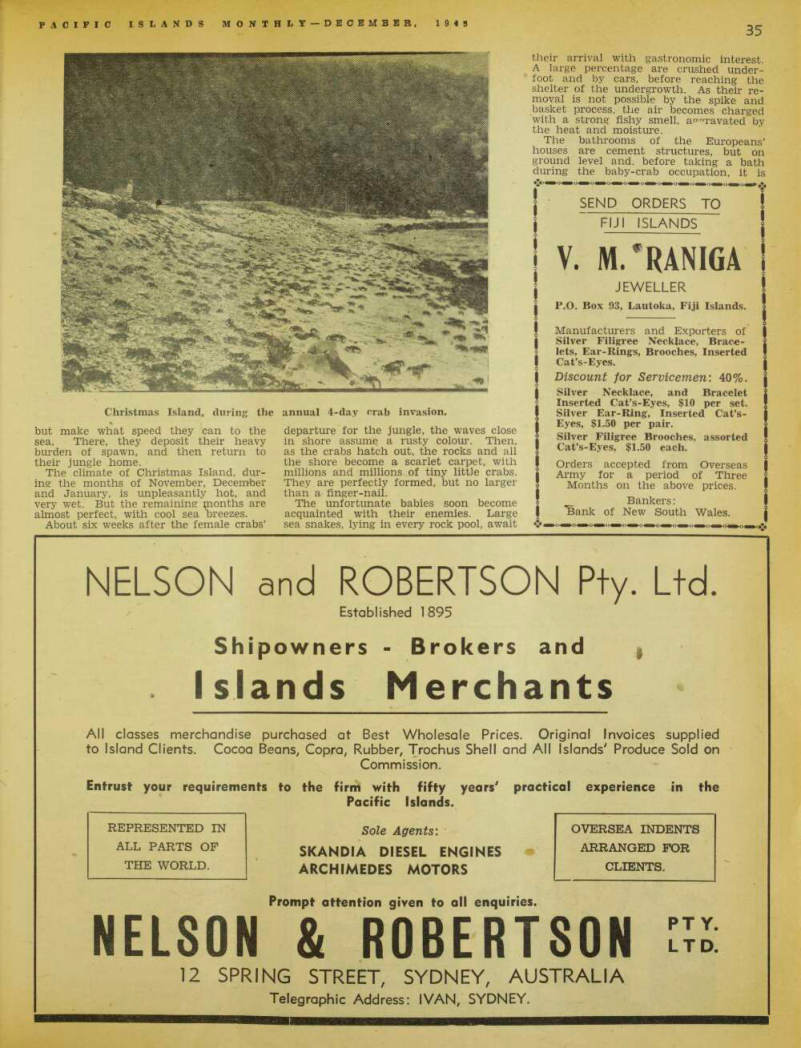
Crabs
Extraordinary Phenomena in the Indian Ocean
mHERE are several Christmas Islands.
X One of them is a little phosphate island, approximately eight miles by 12, rising to a height of 1,000 feet, situ ated in the Indian Ocean, about four days’ sea journey from Singapore, and the same distance from Cocos Keeling, of “Emden” fame.
The only contact with the outside world in pre-war days, with the exception of phosphate boats, was the company’s ship, “The Islander,” which did six-weekly trips between Singapore and the island, and six-monthly trips to Cocos Keeling.
In some places the island rises pre cipitously to a considerable height, sheer out of the sea, where the water is very deep; but in others there are rocky shores
and, here and there, a few small sandy inlets.
The European settlement, comprising six or seven houses erected on 4-feet piles, has been built on a wide, flat stretch between a steep pebbly shore and a jungle-clad rise of approximately 300 or 400 feet. In a line with the European settlement, at one end, are> the Malay quarters; and, at the other, and much further removed, are the phosphate works and coolie lines.
The Europeans numbered about two dozens in the ’thirties, and included a District Officer and a doctor. There were some 60 Malays and several hun dred Chinese.
LIKE most tropical islands, Christmas is the home of a great variety of crabs.
There is the huge robber crab, which spends his leisure in shady ledges in the jungle, or lurks in caves on the coast and, when hungry, climbs to the top of a palm in search of coconuts, which he
extracts from the husk and then bores into with his powerful claws.
Another variety, in size as large as the ordinary edible crab of Australia, and a bright red in colour, lives in great num bers in the jungle, and is quite un obstrusive—until the first rains of the season, which start about mid-November.
Then the male crabs begin a universal migration to the coast, approaching with a continuous rustling noise like a bush fire, and eating everything possible en route.
The drains are seething with them, one on top of another —everywhere there is just one moving mass of crabs. Quite often, rather than go aroUnd an obstacle, these male crabs will go over it, and the ungainly creatures were often seen in the eaves of the two-storied island club; but whether they made a safe landing on the other side is uncertain.
For four days the invasion continues.
Gardens are ruined and the ground swept clean of leaves and vegetation. A few crabs come into the house, and they will eat any rags or clothes within their reach.
A road runs along in front of the settlement, and a passing car will crush hundreds of the creatures. So coolies, armed with spikes and baskets, are em ployed to remove the dead bodies, which quickly become most offensive in the moisture and hot sun.
On the fourth day, the crabs are more numerous than ever—some still on their way to the shore, others on the return trek.
A LITTLE later the female crabs, laden with spawn, begin to arrive from the jungle. They are just as numer ous, but not so aggressive as their hus bands. There is nothing left for them to eat, so they do not dally on the way,
but make what speed they can to the sea. There, they deposit their heavy burden of spawn, and then return to their jungle home.
The climate of Christmas Island, dur ing the months of November, December and January, is unpleasantly hot, and very wet. But the remaining months are almost perfect, with cool sea breezes.
About six weeks after the female crabs’
departure for the jungle, the waves close in shore assume a rusty colour. Then, as the crabs hatch out, the rocks and all the shore become a scarlet carpet, with millions and millions of tiny little crabs.
They are perfectly formed, but no larger than a finger-nail.
The unfortunate babies soon become acquainted with their enemies. Large sea snakes, lying in every rock pool, await
their arrival with gastronomic interest.
A large percentage are crushed under foot and by cars, before reaching the shelter of the undergrowth. As their re moval is not possible by the spike and basket process, the air becomes charged with a strong fishy smell, by the heat and moisture.
The bathrooms of the Europeans’ houses are cement structures, but on ground level and, before taking a bath during the baby-crab occupation, it is
Christmas Island, during the annual 4-day crab invasion.
necessary to sweep the walls and floor of the bathroom, which are swarming with crabs, and push the heap of little intruders well away from the door. Not that that is much use—they are drop ping from the ceiling again almost be fore one is in the bath.
At this time the weather is extremely hot, and it is not a pleasant period for Europeans, as there is nothing in the gardens, and eggs are so strongly flav oured (caused by the hens eating the little crabs) that they are unpalatable.
The intermittent journeyings of the crabs, to and from the sea, take approxi mately two months; and then, for the next ten months, they remain hidden in the jungle and the settlement is free of these strange Crustacea until the next
rainy season.
M.L.D.
Advertisements & other items, pp. 36-38 (1 item)
Globite
csa/(Ae
TRAVEL CASES
As manpower and raw materials become available, increased quantities of Globites will be manufactured. So ask first for Globitel Made by
FORD SHERINGTON LTD.
PACIFIC ISLANDS TRADING COMPANY
Bankers: 244 CALIFORNIA STREET, SAN FRANCISCO 11, U.S.A.
Bank of Montreal Cable Address: Vancouver, B. c al BUYING AGENTS—EXPORTERS SAN FRANCISCO Shipping Regularly to PHILIPPINES, HAWAII, TAHITI, FIJI, SAMOA, COOK ISLANDS.
Inquiries Welcomed from NEW GUINEA, SOLOMONS, NEW CALEDONIA, NEW HEBRIDES, Etc.
L. C. SMITH and CORONA TYPEWRITERS
Miller Brand Tyres, Tubes, Batteries, Industrials, Drug Sundries, Swiss Products, English Screwdrivers, Gramo. Springs and Needles, Continental Paper Bags, Record Watches, American Lead Pencil Co. (Venus and Velvet Brands), Kochs Barbers’ Chairs, National Electric Appl., Mitchell Button Co.
EXPORTERS OF EVERYTHING
Get Our Prices First *
Exclusive Agents for
f T3t
SEND ORDERS TO
FIJI ISLANDS
V. M/RANIGA
JEWELLER
P.O. Box 93, Lautoka, Fiji Islands.
Manufacturers and Exporters of Silver Filigree Necklace, Bracelets, Ear-Rings, Brooches, Inserted Cat’s-Eyes.
Discount for Servicemen : 40%.
Silver Necklace, and Bracelet Inserted Cat’s-Eyes, $lO per set.
Silver Ear-Ring, Inserted Cat’s- Eyes, $1.50 per pair.
Silver Filigree Brooches, assorted Cat’s-Eyes, $1.50 each.
Orders accepted from Overseas Army for a period of Three Months on the above prices.
Bankers: Hank of New South Wales.
NELSON and ROBERTSON Pty. Ltd.
Established 1895
Shipowners - Brokers and 9
Islands Merchants
All classes merchandise purchased at Best Wholesale Prices. Original Invoices supplied to Island Clients. Cocoa Beans, Copra, Rubber, Trochus Shell and All Islands' Produce Sold on Commission.
Entrust your requirements to the firm with fifty years' practical experience in the Pacific Islands. ■ rumpr arrennon given to yii enijuiriwa#
NELSON & ROBERTSON "I.
12 SPRING STREET, SYDNEY, AUSTRALIA
Telegraphic Address: IVAN, SYDNEY.
After taking Pinkettes you should feel brighter, happier, and free from sick headaches, bilious attacks and liverishness. For
PINKETTES
are tiny laxative and liver pills, which painlessly exercise the digestive system.
“ FLIT
LIMITED SUPPLIES AGAIN FOR
The World Famous Insect Destroyer
CIVILIANS
Seven Months
In An
Open Canoe
Y'HE story of an •Ocean Islander’s
epic voyage, as told Toy hen
Usher, Public Relations Officer, Suva,
Fiji:
ACCOUNTS have often been given of phenomenal endurance by mariners adrift for many days in open boats.
Few of these stories can equal that of Nabetari, a 24-years-old Gilbert Islander, who last year was at sea in a small canoe for seven months.
Nabetari was working for the British Phosphate Commission on Ocean Island when the Japanese arrived in 1942. As with many of the natives on the island, Nabetari was pressed into Japanese ser vice. His job was to help to catch fish to supplement the island’s scanty food supplies, and was one of a party of seven who operated in three small canoes.
By April, 1944, the pressure of the Allied blockade was being severely felt on Ocean Island, and as food stocks dwindled the rations doled out by the Japanese became progressively smaller.
The seven fishermen discussed this fre quently, and one night they decided that they would get away from Ocean and would make for the Gilberts, where food would be more plentiful. One of their number was sure that he could navigate sufficiently well to find land.
They collected a few coconuts and filled some Japanese w’ater bottles. These they placed in their canoes and under cover of darkness they set out. Nabetari had one companion with him, a man named Reuera. The second canoe also con tained two men and the third, the largest, carried three. It was midnight when the men left, and when daylight came they found that they were still within sight of Ocean Island. They apparently were not noticed, however, be cause the Japanese made no attempt to prevent their escape.
On the second night the wind freshened
and the canoe with the three men in it became separated from the others, and was not seen again. The four men in the remaining two canoes decided that each night from then on they would lash their craft together so as to avoid the risk of being parted.
The men lived on fish which they caught with feather baits. When they had a good catch they preserved some of the fish by drying it in the sun. When rain fell they were able to catch water for drinking. At other times they drank the blood of sharks they caught.
During the coursl of several storms the sails of both canoes were lost, and the four men then drifted where wind and sea took them. They saw no point in paddling because they had no idea where they were, or in which direction land lay. rE days stretched into weeks and the tfeeks into months. Then one night the rope which held the two canoes together parted, and the second craft dis appeared. Nabetari and Reuera then carried on alone until one day while they were trying to get a shark into the canoe, Reuera was attacked and his arm was badly torn. In spite of the loss of blood he still lived, but nearly a week later while he and Nabetari were asleep, the canoe capsized. Nabetari managed to right it again, but when this had been done there was no answer when he called Reuera’s name.
By this time Nabetari himself was very weak, but he still clung tenaciously to life, and continued to drift in the canoe.
Twice he saw aircraft, but 'they . were very high and evidently he was not seen.
He was passed at a distance also by two ships.
Late in the afternoon .of a day in November, seven months after he had set out from Ocean Island, Nabetari saw land. It was the island of Ninigo, about 140 miles north of New Guinea and 1,800 miles from Ocean.
His canoe drifted slowly towards the island, and some time during the next afternoon it was washed up on the reef.
Nabetari crawled ashore and fell ex hausted on the beach. Next morning he set out to find a village. He was too weak to walk, but he crawled into the shallows near the beach, and let the water hold him up as he dragged him self along. Late in the afternoon four local natives found him and took him to their village. They sent word to the Australian headquarters at Manus, and from there a launch was sent to take Nabetari to hospital.
Gradually his story was pieced together and a message was sent to the Gilbert and Ellice authorities at Tarawa to tell them where he was. A District Officer shortly afterwards arrived to take him home, and this time Nabetari travelled in very different fashion. He flew in an aeroplane high above the waters through which his canoe had made such painful progress for seven weary months.
Nabetari is now fully recovered, and he is once more on Oceean Island. He was especially chosen to be one of the official party with the Resident Commissioner of the Gilbert and Ellice Islands Colony to be present at the surrender of the Japanese garrison. Nabetari then re mained to work.
But he is willing to stop work at any time to tell the story of why he left Ocean Island in April, 1944, and of what befell him in the seven months that followed.
Mr. Ralph H. Hunt was recently ac corded formal recognition as Vice-Consul of the United States in Suva, with juris diction in Fiji.
Advertisements & other items, p. 39 (1 item)
C. Sullivan Pty. Ltd.
KEROSENE STOVE
“ The ultimate in heating efficiency and service ”
No Pumping • No Wicks • No Danger The Bright Blue Flame provides ample Heat for All Purposes.
SIMPLE AND EFFECTIVE
"ULTIMA" is economical to buy and to operate. Using a new system of fuel generation it does not need complicated pressure chambers, pumps and so on, but is controlled by a single valve.
EASY AND SAFE TO USE
Manufactured under Australian Government Permit. Supplies Available Shortly.
WRITE TO YOUR SYDNEY AGENT, OR
C. SULLIVAN PTY. LTD. 379 Kent St. Sydney
C. SULLIVAN Pty. Ltd.
GENERAL MERCHANTS ISLANDS AGENTS
REPRESENTING LEADING FIRMS IN THE PACIFIC ISLANDS.
Islands Produce sold on Shippers’ Account—Liberal Advances against Consignments.
Buyers of all Islands’ Requirements on Commission—Original Invoices Furnished.
Bankers'. Bank of New South Wales .. Bank of New Zealand .. Comptoir National d’Escompte de Paris.
Wartime Cable Address: Sullivan, Kents tree t ( Sydney.
379 KENT STREET, SYDNEY, N.S.W.
Cook Islands Men Of War
Rarotonga's Contribution to Victory
From Our Own Correspondent
Rarotonga, Oct. 20.
Mr. Tuaine Nicholas, Of Raro
tonga, is justly proud of his family record: three of his sons are in the Air Force—one of them has the highest rank achieved by a Cook Islander; -the fourth and youngest son (since deceased) was alsq anxious to join the RAF, but his brothers said, “Three in the Air Force is enough—you must go in the Army.
Tatio Nicholas was the first to enlist. He joined the Air Force in NZ, completed his training in Canada, made rapid pro gress and was sent to England and served with the daring “Pathfinders” who blazed the trails across Germany for the big bombers. Tatio was commissioned a Pilot- Officer in March, 1945.
Inspired by his successful progress, his elder brother. Marama, followed him to Canada, making equally rapid progress and our last information was that he was a navigator-sergeant on active ser vice somewhere in the Pacific.
The third brother, Albert, is on a NZ station, still in training. Kaitara, the
youngest brother, being less robust, was discharged from the Army and went to Suva Medical School to train as a NMP.
There he made excellent progress but after six months his health deteriorated and he was sent back to Auckland, where he died.
The fine record of the Nicholas brothers is of particular interest. Their great grandfather, Henry Nicholas, was one of Rarotonga's first and most influential commercial settlers, and his home was the centre of the European social life of those early days. It was here that the decision was made to persuade Queen Makea to hoist a Union Jack to prevent the annexation of the Cook Islands by an approaching French warship. Henry’s daughter, Francis, now Mrs. Waugh, who quickly sewed the historic flag from-as sorted pieces of trade cloth, is still living in Australia.
ANOTHER successful Rarotongan air
man was Sgt. Alexander Brown, who unfortunately lost his life in a' raid over Germany.
Most of the other Rarotongan airmen have been on active service in the Pacific area.
Strangely, this sea-faring race has had only one representative in the Navy— Tony Thomson, a son of Capt. Andy Thomson, of the schooner “Tiare Taporo.” Tony saw plenty of action in the famous cruiser HMS “Achilles” and was wounded in the Coral Sea battle. But even Tony could not* resist the tempta tion to adventure in the new element and he later transferred to the Fleet Air Arm. After training in Canada he served in torpedo-bombers operating from bases in Scotland.
Most outstanding of the Cook Islanders serving with the land forces was RSM James Rennie. At the outbreak of the war, Jim Rennie was number-one pupil at the Suva Medical School. He immedi ately enlisted in the medical service and went through the thick of the fighting in Greece, Crete, and the desert. He rapidly rose to his present rank.
Space does not permit to give details of all the Cook Island boys who have served through all the worst campaigns of the war but their accumulative record is truly a proud one.
As far as is known at present, only two Cook Islanders (native) have lost their .lives. The rest have suffered wounds but none have been seriously disabled.
So far no mention has been made of European residents who have been on active service but again space does not permit to give many details.
Capt. J. D. Campbell, a well-known resident, veteran of World War I and earlier military service, has recently re turned from World War 11.
F/O Henley McKegg, DFC, son of Mr.
R. McKees (managing director of the Cook Islands Trading Company), who spent his early boyhood in Rarotonga, was here on furlough recently.
FROM the only list available at pre sent (and known to be incomplete) the following approximate figures are quoted: Serving with Land Forces: Native and Euronesians 33 (1 killed in action): Euro pean residents, 7; Cl Administration offi cials, 4 (Capt. W. H. Roberts killed in action).
Serving with Air Force: Native and Euronesian, 11 (1 killed in action); Euro pean residents, 3.
Rarotonga girls were represented in the WAACS by Miss E. Taripo; in the WRENS by Miss B. Marama.
Two Yachts Leave
Auckland For Islands
TWO sailing vessels left Auckland for •the Islands on October 29. One was the Public Works Department ketch “Golden Hind” bound for Pitcairn Island with supplies; and the other was the 94ton schooner “Tahitienne,” which was sold in September to Mr. D. C. Brown, well-known Rarotonga trader. (See October “PIM”.) The “Golden Hind” carries a crew of eight Cook Islanders as well as five officers. On this trip she was taking four passengers also.
Mr. Brown intends to use the “Tahi tienne” as a trading vessel in the Cook Islands. Her former owner, Mr. A Donald, of Auckland, was in charge of the trip to Rarotonga; other members of the crew are taking the trip for pleasure.
Dr. T. R. A. Davis, who is going to a Government post in Rarotonga, acted as mate; his wife and young son travelled as passengers.
Advertisements & other items, p. 40 (1 item)
Ship Chandlery Hardware
/Write for j
Ship Chandlery /
Catalogue J
BROOMFIELDS LIMITED
152 SUSSEX STREET SYDNEY.
Cables: "Boom”, Sydney.
Special "In Bond” Price* for all Islands enquiries queted on application.
Sole Agents for: Large and Complete Stocks of
SHIP CHANDLERY
IRONMONGERY OF ALL KINDS, PAINTS,
WHITE LEAD AND OILS.
P. H. MUNTZ <& CO.’S 3-CROWN BRAND METAL SHEATHING.
PEAOOCK <fe BUCHANS’ ENGLISH READY-MIXED PAINTS.
“DOCTOR SAID I WAS A DONE MAN”
CHRISTCHURCH, N.Z., LAND
AGENT DISCOVERS REAL
WAY TO HEALTH.
Hereford Street, Christchurch, is all the more pleasant for its association with Mr. Fred Whiley, whose prominent business windows and breezy personality have found a solution for many home seekers.
Looking at "Fred” to-day it is hard to imagine he has been anything but always "in the pink,” yet seven years ago he was "down to it” and broken in health.
What he says is something to give heart to the suffering, ill and depressed. "My doctor said I was a done man. He is now dead, and I am better than ever. It is no secret.
I took a large packet of R.U.R. My friends marvel at the change, thanks to your wonderful health-giving remedy. Please use this testimonial for the benefit of others.”
This voluntary recommendation to R.U.R. bears out the benefits which have caused hundreds to write their praise for this "fivefold” health builder —the shortest cut to robust good health, stamina and abundant energy. It will remove the cause of 19 out of 20 ailments, aches and pains because it contains a laxative, liver stimulant, kidney cleanser, blood purifier and acid corrective. R.U.R. is also the most economical way to rebuild lasting health.
No matter what you have wrong with you, or how worried, depressed and ill in body you feel, take R.U.R. and Right You Are!
TaKE VLXM. HJVD RIGHT YOU JIMtE
Old Racecourse Becomes Large Airport
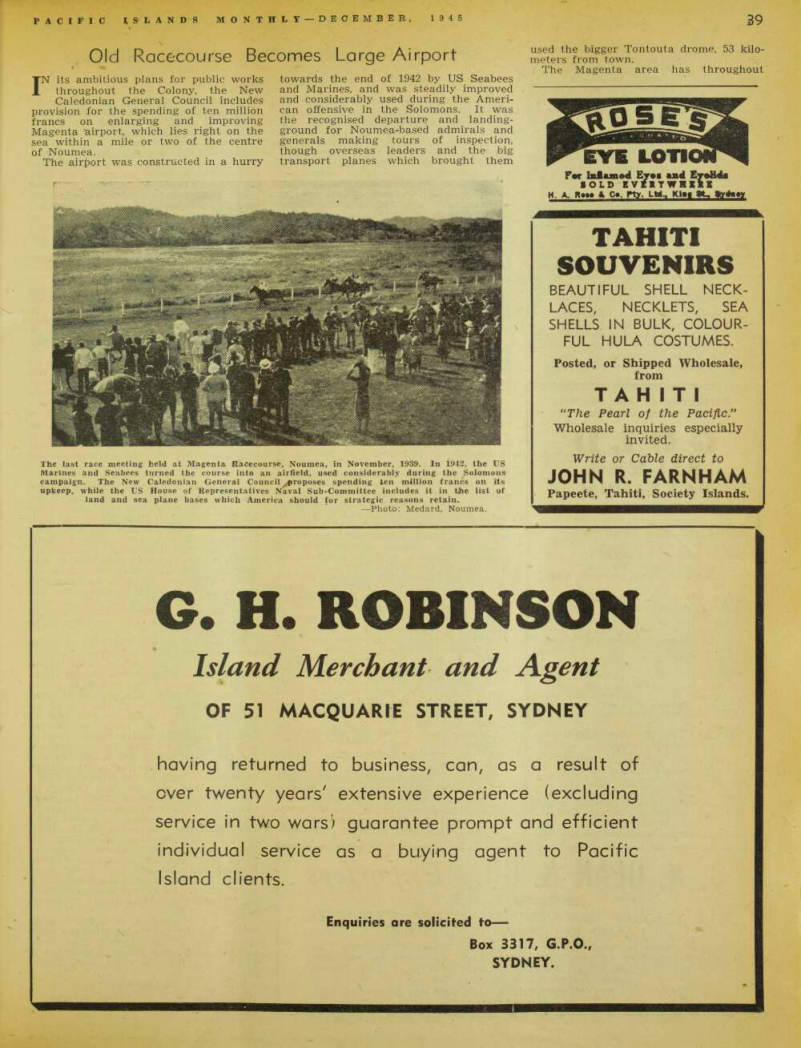
IN its ambitious plans for public works throughout the Colony, the New Caledonian General Council includes provision for the spending of ten million francs on enlarging and improving Magenta airport, which lies right on the sea within a mile or two of the centre of Noumea.
The airport was constructed in a hurry
towards the end of 1942 by US Seabees and Marines, and was steadily improved and considerably used during the Ameri can offensive in the Solomons. It was the recognised departure and landing ground for Noumea-based admirals and generals making tours of inspection, though overseas leaders and the big transport planes which brought them
used the bigger Tontouta drome, 53 kilo meters from town.
The Magenta area has throughout
The last race meeting held at Magenta Racecourse, Noumea, in November, 1939. In 1942, the US Marines and Seabees turned the course into an airfield, used considerably during the Solomons campaign. The New Caledonian General Council proposes spending ten million francs on its upkeep, while the US House of Representatives Naval Sub-Committee includes it in the list of land and sea plane bases which America should for strategic reasons retain.
Photo: Medard, Noumea.
been a huge American camping ground, and Americans spent a considerable amount of money there on installations.
The airstrip is approached over a swamp, and the take-off is straight out to sea in the direction of the Isle of Pines, the last portion of the strip being a now raised part of the beach that the tide used to invade.
Magenta is Noumea’s old racecourse, and the old grandstand has been left standing, and has been used by the Americans for accommodation and offices.
The last race meeting was held there late in 1939, the “race of the day” being won with ease by a Caledonian-bred horse, ridden by a Japanese jockey (who waved to the crowd as he passed the winning-post) and owned by a Japanese business man who gave the prize money to a French war charity. Also in the race were horses imported from Aus tralia, ridden by Australian jockeys.
Caledonians are keen racegoers, and town and country meetings are as eagerly looked forward to as in the non-city areas of the Commonwealth. In the course of time, no doubt, Noumea will find the money to establish a new racecourse.
Advertisements & other items, pp. 41-42 (2 items)
39
PACIFIC I.SLANDS MONTHLY DECEMBER, 1945
G. H. Robinson
sg so s
EYE
LOTI
F«r Inflamed £▼•■ ud EvtlMa
E VZITWRKIX
SOLD
A. It C«. rty Ltd.. Kl»i t. SorSaw
TAHITI
SOUVENIRS
BEAUTIFUL SHELL NECK-
LACES, NECKLETS, SEA
SHELLS IN BULK, COLOUR-
FUL HULA COSTUMES.
Posted, or Shipped Wholesale, from
TAHITI
“The Pearl of the Pacific”
Wholesale inquiries especially invited.
Write or Cable direct to
JOHN R. FARNHAM
Papeete, Tahiti, Society Islands.
G. H. ROBINSON
Island Merchant and Agent
OF 51 MACQUARIE STREET, SYDNEY
having returned to business, can, as a result of over twenty years' extensive experience (excluding service in two wars’) guarantee prompt and efficient individual service as a buying agent to Pacific Island clients.
Enquiries are solicited to— Box 3317, G.P.0.,
SYDNEY.
Purchasers at Full Market Prices on Assay Value of
GOLD
SILVER
PLATINUM
And Platinum Group Metals
SOME OF OUR SERVICES
ASSAYERS & ANALYSTS—
Assays of Bullion, Ores, etc.
Analyses of Metals, Minerals, Alloys, etc.
SCIENTIFIC & INDUSTRIAL
METALLURGISTS—
Our range of precious metal manufactures covers all industries—Gold and Silversmiths, Electrical Trades, Dental Profession, Glass Sllverers, Electro-Platers, etc., etc.
REFINERS—
Purchasers and Refiners of Bullion.
Scrap, Mining By-Products, and Trade Residues of every description carrying Precious Metals.
GARRETT Cr DAVIDSON
PTY. LTD.
834 George St., Sydney. Works: Surry Hills and Chippendale, N.S.W.
Official Assayers to the Bank of New South Wales. Gazetted Agents of the Commonwealth Bank of Australia, under the Gold Regulations of the National Security Act.
S. N. DEAN & CO. - Exporters
G.P.0., SUVA, FIJI.
THE LEADING "MANUFACTURERS" FOR SOUTH SEA
ISLAND CURIOS AND SOUVENIRS
We specialise in Tortoiseshell Silver Inlaid, Tortoiseshell-“ Cat’s Eye”
Mountings, Silver Filigree, with “Cat’s Eye” Mountings in Necklaces, Bracelets, Brooches, Watch Bands, Tie-Pins, Ear-Rings, Picture Frames.
And Various Kinds of Other Curios.
Write to us for full particulars. (Parcels will Toe posted to any address.)
When Fiji Wanted More Indians
(Letter to the Editor)
AN article in the June issue of “PIM” comments on the startling increase in the Indian population of Fiji.
This reminds me that 23 years ago a Commission arrived in Fiji from India, the head of which was Mr. Vankata Raju, a member of the Viceroy’s Council. The Commission’s mission was to ascertain if there were sufficient suitable freehold land in Fiji on which to settle a large number of ex-soldiers who had been discharged from various Punjabi regiments (the number it was proposed to settle was said to be 75,000).
I immediately opened a publicity cam paign in opposition to the proposal. The campaign took the form of a series of articles which appeared in the columns of the “Fiji Times and Herald” and the “Pacific Age,” and these articles called forth some particularly bitter replies from those who wished to see something come of the proposal.
After about a fortnight, Lieut. Hisa mudin, who was attached to the Commis sion as military adviser, announced that for his part, he was not interested in the political aspect of the question, he was a soldier and not a politician, and that, in any case, he was not very much im pressed with Fiji as a country for the settlement of his countrymen.
In my articles, I claimed, that there were already too many people of Indian nationality in Fiji, and that instead of introducing more people from that coun try, the Fiji Government should do every thing possible to induce those who were already here to return to India. I further claimed that in less than 25 years the Indian population of Fiji if left un disturbed, would be fully 100,000, and if any more were introduced the result would be the complete extirpation of the European colonists, and the ultimate ob literation of the native Fijian.
I also held meetings at Lautoka and Ba which were well attended and where resolutions were passed protesting against the proposal to introduce Punjabis as settlers, and urging that those Indians who were already resident in the Colony should be given every encouragement and facility to return to India. It is worth mentioning here that the terms of indenture under which the Indian people were introduced to Fiji provided that every Indian who had been introduced under indenture, and all the descendants of such Indians, had the right to a free passage to India.
Notices were served on me at each meeting by the same Government offi cial, the opening paragraph of which stated that; — The Government views with extreme displeasure your holding meetings which in its opinion are calculated to cause much unrest amongst the Indian population, fur ther, that the meetings are anti
imperialistic in spirit and are sure to bring about a state of lawlessness, and if persisted in could only inflict much hardship and loss on the people of the Colony.
Shortly after my Ba meeting, I had occasion to go to Suva, and whilst there was summoned to the presence of the Act ing Colonial Secretary, and was informed that my proposal to repatriate the Indians was preposterous. “Why,” he exclaimed, “a fund would have to be created for the purpose of repatriating the Indians, and such a fund would have to be not less than £100,000!”
I replied; “Yes—and the planters have already created that fund, and now it can be put to its proper use!”
He then said, “Your claim that in less than 25 years there will be fully 100,000 Indians in Fiji is pure nonsense. We have all the figures at our disposal, and at the rate of increase there cannot at the most be more than 60,000 in that time.”
I replied: “Well, Mr. Stewart, with all due respect to you, I must say that you do not know what you are talking about when you say that, and it is very evi dent that you have not taken into con sideration the fact that the sex ratio is becoming even. Hitherto the ratio has been three males to one female, but in less than 10 years the sexes will be equal and after that the rate of increase will be accelerated.”
A LARGE number of Indians applied for repatriation to India, and if my memory serves me right, four ships left Fiji full of Indians bound for their homeland. Hardly had the first ship arrived at its destination, than the local press started publishing heartrending stories or how the poor unfortunates were suffering through being ostracised by their countrymen in India, together with graphic pen pictures depicting the un fortunate people crowding the wharves in India and gazing longingly towards their beloved Fiji, and praying to be taken back.
After a while the majority of them were brought ba(?k in ships chartered especially for the purpose, .and subse quently an Ordinance was passed limit ing to' 10 years, the period in which Indians could claim free passage to India.
Mr. Venkata Raju, on the eve of his departure from the Colony exhorted his countrymen at all costs to become friendly with the native Fijian, because, only by friendly feeling existing between the two races could the Indian hope to attain to the dominating position which he should occupy in the affairs of Fiji.
During his stay in the Colony he coined a composite word which he passed along to his countrymen to be used at all times as a slogan, and that word was “Kalavata” composed of the Hindi word “kala” meaning black and the Fijian word “vata” meaning together.
Since that time the intercourse between Fijian and Indian has been much greater than is generally admitted, and in' spite of occasional outbursts of spleen by Fijians, their relations are extremely amicable.
There is, to-day, a melancholy satis faction in the knowledge that my prog nostications of the increase that would take place in the Indian population of Fiji in less than 25 years, have proven correct.
I am, etc.,
Navai, Fiji. 21/9/45,
Theo. D. Riaz.
"Malaita" To Sail Again
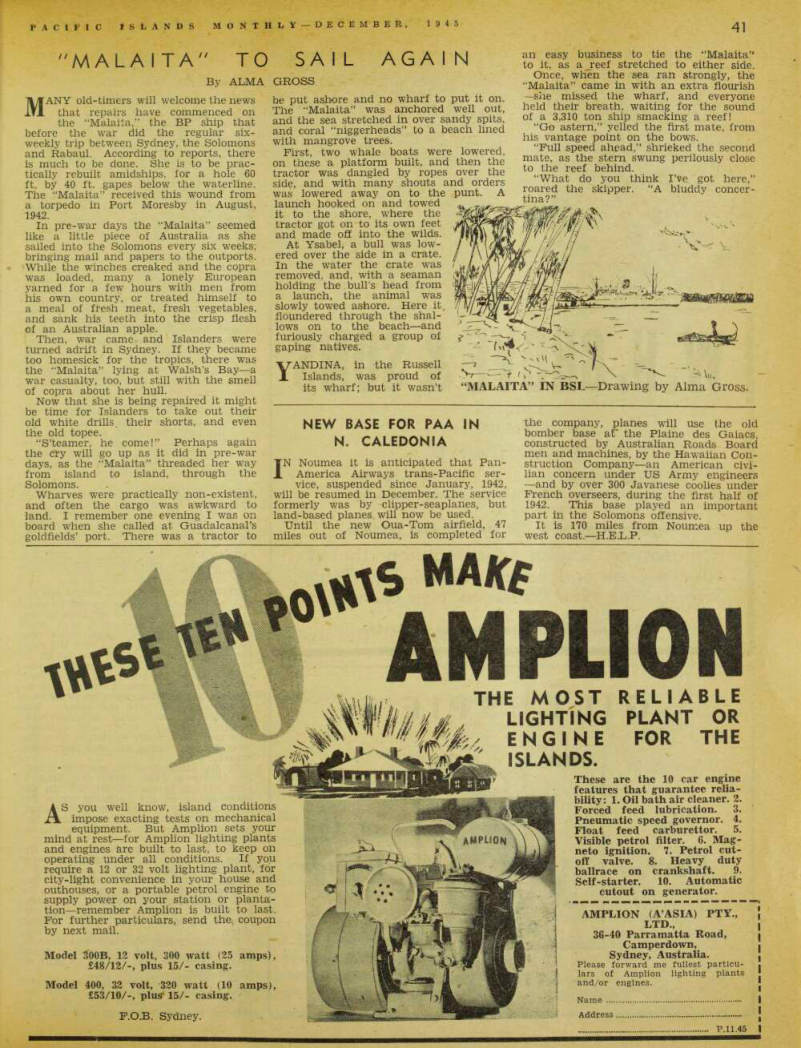
By Alma Gross
MANY old-timers will welcome the news that repairs have commenced on the “Malaita,” the BP ship that before the war did the regular six weekly trip between Sydney, the Solomons and Rabaul. According to reports, there is much to be done. She is to be prac tically rebuilt amidships, for a hole 60 ft. by 40 ft. gapes below the waterline.
The “Malaita” received this wound from a torpedo in Port Moresby in August, 1942.
In pre-war days the “Malaita” seemed like a little piece of Australia as she sailed into the Solomons every six weeks, bringing mail and papers to the outports.
While the winches creaked and the copra was loaded, many a lonely European yarned for a few hours with men from his own country, or treated himself to a meal of fresh meat, fresh vegetables, and sank his teeth into the crisp flesh of an Australian apple.
Then, war came and Islanders were turned adrift in Sydney. If they became too homesick for the tropics, there was the “Malaita” lying at Walsh’s Bay—a war casualty, too, but still with the smell of copra about her hull.
Now that she is being repaired it might be time for Islanders to take out their old white drills, their shorts, and even the old topee.
“S’teamer, he come!” Perhaps again the cTy will go up as it did in pre-war days, as the “Malaita” threaded her way from island to island, through the Solomons.
Wharves were practically non-existent, and often the cargo was awkward to land. I remember one evening I was on board when she called at Guadalcanal’s goldfields’ port. There was a tractor to
be put ashore and no wharf to put it on.
The “Malaita” was anchored well out, and the sea stretched in over sandy spits, and coral “niggerheads” to a beach lined with mangrove trees.
First, two whale boats were lowered, on these a platform built, and then the tractor was dangled by ropes over the side, and with many shouts and orders was lowered away on to the punt. A
launch hooked on and towed it to the shore, where the tractor got on to its own feet and made off into the wilds.
At Ysabel, a bull was low ered over the side in a crate.
In the water the crate was removed, and, with a seaman holding the bull’s head from a launch, the animal was slowly towed ashore. Here it floundered through the shal lows on to the beach —and furiously charged a group of gaping natives.
YANDINA, in the Russell Islands, was proud of its wharf; but it wasn’t
an easy business to tie the “Malaita” to it, as a reef stretched to either side.
Once, when the sea ran strongly, the “Malaita” came in with an extra flourish —she missed the wharf, and everyone held their breath, waiting for the sound of a 3,310 ton ship smacking a reef!
“Go astern,” yelled the first mate, from his vantage point on the bows.
“Full speed ahead,” shrieked the second mate, as the stern swung perilously close to the reef behind.
“What do you think I’ve got here,” roared the skipper. “A bluddy concer tina?”
New Base For Paa In
N. Caledonia
TN Noumea it is anticipated that Pan- X America Airways trans-Pacific ser vice, suspended since January, 1942, will be resumed in December. The service formerly was by clipper-seaplanes, but land-based planes will now be used.
Until the new Oua-Tom airfield, 47 miles out of Noumea, is completed for
the company, planes will use the old bomber base af the Plaine des Gaiacs, constructed by Australian Roads Board men and machines, by the Hawaiian Con struction Company—an American civi lian concern under US Army engineers —and by over 300 Javanese coolies under French overseers, during the first half of 1942. This base played an important part in the Solomons offensive.
It is 170 miles from Noumea up the
west coast.-
H.E.L.P.
Advertisements & other items, p. 43 (1 item)
Amplion
MA *£ 0\^ S mm:
THE MOST RELIABLE
LIGHTING PLANT OR
ENGINE FOR THE
ISLANDS.
AS you well know, island conditions impose exacting tests on mechanical equipment. But Amplion sets your mind at rest —for Amplion lighting plants and engines are built to last, to keep on operating under all conditions. If you require a 12 or 32 volt lighting plant, for city-light convenience in your house and outhouses, or a portable petrol engine to supply power on your station or plantation —remember Amplion is built to last.
For further particulars, send the coupon by next mail.
Model 3008, 12 volt, 300 watt (25 amps), £4B/12/-, plus 15/- casing.
Model 400, 32 volt, 320 watt (10 amps), £53/10/-, plus - 15/- casing.
P. 0.8. Sydney. - w A* - "'"’
I • « * These are the 10 car engine features that guarantee reliability: 1. Oil bath air cleaner. 2.
Forced feed lubrication. 3.
Pneumatic speed governor. 4.
Float feed carburettor. 5.
Visible petrol filter. 6. Magneto ignition. 7. Petrol cutoff valve. 8. Heavy duty ballrace on crankshaft. 9.
Self-starter. 10. Automatic cutout on generator.
AMPLION (A’ASIA) PTY.,
LTD.,
36-40 Parramatta Road, Camperdown, Sydney, Australia.
Please forward me fullest particulars of Amplion lighting plants and/or engines.
Name ...
Address ... P.ll.
New Book Of Old Laws
New Guinea 1939-41
rpo hand from the Directorate of X Research and Civil Affairs, Austra lian Military Forces, volume XV of the “Laws of the Territory of New Guinea,” just issued.
This book, excellent enough in its own way, covers the period 1939-41, and one might well ask what is the point of it.
Civil Government was suspended in early 1942, some parts of the Territory are still under military administration, and those which are not, are rilled by the Papua-New Guinea Provisional Ad ministration which has a completely new set of laws of its own.
The Directorate has also compiled a complete consolidation of the laws of New Guinea up to the suspension of Civil Government in 1942, and this will be issued in 1946. They are at work on a similar consolidation for Papua, as well.
All this literary and statistical effort is at the expense of the Australian tax payer and the expense of Australian paper supplies. And with it all, present indications are that these works will have small interest for anyone, except as ancient history. But as they are compiled at the request of the Department of External Territories, perhaps even that theoretic body can foresee the day when an old-fashioned law or two will be of use in managing the liberated Fuzzy Wuzzy.
Major D. G. Kennedy, whose war service in BSI is well known, is at present in charge of the transfer and subsequent settlement of the Banabans from Ocean Island on the Island of Rabi, just north of Taveuni in the Fiji Group. Rabi was bought from the Fijians by the Western Pacific High Commission some time ago as a prospective home for the Ocean Islanders.
Vale!
Missionaries Who Lost Their Lives in Invasion
ON Saturday morning, November 10, a memorial service was held in the Seventh-day Adventist Church, Wahroonga, headquarters of the Austra lasian Union Conference, for three of the victims of the sinking of the “Monte video Maru” in 1942, and a missionary who died in captivity a little earlier.
They were: Pastor E. M. Abbott, super intendent of the Seventh-day Adventist Mission in New Guinea; Mr. Leonard C.
Thompson, of the Rabaul hospital medi cal staff; Mr. Trevor Collett, of Emlra; and Pastor A. S. Atkins, of Mussau At the time of the invasion of New Guinea, Pastor Abbott was assisting in the Rabaul hospital, and was there taken prisoner. When the Australian nurses serving in Rabaul were subsequently transferred to Kokopo, where a tem porary hospital was established, Pastor Abbott was one of the last men to visit them. These nurses, who recently re turned from internment in Japan, speak in the highest terms of gratitude and admiration for the help and comfort he gave them when they were in fear of being molested by their captors.
PASTOR ABBOTT was 33 years of age at the time of his death, and was the only son of Mr. and Mrs. E. M.
Abbott, of Chatswood. His widow, Sister Frances Abbott, is the supervising sister at the Sydney Seventh-day Adventist Sanitarium and Hospital.
MR. THOMPSON, who was also 33 years of age, was a graduate of the Sydney Sanitarium and Hospi tal. In 1937 he accepted an appointment with the Public Health Department in New Guinea as medical assistant and radiographer. Mrs. Thompson and' her little daughter are living with relatives in Perth. rnHE name of Mr. Collett recalls two in- X cidents—the landing by the German raiders of some 500 refugees on the island of Emira at the end of 1940. For tunately,, just a few hours before the raiders arrived, Collett had sent the mis sion launch “Malalagi” away, across to Mussau, with supplies. After the unwel come visitors had gone, and it was con sidered safe, he sent a canoe over to bring it back. With four officers he went to Kavieng and gave the alarm. The survivors of the enemy sinkings were finally taken away safely, and the Col letts received a letter of thanks from the New Zealand Prime Minister, Mr. Peter Fraser.
In an attempt to escape the invad ing enemy in 1942, Collett left Massau, with Atkins, in the “Malalagi.” In the early hours of the morning, near Put Put, “they met a larger mission launch, the “Veilomani,” which Pastor Abbott had offered for the use of any wishing to escape.
The two boats proceeded down the coast, but suddenly an enemy destroyer appeared round a point and dropped a pinnace, with a crew of wreckers. The occupants of the small boats made for the shore, some in dinghies and some swimming. From a distance they ob served the destruction of the mission ships.
The hull of the “Malalagi” was stove in, the engine wrecked, the anchor chain broken, and the boat allowed to drift on to the reef.
The “Veilomani” was set on fire and was burning well when the enemy de parted. However, Paam, the native cap tain of the boat, went out at the risk
of his life and managed to extinguish the flames. But the next day the enemy re turned and shelled the little ship and SEnk her Most of the men, after many adven tures, reached Australia safely. But Pastor Atkins’s health prevented his going with them, and Collett decided to remain with him. Both were taken pri soner. Atkins died soon after. Twenty nine years of age at the time of his death, Collett left a widow and little daughter, who are living in Brisbane.
MRS. ATKINS,., now residing in War burton, Victoria, has received the following letter from Dr. N. B.
Watch, formerly the resident doctor in Rabaul, telling of her husband’s last days:— “Your husband gave his life in suc couring the sick soldiers at his station.
I was told of his work by many who were brought in by the Japs at the same time. Mr. Atkins had had very little sleep for over a week, as he was up day and night administering to the wants of those soldiers suffering from dysentery.
Then the final march to camp after his capture was too big a strain. He would not accept help on the way but, with indomitable courage, continued walking and carrying his gear. He died two days after admission to hospital, being in a state bordering on collapse when he arrived there. No truer words could be said than: ‘He died for his fellow men.’ ”
A friend who started out on the last journey with him, wrote on reaching home: “Without the special consideration of Pastor Atkins, his kindness and brotherliness, I would not be here to-day enjoying the comfort of home and the nearness of my dearest loved ones.”
Pastor Atkins went to New Guinea in 1930.
Advertisements & other items, p. 44 (1 item)
W. H. Grove & Sons
Limited Established 1896.
AUCKLAND
Itlond Traders. ro. Box 49«< Telegraphic and Cable Address: “Grove", Auckland.
Shippers of all classes of New Zealand products.
Representing English Manufacturers throughout the Cook and Society Islands, Fiji, Tonga, Samoa, Niue, New Caledonia, New Guinea, etc.
In FIJI W. H. Grove & Sent, (Fiji) Ltd.
GILLESPIE’S
The Flour
TRADE
MARK
of the Islands
- SYDNEY -
Allow the Traders Back
Fewer Controls Urged by BSI Missionary
pROM a letter from the Rev. J. F.
Goldie, chairman of the Metho dist Mission in the Solomons, who has been back at his station on
Guadalcanal now for eight months :
I HAVE experienced no difficulty in the work of rehabilitation except the lack of transport. The Navy noti fied me that our schooner, which they had taken would be released in March, but before they could deliver the boat, she was sunk in New Guinea, and it will be, necessary for me to get another vessel before I can get about very much.
The war has made a terrible mess of things, and the material loss to both Europeans and natives is great. But after all, there are things which war cannot destroy, and these are ‘the things which really matter.
There are great difficulties ahead of us, but the spiritual and moral rehabili tation of the native people ought not to be so **difficult. There is no doubt that the Civil Administration has done a splendid job during the war. Under tre mendous difficulty they have kept the machinery of Government running very effectively, and I think in all their work the officials have made the interests of the native paramount.
The officials have run risks of capture by the enemy, danger of being killed, of suffering great discomfort and incon venience, but have stuck to their posts, and rendered fine service. The future will severely test their constructive powers now peace has come.
The chief danger will be that, like all
other Governments, the Administration w ill be very reluctant to relinquish war time powers. Like others, the natives have more or less chee rfully submitted to regimentation and restrictions because they recognise the imposition of these things are necessary in time of war.
But they have a right to expect that as soon as possible after the war that the irreducible minimum of control rather than the maximum will be exercised, My own opinion is that as soon as possible these “controls” should cease.
The natives themselves are anxious to see the traders back as soon as possible, as they share the almost universal opinion that no Government can run a business venture satisfactorily. The old idea that the traders are there to “ex ploit” (much abused word) the natives has no present-day application. The in dividual trader renders a very useful ser vice, and the majority of the natives are well able to look after their own interests in their little business transactions, Transport will be the chief difficulty for some time, but as soon as regular shipping can be established a greater liberty for native and European should be given, I am anxious to get the medical and educational work going all over my -dis trict. I have already opened one hos pital and several schools and churches, and there are others waiting to commence.
After four years of campaigning with the New Zealand Forces in North Africa and Italy Sergeant D. Irwin, son of Ser geant Harry Irwin, of the Samoan Police Force, recently returned to Apia.
A well-known Apia resident, Sergeant Henry Krone, a popular member of the staff of Burns Philp SS Co., Ltd., returned home by the November “Matua” after three years’ service with the New Zea land Forces in Fiji.
It was announced on November 15 that the Royal Australian Navy is closing its bases in New Guinea, and by January 1, 1946, personnel in New Guinea will be reduced by half in comparison witlr war time figures.
Advertisements & other items, pp. 45-46 (1 item)
Willia
For Sale
For Sale, copy of “Stewart’s Handbook of the Pacific,” 1918 Edition. In good condition. Price £3. Write to “Stewart’s Handbook,” c/o Box 3408, G.P.0., Sydney.
I I
Atkins pty.
Ltd.
Head Office 449-451 KENT ST., SYDNEY.
Iron & Steel Merchants—Engineers' Supplies
Coach fir Motor Hardware
ESTABLISHED OVER 50 YEARS
TRADE
MARK
Cable Address: WTLATKIN, Sydney.
STEEL DEPARTMENT
MILD STEEL:
Rounds, Squares, Flats, Half-rounds, Hexagons, Bevel, Shoeing, Tyre, Angles, Tees, Sheets, Plates, Girder
Plates, Chequer Plates, Channels, Hoops, Etc.
BRIGHT STEEL:
Rounds, Squares, Hexagons.
Extra Special High Speed Tool Steel, Mining Steel, Blister Steel and Spring Steel, Rounds, Flats & Squares.
Bar Iron—All sections and sizes.
Engineers' Supplies:
Set Screws, Studs, Metal Thread Screws, Coach Screws. Piles, Cotter Pins, Bright and Black Bolts, Rivets, Etc., Hack Saw Blades.
Power Transmission Gear: Including Plummer Blocks, Couplings, Collars Etc.
Coach and Motor Hardware: Axles, Springs, Wheelstuff, Duck, Paints.
Farriers' Supplies: Horse Nails, Anvils, Vices, Etc.
Motor-Trimmers ond Motor Builders' fir Motor Painters' Requirements
C. A. WILLEY'S
Quick-Drying Coach and Car Paints, Roughstuff, Elastic Gloss, Synflex Enamels, Lacquers.
DUCO Locquers ond DULUX Enamels—FAßßEX Motor Toppings ond Leather Cloths, House fir Decorators' Paints, Varnishes fir Brushware.
Sole Distributors of CHAMPION'S Decorators Paint Products.
Distributing Agents for BROUTE Lacquers, SYNFLEX Enamels and "POLYGLOSS" Finish.
FOR THE
CONNOISSEUR
CLARET
and
MOSELLE
Now Available !
Sole Distributors, Pacific Islands:
BRIAL & BALL
528 Collins St., 1 Bond St., Melbourne. Sydney.
“..from a whistle to a windmill”
AS PURCHASING AGENTS WE WILL FIND IT Here are some items which are being
snapped up the minute they appear—
DOMESTIC HARDWARE. BUILDERS’ HARDWARE, PLUMBERS’
BRASSWARE. SANITARY FURNISHINGS—FOR BATHROOM,
LAVATORY AND KITCHEN. ROOFING FELTS, WALL BOARDS, NUTS, BOLTS, SCREWS AND NAILS. VARNISHES, PAINTS, OILS, DRY COLOURS, AND BRUSH WARE. DOOR AND WINDOW
FURNISHINGS. IRRIGATION SUPPLIES. PUMPS.
WE ARE ON THE SPOT TO SEE THAT YOU GET YOUR QUOTA.
WRITE DIRECT TO:
** SRLGS SGRVICe
TELEPHONE:BWSIS7O SCOTTISH HOUSE * 19 BRIDGE STREET • SYDNEY • AUSTRALIA %
From Annie's To Aggie's
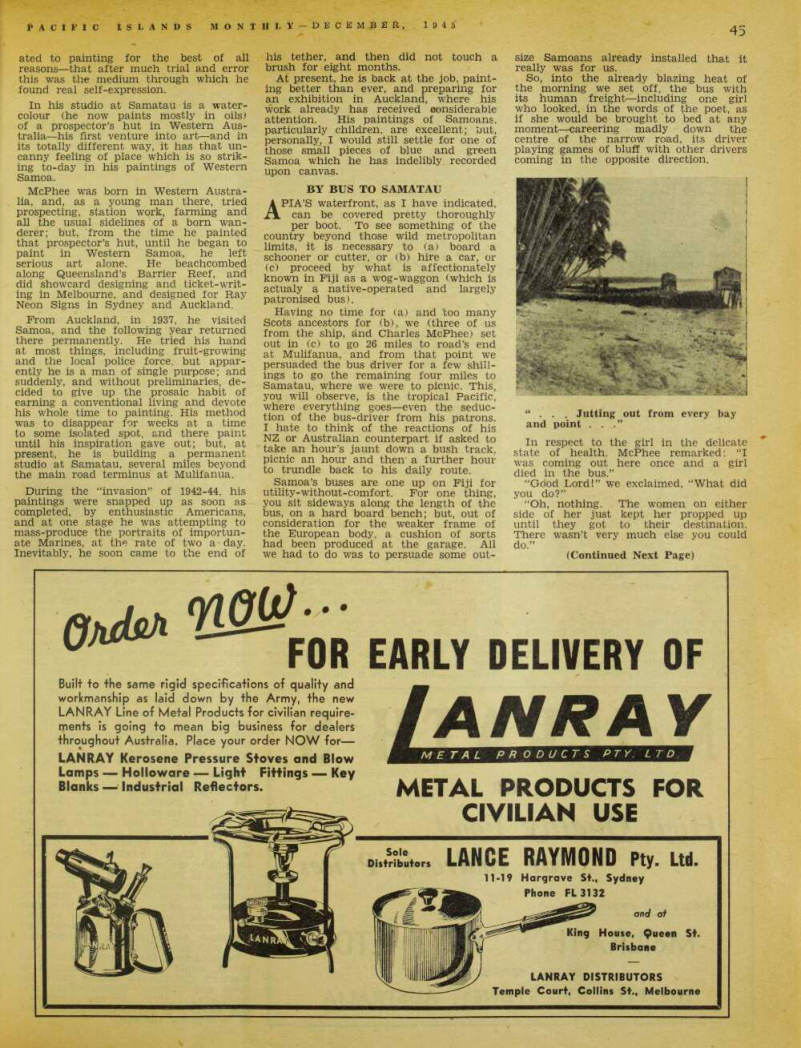
And Some Points East of Apia
By Judy Tudor
Out Of Apia. Oct. 26.
SOMEONE on this ship has suggested that I call this article (in the best traditions of modern journalism) “I Covered the Waterfront”—the waterfront in question being Apia’s, which most of us have covered in our several ways in the past three days.
At one end of it is the Casino Hotel, run by Mrs. Annie Jones; and at the other end (about a mile distant, in the cool of evening, and ten miles in the blazing heat of day) is the rival establish ment run by Mrs. Aggie Gray. Everyone in and out of Apia calls them “Annie” and “Aggie”; therefore I feel no breach of etiquette or disrespect for two well-known matrons by doing likewise. Notwith standing the hospitality at those, two ends, it is nothing short of amazing, how often one is impelled, in a three-days’ visit to the port, to stagger along that hot, white road between the two points, with nothing but a half-way ice-cream parlour by way of refreshment.
If, in the last month, I have been sar castic about the lashings of cold beer and other beverages laid on in Fiji I could be equally sarcastic at the lack of same in Western Samoa, where the tem peratures are higher and the thirst
correspondingly longer.
To be sure, the Territory is not en tirely dry; but one must go through the rigmarole of applying for a grog issue from the Government doctor, who pre scribes a fitting amount of “medicine.”
There may be some merit in these liquor permits: but why go through the farcical business of hanging them on the peg of health? They could as easily be issued by the Customs Department on a set per capita basis without any of the Scotsbyterian hocus-pocus indulged in at the present time.
In spite of the liquor restrictions, how ever, Apia appears to have some kind of night-life, even if it is practically in visible to the naked eye of the visitor,
and bears but a dim resemblance to the writings of Maugham. My pal of the headlines, who is doing a holiday round trip from Suva, says he and friend have been searching for a “real Apia bash” (bash being the current Fijian for wild party) since they got here, but with small success.
Maybe they didn’t know where to look.
We were to sail at the crack of to-day’s dawn. The dawn cracked and one, two and three hours went by, and breakfast came and went, and still we rolled at anchor in Apia Harbour. There was an air of suppressed tension about the ship; intermittently, an officer would appear and gaze shorewards with knit brows; and wild rumours circulated freely.
It transpired that a cook and two sea men had found their Apia bash. A house to-house search of the bush-gin palaces
had been in progress since the small hours; and, finally, the culprits, the cook showing signs of the bash literally, stag'gered on board.
The Paintings of Charles McPhee
I FIRST saw an oil painting by Charles McPhee in Suva. It was done, I was told, by “a young bloke in Samoa.” At Aggie Gray’s, in Apia, I met him and saw several more of his paintings. (See cover photo, this issue.) Charles McPhee is a quiet young man with a shy manner and no real apprecia tion of the worth of his own talent to reproduce on canvas the atmosphere of the Islands. So far, all his serious paint ing has been in Western Samoa; but one does not have to know that Terri tory to feel that his work is authentically South Seas. The Pacific has not been without painters; but few, particularly-■ the transitory kind, have succeeded in reproducing the shimmering pastel hazi ness or the clear-cut yet subdued out lines of the Pacific scene.
Those who like their figures elongated and their art reduced to free eyes and angles and patterns resembling the bath room tiles, purporting to reveal the con tortions of the artist’s naked soul, will find little in McPhee’s work to hold them.
He is a realist who paints as he sees, with natural skill and fine feeling, and is no product of city artiness. He gradu
Cathedral, oriental variety, on the road to Samatau.
ated to painting for the best of all reasons —that after much trial and error this was the medium through which he found real self-expression.
In his studio at Samatau is a water colour (he now paints mostly in oils) of a prospector’s hut in Western Aus tralia —his first venture into art —and in its totally different way, it has that un canny feeling of place which is so strik ing to-day in his paintings of Western Samoa.
McPhee was born in Western Austra lia, and, as a young man there, tried prospecting, station work, farming and all the usual sidelines of a born wan derer; but, from the time he painted that prospector’s hut, until he began to paint in Western Samoa, he left serious art alone. He beachcombed along Queensland’s Barrier Reef, and did showcard designing and ticket-writ ing in Melbourne, and designed for Ray Neon Signs in Sydney and Auckland.
From Auckland, in 1937, he visited Samoa, and the following year returned there permanently. He tried his hand at most things, including fruit-growing and the local police force, but appar ently he is a man of single purpose; and suddenly, and without preliminaries, de cided to give up the prosaic habit of earning a conventional living and devote his whole time to painting. His method was to disappear for weeks at a time to some isolated spot, and there paint until his inspiration gave out; but, at present, he is building a permanent studio at Samatau, several miles beyond the main road terminus at Mulifanua.
During the “invasion” of 1942-44, his paintings were snapped up as soon as completed, by enthusiastic Americans, and at one stage he was attempting to mass-produce the portraits of importun ate Marines, at the rate of two a day.
Inevitably, he soon came to the end of
his tether, and then did not touch a brush for eight months.
At present, he is back at the job, paint ing better than ever, and preparing for an exhibition in Auckland, where his work already has received oonsiderable attention. His paintings of Samoans, particularly children, are excellent; but, personally, I would still settle for one of those small pieces of blue and green Samoa which he has indelibly recorded upon canvas.
By Bus To Samatau
APIA’S waterfront, as I have indicated, can be covered pretty thoroughly per boot. To see something of the country beyond those wild metropolitan limits, it is necessary to (a) board a schooner or cutter, or (b) hire a car, or (c) proceed by what is affectionately known in Fiji as a wog-waggon (which is actualy a native-operated and largely patronised bus).
Having no time for (a) and too many Scots ancestors for (b), we (three of us from the ship, and Charles McPhee) set out in (c) to go 26 miles to road’s end at Mulifanua, and from that point we persuaded the bus driver for a few shill ings to go the remaining four miles to Samatau, where we were to picnic. This, you will observe, is the tropical Pacific, where everything goes—even the seduc tion of the bus-driver from his patrons.
I hate to think of the reactions of his NZ or Australian counterpart if asked to take an hour’s jaunt down a bush track, picnic an hour and then a further hour to trundle back to his daily route.
Samoa’s buses are one up on Fiji for utility-without-comfort. For one thing, you sit sideways along the length of the bus, on a hard board bench; but, out of consideration for the weaker frame of the European body, a cushion of sorts had been produced at the garage. All we had to do was to persuade some out
size Samoans already installed that it really was for us.
So, into the already blazing heat of the morning we set off, the bus with its human freight—including one girl who looked, in the words of the poet, as if she would be brought to bed at any moment —careering madly down the centre of the narrow road, its driver playing games of bluff with other drivers coming in the opposite direction.
In respect to the girl in the delicate state of health, McPhee remarked: “I was coming out here once and a girl died in the bus.”
“Good Lord!” we exclaimed, “What did you do?”
“Oh, nothing. The women on either side of her just kept her propped up until they got to their destination.
There wasn’t very much else you could do.” (Continued Next Page)
“ . . . Jutting out from every bay and point ...”
The fine sandy beaches along the road to Mulifanua, the blue sea, the distant Islands and the never-ending grace of the coconuts, we can attribute to God.
But the prodigious assortment of churches of cathedral dimensions, many of which have started off as Noble Edi fices in Stone (or concrete) and petered out into hasty makeshifts of corrugated iron in every variety of architecture (in cluding Oriental) and every stage of incompleteness, ail of which is mute testimony to inter-village Christian rivalry—and, keping numerical pace with them, the village lavatories, built out on short jetties or causeways over the local beach—these are the misguided works of man alone. I wondered how Charles McPhee, who paints the Samoan scene has been able to escape adding one of these architectural gems to his pictures.
The surfeit of churches was a new one to me; but the lavatories were not. They are—or were—common enough in Papua, where, after Doctor S. M. Lambert’s hookworm campaign, they were regarded as the surest prevention of the disease.
The beautiful little island of Samarai had a fine line of these privvies, as the good doctor calls them, but they were on the off-side of the island, well con structed and each at the end of about half a mile of jetty.
The Samoan counterpart has evidently been left to the Samoans, who got tired long before the jetty reached low-water mark—and I miss my guess if a spring tide reaches many of them —and con structed the sentry-box at the end from any available oddment of tin or wood.
Weather —and above all, time—has had its way with all of them, and the Lambert-pattern privvies (Samoan style) to-day reveal a great deal more than they conceal. Away they stretch as far as the eye can see, jutting <Dut from every small bay and point and ruin ing one of the Pacifiic’s most beautiful coast-lines. I hope the Samoan’s health is benefited thereby, because it is sheer useless sacrifice of beauty for utility, if it is not.
At Mulifanua, we shed our last Samoan passenger and began the final leg of our journey to Samatau. To say we travelled by road, would be plain exaggeration.
The track—and even that term flattered it—had been made by jeep and that, I judged, some time before.
It took us almost as long to do this four miles as it had to cover the previous 26, but in between bumps and lurches and dodging trailing undergrowth we at least had the opportunity of seeing Samoa away from the model villages close to Apia. The few small villages through which we passed had churches and no cathedrals; and if there were corresponding privvies, then they were decently hidden from sight, in building a studio on the beach at Samatau, and starting a large garden in the neighbourhood, Charles McPhee hopes to encourage the visits of others who would like to write or paint Samoa, The days when the wanderer could foist himself on the long-suffering Islander are things of the past—particularly in Samoa, where the Samoans have out grown most of the respect they might have had once for the European.
On the other hand, living in Apia, apart from affording little real worth to the observer of native life, can be ex pensive. The Samatau studio, then, would probably be a happy compromise and an excellent vantage point from which to study friend Samoan on his native heath,
Back To The Waterfront
QAMOA’S citizens, by and large, fore >3 see a boom in post-war tourist traf fic and in commerce. Maybe they are right, at that; the Americans seemed to like the place. But there are a few things needed before Samoa can think of tourists in paying quantities, the catering for which is a highly specialised business.
Although Samoa has, from the Euro pean point of view, been on the map for some 224 years, and Apia has never had a wharf, it still might be a good idea to have one now, before this expected boom descends from the blue, ships lie out between two reefs, and unload into ii ght ers, while the ships’ crews keep their eyes on the wea ther, rea dy to up anchor and away at the first sign of danger Even ln calm wea there a big swell rolls in from the sea, and p a ssengers decanting themselves into launches are in constant danger of tak ing a plunge, or having their legs ground off between the pitching boat and the ship’s gangway. Apart from the tourist angle, if Western Samoa is to have the happy future some of its more enthusias tic citizens forecast for it, then it should
by all means have a wharf —whatever the reasons there are against it.
Other simple little improvements would be the erection of a few seats along Apia’s maddening waterfront where poor weary travellers would rest their blis tered feet; the repeal of her archaic liquor laws; the provision of extra accom modation and, above all, the recovery of the native population from the present spasm of political growing pains.
Personally, I see no good reason why the Samoans, if they wish to live their own kind of lives, should encourage tourists, who are an unattractive, albeit profitable, proposition in the mass. But if the! Samoans do wish it, then they will have to revive those gracious Polynesian manners and cultivate a more amiable expression than the surly one worn at present.
There are two schools of thought in Samoa to-day; first, pro-Samoan (in cluding Europeans, who have married into Polynesian families) which says: Let us throw out all European interests and those who work for them and fight for the same measure of self-govern ment as Tonga; let us manage our own affairs, foreign and domestic; and, sec ondly, conservative opinion which de scribes the Samoans as having gone to the dogs, as having become a gang of cut-throats and thieves and deter minedly anti-British. Devotees of Opinion II say that if the Samoans can not be entirely free, then they would pre fer to be American; and they prove Samoan depravity by quoting such cases as the recent beating up of a visiting British warship’s officer by nine Samoans.
But although these two opinions flour ish in varying degrees throughout the whole community, it is at the same time universally believed that, by some mir acle, Samoa is to be graced by a period of great prosperity in the near future.
Several new industries are in the open secret stage, although nothing can be said about them officially. But why, if the Samoan labour and political set-ups are as uncertain as reported, any inves tor would be fool enough to put money into the country, passes all understand ing.
The trend of world opinion is for more and more self-determination for native races, and it has yet to be proved whether that is a good or bad thing. But I think there is a lesson for the Samoans in Tonga, which has suffered considerably through the war years in not being tied closely to a larger nation; and a lesson for those who are leaning over back wards, to see virtue in brown skins, in the unfinished condition of Samoa’s crop of cathedrals, which in the original in tention are tremendous, but in their final execution are but poor shadows of the builders’ good intentions.
D|7T]STERN SAMOA has been nothing fV but a pain in the neck to New Zea land ever since it was parcelled out as a Mandate in 1920; and if half the rumours are founded on fact there still is more trouble brewing there than a score of Chiefly goodwill visits to the Dominion can cure.
There is an abundance of food, cloth ing and consumer goods in Samoa at present, most of it American. Again, if rumour is correct, there are thousands of part-American babies in the villages.
The Samoans liked Americans and American ways and American dollars — they still speak in those terms.
Perhaps then, the happiest solution, all round, would be the amalgamation of Western and Eastern Samoa under the Stars and Stripes. Geographically and traditionally, they are one territory only interfering European politicians saw fit to separate the two.
Advertisements & other items, pp. 47-49 (2 items)
lan ray
OnM
<nQU) • • •
FOR EARLY DELIVERY OF
Built to the same rigid specifications of quality and workmanship as laid down by the Army, the new LANRAY Line of Metal Products for civilian requirements is going to mean big business for dealers throughout Australia. Place your order NOW for— LANRAY Kerosene Pressure Stoves and Blow Lamps Holloware Light Fittings Key Blanks Industrial Reflectors.
lan ray
METAL PRODUCTS PTY. LTD
METAL PRODUCTS FOR
CIVILIAN USE
Sole Distributors
LANCE RAYMOND Pty. Ltd.
11-19 Hargrave St., Sydney Phone FL 3132 and at King House, Queen St.
Brisbane
LANRAY DISTRIBUTORS
Temple Court, Collins St.. Melbourne
McILRATH’S
FOR
High Quality Food
at Bedrock Prices Orders and enquiries to—
McILRATH'S PTY. LTD.
Export Department,
202 PITT ST., SYDNEY, AUSTRALIA
im l
HARRY J .YOU Aft PIY. LTD.
Sole Pacific Islands Selling Representatives For:
BOND’S
<>r A
Quality
1
LOVELIER
THANEVER
J* Wi\
Dona
s F'; 1>
Garments
BOND'S
STANDARD
ATHLETICS
/ % v.
V
BONDS
HOSIE RY
istal Address: Box 3661, P. 0., Sydney, SK a tea
HARRY J .YOUNG PTV. LTD.
379 K|NT ST.,
Sydney.
Bankers: Bank of N.S.W. f , Codes: <V- Bentley’s Comp. Phrase Bentley's 2nd Phrase.
46
DECEMBER, 1945 —t A C'l f 1 C ISLANDS MONI B L 5
Death Of Mrs. Cowling, Old
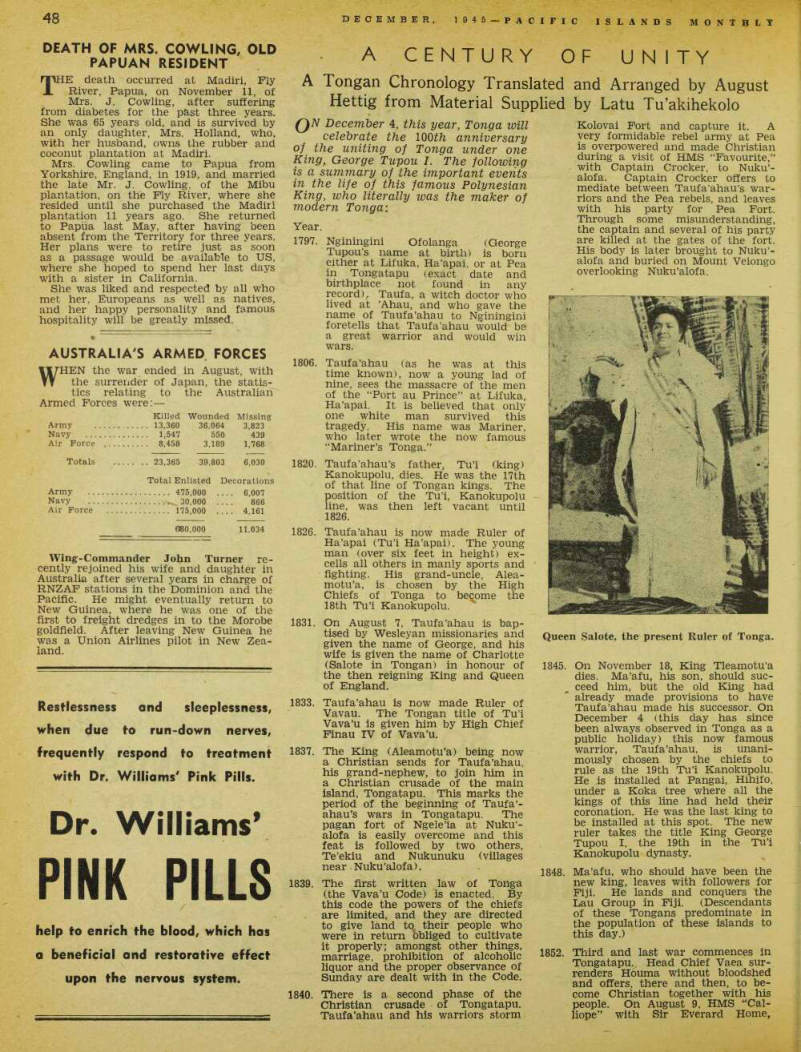
Papuan Resident
rE death occurred at Madiri, Fly River, Papua, on November 11, of Mrs. J. Cowling, after suffering from diabetes for the p&st three years.
She was 65 years old, and is survived by an only daughter, Mrs. Holland, who, with her husband, owns the rubber and coconut plantation at Madiri.
Mrs. Cowling came to Papua from Yorkshire, England, in 1919, and married the late Mr. J. Cowling, of the Mibu plantation, on the Fly River, where she resided until she purchased the Madiri plantation 11 years ago. She returned to Papua last May, after having been absent from the Territory for three years.
Her plans were to retire just as soon as a passage would be available to US, where she hoped to spend her last days with a sister in California.
She was liked and respected by all who met her, Europeans as well as natives, and her happy personality and famous hospitality will be greatly missed.
Australia's Armed Forces
WHEN the war ended in August, with the surrender of Japan, the statis tics relating to the Australian Armed Forces were:—
Wing-Commander John Turner re cently rejoined his wife and daughter in Australia after several years in charge of RNZAF stations in the Dominion and the Pacific. He might eventually return to New Guinea, where he was one of the first to freight dredges in to the Morobe goldfield. After leaving New Guinea he was a Union Airlines pilot in New Zea land.
Killed Wounded Missing Army 13,360 36.064 3,823 Navy 1.547 550 439 Air Force ... 1,768 Totals 23.365 39.803 6,030 Total Enlisted Decorations Army 6,007 Navy 866 Air Force 175,000 4.161 680,000 11,034
A Tongan Chronology Translated and Arranged by August
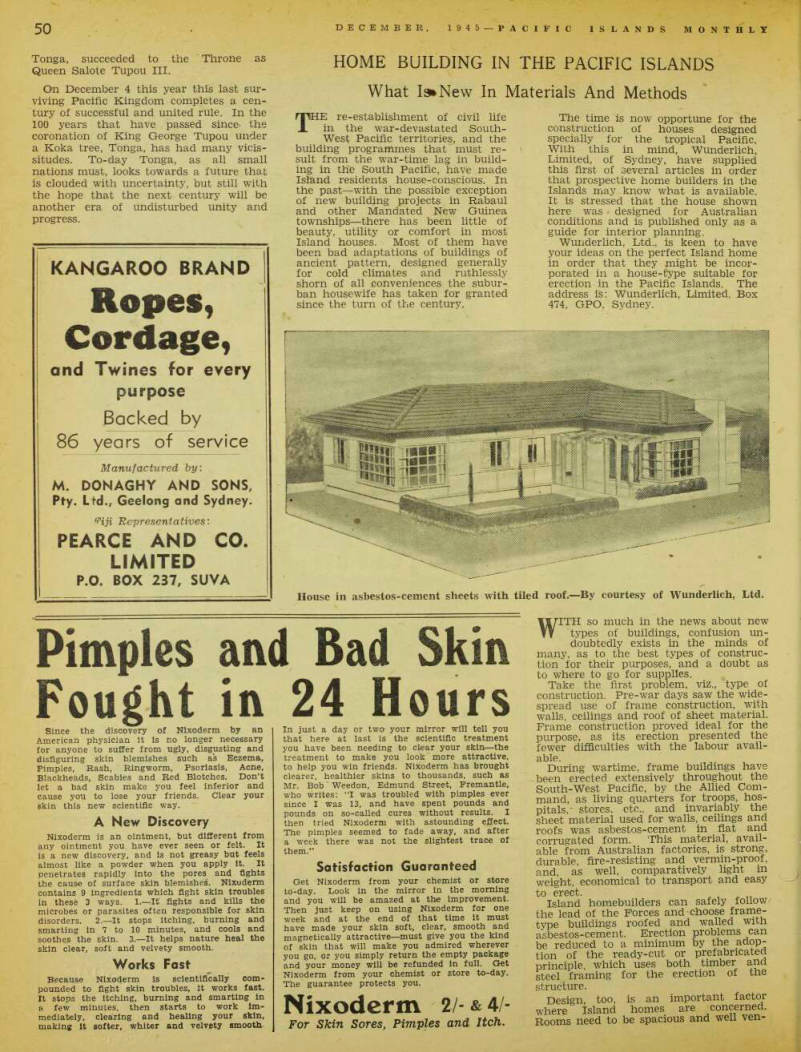
A Century Of Unity
A Tongan Chronology Translated and Arranged by August Hettig from Material Supplied by Latu Tu’akihekolo
0 N December 4, this year, Tonga will celebrate the 100 th anniversary of the uniting of Tonga under one
King, George Tupou I. The following
is a summary of the important events in the life of this famous Polynesian King, who literally was the maker of modern Tonga ; Year. 1797. Nginingini Ofolanga (George Tupou’s name at birth) is born either at Lifuka, Ha’apai, or at Pea in Tongatapu (exact date and birthplace not found in any record). Taufa, a witch doctor who lived at ’Ahau, and who gave the name of Taufa’ahau to Nginingini foretells that Taufa’ahau would be a great warrior and would win wars. 1806. Taufa’ahau (as he was at this time known), now a young lad of nine, sees the massacre of the men of the “Port au Prince” at Lifuka, Ha’apai. It is believed that only one white man survived this tragedy. His name was Mariner, who later wrote the now famous “Mariner’s Tonga.” 1820. Taufa’ahau’s father, Tu’i (king) Kanokupolu, dies. He was the 17th of that line of Tongan kings. The position of the Tu’i, Kanokupolu line, was then left vacant until 1826. 1826. Taufa’ahau is now made Ruler of Ha’apai (Tu’i Ha’apai). The young man (over six feet in height) ex cells all others in manly sports and fighting. His grand-uncle, Alea motu’a, is chosen by the High Chiefs of Tonga to become the 18th Tu’i Kanokupolu. 1831. On August 7, Taufa’ahau is bap tised by Wesleyan missionaries and given the name of George, and his wife is given the name of Charlotte (Salote in Tongan) in honour of the then reigning King and Queen of England. 1833. Taufa’ahau is now made Ruler of Vavau. The Tongan title of Tu’i Vava’u is given him by High Chief Finau IV of Vava’u. 1837. The King (Aleamotu’a) being now a Christian sends for Taufa’ahau, his grand-nephew, to join him in a Christian crusade of the main island, Tongatapu. This marks the period of the beginning of Taufa’ahau’s wars in Tongatapu. The pagan fort of Ngele’ia at Nuku alofa is easily overcome and this feat is followed by two others, Te’ekiu and Nukunuku (villages near Nuku’alofa). 1839. The first written law of Tonga (the Vava’u Code) is enacted. By this code the powers of the chiefs are limited, and they are directed to give land to their people who were in return obliged to cultivate it properly; amongst other things, marriage, prohibition of alcoholic liquor and the proper observance of Sunday are dealt with in the Code. 1840. There is a second phase of the Christian crusade of Tongatapu.
Taufa’ahau and his warriors storm
Kolovai Port and capture it. A very formidable rebel army at Pea is overpowered and made Christian during a visit of HMS “Favourite,” with Captain Crocker, to Nuku alofa. Captain Crocker offers to mediate between Taufa’ahau’s war riors and the Pea rebels, and leaves with his party for Pea Fort.
Through some misunderstanding, the captain and several of his party are killed at the gates of the fort.
His body is later brought to Nuku alofa and buried on Mount Veiongo overlooking Nukualofa.
1845. On November 18, King Tleamotu’a dies. Ma’afu, his son, should suc ceed him, but the old King had already made provisions to have Taufa’ahau made his successor. On December 4 (this day has since been always observed in Tonga as a public holiday) this now famous warrior, Taufa’ahau, is unani mously chosen by the chiefs to rule as the 19th Tu’i Kanokupolu.
He is installed at Pangai, Hihifo, under a Koka tree where all the kings of this line had held their coronation. He was the last king to be installed at this spot. The new ruler takes the title King George Tupou I, the 19th in the Tu’i Kanokupolu dynasty. 1848. Ma’afu, who should have been the new king, leaves with followers for Fiji. He lands and conquers the Lau Group In Fiji. (Descendants of these Tongans predominate in the population of these islands to this day.) 1852. Third and last war commences in Tongatapu. Head Chief Vaea sur renders Houma without bloodshed and offers, there and then, to be come Christian together with his people. On August 9, HMS “Cal liope” with Sir Everard Home,
Queen Salote, the present Ruler of Tonga.
arrives at Nukualofa, and there witnesses the subjugation of Pea.
There were Catholic priests (French) at Pea at the time and during the battle their mission or church house is burned. Taufa’ahau here intervened and saved what other belongings the priests had.
Later, the French acknowledge him as Supreme Ruler of Tonga. 1853. King George Tupou I pays a short visit to Sydney, Australia. En route he calls on Cakobau of Fiji. Cako bau promises him his kalia “Marama” (a huge double outrigger canoe). 1854. George Tupou appeals to Cakobau to give up paganism and become a Christian, which is accepted. 1855. Sails for Fiji in 39 double canoes to fetch his promised kalia from Cakobau. Assisted Cakobau to cap ture Kapa in Fiji. Met there his uncle, Ma’afu. Returned from Fiji with his kalia “Marama.” In the same year the King signs a Treaty with France. 1862. First Tongan Parliament meets on June 4. George Tupou first freed his own people in Lifuka in 1835, but the emancipation of 1882 is applied to all Tonga. The main ' principles of the Code of 1862, as it is known were that all Tongans, chiefs and commoners alike, were subject to the laws of the land.
They were set free from forced labour and compulsory contribu tions to the chiefs, and they were given complete control over their own property. In addition a Par liament, consisting of chiefs and representatives of the people, was 1869. Tongan national flag and Tongan coat of arms adopted. 1875. The new constitution of Tonga is formed. Its main divisions are: (1) a declaration of rights; freedom of life, property, worship, etc.; (2) the form of Government: the King, Privy Council and Cabinet, the Legislative Assembly, the Judiciary; (3) the land: declared to belong to the King who could grant estates to his nobles who were to lease portions of this land to their people. Land was not to be sold to Europeans or to anyone else; only leases approved by the Cabinet were to be recognised. The laws of succession to the throne and to titles of nobility were also set forth. 1876. First Government “Gazette” issued on January 1. The King signs a Treaty with Germany. 1877. The Throne made and placed at the Royal Chapel at the Palace, Nukualofa. Part of the famous Koka tree from Pangai used in the decorations on the back of the Throne. 1879. The King signs a Treaty with Great Britain. 1882. The King founds Tonga College for Tongan boys at Nukualofa and also introduces free secondary educa tion, using his private lease money to finance his ideas. 1888. The King signs a Treaty with the United States of America. 1893. On February 18 George Topou dies and on March 17, his second grand child was crowned King George Tupou II at the Palace Chapel, Nuku’alofa.
GEORGE TUPOU II died in 1918, and his daughter, the present ruler of
Tonga, succeeded to the Throne as Queen Salote Tupou 111.
On December 4 this year this last sur viving Pacific Kingdom completes a cen tury of successful and united rule. In the 100 years that have passed since- the coronation of King George Tupou under a Koka tree, Tonga, has had many vicis situdes, To-day Tonga, as all small nations must, looks towards a future that is clouded with uncertainty, but still with the hope that the next century will be another era of undisturbed unity and progress.
Advertisements & other items, pp. 50-52 (2 items)
Pink Pills
Restlessness and sleeplessness, when due to run-down nerves, frequently respond to treatment with Dr. Williams' Pink Pills.
Dr. Williams’
help to enrich the blood, which has a beneficial and restorative effect upon the nervous system.
Brial
i
gSS ;
smart pre-war capital fashion-conscious France r © Q, y Jh Q*. 6% 5) ~ln S d *4er At present being made in Australia— JEAN DIDIER'S Famous PERFUMES are NOW Available.
Sole Distributing Agents for the Pacific Islands:
BRIAL
528 COLLINS STREET,
MELBOURNE.
’Phone: MU 4837. &
BALL
1 BOND STREET,
SYDNEY.
’Phone: B 7371.
TRINITY GRAMMAR SCHOOL
The School is well equipped and splendidly situated Its 19’45 complement (about 65 boarders and 270 day boys) makes it possible for every boy to come into personal touch with the Head Master and a staff of 10 experienced and successful masters (Including seven University Graduates). The general life of the school is very varied and full of vigour. The Head Master will be pleased to send the Illustrated Year Book for 1946. on application, and to give full information about the school.
KEW, VICTORIA.
President of Council:
A. O. HENTY, Esq.
Headmaster:
ALFRED BRIGHT, M.Sc., B.A.
NEW YEAR TERM COMMENCES FEBRUARY 12, 1946.
Postal Address: Kew, E. 4, Victoria.
Telephone: Hawthorn 412.
KANGAROO BRAND
Ropes,
Cordage,
and Twines for every purpose Backed by 86 years of service Manufactured by:
M. DONAGHY AND SONS,
Pty. Ltd., Geelong and Sydney.
Representatives :
PEARCE AND CO.
LIMITED
P.O. BOX 237, SUVA
Pimples and Bad Skin Fought in 24 Hours
Since the discovery of Nlxoderm by an American physician It Is no longer necessary for anyone to suffer from ugly, disgusting and disfiguring skin blemishes such as Eczema, Pimples, Rash, Ringworm, Psoriasis, Acne, Blackheads, Scabies and Red Blotches. Don’t let a bad skin make you feel inferior and cause you to lose your friends. Clear your skin this new scientific way.
A New Discovery
Nixoderm is an ointment, but different from any ointment you have ever seen or felt. It is a new discovery, and is not greasy but feels almost like a powder when you apply it. It penetrates rapidly into the pores and fights the cause of surface skin blemishes. Nixoderm contains 9 ingredients which fight skin troubles In these 3 ways. I.—lf fights and kills the microbes or parasites often responsible for skin disorders. 2.—lt stops itching, burning and smarting in 7 to 10 minutes, and cools and soothes the skin. 3.—lt helps nature heal the skin clear, soft and velvety smooth.
Works Fast
Because Nixoderm is scientifically compounded to fight skin troubles, it works fast.
It stops the itching, burning and smarting in a few minutes, then starts to work Immediately, clearing and healing your skin, making it softer, whiter and velvety smooth.
In just a day or twa your mirror will tell you that here at last is the scientific treatment you have been needing to clear your skin—the treatment to make you look more attractive, to help you win friends. Nixoderm has brought clearer, healthier skins to thousands, such as Mr. Bob Weedon, Edmund Street, Fremantle, who writes: “I was troubled with pimples ever since I was 13, and have spent pounds and pounds on so-called cures without results. I then tried Nixoderm with astounding effect.
The pimples seemed to fade away, and after a week there was not the slightest trace of them.”
Satisfaction Guaranteed
Get Nixoderm from your chemist or store to-day. Look in the mirror in the morning and you will be amazed at the improvement.
Then just keep on using Nixoderm for one week and at the end of that time it must have made your skin soft, clear, smooth and magnetically attractive—must give you the kind of skin that will make you admired wherever you go, or you simply return the empty package and your money will be refunded in full. Get Nixoderm from your chemist or store to-day.
The guarantee protects you.
Nixoderm 2/- & 4/-
For Skin Sores, Pimples and Itch.
Home Building In The Pacific Islands
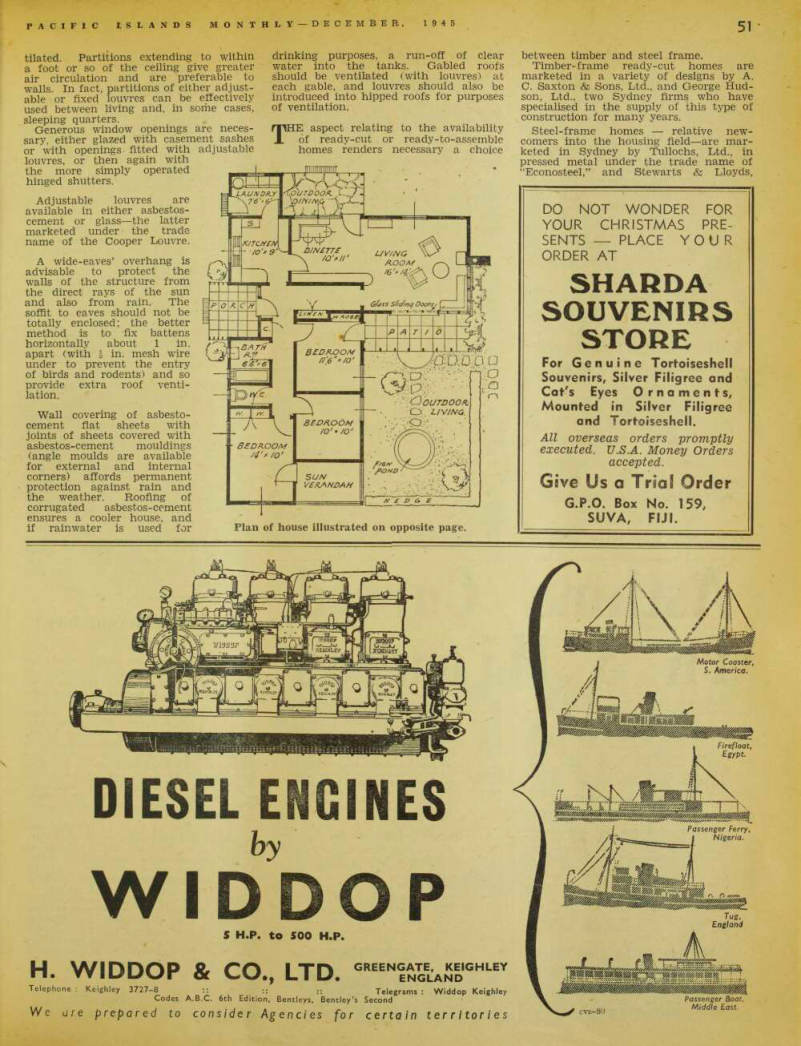
What Is New In Materials And Methods
rE re-establishment of civil life in the war-devastated South- West Pacific territories, and the building programmes that must re sult from the war-time lag in build ing in the South Pacific, have made Island residents house-conscious. In the past—with the possible exception of new building projects in Rabaul and other Mandated New Guinea townships—there has been little of beauty, utility or comfort in most Island houses. Most of them have been bad adaptations of buildings of ancient pattern, designed generally for cold climates and ruthlessly shorn of all conveniences the subur ban housewife has taken for granted since the turn of the century.
The time is now opportune for the construction of houses designed specially for the tropical Pacific.
With this in mind, Wunderlich, Limited, of Sydney, have supplied this first of several articles in order that prospective home builders in the Islands may know what is available.
It is stressed that the house shown here was designed for Australian conditions and is published only as a guide for interior planning.
Wunderlich, Ltd., is keen to have your ideas on the perfect Island home in order that they might be incor porated in a house-type suitable for erection in the Pacific Islands. The address is: Wunderlich, Limited, Box 474, GPO, Sydney.
WITH so much in the news about new types of buildings, confusion un doubtedly exists in the minds of many, as to the best types of construc tion for their purposes, and a doubt as to where to go for supplies.
Take the first problem, viz., type of construction. Pre-war days saw the wide spread use of frame construction, with walls, ceilings and roof of sheet material.
Frame construction proved ideal for the purpose, as its erection presented the fewer difficulties with the labour avail able.
During wartime, frame buildings have been erected extensively throughout the South-West Pacific, by the Allied Com mand, as living quarters for troops, hos pitals,' stores, etc., and invariably the sheet material used for walls, ceilings and roofs was asbestos-cement in fiat and corrugated form. This material, avail able from Australian factories, is strong, durable, fire-resisting and vermin-proof, and, as well, comparatively light in weight, economical to transport and easy to erect. „ , „ „ Island homebuilders can safely follow the lead of the Forces and choose frame type buildings roofed and walled with asbestos-cement. Erection problems can be reduced to a minimum by the adop tion of the ready-cut or prefabricated principle, which uses both timber and steel framing for the erection of the structure.
Design, too, is an important factor where Island homes are concerned.
Rooms need to be spacious and well ven
House in asbestos-cement sheets with tiled roof. By courtesy of Wunderlich, Ltd.
tilated. Partitions extending to within a foot or so of the ceiling give greater air circulation and are preferable to walls. In fact, partitions of either adjust able or fixed louvres can be effectively used between living and, in some cases, sleeping quarters.
Generous window openings are neces sary, either glazed with casement sashes or with openings fitted with adjustable
louvres, or then again with the more simply operated hinged shutters.
Adjustable louvres are available in either asbestos cement or glass—the latter marketed under the trade name of the Cooper Louvre.
A wide-eaves’ overhang is advisable to protect the walls of the structure from the direct rays of the sun and also from rain. The soffit to eaves should not be totally enclosed; the better method is to fix battens horizontally about 1 in. apart (with I in. mesh wire under to prevent the entry of birds and rodents) and so provide extra roof venti lation.
Wall covering of asbesto cement flat sheets with joints of sheets covered with asbestos-cement mouldings (angle moulds are available for external and internal corners) affords permanent protection against rain and the weather. Roofing of corrugated asbestos-cement ensures a cooler house, and if rainwater is used for
drinking purposes, a run-off of clear water into the tanks. Gabled roofs should be ventilated (with louvres) at each gable, and louvres should also be introduced into hipped roofs for purposes of ventilation. rpHE aspect relating to the availability X of ready-cut or ready-to-assemble homes fenders necessary a choice
between timber and steel frame.
Timber-frame ready-cut homes are marketed in a variety of designs by A.
C. Saxton & Sons, Ltd., and George Hud son, Ltd., two Sydney firms who have specialised in the supply of this type of construction for many years.
Steel-frame homes relative new comers into the housing field—are mar keted in Sydney by Tullochs, Ltd., in pressed metal under the trade name of “Econosteel,” and Stewarts & Lloyds,
Plan of house illustrated on opposite page.
who have developed a tubular steel framework. Others interested include Armco (Aust.), Ltd.
The “Econosteel” type affords, perhaps, the least difficult assembly problem, as it is maintained that only a hammer, a wrench and a fleeting boyhood experience with a “Meccano” set is all that is re quired to erect the framing. All of the steel components are developed around simple devices that permit sheet materials such as asbestos-cement to be nailed direct to the steel structure.
In subsequent issues of “PIM,” the various ready-to-assemble timber and steel frame houses will be fully described.
In the meantime we publish a plan that may be«of interest. It shows a house type suitable for Australian conditions and may give readers some ideas on internal planning.
Advertisements & other items, pp. 53-54 (1 item)
Wi Doo P
DO NOT WONDER FOR
YOUR CHRISTMAS PRE-
SENTS PLACE YOUR
ORDER AT
SHARDA
SOUVENIRS
STORE
For Genuine Tortoiseshell Souvenirs, Silver Filigree and Cat's Eyes Ornaments, Mounted in Silver Filigree and Tortoiseshell.
All overseas orders promptly executed. U.S.A. Money Orders accepted.
Give Us a Trial Order
G.P.O. Box No. 159,
SUVA, FIJI.
n i«j
KUOtUV
\ I Ci r\ .aJ sn
DIESEL ENGINES
WI DOO P
5 H.P. to 500 H.P.
H. WIDDOP & CO., LTD. greeng e £ t g e laS e d ighley Telephone : Keighley 3727-8 :: :: Telegrams : Widdop Keighley Codes A.B.C. 6th Edition, Bentleys, Bentley’s Second We are prepared to consider Agencies for certain territories
XA\ /ir
sMMB \ \ / Mi--
Motor Coaster S. America. y' Firefloat, Egypt.
Passenger Ferry, Nigeria.
Tug, England cvs-80 Passenger Boat, Middle East
TO TRADERS AMD STOREKEEPERS
IN THE
SOUTH PACIFIC TERRITORIES
Storekeepers and traders in New Guinea, Papua, Solomon Islands, New Hebrides, Fiji, Tonga, Samoa, Cook Islands and French Oceania, who are prepared to handle quick-selling and profitable lines of American manufactured goods are invited to communicate immediately with the undersigned.
During the next few months many valuable agencies, well worth handling in the South Seas, are likely to become available.
Pacific Islands Trading Company, 244 California Street, San Francisco, U.S.A.
Asthma Curbed In 3 Minutes
Since the discovery of Mendaco by a famous physician sufferers can get relief from Asthma. Mendaco does away with expensive injections and offensive smokes.
All you do is to take 2 tasteless tablets with meals and Mendaco starts circulating through the blood in 10 minutes. You breathe easily and freely. Your nerves relax, you get good, fresh, pure air into your lungs, and vigour returns.
Sleep Like a Baby
Thousands of former sufferers from Asthma say that the very first dose of Mendaco brought them glorious ease and comfort, and that they slept soundly the very first night. Then their vigour returned and they felt healthier and stronger, and 5 to 10 years younger. The reason for this is that Mendaco acts in natural ways to overcome the effects of Asthma. (1) It removes the mucus or phlegm; (2) It relaxes thousands of tiny muscles in your bronchial tubes so that the air can get in and out of your lungs; (3) It promotes body vigour, and stimulates the building of rich, revitalised blood.
No Asthma for Five Years
Mendaco not only brings almost immediate results, free breathing and comfort and enables you to sleep, but also builds up the system to ward off future attacks. Mr.
J. R. writes: “I was almost dead with Asthma. Had lost 40 lbs. in weight, suf-
fered coughing every night—couldn’t sleep.
Mendaco stopped spasms first night. I have had no Asthma since in over 2 years.”
Mrs. A. W. writes: “I had Asthma for 25 years. After using Mendaco I can sleep all night and have not had an attack since taking it.” Mrs. G. E. C. writes: “I bless the day I first heard of Mendaco. What a godsend it id to a poor woman like me who for 35 years never knew what it was to have a good night’s rest. The constant fight between Asthma and sleep was wearing me down, but I feel now I want to forget my past suffering.”
Benefits Immediate
The very first dose of Mendaco goes right to work circulating through your blood and helping nature rid you of the effects of Asthma. Try Mendaco under an iron-clad money back guarantee. You be the judge.
If you don’t feel fully satisfied after taking Mendaco just return the package and the purchase price will be refunded. Get Mendaco from your chemist to-day and see how well you sleep to-night and how much better you will feel,
RELIEVES ASTHMA
Mendaco
Now in 2 sizes 6/- and 12/-
New Guinea Timber
Australian Sawmillers Interested in Softwoods
EVIDENCE that Australian sawmillers are interested in New Guinea tim ber is indicated by recent inquiries from the secretary of the Richmond- Tweed Branch of the Association of Country Sawmillers of New South Wales, Mr. Alex. R. L. Small.
Mr. Small’s Association is particularly seeking utility softwoods suitable for fac ing three-ply, and he states that hoop pine, usually used for this work, is now a thing of the past in New South Wales.
Establishments using the ports of Byron Bay, Ballina and Coff’s Harbour, in New South Wales, would be able to cope with 3,000 logs a year of peelable quality (logs to average 1,000 super, feet), but would need to be assured of 10 years’ regular and steady supply. This would mean that 30,000,000 feet of suitable softwood would be required in the period, prefer ably from as small an as possible.
Some of the points made in Mr. Small’s inquiries are:— • Under what conditions as regards tenure and royalty (or its equivalent) would the area be made available? • What would be the approximate cost per 100 super, feet of placing the logs either in rafts or at a place where they could conveniently be loaded for trans port to Australia? • Assuming boats were available, and the total distance 1,200 miles, what is an estimate of the freight, insurance and handling cost per 100 super, feet? • What is the present import duty on logs imported from the Australian Ter ritories, and what chance is there of having this duty eased or lifted? • What is the present import duty on logs imported from the Australian Ter
ritories, and what chance is there of having this duty eased or lifted? • What is the situation In normal times with regard to the establishment of a mill on the job to saw logs not economic to freight to Australia for peel ing. This might be necessary in order to keep hverall logging costs to a mini mum. If favourable, is there an island market for the sawn timber produced without competing unduly with estab lished sawmills? • What quantity of millable or peel ing quality logs of other species would be associated with the basic softwood over the proposed area?
WHEN approximate costs and quanti ties are known, the Association then would be in a position to approach the Minister for External Ter ritories, Mr. Small said.
Reference to New Guinea timber mill ing was made by Mr. Ward in his address to the Pacific Islands Society recently (see report on page 25, this issue). He stated that men with timber permits were being allowed to go to the Terri tories, but that, for the present, any timber milled in the Territories would be used for building purposes there.
During the war both Australian Army and Air Force units have been operating milling plants in New Guinea. In an Army bulletin issued in September, it was stated that “from the ‘commence ment of sawmilling operations in May, 1944, to June this year, approximately 20,000,000 super, feet of sawn timber was produced, valued at mainland prices at about £465,000, and representing a sav ing in shipping of approximately 57,000 tons, on which freight charges would have approximated £285,000. This represents sufficient timber to build 2,000 good-sized four-roomed wooden houses.
“Present production in New Guinea and the Islands is at the rate of 1,750,000 super, feet per month, valued at about £40,000, and representing a monthly sav ing in shipping space of 5,000 tons and freight charges of £25,000.”
Mr. Ward Reconsiders ?
Letter to the Editor rERE are certain small indications that Mr. Ward, who formerly has tried to run the New Guinea terri tories on theory, is beginning to see some light.
In an informal chat with a woman member of the Pacific Islands Society, after his talk there on October 28, he said that he had only recently begun to realise what a large part women had played in the life and work of the Ter ritories and he expressed admiration at what he had learned of the way some of them had run their own plantations, mines and businesses there in primitive conditions.
He said that as soon as shipping was available and food supplies were depend able in the Territory, he would see to it that women were permitted to return to their homes and properties. In this way he felt that the Territories would be assisted to return quicker to normal.
It will be remembered perhaps that over 12 months ago, when women mis sionaries were permitted to return to Papua, it was pointed out by the PTA that the best way of showing the natives that the war was over in Papua was to allow planters’ wives to return.
I am. etc.,
“Territorian.”
Sydney, 8/12/45.
Advertisements & other items, pp. 55-57 (3 items)
Ssamsthi
FIJI'S SOUTH SEA BUBBLE
Tale of the Old Polynesian Company Retold by Mr. R. C. Macpherson
THE development of gold-mining in Fiji in the last decade and the search for gold in the Solomons, interrupted by the war, has done much to draw the attention of Australian in vestors to the South Pacific, but it is interesting to recall that just about three-quarters of a century ago many Melbourne investors were extremely in terested in the South Seas. Melbourne was then in the throes of a South Sea boom, an outcome of the establishment of the ill-fated Polynesian Company.
However, like the better-known South Sea Bubble of an earlier century, this bubble, too, burst, leaving financial ruin in its path.
To understand fully the rise and fall of the Polynesian company it is neces sary to go back to the late ’forties of the 19th century, in Fiji—before those islands became a British possession and Queen Victoria’s law replaced the club law of the so-called King Cakobau and his henchmen.
In the ’forties a sizeable white settle ment, principally of adventurous traders and a few cotton planters, had grown up in Levuka. Cotton was then enjoying a boom in the markets of the world.
Many of the settlers were Americans, and there was resident in Fiji an Ameri can commercial agent (Mr. J. B. Wil liams) , who generally styled himself American Consul. The train of incidents which led to the formation of the Poly nesian Company might be said to have been started by this official’s celebration of the Glorious Fourth of July in 1849.
Like most of the buildings of those days, the consulate was constructed of native materials, and the Consul’s fire works set it alight. In the ensuing con fusion some of his belongings were looted by Fijians, and the incensed Consul, set ting a very high value on his lost posses sions, called on his Government for sup port in a demand for recompense.
There had been a previous burning of American property in the Nadi district, when Fijians raided the cottop planta tions of several planters, two of them Americans, Messrs. Burt and Underwood.
These Americans also had lodged com plaints, but it was not until September, 1855, that Commander Edward B. Bout well in the USS “John Adams” arrived “to demand and insist upon reparation for wrongs committed upon the property of American citizens by the natives.”
The captain of the “John Adams’ assessed the total damage at 45,000 dollars (£9,000), and a claim for this amount was presented to Cakobau, who had assumed the title of Tui Viti, or King of Fiji—a title to which he had no real right, as subsequent events showed.
Cakobau, at all events, could not meet the claim, and when no effort had been made to pay it by 1858, the USS “Van dalia” arrived on the scene to reiterate the demand.
By 1867 only 1,435 dollars aPd 81 cents had been paid, and USS “Tuscarora” arrived on a similar mission. This time Cakobau gave a mortgage over the islands of Moturiki. Batiki and Nairal to secure payment of the remaining debt which was to be paid by four annual instal ments.
Prior to this, in 1858, the harassed chief had turned to Great Britain for aid, offering to Queen Victoria 200,000 acres of land and the sovereignty of the Group in return for settlement of the American
debt. The British Government went so far as to send out an investigator, a Colonel Smythe, but on his recommenda tion, the Imperial Government refused the offer.
American pressure continued in the succeeding years, and Cakobau remained open to any offer, and eventually nego tiations were started between the “King” and Messrs. W. H. O’H. Brewer and J. L.
Evans, representing a Melbourne syndi cate, to raise the funds.
IN 1868, at the American Consulate, Cakobau signed a charter or conces sion whereby, in consideration of their making provision for settlement of the American claim for £9,000, he trans ferred to Messrs. W. H. O’H. Brewer.
J. L. Evans, Andrew Lyell, and F, Cook, of Melbourne, 200,000 acres of land on Vitilevu and Vanualevu, the island of Beqa and certain islands within the Beqa reef, also Suva and its harbour, terri tories and districts.
The company, which it was understood was to be formed, was also exempted from all taxation or imposts on the im portation into or exportation from any of the lands so transferred. It was also for 21 years to have the sole right to establish a banking institution in the kingdom and the right to issue and cir culate bank notes.
For these concessions Cakobau was to receive an annuity of 1,000 dollars.
Armed with the charter the promoters returned to Melbourne and the Polyne sian Co.. Ltd., was incorporated and registered in 1864, with a nominal capi tal of £lOO,OOO.
The promoters transferred all their interests under the charter to the com pany for 10,000 fully paid-up shares of £2 each. These shares, however, were never actually issued, being held in reserve until all the land had been handed over to the company.
The share list was opened, 13,700 shares
being issued and capital to the amount of £28,000 was subscribed by the public in Victoria, and in February, 1869, the
SSAMSthI
whole of the American claim of £9,000 an d j n f eres f was p a id to the American C °nn U q P ntPmhPr 18 1869 Cakobau and
viwa conveyed tSe
company for £2,748, 10 square miles of land in y vitilevu Bay This 4 was confirmed b 13 chiefs in the district. The Vitilevu block was supposed to contain 80,000 Beaa 10 000 and Suva 60.000, while
10Jooacresto Natewa
Q Vanualevu This still left a defi ie ’ i n the stipulated area, t 0 enablethe company to meet its ob ligations it sold to some of its own Qbarphnldprs and others commonly known as the "Forty Thieves”—for £9,000, Sff of ?ts lands in blocks of 2 500 acres toeac°h of the"4o to con-
MSck^e^
B represented by Mr , Amess one time Mayor of Mel- Samuel Amess one . Mayor of Mei^ °°urne A Me^ a ker i nomas a.
(CONTINUED ON NEXT PAGE)
AT , the date of the formation of the Polynesian Company, Fiji was in the public eye as an excellent field for cotton cultivation, owing to the high prices ruling at that time because of the dislocation of the American market due to civil war, and there was a Fiji boom in Melbourne, many settlers leaving for Levuka at every opportunity. Therefore, as soon as the company made it known in Victoria that it possessed thousands of acres of first-class land in Fiji there was a rush of applications.
The company adopted a system of free grant land warrants, whereby land could be selected in certain districts and pur chased by shareholders at the rate of 7/6 an acre in the proportion of one acre of agricultural land to every £1 of capi tal invested in the company. There were 359 warrants issued for 510 lots in the township of Suva, and 348 warrants for 54,360 acres of country lands.
Trouble started when surveyors sent by the company attempted to survey the land. The Vitilevu Bay block was re ported to contain only 50,000 acres, in stead of the promised 80,000, and a large portion was quite unsuitable for settle ment. Other claimants also appeared, holding titles from local chiefs.
The natives of Beqa took a belligerent stand, and refused to permit either Cako bau or the company’s agents even to
land; and Maafu, a Tongan chief, and former chief of the Lau Confederacy, claimed the island to be his, excepting certain blocks previously sold.
A partial survey was made of the Suva area, the portion surveyed being found to contain 27,000 acres instead of the 57,600 acres estimated by the company, and a large portion on the east side of the harbour was claimed by an earlier settler, a Mr. Swanston, and others, and the west side by Maafu, andT the chief of Namosi.
The surveyors were dared to enter upon other portions of the grants, on the ground that Cakobau had no right what ever to dispose of them, as the people there did not recognise his sovereignty.
By now, desperately anxious to get land anywhere, the company on February 1, 1870, purchased from Mr. William Mar shall Moore, for £25, four small islands in Suva harbour. (Incidentally, these islands have never been put to any prac tical use.) Suva was originally intended to be on the west bank of the Lami River, and elaborate plans were drawn up and building allotments snapped up by people of small means in Melbourne. Applica tions were received for the whole of the Suva property, and many shareholders left Australia and settled on the Suva lands, including Messrs. H. M. and F. W.
Armstrong, Brewer, Joske and others, who became well known in the Colony.
Mr. Frederick Cook replaced Mr.
Glenny as manager at the end of 1869, and he was succeeded by Mr. James S.
Butters, in June, 1870. Later Mr. C. R.
Forwood took charge.
From 1869 till 1872 the company .was in continual communication with Cako bau, insisting on his fulfilling the agree ment, and handing over the balance of the 200,000 acres, but no more land was allotted to the company, nor could it obtain possession of all the properties which were supposed to have been al ready transferred.
In reprisal, the directors of the company refused to pay Cakobau his 1,000 dollars annuity.
IN 1872 constitutional government was proclaimed under Cakobau Rex, and notice was served on the new Gov ernment that Cakobau had not handed over the 200,000 acres agreed upon, there being a deficiency of 110,000 acres, after allowing for rival claims.
The Government subsequently ad mitted the company’s claim to the island of Beqa, and at the first sitting of the new Parliament the contract entered into by Cakobau with the company was rati fied, with the exception that the Gov ernment refused to recognise the banking and other concessions granted by Cako bau. Though later an agreement was made to secure to the company posses sion of the deficiency of land, no practical effect ever seems to have been given to it.
The company’s expenditure between 1868 and 1874 amounted to over £45,000.
Subscribed capital alone represented £27,433 and £10,248 had been received from land sales, including the £9,000 from the “Forty Thieves.”
The company’s representatives in Fiji were exceedingly lavish in their expen diture, and two inspectors, Messrs. A. R.
Smith and J. Brooke, sent by the share holders in 1874 to inquire into the affairs of the company, reported mis management and gross irregularities, by which the company was robbed of thou sands of pounds and large tracts of land appropriated by the company’s officers for themselves land which in some cases had been previously selected and occupied by other settlers under the com pany’s regulations. Surveys were alleged to be incorrect, and even the surveyors’ plans had been altered. 117 HEN Sir Hercules Robinson arrived ff in 1874 to annex the islands on behalf of Britain, representations were made to him on the difficulties ex perienced by the company in obtaining possession of land granted under the charter, and his aid was asked in secur ing to the company its just and reason able claims for deficiencies in the land ceded—to wit 110,000 acres—also the banking privileges, worth at least £5,000, and freedom from taxation within the company’s territories.
Sir Hercules, in his report on the com pany, considered that Cakobau was “only chief of Bau when he signed the char ter, and had no right to act as he had done.” He recommended that the charter be not recognised by the British Gov ernment, but that as the easiest way of settling the claim, the sum of £9,000 originally paid the Americans be repaid by the new Government, and the com pany left in possession of the 400 or 500 acres already occupied by tenants of the company in the Suva district.
In December, 1874, the Melbourne manager of the company, Mr. George T.
Wyleigh, addressed the Earl of Carnar von, then Secretary of State for the
Colonies, claiming redress. The Secretary of State replied that the matter would be dealt with by the Governor of the new Colony. Further claims were made to Downing Street. Sir Arthur Gordon, the Governor, was instructed “to cause it to be very clearly understood that Her Majesty’s Government and the Colonial Government absolutely and entirely de clined to admit that they were neces sarily under any obligation to take up liabilities incurred by those who pur ported to administer the affairs of the islands.”
In 1875, Mr. G. A. Woods, a former official of the Cakobau Government, arrived from Melbourne with a power-of attorney from the company’s share holders and petitioned the Government with the company’s claims. The Govern ment thereupon decided that the charter signed by Cakobau was invalid, and the company ought not to receive any grant of lands beyond those already in its pos session.
Voluminous correspondence passed and the Land Commission commenced sittings in 1875. Though correspondence went on for some years the Government continued to decline recognition of the charter.
When Suva was announced as the future seat of Government of the Colony in 1877, the company’s attorney pro tested, but the Colonial Secretary simply acknowledged receipt of the letter, there there being no further action on the part of the Government.
SO practical existence of the Polynesian Co., Ltd., which brought ruin to many families in Victoria, who invested their hard-earned savings in the concern. But, though it proved disastrous for the shareholders, it brought Fiji prominently under the notice of the Australian public and induced settlement in the Group—many of the
descendants of the first settlers of the Polynesian Company still being promi nent in the life of the Colony.
Wove* Bbof. (Fypwey) Itd.
Your old SCISSORS, RAZORS
and KNIVES can be
SHARPENED and REPAIRED
-- •© I Send them to—
W. JNO. BAKER 5*
3 HUNTER STREET,
SYDNEY.
w. u \\\N \o^ D^
sheet*
tvi^
vef s doto fr 0^
rrivio9
qU» her® rep hone
rdio"V
B*' 9 * \fj rit 0 ,781 list isvo b 8° 5 0*» S
mv*s
RANGE COVERS:
• ELECTRICAL GENERATING
EQUIPMENT. TRANSFORMERS
AND SWITCHGEAR.
• ELECTRIC MOTORS AND
CONTROL APPARATUS.
• ELECTRIC CABLES AND IN-
SULATING MATERIALS.
• FLUORESCENT AND INCAN-
DESCENT LIGHTING.
• COMMERCIAL COOKING &
HEATING EQUIPMENT.
• DOMESTIC ELECTRIC APPLI-
ANCES. RADIO & WIRING
ACCESSORIES.
• MATERIALS HANDLING
EQUIPMENT.
• MACHINERY & ENGINEER-
ING EQUIPMENT, METALS,
CHEMICALS.
• COAL MINING EQUIPMENT.
• METALLIFEROUS MINING,
QUARRYING AND CEMENT
MAKING MACHINERY.
WOVE* BBOf. (fYPWEY) ITD.
115 CLARENCE STREET, SYDNEY
NEWCASTLE • WOLLONGONG • BRISBANE^
WANTED TO BUY—QUALITY GUNS AND RIFLES
HIGHEST PRICES GIVEN. WILL ALSO EXCHANGE GUNS.
New .303 Short Service Barrels, 2SW, without Sights and Platform, £2/15/- each.
Postage extra. 3| L RO H U Quality Firearms and Fishing Tackle. 143 ELIZABETH STBEBT (Near Market St.) SYDNEY.
’PHONE: MA 3540.
Established 1930.
Bankers: Bank of New Zealand, Auckland.
Wm. H. WATSON
Wholesale and Retail Trader
RAROTONGA, COOK ISLANDS
Cable Address: Watson, Rarotonga.
AGENTS WANTED.
American Servicemen in the Pacific: Sell Island curios in the Pacific now, and in the U.S.A. when you return home. Send 20.00 to 100.00 dol. for trial order of Motherof-Pearl Brooches and strings of Sea-Shells, all guaranteed good sellers. These goods are sent by parcel post franked with high value Cook Islands stamps, which have a high re-sale value.
PRESENTS FROM THE PACIFIC.
The following 5.00 dol. parcel sent post free to any address in the Pacific or the U.S.A.: 1 Bright coloured Hula-Skirt, with decorated waistband. 3 Strings Assorted Sea-Shells, 60 in. long. 1 Mother-of-Pearl Brooch. 1 Cook Island Pennant—island scene in colours.
ISLAND BOOKS BY
ROBERT DEAN FRISBIE.
This well-known American writer has autographed a limited number of his two latest books, “Island of Desire” and “Amaru,” so that a lew of his fans can secure something that is always treasured, an “Author’s Copy.” The price, 7.00 dol. for the two, sent registered mail to any address. When remitting dollar bills, please register the letter.
"THE READER'S DIGEST"
Have the world’s best Digest posted direct to you from the U.S.A. at the following attractive rates: One year’s subscription, 12/-; two year’s subscription, 20/-; post free.
Send your full name and address and subscription to above Rarotonga address.
STAMP DEALERS AND COLLECTORS.
Covers serviced for Dealers at usual rates. Collectors: Send one dollar for two covers franked with the current issue of the Cook Islands stamps, 'Asd. to 1/- (eight stamps per cover). Sent air-mail to any address. To Cover collectors: Here is a “rare” offer—First Day Cover, Cook Island, King George V Jubilee, 1935, complete set, only 5.00 dol. Used sets off cover, Cook Island, King George VI Coronation, 50 cents, per set.
"PARAU" M.O.P. PRODUCTS.
We manufacture a large assortment of lovely designs made by native craftsmen from Penrhyn Island Pearl Shell.
’RAROTONGA" HULA-SKIRTS.
The finest Hula-Skirts made in the South Seas come from Rarotonga; over 50,000 sold. These are made in bright colours with floral decorated waist-bands.
SHELL NECKLACES.
White, Yellow and assorted Shells, each string 60 in. long. Any quantity can be supplied. Over half a million strings of these popular shells have been exported. Terms— D/P your own bank.
ISLAND FOOTWEAR.
Made in our own factory here in Rarotonga. At present specialising in women’s Road and Evening Sandals. Extra wide lasts, suitable for native trade. Best materials used.
Sizes, 3-7. Colours: white, black and brown. Be the first in your territory to stock this good seller by cabling for trial order of dozen pair, assorted colours, designs and sizes.
54
DECEMBER, 19 4 5 -PACIHc ISLANDS MONTHLY
Death Of Mr. N. S. Falla
Of Union Co.
Union Steam Ship Company Chief,
Mr. N. S. Falla, died suddenly at sea on November 6, while en route to Wellington from Colombo.
He was born in Westport, NZ, in 1883, and joined the Union Company there in 1898. Later he was moved to Dunedin and at the outbreak of World War I was assistant general traffic manager.
He enlisted in the New Zealand Forces in 1914 and served in Egypt, Gallipoli and on the Western Front, rising to the rank of Lieut.-Colonel and taking charge of the Second and Third Brigades of the NZ Field Artillery. During his First World War service he was twice decora ted.
He returned to the Union Company in 1919 as general manager and in 1934 was appointed to the board of directors and later that year became managing direc tor. In 1936 he was appointed chairman of the board.
After the outbreak of World War II he enlisted again and with the rank of brigadier went to the Middle East with the 2nd NZEF. Soon after he had ar rived there, however, the British Minis try of War Transport asked for his ser vices and he spent the greater part of the war years in London.
His services to the Union Company’s shipping services have been outstanding; but, in addition, he was largely respon sible for the founding of Union Airways and Tasman Empire Airways.
He is survived by his wife and a son, who is in the British Diplomatic Service.
Advertisements & other items, p. 57 (2 items)
55
PACIFIC IjS LANDS MONTHLY DECEMBER, 194 5
Heinz
JUST AS SOON
as the choicest . . . ingredients come back for civilian use HEINZ Model kitchens will prepare with the skill developed through 76 years, all those delicious .o'** 0f r a,
S 'V SOUPS
/ BAKED BEANS .
* S SPAGHETTI . .
4 */E 1 ' % MAYONNAISE .
HEINZ
57
VARIETIES
you enjoyed before the war.
N H
Sf Jh r
T ° kAT Os/
*4Ol *
£ Aroiy 4*^o?
J e.
H45/1
Navigating The Stpik
Adventurers Who Have Sailed New Guinea's Amazon
A DAILY newspaper recently reported that light units of the RAN had patrolled a short distance up the Sepik River, in north-western New Guinea, looking for possible Jap encamp ment i.
Tht ise small ships were not making naval history; as a matter of fact, they were only drawing aside time’s curtain to bring to mind an incident of the last war when Australian destroyers went in looking for a suspected German gunboat.
Actually, although the Sepik is the Amazon of the Pacific, little known and little travelled by land, an assortment of vessels have wandered along its twisted ways, and many of the expeditons are not without interest.
As a waterway, there is nothing mean about the Sepik. It wriggles, snakes and turns its wide muddy way for more than 700 miles, from mouth to headwaters in Dutch territory: it roams at will across a huge bed which is the valley between ranges on the south, which include the towering, cloud-capped Bismarcks, and the Prince Alexander and Torricellis on the north —ranges in the news these days as Australian battlefields.
And from it branch literally hundreds of streams, each in themselves respect able waterways, which in turn spill into immense lagoons and overflow to make the Sepik swamps, miles and miles of a wilderness of stagnant water and oozing mud.
Although the river straggles nearly 600 miles to the border of Dutch New Guinea, so snake-like is its course that a plane could cover the same ground in less than 250 miles.
It is the largest of all rivers in the Mandated Territory, a mile wide at its mouth, but gradually the width narrows to about 500 yards, and although it fat tens and thins in parts, generally that remains the size to its headwaters.
It has depth, too. Two hundred and fifty miles upstream, 60 feet of water has been recorded, and sailors say that if changing channels could be followed many more miles of ample depth would be found.
FRST journey of note along the Sepik that can be discovered was made by the “Ottilie,” a vessel drawing 11 feet, of no recorded tonnage which, in
July and August of 1886, travelled 250 miles from the mouth. A German, Von Scheintz, made the voyage and when the “Ottilie” was halted at the 250-mile limit, he proceeded a short distance further by whale-boat.
The following year, an expedition, favoured by good water conditions, steamed in the “Samoa” to a point 380 miles upstream. It was a scientific voy age and members included Drs. Schrader, Hollrung and Scheider.
The Sepik was then left alone for some 20 years.
In the early 1900’s there were several trips. In 1908, the “Langeoog,” drawing 10 ft. 6 in. of water, reached the village of Avatip, 237 miles from the mouth.
During May and June of the following year, the “Peiho.” of 250 tons, and draw ing 9ft. 8 in., reached the 250 mile mark, and in November, the same year, the SMS “Cormoran,” a German cruiser, managed to make its way up 176 of the twisted miles.
As far as can be ascertained, the “Cor moran” was the largest vessel ever to attempt the Sepik. Her tonnage was 1,640, she was 246 ft. long and drew 16 ft. 6 in. of water.
In 1910, a German-Dutch Commission was appointed to determine the boun dary between German and Dutch New Guinea, and the boundary-was reached by using the “Pionier” for the first stage, a steam launch for the second and canoes for the final stage. By the three means of travel 554 miles were covered. The “Pionier” herself covered 386 miles.
Next notable voyage seems to be in December, 1914, when the Royal Aus tralian Navy took a hand. Two de stroyers, HMAS’s “Parramatta” and “Warrego” made an entrance looking for a German ‘gunboat. Both vessels were of 10 ft. draught and were 500 tons gross.
They reached the 226 mile mark before turning back.
The same year the “Nusa” (64 tons), belonging to a trading company, reached the “Pionier’s” mark —386 miles. rE New Guinea Administration was always interested in the Sepik and the pretty Government yacht, “Franklin,” made three notable journeys alonp 1 the waterway. The “Franklin” was 131 tons and needed 13 ft. of water to move.
Her first long voyage was made in August, 1927, and she reached the Gov ernment station at Ambunti, a village 252 miles from the mouth. The next visit was exactly two years later when she was coaxed up to Kubka —326 miles.
Twelve months later —August, 1930 —she could travel only 209 miles.
How the Sepik varies in depth with the seasons was indicated by the “Franklin’s” voyages. Each trip was made in August, normally the dry season, and each time her mileage was vastly different. In August, 1930, the river was lower than it had been for years.
Meanwhile the traders’ vessels, “Ele vala” (50 tons; 9 ft. draught), and the “Nusa,” reached the October River, log ging 531 miles and making a record that stood for some seven years.
The new high came in October, 1935, when the launch, “Osprey,” needing only 5 ft. of water, reached the Dutch New Guinea border.
That notable voyage was begun in the Administrator’s schooner, “Hermes,” which set out with the purpose of her self reaching the border. The schooner, however, could not pass a point 12 to 15 miles below the October River, and the journey was continued in the “Osprey.”
“Osprey” struck trouble, however, owing
to striking a submerged log and also re ported that the current was terrific.
Of that voyage the Administration re ported: ‘‘To assist the steersman get tne craft around bends we had to place one boy in the bow and another in the stern, armed with long poles. . Even with tnis aid the ‘Osprey’ several times ran her nose into the bank.”
PERHAPS one of the most unusual trips along this huge river was made by the District Officer’s schooner, “Thetis” (25 tons; 7 ft. 6 in. draught).
In April 1942, sne entered the sepiK and the following month had travelled 445 miles to the May River, a right tri butary. The “Thetis” turned into it but could proceed only as far as a further tributary known as the Linker —or Left —May, where the water shallowed and was full of snags. The journey was then continued in the launch, “Fanny,” for an other 50 miles, when snags, shallows and fast currents halted that means of trans port. Canoes were then used and a branch made into yet another tributary, the Right May, but a definite stop came seven miles up that stream. But 70 miles had been travelled since leaving the Sepik, taking the crew some 500 miles from the sea.
War with Japan intervened then and that is the last reported big-ship move on the river.
NAVIGATING the Sepik is no picnic.
With its meandering course it is subject to change from year to year and these changes have never properly been charted since 1913.
The year 1941 was one of the driest known, the river reaching lower levels than the natives had ever seen before.
But the “wet” that followed was abnor mal and high water rose to peak levels.
It is quite probable that the river cut through new bends and loops.
Then there are the floating islands.
Frequently the river tears away pieces of bank held together by a web of roots closely covered by grass and bushes and it is quite common to see them floating downstream. While they vary in size, some are several acres in extent.
Another class of floating island of liv ing vegetation is composed of matted grass into which other grasses have seeded and grown together with small trees and bushes. These have their origin in lakes, lagoons and grass swamps and parts being detached make their way to the main river. The size of these vary, too, but two-acre grass islands have been seen floating by.
Then there is driftwood and enormous tree trunks that come down from* the headwaters. Anyone travelling the Sepik keeps a sharp lookout, travelling only by day.—H. K. WOOD.
Advertisements & other items, p. 58 (1 item)
A Name
to Remember / xn
Sandy Creek's Annual
Report
rE report of Sandy Creek Sluicing, Ltd., for the year ended March 31 last showed that mining operations remain completely suspended, and that, after receiving £450 from interest, a loss of only £217 was made during the year.
The company’s issued capital is £77,500 in 2/6 shares, and it has a special reserve “for deterioration and loss of assets dur ing the war,” of £24,855. The company’s assets at Sandy Creek are valued at £67,815, and at the Watut £86,612, and it holds £20,000 in cash. The directors (H. B.
Jamieson, H. G. Hyde, J. W. Hinks and A. J. Smeaton) hope to resume mining operations in 1946.
Mr. Peter Bosgard, who was a prisoner of war in Europe for four years, re turned to Australia in October. He spent 2 h years as a POW in Italy, and when Italy collapsed he and some friends escaped. They were at liberty for a couple of weeks, but were unlucky enough to be caught as they were
attempting to cross the Swiss border.
They then spent a further 18 months in an Austrian camp, where they were generally well-treated. Formerly, Mr.
Bosgard was an officer in the Lands De partment, Papua; he hopes to return to Port Moresby in the new year.
Advertisements & other items, pp. 59-60 (1 item)
Fi. H. Chubch & Son
ISLAND STOREKEEPERS
ISLAND STOREKEEPERS
IN NEW CALEDONIA
FIJI
TONGA
COOK ISLANDS
NUIE
TAHITI
WESTERN SAMOA
PAGO PAGO
SEND YOUR ORDER TO
fi. H. CHUBCH & SON
AUCKLAND, NEW ZEALAND
... FOR COMPETITIVE BUSINESS
Your supplies carefully selected, packed and promptly despatched.
Form a coainection of advantage to your business. Write to — G.P.O. Box 1548, Hellabys Buildings, 27 Queen Street, Auckland, C. 1., New Zealand.
NOW
AS ALWAYS
DEPENDABLE
roleman
For over forty years COLEMAN has built a reputation for dependability in lighting, cooking and heating appliances. Built from the same first quality materials as always, with the exclusive Coleman features, you are always assured of the best when you buy dependable Coleman. Wherever you are there is a Coleman dealer to serve you with dependable COLE- MAN appliances and service.
THE COLEMAN LAMP
AND STOVE COMPANY LIMITED
TORONTO. CANADA
CHICAGO, U.S.A.
UNION
ASSURANCE SOCIETY LTD.
(Incorporated in England )
FIRE ACCIDENT
FIJI A. E. PEARCE & CO.
RABAUL COLYER WATSON
(New Guinea) Ltd.
N. S. WALES 109 PITT STREET,
SYDNEY.
S. Morrison, Mgr.
CONTROLLING OFFICE—
-413 Collins St., MELBOURNE
GEORGE W. GIDDY.
Resident Manager.
Steamships Trading
Company Limited
PORT MORESBY
SAMARA!
PAPUA.
WHOLESALE & RETAIL MERCHANTS, SHIPOWNERS,
PLANTERST ENGINEERS & SLIP PROPRIETORS.
Customs, Shipping, Insurance, and Forwarding Agents.
MANAGING AGENTS AND VISITING REPRESENTA-
TIVES FOR COCONUT AND RUBBER ESTATES.
SYDNEY REPRESENTATIVES; Nelson & Robertson Pty. Lt<L, 12 Spring Street.
WARTIME ADDRESS
further notice, clients may address all communication* as follows:
STEAMSHIPS TRADING COMPANY LIMITED,
C/o NELSON & ROBERTSON PTY. LTD.,
12 SPRING STREET, SYDNEY.
Sq/Lr. L. C. Shoppee
Now in Hospital in Victoria
ONE of New Guinea’s best-known fly ing men, Squadron-Leader L. C.
Shoppee, DSC, is safe in Australia (in Ward 3a, No. 6 RAAF Hospital, Heidelberg, Victoria), after being liber ated from the Japs in the Netherlands Indies.
Early in World War 11, Mr. Shoppee rejoined the RAF, and gave distinguished service in various theatres. He was in Java when the Allies capitulated in March, 1942; and he spent the interven ing months in attempting to escape. He nearly succeeded, but the Japs caught him on May 10, 1942, on the south coast of Java.
He spent the next three years POW in Java; and he underwent a major opera tion in Batavia last September. He then was flown to a hospital in Singapore, and he was taken to Victoria, in a hos pital ship, in November. He expects to be there for some considerable time.
Advertisements & other items, p. 60 (1 item)
58
DECEMBER, 1945 PACIFIC ISLANDS MONTHLI
NEW ORDER IN NG
(Continued from Page 6)
Territories Association
Quarterly Report Of Pacific
Meeting Cancelled Because of Strikes
OWING to the widespread strikes in New South Wales which have re sulted in severe forms of rationing of light and power and a nine o’clock curfew, the quarterly meeting of the Paci fic Territories’ Association, which was to have been held on December 13, has had to be cancelled. The following is the report which the executive were to have presented at that meeting:— rjIHE period covered by this report has JL been one of transition as during that time the Provisional Adminis tration began to function in Papua and New Guinea. Naturally this has limited to some extent the activities of the exe cutive, as it was considered desirable to allow the Provisional Administration to get fairly into action before raising con tentious matters, in order that some idea of the general policy to be adopted, could be ascertained.
Since our last meeting the news of the loss of the greater number of the civilian internees and POW members of the NGVR has been officially announced and to their relatives we extend our deep-felt sympathy. It, of course, still remains with us to see that the dependants of these men who gave their lives in the defence of Australia, are properly looked after, and this matter will be more fully dealt with later in this report.
Trading
WITR the return of civilians to Papua and portion of New Guinea, the Federal Government applied cer tain restrictions on the rights to trade
with the natives and in this connection the executive submitted to counsel a case for opinion as to the legality of the restrictions imposed. Counsel’s opinion clearly sets forth the right, provided the necessary goods are available, of traders to carry on their legal trading activities with the natives.
Native Labour—Papua
AS you are all no doubt aware, the con tracts of all natives employed in Papua were cancelled on October 15, 1945, and the natives were informed that they could, if they so desired, make a new contract for a period of one year. Un fortunately, the vast majority decided that they desired to return to their villages, and so at the present time the plantations, both rubber and copra, are at a standstill. At the .request of the Papuan Planters’ Committee certain action has been taken in regard to this
matter, but as yet no finality has been reached.
The necessity for the maximum pro duction of rubber and copra in New Guinea has been stressed to the appro priate Government Departments, and it is hoped that some way out of the im passe will be found before very long.
Rabaul Inquiry
fIIHE executive has again communicated X with the Minister and requested that
an inquiry be made into the cir cumstances of the non-evacuation of civilians from New Britain and New Ire land, at the time of the Japanese inva sion. To date a definite reply to our requests has not been received.
Proposed Pacific Island Club
A LARGE number of replies favouring the forming of a club for Island residents were received and the scheme will, it is hoped, be gone on with as soon as suitable premises can be located.
New Guinea Trust
rE executive has given much time and thought to a suggestion that a New Guinea Trust should be established to care for the relatives of those civi lians and members of the NGVR whose lives were lost in consequence of the Japanese invasion of New Guinea. The various women’s organisations and the RSSAILA, New Guinea Branch, have all performed excellent work in raising funds for this purpose, but under the circum stances that have now arisen it was thought that a large co-ordinated and comprehensive scheme becomes necessary and we, therefore, convened a meeting of representatives of all New Guinea bodies, and it was decided that the preliminary work be entered into to form a combined New Guinea Trust to take over the dis tribution of all funds in this connection.
The Trust will need to obtain large funds as the idea behind the scheme is for something on similar line to Legacy.
A survey of the clubs, associations and funds which were operating in New Guinea at the time of the evacuation and invasion discloses that the value of the combined assets of these bodies amounted to a very large sum and as a large number of these bodies will not function again it is hoped that the con trolling members will give consideration to the'transfer of thei** surplus funds to the Trust, as it is considered that no more worthy object could be found than that of caring for the dependants of our fellow Terrtorians .wir. w:*e no, .for tunate enough to survive the conflict with Japan.
Memorial Service
rE executive has arranged for a ser vice in memory of the civilians and members of the NGVR who lost
their lives in the war, to be held at St.
Andrew’s Cathedral, Sydney, on Sunday.
December 16, 1945, at 3 p.m., when it is hoped that all members will attend.
Advertisements & other items, pp. 61-62 (1 item)
Swallow 4 Asisli
SOUTH PACIFIC
SOUVENIRS
G.P.O. BOX 193
SUVA, FIJI
Exporters and Manufacturers of Tortoise-shell Ware, including Necklaces, Bracelets, Hinged Watch Straps, Brooches, etc; Silver Filigree Ware and Tortoise - shell Ware with Cateyes mounted, Hand-made Ivoryware.
Dealers in Indian Jiand-made Jewellery and Loose Cateyes.
All inquiries will receive prompt attention.
PACIFIC ISLANDS SOCIETY
Visitors from the Islands to Sydney (or those interested in Islands affairs), are advised to communicate with the honorary secretary of the above Society, which has been formed to study the history, traditions, economics, and political developments of the Pacific Islands.
Regular monthly meetings are held at History House, 8 Young Street, Sydney.
Address for Correspondence:
THE PACIFIC ISLANDS SOCIETY,
Box 2434 MM., G.P.0., Sydney.
“Cobb’s Coach Leaves..
IN the .early days of Victoria’s gold rush, the tremendous demand for "fast” passenger transport to the goldfields led four American migrants by the names of Freeman Cobb, James Swanton, John Peck and John Lambcr to establish in 1854 the legendary coaching firm of "Cobb & Co.” A picture familiar to many Australians is one which depicts the great coach "Leviathan,” with its famous driver "Cabbage Tree Ned” on the box scat, leaving the Black Bull Hotel, Geelong.
At a welcome to old drivers in 1925, the Chairman of the Ballarat Historical Society paid this tribute: "Our highways have followed the whceltracks of the coaches, guided by you through days and nights, in fine weather and through storms. You faced the vicissitudes of the roads with fortitude and in the same spirit with which the pioneers set to work to settle this new continent.”
The year 1834 also saw the establishment by Thos. Swallow of the famous firm of Swallow & Ariell, whose products were sent to the goldfields on slow lumbering bullock waggons which followed in the wake of the fast-moving Cobb & Co. Coaches.
IIk.OF1 Ik .OF
SERVING AUSTRALIA
PEACE
AND
WAR
AN
SWALLOW 4 ASISLI
LEADERS IN THE BISCUIT INDUSTRY SINCE 1854 makers aim or the famous iw/uidw s well plum mourns, cakes, ano ice cream
“Kill two birds with one stone
r- -
Send for your personal
Souvenirs and also some
as gifts.
SOUTH SEA SOUVENIRS
STORE
Thomson Street, Suva Opp. G.P.O. P.O. Box 83.
Manufacturer and Exporter of: Tortoise-shell Goods, Silver Filigree and Cat’s-eye Ornaments. Dealers in Cat’s-eyes and Island Curios.
Write for our Price List.
Wholesale and Retail Inquiries Invited.
BANKERS: Bank of New South Wales, Suva, Fiji.
Life And Laughter
In Lau
Recent Book by Copt. J. R. Grey
WAR and other delays prevented the publication of Captain J. R. Grey’s “World’s End” (Robertson and Mullens, Melbourne, price 9/-> until re cently. The narrative ends just before Pearl Harbour and, since that time, Cap tain Grey has been on active service with the Navy.
It is a simply-told story of life on copra plantations in the Marquesas, and in the Lau Group of Fiji, written without jour nalistic flourishes or other artificial aids to readability, which should be of tre mendous interest to Fiji residents, and scarcely less so to others interested in life in the South Pacific.
Captain Grey served in the Royal Navy in World War 1, and thereafter led a life of adventure, and learned to know the Pacific well. A few years before World War IU he married Margaret, just 25 and (according to her husband) beau tiful. Margaret mere or less becomes the heroine of the story and together they set out for the Marquesas, to manage a copra plantation.
The Marquesas venture proves to be temporary and they decide to go in for copra producing on their own account on the island of Vanuabalavu, in the Lau Group. Fiji. Here they spend several years of isolated but satisfying labour be fore war catches up with them.
Captain Grey is at present in Sydney and his one desire these days is to return to his Lau plantation, as soon as possible.
It is ironical that, although the years he spent there on his plantation coin cided with the copra depression of the first war years, copra has boomed ever since he left it to return to the Navy.
The story of the Grey’s life on Naba vatu (the name of their plantation) is the story of the typical island planter in isolation in those pre-copra boom days; a never-ending battle with erratic labour, low prices, minor accidents and depend
ence upon irregular communication with the outside world. But they find com pensation in living their own kind of life and doing work of their own choos ing. A sense of humour and a fatalistic attitude to the doings of Fate and Fijians generally overcame most difficul ties.
DESCRIPT [ONS of some aspects of this outport life will have particular interest for Fiji residents, and no less so will Captain Grey’s remarks on the Suva scene .and his criticisms of native policy—including the education policy and the appointment of young, in experienced University graduates as Dis trict Officers in the outer islands.
He has not fallen into the error of sentimentalising the Fijians who, by and large, he sees as indolent, bad-mannered, disrespectful and, although large sums of money are spent on education, ignor ant from both native and European points of view.
Captain Grey is of the opinion that the Fijian race has rapidly gone downhill and for this he blames, not the Fijian himself, but the unrealistic policy of the Government. His solution is simple; to replace the young, inexperienced DO’s, who “spend the first few years in the Colony swotting themselves sick at Fijian and Hindi and law” with men of experience (“and let them be hefty ones with chins like steam shovels”) who could supervise cleaning and re-building in the villages and show the villagers how to set about acquiring a planting indus try of their own, from building the copra-driers downwards. The building of roads, paths, bridges, etc, could come under the control of the DO also —and men should be appointed, as they were 50 years ago, who are capable of such work. In those days, Captain Grey re marks, apparently real men were sent out to the colonies to lead the natives in the way they should go. These men have now been replaced by a tribe of University theorists, and the Fijians have suffered
accordingly.
J.T.
Rehabilitation Fund
New Guinea Women's Club
Latest Contributions
rE following donations to the Sydney New Guinea Women’s Club Re habilitation Fund for prisoners of war, civilian internees and their depen dants have been received during Novem ber:
£ s. d.
Previously acknowledged ..
665 16 1 A. J. Campbell 1 0 0 Mr. and Mrs. J. 'L. T.
Bourke 2 2 0 New Ireland War Effort .. 58 10 4 Lieut. H. J. Corless .. 1 1 0 Mr. & Mrs. H. G. Eckoff 1 0 0 Mrs. G. Robins (proceeds of bowl) 3 0 0 Mrs. J. Duncan 5 0 £732 14 5
Advertisements & other items, pp. 62-63 (1 item)
Wanted
Doctor E. A. Holland, formerly a resident of New Guinea, urgently requires a furnished house or flat in Sydney. Particulars should be sent to Miss P. Holland, Box 4201, G.P.0., Sydney.
PEACETIME
FACILITIES
MOW AVAILABLE
Beam Wireless Service now operating on a full Peacetime basis offers the public fast and accurate world-wide communication services.
Messages are accepted for transmission to the United Kingdom, the Continent of Europe, the Middle East, Canada, United States, South America, India and the Philippines Commercial Wireless Services have recently been re-opened for messages between Australia and Lae, Port Moresby, Java and Nauru.
Codes are again permissible and you can use your registered code name as address and signature.
Specially trained telephonists are available for the acceptance and delivery of Beam Wireless messages.
We will be pleased to open a Credit Account for you. Complete information available regarding codes, classes of messages, rates, routes, etc.
Beam Wireless messages may be lodged at;
BEAM WIRELESS OFFICES,
47 York St., Sydney 167 Queen St., Melbourne Telephone: B 0522. Telephone: MU 9161.
OR AT ANY TELEGRAPH OFFICE.
AMALGAMATED WIRELESS (ASIA) LTD.
AUSTRALIA’S NATIONAL WIRELESS ORGANISATION
New Zealand—Fiji—Samoa—Tonga
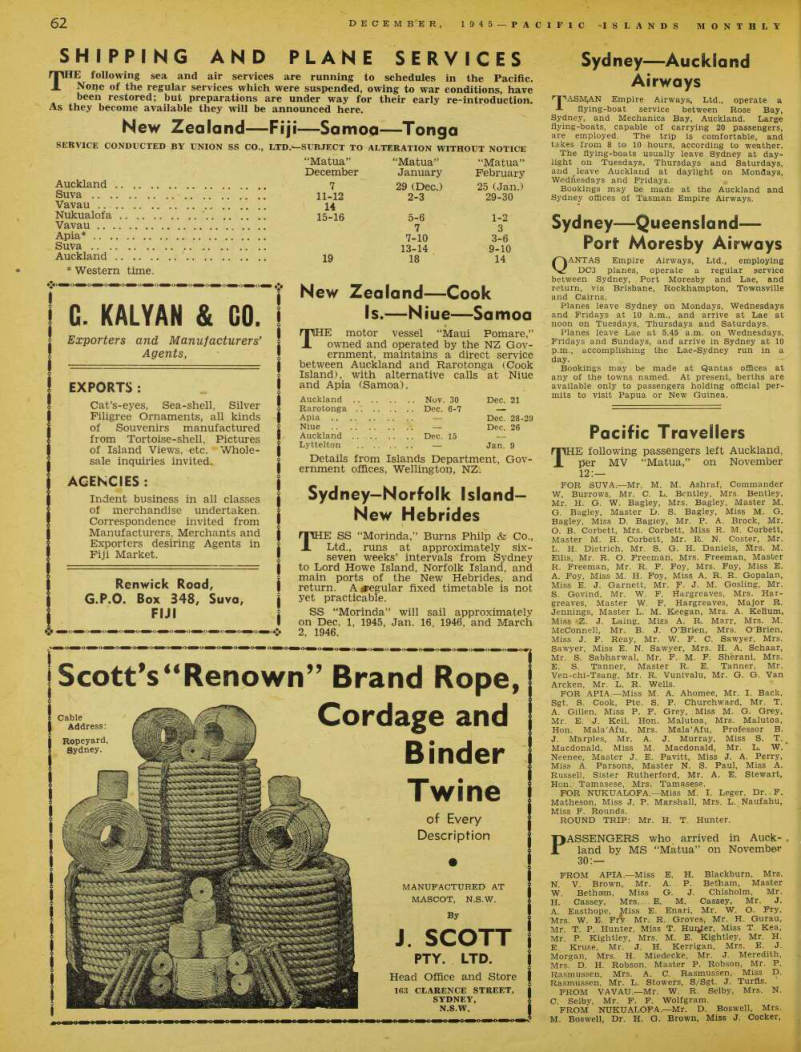
Shipping And Plane Services
THE following sea and air services are running to schedules in the Pacific.
None of the regular services which were suspended, owing to war conditions, have been restored; but preparations are under way for their early re-introduction.
As they become available they will be announced here.
New Zealand—Fiji—Samoa—Tonga
SERVICE CONDUCTED BY UNION SS CO., LTD.—SUBJECT TO ALTERATION WITHOUT NOTICE
Auckland Suva Vavau Nukualofa Vavau Apia* Suva Auckland * Western time.
New Zealand — Cook
Is.—Niue—Samoa
riIHE motor vessel “Maui Pomare,” x owned and operated by the NZ Gov ernment, maintains a direct service between Auckland and Rarotonga (Cook Island), with alternative calls at Niue and Apia (Samoa).
Auckland Nov. 30 Dec, 21 Rarotonga Dec. 6-7 Apia Dec. 28-29 Niue Dec. 26 Auckland Dec. is Lyttelton - Jan - 9 Details from Islands Department, Gov ernment offices, Wellington, NZ.
Sydney— Norfolk Island—
M pw Hekrirloc ntumitb rrtH E SS “Morinda,” Burns Philp & Co., X Ltd., runs at approximately six seven weeks’ intervals from Sydney to Lord Howe Island, Norfolk Island, and main ports of the New Hebrides, and return. A regular fixed timetable is not yet practicable.
SS “Morinda” will sail approximately on Dec. 1, 1945, Jan. 16, 1946, and March 2, 1946.
Sydney—Auckland
Airways
Empire Airways* Ltd., operate a flying-boat service between Rose Bay, Sydney, and Mechanics Bay, Auckland. Large flying-boats, capable of carrying 20 passengers, are employed. The trip is comfortable, and takes from 8 to 10 hours, according to weather.
The flying-boats usually leave Sydney at day light on Tuesdays, Thursdays and Saturdays, and leave Auckland at daylight on Mondays, Wednesdays and Fridays.
Bookings may be made at the Auckland and Sydney offices of Tasman Empire Airways.
Sydney—Queensland—
Port Moresby Airways
Q ANT AS Empire Airways, Ltd., employing DC3 planes, operate a regular service between Sydney, Port Moresby and Lae, and return, via Brisbane, Rockhampton, Townsville and Cairns.
Planes leave Sydney on Mondays, Wednesdays and Fridays at 10 a.m., and arrive at Lae at noon on Tuesdays, Thursdays and Saturdays.
Planes leave Lae at 5.45 a.m. on Wednesdays, Fridays and Sundays, and arrive in Sydney at 10 p.m., accomplishing the Lae-Sydney run in a day.
Bookings may be made at Qantas offices at any of the towns named. At present, berths are available only to passengers holding official per mits to visit Papua or New Guinea.
“Matua” “Matua” “Matua”
December January February 7 29 (Dec.) 25 (Jan.) 11-12 2-3 29-30 14 15-16 5-6 1-2 7 3 7-10 3-6 13-14 9-10 19 18 14
Pacific Travellers
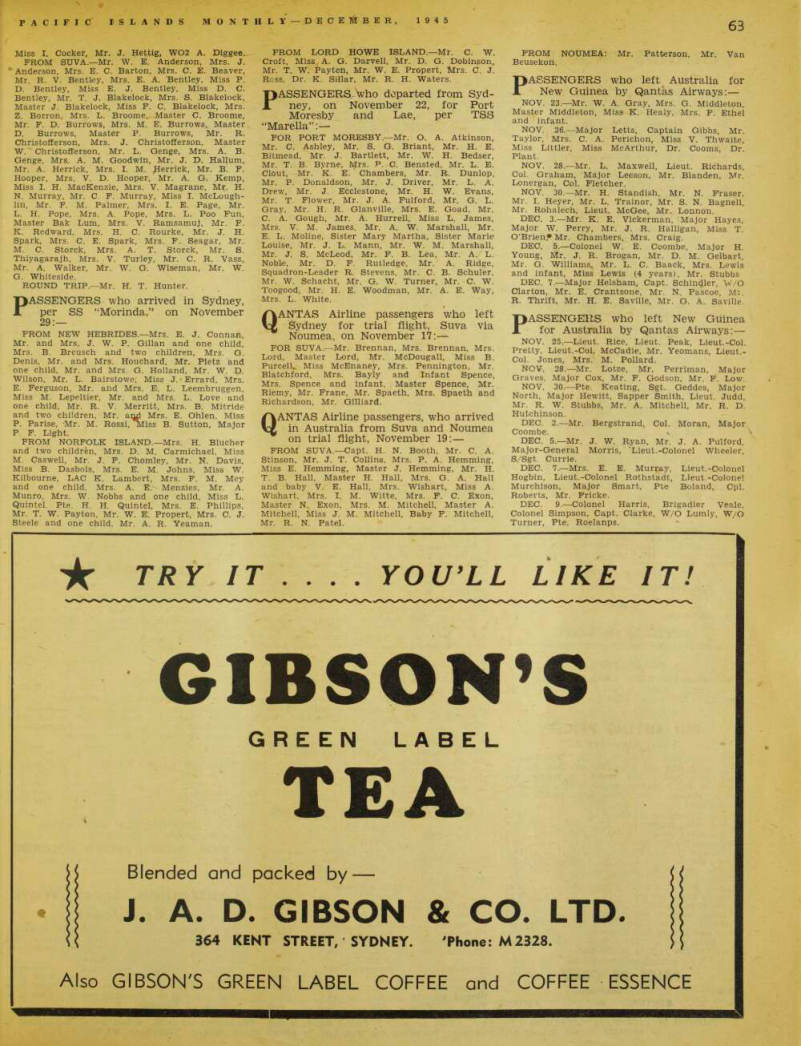
fTIHE following passengers left Auckland,
X per MV “Matua,” on November
12:— FOR SUVA. —Mr. M. M. Ashraf, Commander W, Burrows, Mr. C. L. Bentley, Mrs. Bentley, Mr. H. G. W. Bagley, Mrs. Bagley, Master M.
G. Bagley, Master D. S. Bagley, Miss M. G.
Bagley, Miss D. Bagley, Mr. P. A. Brock, Mr.
O. B. Corbett, Mrs. Corbett, Miss R. M. Corbett, Master M. H. Corbett, Mr. R. N. Coster, Mr.
L. H. Dietrich, Mr. S. G. H. Daniels, Mrs. M.
Ellis, Mr. R. O. Freeman, Mrs. Freeman, Master R. Freeman, Mr. R. F. Foy, Mrs. Foy, Miss E.
A. Foy, Miss M. H. Foy, Miss A. R. R. Gopalan, Miss E. J. Garnett, Mr. F. J. M. Gosling, Mr.
S. Govind, Mr. W. F. Hargreaves, Mrs. Har greaves, Master W. F. Hargreaves, Major R.
Jennings, Master L. M. Keegan, Mrs. A. Kellum, Miss Z. J. Laing, Miss A. R. Marr, Mrs. M.
McConnell, Mr. B. J. O’Brien, Mrs. O’Brien, Miss J. F. Reay, Mr. W. F. C. Sawyer, Mrs.
Sawyer, Miss E. N. Sawyer, Mrs. H. A. Schaar, Mr. S. Sabharwal, Mr. F. M. F. Sherani, Mrs.
E. S. Tanner, Master R. E. Tanner, Mr.
Ven-chi-Tsang, Mr. R. Vunivalu, Mr. G. G. Van Arcken, Mr. L. R. Wells.
FOR APlA.—Miss M. A. Ahomee, Mr. I. Back, Sgt. S. Cook, Pte. S. P. Churchward, Mr. T.
A. Gillen, Miss P. F. Grey, Miss M. G. Grey, Mr. E. J. Keil, Hon. Malutoa, Mrs. Malutoa, Hon. Mala’Afu, Mrs. Mala’Afu, Professor B.
J. Marples, Mr. A. J. Murray, Miss S. T.
Macdonald, Miss M. Macdonald, Mr. L. W.
Neenee, Master J. E. Pavitt, Miss J. A. Perry, Miss A. Parsons, Master N. S. Paul, Miss A.
Russell, Sister Rutherford, Mr. A. E. Stewart, Hon. Tamasese, Mrs. Tamasese.
FOR NUKUALOFA.—Miss M. I. Leger, Dr. F.
Matheson, Miss J. P. Marshall, Mrs. L. Naufahu, Miss P. Rounds.
ROUND TRIP: Mr. H. T. Hunter.
PASSENGERS who arrived in Auck land by MS “Matua” on November 30;— FROM APlA.—Miss E. H. Blackburn, Mrs.
N. V. Brown, Mr. A. P. Betham, Master W. Bethatm, Miss G. J. Chisholm, Mr.
H. Cassey, Mrs. E. M. Cassey, Mr. J.
A. Easthope, Miss E. Enari, Mr. W. O. Pry, Mrs. W. E. Pfy Mr. R. Groves, Mr. H. Gurau, Mr. T. P. Hunter, Miss T. Miss T. Kea, Mr. P. Kightley, Mrs. M. E. Kightley, Mr. H.
E. Kruse, Mr. J. H. Kerrigan, Mrs. E. J.
Morgan, Mrs. H. Miedecke, Mr. J. Meredith, Mrs. D. H. Robson, Master P. Robson, Mr. P.
Rasmussen, Mrs. A. C. Rasmussen,. Miss D.
Rasmussen, Mr. L. Stowers, S/Sgt. J. Turfls.
PROM VAVAU.—Mr. W. R. Selby, Mrs. N.
C. Selby, Mr. F. F. Wolfgram.
FROM NUKUALOFA.—Mr. D. Boswell, Mrs.
M. Boswell, Dr. H. G. Brown, Miss J. Cocker,
Miss I. Cocker, Mr. J. Hettig, WO2 A. Dlggee.
FROM SUVA. —Mr. W. E. Anderson, Mrs. J.
Anderson, Mrs. E. C. Barton, Mrs. C. E. Beaver, Mr. R. V. Bentley, Mrs. E. A. Bentley, Miss P.
D. Bentley, Miss E. J. Bentley, Miss D. C.
Bentley, Mr. T. J. Blakelock, Mrs. S. Blakelock, Master J. Blakelock, Miss F. C. Blakelock, Mrs.
Z. Borron, Mrs. L. Broome, Master C. Broome, Mr. F. D. Burrows, Mrs. M. E. Burrows, Master D. Burrows, Master P. Burrows, Mr. R.
Christofferson, Mrs. J. Christofferson, Master W. Christofferson, Mr. L. Genge, Mrs. A. B.
Genge, Mrs. A. M. Goodwin, Mr. J. D. Hallum, Mr. A. Herrick, Mrs. I. M. perrick, Mr. B. F.
Hooper, Mrs. V. D. Hooper, Mr. A. G. Kemp, Miss I. H. MacKenzie, Mrs. V. Magrane, Mr. H.
N. Murray, Mr. C. F. Murray, Miss I. McLough lin, Mr. F. M. Palmer, Mrs. I. E. Page, Mr.
L. H. Pope, Mrs. A. Pope, Mrs. L. Poo Fun, Master Bak Lum, Mrs. V. Ramsamuj, Mr. F.
K. Redward, Mrs. H. C. Rourke, Mr. J. H.
Spark, Mrs. C. E. Spark, Mrs. F. Seagar, Mr.
M. C. Storck, Mrs. A. T. Storck, Mr. S.
Thiyagarajh, Mrs. V. Turley, Mr. C. R. Vass, Mr. A. Walker, Mr. W. G. Wiseman, Mr. W.
G. Whiteside.
ROUND TRIP.—Mr. H. T. Hunter.
PASSENGERS who arrived in Sydney, per SS “Morinda,” on November 29:
From New Hebrides—Mrs. E. J. Connan,
Mr. and Mrs. J. W. P. Gillan and one child, Mrs. B. Breusch and two children, Mrs. G.
Denis, Mr. and Mrs. Houchard, Mr. Pletz and one child, Mr. and Mrs. G. Holland, Mr. W. D.
Wilson, Mr. L. Bairstowe, Miss J. Errard, Mrs.
E. Ferguson, Mr. and Mrs. E. L. Leembruggen, Miss M. Lepeltier, Mr. and Mrs. L. Love and one child, Mr. R. V. Merritt, Mrs. B. Mitride and two children, Mr. aqd Mrs. E. Ohlen, Miss P. Parise, Mr. M. Rossi, Miss B. Sutton, Major P. F. Light.
From Norfolk Island.—Mrs. H. Blucher
and two children, Mrs. D. M. Carmichael, Miss M. Caswell, Mr. J. P. Chomley, Mr. N. Davis, Miss B. Dasbois, Mrs. E. M. Johns, Miss W.
Kilbourne, LAC K. Lambert, Mrs. F. M. Mey and one child, Mrs. A. E. Menzies, Mr. A.
Munro, Mrs. W. Nobbs and one child, Miss L.
Quintel. Pte. H. H. Quintel, Mrs. E. Phillips.
Mr. T. W. Payton, Mr. W. E. Propert, Mrs. C. J.
Steele and one child, Mr. A. R. Yeaman.
From Lord Howe Island.—Mr. C. W.
Croft, Miss .A. G. Darvell, Mr. D. G. Dobinson, Mr. T. W. Payten, Mr. W. E. Propert, Mrs. C. J.
Ross, Dr. K. Sillar, Mr. R. H. Waters.
PASSENGERS, who departed from Syd
ney, on November 22, for Port Moresby and Lae, per TSS “Marella”; — FOR PORT MORESBY.—Mr. O. A. Atkinson, Mr. C. Ashley, Mr. S. G. Briant, Mr. H. E.
Bitmead, Mr. J. Bartlett, Mr. W. H. Bedser, Mr. T. B. Byrne, Mrs. P. C. Bensted, Mr. L. E.
Clout, Mr. K. E. Chambers, Mr. R. Dunlop, Mr. P. Donaldson, Mr. J. Driver, Mr. L. A.
Drew, Mr. J. Ecclestone, Mr. H. W. Evans, Mr. T. Flower, Mr. J. A. Pulford, Mr. G. L.
Gray, Mr. H. R. Glanville, Mrs. E. Goad, Mr.
C. A. Gough, Mr. A. Hurrell, Miss L. James, Mrs. V. M. James, Mr. A. W. Marshall, Mr.
E. L. Moline, Sister Mary Martha, Sister Marie Louise, Mr. J. L. Mann, Mr. W. M. Marshall, Mr. J. S. McLeod, Mr. F. B. Lea, Mr. A. L.
Noble, Mr. D. F. Rutledge, Mr. A. Ridge, Squadron-Leader R. Stevens, Mr. C. B. Schuler, Mr. W. Schacht, Mr. G. W. Turner, Mr. C. W.
Toogood, Mr. H. E. Woodman, Mr. A. E. Way, Mrs. L. White.
QANTAS Airline passengers who left Sydney for trial flight, Suva via Noumea, on November 17: — FOR SUVA.—Mr. Brennan, Mrs. Brennan, Mrs.
Lord, Master Lord, Mr. McDougall, Miss B.
Purcell, Miss McEnaney, Mrs. Pennington, Mr.
Blatchford, Mrs. Bayly and Infant Spence, Mrs. Spence and infant, Master Spence, Mr.
Riemy, Mr. Prane, Mr. Spaeth, Mrs. Spaeth and Richardson, Mr. Gllliard.
QANTAS Airline passengers, who arrived in Australia from Suva and Noumea on trial flight, November 19;— PROM SUVA.—Capt. H. N. Booth, Mr. C. A.
Stinson, Mr. J. T. Collins, Mrs. P. A. Hemming, Miss E. Hemming, Master J. Hemming, Mr. H.
T. B. Hall, Master H. Hall, Mrs. G. A. Hall and baby V. E. Hall, Mrs. Wishart, Miss A.
Wishart, Mrs. I. M. Witte, Mrs. F. C. Exon.
Master N. Exon, Mrs. M. Mitchell, Master A.
Mitchell, Miss J. M. Mitchell. Baby P. Mitchell, Mr. R. N. Patel.
PROM NOUMEA: Mr. Patterson, Mr. Van Beusekon.
PASSENGERS who left Australia for
New Guinea by Qantas Airways:—
NOV. 23. —Mr. W. A. Gray, Mrs. G. Middleton, Master Middleton, Miss K. Healy, Mrs. F. Ethel and infant.
NOV. 26. —Major Letts, Captain Gibbs, Mr.
Taylor, Mrs. C. A. Perichon, Miss V. Thwaite, Miss Littler, Miss McArthur, Dr. Cooms, Dr.
Plant.
NOV. 28—Mr. L. Maxwell, Lieut. Richards, Col. Graham, Major Leeson, Mr. Blanden, Mr.
Lonergan, Col. Fletcher.
NOV. 30.—Mr. H. Standish, Mr. N. Fraser, Mr. I. Heyer, Mr. L. Trainor, Mr. S. N. Bagnell, Mr. Rohalech, Lieut. McGee, Mr. Lonnon.
DEC. 3.—Mr. K. E. Vickerman, Major Hayes, Major W. Perry, Mr. J. R. Halligan, Miss T.
O’Brien* Mr. Chambers, Mrs. Craig.
DEC. s.—Colonel W. E. Coombe, Major H.
Young, Mr. J. R. Brogan, Mr. D. M. Gelbart, Mr. G. Williams, Mr. L. C. Baack, Mrs. Lewis and infant, Miss Lewis (4 years), Mr. Stubbs DEC. 7. —Major Helsham, Capt. Schindler, W/O Clarton, Mr. E. Crantsone, Mr. N. Pascoe, Mi.
R. Thrift, Mr. H. E. Savllle, Mr. G. A. Saville.
PASSENGERS who left New Guinea
for Australia by Qantas Airways;—
NOV. 25. —Lieut. Rice, Lieut. Peak, Lieut.-Col.
Pretty, Lieut.-Col. McCadie, Mr. Yeomans, Lieut.- Col. Jones, Mrs. M. Pollard.
NOV. 28. —Mr. Lotze, Mr. Perriman, Major Graves, Major Cox, Mr. F. Godson, Mr. F. Low.
NOV. 30. —Pte. Keating, Sgt. Geddes, Major North, Major Hewitt, Sapper Smith, Lieut. Judd, Mr. R. W. Stubbs, Mr. A. Mitchell, Mr. R. D.
Hutchinson.
DEC. 2.—Mr. Bergstrand, Col. Moran, Major Coombe. >.
DEC. s.—Mr. J. W. Ryan, Mr. J. A. Pulford, Major-General Morris, 'Lieut.-Colonel Wheeler, S/Sgt. Currie.
DEC. 7.—Mrs. E. E. Murray, Lieut.-Colonel Hogbin, Lieut.-Colonel Rothstadt, Lieut.-Colonel Murchison, Major Smart, Pte Boland, Cpl.
Roberts, Mr. Fricke.
DEC. 9.—Colonel Harris, Brigadier Veale, Colonel Simpson, Capt. Clarke, W/O Lumly, W/O Turner, Pte. Roelanps.
Advertisements & other items, pp. 64-65 (3 items)
62
DECEMBER, 1945 PACIFIC -ISLANDS MONTHLY
Cordage and
G. KALYAN & GO.
Exporters and Manufacturers' Agents,
EXPORTS;
Cat’s-eyes, Sea-shell, Silver Filigree Ornaments, all kinds of Souvenirs manufactured from Tortoise-shell, Pictures of Island Views, etc. Wholesale inquiries invited.
AGENCIES :
Indent business in all classes of merchandise undertaken.
Correspondence invited from Manufacturers, Merchants and Exporters desiring Agents in Fiji Market.
Renwick Road, G.P.O. Box 348, Suva,
FIJI
Scott’s “Renown” Brand Rope,
Cordage and
Binder
Twine
Cable Address; |S>| Ropeyard, Sydney. of Every Description
MANUFACTURED AT
MASCOT, N.S.W.
i. SCOTT
PTY. LTD.
Head Office and Store
163 CLARENCE STREET,
SYDNEY,
N.S.W.
Gibson’S
★ TRY IT ... . YOU'LL LIKE IT!
GREEN LABEL
TEA
% Blended and packed by— J. A. D. GIBSON & CO. LTD. < 364 KENT STREET, SYDNEY. 'Phone: M2328. Also GIBSON'S GREEN LABEL COFFEE and COFFEE ESSENCE
Islands Produce
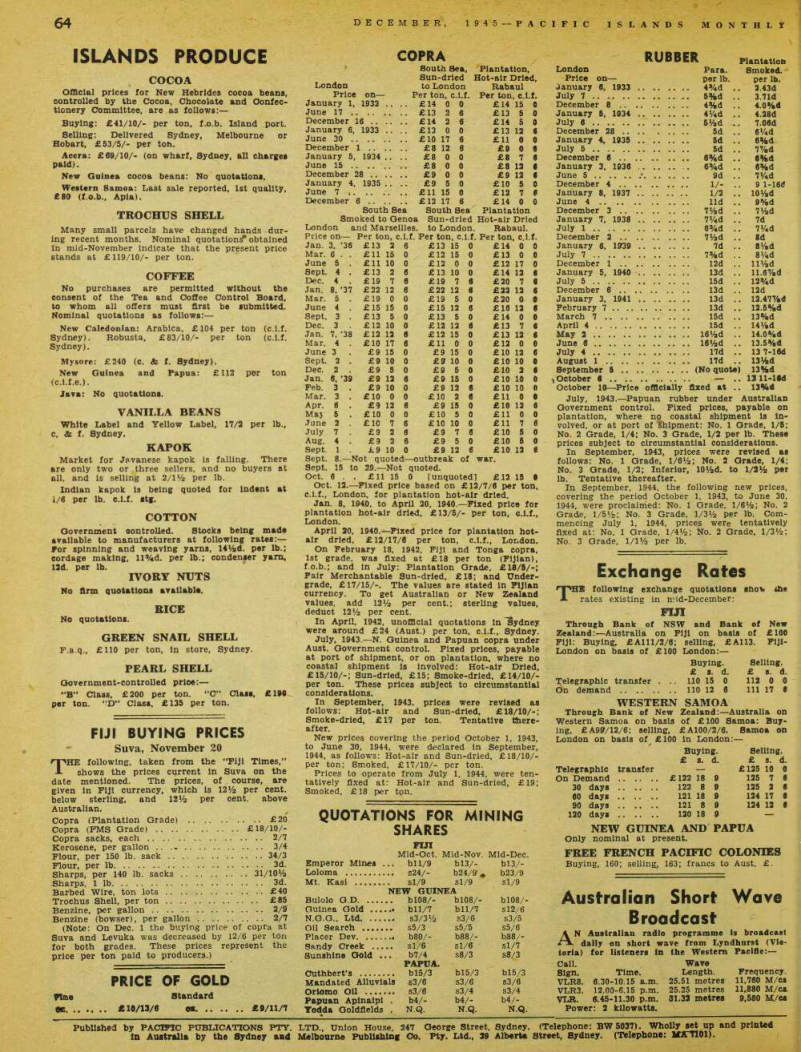
Cocoa
Official prices for New Hebrides cocoa beans, controlled by the Cocoa, Chocolate and Confec tionery Committee, are as follows:— Buying: £41/10/- per ton, f.o.b. Island port.
Selling; Delivered Sydney, Melbourne or Hobart, £63/5/- per ton.
Accra: £69/10/- (on wharf, Sydney, all charges paid).
New Guinea cocoa beans: No quotations.
Western Samoa: Last sale reported, 1st quality, £80 (f.o.b., Apia).
Trochus Shell
Many small parcels have changed hands dur ing recent months. Nominal obtained In mid-November indicate that the present price stands at £119/10/- per ton.
Coffee
No purchases are permitted without the consent of the Tea and Coffee Control Board, to whom all offers must first be submitted.
Nominal quotations as follows:— New Caledonian: Arabics, £104 per ton (c.i.f.
Sydney). Robusta, £83/10/- per ton (c.i.f.
Sydney).
Mysore: £240 (C. & f. Sydney).
New Guinea and Papua: £112 per ton (c.i.f.e.).
Java: No quotations.
Vanilla Beans
White Label and Yellow Label, 17/2 per lb., c. & f. Sydney.
Kapok
Market for Javanese kapok is falling. There are only two or three sellers, and no buyers at all, and is selling at 2/1 Va per lb.
Indian kapok Is being quoted for Indent at i/6 per lb, c.i.f. stg.
Cotton
Government controlled. Stocks being made available to manufacturers at following rates:— Por spinning and weaving yarns, 14%d. per lb.; cordage making, ll 3 Ad. per lb.; condenser yam, I2d. per lb.
Ivory Nuts
No firm Quotations available.
Rice
No quotations.
Green Snail Shell
F.a.q., £110 per ton, In store, Sydney.
Pearl Shell
Government-controlled price;— “B” Class, £200 per ton. “C” Class, £190 per ton. “D” Class, £135 per ton.
Fiji Buying Prices
Suva, November 20 THE following, taken from the “Fiji Times,” shows the prices current In Suva on the date mentioned. The prices, of course, are given in Fiji currency, which is 12 J / 2 per cent, below sterling, and 12 V 2 per cent, above Australian.
Copra (Plantation Grade) £2O Copra (FMS Grade) £lB/10/- Copra sacks, each 2/7 Kerosene, per gallon ...» 3/4 Flour, per 150 lb. sack 34/3 Flour, per lb 3d.
Sharps, per 140 lb. sacks 31/lOVfe Sharps, 1 lb 3d.
Barbed Wire, ton lots £4O Trochus Shell, per ton £B5 Benzine, per gallon 2/9 Benzine (bowser), per gallon 2/7 (Note: On Dec. 1 the buying price of copra at Suva and Levuka was decreased by 12/6 per ton for both grades. These prices represent the price per ton paid to producers.)
Advertisements & other items, p. 66 (1 item)
Price Of Gold
Plfiie Standard
Copra
Oct. 12. —Fixed price based on £l2/7/6 per ton, c.i.f., London, for plantation hot-air dried.
Jan. 8. 1940, to April 20, 1940 —Fixed price for plantation hot-air dried, £l3/8/- per ton, c.i.f., London.
April 20, 1940. —Fixed price for plantation hot air dried, £l2/17/6 per ton, c.i.f., London.
On February 18, 1942, Fiji and Tonga copra, Ist grade, was fixed at £lB per ton (Fijian), f.0.b.; and in July: Plantation Grade, £lB/8/-; Fair Merchantable Sun-dried, £18; and Under grade, £l7/15/-. The values are stated in Fijian currency. To get Australian or New Zealand values, add 12>/ 2 per cent.; sterling values, deduct 12Vi per cent.
In April, 1942, unofficial quotations in were around £24 (Aust.) per ton, c.i.f., Sydney.
July, 1943.—N. Guinea and Papuan copra under Aust. Government control. Fixed prices, payable at port of shipment, or on plantation, where no coastal shipment is Involved: Hot-air Dried, £l5/10/-; Sun-dried, £l5; Smoke-dried, £l4/10/per ton. These prices subject to circumstantial considerations.
In September, 1943. prices were revised as follows; Hot-air and Sun-dried, £lB/10/-; Smoke-dried, £l7 per ton. Tentative there after.
New prices covering the period October 1, 1943, to June 30, 1944, were declared in September, 1944, as follows: Hot-air and Sun-dried, £lB/10/per ton; Smoked, £l7/10/- per ton.
Prices to operate from July 1, 1944, were ten tatively fixed at: Hot-air and Sun-dried, £l9; Smoked, £lB per ton.
South Sea, Plantation, Sun-dried Hot-air Dried.
London to London Rabaul Price on— Per ton, c.i.f.
Per ton, c.i.f.
January 1, , 1932 . . , . £14 0 0 £14 15 0 June 17 . £13 2 6 £13 5 0 December 16 .. £14 2 6 £14 5 0 January 6, 1933 £13 0 0 £13 12 6 June 30 . £10 17 6 £11 0 0 December 1 .. £8 12 6 £9 0 0 January 5 , 1934 . . , . £8 0 0 £8 7 « June 15 . £8 0 0 £8 12 f December 28 .. £9 0 0 £9 12 1 January 4, 1935 . . , I £9 5 0 £10 5 0 June 7 ., £11 15 0 £12 7 0 December 6 .. £12 17 6 £14 0 0 South Sea South Sea Plantation Smoked to Genoa Sun-dried Hot-air Dried London and Marseilles, to London.
Rabaul.
Price on— Per ton, c.i.f. Per ton, c.l.f.
Per ton. c.i.f.
Jan. 3, ’36 £13 2 6 £13 15 0 £14 0 0 Mar. 6 . . £11 15 0 £12 15 0 £13 0 0 June 5 £11 10 0 £12 0 0 £12 17 0 Sept. 4 . £13 2 6 £13 10 0 £14 12 8 Dec. 4 . £19 7 6 £19 7 6 £20 7 0 Jan. 8, '37 £22 12 6 £22 12 6 £22 12 8 Mar. 5 . £19 0 0 £19 5 0 £20 0 0 June 4 £15 15 0 £15 12 6 £16 12 6 Sept. 3 . £13 5 0 £13 5 0 £14 0 0 Dec. 3 £12 10 0 £12 12 6 £13 7 8 Jan. 7. '38 £12 12 0 £12 15 0 £13 12 8 Mar. 4 . £10 17 6 £11 0 0 £12 0 0 June 3 £9 15 0 £9 15 0 £10 12 6 Sept, 2 . £9 10 0 £9 10 0 £10 10 0 Dec. 2 . £9 5 0 £9 5 0 £10 2 8 Jan. 6. '39 £9 12 6 £9 15 0 £10 10 0 Feb. 3 . £9 10 0 £9 12 6 £10 10 0 Mar. 3 . £10 0 0 £10 2 6 £11 0 0 Apr. 6 . £9 12 6 £9 15 0 £10 12 6 May 5 . £10 0 0 £10 5 0 £11 0 0 June 2 £10 7 6 £10 10 0 £11 7 6 July 7 . £9 2 6 £9 7 6 £10 5 0 Aug. 4 £9 2 6 £9 5 0 £10 8 0 Sept. 1 £9 10 0 £9 12 6 £10 12 8 Sept. 8. —Not quoted—outbreak of war.
Sept. 15 to 29.- -Not quoted.
Oct. 6 . . £11 15 0 [unquoted] £12 IB •
Quotations For Mining
Shares
Fiji
Mid-Oct.
Mid-Nov.
Mid-Dec.
Emperor Mines ... bll/9 bl3/bl3/- Loloma s24/b24/9 b23/9 Mt. KasI Sl/9 sl/9 sl/9
New Guinea
Bulolo G.D bl08/bl08/bl08/bll/7 bll/7 S12/6 N.G.G., Ltd s3/3 Vz s3/6 s3/5 Oil Search s5/3 s5/5 s5/6 Placer Dev b80/b88/b88/- Sandy Creek sl/6 sl/6 sl/7 Sunshine Gold ... b7/4 s8/3 s8/3 Cuthbert’s
Papua.
bl5/3 bl5/3 bl5/3 Mandated Alluvlals s3/6 s3/6 s3/6 Orlomo Oil ... s3/6 s3/4 s3/4 Papuan Aplnalpl . b4/b4/b4/- Todda Goldfields .
N.Q.
N.Q.
N.Q.
Rubber
Plantation
July, 1943.—Papuan rubber under Australian Government control. Fixed prices, payable on plantation, where no coastal shipment is In volved, or at port of Shipment; No. 1 Grade, 1/8; No. 2 Grade, 1/4; No. 3 Grade, 1/2 per lb. These prices subject to circumstantial considerations.
In September, 1943, prices were revised as follows: No. 1 Grade, 1/6V 2 ; No. 2 Grade, 1/4; No. 3 Grade, 1/2; Inferior, 10»/ 2 d. to l/2Va per lb. Tentative thereafter.
In September, 1944, the following new prices, covering the period October 1, 1943, to June 30, 1944, were proclaimed; No. 1 Grade, I/6V2: No. 2 Grade, 1/5V 2 ; No. 3 Grade, 1/3V 2 per lb. Com mencing July 1, 1944, prices were tentatively fixed at: No. 1 Grade, 1/4V 2 ; No. 2 Grade, 1/3 V2’, No. 3 Grade, l/V/2 per lb.
London Para.
Smoked.
Price on— per lb. per lb.
January fl, 1933 4>Ad .. 2.43d July 7 5%d .. 3.71d December 8 4%d .. 4.0»4d January 6, 1934 4V 4 d .. 4.28d July 6 5Vad .. 7.08d December 28 5d .. 6‘Ad January 4, 1935 fid .. 8%d July 5 fid .. 7%d December 8 8%d .. 6%d January 3, 1936 . 6%d .. 6%d June 5 9d .. lV*d December 4 1/- .. 9 1-16<J January 8, 1937 1/2 .. lOVad June 4 lid .. 9%d December 3 7Vad .. 7‘Ad January 7, 1938 7‘Ad ., 7d July 1 6%d .. !V*d December 2 IVad .. 8d January 6, 1939 7d .. 8'4d July 7 7%d ..
SV*d December 1 12d ..
HM«d January 5, 1940 13d .. ll.8%d July 5 15d .. 12%d December 6 13d .. 12d January 3, 1941 13d .. 12.47%d February 7 13d .. 12.5*4d March 7 15d .. 13%d April 4 ifid .. 14V4d May 3 . 16‘/ad .. 14.0V.d June 6 . 16V4d .. 13.5*/gd July 4 17d .. 13 7-18d August 1 17d .. 13\4d September 5 . (No quote) I3%d x October 6 — 13 11-ltd October 10 —Price officially fixed at .. 13%d
Exchange Rates
'T'HE following exchange quotations shot* the A rates existing in mid-December:
Fiji
Through Bank of NSW and Bank of New Zealand:—Australia on Fiji on basis of £lOO Fiji: Buying, £Alll/2/6; selling. £AII3. FIJI - on basis of £lOO London: —
Western Samoa
Through Bank of New Zealand: —Australia on Western Samoa on basis of £lOO Samoa: Buy ing, £ A99/12/6; selling, £AIOO/2/6. Samoa on London on basis of £lOO in London:—
New Guinea And Papua
Only nominal at present.
Free French Pacific Colonies
Buying, 160; selling, 163; francs to Aust. £.
Buying.
Selling. £ s. d. £ s. d.
Telegraphic transfer . .. 110 15 0 112 0 0 On demand .. 110 12 6 111 17 •
Buying.
Selling. £ s. d. £ s. d.
Telegraphic transfer — £125 10 0 On Demand £122 18 9 125 7 6 30 days 122 8 9 125 2 6 60 days 121 18 9 124 17 0 90 days 121 8 9 124 12 6 120 days 120 18 9 —
Australian Short Wave
Broadcast
AN Australian radio programme is broadcast daily on short wave from Lyndhurst (Vic toria) for listeners in the Western Pacific:—
Call.
Wave Sign.
Time.
Length.
Frequency.
Vlr8.
6.30-10.15 a.m. 25.51 metres 11,760 M/cs
Vlr3.
12.00-6.15 p.m. 25.25 metres 11,880 M/cs,
Vlr.
6.45-11.30 p.m. 31.32 metres 9,580 M/e« Power: 2 kilowatts.
Advertisements & other items, pp. 66-68 (2 items)
64
DECEMBER, 1945 PACIFIC ISLANDS MONTHLY
Published by PACIFIC PUBLICATIONS PTY. LTD., Union House, 247 George Street, Sydney. (Telephone: 8W5037). Wholly set up and printed in Australia by the Sydney and Melbourne Publishing Co. Pty. Ltd., 29 Alberta Street, Sydney. (Telephone: MXTI01).
A Tropical Thirst
demands a Satisfying Drink
f
A COOL p.
I ■ T «*d m
tJST
RAU
FROM THE FINEST MAt =sß
v ANB BOTTLED #V
To pTH & CO.. LIMI-ra »yd Ney austral^
that’s why KB is 50 popular
south of “the Line”
All through the tropics, wherever there are men who like good beer, you'll always find KB. It's the drink that men appreciate —a drink just made to satisfy a tropical thirst I ■■ ■! ■ ■■ o w * r j
TOOTH'S
KB
LAGER.
Established 1914
THIRTY YEARS OF PACIFIC ISLANDS
DEVELOPMENT AND SERVICE.
W. R. CARPENTER & GO. LTD.
Capital £1,000,000. \
GENERAL MERCHANTS AND SHIPOWNERS
T Buyers and Exporters Kinds of Islands Produce Copra Merchants and Millers Agents for Australian, European and American Manufacturers Distributors of Every Description of Merchandise
AGENTS FOR:
FORD MOTOR COMPANY OF CANADA DODGE BROTHERS INC.
ELECTROLUX REFRIGERATORS WESTINGHOUSE ELECTRICAL CO.
T. G. & C. BOLINDERS (ENGINES) CATERPILLAR TRACTORS Etc., Etc.
BRANCHES THROUGHOUT THE PACIFIC ISLANDS
Head Office : 1 6 O'CONN ELL STREET, SYDNEY In London: W. R. Carpenter & Co. (London) Ltd., Coronation House, 4 Lloyd's Avenue, London, EC.
The W.R.C. Line
The first Direct and Regular Cargo and Passenger Service between Europe and Pacific Islands’ ports was established by W. R. Carpenter & Co. Ltd.