Pacific
Islands
Monthly
November 19, 1945
Vol. Xvi. No. 4.
Established 1930
{Registered at the G.P.0., SMdTtenSfor transmission try post as a newspaper ]
I/-
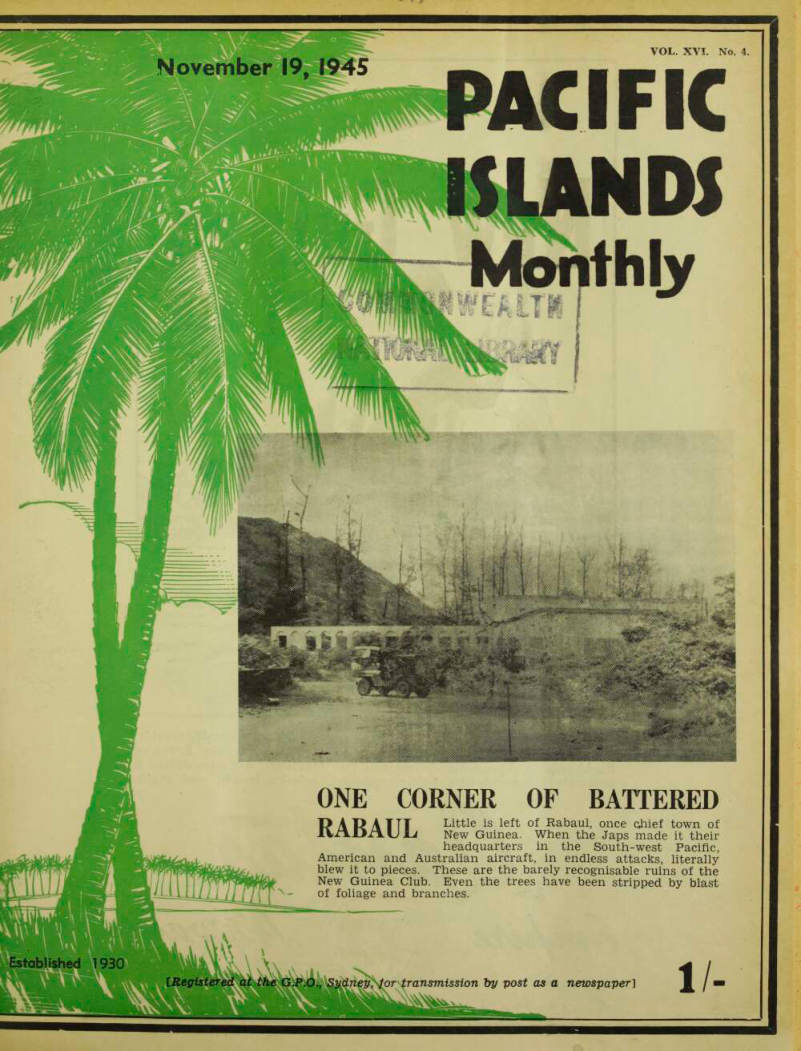
One Corner Of Battered
Rabaul
Little is left of Rabaul, once chief town of New Guinea. When the Japs made it their headquarters in the South-west Pacific, American and Australian aircraft, in endless attacks, literally blew it to pieces. These are the barely recognisable ruins of the New Guinea Club. Even the trees have been stripped by blast of foliage and branches.
Advertisements & other items, p. 2 (1 item)
Guinea
BY AR
>AI7EV -
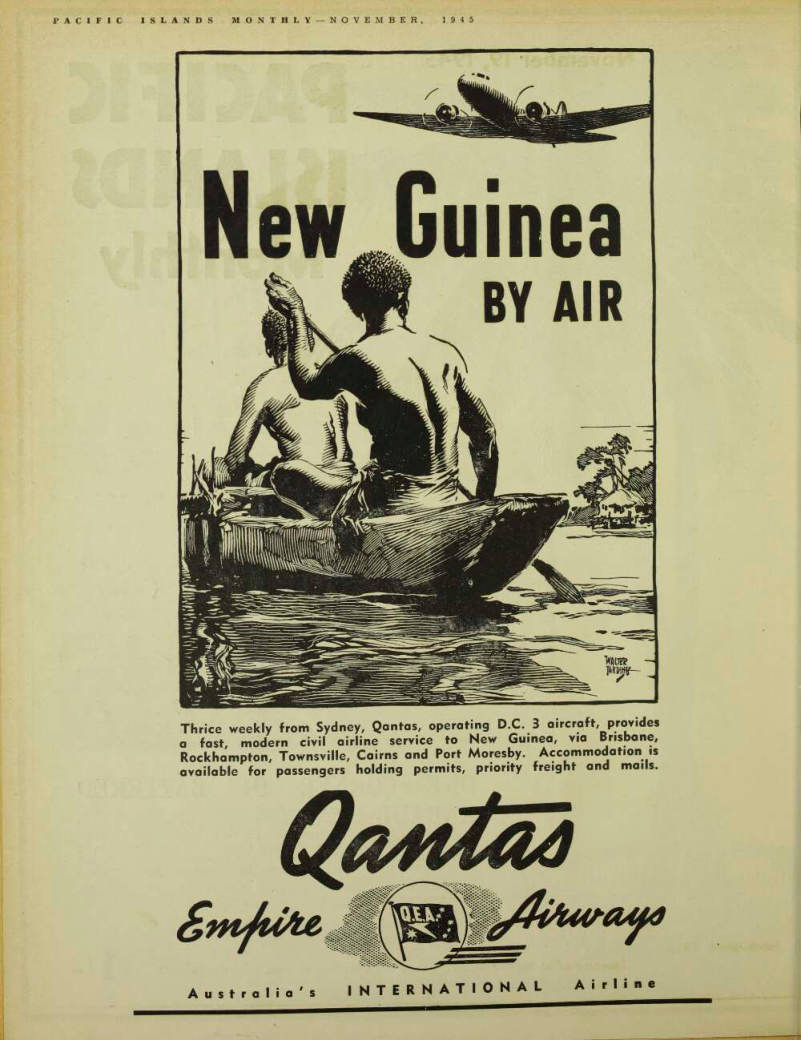
Thrice weekly from Sydney, Qantas, operating D.C. 3 aircraft, provides a fast, modern civil airline service to New Guinea, via Brisbane, Rockhampton, Townsville, Cairns and Port Moresby. Accommodation is available for passengers holding permits, priority freight and mails. n e Australia's INTERNATIONAL
Pacific News-Review
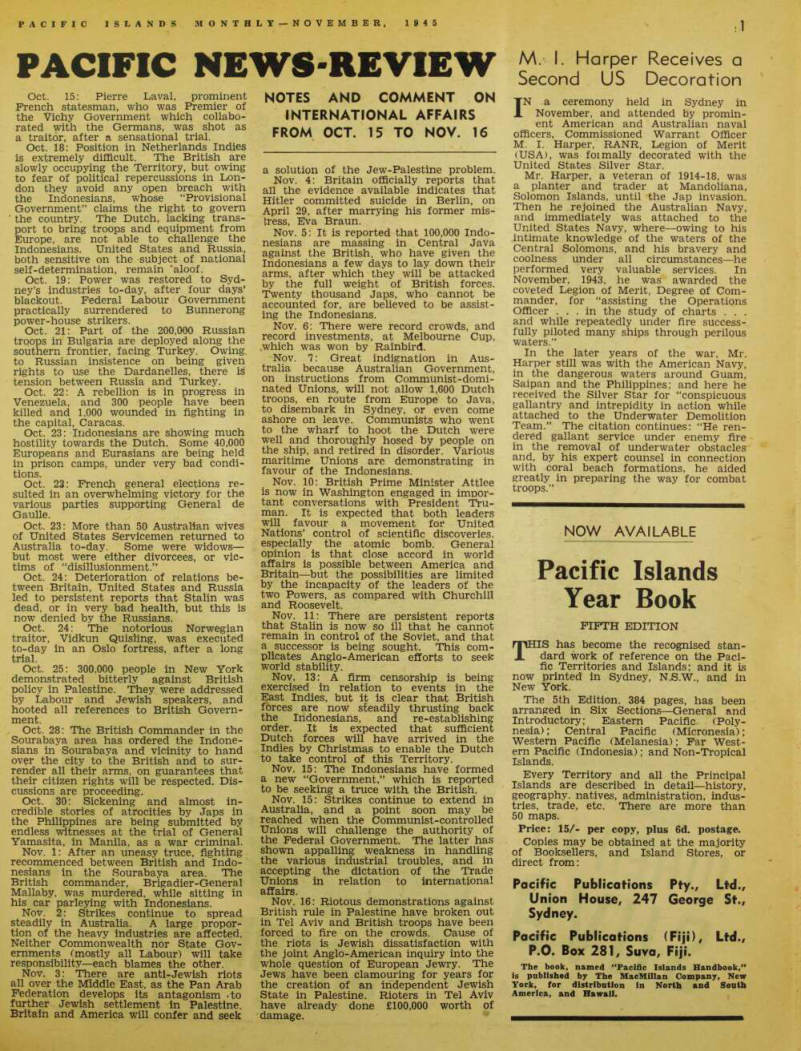
Notes And Comment On
International Affairs
From Oct. 15 To Nov. 16
Oct. 15: Pierre Laval, prominent French statesman, who was Premier of the Vichy Government which collabo rated with the Germans, was shot as a traitor, after a sensational trial.
Oct. 18: Position in Netherlands Indies is extremely difficult. The British are slowly occupying the Territory, but owing to fear of political repercussions in Lon don they avoid any open breach with the Indonesians, whose “Provisional Government” claims the right to govern ' the country. The Dutch, lacking trans port to bring troops and equipment from Europe, are not able to challenge the Indonesians. United States and Russia, both sensitive on the subject of national self-determination, remain ‘aloof.
Oct. 19: Power was restored to Syd ney’s industries to-day, after four days’ blackout. Federal Labour Government practically surrendered to Bunnerong power-house strikers.
Oct. 21: Part of the 200,000 Russian troops in Bulgaria are deployed along the southern frontier, facing Turkey. Owing, to Russian insistence on being given rights to use the Dardanelles, there is tension between Russia and Turkey.
Oct. 22: A rebellion is in progress in Venezuela, and 300 people have been killed and 1,000 wounded in fighting in the capital, Caracas.
Oct. 23: Indonesians are showing much hostility towards the Dutch. Some 40,000 Europeans and Eurasians are being held in prison camps, under very bad condi tions.
Oct. 23: French general elections re sulted in an overwhelming victory for the various parties supporting General de Gaulle.
Oct. 23: More than 50 Australian wives of United States Servicemen returned to Australia to-day. Some were widows— but most were either divorcees, or vic tims of “disillusionment.”
Oct. 24: Deterioration of relations be tween Britain, United States and Russia led to persistent reports that Stalin was dead, or in very bad health, but this is now denied by the Russians.
Oct. 24: The notorious Norwegian traitor, Vidkun Quisling, was executed to-day in an Oslo fortress, after a long trial.
Oct. 25: 300,000 people in New York demonstrated bitterly against British policy in Palestine. They were addressed by Labour and Jewish speakers, and hooted all references to British Govern ment.
Oct. 28: The British Commander in the Sourabaya area has ordered the Indone sians in Sourabaya and vicinity to hand over the city to the British and to sur render all their arms, on guarantees that their citizen rights will be respected. Dis cussions are proceeding, Oct. 30: Sickening and almost in credible stories of atrocities by Japs in the Philippines are being submitted by endless witnesses at the trial of General Yamasita, in Manila, as a war criminal.
Nov. 1: After an uneasy truce, fighting recommenced between British and Indo nesians in the Sourabaya area. The British commander, Brigadier-General Mallaby, was murdered, while sitting in his car parleying with Indonesians.
Nov. 2: Strikes continue to spread steadily in Australia. A large propor tion of the heavy industries are affected.
Neither Commonwealth nor State Gov ernments (mostly all Labour) will take responsibility—each blames the other.
Nov. 3: There are anti-Jewish riots all over the Middle East, as the Pan Arab Federation develops its antagonism .to further Jewish settlement in Palestine.
Britain and America will confer and seek
a solution of the Jew-Palestine problem.
Nov. 4: Britain officially reports that all the evidence available indicates that Hitler committed suicide in Berlin, on April 29, after marrying his former mis tress, Eva Braun.
Nov. 5: It is reported that 100,000 Indo nesians are massing in Central Java against the British, who have given the Indonesians a few days to lay down their arms, after which they will be attacked by the full weight of British forces.
Twenty thousand Japs, who cannot be accounted for, are believed to be assist ing the Indonesians.
Nov. 6: There were record crowds, and record investments, at Melbourne Cup, which was won by Rainbird.
Nov. 7: Great indignation in Aus tralia because Australian Government, on instructions from Communist-domi nated Unions, will not allow 1,600 Dutch troops, en route from Europe to Java, to disembark in Sydney, or even come ashore on leave. Communists who went to the wharf to hoot the Dutch were well and thoroughly hosed by people on the ship, and retired in disorder. Various maritime Unions are demonstrating in favour of the Indonesians.
Nov. 10: British Prime Minister Attlee is now in Washington engaged in impor tant conversations with President Tru man. It is expected that both leaders will favour a movement for United Nations' control of scientific discoveries, especially the atomic bomb. General opinion is that close accord in world affairs is possible between America and Britain—but the possibilities are limited by the incapacity of the leaders of the two Powers, as compared with Churchill and Roosevelt.
Nov. 11: There are persistent reports that Stalin is now so ill that he cannot remain in control of the Soviet, and that a successor is being sought. This com plicates Anglo-American efforts to seek world stability.
Nov. 13: A firm censorship is being exercised in relation to events in the East Indies, but it is clear that British forces are now steadily thrusting back the Indonesians, and re-establishing order. It is expected that sufficient Dutch forces will have arrived in the Indies by Christmas to enable the Dutch to take control of this Territory.
Nov. 15; The Indonesians have formed a new “Government,” which is reported to be seeking a truce with the British.
Nov. 15: Strikes continue to extend in Australia, and a point soon may be reached when the Communist-controlled Unions will challenge the authority of the Federal Government. The latter has shown appalling weakness in handling the various industrial troubles, and in accepting the dictation of the Trade Unions in relation to international affairs.
Nov. 16: Riotous demonstrations against British rule in Palestine have broken out in Tel Aviv and British troops have been forced to fire on the crowds. Cause of the riots is Jewish dissatisfaction with the joint Anglo-American inquiry into the whole question of European Jewry. The Jews have been clamouring for years for the creation of an independent Jewish State in Palestine. Rioters in Tel Aviv have already done £lOO,OOO worth of damage.
Second US Decoration
M. I. Harper Receives a Second US Decoration
IN a ceremony held in Sydney in November, and attended by promin ent American and Australian naval officers, Commissioned Warrant Officer M. I. Harper, RANK, Legion of Merit (USA), was foimally decorated with the United States Silver Star.
Mr. Harper, a veteran of 1914-18, was a planter and trader at Mandoliana, Solomon Islands, until the Jap invasion.
Then he rejoined the Australian Navy, and immediately was attached to the United States Navy, where—owing to his intimate knowledge of the waters of the Central Solomons, and his bravery and coolness under all circumstances —he performed very valuable services. In November, 1943, he was awarded the coveted Legion of Merit, Degree of Com mander, for “assisting the Operations Officer ... in the study of charts . . . and while repeatedly under fire success fully piloted many ships through perilous waters.”
In the later years of the war, Mr.
Harper still was with the American Navy, in the dangerous waters around Guam, Saipan and the Philippines: and here he received the Silver Star for “conspicuous gallantry and intrepidity in action while attached to the Underwater Demolition Team.” The citation continues: “He ren dered gallant service under enemy fire in the removal of underwater obstacles and, by his expert counsel in connection with coral beach formations, he aided greatly in preparing the way for combat troops.”
Advertisements & other items, p. 3 (1 item)
Year Book
NOW AVAILABLE
Pacific Islands
FIFTH EDITION
rIS has become the recognised standard work of reference on the Pacific Territories and Islands; and it is now printed in Sydney, N.S.W., and in New York.
The sth Edition. 384 pages, has been arranged in Six Sections—General and Introductory; Eastern Pacific (Polynesia) ; Central Pacific (Micronesia); Western Pacific (Melanesia); Far Western Pacific (Indonesia); and Non-Tropical Islands.
Every Territory and all the Principal Islands are described in detail—history, geography, natives, administration, industries, trade, etc. There are more than 50 maps.
Price: 15/- per copy, plus 6d. postage.
Copies may be obtained at the majority of Booksellers, and Island Stores, or direct from;
Pacific Publications Pty., Ltd.,
Union House, 247 George St.,
Sydney.
Pacific Publications (Fiji), Ltd.,
P.O. Box 281, Suva, Fiji.
The book, named "Pacific Islands Handbook,** is pnbllshed by The MacMillan Company, New York, for distribution in North and South America, and Hawaii.
Advertisers
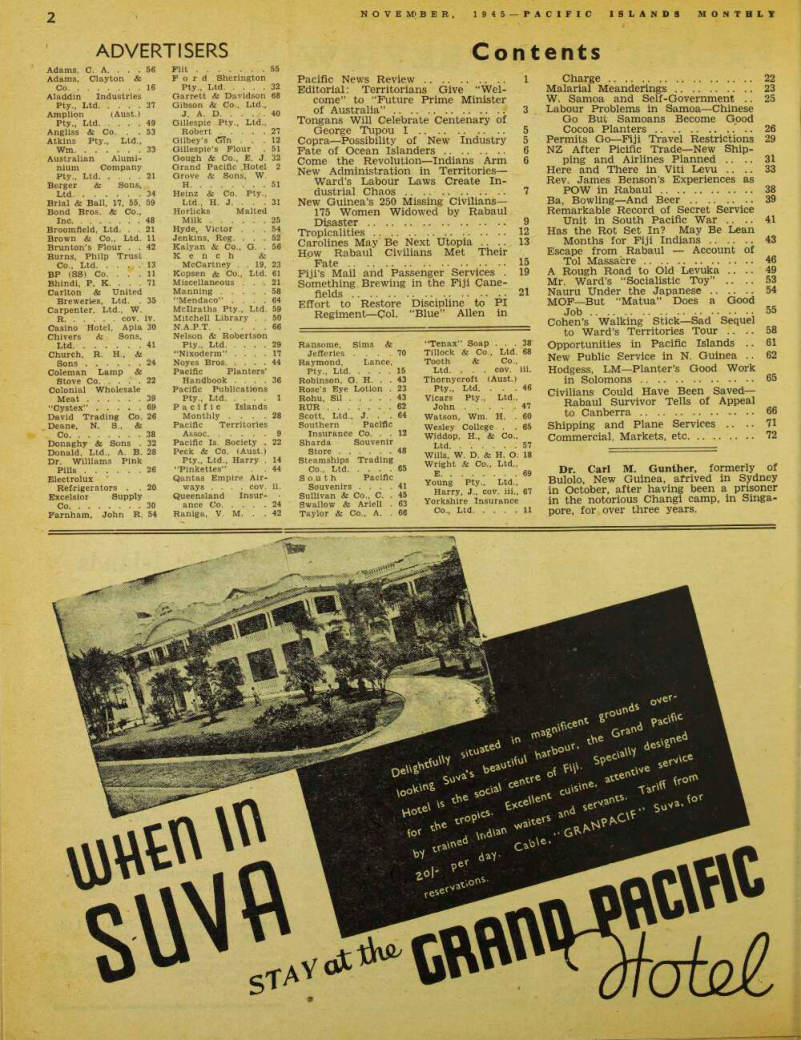
Adams, C. A. . . .56 Adams, Clayton & Co 16 Aladdin Industries Pty., Ltd 37 Amplion (Aust.) Pty., Ltd 49 Angliss & Co. . . 53 Atkins Pty., Ltd., Wm 33 Australian Alumi nium Company Pty., Ltd 21 Berger & Sons* Ltd 34 Brlal & Ball, 17, 55, 59 Bond Bros. & Co., Inc 48 Broomfield, Ltd. . . 21 Brown & Co., Ltd. 11 Brunton’s Flour . . 42 Burns, Philp Trust Co., Ltd 13 BP (SS) Co. . . . 11 Bhindi, P. K. . . .71 Carlton & United Breweries, Ltd. . 35 Carpenter, Ltd., W.
R cov. iv.
Casino Hotel, Apia 30 Chivers & Sons, Ltd 41 Church, R. H., & Sons 24 Coleman Lamp & Stove Co 22 Colonial Wholesale Meat 39 “Cystex” 69 David Trading Co. 26 Deane, N. S., & Co 38 Donaghy & Sons . 32 Donald, Ltd., A. B. 28 Dr. Williams Pink Pills 26 Electrolux Refrigerators . . 20 Excelsior Supply Co 30 Farnham, John R. 54
Flit 55 Ford Sherington Pty., Ltd 32 Garrett & Davidson 68 Gibson & Co., Ltd.,
J. A. D 40
Gillespie Pty., Ltd., Robert 27 Gilbey’s GTn ... 12 Gillespie’s Flour . 51 Gough & Co., E. J. 32 Grand Pacific .Hotel 2 Grove & Sons, W.
H 51 Heinz & Co. Pty., Ltd., H. J. . . .31 Horlicks Malted Milk 25 Hyde, Victor ... 54 Jenkins, Reg. ... 52 Kalyan & Co., G. . 56 Ken c h & McCartney . . 19, 23 Kopsen & Co., Ltd. 61 Miscellaneous ... 21 Manning 58 “Mendaco” ... 64 Mcllraths Pty., Ltd. 59 Mitchell Library . . 50
N.A.P.T 66
Nelson & Robertson Pty., Ltd 29 “Nixoderm” ... 17 Noyes Bros 44 Pacific Planters’
Handbook ... 36 Pacific Publications Pty., Ltd 1 Pacific Islands Monthly ... 28 Pacific Territories Assoc 9 Pacific Is. Society . 22 Peck & Co. (Aust.) Pty., Ltd., Harry . 14 “Pinkettes” ... 44 Qantas Empire Air ways ... cov. ii.
Queensland Insur ance Co 24 Raniga, V. M, . . 42
Ransome, Sims & Jefferies ... 70 Raymond, Lance, Pty., Ltd 15 Robinson, G. H. . . 43 Rose’s Eye Lotion . 23 Rohu, Sil 43
Rur 62
Scott, Ltd., J. . .64 Southern Pacific Insurance Co. . . 12 Sharda Souvenir Store 48 Steamships Trading Co., Ltd 65 South Pacific Souvenirs ... 41 Sullivan & Co., C. . 45 Swallow & Ariell . 63 Taylor & Co., A. . 66
“Tenax” Soap ... 38 Tillock & Co., Ltd. 68 Tooth & Co., Ltd. . . . cov. iii.
Thornyoroft (Aust.) Pty., Ltd. ... 46 Vicars Pty., Ltd., John 47 Watson, Wm. H. . 60 Wesley College . . 65 Widdop, H., & Co., Ltd 57 Wills. W. D. & H. O. 18 Wright & Co., Ltd., E 69 Young Pty., Ltd., Harry, J., cov. iii., 67 Yorkshire Insurance Co., Ltd 11
Contents
Pacific News Review 1 Editorial: Territorians Give “Wel come” to “Future Prime Minister of Australia” 3 Tongans Will Celebrate Centenary of George Tupou I 5 Copra—Possibility of New Industry 5 Fate of Ocean Islanders 6 Come the Revolution —Indians Arm 6 New Administration in Territories — Ward’s Labour Laws Create In dustrial Chaos 7 New Guinea’s 250 Missing Civilians — 175 Women Widowed by Rabaul Disaster 9 Tropicalities 12 Carolines May Be Next Utopia ... 13 How Rabaul Civilians Met Their Fate 15 Fiji’s Mail and Passenger Services . 19 Something Brewing in the Fiji Cane fields 21 Effort to Restore Discipline to PI Regiment—Qol. “Blue” Allen in
Charge 22 Malarial Meanderings 23 W. Samoa and Self-Government .. 25 Labour Problems in Samoa—Chinese Go But Samoans Become Good Cocoa Planters 26 Permits Go—Fiji Travel Restrictions 29 NZ After Picific Trade—New Ship ping and Airlines Planned .. 31 Here and There in Viti Levu .. .. 33 Rev. James Benson’s Experiences as POW in Rabaul 38 Ba, Bowling—And Beer 39 Remarkable Record of Secret Service Unit in South Pacific War .. .. 41 Has the Rot Set In? May Be Lean Months for Fiji Indians 43 Escape from Rabaul Account of Tol Massacre 46 A Rough Road to Old Levuka ... 49 Mr. Ward’s “Socialistic Toy” .. .. 53 Nauru Under the Japanese 54 MOF—But “Matua” Does a Good Job 55 Cohen’s Walking Stick—Sad Sequel to Ward’s Territories Tour .. .. 58 Opportunities in Pacific Islands .. 61 New Public Service in N. Guinea .. 62 Hodgess, LM—Planter’s Good Work in Solomons 65 Civilians Could Have Been Saved— Rabaul Survivor Tells of Appeal to Canberra 66 Shipping and Plane Services .. .. 71 Commercial, Markets, etc 72 Dr. Carl M. Gunther, formerly of Bulolo, New Guinea, afrived in Sydney in October, after having been a prisoner in the notorious Changi camp, in Singa pore, for over three years.
Advertisements & other items, p. 4 (1 item)
Ta»
s
Pacific Islands Monthly
The Newspaper-Magazine of the South Seas
[Registered at the Sydney, for transmission by post as a newspaper .] Published Once Each Month and Circulated in Australia and New Zealand and in the following Pacific Territories and Islands Groups:
Australian Territory of Papua.
Mandated Territory (Australia) of New Guinea.
Australian Territory of Norfolk Island.
New Zealand Territory of Cook Islands.
Mandated Territory (NZ) of Western Samoa.
British Colony of Fiji.
British Solomon Islands Protectorate.
British Protectorate of Tongan Islands.
British Crown Colony of Gilbert and Ellice Islands.
Mandated Territory of Nauru.
British and Free French Condominium of New Hebrides.
Free French Colony of New Caledonia.
Free French Colony of Oceania (Tahiti, etc.).
American Territory of Eastern Samoa.
American Territory of Hawaiian Islands,
Owned and Produced by Pacific Publications Pty. Ltd., Union House, 247 George Street, Sydney.
Tin vpnrvMi? f Managing Director .. BW 5037 ttONE I Business and Editorial MA 4369
P.O. Box 3408 R
Registered Address of Telegrams, Radiograms, and Cables; “Pacpub”, Sydney.
Contributions.
Articles, Stories, and Photographs dealing with Pacific Islands subjects are Invited and will be paid for on publication.
Subscription Rates.
Per Annum, within British Empire, Prepaid, Post Free 10/- Per Annum, elsewhere, Prepaid, Post Free 12/6 Single Copies 1/-
Editor and Publisher:
R. W Robson, F.R.G.S.
Advertising Manager: W. E. Rogers. Tel. B 7815.
Advertising Office and Printing-House: 29 Alberta Street, Sydney.
Advertising rates furnished on application.
Representative In Fiji.
Pacific Publications (Fiji), Ltd., Bank of NSW Building, Suva (same office as W. H. Grove & Sons, Ltd.). Stocks of Pacific Islands Monthly and Pacific Islands Yearbook on hand.
Representative In London.
J. T. Wallis, Coronation House, 4 Lloyds Avenue, London, E.C.3, from whom may be obtained copies of Pacific Islands Monthly, Pacific Is. Year Book, advertising schedules, etc.
Agents.
The following are authorised to receive sub scriptions for Pacific Islands Monthly:— Burns, Phllp & Co., Ltd., and Burns Philp (South Sea) Co., Ltd. All branches.
W. R. Carpenter & Co., Ltd. All branches.
Morris, Hedstrom, Ltd. All branches.
Steamships Trading Co., Papua. All branches.
Whitten Bros., Ltd., Samaral, Papua.
B.N.G. Trading Co., Ltd., Port Moresby, Papua.
J. Muir, Suva, Fiji.
Miss R. Castles, Suva, Fiji.
N. C. Mackenzie Hunt, Walnunu, Bua, FIJI.
Cook Islands Trading Co., Rarotonga, Cook Is.
A, C. Rowland, Papeete, Tahiti.
Islands Branches and Representatives of W. H.
Grove «fe Sons, Ltd., Auckland, New Zealand.
Ed. Pentecost, Noumea, New Caledonia.
Societe Gubbay Kerr et Cle, Noumea, N. Caledonia.
Vol. XVI. No. 4.
November 19, 1945
Prirp t l/- Per Copy * rnce (prepaid: 10/- p.a.
do somethin^
Territorians Give Welcome to "The Future Prime Minister of Australia"!
EXILED residents of Papua and New Guinea have known so much of tragedy in the past four years that, probably, they will welcome a little comedy, as a change. If so, it has been provided for them by their new Administrator, Colonel J K. Murray, lately a Queensland professor, who has taken the trouble to inform his new staff that his Minister. Mr. Eddie Ward, is regarded by some people as “the future Prime Minister of Australia.”
It is a comic forecast, of course, but it is by no means impossible. Even stranger things are happening every day, in this mad, post-war world. All conventional ideas-including the assumption that a Prime Minister shall think as a statesman, and be a welleducated, broad-visioned man of balanced judgment have been swept away.
Mr, Ward’s career is well-known in New South Wales. He never has achieved anything in commerce or the professions—he has been a political hanger-on around the Trades Hall, most of his life. His most notable performance is a frequent appearance on a soap-box in Springfield Avenue, King’s Cross, Sydney, where he babbles the glib phrases of extreme Socialism, and snarls savagely at all who would cross verbal swords with him, in approved soapbox manner. But this is the type that is rising to power among the war-torn nations—and will continue
to make mischief until the political pendulum swings again, a few years hence.
But even the comic forecast voiced by Col. Murray has its tragic side.
By what queer freak of mind should he seek to present a defence of Mr.
Ward, in the hearing of people who have suffered so much at the hands of Mr. Ward and Mr. Ward’s associ ates? Is Colonel Murray blind—or does he deliberately ignore the mon strous cruelties which have been heaped upon Territorians by this Communist-controlled Canberra Gov ernment?
Let us remind Colonel Murray of some of the things he is defending, when he defends Mr. Ward, and the blundering and stupid Government which Mr. Ward represents.
UNTIL it can prove, otherwise, the Australian Socialist Government is held responsible for the murder of 300 civilians, abandoned to the Japanese when Rabaul was invaded in January, 1942. Responsible people —and especially since Rabaul was re taken and the few surviving civilians released—have said positively that the 300 civilians could have been got away on the available ships before the Japs arrived; but that, although the Deputy-Administrator appealed for instructions, “Canberra” ordered them to remain.
Mr. Ward always is ready to attack powerful private interests and high authority, if he thinks he thereby
«£ £ S'.
But has he said one word > as Minis ter for Territories, to support the now
nominaUv resnonsWeforTerritorial
do somethin^
civilians, would like to do something. ward in hi* fnmmic nf Jy| ‘ p , , f TT ,
dot”-has ’efnouled the cause o'f
wuzzv He has the cause of Npw Gmnea a Hannv Homefor Hich twn ™ er more N agains’t that 0 piOlier, tflG WilllG ITlciri. oO fIG iI&S brought in a new set of native labour laws—the effect of which (see news reports in this issue) has been to throw the already dislocated economy of the two Territories into utter, h( >P eless confusion, But has Mr - Ward shown the slight est concern for the thousands of Territorians who were forced out of their homes and livelihood in 1941-42, an d who have been consistently re fused re-admission? He has not. He has turned a deaf ear to every ap peal that has been made to him— as the records of the Pacific Tern tories Association prove, Fuzzy-wuzzy gets all possible Minis terial attention—and publicity, of course!—but the claims of the unfor tunate Europeans are determinedly and systematically ignored, m .. . , , rpHE Territories, between 1920 and A 1940, developed settlements and industries which provided a fine market for Australian goods. Private
enterprise pioneered those Terri tories. There would have been little settlement and few industries there if large numbers of Australian indi vidualists had not gone into those tropical jungles after coconuts, and gold, and rubber, and been supported by large institutions like Burns Philp & Co., W. R. Carpenter & Co., Steam ships Trading Co., Collyer Watson, Ltd., which provided necessary trans port, foodstuffs, and finance.
But, in the opinion of Mr. Ward, and soap-box thinkers of his kidney, these people are “exploiters,” and due for the axe. So he is keeping them out of the Territories, and has put into their place his Government financed Production Control Board, which does all the trading, transport, etc.
Large numbers of men, of the finest individualist and pioneer types, are kept kicking their heels in Australia, while Mr. Ward plays happily with his Socialistic toy in New Guinea.
IN pre-war days, the Territories, prudently administered, with pri vate enterprise encouraged to develop their great natural resources, were largely self-supporting. They asked Australia for little in the way of pub lic funds; and they provided Austra lia with a very good market for her foodstuffs and manufactured goods.
Now, under the rule of this Trades Hall genius from King’s Cross, the Territories are absorbing hundreds of thousands of pounds in money torn from Australian taxpayers in the guise of war taxation, and giving us in return nothing except this delight ful picture of Eddie Ward being cooed over by happy anthropologists, and being presented as “the next Prime Minister of Australia.”
J. J. Murphy Charged With
Treachery
JOHN JOSEPH MURPHY, who was a patrol officer in the New Guinea Ad ministration prior to the Jap in vasion, and who afterwards was an Intelligence officer in the service of the Allies, with the rank of captain, was arrested in Lae at the beginning of November, on two serious charges.
Murphy was found in Rabaul when the Australian Forces moved in, in Novem ber. He was landed in New Britain, in Jap-occupied territory, late in 1943, on an important and dangerous mission, and he was later captured by the Japs. His two comrades, a lieutenant and a ser geant, were killed, and Murphy was wounded.
The first charge alleges that Murphy treacherously gave information to the enemy The second accuses him of hav ing, at Rabaul in December, 1943, treacherously given to Captain Yamaga Gonju, Japanese naval officer, informa tion about AMF who landed in New Britain in September, 1943.
He was arrested on information given by several Japanese officers who are now in Lae waiting to give evidence at the trial.
Murphy will be defended by Major D.
B. Hunter, a Sydney barrister.
Ocean Islanders
New Home For
Transfer to Rabi, in Fiji
Suva, Nov. 12.
THE High Commission for the Wes tern Pacific has completed prepara tions for the transfer of the native population of Ocean Island to the island of Rabi, which lies off the north-eastern coast of Vanua Levu, in the Fiji Group.
When the Pacific war came, there were on Ocean Island about 700 Bana bans and 1,100 Gilbertese. The Banabans were the indigenous Micronesian people, and the Gilbertese had been brought in from the adjoining group, together with over 1,000 Chinese, to provide labour for the phosphate workings.
As described elsewhere in this issue, the invading Japs scattered these people far and wide. They were taken as slaves to the Carolines, to Tarawa and to Nauru —in all of which places the Japs con structed most elaborate fortifications.
Ocean Island is a dry. inhospitable lump of phosphatic rock—there are only a few pockets of good soil for the main tenance of life among the natives. So, instead of reassembling the native peoples in Ocean Island, the Commission has wisely decided to provide them with a new home. Rabi has been purchased from the Fijians, and it will become the future home of the Banabans and, pre sumably, of some of the Gilbertese Rabi is a fertile, well-watered island, running up to 1,500 feet high in the centre, 10 miles long by five across, and it lies 15 miles due north of Taveuni.
It is protected generally by Taveuni and Vanua Levu, to the south and west.
Death Of Mr George
Watkins
THE death has just occurred, on Wood lark Island, of Mr. George Watkins —who was everywhere known affec tionately as “Old George.” He was 82, and he had not left the island since he went there as a young man of 35, 47 years ago. He was a prospector in Queensland, and he followed the 1898 rush to Woodlark. He was highly skilled, and could find gold where other men missed entirely. He and Charles Coppard did much work together on the Busai field, when there were 500 miners there. His friends tried to persuade him to leave in 1942, when Jap invasion threatened, but he answered: “I’ve lived here most of my life, and I am not going to be driven out now by a lot of dirty little yellow-bellies.” He was generous to a fault, and would always lend a helping hand to people in trouble, whether black or white.
Another Point Of View
“mHE New Guinea natives did not want JL this new political set-up,” says an old resident of the Morobe district “To a man, they hated ANGAU, in all parts of New Guinea; without exception they wanted the return of ‘time long be fore’ when ‘ologetta Master nau Missus would come back and the boys could ‘make paper’ again.
“There was no exception to that, any where on the east coast. I myself spoke to over 400 natives, to find out. ANGAU. to them, was a militaristic bully and WO rse —when not an abject fool and weak ling, with its incomprehensable version of Pidgin and its ignorance of the native mind.”
Rabaul—1945
The Garden City lies a blasted mass Of desolated homes and ruined stores; Of broken roadways covered o’er with grass, While twisted ships lie out along the shores.
The harbour marked by half a hundred bupys Where once rode south-bound Nippon merchantmen.
Adamantine the Mother Mountain’s poise, As haughty, calm and dignified as when Young Vulcan rose with crash and splash of spray From out the Bay, and Tavuvur spew’d out Its. stinking liquid mud of dusty grey . .
Man has completed what Nature left in doubt.
Where, now, the homes with social morning teas?
The Clubs and pubs and places where men meet?
The ev’ning drives beneath the tropic trees?
Nothing but desolation now—complete.
The tree-lined avenues and shady streets Are nothing less than jungle footpaths now, Where Nature’s greenery so ably meets And overcomes Man’s vain attempts.at show . . . * * * Twine gently, Vines, about this vanish’d town!
Bloom on, O Plow’rs, in riotous array; Lie lightly, Leaves, as you come tumb ling down!
Who knows? . . . Rabaul may live again some day.
—Gordon Thomas.
POW Camp, 7/6/45.
Pacific Islands Roll of Honour Lists
Honour Lists in a Special Supplement in December
A SPECIAL supplement of the “Pacific Islands Monthly,” December issue, will contain the names of Pacific Islands residents who, during World War 11, were: Killed or died of wounds or illness.
Wounded, or were reported POW.
Decorated, or commended for dis tinguished service.
We shall include, also, the list of civilians who have disappeared, presumed dead, as a result of the Japanese occupa tion of the Rabaul and New Ireland areas. This will be the same list as was published here in October, but with cer tain corrections.
The “Honour Roll” —as the lists were called—was first published in the “PIM” in June, 1940. It then contained only two names —those of Flying Officers Moresby Gofton, of Wau, New Guinea, and K. J. A. Johnstone, of Suva, Fiji— both reported missing in air fighting m Europe. Now, the lists contain hundreds of names, and have been published regu larly for 5i years. They will be pub lished for the last time in December.
To Resume Private Practice
TkKR. J. I. Cromie, well-known member lyx of the legal profession in P re "^ r New Guinea., is at present in Mel bourne awaiting d^ h from ANGAU.
He expects to be in Sydney shortly, when his services will be attl J®^ posal of. Temtonans His Melbourne address is “Somerset. 76 Canterbury Road, TooraK.
Centenary of George
Tongans Will
Celebrate
Centenary of George Tupou I
From August Hettig
Nukualofa, Oct. 26.
rNGA is going to enjoy a week of public festivities early in December, to celebrate the centenary of King George Tupou I, on December 4.
High Chiefs of Samoa and Fiji, because of the connection of those countries with the historical background of Tonga, have been invited by the Tongan Government to come to Nukualofa for the occasion.
The whole island is bestirred, and dif ferent bodies are working out plans and programmes. Rehearsals of native tradi tional dances, pageants, etc., are in full swing in every village and island in the Group. Sports will be held for boys and girls, and displays by the schools.
Tongans are proud of this part of their history, hence this great enthusiasm for the coming celebrations. As a proof of this, a presentation will be made to Crown Prince Tupouto’a-Tungi by the people of their savings in copra bonuses. The sum is somewhere in the vicinity of £20,000. This is to be set aside as a centenary memorial fund for financing a plan to send young Tongans to Australia or NZ for higher education.
to Noumea-Fiji
Qantas Runs Survey Flights to Noumea-Fiji
A Qantas plane, carrying passengers and mails, left Sydney on November 17 on a two days’ flight to Brisbane-Noumea Fiji, and return. Another plane will make a similar flight on November 24.
These are merely survey flights, made by arrangement with Australian and Fiji Governments. A permanent service is under consideration.
—Fiji Public Relations Office Photo.
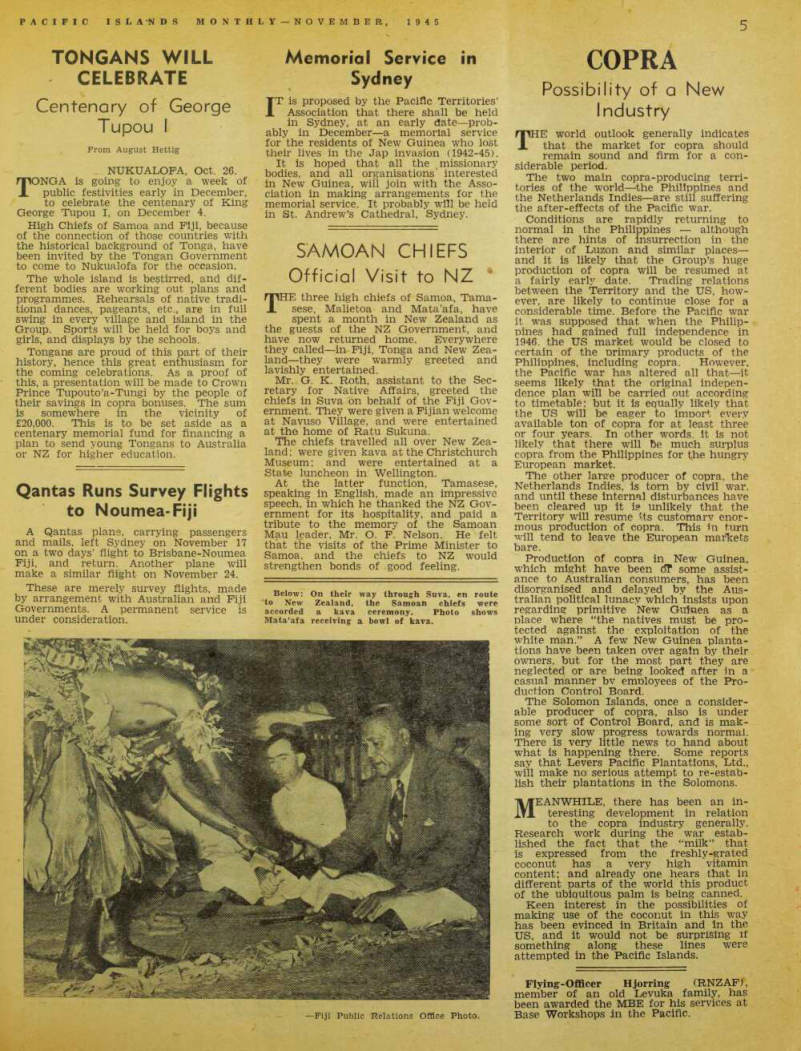
Below: On their way through Suva, en route to New Zealand, the Samoan chiefs were accorded a kava ceremony. Photo shows Mata’afa receiving a bowl of kava.
Sydney
Memorial Service in Sydney
IT is proposed by the Pacific Territories’
Association that there shall be held in Sydney, at an early date—prob ably in December—a memorial service for the residents of New Guinea who lost their lives in the Jap invasion (1942-45), It is hoped that all the missionary bodies, and all organisations interested in New Guinea, will join with the Asso ciation in making arrangements for the memorial service. It probably will be held in St. Andrew’s Cathedral, Sydney.
Samoan Chiefs
Official Visit to NZ
rE three high chiefs of Samoa, Tama sese, Malietoa and Mata’afa, have spent a month in New Zealand as the guests of the NZ Government, and have now returned home. Everywhere they called —in Fiji, Tonga and New Zea land—they were warmly greeted and lavishly entertained.
Mr. G. K. Roth, assistant to the Sec retary for Native Affairs, greeted the chiefs in Suva on behalf of the Fiji Gov ernment. They were given a Fijian welcome at Navuso Village, and were entertained at the home of Ratu Sukuna.
The chiefs travelled all over New Zea land ; were given kava at the Christchurch Museum; and were entertained at a State luncheon in Wellington.
At the latter function, Tamasese, speaking in English, made an impressive speech, in which he thanked the NZ Gov ernment for its hospitality, and paid a tribute to the memory of the Samoan Mau leader. Mr. O. F. Nelson. He felt that the visits of the Prime Minister to Samoa, and the chiefs to NZ would strengthen bonds of good feeling.
Copra
Possibility of a New Industry
rpHE world outlook generally indicates J. that the market for copra should remain sound and firm for a con siderable period.
The two main copra-producing terri tories of the world—the Philippines and the Netherlands Indies—are still suffering the after-effects of the Pacific war.
Conditions are rapidly returning to normal in the Philippines although there are hints of insurrection in the interior of Luzon and similar places— and it is likely that the Group’s huge production of copra will be resumed at a fairly early date. Trading relations between the Territory and the US, how ever, are likely to continue close for a considerable time. Before the Pacific war it was supposed that when the Philip pines had gained full independence in 1946. the US market would be closed to certain of the nrimary products of the Philippines, including copra. However, the Pacific war has altered all that—it seems likely that the original indepen dence plan will be carried out according to timetable: but it Is equally likely that the US will be eager to import every available ton of copra for at least three or four years. In other words. It is not likely that there will be much surplus copra from the Philippines for the hungry European market.
The other large producer of copra, the Netherlands Indies, is torn by civil war. and until these internal disturbances have been cleared up it i? unlikely that the Territory will resume its customary enor mous production of copra. This In turn will tend to leave the European markets bare.
Production of copra in New Guinea, which might have been dT some assist ance to Australian consumers, has been disorganised and delayed by the Aus tralian political lunacy which insists upon regarding primitive New Guinea as a place where “the natives must be pro tected against the exploitation of the white man.” A few New Guinea planta tions have been taken over again by their owners, but for the most part they are neglected or are being looked after in a casual manner bv emnloyees of the Pro duction Control Board.
The Solomon Islands, once a consider able producer of copra, also is under some sort of Control Board, and is mak ing very slow progress towards normal.
There is very little news to hand about what is happening there. Some reports say that Levers Pacific Plantations, Ltd., will make no serious attempt to re-estab lish their plantations in the Solomons.
MEANWHILE, there has been an in teresting development in relation to the copra industry generally.
Research work during the war estab lished the fact that the “milk” that is expressed from the freshly-grated coconut has a very high vitamin content; and already one hears that in different parts of the world this product of the übiquitous palm is being canned.
Keen interest in the possibilities of making use of the coconut in this way has been evinced in Britain and in the US, and it would not be surprising if something along these lines were attempted in the Pacific Islands.
Flying-Officer H jorring (RNZAF), member of an old Levuka family, has been awarded the MBE for his services at Base Workshops an the Pacific.
Advertisements & other items, p. 7 (1 item)
5
PACIFIC ISLA-NDS MONTHLY NOVEMBER, 1945
Islanders
Fate Of Ocean
100 Reported Murdered
REPORTS have reached us that the Japanese, some time in 1945, mas sacred about 100 natives of Ocean Island—all that remained there. Details are lacking, but there is no doubt that a great tragedy of some kind occurred.
When Ocean Island was abandoned— about March, 1942 the following re mained behind, voluntarily:— • Mr. G. F. C. Cartwright, Govern ment Secretary) and two other Govern ment officials, and Father Pujebet, the Roman Catholic missionary they re mained because they thought they could protect the natives. • About 600 Banabans (natives of the island) and some 700 Gilbertese natives, who had been taken there as labourers on the phosphate workings. • About 800 Chinese labourers.
There has been no word of the fate of the Europeans, Chinese and Gilbertese.
It is reported that they were shipped aW Some 500 Banabans also were shipped away. The remainder, about 100, were murdered. . , It is reported that one Ocean Islander escaped in a canoe and, after many long weeks of wandering, turned up m his canoe in the Ninigo Group, in the Ad miralty Islands, off the north coast of New Guinea.
Mr. John Bennett, Suva’s Acting Chief Magistrate, suffered a fractured ankle when he was returning by plane from Levuka on official business. The aircraft dipped to salute the old capital, Mr Bennett lost his balance, and wrenched his foot badly. It will be some time before he can go to Lautoka, where he has been posted.
Revolution!
Come The
Indians Arm—For What?
Suva, Oct. 16.
IN the week ending October 14, 76 charges of being in illegal possession of arms or explosives or other Army property have, been made in the Nadi district—almost entirely against Indians.
The police round-up is continuing and each day brings its quota of black sheep.
Police officers in charge of the drive are Superintendent Hooper and Assistant Superintendent Spencer. In the first week they recovered 10,000 rounds of ammunition, 27 rifles. 20 automatic pis tols, 278 I lb. tins of TNT, 45 grenades, and 23 smoke-bombs.
The present police clean-up is long overdue, but is welcomed by the Euro pean residents of the Colony.
One has not got to be long in this country before becoming conscious of persistent rumours of what the Indians of the Tavua-Nadi districts are alleged to have in the way of hidden arms. The European residents of those districts give the impression that they would not be much surprised if red, raw revolution broke out at any moment. Whether this is the real intention of the Indians con cerned is open to doubt, but the fact remains that they remain a potential danger to the peace of the Colony whne such a state of affairs is allowed to exist.
To date, apparently, this danger has been discounted by the authorities, whose task in overcoming it certainly is no easy one.
NADI was (and still is, to a limited degree) a large American base.
American Servicemen, moreover, are apparently not held responsible for their arms to the extent of British or Colonial troops. It is stated freely here that the whole arms racket started through a dump of arms and ammunition being
forgotten or abandoned by the Ameri cans, and which the local Indians for no other reason than acquisitiveness re moved piecemeal.
Later, some shrewd-heads saw the pos sibilities of thus being prepared, and a brisk trade in ammunition and weapons was carried on with Servicemen, in ex change for various services rendered.
Possibly, in a large percentage of cases the Indians concerned thought no further than participation in their own gang wars and faction differences which rage interminably; others, again, may have an eye to the future and see the day when these preparations may be turned to good account against the comparatively few Britishers in the Colony.
Considering the interesting time the Dutch and French are having with their colonial subjects at present, it is per haps rather amazing that the Indians have not been tempted to do likewise, if they have any leanings that way—and public opinion is that they have.
With the weapons have gone the manuals for working them. Guns and automatic weapons are usually found sealed in tins and deposited in such safe places as the canefields. It is presumed that the people concerned are not keep ing these things as souvenirs, and that they must envision a day when they will be used. , Whether it is for plain gang war—and there are young arrogant Indians around the districts bordering on Lautoka who make the Hollywood gangster look but a pale imitation—or fancy revolutions, the time to do something about it is now. At present New Zealand and American troops are moving back home, and the Fiji Military Forces are being dispersed.
If the Indians contemplate mischief this could be the time for which they are looking.
Fiji’s Comptroller of Customs, Hon.
H. J. S. Allen, retires next January. He will be succeeded by Mr. Smith, Collector of Customs, Bermuda. ft
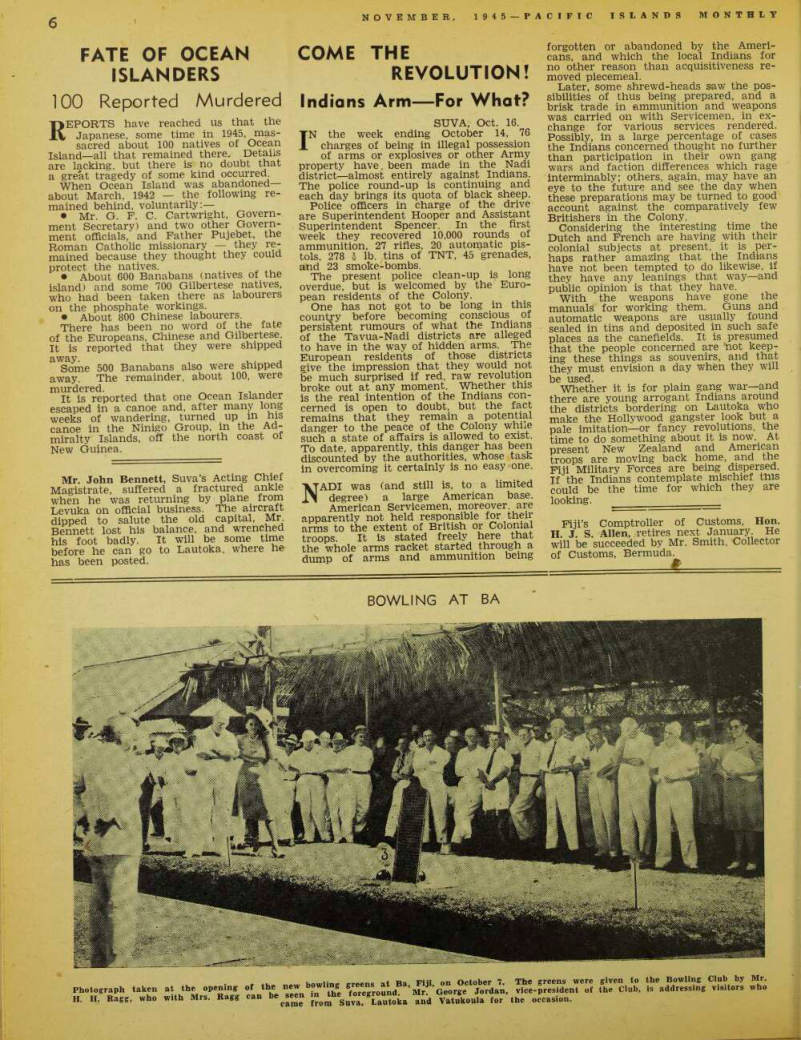
Bowling At Ba
Photograph taken at the opening of the bowling greens at Ba, Fiji, on October 7. The greens were given to the Bowling Club by Mr.
H. H. Ragg, who with Mrs. Ragg can be seen in the foreground. Mr. George Jordan, vice-president of the Club, is addressing visitors who came from Suva, Lautoka and Vatukaula for the occasion.
Ward: "Future Prime
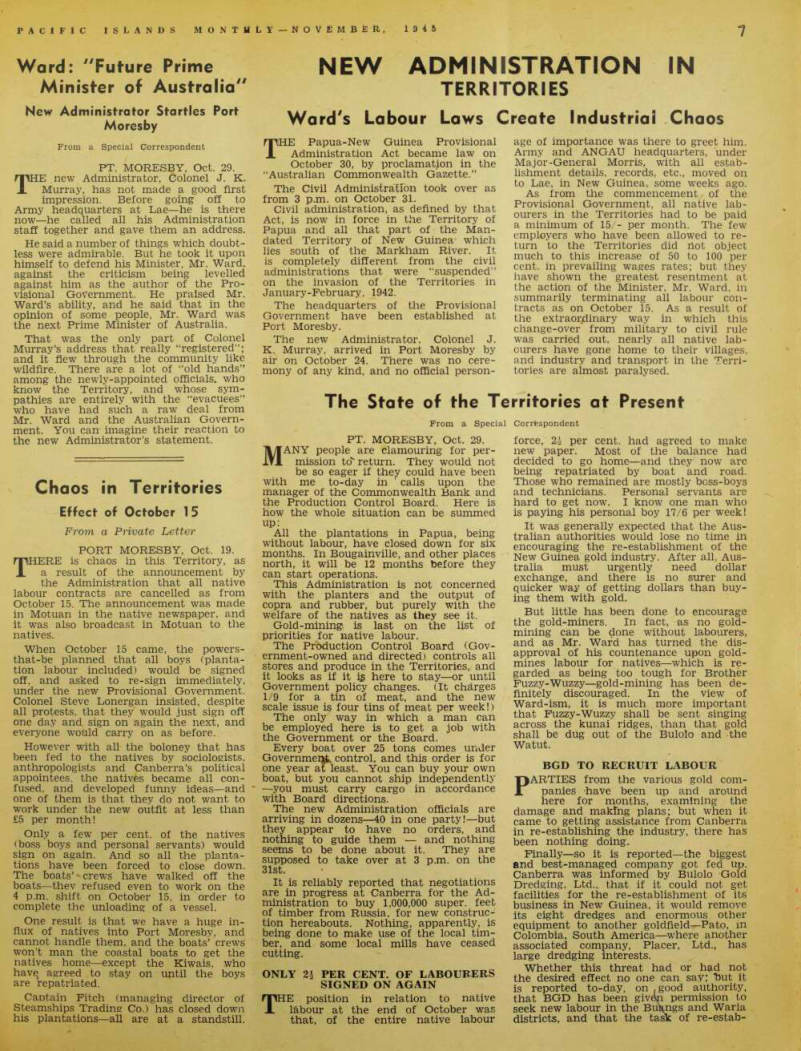
Minister of Australia"
New Administrator Startles Port Moresby
From a Special Correspondent
Pt. Moresby, Oct. 29.
rpHE new Administrator, Colonel J. K.
X Murray, has not made a good first impression. Before going off to Army headquarters at Lae —he is there now—he called all his Administration staff together and gave them an address.
He said a number of things which doubt less were admirable. But he took it upon himself to defend his Minister, Mr. Ward, against the criticism being levelled against him as the author of the Pro visional Government. He praised Mr, Ward’s ability, and he said that in the opinion of some people, Mr. Ward was the next Prime Minister of Australia.
That was the only part of Colonel Murray’s address that really “registered”; and it flew through the community like wildfire. There are a lot of “old hands” among the newly-appointed officials, who know the Territory, and whose sym pathies are entirely with the “evacuees” who have had such a raw deal from Mr. Ward and the Australian Govern ment. You can imagine their reaction to the new Administrator’s statement.
Chaos in Territories
Effect of October 15
From a Private Letter
Port Moresby, Oct. 19.
fIIHERE is chaos in this Territory, as A a result of the announcement by the Administration that all native labour contracts are cancelled as from October 15. The announcement was made in Motuan in the native newspaper, and it was also broadcast in Motuan to the natives.
When October 15 came, the powers that-be planned that all boys (planta tion labour included) would be signed off, and asked to re-sign immediately, under the new Provisional Government.
Colonel Steve Lonergan insisted, despite all protests, that they would just sign off one day and sign on again the next, and everyone would carry on as before.
However with all the boloney that has been fed to the natives by sociologists, anthropologists and Canberra’s political appointees, the natives became all con fused, and developed funny ideas —and one of them is that they do not want to work under the new outfit at less than £5 per month!
Only a few per cent, of the natives (boss boys and personal servants) would sign on again. And so all the planta tions have been forced to close down.
The boats’ - crews have walked off the boats—thev refused even to work on the 4 p.m. shift on October 15, in order to complete the unloading of a vessel.
One result is that we have a huge in flux of natives into Port Moresby, and cannot handle them, and the boats’ crews won’t man the coastal boats to get the natives home—except the Kiwais, who have, agreed to stay on until the boys are repatriated.
Cantain Fitch (managing director of Steamships Trading Co.) has closed down his plantations—all are at a standstill.
New Administration In
Territories
Ward's Labour Laws Create Industrial Chaos
THE Papua-New Guinea Provisional Administration Act became law on October 30, by proclamation in the “Australian Commonwealth Gazette.”
The Civil Administration took over as from 3 p.m. on October 31.
Civil administration, as defined by that Act, is now in force in the Territory of Papua and all that part of the Man dated Territory of New Guinea which lies south of the Markham River. It is completely different from the civil administrations that were “suspended” on the invasion of the Territories in January-February, 1942.
The headquarters of the Provisional Government have been established at Port Moresby.
The new Administrator, Colonel J.
K. Murray, arrived in Port Moresby by air on October 24. There was no cere mony of any kind, and no official person
age of importance was there to greet him.
Army and ANGAU headquarters, under Major-General Morris, with all estab lishment details, records, etc., moved on to Lae, in New Guinea, some weeks ago.
As from the commencement of the Provisional Government, all native lab ourers in the Territories had to be paid a minimum of 15/- per month. The few employers who have been allowed to re turn to the Territories did hot object much to this increase of 50 to 100 per cent, in prevailing wages rates; but they have shown the greatest resentment at the action of the Minister, Mr. Ward, in summarily terminating all labour con tracts as on October 15. As a result of the extraordinary way in which this change-over from military to civil rule was carried out, nearly all native lab ourers have gone home to their villages, and industry and transport in the Terri tories are almost paralysed.
The State of the Territories at Present
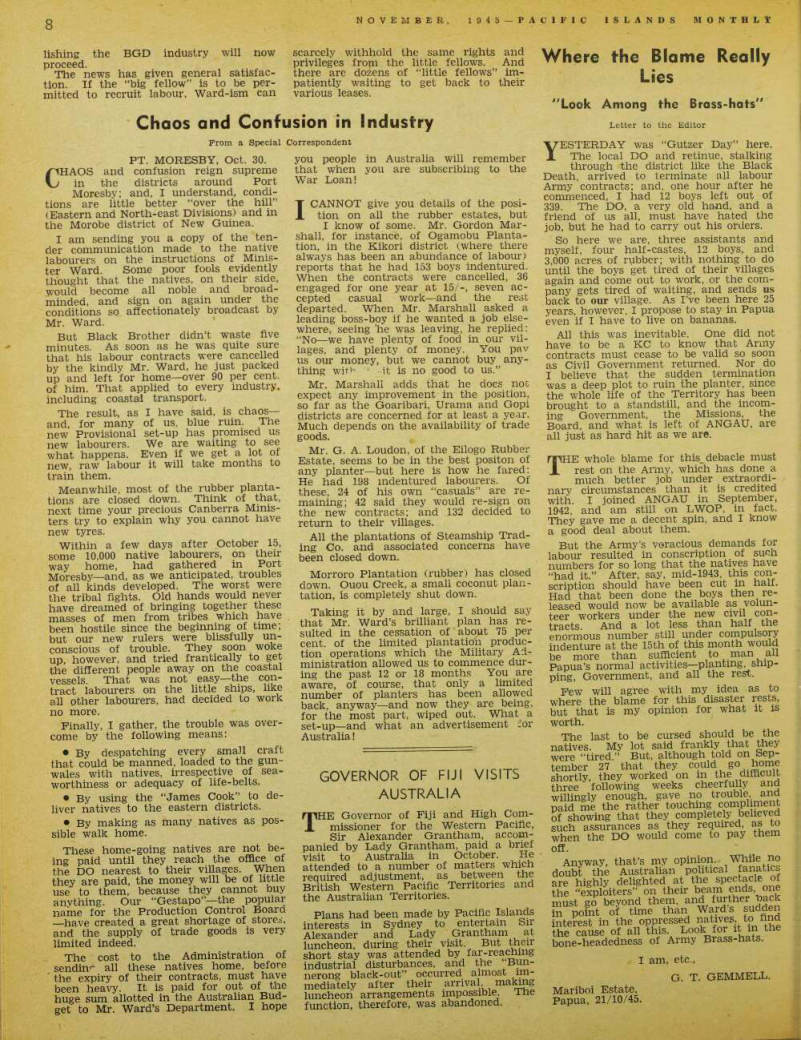
From a Special Correspondent
Pt. Moresby, Oct. 29.
MANY people are clamouring for permission to v return. They would not be so eager if they could have been with me to-day in ’ calls upon the manager of the Commonwealth Bank and the Production Control Board. Here is how the whole situation can be summed up in . , .. „ , .
A} 1 £ i uP lan^ tlons ■ in Papua, being without labour, have closed down for six months. In Bougainville, and other places north, it will be 12 months before they ca £ start operations.
This Administration is not concerned with the planters and the output of copra and rubber, but purely with the welfare of the natives as they see it.
Gold-mining is last on the list of priorities for native labour.
The Production Control Board (Government-owned and directed) controls all stores and produce in the Territories, and it looks as if it i$ here to stay—or until Government policy changes. (It charges 1/9 for a tin of meat, and the new scale issue is four tins of meat per week!) The only way in which a man can be employed here is to get a job with the Government or the Board.
Every boat over 25 tons comes under Government control, and this order is for one year at least. You can buy your own boat, but you cannot ship independently —you must carry cargo in accordance with Board directions.
The new Administration officials are arriving in dozens—4o in one party!—but they appear to have no orders, and nothing to guide them and nothing seems to be done about it. They are supposed to take over at 3 p.m. on the ' 5A5T '* It is reliably reported that negotiations are in progress at Canberra for the Administration to buy 1,000,000 super, feet of timber from Russia, for new construetion hereabouts. Nothing, apparently, is being done to make use of the local timber, and some local mills have ceased cutting. nvTV 01 DrD „„ ¥ ONLY 2 2 PER CENT. OF LABOURERS
Signed On Again
fITHE position in relation to native X labour at the end of October was that, of the entire native labour
force, 2i per cent, had agreed to make new paper. Most of the balance had decided to go home—and they now are being repatriated by boat and road, Those who remained are mostly boss-boys and technicians. Personal servants are hard to get now. I know one man who is paying his personal boy 17/6 per week!
It was generally expected that the Aus tralian authorities would lose no time in encouraging the re-establishment of the New Guinea gold industry. After all, Aus tralia must urgently need dollar exchange, and there is no surer and quicker way of getting dollars than buy jn g them with gold , .
But little, has been done to encourage th o gold-miners. In fact, as no gold mining can be done without labourers, anc * as , Ward has turned the dis approval of his countenance upon gold mines labour for natives-which is re garded as being too tough for Brother Fuzzy-Wuzzy gold-mining has been de finitely discouraged. In the. view of }Y a f d Zi sin ’ 18 ore I f n P9 rtant that Fuzzy-Wuzzy shall be sent singing aor ° ss u the kunai r i d f£ s ’ 4 h£ J n , g i2 d shall be dug out of the Bulolo and the Watut.
Bgd To Recruit Labour
-QARTIES from the various gold com- Y panies have been up and around here for months, examining the damage and making plans; but when it came to getting assistance from Canberra in re-establishing the industry, there has been nothing doing.
Finallv—so it is renorted—the Merest ftnd best-managed company got fed up.
Canberra was informed by Bulolo Gold Dredging, Ltd., that if it could not get facilities for the re-establishment of its business in New Guinea, it would remove its eig ht dredges and enormous other equipment to another goldfield—Pato, in Colombia, South America—where another associated company, Placer, Ltd., has large dredging interests.
Whether this threat had or had not the es i re( j effect no one can say; hut it j S reported to-day, on , good authority, that BGD has been given permission to seek new labour in the Buimgs and Warla districts, and that the task of re-estab
fishing the BGD industry will now proceed.
The news has given general satisfac tion. If the “big fellow” is to be per mitted to recruit labour, Ward-ism can
scarcely withhold the same rights and privileges from the little fellows. And there are dozens of “little fellows” im patiently waiting to get back to their various leases.
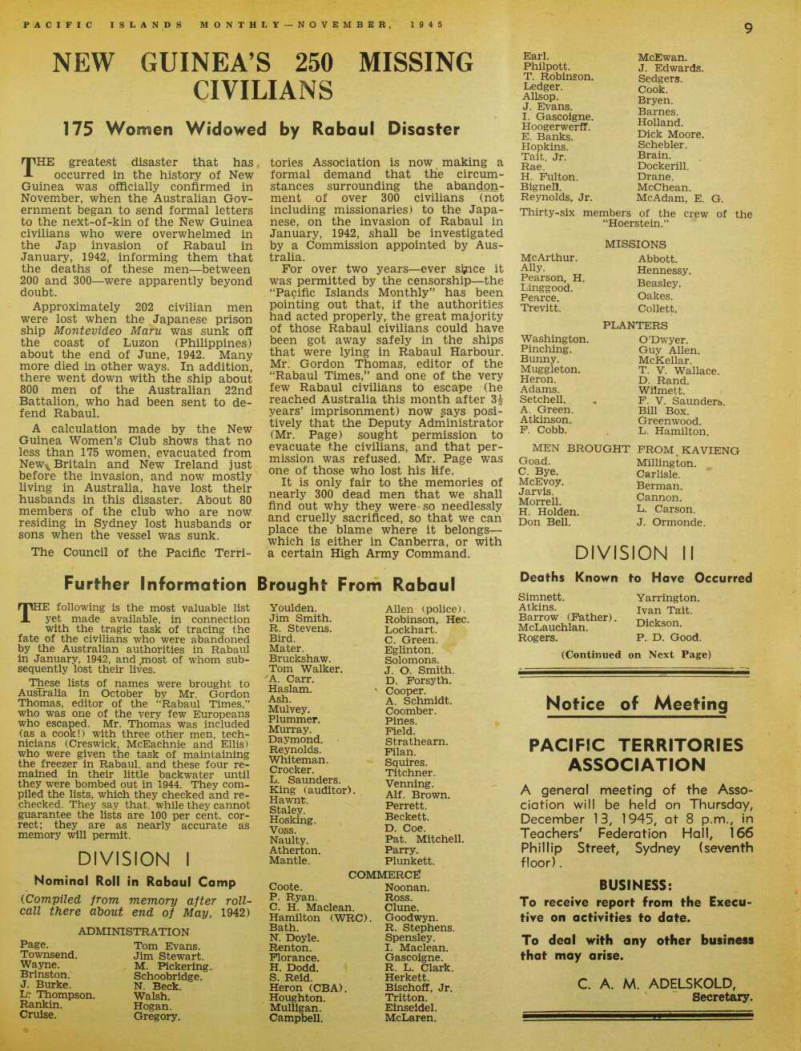
Chaos and Confusion in Industry
From a Special Correspondent
Pt. Moresby, Oct. 30.
CHAOS and confusion reign supreme in the districts around Port Moresby: and, I understand, condi tions are little better “over the hill” (Eastern and North-east Divisions) and in the Morobe district of New Guinea.
I am sending you a copy of the ten der communication made to the native labourers on the instructions of Minis ter Ward. Some poor fools evidently thought that the natives, on their side, would become all noble and broad minded, and sign on again under the conditions so affectionately broadcast by Mr. Ward.
But Black Brother didn’t waste five minutes. As soon as he was quite sure that his labour contracts were cancelled by the kindly Mr. Ward, he just packed up and left for home—over 90 per cent, of him. That applied to every industry, including coastal transport.
The result, as I have said, is chaos— and, for many of us, blue ruin. The new Provisional set-up has promised us new labourers. We are waiting to see what happens. Even if we get a lot of new, raw labour it will take months to train them.
Meanwhile, most of the rubber planta tions are closed down. Think of that, next time your precious Canberra Minis ters try to explain why you cannot have new tyres.
Within a few days after October 15, some 10,000 native labourers, on their way home, had gathered in Port Moresby—and, as we anticipated, troubles of all kinds developed. The worst were the tribal fights. Old hands would never have dreamed of bringing together these masses of men from tribes which have been hostile since the beginning of time; but our new rulers were blissfully un conscious of trouble. They soon woke up, however, and tried frantically to get the different people away on the coastal vessels. That was not easy—the con tract labourers on the little ships, like all other labourers, had decided to work no more.
Finally, I gather, the trouble was over come by the following means: • By despatching every small craft that could be manned, loaded to the gun wales with natives, irrespective of sea worthiness or adequacy of life-belts. • By using the “James Cook” to de liver natives to the eastern districts. • By making as many natives as pos sible walk home.
These home-going natives are not be ing paid until they reach the office of the DO nearest to their villages. When they are paid, the money will be of little use to them, because they cannot buy anything. Our “Gestapo”—the popular name for the Production Control Board —have created a great shortage of stores, and the supply of trade goods is very limited indeed.
The cost to the Administration of sending all these natives home, before the expiry of their contracts, must have been heavy. It is paid for out of the huge sum allotted in the Australian Bud get to Mr. Ward’s Department. I hope
you people in Australia will remember that when you are subscribing to the War Loan!
I CANNOT give you details of the posi tion on all the rubber estates, but I know of some. Mr. Gordon Mar shall, for instance, of Ogamobu Planta tion, in the Kikori district (where there always has been an abundance of labour) reports that he had 153 boys indentured.
When the contracts were cancelled, 36 engaged for one year at 15/-, seven ac cepted casual work —and the rest departed. When Mr. Marshall asked a leading boss-boy if he wanted a job else where, seeing 'he was leaving, he replied; “No—we have plenty of food in our vil lages, and plenty of money. You pav us our money, but we cannot buy any thing wit>- it is no good to us.”
Mr. Marshall adds that he does not expect any improvement in the position, so far as the Goaribari, Urama and Gopi districts are concerned for at least a year.
Much depends on the availability of trade goods.
Mr. G. A. Loudon, of the Eilogo Rubber Estate, seems to be in the best positon of any planter—but here is how he fared: He had 198 indentured labourers. Of these, 24 of his own “casuals” are re maining; 42 said they would re-sign on the new contracts; and 132 decided to return to their villages.
All the plantations of Steamship Trad ing Co. and associated concerns have been closed down.
Morroro Plantation (rubber) has closed down. Ouou Creek, a small coconut plan tation, is completely shut down.
Taking it by and large, I should say that Mr. Ward’s brilliant plan has re sulted in the cessation of about 75 per cent, of the limited plantation produc tion operations which the Military Ad ministration allowed us to commence dur ing the past 12 or 18 months You are aware, of course, that only a limited number of planters has been allowed back, anyway—and now they are being, for the most part, wiped out. What a set-up—and what an advertisement for Australia!
Governor Of Fiji Visits
Australia
rnHE Governor of Fiji and High Com- X missioner for the Western Pacific, Sir Alexander Grantham, accom panied by Lady Grantham, paid a brief visit to Australia in October. He attended to a number of matters which required adjustment, as between the British Western Pacific Territories and the Australian Territories.
Plans had been made by Pacific Islands interests in Sydney to entertain Sir Alexander and Lady Grantham at luncheon, during their visit. But their short stay was attended by far-reaching industrial disturbances, and the “Bun nerong black-out” occurred almost im mediately after their arrival, making luncheon arrangements impossible. The function, therefore, was abandoned.
Where the Blame Really
Lies "Look Among the Brass-hats"
Letter to the Editor YESTERDAY was “Gutzer Day” here.
The local DO and retinue, stalking through the district like the Black Death, arrived to terminate all labour Army contracts; and, one hour after he commenced, I had 12 boys left out of 339. The DO, a very old hand, and a friend of us all, must have hated the job, but he had to carry out his orders.
So here we are, three assistants and myself, four half-castes, 12 boys, and 3,000 acres of rubber; with nothing to do until the boys get tired of their villages again and come out to work, or the com pany gets tired of waiting, and sends us back to our village. As I’ve been here 25 years, however, I propose to stay in Papua even if I have to live on bananas.
All this was inevitable. One did not have to be a KC to know that Army contracts must cease to be valid so soon as Civil Government returned. Nor do I believe that the sudden termination was a deep plot to ruin Hie planter, since the whole life of the Territory has been brought to a standstill, and the incom ing Government, the Missions, the Board, and what is left of ANGAU, are all just as hard hit as we are. rE whole blame for this_.debacle must rest on the Army, which has done a much better job under extraordi nary circumstances than it is credited with. I joined ANGAU in September, 1942, and am still on LWOP, in fact.
They gave me a decent spin, and I know a good deal about them.
But the Army’s voracious demands for labour resulted in conscription of such numbers for so long that the natives have “had it.” After, say, mid-1943, this con scription should have been cut in half.
Had that been done the boys then re leased would now be available as volun teer workers under the new civil con tracts. And a lot less than half the enormous number still under compulsory indenture at the 15th of this month would be more than sufficient to man all Papua’s normal activities —planting, ship ping, Government, and all the rest.
Few will agree with my idea as to where the blame for this disaster rests, but that is my opinion for what it is worth.
The last to be cursed should be the natives. My lot said frankly that they were “tired.” But, although told on Sep tember 27 that they could 8° home shortly, they worked on in the difficult three following weeks cheerfully and willingly enough, gave no trouble, ana paid me the rather touching compliment of showing that they completely believed such assurances as they required, as to when the DO would come to pay them off.
Anyway, that’s my opinion. While no doubt the Australian political fanatics are highly delighted at the spectacle of the “exploiters” on their beam ends, one must go beyond them, and further pack iS point of time than Ward's sudden interest in the oppressed natives, to find the cause of all this. Look for it in the bone-headedness of Army Brass-hats.
I am, etc.,
G. T. Gemmell.
Mariboi Estate, Papua, 21/10/45.
Advertisements & other items, p. 11 (1 item)
D^p^hp^blam^wherp 0
NEW GUINEA’S 250 MISSING
CIVILIANS
175 Women Widowed by Rabaul Disaster
THE greatest disaster that has occurred in the history of New Guinea was officially confirmed in November, when the Australian Gov ernment began to send formal letters to the next-of-kin of the New Guinea civilians who were overwhelmed in the Jap invasion of Rabaul in January, 1942, informing them that the deaths of these men—between 200 and 300—were apparently beyond doubt.
Approximately 202 civilian men were lost when the Japanese prison ship Montevideo Maru was sunk off the coast of Luzon (Philippines) about the end of June, 1942. Many more died in other ways. In addition, there went down with the ship about 800 men of the Australian 22nd Battalion, who had been sent to de fend Rabaul.
A calculation made by the New Guinea Women’s Club shows that no less than 175 women, evacuated from New v Britain and New Ireland just before the invasion, and now mostly living in Australia, have lost their husbands in this disaster. About 80 members of the club who are now residing in Sydney lost husbands or sons when the vessel was sunk.
The Council of the Pacific Terri
tories Association is now making a formal demand that the circum stances surrounding the abandon ment of over 300 civilians (not including missionaries) to the Japa nese, on the invasion of Rabaul in January, 1942, shall be investigated by a Commission appointed by Aus tralia.
For over two years—ever sfrice it was permitted by the censorship—the “Pacific Islands Monthly” has been pointing out that, if the authorities had acted properly, the great majority those Rabaul civilians could have been S ot awa Y safel y in the shi P s that were lying in Rabaul Harbour, Mr - Gordon Thomas, editor of the “ Rabaul Times,” and one of the very few Raba ul civilians to escape (he reached Australia this month after 3* vears’ imprisonment) now says posie r ly r * was refused ’ Mr* Page *was wTiifa 56 WaS
on f t °? S?? nf
np ? rl v
SnH^niif 3
out why they were-so needlessly
D^p^hp^blam^wherp 0
e in o? wUh a certain High Army Command.
Staley*
Further Information Brought From Rabaul
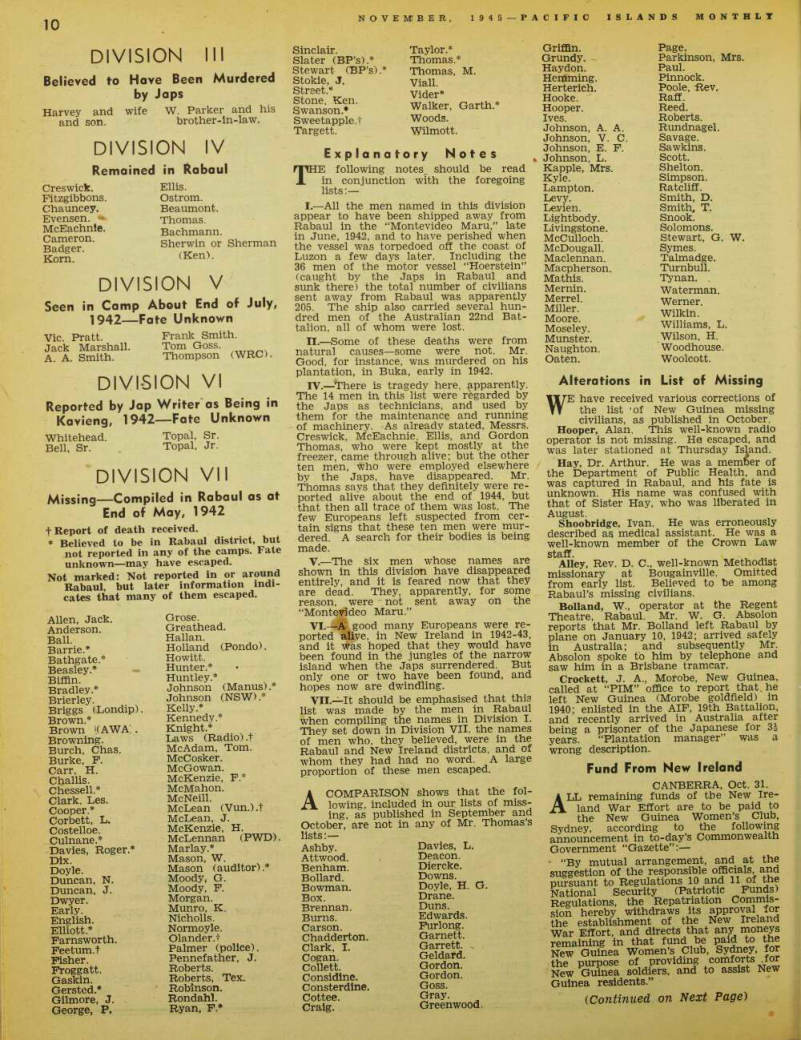
THE following is the most valuable list yet made available, in connection with the tragic task of tracing the fate of the civilians who were abandoned by the Australian authorities in Rabaul in January, 1942, and of whom sub sequently lost their lives.
These lists of names were brought to Australia in October by Mr. Gordon Thomas, editor of the “Rabaul Times,” who was one of the very few Europeans who escaped. Mr. Thomas was included (as a cook!) with three other men, tech nicians (Creswick, McEachnie and Ellis) who were given the task of maintaining the freezer in Rabaul, and these four re mained in their little backwater until they were bombed out in 1944. They com piled the lists, which they checked and re checked. They say that, while they cannot guarantee the lists are 100 per cent, cor rect; they are as nearly accurate as memory will permit.
Division I
Nominal Roll in Rabaul Camp
(Compiled from memory after roll
call there about end of May, 1942)
Administration
Pa ge. Tom Evans.
Townsend. Jim Stewart.
Wayne. M. Pickering.
Brinston. Schoobridge.
J. Burke. N. Beck.
Lr Thompson. Walsh.
Rankin. Hogan.
Cruise. Gregory.
Youlden. Allen (police).
Jim Smith. Robinson, Hec.
R. Stevens. Lockhart.
Bird. c. Green.
Mater. Eglinton.
Bruckshaw. Solomons.
Tom Walker. j. o. Smith.
'A. Carr. d. Forsyth.
Haslam. > Cooper.
Ash. a. Schmidt.
Mulvey. Coomber.
Plummer. Pines.
Murray. Field.
Daymond. Strathearn.
Reynolds. Filan.
Whiteman. Squires.
Crocker. Titchner.
L. Saunders, Vennine
iiwnr (audltor) - Alf - Brown.
Staley*
Hosking. Beckett.
Voss. £>. Coe.
Naulty. Pat. Mitchell.
Atherton. Parry.
Mantle. Plunkett.
Commerce?
Coote. Noonan.
P. Ryan. Ross.
C. H. Maclean. Clune.
Hamilton (WRC). Goodwyn.
Bath. R. Stephens.
N. Doyle. Spensley.
Renton. I. Maclean, Florance. Gascoigne.
H. Dodd. R. L. Clark.
S. Reid. Herkett.
Heron (CBA). Bischoff, Jr.
Houghton. Tritton.
Mulligan. Einseldel.
Campbell. McLaren.
Earl. McEwan.
Philpott. j. Edwards.
T. Robinson. Sedgers.
Ledger. Cook.
Allsop. Brven J. Evans. Barnes I. Gascoigne.
Hoogerwerff.
E. Banks. Dlck Moore.
Hopkins. Schebler.
Tait, Jr. Brain.
Rae. Dockerill.
H. Fulton. Drane.
Bignell. McChean, Reynolds, Jr. McAdam, E. G.
Thirty-six members of the crew of the “Hoerstein.”
Missions
McArthur. Abbott.
Pearson H Hennessy. it carbon, xi, Linggood. Beasley.
Pearce. Oakes, Trevitt. Collett.
Planters
Washington. O’Dwyer.
Pinching. Guy Allen.
Bunny. McKellar.
Muggleton. T. V. Wallace.
Heron. D. Rand.
Adams. Wilmett.
Setchell. . F. v. Saunders.
A. Green. Bill Box.
Atkinson. Greenwood.
F. Cobb. L. Hamilton.
Men Brought From Kavieng
Goad. Millington.
G. Bye. Carlisle. s ° y - Berman.
Morrell. Cannon.
H. Holden. L - Carson.
Don Bell. J. Ormonde.
Division Ii
Deaths Known to Have Occurred
Simnett. Yarrington.
Atkins. Ivan Tait.
Barrow (Father). nJ , McLauchlan. Dickson.
Rogers. P. D. Good. (Continued on Next Page)
Division In
Believed to Have Been Murdered
by Japs
Harvey and wife W. Parker and his and son. brother-in-law.
Division Iv
Remained in Rabaul Creswick. Ellis.
Fitzgibbons. Ostrom.
Chauncey. Beaumont.
Evensen. Thomas.
McEachnie. Bachmann.
Badge? 11 Sherwin or Sherman Korn. ’ (Ken).
Division V
Seen in Camp About End of July, 1942 —Fate Unknown Vic. Pratt. Frank Smith.
Jack Marshall. Tom Goss.
A. A. Smith. Thompson (WRC),
Division Vi
Reported by Jap Writer as Being in
Kavieng, 1942—Fate Unknown
Whitehead. Topal, Sr.
Bell, Sr. Topal. Jr.
Division Vii
Missing —Compiled in Rabaul as at
End of May, 1942 t Report of death received. * Believed to be in Rabaul district, but not reported in any of the camps. Fate unknown —may have escaped.
Not marked: Not reported in or around Rabaul, but later information indi cates that many of them escaped.
Allen, Jack. Grose.
Anderson. Greathead.
Ball. Hallan.
Barrie.* Holland CPondo).
Bathgate.* Howitt.
Beasley.* Hunter.* Biffin. Huntley.* Bradley.* Johnson (Manus).* Brierley. Johnson (NSW) * Briggs (Londip). Kelly.* Brown.* Kennedy.* Brown '(AWA.. Knight.* Browning. Laws (Radio) .t Burch, Chas. McAdam, Tom.
Burke, P. McCosker.
Carr, H. McGowan.
Challis. McKenzie, F.* Chessell.* McMahon.
Clark. Les. McNeill.
Cooper* McLean (Vun.).t Corbett, L. McLean, J.
Costelloe. McKenzie, H Culnane.* McLennan (PWD).
Davies, Roger.* Marlay.* Dix. Mason, W.
Doyle. Mason (auditor).* Duncan, N. Moody, G.
Duncan, J. Moody, F.
Dwyer. Morgan.
Early. Munro, K.
English. Nicholls.
Elliott* Normoyle.
Farnsworth. Olander.t Feetum.t Palmer (police), pisher Pennefather, J.
Froggatt. Roberts.
Gaskin. Roberts, Tex.
Gersted.* Robinson.
Gilmore, J. Rondahl.
George, P. Ryan. F.*
Sinclair. Taylor.* Slater (BP’s).* Thomas.* Stewart (BP’s).* Thomas, M.
Stokie, J. Viall.
Street.* virfpr* Stone. Ken. * Swanson.* Walker, Garth.
Sweetapple.t Woods.
Targett. Wilmott.
Explanatory Notes
rE following notes_ should be read in conjunction with the foregoing lists:— I. —All the men named in this division appear to have been shipped away from Rabaul in the “Montevideo Maru,” late in June, 1942, and to have perished when the vessel was torpedoed off the coast of Luzon a few days later. Including the 36 men of the motor vessel “Hoerstein” (caught by the Japs in Rabaul and sunk there) the total number of civilians sent away from Rabaul was apparently 205. The ship also carried several hun dred men of the Australian 22nd Bat talion, all of whom were lost.
II. — Some of these deaths were from natural causes—some were not. Mr.
Good, for instance, was murdered on his plantation, in Buka, early in 1942.
IV. —There is tragedy here, apparently.
The 14 men in this list were regarded by the Japs as technicians, and used by them for the maintenance and running of machinery. As already stated, Messrs.
Creswick, McEachnie. Ellis, and Gordon Thomas, who were kept mostly at the freezer, came through alive; but the other ten men, who were employed elsewhere by the Japs, have disappeared. Mr.
Thomas savs that they definitely were re ported alive about the end of 1944, but that then all trace of them was lost. The few Europeans left suspected from cer tain signs* that these ten men were mur dered. A search for their bodies is being made.
V.—The Six men whose names are shown in this division have disappeared entirely, and it is feared now that they are dead. They, apparently, for some reason, were not sent away on the “Montevideo Maru.”
VI.—A good many Europeans were re ported alive, in New Ireland in 1942-43, and it was hoped that they would have been found in the jungles of the narrow island when the Japs surrendered. But only one or two have been found, and hopes now are dwindling.
VII.— It should be emphasised that this list was made by the men in Rabaul when compiling the names in Division I.
They set down in Division VII. the names of men who. they believed, were in the Rabaul and New Ireland districts, and of whom they had had no word. A large proportion of these men escaped.
A COMPARISON shows that the fol lowing, included in our lists of miss ing, as published in September and October, are not in any of Mr. Thomas’s lists: — Ashby. Davies. L.
Attwood. Deacon.
Benham. Diercke.
Bollard. Downs Bowman. Doyle, H. G.
Box. Drane.
Brennan. Duns.
Burns Edwards.
Carson. Furlong.
Chadderton. Garnett.
Clark, I. Garrett.
Cogan. Geldard.
Collett. Gordon.
Considlne. Gordon.
Consterdine. Goss.
Cottee. Gray.
Craig. Greenwood,
Griffin. Page.
Grundy. Parkinson, Mrs.
Haydon. Paul.
Hemming. Pinnock.
Herterich. Poole, -Rev.
Hooke. Raff.
Hooper. Reed.
Ives. Roberts.
Johnson, A. A. Rundnagel.
Johnson, V. C. Savage.
Johnson, E. F, Sawkins.
Johnson, L. Scott.
Kapple, Mrs. Shelton.
Kyle. Simpson.
Lampton. Ratcliff.
Levy. Smith, D.
Levien. Smith, T.
Lightbody. Snook.
Livingstone. Solomons.
McCulloch. Stewart, G. W.
McDougall. Symes.
Maclennan. Talmadge.
Macpherson. Turnbull.
Mathis. Tynan. .
Mernin. Waterman.
Merrel. Werner.
Moore Wilkin.
Moseley. Williams. L.
Munster. Wilson, H.
Naughton. Woodhouse.
Oaten. Woolcott.
Alterations in List of Missing
WE have received various corrections of the list *of New Guinea missing civilians, as published in October.
Hooper, Alan. This well-known radio operator is not missing. He escaped, and was later stationed at Thursday Island.
Hay, Dr. Arthur. He was a member of the Department of Public Health, and was captured in Rabaul, and his fate is unknown. His name was confused with that of Sister Hay, who was liberated in August.
Shoobridge, Ivan. He was erroneously described as medical assistant. He was a well-known member of the Crown Law staff.
Alley, Rev. D, C., well-known Metlupdist missionary at Bougainville. Omitted from early list. Believed to be among Rabaul’s missing civilians.
Holland, W., operator at the Regent Theatre, Rabaul. Mr. W. G. Absolon reports that Mr. Bolland left Rabaul by plane on January 10, 1942; arrived safely in Australia; and subsequently Mr.
Absolon spoke to him by telephone and saw him in a Brisbane tramcar.
Crockett, J. A., Morobe, New Guinea, called at “PIM” office to report that, he left New Guinea (Morobe goldfield) in 1940; enlisted in the AIF, 19th Battalion, and recently arrived in Australia after being a prisoner of the Japanese for 3 h years. “Plantation manager” was a wrong description.
Fund From New Ireland
Canberra, Oct. 31.
ALL remaining funds of the New Ire land War Effort are to be paid to the New Guinea Women’s Club, Sydney, according to the following announcement in to-day’s Commonwealth Government “Gazette”:— “By mutual arrangement, and at the suggestion of the responsible officials, and pursuant to Regulations 10 and 11 of the National Security (Patriotic Funds) Regulations, the Repatriation Commis sion hereby withdraws its approval tor the establishment of the New Ireland War Effort, and directs that any moneys remaining in that fund be paid to the New Guinea Women’s Club, Sydney, for the purpose of Providing comforts for New Guinea soldiers, and to assist New Guinea residents.” {Continued on Next Page )
Thoughtful Help For NG Widows
Canberra, Nov. 1.
NEW GUINEA, women, widowed by the sinking of the prison-ship “Monte video Maru,” are being granted free holiday facilities by a well-known Syd ney businessman, says the president of the Sydney Branch of the New Guinea Women’s Club, Mrs. H. H. Page. The businessman is Mr. F. J. Salisbury, of Pennant Hills Road, Pennant Hills. He is head of a company which manufac tures travel goods.
Mr. Salisbury offered his Palm Beach home to the ladies soon after they offi cially learned of the disastrous sinking, which resulted in the apparent loss of a large proportion of the white men of New Britain and New Ireland. He first offered his house for a month; but, upon seeing the results of his gesture, extended the term.
One of the first to take advantage of the offer was Mrs. Kath Bignell, who recently returned to Australia after more than three years in Japanese prison camps. She then learned that her son, Ted, was one of the men on the sunken ship.
“Mr. Salisbury was a stranger to most of us, and that makes us appreciate his attitude perhaps even more,” said Mrs.
Page. “‘The first I heard from him was when he offered to store some luggage for some returned nurses. Later, he con tacted the club and asked whether the ladies, who had lost relatives on the boat, would like to holiday at his home, which he was not using at the time.
“Club members have been suffei Ing much anxiety over three years, and this last terrible news has been a great blow to them. Nothing could have been more welcome than Mr. Salisbury’s gesture.
The women are now arranging to go to Palm Beach in groups. Each groun stays a fortnight. I should like very much to go there myself, later on, but I haven t had the chance yet.”
Mrs. Page has been formally notified that her husband, Mr. Harold Page, Gov ernment Secretary, was aboard the ill fated “Montevideo Maru.”
Pensions For "Dependants"
following was published in
some Australian newspapers on November 4: “Dependants of civilians lost on the “Montevideo Maru” will be given com pensation by .the Commonwealth Gov ernment, probably on the Army scale. It is believed they will be given the choice of an outright grant or of weekly payments.”
We have tried to find out whether this applies to civilian officials only, or to all civilians lost in Rabaul, but Canberra is elusive.
Unofficially, we are informed that Can berra’s view is that Canberra will take responsibility for the dependants of men
sent by Canberra to the Territory’s Ad ministration, but that the dependants of all other men, who went there for “pur poses of profit,” must be taken care of by their employers or by their estates.
This is a typical politician’s argument.
It ignores the fact that all those Rabaul civilians were lost through the culpable negligence of the 'Australian Government, in failing to get the civilians away from Rabaul when the Jap invaders were approaching, although there was ample opportunity for them to do so.
Missionaries Died in Prison Ship rE entire Methodist missionary staff of New Guinea was lost when the Jap prison ship was torpedoed. The names of the ten missionaries are: Revs.
L. A. McArthur, W. D. Oakes, W. L. I.
Linggood, H. J. Pearson, J. W. Poole, H. V. Shelton, T. M. Simpson and J.
Trevitt, and Messrs. E. W. Pearce and S. C. Beasley.
The superintendent of the Seventh Day Adventist New Guinea Mission, stationed at Rabaul, Pastor Edwin Abbott, and Mr.
Trevor Collett, are also presumed lost in the “Montevideo Maru.” One other SDA missionary, Mr. Arthur Atkins, died in a Jap hospital after capture.
Another Fiji girl to marry an overseas Serviceman is Miss Margaret Willoughby, of Suva, who married Sgt. Frank Godfrey, of the New Zealand Forces, on October 6. They will make their home in New Zealand.
Advertisements & other items, pp. 11-14 (1 item)
Notice of Meeting
PACIFIC TERRITORIES
ASSOCIATION
A general meeting of the Association will be held on Thursday, December 13, 1945, at 8 p.m., in Teachers' Federation Hall, 166 Phillip Street, Sydney (seventh floor).
BUSINESS:
To receive report from the Executive on activities to date.
To deal with any other business that may arise.
C. A. M. ADELSKOLD,
Secretary.
THE
YORKSHIRE
INSURANCE
CO. LTD.
(Incorporated in England)
FIRE
ACCIDENT
MARINE
FIRE POLICIES ISSUED
IN PAPUA
All information from —
E. A. JAMES,
TeL 86347. Attorney for Papua, 14 Spring St., Sydney.
BURNS PHILP
(SOUTH SEA) CO. LTD.
' / C I I \ / A Inc. in Fiji
- F I J I
island Traders and Shipowners * Also Branches at: \Fiji; Levuka, Lautoka, Labasa, Ba, Sigatoka, Rotuma.
Tonga: Nukualofa, Haapai, Vavau.
Samoa: Apia, Pago Pago (American Samoa).
Solomons: Makambo, Gizo, Faisi.
New Hebrides: Vila.
Code Addresi: Gilberts: Tarawa.
"Bumsouth k . Norfolk Is. Niue. Wallis Is. Futuna Is.
u
UiTi
MrAui
E Ki
OLcW v/IisOTL.
Sole Australian Concessionaries :
GEORGE BROWN & CO. PTY.
267 Clarence Street, Sydney.
LTD
The Ultimate factory has made the change-over from its wartime set-up.
Designs for the new models are now completed and production is about to commence.
These models should be available early in 1946—they will be well worth waiting for. Watch for further announcements.
SERVICE: Servicing of all kinds of radio sets, amplifiers and Rola speakers will continue to be available.
SPECIALISING
IN
PACIFIC ISLAND INSURANCES
FIRE MOTOR VEHICLE
MARINE HULLS AND CARGO
EMPLOYER’S LIABILITY
GUARANTEES including those for—
DYNAMITE PERMITS.
RECRUITERS’ LICENCES.
DEFERRED WAGES
AND ALL OTHER CLASSES ARRANGED
AT LOWEST CURRENT RATES.
Established Agencies:
W. R. CARPENTER & CO., LTD.
Throughout the Territory of New Guinea.
SOUTHERN PACIFIC INSURANCE
CO., LTD.
HEAD OFFICE: 60 HUNTER STREET,
SYDNEY.
'Pont iau yin..
★ LIQUEURS ★ COCKTAILS ★ WHISKIES
Address all enquiries to:
W. & A. GILBEY LTD.,
33 ROSSLYN STREET, WEST MELBOURNE.
felegraphic and Cable Address: "Gilbey's,'' Melbourne.
109 REGENT STREET, SYDNEY.
Telegraphic and Cable Address: ' Gilbey s, Sydney.
Tropicalities
r E usual sensational newspaper head lines suggest that Paludrine, the discovery of a 38-years-old British professor, is the answer to the malaria sufferers’ 'prayer. Experienced tropical people will withhold their cheers until they have more information.
Quinine, the ancient remedy for malaria, held its place until it became the monopoly of a greedy ring; and it was a “rough and tough” remedy, anyway.
Then the drug-makers got busy. Plas moquine was produced, with a mighty flourish; but it did not stay the dis tance. Next came atebrin—and this sys tem-shaking, yellow-making drug is known, with disfavour, by every Service man in the Western Pacific. It seems to have “held” the disease; but it has been by no means the complete answer.
Quinine might have returned to favour, had it been possible for the Netherlands Indies planters to get back to their cin chona trees. But that is now a very un certain date. ♦ ♦ ♦ mHERE was something more than ordi- J. narily wrong with the Apia tele phone exchange. Especially did it
act strangely at night, when subscribers were almost deafened by long series of crackles and screams from mis-handled plugs. . , Complaints poured m; and, finally, authority decided to investigate. A sur prise evening visit was paid to the ex change. There friend operator (Samoan) was found, tilted back on his chair at leisure, smoking a cigarette~and mani pulating the switchboard plugs with his toes. * * * Before, flight - lieutenant MAURICE SCOTT embarked on a troopship in Britain, he was told that it would be arranged for him to fly home to Fiji from Australia ‘via America.” A geography lesson failed to convince the RAF authorities that it would be simpler, and cheaper for the taxpayers, to allow him to get on in Wellington, train to Auckland, and fly to Fiji in seven hours, rather than fly from Australia to America and then back to Fl Fhght-Lieutenant Scott decided to finish the argument in Australia; but, when he arrived on September 9. no one there had ever heard of him. After some search his papers were unearthed, and these duly B scheduled him for a trip home via America. Finally, he was able to per suade the RAAF, whose geography of the Pacific is presumably better than that of the RAP, that it would be better for him to return to Auckland, and fly to
arrived° ln *Suva on September 21.
He and his mother, Lady Sco^ t ’ d wl L 1 n short holiday in Tonga and Samoa before he returns to his law practice in Suva. * ON this little isle, no European ever ■falls into the notorious trap offered the unwary by the good old Poly nesian word for “fish.”
“Ika” means that; but it can also mean, differently-accented, a portion of the human anatomy that even f Islanders don’t mention m public- So, delicate Mangaia says not but “mauga-ika,” for the finny sea-harvest, and saves full many a Europeans cook from rosy embarrassed blushes. With the prefix, there’s “no possible doubt what ever ” (Rarotonga papers please copy!)— EG - * - * PAINT has been mighty scarce in Fiji during the war years, and even if one had old stock one was not per mitted by law, to use it. Consequently, when an American Liberty ship was wrecked on one of the °utlyuig islands and some containers of what toe Islanders took to be brown paint were washed up on the beach, the Lauansi were happy to Improve the shining ; hour and bits of woodwork around their bures.
But strangely enough th ® P, d int a nd f aEo to drv as good paint should, and also attracted every aSt and insect for miles ar The d 'mystery was toaUy s olv e d b y wandering European. What the Lauans had taken for rich brown paint was several gallons of chocolate syrup which our Yankee friends use for flavouring ice creams and other sweets.
Mr f *R CHARLTON, who was Director of Lands in Fiji until he retired some time ago, and who more recentlv has been engaged in town nlanning B for the Colony’s ambitious post
wa^reeonrtructionschemeserveddurmg
World War I in the Coconut Lancers in New Guinea. Part of that time he
was stationed in Bougainville, and can shed some light on the ascents of the Island’s peaks, inquiries about which were made by Lieut. R. Rodda in the Septem ber “PIM.”
Lieut. Rodda, a member of the New Zealand Alpine Club, wanted to know if anyone had climbed Mounts Balbi and Bagana. Mr. Charlton says that during the time he was stationed in Bougain ville, an Army sergeant, accompanied by one native, climbed Balbi, descended the other side and reached the coast oppo site his starting point. Mr. Charlton and some natives also attempted the ascent of Balbi, but did not quite make the summit. His boys, as usual with coastal natives, objected to the cold, and even more to the thick jungle of bamboo through which they had to cut their way.
"Utopia"
Carolines May be Next "Utopia"
Will Tahiti be Supplanted?
From Our Own Correspondent
Papeete, Oct. 1.
rE Caroline Islands are indicated as likely to supplant Tahiti as “the Utopia of the Pacific.”
Given a little time to clear out the Japanese and to equip the islands with honky-tonks, cocktail lounges, juke-boxes and Honolulu hula-girls, these island will become ideal tourist resorts and refuges for those who wish to “get away from it all.”
Kusaie is reputed to be the most beau tiful island in the Pacific.
The “romantic lagoon” of Truk studded with fascinating hilly Islands—ls a stage for fevered South Sea love drama, beyond the wildest dreams of the most erotic Hollywood imagination.
The vast megalithic ruins are honey-pots which will keen scientists buzzing around Ponape and Kusaie dur ing the coming half-century.
Inasmuch as the main air transport routes will be adjacent to these islands, supplies of tinned provender, onions, movie magazines, cigarettes and bottled delight need never become exhausted— as has happened (with catastrophic con sequences) elsewhere in the Pacific.
It would be a pity—with this alluring field ripe for the harvest—if the woolly brained idealists of the United Nations should decide that the Caroline Islanders are entitled to life, libertv and the pur suit of hanpiness, after their own man ner . and thus deny them the exquisite privileges of true Progress.
On second thoughts.'it mteht not be prudent to stir up the Idealists. They Plight briner up the example of Tahiti— which was dosed with “Progress” (includ ing the scientists) during 20 long year*- —and where it will require 50 vears of Isolation to relieve the community from the alcoholic gastritis and the appalline Incidence of cancer this visitation has brought to the island. Then, too, is the decay of good manners—mentioned ear- P er which may take an even longer time to remedy. a *5; sen,5 en , Saxby, son of Mr. and Mrs.
A. M. Saxby. of Lautoka. Fiji, is now a commissioned officer in the RAAP. He is serving in England, and does not expect to get home until late in 1946.
Flight-Lleut. Denis Baker, son of Mr E „ ? a Jl er ’ *x-DC Fiji, has been awarded the DFC. Fllght-Lieut. Baker served as a fighter pilot with the RAAF m New Guinea and the Netherlands East Indies.
Advertisements & other items, pp. 15-16 (1 item)
a major anxiety
Th e
Relief from
Even the most expert and conscientious individual executor is subject to accident, illness and incapacitation.
Continuity of administration and uninterrupted attention to your estate and your beneficiaries are of paramount importance. Both can be positively assured by appointing this Company your sole Executor or as co-Executor with your present appointee. An interesting explanatory booklet will be forwarded on request. /
DIRECTORS:
Lewis Armstrong. lames Burns. Joseph Mitchell.
R. J. Nosworthy. P. T. W. Black.
MANAGER: L. S. Parker.
BURNS PHILP TRUST
COMPANY LIMITED
7 BRIDGE STREET. SYDNEY
TELEPHONE: B 7901 Box 543, G.P.0., Sydney
BPI .45
rs a -s’
HARRY I. WUNG PTY. LTD.
Sole Pacific Islands Selling Representatives
For: J
a a I HARRY PECK & CO. iaust.i PTY. LTD.
MENTMORE AVE.. ROSEBERY, SYDNEY. N.S.W.
Peck's
Pastes
For
Purity
aHiiv ■Hi m a. 3 (C
Makers of the famous
ANCHOVETTE
and
Fish and Meat Pastes
Turkey and Tongue
Chicken and Ham
Bloater Paste
The Ideal Spread for Sandwiches, Savouries, Biscuits.
For Cut Lunches tor Office and School. For light, easyto-prepare Luncheons at Home.
Postal Address: Box 3661, G P. 0., Sydney
HARRY J. YOU MO PTY. LTD.
K 'v
379 KENT ST.,
Sydney.
Bankers: Bank of N.S.W. f .
Codes: Bentley’s Comp. Phrase Bentley’s 2nd Phrase.
How Rabaul's Civilians Met Their

Fate
A .1 kA w,. , , - , ... .
A Tribute to the Many Who Died by One of the Few Who Escaped „ 7 ... .
Written for PIM by Gordon Thomas, editor of “ Rabaul Times.” He was one of the handful of Rabaul civilians who survived — all the remainder ol the 300 perished.
1_ .
T was one., evening towards the end of May, 1942, that we received an unexpected visit from the prison camp commandant.
The four of us (McKechnie, Ellis, Creswick and myself) were seated at the long, metal-covered table In the Rabaul m r aTch P r , b wh C ?n er / h T 0 , 1 ?; playlng PORer fO 5
Srw or.Ss? £ non-commissioned
officer entered and barked out a sharp «A*+?l ma l- ‘ presumed it meant Attention. , so we stood up to face the heavy-featured commandant, who had ■•MLsnTni eb 'fr a nm to the Fascist leade? !a&l resemblance “All men to-morrow will an to the canip You he° said in broken Enehsh 1 -Iri the mornin? you understand? h I come for vou” he added y ’ h We ’indicated that we understood the order. He bowed- we bowed and he left us to ponder as’to what new developments were in the offine • IT was four- months since we had been detailed by the Jap Army to work rw f r 1 eeze , r . and tbe p °w. e r House- Our central location had enabled us to -l Australlan civilian pnsoners, who daily were engaged on worx- VQhnnffc wharves to the m b r 556 for the Japanese southward push. In-
variably, there had been cargo Tor the Freezer, and on such occasions we had been able to exchange a few hurried words while the work was in progress.
“Any news? ... Is it true that Singa pore has fallen? . . . When are our troops coming? . . . What new chaps have come into the camp? ...” Such were the hurried questions we used to fire at our comrades from the camp; and the answers would come in jerky, secre tive sentences in order that the guards “(many of whom understood English) might not hear.
What topsy-turvy days they were when we, the one-time masters of Rabaul, toiled under the rule of the arrogant Nips at tasks previously performed by our one-time indentured native labourers. But it was a job which had to be done; and, to the annoyance of the Nip guards, the jobs were carried out with a smile, and a studied disregard for the indignities which each man suf fered in one way or another.
Many a time have I seen Ross Field and Orton Townsend wrestling with a heavy case, laughing merrily and, to all appearances, in excellent health, despite duodenal ulcers and dyspepsia. For one thing, they were entirely free of all re sponsibility; their high executive positions in the Administration now gave them not a bother in the world. So was it with a score of others whom I saw un
loading ships or loading lorries.
When fatigues visited the Freezer we would contact, for the most part, the younger men of old Rabaul and Kavieng: Frank Venning, Artie Schmidt, Alec Strathearn, Fritz Haslam, Harold Ross, Ron Wayne, and many another of the younger men. But always we were anxious to see the others, with whom we had spent those first nerve wracking days , following the fall of Rabaul. And now . . . to-morrow we were to proceed to the camp. For what?
SOMEWHAT apprehensively we boarded the truck early next morn ing with the commandant, and pro ceeded to the prison camp, located in that area off the Malaguna Road, where the 2/22nd Battalion had encamped in pre-Pacific war days.
Our reunion with so many of our old friends was an event I shall never forget.
Four months ago I had said a hurried farewell, before being detailed for work as cook at the Freezer. That was when all the civilians occupied the rear quarters of the Shui Loon store in Chinatown when, day by day, new faces appeared amongst us: straggling groups of refugees picked up from out along the Warangoi, Kerawat or Toma way.
Now, their number had grown to four times as many as in those days, and to ten times the number that took refuge in the Gully on the night before the Japanese landing.
My first contact was Dickie Bird, look ing rather important, wearing a very conspicuous arm-band, with weird Japanese characters signifying he was an interpreter. He did some excellent work in the camp, so I was told, acting as a liaison between the civilians and the Jap guards. Then came Ron Wayne, who had from the first, with Mr. Pearce, of
the Methodist Mission, been singled out as clerk of the camp.
They were all looking fit; a trine thinner, naturally, but none had lost his sense of humour, and the greetings were cordial and cheerful. There was an atmosphere of excitement everywhere.
It was then that I learned that the camp, with all civilians and military per sonnel, was being handed over by the Army to the Navy. Later, of course, we realised the Army was making its final arrangements before preceding on to Australia (as the Japs said), via Buna!
I spent a good half-hour before the parade fell in, shaking hands with all and sundry. Times there were when I had to look twice in order to recognise some old friend. Ray Youlden, grown con siderably thinner, had cultivated a beard; school teacher Voss had a flaming beard, which was the envy of them all; while Artie Schmidt’s dark moustachios gave him quite a cavalier appearance.
But the majority of them had managed to preserve their own pre-war appear ance. By some means they had managed the necessary shave, and one and all still retained that most valued asset of the white man amongst coloured races—self respect, notwithstanding the indignities and humiliations each and everyone had had to endure. rrtHE muster was long-drawn-out ordeal. This can be easily under stood if you have ever witnessed a Japanese calling a nominal roll of Euro pean names which has been written phonetically in Japanese characters and then pronounced with a Jap accent.
Really, it was amusing; but no one dared laugh. The Jan has a very poor sense of humour. Some of the tongue-twisters for the Jap officer were Strathearn, Brms ton, Hoogerwerff, and Gascoigne; while
the name McKechnie was a complete knock-out.
The civilians were lined up on one side of a square, while officers of the NGVR and the 2/22nd formed another side; NGVR and 2/22nd other ranks consti tuted the third side. The delay in the* roll-call gave me a good opportunity of seeing everyone in the camp, and it was from this muster we were able to com pile our list which afterwards proven so valuable.
AFTER the parade everyone was able to relax, and it was then that Jt went from hut to hut meeting old friends. Ernie Banks and Dick Moore— both showing their years—were still op timistic and making plans for the future.
Ernie was asking Jim Ellis (the elec trical contractor) to find the number on his refrigeration plant in the Pacific Hotel, in order to obtain some spare parts for future use. Ted Hawnt appeared about the same, .and was repairing a camera belonging to a Jap officer; while Jerry Renton, the life of the camp with his Cockney humour, was busily em ployed making something or other out of galvanised iron. . ..
“Nobby” Clark, who all through the piece had been a tower of strength in maintaining the morale and filling the role of OC camp, had lost considerable weight, but there was the same bright twinkle in his eye. We spoke together for some time, holding a post-mortem on the fall of Rabaul, and speculating as to the future. “Surely it can’t be long before our troops come,” we said. Little did we know!
Harold Page showed little change, save that he was thinner and appeared wor ried. He felt, somehow, that he was re sponsible for the deep gulf that lay be tween the civil administration and the Army prior to that fateful 23rd of
January. But it was not his fault—l assured him of that, little knowing at the time that the same lack of co ordination was being demonstrated in Port Moresby to even a greater extent.
It was then that Page related to me the story of his radios to Canberra in an endeavour to utilise the Norwegian vessel to evacuate all the civilians, and of Canberra’s refusal to allow such a measure. That is still a skeleton in some body’s cupboard; but the location of the cupboard, I should say in view of sub sequent events was Melbourne and not Canberra. . , Harold left me eventually to make a foursome at bridge with C. H. McLean, Freddie Mantle and one other, whom l do not recall. Both C.H. and Freddie were showing their years, but their fighting spirit kept them going. 1 PASSED on to other groups. I, found dear old George Murray (who had arrived in camp, 'much to the amuse ment of the guards, in a bowler hat), expostulating at the restrictions. Jerry Hogan was there, calm and aloof as ever, though his usually well-fitting clothes were hanging loose about his limbs. But Jerry was happy; from somewhere he had discovered some detective novels he was greedily devouring, as w^ s . j l ' l3 wont of old. I saw Ivan Shobndge thinner, but still his natty self, despite the wear and tear of his uniform. Phill pott and Goodwyn—pre-war inseparables —were doing a good job of work in the hospital, and were too busy to find time to think of anything else. Here, too, McEwan, of BP’s, fussed about in his usual energetic manner.
But the busiest of the medical section was Major Watch who, despite his years had done a powerful job at Vunapore at first, and then, later, at the camp He battled on, notwithstanding the fact that
he was, in appearqjnce, a sick man him self.
Cyril Gascoigne had faded away to a shadow, but was cheerful; and young Ivan, his son, was a source of comfort to him, for the Japs were treating the lad well. He was young, and my experience of the Rabaul Japs was they gave con sideration to extreme youth and old age.
Many were the cigarettes, Ivan told me, he received from the guards, and handed on to his dad. fTIHEN there were others whom I met JL for awhile: Phil Coote, little changed physically, but worried—he had worked out a scheme for the post-war rehabilitation of the BP interests in Rabaul, so he told me, and was so sure that everything would come right even tually; Jan Hoogerwerff had lost weight and looked older than ever—he was worrying about purchasing some pipe cleaners from Chinatown. He must have pipe-cleaners, so he said he couldn’t possibly smoke a pipe without pipe cleaners !
Charlie Barnes, quiet and unobtrusive, said little. “Things are not so bad,” he remarked when I asked him how the world was treating him. “We don’t have to worry about ‘The Rabaul Times’ now, do we?” and he laughed sadly. Jack Edwards was still a ball of energy, help ing the lame dogs over jthe stiles as usual, and doing everything possible to make life easier for the older men.
Hamilton (of WRC) had fallen away to a shadow of his former self, yet was hopeful of “something turning up.” Clive Green, optimistic and cheerful, despite the awful ordeaf he had experienced at Keravat in the early days,' when he was made to dig his own grave and faced the firing squad then to be liberated at the last moment.
AND there were dozens of others with whom I spoke as the day wore on; re-living that last week of January, ’42; conjecturing as to the future; dis cussing bits of news that certain parties had been able to pick up through—shall we say—“underground” methods.
But throughout the camp there was an air of optimism, notwithstanding the colossal number of Jap troops and sup plies concentrated in Rabaul, the unin terrupted Jap advances and the fall of “impregnable” Singapore. It was only a matter of time, each one of them thought, when our own troops would swoop down and drive the little yellow men into the sea, and raise again the Australian flag.
Hope, sustained by wishful thinking, kept their spirits up and enabled them to live their imprisoned life with a smile before the Jap guards.
Later that afternoon the four of us were returned to the Freezer, waving a cheerful good-bye to those in the camp.
Little did we think it would be the last time we should ever see them all to gether.
About a month later we heard, from various sources, that all had been em barked for Hainan, or Japan, with the exception of some technicians who, like ourselves were detailed for special work.
These men were; Messrs. Fitzgibbons, Cameron, Chauncey, Badger, Beaumont, Sherman, Ostrom and Bachmann, and they were under the guard of the Jap Navy. Later, Albert Evensen and Bill Korn were brought in from Pondo, and placed in the same camo. So far as I am aware, their fate is unknown. * ♦ ♦ IN the lifetime which I lived during those 3S years as a prisoner of war in Rabaul and district, there was no which impressed me .more than that day of my visit to the prison camp; the reunion, for a short while, with so
o Continued on Page 19)
many of my old, old friends; the cheer fulness and the courage they displayed under such trying circumstances; and the hopefulness which buoyed them up, but which, alas, was so soon to be.shattered.
This I know, from my observations of their demeanour in the camp, that when the time came they faced the issue bravely and maintained the fine tradi tions" of their adopted country—New Guinea. Their passing is yet another deed to be engraved upon New Guinea’s well-filled honour roll. There is nothing surer than that those civilians —from every walk of life—played a highly im portant part in war strategy, that Aus tralia might be safe. Their very presence in Rabaul was proof of that.
May God give to the sorrowing rela tives a strength to bear their loss, and may a material Government make due provision for each and every dependant of that gallant band who met the foe on Australia’s first line of defence.
Advertisements & other items, pp. 17-20 (2 items)
lan ray
Lilli
i in >i U WitVl tVI A HI3K in r<l|iAnA A«IAI> J tVI/s With the war in Europe over and the defeat of Japan drawing nearer every day, we are once more able to swing over to the manufacture of commercial products. The lessons and experience gained in the production of war requirements will be fully incorporated in our new Lanray Line of metal products.
METAL PRODUCTS PTY. LTD.
Manufacturers of LANRAY Kerosene Pressure Stoves and Blow
Lamps—Holloware—Light Fittings—Key Blanks—
Industrial Reflectors.
Sole Distributors; LANCE RAYMOND PtV. Ltd. "«D H NeT'n,s'w"
Cable Address: LANRAY, SYDNEY. 1
REG. ADAMS, CLAYTON & CO.
no o
SHIPBUILDERS
and ENGINEERS
COPPERSMITHS, WELDERS and PLUMBERS.
Builders of WOODEN FREIGHTERS,
TRAWLERS and ISLAND CRAFT.
Progress with Modern Designing.
Agents for Diesel Engines.
VESSELS REPAIRED and REMODELLED.
MODERN SLIPWAY FACILITIES
AVAILABLE.
Write to us for Designs and Complete Shipbuilding information.
REG. ADAMS, CLAYTON
& COMPANY
JOHN STREET, BERRY'S BAY, SYDNEY.
See if COWLAC isn’t the Creamiest,
freshest powdered milk
you’ve ever tasted!
One 12-oz. can of Cowlac Dried Milk gives you half a gallon of farm-fresh milk, containing nearly half a pint of cream.
Order through your usual channels.
A TRUFOOD PRODUCT
ORDER FROM
BRIAL and BALL
528 Collins St., Melbourne, MU4837 1 Bond Street, Sydney . . . B 737'i
sV jp?UtS
\S\>HD S
P&C\f' C
UOVv
dA cream Rich full I D R is fO^ bn"!
M r to
AUS
1202 s CM.1.1
Itching Skin Germs Killed in 3 Days
Thanks to the discovery of an American physician, It Is now possible to kill and remove the true cause of most skin troubles. Your skin has nearly 50 million tiny seams and pores where Invisible germs and parasites can hide, and which are the true cause of terrible Itching, Cracking, Peeling, Burning, Ringworm, Acne, Psoriasis, Blackheads, Pimples, Foot Itch and other disfiguring blemishes.
Blemishes such as these make you look and feel embarrassed, unattractive and handicapped in life, both socially and in business. You can’t get rid of these disfigurements with ordinary treatments, which give only temporary relief, because they do not kill the germs or parasites responsible for your trouble. .
New Discovery Kills Cause
Former skin sufferers throughout the world are now praising Nixoderm, the discovery of a leading American skin specialist. This remarkable new preparation quickly penetrates into the pores of the skin and kills the germs and parasites responsible for your trouble in 7 minutes, stopping the itch almost instantly. At the same time, this wonderful preparation acts as a tonic and skin food, so that as the cause of your trouble is removed, your skin becomes soft, smooth and clear. This clear, healthy complexion will give you new charm and make It easy to win friend*.
Praised by Doctors
Dr. T. A. Ellis, well-known physician of Toronto, Canada, recently stated: “Skin disorders caused by parasites, as many are, yield to Nixoderm. These parasites are invisible to the naked eye. They eat away the skin, forming ugly eruptions. Ordinary ointments or remedies fall completely, or give only temporary results because they do not reach the cause of the condition. It is this value about Nixoderm In attacking parasites which impresses me most favorably, and explains In large measure the success it enjoys over many stubborn cases."
Guaranteed Results
Get Nixoderm to-day. Put It to the test. In a few minutes you will find that the itching has stopped, and in 24 hours you can see for yourself that your skin Is clearer.. And it is guaranteed that, within one week, Nixoderm must make your skin soft, clear, smooth and attractive or money back on return of empty package. Get Nixoderm from your chemist or store to-day. The guarantee protects you. So don’t delay. Get Nixoderm to-day.
Nixoderm v- & 4/-
For Skin Sores, Pimples and Itch.
All over the British Empire, every minute of every day, more and more smokers are saying, "Better buy Capstan (tobacco and cigarettes)—they're blended better."
CAPSTAN
TOBACCO and CIGARETT
16
NOVEMBER, 1945 —fAC I F I C ISLANDS MONTHLY
Magnetic Re-Survey In
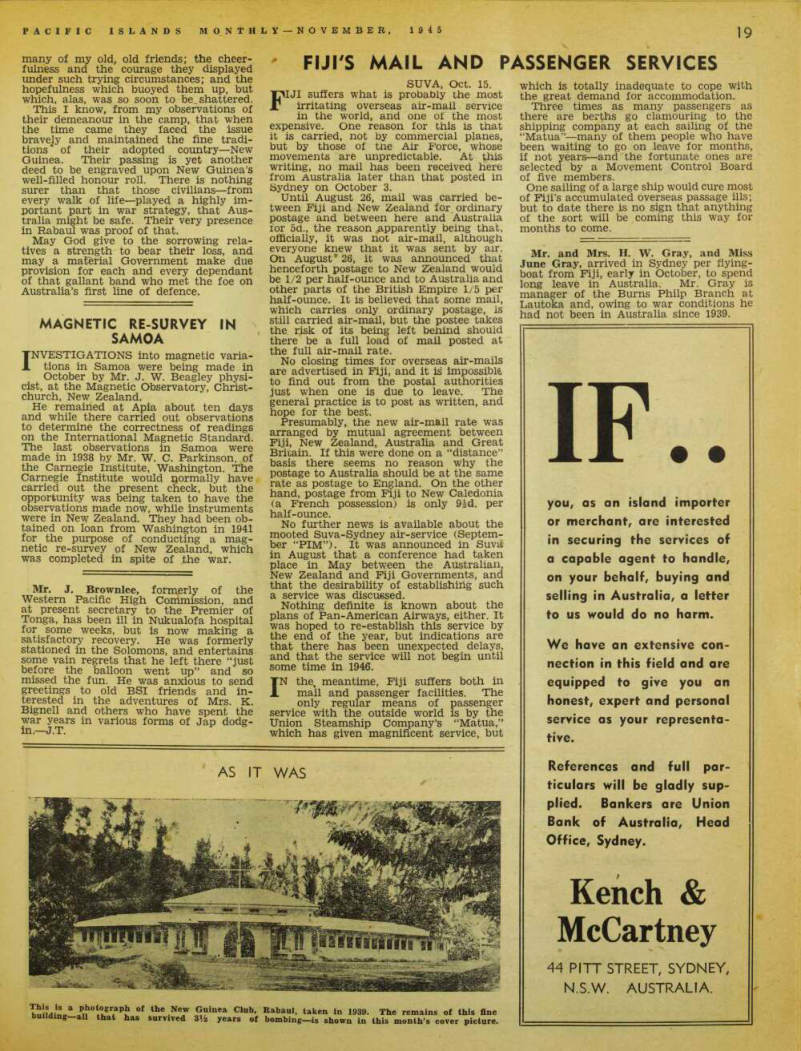
Samoa
INVESTIGATIONS into magnetic varia tions in Samoa were being made in October by Mr. J. W. Beagley physi cist, at the Magnetic Observatory, Christ church, New Zealand.
He remained at Apia about ten days and while there carried out observations to determine the correctness of readings on the International Magnetic Standard.
The last observations in Samoa were made in 1938 by Mr. W. C. Parkinson, of the Carnegie Institute, Washington. The Carnegie Institute would qormally have carried out the present check, but the opportunity was being taken to have the observations made now, while instruments were in New Zealand. They had been ob tained on loan from Washington in 1941 for the purpose of conducting a mag netic re-survey of New Zealand, which was completed in spite of the war.
Mr. J. Brownlee, formerly of the Western Pacific High Commission, and at present secretary to the Premier of Tonga, has been ill in Nukualofa hospital for some weeks, but is now making a satisfactory recovery. He was formerly stationed in the Solomons, and entertains some vain regrets that he left there “just before the balloon went up” and so missed the fun. He was anxious to send greetings to old BSI friends and in terested in the adventures of Mrs. K.
Bignell and others who have spent the war years in various forms of Jap dodg in.—J.T.
Fiji's Mail And Passenger Services
Suva, Oct. 15.
FIJI suffers what is probably the most irritating overseas air-mail service in the world, and one of the most expensive. One reason for this is that it is carried, not by commercial planes, but by those of the Air Force, whose movements are unpredictable. At this writing, no mail has been received here from Australia later than that posted in Sydney on October 3.
Until August 26, mail was carried be tween Fiji and New Zealand for. ordinary postage and between here and Australia for 5d., the reason .apparently being that, officially, it was not air-mail, although everyone knew that it was sent by air.
On August 9 26, it was announced that henceforth postage to New Zealand would be 1/2 per half-ounce and to Australia and other parts of the British Empire 1/5 per half-ounce. It is believed that some mail, which carries only ordinary postage, is still carried air-mail, but the postee takes the risk of its being left behind should there be a full load of mail posted at the full air-mail rate.
No closing times for overseas air-mails are advertised in Fiji, and it is impossible to find out from the postal authorities just when one is due to leave. The general practice is to post as written, and hope for the best.
Presumably, the new air-mail rate was arranged by mutual agreement between Fiji, New Zealand, Australia and Great Britain. If this were done on a “distance” basis there seems no reason why the postage to Australia should be at the same rate as postage to England. On the other hand, postage from Fiji to New Caledonia (a French possession) is only 9id. per half-ounce.
No further news is available about the mooted Suva-Sydney air-service (Septem ber “PIM”). It was announced in Suva in August that a conference had taken place in May between the Australian, New Zealand and Fiji Governments, and that the desirability of establishing such a service was discussed.
Nothing definite is known about the plans of Pan-American Airways, either. It was hoped to re-establish this service by the end of the year, but indications are that there has been unexpected delays, and that the service will not begin until some time in 1946.
IN the, meantime, Fiji suffers both in mail and passenger facilities. The only regular means of passenger service with the outside world is by the Union Steamship Company’s “Matua,” which has given magnificent service, but
which is totally inadequate to cope with the great demand for accommodation.
Three times as many passengers as there are berths go clamouring to the shipping company at each sailing of the “Matua”—many of them people who have been waiting to go on leave for months, if not years—and the fortunate ones are selected by a Movement Control Board of five members.
One sailing of a large ship would cure most of Fiji’s accumulated overseas passage ills; but to date there is no sign that anything of the sort will be coming this way for months to come.
Mr. and Mrs. H. W. Gray, and Miss June Gray, arrived in Sydney per flying boat from Fiji, early in October, to spend long leave in Australia. Mr. Gray is manager of the Burns Philp Branch at Lautoka and, owing to war conditions he had not been in Australia since 1939.
As It Was
This is a photograph of the New Guinea Club, Rabaul, taken In 1939. The remains of this fine building-all that has survived 3½ years of bombing—is shown in this month’s cover picture.
Advertisements & other items, pp. 21-22 (2 items)
19
PACIFIC ISLANDS MONtULIT NOVEMBER, 1945
McCartney
IF.. you, as an island importer or merchant, are interested in securing the services of a capable agent to handle, on your behalf, buying and selling in Australia, a letter to us would do no harm.
We have an extensive connection in this field and are equipped to give you an honest, expert and personal service as your representative.
References and full particulars will be gladly supplied. Bankers are Union Bank of Australia, Head Office, Sydney.
Kench &
McCartney
44 PITT STREET, SYDNEY,
N.S.W. AUSTRALIA.
Modern Refrigeration for the South Sea Islands
The ELECTROLUX
KEROSENE OPERATED
REFRIGERATOR
MARVEL
OF
MODERN
SCIENCE
lIP
- •... 4 ; i f : ■ if
THE
MIRACLE
OF
■ ICE
FROM
HEAT
ELECTROLUX OFFERS ECONOMICAL, modern and completely efficient
REFRIGERATION FOR ISLANDS' HOMES.
freezes continuously while small lamp burns.
Freezing controlled by simply regulating height of flame. Uses only J gallon of kerosene per week HOTORLESS ... NO PARTS TO GET OUT OF ORDER.
MODEL L 22
Capacity 2.2 cubic feet.
MODEL L3BO
(as illustrated) Capacity 4 cubic feet.
MODEL LKSSO
Capacity 5.5 cubic feet.
GUARANTEED FOR TWO YEARS.
Write to your Local Distributor for prices and full details.
OBTAINABLE FROM ALL W. R. CARPENTER & CO. LTD.
BRANCHES THROUGHOUT THE ISLANDS
tation in Parma and New Hebrides.
Something Brewing In The Canefields
Fiji Indians Still Dissatisfied
Suva, Oct. 16.
ALTHOUGH a meeting of the cane growers in the Lautoka district of Fiji was called for September 23, to discuss Dr. Shephard’s report on the sugar industry, and although that meeting passed 14 lengthy resolutions to be passed on to the Government, the issue is still about as clear as mud; and it is by no means sure that the resolutions represent the opinion of all cane-growers.
The Lautoka meeting was convened by the five Indian members of the Fiji Legis lative Council, under the chairmanship of Mr. Vishnu Deo.
The conference was no sooner in ses sion, however, than Mr. B. D. Lakshman (who claims to represent 1,500 cane growers) and 300 others present walked out of the meeting, and proceeded to hold another a few yards away. Representa tives of these two factions subsequently indulged in wordy battles in the local press; but the whole sugar question is by no means clarified thereby.
Mr. Lakshman claims that the whole conference was a failure because Mr.
Dec’s congregation were mostly “ring-ins” —shoemakers, tailors, mill employees, who had never grown a stick of cane.
The 14 resolutions briefly were: That the meeting disagreed with many of Dr.
Shephard’s figures concerning running costs, profit, depreciation, etc., of the Colonial Sugar Refining Co.; that they want a guaranteed price of 30/- per ton on sugar the Imperial Government to subsidise the growers to the extent neces sary; that they agree to the establish ment of a Sugar Board, providing that the cane-farmers have equal representa tion with the company and the Govern ment; and that certain reforms should be made in land tenure.
These resolutions, embodied in 14 points, were no doubt drawn up by the “brains” behind the cane-growers, but it is doubtful if the cane-growers them selves would be wholeheartedly behind any move to enforce them—not, at least, for a season or two, or until such time as they have time to forget the pain ful lessons that followed the strike period. • IT seems evident, however, that growers yearn after the higher price—namely, 30/- per ton—and that they might finally unite on that score and demand it for the 1944-45 and V*46 crops.
Fiji’s cane-growers, in asking this, apparently are unaware that there has been a war on, but that now it is off; and that sooner or later the old law of supply and demand will operate in the markets of the world, so that if Fiji does not. take a more realistic attitude, and act accordingly, she will be left lament ing. Java grows sugar; so does the West Indies—and it is hardly reasonable for the British public to be expected to pay through the nose for a commodity pro curable cheaper elsewhere, simply in order to keep Indian malcontents in jobs in Fiji.
The present price which Indian cane growers receive is 22/6 per ton, of which 3/6 already is a British subsidy—that is, the British taxpayer (who was bombed and blitzed and is now partly starved while the Fiji Indian lived in a land of plenty) pays about £175,000 for the privi lege of eating Fiji sugar. If 30/- a ton were paid, the British taxpayer would be paying out 10/6 per ton in subsidy, or something like three-quarters of a mil lion per annum towards the same noble purpose.
The Indian farmer has apparently yet to learn that political agitation in no way compensates for hard work or im proved methods of production.
The present crushing season, just now ending in Fiji, has lasted only about half the normal time. If the cane-growers again throw their bonnets over the wind mill and jeopardise the crops of the com ing season, for which they have got a guaranteed market, then they are fools indeed.
A 19-years-old lass, Jean Helen Futcher, who said she was born of British paren tage in Tonga, was before a Police Court in Brisbane on October 24 on a charge of vagrancy. She had strolled along a Bris bane street clad only in the new “French swim-suit”—which represents the abso lute minimum between clothes and nudity. The reporters said she was “a good-looking, slim brunette”; and the puzzled Magistrate remanded her for sentence.
Advertisements & other items, p. 23 (1 item)
Australian Aluminium Company
Position Wanted
HOTEL MANAGER
Ex-Territorian, anxious resume residence when normal conditions prevail, seeks managership Hotel, Club or Guest House—anywhere. Health and appearance good, accurate, careful bookkeeper, wide knowledge Labour, Liquor and other Ordinances, good mixer, widely known, tactful and would capture trade from opposition.
Wife excellent supervisor kitchen boys and domestics.
Write:— “Islands Hotel Manager,”
Box 3408 G.P.0., SYDNEY.
Ship Chandlery Hardware
/Write for j
Ship Chandlery /
Cataloaue J
Catalogue
Special "In Bond” Price* for all Islands enquiries queted on application.
Sole Agents for:
BROOMFIELDS LIMITED
: SYDNEY.
152 SUSSEX STREET ::
Cables; "Boom”, Sydney.
Large and Complete Stocks of
SHIP CHANDLERY
IRONMONGERY OF ALL KINDS, PAINTS.
WHITE LEAD AND OILS.
P. H. MUNTZ & OO.’s 3-CROWN BRAND METAL SHEATHING.
PEAOOCK Si BUCHANS’ ENGLISH READY-MIXED PAINTS.
c AL1.43.
This Company supplies Aluminium and its Alloys to all specifications and for every commercial application where these give better service over other metals.
PLATE . SHEET STRIP . SLABS . CIRCLES
BAR WIRE SECTIONS . FORGINGS
TUBING . ROD .
ALLOY INGOT.
Please Consult our Technical Service Department regarding your Light Metal Problems.
AUSTRALIAN ALUMINIUM COMPANY
pnopm e ta p y limited ( incorporated
in THE STATE OF VICTORIA)
GENERAL OFFICES AND FABRICATION DIVISION: GRANVILLE. SYDNEY , N. S. W.
Notes From New Guinea
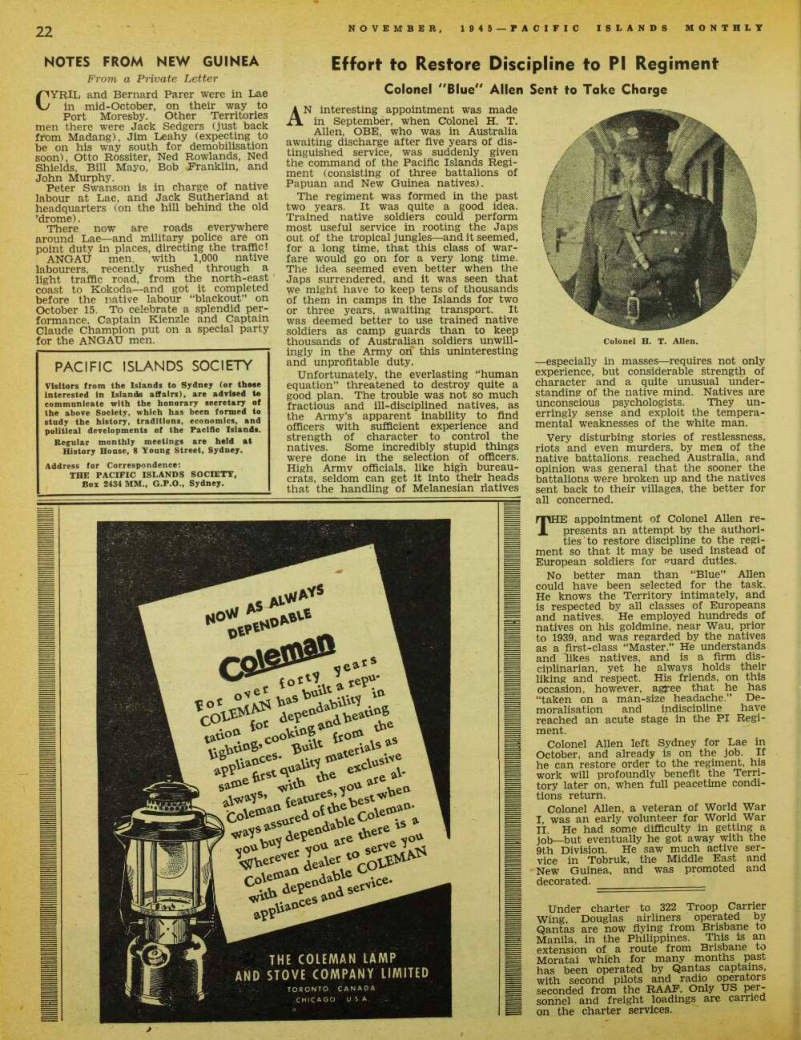
From a Private Letter CYRIL and Bernard Parer were in Lae in mid-October, on their way to Port Moresby. Other Territories men there were Jack Sedgers (just back from Madang), Jim Leahy (expecting to be on his way south for demobilisation soon), Otto Rossiter, Ned Rowlands, Ned Shields, Bill Mayo, Bob Franklin, and John Murphy.
Peter Swanson is in charge of native labour at Lae, and Jack Sutherland at headquarters (on the hill behind the old ’drome).
There now are roads everywhere around Lae—and military police are on point duty in places, directing the traffic!
ANGAU men. with 1,000 native labourers, recently rushed through a light traffic road, from the north-east coast to Kokoda—and got it completed before the native labour “blackout” on October 15. To celebrate a splendid per formance, Captain Kienzle and Captain Claude Champion put on a special party for the ANGAU men.
Effort to Restore Discipline to PI Regiment
Colonel "Blue" Allen Sent to Take Charge
AN interesting appointment was made in September, when Colonel H. T.
Allen, OBE, who was in Australia awaiting discharge after five years of dis tinguished service, was suddenly given the command of the Pacific Islands Regi ment (consisting of three battalions of Papuan and New Guinea natives).
The regiment was formed in the past two years. It was quite a good idea.
Trained native soldiers could perform most useful service in rooting the Japs out of the tropical jungles—and it seemed, for a long time, that this class of war fare would go on for a very long time.
The idea seemed even better when the Japs surrendered, and it was seen that we might have to keep tens of thousands of them in camps in the Islands for two or three years, awaiting transport. It was deemed better to use trained native soldiers as camp guards than to keep thousands of Australian soldiers unwill ingly in the Army on this uninteresting and unprofitable duty.
Unfortunately, the everlasting “human equation” threatened to destroy quite a good plan. The trouble was not so much fractious and ill-disciplined natives, as the Army’s apparent inability to find officers with sufficient experience and strength of character to control the natives. Some incredibly stupid things were done in the selection of officers.
High Army officials, like high bureau crats, seldom can get it into their heads that the handling of Melanesian natives
—especially in masses —requires not only experience, but considerable strength of character and a quite unusual under standing of the native mind. Natives are unconscious psychologists. They un erringly sense and exploit the tempera mental weaknesses of the white man.
Very disturbing stories of restlessness, riots and even murders, by men of the native battalions, reached Australia, and opinion was general that the sooner the battalions were broken up and the natives sent back to their villages, the better for all concerned. mHE appointment of Colonel Allen re- JL presents an attempt by the authori ties to restore discipline to the regi ment so that it may be used instead of European soldiers for guard duties.
No better man than “Blue” Allen could have been selected for the task.
He knows the Territory intimately, and is respected by all classes of Europeans and natives. He employed hundreds of natives on his goldmine, near Wau, prior to 1939, and was regarded by the natives as a first-class “Master.” He understands and 'likes natives, and is a firm dis ciplinarian, yet he always holds their liking and respect. His friends, on this occasion, however, agjree that he has “taken on a man-size headache.” De moralisation and indiscipline have reached an acute stage in the PI Regi ment.
Colonel Allen left Sydney for Lae in October, and already is on the job. If he can restore order to the regiment, his work will profoundly benefit the Terri tory later on, when full peacetime condi tions return.
Colonel Allen, a veteran of World War I, was an early volunteer for World War 11. He had some difficulty in getting a job—but eventually he got away with the 9th Division. He saw much active ser vice in Tobruk, the Middle East and New Guinea, and was promoted and decorated.
Under charter to 322 Troop Carrier Wing, Douglas airliners operated by Qantas are now flying from Brisbane to Manila, in the Philippines. This is an extension of a route from Brisbane to Moratai which for many months past has been operated by Qantas captains, with second pilots and radio operators seconded from the RAAF. Only US per sonnel and freight loadings are carried on the charter services.
Colonel H. T. Allen.
Advertisements & other items, p. 24 (1 item)
cs*s®f
PACIFIC ISLANDS SOCIETY
Visitors from the Islands to Sydney (or those interested In Islands affairs), are advised to communicate with the honorary secretary of the above Society, which has been formed to study the history, traditions, economics, and political developments of the Pacific Islands.
Regular monthly meetings are held at History House, 8 Young Street, Sydney.
Address for Correspondence:
THE PACIFIC ISLANDS SOCIETY,
Box 2434 MM., G.P.0., Sydney.
ufA* 5
At AS
cs*s®f
(» a* at b* o'* bas bW^ ot da CP^ eo de? iot ao lbs ,Vdo& do* fcot*
COO
as at Vs VvtVog 3* ter^ as ces caa
cbvsbf
vvao a?V e* aV tbe at e at^ e lb o'* beo W*J 9 si^ iea be Ub e Ve^° caao CoV e Co ass^ te d«b^ \s tb^ e eo de? o'* /-^Ve^ a C ~<>. b**l Cove vvce eo deP d s et tb ao ces \Vao a?V
THE COLEMAN LAMP
AND STOVE COMPANY LIMITED
Malarial
Meanderings
By Judy Tudor
ONE of the strangest discoveries made by Territorian evacuees since they came South semi-permanently, and Australians became malaria conscious, is the importance that is attached, by the uninitiated, to this infuriating, but grossly exaggerated, piece of Tropicana- Tout medaille a son rovers —and so’s malaria!
I was first introduced to the advan tages thereof on board the “Macdhui” away back in 1936, approximately half an
Note: This amusing article was put into type early in 1944 and, in due course, submitted to the Censor. That Lord High Executioner, highly excited, for bade us to publish even one word of it.
The Censor is gone. Here is the article, exactly as he “wiped” it. You are invited to read it, and find the parts which would have given useful information to the prowling Nips.—Ed. “PIM.”
hour after leaving Sydney shores en route for my new and promised land. A cyclonic disturbance had “approached from the north” and grey seas and greyer skies met off the coast of New South Wales in a tumult of broken waves that sent the wallowing, ever-vibrating “Mac dhm into more soul and body stirring gyrations than I had imagined any ship could endure without sinking.
Ninety per cent, of the passengers promptly disappeared; and I with them.
Thirty-six hours later, in Brisbane, we emerged—lemon yellow, pale green, or <toty white, according to type. But of th °se people. I alone had been sea sick. All the rest had had fever.
At various times during the same voy a£e travel companions had dropped pff at inconvenient (convenient to them) intervals. “I can feel a dose of fever ° n ' they would say; and that was that—final and absolute. They were excused from subsequent proceedings. I perceived, too, that not only was it a desirable complaint to have up one’s sleeve (or lurking in one’s spleen, or wherever it does lurk, waiting the com mands of master or circumstance) but it of the Great Initiated —the Old Hands.
I burned with a fervent desire to become, swiftly and without fuss or bother, an Old Hand. a S en tleman who spent most of his time reading on deck.
He was a District Officer, heading for a ritoryP OSt mmy pros P ec tlve line of Ter t wF snd5 nd nonsense!” he roared, when I asked him timidly whether one caught ™ alana <l ui te easily. “These people S fter « themselves— the rpp-nVnriv Take **, ve grains of quinine ra?,f la f Iy ’ evcry day » and you bave no worry * Fve been here 15 years, 3nd I have never had a sign of it.”
Tilteen years and never a sign! “Good -f t h 2 u g h t. looking at him with a l6d » horror> “ The man must be was wrong about the five grains per day and don’t worry! I took my five grams with slavish precision, but it
availed me nothing. Within three months, as far as fever was concerned, I had been initiated into the ranks of the Old Hands.
As time went on, I passed through the stages of (a) being acutely aware of my interesting condition; (b) wondering if I were going to die of any complication such as cerebral malaria or blackwater; and finally reached (c) the stage of all good Territorians, where you have given up worrying about it (except when you have an attack) and accept the fact that if there is a malarial parasite with your name on it, well you’re for it; if there Is not—why worry!
MALARIA, having been headlined since the New Guinea campaign, natur ally has assumed new significance m the eyes of mainland Australians.
“Did you catch malaria?” they ask, in the same tones as they would employ to ask if you had ever been the inmate of a mad-house or a member of a leper
colony. One fair lady of whom we have heard, whose son has been returned to her suffering from tinea, tropical ulcers and some sort of pa ralvtic aftermath of scrub typhus, still remarks to her ma£r“ lg aP ‘° mb ' “ But
“the 2 the W °^
search further than the decree of the p 9We r s-that-be that evacuated planters wishing to return to Papua must first
prove that they are free of malaria. To do this they must go to one of Sydney’s crowded hospitals and have a blood-test. . .. , .
I still have vivid memories of once, in Salamaua, having a needle shoved into me for that very purpose. I had all the other symptoms of fever, but two hours
later the doctor returned to say, “I can’t find a darned thing—but that doesn’t prove very much- Sometimes you can’t.”
But maybe they have whipped up the blood-testing since then.
Another (apparent) delusion under which I have laboured all this time, is that a blood-test gives a positive reaction only when one is actually suffering from an attack of malaria; and at all other times the reaction is as negative as though one had been no nearer the jungle than King’s Cross.
ANY planter who is in the unenviable position of having to make applica tion to return to what, after all, he regards as his country, is probably over 45 years of age, and probably has cared for himself in New Guinea for many years. What, then, frightens the authori ties?
That he will infect someone else? That hardly seems important, when there are probably half a million natives suffering from malaria in the two New Guinea Territories.
That he will become a charge on the country? Neither does that make much sense: he may show a ctean bill of health in Sydney, but if he is met by an anophele mosquito on his return to his plantation, he might well be suffering the worst attack of fever in his history within a week or 10 days.
The Army has not found a sure-fire cure for it. Malaria, like murder, will out —and it does. I met a soldier down from New Guinea on leave some weeks ago.
Nope—he didn’t get malaria: he took atebrin. He went on up the country and one day, as he was walking down the street of his home town, the whole place went into a steep slide, and then a tail spin. The local Army medico knew noth ing of malaria, so he tipld the lad cautiously to take two atebrin tablets, at suitable intervals, no more, and put him on a train for the nearest military hos pital. There our Army-medicated soldier had as pretty an attack of fever as any I have seen happen in the New Guinea bush, without benefit of military or any one else.
Malaria is an extremely debilitating disease: it has some mighty unpleasant complications; it lowers the efficiency, mental and physical; at times it induces a despondency bordering on the suicidal.
But notwithstanding these things, men and women have gone forth into fever ridden spots for countless generations; and, in spite of the worst anopheles could do, have done a good job- It is not suggested that a fever-ridden world is a pleasant place, or that the military authorities are wrong in the pre cautions they take in respect of personnel.
An army white-anted with malarial lethargy would be small use to anyone.
But the fact remains that with malaria, as other complaints, it is often a matter of mind over body, and the old dyed-in the-wool Territorian was of the mental make-up that accepted fever along with the other drawbacks of the life he chose to lead; and, although he counted it a curse, and did what he could about it, he was content to take that in preference to some of the corresponding plagues of civilisation.
By the same token, the basic desire of Territorians these days is that they will soon be permitted to indulge in their fever, and anything else their brand of existence includes, without the sanction of official flim-flam and red-tape. If there is any new cure for fever, most of them will “give it a go." If there is not, they’ll Joe content to take New Guinea “as is.”
Advertisements & other items, pp. 25-26 (1 item)
eradication
SE'S
EYE LOTI)
F«r Inflamed Eras and EraiUU
SOLD EVEITWHKIK
H. A. W»m 4 Ca. Pty. KIm St, toHn
The answer to the insect
eradication
ml
BRAND
v ■ \ i 6- UeAttwt,
1a POWDER,
4 D.D.T.
of highest industrial quality Diphenyl-Dichloro-Trichloroethane.
, MAGIC BRAND POWDER IS:
\ Guaranteed to kill all household insects, such as fleas, \ j cockroaches, bugs, borers, etc. It is safe and con- \ j venient to use, just pierce the perforated lid . . . it is j I efficient and lasting.
Supplied in 4oz . Sprinkler top tins or enquiries for supplies in bulk are welcomed .
For full particulars of Magic Brand Pest and Vermin Exterminator or any advice on D.D.T. and its application, write to manufacturers
kench & McCartney
44 PITT STREET, SYDNEY, AUSTRALIA.
QUEENSLAND
INSURANCE
COMPANY
LIMITED
(Incorporated 1886 In Australia)
ASSETS EXCEED £3,500,000
Head Office 4 .
PITT Gr BRIDGE STS.,
SYDNEY
Specialists in South Seos Fire,
Marine & Accident Insurances
Apply to:—
FIJI.
Branch Office: I. B. Chalmers, Acting Manager.
Burns Phllp (South Sea) Co., Ltd.
VILA.
Burns Philp (South Sea) Co., Ltd.
Comptoirs Francais Des Nouvelles Hebrides (Marine).
NOUMEA.
L. & W. Johnston.
PAGO PAGO.
Burns Philp (South Sea) Co., Ltd.
G. H. C. Reid ds Co.
OTHER SOUTH SEA ISLANDS.
Burns Philp (South Sea) Co., Ltd.
Also to any of the Company's Offices in Australia or New
Zealand.
From the
Factory
in the
Fnglish
Orchards
has always come the finest jam it is possible to make. Freshness, allied to purity, alone can produce such perfection. From Chi vers Orchards —adjoining the Factory come plump, luscious strawberries, with the warmth of the sun still on their rosy-red cheeks, and many other English fruits “just right”for preserving. No wonder Chivers Jams have a worldwide reputation for quality.
Supplies are still limited hut shipments will be resumed as soon as possible. ,
CHIVERS en jams h j%
Made in the heart of the English countryside by
CHIVERS & SONS Ltd.
The Orchard Factory, Histon, Cambridge, England
Notes From Rotuma
rE wonderful news of the ending of the war was received with rejoicing in Rotuma. Church bells at the Sumi and Upu Catholic Missions were rung merrily for many hours, and drums were beaten in every village.
Because an overseas vessel was in port loading copra, our scheduled two days’ holiday could not be enjoyed until a later date. But a party of Rotumans went to the ship and gave an entertainment of songs and dances. The ship’s guns were fired, and there was also a rocket and tracer bullets display.
For an island of its size and popula tion (3,000) Rotuma’s contribution to the war was considerable. Nearly 100 young men saw service with the Fiji Defence Forces, in the Solomons and elsewhere.
Many more were employed with the Labour Corps in Fiji, while the people at home contributed to war funds a small percentage of all their copra weights.
The value of this percentage totalled approximately £7OO per annum. The Rotumans wished the whole amount to be devoted to war purposes, but the Fiji Government decided to allocate 25 per cent, of it only, and keep the balance to establish a provident fund for the future benefit of the Rotumans.
One Of The Joys Of Peace
When Captain W. Percy brought the MV “Yanawai” to Rotuma, on her Sep tember voyage, he remarked on how pleasant it was to be able to do tne journey from Udu Point to Rotuma with out the “blackout”—for the first time m six years!
Kapok
“Aweel’s” idea of applying centrifugal force to the de-seeding of kapok would cause a major brainstorm among the Rotumans, whose hunt-and-pick method is most popular. One PJ g sive spirit did tell us how to speed up the process—by rubbing the kapok over the holes in a cane-bottomed chair!
Obituary
The death occurred, on September 1, at his home in Malha’a, Rotuma, of Mr F. H. Gibson. In former years he was one of the firm of Missen & Gibson, traders, at Rotuma.
Advertisements & other items, p. 26 (1 item)
24
NOVEMBER, 1945 PACIFIC ISLANDS MONTBLIf
W. Samoa And
Self-Government
Plan For the Education of Youth
From Our Own Correspondent
Apia, Oct. 10.
reported previously, a number of 'Samoan boys and girls have been sent to New Zealand. They have been granted scholarships by the New Zealand Government in order to con tinue their education at secondary schools, and to be given further profes sional training in New Zealand technical schools and colleges.
Of late, the Samoans have become very much interested in these scholarships and, in order to discuss further aspects of the scholarship scheme, the Adminis tration and the Education Department have recently called a meeting of the Scholarship Comittee, formed by the Samoans, and consisting of 17 members.
This meeting took place at Mulinu’u on September 5 and, during the three hours’ discussion, all matters of interest were thoroughly debated. The members of the Committee evinced keen interest in the proceedings.
The Committee stated, inter alia, that it represented a new Samoa and one that was at present being ruled by young men with modern ideas. The thoughts and opinions held by the older generation had largely died with the old men. The eyes of the present generation were open, especially in regard to political and edu cational matters, and the young men had begun to think and act for themselves, instead of allowing others to think for them, and then tell them what to do.
The Committee referred to the Atlantic Charter and the San Francisco Con ference, and stated that they realised that only through education could they obtain their ultimate goal—self-Govern ment. Until this end was attained, the Samoan people in the meantime desired to have a greater share in the present* administration of their country than they now enjoyed. mHE Samoans do not want the. scholar- X ship pupils to return from New Zea land half-eductaed. If, after having completed their education, they were not appointed to relatively responsible posi tions, because their education was not of a sufficiently high standard, then the Samoan people would lose faith in the scholarship scheme and in the guidance of the white man. They would then regard the experiment as a waste of time and money.
It was the intention of the Committee to keep a watchful eye on the candidates at present in New Zealand, and to sug gest that the duller ones be allowed to attend a technical school, to learn trades, while the brighter ones should be sent on to the universities where they could complete professional courses. This can not be done in Samoa; and if this policy is not carried out in New Zealand, the Samoans feel that they are in the same relative position as in the past. npOFIE Committee was also emphatic on X the point that the students, after having completed their courses, must return to Samoa to give service to the Samoan people. If there was no bind ing clause to that effect, the scholarship scheme would be considered a failure.
TTie students must not think in terms of money which they might earn if they ew ‘^ ea^an d—they were to think in terms of service to their people, rJl 0 ore the ex P ens e of their education abroad.
The opinion was also expressed that scholarships should be awarded in a democratic way, and not be given to children of high chiefs and chiefs, on account of their aristocratic descent.
Eliminating examinations should be held in all denominational and Government schools. The fairest method of selection was by competitive examinations.
No one should be allowed to enter for these examinations unless of three quarters or more of Samoan blood. The age should be from 9 to 20 years—junior scholarships 9 to 12, and senior scholar ships from 14 to 20 years.
The examinations should be formulated by the Superintendent of Schools, in con sultation with the heads of the London Missionary Society, the Methodist Mis sion and the Marist Brothers’ School. Out of the 40 candidates with the highest scores, a final selection of 20 should be made, who should go to New Zealand for further education.
Advertisements & other items, pp. 27-28 (1 item)
Horlicks
I hated my Mother-in-law!
I felt she was frying fo
break up my marriage
Tv /yr she's right.
f IAM A WASHOUT.
ITIS THIS
r EVERLASTING
SHE
AT
r MARY'S
A REGULAR
WASHOUT THESE
DAYS !
AGAIN
TIREDNESS !
BUNDLE OF
NERVES.TOO!
VI a
AT THE DOCTORS
r YOU RE NOT YOURSELF
AT ALL, MARY. BETTER
\ SEE DR. HUDSON...
tivsr
ps
SIX
WEEKS
LATER
f vU
sWI
mV
DOESNT. SHE
LOOK A PICTURE
NOW !
WONDERFUL
msm
A
EVEN WAKING TIRED ?
WELL. YOU MUST REMEMBER THAT WHILE
YOU SLEEP YOUR HEART AND LUNGS 60 ON
WORKING-USING UP ENERGY. UNLESS
THAT ENERGY IS REPLACED, OF COURSE
YOU WAKE TIRED, AND BECOME NERVY.
YOU NEED A HOT CUP OF HORLICKS
EVERY NIGHT TO REPLACE
/THAT LOST ENERGY.
Tired and Nervy!
If you wake tired and become more tired as the day drags on* If you find it hard to concen* trate . . . get irritable and lose your temper over trivial things . . . then remember those symptoms can usually be traced back to the fact that your sleep isn't doing you any real good. You must replace energy lost during sleep. That means a cup of hot Horlicks just before bed. After Horlicks you wake full of life, and clear-eyed. “Nerves" become a thing of the past. Get some Horlicks from your grocer or chemist today.
HORLICKS
Contains all essential food elements and necessary vitamins in their natural form.
Restlessness and sleeplessness, when due to run-dpwn nerves, frequently respond to treatment with Dr. Williams' Pink Pills.
Dr. Williams’
PINK PILLS
help to enrich the blood, which has a beneficial and restorative effect <4 ' upon the nervous system.
B. DAVID Trading Co.
ISLAND TRADERS -
- EXPORT MERCHANTS
SHIPPERS OF ALL KINDS OF MERCHANDISE.
EXPORT REPRESENTATIVES OF LEADING
AUSTRALIAN MANUFACTURERS
Direct Enquiries to Head Office:
31 Queen Street, Melbourne, Vie.
Bankers: National Bank of Australasia.
Cable Address;
"DAVID TRADING
MELBOURNE”
Branches and Agents in All Ports.
OPEN TO APPOINT AGENCIES WHERE NOT REPRESENTED
Labour Problem In Samoa
Chinese Go—But Samoans Become Good Cocoa- Planters
From Our Own Correspondent
Apia, Oct. 10.
rERE are at present between 250 and 300 time-expired Chinese indentured labourers in Western Samoa. They came to the Territory before the out break of war, under a three years’ in denture contract, on the understanding that, after the expiration of their term of indenture, they would be repatriated to China.
After the outbreak of war it was, of course, impossible to send these labourers back to their war-ravaged country, even if shipping had been available; and so their repatriation had, of necessity, to be postponed until the termination of the Pacific War.
As usual, these Chinese have in many cases lived in “fa’a Samoa” marriages with Samoan women and have offspring —in spite of the fact that Government regulations some years ago prohibited Samoan women from living with Chinese on European plantations, and had also made it an offence for Chinese to enter Samoan houses in the villages. Like so many other Government regulations these prohibitions have not been en forced and are nowadays completely dis regarded by the parties concerned.
Now, with the end of the Pacific War, the repatriation of the Chinese cannot be further postponed; and the Adminis tration, as well as the Samoans, insist that it be carried out at the earliest pos sible opportunity.
On the other hand, the Chinese them selves desire to remain in Samoa, not as indentured plantation labour, but as free settlers, with right to choose their own employment, acquire land and planta tions, open shops, start market gardens, etc. In a recent meeting with Samoan leaders, the Chinese Consul tried to per suade them to agree to such an arrange ment. He met, however, with a prompt and definite refusal. In the circum stances, it is hardly likely that the Chinese will be allowed to remain against
the wishes of the Samoans, and in view of the declared attitude of the New Zea land Government.
OF the (about) 300 Chinese indentured labourers, over 100 are working on the plantations of the Govern ment’s New Zealand Reparation Estates, while the remainder are distributed amongst some 10 larger European cocoa plantations, and some smaller planta tions.
It is generally conceded that it would not make much difference to the Euro pean cocoa-planters whether the lab ourers are repatriated or remain in Samoa as free settlers. In both cases they will lose their labour. Very few, if any, of the Chinese, when granted the privilege of free settlers, choose to continue work in their old employment.
The European planters, therefore, face the serious problem of how to replace the Chinese; and they are now urging the Administration and the New Zea land Government to allow them to obtain a new draft of Chinese indentured lab ourers. to replace the time-expired men and so to provide a continuance of labour supply for the European cocoa planta tions, which they consider essential to the European cocoa industry.
In view of the urgency of the matter, the European planters are sending, as their representative, Mr. I. H. Carruthers, to Wellington, to submit their plea to the New Zealand Government.
There is little doubt that this mission will be unsuccessful, particularly in view of the definite undertaking of the New Zealand Government given to the Samoans that no further draft of in dentured Chinese labour will be brought to Samoa—but also in view of the com parative unimportance of the European plantation industry, which is at present being rapidly passed in production of cocoa by the native cocoa industry.
SAMOANS have planted and are still planting large areas in cocoa in Savaii and Upolu, which are now coming into bearing. Some large and excellently-kept cocoa plantations are owned and worked by Samoans, and produce first-class cocoa. A number of Samoan native planters have built hot air driers. Their product is equal to the best grade produced by European planters, and fetches the same market price.
There has always been one drawback in Samoan plantation labour, as com pared to Chinese coolie labour, and this constitutes the main argument used by European planters for a supply of Chinese labour. A Samoan, working on a Euro pean cocoa plantation, may be diligent and reliable in the performance of his duties, but he is liable at any time, when there is very urgent and important plan tation work to be done —as, for instance, the picking of cocoa pods ripening on the trees, which would be spoilt when left for any length of time—to leave the plantation on the plea that he has some “fa’alavelave,” some family or village trouble, a wedding, a church feast, a death, or similar difficulties; and no Per suasion can convince him that he should stick to his work and complete a job started by him.
The unfortunate planter may thus be
left without the necessary labour to com plete his urgent work; and, in many cases, being unable to procure other lab our, faces heavy losses. The planter, of course, can rely on Chinese labourers to be always available when needed. rE Samoans realise that this draw back constitutes a serious obstacle to the employment of Samoans on European plantations and some way has to be found to remedy this. They have suggested that a Labour Office be set up by Samoan leaders, with authority from the Administration to regulate and organise the supply of Samoan labour to the European planters, as well as to other employers of labour, and that all labour be engaged and controlled through this Labour Office.
It is also planned to compel any% Samoan labourer who wants to leave his employment or change his work, for any reason, to give sufficient notice to en able the employer to replace him without serious inconvenience.
The Labour Office would also, in con sultation with employers and the Ad ministration, fix wages and conditions for Samoan labourers and undertake to supply to planters the required labourers from districts where there is a surplus of native labour.
It is reported that the New Zealand Government has already agreed to such an arrangement and that this Labour Office is to be started in the near future.
It will be interesting to watch this development, which is something un precedented in the history of Samoa, and which, if successful, would un doubtedly benefit all parties concerned, employers as well as workers.
Notable Nmp's
Award of "PIM" Annual Prize
JN order to assist the excellent work of X the Central Medical School, Suva, Fiji—where selected young native men from all the South Pacific Terri tories, except New Guinea and Papua, receive a four years’ course in medical training and qualify as Native Medical Practitioners—the proprietor of the “Paci fic Islands Monthly” has arranged to send copies of “The Practitioner” (well-known journal of the medical profession) to out graduates of the Central Medi cal School, on the nomination of the Director of the School.
Each year the “Pacific Islands Monthly” will donate £4/4/- for this pur pose - xt will W two subscriptions for one year to “The Practitioner,” on behalf of two NMP’s or one subsrrintinn for two years to one NMP according to the Director’s recommendation. The two NMP’s who this year have been awarded this modest prize are: Theodore Dainirob, of the Medical Department Nauru Island r’pntmi Par>i £* parimem ’ muru Island ’ Central Paci- Alohikau Eva, of the Medical Depart ment, Nukualofa Tonga MoaiCal Depart The rep orts on these two voung men are most favourable• young “NMP Theodore Dainirob Qualified in Decemberl94oand sTpp c been compelled by war to Tut his duties here in Pin Hp man charming personality a
auJ ? f d
and other rnh
been able to make arrangements so that Dalnirob can proceed by air to Auckland and then travei by a British Phosphate Co.’s steamer direct to Nauru Island NMP Calls Cain, also of Nauru who qualified in December, 1944, will return to Nauru along with NMP Dainirob.”
“NMP Alohikau Eva qualified in December, 1934. During his medical training in Fiji he carried off nearly all the prizes he could possibly win. He has been stationed in several centres in Tonga, where his medical work has been of a high standard. During the war he was commissioned as captain in the Tongan Military Forces. In 1944 he re turned to Suva for a period of post graduate training, including three months’ special training in leprosy work at Makogai Island. Hi is now back in Tonga.”
Down
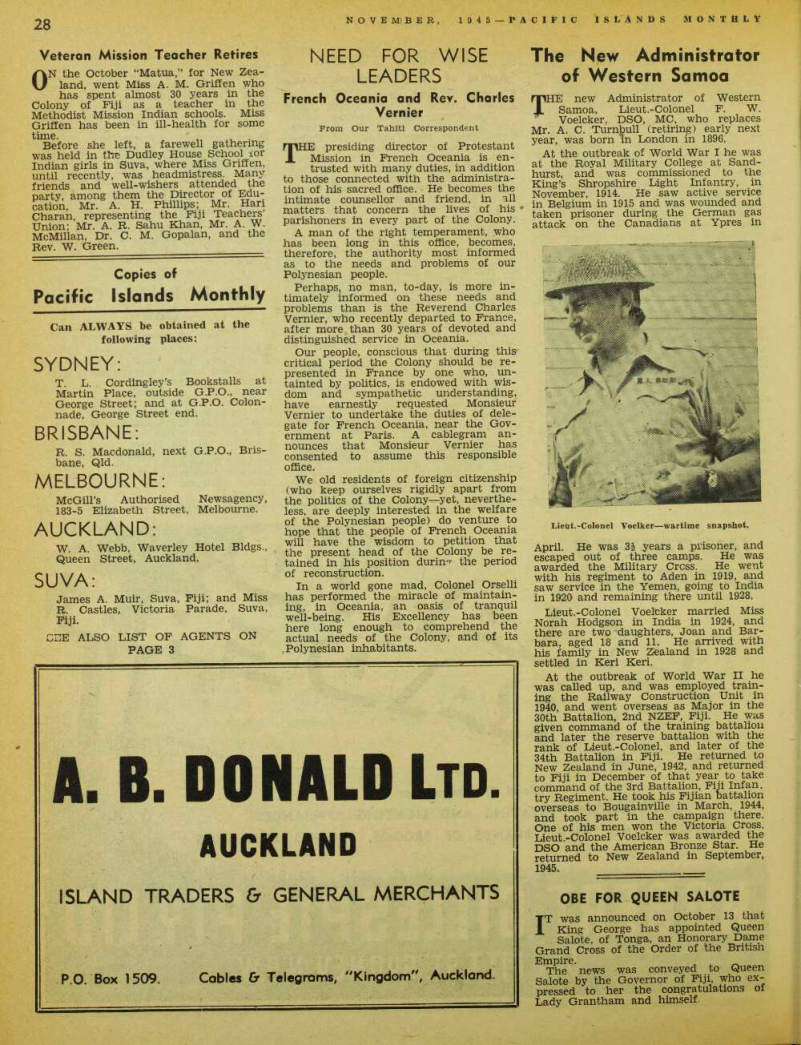
Koitaki Rubber Closes Down Effect of Ward's Decree
PRODUCTION of Koitaki Para Rubber Estates, Ltd., Papua, for the year ended June 30, was 857,283 lb., com pared with about 500,000 lb. in pre-war years.
Yields for the first three months of the current year were: July, 78,984 lb.; August, 70,754 lb.; September, 66,256 lb.
But production has now ceased, because practically all the native labourers have left the plantation following the Aus tralian Government’s never-to-be-for gotten announcement that all indentured labour contracts were cancelled as on October 15.
Veteran Mission Teacher Retires
ON the October “Matua,” for New Zealand, went Miss A. M. Griffen who has spent almost 30 years in the Colony of Fiji as a teacher in the Methodist Mission Indian schools. Miss Griffen has been in ill-health for some time.
Before she left, a farewell gathering was held in the Dudley ]House ior Indian girls in Suva, where Miss Gnffen, until recently, was fnends and party, a mo n g them Hari cat Kin, Mr. A. H. Phi P «.. Te ’ achers « uSfmTR Sahu Khan, Mr. A W.
McMillan Dr C M Gopalan, and the Rev. W. Green.
Advertisements & other items, pp. 29-30 (1 item)
Robert Gillespie Ptv. Ltd
IMPORTERS
EXPORTERS
a Island Distributors for
COLEMAN " HEAT,NG AND LIGHTING appliances
" DINOX" AND " DIX" BRANDS OF BROOMS, BRUSHES AND MOPS
ROBERT GILLESPIE PTV. LTD
BANKERS: BANK OF N.S.W.
COMPTOIR NATIONAL
DESCOMPTE DE PARIS
PITT ST. SVDNEV N.S.W.
CABLE ADDRESS:
“ROBERGILL"
PHONES 8W4782-B I3C!
Copies of
Pacific Islands Monthly
Can ALWAYS be obtained at the following places:
SYDNEY;
T. L. Cordingley’s Bookstalls at Martin Place, outside G.P.0., near George Street; and at G.P.O. Colonnade, George Street end.
BRISBANE;
R. S. Macdonald, next G.P.0., Brisbane, Qld.
MELBOURNE:
McGill’s Authorised Newsagency, 183-5 Elizabeth Street, Melbourne.
AUCKLAND:
W. A. Webb, Waverley Hotel Bldgs., Queen Street, Auckland.
SUVA:
James A. Muir, Suva, Fiji; and Miss R. Castles, Victoria Parade, Suva, Fiji.
CEE ALSO LIST OF AGENTS ON
PAGE 3
A. B. DONALD Ltd.
AUCKLAND
ISLAND TRADERS & GENERAL MERCHANTS
P.O. Box 1509, Cables & Telegrams, "Kingdom", Auckland.
Leaders
Need For Wise
French Oceania and Rev. Charles Vernier
From Our Tahiti Correspondent rE presiding director of Protestant Mission in French Oceania is en trusted with many duties, in addition to those connected with the administra tion of his sacred office. He becomes the intimate counsellor and friend, in all matters that concern the lives of his parishoners in every part of the Colony.
A man of the right temperament, who has been long in this office, becomes, therefore, the authority most informed as to the needs and problems of our Polynesian people.
Perhaps, no man, to-day, is more in timately informed on these needs and problems than is the Reverend Charles Vernier, who recently departed to France, after more than 30 years of devoted and distinguished service in Oceania.
Our people, conscious that during this critical period the Colony should be re presented in France by one who, un tainted by politics, is endowed with wis dom and sympathetic understanding, have earnestly requested Monsieur Vernier to undertake the duties of dele gate for French Oceania, near the Gov ernment at Paris. A cablegram an nounces that Monsieur Vernier has consented to assume this responsible office.
We old residents of foreign citizenship (who keep ourselves rigidly apart from the politics of the Colony—yet, neverthe less, are deeply interested in the welfare of the Polynesian people) do venture to hope that the people of French Oceania will have the wisdom to petition that the present head of the Colony be re tained in his position during the period of reconstruction.
In a world gone mad, Colonel Orselli has performed the miracle of maintain ing, in Oceania, an oasis of tranquil well-being. His Excellency has been here long enough to comprehend the actual needs of the Colony, and of its , Polynesian inhabitants.
The New Administrator
of Western Samoa
rE new Administrator of Western Samoa, Lieut.-Colonel F. W.
Voelcker, DSO, MC, who replaces Mr. A. C. Turnbull (retiring) early next year, was born in London in 1896.
At the outbreak of World War I he was at the Royal Military College at Sand hurst, and was commissioned to the King’s Shropshire Light Infantry, in November, 1914. He saw active service in Belgium in 1915 and was wounded and taken prisoner during the German gas attack on the Canadians at Ypres in
April. He was 31 years a prisoner, and escaped out of three camps. He was awarded the Military Cross. He went with his regiment to Aden in 1919, and saw service in the Yemen, going to India in 1920 and remaining there until 1928.
Lieut.-Colonel Voelcker married Miss Norah Hodgson in India in 1924, and there are two daughters, Joan and Bar bara, aged 18 and 11. He arrived with his family in New Zealand in 1928 and settled in Keri Keri.
At the outbreak of World War II he was called up, and was employed train ing the Railway Construction Unit in 1940, and went overseas as Major in the 30th Battalion, 2nd NZEF, Fiji. He was given command of the training battalion and later the reserve battalion with the rank of Lieut.-Colonel, and later of the 34th Battalion in Fiji. He returned to New Zealand in June, 1942, and returned to Fiji in December of that year to take command of the 3rd Battalion, Fiji Infan. try Regiment. He took his Fijian battalion overseas to Bougainville in March, 1944, and took part in the campaign there.
One of his men won the Victoria Cross.
Lieut.-Colonel Voelcker was awarded the DSO and the American Bronze Star. He returned to New Zealand in September, 1945.
Lieut.-Colonel Voelker —wartime snapshot.
Obe For Queen Salote
IT was announced on October 13 that King George has appointed Queen Salote, of Tonga, an Honorary Dame Grand Cross of the Order of the British Empire. , .
The news was conveyed to Queen Salote by the Governor of Fiji, who ex pressed to her the congratulations of Lady Grantham and himself.
Permits Go
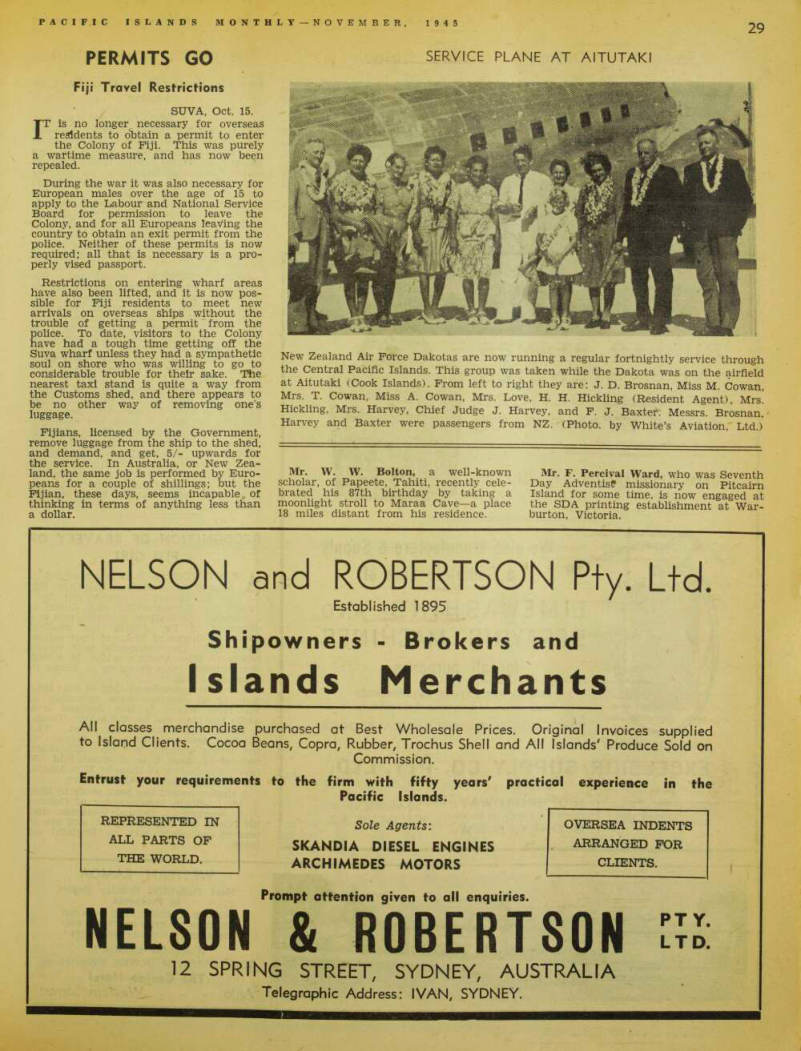
Fiji Travel Restrictions
Suva, Oct. 15.
IT is no longer necessary for overseas residents to obtain a permit to enter the Colony of Fiji. This was purely a wartime measure, and has now been repealed.
During the war it was also necessary for European males over the age of 15 to apply to the Labour and National Service Board for permission to leave the Colony, and for all Europeans leaving the country to obtain an exit permit from the police. Neither of these permits is now required; all that is necessary is a pro perly vised passport.
Restrictions on entering wharf areas have also been lifted, and it is now pos sible for Fiji residents to meet new arrivals on overseas ships without the trouble of getting a permit from the police. To date, visitors to the Colony have had a tough time getting off the Suva wharf unless they had a sympathetic soul on shore who was willing to go to considerable trouble for their sake. The nearest taxi stand is quite a way from the Customs shed, and there appears to be no other way of removing one's luggage.
Fijians, licensed by the Government, remove luggage from the ship to the shed, and demand, and get, 5/- upwards for the service. In Australia, or New Zea land, the same job is performed by Euro peans for a couple of shillings; but the Fijian, these days, seems incapable of thinking in terms of anything less than a dollar.
Mr. W. W. Bolton, a well-known scholar, of Papeete, Tahiti, recently celebrated his 87th birthday by taking a moonlight stroll to Maraa Cave—a place 18 miles distant from his residence.
Mr. F. Percival Ward, who was Seventh Day Adventist? missionary on Pitcairn Island for some time, is now engaged at the SDA printing establishment at War
burton, Victoria.
Service Plane At Aitutaki
New Zealand Air Force Dakotas are now running a regular fortnightly service through the Central Pacific Islands. This group was taken while the Dakota was on the airfield at Aitutaki (Cook Islands). From left to right they are: J. D. Brosnan, Miss M. Cowan, Mrs. T. Cowan, Miss A. Cowan, Mrs. Love, H. H. Hickling (Resident Agent), Mrs.
Hickling, Mrs. Harvey, Chief Judge J. Harvey, and F. J. Baxter. Messrs. Brosnan, Harvey and Baxter were passengers from NZ. (Photo, by White’s Aviation, Ltd.)
Advertisements & other items, pp. 31-32 (2 items)
Nelson & Robertson Zi.
NELSON and ROBERTSON Pty. Ltd.
Established 1895
Shipowners - Brokers and
Islands Merchants
All classes merchandise purchased at Best Wholesale Prices. Original Invoices supplied to Island Clients. Cocoa Beans, Copra, Rubber, Trochus Shell and All Islands' Produce Sold on Commission.
Entrust your requirements to the firm with fifty years' practical experience in the Pacific Islands. ■ ivmpi wiiGnnun given to an enguines.
NELSON & ROBERTSON Zi.
12 SPRING STREET, SYDNEY, AUSTRALIA
Telegraphic Address: IVAN, SYDNEY.
itseJf
Sawmilling Industry in New Guinea
UNDER arrangement with the New Guinea Administration, Mr. Tom Flower, with four European assistants, left Australia in October, for Papua, where he will enter into sawmilling operations on a considerable and growing scaie.
In the beginning he will operate two sawmills at Galley Reach, not far from Port Moresby, where there seems to be an ample supply of timber to take care of present demands. There are about two fathoms of depth on the bar at Galley Reach, so it will be necessary to punt out the sawn timber, either to a ship
that may be loaded in the calm water within the reef, or by making use of the calm lagoon water, to Port Moresby
itseJf
, Mr. Flower, who gave evidence recently before the authority which controls Customs duties in Australia, is confident that the duty on the import of sawn timber to Australia will be lifted at an early date—so far as Australia’s Pacific Territories are concerned, at any rate. If that is done, there is nothing to prevent the establishment of a highly profitable sawmilling industry in Papua and New Guinea, from which to supply the Aus tralian market.
Robert Gibbings
Famous Illustrator-Author Goes to Samoa
Wellington, Oct. 6.
BIG, bearded, jovial Robert Gibbings, artist, author, and sculptor, called in at Wellington (NZ) the other day en route to Samoa, where, under contract to his English publishers, he will prepare material for still another book. Irish born, he has all the wit of his race, the industry of the Englishman, and the flair for living of the Continental. Fifteen years have passed since he went to Tahiti, and there compiled his “laorana,” a journal illustrated by his own wood cuts, now in much demand among col lectors.
Robert Gibbings established the “Golden Cockerel” Press, famous for its rare editions. He has illustrated more than 40 books: and in recent years has been engaged in floating down several of the English rivers. Books on the Thames, Wye. and Lee, he told me, have sold more than 130,000 copies. “The British public like to get right away from the war. There is nothing about war in my books.”
He will spend the best part of a year in Samoa; then he will return to New Zealand to write his material. Reference libraries for such a work are essential.
Mr. Gibbings was the first artist to secure pencil drawings under the sea.
Anyone acquainted with his Pacific books will appreciate the quality and the authenticity of his woodcuts of the multi shaped and gaily-hued fish that fre auent Polynesian waters. —ERIC RAMS
Den.
Recognition Of Bravery Of
Fiji Girl
A TESTIMONIAL is to be presented to Miss Eileen Austin, at Hamilton, NZ. by the Governor-General (Sir Cyril Newall) on November 23. Miss Austin is a nurse at the Waikato Hospital, and is a daughter of Dr. Austin, the medical officer in charge of Mokogai leper settle ment, Fiji. The testimonial is in recog nition of Miss Austin’s action in saving four children from drowning in Tonga in December, 1943. ..
It will be remembered that at that time a party of children were returning to Fiji from school in New Zealand and, while the ship was in Nukualofa, Tonga, a picnic was arranged for them. The children went swimming and, because of the strong current, got into difficulties.
Several of them were drowned, and the rest rescued—four of them by Miss Austin, herself returning to Fiji on leave.
A similar award has been made to Miss J M. L. Bogle, stepdaughter of Colonel J E Workman. Colonel Workman and his family left Fiji in August, and are at present on their way to England on leave.
Advertisements & other items, p. 32 (1 item)
Limewashing And
The Most Extensive Manufacturers in the British Empire of
RUBBER STAMPS,
INKS, STENCILS,
Marking Devices,
ACME STAMP PADS
OFFICE S STATIONERY SUPPLIES
We also Manufacture & Supply a Complete Line of
LIMEWASHING AND
SPRAYING MACHINES
for all purposes.
Let us know your requirements and we will quote by return.
WRITE FOR OUR GENERAL CATALOGUE
Limewashing Machine
EXCELSIOR SUPPLY CO. PTY. LTD.
278 Post Office Place,
MELBOURNE, VIC.
HEAD OFFICE :
160 BROADWAY,
Formerly known as George St., West,
SYDNEY, N.S.W.
50 Victoria Street,
WELLINGTON, N.Z.
WESTERN SAMOA
Most Delightful Holiday Resort in Polynesia
WHY NOT SPEND THE WINTER
MONTHS AT THIS SPACIOUS AND
BEAUTIFULLY-SITUATED HOTEL?
Write for Details to MRS. ANNIE M. JONES, Proprietress The Casino Hotel Apia - - - Western Samoa
Nz After Pacific
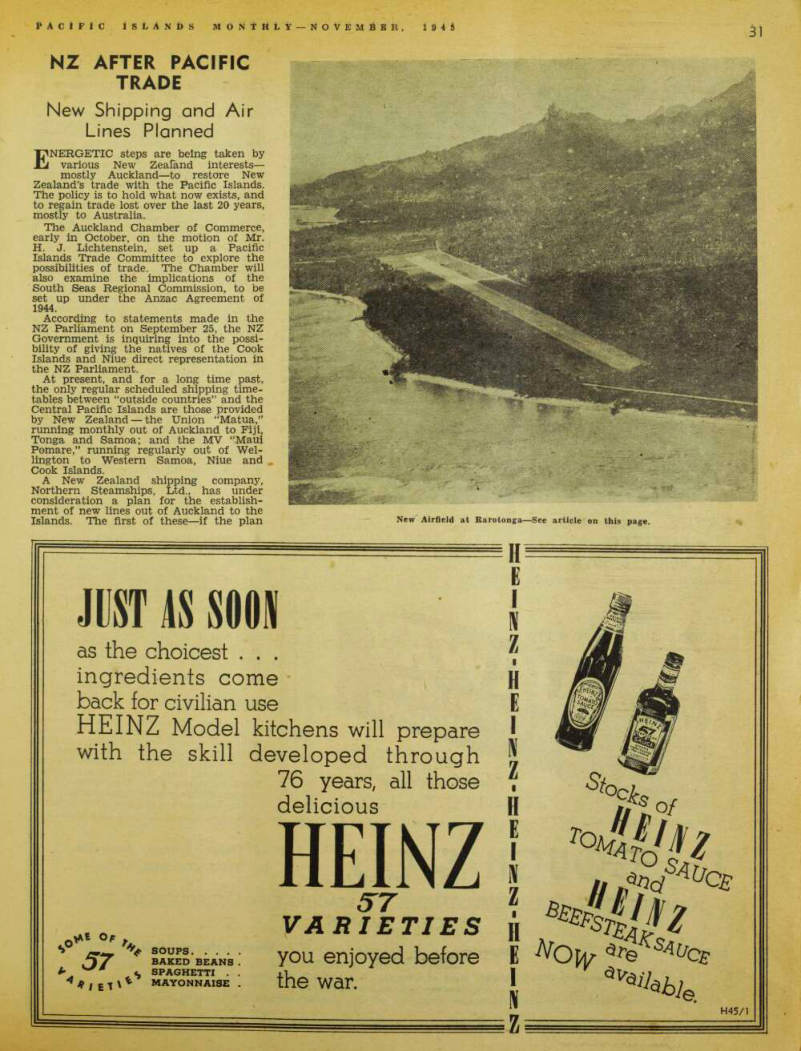
Trade
New Shipping and Air Lines Planned
ENERGETIC steps are being taken by various New Zeafand interests — mostly Auckland—to restore New Zealand's trade with the Pacific Islands.
The policy is to hold what now exists, and to regain trade lost over the last 20 years, mostly to Australia.
The Auckland Chamber of Commerce, early in October, on the motion of Mr.
H. J. Lichtenstein, set up a Pacific Islands Trade Committee to explore the possibilities of trade. The Chamber will also examine the implications of the South Seas Regional Commission, to be set up under the Anzac Agreement of 1944.
According to statements made in the NZ Parliament on September 25, the NZ Government is inquiring into the possi bility of giving the natives of the Cook Islands and Niue direct representation in the NZ Parliament.
At present, and for a long time past, the only regular scheduled shipping time tables between “outside countries” and the Central Pacific Islands are those provided by New Zealand the Union “Matua,” running monthly out of Auckland to Fiji, Tonga and Samoa; and the MV “Maui Pomare,” running regularly out of Wel lington to Western Samoa, Niue and Cook Islands.
A New Zealand shipping company, Northern Steamships, Ltd., has under consideration a plan for the establish ment of new lines out of Auckland to the Islands. The first of these —if the plan
New Airfield at Rarotonga—See article on this page.
matures would run from Auckland to Norfolk Island, New Caledonia and New Hebrides, back to Auckland.
Prior to World War I, many large vessels maintained a regular service out of Auckland to the Pacific Islands. One Union SS Co. Line, with the Tofua, Navua and Atua, connected Auckland with the Fijian, Tongan and Samoan ports, and Sydney; but nearly all that traffic dwindled away, in the interregnum be tween the wars.
AIR traffic is expected to play an im portant part in the rapid develop ment of trade and communications between New Zealand, Australia and the
Islands. Nothing has been heard of the ambitious British plan discussed some time ago; and it is believed that unfore seen circumstances have held up the early restoration of the Pan-American services, announced last August. But the New Zealanders are not asleep.
RNZAP Transport Squadrons now operate a regular schedule to islands of tne South Pacific area, carrying mails, freight, Government oificials and high priority passengers. / One each fortnight a Dakota leaves Whenuapai, New Zealand, and covers New Hebrides, Fiji, Tonga, American Samoa, Western Samoa, with a terminal at Rarotonga in the Cook Group.
This is an 8,000-miles round trip. It takes 10 days, including a two days’ lay over at Rarotonga, where a fine airstrip was constructed and opened earlier this year. Many of these islands have a close connection with New Zealand from a development viewpoint, and it is believed that this air service is opening up possi bilities for trade in future years.
A private aviation transport company, now established in New Zealand, Whites Aviation, Ltd., directed by Mr. Leon White, is showing keen interest in Paci fic Islands possibilities, and has done a good deal of exploratory work. Regular services, linking Auckland with New Caledonia, New Hebrides, Fiji, Tonga, Samoa and Cook Islands, are visualised.
Advertisements & other items, pp. 33-34 (2 items)
31
tAcI f i c Islands monthly November, 1945
Heinz
JUST IS SOON
as the choicest . . . ingredients come back for civilian use HEINZ Model kitchens will prepare with the skill developed through 76 years, all those delicious ° F T*, S soups 07
BAKED* BEANS .
c SPAGHETTI
A * I El \*
MAYONNAISE .
HEINZ
57
VARIETIES
you enjoyed before the war.
St °Ch * e jm Mo, CB 1 H45/1
KANGAROO BRAND
Ropes,
Cordage,
and Twines for every purpose Backed by 86 years of service Manufactured by:
M. DONAGHY AND SONS,
Pty. Ltd., Geelong and Sydney.
Fiji Representatives :
PEARCE AND CO.
LIMITED
P.O. BOX 237, SUVA
Made by
FORD SHERINSTON
LTD
Owing to war needs, supplies of "Airway” are not at present available.
Manufacturers of
G LO BITE Travel Cases
k —* I k k 1 Bond Street, Sydney, Australia. f J (j (J |J (j |*| TeL 84167. Box 3615 G.P.O.
SUPPLIERS OF GENERAL MERCHANDISE TO LEADING FIRMS THROUGHOUT THE
PACIFIC ISLANDS
Exporters Importers Manufacturers' Representatives Bankers; Bank ot N.S.W. Bank of Adelaide. Comptoir Nat. d'Escompte de Parle.
Cable Address; "SEAFOODS.” SYDNEY.
Codes: Bentleys, 3nd and Comp. Phrase; A. 8.0., sth and 6th; Peterson, and and 3rd: Banking. Acme.
News Sought Of F/O Mason
IT is now believed that Flying-Officer Cecil Mason, who was sent into New Ireland in mid-1942 on a very danger ous job (to attempt to rescue administra tive personnel), and who disappeared, was not shipped away from Rabaul on the ill-fated “Montevideo Maru.” Mrs. Mason has been informed by a missionary that her husband was seen at Lakanai, near Rabaul, in January, 1943. Inquiries are still being made. Anyone with informa tion is invited to communicate with Mrs.
Mason, whose Sydney telephone is XF 1066.
Wanted: A Dentist
ANY young up-and-coming dentist who wants to make a small fortune in the next few years should spare a thought for setting up shop in Fiji. There are three dentists in Viti Levu—one in Lautoka and two in Suva, of whom one is an Indian practitioner. The two Europeans are now elderly, and rumour has it that one may retire shortly.
A Service dentist told me recently that there is a sure £3,060 a year income for a dentist here.
Apart from the Europeans, the Indians have a hankering after gold fillings, and even the Fijians are potential victims. I noticed that young Robin Garnett’s Fijian nursemaid at the Tavua Hotel had a splendid gold tooth. Robin’s mother explained: “We wanted to give the girl a present, because she had been very good. She had two or three teeth miss ing, and looked an awful sight, so it was decided that the gift should make the form of a dental plate. She went to the Indian dentist in Suva, and In due course returned, coy, but elated, and with all the gaps filled. We were a little amazed at the price. She explained that she could have had ordinary ones for half the price but that she wanted a gold tooth!
Many Fijians—particularly the women —have gaps in their front teeth. They, also, in common with other South bea Islanders, are extraordinarily generous in giving away personal possessions. Since meeting the Garnett nursemaid I have wondered if this extends to the free ex change of dental plates.—J.T.
Prayer In 33 Languages
PEOPLE who collect unusual books and typographical curiosities should not omit to get a copy of “The Lords Prayer in Thirty-three Languages, as Used in the Diocese of Melanesia,” which has just been produced by the Melanesian Mission Press, Summer Hill, Sydney, by Mr. Fred. Isom, the well-known printer of the Melanesian Mission.
Until the Japs interfered in 1941, Mr.
Isom had a well-equipped printing plant at one of the mission stations at Guadal canal, British Solomon Islands. Since 1942 he has been carrying on his good work in Sydney—although rumour hath it that he is counting the days until he is allowed to return to his beloved Solomons.
The book in question is a very small compilation of 16 pages and the languages employed, in addition to English are those of the New Hebrides, the Banks Torres Islands, Tikopia, Vanikolo, Utupua, Santa Cruz. Reef Islands, San Cristoval, Sikaiana, Santa Anna, Lord Howe Island, Rennel, Ulawa, Mala, Guadalcanal, Geia, Laube, Bugotu and Sagsag (New Britain).
Here And There In Viti Levu
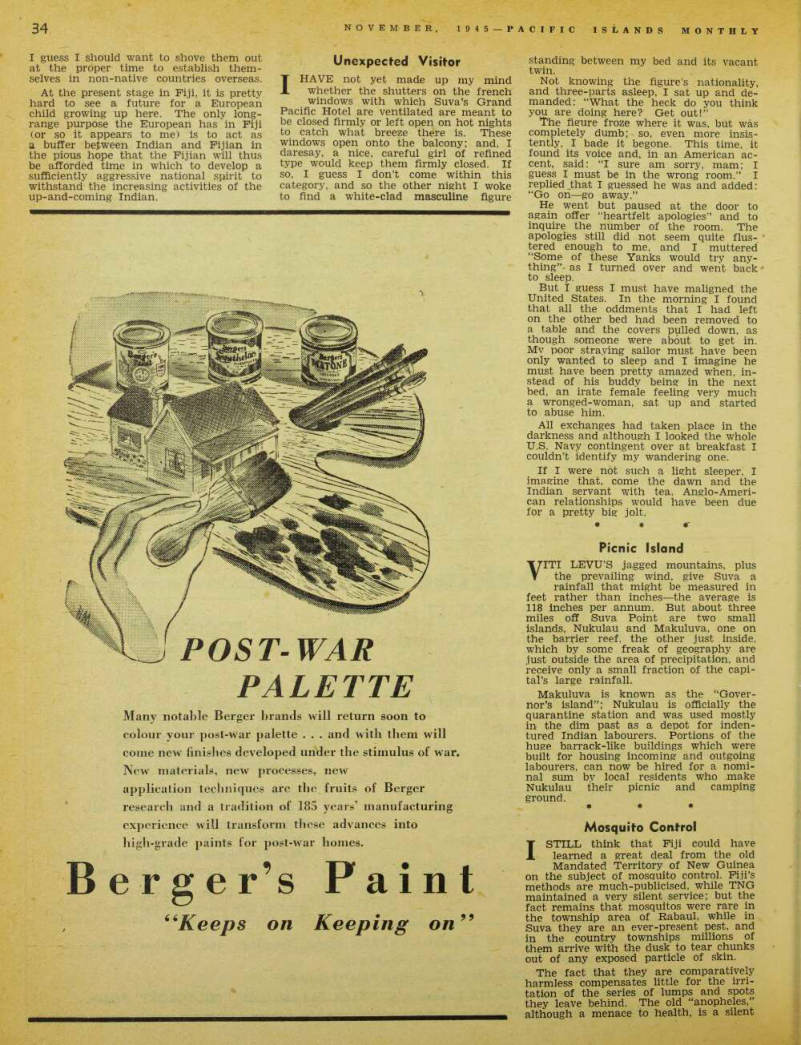
From Scattered Notes by Judy Tudor
Haunting "Isa Lei"
IN Fiji, it is hard to escape the haunt ing melody of “Isa Lei,’’ an old Fijian tune rewritten and arranged in the modern manner by Lieut. A. W. Caten, bandmaster of the Fiji Defence Force Band. “Isa lei” means farewell, but the Fijians, whether going or coming or merely stationary, burst into this song at the slightest provocation.
Boys and girls of the Methodist Mis sion Schools in Suva sang it to me in several variations, and a class of small Indians in the Lautoka convent presented it in Hindi.
When we dined with Mr. and Mrs. Ken Sands, at Suva Point, Mrs. Sands said “the boys would sing for us,” and again the first song was “Isa Lei.” Originally, she had asked her Fiji girl and a friend to find two others to entertain us, but the girls had done their talent-scouting in the Fiji military camp over the road and, instead of four girls, we had almost a platoon of young soldiers, all coyness and colossal military boots, a guitar and a ukelele.
These people seem to be able to play a guitar as naturally as a bird takes to the air, and to harmonise with equal felicity. The bass singers sit in a heap, and growl out their notes, and the facial contortions, of those taking the tenor parts are extraordinary to watch; but the music that results is invariably good.
So far as I know, “Isa Lei” is the only Piiian melody yet published; but several of the songs they sang that night, par ticularly those in slow tempo, should .be
equally popular in the outside world.
There is something in these simple tunes —as the Fijians themselves present them, anyway—which is totally lacking in the. over-commercialised Hawaiian product. * ♦ ♦
Attractive Sigatoka
SIGATOKA, which has been described in previous “PIMs” as the perfect place in Fiji for retired people, is now coming into its own. On a recent visit there. Mr. and Mrs. Steve Monk, who keep the quaint little Sigatoka hotel, took me about five miles out along the Queen’s Road in the Suva direction, to where thev have three blocks in a re cently sub-divided estate.
Each block is about half an acre in extent, with excellent soil and a strip of beach complete with half-a-dozen or so coconuts. The Monks’ blocks are as yet uncleared; but all along the sub division houses are going up, constructed mostly from Army huts and buildings which are being disposed of in Fiji at present.
Properly converted, these huts make attractive bungalows—although the Siga toka folk are following the old Fiji cus tom of building suburban villas with two-by-two windows and no verandahs.
I have been amazed to find, in Fiji, few of the open-air, wide-eved, cool houses so common in the south-west Pacific.
Houses, shops and country hotels are places through which it is almost impos sible to get a breeze and in which the inhabitants stew and sweat. Local resi dents say that it becomes very cold in
winter; but it was September when I arrived here and I find it almighty hard to believe the climate becomes as cold as their buildings would indicate.
If I were a retired businessman I can think of no better spot to spend my old age than in a suitable house among pleasant neighbours on one of Sigatoka’s coral beaches. Sigatoka has a good climate, somewhere betwixt Lautoka’s frizzling dryness and Suva’s humid heat and depressing rain. With a large gar den, some poultry, and fish from inside the reef, living should be cheap and in finitely better than spending one’s last days crouched over a fire in frozen misery in Australia or New Zealand. ♦ ♦ ♦
Rich Fijian Valley
FROM the top of a hill behind Siga toka town, the first flats of the Siga toka river valley look like an agricul turalist’s dream. Cultivated land spreads out lushly, mile upon mile; directly be low are the crops of the Government experimental farm in varied bands of greens and yellows and browns, and be yond the river are the canefields in alternating stages of growth, stretching away to the hills beyond.
These first flats are said to be small in comparison with the alluvial lands further up the valley. But the road from Sigatoka extends only 10 or 12 miles along the river, and the river itself is unnavigable for any distance. Therefore, until such time as some means of com munication is provided, small use can be made of these rich riverlands.
If I were a young man, instead of having been born into the wrong sex, I can imagine no pleasanter way of making a living than farming in the Sigatoka valley. But if I had sons and daughters
I guess I should want to shove them out at the proper time to establish themselves in non-native countries overseas.
At the present stage in Fiji, it is pretty hard to see a future for a European child growing up here. The only longrange purpose the European has in Fiji (or so it appears to me) is to act as a buffer between Indian and Fijian in the pious hope that the Fijian will thus be afforded time in which to develop a sufficiently aggressive national spirit to withstand the increasing activities of the up-and-coming Indian.
Unexpected Visitor
I HAVE not yet made up my mind whether the shutters on the french windows with which Suva’s Grand Pacific Hotel are ventilated are meant to be closed firmly or left open on hot nights to catch what breeze there is. These windows open onto the balcony; and, I daresay, a nice, careful girl of refined type would keep them firmly closed. If so, I guess I don’t come within this category, and so the other night I woke to find a white-clad masculine figure
standing between my bed and its vacant twin.
Not knowing the figure’s nationality, and three-parts asleep, I sat up and de manded: “What the heck do you think you are doing here? Get out!”
The figure froze where it was, but was completely dumb; so, even more insis tently, I bade it begone. This time, it found its voice and, in an American ac cent, said: “I sure am sorry, mam; I guess I must be in the wrong room.” I replied J:hat I guessed he was and added: “Go on—go away.”
He went but paused at the door to again offer “heartfelt apologies” and to inquire the number of the room. The apologies still did not seem quite flus tered enough to me, and I muttered “Some of these Yanks would try any thing”- as I turned over and went back to sleep.
But I guess I must have maligned the United States. In the morning I found that all the oddments that I had left on the other bed had been removed to a table and the covers pulled down, as though someone were about to get in.
Mv poor straying sailor must have been only wanted to sleep and I imagine he must have been pretty amazed when, in stead of his buddy being in the next bed, an irate female feeling very much a wronged-woman, sat up and started to abuse him.
All exchanges had taken place in the darkness and although I looked the whole U.S. Navy contingent over at breakfast I couldn’t identify my wandering one.
If I were not such a light sleeper, I imagine that, come the dawn and the Indian servant with tea. Anglo-Ameri can relationships would have been due for a pretty big jolt. ♦ ♦ •'
Picnic Island
VITI LEVU’S jagged mountains, plus the prevailing wind, give Suva a rainfall that might be measured in feet rather than inches—the. average is 118 inches per annum. But about three miles off Suva Point are two small islands, Nukulau and Makuluva, one on the barrier reef, the other just inside, which by some freak of geography are just outside the area of precipitation, and receive only a small fraction of the capi tal’s large rainfall.
Makuluva is known as the “Gover nor’s island”; Nukulau is officially the quarantine station and was used mostly in the dim past as a depot for inden tured Indian labourers. Portions of the huge barrack-like buildings which were built for housing incoming and outgoing labourers, can now be hired for a nomi nal sum by local residents who make Nukulau their picnic and camping ground. * ♦ *
Mosquito Control
I STILL think that Fiji could have learned a great deal from the old Mandated Territory of New Guinea on the subject of mosquito control. Fiji’s methods are much-publicised, while TNG maintained a very silent service; but the fact remains that mosquitos were rare in the township area of Rabaul, while in Suva they are an ever-present pest, and in the country townships millions of them arrive with the dusk to tear chunks out of any exposed particle of skin.
The fact that they are comparatively harmless compensates little for the irri tation of the series of lumps and spots they leave behind. The old “anopheles,” although a menace to health, is a silent
worker and causes little irritation in comparison.
Many thousands have been spent on mosquito control in Fiji, yet, in what might be called the suburban districts of Suva, there are many acres of stagnant water where the Indians are still per mitted to °row their rice. ♦ ♦ ♦
1,000 Tons of Condlenuts Wanted
WHEN I visited Mr. H. A. Mitchell in his candlenut factory, near Suva’s waterfront, he showed me the re sult of a trial pressing of the nuts —three small bottles of clear, almost odourless, golden oil which he said had cost his company about £2,000 to produce.
The candlenuts are rolling in from out lying districts but at the moment the factory is strewn with pieces of machinery and resounding to much hammering on wood and sheet-metal. All the plant has now arrived from Aus tralia, however, and it is only a matter of assembling elevators, buskers, dryers and pressers before operations are in full swing.
Mr. Mitchell calculates that with the present machinery working one eight hour shift, about 1,000 tons of nuts can be crushed in a year with a yield of about 40,000 gallons of oil.
From what I know of Fiji social habits I imagine “old-hands” will sit back on their haunches and howl that there is nothing like that quantity of nuts in the Colony; but Mr. Mitchell believes that there will be sufficient to carry his com pany on until such time as they can establish plantations themselves or, al ternatively, encourage Fijians to do so.
Only time will prove who is right. Candle nut trees begin to bear after three years. ♦ ♦ ♦
Plurals Baffle Them
rE GPH in Suva is being refurbished; and, alongside some fresh paint work, some Indian painter has writ ten, “Wait pant.”
Indian signs are invariably odd. They use no plurals, and eating-places bristle with such invitations as “Ice-cream and soft drink.” An Indian temple at Lautoka has a notice on the fence: “Please remove your boot before entering.”
In a slightly different category is the Tongan shopkeeper’s notice: “For sale: Pacific Island Yearbooks—three dollars, or one carton of cigarettes.” ♦ ♦ ♦
Boxing Match
I, WHO had never seen a European box ing match, and have no desire to, went to the boxing in Ba with Mr.
Pat Costello. Outside the theatre, where the bouts were held, was a seething mass of Fijians and Indians and, as far as I could see, that is where most of them remained all evening There, they could hear the barracking from the hall, and results could be passed out to them. A cheaper if less exciting method of seeing the show, entrance to which cost five or six shillings.
Both Indians and Fijians participated, but principally Fijians, who have adopted most of our sports with fanatical en thusiasm. The preliminary bouters were simple, unsophisticated souls; they wore cute little silk pants, but had bare feet; they slunk into the ring, bowed to the audience in pure Fijian (i.e., bend over at rWht angles, take a swift pivot full circle on one bare heel and beat it to the corner with head bowed in embar rassment) ; and they listened to the cau tionary instructions of the referee with
the agonised expression of a prisoner at the bar. Finally, their boxing was a great deal of sparring and little fighting.
But, as the evening progressed, there were more and more fancy embellish ments; and, with them, a sort of hazy impression that these lads had seen a great many movies. They wore boots now, and occasionally a gaudy dressing gown; they strutted into the ring and swung on the ropes in professional style, they reclined in the respective corners while quite three seconds (or seconds, thirds and fourths) supplied them with ice-water, advice, fans and a good deal of tummy-rubbing.
The barracking was loud and continu ous and, strangely, almost entirely in English. “That’s it, Vato,” yelled a fran tic Fijian just behind my head. “Keep at it, Vato —that’s the way to success!”
(Must have been to a good school, that lad.) Then: “Bang him down, Vato— bang him down!”
Chief event was between someone called Marika, from Ba, and Sam, from Nadi. Sam was as big round as the gas-works, with arms like hams and thighs like oversize balloon tyres. Marika looked as frail as a young blade of grass, in comparison. Sam, I thought, has only got to fall on Marika, and that will be that.
For approximately eight of the 10 rounds they fiddled and finoodled and chased each other round the ring, each occasionally landing a good thump on the other fellow. Then, with the dew of honest endeavour thick upon both, Marika hauled off and with a good, clean wallop knocked Sam completely off his feet. Sam lay there with the bemused
look of a great ox, while the referee counted 10 and the crowd yelled its head off.
The show was over. If that were box ing at Ba, then we had had it.
Advertisements & other items, pp. 35-38 (3 items)
Willia
I I
Atkins Pty. Ltd.
Head Office 449-451 KENT ST., SYDNEY.
Iron & Steel Merchants—Engineers' Supplies
Coach & Motor Hardware
ESTABLISHED OVER 50 YEARS
CW' Cable Address: WILATDN, Sydney.
STEEL DEPARTMENT
MILD STEEL:
Rounds, Squares, Flats, Half-rounds, Hexagons, Bevel, Shoeing, Tyre, Angles, Tees, Sheets, Plates, Girder Plates, Chequer Plates, Channels, Hoops, Etc.
BRIGHT STEEL:
Rounds, Squares, Hexagons.
Extra Special High Speed Tool Steel, Mining Steel, Blister Steel and Spring Steel, Rounds, Flats Gr Squares.
Bar Iron—All sections and sizes.
Engineers' Supplies:
Set Screws, Studs, Metal Thread Screws, Coach Screws, Files, Cotter Pins, Bright and Black Bolts, Rivets, Etc., Hack Saw Blades.
Power Transmission Gear: Including Plummer Blocks, Couplings, Collars, Etc.
Coach and Motor Hardware: Axles, Springs, Wheelstuff, Duck, Paints.
Farriers' Supplies: Horse Nails, Anvils, Vices, Etc.
Motor-Trimmers and Motor Builders' & Motor Painters' Requirements
C. A. WILLEY'S
Quick-Drying Coach and Car Paints, Roughstuff, Elastic Gloss, Synflex Enamels, Lacquers.
DUCO Lacquers and DULUX Enamels—FAßßEX Motor Toppings and Leather Cloths, House & Decorators' Points, Varnishes & Brushwore.
Sole Distributors of CHAMPION'S Decorators Point Products.
Distributing Agents for BROLITE Lacquers, SYNFLEX Enamels and "POLYGLOSS" Finish.
3K
POST-WAR
PALETTE
Many notable Berger brands will return soon to colour your post-war palette . . . and with them will come new finishes developed under the stimulus of war.
New materials, new processes, new application techniques are the fruits of Berger research and a tradition of 185 years’ manufacturing experience will transform these advances into high-grade paints for post-war homes.
Ber g e r’s Paint
“Keeps on Keeping on’
BREWED BY
CARLTON & UNITED BREWERIES LTD
PRELIMINARY ANNOUNCEMENT:
PACIFIC
PLANTER’S
HANDBOOK
Publication Early in 1946 IN response to a strong and growing demand for an authoritative Handbook covering the whole field of Planting and Agriculture in the Pacific Islands, the compilation of the “Pacific Planter’s Handbook” was commenced some time ago, and the work now is well advanced.
The Handbook is designed to give standard instruction on all the branches of Tropical Planting which might be undertaken in the Pacific Islands, and to be regarded as an indispensable part of a Pacific Planter’s equipment.
SECTIONS of the Handbook deal separately with Palms (including Coconuts and the Manufacture of Copra), Cocoa, Coffee, Rubber, Citrus, Bananas, Vanilla, Spices, Kapok, Pineapples, etc.
The production of every plant grown for profit in the islands is described.
Other Sections cover such subjects as: Livestock on the Plantations; Revenue from Non-Agricultural Products (Sea, Forest, Minerals); How to Ensure Comfortable and Healthy Living Conditions in the Islands; Etc.
SPECIAL SECTIONS: Survey of Opportunities; Selection of Territory (Malarial and non- Malarial, Melanesians and Polynesians, Climate and Rainfall); Lands and Land Laws; Labour Conditions in the Various Territories; Importance of Transport; What You Must Provide For and Against in Choosing Your Plantation.
The subject of MARKETING is dealt with very fully. It is no use planning your plantation until you know where you will find a profitable market for your product, and whether it is dependable.
EACH SECTION WRITTEN BY AN
EXPERT
Numerous Photographs, Diagrams,
Drawings, eto.
PUBLISHED PRICE : Not less than 35/- Australian. (NOTE: Owing to the present difficulty of obtaining paper and binding service, it Is impossible to fix a price, until the work is near completion. It will be between 35/- and 40/-, Australian. The edition will be limited. Persons who wish to be sure of a copy may order in advance: and if 35/- is sent, that will be accepted as the price of the book, although the final published price may be higher.) Orders may be sent to:
PACIFIC PUBLICATIONS
PTY. LTD.,
Union House, 247 George Street,
Sydney
or to the PUBLISHERS DIRECT :
PACIFIC PUBLICATIONS (FIJI)
LTD.
P.O. Box 281, Bank of N.S.W. Building,
SUVA, FIJI. SUVA, FIJI.
34
MONTHLY
NOVEMBER, 1945 PACIFIC ISLANDS MO
35
tACIFIC ISLANDS MONTHLY NOVEMBER. 1945
Scientific Gathering of
N. Guinea Timber
Scientific Gathering of Data
WHEN military timber requirements in New Guinea reached large propor tions, the Army established a Forest Service to control and advise on all mat ters relating to timber production in New Guinea. The chief object was to avoid, as far as possible, operations prejudicial to future forest economy in those areas.
This section of the Army is designed to function until the civil administration is re-established in New Guinea. Its duties include the recording of forestry operations, so that claims for compensa tion may be assessed; locating and advis ing on forest stands suitable for military requirements; and the general study of timber resources.
In this latter function, a technique for the interpretation of aerial photos of forest types has been developed, and the preliminary air photo investigation of the Territories is well advanced. Although hampered by lack of sufficient technical personnel, and operational restrictions, a vast amount of laboratory and botanical field work has been done, and consider able technical data on th 6 trees and tim bers of New Guinea have been collated.
In addition to emphasising the region’s potentialities as a source of timber, it is estimated that Army forest survey acti vities, aided by the maps and aerial photos now available, have advanced the survey of New Guinea’s forestry resources by 30 or 40 years. This knowledge should be of value to Australia in developing the timber resources of Papua and New Guinea.
Experiment in Administration
rE appointment of two native ad ministrative officers in the Gilbert and Ellice Islands marks a milestone in the history of British native adminis tration in the Pacific. The experiment of appointing native administrative offi cers in the West Pacific is a new one, and their work will be watched with interest. The High Commissioner for the Western Pacific says that he has been impressed by the manner in which the new officers have entered upon their new duties and responsibilities, and the fav ourable reception with which their ap pointments have been received by the general native population. (“Colonial Office Press Section,” June 27, 1945.) News has only recently been received in Fiji of the death of Mr. Leslie Russell, formerly of the Education Department, Fiji. It appears that he died over two years ago, while a prisoner in Japanese hands, but no news of this reacned his wife until now. In 1939, Mr. Russell was transferred to Malaya, and was there during the Japanese invasion. His wife was evacuated from Malaya before Singa pore fell, but he remained behind as a member of the FMS Volunteer Forces.
Mr. C. H. Came, for many years on the staff of Morris, Hedstrom, Ltd., of Ba, and more recently attached to Fiji’s Economic Welfare Office and Labour Department, has been appointed Rehabilitation Officer in sucession to Lieut.-Colonel J. B. K.
Taylor.
Territories Men
Distinguished Service in Famous "Hush-Hush" Unit
MANY men well known in the Western Pacific Islands gave most distin guished service in a very “hush hush” organisation called the Allied In telligence Bureau, formed by the Ameri can and Australian fighting services, in combination, to undertake special duties in the South-West Pacific in the critical war years.
The AIB is probably the most decorated unit in World War 11.
The story of the AIB still has to be told. If it is told as it deserves to be, it will make one of the remarkable docu ments of World War 11, and will out shine the most incredible “thriller.” The founder of the Bureau, Commander Eric Feldt, formerly a well-known District Officer in New Guinea, is reported to have written a book about the organisa tion, called “Coast Watchers,” which is slated for early publication.
The members of the Bureau undertook the most difficult and hazardous jobs in the remoter islands and jungles. There was a small group of Bureau men in Bougainville, for instance, from 1944 on wards, under the leadership of Lieutenant Paul Mason. They rallied the Bougain ville natives to the protection of their country, they killed many hundreds of Japs in remote and unexpected places and, when the Jap surrender came, they were on the point of capturing Kieta, where they had cornered 500 Japs, who were entirely cut off from the other in vaders in the north and west. They lived like shadows in the remoter jungles, and they had the Japs completely de moralised.
The full roll of the unit is unobtain able, at present; but the following are the names of some well-known Islands men who rendered distinguished service therein. This, of course, is not a com plete list; — Commander Eric Feldt, RANVR, formerly a well-known DO in New Guinea.
Lieutenant Paul Mason, RANVR, formerly a planter at Inus, Bougainville. He was awarded the British and the American Distinguished Service Cross.
Captain E. D. Robinson, formerly a Dis trict Officer in the Sepik country, New Guinea. Awarded Military Cross.
Captain Lee Ashton, formerly a New Guinea miner.
Captain Alastair Maclean, formerly a New Guinea planter.
Captain John Stokie, formerly a planter in New Britain. Awarded Military Cross.
Captain C. W. Seton. formerly a planter in British Solomons. Awarded Distin guished Conduct Medal.
Lieutenant Dick Horton, RANVR, for merly DO in Solomons. Awarded
Dsc.
Lieutenant Henry Josselyn, RANVR, DO in Solomons. Awarded DSC.
Lieutenant John Keenan, formerly DO in Buka, TNG, Awarded DSC.
Captain Jeff Archer, formerly a miner of Wau, New Guinea. Awarded Military Cross.
During the war, overseas circuits of the Beam Wireless service were operated up to speeds as high as 375 words per minute, enabling thousands of additional words to be transmitted daily. The special telegraph equipment used was developed and manufactured in Australia by Amalgamated Wireless, Ltd.
Advertisements & other items, p. 39 (1 item)
4
0 t
AAT
COo>\
-5*
KIM.
* \: * > * ?4 a k The famout Aladdin Kerofene Mantle Lamp gives brilliant 75-eandlepower white light without pumping or pressure at a cost of approximately 2 hours’ light for one penny. As easy to light as the old-fashioned flame lamp. m WS NOW every island home can enjoy the comfort conven ' ence °f a /*S. jff brilliant white 75-candlepower light thanks to Aladdin, the world's most wonderful lamp. Introduced to the Islands for the first time, this world-famous Kerosene Mantle Lamp is artistic In appearance, economical in use and as easy to light as an ordinary flame lamp. Burns only kerosene, the safest and cheapest of fuels— without pumping, pressure, noise, smoke or fumes. Write AT ONCE for illustrated leaflet showing the full range of table, floor pedestal, hanging and wall-bracket models.
Popular Aladdin Storm Lantern , solidly constructed of brass for hard wear . Gives vivid 200-candlepower white light from ordinary kerosene at a cost of approximately one halfpenny per hour. Widely used by Army and ISavr during the war. t - AGENTS WANTED. Opportunities exist for alert storekeepers to act as authorised Aladdin storekeepers in the Islands. Special discounts and the distribution of Aladdin wicks , chimneys , mantles , shades, and spare parts are among the many advantages of the Aladdin f ranchise.
ALADDIN’S KEDOSm c „
The «„: E£ of the t urner ft K 93-3799 ALADDIN INDUSTRIES PTY. LTD. • I - 7 I BOURKE STREET. SYDNEY
Pacific Wireless Services
Restored
Amalgamated wireless, ltd., has been advised by its Suva office that wireless communication services have now been restored between Fiji and the Gilbert and Ellice Group, including Ocean Island. With removal of wartime restrictions, all classes of public wireless messages are now being handled again at pre-war rates.
The Beam service between Sydney and Suva is operating again under peacetime conditions.
Rev. James Benson’s Experiences
as Prisoner of Japs in Rabaul
PRAISE the efficient work of ANGAU patrols in their prolonged ventures Dehind the Japanese lines, when they had been the “eyes and ears of the Australian Army,” and admiration for the courage and kindness of the Roman Catholic missionaries near Rabaul, were expressed by Rev. James Benson, of the Gona Anglican Mission Station, who miraculously escaped death at the hands of the Japs in Papua early ip 1942.
Mr. Benson returned to Australia by the “Marella” in October, after two years with Roman Catholic missionaries in a captive camp near Rabaul, and eight months spent in a Rabaul prison ceil— the only white man with Japanese criminals.
He was separated from two mission sisters soon after the Japanese moved into Gona in 1942, and he did not know, until liberated by the Jap surrender in 1945, that both had been cruelly mur dered.
Angau’S Achievements
IN a long article_in the Cairns “Post,”
Mr. Benson discussed many aspects of his terrible experiences. Especially, he praised the fine work of ANGAU patrols. The patrols, he said, were always in the charge of some white man who had lived in the country, as a Govern ment officer, a trader or miner, and through whose knowledge of the natives and the natives’ trust in him, was made possible his existence in the jungle for months, sometimes years, behind enemy lines.
Since his release, on September 13, when the Australians marched into the Ramale Valley near Rabaul, Benson had met many of these men of the Aus tralian New Guinea Administrative Unit who commanded patrols Major Ted Jennings, who had been operating behind the Japanese at Lae and Salamaua, Cap tain Jim Lahey at Wau, Majors Roberts and Bates in New Britain.
Major Roberts, he had been amazed to learn, had with eight native boys been to within two miles of RsCmale a year before the prisoners’ delivery, and had signalled Japanese movements to the Australian Intelligence. They, he said, were “the ears and eyes of the Australian Army.”
It was from a patrol officer, Major Fairfax-Ross, that Mr. Benson learned of the fate of the mission sisters who had been with him at Gona. They had been captured after betrayal by Dobudura natives and, with the white personnel of Isivita Mission, taken to Buna. Miss Hay man and Miss Parkinson had been bayoneted to death and the others be headed. He, alone, remained of the staffs of Sangara, Isivita and Gona missions.
Grim Experiences
WHEN the Japanese invaded Gona about July 10, 1942, Mr. Benson with his two assisants, Miss Hayman
and Miss Parkinson, and the native teaching staff of the mission, took to the jungle and lived on the Kumusi River until they succeeded in crossing the Japanese lines in August—the first step in their plan to cross the Owen Stanleys east of Port Moresby, which they thought at that time, had been captured.
However, their plan was defeated when they were betrayed by natives and fired on by a Japanese patrol and the party scattered.
For more than a week Mr. Benson vsas lost in the jungle. Then, by accident, he stumbled on a main highway leading 10 Japanese headquarters at Buna. There he gave himself up.and lived until Novem ber in a Japanese military police (Kempe) camp.
On November 18, he was taken by a cruiser to Rabaul, where he was thrown into a 14 ft. square cell, with a concrete floor for a bed and Japanese criminals his only companions. At times there were 16 Japanese there with him.
He remained there for eight months, when the only white men he saw were two American pilots. He does not know what became of them. His appeals for civilian treatment were discounted and his requests to be allowed to notify Miss Hayman’s and Miss Parkinson’s people of their disappearance, through the Red Cross, were refused.
Eventually he was told he was to go back to New Guinea, and left Rabaul by transport on April 2, 1943, with reinforce ments for the Japanese Army in Lae and Salamaua. When off the southern tip of New Britain, the transports an i destroyers in the convoy were attacked by bombers, and early next morning he witnessed the evacuation of the last Japanese troops from Gona and Buna.
“They were miserable, emaciated creatures then,” he added.
When he was taken off the transport and embarked on a cruiser for Rabaul once more, a Japanese told him that no slower ship than a cruiser could attempt the trip. Back in Rabaul prison, a ruth less commandant held him responsible for the Japanese reverses.
Paradise After Hell
IN July, 1943, when the Mr. Benson’s petitions to'the Japanese High Com mand that, as he was a civilian, he should be allowed different living condi tions from Japanese criminals, were again heeded, he was removed to the Mission of the Fathers, Brothers and Sisters of the Sacred Heart at Kokopo, 20 miles from Rabaul.
He said: “After all Hell, that was Para dise. I went to them a miserable wreck.
String tied my trousers and singlet to gether, and I’d not had a bath for four months, but they treated me as one of themselves, and gave me of their best, although much of their stores had been stolen by the Japanese.”
At the mission, he said, there were 17 different nationalities. He told stories of the wonderful fortitude of the elderly nuns. One, Sister Borgia, who was 78 years old, had more than once jeopar dised her life to protect the younger nuns from the bombers from Allied air bases.
No Resistance In Rabaul
ALLIED bombing near Rabaul, said Mr. Benson, reduced every bit of the harbour front to rubble and scrap.
Every building was destroyed. All the inmates at the mission at Kokopo, 2C
miles from Rabaul, slept underground, in slit trenches and tunnels.
“If troops had landed in Rabaul in Feb ruary, 1944, there would have been no resistance,” he said, “for the Japanese in that time were in hiding in the moun tains inland. For three weeks we lived on the fat of the land, when we raided Japanese stores, even finding amongst them beer and wine. We expected a landing.”
He continued, “When the Japanese re turned and the bombing persisted they allowed us to move out to the Ramale Valley, six miles from the old mission site. There we built better tunnel defences, and for about six months lived in trenches and tunnels.
“When time passed and no bombs fell, we knew then that our own people had learned, through native messengers carry ing the news to Australian patrols operat ing behind Japanese lines, that we were in the Valley.”
Records Destroyed
rE anthropological records which Mr.
Benson had kept for years at Gona had been destroyed with all the mis sion records. He had with him a small prayer book when the mission evacuated to Siai on the Kumusi River, and had made notes in it of events up to his imprisonment at Rabaul, when he got an old exercise book and used it as a diary, in which he entered guarded comments of all that happened.
Mr. Benson is wearing a beard in obser vance of a tradition of native villagers of Gona who regard it as a token of sorrow.
When on the Kumusi a boy had brought him a razor, he said he would not shave until there was peace again, and he had come back to his villagers. Both he and Mr. Gordon Thomas, former editor of
“The Rabaul Times,” had found the beards a little protection against the Japanese, who have some regard for age.
Advertisements & other items, p. 40 (1 item)
8. N. DEAN & CO. - Exporters
Refreshing
as a plunge
into a lagoon!
0A p 1 i
Germicidal
and fragrant
TENAX TOILET SOAP is
a rapid safeguard against external skin infections, yet it is soothing and kind to the most sensitive skin —even a baby’s!
ORDER TENAX FROM
YOUR ISLAND SUP-
PLIERS. STOCKS ARE
PLENTIFULLY AVAIL-
ABLE.
8. N. DEAN & CO. - Exporters
G.P.0., SUVA, FIJI.
THE LEADING "MANUFACTURERS" FOR SOUJH SEA
ISLAND CURIOS AND SOUVENIRS
We specialise in Tortoiseshell Silver Inlaid, Tortoiseshell-“ Cat’s Eye”
Mountings, Silver Filigree, with “Cat’s Eye” Mountings in Necklaces, Bracelets, Brooches, Watch Bands, Tie-Pins, Ear-Rings, Picture Frames.
And Various Kinds of Other Curios.
Write to us for full particulars. (Parcels will be posted to any address.)
the^Cotony the
Ba, Bowling - And Beer!
A Day Out With the Lads from Vatukoula
By Judy Tudor
rpHE day had been sufficiently hot to A blister a brass monkey. There had been nQ wind and strangely for Fiii, total lack of cloud I had spent most of it underneath a disporting themselves on the new Ba bowling green — scarlet in the face and looke" as fantastic as Tt was m£ , T hnnp thnt hpwiino- P laced - ? n °P e j£at my Fiji bowling Wends will agree that bowls to the non- Player can be a terribly boring game, But I had not gone there to see the bowls, anyhow, but to see the people and that happy thought had sustained me through the heat of the day. Now, getting on towards seven o’clock, it sus tained me no longer. Frankly, I was getting fed-up. 1 was to return to Tavua, and had P e ri rsu^ ded d ° ‘he bus chartered by the Vatukoula bowlers.
Dusk see med to intensify the heat rather than relieve it- and instructed bv the bowlers that thev wnnld he lea vine/“a nv right good pal and one of the nicest women I met in all of Viti Levu) and I tore ourselves loose from the drinking
party that had been the culminating Point of the day and, slightly wilted, in serted ourselves in the big, raw-boned, blue bus. A few odd souls who appar
"thinr'posiible' 1 i:f Fiji-were
the main bidy «S
A s thp dark ri p pnpnpri fj VP milll - nn mn „
A quitoes all";
, blood-lust, arrived and queued up to chew m Y bare legs, my neck and any other DOrtion of mv anatomv where thev n U ick niS l was hnt tire/ erabbv anri hv nnwTflnltX hot tired, gr i*,, P y d u „ y ., ? w ln rr a an ho 9 r bef f 9 re ’ Mr - H Ragg who had given the new f cV ff9 S f£o i tnon "
*£*«“»> s?f c k“t«SSS; and o°S
gather 1 „a S stteline tosether suffl
p :°:fL
the^Cotony the
Si™ we^eTarrling'out toe rest
of his instructions 4 ‘ I A roar of good humour came from the tarpaulin shelter; and one of the people ‘ n f^ e voice as sour P as vfiLl ii ey on t f?, me un “ U 1 me Deer ana wni sky rUn out - It took about three-quarters of an hour for that to happen and, by then, several men had gone straying and could not be found. Others were sent in search, and they became lost in the darkness and we saw them no more for long minutes But
finally, we had a full roll-call and we got going—to the hotel, where luggage was to be taken aboard. Then the Indian driver, although he had been sitting in the bus for a good two hours, in the manner of his kind, discovered suddenly that water was necessary, and a fur ther 10 minutes was taken to dribble water into the radiator from a small can.
AT last we hit the high road, roaring through the night on the gravel road and over narrow bridges, like a bat out of hell. But this was not the finish of our delays. Three times we stopped in the 16 miles between Ba and Tavua, each time at the request of one of our passengers, who bawled his re quirements with devastating naturalness.
The driver, apparently used to such jags, would obediently stop, the back door would open and two or three earnest gentlemen would tumble out and start away back down the road a piece. “Aren’t you coming with us, Bob?” someone asked. “No,” answered Bob, with engag ing simplicity. “I haven’t been drinking beer; I’ve been drinking whisky.”
The mosquitoes had been either over come by the alcoholic fumes or driven from the bus by the rush of air, so they had given up biting me, but I was still soured.
I SANK into a fit of dark reflection . . .
These people didn’t know there was a world on, obviously. They must be quite unaware that in Europe people did not have enough to eat; that the Javanese wanted to fight the Dutch, and the Indo-Chinese the French; that in Australia the finest thing in class wars was in full flower or that our so-called
world leaders could not even lead them selves into mutual agreements.
I should have liked to have said in a loud voice that poor, darned New Guinea, who should have been a sister to this country in prosperity, had no plantations left and no towns; that her mines were at a standstill, her people were treated like moral lepers by the drooling Government that runs the coun try, and that 300 of her best citizens whom we had hoped were in prison camps, had only that week been posted as dead —drowned over three years ago in the hold of a Jap prison ship which was sunk by our Allies.
In the darkness of the . bus, I realised that I had never known how anti-social I had become, until I came to Fiji, where grog is king. In this month I have seen more liquor than I have in Australia in all the war years strung together. I have been bowed down with awe and admiration of a few of the women here, who can sink straight whiskies and brandies in a never-ending chain. But I found no desire to go into training, so that some day I may emulate them. Any hankering I might have had along those lines has been ironed out flat by the stern war years—when it has been im possible. anyhow, to buy as much as a bottle of ale, much less a bottle of spirits.
That —and, of course, a long line of Cal vinistic ancestors who bequeathed me few of the social graces, and a low, common preference for straight orange juice.
At length, we came out of the dark ness and, on a hill, in a blaze of lights, pulled up at the Tavua Hotel. But that is not the end of the story.
NEXT day I visited the mines at Vatu koula and met again most of those festive lads of the day before. They
now were ordinary, sensible citizens go ing about a job of work, and I liked them.
That is the silly part of this Fijian set-up. You meet people socially, and wipe them off as a pack of muddle heads who just don’t know whether this planet has a place in the firmament or not. You meet them in a different set ting, and they are fine jpeople—the kind with whom you like to associate and work.
The real answer I don’t know—not yet.
Fiji has suffered almighty little in this war; the South-west Pacific far too much. Between those two extremes prob ably lies the solution.
Perhaps there is a moral in this story.
But is it for me, or for the white Fijians?
Advertisements & other items, p. 41 (1 item)
Equal to the World’s Best
Throughout Australia and Overseas there is on
ever-increasing demand for
a
COLONIAL & BRONTE
HIGH-GRADE CANNED MEATS
There is no better quality—none more
wholesome.
TRADE MEATS FOR THE ISLANDS
order
COLONIAL” BRAND
Roast, Corned and Boiled Beef Packed in 6,5, 4,3, 2, 1 lb. and 12 oz. tins.
Also Corned Beef in 12 oz. Taper Tins.
Roast, Corned and Boiled Mutton.
1 lb. and 12 oz. tins.
Choice Dripping
36 lb., 2 lb., 1 lb. tins, and 1 lb. packets. i w&i-:
DELICIOUS
•fi
BRONTE" HOT MEALS
Steak and Kidney Padding.
Beef Steak Padding.
Sausages and Tomato.
Sausages and Vegetable.
Lamb and Green Peas.
Corned Beef and Boston Beans with Tomato Sauce.
Steak and Tomato.
Under present conditions it is wise to ensure that you have ample stocks of all our lines.
The Colonial Wholesale Meat Coy. Pty. Ltd
30 GROSVENOR STREET, SYDNEY
Clem Kirke Goes To Malaya
MR. CLEM W. KIRKE, who was a resident of the Morobe district of New Guinea for about 13 years prior to the Japanese invasion, and who established a plantation in Wau for the supply of fruit and vegetables, has aban doned in despair his efforts to get per mission to return to New Guinea. He left in October for Malaya, where he has been appointed Adjutant of. Liaison be tween the Australian Red Cross and SEAC headquarters. His headquarters will probably be at Ceram. Mr. Kirke originally was a resident of Papua, but he lived for many yeafe in Malaya be fore settling in New Guinea in 1928.
The muddled Ward administration of the Territories probably will result in a good many pioneor men of the type of Mr.
Kirke abandoning their plans for return ing to New Guinea.
Advertisements & other items, p. 42 (1 item)
Gibson’S
★ TRY IT ... . YOU’LL LIKE IT!
GREEN LABEL
TEA
Blended and packed by— J. A. D. GIBSON & CO. LTD. \ 364 KENT STREET, SYDNEY. 'Phone: M 2328.
Also GIBSON'S GREEN LABEL COFFEE and COFFEE ESSENCE
Remarkable Record of Secret Service Unit in South
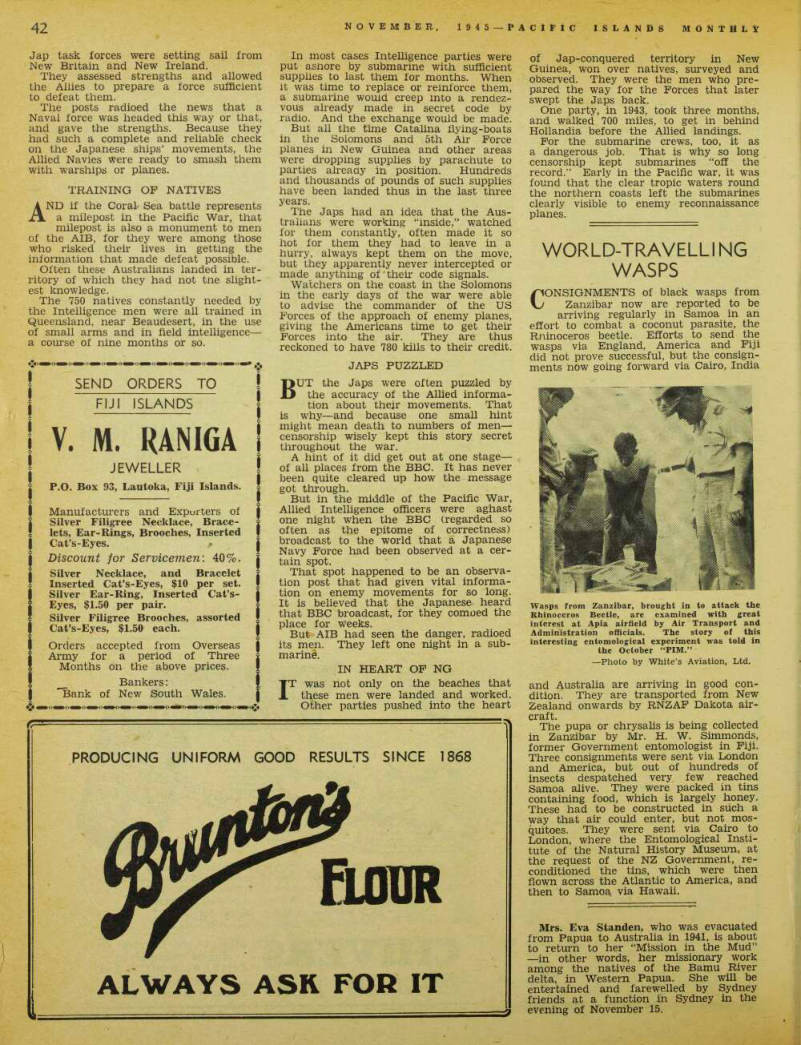
Pacific War
'THIS story of a unit of a few hundred men—who laid the foundations for a great part of the defeat of the Japanese in the Western
Pacific —was published in the “Sunday
Mail” ( Brisbane) in August last.
MANY of the men have been decor ated with high honours. But be yond a mention of their names, they have had no publicity. Not even the citations have been published.
Allied Intelligence Bureau is the organisation they work for. They are the Secret Service agents of the South west Pacific area.
Their operations have been completely “hush-hush,” and even now only part of the story can be told. They have had the tremendous help of a few score trained and trustworthy natives.
Won Awards
AWARDS already include 11 DSC’s, nine MC’s, one DSO, one OBE, two MBE’s, 14 Mentioned in Despatches, three DSM’s, three DCM’s, three MM’s, three American DSC’s. 12 US Legion of Merit awards, six US Silver Stars.
One of 75 natives also decorated got the DCM, three MM’s, two MBE’s, and one the MBE (Civil). The rest of the natives received Loyal Service Medals.
Among the 400 men or so in the AIB, only about 18 have lost their lives, in spite of the hourly dangers of the work.
Sevently-nine have been decorated, and 125 more recommended for decora tions.
How Aib Began
WHEN the Pacific War first flared up in 1941, Australian Navy Intelli gence was working the north coast of Australia and the Pacific Islands. They were under a unified Navy command which called itself “Ferdinand” as its code name.
When General MacArthur took com mand, and the Allied Supreme Command was formed, the Allied Intelligence Bureau was formed in July, 1942, of Navy, Army, and Air Force men com manded by an Australian Navy officer.
Into the unit they drew quickly men who had been planters and traders in the Islands forming the arc round the northern coast of Australia, men who knew much of the territory and who had had contact with the natives.
By this time the Japs had swept through the Dutch East Indies, New Guinea, New Britain, and the Solomons.
By submarine and Catalina plane men of the AlB—a few white officers and native boys—were secretly landed behind the Japanese lines or just in front of them.
Take the story of the Australian who lost his life in Hollandia, for example.
An American submarine took a hand ful of white men and one Indonesian interpreter, who could speak the native dialect of the area, and some native boys, and in darkness crept in to the beach.
In a rubber boat the party went ashore.
The boiling surf was too much for the small craft, which overturned, losing them their wireless sets and provisions.
By the time they struggled ashore the Japs seemed to know that something was afoot. For nearly two days the AIB party fought it out with the Japs. Some of the men escaped, but the leader and two other men lost their lives. One of the colleagues of the leader of that party
described him as “the bravest man I have ever known.”
Paved Way For Landing
rAT was one of the veiy few cases of failure. But it didn’t happen that way on Guadalcanal, where the AIB landed a party when the Japs were speeding south.
The Japs didn’t know it; but every thing they did there was under constant observation. By small walkie-talkie sets the Secret Service agents passed on the news.
The Allied Command in Australia knew that the Japanese were building the Henderson airfield on Guadalcanal.
Let them build it, was their comment; but let us know when it. is nearly ready for use. And. for weeks on end, cut off from all help, the AIB men and their native boys, watching from the hills or creeping through jungles to contact loyal natives, learned all that was going on.
Meanwhile, the Americans were pre paring a landing force. They wanted to have an airstrip ready for use when they landed, so they let the Japs go on build ing the Henderson field.
Then one day, out of the Guadalcanal blue, came the AIB message that the airstrip was ready. That was when the Americans attacked. That was the start of the drive that swept ever northwards towards Japan.
There is another story, too, of the party which had a night rendezvous with a submarine off an island reef.
Some hours before the appointed time, native boys, moving silently along jungle paths, brought news that Japs were go ing to swoop on the post. So the men destroyed their gear. They put off in their rubber boats, sure that a submarine would rescue 'them eventually—which it did, after they had been out 12 hours.
All escaped safely.
With the Australians for a long time were two US sergeants who had been rescued by our men after their plane crashed. They joined the band and worked with it.
Intelligence men on this work lived on their nerves, and needed relief every six months, if possible. They were never made to go more than 12 months in the one area.
Supplies were constantly dropped to the men. Over the last 12 months, Intel ligence parties in New Britain received 50,000 lb. of stores by parachute.
The Allied Forces defeated the Japan ese in the Coral Sea and Java Sea battles largely because of the work and daring of the AIB men.
Hundreds of miles inside Japanese con quered territory, they had established observation posts.
These posts wirelessed brief code mes sages that a convoy was passing such-and such a post. Natives brought messages telling where the convoys had landed their men.
Watchers saw and radioed that the
Jap task forces were setting sail from New Britain and New Ireland.
They assessed strengths and allowed the Allies to prepare a force sufficient to defeat them.
The posts radioed the news that a Naval force was headed this way or that, and gave the strengths. Because they had such a complete and reliable check on the Japanese ships’ movements, the Allied Navies were ready to smash them with warships or planes.
Training Of Natives
AND if the Coral' Sea battle represents a milepost in the Pacific War, that milepost is also a monument to men of the AIB, for they were among those who risked their lives in getting the information that made defeat possible.
Often these Australians landed in ter ritory of which they had not tne slight est knowledge.
The 750 natives constantly needed by the Intelligence men were all trained in Queensland, near Beaudesert, in the use of small arms and in field intelligence— a course of nine months or so.
In most cases Intelligence parties were put ashore by submarine with sufficient supplies to last them for months. When it was time to replace or reinforce them, a submarine would creep into a rendez vous already made in secret code by radio. And the exchange would be made.
But all the time Catalina flying-boats in the Solomons and sth Air Force planes in New Guinea and other areas were dropping supplies by parachute to parties already in position. Hundreds and thousands of pounds of such supplies have been landed thus in the last three years.
The Japs had an idea that the Aus tralians were working “inside,” watched for them constantly, often made it so hot for them they had to leave in a hurry, always kept them on the move, but they apparently never intercepted or made anything of'their code signals.
Watchers on the coast in the Solomons in the early days of the war were able to advise the commander of the US Forces of the approach of enemy planes, giving the Americans time to get their Forces into the air. They are thus reckoned to have 780 kills to their credit.
Japs Puzzled
BUT the Japs were often puzzled by the accuracy of the Allied informa tion about their movements. That is why—and because one small hint might mean death to numbers of men— censorship wisely kept this story secret throughout the war.
A hint of it did get out at one stage— of all places from the BBC. It has never been quite cleared up how the message got through.
But in the middle of the Pacific War, Allied Intelligence officers were aghast one night when the BBC (regarded so often as the epitome of correctness) broadcast to the world that a Japanese Navy Force had been observed at a cer tain spot.
That spot happened to be an observa tion post that had given vital informa tion on enemy movements for so long.
It is believed that the Japanese- heard that BBC broadcast, for they comoed the place for weeks.
But AIB had seen the danger, radioed its men. They left one night in a sub marine,
In Heart Of Ng
IT was not only on the beaches that these men were landed and worked.
Other parties pushed into the heart
of Jap-conquered territory in New Guinea, won over natives, surveyed and observed. They were the men who pre pared the way for the Forces that later swept the Japs back.
One party, in 1943, took three months, and walked 700 miles, to get in behind Hollandia before the Allied landings.
For the submarine crews, too, it as a dangerous job. That is why so long censorship kept submarines “off the record.’’ Early in the Pacific war, it was found that the clear tropic waters round the northern coasts left the submarines clearly visible to enemy reconnaissance planes.
Advertisements & other items, pp. 43-44 (1 item)
Chivers
"KILL TWO BIRDS WITH
ONE STONE"
Send for your personal Souvenirs and also some as Gifts.
SOUTH SEA
SOUVENIRS
STORES
Thomson St., opp. G.P.O.
Box 83 Manufacturer and Exporter of: Tortoise-shell Goods, Silver Filigree and Cat’s-eye Ornaments. Dealers in Cat’s-eyes and Island Curios.
Write for our Price List.
Bankers: Bank of New South Wales, Suva, Fiji.
This is the home of
CmVERSJAMSm
m
cow
CTS*
o* Here, at Histon, near Cambridge, is Olivers Factory, surrounded by orchards and gardens where the choicest English fruits are grown. Sun-ripened and in perfect condition for preserving, these fruits come in all their freshness to Chivers Factory to be made into the finest jams it is possible to imagine.
War conditions still limit supplies hut full shipments will be resumed as soon as possible.
CHIVERS
ENGLISH JAMS
Made in the heart of the English countryside by
CHIVERS & SONS Ltd.
The Orchard Factory Histon, Cambridge, England 8.157
SEND ORDERS TO
FIJI ISLANDS
V. M. RANIGA
JEWELLER
P.O. Box 93, Lautoka, Fiji Islands.
Manufacturers and Exporters of Silver Filigree Necklace, Bracelets, Ear-Rings, Brooches, Inserted Cat’s-Eyes.
Discount for Servicemen : 40%.
Silver Necklace, and Bracelet Inserted Cat’s-Eyes, $lO per set.
Silver Ear-Ring, Inserted Cat’s- Eyes, $1.50 per pair.
Silver Filigree Brooches, assorted Cat’s-Eyes, $1.50 each.
Orders accepted from Overseas Army for a period of Three Months on the above prices.
Bankers: "Bank of New South Wales.
PRODUCING UNIFORM GOOD RESULTS SINCE 1868
ALWAYS ASK FOR IT
World-Travelling
Wasps
CONSIGNMENTS of black wasps from Zanzibar now are reported to be arriving regularly in Samoa in an effort to combat a coconut parasite, the Rninoceros beetle. Efforts to send the wasps via England, America and Fiji did not prove successful, but the consign ments now going forward via Cairo, India
and Australia are arriving in good con dition. They are transported from New Zealand onwards by RNZAF Dakota air craft.
The pupa or chrysalis is being collected in Zanzibar by Mr. H. W. Simmonds, former Government entomologist in Fiji.
Three consignments were sent via London and America, but out of hundreds of insects despatched very few reached Samoa alive. They were packed in tins containing food, which is largely honey.
These had to be constructed in such a way that air could enter, but not mos quitoes. They were sent via Cairo to London, where the Entomological Insti tute of the Natural History Museum, at the request of the NZ Government, re conditioned the tins, which were then flown across the Atlantic to America, and then to Samoa via Hawaii.
Mrs. Eva Standen, who was evacuated from Papua to Australia in 1941, is about to return to her “Mission in the Mud” —in other words, her missionary work among the natives of the Bamu River delta, in Western Papua. She will be entertained and farewelled by Sydney friends at a function in Sydney in the evening of November 15.
Wasps from Zanzibar, brought in to attack the Rhinoceros Beetle, are examined with great interest at Apia airfield by Air Transport and Administration officials. The story of this interesting entomological experiment was told in the October “PIM.” —Photo by White’s Aviation, Ltd.
Advertisements & other items, p. 44 (1 item)
42
NOVEMBER, 1945 BACIFIC ISLANDS MONTHLY
May be Lean Months
Has The Rot
Set In?
May be Lean Months Ahead for Fiji Indians
Suva, Oct. 18.
IF the present anxiety on the part of Indian importers to unload newly arrived merchandise is any indica tion, there should be some interesting developments in the price of drapery and manchester goods in Fiji in the next few months.
Before the Pacific war, almost all Indian storekeepers in the Colony bought their softgoods from the Big Firms on a 5 per cent, discount. The fact of be ing a storekeeper seemed almost sufficient reward for them, and they were content with ridiculously snjall profits of perhaps 1 or 2 per cent. Few Indians imported goods on their own account.
Then came the American invasion, and a period of absolute panic-buying. The bought everything as it ap peared on the shelves, some of which they shipped home to America (where a great deal of it came from originally) but mostly to throw away as presents to local Fijians or Fijian girls. Cotton goods, ladies’ underclothes, men’s wear— all were snapped up as soon as they ap peared and European residents were forced to do such buying as was permit ted them through the good graces of departmental heads, and by stealth.
The first result of this mad scramble on the part of American soldiers and the suddenly-enriched Fijians, Euronesians and Indians was that the Big Firms closed down on the Indian storekeeper—
all their stocks were needed for their own stores, and selling their precious goods at 5 per cent, discount no longer made sense.
The Indians begged and howled, but it got them nowhere; and eventually they were forced to seek other sources of supply, and for the first time started out to try to make overseas contacts for themselves.
Indian import agents sprang up all over the place, and storekeepers, in tune to the wild stampede that was going on in the retail trade, began to place over seas orders, apparently overlooking the fact that by the time these orders ar rived, the scene might be vastly changed.
MOST of those orders were placed something like two years ago, but are just now arriving in the Colony; and, although there is still a fair amount of slack to be taken up, the scene has changed vastly and will change even more in the months immediately ahead.
It is almost impossible to keep any thing a secret here: and when one store keeper two years ago ordered 500 dozen ladies’ panties, it was not long before his neighbour, and his neighbour, and his neighbour, infected by the buying bug. was placing orders for a similar amount of goods. At the rate of two
years ago, these stocks might last the storekeeper a week or a few days; but at the normal rate of consumption they are likely to last him 10 years.
The position at present, therefore, is that the Indian traders and indent agents are running around in circles trying to unload on one another, and if the pre sent rate continues ladies’ underclothes, household linen, towels, etc., will be a dime a dozen in Fiji, in six months’ time.
It seems a fantastic situation that these consumer goods are allowed to flow freely into a Colony like this, while the pro ducers in England are not permitted to buy as much as a sheet or a towel.
It is likely that some Indian firms will be bankrupt before the situation straightens Itself out. But in the long run who is going to lose? It is obvious that, having once established overseas connections, such storekeepers who do survive are not going to return to pur chasing from the Big Firms for resale at 2 per cent, profit. They will be able to import from overseas, make a modest but adequate living, and still beat the Big Firms. rE greatest source of Indian wealth is still, of course, the manufacture and sale of jewellery and curios.
Many people—and not Indians—seem to
think that this insatiable demand for tortoiseshell, cat’s-eyes, shells and fila gree will go on indefinitely and that there will always be an overseas demand for such things: But this is doubtful. The dull brown and green of tortoiseshell and cat’s-eyes is something of which one easily tires; much of the workmanship is extra ordinarily crude, and most of the “sil ver” filagree work is made of any white metal but silver.
None of this stuff is in any way com parable with the exquisite, and cheap, costume jewellery which, before the war, came from Czechoslovakia, other central European Countries or from the United States The only really good “buys” in Fiji at present are hats, ivory and silver from Ceylon, mats, baskets and purses from
Samoa and other islands; and the newly arrived “paua” shell jewellery from New Zealand. Called the New Zealand marine opal, this “paua” shell is made into all manner of ornaments, mounted expertly on solid silver and sold in this Colony for little more, if any, than the New Zealand price.
Advertisements & other items, pp. 45-46 (1 item)
6. H. Robinson
WANTED TO BUY—QUALITY GUNS AND RIFLES
HIGHEST PRICES GIVEN. WILL ALSO EXCHANGE GUNS.
New .303 Short Service Barrels, without Sights and Platform, £2/15/- each.
Postage extra.
SI L RO H U Qualify Firearms and Fishing Tackle. 143 ELIZABETH STREET (Near Market St.) SYDNEY.
’PHONE; MA 3540.
6. H. ROBINSON
Island Merchant and Agent
OF 51 MACQUARIE STREET, SYDNEY
% having returned to business, can, as a result of over twenty years' extensive experience (excluding service in two wars) guarantee prompt and efficient individual service as a buying agent to Pacific Island clients.
Enquiries are solicited to— Box 3317, G.P.0.,
SYDNEY.
After taking Pinkettes you should feel brighter, happier, and free from sick headaches, bilious attacks and liverishness. For
PINKETTES
are tiny laxative and liver pills, which painlessly exercise the digestive system.
\\W sm U rvice vef 5 tv ou r Olt* her® etc c»V
pub'
als tio n you of° vU® hop®
dio"t
-,95» \X/ r«V e TcO f ,76‘ list t lO is^f° B*° 5 A<*» S N932S
RANGE COVERS:
• ELECTRICAL GENERATING
EQUIPMENT. TRANSFORMERS
AND SWITCHGEAR.
• ELECTRIC MOTORS AND
CONTROL APPARATUS.
• ELECTRIC CABLES AND IN-
SULATING MATERIALS.
• FLUORESCENT AND INCAN-
DESCENT LIGHTING.
• COMMERCIAL COOKING &
HEATING EQUIPMENT.
• DOMESTIC ELECTRIC APPLI-
ANCES. RADIO & WIRING
ACCESSORIES. 7
• MATERIALS HANDLING
EQUIPMENT.
• MACHINERY & ENGINEER-
ING EQUIPMENT. METALS.
CHEMICALS.
• COAL MINING EQUIPMENT.
• METALLIFEROUS MINING.
quarrying and cement
MAKING MACHINERY.
Reef Tragedy
What Happened to a Fijian Turtle- Hunter
By Kai Vata
A GRIM story of the sea, of disappear ance and death, comes to us in Fiji, to remind us who regard tortoise shell as a not-particularly-interesting article of commerce—and personal adorn ment—that the search for even this humble article can be, and often is, fraught with grave peril.
On Saturday, September 14, two boats, each manned by three Fijians, left their Ba River village of Votua to go turtle fishing on the huge coral reefs off Natauarau. a few miles down the coast to the south-west. In one boat were Samuela Nawai, Turaga Ni Koro, of Votua, his son Ulaiasi, and big Joni.
They made their way far out, to a less frequented area, hoping to find there the lordly parrot-billed turtle, their “Vonu ni Taku,” which alone among turtles is blessed (or cursed) with that valuable overcoat known as tortoise-shell. Their ill-fated destination was a huge cavern ous hole in the reef, some 12 miles off shore —a gigantic, crater-like pit of blue water in the midst of shallows, where the bottom lies full 24 fathoms deep. It is a spot where, to the imaginative mind, unnamed horrors lurk, but which to the phlegmatic “Bulas” was just a jolly good place for Vonu.
AND their luck was in. At about 2 p.m. a regular old grandfather Taku incautiously eased his 200 lb. bulk to the sparkling surface nearby, doubt less with the intention of basking a while in the warm sunshine, whilst his age-old
enemies, the sharks, were lying doggo in the reef-caverns below.
Little basking he did! The excited but wily hunters paddled their craft softly to within striking distance. Then, Wham!—and the heavy, steel-lined spear went home, and down went the sorely wounded Taku, seeking sanctuary in his narrow reef-holes.
But the firmly-embedded 12-foot spear denied him entry. Twice he rose to the surface for air, but each time sounded before the vigilant Fijians could get to him, leaving a crimson trail to mark his going—and to serve as a clamorous “Action Stations!” to those ferocious sea monsters, the sharks, to which the scent of turtle-blood is a maddening urge to kill.
A THIRD time he rose, this time close to the boat, and obviously weak; and, as he sounded again, into the water and down after him dived Ulaiasi, brave, foolhardy youth who truthfully bbasted that he feared no shark.
The pale soles of his feet flashed briefly as he swam down, then vanished, and that brief flashing was a courageous boy’s farewell to life. He was never seen again.
For the first minute or so his father and friend waited expectantly. But their expectancy rapidly changed to fear, and then to a sickening anxiety as they peered frantically into the suddenly inimical blue depths, ejaculating ques tions which neither dared answer. Thev urgently hailed the other boat, more in the common human craving for com panion shin and sympathy in disaster than with any hope of succour, for they , now knew with a dreadful certainty that Ulaiasi was beyond all human aid.
No sign disturbed the blue depths nor marred the sparkling beauty of the sur face, but after a short time the thick shafted turtle-spear floated slowly to the surface, mute testimony to the swift and savage destruction that had overtaken both pursuer and pursued.
The grief-stricken father and his friends hovered over the spot until dark, reluctant to leave lest by some miracle the lost boy’s body should reappear.
Then, as hope and daylight faded.
Samuela sent the other boat back to Votua with the sad tidings, whilst he and Joni went to Na Tawarau to report the tragedy.
The next day, with eight boats and a big launch, the vain and pitiful search was resumed, but the sea held its secret —and holds it still.
Young Cocoa Plantations
Survive Three Years' Invasion in New Guinea
ONE of the interesting things that have been noticed by the planters who have returned to New Guinea is the effect of 31 years’ war upon cocoa plantations. , It has been observed that young, well grown cocoa trees, on Karkar Island, and along the north coast of New Britain, are bigger and better than ever, despite the fact that, since the invasion, they have had no expert plantation attention.
It is necessary to chop away Q u i te ., sub 7 stantial growth, in order to reach th e ™; yet they are found to be in excellent C °But tlo smaller and younger plantings, which had not attained to vigorous growth when the invasion came, have succumbed to jungle growth and pests.
Apparently, cocoa trees, although not in digenous to New Guinea, can take care of themselves in the New Guinea jungle, once they attain a certain strength.
Advertisements & other items, p. 47 (1 item)
C. Sullivan Pty. Ltd.
HILL’S
FINE ENGLISH
CIGARETTES
•SPINET
•SUN R I P E
•GOLD FLAKE
• AIR MAIL
HIGH-GRADE
TOBACCOS
BADMINTON
S P I NET
Pacific Islands Distributors : C. SULLIVAN Pty. Ltd., Sydney
CHATEAU D’OR
COGNAC VIEUX
* w vr FI NET CONTENTS 26 FLUID OUNCES
C. SULLIVAN & CO.
SYDNEY
PRODUCE OF AUSTRALIA
PABST
BLUE RIBBON BEER
3 3 Fine Brews Blended into
ONE GREAT BEER
Agents: C. SULLIVAN PTY. LTD., 379 Kent Street, Sydney
C. SULLIVAN Pty. Ltd.
GENERAL MERCHANTS ISLANDS AGENTS
REPRESENTING LEADING FIRMS IN THE PACIFIC ISLANDS.
Islands Produce sold on Shippers' Account—Liberal Advances against Consignments.
Buyers of all Islands’ Requirements on Commission —Original Invoices Furnished.
Bankers : Bank of New South Wales .. Bank of New Zealand .. Comptoir National d’Escompte de Paris.
Wartime Cable Address: Sullivan, Kentstreet, Sydney.
379 KENT STREET, SYDNEY, N.S.W.
Escape From
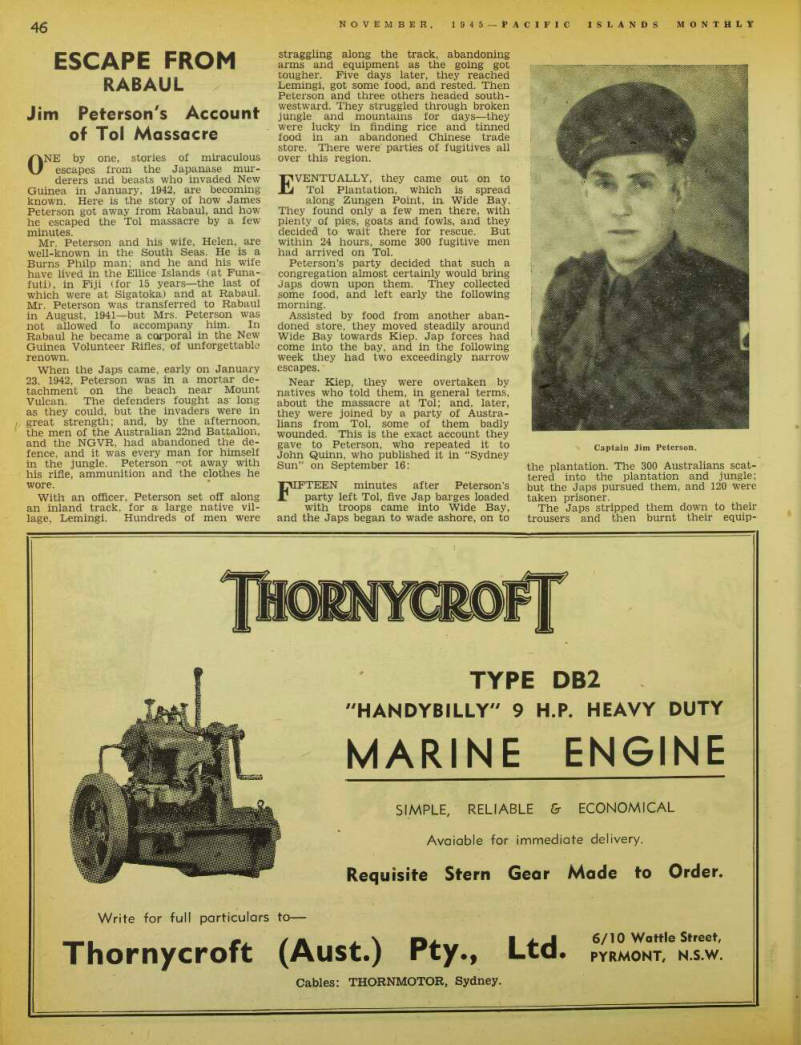
Rabaul
Jim Peterson's Account of Tol Massacre
ONE by one, stories of miraculous escapes from the Japanase mur derers and beasts who invaded New Guinea in January, 1942, are becoming known. Here is the story of how James Peterson got away from Rabaul, and how he escaped the Tol massacre by a few minutes.
Mr. Peterson and his wife, Helen, are well-known in the South Seas. He is a Burns Philp man; and he and his wife have lived in the Ellice Islands (at Funa futi), in Fiji (for 15 years—the last of which were at Sigatoka) and at Rabaul.
Mr. Peterson was transferred to Rabaul in August, 1941—but Mrs. Peterson was not allowed to accompany him. In Rabaul he became a corporal in the New Guinea Volunteer Rifles, of unforgettable renown.
When the Japs came, early on January 23. 1942, Peterson was in a mortar de tachment on the beach near Mount Vulcan. The defenders fought as' long as they could, but the invaders were in great strength; and, by the afternoon, the men of the Australian 22nd Battalion, and the NGVR, had abandoned the de fence, and it was every man for himself in the jungle. Peterson ~ot away with his rifle, ammunition and the clothes he wore.
With an officer, Peterson set off along an inland track, for a large native vil lage, Lemingi. Hundreds of men were
straggling along the track, abandoning arms and equipment as the going got tougher. Five days later, they reached Lemingi, got some food, and rested. Then Peterson and three others headed south westward. They struggled through broken jungle and mountains for days—they were lucky in finding rice and tinned food in an abandoned Chinese trade store. There were parties of fugitives all over this region.
EVENTUALLY, they came out on to Tol Plantation, which is spread along Zungen Point, in Wide Bay.
They found only a few men there, with plenty of pigs, goats and fowls, and they decided to wait there for rescue. But within 24 hours, some 300 fugitive men had arrived on Tol.
Peterson’s party decided that such a congregation almost certainly would bring Japs down upon them. They collected some food, and left early the following morning.
Assisted by food from another aban doned store, they moved steadily around Wide Bay towards Kiep. Jap forces had come into the bay, and in the following week they had two exceedingly narrow escapes.
Near Kiep, they were overtaken by natives who told them, in general terms, about the massacre at Tol; and, later, they were joined by a party of Austra lians from Tol, some of them badly wounded. This is the exact account they gave to Peterson, who repeated it to John Quinn, who published it in “Sydney Sun” on September 16: FIFTEEN minutes after Peterson’s party left Tol, five Jap barges loaded with troops came into Wide Bay, and the Japs began to wade ashore, on to
the plantation. The 300 Australians scat tered into the plantation and jungle; but the Japs pursued them, and 120 were taken prisoner.
The Japs stripped them down to their trousers and then burnt their equip
Captain Jim Peterson.
ment, clothing, and pay books on the beach. Apart from that, they did not harm them, but gave the prisoners cigarettes and food.
The Japs set up wireless on the beach.
Early next morning, a message came through that seemed to bewilder them.
They rushed around in excitement and the commanding officer came hurrying down. As far as the prisoners could make out, he sent a message for the previous signal to be repeated. It came.
After it was read, the Australians were lined up, their hands placed behind their backs and their thumbs bound together with fishing-line. Rope was linked through their arms until they formed a human chain.
All except one man. There was not enough rope for him, but he was pushed into line and marched off with the others.
The guards hustled them along the tracks of the jungle. Rounding the bend,
the man who had not been tied dropped to one side into a hollow. As the doomed men passed him, they whispered: “Keep your head down, mate. They can see your hat.” That man escaped.
They had gone a little way when they were halted. The rope was cut, divid ing them into small parties. Then the Japanese bayoneted or shot all of them.
After the butchery, an officer came along the line and any man who stirred was shot. The Japanese went away.
From the bush crept the Australians, who had witnessed the massacre, to look for survivors.
Peterson said that he believed there were four others apart from the three he met. , , j Another party found the man who had dropped beside the track. For days he had wandered with his hands tied behind behind him. He lived on grubs and beetles he had picked up with his teeth.
PETERSON’S party then pushed on to Jacquinot Bay, taking wounded men with them. It was a nightmare journey, over very broken country, with out supplies. The men were mostly sick and starving when they got to Malmal Plantation, on Jacquinot Bay. They were given help and supplies by a Ger man woman, the wife of a man who had been interned, and who was living there by herself. More men arrived, having struggled through from Wide Bay.
They set up a first-aid post on the beach —but many died.
Fearing Jap attacks, they struggled on. with a party of 90, to Grina, some 20 miles away. Another 20 men died.
On Easter Monday, a native runner came through with a message that, that night, a boat would come to Malmal Plantation, to help them. Carrying their sick, they made their way back to the plantation in eight hours.
A launch named “Mascot” had come from Port Moresbv to look for survivors.
It signalled the “Lakatoi,” in charge of Ivan Champion, well-known Papuan ad ministrative official, which was waiting in the Trobriands.
Champion brought the “Lakatoi” into Jacquinot Bay, and l5O escapees aboard —a most risky and daring feat.
Fortunately, the weather was thick and misty, and they were not observed by the
Japs, who were swarming along that coast. There were anxious moments, while the “Lakatoi” dodged the Japs around Gasmata, further westwards—but eventually the whole party got safely across the Bismarck Sea to Papua.
Jim Peterson joined the Australian Forces, became a captain in ANGAU and, on last reports, was serving in Bougainville.
Advertisements & other items, pp. 48-50 (1 item)
Marine Engine
mt
TYPE DB2
"HANDYBILLY" 9 H.P. HEAVY DUTY
MARINE ENGINE
SIMPLE, RELIABLE & ECONOMICAL
Avaiable for immediate delivery.
Requisite Stern Gear Made to Order.
Write for full particulars to—
Thornycroft (Aust.) Pty., Ltd. pyrmont^Sw
Cables: THORNMOTOR, Sydney.
i K i is H &
HARRYJYOUNG
\9M &
Sole Pacific Island Selling Representatives for
JOHN VICARS Pm™
WOOLLEN WORSTEDS
MADE FROM THE FINEST
AUSTRALIAN WOOLS
By using the most scientific methods of manufacture, John Vicars Pty. Ltd. produce these outstanding materials.
Fine wools and fine workmanship have produced quality cloths. They are designed to give satisfaction in any' climate. m
HARRY J .YOUNG PTY. LTD.
Postal Address: Box 3661, C.P.0., Sydney.
379 KENT STREET, SYDNEY
Bankers: Bank of N.S.W.
Codes: Bentley’s, Comp. Phrase Bentley’s 2nd Phrase
DO NOT WONDER FOR
YOUR CHRISTMAS PRE-
SENTS PLACE YOUR
ORDER AT
SHARDA
SOUVENIRS
STORE
For Genuine Tortoiseshell Souvenirs, Silver Filigree and Cat's Eyes Ornaments, Mounted in Silver Filigree and Tortoiseshell.
All overseas orders promptly executed. U.S.A. Money Orders accepted.
Give Us a Trial Order
G.P.O. Box No. 159,
SUVA, FIJI.
Bond Bros. & Co.
(Incorporated)
310 CALIFORNIA STREET
SAN FRANCISCO CALIFORNIA
U.S.A.
ESTABLISHED IN 1910
0 Importers of Island products and exporters of Island requirements. • Our 35 years' experience guarantees you complete satisfaction. 0 For reference: Inquire from any San Francisco Bank.
NEW ACCOUNTS INVITED
Crowded Tahiti
Increased Population Brings New Problems of Housing and Water
From Our Own Correspondent
Papeete, Oct. 5.
PAPEETE, during the war period, has increased in population an esti mated 50 per cent.
This has had the usual consequence of congestion, due to insufficient housing, and progressive profiteering in rentals.
Land values have ascended to truly astronomical levels. This is chiefly caused by competitive buying by those who—having accumulated considerable funds during the war—are persuaded that land is the only commodity which has any chance of emerging from the wrath to come, possessed of any value.
The early morning market at Papeete now resembles a mob scene in a hectic Hollywood drama, as men and women compete for the fish our crafty fishermen maintain in limited supply.
This is typical of the predatory miasma which has invaded nearly every phase of Island life—to banish, perhaps for ever, the old spirit of gracious goodwill and kindly good manners. “Paradise Lost” would be, Indeed, the most truly descriptive title for a History of Tahiti during the past 25 years.
The same title would serve for an essay on the manifest destiny of the white man in the Orient. Those who discourse learnedly on the causes which have undermined European prestige in the Orient, have overlooked one major fac tor—the employment of men of African negro blood as soldiers and officials on the continent of Asia.
Anyone who has studied the so-called reconstruction period following the Civil War in the United States, may vaguely comprehend the effect of that immediate folly on peoples of the Orient, who proudly trace their ancestry to the im mortal gods. rE increased population has made necessary additional sources of sup ply of water for Papeete. A new system—nearly completed—will convey water from springs in the Tipaerui Val ley to supply the western half of the city. The eastern half of Papeete will, then be amply supplied from the old pipeline carrying water from the Fau taua Valley.
Tahiti has been a well-watered island.
Water supply is, however, visibly dimin ishing. The mania for chopping down trees will—if allowed to run its course transform the “Pearl of the Pacific” into a bleak, thirsty desert.
The efficient Director of the Depart ment of Agriculture is performing ad mirable service in repairing the damage; but he cannot keep up with the de stroyers.
The industry of tree massacre was in troduced by the early navigators, who considerately choose bread-fruit trees as their first victims. To-day, if a tree is beautiful, it is marked for destruction.
Advertisements & other items, pp. 51-54 (2 items)
in^'crouclied^^sJSo^^^'e^'sea^s^ia^
A ROUGH ROAD TO OLD LEVUKA
Some New Angles on Old Problems
BY JUDY TUDOR
October 4, 1945. rIS is the launch “Jubilee,” soon, I hope, Lodoni bofind. This is the wharf, Levuka, on the island of Ovalau, Fiji.
The sea is a flat, opaque disc of green blue this morning, without as much as a ripple to mar its mirror surface. Only a tiny frill of white marks the barrier reef; and Makogai and Wakaya on the horizon are deep blue with approaching rain.
A copra cutter off there on our port bow, all sails spread, *is still motionless on the opal sea, waiting with the patience of a native crew, the first breath of wind to send it east to the Lau Islands or north to Vanua Levu, on its copra quest.
His Majesty’s mails have held us up for a good quarter of an hour; but now our mop-headed Fijian skipper takes up his place with his head through a hatch and his feet on the wheel and we are off, heading left-about around Ovalau before making for the Viti Levu mainland at Lodoni.
Levuka slides past; its white and yellow houses, red-roofed among the greenery at the foot of Ovalau’s fantastic mountains; its single row of shops and the strange concrete clock-towered church—the tower large enough for a cathedral, but petering out into a small wooden building.
I still can see the Heath Robinson power-house sending up oil-smoke into the still air from its rickety building on the hill. And now the township comes to a whispy end; and it is a case of that was Levuka.
LAST night one of the inhabitants called it Zombieville a Zombie being a corpse that won’t give in and admit it.
Levuka exists on its past glory and pre sent copra trade—it is the chief copra shipping port of Fiji. But if, or prob ably when, the copra boom folds up, per haps the glory that was Levuka will fall finally into the dust. Copra just now is an economic possibility because Ovalau is blessed with favourable winds and engine less cutters that go far afield, cheaply, to pick up small loads of copra from out lying islands—from Fijian communities and Indian and Chinese storekeepers and anyone who has copra to trade—bringing it back to Levuka to be picked up by the large American ships.
But in spitp of its copra trade a faint musty air pervades Levuka, redolent of days that are past. Hard to imagine that 600 Europeans once lived here — that this island of Ovalau and its outlying islets was Fiji, and all without was wilderness.
That this was the happy headquarters of Bully Hayes; and the number-one “blackbird” exchange of the Pacific. And later, the centre of South Sea cotton which boomed until after the Americans quit fighting each other in 1865; and that here, at a place now marked by a bronze tablet let info a stone: “The in strument ceding to Queen Victoria, her heirs, and her successors, the possession of, and full sovereignty and dominion over, the Fijian Islands and the inhabi tants thereof was signed on 10th October, 1874.”
«« under its wing. J When Levuka was at its zenith, with 39 was a^nlti^viuLp* 16 Suva
lives' Suvawithitl nalafial
buildings and city nretenHor?? hours later Slx
hollow nestling beneath^Ovaiflirc Bl^?^
ridges—a community of fbouf n
EufopeaL Indians ml Fnrnf.
siansand ne " ders S how both could be^acSnwifltP^n the same piece of world d 1 d 1 * ♦ * f EVUKA of course can hP li SPa frnm c- nV Q ’. f n J? e reaclie <J scrvirpi? *l5 t 9 n & ? ai i y miles un th? 3 9 to 4 ,° around Ovalau by * lal ££P- h fa ™*
manager & of°^ P locaf fi^^n^og^ther
with little enthusiasmwe eved the 6 fear’ some red bus, already wen filled f w?th
Wg^off l^? (Tlow^n
in^'crouclied^^sJSo^^^'e^'sea^s^ia^
and their backs we?l sawS off at a height that they boredTht? Sir blades. It had no windows hm- S
curtails, whfch
and under which it was necessarv to nppr if one wished to view the scSv P Mostly these buses carrv thp pv'prinQf ingly perambulating Fiiians and Indians’ but Europeans use them and it isptPn ’ sidered OK for European women tn along also. I have found pretty quickll in this place that a European woman &
not a pampered princess in disguise, as I’ve found to my delight further west, but just a plain, darned woman after all who should, if she’s wise, expect no special privileges.
The Fijian and Indian passengers were already installed and with them their infants, their bedding, their food and, I imagine, all their possessions,. We were able to persuade a large Fijian soldier that we had booked seats 1 and 2 and, when he tucked himself in some place else, we bent ourselves over in the appro priate jack-knife position (and neither of us are much over five feet) and in sinuated ourselves into our Peaces, haul ing on our bags and adding them to the mountain of dunnage already in the aisle.
No meals were provided en were further encumbered by a packet of sandwiches bought locally and daintily wrapped in a big chunk of newspaper. ♦ ♦ * AT some time after one o’clock at the end of a long, bumpy road, we shot
out of a grove of trees to find our selves at the edge of the sea. This I took it, was Lodoni.
When pressed the driver admitted as much and, further, that the launch way out there near the horizon was our “Jubilee.”
“How do we get there?” I asked. But having landed us at this hopping-on place, he apparently felt that he had shot his bolt, and went off without answering.
Pat and I got out, hauled out our gear, and stood uncertainly. The Fijians and Indians then got out and stood uncer tainly; and over on our left I noticed for the first time a New Zealand Army lorry decanting soldiers who also stood uncertainly.
I asked a Fijian what we did next; and he answered right back—in Fijian.
I went across to the soldiers and asked one of them. “I think you have to wade, he answered.
“What, with all this gear?” I was dumbfounded. He said he thought so.
Everyone was still dithering on the brink. Feeling that this was, perhaps, one of the occasions when ladies led off, Pat and I took off our shoes, picked up our bags, our bottles of milk, our sand wiches, two sun hats, coats and assorted oddments, and plunged into the tide.
The Indian driver, a couple of pals, and a few idle Fijians watched us interestedly.
This, I reflected bitterly, is literally the white woman’s burden. Shades of old New Guinea, where to carry anything larger than a tin of cigarettes was “infra dig”!
I stood on a piece of jagged coral and sliced a piece out of my heel, my coat trailed in the water which got deeper and deeper, and eventually reached the hem of my skirt, and the arm that dragged the bag felt as though it would drop off.
When we were at our last gasps we reached a sandbank, and there, miracle of miracles, was a mop-headed Fijian and a dinghy.
“Can we put our luggage in?” we asked.
Friend Fijian answered not, so we dumped our gear. “Can we get in?” Same stony silence. We got in. ♦ ♦ ♦ ABOUT a dozen other bus travellers who had followed us into the briny caught us up, and did likewise. The dinghy sank and sank under the in creasing load, and when there was about half an inch of freeboard Mop-head and sundry other members of the crew got in; and in this wise we arrived at the launch.
Fijian and Indian passengers made a dash for the dark cabin next the engine, ranged themselves bolt-upright on the seats, and piled their gear in the passage way. We took the harder board benches in the outer cabin where there was more air.
In the next half hour 20 NZEF mem bers, off on a five-day break to Levuka, their provisions, and boots and kitbags, their captain’s folding chair, sundry Fijians and Indians, their gear and food and infants were packed in, until we were jammed tight below and overflowed onto the deck above.
Old Mop-head took up his position with his head through a hatch and his feet on the wheel, the engine started, and we were off.
The day was now pure blue and gold, the sea was furrowed by only pint-sized waves and someone said that that rugged hunk of sunken mountain range ahead, blue-grey in the distance, was Ovalau.
We chugged steadily across the channel that separates mainland from island and then, until Levuka showed up around a point at five in the afternoon, con tinued within the barrier reef, Ovalau on our left with its succession of deep valleys, rugged mountain peaks and occasional patches of cultivation, and on our right scattered green islands and the endless reef. ♦ * * LEVUKA from the sea was a huddle of red roofs ofl what is, for Ovalau, an extensive foreshore, with further roofs rising out of the greenery on the mountains behind. We were saved another stevedoring episode by a lad named Joe and his taxi If you want anything while you are here, said Joe, expansively, “just ask me.
Such had been my travail of the pre vious night and morning that the name of the hotel had been erased neatly from my brain. I fished in the back of rny subconscious and said, Royal Hotel Joe looked somewhat blank, and I asked
cautiously: “How many hotels are there here?”
“One,” said Joe. We set off; Joe, career ing madly down the pot-holely road, swung suddenly to the right then shot round left onto what I took to be a foot path, and a few yards further on drew up all standing in front of the hotel.
He dumped our bags on the verandah, collected 2/6 and said: “Here’s the boss.”
The boss was apologetic. He had, he said, just that morning received my letter (although it had been posted four days previously in Suva), and he was booked out by the “Army” that had crossed with us.
Two little Orphan Annies, their faces coated with a mixture of Indian bus dust and salt sea spray, stood in the midst of the baggage, let their mouths fall open, and wailed.
“Oh, but I’ve made other arrangements for you,” he hastened to tell us. “Mr.
Parr’s place—he is a school teacher here —just round the comer. Food is scarce just now, so I've arranged for you to eat here.”
“But what does Mrs. Parr think of this?” we asked.
“Oh, Mrs. Parr doesn’t mind.” And apparently Mrs. Parr did not. She took us to her bosom, ironed our clothes, made us sundry cups of tea. and was a fund of local knowledge. When we left she asked us to come for a long holiday next time, and this I hope some day to do. * * * rwas here at the Parr rendezvous that we met Miss Irene Bowman, Miss Gwen Robertson and Miss Molly McGann, also teachers at the local school, who live a pleasant, but somewhat lonely, life on the bachelorless wilderness that is Ovalau; and Mr. G. Thompson, head teacher of the school, and his wife. (The teaching fraternity of Levuka make up ouite half of the European population of the place.) Mr. C. G. O. Parr is an Englishman who came to teaching in Fiji via Aus tralia and the CSR Co. 17 years ago. His Inclination lies in teaching Fijians, and not so much in assisting the pupils of Levuka European-Euronesian school to acaufre the rudiments of a classical edu cation. as laid down in the far-away offices of the Education Department in Wellington. NZ.
His ambition is to run a practical school on a property that could be self-support ing. while local children could learn an Industry and its associated trades, that would be of practical value to them in the life thev must lead after school days are past. The Fiji education authorities take a poor view of the idea. I beliefe. No one apparently has ever told the authori ties in Fiii of Kwato, near Samaral.
That Institution for practical education was founded many years ago on just such another wild dream as Mr.
Parr’s. • ♦ * I HAD two letters of Introduction to Mr. Cyril King, who had been de scribed as the uncrowned Mayor of Levuka: but Mr. King had departed Suva-wards on the day we arrived. The DO, too, had departed, with Ratu Sukuna to an outer island. But we met Mr. “Ted” Higgins, of the local wire less school, his wife, who was one of the Revmonds. of Tarawa; and Mr. Archi bald Gardner, local manager for BP (SS) Co., and his charming wife, with whom we dined. They insisted that they had read some of my articles—but that I did not look as I wrote. I was not big enough, or bustling enough, and furthermore, they had thought I’d be MUCH older!
Well, who could resist that?
ITKKDD is number one subject of con- JT versation in Levuka, just as it has been in Australia for the past four years (but not in New Zealand, or Suva, where there is plenty).
I walked down Levuka’s main street with Mrs. Thompson, to where a Fijian sat beneath a coconut, flanked either side by a basket of yams—long, hairy yams well past the full blush of youth.
Mrs. Thompson was immediately filled with enthusiasm. “How much?” she asked.
“Two and six,” answered the .Fijian rudely.
She hastened into a nearby shop to get change and, while she was gone, I surreptitiously scratched the skin of one yam, which showed none of the signs for which my old New Guinea cookboy had told me to look. Unless I was greatly mistaken, that yam when boiled would be a mass of short, white cotton threads suspended in a translucent gooey
paste. Yet this was the revitalised vege table market of which residents spoke.
Food is short now in Ovalau; but it has been shorter. During the acutest of the war years, when the island’s young men went, almost in a body, into the Military Forces, those who remained, and the women and children, gave up work and horned in on the usual European source of supply. This was made finan cially possible by the soldiers’ allotments, which were paid regularly by a benevo lent Government.
Levuka has one local fisherman, of part French descent, who normally sup plied the wants of the non-Fijian popu lation, but with easy Government money the Fijians felt that this supply could be conveniently utilised for their benefit, First, a few patronised the fisherman instead of going to the trouble of catch ing their own; and then it became an avalanche. No sooner had the French man’s boat apeared on the horizon than
the Fijians began to gather; and no sooner was he within jumping distance of the jetty than they descended upon him in a madly yelling horde, thrusting money into his hands and grabbing every fish in sight—on one occasion even shoving the fisherman himself over the side. In this mad stampede for fish the Europeans were left standing at the post.
Soon, the same state of affairs developed in the local vegetable market, normally supplied by two Chinamen.
The Fijians, in their new-found source of wealth, gave up planting and, instead, turned their attention to easier means of supply. As soon as the Chinamen and their vegetable carts approached, d(pwn came the hungry and vigorous Fijians, and soon, too, the vegetables, like the fish, had been snatched up and borne triumphantly away.
Europeans who wished to eat of the fruits of the Chinamens labours were forced to rise at 5 in the morning and trudge miles out along the roads towards the market gardens in the hope that they would intercept the waggons before the Fijians got wind of their approach and descended upon them.
At present tbe Fijians are rep-anting, and the vegetable position has correspondingly eased. The Chinamen are now reaching the township with stocks intact. * . , , , , LEVUKA might once have been a wideopen town of untold delights, but to-day the most attractive part of it is its old swimming pool. Way up back of the town, up two flights of steps that look sufficiently old for Bully Hayes himself to have trod, someone with foresight has built, in the brown stream called Totoga, a deep concrete swimming pool Water gushes down from the
mountain behind between huge brown boulders, and spills out over lip of the pool into the green valley beneath, The “invading” Army had discovered it when we left it last night, and were making it theirs, quite oblivious of the fact that war and Levuka are two appa rently irreconcilable facts. ♦ ♦ * . , A A .. . /"VLD Levuka is lost to sight now, away on the other side of Ovalau. It is impossible for me, a bird of passage, to see what lies ahead for this quaint old place, with its air of trembling on the brink of oblivion. j should have liked to have spen t more me there with its friendly people; and, this morning as we have chugged along around the island, those practical Scots anC estors of mine, apparently haunted by the visions of Suva to which we now return have been asking me why it was to leave a lew of the fancy Dorc h es off the Government buildings of fh™ capital, and refurbish the buildings . places like Levuka; and, further, why .. r not nossible to distribute a few refrigerators and other amenities to its Government servants, who hold the fort lonely sta te in the outer isles, x suppos6i js none of my business; or the business of my ancestors.
There is Lodoni, with the tide well out. to bea long paddle this morn • hi over the mud flats, Yesterday, when I visited the school at Levuka for morning tea the four Euro pean children and the 140 (or may be more) Euronesian c^lren W6r “ Waltzing incongruously, I thought, Waltzing Matilda. I guess, after all, thej were only being prophetic!
Amplion
M AK$
AS you well know, island conditions impose exacting tests on mechanical equipment. But Amplion sets your mind at rest —for Amplion lighting plants and engines are built to last, to keep on operating under all conditions. If you require a 12 or 32 volt lighting plant, for city-light convenience in your house and outhouses, or a portable petrol engine to supply power on your station or plantation—remember Amplion is built to last.
For further particulars, send the coupon by next mail.
Model 3008, 12 volt, 300 watt (25 amps), £4B/12/-, plus 15/- casing.
Model 400, 32 volt, 320 watt (10 amps), £53/10/-, plus 15/- casing.
F. 0.8. Sydney. mm
THE MOST
LIGHTING
ENGINE
ISLANDS.
RELIABLE
PLANT OR
FOR THE
: f
N X AHHION
• • • -i These are the 10 car engine features that guarantee reliability: 1. Oil bath air cleaner. 2.
Forced feed lubrication. 3.
Pneumatic speed governor. 4.
Float feed carburettor. 5.
Visible petrol filter. 6. Magneto ignition. 7. Petrol cutoff valve. 8. Heavy duty ballrace on crankshaft, 9.
Self-starter. 10. Automatic cutout on generator,
AMPLION (A’ASIA) PTY.,
LTD.,
36-40 Parramatta Road, Camperdown, Sydney, Australia.
Please forward me fullest particulars of Amplion lighting plants and/or engines.
Name .'.
Address P. 11.45
EVERY NATION
HAS ITS SHRINES
A m ' * •s r * This noble building houses the famous Mitchell collection of historical documents, relating to the discovery of “The Great South Land, its subsequent settlement and development. It is the natural home of ALL records of significance concerning Australia.
The Trustees appeal to those possessing documents of historical interest —log books, diaries, letters, manuscripts and any other papers—to make them available to the Library, either by way of gift or purchase. They are part of the nation’s history.
Communications to —The Principal Librarian,
MITCHELL LIBRARY
SYDNEY
Listen to ' “Treasures of the Mitchell Australian History dramatised, 2UW every Wednesday, 9.15 p.m. J
The Flour
-SYDNEY -
TRADE
MARK
of the Islands
W. H. GROVE & SONS
Limited Established 1896.
, AUCKLAND
Itlond Traders. *.o. Box 49i.
Telegraphic and Cable Address: “Grove", Auckland.
Shippers of all classes of New Zealand products.
Representing English Manufacturers throughout the Cook and Society Islands, Fiji, Tonga, Samoa, Niue, New Caledonia, New Guinea, etc.
In FIJI W. H. Grove & Sent (Fiji) Ltd. ,
JENKIN’S
BOX 100
SUVA, FIJI
THE LEADING STORE FOR ISLAND
CURIOS AND SOUVENIRS
We can supply— Tortoiseshell Goods in bracelets, necklets, brooches.
Tortoiseshell Watch-Bands —made to measure.
Tortoiseshell, with // Cat / s Eye" Mountings, in bracelets, necklets, brooches, ear drops.
"Cat's Eyes" set in Silver Filigree, in sets of necklace and bracelet.
We can also supply Tappa Cloth.
Fiji-made Novelties in Large Variety.
QUALITY GOODS AT
REASONABLE PRICES
Write for Our Descriptive Catalogue.
We Will Gladly Forward One.
Warm Praise For PTA
Letter to the Editor 1 EXPECT to leave here shortly for Malaya with a Red Cross Refugee Relief Unit, as Assistant Commis sioner.
In case I decide to stay in Malaya, I should like to thank you for the un stinted aid which the “PIM” and you personally have given in fighting for us ex-Territorians, in the battle against the Australian Government for some com pensation and redress. . . . Many thanks —it’s been a long, hard, road since that day in April, 1942, when I called on you to ask your assistance in launching the Pacific Territories Association'.
The PTA has done a magnificent job.
Words fail to express my admiration for the whole-hearted way in which the Exe cutive have tackled every problem put to them, and for the manner in which, again and again, they took it on the chin from the lads in authority, while both the Australian press and the public were completely apathetic in all matters relating to the Territories. The Execu tive worked in harmony, and always for the general good. We were extremely lucky in getting a man like Mr. E. A.
James as president. His qualifications would make him an outstanding per sonality in any groun. “Boss” Adelskold as secretary, Dick Laws, vice-president Norman Nelson, George Aumuller. Claude Campbell, our friend Hinks—to show how lucky we were in getting a team like that I need only mention that, for four years, they never failed to hold their weekly meeting, to do what they could for the unhappy “evacuees.” We shall always admire them for their moral courage—the greatest of all —in carrying on their fight for the Territorians. We owe the PTA a debt no payment ever could liquidate.
Perhans in future, and more happy, days we shall be able to look back and view the political set-up in New Guinea with less rancour than that which burns us up at present.
Until our next happy meeting— Vamahula!
I am, etc.,
Clem W. Kirke.
Melbourne.
Death of Mr. V. B. Rippingale
A Well-Known Awa Man, Mr.
Victor B. Ripningale, who was only 46. died suddenly from cerebral haemorrhage on Sentember 28 at Goul burn, where he had been radio technician and announcer at the local station since he was invalided out of the Merchant Navy in 1942. ..
Mr. Ripningale was a veteran of World War I. He served as a radio operator on various ships, and he was on the “Morinda” in the early nart of World War 11. He had many friends in New Hebrides. Solomons and Norfolk Island.
He had been married only four years.
Captain C. W. Seton is in Sydney at present. He expects soon to receive his discharge from the Allied Intelligence Bureau, so that he may return to his work in the Solomons, In recent months, Cantain Seton was in charge of a large patrol of Bougainville natives, carrying on onerations against the Japanese, in the jungles of Bougainville. He was highlv impressed with the good quality of the plateau country in the interior lof the big island, and he also formed a favourable impression of the type of nptivps there. He ioins with those who believe that there is a good future for Bougainville in the era of post-war development.
Mr. Ward’s “Socialistic Toy”
W HEN Australian Territories Minister Ward announced, with a flourish, at the end of October, that civil government had been restored to the Territories, the following state ment was sent to the principal news papers by the editor of the Pacific Islands Monthly.” Only one news paper, the “Sydney Morning Herald,” accepted it; and, in this case, only three paragraphs were published. It sums up the position accurately, however : MR. WARD’S smug announcement that civil administration is restored in Papua and part of New Guinea as on October 30 will deceive no one who knows anything of present conditions in the Territories.
Nothing resembling the civil govern ments which were “suspended” early in 1942 has been introduced. Those gov ernments were carried on by Adminis trators, assisted by Legislative Councils, and responsible to the Australian Governor-General. The new set-up has been specially designed by Mr. Ward, so that the Legislative Councils have been wiped out, and the Administrator is responsible directly to the Minister for the Territories—namely, Mr. Ward.
The so-called Provisional Government is nothing more or less than a socialis tic toy, put together carefully for the pleasure of Mr. Ward. All private enter prise on a big scale has been wiped out.
The well-known trading firms—Burns Philp & Co., Ltd., W. R, Carpenter & Co., Ltd., Steamships Trading Company, Ltd.—have not been permitted to resume their activities, and have made no effort to do so. A very limited permission is to be given to small traders to operate, but the restrictions proposed in their case are so severe that it is unlikely that many will seek permits.
A very small number of rubber and copra planters have been allowed to re turn to their plantations; but all their operations are subject to the Govern ment-owned Production Control Board, which controls all transport and labour, supplies food and equipment to the planters, and handles all the products of the plantations. There is no room any where for private enterprise LATE in September, Mr. Ward an nounced in the Territories that all native labour contracts under the old system would be terminated on October 15, when the natives would be graciously permitted to sign on again under a new and Utopian native-labour plan devised by Mr. Ward.
The contracts were duly terminated on October 15—but I am informed in pri vate letters dated October 19 and 20 that not 5 per cent, of the natives signed on again On the contrary, they sat back and demanded wages six times greater than were proposed by Mr. Ward—and the great majority had already set out on their return to their villages.
One planter, writing on October 20, reports absolute chaos in Papua Thou sands of natives, who have left their work, have been clamouring for transport home; but the coastal ships are all tied up because the crews have left them.
Practically all work on the rubber plan tations is at a standstill. All the plan tations of Steamships Trading Co., Ltd., have been closed down. This is a good example of the new regime that has been introduced to the Territories by Mr Ward.
rE comparatively few planters and traders who are back in Papua held a public meeting early in October, and sent a long and urgent cablegram to the Prime Minister of Britain begging that they be -wen some relief from the op pressive rule of Australia. But the appeal to that particular Caesar seems to have borne *io fruit. Mr. Ward is plunging straight ahead with his precious “Pro visional Government.”
Mr. Ward’s stubborn refusal to allow Papuan and New Guinea people gener ally to return to their homes and pro perties was the cause of the Pacific Ter ritories Association, in September,
resolving to appeal for help directly to the Governor-General; and that petition is now in course of formulation. The cruelties and rebuffs which these un happy people have suffered at the hands of Canberra during the past three years would fill a book.
Territorians have one course open to them, and I think they will take it.
Sooner or later the United Nations, hav ing liquidated the League of Nations machinery, must deal with the mandated territories, including the great territory of New Guinea. Territorians will be able to put before the United Nations an appeal for removal from the oppressive mad-headed administration of Aus tralia, which no reasonable body of men can ignore.
Advertisements & other items, p. 55 (1 item)
Imperial
TIME OFF FROM
COOKING
/ *l*l » m m a « m m %' n •V- ••
j U«j>y
.H vS*** 3 *;
tx. -I'^
1111" o .VO*.. X ..-•' • ■"’ W WTSS What an idea to be able to serve up meals in 5 minutes! . . . Meals that will bring unanimous appetising pleasure—treats that you yourself will be able to sit down and enjoy.
IMPERIAL Good Foods are ready-cooked for you by expert chefs. Easy-to-serve. Specially processed to seal in the full flavour and keep EVER-FRESH.
Imperial
GOOD FOODS
W. ANGLISS Cr Co. (Aust.) Pty., Ltd.
Head Office: 5-7 O’Connell Street, Sydney, Australia.
Imperial
MEATREAT
★ Imperial
CAMP PIE
★ Imperial
HAMPE
★ Imperial
HOT MEALS
Japanese
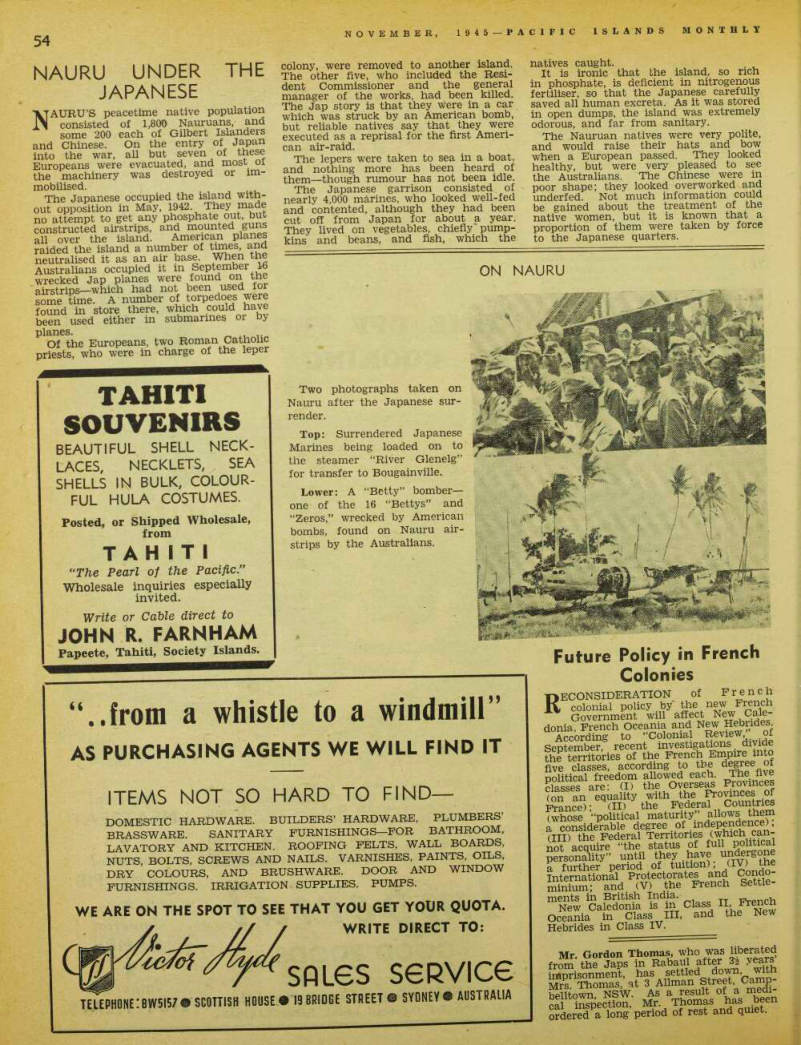
Nauru Under The
NAURU’S peacetime native population
consisted of 1,800 Nauruans, and some 200 each of Gilbert Islanders and Chinese. On the entry of Japan into the war, all but seven of these Europeans were evacuated, and most oi the machinery was destroyed or im mobilised.
The Japanese occupied the island with out opposition in May, 1942. They nmde no attempt to get any phosphate out, but constructed airstrips, and mounted guns all over the island. American planes raided the island a number of tunes, and neutralised it as an air base. When the Australians occupied it in September lb wrecked Jap planes were found on the airstrips—which had not been UBed for some time. A number of torpedoes were found in store there, which could have been used either in submarines or by planes.
Of the Europeans, two Roman Catnonc priests, who were in charge of the leper
colony, were removed to another island.
The other five, who included the Resi dent Commissioner and the general manager of the works, had been killed.
The Jap story is that they were in a car which was struck by an American bomb, but reliable natives say that they were executed as a reprisal for the first Ameri can air-raid.
The lepers were taken to sea in a boat, and nothing more has been heard of them —though rumour has not been idle.
The Japanese garrison consisted of nearly 4,000 marines, who looked well-fed and contented, although they had been cut off from Japan for about a year.
They lived on vegetables, chiefly pump kins and beans, and fish, which the
natives caught. .
It is ironic that the island, so rich in phosphate, is deficient in nitrogenous fertiliser, so that the Japanese carefully saved all human excreta. As it was stored in open dumps, the island was extremely odorous, and far from sanitary.
The Nauruan natives were very polite, and would raise their hats and bow when a European passed. They looked healthy, but were very pleased to see the Australians. The Chinese were in poor shape; they looked overworked and underfed. Not much information could be gained about the treatment of the native women, but it is known that a proportion of them were taken by force to the Japanese quarters.
On Nauru
Two photographs taken on Nauru after the Japanese sur render.
Top: Surrendered Japanese Marines being loaded on to the steamer “River Glenelg” for transfer to Bougainville.
Lower: A “Betty” bomber one of the 16 “Bettys” and “Zeros,” wrecked by American bombs, found on Nauru air strips by the Australians.
Colonies
Future Policy in French Colonies
Reconsideration of French colonial policy by the new French Government will affect New Cale donia, French Oceania and New Hebrides.
According to “Colonial Review, of September, recent investigations divide the territories of the French Empire into five classes, according to the degree of nolitical freedom allowed each. The five classes are: (I) the Overseas Provinces (on an equality with the Provinces of ■Prance)* (ID the Federal Countries
“political maturity.” allows them
a considerable degree of .mdependence). (Ill) the Federal Territories (which can not acquire “the status of full P oll^ lc al personality” until they have u^e r gone a further period of tuition), (IV) the International Protectorates and Condo minium; and (V) the French Settle ments in British India. Frpnch New Caledonia is in Class ll,’
Oceania in Class 111, and the New Hebrides in Class IV.
Mr. Gordon Thomas, who was liberated from the Japs in Rabaul after 3 A years imprisonment, has settled down, Mrs. Thomas, at 3 Allman Street, Camp belltown, NSW. As a result of a medi cal inspection, Mr. Thomas has been ordered a long period of rest and quiet.
Advertisements & other items, p. 56 (1 item)
seßVice
TAHITI
SOUVENIRS
BEAUTIFUL SHELL NECK-
LACES, NECKLETS, SEA
SHELLS IN BULK, COLOUR-
FUL HULA COSTUMES.
Posted, or Shipped Wholesale, from
TAHITI
“The Pearl of the Pacific Wholesale inquiries especially invited.
Write or Cable direct to
JOHN R. FARNHAM
Papeete, Tahiti, Society Islands.
“..from a whistle to a windmill”
AS PURCHASING AGENTS WE WILL FIND IT
ITEMS NOT SO HARD TO FIND—
DOMESTIC HARDWARE. BUILDERS’ HARDWARE, PLUMBERS’
BRASSWARE. SANITARY FURNISHINGS—FOR BATHROOM,
LAVATORY AND KITCHEN. ROOFING FELTS, WALL BOARDS, NUTS, BOLTS, SCREWS AND NAILS. VARNISHES, PAINTS, OILS, DRY COLOURS, AND BRUSHWARE. DOOR AND WINDOW
FURNISHINGS. IRRIGATION SUPPLIES. PUMPS.
WE ARE ON THE SPOT TO SEE THAT YOU GET YOUR QUOTA.
/ // / WRITE DIRECT TO:
seßVice
TELEPHONE:BWSIS7® SCOTTISH HOUSE «T 3 BRIDGE STREET ® SYDNEY ® AUSTRALIA
Good Job
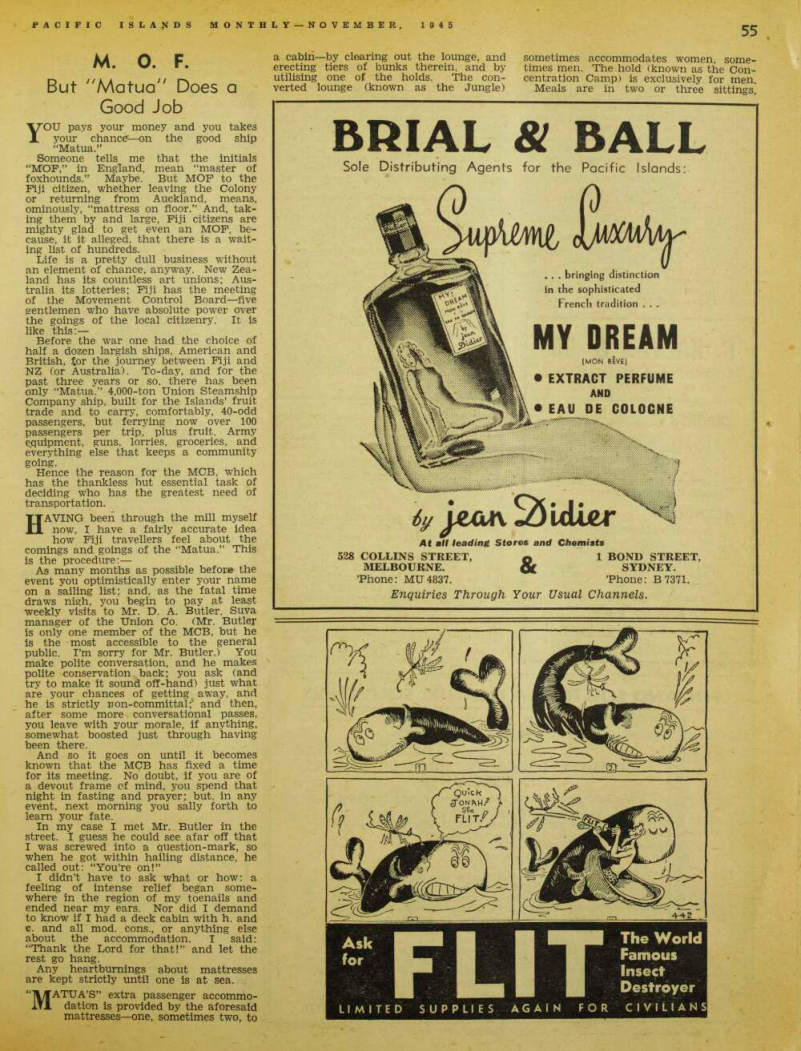
M. O. F.
But "Matua" Does a Good Job
YOU pays your money and you takes your chance'—on the good ship “Matua.”
Someone tells me that the initials “MOF,” in England, mean “master of foxhounds.” Maybe. But MOF to the Fiji citizen, whether leaving the Colony or returning from Auckland, means, ominously, “mattress on floor.” And, tak ing them by and large, Fiji citizens are mighty glad to get even an MOF, be cause, it it alleged, that there is a wait ing list of hundreds.
Life is a pretty dull business without an element of chance, anyway. New Zea land has its countless art unions; Aus tralia its lotteries: Fiji has the meeting of the Movement Control Board —five gentlemen who have absolute power over the goings of the local citizenry. It is like this:— Before the war one had the choice of half a dozen largish ships, American and British, for the journey between Fiji and NZ (or Australia). To-day, and for the past three years or so, there has been only “Matua.” 4,000-ton Union Steamship Company shin, built for the Islands’ fruit trade and to carry, comfortably, 40-odd passengers, but ferrying now over 100 passengers per trip, plus fruit. Army equipment, guns, lorries, groceries, and everything else that keeps a community going.
Hence the reason for the MCB, which has the thankless but essential task of deciding who has the greatest need of transportation.
HAVING been through the mill myself now, I have a fairly accurate idea how Fiji travellers feel about the comings and goings of the “Matua.” This is the procedure:— As many months as possible before the event you* optimistically enter your name on a sailing list; and, as the fatal time draws nigh, you begin to pay at least weekly visits to Mr. D. A, Butler, Suva manager of the Union Co. (Mr. Butler is only one member of the MCB, but he is the most accessible to the general public. I’m sorry for Mr. Butler.) You make polite conversation, and he makes polite conservation back; you ask (and try to make it sound off-hand) just what are your chances of getting away, and he is strictly non-committal;' and then, after some more conversational passes, you leave with your morale, if anything, somewhat boosted just through having been there.
And so it goes on until it becomes known that the MCB has fixed a time for its meeting. No doubt, if you are of a devout frame of mind, you spend that night in fasting and prayer; but, in any event, next morning you sally forth to learn your fate.
In my case I met Mr. Butler in the street. I guess he could see afar off that I was screwed into a question-mark, so when he got within hailing distance, he called out: “You’re on!”
I didn’t have to ask what or how: a feeling of intense relief began some where in the region of my toenails and ended near my ears. Nor did I demand to know if I had a deck cabin with h. and c. and all mod. cons., or anything else about the accommodation. I said: “Thank the Lord for that!” and let the rest go hang.
Any heartburnings about mattresses are kept strictly until one is at sea.
“MATUA’S” extra passenger accommo iTl dation is provided by the aforesaid mattresses—one, sometimes two, to
a cabin—by clearing out the lounge, and erecting tiers of bunks therein, and by utilising one of the holds. The converted lounge (known as the Jungle)
sometimes accommodates women, some times men. The hold (known as the Con centration Camp) is exclusively for men Meals are in two or three sittings
according to the state of the sea and the consequent incidence of sea-sickness.
All these improvisations naturally make travel pretty inconvenient for the pas sengers, and provide about three times more work for the crew. The waters north of New Zealand, and even around the Islands ports of Polynesia, can be far from calm; and “Matua,” with her slim bows, can produce a corkscrew pitch-and toss motion that is guaranteed to create spasms in the most hardened innards.
Under these circumstances it is hard to bubble with “joie de vivre” (be you pas senger or steward), and at the same time wade through piles of luggage, mattresses and sick passengers spilled indiscrimi nately over cabin floors. .
Yet there are few, if any, wails. The passengers take what is coming to them in the beliefs that they are lucky to be there; and the crew, from the captain down, cope with what might be regarded as an impossible problem with universal good nature—and that’s mighty rare to
day, when it is. the apparent privilege of all and sundry to be as downrightly bad tempered and ill-mannered as possible.
Fiji is grateful to “Matua” for the years she has spent in grey paint and bristling with guns, sub-dodging in a zig-zag course between Suva and Auck land. In 1943, to give tangible proof of this, a bronze plate, made in the shape of the island of Viti Levu, was presented to the ship. It is now let into the wall at the head of the main- staircase, and reads; “Presented by the people of Fiji
to record their appreciation of the splen did service maintained by the vessel in the dangerous days following the out break of war in the Pacific.”
IffHEN the ship came into Suva this ff October the funnel was back to its original red and black, and the superstructure was painted white. On the trip around the Islands, strips of white appeared on her sides, and by the time “Matua” leaves Auckland In November she will probably sail again as an all white ship. , . , A „ . ...
Human nature being what it is, that will probably be the signal for the moan ing to begin. I can almost hear those whose mission is life is to kick Big Busi ness, saying, plaintively; “But look at all the money they must have made!”
True, mavbe. You pay as much for a MOP as for a regular berth. But as I said In the beginning—you pays your money and takes your chance. And mighty glad we be of it!—JUDY TUDOR.
Advertisements & other items, pp. 57-58 (1 item)
Brial & Ball
Sole Distributing Agents for the Pacific Islands: 1 a . . . bringing distinction in the sophisticated French tradition . . .
MY DREAM
(MON RlvE)
• EXTRACT PERFUME
AND
• EAU DE COLOGNE
6y yt CUV
ter
At all leading Stores and Chemists 528 COLLINS STREET, 0 1 BOND STREET,
MELBOURNE. CK SYDNEY.
’Phone: MU 4837. ’Phone: B 7371.
Enquiries Through Your Usual Channels.
£ t I / □ Et QU ck cT 0 H Ci m WV M m < A-* 2
LIMITED SUPPLIES AGAIN
The World Famous Insect
Destroyer
CIVILIANS
BALL FOR TERRITORIANS
ON NEW YEAR'S EVE
'TERRITORIANS in Sydney are reminded that a New Year's Eve hall will he held hy the New Guinea Branch of the Country Women’s Association at The Coronet, George Street, Sydney.
Tickets are 10/6 each and , as accommodation is limited, those who wish to attend the function should awly to Miss Savage, 41 Queen Street, Woollahra, or telephone MW 2868.
G. KALYAN & GO.
Exporters and Manufacturers’
Agents,
EXPORTS :
Cat’s-eyes, Sea-shell, Silver Filigree Ornaments, all kinds of Souvenirs manufactured from Tortoise-shell, Pictures of Island Views, etc. Wholesale inquiries invited.
AGENCIES:
Indent business in all classes of merchandise undertaken.
Correspondence invited from Manufacturers, Merchants and Exporters desiring Agents in Fiji Market.
Renwick Road, G.P.O. Box 348, Suva,
FIJI
FIJI AND SOUTH-SEA ISLANDS SOUVENIRS
ADAMS
LAUTOKA FIJI „
CHEMISTS, DRUGGISTS, SOUVENIR DEALERS,
MERCHANTS
We believe we have the in Tortoiseshell Goods, inlaid or with Cat’s-Eyes.
Silver Filigree Goods with or without Cats-Eyes.
Pearl-shell with or without Cat’s-Eyes.
Ivory articles of all kinds.
Coconut-shell souvenirs.
Unmounted Cat’s-Eyes. . , Hand-made Native Curios and Souvenirs, Beaus, Hula-skirts and Tops (bras), Mats, Fans, Fancy Shell Floral Necklaces and Bracelets.
Model Canoes, Lalis (native wooden drums).
Tanoas (kava bowls, used as ash-trays).
Tapa (tree-bark) Cloth.
Sea Shells of every kind.
We are big suppliers to Army and Navy personnel and purchasing units, with whom we built a reputation during their stay in Fiji. We specialise in quality goods.
SPECIAL DISCOUNTS TO QUANTITY BUYERS.
We welcome all inquiries. Send for our catalogue.
Sufficient Address: ADAMS LAUTOKA FIJI.
Melb. Ng Association
Enters Fourth Year
NEW GUINEA clubs which have func tioned in Australia since the out break of the Pacific war, and which had prisoner-of-war funds, must, now that it is known that few internees will return, consider what is to be done with the money collected. The question was discussed at the fourth annual general meeting of the New Guinea Women’s Association in Melbourne on November 10, and it was suggested that a scholar ship fund would be a fitting way of perpetuating the memory of those men who will not come back.
Financially, and in service to evacuees and others, the Association, many of whose members have suffered personal loss with the sinking of the “Monte video Maru,” has had a very successful year. Donations of almost £lOO were made to various charities; the POW fund has a credit balance of £687, and the general fund £7l.
During the year, through Mr. Cham bers, Federal member for Adelaide, ques tions were asked in the House on allot ments to wives of civilian internees; rehabilitation of civilian internees and NGVR personnel; the return of evacuees to New Guinea; and the right of Ad ministration officers in the hands of the Japanese to apply for positions in the Provisional Administration which were formerly held by them in the old Ad ministration.
Results of these questions have, as usual, been negligible, but they have at least helped to keep New Guinea and its former residents in the public mind.
During the year bundles of comforts and reading matter were sent to New Guinea Servicemen, but during 1945 the despatch of ordinary comforts was dis continued.
Missionaries Return To The
Solomons
PERMISSION has been given for a number of members of the Methodist Missionary Society of New Zealand to return to their work in the Solomons on the NZ ; Government vessel “Matai.”
“Matai” has been repatriating NZ Service personnel, and is expected to sail from Auckland early in November.
The mission party consists of the Rev. and Mrs. j. R. Metcalf, who are going to Choiseul; the Rev. and Mrs. A. W. E.
Silvester, returning to Vella Lavella; Mrs.
C. T. J. Luxton, to join her husband in Vella Lavella; Sisters Grace McDonald, Joy Whitehouse. Lina Jones and Effie Harkness.
Rev. J. F. Goldie, director of the mission, returned to his post in the Solomons some months ago, from Aus tralia.
The Methodist Mission estimates that over £90,000 worth of damage has been done to its stations in the Solomons.
LEAVING for the Solomon Islands by SS “Montoro” in mid-November is a party of Seventh Day Adventist mis sionaries, who will disembark at Torokina and then be transported by launch to Batuna, in the Marovo Lagoon. They are: Pastor H. White (superintendent), with his wife and children; Pastor A. R.
Barrett (secretary-treasurer) and Mrs Barrett; Mr. Lyn Thrift (headmaster of the Batuna Training School); Mr. F. L.
Aveling (engineer), Mrs. Aveling and children; and Mrs. J. Gosling and children, who will join Mr. Gosling on Malaita, where he is engaged in medical missionary work.
Build Roads!
Sound Advice From New Guinea
From a Special Correspondent IAM not against anthropology, by any means; but one good road through a stretch of this New Guinea country will do more good in general than a dozen books on anthropology.
One cannot help but note the reaction of the natives to improved roads. The old up-and-down, go-as-you-please native trail, and the slightly improved “Gov ernment track,” leave about the same impression upon the native mind as they do upon the mind of the European. But when a good road is built they become deeply interested and take a pride in it and its graded curves.
I saw evidence of this again on a 30 miles’ trip recently, which took me out through the Aiyura Experimental Agri cultural Station to Omaura. It is a graded road over the Aiyura Ridge (now called Brechin Ridge, after the pioneer of the station, who lost his life in the war), and will care for a jeep nicely.
The natives were using it in their inter village travelling very freely, leaving their old-time pain-in-the-neck trails to be overgrown with kunal.
This country does not want too much idealism, but plenty of application of the practical—which is what counts most in this life, anyhow.
Young men training for prospective administrative service should have a simple course in road-making. In past times, men have entered the adminis trative service in these parts bringing with them fine scholastic attainments, but with no more idea nor inclination to
put in a good, simple, graded trail or road than the man in the moon.
I have time and again seen a patrol officer send a police boy out to do road making, which usually has turned out to be the expected thing—a real switch back railway type of job, which just adds another mile or so to the hideous “roads” so often seen. But if that same police boy could be given a long 4xl straight-edge, with a spirit-level attached, it would result in an in-and-out graded road—so simple to construct, and a de light to the eye. Even primitive natives are very quick to see reason in a graded type of road, but they can learn nothing from the type some administrative pat rolmen are so prone to allow, to follow the ups and downs of the kanaka trail.
To save over-crowding Japan at the moment, and to compensate for the appalling trail of ruin they have left in these islands, a few thousands POW’s could perform a great service in put ting through some good roads.
Price of Seychelles Copra
to “Crown Colonist,” of August 27, the’ price of copra in the Seychelles Islands (Indian Ocean) had just been increased by £7 per ton to £2B per ton. The currency is sterling, and it is presumed the price means f.o.b. at the chief Seychelles port.
Mrs. Carrie Amelia Kirkwood, widow of the late Mr. Richard Kirkwood, of Suva, died in Auckland on September 26. She was one of the early pioneers of Suva.
Mr. Kirkwood came to the Colony in the eighties for James McEwan & Co., but later he joined the Civil Service and was Government Auditor at the time of his retirement.
Polynesian club of Sydney
DESPITE war’s end, the Polynesian Club of Sydney has continued its usual wartime charity work.
A spectacular effort was a presentation of Maori Poi dances and action songs by members in Martin Place, in conjunction with the famous RNZ Air Force Band, for the Fourth Victory Loan.
As usual, the club has kept open house every Tuesday night to members of the Forces. Among recent visitors were Bill Head, from Niue (who is in the Mer chant Navy); Peter Ngamoki and Ben Morrison, Maori members of the NZ Navy; Alfred Lang, another Maori from Rotorua; and Cash Kingi from the British Navy. The latter is one of those rare visitors to Sydney, a South Island Maori.
Many returning POW’s paid the club a visit during their brief stay in Sydney.
Some of the Maori prisoners had mas tered the local dialect whilst in prison camp in Italy and said it was much easier to learn than German, the Italian vowels being similar to the Maori sounds.
Among these ex-prisoners of war was Hori Wycllffe, of Maketu, east coast of NZ.
Welcome was extended to Dora and Ivy Buffet, returned from their holiday in Norfolk Island, and to Peter Cowan, of Tahiti—now discharged from the AIF after being in the Borneo landings, and waiting to get a ship back home.
A charming Samoan visitor was Mrs.
Harry Laurenson, who came with her husband, Lieutenant Laurenson. She was formerly Laura Harder, of Apia. She gave an exhibition of the Hawaiian Hula, which delighted all who saw it.
Advertisements & other items, p. 59 (1 item)
Widdop
==-daß rasas* P
DIESEL ENGINES
S H.P. to 500 H.P.
/ H. WIDDOP & CO., LTD. green l£ e laSd ghley Telephone: Keighley 3727-8 :: :: :: Telegrams: Widdop Keighley Codes A.B.C. 6th Edition, Bentleys, Bentley’s Second We are prepared to consider Agencies for certain territories mo tor Coaster 5. America.
Firefloat Egypt.
T~l Passenger Ferry I Nigeria.
A Tug, England cvs-80 Passenger Boat, Middle East.
Party
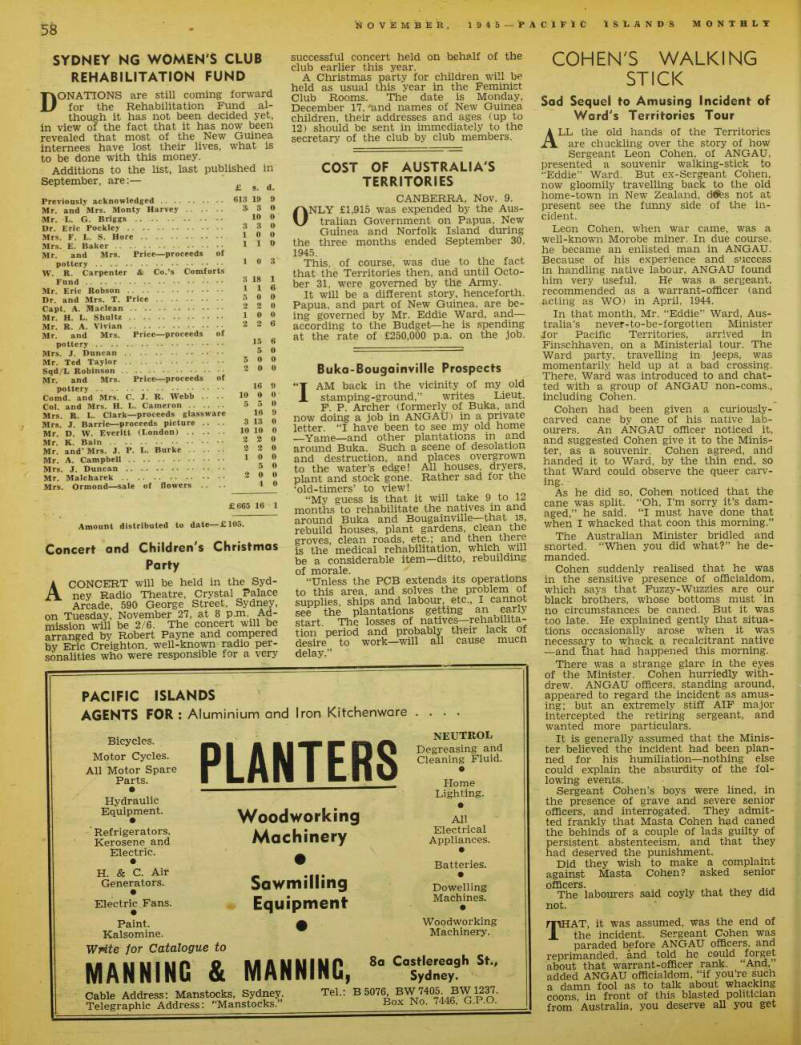
Sydney Ng Women's Club
Rehabilitation Fund
DONATIONS are still coming forward for the Rehabilitation Fund al though it has not been decided yet, in view of the fact that it has now been revealed that most of the New Guinea internees have lost their lives, what is to be done with this money.
Additions to the list, last published in September, are:—
Concert and Children's Christmas
Party
A CONCERT will be held in the Syd ney Radio Theatre, Crystal Palace Arcade, 590 George Street, Sydney, on Tuesday, November 27, at 8 p.m. Ad mission will be 2/6. The concert will be arranged by Robert Payne and compered by Eric Creighton, well-known radio per sonalities who were responsible for a very
successful concert held on behalf of the club earlier this year.
A Christmas party for children will be held as usual this year in the Feminist Club Rooms. The date is Monday, December 17, and names of New Guinea children, their addresses and ages (up to 12) should be sent in immediately to the secretary of the club by club members.
Previously acknowledged £ 613 s. 19 d. 9 Mr. and Mrs. Monty Harvey . » 3 0 Mr. L. G. Briggs 10 0 Dr. Eric Pockley 3 3 0 Mrs. F. L, S. Hore 1 0 0 Mrs. E. Baker 1 1 0 Mr. and Mrs. Price—proceeds pottery of 1 0 3 W. R. Carpenter & Co.’s Comforts 3 18 1 Mr. Eric Robson 1 1 6 Dr. and Mrs. T. Price 5 0 0 Capt. A. Maclean 2 2 0 Mr. H. L. Shultz 1 0 0 Mr. R. A. Vivian 2 2 6 Mr. and Mrs. Price—proceeds of 15 6 Mrs. J. Duncan Mr. Ted Taylor 5 5 0 0 0 of 2 0 0 Mr. and Mrs. Price—proceeds pottery 10 16 9 Comd. and Mrs. C. J. R. Webb . . .. 0 0 Col. and Mrs. H. L. Cameron . . . 5 5 0 Mrs. R. L. Clark—proceeds glassware 3 16 9 Mrs. J. Barrie —proceeds picture . . .. 13 0 Mr. D. W. Everitt (London) 10 10 0 Mr. K. Bain 2 2 0 Mr. and* Mrs. J. P. L. Burke 2 2 0 Mr. A. Campbell 1 0 0 2 5 0 0 0 Mrs. Ormond —sale of flowers . . . 4 0 £665 16 1 Amount distributed to dati e—£105.
Buka-Bougoinville Prospects
Cost Of Australia's
Territories
Canberra, Nov. 9.
ONLY £1,915 was expended by the Aus tralian Government on Papua, New Guinea and Norfolk Island during the three months ended September 30, 1945.
This, of course, was due to the fact that the Territories then, and until Octo ber 31, were governed by the Army.
It will be a different story, henceforth.
Papua, and part of New Guinea, are be ing governed by Mr. Eddie Ward, and — according to the Budget—he is spending at the rate of £250,000 p.a. on the job.
Buka-Bougoinville Prospects
“T AM back in the vicinity of my old JL stamping-ground,” writes Lieut.
F. P. Archer (formerly of Buka, and now doing a job in ANGAU) in a private letter. “I have been to see my old home —Yame—and other plantations in and around Buka. Such a scene of desolation and destruction, and places overgrown to the water’s edge! All houses, dryers, plant and stock gone. Rather sad for the ‘old-timers’ to view!
“My guess is that it will take 9 to 12 months to rehabilitate the natives in and around Buka and Bougainville—that is, rebuild houses, plant gardens, clean the groves, clean roads, etc.; and then there is the medical rehabilitation, which will be a considerable item —ditto, rebuilding of morale.
“Unless the PCB extends its operations to this area, and solves the problem of supplies, ships and labour, etc., I cannot see the plantations getting an early start. The losses of natives—rehabilita tion period and probably their lack of desire to work —will all cause much delay.”
Cohen's Walking
Stick
Sad Sequel to Amusing Incident of Ward's Territories Tour
ALL the old hands of the Territories are chuckling over the story of how Sergeant Leon Cohen, of ANGAU, presented a souvenir walking-stick to “Eddie” Ward. But ex-Sergeant Cohen, now gloomily travelling back to the old home-town in New Zealand, d(&s not at present see the funny side of the in cident.
Leon Cohen, when war came, was a well-known Morobe miner. In due course, he became an enlisted man in ANGAU.
Because of his experience and success in handling native labour, ANGAU found him very useful. He was a sergeant, recommended as a warrant-officer (and acting as WO) in April, 1944.
In that month, Mr. “Eddie” Ward, Aus tralia’s never-to-be-forgotten Minister for Pacific Territories, arrived in Finschhaven, on a Ministerial tour. The Ward party, travelling in jeeps, was momentarily held up at a bad crossing.
There, Ward was introduced to and chat ted with a group of ANGAU non-coms., including Cohen.
Cohen had been given a curiously carved cane by one of his native lab ourers. An ANGAU officer noticed it, and suggested Cohen give it to the Minis ter, as a souvenir. Cohen agreed, and handed it to Ward, by the thin end, so that Ward could observe the queer carv ing.
As he did so, Cohen noticed that the cane was split. “Oh, I’m sorry it’s dam aged,” he said. “I must have done that when I whacked that coon this morning.”
The Australian Minister bridled and snorted. “When you did what?” he de manded.
Cohen suddenly realised that he was in the sensitive presence of officialdom, which says that Fuzzy-Wuzzies are our black brothers, whose bottoms must in no circumstances be caned. But it was too late. He explained gently that situa tions occasionally arose when it was necessary to whack a recalcitrant native —and that had happened this morning.
There was a strange glare in the eyes of the Minister. Cohen hurriedly with drew. ANGAU officers, standing around, appeared to regard the incident as amus ing; but an extremely stiff AIF major intercepted the retiring sergeant, and wanted more particulars.
It is generally assumed that the Minis ter believed the incident had been plan ned for his humiliation —nothing else could explain the absurdity of the fol lowing events.
Sergeant Cohen’s boys were lined, in the presence of grave and severe senior officers, and interrogated. They admit ted frankly that Masta Cohen had caned the behinds of a couple of lads guilty of persistent abstenteeism, and that they had deserved the punishment.
Did they wish to make a complaint against Masta Cohen? asked senior officers. , , „ The labourers said coyly that they did not. rAT, it was assumed, was the end of the incident. Sergeant Cohen was paraded before ANGAU officers, and reprimanded, and told he could forget about that warrant-officer rank. “And, added ANGAU officialdom, “if you’re such a damn fool as to talk about whacking coons, in front of this blasted politician from Australia, you deserve all you get
—or don’t get.” The justice of which was admitted by the unhappy Cohen.
The sergeant was transferred to an other district, and did such good work, while in charge of native labour, that he again was recommended for promotion to WO.
But the mills of the military brasshats grind slowly, and grind exceedingly small.
Months later, Sergeant Cohen was hur diedly sent back to Lae. An order had come direct from the High Panjandrum himself, General Sir Thomas Blarney, that Cohen should be removed from ANGAU. And removed he was accord ingly. He had assaulted a native, and held up one of H.M. Australian Ministers to ridicule!
Cohen sat around for weeks, and awaited his fate. No one seemed to know what to do with him. He is a well educated man, with a very good know ledge of pidgin, and successful in hand lino- natives, and ANGAU would have been glad of his services. But the High Panjandrum had spoken—and ANGAU didn’t dare use Cohen again.
Finally, he was sent to Nadzab, to as sist the raw young officers of the newly created Pacific Island Regiment in learn ing how to speak pidgin and handle their native soldiers. He was there for some months.
But officialdom smelled him out. It appears that there had been communica tions between the outraged Minister for the External Territories (Mr. “Eddie”
Ward), and the Australian Army Minis ter, Mr. Forde; and Sergeant Cohen’s departure from Nadzab was instigated by Army. mHE disposal of the unfortunate carcase X of Sergeant Cohen might have be come Lae’s Number One headache — had it not been for the timely sur render of Japan. The sergeant was due for leave; the war way over; officialdom was very happy to arrange for his dis charge.
Sergeant Cohen has departed, but is not disgraced. He is determined that his thoughtless remark before Australia’s Minister Extraordinary in April, 1944, shall not besmirch his record as a sol dier, and his case is still before the Australian Army Department.
All of which merely strengthens the argument against allowing a man of Mr.
Ward’s history, background and outlook to take charge of a difficult portfolio like that of Pacific Territories. With every week that passes, his administration tends to make Australia and her Pacific Territories more ridiculous. * * ♦ A BOOKLET entitled “You and the Native,” prepared by the Allied Geographical Section, South-west Pacific Area, was placed in the hands of everv officer and non-com. serving in the Pacific Islands. Its sub-title says, “Notes Tbr the guidance of members of the Forces, in their relations with New Guinea natives,” Another sub-title says that it is published “for the information of all concerned” at the command of General MacArthur, Commander-in- Chief, by R. K. Sutherland, Major Gen eral, USA, Chief of Staff.
And here are the exact words of Sec tion 91 of the booklet, outlining the best way of treating natives: “There may be a bad egg, who deliber ately defies you, just to try you out. There is only one thing to do in these cir cumstances. Crack him,”
Mr. R. G. Q. Kermode, LLB (NZO, ex captain in Fiji Military Forces, and a son of Mr. George Kermode, retired from the Fiji Police, was recently admitted as a barrister and solicitor of the Supreme Court of Fiji.
Advertisements & other items, p. 60 (1 item)
Planters
PACIFIC ISLANDS
AGENTS FOR : Aluminium and Iron Kitchenware , . . .
Bicycles.
Motor Cycles.
All Motor Spare Parts. • Hydraulic Equipment. • Refrigerators, Kerosene and Electric. • H. & C. Air Generators. • Electric Fans. • Paint.
Kalsomine.
PLANTERS
Woodworking
Machinery
Sawmilling
Equipment
neutrol Degreasing and Cleaning Fluid, o Home Lighting.
All Electrical Appliances. • Batteries. • Dowelling Machines. • Woodworking Machinery.
Write for Catalogue to
MANNING & MANNING,
Cable Address: Manstocks, Sydney.
Telegraphic Address: "Manstocks.” 8a Castlereagh St.,
Sydney.
Tel.: B 5076, 8W7405. BW 1237.
Box No. 7446, G.P.O.
Islands Church Criticised
Letter to the Editor rE present state of the native church upon this Polynesian island is causing the older natives to speak with regret of the “days of Temiti” (Rev.
Mr. James), when the poor were more with the LMS than the rich. • The native church is “changing.” As a 20 years’ resident, I have seen both phases, “te tuatan a Temiti” and the current one. The present era places stress upon outward seeming; and a new morality, of a very curious kind, obtains. The appointments to deacon ships most reveal the changed outlook. (Deacons are “called” by Pastors, who are themselves trained at Rarotonga.) We have here, among our native deacons, men whom “violence covereth as a. garment.” One of these pillars of the church has been several times “sus pended” for assaults and trouble-making in the home, arrogance and aggressive ness. He continues, however, as a deacon. There are other church officers of a similar stamp; among these is the worst bully I have ever met, a man whose ferocious temper, utter contempt for the unwealthy, and immense conceit, accord very strangely indeed with the teachings of Christ. But leadership is in such men’s hands.
The question is, what has happened to native Christianity, that such types are “called”? Is this the sign of our progress? I do not think so. The mild and unassertive men of the older school were native gentlemen, not “flash” types.
There is, within the island’s social circles, evidence of a kind of boycott, that sees to it that critics and persons non-gratae with deacons, do not appear at functions. In consequence, there is much injustice: repute, honours, and that intangible thing we call “mana,” go to men who know nothing of honour — men petty in the extreme.
Must the LMS wait for some act of ferocious violence—say, a murder —to be committed, before it decides to bar arro gant men of undisciplined temper from leading native congregations?
In uttering these criticisms, I incur myself the risk of assault by such gentry.
Such is Christianity, 1945 version. “Eheu fugaces!”
I am, etc.,
Mangaia, 5/8/45.
Edwin Gold.
Fiji is getting ready for the hurricane season, and Flight-Lieut. Ralph Dyer, Acting Director of Meteorological Services at Suva, has issued a system of hurricane warnings to be used in the Colony. These will be broadcast from ZJV. The system is most comprehensive, but what lis teners in the Pacific will remember is that meteorological science has not yet been perfected, and there are scientific reasons why weather forecasts go wrong. Weather broadcasts are now made daily from ZJV Suva, at 12 noon and 9.15 p.m.
Miss Lesley Smith, daughter of Mr. and Mrs. F. L. Smith, of Suva, is paying a three months’ visit to her parents after an absence of four years in New Zealand.
Advertisements & other items, p. 61 (1 item)
Mcilbath’S
FOR THE
CONNOISSEUR
inn
CLARET
and
MOSELLE
Now Available !
Sole Distributors, Pacific Islands:
BRSAL & BALL
528 Collins St., 1 Bond St., Melbourne, Sydney.
Enquiries through your usual channels appreciated.
McILBATH’S
FOR
High Quality
at Bedrock Prices Orders and enquiries to—
McILRATH'S PTY. LTD.
Export Department,
202 PITT ST., SYDNEY, AUSTRALIA
Servicemen Seek a Refuge in the Islands
By Our Mangaia Correspondent
mHIS writer has recently received many X letters from Servicemen, of all arms, and many localities. The theme of all Is —Post-war Insecurity in Civilisa tion They want to come to the Pacific, and settle on any island where living is inexpensive, weather mild, and Europeans few. Settle, forget the war, and enjoy life. Polynesia looks a paradise, to them, in Europe.
Well, with all its faults, it is! The “civilised” life these good fellows face on demobilisation is as near a refinement of hell as I can imagine. They all fear un employment, and the consequent exhaus tion of the money—quite big sums—that they have saved during the war. They fear homelessness—and anyone can see that the housing problem will be ten times more acute than it was in the de pression. Most dare not marry. Those who are married dread the coming of children; a matter of £4O a birth.
Why go on? The soldiers are very worried, because civilisation is not civi lised enough to allow a man any secure future, and the commonest happinesses are priced too high.
With this, I can sympathise. But whom to blame, and how to remedy, is not in my power to advise. Properly run, civi lisation could be far, far happier to live In than the Islands; where life is at best an occasionally-won battle with nature—as every Territorian knows only too well. rOSE of us who have married Poly nesian women/ and live as Euro peans without deserting the clan and tribe, have it best, I think. (Presum
ably this is in my correspondents’ minds.) When our children are born, we can call in an old Maori midwife who will do (and with skill) for a few yards of pareu, what a city doctor wants big money for doing.
There is a certain permanence, and a definite security, in island life that make the difficulties and the isolation prefer able to the city way of living—a way friat these worried soldiers and airmen fear will, as soon as hostilities end, make them into suburban serfs or forgotten men. They know what they’re facing, better than I. And they yearn for “a place in the sun.”
But the day of the adventurer is over.
I fear that my friends’chance of exchang ing cemented canyons for palm groves is vety remote indeed.
The Cook Islands Administration, for instance, discourages European penetra tion of the Group. Working-class settlers, to all intents and purposes, it prohibits! The entrant must be a Gov ernment employee, a well-fixed rentier, or a recruit to the staffs of local big business. An unknown Englishman even in possession of money, is hardly likely to find any effusive welcome here. rnHEN, again, the pernicious rubbish X USA song-writers still put out about romantic unions between white men and Island girls is another misleading influence. Only our prosti tutes take up with strangers. A Lon doner need not go further than Leices ter Square for “romance” of this kind.
Marriages between Europeans and native girls, can and do take place; but the arrangement has to be upon exactly the
same terms as a wedding between two white persons.
No “papa’a” husband is thought to be a heaven-sent “catch” for the Cook Islands girl. He stands, or falls, upon his personality and character, not his race.
The myth of “white superiority” was long ago slain by boozy tourists and hula-dancing white women. (The public performance of the “hula” by a Euro pean woman disgusts natives, though they may appear to applaud.) So, all I can say to my inquirers is; Try to improve civilisation, and you may not need to leave it!
Sidelights On Pacific
War
ix/fANY people have wondered just iVI how it was that the Australian warship “Canberra” was lost in the confused Solomons night battle in 1942. There is an answer in this para graph, taken from a review of a book, “1 Went to See for Myself;* by an American reporter, W. Norton - Taylor : IN Honolulu he asked the police to name their greatest wartime problem, and they replied “juvenile delinquency.’
In Fiji, “most of the liquor was Aus tralian, and pretty bad.” Of the battle of Savo Island, in which the “Canberra” was lost, he writes: “Congressman Maas, who was In the area as a Marine Corps Reserve officer, asserted that the enemy had no more than three cruisers. If that was true it supported a theory held by many men of our Can (destroyer)—that some of the destruction that night was wrecked by our own ships, mixed up, mill ing around and firing at each other.
Advertisements & other items, p. 62 (2 items)
60
NOVEMBER, 1945 t-P A C I F I C ISLANDS MONTHLY
Wm. H. Watson
Established 1930.
Bankers: Bank of New Zealand, Auckland.
Wholesale and Retail Trader
RAROTONGA, COOK ISLANDS
Cable Address: Watson, Rarotonga.
AGENTS WANTED.
American Servicemen in the Pacific: Sell Island curios in the Pacific now, and in the U.S.A. when you return home. Send 20.00 to 100.00 dol. for trial order of Motherof-Pearl Brooches and strings of Sea-Shells, all guaranteed good sellers. These goods are sent by parcel post franked with high value Cook Islands stamps, which have a high re-sale value.
STAMP DEALERS AND COLLECTORS.
Covers serviced for Dealers at usual rates. Collectors; Send one dollar for two covers franked with the current issue of the Cook Islands stamps, %d. to c (eig ““ stamns ner cover). Sent air-mail to any address. To STATam is a "rare” Offer-First Day Cover Cook Island King George V Jubilee, 1935, complete set, only 5.00 doi. Used sets ofl cover, Cook Island, King George
PRESENTS FROM THE PACIFIC.
The following 5.00 dol. parcel sent post free to any address in the Pacific or the U.S.A.: 1 Bright coloured Hula-Skirt, with decorated waistband. 3 Strings Assorted Sea-Shells, 60 in. long. 1 Mother-of-Pearl Brooch. 1 Cook Island Pennant—lsland scene in colours.
ISLAND BOOKS BY
ROBERT DEAN FRISBIE.
This well-known American writer has autographed a limited number of his two latest books. “Island of Desire” and “Amaru,” so that a few of his fans can secure something that is always treasured, an “Author’s Copy.” The price 7.00 dol. for the two, sent registered mail to any address. When remitting dollar bills, please register the letter.
"THE READER'S DIGEST.
Have the world’s best Digest posted direct to you from the U.S.A. at the following attractive rates: One years subscription, 12/-; two year’s subscription, 20/-; post free.
Send your full name and address and subscription to above Rarotonga address.
"PARAU" M.O.P. PRODUCTS.
We manufacture a large assortment of made by native craftsmen from Penrhyn Island Fean Shell.
"RAROTONGA" HULA-SKIRTS.
The finest Hula-Skirts made in the South Seas come from Rarotonga; over 50.000 sold These are made in bright colours with floral decorated waist-bands. ■
SHELL NECKLACES.
White, Yellow and assorted SheUs, each string 60 in. long Any quantity can be supplied. Over half a ion strings of these popular shells have been exported. Term D/P your own bank.
ISLAND FOOTWEAR.
Ma(i n in our own factory here in Rarotonga. At present snecialising in women’s Road and Evening Sandals. Extra wide lasts suitable for native trade. Best materials used.
Sizes 3-7 Colours: white, black and brown Be the first in vour territory to stock this good seller by cabling for Sal order of dozen pair, assorted colours, designs and sizes.
Opportunities in the Pacific Islands
ALMOST ceaseless inquiries are being received at the office of the “Pacific Islands Monthly” concerning em ployment and the chances of settlement in the Pacific Islands. Large numbers of young men, who have had a glimpse of Islands life as Servicemen, are anxious to see more of it as civlians.
At the present time, all employment and settlement possibilities are limited by the lack of transport. There are only one or two small ships back in the regu lar Islands run, and there are only one or two plane services running. Both ships and planes are wholly booked out—only nigh-priority passengers are carried.
Apparently these conditions will obtain for some months. It probably will be far on in 1946 before it will be possible to buy passages on planes or ships bound for the Islands, without high priorities.
Assuming that transport were avail able to the Islands, employment and settlement possibilities are somewhat as follows
New Guinea And Papua
Before the war, there were some thou sands of Europeans in these Australian Territories supported by well-established industries producing gold, copra, rubber and cocoa. All those people were driven out by the invasion, and much of their property destroyed. Unfortunately, some hundreds of “key” civilians lost their lives.
In these circumstances, even if every surviving civilian returns, there should be many jobs for young Australians, and plenty of chances of settlement.
Unhappily, the Territories have been placed in the control of a well-known Australian politician of extreme views, who apparently has decided to run the
Territories on Socialistic lines, with the following three objects: (a) to keep the Territories generally as a preserve for the primitive natives; (b) to substitute Gov ernment instrumentalities for private enterprise; (c) to discourage European enterprise and settlement generally.
Introducing a mass of new Regula tions, this Minister so far has succeeded not only in keeping new settlers and new enterprise away, but also has pre vented all private enterprise and a very large proportion of the old residents from returning. Consequently, there are defi nitely no opportunities xor new settlers; the only jobs available are those in Gov ernment Departments and Boards, which are obtained through an orgy of form signing; and the only conditions under which people will be allowed to go there, while the Eddie Ward regime lasts, are not likely to be acceptable to the average individualist.
The big employers of labour—Burns Philp & Co., W. R. Carpenter & Co., Steamships Trading Co., Bulolo Gold Dredging, Ltd., New Guinea Goldfields, Ltd., etc. —have not been allowed to re sume operations in the Territories. The gold companies may be allowed to start soon, when they will need many tech nicians; but the others apparently see no hope of return. In the eyes of Mr.
Ware! these firms—each of which has a magnificent record of pioneering work in the Islands—are merely “soulless ex ploiters.”
British Solomon Islands
There will be a limited scope here for jobs in the work of rehabilitation, and in new settlement, and gold-mining, as soon as civil Government is really re established. Transport is the present
difficulty here—there are no vessels run ning regularly.
Fiji
This large British Colony is literally vibrating at present with energy, enter prise and money, and there are many opportunities there for the right class of people. The right thing to do, by anyone interested, is to go to Fiji prepared to remain there for two or three months, and examine possibilities and openings.
Employers there, who need men and women, will rarely engage them in Aus tralia or New Zealand without seeing them—they have had too many unfor tunate experiences. At present, no one is allowed to go to Fiji unless he can satisfy the travel controllers that he has legitimate business there. Travel facili ties to Fiji are extremely limited just now, and only high-priority persons are allowed to travel.
Samoa, Tonga, Etc .—Polynesia
Opportunities for “outside” Europeans are few, and are decreasing, as the Poly nesian people themselves are achieving European standards of life, and filling the available jobs.
GENERALLY, the only places where jobs are available in the Islands are the Australian Territories and Fiji.
The Australian Territories are virtually closed just now, while Australia’s Socialistic experiment is in progress; and there are no travel facilities for Fiji.
There is room in the Pacific Islands for thousands of Europeans who are pre pared to find their own bit of land, estab lish their own home, and make their own livelihood. But these places are only for individualists, who can find their own way around, and adapt themselves to local conditions. Officially, they are not wanted, and they will receive discourage ment on every hand.
Advertisements & other items, p. 63 (1 item)
Kayen
All Purpose Lamp Model AP2. Can be used as a storm lantern or hanging lamp.
KEROSENE VAPOUR LAMPS
BRILLIANT LIGHTING WHEN AND WHERE REQUIRED
Kayen Lamps are the most useful and efficient of any lamps ever offered in Australia. 300 candle-power of brilliant steady light at a cost of li pints kerosene in 10 hours. Not affected by wind or insects. Can be carried anywhere alight.
Kayen Lamps are made of solid brass and are fully guaranteed.
Spare Parts: All spares always available for Kayen or Tilley lamps. Kayen parts are interchangeable with Tilley parts.
Kayen Lamps and spares are made in Australia.
Illustrated Leaflet and Price List available from your Local Agent, or
W. KOPSEN & CO. PTY. LTD.
Established 1878. 376-382 KENT STREET, SYDNEY. 'Phone: MA6336 (6 lines).
Available in either a useful All-Purpose Lamp and Storm Lantern, as illustrated above, or a handsome Table Lamp, as depicted below. m m & umm
New Public Service
In N. Guinea
Many "Old Hands" in the New Set-up
OVER 100 men, and a few women, have arrived in Port Moresby, to join the service of the new Provisional Gov ernment. The great majority of them are former members of the Public Ser vice of New Guinea or Papua.
We have applied to Canberra for a list of the appointments; but it appears that, because it is “incomplete,” the De partment at present is unwilling to supply such a list. However, we have compiled, from various sources, the fol lowing list of men and women who recently have proceeded from Australia to Port Moresby, evidently to join the new Public Service. It is not complete, because a number of men transferred directly from ANGAU and other Terri tory formations to the new service; and we do not guarantee its accuracy:— Adams, E. H. Downs, J. P. G.
Armstrong, R. F. Dunlop, R. B.
Ashley, C. Dunstan, Miss J. M.
Atkinson, O. J. Ecclestone, J. W.
Barwick, R. F. Ethell, A. L.
Bartlett, J. Evans, H. W.
Bedser. W. Farland, R. M.
Beer, G. A. Fisher, L. J.
Bensted, P. A. Frame, J. M.
Bitmead, H. J. Frank, Mrs. P.
Brammell, J. B. Franklin, R. A.
Burke, J. P. L. Froggatt, J. L.
Burns, Paul. Fry, A. E.
Bryant, L. K. Grahamslaw, Miss.
Cahill, P. D. Gray. L. G. W.
Chambers, K. M. Gough, T. P.
Champion, Ivan. Hardy, H. W.
Chester, W. H. M. Holmes, Pat.
Chester, N. B. Humphries, W. R.
Chugg, R. C. Hurrell L J.
Clanville, H. R. Jones, J., Nurse.
Clout, Les. Lambden. W. J.
Dobbie, R. S. Lea, F. B.
Donaldson, P. R. Logan, L.
Long, A. J. Ridge, A. A.
Lowney, F. V. Rigby, J. L.
Lyons, John. Rutledge, D. F. M.
Mann, J. T. Schacht, W. H.
Marshall, A, W. Schuler, C. B.
May, Dr. A. J. Sheekey, K. S.
Melrose, R. Sinclair, Dr. B. P.
Minogue, A. H. Steeples, E.
McGowan. W. L. Stevens, R. N. B.
McLennan, Geo. Stock, Miss E. C.
McLeod, J. S. Taylor, E.
Newman, F. G. Taylor, J. H.
Nicholas, W. S. Toogood, G. W.
Noble, A. Thomas, J. R.
Nolan, R. Tuckey, Mrs.
Odgers, L. Turner, G. V. M.
Pearse, F. A. Wall, Miss I. E.
Pinguet, Mrs. Watkins, A. E.
Pullen, P. L. White, Dr. J. H. N.
Radford, G. A. Willis, R. S.
Richardson. E. T. Woodman, H. E.
Generally, it would appear that the men are going to positions in the new service similar to those which they left, in the old. There will be several new Departmental heads, however. Most of the Papuan heads had retired, and many of the New Guinea Departmental chiefs were lost when Australia abandoned 300 Rabaul civilians to the invading Japs.
It is understood that Mr. R. Melrose will be the new Government Secretary; Mr. E. Taylor will have District Services; Mr. J. H. Taylor will be in charge of Native Affairs; Dr. Sinclair will have charge of Health; Mr. Pat. Holmes will be back in his old job, in charge of Lands; Mr. John Lyons will have Public Works; Mr. W. R. Humphries has a new and special position connected with rehabili tation and the assessment of damages; and Mr. W. J. Lambden, Mr. A. W.
Marshall, and Mr. F. V. Lowney, have high executive posts.
There are many experienced and highly competent men in this list, and if the re-establishment of Civil Government had been left freely in their hands, all might have been well. But they go back to administer a Socialistic set-up for which most of them will feel nothing but
contempt. As loyal men, they will be expected to endure the confusion and the clamour —echoes of which already are reaching us—and say nothing. Few will envy them their tasks.
Discontent in Territories' New Service
Territories' New Service
AN old Papuan public servant, who re cently transferred from the AIF to the staff of the new Provisional Government, in Port Moresby, writes in great bitterness, to describe the condi tions under which the new staff is asked to work.
“A state of unrest, dissatisfaction and discontent reigns here at the present time,” he says. “If a ship that sailed South a couple of days ago had been available to us I' do not think half a score of public servants would have re mained here.”
He says that ANGAU, which has moved on to Lae, left all their premises in a dirty and dilapidated condition; that they took all the office furniture with them; and that the native labour has either disappeared or is thoroughly de moralised. For a considerable time, the newly-arrived men did all their own washing and laundry and house work, and, when they did get personal servants, they had to pay from four to ten times the old rate.
The new Labour regime creates hope less conditions. The boys can be punished only with fines —and fines mean nothing to people who have little money, and do not understand money values, anyway.
The new conditions are so difficult and costly that the public servants are asking Canberra for a living allowance of at least £lOO per annum per person.
“The new Administrator told us that we had been given the Government policy, and it is our duty to carry it out,” he writes. “Apparently, we are not sup posed to have any private opinions about the new Administration, and Eddie Ward, and Eddie Ward’s black brother.
“The men in ANGAU are much better off in many ways than we are—they have larger pay, greater privileges—and much less work. The Production Control Board seems to us to be nothing more 'or less than an octopus, controlling all com modities and dictating to everyone.
There is a canteen here for our use, but it does not nearly fill our needs—we want a general store —and quickly, too.”
Better Prices For Cook
Islands
Rarotonga, Oct. 8.
IN September, Rarotonga fruit-growers were notified of a number of price increases for the current season.
Bananas have been increased from 5/6 to 6/- per case, for all bananas shipped after June 1, 1945. A bonus of 1/- per case was paid on oranges shipped from Rarotonga and Atiu in March, 1945 (the first shipment of the season). The price for subsquent shipments was increased by 6d. per case, making the new prices as follows: Oranges, 126-150 to the case, 5/9; special oranges, 6/3; oranges, 176-250 to the case, 6/3; special oranges, 6/9. It was also stated that there was a further possibility of a bonus on oranges shipped on and after April, 1945. . .
Approximately 50,000 cases were shipped between March and August inclusive.
A little windfall (27/9 per case) re warded tomato-growers who got.fruit away on Hie August boat. The September shipment returned 23/3 per case.
Advertisements & other items, p. 64 (1 item)
Salvager Saves Himself
FROM TRAVELLING FATIGUE
REALLY ON THE JOB TO-DAY
With the call to-day going out for more metal, the work of a salvager is one that knows the pressure is on!
Mr. E. P. Nicholson, of 77 Carlton Mill Road, Christchurch, is New
Zealand’s largest salvage merchant,
obtaining quantities of steel, etc.,
from sunken ships, gold dredges,
mining plants, and anywhere else
where metal is lying unused.
Mr. Nicholson attributes his present abundant energy to R.U.R.
He says: "After several years travelling in Australia and New Zealand in motor-cars, and getting practically no exercise, I found myself getting very sluggish, tired and fatigued, in addition to putting on weightbut after taking R.U.R. I noticed a decided improvement, both in regard to my energy and fatigue. I have lately driven eighteen hours at a stretch without sleep, which I could not possibly have done before. My weight has now returned to normal, and thanks to R.U.R. I feel altogether a new man, both physically and mentally.”
Once again R.U.R. comes to the rescue.
R.U.R is the greatest treatment, and contains a laxative, liver stimulant, kidney cleanser lood purifier and acid corrective.
Obtainable at Chemists and Stores, or write to R.U.R., 841 George Street, Sydney, Australia. ■
Solomons
Future Of The
New Roads and Ports
“T DO not think there is much chance X of owners of destroyed Solomon Islands property receiving compen sation, because of the large number of British Colonies which have suffered in the war,” said Mr. M. Harper, of Mando liana, BSI. He has just received his dis charge from the Australian Navy, where he was awarded high decorations for four years’ distinguished service, mostly with the Americans.
“But there are enough goods and plant —brought in for war purposes and now not required—lying rotting and deterio rating on the beaches in the Solomons to rebuild and re-equip many houses and plantations; and it would be only an act of justice if this material were made available, on favourable terms.”
Mr. Harper sees a good future for the long-neglected Solomons, if only some thing is done to guarantee markets for BSI products. The war did a great deal in opening up communications.
“The Americans built a road from Visale, along the east coast of Guadal canal, to Tetere, linking all the settle ments,” he said. “Shipping facilities have been provided, especially at Point Cruse, where there are great wharves. These places are not much good in north-west weather, but good in the south-east.
“On the other side, opposite Guadal canal, Tulagi is now a wonderful port, with very long stretches of wharves. The best harbour on the Gela side, however, is at Port Purvis, where there is an important mission station.”
Mr. Harper intends to return to the Solomons as soon as he is permitted.
News Of Charles Munster
Wanted
IF anyone has any information which may throw some light upon the fate of Mr. Charles Munster, planter, of Manus, New Guinea, he is kindly re quested to write to Mrs. Anna Munster, at 218 Lethbridge Street, Penrith, New South Wales. Mrs. Munster is now living in Penrith with her three child ren, and cannot make much progress in the settlement of her husband’s affairs owing to uncertainty as to what became of him.
Mr. Munster and Mr. J. T. McEvoy, both of whom were planters in Manus, left Manus, each in his own schooner, in January. It is known that Mr. McEvoy had the bad fortune to sail right into the middle of the huge Jap invasion fleet* and he ultimately reached Rabaul, as a prisoner, and apparently was shipped away on the ill-fated “Montevideo Maru.”
Mr. Munster’s schooner also was cap tured by the Japs, but in different cir cumstances. He apparently was taken to New Britain by the Japs, and then back to the Admiralty Islands. It seems fairly clear that he was in Manus, early in the Jap occupation; but from that time on all trace oT him has been lost. One report not authentic is that he was shipped away from Manus with some of the missionaries from the Admiralties.
Any information which might throw light on his fate would be gratefully received by Mrs. Munster, or by the “Pacific Islands Monthly.”
The death occurred in Sydney on Octo ber 28 of Captain J. D. S. Phillips. He served for many years with Burns, Philp & Co., Ltd., and the Union Steamship Co., Ltd., in the Pacific trade, and was 80 years old.
Delayed Pay-Out
From Our Own Correspondent
Mangaia, July 25.
riIHE pay-off for the orange season of X 1945 is scheduled for this week. So far, two steamers have taken car goes; but the authorities are in no hurry to pay for them.
The work of picking casing and ship ping the fruit Involved the Islanders in expense for “store” food—“bully,” and biscuits to support them during the weeks of arduous labour entailed. There was rain, wind, and, once, hail! The dis comfort and fatigue of the work are a heavy strain on those engaged, and need to be seen to be appreciated. Ten shillings a case wouldn’t pay for it! But 6/- is all we get—and that not quickly. It is signi ficant that orange-time is attended by much Illness, and not a few funerals, in the villages. rpo assist shipwrecked people in navl- X gation, arrangements were made in 1943 for the transmission from the Coastal Radio Stations operated in Aus tralia by Amalgamated Wireless of simple time signals, having an error not greater than a fraction of a second. The signal, made on the international lis tening wavelength of 600 metres (which is also the one on which the SOS signal is sent out) is called the “six pip” se quence. It goes out regularly at 0900 hours and 2200 hours, GMT, which cor responds to 7 p.m. and 8 a.m. Sydney time.
Mr. and Mrs. Harold F. Doherty, of St.
Kilda, Melbourne, former residents of New Guinea, announce the birth of a son on August 2, 1945—Patrick Carl Doherty.
Advertisements & other items, p. 65 (2 items)
63
PACIFIC ISLANDS MONTH L T ■ — NOVEMBER, 1945
Swallow S Asieli
“Cobb's Coach Loaves..
IN the early days of Victoria’s gold rush, the tremendous demand for "fast” passenger transport to the goldfields led four American migrants by the names of Freeman Cobb, James Swanton, John Peek and John Lamber to establish in 1854 the legendary coaching firm of "Cobb & Co.” A picture familiar to many Australians is one which depicts the great coach "Leviathan," with its famous driver "Cabbage Tree Ned” on the box scat, leaving the Black Bull Hotel, Geelong.
At a welcome to old drivers in 1925, the Chairman of the Ballarat Historical Society paid this tribute; "Our highways have followed the whecltracks of the coaches, guided by you through days and nights, in fine weather and through storms. You faced the vicissitudes of the roads with fortitude and in the same spirit with which the pioneers set to work to settle this new continent.”
The year 1834 also saw the establishment by Thos. Swallow of the famous firm of Swallow & Art ell, whose products were sent to the goldfields on slow lumbering bullock waggons which followed in the wake of the fast-moving Cobb & Co. Coaches.
'of"’a*Wi£
SERVING AUSTRALIA
IN PEACE AND WAR
EV
THA
SWALLOW s ASIELI
LEADERS IN THE BISCUIT INDUSTRY SINCE 1654 MAKERS ALSO OF THE FAMOUS SWALLOW S ARIELL PLUM FUOOmGS. CASES, ANO ICS CSEAH
Treated by
How Evacuees Are Treated by Australia's Officials
fTIHE Australian Department of External X Territories is not only paying the fares of all officers who are return ing to the Territories, to enter the ser vice of the Provisional Government—it also is paving the fares of wives and ail children lip to 16 years of age, and the freight and cartage on all household effects and furniture.
This decision was made some time ago, because “the circumstances under which officers and their families evacuated the Territories were exceptional, and it would appear reasonable that their return to the Territories be a charge against public funds.”
That is right and proper. But it only throws into greater relief the indifference and cruelty with which Mr. Ward and his officials are treating the non-official
civilians. The few who are allowed to return must pay their own fares and expenses. But the great majority are not allowed to return; their means of livelihood are being withheld, their labour is being demoralised and dissi pated; and they are being given a beg garly 40/- or 50/- per week, as an “advance” against whatever War Damage compensation they may be allotted.
Not long ago, the wife of a big New Guinea planter (now missing—but he has left property worth at least £30,000) pro tested to a certain Territories official in Sydney that she and her three children could not possibly live on the 55/- per week which he generously allowed her as an “advance.”
“Well, plenty of working women here have got to do it—you have a try at it,” retorted the little gentleman.
Miss Joan Philippa Bailey, only daughter of Mrs. Lilian Bailey, of Suva, Fiji, married Mr. M. D. ffrench-Desmond in Suva on October 10.
"Bulamakau"
A Tongan Origin Claimed
Letter to the Editor WITH reference to an article in the October issue of the “PIM” contri buted by Mr. H. F. (Bert) Bailey re garding the origin of the South Seas word “Bulamakau,” I wish to refute Mr.
Bailey’s claim. He says that 1868 was the year when cattle were first introduced into Fiji, culminating in the natives nam ing the bull and cow “Bulamakau,” and thus creating the Pidgin name for all kinds of meat.
I would like to direct Mr. Bailey’s mind to the facts of Tongan history. In 1777.
Captain James Cook was on his third visit to the Tongan Islands in the “Reso lution.” Records prove that he had brought livestock for presentation to Tahitians and Tongans as rewards for their hospitality. That was on June 9, 1777. Mr. Bailey may have got confused between Cakobau, Fiji’s king and, Bau, of Tonga, although there are 90 years of difference between these two Ban’s.
According to Tongan history, Captain Cook presented to Bau, Tui Tonga, a bull and a cow; a ram and two ewes to another chief, Maea Linaki; a stallion and a mare to Finau Ulukalala, a Vava’u chief and a friend of Cook.
At this time, there was flourishing com mercial intercourse between Fiji and the Tongan Islands, mostly by ocean-going canoes (Kalia’s). This proves beyond any doubt that the word “Bulu-moe-kau” came from Tonga. The Fijis were known to mariners as the original Savage Islands.
Mr. Bailey’s father, nearly 100 years later, may have introduced cattle into the Fiji Islands. But my argument is that the word was already coined in Tonga.
I am, etc.,
Robert M. (Bunny) Winton Cameron.
(Formerly of Tonga; now resident of Brisbane.)
File Of “Pim" Available
A COMPLETE file of the “Pacific Islands Monthly,” from early in 1942 up to the present date, may be obtained by anyone interested, who will communicate with Mrs. Susan Edwards, 13 Young Street, Annandale, Sydney.
Mrs. Edwards has kept all issues since she was evacuated from Rabaul at the end of 1941. Her husband, Captain J. H.
Edwards, MC, DCM, MM, was one of the well-known Rabaul men who was lost in the invasion.
Lami, Fiji
Death Of Louis Rogers, Of
rE death occurred recently in Lami, Fiji, of Mr. Louis Rogers, descen dant of a French colonist. Roderique, who settled in Fiji as far back as 1812.
Mr. Rogers was 70 when he died, and was well known as a boatbuilder and owner of small pleasure craft at Lami.
His family have used the Anglicised ver sion of their name for many years, but the original Roderique came into the South Seas from the Philippines with a number of Filipinos and people of French and Spanish extraction. They reached Fiji, and in 1812 were granted land by the Fijian chief of the Lami district.
Mr. Alport Barker, publisher of the “Fiji Times and Herald,” who had been ill in Suva for several weeks, returned to active duty in October.
Advertisements & other items, p. 66 (1 item)
Asthma, Bronchitis Coughing,
Curbed in 3 Minutes
Do you have attacks of Asthma or Bronchitis so bad that you can’t sleep? Do you feel weak, unable to work, and have to be careful not to take cold and can’t eat certain foods?
No matter how long you have suffered or what you have tried, there Is new hope for you In a doctor’s prescription called Mendaco.
No dopes, no smokes, no injections, no atomizer.
All you do is take two tasteless tablets at meals and in 3 minutes Mendaco starts working through your blood, aiding nature to remove phlegm, promote free easy breathing and bring sound sleep the first night, so that you soon feel years younger and stronger.
No Asthma in 2 Years
Mendaco not only brings almost immediate comfort and free breathing but builds up the system to ward off future attacks. For instance, J. Richards, Hamilton, Ont., Canada, had lost 40 lbs., suffered coughing every night, couldn’t sleep. Mendaco stopped Asthma
spasms first night and he has had none since in over two years.
Money Back Guarantee
The very first dose of Mendaco goes right to work circulating through your blood and helping nature relieve you of the effects of Asthma. Try Mendaco under an iron-clad money back gaurantee. You be the judge. If you don’t feel fully satisfied after taking Mendaco just return the empty package and the full purchase price will be refunded. Get Mendaco from your chemist to-day and see how well you sleep to-night and how much better you feel to-morrow. The guarantee protects
you - RELIEVES ASTHMA
Mendaco
Now in 2 sizes . . . 6/- and 12/»
Scott’s “Renown” Brand Rope,
Cordage and
Binder
Twine
of Every
Description
Cable Address: Ropeyard Sydney.
MANUFACTURED AT
MASCOT, N.S.W.
By
J. SCOTT
prr. ltd.
Head Office and Store
163 CLARENCE STREET,
SYDNEY,
N.S.W.
Hodgess, Lm
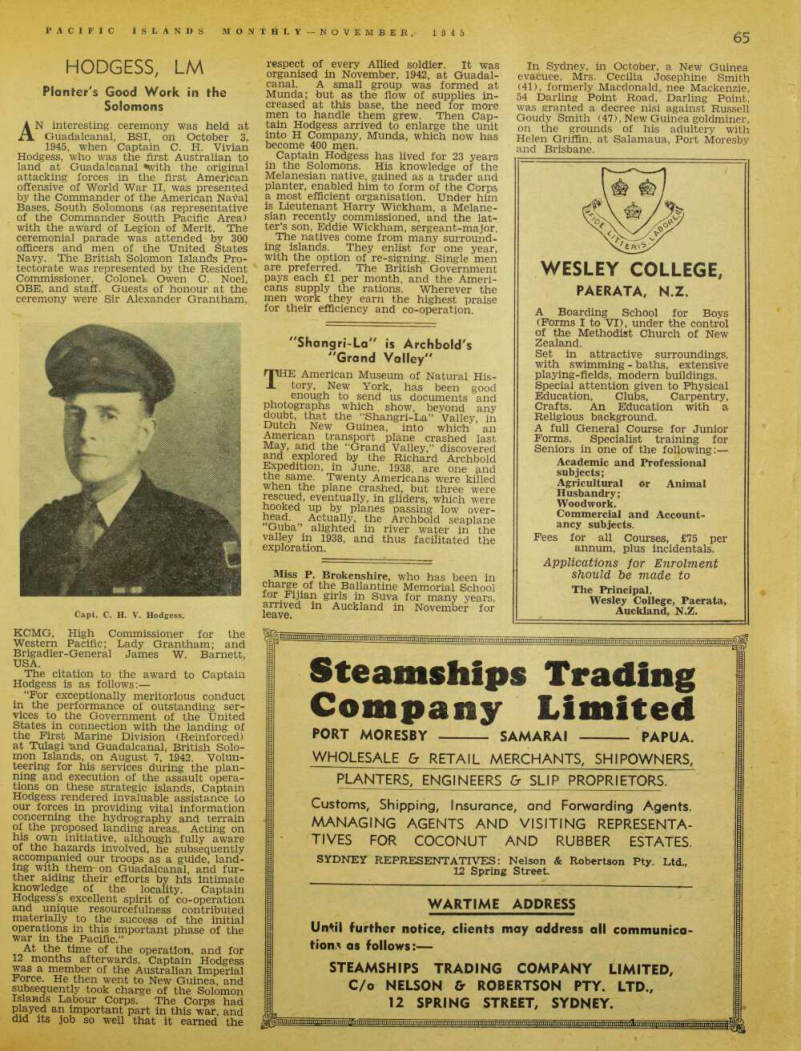
Planter's Good Work in the Solomons
AN interesting ceremony was held at Guadalcanal, BSI, on October 3, 1945, when Captain C. H. Vivian Hodgess, who was the first Australian to land at Guadalcanal the original attacking forces in the first American offensive of World War 11, was presented by the Commander of the American Natfal Bases, South Solomons (as representative of the Commander South Pacific Area) with the award of Legion of Merit. The ceremonial parade was attended by 300 officers and men of the United States Navy. The British Solomon Islands Pro tectorate was represented by the Resident Commissioner, Colonel Owen C. Noel, OBE, and staff. Guests of honour at the ceremony were Sir Alexander Grantham,
KCMG, High Commissioner for the Western Pacific; Lady Grantham; and Brigadier-General James W. Barnett,
Usa.
The citation to the award to Captain Hodgess is as follows: “For exceptionally meritorious conduct in the performance of outstanding ser vices to the Government of the United States in connection with the landing of the First Marine Division (Reinforced) at Tulagi and Guadalcanal, British Solo mon Islands, on August 7, 1942. Volun teering for his services during the plan ning and execution of the assault opera tions on these strategic islands, Captain Hodgess rendered invaluable assistance to our forces in providing vital information concerning the hydrography and terrain of the proposed landing areas. Acting on his own initiative, although fully aware of the hazards involved, he subsequently accompanied our troops as a guide, land ing with them on Guadalcanal, and fur ther aiding their efforts by his Intimate knowledge of the locality. Captain Hodgess’s excellent spirit of co-operation and unique resourcefulness contributed materially to the success of the initial operations in this important phase of the war in the Pacific.”
At the time of the operation, and for 12 months afterwards, Captain Hodgess was a member of the Australian Imperial Force, He then went to New Guinea, and subsequently took charge of the Solomon Islands Labour Corps. The Corps had played an important part in this war, and did its job so well that it earned the
respect of every Allied soldier. It was organised in November, 1942, at Guadal canal. A small group was formed at Munda; but as the flow of supplies in creased at this base, the need for more men to handle them grew. Then Cap tain Hodgess arrived to enlarge the unit into H Company, Munda, which now has become 400 men.
Captain Hodgess has lived for 23 years in the Solomons. His knowledge of the Melanesian native, gained as a trader and planter, enabled him to form of the Corps a most efficient organisation. Under him is Lieutenant Harry Wickham, a Melane sian recently commissioned, and the lat ter’s son, Eddie Wickham, sergeant-major.
The natives come from many surround ing islands. They enlist for one year, with the option of re-signing. Single men are preferred. The British Government pays each £1 per month, and the Ameri cans supply the rations. Wherever the men work they earn the highest praise for their efficiency and co-operation.
Capt. C. H. V. Hodgess.
"Grand Valley"
"Shangri-La" is Archbold's "Grand Valley"
rE American Museum of Natural His tory, New York, has been good enough to send us documents and photographs which show, beyond any doubt, that the “Shangri-La” Valley, in Dutch New Guinea, into which an American transport plane crashed last Ma.y, and the “Grand Valley,” discovered and explored by the Richard Archbold Expedition, in June, 1938, are one find the same. Twenty Americans were killed when the plane crashed, but three were rescued, eventually, in gliders, which were hooked up by planes passing low over „ Ac tually, the Archbold seaplane Guba alighted in river water in the valley in 1938, and thus facilitated the exploration.
Miss P. Brokenshire, who has been in charge of the Ballantine Memorial School for Fijian girls in Suva for many years, arrived in Auckland in November for leave.
In Sydney, in October, a New Guinea evacuee, Mrs. Cecilia Josephine Smith (41), formerly Macdonald, nee Mackenzie, 54 Darling Point Road, Darling Point, was granted a decree nisi against Russell Goudy Smith (47), New Guinea goldminer, on the grounds of his adultery with Helen Griffin, at Salamaua, Port Moresby and Brisbane.
Advertisements & other items, p. 67 (1 item)
Company Limited
WESLEY COLLEGE,
PAERATA, N.Z.
A Boarding School for Boys (Forms I to VI), under the control of the Methodist Church of New Zealand.
Set in attractive surroundings, with swimming - baths, extensive playing-fields, modern buildings.
Special attention given to Physical Education, Clubs, Carpentry, Crafts. An Education with a Religious background.
A full General Course for Junior Forms. Specialist training for Seniors in one of the following:— Academic and Professional subjects; Agricultural or Animal Husbandry; Woodwork.
Commercial and Accountancy subjects.
Fees for all Courses, £75 per annum, plus incidentals.
Applications for Enrolment should be made to The Principal, Wesley College, Paerata, Auckland, N.Z.
Steamships Trading
Company Limited
PORT MORESBY SAMARAI PAPUA.
WHOLESALE & RETAIL MERCHANTS, SHIPOWNERS,
PLANTERS, ENGINEERS & SLIP PROPRIETORS.
Customs, Shipping, Insurance, and Forwarding Agents.
MANAGING AGENTS AND VISITING REPRESENTA-
TIVES FOR COCONUT AND RUBBER ESTATES.
SYDNEY REPRESENTATIVES: Nelson & Robertson Pty. LtcL, 12 Spring Street.
WARTIME ADDRESS
Until further notice, clients may address all communication* as follows:
STEAMSHIPS TRADING COMPANY LIMITED,
C/o NELSON Cr ROBERTSON PTY. LTD.,
12 SPRING STREET, SYDNEY.
Been Saved"
"Civilians Could Have Been Saved"
Rabaul Survivor Tells of Appeal to Canberra
“ A LL the • civilians could easily have J\ been evacuated from Rabaul aboard a Norwegian vessel, the ‘Hoersten,’ which was lying in the port for some days before the Japs bombed the town,” said Mr. Gordon Thomas, for merly editor of the “Rabaul Times,” when interviewed by the “Cairns Post” re cently. He is one of the few civilians who escaped from Rabaul.
“When I saw Mr. Page, the Govern ment Secretary, at the latter part of May, 1942, in the prison camp he told me that he had heard that many of the prisoners were blaming him for the position which had occurred and it was then that Mr. Page explained to me that he had sent a message to Aus tralia suggesting that all civilians should be evacuated by the ‘Hoersten but that the Government would not allow such action to be taken.
“Providing this statement of Mr. Page is correct,” said Mr. Thomas, “and I nave no reason to suspect that it is not, then the Government is certainly responsible for not having evacuated all the civilians from Rabaul. If these civilians had been evacuated then the sad tale of the ‘Montevideo Manx’ would never have been W Speaking of the first day in Rabaul when the Japanese troops landed, Mr.
Thomas said that Mr. R. L. Clark, who was the Chief Warden of the town, did
a splendid job of work in keeping the civilians together.
“Right throughout,” said Mr. Thomas, “Mr. Clark did everything possible for the civilians and tried to get ‘them better conditions from the Japanese. Mr. Clark, Mr. Hector Robinson and myself formed a white-flag party and surrendered the town in order that there should be no bombing of Refuge Gully, where the civilians were stationed.
“The Japanese looted everything from all the houses and the offices in the town, burning papers and books, and wantonly destroying property for the mere sake of seeing the wreckage. All the books of the Agnes Wisdom Library, numbering many thousands, were put in a pile and burnt; the same fate was meted out to all Government office papers, ss well as all the papers and books in my own office.”
Death Of Mrs. Parkinson
And Mrs. Schultze
Memories of “Queen Emma"
TWO well-known old ladies, Mrs. Phoebe Parkinson and Mrs. Schultze, who refused to leave their plantations in New Ireland in 1941, and were caught in the Jap invasion, died between the end of 1941 and the liberation of the Territory in 1945.
Mrs. Parkinson was a remarkable old lady, very bright and interesting, al though she was well over 80 years old.
She was a sister of another very remark able woman, Mrs. Kolbe, better known to fame as “Queen Emma,” who died in Monte Carlo about 1914. These women were daughters of the first United States Consul in Samoa, Jonas M. Coe, who mar ried a high-caste Samoan. Emma, good looking and well-educated, married an Englishman, Forsayth; ran away from Samoa in the ’seventies with a trader named Farrell; established most pros perous trading stations and plantations in New Britain; sent to Samoa for her brothers and sisters, of whom Mrs. Par kinson was one; and eventually married a German, Captain Kolbe. Members of the family were scattered all over the Western Pacific, prior to World War 11.
New Suva Factory Nearly
Completed
WITH the exception of the 125-ft. smoke-stack, which promises the engineers some headaches, the fac tory of Island Industries, Ltd., at Walu Bay, Suva, is now almost completed.
Island Industries is a subsidiary of W. R. Carpenter & Co., and when the factory is in full operation in 1946 it is expected to crush copra on a 24-hours shift, and turn it into a colourless, odour less vegetable lard, ready canned for export.
Rarotonga's War Service
Rarotonga, Oct. 30.
fIIHE Rarotonga Defence Force paraded J. for the last time on October 10 before the Administration buildings, in a brief official stand-down ceremony.
The Resident Commissioner, Mr. W.
Tailby, complimented the men on the part they had played.
The force was Organised in 1940 for local defence, and consisted of 100 men (Maoris) with three NZ sergeant-instruc tors. Captain R. M. L. Gladney, a veteran of the last war, settled in Raro tonga as a planter, was appointed com manding officer. An efficieht quarter master was provided by QM Sgt. Karika, who returned from war with a DCM and who, in private life, is Makea Karika Ariki. Captain Gladney left Rarotonga in August to be, Resident Agent in Penrhyn, and Lieut. G. Shaw took charge.
Equipment included machine-guns and mortars, mounted in emplacements com manding the harbours. Look-out posts were established on mountain-tops round the island. There were a number of “alerts” in the early days of the Pacific war, but no serious incident disturbed the peace of this fortunate island.
The NZ Government decided, for various reasons, not to enlist natives from the Cook Islands for overseas ser vice in World War 11. The majority of able-bodied men throughout the Group were most anxious to enlist, and clamoured for a long time. Their pri mary motive probably was the eternal Polynesian wanderlust, rather than patriotism. .
However, there were many Cook Islanders in New Zealand, sons of lead ing native families and Euronesian sons of white residents, and these enlisted in the NZ Services. Many distinguished themselves. Ten Rarotongan boys served in the Air Force.
British Warship in Central Pacific
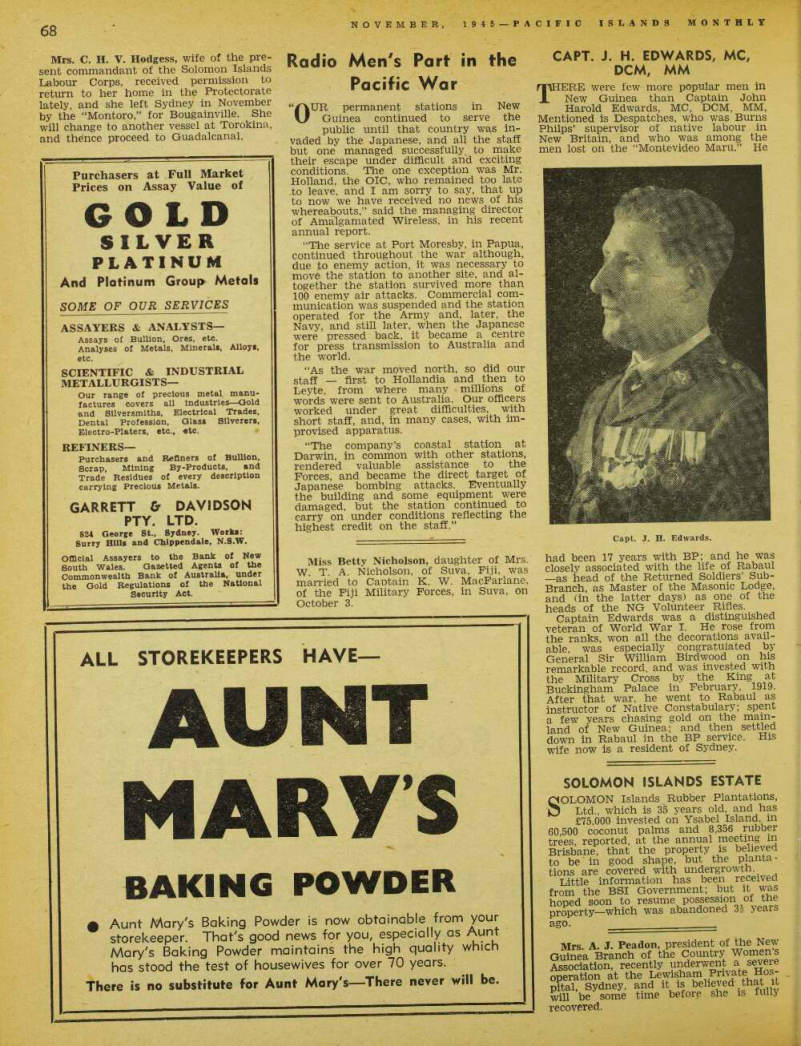
Apia, Oct. 26.
rE first British warship since the out break of World War II to reach Apia, Samoa, HMS destroyer “Terp sichore,” arrived on October 19 on a short visit to Western Samoa, and had a warm reception from all classes.
The “Terpsichore,” with a complement of 12 officers and 210 men, under the command of Commander Clouston, RN, had already paid a visit to Fiji, and was proceeding to Tonga.
After taking part in the Japanese sur render, she called at the Manus Naval Base. From Tonga she is to go to Hong Kong, to join the British Pacific Fleet th The officers and men of the “Terpsi chore” were taken sightseeing in buses and cars, and were guests of honour at several dances given by the Apia Red Cross Society and the Catholic Club, with the help of an entertainment fund col lected by Apia firms and citizens. The Samoans of Apia village also gave a Samoan Siva, and entertainment, at which the orators and chiefs expressed their pleasure to be able to entertain a British warship, and their thanks foi the protection of the Samoan Islands from the ravages of war. They presented fine mats to the Commander and crew as a token of their gratitude.
The “Terpsichore left Apia on Octo ber 22 for Tonga.
Mrs. Alec Burrows, of 107 High Street, North Sydney, and late of Manus, New Guinea, extends her deepest sympathy to the relatives of all those New Guinea civilians whose lives have been lost in the Pacific war.**
Mrs. C. H. V. Hodgess, wife of the present commandant of the Solomon Islands Labour Corps, received permission to return to her home in the Protectorate lately, and she left Sydney in November by the “Montoro,” for Bougainville. She will change to another vessel at Torokina, and thence proceed to Guadalcanal.
Advertisements & other items, pp. 68-70 (2 items)
Tuberculosis
N A PT
a post-war problem for the British Commonwealth For information on
• EDUCATION
• RESEARCH
• PROPAGANDA
WRITE TO
National Association for the Prevention of Tuberculosis Tavistock House North, London,
W.C.I.
Membership : Ten shillings per annum.
Allen Taylor 81 Co. Ltd.
COMMERCIAL ROAD, ROZELLE,
SYDNEY
Sowmillers ond Wholesale Suppliers of Hardwoods for Constructional Purposes GIRDERS .. . PILES .. . POLES . . SLEEPERS, Etc.
EXPORTING TO PACIFIC ISLANDS SINCE 1893
Dond
)K <^r u'mmm
HARRY J.WHNG PTY.LTD.
Sole Pocific Islonds Selling Representatives - For: I
BOND’S
Quality
•v
i LOVELIER
THAN EVER
y L II
Dond
s S
Garments
BOND'S
STANDARD
ATHLETICS
\ % r If Me in • ••*
BONDS
H O SIE RY
jam G P. 0., Sydney, iPAWfoaSAT^
HARRY J.YOUNG PTY.LTD.
Postal Address Box 3661,
379 KENT ST.,
Sydney.
Bankers: Bank of N.S.W.
Codes: < ,-• Bentley’s Comp. Phrase S Bentley’s 2nd Phrase.
Purchasers at Full Market Prices on Assay Value of
GOLD
SILVER
PLATINUM
And Platinum Group Metals
SOME OF OUR SERVICES
ASSAYERS & ANALYSTS—
Assays of Bullion, Ores, etc.
Analyses of Metals, Minerals, Alloys, etc.
SCIENTIFIC & INDUSTRIAL
METALLURGISTS—
Our range of precious metal manufactures covers all industries—Gold and Silversmiths, Electrical Trades, Dental Profession, Glass Sllverers, Electro-Platers, etc., etc.
REFINERS—
Purchasers and Refiners of Bullion, Scrap, Mining By-Products, and Trade Residues of every description carrying Precious Metals.
GARRETT b DAVIDSON
PTY. LTD.
824 George St., Sydney. Works: Surry Hills and Chippendale, N.S.W.
Official Assayers to the Bank of New South Wales. Gazetted Agents of the Commonwealth Bank of Australia, under the Gold Regulations of the National Security Act.
ALL STOREKEEPERS HAVE—
AUNT
MARYS
BAKING POWDER
• Aunt Mary's Baking Powder is now obtainable from your storekeeper. That's good news for you, especially as Aunt Mary's Baking Powder maintains the high quality which has stood the test of housewives for over 70 years.
There is no substitute for Aunt Mary's—There never will be.
Radio Men's Part in the Pacific War
Pacific War
“/ r VUR permanent stations in New V/ Guinea continued to serve the public until that country was in vaded by the Japanese, and all the staff but one managed successfully to make their escape under difficult and exciting conditions. The one exception was Mr.
Holland, the QIC, who remained too late to leave, and I am sorry to say, that up to now we have received no news of his whereabouts,” said the managing director of Amalgamated Wireless, in his recent annual report.
“The service at Port Moresby, in Papua, continued throughout the war although, due to enemy action, it was necessary to move the station to another site, and al together the station survived more than 100 enemy air attacks. Commercial com munication was suspended and the station operated for the Army and, later, the Navy, and still later, when the Japanese were pressed back, it became a centre for press transmission to Australia and the world.
“As the war moved north, so did our staff first to Hollandia and then to Leyte, from where many millions of words were sent to Australia. Our officers worked under great difficulties, with short staff, and, in many cases, with im
provised apparatus.
“The company’s coastal station at Darwin, in common with other stations, rendered valuable assistance to the Forces, and became the direct target of Japanese bombing attacks. Eventually the building and some equipment were damaged, but the station continued to carry on under conditions reflecting the highest credit on the staff.”
Miss Betty Nicholson, daughter of Mrs.
W. T. A. Nicholson, of Suva, Fiji, was married to Cantain K. W. MacFarlane, of the Fiji Military Forces, in Suva, on October 3.
Advertisements & other items, p. 70 (1 item)
Dcm, Mm
CAPT. J. H. EDWARDS, MC,
fpHERE were few more popular men in J. New Guinea than Captain John Harold Edwards, MC, DCM, MM, Mentioned is Despatches, who was Burns Philps’ supervisor of native labour in New Britain, and who was among the men lost on the “Montevideo Maru.” He
had been 17 years with BP; and he was closely associated with the life of Rabaul —as head of the Returned Soldiers’ Sub- Branch, as Master of the Masonic Lodge, and (in the latter days) as one of the heads of the NG Volunteer Rifles.
Captain Edwards was a distinguished veteran of World War I. He rose from the ranks, won all the decorations avail able, was especially congratulated by General Sir William Birdwood on his remarkable record, and was invested with the Military Cross by the King at Buckingham Palace in February, 1919.
After that war, he went to Rabaul as instructor of Native Constabulary; spent a few years chasing gold on the main land of New Guinea; and then settled down in Rabaul in the BP service. His wife now is a resident of Sydney.
Capt. J. H. Edwards.
Solomon Islands Estate
SOLOMON Islands Rubber Plantations, Ltd., which is 35 years old, and has £75,000 invested on Ysabel Island, in 60,500 coconut palms and 8,356 rubber trees, reported, at the annual meeting in Brisbane, that the property is believed to be in good shape, but the planta • tions are covered with undergrowth.
Little information has been received from the BSI Government; but it was hoped soon to resume possession of the property—which was abandoned 3~ years ago. Mrs. A. J. Peadon, president of the New Guinea Branch of the Country Women s Association, recently underwent a severe operation at the Lewisham Pnvate Hos pital, Sydney, and it is beheved' that it will be some time before she is fully recovered.
Guinea Natives?
Is There Danger of a Post-war Flare-up Among New Guinea Natives?
JN the years before the Jap invasion, the primitive natives of New Guinea were making a slow and
painful progress towards higher
standards of life. But it was a difficult process beset by problems.
An outstanding problem was pro vided by the missions. They taught that all men were equal in the sight
of God. Here and there, unusually
intelligent natives would arise and ask: Why, then, is there any distinc tion here between white and black men? One could see trouble coming, unless Governments werte wise and
tactful.
War conditions have accentuated these problems a hundredfold. Natives now, after contact with tens of thou sands of careless white soldiers, are more difficult to handle than ever before. The dangers of native up risings in New Guinea are discilssed here by an old Territories resident, Mr. N. M. Bird: STEMMING directly from religious teaching of equality, and its result ing sense of injustice, is what is generally known as “Vailala Madness,” or “Cargo Cult.”
Various explanations of the “Madness” have been advanced, but the late F. E.
Williams, anthropologist to the Papuan Government, after extensive study, gave as his conclusion that the main cause was “ill-digested” religious teaching.
This “Madness” is not confined to any one area, but is found among tribes whose dialects and customs differ widely. In all cases the “Madness” takes the same form: A native, infected with the disorder, states that he has been visited by a relative long dead, who stated that a great number of ships loaded with “cargo” had been sent by the ancestor of the native for the benefit of the natives of a particular village or area.
But the white man, being very cunning, knows how to intercept these ships and takes the “cargo” for his own use, giving the natives only that portion of the inferior goods that the white man does not require.
The “Madness” has broken out in many areas quite recently, but should not be regarded as a result of enemy invasion.
It was present for many years prior to the invasion. Outbreaks have occurred in widely separated areas—Lakekamu and Goilala areas in Papua, and in Huon, Madang, Seplk, Bena Bena and Hagen districts in New Guinea.
An outbreak in Madang in 1944 is quoted as an illustration of how the “Madness” works: An infected native mustered some hun dreds of other natives, whom he called his “soldiers,” and armed them with stolen hand grenades. He told these “sol diers,” and other natives, that the white man was stealing ships, aeroplanes, motor vehicles, etc., belonging to the natives, and that it was his duty as their new king to prevent this theft, and to drive the white men from Madang.
The man’s addresses generally took the form of distorted religious speeches, and were usually followed by the sing ing of hymns. During these speeches, the natives were told that the black skin they now had was not their “true” skin, but that it would shortly be discarded, and they would appear in their white skin.
Missions are blamed for these out breaks. In New Guinea it is not un usual to find two or more missions established in a district, all teaching widely differing doctrines to natives whose dialect and customs are exactly similar for that district. Each sect fiercely claim their particular doctrine as being the “right” one. Is it any wonder then that such cults as the “Mad ness” are the unhappy result?
This must not be construed as an attack on the missionaries as individuals.
Those I have known have been, in the majority of cases, good and concientious men, carrying out to the best of their abilities what they consider to be their duty. Nor can the whole mission move ment be condemned because of this one unhappy result of their teaching. But the fact of the “Madness” remains, and must be faced.
We have seen grave harm to the native population arising from the “Vailala Madness,” where livestock has been destroyed, and gardens neglected in the expectation of the magic cargo arriving.
The natives infected by the “Madness” sank into indolence and apathy regarding common hygiene, with dire effect on the health of the community.
HOW much more dangerous, then, will the “Madness” be when a military aspect is superimposed on the religious? Imagine the position, with some thousands of natives armed and trained in the use of modern weapons, at the disposal of such a “king” as he who arose in Madang in 1944.
It is folly to say: “It cannot happen here, to us.” It CAN, and may, happen here, to us. It is ridiculous to think that the discipline instilled with the military training would make such an uprising impossible.
One instance is on record where years of rigid training and discipline did not prevent a party of native police running amok among the native population. I refer to that party of native police who deserted in 1942, with their arms, and who, before being intercepted and dis armed by a few inteprid New Guinea citizens from Madang, carried out sys tematic murder and rape of the native populations in their path.
And this was no organised rebellion, but a desertion of a small party of police, made possible by the dislocation of civil services by the invasion of these Islands by the Japanese, How much more dangerous, then, would be an organised rebellion of thousands of savages armed with modern weapons.
Those, of us who witnessed the “strike” in Rabaul in 1928 do not wish to see another such—certainly not with thou
sands of natives armed with modern weapons.
What would the result be if the “Vailala Madness” took hold of the regiments of black soldiers now being trained in New Guinea?
By his very nature the New Guinea native is peculiarly susceptible to these “cults” and to the influence of the “kings.”
The very fact that he is being trained as a soldier, and is expected to fight
alongside the white man, and the fact that he is accepted as an equal in bar racks by the whites, but is not accepted as equal by society in general, will aggra vate the condition and render him still more susceptible to these cults and to the Influence of the “kings.” His dis cipline and training will be discarded at a moment’s notice and he will, emerge, as he is, a primitive savage with all a primitive savage’s instincts.
The New Guinea native is not unre liable. He Is worse—he is unpredictable The result of an organised uprising of these armed savages could be the mas sacre of Europeans in these islands, to gether with a host of natives.
IS New Guinea to be for ever the “happy hunting-ground” of politicians who wish to try out some crack-brained scheme, some murderously dangerous “experiment,” with its “cushy” jobs for a
politically-favoured few?
Is New Guinea to be for ever at the mercy of politicians, who, in the majority, have spent less than a month in the Islands and know nothing of the latent dangers in these Territories?
One of the worst aspects is that this set of politicians, having instituted this “plan,” will, when the thing crashes Into the mud. be elsewhere, still with their heads in the clouds, completely ignoring the chaotic results of their “plan,’ or blandly disclaiming all responsibility.
The New Guinea Native Police Force proved itself to be quite adequate to handle all situations that arose in these islands. Why then the need for these regiments of soldiers?
WE fought hard and long to be allowed to have some small voice in the laws by which we were governed in New Guinea. We won the fight end were granted a Legislative Council. Here at least our representatives could voice our ideas and suggestions for the better ment of both ourselves and the native
population. , .
Henceforth, the citizens of New Guinea will be dumb, gagged by the Canberra politicians. The Legislative Councils are abolished. The New Guinea citizen, besides being gagged by the politician, will not even have the melancholy satis faction of casting his vote against those
politicians who so effectively gag him.
Being a New Guinea citizen, he has no vote in Australia.
The “Vailala Madness” remains—and will remain until some control is exercised to counteract it. a military education is being* forced on these unfortunate and unsuspecting natives. The ill-digested religious teaching gave rise to the “Vailala Madness.”
What will the result be of the ill-digested military education?
The New Guinea citizen, having watched the growth of the Vailala Madness,” while being powerless to pre vent it, now stands gagged and bound by the Canberra politician and watches the growth of a new ‘ Madness’ that may be destined to wipe out his home, his wife, his children, and himself.
Advertisements & other items, pp. 71-72 (1 item)
Kidney Trouble
and Backache
Gone in 1 Week
Flush Kidneys With Cystex and Ton’ll Feel Fine Cystex—the prescription of a famous doctor —improves faulty kidney action in double quick time, so, if you suffer from Rheumatism, Sciatica, Neuritis, Lumbago, Backache, Nervousness, Leg Pains, Dizziness, Circles under Eyes, frequent Headaches and colds, poor Energy and Appetite, Puffy Ankles or Interrupted Sleep, go to your chemist to-day for Cystex.
Cystex Helps Nature 3 Ways
The Cystex treatment 1* highly scientific, being specially compounded to soothe, tone and clean kidneys and bladder and to remove acids and poisons from your system safely, quickly and surely, yet contains no harsh, harmful or dangerous drugs. Cystex wo-ks In these 3 ways to end your troubles:— (1) Starts killing the germs which are attacking your Kidneys, Bladder and urinary system In two hours, yet is absolutely harmless to human tissue. (2) Gets rid of health-destroying, deadly poisonous acids with which your system has become saturated. (3) Strengthens and relnvigorates the kidneys, protects you from the ravages of diseaseattack on the delicate filter organism, and stimulates the entire system.
Feels a Different Woman
“I hare been taking Cystex for Kidney and Bladder trouble and it has made a different woman of me. I am feeling splendid, can do all my work, run about and walk miles although I am G 3 years of age. Cystex does all you claim for it.”—(Sgd.) M. L. Zessin, Thompson Estate, Brisbane.
Now Able to Walk Without Stick
“I had Kidney and Bladder complaint, pains in leg and back; in fact, I had to use a walking stick. I have used two bottles of Cystex, now I have no pains anywhere. I consider Cystex the greatest medicine in the world for Kidney complaint.”—(Sgd.) J. McPherson, Nangeribone Station, N.S.W.
Guaranteed to Satisfy or Money Back Get Cystex from your chemist to-day. Give it a thorough test. Cystex is guaranteed to make you feel younger, stronger, better In every way, or your money back if you return the empty package. Act now!
Now In Z sizes—4/-, 8/-.
This is a
GUARANTEED CVCTPV
Treatment
for Your Kidneys, Bladder, Rheumatism
Woven Wire for all Industry
COPRA DRYING TRAYS, FLOORS, Etc.
FRU'T DRYING TRAYS, MINING SCREENS.
Heavy Mosquito Gauze in Phosphor Bronze and other Metals Impervious to Salt Sea Air.
WIRE DOOR MATS AND GENERAL WIRE WORKS
E. WRIGHT & CO. LTD.
Office and Works: 148-152 Cleveland Street, Sydney, N.S.W.
Telegraphic Address: “Wrlghtmake,” Chippendale, f! £ <5 &
For perfect cutting
under all conditions
There is a Ransomes Mower for every lawn 7- our range covers machines for every requirement from the smooth, even surface of the putting green to the sports ground, golf course or aerodrome.
The "MOON" Mower
I GANG
MOWERS
For grass such as couch, klkuyu, buffalo, etc., and grass longer than the average. 14-ln. and 18-ln. wide. 50 acres a day can easily be cnt with a Ransomes Quintuple Mower drawn by a tractor and even larger outfits up to ft. wide are available.
nsomes
Lawn Mowers
Write for illustrated literature and all information
MORRIS, HEDSTROM LTD.,
Suva, Lautoka, and Ba.
Mode by RANSOMES, SIMS & JEFFERIES LTD., IPSWICH, ENGLAND.
Methods of Retaining Fertility
Topsoil Theory
By H. Charles Reed, Apia
AN important discovery has been made, while carrying out experiments with the various green manure crops. A plant has been found that is capable of drawing, from the lower strata of the subsoil, nutrients which are elaborated in its leaves; and as soon as the plant dies, or is cut down, the entire plant dis integrates into rich vegetable-mould or humus.
This is not a matter of a small per centage of haulm or leaf deposit, such as is obtained by many of the small-grow ing Crotalarias, Desmodium, or other cover plants; but a large amount of humus, sufficient to enable the cultivator to continue to raise abundant crops on the same soil, year in year out; with proper crop rotation practised.
It is intended to plant the new subject in single lines between the permanent crops: coffee, tea, rubber, cocoa, and the spices. Already this new source of plant nutrients has enabled a bumper crop of splendid garden vegetables to be grown on land previously rejected by Chinese gardeners as “useless” (and this after about 15 years of continuous cropping).
This alone speaks well for the future possiblities of the humus-producing plant.
It must be borne in mind that the “top few inches of the soil, over and over again, are the most important of all to the crop.” Endless time and money is spent in getting a good tilth, and making the surface soil of such mechanical condi tion that it will readily absorb moisture
on the one hand and retain it on the other. This topsoil is the home of myriads of bacteria, which render the fertilising constituents available to the plant; i.e., in the presence of moisture.
But unless a soil contains a sufficient percentage (about 10 per cent.) of vege table matter (humus) the requisite moisture cannot be absorbed or retained.
Artificial manures have no power of moisture retention; while a stony, sandy soil loses its moisture content in no time, unless a cbver plant, or mulch, is employed.
A large number of plants are surface feeders, and if they are tea, coffee, cocoa, rubber, etc., it is especially important that the surface soil should not be re moved. Deep trenching, “lying fallow” and the turning down of the topsoil (the carpet of nutrients and moisture) under conditions of tropical cultivation, and intense solar heat is, in the opinion of this writer, a misguided practice.
IN lying fallow, a, soil loses its valuable soil bacteria, which perish. In deep trenching (so highly recommended in certain text books) plants often become stationary, dwarfed, or thriftless; and more often than not, fail altogether. For what purpose are the wonderful “tap roots” of plants? Possibly, to draw up the moisture required to elaborate the nutrients provided by the humus con tent of the surface soil. But if the sur face soil is removed, does the plant thrive? I have not found it so in 20 years of field experience. But now real results are made possible by simply grow ing a plant which will enrich the surface soil beyond the wildest dreams of the progressive horticulturist in the tropics.
Virgin soils, soils which have been under natural vegetation for many years, are rich in this natural vegetable humus, and do not require any additional fertiliser.
In fact, the application of a chemical compound to these complete soils is apt to destroy the balance of naturally formed plant nutrients in a soil, until such time as the nitrogen, potash, phos phates, etc., have been partly depleted by crops. The progressive planter will not wait until his soil no longer yields him a satisfactory crop. Millions of planters in the USA put their faith into artificials to restore the soil fertility and dis covered, when too late, that the soil does not respond to such methods.
To-day, crops may be inter-planted with a cover-plant that will restore soil fertility, as it is used up by crops of rubber, coffee, spice, cocoa, or tea. Not alone this; the needed moisture is drawn into the soil from the air and dew, and Is conserved in the retentive vegetable humus the only component in a soil capable of holding moisture, aerating the soil, and preventing sun-scorch to the delicate roots of plants.
Sydney—Auckland
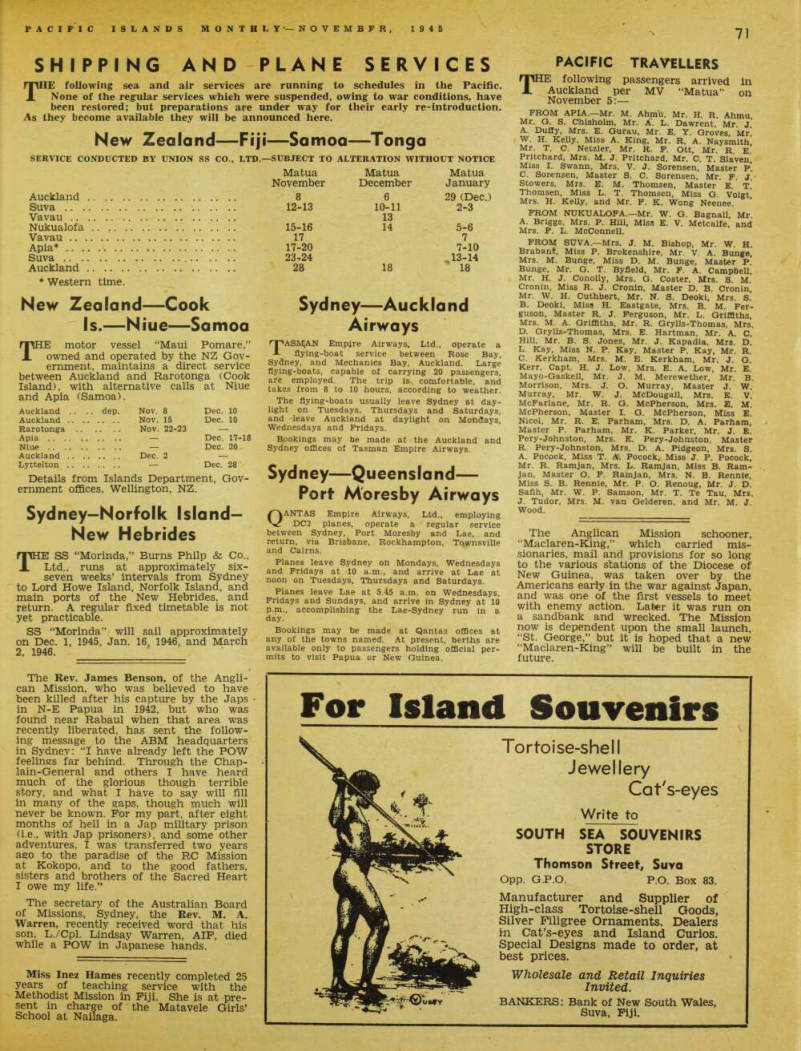
Shipping And Plane Services
THE following sea and air services are running to schedules in the Pacific.
None of the regular services which were suspended, owing to war conditions, have been restored; but preparations are under way for their early re-introduction.
As they become available they will be announced here.
New Zealand—Fiji—Samoa—Tonga
SERVICE CONDUCTED BY UNION SS CO., LTD.—SUBJECT TO ALTERATION WITHOUT NOTICE
New Zealand—Cook
Is.—Niue—Samoa
rE motor vessel “Maui Pomare,” owned and operated by the NZ Gov ernment, maintains a direct service between Auckland and Rarotonga (Cook Island), with alternative calls at Niue and Apia (Samoa).
Auckland .. .. dep. Nov. 8 Pec. 10 Auckland Nov. 15 Dec. 10 Rarotonga Nov. 22-23 Apia Dec. 17-18 Niue Dec. 20 Auckland Dec. 2 Lyttelton Dec. 28 Details from Islands Department, Gov ernment offices, Wellington, NZ.
Sydney-Norfolk Island-
New Hebrides
rE SS “Morinda,” Burns Philp & Co., Ltd., runs at approximately six seven weeks’ intervals from Sydney to Lord Howe Island, Norfolk Island, and main ports of the New Hebrides, and return. A regular fixed timetable is not yet practicable, SS “Morinda” will sail approximately on Dec. 1, 1945, Jan. 16, 1946, and March 2, 1946.
The Rev. James Benson, of the Angli can Mission, who was believed to have been killed after his capture by the Japs in N-E Papua in 1942, but who was found near Rabaul when that area was recently liberated, has sent the follow ing message to the ABM headquarters in Sydney: “I have already left the POW feelines far behind. Through the Chap lain-General and others I have heard much of the glorious though terrible story, and what I have to say will fill in many of the gaps, though much will never be known. For my part, after eight months of hell in a Jap military prison (i.e., with Jap prisoners), and some other adventures, I was transferred two years ago to the paradise of the RC Mission at Kokopo, and to the good fathers, sisters and brothers of the Sacred Heart I owe my life.”
The secretary of the Australian Board of Missions, Sydney, the Rev. M. A.
Warren, recently received word that his son, L./Cpl. Lindsay Warren, AIF, died while a POW in Japanese hands.
Miss Inez Hames recently completed 25 years of teaching service with the Methodist Mission in Fiji. She is at pre sent in charge of the Matavele Girls’
School at Nailaga.
Sydney—Auckland
Airways
TASMJAN Empire Airways* Ltd., operate a flying-boat service between Rose Bay, Sydney, and Mechanics Bay, Auckland. Large flying-boats, capable of carrying 20 passengers, are employed. The trip comfortable, and takes from 8 to 10 hours, according to weather.
The flying-boats usually leave Sydney at day light on Tuesdays. Thursdays and Saturdays, and leave Auckland at daylight on Mondays, Wednesdays and Fridays.
Bookings may be made at the Auckland and Sydney offices of Tasman Empire Airways.
Sydney—Queensland—
Port Moresby Airways
QANTAS Empire Airways, Ltd., employing DC3 planes, operate a regular service between Sydney, Port Moresby and Lae, and return, via Brisbane, Rockhampton, Townsville and Cairns.
Planes leave Sydney on Mondays, Wednesdays and Fridays at 10 a.m., and arrive at Lae at noon on Tuesdays, Thursdays and Saturdays.
Planes leave Lae at 5.45 a.m. on Wednesdays, Fridays and Sundays, and arrive in Sydney at 10 p.m., accomplishing the Lae-Sydney run in a day.
Bookings may be made at Qantas offices at any of the towns named. At present, berths are available only to passengers holding official per mits to visit Papua or New Guinea.
Matua Matua Matua November December January Auckland 8 6 29 (Dec.) Suva 12-13 10-11 2-3 Vavau 13 Nukualofa 15-16 14 5-6 Vavau 17 7 Apia* 17-20 7-10 Suva 23-24 *13-14 Auckland 28 18 18 * Western time.
PACIFIC travellers
rE following passengers arrived in
Auckland per MV “Matua” on November 5: — PROM APIA.—Mr. M. Ahrau, Mr. H. R. Ahmu, Mr. G. S. Chisholm, Mr. A. L. Dawrent, Mr j' A. Duffy, Mrs. E. Gurau, Mr. E. Y. Groves, Mr’
W. H. Kelly, Miss A. King, Mr. R. A. Naysmith.
Mr. T. C. Netzler, Mr. R. P. Ott, Mr. R E Pritchard. Mrs. M. J. Pritchard, Mr. C. T. Slaven Miss I. Swann, Mrs. V. J. Sorensen, Master p’.
C. Sorensen, Master S. C. Sorensen, Mr. P. J.
Stowers, Mrs. E. M. Thomsen, Master E. T.
Thomsen, Miss L. T. Thomsen, Miss G. Voigt Mrs. H. Kelly, and Mr. P. K. Wong Neenee.
FROM NUKUALOFA.—Mr. W. G. Bagnall, Mr A. Briggs, Mrs. P. Hill, Miss E. V. Metcalfe, and Mrs. F. L. McConnell.
FROM SUVA.—Mrs. J. M. Bishop, Mr. W. H.
Brabant, Miss P. Brokenshlre. Mr. V. A. Bunge] Mrs. M. Bunge, Miss D. M. Bunge, Master P Bunge, Mr. G. T. Byfleld, Mr. P. A. Campbell, Mr. H. J. Conolly, Mrs. G. Coster, Mrs. S. M Cronin, Miss R. J. Cronin, Master D. B. Cronin.
Mr. W. H. Cuthbert, Mr. N. S. Deoki, Mrs. S.
B. Deoki, Miss H. Eastgate, Mrs. B. M. Fer guson. Master R. J. Ferguson, Mr. L. Griffiths, Mrs. M. A. Griffiths. Mr. R. Grylls-Thomas, Mrs.
D. Grylls-Thomas, Mrs. E. Hartman, Mr. A. C.
Hill, Mr. B. S. Jones, Mr. J. Kapadia, Mrs. D.
L. Kay, Miss N. P. Kay, Master P. Kay, Mr. R.
C. Kerkham, Mrs. M. E. Kerkham, Mr. J. G.
Kerr. Capt. H. J. Low, Mrs. E. A. Low. Mr. E.
Mayo-Gaskell, Mr. J. M. Merewether, Mr. B.
Morrison, Mrs. J. O. Murray, Master J. W.
Murray, Mr. W. J. McDougall, Mrs. E. V.
McParlane, Mr. R. G. McPherson, Mrs. E. M.
McPherson, Master I. G. McPherson, Miss E.
Nicol, Mr. R. E. Parham, Mrs. D. A. Parham, Master P. Parham, Mr. K. Parker, Mr. J. E.
Pery-Johnston, Mrs. E. Pery-Johnston, Master R. Pery-Johnston, Mrs. D. A. Pidgeon, Mrs. S.
A. Pocock, Miss T. A. Pocock, Miss J. P. Pocock, Mr. R. Ramjan, Mrs. L. Ramjan, Miss B. Ram- Jan, Master O. F. Ramjan, Mrs. N. B. Rennie, Miss S. B. Rennie, Mr. P. O. Renoug, Mr. J. D.
Safih, Mr. W. P. Samson, Mr. T. Te Tau, Mrs.
J. Tudor, Mrs. M. van Gelderen, and Mr. M. J.
Wood.
The Anglican Mission schooner,
“Maclaren-King,” which carried mis sionaries, mail and provisions for so long to the various stations of the Diocese of New Guinea, was taken over by the Americans early in the war against Japan, and was one of the first vessels to meet with enemy action. Later it was run on a sandbank and wrecked. The Mission now is dependent upon the small launch, “St. George,” but it is hoped that a new “Maclaren-King” will be built in the future.
Advertisements & other items, p. 73 (1 item)
For Island Souvenirs
■r-*~ ■fe . #®U*»Y
Tortoise-shell
Jewellery
Cat's-eyes
Write to
SOUTH SEA SOUVENIRS
STORE
Thomson Street, Suva Opp. G.P.O. P.O. Box 83.
Manufacturer and Supplier of High-class Tortoise-shell Goods, Silver Filigree Ornaments. Dealers in Cat’s-eyes and Island Curios.
Special Designs made to order, at best prices.
Wholesale and Retail Inquiries Invited.
BANKERS: Bank of New South Wales, Suva, Fiji.
Islands Produce
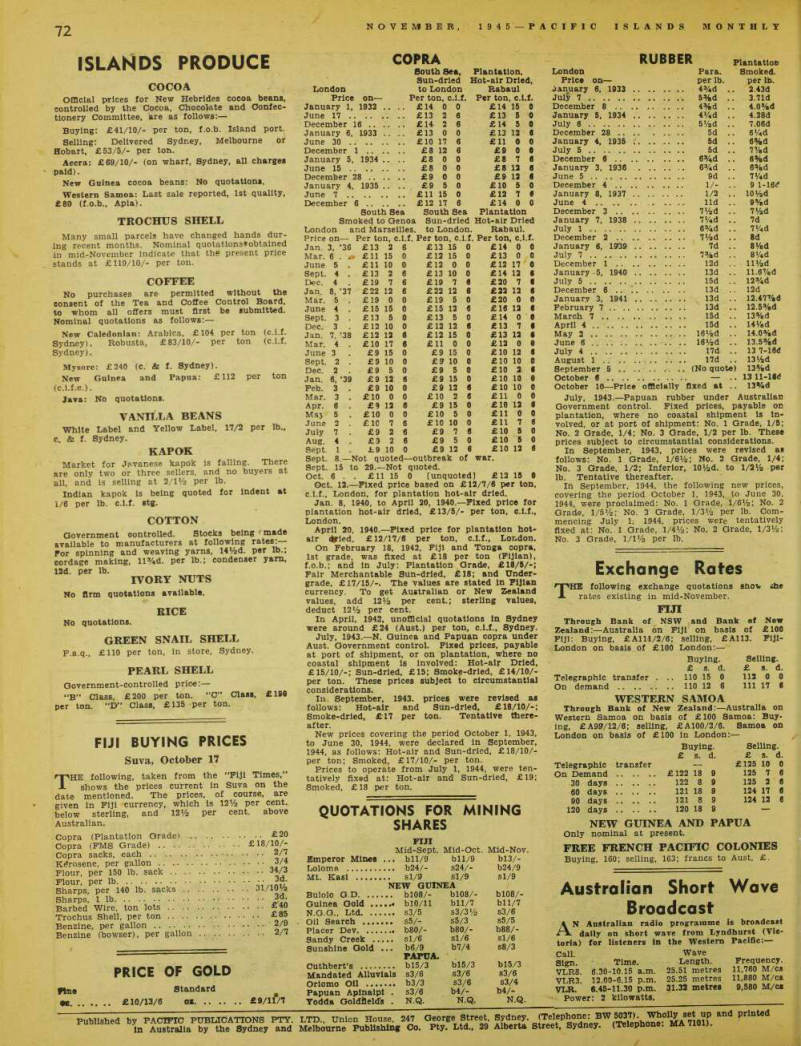
Cocoa
Official prices for New Hebrides cocoa beans, controlled by the Cocoa, Chocolate and Confec tionery Committee, are as follows; — Buying: £4l/10/- per ton, f.o.b. Island port.
Selling: Delivered Sydney, Melbourne or Hobart, £53/5/- per ton.
Accra: £69/10/- (on wharf, Sydney, all charges paid).
New Guinea cocoa beans; No quotations.
Western Samoa: Last sale reported, Ist quality, £BO (f.0.b., Apia).
Trochus Shell
Many small parcels have changed hands dur ing recent months. Nominal quotationseobtained in mid-November indicate that the present price stands at £ll9/10/- per ton.
Coffee
No purchases are permitted without the consent of the Tea and Coffee Control Board, to whom all offers must first be submitted.
Nominal quotations as follows: New Caledonian: Arabica, £lO4 per ton (c.i.f.
Sydney). Robusta, £B3/10/- per ton (c.i.f.
Sydney).
Mysore: £240 (c. & f. Sydney).
New Guinea and Papua: £ll2 per ton (c.i.f. e.).
Java: No quotations.
Vanilla Beans
White Label and Yellow Label, 17/2 per lb., c. & f. Sydney.
Kapok
Market for Javanese kapok is falling. There are only two or three sellers, and no buyers at all, and is selling at 2/1% per lb.
Indian kapok is being quoted for Indent at 1/6 per lb. c.i.f. stg.
Cotton
Government controlled. Stocks being ' made available to manufacturers at following rates>- For spinning and weaving yarns, 14%d. per lb.; cordage making, ll%d. per lb.; condenser yarn, 12d. per lb.
Ivory Nuts
No firm quotations available.
Rice
No quotations.
Green Snail Shell
p.a.q., £llO per ton, in store, Sydney.
Pearl Shell
Government-controlled price;— ”B” Class, £2OO per ton. "O” Class, £l9O per ton. ”D” Class, £135 per ton.
Fiji Buying Prices
Suva, October 17
THE following, taken from the “Fiji Times,” shows the prices current in Suva on the date mentioned. The prices, of course, are given in Fiji currency, which is 12 V 2 per cent, below sterling, and 12 Vfe per cent, above Australian.
Copra (Plantation Grade) .. .. £2 ° Copra (FMS Grade) £lB/10/- Copra sacks, each 2/7 Kdrosene, per gallon 3/4 Flour, per 150 lb. sack 34/3 Flour, per lb •• .jjr Sharps, per 140 lb. sacks 31/IOVt Sharps, 1 lb Jd.
Barbed Wire, ton lots Trochus Shell, per ton £B5 Benzine, per gallon 2/9 Benzine (bowser), per gallon 2/7
Price Of Gold
Sept. 8. —Not quoted—outbreak of war.
Sept. 15 to 29.—Not quoted.
Oct. 6 . . £ll 15 0 [unquoted] £l2 15 0 Oct. 12.—Fixed price based on £l2/7/6 per ton, c.i.f., London, for plantation hot-air dried.
Jan. 8, 1940, to April 20, 1940 —Fixed price for plantation hot-air dried, £l3/5/- per ton, c.i.f., London.
April 20. 1940.—Fixed price for plantation hot air dried, £l2/17/6 per ton, c.i.f., London.
On February 18, 1942, FIJI and Tonga copra, Ist grade, was fixed at £lB per ton (Pljlan), f.0.b.; and In July: Plantation Grade, £lB/5/-; Pair Merchantable Sun-dried, £18; and Under grade, £l7/15/-. The values are stated In Pljlan currency. To get Australian or New Zealand values, add 12V 2 per cent.; sterling values, deduct 12V2 per cent.
In April, 1942, unofficial quotations In Sydney were around £24 (Aust.) per ton, c.i.f., Sydney.
July, 1943.—N. Guinea and Papuan copra under Aust. Government control. Fixed prices, payable at port of shipment, or on plantation, where no coastal shipment is Involved: Hot-air Dried, £l5/10/-; Sun-dried, £l5; Smoke-dried, £l4/10/per ton. These prices subject to circumstantial considerations.
In September, 1943. prices were revised as follows: Hot-air and Sun-dried, £lB/10/-; Smoke-dried, £l7 per ton. Tentative there after.
New prices covering the period October 1, 1943, to June 30, 1944, were declared in September, 1944, as follows: Hot-air and Sun-dried, £lB/10/per ton; Smoked, £l7/10/- per ton.
Prices to operate from July 1, 1944, were ten tatively fixed at: Hot-air and Sun-dried, £l9; Smoked, £lB per ton.
pine Standard or £10/13/6 o* £9/11/7
Copra
South Sea, Plantation, Sun-dried Hot-air Dried, London to London Rabaul Price on— Per ton, c.l.f.
Per ton, c.l.f.
January 1, 1932 ., £14 0 0 £14 15 0 June 17 . £13 2 6 £13 5 0 December 16 .. £14 2 6 £14 5 0 January 6, 1933 £13 0 0 £13 12 6 June 30 . £10 17 6 £11 0 0 December 1 .. £8 12 6 £9 0 0 January 5 1934 £8 0 0 £8 7 6 June 15 . £8 0 0 £8 12 6 December 28 .. £9 0 0 £9 12 6 January 4 1935 £9 5 0 £10 5 0 June 7 . £11 15 0 £12 7 8 December 6 . . £12 17 6 £14 0 0 South Sea South Sea Plantation Smoked to Genoa Sun-dried Hot-air Dried London and Marseilles, to London.
Rabaul.
Price on— Per ton, c.l.f.
Per ton, c.l.f.
Per ton, c.l.f.
Jan. 3. ’36 £13 2 6 £13 15 0 £14 0 0 Mar. 6 . . £11 15 0 £12 15 0 £13 0 0 June 5 . £11 10 0 £12 0 0 £12 17 0 Sept. 4 . £13 2 6 £13 10 0 £14 12 8 Dec. 4 . £19 7 6 £19 7 8 £20 7 • Jan. 8. *37 £22 12 6 £22 12 6 £22 12 6 Mar. 5 . £19 0 0 £19 5 0 £20 0 0 June 4 £15 15 0 £15 12 6 £16 12 8 Sept. 3 £13 5 0 £13 5 0 £14 0 0 Dec. 3 . £12 10 0 £12 12 fl £13 7 8 Jan. 7, ’38 £12 12 6 £12 15 0 £13 12 1 Mar. 4 . £10 17 6 £11 0 0 £12 0 0 June 3 £9 15 0 £9 15 0 £10 12 8 Sept. 2 . £9 10 0 £9 10 0 £10 10 0 Dec. 2 . £9 5 0 £9 5 0 £10 2 8 Jan. 6. ’39 £9 12 6 £9 15 0 £10 10 0 Peb. 3 . £9 10 0 £9 12 6 £10 10 0 Mar. 3 . £10 0 0 £10 2 6 £11 0 0 Apr. 6 £9 12 6 £9 15 0 £10 12 8 May 5 . £10 0 0 £10 5 0 £11 0 0 June 2 £10 7 6 £10 10 0 £11 7 6 July 7 . £9 2 6 £9 7 6 £10 5 0 Aug. 4 £9 2 6 £9 5 0 £10 5 0 Sept. 1 . £9 10 0 £9 12 6 £10 12 6
Quotations For Mining
Shares
October 10 —Price officially fixed at .. 13%d July, 1943. —Papuan rubber under Australian Government control. Fixed prices, payable on plantation, where no coastal shipment Is In volved, or at port of shipment: No. 1 Grade, 1/5; No. 2 Grade, 1/4; No. 3 Grade, 1/2 per lb. These prices subject to circumstantial considerations.
In September, 1943, prices were revised as follows: No. 1 Grade, 1/6%; No. 2 Grade, 1/4; No. 3 Grade, 1/2; Inferior, 10%d. to l/2y a per lb. Tentative thereafter.
In September, 1944, the following new prices, covering the period October 1, 1943, to June 30, 1944, were proclaimed: No. 1 Grade, l/6y 2 ; No. 2 Grade, 1/5y 2 ; No. 3 Grade, l/3y 2 per lb. Com mencing July 1, 1944, prices were tentatively fixed at: No. 1 Grade, l/4y 2 ; No. 2 Grade, 1/3%; No. 3 Grade, l/iy 2 per lb.
Fiji
Mid-Sept.
Mid-Oct.
Mid-Nov.
Emperor Mines . .. bll/9 bll/9 bl3/- Loloma s24/b24/9 Mt. Kasi . sl/9 sl/9 sl/9
New Guinea
Bulolo G D .. bl08/bl08/bl08/- Guinea Gold ... .« blO/11 bll/7 bll/7 N.G.G.. Ltd s3/3>/ 2 s3/6 Oil Search s5/3 s5/5 Placer Dev b80/b88/- Sandy Creek ... sl/6 sl/6 Sunshine Gold . .. b6/9 b7/4 s8/3
Papua.
Cuthbert’s bl5/3 bl5/3 Mandated Alluvlals s3/6 s3/6 s3/6 Oriomo Oil s3/6 s3/4 Papuan Aplnalpl . s3/6 b4/b4/- Yodda Goldfields . N.Q.
N.Q.
N.Q.
Rubber
Plantation London Para.
Smoked.
Price on— per lb. per lb.
January 6, 1933 4 3 / 4 d . 3.43d July 7 3.71d December 8 . . 4%d . 4.0*/.d January 5, 1934 4.28d July 6 5 Vad . 7.06d December 28 .. 5d . 6 Vad January 4, 1935 6%d July 5 5d . 7 7 /ad December 6 . . 6%d January 3, 1936 6 3 /*d . 6%d June 5 7Vad December 4 .. . 1/- . 9 l-16d January 8, 1937 1/2 . 10 Vad June 4 lid . 9Vad December 3 .. 7 Vad 7 Vad January 7, 1938 7d July 1 6 3 /4d . 7 Vad December 2 .. , 8d January 6, 1939 7d . 8 Vad July 7 7 3 /«d . avid December 1 . . , 11 Vad January 5, 1940 13d . 11.6 7 /ad July 5 15d . 12 3 /ad December 6 .. . 13d . 12d January 3, 1941 13d . 13.47 7 /ad February 7 .. .. 13d . 12.5 Vad March 7 .. .. 15d . 13%d April 4 15d . 14 Vad May 2 16Vad . 14.0Vad June 6 16 ‘/ad . 13.5%d July 4 17d . 13 7-18d August 1 .. .. 17d 13 'Ad September 5 ..
October 6 .. .. . 13 11-lfd
Exchange Rates
THE following exchange quotations show <he rates existing in mid-November.
Fiji
Through Bank of NSW and Bank of New Zealand;—Australia on FIJI on basis of £lOO Fiji: Buying, £Alll/2/6; selling, £AII3. FIJI- London on basis of £lOO London:—
Western Samoa
Through Bank of New Zealand: —Australia on Western Samoa on basis of £lOO Samoa: Buy ing, £ A99/12/6; selling, £AIOO/2/6. Samoa on London on basis of £lOO in London; —
New Guinea And Papua
Only nominal at present.
Free French Pacific Colonies
Buying, 160; selling, 163; francs to Aust. £.
Buying.
Selling. £ s. d. £ s. d.
Telegraphic transfer . .. 110 15 0 113 0 0 On demand .. 110 12 6 111 17 8
Buying.
Selling. £ s. d. £ s. d.
Telegraphic transfer — £125 10 0 On Demand £122 18 9 125 7 6 30 days 122 8 9 125 2 6 60 days 121 18 9 124 17 6 90 days 121 8 9 124 12 0 120 days 120 18 9 —
Australian Short Wave
Broadcast
AN Australian radio programme is broadcast daily on short wave from Lyndhurst (Vic toria) for listeners in the Western Pacific;—
Call.
Wave Sign.
Time.
Length.
Frequency.
Vlr8.
6.30-10.15 a.m. 25.51 metres 11,760 M/cs
Vlr3.
12.00-6.15 p.m. 25.25 metres 11,880 M/cs,
Vlr.
6.45-11.30 p.m. 31.32 metres 9,580 M/cs Power: 2 kilowatts.
Advertisements & other items, pp. 74-76 (2 items)
72
NOVEMBER, 1945 PACIFIC ISLANDS MONTHLY
Published by PACIFIC PUBLICATIONS PTY. LTD., Union House, 247 George Street Sydney• (Telephone;molly set up and printed In Australia by the Sydney and Melbourne Publishing Co. Pty. Ltd., 29 Alberta Street, Sydney. (Telephone. MA 710 ).
A Tropical Thirst
demands a Satisfying Drink
IN A COOL
T A
ONLY ft0H THE F(NE j T
AND IOTTLE 6V
‘OOTH
Ml CO
SYO
ALI
EY ST
that’s why KB is so popular
south of “the Line”
All through the tropics, wherever there are men who like good beer, you'll always find KB. It's the drink that men appreciate —a drink just made to satisfy a tropical thirst! 5?
I
ftp
TOOTHS
KB
LAGER.
Established 1914
THIRTY YEARS OF PACIFIC ISLANDS
DEVELOPMENT AND SERVICE.
W. R. CARPENTER & GO. LTD.
Capital £1,000,000.
GENERAL MERCHANTS AND SHIPOWNERS
Buyers and Exporters of All Kinds of Islands Produce Copra Merchants and Millers Agents for Australian, European and American Manufacturers Distributors of Every Description of Merchandise
AGENTS FOR:
FORD MOTOR COMPANY OF CANADA DODGE BROTHERS INC.
ELECTROLUX REFRIGERATORS WESTINGHOUSE ELECTRICAL CO.
T. G. & C. BOLINDERS (ENGINES) CATERPILLAR TRACTORS Etc., Etc.
BRANCHES THROUGHOUT THE PACIFIC ISLANDS
Head Office: 16 O'CONN ELL STREET, SYDNEY In London: W. R. Carpenter & Co. (London) Ltd., Coronation House, 4 Lloyd's Avenue, London, EC.
The W.R.C. Line
The first Direct and Regular Cargo and Passenger Service between Europe and Pacific Islands’ ports was established by W. R. Carpenter & Co. Ltd.