Islands
Pacific
Monthly
Vol. Xvi. No. 3
October 16, 1945 W <s^
Established 1930
[Registered at the G.P.0., Sydney, for transmission by post as a newspaper ]
1/-
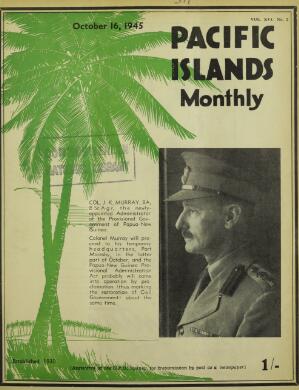
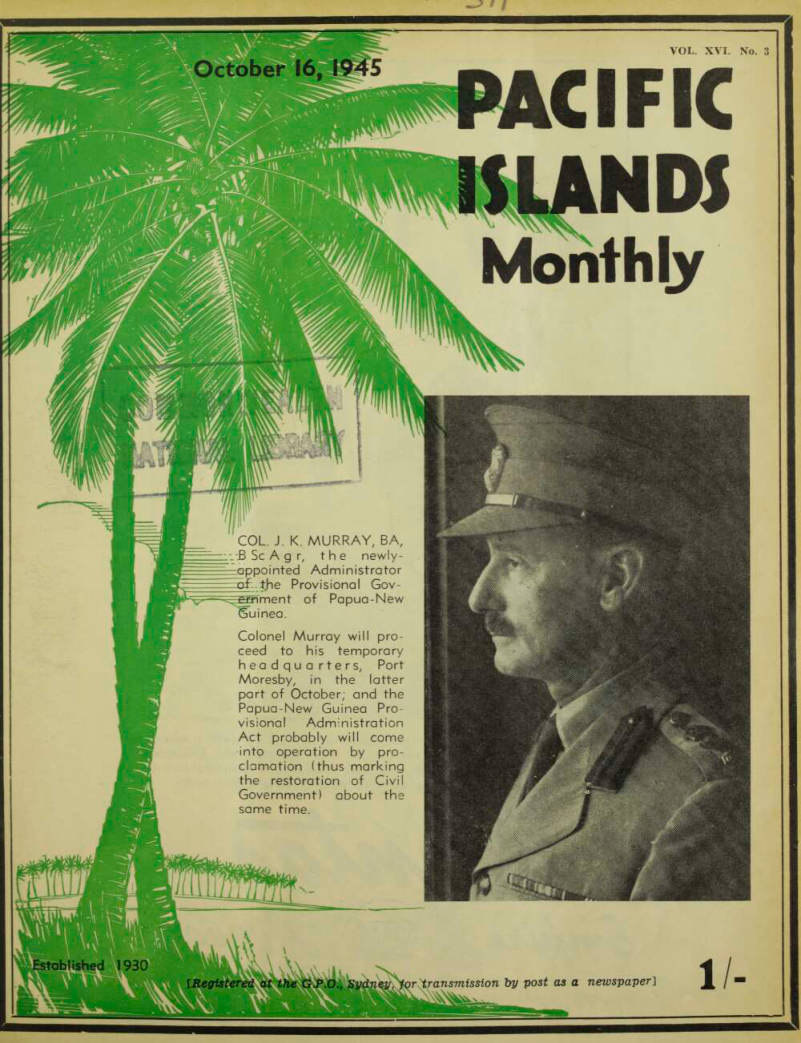
Col. J. K. Murray, Ba,
B Sc A g r, the newly appointed Administrator of the Provisional Gov enment of Papua-New Guinea.
Colonel Murray will pro ceed to his temporary head qua rters, Port Moresby, in the latter part of October; and the Papua-New Guinea Pro visional Administration Act probably will come into operation by pro clamation (thus marking the restoration of Civil Government) about the same time.
Advertisements & other items, p. 2 (1 item)
Guinea
BY Wfltffl?
Thrice weekly from Sydney, Qantos, operating D.C. 3 aircraft, provides a fast, modern civil airline service to New Guinea, via Brisbane, Rockhampton, Townsville, Cairns and Port Moresby. Accommodation it available for passengers holding permits, priority freight and mails.
Australia's INTERNATIONAL Airline
Pacific News-Review
Notes And Comment On
International Affairs
From Sep. 18 To Oct. 12
Sept. 18; Growing indications that USA proposes a “soft peace” for Japan are producing angry reactions in Britain and Australia, where almost ceaseless and con tinuing disclosures of “horror” prison camps are arousing a demand that Japan shall remain under punishment *for a couple of decades.
Sept. 18: Nationalisation of the British coal industry may be complete by mid -1946.
Sept, 19: Officially announced that Japanese, in 1943, murdered Nauru Ad ministrator (Colonel Chalmers) and two Government officials, and two Phosphate Co. officials, who voluntarily remained in Nauru in 1942.
Sept. 20: William Joyce (Lord Haw Haw) sentenced to death after London trial for treasonable activities in Ger many during war.
Sept. 20: Indications of split between American Government and General MacArthur, on question of whether Japanese people, in view of mounting evi dence of war crimes, are being treated too kindly.
Sept. 20: There are indications that Emperor Hirohito of Japan is contem plating abdication.
Sept. 22: Deadlock at conference of Big Five Foreign Ministers causes world-wide anxiety. Cleavage is between Russia (who insists that new Red-dominated Govern ments in Roumania, Bulgaria and Hun gary are “democratic” and free) and Britain and America (who say they are not). This is interpreted as the first clear sign of the coming world struggle between Democracy and Red Totalitarianism.
Russia is believed to be trying to make Communist all eastern and central eastern Europe, as well as all northern Asia.
Sept. 23: Widespread demonstrations for independence by natives in Nether lands Indies direct attention to a nationa list movement now sweeping though Indonesia and south-east Asia. India is organising strong independence pressure against the new British Labour Govern ment. There has been fighting in Indo- China between French and natives. Some sections of Burmese have demonstrated against British.
Sept. 26: Anxiety grows in Australia as widespread strikes tend to paralyse in dustry in NSW. The Labour Governments are accused of yielding weakly to anarchy. Communist influences are seen everywhere, fomenting disorder.
Sept. 27: Emperor Hirohito called on General MacArthur in Tokio the first time such a thing has happened in the 2,000 years’ history of the Jap dynasty.
Sept. 29: Revolts by natives continue against French in Indo-China and Dutch in Netherlands India. British troops are going into each Territory to restore order —although a British (Labour) Minister announces that the British will not fight in those countries for either Dutch or French.
Sept. 29: United States, in return for abolition of British Imperial preference, is prepared to lend Britain and Empire six billion dollars, without interest, and scale down her own tariffs.
Sept. 30: With object of tracing and recovering loot taken by Japs from Ter ritories they overran, the American com mand has seized 21 banks in Japan and impounded all their funds, subject to investigation.
Oct. 1: Head of an American Research Foundation claims that a simple defence against the atomic bomb has been dis covered, and placed in custody of USA Government.
Oct. 1: Hindu-Moslem riots continue in Bombay. Thirty have been killed and 152 injured.
Oct 2: Stalin is reported to be critical of western Allies’ “soft” policy towards Japan. He says that if anything is done to allow Germany and Japan to arise again as war-makers, as Germany was allowed to do after World War I, we all shall suffer from our incredible folly.
Oct. 2; More British troops are landing in Indo-China, where 20,000 rebels are said to be massing for an attack on the French.
Oct. 3: Britain’s worst post-war prob lem is rapidly developing in Palestine.
Britain is being pressed by many nations to admit much increased Jewish immi gration to Palestine; but all the Arab countries are exceedingly sensitive on the subject, and Arab Federation threatens reprisals if more Jews on a large scale are admitted to Palestine.
Oct. 3; There again is danger of the Council of Foreign Ministers, now meet ing in London, breaking up without agreement, owing to serious differences of view between the English-speaking nations and Russia.
Oct. 3: An agreement to cease hostili ties has been reached between the French in Indo-China and the Annamites, who are leading the rebellion. The position is deteriorating, however, in the Nether lands Indies, where Indonesians, led by the Japan-created Soekarno Government, are threatening to fight the Dutch Forces, which are on their way to occupy the country. Order is being maintained by small British Forces, who are using the surrendered Japanese for policing pur poses. The rebels have seized Bandoeng and Sourabaya.
Oct. 4: Supreme Commander MacArthur has ordered the Japanese Government forthwith to release all political prisoners from Japan’s gaols. They are believed to number many thousands.
Oct. 5: Despite last-minute efforts, the Big Three failed to agree, and the Foreign Ministers’ Conference has ended.
A gloomy view of future international relations is being taken. The fundamental cause of disagreement is Russia’s deter mination to maintain her own set-up in the Middle European and Balkan (or Border-line) States, without interference, and the Western Allies’ contention that those Governments are neither free nor democratic.
Oct. 6: The Bunnerong power-house dispute in Sydney is unsettled. Both sides remain firm. There now is danger that, from this, there mav develop a nation-wide general strike. Already, Aus tralia is suffering from innumerable small and disconnected strikes.
Oct. 8: Japs and Indonesians are fight ing in several places in Java, and the position is getting worse. The Indone sian rebels are steadily extending their hold.
Oct. 9: First Jap war criminal trial has commenced at Manila, where General Yamashita (the “Tiger of Malaya”) is facing a series of charges.
Oct. 9: Jap Cabinet, which resented the freeing of political prisoners and resigned, has been replaced by another, in which a very old pacifist is Premier.
Oct. 10: Sydney industrial position now critical. The strikers’ representatives have ordered all Unions concerned to withhold coal from Bunnerong power house. Nation-wide strike now seems ■ Oct. 11: Pierre Laval, notorious anti ■’British head of the Vichy Government,
has been sentenced to death by a French Court as a war criminal.
Oct. 11: Disturbances throughout Java are getting worse. Indonesians are mur dering Dutchmen, and have done much damage.
Oct. 12: One of the worst typhoons in history has completely destroyed great American base on Okinawa, near Japan.
Twelve ships are sunk. The damage is estimated at £2,500,000.
Aif Graves In Ne Papua
A RECENT visitor says the large Aus tralian burying-ground at Supota (inland from Buna and Oro Bay, on the north-east coast of Papua) has been maintained in good order, and is in the care of a small Australian de tachment, with native helpers. Some hundreds of Australians, who were killed in the bitter fighting around .Kokoda, Sanananda, Buna and Gona, at the end of 1942, are buried here.
Many Americans who were killed in the same battles were originally buried in the same locality; but, about six months ago, all American caskets were disinterred and removed to the large American cemetery at Finschhaven,
Advertisements & other items, p. 3 (1 item)
Pacific Islands
NOW AVAILABLE
Year Book
FIFTH EDITION
rIS has become the recognised standard work of reference on the Pacific Territories and Islands; and it is now printed in Sydney, N.S.W., and in New York.
The sth Edition, 384 pages, been arranged in Six Sections —General and Introductory; Eastern Pacific (Polynesia) ; Central Pacific (Micronesia); Western Pacific (Melanesia); Far Western Pacific (Indonesia); and Non-Tropical Islands.
Every Territory and all the Principal Islands are described in detail—history, geography, natives, administration, industries, trade, etc. There are more than 50 maps.
Price: 15/- per copy, plus 6d. postage.
Copies may be obtained at the majority of Booksellers, and Island Stores, or direct from:
Pacific Publications Pty., Ltd.,
Union House, 247 George St.,
Sydney.
Pacific Publications (Fiji), Ltd.,
P.O. Box 281, Suva, Fiji.
The book, named “Pacific Islands Handbook,” is published by The MacMillan Company, New York, for distribution in North and South America, and Hawaii.
Advertisers
Adams, C. A. . . .36 Adams, Clayton & Co 16 Aladdin Industries Pty., Ltd 37 Angliss & Co. . 25 Atkins Pty., Ltd., Wm 47 Australian Alumi nium Company Pty., Ltd 44 AWA. Ltd 29 Brial & Ball, 17, 53, 57 Bond Bros. & Co., Inc 56 Broomfield. Ltd. . . 33 Brown & Co., Ltd. 11 •Brunton's Flour . . 30 Burns, Philp Trust Co., Ltd 13 BP (SS» Co. . . . 11 Bhindi, P. K. . . . 34 Baker, W. J. . . .61 Carlton & United Breweries, Ltd. . 35 Carpenter, Ltd., W.
R cov. iv.
Chivers & Sons, Ltd 41 Church, R. H., & Sons 54 Coleman Lamp & Stove Co 54 “Cystex” 33 Darvas & Co. ... 17 David Trading Co. 39 Deane, N. S., & Co 46 Donaghy & Sons . 58 Donald, Ltd., A. B. 48 Dr. Williams Pink Pills 27 Electrolux Refrigerators .• . .20 Foster Clark, Ltd. . 28 Flit 42 Ford Sherington Pty., Ltd 38 Garrett & Davidson 46
Gibson & Co., Ltd.,
J. A. D 40
Gillespie Pty., Ltd., Robert 23 Gilbey’s Gin ... 12 Gillespie’s Flour . . 50 Gough & Co., E. J. 53 Grand Pacific Hotel 2 Grove & Sons, W.
H.. 62 Heinz & Cof» Pty., Ltd., M. J. . . .31 Jenkins, Reg. ... 19 Kalyan & Co., G. . 38 Kopsen Co., Ltd. 18 Miscellaneous . . .61 Manning 59 “Mendaco” . . . .43 Mcllraths Pty., Ltd. 56 Nagy. W. & M. . .50 Nelson & Robertson Pty., Ltd 52 ... 58 Noyes Bros. ... 61 Pacific Planters’
Handbook ... 32 Pacific Publications Pty.. Ltd 1 Pacific Islands Monthly . . . .15 Pacific Isi Society . 31 “Pinkettes” ... 60 Qantas Empire Air- * ways ... cov. ii.
Queensland Insur ance Co 34 Raniga, V. M. . . 59 Raymond, Lance, Pty., Ltd 49 Robinson, G. H. . . 24 Rose’s Eye Lotion . 23 Rohu, Sil 40
Rur 44
Scott, Ltd., J. . . 60 Southern Pacific Insurance Co. . . 12 Sharda Souvenir Store 15 Steamships Trading Co., Ltd 39
Stromberg-Carlson 51 South Pacific Sou venirs 41 Sullivan & Co., C. . 45 Swallow & Ariell . 63 Taylor & Co., A. . 27 “Tenax” Soap . . 26 Tillock & Co., Ltd. 22 Thornycroft (Aust.) Pty., Ltd. ... 21 Wesley College . . 30
Wright & Co. ... 15 Widdop, H., & Co., Ltd 57 Wills, W. D. & H. O. 14 Wright & Co., Ltd., E 26 Wunderlich, Ltd. . 19 Young Pty., Ltd., Harry J., cov. ill., 55 Yorkshire Insurance Co., Ltd 11
A fire, which completely destroyed the Girls’ Hostel at Labasa, Fiji, occurred on August 5 while the staff and boarders were at church. The vicar of Labasa gave up his vicarage so that staff and pupils could have temporary housing.
Contents
Three Hundred Rabaul Civilians Were Murdered—Demand for an Inquiry 3 Fiji’s Governor to Visit Australia .. 4 Month’s Developments in New Guinea 4 List of 30 Persons Rescued from §T.
Guinea’s Lost Civilians 5 New Administrator for Western Samoa 6 How Nauru’s Officials Were Murdered by Japs 6 Tribute to Mr. Harold Page and His Soldier Son 7 “Expro” Properties—Has Government Any Policy? 7 Ocean Island is Reoccupied 7 Heroes of the Territories of Awards for Soldiers and Civilians 8 Fiji’s New Chief Justice Welcomed in Picturesque Ceremony 8 New Guinea’s Lost Civilians—Per sonal and Economic Disaster ... 9 List of 300 of New Guinea’s Lost Civilians 9,49 New N. Guinea—A Personal Impres sion 10
Tropicalities 10
Terms on Which Traders Now May Enter Australian Territories .. .. 12 Great New Base on Santo .13 Among Rabaul’s Missing; H. G. Doyle 13 Papuan Planters Appeal to British Prime Minister 15
Captain Bertie Hall, Ex-POW .. .. 16 Another Indian Newspaper in Fiji .. 17 King of Cocos Is.—Youth Reported at London University 18 Fijian Banana Industry—Recent De cline Can Be Halted 21 Civil Servants of Fiji (Photo) .. .. 22 New Guinea’s Timber —What is Aus tralia Doing? 23 Phosphate Industry—Restoration .. 25 Where Fin-ance Kills Rom-ance .. 26 Samoa’s Shortage of Plantation Labour 27 New Road to Wau 27 How War Came to Central N. Guinea 28 New Schooner for Rarotonga 40 Roll of Honour—Territories Men, Wounded, Decorated 41 MV “Bulolo’s” War Record 44 Black Wasps from Zanzibar to Save Samoa Coconuts 46 Frank Comments on “Provisional”
Government .. 47 New Management, GPH, Suva ... 48 Last De Rays Survivor Dies 48 Full List of New Guinea Civilians— Missing, Feared to be Dead ... 49 Suva Cricket Club 56 Australian Territories’ Evacuees Appeal to Governor-General ... 56 War Damage Commission Allows Ex gratia Subsidies 58 Horrors in Wrecked Rabaul How Australians Are Restoring Order . 59
Advertisements & other items, p. 4 (1 item)
m
W so*
taV
s
Pacific Islands Monthly
The Newspaper-Magazine of the South Seas [Registered at the G.P.0., Sydney, for transmission by post as a .]
Published Once Each Month and Circulated in Australia and New Zealand and in the following Pacific Territories and Islands Groups:
Australlan Territory of Papua.
Mandated Territory (Australia) of New Guinea Australian Territory of Norfolk Island.
New Zealand Territory of Cook Islands.
Mandated Territory (NZ) of Western Samoa.
British Colony of FIJI.
British Solomon Islands Protectorate.
British Protectorate of Tongan Islands.
British Crown Colony of Gilbert and Ellice jsjands Mandated Territory of Nauru.
British and Free French Condominium of New Hebrides.
Free French Colony of New Caledonia.
Free French Colony of Oceania (Tahiti, etc.).
American Territory of Eastern Samoa, Territory of Hawaiian Islands.
Owned and Produced by Pacific Publications Pty. Ltd., Union House, 247 George Street, Sydney.
„ p ( Managing Director .. BW 5037 TELEPHONE £ Business and Editorial MA 4369
P.O. Box 3408 R
Registered Address of Telegrams, -Radiograms, and Cables: “Pacpub”, Sydney.
Contributions.
Articles, Stories, and Photographs dealing with Pacific Islands subjects are invited and will be paid for on publication.
Subscription Rates.
Per Annum, within British Empire, Prepaid Post Free 10/- Per Annum, elsewhere, Prepaid, Post Free 12/6 Single Copies 1/-
Editor and Publisher:
R. W Robson, P.R.G.S.
t Advertising Manager: W. E. Rogers. Tel. B 7815.
Advertising Office and Printing-House: 29 Alberta Street, Sydney, Advertising rates furnished on application.
Representative In Fiji.
Pacific Publications (Fiji), Ltd., Bank of NSW Building, Suva (same office as W. H. Grove & Sons, Ltd.). Stocks of Pacific Islands Monthly and Pacific Islands Yearbook hand.
Representative In London.
J. T. Wallis, Coronation House, 4 Lloyds Avenue, London, E.C.3, from whom may be obtained copies of Pacific Islands Monthly, Pacific Is. Year Book, advertising schedules, etc.
, Agents.
The following are authorised to receive sub scriptions for Pacific Islands Monthly;— Burns, Philp & Co., Ltd., and Burns Phllp (South Sea) Co., Ltd. All branches.
W. R. Carpenter & Co., Ltd. All branches.
Morris, Hedstrom, Ltd. All branches.
Steamships Trading Co., Papua. All branches.
Whitten Bros., Ltd., Samaral, Papua. ' B.N.G. Trading Co., Ltd., Port Moresby, Papua.
J. Muir, Suva. Fiji.
Miss R. Castles, Suva, Fiji.
N. C. Mackenzie Hunt, Walnunu, Bua, FIJI.
Cook Islands Trading Co., Rarotonga, Cook la.
A. C. Rowland, Papeete, Tahiti.
Islands Branches and Representatives of W. H.
Grove & Sons, Ltd., Auckland, New Zealand.
Ed. Pentecost, Noumea, New Caledonia.
Societe Gubbay Kerr et Cie, Noumea, N. Caledonia.
Vol. XVI. No. S.
October 16, 1945
P r \ra i l/ Per Copy rriCc Prepaid: 10/- p.a.
at Rabaul
300 Civilians Were Murdered at Rabaul
Demand For
AN
Inquiry
AT least 300 Australian civilians lost their lives in June, 1942, when the vessel on which they were being taken, as prisoners, from Rabaul to Japan, was sunk off the Philip pines.
Those men should not have been prisoners of the Japanese. They could and should have been evacuated from Rabaul, on the ships which were available in Rabaul Harbour, within the 40 hours between the time when it was known the Japs were coming, and the hour (early morning of January 23, 1942) when the Japs arrived.
Why were they not evacuated?
THE Japs came in great strength.
One Australian battalion, and three or four-score members of the New Guinea Volunteer Rifles, offered a very courageous, but utterly useless resistance. The majority of soldiers and civilians fled westwards into the jungle. The Japs seized the port and destroyed the ships, including one large Scandinavian vessel which could have carried the whole gar rison to safety.
The Japs rounded up most of those soldiers and civilians and put them into prison camps. Their fate is told in the article on page ??
ON at least two occasions since 1942, we have asked that there be an •inquiry into the circumstances sur rounding the seizure of those civilians
at Rabaul by the Japs. Why were they left there, and not brought away by the available ships? The Commonwealth Government officials, with whom lies the responsibility for this tragedy, hlave ignored all re quests for an inquiry. It is said that one Australian Minister remarked with a sneer: “Oh, this is only a journalist hunting for a sensation!”
Now, on behalf of the widows and children of the hundreds of Austra lian men who were needlessly sacri ficed in Rabaul, we say to the Aus tralian Government and its officials: “Unless you can show, by formal in quiry, that failure to evacuate the Rabaul civilians is the fault of par ticular persons, you must accept responsibility for the murder of these men.”
WE have a clear recollection of the circumstances. An examination of the files of Australian newspapers between January 18 and January 25, 1942, will show that the approach of the Japanese invasion fleet from the north was indicated. The news which was passed by the censors for publication was disconnected, but it all pointed in the one direction.
Service and Government messages must have given, to those responsible, a clear and connected picture of what was coming. If they did not, then there was incredible inefficiency in Australia’s defensive organisation.
If there was a clear picture of events, then Australia’s military and adminis trative officials must explain why they did not instruct those Rabaul civilians to get aboard those ships in Rabaul Harbour, and leave as quickly as possible.
Or did the military genius that presided over the New Guinea district imagine that one AIF battalion, six 6-inch guns, five Wirraway planes, and 72 members of the NG Volunteer Rifles could drive off the Jap expedi tion, reported on January 21 or 22 to be approaching Watom Island in a convoy of at least 40 ships? If that military genius did take that view point, then he should be made to pay the penalty of his blundering. He then should be held responsible for the deaths of hundreds of Australian civilians.
SOME reports lay the blame on the military commandant at Port Moresby. Others just as confidently lay the fault at the door of a high official in Canberra who (it is said) ordered both civilians and ships to remain in Rabaul, when the Acting- Administrator, Mr, Harold Page (how dead), urgently asked for instruc tions.
But this is all guesswork. We can not know for a certainty where the blame lies until this official con spiracy of silence is broken down, and all the records are laid open to inspection by a properly authorised Commissioner. Officialdom has shown very clearly that it does not want an inquiry. If an inquiry is ordered, -officialdom probably will go to some
lengths to dodge responsibility, and to smear on the whitewash.
Mr. Ward was not Minister for the Territories when Rabaul was invaded, so his refusal, up to date, to order an inquiry, suggests that he is trying to protect either a Ministerial friend or certain high officials. . . ..
MR. WARD did not show the same reluctance in ordering an inquiry when he was trying to gain u political advantage. Mr. Ward, a couple of years ago, apparently was anxious to get rid of Mr. Leonard Murray, Civil Administrator of Papua* Mr. Murray had been unceremoniously thrust out of the Territory by the military panjandrums; his salary had been as unceremoniously chopped off by Mr. Ward’s Department, so that Mr. Murray presently was compelled to go and get a job from the United States Army; Mr. Murray was ignored, for a couple of years, by Mr. Ward, in all matters relating to the Territories. In other words, Mr. Murray was invited to resign, and take himself out of the Territorial picture.
But the annoying Mr. Murray clung to his Commission as Administrator of Papua—not because of monetary considerations (he can go on to an advantageous pension at any time) but because he was anxious to help the native peoples of Papua, to whom he had given a lifetime of So Mr. Ward gaig to a Melbourne KC, Mr. Barry, a Royal Commission to investigate all the circumstances surrounding the seizure by the rnilitary commandant of administrative authority from Mr. Murray, at Port Moresby, in February, 1942. There had been no public outcry about this incident—in fact, the announcement of the inquiry came as a complete surprise to all Terntonans—and, probably, to Mr. Murray. No one wanted the inquiry except Mr. Ward and the Brass-hats.
However, public money and a great deal of the time of public officials was expended on the inquiry; and Mr. Murray was obliged to defend
himself against a variety of charges brought against him by the Brass hats. The Commissioner exonerated Mr. Murray from most of the charges; but—and apparently against the weight of evidence—he found the Administrator was guilty of being un co-operative, and of ignoring the welfare of the natives in some re— spects. This, of course, was exactly what Mr. Ward wanted; and, in con sequence, Mr. Ward was able to go confidently ahead, get rid of the Papuan Civil Administration (and Mr. Murray’s commission) by creat ing a Provisional Government, and ignore Mr. Murray’s obvious claims to the new Administratorship (although Mr. Murray’s appointment had been eagerly sought by the great majority 0 f the civilians of both Territories).
Now, if Mr. Ward, without any apparent cause, could arrange for a Royal Commission of Inquiry into alleged official confusion in Port Moresby in February, 1942, where there was no Jap invasion and no loss of civilian life, why should he not order an inquiry into what hap pened in 'Rabaul in January, 1942, where there appears to have been the most damnable official bungling, re suiting in hundreds of civilians losing their lives? ti/|R, WARD, however, will do noth 1ng ._ hi « twn vp ™» rprnrfi as Territories Minister suggests that he h a t es the thousands of sturdy in dividualists who comprise the Terri tories European population (evacu ated, and likely to remain so); and that he will do almost anything to embarrass- them. The Australian Ministers will do nothing, unless literally forced—that is their policy, And n 0 can be expected from the disciplined and spiritless ranks of Labour.
But there still is, in Australia, a f ree p Ub iic opinion and a fairly free press; and it is in that direction that Territorians should direct their ap peal for an inquiry into the bungling which cost the lives of 300 New Guinea civilians.
Fiji's Governor
To Visit Australia Soon
Suva, Oct. 3.
riTHE Governor of Fiji, Sir Alexander JL Grantham, accompanied by Lady Grantham, left Suva to visit the Solomon Islands on September 30. They travelled by plane and will be away from Fiji for about a week.
On October 15 they will leave Fiji again for Australia. Their visit will be semi-official, but Sir Alexander hopes also to meet people who are interested in the Pacific, and its problems and future development.
The Australian visit is expected to last a fortnight. Calls will be made at Can berra, Sydney and Melbourne.
Mr. P. G. Roberts has been appointed to act as Secretary to the Gilbert and Ellice Islands Government, as from July, 1945. Mr. Cartwright, who still is nomin ally Secretary, was one of those who
volunteered to remain on Ocean Island when the Japs invaded in 1942. The island has been reoccupied, but the five Europeans who remained there have not been found.
Mr. Tom Ellis, a member of the original staff of the Lands Department in New Guinea, died in Sydney early in October, after a long illness. He leaves a widow and one son. He was a well-known Free mason, and was the founder and second Master of Lodge Rabaul.
Colossal Wartime
Expenditure
AUSTRALIAN Allied Works Council projects in New Guinea cost £807,296, between March. 1942, and July, 1945, according to a statement in New Guinea expenditure was only a fraction of that incurred in the Com monwealth—NSW, £49,604,342; Victoria, £24,009,365; Queensland, £43,206,661; SA, £5,773,709; WA, £8,284,985; Tasmania, £179,003: Northern Territory, £14,533,085; Australian Capital Territory, £1,447,559.
Months Developments in
New Guinea Industrial Chaos in Papua-Rabaul Civilians' Heavy Deathroll
THERE have been_ various important developments, during the month, 'affecting the future of the Terri tories of Papua and New Guinea.
They are reported at length in dif ferent parts of this journal. The follow ing is a The new Administrator of Provisional Government, Colonel J. K. Murray, is expected to proceed to the Territories this month. See article, “Personal Impres sion of Territories Administrator,” page 10.
Papua, and all New Guinea southwards of the Markham, will be placed under the Provisional Administration in October; and the terms under which private enter prise may re-enter the Territories are announced. Mr. Ward retains complete economic control. See article “Terms Upon Which Traders May Return,” page 12.
The administrative centre, for the pre sent, will be Port Moresby. Page 63.
An official announcement, to indicate when civilians may return to the Terri tories, and especially to plantations and mines, still is awaited. It is supposed that some statement for the guidance of the many hundreds of Territories resi dents marooned in Australia, may be made before the end of October by the new Administrator.
All labour contracts between Europeans and natives in the Territories have sud denly been cancelled, and a revolutionary new system introduced. Plantations are in danger of ruin, and conditions are chaotic. Papuan planters and commer cial interests have cabled to the British Prime Minister, in London, an appeal for protection against the Australian Gov ernment. See article “Papuan Planters Appeal to Great Britain,” page 15.
Residents of Papua and New Guinea, after appealing in vain to the Australian Government, over two years, for advice and assistance, decided at a large meet ing in Sydney to petition the Governor- General of Australia for help. They want permission to return to their homes.
See article “Evacuees Appeal to the Governor-General,” page 56.
There is now little doubt that the great majority of civilians taken prisoner by the Japs in Rabaul were drowned on a torpedoed ship off the Philippines in June, 1942. See article and list of names, nage 9 49.
A demand is made that there should be an official inquiry into the failure of the Australian Government to order the evacuation of civilians from Rabaul, in January, 1942, when it was known that the Japs were coming. That failure is directly responsible for the loss of hun dreds of valuable lives. See article on Australian forces have occupied the Gazelle Peninsula end of New Britain, and New Ireland. They have placed the Jans in prison camps, and are cleaning up the town of Rabaul, which was prac- . tically obliterated by Allied bombings.
There is very little information from these" districts. See article on page 59.
Mr. G. E. Watson, a well-known mem ber of the Pacific Islands Society, died recently in Sydney, aged 86 He took a keen interest in Pacific affairs. He had been a jute merchant, in India, for 35 years, and he served in World War I.
His son, Dennis, is a distinguished officei of the Indian Police, and recently was decorated with the Order of the CIE.
Advertisements & other items, p. 6 (1 item)
4
OCTOBER, 1945 PACIFIC ISLANDS MONTH Li
Rescued
Names of Persons Rescued
rE following people, whose names were included in the lists of New Guinea’s “Missing” civilians pub lished in this journal in September, now have been accounted for: Found in Japanese POW Camps in Far East and Now Either Safe in Australia, or Being Repatriated Archer, J. C. Beale, D. L., Bignell, Mrs. K. Nurse.
Bowman, A., Nurse. Christopher, J., Goss, Mrs. M. E. Nurse.
Hay, D., Nurse. Green, M. F., Kruger, G. D., Nurse.
Nurse. Kilner, C. G.
McLellan, J. M., McGahan, J., Nurse. Nurse.
Oldroyd-Harris, Maye, D„ Nurse.
Matron. Wilson, D. E., Watch, Dr. N. B. Nurse.
Found in Jap POW Camp in Rabaul, and Brought to Australia Bischoff, H. R. Creswick, A. D.
Ellis, J. H.
McKechnie, G. Thomas, Gordon.
Reported Found in Rabaul, and Being Cared for There Barrow, Rev. W. Tille, E., and wife.
Coenders, Columba, Sister M.
Rev. Mother. Editha, Sister.
Felicitas, Sister. Flavia, Sister.
Hermann, R. Marcella, Sister.
Thus, out of about 350 listed last month as missing, only 30 have been found or traced.
Civilians' Dependants
May be Provided For
Canberra, Oct. 5.
DEPENDANTS of civilians who were lost, with military prisoners-of-war, when the Japanese overran New Guinea and Papua, may be provided for by the Australian Government.
Replying in the House of Representa tives to Mr. Hughes, the Minister for External Territories said that the Gov ernment was considering the matter, and he hoped to make an early announce ment.
Australian Territories
War Material in Australian Territories
MILLIONS of pounds worth of sur plus Australian war material in the Islands where Australian Forces have been operating will be disposed of through five channels: • Sold to local authorities for rehabili tation purposes. • Disposed of to missionaries, traders, and companies, etc. • Returned to the mainland for sale through normal trade channels or by public tender and auction. • Broken up and only valuable parts salvaged and brought back to Australia. • “Written off” on the spot.
A nartv of Australian experts is about to visit the Territories to determine what stores are available.
One of the problems to be solved is the disposal of captured Japanese goods.
It is proposed to visit Lae, Finschhafen, Rabaul, Bougainville, Goodenough, Milne Bav. Port Moresby, Morotai, and plaoes farther north.
From ROW Camps
Territories Men Recovered From ROW Camps
Official List PREVIOUSLY reported missing, now reported to be recovered: NGX3IO, Capt. Murphy, J. J.; HQ Unit; Toowong, Brisbane.
NGX33, WOII Gordon, V. M. I.; infan try; Wau, New Guinea.
NGXIS7, WOI Gray, A. N.; Ordnance; North Sydney.
PX23, Gnr. Newton, J. G.; artillery; Kaki, Papua.
NGX77, Pte. Allan, J. H.; artillery; Wau, New Guinea.
PX24, Gnr. Bingemann, G. E.; artillery: Auchenflower, Qld.
PX22. Gnr. Spence, D. M.; artillery; Port Moresby.
PX2O, Gnr. Foley, A. I.; artillery; Port Moresby.
NGXI44 Pte. Bailey, P. F.; infantry: Merriwa, NSW.
NGX77, Gnr. Allan, J. H.; artillery; Wau, New Guinea.
NG4029, Lieut. Archer, J. C.; infantry; New Guinea.
NG4054, Major Watch, N. B.; infantry: New Guinea.
NG3OOO, Lieut. Kilner, C. G.; infantry; Rabaul, New Guinea.
Death Of Mr Les Joubert,
Tng Pioneer
fTIHE death occurred in Sydney, on Sep- JL tember 23, of Mr. Les Joubert, one of the best-known and highly esteemed of the Morobe goldfield pioneers.
He was 63 years old. Death followed an operation for appendicitis.
Mr. Joubert was in Papua before World War I. He enlisted and fought in the AIF. and had a good record. He returned to the Pacific Territories, and at -one period was a plantation manager for the Expropriation Board at Madang. But he was among the first men at Koranga Creek, after the discovery of gold in the ’twenties, and for some years he was asso ciated with the well-known pioneers— Levien, Pryke and George Arnold. Arnold and Joubert were partners on the gold field, and they remained close friends right up until Arnold’s death In Sydney, just before World War 11. Joubert was well-to-do —he made his money in the original Koranga Company.
Mr. Joubert was a member of an old Sydney family. “Joubert’s Perry,” which ran through to Figtree, is still remem bered by old Sydneyites.
Happy Accident, Or—?
LAST year, when the Rev. John Bodger, well-known Papuan missionary, was in Europe and the United States, he received considerable attention from the newspapers. Not only were the South west Pacific Islands then in the news — but Mr. Bodger is a fluent and effective writer, and many of his articles were prominently published.
An interview with him was published in “Los Angeles Examiner,” of Septem ber 7, 1944 (note the date!). In that, he said: “If American workers keep on the job, if the American public remains behind the drive to victory, the fighting in the Pacific will be ended a year from to-day.”
The fighting ended officially on Sep tember 3, 1945.
There is no truth in a report that a deputation of leaders from United States, Australia, etc., is proceeding to Dogura to ask Mr. Bodger when we are likely to have industrial peace.
No Fishermen In
Fiji
—And No Fish
IT might be expected that the fishing ' industry in Fiji would be largely in the hands of the Fijians themselves, who before the advent of the white man with his convenient can, were partly de pendent on fish for daily existence. They still have the aptitude and the knowledge of fishing-grounds, but they apparently have no incentive to go in for fishing commercially.
Since the few Japanese who supplied the bulk of the fish to Vitu Levu were interned at the beginning of the Pacific war, this island, and particularly Suva, has been short of fish and presumably this state of affairs will continue until someone with a degree of enterprise sees the possibilities of the industry.
Fish is plentiful, of good eating quality, and easily caught. At present, what little native fishing there is, is done in the broad coastal lagoons formed by the fringing reeT But these days the Fijian, by and large, prefers to take his fish from a can, and certainly he has no in clination to fish for monetary gain—not, at least, while he is still floating merrily along on the backwash of the dollar prosperity period.
WELL-WISHERS of the Fijian people have agitated themselves consider ably of late over the question of their post-war rehabilitation, knowing that their communal village life has suf fered considerably during the war years.
It is felt that it would be desirable to establish Fijians in industries naturally suited to them.
Scientifically, the Fijian is classed as a Melanesian; but in comparison with the Melanesian of the South-West Pacific he is an emancipated creature indeed. In Fiji he is not treated like an irresponsible child, as are the natives of New Guinea and the Solomons, but as a free British citizen; education is available to him and, theoretically, is compulsory; he may be granted a licence to drink liquor (and judging by the crowds around Suva’s hotels, he often is so blessed); and he may choose his own way of life to an extent unknown to the Islanders of Melanesia proper.
All this being so, the Fijian should also be advanced sufficiently to see the writ ing on the wall with regard to his own country, and realise that the time has come for him to do something to retain it as his own. At the moment the Fijian seems more than willing to rest on his war-won laurels and take an interest in little besides Rugby football.
If the Fijian can be urged to take up an industry, then it seems logical that fishing would have a high priority. A local demand is already there and, with the right backing and organisation, there might be scope for a cannery or a factory for smoking fish.
The position at present is that much of the “Islands fish” enthusiastically con sumed in Suva’s hotels is imported from New Zealand, while fish swarm in thou sands inside the reefs of Viti Levu and the sea outside remains totally unex ploited.
NEW administrator
For Western Samoa
Lieut. -colonel f. w. voelcker, DSO, MC, of Kferikeri. New Zealand, has been appointed Administrator ot Western Samoa, in succession to Mr. A. C.
Turnbull, who has been visiting New Zealand, intimated to the Govern ment that he wished to retire on super annuation in February, 1946.
MR TURNBULL has given a lifetime of devoted and sound service to th New Zealand Administration. For several years after his transfer to Samoa, he was Secretary of the Administration, and Deputy Administrator. When Sir Her bert Hart retired from the chief position in 1935, Mr. Turnbull became Acting Ad ministrator. Samoa had had 15 years of political trouble and unrest, and the new Governor found no bed of roses. But he understood and liked the Samoans; he is a kindly, humane man, with a good personality and plenty of tact; and from the time he took charge of the Govern ment, the Samoans became less and less troublesome until, to-day, the Terri tory is quiet and peaceful.
Because of typical stupidity m Govern mental high places in New .Zealand, this valuable officer was not raised from the status of Acting Administrator until 1943, when he was given the full appointment.
In fact, he has been Administrator fro? 1 1935 to 1945; and in point of actual per formance, he has been, far and away, the most successful British Administrator Samoa has known. No other Adminis trator reigned more than five years and —with the possible exception of c °] on , Tate, 1920-23 —none brought peace to th Mr ° U and y Mrs. Turnbull are held in high esteem by all three communities in Samoa European, Euronesian and Samoan and their departure, nearly two decades of residence, will be regretted by all.
New Administrator Well-known in
Fiji
Lieutenant-Colonel F. W. Voelcker, DSO MC, of Keri Keri, Bay of Islands.
NZ was born in London almost 49 years ago. He served in World War I, in which he was wounded and taken prisoner m 1915 Despite three escapes, he was held prisoner for 3i years. Later, he served in Aden and India until coming to New Z0 In a World War 11, he went to Fiji in 1940 and in December, 1942, was ap pointed to command the 3rd .Battalion, Fiii Infantry Regiment, which he took to Bougainville in March of last year.
One of his men was Corporal Sukanai valu, the first member of the Colonial Forces in the recent war to win the VC.
Colonel Voelcker, who returned to New Zealand last month, was awarded the DSO and the American Bronze Star.
The NZ Prime Minister said very fav ourable reports had been received about Colonel Voelcker’s ability and] under standing in dealing with all the prob lems of the Fijians under his command.
That experience and understanding would be of considerable value in the dis charge of his important duties in Samoa. He would proceed to Samoa in March, 1946.
Miss V. B. Dixon, Miss K. A. Smythe, and Miss J. A. Guthrie arrived in Suva in September to take up duties on the nursing staff of the War Memorial Hos
pital.
Nauru Officials Murdered
By Japs
Tragic Story of Events from 1942 to 1945
AS soon as the Japanese garrison on Nauru surrendered, on September 13, to a force of 250 Australians who arrived on two small vessels guarded by HMAS “Diamantina,” a search was com menced for the peonle who had been left on Nauru in 1942—seven Europeans, about 1,200 Nauru natives, and some hundreds of Chinese. The Chinese, and a few natives, were found —all others were missing. . ..
It was announced in the Australian Parliament on September 19 that, on March 26, 1943, the Japanese murdered the following Europeans, who had volun tarily remained on the island, in 1942, to care for the natives;—
Lieut.-Colonel F. R. Chalmers,
Administrator. A , DR. B. H. QUIN, Government Medical Officer. , . . , , MR W H. SHUGG, Medical Assistant.
MR F. HARMER (Engineer), and MR.
W H DOYLE (Overseer), of the British Phosphate Commission’s staff.
Two Roman Catholic missionaries,
Father Kayser and Father Clivaz, who also remained on the island, were tyans ferred by the Japanese in 1943 to the Caroline Islands, together with 1.200 Nauruans, including the head-chief an the maiority of Nauruan women. the general 3 health of the remaining natives and the Chinese was found to be better than expected, and few were actually sick, although subsistence had been re- SW lf e appe o ar P e U d m ?ha n t 'the Japanese had made extensive plans for against what they imagined would be a frontal assault. Enormous labour.had been expended in getting big guns ashore, dragging them up to high places on the island among the coralpmnacles, and bedding them in cement among most elaborate fortifications. The island was by-passed by the Allied Forces, towever. the Jap garrison was cut off from an communications with Japan; and th Japanese were close to starvation when they surrendered. 11 THEN the surrendered Jap officers were ff questioned, they declared that the Europeans were killed by Allied bombs when the American Air Force made its first raid upon Nauru about on March 26, 1943. But it was soon estab lished that the Japs had declared that, if Nauru was attacked by our aircraft, the Europeans in their hands would be
executed. That is precisely what hap pened.
Here is the story as told to our officials by Harry, a Nauru police boy: “About 5 a.m. (in the morning follow ing the air raid) just as dawn was com ing, the Japanese officers gathered the white men in a room, and told them they were to die by beheading.
“I peered through the door, though they never knew I was there.
“They killed Dr. Quin first. Just before they led him forward he put a rosary around his neck and I supposed he was praying. Then came the sweep of the sword.
“I was overcome with horror and panicked at the thought of what they would do if they knew I was a witness of their crime.
“I ran away. From a distance I saw them loading the bodies into a truck.
The white feet protruded from the cover ing tarpaulin.
“The bodies were buried—l don’t know where. , “The Japanese took care to hide all evidence of their crime. They burned the white men’s distinguishing shoes, and socks and clothing.”
Who gave the order for the execution is not vet known, but Harry named Lieut.- Comm'ander Nakvama, a thin, cold-faced marine staff officer, as having been pre sent at the butchery. Nakyama is now a prisoner.
MAJOR CAMERON, a South Australian MP, paid a high tribute in the Aus tralian Parliament to the character and courage of Lieut.-Colonel Chalmers, under whom he served in World War I.
He demanded that Australia “should peel off her kid gloves,” and see that this horrible crime was properly punished.
Territories Minister Ward said that all possible information was being gathered, with a view to punishing those respon sible for the murder. There were legal difficulties, because Nauru was a man date, held jointly by Britain, Australia and New Zealand.
Lieut.-Colonel Chalmers became Ad ministrator of Nauru in 1938. He took a keen interest in the work, and was held in highest esteem on the island. After the phosphate works were bombarded by the German raider in December, 1940, Lieut.-Colonel Chalmers sent his wife and daughters back to his home in Tas mania; and, a year later, when it was considered necessary to withdraw our front against the Japanese to a line just north of Australia, and European per sonnel were sent away from Nauru and Ocean Island, the Administrator refused to leave the natives. Two other officials, Dr Quin and Mr. Shugg, similarly ani mated by a high sense of duty, decided to remain. Mrs. Chalmers did not survive this parting—she died at the end of 1942.
MR M. RIDGEWAY, who was account tant and collector of customs in the Administration when the Japanese war started, and who left the island early in 1942 with the majority of Eurooeans. returned with the aus tralian force to take over as Acting Ad ministrator, and he is now in charge of civil affairs there.
The Administration (Austrahamcon trolled) is now co-operating energetically with the British Phosphate Commission whose headquarters are in Melbourne) in an endeavour to get the phosphate
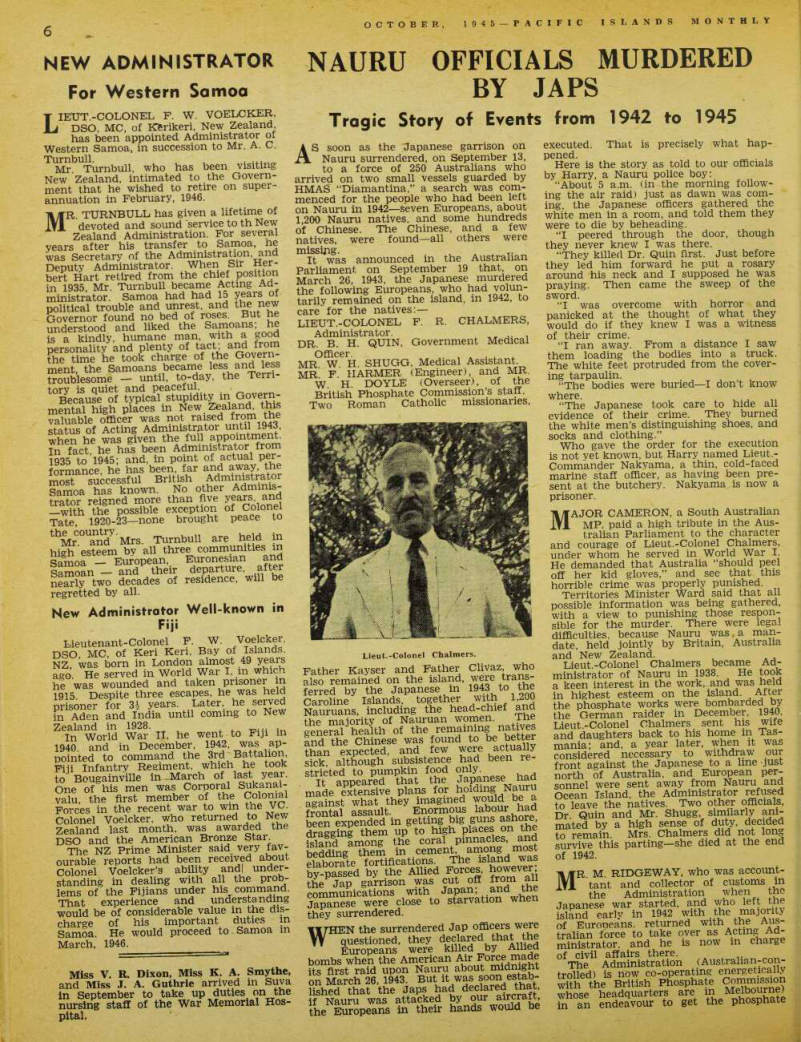
Lieut.-Colonel Chalmers.
plants of Nauru and Ocean Island back into operation. Much damage has been done, both by demolition prior to evacua tion in 1942, and by the Jap invaders.
Months must elapse before the two islands are again producing an appreci able amount of the valuable phosphatic rock.
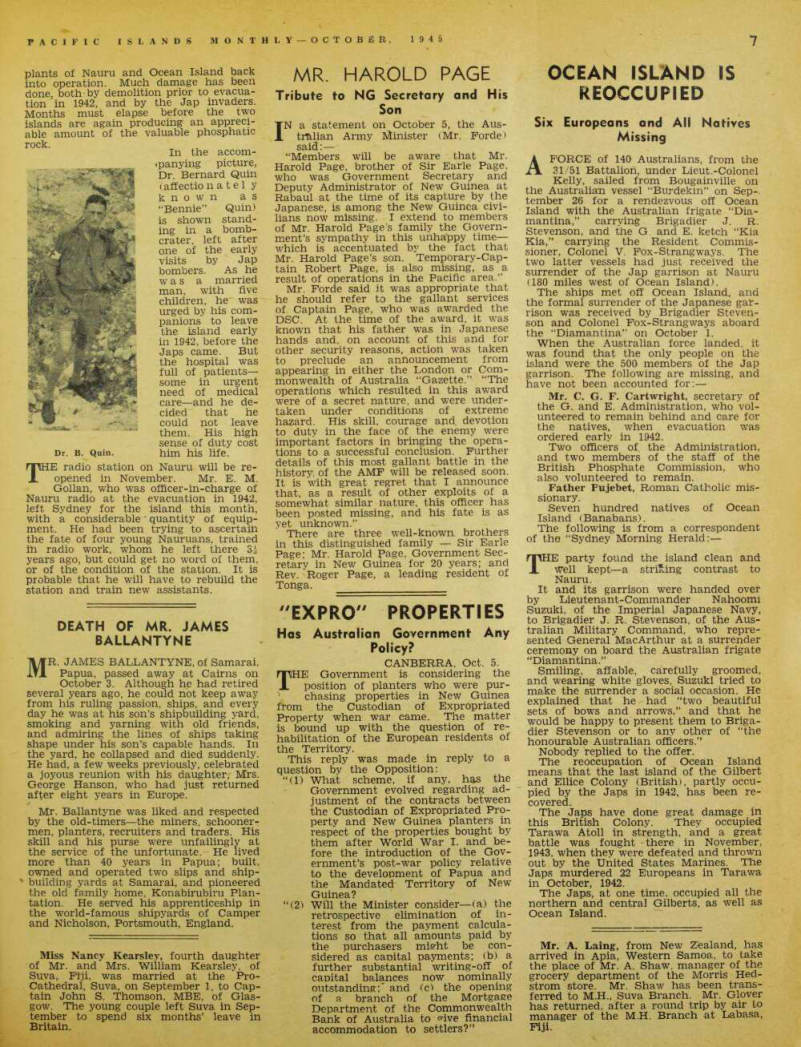
In the accom
panying picture,
Dr. Bernard Quin (affection a tel y known as “Bennie” Quin) is shown stand ing in a bomb crater, left after one of the early visits by Jap bombers. As he was a married man, with five children, he was urged by his com panions to leave the island early in 1942, before the Japs came. But the hospital was full of patients— some in urgent need of medical care—and he de cided that he could not leave them. His high sense of duty cost him his life.
rjIHE radio station on Nauru will be re- X opened in November. Mr. E. M.
Gollan, who was officer-in-charge of Nauru radio at the evacuation in 1942, left Sydney for the island this month, with a considerable * quantity of equip ment. He had been trying to ascertain the fate of four young Nauruans, trained in radio work, whom he left there Si years ago, but could get no word of them, or of the condition of the station. It is probable that he will have to rebuild the station and train new assistants.
Dr. B. Quin.
Death Of Mr. James
Ballantyne
MR. JAMES BALLANTYNE, of Samarai, Papua, passed away at Cairns on October 3. Although he had retired several years ago, he could not keep away from his ruling passion, ships, and every day he was at his son’s shipbuilding yard, smoking and yarning with old friends, and admiring the lines of ships taking shape under his son’s capable hands. In the yard, he collapsed and died suddenly.
He had, a few weeks previously, celebrated a joyous reunion with his daughter, Mrs.
George Hanson, who had just returned after eight years in Europe.
Mr. Ballantyne was liked and respected by the old-timers —the miners, schooner men, planters, recruiters and traders. His skill and his purse were unfailingly at the service of the unfortunate. He lived more than 40 years in Papua; built, owned and operated two slips and ship building yards at Samarai, and pioneered the old family home, Konabirubiru Plan tation. He served his apprenticeship in the world-famous shipyards of Camper and Nicholson, Portsmouth, England.
Miss Nancy Kearsley, fourth daughter of Mr. and Mrs. William Kearsley, of Suva, Fiji, was married at the Pro- Cathedral, Suva, on September 1, to Cap tain John S. Thomson, MBE, of Glas gow. The young couple left Suva in Sep tember to spend six months’ leave in Britain.
Mr. Harold Page
Tribute to NG Secretary and His Son
IN a statement on October 5, the Aus tralian Army Minister (Mr. Forde) said:— “Members will be aware that Mr.
Harold Page, brother of Sir Earle Page, who was Government Secretary and Deputy Administrator of New Guinea at Rabaul at the time of its capture by the Japanese, is among the New Guinea civi lians now missing. I extend to members of Mr. Harold Page’s family the Govern ment’s sympathy in this unhappy time— which is accentuated by the fact that Mr. Harold Page’s son. Temporary-Cap tain Robert Page, is also missing, as a result of operations in the Pacific area.”
Mr. Forde said it was appropriate that he should refer to the gallant services of Captain Page, who was awarded the DSC. At the time of the award, it was known that his father was in Japanese hands and. on account of this and for other security reasons, action was taken to preclude an announcement from appearing in either the London or Com monwealth of Australia “Gazette.” “The operations which resulted in this award were of a secret nature, and were under taken under conditions of extreme hazard. His skill, courage and devotion to dutv in the face of the enemy were important factors in bringing the opera tions to a successful conclusion. Further details of this most gallant battle in the history of the AMF will be released soon.
It is with great regret that I announce that, as a result of other exploits of a somewhat similar nature, this officer has been posted missing, and his fate is as vet unknown.”
There are three well-known brothers in this distinguished family Sir Earle Page; Mr. Harold Rage, Government Sec retary in New Guinea for 20 years; and Rev. Roger Page, a leading resident of Tonga.
"Expro" Properties
Has Australian Government Any Policy?
Canberra. Oct. 5.
rE Government is considering the position of planters who were pur v chasing properties in New Guinea from the Custodian of Expropriated Property when war came. The matter is bound up with the question of re habilitation of the European residents of the Territory.
This reply was made in reply to a question by the Opposition; “(1) What scheme, if any, has the Government evolved regarding ad justment of the contracts between the Custodian of Expropriated p™perty and New Guinea planters in respect of the properties bought by them after World War I. and be fore the introduction of the Gov ernment’s post-war policy relative to the development of Papua and the Mandated Territory of New Guinea?
“(2) Will the Minister consider —(a) the retrospective elimination of in terest from the payment calcula tions so that all amounts paid by the purchasers mie'ht be con sidered as canital payments; (b) a further substantial writing-off of capital balances now nominally outstanding;’ and (c) the opening of n branch of the Mortgage Department of the Commonwealth Bank of Australia to & ive financial accommodation to settlers?”
Ocean Island Is
Keoccupied
Six Europeans and All Natives Missing
A FORCE of 140 Australians, from the 31/51 Battalion, under Lieut.-Colonel Kelly, sailed from Bougainville on the Australian vessel “Burdekin” on Sep tember 26 for a rendezvous off Ocean Island with the Australian frigate “Dia mantina,” carrying Brigadier J. R.
Stevenson, and the G and E. ketch “Kia Kia,” carrying the Resident Commis sioner, Colonel V. Fox-Strangways. The two latter vessels had just received the surrender of the Jap garrison at Nauru (180 miles west of Ocean Island).
The ships met off Ocean Island, and the formal surrender of the Japanese gar rison was received by Brigadier Steven son and Colonel Fox-Strangways aboard the “Diamantina” on October 1.
When the Australian force landed, it was found that the only people on the island were the 500 members of the Jap garrison. The following are missing, and have not been accounted for:— Mr. C. G. F. Cartwright, secretary of the G. and E. Administration, who vol unteered to remain behind and care for the natives, when evacuation was ordered early in 1942.
Two officers of, the Administration, and two members of the staff of the British Phosphate Commission, who also volunteered to remain.
Father Pujebet, Roman Catholic mis sionary.
Seven hundred natives of Ocean Island (Banabans).
The following is from a correspondent of the “Sydney Morning Herald:— mHE party found the island clean and A Well kept—a striding contrast to Nauru.
It and its garrison were handed over by Lieutenant-Commander Nahoomi Suzuki, of the Imperial Japanese Navy, to Brigadier J. R. Stevenson, of the Aus tralian Military Command, who repre sented General MacArthur at a surrender ceremony on board the Australian frigate “Diamantina.”
Smiling, affable, carefully groomed, and wearing white gloves. Suzuki tried to make the surrender a social occasion. He explained that he had “two beautiful sets of bows and arrows,” and that he would be happy to present them to Briga dier Stevenson or to any other of “the honourable Australian officers.”
Nobody replied to the offer.
The reoccupation of Ocean Island means that the last island of the Gilbert and Ellice Colony (British), partly occu pied by the Japs in 1942, has been re covered.
The Japs have done great damage in this British Colony. They occupied Tarawa Atoll in strength, and a great battle was fought there in November, 1943, when they were defeated and thrown out by the United States Marines. The Japs murdered 22 Europeans in Tarawa in October, 1942.
The Japs, at one time, occupied all the northern and central Gilberts, as well as Ocean Island.
Mr. A. Laing, from New Zealand, has arrived in Apia, Western Samoa, to take the place of Mr. A. Shaw, manager of the grocery department of the Morris Hed strom store. Mr. Shaw has been trans ferred to M.H., Suva Branch. Mr. Glover has returned, after a round trip by air to manager of the M.H. Branch at Labasa, Fiji.
Heroes Of The
Territories
Awards for Soldiers and Civilians
rE following awards to former resi dents of Papua and New Guinea have been announced in Military Orders: —
Military Cross
Major A. A. Roberts, Assistant District Officer, New Guinea.
Lieut. D. M. Fienberg, Patrol Officer, New Guinea. . .
Major C. D. Bates, Assistant District Officer, New Guinea.
Lieut. D. M. Fienbery, Patrol Officer, New Guinea. „ .
Lieut. L. J. Stokie, planter, New Guinea.
Lieut. A. F. Gow, Public Servant, New Guinea.
Distinguished Conduct Medal
Lieut. J. L. Gilmore, planter, New Guinea.
Military Medal
Lieut. T. W. J. Lega.
Mentioned In Despatches
Lieut.-Colonel S. A. Lonergan, Assistant Government Secretary, New Guinea.
Capt G. C. Harris (deceased), Patrol Officer. New Guinea. „ Lieut. W. M. English, Patrol Officer, New Lieut U 1 D oa c. Joycey, Public Servant, New Lieut U 1 A 6a w. Lane, planter, New Guinea Lieut. W. A. Macgregor, planter, New LieuL Fowler, Public Servant, New Guinea. . ...
Warrant-Officer R. E. Arrowsmith.
Warrant-Officer L. Stamper.
Warrant-Officer J. D. Wilkinson.
Warrant-Officer T. Zoffman.
Honours for Civilians
rE following civilians of New Guinea have received awards for distin guished service, as follows, rendered in the “invasion months,” and now acknowledged;—
Member Of Order Of British
Empire
Mbs. Gladys Henrietta Love
DAY BAKER, owner of Langu Plan tation. Witu Island, north coast of New Britain. .
Mrs. Baker rendered courageous and outstanding service to a party who pspaned from New Britain after the in vision by the Japanese she of the sick and wounded, and was untir ing in her efforts. The party finally con sisted of 200 who had been subject to all kinds of tropical diseases. , Mrs. Baker gave her services and pos sessions without stint in a constant en deavour to better the sufferings of the men ind was instrumental in saving many lives. She accompanied the party to Australia where her health broke down and she was obliged to enter hospital.
Liter she joined the AAMWS, was Pro moted to lieutenant, and placed on the now a lieu- Mi- n Ho\land h performed meritorious and courageous service in assisting a party who had escaped from New Britain in March, 1942, after the Japanese invasion.
He went from Pondo to the south coast in an endeavour to locate and I bring back any troops who may have been there Hi located a party of 24 whom he brought safely back. The journey was made through difficult country usually nrcunied by notorious Makolkol head hunters. He also rendered great assist
ance whilst on the '“Lakatoi,” the boat used in connection with the rescue of the evacuation party.
MR. GEORGE H. R. MARSLAND, now a flight-lieutenant in the RAAF.
Mr. Marsland performed outstanding work in assisting personnel to escape from Rabaul in March, 1942. As a civi lian he volunteered to accompany the District Officer to Rabaul area; and it is reported that if it had .not been for Marsland’s skill and ability as engineer and navigator, the troops would not have made the 300-miles journey between Pondo and the Witu Islands. He re constructed a vessel the Japanese had partly destroyed at Pondo, which brought 80 men to Waluidi (Talasea).
Mr. Marsland’s skill as an engineer, his courage and devoted service were out standing during this period.
Commendation
LINCOLN JOHN BELL, later a lieuten ant in the RANVR, killed in action on April 1, 1943.
Albert Reginald Olander, Later A
sub-lieutenant, RANVR, killed in action, March 7, 1943.
Kenneth Cunningham Douglas
now a lieutenant in the RANVR.
The citation covering the deeds of the three commended men reads:— During the evacuation from New Britain, in 1942, these three men were placed in charge of the western areas of Talasea, New Britain. They worked un ceasingly, and gave devoted service in getting the troops through to Itoki Plantation. All three refused to leave New Britain on “Lakatoi” in March, 1942, although they knew if captured by the Japanese they might be .executed.
However, they remained in New Britain and were responsible for much secret intelligence being forwarded to Allied Forces.
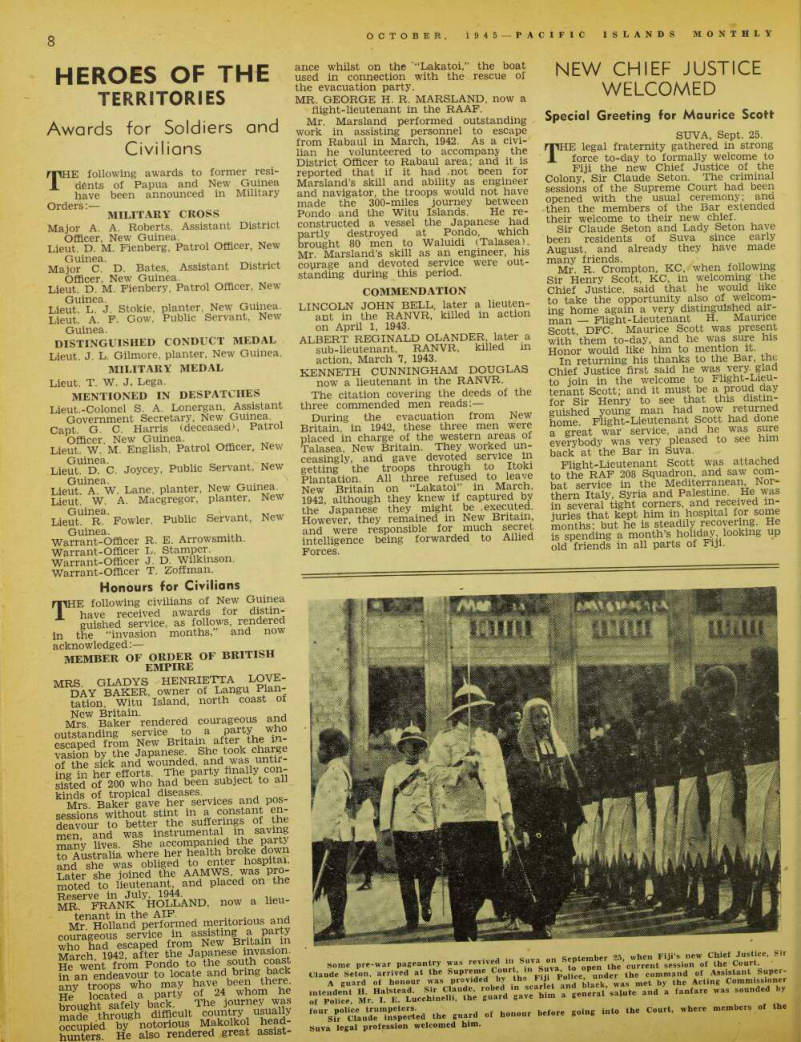
Some pre-war pageantry was revived in ®“ a he’ Court.® 6 ’
“ “»■“«- - * - so “ n<,ed * ,0aC s rc?aud. U X e .S'.d the guard ot honour bel.re going into the Court, where members .« the Suva legal profession welcomed him.
New Chief Justice
Welcomed
Special Greeting for Maurice Scott
SUVA, Sept. 25.
THE legal fraternity gathered in strong force to-day to formally welcome to Fiji the new Chief Justice of the Colony, Sir Claude Seton. The criminal sessions of the Supreme Court had been opened with the usual ceremony; and then the members of the Bar extended their welcome to their new chief.
Sir Claude Seton and Lady Seton have been residents of Suva since early August, and already they have made many friends. Mr R. Crompton, KC, when following Sir Henry Scott, KC, in welcoming the Chief Justice, said that he would like to take the opportunity also of welcom ing home again a very distinguished air man Flight-Lieutenant H. Maurice Scott, DFC. Maurice Scott was present with them to-day, and he was sure his Honor would like him to mention it.
In returning his thanks to the Bar, the Chief Justice first said he was very, glad to join in the welcome to Flight-Lieu tenant Scott; and it must be a proud day for Sir Henry to see that this distin guished young man had now returned home. Flight-Lieutenant Scott had done a great war service, and he was sure everybody was very pleased to see him back at the Bar in Suva.
Flight-Lieutenant Scott was attached to the RAF 208 Squadron, and saw com bat service in the Mediterranean, Nor thern Italy, Syria and Palestine. Hes was in several tight corners, and received in juries that kept him in hospital fOT some months; but he is steadily recovering. He is spending a month’s holiday, looking up old friends in all parts of Fiji.
Advertisements & other items, p. 10 (1 item)
8
OCTOBER, 1945 RACIFIC ISLANDS MONTHLY
Civilians
New Guinea’s Lost Civilians Personal and Economic Disaster
ON page 49 of this issue, there' is a list of over 300 civilian residents of New Guinea, most of whom were taken prisoner by the Japs when they invaded Rabaul in January, 1942. They are officially described as “Missing”; but it now seems almost certain that they are dead. A search for them has pro ceeded throughout the Southwest Paci fic and the Far East since Japan sur rendered, but no trace of them has been discovered.
Apart from the personal tragedy, this is the greatest economic disaster in the history of the South Pacific Territories.
These were mostly exceptional people, pioneers by choice and individualists by force of circumstances, and in their in dustry and ability lay the economic strength of New Guinea. To show the Territory’s administrative and economic loss, it is necessary only to quote the following analysis of the missing people: Heads of Government ■ Depart ments 8 Plantation-owners 25 Merchants, commercial managers, professional practitioners 58 Plantation managers 68 Administrative officials, approx. 100 Small traders, clerks, etc 60 Missionaries* 11 *Not including over 300 missionaries, mostly personnel of Roman Catholic stations, whose whereabouts are at present uncertain.
The replacement of those people, nearly all of whom possessed a wide practical experience of New Guinea con ditions, is one of the many problems of the immediate future. Among the men who are missing, and now feared to be dead, are the following well-known figures: Mr. H. A. Adams, a leading planter and a member of the Legislative Council.
Mr. E. Banks, who conducted one of the Territory’s principal hotels.
Mr. R. L. (“Nobby”) Clark, head of a principal construction company, and a prominent public figure.
Dr. R. W. Cooper, Administration Medi cal Officer.
Mr. P. Coote, general manager of the extensive Burns Philp enterprises in New Guinea.
Mr. A. Evenson, manager of the Carpen ter desiccated coconut factory at Pondo.
Mr. C. R. Field, Director of Public Works.
Mr. V. A. Florence, solicitor, of Rabaul.
Mr. E. C. D. Green, superintendent of the Keravat Experimental Plantation.
Mr. Gerald Hogan, head of the Crown Law Department.
Mr. H. D. Holland, AWA manager in Rabaul.
Mr. Jan Hoogerwerth, manager of the “Rabaul Times.”
Dr. H. C. Hosking, Administration Medi cal Officer.
Mr. F. W. Mantle, Senior Magistrate.
Mr. George Murray, Director of Agricul ture.
Mr. H. H. Page, Government Secretary and Deputy Administrator, Mr. F. V. Saunders, a leading planter.
Mr. G. W. Snensley, manager of Colyer Watson, Ltd.
Mr. J. L. Street, Registrar and Official Trustee.
Mr. H. O. Townsend, Administration Treasurer.
Mr. H. J. Washington, a leading planter.
Most Of New Guinea’S Missing
Civilians Presumed Dead
Over 1,000 Soldiers and Civilians Lost on Torpedoed Prison-ship in 1942
THE greatest tragedy in the tragic history of New Guinea is now recog nised. Of the 350 civilians (not missionaries) taken prisoner by the Japanese when Rabaul and the adjacent districts in New Britain and New Ireland were invaded, only a handful escaped with their lives.
Of those missing, now believed killed, a large proportion disappeared on a prison-ship between Rabaul ond Japan in June, 1942.
Another section of civilians, between 300 and 350, all missionaries (mostly Roman Catholics from the stations in the same districts) appear to have been imprisoned by the Japanese, to a large extent, with the non-mission civilians, and there also is grave doubt about their fate.
Only a few scores have been located in New Guinea mission stations, and it is teared that many of the others are dead. (LIST OF RESCUED,V. 5) The following is the sequence of events:
RABAUL was occupied by the Japan ese, in great strength, on January 23, 1942. The Rabaul community had at least 48 hours’ warning of the imminence of Jap attack, and there were ships in the harbour capable of carrying all the male civilians to safety. (The women had been sent away in Decem ber.) But, through some bungling, still unexplained, on the part of high officials of the Australian Government, the civilians were retained in Rabaul until the Japs actually arrived.
The Jap landing was resisted by the very small forces we had there, but the fight was soon over, and the defenders and civilians dispersed into the jungle.
In the ensuing fortnight, several hun dreds of Europeans, both soldiers and civilians, were rounded up by the Japs on Gazelle Peninsula and westwards in New Britain, and placed in POW camps in Rabaul and Kokopo districts. Indi viduals were brought in from both New Ireland and New Britain during the next three or four months.
In the early part of 1942, POW cards were written by most of the prisoners, and a number of bags containing these communications were dropped by Jap planes in the vicinity of Port Moresby.
One or two bags fell into the jungle, and were not found until months later. Some may never have been found.
Thus, messages were received in 1942 by the relations of a large number of the civilians left in Rabaul, and it was felt that, so far as they were concerned, the war was mostly a matter of weary wait ing. The fact that no more messages were received, in 1943 and 1944, was noted, but was not regarded as alarming.
The Japs were known to be cruel prison masters. and it was assumed that the people from New Guinea had been taken away to some remote place. The fol lowing events were not known until after Japan surrendered, and we were able to piece together various odds and ends of information. fIIHE Japs seem to have gathered to- A gether in 1942, in or near Rabaul, the*- following classes of prisoners: Approximate only Soldiers 900 Nurses 20 Civilians, non-official, about 240 Civilians, officials of Ad ministration, about 110 Civilians, missionaries, about 350 1,620
These totals have been compiled from an analysis of a series of official state ments made regarding Rabaul POW’s.
It seems to be clearly established, how ever, that in June, 1942, the Japanese placed aboard a small freighter, the “Montevideo Maru,” in Rabaul, for trans fer to Japan, 885 soldiers and 208 civilians. This apparently left over 400 civilians, including missionaries, and less than 100 soldiers still in the Rabaul area.
The “Montevideo Maru” was torpedoed —presumably by an Allied submarine— off the coast of Luzon (Philippines) on June 22, 1942. An announcement to that effect was made by the Japanese radio.
Two people have reported to us that they heard the announcement—Captain Bertie Hall, a well-khown New Guinea ship master, who was in a prison-camp in Amoy. China, and who has just arrived in Sydney; and a brother of Mrs. Peadon, of Rabaul, who heard it on short-wave when he was in the Morobe district of New Guinea. This report from Tokio in 1942, and a statement recently obtained in Tokio, said that the vessel was lost with her entire company.
Soon afterwards (late in June, 1942) another vessel left Rabaul carrying approximately 17 of our nurses, and 60 officers of the 22nd Battalion. It reached Japan. (The story of how the nurses were liberated was told in September
“Pim.”)
This leaves over 400 of the Rabaul civilians unaccounted for—some 300 to 350 mission personnel who may be found' on mission stations in New Britain and New Ireland, and some 50 non-mission civilians, who are presumed to have died in captivity in the Rabaul area.
IMMEDIATELY after Japan surren dered, and we began to liberate our people from the prison-camps, the search for the Rabaul civilians com menced. Although a few of us were un easy, it was generally believed that all those civilian internees would be quickly found. Preparations were made to give the prisoners every possible help. As reported in last issue, the Department of External Territories created a Prisoners’
Welfare section, put Mr. A. J. Gaskin and Mr. Harry Downing in charge of a well-equipped floor at 40 King Street, Sydney, and awaited the arrival of the released Territorians.
As the days passed, and no word came of liberated Territorians, alarm began to
(Article Continued, With List Op
Missing, On Page 49).
be felt. The first real shock came when the party of 17 Rabaul nurses arrived early in September. They were care fully interrogated; and then the sig nificant fact was ascertained that the missing civilians and the missing men of the 22nd Battalion had all been shipped away from Rabaul on a vessel which departed in June, 1942. Nothing had been heard of or from those people since 1942.
A warning to relations was published on page 49 of the September “PIM,” but in guarded language—there still was a faint hope that the missing people would be discovered. The search of Japan and Jap Territories was intensified.
By the end of September, it was plain that the tragedy we had so long feared really had happened. A few scores of missionaries, and a remnant of Rabaul civilians were found in a camp in the Ramale Valley (between Kokopo and Bitapaka) by our Forces when they re occupied Rabaul; another handful of civilians have been found in Far Eastern countries, which they evidently had reached by vessels other than the “Montevideo Maru”; but the remainder of the civilians, to the number of over 500, were either lost on the “Montevideo Maru,” or are otherwise unaccounted for.
There remains a faint hope that a few of these people may yet be found alive.
Some mav have escaped into the jungles of New Britain and New Ireland, and may have "been able to sustain life until now. A remnant may have got ashore in the Philippine Islands, from the “Monte video Maru.”
But even those hopes are fading. It is six weeks since the Japanese surren dered. and if there had been any num ber of these men alive, they would have made their presence known by now.
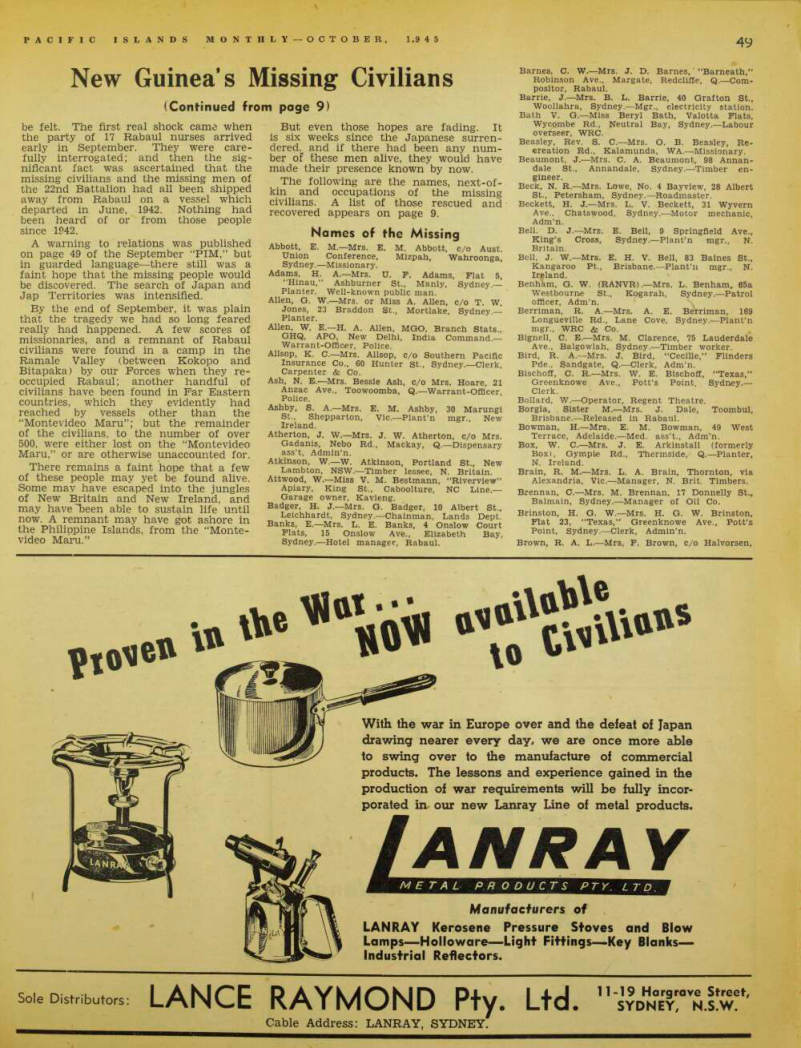
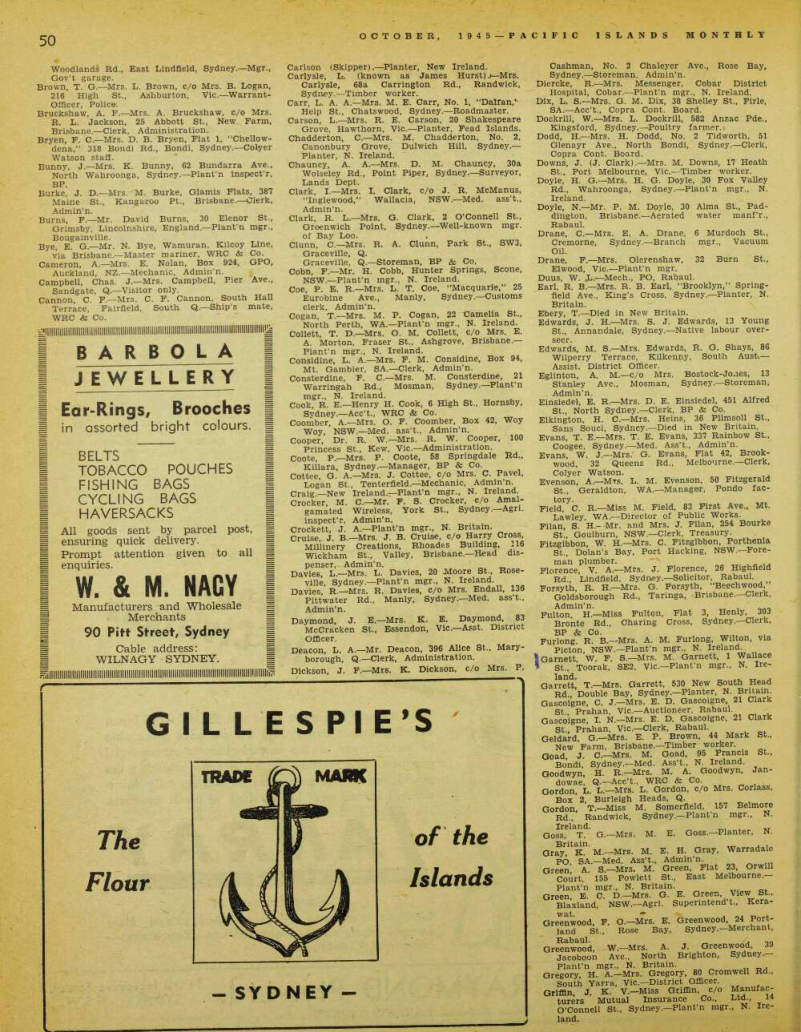
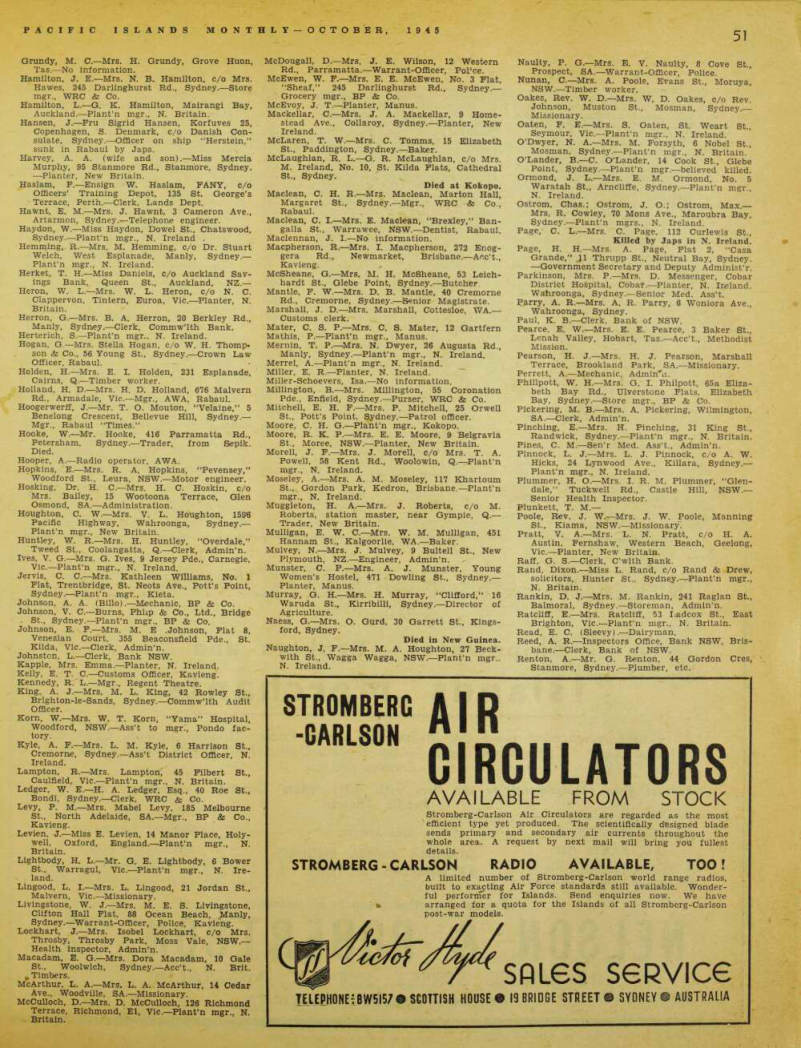
The following are the names, next-of kin and occupations of the missing civilians. A list of those rescued and recovered appears on page 9.
Names of the Missing
Abbott, E. M.—Mrs. E. M. Abbott, c/o Aust.
Union Conference, Mizpah, Wahroonga, Sydney.—Missionary.
Adams, H. A.—Mrs. U. F. Adams, Flat 5, “Hinau,” Ashburner St., Manly, Sydney.— Planter. Well-known public man.
Allen, G. W. —Mrs. or Miss A. Allen, c/o T, W Jones, 23 Braddon St., Mortlake, Sydney Planter.
Allen, W. E.—H. A. Allen, MGO, Branch Stats., GHQ, APO, New Delhi, India Command.— Warrant-Officer, Police.
Allsop, K. C. —Mrs. Allsop, c/o Southern Pacific Insurance Co., 60 Hunter St., Sydney.—Clerk.
Carpenter & Co.
Ash, N. E.—Mrs. Bessie Ash, c/o Mrs. Hoare, 21 Anzac Ave., Toowoomba, Q.—Warrant-Officer, Police.
Ashby, S. A.—Mrs. E. M. Ashby, 30 Marungi St., Shepparton, Vic.—Plant’n mgr., New Ireland.
Atherton, J. W.—Mrs. J. W. Atherton, c/o Mrs.
Gadanis, Nebo Rd., Mackay, Q. —Dispensary ass’t, Admin’n.
Atkinson, W.—W. Atkinson, Portland St., New Lambton, NSW.—Timber lessee, N. Britain.
Attwood, W.—Miss V. M. Bestmann, “Riverview”
Apiary, King St., Caboolture, NC Line- Garage owner, Kavieng.
Badger, H. J.—Mrs. G. Badger, 10 Albert St., Leichhardt, Sydney.—Chainman, Lands Dept.
Banks, E.—Mrs, L. E. Banks, 4 Onslow Court Plats, 15 Onslow Ave., Elizabeth Bay, Sydney.—Hotel manager, Rabaul.
Barnes, C. W.—Mrs. J. D. Barnes, “Barneath,”
Robinson Ave., Margate, Redcliffie, Q. —Compositor, Rabaul.
Barrie, J. —Mrs. B. L. Barrie, 40 Grafton St., Woollahra, Sydney.—Mgr., electricity station.
Bath V. G.—Miss Beryl Bath, Valotta Flats, Wycombe Rd., Neutral Bay, Sydney.—Labour overseer, WRC.
Beasley, Rev. S. C. —Mrs. O. B. Beasley, Re creation Rd., Kalamunda, WA.—Missionary.
Beaumont, J. —Mrs. C. A. Beaumont, 98 Annan dale St., Annandale, Sydney.—Timber en gineer.
Beck, N. R. —Mrs. Lowe, No. 4 Bayvlew, 28 Albert St., Petersham, Sydney.—Roadmaster.
Beckett, H. J. —Mrs. L. V. Beckett, 31 Wyvern Ave., Chatswood, Sydney.—Motor mechanic, Adm’n.
Bell. D. J. —Mrs. E. Bell, 9 Springfield Ave., King’s Cross, Sydney.—Plant’n mgr., N.
Britain.
Bell. J. W.—Mrs. E. H. V. Bell, 83 Baines St., Kangaroo Pt., Brisbane.—Plant’ll mgr., N.
Ireland.
Benham, G. W. (RANVR). —Mrs. L. Benham, 65a Westbourne St., Kogarah, Sydney.—Patrol officer, Adm’n.
Berriman, R. A. —Mrs. A. E. Berriman, 169 Longueville Rd., Lane Cove, Sydney.—Plant’n mgr., WRC & Co.
Bignell, C. E.—Mrs. M. Clarence, 75 Lauderdale Ave., Balgowlah, Sydney.—Timber worker.
Bird, R. A.—Mrs. J. Bird, “Cecille,” Flinders Pde., Sandgate, Q. —Clerk, Adm’n.
Bischoff, C. R.—Mrs. W. E. Bischoff, “Texas,”
Greenknowe Ave., Pott’s Point, Sydney.— Clerk.
Bollard, W.—Operator, Regent Theatre.
Borgia, Sister M—Mrs. J. Dale, Toombul, Brisbane.—Released in Rabaul.
Bowman, H.—Mrs. E. M. Bowman, 49 West Terrace, Adelaide.—Med. ass’t., Adm’n.
Box, W. C. —Mrs. J. E. Arkinstall (formerly Box), Gympie Rd., Thermside, Q. —Planter, N. Ireland.
Brain, R. M.—Mrs. L. A. Brain, Thornton, via Alexandria, Vic.—Manager, N. Brit. Timbers.
Brennan, C. —Mrs. M. Brennan, 17 Donnelly St., Balmain, Sydney.—Manager of Oil Co.
Brinston, H. G. W.—Mrs. H. G. W. Brinston, Flat 23, “Texas,” Greenknowe Ave., Pott’s Point, Sydney.—Clerk, Admin’n.
Brown, R. A, L.—Mrs. F. Brown, c/o Halvorsen,
Woodlands Rd., East Lindfield, Sydney.—Mgr., Gov’t garage.
Brown, T. G. —Mrs. L. Brown, c/o Mrs. B. Logan, 216 High St., Ashburton, Vic.—Warrant- Officer, Police.
Bruckshaw, A. F.—Mrs. A. Bruckshaw, c/o Mrs.
R. L. Jackson, 25 Abbott St., New Farm, Brisbane. —Clerk, Administration.
Bryen, P. O.—Mrs. D. B. Bryen, Flat 1, “Chellow dena,” 318 Bondi Rd., Bondi, Sydney.—Colyer Watson staff.
Bunny, J.—Mrs. K. Bunny, 62 Bundarra Ave..
North Wahroonga, Sydney.—Plant’n inspect’r, BP.
Burke, J. D.—Mrs. M. Burke, Glamis Flats, 387 Maine St., Kangaroo Pt., Brisbane.—Clerk, Admin’n.
Burns, F. —Mr. David Burns, 30 Elenor St., Grimsby, Lincolnshire, England.—Plant’n mgr., Bougainville.
Bye, E. G. —Mr. N. Bye, Wamuran, Kilcoy Line, via Brisbane. —Master mariner, WRC & Co.
Cameron, A.—Mrs. E. Nolan, Box 924, GPO, Auckland, NZ.—Mechanic, Admin’n.
Campbell, Chas. J.—Mrs. Campbell, Pier Ave., Sandgate, Q.—Visitor only.
Cannon, C. F.—Mrs. C. F. Cannon, South Hall Terrace, Fairfield, South Q. —Ship’s mate,
Wrc & Co.
Carlson (Skipper).—Planter, New Ireland.
Carlysle, L. (known as James Hurst) .h-Mrs.
Carlysle, 68a Carrington Rd., Randwick, Sydney.—Timber worker.
Carr, L. A. A.—Mrs. M. E. Carr, No. 1, “Dalian,’ 1 Help St., Chatswood, Sydney.—Roadmaster.
Carson, L. —Mrs. R. E. Carson, 20 Shakespeare Grove, Hawthorn, Vic. —Planter, Fead Islands.
Chadderton, C.—Mrs. M. Chadderton, No, 2, Canonbury Grove, Dulwich Hill, Sydney.— Planter, N. Ireland.
Chauncy, A. A.—Mrs. D. M. Chauncy, 30a Wolseley Rd., Point Piper, Sydney.—Surveyor, Lands Dept.
Clark, I.—Mrs, I. Clark, c/o J. R. McManus, “Inglewood,” Wallacia, NSW.—Med. ass’t., Admin’n.
Clark, R. L.—Mrs. G. Clark, 2 O’Connell St., Greenwich Point, Sydney.—Well-known mgr. of Bay Loo.
Clunn, C.—Mrs. R. A. Clunn, Park St., SW3, Graceville, Q.
Graceville, Q. —Storeman, BP & Co.
Cobb, F.—Mr. H. Cobb, Hunter Springs, Scone, NSW.—Plant’n mgr., N. Ireland.
Coe, P. E. R.—Mrs. L. T. Coe, “Macquarie,” 25 Eurobine Ave., Manly, Sydney—Customs clerk, Admin’n.
Cogan, T.—Mrs. M. P. Cogan, 22 Camelia St., North Perth, WA.—Plant’n mgr., N. Ireland.
Collett, T. D—Mrs. O. M. Collett, c/o Mrs. E.
A. Morton, Fraser St., Ashgrove, Brisbane.— Plant’n mgr., N. Ireland.
Considine, L, A.—Mrs. F. M. Considine, Box 94, Mt. Gambier, SA.—Clerk, Admin’n.
Consterdine, F. C.—Mrs. M. Consterdine, 21 Warringah Rd., Mosman, Sydney.—Plant’n mgr., N. Ireland.
Cook, R. E.—Henry H. Cook, 6 High St., Hornsby, Sydney.—Acc’t., WRC & Co.
Coomber, A.—Mrs. O. F. Coomber, Box 42, Woy Woy, NSW.—Med. ass’t., Admin’n.
Cooper, Dr. R. W.—Mrs. R. W. Cooper, 100 Princess St., Kew, Vic—Administration.
Coote, P.—Mrs. P. Coote, 58 Springdale Rd„ Killara, Sydney.—Manager, BP & Co.
Cottee, G. A.—Mrs. J. Cottee, c/o Mrs. C. Pavel, Logan St., Tenterfield.—Mechanic, Admin’n.
Craig.—New Ireland.—Plant’n mgr., N. Ireland.
Crocker, M. C.-Mr, F. S. Crocker, c/o Amal gamated Wireless, York St., Sydney.—Agn. inspector, Admin’n.
Crockett, J. A—Plant’n mgr., N. Britain.
Cruise, J. B.—Mrs. J. B. Cruise, c/o Harry Cross, Millinery Creations, Rhoades Building, 116 Wickham St., Valley, Brisbane.—Head dis penser, Admin’n.
Davies, L.—Mrs. L. Davies, 20 Moore St., Rose ville, Sydney.—Plant’n mgr., N. Ireland Davies, R.—Mrs. R. Davies, c/o Mrs. Endall, 136 Pittwater Rd., Manly, Sydney—Med. ass’t., Admin’n.
Daymond, J. E.—Mrs. K. E. Daymond, 83 McCracken St., Essendon, Vic. —Asst. District Officer.
Deacon, L. A.—Mr. Deacon, 396 Alice St., Mary borough, Q.—Clerk, Administration.
Dickson, J. P.—Mrs. K. Dickson, c/o Mrs. P.
Cashman, No. 2 Chaleyer Ave., Rose Bay, Sydney.—Storeman, Admin’n.
Diercke, R.—Mrs. Messenger, Cobar District Hospital, Cobar. —Plant’n mgr., N. Ireland.
Dlx, L. S.—Mrs. G. M. Dix, 38 Shelley St., Firle, SA.—Acc’t., Copra Cont. Board.
Dockrill, W.—Mrs. L. Dockrill, 582 Anzac Pde., Kingsford, Sydney.—Poultry farmer.
Dodd, H. —Mrs. H. Dodd, No. 2 Tidworth, 51 Glenayr Ave., North Bondi, Sydney.—Clerk, Copra Cont. Board.
Downs, J. (J. Clark). —Mrs. M. Downs, 17 Heath St., Port Melbourne, Vic. —Timber worker.
Doyle, H. G.—Mrs. H. G. Doyle, 30 Fox Valley Rd„ Wahroonga, Sydney.—Plant’n mgr., N.
Ireland.
Doyle, N.—Mr. P. M. Doyle, 30 Alma St., Pad dington, Brisbane.—Aerated water manf’r., Rabaul.
Drane, C. —Mrs. E. A. Drane, 6 Murdoch St., Cremorne, Sydney.—Branch mgr., Vacuum Oil.
Drane, F. —Mrs. Olerenshaw, 32 Burn St., Elwood, Vic—Plant’n mgr.
Duus, W. JL. —Mech., PO, Rabaul.
Earl, R. B.—Mrs. R. B. Earl, “Brooklyn,” Spring field Ave., King’s Cross, Sydney.—Planter, N.
Britain.
Ebery, T. —Died in New Britain.
Edwards, J. H.—Mrs. S. J. Edwards, 13 Young St., Annandale, Sydney.—Native labour over seer.
Edwards, M. S.—Mrs. Edwards, R. G. Shays, 86 Wilperry Terrace, Kilkenny, South Ausk — Assist. District Officer.
Eglinton, A. M. —c/o Mrs. Bostock-Jones, 13 Stanley Ave., Mosman, Sydney.—Storeman, Admin’n.
Einsiedel, E. R—Mrs. D. E. Einsiedel, 451 Alfred St., North Sydney.—Clerk, BP & Co.
Elkington, H. C.—Mrs. Heins, 36 Plimsoll St., Sans Souci, Sydney.—Died in New Britain.
Evans, T. E.—Mrs. T. E. Evans, 337 Rainbow St., Coogee, Sydney.—Med. Ass’t., Admin’n.
Evans, W. J.—Mrs. G. Evans, Flat 42, Brook wood, 32 Queens Rd., Melbourne.—Clerk, Colyer Watson.
Evenson, A. —Mrs. L. M. Evenson, 50 Fitzgerald St., Geraldton, WA.—Manager, Pondo fac tory.
Field, C. R—Miss M. Field, 83 First Ave., Mt.
Lawley, WA.—Director of Public Works.
Filan, S. H - -Mr. and Mrs. J. Pilan, 254 Bourke St., Goulburn, NSW.—Clerk, Treasury.
Fitzgibbon, W. H.—Mrs. C. Fitzgibbon, Porthenia St., Dolan’s Bay, Port Hacking, NSW—Fore man plumber.
Florence, V. A.—Mrs. J. Florence, 26 Highfield Rd., Lindfield, Sydney.—Solicitor, Rabaul.
Forsyth, R. H.—Mrs. G. Forsyth, “Beechwood, Goldsborough Rd., Taringa, Brisbane.—Clerk, Admin’n. „ Fulton, H.—Miss Fulton, Flat 3, Henly, 303 Bronte Rd., Charing Cross, Sydney.—Clerk,
Bp & Co.
Furlong. R. B.—Mrs. A. M. Furlong, Wilton, via Picton, NSW.—Plant’n mgr., N. Ireland » Garnett, W. F. S.—Mrs. M. Garnett, 1 Wallace St., Toorak, SE2, Vic.—Plant’n mgr., N. Ire- Garretti T.—Mrs. Garrett, 530 New South Head Rd., Double Bay, Sydney.—Planter, N. Britain.
Gascoigne, C. J.—Mrs. E. D. Gascoigne, 21 Clark St Prahan, Vic.—Auctioneer, Rabaul.
Gascoigne, I. N.—Mrs. E. D. Gascoigne, 21 Clark St., Prahan, Vic.—Clerk, Rabaul.
Geldard, G.—Mrs. E. P. Brown, 44 Mark St., New Farm, Brisbane.—Timber worker.
Goad, J. C.—Mrs. M. Goad, 95 Francis St., Bondi, Sydney.—Med. Ass’t., N. Ireland.
Goodwyn, H. R.—Mrs. M. A. Goodwyn, Jan dowae, Q.—Acc’t., WRC & Co.
Gordon, L. L.—Mrs. L. Gordon, c/o Mrs. Corlass, Box 2, Burleigh Heads, Q.
Gordon, T.—Miss M. Somerfield, 157 Belmore Rd., Randwick, Sydney.—Plant’n mgr., N.
Ireland. „ . - T Goss, T. G. —Mrs. M. E. Goss. —Planter, N.
Gray, K. ' M.—Mrs. M. E. H. Gray, Warradale PO, SA. —Med. Ass’t., Admin’n.
Green, A. S.—Mrs. M. Green, Plat 23, Orwill Court, 155 Powlett St., East Melbourne.— Plant’n mgr., N. Britain.
Green E. C. D.—Mrs. G. E. Green, View St., Blaxland, NSW.—Agri. Kera- Greenwood, F. O.—Mrs. E. Greenwood 24 Port land St., Rose Bay, Sydney.—Merchant, Greenwood, W.—Mrs. A. J. Greenwood, 39 Jacoboon Ave., North Brighton, Sydney.— Plant’n mgr., N. Britain.
Gregory, H. A.—Mrs. Gregory, 80 Cromwell Rd., South Yarra, Vic.—District Officer.
Griffin, J. K. V.—Miss Griffin, c/o Manufac turers Mutual Insurance Co., Ltd., i* O’Connell St., Sydney.—Plant’n mgr., N. Ire land.
Grundy, M. C.—Mrs. H. Grundy, Grove Huon, Tas. —No information.
Hamilton. J. E.—Mrs. N. B. Hamilton, c/o Mrs.
Hawes, 245 Darlinghurst Rd., Sydney.—Store mgr., WRC & Co.
Hamilton, L.—G. K. Hamilton, Mairangi Bay, Auckland. —Plant’n mgr., N. Britain.
Hansen, J.—Fru Sigrid Hansen, Korfuves 25, Copenhagen, S. Denmark, c/o Danish Con sulate, Sydney.—Officer on ship “Herstein,” sunk in Rabaul by Japs.
Harvey, A. A. (wife and son). —Miss Mercia Murphy, 95 Stanmore Rd., Stanmore, Sydney. —Planter, New Britain.
Haslam, F.—Ensign W. Haslam, PANY, c/o Officers’ Training Depot, 135 St. George’s Terrace, Perth. —Clerk, Lands Dept.
Hawnt, E. M. —Mrs. J. Hawnt, 3 Cameron Ave., Artarmon, Sydney.—Telephone engineer.
Haydon, W. —Miss Haydon, Dowel St., Chatswood, Sydney.—Plant’n mgr., N. Ireland .
Hemming, R. —Mrs. M. Hemming, c/o Dr. Stuart Welch, West Esplanade, Manly, Sydney.— Plant’n mgr., N. Ireland.
Herket, T. H.—Miss Daniels, c/o Auckland Sav ings Bank, Queen St., Auckland, NZ.— Heron, W. L.—Mrs. W. L. Heron, c/o N. C.
Clappervon, Tintern, Euroa, Vic. —Planter, N.
Britain.
Herron, G. —Mrs. B. A. Herron, 20 Berkley Rd., Manly, Sydney.—Clerk, Commw’lth Bank.
Herterich, S.—Plant’n mgr.. N. Ireland.
Hogan, G.—Mrs. Stella Hogan, c/o W. H. Thomp son & Co., 56 Young St., Sydney.—Crown Law Officer, Rabaul.
Holden, H.—Mrs. E. I. Holden, 231 Esplanade, Cairns, Q. —Timber worker.
Holland, H. D.—Mrs. H. D. Holland, 676 Malvern Rd., Armadale, Vic. —Mgr., AWA, Rabaul.
Hoogerwerflf, J.—Mr. T. O. Mouton, “Velaine,” 5 Benelong Crescent, Bellevue Hill, Sydney.— Mgr., Rabaul “Times.”
Hooke, W. —Mr. Hooke, 416 Parramatta Rd., Petersham, Sydney.—Trader, from Sepik.
Died.
Hooper, A.—Radio operator, AWA.
Hopkins, E.—Mrs. R. A. Hopkins, “Pevensey,”
Woodford St., Leura, NSW. —Motor engineer.
Hosking, Dr. H. C.—Mrs. H. C. Hoskin, c/o Mrs. Bailey, 15 Wootoona Terrace, Glen Osmond, SA. —Administration.
Houghton, C. W.—Mrs. V. L. Houghton, ISOS Pacific Highway, Wahroonga, Sydney.— Plant’n mgr., New Britain.
Huntley, W. R.—Mrs. H. Huntley, “Overdale,”
Tweed St., Coolangatta, Q. —Clerk, Admin’n.
Ives, V. G. —Mrs. G. Ives, 9 Jersey Pde., Carnegie, Vic.—Plant’n mgr., N. Ireland.
Jervis, C. C.—Mrs. Kathleen Williams, No. 1 Plat, Trentbridge, St. Neots Ave., Pott’s Point, Sydney.—Plant’n mgr., Kieta.
Johnson, A. A. (Billo) .—Mechanic, BP & Co.
Johnson, V. C.—Burns, Phiip & Co., Ltd., Bridge St., Sydney.—Plant’n mgr., BP & Co.
Johnson, E. F. —Mrs. M, E .Johnson, Flat 8, Venezian Court, 355 Beaconsfield Pde., St.
Kilda, Vic.—Clerk, Admin’n.
Johnston, L.—Clerk, Bank NSW.
Kapple, Mrs. Emma.—Planter, N. Ireland.
Kelly, E. T. C.—Customs Officer, Kavieng.
Kennedy, R. L.—Mgr., Regent Theatre.
King, A. J.—Mrs. M. L. King, 42 Rowley St., Brighton-le-Sands, Sydney.—Commw’lth Audit Officer.
Korn, W.—Mrs. W. T. Korn, “Yama” Hospital, Woodford, NSW.—Ass’t to mgri, Pondo fac tory.
Kyle, A, F.—Mrs. L. M. Kyle, 6 Harrison St., Cremorne, Sydney.—Ass’t District Officer, N.
Ireland.
Lampton, R. —Mrs. Lampton, 45 Filbert St., Caulfield, Vic.—Plant’n mgr., N. Britain.
Ledger, W. E.—H. A. Ledger, Esq., 40 Roe St., Bondi, Sydney.—Clerk, WRC & Co.
Levy, P. M.—Mrs. Mabel Levy, 185 Melbourne St., North Adelaide, SA.—Mgr., BP & Co., Kavieng.
Levien, J.—Miss E. Levien, 14 Manor Place, Holy well, Oxford, England.—Plant’n mgr., N.
Britain.
Lightbody, H. L.—Mr. G. E. Lightbody, 6 Bower St., Warragul, Vic. —Plant’n mgr., N. Ire land.
Lingood, L. I.—Mrs. L. Lingood, 21 Jordan St., Malvern, Vic. —Missionary.
Livingstone, W. J.—Mrs. M. E. S. Livingstone, Clifton Hall Plat, 88 Ocean Beach, Manly, Sydney.—Warrant-Officer, Police, Kavieng.
Lockhart, J. —Mrs. Isobel Lockhart, c/o Mrs.
Throsby, Throsby Park, Moss Vale, NSW.— Health inspector, Admin’n.
Macadam, E. G.—Mrs. Dora Macadam, 10 Gale St., Woolwich, Sydney.—Acc’t., N. Brit. * Timbers.
McArthur, L. A.—Mrs. L. A. McArthur, 14 Cedar Ave., Woodville, SA.—Missionary.
McCulloch, D.—Mrs. D. McCulloch, 126 Richmond Terrace, Richmond, El, Vic.—Plant’n mgr., N.
Britain.
McDougall, D.—Mrs. J. E. Wilson, 12 Western Rd., Parramatta. —Warrant-Officer, PoTce.
McEwen, W. F.—Mrs. E. E. McEwen, No. 3 Plat, “Sheaf,” 245 Darlinghurst Rd., Sydney.— Grocery mgr., BP & Co.
McEvoy, J. T.—Planter, Manus.
Mackellar, C.—Mrs. J. A. Mackellar, 9 Home stead Ave., Collaroy, Sydney.—Planter, New Ireland.
McLaren, T. W.—Mrs. C. Tomms, 15 Elizabeth St., Paddington, Sydney.—Baker.
McLaughlan, R. L, —G. R. McLaughlan, c/o Mrs.
M. Ireland, No. 10, St. Kilda Flats, Cathedral St., Sydney.
Died at Kokopo.
Maclean, C. H. R.—Mrs. Maclean, Marton Hall, Margaret St., Sydney.—Mgr., WRC & Co., Rabaul.
Maclean, C. I.—Mrs. E. Maclean, “Brexley,” Ban galla St., Warrawee, NSW.—Dentist, Rabaul.
Maclennan, J. I. —No information.
Macpherson, R. —Mrs. I. Macpherson, 272 Enog gera Rd., Newmarket, Brisbane.—Acc’t., Kavieng.
McSheane, G— Mrs. M. H. McSheane, 53 Leich hardt St., Glebe Point, Sydney.—Butcher Mantle, F. W. —Mrs. D. B. Mantle, 40 Cremorne Rd., Cremorne, Sydney.—Senior Magistrate.
Marshall, J. D.—Mrs. Marshall, Cottesloe, WA.— Customs clerk.
Mater, C. S. P.—Mrs. C. S. Mater, 12 Gartfern Mathis, P. —Plant’n mgr., Manus.
Mernin, T. P. —Mrs. N. Dwyer, 26 Augusta Rd., Manly, Sydney.—Plant’n mgr., N. Ireland.
Merrel, A. —Plant’n mgr., N. Ireland.
Miller, E. R.—Planter, N. Ireland.
Miller-Schoevers, Isa. —No information.
Millington, B. —Mrs. Millington, 55 Coronation Pde., Enfield, Sydney.—Purser, WRC & Co.
Mitchell, E. H. F.—Mrs. P. Mitchell, 25 Orwell St., Pott’s Point, Sydney.—Patrol officer.
Moore, C. H. G. —Plant’n mgr., Kokopo.
Moore, R. K. P. —Mrs. E. E. Moore, 9 Belgravia St., Moree, NSW. —Planter, New Britain.
Morell, J. F.—Mrs. J. Morell, c/o Mrs. T. A.
Powell, 58 Kent Rd., Woolowin, Q. —Plant’n mgr., N. Ireland.
Moseley, A.—Mrs. A. M. Moseley, 117 Khartoum St., Gordon Park, Kedron, Brisbane.—Plant’n mgr., N. Ireland.
Muggleton, H. A.—Mrs. J. Roberts, c/o M.
Roberts, station master, near Gympie, Q. — Trader, New Britain.
Mulligan, E. W. C.—Mrs. W. M. Mulligan, 451 Hannam St., Kalgoorlie, WA.—Baker.
Mulvey, N. —Mrs. J. Mulvey, 9 Bultell St., New Plymouth, NZ. —Engineer, Admin’n.
Munster, C. P. —Mrs. A. J. Munster, Young Women’s Hostel, 471 Dowling St., Sydney.— Planter, Manus.
Murray, G. H.—Mrs. H. Murray, “Clifford,” 16 Waruda St., Kirribilli, Sydney.—Director of Agriculture.
Naess, G. —Mrs. O. Gurd, 30 Garrett St., Kings ford, Sydney.
Died in New Guinea.
Naughton, J, F.—Mrs. M. A. Houghton, 27 Beck with St., Wagga Wagga, NSW.—Plant’n mgr..
N. Ireland.
Naulty, P. G.—Mrs. B. V. Naulty, 8 Cove St., Prospect, SA.—Warrant-Officer, Police.
Nunan, C.—Mrs. A. Poole, Evans St., Moruya, NSW.—Timber worker.
Oakes, Rev. W. D.—Mrs. W. D. Oakes, c/o Rev.
Johnson, Muston St., Mosman, Sydney.— Missionary.
Oaten, F. E—Mrs. S. Oaten, St. Weart St., Seymour, Vic.—Plant’n mgr., N. Ireland.
O’Dwyer, N. A.—Mrs. M. Forsyth, 6 Nobel St., Mosman, Sydney.—Plant’n mgr., N. Britain.
O’Lander, B.—C. O’Lander, 14 Cook St., Glebe Point, Sydney.—Plant’n mgr.—believed killed.
Ormond. J. L.—Mrs. E. M. Ormond, No. 5 Waratah St., Arncliffe, Sydney.—Plant’n mgr., N. Ireland.
Ostrom, Chas.; Ostrom, J. O.; Ostrom, Max.— Mrs, R. Cowley, 70 Mons Ave., Maroubra Bay, Sydney.—Plant’n mgrs., N. Ireland.
Page, C. L.—Mrs. C. Page, 112 Curlewis St., Killed by Japs in N. Ireland.
Page, H. H.—Mrs. A. Page, Plat 2, “Casa Grande,” il Thrupp St.. Neutral Bay, Sydney. —Government Secretary and Deputy Administ’r.
Parkinson, Mrs. P.—Mrs. D. Messenger, Cobar District Hospital, Cobar. —Planter, N. Ireland.
Wahroonga, Sydney.—Senior Med. Ass’t.
Parry, A. R.—Mrs. A. R. Parry, 6 Woniora Ave., Wahroonga, Sydney.
Paul, K. B.—Clerk, Bank of NSW.
Pearce, E. W.—Mrs. E. E. Pearce, 3 Baker St., Lenah Valley, Hobart, Tas—Acc’t., Methodist Mission.
Pearson, H. J. —Mrs. H. J. Pearson, Marshall Terrace, Brookland Park, SA. —Missionary.
Perrett, A.—Mechanic, Admin^n.
Phlllpott, W. H.—Mrs. G. I. Philpott, 65a Eliza beth Bay Rd., Ulverstone Flats, Elizabeth Bay, Sydney.—Store mgr., BP & Co.
Pickering, M. B.—Mrs. A. Pickering, Wilmington, SA. —Clerk, Admin’n.
Pinching, E.—Mrs. H. Pinching, 31 King St., Randwick, Sydney.—Plant’n mgr., N. Britain.
Pines, C. M.—Sen’r Med. Ass’t., Admin’n.
Pinnock, L. J. —Mrs. L. J. Pinnock, c/o A. W.
Hicks, 24 Lynwood Ave., Killara, Sydney.— Plant’n mgr., N. Ireland.
Plummer, H. O.—Mrs. I. R. M. Plummer, “Glen dale,” Tuckwell Rd., Castle Hill, NSW.— Senior Health Inspector.
Plunkett, T. M.— Poole, Rev. J. W. —Mrs. J. W. Poole, Manning St., Kiama, NSW.—Missionary.
Pratt, V. A.—Mrs. L. N. Pratt, c/o H. A.
Austin, Fernshaw, Western Beach, Geelong, Vic.—Planter, New Britain.
Raff, G. S. —Clerk, C’wlth Bank.
Rand, Dixon. —Miss L. Rand, c/o Rand & Drew, solicitors, Hunter St., Sydney.—Plant’n mgr., N. Britain.
Rankin, D. J. —Mrs. M. Rankin, 241 Raglan St., Balmoral, Sydney.—Storeman, Admin’n.
Ratcliff, E. —Mrs. Ratcliff, 53 Ladcox St., East Brighton, Vic. —Plant’n mgr., N. Britain, Read, E. C. (Sleevy).—Dairyman.
Reed, A. R.—lnspectors Office, Bank NSW, Bris bane.—Clerk, Bank of NSW.
Renton, A.—Mr. G. Renton, 44 Gordon Cres, Stanmore, Sydney.—Plumber, etc.
Reynolds, A.-Mrs A. Reynolds 22Murdoch
RfJno.rT-^s S^ St.,
Cremorne, Sydney.—Clerk, C’mwlth Bank.
RO Monkla D nd L -i;^cho D ol S “"C""' Robinson, H. E.—Mrs. C. H. Robinson, c/o W. H. .IS'f St " p ° , ' tarlm S ton ' vlc - Robinson, Wrlght.-R. E. Robinson, Kitchen Pt„ RoS“w P -Mrs n R g W Vgers“ m 79 Canter- RO ?r HSt on°ll;ey“T ßO r o lp m § 1 S 0n AVC '’
RunT/gT** S s y o d ml y - ACCt - ° ' n 0 5 og wktti y e d st y ; Malvern. SA.-School teacher Ry F^ts W K?rrlbm er sy7“y-HaSk mg? BP Plats, KirriDilli, Sydney. Hardware mgr., ox- Saunders, F. V.—Mrs. F. V. Saunders, 256 Keppel St. Bathurst. Planter and trader. N. Ire- Saunders. L. C.-Mrs-. U Saunders 67 Pacific R., North Sydney. Clerk. Admin lr- Sa c“ n rmgton“t S ; mgr., Kavleng. „ BCh F?af6, A S 63 h, Arthur / St.. SindtK
Raymond, 7
Sed |astWo J od C ' Sydrtey.—Planfn ’inspector. WRC SetcheH? W. P.-Mrs. M. Setchell. 4 Garden Terrace, Devonport, NZ.—Plant n mgr.. N.
She B b r er a A-Mrs. E. A. Shebler, c/o Mrs. Borden, 195 Maribyrnong Rd., Ascot Melbourne. —Chemist.
Shelton, Rev. H. B.—Mrs. H. B. Shelton, Methodist Parsonage, South Bathurst, NSW. —Missionary. Bh6 Sf. oo An^’rl^r”^rfsbane?^Mrch d nic. g SS
Shoobridge, I.—G. Shoobridge, 13 Moseley St., Glenelg, SA. —Med. Ass’t., Admin’n.
Simnett, P. J. —Mrs. M. Simnett, 31 Pembroke Ave., Earlwood, Sydney.
Died in New Guinea.
Simpson, Rev. T. N. —Mrs. N. Simpson, 21 Cator St., Hindmarsh, SA.—Missionary.
Slips.—No information.
Smith, A. A.—Mrs. E. Smith, 23 Anzac Pde., Kensington, Sydney.—Planter, N. Britain.
Smith, D. McD.—Mrs. L. C. Smith, Flat 3, 21 Kellert St., King’s Gross, Sydney.—Foreman carpenter.
Smith, F. N.—Mrs. O. M. Smith, “Tynwald,”
Bailey St., New Farm, Q. —Storeman, Admin’n.
Smith, J. O.—Mrs. R. R. Smith, 7 Patterson St., North Bondi, Sydney.—Roadmaster.
Smith, J. W.—Mrs. Priebe Smith, Rupert St., Windsor, Brisbane. —Postmaster.
Smith, T—Plant’n mgr.
Snook, E. R.—Warrant-Officer, Police.
Solomon, E. E.—Mrs. E. Solomon, 56 Esplanade, Brighton Beach, Melbourne. Mechanic, Admin’n.
Solomons, R. L.—Misses Yvonne, Pamela Solo mons, 16 Ithica Flats, Ithica Rd., Elizabeth Bay, Sydney.—Clerk, Admin’n.
Spensley. G. W.—Mrs. T. R. Spensley, 32 Edgar St., Glen Iris, Vic.—Mgr., Colyer Watson.
Squires, R. T.—Mrs. J. Squires, 18 Jesmond St., Darlinghurst, Sydney.—Sen. Med. Ass’t.
Staley, W. G.—Mr. E. A .Koffatz, Pelican, via Chinchilla. Q.—Road overseer.
Stephen, R. J.—Mrs. J. J. Stephen, Rathlyn, Gosford, NSW—Hardware mgr., WRC & Co. bourne Terrace, Paddington, Brisbane.— Clerk, Admin’n. „ , Stevens, R. H.—Mrs. E. W. Stevens, 29 Rock bourne Terrace, Paddington, Brisbane.
Stewart, A.—Miss N. Pinkstone, 43 Maitland Ave. Kingsford, Sydney.—Clerk, BP & Co.
Stewart, G. D.—Mrs. D. Stewart, Flat 6, “Bayard,” 116 Wolseley Rd., Pt. Piper, Sydney. —Storeman, Admin’n.
Stewart, J.—Mrs. M. C. Stewart, 8 Marion St., Sans Souci, Sydney.—Road overseer.
Strathearn, A. J.—Mrs. A. Strathearn, 94 Parade, Norwood, Adelaide. —Clerk, Admin’n.
Street J. L.—Mrs. V .E. Street, 18 Yarranable Rd., Darling Pt., Sydney.— Registrar and Official Trustee.
Sweetapple, B.—Mr. W. R. Sweetapple, 627 New
South Head Rd., Rose Bay, Sydney.—Plant’n mgr. Killed in N. Britain.
Symes, H, H. C. —Mrs. G. A. Byrnes, 41 Rath donnell St., Auchenflower, Brisbane. —Plant’n mgr., N. Britain.
Tait, Ivan.—A. G. Tait, Boys’ High School, Timaru, NZ.
Died in Rabaul (operation).
Tait, R. E.—Mrs. Tait, The Turretts, Flat 41, Royston St., Darlinghurst, Sydney.—Clerk, Rabaul.
Talmadge, J.—Pte. G. T. Talmadge, 2 BOD, Queen St., Melbourne.—Plant’n mgr., N. Ire land.
Thomas, C.—Mrs. C. Thomas, 58 Penkivil St., Bondi, Sydney.—Warrant-Officer, Police.
Thompson, C. J.—Mrs. A. V. Thompson, Bush Nursing Hospital, Queenscliff, Vic.—Clerk,
Wrc & Co.
Thompson, L. C.—Mrs. E. M. Tnompson, 51 Florence St., West Perth, WA—Med. Ass’t., Admih’n.
Titchener, J. W.—Mir. H. O. Mocatta.—Med.
Ass’t., Admin’n.
Topal, H. J., & Son.—Plant’n mgr., N. Ireland.
Brisbane. —Admin’n Treasurer.
Townsend, H. O.—Mrs. H. O. Townsend, c/o Mrs. M. E. Higgins, Central Ave.. St. Lucia, Brisbane.
Trevitt, Rev. J. W—Mrs. M. Trevitt, c/o Metho dist Mission, 139 Castlereagh St., Sydney.— Missionary.
Tritton, A. J.—Mrs. A. J. Tritton, 17 Beacons field Ave., Concord, Sydney.—Clerk, C’wlth Bank.
Turnbull, H. F.—Timber worker, Mandrus.
Tynan, J.—Mrs. E. Tynan, 74 Wellington St., Bondi, Sydney.—No information.
Venning, F. O.—Mrs. N. Venning, “Coraki Court,” Flat 3 .Sandgate Rd., Clayfield, Q. — Clerk, Admin’n.
Vinen, E. H.—Miss J. Robinson, 99 Islington St., Collingwood, Vic. —No information.
Voss, G. H. D.—Mrs. S. Turner, 117 Bell St., Pascoe Vale, Vic. —Assistant teacher.
Walker, G. E.—Mrs. E. E. Walker, 229 Gotham Rd., Kew, Vic.—Clerk, Admin’n.
Walker, T.—Mrs. T. Walker, Upper Brookfield, via Indooroopilly, Q. —Gaoler and WO, Police.
Wallace, T. V.—Dr. H. G. Wallace, Health Dept., Bridge St., Sydney.—Planter, Rabaul.
Walsh, T. R.—Mrs. J. K. Walsh, 579 Blaxland Rd., Eastwood, Sydney.—Telephone mechanic.
Washington, H. J.—Mrs. M. A. Washington, 65 Carlingford Rd., Epping, Sydney.—Planter, New Britain.
Waterman, F. A.—Mrs. O. F. Waterman, c/o G.
Faulkner-Davis, 3 Foy Ave., Chelsea, Vic C’mwlth Audit Inspector.
Wayne, R. N. —Mrs. R. N. Wayne, Springwood, NSW.—Admn’n interpreter.
Werner, F.— * Whitehead, B. N.—Mrs. Whitehead, 23 Hilltop Ave., Glen Iris, Vic.—Plant’n mgr., N. Ire land.
Whiteman, A. K.—Mrs. J. F. Whiteman, 4- Rich mond Ave., Ashfield, Sydney.—Chief Customs clerk.
Wilkin, W. M.—Planter, N. Ireland.
Willmett, B. or W.-Mr. B. B. Perriman, c/o W.
R. Carpenter & Co., 16 O’Connell St., Sydney. —Plant’n mgr., N. Ireland.
Williams, L. L.—Mrs. D. L. Williams, 168 Baldin Rd., Harbourne, Birmingham, England.— Plant’n mgr., N .Ireland.
Wilmot, P.—Planter, N. Britain.
Wilson, H.—c/o Tex Roberts.—Plant’n mgr., N.
Britain.
Woodhouse, E.—Mrs. J. L. Woodhouse, 42 Zante St., Maryborough, Q.—Plant’n mgr., N. Ire land.
Woolcott, L.—Mr. H. G. Woolcott, 86 Grovernor Rd., Wahroonga, Sydney.—Plant’n mgr., N.
Ireland.
Yarrington, Bill.—Mrs. Peter Wilkinson, Ash dene, Gilder Ave., Wahroonga, Sydney.
Died at Kokopo.
Youlden, R.—Mrs. R. M. Youlden, 16 Westgarth St., East Malvern, Vic.—Clerk, Admin’n.
of Territories'
A Personal Impression of Territories' New Administrator
ON September 28, I visited the School of Civil Affairs, at Duntroon Military College, Canberra, where some 50 selected young men are being trained in some of the duties of tropical administra tion.
There, quite unexpectedly, I met the newly-appointed Provisional Administra tor of Papua-New Guinea, Colonel J. K.
Murray, who has been the chief instruc tor at the school—unexpectedly, because Colonel Murray, on September 14, had undergone an operation for appendicitis, and normally should still have been in his hospital bed. I got the impression that Colonel Murray would be a difficult man to keep in bed. .
Territorians will be interested in the personality of this gentleman, because they now can look only to him for relief from the bureaucratic tyranny and Social istic lunacy from which they have suf fered for some three years—and still are suffering. If Colonel Murray is “just another of the Canberra-Conlon set-up,” then the Territories will be no place for the type of healthy Australian indivi dualist who was in control there from 1920 to 1940.
I SHOULD describe Colonel Murray as a strong, capable, well-balanced man who, if left alone, probably will bring order fairly quickly out of the chaos which now exists in the Territories. As a colonel, he carries the red tabs of the General Staff. As a professor, and head of the Queensland College of Agriculture, he is a person of no mean academic authority. In the latter respect, his Queensland record is excellent.
He is bustling and energetic. Although he was just out of hospital, he set a walking pace that, for me, was little short of a run.
He has a strong sense of discipline. I found him, personally, to be very much the colonel and very much the profes sor—almost formidably correct, courteous and formal. He is a spare, middle-sized, very well set up man in his early fifties, his speech is quick and alert, and his opinions unhesitating and definite. He is not the kind of person with whom one would take liberties; on the other hand, I think one could most confidently appeal to his sense of humanity and justice, if his record means what it seems to mean, he will be the first to recognise that his greatest disadvantage in his new job is his lack of practical experience of the prob lems of tropical administration and tropical settlers, and he will proceed accordingly.
BUT will Colonel Murray really have a chance of proving his value as Ad ministrator? Long before his appointment, the ineffable Mr, Ward had produced the Provisional Government, the new and revolutionary Native Labour Regulations (which Crucify and cripple the European settlers), and the Produc tion Control Board, which puts private enterprise into shackles.
The new Administrator comes in with both policy and administrative machinery already created for him —little appears to have been left to his judgment and capa city. Whatever he may think of the set up, it seems that little remains for him to do except operate the machine created by the combined genius of E. C. Ward, J R Halligan, Colonel Cordon and a sparkling array of eager anthropologists Sooner or later, that machine wil. break down. The absurd creation carries within itself the instruments of its own
destruction. I shall venture a prophecy.
Having met Colonel Murray, and formed certain opinions in relation to his charac ter I am of the opinion that he win either reTire from the Administratorship at an early date, or he will play an im portant part in getting nd of Mr. Wards monstrous creation, and re-establishing Australian settlement and private enter prise in the Territories. I somehow can not see J. K. Murray dancing to the tune that Canberra has been piping during the
past two years.-
R. W. Robson.
Tropicalities
rE optimism of the Hon. Leonard Murray, CBE, thus expressed at a gathering of Territorians in Sydney on August 22: “I believe that it has been suggested that there has been on occasion an un healthy jealousy, amounting almost to dislike at times, between the two Terri tories of Papua and New Guinea. I do not believe that any such feeling ever existed. What has existed has been a healthy rivalry which has tended to stimulate the best efforts in each Terri tory, and which has been quite free from any bitter partisan feeling.
“Anyway, the future must be one of common effort, with mutual loyalty to each other, and with common pride of achievement.” ♦ * * Chicken-farming on Mangaia, cook Islands, is a worrying job. The bush is full of wild cats, real minia ture panthers. Out of a clutch of 20 chicks, one may-it lucky-raise three to henhood. The cats get the rest! Wire netting is too expensive; and the war has made it unobtainable, anyway. Our only consolation is that the rats, who used to steal the eggs, now get no show.
We do, at least, see our eggs hatched.
E.G. * * * rE ancient wheeze about “That ain’t no lady— that’s my missis!” had its parallel recently in my little baili wick up here on the cliff (wntesa resi dent of a Polynesian island). On hoat day I went to the local G.P.0., bedight in real European raiment—a suit Com ing back, I passed two native kids, of tender age, in the village street. One knew me; the other didn’t. Conversa-. tion (translated): , “Look—there’s a papa a from the Sh “Garn, that ain’t no. European. That’s Eti! 99 I have been 20 years a resident here--r and now feel that those two decades o trading are not in vain—l am now one of the gang. * * * THESE timeless Islands! The Spanish have a word for it—“Manana.” The Cook Islanders also have a word quite as musical, and with the same meaning: “Anana (bye-and-bye, or never do to-day what you can put off until to-morrow). The spirit of Anana is that mystic something which gives the Islands their peculiar fascination, and Ca Only U t S his° week the manager of a big local trading firm received from his agent on a far northern atoll, the follow fne brief message: “Please ask head quarters to return the sewmg-mac]hme which I sent for repair 22 years ago.
Which shows what I mean.
W. s. Bond, Rarotonga.
rANSPORT is difficult in the Pacific these days—even-for those who run it. Mr. Harold Gatty, who came 9Ut from America in July to set in motion the machinery for the resumption of Pan- American Airways Trans-Pacific service, expected to take in the whole business in a matter of weeks. But when he reached his terminal point in Australia, he found that the means whereby he hoped to return to the States had curled up and withered on the stem.
Finally, he departed from Suva on Sep tember 19— but not without a prolonged stay in Auckland.
While in the Dominion he be moaned his lot each meal-time to another hotel patron sitting at the same table.
Finally, after days of this, his tablemate turned up one morning with a bright ld “Look,” he said, “I know just the bloke who can fix you up. I don’t know him personally, but I can get you an introduc tion to him, and if there is anyone in this place who can fix air transport to America for you, this is the man.”
Mr. Gatty was interested, but suspicious.
“What’s his name?” he asked.
“He’s the chap who flew round the world with Wiley Post —he’s now with PA A. His name’s. Harold Gatty. ♦ * ♦ ONE of the first things noticed by the visitor to Fiji is that the only sugar available is raw sugar. Although this Colony has a sugar economy, the sugar traffic has been all one way for the past five years. There is no refinery in Fiji; and, although it has been possible to freight the raw product to New Zea land there has been no shipping avail able to bring the refined sugar back.
To one who sets little store by econo mic finagling between countries there seems no good reason why it is not pos sible to complete the business of refin ing right here in the place where sugar is grown. New Zealand, however, appa rently hugs to herself the privilege of refining the crude sugar and re-exporting it to the land of its origin.
Due to strikes, the southern States of Australia were having considerable heart burning over raw sugar earlier this year.
Australia was all for its Pfi re white crystals; but the raw sugar is accepted here by Fiji residents without comment.
The grains, however, show a tendency to stick together, and for that reason raw sugar is not exactly a social success.
Instead a free-running tnckle of white grains into your tea cup, you get the plop and the backwash of a congealed spoonful of brown sugar.—J.T. * * * 117HILE large centres like Sydney and W Auckland, in more or less close touch with Fiji in normal times, have at least one hotel which is a ren dezvous for ex-Fiji residents and visitors from the Islands it is unusual to find a somewhat similar state of affairs in more remote centres.
This happened in Mackay, Queensland, early in October: A. V. Guy, Fiji Lands
Department, on leave. 7 alke £ristiirv
“Barney” McGuire’s popular hostelry with R. C. Macpherson. Mackay Daily Mercury,” late of the “Fiji Times and Herald ” to say, “Bula balavu” over a couple ’of beers The dri had been poured when in walked W. N.
Cowie Civil Aviation Department, radio man relieving at Mackay. and formerly ofZJVand VPT>2. Suva, He was accom named by a chance-met ex-Fijian resi dent, W.G. Gilchrist, once of the Suva
Town Board staff, and now aerodromes inspector with the Civil Aviation Depart ment.
Needless to say, quite a few were “knocked over” and many an old tale oi Suva retold before the day’s beer quota cut out. “Barney” McGuire’s has become Mackay’s Fiji Club —at least tempor arily.—R.C.M. . ♦ * ♦ rUR absurd stories from Western Samoa; American visitor: “And do they still practise polygamy in this island?” Boy student: “Yes sir. Every evening at four thirty, sir.” „ ..
Mrs. Mandrill; “Could you tell me the name of that pretty little bird?” Island boy: “Yes madam. It is called the ‘Tiotala’.” Mrs. Mandrill: “Oh, what a pretty name. Now, what would that be in English?” * Island boy: “The lavatory bird, madam.” .
Planter: “Hi, boy, you must not go into that room while my wife is bathing.”
Boy; “No, boss. I bin look troo de key hole, till ’e finish.” .
Mrs. Black; “Just fancy, a young girl like that being born of twins.” Mrs Brown: Well, you know, they will eat these ‘double bananas’.” ♦ * ♦ rE old Tyneside custom, of borrowing a pie from the neighbours to grace one’s festal and guestal board, is not unknown in Poynesia, too. Only here, tins of various meats form a pyramid on the feast-table. The “Geordie” never, of course, cuts the bor rowed pie! rHis guests don’t, either (I fancy someone slips them a hint—that, or telepathy!). And. likewise, the tins of meat from the hilts next-door, go back, after the feast that a villager may give in honour of his guest from Aitutaki, etc., as virgin canisters unprofaned by machete-point (we don’t use tin-openers).
But one of these days, someone must for get. May I live to see it!—ETI. ♦ ♦ ♦ LITTLE Mary was an inveterate th\imb-sucker. Nothing her mother could do seemed to break her of the habit. At last one day, very fed up, her mother said: “Look here, Mary, if you don’t stop sucking that thumb of yours you’ll blow up and bust.”
A few days later the local ladies’ pat riotic society met at Mary’s house, and amongst them was a young woman shortly to become a mother.
Mary, who had been permitted to sit in, was obviously fascinated by this lady and followed her every movement, sil ently, for quite half-an-hour. Finally, unable to contain herself any longer, she planted herself in front of her and, dur ing a lull in the general conversation, said in a high, childish treble: “I’ll bet I know what you’ve been doing!”
The death was announced recently of Mr. W. C. B. Baverstock, who was a Dis trict Officer in the Gilbert and Ellice Colony between 1920 and 1935. He spent many years in Fanning Island.
Mrs. A. H. Steward, a resident of Fiji since 1903, died at the home of her son, Mr. Reg. Steward, of Suva, on September 28. She was 77 years of age.
Advertisements & other items, pp. 13-14 (2 items)
11
PACIFIC ISLANDS MONTHLT-OCTOBER, 1945
Burns Philp
Ball For Territorians
on New Year's Eve
rE New Guinea Branch of the Country Women’s Association announces that a
New Year's Eve Ball
will be held at The Coronet, George Street ,Sydney.
As the booking is limited, Territorians who wish to reserve places should, as early as possible, apply for reservations to Miss Savage (Treasurer), 41 Queen Street, Woollahra, Sydney (or telephone MW2868).
The Branch held a successful Ball in Sargent’s Ballroom, Sydney, on September 14, and a sum of £72 was thus raised for the New Guinea Prisoners’ Welfare Fund.
THE
YORKSHIRE
INSURANCE
CO. LTD.
(Incorporated in England)
FIRE
ACCIDENT
MARINE
FIRE POLICIES ISSUED
IN PAPUA
All information from —
E. A. JAMES,
TeL 86347. Attorney for Papua, 14 Spring St., Sydney.
BURNS PHILP
(SOUTH SEA) CO. LTD.
Inc. in Fiji island Traders and Shipowners Registered Office :
SU V A
FIJI
Also Branches at: Fiji: Levuka, Lautoka, Labasa, Ba, Sigatoka, Rotuma.
Tonga: Nukualofa, Haapai, Vavau.
Samoa: Apia, Pago Pago (American Samoa).
Solomons: Makambo, Gizo, Faisi.
New Hebrides: Vila.
Code Address: Gilberts: Tarawa, “Bumsouth k . Norfolk Is. Niue. Wallis Is. Futuna Is.
Sole Australian Concessionaries :
GEORGE BROWN & CO. PTY. LTD
267 Clarence Street, Sydney.
As the Ultimate factory has been engaged in vital war production, it will be some little time yet before normal supplies are available.
SERVICE: Ultimate owners are assured of continuity of service. Our Laboratory is situated at 267 Clarence Street, Sydney.
Servicing of all kinds of radio sets or amplifiers, as well as Rola Speakers, is also undertaken at our laboratories.
SPECIALISING
IN
PACIFIC ISLAND INSURANCES
FIRE MOTOR VEHICLE
MARINE HULLS AND CARGO
EMPLOYER’S LIABILITY
GUARANTEES including those for —
DYNAMITE PERMITS.
RECRUITERS’ LICENCES.
DEFERRED WAGES
AND ALL OTHER CLASSES ARRANGED
AT LOWEST CURRENT RATES.
Established Agencies:
W. R. CARPENTER & CO., LTD.
Throughout the Territory of New Guinea.
SOUTHERN PACIFIC INSURANCI
CO., LTD.
HEAD OFFICE; 60 HUNTER STREET,
SYDNEY.
«£? «{2 *£? *V? *V?
'lr LIQUEURS -+r COCKTAILS * WHISKIES
Address all enquiries to:
W. Cr A. GILBEY LTD.,
33 ROSSLYN STREET, WEST MELBOURNE.
Telegraphic and Cable Address: "Gilbey's," Melbourne.
109 REGENT STREET, SYDNEY.
Telegraphic and Cable Address; "Gilbey's," Sydney. iz
The Terms Upon Which Traders May
Enter the Territories
Y'HE following circular letter, dated
September 12, has been sent to various Islands interests by the
Australian Department of Exteffial
Territories, Canberra ; IT is the transfer to Civil Administration of Papua and that portion of New Guinea south of the Markham River will be effected during October, 1945.
With regard to future trading and other commercial activities in the Territories, recent decisions of the Government in clude the following, namely:— (1) Private enterprise will be permitted to establish trading activities for the supply of stores and other requirements, except native trade goods. (2) Individual Europeans—e.g., mission aries, planters, etc.—will be permitted to indent stores and equipment direct from Australia. (3) Private enterprise will be permitted to re-open hotels and boarding-houses. (4) The Australian-New Guinea Pro duction Control Board will continue, for the time being, to conduct native trade
stores and, also, to handle the market ing of the products—e.g., copra, rubber — from native industry and from European plantations.
These decisions, so far as they relate to private enterprise and private indivi duals, are subject to the following con ditions, namely:— (a) That the undermentioned commo dities must continue to be obtained through the Production Control Board; — Meat, tinned—native ration pack; salt; wholemeal sharps. (b) That satisfactory shipping arrange ments are made with the Shipping Con trol Board and the Movement Control Section of the Department of the Army Territorial Customs duty will apply to goods imported into the Territories.
Commonwealth legislation relating to prices control and to coupon goods is applicable to the Territories.
With the impending return of mem bers of the staff of the Provisional Ad ministration, and the gradual return of other civilians, it is necessary that there should be available, particularly at Port Moresby and Wau: — (i) Residential hotel and boarding house accommodation for these people; and (ii) Retail store facilities to meet the normal requirements of these people.
If you are desirious or resuming activi ties within the area to be covered by the Provisional Administration, and within the limits of the Government’s decisions mentioned above, I would be glad to learn your intentions and what preliminary steps you desire to take in this connec tion. If you wish to proceed to the Ter ritory, or to send a representative there, to see what arrangements you will need to make, a permit will be necessary and a form of application for this purpose is enclosed. Transport arrangements will aiso be necessary.
At the present time, accommodation in Port Moresby for civilians is extremely limited, and those civilians who have been permitted to return have done so on the clear understanding that the only supplies available are based strictly on Army ration scales. What facilities are available at present in this connection are under the control of the Australian- New Guinea Production Control Board.
I would appreciate an early reply. (Signed) J. R. HALLIGAN, Secretary.
Anyone wishing to proceed to the Ter ritories must fill in the usual form (appli cation for a permit to enter the Tern tones). editorial n otE Mr WARD’S plan is now clearly dis closed. Planters and traders are to be “permitted” to re-enter the Ter ritories soon; but they are „.to ke com pletely under the control of the Ward directed Production Control Board Private individuals may establish a store or bording-house; but they may not touch native trade, in any shape or form; they may not trade in any way in the products of the Territories; they cannot organise or control their own transport, they must comply with all sorts of re strictive new Regulations. „ , v These conditions, of course, effectively bar out the Big Firms and place a}} the control in the hands of the PCB. Tern torians who used once to nil the “Macdhui’s” smoke-room with maledictions upon the Big Firms will presently, after a cycle of Ward-ism, lift up their voices in prayer for the return of the good old days.”
Advertisements & other items, p. 14 (1 item)
12
OCTOBER, 1945 PACIFIC ISLANDS MONTHL
Wartime Developments
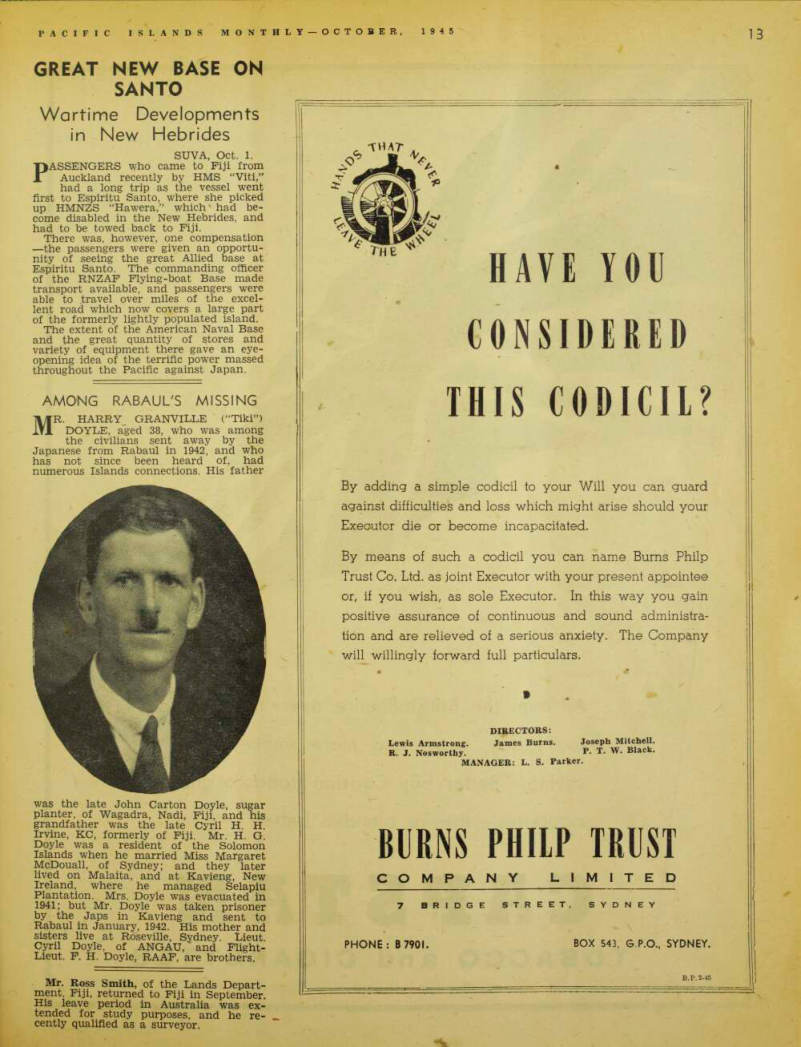
Great New Base On
Santo
Wartime Developments in New Hebrides
Suva, Oct. 1.
PASSENGERS who came to Fiji from Auckland recently by HMS “Viti,” had a long trip as the vessel went first to Espiritu Santo, where she picked up HMNZS “Hawera,” which had be come disabled in the New Hebrides, and had to be towed back to Fiji.
There was, however, one compensation —the passengers were given an opportu nity of seeing the great Allied base at Espiritu Santo. The commanding officer of the RNZAF Flying-boat Base made transport available, and passengers were able to travel over miles of the excel lent road which now covers a large part of the formerly lightly populated island.
The extent of the American Naval Base and the great quantity of stores and variety of equipment there gave an eye opening idea of the terrific power massed throughout the Pacific against Japan.
Among Rabaul's Missing
Mr. Harry Granville (“Tiki”)
DOYLE, aged 38, who was among the civilians sent away by the Japanese from Rabaul in 1942, and who has not since been heard of, had numerous Islands connections. His father
was the late John Carton Doyle, sugar planter, of Wagadra, Nadi, Fiji, and his grandfather was the late Cyril H. H.
Irvine, KC, formerly of Fiji. Mr. H, G.
Doyle was a resident of the Solomon Islands when he married Miss Margaret McDouall, of Sydney; and they later lived on Malaita, and at Kavieng, New Ireland, where he managed Selapiu Plantation. Mrs. Doyle was evacuated in 1941; but Mr. Doyle was taken prisoner by the Japs in Kavieng and sent to Rabaul in January, 1942. His mother and sisters live at Roseville, Sydney. Lieut.
Cyril Doyle, of ANGAU, and Flight- Lieut. F, H. Doyle, RAAF, are brothers, Mr. Ross Smith, of the Lands Depart ment. Fiji, returned to Fiji in September.
His leave period in Australia was ex tended for study purposes, and he re cently qualified as a surveyor.
Advertisements & other items, pp. 15-16 (1 item)
Considered
'THAT
the
HAVE YOU
CONSIDERED
THIS CODICIL?
By adding a simple codicil to your Will you can guard against difficulties and loss which might arise should your Executor die or become incapacitated.
By means of such a codicil you can name Burns Philp Trust Co. Ltd. as joint Executor with your present appointee or, if you wish, as sole Executor. In this way you gain positive assurance of continuous and sound administration and are relieved of a serious anxiety. The Company will willingly forward full particulars. • »
DIRECTORS:
Lewis Armstrong. James Bums. Joseph Mitchell.
R. J. Nosworthy. **• T. W. Black.
MANAGER: L. S. Parker.
BURNS PHILP TRUST
COMPANY LIMITED
7 BRIDGE STREET, SYDNEY
PHONE; B 7901. BOX 543. G.P.0.. SYDNEY.
B.P. 2-45
All over the British Empire, every minute of every day, more and more smokers are saying, "Better buy Capstan (tobacco and cigarettes) —they're blended better.
CAPSTAN
TOBACCO and CIGARETTES
Papuan Planters Appeal To
Britain For Help
Ward's Madheaded Labour Plan Brings Chaos to Islands Industries
THE dissatisfaction of the European residents of Papua and the Mandated Territory of New Guinea, with the conditions of the “provisional administration,” recently created by the Minister for External Territories (Mr, Ward) has taken marked shape in two different directions. Evacuees in Australia are petitioning the Governor-General for relief (see article else where) and the Papuan planters are appealing to Britain.
ON September 24, the following radio gram was despatched from Port Moresby to the Prime Minister of Great Britain: “Representative meeting of planters and commercial interests desire to in form you that new (Native Labour) Regulations, as being applied without notice to Territories of Papua and New Guinea by the Commonwealth Govern ment, will result in complete collapse of all planting and other industries immedi ately.
“We demand in fairness to all interests that a period of 12 months be allowed in which to bring into force these new Regulations, otherwise chaos will prevail and production of copra, rubber and other products will cease forthwith, whilst young planted acres will be lost.
“We are deprived of legal advice, of representation in the Commonwealth Parliament, and of appeal to the High Court. As British subjects we ask you to intervene with a view to justice being done.”
The decision to appeal to Great Britain was taken after the planters had been called together on September 22 by the Production Control Board and informed that all contracts of employment made between present employers and natives would be terminated on October 15, when natives would be given the option of entering into a new contract for one year, or engaging as a non-indentured labourer, or returning to their homes. If natives were re-engaged, they must be paid 50 per cent, higher wages than at present.
Immediately after the notification was given to the planters, the Military Ad ministration (which is about to be re placed by the Provisional Civil Govern ment) made a broadcast over the natives’ radio service (recently inaugurated) and informed the natives that the war was now over, that all labour contracts were now at an end, and that “they could go home if they wished.”
It is reported from Kila Camp, where there is a “pool” of approximately 3,000 native labourers, that only three men signified their readiness to go on work ing.
rE effect upon both the finance and the productiveness of the planta tions is most serious. There are rubber plantations, now actively in pro duction, which employ up to 600 natives.
They are to be left without labour.
The planters have been compelled to pay the Military Administration a “recruiting charge” of £4 per head for each of these boys, who were taken on on one-year and two-years contracts.
Now, as a result of the new edicts is sued by Mr. Ward through the Produc tion Control Board, these contracts are being all wiped out without any notice.
Under the new Provisional Government set-up, the Production Control Board (which is operated by the Department of External Territories) controls all pro duction, labour, distribution of goods, purchase of plantation products, and transport. It apparently is designed to take the place, in the Territories, of the big trading firms. There has been no indication that Burns Philp & Co., Ltd., W. R. Carpenter & Co.. Ltd., and Steam ships Trading Co., Ltd., will be allowed to resume their operations as merchants, planters, shipowners, etc.
Up to the present, only a few score Europeans have been allowed by Mr.
Ward’s Department to return to the Ter ritories. They were told that they could go back on condition that they produced copra and rubber, as rapidly as possibly.
Some have been back on their plantations for one year. These are the men who are now being crippled by the Depart ment’s latest move, and have appealed to the British Prime Minister.
A STATEMENT issued on September 24 by the Papuan Planters’ Associa tion and other commercial interests, made the following points: We have without notice been informed by the Production Control Board, under instructions from Canberra, that the minimum wages for natives will be 15/per month, as from August 1 last. This means a 50 per cent, increase for all general labourers on plantations, etc.
At approximately three weeks’ notice, employers of labour have been told that all existing contracts of service must be
terminated on or before October 15, whilst at the meeting at the Production Control Board on September 22 an an nouncement was made that all existing contracts are illegal. We claim there is insufficient time in which to replace the labour who will cease work on or before October 15. It is expected industries generally will be brought to a standstill immediately.
Employers wish to know what is to happen with regard to the fees already paid for natives signed on for two years, or one year, whose time has not been completed. Does the employer receive a refund? , , How does the Production Control Board and the Army propose to return boys home after the 15th prox.? Are the expenses of passages, etc., for account of employer, Production Control Board, or
Angau?
What is to be the arrangement re garding signing on of labour after Octo ber 15? Will the Board charge up signing-on fees, kits, passages, etc., or does the employer make his own arrange ments? . 1c Are natives signed on after October lo (under the Papuan Native Labour Ordinance) subject to a further cancella tion of contract when the new and final Native Labour Ordinance is available?
As most employers of labour, particu larly firms in Port Moresby, have no office staff or recruiting facilities, how will they secure replacement labour after October 15? , .
Employers of labour, seeing that in future they are to be more or less depen dent on casual labour, should have a Regulation to protect them, whereby such casual labour must give one month s notice before terminating their services.
Employers ask for a Royal Commission to be set up immediately to thoroughly
investigate the whole position as regards the employment of native labour throughout the Territory, particularly in view of the results of remote control from Canberra.
Under existing conditions, with more or less full labour requirements on estates, ships, etc., there is a consider able shortage of rations, drugs, etc., on estates. Furthermore, at present, most estates have a congestion of produce which cannot be shifted owing to lack of transport. What, therefore, will be the position if the number of natives already employed in transport, shipping, etc., is to be reduced following the sign ing-off of labour on October 15? It is obvious complete chaos must prevail.
Protests were made through the Pro duction Control Board against the broad cast over 9PA, advising natives of the new Regulations before employers had an opportunity of discussing matters with the Board. „ As most of the larger firms in Port Moresby have many estates spread throughout the Territory, it is impossible for them to contact respective managers and natives before October 15, to acquaint them with the new Regulations, and at tempt to make any arrangements which might save the situation.
Mrs. I. G. Cowled, wife of Major S.
Cowled, chaplain to the Fiji Military Forces, returned to Suva by the Septem ber “Matua.” Major Cowled expects to be discharged from the FMF by the ena of the year.
Mrs. F. G. Harness, wife of Suva’s harbourmaster, returned to Suva on the September “Matua.” She flew to Auck land for an urgent operation in early August, but now has completely re covered.
Advertisements & other items, pp. 17-18 (1 item)
To - Day
Copies of
Pacific Islands Monthly
Can ALWAYS be obtained at the following places:
SYDNEY:
T. L. Cordingley’s Bookstalls at Martin Place, outside G.P.0., near George Street; and at G.P.O. Colonnade, George Street end.
BRISBANE:
R. S. Macdonald, next G.P.0., Brisbane, Qld.
MELBOURNE:
McGill’s Authorised Newsagency, 183-5 Elizabeth Street, Melbourne.
AUCKLAND:
W. A. Webb, Waverley Hotel Bldgs., Queen Street, Auckland.
SUVA:
James A. Muir, Suva, Fiji; and Miss R. Castles, Victoria Parade, Suva, Fiji.
GEE ALSO LIST OF AGENTS ON
PAGE 3
DO NOT WONDER FOR
YOUR CHRISTMAS PRE-
SENTS PLACE YOUR
ORDER AT
SHARDA
SOUVENIRS
STORE
For Genuine Tortoiseshell Souvenirs, Silver Filigree and Cat's Eyes Ornaments, Mounted in Silver Filigree and Tortoiseshell.
All overseas orders promptly executed. U.S.A. Money Orders accepted.
Give Us a Trial Order
G.P.O. Box No. 159,
SUVA, FIJI.
TO - DAY
Whilst Monel in all forms—sheet, rod, tube, wire, etc.—is still under the control of our Ministry of Munitions, releases are readily granted for essential purposes, such as propeller shafting for licensed fishing vessels, pump rods, etc., etc.
Against approved applications we have adequate stocks of this strong, tough, corrosion-resisting Nickel alloy and we welcome your enquiries.
WRIGHT AND COMPANY, 81 CLARENCE STREET, SYDNEY SOLE AUSTRALIAN DISTRIBUTORS OF MONEL :: :: :: ’PHONE: BXI2II -(6 LINES). - . Monel is a registered trade mark covering a rich nickel === a iioy, mined in Canada and rolled in Great Britain. ”
IL
REG. ADAMS, CLAYTON & CO.
go o
Progress with Modern Designing.
SHIPBUILDERS
and ENGINEERS
COPPERSMITHS, WELDERS and PLUMBERS.
Builders of WOODEN FREIGHTERS,
TRAWI ERS and ISLAND CRAFT.
Agents for Diesel Engines.
VESSELS REPAIRED and REMODELLED.
MODERN SLIPWAY FACILITIES
AVAILABLE.
Write to us for Designs and Complete Shipbuilding information.
REG. ADAMS, CLAYTON
& COMPANY
JOHN STREET, BERRY'S BAY, SYDNEY.
Tel.: XB 4475, XA 1731.
Captain Bertie Hall Back
From Jap Prison Camps
rERE arrived in Sydney at the end of September Captain Bertie Hall, of the British Solomon Islands and New Guinea, who has just ended 48 years at sea (his ship was torpedoed in World War I), with 31 years in Jap prison camps.
Captain Hall commenced his career in New Guinea in 1921, when he became skipper of the Government vessel “Siar”; and he finished it in 1937, when he fell down a hold on the Carpenter ship “Rabaul,” and broke his back. After a long spell in hospital, he went to the East; and he was in the China coast trade when the Jap war started.
He was 18 months in a camp In Amoy, where prisoners were well treated; and then he had two years in Shanghai, where all sorts of ingenious tortures were practised—from the breaking of hands to forcing water up the nose. Thence the whole camp was moved in cattle trucks, through Manchuria and Korea, to a very verminous place in the north of Japan.
A cup of rice and a cup of seaweed per day was the usual ration.
Despite his years, and apparently slight physique, Captain Hall retained his health, and is putting on weight rapidly.
He reported having seen in Japan and Manila two or three Rabaulites—he especially mentioned Dr. Watch, Lieu tenant Kilner and Clarrie Archer But of the very large party of New Guinea civilians, now missing and feared to be dead, he heard no word whatever.
Mrs. M. A. Wilson, of the Child Welfare Division of the Fiji Medical Department, returned to the Colony in September, after leave spent in Australia.
Advertisements & other items, p. 18 (1 item)
16
OCTOBER, 1945 TACIFIC ISLANDS MONTHLY
Newspaper
Another Indian Newspaper Plurality of Journals to Air Political Views
SUVA, Sept. 27.
FIJI now rejoices in nine Indian news papers, some of them, it is alleged by local inhabitants, established by disgruntled members of the community for no other reason than to place a good, swift kick in the pants of a rival faction.
The ninth publication,. “The Indian Times,” made its first appearance on Sep tember 15. It is a monthly journal of 26 pages, 6h of them in English and the rest in Hindustani. Its aims are obscure, unless it is to present the Indian view to the Europeans, but at least in its first issue (English section) it indulges in no kicking of local pants.
The publisher, Babii Ram Singh, is the proprietor of a well-established printery in Suva.
The question that is agitating the Indian population of Fiji at present is the Shephard report on the sugar indus try. A brief outline of this report was given in the August issue of “PIM.”
Briefly, Dr. Shephard exonerated the CSR Co. of blame for the impasse which oc curred in the Fiji sugar industry in 1943; and, neither did he recommend a change in the method of assessing the price of sugar-cane. The Indian growers found the Shephard report, generally, unpalat able and, after some preliminary skirm ishing/ it is now receiving further con sideration by a committee appointed by the Governor. A conference between Indiah growers began at Lautoka on September 23. So far no agreement has been reached.
The new “Indian Times,” in comment ing on the sugar siuation, says: “We hope that the future land policy will be so devised that it will ensure con tinuity and security of tenure, provide for the economic size of holdings, elimin ate speculation in price, premium- or rent but assist bona-fide dealings with land in order to encourage developments; throw open more lands required for the increasing population of the Colony with financial schemes and assistance for progressive developmen, so as to raise the standard of living and maintain it; prevent undue aggregation of land and when long-term leases expire to sub divide holdings for leasing directly to the occupiers or cultivators, and make it easy for everyone in need of land for residen tial. agricultural, dairying, or commer cial purposes, to obtain a lease expedi tiously.”
Hidden Mangaian "Janus"
Of Heathen Days
From Our Own Correspondent IN a deep cave at Ivirua Village lies hidden an old Maori artifact that the Bishop Museum would give its butter rations for the duration to get.
This is a two-faced, grey-stone human figure, about life size, before which stands a large stone bowl, blackened by fire.
This writer believes that an image sculp tured to face both ways is unique in Poly nesia. The effigy is highly “tabu,” as also is the cave it is in.
The likelihood of this Janus seeing the glass-cases of Honolulu Museum is very remote, therefore. But if it could be got out, what a fluttering there’d be in the ethnological dove-cotes!
Advertisements & other items, p. 19 (1 item)
'DaStjsad &
t
AUSTRALIAN FOODSTUFFS ... PHARMACEUTICAL LINES
WINES AND SPIRITS ... MANUFACTURED GOODS
PRIMARY PRODUCTS . . . PATENT MEDICINES YOUR ORDERS FOR GIN AND WHISKY can still be filled.
Distilled in Australia, matured under Customs supervision, these spirits are of guaranteed strength and quality. Orders will be accepted while stocks
'DaStjsad &
(Proprietors; R. Darvas and E. Klugman.) Cable address; Darvas Company, Sydney. Codes; Bent., A.B.C. (6th).
Bankers; Bank of Australasia, Comptolr National d’Escompte de Paris. 3 5
PITT
HEAD OFFICE :
STREET,
SYDNEY
Islands
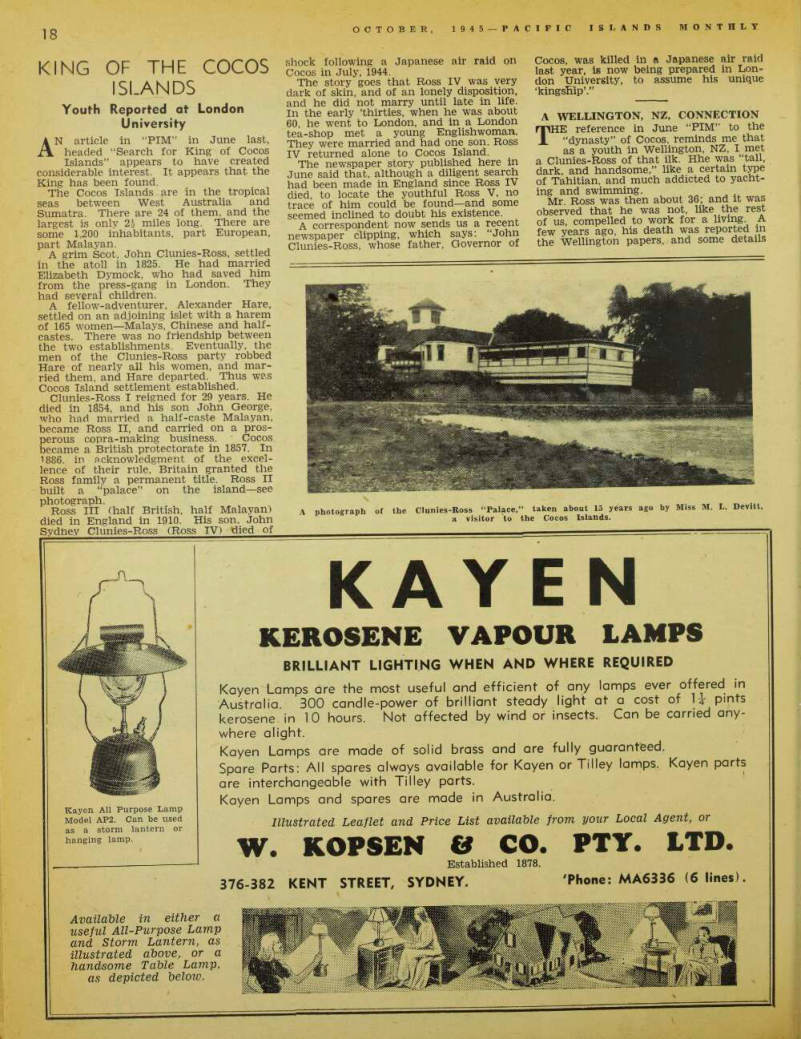
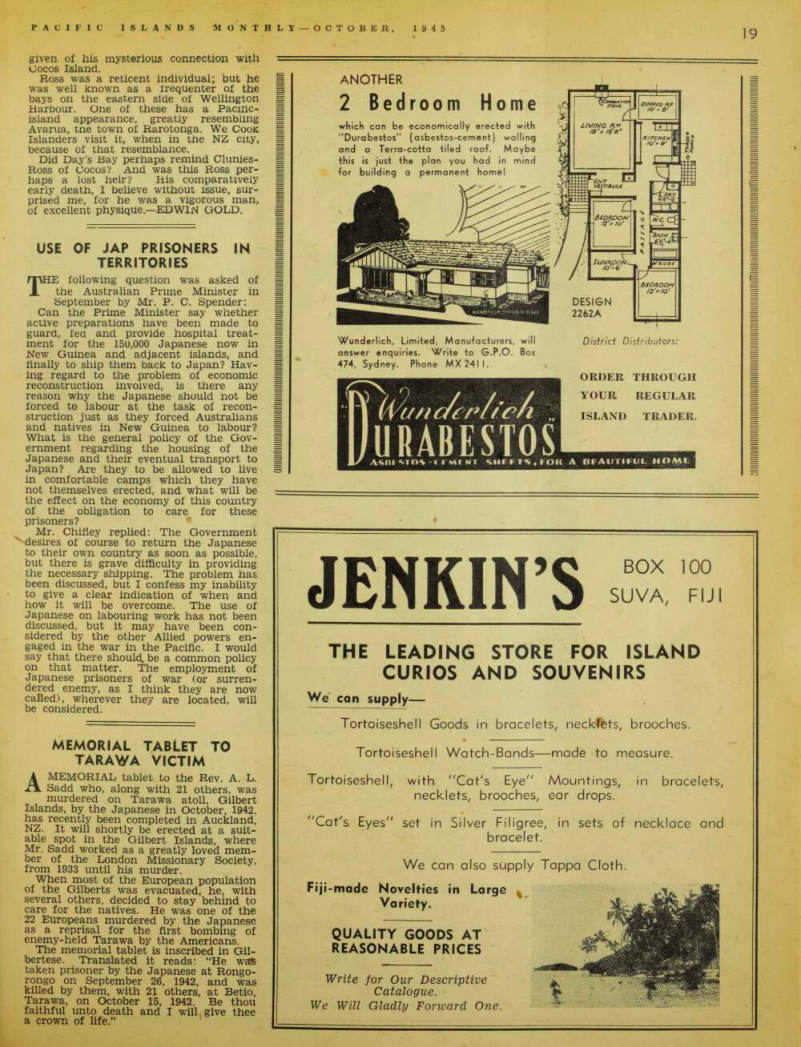
King Of The Cocos
Youth Reported at London University
AN article in “PIM” in June last, headed “Search for King of Cocos Islands” appears to have created considerable interest. It appears that the King has been found.
The Cocos Islands are in the tropical seas between West Australia and Sumatra. There are 24 of them, and the largest is only 2i miles long. There are some 1,200 inhabitants, part European, part Malayan.
A grim Scot, John Clunies-Ross, settled in the atoll in 1825. He had married Elizabeth Dymock, who had saved him from the press-gang in London. They had several children.
A fellow-adventurer, Alexander Hare, settled on an adjoining islet with a harem of 165 women—Malays, Chinese and half castes. There was no friendship between the two establishments. Eventually, the men of the Clunies-Ross party robbed Hare of nearly all his women, and mar ried them, and Hare departed. Thus was Cocos Island settlement established.
Clunies-Ross I reigned for 29 years. He died in 1854, and his son John George, who had married a half-caste Malayan, became Ross 11, and carried on a pros perous copra-making business. Cocos became a British protectorate in 1857. In 1886. in acknowledgment of the excel lence of their rule, Britain granted the Ross family a permanent title. Ross II built a “palace” on the island —see
photograph.
Ross 111 (half British, half Malayan) died in England in 1910. His son, John Sydney Clunies-Ross (Ross IV) died of
shock following a Japanese air raid on Cocos in July, 1944.
The story goes that Ross IV was very dark of skin, and of an lonely disposition, and he did not marry until late in life.
In the early ’thirties, when he was about 60, he went to London, and in a London tea-shop met a young Englishwoman.
They were married and had one son. Ross IV returned alone to Cocos Island.
The newspaper story published here in June said that, although a diligent search had been made in England since Ross IV died, to locate the youthful Ross V, no trace of him could be found—and some seemed inclined to doubt his existence.
A correspondent now sends us a recent newspaper clipping, which says: “John Clunies-Ross, whose father, Governor of
Cocos, was killed in a Japanese air raid last year, is now being prepared in Lon don University, to assume his unique
‘kingship’.”
A Wellington, Nz, Connection
THE reference in June “PIM” to the “dynasty” of Cocos, reminds me that as a youth in Wellington, NZ, I met a Clunies-Ross of that ilk. Hhe was “tall, dark, and handsome,” like a certain type of Tahitian, and much addicted to yacht ing and swimming.
Mr Ross was then about 36; and it was observed that he was not, like the rest of us, compelled to work for a living. A few years ago, his death was reported in the Wellington papers, and some details
A photograph of the Clunies-Ross “Palace,” taken about 15 years ago by Miss M. L. Devitt, a visitor to the Cocos Islands.
given of his mysterious connection with Cocos Island.
Ross was a reticent individual; but he was well known as a frequenter of the bays on the eastern side of Wellington Harbour. One of these has a Pacific island appearance, greatly resembling Avarua, tne town of Rarotonga. We Cook; Islanders visit it, when in the NZ city, because of that resemblance.
Did Day’s Bay perhaps remind Clunies- Ross of Cocos? And was this Ross per haps a lost heir? His comparatively early death, I believe without issue, sur prised me, for he was a vigorous man,
of excellent physique.
Edwin Gold.
Advertisements & other items, p. 20 (1 item)
Kayen
All Purpose Lamp Model AP2. Can be used as a storm lantern or hanging lamp.
KEROSENE VAPOUR LAMPS
BRILLIANT LIGHTING WHEN AND WHERE REQUIRED
Kayen Lamps are the most useful and efficient of any lamps ever offered in Australia. 300 candle-power of brilliant steady light at a cost of pints kerosene in 10 hours. Not affected by wind or insects. Can be carried anywhere alight.
Kayen Lamps are made of solid brass and are fully guaranteed.
Spare Parts: All spares always available for Kayen or Tilley lamps. Kayen parts are interchangeable with Tilley parts.
Kayen Lamps and spares are made in Australia.
Illustrated Leaflet and Price List available from your Local Agent , or
W. KOPSEN & PTT. LTD.
Established 1878. 876-382 KENT STREET, SYDNEY. 'Phone: MA6386 (6 lines).
Available in either a useful All-Purpose Lamp and Storm Lantern, as illustrated above, or a handsome Table Lamp, as depicted below. m A m mm m £W
Use Of Jap Prisoners In
Territories
rpHE following question was asked of X the Australian Prime Minister in September by Mr. P. C. Spender: Can the Prime Minister say whether active preparations have been made to guard, fed and provide hospital treat ment for the 15u,000 Japanese now in New Guinea and adjacent islands, and finally to ship them back to Japan? Hav ing regard to the problem of economic reconstruction involved, is there any reason why the Japanese should not be forced to labour at the task of recon struction just as they forced Australians and natives in New Guinea to labour?
What is the general policy of the Gov ernment regarding the housing of the Japanese and their eventual transport to Japan? Are they to be allowed to live in comfortable camps which they have not themselves erected, and what will be the effect on the economy of this country of the obligation to care for these prisoners?
Mr. Chifley replied: The Government desires of course to return the Japanese to their own country as soon as possible, but there is grave difficulty in providing the necessary shipping. The problem has been discussed, but I confess my inability to give a clear indication of when and how it will be overcome. The use of Japanese on labouring work has not been discussed, but it may have been con sidered by the other Allied powers en gaged in the war in the Pacific. I would say that there should, be a common policy on that matter. The employment of Japanese prisoners of war (or surren dered enemy, as I think they are now called), wherever they are located, will be considered.
Tarawa Victim
Memorial Tablet To
A MEMORIAL tablet to the Rev. A. L.
Sadd who, along with 21 others, was murdered on Tarawa atoll, Gilbert Islands, by the Japanese in October, 1942, has recently been completed in Auckland, NZ. It will shortly be erected at a suit able spot in the Gilbert Islands, where Mr. Sadd worked as a greatly loved mem ber of the London Missionary Society, from 1933 until his murder.
When most of the European population of the Gilberts was evacuated, he, with several others, decided to stay behind to care for the natives. He was one of the 22 Europeans murdered by the Japanese as a reprisal for the first bombing of enemy-held Tarawa by the Americans.
The memorial tablet is inscribed in Gil bertese. Translated it reads- “He was taken prisoner by the Japanese at Rongo rongo on September 26, 1942, and was killed by them, with 21 others, at Betio, Tarawa, on October 15, 1942. Be thou faithful unto death and I will give thee a crown of life.”
Advertisements & other items, pp. 21-22 (1 item)
Jenkin’S
ANOTHER
"Durabestos" (asbestos-cement) walling
and a Terra-cotta tiled roof. Maybe this is just the plan you had in mind for building a permanent home!
Wunderlich, Limited, Manufacturers, will answer enquiries. Write to G.P.O. Box 474, Sydney. Phone MX 241 I. o /!?c Cf - Bath J
fLb?
BtOBOOH
/3*/0'
DESIGN
2262 A District Distributors:
(/(^unc/er/icA „
URABESTOS
ORDER THROUGH
YOUR REGULAR
ISLAND TRADER.
Asm sios -rrMr nt smffts,for A dfAiitifui homi
JENKIN’S
BOX 100
SUVA, FIJI
THE LEADING STORE FOR ISLAND
CURIOS AND SOUVENIRS
We can supply— Tortoiseshell Goods in bracelets, necklets, brooches.
Tortoiseshell Watch-Bands —made to measure.
Tortoiseshell, with "Cat's Eye" Mountings, in bracelets, necklets, brooches, ear drops.
"Cat's Eyes" set in Silver Filigree, in sets of necklace and bracelet.
We can also supply Tappa Cloth.
Fiji-made Novelties in Large Variety.
QUALITY GOODS AT
REASONABLE PRICES
Write for Our Descriptive Catalogue.
We Will Gladly Forward One.
I
Modern Refrigeration for the South Sea Islands
The ELECTROLUX KEROSENE OPERATED
REFRIGERATOR
MARVEL
OF
MODERN
SCIENCE
THE
MIRACLE
OF
ICE
FROM
HEAT
ELECTROLUX OFFERS ECONOMICAL, a nd completely efficient refrigeration for islands homes.
t?t?FFZES CONTINUOUSLY WHILE SMALL LAMP BURNS.
FREEZES Uges only j gallon of kerosene per week. , 7l controlled by simply regulating height of flame.
Freezing controlled by moTO BLESS ... NO PARTS TO GET OUT OF ORDER.
MODEL L 22
Capacity 3 1 cubic feet.
MODEL L3BO «
(as Illustrated) Capacity 4 cubic feet.
GUARANTEED FOR TWO YEARS.
Write to your Local Distributor for prices and fuU details.
MODEL LKSSO
Capacity 6.5 cubic feet.
OBTAINABLE FROM ALL W. R. CARPENTER & CO. LTD.
BRANCHES THROUGHOUT THE ISLANDS
Representation in Papua and New Hebrides.
The Fijian—And The Banana Industry
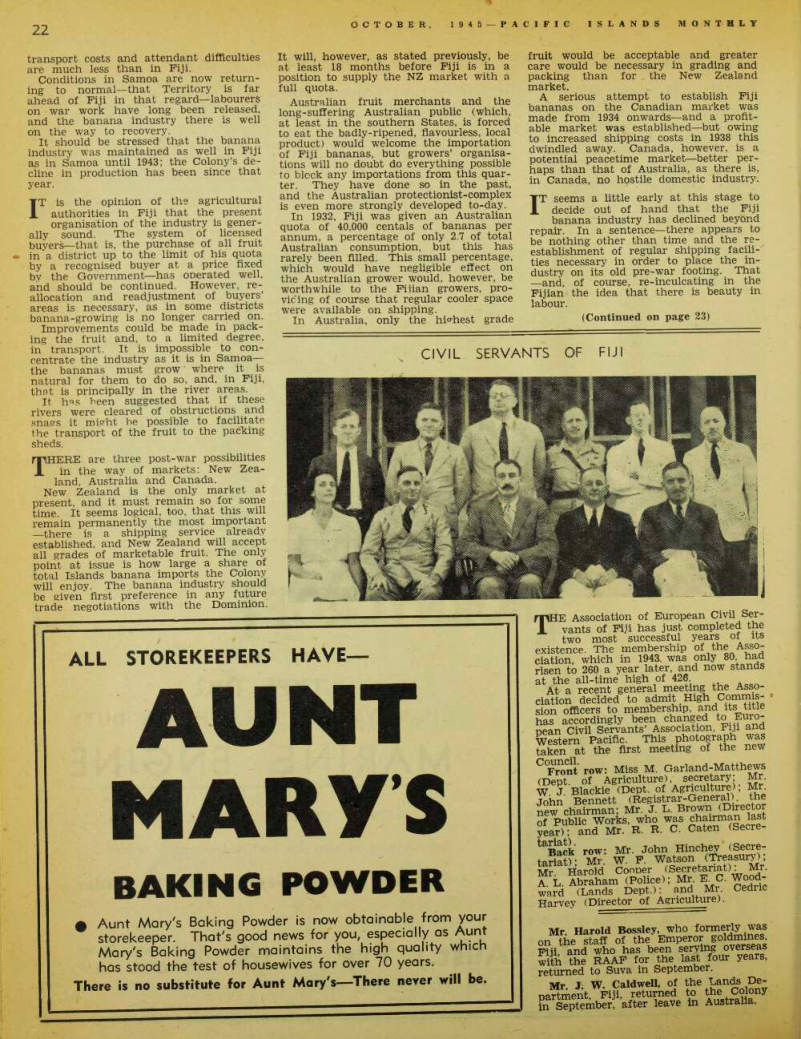
Recent Decline Can be Halted if Action Taken Now
'THE suggestion has come from certain places in Fiji that the local banana industry is in a bad way; that, in comparison with Samoa and Tonga, it is poorly organised; and that local authorities would be
better employed “providing the
growers with an incentive for pro
ducing better fruit” than searching
around for fresh fields for post-war
development.
BANANA production in Fij i is pre dominantly in the hands of the Fijians themselves. Many who see this industry as the most profitable avenue of post-war development for the Fijians are concerned at the falling-off of production in the Colony. They are asking themselves whether this is purely a wartime development, or whether something could not be done now in the way of reorganisation of the banana exporting industry—especially banana exporting to New Zealand.
New Zealand has been banana-hungry for the past three years, and New Zea land does not like it much. The ques tions that have been asked in the NZ House of Representatives, from time to time, in regard to this fruit are, to the outsider, very funny; but the position still is that the arrival of Islands bananas in the Dominion merits a half-column in the newspapers.
It is this banana-consciousness that Fiji’s post-war reconstructionists no doubt are anxious to turn now to good account.
IN 1932, New Zealand arranged a quota system with Fiji, Samoa and Tonga for the supply of Islands bananas.
In that year. Fiji’s quota was fixed at about 39 per cent, of total NZ imports, but in 1935 and again in 1936 this quota was further reduced.
Fiji, pre-war, was not in a strong posi tion to bargain with NZ because, in those years, Fiji obtained most of her manu factured goods and other requirements from Australia. However, during the war, imports from NZ into Fiji have increased considerably: and if this trend persists into the peace, Fiii will have a much stronger bargaining point. In the past it has been natural for Dominion policy to favour the importation of Samoan and Cook Island bananas, rather than those from Fiji.
The year 1938 was an all-time high for imports of bananas into New Zea land; 443.000 cases arrived in the Dominion that year, of which 35 per cent, were from Fiji. In 1943, New Zea land received only 196,604, of which 40 per cent, were Fijian. Since that time production of the fruit in Fiji has rapidly fallen off.
THIS falling-off can be attributed to several factors: the irregularity of shipping after the entry of Japan into the war; the fact that many growers joined the Forces; shortage of inter island vessels plying between the grow ing centres and the port of shipment (Suva); increase in local consumption (the equivalent of 35,000 cases was con sumed annually during the period when
overseas troops were in the Colony); and finally, shortage of cases.
In common with all other industries during the war, cost of production has also increased. It is estimated that by August, 1943, costs had risen by 30 per cent, in comparison with a 14 per cent, rise in selling price.
Because of more lucrative work dur ing this period, when Fiji was a great Allied base, and because such a large proportion of Fijians joined the military Forces or took up war work, re-planting as well as the gathering and packing of the mature fruit was neglected. This neglect, of course, has had a cumulative effect: and, if Fiji has recently been un able to fill her quotas to New Zealand, even when shipping was available, it is easy to see why this is so.
Fiji troops are now being demobilised, but the effect of past neglect is expected to be felt in the Colony for at least 18 months after the Fijians have returned to their normal village life.
IN Samoa, bananas are grown not only by the Samoans themselves, but also by Europeans and Euronesians. Neg lect of banana plantations there was con siderable during the period of “dollar prosperity” but by no means as great as that in Fiji. There are no Government approved buyers for each district in Samoa, as there are in Fiji; the industry is managed by Reparation Estates, a semi-Governmental institution.
The Samoan administration takes 6d. per case in addition to inspectors’ fees, and cases are expensive as they are im ported from New Zealand. But Samoa has a great advantage in that banana planting there iS concentrated within a comparatively short distance of Apia, and
transport costs and attendant difficulties are much less than in Fiji.
Conditions in Samoa are now return ing to normal—that Territory is far ahead of Fiji in that regard—labourers on war work have long been released, and the banana industry there is well on the way to recovery.
It should be stressed that the banana industry was maintained as well in Fiji as in Samoa until 1943; the Colony’s de cline in production has been since that year.
IT is the opinion of the agricultural authorities in Fiji that the present organisation of the industry is gener ally sound. The system of licensed buyers—that is, the purchase of all fruit in a district up to the limit of his quota by a recognised buyer at a price fixed by the Government—has operated well, and should be continued. However, re allocation and readjustment of buyers’ areas is necessary, as in some districts banana-growing is no longer carried on.
Improvements could be made in pack ing the fruit and, to a limited degree, in transport. It is impossible to con centrate the industry as it is in Samoa— the bananas must grow where it is natural for them to do so, and, in Fiji, that is principally in the river areas.
It h*s been suggested that if these rivers were cleared of obstructions and snaffs it might be possible to facilitate the transport of the fruit to the packing sheds.
THERE are three post-war possibilities in the way of markets; New Zea land, Australia and Canada.
New Zealand is the only market at present, and it must remain so for some time. It seems logical, too, that this will remain permanently the most important —there is a shipping service already established, and New Zealand will accept all grades of marketable fruit. The only point at issue is how large a share of total Islands banana imports the Colony will enjoy. The banana industry should be given first preference in any future trade negotiations with the Dominion.
It will, however, as stated previously, be at least 18 months before Fiji is in a position to supply the NZ market with a full quota.
Australian fruit merchants and the long-suffering Australian public (which, at least in the southern States, is forced to eat the badly-ripened, flavourless, local product) would welcome the importation of Fiji bananas, but growers’ organisa tions will no doubt do everything possible to block any importations from this quar ter. They have done so in the past, and the Australian protectionist-complex is even more strongly developed to-day.
In 1932, Fiji was given an Australian quota of 40,000 centals of bananas per annum, a percentage of only 2.7 of total Australian consumption, but this has rarely been filled. This small percentage, which would have negligible effect on the Australian grower would, however, be worthwhile to the Fiiian growers, pro viding of course that regular cooler space were available on shipping.
In Australia, only the highest grade
fruit would be acceptable and greater care would be necessary in grading and packing than for . the New Zealand market.
A serious attempt to establish Fiji bananas on the Canadian market was made from 1934 onwards—and a profit able market was established —but owing to increased shipping costs in 1938 this dwindled away. Canada, however, is a potential peacetime market—better per haps than that of Australia, as there is, in Canada, no hostile domestic industry.
IT seems a little early at this stage to decide out of hand that the Fiji banana industry has declined beyond repair. In a sentence —there appears to be nothing other than time and the re establishment of regular shipping facili ties necessary in order to place the in dustry on its old pre-war footing. That —and, of course, re-inculcating in the Fijian the idea that there is beauty in labour.
(Continued on page 23)
It has already been stated that the Fijians were wholeheartedly behind the war effort, and this to the detriment of their own village life and industries. War conditions are rapidly giving way to those of peace, and money will by no means be as easily come by as it has been in the past three years. There is already an established market for Fiji bananas in New Zealand and it is reasonable to suppose that when the Fijians get around to it they will naturally turn to the in dustry that they have made their own in this Colony.
As to providing “incentive” for pro ducing more and better fruit: that is not a matter for the Government of Fiji alone, but rather a question of inter national supply and demand.
The greatest danger in Fiji at the moment seems to be that if the Fijian rests too long on his wartime laurels he will wake up some day to find that the banana business, like many others in Fiji, has been taken over by another and further-seeing race.
Miss Shirley Levy, of Bondi Junction, Sydney, was married in October to War rant-Officer Adrian N. Matthews, son of the late Rev. H. Matthews, of Port Moresby, who lost his li/e in a Jap air raid on Port Moresby in 1942. The young couple are to reside in Port Morseby, where he will resume his position in the Public Service. Captain J. Frame, of the AIF, also of Papua, was one of the groomsmen.
Three French Navy Officers, Artigue, Lachaume and Lomiere; two Petty Officers, Agostini and Berton; and Mon sieur Agez, a Noumea radio operator, have been awarded the Resistance Medal for wartime services in New Caledonia.
Advertisements & other items, pp. 23-24 (1 item)
Marine Engine
TYPE DB2
"HANDYBILLY" 9 H.P. HEAVY DUTY
SIMPLE, RELIABLE & ECONOMICAL
Available at present for certified essential orders only.
Requisite Stern Gear Made to Order.
Write for full particulars to—
Thornycroft (Aust.) Pty., Ltd. p^mon^n's'w
Cables: THORNMOTOR, Sydney.
ALL STOREKEEPERS HAVE—
AUNT
MARYS
BAKING POWDER
• Aunt Mary's Baking Powder is now obtainable from your storekeeper. That's good news for you, especially as Aunt Mary's Baking Powder maintains the high quality which has stood the test of housewives for over 70 years.
There is no substitute for Aunt Mary's—There never will be.
Civil Servants Of Fiji
rE Association of European Civil Ser vants of Fiji has just completed the two most successful years of its existence. The membership the Asso ciation, which in 1943. was only 80, had risen to 260 a year later, and now stands at the all-time high of 426.
At a recent general meeting the Asso ciation decided to admit High Commis sion officers to membership, and its title has accordingly been changed to Euro pean Civil Servants’ Association, Fiji and Western Pacific. This photograph was taken at the first meeting of the new row: Miss M. Garland-Matthews (Dept, of Agriculture), secretary; Mr.
W J. Blackie (Dept, of Agriculture), Mr.
John Bennett (Registrar-General). the new chairman; Mr. J. L. Brown (Director of Public Works, who was chairman last year); and Mr. R. R. C. Caten (Secre ta Back row: Mr. John Hinchey (Secre tariat) * Mr. W. F. Watson (Treasury); Mr. Harold Cooper Secretariat): Mr.
A. L. Abraham (Police); Mr. E C. Wood ward (Lands Dept.): and Mr Cedric Harvey (Director of Agriculture).
Mr. Harold Bossley, who formerly was on the staff of the Emperor goldmines Fiji, and who has been serving overseas with the RAAF for the last four years, returned to Suva in September.
Mr J. W. Caldwell, of the Lands De partment, Fiji, returned to the Colony in September, after leave in Australia.
Mystery Of New Guinea Timber
Vast Asset in Territory, About Which Canberra Cannot Make Uo Its Mind
rE dithering and uncertain attitude of the Department of External Ter ritories, in relation to the forestry resources of the Territories of Papua and New Guinea, has caused a host of rumours, in which Mr. Ward and his De partment are accused of all kinds of bad practices, from Socialism to secret com missions.
All, probably, are unfounded; but, if the Minister and his officials are embarrassed by the suspicions which centre around them, they can blame their own lack of frankness, and their unwillingness to give any indication of what they are going to do with the Territories’ timber resources, in relation to the world’s clamant need for timber of all kinds.
Reports credit the Department and the New Guinea Administration with an in tention to carry out one or other of the following plans:— • Establish a State-owned timber-getting industry, with saw-mills at several points in both Territories, the lumber to be shifted by State-owned ships. (The “State,” in each case, being Aus tralia.) • Dispose of the timber concessions to an operating company, in which the State shall own 51 per cent, of the shares. • Dispose of timber rights to certain monopolistic interests which have been wooing certain Ministers. • Dispose of the timber concessions to private enterprise, on a royalty basis.
One report says that the Government — or, at least, four minor Ministers, repre
senting a little-respected section of the Government—has been carrying on dis cussions with a “local syndicate,” headed by a Wau dentist and a New Guinea aviator, and that the negotiations had proceeded a considerable distance. It was not indicated that any of the interests concerned had any practical knowledge of the lumber industry—the profit motive seemed to be the main consideration.
Well-wishers of New Guinea hope still that the Australian Government will dis play enough vision to use Australia’s clamant hunger for timber to establish a new and profitable industry in that Terri tory. The only certain way to do this is to throw the situation wide open to pri vate enterprise, under proper control. But no such decision is expected from the people who now are in charge in Can berra. They are more likely to try to establish a State-owned industry.
MEANWHILE, to get some Idea of the timber resources of New Guinea, we have had an interview with Mr. T.
Flower, well known as a lumber contrac
tor in New Guinea and Papua, before the war. When the civilians were evacuated, Mr. Flower tried to induce the Australian military authorities to make use of his services as a timber-getter. The Aus tralians were not interested.
So Mr. Flower, like many other good Territorians, offered his services to the Americans; and the Americans, as in many similar cases, did not waste five minutes. He was engaged forthwith (at £2,000 per annum!) to make a survey of the timber available in all the places where military operations were in pro gress or contemplated. He spent two years on this work, and gathered valuable data.
The American commanders wished to avoid loading their incoming ships with necessary lumber —they wanted Mr.
Flower to produce timber close to where the timber was needed.
Mr. Flower surveyed the timber re sources of the New Guinea coast, and of the islands along the coast, from Port Moresby right around to the island of Noemfer, bevond Biak (off Geelvink Bay, in Dutch New Guinea). He operated saw mills at or near Port Moreby, Milne Bay, Goodenough Island, Lae, Finschhaven, Manus (in the Admiralties), and on the Dutch New Guinea coast. The timber from the latter mills went to Leyte and other operational areas in the Philippines.
The production of timber over the two years was enormous—yet, so great are the timber resources of these Territories, the forests were practically unmarked. They took 2,000,000 feet out of a narrow strip in the Finschhaven district, and the moval of the trees could not be noticed.
“That country could supply all Aus tralia's timber needs fbr a long time—as long as the timber-getters were given some encouragement.” said Mr. Flower.
“But Australia would have to do some thing to help the industry. There is an
application before the Tariff Board now to lift the duty on sawn timber from New Guinea. There would need to be assistance at the other end, too. Just before the war, I imported two tractors to New Guinea for lumber work, and the duty on the two machines was £500!
Roads are wanted, so that the good tim ber stands can be got at.”
At one period, the Americans were bringing no less than 6,000,000 feet of Oregon, from USA, and sawn timber from Australia, into New Guinea, but this was cut down as the New Guinea timber became available. rE use of New Guinea timber, said Mr Flower, was really a matter of trial and error. There would be perhaps 20 or 30 different kinds of tim oer in one area, and they had to decide which was the most suitable.
He used a special kind of mangrove for piling. He also found useful types of mahogany, walnut, cedar, pine and oak—they ranged from the lightest to the heaviest woods. He used a lot of Kasi-kasi, a timber heavier than Lignum Veatu, and of Balsa, which is so light that it is used by the natives for carving models. There was a good deal of Quila, a wood so excellent that the Germans shipped it away from New Britain, before 1914, for the decwation of the Reichstag building. He was interested to find on Oeake Island, near Biak, logs of Quila. indicating that the Dutch had discovered the value of the timber, and were shipping it away from that Terri tory. There are several softwoods in New Guinea which would find a ready market in Australia.
Mr Flower strongly urges that, simul taneously with timber-getting in New Guinea, the work of . reafforestation should proceed. He thinks that pines
should be planted on a huge scale, and that they would pay rich dividends.
He expressed confidence in Mr. J. B.
Me Adam, who was Forestry Officer under the late New Guinea Administration, who has been doing good work under the Military Government, and who is ex pected to be in charge of forestry under the Provisional set-up “a good sound man, who really understands the problems of forestry in this tropical Territory.”
Advertisements & other items, pp. 25-26 (1 item)
Robert C Liesp E Ptv.Ltd
5 ss E s
EYE
LOTI
Ft Inflamed Eras and EyaHda
SOLD EVEBTWREIK
H A «w 4 C«. rty. Ltd.. Kloi 9L, «y*nrr
IMPORTERS
EXPORTERS
1/ Island Distributors for
"COLEMAN" HEATING AND LIGHTING APPLIANCES
DINOX " AND " DIX " BRANDS OF BROOMS, BRUSHES AND MOPS
ROBERT C LIESP E PTV.LTD
BANKERS: BANK OF N.S.W.
COMPTOIR NATIONAL
D'ESCOMPTE DE PARIS
54a PITT ST. SYDNEY N.S.W.
CABLE ADDRESS:
“ROBERGILL"
PHONES BW 4782-B 1305
G. H. ROBINSON
Island Merchant and Agent
OF 51 MACQUARIE STREET, SYDNEY
having returned to business, can, as a result of over twenty years' extensive experience (excluding service in two wars) guarantee prompt and efficient individual service as a buying agent to Pacific Island clients.
Enquiries are solicited to— Box 3317, G.P.0.,
SYDNEY.
"Orometua" Are Not
Ordained Clergy
Prom Our Own Correspondent
Mangaia, Aug. 20.
IT does not seem to be_ generally known that the native “orometua” that have replaced the old LMS white missionaries are not entitled, like their predecessors, to be called “Reverend.”
Like the native police, these pastors are placed in positions purely upon the caprice, or favour, of the man in charge.
The results at times are bad, where some cunning lad succeeds in humbugging spiritual “GHQ” with false piety, and is placed in a mission to mould the life of an island’s native community. Such a “whited sepulchre” can do a lot of damage before he is found out and sacked! The LMS has shown a tendency in late years to be excessively tolerant; which is just as bad, in the workout, as the former rigidity, remembered by the elder folk. The Cl are the home of “one-man rule” in religion, as well as administration. Such a system, is not in accord, either way, with the spirit of the times, leading often to something remark ably like a Nazi set-up, and frequent abuses of power.
To be Quickly Restored
Phosphate Industry
IT was officially announced in Canberra late in September that limited pro duction of phosphate on Ocean and Nauru Islands was to commence almost immediately.
The Australian Army has occupied Nauru and Ocean Island, and the British Phosphate Commission is ready for the immediate installation of new machinery to replace whatever of the Islands plant has been destroyed. The estimated pro duction in the next 12 months, however, is not more than about 100,000 tons, compared to the pre-war annual average of over 1,000,000 tons.
The Australian Government will help the Commission to re-establish the indus try. Phosphate rock is urgently needed In Australia and New Zealand to step up food production.
War Record
Territorions' Proud War Record
“11TE are all justly proud of the war T? record of our natives. But I feel that there might, in justice, be some recognition of the part played by Europeans of the Territories during the war. It was a very creditable part.
“In December, 1941, the white women and children were evacuated, and, about two months later, men over 45 were eva cuated under National Security powers.
Men under 45 were called to the colours, and they have served with credit, some with high distinction.
“In the 2 h years before the evacuation the number of enlistments in the three fighting services of the Commonwealth was so great that it caused serious diffi culty in Papua. The Administration was compelled to refuse permission to any more to enlist. Those who remained not only did double work, but they organised themselves, to a man and to a woman, in every possible way, to further the war effort and to defend the Territory.
“A number of our men have fallen in different operations, a number have been prisoners of war, others have returned, or are returning, with decorations.
“When the facts are fully known it will be abundantly apparent that the white men and women deserved well of the Territory and of the Commonwealth.” — Hon. Leonard Murray, Civil Administra tor of Papua, at the Paddington meeting of Territorlans on August 22.
New Tb Hospital In Fiji
SUVA, Sept. 16.
RECENTLY, four hospitals were vacated by the military authorities, and care ful consideration was given to the selection of one or other as a tuberculosis hospital. Tamavua hospital was finally selected, for the following reasons: — The hospital buildings are the most substantial, and have modern operating theatres and X-ray departments. Hot water is laid on throughout the hospital, and a steam plant supplies steam for all sterilisers. Then, too. there is ample accommodation for all nursing and domestic staffs, which is a very impor tant factor. A steam laundry will also be available.
The hospital is centrally situated and easily accessible from all parts of Fiji.
It is near the teaching centres for medical and nursing students.
It is hoped that the hospital will be in use before the end of this year
Fijians Annoy European
Waterside Loafers
CERTAIN gentlemen of the Auckland Waterside Workers’ Union have been snarling angrily because some newspaper correspondents compared the achievements of the Aucklanders in handling ships’ cargo with what can be done in Suva harbour with Fijian labour.
They insist that they can “knock spots’’ off the native labourers, even while tak ing time off for tea, and smokes, and other privileges.
I am reminded of an occasion in July, 1945, when I travelled from Sydney to Fiji in an American freighter. The skip per knew the amount of cargo he had
to un l° a d and load in Suva; and, fresh from his experiences in the ports of Sydney and Melbourne, he calculated that his ship would lie in Suva harbour for at least a week. We arrived on a Monday morning, and I arranged to have dinner with him on the following Thursday evening. But we calculated without teboiir. Those men, working steadily and happily—if one may judge from tneir occasional singing—cleaned up the whole job of discharge and loading noon on Wednesday, and the ship was gone on Wednesday evening. , For sheer, deliberate laziness and cal culated loafing, I never have witnessed anything equal to what I have seen in the seaports of Australia and New Zea land in recent years—R.W.R.
Mr. J. B. Wright, formerly of the Cook Islands Government Service, has now taken over as Collector of Customs and Taxes at Apia, succeeding Mr. P. H.
Pearce, who has returned to New Zealand.
Miss Nat. McLeod, MA, who was for merly a teacher at Rotorua High School, New Zealand, has been appointed a teacher at the Ifi Ifi School; in Samoa, and travelled there by the August “Matua.” Miss O. M, Mays, MA, who also was on Rotorua High School staff, has been appointed to the Malifa School, in Samoa.
Advertisements & other items, pp. 27-28 (1 item)
Imperial
TIME OFF FROM
COOKING
v.
I^v m m m 7> & t m ■*m m ' \ SL y-y^y; ■ What an idea to be able to serve up meals in 5 minutes! . . . Meals that will bring unanimous appetising pleasure—treats that you yourself will be able to sit down and enjoy.
IMPERIAL Good Foods are ready-cooked for you by expert chefs. Easy-to-serve. Specially processed to seal in the full flavour and keep EVER-FRESH.
Imperial
GOOD FOODS
W. ANGLISS & Co. (Aust.) Pty., Ltd.
Head Office: 5-7 O’Connell Street, Sydney, Australia.
Imperial
MEATREAT
★ Imperial
CAMP PIE
★ Imperial
HAMPE
★ Imperial
HOT MEALS
Refreshing
as a plunge
into a lagoon!
o
Germicidal
and fragrant
TENAX TOILET SOAP is
a rapid safeguard against external skin infections, yet it is soothing and kind to the most sensitive skin —even a baby's!
ORDER TENAX FROM
YOUR ISLAND SUP-
PLIERS. STOCKS ARE
PLENTIFULLY AVAIL-
ABLE.
Woven Wire for all Industry
COPRA DRYING TRAYS, FLOORS, Etc.
FRLHT DRYING TRAYS, MINING SCREENS.
Heavy Mosquito Gauze in Phosphor Bronze and other Metals Impervious to Salt Sea Air.
WIRE DOOR MATS AND GENERAL WIRE WORKS
E. WRIGHT & CO. LTD.
Office and Works: 148-152 Cleveland Street, Sydney, N.S.W.
Telegraphic Address: “Wrightmake,” Chippendale.
Where Fin-Ance Kills Rom-Ance
"Young Man, Stay Away From the Islands!"
By “Na Vokai”
A BEACH shimmering silver in the light of the full moon ... the trade wind crooning in the palm trees . . . the eternal rumble of the Pacific rollers breaking on the fringing coral reef . . . the tinkling of guitars and melodious voices singing the songs of the Islands. Romance with a capital R—so the guide books and fiction of the Islands would have it. Sometimes we see it called the glamour of the South Sea Islands.
Beware, young man—and maiden, too —seekers after this elusive romance and glamour of the tropic seas. Remember that advertising men were ever strainers of the truth, and writers of Islands fic tion . . . !
Remember that, hovering round that beach, there will be a myriad extremely vicious sandflies and/or mosquitoes. Pre datory crabs wander the sands in the moonlight, and even the most graceful and romantic coconut-palm sometimes drops a heavy nut, which announces not its coming. The old couch by the winter fireside back home can be lots more com fortable—believe me, for I know both.
Perhaps you dream of languorous brown maidens, dressed in a wreath of flowers and a smile, and strumming guitars. All hooey! The missionaries made ’em get dressed years before you and I saw the light, and besides, they nearly all run to fat early in life, and a gigantic waistline soon spells death to romance. rAT, perhaps, disposes of the more accepted forms of South Sea glamour. But there are one or two other illusions which remain.
You have heard much of the freedom of life in the Islands. There is freedom of a kind. Then, perchance you have heard of lack of convention —a phrase which alwavs sounds attractive to subur ban and small-town dwellers. Forget it.
Nowadays the Islands are civilised, and one small town is like another—whether it be on the equator or the Antarctic Circle. Everyone knows everyone else’s business, and if they should not happen to know it at the moment, they make it their business to rectify the omission at an early opportunity.
Class distinctions are more finely drawn than in the most hidebound small town elsewhere. One is either Govern ment or commerce, and each of those broad divisions has its more Intimate cleavages—in the case of the Govern ment, plainly labelled, “Senior Division and “Junior Division.” The Senior Divi sion is almost exclusively the preserve of the appointee who sports an old school tie The Junior Division is the monopoly of the local-born, and the importation from nearby dominions.
rE greatest illusion of all, however, is coming to the Islands to save money.
We all fall for that. We are offered a job at a salary that is greater than ever we have earned before. But we need it all, and then some!
If you think of coming to the Islands for a couple of years to save money, and then go back home with a -fat bank balance to marry the little girl who is waiting there—don’t! Marry her now, and stay at home.
Life in the Islands is free and easy, but more easy than free. You receive a nice fat cheque at the end of the month, and you pay out a good slice of it for board and lodging. Then, perhaps you think a night at the pictures will not be too great a dissipation, with the dearest seats priced at two shilings. Remember, though, there are no twopenny tram sec tions in the Islands. It is probably raining, and you have to take a taxi to pick up your partner for the evening.
That is another couple of bob, each way.
Then there is a drink at half-time in the lounge of the nearest pub, which con veniently keeps open till 10 o’clock — another couple of boo. Throw in a couple more of the elusive bobs for chocolates and three of them for supper, and the total is fifteen—not much left out of that pound you broke.
Then, of course, some night when there is a big dance in honour of a visiting tourist boat, you will decide to go the whole hog, and have a night out. By the time each tourist boat arrives, the preceding interval has been so dull that you are more than ready for a break and a chance to see new faces.
It will cost you 10/- for two of you to get in—in addition to your taxi fares — but that is only the beginning. You might as well say good-bye to a couple of pounds. Dancing is hot work in the Islands, with the evening temperature in the middle seventies, and humid at that, and the pubs, where most of the dances are held, keep their beer cool. But—on dance nights they know how to charge for it; and, for the privilege of having a glass of beer served on the verandah, you pay one shilling. Probably your girl friend has not your plebeian taste for beer, and prefers a cocktail or two. That will set you back eighteen pence or so a time.
Whisky and ginger ale (imported ginger ale—and they never have anything but the imported variety on dance nights), runs to 1/9 a pop. In a dance party of four, that’s 7/- a “shout.” Yes. it’s a great place to save money!
BUT— and this is important—it is not necessary to wait until pay day at the end of the month to have a little dissipation. Certainly, if you want to go to the pictures, you will have to pay cash to get in, and the same applies to a dance; but once that little difficulty is overcome, you need not have a sou in your pocket for the rest of the evening, or a care in your head for the rest of the month.
How? you ask. My dear innocent, your name is good. You sign chits for your drinks, you can have your supper on tick, and you say to the taxi-driver. “My car, driver.” After awhile, in the Islands, it probably is your car in everything but title, for more likely than not you will have paid off the mortgage on it.
I said that you need not have a care on your head till the end of the month.
Exactly! But at the end of the month the bills roll in, and as like as not you will have enough to make a really good bonfire. You receive that nice fat salary
in one hand, and pay it out with the other, only to find more often than not, there is a substantial difference between the salary and the total of the bills—on the wrong side. And so it goes on—with that trip home on leave, or to that little girl who is waiting, monthly receding farther and farther into the distance.
Young man, heed this gipsy’s warning, and stay away from the glamourous, romantic South Sea Islands. Go east or west* or north, but keep away from the South Seas. Finally, if you must come, come with a return ticket on a holiday, but don’t overstay the limits of the Who said South Sea Islands Romance?
High Cost Of Murder
APIA, Sept. 25.
ACCORDING, to recent reports from Niue Island, a murder was recently committed there. A Nfuean fatally injured another native during a quarrel, the victim of the assault later dying in hospital.
A difficulty has cropped up now re garding the trial of the accused, which will have to take place before the Chief Judge of Samoa, who has to travel to Niue from Apia. Counsel for the defence (an Auckland solicitor, Mr. Baxter) has to travel to Niue from Auckland via Rarotonga.
In view of the sparse communications of Niue with the outside world the prob lems of handling the trial are rather diffi cult to solve, and the costs of the case will, in any case, be disproportionately high.
Shortage of Plantation
Labour for Samoa Samoans Do Not Want Chinese Settlers
From Our Own Correspondent APIA, Sept. 15.
EUROPEAN planters are anxious about future aspects of the plantation labour problem, particularly with regard to Chinese indentured labour, now that the Pacific war has ended.
Some 300 indentured coolies, who were due to be repatriated after the expiration of their term of indenture, but had to extend their term owing to the war, lack of shipping, etc., may now have to be sent back to China; and it is doubtful whether replacements can be arranged.
At a recent conference between the Chinese Consul and Samoan leaders, the former asked the Samoans to agree to the Chinese remaining in Samoa as free settlers, as many of them had formed family associations with Samoan women and had children.
The Samoans flatly refused to comply with this request, pointing out that the coolies had come to Samoa for a three years’ term only, and had been well aware that they would be repatriated after the expiration of this term. The Samoans objected to a large number of free Chinese acquiring land, starting shops and competing against Samoans.
From the point of view of the Euronean planters, it is a matter of indifference whether the Chinese are made free settlers or repatriated. They would lose their labour in any case, as it is doubt ful whether the Chinese, when freed of their indenture, would continue to work on European plantations.
Though Samoan plantation labour is cheaper, and at present plentiful, it will be difficult to train Samoans for skilled and permanent plantation work now done by Chinese specialists.
Tongan Hospitality
A RECENT visit to Tonga is not likely to be forgotten by Mr. and Mrs.
W. A. Boucher, of Auckland. Mr.
Boucher is the NZ ; Agent of the Tongan Government, so the Tongans chose to regard his visit as official, and to make the occasion one for the display of the famous Tongan hospitality.
They were met on arrival at Nukualofa by the Crown Prince, the Hon. Ata (Premier), Mr. C. W. T. Johnson (British Agent and Consul); they were entertained by Queen Salote, DBE* at afternoon tea, and by other leading people at a beach picnic, or feast; they were the guests of honour at dinners given by the Hon. H. E.
Nicolson (Minister for Finance) and Mrs.
Nicolson; and by Mr. C. W. T. Johnson, When the “Matua” arrived at Vavau, Mr. and Mrs. Boucher were welcomed by the Hon. J. K. Brownlees (Chief Justice) and
the Hon. Akau’ola (Minister of Police); and entertained at a dance arranged by the wife of the Governor of Vavau (the Hon. Ulukalala).
New Road To
Wau
From a Now Guinea Correspondent I HAVE heard various tales about the Wau Road, mostly in its favour. I met a lieutenant onlv yesterday who is working on it with a labour line, on maintenance, and another lieutenant who was on it some time ago. Both say it is a 30-miles-an-hour road. It should have a very important bearing on the future of that part of the Territory, They argued for years over which route it was to take, and finally voted some thing over £200,000 to run it the short route—Salafnaua to Wau. But the cir cumstances of war have caused a ready made road to be in hand for the future.
I saw a large section of it awhile back, when flying up the Markham Valley to the left of Nadzab. What I saw of it, until it struck out to the left through the forest, looked a very good job indeed, and it looked to be well used, and I saw some traffic on it from the air. I under stand there is a fair amount of traffic on it at present.
Passenger Business
Fiji's "Viti" Goes Into the Passenger Business
SUVA, Sept. 27. rE following passengers arrived in Suva on September 23 from Auck land by HMS “Viti”:— Mrs. A. Beddows, Mr. J. W. Caldwell, Miss J. B. Caldwell, Miss E. A. Caldwell, Miss J. S. Davis, Miss V. R. Dixon, Mrs.
M. F. Goodwin, Miss J. A. Guthrie, Mrs.
H. Hill, Master P. Hill, Mrs. N. Khatoon, Miss W. M. Macindoe, Mr. A. G. Sahu Khan, Mr. R. T. Smith, Miss K. A.
Smythe, Mr. S. M. Waddingham, Mrs.
R. M. Waddington, Miss D. R. Wadding ham, Master D. M. Waddingham, Mrs. A.
Whitehead, Mrs. M. A. Wilson, Mrs. M.
E. Caldwell.
Early in September, in order to connect with a vessel which ‘was leaving New Zealand for England, “Viti” made a special trin to Auckland with Govern ment personnel and their families on transfer to other Colonies.
The return trip to Suva, also with Government passengers, was made via the New Hebrides, and took ten days.
“Vtfi” was formerly the Fiji Govern ment ship, but after war broke out, she was taken over by the Fiji Volunteer Naval Reserve, and later iully commis sioned as part of the Fiji Naval Forces.
While in Auckland recently her main armament was removed and it is expected that she will return shortly to the ch il life for which she was originally in ■ tended.
She is at present occupied in ferrying demobilised Fijian soldiers to their home islands. She was to sail for Vanua Levu as soon as she returned from New Zea land, but an outbreak of influenza in the military camps around Suva has caused indefinite delay.
Mr. A. Betham recently returned to Samoa after a three months’ visit to New Zealand.
Miss Ann Lane, recently on the staff of Auckland Public Hospital, has gone to the Apia Hospital as a nursing sister.
Advertisements & other items, p. 29 (1 item)
Pink Pills
Restlessness and sleeplessness, when due to run-down nerves, frequently respond to treatment with Dr. Williams' Pink Pills.
Dr. Williams’
help to enrich the blood, which has a beneficial and restorative effect upon the nervous system.
Allen Taylor & Co. Ltd.
COMMERCIAL ROAD, ROZELLE,
SYDNEY
Sowmillers ond Wholesale Suppliers of Hardwoods for Constructional Purposes GIRDERS . . . PILES . . , POLES . . . SLEEPERS, Etc.
EXPORTING TO PACIFIC ISLANDS SINCE 1893
Central N. Guinea
How War Came to Central N. Guinea Mission Importance of a Jeep Road
INTERESTING letter from Pastor A.
J. Campbell, Seventh Day Adven tist Missionary, who has returned to his station at Kainantu, on the edge
of Ramu-Benna plateau country, in
Central New Guinea : A GOOD deal of ..change has taken place in these parts. A Jeep road runs through long stretches of the interior now: and the natives have changed a lot.
With a loaded Jeep and trailer we came over a 70-miles stretch recently, this being the first motor vehicle ever to come onto our Mission. Though we had chains on. we had a very exciting ride, as we ran into heavy rain.
A few months before the invasion, we had completed a European cottage; and things looked very bad when we were evacuated (about six months after the Japanese landed at Lae, Salamaua and elsewhere). But they got worse later, and several air attacks were made at various centres, up here in the interior.
Some 90 bombs were dropped around here, 12 of them falling about our home and in the gardens. A lone Lightning came at the right time, and caused in accurate bombing, as the Jap attackers fled. One bomb fell within 30 feet of our home—but, fortunately, down the hill. No one was hurt on the Mission, though there were some remarkable escapes, especially among the children.
Our home came out of this bombing very well, but it is marked by bomb fragments and bullets on the roof and on all sides, and in each room. One bullet went diagonally almost right through the house, finishing up at a door hinge.
Remarkable to relate, though there are about 80 holes through the iron roof, only about a half-dozen needed soldering, as the remainder are on the top parts of the corrugations. We used to need a light, before the Japs came to visit us, when we went ud through the man hole to do any work above the ceiling.
This is not necessary now, as the “stars” provide the lighting.
One native, when he thought all was safe, sat up in a garden drain (which made good air-raid trenches for all) and began to shave himself, in native fashion, with the blade between his fingers. Then a bomb fell not far from him. and the next instant he was face-down, flat in the mud at the bottom of the dram.
One unexploded bomb remains deep down under a sweet potato patch.
But it was when petrol was ordered to be poured over the floors that our Mis sion cottage had the nearest escape. Two of our native Mission teachers were waiting ready to ignite the place, when they saw the Government cottage go up in smoke; but, fortunately, the order was not given.
ON land, the Japs at that critical time had got within seven miles of our Mission. One night, one of our Mis sion teachers (now one of my house boys) was out with three Australian soldiers and two other natives, on outpost duty, with the Japs encamped across the Upper Ramu Valley, at Arena.
All felt they were at a safe enough distance, with the Japs several miles away, and settled down in their secreted
house. But the Japs had “glassed” them (“glassim mi” in Pidgin, as the native described it).
This native “felt” there was something in the air, and gave a warning. Kanakas who had brought food in that evening had left without payment. So he sat up, while the others slept.
During the night he felt and heard, in the darkness, a sudden shaking of the structure. He raised the alarm, calling out, “Fight i come up master! Fight i come up!”
The Japs let loose a burst of tommygun fire through the kunai hut, and the Australians awakened, and did likewise, from the inside outwards.
This lad said he saw three Jap “shadows” in the darkness.
Two Australians and two Japs were killed, and a Chimbu native wounded. and one Jap, one Australian, apolice boy, and my Mission teacher escaped. The Jap went his way, and our Australian party of three went theirs. This, appar-
ently. was the only battle fought in Cen tral New Guinea.
At that time over 100 Japs were encamped at Arona, some thousand feet above the floor of the Middle Ramu Val ley. It appears that Central New Guinea just escaped becoming a major scene of conflict.
AS I returned to Central New Guinea, by air, it was the Jeep road in the interior, as seen from the air, that caused me the greatest interest. I watched it from one side and then from the other of the plane.
It should prove of much use in this country. It is quite evident that the natives really take a pride in a good road that meanders through their country; and, to the extent that they do, an m fluence is created that reacts against their old inter-tribal fighting ways. Road development is one of the best things that can come to this country, for more reasons than one.
Advertisements & other items, pp. 30-31 (1 item)
Foster Clark’S
LIKE FRUIT WITHOUT
The rich accompaniment of mellow, satisfying |1 Foster Clark’s Creamy Custard i i essential to the \ full enjoyment of fruit, softening the acidity, [f and adding to its health and food value. Do - you realise, too, that Foster Clark’s Creamy Custard may be used as a basic ingredient in sweets, which means a marvellous saving on eggs and rationed butter, as well as giving wonderful new variety.
Write for a free Recipe Book to Foster Clark (Aust.) Ltd., Dept. R. 8 ., Red fern, N.S.W., enclosing 2\d. postage.
FOSTER CLARK’S
Cmstm
S L o£fi FC 1 3
UNDER COVER NOW
The enormous quantity and types of wireless equipment designed and manufactured by A.W.A. for the fighting services of the Allies cannot of course be stated. It is, in effect, “under cover.”
However, when security restrictions are lifted, there will be revealed a remarkable story of how A.W.A. built up its peacetime organisation to wartime proportions and met the insistent and pressing needs of the services for wireless equipment of every type.
Scientific research workers and experienced wireless engineers concentrated by day and night on increased production. Peak production was reached and a flow of deliveries made to the Navy, Army and Air Forces of the Allied Nations.
With the coming of Peace, A.W.A. will enter the electronic age with an unrivalled record in the Australian wireless industry.
The post-war Radiola will gain immeasurably by the increased technical skill of A.W.A. scientists and engineers developed in wartime production. It will be an instrument worthy of the famous trade mark of Radiola, renowned throughout the Commonwealth.
RADIOLA
Australia’s Finest Broadcast deceiver
AMALGAMATED WIRELESS (A/sia) LTD.
AUSTRALIA’S NATIONAL WIRELESS ORGANISATION
Census Taken In Samoa
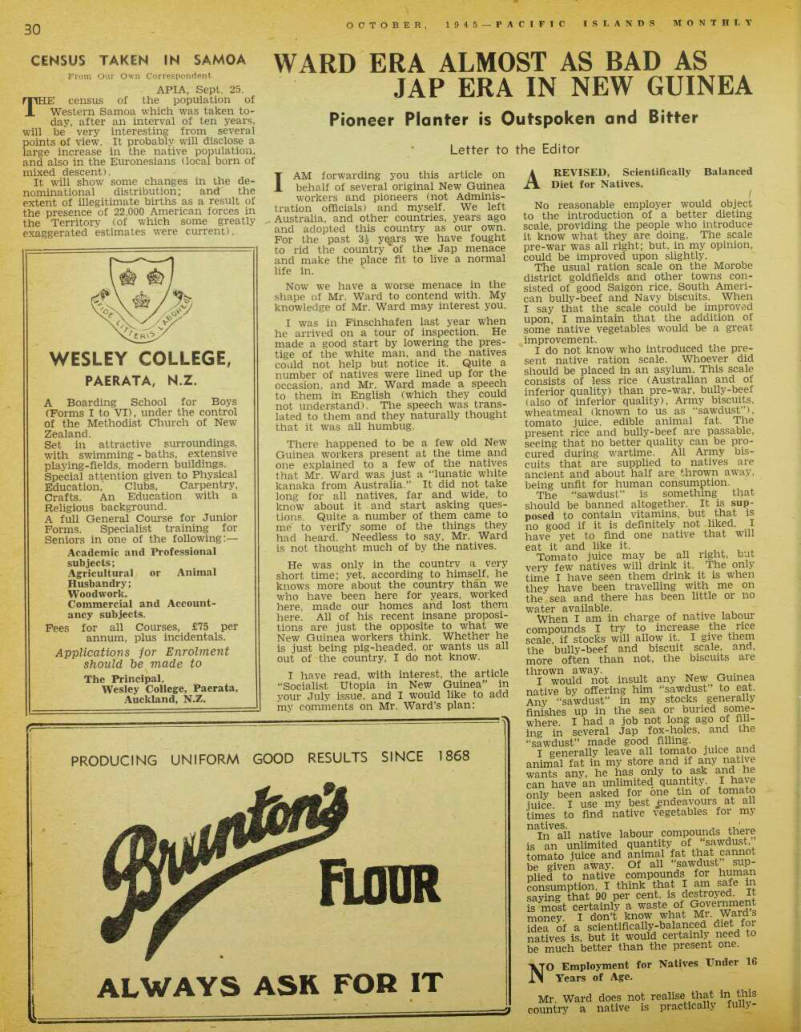
From Our Own Correspondent APIA, Sept. 25. mHE census of the population of X Western Samoa which was taken to day, after an interval of ten years, will be very interesting from several points of view. It probably will disclose a large increase in the native population, and also in the Euronesians (local born of mixed descent).
It will show some changes in the de nominational distribution; and the extent of illegitimate births as a result of the presence of 22,000 American forces in the Territory (of which some greatly exaggerated estimates were current).
Ward Era Almost As Bad As
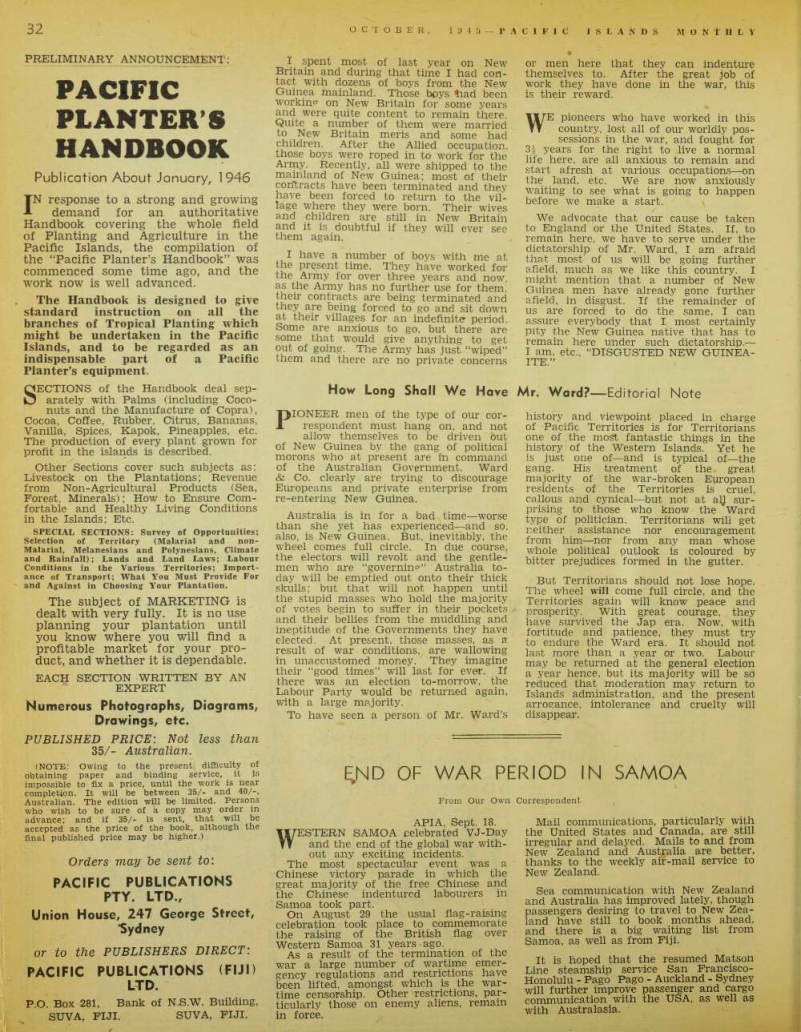
Jap Era In New Guinea
Pioneer Planter is Outspoken and Bitter
Letter to the Editor
IAM forwarding you this article on behalf of several original New Guinea workers and pioneers (not Adminis tration officials) and myself. We left Australia, and other countries, years ago and adopted this country as our own.
For the past we have fought to rid the country of the* Jap menace and make the place fit to live a normal life in.
Now we have a worse menace in the shape of Mr. Ward to contend with. My knowledge of Mr. Ward may interest you.
I was in Finschhafen last year when he arrived on a tour of inspection. He made a good start by lowering the pres tige of the white man, and the natives could not help but notice it. Quite a number of natives were lined up for the occasion, and Mr. Ward made a speech to them in English (which they could not understand). The speech was trans lated to them and they naturally thought that it was all humbug.
There happened to be a few old New Guinea workers present at the time and one explained to a few of the natives that Mr. Ward was just a “lunatic white kanaka from Australia.” It did not take long for all natives, far and wide, to know about it and start asking ques tions. Quite a number of them came to me' to verify some of the things they had heard. Needless to say, Mr. Ward is not thought much of by the natives.
He was only in the country a very short time; yet, according to himself, he knows more about the country than we who have been here for years, worked here, made our homes and lost them here. All of his recent insane proposi tions are just the opposite to what we New Guinea workers think. Whether he is just being pig-headed, or wants us all out of the country, I do not know.
I have read, with interest, the article “Socialist Utopia in New Guinea” in your July issue, and I would like to add my comments on Mr. Ward’s plan;
A REVISED, Scientifically Balanced Diet for Natives. / No reasonable employer would object to the introduction of a better dieting scale, providing the people who introduce it know what they are doing. The scale pre-war was all right; but, in my opinion, could be improved upon slightly.
The usual ration scale on the Morobe district goldfields and other towns con sisted of good Saigon rice, South Ameri can bully-beef and Navy biscuits. When I say that the scale could be improved upon, I maintain that the addition of some native vegetables would be a great improvement.
I do not know who introduced the pre sent native ration scale. Whoever did should be placed in an asylum. This scale consists of less rice (Australian and of inferior quality) than pre-war, bully-beef (also of inferior quality), Army biscuits, wheatmeal (known to us as “sawdust”), tomato juice, edible animal fat. The present rice and bully-beef are passable, seeing that no better quality can be pro cured during wartime. All Army bis cuits that are supplied to natives are ancient and about half are thrown away, being unfit for human consumption.
The “sawdust” is something that should be banned altogether. It is sup posed to contain vitamins, but that is no good if it is definitely not liked. I have yet to find one native that will eat it and like it. . . . . .
Tomato juice may be all right, but very few natives will drink it. The only time I have seen them drink it is when they have been travelling with me on the sea and there has been little or no water available.
When I am in charge of native labour compounds I try to increase the rice scale, if stocks will allow it. I give them the bully-beef and biscuit scale, and. more often than not, the biscuits are thrown away. .
I would not insult any New Guinea native by offering him “sawdust” to eat.
Any “sawdust” in my stocks generally finishes up in the sea or buried some where. I had a job not long ago of fill ing in several Jap fox-holes, and the “sawdust” made good filling.
I generally leave all tomato juice and animal fat in my store and if any native wants any, he has only to ask and Tie can have an unlimited quantity. I have only been asked for one tin of tomato juice I use my best endeavours at all times to find native vegetables for my na in V6 all native labour compounds there is an unlimited quantity of sawdust, tomato juice and animal fat that cannot be given away. Of all sawdust sup plied to native compounds for human consumption. I think that I am safe i saving that 90 per cent, is destroyed. It is most certainly a waste of monev. I don’t know what Mr. Ward s idea of a scientifically-balanced diet natives is. but it would certainly need to be much better than the present one.
NO Employment for Natives Under 16 Years of Age.
Mr. Ward does not realise that in this country a native is practically fully
grown at 16 years of age and certainly a few years past the usual age for starting work. I doubt if Mr. Ward or anybody else can tell whether any native is 15, 16 or any age. Natives do not carry birth certificates, and the only way we can tell their age is to make a guess, and we might be within five years either way of the right age.
NO Employment of Female Labour, Except Under Certain Conditions.
I am a great believer in married couples being engaged to work under the inden ture system. Native women (meris) are just as efficient as boys at working, especially at house and garden work.
My intention, when all this strife is over and we are allowed to live a normal life, is to engage only married couples to work on my plantation. Of the thou sands of natives indentured pre-war, there were very few married couples amongst them, which was very unwise.
When a married couple are working to gether, they are more content and better results are obtained from their work. While working thus, there is no objection to their raising a family and also it would tend to reduce the suicides amongst native women in their villages, and sodomy amongst work boys, which the former Administration and missions encouraged or forced on the natives pre war.
THE Elimination of Professional Recruiters.
Professional recruiting, done properly, should most certainly be carried on. Pre war, there was a certain amount of il legal’ recruiting done, which should be eliminated. It was not only that a recruiter sent natives into villages to recruit, when he should go himself, or
recruiting boys from closed areas and making false statements as to where the boys came from; but some Administra tion officials were taking bribes to sign on illegally-recruited natives. This, I might mention, was a common occur rcnce.
In post-war, an employer should be allowed to recruit natives for himself in the proper manner. On the other hand, if he is unable to go out himself, there should be a professional recruiter to go out and recruit for him, also in the proper manner.
As for the proposed pool of native labour, controlled by the Administration, that is ridiculous, as the Administration will be incapable of controlling it.
TWELVE Months’ Limit on Duration of Employment and Re-Engagement Will Not be Permitted Until the Native Has Returned to His Home for a Period of Three Months.
I was under the impression that we were fighting this war to suppress dic tatorship, but apparently we fought to suppress it in foreign countries and then get it in our own. I was also under the impression that there was a certain British law stating that any native in any British colony would not be denied his freedom. Apparently I was mistaken again.
Just allowing a native to work for a short time and then forcing him to re turn to the village where he was born (probably he may have no interests there and may not want to go) is certainly not my idea of freedom. I guess there would be an uproar if that insane idea were introduced into Australia: and what has the native done to be forced to abide by that idea? In my opinion, the natives should be allowed to be indentured for two or three years (he could please him self as to the number of years) and after
the indenture expired he would be en titled to a holiday if he wanted it. I have had dozens of natives indentured to me at various times. All contracts were for three years (by the consent of each individual native). When each native finished his three years, I always asked the question, “Do you want a holiday at your village?’’ In all cases, the answer was in the negative as they had no in terests at their respective villages. They just wanted to make a new contract and continue working for me.
I did have one native for five years, once, and after an illness I encouraged him to have a holiday at his village to recuperate. He reluctantly consented and I made all arrangements for him to be absent from his work for three months.
After leaving my house he was back again in six weeks to the day, and four of those six weeks were spent in travel ling to and from his village. After that affair, if any of my natives who had been with me for some time wanted to have a week or two off to visit a town about 20 or 30 miles away, I granted that re quest and all were satisfied.
There are quite a number of natives that do appreciate a holiday at their vil lages occasionally but there are others just the opposite.
I spent most of last year on New Britain and during that time I had con tact with dozens of boys from the New Guinea mainland. Those boys *had been working on New Britain for some years and were quite content to remain there.
Quite a number of them were married to New Britain meris and some had children. After the Allied occupation, those boys were roped in to work for the Army. Recently, all were shipped to the mainland of New Guinea; most of their coritracts have been terminated and they have been forced to return to the vil lage where they were born. Their wives and children are still in New Britain and it is doubtful if they will ever see them again.
I have a number of boys with me at the present time. They have worked for the Army for over three years and now, as the Army has no further use for them, their contracts are being terminated and they are being forced to go and sit down at their villages for an indefinite- period.
Some are anxious to go, but there are some that would give anything to get out of going. The Army has just “wiped” them and there are no private concerns
or men here that they can indenture themselves to. After the great job of work they have done in the war, this is their reward.
WE pioneers who have worked in this country, lost all of our worldly pos sessions in the war, and fought for years for the right to live a normal life here, are all anxious to remain and start afresh at various occupations—on the land, etc. We are now anxiously waiting to see what is going to happen before we make a start.
We advocate that our cause be taken to England or the United States. If, to remain here, we have to serve under the dictatorship of Mr. Ward, I am afraid that most' of us will be going further afield, much as we like this country. I might mention that a number of New Guinea men have already gone further afield, in disgust. If the remainder of us are forced to do the same, I can assure everybody that I most certainly pity the New Guinea native that has to remain here under such dictatorship.—
I am, etc.,
“Disgusted New Guinea-
Ite."
Advertisements & other items, pp. 32-34 (2 items)
Floor
WESLEY COLLEGE,
PAERATA, N.Z.
A Boarding School for Boys (Forms I to VI), under the control of the Methodist Church of New Zealand.
Set in attractive surroundings, with swimming - baths, extensive playing-fields, modern buildings.
Special attention given to Physical Education,' Clubs, Carpentry, Crafts. An Education with a Religious background.
A full General Course for Junior Forms. Specialist training for Seniors in one of the following;— Academic and Professional subjects; Agricultural or Animal Husbandry; Woodwork.
Commercial and Accountancy subjects.
Fees for all Courses, £75 per annum, plus incidentals.
Applications for Enrolment should he made to The Principal, Wesley College, Paerata, Auckland, N.Z.
PRODUCING UNIFORM GOOD RESULTS SINCE 1868
Floor
ALWAYS ASK FOR IT
Heinz
PACIFIC ISLANDS SOCIETY
Visitors from the Islands to Sydney (or those interested in Islands affairs), are advised to communicate with the honorary secretary of the above Society, which has been formed to study the history, traditions, economics, and political developments of the Pacific Islands.
Regular monthly meetings are held at History House, 8 Young Street, Sydney.
Address for Correspondence:
THE PACIFIC ISLANDS SOCIETY,
Box 2434 MM., G.P.0., Sydney.
JUST IS SOUS
as the choicest . . . ingredients come back for civilian use HEINZ Model kitchens will prepare with the skill developed through 76 years, all those delicious 0f
SOUPS.
57
* «, SPAGHETTI
BAKED BEANS
SPAGHETTI .
MAYONNAISE
HEINZ
57
VARIETIES
you enjoyed before the war.
H E I II Z i H E 1 N z
I. J°c/ SA °CE
i. B£e Uut
E No Ur \ I 'e.
H45/1
PRELIMINARY ANNOUNCEMENT:
PACIFIC
PLANTER’B
HANDBOOK
Publication About January, 1946 IN response to a strong and growing demand for an authoritative Handbook covering the whole field of Planting and Agriculture in the Pacific Islands, the compilation of the “Pacific Planter’s Handbook” was commenced some time ago, and the work now is well advanced.
The Handbook is designed to give standard instruction on all the branches of Tropical Planting which might be undertaken in the Pacific Islands, and to be regarded as an indispensable part of a Pacific Planter’s equipment.
SECTIONS of the Handbook deal separately with Palms (including Coconuts and the Manufacture of Copra), Cocoa, Coffee, Rubber. Citrus, Bananas, Vanilla, Spices, Kapok, Pineapples, etc.
The production of every plant grown for profit in the islands is described.
Other Sections cover such subjects as: Livestock on the Plantations; Revenue from Non-Agricultural Products (Sea, Forest. Minerals); How to Ensure Comfortable and Healthy Living Conditions in the Islands; Etc.
SPECIAL SECTIONS: Survey of Opportunities; Selection of Territory (Malarial and non- Malarial, Melanesians and Polynesians, Climate and Rainfall); Lands and Land Laws; Labour Conditions in the Various Territories; Importance of Transport; What You Must Provide For and Against in Choosing Your Plantation.
The subject of MARKETING is dealt with very fully. It is no use planning your plantation until you know where you will find a profitable market for your product, and whether it is dependable.
EACH SECTION WRITTEN BY AN
EXPERT
Numerous Photographs, Diagrams,
Drawings, etc.
PUBLISHED PRICE: Not less than 35/- Australian. (NOTE: Owing to the present difficulty of obtaining paper and binding service, it is impossible to fix a price, until the work is near completion. It will be between 35/- and 40/-, Australian. The edition will he limited. Persons who wish to be sure of a copy may order in advance: and if 35/- is sent, that will be accepted as the price of the book, although the final published price may be higher.) Orders may be sent to:
PACIFIC PUBLICATIONS
PTY. LTD.,
Union House, 247 George Street,
'Sydney
or to the PUBLISHERS DIRECT:
PACIFIC PUBLICATIONS (FIJI)
LTD.
P.O. Box 281, Bank of N.S.W. Building,
SUVA, FIJI. SUVA, FIJI.
How Long Shall We Have Mr. Ward?— Editorial Note
PIONEER men of the type of our cor respondent must hang on, and not allow themselves to be driven out of New Guinea by the gang of political morons who at present are in command of the Australian Government. Ward & Co. clearly are trying to discourage Europeans and private enterprise from re-entering New Guinea.
Australia is in for a bad time—worse than she yet has experienced—and so, also, is New Guinea. But, inevitably, the wheel comes full circle. In due course, the electors will revolt and the gentle men who are “governing” Australia to day will be emptied out onto their thick skulls; but that will not happen until the stupid masses who hold the majority of votes begin to suffer in their pockets and their bellies from the muddling and ineptitude of the Governments they have elected. At present, those masses, as a result of war conditions, are wallowing in unaccustomed money. They imagine their “good times” will last for ever. If there was an election to-morrow, the Labour Party would be returned again, with a large majority.
To have seen a person of Mr. Ward’s
history and viewpoint placed in charge of Pacific Territories is for Territorians one of the most fantastic things in the history of the Western Islands. Yet he is just one of—and is typical of—the gang. His treatment of the great majority of the war-broken European residents of the Territories is cruel, callous and cynical—but not at alj sur prising to those who know the Ward type of politician. Territorians will get neither assistance nor encouragement from him —nor from any man whose whole political outlook is coloured by bitter prejudices formed in the gutter.
But Territorians should not lose hope.
The wheel will Come full circle, and the Territories again will know peace and prosperity. With great courage, they have survived the Jap era. Now, with fortitude and patience, they must try to endure the Ward era. It should not last more than a year or two. Labour may be returned at the general election a year hence, but its majority will be so reduced that moderation may return to Islands administration, and the present arrogance, intolerance and cruelty will disappear.
™mm Australasia!^ tn ™ ’
End Of War Period In Samoa
Prom Our Own Correspondent
APIA, Sept. 18.
WESTERN SAMOA celebrated VJ-Day and the end of the global war without any exciting incidents.
The most spectacular event was a Chinese victory parade in which the great majority of the free Chinese and the Chinese indentured labourers in Samoa took part On August 29' the usual flag-raising celebration took place to commemorate the raising of the British flag over Western Samoa 31 years ago.
As a result of the termination of the sencv a rSt"nd°U?ffins been lifted, amongst which is the wartime censorship. Other restrictions, particularly those on enemy aliens, remain in force.
Mail communications, particularly with the United States and Canada, are still irregular and delayed. Mails to and from New Zealand and Australia are better, thanks to the weekly air-mail service to New Zealand. , r, Sea communication with New Zealand and Australia has improved lately, though passengers desiring to travel toi New Zea land have still to' hook months ahead, and there is a big waiting list from Samoa, as well as from Fiji. turned Matson
Line “Francteo
improve' cargo
will P w°th thf USA a? well Is
™mm Australasia!^ tn ™ ’
Advertisements & other items, p. 34 (1 item)
32
OCTOBER, 19 4 5 PACIFIC ISLANDS MON IDLY
The Story Of A Wartime Pig-Hunt
By Harold Cooper
IT was during my first visit to Guadal canal, in mid-1943, that I heard from Father de Klerk the story of the pig hunt at Cape Hunter, but I have had to wait for the end of hostilities to be able to repeat it.
I tried to get it past the censors soon after my return from Guadalcanal, but they put their red pencil through every word of it. I suppose the idea was that the need to stage other pig-hunts might arise before the war was over, and they didn’t want the Japanese to grow too familiar with the technique.
Father de Klerk, a Dutch Roman Catholic priest who had his own private score to settle with the Axis (for he had not heard from his family since his home land was overrun in 1940), was in com mand of a force of native scouts operat ing behind the Japanese lines on the further side of Gape Esperance. He had a large area to cover and his schedule of patrols was pretty crowded.
It was mildly annoying, therefore to receive a message from the Chief at Cape Hunter to the effect that the Japanese had established a coast watch station there, and would Father de Klerk kindly come along and deal with it.
Now, the garrison of this new enemy outpost was only nine strong, and it seemed to the Father ridiculous that the Chief should not be able to handle the situation without assistance. He said as much in his reply to the message, and the Chief, his pride badly mauled, de cided to take steps to eradicate the nine Japanese.
The job was not as straightforward as it sounds, for the Japs had rifles, while the range of weapons available to the Chief was limited to such domestic im plements as axes and cane knives. But the Chief, though he had no firearms, had a plan; and, as we shall see, the manner in which it was carried out be spoke careful preparation or, in the military phrase, excellent staff work.
THE Chief’s men had already visited the Jap camp several times, on the pretext of offering food for sale, so no suspicion was aroused when a few of them dropped in one afternoon and, after some desultory conversation (it had to be desultory, for the medium of exchange was a few words of English, plus a great deal of gesticulation) suggested that the Japs might like to vary their rather monotonous diet by eating a little pig flesh.
The Japs showed immediate interest, and were delighted to learn that the sur rounding bush was simply choc-a-bloc with wild pig. They agreed that a pig hunt would be a splendid way of spend ing the rest of the afternoon; and the hunt was arranged forthwith. Seven of the Japs, each armed with a rifle, were to take part in the expedition, while the remaining two were to stay and guard the camp.
Now, seven is a cumbersome number for a pig-hunt, so the Japanese were persuaded to split up into two parties— four and three—which went off into the bush in different directions, each with its quota of native guides.
Let us first follow the fortunes of the smaller party. After they had penetrated some distance into the bush, without see ing hide or hair of a pig, one of the three Japs, for reasons which need not be set out in detail, lagged a little behind his comrades. One of the native guides lagged with him.
Exactly how it happened I cannot say, but a few minutes later there was a dead Japanese lying in the bush and a Solomon Islander was in possession of his
rifle. This mysterious incident had a dramatic sequel, for the two other Japs in the party, as they poked about in their fruitless quest for the elusive pig, sud denly found themselves being fired on from the dense tangle of undergrowth behind them. Before they could do any thing about it both of them had received mortal wounds. , Their Solomon Islands guides, who had vanished into the bush just before the firing began, now reappeared and picked up the dead men’s rifles. rR the next, act the scene shifts to “another part of the wood.” Here the party of four Japanese, pigless, and showing signs of growing rather grumpy about the whole business, heard shots being fired in the distance.
Their guides began at once to gesticu late an explanation. The other party must, judging by the firing, have run into a positive herd of pigs! Would it not be a good idea to join them and see what luck they’d had?, The Japs excitedly con curred in this suggestion and, all heedless of their approaching doom, allowed them selves to be led through the bush in the direction whence had come the sound of the shots.
After awhile their guides somehow melted away, and a moment later the party found itself under fire.
THUS ended the first phase of the Battle of Cape Hunter. The Chief’s men now had seven rifles and, even if the two Japs left behind to guard the coast-watch station had shown fight, the odds against them would have been hopeless.
But what they chose to do, when they realised the full gravity of their situa tion, was to plunge into the surf and begin swimming wildly in the general direction of Tokio. Had the aim of the Chief’s men been less true, they might have been swimming yet.
As someone said later, it was a most satisfactory afternoon’s work, except for the fact that not even the Chief got any pork for supper.
Samoan High Chiefs
Visit Nz
From Our Own Correspondent APIA, Sept. 25.
BY the “Matua,” due to leave Apia for New Zealand at the end of Septem ber, the three Fautua (Advisers) of the Administration, High Chiefs Malietoa Mataafa and Tamasese, with their wives, will travel to New Zealand as invited guests of the New Zealand Government, for a visit of approximately five weeks.
Appointment Praised
THE Australian Government was con gratulated on September 25 by the leader of the Country Party (Mr.
Fadden) on its appointment of Colonel J. K. Murray as leader of the Provisional Papua-New Guinea Administration.
“This is a very happy appointment in deed,” he stated. “I say with all sincerity that Colonel Murray has all the quali fications necessary for this job. He has as a background a very fine career, and is principal of an agricultural college.
He has in his wife a very competent mate, who, I think, holds a diploma for agriculture, and is a Bachelor of Arts.
“Colonel Murray is a fearless but modest man. He will carry out the Government’s policy without fear or favour.” -
Advertisements & other items, p. 35 (1 item)
Rid Kidneys Of
Poisons And Adds
If you suffer sharp, stabbing pains, If Joints are swollen, It shows your blood Is poisoned through faulty kidney action. Other symptoms of Kidney Disorders are Backache, Aching Joints and Limbs, Sciatica, Neuritis, Lumbago, Sleepless Nights, Dizziness, Nervousness, Circles under Eyes, Loss of Energy and Appetite and Frequent Headaches and Colds, etc. Ordinary medicines can’t help much because you must get to the root cause of the trouble.
The Cystex treatment Is specially compounded to soothe, tone and clean kidneys and bladder and remove acids and poisons from your system safely, quickly and surely, yet contains no harmful or dangerous drugs. Cystex works in 3 ways to end your troubles. 1. Starts killing the germs which are attacking your Kidneys, Bladder and Urinary System in two hours, yet is absolutely harmless to human tissue. 2. Gets rid of health-destroying, deadly poisonous acids with which your system has become saturated. 3. Strengthens and relnvigorates the kidneys, protects from the ravages of disease-attack on the delicate Alter organism, and stimulates the entire system.
Praised by One-time Sufferers
Cystex is approved by one-time sufferers In 73 countries ffom the troubles shown above.
Mr. Reg Thomas, Townsville, Queensland, recently wrote: “My joints were ail stiff, I had leg pains, my back used to ache day and night.
My bladder was weak. I had headaches and no appetite. The first dose of Cystex helped me and before I finished three boxes my health and strength came back.”
Guaranteed to Satisfy or Money Back Get Cystex from your chemist or store to-day.
Give it a thorough test. Cystex Is guaranteed to make you feel younger, stronger, better In every way, or your money back If you return the empty package. .
Now in 2 sizes—4/-, 8/-.
GUARANTEED CVStfiX
Treatment & w
for Your Kidneys, Bladder, Rheumatism,
Ship Chandlery Hardware
/Write for j
Ship Chandlery /
Catalogue J
BROOMFIELDS LIMITED
152 SUSSEX STREET :: SYDNEY.
Cables; "Boom”, Sydney.
Special “In Bond” Prices for all Islands enquiries queted on application.
Sole Agents for: Large and Complete Stocks of
SHIP CHANDLERY
IRONMONGERY OF ALL KINDS, PAINTS.
WHITE LEAD AND OILS.
P. H. MUNTZ <b CO.’S 3-CROWN BRAND METAL SHEATHING.
PEAOOCK <b BUCHANS’ ENGLISH READY-MIXED PAINTS.
To Allot Compensation
Rarotonga, Sept. 2.
MOST recent visitors to arrive by air in Rarotonga are a party to New Zealand judges and lawyers, come to investigate the claims for compensa tion by native owners of the land utilised for the construction of the Rarotonga air strip.
Agents in
German Pre-1939 Agents in The Pacific
NEWS released by Army Intelligence of the work of German and Japanese agents in the §outh Pacific in cludes reference to Krupps’ Australian representative, a big, typical German who had become a naturalised British subject after internment during the last war.
It is stated that in his home at Vaucluse, Sydney, Intelligence men found a copy of a letter to Germany in which he had written: “Sole purpose of my exile is to get from Noumea the so-much needed nickel, which we will return to the English swine in the form of bullets.”
This agent was indeed a well-known figure in New Caledonia, where—as be fore World War I.—Krupps were par ticularly active and the country prosper ing after the usual stagnation period between wars.
It was in late 1936 or early 1937 that this agent came to Noumea from Sydney, and bought the Karoola nickel mine at St. Louis, only about 12 miles from the capital, from Mick Griffiths, miner and ex-Australian featherweight boxer, and the late Charles Lidgey, a highly qualified English mining chemist who had previously been a key man in mining development in the Colony. The pur chase price was £3,600. Mick, a good friend of mine, came to Sydney and quickly got through his share, while Lidgey bought an agricultural property and started to manufacture an excellent brand of pickles, which had a good sale among the French.
Some 20,000 tons of nickel ore was exported to Germany from Karoola; and the Germans also became interested in a nickel mine on the Plaine des Lacs owned by Monsieur Ferrand, who works for the Noumea Municipality. Exploita tion had not got far when war broke out, and no ore from here was exported.
The same German was also partner with the recently-murdered Frenchman, Monsieur Rampal, in copper and silver lead mines on the Diahot (prop. Jowett) River in the north. Other of his dealings were particularly beneficial to the small
French miners, whose operations he financed an£ whose ore he bought. With out the German and Japanese markets these small men would have had a thin time.
Krupps’ agent—l will call him Herr B. —was a bombastic type of man, but those who had dealings with him have told me was always business-like and honest.
He was friendly with one or two Germans settled in Noumea, but was not on good terms with the French administration.
On the outbreak of war he showed his nationalistic feelings by Heiling Hitler in the dining-room of the Hotel Pacifique, where he always stopped.
There was a bit of a scene, the French present getting excited, and one of them, a minfng man, threw a glass at him. It was as good as a Hollywood movie.
To-day, B. would be about 65. He suf fered from some stomach complaint and had an Australian nurse to look after him. His wife, a German, and son, a Nazi officer, have been resident in Ger many for some years. B. never visited Australia after going to New Caledonia, and reportedly had had some trouble with the Commonwealth Taxation Department —who wouldn’t! But he made trips to New Zealand and to Fiji, where he said he had visited the Emperor mine and met Mr. Theodore.
B. WAS assisted in developmental work by Dr. Maidenbach, a German geologist and engineer employed by Krupps, who stayed at the same Noumea hotel (which in 1942 became General Patch’s headquarters). The doctor also was a typical Prussian, clean-shaven, with bald head, but his knowledge of all phases of mining exploitation and smelt ing and manufacturing processes was most ’ thorough. They both showed an tagonism for the French, but got along well with Australian mining men, and were helpful in giving them advice.
Dr. Maidenbach stayed about six or eight months, and at the beginning of 1939 left, via Australia, for the East Indies, where he was to investigate de posits of low-grade chrome and nickels in the Portuguese territory, I believe.
B.’s chief clerk was a German mar ried to an Australian, and he had for merly been in Shanghai, where he had been interested in real estate. He, too, was interned in Australia for at least part of the war—but B. appears to be still in South Australia. After leaving B. in 1938, the clerk joined a well-known German wool firm which had large credits and which was making large scale purchases in Australia and South America on behalf of the German Gov ernment.
One also recalls a number of young German commercial travellers passing through the Pacific prior to the war, sell ing aspirin and other popular articles.
They seemed to be well supplied with money and one or two gave quite lavish parties at the Hotel Pacifique, whose pro prietor is Monsieur Boulanger.—H. E. L.
Friday.
Mr. Onslow Kerkham, son of Mr. and Mrs. R. C. Kerkham, of Suva, has reached New Zealand safely, after being a pri soner of war in Germany. He spent last winter in the Bohemian forest, after escap ing from his prison camp. A companion who escaped with him was shot in the head by the retreating Germans near a place called Mindtedern. Onslow helped to bury him. He says that he made some good friends among the Czechs during the weeks he spent as a fugitive from the Nazis in their country.
Advertisements & other items, p. 36 (2 items)
34
□ ci’ohkit, 1945 i’Aclt'ic islands monthly
For Island Souvenirs
QUEENSLAND
INSURANCE
COMPANY
LIMITED
(Incorporated 1886 In Australia)
ASSETS EXCEED £3,500,000
Head Office :
PITT & BRIDGE STS.,
SYDNEY
Specioiists in South Seas Fire,
Marine Cr Accident Insurances
Apply to: —
FIJI.
Branch Office: I. B. Chalmers, Acting Manager.
Burns Philp (South Sea) Co., Ltd.
VILA.
Burns Philp (South Sea) Co.. Ltd.
Comptoirs Prancais Des Nouvelles Hebrides (Marine).
NOUMEA.
L. & W. Johnston.
PAGO PAGO.
Burns Philp (South Sea) Co., Ltd.
G. H. C. Reid & Co.
OTHER SOUTH SEA ISLANDS.
Burns Philp (South Sea) Co., Ltd.
Also to any of the Company's Offices in Australia or New Zealand.
For Island Souvenirs
* T
Tortoise-shell
Jewellery
Cat's-eyes
Write to
SOUTH SEA SOU VENIRS
STORE
Thomson Street, Suva Opp. G.P.O. PO. Box 83.
Manufacturer and Supplier of High-class Tortoise-shell Goods, Silver Filigree Ornaments. Dealers in Cat’s-eyes and Island Curios.
Special Designs made to order, at best prices.
Wholesale and Retail Inquiries Invited.
BANKERS: Bank of New South Wales, Suva, Fiji.
John Pratt Sails
Again
Memories of the Lost "Vagus"
Rarotonga, Sept. 2.
AFTER a long spell in an office chair, Mr. John Pratt, the English yachts man, is trying the feel of a moving deck beneath his feet once again. He left Rarotonga at the end of August as a passenger on the schooner “Tiare Taporo,” on an extended visit to the northern Cook Islands.
John Pratt sailed from England some time before the war in the 40 ft. “Vagus.”
Crossing the Atlantic, he wandered through the isles of the Caribbean, even tually reaching Panama, where he fitted out for the South Seas cruise. Lone handed, he made a non-stop 90 days’ passage-from Panama to Rarotonga.
His arrival here shortly after the Pearl Harbour attack caused quite a sensation.
His little ship was the first “foreign” vessel to be sighted after the outbreak of the Pacific war, and it appeared to be suspected that he might be a second von Luckner on the prowl. Accompanied by the local pilot, the defence force manned the harbour launch fully armed, and put to sea, prepared to fight it out.
The mild-mannered yachtsman was somewhat astounded at his reception, and assured the grim-looking reception party that he was not a lone raider. He was then ordered by the pilot to heave-to, and receive that gentleman aboard for pilotage into port. But the “Vagus” had been sailing for so long, with all canvas set, that the gear was jammed, and it was not possible to reduce sail at that time; so Pratt sailed right on. and brought up neatly in the little reef har bour—greatly to the annoyance of the pilot. Later, the lone-sailor was required to pay the pilot’s fee. and reminded that “you can’t do that there ’ere” in Raro tonga.
It was generally agreed that the “Vagus” was the finest little ship ever seen in these waters. She was a double ended of the Colin Archer North Sea type. For many years John Pratt had spent all his earnings, and all his spare time, in putting onto and into her all the best that money could buy in the way of rigging, fittings and cruising instruments and equipment.
AFTER a short stay in Rarotonga, Pratt sailed to Palmerston atoll to pick up his former English friend and shipmate, Ronald Powell. After sail ing adventures in small ships on many seas, Powell had settled on Palmerston with the populous Marsters family, mar ried a girl of the island, and was direct ing the Islanders in an export fishing industry. (He now has a small business in Rarotonga, turning his talent as a master craftsman in wood to the making of works of art in native timbers and pearl-shell.) The two then set forth on a cruise through the northern Cook Islands. The first call was at Suvarrow; but the evil spirit of the “haunted atoll” was wait ing to strike down this fine little ship that had carried her owner safely across thousands of miles of deep water.
They had barely time to make the ship as secure as possible before a terrific hur ricane swept the low-lying atoll, and Pratt and Powell, together with the other occu pants of the island at that time (com prising the American author, Robert Dean Frisbie, and his four children, and a Government official and several native assistants) narrowly escaped with their lives, in a long ordeal, lashed in the branches of the few strong trees left standing on sea-swept Anchorage Islet.
When, at last, it was over, John Pratt's dream-ship was no more.
AFTER sharing a further ordeal with the other castaways, literally scratching for a living in the sand of the devastated atoll, the two adven turers were rescued by a small sailing vessel, which returned Powell to Pal merston and brought Pratt to Rarotonga.
Pratt found employment on the staff of the Cook Islands Administration, and has completed three years’ service. Now he has straightened his six-foot-three from his office chair, and set sail northwards, once again, with the jovial Captain Andy Thomson.
He plans to live for a number of months on Manihiki atoll. One of his greatest disappointments was the loss of
his manuscripts and a large collection of photographs and negatives. During his sojourn in Manihikl he will re-write the story of his voyage, and of the Suvarrow hurricane—the latter having already been told in somewhat fictional form by R. D. Frisbie.
Mr. Pratt, who formerly was a com mercial artist for a well-known firm of engineering publishers, has taken artist’s materials with him, and will do sketches of atoll life and memory sketches of his voyage. His plans are not known; but it may be guessed that his thoughts are with another little dream-ship to continue his ocean wanderings.
Miss Dorothy Copland has returned to NZ after spending three months with her uncle, Mr. H. C. Collins, of Niue Island,
Advertisements & other items, p. 37 (1 item)
o
V.l
BREWED BY
CARLTON & UNITED BREWERIES LTD.
Death Of Dr. F.O. Theile
mHE death occurred, on August 17, in a X Brisbane hospital, of Dr. F. O.
Theile, well known for over 20 years as director of the Lutheran Missions in New Guinea.
He was born in South Australia 65 years ago, and was educated in Australia and in Germany. He became a Lutheran pastor in Queensland in 1901, was mar ried in 1906, and held many offices in the Lutheran Church organisation. His interest in mission work generally created strong bonds with New Guinea, especi ally after 1914; and in 1923 he gave Up local pastoral work altogether and became director of the mission.
He was a man of attractive personality who made many friends outsidethe Lutheran Church. He had been ill for a long time, and his end was not unex
pected.
Incident At Sea
“PIM” Short Story:
By Judy Tudor
He prided himself on being an understanding man—toler ant, broad-minded, of pene trating perception. To know all, he often said, was to under stand all. He was particularly disposed to knowing all and understanding it when the sub ject was a beautiful young woman.
But—perhaps because he had lived too long isolation —he was also a prejudiced man. And when a prejudiced man, confess ing to powers of penetrating perception, allows himself to understand a beautiful young woman, the wires are apt to get crossed.
IT was one of those ridiculous hats which fill men’s minds with either tolerant affection or downright It had all the attributes of a hat: high crown, brim upswept at the sides but it was no larger than a decent-sized break fast-cup. It was purple in colour, with two giant, cyclamen-coloured imitation roses adhering to the starboard quarter, and a piece of blue veiling fluttering astern. James G. Robinson, planter, bachelor, collector - by - impression of female headgear, described it thus to himself as he saw it first, a formless purple object in panorama, bound by a purple band to a nondescript head and then taking form and shape as the body beneath teetered up the gangway to deck level.
He disliked that hat on sight and its owner no less; for he was a man of siki den, and unreasonable, antipathies. He met both again at lunch—that first meal, pushing out into a blue, summer sea.
The lady of the headpiece was florid, and apparently believed that the hat became her, so she wore it to table. Her shoul ders, Robinson reflected sourly, were too close to her ears. At that stage she had the well-corseted plumpness of middle age; in a few years she would wheeze, and wobble when she walked. Robinson found himself taking some sort of fiendish delight in the prospect.
She was, above all these things, bright.
She beamed upon Robinson as she beamed upon all God’s children. “Well, now,” she said, “our table is complete.
We were just getting acquainted. I am Mrs. Britton-James; this is my husband ” Robinson nodded to a thin man in a tropical suit on the lady’s off-side.
“ and this is my daughter Penelope.”
Penelope was a blonde flapper, maybe sixteen, who stopped eating soup just long enough to say: “D-do.”
“My name is Robinson,” he announced stiffly, as though he were suddenly ashamed of the fact. The woman, he told himself savagely, would turn the whole simple process of travelling from one place to another into a suburban bun-fight. He knew the type. They never rose above their environment; they took it with them. He damned her, and all her kind to hell, and nodded to the couple on his right. He knew them: the Merediths from down the coast. He cared for neither, normally, but now asked with some warmth how they were.
“So-so,” said Meredith.
“Well as can be expected on this bloody ship full of round-trippers,” said Mrs.
Meredith. “Food’s poisonous ... as usual.” She shoved her plate away and took up a half-smoked cigarette, leaning her bony brown arms on the table and letting her back sink into a discontented curve.
“And you, my dear?” Mrs. Britton - James resumed her pursuit of social knowledge, having staggered but momen tarily under the verbal broadside of Mrs.
Meredith. And, for the first time, Robin son looked squarely at the seventh occu pant of the table. rIS girl, he told himself at once, was beautiful. Beautiful with health. It shone out of her finely-tanned face, her blue eyes and her brown hair. She looked wholesome enough to eat. Even her blue linen frock might have been spun, cut and sewn with the special pur pose of adding to the general effect of well-washed perfection. She looked like the earthly manifestation of a soap ad. in one of the glossiest works of prmtery art. His body involuntarily tensed; his mind approved of this wench. She had
possibilities. f
The girl reddened under the battery of seven pairs of eyes, but she answered with a twinkle: “Pardon— very remiss of me. I’m Valerie Norton.”
“Thank you, my dear. Now we all know one another. I think it is so stuffy to be stiff-necked about these things Dont you, Mr. Robinson?” She bobbed hei little hat at Robinson and patted him familiarly on the arm. He recoiled from b °“l‘guess we Islands people rather like being unsocial, at times. It’s one of our
few privileges.”
“Now then, I’m sure you are fooling I have heard so much about the friendli ness hf Islands people. We are just doing
(Continued on Pcige 38)
the round trip. Poor Cyril—Mr. Britton- James—has been ordered away by the doctor.” , . “Great strain —great" nervous strain.
Mr. Britton-James made his one con tribution to the conversational whirl and then, as though the effort had been too great, took out his handkerchief and blew his nose loudly.
Penelope, taking her face out of a large green salad, remarked that daddy would be better off it he didn’t (something indistinguishable).
“Penelope, that’s sufficient! Mamas warm voice came two degrees off the beam. “Really, the way children chatter these days! Now. I’m sure you, good people are old Islands residents, and with a glassy grin at Mrs. Meredith exclusively: “You have the appearance.
“Years.” Mrs. Meredith exhaled a dense cloud of smoke.
“And tell me about the poor, deal natives One hears such conflicting reports. I’ve always though that it was a great mistake on the part of- the Almighty when he made black as well as whiitp dgodlc So confusing! Ana i SSws S a lot of trouble. But I must coE that the idea of black-boys to wait on one, hand and foot, does appeal.
Tell me, are they t 0 “Liousv ” said la Meredith. Then, to her husband: ‘Come on, let’s get out o£ this pus's trough. The bar should oe ° P Madame Britton-James, promising to “see them all at dinner,” shepherded her family in their smoky wake.
Robinson was thankful to Providence for this indication of good-will. ‘ Your first trip to the Islands, Miss Norton? he asked.
“You, too!” T “Mrs. Britton-James? No—l guess I iust asked in order to make conversation.
And we ‘lslands folk,’ as she calls us, like to place everyone, of course.”
“It is my first trip,”' she said, but vouchsafed no further information whether by design or accident Robinson was puzzled to know. , In rising from his chair, as Miss Norton left the his foot kicked something soft; it spun away across the polished floor, coming to a sliding stop beneath the girl's retreating feet. A woman, handbag, heavy with its contents. An unusual bag, Robinson thought, made of white wooden beads strung together.
The girl turned around as the ua & struck her shoe, murmured something Robinson could not catch, stooped and picked the bag up quickxy, and was gone from the room. + MISS NORTON and the Merediths were already dining when Robinson came down at 7.15.
Miss Norton, again m angelic blue, looked up and smiled. Mrs. Meredi.h wore white, that went ill with her brown boniness, and a vixenish smirk. No sign yet of the old bi—She clipped oft the last word midway as she caught Valerie Norton’s eye, paused a dear natives,’ and ‘whats black servants to wait on you hand and foot!’ Bah! these people have one-track minds. They never can see past the first native Uh-huh—here it comes! The she-wolf herself and her Mrs. Britton-James had £er rmrnle hat and wore a black irocK. draped ti|ht across her sweeping curves, but P Roblnson liked Madame was in no mood for We into which the table was disposed to sink qvip «;wpnt the circle with reddened eyes lUdyoWtWknowbwhaI U d y oWt W know b what 00 I in cluld r have done
W '“Steward probably pinched it,” said
didn’t, he’s such a mce man Reminds me of MnFaulkes-you
S-Hs r -name?-weli W it doesn^matter
dau^Sr my P two
Robinson put down the menu card and asked deliberately; “Tell me, madame, when did you last see the bag? And whai sort of a thing was it?”
“Oh, I know I had it just before lunch, but I just can’t remember what I did with it after that. It was one of those white wooden bead bags, they come from one of those outlandish places in Central Europe. I can never remember the name, or pronounce it when I do. I’ve complained to the purser, of course, but he seemed quite unfriendly. Such strange people they pick for pursers these days.
He * * ROBINSON found ■ Miss Norton in a deck-chair on the top deck. Her feet were propped on the rail, ana the warm wind blew through her hair.
She looked, in the half-light, cool, calm and conscience-free. Beneath that soap ad virginal freshness, he reflected, beat the heart of a hardened sinner “A beautiful night,” he said. Mind if 1 “No 1 no°t U at all. The night is beautiful.
It is easy to believe that the world is a good place on such an occasion.”
“And only man is vile, eh? Or ladies like Mrs. Britton-James, perhaps?
“Mrs. Britton-James is really a very sad case. There is no harm in her, but I imagine that she can be very irritating. ; “Just the specialised ‘married-woman type. After they have hooked their man their brains cease to evolve.” Robinson momentarily had been diverted from his purpose, but he returned to it.
“Are you coming up for a holiday? he “No, indeed. I have no money for such holidays.”
“Broke?”
“Well, that’s rather a constant state with me, I’m afraid.” , ■, Best come to the point, he decidea.
With that type it paid. “I think I know your secret, Miss Norton.” See how she t °“Mv tl secret?” Genuine surprise showed in her voice. He admired her nerve “Oh, you needn’t worry. Its safe witn m “Vou mean ? Oh, that. You must think I’m an awful fool. It’s hot that I’m so ashamed of it, only - She , not complete the sentence and they both gazed, apparently with g reat interest, into the star-flecked darkness. ; There was a moment of silence. Shes a cool one, thought Robinson, and aloud ld "JR?* understanding voice “I co^? h t in l^ a fncl you being ashamed of anything once you had decided, in cold blood, to do it Funny thing, temptation. It gets us ail at different times.” t this The girl answered, Indeed? to tms near! of wisdom, and Robinson con tinued: “The bloke who said the greatest crime was getting found out said a mouthful. I’ve never told this to a soul, but I got my start up here on thirty quid I pinched from the man I used to work for. I was getting 25 bob a week, and doing a carthorse out of a job. and I was reading a lot of nign coloured literature about in tbp South Seas. I made up my mina that that was the place for me, and one day the opportunity of relieving old Jones of a lump sum just Panted itself It was riches to me and * f or it and then sat around trembling, 10l a week It was found out of .course and they suspected me, but I sat “d they couldn’t pin a thing on ma They gave me the sack, but I dian t care ab °Tho t se a were tl the days when one could ?Snnfng e " 8 04 Government M of my own. I never looked back from Calvinistic ancestors used to
sit up and make faces at me for years.
And I had a superstitious belief myself that no good would come of such ill gotten gains. But not a darned thing happened. To the contrary, while some of my neighbours went to the wall, I flourished.
“Several years ago, while I was on leave, I looked old Jones up. Poor old blighter had gone bankrupt, and was in an old man’s home. I bought him some things that he needed, and left him some cash. He was overjoyed. Couldn’t under stand why a kid he’d sacked 30 years before should suddenly turn up as the fairy godfather.
“So you see, not a soul lost out on that little episode—although, by all the rules, I should have come to a sticky end. If I hadn’t taken that money it ultimately would have gone into the pool to part pay Jones’s creditors; I should never have got my plantation or have been able to help Jones out when he was in his direst straits.”
“Mr. Robinson, are you trying to tel! me that crime does pay—or something of that sort?”
“No, not at all. For example, the num bers of all the notes Mrs. Britton-James .lost are known. Whoever has got them will find it hard to get rid of them, where we are going.”
“I shouldn’t have thought that she would have had the sense to do that.”
Miss Norton, apparently following suc cessfully his lead from the general to the particular, sounded thoughtful.
“She didn’t. She tells me that Mr.
Britton-James did. before he gave them to her. Well, I think I’ll turn in.
Madame, by the way ? is sitting in the music room with her ‘two-ring circus.’
Her cabin is number 79—in case you are interested.” * ♦ ♦.
YOUNG Penelope and Robinson arrived at breakfast simultaneously. Miss Norton and her healthy appetite were already there. So also was a bag of white wooden beads, conspicuously disnlaved left of her plate. Surely to God, thought Robinson, she is not going to present it to the old fool in a public ceremony!
“Hullo,” said Penelope, “You have a bag like Mummy’s. Not nuite the same shape, but the same sort. They come from Czechoslovakia, don’t they?”
“I believe so,” said Miss Norton.
“Oh, by the wav, Mummv’s has been found. Actually it wasn’t lost at all.
Daddy took it. He often does things like that, just to pay her out. She’s fearfully careless—leaves things all over the place.
Last time it was two front teeth. She left them in the bathroom cabinet one night. Daddy found them next morning.
He said it was just too shattering to his nerves to see those two teeth staring at him in the cold light of morning. He hid them. She couldn’t go out for two days.
“Anvway. all the time she was having hysterics about the bag he had it in his suitcase. He told her so last night. Now they’ve had a row. Won’t be down to breakfast, I expect?” ♦ * * MISS NORTON found Robinson in a deck-chair on the top deck, his feet on the rail, and gazing nensively out to sea. “I hope you are ouite well.
Mr Robinson.” she said. “I noticed you looked ouite unset at breakfast, and you hardly ate a thing.”
Miss Norton was in white linen that morning: she still looked soan-addish, cool, well-washed and beautiful. But Robinson gave her a glance of distaste and resumed his contemnlation of the blue ocean. “I’m quite all right,” he said shortlv.
“I think I know what’s troubling vou.” she said, drawing un a chair and natting his arm in motherlv fashion. “I can’t
imagine why you told me what you did last night. But people do give unex pected confidences under such circum stances, and the night was beautiful.
I’m afraid that now in the daylight you are regretting it.” Robinson replied not, having suddenly become bereft of words.
His mind was a vacuum; he let the girl babble on, “I can assure you, Mr. Robinson, that your confidence is safe with me. You will feel better, later, for the confession and, like you, in the ultimate analysis, I feel that good came out of evil.” Robin son still stared stolidly at the sea. “I have had confidences given me before; I hold them as a sacred trust. As you have already found out somewhere, I am a missionary sister going to a new post.
It was silly of me not to say so right
out, but Mrs. Meredith seemed so pre judiced about everything ”
Far from reassuring him this state ment seemed to unnerve Robinson still more. He switched his glare from the sea to the girl, his face went deep crim son, and he shot from the chair in two jerky movements.
“For God's sake!” he exclaimed. “For God's sake!” Then he went bounding down the deck, leaving the girl, for the second time in twelve hours, to stare bewildered after him. * * ♦ AS he looked down, the companionway he saw a hat swim into his ken. A large-brimmed hat set well forward on a head he could not see; a hat with a crown the size of a button, a wreath of blue cornflowers and a swathe of veil.
It came jerkily up the companion way until the face emerged. It could be no other Mrs. Britton-James beamed.
“Why, Mr. Robinson! How very nice.’
“Excuse me, madame—excuse me. If you please.” He pushed her to one side rudely and in three leaps was on the lower deck, still muttering-, “Missionary!
For God’s sake!” „ . .
“Most peculiar, that Mr. Robinson.
Mrs. Britton-James, her large hat quiv ering with indignation as much as with the breeze, bore down on Miss Norton.
“Do you think he was going to be sea sick?”
“He certainly acts in a most amaz ing fashion,” replied Miss Norton. I just can’t make him out.”
“Do you know,” said Mr.s Britton- James settling Into the chair lately occupied by Robinson, "I think all these neonle are a bit queer. Now, honestly P dear don’t you think that Mrs.
Meredith . . .
Advertisements & other items, pp. 38-41 (2 items)
Liiiiiiiiiiiiiiiiiiiiiiiiiih
After taking Pinkettes you should feel brighter, happier, and free from sick headaches, bilious attacks and liverishness. For
PINKETTES
are tiny laxative and liver pills, which painlessly exercise the digestive system.
lIIIIIIIIIIIIIIIIIIIIIIIIIIH
FIJI AND SOUTH-SEA ISLANDS SOUVENIRS
ADAMS
LAUTOKA FIJI
CHEMISTS, DEALERS '
We believe we have the choicest rangeJ*_Fiii_of'- Tortoiseshell Goods, inlaid or Silver Filigree Goods with or without tats tyes.
Pearl-shell with or without Cat’s-Eyes.
Ivory articles of all kinds.
Coconut-shell souvenirs.
Unmounted Cat’s-Eyes. . R 1 Hand-made Native Curios and Souvenirs, Beads, Hula-skirts and Tops (bras), Mats, Fans, Fancy Shell Floral Necklaces and Bracelets.
Model Canoes, Lalis (native wooden drums).
Tanoas (kava bowls, used as ash-trays).
Tapa (tree-bark) Cloth.
We ai? a big h supp?4rs V to y Army and Navy personnel and purchasing g units, with whom we built dUrmg their stay in Fiji. We specialise in quality g° ods ;
SPECIAL DISCOUNTS TO QUANTITY BUYERS.
We welcome all inquiries. Send for our Sufficient Address: ADAMS LAUTOKA FIJI.
JS Sna^
DE NOUVEAU, IE CONTINENT AUSTRALIEN ASSURE
S V LE CONFORT DES £
iiM'
I \ I Aladdin est un nouveau venu dans les lies. Les detaillants peuvent saisir I'occasion d'en devenir vendeurs attitres ce qui entraine un decompte' special certains avantages, etc. Ecrivez aujourd' hui pour obtenir tousles
renseignements.
—l'un des plus nouveaux membresode la famille Aladdin de reputation mondiale. Elegamment emaille, aerodynamique a I‘instar des fourneaux electriques les plus modernes, d'un rendement excel* lent, et economique. Ecrivez pour obtenir tousles details.
A gauche: Lo fameuse lampe de table a petrole, Aladdm-qui fournit une brillante lumiere blanche de 75 bougies, sans travail de pompe ou depression, au cout d'environ 2 heures d'eclairage poor un penny. On I'allume aussi facilement que la lampe a flamme d'autrefois. Ecrivez pour obtenir les details des modeles de guerre, les prix, etc A droite: La lampe-tempete Aladdin, egalement populaire, solidement construite pour etre tres resistante—elle fournit une vive blanche de 200 bougies en utilisant du petrole ordinaire au cout d’environ £ penny I'heore. L'Armee et la Marine en font grand usage en temps de guerre.
Ecrivez pour obtenir les details.
keros
JS Sna^
ji) •I
wteiiiiin
Les lampes de table a
petrole, Aladdin, se font
egalement en appliques
murales et en gracieuses lampes -a - pied. Nous serons heureux de vous envoyer un prospectus vous donnant des renseignements complets sur toute la gamme de nos articles.
ALADDIN INDUSTRIES Pty. Ltd. - 61-71 Bourke Street, WATERLOO - SYDNEY
C. KALYAN & CO.
Exporters and Manufacturers Agents,
EXPORTS
Cat’s-eyes, Sea-shell, Silver Filigree Ornaments, all Kinds of Souvenirs manufactured from Tortoise-shell, Pieties of Island Views, etc. Wholesale inquiries invited.
AGENCIES :
Indent business in all classes of merchandise undertaken.
Correspondence invited from Manufacturers, Merchants and Exporters desiring Agents in Fiji Market.
Renwick Road, G.P.O. Box 348, Suva,
FIJI
Cluoic/ TWid&M travel cases War needs and conditions restrict supplies, but Globites will be made available whenever possible.
B. DAVID Trading Co.
ISLAND TRADERS -
- EXPORT MERCHANTS
SHIPPERS OF ALL KINDS OF MERCHANDISE.
EXPORT REPRESENTATIVES OF LEADING
AUSTRAL lAN MAN U F ACTU RERS Direct Enquiries to Head Office:
31 Queen Street, Melbourne, Vic.
Bankers: Cable Address: National Bank of “DAVID TRADING Australasia. MELBOURNE”
Branches and Agents in All Ports.
OPEN TO APPOINT AGENCIES WHERE NOT REPRESENTED
Steamships Trading
Company Limited
PORT MORESBY
SAMARAI
PAPUA.
WHOLESALE & RETAIL MERCHANTS, SHIPOWNERS,
PLANTERS, ENGINEERS & SLIP PROPRIETORS.
Customs, Shipping, Insurance, and Forwarding Agents.
MANAGING AGENTS AND VISITING REPRESENTA-
TIVES FOk COCONUT AND RUBBER ESTATES.
SYDNEY REPRESENTATIVES: Nelson & Robertson Pty. Ltd., 12 Spring Street.
WARTIME ADDRESS
Un*il further notice, clients may address all communications as follows:
STEAMSHIPS TRADING COMPANY LIMITED,
C/o NELSON Cr ROBERTSON PTY. LTD.,
12 SPRING STREET, SYDNEY.
Radiophone Restored
RESUMPTION of radio-telegraph com munication between Australia and the Territories of Papua and New Guinea was announced on September 25.
Messages are accepted for transmission by radio from the Australian mainland to Lae and Port Moresby.
Controls Remain On In
Fiji
SUVA, Sept. 16. rE Supply and Production Board is at present considering whether the cessation of hostilities with Japan will make possible the relaxation of any of the wartime controls which have been imposed in Fiji. The Board’s decisions will be made known shortly.
In the meantime, it is officially stated that the end of the war with Japan has made little difference to the general economic situation within the Empire. No rapid easing of restrictions on supplies from overseas can be expected.
The need for repatriating large num bers of troops and displaced persons and for extending large-scale relief to liberated territories, will mean that the shortage of shipping will be as acute as ever The public must, therefore, be pre pared to endure, at any rate for the time being, a further period of stringency.
The recent news from the United King dom. which paints a grim picture of the conditions likely to prevail there this winter (when the people will be less warm, and will have less food and cloth ing than at any time during the war), indicates how far we still are from any return to normal conditions.
Rarotonga
A New Schooner for Rarotonga
ONE of the Cook Islands’ best-known traders, Mr. D. C. Brown, recently purchased the 102 ft. schooner “Tahltienne” in Auckland. The schooner is still at the Harbour Board slips there, waiting delivery of a new diesel engine.
When that is installed she will sail for Rarotonga.
“Tahitienne” has been used as a plea sure yacht for the last six years; her extremely high masts are a well-known sight in Auckland waters. She was built op the Pacific coast of America, about 1923 for a retired American master mariner who intended to use her for pri vate cruising. He died, however before she was completed and the hull was bought by S. R. Maxwell & Co., well known planting and trading firm in the Eastern Pacific.
She sailed there as an inter-island trad ing vessel under the French flag for some years, but as a result of slackening trade was laid up in Papeete and finally brought to Auckland for disposal.
Those were dull days in the boat mar ket, and no buyers came forward “Tahitienne” was put up for auction and knocked down to a syndicate of Jugo slavs for £l5O. They intended fitting her out as a fishing boat, but found her un suitable.
She was again laid un and remained so until purchased by Mr. A. Donald, of Herne Bay, as a pleasure cruiser.
“Tahitienne,” known locally as New Zealand’s largest pleasure craft, has par ticularly fine lines, and will make an interesting addition to Rarotonga’s trad ing fleet.
Advertisements & other items, p. 42 (1 item)
Gibson’S
WANTED TO BUY —QUALITY GUNS AND RIFLES HIGHEST PRICES GIVEN. WILL ALSO EXCHANGE °UNS New .803 Short Service Barrels, without Sights and Platform. £2/15/- each.
Postage extra.
SI L RO H U Quality Firearms and Fishing Tackle. 143 ELIZABETH STREET (Near Market St.) SYDNEY. ’PHONE: MA 3540.
TRY IT .. . .YOU’LL
GIBSON’S
GREEN LABEL
TEA
1< Blended and packed by— |l J. A. D. GIBSON & CO. LTD. 364 KENT STREET, SYDNEY. 'Phone: M 2328. V Also GIBSON'S GREEN LABEL COFFEE and COFFEE ESSENCE
Roll Of Honour—Section Ii.
The whole of the Roll of Honour (Sections I. and II.) will be published, for the last time, in the December issue of the "Pacific Islands Monthly."
We should like this record to be as nearly complete as possible.
Relations of men concerned would confer a favour by directing attention to errors and omissions.
Wounded
Sgt. Robert ASMUS, of the Fighting French Pacific Battalion. Wounded at Bir Hacheim and evacuated.
Rene AUP ANT, of the Fighting French Pacific Battalion. Wounded at Bir Hacheim.
Cpl. Thomas BAMBRIDGE, of the Fighting French Pacific Battalion. Wounded at Bir Hacheim and evacuated.
Fit.-Lieut. J. W. BARTLETT, RAAP, formerly of TNG. Wounded in air operations over the Mediterranean on January 23, 1944.
BERBERE (alias ARESKY), of the Fighting French Pacific Battalion. Wounded at Bir Hacheim.
Henri BERTHELEN, of the Fighting French Pacific Battalion. Wounded at Bir Hacheim.
Pte. V. BLANCO, AIF infantry, of Thursday Island. Wounded inaction, July, 1941.
L/Cpl. J. P. BLENCOWE, AIF infantry, of Rabaul. TNG. Wounded in action, July, 1941.
Jean .BRIAL, of the Fighting French Pacific Battalion. Wounded at Bir Hacheim.
Pte. George BUCKNELL, AIF, son of Mr. and Mrs. C. Bucknell, of Korolevu, Fiji. Wounded in action in Malaya, January, 1942.
Pte. Thomas BYERS, AIF infantry, of Thurs day Island. Wounded in action, May, 1941.
Pte. Sekope CAMA, FMF. Reported wounded in action in Solomons, September, 1944.
Raymond CHAUTARD, of the Free French Pacific contingent from New Caledonia. Re ported a casualty in the Middle East, March, 1942.
Pte. A. J. CORLASS, AIF, formerly of Rabaul.
Wounded in action.
Albert CUBADDA, of the Free French con tingent from New Caledonia. Reported a casualty in the Middle East, March, 1942.
WG2 J. W. CURRIE, now of ANGAU.
Charles DBVEAUX, of Pacific Battalion of Fighting France. Wounded at battle of Blr Hacheim (Libya).
Sgt. EMERY, formerly of Lae, TNG. Wounded in New Guinea in October, 1942.
W/O P. N. ENGLAND, AIF, formerly of Bogla, TNG. Wounded in action January 27, 1944.
Lieut. M. G. EVENSEN. AIF, formerly of Rabaul. Wounded in action.
V. FAIRHALL, 2nd NZEF, formerly of the Treasury Department, Western Samoa. Reported wounded in action, February, 1942.
Trooper Arthur T. PILEWOOD, formerly of Thursday Island. Reported wounded in action, May. 1943.
Paroa FIU, of the Fighting French Pacific Battalion. Wounded at Bir Hacheim and evacuated.
Cpl. H. N. FORSYTH, formerly of New Guinea.
Reported wounded, June, 1944.
Acting Warrant-Officer V. M. I. GORDON, AIF Infantry, of Wau, TNG. Wounded in action, February, 1942.
Henri GUILBAUD, of the Free French Pacific contingent from New Caledonia. Reported a casualty in the Middle East, March, 1942.
' Sgt. C. HENDRICK, AIF Infantry, of Rabaul.
TNG. Wounded in action, July, 1941.
Stanley HIGGS, son of Mr. and Mrs. Gordon Higgs, of W. R. Carpenter and Co. Ltd., New Guinea. Member of an English Lancers’ regiment, wounded during British evacuation from Dun kirk (Prance), May, 1940.
Pte. W. HOLMES, of the Fiji Military Forces.
Reported wounded in action, December, 1943.
Alexandre HUYARD, of the Free French Pacific contingent from New Caledonia. Reported a casualty in the Middle East, March, 1942.
Pte. P. C. JEUNE, AIF, formerly of Morobe, TNG. Reported wounded, June, 1944.
Sgt.-Pilot Andrew KRONFELD, of the NZ Fighter Squadron attached to the RAF. Wounded in knee during operations over France, December. 1941.
Cpl. W. H. LANNEN, AIF artillery, of Rabaul, New Guinea. Wounded in action, June, 1941.
W/O T. W. J. LEGA, AIF, formerly of the Mandated Territory. Reported wounded in action, November, 1944.
Gnr. E. G. LOBAN, AIF artillery, of Thursday Island. Wounded during campaign in Greece, May, 1941; invalided home after having his left forearm amputated.
Auguste LUTA, of the Fighting French Pacific Battalion. Wounded at Blr Hachelm and evacuated.
A/Sgt. Alastalr MACLEAN, AIF Infantry, of Rabaul, New Guinea. Wounded In action, In Libya, June, 1941.
Sgt. J. D. McCLYMONT, NZEF, son of Capt.
D. McClymont, Harbourmaster of Apia, Western Samoa. Wounded In action, November, 1941.
Lieut. Jack McGRUTHER, NZEF, formerly of Mangaia, Cook Is. Wounded in fighting in Libya. Later, killed in action.
Lieut. Colin McGRUTHER, NZEF, formerly of Mangaia. Wounded in action in North Africa.
Cpl. R. McKERLIE, AIF, of Yandina, BSL wounded in face by bomb explosion, April, 1941.
T. MANEA, of the Fighting French Pacific Battalion. Wounded at Blr Hachelm and evacuated.
Jean MERIGNAC, of the Free French Pacific contingent from New Caledonia. Reported a casualty in the Middle East, March, 1942.
Henri MEYER, of the Free French Pacific contingent from New Caledonia. Reported a casualty in the Middle East, March, 1942.
S/Sgt. Graham B. MIRFIELD, AIF engineers, of Rabaul, New Guinea. Wounded in action, Pte. Apisai NAIKA, of Fiji Military Forces.
Wounded in action in Solomons.
Pte. Sowanl NALICO, FMF. Reported wounded in action in Solomons, September, 1944.
Pte. James O’DWYER, NZEF, formerly of Apia, W. Samoa. Wounded in action in Italy, December, 1943.
Joseph OTHUS, of Pacific Battalion of Fight ing Prance. Wounded in battle of Bir Hachelm (Libya).
Edouard PAILLANDI, FP Forces, formerly of N. Caledonia. Wounded in France, November, 1944.
Lieut. A. G. PEARCE, AIF, formerly of Salamaua, TNG. Wounded in action.
Pte. L. G. ("Mick”) REECE, AIF. of Bulolo, New Guinea. Wounded in action, July, 1941.
Henri RIVIERE, of the Free French Pacific contingent from New Caledonia. Reported a casualty in the Middle East, March, 1942.
Pte. H. St. George RYDER. AIF, formerly of
Suva, Fiji. Wounded while serving In New Guinea.
Cpl. Luke SAILADA, of Fiji Military Forces.
Wounded in action in Solomons.
A/Cpl. N. K. SAWYER, AIF infantry, of Rabaul, TNG. Wounded in action, July, 1941.
July, 1941.
Pte. Frank M. SCHUSTER, NZEF, formerly of W. Samoa. Wounded in action in Tunisia, 1943.
Lieut. Jeffrey SEAGOE, serving with the British forces in the Far East, formerly of Vila, New Hebrides. Reported "wounded in action”, March. 1942.
Fit.-Sgt. B. SPILLER, RAAP, formerly of Papua. Wounded by flak while attacking enemy targets in France on July 28, 1944.
Pte. Lance STAMPER, AIF, formerly school master at Wau. New Guinea. Wounded in action.
July 10, 1941.
Cpl. Esala TAWAKE, of Fiji Military Forces.
Wounded in action in Solomons.
Lieut.-Col. J. K. B. TAYLOR, of the Fiji Mili
tary Forces. Wounded in action in Bougain ville, December, 1943.
Cpl. Raphael TEIHO, of the Fighting French Pacific Battalion. Wounded at Blr Hachelm and evacuated.
Cpl. Terli TERIITUA, of the Fighting French Pacific Battalion. Wounded at Bir Hacheim and evacuated.
Lieut. A. THOMPSON, of the Fiji Military Forces. Reported wounded in action, December, 1943 Lieut. P. A. TUCKEY, Infantry, formerly of New Guinea. Wounded in action.
Pte. Harold G. TURNER, AIF, of Samaral.
Eastern Papua. Wounded in action at Bardla (Libya), January, 1941.
Pte. F. D. TWISS, AIF infantry, of New Guinea. Wounded in action, August, 1941.
Camille VINCENT, of the Free French Pacific contingent from New Caledonia. Reported a casualty in the Middle East, March. 1942.
Driver Don F. WAUCHOPE, AIF Formerly employed on his brother’s plantation in New Guinea. Wounded in action, July, 1942.
Lieut. F. R. G. WILSON, AIF, formerly of the Mandated Territory of New Guinea. Reported wounded in action, February, 1944.
Alex. WINCHESTER, of the Fighting French Pacific Battalion. Wounded at Blr Hachelm.
Pte. K. M. WHITE, AIF, formerly of Bulwa, TNG. Wounded in action.
Sgt.-Pilot W. WRIGHT, of the Australian Spitfire Squadron, attached to the RAP, for merly of New Guinea. Wounded in knee during aerial “dog-fight” over the English Channel, March. 1942.
Decorations
Sgt. Jionc AGARA, Fiji Military Forces, formerly of Tonga. Awarded the American Sil ver Star for gallantry in action in New Georgia, July, 1943.
Flight-Lleut. Don AIDNEY, RAF, formerly of Fiji. Awarded the Distinguished Plying Cross in September, 1944.
Squadron-Leader G. U. (“Scotty”) aLLEN, RAAF, who is well-known in New Guinea and Papua, having been co-pilot on the “Faith in Australia”, on the first official air-mail flight to the Territories in 1934. Awarded the Air Force Cross for his work with Catalina flying- Doats in Australia and the Pacific.
Colonel H. T. ALLEN, AIF, formerly of Wau, Morobe District, TNG. Awarded the OBE.
Sub.-Lieut. A. M. ANDRESEN. RANVR, for merly of Solomons. Mentioned in despatches.
Lieut. S. L. ASHTON, ANGAU, formerly of TNG. Awarded Military Medal (as a Warrant- Officer) for conspicuous bravery while engaged in patrol work in New Guinea.
Squadron-Leader C. A. BASKETT, formerly of Bulolo, TNG. Awarded Distinguished Flying Cross for raids over enemy territory while
attached to Hampden bomber squadron in Eng land.
F/O L. W. G. BELL, RAAF, formerly of Kavieng, TNG. Awarded OBE, for outstanding service in the New Guinea area.
Sgt. Semisi BELO, of Fiji Military Forces.
Awarded DCM for services in South-west Pacific area.
Capt. F. N. BOISEN, ANGAU, formerly of administration TNG. Awarded Military Cross, June, 1945.
Lieut. Charles BLAKE, of ANGAU, formerly of Wau, TNG. Awarded the Military Medal (while serving as a W/O) for bravery and devotion to duty during and after the landing at Arawe, New Britain, January, 1944.
Captain H. M. BOOTH, FMF. Awarded Mili tary Cross for service on Bougainville.
Lieut. M. BOULTON, FMF. Awarded Military Cross for service on Bougainville.
Mrs. Ruby BOYE, of Vanikoro, Santa Cruz Group. Awarded British Empire Medal for gal lant work in the Allied cause ounng the Jap anese occupation of the Solomons.
Victor BRIAL, Fighting French Pacific Battalion, formerly of New Caledonia. Awarded the Croix de Guerre and the Etoile d’Argent.
Jean BRIAL, of FF Forces, formerly of New Caledonia. Awarded Croix de Guerre.
Lieut. Kenneth T. BRIDGE, AIF, formerly ADO, New Guinea Administration. Awarded US Legion of Merit for services in reconnoitring the area of the Mambare River.
Captain E. CAKOBAU, FMF. Awarded Mili tary Cross for service on Bougainville. US Legion of Merit.
Pilot Eric (Mike) CLARKE. Awarded George Medal for gallantry in rescuing body of Kevin Parer from blazing plane at Salamaua on January 21, 19'42. Killed in air crash in Queensland in June, 1944.
Major W. F. M. CLEMENTS, of the British Solomon Islands Defence Force. Awarded Military Cross for exceptional devotion to duty in a theatre of war.
Lieut. J. R. COLE, AIF, formerly of New Guinea. Awarded the Military Cross.
Major Mervyn CORNER, FMF, awarded Mili tary Cross for service on Bougainville.
Sgt. Henry C. S. COTTON, of the RNZAF, who was born in Samoa (his father was Secre tary of Native Affairs during the NZ military occupation). Awarded the Distinguished Flying Cross.
Major S. G. C. COWLED, Senior Chaplain of Fiji Military Forces. Awarded OBE. His example to troops carrying -out operations maintained a high spirit of morale.
Lieut. J. w. COX, ANGAU, formerly of TNG.
Awarded Military Medal for bravery and de votion to duty in the Salamaua area, 1943.
Plight-Lieut. R. N. DALKIN. RAAF, formerly of W. R. Carpenter and Co., Ltd., Salamaua,
TNG Awarded the DFC for bombing raid* against the Japanese In Koepang area, DEL FREDERIC DELAVEUVE, formerly of New Caledonia. Awarded Croix de Guerre, while serving with Fighting French volunteers in Egypt. 2/Lieut. Bruce Insham DENT, of FIJI Military Forces (killed in action, March 25, 1944).
Awarded Military Cross for services in South west Pacific.
Squadron-Leader R. A. DUNN, RAAF, formerly of Carpenter Airways New Guinea Service.
Awarded the Distinguished Flying Cross for bravery while leading his squadron against the Japanese.
Chaplain N. J. EARL, AMP, formerly of Papua. Awarded MBE for bravery shown during early Papuan campaign. p/o T. W. ELLIS, RAAF, formerly of New Guinea. Awarded DFC for gallantry in Amboina area, July, 1945.
Sgt. R. EMERY, NGVR, formerly of Lae.
Awarded Military Medal for gallantry in New Guinea.
Capt. W. M. ENGLISH, ANGAU, formerly a Patrol Officer in New Guinea. Awarded MBE, June, 1945.
Flight-Lleut. Norman FADER, RAAF, formerly a commercial pilot in New Guinea. Awarded the Air Force Cross for exploits in Bismarck Sea Battle.
Lieut J. FORBES, RNZNR, formerly of West ern Pacific. Awarded US Bronze Star for “heroic service while piloting ships entering perilous waters.”
Rifleman H. W. FORRESTER, NGVR, formerly of Bulolo, TNG. Awarded the Military Medal for operations against Japanese in New Guinea.
Major R. O. FREEMAN, FMP. Awarded the Military Cross for devotion to duty while on service in Bougainville.
Cpl. Tevita FUSI, FMP. Awarded Military Medal for service on Bougainville.
Sgt. J. H. GILCHRIST, formerly of TNG.
Received Military Medal, April, 1944.
Squadron-Leader C. R. GURNEY, RAAF, for merly of Guinea Airways, Ltd., TNG. Posthu mously awarded the Air Force Cross, for bomb ing raids on Japanese-held ports in New Britain.
Major T. GRAHAMSLAW, AMP, formerly of Papua. Awarded QBE for conspicuous devotion Jo duty in the Buna area (Papua) during initial Japanese landings in the district.
Walter GRAND, Fighting French Pacific Battalion, formerly of Tahiti. Awarded Croix de Guerre, with one star, for bravery during the Battle of Bir Hacheim. 1942.
A./Sgt. B. W. G. HALL, formerly of TNG.
Received DCM in April, 1944. Later promoted to rank of Lieutenant.
W/O M. I. HARPER, RANR, formerly of BSI, awarded US Order of Merit for outstanding service in Solomons waters.
Squadron-Leader Godfrey HE MS WORTH, RAAF, formerly a well-known New Guinea pilot, who was killed in action against the Japanese In May. Posthumously awarded the Air Force 3ross. , .
Capt. L. HENDERSON, AMP, formerly of Papua. Awarded MBE for courage displayed during the Oro Bay operations when he was in charge of small ships operating In those waters. , „ , LUCIEN HERVOUET, formerly of New Cale donia. Awarded Croix de Guerre while serving with Fighting French volunteers in Egypt.
Lieut. Colin HILL, RANR, of the Australian destroyer, “Waterhen”, formerly second officer on the trans-Pacific liner “Niagara”. Awarded the OBE.
Capt. Ernest HITCHCOCK, ANGAU, formerly of Mandated Territory. Awarded US Legion of Merit for assistance to American forces in Salamaua area.
Flying-Officer Victor HJORRING, of Fiji.
Awarded MBE. , , Capt. HOLLAND, formerly of G. & E. Islands Colony, awarded George Medal for bravery in helping to maintain communications after Japanese invasion of Tarawa.
Commander D. S. HORE-LACY, RN, formerly of New Guinea. Four times mentioned in des- Pa Lleut.’ D. C. HORTON, RANVR, formerly of District Services, BSI. Awarded the United States Silver Star for distinguished services in the Solomons. x , Lieut, Gordon HOWE, RANR, formerly an offi cer in Burns Philp ships. Awarded the US Legion of Merit for meritorious service in lead ing a reconnaissance party to Russell Islands,
Bsi
P/o lan INNES, RAAF, formerly of Sala maua TNG. Awarded Military Medal (while serving as a F/Sgt.) in France 1944 Wing-Commander R. W. IREDALE, RAAF, for merly of Lae and Rabaul. TNG. Awarded DFC and Bar, Mentioned in Despatches, during three
tours of operation over Europe.
Capt. E. R. JOHANSON, of American liner “Monterey.” Awarded US Merchant Marine Dis tinguished Service Medal for service against the enemy.
Lieut. H. E. JOSSELYN, RANVR, formerly of District Services, BST. Awarded United States Silver Star, for distinguished services In the Solomons.
Lieut. J. R. KEENAN, RANVR, formerly of New Guinea. Awarded the DSC.
Capt. H. T. KIENZLE, ANGAU, formerly of Papua. Awarded MBE for devotion to duty during the campaign In the Owen Stanley Ranges.
Lieut. Iserell KOROVULAVULA, FMF. Awarded the Military Cross for devotion to duty while serving in Bougainville.
Pte. Sairusi KOTO, Fiji Military Forces.
Awarded US Silver Star for bravery and de votion to duty in the Solomons.
Wing-Commander C. J. N. LELAU, RAAF, formerly of Suva, Fiji. Awarded the OBE for distinguished service.
Pte. Villame LAUTIKI, of Fiji Military Forces.
Awarded MM for services in South-west Pacific area.
Sqd.-Ldr. lan LOUDON, RAAF, formerly of New Guinea. Awarded DFC and mentioned in despatches.
Cpl. Elaitia LEDUA, FMF. Awarded Military Medal for service on Bougainville.
Lieut, Paul LOBENDAHN, FMF. Awarded Military Medal for service on Bougainville.
L/Cpl. Viliame LOMASALATO, FMF. Awarded Military Medal for service on Bougainville.
Sgt. T. McADAM, NGVR, formerly of New Guinea Forestry Dept. Awarded Military Medal for gallantry in New Guinea.
Capt. John S. McLEOD, ANGAU, formerly a patrol-officer with the New Guinea Administra tion, for services in New Britain, organising and supervising native labour and guides and for reconnaissance patrol. Awarded US Legion of Merit.
Lieut.-Commander A. W. R. McNICOLL, RAN, son of Sir Ramsay McNlcoll, Administrator of New Guinea, and Lady McNlcoll. Awarded the George Medal.
Sgt. Josefa MAINAVOLAU, FMF. Awarded Military Medal for service on Bougainville.
Pte. Akuila MARAIVALU, FMF.' Awarded Military Medal for service on Bougainville Petty-Offlcer PAUL MASON. RANVR, formerly a plantation inspector at Inus, Bougainville, TNG. Awarded American Distinguished Service Cross for “extraordinary heroism in action.”
Also awarded British DSC.
HENRI MAYER, formerly of New Caledonia.
Awarded Croix de Guerre while serving with Fighting French volunteers in Egypt.
Pit.-Lieut. George B. (Golly) MEIDECKE.
RAAF, formerly of W. Samoa. Awarded the Distinguished Flying Cross.
Maurice MEUNIER, of FF Forces, formerly of New Caledonia. Awarded Croix de Guerre.
Capt. J. K. MCCARTHY, formerly of TNG.
Received the MBE, April, 1944.
Lieut.-Commander H. A. MACKENZIE, RAN, formerly of Rabaul, TNG. Awarded the US Legion of Merit for exceptionally meritorious services at Guadalcanal.
Capt. John Malcolm METHVEN, AIP. Men tioned In despatches for distinguished services during the seige of Tobruk. Since reported killed in action. (See section “Killed.”) John MILNE, Wireless Operator, Gilbert Islands. Awarded British Empire Medal for dis tinguished service.
Sgt. Geoffrey MOORE, of the RNZAP, formerly engineer on the NG inter-island vessel "Malwara” and on the trans-Paclflc liner “Aorangi”. Awarded the Distinguished Plying Medal.
Capt. G. B. MORGAN, DSC, formerly of Union SS Co. Awarded DSO and Lloyd’s war medal for his part in Allied landings in North Africa in 1942, when he was captain of the “Awatea ”
Lieut. R. G. MORGAN, of G. & E. Islands, awarded the George Medal (posthumously) for bravery in maintaining communication during the Japanese occupation of the Gilberts.
ANDRE MORNAGHINI, formerly of New Cale donia. Awarded Croix de Guerre while serving with Fighting French volunteers in Egypt Plight-Lleut. G. B. MEIDECKE, RAAF, formerly of W. Samoa. Awarded the DFC for “courage, coolness and tenacity, and flying skill of the highest order.”
Pte. Fred Charles NARRUHN, Fiji Military Forces. Awarded US Silver Star for gallantry and devotion to duty at Butaritarl, Gilbert Is.
Major H. L. R. NIALL, ANGAU, formerly ADO in New Guinea. Awarded MBE, June, 1945 Lieut. Lyndon C. NOAKES, AIF, formerly of the Mines Department, Wau. Awarded US Legion of Merit for services when the enemy landed at the mouth of the Mambare River when Noakes and his party killed several of the
enemy and maintained constant watch on the remainder.
Fllght-Lieut. M. O’CONNOR, RAAF, formerly of Suva. Fiji. Awarded the DFC for a “high record of success on operations” in the Middle East.
Lieut. S. S. PAGE, RNZNR, formerly of LMS ship “John Williams.” Awarded US Bronze Star for “heroic service while piloting ships entering perilous waters.”
Kima Jack PEDRO, G. & E. Islands, British Empire Medal.
Capt. Raymond PERRAUD, FF Pacific Battalion. Awarded Croix de Guerre at Bir Hacheim in 1942. Awarded Liberation Cross in Europe in 1944. Later killed in action.
Lieut, B. PHILPOTT, FMF. Awarded Military Cross for service on Bougainville.
Flight-Lleut. H. G. PILLING, RAF, formerly of Suva, Fiji. Awarded the DPC, May, 1942. (Killed a few days later.) Sgt. Veneniki RAIWALUI, of FMF. Awarded BEM when he saved boxes of ammunition from a burning store, May, 1944.
Cpl. Jone RAVESOLI, FMF. Awarded Military Medal for service on Bougainville.
Lieut. W. T. READ, RANVR, formerly of Dlstrict Services, TNG. Awarded American Dlstinguished Service Cross for “extraordinary heroism in action” while in South Pacific Waters.
Lieut. A. RHODES, RANVR, formerly of BSI.
Awarded American DSC for heroism in SW Pacific in 1942. In June, 1943, awarded American Silver Star when he guided a party of US commandoes to the beach on Rondova.
Pilot-Officer Pat RICHARDSON, RAF, son of Mr. W. Richardson, formerly of Penang, FIJI.
Awarded the Distinguished Flying Cross.
W/O A. L. ROBINSON, NGVR, formerly of New Guinea. Awarded DCM.
Commander Alvord S. ROSENTHAL, RAN. son of Major-General Sir Charles Rosenthal, KCB, OMG, DSO, VD, Administrator of Norfolk Island. Awarded the DSO, November, 1941; awarded the Bar to DSO, February, 1942.
P/O T. F. ROSSER, RAAF, formerly of Port Moresby, Papua. Awarded DFC while serving in Europe.
W/O K. W. RYALL, of ANGAU, formerly of TNG. Awarded Military Medal for conspicuous service in the Arawe Peninsula area of New Britain.
Cpl. Manoa ROKO, of Fiji Military Forces.
Awarded MM for services in South-west Pacific area.
Plight-Lieut. Maurice SCOTT, Suva, Fiji.
Awarded DFC for services in Middle East.
Lieut. C. W. SETON, AMF, formerly of BSI.
Awarded DCM for work done’ under the Ameri cans in the Solomons in 1942-3.
Capt. C. W. SLATTERY, ANGAU formerly Patrol Officer in New Guinea. Awarded MBE June, 1945.
F/O Basil SPILLER, RAAF, formerly of Papua, Awarded DFC for his services as a navigator over enemy territory.
Capt. Allan W. STALEY, AIP, formerly Road master in Rabaul. Awarded US Legion of Merit for services in New Guinea as liaison officer of a bombardment squadron. t* Warrant-Officer (now Lieutenant) Lance STAMPER, ANGAU. Mentioned in despatches for services at Cape Gloucester landing, New Guinea.
Cpl. Sefanaia SUKANAIVALU, FMF. Awarded the Victoria Cross posthumously, for consplcu ous gallantry in Bougainville.
Cpl. TANAKESA, BSI Defence Force. Military Medal awarded.
Pte. N. TANI, BSI Defence Force. Awarded Military Medal.
Sgt. Atunaisa TAVUTU, FMF. Awarded Mili tary Medal for service on Bougainville.
Lieut.-Colonel J. B. K. TAYLOR Commander of Fiji Military Forces overseas. Awarded American Purple Heart, March, 1944. Awarded
Obe, 1944.
Cpl. Manasa TIKOCA, FMF. Awarded Military Medal for service on Bougainville.
Capt. A. T. TIMPERLEY, AMF. formerly of Papua. Awarded MBE for work on Good enough Island when he acted as a guide.
Lieut. Col. G. W. L. TOWNSEND, ANGAU, for merly District Officer in New Guinea. Awarded OBE, June, 1945.
Major David TRENCH, formerly District Offl cer in BSI. Awarded the Military Cross for distinguished service and gallantry in the South-west Pacific.
Lieut.-Col. G. T. UPTON, FMF. Awarded American Bronze Star for outstanding leader ship while commanding Fijian troops on Bou gainville. Awarded DSO, 1944.
Cpl. Waisele VEIKOSO, FMF. Awarded Mili tary Medal for service on Bougainville.
F/O Leigh G. VIAL, RAAF, formerly ADO In TNG. Awarded American DSC for outstand log heroism in New Guinea in September, 1942.
Lieut.-Col. F. W. VOELCKER, FMF. Awarded American Bronze Star for outstanding leader ship while commanding Fijian troops on Bou gainville.
Lieut. G. J. WEBSTER, RNZNR, formerly of Gilbert Is. Awarded US Bronze Star f£r
“heroic service while piloting ships entering perilous waters.” Squadron-Leader Charles WIDDY, RAAF, formerly of BSI. Awarded the US Legion of Merit for meritorious service in leading a reconnaissance party to Russell Islands, BSI.
Lieut, (then W/O) Raymond WATSON, AIP, formerly of TNG. Awarded MBE for bravery and devotion to duty during the Papuan cam- Pa Sgt.' Eaitia WAQA, of Fiji Military Forces.
Awarded MM for services in South-west Pacific al Capt. D. E. WILLIAMS, of Fiji Military Forces.
Awarded American Silver Star for gallantry in action while leading patrols in Guadalcanal.
Lieut G. K. WHITTAKER. NGVR, formerly of Lae, TNG. Awarded MBE for gallantry in New ° Lieut. George Raymond WORLEDGE, of the RANVR, formerly of Fiji. Awarded the MBB <R Lieu a t ry) H. M. WRIGHT. RANVR. formerly of New Guinea. Awarded DSC.
Mentioned In Despatches
Rifleman G. R. Archer. Blood. TNG.
Rifleman J. Cavanagh, Captain A. H. Bald- TNG. win, Papua. Rifleman J. W. Currie, Captain N. B. N. TNG.
Warrant-Officer J. B.
Davies. Papua.
Captain L. S. Dexter, Papua.
Lieut. C. G. Harris,
Tng.
Lieut. L. A. Hender son, FMF.
Lieut. L. F. Hewlett,
Tng.
Sgt. H. E. Jarrett, Papua.
Major E. W. Jenyns,
Tng.
Warrant-Officer I. P.
Jones, Papua.
Lieut. H. T. Kienzle, Papua.
Rifleman J. R. Kinsey,
Tng.
Cpl. Josefa Lorima,
Fmp.
Corporal Malakai Mo, Fiji.
Staff - Sgt. Manzoor Beg, FMP.
Corporal M. Marlay,
Tng.
Rifleman J. E. Mayos,
Tng.
CSM D. Miller, FMP.
Cpl. Jona Moli, PMF.
Corporal A. Moore,
Tng.
Captain J. J. Murphy,
Tng.
(jieut. K. C. McMullen,
Tng.
Pte. Apisai Naika,
Fmf.
Pte. Pen! Nasuva,
Fmp.
W/O Victor Neuman,
Tng.
Captain N. Owers.
Sub-Lieut. C. Page,
Tng.
Capt. W. M. Edwards,
Tng.
Major S. Elliott-Smlth, Papua.
Warrant-Officer P. R.
N. England, TNG.
Rifleman H. W. For rester, TNG.
Lieut. K. G. Fuller, , Tonga. 1 Sergeant V. H. Gll 'i Christ, TNG.
I Lieut. S. G. Grimshaw,
K Tng.
p Lieut. R. H. Phillips,
Tng.
Lieutenant J. I. Rae.
Papua, Pte. A. A. Ramsden, Papua.
Pte. Inoke Rasiga,
Pmf.
Cpl. Neman! Ravia,
Pmf.
Major D. G. Rice.
Pte. S. M. Richie, Papua.
Pte. J. E. Rosa, PMF.
Cpl. Luke Sailada,
Pmf.
Sergeant Akuila Sau kura, Fiji.
Lieut. T. C. Scott,
Fmp.
Lieut. W. W. Sherratt,
Fmf.
L/Cpl. Are Sitlvenl,
Pmf.
Lieutenant C. H. Smith,
Tng.
Warrant-Officer R. A.
Smith, Papua.
Lieut. A. P. Spittal,
Pmf.
Pte. R. M. Stewart.
Papua.
L/Cpl. Josefa Tatau,
Pmf.
Lieut. A. T. Timperly, Papua.
Captain L. N. TriboleV
Tng.
Lieutenant A. G. Vagg
Tng.
Captain G. H. Vernon MC, Papua.
Advertisements & other items, pp. 43-46 (1 item)
Factory
SOUTH PACIFIC
SOUVENIRS
G.P.O. BOX 193
SUVA, FIJI
Exporters and Manufacturers of Tortoise-shell Ware, including Necklaces, Bracelets, Hinged Watch Straps, Brooches, etc; Silver Filigree Ware and Tortoise - shell Ware with Cateyes mounted, Hand-made Ivoryware.
Dealers in Indian hand-made Jewellery and Loose Cateyes.
All inquiries will receive prompt attention.
From the
Factory
in the
English
Orchards
has always come the finest jam it is possible to make. Freshness, allied to purity, alone can produce such perfection. From Olivers Orchards—adjoining the Factory come plump, luscious strawberries, with the r warmth of the sun still on their V* rosy-red cheeks, and many other English fruits “just right’Tor preserving. No wonder Olivers Jams have a worldwide reputation for quality.
Supplies are still limited but shipments will be resumed as soon as possible.
CHIVERS
ENGLISH
JAMS
Made in the heart of the English countryside by
CHIVERS & SONS Ltd.
The Orchard Factory, Histon, Cambridge, England
V m air ■■ ■ ■ BVi The World Ask ■ ■ ■ Famous
Hh I H I
m Destroyer
limited supplies again for civilians
Asthma Curbed In 3 Minutes
Since the discovery of Mendaco by a famous physician sufferers can get relief from Asthma. Mendaco does away with expensive Injections and offensive smokes.
All you do is to take 2 tasteless tablets with meals and Mendaco starts circulating through the blood in 10 minutes. You breathe easily and freely. Your nerves relax, you get good, fresh, pure air into your lungs, and vigour returns.
Sleep Like a Baby
Thousands of former sufferers from Asthma say that the very first dose of Mendaco brought them glorious ease and comfort, and that they slept soundly the very first night. Then their vigour returned and they felt healthier and stronger, and 5 to 10 years younger. The reason for this is that Mendaco acts in natural ways to overcome the effects of Asthma. (1) It removes the mucus or phlegm; (2) It relaxes thousands of tiny muscles in your bronchial tubes so that the air can get in and out of your lungs; (3) It promotes body vigour, and stimulates the building of rich, revitalised blood.
No Asthma for Five Years
Mendaco not only brings almost Immediate results, free breathing and comfort and enables you to sleep, but also builds up the system to ward off future attacks. Mr.
J. R. writes: “1 was almost dead with Asthma. Bad lost 40 lbs. In weight, snf-
fered coughing every night—couldn’t sleep.
Mendaco stopped spasms first night. I have had no Asthma since in over 2 years.”
Mrs. A. W. writes: “I had Asthma for 25 years. After using Mendaco I can sleep all night and have not had an attack since taking it.” Mrs. G. E. C. writes: “I bless the day I first heard of Mendaco. What a godsend it is to a poor woman like me who for 35 years never knew what it was to have a good night’s rest. The constant fight between Asthma and sleep was wearing me down, but I feel now I want to forget my past suffering.”
Benefits Immediate
The very first dose of Mendaco goes right to work circulating through your blood and helping nature rid you of the effects of Asthma. Try Mendaco under an iron-clad money back guarantee. You be the judge.
If you don’t feel fully satisfied after taking Mendaco Just return the package and the purchase price will be refunded. Get Mendaco from your chemist to-day and see how well you sleep to-night and how much better you will feel.
RELIEVES ASTHMA
Mendaco
Now in 2 sizes 6/- and 12/-
SALVAGER SAVES HIMSELF
FROM TRAVELLING FATIGUE
REALLY ON THE JOB TO-DAY
With the call to-day going out for more metal, the work of a salvager m is one that knows the pressure is on!
Mr. E. P. Nicholson, of 77 Carlton Mill Road, Christchurch, is New
Zealand’s largest salvage merchant,
obtaining quantities of steel, etc.,
from sunken ships, gold dredges,
mining plants, and anywhere else
where metal is lying unused.
Mr. Nicholson attributes his present abundant energy to R.U.R.
He says: "After several years travelling in Australia and New Zealand in motor-cars, and getting practically no exercise, I found myself getting very sluggish, tired and fatigued, in addition to putting on weight but after taking R.U.R. I noticed a decided improvement, both in regard to my energy and fatigue. I have lately driven eignteen hours at a stretch without sleep, which 1 could not possibly have done before. My weight has now returned to normal, and thanks to R.U.R. I feel altogether a new man, both physically and mentally.
Once again R.U.R. comes to the rescue.
R U.R. is the greatest treatment, and contains a laxative, liver stimulant, kidney cleanser. lood purifier and acid corrective.
Obtainable at Chemists and Stores, or write to R.U.R., 841 George Street Sydney, Australia.
RIGHT YOU nac
ALUMINIUM and its ALLOYS
This compony supplies Aluminium and its Alloys to all specifications and for every commercial application where these give better service over other metals.
Please consult our Technical Service Department regarding your light metal problems.
Famous "Bulolo"
Survives Six Years of War
ONE Burns Philp liner which, despite hazardous war service, has remained on top of the water, and will be seen in Islands ports again, is the motor vessel “Bulolo.” This is what Engineer Lieut.- Commander William Monteith (chief en gineer of the vessel) wrote recently to the chairman of Burns Philp & Co., Ltd.: “The ‘Bulolo’ has had a wonderful career in the Royal Navy; is reputed the most famous ship in Combined Operations.
“Despite rough handling on several occasions, the good ship never failed to fulfil her mission. At the invasion of Algiers Admiral Burroughs remarked that Burns Philp & Co. were to be com mended on the quality of their ship. This was immediately after we had rammed the wharf at nine knots, without damage to the ship; the wharf was less fortunate.
“The ship has carried the flags of Admirals, namely, Burroughs Troubidge, Peters Douglas-Pennant and Martin. She has been honoured at various times by visits from some of the most emmmt people in British military and political circles, amongst them. His Majesty the Kins Mr. Winston Churchill and General Smuts. Just prior to D-Day (Normandy) His Majesty reviewed the frattin our force from the bridge of Bulolo.
The MV “Bulolo” was built by Barclay, Curie & Co., of Glasgow,, and launched m 1938. She was built specially for thes Aus tralian-New Guinea s rv me of Burns Philp & Co., Ltd., and made her first trip out of Sydney on November 19, 1938 On the outbreak of the European vessel was taken over by the British Ministry of War Transport for the British Admiralty and on September 27. l9oy. was despatched from Sydney to Simons town South Africa. She was sioned by the Royal Navy in October, 1939 and has been in continuous naval ser vice since, in Atlantic and Indian oceans.
Advertisements & other items, p. 47 (1 item)
C. Sullivan Pty. Ltd.
EXPORT PRICE LIST—
"EDGELL QUALITY CANNED GOODS"
AUSTRALIA.
EDGELL GREEN PEAS
EDGELL GREEN PEAS
16 oz. tins . . . , DELIVERY APPROX. DECEMBER 30 oz. tins . DELIVERY APPROX DECEMBER.
Prices are not yet available , but it is anticipated that they will be approximately 18/- doz . for the 30 oz. and 10/9 for 16 oz. Supplies will be limited owing to Defence requirements.
EDGELL CARROTS, JULIENNE! 30 oz., 15/3; 16 oz., 10/6 doz.
EDGELL PARSNIPS . . 30 oz., 15/6 doz.
EDGELL CABBAGE 30 oz., 14/- doz.
EDGELL DICED POTATOES 30 oz., 16/6; 16 oz., 11/- doz.
EDGELL BEETROOT 30 0z.., 16/- doz.
EDGELL TOMATO SOUP 16 oz., 10/- doz.
EDGELL VEGETABLE SOUP 16 oz., 10/- doz EDGELL TOMATO SAUCE 10 oz, bottles, 11/-; 20 oz. bottles, 18/9 doz.
DELIVERY: Immediate, subject to stocks (except green peas).
PACKING: Cases contain 2 doz. 30 oz. or 4 doz. 16 oz. cans, 2 doz. 20 oz. or 4 doz. 10 oz. bottles.
PRICES: Net, f.o.w. Sydney, subject to alteration due to circumstances beyond sellers’ control.
NOTE: This list is necessarily restricted as a result of Service demands, but we hope in 1946 to again offer the full range of “Edgell Quality Canned Goods.”
C. SULLIVAN PTY. LTD. 379 Kent St. Sydney
C. SULLIVAN Pty. Ltd.
GENERAL MERCHANTS ISLANDS AGENTS
REPRESENTING LEADING FIRMS IN THE PACIFIC ISLANDS.
Islands Produce sold on Shippers’ Account—Liberal Advances against Consignments.
Buyers of all Islands’ Requirements on Commission —Original Invoices Furnished.
Bankers'. Bank of New South Wales .. Bank of New Zealand .. Comptoir National d’Escompte de Paris.
Wartime Cable Address: Sullivan, Kentstreet, Sydney.
379 KENT STREET, SYDNEY, N.S.W.
Black Wasps From
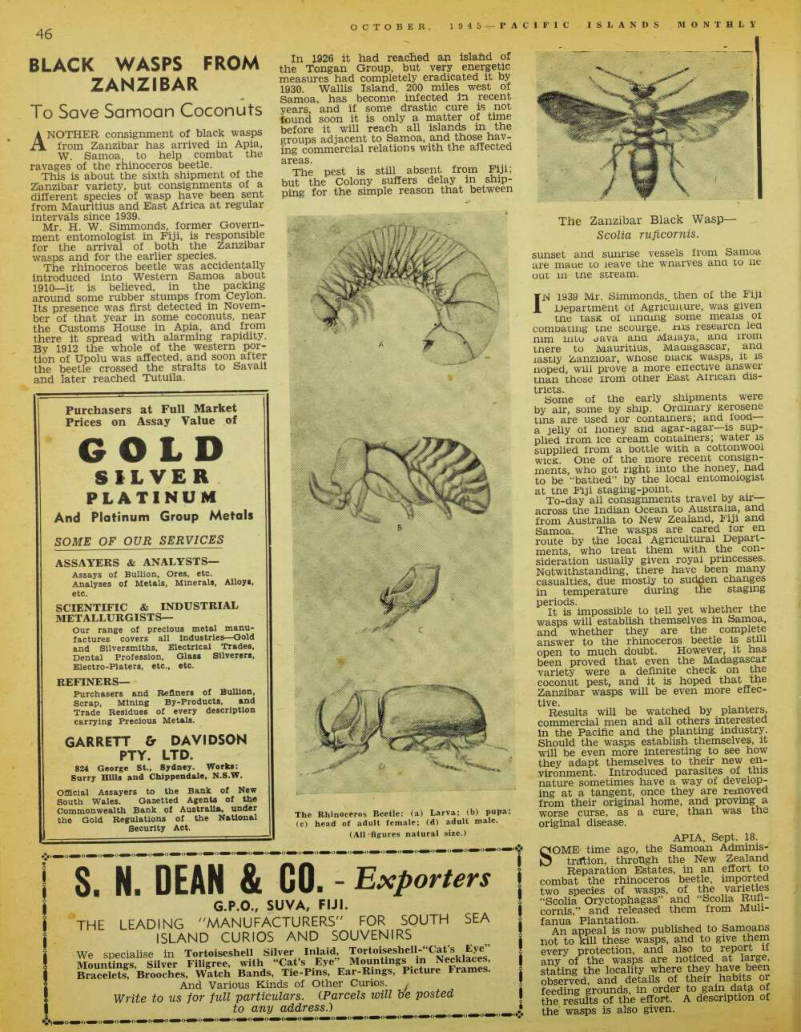
Zanzibar
To Save Samoan Coconuts
ANOTHER consignment of black wasps from Zanzibar has arrived in Apia, W. Samoa, to help combat the ravages of the rhinoceros beetle.
This is about the sixth shipment of the Zanzibar variety, but consignments of a different species of wasp have been sent from Mauritius and East Africa at regular intervals since 1939.
Mr. H. W. Simmonds, former Govern ment entomologist in Fiji, is responsible for the arrival of both the Zanzibar wasps and for the earlier species.
The rhinoceros beetle was accidentally introduced into Western Samoa about 1910 —it is believed, in the packing around some rubber stumps from Ceylon.
Its presence was first detected in Novem ber of that year in some coconuts, near the Customs House in Apia, and from there it spread with alarming rapidity.
By 1912 the whole of the western por tion of Upolu was affected, and soon after the beetle crossed the straits to Savaii and later reached Tutuila.
In 1926 it had reached an island of the Tongan Group, but very energetic measures had completely eradicated it by 1930. Wallis Island, 200 miles west of Samoa, has become infected In recent years, and if some drastic cure is not found soon it is only a matter of time before it will reach all islands in the groups adjacent to Samoa, and those hav ing commercial relations with the affected areas.
The pest is still absent from Fiji; but the Colony suffers delay in ship ping for the simple reason that between
The Zanzibar Black Wasp— Scolia ruficornis.
sunset and sunrise vessels from Samoa are maue w leave the wnarves ana to ne out in tne stream.
IN 1939 Mr. Simmonds,. then of the Fiji Department of Agriculture, was given tne tasK of nnamg some means of comparing tne scourge, ms researcn lea mm into java ana Maiaya, ana irom tnere to Mauritius, Maaagascar, ana lastly Zanzioar, wnose biacK wasps, it is noped, will prove a more effective answer tnan those from other East African dis tricts Some of the early shipments were by air, some by ship. Ordinary Kerosene tins are used lor containers; and food — a jelly of honey and agar-agar—is sup plied from ice cream containers; water is supplied from a bottle with a cottonwool wick. One of the more recent consign ments, who got right into the honey, had to be “bathed” by the local entomologist at the Fiji staging-point. .
To-day all consignments travel by air — across the Indian Ocean to Australia, and from Australia to New Zealand, Fiji and Samoa. The wasps are cared for en route by the local Agricultural Depart ments, who treat them with the con sideration usually given royal princesses.
Notwithstanding, there have been many casualties, due mostly to sudden changes in temperature during the staging P It is impossible to tell yet whether the wasps will establish themselves in Samoa, and whether they are the complete answer to the rhinoceros beetle is still open to much doubt. However, it has been proved that even the Madagascar variety were a definite check on the coconut pest, and it is hoped that the Zanzibar wasps will be even more effecwill be watched by planters, commercial men and all others interested in the Pacific and the planting industry.
Should the wasps establish themselves, it will be even more interesting to see how they adapt themselves to their new en vironment. Introduced parasites of this nature sometimes have a way of develop ing at a tangent, once they are removed from their original home, and proving a worse curse, as a cure, than was the original disease.
APIA, Sept. 18.
SOME time ago, the Samoan Adminis tration, through the New Zealand Reparation Estates, in an effort to combat the rhinoceros beetle, imported two species of wasps, of the varieties “Scolia Oryctophagas” and “Scolia Run cornis,” and released them from Muli fanua Plantation.
An appeal is now published to Samoans not to kill these wasps, and to give them every protection, and also to report if any of the wasps are noticed at large, stating the locality where they have been observed, and details of their habits or feeding grounds, in order to gam data of the results of the effort. A description of the wasps is also given.
The Rhinoceros Beetle: (a) Larva; (b) pupa; (c) head of adult female; (d) adult male. (All figures natural size.)
Advertisements & other items, p. 48 (1 item)
S. H. DEAN & CO. - Exporters
Purchasers at Full Market Prices on Assay Value of
GOLD
SILVER
PLATINUM
And Platinum Group Metals
SOME OF OUR SERVICES
AS SAYERS & ANALYSTS—
Assays of Bullion, Ores, etc.
Analyses of Metals, Minerals, Alloys, etc.
SCIENTIFIC & INDUSTRIAL
METALLURGISTS—
Our range of precious metal manufactures covers all industries —Gold and Silversmiths, Electrical Trades, Dental Profession, Glass Silverers, Electro-Platers, etc., etc.
REFINERS—
Purchasers and Refiners of Bullion, Scrap, Mining By-Products, and Trade Residues of every description carrying Precious Metals.
GARRETT & DAVIDSON
PTY. LTD.
824 George St., Sydney. Works: Surry Hills and Chippendale, N.B.W.
Official Assayers to the Bank of New South Wales. Gazetted Agents of the Commonwealth Bank of Australia, under the Gold Regulations of the National Security Act.
S. H. DEAN & CO. - Exporters
THE
G.P.0., SUVA, FIJI.
LEADING "MANUFACTURERS" FOR SOUTH SEA
ISLAND CURIOS AND SOUVENIRS
We specialise in Tortoiseshell Silver Inlaid, Tortoiseshell-“ Ca ts Eye Mountings, Silver Filigree, with “Cat’s Eye” Mountings m Necklaces, Bracelets, Brooches, Watch Bands, Tie-Pins, Ear-Rings, Picture Frames.
And Various Kinds of Other Curios. / Write to us for full particulars. (Parcels will he posted to any address .)
Government
Frank Comments on the “Provisional”
Letter to the Editor
IHAVE read with interest the debate in the Australian Parliament on' the Bill to provide a Provisional Admin istration for Papua-New Guinea.
One member hoped that firms like Burns Philp & Co. and W. R. Carpenter & Co. would be kept out. Bad as these firms may be, there is one thing that can be said for them; They know their job.
It is doubtful whether some of the mem bers do, if they are reported correctly.
B.P.’s had been called often a pirate and an octopus. They had little opposi tion, and everything was in their own hands. By comparison with our Produc tion Control Board, though, they were archangels. If any of those firms had to survive on what they made from the natives they would soon have been de funct. Shell and copra, I should say, was their main source of revenue. The natives contribute a very small percentage of those commodities. I believe that I can say, without fear of contradiction, that no firm in Papua treated their labourers better than did Burns Philp.
ONE member said that people come here to make money. That, I should say, is what they go to most places for. Most people came here because they thought it was a land of promise—a place where one could get a nice home to gether and be reasonably well-off, before they were too old to enjoy it. Not, as some of the fanatics seem to think, for exploitation.
Before the war, there was not one small holder here making more than a
bare living. Most of the plantations at this end are—or were, when the war started —still working on calls. Many now will never pay interest on capital outlay, unless phenomenal prices occur.
Some may give the owners a living. It is a pity that some of these great re formers would not educate themselves a little, then they might be able to dis cuss the Territory intelligently. Very few plantations come into full bearing for well on towards 20 years—some over 20.
Another item is shipping. Is it pos sible that the taxpayer of Australia is going to be bled for a national shipping line? Past experience should, I think, be fresh enough in the mind of many mem bers to prevent such another fiasco.
Judging from previous attempts, it is doubtful just what they could run suc cessfully. Not ships, I feel sure.
ANOTHER member said that natives were taken away from their villages for too long, and that the indenture system aggravated the evil. Natives were signed on in Papua for 12 months. 18 months and 2 years. No native could be signed on for more than a second term. Several places were closed against recruiting, but that did not keep them at home. The new Act says that they must go home. I thought that they were British subjects and therefore free. I have no recollection of any native being forcibly sent home under the Murray Government unless he was a bad charac ter. They could not loaf about the towns, but they could work voluntarily
for whom they wished. They could go where they liked, but not stop in the towns unemployed. The previous em ployer paid one shilling and got a receipt to clear him of any further responsibility for the native.
With no recruiting, one wonders how they will get to work, seeing that most of them will have to travel between 50 and 100 miles. It appears that the new set-up does not want them to work. That is all right, providing that the Australian Government is prepared to carry the baby. Except medical attention, there is very little that these natives need. This malnutrition talk is tripe. I think they do suffer from want of food —not be cause they have not got it, but because it is their custom to have but one meal a day, in their villages and, in the rest of the day, they eat anything or noth ing, as available.
SOME member said that 80 per cent, of the people have a smattering of of Motuan. This is a misstatement.
By far the greater number, all ever the Territory, have a better grip of Eng lish. No Motuan is spoken east of Samarai or on the north-east coast, until one gets to Tufi. Woodlark Island.
Misima and Sud Est employers used natives from all the islands around about.
Many thousands were used bv the miners and planters. None ever tried to speak anv of the. dialects. It was worse than useless —every time they got new natives it would be another dialect —so they spoke English. I have been on all the islands around this end of the Territory, and have never at any time had any trouble over language, and I speak only English, with perhans a little Australian thrown in occasionally. * From what one reads, it apnears that our own needy people are having a ter
rible job to get any attention, either In hospitals or homes, yet the Australian Government is going to set up new stan dards for natives who are actually in need of nothing, apart from medical at tention. , , . ...
They will show the world what they can do for natives! Have they never heard of what the British have done in Africa? They will have travelled a fairly long road before they catch up to the British.
One would think that no native ever got more than 10/- per month. No N.E.
Coast native got less than 12/6. Many natives were getting £l2 per annum, and many more from £2 to £9 per month.
Burns Philp paid a native £9 per month; and three days after he was paid he did not have a cent, or a thinp- of value, for the lot. I am. etc.,
W. A. Young.
Dogma, 15/9/45.
Advertisements & other items, p. 49 (1 item)
William Atkins Pty. Ltd.
Head Office 449-451 KENT ST., SYDNEY.
Iron & Steel Merchants—Engineers' Supplies
Coach tr Motor Hardware
ESTABLISHED OVER 50 YEARS
Cable Address: WILATKIN, Sydney.
STEEL DEPARTMENT
MILD STEEL:
Rounds, Squares, Flats, Half-rounds, Hexagons, Bevel, Shoeing, Tyre, Angles, Tees, Sheets, Plates, Girder Plates, Chequer Plates, Channels, Hoops, Etc.
BRIGHT STEEL:
Rounds, Squares, Hexagons.
Extra Special High Speed Tool Steel, Mining Steel, Blister Steel and Spring Steel, Rounds, Flats & Squares.
Bor Iron—All sections and sizes.
Engineers' Supplies:
Set Screws. Studs. Metal Thread Screws, Coach Screws. Files, Cotter Pins, Bright and Black Bolts, Rivets, Etc., Hack Saw Blades.
Power Transmission Gear: Including Plummer Blocks, Couplings, Collars, Etc.
Coach and Motor Hardware: Axles, Springs, Wheelstuff, Duck, Paints.
Farriers' Supplies: Horse Nails, Anvils, Vices, Etc.
Motor-Trimmers and Motor Builders' & Motor Painters' Requirements
C. A. WILLEY'S
Quick-Drying Coach and Car Paints. Roughstuff, Elastic Gloss, Synflex Enamels, Lacquers.
DUCO Lacquers and DULUX Enamels—FAßßEX Motor Toppings and Leather Cloths, House & Decorators' Points, Varnishes & Brushwore.
Sole Distributors of CHAMPION'S Decorators Paint Products.
Distributing Agents tor BROLITE Lacquers. SYNFLEX Enamels and "POLYGLOSS" Finish.
Dandelion Diuretic
Prom Our Own Correspondent
Mangaia, Aug. 20.
AS a child in the “primer” grades at school, we’d a superstition that if you smelt a dandelion, you’d—so to speak!—dream that night that you were drowning. Well, I’m beginning, nearly 40 years after, to suspect there’s something in the belief. . .
The Mangaians boil the seeds of the puff-ball on the “pulia” to produce a native medicine for the cure, inter alia, of gonorrhea: and, more particularly, of kidney troubles. I have tested it for the latter; and am able to vouch for the effectiveness of the water in which dan delion seeds have been seethed, as a kidney stimulant. It works—generously S.
Yet this ultra-simple remedy is neglected by European medical science.
The old “ta’unga” herbs are worth look ing into. What about some botanical re search, and'less of coal-tar derivatives, Dr. D and Dr. E ? It would save the Administration money, too and that’s something these days!
Major J. I. Merrylees, who was District Officer at Kieta, Bougainville, TNG, when the invasion occurred, and who had a remarkable escape, was married in Bris bane recentlv to Miss Francis Wilkin.
Tropical Hotel
New Management For Gph
SUVA, Sept. 27.
THE South Pacific’s leading hotel, the Grand Pacific, in Suva, Fiji, will be under new management from Octo ber 1.
Mr. Charles Brown, who has been managing the hotel since 1938, will leave shortly for New Zealand on three months’ leave; his place will be taken by Mr. and Mrs. C. W. Anderson, who arrived here on the September “Matua" from New Zealand. Mr. Anderson has been on Union Company ships for many years, and knows the Pacific right through from San Francisco to Sydney, To a person whose ideas of tropical hotels are founded on those in existence in the Mandated Territory of New Guinea in the pre-war period, the GPH is some thing right out of this world. It is a far call from the dangling, galvamsed iron shower-bucket, the box-like rooms and the unsewered discomfort for which Territorians uncomplaining paid 15/- or 16/- per day.
The GPH was built in 1914; therefore, there are many hotels in Australia to day which are more modern; but there are no hotels in Australia at the present moment to compare with it for service and food. The food in this country is beyond Hie wildest dreams of the long suffering Australians; the particular bureaucrat who invented the 5/- meal maximum in Australia, administered the couo de grace to whatever pretensions Australia might have had for good food.
There is only one thing about this place that could get in the hair of the individual with a Melanesian complex.
That is, the strange urge of the Indian servants to be vocal at 6.15 in the morn ing These seem to pick that time, over th<*. making of morning tea, to get their political views off their chests It takes a whole lot of willpower on the part of this Territorian to cling to her bed, ana not dash out on to the landing in full fighting trim to bellow: “What name something? Go on—rouse! ’
But, apparently, the Indians of Fiji
don’t go for that'kind of treatment.
J.T.
Last Of De Rays
Expedition
Dies in Australia at 91
rE death occurred on September 25, in Lismore, NSW, of Mrs. Maria Capelin, 91, the last survivor of the ill-fated Marquis de Rays South Seas expedition of the-last century.
Mrs. Capelin was a native of northern Italy, where she met and married her first husband, Mr. G. Tome. They were attracted by the glowing colonisation schemes outlined by the French noble man, the Marquis de Rays, who planned to found “a new French empire” on New Ireland. With their three children, Mr. and Mrs. Tome sailed from Barcelona on July 4, 1880, on S.S. “India,” one of the ill-fated ships carrying members of the expedition to the South Seas.
The colonisation attempts on New Ireland ended disastrously and Mr. Tome was one of many who died on the island.
With the remnants of the expedition, Mrs Tome and her children arrived in Sydney in 1881. In 1886 she married Mr.
L. Capelin and later the couple settled at “New Italy,” outside Woodburn on the Richmond River, where the remnants of the de Rays expedition had founded a colony. , , , “New Italy” prospered for a while but the soil and site were by no means ideal and the settlement gradually fell into decay, until to-day only one of the orig inal settlers remain.
Mr. Capelin died in 1915 and Mrs.
Capelin later lived in Lismore. She is survived by three daughters and four sons. 60 grandchildren, 83 great-grand children, and 12 great-great-grand children. Eighteen of her male descend ants served in World War 11.
Black Market Cigarettes
In Tahiti
Papeete, Aug. 9.
mHE broadcasters in the United States J. used to pother and vex the air waves with shrill inquiries as to the whereabouts of the millions of cigarettes that were pouring ceaselessly from the factories of the Tobacco Trust. A little less noise and a measure of intelligent investigation would have revealed one oi the most efficiently conducted black mar kets this war period has produced This was brought to general attention in this Colony by the operations of the smuggling ring, which was under judicial investigation some time ago.
Here there was always an ample supply of cigarettes—at a price—the price the black market ghouls demanded.
It is an ill wind that blows no good for someone. The detection of one band of smugglers eliminated a series of orgies around the wassail-bowl in Papeete which had periodically murdered sleep throughout the district.
There is no need for our Tahitians to become victims of the black market.
There is native tobacco in abundance.
The old type of cigarette—made by twist ing a leaf of native tobacco with paper thin rau-oro (the dried leaf of a species of pandanus)—has a flavour far superior to that of the processed corn-site and North Carolina marsh-grass which mas querade as tobacco in many American tourists of the notorious 1920 de cade introduced the American cigarettes.
Bv an evolution of snobbery, the smoking of the fragrant rau-oro variety became plebeian. The Tahitian was thus made ripe for exploitation.
Advertisements & other items, pp. 50-54 (3 items)
A. B. Donald Ltd.
AUCKLAND
ISLAND TRADERS & GENERAL MERCHANTS
p o. Box 1509. Cables & Telegrams, "Kingdom", Auckland.
New Guinea’s Missing Civilians
49
PACIFIC ISLANDS MONTHLY OCTOBER, 1.9 45
New Guinea’s Missing Civilians (Continued from page 9)
\tv %ivi
With the war in Europe over and the defeat of Japan drawing nearer every day, we are once more able to swing over to the manufacture of commercial products. The lessons and experience gained in the production of war requirements will be fully incorporated in our new Lanray Line of metal products.
lan ray
I*
METAL PRODUCTS
Manufacturers of LANRAY Kerosene Pressure Stoves and Blow
Lamps—Holloware—Light Fittings—Key Blanks-
Industrial Reflectors.
Sole Distributors: LANCE RAYMOND Pty. Ltd. "-JMSETISr Cable Address: LANRAY, SYDNEY*
BARBOLA
JEWELLERY
Ear-Rings, Brooches
in assorted bright colours.
BELTS
TOBACCO POUCHES
FISHING BAGS
CYCLING BAGS
HAVERSACKS
All goods sent by parcel post, ensuring quick delivery.
Prompt attention given to all enquiries.
W. & M. NAGY
Manufacturers and Wholesale Merchants 90 Pitt Street, Sydney Cable address:
WILNAGY SYDNEY.
G I L L E S PI The Flour
SYDNEY
MARK
TRADE
’S of the Islands
STROMBERC AID
-CARLSON
CIRCULATORS
AVAILABLE FROM STOCK
Stromberg-Carlson Air Circulators are regarded as the most efficient type yet produced. The scientifically designed blade sends primary and secondary air currents throughout the whole area. A request by next mail will bring you fullest details.
STROMBERG-CARLSON RADIO AVAILABLE, TOO!
A limited number of Stromberg-Carlson world range radios, built to exacting Air Force standards still available. Wonderful performer for Islands. Send enquiries now. We have » arranged for a quota for the Islands of all Stromberg-Carlson post-war models. s 'of
spies sepvice
TELEPHONE;BVYSIS7@ SCOTTISH HOUSE • 19 BRIDGE STREET® SYDNEY ® AUSTRALIA
NELSON and ROBERTSON Pty. Ltd.
Established 1895
Shipowners - Brokers and
Islands Merchants
Commission.
Entrust your requirements to the firm with fifty years' practical experience in the Pacific Islands.
REPRESENTED IN
ALL PARTS OF
THE WORLD.
Sole Agents :
SKANDIA DIESEL ENGINES
ARCHIMEDES MOTORS
Prompt attention given to all enquiries.
OVERSEA INDENTS
ARRANGED FOR
CLIENTS.
NELSON & ROBERTSON
12 SPRING STREET, SYDNEY, AUSTRALIA
Telegraphic Address: IVAN, SYDNEY.
PTY.
LTD.
Rotuman-Not Fijian
ALEVUKA correspondent says: In the August “PIM” you describe the Rev.
Puata Taito as a Fijian member of the Methodist Mission. He is not a Fijian, but a Rotuman, of Notau district, and he is accompanied by his wife and child ren. I think he was on duty in the Solomons, or somewhere up north during the war. His wife and children were evacuated; but he hung on. They now are together on this special work in Vic toria, A good many Rotumans have left their homes and done Mission work in BNG and the Solomons in past years.
150Th Anniversary Of Lms
ON September 23, 1795, representatives "pf various Protestant churches met , in Bakers’ Coffee House, London, and founded the London Missionary Society. This Society, which has had a great influence on the development of many Pacific Islands people, directed its first activities to the South Pacific, but it is now represented also in India, China, Africa and Madagascar.
Anniversary celebrations have been held in all parts of the world in past weeks, and, among messages of congratu lations sent to the Foreign Secretary of the Society, was one from Sir Alexander Grantham, Governor of Fiji, and High Commissioner of the Western Pacific.
Rev. C. L. and Mrs. Williams, with their son, have left Brisbane for Samoa.
Mr. Parkin Christian, Magistrate, of Pitcairn Island, arrived in Sydney in October to visit his son, Richard Christian, a resident of Parramatta. He is 65 years old, and is the great-great grandson of Fletcher Christian, of the “Bounty.”
The Evangelical Lutheran Church of Australia and New Zealand proposes to raise at least £lO,OOO as a peace thank offering for the rehabilitation of Lutheran churches and missions in war-stricken areas, especially Europe, China, and New Guinea.
Advertisements & other items, pp. 55-56 (2 items)
53
PACIFIC iSLAUfiS MONTHLY OCTOBER, 1945
£. J. Gough & Co,
Vi ■■■% ft*
LAVENDER
Q Pi.: f'/i ® & > d\ ♦., - originated in the gay, smart pre-war capital c|j|||p fashion-conscious France. *
EAU Dt COLOGN
At present being made in Australia— JEAN DIDIER'S Famous PERFUMES are NOW Available.
Sole Distributing Agents for the Pacific Islands:
BRIAL
528 COLLINS STREET,
MELBOURNE.
’Phone: MU4837. & Enquiries Through Your Usual Channels.
BALL
1 BOND STREET,
SYDNEY.
’Phone: B 7371.
£. J. GOUGH & CO,
1 Bond Street, Sydney, Australia.
TeL B 4167. Box 3615 G.P.O.
SUPPLIERS OF GENERAL MERCHANDISE TO LEADING FIRMS THROUGHOUT THE
PACIFIC ISLANDS
Exporters Importers Manufacturers' Representatives Bankers: Bank of N.S.W. Bank of Adelaide. Comptolr Nat. d’Escompte de Paris.
Cable Address: “SEAFOODS,” SYDNEY.
Codes: Bentley's, 2nd and Comp. Phrase; A.8.C.. sth and 6th; Peterson. 2nd and 3rd; Banking; Acme.
ISLAND STOREKEEPERS ISLAND STOREKEEPERS
IN NEW CALEDONIA
FIJI
TONGA
COOK ISLANDS
NUIE
TAHITI
WESTERN SAMOA
PAGO PAGO
SEND YOUR ORDER TO
R. H. CHURCH & SON
AUCKLAND, NEW ZEALAND
... FOR COMPETITIVE BUSINESS
Your supplies carefully selected, packed and promptly despatched.
Form a connection of advantage to your business. Write to G.P.O. Box 1548, Hellobys Buildings, 27 Queen Street, Auckland, C. 1., New Zealand.
NOW
AS ALWAYS
DEPENDABLE
roieman
For over forty years COLEMAN has built a reputation for dependability in lighting, cooking and heating appliances. Built from the same first quality materials as always, with the exclusive Coleman features, you are always assured of the best when you buy dependable Coleman. Wherever you are there is a Coleman dealer to ' serve you with dependable COLE- MAN appliances and service.
THE COLEMAN LAMP
AND STOVE COMPANY LIMITED
TORONTO, CANADA
CHICAGO, U.S.A.
Manus, Tng?
Should Usa Have A Base At
WHEN he was asked about a report that the United States wished to retain a base at Manus (Admiralty Islands, New Guinea), the Australian Minister for External Affairs gave an evasive answer. He said that Manus was included in the New Guinea Territory, over which Australia holds a League of Nations mandate; and all future arrange ments and relationships affecting this place had still to be defined under the United Nations Charter.
One Labour member pointed out that Manus has one of the best harbours in the South-West Pacific, and Australian Labour would be much annoyed if it was handed over to the United States.
The Minister said nothing.
How short is the memory of these poor little people! America built the new base at Manus—as it built many other South- West Pacific bases—and it is less than three years since these Australian poli ticians were running around in circles, thanking their high gods for the power and the proximity of the United States forces.
Morris Hedstrom
Scholarship For 1946
APPLICATIONS are now being received .for the Morris Hedstrom, Ltd., Uni versity Scholarship for 1946. Appli cations close at noon on October 20 with the secretary of the Selection Committee, c/o Morris Hedstrom, Ltd., Suva.
The Morris Hedstrom Scholarship Fund was founded last year. Each year a youth of Fijian or part Fijian descent who is qualified to enter a New Zealand Uni versity, is selected by a Committee.
The first scholarship winner, Ravuama Vunivalu, is now reported to be doing well in his studies at Auckland Univer sity. He will be sitting for his degree examinations towards the end of October.
Discharges From Makogai
DURING the past year there were 55 discharges from the Central Leper Hospital, Makogai, eight of them un conditional discharges. Total number of patients on the island at present is 626, of which Fiji is responsible for 443—244 Indians and 148 Fijians. Other patients include Gilbert Islanders, Cook Islanders and Samoans. x Mr. P. J. Twomey, secretary of the Leper’s Trust Board, which has its head quarters in New Zealand, was in Suva in September. He has been visiting the Solomons and Makogai, studying prob lems with which his Board has to deal.
Pitcairn's First Post-War Ship
PITCAIRNERS were able to board an overseas vessel for the first time in many years in September, when the “Akaroa” called at this isolated island en route to New Zealand. “Akaroa is a 15,000-ton liner; she carried 194 passen gers—including wives and children of New Zealand Servicemen—and they tra velled under peacetime conditions.
Pitcairn Islanders met the vessel m canoes and, for the first time since the outbreak of war, went on board to sell curios.
Mr. Trevor Gould, who at 9116 time had a legal practice at Nadi, Fiji, and who was Crown Counsel in Hong Kong when that city was occupied by the Japanese in 1942, has now been reported safe in Australian hands.
Advertisements & other items, p. 57 (1 item)
bond
i m
rVt
m
HARRY J.YOUNG PTY. LTD.
■V Sole Pacific Islands Selling Representatives
Quality
LOVELIER
THANEVER
n
bond
s For:
BOND’S
a, L n
BOND'S
STANDARD
ATHLETICS
Garments
W * 9•• • •
BONDS
H O S j E RY
Postal Address: Box 3661, G.P.0., Sydney jm A I*
HARRY J .YOUNG PTY. LTD.
K "V
379 KENT ST.,
Sydney.
Bankers: Bank of N.S.W.
A Codes: Bentley’s Comp. Phrase Bentley’s 2nd Phrase.
Suva Cricket Club
rE officers elected at the annual general meeting of the Suva Cricket Club in September are: Patron—His Excellency, Sir Alexander G. W. H. Grantham, K.C.M.G-, M.A., Governor of Fiji and High Commissioner for the Western Pacific.
President.—Mr. R. Crompton, K.C.,
C B E
Vice-presidents.—Hon. J. F. Nicholl (Colonial Secretary), Mr. T. W. A. Barker, Mr. A. S. Farebrother, Mr. E. E. Turner, Mr. P. J. Turner.
Hon. Secretary.—Mr. P. A. Snow, M.A.; Hon. Assistant Secretaries—Mr. E. F.
Apted, Mr. H. J. Apted.
Hon. Treasurer.—Mr. F. Palmer.
Flight-Lieutenant Maurice Scott, who has been overseas for four years with the RAF, returned to Suva on September 21.
After a period of leave he will be dis charged in the Colony.
Governor-General
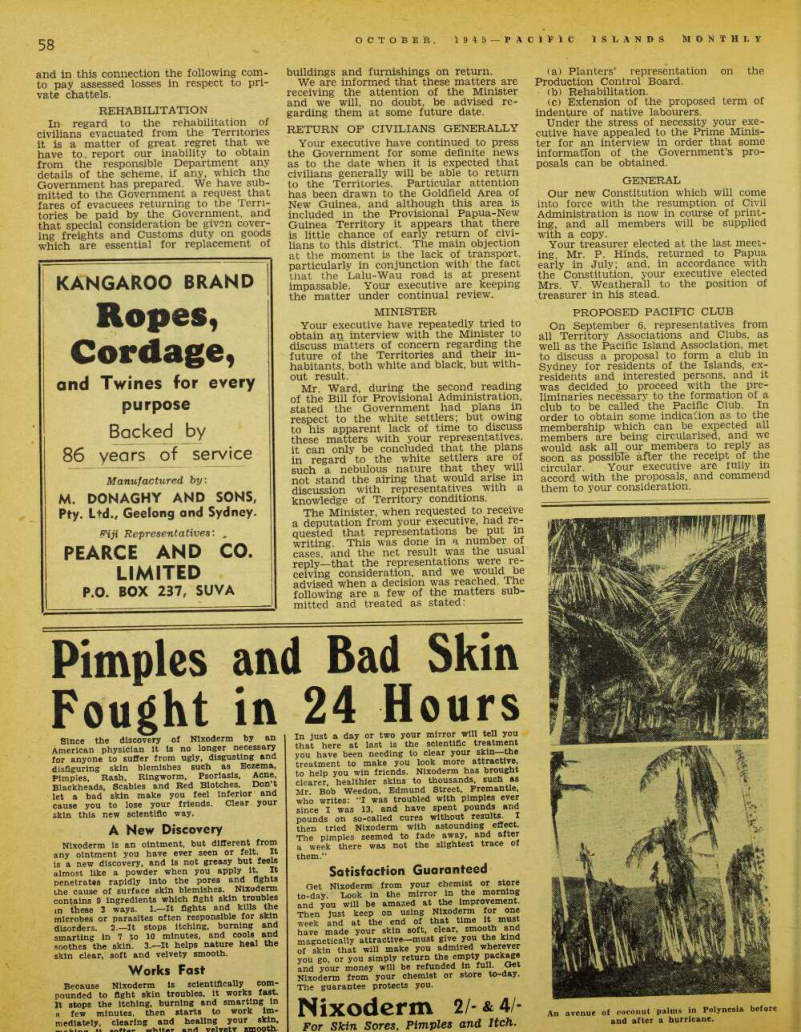
Evacuees Appeal To Australian
Their Treatment by Minister and Prime Minister Bitterly Resented
OECAUSE, in their unanimous opinion, they were "up against a stone wall," members of the Pacific Territories 7 Association (evacuees from New Guinea and Papua), at a largely-attended meeting in Sydney Australia (the Duke of Gloucester), for assistance in returning to their homes.
fIIHE executive reported that, during the X preceding three months, although the Ministers and high officials had been appealed to no reassurance (or even information) could be obtained In regard to the time when they would be allowed to return to the Territories, or the prob able conditions of their return. Canberra
displayed the utmost indifference con cerning the plight of the hundreds of people whose homes and interests were in the Territories.
Speaker after speaker reminded the meeting of the events of the past years. They had assumed that, as the Territories people were the only Aus tralian civilians to be directly affected by Japanese invasion, the Australian Government would have been anxious to assist in their rehabilitation. They imagined that, as soon as the Japs were driven out, civilians would have been en couraged and assisted to return to their homes. Instead, two years after the Japs had been cleared out of the Territories south of the Markham, the Territories still were in military occupation. Instead of the districts, as they were liberated, being restored to the care of civilian Gov ernment and of civilians generally, all sorts of Government instrumentalities had been introduced and had taken control.
Only a few civilians had been allowed to return —the remainder apparently were to be kept out indefinitely. No commer cial concerns whatever had been ad mitted —Canberra’s policy apparently was that private enterprise should either be reduced to the utmost or kept out alto gether, while its place was taken by the Government-owned Production Control Board —which controls not only all pro duction, but all trading, all labour, and all transport.
It was pointed out that, for more than two years, Territorians had been appeal ing to the Minister for External Terri tories, Mr. Ward; but that gentleman had refused to see them, had fobbed off their written communications with assurances that “the matter will receive considera tion”; and finally had ignored their letters altogether. Then they had appealed to the Prime Minister —to Mr.
Curtin and, after his death, to Mr.
Chifley; but all they could get from those functionaries was that “the matters were under consideration.” Appeals for inter views with the Prime Minister were ignored.
IT was recalled that, over a year ago, a section of Territorians had moved for an appeal to Britain and the United States —an appeal that the control of those Territories be taken away from Australia, and placed in the hands of other authorities, with some sense of human rights and justice.
“You declined that proposal,” said one speaker, addressing the meeting. “You thought that you would get a better deal if you remained with Australia, and appealed, by special deputation, to the Prime Minister. Well, you appealed, and look at what you got. The Prime Minis ter will not even communicate with you.
And in the meantime, Ward and his anthropologists and missionaries are giv ing all their energies, and a big slice of the Australian taxpayers’ money, to poor, dear Fuzzy-wuzzy, the creation of the shoddy Australian press.
“We Europeans have all lost our homes and the results of a lifetime’s work, hun dreds of our civilians have been killed,
hundreds more have given pretty distinguished service in the armed forces— and yet we are treated this way by Australia. I never believed such a thing was possible.”
Mr. Clem Kirke, well-known Morobe resident, pointed out that, as British subjects, they had certain fundamental rights. The Throne was not a mere ornament—it was there as the final place of appeal to guard the liberties of the people. If there was tyranny and in justice, surely they had the right to appeal to the Governor-General of Australia.
Mrs. Wilmott (New Guinea) reminded the meeting that on a famous occasion in New South Wales, when a democratically elected Government ran amok, under Mr.
Lang, and seriously interfered with the
fundamental rights of the people, the Government was summarily dismissed by the State Governor, Sir Philip Game, Other speakers pointed out that the European residents of the Territories, be lieving themselves treated with injustice, had tried the few legal and constitutional means available to them to get relief, and had been ignored by the Federal Government. The only course now left open to them was to appeal to the Crown.
The meeting unanimously adopted a resolution, instructing the executive to take all steps necessary to place before the Governor-General, in proper form, a statement of the present unhappy condi tion of the Territories evacuees, and an appeal for assistance.
Report of the Executive
SINCE the last meeting of members, held in June, your executive have continued to press the Government for details of their plans for the future; but it is regretted that no definite results have been obtained. The three months can only be described as months of frustration.
The surrender of the Japanese has naturally focussed the attention of all exresidents on the likelihood of an early return to their homes and businesses in the Territories and they, of course, anticipated that the Federal Government would not lag in advising them of the plans prepared for the future of the Territories. It is apparent, however, that these exxpected plans, if in existence at all, are still far from finalisation. provision a t ATTivrT'NrT c 5T'P attont
Provibional Administration
The Bill for the setting up of a Provisional Civilian Administration for Papua and portion of the Territory of New Guinea was brought before, the House early in July. Your executive took all possible steps to organise opposition to this Bill, as they considered that the
re-establishment of Civil Administration on the.same basis and under the same laws as before the Japanese invasion would be in the best interests of the white residents as well as the native in habitants. In this regard Mr. C. I. H.
Campbell proceeded to Canberra to supply necessary Information to Opposition members and, although the Opposition were unable to defeat the measure, the opportunity presented itself for the cor rection of misleading statements made by the Government supporters.
It now devolves on your Association to keep continual watch on Ordinances which are put out under terms of the Bill, which provides that such Ordinances shall remain on the table of the House for a period of 15 sitting days. We have arranged for advance copies to be sup piied to ug in Qrder that & careful study may be made of same, and objections raised where considered necessary. „, AD hamapp att^hto
War Damage Commission Allows
Graiia Bubbidies
As is usual, we report good results from all our submissions to the Commission
munication covering the payment of an ex-gratia allowance in respect to damage caused “by abandonment” to agricultural properties has been received and is now promulgated for the information of mem bers:— The Commission is continuing to fina lise all claims as quickly as possible, and
and in this connection the following comto pay assessed losses in respect to private chattels.
Rehabilitation
civUians B evacuated t^rome^he il TerHtorles it is a matter of great regret that we have to. report our inability to obtain from the responsible Department any details of the scheme, if any, which the Government has prepared. We have submitted to the Government a request that fares of evacuees returning to the Terntories be paid bv the Government, and that special consideration be given covering freights and Customs duty on goods which are essential for replacement of
buildings and furnishings on return.
We are informed that these matters are receiving the attention of the Minister and we will, no doubt, be advised re garding them at some future date.
Return Of Civilians Generally
Your executive have continued to press the Government for some definite news as to the date when it is expected that civilians generally will be able to return to the Territories. Particular attention has been drawn to the Goldfield Area of New Guinea, and although this area is included in the Provisional Papua-New Guinea Territory it appears that there is little chance of early return of civi lians to this district. The main objection at the moment is the lack of transport, particularly in conjunction with the fact that the Lalu-Wau road is at present impassable. Your executive are keeping the matter under continual review.
Minister
Your executive have repeatedly tried to obtain an interview with the Minister to discuss matters of concern regarding the future of the Territories and their in habitants, both white and black, but with out result.
Mr. Ward, during the second reading of the Bill for Provisional Administration, stated the Government had plans in respect to the white settlers; but (Dwing to his apparent lack of time to discuss these matters with your representatives, it can only be concluded that the plans in regard to the white settlers are of such a nebulous nature that they will not stand the airing that W9UW arise in discussion with representatives with a knowledge of Territory conditions.
The Minister, when requested to receive a deputation from your executive, had re quested that representations be put in writing. This was done in a number of cases, and the net result was the usual reply—that the representations were re ceiving consideration, and we would be advised when a decision was reached. The following are a few of the matters sub mitted and treated as stated:
(a) Planters’ representation on the Production Control Board. (b) Rehabilitation. (c) Extension of the proposed term of indenture of native labourers.
Under the stress of necessity your exe cutive have appealed to the Prime Minis ter for an interview in order that some information of the Government’s pro posals can be obtained.
General
Our new Constitution which will come into force with the resumption of Civil Administration is now in course of print ing, and all members will be supplied with a copy.
Your treasurer elected at the last meet ing, Mr. P. Hinds, returned to Papua early in July; and, in accordance with the Constitution, your executive elected Mrs. V. Weatherall to the position of treasurer in his stead.
Proposed Pacific Club
On September 6, representatives from all Territory Associations and Clubs, as well as the Pacific Island Association, met to discuss a proposal to form a club in Sydney for residents of the Islands, ex residents and interested persons, and it was decided to proceed with the pre liminaries necessary to the formation of a club to be called the Pacific Club. In order to obtain some indication as to the membership which can be expected all members are being circularised, and we would ask all our members to reply as soon as possible after the receipt of the circular. Your executive are fully in accord with the proposals, and commend them to your consideration.
An avenue of coconut palms in Polynesia before and after a hurricane.
Advertisements & other items, pp. 58-60 (2 items)
Mcilrath’S
FOR
High Quality Food
at Bedrock Prices Orders ond enquiries to—
McILRATH'S PTY. LTD.
Export Department,
202 PITT ST., SYDNEY, AUSTRALIA
Bond Bros. & Co.
(Incorporated)
310 CALIFORNIA STREET
SAN FRANCISCO CALIFORNIA
U.S.A.
ESTABLISHED IN 1910
• Importers of Island products and exporters of Island requirements. £ Our 35 years' experience guarantees you complete satisfaction. 0 For reference: Inquire from any San Francisco Bank.
NEW ACCOUNTS INVITED
Widdop
CLARET
and
MOSELLE
Now Available !
Sole Distributors, Pacific Islands:
BRIAL & BALL
528 Collins St., 1 Bond St., Melbourne. Sydney.
Enquiries through your usual channels appreciated.
"if » 9
DIESEL ENGINES
WIDDOP
S H.P. to 500 H.P.
H. WIDDOP & CO., LTD. GREEN Ift T c I Telephone Keighley 3727-
KEIGHLEY
ENGLAND
Telegrams : Widdop Keighley Codes A.B.C. 6th Edition, Bentleys, Bentley’s Second We are prepared to consider Agencies for certain territories /!P / m. ; / Motor Coaster S. America.
Firefloat, Egypt.
Passenger Ferry, l Nigeria.
Tug, England.
Passenger Boat, Middle East.
KANGAROO BRAND
Ropes,
Cordage,
and Twines for every purpose Backed by 86 years of service Manufactured by:
M. DONAGHY AND SONS,
Pty. Ltd., Geelong and Sydney.
Fiji Representatives: ,
PEARCE AND CO.
LIMITED
P.O. BOX 237, SUVA
Pimples and Bad Skin Fought in 24 Hours
In just a day or two your mirror will tell you that here at last is the scientific treatment you have been needing to clear your skin the treatment to make you look more attractive, to help you win friends. Nixoderm has brought clearer, healthier skins to thousands, such as Mr. Bob Weedon, Edmund Street, Fremantle, who writes: “I was troubled with pimples ever since I was 13, and have spent pounds and pounds on so-called cures without results. I then tried Nixoderm with astounding effect.
The pimples seemed to fade away, and after a week there was not the slightest trace of them.”
Satisfaction Guaranteed
Get Nixoderm from your chemist or store to-day. Look in the mirror in the morning and you will be amazed at the improvement.
Then just keep on using Nixoderm for one week and at the end of that time it must have made your skin soft, clear, smooth and magnetically attractive-must give you the kind of skin that will make you admired wherever you go, or you simply return the empty package and your money will be refunded in full. Get Nixoderm from your chemist or store to-day.
The guarantee protects you.
Nixoderm 2/- & 4/-
For Skin Sores, Pimples and Itch.
Since the discovery of Nlxoderm by an American physician It is no longer necessary for anyone to suffer from ugly, disgusting and disfiguring skin blemishes such as Eczema, Pimples, Rash, Ringworm, Psoriasis, Acne, Blackheads, Scabies and Red Blotches. Don’t let a bad skin make you feel inferior and cause you to lose your friends. Clear your skin this new scientific way.
A New Discovery
Nlxoderm is an ointment, but different from any ointment you have ever seen or felt. It is a new discovery, and Is not greasy but feels almost like a powder when you apply it. It penetrates rapidly Into the pores and fights the cause of surface skin blemishes. Nlxoderm contains 9 ingredients which fight skin troubles m these 3 ways. I.—lt fights and kills the microbes or parasites often responsible for skin disorders. 2.—lt stops itching, burning and smarting in 7 to 10 minutes, and cools and soothes the skin. 3.—lt helps nature heal the skin clear, soft and velvety smooth.
Works Fast
Because Nlxoderm is scientifically compounded to fight skin troubles, it works fast.
It stops the itching, burning and smarting in a few minutes, then starts to work Immediately, clearing and healing your skin, l.l It nrViU.nr And velvety smooth.
Horrors In Wrecked Rabaul
Australians Are Now Trying to Restore Order
From a Special Correspondent
rE story of what happened inside Rabaul, after the Jap occupation in January, 1942, still has to be told.
The little that already has been pub lished indicates a long series of atrocities and horrors.
Australian Forces have been in occupa tion of Rabaul since September 10, but singularly little has been published to describe either the Jap occupation or the Australian reoccupation.
Major Edmonds-Wilson, commander of the tiny Kavieng garrison of 150 men, has told how he got his men away from Kavieng in a schooner, but they were captured by Japs and taken to Rabaul.
He was there until he was shipped away to Japan at the end of June, 1942. He was liberated lately in Japan, and he told a reporter that atrocities during the first few days of the Jap occupation of Rabaul were indescribable. He could hear the screams of crazed women while the drunken Japs went from house to house raping, looting and killing.
This doubtless refers to the Japanese looting of Rabaul’s Chinatown. The Japs treated the Chinese community, especi ally the women, with fearful cruelty.
IT appears that after the Australian soldiers and civilians were shipped away from Rabaul, in June, 1942 (the most of whom were never heard of again) the Japs brought to Rabaul 600 surrendered British soldiers from Singa pore, and forced them to dig the in numerable tunnels with which the steep hillsides around Rabaul are now honey combed. They arrived in October. 1942. when the Japs were confident they could hold Rabaul, and use it as a base against Australia.
Of the 600, onlv 18 survived—thev were liberated when the AIF went into Rabaul —and they were badly diseased. Sixty four died in Rabaul from disease and malnutrition, and 517 were drowned on a ship in Rabaul Harbour when shipping there was attacked by American planes.
Later, the Japs took 80 American soldier-prisoners into Rabaul, but their fate is not clear. One report indicates that a number of them were flown from Rabaul to Tokio after Rabaul surren dered. * From about the middle of 1943, Jap communications between Japan and Rabaul were seriously interrupted, and the Rabaul Japs were thrown on their own resources. From then on, the prisoners were forced to live on meagre rations of locally-grown vegetables.
What remained of the town of Rabaul seems to have been finally wiped out by a terrific Allied air raid on March 2. 1944. It continued for the better part of 24 hours, destroyed the town and the harbour shipping, and killed large num bers of Japs. In reprisal, the Japs fol lowed their usual practices, and tortured and killed their prisoners.
Meagre and disconnected reports from Rabaul indicate that large numbers of Australian troops now are encamped in or near the town, and that the Japs are being compelled to provide much of the labour for restoring the road« and streets, and removing the jungle growth which had been taking possession of the ruined town.
It is also indicated that a proportion of the Rabaul Chinese—about 850—are encamped some 20 miles out of Rabaul.
There were about 1,200 in Rabaul when the invasion occurred.
HMAS “MANOORA” was undergoing overhaul at Garden Island, Sydney, when orders were received that she had to be completed and ready for sea by a certain date.
Miraculously, jobs were completed, stores and ammunition came aboard, crew recalled from leave began to report, fuming at the cut in their leave; and, on the day ordered, we left Garden Island, swung compasses and, in the afternoon, slipped through Sydney Heads and headed north.
We were bound for Jacquinot Bay, New Guinea and thence Madang. But, two days out, we received orders to embark troops and equipment, and lead the re occupation force into Rabaul.
Some days before our arrival the sur render had been signed in Rabaul Har bour on HMS “Glory,” an aircraft-carrier of the British Pacific Fleet. Following the surrender, HMAS “Shepparton,” hydrographic survey ship, HMAS “Re serve,” and the AMS’s “Kiama,” “Dubbo,”
“Lithgow,” and “Townsville” had been busy locating and “danning” our own and Japanese minefields and sweeping a channel clear of mines, pending our ar rival.
HMAS “Vefidetta,” immediately after the surrender, had brought out to Jac quinot Bay a number of European ex- POW for hospital treatment, and onward air passage to the mainland.
The transport SS “Katoomba” joined us and, after completion of embarking troops and equipment, we sailed in con voy with HMAS “Vendetta” as escort.
Numerous Army small-craft, fully laden, had already left in order to reach the rendezvous on schedule.
WE reached the rendezvous in the early morning of September 10 and as soon as all ships had taken station HMAS “Vendetta” followed by HMAS “Manoora” led the squadron into
Simpson Harbour, with air-cover pro vided by RNZ Air Force Corsairs.
The peaks of the Mother and Daugh ter were veiled with fleecy clouds, and at the base of each could be seen some of the extensive gardens laid out by the Japanese.
The scenic beauty of Simpson Harbour unfolded as we made our way slowly to our anchorage. Matupi had been active, and wisos of steam were rising from the crater, vents and fissures as we passed.
Vulcan looked quite serene. His slopes now are about three-quarters covered with vegetation.
The Japanese in the Rabaul area were known to exceed 83.000; and, in the eyes of the civilian population of Japan, were heroes who had protected and delayed the occupation of the Homeland. These were the men who said they would fight on to the end, even if Japan proper sur rendered.
There was an inward questioning as to what reception we might get, as our force was tiny compared with theirs. One felt the jLT?h n /nkM e thlt S w°e t were^ irm to make a landing under the hail of flre wh“h would havl greeted us if the invasion had taken place a few weeks 0610 WF anchored about half-a-mile from and the Naval Port Director and senior Army officers -| y 'who 6 wCTe W A t tThe on wha?f towards the now non- At the * -Rahnul the remainder ep s tort Rabaul. toe 5 f the Japanese leit m ne drawn up Th ese Tuards for t6 Obviously, the two envoys representing the Japanese Army and Navy, respectively, were less antagonistic to us than they were to each other, but the negotia-
“3? K"Sult barges were
being rapidly loaded with troops and equipment, and soon the J wave was heading for the beach-head, where a base was quickly established. annalline Japanese transport was m an condition. But our Army men soon took over trucks and cars, and then a con tinuous stream of traffic commenced to flow to the various bases being set up.
s ssi I
went on with the job* , natives
« Ssf lrsT SI
looked on P w"to elpr a e r slionle S s tl tlce d s UmPS The news cameraman who had accompanied us had a marvellous outing. Just how much film he used is his own pn-
vate secret; but, by now, you will have seen the fruits of his efforts in the news reels. rnHE whole shore line ol Simpson Har- X hour is littered with bombed, gut ted and burnt-out ships some half on tota* „ "Tfunneis showing here and there. a very effective job had been done by our Air Force, as the results showed.
There were a few ships of varying sizes,
gfJgSSfe
sion that it was, wrecked and useless A midget submarine and a small float tQ the collec tion. y plane as m good order, hav ine been used by the Japanese to bring Bay.
EN had comp i e ted disembarking VV n t and sto res, we had an op- Tf £ o °^ ity of going as hore and tak ing stock of toe area which we were t^e y£ a rs that the Japanese have n t R y baul it is estimated that 283 been m «J nnels and under ground work ings were constructed. Many of the underground workshops, stores and air quarters were on a large In e ff e ct they went underground sc . in ® done in so many other naVe Rabaul Club' concrete foundation posts,
SarjffWJstss
"As T’have said, toe rqads were very bad indeed Down neat the wharf .you can see the , gutted and holed fuel-oil tanks on their sides, toe twisted frame
work of the cargo sheds and the rusty cantilever crane, with a twisted girder here and there.
One thing that impressed us was the very extensive vegetable gardens which had been laid out by the Japanese. It is estimated that they planted 15,000 acres of garden for food supplies. Many of these gardens were between the foun dations of the old homes.
We obtained a supply of fresh fruits and sweet potatoes, which were welcome additions to our table.
OBVIOUSLY, the Japanese had plan ned Rabaul as a major base of operations and the starting point for the invasion of Australia. Under ground stores and workshops were full of all kinds of equipment, and there were large ammunition dumps contain ing all types of explosives and shells.
Amidst the undergrowth, along the fore shore, were dumps of aero engines, which had been “given the works” by our Air Force. The value of the equipment must run into a huge tteure.
The Japanese we saw looked very fit; and, whilst they saluted regularly and bowed and smiled, one was left with the very firm impression that whilst it suited them to be helpful and willing, unless they are kept down and watched very carefully indeed they will plan another war infinitely worse than this. We can not be too careful in the next few years to avoid lulling ourselves into a state of false security.
European, Indian and Indonesian prisoners-of-war were found —the Euro peans and Indonesians in reasonable health. The Indians (officers and men from Singapore) had a very bad time, and were very thin indeed. They were cheerful, and awfully pleased to see us.
Most of the ex-residents of Rabaul, captured by the Japanese, had been ship ped to prison-camps in Japan Whether Rabaul will be rebuilt and return to its former importance m Island life is a matter depending on Government pcflicy and further volcanic activity. At present, the Island will re main under Army and ANGAU control as it will be some time before the Japan ese POW’s can be cleared out.
Before leaving Rabaul on our second voyage, we embarked some hundreds of cheering and singing Indonesians for transportation to the Dutch East Indies.
They had made their own musical in struments in the prison-camps and, at a concert they gave us, one felt the joy and relief they felt as they sang and played Hawaiian and Indonesian songs and music. This was a concert of thanks and gratitude, as they expressed them selves, to repay the kindness extended to them in the ship, where a collection of all articles of use—tobacco, razor blades, toothpaste, etc., etc—had been quickly made. When they were dis embarked at their various ports it was a pleasure to see the welcome given them by the local residents, and reunions be tween relatives was not an uncommon sight.
Mrs. A. Smoothey, wife or Mr. A.
Smoothey, of Suva, Fiji, died in Glasgow, Scotland, on September 20.
To the many friends and fellow-officers of the Hon. George Murray, MLC, Direc tor of Agriculture, Territory of New Guinea (missing since the Japanese in vasion of Rabaul)—Thank you foryour kind messages and your expressions of concern on behalf of my dear husband. I shall reply to these numerous messages as soon as possible.—HELEN MURRAY, 16 Warialda Street, Kirribilli, Sydney.
Advertisements & other items, pp. 61-62 (2 items)
59
PACIFIC ISLANbs MONTHLY OCTOBER, 1945
Planters
SEND ORDERS TO
FIJI ISLANDS
V. M. RANIGA
JEWELLER
% P.O. Box 93, Lautoka, Fiji Islands.
Manufacturers and Exporters of Silver Filigree Necklace, Bracelets, Ear-Rings, Brooches, Inserted Cat’s-Eyes.
Discount for Servicemen : 40%.
Silver Necklace, and Bracelet Inserted Cat’s-Eyes, $lO per set.
Silver Ear-Ring, Inserted Cat’s- Eyes, $1.50 per nair.
Silver Filigree Brooches, assorted Cat’s-Eyes, $1.50 each.
Orders accented from Overseas Army for a period of Three Months on the above prices.
Bankers: Bank of New South Wales.
PACIFIC ISLANDS
AGENTS FOR : Aluminium and Iron Kitchenware Bicycles.
Motor Cycles.
All Motor Spare Parts, o Hydraulic Equipment. • Refrigerators, Kerosene and Electric. • H. & C. Air Generators. • Electric Fans, • Paint.
Kalsomine.
PLANTERS
Woodworking
Machinery
Sawmilling
Equipment
Write for Catalogue to
NEUTROL
Degreasing and Cleaning Fluid. • Home Lighting. • All Electrical Appliances. • Batteries. • Dowelling Machines. • Woodworking Machinery.
MANNING & MANNING,
8a Castlereagh St.
Sydney.
Cable Address: Manstocks, Sydney.
Telegraphic Address: “Manstocks.”
Tel.: B 5076, BW 7405. BW 1237.
Box No. 7446, G.P.O.
Scott’s “Renown” Brand Rope,
Cordage and
Binder
Twine
of Every
Description
Cable Address; Ropeyard Sydney.
MANUFACTURED AT
MASCOT, N.S.W.
J. SCOTT
PTY. LTD.
Head Office and Store
163 CLARENCE STREET,
SYDNEY,
N.S.W.
Carpenter Profits
Future of the Co.
rE annual report of W. R. Carpenter & Co., Ltd. for the year ended June 30, 1945, again discloses a net profit of around £65,000; and again pays a dividend of only 5 per cent., which ab sorbs little more than half of that amount. The directors continue to fol low a cautious policy, and again they have taken £25,000 out of the profits as a “contingency reserve,”, whence it dis appears out of the accounts. In the last thre the company has made pro fits of about £200,000. But only some £llO,OOO has gone to shareholders — £75,000 has been tucked away, out of sight, as “contingency reserve.” Evidently in the belief that the Board, sooner or later, will open a treasure-chest, and hand out a special bonus, investors continue to offer, for these shares, a price far in excess of the amount justified by the stubborn 5 per cent.
Directors give no indication of a wish to return to trading in New Guinea; and, even if Mr. Ward had encouraged the restoration of private enterprise in New Guinea (which, emphatically, he has not), it is doubtful whether the WRC Co, would have resumed trading there.
The company has substahtial other in terests there, however—many good coco nut plantations, and the desiccated coco nut factory at Pondo.
Since its sensational establishment, over 25 years ago, as a merchandising concern, this company has turned steadily to solider sources of revenue—transportation (ships and planes) and manufacturing (desiccated coconut and oil-mills). The founder (Sir Walter Carpenter) is now living in Canada, directing there his new copra-milling industry; and a fine new factory, capable of dealing with sub stantial tonnage of copra) is now near ing completion in Suva. Balance-sheet comparisons;
The sheep and the wolf are not agreed upon a definition of the word “liberty.”— Abraham Lincoln.
This is the latest scientific name given to a stone found in the Wahgi district of New Guinea a fossil ammonite: “Cenoman-Ammonite Cunningtoniceras Hoeltkeri, nova species ex Nova Guinea.”
Year ended June 30, 1943. 1944. 1945. £ £ £ Net profit 65,076 65,873 66,035 Div. p.c 5 5 5 Amount 38,750 38,750 35,750 Contingency res. .. . 25,000 25,000 25,000 Forward . 119.418 121,541 123,576 Depreciation 13,962 . 13,930 6,057 Liabilities— Capital . 775,000 775,000 775,000 Reserve . 200,000 200,000 200,000 Share prem 10,375 10.375 10,375 Creditors . 109,694 125,140 142,458 Due to subsid . 298,606 310,339 252,131 Tax prov 25,000 25,000 25,000
Assets—
• Freehold, ships, etc. , . 311,822 269,748 226,635 Subsidiaries— Shares . 497,004 497,004 485,859 Owing , 102,912 79,833 120,867 Stocks 92,453 93,735 98,146 Cash , 169,492 147,959 223,742 Debtors 92,562 56,973 17,907 Plantn. adv 96,917 96,919 92,779 Investment 234,227 385,217 325,675 Unexp. chges 4,454 3,757 930
Coy "Kia Kia"
Amusing Incident at Surrender of Nauru
TRAVELLING in the Western Pacific Commission’s ketch “Kia Kia,” the Resident Commissioner of the Gil bert and Ellice Islands, Colonel V. Fox- Strangways, proceeded to a rendezvous with the Australians off the coast of Nauru, about September 11.
An Australian force of 250 men, under Brigadier J. R. Stevenson, sailed from Bougainville on September 9 in two river class ships, escorted by the Australian frigate “Diamantina.” Their purpose was to occupy Nauru and receive the sur render of the Jap garrison.
The G. and E. Commissioner had been invited to be present at' this surrender.
After that, his “Kia Kia’’ would accom pany the • Diamantina” to Ocean Island, where another force of Australians from Bougainville would carry out the occupa tion. (As described elsewhere, this opera tion was completed successfully.) When the “Kia Kia” arrived off Nauru, in the early morning, the Australians were not in sight. But the Jap garrison ashore, hungry and ready to surrender, decided that the “Kia Kia” was what they had been waiting for. They put off eagerly in boats. But the “Kia Kia” was coy, and taking no chances. She stemmed off out to sea, and the puzzled Japs went back ashore.
The “Kia Kia,” patiently waiting, pre sently drifted back near to the Nauru coast. The optimistic Japs again em barked in their boats. The “Kia Kia” again sheered off into the distance. This happened three times before the Austra lian flotilla appeared, and proceeded to occupy the island.
The “Kia Kia” is a very small ship, and could have been sunk by one shell from the shore. She was saved by Cap tain Webster in 1942, when the Japs in vaded the Gilbert Islands. The Adminis tration’s other vessel, the yacht “Nimanoa,” was piled on the reef at Tarawa to prevent her falling into the hands of the enemy.
D'argenlieu For Indo-China
rAT famous non-Vichy Frenchman, Armiral Therry d’Argenlieu, has gone to the East as Governor of Indo-China.
He will be remembered in the Pacific as the high official who cleaned up the troubled political situation in Tahiti in 1941, and dismissed the Governor of New Caledonia, Henri Sautot, in 1942. Sautot in the black days of 1940, was the first French Colonial Governor to declare for de Gaulle. D’Argenlieu returned to Europe in 1942 and took a prominent part in the liberation of France.
Advertisements & other items, p. 63 (2 items)
61
PACIFIC ISLANDS MONTHLI* O C t O B R , 10 1 b
myes
POSITION WANTED IN FIJI
Refined young woman would like position in Fiji, Samoa, etc., as Shorthand- Typiste Secretary. Experienced in general office and clerical work. Good references.
Will pay own fare from Sydney.—Miss H.
E. Darling, c/o Box 3408 R, G.P.0., Sydney.
Your old SCISSORS, RAZORS
and KNIVES can be
SHARPENED and REPAIRED
Send them to—
W. JNO. BAKER ES:
3 HUNTER STREET,
SYDNEY.
myes
RANGE COVERS:
O ELECTRICAL GENERATING
EQUIPMENT. TRANSFORMERS
AND SWITCHGEAR.
• ELECTRIC MOTORS AND
CONTROL APPARATUS.
• ELECTRIC CABLES AND IN-
SULATING MATERIALS.
• FLUORESCENT AND INCAN-
DESCENT LIGHTING.
• COMMERCIAL COOKING &
HEATING EQUIPMENT.
• DOMESTIC ELECTRIC APPLI-
ANCES. RADIO & WIRING
ACCESSORIES.
• MATERIALS HANDLING
EQUIPMENT.
• MACHINERY & ENGINEER-
ING EQUIPMENT. METALS,
CHEMICALS.
• COAL MINING EQUIPMENT.
• METALLIFEROUS MINING,
QUARRYING AND CEMENT
MAKING MACHINERY.
"Bulamakau"
Origin of a Common Name
Letter to the Editor
AS I have noticed that there have been discussions in 'the “PIM” about the origin of the word “Kanaka,” I am prompted to write and give the origin of the word “Bulamakau,” used through out the Pacific to denote almost any form of meat food.
My father, Richard Bailey, was one of 19 survivors from a ship named the “All Serene,” which capsized in a hurricane about 500 miles from Fiji, about the year 1868. They landed on Kadavu, one of the islands of the Fiji Group, after 21 days in a box which they had put to gether while the ship lay on her side.
Some three years later my father and his brother, Ted, opened the first butcher’s shop in Levuka; and just about this time my father and mother became great friends with King Cakobau.
Cakobau happened to be in Levuka when the ship brought the first cattle down for my dad’s business. In those days, the cattle had to be swum ashore —there was no wharf.
When Cakobau saw those beasts swim ming ashore, he turned to my father and said: “Misi Bele (Fijian for Mr. Bailey), what do you call these things?”
Dad was stumped for a name, as up to that time the largest animal the Fijian knew was the wild pig. So dad said: “Ogo na bull (that is a bull); ogo na kow (that is a cow).”
Cakobau hesitated a moment and then said: “Oh! Na Bula ma Kau.”
This may be of interest to your readers.
I was a resident of Fiji for about 20 years, but left in 1915 to enlist with the old
Aif.
I am, etc.,
H. F. (Bert) Bailey.
10 Harry Avenue, Lidcombe, Sydney.
The Primate of West Australia, Dr. Le Fanu, dedicated a launch for the New Guinea Mission on September 17. The Women’s Auxiliary of West Australia have given £l,OOO towards the launch, and another £l,OOO is needed.
Clive Brewster Looks
Towards Suva
WITH the end of the World War 11, Group-Captain Clive Brewster, of Suva, contemplates early permanent retirement from the Services. He says he “has had it.” He came out of World War I with an. RAN commission and a decoration or two; and, when bother started again in 1939, he thought he might be useful. No one else thought so.
Despite his record, and his Lieut.- Colonelcy in the Fiji Defence Force, it took him months to wangle his way into the RAAF, where he arrived as a modest pilot-officer, or something. He went to Evans Head Gunnery School, in 1940, as adjutant—and, thenceforward, from one training establishment after another, and from rank to rank —with a spell on MacArthur’s Staff for variety.
And, of course, being Clive Brewster, he would end the war picturesquely. On August 15, he was flyfng with an old pal in a squadron of 18 Beaufort bombers, dropping pills on Jap positions in the Torricelli Mountains, behind Wewak, TNG, when a radio message was re ceived, advising that the war was over and cancelling all further operations. He had been having what he called “a Cooks Tour” of RAAF stations in New Guinea, Celebes and Borneo, but is now back at Victor Harbour (SA) School.of Adminis tration.
“I wonder if there’s cool, clean-tasting ‘Yagona’ still to be had at Muir’s saloon?
And is my ‘bile’ waiting by the bowl?” he writes.
'Flu Outbreak in Suva
Suva, Oct. 1.
Demobilisation of some members of the Fiji Military Forces has been delayed by the outbreak of a mild epidemic of influenza in one of the mili tary camps in Suva.
The illness is not serious, and the num ber of cases is not large, but the authori ties have decided that it is wise to take early action. The camp has been quaran tined, and the men who live there, whose homes are all outside Viti Levu, are being held until such time as the danger of spreading the infection is past.
Norfolk Is. Now Important
Airways Centre
WHERE once, on Norfolk Island, there was a glorious avenue of pine trees 1J miles long, there now is a row of stumps. But not far away there is a great, all-weathers airfield, used almost daily by large planes which come in from all directions —from Australia, New Zea land, Noumea and Fiji.
The airfield was built very hurriedly in the black days of 1942, when the Japs were threatening Australia and New Zea land. The trees came down to give clearance to the arriving and departing
planes. Residents protested passionately
—the avenue was famous —but a/ large party arrived from Australia and removed the trees before argument had really started.
For three years, NI has had a garrison of Army and Air Force men (all New Zealanders); and it now has good metalled roads and a water supply system (pumped from wells), whfere before it had neither.
Islanders had been planting up passion fruit before the war, to supply the pro cessing plants established by Morris Bennett (in 1928) and Cottees (1938); but when easy Army money came along, they let their plantations go. Now that the Servicemen are gone, or going, they are planting again. Cottees are reported to be preparing the establishment of a fish canning factory. There supplies of good fish available.
With its lovely climate and sylvan charms, plus its fine new airfield, Nor folk Island probably will become a favourite holiday resort for Australians and New Zealanders. It always was han dicapped by lack of a good shipping service—due mostly to the total absence of a sheltered port.
Bigger Profits For Steam
Ships Trading Co.
rE accounts of Steamships Trading Co., Ltd., of Papua, for the year ended July 31 last, showed a net profit of £16,892, compared with £7,340 in the previous year. The company therefore has been able to continue its 7 per cent, dividend on Preferences, and raise the Ordinaries’ div. from 2 2 to 5 per cent. The General Reserve h|,s re ceived £4,000, and now stands at £54,000, and £7,805 is carried forward.
The company is not allowed to trade, or operate ships or carry on any of its ordinary activities, except rubber and copra production: and the prevailing higli prices have given it the profit announced.
The outlook for the company is very uncertain, however.
Against a subscribed capital of £143,633, and Reserves of £77,000, the company has £38,000 on deposit, £47,022 assessment of damage (War Damage Commission), £6,802 of claims lodged with the Army, and property valued at £143,500.
Litigation Discontinued
The following note appears in the an nual report, relative to a claim for about £lOO,OOO, • made by the company against the Australian Government: “During the year, litigation was under taken with regard to certain of our com pany’s and associated companies’ proper ties, but this has now been satisfactorily dealt with out of Court.’’ This is in teresting. Did Messrs. Aldermen & Co. really pay up, in the end?
Advertisements & other items, p. 64 (1 item)
W. H. Grove I Sons
Limited Established 1896.
AUCKLAND
Islond Trader*. ro * Box 490 Telegraphic and Cable Address: “Grove”, Auckland.
Shippers of all classes of New Zealand products.
Representing English Manufacturers throughout the Cook and Society Islands, Fiji, Tonga, Samoa, Niue, New Caledonia, New Guinea, etc.
In FIJI a*—W. H. Grove & Sons (Fiji) Ltd.
"Provisional" Capital
Moresby Will be "Provisional" Capital
fIIHE future capital of the Territory of New Guinea had not yet been chosen, the Minister for External Territories (Mr. Ward) told Mr. Anthony in the Australian Parliament on Sep tember 25. Port Moresby would be the seat of the Provisional Administration of Papua-New Guinea.
Mr. Anthony recalled that before the war there had been an extensive survey in New Guinea and Papua, aimed at finding out how the civil administration was affecting the life and health of the average native. He thought that about 50,000 names were registered as a result of the survey in the few years preceding the war. The officer in charge was Mr.
Chinnery, now an anthropologist in the Northern Territory. A similar survey now would probably be more valuable, because of the Jap occupation of the natives’ living areas.
Mr. Anthony also asked the Minister to indicate when civil administration would be restored.
Mr. Ward replied: “It is hoped that the civil administration will be restored some time in October. I am not able to indicate the exact date because trans port difficulties are involved.”
Mr. Cameron: “Leave it for a month, and call it Guy Fawkes’ day!”' Mr. Ward said as plans were made for the development of the Territory and its natives, they would be announced by the Government. “I can assure Mr.
Anthony that the Government is press ing on with its plans and civil adminis tration will be restored soon in the Ter ritory. Natives will be given better conditions and eventually will be given the opportunity to share in their own Government.”
News Sought of Pilot-Officer
Cecil Mason
SOME time in 1942 Pilot-Officer Cecil John Mason, of the RAAF (and formerly a resident of New Guinea) stationed in Townsville, Queeflsland, was sent to New Ireland on a dangerous mis sion—to try to locate and, If possible, rescue certain officials who had been caught in the Japanese invasion.
He went first to a district on the main island, seeking Mr. A. F. Kyle, the ADO; but Mr. Kyle had gone. He now is listed among the Territory’s missing civilians.
Mr. Mason then went on by submarine to Anea, a small island off the south eastern coast of New Zealand, seeking Mr. Woodriffe. He found his man, but when they got back to the rendezvous, the submarine had gone it had been attacked by a Jap patrol boat. Japs had landed on the island, and Mason and Woodriffe were taken prisoner. Nothing has been heard of them since.
If anyone has heard anything at all of Pilot-Officer Mason, since he was cap tured, information would be gratefully received by his wife, Mr. C. J. Mason, 1 Katina Street, Turramurra, Sydney.
Personal
Word has been received in Suva that Mr. George Bucknell, who was serving with the AIF in Singapore when the city fell, has been found safe in a prisoner of war camp. He is the son of Mrs. Buck nell, of Suva, whose other son, Herbert, who was also in Singapore, is still missing.
Mr. and Mrs. A. G. Smyth, well-known residents of Western Samoa, arrived in Sydney in September, on a holiday that had been delayed for years by the war, and they will spend a couple of months in Australia. They speak of feverish days
in their Mandated Territory, when there were 22,000 American Servicemen there, trying to spend unlimited dollars on a limited female population; of copra at over £2O per ton; and of an apparently growing wave of petty crime among the native Samoans.
Mr. W. H, Watson, Rarotonga busi ness man and Island Council member, has returned, after a roundtrip by air to Aitutaki, Samoa, Tonga, Fiji and New Zealand. He was the first private indivi dual to make the round flight. The tour, which was for business purposes, included a two weeks’ stay in New Zealand. Mr.
Watson was able to conclude arrange ments for the installation of a small clothing factory in Rarotonga, and for improvements in the already-established footwear factory.
We must beware of trying to build a society in which nobody counts for any thing except a politician or an official, a society where enterprise gains no reward and thrift no privileges. Winston Churchill.
The French novelist, Mauride de Kobra, has prepared a will, leaving his library of 17,000 volumes, and various valuable works of art, to the town of Papeete, in Tahiti, because he regards Tahiti as “one of the remote places of the earth,” and one least likely to be destroyed by the atomic bomb.
Jubilee celebrations of the LMS are prepared for many places along the southern New Guinea coast. There will be feasts and services on an impressive scale at the Training College, Fife Bay, on Hood Point, and Vatorata Hill, Port Moresby, and the stations westward, up to Daru. An advance in all departments of service is planned for the new days of peace.
Advertisements & other items, p. 65 (1 item)
“Cobb’s Coach Loaves.. ”
IN the early days of Victoria’s gold rush, the tremendous demand for "fast” passenger transport to the goldfields led four American migrants by the names of Freeman Cobb, James Swanton, John Peck and John Lamber to establish in 1854 the legendary coaching firm of "Cobb & Co.” A picture familiar to many Australians is one which depicts the great coach "Leviathan,” with its famous driver "Cabbage Tree Ned” on the box scat, leaving the Black Bull Hotel, Geelong.
At a welcome to old drivers in 1925, the Chairman of the Ballarat Historical Society paid this tribute: "Our highways have followed the whecltracks of the coaches, guided by you through days and nights, in fine weather and through storms. You faced the vicissitudes of the roads with fortitude and in the same spirit with which the pioneers set to work to settle this new continent.”
The year 1834 also saw the establishment by Thos. Swallow of the famous frm of Swallow & Ariell, whose products were to the goldfields on slow lumbering bullock waggons which followed in the wake of the fast-moving Cobb & Co. Coaches.
SERVING AUSTRALIA
PEACE
AND
WAR
m M
E VI AT HAN
SWALLOW & ARIELL
LIMITED
LEAUERS IN THE BISCUIT INDUSTRY SINCE 1854 MAKUIS ALSU OF THE FAMOUS SWALLIIW i AHULL HUM FUOOINGS. CAKES. AND ICE CfIEAM
Islands Produce
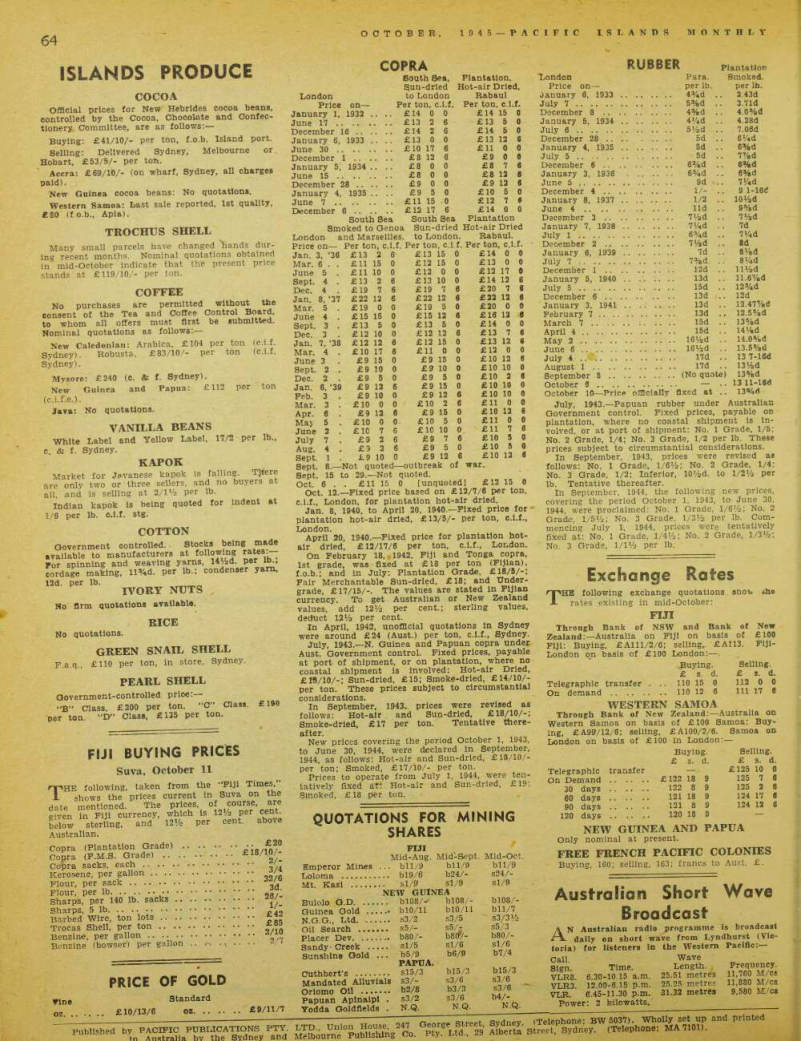
Cocoa
Official prices for New Hebrides cocoa beans, controlled by the Cocoa, Chocolate and Confec tionery Committee, are as follows: — Buying: £4l/10/- per ton, f.o.b. Island port.
Selling: Delivered Sydney, Melbourne or Hobart, £53/5/- per ton.
Accra: £69/10/- (on wharf, Sydney, all charges paid).
New Guinea cocoa beans: No quotations.
Western Samoa: Last sale reported, Ist quality, £BO (f.0.b., Apia).
Trochus Shell
Many small parcels have changed 'hands dur ing recent months. Nominal quotations obtained in mid-October indicate that the present price stands at £ll9/10/- per ton.
Coffee
No purchases are permitted without the consent of the Tea and Coffee Control Board, to whom all offers must first be submitted.
Nominal quotations as follows: New Caledonian: Arabica, £lO4 per ton (c.i.f.
Sydney). Robusta, £B3/10/- per ton (c.i.f.
Sydney).
Mysore: £240 (c. & f. Sydney).
New Guinea and Papua: £ll2 per ton (c.i.f.e.).
Java: No quotations.
Vanilla Beans
White Label and Yellow Label, 17/2 per lb., c. & f. Sydney.
Kapok
Market for Javanese kapok is falling. TJtere are only two or three sellers, and no buyers at all, and is selling at 2/1 % per lb.
Indian kapok is being quoted for Indent at 1/6 per lb. c.i.f. stg.
Cotton
Government controlled. Stocks being made available to manufacturers at following rates. .
For spinning and weaving yarns, 14%d. perlb.. cordage making. ll 3 Ad. per lb.; condenser yam, 12d. per lb.
Ivory Nuts
No firm quotations available.
Rice
No quotations,
Green Snail Shell
F.a.q., £llO per ton, in store, Sydney.
Pearl Shell
Government-controlled price; •■B” Class, £2OO per ton. “C” Class, £l9O per ton. “D“ Class. £135 per ton.
Fiji Buying Prices
Suva, October 11
THE following, taken from the “Fiji Times, shows the prices current in Suva on the date mentioned. The prices of course are given in Fiji currency, which is 12% per cent, below sterling, and ISM. per cent, above Australian.
Copra (Plantation Grade) Copra (F.M.S. Grade) £lB/10/- Copra sacks, each ' Kerosene, per gallon Flour, per sack J Flour, per lb / Sharps, per 140 lb. sacks Sharps, 5 lb £ t 9 Barbed Wire, ton lots Trocas Shell, per ton Benzine, per gallon % Benzine (bowser) per gallon , .. ..
Price Of Gold
Sept. B.—Not quoted—outbreak of war.
Sept. 15 to 29.—Not quoted.
Oct. 6 . . £ll 15 0 [unquoted] £l2 15 0 Oct. 12. —Fixed price based on £l2/7/6 per ton, c.i.f., London, for plantation hot-air dried.
Jan. 8, 1940, to April 20, 1940.—Fixed price for plantation hot-air dried, £l3/5/- per ton, c.i.f., London.
April 20, 1940.—Fixed price for plantation hot air dried, £l2/17/6 per ton, c.i.f., London.
On February 18. 1942, Fiji and Tonga copra, Ist grade, was fixed at £lB per ton (Fijian), f.0.b.; and in July: Plantation Grade, £lB/5/-; Fair Merchantable Sun-dried, £18; and Under grade, £l7/15/-. The values are stated in Fijian currency. To get Australian or New Zealand values, add 12 V 2 per cent.; sterling values, deduct 12 V 2 per cent.
In April, 1942, unofficial quotations in Sydney were around £24 (Aust.) per ton, c.i.f., Sydney.
July, 1943.—N. Guinea and Papuan copra under Aust. Government control. Fixed prices, payable at port of shipment, or on plantation, where no coastal shipment is involved: Hot-air Dried, £l5/10/-; Sun-dried, £l5; Smoke-dried, £l4/10/per ton. These prices subject to circumstantial considerations.
In September, 1943. prices were revised as follows: Hot-air and Sun-dried, £lB/10/-; Smoke-dried, £l7 per ton. Tentative there after.
New prices covering the period October 1, 1943, to June 30, 1944, were declared in September, 1944, as follows; Hot-air and Sun-dried, £lB/10/per ton: Smoked, £l7/10/- per ton.
Prices to operate from July 1, 1944, were ten tatively fixed at! Hot-air and Sun-dried, £l9; Smoked, £lB per ton.
fine Standard oz ... £10/13/6 oz £9/11/7
London Price January 1, on— 1932 ,
Copra
South Sea, Sun-dried to London Per ton, c.l.f, .. .. £14 0 0 Plantation.
Hot-air Dried, Rabaul Per ton, c.l.f. £14 15 0 June 17 . £13 2 6 £13 5 0 December : 16 .. , £14 2 6 £14 5 0 January 6, 1933 . . . £13 0 0 £13 12 6 June 30 . £10 17 6 £11 0 0 December 1 .. . £3 12 6 £9 0 0 January 5, 1934 , . . £8 0 0 £8 7 6 June 15 . £8 0 0 £8 12 6 December : 28 .. £9 0 0 £9 12 6 January 4, 1935 . . £9 5 0 £10 5 0 June 7 .. £11 15 0 £12 7 6 December 6 . . . £ 12 17 6 £14 0 0 South Sea South Sea Smoked to Genoa Sun-dried Plantation Hot-air Dried London and Marseilles, to London.
Rabaul.
Price on— Per ton, c.l.f.
Per ton, c.l.f. Per ton, c.l.f.
Jan. 3. '36 £13 2 6 £13 15 0 £14 0 0 Mar. 6 - . £11 15 0 £12 15 0 £13 0 0 June 5 . £11 10 0 £12 0 0 £12 17 0 Sept. 4 . £13 2 6 £13 10 0 £14 12 6 Dec. 4 £19 7 6 £19 7 6 £20 7 6 Jan, 8. '37 £22 12 6 £22 12 8 £22 12 6 Mar. 5 £19 0 0 £19 5 0 £20 0 0 June 4 . £15 15 0 £15 12 6 £16 12 6 Sept. 3 . £13 5 0 £13 5 0 £14 0 0 Dec. 3 . £12 10 0 £12 12 6 £13 7 6 Jan. 7, ’38 £12 12 6 £12 15 0 £13 12 6 Mar. 4 . £10 17 6 £11 0 0 £12 0 0 June 3 £9 15 0 £9 15 0 £10 12 6 Sept. 2 . £9 10 0 £9 10 0 £10 10 0 Dec. 2 . £9 5 0 £9 5 0 £10 2 6 Jan. 6, ’39 £9 12 6 £9 15 0 £10 10 0 Peb. 3 . £9 10 0 £9 12 6 £10 10 0 Mar. 3 , £10 0 0 £10 2 6 £11 0 0 Apr. 6 £9 12 6 £9 15 0 £10 12 6 May 5 . £10 0 0 £10 5 0 £11 0 0 June 2 £10 7 6 £10 10 0 £11 7 6 July 7 . £9 2 6 £9 7 6 £10 5 0 Aug, 4 . £3 2 6 £9 5 0 £10 5 0 Sept. 1 . £9 10 0 £9 12 6 £10 12 6
Shares
Quotations For Mining
July, 1943. —Papuan rubber under Australian Government control. Fixed prices, payable on plantation, where no coastal shipment is in volved, or at port of shipment: No. 1 Grade, 1/5; No. 2 Grade, 1/4; No. 3 Grade, 1/2 per lb. These prices subject to circumstantial considerations.
In September, 1943, prices were revised as follows: No. 1 Grade, 1/6%; No. 2 Grade. 1/4; No. 3 Grade, 1/2; Inferior, 10%d. to 1/2% per lb. Tentative thereafter.
In September, 1944, the following new prices, covering the period October 1, 1943, to June 30, 1944, were proclaimed: No. 1 Grade, 1/6%; No. 2 Grade, 1/5%; No. 3 Grade. 1/3% per lb. Com mencing July 1, 1944, prices were tentatively fixed at: No. 1 Grade, 1/4%; No. 2 Grade, 1/3V 2 ; No. 3 Grade, 1/1% per lb.
Fiji
Mid-Aug.
Mid-Sept.
Mid-Oct Emperor Mines . .. bll/9 bll/9 bll/9 Loloma .. bl9/6 b24/s24/- Mt. Kasl . sl/9 sl/9 sl/9 Bulolo G.D
New Guinea
.. bl08/- bl08/bl08/- Guinea Gold ... ... blO/11 blO/11 bll/7 N.G.G., Ltd .. s3/2 s3/5 S3/31/2 Oil Search s5/s5/3 Placer Dev b8(f/b80/- Sandy-Creek ... .. sl/5 sl/6 sl/6 Sunshine Gold . .. b5/9 b6/9 b7/4 Cuthbert’s
Papua.
.. S15/3 bl5/3 bl5/3 Mandated Alluvials s3/s3/6 s3/6 Oriomo Oil .. b2/8 b3/3 s3/6 Papuan Aplnaipl . s3/2 s3/6 b4/- Yodda Goldfields . N.Q.
N.Q.
N.Q.
Rubber
Plantation London Para.
Smoked.
Price on— per lb. per lb.
January 6, 1933 . 2.43d July 7 5%d . 3.71d December 8 .. .. 4%d , 4.0 s /ad January 5, 1934 . 4.28d July 6 5Vad , 7.06d December 28 . . . 5d .. 6>/4d January 4, 1935 . 5d 6%d July 5 5d .. 7 7 /«d December 6 . . .. 6 3 Ad 6%d January 3, 1936 63/ 4 d .. 6%d June 5 9d 7‘Ad December 4 .. .. 1/- 9 l-16c!
January 8, 1937 . 1/2 .. lOVad June 4 lid 9 5 /ad December 3 .. . 7Vad .. 7Vad January 7, 1938 . 714d 7d July 1 63/ 4 d 7V 4 d December 2 .. . 8d January 6, 1939 . 7d 8Vad July 7 8V 4 d December 1 .. . 12d .. ny a d January 5, 1940 . 13d .. 11.6 7 /ad July 5 15d .. 12%d December 6 .. . 13d .. 12d January 3. 1941 . 13d .. 12.47 7 /ad February 7 .. .. 13d .. 12.5 5 /ad March 7 15d . . 13%d April 4 15d . . 14y 8 d May 2 16Vid . . 14.0V.d June 6 16Vad .. 13.5»/«d July 4 17d .. 13 7-16d August 1 17d .. 13&d September 5 .. . (No quote) 13%d October 8 .. .. .. 13 11-lBd October 10—Price officially fixed at .. 13V 4 d
Exchange Rates
THE following exchange quotations snow die rates existing in mid-October:
Fiji
Through Bank of NSW and Bank of New Zealand: —Australia on Fiji on basis of £lOO Fiji: Buying, £Alll/2/6; selling,. £AII3. Fijl- London on basis of £lOO London: —
Western Samoa
Through Bank of New Zealand: —Australia on Western Samoa on basis of £lOO Samoa: Buy ing, £ A99/12/6; selling, £ AlOO/2/6. Samoa on London on basis of £lOO in London: —
New Guinea And Papua
Only nominal at present.
Free French Pacific Colonies
Buying, 160; selling, 163; francs to Aust. £.
Buying.
Selling. £ s. d. £ s. d.
Telegraphic transfer . .. 110 15 0 112 0 0 On demand .. 110 12 6 111 17 e
Telegraphic transfer Buying. £ s. d.
Selling. £ s. d. £125 10 0 On Demand £122 18 9 125 7 6 30 days 122 8 9 125 2 6 60 days 121 18 9 124 17 6 90 days 121 8 9 124 12 6 120 days . .. 120 18 9 —
Broadcast
Australian Short Wove Broadcast
AN Australian radio programme is broadcast daily on short wave from Lyndhurst (Vic toria) for listeners in the Western Pacific:
Call.
Wave Sign. Time, Length.
Frequency.
VLR8. 6.30-10.15 a.m. 25.51 metres 11,760 M/cs VLR3. 12.00-6.15 p.m. 25.25 metres 11,880 M/cs VLR. 6.45-11.30 p.m. 31.32 metres 9.580 M/cs Power: 2 kilowatts.
Advertisements & other items, pp. 66-68 (2 items)
64
OCTOBER, 1945 PACIFIC ISLANDS MONTHLY
Published ‘l/S.WS P . T „ Y d Siu?n n e“«blffi g 2 Co. ‘SMTSSf SJS*
MANUFACTURERS OF: Dri-Glo Towels
m *■ m □a
HARRY J .VOTING PTY. LTD.
j Sole Pacific Islands Selling Representatives
For:
COMMONWEALTH WEAVING
MILLS PTY. LTD.
A ft/ 'S
MANUFACTURERS OF: Dri-Glo Towels
Fadeless
• THROUGH THE WAR YEARS DRI-GLO'S HAVE RETAINED
THEIR QUALITY.
• THE FULL VARIETY OF FADELESS COLOURS IS STILL
AVAILABLE.
• GYPSY STRIPES, PLAIN PASTELS, GAY PATTERNS, PLAIN
WHITES.
EVERYTHING THE BATHROOM COULD ASK FOR
Colours
★ • DRI-GLO'S ARE STILL WOVEN ON A BASE OF DOUBLE- WARP OR TWOFOLD YARN, WHICH GIVES YOU DOUBLE
WEAR ON EACH TOWEL.
• FROM A DRI-GLO YOU GET THE FULL WEAR OF TWO
ORDINARY TOWELS.
DRI-GLO'S COLOURS ARE GUARANTEED FADELESS
Postal Address: Box 3661, G.P.0., Sydney
Longer Wear.
HARRY J .YOUNG PTY. LTD.
379 KENT ST.,
Sydney.
Bankers: Bank of N.S.W.
Codes; V- Bentley’s Comp. Phrase Bentley’s 2nd Phrase.
Established 1914
THIRTY YEARS OF PACIFIC ISLANDS
DEVELOPMENT AND SERVICE.
W. R. CARPENTER & GO. LTD.
Capital £1,000,000.
GENERAL MERCHANTS AND SHIPOWNERS
Buyer* and Exporters of All Kinds of Islands Produce Copra Merchants and Millers Agents for Australian, European and American Manufacturers Distributors of Every Description of Merchandise
AGENTS FOR:
FORD MOTOR COMPANY OF CANADA DODGE BROTHERS INC.
ELECTROLUX REFRIGERATORS WESTINGHOUSE ELECTRICAL CO.
T. G. & C. BOLINDERS (ENGINES) CATERPILLAR TRACTORS Etc., Etc.
BRANCHES THROUGHOUT THE PACIFIC ISLANDS
Head Office : 16 O'CONNELL STREET, SYDNEY n London: W. R. Carpenter & Co. (London) Ltd., Coronation House, 4 Lloyd's Avenue, London, EC.
The W.R.C. Line
The first Direct and Regular Cargo and Passenger Service between Europe and Pacific Islands’ ports was established by W. R. Carpenter & Co. Ltd. m ' i
MsSSSSSSSSr