Pacific
Islands
Monthly
jCDtcmDCr IO
Vol.. Xvi. No. 2
Established 1930
{.Registered at the G.P.0., Sydney,'for transmission by post as a newspaper ]
1/-
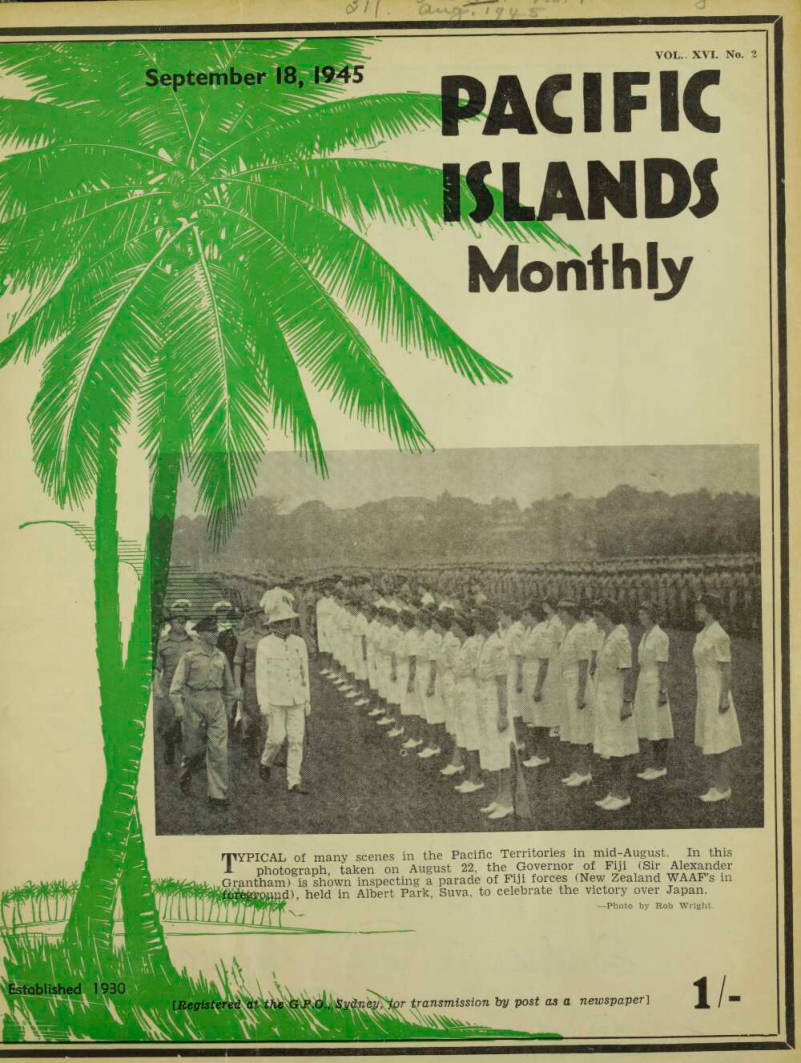
TYPICAL of many scenes in the Pacific Territories in mid-August. In this photograph, taken on August 22. the Governor of Fiji (Sir Alexander Grantham) is shown inspecting a parade of Fiji forces (New Zealand WAAF's in foreground held in Albert Park, Suva, to celebrate the victory over Japan.
Photo by Rob Wright.
Advertisements & other items, p. 2 (1 item)
Guinea
3kA
BY A R
WfllTP?
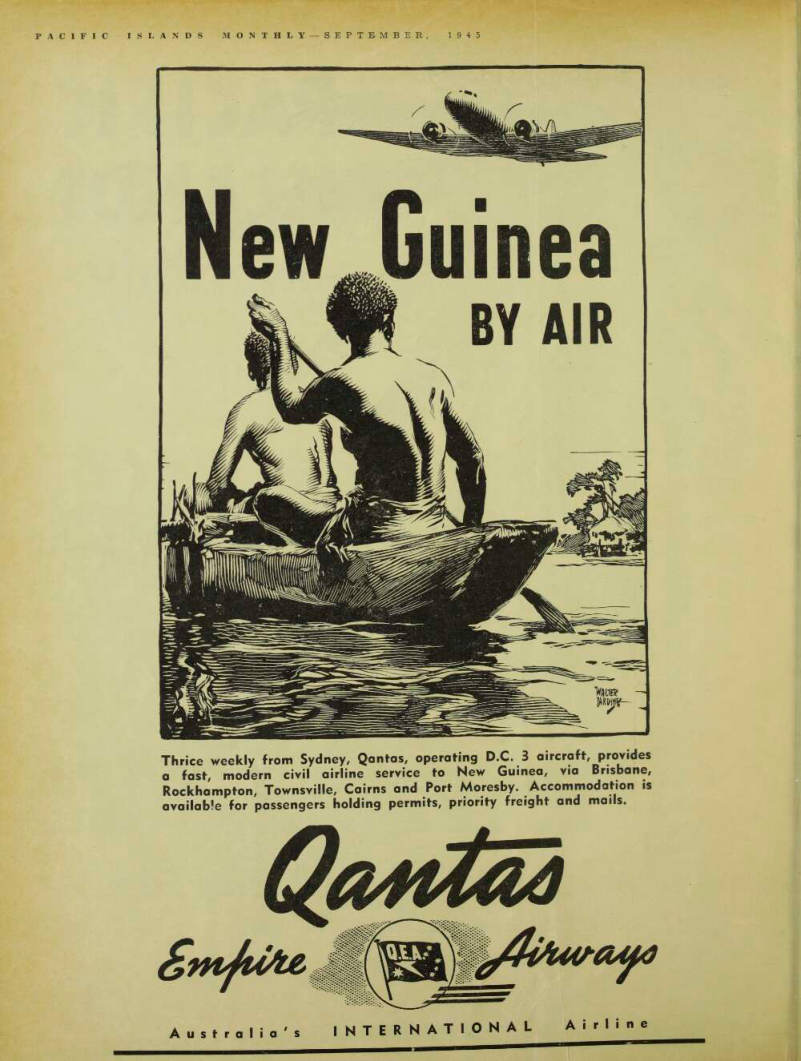
Thrice weekly from Sydney, Qantos, operating D.C. 3 aircraft, provides a fast, modern civil airline service to New Guinea, via Brisbane, Rockhampton, Townsville, Cairns and Port Moresby. Accommodation is available for passengers holding permits, priority freight and mails. * Australia's INTERNATIONAL Airline
Pacific News-Review
Notes And Comment On
lurcDki atiam ai acraidc
International Affairs
AllfZ I*% Trt ccpT 14 rKUM AUb. 13 iv ocr i. i*t
Aug. 15: Japan has capitulated and General MacArthur has been appointed Supreme Commander of the Allied Powers in Japan. After the surrender, the Japanese Government resigned and the Minister for the Army committed hara-kiri.
Aug. 17: Emperor Hirihoto has ordered all his armed forces to cease hostilities immediately and has asked Prince Naruhiko Higashi-Kuni to form a new Government. Japanese leaders appear unrepentant in defeat. No attempt has been made to bring home the simple fact of defeat to the Japanese people. A vigorous face-saving campaign seems to be going on.
Aug. 17: Japanese Emperor announced that members of the Royal Family will go to the various fronts to see that the cease-fire order is carried out. Japanese surrender emissaries are expected in Manila on August 19.
Aug. 19: Japanese envoys arrived in Manila by air and began preliminary talks in the City Hall. Surrender moves are expected from Bougainville and New Guinea but the Jap armies in Burma and Singapore show signs of attempting to fight on.
Aug. 20: General MacArthur an nounced that he expects to land in Japan with adequate forces within ten days and the surrender will be signed in Tokio immediately after. It is expected that Australian troops will be part of the oc cupying forces. The Japanese delega tion which arrived in Manila yesterday has left again for Japan after complet ing preliminary surrender talks.
Aug. 22: Surrender instructions have been taken to Japanese headquarters in Bougainville by an Australian officer.
Leaflets have been dropped on Rabaul and reconnaissance aircraft report that troop-carryine barges appear to be con verging on the town for surrender.
Aug. 22: According to Tokio radio, there were 480,000 victims of the atomic bomb—either killed, injured or homeless.
Sixty thousand were killed in Hiroshima; many still are dying from the effect of burns.
Aug. 23: A clash of views on Hong Kong is likely to develop between Britain on one hand, and United States and China on the other. China’s claims for Hong Kong are regarded with favour in Washington. China expects to send oc cupation troops to Hong Kong. London says that as Hong Kong is a British colony the surrender there should be to the British, and troops are on their way there for that purpose. Britain does not object to the Chinese being associated with the surrender.
Aug. 24: The cessation of Lend-Lease aid to Britain by the United States with out warning or notice, has gravely em barrassed Britain. Washington says that as Lend-Lease was purely a measure for helping the Allies wage war, it could not be used for rehabilitation purposes, and President Truman had no choice but to immediately terminate all transactions.
London expected Lend-Lease to be tapered off over a short period, not ended suddenly. Talks between Britain and America probably will evolve some plan to lessen the privations which the British peonle will be called upon to undergo, owing to sudden cessation of food supplies.
Aug. 25; A typhoon has delayed pre parations for the arrival of the Allied occupation forces in Tokio.
Aug. 26: A conference has opened in Rangoon between British and Japanese for the surrender of Japanese Armies in
Burma, Malaya, the East Indies and Indo-China. The Supreme Allied Com mander in SE Asia, Lord Mountbatten, will receive the surrender of Terauchi’s forces in Singapore early in September.
Aug. 30: Formal occupation of Japan began to-day. A huge fleet of air trans ports is flying General MacArthur and his occupying troops from Okinawa to Tokio. General Douglas MacArthur arrived at Atsugi airfield (18 miles from Tokio) at 2 p.m.
Sept. 1; Appalling cruelties inflicted on prisoners of war and internees by the Japanese are being revealed as prison camps in Japan. Manchuria, Borneo, Malaya, Thailand and Sumatra, are being liberated.
Sept. 2: Japan’s formal surrender to the Allies was signed in Tokio Bay to day at 10.5 (Sydney time). The 37 minutes’ ceremony ended World War 11, which had lasted exactly six years.
Sept. 4; Russia is quickly accepting sur render of all Japanese forces in Man churia and Korea. The Japs are being sternly treated and put straight into prison camps.
Sept. 4: Scenes of great rejoicing attended the entry of the British into Hong Kong and the release of pri soners.
Sept. 5; There was an appalling death roll among AIF prisoners on the Burma railway—of 3,598 employed, well over 1,000 died.
Sept. 6; It is officially confirmed that 3,007 members of the AIF died while prisoners of war in Singapore. Total AIF deaths reported in South-East Asia are over 5,000. AIF men taken at Singa pore were 16,320, and 3,489 were taken in the Netherlands East Indies.
Sept. 6: The formal surrender of 139,000 Japanese in Rabaul, New Ireland, Bougainville, New Guinea mainland and other islands was accepted by Lieut.- General V. A. H. Sturdee aboard the air craft carrier “Glory” in St. George’s Channel, 28 miles south-east of Rabaul to-day.
Sept. 7: Japanese in Shanghai to-day formally surrendered to the Chinese.
Sept. 10: Every day, the disclosures of tortures, starvation, murder and general brutality suffered bv prisoners at Jap hands become worse. The civilised world is horror-stricken. United States is accused of treating Japanese far too leniently.
Sept. 11; As Allies took steps to seek out and arrest leading Jap war crimi nals, General Tojo tried to commit sui cide with a revolver. He is seriously wounded, but vfcl. recover.
Sept. 12: Japanese armies in Malaya, Singapore and Netherlands Indies form ally surrendered to British and Dutch in Singapore to-day.
Sept. 14; Streams of liberated prisoners of war are now arriving in Manila, Borneo, Singapore and Rangoon. Thou sands are receiving urgent hospital treat ment.
July 14 in Tahiti
Papeete, July 16.
rE 14th of July was celebrated here after the traditional manner, with no extraordinary features. Wonder ful to relate, the weather was without flaw. Last year—at this season —the whole island was a quagmire.
Roll Of Honour
Special Notice
ON page 65 onwards in this issue, we again publish No. 1 Section of the Roll of Honour—Pacific Territories men who are dead or missing in World War 11. As data ' arrive from the Japanese horror camps, these tragic lists will be increased. Next month, October, we shall publish Section 2—mostly men who have been wounded, or who were decorated.
After that, about December, we shall publish the complete lists (both Sections) for the last time.
We should like to make these lists as complete as possible. Wowuld relations and friends of Territories Servicemen and Servicewomen therefore please assist us to remedy any omissions by sending us any names which should be included in the lists, but which have been inadver tently overlooked? Such information should reach us not later than Decem ber 7.
A Story Of London
AN American writer, describing how “London Won the Battle,” tells this story of how Mrs. Smith was dug out of the ruins of her house in Stepney High Street It was a nasty job. The V 2 had tumbled down the whole row of houses, just at breakfast time. After six hours of digging, they got Mrs. Smith out. She was conscious and not seriously injured.
A woman helper began to take down her record. A husband? Yes, she had a husband. Where was her husband?
“He’s at the front, the dirty coward.”
Mrs. Smith replied.
Advertisements & other items, p. 3 (1 item)
Pacific Islands
NOW AVAILABLE
Year Book
FIFTH EDITION
rIS has become the recognised standard work of reference on the Pacific Territories and Islands; and it is now printed in Sydney, N.S.W., and in New York.
The sth Edition. ’384 pages, has been arranged in Six Sections —General and Introductory; Eastern Pacific (Polynesia); Central Pacific (Micronesia); Western Pacific (Melanesia); Far Western Pacific (Indonesia); and Non-Tropic&l Islands.
Every Territory and all the Principal Islands are described in detail —history, geography, natives, administration, industries, trade, etc. There are more than 50 maps.
Price: 15/- per copy, plus 6d. postage.
Copies may be obtained at the majority of Booksellers, and Island Stores, or direct from:
Pacific Publications Pty., Ltd.,
Union House, 247 George St.,
Sydney.
Pacific Publications (Fiji), Ltd.,
P.O. Box 281, Suva, Fiji.
The book, named “Pacific Islands Handbook,” is published by The MacMillan Company, New York, for distribution in North and South America, and Hawaii.
Advertisers
Adams, C. A. . . .63 Adams, Clayton & Co 16 Aladdin Industries Pty., Ltd 37 Angus & Coote . . 22 Atkins Pty., Ltd., Wm 47 Australian Alumi nium Company, Pty., Ltd 21 Brial & Ball . 17, 47. 69 Berger & Sons, Ltd 43 Broomfield, Ltd. . . 58 Brown & Co., Ltd. 11 Brunton’s Flour . . 32 Burns, Philp Trust Co.. Ltd 13 BP (SS) Co. . . . 11 Bhindi, P. K. . . 60 Bunting, J. Alymer 71 Cambridge Lawn Mower Co. ... 31 Carlton & United Breweries, Ltd. . 59 Carpenter, Ltd., W.
R cov. iv.
Chivers & Sons, Ltd 44 Church, R. H., & Sons 69 Coleman Lamp & Stove Co 53 Colonial Wholesale Meat 41 “Cystex” 56 Darvas & Co. ... 55 David Trading Co. 71 Donaghy & Sons . 62 Donald, Ltd., A. B. 68 Dr. Williams Pink Pills 63 Electrolux
Refrigerators . . 20
Excelsior Supply Co 29 “Fanmaster” ... 23 Farnham, John R. 68 Federal Broom Co. 15 Flit 54 Ford Sherington
Pty., Ltd 41 Garrett & Davidson 70 Gibson & Co., Ltd.,
J. A. D 65
Gillespie Pty., Ltd., Robert 35 Gilbey’s Gin ... 12 Gillespie’s Flour . . 70 Gough & Co., E. J. 25 Grand Pacific Hotel 2 Grove & Sons, W.
H 66 Heinz & Co. Pty., Ltd., H. J. . . .61 Horlicks Malted Milk 67 Jenkins, Reg. ... 58 Kalyan & Co., G. 66 Kopsen & Co., Ltd. 57 Miscellaneous . 15, 16 Manning & Manning ... 46 Masschelien. O. F. . 64 “Mendaco” ... 42 Mcllraths Pty., Ltd. 56 Nelson & Robertson Pty., Ltd 39 “Nixoderm” ... 17 Noyes Bros. ... 62 Pacific Planters’
Handbook ... 38 Pacific Publications Pty., Ltd 1 Pacific Is. Society . 49 “Pinkettes” ... 60 Qantas Empire Air ways . . cov. ii.
Queensland Insur ance Co 36 Radco 40 Ransome, Sims & Jefferies, Ltd. . . ’42 Raymond, Lance, Pty.. Ltd 27 Riverstone Meat Co., Ltd 49 Robinson, G. H. . . 24 Rose’s Eye Lotion . 27 Rohu, Sil . • • • 44
Rur • I?
Scott, Ltd., J. ... 30 Southern Pacific
Insurance Co. . . 12 Steamships Trading Co., Ltd 36 Stromberg-Carlson . 19 Sullivan & Co., C. . 45 Swallow & Ariell . 48 Taylor & Co., A. . 61 “Tenax” Soap . . 26 Tillock & Co., Ltd. 25 Thornycroft (Aust.) Pty., Ltd. ... 18 Trinity Grammar School 24
Union Assurance Co 46 Watson, Wm., H. . 28 Wesley College . . 40 Widdop, H., & Co., Ltd 34 Widdowson, T. C. . 26 Wright & Co., Ltd., E 22 Young Pty., Ltd., Harry J. . . . 14, 33 Yorkshire Insurance Co., Ltd 11
Contents
Pacific News Review 1 Most Fateful Products of World War II; Greater USA and the Atomic Bomb 3 Return to Solomons —Official State ment 5 Future of Islands’ Trade 5 Colonel J. K. Murray is New Ad ministrator of NG .. • • 5 Liquidating the Solomons Japs: Bitter Clashes in 1942-43 6 End of the Pacific War: What is Happening Now 7 Nauru Occupied by Australians ... 7 Rabaul Now a Wreck 7 Old Noumea Racecourse Becomes
Airport J
Death of Mrs. Ada Christian 8 Happy Days Again in French Oceania 9 War-torn Papua: First Impressions 9 Vernier Line is Broken • •• •• 9 General Freyberg Becomes GG of New Zealand 19 New Guinea Administration to Cost £200,000! J 9 A Reply to Bryson, MP 15 Famous Danes of the Pacific .. .. 16 Papua Rubber Production .. ... 18 10 000 Indentured Indonesians Now Free in N. Caledonia New Raiatea Hospital Fiji Celebrates VP-Day 28
Muddling Through in Papua 29 Theodore’s Goldmine in Fiji: Opera tions at an Interesting Stage ... 30 Bad Weather Mars Vice-Regal Visit to Cooks 32 Curio Prosperity: Remarkable Cook Is. Figures 35 How Australian Naval Intelligence Watched Japs in the Solomons .. 43 What Do You Know of Bougainville? 47 Huge Money for Timber in New Guinea 48 List of New Guinea Civilians Who Are Still Missing 49 Seeking New Wealth in Fiji; By R. W. Robson 53 Alfred Sadd, a Lovable LMS Mis sionary ;• 57 How USA Government is Working m Marianas 61 Peace Comes to Rarotonga 62 Nauru and Ocean Is 63 Land Problem in Fiji 63 Roll of Honour—lslanders Who Gave Their Lives 65 Death of Mr. E. G. Sheldon 71 Brigadier Cleland • • 74
Solomons Planter Found
MR. J. H. MacDONALD, 43, planter, of Fatiro Island, in the Shortlands, British Solomons, was recovered by a party of Australians after having dodged Japs in and around Bougain ville Strait for three years He was captured by Japs, and put to forced labour; but as he is a man of dark com plexion. and pretended he knew no English he bluffed them into thinking he was a native, and was able to escape.
He saved his life by virtually living native most of the years the Japanese held that region. His wife and family are in Australia.
Advertisements & other items, p. 4 (1 item)
\ii
Pacific Islands Monthly
The Newspaper-Magazine of the South Seas [Registered at the G.P.0., Sydney, for transmission by post as a newspaper .]
Published Once Each Month and Circulated in Australia and New Zealand and in the following Pacific Territories and Islands Groups:
Australian Territory of Papua.
Mandated Territory (Australia) of New Guinea.
Australian Territory of Norfolk Island.
New Zealand Territory of Cook Islands.
Mandated Territory (NZ) of Western Samoa.
British Colony of FIJI.
British Solomon Islands Protectorate.
British Protectorate of Tongan Islands.
British Crown Colony of Gilbert and Ellice Islands.
Mandated Territory of Nauru
British and Free French Condominium of New Hebrides.
Free French Colony of New Caledonia.
Free French Colony of Oceania (Tahiti, etc.) American Territory of Eastern Samoa.
American Territory of Hawaiian Islands.
Owned and Produced by Pacific Publications Pty. Ltd., Union House, 247 George Street, Sydney.
rwr c-PHnwrr I Managing Director '.. BW 5037 iJsutrauiMis Business and Editorial MA 4369
P.O. Box 3408 R
Registered Address of Telegrams, Radiograms, and Cables: “Pacpub”, Sydney.
Contributions.
Articles, Stories, and Photographs dealing with Pacific Islands subjects are Invited and will be paid for on publication
Subscription Rates.
Per Annum, within British Empire, Prepaid, Post Free 10/- Per Annum, elsewhere, Prepaid, Post Free 12/6 Single Copies 1/-
Editor and Publisher:
R. W Robson, P.R.G.S.
Advertising Manager: W. E. Rogers. Tel. B 7815.
Advertising Office and Printing-House: 29 Alberta Street, Sydney.
Advertising rates furnished on application.
Representative In Fiji.
Pacific Publications (FIJI), Ltd., Bank of NSW Building, Suva (same office as W. H. Grove & Sons, Ltd.). Stocks of Pacific Islands Monthly and Pacific Islands Yearbook on hand.
Representative In London.
J. T. Wallis, Coronation House. 4 Lloyds Avenue, London, EC.3, from whom may be obtained copies of Pacific Islands Monthly, Pacific Is. Year Book, advertising schedules, etc.
Agents.
The following are authorised to receive sub scriptions for Pacific Islands Monthly:— Burns, Philp & Co., Ltd., and Burns Phllp (South Sea) Co.. Ltd. All branches.
W. R. Carpenter & Co., Ltd. All branches.
Morris, Hedstrom, Ltd. All branches.
Steamships Trading Co., Papua. All branches.
Whitten Bros., Ltd., Samaral, Papua.
B.N.G. Trading Co., Ltd., Port Moresby, Papua J. Muir, Suva. Fiji.
Miss R. Castles, Suva, Fiji.
N. C. Mackenzie Hunt, Wainunu, Bua, FIJI.
Cook Islands Trading Co., Rarotonga, Cook Is A. C. Rowland, Papeete. Tahiti.
Islands Branches and Representatives of W. H Grove & Sons, Ltd., Auckland, New Zealand.
Ed. Pentecost, Noumea, New Caledonia.
Soclete Gubbay Kerr et Ole, Noumea, N. Caledonia.
Vol. XVI. No. 2.
September 18, 1945
Prirp f l/- Per Copy rnce £ Prepaid: 10/-. p. a.
World War II: Greater USA
Most Fateful Products of World War II: Greater USA and Atomic Bomb.
THE outstanding developments of
this year 1945 are the atomic bomb and the emergence from World War II of a United States so power ful that it can dominate, direct and mould human affairs in whatever way it chooses.
The collapse of France in 1940, the destruction of Italy in 1944, the over whelming defeat of Germany and Japan in 1945, leave three Great Powers in the world—United States, Britain and Russia—the Big Three.
Of those three, incomparably the most powerful is the United States.
USA has these advantages: • Probably the largest and certainly the best-equipped Army in the world. • A Navy and an Air Force of tremen dous size The only country which could challenge American sea and air strength would be Great Britain, and it is possible that in both divisions the British have been out-built. • An industrial potential that is far and away greater than anything pos sessed by any other nation. • Possession of the atomic bomb, which could devastate the world. This secret is held jointly with Great Britain.
But the United States has the facili ties for producing and using the bomb—Britain has not, yet. • A capacity for making war. on a big scale, equal to anything disclosed by nations traditionally warlike, such as Germany and Japan. • Possession of nearly all the gold in the world and, consequently, control
A Review
by
R. W. Robson
over the world’s credit. • Possession of or control over a very large proportion of the world’s mer chant shipping and civil aircraft.
The development of American strength has been plain to us in re cent years; but American ideals, standards of life and ways of thought are so close to our own that we did not worry about it—we felt that, if we wanted peace and security in the future, the United States never could become too strong.
Now, we have reason to worry. We find American strength so great and American public opinion so sensitive to our demogogues’ blundering re actions to American dominance, that we are on the edge of a British- American trade war that could lead to endless turmoil and trouble.
Together, the United States and Great Britain could direct world af fairs into channels which would guarantee the outlawry of war and the peaceful and happy development of all peoples. If we are apart, all the nations of the world may con gregate in hostile camps, and World War 111 could destroy mankind.
The events of 1942-45 gave us most comforting assurances that these two great English-speaking Powers would amicably travel together along the tortuous road of the future. Yet, within two weeks of the ending of World War II (on August 15) the
publicists of the two nations were snarling at each other.
A COMPARISON of conditions be tween mid-1944 and mid-1945 should show us wherein lie the causes of this far-reaching, disastrous change. Here are the differences: THEN : Our two nations were led by wide-visioned men, who were capable of assuming and wisely exercising the powers of virtual dictatorship. It was providential that the two nations had such men available in the time of their great need.
NOW : Both men are gone—one by death and one through the supposedly intelligent vote of an enlightened democracy. In their places, we have two parish-pump politicians—worthy souls, animated by the best motives, but quite incapable of the kind of leadership their respective nations have known for some years.
THEN : The paramount need of winning World War 11, and preserv ing their freedom, kept Sectionalism (one-eyed, selfish and ruthless in terests, like Party Politics, Big Business, Communism) silent and busy.
NOW : All our enemies have sur rendered—the military danger is past. Selfish sectional interests, which should be held mercilessly in their places during the vital and critical period of reconstruction and rehabilitation, are loose and in full cry. Examples: The Socialists of Britain, who have won the Govern ment and have immersed themselves in domestic affairs, to the exclusion of the far more important inter national affairs. Or the Big Busi ness men of America, who are out to
grab world trade, no matter what they may sacrifice in good international relations. Or the “Red Raggers” of Australia who, defying an utterly weak and spineless Government* are taking advantage of Australia’s des-r perate shortage of manpower to bush range most of the big industries of the country.
THEN : The necessities of war com pelled us to pool all our resources— food and manufactured goods and transport, as well as fighting strength.
NOW : Immediately the war is over, property rights and interests are re asserted. All pooling machinery is withdrawn or abandoned.
If we want proof of endless and incredible stupidity in the handling of the new international situation created by the events between July 15 and August 15, we need go no further than Lend-Lease.
EVEN to-day, after Lend-Lease has held the stage for over five years—and the front pages for the last fortnight—few people under stand its purpose and operation.
The Office of Lend-Lease Adminis tration was established late in 1941 to promote the defence of the United States. It empowered the President in the interests of national defence “to manufacture or procure, to the extent that funds and contract authorisations are made available by Congress, any defence article for the Government of any country whose defence the President deems vital to the United States. To lend, lease, transfer or sell, or otherwise dispose of such defence articles. ...” In 1943, this organisation was merged in the office of the Foreign Economic Administration.
It was a simple and most effective formula, under which the United States, from its own enormous re sources of gold and manufacturing capacity, could supply goods, equip ment, food and service to any ally of the United States, whose war efforts might be deemed to be assisting in the defence of the United States.
It was clearly laid down, both by President Roosevelt and his Congress, that Lend-Lease was being operated only for war-winning purposes; not for reconstruction and rehabilitation.
In view of all that America has done, no one could object to that. It clearly is right and proper that, the moment the war is over, and we may contemplate with confidence the pre servation of the Four Freedoms, Lend- Lease should cease.
But all intelligent folk will con demn the way in which cessation was brought about. There was no warn ing, no preparation of the mind of the uninstructed public—simply a flat-footed, unamplified announce ment from the White House that Lend-Lease should forthwith cease.
It caught the Governments of all other countries —and especially the new Socialist Government of Britain —unprepared and off-balance, and there were some angry reactions.
Such a thing never would have happened had Roosevelt and Chur chill been in charge. Lend-Lease certainly would have been brought to
an end, but the nations would have been prepared for it; and all the people of the world, instead of being shocked into a bitter rejoinder, would have understood the situation and would fittingly have paid tribute to the generosity as well as. the magni ficent industrial achievements of the United States. The Americans, on their part, would have recognised that the British people, having literally stripped themselves of every thing in order to contribute their utmost to the war effort, would deserve some special consideration after withdrawal of Lend-Lease.
The leading economists of both countries now are seeking a mutually acceptable formula. It is apparent that the one-eyed Socialists of Britain, as well as the greedy Big Business men of USA, can see the danger.
ONLY good sense can prevent a far-reaching trade war between the British Empire and the United States. If it occurs, all hopes of a better-ordered world may go down in that calamity.
The United States, as already shown, enters this post-war period with tremendous initial advantages.
It is vital to her national economic set-up that she develops a great volume of export trade, and she is going to reach out after it ruthlessly.
We of the Pacific, more than any other non-American countries, are going to feel that development.
But Britain, while comparatively poor, is herself not without advan tages. There are a very large number of countries within the Sterling Bloc; and those countries are all generally in the same condition of post-war poverty, and very eager to trade with each other. In a general survey, one would say that each country in the Sterling Bloc has something that the other is eager to obtain, and thus avenues for active and sound trade, the basis of ■ abundant employment, can be seen everywhere.
Britain’s position, at the centre of the Sterling Bloc, is good. She wants raw materials and food, for her enormous manufacturing industries; and the other countries generally can supply her with those things, in re turn for her manufactured goods.
AMERICA’S situation, by comparison, is bad—and most extraordinary.
America cannot maintain her high standards of living unless she sells to other countries vast quantities of her manufactures and products—motor cars, films, oil, machinery, canned goods, and so forth. But America already has nearly everything she needs in the way of raw materials, manufactured goods and foodstuffs.
That was her situation after World War I. and probably it will be even more her problem after this war.
In the twenty years between wars, the United States maintained her national economy, built in the pre vious fifty years upon a vast export trade, by a remarkable expedient. As she could not absorb the goods of other nations (having plenty of her own), she accepted the world’s gold.
She bought all the gold that was
offered to her. It was piled up in “a hole in the ground.”
In the final analysis, there is only one basis for sound and permanent international trade —namely, the ex change of commodities (commodities, of course, including various kinds of services). A nation with a surplus of exports over imports can, for a time, accept in place of commodities a token of fixed international value, such as gold—the length of time be ing governed by that country’s skill in handling her accumulated credit.
But a people cannot eat gold, or turn it into machinery or textiles —a time must come when that country must either reduce its exports (involving a disturbing readjustment of its inter nal economy) or discover new needs for its people, creating more jobs.
IN 1939, the recorded gold in tlie world was worth 25,702 millions of dollars; and, of that, 17,644 millions of dollars’ worth was held by the United States. By the end of 1943, US stock of gold had increased to 22,387 millions of dollars.
In 1939, there were between 6,000,000 and 8,000,000 unemployed in the United States; the problems associated with unemployment were increasing, and apparently defying solution.
That is bound to happen in any country which is wholly self-sufficient, and which yet insists on basing its national economic structure upon the maintenance of export trade.
World War II saved the United States from major economic and social disaster. No amount of “New Deals” could have got the nation away from the operation of funda mental laws of economics.
EXACTLY the same kind of thing will happen after 1945, unless something is done to balance Ameri can overseas trade. If thsre is to be a trade war between Sterling Bloc and Dollar Bloc, and the United States cannot buy the goods of other coun tries, the United States will almost certainly suffer disaster.
Individual Americans are not fools they can see this situation and this danger as clearly as anyone. But they are cursed, as all democratic countries are cursed, with parish • pump politicians in the leadership of their country—little men who permit themselves to be pushed around by utterly selfish interests.
MAYBE this terrible atomic bomb is a blessing in disguise. We know, for a certainty, that it will be employed in the next war, and that it is quite capable of destroying not only “civilisation,” but also mankind.
Greed and selfishness are the com monest human traits, and they lead invariably to wars and suffering. They cannot be eliminated—but they can be over-ridden and controlled. The instinct of self-preservation dominates human life. That instinct surely will compel the nations to seek better leadership, and to dwell together in justice and harmony, so that tne frightful power discovered m the splitting of the atom may be con trolled and guarded.
Solomons
Return To The
Restrictions Relaxed —But No
Transport
WE have received several anxious inquiries about conditions in the British Solomon Islands. Former residents, especially, wish to know when they will be allowed to return to their homes. Traders, also, are anxiously seek ing information. In response to our request for some guidance, the High Com missioner for the Western Pacific, Sir Alexander Grantham, very courteously sent us the following statement: SUVA, Sept. 11.
In reply to your Inquiry about the return of civilians to the Solomons, the position now is that the South Pacific Command has relaxed military restric tions on the entry and residence of such civilians, subject to its being clearly understood that the United States forces are unable to furnish any transport, housing or supplies to or in the Protec torate.
A serious obstacle to any general return of civilians is the present scarcity of ship ping for transport and supply purposes; and, until the position in this respect becomes more normal, it will be necessary to maintain restrictions on entry and residence imposed by Entry and Resi dence (Permits) Regulation, 1944 —Special Regulation 1 of 1944. (In other words, persons wishing to go to the Solomons must first apply for a permit.) It should be noted that all applications for permits to enter into or reside in the British Solomons, and correspondence in connection therewith, should from now henceforth be addressed fo the Resident Commissioner, British Solomon Islands.
Solomon Is. Sydney Office
is Closed
CONSEQUENT upon the return of the Treasury staff and records to the Protectorate, the offices of the Bri tish Solomon Islands Government, at 17 Castlereagh Street, Sydney, were closed as from September 1, 1945. They were opened after the invasion, in 1942.
After that date, the Protectorate Gov ernment Agents, Burns Philp & Co., Ltd., Island Agencies Department, 7 Bridge Street, Sydney, transacts all BSI business in connection with shipping, stores, receipts and payments of accounts, pen sions, allotments, etc.
"Shrangri-La "
Letter to the Editor 1 NOTICE an article under the above heading in your July issue.
I was somewhat surprised to note that your journal subscribed to the “myste rious” nature of this valley and its un suspected existence. The National Geo graphic Magazine in March, 1941, con tains an article by Mr. Richard Archbold on “Unknown New Guinea.” This gentle man apparently explored the district in 1938*, and produces photographs very similar to those in your recent issue. The valley is described by him as the “Grand Valley.” There would seem little doubt ’as to the identity of the two districts.
I am, etc.,
H. G. Carter.
Sydney, 24/7/45.
Future Of Islands
Trade
Return to Normal May Take Years
ONE of the most experienced South
Sea Islands merchants in Sydney recently made the following sum
mary of the trading and transport
position, as he sees it.
IT may be months before things settle down in the Solomons and conditions there be sufficiently encouraging for civilians to return and make a start on the steep-grade job of even partial re habilitation.
The Solomons people certainly have had a very bad spin. They had to get out and abandon everything.
There is no war insurance; and, unless there is some Government assistance, substantial new capital will be needed.
The Solomons people have not enjoyed any benefit of trading resulting from wartime expenditure, and from the good prices ruling for copra and other Islands products.
One has yet to learn what the Govern ment policy is to be; the future costs, particularly of production; market pros pects, and just how far it is worth-while to risk new capital to make any start in a modest way, build up from scratch and re-condition plantations.
It is quite evident, I think, that it is likely to be many years before Islands conditions will get back to anything like normal. Islands trading is much the same as all other successful industries. It needs the best of commercial experience and organisation to run it successfully.
There was lots of money lost in the Islands trade in the earlier years, and many big firms went under in Fiji, Tonga and Samoa.
The successful management, combined with the keen and active interest of the principals of the few big firms operating in later years, was the best asset the Islands ever had. However, it is hopeless now to try and convince* people that that interest went deeper than their own pockets—although most of the money that attended their success was re invested in the Islands for further deve lopment, and for assistance to planters, traders and other settlers.
In Trouble
Tahiti's Chinese Traders
Papeete, July 16.
OUR economic lords and masters, the Chinese, after dancing merrily along a seemingly endless primrose path, have abruptly fallen into a sort of ele phant trap.
Contemptuous of all law, many of the Chinese have been operating a black market which combined the twin advan tages of illegal prices and short weights.
At the present writing, 17 Chinese patents-for-carrying-on-commerce have been cancelled by our authorities, and 30 more Chinese traders have been sum moned to Court on charges of black market practices.
The High Commissioner for the Western Pacific (Sir Alexander Grantham) and Lady Grantham, left Suva in Sep tember on an official visit to the Gilbert and Ellice Islands Colony. They expected to be away from Suva for a week.
J. K. Murray
Administrator of Papua- N. Guinea
Colonel Jack Keith Murray,
BA, Bachelor of Agricultural Science, Professor of Agriculture at the University of Queensland since 1927, and at present acting as Chief Instructor at the School of Civil Affairs, at Dun troon, has been appointed Provisional Administrator of the combined Territories of New Guinea and Papua.
It is presumed that he will be asked to take charge immediately of the task of restoring civil government fo Papua and that part of New Guinea lying south wards of the Markham River. As soon as the surrendered Japanese have been rounded up, and the country is safe, the Provisional Civil Government will be extended over the whole of the Mandated Territory.
Colonel Murray was born in Victoria 56 years ago; he was educated at the University of Sydney; he was a lecturer at Hawkesbury Agricultural College, NSW; he became principal of the Queens land Agricultural College in 1923; and he has filled innumerable positions on com mittees and public bodies connected with agriculture and agricultural science dur ing the past 20 years. He has taken a keen interest in defence, and he was the Lieut.-Colonel in charge of the 25th (Darling Downs) Battalion of the AMF in 1940.
There were 51 applicants for the posi tion. The names of Mr. Leonard Murray (lately Civil Administrator of Papua), Judge F. B. Phillips (late Mandated Territory), and General Sir Thomas Blarney had been tipped as appointees, in that order of favouritism; and the desire that Mr. Leonard Murray should be successful was practically universal among the evacuees of both Territories.
Colonel Murray’s appointment, there fore, came as a complete surprise. He has a very fine scholastic record in his own particular field in Australia. The appointment may be criticised on the ground that he never has been heard of in connection with tropical Territories administration, and also on the ground that he is a Professor. Labour Ministers’ tendency to run to the Universities for expert advice in wartime has made Aus tralian people generally very weary of Professors, as a class. Colonel Murray also will be under the handicap that he is a Ward appointee. Nothing good is ex pected of the Minister who produced the Provisional Government plan, the Pro duction Control Board and the new Native Labour Regulations.
The appointment is made, however — and that is the end of that. On his record in Queensland, Colonel Murray is entitled to the help and loyalty of all people who hope to see tolerable administrative conditions and standards of life restored to the Territories. Terri tories residents should, in every possible way, give him their goodwill and co operation, and withhold judgment con cerning his administration until he has had an opportunity of proving his quality in a job of extraordinary difficulty.
The appointment, presumably, is for the term of the Provisional Government.
The latter is for "not longer than six months after His Majesty ceases to be engaged in war.” Opinion of the best KC in Sydney is that that means March, 1946. But Canberra, of course, can amend the Act.
Liquidating the Solomons Japs: Bitter
Affrays of 1942-43
By Harold Cooper
mHE best account I have yet heard of J. the tactics used by the Solomon Island scouts who played so impor tant a part in the American liberation of Guadalcanal and New Georgia was given by Sergeant Kerry Gasimata, now serving on MV “Myrtle,” recently built in New Zealand to the order of the Protectorate Government.
Kerry was at Munda when the Japanese landed there in 1942 and, like all other natives in the vicinity, he with drew deep into the bush to avoid con tact with the enemy. In less than a week he had joined up with a scouting force led by Sergeant Willie Paia and Lieut.
Harry Wickham, which was operating under remote control from Sege, Major Kennedy’s secret headquarters.
Kennedy believed in training his scouts well, for he knew that if any one of them, by a false move, betrayed to the Japanese the existence of his widely ramifying “underground” movement, an organisation upon which the Americans depended for the y supply of vital in formation would be in danger of complete disruption. So if you were to be one of Kennedy’s “boys,” you had first to satisfy his recruiting agents that you were intelligent, self-possessed, patient and, above all, a good actor; for a scout’s life was one continuous pretence Kerry told me how well Willie Paia s men did their pretending in northern New Georgia. They wore no clothes, except for a modest girdle of dried banana leaves. They let their hair grow long and went unshaven. They carried no tinned food on their patrols, but lived on an unvaried diet of coconut flesh. In short, they played the part of primitive jungle people,” knowing little, and caring less, about the ways of their former European masters; and if ever they were unlucky enough to come face to face with a Japanese patrol (for the enemy was per sistent in his search for any stray white men who might still be on the island) they put on so convincing a display or childish fear and rank stupidity that any attempt to interrogate them was invari ably given up in despair.
KERRY began his career as a scout with an interesting and responsible assignment. With a few coin panions, he paid regular visits to a small island just off Munda point and carefully observed and recorded everything that happened on the Japanese airstrip. The journeys to and from the island were made by canoe under cover of darkness, and the reports prepared by Kerry were translated into English by Willie Paia, and sent down to Kennedy at Sege.
One of the most useful features of these reports was the accuracy with which they indicated the position of Jap anti-aircraft batteries. The Commander of the garrison at Munda must have been astonished at the inadequacy ;of his camouflage and the ease with which American dive-bombers singled out his guns for destruction almost as soon as they were mounted. His astonishment would have turned to rage had he known that the innocent little island just off the point, which his men often used as a base for fishing expeditions, and which they declared to be quite uninhabited, was actually an important Allied ob servation post.
The crushing defeat the Japanese sut fered in the Solomons campaign is no mystery to Kerry. He spoke with scorn of the poor quality and desperately small quantity of the Jap equipment.
It had taken them s’i months, he said, to build the airstrip at Munda —and he made it clear that every Solomon Islander who had seen the Americans at work knew that you should only need a fortnight, at the outside, for a chore of that kind.
The greatest number of planes the Japs ever mustered at Munda was 43 — 32 Zeros and eleven two-engined bombers. All the transport the Japs had was eight trucks and six barges. Their supplies at one stage ran so low that they were reduced to eating raw corn and un ripe bananas. The sickness rate was high, and there were numerous casualties caused by American bombing.
MOST of us remember that Admiral Halsey’s communiques were crammed with what seemed at first almost fantastic estimates of enemy planes destroyed or damaged over the Solomons.
Kerry assured me that the truth was even more fantastic. On one day he saw 160 Jap aircraft fly south over New Georgia towards Guadalcanal. Only 32 returned. By contrast, during half a year of American air activity in the skies above Munda, he saw only two attack ing planes brought down. One was a dive-bomber and the other a Mitchell.
After the Americans had landed on New Georgia, Kerry and his friends were issued with rifles and given the job of guiding the Yank infantry through the jungle towards Munda. It was dan gerous work, but Kerry enjoyed every minute of it. Life on the MV ‘TVEyrtle is going to seem very dull by comparison.
KERRY’S shipmates on the “Myrtle” include several other Islanders who saw service with the Protectorate Defence Force during the campaign that began in early 1942, and has just ended with the surrender of the Jap remnants on Choiseul and Shortland.
There is Lance Corporal Tarevo, who was at the Gold Ridge coast-watch station with Lieut. MacFarlane, RANR. while the Japanese were in undisputed occupation of Guadalcanal, and who afterwards took part in some minor but well managed mopping-up operations as a member of a tiny force of four men, commanded by Sergeant Daniel Pule.
Tarevo describes how Pule s intrepid party, combing the bush for survivors of the crushing defeats the Japanese had suffered at Lunga and Cape Esperance, came upon six Japs who were living in a hut in an abandoned native village. Pule waited until the six fugitives were all inside the hut together (it was a rea sonable guess that they were either sleep ing or sitting down to a meal) and then sent Tarevo and Lance Corporal Kinbo in to make their acquaintance, while he and Sergeant Buqa covered the door way with their rifles. tarevo and Kinbo, it should be ex plained, were wearing the Solomon Islands version of “plain clothes.” They intro duced themselves to the Japanese as former inhabitants of the village, who had come back to make sure that their unexpected guests were comfortable The Japs had only three rifles between them and these, after some conversa tion with Tarevo and Kinbo, were foolish enough to lay aside. The details of the ensuing scuffle are obscure, but it ended with Tarevo bolting out of the hut with two of the rifles clasped to his bosom while Kinbo. wrestled with a Japanese for possession of the third Following a natural impulse, four of the
Jap party rushed out of the hut in pur suit of Tarevo and were methodically picked off by Pule and Buqa. It was then a simple business to finish the separate engagement which Kinbo was gallantly conducting inside the hut. rOM another' village came word- that nine Japanese were in residence there. Pule and his band hastened to the rescue. Again, they used canny tactics, relying on the element of sur prise to offset their inferiority in num bers. This time there was no indoor fighting to do, a circumstance for which Tarevo and Kinbo were doubtless grate ful.
After the four Islanders had kept their victims under observation for some time, seven of the Japs obligingly went to sleep under a tree, leaving their two companions to act as sentries. Four wide-awake men, decided Pule, could easily handle odds of this drowsy variety and he gave the order to attack. The two sentries took to their heels and were shot down as they ran for .the shelter of the jungle. Most of the seven sleepers woke up, if at all, in. another world.
PRIVATE Bariri, another of Kerry’s comrades on the “Myrtle,” thinks of himself as a “Combined Opera tions” man. He was engineer on the schooner “Nanui” during the period when her chief task was to carry sup plies to Allied outposts in the Solomons.
He gave me a racy account of the “liberation” of the one tiny corner of Malaita that the Japs ventured to occupy —a cape at the northern end of the island where they set up an observation post manned by 24 officers and ratings of the Imperial Navy. The local Chief had kept District Officer Bill Bengough, at Auki, informed of the arrival and activi ties of the Japanese; and Bengough had flashed the news across to General Van dergrift’s headquarters on Guadalcanal.
Plans were made for the liquidation of the Japanese. The first stage of the plan was entrusted to the capable hands of the Chief, who busied himself with the cutting of paths which led through the bush up to the rear of the enemy camp. When the paths were ready, an expeditionary force of 50 American Marines, carried in the “Nanui” and another ten-tonner, the “Rob Roy,” set out for Malaita. , , , , The troops landed in a secluded bay just after nightfall and, by marching through the night, reached the Japanese perimeter at dawn the next morning.
Only one of the 24 occupants of the camp was awake, and he was washing face in a bowl of water. He caught sight of the Marines in the bush and made for a nearby machine-gun, but was shot in the leg before he could reach it and promptly threw up his hands in surrender The other Japs, startled out of their sleep, groped wildly for their weapons, but hand grenades and automatic fire made quick work of them. One of them splashed off into the sea.with the appa rent intention of swimming all the way to Ysabel, but a Marine rifleman needed only one cartridge to frustrate this d T fewhoirs'later the “Nanui” and the “Rob Roy” were on their way back to Guadalcanal, with one extra passenger— the wounded face-washing Jap and much useful booty in the form of radio equipment and Japanese naval charts. rnHE two youngest hands on the “Myrtle” .had less thrilling stories to tell, although they, too could claim to have made their modest con tribution to the remarkably solid sum total of the Solomon Island war effort.
The “Myrtle”! is no Queen Mary . but even bv Cunard standards I think it can be said that she has a versatile and resourceful crew.
End Of The Pacific War
What is Now Happening in the Various Territories
DURING the past month—since the formal surrender of the Japanese on August 15—there has been a rapid rearrangement of forces and administrative machinery in the Western Pacific: and it is possible to make a summary of the new post-war situation which now is taking shape, and which probably will endure for some consider able time.
Responsibility for the administration of Western Pacific and South-eastern Asia Territories has been divided as follows:
United States
Main islands of Japan, and the small archipelagoes immediately southwards — Bonins, Volcanoes and Ryukyus.
Caroline, Marshall and Mariana Islands (former Jap mandate).
Southern part of Korea.
In co-operation with Britain and China. —Indo-China.
Great Britain
Burma, Siam, Malaya, including Singa pore.
Hong Kong.
In co-operation with Dutch. —Netherlands Indies, except Celebes, Moluccas, Timor and Dutch New Guinea.
In co-operation with Americans and Chinese. —Indo-China.
Australia
Northern Borneo.
Nauru —Mandated Territory of New Guinea. —Ocean Island.
In co-operation with Dutch. —Celebes, Moluccas and Dutch New Guinea (being eastern part of Netherlands Indies), and western half of island of Timor.
Russia
Manchuria, Sakhalin Island and Kurile Islands.
Northern part of Korea,
China
Re-occupation of Eastern China.
In co-operation with British. —lndo- China.
Holland
In co-operation with British and Aus tralians. —Re-occupation of Netherlands Indies. * THE first duty of the Allies, after Japan’s surrender, was the rapid recovery of American, British, Aus tralian and Dutch soldiers and civilians from widely-scattered Jap prisons. Great numbers already had died there under shocking tortures and starvation, and the death-rate was steadily increasing. This appalling task is still in progress.
A special article on the fate of the civilian prisoners taken in New Guinea and other Western Pacific Islands is published on page 49 in this issue.
Where Japs Are Surrendering
TH E next duty—which proceeded simultaneously with the recovery of prisoners—was the rounding-up of Japanese troops who had surrendered in the various Territories and islands out side of Japan. These surrenders took place in the Western Pacific and Indo nesia on various dates between September 2 (following the final, formal capitulation of Japan to the United States in Tokio Bay) and September 10, in these places: Various points in Philippines. —To the Americans.
Saigon Undo-China ). —To the Americans and British.
Hong Kong, Bangkok (Siam), Singa pore, Penang (Malaya). —To the British.
Various centres in Borneo, Morotai (Netherlands Indies), Wewak (New Guinea), Rabaul, Bougainville, Nauru. — To the Australians.
At this date (September 12) the out standing factor of the rapidly developing post-war situation is the tremendous demand being made upon sea and air transport, for carrying rescued prisoners back to their own countries, for carrying the surrendered Japs back to Japan, and for carrying back to United States, Britain and Australia the millions of Servicemen who had been assembling in the Western Pacific and in Indonesia for the final grand assault upon Japan.
It is plain that until that enormous task of transportation is broken —and it must occupy months—the work of re storing the various Pacific Territories to their pre-war condition of civil efficiency and tranquillity will proceed very slowly.
Uncertainty Regarding Future
In New Guinea
11TE especially are concerned with ff developments in New Guinea. It is plain that there can be nothing approaching normal conditions in New Guinea until transport facilities are available. Before transport is available for the return of the civilian population to New Guinea, ships must be provided to— (a) Take something like 150,000 Japs away to Japan. (b) Take at least an equal number of Australian soldiers back from Borneo, New Guinea, Bougainville, etc., to Australia.
Officialdom already is trying to tell the New Guinea civilians that they must await the completion of those two heavy tasks of transportation, before they can return home. New Guinea people never have received much consideration from the Australian Government; and they can expect little sympathy or help now.
If Canberra were anxious to help, it could simplify the task of providing transport. Ships will be running from Borneo and Netherlands Indies and New Guinea to Australia with Australian troops. Why cannot they pick up New Guinea passengers and cargo in Australia and discharge same in New Guinea before picking up Japanese prisoners in New Guinea for transportation northwards?
Mr. Ward’S New Set-Up
THE appointment of a Civil Adminis trator and the restoration of some sort of Civil Administration is ex pected momentarily; but it is unlikely that this will give the Territories residents very much early relief. There is unlikely to be a return to normal conditions while the Territories are in the grip of the organisations created by the genius of Mr. Eddie Ward —even if the Japs are all shipped away.
All planting, trading and transport activities are either carried out by, or are under the immediate control of Mr.
Ward’s Production Control Board; and Mr. Ward gives no indication of aban doning this field. The Provisional Administration will supplant ANGAU in Papua and part of New Guinea; and, under the direct orders of Canberra, will co-operate with and support the PCB.
Private enterprise (what Mr. Ward calls “exploitation”) probably will be con
sistently discouraged.
At the moment, there is not the slightest sign that any of the big trading companies are planning to resume opera tions in the Territories. They will protect their considerable properties there; but —since Mr. Ward wants it that way— the whole business of selling, buying, distributing, financing, exchange and transport is being left to the Adminis tration.
And—as the residents are permitted slowly to return —they Will find that Territories’ life under such conditions is very grim indeed.
Nauru Occupied by Australians
Australians
A SMALL Australian force of 250 sailed from Bougainville on September 9 to recover the important phosphate island of Nauru (Mandated Territory on the Equator).
Nauru was occupied by the Japanese about April, 1942.
Escorted by the Australian frigate “Diamantina,” two river class ships carried occupying troops from the 31st/51st Battalion.
Surrender negotiations were carried out on board the “Diamantina” by' Brigadier J. R. Stevenson, and the Japs surrendered on September 13.
The Japanese garrison on Nauru will be evacuated to Bougainville. Many have died from malnutrition and dysen tery. Horrible conditions reigned. The Japs killed and ate their weaker men.
Eleven doctors and 50 medical personnel are included in the garrison force, which carries a large quantity of medical supplies for Europeans, natives, and the Japanese.
A search is being made for European personnel left on the island in 1942, and believed to include the Nauru Adminis trator (Lieut.-Colonel F. R. C. Chalmers), Father Aloysius Kayser, Father Elivaz, Dr. Bernard Quinn, dispenser Wilfred Shugg, and British Prosphate Commission personnel W. H. Soyle and F. F. Harmer.
All these people were given a chance to leave Nauru in March, 1942, but they preferred to remain behind and try to protect the natives.
Rabaul is a Wreck
MEN of the Australian 11th Division landed in Rabaul oh Monday, Sep tember 10.
The first man into Rabaul —after the harbour had been mine-swept and before the formal surrender —was Captain Bryce Morris, RAN. He landed on Friday, Sep tember 7, got a Jap car and inspected the town. This is his report:— “What used to be the town area is overgrown with jungle 20 to 30 feet high.
Not one building is standing, unless you include one or two shanties resembling dog kennels that the Japs have built.
“All I could see were a few feet of walls of an old bank and the foundations of buildings I think were Burns Philp’s store and warehouse.
“The wharves were completely de molished and the whole foreshore is littered with wrecks, from large steamers to little boats.
“Practically the whole population of Japanese and natives had gone under ground against bombing, and lived in miles and miles of tunnels.”
When Captain Morris stepped ashore he saw a group of eight white prisoners standing behind some Jap soldiers. When the Japs tried to prevent him speaking to the prisoners, Morris replied that he was giving orders.
He gave the prisoners cigarettes and left an officer to care for them. Later,
HMAS “Vendetta” took the prisoners to Jacquinot Bay.
A report (as yet unconfirmed) says that the eight prisoners included Gordon Thomas (newspaper editor), Rundnagel, and his son, E. Till (Bainings), McKech nie (engineer from Pondo), J. H. Ellis (electrician), A. D. Creswick (public works mechanic).
Atrocities
Horrors in SW Pacific in 1942
rE Webb Atrocities Report, publica tion of which early this September aroused horror throughout the world, describes inhuman and bestial Japanese crimes committed in 1942 in Papua, New Guinea and the Solomons— mostly against Australian and American Servicemen. But many crimes against missionaries and natives, in North-East Papua and in the British Solomons, are in the list.
Most atrocities were of a character unfit for publication. The following is a summary of part of Justice Sir William Webb’s report:— At the time these atrocities were com mitted, Japanese forces were still advanc ing towards Australia.
A Guadalcanal native boy had his tongue severed with a Japanese bayonet, and Catholic priests and nuns there were bayoneted and the nuns raped.
American soldiers, while still alive, had their livers removed by a Jap'anese surgeon for the entertainment of Japanese troops; and at Tarawa 22 Aus tralian, New Zealand and British civi lians and Servicemen were tied to trees and, after a day or two, Japanese troops were let loose on them.
At Salamaua (New Guinea) a nstive against whom no offence was proved was handed over to a Japanese surgeon for “medical experiments.”
At Milne Bay (Papua) Australian sol diers and natives were tied up, tor tured, used for bayonet practice and finally murdered. Bayonets were pressed into the posteriors of men and left there and driven into white female Anglica© missionaries at Popindetta.
A party of nine persons, including two white female Anglican missionaries, two Anglican priests, a young woman and a child of six were decapitated, bayoneted or shot on Buna Beach (Papua).
Native women were staked to the ground for raping, and after being raped, sometimes by scores of Japanese soldiers, had their breasts cut off and other un mentionable atrocities committed on them with swords or bayonets.
Extensive evidence was taken about atrocities at Rabaul.
The New Caledonian Administration wishes to place a big order for cement in Australia to further its imposing new public works programme. One difficulty that has to be overcome is transporta tion.
In accordance with the spirit of the French Empire Conference held last year at Brazzaville, it is confidently antici pated that universal suffrage will be in troduced in New Caledonia. Women will then, for the first time, have voting rights, and it is expected that the native adult population will also be included in the Colony’s electoral roll.
On receipt of the 700,000 francs (£4,200) subscribed for their benefit by the public of New Caledonia, the Caledonian volunteers in Paris held a meeting at which they unanimously decided to share the gift with their Tahitian com rades.
Us Warship's
Mission
Rarotonga, Aug. 20.
A SMALL US Navy corvette put into Rarotonga in time for VJ Day festivities, and her officers and men were made welcome by the residents, It is to be hoped that the oppor tunity to join in the local festivities pro vided a little distraction from the grim and sad task in which they are engaged.
The vessel is cruising the Pacific Islands collecting the remains of American dead, which are being concentrated in Pago Pago and Fiji, and will at some later date be removed to the United States for final burial.
Rarotonga was proud to have the United States Forces represented at her VJ-Day celebratfons.
Timor's Future
Australia Seeks Protective Perimeter
JAPS in Timor (nearest non-British land to Australia) have surrendered to Australian and Dutch forces, who now hold part of the large island.
Portugal owns the eastern half. Con versations now are proceeding in London with Portugal concerning its future.
It is believed that Australia would like to hold both Timor and Dutch New Guinea, as well as Solomons and New Hebrides, so as to complete the protec tive islands perimeter (from Timor right around to Norfolk Island). It is sug gested that Northern Borneo might be handed over to the Dutch, in exchange for Dutch New Guinea.
American Bases
DISCUSSIONS during the month by the Great Powers indicate America’s readiness to police the whole Pacific in the interests of future world peace.
North of the Equator, Americans will hold Hawaii, the Aleutian, Marshall, Caroline and Mariana Islands perma nently, and the Philippines pending the granting of independence; and, for many years, the Ryukyu, Volcano and Bonin chains, southwards of Japan. Bases will be scattered all through those Terri*tories South of the Equator, the arrangement of United States bases apparently awaits discussions with Britain, Australia, France and Holland. It is believed, how ever that United States will seek air and naval bases (at least one) in French Oceania, New Hebrides, New Caledonia, British Solomons, Bismarck Archipelago, and Moluccas (Netherlands Indies). , The great new base at Manus (Admir alty Islands—north of New Guinea mainland) has been especially men tioned as a future American station.
Copies of "PIM" Wanted
BECAUSE of the interest and assistance of old subscribers to the “Pacific Islands Monthly,” who (in response to an appeal) sent along back numbers in their possession, the New York Public Library, Fifth Avenue, New York, USA, has been able to complete its file of the “Pacific Islands Monthly,” except for the following four issues: July, 1941.—V01. 11, No. 12.
August, 1941. —Vol. 12, No. 1.
June, 1942.—V01. 12, No. 11.
June, 1944.—V01. 14, No. 11.
If any reader should have in his pos session a copy of any of those issues, it would be gratefully received (and paid for) by the Library.
Death of Mrs. Ada M.
Christian
THE death occurred, on Pitcairn Island, on August 5, of Mrs. Ada M. Christian, widow of the late Richard Edgar Christian, who was Chief Magistrate of the Colony. Mrs. Christian was a leading figure on the island, wield ing a strong influence in the little com munity. She was the daughter of James Russell McCoy, who was Chief Magis trate for several years.
Mrs. Christian’s grandfather was Matthew McCoy (grandson of William McCoy, of the “Bounty”). It was Matthew who, while Chief Magistrate, met with a fatal accident in 1853, at the visit of the “Virago,” the first steamship
that the Pitcairn Islanders had seen. As the vessel was about to leave, a salute from the “Bounty’s” ancient gun was to be tired. Unknown to those who loaded the gun, an old nail was in the ramrod, which had at one time been used in building. This nail caused a spark, which ignited the charge prematurely, and Matthew McCoy was killed.
There now is no one named McCoy residing on Pitcairn Island, but the name •continues at Norfolk Island.
Besides five grandchildren, Mrs. Chris tian leaves two married sons and a daughter, Mrs. Robert Young. One sister lives in Brisbane and another is a nurse in America.
The late Mrs. Christian, standing beside the ancient gravestone of John Adams, last survivor of the “Bounty” mutineers. She was his
great-great-granddaughter.
"Shut in a Cage"
rE granting of freedom to the Indonesian labourers here has caused some commotion,” says Mr.
Nicholas Hagen, of Noumea, in a letter to a Sydney friend, “but it will not last long. Conditions will settle down again in a few weeks. , , “The following remark made by a Javanese labourer seems to sum up the situation very neatly: ‘Before we were like fowls tied to a pole. We had a string round our foot—but we could run about to some extent. Now, they have cut the string. Our feet are free but we are shut up in a cage’.”
Happy Days Again In French
Oceania
Raiatea is Joyous Without the Aid of Alcohol
Papeete, July 11.
rE recent Raiatea festival at Papeete is the most heartening indication this writer has seen in years, of the wisdom of the French policy of closing Polynesian islands against visitor settlement from abroad.
Left to themselves, Polynesians turn naturally to the healthy, communal social life (followed by their forebears during more than a century), centred in the district church and community meetinghouses.
The rigid exclusion of any form of alcoholic beverage from this Raiatea occasion, has proven to the Polynesians themselves, and to everyone else, that a week-long festival on Tahiti need not follow the pattern of clowndom and the honky-tonk, in order to be animated and joyous.
Raiatea Nui (The Sacred Isle) from time immemorial the centre of Polynesia and, now, the centre of the Leeward Group of the Society Archipelago, has colonies of its sons and daughters in many islands about the Pacific.
The largest of these colonies is on Tahiti. There are several such colonies in and about Papeete—from Rurutu and Rimatara, of the Austral Archipelago; from the Cook Islands; from the Tuamotu atolls. The religious and social centre of each of these communities is the Fareputunutaraa, or chapel meeting-house, which—although subordinate to the main Protestant Church of the district—is the property of the Colony, and is presided over by a deacon from among their own congregation S__ T .. „. . , OME years ago the Raiatea Colony resolved to erect a new Fareputuputuraa to the glory of God and to the memory of that venerated and beloved patriarch and aristocrat, Punuarii Taie, who had been father and counsellor of the community for nearly 40 years.
The whole of the Leeward Group of the Society Islands have combined their resources in the erection of this edifice, The achievement of this labour of love —the devotion of sound workmanship on fine and lasting materials—is a well-pro-
portioned, solid building; the most impos mg of its kind in all Polynesia. The building—6o feet long by 30 in width — is constructed of solid masonry, overlaid with cement. The woodwork is of inn perishable iron-wood, and of red-wood seasoned for over 80 years in the old Martigny mansion—recently demolished, Set in stone-work over the main door way is the name “Galilea,” ornamented with a grape-vine—its fruit and leaves accurate in every detail—all fashioned from mother-of-pearl-shell; as fine an example of native craftsmanship this writer has seen in the Islands, One should explain that all church buildings in Oceania have Biblical names, “Galilea” (Galilee) has been that adopted by the Raiatea colony with the erection of its first meeting-house, nearly 40 years ago.
Those who could remember the earlier years of “Galilea”—(as they viewed the handsome edifice, witnessed the stately ceremony of dedication, and listened to the joyous festival of old Tahitian “himene” by massed choirs, which con tinued until the dawn of the following day), felt sad regret that the venerable Punuarii Taie and his gracious lady— who. with him. had been beloved guide, teacher and cherished friend to all of Raiatea—Teriitauatea-i-Faaaha, were not there to witness this flowering of years of devoted service, . , , dedication took place on June 30, A ln , the , presence of the Governor (Colonel Orselli), Monsieur Poroi (Mayor of Papeete) and an assembly of more than 4.000 from every island of the Society Archipelago.
During the week which followed, the festival was not confined to Papeete. One night, the assembly were at Outu Aiai (hallowed by memories of the great Henry Nott), the guests of the Arue Dis trict; the following night, at Pirae; then, at Papara and at Punaauia.
The occasion was the largest, most representative festival—conducted accord ing to the finest traditions of ancient custom—seen in these islands since very many years.
Broken
Vernier Line Is
78 Years of Service in French Oceania
From Our Own Correspondent
Papeete, July 16.
DURING, a period of 78 years the Ver nier tradition has been, the very warp and woof of the fabric of Pro testant faith in the islands of French Oceania.
The elder Vernier began his long pas torate in the year 1867. When, in 1907, he relinquished the presidency of the church in the Colony, his son Paul was pastor in the Marquesas. The Reverend Paul Vernier later came to Papeete, where he served the church until his retirement.
His brother, the Reverend Andre Vernier, was pastor at Papeete until ill-health compelled him to return to France.
Now, the threads of that distinguished tradition are broken by the retirement of the Reverend Charles Vernier b,s Presid ing Pastor of the Protestant Church in Oceania, and his departure, with Madame Vernier, to France—June 18, 1945.
All three brothers were born at Tahiti.
Their intimate and scholarly knowledge of the native language and their deep understanding of the Polynesians them selves brought about a close sympathy and comprehension between them and their parishioners. The Polynesian word “Metua” (signifying “Father” or “Mother” —as the case may be) when given to any one outside the family circle, is the high est tribute of affection and honour the Tahitian can bestow.
The Reverend and Madame Charles Vernier have truly merited that accolade by 34 years of service which is beyond all valuation. Metua, such as these twain, are not the possession of any institution.
All whom they have served, all whom they honoured with their friendship— whether or no they are of the Protestant faith—have felt the deepest emotion at the parting.
Monsieur and Madame Vernier will pass a season with friends near Washington.
DC, and will then reside with their two surviving sons in France.
First Impressions Of War-Torn Papua
By W. Herbert-Hughes
AN appropriate heading for this would be “An exile returns and wishes he had not.” For that is one’s reaction after roaming on a coastal trip from Moresby to Samarai.
Though “Port” is a scene of activity, to me it is a ghost town. The once comfortables homes are now brooding shells of houses. What was once a big wellstocked store is now an empty shell. Even shelves and partitions have gone from private homes. Decay is very apparent in exposed woodwork. Fibrolite is very noticeable because of the pieces out of it.
Though ordinary food seemed plentiful, everything is on a rationed scale. Most severely rationed is beer. The water is undrinkable, being heavily chlorinated.
That good old standby, a cup of tea, was completely spoiled by it. i ransport is a headache for those responsible for the running of small ships, and for intending passengers. I waited
five weeks for a vessel.
Voyaging along the coast is a depress ing journey, and “cleaning up” is making a lot of extra work on plantations and missions. At one place a herd of good cattle have “gone bush.” and a beast for killing has to be stalked in big-game style..
Arriving at Samarai, one is confronted with that mournful scene, the burnt-out frontage, where once stood the business premises and many comfortable homes, Gone, too, is the wharf that gave many a skipper anxious moments as he tried to come alongside against wind and tide, TtM’UCH good work has already been ItX done on Samarai for most of the island must have returned to jungle in 31 years. At one point, where clearing is still being done, I looked at scrub ten feet high; some of it was sap lings up to six inches in diameter.
The houses wear a mournful look, and all show signs of decay. Water tanks are in bad shape.
In one friend’s house, I can see his pictures on the wall; but the home of which his young wife was so proud is now used by natives.
There are no white women here, and I seem to be the only “civvy,” the rest of the men being in khaki.
MUCH work will have to be done and much money spent before both towns can be restored to their old pre-war standard. It will be a job for the younger generation, for it promises to be a heart-breaking task for those pioneers who, like myself, are no longer young.
Over all our hopes for our future in the Territory hangs that dark cloud, the “New Deal for Papua,” which can easily mean for us shattered dreams and a precarious old-age. We have deserved a better deal than Canberra apparently proposes to hand us.
Anyone returning at present should be prepared to live rough for some time, as no furniture is available. Gone are the days when we could put an order in and the goods would be back next boat. Some people here have had goods on order since last January, and are still waiting for them.
Freyberg, Very Famous
Soldier, to Be G.G. in N. Zealand
ALTHOUGH the New Zealand Gov ernment departed far from prece dent in asking Whitehall to make a “Colonial Commoner” Governor-General of New Zealand, the appointment of General Sir Bernard Freyberg, VC, DSO and Bar (3 times), has been warmly acclaimed by all classes. He has as many scars as decorations —he has been wounded 14 times.
The new appointment is of interest to the Pacific Islands because Sir Bernard now becomes the titular head of Western Samoa, Cook Islands and Niue. His is a career so packed with adventure, colour and romance that it is unique.
He is a New Zealander —although born in London, in 1889, he arrived in'Wel lington at the age of two. His parents made a dentist of him: but, as a very young man, he was off across the world, seeking adventure.
Going to Mexico, he fought with or against Pancho Villa (he refuses to say which) and when World War I started he won enough money in a San Fran cisco swimming contest to pay his fare to London and join up.
He fought as a lieutenant in the battle which checked the Germans near Ant werp, and later was transferred to Galli poli.
There he performed one of the most famous exploits of the war. swimming two miles across the Gulf of Saros at night with a raft of flares, which he lit on the beach to mislead the Turks. He got the DSO for that; and, a little later, in France, he won the VC.
He remained with the British Army after 1918. When World War II began he became leader of the New Zealand forces in the Mediterranean area, and rendered most distinguished service. He collected his last wound in Italy in 1944.
Arioi-Ancient And
Modern
Tahiti, July 12.
THE editor of one of our Tahitian church journals implores his readers to conduct themselves with decorum, during a forthcoming festival, and not to follow the practices of the Arioi “in that period when Tahiti slept in the darkness of heathendom.”
Now, inasmuch as the joyous old Arioi Society was cast so thoroughly into oblivion a century ago that its very name carries no significance to the average modern Tahitian, we suspect the editor’s arrows are really directed against the present-day Arioi, who inhabit that Tann hauserian Venusberg which has become the Olympus of the Lunatic Fringe, and who descended upon Tahiti during the notorious 1920 decade.
We are confirmed in this opinion by the editor’s censure of strong waters.
When the old Arioi Society was in its heyday, missionaries from communities in New England (where “Medford” rum was considered a “means of grace”), had not yet arrived at Hawaii, and Bacchus was not one of the gods of Polynesia.
The art of distilling strong waters came to us from Hawaii early in the nineteenth century; the honky-tonk, during the 1920 decade.
Notwithstanding the Rev. William Ellis’ description of the old Arioi as a sort of strolling players, who spent their days in travelling from island to island,
exhibiting their pantomimes, and spread ing moral contagion throughout society, research from other sources persuades us that the antique institution was really respectable, as compared with its modern counterpart.
Cost £200,000
New Guinea Administration To
Australian Taxpayers Will Find Mr. Ward's Plans an Expensive Luxury
Canberra, Sept. 8.
ESTIMATES released with the Budget here this week show the Govern ment expects the new Papua-New Guinea Administration, established under Mr. Ward’s recently-passed Bill, to cost £150,000, in the year ending June 30, 1946.
Another estimate shows that £50,000 is to be used for the development and wel fare of Papuan and New Guinea natives during the same twelve months.
In the Defence and War Services divi sion of the Estimates, the sum of £343,000 is provided for the coming year. This represents a huge increase of £264,837 on the total expenditure for 1944-45 of £78,163.
This £343,000 includes provision of £lOO,OOO (to be recovered) for next year, for advance to the Australian-New Guinea Production Trust Account for the Australian-New Guinea Production Board.
It further includes the estimated costs for the new Administration and for native welfare (mentioned above).
Another item in this estimated War Services’ expenditure is £l,OOO, also to be recovered, for advance to the New Guinea Copra Control Board. Yet another £31,000 of the total has been earmarked as 1945- 46 payments on account of the New Guinea and Papuan Administrations.
Printing and consolidation of laws of New Guinea and Papua have been esti mated to cost £9,000.
Main reason for the 400 per cent, increase on last year’s War Services’ expenditure of £78,163 is the inclusion of £2OO 000 covering new administration expenses and funds for native develop ment and welfare. The first item last year had no equivalent, and the second cost £7O. „ , This coming year’s £lOO,OOO, for advance to the Production Trust Account, is double last year’s £50,000 expenditure.
The Copra Control Board, allocated only £l,OOO in the Estimates, cost £6,906 during 1944-45.
Cost Of Canberra Department
ESTIMATED appropriation for the
Department of External Territories for the year ending June 30, 1946, is £4O 000 This exceeds last year’s expendi ture of £35,374 by £4,626. . .
The appropriation is divided into two sections —£28.000 for administrative costs of the Department and £12,000 for ship ping and mail services to Pacific Islands.
The whole of this year’s £4.626 increase is taken up by new administrative costs.
The estimate of £12,000, the same as last year’s expenditure, is intended to cover shipping and mail services to Papua, New Guinea, Solomon Islands, Norfolk Island, Lord Howe Island, and the New Hebrides.
The 1945-46 Budget shows that the cost of the Department of External Territories is returning to 1942 levels: 1941- £45,389 1942- 24,577 1943- 19,607 1944- 35,374 1945- (estimated) .. .. 40,900 A Budget statement of the receipts and expenditure of the Trust Fund during the year ended June 30, 1945, shows New Guinea expenditure as £97,538 and receipts as £198,955. Papuan receipts and expenditure were £91,454 and £43,353 respectively.
Editorial Note
IN pre-Jap-invasion days Australia’s
Pacific Territories were nearly self supporting : they did not cost the Australian taxpayer very much. Both Papua and New Guinea received an occa sional loan; Australia provided some £30,000 per annum as a mail-steamer subsidy and a few more thousands per annum as bounties on Territories’ pro ducts; and about £40,000 p.a. to cover the cost of the Department.
Under the Ward plan, private enter prise (the “exploiters”) is being kept out of the Territories, and practically all economic machinery is to be provided by the Government-controlled Production Control Board. Theoretically, the Board does all the trading in the Territories, and is supposed to make profits. The fact remains that the Board had to be given an advance of £50,000 last year, from public funds, and £lOO,OOO this year.
This is the additional expenditure faced by Australia, on account of her Pacific Territories, in 1945-46: For the new New Guinea Pro visional Government £150,000 Native welfare 50,000 Advance for Production Control Board 1000“ Printing of laws y » uuu £309,000 This is in addition to the customary expenditure of £40,000 for the Canberra Department and £l2 000 for shipping subsidies.
Death While POW
WORD was received in Fiji in August, that Sergeant Peter Coggins, ATP, died last Februarv in Borneo while a prisoner of war in the hands of the Japanese.
He was the only son of Mr. and Mrs.
S J. Coggins, of Vatukoula, Fiji. He was taken prisoner when Singapore fell in February, 1942.
Native Administrators in Gilbert
and Ellice Is.
ffTHE appointment of two Native Admin- X Lstrative Officers in the Gilbert and Ellice Islands marks a milestone in the history of British native administra tion in the Pacific. The two new officers are Bauro Ratieta, a Gilbert Islander, and Penitala Teo. an Ellice Islander, and both have already taken up their neu duties.
The High Commissioner for the Western Pacific says that he has been impressed by the manner in which the new officers have entered upon their duties and responsibilities, and the favourable reception which the appoint ments have had.
Iropicalities
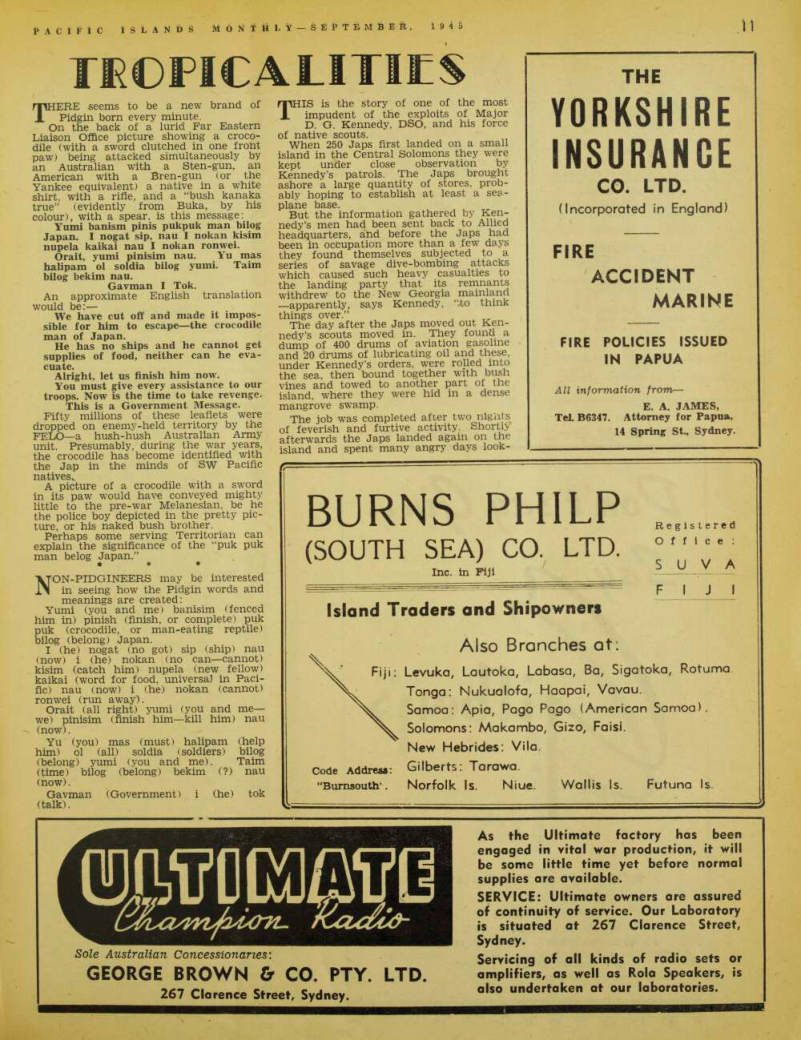
mHERE seems to be a new brand of X Pidgin born every minute.
On the back of a lurid Far Eastern Liaison Office picture showing a croco dile (with a sword clutched in one front paw) being attacked simultaneously by an Australian with a Sten-gun, an American with a Bren-gun (or the Yankee equivalent) a native in a white shirt, with a rifle, and a “bush kanaka true” (evidently from Buka, by his colour), with a spear, is this message; Yumi banism pinis pukpuk man bilog Japan. I nogat sip, nau I nokan kisim nupela kaikai nau I nokan ronwei.
Orait, yumi pinisim nau. Yu mas halipam ol soldia bilog yumi. Taim bilog bekim nau.
Gavman I Tok.
An approximate English translation would be:— We have cut off and made it impos sible for him to escape—the crocodile man of Japan.
He has no ships and he cannot get supplies of food, neither can he eva- Alright, let us finish him now.
You must give every assistance to our troops. Now is the time to take revenge.
This is a Government Message.
Fifty millions of these leaflets were dropped on enemy-held territory by the FELO—a hush-hush Australian Army unit. Presumably, during the war years, the crocodile has become identified with the Jap in the minds of SW Pacific natives t A picture of a crocodile with a sword in its paw would have conveyed mighty little to the pre-war Melanesian, be he the police boy depicted in the pretty pic ture, or his naked bush brother.
Perhaps some serving Territorian can explain the significance of the ‘‘puk puk man belog Japan.” • * • NON-PIDGINEERS may be interested in seeing how the Pidgin words and meanings are created: Yumi (you and me) banisim (fenced him in) pinish (finish, or complete) puk puk (crocodile, or man-eating reptile) bilog (belong) Japan.
I (he) nogat (no got) sip (ship) nau (now) i (he) nokan (no can—cannot) kisim (catch him) nupela (new fellow) kaikai (word for food, universal in Paci fic) nau (now) i (he) nokan (cannot) ronwei (run away).
Orait (all right) yumi (you and me— we) pinisim (finish him—kill him) nau (now).
Yu (you) mas (must) halipam (help him) ol (all) soldia (soldiers) bilog (belong) yumi (you and me). Taim (time) bilog (belong) bekim (?) nau (now).
Gavman (Government) i (he) tok (talk).
THIS is the story of one of the most impudent of the exploits of Major D. G. Kennedy, DSO, and his force of native scouts.
When 250 Japs first landed on a small island in the Central Solomons they were kept under close observation by Kennedy’s patrols. The Japs brought ashore a large quantity of stores, prob ably hoping to establish at least a sea plane base.
But the information gathered by Ken nedy’s men had been sent back to Allied headquarters, and before the Japs had been in occupation more than a few days they found themselves subjected to a series of savage dive-bombing attacks which caused such heavy casualties to the landing party that its remnants withdrew to the New Georgia mainland —apparently, says Kennedy, ‘Vto think things over.” , Tjr The day after the Japs moved out Ken nedy’s scouts moved in. They found a dump of 400 drums of aviation gasoline and 20 drums of lubricating oil and these, under Kennedy’s orders, were rolled into the sea, then bound together with bush vines and towed to another part of the island, where they were hid in a dense mangrove swamp.
The job was completed after two nights of feverish and furtive activity. Shortly afterwards the Japs landed again on the island and spent many angry days look
ing for the mysteriously vanished drums.
Although the search continued intermit tently until the Japs finally withdrew from the island, the hiding place was never found.—HAROLD COOPER. * * *
An Alibi for Beer-drinkers
rE horse and mule live thirty years, And nothing know of wines and beers.
The goat and sheep at twenty die And never taste of Scotch or rye.
The cow drinks water by the ton — And at eighteen poor Pansy’s done.
The dog, at fifteen, cashes in, Without the aid of rum or gin.
The cat of milk and water soaks — And then in twelve short years it croaks.
The modest, sober, bone-dry hen Lays eggs for nogs—and dies at ten.
All animals are strictly dry— They sinless live, and sinless die.
But sinful, ginful, rum-soaked men Survive for three-score years and ten!
Jungle Technique
MODERN methods of communication were temporarily laid aside recently in the fighting behind Wewak, and the old native “garamut” came into its own.
For months the Japanese behind the Prince Alexander ridge had been strafed and bombed, and because the area was under Japanese control, the natives were getting the worst of it.
Natives were put to work by ANGAU officers to make garamuts. For days they chipped away to hollow out the logs, and at last they were finished.
The natives went to Shiburangu village, and their drums told the natives inland that the “Japanman” was bad, that the white master had good food and good treatment.
Next day 180 inland natives arrived at the ANGAU compound. * * *
The Pay-off
CIDELIGHT on the Jap surrender from the “Sydney Morning Herald” war correspondent in Manila ; When the Japanese surrender en voys were in Manila, the most haughty of them all called an American private to him and, hand ing over two five-dollar bills from a pile the Japs had brought with them, asked imperiously for two cartons of cigarettes.
With perfect discipline, the Ameri can soldier accepted the order, came back with the cigarettes and handed over the change—all in Japanese- Philippines occupation money. * * * Howlers LEAP Year is, instead of its being the next day on the same day next year, its the day after.
The Royal Mint is the stuff the King puts on his roast lamb.
They could not get wheat to grow in Egypt so they irritated it.
Advertisements & other items, pp. 13-14 (1 item)
Burns Philp
THE
YORKSHIRE
INSURANCE
CO. LTD.
(Incorporated in England)
FIRE
ACCIDENT
MARINE
FIRE POLICIES ISSUED
IN PAPUA
All information from —
E. A. JAMES,
TcL 86347. Attorney for Papua, 14 Spring St., Sydney.
BURNS PHILP
(SOUTH SEA) CO. LTD.
Inc. in Fiji
Island Traders and Shipowners
Registered Office :
SUVA
FIJI
Also Branches at: \Fiji; Levuka, Lautoka, Labasa, Ba, Sigatoka, Rotuma Tonga: Nukualofa, Haapai, Vavau.
Samoa: Apia, Pago Pago (American Samoa).
Solomons: Makambo, Gizo, Faisi.
New Hebrides: Vila.
Code Address: Gilberts: Tarawa.
“Bumsouth 1 . Norfolk Is. Niue. Wallis Is. Futuna Is.
Sole Australian Concessionaries :
GEORGE BROWN & CO. PTY. LTD.
267 Clarence Street, Sydney.
As the Ultimate factory has been engaged in vital war production, it will be some little time yet before normal supplies are available.
SERVICE: Ultimate owners are assured of continuity of service. Our Laboratory is situated at 267 Clarence Street, Sydney.
Servicing of all kinds of radio sets or amplifiers, as well as Rola Speakers, is also undertaken at our laboratories.
SPECIALISING
IN
PACIFIC ISLAND INSURANCES
FIRE MOTOR VEHICLE
MARINE HULLS AND CARGO
EMPLOYER’S LIABILITY
GUARANTEES including those for—
DYNAMITE PERMITS.
RECRUITERS’ LICENCES.
DEFERRED WAGES
AND ALL OTHER CLASSES ARRANGED
AT LOWEST CURRENT RATES.
Established Agencies:
W. R. CARPENTER & CO., LTD.
Throughout the Territory of New Guinea.
SOUTHERN PACIFIC INSURANCE
CO., LTD.
HEAD OFFICE: 60 HUNTER STREET,
SYDNEY.
"fion't sau (jin,,
J?au
★ LIQUEURS * COCKTAILS <* WHISKIES
Address all enquiries to:
W. & A. GILBEY LTD.,
33 ROSSLYN STREET, WEST MELBOURNE.
Telegraphic and Cable Address: "Gilbey's," Melbourne.
109 REGENT STREET, SYDNEY.
Telegraphic and Cable Address: "Gilbey's," Sydney.
Suva-Sydney Air
Service Soon
IT is possible that civilian air service from Suva (Fiji) to Sydney, via Auckland, NZ, will be operating soon.
It has been announced in Suva that a conference took place in Suva, last May, between representatives of the Govern ments of Fiji, Australia and New Zealand on the question of establishing such a service. A 1 The Governor of Fiji, Sir Alexander Grantham, said on August 24, that al though it was not yet possible to say when this service is likely to commence operations, the Government of Fiji is anxious that it should start with the least possible delay.
Air-Mail to Fiji Trebled
ALTHOUGH for many months it has been possible to send letters from Australia to Fiji, by air. for sid. per half ounce, it was announced in Fiji, on August 26, without any explanation, that the rate in future would be 1/5 per hah ounce, and 9d. each for post cards. The same rate applies to other British coun tries, except to New Zealand, where the rate is 1/2 per half ounce, and 7d. for post cards. , r , The rate from Fiji to the United States is 2/10 per half ounce and 1/5 for post cards.
Make The Japs Work
In New Guinea
A LETTER that contained much sound commonsense, written by Mr. Tom Flower, of New Guinea, was
published in “Sydney Morning
Herald” of September 6:
THE new regulations state that natives must be returned to their villages after one year’s employment, and that they must not be worked more than 44 hours a week. The first regulation is going to be very hard on the employer, as in some cases the natives are taught technical and skilled work, carpentering, tractor and truck driving, etc., and by the end of the first 12 months, when they are just becoming useful, the employer loses their services. The best way to overcome this difficulty would be to allow the employer to apprentice up to 20 per cent, of his total employees for technical and skilled work from three to five years.
Very few natives work more than 44 hours 'a week. The working efficiency of a line of 100 natives would only amount to 70, after deductions are made for sickness, malingerers, cook boys—one to about every 15 natives—garden boys growing food for them, in addition to the ration issue as set out by the Govern ment, and medical boys, who are taught to dress wounds and look after the sick.
In my business of logging and saw milling I have to employ 100 natives to work in the bush, and the same work could be done by 10 Australian bushmen.
The old cost of ‘native labour worked out at about 2/- per day, or £3 per month, but with the new regulations this will be doubled, and 30/- a week for an untrained boy of 16 years is more than many of us earn at the same age.
If the Government considers it wrong for us to work the natives, I have a suggestion. There are thousands of Japanese in New Guinea, and with the Government’s permission to work 100 of these and a few Bth Division prisoners of war to act as overseers, I would be quite content to carry on my business under these conditions. In Europe the Ger mans are being employed to build the devastated countries, and I can see no difference.
We are not seeking cheap labour, but only the right to continue and control our businesses as employers that many have given the best years of their life to create and establish.
Editorial Note
HIGH-RANKING officers, just arrived from New Guinea, tell us that active preparations are being made there to house, guard, feed, hospitalise, and finally ship away at least 150,000 Japs who are expected to surrender there.
Meanwhile, the Territories of Papua and New Guinea face a frightful economic problem in restoring a huge amount of property destroyed by war. The cost is bad enough—but the difficulty of finding labour is much worse. Mr. Ward him self declares that the grealt majority of native labourers urgently need a long spell in their villages.
Is there any reason why these Japanese should not be forced to labour on the task of restoration and reconstruction* just as they forced so many white Aus tralians and New Guinea natives to work? If this use of prisoners is right and proper in other places, surely it is better to employ them in this way in New Guinea, instead of maintaining them for months in comfortable camps while
awaiting transport.
Advertisements & other items, pp. 15-18 (3 items)
a major anxiety
the
Relief from
Even the most expert and conscientious individual executor is subject to accident, illness and incapacitation.
Continuity of administration and uninterrupted attention to your estate and your beneficiaries are of paramount importance. Both can be positively assured by appointing this Company your sole Executor or as co-Executor with your present appointee. An interesting explanatory booklet will be forwarded on request.
DIRECTORS:
Lewis Armstrong. fames Burns. Joseph Mitchell.
R. J. Nosworthy. P. T. W. Black.
MANAGER: L. S. Parker.
BURNS PHIIP TRUST
COMPANY LIMITED
7 BRIDGE STREET. SYDNEY
TELEPHONE: B 7901 Box 543, G.P.0., Sydney BP 1.45
%m£ i~N t*.
HARRY J .YOUNG PTY. LTD.
Sole Pacific Islands Selling Representatives
For:
COMMONWEALTH WEAVING
MILLS PTY. LTD.
A
MANUFACTURERS OF: Dri-Glo Towels
Fadeless
Colours
★ • THROUGH THE WAR YEARS DRI-GLO'S HAVE RETAINED
THEIR QUALITY.
• THE FULL VARIETY OF FADELESS COLOURS IS STILL
AVAILABLE.
• GYPSY STRIPES, PLAIN PASTELS, GAY PATTERNS, PLAIN
WHITES.
EVERYTHING THE BATHROOM COULD ASK FOR
• DRI-GLO'S ARE STILL WOVEN ON A BASE OF DOUBLE- WARP OR TWOFOLD YARN, WHICH GIVES YOU DOUBLE
WEAR ON EACH TOWEL.
• FROM A DRI-GLO YOU GET THE FULL WEAR OF TWO
ORDINARY TOWELS.
DRI-GLO'S COLOURS ARE GUARANTEED FADELESS
Longer Wear.
Postal Address: Box 3661, G.P.0., Sydney
KQWiI?
HARRY J .YOUNG PTY. LTD.
379 KENT ST.,
Sydney.
Bankers; Bank of N.S.W. /-A Codes; Bentley’s Comp. Phrase Bentley’s 2nd Phrase.
“ TJrS'sl
A REPLY TO BRYSON, M.P.
LETTER TO THE EDITOR
Note : Bryson is the Victorian mem ber who, under the protection of
Parliamentary Privilege, slandered
the residents of New Guinea. He has been described as “a hitherto un known Labourite." He will be better known in future —and deservedly—by an even more contemptuous epithet.
—Ed., “PIM.”
FOLLOWING upon your report on the Papua-New Guinea Bill, and your article, “Papua-New Guinea Bill Puts Territorians on the Spot” (August “PIM”), which refers to slanderous state ments by a Victorian Labour member, Mr. Bryson, during the debate on this Bill, I should like ,to bring the following facts to the notice of Mr. Bryson and others interested.
The New Ireland District is the only area of which I can speak authoritatively, but I know that the facts regarding en listments in all districts of the Territory of New Guinea were substantially the same. Mainland areas were more for tunate, in that more of those still m their homes and jobs when the Japs landed were able to escape capture than was the case in New Ireland, New Britain and other areas.
New Ireland District has a peacetime population of not more than 250 whites.
Here is a record of the war service given by them;
Enlisted Prior to Entry of Japan
Beatty, J. S. McPherson, G.
Bell, L. W. G. Mead, R.
Bell, L. J. Miller, S Bell, D. Morell, J.
Blackett. Pascoe, R.
Boisen, F. Pearson, L.
Cameron, J. L. Scott, W.
Corlass, A. Scott, W Corlass, G. Stanfield, E. A. P.
Davis, C. E. P. Stanfield, J. E. F.
Edgell, D. Watson, R.
Hamilton, B. Waugh, D. R.
Hawke, N. P. Windeyer, E.
Jennings, A. Windeyer, J.
Lewis, R. Winterbottom, R. C.
Maguire, G. H.
Absent from New Ireland in 1939 — Enlisted Elsewhere Heape, R. S. Lussick, W.
Holland, A. T. Mossman, W., Jr.
Holmes, G.
Enlisted After Entry of Japan
Bowman, C. Goad, D. M.
Briggs, G. McDonald, J. H.
Crosley, F. McShaneT R- Dean, L. G. Millar, C. J.
Ewen, J. A. Murray, H. J.
Forman, W. Norris, C. K.
Goad, J. C., Jr. Schultze, H.
Granted Honorary Naval Commission
for Services After Jap Invasion of
New Ireland Page, C. L., Jr.
Enlisted in Women's Services Davis, M. (Mrs. Grose, B. J.
C. E. P.) Stanfield, P. A.
Dean, H. M.
Volunteered but Rejected on Medical Grounds Coote, D. Keenan, G.
Furlong, R. B. McPherson, R. S.
Davies, E. L.
Thirty-one men joined the various armed forces prior to the entry of Japan into the war. These were all volunteers, some of whom paid their own fares
south to enlist. Three were last-war veterans. This represents 12-2/sth per
slandered ' Aut
tralian percentage at the same date.
Perhaps Mr. Bryson was not interested in the war at this stage? Five others whose permanent homes are in New Ireland district, but who happened to be absent at the outbreak of war, also joined up After the Japs entered the war 14 more New Inlanders joined the Forces. these, four were men who had escaped from New Ireland after the Japs landed.
Three of them were 1914 ‘ 18 soldiers; the
“ TJrS'sl
e 7 n^ e f rom jo“ ing ’*p previous"
Another of these fourteen had to wait 011 1942 for his eighteenth birthday, Offhand, I can think of five New Ire land men who volunteered, but were rejected on medical grounds. One, Mr.
C. L. Page, jnr., did valuable work after the invasion, spotting Jap aircraft and reporting their movements by wireless until he was discovered and killed by the
enemy. He was granted an honorary commission by the Navy.
Four New Ireland women joined the various women’s Services after com pulsory evacuation to Australia, and numerous others, together with a few men well over age or otherwise unfit for military service, have been engaged in munitions production and other war work.
The remainder of the districts popu lation have been prisoners of war for over 3 1 years. Included among them are one woman, a nurse, and a few very old men.
I SHOULD also like to point out that, because the properties expropriated after the 1914-18 war were sold, chiefly to ex-Servicemen, a large per centage of the population were veterans of that war and their families.
Eighteen of the fifty men in the Services are married, mostly with chil dren. To my certain knowledge, 36 have seen overseas service. As I do not know the service records of the remainder, I cannot state whether they also have served overseas, but as none is in a militia unit, it is more than probable that they have. This represents at least 72 per cent, on overseas service.
As I have heard little or no news of
many New Irelanders during the war years, I do not know the casualty figures, which include at least five known to me to be killed or missing, several wounded and several prisoners of war.
I should like Mr. Bryson to compare the New Ireland District’s total enlist ments, 55 out of an entire population of 250 (men, women and children), or ap proximately 22 per cent., with those of Australia, conscripts and all included.
He may find the comparispn both in teresting and enlightening.
The above facts, and the names, are drawn entirely from memory, and it is possible that I have omitted some names.
I have included only those whfl I know enlisted from New Ireland, or whose per manent homes are in the district. Any inaccuracy in the above figures is due to possible omission of names, and not to the mistaken inclusion of any. To the best of my knowledge and belief the facts, as stated, are correct.
I am, etc.,
P. A. STANFIELD.
174 Oriel Road, Ascot, Qld.
The amount of totaquina sold in the last half of 1944 was 20 times that sold in a similar period of 1942. 'Totaquina is a mixture of the alkaloids from the bark of various species of cinchona, and since the shortage of quinine it has been in creasingly in demand. Manufacture was started at Dar es Salaam in 1942. The factory is now supplying Kenya and Uganda with totaquina which is surplus to the present requirements of Tangan yika, but local consumption is rapidly increasing as the efficiency of totaquina becomes more widely known—“ Crown Colonist.”
Federal Broom Co.
Position Wanted
Planter requires permanent position in the Islands.
Twenty years' experience in Copra and Cocoa production, Plantation Development, Maintenance and repairs of Dryers and Buildings Holder of Local Master's Licence and First Aid Ticket to 500 natives.
Reply to “45,” c/o “Pacific Islands Monthly,” Box 3408, G.P.0., Sydney.
THE
FEDERAL BROOM CO.
1
PTY, LTD.
M I L L E T
AUSTRALIA'S LARGEST MAKERS OF
MILLET BROOMS AND BRUSHWARE
B R O O " FEDERAL" Brand is a GUARANTEE of Quality
SOLE EXPORTER:
0. F. MASSCHELEIN, SYDNEY
Exporter of Australian Quality Products Only.
Wanted to Rent
A COTTAGE, subject to Army release, in Port Moresby, in or after November. 1945.
Lease on one, two or three years’ basis.
References available. Replies to:—
D. C. MocGREGOR,
Qantas Empire Airways, Port Moresby.
Pacific
Famous Danes of the Pacific
ABOUT a dozen Danes have made history in the South Pacific Terri tories; and a well-known Danisn author, Mr. B. Rosenkilde Nielsen (of 129 Emdrup Banke, Copenhagen), has gathered together their remarkable stories in a book entitled “Danish Pioneers in the Pacific Ocean,” which was published in Copenhagen (in Danish, of course) in 1944.
The following are the names of some of the men described in the book. They will be known to all persons interested in South Seas history;— “Deliverance Harry,” whose name was Johs Henrik Enevoldsen. A play about him was broadcast on the Danish radio.
“The King of Witu,” or Peter Hansen.
Christian Kaad, of Levuka and Rotuma, Fiji.
Julius Petersen, plantation-owner, of New Caledonia and New Hebrides.
The grand old man Christian Hellese, of Apia, who in 1941 was still alive and 97 years old.
“King Fai’u, of Wuvulu (or Maty) Island,” otherwise Edvard C. A. Nielsen Ortoft, perhaps better known at “William Leonard.”
'“German Harry,” or Jeppe Soren Christensen, who was a famous man in North Australian waters.
“The Father of the Pacific Ocean,” or Captain Viggo Rasmussen, of Penryhyn Island. / The goldmine-owner, J. P. Jensen, of Bulolo, New Guinea.
The book tells interesting stories of three Danish captains who crossed the Pacific in Chinese junks, and of the first Danish expedition and voyage round the world, in 1839, in the ship “Concordia.
Advertisements & other items, p. 18 (1 item)
Reg. Adams, Clayton & Co.
o o
Progress with Modern Designing.
SHIPBUILDERS
and ENGINEERS
COPPERSMITHS, WELDERS and PLUMBERS.
Builders of WOODEN FREIGHTERS,
TRAWLERS and ISLAND CRAFT.
Agents for Diesel Engines.
VESSELS REPAIRED and REMODELLED.
MODERN SLIPWAY FACILITIES
AVAILABLE,
Write to us for Designs and Complete Shipbuilding information.
REG. ADAMS, CLAYTON
& COMPANY
JOHN STREET, BERRY'S BAY, SYDNEY.
Tel.: XB 4475, XA 1731.
Sea Riddles of the Solomons
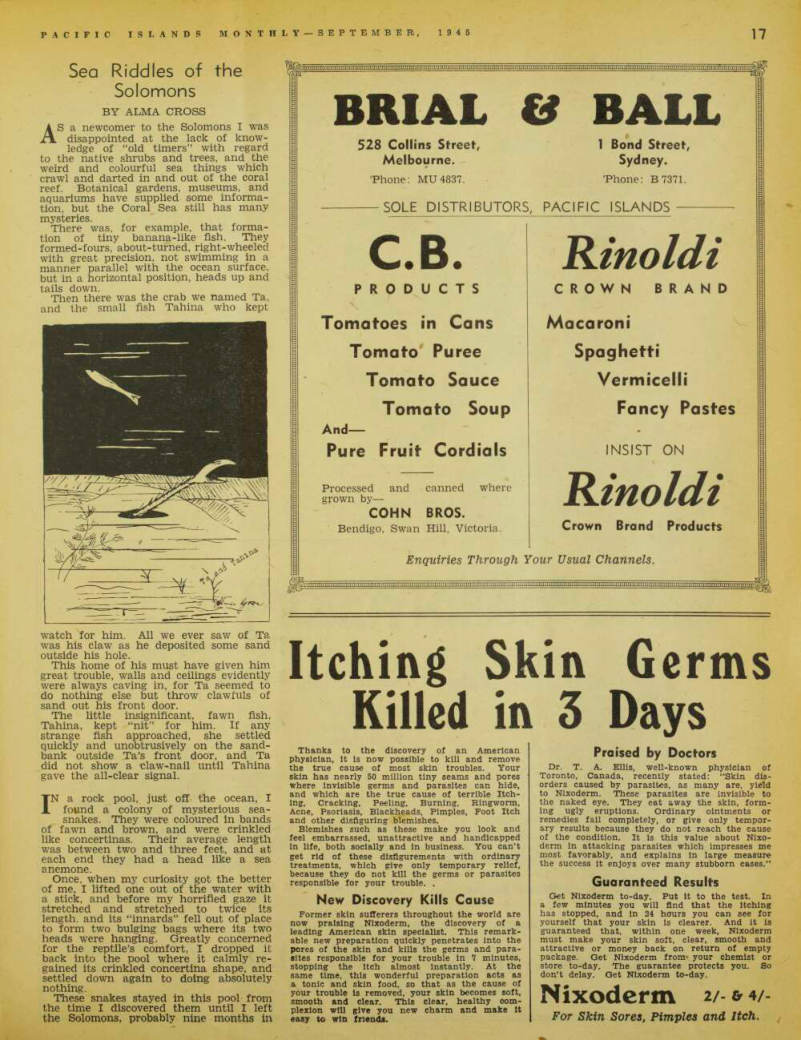
Solomons
By Alma Cross
AS a newcomer to the Solomons I was disappointed at the lack of know ledge of “old timers” with regard to the native shrubs and trees, and the weird and colourful sea things which crawl and darted in and out of the coral reef. Botanical gardens, museums, and aquariums have supplied some informa tion, but the Coral Sea still has many mysteries.
There was, for example, that forma tion of tiny banana-like fish. They formed-fours, about-turned, right-wheeled with great precision, not swimming in a manner parallel with the ocean surface, but in a horizontal position, heads up and tails down.
Then there was the crab we named Ta, and the small fish Tahina who kept
watch for him. All we ever saw of Ta was his claw as he deposited some sand outside his hole.
This home of his must have given him great trouble, walls and ceilings evidently were always caving in, for Ta seemed to do nothing else but throw clawfuls of sand out his front door.
The little insignificant, fawn fish, Tahina, kept “nit” for him. If any strange fish approached, she settled quickly and unobtrusively on the sand bank outside Ta’s front door, and Ta did not show a -claw-nail until Tahina gave the all-clear signal.
IN a rock pool, just off the ocean, I found a colony of mysterious sea snakes. They were coloured in bands of fawn and brown, and were crinkled like concertinas. Their average length was between two and three feet, and at each end they had a head like a sea anemone.
Once, when my curiosity got the better of me, I lifted one out of the water with a stick, and before my horrified gaze it stretched and stretched to twice its length, and its “innards” fell out of place to form two bulging bags where its two heads were hanging. Greatly concerned for the reptile’s comfort, I dropped it back into the pool where it calmly re gained its crinkled concertina shape, and settled down again to doing absolutely nothing.
These snakes stayed in this pool from the time I discovered them until I left the Solomons, probably nine months in
all. They may be there yet despite tidal waves and Japanese invasions, and al though I have consulted books, museums and aquariums these sea things still re main my sea-enigmas.
The Rev. H. T. Williams, of the Metho dist Mission, arrived in Sydney from Papua in July. He will do deputation work in NSW.
Advertisements & other items, pp. 19-20 (1 item)
Itching Skin Germs
BRIAL & BALL
528 Collins Street, Melbourne. ’Phone: MU4837. 1 Bond Street, Sydney. ’Phone: B 7371.
SOLE DISTRIBUTORS, PACIFIC ISLANDS
C.B.
PRODUCTS
Tomatoes in Cans
Tomato Puree
Tomato Sauce
Tomato Soup
And—
Pure Fruit Cordials
Processed and canned where grown by—
COHN BROS.
Bendigo, Swan Hill, Victoria.
Rmoldi
CROWN BRAND
Macaroni
Spaghetti
Vermicelli
Fancy Pastes
INSIST ON
Rmoldi
Crown Brand Products Enquiries Through Your Usual Channels.
Itching Skin Germs Killed in 3 Days
Thanks to the discovery of an American physician, it is now possible to kill and remove the true cause of most skin troubles. Your skin has nearly 50 million tiny seams and pores where Invisible germs and parasites can hide, and which are the true cause of terrible Itching, Cracking, Peeling, Burning, Ringworm, Acne, Psoriasis, Blackheads, Pimples, Foot Itch and other disfiguring blemishes.
Blemishes such as these make you look and feel embarrassed, unattractive and handicapped in life, both socially and in business. You can’t get rid of these disfigurements with ordinary treatments, which give only temporary relief, because they do not kill the germs or parasites responsible for your trouble. ,
New Discovery Kills Cause
Former skin sufferers throughout the world are now praising Nixoderm, the discovery of a leading American skin specialist. This remarkable new preparation quickly penetrates into the pores of the skin and kills the germs and parasites responsible for your trouble in 7 minutes, stopping the itch almost instantly. At the same time, this wonderful preparation acts as a tonic and skin food, so that as the cause of your trouble is removed, your skin becomes soft, smooth and clear. This clear, healthy complexion will give you new charm and make It easy to win friends.
Praised by Doctors
Dr. T. A. Ellis, well-known physician of Toronto, Canada, recently stated: “Skin disorders caused by parasites, as many are. yield to Nixoderm. These parasites are invisible to the naked eye. They eat away the skin, forming ugly eruptions. Ordinary ointments or remedies fail completely, or give only temporary results because they do not reach the cause of the condition. It is this value about Nixoderm in attacking parasites which impresses me most favorably, and explains in large measure the success it enjoys over many stubborn cases.”
Guaranteed Results
Get Nixoderm to-day. Put It to the test. In a few minutes you will find that the Itching has stopped, and in 24 hours you can see for yourself that your skin is clearer. And it is guaranteed that, within one week, Nixoderm must make your skin soft, clear, smooth and attractive or money back on return of empty package. Get Nixoderm from* your chemist or store to-day. The guarantee protects you. So don’t delay. Get Nixoderm to-day.
Nixoderm v- & 4/-
For Skin Sores, Pimples and Itch.
“DOCTOR SAID I WAS A DONE MAN”
cleanser, blood purifier and acid corrective. R.U.R. is also the most economical way to rebuild lasting health.
No matter what you have wrong with ypu, or how worried, depressed and ill in body you feel, take R.U.R. and Right You Are!
CHRISTCHURCH. N.Z.. LAND
AGENT DISCOVERS REAL
WAY TO HEALTH.
Hereford Street, Christchurch, is all the more pleasant for its association with Mr. Fred Whiley, whose prominent business windows and breezy personality have found a solution for many home seekers.
Looking at "Fred” to-day it is hard to imagine he has been anything but always "in the pink,” yet seven years ago he was "down to it” and broken in health.
What he says is something to give heart to the suffering, ill and depressed. "My doctor said I was a done man. He is now dead, and I am better than ever. It is no secret.
I took a large packet of R.U.R. My friends marvel at the change, thanks to your wonderful health-giving remedy. Please use this testimonial for the benefit of others.”
This voluntary recommendation to R U.R. bears out the benefits which have caused hundreds to write their praise for this "fivefold” health builder —the shortest cut to robust good health, stamina and abundant energy. It will remove the cause of 19 out of 20 ailments, aches and pains because it contains a laxative, liver stimulant, kidney
TRKE R.U.IIW
w m a a
Robust Construction,
Economical,
Reliable.
Stem Gear Supplied to Order RJ2 18 h.p. Marine Diesel Engine 8 h.p. Stuart Marine Engine Available for certified essential requirements.
Thornycroft (Aust.) Pty., Ltd.
6/10 Wattle Street,
PYRMONT, H.S.W.
Cables: THORNMOTOR, Sydney.
Rubber Production
In Papua
Canberra, Sept. 5.
Australia imported i,677 tons of crude rubber from Papua in the year 1944—more than double the total of 770 tons received during 1943. The Minister for Supply and Shipping to-day gave details of Papuan rubber exports to Australia for the past eight years, as follows:
The great bulk of the rubber had gone to NSW. Practically the whole of the crude rubber consumption takes place in NSW and Victoria, and shipments of this material from Ceylon and Papua are so arranged that the stock cover in terms of months is maintained at about the same level in each State.
Colonel H. T, Allen, who has had charge of the base at Wewak, New’
Guinea, for several months, arrived in Sydney early in September, and has finally shed his uniform—which bears upon it the ribbons of World Wars I and 11, including the QBE, awarded for ser vices in the Middle East. He had nearly six years’ service—he was one of the first New Guinea men to join up, in 1939.
After a long rest in Australia—and per haps a visit abroad—he hopes to return to his former status of Mr. “Blue” Allen, goldminer, of Wau, New Guinea.
Tons. 1938 .. 1,243 1939 .. 1.418 1940 .. 1,454 1941 .. 1,311 1942 686 1943 770 1944 . . 1,677 1945 (to July 31) .. .. 967
Life on Pitcairn Island
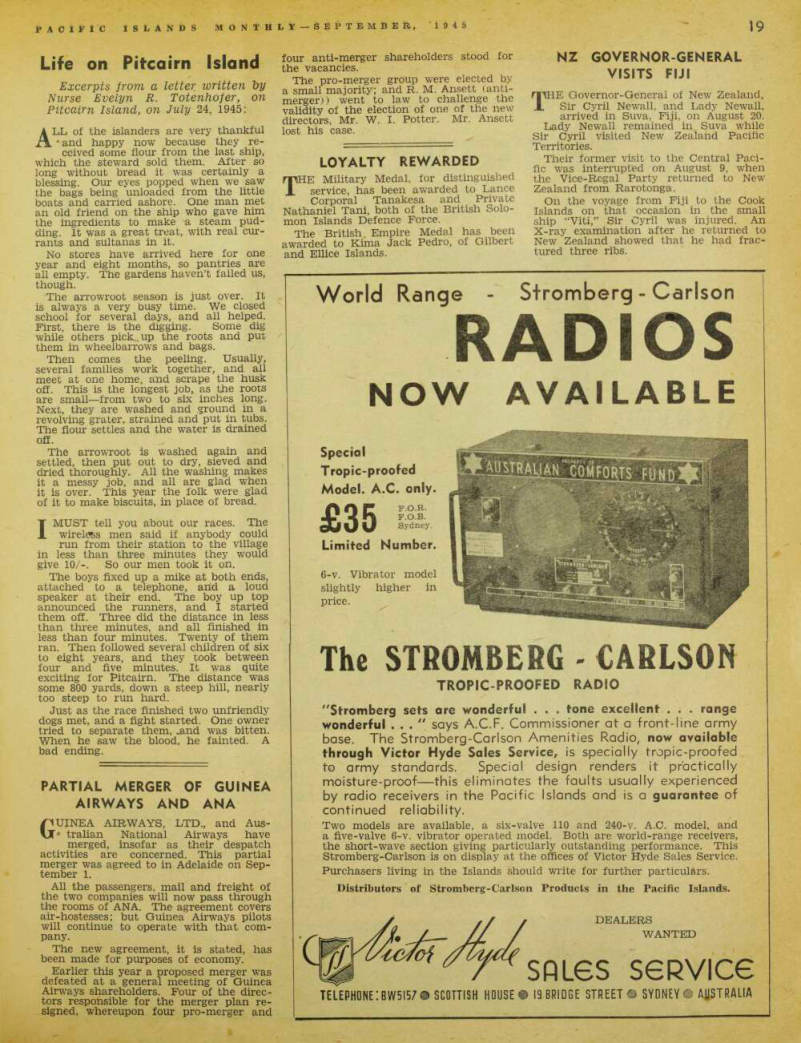
Excerpts from a letter written Toy
Nurse Evelyn R. Totenhofer, on Pitcairn Island, on July 24, 1945: ALL of the islanders are very thankful • and happy now because they re ceived some flour from the last ship, which the steward sold them. After so long without bread it was certainly a blessing. Our eyes popped when we saw the bags being unloaded from the little boats and carried ashore. One man met an old friend on the ship who gave him the ingredients to make a steam pud ding. It was a great treat, with real cur rants and sultanas in it.
No stores have arrived here for one year and eight months, so pantries are all empty. The gardens haven’t failed us, though.
The arrowroot season is just over. It is always a very busy time. We closed school for several days, and all helped.
First, there is the digging. Some dig while others pick up the roots and put them in wheelbarrows and bags.
Then comes the peeling. Usually, several families work together, and all meet at one home, and scrape the husk off. This is the longest job, as the roots are small —from two to six inches long.
Next, they are washed and ground in a revolving grater, strained and put in tubs.
The flour settles and the water Is drained off.
The arrowroot is washed again and settled, then put out to dry, sieved and dried thoroughly. All the washing makes it a messy job, and all are glad when it is over. This year the folk were glad of it to make biscuits, in place of bread.
IMUST tell you about our races. The wireless men said if anybody could run from their station to the village in less than three minutes they would give 10/-. So our men took it on.
The boys fixed up a mike at both ends, attached to a telephone, ahd a loud speaker at their end. The boy up top announced the runners, and I started them off. Three did the distance in less than three minutes, and all finished in less than four minutes. Twenty of them ran. Then followed several children of six to eight years, and they took between four and five minutes. It was quite exciting for Pitcairn. The distance was some 800 yards, down a steep hill, nearly too steep to run hard.
Just as the race finished two unfriendly dogs met, and a fight started. One owner tried to separate them, .and was bitten.
When he saw the blood, he fainted. A bad ending.
Partial Merger Of Guinea
Airways And Ana
Guinea airways, ltd., and aus • tralian National Airways have merged, insofar as their despatch activities are concerned. This partial merger was agreed to in Adelaide on Sep tember 1.
All the passengers, mail and freight of the two companies will now pass through the rooms of ANA. The agreement covers air-hostesses; but Guinea Airways pilots will continue to operate with that com pany.
The new agreement, it is stated, has been made for purposes of economy.
Earlier this year a proposed merger was defeated at a general meeting of Guinea Airways shareholders. Four of the direc tors responsible for the merger plan re signed, whereupon four pro-merger and
four anti-merger shareholders stood for the vacancies.
The pro-merger group were elected by a small majority; and R. M. Ansett (anti merger)) went to law to challenge the validity of the election of one of the new directors, Mr. W. I. Potter. Mr. Ansett lost his case.
Loyalty Rewarded
rE Military Medal, for distinguished service, has been awarded to Lance Corporal Tanakesa and Private Nathaniel Tani, both of the British Solo mon Islands Defence Force.
The British Empire Medal has been awarded to Kima Jack Pedro, of Gilbert and Ellice Islands.
Nz Governor-General
Visits Fiji
rE Governor-General of New Zealand, Sir Cyril Newall, and Lady Newall, arrived in Suva, Fiji, on August 20.
Lady Newall remained in Suva while Sir Cyril visited New Zealand Pacific Territories.
Their former visit to the Central Paci fic was interrupted on August 9, when the Vice-Regal Party returned to New Zealand from Rarotonga.
On the voyage from Fiji to the Cook Islands on that occasion in the small ship “Viti,” Sir Cyril was injured. An X-ray examination after he returned to New Zealand showed that he had frac tured three ribs.
Advertisements & other items, pp. 21-22 (2 items)
Radios
World Range - S+romberg - Carlson
NOW AVAILABLE
Special
Tropic-proofed
Model. A.C. only. £35
F.O.R.
F. 0.8.
Sydney.
Limited Number. 6-v. Vibrator model slightly higher in price. tsar
The STROMBERG - CARLSON
TROPIC-PROOFED RADIO
"Stromberg sets are wonderful . . . tone excellent . . . range wonderful . . . “ says A.C.F. Commissioner at a front-line army base. The Stromberg-Carlson Amenities Radio, now available through Victor Hyde Sales Service, is specially tropic-proofed to army standards. Special design renders it practically
moisture-proof—this eliminates the faults usually experienced
by radio receivers in the Pacific Islands and is a guarantee of
continued reliability.
Two models are available, a six-valve 110 and 240-v. A.C. model, and a five-valve 6-v. vibrator operated model. Both are world-range receivers, the short-wave section giving particularly outstanding performance. This Stromberg-Carlson is on display at the offices of Victor Hyde Sales Service.
Purchasers living in the Islands should write for further particulars.
Distributors of Stromberg-Carlson Products in the Pacific Islands. i 'of
DEALERS
WANTED
soles seßVice
TELEPHONE: 8W5157 ® SCOTTISH HOUSE® 19 BRIDGE STREET® SYDNEY ® AUSTRALIA
Modern Refrigeration for the South Sea Islands
The ELECTROLUX KEROSENE OPERATED
REFRIGERATOR
MARVEL
OF
MODERN
SCIENCE
' ■ -V-i
THE
MIRACLE
OF
ICE
FROM
HEAT
ELECTROLUX OFFERS ECONOMICAL, modern and completely efficient
REFRIGERATION FOR ISLANDS' HOMES.
FREEZES CONTINUOUSLY WHILE SMALL LAMP BURNS.
Freezing controlled by simply regulating height of flame. Uses only 3 gallon of kerosene per week.
MOTORLESS ... NO PARTS TO GET OUT OF ORDER.
MODEL L 22
Capacity 3 2 cubic feet.
MODEL L3BO
(as illustrated) Capacity 4 cubic feet.
MODEL LKSSO
Capacity 6.6 cubic feet.
GUARANTEED FOR TWO YEARS.
• Write to your Local Distributor for prices and full details.
OBTAINABLE FROM ALL W. R. CARPENTER & CO. LTD.
BRANCHES THROUGHOUT THE ISLANDS
Renresentatlon in Papua and New Hebrides.
20
SEPTEMBER, 1945 PACIFIC ISLANDS MONTHt
Crises In New Caledonia
Freedom Granted to 10,000 Indonesian Indentured Labourers
rpHE decree granting free residence, I with the right to compete at a rea sonable wage on the free labour market, made to over 10,000 Indo-Chinese and Javanese coolies in New Caledonia, was approved by the Administration, after being agreed to by the General Council at an extraordinary session by II votes out of 15. .
This should bring to an end agitation and strikes which have caused concern for some time. Labour conditions in the French Colony will be revolutionised by the abolition of this indentured labour, on which mining companies and the agricultural and coffee growing indus try have so long relied; while logically the release of Tonkinese labour to the free market must also apply to French planters and employers in the New Hebrides. .
Both in mining and in agriculture the Caledonians are facing a crisis. The im mediate future of nickel and chrome is uncertain. * In addition to the labour problem, decline in demand for locally grown foodstuffs (and industries like laundrying, which farmers as well as townspeople had taken on) is becoming serious as Allied troops depart. Pre-war export markets, for coffee in particular, have been lost.
Fortunately, the presence during the last 3i years of hundreds of thousands of Americans, Australians and New Zea landers has made the individual Cale donian a comparatively wealthy man, and the country is well able to stand a process of modernisation. It Is believed that by a new process, nickel ore can be treated at the mine to bring content up from 4 or 5 to over 50 per cent.; and plans are afoot to refine the mineral at the Noumea smelters up to over 99 per cent. Previously the final refining from about 75 per cent, a a received from Cale donian smelters was done in Europe.
The end of labour under coolie condi tions stresses the need for reorganising the agricultural industry, for which trac tors, bulldozers, cultivators and 5-disc ploughs are to be bought, and an ambi tious public works programme is to be instituted. All of which may encourage settlement and perhaps a small influx of settlers from Europe.
Generally speaking, cattle-growers will be less affected than coffee-planters by the loss of coolie labour, because they generally use native Melanesian and half caste stockmen and rouseabouts. But
there is a move to take from the big property-owners, like Maison Ballandes, some of the best cattle country, and split it up for agricultural development.
Since last century, every Republican paper published in Noumea, and practic ally every Republican speaker, has alleged that there has been an unholy alliance between the great Societe le Nickel (in which the Rothschilds once held supreme interest, but which prior to the war mainly profited France’s “200 families” whose representative Mr. Ban douin was), the Marist Mission, the big stores, and the Bank of Indo-China.
“The land is theirs and the mines are theirs, so that free colonists and free miners can no longer work —convict labour was followed by Asiatic coolie labour —and the Colony and white colonist can go to the devil” —such has been the chief and the chronic griev ance for the past 60 years.
The question remains: Will the new decree and the new General Council make matters different, and shift the balance of power, and will Governors in future be appointed less by nickel interests and more by democratically-minded French Governments with the good of the Colony at heart? This question is in everybody’s mind.
The Governor's Announcement
rpHE Governor and French General JL Commissioner for the Pacific, M.
Jacques Tallec, made a special an nouncement over the air.
He said that approximately 12.000 Indo-Chinese and Dutch East Indies’ workers had been introduced under the immigration law of December, 1935, and through agreement with the Dutch ad ministration. They came on five-years contracts as indentured labourers at mini mum wage scales. They were not allowed to change employers or discuss wages, and infringements of contracts could be pnished by the local Administration.
After five years the worker had the right of repatriation, or could volunteer to contract a new engagement, in which latter case he now had the right to elect his employer. In 1938 the New Caledonian Government had agreed with the Nether lands administration to forego right to punish administratively Javanese who had re-engaged. . , , , All contracts had expired by 1944, and most at different periods before then, but
the war had made it impossible to re patriate these labourers. Conditions had indeed become very different from what had been envisaged when the 1935 arrangement was made. This had been the cause of friction and uneasiness be tween employees and employer which the latter may not have clearly understood.
For their part the Indo-Chinese and Javanese workers failed to appreciate the reason for the necessity to accept re strictions on their liberty for a period longer than that they had contracted for.
The war and the economic needs of the country were responsible. The Japanese were at Guadalcanal; the wartime pro duction of nickel and chrome had to be pushed to the limit; while to lessen trans port difficulties the country’s agriculture had to contribute as much as possible to US and New Zealand troop maintenance.
It was such pressing needs as these that had forced the Administration to compel indentured labourers to continue work ing for their employers beyond the period of their Contract.
This necessity had now been removed, and the Colony must return to a strict honouring of its undertaking to these immigrant workers. The evolution of coloured races was also in accordance with the development of world opinion, and to hasten this evolution the French Empire had pledged itself at the Brazza ville Conference.
Following the Governor’s announce ment, the Indo-Chinese and Javanese were allowed to terminate their inden tured contracts from July 5. Working conditions under their new grading were to be announced. For the time being they need permits to move out of the district in which they have been work ing. Their wages are likely to be fixed around 45 francs a day, which is a big increase over coolie rates (a minimum of about 125 francs a month, plus food).
Appeal to American General
rIS marks the culmination of a long struggle between the indentured labourers and the French authori ties.
In the course of that struggle, the coolies—to the great embarrassment of the French Government —addressed the following letter, on March 14. 1944, to the General in Comand of the United States Forces in New Caledonia:— “We, the Tonkinese residents in Cale donia, French subjects and proteges, sub iect to French laws and respecting these laws, have the great honour to request your support.
“Several times we have asked for our liberty since our contracts ended, long ago. At no time have we refused to work, but we want to work like men and
not like animals. Furthermore, we have no way of making ourselves heard in the metropolis (Paris).
“For asking for liberty and a little more comfort, a little more rice and bread for our wives and children, we have been savagely punished; 15 of our men have been for several months on one of the Belep Islands, where the most atrocious means of coercion are used against them; two of them, it seems, have died recently. Besides, for stopping Work at the Chagrin mine, 600 Tonkinese workers were put on a little desert island without drinking water and subjected to hardships and treatment forbidden even in gaol. We ask you, could not an inquiry be made to prove the truth of our statements? , . t , rr . inin „ At t ?rpnfS esnecia Fi oa—are treated rwiHpH ally at Toumourou and we have decided to stop work on April 1 For 7 dollars F a work per day we get 5 to 7 dollars a m **We are housed in filthy huts, Bto 10 people in a room 2 yards square. The beds are few in number so that, while some are working, the others go to bed, and vicfe versa.
“At each of our requests for better conditions we have been treated like the most hardened criminals. Several times we have asked to go and fight beneath the flag of Free France alongside the Allies, but this was refused, and our requests stifled so as not to make them public, . . .
“we ask that, through your interme diary, you should have our letter trans mitted to the authorities in Paris so that French Government may take the necessary steps concerning us, and make all the necessary inquiries about the way j n winch we are treated here in New Caledonia. « We hope that you sirj a citizen of free America and a compatriot of Lincoln, the great man who was the first to abolish slavery, will be good enough to take pity on us. We thank you from the bottom Qf our hearts for troubling about us the first time—though the fact of our hav ing dared to wr it e to you brought down “ ’“™S& repw “ ton 0 " the Part ° f our oppressors.
“We beg of you to send our letter on to the French Government. It is not possible for us to be any longer martyred
and treated like dogs—we are men, not animals.”
The Chagrin Mine
rE Chagrin mine referred to in the letter, where one of the Indo- Chinese strikes took place, Is a mine run by a French Caledonian company, of which M. Milliard, head of Ballandes, the chief store in Noumea, is managing director. The French board manages the mine on behalf of a Melbourne com pany which bought the mine off the original French owner in 1938 with Aus tralian capital. Australian shareholders received no dividends and last year the Australian company went into liquida tion, each Australian shareholder being given shares in the French company.
The mine was named “Chagrin” on account of the disappointment of two ticket-of-leave men who discovered the mine in the old days. Each received a sum of money for the find, but when thev asked also to be allowed to return to France, this was refused them.
Advertisements & other items, pp. 23-24 (1 item)
Australian Aluminium Company
ALUMINIUM and its ALLOYS
This company supplies Aluminium and its Alloys to all specifications and for every commercial application where these give better service over other metals.
Please consult our Technical Service Department regarding your light metal problems.
AUSTRALIAN ALUMINIUM COMPANY
proprietary limited
(INCORPORATED IN THE STATE OF VICTORIA)
GENERAL OFFICES AND FABRICATION DIVISION: GRANVILLE. SYDN E
Hand-Engraved Wedding Rings
WEDDING RINGS from ANGUS &
COOT E express the beauty of the Wedding Ceremony. These exquisite styles are available in all sizes. Eveiy one is solid and good and distinguished by its rich engraving.
A size card will be sent by return post and your order will receive immediate and careful attention.
ANGUS & COOTE pay postage on WEDDING RINGS and guarantee safe delivery. We do NOT send V.P.P.’s. (Below) No. 20- Orange Blossom design of traditional beauty. 9ct. Yellow Gold 20 - (Above) tBct. Yellow Gold 37/6 No. 15 — Hearts 18ct. White Gold 40/and Orange Blossom, in a beautiful arrangement. 18ct. Yellow Gold ... 47/6 11 ' t6 55/- ~■■■ mi illinium •• ,l ANGUS & COOTE will engrave your Name, or your Initials, and the Date, inside your Wedding Ring. Send instructions with your order. * r.
I 1 a* No. 23—Sprays of Laurel Leaves interspersed with Orange Blossoms are very effective.
IBct. Yellow Gold 40/- Every A. & C. Wedding
SPECIAL VALUE.
No. 18 Hand engraved Orange Blossom, with dainty scroll. 18ct. Yellow Gold 30/- No. 12 Modelled Orange Blossom design. Always i n demand. 18ct. Yellow Gold 45/- 18ct. White Gold 47/6 Ring Solid Gold The Quality is Guaranteed.
No. 6—The plain ’aceted Wedding Ring has a charm of its own. 3ct. Yellow Gold 21/- IBct. Yellow Gold 40/- 18ct. White Gold 42/-
JUST PUBLISHED.
No. 21—A distinguished Wedding Ring of very graceful design. 15ct. Yellow Gold 32/6 No. 22—A circle of tiny Orange Blossoms is engraved on this faceted Wedding Gold 21/- 18ct. Yellow Gold 37/6 ■ e-r pi Ipi Kucn NA/rite for our new, fully illustrated folder of ewJnery^^VrooSie?, Crossed & Practical Gifts for Men. It’s post free.
ANGUS & COOTE
500 GEORGE STREET. SYDNEY. Phone; M 6061.
Labour Costs In
Australian Territories
Letter to the Editor
IT is indeed pleasing to know that you will shortly be issuing the handbook for sale. This has been needed badly by that section of the community ass ciated with the land and its products in these islands However, with the proposed increase in native labour costs which the present Canberra Government is imposing on plantations and employers in New Guinea, the economic factors in comparison to other areas in the world, producing the same products, will come into play; and, if our costs are such that we cannot compete on the world’s market, and Aus tralia is indisposed to extend its benevo lent policy to the “exploiting” planters and miners, then ruin and unemployment will be inevitable.
To enable me to make some comparison I would be obliged if you could obtain or furnish me the following information;— (1) What is the cost of NL units per day or per month in DEI (Sumatra, Borneo, etc.), cost to include housing, food, etc.? (I understand NL feed themselves.) (2) Are women employed in those Ter ritories and on what basis? (Rub ber-tapping is work which is per formed.) (3) Hours of work and conditions in
Dei?
(4) Cost of NL in Malaya, and condi tions, etc.? , . (5) Cost of NL in Philinpines, and in Burma and Indo-China?
If Australia is prepared to make an “economic bloc” of her Territories in New Guinea, and take the tropical products at enhanced prices consistent with in creased costs, then there may be justi fication for the rise, but this is not stated or guaranteed. , What distance inland are the farthest upland plantations of rubber, etc-., in Sumatra. Java, and Malaya? And what are the communications —road, or rivers.
Papua.
I am, etc.,
H. T. Kienzle.
EDITORIAL NOTE; We have no re liable figures to show native labour costs in the Indonesian Territories before the war. In any case, it is most unlikely that those rates will continue—it is prob able that there will be a general up wards revision of all labour rates through out the Pacific. The noint is important Australia’s Pacific Territories cannot compete with other tropical Territories in world markets if there is great dis parity in labour costs.
Advertisements & other items, p. 25 (2 items)
23
PACIFIC - ISLANDS MONTHLY SEPTEMBER, 19^5
Fanmaster
THE ALL-FEATURE MODERN
ELKTRIC 5 SPEED
REG.TRADE MARK
iPD. FOR
SERIAL N‘
Air Circulator
Manufactured by H. J. PARKER Cr CO. f Sydney . . . now available for YOU . . . . . for the factory, cafe, cinema, office, hospital, home and a thousand other uses—there isn't any limit. *
NO NOISE . . .
PERFECT FINISHED APPEARANCE . . .
... these are essentials of the FANMASTER! and only FANMASTER can offer you all these features, . .
Highly polished and lacquered aluminium blades.
Sturdy No. 6 gauge chromium plated wire guard for your protection Adjustable in height from 4 ft. 6 in. to 8 ft. !
Highly polished chromium plated adjustable pipe standard; lower pipe standard finished in black ripple.
Heavy, streamlined cast-iron base, finished in black ripple.
Adjustable tilting bracket to direct flow of air: UPWARD, DOWNWARD or CENTRAL positions.
Special FANMASTER motor, with adjustable thrust race; suitable tor continuous operation. Motor frame is cast aluminium, highly polished and lacquered.
Separate 5-speed control box unit, enabling you to operate fan at desired speed, from hurricane velocity to a smooth, soft breeze.
Made to a luxury finish—front and BACK as well !
FANMASTER replaces, more economically and scientifically, the out-ofdate and unhygienic Ceiling Fans.
Hot air invariably rises to the ceilingdust and possible disease. -Ceiling Fans blow it down, spreading
SEE THE FANMASTER FOR YOURSELF
SOLE EXPORTER :
O. F. MASSCHELEIN
Andrews Bldg., 40 King Street,Sydney.
Exporter of Australian Quality Products Only.
Pictured here is the
FANMASTER
“Standard,” fitted with 24-inch dia. blades, with a guard measurement of 26 inches.
Isolated Tahiti
Papeete, July 16.
THESE islands have become among the most isolated places on earth.
I have been told that the seaplane bases on both Bora Bora and Aitutaki— now of no strategic value—are to be abandoned.
Our February mail from the States has gone astray. A part of the March mail has trickled in, but nothing at all since.
The last “PIM” we have seen is the March number. Mail from New Zealand comes frequently, via steamers going for phosphate to Makatea.
Could we muster sufficient strength of character to hurl our radio receivers into the deep sea outside the barrier reef, we should be really happy. We could follow world events by reading the campaigns of Nebuchadnezzar. That old scoundrel’s bitumen fire-balls were quite as efficient against the flimsy wood and thatch of
city slums as is jellied petrol. His bag of trapped and immolated women and children was, probably, as satisfactory as in our present period of moral righteous ness.
Ng Women's Good Work
In Melbourne
THE New Guinea Women’s Association of Melbourne could not have chosen a better day for its special social gathering than Saturday, August 11.
More than 100 guests, men and women from New Guinea, were welcomed by the president, Mrs. R. Cooper, who said that the Association had raised over £1,500 for various patriotic funds, in addition to £7OO for its Prisoner of War Fund. They were still working for their prisoners of war and hoped to be able to give them all a token of their esteem when they returned.
Papuan Kapok And Market
Skulduggery
Letter to the Editor
UNDER the heading of “Kapok in Papua,” the following statement occurs on page 275 of the “Pacific Islands Year Book,” 1944; “There is a £ood world market, but the isolated Papuan planter cannot reach it.”
This statement should read; “There is a good world market, but the Papuan planter is prevented from reaching it by unscrupulous marketing methods in Aus tralia, designed to conserve the interests of Java kapok at the expense of Papuan growers.”
This is the sole reason why small Papuan planters cannot take advantage of the large Australian demand for kapok, and why the Territory at large is gaining no benefit from a crop it is cap able of producing.
The Commonwealth Government has encouraged Papuan planters to grow kapok by offering a bounty of 2d. per lb. on the local product exported to Aus tralia, but its good intentions are defeated by subversive marketing methods.
Is it not time that the Liberal press, or the Government that upholds the bounty system, inquired into the mar keting of Papuan kapok in Australia, and why it is that before the present war none came from Papua? Were certain transactions exposed and cut clean out (as was done by Sir Hubert Murray m the case of rubber), Papua would supply Australia with much of its kapok re quirements and, because of the bounty, at less cost than that paid for the Dutch- Indian product. A , Will the Department of External Ter ritories investigate the matter?
I am, etc.,
Sydney.
Fairplay.
Advertisements & other items, p. 26 (1 item)
G. H. Robinson
TRINITY GRAMMAR SCHOOL
KEW, VICTORIA.
President of Council: Headmaster: A. O. HENTT, Esq. ALFRED BRIGHT, M.Sc., B.A.
The School is well equipped and splendidly situated. Its 1944 complement (about 70 boarders and 250 day boys) makes it possible for every boy to come into personal touch with the Head Master and a staff of 10 experienced and successful masters (including seven University Graduates). The general life of the school is very varied and full of vigour. ' The Head Master will be pleased to send the Illustrated Year Book for 1943-4, on application, and to give full information about the school.
Third Term will Commence on the 18 th September.
Postal Address: Kew, E. 4, Victoria. Telephone: Hawthorn 412.
G. H. ROBINSON
Island Merchant and Agent
OF 51 MACQUARIE STREET, SYDNEY
having returned to business, can, as a result of over twenty years' extensive experience (excluding service in two wars) guarantee prompt and efficient individual service as a buying agent to Pacific Island clients.
Enquiries are solicited to — Box 3317, G.P.0.,
SYDNEY.
Modern Hospital Replaces Ancient Heathenism,
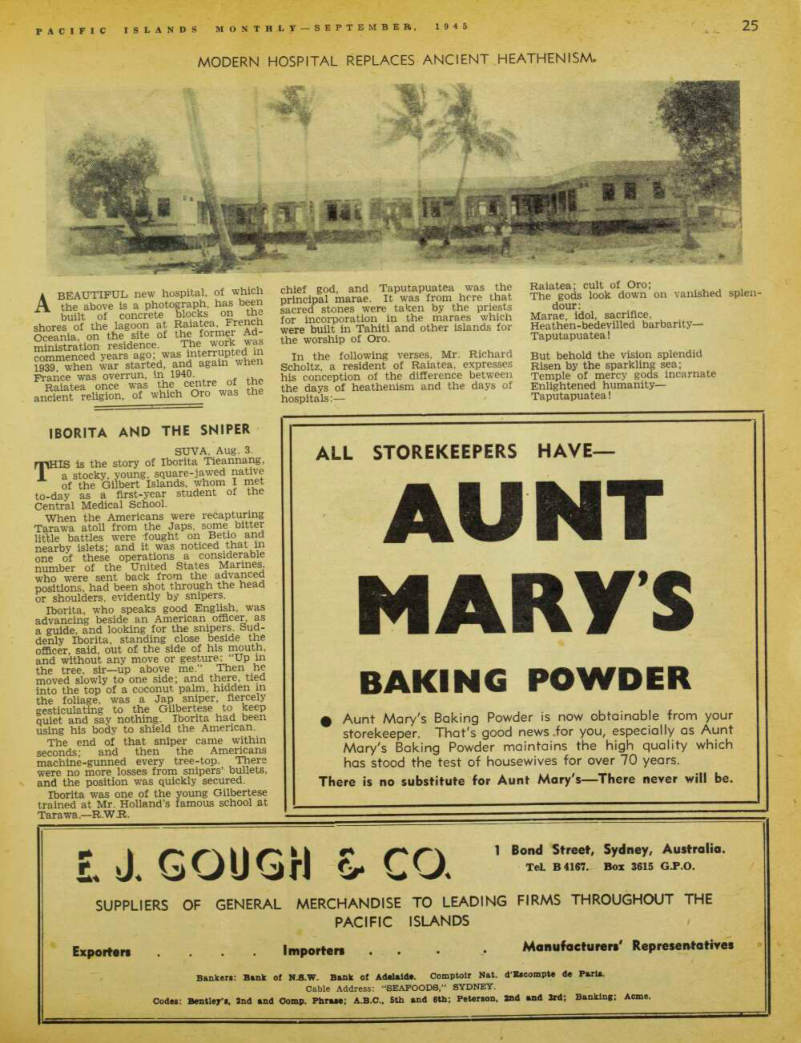
A BEAUTIFUL new hospital, of which the above is a photograph, has been built of concrete blocks on the shores of the lagoon at Raiatea, French Oceania, on the site of the f<ormer Ad ministration residence. The work was commenced years ago; was m 1939, when war started, and again when Prance was overrun, in 1940.
Raiatea once was the centre of the ancient religion, of which Oro was the
chief god, and Taputapuatea was the principal marae. It was from here that sacred stones were taken by the priests for incorporation in the maraes which were built in Tahiti and other islands for the worship of Oro.
In the following verses, Mr. Richard Scholtz, a resident of Raiatea, expresses his conception of the difference between the days of heathenism and the days of hospitals:—
Raiatea; cult of Oro; The gods look down on vanished splen dour: Marae, idol, sacrifice, Heathen-bedevilled barbarity— Taputapuatea!
But behold the vision splendid Risen by the sparkling sea; Temple of mercy gods incarnate Enlightened humanity— Taputapuatea!
Iborita And The Sniper
Suva. Aug. 3.
rIS is the story of Iborita Tieannang, a stocky, young, square-jawed native of the Gilbert Islands, whom I met to-day as a first-year student of the Central Medical School.
When the Americans were recapturing Tarawa atoll from the Japs, some bitter little battles were fought on Betio and nearby islets; and it was noticed that in one of these operations a considerable number of the United States Marines, who were sent back from the advanced positions, had been shot through the head or shoulders, evidently by snipers.
Iborita, who speaks good English, was advancing beside an American officer, as a guide, and looking for the snipers. Sud denly Iborita, standing close beside the officer, said, out of the side of his mouth, and without any move or gesture: “Up in the tree, sir—up above me.” Then he moved slowly to one side; and there, tied into the top of a coconut palm, hidden in the foliage, was a Jap sniper, fiercely gesticulating to the Gilbertese to keep quiet and say nothing. Iborita had been using his body to shield the American.
The end of that sniper came within seconds: and then the Americans machine-gunned every tree-top. There were no more losses from snipers’ bullets, and the position was quickly secured.
Iborita was one of the young Gilbertese trained at Mr. Holland’s famous school at Tarawa. —R.W.R.
Advertisements & other items, pp. 27-28 (1 item)
Marys
ALL STOREKEEPERS HAVE—
AUNT
BAKING POWDER
• Aunt Mary's Baking Powder is now obtainable from your storekeeper. That's good news ior you, especially as Aunt Mary's Baking Powder maintains the high quality which has stood the test of housewives for over 70 years.
There is no substitute for Aunt Mary's—There never will be.
£. J. GOUGH £ CO
I Bond Street, Sydney, Australia.
TeL B 4167. Box 3615 GJ.O.
SUPPLIERS OF GENERAL MERCHANDISE TO LEADING FIRMS THROUGHOUT THE
PACIFIC ISLANDS
Exporter* ... Importer* ... Manufacturer.' Representative.
Bankers: Bank of NB.W. Bank of Adelaide. Comptolr Nat. d’Escompte de Pari*.
Cable Address; “SEAFOODS,” SYDNEY.
Codes: Bentley's. 2nd and Oomp. Phrase; A.8.C., sth and 6th; Peterson, 2nd and 3rd; Banking; Acme,
Refreshing
as a plunge
into a lagoon!
.•■ass?
$0A p fi 3
Germicidal
and fragrant
TENAX TOILET SOAP is
a rapid safeguard against external skin infections, yet it is soothing and kind to the most sensitive skin —even a baby’s!
ORDER TENAX FROM
YOUR ISLAND SUP-
PLIERS. STOCKS ARE
PLENTIFULLY AVAIL-
ABLE.
T. C. WIDDOWSON
European Manufacturing Jewellers^
Island Curios, Tortoise-shell Work, Bracelets, Necklets, Cat's-eyes, Filigree Work.
PROMPT ATTENTION TO ALL POSTAL ORDERS
Post Office Box 44, Suva, Fiji
Victory
In The Spirit Of Hope
Papua-NG Organisations Combine to Celebrate Victory
ALTHOUGH the majority of men are still up north on what was recently a fighting front, and others are pri soners of war or civilian internees, an estimated 700 Territorians attended the combined Papua-New Guinea peace cele brations in the Paddington Town Hall, Sydney, on August 22.
Several notable functions have been held in Sydney by various of the New Guinea and Papuan organisations dur ing these years of exile, but on this occa sion, for the first time, there was ample space for the large number of guests, and that contributed in no small measure to the evening’s outstanding success.
A dance-band provided excellent music but this, as usual, was incidental to the important Territorian business of meet ing old friends and swopping yarns. Ter ritorians are, in the main, auto-enter taining. Even though there is the peren nial beer and spirits drought in Sydney, most guests were able to provide suffi cient of both for lubrication purposes.
This writer has not seen such a gather ing since the Frangipanni Ball in Rabaul in May, 1939. The Frangipanni Ball, held in the New Guinea Club, bid fair to become an annual institution; it marked the anniversary of the first flowering of the frangipanni blossoms after the eruption of 1937, and was as, well as one of Rabaul’s social occasions, an expression of hope in the future.
Much water has run under the bridge in the past six years. Many of the men who danced in Rabaul in May, ’39, have since, in the far corners of the earth, laid down their lives. Others are, or have been, in the hands of the Japanese.
Many of the women who attended the recent Sydney function had had no news of their men for almost four years; and, by and large, most Territorians are wiser and sadder people than those of pre war Rabaul.
The Sydney celebration was a mile stone to mark the transition between the grim days of war and the even grimmer days of rehabilitation that lie ahead; it wa*s a function from which people came
away with renewed hope for the future, and a glow of satisfaction in that they “belonged.” Little more can be said of any function, AFTER a two minutes’ silence in memory of fallen comrades, Mr, A. J.
Gaskin, president of the New Guinea Branch of the RSSAILA, wel comed guests on behalf of the combined New Guinea-Papuan organisation ,of Sydney.
“Former residents of the Territories have cause to be proud of the glorious deeds of their volunteers who, in no small degree, assisted to save Australia from invasion,” said Mr. Gaskin.
“We live in the hope that in the very near future we shall again greet those who are at present absent on foreign soil, and when they do return we, as a body, must get together to meet them.
To-night, for the first time, we are gathered as a united body, representing all the various associations and organisa tions having interests in the Territories of Papua and New Guinea, and I sug gest to you that in our own interests we should continue to be banded together along the road home. It is only by unity that we, who were fortunate enough to escape personal contact with the enemy, can hope to give maximum aid to those less fortunate than ourselves.
“The chairman of the NSW Division of the Australian Red Cross has ex pressed the opinion that radio communi cation will be established with our pri soners within a week of their being con tacted by the relieving forces. With their return we must be in a position to offer them in hand of friendship and assist them to our limit.”
GREETINGS were received from these Territorians and other well-wishers by cable, telegram, and letter, from all over the Commonwealth and overseas; Sir Gilbert Dyett, Federal President of the RSSAILA; the Minister for External Territories, Mr. Ward; Judge (now Wing- Commander) F. B. Phillips: Mr. T. W.
White; the staff of External Territories Department, Canberra; executive and members of the New Guinea Women’s Association in Melbourne; Mr. E. A.
James, president of the Pacific Terri tories Association, who is now in Port Moresby; Mr. Frank Cutler, Melbourne; Mr Tom Targett, Townsville; Mona, Anthony and Gladys Baker, Armidale; Mr and Mrs. Hutchinson, NSW; Mrs Nina Archer. Queensland: Miss Margot Field, Mrs. Winifred Haslan. Mr. and Mrs. Walford King, Mr. and Mrs. Twy cross, Mr. and Mrs. “Tommy” Thompson, Mr. and Mrs. Sid Ambler, Mr. and Mrs.
Luke Mr. and Mrs. Farnsworth, and Mr.
Dave’ Davis, all of Perth.
One message, purporting to come from New Guinea (and strictly for Terntonan consumption) read: “All missus now master belong New Guinea before—now all me fella boy like sendem talk along vou Bell belong all me fella hot too much along this fella. Now all me fella stop along Nambish look out along all vou fella missus now master come back along place belong y6u feha. Savvy all together he hot big trouble before now altogether something he all right behind.
Master me no got tobac.”
Guests of honour at the function were Sir Walter McNicoll and the Administra tor of Papua (Mr. Leonard Murray) and Mrs. Murray.
(Continued on Page 27)
BOTH the former Civil Administrators addressed the gathering, briefly, and each was warmly welcomed. Each spoke of the happiness he had gained through long years of service in the Ter ritories, of the good friendships made there, and of their bitter regret that so many lives had been lost, and so much destruction had been done.
Mr. Murray said that he did not know whether he and his wife would return to the Territories; but, in any event, their hearts and their interest would remain there always, among the people with whom they had lived so long. He em phasised the problems and difficulties which confronted the post-war Govern ment, and urged all who wished to see prosperity and happiness restored to assist the new Administrator, whoever he might be, and co-operate with him in every possible way—especially in his heavy task of restoring normal conditions among the natives. , Sir Walter McNicoll spoke of the im perishable record of the New Guinea Volunteer Rifles. He described how the unit was formed, how it was trained — and how splendidly its members acquitted themselves when all the horrors of in vasion and war broke suddenly over the Territory in January, 1942. He had retired and would not return to the Territory officially; but he and Lady McNicoll never would forget their years at Nama nula, and all the kindnesses they had re ceived at the hands of New Guinea resi dents —many of whom, unhappily, had disappeared in the invasion.
Dr. Baxter, Medical Officer of Health to the Central Board of Health, has left Fiji on long leave, and his place has been taken by Dr. Taylor, who has been trans ferred from Lautoka. A booklet called “Facts About Flies in Fiji” by Dr. Baxter has recently been published.
of Pearls
Of Love, and a Dish of Pearls New Frisbie Romance
“ MARU”—a novel of the South Seas, by Robert Dean Frisbie . Pub
lished by Doubleday Doran, New York,
for $2.50.
Because of his puritan upbringing in the Californian foothills, Allen Susten ance had inhibitions that even the South Seas could not break down; not for some time, at any rate.
His Uncle Romany, a sinful old South Seas rover, who told tales of avaricious missionaries, and lust and murder and escaped convicts from Noumea, and soup tureens full of pearls hidden away on a secret island, was responsible for Allen seeking coral-island adventures on his own account.
He found Amaru island and fell in love with it; and in Wide-Awake village, on Amaru, he found Tina, the daughter of the Resident Agent, and fell in love with her. But he would not marry her— either legally, or South Seas fashion— until he found the soup tureen full of pearls.
On Amaru, too, he met Takataka, the poker-playing vicar, and Noah the King, and learned more about the pearls and the Reverend Christian who, a half cen tury before, had ruled the forgotten is land of Thanksgiving with a rod of iron, and who kept a secret penal island for recalcitrant pearl-divers and islanders.
He learned, also, of Princes Tenina, of Thanksgiving Island, who had given away the tureen of pearls in order to escape from Christian’s domination. “I’d rather be a feeder of pigs in Tahiti than Queen of Thanksgiving Island,” said Tenina.
Finally Allen and Tina, Abel the trader, the vicar and his fat wife and three
children, set out in the vicar’s cutter for Christian’s secret island, there to write the final chapter of Uncle Romany’s story.
IT is typical coral-island fare —pearldivers and buried treasure, man-eat ing sharks and fugitives from jus tice in stolen schooners. With love (and inhibitions) thrown in for good measure.
It is a departure from Frisbie’s usual trader’s stories of Puka Puka, but it is still Frisbie’s Polynesia—the traders, the village big-wigs, the love-making girls and the woman-chasing men (women chasing not being a derogatory term as it might in Anglo-America, but an honour able state).
Perhaps Frisbie fans will miss the per sonal touch of former autobiographical books, and bemoan the fact that there are no further adventures of the Cow boys, whom they met in “Island of Desire”; but, coming at this time the strictly non-serious romance of the South Seas should prove a valuable antidote to war-reaction nerves.—J.T.
The North African paper, “Dernieres Nouvelles d’Alger,” describes how the guitarists of the joint Tahitian-Cale donian Bataillon du Pacifique have con quered Paris with their songs of fishing, of sea life, and of love. The painter, Jean Gabriel Domerque. presented the musicians to many Parisian personalities, entertaining them in his luxurious flat.
Advertisements & other items, p. 29 (1 item)
lan ray
EYE LOTI
For IxJUmad Era* and Ey*Hdi
SOLD EVEITWHEII
H A. A Co. Pty. Lt<(., Klm 9L, »><n»y
QmL q*
yiOlo---
FOR EARLY DELIVERY OF
Built to the same rigid specifications of quality and workmanship as laid down by the Army, the new LANRAY Line of Metal Products for civilian requirements is going to mean big business for dealers throughout Australia. Place your order NOW for— LANRAY Kerosene Pressure Stoves and Blow Lamps Holloware Light Fittings Key Blanks Industrial Reflectors.
lan ray
METAL PROD U CT S PTY. LTD.
METAL PRODUCTS FOR
CIVILIAN USE
Sole Distributors
LANCE RAYMOND Pty. Ltd.
11-19 Margrave St., Sydney Phone FL 3132 and af King House, Queen St.
Brisbane
LANRAY DISTRIBUTORS
Temple Court, Collins St.. Melbourne
Fiji Has Days Victory
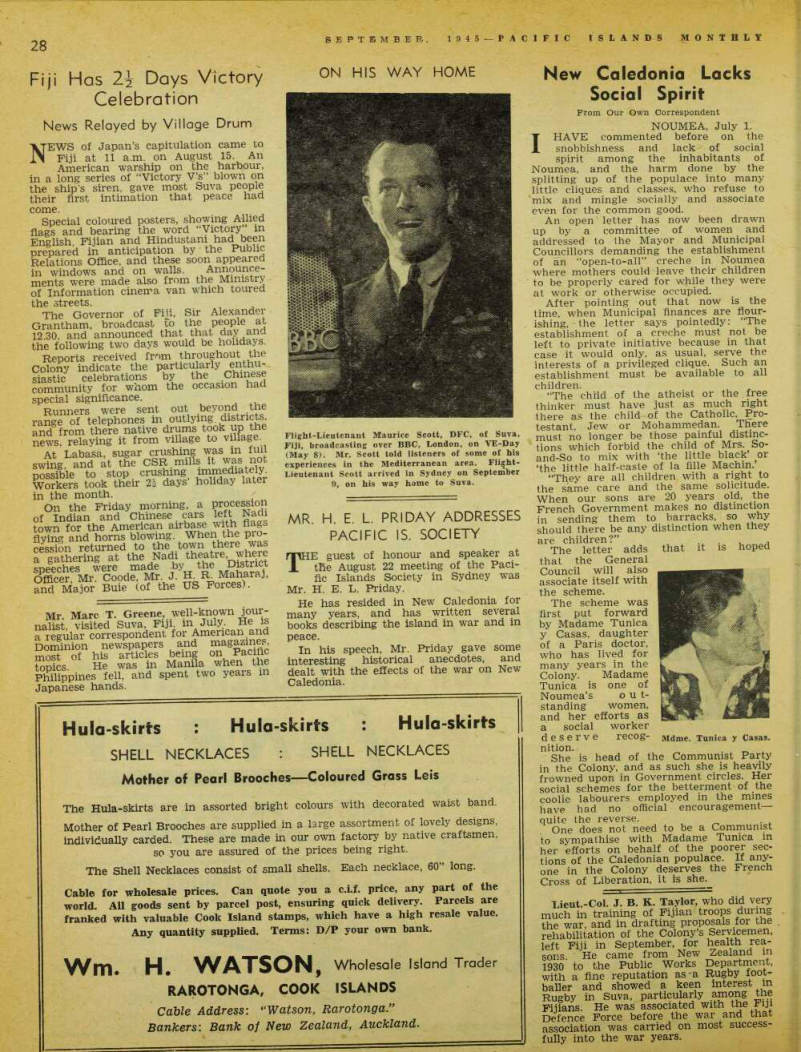
Celebration News Relayed by Village Drum
NEWS of Japan’s capitulation came to Fiji at 11 a.m. on August 15. An American warship on the harbour, in a long series of “Victory V’s” blown on the ship’s siren, gave most Suva people their first intimation that peace had come.
Special coloured posters, showing Allied flags and bearing the word “Victory m English, Fijian and Hindustani had been prepared in anticipation by the Public Relations Office, and these soon appeared in windows and on walls. Announce ments were made also from the Ministry of Information cinema van which toured the streets.
The Governor of Fiji, Sir Alexander Grantham, broadcast to the people at 12 30, and announced that that day and the following two days would be holidays.
Reports received from throughout the Colony indicate the particularly enthu siastic celebrations by the Chinese community for whom the occasion had special significance.
Runners were sent out beyond the range of telephones in outlying districts, and 8 from there native drums took up the news, relaying it from village to village.
At Labasa, sugar crushing was in full swing, and at the CSR mills it was n nossible to stop crushing immediately.
Workers took their 21 days’ holiday later in the month.
On the Friday morning, a procession of Indian and Chinese cars left Nadi town for the American airbase with flags flying and horns blowing. When the pro cession returned to the town there was a gathering at the Nadi theatre, where sneeches were made by the District Officer Mr. Coode, Mr. J. H. R. Maharaj, and Major Buie (of the US Forces).
Mr. Marc T. Greene, well-known jour nalist, visited Suva, Fiji, in July. He is a regular correspondent for American and Dominion newspapers and most of his articles being on acl “2 topics. He was in Manila when the Philippines fell, and spent two years in Japanese hands.
On His Way Home
Flight-Lieutenant Maurice Scott, DFC, of Suva, Fiji, broadcasting over BBC, London, on VE-Day (May 8). Mr. Scott told listeners of some of his experiences in the Mediterranean area. Flight- Lieutenant Scott arrived in Sydney on September 9,on his way home to Suva.
Mr. H. E. L. Priday Addresses
Pacific Is. Society
mHE guest of honour and speaker at X the August 22 meeting of the Paci fic Islands Society in Sydney was Mr. H. E. L. Friday.
He has resided in New Caledonia for many years, and has written several books describing the island in war and in peace.
In his speech, Mr. Friday gave some interesting historical anecdotes, and dealt with the effects of the war on New Caledonia.
Social Spirit
New Caledonia Lacks Social Spirit
Prom Our Own Correspondent
Noumea, July 1.
IHAVE commented before on the snobbishness and lack of social spirit among the inhabitants of Noumea, and the harm done by the splitting up of the populace into many little cliques and classes, who refuse to mix and mingle socially and associate even for the common good.
An open letter has now been drawn up by a committee of women and addressed to the Mayor and Municipal Councillors demanding the establishment of an “open-to-all” creche in Noumea where mothers could leave their children to be properly cared for while they were at work or otherwise occupied.
After pointing out that now is the time, when Municipal finances are flour ishing, the letter says pointedly; “The establishment of a creche must not be left to private initiative because in that case it would only, as usual, serve the interests of a privileged clique. Such an establishment must be available to all children.
“The child of the atheist or the free thinker must have just as much right there as the child of the Catholic, Pro testant, Jew or Mohammedan. There must no longer be those painful distinc tions which forbid the child of Mrs. So and-So to mix with ‘the little black or ‘the little half-caste of la fille Machin.
“They are all children with a right to the same care and the same solicitude.
When our sons are 20 years old, the French Government makes no distinction in sending them to barracks, so why should there be any distinction when they are children?”
The letter adds that it is hoped
that the General Council will also associate itself with the scheme.
The scheme was first put forward by Madame Tunica y Casas, daughter of a Paris doctor, who has lived for many years in the Colony. Madame Tunica is one of Noumea’s out standing women, and her efforts as a social worker deserve recog nition.
She is head of the Communist Party in the Colony, and as such she is heavily frowned upon in Government circles. Her social schemes for the betterment of the coolie labourers employed in the mines have had no official encouragement— quite the reverse.
One does not need to be a Communist to sympathise with Madame Tunica in her efforts on behalf of the poorer sec tions of the Caledonian populace. If any one in the Colony deserves the French Cross of Liberation, it is she.
Lieut.-Col. J. B. K. Taylor, who did very much in training of Fijian troops during the war, and in drafting proposals for the rehabilitation of the Colony’s Servicemen, left Fiji in September, for health rea sons. He came from New Zealand in 1930 to the Public Works Department, with a fine reputation as-a Rugby foot baller and showed a keen interest m Rugby in Suva, particularly among the Fijians. He was associated with the Fiji Defence Force before the war and that association was carried on most success fully into the war years.
Mdme. Tunica y Casas.
Advertisements & other items, p. 30 (1 item)
Wm. H. WATSON, Wholesale Island Trader
Hula-skirts : Hula-skirts : Hula-skirts
SHELL NECKLACES : SHELL NECKLACES
Mother of Pearl Brooches —Coloured Grass Leis The Hula-skirts are in assorted bright colours with decorated waist band.
Mother of Pearl Brooches are supplied in a large assortment of lovely designs, individually carded. These are made in our own factory by native craftsmen, so you are assured of the prices being right.
The Shell Necklaces consist of small shells. Each necklace, 60” long.
Cable for wholesale prices. Can quote you a c.i.f. price, any part of the world. All goods sent by parcel post, ensuring quick delivery. Parcels are franked with valuable Cook Island stamps, which have a high resale value.
Any quantity supplied. Terms: D/P your own bank.
Wm. H. WATSON, Wholesale Island Trader
RAROTONGA, COOK ISLANDS
Cable Address : “Watson, Rarotongar Bankers'. Bank of New Zealand, Auckland.
Muddling Through
In Papua
Old Planter is Outspoken
rE disruption of native life in some areas has been tragic—and I am not referring to battle-torn districts (writes an old Papuan planter, who re cently returned to the Territory “through a side door”).
From the information I have, those ANGAU officers who had been members of the Murray Administration did all in their power to protect those natives whose homes and villages were in “operational areas.” Unfortunately, not all ANGAU officers were of the Murray regirfie; the gentleman who had his throat slit by natives on Moturina Island in ’42 was one of them. Had a Papuan officer made that patrol he would not have undergone that discomfort. In the handling of natives under difficult circumstances, and with a minimum of friction, Papuan officials have nothing to learn.
It is hard to understand why Mr. Ward (Eddie, of that ilk) -should be making such a song and dance about indentured labour, especially in view of the present putrid system in active operation right under his nose. And how did he come to smell out those “grave abuses under the Murray Administration”? I fear he is a little adrift in his geography, and has the idea Sir Hubert Murray’s seat of gov ernment was Rabaul. In fact, before ’4l, I doubt if Mr. Ward -really knew much about Papua or where it was situated.
Knowing, as he did, little or nothing about either Territory, Mr. Ward was ob viously the sort of Minister Canberra would place in charge of both. If he played merry hell with the Territories, no harm was done —the settlers, having no votes, couldn’t retaliate at the polls, and niggers are of no moment (or weren’t until war correspondents discovered they were “fuzzy-wuzzy angels”).
Apropos this “fuzzy-wuzzy angel” stuff: Aren’t they a shade on the smellful side for angels? Or a little too earthy, as it were? I have always understood angels are very finicky in the matter of personal cleanliness and morals. rE trading monopoly now held by ANGAU for about three years, takes us back to the days of the New South Wales Rum Corps (history has a nasty habit of repeating itself). Trading occu pies the time and energy of a generous proportion of ANGAU personnel; bright energetic young fellows who prefer thflt kind of work to winkling the Japs out of jungle fox-holes. Returnees, however, discovered indulging their commercial in stincts are hung, drawn, and quartered, and the remnants hurled into the Coral Sea —on this matter the local Gestapo are fierce.
Trading is a close preserve, into which only the Army, Navy, Air Force, Ameri cans, and, of course, ANGAU, are allowed to enter. Some enterprising “Aberdo nians” in the various arms of the Forces are doing very well for themselves. We who have spent the best part of our 'years, cash, and health, in an effort to make Papua a good country for both white and native to live in, are expected to watch the aforementioned racket with out comment.
For base wallahs, black-marketeers, publicans, politicians, de facto wives, and a host of other parasites (including the Australian devotees of Joe of Moscow) this has been a wonderful war; and they dread the cessation of hostilities. But lose no sleep over the slaughter in the front lines. No wonder we had a host of wishful gentry telling us it would take
“many years to scupper the Jap.” (One authority mentioned 10 years). How en couraging this must have been to the lads battling along in the jungles of the islands, or on the hills of Burma. rE administrative set-up in Papua at present has to be seen to be believed.
Take this area, for instance. Under the Murray regime, now much maligned in certain circles, one ARM, and a few native police, gave efficient and kindly oversight to these island communities.
For transport from island to island he had a powered whaleboat.
The present staff embodies at least one major, three or four captains, a “pride” of lieutenants, and a “gaggle” or so of warrant officers and lower ratings—all busy tearing into a job previously held down by one, occasionally two, of Murray’s men. I doubt if they raise much sweat over it. In order to save shoe leather they have about five or six powered vessels at their disposal. Re turnees have to use Shanks' mare, or just stay put; ANGAU has all our boats.
If all these gentlemen are going to be carried over into the Civil Administration the Australian taxpayer is going to get a jolt. The pre-war contribution to Papua from Canberra for the Public Serr vice was about £40,000 per year. We doubt if twice that amount per month would cover present ANGAU expenditure.
Who is going to foot this bill when Army
appropriations cease? The revenue of the Territory will not nearly suffice to cover it.
For political reasons, gentry, who in times of peace lauded the Murray Gov ernment to the skies, now decry it to the depths. Alive, Sir Hubert was acclaimed by these men “a great Pro-Consul”!
Dead, “there is none so poor as to do him honour.” This pitiful, pettifogging, pack of poltroons, who now sit in high places in Canberra to criticise and belittle a sys tem of native administration praised the world over, shows the measure of present day intelligence; full of the valour of ignorance they would destroy an edifice which took wise, and patient, and far seeing Administrations many years to build. From Murray back to Macgregor, a line of sincere and devoted men worked and planned for Papua and the Papuans, white or native; if they had any bias it was in favour of the brown folk—and rightly so.
It is imperative that this great work be continued. Freak legislation of the kind favoured by Ward and Co. will destroy these native people. They are, as yet, too immature mentally to sur vive drastic changes in their social set up. The rhythm of village life must be maintained, or they die. Common sense and the real welfare of these Papuan natives demand the Murray Administra tion be reinstated, and the sooner the better.
Advertisements & other items, p. 31 (1 item)
Sheaffer’S World Famous
Streamlined, Feather Touch PENS and PENCILS
If you want
Design, Beauty
and Quality buy
a SHEAFFER
All Lifetime Pens are guaranteed for the life of the user ixcept against lofis and wilful damage.
When serviced, they are subject to a small fee for insurance, postage and handling.
Beautiful and Useful Gifts for All Occasions.
SKRIP - The
Successor to Ink makes all Pens write better. 2 oz. 1/6, 4 oz. 2/6 Plus Postage Distributors Identify the Lifetime i Pen by the white dot 74T
LTSC A A ST
Lifetime Pencil Regular Pen Pencil 9 6 2b/~ 35i- ea. each each The working parts of the Bheaffer Pencil are guaranteed against wear for the lifetime of the user.
When serviced they are subject to a fee for insurance, postage and handling.
All Bheaffer regular pens are guaranteed against defects of material and workmanship.
Obtainable from Selected Jewellers and Sta tioners everywhere
EXCELSIOR SUPPLY CD. PTY. LTD.
278 Post Office Place,
MELBOURNE, VIC.
HEAD OFFICE ]
160 BROADWAY,
SYDNEY, N.S,W.
50 Victoria Street,
WELLINGTON, N.Z.
Theodore's Goldmine In Fiji
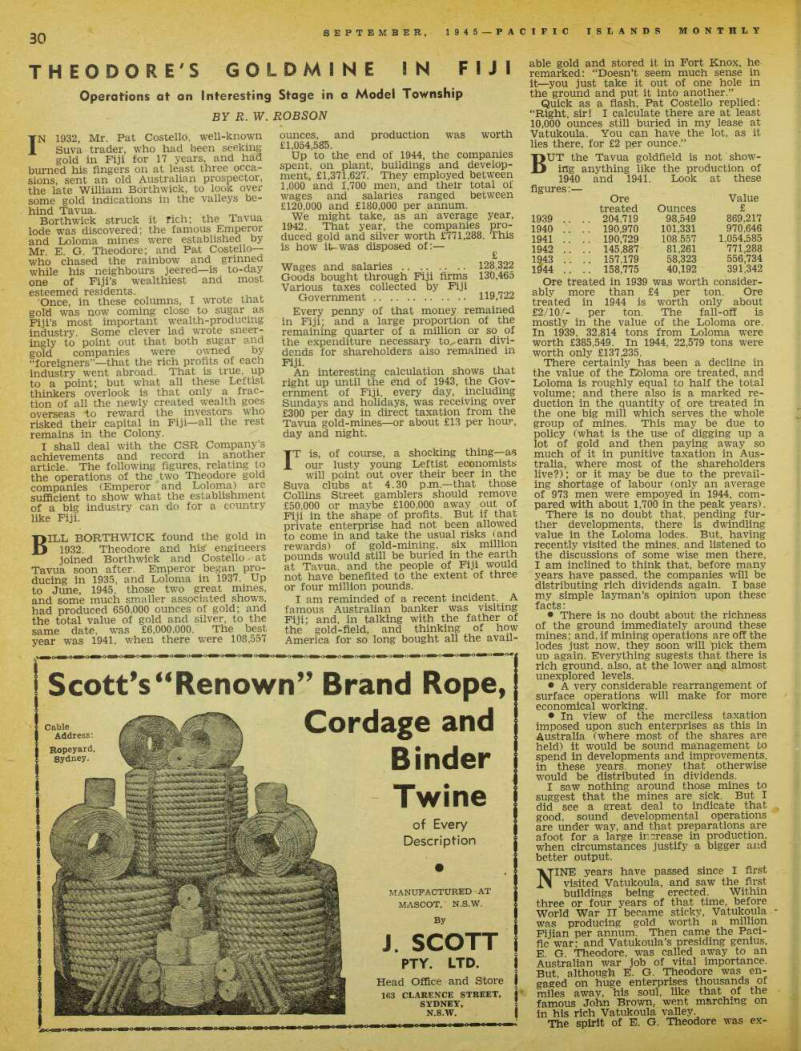
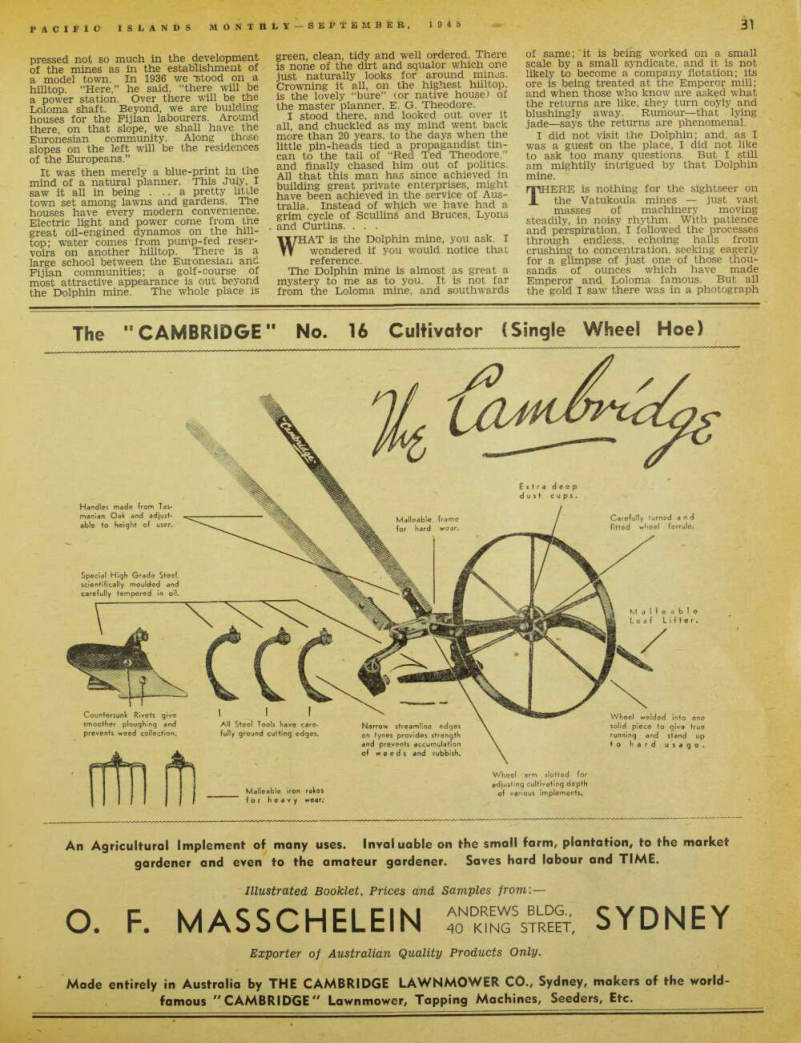
Operations at an Interesting Stage in a Model Township
By R. W. Robson
1N 1932, Mr. Pat Costello, well-known Suva trader, who had been seeking gold in Fiji for 17 years, and had burned his fingers on at least three occa sions, sent an old Australian prospector, the late William Borthwick, to look over some gold indications in the valleys be hind Tavua. . m Borthwick struck it rich; the Tavua lode was discovered; the famous Emperor and Loloma mines were established by Mr E. G. Theodore; and Pat Costello— who chased the rainbow and grinned while his neighbours jeered—is to-day one of Fiji’s wealthiest and most esteemed residents.
Once, in these columns, I wrote that gold was now coming close to sugar as Fiji’s most important wealth-producing industry. Some clever lad wrote sneer ingly to point out that both sugar and gold companies were owned by “foreigners”—that the rich profits of each industry went abroad. That is true, up to a point; but what all these Leftist thinkers overlook is that only a frac tion of all the newly created wealth goes overseas to reward the investors who risked their capital in Fiji—all the rest remains in the Colony.
I shall deal with the CSR Company’s achievements and record in another article. The following figures, relating to the operations of the two Theodore gold companies (Emperor and Loloma) are sufficient to show what the establishment of a big industry can do for a country like Fiji.
BILL BORTHWICK found the gold in 1932. Theodore and his engineers joined Borthwick and Costello at Tavua soon after. Emperor began pro ducing in 1935, and Loloma in 1937. Up to June, 1945, those two great mines, and some much smaller associated show's, had produced 650,000 ounces of gold; and the total value of gold and silver, to the same date, was £6,000,000. The best year was 1941, when there were 108,557
ounces, and production was worth £1,054,585.
Up to the end of 1944, the companies spent, on plant, buildings and develop ment, £1,371,627. They employed between 1,000 and 1,700 men, and their total of wages and salaries ranged between £120,000 and £lBO,OOO per annum.
We might take, as an average year, 1942. That year, the companies pro duced gold and silver worth £771,288. This is how it-was disposed of; — £ Wages and salaries 128,322 Goods bought through Fiji firms 130,465 Various taxes collected by Fiji Government 119,722 Every penny of that money remained in Fiji; and a large proportion of the remaining quarter of a million or so of the expenditure necessary divi dends for shareholders also remained in Fiji. , J An interesting calculation shows that right up until the end of 1943, the Gov ernment of Fiji, every day, including Sundays and holidays, was receiving over £3OO per day in direct taxation from the Tavua gold-mines—or about £l3 per hour, day and night.
IT is, of course, a shocking thing—as our lusty young Leftist economists will point out over their beer in the Suva clubs at 4.30 p.m.—that those Collins Street gamblers should remove £50,000 or maybe £lOO,OOO away out of Fiji in the shape of profits. But if that private enterprise had not been allowed to come in and take the usual risks (and rewards) of gold-mining, six million pounds would still be buried in the earth at Tavua, and the people of Fiji would not have benefited to the extent of three or four million pounds.
I am reminded of a recent incident. A famous Australian banker was visiting Fiji; and, in talking with the father of the gold-field, and thinking of how America for so long bought all the avail
able gold and stored it in Fort Knox, he remarked: “Doesn’t seem much sense in it—you just take it out of one hole in the ground and put it into another.”
Quick as a flash, Pat Costello replied: “Right, sir! I calculate there are at least 10,000 ounces still buried in my lease at Vatukoula. You can have the lot, as it lies there, for £2 per ounce.”
BUT the Tavua goldfield is not show ing anything like the production of 1940 and 1941. Look at these figures:—
Ore treated in 1939 was worth consider ably more than £4 per ton. Ore treated in 1944 is worth only about £2/10/- per ton. The fall-off is mostly in the value of the Loloma ore.
In 1939, 32,814 tons from Loloma were worth £385,549. In 1944, 22,579 tons were worth only £137,235.
There certainly has been a decline in the value of the EToloma ore treated, and Loloma is roughly equal to half the total volume; and there also is a marked re duction in the quantity of ore treated in the one big mill which serves the whole group of mines. This may be due to policy (what is the use of digging up a lot of gold and then paying away so much of it in punitive taxation in Aus tralia, where most of the shareholders live?); or it may be due to the prevail ing shortage of labour (only an average of 973 men were empoyed in 1944, com pared with about 1,700 in the peak years).
There is no doubt that, pending fur ther developments, there is dwindling value in the Loloma lodes. But, having recently visited the mines, and listened to the discussions of some wise men there, I am inclined to think that, before many years have passed, the companies will be distributing rich dividends again. I base my simple layman’s opinion upon these facts: • There is no doubt about the richness of the ground immediately around these mines; and, if mining operations are off the lodes just now, they soon will pick them ud again. Everything sugests that there is rich ground, also, at the lower and almost unexplored levels. • A very considerable rearrangement of surface operations will make for more economical working. • In view of the merciless taxation imposed upon such enterprises as this in Australia (where most of the shares are held) it would be sound management to spend in developments and improvements, in these years, money that otherwise would be distributed in dividends.
I saw nothing around those mines to suggest that the mines are sick. But I did see a great deal to indicate that good, sound developmental operations are under way, and that preparations are afoot for a large increase in production, when circumstances justify a bigger and better output.
NINE years have passed since I first visited Vatukoula, and saw the first buildings being erected. Within three or four years of that time, before World War II became sticky, Vatukoula was producing gold worth a million.
Fijian per annum. Then came the Paci fic war; and Vatukoula’s presiding genius, E G Theodore, was called away to an Australian war job of vital importance.
But. although E. G. Theodore was en gaged on huge enterprises thousands of miles away, his soul, like that of the famous John Brown, went marching on in his rich Vatukoula valley.
The spirit of E. G. Theodore was ex
Ore Value treated Ounces £ 1939 .. .. 204,719 98,549 869,217 1940 .. .. 190,970 101,331 970,646 1941 .. .. 190,729 108 557 1.054,585 1942 .. .. 145,887 81,261 771,288 1943 .. .. 157.179 58,323 556,734 1944 .. .. 158,775 40,192 391,342
nressed not so much in the development oPthe mhies af h? th? establishment of f modeftown In 1936 to tSxS on a hilltop ‘rare” he said “there will be a nower statfon Ovlr there will be the Moma shaft Bevond we are building hoiisS for the labourers Around there on that flope we shall have the Euronesian community Along those clones on the left will be the residences nf the Fnroneans ” t! 4.1/ ' ; . i . iVI . ?t was then merely a blue-print lx me “w it an ?n betag P a pretty litlle town set among lawns and gardens. The houses have every modern convenience.
Electric light and power come from the great oil-engined dynamos on the hilltop* water comes from pump-fed reservoirs on another hilltop. There is a large school between the Euronesian and Fijian communities; a golf-course of most attractive appearance is out beyond the Dolphin mine. The whole place is
green, clean, tidy and well ordered. There is none of the dirt and squalor which one just naturally looks for around mines.
Crowning it all, on the highest hilltop, is the lovely “bure” (or native house) of the master planner, E. G. Theodore.
I stood there, and looked out over it all, and chuckled as my mind went back more than 20 years, to the days when the little pin-heads tied a propagandist tin can to the tail of “Red Ted Theodore,” and finally chased him out of politics.
All that this man has since achieved in building great private enterprises, might have been achieved in the service of Aus tralia. Instead of which we have had a grim cycle of Scullins and Bruces, Lyons and Curtins. . . .
WHAT is the Dolphin mine, you ask. I wondered if you would notice that reference.
The Dolphin mine is almost as great a mystery to me as to you. It is not far from the Loloma mine, and southwards
of same; it is being worked on a .small scale by a small syndicate, and it is not hkely to become a company flotation; its ore is being treated at the Emperor mill; and when those who know are asked what the returns are like, they turn coyly and blushmgly away Rumour-that lying jade-says the returns are phenomenal. i did not visit the Dolphin; and, as I wa s a guest on the place, I did not like to ask too many questions. But I still am mightily intrigued by that Dolphin min e.
T HERE iS no „ thi ? B f ° r the s «" °" 1 the Vatukoula mines - just vast masses of machinery moving steadily, in noisy rhythm. With patience and perspiration. I followed the processes through endless, echoing halls from crushing to concentration, seeking eagerly for a glimpse of just one of those thou sands of ounces which have made Emperor and Loloma famous. But all the gold I saw there was in a photograph
of piled-up ingots, on the manager’s office wall.
So I went out across the little ridge, onto Pat Costello’s lease, where brother Tom Costello is working what he claims to be the smallest mill in captivity—and making a comfortable income. And he put into my hands three little soft dollops, like hazel-nuts, and there, in the tiniest specks, was Tavua gold.
They have only scratched the surface of the Costello lease. Deep digging almost certainly will reveal great wealth.
That mysterious Dolphin mine is just around the corner of the hill.
Advertisements & other items, pp. 32-33 (1 item)
Cordage and
Scott's “Renown” Brand Rope,
Binder
Twine
of Every Description Cable % Address; Ropeyard, Sydney. m
MANUFACTURED AT
MASCOT, N.S.W.
J. SCOTT
,TY. LTD.
Head Office and Store
163 CLARENCE STREET,
SYDNEY,
N.S.W.
The "CAMBRIDGE" No. 16 Cultivator (Single Wheel Hoe) A.
Extra deep dust cups.
Handles made from Tasmanian Oalt and adjustable to height of user.
Malleable frame for hard wear.
Special High Grade Steel, scientifically moulded and carefully tempered in oil.
Malleable Leaf Lifter.
I I I
All Steel Tools have carefully ground cutting edges.
Countersunk Rivets give smoother ploughing and prevents weed collection.
Narrow streamline edges on tynes provides strength and prevents accumulation of weeds and rubbish.
Wheel welded into one solid piece to give true running and stand up to hard usage.
Malleable iron rakes for heavy wear,- Wheel arm slotted for adjusting cultivating depth of various implements-t An Agricultural Implement of many uses. Invaluable on the small farm, plantation, to the market gardener and even to the amateur gardener. Saves hard labour and TIME.
Illustrated Booklet , Prices and Samples from :—
O. F. MASSCHELEIN
ANDREWS BLDG.,
40 KING STREET,
SYDNEY
Exporter of Australian Quality Products Only.
Made entirely in Australia by THE CAMBRIDGE LAWNMOWER CO., Sydney, makers of the worldfamous "CAMBRIDGE" Lawnmower, Tapping Machines, Seeders, Etc.
Death Of New Hebrides
Resident
Mr. Donald Fraser
NEWS has just been received of the death, several months ago in the New Hebrides, of Donald Fraser, a well-known-resident of that Territory.
He was employed for many years in Fiji by the CSR Co., but took over a large property in the New Hebrides shortly before World War I. He held this until the depression, and then bought a smaller place at Qu’a-la-Wea Bay.
Mr. Fraser had been in ill-health for some time. An old friend remarks that he had been in the tropics too long with out a holiday.
He is survived by his widow. Madame Fraser, a Frenchwoman, is now living with a friend in Vila.
Extraordinary Price Of
Flour In Tonga
IT must cost real money to eat bread in Tonga these days. Figures supplied by A. Cowley & Sons, bakers, of Nukualofa, to a firm of flour millers in Sydney, indicate that they pay over £3O per ton for flour.
The cost of flour in Sydney, where Tonga is now getting its flour, is about £l2/10/-, of which £2 is Government tax.
Fiji, too, has it bread worries; as indi cated ’in an article elsewhere in this issue, the cost of a loaf of bread in Suva is now 10d.
Captain Robert Bruce, well known in South-West Pacific waters, is at present stationed in Sydney in the Ordnance Branch of the Royal Navy.
New Guinea
I think I like you Jewelled isle!
With emerald green of leafy trees And sapphire blue of sky above; Below, the pearly tinted seas, And sunset, ruby through the grove.
I think I hate you Cruel isle!
Your steamy jungle, fever-ridden; Your wing-ed death and saurians vile, Your muddied pools where lurking, hidden, There waits the leering crocodile.
I think I like you Tropic isle!
While rippling streams leap o’er the rocks, Cascading on their cool pursuits; Attendant birds in vivid flocks, And all your gifts of luscious fruits.
I think I hate you Mystic isle!
With all your dark and sullen lore; Your tribal hatreds, gory feasts, Your cries of vengeance evermore.
And rankling fears in pagan breasts.
I think I like you Friendly isle!
Where natives touched by kindly hands Give lavish greeting, sunny smiles, And laughter trickles through the palms And languid peace the day beguiles.
I think I hate you Fearsome isle!
For war has crashed across your lands, And memories hideous haunt the brain While graves are strewn along the sands To mark the rest of gallant slain.
N You, leave me wondering . . .
Piquant isle!
Your moods, coquettish as a maid, Your intermingled joy and tears, Your peace and sadness overlaid Will keep me wondering through the years.
L. J. Gomm.
New Guinea, 1944.
Mrs. W. E. Harness, 74, died in Suva in August. Her husband predeceased her by only three years. They were old residents of Fiji. Their son, the popular Captain “Teddie” Harness, one-time master of the “Nimanoa,” and now temporarily in charge of Suva port, has had much family trouble lately. A few days before his mother died, his young wife had to leave by air for Auckland to undergo an urgently-required operation.
Vice-Regal
Bad Weather Mars Vice-Regal Visit to Cook Is.
Prom Our Own Correspondent
Rarotonga, Aug. 10.
rE Governor-General of New Zealand, Sir Cyril Newall, and Lady Newall, accompanied by Major H. A. Jaffray and Mrs. Jaffray, Captain D. E. A. Winn and Miss N. Walton, arrived in Raro tonga on August 6.
The party was several days overdue owing to the extremely bad weather pre vailing in the area. The small Fiji Gov ernment vessel HMS “Viti” on which they travelled encountered rough seas and heavy rain squalls all the way be tween Tonga and Rarotonga.
After sheltering at Niue for a day, an attempt was made to resume the journey; but the ship was forced to return to the shelter of the island for several more days before it was considered safe to continue.
The vessel received a further pound ing before reaching Rarotonga and, on the evening before its arrival, a heavy sea threw Sir Cyril Newall violently from his chair. (A subsequent X-ray examina tion showed that three of his ribs had been broken.) The people of Rarotonga admired the manner in which Sir Cyril stepped straight ashore and smilingly faced the ordeal of a public reception, followed by a non-stop round of official and social functions, in spite of the pain and dis comfort of his injuries.
Their Excellencies inspected the guards of honour of the Rarotonga Defence Force, Returned European and Maori Soldiers, Boys’ Brigade and Girl Guides, and attended a traditional welcome by a leading Maori chief and the official wel come conducted by the Resident Commis sioner, Mr. W. Tailby.
It was originally intended after the second day’s programme the visitors would depart. But, at the end of the Maori entertainment, it was an nounced that owing to the Governor- General’s condition and general tiredness of the party, they would stay a further day to rest. , A 1 As the sea remained rough the tour of the outer islands was abandoned, and a plane was sent from Fiji to pick up th Sir Pa Cyril said that he regretted they were unable to complete the tour of the outer islands. They hoped to make a further visit in the near future.
tongan scholarships
WE are informed by Maka Lisiate, of Nukualofa, that the Tongan organi sation called Kautaha Fetokoni’aki Society is proceeding with its organisa tion It has raised £420 in 14 months, and is trying to raise £3O per month, to support Tongan scholars. . In a general meeting held in March, it was decided to allot one scholarship to a Tongan who would be apprenticed to practical engineering in Fiji. It is hoped to award other scholarships to Tongans, for education in New Zealand.
Our correspondent says that the Society is going "ahead despite adverse criticism, and hopes to get the support of the Tongan Government.
F/Lieut. F. R. B. Denton, RAAF, has been accepted and appointed by the Board of the Methodist Overseas Mission as Lay Business Manager in Fiji. He has now secured his release from the RAAF, and, with Mrs. Denton and .their small daughter, will soon be leaving for Suva.
Advertisements & other items, pp. 34-35 (3 items)
32
SEPTEMBER, ISLANDS MONTHLY
Producing Uniform Good Results Since 1868
ALWAYS ASK FOR IT
Harry I.Wung Pty. Ltd.
i £
Sole Pacific Islands Selling Representatives
For: ./
L BOND’S
Quality
A
Garments
LOVELIER
THANEVER
i
Dona
s ' ■ - \ m.
BOND’S
STANDARD
ATHLETICS
V / in
BONDS
HOSIE RY
Postal Address: Box 3661, G.P.0., Sydney
HARRY I.WUNG PTY.LTD.
379 KENT ST.,
Sydney.
Bankers: Bank of N.S.W. < .
Codes: <V- Bentley’s Comp. Phrase Bentley’s 2nd Phrase.
Was Killed
How Lincoln Bell
Rai Coast Natives Ran Amok on "Cargo" Myth
Ac a rPQlllt nf nnhiiritv frivpn hv r“ s o nnmhp? Of Islands Mmithly, a number of people have assisted Mrs. Joan Bell, of Oatiands Tasmania, in assembling reh able data to show how her husband Cap tain Lincoln J Bell, actually met his death on the Rai coast of New Guinea in May or June, 1943.
There had been uncertainty regarding the fate of Captain Bell, and quite d r eath eoU !n re ?etttag aS the real'facts Bellhas in unco4ring a very uTachelv 16 a,fon| a° £ seSM New Ouinea natiws The foUowhig account S based on a report by Patrol Offlcw Lieutenant J. Clayton, now on file at the ANGAU District Office, Madang. Mr.
Clayton wrote his report after lengthy and patient interrogation of the natives involved In the early part of 1943, Lieutenant (as he then was) Lincoln Bell, with a small party was engaged in dangerous work on the Rai coast. The whole Terri tory was under occupation by the then arrogant Japs—there were no Allied troops nearer than Papua Soon after-the Japanese invasion, a paramount Luluai from Madang, named Kasan went along the Rai coast, and stirred up the natives with tales of “Cargo” This is a thing well known to old hands in New Guinea—it appears when the natives are in restless and dangerous mood
The natives’ story is that they had been sent, by their ancestors, a cargo of food, trade goods and similar desirable things. The white men had intercepted this cargo, and had kept the goods from the natives, and used them themselves.
This story was current in Rabaul, during the native police trouble about 1930.
Kasan told the natives that the day of the white man in New Guinea had ended; the Japs were driving them out and killing them. Now was the natives’ chance of revenge. They were to round up and kill any stray whites, and they were to seize any cargo they could find —it rightly was theirs.
Kasan was ably supported by a native mission teacher, from Suit village, named Yambil. Yambil carried the story to Sibog, and other villages inland.
BELL was camped on the Rai coast, and he suffered a series of thefts.
One day, when he was away, pig hunting, natives surrounded the camp, armed with bows and arrows. They planned to kill the whole party and take their stores all at once, instead of bit by bit. But Bell returned, saw the natives round his camp, realised what was happening, and attacked them. He shot one of them, and the others fled.
They decided to await a better chance.
“History repeated itself,” reports Mr.
Clayton. “Bell and his party were lulled into false security by the apparent friendliness of the natives. . . . While they were proceeding from Sibog to Wai bog village, the party was strung out along the. carrier lines, and one report says they allowed their firearms to be carried. This was the moment for which the natives had been waiting. They attacked with bows and arrows, and knives, and murdered each member of the party—Mr. Bell; Mr. Laws (believed to be an old hand in the country); a
half-caste, who had lived in Madang; and a Rabaul native.”
Another .report says that Mr. Bell was caught in ambush, and was killed by a shower of arrows at short range.
At first, the natives spread the story that Bell was killed in retaliation for the shooting of a Rai coast native. But, later, a true account of all the circumstances was wrung from the natives and pieced together.
“All natives on the Rai coast know that Yambil was implicated in the mur • der,” reported Mr. Clayton in 1943; “and they know that he was and still is a Jap agent. If this native is allowed to go free . . . further disturbances can be eXDec ted ” to be presumed that both Kasan , Yambil bv now have been shown the error of thL ways
Weird Music Would
Surprise Visitors
Prom our own correspondent
Mangaia, July.
tf this island were better known, it is y likely that musicians from all over the wide world would come here to observe (and analyse) the native songs of Mangaia.
These are set in no scale, key or tempo, are so un-European that their present day ascendancy over more enlightened formsi of musical expression is no compli ment to the standard of civilisation of the island.
There are tuneless, toneless Church hymns, interspersed with unpleasant gruntings.
These are repeated, grunt-for-grunt, every Sunday, in the same form, and are highly distasteful to listeners of any refinement. , , it is amazing that the LMS has done nothing to improve native taste.
Advertisements & other items, p. 36 (1 item)
Widdop
> VJltlW
DIESEL ENGINES
5 H.P. to 500 H.P.
GREENGATE, KEIGHLEY
ENGLAND
Telephone : Keighley 3727-8 :: :: . c Tel ;* rams : Widdop Keighley Codes A.B.C. 6th Edition, Bentleys, Bentley s Second
H. WIDDOP & CO., LTD.
n.
We are prepared to consider Agencies for certain territories \\M \ '/ -mssM Motor Coaster S. America.
Firefloat, Egypt.
Passenger Ferry I Nigeria.
Tug, England cvs-8( Passenger Boat.
Middle East
Curio Prosperity
Remarkable Figures Shown in Cook Islands 1945 Report
From Our Own Correspondent
Rarotonga, Aug. 19.
SINCE their discovery by Europeans, the isles of the South Seas have exercised a peculiar fascination for the peoples of the older lands of the earth. They have remained the last out posts of romance—where life moves at a quieter tempo and humans find happi ness in the simpler pursuits and plea sures of existence.
The romantic-minded have been con cerned during the last few years with the fear that the mystic isles would he robbed of the last remnants of their aura of romance by the sweeping inva sions of large bodies of troops, whether hostile or friendly, with all the para phernalia and habits of civilised life and civilised strife.
Airstrips have been (and are still being) constructed on islands and atolls formerly so remote as to remain almost fictional in the minds of city dwellers.
Now great planes hop from isle to isle in' hours, bringing them very close, in terms of time, to the capitals of the world.
BUT the* romantics may find a little reassurance in a perusal of the official Cook Islands Report for 1945 (the first to be published since 1941).
The movements of large bodies of American and British troops and seamen among the Pacific Islands has vastly in creased the public interest in them, and
done little to rob them of their roman tic appeal—if one may judge by the sale of native handicrafts.
In 1940 the Cook Islands exported native handicrafts to the value of £262.
The figure for 1944 is £41,756. Compare this with figures for the same period (1944) for citrus fruits (normally the principal export) of £26,152; tomatoes, £35,978; copra, £15,269; bananas, £1,154.
The greater part of this remarkable figure was for hula skirts and strings of shells, which have been the most popu lar souvenirs. Other items were brooches and ornaments made from pearl-shells; wood-carvings; coconut-shell ukuleles; hats and mats.
WITH regard to the other aspect—the danger of permanent disruption of island life—the resident agents of islands formerly occupied by American troops and now evacuated, report that the natives are quickly and quietly set tling back to their normal habits of life.
They appear to have gained more than they have lost. They have gained much in useful knowledge; there have been great medical and sanitary improve ments; they have certainly gained finan cially. Money has been saved against possible thinner days to come.
Native depositors have to their credit in the Cook Islands Post Office Savings Bank a total of £44,780. This may be compared with £19,006 in 1942.
Although there is still some business at present, the handicraft export trade will inevitably descend from the 1944 high, and attention must again be turned to fruit.
A considerable fall-off in the fruit trade has been unavoidable • during the war years owing to the shortage of ship
ping. Service to the Cook Group and Niue has been maintained by the NZ Government MV “Maui Pomare” and this small vessel could not possibly cope with the normal quantities of fruit offer ing during the season.
Preference has been given to oranges and a certain amount of space reserved for tomatoes which have been return ing a good price to the growers; but space has not been available for bananas, and this has naturally discouraged banana planting.
The “Maui Pomare”
THE much criticised statement of the NZ Government that the “Maui Pomare” has been operated at a loss is explained in the Cook Islands report as follows: — “(1) Fruit cargoes have a relatively low value per cubic ton, so that the income derived Iby growers from full outward cargoes does not pro duce correspondingly full cargoes of imports in return.
“(ii) The seasonal nature of the earn ings causes cargoes to be slight both ways during the residue of the year. Thus the “Maui Pomare,” while not large enough for the peak of the orange season, is not fully loaded on return voy ages or at any time during the off season.”
The “Maui Pomare” was originally put into service for the Samoa banana trade, and during the war years has been en gaged in operations very different from those for which she was intended, main taining contact between remote and widely separated islands, carrying often small cargoes over long distances. Under these circumstances it was not possible
for the vessel to be run profitably.
Nevertheless, the value of her services to the islands during the war years has been immeasurable, and is much appre ciated by residents.
WITH the cessation of hostilities the NZ Government is immediately turning its attention to improved
service for the Cook Islands, and develop ment of the fruit trade, while rumours of private interest in the shipping pos sibilities of the islands are already com ing over the coconut radio.
It can also be expected that the vastly increased interest in the, islands will mean an increased tourist trade when the seaways and airways are opened for commercial and pleasure travel.
Advertisements & other items, pp. 37-38 (1 item)
54A Pitt St. Sydney N.S.W.
IMPORTERS
EXPORTERS
e * __2^ Island Distributors for
" COLEMAN "HEATING AND LIGHTING APPLIANCES
DINOX " AND " DIX " BRANDS OF BROOMS, BRUSHES AND MOPS I I
BANKERS: BANK OF N.S.W.
COMPTOIR NATIONAL
DESCOMPTE DE PARIS
54a PITT ST. SYDNEY N.S.W.
CABLE ADDRESS:
PHONES BW 4782-B 1305
QUEENSLAND
INSURANCE
COMPANY
LIMITED
(Incorporated 1886 in Australia)
ASSETS EXCEED £3,500,000
Head Office :
PITT & BRIDGE STS.,
SYDNEY
Speciolists in South Seos Fire,
Marine & Accident Insurances
Apply to:—
FIJI.
Branch Office: I. B. Chalmers, Acting Manager.
Burns Philp (South Sea) Co., Ltd.
VILA.
Burns Philp (South Sea) Co., Ltd.
Comptoirs Prancals Des Nouvelles Hebrides (Marine).
NOUMEA.
L. & W. Johnston.
PAGO PAGO.
Burns Philp (South Sea) Co., Ltd.
G. H. C. Reid & Co.
OTHER SOUTH SEA ISLANDS.
Burns Philp (South Sea) Co., Ltd.
Also to any of the Company's Offices in Australia or New Zealand.
Steamships Trading
Company Limited
a mi ■ i
SAMARA!
PAPUA.
PORT MORESBY
WHOLESALE & RETAIL MERCHANTS, SHIPOWNERS,
PLANTERS, ENGINEERS & SLIP PROPRIETORS.
Customs, Shipping, Insurance, and Forwarding Agents.
MANAGING AGENTS AND VISITING REPRESENTA-
TIVES FOR COCONUT AND RUBBER ESTATES
SYDNEY REPRESENTATIVES; Nelson & Robertson Pty. Ltd., 12 Spring Street.
WARTIME ADDRESS
Until further notice, clients may address all eommuniea tions as follows: —
STEAMSHIPS TRADING COMPANY LIMITED,
C/o NELSON & ROBERTSON PTY. LTD.,
12 SPRING STREET, SYDNEY.
Pacific Yachtsman Dies
AT 90
AN enthusiastic trans-Pacific yachts man, Mr. Arthur Peck, died at his home in Melbourne on July 18. He had celebrated his 90th birthday a month before.
He knew Australian waters probably better than any other voyager, and sailed a schooner to New Guinea in his youth in quest of gold.
His longest cruise was a 5,000-miles trip around the Pacific Islands in the yacht ‘Utiekah lII’ with a Melbourne friend; but his own yacht, “Maysie,” must have covered many times that distance in 50 years of cruising. Mr. Peck disposed of her recently. , Every office in the Royal Melbourne Yacht Club was held at one time or another by Mr. Peck. He had other sport ing interests as well—motoring and fly ing. He learned to fly at 80.
He opened his own architect’s business in the early 80’s, the firm being continued to-day by his elder son. He is survived by two sons and a daughter.
Death of Fiji Airman in NZ
A MEMBER of the first Fiji RAF con tingent, F/O Trevor Stow, died in New Zealand in early July.
When war broke out he was on the Lautoka staff of the Colonial Sugar Re fining Co. He did his RAF training in South Africa, and then later, while serv ing in England, he had an accident, and was pronounced unfit for further flying.
He went back to Fiji for a short time, but then returned to New Zealand. He was 29 years old.
Pacific Archaeology
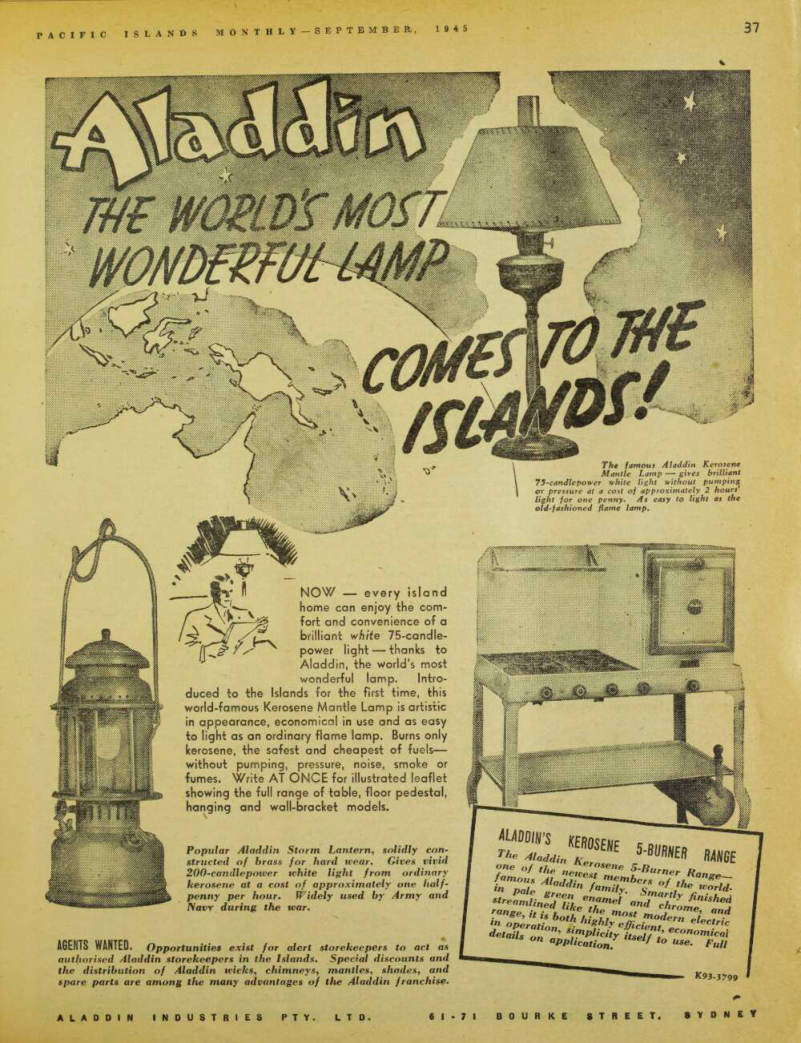
And Its Meaning
By Arthur J. Vogan, Pros
r pHE origin of the peoples of the Pacific has been intriguing the
minds of scientists and laymen for
the past century. Whatever the arguments concerning this, it is quite certain that we shall never know the real truth. The author of this article, who has done much research in the Pacific, believes that the Polynesians and Fijians have affinities in ancient Africa, the Middle East and in India. He tells you here why he believes this.
EVERY one of the thousands of weird ; wild, or exquisitely beautiful islands of the North-Western Pacific— mostly the summits of long-submerged mountain ranges of a buried land con nection with Australia —bears upon it, fascinating evidence of a past history of Asiatic peoples, who, flying from vic torious foes, or seeking that change of fortune that has peopled Australia, have left carvings, inscriptions, cave temples, and earth-works that surely deserve the attention of our thinking, and cultivated minority.
In allowing these scientifically invalu able records of the past to pass away un heeded, we are rendering ourselves liable to the coming censure of a more en lightened public.
Wave after wave of advancing semi civilisations have flamed across the earth, including our corner of the Pacific —and then retired again. Between Australasia and Asia are thousands of evidences of this.
In the Yasawa Islands in Fiji, I dis covered most interesting examples of a former people, after Mrs. Routledge, the authority upon the Easter Island giant statues, wrote me. about 1913, advising me to search the Fiji group, as it had “not been done.”
Here I found cave temples, carvings, and inscriptions; and at the extreme northern point, a great figure group, 40 feet high, of a man in a sitting posi tion, with a child upon hi& knee.
The man wears the snow boots, and the child the pointed straw cap of ancient Persian art; and the group seems to syn chronise, in motive, with a famous bas relief in Egypt, andT with ancient carv ings in Yucatan—which seems to show that religious and art ideas had a com mon source. .
Even the name of these islands, in the Fiji group, is of value to the enthusiastic linguist, for Yasawa means “Eight Islands” in the ancient Japanese tongue. rE Yasawa Islands have other attrac tive features about them besides purely archaeological ones.
For the Fijians tell me that they came from Africa—their ancestors belonging to Lake Tanganyika (as their language cor roborates) who were sailor slaves to the Arabs, who had ships, in those far off days, capable of carrying 500 persons, and were trading and mining through the Indian Ocean and our Pacific Islands.
Wreckage upon the prpverbially dan gerous reefs easily explains their pres ence in Vanua Levu, their Fijian home- D. Daunt and other leading authori ties show us that ancient Babylon was not situated in the Euphrates Valley, but in India whence the earliest naviga tion of the Pacific Ocean evidently occurred. So we need not be surprised to find that splendid figure group at the northern point of Yasawa referred to was, judging by the fact that
the man wears the well-known snow boots and the child the pointed straw cap of ancient Iranian art, apparently done by Persian artists.
In the Trobriand group, south of Rabaul, in 1931, I found beautifully made and designed earthen burial jars which seem to connect with that mysterious old civilisa- Lion of the Indus mouth, where the ancient sites of Harappa and Mohenjodaro (modern names) have produced similar ones to searchers; and where stone rings, used in the Carolines as money, also occur. The inhabitants of these old cities believed that the Pipal tree was inhabited by a god, because of its everquivering leaves—an idea that still obtains in many parts of India.
The Polynesians came from Northern India; and probably began, as humans, in what are now the arid wastes of the Pamir plateau and Gobi desert. The name of the New Zealand branch—whom we have the temerity to call “Mowry,” when the correct pronounciation is Ma-ori, derived from “Mauru” the Sun-god that gave the Romans the name of their wargod, Mars. Their empire was the first
that obtained in India, Major Burton, the famous Asiatic authority, showed me that the Maori tongue is closely allied with the Persian; and that during the Indian Mutiny, when an English officer, on one occasion, dis tinguished himself by an act of heroism, his attendant, a Sepoy, exclaimed; “Ake!
Ake! Kia kaha!”, which is an ancient war-cry that one hears to-day on New Zealand football fields. The well known Maori word “Kaianga” (literally “place of eating”) or home, according to the great Indian authority, H. D. Daunt, was the alternative name for the King dom of Sumer; and many Egyptian words show an Indian origin, and are closely akin to Maori ones.
ANY may ask what is the use of this ill peculiar kind of knowledge? Just as biology is generally acknow ledged to be the science of living, and teaches us how to live healthily, so archaeology is the equally valuable science that tells us of past attempts at civilisation. Why they failed, and why, in places, they succeeded for a time.
Advertisements & other items, pp. 39-40 (1 item)
4
m m a . £^4 !
V ■ \ TA« famous Aladdin Kerosene Mantle Lamp gives brilliant 75-candlepower while light without pumping or pressure at a cost of approximately 2 hours’ light for one penny. As easy to light as the old-fashioned flame lamp. & NOW every island home can enjoy the comfort and convenience of a brilliant white 75-candlepower light thanks to Aladdin, the world's most wonderful lamp. Introduced to the Islands for the first time, this world-famous Kerosene Mantle Lamp is artistic in appearance, economical in use and as easy to light as an ordinary flame lamp. Burns only kerosene, the safest and cheapest of fuels— without pumping, pressure, noise, smoke or fumes. Write AT ONCE for illustrated leaflet showing the full range of table, floor pedestal, hanging and wall-bracket models.
Popular Aladdin Storm Lantern , solidly constructed of brass for hard wear. Gives vivid 200-candlepower white light from ordinary kerosene at a cost of approximately one halfpenny per hour. Widely used by Army and Navy during the war.
AGENTS WANTED. Opportunities exist for alert storekeepers to act as authorised Aladdin storekeepers in the Islands. Special discounts and the distribution of Aladdin wicks , chimneys , mantles , shades , and spare parts are among the many advantages of the Aladdin franchise.
“!L«*. stre amlinld e ii ke e ’l” m d range, it i s both huh m ° st Modern , K 9 3-3799
ALADDIN INDUSTRIES PTY. LTD.
6 1-71
BOU R K E
STREET.
SYDNEY
PRELIMINARY ANNOUNCEMENT:
PACIFIC
PLANTER'S
HANDBOOK
Publication About January, 1946 IN response to a strong and growing demand for an authoritative Handbook covering the whole field of Planting and Agriculture in the Pacific Islands, the compilation of the “Pacific Planter’s Handbook” was commenced some time ago, and the work now is well advanced.
The Handbook is designed to give standard instruction on all the branches of Tropical Planting which might be undertaken in the Pacific Islands, and to be regarded as an indispensable part of a Pacific Planter’s equipment.
SECTIONS of the Handbook deal separately with Palms (including Coconuts and the Manufacture of Copra), Cocoa, Coffee, Rubber, Citrus, Bananas, Vanilla, Spices, Kapok, Pineapples, etc.
The production of every plant grown for profit in the islands is described.
Other Sections cover such subjects as: Livestock on the Plantations; Revenue from Non-Agricultural Products (Sea, Forest, Minerals); How to Ensure Comfortable and Healthy Living Conditions in the Islands; Etc.
SPECIAL SECTIONS: Survey of Opportunities; Selection of Territory (Malarial and non- Malarial, Melanesians and Polynesians, Climate and Rainfall); Lands and Land Laws; Labour Conditions in the Various Territories; Importance of Transport; What You Must Provide For and Against in Choosing Your Plantation.
The subject of MARKETING is dealt with very fully. It is no use planning your plantation until you know where you will find a profitable market for your product, and whether it is dependable.
EACH SECTION WRITTEN BY AN
EXPERT
Numerous Photographs, Diagrams,
Drawings, etc.
PUBLISHED PRICE: Not less than 35/- Australian. (NOTE; Owing to the present difficulty of obtaining paper and binding service, it is impossible to fix a price, until the work is near completion. It will be between 35/- and 40/-, Australian. The edition will be limited. Persons who wish to be sure of a copy may order in advance; and if 35/- is sent, that will be accepted as the price of the book, although the final published price may be higher.) Orders may he sent to:
PACIFIC PUBLICATIONS
PTY. LTD.,
Union House, 247 George Street,
Sydney
or to the PUBLISHERS DIRECT:
PACIFIC PUBLICATIONS (FIJI)
LTD.
P.O. Box 281, Bank of N.S.W. Building,
SUVA, FIJI. SUVA, FIJI.
I&Sssii/S
" Honourable Foot "
By Russell N. Thomas
TETTER from Augustus Kane, Api
School, to Angus McWangle, of
Kiri-Kiri Islands Trading Company:
Dear Angus,—We have just received a croquet set from some friends for the use of the school, but there is no book of words about rules, layout, size of court, etc. As we want to start right, I was wondering whether you could find something about it in one of your numerous books? Come along on Thursday for a spot of tea, when we hope to have the court ready for use.—Yours, AUGUSTUS
Kane.
T ETTER from Angus McW angle to
Augustus Kane:
T , i , .
Gus, Old Chap,—l feel somewhat diffident about aiding and abetting your doubtless well-meant but otherwise nefanous project of introducing yet another qf the horrors of our so-called “civihlisation” to innocent Polynesians, who, with all their faults, are hardly deserving of having such things continually heaped upon them. However, they have already suffered so much that they are probably sufficiently inured by now to be able to take almost anything, even croquet.
Yours, Angus Me Wangle.
AND so on Thursday afternoon, Angus arrived to find the native teachers all collected in a bunch at the side of the court admiring the mallets and balls, while Belshazzer the oSS occasional nibble at the coffee hedge, and
Kid come ““own p«-
aKaT the
I&Sssii/S
finfne- were in al envelope at
the bottom of the case, and we somehow overlooked them. The set appears to be a perpetration of the sons of Nippon, and weVe had more amusement out of reading them than we ever shall out of playing pfobably. I though of hiding it away at first but perhaps the teachers won’t notice where it was made, and even if they do I don’t imagine they are likely to let it worry them.”
Angus strolled over to where the teachers were studying the rules of croquet reading them out aloud; “When ball of’player strike with gentleness the ball of his competitist, he places honourable foot upon it, and with energetic jolt
of propulsion disappears it to hell-and gone.”
An argument which immediately started over this apparently impossible manoeuvre was silenced by one of their number offering to demonstrate it.
He placed two of the balls on the ground side by side, placed his foot on one, and gave it the energetic jolt of propulsion prescribed.
What happened was more reminiscent of war than croquet. One of the balls exploded, flying into a dozen pieces, while the shaft of the mallet broke in two places at the thin part above the head. One of the pieces hit the goat very hard in the eye, and suddenly deciding -that he had stood just about all that any self-respect ing goat could be expected to stand, he leapt six feet in the air, broke loose from his peg, and lit out for the main gate.
An instant later all the teachers had dropped everything, and were in hot pur suit.
“They are so terribly rough with things,” remarked the headmaster to Angus as he got another mallet and ball out of the case, “it is really surprising how far you can croquet a ball if you do it properly.”
Placing the two balls together, he put his foot on one and hit it moderately hard. The mallet broke off in the same place as the first one. ¥¥7TTHOUT a word they picked up the ff debris, putting it all back in the case which they hid away in the house, and went to sit in the shade.
“Not what you could call an altogether successful afternoon,” the headmaster ob served, “that goat can travel faster than light, and he has by now, spent some time in the Resident Agent’s salad garden up to his knees in the lettuces. The RA and I have already had words over his former depredations.
“Last time we didn’t speak for a week, and this time diplomatic relations will almost certainly be broken off for a month, at least,” he groaned.
“What will the RA do when he espies Belshazzer inside his fence engaged in getting outside of his lettuces,” asked Angus, “Shoot him?”
“No such luck, I only wish he would if it would make him feel better. No. he won’t shoot him, but he'll probably expedite his departure considerably with energetic jolt of propulsion of honourable foot.”
Advertisements & other items, p. 40 (1 item)
38
SEPTEMBER, IS4 5 - PASIPIC ISLANDS MONT fl L V
How One Pastor Got
a Congregation Letter to the Editor
rE photo, of an early NG missionary published in the May “PIM” is Dr.
G. Brown, as I knew him in 1884.
Dr. Brown was at that time stationed at Duke of York Island, in the Duke of York Group, opposite the island of Mioko, where the German firm (DH & PG) had its headquarters.
It was here that I met the Fiji pastor, “Samurli,” shown in the picture with Dr.
Brown, and of him I wrote in my article, “Native Pastor,” published in the “PIM” last year; “On one occasion, seated on a nearby trader’s verandah, I saw a Fijian teacher (pastor)—a very big fellow —come along to his little church and beat his lali. No one obeyed the call to service.
“The Fijian, looking very stern, took a spear and went out along the beach. He met a native —one of the most inoffen sive in the tribe. He asked the native to come to church. The native refused So the big Fijian seized the fellow and headed him towards the church; and then, with an occasional prod from his spear at the man’s backside, he kept him goine.
“When the ‘congregation’ was inside, the pastor sot into his pulpit and began to sing a hymn, whereupon the native got up and bolted through the door, and although the pastor gave chase, his con gregation got safely away, and he sad)y closed his church.”
I am, etc.,
F. T. Goedicke.
Haapai. Tonga.
July, 1945.
Where Is Islands Utopia?
From Our Own Correspondent
Papeete, June 20.
A RADIO commentator remarked, not long ago, that this war has torn to dismal raindrops the enticing bubble of South Sea island Utopia.
But has it done so? Not, we fear, so long as crack-pot writers wield their pens, so long as tourist bureaux drool of “beckoning isles,” so long as believing souls cherish the myth of a corner in this shrunken world overlooked by the standardisation of an Age of Gadgets.
By nearly every mail, especially from USA, we get letters from people who apparently believe all the rubbish writ ten about the Islands.
In a charmingly written and authori tative essay—published in the latest Bul letin de La Societe des Etudes Ocean iennes—entitled “Le Mirage et I’exotisme Tahitiens dans la Litterature,” we learn
that the genesis of absurd, crack-pot writers of South Sea fairy-tales is not tq be laid in the notorious 1920 decade —as many of us supposed—but as long ago as the Period of Discovery. These gentry, who masqueraded as “philoso phers” and who had seized upon the few paragraphs about Tahiti in his “Voyage autour du Monde,” to spin an airy, glit tering fabric of “La Nouvelle-Cythere,” aroused th 6 ire of that doughty navigator, Bougainville, and he wrote angrily of their misrepresentations.
Bougainville protested in vain. The “philosophers” spun and weaved a tapestry of Utopia, and the myth of Nouvelle-Cythere has been perpetuated until this day.
At the present time, nearly every European in the Islands is eagerly trying to find transportation to somewhere else.
The steamship agent tells us that the waiting-list in his office is, practically, a census of the white population of the Colony.
Advertisements & other items, pp. 41-42 (1 item)
Nelson & Robertson Ki
Woven Wire for all Industry' \
COPRA DRYING TRAYS, FLOORS, Etc.
FRU'T DRYING TRAYS, MINING SCREENS.
Heavy Mosquito Gauze in Phosphor Bronze and other Metals Impervious to Salt Sea Air.
WIRE DOOR MATS AND GENERAL WIRE WORKS
E. WRIGHT & CO. LTD.
Office and Works: 148-152 Cleveland Street, Sydney, N.S.W.
Telegraphic Address: “Wrightmake,” Chippendale. f: £
NELSON and ROBERTSON Pty. Ltd.
Established 1895
Shipowners - Brokers and
Islands Merchants
All classes merchandise purchased at Best Wholesale Prices. Original Invoices supplied to Island Clients. Cocoa Beans, Copra, Rubber, Trochus Shell and All Islands' Produce Sold on Commission.
Entrust your requirements to the firm with fifty years' practical experience in the Pacific Islands.
NELSON & ROBERTSON Ki
12 SPRING STREET, SYDNEY, AUSTRALIA
Telegraphic Address: IVAN, SYDNEY.
WESLEY COLLEGE.
PAERATA, N.Z.
A Boarding School for Boys (Forms I to VI), under the control of the Methodist Church of New Zealand.
Set in attractive surroundings, with swimming - baths, extensive playing-fields, modern buildings.
Special attention given to Physical Education, Clubs, ' Carpentry, Crafts. An Education with a Religious background.
A full General Course for Junior Forms. Specialist training for Seniors in one of the following Academic and Professional subjects; Agricultural or Animal Husbandry; Woodwork.
Commercial and Accountancy subjects.
Fees for all Courses, £75 per annum, plus incidentals.
Applications for Enrolment should he made to The Principal, Wesley College, Paerata, Auckland, N.Z.
Sure Rise to II
To Make Tasty Pastry and
Good Bread
BAKING POWDER
is
IMPORTANT
"DOUBLE-ACTION"
Guarantees Better Baking
RADCO is a combinaton baking powder, because it contains a combination of ingredients which make it act twice —not just once.
RADCO’S first action, which begins in the mixing bowl, starts the leavening process. Then in the oven, a second action keeps on raising the batter or dough until the cake, biscuits, scones . . . all baked products ... are light and fluffy—perfectly leavened and perfectly baked.
You will find RADCO Baking Powder makes all your baking—cakes . . . etc. . . . marvellously light and delicious. This is because it has double action.
Money can NOT buy a Better Baking
Powder than RADCO.
Custard Powder, Blanc Mange, Jelly Crystals, Soup Mixture,
Cornflour, etc.
O. F. MASSCHELEIN, Sydney
Exporter of Australian Quality Products Only.
War's Toll Among Papuan
Residents
Letter to the Editor 1 WONDER if any other of the surviv ing pre-invasion residents of Papua will support me in this proposal.
I suggest that, when we return to our Territory, we erect a metal plaque, on a marble base, at both Port Moresby and Samarai, as a mark of respect to the memory of our fellow residents who died in exile. It would be fitting, topical and historical; something placed prominently for future visitors to see —something like this: — “Sacred to the memory of residents of Papua who died in exile during the occu pation years, December, 1941 (to some date in 1945 or 1946).”
Among the names which should be placed thereon would be E. W. J. Mears, Harry Russell and A. C. English. There are several others.
I think the monuments would not cost more than £100; and I should be pre pared to contribute my guinea to such a fund.
I am, etc..
Sydney H. Chance, Ex-Rm.
Brisbane.
Editorial Note: It is a commendable idea. But could it not be given effect to in co-operation with a plan for com memorating the names of all Papuan men and women who served in World War II? There could be a panel on such a monument whereon could be inscribed the names of residents who died abroad, during the period of compulsory evacua tion, as suggested by Mr. Chance.
The Assistant Postmaster-General in Fiji, Mr. C. O. Taylor, has been trans ferred to Northern Rhodesia as Deputy Postmaster-General. He, his wife and family, expect to leave for their new home about the end of August.
Victory Over Disease
in N. Guinea
rnHE victory won over disease in New JL Guinea by the Australian Army may do much in the future, to make New Guinea living conditions better for European civilians.
When the Japanese forced a way across the top of the Owen Stanley Range in 1942, and were within 30 miles of Port Moresby, a serious outbreak of dysentery occurred among AIF troops who had just been sent there to hold the enemy.
This small force was all that remained between the Japanese and Port Moresby, and it was in danger of complete im mobilisation through the disease.
Officers of the Australian Army Medi cal Corps, while in the Middle East, had experimented with the new drug, sulpha guanadine. for the treatment of dysen tery, and had obtained promising results.
Supplies of this drug were hurriedly manufactured and sent to New Guinea by plane. This was distributed right up to RAP’-s for use at the first sign of diarrhoea.
The treatment was completely success ful, and, as a result, the Japanese, who also were ravaged by dysentery—and from whom our men had doubtless re ceived the original infection —were driven back across the range, to be finally ex terminated in the Buna-Gona fighting.
In December, 1942, the dysentery rate in New Guinea was 212.64 per 1,000 per vear. By December, 1943, this rate had been reduced to 62.82 per 1,000 per year.
During recent months the rate has averaged 21.08 per 1,000 per year—this representing an improvement of 90 per cent, in 2i years.
It is interesting to recall that one medical man associated with this impor tant victory over disease was Dr. Trikojus, whom National Security compelled to re port to the police daily, because he had been in Germany before the war. Yet he was born in Sydney!
Improved Status Of Women
Missionaries
IN connection with its “triple jubilee” the London Missionary Society held an At Home in Auckland recently.
The gathering was addressed by Miss Hilda Small, who formerly was a mem ber of the mission in Western Samoa.
“At the present time,” said Miss Small, “the London Missionary Society has travelling in this Dominion a fully or dained woman minister, the Rev. Kate Hutley, of Tingchow, China. Such an advance in the status of women has been achieved with persistent struggle.
“Six wives sailed on the ‘Duff’to Tahiti with the early missionary pioneers in 1796, and two of the great grand daughters are present at this meeting, Mrs. Harold Ennor and Mrs. Carnachan.
“The first woman missionary to be ap pointed by the society was Maria Newell, to Malacca in 1827, and the first single woman missionary to China was Mary Aldersey. The directorship of the society was thrown open to women in 1890, and the first woman secretary was Mrs. Parker Crane, in 1920.
“History was made by Mrs. B. Chaffey, MA, by her appointment in 1941 as the first woman chairman of the board of directors.”
Signalman J. C. E. Swinbourne, AIF, who was taken prisoner in Crete, June, 1941, and who spent four years in a POW camp in Germany, has now returned to Australia. He was formerly resident in Fiji, and the G. & E. Islands Colony.
Josselyn's War
By Harold Cooper
AMONG the young administrative officers in the Solomons who played a leading part in operations against the Japs is Henry Josselyn, formerly of Kenya.
Although he spent many months at a lonely Allied post Josselyn rarely had to call for supplies for himself or his small band of native scouts. The Japs pro vided him with all he needed.
He made a particularly rich haul when a Jap destroyer, which had been set ablaze by American bombers, was beached near his headquarters. No sooner had the Japs abandoned tjie vessel than Josselyn and his men were aboard.
In a race against time, for fires burn ing in the stern were threatening to spread to other parts of the ship, they ransacked as much of the destroyer as they could safely reach and brought ashore “enough stuff to stock a depart ment store.”
Josselyn’s one regret was that he didn’t manage to salvage the ship’s sick bay equipment, for soon afterwards he found himself acting as nurse to a New Zea land Flight Sergeant, the sole survivor of a reconnaissance plane shot down by the Japs.
The New Zealander was too ill to be moved, and was suffering from multiple shrapnel wounds. Some of these looked so dangerous that Josselyn decided he would have to operate. Using a darning needle, a razor blade and a pair of pliers he extracted several pieces of shrapnel, probably saving the sergeant’s life. The only thing he was able to ad minister to the patient by way of anaesthetic was a stiff glass of brandy.
The sergeant came through the ordeal in great style. Indeed, the operation troubled him far less than the fact that in the crash he’d lost his false teeth, and was unable to share the luxurious rations Josselyn had acquired from the beached destroyer.
On another occasion Josselyn and a party of native scouts penetrated deep into Jap territory in search of the sur vivors of a sunken American warship.
More than 100 sailors had swum or been washed ashore at different points along a 30 mile stretch of beach. Josselyn’s men managed to contact all of them, and concentrated them in two improvised camps which were skilfully camouflaged to avoid detection from the air.
The inmates of the camps, despite the fact that they were- virtually surrounded by the enemy, were kept supplied with food and other necessaries of life until American forces effected their rescue.
Mr. J. Wright Leaves
Rarotonga
Rarotonga, July 8.
EARLY in July there was a round of functions in Rarotonga to farewell Mr. and Mrs. Jack Wright.
After 11 years’ service in Rarotonga as Treasurer and Customs Officer, he has been transferred to Samoa in a similar capacity. He was originally in the Ad ministrative service in Samoa.
At a meeting of the Rarotonga Sailing Club, Mr. Wright was presented with a trophy in appreciation of • his work in founding and encouraging what has be come Rarotonga’s outstanding sporting organisation.
The new Treasurer and Customs Officer in Rarotonga is Mr. J. Jackson, who served a previous term in the CIA a number of years ago.
Advertisements & other items, p. 43 (1 item)
Equal to the World’s Best
Made by
FORD SHERINQTON LTD
Ws Owing to war needs, supplies of "Airway" are not at present available.
Manufacturers of
G LO BITE Travel Cases
Equal to the World’s Best
Throughout Australia and Overseas there is an ever-increasing demand for
COLONIAL & BRONTE
HIGH-GRADE CANNED MEATS
There is no better quality—none more wholesome.
TRADE MEATS FOR THE ISLANDS
order
“COLONIAL” BRAND
Roast, Corned and Boiled Beef Packed in 6,5, 4,3, 2, 1 lb. and 12 oz. tins.
Also Corned Beef in 12 oz. Taper Tins.
Roast, Corned and Boiled Mutton. 1 lb. and 12 oz. tins.
Choice Dripping 36 lb., 2 lb., 1 lb. tins, and 1 lb. packets. $
: ; M W■; "M-
-DELICIOUS
"BRONTE" HOT MEALS
Steak and Kidney Pudding.
Beef Steak Pudding.
Sausages and Tomato.
Sausages and Vegetable.
Lamb and Green Peas.
Corned Beef and Beaten Beans with Tomato Sauce.
Steak and Tomato.
Under present conditions it is wise to ensure that you have ample stocks of all our lines.
The Colonial Wholesale Meat Coy. Pty. Ltd.
30 GROSVENOR STREET, SYDNEY
in Fiji
Shortage of Labour in Fiji
Suva, Aug. 2.
AN interesting summary of the present labour position in Fiji, as seen by the average planter, was given me by Mr. Valen Tarte, a well-known land owner of Taveuni. His output is chiefly copra.
“Since 1942, wages have gone up from 2/- to 4/- per day—a gradual rise as labour became scarce. Some planters now are compelled to pay 5/- per day.
My own production costs are now close to £lO per ton —so it is, God save us if copra falls below £lO.
“The shortage of Fijian labour is due to the absence of so many men in the Fijian battalions; and, as they are de mobilised, the position should ease. I notice more and more Indian labour be coming available.
“There is no direct control over labour conditions in Fiji—it is purely a matter of supply and demand —private contract.
In some exceptional cases, 7/6 per day has been paid for labour.”
Mr. Tarte said that, in relation to labour, he was fortunate. His people, long ago, established on their plantation a colony of Indians —provided them with small houses, let them have land at a nominal rental, and gave them security.
There were now 200 of them there, and thus a dependable labour supply was available. This seemed to give a pointer to a possible solution of Fiji's growing labour problem. The Indians are in creasing rapidly in numbers, and they are most eager to get land.—R.W.R.
The civilian hostel in Port Moresby was housing about 28 civilians in early August. Mr. W. J. Lambden, first repre sentative of the new Provisional Govern ment, was there (he was in the former Murray Administration); and Mr. F. L. (“Snowy”) Clark, manager of Robinson River Plantations, Ltd., back from hos pital in Lae. The rest were missionaries and planters in transit to or from Aus tralia.
We Told You So !
ON page 14 of the April, 1942, we directed the attention of readers to the then current quotations of Pacific Island gold-mining shares. Be cause of the Japanese invasion, shares had slumped. We set current prices against the quotations current one month before Pearl Harbour; and we suggested that any man who liked a gamble should not miss this chance.
This was our argument: If the Japanese were defeated —as we were certain they would be—those gold shares would re cover their value. If the Japanese were victorious, we were sunk anyway, so it would not matter if the money put into this* speculation were lost.
Hereunder are the shares we then quoted (3 h years ago). In the first two columns we repeat the quotations as we then published them. In the third column we give the quotation current last month.
One thousand pounds, judiciously in vested in Islands shares in those black days, would by now amount to between £3,000 and £4,000.
Nov. 15, Apr. 16, Aug., 1941. 1942. 1945.
Bulolo G.D 93/- 22/- 108/- Cuthbert’s .. ... 13/7 3/3 15/3 Guinea Gold . .. 10/6 4/- 10/11 Loloma 21/10 12/3 19/6 Mt. Kasi (Fiji) .. 2/1 /9 1/9 N.G. Goldfields .. 1/6 /8 3/4 Placer 62/9 32/6 80/- Sandy Creek .. 1/3 /6 1/6 Sunshine 9/- 2/6 7/6
Set-up
Caledonia's Economic Set-up Due for Reform
Prom Our Own Correspondent
Noumea, Apr. 12.
ACCORDING to General de Gaulle, Indo-China will receive, when liber ated, long overdue customs and economic reforms.
These reforms should apply equally to New Caledonia, which has struggled along under the so-called “Pacte Coloniale” since 1892.
The “Pacte Coloniale” has always been a bone of contention between the local Caledonian population and the French administration. For generations Cale donians have pointed out that to try and impose the metropolitan customs tariff on New Caledonia, which is 45 days from France and only four from Australia, is to fight against economic geography. The wreck on the way out of even one French ship loaded with merchandise would cause a serious shortage in Noumea, which might last for months, resulting in a rise in the cost of living already higher than in other Pacific islands.
Actually, in a period of 20 years, this preferential tariff has increased annual French imports to New Caledonia by an average of only Vi million francs, while foreign imports decreased by one million.
New Caledonia is a natural tributary of the Australian market for a large number of needs which France cannot fill at reasonable cost or for which cost of transport is prohibitive.
The President-General of the Metho dist Church, the Rev. J. W. Burton, MA, left for America late in August on a lecture tour of the States. Mr. Burton, through his literary work, is well known in the USA, and many expressions of appreciation have come to hand from that country since his retirement from the General Secretaryship was announced.
Advertisements & other items, p. 44 (1 item)
Asthma, Bronchitis Coughing,
Curbed in 3 Minutes
Do you have attacks of Asthma or Bronchitis so bad that you can’t sleep? Do you feel weak, unable to work, and have to be careful not to take cold and can’t eat certain foods?
No matter how long you have suffered or what you have tried, there is new hope for you In a doctor’s prescription called Mendaco.
No dopes, no smokes, no injections, no atomizer.
All you do is take two tasteless tablets at meals and in 3 minutes Mendaco starts working through your blood, aiding nature to remove phlegm, promote free easy breathing and bring sound sleep the first night, so that you soon feel years younger and stronger.
No Asthma in 2 Years
Mendaco not only brings almost immediate comfort and free breathing but builds up the system to ward off future attacks. For instance, J. Richards, Hamilton, Ont., Canada, had lost 40 lbs., suffered coughing every night, couldn’t sleep. Mendaco stopped Asthma
spasms first night and he has had none since in over two years.
Money Back Guarantee
The very first dose of Mendaco goes right to work circulating through your blood and helping nature relieve you of the effects of Asthma. Try Mendaco under an Iron-clad money back gaurantee. You be the judge. If you don’t feel fully satisfied after taking Mendaco just return the empty package and the full purchase price will be refunded. Get Mendaco from your chemist to-day and see how well you sleep to-night and how much better you feel to-morrow. The guarantee protects
you - RELIEVES ASTHMA
Mendaco
Now in 2 sizes . . . 6/- and 12/-
aerodromes
and other large
areas .
SO acres a day can easily be cat with a Ransomes Quintuple Mower drawn by a tractor, and even larger outfits up to 25 ft. wide are available. This enormous capacity makes Ransomes Gang Mowers indispensable to all controlling aerodromes, large sports grounds, etc., requiring frequent cutting. With no other machine could these large areas be kept in such good condition.
Sizes: Triple 7 ft., Quintuple 11 Va ft.. Septuple 16 ft., up to 11 units—2s ft. wide. Also a sulky mower 30 In. wide for hilly land.
GANG MOWERS
We Illustrate our standard machine.
For longer grass and heavier work, we offer the “Magna - Gang” pattern.
Illustrated catalogue showing a complete range of hand, animal draught and motor lawn mowers will be sent on application.
MORRIS,
HEDSTROM, LTD.,
Suva, Lautoka and Ba.
RANSOMES, SIMS & JEFFERIES, LTD. Ipswich, England.
Keeping Watch On
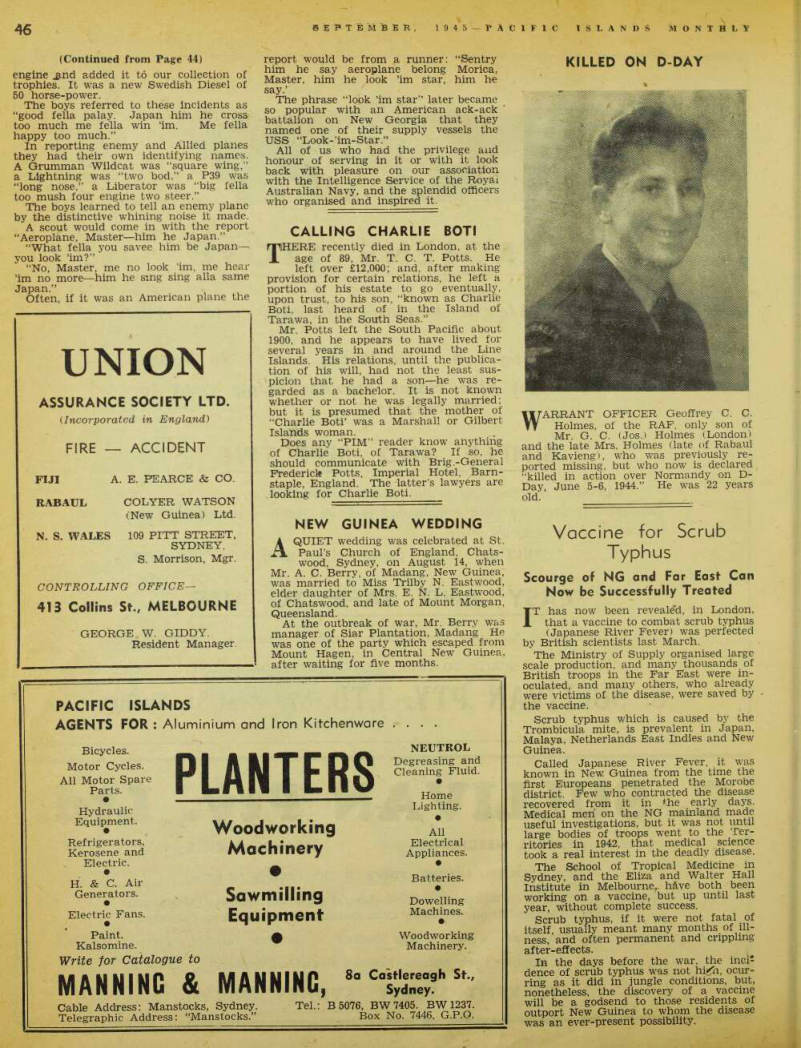
The Japs
What RAN Intelligence Did in the Solomon Islands
COME glimpses behind the scenes in 43 the Solomons in 1942 were given to the Rotary Club of Suva, Fiji, in July, when Major D. G. Kennedy (formerly a DO in the Solomons, and now at Western Pacific Commission headquarters) gave an address entitled “Intelligence Work with the Royal Australian Navy” The following are extracts.
IHAVE tried to condense a satisfactory account of wartime activities into a thumbnail sketch. But this has proved Impossible, so I propose to con fine my remarks to the work of an orga nisation of which little has been heard in Fiji—that is, the Intelligence Service of the Royal Australian Navy. With this service I had the honour to cooperate in intelligence work for nearly two years. It was popularly known as the coast-watch ing service of the Solomon Islands.
When I say that little has been heard of this organisation, I mean little in comparison with the generous praise which my eloquent friend Harold Cooper has from time to time bestowed on the Administration and its officers for their efforts during the recent critical period in the Solomon Islands.
As you are aware the BSIP fell, for defence purposes within the sphere of the Royal Australian Navy. Some time before the war the Director of Naval Intelligence, at Melbourne, acting through the RC in the BSIP, set up a skelton coast-watching service and dis tributed some tele-radio sets for inter island communication and the transmis sion of Intelligence reports. A Naval Liaison Officer was attached to the RC’s staff. His duty was to correlate and relay the reports to Intelligence HO. The district Administration gave full co operation, and when the Japanese began to come southwards and nearly all the European population had evacuated the ST District Officers were permitted to remain behind for Intelligence duties with the coast-watch. And so, in March. 1942, I found myself in sole charge of the NW area of the Protectorate, comprising the islands of Choiseul, the Shortlands, New Georgia, Ysabel. the Russell Islands, and Florida (including Savo and Tulagi).
Mr. Marchant, the Resident Commis sioner, and Mr. Bengough. DO Malaita, were on Malaita. Mr. Clemens, a Cadet Officer, was on Guadalcanal, where the Australian Naval Liaison Officer also had set up head-quarters, and Mr. Forster, another Cadet Officer, was on San Cris toval. It was the duty of all of us to organise intelligence patrols, communica tions, services, and coast-watching sen tries in our respective areas, and to transmit our reports daily to the ANLO at Guadalcanal.
Since my area was extensive and com prised several groups of islands, I was continuously at sea in a small auxiliary vessel, from January until the end of April, 1942. During this time, besides or ganising the intelligence services within the area, I repatriated about 1.000 inden tured labourers who had been left behind on scattered plantations. I visited all im portant villages, and also Rennell Island, where I set up a secondary head-quarters, to which we might retreat if driven out of the main islands. At this time, I col lected from the bolder spirits as many of the devil-may-care type lads as were
willing to come with me, for security and o-npriiia work guerma wo .
IMADE my first head-quarters at South Ysabel; and it was when operating out of there in March, 1942, that we had our first brush with the Japs. We were making what proved to be our final inspection of the Shortlands Group, the day before the Nips came into that area Our small vessel was strafed five times by one of their reconnaissance planes; but, fortunately, we suffered no damaee or casualties.
The following day, when proceeding
into Ohoiseul Bay, we reached a hiding place behind a small island, just as nine j ap cruisers wen t swe eping up the Straits, Hugging the coasts of islands en route, we then returned to our head-quarters at South Ysabel. .
By the first week in May, after the Battle of the 9P ra LS^Qi th or.H a miiiaa? occupied both Guadalcanal and Tulagi.
They obtained news of our s^. atl s ) P.
Ysabel from a certain NMP, and sent an expedition against us.
We were forced to abandon our head quarters and go to sea again. We dodged around at sea for the next two months,
sending in reports of what we saw to the ANLO at Guadalcanal.
Although the Japs were on the lookout for us, we managed to evade them by hiding among the small islands on the north end of Ysabel. By day we camouflaged our vessel, by tying fresh green branches to the rigging every morning, and lying close in to the steep shores; and we became so adept at this that often native fishing parties passed within hailing distance, without seeing us. 5 rE Japs knew we were in the area, J nnHppri that few of the
whic^\^re o repOTted^s°arrivhig^dally n fn
Jvf^cVnaH area were passing over Ysabel. I guessed, therefore, that thev must be coming down the chain rieration we crossed nf thl The d S?ot is t the wiL strSt ' °! and nteht We of enemy shipping, nay ana mgnt. we
thnt N fhe ?nemfw°af sending
and, finding that the enemy was senoi g all his southward-moving planes over this area, we decided to make our headquarters at Mr. Harold Markhams abandoned plantation at Sege.
We arrived at Sege in early July, 1942,, and stayed until the Americans occupied New Georgia, almost exactly one year later. For the greater part of this period we had the distinct advantage of being able to watch the movements of the Japanese air and surface craft withwt the enemy knowing that he was being observed, for he thought we were still on Ysabel.
Reports on these activities were transmitted to the ANLO at Guadalcanal who relayed them to the High Command.
A S you know, the Americans landed on Guadalcanal in August, 1942, and by February, 1943, had complete command of the island, When the Marines first took Henderson Field, they had only a few old Grumman Wildcat fighting planes to support them, The Japs from Rabaul began sending down all the air strength they had, in an attempt to bomb the Marines out.
Almost every flight passed directly over Sege, flying so low that we were able to report not only the number but also the type of plane TT Sege 18 about 150 miles from Henderson
SX^eporte
mans to rest safely on Henderson Field until a when they would just nave time to taxe tne air, attain
“ofnteon fhXrinf po"'
We were later informed by the Marines
XefM XTa? onVK
that, had it not been for the timely rpnnr fo from Seee thev would not have beS able to In those . RaHnr was not so effective and far
£to-day
reaching as it is to aay. all this period daily reports J j W ere being brought in to the various coast-watching stations - by native runners, sentries, and canoe patrols. p rom the coast-watch stations they were transmitted direct to DSIO, the Deputy superintendent Intelligence Officer of the R o yal Australian Navy (Lieut. Comma nder McKenzie) known to all and sundry as “Mother.” “Mother” contacted the High Command and also relayed all re ports to Com-So-Pac.
Towards the end of 1942, the coast watch organisation received valuable additions to its personnel, when Lieuts.
Horton, Josselyn, and Wadeil, previously of the BSI Administrative staff, who had gone south and received commissions in the RAN, returned to the Territory, and were sent into my area.
Horton went to Rendova, Josselyn to Vella Levella, and Wadeil to Choiseul.
Each of these officers brought in with him a complete tele-radio outfit. The increased volume of Intelligence reports covering every aspect of enemy activity during the next six months must have helped greatly in the preparations being made for the Allied invasion of New Georgia, which took place in July, 1943, and virtually ended the war in the Pro tectorate as a major operation.
The coast-watchers, in addition to their own intelligence duties, were called upon, from time to time, to search for, and bring in, Allied airmen who had been shot down. Not less than 100 fliers were rescued by coast-watchers, many of them grievously injured.
They were also required to direct and provide protection for US reconnaissance and survey parties who were flow r n into this no-man’s-land from time to time The success which attended all aspects of this vital intelligence work, spoke well for its organiser, the Director of Naval Intelligence in Melbourne (Commander Long), and for his very capable field assistants in the NW area, Commander Eric Feldt and Lieut.-Commander Hugh Mackenzie, the ever popular “Mother” of Guadalcanal.
IHAVE attempted to sketch the origin and scope of the Naval Intelligence Service in the British Solomon Islands from the European point of view.
I should now like to refer briefly to its native personnel, without, whose loyal aid very little of the work could have been accomplished. These were men from ail walks of native life, in part-time or full time service with the various Intelligence Officers, plantation boys, missionaries, traders, policemen, and Government clerks. They were all excellent bushmen, and could move within a stone’s throw of the vaunted Japanese jungle fighters, without being detected.
They and their people gave freely of their resources, canoes, vegetables, fruit, eggs, and fowls to isolated officers in no man’s-land. We could not rely on sup plies from the rear areas, since para chute-dropping was out of the question in enemy-infested territory, owing to the danger of our secret positions being dis covered.
I have time left to narrate the various exploits of individual natives, some of whom you have heard mentioned as re cipients of honours, but I should like to refer to a few incidents, which, although serious or ordinary enough when they occurred, seem, in retrospect, to have cer tain elements of humour.
The enemy had a habit of leaving his motor barges nosed ashore on the beach while he went inland to forage for native poultry and vegetables. On one occasion we were able to pull out a 57 ft. barge and get away with it before the enemy party came back.
On another occasion we signalled some fighting planes to shoot up a couple of barges which we saw nosing the beach.
Water flowed in and submerged the sterns sufficiently to cover the starting batteries. The Japs, about 50 of them, returned to find that they could not ride home that night; so they set off along the shore on a weary walk back to their head-quarters. We plugged up the bullet holes, pumped out the water, and took the barges away during the night. Two days later, another barge came along with a spare engine in a crate, to re place an engine in one of the damaged barges. They put the engine ashore on the beach while they went off to look for the barge. During the night we lifted the
(Continued from Page 44)
engine jind added it to our collection of trophies. It was a new Swedish Diesel of 50 horse-power.
The boys referred to these incidents as “good fella palay. Japan him he cross too much me fella win ’im. Me fella happy too much.”
In reporting enemy and Allied planes they had their own identifying names.
A Grumman Wildcat was “square wing,” a Lightning was “two bod,” a P 39 was “long nose,” a Liberator was “big fella too mush four engine two steer.”
The boys learned to tell an enemy plane by the distinctive whining noise it made.
A scout would come in with the report “Aeroplane, Master—him he Japan.”
“What fella you savee him be Japan— you look ’im?”
“No, Master, me no look ’im, me hear ’im no more —him he sing sing alia same Japan.”
Often, if it was an American plane the
report would be from a runner: “Sentry him he say aeroplane belong Morica, Master, him he look ’im star, him he say.’
The phrase “look ’im star” later became so popular with an American ack-ack battalion on New Georgia that they named one of their supply vessels the USS “Look-’im-Star.”
All of us who had the privilege and honour of serving in it or with it look back with pleasure on our association with the Intelligence Service of the Royai Australian Navy, and the splendid officers who organised and inspired it.
Advertisements & other items, pp. 45-48 (1 item)
Berger’s Paint
: ; .y. i
POST-WAR
PALETTE
Many notable Berger brands will return soon to colour your post-war palette . . . and with them will come new finishes developed under the stimulus of war.
New materials, new processes, new application techniques are the fruits of Berger research and a tradition of 185 years’ manufacturing experience will transform these advances into high-grade paints for post-war homes.
Berger’s Paint
“Keeps on Keeping on”
New
WANTED TO BUY—QUALITY GUNS AND RIFLES
HIGHEST PRICES GIVEN. WILL ALSO EXCHANGE GUNS. 303 Short Service Barrels, 25Vz”, without Sights and Platform, £2/15/- each.
Postage extra.
SI L RO H U Quality and Fishing Tackle. 143 ELIZABETH STREET (Near Market St.) SYDNEY. PHONE: MA 3540.
This is the home of .
emVERSJAMSm
Here, at Histon, near Cambridge, is Chivers Factory, surrounded by orchards and gardens where the choicest English fruits are grown. Sun-ripened and in perfect condition for preserving, these fruits come in all their freshness to Chivers Factory to be made into the finest jams it is possible to imagine.
War conditions still limit supplies but full shipments will be resumed as soon as possible.
CHIVERS
ENGLISH JAMS
Made in the heart of the English countryside by
CHIVERS & SONS Ltd.
The Orchard Factory Histon, Cambridge, England e. 157
7 7
KEROSENE STOVE
(( • 99 The ultimate in heating efficiency and service • No Pumping • No Wicks • No Danger • The Bright Blue Flame provides ample Heat tor All Purposes.
SIMPLE AND EFFECTIVE
"ULTIMA" is economical to buy and to operate. Using a new system of fuel generation it does not need complicated pressure chambers, pumps and so on, but is controlled by a single valve.
"ULTIMA" is easily dismantled and assembled.
EASY AND SAFE TO USE
Manufactured under Australian Government Permit. Supplies Available Shortly.
WRITE TO YOUR SYDNEY AGENT, OR
C. SULLIVAN PTY. LTD. 379 Kent St. Sydney
C. SULLIVAN Pty. Ltd.
GENERAL MERCHANTS ISLANDS AGENTS
REPRESENTING LEADING FIRMS IN THE PACIFIC ISLANDS.
Islands Produce sold on Shippers' Account—Liberal Advances against Consignments.
Buyers of all Islands’ Requirements on Commission —Original Invoices Furnished.
Bankers : Bank of New South Wales .. Bank of New Zealand .. Comptoir National d’Escompte de Paris.
Wartime Cable Address: Sullivan, Kcntstreet, Sydney.
379 KENT STREET, SYDNEY, N.S.W.
UNION
ASSURANCE SOCIETY LTD.
(Incorporated in England )
FIRE ACCIDENT
FIJI A. E. PEARCE & CO.
RABAUL COLYER WATSON
(New Guinea) Ltd.
N. S. WALES 109 PITT STREET,
SYDNEY.
S. Morrison, Mgr.
CONTROLLING OFFICE—
-413 Collins St., MELBOURNE
GEORGE W. GIDDY.
Resident Manager.
Calling Charlie Boti
rERE recently died in London, at the age of 89, Mr. T. C. T. Potts. He left over £12,000; and, after making provision for certain relations, he left a portion of his estate to go eventually, upon trust, to his son, “known as Charlie Boti, last heard of in the Island of Tarawa, in the South Seas.”
Mr. Potts left the South Pacific about 1900, and he appears to have lived for several years in and around the Line Islands. His relations, until the publica tion of his will, had not the least sus picion that he had a son—he was re garded as a bachelor. It is not known whether or not he was legally married: but it is presumed that the mother of “Charlie Boti’ was a Marshall or Gilbert Islands woman.
Does any “PIM” reader know anything of Charlie Boti, of Tarawa? If so, he should communicate with Brig.-General Frederick Potts, Imperial Hotel, Barn staple, England. The latter’s lawyers are looking for Charlie Boti.
New Guinea Wedding
A QUIET wedding was celebrated at St.
Paul’s Church of England. Chats wood, Sydney, on August 14, when Mr. A. C. Berry, of Madang, New Guinea, was married to Miss Trilby N. Eastwood, elder daughter of Mrs. E. N. L. Eastwood, of Chatswood, and late of Mount Morgan, Queensland.
At the outbreak of war, Mr. Berry was manager of Siar Plantation, Madang He was one of the party which escaped from Mount Hagen, in Central New Guinea, after waiting for five months.
Killed On D-Day
Warrant Officer Geoffrey C. C.
Holmes, of the RAF, only son of Mr. G. C. (Jos.) Holmes (London) and the late Mrs. Holmes (late of Rabaul and Kavieng), who was previously re ported missing, but who now is declared “killed in action over Normandy on D- Day, June 5-6, 1944.” He was 22 years old.
Typhus
Vaccine for Scrub Typhus Scourge of NG and Far East Can Now be Successfully Treated
IT has now been reveale'd, in London, that a vaccine to combat scrub typhus (Japanese River Fever) was perfected by British scientists last March.
The Ministry of Supply organised large scale production, and many thousands of British troops in the Far East were in oculated, and many others, who already were victims of the disease, were saved by the vaccine.
Scrub typhus which is caused by the Trombicula mite, is prevalent in Japan, Malaya, Netherlands East Indies and New Guinea.
Called Japanese River Fever, it was known in New Guinea from the time the first Europeans penetrated the Morobe district. Few who contracted the disease recovered from it in the early days.
Medical men on the NG mainland made useful investigations, but it was not until large bodies of troops went to the Ter ritories in 1942, that medical science took a real interest in the deadly disease.
The School of Tropical Medicine in Sydney, and the Eliza and Walter Hall Institute in Melbourne,, have both been working on a vaccine, but up until last year, without complete success.
Scrub typhus, if it were not fatal of itself, usually meant many months of ill ness, and often permanent and crippling after-effects.
In the days before the war, the dence of scrub typhus was not hi£h, ocur ring as it did in jungle conditions, but, nonetheless, the discovery of a vaccine will be a godsend to those residents of outport New Guinea to whom the disease was an ever-present possibility.
Advertisements & other items, p. 48 (1 item)
Punters
PACIFIC ISLANDS
AGENTS FOR : Aluminium and Iron Kitchenware Bicycles.
Motor Cycles.
All Motor Spare Parts. • Hydraulic Equipment. • Refrigerators, Kerosene and Electric. • H. & C. Air Generators. • Electric Fans. • Paint.
Kalsomine.
Write for Catalogue to
PUNTERS
Woodworking
Machinery
Sawmilling
Equipment
NEUTROL
Degreasing and Cleaning Fluid. • Home Lighting. • All Electrical Appliances. • Batteries. • Dowelling Machines. • Woodworking Machinery.
MANNINC & MANNING,
Cable Address: Manstocks, Sydney.
Telegraphic Address: “Manstocks.”
8a Castlereagh St.,
Sydney.
Tel.: B 5076, BW 7405. BW 1237.
Box No. 7446, G.P.O.
What Do Know
About Bougainville?
ONE of the bigger and one of the least known islands of the Pacific, Bou gainville, is receiving some attention, nowadays.
Geographically, iWs the most northerly of the large islands of the Solomons Group. But,; politically, it is part of New Guinea. Under the Anglo-German Agree ment of November 8, 1899', Bougainville became German territory, and was added to the Bismarck Islands and North-East New Guinea, to become an important German Pacific Administration. It was occupied by Australian forces In World War I, and became a Territory Mandated to Australia in 1920.
The island, although it contains about 3,000 square miles, has never been developed or fully explored by Australia, although it is known to contain a vast system of plains and plateaus, valleys and mountains, rivers and jungles, capable of much development. There are some 20,000 natives. Since the Jap invasion, however, the island has been penetrated by large forces of Americans, and later by other large forces of Australians, and these men have shown considerable in terest in the possibilities of the place, and are eager for information.
The following letter, from NZ1903 Flight Lieut. R. Rodda, RNZAF, c/o Flight Lieut. lan Morrison, Medical Officer, Group 622, RAAF, Pacific, is typical of many in quiries received: — “Having been stationed on the island of Bougainville for a period, and being a member of the New Zealand Alpine Club, I have become interested in the two vol canoes, Mounts Balbi and Bagana. I have made an ascent of the latter.
“Recently I have been trying do ootain some record of previous ascents and ex ploration of these two mountains, and
find that facts are few. I have been told that two Austrian geologists lost their lives' on Bagana in 1913, and that this mountain was probably din bed by two Government officers just before the present war. I have also been informed that a Government officer, Mr. English, climbed Balbi about the some time. He also completed the first crossing of the island.
“The above facts are very meagre, and I am anxious to find out the dates and extent of any exploration or ascents of these two mountains.”
If any “PIM” reader has information about the mountains of Bougainville, he is invited to send the data direct to the New Zealand officer, whose address is given above.
We have sent to Lieutenant Rodda the following extract from a “Report on the Volcanoes of the Territory,” published in Canberra in 1939: — “The next active centre is Mount Balbi, the more northerly of the two active vol canoes on Boungainville Island. This is described by Mr. Costello, of the District Services, who has crossed near the top, as two peaks, joined by a saddle 305 metres (1,000 feet) lower. The highest point is about 3,100 metres (10,170 feet) above sea level, and is giving off a small cloud of steam. The other peak appears to be quite extinct.
“Mount Bagana has been reported to be in eruption several times within recent years, and is apparently fairly contin uously active. An eruption took place on Sunday, May 15, 1938, the dust from which travelled as far as Kieta. The crater was visited three weeks later by Mr. W. M. English (cadet) who climbed the mountain to a height of 1,585 metres (5,200 feet) where he was forced to turn back owing to a hot loose rock and clouds of steam. He described the volcanic de posit of considerable area to the south west of the mountain, composed of dust,
pumice and rocks which were still hot at the time of his visit. Boiling springs and hot quicksands also occur well down the outer slope. Above 900 metres (3,000 feet) steam issues from between the rocks at numerous places, while above 1,500 metres (5,000 feet) a dense cloud of smoke and steam is given off.”
Advertisements & other items, p. 49 (1 item)
William Atkins Pty. Ltd.
FOR THE
CONNOISSEUR
as %
CLARET
and
MOSELLE
a Speciality Sole Distributors, Pacific Islands;
BRIAL & BALL
528 Collins St., 1 Bond St., Melbourne. Sydney.
Enquiries through your usual channels appreciated.
William Atkins Pty. Ltd.
Head Office 449-451 KENT ST., SYDNEY.
Iron & Steel Merchants—Engineers' Supplies
ESTABLISHED OVER 50 YEARS
Coach & Motor Hardware Cable Address: WILATKIN, Sydney.
STEEL DEPARTMENT
MILD STEEL:
Rounds, Squares, Flats, Half-rounds, Hexagons, Bevel, Shoeing, Tyre, Angles, Tees, Sheets, Plates, Girder Plates, Chequer Plates, Channels, Hoops, Etc.
BRIGHT STEEL:
Rounds, Squares, Hexagons.
Extra Special High Speed Tool Steel, Mining Steel, Blister Steel and Spring Steel, Rounds, Flats £r Squares.
Bar Iron—All sections and sizes.
Engineers' Supplies: Set Screws, Studs, Metal Thread Screws, Coach Screws, Files, Cotter Pins, Bright and Black Bolts, Rivets, Etc., Hack Saw Blades.
Power Transmission Gear: Including Plummer Blocks, Couplings, Collars, Etc.
Coach and Motor Hardware: Axles, Springs, Wheelstuff, Duck, Paints.
Farriers' Supplies: Horse Nails, Anvils, Vices, Etc.
Motor-Trimmers ond Motor Builders' & Motor Painters' Requirements
C. A. WILLEY'S
Quick-Drying .Coach and Car Paints, Roughstuff, Elastic Gloss, Synflex Enamels, Lacquers.
DUCO Lacquers and DULUX Enamels—FAßßEX Motor Toppings and Leather Cloths, House & Decorators' Paints, Varnishes fir Brushware.
Sole Distributors of CHAMPION'S Decorators Paint Products.
Distributing Agents for BROUTE Lacquers, SYNFLEX Enamels and "POLYGLOSS" Finish.
Three-Quarters Of A Million !
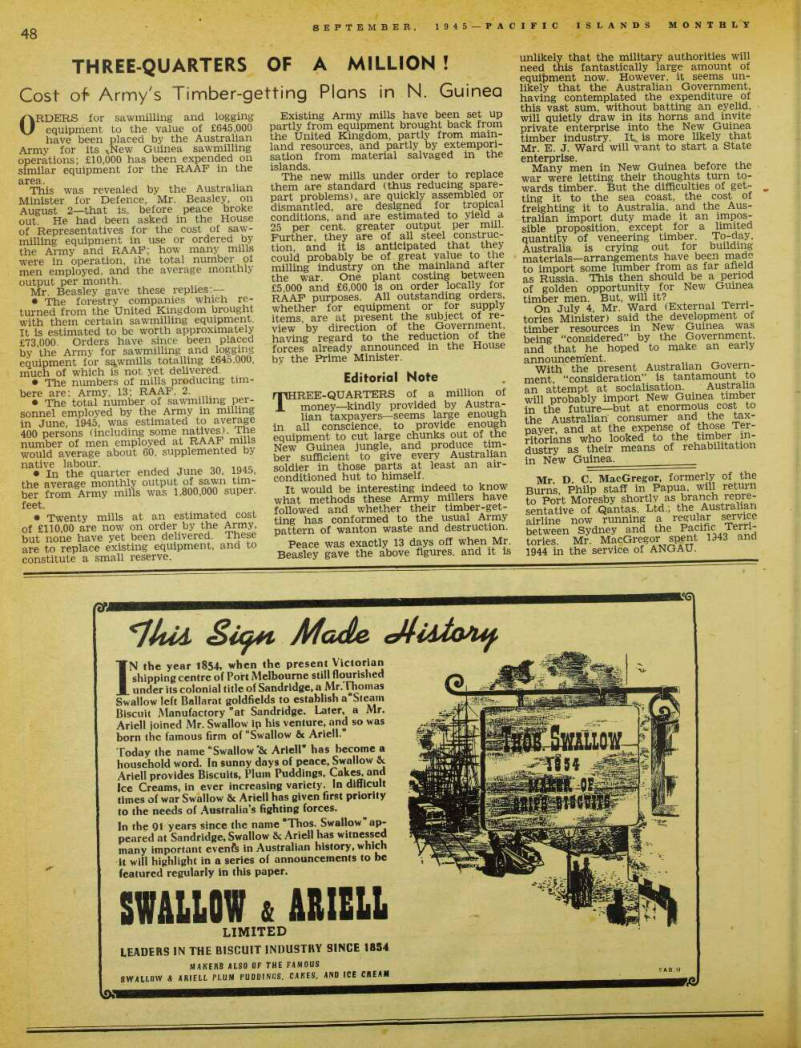
Cost of Army's Timber-getting Plans in N. Guinea
ORDERS for sawmilling and logging equipment to the value of £645,000 have been placed by the Australian Army for its *New Guinea sawmilling operations; £lO,OOO has been expended on similar equipment for the RAAF in the area.
This was revealed by the Australian Minister for Defence, Mr. Beasley, on August 2—that is, before peace broke out. He had been asked in the House of Representatives for the cost of saw milling equipment in use or ordered by the Army and RAAF; how many mills were in operation, the total number of men employed, and the average monthly output per month.
Mr. Beasley gave these replies:— • The forestry companies which re turned from the United Kingdom brought with them certain sawmilling equipment.
It is estimated to be worth approximately £73 000 Orders have since been placed by the Army for sawmilling and logging equipment for sawmills totalling £645,000, much of which is not, yet delivered, • The numbers of mills producing tim bere are: Army, 13; RAAF, 2. • The total number of sawmilling per sonnel employed by the Army in milling in June, 1945, was estimated to average 400 persons (including some natives). The number of men employed at RAAF mills would average about 60, supplemented by native labour. , on ,nAC • In the quarter ended June 30, 1945, the average monthly output of sawn tim ber from Army mills was 1.800,000 super, feet. • Twenty mills at an estimated cost of £llO,OO are now on order by the Army, but none have yet been delivered. These are to replace existing equipment, and to constitute a small reserve.
Existing Army mills have been set up partly from equipment brought back from the United Kingdom, partly from main land resources, and partly by extempori sation from material salvaged in the islands.
The new mills under order to replace them are standard (thus reducing spare part problems), are quickly assembled or dismantled, are designed for tropical conditions, and are estimated to yield a 25 per cent, greater output per mill.
Further, they are of all steel construc tion, and it is anticipated that they could probably be of great value to the milling industry on the mainland after the war. One plant costing between £5,000 and £6,000 is on order locally for RAAF purposes. All outstanding orders, whether for equipment or for supply items, are at present the subject of re view by direction of the Government, having regard to the reduction of the forces already announced in the House by the Prime Minister.
Editorial Note
r REE-QUARTERS of a million of money—kindly provided by Austra lian taxpayers—seems large enough in all conscience, to provide enough equipment to cut large chunks out of the New Guinea jungle, and produce tim ber sufficient to give every Australian soldier in those parts at least an air conditioned hut to himself.
It would be interesting indeed to know what methods these Army millers have followed and whether their timber-get ting has conformed to the usual Army pattern of wanton waste and destruction.
Peace was exactly 13 days off when Mr.
Beasley gave the above figures, and it is
unlikely that the military authorities will need this fantastically large amount of equipment now. However, it seems un likely that the Australian Government, having contemplated the expenditure of this vast sum, without batting an eyelid, will quietly draw in its horns and invite private enterprise into the New Guinea timber industry. It*, is more likely that Mr. E. J. Ward will want to start a State enterprise.
Many men in New Guinea before the war were letting their thoughts turn to wards timber. But the difficulties of get ting it to the sea coast, the cost of freighting it to Australia, and the Aus tralian import duty made it an impos sible proposition, except for a limited quantity of veneering timber. To-day, Australia is crying out for building materials— arrangements have been made to import some lumber from as far afield as Russia. This then should be a period of golden opportunity for New Guinea timber men. But, will it? , m On July 4, Mr. Ward (External Terri tories Minister) said the development oi timber resources in New Guinea was being “considered” by the Government, and that he hoped to make an early announcement.
With the present Australian Govern ment, “consideration” is tantamount to an attempt at socialisation. Australia will probably import New Guinea timber in the future —but at enormous cost to the Australian consumer and the tax payer, and at the expense of those Ter ritorians who looked to the timber in dustry as their means of rehabilitation in New Guinea.
Mr. D. c7 MacGregor, formerly of the Burns, Philp staff in Papua, will return to Port Moresby shortly as branch repre sentative of Qantas. Ltd., the Australian airline now running a regular service between Sydney and the Pacific Terri tories. Mr. MacGregor spent 1343 and 1944 in the service of ANGAU.
Advertisements & other items, p. 50 (1 item)
BUj*tMatte Jhitosuf.
IN the year 1854, when the present Victorian shipping centre of Port Melbourne still flourished under its colonial title of Sandridge, a Mr. Thomas Swallow left Ballarat goldfields to establish a Steam Biscuit Manufactory ”at Sandridge. Later, a Mr.
Ariell joined Mr. Swallow ip his venture, and so was born the famous firm of “Swallow & Ariell.”
Today the name “Swallow '& Ariell” has become a household word. In sunny days of peace, Swallow & Ariell provides Biscuits, Plum Puddings, and Ice Creams, in ever increasing variety. In difficult times of war Swallow & Ariell has given first priority to the needs of Australia’s fighting forces.
In the 91 years since the name “Thos. Swallow appeared at Sandridge, Swallow &c Ariell has witnessed many important evenfe in Australian history, which It will highlight in a series of announcements to be featured regularly in this paper.
SWALLOW 4 ARIELL
LIMITED
LEADERS IN THE BISCUIT INDUSTRY SINCE 1854
MAKERS ALSO OF THE FAMOUS
SWALLOW & ARIELL PLUM PUDDINOS, CAKES, AND ICE CREAM mm
New Guinea’S Missing Civilians
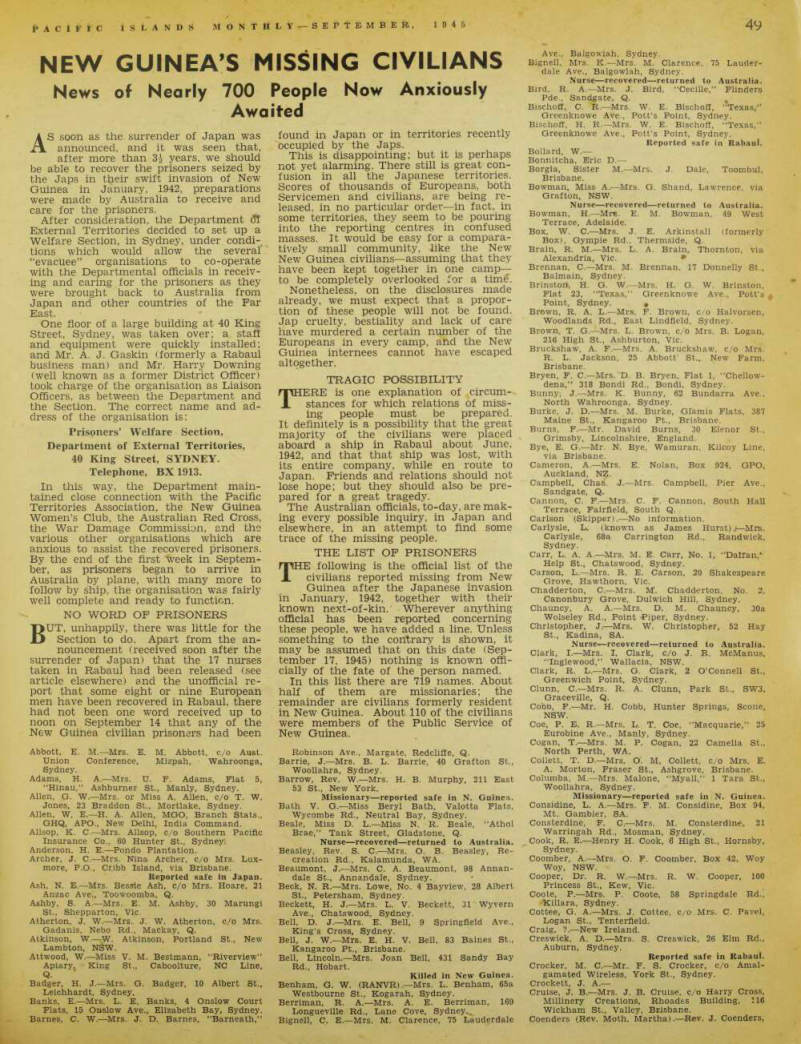
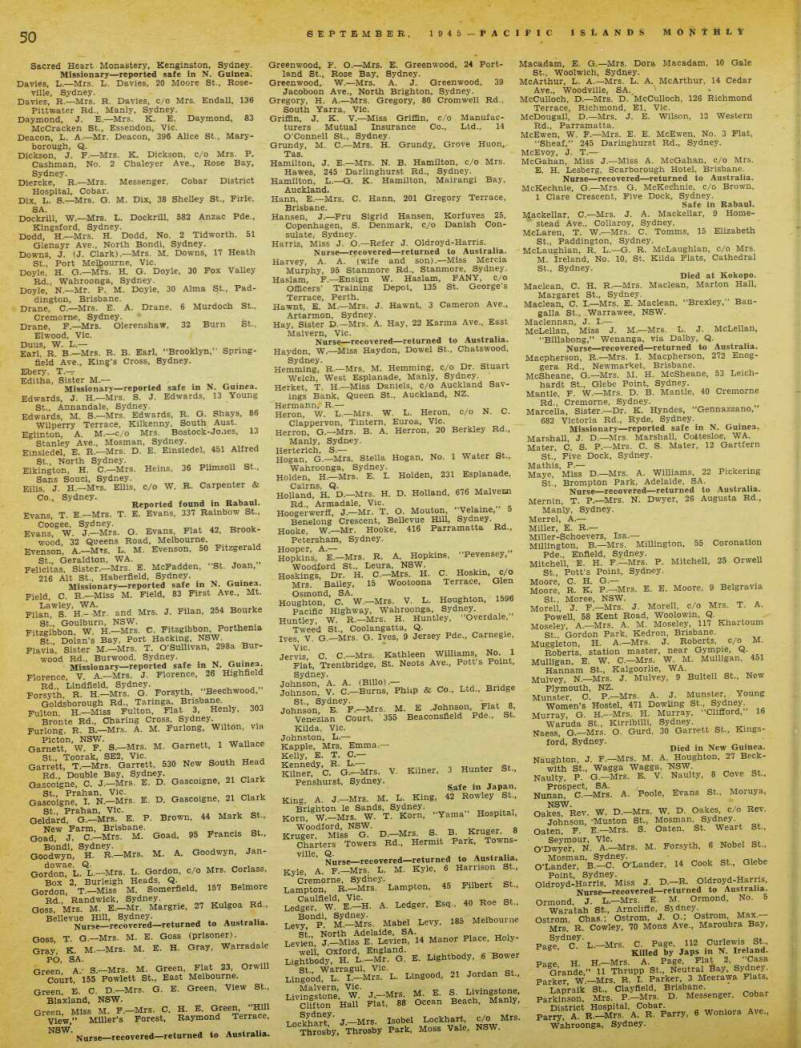
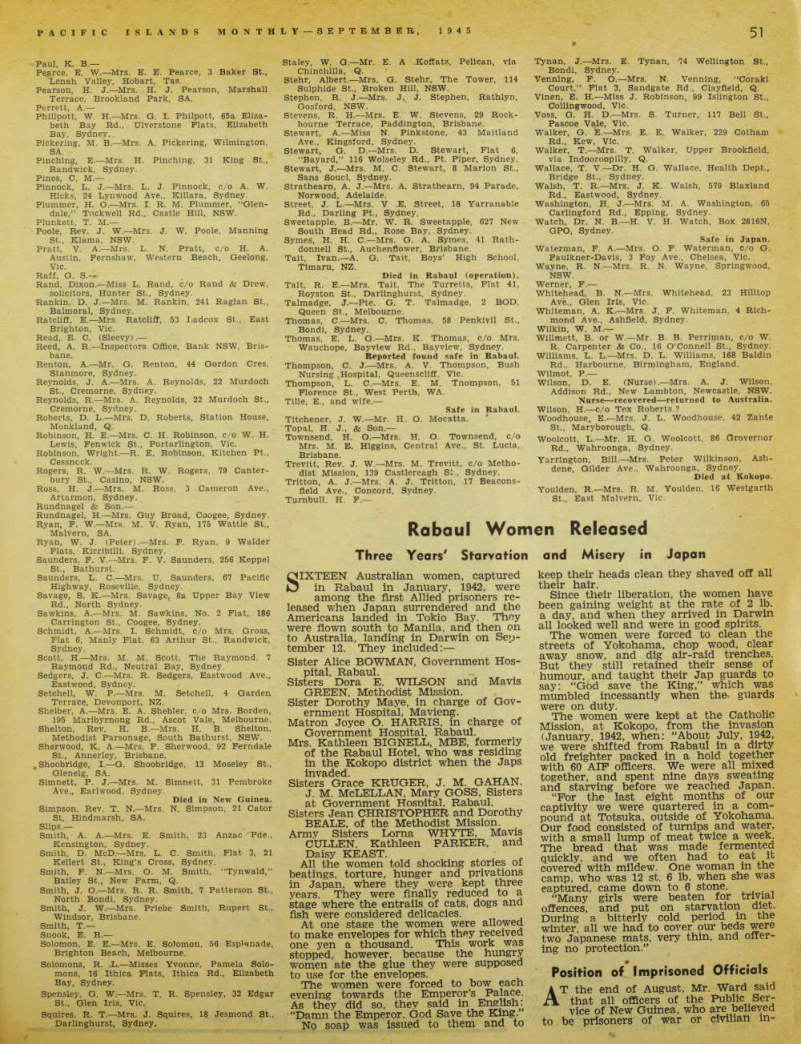
News of Nearly 700 People Now Anxiously Awaited
AS soon as the surrender of Japan was announced, and it was seen that, after more than 3£ years, we should be able to recover the prisoners seized by the Japs in their swift invasion of New Guinea in January, 1942, preparations were made by Australia to receive and care for the prisoners.
After consideration, the Department (5T External Territories decided to set up a Welfare Section, in Sydney, under condi tions which would allow the several “evacuee” organisations to co-operate with the Departmental officials in receiv ing and caring for the prisoners as they were brought back to Australia from Japan and other countries of the Far East.
One floor of a large building at 40 King- Street, Sydney, was taken over; a staff and equipment were quickly installed; and Mr. A. J. Gaskin (formerly a Rabaul business man) and Mr. Harry Downing (well known as a former District Officer) took charge of the organisation as Liaison Officers, as between the Department and the Section. The correct name and ad dress of the organisation is: Prisoners’ Welfare Section, Department of External Territories, 40 King Street, SYDNEY, Telephone, BX 1913.
In this way, the Department main tained close connection with the Pacific Territories Association, the New Guinea Women’s Club, the Australian Red Cross, the War Damage Commission, and the various other organisations which are anxious to assist the recovered prisoners.
By the end of the first "week in Septem ber, as prisoners began to arrive in Australia by plane, with many more to follow by ship, the organisation was fairly well complete and ready to function.
No Word Of Prisoners
BUT, unhappily, there was little for the Section to do. Apart from the an nouncement (received soon after the surrender of Japan) that the 17 nurses taken in Rabaul had been released (see article elsewhere) and the unofficial re port that some eight or nine European men have been recovered in Rabaul, there had not been one word received up to noon on September 14 that any of the New Guinea civilian prisoners had been Abbott, E. M. —Mrs. E. M. Abbott, c/o Aust.
Union Conference, Mizpah, Wahroonga, Sydney.
Adams, H. A.—Mrs. U. F. Adams, Flat 5, “Hinau,” Ashburner St., Manly, Sydney.
Allen, G. W.—Mrs. or Miss A. Allen, c/o T. W.
Jones, 23 Braddon St., Mortlake, Sydney.
Allen, W. E.—H. A. Allen, MGO, Branch Stats., GHQ, APO., New Delhi, India Command.
Allsop, K. C.—Mrs. Allsop, c/o Southern Pacific Insurance Co., 60 Hunter St., Sydney l .
Anderson, H. E. —Pondo Plantation.
Archer, J. C. —Mrs. Nina Archer, c/o Mrs. Lux more, P. 0., Cribb Island, via Brisbane.
Reported safe in Japan.
Ash, N. E. —Mrs. Bessie Ash, c/o Mrs. Hoare, 21 Anzac Ave., Toowoomba, Q.
Ashby, S. A.—Mrs. E. M. Ashby, 30 Marungi St., Shepparton, Vic.
Atherton, J. W.—Mrs. J. W. Atherton, c/o Mrs.
Gadanis, Nebo Rd., Mackay, Q.
Atkinson, W.—W. Atkinson, Portland St., New Lambton, NSW.
Attwood, W. —Miss V. M. Bestmann, “Riverview”
King St., Caboolture, NC Line, Q- Badger, H. J. —Mrs. G. Badger, 10 Albert St., Leichhardt, Sydney.
Banks, E. —Mrs. L. E. Banks, 4 Onslow Court Flats, 15 Onslow Ave., Elizabeth Bay, Sydney.
Barnes, C. W.—Mrs. J. D. Barnes, “Barneath,”
found in Japan or in territories recently occupied by the Japs.
This is disappointing; but it is perhaps not yet alarming. There still is great con fusion in all the Japanese territories.
Scores of thousands of Europeans, both Servicemen and civilians, are being re leased, in no particular order —in fact, in some territories, they seem to be pouring into the reporting centres in confused masses. It would be easy for a compara tively small community, like the New New Guinea civilians —assuming that they have been kept together in one camp— to be completely overlooked for a time.
Nonetheless, on the disclosures made already, we must expect that a propor tion of these people will not be found.
Jap cruelty, bestiality and lack of care have murdered a certain number of the Europeans in every camp, and the New Guinea internees cannot have escaped altogether,
Tragic Possibility
rERE is one explanation of circum stances for which relations of miss ing people must be prepared.
It definitely is a possibility that the great majority of the civilians were placed aboard a ship in Rabaul about June, 1942, and that that ship was lost, with its entire company, while en route to Japan. Friends and relations should not lose hope; but they should also be pre pared for a great tragedy.
The Australian officials, to-day, are mak ing every possible inquiry, in Japan and elsewhere, in an attempt to find some trace of the missing people.
The List Of Prisoners
rjIHE following is the official list of the A civilians reported missing from New Guinea after the Japanese invasion in January, 1942, together with their known next-of-kin. Wherever anything official has been reported concerning these people, we have added a line. Unless something to the contrary is shown, it may be assumed that on this date (Sep tember 17, 1945) nothing is known offi cially of the fate of the person named.
In this list there are 719 names. About half of them are missionaries; the remainder are civilians formerly resident in New Guinea. About 110 of the civilians were members of the Public Service of New Guinea.
Robinson Ave., Margate, Redcliffe, Q.
Barrie, J. —Mrs. B. L. Barrie, 40 Grafton St., Woollahra, Sydney.
Barrow, Rev. W.—Mrs. H, B. Murphy, 211 East 53 St., New York.
Missionary—reported safe in N. Guinea.
Bath V. G. —Miss Beryl Bath, Valotta Flats, Wycombe Rd., Neutral Bay, Sydney.
Beale, Miss D. L. —Miss N. R. Beale, “Athol Brae,” Tank Street, Gladstone, Q.
Nurse—recovered—returned to Australia.
Beasley, Rev. S. C.—Mrs. O. B. Beasley, Re creation Rd., Kalamunda, WA.
Beaumont, J.—Mrs. C. A. Beaumont, 98 Annan dale St., Annandale, Sydney.
Beck, N. R.—Mrs. Lowe, No. 4 Bayview, 28 Albert St., Petersham, Sydney.
Beckett, H. J. —Mrs. L. V. Beckett, 31 Wyvern Ave., Chatswood, Sydney.
Bell, D. J.—Mrs. E. Bell, 9 Springfield Ave., King’s Cross, Sydney.
Bell, J. W.—Mrs. E. H. V. Bell, 83 Baines St., Kangaroo Pt., Brisbane.
Bell, Lincoln. —Mrs. Joan Bell, 431 Sandy Bay Rd., Hobart.
Killed in New Guinea.
Benham, G. W. (RANVR).—Mrs. L. Benham, 65a Westbourne St., Kogarah, Sydney.
Berriman, R. A. —Mrs. A. E. Berriman, 169 Longueville Rd., Lane Cove, Sydney.^ Bignell, C. E.—Mrs. M. Clarence, 75 Lauderdale
Ave., Balgowlah, Sydney.
Bignell, Mrs. K.—Mrs. M. Clarence, 75 Lauder dale Ave., Balgowlah, Sydney.
Nurse—recovered—returned to Australia* Bird, R. A.—Mrs. J. Bird, “Cecille,” Flinders Pde., Sandgate, Q. , Bischoff, C. R.—Mrs. W. E. Bischoff, “Texas/* Greenknowe Ave., Pott’s Point, Sydney.
Bischoff, H. R.—Mrs. W. E. Bischoff, “Texas/’
Greenknowe Ave., Pott’s Point, Sydney, Reported safe in Rabaul.
Bollard, W.— Bonnitcha, Eric D.— Borgia, Sister M.—Mrs. J. Dale, Toombul, Brisbane.
Bowman, Miss A. —Mrs. G. Shand, Lawrence, via Grafton, NSW.
Nurse—recovered—returned to Australia.
Bowman, H. —Mrs. E. M. Bowman, 49 West Terrace, Adelaide.
Box, W. C.—Mrs. J. E. Arkinstall (formerly Box), Gympie Rd., Thermside, Q.
Brain, R. M.—Mrs. L. A. Brain, Thornton, via Alexandria, Vic. * Brennan, C. —Mrs. M. Brennan, 17 Donnelly St., Balmain, Sydney.
Brinston, H. G. W.—Mrs. H. G. W. Brinston, Flat 23, “Texas,” Greenknowe Ave., Pott’s Point, Sydney. Brown, R. A. L. —Mrs. F. Brown, c/o Halvorsen, Woodlands Rd., East Lindfield, Sydney.
Brown, T. G. —Mrs. L. Brown, c/o Mrs. B. Logan, 216 High St., Ashburton, Vic.
Bruckshaw, A. F.—Mrs. A. Bruckshaw, c/o Mrs.
R. L. Jackson, 25 Abbott St., New Farm, Brisbane.
Bryen, F. C. —Mrs. D. B. Bryen, Flat 1, “Chellow dena,” 318 Bondi Rd., Bondi, Sydney.
Bunny, J.—Mrs. K. Bunny, 62 Bundarra Ave,, North Wahroonga, Sydney.
Burke, J. D.—Mrs. M. Burke, Gl'amis Flats, 387 Maine St., Kangaroo Pt., Brisbane.
Burns, F.—Mr. David Burns, 30 Elenor St., Grimsby, Lincolnshire, England.
Bye, E. G. —Mr. N. Bye, Wamuran, Kilcoy Line, via Brisbane.
Cameron, A.—Mrs. E. Nolan, Box 924, GPO, Auckland, NZ.
Campbell, Chas'. J. —Mrs. Campbell, Pier Ave., Sandgate, Q.
Cannon, C. F.—Mrs. C. F. Cannon, South Hall Terrace, Fairfield, South Q.
Carlson (Skipper).—No information.
Carlysle, L. (known, as James Hurst) .f —Mrs.
Carlysle, 68a Carrington Rd., Randwick, Sydney.
Carr, L. A. A.—Mrs. M. E. Carr, No. 1, "Dalran/ 1 Help St., Chatswood, Sydney.
Carson, L.—Mrs. R. E. Carson, 20 Shakespeare Grove, Hawthorn, Vic.
Chadderton, C.—Mrs. M. Chadderton, No. 2, Canonbury Grove, Dulwich Hill, Sydney.
Chauncy, A. A.—Mrs. D. M. Chauncy, 30a Wolseley Rd., Point Fiper, Sydney.
Christopher, J. —Mrs. W. Christopher, 52 Hay St., Kadina, SA.
Nurse^-recovered—returned to Australia.
Clark, I.—Mrs. I. Clark, c/o J. R. McManus, “Inglewood,” Wallacia, NSW.
Clark, R. L. —Mrs. G. Clark, 2 O’Connell St., Greenwich Point, Sydney.
Clunn, C.—Mrs. R. A. Clunn, Park St., SW3, Graceville, Q.
Cobb, F. —Mr. H. Cobb, Hunter Springs, Scone,
Nsw.
Coe, P. E. R.—Mrs. L. T. Coe, “Macquarie,” 25 Eurobine Ave., Manly, Sydney.
Cogan, T.—Mrs. M. P. Cogan, 22 Camelia St., North Perth, WA.
Collett, T. D.—Mrs. O. M. Collett, c/o Mrs. E.
A. Morton, Fraser St., Ashgrove, Brisbane.
Columba, M. —Mrs. Malone, “Myall,” 1 Tara St., Woollahra, Sydney.
Missionary—reported safe in N. Guinea.
Considine, L. A. —Mrs. F. M. Considine, Box 94, Mt. Gambier, SA.
Consterdine, F. C. —Mrs. M. Consterdine, 21 Warringah Rd., Mosman, Sydney.
Cook, R. E.—Henry H. Cook, 6 High St., Hornsby, Sydney.
Coomber, A.—Mrs. O. F. Coomber, Box 42, Woy Woy, NSW.
Cooper, Dr. R. W. —Mrs. R. W. Cooper, 100 Princess St., Kew, Vic.
Coote, P.—Mrs. P. Coote, 58 Springdale Rd., Killara, Sydney.
Cottee, G. A.—Mrs. J. Cottee, c/o Mrs. C Pavel, Logan St., Tenterfleld.
Craig, ?. —New Ireland.
Creswick, A. D.—Mrs. S. Creswick, 26 Elm Rd., Auburn, Sydney.
Reported safe in Rabaul.
Crocker, M. C. —Mr. F. S. Crocker, c/o Amal gamated Wireless, York St., Sydney.
Crockett, J. A. — Cruise, J. B. —Mrs. J. B. Cruise, c/o Harry Cross, Millinery Creations, Rhoades Building, 116 Wickham St., Valley, Brisbane.
Coenders (Rev. Moth. Martha). —Rev. J. Coenders,
Sacred Heart Monastery, Kenginston, Sydney.
Missionary—reported safe in N. Guinea.
Davies, L.—Mrs. L. Davies, 20 Moore St., Rose ville, Sydney.
Davies, R.—Mrs. R. Davies, c/o Mrs. Endall, 136 Pittwater Rd., Manly, Sydney.
Daymond, J. E. —Mrs. K. E. Daymond, 83 McCracken St., Essendon, Vic.
Deacon, L. A.—Mr. Deacon, 396 Alice St., Mary borough, Q.
Dickson, J. F.—Mrs. K. Dickson, c/o Mrs. P.
Cashman, No. 2 Chaleyer Ave., Rose Bay, Sydney.
Diercke, R.—Mrs. Messenger, Cobar District Hospital, Cobar.
Dix, L. S.—Mrs. G. M. Dix, 38 Shelley St., Firle, SA.
Dockrill, W.—Mrs. L. Dockrill, 582 Anzac Pde., Kingsford, Sydney.
Dodd, H—Mrs. H. Dodd, No. 2 Tidworth, 51 Glenayr Ave., North Bondi, Sydney.
Downs, J. (J. Clark).—Mrs. M. Downs, 17 Heath St., Port Melbourne, Vic.
Doyle, H. G.—Mrs. H. G. Doyle, 30 Fox VaUey Rd., Wahroonga, Sydney.
Doyle, N.—Mr. P. M. Doyle, 30 Alma St., Pad dington, Brisbane.
Drane, C. —Mrs. E. A. Drane, 6 Murdoch St., Cremorne, Sydney.
Drane, F.—Mrs. Olerenshaw, 32 Burn St., Elwood, Vic.
Duus, W. L,— Earl, R. B.—Mrs. R. B. Earl, “Brooklyn,’ Spring field Ave., King’s Cross, Sydney.
Ebery. T Editha, Sister M.— . „ .
Missionary—reported safe m N. Guinea.
Edwards, J. H.—Mrs. S. J. Edwards, 13 Young St., Annandale, Sydney.
Edwards, M. S.—Mrs. Edwards, R. G. Shays, 86 Wilperry Terrace, Kilkenny, South Aust.
Eglinton, A. M. —c/o Mrs. Bostock-Joxies, 13 Stanley Ave., Mosman, Sydney.
Einsiedel, E. R.—Mrs. D. E. Einsiedel, 451 Alfred St., North Sydney.
Elkington, H. C.—Mrs. Heins, 36 Plimsoll St., Sans Souci, Sydney.
Ellis, J. H.—Mrs. Ellis, c/o W. R. Carpenter & Co., Sydney. , . „ . .
Reported found in Rabaul.
Evans, T. E.—Mrs. T. E. Evans, 337 Rainbow St., Coogee, Sydney. „ Evans, W. J.—Mrs. G. Evans, Flat 42, Brook wood, 32 Queens Road, Melbourne, Evenson, A.—Mrs. L. M. Evenson, 50 Fitzgerald St.. Geraldton, WA.
Felicitas, Sister. —Mrs. E. McFadden, St. Joan, 216 Alt St., Haberfield, Sydney.
Missionary—reported safe in N. Guinea.
Field, C. R.—Miss M. Field, 83 First Ave., Mt.
Filan, Mr. and Mrs. J. Fllan, 254 Bourke FitfgibbS, Ul W. rl H.—Mrs. C. Fitzgibbon, Porthenia Plavia, ?r; S M E !!Mfs 0r T H O^Sfiva N n SW 29 Ba Bur wood Rd., Burwood, Sydney. .
Missionary—reported safe m N. Guinea.
Florence, V. A.—Mrs. J. Florence, 26 Highfield Rd., Lindfield, Sydney. „ Forsyth, R. H.—Mrs. G. Forsyth, Beechwood.
Goldsborough Rd., Taringa Brisbane.
Fulton, H.—Miss Fulton, Flat 3, Henly, 303 Bronte Rd., Charing Sydney.
Furlong. R. B.—Mrs. A. M. Furlong. Wilton, via Garnett, n ’w? S T\ S.—Mrs. M. Garnett, 1 Wallace St., Toorak, SE2, Vic. .
Garrett, T.—Mrs. Garrett, 530 New South Head Rd., Double Bay, Sydney.
Gascoigne, C. J.—Mrs. E. D. Gascoigne, 21 Clark Gascoigne^ I. a N—Mrs. E. D. Gascoigne, 21 Clark Geldard^S.—Mrs! C E. P. Brown, 44 Mark St., New Farm, Brisbane.
Goad, J. C.—Mrs. M. Goad, 95 Francis St., Gofdwyn, R.—Mrs. M. A. Goodwyn, Jan- Gordim^L.^L.—Mrs. L. Gordon, c/o Mrs. Corlass, Box 2. Burleigh Heads, Q.
Gordon, T.—Miss M. Somerfield, 157 Belmore Rd., Randwick, Sydney. _.
Goss. Mrs. M. E.—Mr. Margne. 27 Kulgoa Rd., Bellevue Hill. Sydney.
Nurse —recovered —returned to Australia.
Goss T G. —Mrs. M. E. Goss (prisoner).
Cray, K. M.-Mrs. M. E. H. Gray, Warradale
Po, Sa.
Green A.- S.—Mrs. M. Green, Flat 23, Orwill Court, 155 Powlett St., East Melbourne.
Green, E. C. D.—Mrs. G. E. Green. View St., Blaxland, NSW.
Green Miss M. P.—Mrs. C. H. E. Green, “Hill View,” Miller’s Forest, Raymond Terrace, Nurse —recovered —returned to Australia.
Greenwood, F. O.—Mrs. E. Greenwood, 24 Port land St., Rose Bay, Sydney.
Greenwood, W. —Mrs. A. J. Greenwood, 39 Jacoboon Ave., North Brighton, Sydney.
Gregory, H. A.—Mrs. Gregory, 80 Cromwell Rd., South Yarra, Vic.
Griffin, J. K. V.—Miss Griffin, c/o Manufac turers Mutual Insurance Co., Ltd., 14 O’Connell St., Sydney.
Grundy, M. C.—Mrs. H. Grundy, Grove Huon, Hamilton. J. E.—Mrs. N. B. Hamilton, c/o Mrs.
Hawes, 245 Darlinghurst Rd., Sydney.
Hamilton, L.—G. K. Hamilton, Mairangi Bay, Auckland.
Hann, E—Mrs. C. Hann, 201 Gregory Terrace, Brisbane.
Hansen, J.—Fru Sigrid Hansen, Korfuves 25, Copenhagen, S. Denmark, c/o Danish Con sulate, Sydney.
Harris, Miss J. O.—Refer J. Oldroyd-Harris.
Nurse—recovered —returned to Australia.
Harvey, A. A. (wife and son).—Miss Mercia Murphy, 95 Stanmore Rd., Stanmore, Sydney.
Haslam, F.—Ensign W. Haslam, FANY, c/o Officers’ Training Depot, 135 St. George’s Terrace, Perth.
Hawnt, E. M.—Mrs. J. Hawnt, 3 Cameron Ave., Artarmon, Sydney.
Hay, Sister D.—Mrs. A. Hay, 22 Karma Ave., East Malvern, Vic.
Nurse—recovered —returned to Australia.
Haydon, W.—Miss Haydon, Dowel St., Chatswood, Sydney.
Hemming, R.—Mrs. M, Hemming, c/o Dr. Stuart Welch, West Esplanade, Manly, Sydney.
Herket, T. H.—Miss Daniels, c/o Auckland Sav ings Bank, Queen St., Auckland, NZ.
Hermann, R. — , „ Heron, W. L.—Mrs. W. L. Heron, c/o N. C.
Clappervon, Tintern, Euroa, Vic.
Herron, G—Mrs. B. A. Herron, 20 Berkley Rd., Manly, Sydney.
Herterich, S. — Hogan, G.—Mrs. Stella Hogan, No. 1 Water St., Wahroonga, Sydney. , „ . .
Holden, H.—Mrs. E. I. Holden, 231 Esplanade, Cairns, Q.
Holland, H. D.—Mrs. H. D. Holland, 676 Malvern Rd., Armadale, Vic.
Hoogerwerff, J.—Mr. T. O. Mouton, “Velame, 5 Benelong Crescent, Bellevue Hill, Sydney.
Hooke, W. —Mr. Hooke, 416 Parramatta Rd., Petersham, Sydney.
Hooper, A. — Hopkins, E.—Mrs. R. A, Hopkins, “Pevensey, Woodford St., Leura, NSW.
Hoskings, Dr. H. C.—Mrs. H. a Hoskm. c/o Mrs. Bailey, 15 Wootoona Terrace, Glen Osmond, SA.
Houghton, C. W.—Mrs. V. L. Houghton, 1596 Pacific Highway, Wahroonga, Sydney.
Huntley, W. R.—Mrs. H. Huntley, “Overdale, Tweed St., Coolangatta, Q.
Ives, V. G.—Mrs. G. Ives, 9 Jersey Pde., Carnegie, Vic Jervis' C. C.—Mrs. Kathleen Williams, No. 1 Flat, Trentbridge, St. Neots Ave., Pott’s Point, Sydney.
Johnson, A. A. (Billo).
Johnson, V. C Burns, Phup & Co., Ltd., Bridge Joh S nson Sy E! ey F.—Mrs. M. E .Johnson Flat 8, Venezian Court, 355 Beaconsfield Pde., St.
Kilda, Vic.
Johnston, L. — Kapple, Mrs, Emma.— Kelly, E. T. C.— Kilnerf y C. R V. Kilner, 3 Hunter St., Penshurst. Sydney. n Japan King A- j.—Mrs. M. L. King, 42 Rowley St., Kon^, iS W.^—Mrs, S^W dS 'T Sy Korn,' “Yama” Hospital.
Kruler odf Miss NS <?' D.-Mrs. S, B. Kruger, 8 Charters Towers Rd., Hermit Park, Towns- Nurse —recovered —returned to Australia.
Kyle , A. F. —Mrs. L. M. Kyle, 6 Harrison St„ Lampton°, rn R--sMrs? Lampton, 45 Filbert St., Ledger, m w d ’ E.— H. A. Ledger, Esq., 40 Roe St., M.-Mrs. Mabel Levy, 185 Melbourne Levten Manor Place. Holy- LighSdy E. Lightbody, 6 Bower St., Warragul, Vic. <=t Lingood, L. I.—Mrs. L. Lmgood, 21 Jordan St., al vern, T Mrs M. E. S. Livingstone, LlV Clff S ton Hall Flat, 88 Ocean Beach, Manly, inckhSt y ' J.—Mrs. Isobel Lockhart, c/o Mrs.
Throsby, Throsby Park, Moss Vale, NSW.
Macadam, E. G.—Mrs. Dora Macadam, 10 Gale St., Woolwich, Sydney.
McArthur, L. A.—Mrs. L. A. McArthur, 14 Cedar Ave., Woodville, SA.
McCulloch, D.—Mrs. D. McCulloch, 126 Richmond Terrace, Richmond, El, Vic.
McDougall, D.—Mrs. J. E. Wilson, 12 Western Rd., Parramatta.
McEwen, W. F. —Mrs. E. E. McEwen, No. 3 Flat, “Sheaf,” 245 Daringhurst Rd., Sydney.
McEvoy, J. T.— McGahan, Miss J—Miss A. McGahan, c/o Mrs.
E. H. Lesberg, Scarborough Hotel, Brisbane.
Nurse —recovered—returned to Australia.
McKechnie, G. —Mrs. G. McKechnie, c/o Brown, 1 Clare Crescent, Five Dock, Sydney.
Safe in Rabaul.
Mackellar, C.—Mrs. J. A. Mackellar, 9 Home stead Ave., Collaroy, Sydney.
McLaren, T. W.—Mrs. C. Tomms, 15 Elizabeth St., Paddington, Sydney.
McLaughlan, R. L.—G. R. McLaughlan, c/o Mrs.
M. Ireland, No. 10, St. Hilda Flats, Cathedral St., Sydney.
Died at Kokopo.
Maclean, C. H. R. —Mrs. Maclean, Marton Hall, Margaret St., Sydney.
Maclean, C. I.—Mrs. E. Maclean, “Brexley,” Ban galla St., Warrawee, NSW.
Maclennan, J. I.— McLellan, Miss J. M. —Mrs. L. J. McLellan, “Billabong,” Wenanga, via Dalby, Q.
Nurse —recovered—returned to Australia.
Macpherson, R.—Mrs. I. Macpherson, 272 Enog gera Rd., Newmarket, Brisbane.
McSheane, G.—Mrs. M. H. McSheane, 53 Leich hardt St., Glebe Point, Sydney.
Mantle, F. W.—Mrs. D. B. Mantle, 40 Cremorne Rd., Cremorne, Sydney.
Marcella, Sister. —Dr. K. Hyndes, “Gennazzano, 682 Victoria Rd., Ryde, Sydney.
Missionary—reported safe in N. Guinea.
Marshall, J. D—Mrs. Marshall, Cottesloe, WA.
Mater, C. S. P.—Mrs. C. S. Mater, 12 Gartfern St., Five Dock, Sydney.
Mathis, P. — .
Maye, Miss D.—Mrs. A. Williams, 22 Pickering St., Brompton Park, Adelaide, SA.
Nurse —recovered—returned to Australia.
Mernin, T. P.—Mrs. N. Dwyer, 26 Augusta Rd., Manly, Sydney.
Merrel, A.— Miller, E. R.— Miller-Schoevers, Isa.— „ „ Millington, B.—Mrs. Millington, 55 Coronation Pde., Enfield, Sydney.
Mitchell, E. H. F.—Mrs. P. Mitchell, 25 OrweU St., Pott’s Point, Sydney.
Moore, C. H. G. — Moore, R. K. P.—Mrs. E. E. Moore, 9 Belgravia St., Moree, NSW, Morell, J. F.—Mrs. J. Morell, c/o Mrs. T. A.
Powell, 58 Kent Road, Woolowin, Q.
Moseley, A.—Mrs. A. M. Moseley, 117 Khartoum St., Gordon Park, Kedron, Brisbane.
Muggleton, H. A.—Mrs. J. Roberts, c/o M.
Roberts, station master, near Gympie, Q- Mulligan, E. W. C.—Mrs. W. M. Mulligan, 451 Hannam St., Kalgoorlie, WA.
Mulvey, N.—Mrs. J. Mulvey, 9 Bultell St., New Plymouth, NZ.
Munster, C. P.—Mrs. A. J. Munster, Young Women’s Hostel, 471 Dowling St., Sydney.
Murray G. H.—Mrs. H. Murray, “Clifford, 16 Waruda St., Kirribilli, Sydney.
Naess, G.—Mrs. O. Gurd, 30 Garrett St., Kmgs ford, Sydney. . „ .
Died in New Guinea.
Naughton, J. F.—Mrs. M. A. Houghton, 27 Beck with St., Wagga Wagga, 'NSW Naulty, P. G.—Mrs. E. V. Naulty, 8 Cove St., Prospect, SA.
Nunan, C.—Mrs. A. Poole, Evans St., Moruya,
Nsw
Oakes, Rev. W. D.—Mrs. W. D. Oakes, c/o Rev.
Johnson, ‘Muston St., Mosman Sydney.
Oaten, F. E.—Mrs. S. Oaten, St. Weart St., o’DwyS° U N. 'a°—Mrs. M. Forsyth, 6 Nobel St., Q’l^nd?L n ’BS; ne o’Lander, 14 Cook St., Glebe y kiss J. D.—R. Oldrojrt-Harns, Nurse —recovered —returned to Australia.
Ormond, J. L.—Mrs. E. M. Ormond, No. 5 Waratah St., Arncliffe, Sidney.
Ostrom Chas.; Ostrom, J. O.; Ostrom, Max.
Mrs.’ R. Cowley, 70 Mons Ave., Maroubra Bay, Pag S e! dn c r L.-Mrs. C. Page :112 ourlewis St..
Killed by Japs in N. Ireland.
Paee H. H.—Mrs. A. Page, Flat 2, “Casa Grande.” 11 Thrupp St.. Neutral Bay, Sydney.
Parker W.—Mrs. R. I. Parker, 3 Meerawa Flats, Lapraik St., Clayfield, Brisbane.
Parkinson, Mrs. P.—Mrs. D. Messenger, Cobar District Hospital, Cobar.
Parry, A. R.—Mrs. A. R. Parry, 6 Womora Ave., Wahroonga, Sydney.
Paul, K. B.— Pearce, E. W.—Mrs. E. E. Pearce, 3 Baker St., Lenah Valley, Hobart, Tas.
Pearson, H. J. —Mrs. H. J. Pearson, Marshall Terrace, Brookland Park, SA.
Perrett, A.— Phillpott, W. H.—Mrs. G. I. Philpott, 65a Eliza beth Bay Rd., Ulverstone Flats, Elizabeth Bay, Sydney.
Pickering, M. B.—Mrs. A. Pickering, Wilmington, SA.
Pinching, E.—Mrs. H. Pinching, 31 King St., Randwick, Sydney.
Pines, C. M.— Pinnock, L. J. —Mrs. L. J. Pinnock, c/o A. W.
Hicks, 24 Lynwood Ave., Killara, Sydney.
Plummer, H. O.—Mrs. I. R. M. Plummer, “Glen dale,” Tuckwell Rd., Castle Hill, NSW.
Plunkett, T. M.— Poole, Rev. J. W. —Mrs. J. W. Poole, Manning St., Kiama, NSW.
Pratt, V. A.—Mrs. L. N. Pratt, c/o H. A.
Austin, Fernshaw, Western Beach, Geelong, Vic.
Raff, G. S.-~ Rand, Dixon.—Miss L. Rand, c/o Rand & Drew, solicitors, Hunter St., Sydney.
Rankin, D. J.—Mrs. M. Rankin, 241 Raglan St., Balmoral, Sydney.
Ratcliff, E.—Mrs. Ratcliff, 53 Ladcox St., East Brighton, Vic.
Read, E. C. (Sleevy).— Reed, A. R. —Inspectors Office, Bank NSW, Bris bane.
Renton, A. —Mr. G. Renton, 44 Gordon Cres, Stanmore, Sydney.
Reynolds, J. A.—Mrs. A. Reynolds, 22 Murdoch St., Cremorne, Sydney.
Reynolds, R. —Mrs. A. Reynolds, 22 Murdoch St., Cremorne, Sydney.
Roberts, D. L. —Mrs. D. Roberts, Station House, Monkland, Q.
Robinson, H. E.—Mrs. C. H. Robinson, c/o W. H.
Lewis, Fenwick St., Portarlington, Vic.
Robinson, Wright.—R. E. Robinson, Kitchen Pt., Cessnock.
Rogers, R. W.—Mrs. R. W. Rogers, 79 Canter bury St., Casino, NSW.
Ross, H. J. —Mrs. M. Ross. 3 Cameron Ave., Artarmon, Sydney.
Rundnagel & Son.— Rundnagel, H. —Mrs. Guy Broad, Coogee, Sydney.
Ryan, F. W.—Mrs. M. V. Ryan, 175 Wattle St..
Malvern, SA.
Ryan, W. J. (Peter). —Mrs. F. Ryan, 9 Walder Flats, Kirribilli, Sydney.
Saunders, F. V.—Mrs. F. V. Saunders, 256 Keppel St., Bathurst.
Saunders, L. C.—Mrs. U. Saunders, 67 Pacific Highway, Roseville, Sydney.
Savage, S. K.—Mrs. Savage, 8a Upper Bay View Rd., North Sydney.
Sawkins, A. —Mrs. M. Sawkins, No. 2 Flat, 186 Carrington St., Coogee, Sydney.
Schmidt, A.—Mrs. I. Schmidt, c/o Mrs. Gross, Flat 6, Manly Flat, 63 Arthur St., Randwick, Sydney.
Scott, H.—Mrs. M. M. Scott, The Raymond, 7 Raymond Rd., Neutral Bay, Sydney.
Sedgers, J. C.—Mrs. R. Sedgers, Eastwood Ave., Eastwood, Sydney.
Setchell, W. P.—Mrs. M. Setchell, 4 Garden Terrace, Devonport, NZ.
Shelber, A. —Mrs. E. A. Shebler, c/o Mrs. Borden, 195 Maribyrnong Rd., Ascot Vale, Melbourne.
Shelton, Rev. H. B.—Mrs. H. B. Shelton, Methodist Parsonage, South Bathurst, NSW.
Sherwood, K. A. —Mrs. F. Sherwood, 92 Ferndale St., Annerley, Brisbane.
I. —G. Shoobridge, 13 Moseley St., Glenelg, SA.
Simnett, P. J.—Mrs. M. Simnett, 31 Pembroke Ave., Earlwood, Sydney.
Died in New Guinea.
Simpson, Rev. T. N.—Mrs. N. Simpson, 21 Cator St, Hindmarsh, SA.
Slips.— Smith, A. A. —Mrs. E. Smith, 23 Anzac Pde., Kensington, Sydney.
Smith, D. McD.—Mrs. L. C. Smith, Flat 3, 21 Kellert St., King’s Cross, Sydney.
Smith, F. N.—Mrs. O. M. Smith, “Tynwald,”
Bailey St., New Farm, Q.
Smith, J. O.—Mrs. R. R. Smith, 7 Patterson St., North Bondi, Sydney.
Smith, J. W. —Mrs. Priebe Smith, Rupert St., Windsor, Brisbane.
Smith, T Snook, E. R.— Solomon, E. E.—Mrs. E. Solomon, 56 Esplanade, Brighton Beach, Melbourne.
Solomons, R. L. —Misses Yvonne, Pamela Solo mons, 16 Ithica Plats, Ithica Rd., Elizabeth Bay, Sydney.
Spensley, G. W.—Mrs. T. R. Spensley, 32 Edgar St., Glen Iris, Vic.
Squires, R. T.—Mrs. J. Squires, 18 Jesmond St., Darllnghurst, Sydney.
Staley, W. G. —Mr. E. A .Koffatz, Pelican, via Chinchilla, Q.
Stehr, Albert.—Mrs. G. Stehr, The Tower, 114 Sulphide St.. Broken Hill. NSW.
Stephen, R. J. —Mrs. J N J. Stephen, Rathlyn, Gosford, NSW.
Stevens, R. H.—Mrs. E. W. Stevens, 29 Rock bourne Terrace, Paddington. Brisbane.
Stewart, A. —Miss N. Pinkstone, 43 Maitland Ave., Kingsford, Sydney.
Stewart, G. D. —Mrs. D. Stewart, Flat 6, “Bayard,” 116 Wolseley Rd., Pt. Piper, Sydney.
Stewart, J. —Mrs. M. C. Stewart, 8 Marion St., Sans Souci, Sydney.
Strathearn, A. J. —Mrs. A. Strathearn, 94 Parade, Norwood, Adelaide.
Street, J. L.—Mrs. V .E. Street, 18 Yarranable Rd., Darling Pt., Sydney.
Sweetapple, B. —Mr. W. R. Sweetapple, 627 New South Head Rd.. Rose Bay, Sydney.
Symes, H. H. C. —Mrs. G. A. Byrnes, 41 Rath donnell St., Auchenflower, Brisbane.
Tait, Ivan.—A. G. Tait, Boys’ High School, Timaru, NZ.
Died in Rabaul (operation).
Tait, R. E.—Mrs. Tait, The Turretts, Flat 41, Royston St., Darllnghurst, Sydney.
Talmadge, J—Pte. G. T. Talmadge, 2 BOD, Queen St., Melbourne.
Thomas, C.—Mrs. C. Thomas, 58 Penkivil St., Bondi, Sydney.
Thomas, E. L. G. —Mrs. K. Thomas, c/o Mrs.
Wauchope, Bayview Rd., Bayview, Sydney.
Reported found safe in Rabaul.
Thompson, C. J. —Mrs. A. V. Thompson, Bush Nursing ,Hospital, Queenscliff, Vic.
Thompson, L. C.—Mrs. E. M. Tnompson, 51 Florence St., West Perth, WA.
Tille, E., and wife. — Safe in Rabaul.
Titchener, J. W.—Mr. H. O. Mocatta. ' Topal, H. J., & Son. — Townsend, H. O.—Mrs. H. O. Townsend, c/o Mrs. M. B. Higgins, Central Ave., St. Lucia, Brisbane.
Trevitt, Rev. J. W.—Mrs. M. Trevitt, c/o Metho dist Mission, 139 Castlereagh St., Sydney.
Tritton, A. J.—Mrs. A. J. Tritton, 17 Beacons fleld Ave., Concord. Sydney.
Turnbull. H. F.—
Tynan, J.—Mrs. E. Tynan, 74 Wellington St., Bondi, Sydney.
Venning, F. O. —Mrs. N. Venning, “Coraki Court,” Plat 3, Sandgate Rd., Clayfleld, Q.
Vlnen, E. H.—Miss J. Robinson, 99 Islington St., Collingwood, Vic.
Voss. G. H. D.—Mrs. S. Turner, 117 Bell St., Pascoe Vale, Vic.
Walker, G. E. —Mrs. E. E. Walker, 229 Gotham Rd., Kew, Vic.
Walker, T.—Mrs. T. Walker, Upper Brookfield, via Indooroopilly, Q.
Wallace, T. V.—Dr. H. G. Wallace, Health Dept., Bridge St., Sydney.
Walsh, T. R.—Mrs. J. K. Walsh, 579 Blaxland Rd., Eastwood, Sydney.
Washington, H. J. —Mrs. M. A. Washington, 65 Carlingford Rd., Epplng, Sydney.
Watch, Dr. N. B—H. V. H. Watch. Box 2816 N, GPO, Sydney.
Safe in Japan.
Waterman, P. A.—Mrs. O. F. Waterman, c/o G.
Paulkner-Davis, 3 Foy Ave., Chelsea, Vic.
Wayne, R. N— Mrs. R. N. Wayne, Springwood,
Nsw.
Werner, P. — Whitehead. B. N.—Mrs. Whitehead, 23 Hilltop Ave., Glen Iris, Vic.
Whiteman, A. K. —Mrs. J. F. Whiteman, 4 Rich mond Ave., Ashfleld, Sydney.
Wilkin, W. M Wlllmett, B. or W—Mr. B. B. Perriman, c/o W.
R. Carpenter & Co., 16 O’Connell St., Sydney.
Williams. L. L—Mrs. D. L. Williams, 168 Baldin Rd., Harbourne, Birmingham, England.
Wllmot, P.— Wilson, D. E. (Nurse) .—Mrs. A. J. Wilson, Addison Rd., New Lambton, Newcastle, NSW.
Nurse—recovered—returned to Australia.
Wilson, H.—c/o Tex Roberts.?
Woodhouse„ E.—Mrs. J. L. Woodhouse, 42 Zante St., Maryborough, Q.
Woolcott, L.—Mr. H. G. Woolcott, 86 Grovernor Rd., Wahroonga, Sydney.
Yarrlngton, Bill.—Mrs. Peter Wilkinson, Ash dene, Gilder Ave., Wahroonga, Sydney.
Died at Kokopo.
Youlden, R.—Mrs. R. M. Youlden. 16 Westgarth St., East Malvern, Vic
Advertisements & other items, p. 52 (1 item)
50
SEPTEMBER, 1945 PACIFIC ISLANDS MOJCTHLT
Rabaul Women Released
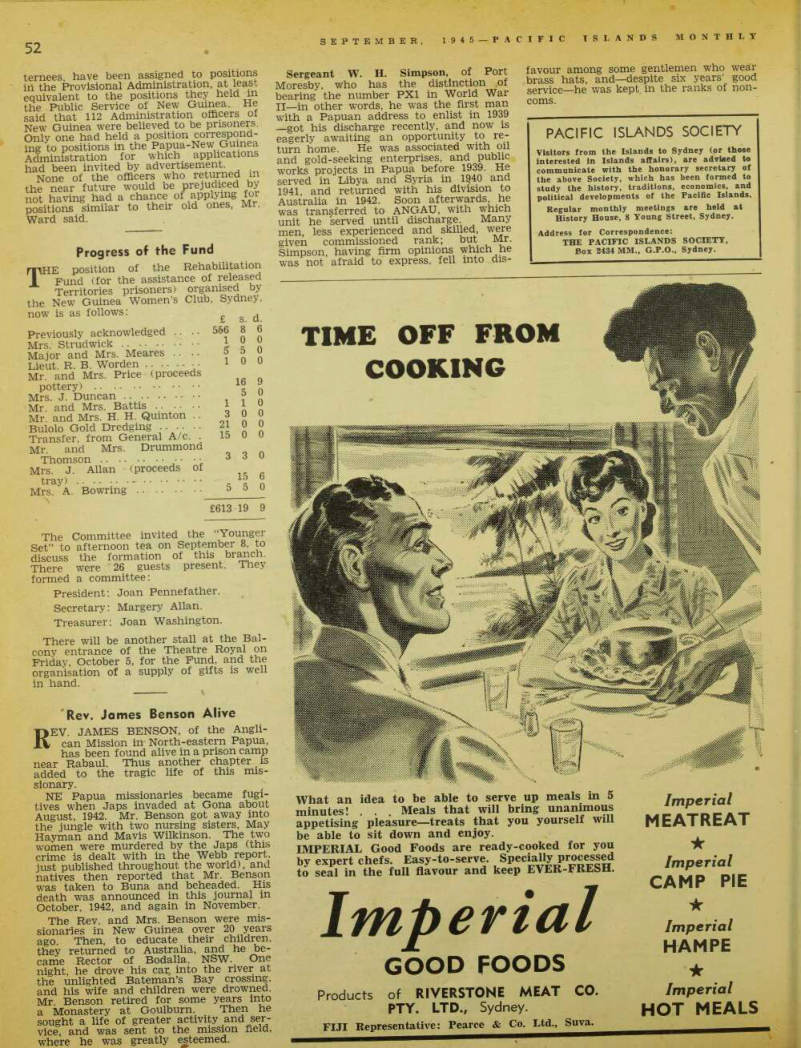
Three Years' Starvation and Misery in Japan
SIXTEEN Australian women, captured
in Rabaul in January, 1942, were among the first Allied prisoners re leased when Japan surrendered and the Americans landed in Tokio Bay. They were flown south to Manila, and then on to Australia, landing in Darwin on Sep tember 12. They included:— Sister Alice BOWMAN, Government Hos pital, Rabaul.
Sisters Dora E. WILSON and Mavis GREEN, Methodist Mission.
Sister Dorothy Maye, in charge of Gov ernment Hospital, Mavieng.
Matron Joyce O. HARRIS, in charge of Government Hospital, Rabaul.
Mrs. Kathleen BIGNELL, MBE, formerly of the Rabaul Hotel, who was residing in the Kokopo district when the Japs invaded.
Sisters Grace KRUGER, J. M. GAHAN.
J. M. McLELLAN, Mary GOSS, Sisters at Government Hospital. Rabaul.
Sisters Jean CHRISTOPHER and Dorothy BEALE, of the Methodist Mission.
Army Sisters Lorna WHYTE, Mavis CULLEN. Kathleen PARKER, and Daisy KEAST.
All the women told shocking stories of beatings, torture, hunger and privations in Japan, where they were kept three years. They were finally reduced to a stage where the entrails of cats, dogs and fish were considered delicacies.
At one stage the women were allowed to make envelopes for which they received one yen a thousand. This work was stopped, however, because the hungry women ate the glue they were supposed to use for the envelopes.
The women were forced to bow each evening towards the Emperor’s Palace.
As they did so, they said in English; “Damn the Emperor, God Save the King.
No soap was issued to them and to
keep their heads clean they shaved off all their hair.
Since their liberation, the women have been gaining weight at the rate of 2 lb. a day, and when they arrived in Darwin all looked well and were in good spirits.
The women were forced to clean the streets of Yokohama, chop wood, clear away snow, and dig air-raid trenches.
But they still retained their sense of humour, and taught their Jap guards to say; “God save the King,” which was mumbled incessantly when the guards were on duty.
The women were kept at the Catholic Mission, at Kokopo, from the invasion (January, 1942, when: “About July, 1942, we were shifted from Rabaul in a dirty old freighter packed in a hold together with 60 AIF officers. We were all mixed together, and spent nine days sweating and starving before we reached Japan.
“For the last eight months of our captivity we were quartered in a com pound at Totsuka, outside of Yokohama.
Our food consisted of turnips and water, with a small lump of meat twice a week The bread that was made fermented quickly, and we often had to eat it covered with mildew. One woman in the camp, who was 12 st. 6 lb. when she was eaptured, came down to 6 stone, “Many girls were beaten for trivial offences, and put on starvation diet.
During a bitterly cold period in the winter, all we had to cover our beds were two Japanese mats, very thin, and offer ing no protection.”
Position of Imprisoned Officials
AT the end of August, Mr. Ward said that all officers of the Public Ser vice of New Guinea, who are believed to be prisoners of war or civilian in
ternees, have been assigned to positions In the Provisional Administration, at least equivalent to the positions they held in the Public Service of New Guinea. He said that 112 Administration officers of New Guinea were believed to be prisoners.
Onlv one had held a position correspond ing to positions in the Papua-New Guinea Administration for which applications had been invited by advertisement.
None of the officers who returned in the near future would be prejudiced by not having had a chance of applying foi positions similar to their old ones, Mr.
Ward said.
Progress of the Fund
rE position of the Rehabilitation Fund (for the assistance of released
Territories prisoners) organised by
the New Guinea Women’s Club, Sydney, now is as follows:
The Committee invited the “Younger Set” to afternoon tea on September 8, to discuss the formation of this branch.
There were 26 guests present. They formed a committee: President: Joan Pennefather.
Secretary: Margery Allan.
Treasurer: Joan Washington.
There will be another stall at the Bal cony entrance of the Theatre Royal on Friday, October 5, for the Fund, and the organisation of a supply of gifts is well in hand.
Rev. James Benson Alive
REV. JAMES BENSON, of the Angli can Mission in North-eastern Papua, has been found alive in a prison camp near Rabaul. Thus another chapter is added to the tragic life of this mis sionary.
NE Papua missionaries became fugi tives when Japs invaded at Gona about August, 1942. Mr. Benson got away into the jungle with two nursing sisters, May Hayman and Mavis Wilkinson. The two women were murdered by the Japs (this crime is dealt with in the Webb report, just published throughout the world), and natives then reported that Mr. Benson was taken to Buna and beheaded. His death was announced in this journal in October, 1942, and again in November.
The Rev. and Mrs. Benson were mis sionaries in New Guinea over 20 years ago. Then, to educate their children, they returned to Australia, and he be came Rector of Bodalla, NSW. One night, he drove his car into the river at the unlighted Bateman’s Bay crossing, and his wife and children were drowned.
Mr. Benson retired for some years into a Monastery at Goulburn. Then he sought a life of greater activity and ser vice, and was sent to the mission field, where he was greatly esteemed.
Sergeant W. H. Simpson, of Port Moresby, who has the distinction of bearing the number PXI in World War ll—in other words, he was the first man with a Papuan address to enlist in 1939 —got his discharge recently, and now is eagerly awaiting an opportunity to re turn home. He was associated with oil and gold-seeking enterprises, and public works projects in Papua before 1939. He served in Libya and Syria in IQ4O and 1941, and returned with his division to Australia in 1942. Soon afterwards he was transferred to ANGAU, with which unit he served until discharge. Many men, less experienced and skilled, were given commissioned rank; but Mr.
Simpson, having firm opinions which he was not afraid to express, fell into dis
favour among some gentlemen who wear brass hats, and—despite six years’ good service—he was kept in the ranks of non coms.
now IS as luuuwo. £ s. d.
Previously acknowledged .. ..
556 1 8 0 6 0 0 0 Major and Mrs. Meares .. . • 0 5 0 t tz> "R \X7nrHpn 1 LilCUt. iv. o. wuiucii Mr. and Mrs. Price (proceeds 16 5 Q pottery) y 0 0 Mr and Mrs. Battis 1 1 Mr and Mrs. H. H. Quinton .. 3 0 0 Bulolo Gold Dredging 21 0 0 Transfer, from General A/c. . 15 0 0 Mr. and Mrs. Drummond Thomson 3 3 0 Mrs. J. Allan (proceeds of tray) .. . - ; • • - 15 e 6 0 5 0 JVL1S. A. DUWi iiig £613 19 9
Advertisements & other items, p. 54 (1 item)
Imperial
PACIFIC ISLANDS SOCIETY
Visitors from the Islands to Sydney (or those interested in Islands affairs), are advised to communicate with the honorary secretary of the above Society, which has been formed to study the history, traditions, economics, and political developments of the Pacific Islands.
Regular monthly meetings are held at History House, 8 Young Street, Sydney.
Address for Correspondence:
THE PACIFIC ISLANDS SOCIETY,
Box 2434 MM., G.P.0., Sydney.
TIME OFF FROM
COOKING
/ % V =\ m €3 c m -0 m i **• 0 m What an idea to be able to serve up meals m 5 minutes! . . . Meals that will bring unanimous appetising pleasure—treats that you yourself will be able to sit down and enjoy.
IMPERIAL Good Foods are ready-cooked for you by expert chefs. Easy-to-serve. Specially Processed to seal in the full flavour and keep EVER-FRESH.
Imperial
GOOD FOODS
Products of RIVERSTONE MEAT CO.
PTY. LTD., Sydney.
FIJI Representative: Pearce & Co. Ltd., Suva.
Imperial
MEATREAT
★ Imperial
CAMP PIE
★ Imperial
HAMPE
★ Imperial
HOT MEALS
On The Trail Of New Wealth
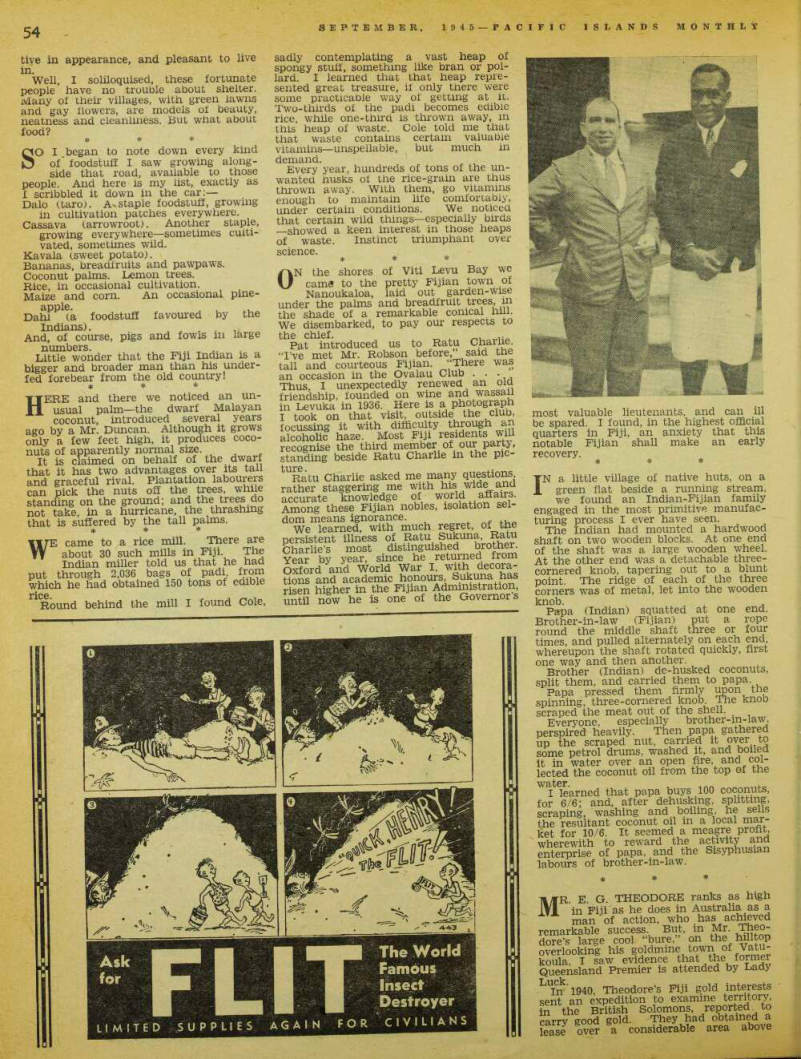
In Fiji
Random Notes by R. W. Robson
WE were a mixed party—D. R. Cole, of North America, seeking new sources of certain foodstuffs; H. A. Mitchell, of Australia, seeking new supplies of candle-nuts; Pat Costello, of Suva, seek ing pleasure and interest wherever it might be found in Viti Levu; and I, re visiting people and places from whom I had been cut off by six years of war. We had a good car, 350 mnes of road from Suva back to Suva, and three days of liberty.
There was nothing to write about be tween Suva and Nausori. Heavy rain storms hid the landscape, and Nausori s usually busy street was silent under Sab batarian gloom. * * * WE were miles out, heading north wards through the Rewa Valley, when I found my first story—an industry based on the excreta of bats.
Pat pointed to a group of limestone caves in the steep side of a jungled hill.
This, he said, was the headquarters of Fijian Fertilisers, Ltd. Endless genera tions of bats had made their home there; and their accumulated droppings found great favour in a world hungry for fer tilisers. This particular manure goes to New Zealand.
Unusual —but it made sense. The guano industry, which brought millions to South Seas traders last century, was based on the droppings of sea-birds, which roosted throughout long ages on the low-lying equatorial islands. ♦ * * WE left the rain behind. Luxuriant jungle pressed in upon our valley highway. Mitchell gave a “View Hulloa,” stopped the car, and scrambled down a green bank. Candle-nuts!
We followed, and watched curiously while he gathered some nuts, and pinched them, and hammered them, and knifed them, and —I thought he was kissing them—but he was only tasting the kernel.
And so we had our first lesson on candle nuts.
Every Islander knows the candle-nut — the walnut-sized, intensely hard product of the dark-green tree, that .is so rich in oil that, when a number are strung to gether on a vine, they can be lit like a candle. Hitherto, the nuts have not been regarded as commercially valuable, be cause; (a) the trees are widely scattered; (b) it is difficult to separate the kernel ffom the very hard shell. But now the world is seeking paint and varnish oils of quality, and, in that respect, candle nut oil is valuable —in fact, the candle nut tree is botanically allied to the tung tree, from which comes the valuable com ponent of the finest varnishes. Mr.
Mitchell’s company is experimenting with candle-nut; and, if the result is satisfac tory, candle-nuts will be cultivated, in the same way as the tung tree.
We learned that the kernel contains 65 per cent, of oil, of which 60 per cent, can be obtained by extraction. We also discovered that Fiji apparently has a number of varieties of candle-nut. ♦ ♦ * BREAKFAST had been early. Four masculine stomachs clamoured. Pat smiled sweetly, and directed the car to the gateway of a neat roadside bunga low.
We were introduced to Mr. and Mrs.
Storck, members of a well-known pioneering family. While our charming hostess made morning tea, we astonished foreigners learned that this place, in the heart of Fiji, was a model dairy
farm. Mr. Storck, with a small staff of Indians, milks 90 cows, and sends the cream to a dairy factory, 20 miles away.
One hundred and twenty good fowls, there among the pawpaws and candle nuts, fed on bran mash and coconut meal, gave 60 eggs per day.
The place itself was impressively busi nesslike; but what struck me most was the pioneering angle. What has been done by Mr. Storck, in this green and pleasant tropical valley, can be done in fertile, tax-free Fiji by other dairy farmers who, so to speak, know their onions.
Labour? Yes, labour is a problem here, as everywhere in the Pacific Terri tories to-day. They say the Fiji Indians are undependable. But Mr. Storck had a satisfactory staff of Indians; and a Taveuni coconut planter, whom I met the previous day, carries on with Indian labour—supplied from an Indian village which he has established on his planta tion. Those Indians had land to work, and security of tenure.
The rapidly growing Indian com munity is hungry for arable land, but there is little land available —it all be longs to the -Fijians. If the European land-owners can make a little land available to the Indians, after the man ner of the Taveuni planter, some solu tion of the primary producer’s labour problem may be found.
AS we came into high country, in the valley of the Upper Rewa, Pat pointed to a distant peak.
“Up there,” said Pat, indicating a high peak, “there grows a lemon tree. If you shake it, lemons fall into three rivers— the Rewa, the Ba and the Sigatoka.”
“And the answer’s a lemon,” said Cole.
In the friendliest way, we refused to believe Pat, but we got the general idea.
We were close to an interesting point in Viti Levu—a watershed where the head waters of three big rivers almost meet.
Thenceforward, we were haunted by lemons. For the rest of that day, all the way through to the north coast, we noticed heavily-laden lemon trees scat tered through the rich valleys. Here and there, we cut open a fruit —they were generally big and juicy. I saw Cole and Mitchell go into huddles, their keen com mercial minds intently calculating.- But who wants train-loads of lemon juice? * * * 1, newly come from a country where un happy people will almost commit mayhem for a house or its equivalent materials, was fascinated by the roadside building operations of Fijians and Indians.
Everywhere, at that altitude, grows the Nangasau grass—exactly like the Kunai or Kurukuru grass of Papua and New Guinea. Everywhere, also, are clumps of bamboo. From these excellent and abundant materials, the Fijians make their neat and comfortable houses. The frames are of bamboo or similar poles; the roofs are of Nangasau; and the walls, in an ascending scale of crafts manship and beauty are: (a) all grass; (b) all split cane; (c) partly split cane and partly plaited leaves. A well-built “bure,” of the latter type, is most attrac
tive in appearance, and pleasant to live in' Well I soliloquised, these fortunate people ’ have no trouble about shelter.
Many of their villages, with green lawns and gay flowers, are models of beauty, neatness and cleanliness. But what about food? * * * * SO I began to note down every kind
s lde f °“oad Tvaflabtelo “SS£
neonle And here is my list exactly as ? ??rihhled it down in Le - Mo (taro) 1 A staple foodstuff growing & S soSnt5 SOm " CUlt1 ’
Kavala (sweet potato).
Bananas, breadfruits and pawpaws.
Coconut palms. Lemon trees.
Rice, in occasional cultivation.
Maize and corn. An occasional pineanple Dahl (a foodstuff favoured by the Indians) And, of course, pigs and fowls in large numbers Little wonder that the Fiji Indian is a bigger and broader man than his underfed forebear from the old country! ♦ * * HERE and there we noticed an unusual palm—the dwarf Malayan introduced several years
Sss
“f g SSWI' the dwarf
ol ?the”ground; 2S,
not take, hr a hmrSane, the thrashing that is suffered by the tall palms. wwtp mmp to a rice mill There are
w S-sg?
Safsrais..
rl ßound behind the mill I found Cole,
sadly contemplating a vast heap of spongy stuff, something like bran or pol lard. I learned that that heap repre sented great treasure, if only there were some practicable way of getting at it.
Two-thirds of the padi becomes edible rice, while one-third is thrown away, in this heap of waste. Cole told me that that waste contains certain valuable vitamins—unspellable, but much in demand.
Every year, hundreds of tons of the un wanted husks of the rice-grain are thus thrown away. With them, go vitamins enough to maintain life comfortably, under certain conditions. We noticed that certain wild things—especially birds —showed a keen interest in those heaps of waste. Instinct triumphant over science. * * * ON the shores of Viti Levu Bay we cam« to the pretty Fijian town of Nanoukaloa, laid out garden-wise under the palms and breadfruit trees, in the shade of a remarkable conical hill.
We disembarked, to pay our respects to the chief.
Pat introduced us to Ratu Charlie.
“I’ve met Mr. Robson before,” said the tall and courteous Fijian. “There was an occasion in the Ovalau Club . . • Thus, I unexpectedly renewed an old friendship, founded on wine and wassail in Levuka in 1936. Here is a photograph I took on that visit, outside the club, focussing it with difficulty through an alcoholic haze. Most Fiji residents will recognise the third member of our party, standing beside Ratu Charlie in the pic ture Ratu Charlie asked me many questions rather staggering me with his wide and accurate knowledge of wprld affairs.
Among these Fijian nobles, isolation sel dom means ignorance.
We learned, with much regret, of the persistent illness of Ratu Sukuna, Ratu Charlie’s most distinguished brother.
Year by year, since he returned from Oxford and World War I, with decora tions and academic honours Sukuna has risen higher in the Fijian Administration, until now he is one of the Governors
most valuable lieutenants, and can ill be spared. I found, in the highest official quarters in Fiji, an anxiety that this notable Fijian shall make an early recovery. * * * IN a little village of native huts, on a green flat beside a running stream, we found an Indian-Fijian family engaged in the most primitive manufac turing process I ever have seen.
The Indian had mounted a hardwood shaft on two wooden blocks. At one end of the shaft was a large wooden wheel.
At the other end was a detachable three cornered knob, tapering out to a blunt point. The ridge of each of the three corners was of metal, let into the wooden knob. , , Papa (Indian) squatted at one end.
Brother-in-law (Fijian) put a rope round the middle shaft three or four times, and pulled alternately on each end whereupon the shaft rotated quickly, first one way and then another.
Brother (Indian) de-husked coconuts, split them, and carried them to papa.
Papa pressed them firmly upon the spinning, three-cornered knob. The knob scraped the meat out of the shell.
Everyone, especially brother-in-law, perspired heavily. Then papa gathered up the scraped nut, carried it over to some petrol drums, washed it, and boiled it in water over an open fire, and col lected the coconut oil from the top of the water I learned that papa buys 100 coconuts, for 6/6: and, after dehusking, splitting, scraping, washing and boiling, he sells the resultant coconut oil in a local mar ket for 10/6. It seemed a meagre P r wherewith to reward the activity and enterprise of papa, and the Sisyphusian labours of brother-in-law. ♦ * * MR E. G. THEODORE ranks as high in Fiji as he does in Australia as a man of action, who has achieved remarkable success But, in Mr. Theo dore’s large cool “bure,” on the hilltop overlooking his goldmine town of Vatu koula, I saw evidence that the former Queensland Premier is attended by Baay LU I C n’l94O, Theodore’s Fiji gold interests sent an expedition to examine territory, in the British Solomons, reported to carry good gold. They had obtained a lease over a considerable area above
Berande, on the north coast of Guadal canal, and were planning considerable operations, when Mr, Tojo’s activities caused a suspension of the enterprise.
When the Theodore party cached their equipment and departed, temporarily, Guadalcanal was little more than a name on a map, signifying a big, primitive island, only partly explored.
On the wall of Mr. Theodore’s “bure” I saw a map of Guadalcanal, with the Theodore gold leases indicated by shad ing. The leases are right alongside the Henderson airfield (built by the Japs for the use of the Americans), and are near to the large, new administrative centre at Point Cruse.
Thus, one of the Solomons’ gold seekers’ chief problem transport is Who would have guessed that the gold leases, pegged in 1940, would become, in 1942 part of one of the most famous battlefields of the Pacific war? ♦ * * MANY people are wondering why Emneror and Loloma mines are not paying the rich dividends once pro mised by their operations.
I found neither depression nor pes simism among the large European staff at work at Vatukoula. Everything indi cated that this is a period of exploration and development rather than of produc tion. . , . , The punishing taxation which the stupid Australian politicians are imposing upon those of their countrymen whose enterprise has been extended to other countries is having some remarkable repercussions. Why should the Aus tralian-Fiji gold interests concentrate on making profits, when so large a pro portion of those profits are grabbed by the tax-gatherers? , . .
Mr H J. C. Connolly, expert geologist, was there that week, making a survey and laying out a programme of future digging. mHE results of introducing strange X animals, birds and reptiles into Fiji always has interested me. So, when a thing like a large, elongated rat scuttled across the road, I began to ask questions.
“Are the mongoose still increasing in numbers?” I asked Pat.
“Mongeese,” suggested Cole, tenta tively.
“Mongooses,” said Mitchell, with the Australian’s readiness for argument.
I thought “mongoose” could be either singular or plural, but I not sure. So I told them the story of the man who was writing to an animal dealer, to order two of the creatures. He wrote “mon gooses.” and crossed it out. He tried “mongeese,” and liked that less. So, finally, he said; “Please send me a mon goose, and let me know how to feed it.
And, as a matter of convenience, you had better send me another one.” ♦ ♦ * rE mongoose was brought in to com bat rats in the sugar plantations, and has served his purpose well. Un like the birds minahs and bulbuls, which have almost wiped out the native birds of Fiii —the mongoose has not up set the balance of nature. Except that he helps himself to chickens, occasion allv, he Is harmless.
Another immigrant, the giant toad, is at an interesting stage. He was brought to Fill a few years ago, from America, to get rid of insect pests, and he grew amazingly, not only in numbers but in stature. Life was easy and food abun dant.
But the activity of the toad soon re duced the garden pests. The immigrant found life harder and tougher—he fed less frequently and he had to hunt busily.
Consequently, he shrank perceptibly in size, and now there are not so many of him about. Where, in 1936, I used to meet this huge, startlingly ugly reptile in almost any Suva garden, I found fewer toads in 1945—and they less than half the size of their progenitors.
Suva gardeners wil not hear a word against them they have brought the garden pests definitely under control. * * * I. „ A 1 , . , N three days’ drive around Viti Levu, we made the acquaintance of four noteis: Tavua Hotel, managed by Mr. H.
Garnett.
Ba Hotel, managed by Mr. and Mrs.
Christmas.
Lautoka Hotel, managed by Mr.
Johnston cifT , . n .
Tvr?i conducted b y Ml - and Mrs Steve Monk.
The three first-named are owned by Mr H. H. Ragg and run as a chain— and a very good job he makes of it.
Being fresh from the horrors of Austrahan hotel food and service, in wartime, I had thoroughly enjoyed the excellent menus and the swift, silent Indian service of the Grand Pacific Hotel in Suva. But neither food nor service, in the four country hotels, suffered in a comparison on the contrary, I should have been happy to have stayed a week or two in any of those smaller hotels.
The Tavua Hotel, standing high on the hillside above the township, is handsome and very well-equipped; and when I saw Mr. Garnett’s array of rods and tackle, and heard about the big-game fish which wait for deep-sea anglers outside the reef there. I visualised a new industry, in the best Zane Grey tradition, in that part nf fV\p PnHflp 0 a , , . . . , F ill an <<1 h r servants, playing a solo the u 19,1I 9,1 ! 1 ’ sui ™n°. n Z lsi lu rs }° these hotels, as their forebears, beating the same wioden drums, called the men to frequent and bloody wars. It is a happy idea, though one is a little puzzled, at first, to know what all the noise is about
QOME may find the long road, along the O dry northern shore of Viti Levu, a little monotonous. The interior hills are steep and bare; all the flats between the foothills and the sea are covered with sugar-cane; the dusty highway passes through innumerable Indian villages, with here and there a Fi J ian settlement, In sharp contrast with the south side of the island, there is little rain here. But there also is little humidity—it is a coun try where the white man perspires inf re quently, and gets roses in his cheeks.
But the observant vi£ itor will find It a fascinating 100 miles. Here is the heart 0 f the Indian problem of Fiji. There are Indians everywhere. Industrious Indians, cutting the cane and stacking it for transport on the Sugar Company’s coastal railway. Trading Indians, swarm ing around their little shops In the towns and villages, supplying every possible kind of artisan and distributing service. old Indians, with white beards and skinny shanks, squatting beside the road, tending two or three cattle. Young Indians, well fed and smart looking, going i n groups to their schools. i was deeply interested in the Indian children To a great extent, the future G f this rich British Colony lies in their hands ™° re J
I with
J£° 3 ?„Sfjkej
th fii nd l a sf 09e J?nlnnlP
IpiKS 6
Swiii
A° Alhes in World War 11,
£pSS Tniia w/
out American dollars. But we can do
ipuch
Indians—youngsters who are free from the very depressing Influences of Mother jndia, and who already, owing to their Fiji enviroment. are an improvement ■nr»nn fTiplt* father*? nhv*?icallv and 3hn,nllv ’ P nysicauy ana sp .™7. y , „ .
Indian schools are conducted with intelligence, vision and « especially strength—we yet may find a
solution of a problem that has appeared insoluble. * * * IN the Ba Hotel we had washed away the road dust with Australian beer —yes, Australian! I, who had not even seen Australian bottled beer for years, could buy it at normal prices any where in Fiji—when Pat lifted his head.
“I can hear an engine in a new place,’ he exclaimed, and he led us forth to investigate. , . , We came to a large, newly concreted shed, where machinery whirred.
“Sahib, I have here a seed with five vitamins in it,” said a turbaned Indian, head of the establishment. Cole, who follows vitamins around the earth, dashed into the front line. „ , It was extraordinary set-up—full of oscillating belts driving home-made gad gets designed to get the oil out of pea nuts. (The precious “seed” was peanut.) The boss said he got 30 per cent, of oil, and most of the balance was cake, for which he received £lB per ton. If the outfit pays under present conditions—the noisy engine drove a shaft at floor level, so that all operatives were momentarily threatened with decapitation by un guarded belts—it would pay twice as well under modern factory organisation.
But it was another interesting example of Indian enterprise. * * * BETWEEN Lautoka and Nadi there is a wide area of rolling ground covered with pineapples—and more bo The Company’s half-million pine apple-canning enterprise, launched in the late ’thirties, was interrupted by the war, which cut out transport, supplies of tin plate, and various other essential ser vices. The company kept the new indus try going, in modified form. It did little canning; but it bottled much pineapple juice for the armed forces Now the company is getting back into action—and it is doing its own planting That— according to local report—was no. the original idea The Co ,^ p^ y Ts fanting a big factory, and did a lot of planting by way of demonstration. T It was expected that the Indian farmers and anyone else interested, would grow pineapples, on a guarantee that the company would at an agreed price, all their produce. So far neither the Indians nor anyone else have shown any interest iff pineapple production
surprising thing, in view of the value of this new industry. But the war is only just finished, and it is a little too soon to judge. .
The Fiji Government, very wisely, is doing everything within reason, to en courage the enterprise. Unquestionably, Fiji pineapples have a future. * * * MY allotted space is filled; yet I have by no means finished this account of healthy private enterprises found in a tour around Fiji.
I am prepared to believe, from obser vations and from what has been told to me, that the gold industry of Fiji need not end at Vatoukula. From Tavua right along westwards to Lautoka, the coastal ranges bear the same unusual appear ance. If there is gold behind Tavua, there should be gold in there behind Ba and Lautoka. I was told of an Indian who, not long ago, employing most primi tive methods, got gold worth more than £4,000 in the hills behind Lautoka.
Between Lautoka an Sigatoka we were introduced by Pat to “Mike Regan, mayor of Tau.” Mr. Regan has established at Tau a model township and a flourishing little lime industry, manned by Fijians, and supplying the considerable needs of the Vatoukula goldmines. All Fiji land is starving for lime here is part of the answer. But it must form the subject of another story. ♦ * * AS the car wound through rain-jungles and tortuous gorges of the south coast, I turned to my friends.
“Well,” I said, “how many hungry people have we seen in these three days?”
“Not one,” they agreed.
“How many ragged, or shelterless, or diseased?”
None, that we had seen.
But we had seen a very large Territory, partly covered with food crops, and still capable of vastly increased agriculture, and literally pulsating with the spirit of progress and enterprise.
There is no doubt about the future of Fiji.
Advertisements & other items, pp. 55-58 (1 item)
Dependable Coleman
D \W/ \ / \ y \ y
NOW AS ALWAYS
For over forty years COLEMAN has built a reputation for dependability in lighting, cooking and heating appliances. Built from the same first quality materials as always, with the exclusive Coleman features, you are always assured of the best when you buy dependable Coleman. Wherever you are there is a Coleman dealer to serve you with dependable COLEMAN appliances and service.
THE COLEMAN LAMP AND STOVE COMPANY LIMITED
TORONTO, CANADA CHICAGO, U.S.A.
o 0 i r: , % a *5 m I si SO 3 K The World Famous Insect Destroyer „ —.orv - '■ . ~, •: '-• ]'?' ■ •**'.'
LIMITED SUPPLIES AGAIN FOR CIVILIANS
FLIT
AUSTRALIAN FOODSTUFFS ... PHARMACEUTICAL LINES
WINES AND SPIRITS . . . MANUFACTURED GOODS PRIMARY PRODUCTS . . . PATENT MEDICINES
YOUR
it -Jor ORDERS FOR GIN AND WHISKY can still be filled.
Distilled in Australia, mature 4 under Customs supervision, these spirits are of guaranteed strength and quality. Orders will be accepted while stocks
'Dafawi & v ampasi4f
(Proprietors: R. Darvas and E. Klugman.) Cable address: Darvas Company, Sydney. Codes: Bent., A.B.C. (6th).
Bankers: Bank of Australasia, Comptoir National d’Escompte de Paris. 3 5
PITT
HEAD OFFICE :
STREET,
SYDNEY
Kidney Trouble
and Backache
Gone in 1 Week
Flush Kidneys With Cystex and You 11 Feel Fine Cystex—the prescription of a famous doctor —improves faulty kidney action in double quick time, so, if you suffer from Rheumatism, Sciatica, Neuritis. Lumbago, Backache, Nervousness. Leg Pains, Dizziness, Circles under Eyes, frequent Headaches and colds, poor Energy and Appetite, Puffy Ankles or taterrupted Sleep, go to your chemist to-day for Cystex.
Cystex Helps Nature B Ways
The Cystex treatment is highly scientific, being specially compounded to soothe, tone and clean kidneys and bladder and to remove acids and poisons from your system safely, quickly and surely, yet contains no harsh, harmful or dangerous drugs. Cystex wo’-ks In these 3 ways to end your troubles;— (1) Starts killing the germs which are attacking your Kidneys, Bladder and urinary system in two hours, yet is absolutely harmless to human tissue. (2) Gets rid of health-destroying, deadly poisonous acids with which your system has become saturated. . „ (3) Strengthens and reinvigorates the kidneys, protects you from the ravages of diseaseattack on the delicate filter organism, and stimulates the entire system.
Feels o Different Woman
“I have been taking Cystex for Kidney and Bladder trouble and it has made a d i?® re r* woman of me. I am feeling splendid, can do all my work, run about and walk miles although I am 63 years of age. Cystex does all you claim for it.”—(Sgd.) M. L. Zessin, Thompson Estate, Brisbane. ,
Now Able to Walk Without Stick
«I had Kidney and Bladder complaint, pains in leg and back; in fact, I had to use ing stick. I have used two bottles of Cystex, now I have no pains anywhere. 1 «o ns ider Cystex the greatest medicine in the world fo Kidney complaint.”—(Sgd.) J. McPherson, Nangeribone Station, N.S.W.
Guaranteed to Satisfy or Money Back
Get Cystex from your chemist to-day. Give It a thorough test. Cystex is guaranteed to make you feel younger, stronger, better in every way, or your money back if you return the empty package. Act now!
Now in 2 sizes—4/-, 8/-.
This is a
GUARANTEED
Treatment
for Your Kidneys, Bladder, Rheumatism
Cystex
McILRATH’S
FOR
High Quality Food
at Bedrock Prices Orders ond enquiries to—
McILRATH'S PTY. LTD.
Export Department,
202 PITT ST., SYDNEY, AUSTRALIA
On Pensions
Cruel Burden Of Taxes
JU R. LEO. AUSTEN, a former IYI Resident Magistrate of the Papua Administration, has made the
following suggestion :
1 SUGGEST a petition be framed, from all retired Papuan Civil Servants now on superannuation, and sent to the Minister, asking that taxes on pensions of Papuan Civil Servants be computed separately from any other moneys a re tired officer may make in any one year.
Had the Japanese war not come, there would have been a reclassification of salaries, due to extra cost of living, anu so the pension would have been increased.
Again, the pensions of Papuan Civil Ser vants, unlike those of the Mandated Ter ritory, die with them, and their widows receive nothing, in some cases necessitat ing the widow applying for a widow s pension, which naturally comes out of revenue.
If the Minister cannot see his way clear to have the tax computed separately he will force many officers to S° and live outside Australia, when they should oe enloving a decent climate at the end of a long period of tropical service.
The death of Mr. A. H. Lee, a well known and highly respected citizen of Suva, Fiji, occurred on August 22. He was 70 years of age.
Alfred Sadd, A Lovable Lms Missionary
First to Die in the Tarawa Massacre
THE Rev. Alfred Lionel Sadd, BA, of the London Missionary Society’s staff in the Gilbert Islands, was one of the British residents in the Colony who were so cruelly massacred by the Japanese at Tarawa Island on October 15, 1942.
There are references to this crime in the Webb Atrocities Report, published all over the world early
in September.
The following tribute to his late colleague was written by the Rev.
G. H. Eastman, of Beru, Gilbert
Islands.
ALFRED SADD was in many ways an unconventional missionary: he dif fered widely from the types senti mental novelists display, or splenetic beachcombers anathematise. He was a member of a well-known East Anglian family, the Sadds of Maldon, Essex. Edu cated at the Leys School and Cheshunt College, Cambridge, he imbibed the lib eral traditions of that well-known school and university. While not lacking in intellectual ability, he was not of a scholastic turn of mind, but was more inclined to the adventurous and active life of “the great outdoors.”
On his appointment to the mission field, a friend and fellow-student wrote of him: “His writing in illegible; his spelling is original; his memory proverbial; but he’s a jolly good fellow for all that.” He pos sessed to a high degree the gift of friend liness.
His writing was a sore trial to his cor respondents, and when he took to a type writer one of our mutual friends wrote plaintively to me: “Can’t you buy Alfred a typewriter than can spell?”
Owing to the unexpected death of a colleague, it fell to his lot to take charge for a time of the mission accounts.
Though it was a job for which he felt himself unsuited, he tackled it with his customary cheery goodwill. But occasion ally his spelling—or was it his typewriter? —let him down; as when he ordered “3 only bath mats.” As received by the firm in London the order read “30 only bath mats.” In due course the 30 bath mats arrived; and Alfred had for a time to adopt the role of salesman travelling in bath mats.
Never was a surname less appropriate.
There is a story—not apocryphal—of how Alfred burst one day into the office of an official whom he had not previously met, and announced, “I’m Sadd.”
“Oh,” said the astonished official, look ing up, “I am sorry. Can I do anything for you?”
Whereupon the visitor burst into such hearty peals of laughter that the official recognised that his first impression had been in correct, and joined in the merri ment of his visitor.
ALFRED SADD had been a Rover, and a member of the Sea Scouts in Eng land, where his family owned vari ous small yachts and boats. Though he was not a good sailor, and suffered not a little when Father Neptune was un kind, he readily took his share in the
frequent voyages by the mission schooner in the mission visitations of tho Islands, and in travel by launch and boat along the great lagoons of the Gilberts. His fancy was greatly tickled once when an enthusiastic letter of his describing one long boat journey to a seldom-visited islet on one of the largest atolls led a dis ingenuous sub-editor to write up the story with a map, which placed the islet as a new discovery far out at sea.
An exploit of which Alfred told in the last circular letter written by him in August, 1942 (copies of which did not reach his friends till well on into 1944, having been hidden away with unfor warded mail during the Japanese occu pation) was the amazing feat of walking by night along the reef of Tabiteuea Island for a distance of some 25 miles in order to catch a vessel which he could not otherwise reach in time. Two native companions were so knocked out that they were laid up for a few days, but Alfred’s chief concern seemed to be the effect on his shoes, which came to pieces with the rough going on the jagged coral.
His experience as a Scout at home stood him in good stead when he became a leader of the Ist Gilbert Scout Troop at Rongorongo (LMS), Beru. He started a Rover Company for the senior boys, and was never happier than when sitting round a camp fire outside his house with his Rovers, or away at camp in the bush with the Scouts for a week.
ALFRED SADD travelled out to the Gilberts with a senior colleague towards the end of 1933. In 1938 he paid a short visit home to England.
Barely two years later he narrowly escaped death by poisoning. He enjoyed entertaining friends in his bachelor establishment, and had developed no small skill in the culinary line. On this
occasion he had invited a missionary col league to dinner. After dinner both felt unwell Within a few hours his colleague was dead, and Alfred escaped as by a miracle, for it was discovered that the fish sauce had been accidentally con taminated with arsenical rat poisoning.
“There can be no doubt,” wrote Alfred in a letter home, “that I ought to have died when Levett did. It would appear that God has some purpose that He intends me to fulfil. The only thing that I hope and pray is that I shall be given the strength and courage to fulfil that purpose when the time comes, and not to fail Him.”
THE time came, and Alfred did not fail.
When the Japanese invaded the islands, all remaining British women were evacuated only just in time. Alfred and a senior colleague remained behind.
As the situation deteriorated, urgent orders came from the High Commissioner
for the immediate evacuation by any means possible of the remaining mem bers of the Administration and of the remaining British missionaries. But no ship was left in the Colony, and efforts to prepare boats for an almost forlorn hope of escape in a season of squalls and rough seas proved futile; until some three months later, by devious means, most of the remaining British residents did get away to Suva.
Meanwhile, in spite of all pressure, Alfred had made up his mind to stay on the held. He was a convinced pacifist, and dreaded the possibility of becoming entangled, as a young unmarried man, in some service of a military character. As the Japanese appeared to have no inten tion of coming further south, he thought they probably would not take any interest in the small islands without ship pas sages to the lagoons. And he had bound less faith in the might America was bring ing to the aid of Britain and the Allies.
Alas, his optimism was not justified by events. Letters written as late as August, 1942, and received after British re-occu pation of the islands, showed that Alfred Sadd was then more than ever confident that the southward advance of the Jap anese had been stayed.
But in September, 1942, the Japanese called at Beru and other southern islands, searching for radio stations and their operators. Alfred was called to see the Japanese commandant. A Union Jack had been laid on the steps of the veran dah before the commandant’s table, so that anyone approaching must tread upon it. Mr. Sadd, so native eye-witnesses report, quickly stooped and picked up the flag—some say he kissed it as he did so —folded it, and place it on the table before the Japanese recovered from their surprise.
He was taken to Tarawa; and there, with other British and New Zealand men, was cruelly treated by the brutal Japs.
Natives say they were tethered to trees for two or three days and nights, and taken one by one for examination. Later they were quartered in a wired-in enclo sure which had been the Colony asylum.
They were compelled to work on the fortifications the Japanese were prepar ing. It is said that despite the dis approval of their guards, Alfred Sadd tried to cheer the prisoners by leading them in songs and hymns.
Their imprisonment did not last long.
On October 15, 1942, they were all brutally executed by the Japanese. It appears that a few hours before, Allied warships and planes had shelled and bombed Jap anese installations and ships at Tarawa, causing considerable damage, and, it is believed, sinking one enemy vessel. It is said that one of the prisoners got out of the enclosure and attempted to signal to the Allied warship, so arousing the anger of the Japanese.
Native reports say that when it became evident the Japanese intended to kill the
prisoners, who were drawn up in line, Alfred Sadd stepped out in front and spoke words of encouragement and exhortation, which doubtless helped the men to meet death with the courage and fortitude they are reported to have shown. Then he took his place in the foremost rank, and was, it is believed, the first to die.
His radiant faith and personal courage made a deep impression on the Gilbertese, not on Tarawa only, but throughout the Islands where he was known. Thus passed “a very gallant gentleman.”
Nine years; and we hoped it might be nine and thirty years’ work on the mission field. But “love’s service standeth in love’s sacrifice.” A Gilbertese sums it up for us in these words: “We remember our elder brother of grace and kindness, Mr. Sadd. Although his time amongst us was but little and short, I think it was very long and of great dura tion, for the work that he did for the people of Rongorongo and the Gilberts was complete in its goodness. Although Mr. Sadd is dead yet he lives on in the thoughts and the hopes of many people who mot with him and grew used to him.”
In January, 1944, when the news of the tragedy at Tarawa was first partially made public, the LMS headquarters in London received an official intimation that Rev. A. L. Sadd was reported “Miss ing, believed killed.” The then Foreign Secretary for the South Sea Fields of the London Missionary Society, Rev. Norman Goodall, MA, wrote an article published in “The Christian World” of January 20, 1944, under the heading, “Missing, Be lieved Immortal.” The article concluded with these words: “So long as a glimmer of hope remains that we may again have the joy of coping with Sadd's most ori ginal despatches, we shall hold on lov ingly to the possibility, but it will be in the deep certainty, surer than hope, that whether here or beyond the flaming ram parts of the world he belongs to ‘the ever-juvenile eternities’ and is living to the glory of God.” (A brief biography, “Alfred Sadd of the Gilberts,” by Rev. Nelson Bitton, former Home Secretary of the LMS, has been published in England at 1/-; and copies may be obtained from the offices of the London Missionary Society, National Building, 250 Pitt Street, Sydney, NSW.)
Advertisements & other items, pp. 59-60 (1 item)
Kayen •
KEROSENE VAPOUR LAMPS
Kayen Model HL7 Tall Table Lamp.
Brilliant lighting when and where required
Kayen Lamps are the last word in efficiency in modern kerosene lighting. They are designed for years of hard practical use and are the result of extensive tests and experiments under all classes of conditions. At last a really good Australian-made product is available and in comparison with all overseas types the Kayen leaves nothing to be desired.
They provide a full 300 candle-power unflickering light not affected by wind or draughts. They burn quietly and efficiently for hours without attention and are perfectly safe in operation. The mantles are supported top and bottom and will not shake off. Globes are pyrex. All models are insect-proof. The oil container is solid polished brass and brass is used wherever possible in all other parts.
Illustrated are the ever-popular Tall Table Lamp and Allpurpose Lamp. The All-purpose Lamp is stormproof and may be carried anywhere, inside or out. The Table Lamp is a handsome addition to the appointments in any home, as well as a superb lighting unit.
Write for Illustrated Catalogue of Models Available from the Manufacturers.
V Kayen Model AP2 All-purpose Lamp.
W. KOPSEN & GO. PTY. LTD.) 876-382 Kent St., Sydney 'Phone: MA6336 (6 lines). Cables: Kopsen Sydney
JENKINS
BOX 100
SUVA, FIJI
THE LEADING STORE
FOR ISLAND CURIOS
AND SOUVENIRS
We can supply— Tortoiseshell Goods in bracelets, necklets, brooches, etc.
Tortoiseshell, with "Cat's Eye" Mountings, in bracelets, necklets, brooches, ear drops.
"Cat's Eyes" set in Silver Filigree, in sets of necklace and bracelet.
Fiji-made Novelties in Large Variety.
QUALITY GOODS AT
REASONABLE PRICES.
Write for Our Descriptive Catalogue.
We Will Gladly Forward One.
Ship Chandlery Hardware
r Write for 7
/ Ship Chandlery /
/ Catalogue J
Special “In Bond” Prices for all Islands enquiries queted on application.
Sole Agents for:
BROOMFIELDS LIMITED
152 SUSSEX STREET :: SYDNEY.
Cables: "Boom”. Sydney.
Large and Complete Stocks of
SHIP CHANDLERY
IRONMONGERY OF ALL KINDS PAINTS,
WHITE LEAD AND OILS.
P H MUNTZ & CO.’S 3-CROWN BRAND METAL SHEATHING
PEACOCK & BUCHANS’ ENGLISH READY-MIXED PAINTS.
Member Of Fiji Pioneering
Family Passes
MRS. MAUDE KEELING, widow of the late Arthur Keeling, well known in the Central Pacific, died at her home in Auckland on July 23. She sur vived her husband by only one month.
Mrs. Keeling was a daughter of the late Mr. and Mrs. John Bayly, and was born in Levuka, Fiji, 67 years ago. She married Mr. A. D. Keeling, about 30 years ago in Suva, where he was accountant at the Bank of New Zealand.
Subsequently she resided with her hus band at Apia, Samoa, and then m New Zealand, and on his retirement they settled in Remuera, Auckland. She leaves a son, ‘John, and daughter, Betty, in New Zealand, and two sisters, the Misses Bayly, and a brother, Mr. J. P. Bayly, in Fiji. ..
The New Caledonian Chamber of Agri culture has received from Tahiti'a con signment of coleoptera which, i n the larvae stage, attacks and destroys banana parasites. The Chamber is now breeding these insects, and will be in a position to distribute them to colonists within a few months.
The Memoirs Of
Ariitaimai
Letter to the Editor FOR the information of your many readers, may I be allowed to add the following facts to the interesting article, by Mr. Eric Ramsden, on the above volume, which appeared in your April number. The book is indeed rare, but I can account for two. 1. —Upon the death of Tati (II), the eldest brother of Queen Marau, his effects were put up at auction, amongst them a copy of the Memoirs, which was purchased by Doctor Sasportas, a resident on the island, who most generously presented it to the Papeete Museum, where it is to day housed. 2.—lrene Salmon (her native name is Teeeva), one of his daughters, also owned a copy, which I was loaned, upon my arrival on Tahiti. Realising its value (which she did not), I impressed upon her the necessity of taking care when she loaned it. Some five years back, she told me woefully that a passing tourist from the Americas, who had lodged in her boarding-house, had assured her, not only of its high value, but that if handed to him he would secure a handsome sum for the volume. She passed it over, and since then neither man nor book nor cash has been heard of. She died, deeply regretting her folly.
This edition is not the first or only edition. 1893. —The first edition was entitled “Memoirs of Marau Ta’aroa, last Queen of Tahiti. Privately printed, 1893." No copy is known to exist to-day. How many were printed, by whom, and where, is also un known. Tati II is said to have possessed a MS of it in the Tahitian language, as their mother gave it to them by word of mouth. My fellow octogenarian, Mr.
Arthur Brander, their nephew, who was educated in Scotland, has informed me that he took part in its translation; but no copy of the printed book came to him, as he was by then abroad. Marau distri buted them amongst the numerous mem bers of her family—the Salmons —and all are lost. 1901. —The Bishop Museum m Honolulu has two “typed” copies of the edition, printed in Paris, under the supervision of the American tourist, Henry Adams. In a note attached to the copies, Marau states that she requested Adams to change the title and use her mother’s name as the one from whom she had received the in formation. Whether or not he used these “typed” copies and duly returned them to Marau is unknown. 1923. —Marau, finding fault with portions of the printed edition, compiled a fresh manuscript, assisted by a Mrs. Handy, but for an unknown cause refused to have it published, and this MS has disappeared, like its predecessor of 1893. . Ariitaimai was not the native name given her by her parents. This was Ariioehau (Chieftainess of Peace). The name by which she is known was assumed by her on her marriage to Alexander Salmon, when Queen Pomare IV gave Salmon the name for him (and his Wife) of Arii-tai-mai (the chief who came from over the sea). She was born in 1822, married in 1840, and died in 1895. Marau, the transcriber of her mother’s Memoirs, was born in 1860, married in 1875, and died in 1935.
I am, etc.,
W. W. Bolton.
Tahiti, 1/8/45.
New R.A. For Penrhyn Is.
Prom Our Own Correspondent
Rarotonga, Aug. 12.
Captain R. M. L. Gladney, Com
manding Officer of the Rarotonga Maori Defence Force, has been appointed resident agent of Penrhyn Island, replacing Captain Viggo Ras mussen, who has been forced by ill health to relinquish the post.
After service in the Great War, Cap tain Gladney went to America. He left an orange plantation in California to settle in Rarotonga as a planter in 1933.
He married Miss Clara Rennie, a daughter of Captain Rennie, an old resi dent of Rarotonga; they have a son and a daughter.
Captain Gladney was given command
of the Rarotonga Defence Force on its formation at the outbreak of the present war.
Mr. and Mrs. George H. Hanson, of Namatanai, New Ireland, arrived unex pectedly in Sydney in July. They were in Europe, travelling in Germany, when war came in 1939. They made for the and, twice, were almost free, when they were turned back. Then they spent over 51 years as civilian internees in Germany. They were released by Americans in May last and, on returning to Britain, they got an immediate and direct passage to Australia. Mr. Hanson s partner, Mr. Priebe, is a resident of Dalby, Queensland. They have had no information about their Namatanai plan tation—a large and valuable one.
Advertisements & other items, p. 61 (1 item)
Fosters
LASER
BREWED BY
CARLTON & UNITED BREWERIES LTD.
Healthy Finances In Fiji
IN his opening address to the Fiji Legis lative Council, on August 24, the Governor, Sir Alexander Grantham, said that the Colony’s financial position gave cause for satisfaction.
The Estimates for 1944 budgeted for a deficit of £102,600; in actual fact, there had been a surplus for that year of £124,600.
War expenditure for the same period amounted to £1.183,500 of which £402,600 was met from revenue: and the balance, less Recoveries, was being advanced by the Imperial Treasury.
At the end of 1944. the General Revenue balance stood at £902.000; the Emergency Reserve Fund and General Reserve Fund remained unaltered at £140,000 and £143,000 respectively.
A Polynesian Island
What The Americans Did On
From a letter written in July last by Captain EDWIN P . GEBHARDT, Commanding USAF in Aitutaki, Cook Islands, to the editor of the PIM.
HAVING been born and reared as an American, I have no choice other than to take offence over an article entitled, “The Jungle Returns,” printed in your May, 1945, issue. It suggests that great harm has been done to the Polynesian islands by my countrymen.
On November 14, 1942, a Task Force arrived at Aitutaki. Recount for a moment the status of the Pacific war at that time. Our efforts against a com mon enemy were none too certain. The battle for Guadacanal was at a critical stage. Japanese troops throughout the Pacific were being reinforced, and an eastward expansion of their operations was not beyond the realms of possibility.
Why would a huge sum of money be spent to send a force to Aitutaki? Be cause it was an important and strategic location—perhaps to prevent a possible occupation by Japanese forces —perhaps to insure that the insipid author of that article could continue living in a demo cracy instead of under oppression and cruelty and stupidity like unto his own.
What did the Americans do on Aitu taki? Certainly, they made noise—better the noise of building than the noise of enemy guns and chatter! They built camps, warehouses, roads, theatres, boat landings. They oiled swamps with part of their fuel—which brings me to the author’s paragraph on mosquitoes, the Panama Canal and planting. Read it— isn’t it absurd? Oiling a swamp doesn t “drive” mosquitoes any place. Even the school children of Aitutaki are being taught that oil kills mosquito larvae!
What has the Canal, and its “desert” and “malaria” to do with this island?
Has the author ever read of the work of Gorgas in ridding Panama of the dreaded yellow fever, I wonder? I also wonder who else has heard of the “desert” bordering the Canal. Anyway, what has all this to do with planting?
What else did the Americans do? They provided plane service, and still do, by which the author probably sends and re ceives mail. They built a hospital and
made highly skilled medical service available to every person on the island —a medical service that was an im portant factor in determining the true nature of filariasis and in educating the people in ways of decreasing its incidence —a medical service which brought new life-saving techniques and the most modern therapeutics within reach of every inhabitant, free of any charge to them.
They opened a commissary to all re sidents, making military stores of food and clothing available for their pur chase. With money brought in by Americans —with money American/; paid in salary to more than six hundred native employees—with money the author undoubtedly made off Americans. It wouldn’t surprise me that he still wears “GI” clothes purchased from the com missary !
They brought entertainment to the island. They established a lending library which is still maintained. The theatre mentioned by the author was used for more than a year.
Certainly, the original camp was abandoned. When the force was reduced in size during the summer and fall of 1944, a much more compact and beautiful camp was occupied at the airport.
IWANT to say a few words about what the United States Army Forces in Aitutaki are still doing. We are living in peace and quiet with all the residents. We are providing and main taining complete facilities for the opera tion of passenger-carrying New Zealand aircraft. We are maintaining roads roads over which Army trucks help carry local revenue producing crops. We are helping, through the use of our motor boat and barge, to load these products and people and cargo on and off ships.
We still offer competent medical service.
We aid in worthy causes, such as church construction and repair, to the extent of our ability. We still provide employ ment to sixty native men. We show motion pictures in the village. We pay orchestras to play at public dances. We enjoy being in Aitutaki.
I do not think that the minds of the people of Aitutaki are badly scarred. I do not think that there is a strong feelthat the island has been desecrated.
Rather, there is a feeling of gratitude and thankfulness for what we have done for them; not a feeling of dislike for anything we have done to them or the island. , , . The only priceless and irreplaceable thing that has been lost forever is the author’s sense of perception and ability to live as a member of an organised society of honest, diligent, home-loving and God-fearing people.
Mr. H. L. Schultze, who was a planter at Namatanai, in New Ireland, until the Japanese interfered, and who was one of a few New Ireland people who escaped in open boats, is seeking news of his mother. Mrs. Schultze, senior, refused to leave her New Ireland home when the evacuation of women and children was ordered in December, 1941, and it is hoped she is still there. Anyone having news of her is invited to communicate with Mr. H. L. Schultze, Brewarrma, NSW Another old New Ireland resident, of whom news is anxiously sought by re latives now in Australia, is Mrs. Phoebe Parkinson. She was over 80 years of age when the Japanese invasion occurred.
Advertisements & other items, p. 62 (1 item)
Pinkettes
After taking Pinkettes you should feel brighter, happier, and free from sick headaches, bilious attacks and liverishness. For
are tiny laxative and liver pills, which painlessly exercise the digestive system.
For Island Souvenirs
Tortoise-shell
Jewellery
Cot's-eyes
Write to
SOUTH SEA SOUVENIRS
STORE
Thomson Street, Suva Opp. G.P.O. P O. Box 83.
Manufacturer and Supplier of High-class Tortoise-shell Goods, Silver Filigree Ornaments. Dealers in Cat’s-eyes and Island Curios.
Special Designs made to order, at best prices.
Wholesale and Retail Inquiries Invited.
BANKERS: Bank of New South Wales, Suva, Fiji.
How American Military Government is Working
in Mariana Islands
NOTE : The following article was written in July, 1945: rE efficiency of military governments set up by the US Navy on liberated Pacific Islands is seen in the dimin ishing death-rate on these islands.
In September, 1944, a few months after US forces first stormed ashore, 508 civi lians died on Saipan and 108 on Tinian.
Since that time, despite supply problems, Japanese harassments and the threat of deadly epidemics ever-present on war ravaged land, death figures have dropped sensationally. In November the Saipan figure was 98 and the Tinian total 36. In December, 1944, the losses had dropped to 65 and 14 respectively.
These figures are more than monu ments to the skill of the officers and men of the medical service; behind them is the story of swift solution by the US Navy’s military government organisation of the problems of feeding, clothing, and sheltering inhabitants of the islands, and then helping to re-establish them in civi lian pursuits.
Health and sanitation, to he sure, are the prime responsibilities of these mili tary governments, but by no means are they the only ones. Opening schools, set ting up police forces, providing recrea tional facilities, developing agriculture, establishing a new monetary system— these are but a few of the reconstruc tion problems which must be met in areas liberated from the Japanese.
Life on Saipan, Tinian and Guam is gradually returning to normal. Bv last December, a total of 12,785 civilians already had found gainful employment.
On farmland once pock-marked by battle,
265 tons of crops are being harvested each month. From coastal waters fishermen are collecting 36 tons of fish monthly for civilian consumption. Cigar and candy factories and a bakery are going full blast on Saipan. And 30 retail stores, run by civilians, are doing land-office business on Guam.
The officers and men of the military governments of these islands came ashore highly skilled in their assignments, and eager for their duties. They were fitted for the *work by their civilian pre-war backgrounds, and had been trained in the Naval School for Military Govern ment and Administration at Columbia University in New York City. They had received intensive courses in anthro pology, geography, languages, military law, public health and international law.
AN island commander heads each military government. He has desig nated qualified members of his staff to, head such departments as economics, labour, legal, supply, civilian welfare,
agriculture, public health, intelligence, education, engineering, transportation, foreign economic administration and camp administration.
Guam’s military government consists of 61 officers and 255 enlisted men; Saipan’s, 32 officers and 126 men; and Tinian’s, 25 officers and 100 enlisted men.
The tasks that faced the military gov ernment staffs in the Marianas were stag gering. More than two-thirds of the civi lian dwellings on Guam had been ham mered into rubble; entire towns —Agat, Agana, Sumay, Piti—were wiped out. On Saipan and Tinian civilians had to live in caves. Food and medical care were practically non-existent. Many civilians were wounded. Most suffered from mal nutrition. And nearly all had dysentery, or some other disease. From 30 to 50 per cent, of the entire population of the islands was afflicted with one or more types of intestinal parasites.
Until the military situation was well enough in hand to permit transports to enter the islands’ harbours with supplies solely for civilian use, military govern ment authorities had to rely mainly on military rations and captured Japanese stocks to feed the civilian populace* Since
there was something like 49,618 civilians on the three islands at last count, this was no easy problem.
Immediate steps were taken to make the islands as self-sufficient as possible.
One month after Japanese resistance ended 2,214 lb. of seeds and 12,000 plants had been distributed to farmers on Guam and 431 acres of soil had been tilled and planted. By the end of December, 1,157 acres had been developed on that island.
With agriculture making similar vast strides on Tinian and Saipan, food stocks are now ample in the American-held islands of the Marianas Group.
Many of the civilians who stumbled through American lines while Japanese garrisons were being hunted down were clothed in rags, and some were even naked. Clothing depots were set up immediately and military supplies distri buted. Later, the American Red Cross provided considerable clothing.
The housing problem was far from
simple. When the last Japanese com batant had been ferreted out, only a frac tion of the houses on the three islands was habitable. Nearly all civilians had to be harboured in temporary camps.
Four huge camps were needed on Guam alone. But so swiftly did the military governments work, that by December one of the four Guam camps had been closed and only 3,235 civilians remained in the other three. Already all of the civilians on Tinian and Saipan have been provided with homes of wood and tin.
THERE are 5,607 civilians earning their keep on Guam, 3,178 on Tinian, 4,020 on Saipan. Of those gainfully employed on Guam, 792 are farmers and 213 are private businessmen.
Wages on Saipan and Tinian are set at 35 cents per day for unskilled labour ers and 50 cents per day for skilled work ers Professional men ana women are paid by the month. On Guam wages are considerably higher. As an American territory, pre-war wage levels on Guam were considerably above those on the other two islands, which were adminis tered by the Japanese as a mandate according to Japanese economic stan dards. . /V Private enterprise on the three islands is fully encouraged to the fullest extent practicable. All repair and service shops (barber, tailor, etc.) are in private hands.
Guam has a soap factory and its farmers co-operative markets in Agana and Agat did $5,887.62 worth of business in Decem ber. Local handicraft is producing tidy incomes for many workers.
Postal service and banking facilities aie operating smoothly on Guam. All Jap anese money on the three islands has been collected and exchanged on the basis of 20 yen* to one Hawaiian dollar, with $5O being the maximum that could be paid to an individual. War bonds are offered for sale at the post office and bank and a total of $158,995 already has been subscribed and paid for.
Schools on Guam are now open as before the war. There are 4,420 children attending the 11 elementary and high schools. Because Saipan ana Tinian are former Japanese mandates, attendance at school on these islands is not compulsory But, on Tinian, 73.5 per cent, of the Jap anese children and 91.5 per cent, of the Korean children are attending.
Advertisements & other items, pp. 63-64 (1 item)
Heinz
Allen Taylor & Co. Ltd.
COMMERCIAL ROAD, ROZELLE,
SYDNEY
Sawmillers and Wholesale Suppliers of Hardwoods for Constructional Purposes GIRDERS . . . PILES , , . POLES . . . SLEEPERS, Etc.
EXPORTING TO PACIFIC ISLANDS SINCE 1893
A SPLENbiPliSlil
ACCOMPANIMENT
S%iM!S'MoaU. MEAT
m $ &
H. J. HEINZ CO.
HEINZ
TOMATO
SAUCE
HT4S/1
KANGAROO BRAND
Ropes,
Cordage,
and Twines for every purpose Backed by 86 years of service Manufactured by:
M. DONAGHY AND SONS,
Pty. Ltd., Geelong and Sydney.
Fiji Representatives:
PEARCE AND CO.
LIMITED
P.O. BOX 237, SUVA
u \V* IV yO>J r^ o HI* 51 ,761 wio l»*°
BR qS
Yt* HO
NOyes
RANGE COVERS:
• ELECTRICAL GENERATING
• EQUIPMENT. TRANSFORMERS
AND SWITCHGEAR.
• ELECTRIC MOTORS AND
CONTROL APPARATUS.
• ELECTRIC CABLES AND IN-
SULATING materials.
• FLUORESCENT AND INCAN-
DESCENT LIGHTING.
• COMMERCIAL COOKING &
HEATING EQUIPMENT
• DOMESTIC ELECTRIC APPLI-
ANCES. RADIO & WIRING
• m a C t E |r?als' HANDLING • machinery engineer-
ing EQUIPMENT, METALS,
• coal'mining equipment. • metalliferous mining
QUARRYING AND CEMENT
MAKING MACHINERY.
*POI tVPWEY
115 CLARENCE STREET. SYDNEY
NEWCASTLE • WOLLONGONG • BRISBANE^
"Medicine" Issue
Celebrations Wait on the "Medicine" Issue Peace Comes to Rarotonga
From Our Own Correspondent
Rarotonga, Aug. 19.
W-DAY came very quietly to Raro tonga. At 4.30 p.m., on Wednes day, August 15, the Rarotonga Defence Force, Returned Soldiers, Boys’
Brigade, and Girl Guides, paraded before the Administration building and residents gathered to hear the Resident Commissioner, Mr. W. Tailby, read the official proclamation. Afterwards, the Defence Force, under their commanding officer, Second Lieutenant G. Shaw, used some of their long-held ammunition, and shot-up rocks on the edge of the reef.
Later in the evening they gave a fire works display by loading their machine guns with tracer shells and bombarding the rusting cylinders of the old “Maitai’s” engine, which stands upright on the outer edge of the Avarua reef.
It cannot be said that Rarotonga went wild for there was little to go wild with on this theoretically dry island. Euro peans appealed in vain for a permit for a bottle with which to celebrate the great occasion, and had to be consoled with the promise of a special permit of a bottle of spirits for medicinal purposes on Thursday afternoon.
Unfortunately, there were more permits issued than there were bottles, so it was a case of first come first served, and the devil of despair take the hindmost.
Rarotonga regrets being unable to record, for posterity, that 15 tons of broken bottles were swept up in the streets the following morning.
As the fruit steamer was working m the Group it was decided to postpone the official holidays and celebrations until after the vessel had left Rarotonga, and all business in connection with it haa been concluded. Therefore, Friday and Saturdav August 17 and 18, were named as public holidays. This deiayed-action celebration naturally lost something m SP Friday passed quite quietly and most Europeans saved their precious bottl of medicine for a little Jollity ™ P 1 evening. The Maoris appeared to find a fair supply of their favourite bush-beer, and gathered in them bush sneakeasies for a sing-song. Bo J n . r 1 !® burned at night on hill-tops around the was an all-day sports carni val.
Congratulations
Mr. and Mrs. Jock Campbell, formerly of Rabaul, announce the bnth of a son on August i 8 at their present home in Sunbeam Street, Fairfield, Bns bane. His name is David John.
In Fiji, in the crew of an American freighter, I found Mr. Arthur Newton, one of the “old timers”- of the New Guinea goldfields. Hewas the late Ernie Dover; but, while Dover left his bones in Wau, Newton was suc cessful in getting out with a modest for tune He and his wife—who claims that she was the fifth woman to enter the Morobe— bought a modern caravan and an eight-cylinder Studebaker and for years until the outbreak of war they wandered all over eastern and central Australia living a glorious vagabond life.
After the war came, Mr. Newton served in the New Guinea zone, and ferred to an American line. He now nab his nose turned towards South America -he thinks that he may live in Brazil after the war, and look for P^ci ous metals in the Amazon country.—RWß.
Advertisements & other items, p. 64 (1 item)
62
SEPTEMBER, 194 S PACIFIC ISLANDS MONtBLS
Phosphate Within
Six Months
Australia to Take Over Ocean Is. and Nauru
IT was announced in Canberra on August 21, that Nauru and Ocean Island would be garrisoned by Aus tralian troops as part of Australia’s post war responsibility in the South-West Pacific area.
Nauru was formerly a League of Nations Mandate entrusted jointly to Great Britain, Australia and New Zea land, but was administered from Aus tralia.
Ocean Island was part of the Gilbert and Ellice Islands Colony, administered through the High Commission for the Western Pacific.
Interviewed in Auckland on August 27, Sir Albert Ellis, New Zealand Commis sioner on the British Phosphate Commis sion, said: “We are hopeful that within six months after Nauru and Ocean Island are reoccupied we will be able to resume shipments of phosphate, but. it will be several years before we reach the pre war output of 1,250,000 tens.
“Aerial photography has revealed tre mendous damage on Nauru Island, but the damage on Ocean Island is not so bad.
“The Commissioners are fully aware that it is of the greatest, importance to New Zealand and Australia to resume shipments at the earliest possible date.”
Nauru and Ocean Island were occupied by the Japanese in mid-1942, but by that time most of the Europeans had been evacuated from both islands. Those who elected to remain with the natives were: (on Nauru) the Administrator. Lieut.- Colonel Chalmers, Dr. B. H. Quin, Mr.
A. P. Lloyd, Mr. F. F. Harmer, and Mr.
W. H. Doyle; (on Ocean) Mr. C. G. F.
Cartwright'(Government Secretary), and three others. Nothing has been heard from any of these men since the Japanese landed.
In 1943, Nauru was put on the bomb ing schedule of the American Air Force.
No explanation has been forthcoming as to why the Americans by-passed Ocean Island to do this, but it was thought that either the Japanese were trying to work phosphate on Nauru or had constructed air-strips on the island.
It would, on the other hand, be almost impossible to construct landing-grounds on Ocean Island, which is devoid of coastal strips; and it was reported at the time of the general European eva cuation that demolition work had been carried out there, thus rendering the equipment for working the phosphate useless. There was no report of pre invasion demolition on Nauru.
As has been pointed out in the “PIM” on several occasions since Pearl Harbour, Japan, too, is in desperate need of phos phate. Pre-war she imported about one million tons —mostly from Makatea.
Makatea, in French Oceania, has been working at full pressure for the Allies: and American bombing, plus the Allied blockade, have deprived Japan of any phosphate she might have got by her mid-1942 invasion of Nauru and Ocean.
Solomons Timber
A return presented to the House of Commons in June showed that, in the previous year, £5,200 had been made available from the Colonial Development Fund to cover cost of “an investigation by experts over two years, to ensure that future utilisation of forest resources of Solomon Is. Protectorate is placed on a proper economic basis.”
Land Problem In
Fiji
New Bill Seeks Tighter Control
ONE of Fiji's outstanding problems is land control. The first principle of British Administration there is pro tection of native land rights. But there now is in Fiji a rapidly growing Indian population of 120,000; and the Indians are hungry for land. The Indians have benefited enormously from “the dollar in vasion," and their demands and their wealth have tended to greatly increase the values of all alienated land.
A Bill relating to the control, adminis tration and disposal of Crown lands caused a great deal of discussion in the Legislative Council.
European and Indian unofficial mem bers generally agreed that it was neces sary to exercise control over dealings in land, but there were sharp criticisms of the system of control suggested in the Bill. It was contended that the Direc tor of Lands was being given unduly arbitrary powers, and that the penalties were too harsh.
Mr. H. H. Ragg and Mr. H. B. Gibson agreed that high prices were being paid for land, but this was due to an acute shortage of cane land. If the control en visaged in the Bill were introduced, black market dealings would increase.
Mr. Johnson suggested that the Bill should be redrafted so that the general principles should be retained, but features thought undesirable removed. Mr. H. H.
Ragg and Mr. Gyaneshwar advocated the setting up Select Committee to re consider the Bill.
The Secretary for Fijian Affairs, Ratu Sukuna, quoted speeches from past Coun cils of Chiefs to show that native lands could be leased fairly only if Govern ment had control.
The Director of Agriculture, Mr. Har vey, emphasised the harm resulting from the over burdening of farmers with debt —which the new laws would prevent. He said the Bill would protect the fertility of the Colony’s land, The Colonial Secretary, Mr. J. F. Nicoll, also emphasised that the object of the
Bill was to conserve the fertility of the so ii— a ma tter of vital importance to the Colony, in view of its steadily increasing population. The increasing fertility of CSR land in the Colony was the result of strict control of the use made of it, and the Government ofT’iji intended to exercise similar control over Crown lands for same purpose.
Financial control over land dealings was essential and urgent because there was already inflation in land values, and this had to be dealt with. The Government was not crying “wolf” when there was no “wolf.”
The Di rec t o r of Lands, in winding up the second-reading debate, underlined the importance of control of land transactions by quoting a number of cases of attempted sales at highly uneconomic prices.
The Bill was passed, with amendments.
Advertisements & other items, pp. 65-66 (1 item)
Pink Pills
Restlessness and sleeplessness, when due to run-down nerves, frequently respond to treatment with Dr. Williams' Pink Pills.
Dr. Williams’
help to enrich the blood, which has a beneficial and restorative effect upon the nervous system.
FIJI AND SOUTH-SEA ISLANDS SOUVENIRS
ADAMS
LAUTOKA FIJI
CHEMISTS, DRUGGISTS, SOUVENIR DEALERS,
MERCHANTS
We believe we have the choicest range in Fiji of: — Tortoiseshell Goods, inlaid or with Cat’s-Eyes.
Silver Filigree Goods with or without Cat’s-Eyes.
Pearl-shell with or without Cat’s-Eyes.
Ivory articles of all kinds.
Coconut-shell souvenirs.
Unmounted Cat’s-Eyes.
Hand-made Native Curios and Souvenirs, Beads, Hula-skirts and Tops (bras), Mats, Fans, Fancy Shell Floral Necklaces and Bracelets.
Model Canoes, Lalis (native wooden drums).
Tanoas (kava bowls, used as ash-trays).
Tapa (tree-bark) Cloth.
Sea Shells of every kind.
We are big suppliers to Army and Navy personnel and purchasing units, with whom we built a reputation during their stay in Fiji. We specialise in quality goods.
SPECIAL DISCOUNTS TO QUANTITY BUYERS.
We welcome all inquiries. Send for our catalogue.
Sufficient Address: ADAMS LAUTOKA FIJI.
ACME BEDSTEADS CO. Pty. Ltd.
ALEXANDRIA, N.S.W., AUSTRALIA
c Peter Pan Catalogues of Original Creations by Master Designers, on application.
Household, Hospital
Ward OBSTETRIC,
FRACTURE BEDS,
Metallic Furniture and Equipment.
Lincoln.
ILLUSTRATIONS of two cheap, wellmade types for the ISLANDS Trader.
ACME Manufacture IS PERFECT in EVERY DETAIL—It's the "Acme'' of an Australian
Large-scale Production.
When selecting HEW Furniture, REMEMBER ACME Bedsteads—Furniture—the Best, the most Modern and Hygienic, really Suitable for the Tropics.
G.A.P.
CAMPBELLS
Pure Paint's ond Varnishes They are BETTER and CHEAPER
PROTECT IRON ROOFS, DOCKS, SHEDS, etc.,
with CAMPBELL'S C.A.P. ASBESTOS ROOFING
COMPOUND, RED AND BLACK NON-
POISONOUS —(will not contaminate drinking water) —or C.A.P. Structural and Roofing Paint—Red Oxide and Aluminium —Non-poisonous —Antirust.
C.A.P. Products are made with up-to-date machinery for modern requirements.
ACME
Electrical Conduit and Fittings Guaranteed Diameters.
"ACME" Comply with all Australian Council specifications.
Please inquire also for :
ELECTRICAL ACCESSORIES
WIRES AND CABLES
INSULATORS, ETC., ETC.
General Supplies for all kinds of Electrical Installation.
-LISTS, CATALOGUES AND ALL OTHER INFORMATION FROM:
O. F. MASSCHELEIN
Andrews Bldg., 40 King Street,
SYDNEY
GENERAL EXPORTER OF AUSTRALIAN QUALITY PRODUCTS ONLY
ROLL OF HONOUR—Section I.
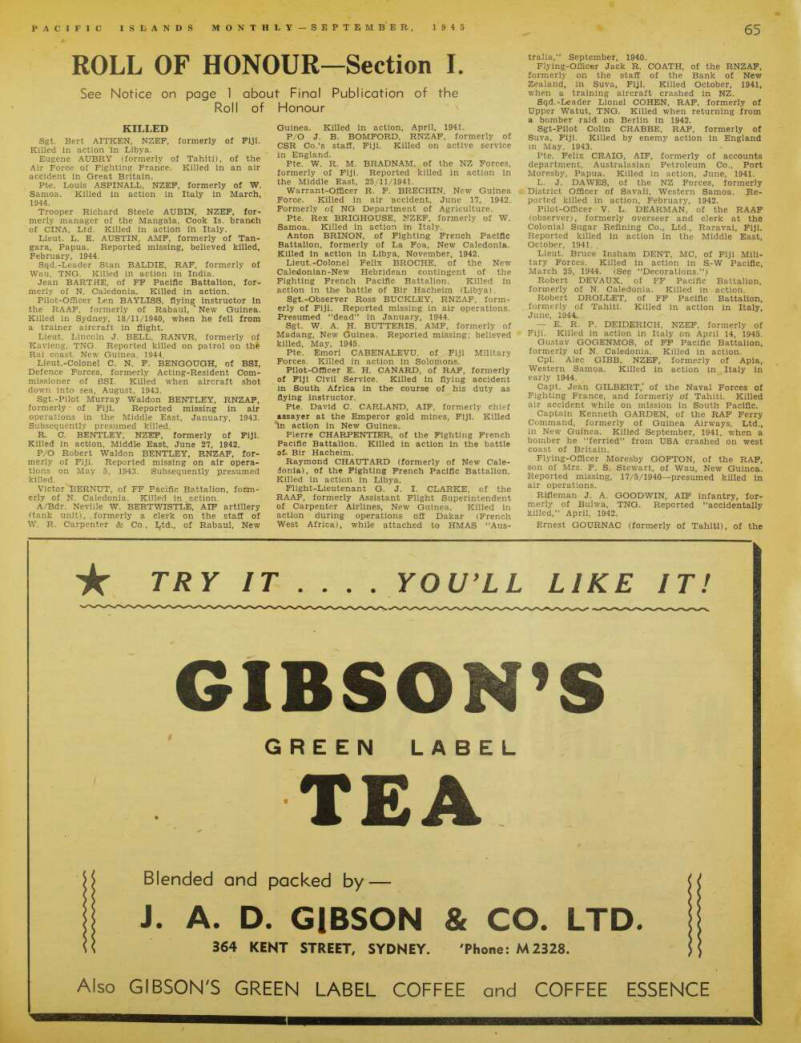
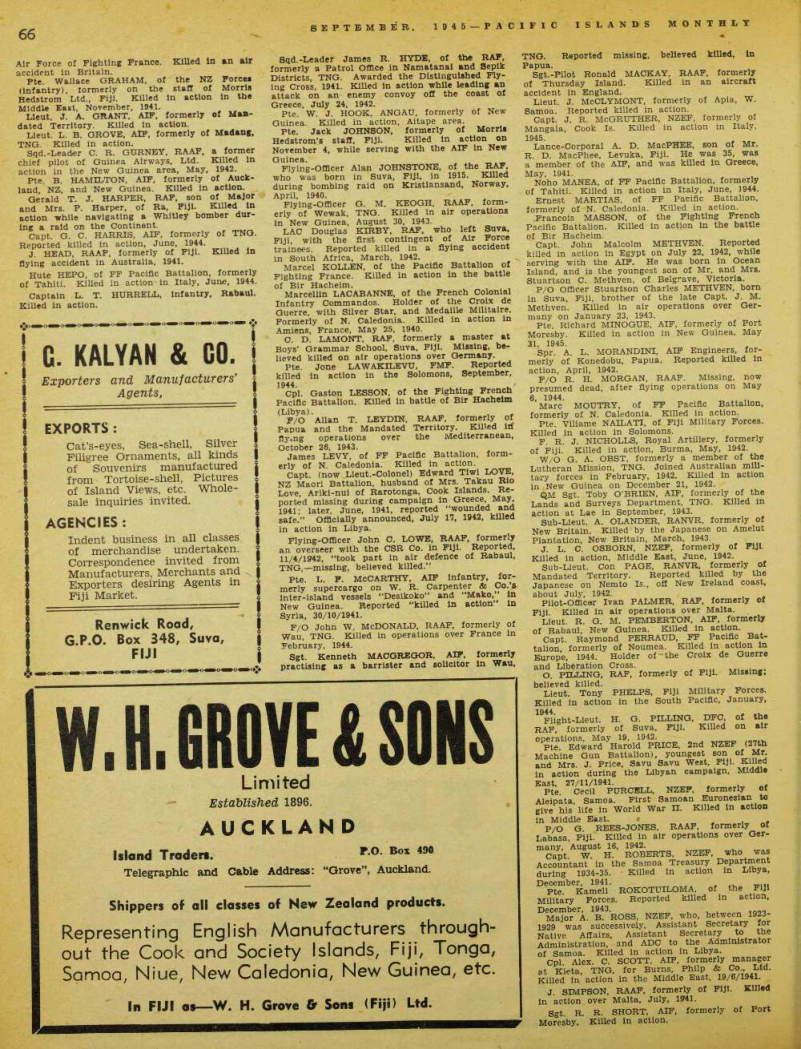
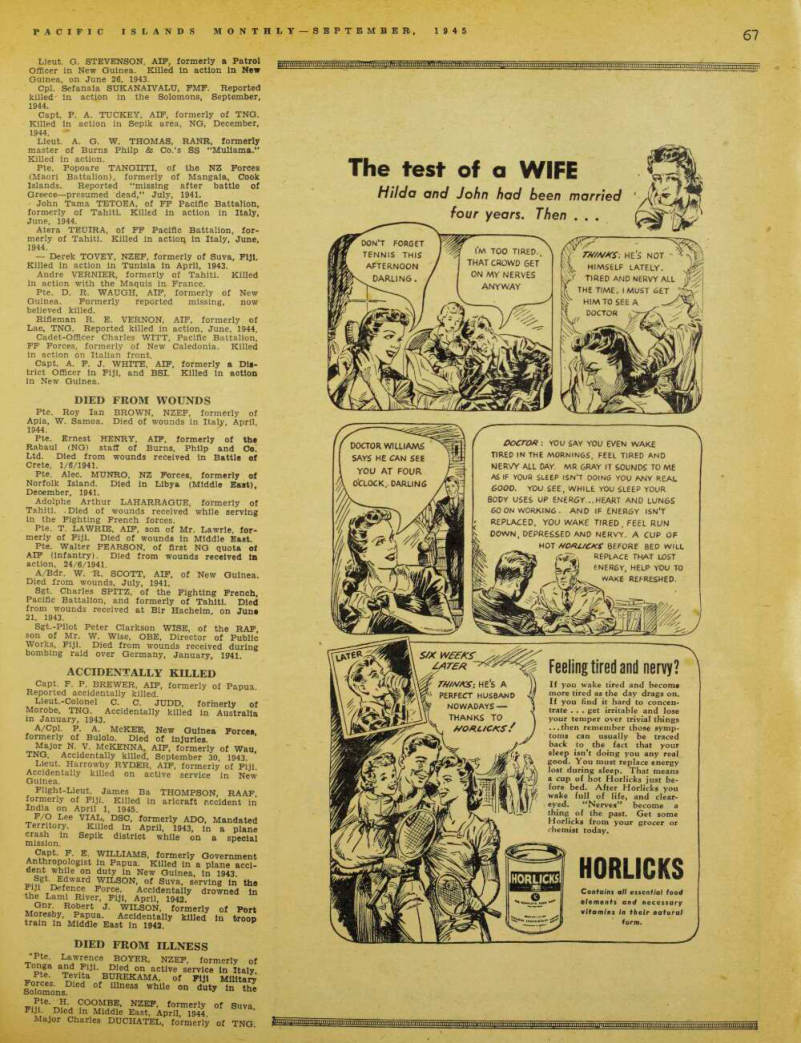
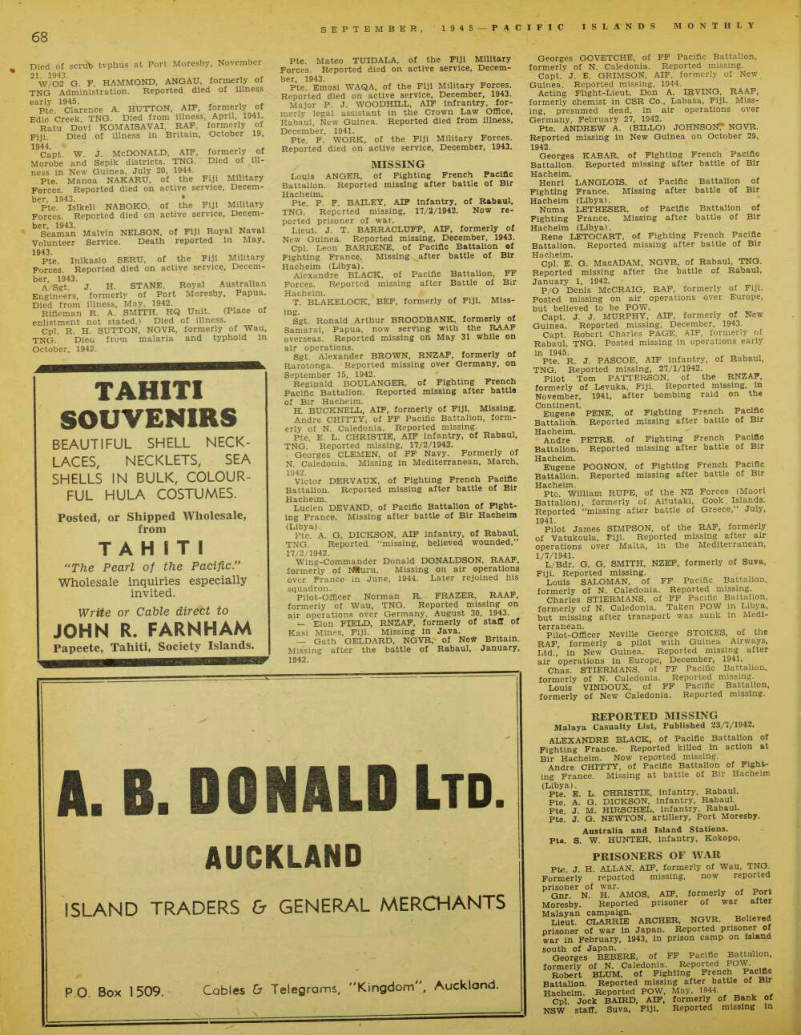
See Notice on page 1 about Final Publication of the Roll of Honour
Killed
Sgt. Bert AITKEN, NZEF, formerly of Fiji.
Killed in action in Libya.
Eugene AUBRY (formerly of Tahiti), of the Air Force of Fighting France. Killed in an air accident in Great Britain.
Pte. Louis ASPINALL, NZEF, formerly of W.
Samoa. Killed in action in Italy in March, 1944.
Trooper Richard Steele AUBIN, NZEF, for merly manager of the Mangaia, Cook Is. branch of CINA, Ltd. Killed in action in Italy.
Lieut. L. E. AUSTIN, AMP, formerly of Tan gara, Papua. Reported missing, believed killed, February, 1944.
Sqd.-Leader Stan BALDIE, RAF, formerly of Wau, TNG. Killed in action in India.
Jean BARTHE, of FF Pacific Battalion, for merly of N. Caledonia. Killed in action.
Pilot-Officer Len BAYLISS, flying instructor in the RAAF, formerly of Rabaul, ’ New Guinea.
Killed in Sydney, 18/11/1940, when he fell from a trainer aircraft in flight.
Lieut. Lincoln J. BELL, RANVR, formerly of Kavieng, TNG. Reported killed on patrol on the Rai coast, New Guinea, 1944.
Lieut.-Colonel C. N. F. BENGOUGH, of BSI, Defence Forces, formerly Acting-Resident Com missioner of BSI. Killed when aircraft shot down into sea, August, 1943.
Sgt.-Pilot Murray Waldon BENTLEY, RNZAF, formerly of Fiji. Reported missing in air operations in the Middle East, January, 1943.
Subsequently presumed killed.
R. C. BENTLEY, NZEF, formerly of Fiji.
Killed in action, Middle East, June 27. 1942.
P/O Robert Waldon BENTLEY, RNZAF, for merly of Fiji, Reported missing on air opera tions on May 5, 1943. Subsequently presumed killed.
Victor BERNUT, of FF Pacific Battalion, form erly of N. Caledonia. Killed in action.
A/Bdr. Neville W. BERTWISTLE, AIF artillery (tank unit), , formerly a clerk on the staff of W. R. Carpenter & Co., Ltd., of Rabaul, New
Guinea. Killed in action, April, 1941.
P/O J. B. BOMFORD, RNZAF, formerly of CSR Co.’s staff, Fiji. Killed on active service in England.
Pte. W. R. M. BRADNAM, of the NZ Forces, formerly of Fiji. Reported killed in action in the Middle East, 25/11/1941.
Warrant-Officer R. P. BRECHIN, New Guinea Force. Killed in air accident, June 17, 1942.
Formerly of NG Department of Agriculture.
Pte. Rex BRIGHOUSE, NZEF, formerly of W.
Samoa. Killed in action in Italy.
Anton BRINON, of Fighting French Pacific Battalion, formerly of La Foa, New Caledonia.
Killed in action In Libya, November, 1942.
Lieut.-Colonel Felix BROCHE, of the New Caledonian-New Hebridean contingent of the Fighting French Pacific Battalion. Killed in action in the battle of Bir Hacheim (Libya).
Sgt.-Observer Ross BUCKLEY, RNZAF, form erly of Fiji. Reported missing in air operations.
Presumed “dead” in January, 1944.
Sgt. W. A. H. BUTTERIS, AMF, formerly of Madang, New Guinea. Reported missing; believed killed, May, 1945.
Pte. Emori CABENALEVU, of Fiji Military Forces. Killed in action in Solomons.
Pilot-Officer E. H. CANARD, of RAF, formerly of Fiji Civil Service. Killed in flying accident In South Africa in the course of his duty as flying instructor.
Pte. David C. GARLAND, AIF, formerly chief assayer at the Emperor gold mines, Fiji. Killed 'in action in New Guinea.
Pierre CHARPENTIER, of the Fighting French Pacific Battalion. Killed in action in the battle of. Bir Hacheim.
Raymond CHAUTARD (formerly of New Cale donia), of the Fighting French Pacific Battalion.
Killed in action in Libya.
Flight-Lieutenant G. J. I. CLARKE, of the RAAF, formerly Assistant Flight Superintendent of Carpenter Airlines, New Guinea. Killed in action during operations off Dakar (French West Africa), while attached to HMAS “Aus
tralia,” September, 1940.
Flying-Officer Jack R. COATH, of the RNZAF, formerly on the staff of the Bank of New Zealand, in Suva, Fiji. Killed October, 1941, when a training aircraft crashed in NZ.
Sqd.-Leader Lionel COHEN, RAF, formerly of Upper Watut, TNG. Killed when returning from a bomber raid on Berlin in 1942.
Sgt-Pilot Colin CRABBE, RAF, formerly of Suva, Fiji. Killed by enemy action in England in May, 1943.
Pte. Felix CRAIG, AIF, formerly of accounts department, Australasian Petroleum Co., Port Moresby, Papua. Killed in action, June, 1941.
L. J. DAWES, of the NZ Forces, formerly District Officer of Savaii, Western Samoa. Re ported killed in action, February, 1942.
Pilot-Officer V. L. DEARMAN, of the RAAP (observer), formerly overseer and clerk at the Colonial Sugar Refining Co., Ltd., Raravai, Fiji.
Reported killed in action in the Middle East, October, 1941. .
Lieut. Bruce Insham DENT, MC, of Fiji Mili tary Forces. Killed in action in S.-W Pacific, March 25, 1944. (See “Decorations.”) Robert DEVAUX, of FF Pacific Battalion, formerly of N. Caledonia. Killed in action.
Robert DROLLET, of FF Pacific Battalion, formerly of Tahiti. Killed in action in Italy, June, 1944.
E. R. P. DEIDERICH, NZEF, formerly of Fiji. Killed in action in Italy on April 14, 1945.
Gustav GOGENMOS, of FF Pacific Battalion, formerly of N. Caledonia. Killed in action.
Cpl. Alec GIBB, NZEF, formerly of Apia, Western Samoa. Killed in action in Italy in early 1944.
Capt. Jean GILBERT,* of the Naval Forces of Fighting France, and formerly of Tahiti. Killed air accident while on mission in South Pacific.
Captain Kenneth GARDEN, of the RAF Ferry Command, formerly of Guinea Airways, Ltd., in New Guinea. Killed September, 1941, when a bomber he “ferried” from USA crashed on west coast of Britain.
Flying-Officer Moresby GOFTON, of the RAP, son of Mrs. F. S. Stewart, of Wau, New Guinea.
Reported missing, 17/5/1940—presumed killed In air operations.
Rifleman J. A. GOODWIN, AIF infantry, for merly of Bulwa, TNG. Reported “accidentally killed,” April, 1942.
Ernest GOURNAC (formerly of Tahiti), of the
Air Force of Fighting Prance. Killed in an air accident in Britain.
Pte. Wallace GRAHAM, of the NZ Forces (infantry), formerly on the staff of Morris Hedstrom Ltd., Fiji. Killed in action in the Middle East, November, 1941.
Lieut. J. A. GRANT, AIF, formerly of Man dated Territory. Killed in action.
Lieut. L. B. GROVE, AIF, formerly of Madang, TNG. Killed in action.
Sqd.-Leader C. R. GURNEY, RAAF, a former chief pilot of Guinea Airways, Ltd. Killed in action in the New Guinea area, May, 1942.
Pte. B. HAMILTON. AIF. formerly of Auck land, NZ, and New Guinea. Killed in action.
Gerald T. J. HARPER, RAP, son of Major and Mrs. P. Harper, of Ra, Fiji. Killed in action while navigating a Whitley bomber dur ing a raid on the Continent.
Capt. G. C. HARRIS, AIF, formerly of TNG.
Reported killed in action, June, 1944.
J. HEAD, RAAF, formerly of Fiji. Killed In flying accident in Australia, 1941.
Hute HEPO, of FF Pacific Battalion, formerly of Tahiti. Killed in action in Italy, June, 1944.
Captain L. T. HURRELL, infantry, Rabaul.
Killed in action.
Sqd.-Leader James R. HYDE, of the RAP, formerly a Patrol Office in Namatanal and Seplk Districts, TNG. Awarded the Distinguished Fly ing Cross, 1941. Killed in action while leading an attack on an enemy convoy off the coast of Greece, July 24, 1942.
Pte. W. J. HOOK, ANGAU, formerly of New Guinea. Killed in action, Aitape area.
Pte. Jack JOHNSON, formerly of Morris Hedstrom’s staff, Fiji. Killed in action on November 4, while serving with the AIF in New Guinea.
Flying-Officer Alan JOHNSTONE, of the RAP, who was born in Suva, Fiji, in 1915. Killed during bombing raid on Kristiansand, Norway, April, 1940.
Flying-Officer G. M. KEOGH, RAAF, form erly of Wewak, TNG. Killed in air operations in New Guinea, August 30. 1943.
LAC Douglas KIRBY. RAF, who left Suva, Fiji, with the first contingent of Air Force trainees. Reported killed in a flying accident in South Africa, March, 1942.
Marcel KOLLEN, of the Pacific Battalion of Fighting France. Killed in action in the battle of Bir Hacheim.
Marcellin LACABANNE. of the French Colonial Infantry Commandos. Holder of the Croix de Guerre, with Silver Star, and Medaille Militaire.
Formerly of N. Caledonia. Killed in action in Amiens, France, May 25, 1940.
C. D. LAMONT, RAF, formerly a master at Boys’ Grammar School, Suva, Fiji. Missing, be lieved killed on air operations over Germany.
Pte. Jone LAW AKILEVU, FMF. Reported killed in action in the Solomons, September, ] 944 Cpl. Gaston LESSON, of the Fighting French Pacific Battalion. Killed in battle of Bir Hacheim (Libya). , , F/O Allan T. LEYDIN, RAAF, formerly of Papua and the Mandated Territory. KiHed in flying operations over the Mediterranean, October 26, 1943.
James LEVY, of FF Pacific Battalion, form erly of N. Caledonia. Killed in action.
Capt. (now Lieut.-Colonel) Edward Tlwi LOVE, NZ Maori Battalion, husband of Mrs. Takau Rio Love, Ariki-nui of Rarotonga, Cook Islands. Re ported missing during campaign in Greece, May, 1941; later. June, 1941, reported “wounded and safe.” Officially announced, July 17, 1942, killed in action in Libya.
Flying-Officer John C. LOWE, RAAF, formerly an overseer with the CSR Co. in Fiji. Reported, 11/4/1942, “took part in air defence of Rabaul, TNG, —missing, believed killed.”
Pte. L. P. MCCARTHY, AIF infantry, for merly supercargo on W. R. Carpenter & Co.’s inter-island vessels “Desikoko” and “Mako,” in New Guinea. Reported “killed in action” in Syria, 30/10/1941.
P/O John W. MCDONALD, RAAF, formerly of Wau, TNG. Killed in operations over France in February, 1944.
Sgt. Kenneth MACGREGOR, AIF, formerly practising as a barrister and solicitor in Wau,
TNG. Reported missing, believed killed, In Papua.
Sgt.-Pilot Ronald MACKAY, RAAF, formerly of Thursday Island. Killed in an aircraft accident in England.
Lieut. J. McCLYMONT, formerly of Apia, W.
Samoa. Reported killed in action.
Capt. J. R. McGRUTHER, NZEF, formerly of Mangaia, Cook Is. Killed in action in Italy, 1945. , „ Lance-Corporal A. D. MacPHEE, son of Mr.
R. D. MacPhee, Levuka, Fiji. He was 35, was a member of the A IF, and was killed in Greece, May, 1941. , Noho MANEA, of FF Pacific Battalion, formerly of Tahiti. Killed in action in Italy, June, 1944.
Ernest MARTI AS, of FF Pacific Battalion, formerly of N. Caledonia. Killed in action.
Francois MASSON, of the Fighting French Pacific Battalion. Killed in action in the battle of Bir Hacheim.
Capt. John Malcolm METHVEN. Reported killed in action in Egypt on July 22, 1942, while serving with the AIF. He was born in Ocean Island, and is the youngest son of Mr. and Mrs.
Stuartson C. Methven, of Belgrave, Victoria.
P/O Officer Stuartson Charles METHVEN, born in Suva, Fiji, brother of the late Capt. J. M.
Methven. Killed in air operations over Ger many on January 23, 1943.
Pte. Richard MINOGUE, AIF, formerly of Port Moresby. Killed in action in New Guinea, May 31, 1945.
Spr. A. L. MORANDINI, AIF Engineers, for merly of Konedobu, Papua. Reported killed in action, April, 1942.
F/O R. H. MORGAN, RAAF. Missing, now presumed dead, after flying operations on May 6 1944 ’ Marc’ MOUTRY, of FF Pacific Battalion, formerly of N. Caledonia. Killed in action.
Pte. Viliame NAILATI, of Fiji Military Forces.
Killed in action in Solomons.
F. R. J. NICHOLLS, Royal Artillery, formerly of Fiji Killed in action, Burma, May, 1942.
W/O G. A. OBST, formerly a member of the Lutheran Mission, TNG. Joined Australian mili tary forces in February, 1942. Killed in action in New Guinea on December 21, 1942.
QM Sgt. Toby O’BRIEN, AIF, formerly of the Lands and Surveys Department, TNG. Killed in action at Lae in September, 1943.
Sub-Lieut. A. OLANDER, RANVR, formerly of New Britain. Killed by the Japanese on Amelut Plantation, New Britain, March, 1943.
J. L. C. OSBORN, NZEF, formerly of FIJI.
Killed in action, Middle East, June, 1942.
Sub-Lieut. Con PAGE, RANVR, formerly of Mandated Territory. Reported killed by the Japanese on Nemto Is., off New Ireland coast, about July, 1942.
Pilot-Officor Ivan PALMER, RAF, formerly of Fiji Killed in air operations over Malta.
Lieut. R. G. M. PEMBERTON, AIF. formerly of Rabaul, New Guinea. Killed in action.
Capt. Raymond PERRAUD, FF Pacific Bat talion, formerly of Noumea. Killed in action in Europe, 1944. Holder of the Croix de Guerre and Liberation Cross. ... . .
O. PILLING, RAP, formerly of Fiji. Missing, believed killed.
Lieut. Tony PHELPS, Fiji Military Forces, Killed in action in the South Pacific, January, 1944 Plight-Lieut. H. G. PILLING. DFC. of the RAP, formerly of Suva, Fiji. Killed on air operations, May 19, 1942.
Pte. Edward Harold PRICE, 2nd NZEF (27th Machine Gun Battalion), youngest son of Mr and Mrs. J. Price, Savu Savu West. Fiji. Killed in action during the Libyan campaign, Middle East, 27/11/1941.
Pte Cecil PURCELL, NZEF. formerly of Aleipata, Samoa. First Samoan Euroneslan to give his life in World War 11. Killed in action in Middle Bast. - .
P/O G. REES-JONES, RAAF. formerly of Labasa, Fiji. Killed in air operations over Ger many, August 16, 1942.
Capt W. H. ROBERTS, NZEF. who was Accountant in the Samoa Treasury Department during 1934-35. Killed in action in Libya, December, 1941.
Pte. Kameli ROKOTUILOMA, of the Fiji Military Forces. Reported killed in action, D MaTo b / r A. J B 43 ROSS, NZEF. who, between 1923- 1929 was successively. Assistant Secretary for Native Affairs, Assistant Secretary to the Administration, and ADC to the Administrator of Samoa. Killed in action in Libya.
Cpl. Alex. C. SCOTT, AIF, formerly manager at Kieta, TNG, for Burns, Philp & Co. Ltd Killed in action in the Middle East, 19/6/1941. j. SIMPSON, RAAF, formerly of Fiji. Killed in action over Malta, July, 1941.
Sgt. R. R. SHORT, AIF, formerly of Port Moresby. Killed in action.
Lieut. G. STEVENSON, AIP, formerly a Patrol Officer in New Guinea. Killed In action in New Guinea, on June 26, 1943.
Cpl. Sefanaia SUKANAIVALU, FMP. Reported killed in action in the Solomons, September, 1944.
Capt. P. A. TUCKEY, A IF, formerly of TNG.
Killed in action in Sepik area, NG, December, 1944.
Lieut. A. G. W. THOMAS. RANR, formerly master of Burns Philp & Co.’s SS “Mullama.”
Killed in action.
Pte. Popoare TANGIITI, of the NZ Forces (Maori Battalion), formerly of Mangala, Cook Islands, Reported “missing after battle of Greece—presumed dead,” July, 1941.
John Tama TETOEA, of FF Pacific Battalion, formerly of Tahiti. Killed in action in Italy, June, 1944.
Atera TEUIRA, of FF Pacific Battalion, for merly of Tahiti. Killed in action in Italy, June, 1944.
Derek TOVEY, NZEF, formerly of Suva, Fiji.
Killed in action in Tunisia in April, 1943.
Andre VERNIER, formerly of Tahiti. Killed in action with the Maquis in France.
Pte. D. R. WAUGH, AIP, formerly of New Guinea. Formerly reported missing, now believed killed.
Rifleman R. E. VERNON, AIF, formerly of Lae, TNG. Reported killed in action, June, 1944.
Cadet-Officer Charles WITT, Pacific Battalion, FF Forces, formerly of New Caledonia. Killed in action on Italian front.
Capt. A. P. J. WHITE, AIF, formerly a Dls trict Officer in Fiji, and BSI. Killed in action in New Guinea.
Died From Wounds
Pte. Roy lan BROWN, NZEF, formerly of Apia, W. Samoa. Died of wounds in Italy, April, 1944.
Pte. Ernest HENRY, AIP, formerly of the Rabaul (NG) staff of Burns, Philp and Co.
Ltd. Died from wounds received in Battle of Crete, 1/6/1941.
Pte. Alec. MUNRO, NZ Forces, formerly of Norfolk Island. Died in Libya (Middle East), December, 1941.
Adolphe Arthur LAHARRAGUE, formerly of Tahiti. Died of wounds received while serving in the Fighting French forces.
Pte. T. LAWRIE, AIP, son of Mr. Lawrie, for merly of Fiji. Died of wounds In Middle East.
Pte. Walter PEARSON, of first NG quota of AIF (infantry). Died from wounds received in action, 24/6/1941.
A/Bdr. W. R. SCOTT, AIP, of New Guinea.
Died from wounds, July, 1941.
Sgt. Charles SPITZ, of the Fighting French, Pacific Battalion, and formerly of Tahiti. Died from wounds received at Bir Hachelm, on Juno 21, 1943.
Sgt.-Pilot Peter Clarkson WISE, of the RAF, son of Mr. W. Wise, OBE, Director of Public Works, Fiji. Died from wounds received during bombing raid over Germany, January, 1941.
ACCIDENTALLY killed
Capt. F. P. BREWER, AIF, formerly of Papua Reported accidentally killed.
Lieut.-Colonel C. C. JUDD, formerly of Morobe, TNG. Accidentally killed in Australia in January, 1943.
A/Cpl. P. A. McKEB, New Guinea Forces, formerly of Bulolo. Died of injuries Major N. V. McKENNA, AIF, formerly of Wau, TNG. Accidentally killed, September 30, 1943 Lieut. Harrowby RYDER, AIF, formerly of Fiji.
Accidentally killed on active service in New Guinea.
Flight-Lieut. James Ba THOMPSON, RAAF, formerly of Fiji. Killed in aricraft accident in India on April 1, 1945. - F /° Lee ™L DSC. formerly ADO, Mandated Territory. Killed In April, 1943. In a plane crash in Sepik district while on a special mission. y
a E ' WILLIAMS, formerly Government
Anthropologist in Papua. Killed in a plane acci dent while on duty in New Guinea, in 1943.
Wi » gt T> E , dward WILSON, of Suva, serving in the Force< Accidentally drowned in the Lami River, Fiji, April, 1942.
Ro J? ert J - WILSON, formerly of Port ™2?, Ua \ B Accidentally killed in troop train in Middle East in 1942. v
Died From Illness
•Pte. Lawrence BOYER, NZEF, formerly of Tonga and Fiji. Died on active service In Italy.
Pte. Tevita BUREKAMA, of FIJI Military SoTomons Died ° f illn6SS Whlle 0n dut y tS Rte - H. COOMBE. NZEF, formerly of Suva Fiji. Died in Middle East, April, 1944. ’
Major Charles DUCHATEL, formerly of TNG.
™ TNG°AdminTstr^tion Mo^por^? A S’e(/ 0 o£ le illnesS * Fiji. Died of Illness In Britain, October 19, 19 capt. W. J. MCDONALD, AIF, formerly of Morobe and Sepik districts. TNG. Died of illn6 4f in Sl? U ‘l?Am U D 2 of I the Fiji Military Forces. Reported died on active service. Decern- , ... i mo Tciiroli nardko of the Fiji Military Force's Reported died on active service, Decern- Seaman Malvin NELSON, of Fiji Royal Naval Volunteer Service. Death reported in May. 1943 Pte Inikasio SERU. of the Fiji Military Forces Reported died on active service. Decernher 1943 A/Sgt J H STANE, Royal Australian Engineers, formerly of Port Moresby, Papua.
Died from illness. May, 1942.
Rifleman R. A. SMITH, HQ Unit. (Place of enlistment not stated.) Died of illness.
Cpl. R. H. SUTTON, NGVR, formerly of Wau, TNG. Diea from malaria and typhoid in October, 1942.
Pte. Mateo TUIDALA, of the Fiji Military Forces. Reported died on active service, Decem ber. 1943.
Pte. Emosi WAQA, of the Fiji Military Forces.
Reported died on active service, December, 1943.
Major P. J. WOODHILL, AIF infrantry, for merly legal assistant in the Crown Law Office, Rabaul, New Guinea. Reported died from illness, December, 1941.
Pte. F. WORK, of the Fiji Military Forces.
Reported died on active service, December, 1943.
Missing
Louis ANGER, of Fighting French Pacific Battalion. Reported missing after battle of Bir Hacheim.
Pte. P. F. BAILEY, AIF Infantry, of Rabaul, TNG. Reported missing, 17/2/1942, Now re ported prisoner of war.
Lieut. J. T. BARRACLUFF, AIF, formerly of New Guinea. Reported missing, December, 1943.
Cpl. Leon BARRENS, of Pacific Battalion of Fighting France. Missing after battle of Bir Hacheim (Libya).
Alexandre BLACK, of Pacific Battalion, FF Forces. Reported missing after Battle of Bir Hacheim.
T. BLAKELOCK, BEF, formerly of Fiji. Mlss ing.
Sgt. Ronald Arthur BROODBANK, formerly of Samarai, Papua, now serving with the R*AAP overseas. Reported missing on May 31 while on air operations.
Sgt. Alexander BROWN, RNZAF, formerly of Rarotonga. Reported missing over Germany, on September 15, 1942.
Reginald BOULANGER, of Fighting French Pacific Battalion. Reported missing after battle of Bir Hacheim.
H. BUCKNELL, AIF, formerly of Fiji. Missing.
Andre CHITTY, of FF Pacific Battalion, form erly of N. Caledonia. Reported missing.
Pte. E. L. CHRISTIE, ALP infantry, of Rabaul, TNG. Reported missing, 17/2/1942.
Georges CLEMEN, of FF Navy. Formerly of N. Caledonia. Missing in Mediterranean, March, 1942.
Victor DERVAUX, of Fighting French Pacific Battalion. Reported missing after battle of Bir Hacheim.
Lucien DEV AND, of Pacific Battalion of Fight ing France. Missing after battle of Bir Hacheim (Libya).
Pte. A. G. DICKSON, AIF infantry, of Rabaul, TNG. Reported “missing, believed wounded,” 17/2/1942.
Wing-Commander Donald DONALDSON, RAAF, formerly of Nturu. Missing on air operations over France in June, 1944. Later rejoined his squadron.
Pilot-Officer Norman R. FRAZER, RAAF, formerly of Wau, TNG. Reported missing on air operations over Germany, August 30, 1943. -- Eion FIELD, RNZAF, formerly of staff of Kasi Mines, Fiji. Missing in Java.
Gath GELDARD, NGVR, of New Britain.
Missing after the battle of Rabaul, January, 1942.
Georges GOVETCHE, of FF Pacific Battalion, formerly of N. Caledonia. Reported missing.
Capt. J. E. GRIMSON, AIF, formerly of New Guinea. Reported missing, 1944.
Acting Plight-Lieut. Don A. IRVING, RAAF, formerly chemist in CSR Co., Labasa, Fiji. Miss ing, presumed dead, in air operations over Germany, February 27, 1942.
Pte. Andrew A. (Billo) Ngvr.
Reported missing in New Guinea on October 29, 1942.
Georges KABAR, of Fighting French Pacific Battalion. Reported missing after battle of Bir Hacheim.
Henri LANGLOIS, of Pacific Battalion of Fighting France. Missing after battle of Bir Hacheim (Libya).
Numa LETHESER, of Pacific Battalion of Fighting France. Missing after battle of Bir Hacheim (Libya).
Rene LETOCART, of Fighting French Pacific Battalion. Reported missing after battle of Bir Hacheim.
Cpl. E. G. MacADAM, NGVR, of Rabaul, TNG.
Reported missing after the battle of Rabaul, January 1, 1842.
P/O Denis McCRAIG, RAF, formerly of Fiji.
Posted missing on air operations over Europe, but believed to be POW.
Capt. J. J. MURPHY, AIF, formerly of New Guinea. Reported missing, December, 1943.
Capt. Robert Charles PAGE, AIF, formerly of Rabaul, TNG. Posted missing in operations early in 1945.
Pte. R. J. PASCOE, AIF infantry, of Rabaul, TNG. Reported missing, 27/1/1942.
Pilot Tom PATTERSON, of the RNZAF, formerly of Levuka, Fiji. Reported missing, in November, 1941, after bombing raid on the Continent. , Eugene PENE, of Fighting French Pacific Battalion. Reported missing after battle of Bir Hacheim. „ .
Andre PETRE, of Fighting French Pacific Battalion. Reported missing after battle of Bir Hacheim. , .
Eugene POGNON, of Fighting French Pacific Battalion. Reported missing after battle of Bir Hacheim.
Pte. William RUPE, of the NZ Forces (Maori Battalion), formerly of Aitutaki, Cook Islands.
Reported “missing after battle of Greece,’’ July, 1941.
Pilot James SIMPSON, of the RAF, formerly of Vatukoula, Fiji. Reported missing after air operations over Malta, in the Mediterranean, 1/7/1941. , , „ L/Bdr. G. G. SMITH, NZEF, formerly of Suva, Fiji. Reported missing.
Louis SALOMAN, of FF Pacific Battalion, formerly of N. Caledonia. Reported missing.
Charles STIERMANS, of FF Pacific Battalion, formerly of N. Caledonia. Taken POW in Libya, but missing after transport was sunk in Medi terranean. .
Pilot-Officer Neville George STOKES, of the RAP, formerly a pilot with Guinea Airways, Ltd.,' in New Guinea. Reported missing after air operations in Europe, December, 1941, Chas. STIERMANS, of FF Pacific Battalion, formerly of N. Caledonia. Reported missing.
Louis VINDOUX, of FF Pacific Battalion, formerly of New Caledonia. Reported missing.
Reported Missing
Malaya Casualty List, Published 23/7/1942.
ALEXANDRE BLACK, of Pacific Battalion of Fighting France. Reported killed in action at Bir Hacheim. Now reported missing.
Andre CHTTTY, of Pacific Battalion of Fight ing France. Missing at battle of Bir Hacheim (Libya). . , Pte. E. L. CHRISTIE, infantry, Rabaul.
Pte. A. G. DICKSON, infantry, Rabaul.
Pte J. M. HIRSCHEL, infantry, Rabaul.
Pte. J. G. NEWTON, artillery. Port Moresby.
Australia and Island Stations.
Pta. S. W. HUNTER, infantry, Kokopo.
Prisoners Of War
Pte. J. H. ALLAN, AIF, formerly of Wau, TNG Formerly reported missing, now reported prisoner of war.
Gnr. N. H. AMOS, AIF. formerly of Port Moresby. Reported prisoner of war after Malayan campaign.
Lieut. CLARRIE ARCHER. NGVR. Believed prisoner of war in Japan. Reported prisoner of war in February, 1943, in prison camp on Island south of Japan.
Georges BEBERE, of FF Pacific Battalion, formerly of N. Caledonia. Reported POW.
Robert BLUM, of Fighting French Pacific Battalion. Reported missing after battle of Bir Hacheim. Reported POW, May, 1944.
Cpl. Jock BAIRD, AIF, formerly of Bank of NSW staff, Suva, Fiji. Reported missing in
Malaya, February, 1942. Reported prisoner of war, September, 1943.
Mariel BARRAU, of French Infantry, formerly of N. Caledonia. Taken prisoner after fall of France, June, 1940.
A/Cpl. Peter W. BOSGARD, AIF infantry, for merly of the Lands Department, Port Moresby, Papua. Reported prisoner of war at Sulmona, Italy., 29/6/1941; transferred to Bolzano prison camp, September, 1941. Liberated, May, 1945. taken prisoner.” Liberated, May, 1945.
Cpl. J. E. BROAD, NZEF, formerly of Suva, Fiji. Reported prisoner of war. Reported escaped from German POW camp in Italy, 1944.
Now returned to New Zealand.
Lieut. John BROWN, formerly of Fiji. Re ported a prisoner of war in Italy.
Cpl. E. BOURKE, A IF, formerly of New Guinea. Prisoner of war in Germany.
Sgt. R. F. BUNTING, AIF, formerly of Samaral, Papua. MissfnK in Malaya. Now reported prisoner of wai\ Henri CLEMENCEAU, of FF Pacific Battalion, formerly of N. Caledonia. Reported POW.
Sgt. Peter COGGINS, AIF, formerly of FIJI Taken prisoner in Malaya, and now reported prisoner of war in Borneo camp.
A/Sgt. A. A. S. COTMAN, ALP infantry, of Abau, Papua. Reported missing—believed prisoner of war, 5/5/1941; reported later, July, 1941, “wounded in chest and head by shrapnel— TNG. Reported prisoner of war, 29/7/1941.
Liberated, May, 1945.
Cpl. W. F. CULLEN, AIF, formerly of Thursday Island. Reported prisoner of war, John Arnold CROCKETT, AIF, formerly of Bulolo, TNG. Reported prisoner of war In Osaka, Japan, September, 1943.
Pte. J. DALTON. ALP Transport and Supply, formerly of Thursday Island. Reported prisoner of war, April, 1942.
Victor DERVAUX, of FF Pacific Battalion.
Formerly a POW in Italy, but escaped and now interned in Switzerland.
Dick ELMOUR, formerly of New Caledonia, prisoner of war after Dunkirk. Repatriated to Prance in January, 1942, because of health reasons.
Pte. W. G. ECKBLADE, AIF, formerly of Rabaul. Previously reported missing; now re ported missing; believed prisoner of war.
L/Cpl. Stanley E. ESAM, Singapore Volunteer Forces, formerly of Fiji Kafiri Timber Co., Nad rivatu, Fiji. Missing, Malaya, February, 1942.
Reported POW, Thailand, May, 1943.
Pilot-Officer George Bellby EVANS, RAAF, son of Mr. and Mrs. Beilby Evans, formerly of Buka Passage, TNG. Reported prisoner of war In Java.
Capt. M. G. EVENSON, AIF, formerly of New Guinea. Missing, believed POW, January, 1945.
Lieut. R. W. Feetum, AIF, formerly of New Guinea. Previously reported missing; now re ported "missing believed POW, March, 1943.”
Gnr. A, I. FOLEY, AIF, formerly of Papua, Reported missing in Malayan campaign. Re ported prisoner of war in February. 1944.
Gaston GEILLER, of Fighting French Pacific Battalion, Reported missing after battle of Blr Hacheim. Reported POW, Mav. 1944.
Sgt. Robert GEMMELL-SMITH, RAF, formerly on CSR Co.’s staff, Fiji. Reported prisoner of war in Bengazi, Libya, in November, 1942. w/o.n V. M. I. GORDON. AIF, formerly of Wau, TNG. Reported prisoner of war after Malayan campaign.
Pte. W. GOSSNER, AIF Infantry, formerly of the BNG Development Do., Port Moresby. Papua Reported prisoner of war, Sulmona, Italy. 6/7/1941. Escaped J 944.
J. P. GOUZENE, of Fighting French Pacific Battalion. Reported missing after battle of Blr Hacheim. Reported POW, May. 1944.
W/OI A. N. GRAY, AIF, formerly of Rabaul, TNG. Reported prisoner of war.
Chief-Sergeant Francois GRISCELLI, of Fight ing French Pacific Battalion. Reported missing in Libya in April. Formerly of New Caledonia.
Reported POW, May. 1944.
Lieut. J. M. HARCOURT, 2nd NZEF. son of Mr. H. W. Harcourt, formerly Deputy Treasurer In Fiji. Reported “captured in Libya and now prisoner of war,” March, 1942. Liberated May, 1945.
Squadron-Leader Godfrey HEMSWORTH, of the RAAF, formerly a well-known commercial pilot In Morobe, TNG. Reported missing after an operational flight against the Japanese In the New Guinea area and presumed killed in action. Reported prisoner of war In Japanese hands in October, 1943.
S. D. C. KERKHAM, NZEF, son of Mr. R. O.
Kerkham, Suva, Fiji. Reported prisoner of war In September, 1942.
Lieut. JEFF KILNER. NGVR. Believed prisoner of war in Japan.
Gnr. A. L. B. KING AIF artillery, of Rabaul.
Reported prisoner of war. Liberated May, 1945.
Lieut. G. G. KINNER, New Guinea Forces, formerly of Rabaul. Reported prisoner of war.
Paul KLEIN, of FF Pacific Battalion, formerly of N. Caledonia. Reported POW.
Nura LETHEIZER, of FF Pacific Battalion, formerly of N. Caledonia. Reported POW.
Major E. G. A. LETT, of the East Surrey Regiment, and son of Mr. Lewis Lett, of Port
Moresby, Papua. Reported prisoner of war in Libya.
P/O J. LIETKE, RAAF, formerly of Labasa, Fiji. Reported prisoner of war in Germany, 1943 A/Cpl. John H. LONERGAN, AIF, Supply and Transport, of New Guinea. Reported prisoner of war at Corinthia, Italy, 8/7/1941. Liberated, May, 1945.
P/O Dennis McCAIG, RAF, formerly of Fiji.
Reported prisoner of war in Germany. Liberated, May, 1945.
Pte. Ernest (“Paddy”) McGEADY. NZEF. son of Mrs. J. McGeady, of Suva, Fiji. Reported “missing, believed killed”, after fighting in Libya, January. 1942; reported prisoner of war in Italy, April, 1942. Liberated May, 19'45.
Cpl. J. H. L. McGUIGAN, of the Field Ambulance, AIF, formerly of the Public Health Department, New Guinea. Officially reported missing at Singapore; unofficially reported a prisoner in Japanese hands. Reported prisoner prisoner of war in Italy, 26/10/1941. Liberated May, 1945.
Observer Alex. McKAY, of the RAAF, formerly of the CSR Co.’s staff, at Penang sugar-mill, Fiji. Reported missing, 27/7/1941; reported prisoner of war in Italy, 26/10/1941. Liberated,
May, 1945.
Pte. Harry MARCHINGTON, of the NZ Forces, formerly of Fiji. Reported prisoner of war after Battle of Crete, 2/12/1941.
Pte. F. C. MAYO, A IF, formerly of New Guinea. Reported a prisoner of war.
Camille MERCIER, of Fighting French Pacific Battalion. Reported missing after battle of Blr Hacheim. Reported POW, May, 1944.
Fit.-Lieut. G. E. (“Dusty”) MILLER, RAAF, formerly of Papua. Reported POW in Germany in 1943. Repatriated to England, 1944.
Lieut. Jean MILLIARD, of French Artillery.
Formerly of N. Caledonia. POW in Germany since fall of France, June, 1940.
Emile MILLOT, of Pacific Battalion of Fight ing France. Taken prisoner, in battle of Bir Hacheim (Libya).
Pte. J. F. MORRELL, formerly of TNG. Re ported missing believed prisoner of war, June 1, 1944.
Sgt. NAGLE, of French Colonial Infantry: formerly of N. Caledonia. POW in Germany since fall of France in June, 1940.
Pte. J. G. NEWTON, AIF, formerly of Papua.
Reported prisoner of war, June, 1944.
Pte. G. S. O’BRYAN. NZEF, formerly of Rarotonga, Cook Is. Missing after battle of Crete; now reported prisoner of war in Germany.
Gaetan OLLIVAUD, of French Colonial In fantry, formerly of N. Caledonia. POW in Ger many since fall of France, June, 1940.
Pte. D. R. PHILLIPS, AIF engineers, formerly of Bulwa, TNG. Reported prisoner of war, June, 1942.
Eugene POGNON, of FF Pacific Battalion, formerly of N. Caledonia. Reported POW.
Henri PAYONNE, of Fighting French Pacific Battalion. Reported missing after battle of Bir Hacheim. Later reported POW, Italy. Later escaped and rejoined FF forces.
Gnr. Allan H. ROSS, AIF artillery, formerly planter in New Britain, TNG. Reported “miss ing—believed prisoner of war,” 28/9/1941. Re ported POW, September, 1944. Liberated, May, 1945.
A/Bdr. L. J. SMEETON, AIF, formerly of Rabaul, TNG. Reported prisoner of war in Malayan campaign.
Pte. John O. SMITH, of the NZ Forces, son of Captain Arthur Smith, of the Fiji inter-island vessel “Tui Kauvaro”. Missing after battle of Crete, May, 1941; reported prisoner of war in Germany, 21/10/1941.
Squadron-Leader L. C. SHOPPEE, RAF, formerly of Edie Creek, New Guinea. Was In Java during Japanese invasion; now known to be a prisoner of war.
Gnr. D. M. SPENCE, AIF, formerly of Port Moresby. Reported prisoner of war after Malayan campaign. - LAC Charles SOLLITT, of the RAAF (wire less operator), son of Mr. and Mrs. C. H.
Sollitt, of Nausori, Fiji. Reported missing after air operations in New Guinea, January, 1942, later, March, 1942, reported rescued from sea by Japanese—now prisoner of war.
Pte Fred SWAN, NZ Army Medical Corps, formerly of Apia, Western Samoa. Missing
after Battle of Crete, August, 1941; reported prisoner of war in Germany, November, 1941.
Repatriated from a.German prison camp to NZ in 1944.
Signalman J. C. E. SWINBOURNE, 6th Div.
Signals, AIF, formerly of Fiji and the Gilbert & Ellice Islands Colony. Taken prisoner at Crete, June, 1941, now in prison camp at Stalag, VIIA, Germany.
F/O VENNING, NGVR. Taken prisoner during Jap invasion of Rabaul, January, 1942.
Lieut. CLIFF WARREN, of NZEF, serving in the Middle East, and formerly of Morris Hed strom Ltd.’s staff at Ba and Lautoka, Fiji. Re ported prisoner of war. Liberated May, 1945.
Mjr. N, WATCH, formerly Dr. Watch, of Rabaul, missing after Japanese invasion of Rabaul. Believed prisoner of war in Japan. Now reported POW in Japan.
Gnr. D. S. WHITCOMBE, NZEF, formerly of Fiji and Tonga. Wounded in Crete and reported prisoner of war in Germany. Liberated May, 1945.
Pte. John D. WHITCOMBE, of the NZ Forces, formerly of Levuka, Fiji. Reported prisoner of war in Germany, November, 1941. Liberated May, 1945.
Advertisements & other items, pp. 67-72 (1 item)
Gibson's
TRY IT ... . YOU’LL LIKE IT!
GREEN LABEL
TEA
* Blended and packed by— << I J. A. D. GIBSON & CO. LTD. \\ 364 KENT STREET, SYDNEY. 'Phone: M 2328.
Also GIBSON'S GREEN LABEL COFFEE and COFFEE ESSENCE
G. KALYAN & CO.
Exporters and Manufacturers’
Agents,
EXPORTS:
Cat’s-eyes, Sea-shell, Silver Filigree Ornaments, all kinds of Souvenirs manufactured from Tortoise-shell, Pictures of Island Views, etc. Wholesale inquiries invited.
AGENCIES :
Indent business in all classes of merchandise undertaken.
Correspondence invited from Manufacturers, Merchants and Exporters desiring Agents in Fiji Market.
Renwick Road, G.P.O. Box 348, Suva,
FIJI
W. H.GROVE A SONS
Limited Established 1896.
AUCKLAND
Island Traders. po Box m Telegraphic and Cable Address: “Grove”, Auckland.
Shippers of all classes of New Zealand products.
Representing English Manufacturers throughout the Cook and Society Islands, Fiji, Tonga, Samoa, Niue, New Caledonia, New Guinea, etc.
In FIJI at—W. H. Grove fir Sons (Fiji) Ltd.
The test of a WIFE
Hilda and John bad been married
four years . Then . . .
DON'T FORGET
TENNIS THIS
AFTERNOON
DARLINS .
IM TOO TIRED.
THAT CROWD GET
ON MY NERVES
ANYWAY
ft >
DOCTOR WILLIAMS
SAYS HE CAN SEE
YOU AT FOUR
O’CLOCK. DARLING
u
L*te*
S/X WEEKS
/ ATP O
LATER
i
TR/A/KS: HES A
PERFECT HUSBAND
NOWADAYS
THANKS TO
, HORUCKS/
A 4 K a D
TR/A/KS: HE’S NOT
HIMSELF LATELY.
TIRED AND NERVY ALL ),
THE TIME. I MUST GET
HIM TO SEE A
DOCTOR ,
V?
DOCTOR : YOU SAY YOU EVEN WAKE TIRED IN THE MORNINGS, FEEL TIRED AND NERVY ALL DAY. MR GRAY IT SOUNDS TO ME AS IF YOUR SLEEP ISN'T DOING YOU ANY REAL GOOD. YOU SEE, WHILE YOU SLEEP YOUR
BODY USES UP ENERGY...HEART AND LUNGS
GO ON WORKING. AND IF ENERGY ISN'T REPLACED. YOU WAKE TIRED . FEEL RUN DOWN, DEPRESSED AND NERVY. A CUP OF
HOT RORL/CXS BEFORE BED WILL
REPLACE THAT LOST
ENERGY, HELP YOU TO
WAKE REFRESHED.
Feeling tired and nervy?
If you wake tired and become more tired as the day drags on.
If you find it hard to concentrate . . . get irritable and lose your temper over trivial things ...then remember those symptoms can usually be traced back to the fact that your sleep isn’t doing you any real good. You must replace energy lost during sleep. That means a cup of hot Horlicks just before bed. After Horlicks you wake full of life, and cleareyed. “Nerves” become a thing of the past. Get some Horlicks from your grocer or chemist today.
HORLICKS
Contains all essential food elements and necessary vitamins In their natural form.
TAHITI
SOUVENIRS
BEAUTIFUL SHELL NECK-
LACES, NECKLETS, SEA
SHELLS IN BULK, COLOUR-
FUL HULA COSTUMES.
Posted, or Shipped Wholesale, from
TAHITI
“The Pearl of the Pacific.”
Wholesale inquiries especially invited.
Write or Cable direct to
JOHN R. FARNHAM
Papeete, Tahiti, Society Islands.
A. B. DONALD Ltd.
AUCKLAND
ISLAND TRADERS & GENERAL MERCHANTS
P O. Box 1509. Cables & Telegrams, "Kingdom", Auckland.
f.
JEAN
DIDIER,
Pans. i & At m V*. an present being made in Australia as J % JEAN DIDIER'S Famous PERFUMES NOW available Sole Distributing Agents for the Pacific Islands:
BRIAL & BALL,
528 COLLINS STREET,
MELBOURNE.
’Phone: MU 4837.
1 BOND STREET,
SYDNEY.
’Phone: B 7371.
Enquiries Through Your Usual Channels.
ANNOUNCEMENT...
CALLING ALL ISLAND MERCHANTS AND IMPORTERS
In a short time we have earned a reputation for keen personal service to clients, giving us a firm foundation in Island Trade.
SEND YOUR ORDER TO . . ,
R. H. CHURCH & SON
AUCKLAND, NEW ZEALAND
. . . FOR COMPETITIVE BUSINESS
BUYING AGENTS —Up-to-the-minute knowledge of all markets.
SHIPPING AGENTS —Proficient in arranging imports and exports.
COMMISSION AGENTS —Connections for handling all classes of business.
HELLABY'S BLDGS., QUEEN STREET, AUCKLAND
Purchasers at Full Market Prices on Assay Value of
GOLD
SILVER
PLATINUM
And Platinum Group Metals
SOME OF OUR SERVICES
ASSAYERS & ANALYSTS—
Assays of Bullion, Ores, etc.
Analyses of Metals, Minerals, Alloys, etc.
SCIENTIFIC & INDUSTRIAL
METALLURGISTS—
Our range of precious metal manufactures covers all industries —Gold and Silversmiths, Electrical Trades, Dental Profession, Glass Sllverers, Electro-Platers, etc., etc.
REFINERS—
Purchasers and Refiners of Bullion, Scrap, Mining By-Products, and Trade Residues of every description carrying Precious Metals.
GARRETT & DAVIDSON
PTY. LTD.
824 George St., Sydney. Works: Surry Hills and Chippendale, N.S.W.
Official Assayers to the Bank of New South Wales. Gazetted Agents of the Commonwealth Bank of Australia, under the Gold Regulations of the National Security Act.
gĥfdhfjhd
Bulolo Gold All Ready to Resume
Resume
AS soon as the new Administrator gives permission, Bulolo Gold Dredging, Ltd., will send 60 Europeans to New Guinea to repair the power stations (demolished by scorched earth), resume work at the sawmills, and re-start the eight dredges (not seriously damaged— mostly by looters seeking gold). Six Europeans and 50 natives have been busy there for months, on maintenance, and some repairs.
Mr. L. V. Waterhouse, the company s technical director, whose back was injured while travelling last March, leit hospital in August; but he suffered a relapse, plus an attack of pneumonia.
He is making good progress again; but is still in bed sft his home.
Shipping Timetables
rE ban upon the publication of the timetables of shipping and air trans port companies has just been republication of the Pacific time tables, for so many years a feature of the “Pacific Islands Monthly, was dis continued as soon as World War II broke out, in September, 1939—over six years will be resumed —just as soon as the Pacific services are re-estab lished, and there are timetables to be published. That will not be immediately, however. There is a great shortage of ships and planes for normal purposes; and that shortage nqw is rendered more acute by the wholly unprecedented pre sent demands for the transport re leased prisoners, the return of Allied troops to their own countries, and th repatriation of the surrendered Japs As shipping becomes available, and timetables are compiled they will be pub lished immediately m the PIM, com mencing in October, 1945.
Death of Bert Ellis, Boatbuilder
rE well-known Milne Bay (Papua) boat-builder, Mr. Bert Ellis, died m Brisbane on August 15. He went to the Islands first as carpenter on the mis sion vessel “John Williams ; then he taught the natives at Kwato Mission, near Samarai; andthen he settled down as a trader and boat builder in Milne Bay. He resided in England for a time, and learned aero plane work; was employed at , Ar .^F fie }s airfield near Brisbane; - and then, m 1943 he went with the American f^ 0 ?® to Milne Bay, where he was engaged in repairing small ships.
Famous NG Surveyor
Sudden Death of E. G. Sheldon, Famous NG Surveyor
mHE death occurred very suddenly, from X heart failure, on August 18, of Mr.
E. G. Sheldon, who was for many years an officer of the Department of Lands, New Guinea. He died at his home, Springcliff, via Kuttabul, Mackay, North Queensland, at the age of 61.
To Mr. Sheldon was allotted the task of surveying the wild mountain country between Salamaua and the Morobe gold fields, and locating—if it were possiolo— a route for a road; and to that task, be tween 1926 and 1935, he gave the best years of his life. The early history of the Morobe goldfield, because it is closely associated with the problem of transport, is tied in with the work of Mr. Sheldon.
The achievements of Mr. Sheldon make a remarkable story; and it was told in the “PIM” of October, 1944, by Mrs. Alice Allen Innes. She said there: “Mr. Shel don, the Government Surveyor, was one of the finest bushmen-explorers New Guinea ever has known.”
Just before 1939, decision was taken to build the Salamaua-Wau road, along “Sheldon’s route”; but the war blocked the plan. Later, in qrder to fight the Jap invaders, the AIF built the road in to the goldfields, but by the longer alter native route—Markham, Wampit and Snake Valleys.
Mr. Sheldon leaves a widow and seven children.
Brigadier Cleland
MANY New Guinea people were dis appointed when Brigadier Cleland failed to win the Fremantle seat, in West Australia, made vacant by the death of Prime Minister Curtin. Dur ing the time that Brigadier Cleland was the active executive head of the Produc tion Board, in Papua and New Guinea, he made many friends. He filled a diffi cult job with efficiency, tact, courage and honesty—qualities which are sadly needed in the Australian Parliament—and he was the one man who could ill be spared from the present militaristic set-up in New Guinea. Yet he was the first man to leave when the true-blue brass-hats settled in on the Territories.
Former Ng Miner Now
Sydney Agent
ONE of the younger “old-timers” of the Wau goldfield, Mr. Victor Hyde, has gone into business in Sydney as the distributor of Stromberg Carlson pro ducts in the Pacific Territories. An announcement by him, to the effect that he now is a manufacturers’ agent, appears in this issue.
Vic. Hyde was a miner and contractor in Wau for several years. He did not talk a great deal—but he certainly travelled. Chasing the elusive yellow metal, he was seen one year down on the Lakekamu. in Papua, and next year he was reported at Atobe, over near the Dutch border.
He is married now, and a sober busi ness man; but the old unquenchable gleam still comes into his eve when he meets someone from the Morobe field and talks about gold.
Tobacco in French countries is a Gov ernment monopoly, and for a long time past New Caledonia has relied almost exclusively on American cigarettes. Five million arrived recently, and a further 15 millions are expected by the end of August,
Plague In Loyalty Is.
IN the past few months an outbreak of pulmonary plague on the island of Mare. Loyalty Group, has carried off 30 out of 60 reported cases. The French administration sent over Dr. Commandant Tivollier, of the Bureau of Municipal Hygiene, Noumea, who arrived on the island on June 17, accompanied by an American doctor. Medical supplies have also been sent.
BSI Plantation Co. Awaits
Information
Mamara Plantations, Ltd., Which
holds over 4,000 acres in Guadal canal Island, in the Solomons, in cluding 1,393 acres planted with 69,670 coconuts, has been inactive since the Jap invasion in 1942, and now has an accumu dated loss in its balance sheet (for period ended June 30 last) of £3,862.
The directors of the company (registered in Queensland) are Messrs. W. E. Savage, P. W. Greenfield, N. V. Whitehouse, J.
T. D’Oliveyra, and Oscar Svensen. The issued capital is £84,647. The plantation’s normal yield is 570 tons of copra per annum, giving over £5,000 per annum re venue, and a comfortable dividend.
The directors, in their last annual report, complain bitterly because, despite repeated applications to the administrative authorities for information, they have been given no indication of when they may expect to be allowed to resume possession of their properties.
Free Recipe Book
ALL housewives will be interested in the new “Laurel Recipe Book and Household Guide” just produced by the Vacuum Oil Company. This attrac tive 64-page booklet contains 170 care fully selected, tasty and economical re cipes for cakes, buns, pastry, biscuits, puddings, savoury dishes, refrigerator dishes, jams, jellies, pickles, sauces, and luncheon and supper sandwiches, and also 80 practical cooking and household hints. Send your name and address to the Vacuum Oil Company, Box 15928, GPO, Sydney, and one of these books will be posted to you, free, and post free.
Casualty List
Previously Reported Prisoner of War. and Now Reported Died of Illness Whilst Prisoner of War PX2I, Gnr. Amos, N. H.; artillery; Port Moresby.
Wounded in Action NG2139. W. 0.11 Shanahan, T. J.; HQ Unit; Bulolo, NG.
Killed in Action NG4038, W/O Kennedy, R. L.; infantry; Rabaul, NG.
Accidentally Drowned NGX44I. W. 0.11 Doran, J. S. H- HQ Unit; Bulolo, NG.
Previously Reported Missing, Believed Prisoner of War; Now Reported Missing Believed Killed NGXIB9, Capt. Evenson, M. G.; H.Q Unit; Rabaul, NG.
Advertisements & other items, p. 73 (1 item)
B. DAVID Trading Co.
For Sale
Property
SOUTH PACIFIC—Manuae (or
Hervey) Islands.
Situated: Lat. 19° 21’ South. Long. 158° 58’ West.
COMPRISING: Two islands, protected by outer coral reef. First, island of Manuae—Area, 528 acres; second, island of Te Au-o-tu—Area, 996 acres. Planted with approximately 80,000 coconuts, in area 1,397 acres. Lagoon, approximately 3,000 acres, divides the two islands. Average annual production of copra over the past seven years (1939-1945 inc.) 201 tons.
The islands are leasehold, at annual rent of £l/10/-. Lease expires Ist February, 1997. The lease, and buildings, comprising small residence, manager’s house, labour huts, storehouse and copra dryers (all in first-£lass condition), also 3 lighters, are offered for outright sale at £ 12,000, or near offer. The island carries stock of fowls and pigs. Communication by Schooner from Rarotonga, 132 miles south-west. For further particulars apply to oiVner:
J. AYLMER BUNTING,
c/o Box 13, Rarotonga, Cook Islands.
B. DAVID Trading Co.
ISLAND TRADERS -
- EXPORT MERCHANTS
SHIPPERS OF ALL KINDS OF MERCHANDISE.
EXPORT REPRESENTATIVES OF LEADING
AUSTRAL lAN MAN U FACTU RERS
Direct Enquiries to Head Office:
31 Queen Street, Melbourne, Vic.
Bankers: Cable Address: National Bank of “DAVID TRADING Australasia. MELBOURNE”
Branches and Agents in All Ports.
OPEN TO APPOINT AGENCIES WHERE NOT REPRESENTED
Islands Produce
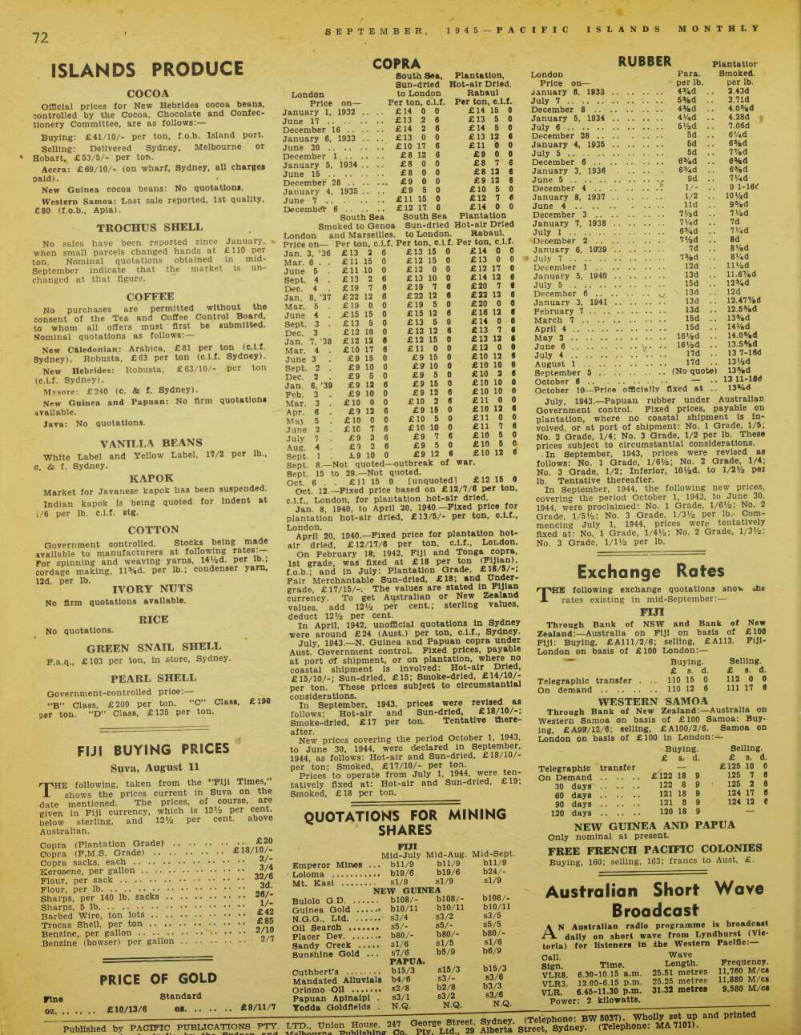
Cocoa
Official prices for New Hebrides cocoa beans, controlled by the Cocoa, Chocolate and Confec tionery Committee, are as follows: — Buying: £4l/10/- per ton, f.o.b. Island port.
Selling: Delivered Sydney, Melbourne or Hobart, £53/5/- per ton.
Accra: £69/10/- (on wharf, Sydney, all charges paid).
New Guinea cocoa beans: No quotations.
Western Samoa: Last sale reported, Ist quality, CBO (f.0.b., Apia).
Trochus Shell
No sales have been reported since January, when small parcels changed hands at £llO per ton. Nominal quotations obtained in mid- September indicate that the market is un changed at that figure.
Coffee
No purchases are permitted without the consent of the Tea and Coffee Control Board, to whom all offers must first be submitted.
Nominal quotations as follows: — New Caledonian: Arabica, £Bl per ton (c.l.f.
Sydney). Robusta, £63 per ton (c.l.f. Sydney).
New Hebrides: Robusta, £63/10/- per ton (c.i.f. Sydney).
Mysore: £240 (C. & f. Sydney).
New Guinea and Papuan: No firm quotations available.
Java: No quotations.
Vanilla Beans
White Label and Yellow Label, 17/2 per lb., c. & f. Sydney.
Kapok
Market for Javanese kapok has been suspended.
Indian kapok is being quoted for Indent at 1/6 per lb. c.l.f. stg.
Cotton
Government controlled. Stocks being made available to manufacturers at following rates:— For spinning and weaving yarns, 14%d. per lb., cordage making, ll 3 Ad. per lb.; condenser yam, I2d. per lb.
Ivory Nuts
No firm quotations available.
Rice
No quotations. green snail shell F.a.q., £lO3 per ton, in store, Sydney.
Pearl Shell
Government-controlled prioe:— “B” Class, £2OO per ton. ”C” Class, £l9O per ton. ”D” Class, £135 per ton.
Fiji Buying Prices
Suva, August 11
THE following, taken from the “‘Fiji Times,” shows the prices current in Suva on the date mentioned. The prices, of course, are given in Fiji currency, which is 12 Vz per cent, below sterling, and 12 Vs per cent, above Australian.
Copra (Plantation Grade) Copra (F.M.S. Grade) £18/10/- Copra sacks, each Kerosene, per gallon J Flour, per sack Flour, per lb Sharps, per 140 lb. sacks 26/- Sharps, 5 lb Barbed Wire, ton lots ™ Trocas Shell, per ton Benzine, per gallon Benzine (bowser) per gallon
Price Of Gold
Sept. 15 to 29.—Not quoted.
Oct. 6 . . £ll 15 0 [unquoted! £l2 15 0 Oct. 12. —Fixed price based on £l2/7/6 per ton, c 1 f London, for plantation hot-air dried. jan. 8, 1940, to April 20. 1940 —Fixed price for plantation hot-air dried, £l3/5/- per ton, c.1.f., London, . . .
April 20, 1940.—Fixed price for plantation hot air dried, £ 12/17/6 per ton, c.1.f., London.
On February 18, 1942, Fiji and Tonga copra, Ist grade, was fixed at £lB per ton f.0.b.; and in July: Plantation Grade, £lB/5/-, Fair Merchantable Sun-dried, £18; and Under grade, £l7/15/-. The values are stated in Fijian currency. To get Australian or New Zealand values, add 12 Vz per cent.; sterling values, deduct 12% per cent.
In April, 1942, unofficial quotations in Sydney were around £24 (Aust.) per ton, c.1.f., Sydney.
July, 1943. —N. Guinea and Papuan copra under Aust. Government control. Fixed prices, payable at port of shipment, or on plantation, where no coastal shipment is involved: Hot-air Dried, £l5/10/-; Sun-dried, £l5; Smoke-dried, £l4/10/per ton. These prices subject to circumstantial considerations.
In September, 1943. prices were revised as follows: Hot-air and Sun-dried, £lB/10/-, Smoke-dried, £l7 per ton. Tentative there- New prices covering the period October 1, 1943, to June 30, 1944, were declared in September, 1944, as follows: Hot-air and Sun-dried, £lB/10/per ton; Smoked, £l7/10/- per ton.
Prices to operate from July 1, 1944, were ten tatively fixed at: Hot-air and Sun-dried, £l9, Smoked, £lB per ton.
y lne Standard oz £10/13/6 oa £9/11/7
Copra
South Sea, Plantation, Sun-dried Hot-air Dried.
London to London Rabaul Price on— Per ton, c.l.f.
Per ton, c.l.f.
January 1, 1932 £14 0 0 £14 15 0 June 17 . £13 2 6 £13 5 0 December 16 .. £14 2 6 £14 5 0 January 6, 1933 £13 0 0 £13 12 6 June 30 . £10 17 6 £11 0 0 December 1 . . £8 12 6 £9 0 0 January 5 1934 £8 0 0 £8 7 6 June 15 . £8 0 0 £8 12 6 December 28 . . £9 0 0 £9 12 6 January 4 1935 £9 5 0 £10 5 0 June 7 . £11 15 0 £12 7 6 December 6 . . £12 17 6 £14 0 0 South Sea South Sea Plantation Smoked to Genoa Sun-dried Hot-air Dried London and Marseilles, to London.
Rabaul.
Price on— Per ton, c.l.f. Per ton, c.l.f. Per ton, c.l.f.
Jan. 3. ’36 £13 2 6 £13 15 0 £14 0 0 Mar. 6 . . £11 15 0 £12 IS 0 £13 0 0 June 5 £11 10 0 £12 0 0 £12 17 0 Sept. 4 . £13 2 6 £13 10 0 £14 12 6 Dec. 4 £19 7 6 £19 7 6 £20 7 6 Jan. 8. ’37 £22 12 6 £22 12 6 £22 12 6 Mar. 5 £19 0 0 £19 5 0 £20 0 0 June 4 £15 15 0 £15 12 6 £16 12 6 Sept. 3 . £13 5 0 £13 5 0 £14 0 e Dec. 3 £12 10 0 £12 12 6 £13 7 s Jan. 7. '38 £12 12 6 £12 IS 0 £13 12 * Mar. 4 £10 17 6 £11 0 0 £12 0 0 June 3 £9 15 0 £9 15 0 £10 12 6 Sept. 2 . £9 10 0 £9 10 0 £10 10 0 Dec. 2 £9 5 0 £9 5 0 £10 2 6 Jan. 6, ’39 £9 12 6 £9 15 0 £10 10 0 Feb. 3 . £9 10 0 £9 12 6 £10 10 0 Mar. 3 . £10 0 0 £10 2 6 £11 0 0 Apr. 6 £9 12 6 £9 15 0 £10 12 6 Maj 5 . £10 0 0 £10 5 0 £11 0 0 June 2 . £10 7 6 £10 10 0 £11 7 6 July 7 . £9 2 6 £9 7 6 £10 5 0 Aug. 4 £9 2 6 £9 5 0 £10 5 0 Sept. 1 £9 10 0 £9 12 6 £10 12 6 Sept. 8.— Not quoted—outbreak of war.
Quotations For Mining
Shares
July, 1943.—Papuan rubber under Australian Government control. Fixed prices, payable on plantation, where no coastal shipment is in volved, or at port of shipment: No. 1 Grade, 1/5; No. 2 Grade, 1/4; No. 3 Grade, 1/2 per lb. These prices subject to circumstantial considerations.
In September, 1943, prices were revised as follows: No. 1 Grade, 1/6%; No. 2 Grade, 1/4; No. 3 Grade, 1/2; Inferior, 10 %d. to 1/2% per lb. Tentative thereafter.
In September, 1944, the following new prices, covering the period October 1, 1943, to June 30, 1944 were proclaimed: No. 1 Grade, I/6V2', No. 2 Grade, 1/5%: No. 3 Grade, 1/3% per lb. Com mencing July 1, 1944, prices were tentatively fixed at: No. 1 Grade, 1/4%; No. 2 Grade, 1/3%: No. 3 Grade, 1/1% per lb.
Fiji
Mid-July Mid-Aug.
Mid-Sept.
Emperor Mines . .. bll/9 bll/9 bll/9 Loloma bl9/6 b24/- Mt. Kasl sl/9 sl/9 sl/9
New Guinea
Bulolo G.D .. bl08/bl08/bl08/- Guinea Gold ,.. blO/11 blO/11 blO/11 N.G.G., Ltd s3/2 s3/5 Oil Search s5/s5/5 Placer Dev b80/b80/- Sandy Creek ... .. sl/6 sl/5 sl/6 Sunshine Gold . .. s7/6 b5/9 b6/9
Papua.
Cuthbert’s .. bl5/3 S15/3 bl5/3 Mandated Alluvials b4/6 s3/s3/0 Orlomo Oil .. s2/8 b2/8 b3/3 Papuan Apinalpl s3/l s3/2 s3/6 Yodda Goldfields N.Q.
N.Q.
N.Q.
London
Rubber
Para.
Plantation Smoked.
Price on— per lb. per lb.
January 6. 1933 . 2.43d July 7 3.71d December 8 .. .. 4.0 s /«d January 5. 1934 . 4Vid 4.28d July 6 5Vad 7.06d December 28 .. . 5d .. 6V 4 d January 4, 1935 . 5d 6%d July 5 .. . .. . 5d .. 7 7 /ad December 6 . . .. 6 3 / 4 d 6Hd January 3, 1936 6 3 / 4 d .. 6%d June 5 7V 4 d December 4 .. .. 9 1-16(T January 8, 1937 . 1/2 .. lOVad June 4 lid 9%d December 3 .. .. 7Vid 7 l /ad January 7, 1938 .
VAd 7d July 1 6 3 / 4 d 7V 4 d December 2 .. . 7Vad 8d January 6, . 7d 8Ved July 7 7%d 8»/ 4 d December 1 .. . 12d . . UVad January 5. 1940 . 13d .. 11.6 7 /sd July 5 15d .. 12 3 / 4 d December 6 .. .. .. .. « 13d .. 12d January 3, 1941 . 13d .. 12.47 7 / B (J February 7 .. .. 13d . . 12.5 5 /ad March 7 15d .. 13 5 /ed April 4 15d .. 14Vsd May 2 16Vid . . 14.0%d June 6 16‘/ a d .. 13.5%d July 4 17d .. 13 7-16<J August 1 17d .. 13Vid September 5 .. . (No quote) 13%d October 8 .. .. 13 11-180 October 10—Price officially fixed at . . 13%d
Exchange Rates
THE following exchange quotations snow the rates existing in mid-September:—
Fiji
Through Bank of NSW and Bank of New Zealand:—Australia on Fiji on basis of £lOO Fiji: Buying, £Alll/2/6; selling, £AII3. Flji- London on basis of £lOO London: —
New Guinea And Papua
Only nominal at present.
Free French Pacific Colonies
Buying, 160; selling, 163; francs to Aust, £.
• Buying.
Selling. £ s. d. £ s. d.
Telegraphic transfer . .. 110 15 0 112 0 0 On demand 110 12 6 111 17 8
Western
Samoa
Through Bank of New Zealand: —Australia on Western Samoa on basis of £100 Samoa; Buying, £ A99/12/6; selling, £ A100/2/6.
Samoa on London on basis of £ 100 in London: Buying.
Selling. £ s. d. £ s. d.
Telegraphic transfer — £125 10 0 On Demand £ 122 18 9 125 7 6 30 days 122 8 9 125 2 6 60 days 121 18 9 124 17 6 90 days 121 8 9 124 12 e 120 days 120 18 9 —
Australian Short Wave
Broadcast
AN Australian radio programme is broadcast daily on short wave from Lyndhurst (Vic toria) for listeners in the Western Pacific:
Call.
Sign.
Vlr8.
Time.
Wave Length.
Frequency. 6.30-10.15 a.m. 25.51 metres 11,760 M/ca
Vlr3.
12.09-6.15 p.m. 25.25 metres 11,880 M/cs
Vlr.
6.45-11.30 p.m. 31.32 metres 9.580 M/c* Power: 2 kilowatts.
Advertisements & other items, p. 74 (1 item)
72
SEPTEMBER, 1945 PACIFIC ISLANDS MONTHLY
Published by PACIFIC PUBUOATIONS _m LT£ unlbn e^2*' L gPS Alberta st^?s|taW® W (Telepho^ o Mal'ioU .
Native Troops
Mutiny
NG Troubles Due to Inexperience of Officers
rEßE has been very serious unrest in the ranks of the New Guinea native infantry battalions; and, in the opinion of some of the “old hands” who are acquainted with the circumstances, the troubles can be traced back directly to one thing—lack of control, due to the inexperience of the white officers of the battalions.
There are now five battalions of New Guinea native infantry. The idea, which took shape during the past two years, Is an excellent one. The penetration of various parts of New Guinea by isolated forces of Japanese, who were settling down in many places among the natives, called for a peculiar type of jungle war fare; and the training and use of the native infantry battalions for this pur pose proved quite successful.
When the plan was put into execution, however, old residents of New Guinea strongly urged that the officers in com mand of these units should be men ex perienced in NG life. It was pointed out that the second-in-command of every battalion as well as the second-in command of every company should be a man with pre-war knowledge of New Guinea conditions. The man who even tually was put in charge of the five bat talions, with the rank of Brigadier, while he has many excellent qualifications, actually was temperamentally handi capped. He had been well known in New Guinea in a minor job—and, in the opinion of the native infantrymen still belonged to that minor joh.
The Army officers blame “irresponsible whites” for the trouble.
In actual fighting, and under close dis cipline, the Ney/ Guinea native battalions acquitted themselves well. But when they were not out chasing the Japanese in the remoter districts, and were not under strong discipline by men who understood them, they definitely ran amok.
There were incidents in which the New Guinea native soldiers gave great offence to the native people by stealing their women and shooting their pigs. One or two very unfortunate situations developed.
There were two outright mutinies by the men of these battalions. One of them was at Nadzab, in the Markham Valley and one at Jacquinot Bay, west of Rabaul.
At Jacquinot Bay the position was very ugly. The whole battalion (800 men) was on the rampage, and the officers seemed unable to control the men. Presently along came a well-known old hand of New Guinea —Mr. C. D. Bates, a former DO —and he took in the situation very quickly. He said to the officers, “Please go away and leave me to handle this.”
With the assistance of one or two other men who understand natives he assembled the whole insurgent battalion and talked to them very forcibly and frankly for a quarter on an hour, in Pidgin. At the end of that time the men obeyed his instructions, quietly piled their arms, as he told them to do. and as quietly dispersed. They had been talked to by someone who understood them, and whom they respected, and they were satisfied that their grievances would be nronerly attended to and they gave no further trouble.
In recent times, a gentleman well known in New Guinea before the war, Mr. J. C. Mullaly, who has a wide ex perience and knowledge and understand ing of natives, has been called in by the authorities to assist them in dealing with
a difficult situation; and, as a result, the outlook has improved.
It probably will be some time before the disbandment of these five native bat talions (4,000 men in all) will be under taken, because the surrender, assembling guarding and ultimate shipment of the 140,000 Japanese in New Guinea will throw upon this type of soldiery a great deal of work; but, in a few months’ time as the Japanese are shipped away, some demobilisation may take place.
Old residents of the Territory express the liveliest concern as to the effect that the appearance of these demobilised infantrymen will have on the native people, once they are returned to civilian life. They fear, among other things, that the safety of European women for a con siderable time will be in danger.
Native Labour Grievances
Canberra, Sept. 1.
SERIOUS unrest amongst New Guinea natives is alleged in a Departmental Committee report received by the Federal Government. The report claims that some natives of the New Guinea Regiment, and some native labourers working for the Army in New Guinea, have complained of grievances.
Some of the native labourers are claiming £3 a month wages, and others are seeking compensation and pensions for death or injuries suffered during the war.
The natives are resentful because they cannot understand why the Government holds them under labour conscription, and why proposals to increase the basic wage rate from ss. to 15s. a month did not become operative immediately.
Local concessions have already been made to overcome difficulties arising from “incidents,” and more trouble is expected unless further measures are taken imme diately.
Labourers are dissatisfied because troops can buy certain commodities from amenity centres more cheaply than the natives can buy them at trade stores.
Recommendations for increased pay rates for certain native troops and work men have been made by a Departmental Committee.
Other reports indicate that planters returning to the Territory will now be instructed to pay native employees the 15/- minimum wage provided for in the Papua-New Guinea Provisional Adminis tration Act.
Editorial Comment
ALL this unrest among the natives has been expected by the more experi enced members of ANGAU. But everything in the Territories, for a long time, has been under flat-footed military discipline; and the officials have not dared to make representations to their complacent superiors, or to report to Aus tralia on conditions which are steadily deteriorating.
The Australian Army, and units formed under Army authority, conscripted thou sands of Papuan and New Guinea natives for labour, wherever required. They have been forcibly removed from their villages under conditions which would never have been tolerated by the pre-war civil Gov ernments of Papua and New Guinea.
There are many thousands of natives now under the control of ANGAU, and it is among them that we find so much evidence of bad morale, which is steadily growing worse.
The immediate return of civil Govern ment is the only remedy. Sympathetic treatment by experienced officials of civil administration, instead of the harsh dis cipline of the ANGAU set-up—the un intended effect of leaving drastic mili tary powers in the hands of men who know little and care less about Terri
tonal conditions—would eventually bring the natives back to a better condition of mind.
We can thank Mr. Ward for the pre sent ugly situation. Any normal Minis ter for Territories would have restored civil Government, civil residents and pri vate enterprise to the Territories as quickly as possible after the Japs had been driven out, and would have left re construction and rehabilitation in the hands of experienced people.
But Mr. Ward could not miss this opportunity of introducing, over the heads of helpless and inarticulate people, his ambitious plans for hamstringing private enterprise and establishing a socialistic State; and so the militaristic set-up remained while he muddled around with his “Provisional Govern ment.”
The unhappy Territories are going to suffer a great deal more before we see the end of Mr. Ward, and the restora tion of normal conditions.
British Countries in the South Pacific
South Pacific
ONE of the most useful books on the South Pacific was published recently by Longmans Green & Co., London.
It is “Britain and the South Seas,” by Sir Harry Luke, formerly Governor of Fiji, and now head of the British Coun cil in the West Indies.
Sir Harry has a polished and graceful literary style; he always was intensely interested in the background and present condition of the British South Pacific Islands; he naturally is a man who is careful of his facts —so his little book is not only a pleasure to read, but is a valuable addition to any reference library.
This recital of the chapter heads will give some idea of its character and scope: The Natives of the South Seas and Their Islands.
The Discovery of the Pacific.
The First British Settlement; Pitcairn.
Hawaii and Tahiti.
The Growth of British Imperial Respon sibilities.
The New Hebrides; An Experiment in International Collaboration.
The Part of the Dominions: Australian and New Zealand Dependencies.
The Part of the Dominions: The Mandates.
British Achievement in the South Seas.
The front end-paper shows “Racial Dis tribution in the South Seas”; and the back end-paper “Political Divisions in the South Seas”—two charts which are of great use to anyone who wants to speak or write authoritatively about the dozen or more administrations of the South Pacific.
First civilian passenger on the new plane service between Rarotonga and Auckland, via Apia, Nukualofa and Suva, Mr. W. H. Watson, well-known trader, of Rarotonga, passed through Fiji in July.
He carried with him some excellent samples of shoes made in Rarotonga, a new industry started there by Mr. Wat son and his associate, Mr. W. Bond. Mr.
Bond never has been inside a shoe fac tory. but he operates a couple of machines, and the Polynesians buy his shoes eagerly. Shoes made on European lasts are too narrow for Cook Islands feet. The locally-made shoes are made on a wider last, and do not cause the native peonies any discomfort. The enter prising promoters are seeking a market outside of the Cook Islands.
Advertisements & other items, p. 76 (1 item)
W. R. Carpenter & Co. Ltd.
— Established 1914 —
THIRTY YEARS OF PACIFIC ISLANDS
DEVELOPMENT AND SERVICE.
W. R. CARPENTER & CO. LTD.
Capital £1,000.000.
GENERAL MERCHANTS AND SHIPOWNERS
Buyers and Exporters of AM Kinds of Islands Produce Copra Merchants and Millers Agents for Australian, European and American Manufacturers Distributors of Every Description of Merchandise
AGENTS FOR:
FORD MOTOR COMPANY OF CANADA DODGE BROTHERS INC.
ELECTROLUX REFRIGERATORS WESTINGHOUSE ELECTRICAL CO.
T. G. & C. BOLINDERS (ENGINES) CATERPILLAR TRACTORS Etc., Etc.
BRANCHES THROUGHOUT THE PACIFIC ISLANDS
Head Office : 16 O' CO NN ELL STREET, SYDNEY In London: W. R, Carpenter & Co. (London) Ltd., Coronation House, 4 Lloyd's Avenue, London, EC.
The W.R.C. Line
The first Direct and Regular Cargo and Passenger Service between Europe and Pacific Islands’ ports was established by W. R. Carpenter & Co. Ltd.