Pacific
Islands
Monthly
August 17, 1945
Vol. Xvl No. 1
Dlished 1930
[Registered at the G.P.0., Sydney, for transmission by post as a newspaper ]
1/-
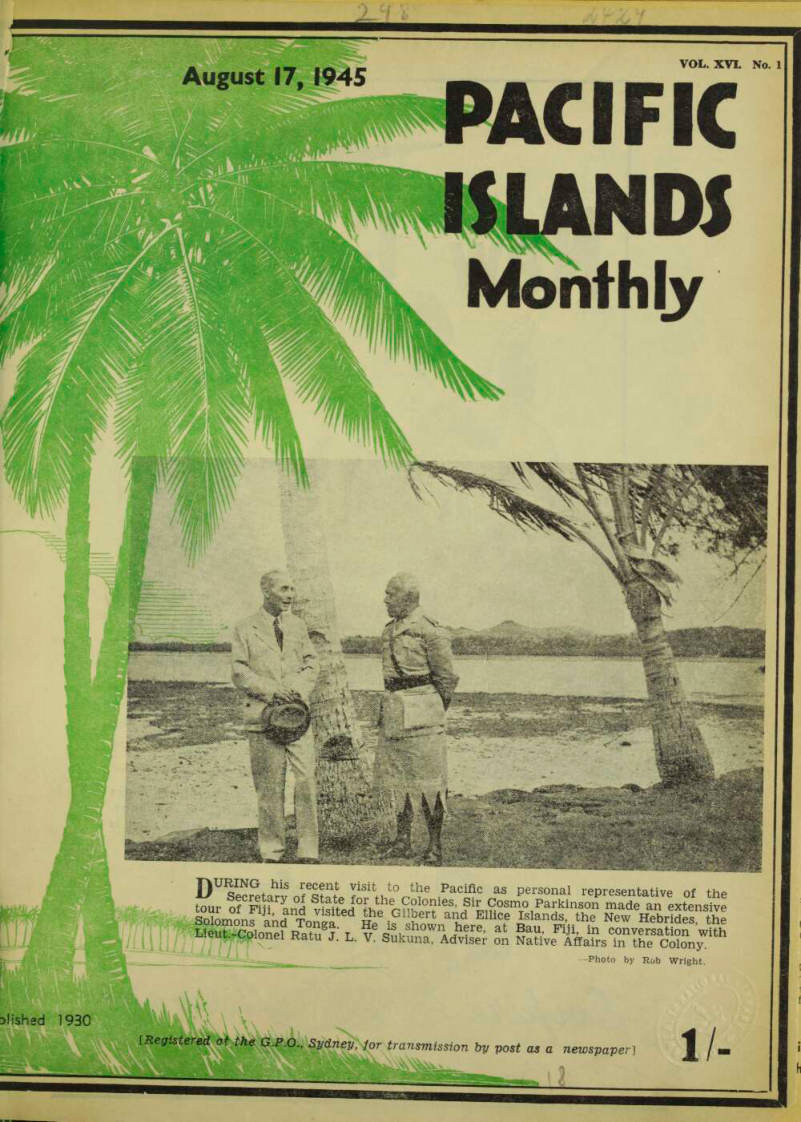
DURING his recent visit to the Pacific as personal representative of the Secretary of State for the Colonies, Sir Cosmo Parkinson made an extensive tour of Fiji, and visited the Gilbert and Ellice Islands, the New Hebrides, the Solomons and Tonga. He is shown here, at Bau, Fiji, in conversation with Lieut.-Colonel Ratu J.L.V. Sukuna, Adviser on Native Affairs in the Colony.
Photo by Rob Wright.
Advertisements & other items, p. 2 (1 item)
By A R
r.
nea
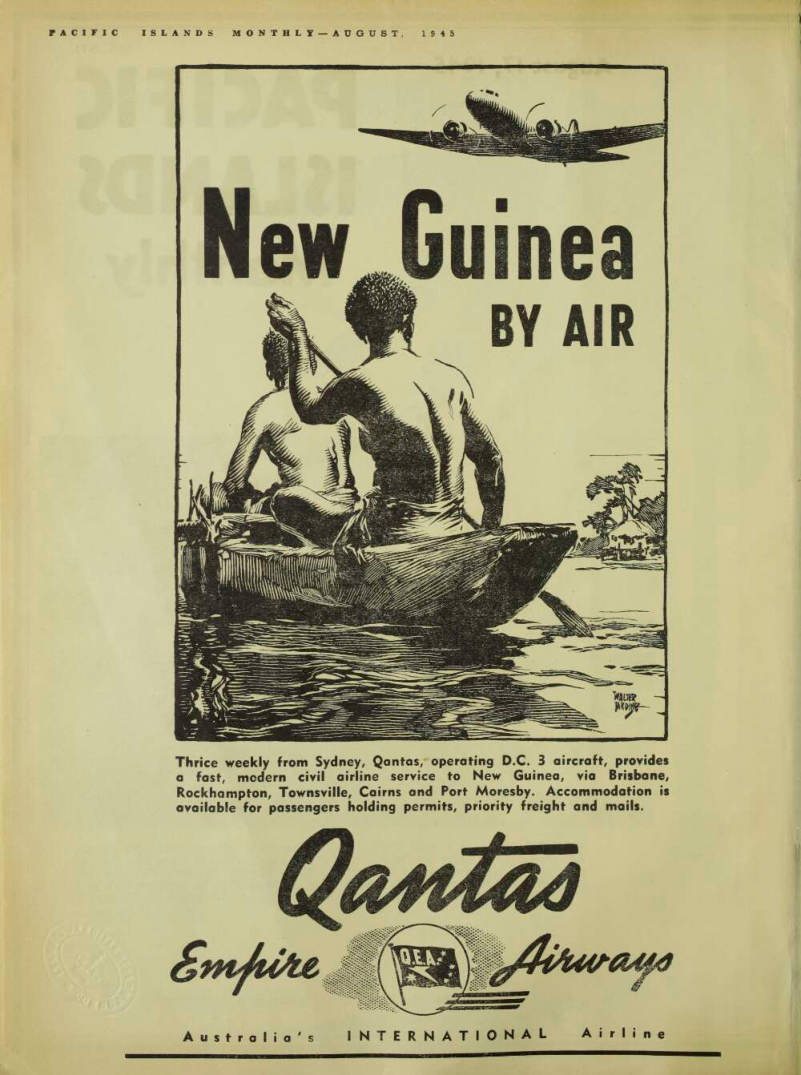
pm- Thrice weekly from Sydney, Qantas, operating D.C. 3 aircraft, provides a fast, modern civil airline service to New Guinea, via Brisbane, Rockhampton, Townsville, Cairns and Port Moresby. Accommodation is available for passengers holding permits, priority freight and mails.
Australia M
INTERNATIONAL Airline
Pacific News-Review
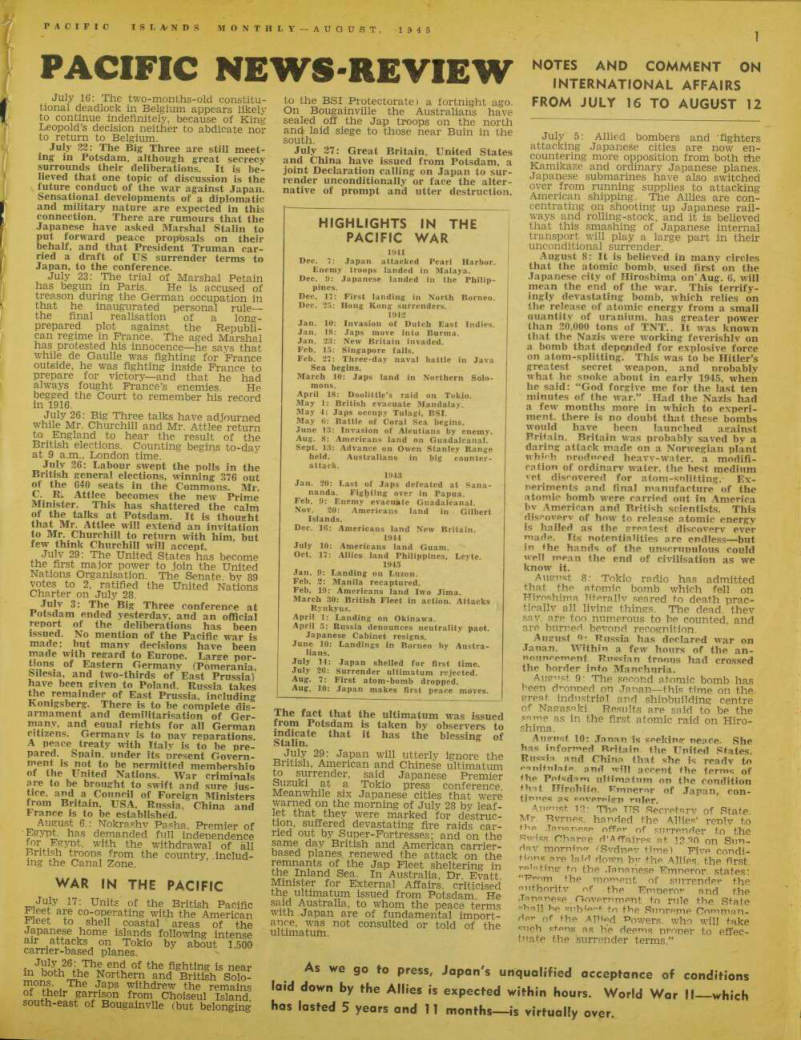
Notes And Comment On
International Affairs
From July 16 To August 12
July 16: The two-months-old constitu tional deadlock in Belgium appears likely to continue indefinitely, because of King Leopold’s decision neither to abdicate nor to return to Belgium.
July 22: The Big Three are still meet ing in Potsdam, although great secrecy surrounds their deliberations. It is be lieved that one topic of discussion is the future conduct of the war against Japan.
Sensational developments of a diplomatic and military nature are expected in this connection. There are rumours that the Japanese have asked Marshal Stalin to put forward peace proposals on their behalf, and that President Truman car ried a draft of US surrender terms to Japan, to the conference, July 23: The trial of Marshal Petain has begun in Paris. He is accused of treason during the German occupation in that he inaugurated personal rule— the final realisation of a long prepared plot against the Republi can regime in France. The aged Marshal has protested his innocence—he says that while de Gaulle was fighting for France outside, he was fighting inside France to prepare for victory—and that he had always fought France’s enemies. He begged the Court to remember his record in 1916.
July 26: Big Three talks have adjourned while Mr. Churchill and Mr. Attlee return to England to hear the result of the British elections. Counting begins to-day at 9 a.m., London time.
July 26: Labour swept the polls in the British general elections, winning 376 out of the 640 seats in the Commons. Mr.
C. Hi. Attlee becomes the new Prime Minister. This has shattered the calm of the talks at Potsdam. It is thought that Mr, Attlee will extend an invitation to Mr. Churchill to return with him, but few think Churchill will accept. 29: The United States has become the first major power to join the United Nations Organisation. The Senate, by 89 votes to 2, ratified the United Nations Charter on July 28.
July 3: The Big Three conference at Potsdam ended yesterday, and an official report of the deliberations has been issued. No mention of the Pacific war is made; but many decisions have been made with regard to Europe. Large por tions of Eastern Germany (Pomerania.
Silesia, and two-thirds of East Prussia) have been given to Poland. Russia takes the remainder of East Prussia, including Komgsberg. There is to be complete dis armament and demilitarisation of Ger many, and eaual rights for all German citizens. Germany is to pay reparations.
A peace treaty with Italy is to be pre pared. Spain, under its present Govern ment is not to be permitted membership of the United Nations. War criminals are to be brought to swift and sure ius tice, and a Council 0 f Foreign Ministers from Britain. USA. Russia, China and France is to be established.
August 6.: Nokrashv Pasha. Premier of Egypt, has demanded full independence for Egypt, with the withdrawal of all British troons from the country, includ ing the Canal Zone.
War In The Pacific
July 17: Units of the British Pacific Fleet are co-operating with the American Fleet to shell coastal areas of the Japanese home islands following intense air attacks on Tokio by about 1,500 earner-based planes. of the fl Shtlng is near in both the Northern and British Solo mons. The Japs withdrew the remains of their garrison from Choiseul Island south-east of Bougainvlle (but belonging
to the BSI Protectorate) a fortnight ago.
On Bougainville the Australians have sealed off the Jap troops on the north and laid siege to those near Buin in the south.
July 27: Great Britain, United States and China have issued from Potsdam, a joint Declaration calling on Japan to sur render unconditionally or face the alter native of prompt and utter destruction.
The fact that the ultimatum was issued from Potsdam is taken by observers to indicate that it has the blessing of Stalin.
July 29; Japan will utterly ignore the British, American and Chinese ultimatum to surrender, said Japanese Premier Suzuki at a Tokio press conference Meanwhile six Japanese cities that were warned on the morning of July 28 by leaf let that they were marked for destruc tion, suffered devastating fire raids car ried out by Super-Fortresses; and on the same day British and American carrier based planes, renewed the attack on the remnants of the Jap Fleet sheltering in the Inland Sea. In Australia, Dr Evatt Minister for External Affairs, criticised the ultimatum issued from Potsdam. He said Australia, to whom the peace terms with Japan are of fundamental import ance. was not consulted or told of the ultimatum.
July 5: Allied bombers and fighters attacking Japanese cities are now en countering more opposition from both the Kamikaze and ordinary Japanese planes.
Japanese submarines have also switched over from running supplies to attacking American shipping. The Allies are con centrating on shooting up Japanese rail ways and rolling-stock, and it is believed that this smashing of Japanese internal transport will play a large part in their unconditional surrender.
August 8: It is believed in many circles that the atomic bomb, used first on the Japanese city of Hiroshima on* Aug. 6, will mean the end of the war. This terrify ingly devastating bomb, which relies on the release of atomic energy from a small quantity of uranium, has greater power than 20,000 tons of TNT.. It was known that the Nazis were working feverishly on a bomb that for explosive force on atom-splitting. This was to be Hitler’s greatest secret weapon, and nrobably what he snoke about in early 1945, when he said: “God forgive me for the last ten minutes of the war.” Had the Nazis had a few months more in which to experi ment. there is no doubt that these bombs would have been launched asrainst Britain. Britain was probably saved by a daring attack made on a Norwegian plant which nrodnced heavy-water, a modifi cation of ordinary water, the best medium vet discovered for atom-snlitting. Ex periments and final manufacture of the atomic bomb were carried out in America by American and British scientists. This discoyerv of how to release atomic energy is hailed as the sreatest discovery ever made. Its potentialities are endless—but in the hands of the unscrupulous could well mean the end of civilisation as we know it.
August 8: Tokio radio has admitted that the atomic bomb which fell on Hiroshima literally seared to death prac tically all living things. The dead, thev sav. are too numerous to be counted, and are burned bevond recognition.
August ft: Russia has declared war on Janan. Within a few hours of the an nouncement Russian troops had crossed the border into Manchuria.
August 9: The second atomic bomb has been dronned on Janan—this time on the great industrial and shipbuilding centre of Nagasaki. Results are said to be the seme as in the first atomic raid on Hiro shima.
August 10: Janan is seeking peace. She has informed Britain the United States, Russia and China that she is ready to r*nitiilat<v and will accent the term* of the Pot«dem ultimatum on the condition that Hirohito. Fmneror of Japan, con tinues as sovereign ruler.
August, 12: The ITS Secretary of State Mr. Byrnes, handed the Allies’ renly to tv>p jnr>oripße offer of surrender to the Swiss Charge d’Affaires at 12 90 on Sun day morning fSvdnev time') Five condi tions are lair? down by the Allies, the first, vein ting to the Jananese Fmneror. states: “•Prom the moment of surrender the authority of the Fmneror and the Japanese Government to rule the State chall he to the Supreme Comman der 0 f the Allied Bowers, who will take s!7eh stops as he deems nroner to effec tuate the surrender terms.”
As we go to press, Japan's unqualified acceptance of conditions laid down by the Allies is expected within hours. World War II which has lasted 5 years and 11 months—is virtually over.
Pacific War
Highlights In The
1941 Dec. 7: Japan attacked Pearl Harbor, Enemy troops landed in Malaya.
Dec. 9: Japanese landed in the Philip pines.
Dec. 17: First landing in North Borneo.
Dec. 25: Hong Kong surrenders. 1942 Jan, 10: Invasion of Dutch East Indies.
Jan. 18: Japs move into Burma.
Jan. 23: New Britain invaded.
Feb. 15: Singapore falls.
Feb, 27: Three-day naval battle in Java Sea begins.
March 10: Japs land in Northern Solo mons.
April 18: Doolittle’s raid on Tokio.
May 1: British evacuate Mandalay.
May 4: Japs occupy Tulagi, BSI.
May 6: Battle of Coral Sea begins.
June 13: Invasion of Aleutians by enemy.
Aug. 8: Americans land on Guadalcanal.
Sept. 13: Advance on Owen Stanley Range held. Australians in big counter attack. 1943 Jan. 20: Last of Japs defeated at Sana nanda. Fighting over in Papua.
Feb. 9: Enemy evacuate Guadalcanal.
Nov. 20: Americans land in Gilbert Islands.
Dec. 16: Americans land New Britain. 1944 July 10: Americans land Guam.
Oct, 17: Allies land Philippines, Leyte. 1945 Jan. 9: Landing on Luzon.
Feb. 2: Manila recaptured.
Feb. 19: Americans land Iwo Jima.
March 30: British Fleet in action. Attacks Ryukyus.
April 1; Landing on Okinawa.
April 5: Russia denounces neutrality pact.
Japanese Cabinet resigns.
June 10: Landings in Borneo by Austra lians.
July 14: Japan shelled for first time.
July 26: Surrender ultimatum rejected.
Aug. 7: First atom-bomb dropped.
Aug. 10: Japan makes first peace moves.
Advertisers
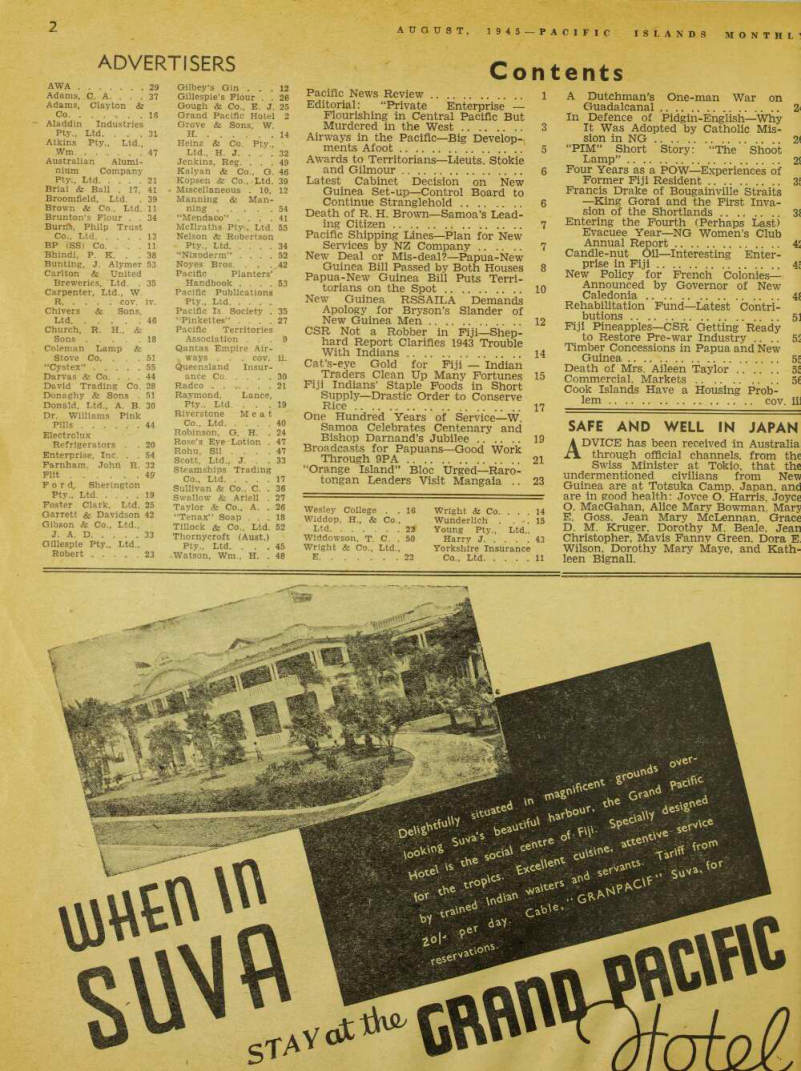
Awa 29
Adams, C. A. ... 37 Adams, Clayton & Co 16 Aladdin Industries Pty., Ltd, ... 31 Atkins Pty., Ltd., Wm 47 Australian Alumi nium Company Pty., Ltd 21 Brial & Ball . 17, 41 Broomfield, Ltd. . 39 Brown & Co., Ltd. 11 Brunton’s Flour . . 34 Burrft, Philp Trust Co., Ltd 13 BP (SS) Co. . . . 11 Bhindl, P. K. . . 38 Bunting, J. Alymer 53 Carlton & United Breweries, Ltd. . 35 Carpenter, Ltd., W.
R cov. iv.
Chivers & Sons, Ltd 46 Church, R. H., & Sons 18 Coleman Lamp & Stove Co. ... 51 “Cystex” 55 Darvas & Co. ... 44 David Trading Co. 28 Donaghy & Sons . 51 Donald, Ltd., A. B. 30 Dr. Williams Pink Pills 44 Electrolux Refrigerators . . 20 Enterprise, Inc. . . 54 Farnham, John R. 32 Flit 49 Ford Sherington Pty., Ltd 19 Foster Clark, Ltd. 25 Garrett & Davidson 42 Gibson & Co., Ltd.,
J. A. D 33
Gillespie Pty., Ltd., Robert 23
Gilbey’s Gin ... 12 Gillespie’s Flour . . 26 Gough & Co., E. J. 25 Grand Pacific Hotel 2 Grove & Sons, W.
H. 14 Heinz & Co. Pty., Ltd., H. J. . . . 32 Jenkins, Reg. ... 49 Kalyan & Co., G. 46 Kopsen & Co., Ltd. 39 Miscellaneous . 10, 12 Manning & Man ning 54 “Mendaco” ... 41 Mcllraths Ltd. 55 Nelson & Robertson Pty., Ltd 34 “Nixoderm” ... 52 Noyes Bros. ... 42 Pacific Planters’
Handbook ... 53 Pacific Publications Pty., Ltd Pacific Is. Society . 35 ‘•Pinkettes” ... 27 Pacific Territories Association ... 9 Qantas Empire Air ways . . . cov. ii.
Queensland Insur ance Co 30 Radco 21 Raymond, Lance, Pty., Ltd. ... 19 Riverstone Meat Co., Ltd 40 Robinson, G. H. . 24 Rose’s Eye Lotion . 47 Rohu, Sil . . . . 47 Scott, Ltd., J. . .33 Steamships Trading Co., Ltd 17 Sullivan & Co., C. . 36 Swallow & Ariell . 27 Taylor & Co., A. . 26 “Tenax” Soap ... 18 Tlllock & Co., Ltd. 52
Thornycroft (Aust.)
Pty., Ltd. ... 45 Watson, Wm., H. , 48
Wesley College . . 16 Wright & Co. ... 14 Widdop, H., & Co., Wunderlich . ... 15 Ltd 22 Young Pty., Ltd., Widdowson, T. C. . 50 Harry J 43 Wright & Co., Ltd., Yorkshire Insurance E 22 Co., Ltd 11
Contents
Pacific News Review i Editorial: “Private Enterprise Flourishing in Central Pacific But Murdered in the West 3 Airways in the Pacific—Big Develop ments Afoot 5 Awards to Territorians —Lieuts. Stokie and Gilmour 6 Latest Cabinet Decision on New Guinea Set-up—Control Board to Continue Stranglehold 6 Death of R. H. Brown—Samoa’s Lead ing Citizen 7 Pacific Shipping Lines—Plan for New Services by NZ Company 7 New Deal or Mis-deal?—Papua-New Guinea Bill Passed by Both Houses 8 Papua-New Guinea Bill Puts Terri torians on the Spot 10 New Guinea RSSAILA Demands Apology for Bryson’s Slander of New Guinea Men 12 CSR Not a Robber in Fiji—Shep hard Report Clarifies 1943 Trouble With Indians 14 Cat’s-eye Gold for Fiji Indian Traders Clean Up Many Fortunes 15 Fiji Indians’ Staple Foods in Short Supply—Drastic Order to Conserve Rice 17 One Hundred Years of Service—W.
Samoa Celebrates Centenary and Bishop Darnand’s Jubilee 19 Broadcasts for Papuans—Good Work Through 9PA 21 “Orange Island" Bloc Urged—Raro tongan Leaders Visit Mangaia .. 23
A Dutchman's One-man War on Guadalcanal 2< In Defence of Pidgin-English—Why It Was Adopted by Catholic Mis sion in NG .. . 2( “PIM" Short Story: “The Shoot Lamp" 2J Four Years as a POW—Experiences of Former Fiji Resident 3J Francis Drake of Bougainville Straits —King Gorai and the First Inva sion of the Shortlands 3J Entering the Fourth (Perhaps Last) Evacuee Year —NG Women’s Club Annual Report 45 Candle-nut Oil—lnteresting Enter prise in Fiji 4j New Policy for French Colonies— Announced by Governor of New Caledonia 4f Rehabilitation Fund—Latest Contri butions 5] Fiji Pineapples—CSß Getting Ready to Restore Pre-war Industry ... 55 Timber Concessions in Papua and New Guinea 55 Death of Mrs. Aileen Taylor 5E Commercial. Markets 56 Cook Islands Have a Housing Prob lem cov. iii
Safe And Well In Japan
ADVICE has been received in Australia : through official channels, from the Swiss Minister at Tokio, that the undermentioned civilians from New Guinea are at Totsuka Camp, Japan, and are in good health: Jovce O. Harris, Joyce O. MacGahan, Alice Mary Bowman, Mary E. Goss. Jean Mary McLennan, Grace D. M. Kruger, Dorothy M. Beale, Jean Christopher, Mavis Fanny Green, Dora E.
Wilson, Dorothy Mary Maye, and Kath leen Bignall,
Advertisements & other items, p. 4 (2 items)
2
AUGUST, 1945 PACIFIC ISLANDS MONTHL
m
V..W- V- && >&■■ >'v- . 38 & •':> . ■v g S* -■■• >■': ' * :•••' oX^
Pacific Islands Monthly
The Newspaper-Magazine of the South Seas
[Registered at the G.P.0., Sydney, for transmission by post as a newspaper .l Published Once Each Month and Circulated in Australia and New Zealand and in the following Pacific Territories and Islands Groups:
Australian Territory of Papua.
Mandated Territory (Australia) of New Guinea.
Australian Territory of Norfolk Island.
New Zealand Territory of Cook Islands.
Mandated Territory (NZ) of Western Samoa.
British Colony of Fiji.
British Solomon Islands Protectorate.
British Protectorate of Tongan Islands.
British Crown Colony of Gilbert and Ellice Islands.
Mandated Territory of Nauru.
British and Free French Condominium of New Hebrides.
Free French Colony of New Caledonia.
Free French Colony of Oceania (Tahiti, etc.).
American Territory of Eastern Samoa.
American Territory of Hawaiian Islands.
Owned and Produced by Pacific Publications Pty. Ltd., Union House, 247 George Street, Sydney.
TELEPHONE i Managing Director .. BW 5037 I Business and Editorial MA 4369
P.O. Box 3408 R
Registered Address of Telegrams, Radiograms, and Cables: “Pacpub”, Sydney.
Contributions.
Articles, Stories, and Photographs dealing with Pacific Islands subjects are invited and will be paid for on publication.
Subscription Rates.
Per Annum, within British Empire, Prepaid, Post Free 10/- Per Annum, elsewhere, Prepaid, Post Free 12/6 Single Copies 1/-
Editor and Publisher:
R. W Robson, P.R.G.S.
Advertising Manager: W. E. Rogers. Tel. B 7815.
Advertising Office and Printing-House: 29 Alberta Street, Sydney.
Advertising rates furnished on application.
Representative In Fiji.
Pacific Publications (Fiji), Ltd., Bank of NSW Building, Suva (same office as W. H. Grove & Sons, Ltd.). Stocks of Pacific Islands Monthly and Pacific Islands Yearbook on hand.
Representative In London.
J. T. Wallis, Coronation House, 4 Lloyds Avenue, London, E.C.3, from whom may be obtained copies of Pacific Islands Monthly, Pacific Is. Year Book, advertising schedules, etc.
Agents.
The following are authorised to receive sub scriptions for Pacific Islands Monthly:— Burns, Phllp & Co., Ltd., and Burns Phllp (South Sea) Co., Ltd. All branches.
W. R. Carpenter & Co., Ltd. All branches.
Morris, Hedstrom, Ltd. All branches.
Steamships Trading Co., Papua. All branches.
Whitten Bros., Ltd., Samaral, Papua.
B.N.G. Trading Co., Ltd., Port Moresby, Papua.
J. Muir, Suva, Fiji.
Miss R. Castles, Suva, FIJI.
N. C, Mackenzie Hunt, Walnunu, Bua, FIJI.
Cook Islands Trading Co., Rarotonga, Cook Is.
A. C. Rowland, Papeete, Tahiti.
Islands Branches and Representatives of W. H.
Grove & Sons, Ltd., Auckland, New Zealand.
Ed, Pentecost, Noumea, New Caledonia.
Societe Gubbay Kerr et Cie, Noumea, N. Caledonia.
Vol. XVI. No. 1.
August 17, 1945
Prirp Per Copy * met; (Prepaid: 10/- p.a.
Private Enterprise — Flourishing in Central Pacific
But Murdered in the West
UNDER the stimulus of returning freedom and of a three-years’ accumulation of United States dollars, enterprise in all the South Pacific Territories which are not under militory occupation is showing remarkable activity and eagerness. Conditions in Fiji may be exceptional; nonetheless, Fiji provides a good example of what we may expect in the Territories generally. Except the Australian-controlled Territories, of coarse! .j A considerable number of American Servicemen passed through Fiji. They spent their money freely on services and goods; and especially did they • ¥ Fi l iai l Z ur l os , and ?S«ii enirs T ar -i les of shell tortoisenii^prn^ d TnH^%ra e H P v oCially * T - h u to q ? lck mpnf 6 aqvantage °f fbis develop- J/ 16 Indian community of Fiji did little or nothing for the United hp Sn W n a o r .f2 r^a fact which will be taken care of in good tune by the mevitable law of compensation—but fh^ o pvfri e nv^o nca S do ? lar , s - , And Si? 1 t 0^? na *rX S0 A uven * r trade 18 ° n ‘ Americans have m ° S V y ' ; but the arrival of th© Fiji curios in the United States suDDW d of such 11 arHcl h f e T /' r a f large 15 an " some . of tj l6 bigger traders n Fiji to receive drafts for £20,000 m payment for shipments of “curios.”
In an economic sense, that new money has enriched and sweetened Fiji. All classes have benefited. There is more money in the Colony to-day than ever before. Big firms and little firms—they all are holding big bal ances in their banks which, under present conditions, they generally are unable to profitably employ. Any thing that looks like a sound invest ment is literally rushed. Indians in Fiji always are land-hungry. There is no control over property values in Fiji. The value of all property on the Suva Peninsula, in response to the demand, has at least doubled in the last two or three years. rpHE shrewdest minds in Fiji are seeking avenues for the profit able employment of accumulated funds. Compared with conditions in other countries, taxation in Fiji is very low—s/- in the £ on companies, a limit of 1/3 in the £ on incomes from personal exertion. All this means that, somehow or other, new industries will be established in Fiji, to .1 bake care of all that idle capital, FIJI has the capital, almost endless resources of raw material, and a very limited reserve of labour—which may be increased when the Fijian bat talions are demobilised.
But Fiji wants markets for what she car * Produce. Fiji s business men are seeking the answer. Private enter prise, stimulated by such conditions, is holding up its head and going
There is no one there to tie a tin-can to the tail of private enter prise in the Central and East Pacific Territories, in the way that the political lunatics of Australia are do ing in the Western Pacific Territories of Papua and Mandated New Guinea, TT is not easy to find employment in 1 these Central and Eastern Terri tories for private enterprise, backed by plenty of capital Copra is now very much in world demand; but when the Philippines and East Indies come back to prc duction, copra will return to its pre war levels. It probably can always be sold; but not at to-day’s exciting prices. Sugar has no interest for small concerns; its sale and distri bution are matters for international arrangement, and can be handled only b y big companies like the CSR.
T be production of cocoa, coffee, rub ber, and so on—all may be grown well m thes e Territories, but all must m eet world competition, so production mu st be kept, by careful, big-scale operation, on an economic basis, T*HE minds of experienced men are 1 running towards the production of semi-manufactured articles in stead of what might be called raw materials and raw foodstuffs. For instance, Carpenter & Co., Ltd., are far advanced with the installation in Suva of a factory which will use from 12,000 to 20,000 tons of coprapS annum in the production of vegetable lard—refined coconut oil—for & which there is a world-wide demand—but all of which probably can be used in or near Fiji.
There was an expert in Fiji recently
looking at the masses of husks from nee, thrown away *as refuse behind the rice-mills. Those husks contain two vitamins—useless while in the husks, but precious when brought to another condition. That expert actually was in Fiji looking for hammerhead sharks—in the livers of those creatures is a vitamin that has come into tremendous world-wide demand.
Another man is in the Central Pacific at the present time looking for supplies of candle-nuts—the possible basis of a new industry.
M R - R. W. ROBSON, editor and publisher of this journal, visited Fiji during July and August, and is at present in New Zealand. Affairs, as he found them in Fiji, are described in several articles in this issue.
And so on. Everywhere one turns in the Pacific Territories—except the unfortunate regions under the trol of the madheaded Australian politicians—one finds private enter prise eagerly at work, laying foun dations of activities that will bring great prosperity to all classes of the Islands’ communities. Fiji, New Cale donia, New Hebrides, and, in a lesser degree, Samoa, Cook Islands, Tahiti, Tonga—all have plenty of money for investment, and an eagerness to establish new or enlarged industries, based on their abundant supplies of raw materials. Wise direction and encouragement now of private enter prise will establish long-term pros perity for all classes throughout many of these Territories. They deserve it —some of them—especially those who kept their economic eggs in one basket —have had a pretty thin time of it'in past decades.
IN contrast with all this, the con dition and prospects of the Aus tralian Territories of Papua and Mandated New Guinea are pitiful and appalling.
The whole subject is dealt with in reports and articles elsewhere in this issue. Two rich tropical Territories, which are completely dependent upon private enterprise for future develop ment, are being dragged at the tail of an ignorant and intensely class biassed Australian Socialist Govern ment, which will go to any lengths to destroy private enterprise and Bol shevise all institutions.
Clearly, under present conditions, there is little hope of private people and private capital being profitably employed in Australia’s Pacific Terri tories. For the present, the re organisation of native labour condi tions in accordance with “Eddie”
Ward ideals, and Canberra’s stubborn determination to keep plantation production under the control of a Governmental instrumentality, make the outlook for private citizens in the Western Territories very blue indeed —a shade which becomes deep indigo when compared with what is happen
ing in the Central and Polynesian Territories.
New Guinea and Papua must just have patience and await the inevit able turn of the political wheel. All Governmental extremists are dumped overboard sooner or later—and that surely will happen in Australia— perhaps in time to allow Papuan and New Guinea planters to share in the coming surge of post-war prosperity.
After "Exploiters"
Big Firms Next?
Mr. Ward Still Out After "Exploiters"
HAVING tasted blood in disposing of the rank and file Territorial!, in the easy passage through the House of the Papua-New Guinea Provisional Ad ministration Bill, Mr. Ward yearns for bigger game—to wit the Big Companies.
If the Government accepts Mr Ward’s recommendation, it will try to ‘drive pri vate shipping companies from New Guinea and Papuan waters and operate its own services there.
“Eddie” let this bombshell fall during the debate on the New Guinea Bill.
Mr. Rankin (CP, Vic.) apparently gave him the idea when he (Mr. Rankin) said: “Trading companies have a grip on many plantations in the islands operated by re turned men. They haven’t only got a grip on them, but have taken some over.
“Their power should be curtailed. The Commonwealth should have their own shipping facilities against these other companies to try to safeguard the interest of these people in the area.”
Mr. Ward later thanked Mr. Rankin for the idea; he said he would recom mend it to the Government and hope
that Mr. Rankin “would support it later Territorians in the past have never been particularly enamoured of the Big Firms.
It is doubtful, however, if any alterna tive suggested by Mr. Ward would -be any more popular.
In view of the fact that the New Guinea Bill made no mention of Euro pean residents of the Territories (except to present them as “exploiters”) it seems odd that the External Territories Minis ter should suddenly become concerned for their welfare to the extent of providing shipping services.
It all goes to show that Mr. Ward is just a big-hearted boy at heart; all he wants is a fair deal for everyone.
Peace Celebration For
Territorial
/I LL New Guinea-Papuan associa tions at present functioning in . Sydney—PTA, RSSAILA, Women’s Clubs, Papuan and New Guinea Public Service Associations, etc.—are combining for a Peace Celebration in the Paddington Town Hall, Sydney, on August 22, at 8 p.m.
All Territorians over the age of 16 are invited to attend this rally. They may bring their own refreshments to celebrate Victory in a fit and proper Territories’ manner.
Mrs. E. Chester, widow of Edward Chester, of Oroana Plantation, Papua, who died of scrub typhus recently, has taken over the management of the civi lian hostel in Port Moresby. This hostel is controlled by the Production Control Board, but previously the management has been confined to Army personnel.
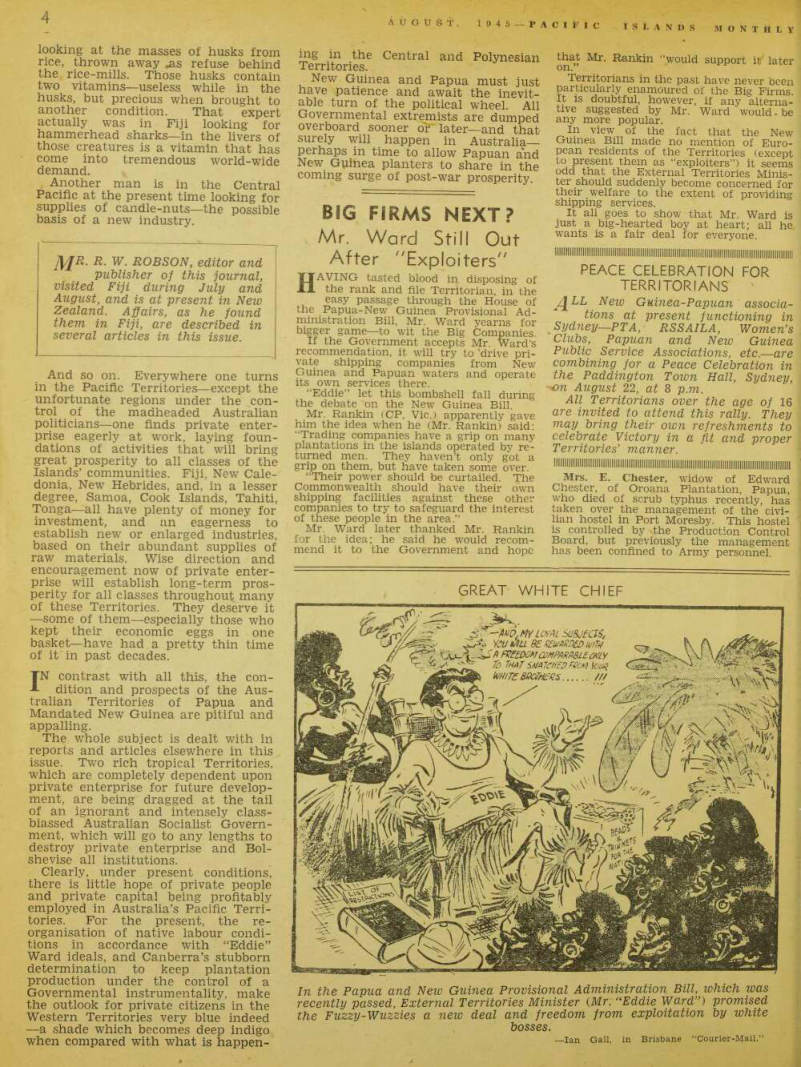
Great White Chief
In the Papua and New Guinea Provisional Administration Bill, which was recently passed, External Territories Minister (Mr. " Eddie Ward”) promised the Fuzzy-Wuzzies a new deal and freedom from exploitation by white bosses. lan Gall, in Brisbane “Courier-Mail.”
Airways In
Pacific
Big Developments Afoot
Suva, Aug. 3.
rERE seems little doubt that Suva will become the airways cross roads of the Pacific. Already, mili tary and semi-military services run regu larly between Suva and Auckland; between Australia and Honolulu, calling at Suva; between Suva and Rarotonga, calling at Nukualofa and Apia.
The Pan American Airways service between North America and New Zea land, via Honolulu, Canton Is., Noumea and Suva (which was suspended after Pearl Harbour) will be resumed with Skymaster land-planes before the end of 1945; and about mid-1946 very large new land-planes will enter the service.
Mr. Harold Gatty, who inaugurated the service before the war for PAA, was here last week, making preparations for resumption. He expects that the PAA service will be extended to Australia soon —not via Auckland, but via Noumea.
Present indications are that the big planes calling at Fiji will use the big dry ’drome at Nadi, on the northern side of the island, instead of the ’dromes nearer Suva, which is in the wet belt.
But if a suitable landing-ground can be found near Suva, that will be used.
Honolulu and Canton Island were equipped with suitable airfields for the larger planes, said Mr. Gatty. In the service between Suva and Sydney, the aircraft would call at Noumea. A field at the north of New Caledonia would have to be used temporarily until one near the town was extended. Mascot aerodrome at Sydney was being prepared for the large land-planes.
THE new DC-7 aircraft, which are expected to be in the service by the middle of next year, will cost 1.500,000 dollars each. Twenty-six of these machines have been ordered from the Douglas Aircraft Company by PAA, whose engineers co-operated to develop the advanced type. They will have a crew of 13 and spacious pressurised cabins will provide comfortable travel at an altitude of 20,000 feet. Twice as large as the former Clipper flying-boats, the DC-7’s will have, in addition to two large cabins, a modern galley equipped for serving full-course meals, dressing-rooms, toilets, cargo compartment, flight deck and compartment for pilots.
The wing-span of the new machines is 176 feet, the height of a 16-storey build ing, and they will be powered by four new Pratt and Whitney engines, details of which are a military secret, but which are known to be even more powerful than the 2.100 h.p. Double Wasp engines. They will have a cruising speed of 300 miles an hour. Mr. Gatty said that these new aircraft were under production and one would be flying within a few weeks.
As regional director, Mr. Gatty will be responsible for the Fijian. New Cale donian, Australian and New Zealand branches of the service, and he expects to be stationed at Suva. Mrs. Gatty and the two younger boys are at oresent liv ing in New York, but Mr. Gatty’s eldest son. Leading-Aircraftman Alan Gattv. who is 19. joined the Royal New Zealand Air Force and is now in training at Christchurch.
Since leaving Australia, where he was director of an Allied forces air trans port service in 1942-3. Mr. Gatty has been engaged in navigational research. He published a book on emergency naviga tion to assist Servicemen adrift at sea
and was later employed in further navi gational research for the United States Navy.
The Rev. Fuata Taito, a Fijian mem ber of the Methodist Mission, commenced deputation work in Victoria in July. He is a missionary to Australian aboriginals.
New Chief Justice
Arrives in Suva Sir Claude Seton
THE new Chief Justice of Fiji, Sir Claude Seton, arrived in Suva, with Lady Seton in July. He succeeds Sir Owen Corrie, who left the Colony in June.
Sir Claude comes straight from Nyasa land where he was also Chief Justice.
He was born in 1888, and educated at Framlingham College and University Col lege, London; he was called to the bar at Grey’s, and served with distinction in World War I, in which he was wounded, received the MC, and was twice mentioned in despatches.
He was president of the District Courts in Palestine, 1920-26, and from 1931-35, and Judicial Adviser, Trans-Jordan from 1926-31. From 1935 to 1941, when he went to Nyasaland, he was Puisne Judge, Jamaica.
He received his knighthood in the 1944 Birthday Honours.
War Gratuities For
Fuzzy-Wuzzies
From Our Canberra Correspondent July 27.
NATIVES of Torres Straits Islands, New Guinea and Papua, may receive war gratuities under an Act which passed through the Senate to-day.
The Act provides for payment of varying sums of money as free gifts to Service members from the Commonwealth in recognition of war service.
Section 5 of the Act provides that in the case of Servicemen who are natives of Torres Straits Islands or aboriginal natives of Australia enlisted at rates of pay less than the minimum rates of pay prescribed for male members of the Aus tralian Military Forces, the rate of war gratuity shall be ten shillings for each month or part of a month.
Under sub-section B of the same sec tion members who are natives of New Guinea or Papua may be given war gratuities in the form of a monetary pay ment, or in some other form as may later on be prescribed.
Rates of payment have not yet been announced.
Death Of Ci Resident
Agent
From Our Own Correspondent
Rarotonga, July 3.
MR. DAVID BROWN, Resident Agent of Mauke, Cook Islands, died sud denly in his sleep on June 27. The news was received with regret by his many Rarotonga friends.
Mr. Brown first started business in Rarotonga in 1926 as manager of the Cook Islands Native Association, and some years later became manager for Messrs.
W. H. Grove & Sons’, Rarotonga branch.
In 1938 he was appointed Resident Agent of Atiu, and was later transferred to Mauke.
Although his end came suddenly, he had suffered from a number of heart attacks during the past year.
Mr. Brown leaves a wife and cne son, living in New Zealand.
Awards to Territorians
Lieuts. Stokie and Gilmour
THE Military Cross has been awarded to Lieut. Leslie John Stokie; and the Distinguished Conduct Medal to Sgt. (now Lieut.) John Louis Gilmour.
Lieut. Stokie was a member of the NGVR and, before the war, a well-known plantation manager in the Bainings dis trict of New Britain.
After the Japanese invasion he went bush and lived there for about 12 months before contacting three American airmen who had survived a bomber crash.
They joined forces for several months, constructing canoes in which to escape, but were rescued by an American Liberator before the canoes were ready for use.
Each of the Americans insisted that he owed his life to Stokie’s knowledge of the country and the natives.
Lieut. Gilmour is the son of LieuL- Colonel and Mrs. J. Gilmour of Put Put Plantation, New Britain. He joined the first New Guinea contingent of the AIF and went overseas in 1940 with the 9th Division. He served in Tobruk. After returning to Australia, he was detached for special work, and it was while serving with his new unit on New Britain that he won the DCM.
While on leave in Sydney in July, Lieut.
Gilmour was married.
New Church For
Nukualofa
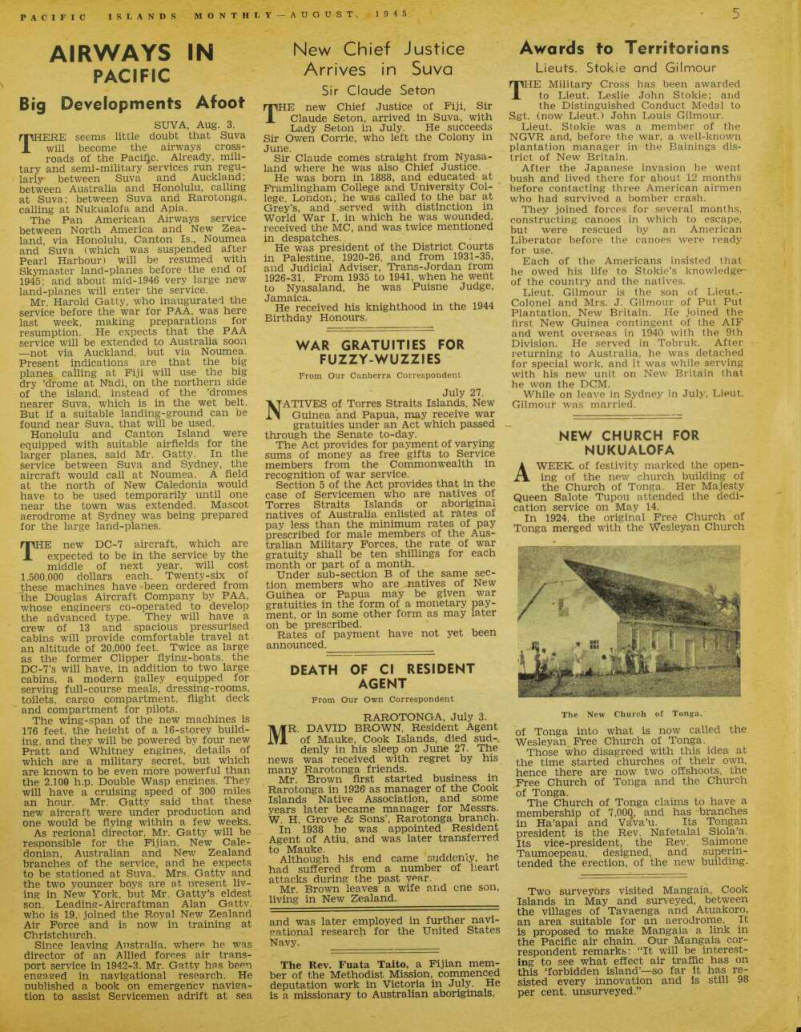
A WEEK, of festivity marked the open ing of the new church building of the Church of Tonga. Her Majesty Queen Salote Tupou attended the dedi cation service on May 14.
In 1924. the original Free Church of Tonga merged with the Wesleyan Church
of Tonga into what is now called the Wesleyan Free Church of Tonga.
Those who disagreed with this idea at the time started churches of their own, hence there are now two offshoots, the Free Church of Tonga and the Church of Tonga.
The Church of Tonga claims to have a membership of 7,000, and has branches in Ha’apai and Vava’u. Its Tongan president is the Rev. Nafetalai Siola’a.
Its vice-president, the Rev. Saimone Taumoepeau, designed, and superin tended the erection, of the new building.
Two surveyors visited Mangaia, Cook Islands in May and surveyed, between the villages of Tavaenga and Atuakoro, an area suitable for an aerodrome. It is proposed to make Mangaia a link in the Pacific air chain. Our Mangaia cor respondent remarks: “It will be interest ing to see what effect air traffic has on this ‘forbidden island’ —so far It has re sisted every innovation and Is still 98 per cent, unsurveyed/’
The New Church of Tonga.
Set-Up
Latest Cabinet Decisions On N. Guinea
Control Board to Continue Stranglehold
RECOMMFNDATIONS by the External Territories Minister, Mr. Ward, on the immediate set-up in New Guinea, were considered by Full Cabinet in Canberra on July 31.
The Prime Minister, Mr. Chifley, later announced that certain decisions had been made enabling planning to proceed so that immediate requirements in re spect of commerce and agriculture might be met on lines that “will be in har mony with the long-range policy of economic development.”
He said that the decisions would accord with the Government’s plan that in future the basis to Territories’ economy would be native and European industry with the limit of non-native expansion deter mined by the - welfare of the natives generally.
Decisions made by Cabinet that day, Mr. Chifley announced, were: • That new plantations may be established only with the express authorisation of the administration.
O That the Production Control Board con tinue for the time being to handle the marketing of products of natives and Euro peans, and that the Board continue for the time being to conduct native trade stores. • That, subject to arrangements being made with the Shipping Control Board and the Movement Control Section of the Army Department, private enterprise be advised that arrangements may now be made to re-open trading activities for the supply of stores to Europeans, subject to Price Control (essential items such as rice and flour to be obtained from the Production Control Board); and that individual Europeans—planters, missionaries and the like—be permitted to indent, direct from Australia, stores and equipment, except essential items, such as rice and flour. Im ports will be subject to payment of Territorial Customs duty. • That private enterprise be permitted to re-open hotels and broading houses.
Rumour in Sydney (mid-August) fixes the resumption of civil administration at October 1; wives of Provisional Adminis tration personnel, it is said, will be back in the Territory by Christmas.
rE decisions made by Cabinet on July 31, are, in theory, in accord with a policy designed for the dura tion of the war and six months after. . Such has been the disruption of native life that no one can quibble at the re striction on new plantation enterprises that will make fresh demands on native labour. All available native labour will be necessary to get the existing planta tions back into full production. It is universally agreed that the natives gener ally, after the demands made upon them by the Army, need a prolonged period in which to re-establish their village life and plant their gardens.
It would be interesting to know, how ever, why, if private enterprise is to be allowed to function to the extent of re opening trading activities for the supply of stores to Europeans, it should be necessary for the continued existence of the Production Control Board to handle the marketing of products of natives and Europeans and to conduct the native trade stores.
It is doubtful if the “private enter prise,” which Mr. Chifley mentions with such unction, will be really enthusias tic about returning to the Territory simply to sell over the counter, tins of meat and pounds of tea to returned planters and administrative officials, while the Government-directed Pro duction Board controls the sale of rice and flour, markets the products of the plantations, and handles the trade store business In a nutshell —while the top-heavy, bureaucratic Production Control Board remains in the Papua-New Guinea Terri tory, that Territory remains in the firm clutch of Canberra’s remote and socialis tic control. No soft, apparently reassur ing, words from the Prime Minister or anyone else can alter that fact.
A letter received in this office from a returned Papuan civilian states: “The re cent Act and Regulations have knocked everyone here sideways. I doubt if there will be any move to open up any busi
ness until the position is a lot clearer. At the moment the outlook is hopeless.”
Who Will Be the Administrator?
DAILY rumours over the last four months, that the Administrator of the Provisional Administration was already chosen, and would be announced at any moment, all came to an abrupt end when applications were called for the position in the daily press on July 28 (this advertisement, and one for heads of departments, appears on page 10 of this issue).
Applications close on August 31, there fore, although rumours are still in order, and the favourite for the position changes from day to day, Territorians will have to wait until after that date before their curiosity is satisfied or their hopes dashed or realised, as the case may be.
Salary of the Administrator will be £2,000 per annum, plus £5OO entertain ment allowance.
It is emphasised in the advertisement that this is free of income tax. It should be pointed out perhaps, to non-Aus tralian Territories readers, that a man in Australia on a salary of £5,000 a year receives about £1,300 of it —the rest goes into the coffers of the Taxation Depart ment. The new Administrator, therefore, will be paid at the Australian rate of something like £7,000 per annum.
The catch is that the war has not lasted long enough for him to enjoy very much of it. His administratorship should, according to the terms of the provisional set-up, terminate six months after the war finishes.
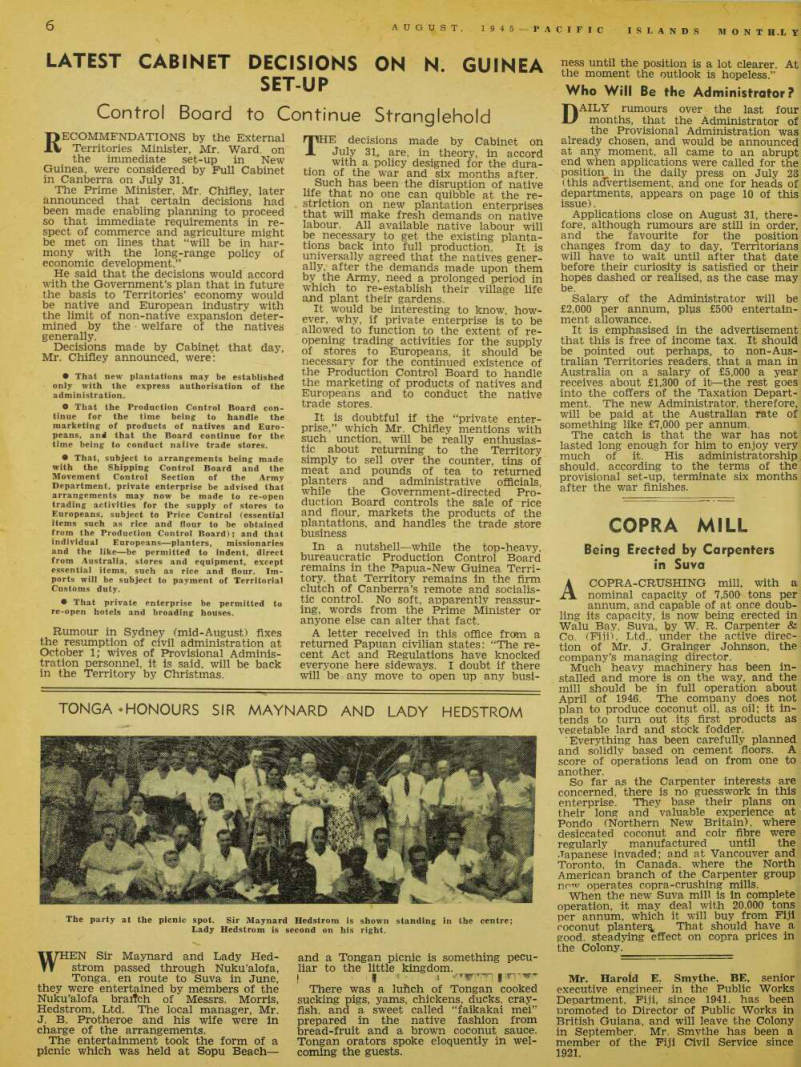
Tonga Honours Sir Maynard And Lady Hedstrom
11THEN Sir Maynard and Lady Hed ▼ ▼ strom passed through Nukualofa, Tonga, en route to Suva in June, they were entertained by members of the Nukualofa braitch of Messrs. Morris, Hedstrom, Ltd. The local manager, Mr.
J. B. Protheroe and his wife were in charge of the arrangements.
The entertainment took the form of a picnic which was held at Sopu Beach —
and a Tongan picnic is something pecu liar to the little kingdom.
There was a luhch of Tongan cooked sucking pigs, yams, chickens, ducks, cray fish. and a sweet called “faikakai mei” prepared in the native fashion from bread-fruit and a brown coconut sauce.
Tongan orators spoke eloquently in wel coming the guests.
The party at the picnic spot. Sir Maynard Hedstrom is shown standing in the centre; Lady Hedstrom is second on his right.
Copra Mill
Being Erected by Carpenters in Suva
A COPRA-CRUSHING mill, with a nominal capacity of 7,500 tons per annum, and capable of at once doub ling its capacity, is now being erected in Walu Bay, Suva, by W. R. Carpenter & Co. (Fiji). Ltd., under the active direc tion of Mr. J. Grainger Johnson, the company’s managing director.
Much heavy machinery has been in stalled and more is on the way, and the mill should be in full operation about April of 1946. The company does not plan to produce coconut oil, as oil; it in tends to turn out its first products as vegetable lard and sto'ck fodder. ’Everything has been carefully planned and solidly based on cement floors. A score of operations lead on from one to another.
So far as the Carpenter interests are concerned, there is no guesswork in this enterprise. They base their plans on their long and valuable experience at Pondo (Northern New Britain), where desiccated coconut and coir fibre were regularly manufactured until the Japanese invaded; and at Vancouver and Toronto, in Canada, where the North American branch of the Carpenter group now operates copra-crushing mills.
When the new Suva mill is in complete operation, it may deal with 20.000 tons per annum, which it will buy from Fiji coconut That should have a good, steadying effect on copra prices in the Colony.
Mr. Harold E, Smythe. BE, senior executive engineer in the Public Works Department, Fiji, since 1941, has been promoted to Director of Public Works in British Guiana, and will leave the Colony in September. Mr. Smythe has been a member of the Fiji Civil Service since 1921.
Advertisements & other items, p. 8 (1 item)
6
AUGUST, 1945 PACIFIC ISLANDS MONT H.L Y
Sudden Death of R. H.
Brown W. Samoa Loses Leading Citizen
From Our Own Correspondent APIA, July 14.
RESIDENTS of Apia, Western Samoa, were shocked to learn on July 5, of the sudden death, from heart failure, of Mr. Roy H. Brown. He was one of the leaders of the social, sporting and commercial life of the town, and had been for many years manager of the local branch of Burns, Philp (SS) Co., Ltd.
He was only 51 years of age.
He was an Australian, and a World War I veteran.
He entered the service of Messrs. Burns, Philp in 1919, and was sent to Tonga,
where he married Miss Nellie Skeen, the daughter of Chief Judge Skeen, of Tonga.
He was appointed manager of the Apia Branch in 1928.
With great business ability he steadily expanded the business of his firm in Western Samoa to its present solid posi tion. Greatly respected and loyally sup ported by his staff, he took a personal interest in every member of his organisa tion.
As president of the Chamber of Com merce, he took a firm stand in guarding and defending the interests of the busi ness community, working at the same time in close co-operation with the ad ministration.
Apart from his business activities, he took an active interest in all social and sporting organisations, particularly in Rugby football. He was also an en thusiastic Freemason.
His elder son was killed in action in Italy, while fighting with the NZEF earlier this year.
The funeral on July 6 at Magiagi ceme tery was one of the largest ever seen in Samoa, and gave ample evidence of the great popularity of the deceased, and the general respect in which he was held.
It will be very difficult, indeed, to re place him in the many spheres in which he has taken such a prominent and dis tinguished part—particularly in a small community like Apia, which has never suffered from a surfeit of public spirited citizens.
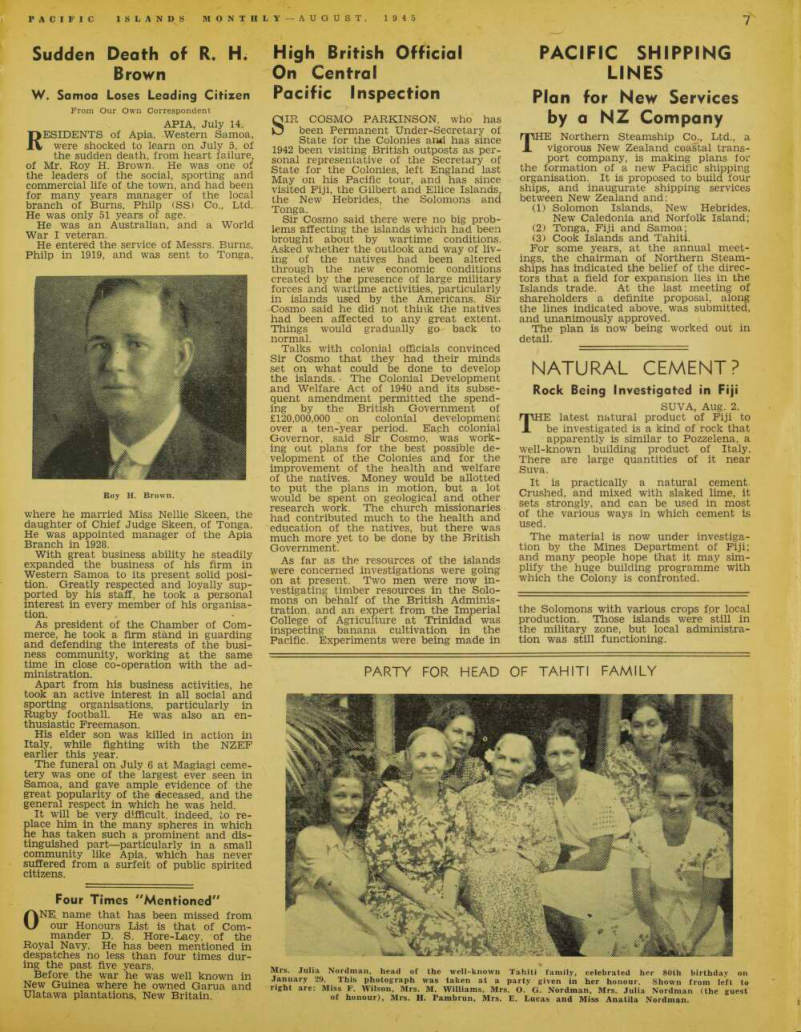
Roy H. Brown.
Four Times "Mentioned"
ONE. name that has been missed from our Honours List is that of Com mander D. S. Hore-Lacy. of the Royal Navy. He has been mentioned in despatches no less than four times dur ing the past five years.
Before the war he was well known in New Guinea where he owned Garua and Ulatawa plantations, New Britain.
Pacific Inspection
High British Official On Central Pacific Inspection
Sir Cosmo Parkinson, Who Has
been Permanent Under-Secretary of State for the Colonies and has since 1942 been visiting British outposts as per sonal representative of the Secretary of State for the Colonies, left England last May on his Pacific tour, and has since visited Fiji, the Gilbert and Ellice Islands, the New Hebrides, the Solomons and Tonga.
Sir Cosmo said there were no big prob lems affecting the islands which had been brought about by wartime conditions.
Asked whether the outlook and way of liv ing of the natives had been altered through the new economic conditions created by the presence of large military forces and wartime activities, particularly in islands used by the Americans, Sir Cosmo said he did not think the natives had been affected to any great extent.
Things would gradually go back to normal.
Talks with colonial officials convinced Sir Cosmo that they had their minds set on what could be done to develop the islands. The Colonial Development and Welfare Act of 1940 and its subse quent amendment permitted the spend ing by the British Government of £120,000,000 .on colonial development over a ten-year period. Each colonial Governor, said Sir Cosmo, was work ing out plans for the best possible de velopment of the Colonies and for the improvement of the health and welfare of the natives. Money would be allotted to put the plans in motion, but a lot would be spent on geological and other research work. The church missionaries had contributed much to the health and education of the natives, but there was much more yet to be done by the British Government.
As far as the resources of the islands were concerned investigations were going on at present. Two men were now in vestigating timber resources in the Solo mons on behalf of the British Adminis tration, and an expert from the Imperial College of Agriculture at Trinidad was inspecting banana cultivation in the Pacific. Experiments were being made in
the Solomons with various crops for local production. Those islands were still in the military zone, but local administra tion was still functioning.
by a NZ Company
Pacific Shipping
Lines
Plan for New Services by a NZ Company
rE Northern Steamship Co., Ltd., a vigorous New Zealand coas'tal trans port company, is making plans for the formation of a new Pacific shipping organisation. It is proposed to build four ships, and inaugurate shipping services between New Zealand and: (1) Solomon Islands, New Hebrides, New Caledonia and Norfolk Island; (2) Tonga, Fiji and Samoa; (3) Cook Islands and Tahiti.
For some years, at the annual meet ings, the chairman of Northern Steam ships has indicated the belief of the direc tors that a field for expansion lies in the Islands trade. At the last meeting of shareholders a definite proposal, along the lines indicated above, was submitted, and unanimously approved.
The plan is now being worked out in detail.
Natural Cement?
Rock Being Investigated in Fiji
Suva, Aug. 2.
THE latest natural product of Fiji to be investigated is a kind of rock that apparently is similar to Pozzelena, a well-known building product of Italy.
There are large quantities of it near Suva.
It is practically a natural cement.
Crushed, and mixed with slaked lime, it sets strongly, and can be used in most of the various ways in which cement is used.
The material is now under investiga tion by the Mines Department of Fiji; and many people hope that it may sim plify the huge building programme with which the Colony is confronted.
Party For Head Of Tahiti Family
Mrs. Julia Nordman, head of the well-known Tahiti family, celebrated her 80th birthday on January 29. This photograph was taken at a party given in her honour. Shown from left to right are: Miss F. Wilson, Mrs. M. Williams, Mrs. O. G. Nordman, Mrs. Julia Nordman (the guest of honour), Mrs. H. Pambrun, Mrs. E. Lucas and Miss Anatila Nordman.
New Deal Or Mis-Deal?
Papua-N. Guinea Provisional Administration Bill Passed by Both Houses
T'HE Papua-New Guinea Provisional Administration Bill was passed in the + Australian House of Representatives on July 19. Amalgamation of the two Territories until six months after the war is provided for in the Bill which takes power from the former Legislative Councils and delegates it to the Government through the Governor-General. g 0 tne Sweeping changes in the new Territory now come into effect These include a 44-hour week for native labourers, a basic wage of 15/- per Hnn nmf llon ° f i the md f entured lab °ur system as soon as possible, elimina native CSS" 11 a lnmt 0f 12 months on the duration of “PiJ” 8 provisi ° ns were discussed at length in the July issue of ll was > of . course, a foregone conclusion that the Bill would be passed the Government has an overwhelming majority in the House but it was d |? illas^ordto Territorial to find from the debate on the Bill that tragically few Government or Opposition members have learned anything about Papua or New Guinea in the past three years. f eV€ ; ia * Opposition members confessed as much. Mr. Ward who as External Territories Minister introduced the Bill, however, did not * Perhaps Temtonans would feel better if he had. -remaps
The following comprehensive report on the debate on the Bill on July 18 and 19, has been supplied by our special correspondent in Canberra : SPEAKING on the Bill, Mr.-White (Lab., Vic.) described it as an attempt to administer by “remote control” from Canberra a Territory, 2,000 miles away, bearing a population of 1,000,000.
He then moved that the Bill be with drawn and referred to a Select Commit tee for report as to whether the Bill meets the requirements of the Territories concerned, and to seek advice upon the best methods of restoring civil administra tion that would take care of native population and the economic development of Papua and New Guinea.
Mr. White said; “It is essential that we return to the Territories again, those people who were forced into exile and who have been clamouring to return to their homes again.
“This is of the utmost importance be cause New Guinea is not only our spring board for invasion against enemies who might attack us, but it is a stepping stone to Australia for those very enemies. It is here that our garrisons fought for Aus tralia, and it is here they may have to fight again.
“We have tremendous responsibilities to the natives, and it is incumbent on us to give them enlightenment. But it must be said that our policy to the natives of Papua and New Guinea has been better than that towards our own aborigines.
“We have seen men like Sir Hubert Murray do much good for the natives, and we must support any measure with a similar aim. But I do suggest we act wisely in the matter.
“Merging of the two Territories is something we should all support, but whether it is constitutional is something which will have to be considered. What I am really concerned about, however, is that the whole of the control of that Ter ritory will be directed from Canberra.
This is just too ridiculous to be sup ported in any democracy.
“The protagonists of this Bill have just run beyond their common sense. They talk ab<put trusteeship and protection of the native. In the past, with the Terri tories governed by men who knew the place natives were guarded against every form of exploitation.
“We must educate the native, but if we apply to these people, many of whom are primitive, labour laws suited to a civi lised race, then we will be spoiling them instead.
“Mr. Ward had a conference in Sydney last December with men who knew the Territories, in deciding against the in denture labour system as a result of that conference he accepted the opinion of one missionary and one anthropologist against the opinions of dozens of others.”
Mr. White continued that under the Bill tne Government was virtually going to primitive natives in the mountains and offering them trebled wages, a revised dietary scale and a 40-hour week “These natives are going to be amazed,” he said.
“You should allow the former adminis trations to return to the Territories. You should put the power into the hands of these men who know the place, and are fit to administer the Territory. All we have in this Bill is a sort of co-prosperity plan for the Trades Halls of New Guinea.
Do you believe there is slavery in New Guinea?”
Mr. Bryson (Lab., Vic.): “Yes.”
Mr. White: “The indenture system of native employment is no more slavery than the apprenticeship system is in Australia.
Do you think Sydney trades could operate successfully if their apprentices were authorised three months’ holiday after twelve months of work?”
Mr. White continued that there was not a word in the whole Bill about New Guinea settlers who had struggled for years to open up the two Territories.
Most of them were returned soldiers, and many of them could not even return to their homes under the conditions now being imposed by the Government. Many of them would not be able to operate if the Bill were passed.
“New Guinea is a place where you want a minimum of governmental interference.
I feel the whole matter has been insuffi ciently considered, and that is why I move this Bill be referred to the Select Committee,” he concluded.
MR. HAYLEN (Lab., NSW) said the whole problem of New Guinea re volved around the taking of man power from villages for long periods, and thus destroying native culture. Tliis de tribalising process was aggravated by the indentured labour system which the Bill attempted to adjust.
“We must put some measure of dignity back into New Guinea,” he said. “We must see that the native owner of the country preserves his tribal rights and eventually regains his country. With such a plan they could welcome us back to New Guinea after the war in the name of democracy. An Australian community dedicated to the White Australia policy cannot see the second largest island in
the world as some sort of place to be exploited by a handful of white men.”
MR. SPENDER (Independent, NSW) said the vital issue facing Australia was in whose interests New Guinea and Papua be developed. Despite the fact that planters with the encouragement of previ(3us Governments had gone there and invested money our real obligation was to the native people.
“In plain justice and morality we must discharge that obligation to the best of our ability,” he said. “These Territories must be developed for the natives with
the help of white men and all the assist ance we can provide. But we must be the sleeping partner not seeking to make a profit out of the work.’' Mr. Spender said that, as ANGAU was at present administering liberated areas of the Territories, there was no imme diate hurry for the return of civil adr ministration. “Let us take our time and examine the Bill thoroughly before we rush it through,” he suggested.
“Under this Bill the Administrator, whoever he is, must obey the instruc tions given by the Minister, through the Government. And then there is no guarantee that members of the previous administration will be given their jobs back.
“I should like your assurance. Mr.
Ward, that no military officer has already been chosen for the position of Adminis trator. This is a job requiring the ser vices of a man with the qualifications of Sir Hubert Murray. I should also like to know the cost of ANGAU adminis tration as compared with the cost of pre-war administration.
“In my opinion, Mr. Ward, your first step should "be to determine the policy to
(Continued on Page 46)
be followed in these Territories. Then you must generously provide for compensation for men, who have put their lifetime into managing plantations there, who are affected by the policy. Certainly we in this House want to be better informed on the matter before we commit our selves to any policy. It will be seen here that complete control is vested in Can berra in the 'Minister, and even if the Administrator is given full power to con trol the Territory he must carry out his duties in acordance with the instructions of the Minister.
“I support the amendment for the reference of the bill to a Select Com mittee.”
Representation for Territorians
SPEAKING to Mr. White’s amendment, Mr. Cameron (Lib., SA) said that New Guinea was most valuable to Australia strategically, taut this was some thing the Government had ignored in the past. Since then, however, Mr. Ward has “become one of the great discoverers and ranks himself with Marco Polo —he was responsible for the discovery of that won derful ‘Brisbane Line’ and I’m surprised he takes any interest in anything north of it.”
Mr. Ward appeared to think he was going to bring tne New Guinea native to a state of civilisation something akin to our own. Mr. Cameron, for his part, had never believed that Western civilisation and Western ideas could be applied to these people whose living conditions are so vastly different.
“We have to have due regard for the welfare of the natives, but I do hope we are not going to the islands Just as a sort of Father Christmas to them. They have certain rights, but let us not forget they also have obligations. As for this Bill—it proposes what virtually amounts to a New Guinea dictatorship.
“The Bill provides for a mongrel type of administration where there should be one of a local type on which white residents could have representation. I think the people residing in these Terri tories should have at least one represen tative in Parliament here. Then we would not have to rely on Ministerial statements purporting to give an accurate picture of what is going on in New Guinea.
“I don’t know whether the Minister is qualified to decide what New Guinea should have. Certainly he has been face to face with the Fuzzy Wuzzies, although whether he has been admitted to theii societies I do not know . . . he con cluded.
An All-Party Committee
MR. ANTHONY (CP, NSW) who also supported the amendment, sug gested that an all-party Committee be sent to New Guinea to study condi tions there first hand. Whatever legisla tion was finally passed in respect of the island Territories, he said, its first con sideration would have to be the advance of Australia.
Education of the natives could ulti mately result in their amalgamation with enemies of Australia, such as Japan. They would then become a menace to this country. The Government was protecting the natives, but not Australia. Mr.
Anthony said the native would not be helped by Mr. Warn going up and talk ing “Domain platitudes” to them. In any case the changes proposed in the Bill would probably end up killing off the natives.
“I would like the Minister to indicate to the House just who is advising him in these matters,” Mr. Anthony concluded.
Mr. Rankin (CP, Vic.) said the measures proposed by the Government would mean the ruination of the New Guinea planter. Contrary to general opinion, the average copra planter had difficulty in making ends meet, especially as many of them were in the grip of trading companies. He calculated the price of copra would have to be raised £4 to counter added expense which would be incurred by planters as a result of Mr. Ward’s “improvements” for natives.
If the Government insisted on its present plans, it would have to subsidise these planters if they were to exist.
Mr. Abbott (CP, NSW) said if adminis tration were contemplated it should be placed in the hands of competent men like Sir Hubert Murray, or Sir William MacGregor. .
“What is proposed under this bill is centralised government. The curse of the world has been the centralisation of gov ernment in the hands of people who did not know the needs and requirements of the native races, and whose opinions could be swayed by sectional interests on the spot. If a gallup poll could be taken amongst the natives they wouxd just want to be left alone.”
Territorians Slandered
MR. CHAMBERS (Lab., SA) said natives had suffered greatly in Papua right up to the beginning of the Pacific war. Very many of tnem throughout both the Territories were suf fering from malnutrition —he would rather close down Papuan industries than see them carried on with labour being paid the slave rate of 2/6 a week. I have seen and met Papuan native intel lectuals, and they are comparable to any Australian 'people.
Mr. Bryson (Lab., Vic.) said white planters in Papua and New Guinea had only been interested in making money, and had not waited to fight when the Japs poured down from the north. He added: “The only fighting done there was by troops sent from Australia.”
Mr. Anthony (CP,NSW): “That’s a lie.
Haven’t you ever heard of the Volunteer Rifles?”
Speaker: “Order! I will have- to ask you to withdraw that statement.”
Mr. Anthony: “In deference to you, I will withdraw.”
Speaker: “There must be an unquali fied withdrawal.” . , , Mr. Anthony: “All right. I withdraw.’
Mr Bryson (continuing his speech): “Planters in these Territories were some times returned soldiers and sometimes not, but they went there to make money, and get what they could out of the country. They went there to exploit the country and make a good profit out of that exploitation. There is no reason why they should get labour to help exploit it. And if this is not slave-labour, then I have the wrong idea of what slave labour is.
“If these exploiters cannot make their money when we give the inhabitants better conditions, then they had better walk out of the country and leave it to the natives. I commend this Bill to the House as a piece of humane legislation.
Mr. Chambers (Lab.. SA) supported Mr.
Bryson’s remarks about the planters.
During debate he interjected, saying that white residents of the Territories had done little in their defence. He said that one man in Papua had employed a native child aged about six years. This man had been one of the first to leave Papua when danger threatened.
The Minister for External Territories (Mr Ward), who was in charge of the Bill, was more cautious. He said: “Many planters entered the services. Many of them entered • ANGAU and gave very valuable service. But there were also many absentee shareholders of companies operating in the Territories, and they weren’t there to face the Japs.
“The man who had most to fight for in New Guinea was the man who was mak ing the money out of the Territories—and these absentee shareholders were not there.”
Mr. Ward's Aims
SECOND-READING debate closed with an address by Mr. Ward, who. in his opening sentence, abruptly told the Opposition that the amendment could not be accented, as it would result in delay in establishment of an administration.
Other points were: — • Proper administration would be re turned to the Territories just as soon as the white population went back. • That power temporarily vested in the Governor-General by the Bill would be returned to Legislative Councils of the former type upon return of the tration. • That natives would ultimately take an “intelligent” part and interest in their own Government. • That the Bill would later afford some protection for white residents of the Ter ritories, but that it would first and fore most cater for the native population. • Natives would be taught agricultural
methods and encouraged to sell their pro ducts on island markets. • That arbitration machinery would be set up in the islands to investigate and determine wages for natives. • Employers would have to report to a Department of Native Employment every time they worked their native labourers overtime on the 44-hour week basis. • That control of the Territories from Canberra would not be “remote control” because the Administrator in New Guinea would be free to make his own decisions.
He would, however, be given directions as to the policy to be followed. • That Labour’s New Guinea would set an example to the world.
One of the first things to be done under the Bill, said Mr. Ward, would be a sur vey to be taken of villages. This wohld estimate how many men each village could spare for outside labour with out upsetting “native economy.” and no more than that number could then be taken from the village.
Then there would also be workers com pensation for natives who previously had been cast aside by companies, after they had done their part in amassing wealth for mining firms.
The Government would send a compe tent officer to the Territory to find out what the rates of pay should be for natives performing certain work under certain conditions.
Mr. Ward said that all the best advice had been obtained before deciding on the measures now proposed. Advisers had in cluded Sir Hubert Murray, whom the Opposition had mentioned several times.
It was intended to abolish the indenture system of labour at the earliest possible moment, and professional recruiting was being banned. Previous administrations in the islands had done a good job, al though they had been starved by Federal Parliament.
“There will be a Native Labour De partment whose particular duty would be to see that the Government terms are ob served. Employers will not be permitted to work their natives overtime, unless very special circumstances warrant it. In those cases, the employers will be obliged to report the incidents to the Native Labour Department.”
The Government was going to see that
the native got his full value from planter employers, by enforcing revised dietary scales. It was the intention of the Gov ernment, through skilled agriculturalists, to teach natives to improve the standard of their crops. They would later be able to use their own crops, and would be en couraged to sell them on island markets.
This would not affect Australian currency.
Natives would also be encouraged to take an interest in their own affairs.
“We want to make it quite clear that we intend having the care of the natives themselves the primary objective,” said Mr. Ward.
It was the Government’s opinion that at the present stage, with the great majority of the Territory’s population evacuated from the islands, it would be absolutely ridiculous to establish any form of legislative machinery. But that will be done later.
In the meantime the control will be under an Administrator who will be given directions by the Government in regard to policy matters, but in regard to deci sions of government there will be no inter ference.
The Minister said the Government would not interfere with missions in the Territory.
Mr. Ward concluded: “We hope to be able to set an example to the world in the conditions which we will establish in New Guinea, and by the way we treat the inhabitants. When the system of trusteeship begins to operate this coun try will have no need to be ashamed of what has been accomplished by the Labour Government for New Guinea Territories and for the people living therein.” . ..
A division was taken on Mr. Whites amendment, which was lost by 36 votes to 14.
The Bill is Passed WHEN the Bill entered the committee stages (during which each clause is debated)—the Government encoun tered very little opposition on every clause except one—clause 8. . .
Clause 8 states: “Subject to this Act the Governor-General shall have power to make ordinances for the peace, order, and good government of the Territory.
Mr White moved an amendment, later defeated, that the words “Gpvernor- General” be omitted and “Administrator’ inserted in their place.
Mr. Cameron commented: “I am con cerned about the power that the Minister for External Territories will exercise under this clause. Whether the power is vested in the Administrator or the Governor- General, the whole essence of the thing Is these ordinances will express the views of the Minister.
“Under these Regulations, whatever they may happen to be, the Minister pro poses to conduct, by Regulation, virtually a revolution in the strategic, economic and social spheres of Papua and the parts of New Guinea under his control. And all this power is to be granted in this single clause, “It is quite obvious that the Minister proposes to set up by Regulation authori ties which will handle all the reforms he has explained.
“His authority for supervision o r native labour will be done by Regulation, and so will it be for all his other proposals.
The Minister, through his satellites, will have a really new New Guinea before long.
“I think the whole of clause G from start to finish is the really dangerous part of this Bill. This is the clause which will deny the Commonwealth Parliament any right to supervision over these matters “This is the clause under which ihe Minister is going to put in force, without further reference to Parliament, his ideas on how New Guinea is going to be run.
He is no better qualified to do that than 1 am - .
“Under this clause he will oe able to do things, which would alter the face of New Guinea, in a short couple of years or even less than that. And worse, the things he will do under clause 8 will be
permanent—despite his protestations. ’
In reply, Mr. Ward said the Territories had been governed by ordinance for years.
The only difference was that, in this case, the Government, and not the Administra tor, was to make the ordinances.
“Whoever is appointed to the post of Administrator will have the cortfidence of the Government, and he will be in con stant touch with the External Territories Minister,” he said.
The Bill was then passed in all stages in the House of Representatives.
After a short leave in NSW, Major Stanley Cowled, chaplain with the Fiji troops, has returned to his unit in Suva.
Passed In Senate
'T'HE Papua-New Guinea Provisional Administration Bill passed all stages in the Senate on July 27.
Points made by speakers during the debate were;
Senator Sampson (Lib., Tas.): When
you make a personal reconnaissance and see these territories for yourself it makes all the difference in your ability to debate these matters sensibly. The indenture labour system has always been conducted on a voluntary basis, and it is strange that it is condemned almost exclusively by people who know nothing about it,
Senator Grant (Lab., Nsw): We
hope we will deal with people like Mr.
Carpenter and Burns Philp. We will see we are not putting the Japs out of these territories simply to put Carpenters and Burns Philp back in.
Senator Sampson: What’s wrong with Burns Philp and Carpenters?
Senator Grant: Other people do the fighting so they can exploit the natives. * SENATOR BRAND (Lib., Vic.): In order to keep step with Dr. Evatt’s San Fran cisco pronouncements concerning the bet terment of native races the Government has lost all sense of balance between decent treatment of natives and decent treatment of white settlers. . *
Senator Sheehan (Lab., Vic.): When
these children of nature are taken away from their own people they some of their own ideals. Now that the Labour Government is arranging for their regu lar return to their villages they will be able to carry on their traditions. Of course, we hope to develop their ideas. * SENATOR COLLINGS (representing Mr.
Ward in the Senate); The Bill has been compiled and brought down after consul tation with many men who knew New Guinea well. Mr. Ward himself went to both New Guinea and Papua and inves tigated the situation there on the spot.
The Bill is the result of his findings.
Tropicalities
SUPERSTITION lives on in Fiji, even among civilisation’s most modern gadgets.
At the Emperor goldmine, suspended over a travelling belt which carries crushed ore into the mill, is a large mag net, powerful enough to pull up and hold any stray bits of iron and steel which may have got among the stone, and which would damage the mill. one day, a Fijian, carrying on his shoulder a metal container of chemicals, came along that way, and passed close by the magnet. Suddenly he found him self off balance: some strange power was dragging him sideways. No one had ever told him about magnetism; but he knew all about tevoras (native spirits)—and so he dropped his burden and, with howls and prayers, he left that place in a very great hurry. • THERE’S a servant problem in New Zealand, as elsewhere. In Raro tonga, as elsewhere, there are many Polynesian maids who have felt the pro found and disturbing influences of war.
So the maids have gratified their urge to travel (with the approval of the NZ Government) and some two or three hundred worried NZ women thus have got domestic servants.
But the thoughtful and serious people of Rarotonga do not like the arrange ment at all. “They are not only taking away the best of our young women.” says one resident. “They are also causing a social upset in the whole native com munity, and they are striking right at the heart of the native birth-rate. It is a stupid innovation, perpetuating many of the social evils of war, and it is un worthy of an intelligent administration.” * WHEN the Commonwealth Oil Re fineries gave Private Fulton, of the Newcastle district, New South Wales some weather recording instru ments, Private Fulton went to work to list the temperature and rainfall registra tions of Lae, Madang and Alexishafen, New Guinea.
The lowest rainfall in the Madang area occurred in October, 1944. when 320 points were registered. The highest recording, according to Private Fulton, was in January, 1945, when 30 inches of rain fell.
The highest temperature was 110 degrees, in January 1945. The average temperature was about 90 degrees, and in 15 months the temperature never fell below 60 degrees.
Average monthly rainfall for the period was 872 points.
THiese figures may surprise some Terri torians. However, we gather that Army Administration has not been able to change Madang’s climate. It is still hot and wet.
It is records like these that probably cause some of Mr. J. T. Lang’s brain storms. It will be remembered that some months ago Mr. Lang proposed to the NSW Parliament that New Guinea’s sur plus water be piped to Australia’s Dead Heart. ♦ rUR sets df brothers who lived and played together as children in Fiji, are now serving in the RAF or Dominions Air Forces. They are Terry and Paddy Fenton, Weston and Keith Brooks. Bruce and Dennis Raker, and Russell and lan Leith.
Terry Fenton is flying Catalinas with the RNZAF, while his brother Paddv is on Venturas. Weston Brooks is with RAF
Coastal Command, and is flying Sunder lands. Keith Brooks is a ferry pilot, also in the RAF.
Bruce and Dennis Baker and Russell and lan Leith are all-with the RAAF.
Bruce has been instructing in Canada, and Dennis is flying Kittyhawks in the New Guinea and Netherlands East Indies war theatre. • TERRITORI AN, an officer in the AIF, who shall be nameless, wrote these verses while engaged in
“mowing-up” operations in Bougain
ville.
We’ve nineteen dead on the Buin Road, Ten more on the jungle track, And all day long there’s a broken tide Of our wounded streaming back.
We’ve fought all night by the Hongorai With never a bite nor sup, And to-morrow’s back page news will quote . . .
“Our forces are mopping up.”
As dawn awakes with a jaded eye, Discarding its mighty pall, White crosses mourn on the Numa Trail For fellows who gave their all; In Tsimba’s ridges, Soraken’s groves.
They drained to the dregs, hell’s cup, But the blood they gave was a trifling thing, They only were “mopping up.”
The screaming silence of ambushed swamp, The horror of obscene bog, The vicious foe, in a filthy league Of blanketing rain and fog, Are trivial things, which the critics know Should never hold heroes up; Good God! Why, this isn’t war at all . . .
We merely are “mopping up.”
We make no claim to heroic mould.
But this little boon we ask: That those armchair critics are sent up here To share in our “simple task.”
When they’ve been on speaking terms with death And have tallied the blood-cost up, Perhaps they’ll coin a more adequate phrase Than casual “mopping up!” * 'Y'HERE apparently is an animal called iC bureaucrati tropicus,” some examples of which have got into Fiji, judging by this letter in a recent issue of the <( Fiji Times”: Sir— I went to a shop to buy six penn’eth of screws. “Have you a permit?” I was asked.
“No! I’ve never had to have a permit for screws.”
“Well, you do now,” said the shopman.
“Sorry, I can’t sell them without the permit, but I’ll tell you what I can do.
If you buy hinges, I can put the screws in the hinges.”
“Don’t I have to have a permit to buy the hinges?” I asked incredulously.
“No, not for under a certain amount. I can sell you the screws you want with the hinges, but not the screws you want without the hinges!”
Now, I ask you, is the Government all there, or am I
“A Screw Loose.”
WHEN the schooner “Cimba” left Suva, Fiji, in April, the owner-skipper.
Mr. G. F. Russell, expected to make the round trip in her to Auckland and back to Suta. He took with him Mr. J. Malloy, of Suva, and Mr. F. Beddes, of Lautoka.
But, as the poet said, the schemes of
mere men often go agley—and this is how Mr. Russell, in effect, has “swallowed the anchor.”
The schooner reached Auckland on May 12—ten days overdue and after a fright ful buffeting—and shortly after Mr.
Russell met a young lady and almost immediately they were married.
He abandoned the “Cimba” and made the return trip to Suva by prosaic “Matua," settled his Fiji affairs, and flew back to New Zealand, where, it is under stood, he has' joined his wife in a busi ness venture. \ * DOES malaria recur after taking atebrin? Australian Repatriation Commission doctors say it does not — that, in effect, -if a soldier takes the prescribed course of atebrin after leaving infected areas he should be malaria-free.
John Isackson, an expert in Repatria tion matters, who writes for “Smith's Weekly,” is not so sure. Neither, appa rently. is the Army. Recently it experi mented upon a bunch of soldiers on leave —Army. instructed these soldiers not to take their atebrin after reaching Aus tralia, although presumably they had been taking the daily dose up until that time.
Result: most of them had several attacks of fever.
Whether wartime atebrin has a little something that the pre-war brew did not, we cannot say. But it was the opinion of most Territorians that atebrin did not always work a sure-fire cure. Those who had recurrent attacks after taking a course of the drug were as numerous as those who had been cured.
Because the Repatriation doctors believe that atebrin really works malaria is not pensionable. There has been a general wail about this in Australia, although few Territorians will quarrel about the deci sion if they do disagree about the reason for it. Only in exceptional cases would a full-time pension be warranted. Most people learn to cope with their fever as easily as they cope with a common cold.
Mr. Robert Dean Frisbie, well-known American writer, who has been residing in Rarotonga for some time, is now an inmate of the hospital at Pago Pago, American Samoa. Stomach disorders are being cured by a course of special treat ment.
Advertisements & other items, pp. 11-12 (1 item)
Notice of Meeting
PACIFIC TERRITORIES
ASSOCIATION
A general meeting of the Association will be held on Tuesday, September 18, 1945, at 8 p.m., in Teachers' Federation Hall, 166 Phillip Street, Sydney (seventh floor).
BUSINESS:
To receive report from the Executive on activities to date.
To deal with any other business that may arise.
C A. M. ADELSKOLD,
Secretary.
Positions Vacant
TERRITORY OF PAPUA-NEW GUINEA
APPOINTMENT OF
ADMINISTRATOR
APPLICATIONS are invited from persons desirous of being considered for appointment as ADMINISTRATOR of the Provisional Administration for the TERRI-
TORY OF PAPUA-NEW GUINEA.
Appointment will be at a salary of £2.000 per annum, plus an entertainment allowance at the rate of £5OO per annum. (The Income Tax Assessment Act does not apply to any income derived by a resident of the Territory from sources within the Territory.) .
The appointee will be stationed in Papua-New Guinea.
Applications, giving full particulars as to age, qualifications, experience and war service (if any) and stating whether married or single, should reach the Secretary, Department of External Territories, Canberra, A.C.T., not later than 31st August, 1945. If lodged by telegraph, a written application should follow by first mail.
TERRITORY OF PAPUA-NEW GUINEA
APPOINTMENT OF
DEPARTMENTAL HEADS
APPLICATIONS are invited from persons desirous of being considered for appointment to the undermentioned positions in the Provisional Administration for the
TERRITORY OF PAPUA-NEW GUINEA:
Director, Public Health. —Salary range, £l,lOO-£1,200 per annum.
Director, Agriculture. Salary range, £l,OOO-£1,150 per annum.
Director, Education. —Salary range, £9OO- - per annum.
Director, Public Works; —Salary range, £9OO-£l,loo per annum.
Appointments will be made at a rate of salary within the respective ranges, according to qualifications and experience, (The Income Tax Assessment Act does not apply to any income derived by a resident of the Territory from sources within the Territory.) Appointees will be stationed in Papua- New Guinea.
Applications, giving full particulars of age, qualifications, experience and war service (if any) and stating whether married or single, should reaph the Secretary, Department of External Territories, Canberra, A.C.T., not later than 31st August, 1945. If lodged by telegraph, a written application should follow by the first mail. (Positions are open to officers of the Public Services of Papua and New Guinea and to other persons.)
Papua-N. Guinea Bill Puts Territorial
On The Spot
But Debate Provides Parliamentarians With An Opportunity for Slander
By Judy Tudor
fill IK Papua-New Guinea Provisional JL Administration Bill was passed by the Australian House of Represen tatives on July 19. and by the Senate on July 27. It remains in force for the duration of the Pacific war and six months afterwards, when something a little more permanent will be wished upon the long-suffering residents of Australia’s New Guinea Territories.
The implications of the Bill, especially as it applies to native labour, and there fore to the whole economic set-up in the Territories, was discussed at length in the July issue of the “PIM.” Such is the overwhelming majority of the Govern ment in both Houses it was. of course, a foregone conclusion that it would be passed—a Bill, once it is introduced, almost automatically becomes law these days.
The debate on the New Guinea Bill, for any practical purpose, availed Terri torians nothing, nor ameliorated their lot one jot. It did, however, afford members of the House an opportunity of airing their ignorance on New Guinea affairs, and thus making it clear to residents just where they stand in relation to the present Government. Such Is Parlia mentary privilege in this democracy of ours, that members are allowed to slander freely, or accuse unjustly, any person or section of the community who happens to displease them.
The whole business of proving to Aus tralia’s Parliament, and to Australians, that Territorians are simply ordinary citizens, who happened to choose to earn a living in somewhat extraordinary manner has become tedious, boring and unprofitable in the extreme. That it should be necessary to harp on this theme until it is threadbare is one of the phenomena of Australian life.
NOW, consider the ordinary Territorian how he grows. He is no saint; he has his full share of human faults; the isolated, king-of-all-I-survey manner in which he has lived has given inelasticity to some of his ideas; the conditions of war have administered a lesson in toler ance that was badly needed in some in stances. But taking him by and large, the present-day Territorian of the out ports is much the same type of individual who a century or more ago left Europe for the wider fields of Africa, North America, Australia and New Zealand. We call our emigrating forefathers pioneers —and honour them. Australians call Territorians “exploiters” and give them as many kicks in the pants as possible.
It is this ordinary Territorian, the small man of the outports —the planter, the trader, the miner, but the planter most of all —who stands to be ruined by Mr.
Ward’s new legislation, because contrary to popular fancy the ordinary run-of-the mill Territorian was far from wealthy.
The big firms with their many interests scattered over not one, but several, Territories, the big mining concerns, elc. —these can weather the Canberra storms.
But the small man sank his all in one stretch of coconuts or rubber —along with anything up to 30 years of his life.
It is beyond the comprehension of the average Australian to understand why any man should seek a life away from the suburban rut. The ambition of all Australians who live in the country is to
go live in Sydney or Melbourne; and of all those already in those cities, to stay there. To seek fresh fields, and in ,so doing live in a kunai shack, suffer incon veniences, illness, isolation and a dozen more difficulties peculiar to carving a living from the jungle, is to Mr. Average Australian plain, damned silly—if there is not a pot of gold at the end of it or some other dark deep fishy reason for so doing. If he can think of no other reason why Territorians do these things,
then he sits back and bellows “exploi tation,” a parrot-cry that needs, appar ently, no explanation.
Mr. Average Australian, although he is a good trade unionist, cares nothing for the betterment of man; all he cares about is his own personal welfare, and, being lacking in initiative himself, wants regu lations passed to prevent any other person doing what he himself has not the guts to do.
It is this spirit, passing from a large section of the Australian public to-day to the members they have elected to Parlia ment, that manifests itself in the kind of ill-considered outbursts we heard dur ing the recent debate on the Provisional Bill.
Nothing that has been said or written about Papua and New Guinea in the past three years has registered with these men who presume to control the destinies of others.
If for no other reason than that New Guinea was news, it might have been supposed that they, of all people, would have taken some time off to learn some thing of its history and background. They have learned nothing. After three years, the best they can do is still to sit on their behinds on the Government benches of both Houses and yell “Exploitation” at regular intervals, as do the mobs upon whom they rely for support.
The performance put up by the Opposi tion during the debate, except in a few cases, was feeble to the point of dis interest. The Opposition has an election to win next year—or else. And Terri torial have no votes.
Nothing uttered by Opposition members indicated any great knowledge of the Territories or conditions there. Their side of the debate seemed to be inspired by no loftier motives than that it is the function of the Opposition to be “agin the Government.”
It is, however, through the good graces
of Parliamentary morons, and the Aus tralians who put them there, that Terri torians are graciously permitted to return to their homes and their work. And this being so, it is necessary for Territorians to defend themselves against the innuen does, accusations and straight-out slanders that are heaped upon them. fIIHERE is, for instance, the matter of a J. certain Mr. Bryson, a Victorian Labour member.
Mr. Bryson is of the opinion that there was no fighting done in New Guinea except by mainland soldiers; that the planters and miners, who had been in terested only in making money, left in a body for Australia when the invasion occurred.
It should be unnecessary to have to point out to Mr. Bryson that the New Guinea and Papuan residents have a war record that is second to none. In the years 1939-40, every young, able-bodied man who could, joined one of the Services; many of them did not wait for New Guinea contingents to be formed, but paid their own fares to Australia, where they joined the AIF, RAAF or Navy. They served in every theatre of war, and many of them lost their lives, were wounded, or became prisoners of war in so doing.
While these younger men were away, the older men back home, almost to a man, joined the New Guinea Volunteer Rifles. The NGVR’s defence of Rabaul when the Japanese invaded New Britain was a little Anzac. That story has been told over the Australian Broadcasting Commission’s network and printed in Australia’s leading newspapers. Yet Mr.
Bryson had never heard of it; or, if he had, chose to disregard it.
On the mainland, the men of the NGVR were the spearhead of the Allied advance.
For months, in outposts as far afield as Aitape and the Sepik, in the mountains of Morobe and everywhere a listening post was necessary, these men kept tag on the Japs at the hourly risk of their own necks.
They led the early patrols; they made contact with the natives —because these men, and these alone, had the peculiar knowledge necessary for the job. These were the men who, before the war, while Australians pushed pens in Sydney offices, or worked in pickle-joints in Redfern and Footscray, or attended “the dogs” on Saturday, walked New Guinea’s moun tains and her swamps, sailed her treacherous seas, suffered her fevers, carved pieces from her jungle, and dug gold from her streams —doing all these things, not because they were snowy headed heroes, but because they were real men who darned well wanted to live that way. , These were the “exploiters,” the des poilers of native life and culture, the cruel masters of reluctant slave workers —these men, who in 1942, and 1943, and again in 1944, went out and contacted their former victims, and by some strange
power, probably sorcery, harnessed them to the Allied war effort.
A larger proportion of the male popu lation is in uniform in Papua and New Guinea than in any other British Terri tory—the over-age as well as the young men.
In New Guinea there were no reserved occupations; everyone, irrespective of class or position, who was under 45 and out of the Army was automatically in, in February, 1942.
Many over-age men, compulsorily evacuated, took one look at Australia, under wartime conditions, and began at once to move heaven and earth to get back to the Territories —if not with the Australian, then with American, forces.
Some of the finest work in the South west Pacific area has been done by men whose soldiering should havp been over in 1918.
It is impossible to list here the decora tions that have been awarded to New Guinea and Papuan members of the various forces. In this issue of “PIM” alone there are at least half a dozen new awards for gallantry. This is not an exceptional month; 'this has been going on for the past three years.
AN D again—in Australia at this moment there are several hundred women who have heard no word from husbands or sons for 31 years.
Through sheer Government muddling, those men were left behind in Rabaul to be swallowed up in the Japanese invasion (Continued overleaf)
of New Britain. These moral gentlemen of Canberra would do well to dwell a little on the plight of these women, who have had to assume the role of bread , winners to young families, and who know not whether their men are alive or dead, rather than add to their mental anguish by making ill-considered and ill-founded attacks on the courage and integrity of New Guinea manhood.
They might, too, in the comfort of their Canberra hotels, spare a thought to the men who, if they are not already dead, have existed in Japanese prison camps for nearly four years. • In any other country but Australia, the exploits of the New Guinea pioneers, in peace as well as in war, would have been regarded as a proud achievement; theirs would have been an honoured place in the history of the nation.
In Australia these achievements are ridiculed, cheapened, and, worst of all, degraded into catch-calls for politicians who have never seen a coconut or one of the Fuzzy-Wuzzies whom they are go ing to pluck, willy-nilly, from the burn ing of capitalism and slavery.
There is not one decent Territorian who does not want to see the lot of the native improved; they, more than Aus tralian politicians, appreciate the role the natives have played in war and in peace.
There have been no outcries against the
clauses in the new legislation which are designed purely for the welfare of the natives. The complaints are against those clauses, which were designed with out practical knowledge of the Territories, simply confusion and undoing of European enterprise. fIIHE Papua-New Guinea Provisional X Government Bill is now very much fait accompli. A comprehensive report on the debate appears on page 8, this issue. Readers may study it at their leisure —and probably come to the same conclusion as this writer did —that is, that it is rather like butting one’s head against a brick wall to attempt at this late date to teach our leaders anything about the Territories.
One part of the debate, however, is not reported on page 8, and as this clears up a mystery that has intrigued Territorians for 18 months, it might be worth record ing here.
Mr. Ward, on his visit to Papua in early 1944, refused to be carried off the surf boat, but preferred instead to take off his boots and sox and paddle ashore.
It was concluded, at that time, that he did this because of a feeling of brotherly love for the natives. But now, in the course of the debate, Mr. Ward breaks down and confesses that he refused to be carried ashore simply because he had heard that the natives were suffer ing from malnutrition.
N. Guinea Cwa Dance
CABARET supper dance will be held by the New Guinea Branch of the Country Women’s Association, at Sargent’s Ball room, Market Street, Sydney, on September 14.
Tickets are 7/6 each—and are limited. It is advisable, there fore, to make reservations early by ringing either Mrs. A. J.
Peadon (president), FU 6075, or Miss H. Savage ( treasurer ), MW 2868.
Advertisements & other items, pp. 13-14 (1 item)
Burns Philp
THE
YORKSHIRE
INSURANCE
CO. LTD.
(Incorporated in England)
FIRE
ACCIDENT
MARINE
FIRE POLICIES ISSUED
IN PAPUA
All information from —
E. A. JAMES,
TeL 86347. Attorney for Papua, 14 Spring St., Sydney.
BURNS PHILP
(SOUTH SEA) CO. LTD.
Inc. In FIJI Island Traders and Shipowners \Also Branches at: Fiji: Levuka, Lautoka, Labasa, Ba, Sigatoka, Rotuma.
Tonga: Nukualofa, Haapai, Vavau.
Samoa: Apia, Pago Pago (American Samoa).
Solomons: Makambo, Gizo, Faisi.
New Hebrides: Vila.
Code Address; Gilberts: Tarawa.
"Burnsouth”. Norfolk Is. Niue. Wallis Is. Futuna Is.
Registered Office :
SUVA
FIJI
Sole Australian Concessionaries :
GEORGE BROWN & CO. PTY. LTD.
267 Clarence Street, Sydney.
As the Ultimate factory is engaged in vital war production, the supply of Ultimate Commercial Receivers cannot be maintained at present.
SERVICE: Ultimate owners are assured of continuity of service. Our Laboratory is situated at 267 Clarence Street, Sydney.
Servicing of all kinds of radio sets or amplifiers, as well as Rola Speakers, is also undertaken at our laboratories.
POSITION WANTED
Canadian Naval Officer, married, no children, is looking for position in French Oceania, Cooks, or Tongas.
Speaks English, French and Greek, and is experienced in both wholesale and retail general trade. References can be supplied.
W./O. F. W. LLOYD,
Room 2436 Navy Building, Ottawa, Canada.
11 I
M LIQUEURS
M COCKTAILS
* WHISKIES
GL-DI2
Vigorous Protest by N
N. Guinea RSSAILA Demands Apology for Bryson's Slander of NG Men
SUCH a storm of protest was received by* the New Guinea Branch of the RSS <fe AILA, from members over seas and in Australia, in respect of the derogatory statements made by Mr.
Bryson, MHR, during the debate on New Guinea Provisional Administration Bill, that a special general meeting of the Branch was held on Friday, August 3, under the chairmanship of the president, Mr. A. J. Gaskin, to consider what action should be taken to correct the false im pression given by the member in ques tion.
At this largely attended meeting the speakers did not pull their punches when expressing their opinions of the criticism of New Guinea residents made by Mr.
Bryson under parliamentary privilege.
The statements objected to, extracted from “Hansard,” were;— “When the Japanese attacked the islands to the north of Australia the • only fight that was put up there was that of our soldiers,” and “When the Japanese invaded New Guinea the white settlers left as quickly as they could.”
One speaker pointed out that Mr.
Bryson had apparently never heard of the NGVR,' a unit composed of local volunteers, all being either returned sol diers of the First World War or rejected as medically unfit for this war, and vhoi took the brunt of the Japanese invasion! at Rabaul in company with a small sec tion of Australian soldiers.
Of the 75 members of the NGVR who* went into action at Rabaul only about nine escaped death or capture.
On the mainland of New Guinea the; members of the NGVR, probably 150( strong, acted as the eyes and ears of: the Army located at Port Moresby, andf provided information as to the move-’ ment of the Japanese Fleet and invasion; forces Another speaker said that, far from;
getting out as quickly as possible, as suggested, the men over 45 years of age, then on the mainland, were compulsorily evacuated by the Army authorities, al though they wished to remain. The majority of these “old” men, on reach ing the mainland, immediately joined up in whatever services would have them.
Other speakers mentioned that over 100 decorations and awards had been re ceived by former New Guinea residents; and that of the 350 civilians at Rabaul at the time of the Japanese invasion only about 35 escaped.
A resolution, in the following terms, was carried unanimously:— This Branch of the RSS & AILA demands of Mr. Bryson, MHR, an un qualified withdrawal of the statement which cast a slur upon the white settlers of New Guinea, when, in the House of Representatives on July 19, 1945, he suggested that they had been guilty of cowardice.
Further, that a copy of this resolu tion be forwarded to the Prime Minis ter, the Federal President of the Leage, and the press.
Advertisements & other items, p. 14 (1 item)
12
AUGUST, 1945 PACIFIC ITSLAN 1> S MONTHLY
Australian Appointed Head
Of Vacuum Oil
first time, an Australian has been appointed chairman and managing director of Vacuum Oil Co. Pty., Ltd. He is Mr. Harold Rabling, who joined the company in 1923 as a lubrication engineer, and became New castle manager in 1924. His photograph appears below.
Three years after his appointment he was promoted to an important executive post in Melbourne head office, went to New York in 1935 as assistant to the company’s resident director, and in 1938 became resident director, which position he retained until appointed now as chair man and managing director in Australia, to replace Mr. C. K. Gamble, who is re turning to New York.
Fiji Men In The Ran
A READER has written us: “I was interested in your article in the June “PIM” on the Fiji members of the Royal Australian Navy. Here are the names of three more which you might care to add to your list. They are: Lieut.
V, G. C. Tisdall, late of the Bank of New South Wales, Suva; Lieut. J. R. Elliot, late of the Bank of New Zealand, Suva; and Lieut. R. E. Mountstephens, a former resident of the Colony.”
Advertisements & other items, p. 15 (1 item)
This Codicil?
'THAT
the
HAVE YOU
CONSIDERED
THIS CODICIL?
By adding a simple codicil to your Will you can guard against difficulties and loss which might arise should your Executor die or become incapacitated.
By means of such a codicil you can name Burns Philp Trust Co. Ltd. as joint Executor with your present appointee or, if you wish, as sole Executor. In this way you gain positive assurance of continuous and sound administration and are relieved of a serious anxiety. The Company will willingly forward full particulars. »
DIRECTORS;
Lewis Armstrong. James Burns. Joseph Miteheli.
R. J. Nosworthy, P. T. W. Black.
MANAGER: L. S, Parker.
BURNS PHILP TRUST
COMPANY LIMITED
7 BRIDGE STREET, SYDNEY
PHONE: B 7901. BOX 543, G P. 0., SYDNEY.
Csr Co. Not A Robber In Fiji
Shephard Report Clarifies 1943 Trouble With Indians
mui , . SUVA, Aug. 2. rpHE numerous and various charges X made against the Colonial Sugar Refining Co., Ltd., summed up mostly in the allegation that it is a ruthless monopoly exploiting the poor Indians in Fiji, are well and effectively answered by the long-awaited Shephard Report, which was made public in Suva to-day.
Dr. C. Y. Shephard is Professor of Economics at the Imperial College of Tropical Agriculture, Trinidad: and, following the serious disputes between the Indian cane-farmers and the CSR Co. in 1943, he was sent to Fiji by the British Government to investigate the whole position, The Indians, under the leadership of certain notorious political agitators, had long insisted that the company could treat them more generously, and in 1943 they refused to grow cane or work the mills. The industry was very seriously disrupted: and. although the Indians resumed work in 1944 (when Dr. Shephard arrived in Fiji and carried out a very full, independent investigation), the company cannot get back to normal production until next year. Cane needs 18 months of growth.
Dr. Shephard’s report is an impressive
document, and it represents the most complete description, history and analy sis of the sugar industry of Fiji that yet have been published. It clears away many misunderstandings and misrepre sentations, and it should make possible a new era of industrial peace in Fiji’s principal industry, T\R. SHEPHARD says that no reason- U able rearrangement of the figures of the company, in all the years since 1930, will give the company a rate of profit averaging 7£% per annum, which the Indian farmers admit is a rea sonable return. He says that, instead, the average rate of profit has been in the vicinity of 3% per annum, which is not an attractive return on the capital invested.
The following is a summary of his conclusions and recommendations: The company could afford to pay a little more for cane, providing the out put of sugar averages over 130,000 tons p.a., that sugar rates do not fall below their present level, and that level of costs is not materially increased. Because of the strike in 1943, the company estimates only 77,400 tons output in 1944 and 70,000 tons in 1945. *
The present method of assessing the price of sugar cane should be retained, subject to the addition of the value of molasses to the value of the cane. Pay ments for cane should be completed by March 31, each year.
A Sugar Board should be set up to advise the Government in all matters relating to the Fiji sugar industry. It in turn should be advised, by a Scientific Investigation Committee, on a pro gramme of investigations into peasant farming, to be financed by contributions from Government, cane-farmers and the company. The present system of farming should not be changed except as the result of experiment. rpHE following conclusion and recom- A mendation are important and likely to lead to much controversy: “Speculation in land has resulted in the assumption of a crippling burden of debt by any (Indian) contractors. The competition for cane land is very keen, and the premium for a lease usually con stitutes a heavy burden. Many of the contractors who described their circum stances to me could not hope to eman cipate themselves from debt, even if the price of cane were raised to per ton.
Improvident farming, leading to degrada tion of land, is common among contrac tors.
“Most of the land farmed by contrac tors is under the control of the Native Land Trust Board and it is recommended . . . that the Board should refuse to transfer any existing lease if the pre mium is excessive and should prohibit sub-letting, sub-division and transfer in. new leases.” Much closer supervision over this class of land generally is recommended.
The general effect of the report is to place the company before the public— and especially the people of Fiji—in a much more favourable light; to condemn the cane-growers’ hasty and ill-advised action in striking in 1943; and to bring before Government, company, and Indian cane-growers a series of practical plans which should not only improve relations between the three interests, but also should improve the economic condition of the Indians, and give the company some assurance of a more consistent return on the huge capital it has invested in Fiji.
Despatches
BSI Resident Mentioned in Despatches
A FORMER resident of the British Solomons, and well known there for 30 years, Mr. A. M. Andresen, has been serving in the RANVR with the rank of sub-lieutenant.
Earlier this year he was mentioned in despatches for his work in the South- West Pacific area.
Advertisements & other items, p. 16 (2 items)
W. H.Grove & Sons
Limited Established 1896.
AUCKLAND
Itlond Traders. P.O. Box 49f, Telegraphic and Cable Address: “Grove”, Auckland.
Shippers of all classes of New Zealand products.
Representing English Manufacturers throughout the Cook and Society Islands, Fiji, Tonga, Samoa, Niue, New Caledonia, New Guinea, etc. * In FIJI a*—W. H. Grove & Sens (Fiji) Ltd.
Wright And Company, 81
STRONG—
— RUSTLESS
Because of its outstanding strength, toughness and corrosion-resistance, Monel in all forms— sheet, rod, tube, wire, etc.—is under the control of our Ministry of Munitions. Releases are granted for Defence requirements, also essential
WRIGHT AND COMPANY, 81
SOLE AUSTRALIAN DIS'
Monel Is a registered trade m alloy, mined in Canada and purposes, such as propeller shafting for licensed fishing vessels, etc., etc.
We have adequate stocks against approved applications and will value your enquiries.
CLARENCE STREET, SYDNEY
’RIBUTORS OF MONEL
rk covering a rich nickel rolled In Great Britain.
Many Fortunes
Cat's-Eye Gold For
Fiji
Indian Traders Clean Up Many Fortunes
Suva, Aug. 2.
rE politico-economic background of
the Indian in Fiji has altered con siderably in the last four years.
Once he was a poor Indian; now, he is almost absurdly rich. , , This is the result of the hundreds of thousands of dollars which the United States Servicemen left behind them.
Fiji always has been notable for the ornaments made from tortoise-shell, sil ver, shells, etc. The souvenir-hunting Americans went crazy over these objects.
The Indian traders suddenly found for tune within their grasp, and they worked like demons, and raised their prices in a shocking way.
Tortoise-shell quadrupled in price. A small bag of “cat’s-eye” shells, which could be gathered profitably in almost any lagoon for a shilling, became worth a startling sum. Every back-room behind the Indian shops in Suva became a work room, where silver was wrought and shells were polished. The Town Board began to wonder what was happening to its electric power—until it discovered that every second Indian shop had hooked small motors on to the electric 'light wires, to drive cutting and polishing machines. , The American demand was Insatiable.
Prices continued to rise. The Indians literally wallowed in money. rOSE were difficult days in the Paci fic. The Jap was very close to Fiji.
The Fijians enlisted in large num bers, and did a fine job under the com mand of Americans and New Zealanders, and became world-famous as jungle fighters. The Indians showed no dis position whatever to fight, or help the war effort. They went into their back rooms, and polished cat’s-eyes. and sank their trading fangs deep into the Ameri cans.
The Americans moved on towards Japan, but the fame of the Fiji sou venirs had spread into all places where Americans foregather. Contrary to ex pectations, the souvenir trade did not die when the troops departed. The Indian workshops are busier than ever, making these trinkets for export. A draft for £5,000 for such goods is nothing—one Indian trader recently received a draft for £22,000. , .
One lend-lease man recently in Fiji, said that if the Government were to pub lish an announcement that, after a cer tain date, American money no longer would be legal tender in Fiji, American currency worth at least £1,000,000 Fijian would come quickly to light. rE amount of new money now held by the Indian community of Fiji is staggering. The Indian, notoriously, is eager for land. This new money is an embarrassment to him—there is so little he can do with it. But he always will buy land —if land is available.
Most Fiji lapd belongs to the Fijians, and the natives’ land rights are most sternly guarded by the British. There is a certain amount of freehold around — land alienated in the early days, before the land laws were tightened up. Every now and again, this freehold comes on to the market. The owners are nearly killed in the rush of Indians, who anxiously and eagerly watch every estate.
The effect of this has been to raise land prices in Fiji generally by up to 100 per cent. There is no wartime control over real estate prices in Fiji. Property
values in Suva Peninsula have more than doubled since 1940. - Politically, the Indian never was humble. Now he is arrogant. He has plenty of money, and there seems no end to the golden stream. Fortified by that feeling of independence, he is going to demand a larger share in government. A British Conservative Government might have kept him in his present place, until he has shown himself fit to govern. A British Labour Government may take a different view.
Sydney
Now in Business in
Mr. W. Keith, Former Executive of BP's, Robaul
ANOTHER well-known Territorian has joined the ranks of those who are setting up business for themselves in Australia, rather than wait to return to a “rehabilitated” New Guinea. He is Mr. W. Keith, for many years assistant manager of Burns, Philp & Co., Ltd., Rabaul.
He was branch inspector of BP’s, Port Moresby, when the invasion of New Guinea occurred, and has been in Aus tralia since the suspension of civil ad ministration. He has now bought out the firm of C. A. Arnold, drapers and soft goods merchants, of 125 Miller Street, North Sydney.
Several New Guinea residents have gone to work for Mr. Keith in his new venture.
They tell us that a welcome awaits any Territorian who cares to drop in.
A distinguished visitor to Fiji during July was Archbishop O’Shea, SM, of Wellington, NZ. He was passing through Suva on his way to Samoa to be present at the Episcopal Silver Jubilee of Bishop Darnald, of Samoa, and the celebrations connected with the Centenary of the Roman Catholic Mission in Samoa.
Sir Robert Gillespie, Dead
In Sydney
PART founder of a firm well known in the Pacific Islands, Sir Robert Gillespie, died in Sydney on August 2.
He was born in Melbourne, the son of George Gillespie, a flour miller, and in 1903 came to Sydney to found, with his • two brothers John and George, the firm of Gillespie Bros., proprietors of Anchor Brand Flour.
He was one of Australia’s most promi nent business jnen, and one of hor most generous benefactors.
He became president of the Flour Mill Onwers’ Association, was a director of the Bank of New South Wales, and later president; he was on the board of che Colonial Sugar Refining Co.; a director of the Queensland Insurance Co., Ltd., Ball & Welch, Ltd., of Melbourne; and the Scottish Hospital.
He was a staunch Presbyterian. He was one of the founders of Knox Gram mar School in Sydney, and was chair man of the Presbyterian Ladies’ College in Pymble, NSW, for 12 years. He was part donor of several of the college build ings. He contributed generously to St.
Andrew’s College and other Sydney Uni versity projects. For the past 20 years he has been an active member of the board of the Burnside Homes, and was one of the founders of the Fairbndge farms scheme in New South Wales.
Sir Robert was knighted in 1941.
The Reverend R. C. Rudgard, well known to many friends of Melanesia in New Zea land, has seen service with the British Forces in Africa, and has been awarded the Order of the British Empire. For some time he was in charge of the senior native school on the island of Ugi, BSI.
The Rev. C. Beharell, who has been in Queensland for some time, has received a cable from the London Board of the LMS advising him that he has been appointed to his old station at Niue, South Pacific, He will take up his new duties in August.
Advertisements & other items, pp. 17-18 (1 item)
Bedrooms
and a SUN-ROOM < iT'.otf MW J 9'- F
LIVING A,*'
a Another attractive "Durabestos" home providing adequate sleeping accommodation tor six or more persons. It can be economically built—including terracotta tiled roofing.
Wunderlich Limited will readily answer your enquiries. ’Phone MX 241 I, or write to G.P.O. Box 474, Sydney.
DESIGN 22658
FIRE RETARDANT
WHITE ANT PROOF
RIGID.
Asiifstos-i imi ni sm f is, roll A ui Amirm iiomi
WESLEY COLLEGE,
PAERATA, N.Z.
A Boarding School for Boys (Forms I to VI), under the control of the Methodist Church of New Zealand.
Set in attractive surroundings, with swimming - baths, extensive playing-fields, modern buildings.
Special attention given to Physical Education, Clubs, Carpentry, Crafts. An Education with a Religious background.
A full General Course for Junior Forms. Specialist training for Seniors in one of the following:— Academic and Professional subjects; Agricultural or Animal Husbandry; Woodwork.
Commercial and Accountancy subjects.
Fees for all Courses, £75 per annum, plus incidentals.
Applications for Enrolment should he made to The Principal, Wesley College, Paerata, Auckland, N.Z.
A., . , . Suva, Aug. 3.
Polynesian Nmp's
Quotas Nearly Filled by the Suva School
N interesting and important stage in the history of the Central Medical School of Suva, Fiji, has been reached.
The number of trained native medical practitioners required by the Polynesian Territories which support the famous training institution are now within sight; and soon the school, instead of training regularly a full quota for those Terri tories, will train sufficient only to main tain NMP strength in Polynesia, and will devote its main activities to training selected men (and nurses) for the Mela nesian Territories, where a larger num ber is required.
I renewed acquaintance with the school to-day, and found the principal, Dr.
Hoodless, busy with an unusually large class of first year students mostly Poly nesians. The boys appeared to be even better than the high standard of mental and physical fitness to which these selected students generally conform; and one observed the usual happy relation ship between teacher and pupil. The in fluence of Hoodless will be felt through out the South Pacific long years after Dr.
Hoodless himself has passed on.
In this year’s first class, there are no less than eleven Samoans—five from the Mandated Territory, and six from Ameri can Samoa. The arrival of this contin gent from the American Territory is note worthy recognition of the value of the Suva training institution.
Dr. Hoodless gave me the following figures, which show how the needs of the Polynesian Territories have been met:— Tonga: 15 trained and now at work as
NMP's; 4 in training; 20-22 required alto gether.
Gilbert and Ellice; 16 trained (includ ing 2 taken at Ocean Island by the Japs —fate unknown); 5 in training; total re quirement, about 24.
Western Samoa: 23 trained; 6in train ing; probably will want only 2 more to complete the native medical corps.
Nauru: 3 trained. Do not want any more.
Cook Islands: 8 trained: 3in training; probably will need only 3 more.
This means that in about four years the only places which will still need NMP’s, apart from replacements, will be Fiji. New Hebrides and Solomon Islands.
In the view of the medical authorities the Solomons could do with a minimum of 50 trained men—they now have only 6. Fiji has 70 trained men—Fijians and Indians—and at least another 30 are needed.
IT has been thought, over the years, that students from Papua and the Mandated Territory of New Guinea eventually would be sent to this well proven institution; but—as in so many other things connected with the Islands —Australian political considerations override everything else, and Australia remains stubbornly aloof.
Instead of NMP’s, with four years’ in tensive training behind them, being at work in the Papuan and New Guinea native communities, Australia is trying to do the job with natives who have had short and almost rudimentary instruc tion, Bureaucratic and political stub bornness is depriving the Australian Ter ritories of the best native medical service
yet devised in the Pacific.-
R.W.R.
The Rev. John Goldie has returned to the Methodist Mission, BSI.
Advertisements & other items, p. 18 (2 items)
16
August, ihs-hckic islands monthly
Reg. Adams, Clayton & Co.
o o
Progress with Modern Designing.
SHIPBUILDERS
and ENGINEERS
COPPERSMITHS, WELDERS and PLUMBERS.
Builders of WOODEN FREIGHTERS,
TRAWLERS and ISLAND CRAFT.
Agents for Diesel Engines.
VESSELS REPAIRED and REMODELLED,
MODERN SLIPWAY FACILITIES
AVAILABLE.
Write to us for Designs and Complete Shipbuilding information.
REG. ADAMS, CLAYTON
& COMPANY
JOHN STREET, BERRY'S BAY, SYDNEY.
Tel.: XB 4475, XA 1731.
Fiji Indians' Staple Foods
in Short Supply Drastic Order to Conserve Rice
Suva. Aug. 3.
A LARGE quantity of rice is eaten, normally, in Fiji—mostly by the Indians. Some is grown in Fiji; but, until the Pacific war came, the greater part was imported from Burma or Indo china. When the Japs invaded these countries, Fiji bought Australian rice.
Fiji also imported very large quantities of Australian flour and sharps.
Now, owing to drought in Australia, and the diversion of the reduced Australian output to meet more urgent needs else where, there is no more Australian rice for Fiji. The amount of Australian sharps available also is less. Fiji, therefore, must eat more Australian flour —and the Aus tralian flour price has risen lately by 40 per cent.—which means that the Fiji loaf has risen from Bd. to 9!d. or lOd.
Thus there has been created for Fiji generally, and for the Indian community in particular, an embarrassing food prob lem. There is a shortage of both rice and sharps, and a rise in price of the only alternative, wheaten flour. There are 113,000 Fijians, 113,000 Indians, and about 10,000 Europeans and others to be fed.
In a series of special Orders, issued to day, the Government has taken steps to: (a) reserve all remaining stocks of rice in Fiji or arriving in Fiji for the use of the traditional rice-eaters, and of others who need rice on medical grounds; (b) make flour and sharps (where sharps are procurable) available to take the place of rice; (c) subsidise flour importations, so that the Colony as a whole will bear the higher cost of the flour, and there will be no increase in the price of bread.
As from to-day, no European or Fijian may hold or acquire rice without a licence.
THE shortage of rice now is very acute, and is likely to remain so for several months. In fact, there is no pros pect of relief until more rice is grown in Australia, or in Fiji, or until supplies are again available from Asia.
There is no reason why Fiji should not grow all its own rice requirements, except lack of enterprise and industry. Burma rice always has under-sold the local pro duct, however; and although ricefields and ricemills are found in most parts of Fiji, the Indian rice-growers never have made a concerted effort, although fre quently urged to do so by the Govern ment. The situation may be expected to change now; but it may take a year to develop new production on a large scale.
There is an abundance of native food stuffs in Fiji—taro, cassava (or arrow root), corn, bananas, pineapples, and, of course, the übiquitous coconut). The situa tion will not trouble the Europeans or Fijians very much; and, if it establishes the Fijian rice industry on a sound basis, it will have compensating features.
Census To Be Taken In
W. Samoa
From Our Own Correspondent APIA. July 12.
A CENSUS of the population of Western Samoa will be taken in September, simultaneously with the census in New Zealand and the Cook Islands.
The last Western Samoan census was taken in 1935. In 1938 the estimated total population was 57,759, and is now esti mated to be about 66,000.
Since 1923 the population has about doubled itself.
Advertisements & other items, pp. 19-20 (1 item)
Brial & Ball
TRUFOOD of AUSTRALIA Ltd
PRESENTS
MADE FROM PURE, RICH
FULL CREAM DAIRY MILK
Purest Milk D No Preservatives
TRUFOOD OF AUSTRALIA LTD.
GCENORMISTON. VICTORIA
AUSTRALIA
Supplies of Cowlac Full Cream Powdered Milk
NOW AVAILABLE for Pacific Islands
FROM
BRIAL & BALL
528 Collins Street, Melbourne. 1 Bond Street, Sydney.
Enquiries Through Your Usual Channels.
Steamships Trading
Company Limited
PORT MORESBY
SAMARAI
PAPUA.
WHOLESALE & RETAIL MERCHANTS, SHIPOWNERS,
PLANTERS, ENGINEERS & SLIP PROPRIETORS.
Customs, Shipping, Insurance, and Forwarding Agents.
MANAGING AGENTS AND VISITING REPRESENTA-
TIVES FOR COCONUT AND RUBBER ESTATES.
SYDNEY REPRESENTATIVES; Nelson & Robertson Pty. LtcL, 12 Spring Street.
WARTIME ADDRESS
Uirtil further notice, clients may address all communication* os follows:
STEAMSHIPS TRADING COMPANY LIMITED,
C/o NELSON tr ROBERTSON PTY. LTD.,
12 SPRING STREET, SYDNEY.
Refreshing
as a plunge
into a lagoon!
S OAP
Germicidal
and fragrant
TENAX TOILET SOAP is
a rapid safeguard against external skin infections, yet it is soothing and kind to the most sensitive skin —even a baby’s!
ORDER TENAX FROM
YOUR ISLAND SUP-
PLIERS. STOCKS ARE
PLENTIFULLY AVAIL-
ABLE.
ANNOUNCEMENT . . .
CALLING ALL ISLAND MERCHANTS AND IMPORTERS
In a short time we have earned a reputation for keen personal service to clients, giving us a firm foundation in Island Trade.
SEND YOUR ORDER TO . . .
R. H. CHURCH & SON
AUCKLAND, NEW ZEALAND
. . . FOR COMPETITIVE BUSINESS
BUYING AGENTS —Up-to-the-minute knowledge of all markets.
SHIPPING AGENTS —Connections for handling all classes of business.
COMMISSION AGENTS —Proficient in arranging imports and exports.
HELLABY'S BLDGS., QUEEN STREET, AUCKLAND
W. Samoa Celebrates Centenary of Catholic
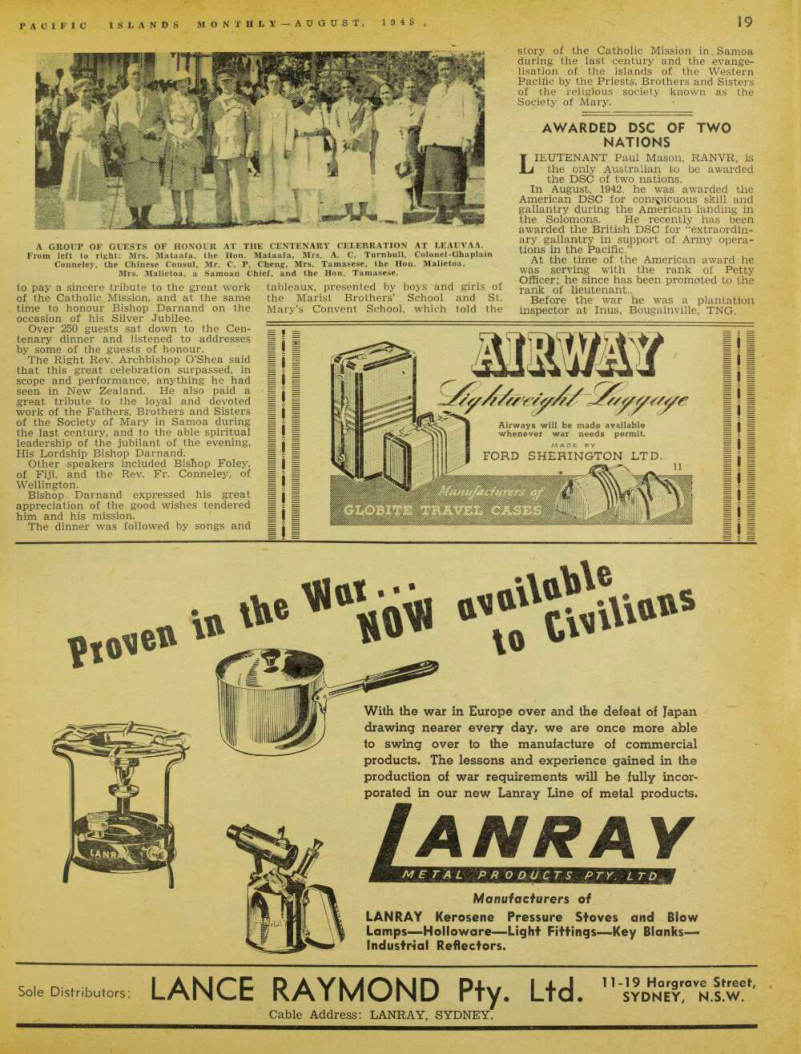
One Hundred Years Of Service
W. Samoa Celebrates Centenary of Catholic Mission and Bishop Demand's Jubilee
From Our Own Correspondent
TT i—, , APIA, July 12. rnHE four days from July 3-6 were X memorable ones in the hundred years’ history of the Catholic Church in Samoa. Attended by an estimated ten thousand church adherents, the Centenary of the Catholic Mission and, at the same time, the Episcopal Silver Jubilee of His Lordship, Bishop Darnand, was cele
brated—the pomp and im pressive European church ceremony combined with the colourful procedure of a Samoan feast.
Several high church digni taries, who. had arrived by plane from overseas, had come specially for this great function, amongst them, the Right Rev. Archbishop O’Shea, of Wellington, New Zealand, who, 25 years be fore, had come to Samoa to consecrate Bishop Darnand as Bishop of Samoa; Bishop Foley from Fiji; Bishop Pon cet from Wallis Island, and the Rev. Fr. Conneley, Colonel - Chaplain, from Wellington.
The celebrations began on July 3 at the Seat of the Catholic Mission at Moamoa with a Pontifical High Mass and Te Deum. This was followed by a distribution of food to the Samoan gather ing and a Centenary and Jubilee dinner.
During the afternoon there was a grand procession of Catholic school children, followed by songs and native dances and the consecration of schools.
In the evening, cantata and tableaux commemorating
’scenes of the life and martyrdom of Blessed Peter Chanel were presented on the Moamoa Malae by a joint choir of
land™ 10 " 8 ' aCCompanied * the Moamoa On July 4, the actual anniversary of the founding of the Mission, the celebra tions took place in Apia. Pontifical High Mass was held in the morning; the after noon was given over to the children and at night a reception and dinner ’were given by the European Parish
On July 5, the celebrations were at the Cathedral seat of Leauvaa, where High Mass was followed, in Samoan tradition, by a Royal Kava ceremony, at which the Bishops met the Samoan Chiefs.
A Taumafataga (Samoan Dinner) fol lowed and, in the afternoon, songs and dances.
In the evening, tableaux and songs were performed by a joint choir of 500 voices, representing the spirit and pro gress of the work of the Catholic Church in Samoa.
The celebrations closed on July 6 with a distribution of food by the Leauvaa district, by native dances by the pupils of the schools, and by gift offerings (Taalolo) by the various districts of Samoa.
Reception and Dinner
rE reception and dinner given by the members of the European congre gation of the Cathedral of Mary Immaculate, Apia, in commemoration of the Centenary of the Catholic Mission in Samoa? and in honour of the Episcopal Silver Jubilee of His Lordship the Most Rev. Joseph Darnand, on July 4, at the Catholic Club, was one of the best organised functions of this kind ever held in Samoa.
Representatives of all sections of the European community, including the Administrator, Mr. A. C. Turnbull, mem bers of all denominations and Samoan leaders joined the Catholic congregation
Bishop Darnand, with the Administrator of Western Samoa, Mr. A. C. Turnbull, and Bishop Poncet, of Wallis Island, in front of the Cathedral at Leauvaa during the third day of the celebrations.
to pay a sincere tribute to the great work of the Catholic Mission, and at the same time to honour Bishop Darnand on the occasion of his Silver Jubilee.
Over 250 guests sat down to the Cen tenary dinner and listened to addresses by some of the guests of honour.
The Right Rev. Archbishop O’Shea said that this great celebration surpassed, in scope and performance, anything he had seen in New Zealand. He also paid a great tribute to the loyal and devoted work of the Fathers, Brothers and Sisters of the Society of Mary in Samoa during the last century, and to the able spiritual leadership of the jubilant of the evening, His Lordship Bishop Darnand.
Other speakers included Bishop Foley, of Fiji, and the Rev. Fr. Conneley, of Wellington.
Bishop Darnand expressed his great appreciation of the good wishes tendered him and his mission.
The dinner was followed by songs and
tableaux, presented by boys and girls of the Marist Brothers’ School and St.
Mary’s Convent School, which told the
story of the Catholic Mission in, Samoa during the last century and the evange lisation of the islands of the Western Pacific by the Priests, Brothers and Sisters of the religious society known as the Society of Mary,
A GROUP OF GUESTS OF HONOUR AT THE CENTENARY CELEBRATION AT LEAUVAA.
From left to right: Mrs. Mataafa, the Hon. Mataafa, Mrs. A. C. Turnbull, Colonel-Chaplain Conneley, the Chinese Consul, Mr. C. P. Cheng, Mrs. Tamasese, the Hon. Malietoa, Mrs. Malietoa, a Samoan Chief, and the Hon. Tamasese.
Awarded Dsc Of Two
Nations
Lieutenant Paul Mason, ranvr, is the only Australian to be awarded the DSC of two nations.
In August, 1942, he was awarded the American DSC for conspicuous skill and gallantry during the American landing in the Solomons. He recently has been awarded the British DSC for “extraordin ary gallantry in support of Army opera tions in the Pacific.”
At the time of the American award he was serving with the rank of Petty Officer; he since has been promoted to the rank of lieutenant..
Before the war he was a plantation inspector at Inus, Bougainville, TNG.
Advertisements & other items, pp. 21-22 (1 item)
lan ray
m
yy///fsYyy///
Airways will be made available whenever war needs permit.
MADE BY
FORD SHERINGTON LTD.
. ,r\ 11
ham i
W
\vve
«OVI
With the war in Europe over and the defeat of Japan drawing nearer every day, we are once more able to swing over to the manufacture of commercial products. The lessons and experience gained in the production of war requirements will be fully incorporated in our new Lanray Line of metal products.
lan ray
METAL PRODUCTS PTY. LTD.
Manufacturers of LANRAY Kerosene Pressure Stoves and Blow
Lamps—Holioware—Light Fittings—Key Blanks—
Industrial Reflectors.
Sole Distributors: LANCE RAYMOND Pty. Ltd. "^dneTnl'™’
Cable Address: LANRAY, SYDNEY
Modern Refrigeration for the South Sea Islands
The ELECTROLUX
KEROSENE OPERATED
REFRIGERATOR
MARVEL
OF
MODERN
SCIENCE
i
THE
MIRACLE
OF
ICE
FROM
HEAT
ELECTROLUX OFFERS ECONOMICAL, modern and completely efficient
REFRIGERATION FOR ISLANDS' HOMES.
FREEZES CONTINUOUSLY WHILE SMALL LAMP BURNS,
Freezing controlled by simply regulating height of flame. Uses only i gallon of kerosene per week. t MOTORLESS ... NO PARTS TO GET OUT OF ORDER.
MODEL L 22 MODEL L3BO MODEL LKSSO Capacity • (as illustrated) Capacity a.a cubic feet. Capacity 4 cubic feet. 8.5 cubic feet.
GUARANTEED FOR TWO YEARS.
• Write to your Local Distributor for prices and full details. — ' ' ' » OBTAINABLE FROM ALL W. R. CARPENTER & CO. LTD.
BRANCHES THROUGHOUT THE ISLANDS
Representation in Papua and New Hebrides.
Broadcasts For
Papuans
Good Work Through 9PA
AN interesting development of the war period in Papua is the organisation of a radio broadcast service for Papuan natives. The natives take an extraordinary interest in it; and, if it is carried on as it was begun, it may become an important factor in the future govern ment of the Territory. .
The service was commenced by Major W. R. Humphries, formerly Senior Resi dent Magistrate, about May, 1944; it later was carried on by Captain Baskett; and in October, 1944, Major-General Morris, who has taken a keen and consistently helpful interest in the new service, put Sergeant Maynard Lock, of ANGAU, in charge of the radio session.
Sergeant Lock was born in Papua, son of W. N. Lock, who was superintendent of SDA Missions there. He could speak Motuan before he spoke English. He was in the Papuan Public Service when war came; he enlisted, and was later trans ferred to ANGAU. His brother, Private Earl Lock, became his assistant; and now these two, with the aid of two well trained natives, conduct the Motuan radio session from station 9PA (Port Moresby) three times a week; run a small library (which is rapidly growing) for natives; and issue a monthly eight-page stencilled newspaper in Motuan. The radio programmes are transmitted on long and short waves on:— Sundays.—News of patients in the various native hospitals, transmitted by radio and picked up in the various vil lages. If there is time, a fable (story) is broadcast. Educated natives supply the stories, for prizes of 5/-. More stories arc submitted than the staff can comfortably cope with.
Tuesdays.—War news and local news, with explanatory notes. If there is not enough local news, there is a medical talk.
Thursdays. Mostly entertainment stories from listeners and readers, and musical items. One Thursday in each month is “Children’s Day.”
ONE day in each month the session is devoted to the work of the Papuan Central Training School. The TB hospital, established on Gemo Island in Moresby harbour by Sir Hubert Murray in the thirties, was taken over by ANGAU as a base hospital and train ing school for Europeans and selected
natives many of whom in due course are to do ’medical work among the native villages Officers from the school give talks in Motuan—news of the school, lectures concerned with medicine, hygiene, sanitation Selected natives are brought to the microphone, to give their own version of events in the hospital to their fellow-villagers.
The most popular items are those given by the native choirs, which include a children’s choir. The choirs are conducted by Sergeant Lock.
Ao on nor r-pnt nf Pannans can S about 80 per cent, of Papuans can understand Motuan, this new feature of native administration is ranidlv becoming popular. The native villages eagerly subscribe around £3O for the purchase of a community receiving
set. It has four or five valves, runs on dry batteries (which remain good for about six months), and is jealously kept in the house of the village constable.
The whole community gathers at fixed times to listen in. The nearer villages use the long wave; but more distant places receive on short wave. The broad casts now reach between 4,000 and 5.000 natives; and the audience is increasing as fast as wireless sets can be obtained.
This use of radio directs attention to the use of Motuan, which the Murray Administration tried, over many years, make lingua franca of the Terri .
There are very many different lan guages in Papua (as in most Western Pacific Territories), and each tribe speaks
Motuan differently. To-day, few people can speaks pure Motuan. The Motuan that is in general use—and which is used in radio —is Police Motuan, and—having little grammar or syntax—it bears about the same relationship to Motuan as Pid gin English does to English.
The new radio feature may help to spread Police Motuan. and give it an advantage over Pidgin English, which has been creeping across from the Mandated Territory since the Jap invasion came, and the military administration broke down the old border barriers. Most of the New Guinea natives are now return ing to their own Territory. Their Papuan cousins will talk Pidgin with them, but they "do not like Pidgin, and will not talk it among themselves.
IT is the purpose of the promoters of the scheme to use the Police Motuan language to advance the natives’ knowledge of English. The natives are eager for knowledge, and those who have acquired enough education to read Eng lish (mostly through the mission schools) will take what they can from books, and
pass it on to their uneducated fellews.
The officials made an appeal in Aus tralia, through “Women’s Weekly,” for books for the Papuans, and they had a remarkable response, and about 500 letters.
The books thus obtained (mostly books written for children) formed the nucleus of the present small but growing library, of which the Papuans are gladly avail ing themselves.
Advertisements & other items, pp. 23-24 (1 item)
O. F. Masschelein, Sydney
i Rise Sure to mot* pgimaious sqtgdg;
To Make Tasty Pastry and
Good Bread
BAKING POWDER
is
IMPORTANT
"DOUBLE-ACTION"
Guarantees Better Baking
RADCO is a combinaton baking powder, because it contains a combination of ingredients which make it act twice —not Just once.
RADCO’S first action, which begins in the mixing bowl, starts the leavening process. Then in the oven, a second action keeps on raising the batter or dough until the cake, biscuits, scones ... all baked products ... are light and fluffy—perfectly leavened and perfectly baked.
You will find RADCO Baking Powder makes all your baking—cakes . . . etc. . . marvellously light and delicious. This is because it has double action.
Money can NOT buy a Better Baking
Powder than RADCO.
Custard Powder, Blanc Mange, Jelly Crystals, Soup Mixture,
Cornflour, etc.
O. F. MASSCHELEIN, Sydney
Exporter of Australian Quality Products Only.
A This Company supplies Aluminium and its Alloys to all specifications and for every commercial application where these give better service over other metals. Please consult our Technical Service Department regarding your light metal problems.
AUSTRALIAN ALUMINIUM COMPANY
Pno P PIET ARY LIMITED
( INCORPORATED IF THE STATE Of VICTORIA!
GENERAL OFFICES AND FA tRICA i I O N DIVISION: GRANVILLE. SYDNEY, N.S.W.
A
Woven Wire for all Industry
COPRA DRYING TRAYS, FLOORS, Etc.
FRUU DRYING TRAYS, MINING SCREENS.
Heavy. Mosquito Gauze in Phosphor Bronze and other Metals Impervious to Salt Sea Air.
WIRE DOOR MATS AND GENERAL WIRE WORKS
E. WRIGHT & CO. LTD.
Office and Works: 148-152 Cleveland Street, Sydney, N.S.W.
Telegraphic Address: “Wrightmake,” Chippendale.
Scholarship For Young
Territorian
ONE of the Gowrie University Scholar ship awards announced recently went to Murray Charles Groves. He is the son of Major W. C. Groves, who was well known in New Guinea before the war.
Major Groves was a Commonwealth official attached to the New Guinea Education Department. He did consider able anthropological work and research into native education in the Territory.
Since the war he has served in the Army Education Service.
Recruits For Colonial
Service
New Conditions Issued
CONDITIONS of entry for the British Colonial Service were announced in London a few weeks ago. The im mediate plan is to facilitate the employ ment of men and women who have been serving in the armed forces.
Age limitations have been modified, therefore, and provision has been made for counting war service, to some extent, in fixing initial salaries.
Two age limits have been fixed. For the Colonial Administrative Service, the Audit Service, Customs Service, and Sur vey Service, candidates must have been born on or after January 1, 1910.
For the Colonial Agricultural, Educa tion, Engineering, Forest, Legal, Medical, and Veterinary Services, and for Labour and Social Welfare appointments, candi dates must have been born on or after January 1, 1905.
Further details of qualifications re quired and general conditions of ser vice are available at the Colonial Secre tary’s Office, Suva.
Death Of Suva's Oldest
Inhabitant
rE death of Fiji’s oldest European, Mr. J. F. Crawford, occurred in July, at the age of 99.
Mr. Crawford was born in Scotland on April 11, 1846. He came to Fiji in 1900, and for many years followed the trade of plumber.
About eipht years ago he entered the Cottage Home in Suva, and from then until a short time ago, when he was ad mitted to hospital, he was a well-known figure in the town as he took his daily walk.
Advertisements & other items, p. 24 (1 item)
Widdop
» PE <3 n
DIESEL ENGINES
5 H.P. to 500 H.P.
H. WIDDOP & CO., LTD. green^a5 e d ,ghley Telephone: Keighley 3727-8 :: :: Telegrams: Widdop Keighley Codes A.B.C. 6th Edition, Bentleys, Bentley’s Second We are prepared to consider Agencies for certain territories i\ motor Coaster S. America . / n Firefloat Egypt.
Passenger Ferry, l Nigeria.
Tug, England cvs-8( Passenger Boat, Middle East.
Visit Mangaia
"Orange Island" Bloc Urged
Makea and Other Rarotongan Leaders Visit Mangaia
From Our Own Correspondent
Mangaia, June.
WHEN the first fruit-steamer for ’45 called here recently, she carried the Makea of Rarotonga (Mrs.
Takau Rio Love), Mr. W. P. Browne, and Major Ward, who all came ashore to hold meetings, for the promotion of native welfare on this island.
There is much local dissatisfaction with the 6/- a case now offered for oranges.
And there are Mangaian war veterans (of World War I), broken in health, who have never had a penny of pension from the New Zealand Government for the best part of 30 years.
The visit of the leaders was in con nection with these two urgent reforms.
Mr. Browne and Mrs. Love both addressed large gatherings, urging the union of all Cl “orange islands” into a bloc, capable of bargaining collectively with the fruit-market in NZ, and, if necessary, suspending shipments from the whole Group if the present unprofit able price (to planters) is not raised.
It is stated that 6/- a case does not repay the labour and outlay of picking— arduous work, upon hilly Mangaia!
The same fruit, it is declared, fetches 35/-, and over, on the NZ market; and adjustment is being sought, in view of this profit of 29/-.
A DOCTOR from Rarotonga spent the steamer-day examining the native veterans of 1914-18, and a pensions
official from NZ recorded claims on their behalf.
The outcome has yet to be seen.
One of the veterans, who is helpless, was brought to the Dispensary by truck; and his condition excited much comment, as he is unable to work, and, until Major Ward took up his case, was entirely with out means.
At Mangaia only the fit survive, unless they possess money; the native life of the island being exceptionally hard for the aged and the incapable.
It is hoped that reforms will come out of fhese discussions and assemblies of steamer-day.
Mr. Browne, in conversation with this writer, spoke feelingly of the low living standards of Mangaians, caused by their slender income.
Our natives have money only between May and August each year, but their needs continue all the year round.
Profit and Loss Account
mHE very low living standard of the X outer Cook Islands is typified in the following little “statement” of a local neighbour’s profits and losses from the first fruit shipment of this year, ex . Mangaia Island:
Fifty-four shillings, minus 33/3, leaves 20/9, to be shared among a family of six persons—that is, an average share of 3/5 1 to repay a week’s hard work in the hilly inland, among dense bush, and, this steamer, in pouring rain.
For this “basic award wage” of 3/5 h per individual, the Internal Marketing Division of the NZ Government has obtained nine cases of first-class oranges, the Group’s best, to sell in New Zealand at 35/- or more per case!
Is it to be wondered that the native planter feels that the IMD are robbers, and the LMS a drain upon native Christians?
9 cases oranges, at 6/- case .. 54/- Less: Levy for church repairs, 1/- per case 9/- School fee for one child .. .. .. .. 10/- Annual sub. to LMS (married
couple) 12/- Trucking cases to landing-place .. 2/3 Total 33/3
Worlds Biggest Islands
REFERENCES to New Guinea as the world’s biggest island have been challenged. It is claimed that Greenland is the world’s biggest—or maybe Australia. But Australia, like North and South America—all wholly sur rounded by water — ate classed at con tinents. No ship ever has sailed right around Greenland—its everlasting ice makes it part of the Arctic Continent.
The area of the world’s biggest islands: —
Square miles.
New Guinea ... 313,000 Borneo . . .. 306,906 Madagascar ... 241.094 Sumatra ... 163 048 Victoria ... 87,884 Honshui (Japan) .. .. ... 87,425 Great Britain . . .. 85,971 South Island (NZ) .. .. . . 58,092 Java . . . . 49,532
Advertisements & other items, p. 25 (1 item)
54A Pitt St. Svdnev N.S.W.
IMPORTERS
EXPORTERS
w \ s X) r ftfl Island Distributors for
"COLEMAN" HEATING AND LIGHTING APPLIANCES
"DINOX" AND" DIX" BRANDS OF BROOMS, BRUSHES AND MOPS
BANKERS: BANK OF N.S.W.
COMPTOIR NATIONAL
D'ESCOMPTE DE PARIS
54a PITT ST. SVDNEV N.S.W.
W. CABLE ADDRESS:
“RO BERG ILL”
PHONES BW 4782-B 1305
Guadalcanal
A Dutchman's One-Man War On
By Harold Cooper
OUR Allies, the Dutch, who have fought with us on so many battlefields, from their own Low Countries to the jungles of New Guinea and Tarakan, may not know it, but they were worthily, albeit modestly, represented in the campaign to drive the Japanese out of Guadalcanal.
Their representative was a Roman Catholic priest, Father de Klerk, who was in command of a party of native scouts operating on the southern side of Cape Esperance, at a time when the Japanese were making their last stand there.
De Klerk had lost touch with his family in Holland after the Nazis had overrun Western Europe, but he knew enough about what was happening in his home land to be eager to snatch any oppor tunity of striking a counter-blow, how ever puny, at the hated Axis powers. His chance came after the Americans landed on Guadalcanal, and he made the most of it.
When I visited him at his quiet mission station in mid 1943 he had given up war faring, for there were no Japs left in his scattered parish, but he was full of stories of the good old days when he wore Marine uniform, and went out on regu lar patrols with his little band of poorly trained but enthusiastic riflemen.
He told me how, on the first of these patrols, he entered a remote hill village and inquired of the elders whether they had seen any Japanese in the vicinity.
Their answers were strangely evasive, and he began to wonder whether he was in the presence of Fifth Columnists.
Then one of the villagers decided to make a clean breast of it. He explained that there had been a number of Japanese
bivouacked nearby, and that they had be haved in an intolerable manner, ran sacking houses and looting gardens. In the end the villagers had seen nothing for it but to take the law into their own hands and had killed eighteen of their unwelcome visitors. Would Father de Klerk kindly say nothing at all about this unpleasant business to the District Officer, because he knew what an ugly view the Administration took of murder?
The Father explained, as clearly as he could without getting launched into a dissertation on international law, that the killing of Japanese soldiers who were ter rorising civilians on Guadalcanal was likely to be regarded as justifiable homi cide. The villagers were vastly relieved to hear this pronouncement. Two days later they sent a special runner down to the Father’s head-quarters to let him know that they had despatched another twenty-odd Nips. They thought he might like to bring his score sheet up to date.
DE KLERK had a little navy of his own, consisting of the ten-ton schooner “Kokorana,” loaned to him by the Government for the duration of his service with the armed forces. She had her adventures, the most exciting of which de Klerk recounted for me. She was lying one night in a bay on the north side of Guadalcanal —most of which was then No Man’s Land—when machine guns brought up by a Jap patrol opened fire on her from the beach at point-blank range.
The bo’sun hastily turned his ship about and took her out to sea, leaving the dinghy floating in the bay.
On shore three men from the “Kokor ana” had been stranded and two of them, both Americans, were casualties after the first burst of enemy fire. The third—a Solomon islander—dragged them to a hid ing place in the mangroves, out of sight of the Jap gunners, then swam into the bay and brought in the dinghy. Under sporadic fire from the enemy ambush he hauled the wounded men into the dinghy and rowed them round the point to safety.
In this action an American private was severely wounded and afterwards died.
His grave can be seen at le Klerk’s mis sion station. It is beautifully kept and de Klerk corresponds regularly with the dead man’s parents.
One story de Klerk told me was in lighter vein. Towards the end of the Guadalcanal fighting he was linked by telephone with the American head quarters at Lunga, and used to act as a one-man radar station, sending warnings of the approach of enemy bombers. One day his boys brought in an American airman who had crashed on his way home, and who was slightly wounded.
De Klerk rendered first aid, and the American, after a hearty meal, went to bed. During the night de Klerk was awakened by the hum of what he sup posed to be an aircraft engine, and he flashed a warning to Lunga, where a “Con dition Red” came into force at once.
After a while de Klerk noticed, to his perplexity, that the bomber seemed to be getting no nearer to its target. Instead, judging from the sound of its engine, which grew neither louder nor fainter, it was hanging stationary in mid air.
Then, suddenly, the explanation dawned on him. His American guest was snor ing softly next door. He had sent thou sands of men into their foxholes just because one man happened to be breath ing a little heavily!
Advertisements & other items, p. 26 (2 items)
24
AUGUST, 1945 TACIfIC ISLANDS MONTHLY
G. H. Robinson
Island Merchant and Agent
OF 51 MACQUARIE STREET, SYDNEY
having returned to business, can, as a result of over twenty years 7 extensive experience (excluding service in two wars) guarantee prompt and efficient * individual service as a buying agent to Pacific Island clients.
Enquiries arc solicited to— Box 3317, G.P.0.,
SYDNEY.
New Members Needed
For PI Society President Reports at Annual Meeting
INCREASED membership and larger attendances at monthly meetings and social gatherings are necessary if the Pacific Islands Society is to continue to function vigorously. This was made clear to members in the report submitted by the president of the society at the annual general meeting in Sydney on July 25.
The membership is now 161, of whom 12 are new members. There was one resig nation from the society during the year, and a number of unfinancial members were struck off the list.
Twelve gatherings were held during the year; eight speakers addressed members on Pacific subjects during the same
period. ( ,
Members were urged to do their utmost to obtain new members for the society, both among Pacific Islands residents, and those interested in this region.
Finances BALANCE at the bank on June 30, was £36—£6 less than at the same date last year. Receipts from subscrip tions during the year were £29. and from social gatherings, £53. Expenditure on social gatherings was £Bl, making a deficit for the vear of £6.
Later in the evening, the secretary, Mr J. T. Bensted, reported that Miss A D. M. Bushby, of Bowral, had donated the sum of £6/14/- to offset the deficit for the year.
Election of Officers rE following officer bearers were elected: President, Mr. F. D.
McCarthy; vice-presidents, Mr. L.
Freeman and Major C. A. Swinbourne, OBE; secretary and treasurer, Mr. J. T.
Bensted; assistant secretary, Mr. C. Price- Conigrave; councillors, Mrs. M. S.
Williamson, Major C. M. Southey, Messrs.
A. E. Stephen, E. A. Sturt, and L. Walker; hostesses, Mrs. R. W. G. Gosset, Mrs. E.
Marie-Irving, and Mrs. G. Mackaness; auditor, Mr. R. H. Clarke.
Address by the President
AFTER the business of the meeting had been completed, members were ad dressed by the president, Mr. F. D.
McCarthy, who spoke on the art of the Melanesians of the Western Pacific.
He drew 'attention to the need for more intensive collecting by the museums of Australia in order to secure adequate collections of Melanesian art material. In spite of the war, he said, there still remains in the Western Pacific, many fine speciments of native art.
The Rev. N. H. Wright, of the Metho dist Mission, Lautoka, Fiji, is on deputa tion work in South Australia.
Flying Officer Victor Hjorring has been awarded the MBE. His father was at one time Mayor of Levina, Fiji, and
he himself spent his youth there. He joined the RNZAF before the beginning of the war.
Advertisements & other items, p. 27 (1 item)
Foster Clark's
.. here j help ... and how!
Gut lunches for the kiddies and your husband makes you wary of dessert recipes that include precious butter. So you’ll welcome Foster Clark’s Creamy Custard to your pantry shelf, and Foster Clark’s Creamy Custard recipe book, packed with scores of thrifty and tempting dishes made from non-rationed ingredients, will solve your problem Write now for your copy to Poster Clark (Aust.) Ltd., Dept. R. 8., Reifern, N.S.W., enclosing postage a Mula C s *
I I r* 1 Bond Street, Sydney, Australia. £* xJ) *J U>j f I VTeL B 4167. Box 3615 G.P.O.
SUPPLIERS OF GENERAL MERCHANDISE TO LEADING FIRMS THROUGHOUT THE
PACIFIC ISLANDS
Exporters ... Importers ... . Manufacturers' Representatives Bankers: Bank of N.S.W. Bank of Adelaide. Comptoix Nat. d’Escompte de Paris.
War Time Cable Address: GOUGH CO., 1 BONDSTREET, SYDNEY.
Codes: Bentley’s, 2nd and Comp. Phrase; A.8.C., sth and 6th; Peterson, 2nd and 3rd; Banking; Acme.
In Defence Of Pidgin-English
History of its Adoption by the N. Guinea Catholic Mission
SOME people blame the Roman Catholic missionaries for not having introduced a native language as a common language for missionary purposes in New Guinea. Badly informed men compare New Guinea with Africa, where the Suaheli is spoken widely.
It must be emphasised, however, that Suaheli was developed by the natives themselves in their intertribal trade and traffic, and without any European influence. Early Territorians suggested the use of the TO (Gunantuna) language of New Britain as a common language—even the German Administration was inclined to take decisive steps in this direction. because this language was spoken by over 30,000 people, the greatest tribe then known. But nothing came of the idea.
The Lutheran Mission, of Finschhafen introduced the Jabim language for the islands and the adjoining coastal strip; in the inland around Sattelberg, the Kate language, further inland the Amele language. and in the mountain district of Wahgi valley other native languages, but generally the Lutherans seem to have made use of Pidgin-English, too.
That the Catholic Mission of Central and East New Guinea never introduced a common native tongue after the Lutheran plan can be understood when one knows the history of both missions.
The Lutheran Mission started at Finschhafen and Madang, and extended from
there further inland. The Catholic Mis sion went leapfrogging from Aitape (Tum leo Island) to Alexishafen, a distance of 200 miles, contacting en route only small tribes of two to three hundred. Alexis hafen itself was an uninhabited jungle.
QEVERAL times in the past Malay has O been suggested as a lingua franca, Doubtless it would have had great advantages for missionary and trading activities. It is spoken all over the Dutch East Indies. The German Administration considered this proposal, too, but it was unanimously turned down, The main objection was that it was an unknown, strange language to the natives.
Although the Malays traded in the early days with the natives of Northern New Guinea, as can be proved by brass-cannon found at different places, the natives never showed any great interest in the Malay language.
It has often been asked why English was not introduced in the mission after the Australian occupation of New Guinea in 1914. The reason is that the Australian Government showed remarkably little in terest in the mission schools then—and very little more since, In defence of the mission policy, W. C.
Groves, an expert native educationalist attached to, the Mandated Territory’s Education Department, may be quoted. He said in his book “Native Education and
Culture Contact in New Guinea”: “When English is widespread in New Guinea vil lages, there will no longer be New Guinea villages. And a sorry thing that, indeed, would be.”
Straight English is taught in the Roman Catholic Central Teachers’ Colleges for an elite of clever students. It is necessary for the education of the native clergy
JYJOST of the ideas in this article come from an essay on Pidgin-English, written by Dr. G. Hoeltker, editor of the international anthropological journal, “Anthropos,” now pub lished in Switzerland. A “PIM” reader has translated Dr. Hoelt ker’s work—which he says is highly scientific, with more foot notes than text—and added a few comments of his own.
anyway. But for the rest, the plain fact of the matter is that the Roman Catholic Mission simply made use of the Pidgin- English known already to many of the natives.
Pidgin-English first reached the ears of the natives of New Guinea about 100 years ago. The natives were then mak ing their first contact with Europeans— mostly sandalwood-gatherers, pearl divers, trepang-fishers. whalers, “black birders,” of Anglo-Australian, Anglo- American, or Hispano-American descent.
On the mainland of New Guinea Pidgin was introduced mostly by plantation labourers, domestics, and police boys, who were recruited from New Britain and the Solomon Islands.
When the Catholic missionaries arrived there, Pidgin-English was already spoken, and was soon used by the mission staff when dealing with the labourers.
In the past 20 years the knowledge of Pidgin has spread with incredible speed all over the Territory. Before the war, there were about 40,000 indentured natives all making use of the language.
After having finished his term of labour, the native returned to his home village.
He was then a “finish-timer”—and thought himself superior to all his fellow villagers, because above all, he has the snobbish mentality of a parvenu.
With his boxful of European trade goods (even peroxide and perfumes) he brought a mouthful of Pidgin.
On every occasion he paraded the “talk whiteman.” Soon he stirred an ambition in the hearts of the village belles and children to learn this new language.
Remarkable is the adaptability of Pid gin to all phases of life. All feelings, the most intimate feelings, thoughts and moods can be emphatically expressed.
Even love letters or hymns can be written it it. . , , Stories are told; dances accompanied by Pidgin songs are created and introduced and soon the whole village (including the “Lapuns”) speak and sing Pidgin.
It does not take long, because in many places more than 50 per cent, of the male population are “finish-timers.”
IN one Catholic mission school in the early days there were 120 students, speaking 30 different tongues. Con ferences of experienced missionaries were called together, the problem was discussed and at last it was decided to take on the already existing Pidgin as a lingua franca.
A dictionary and grammar were com piled, and in a short time about 50 dif ferent publications came off the press at Alexishafen (bibles, hymnals, fairy stones, history, general knowledge, etc.) A monthly magazine “Friend Belong Me, was edited and produced.
Some uninformed people blame the
Catholic Mission for insufficient linguistic knowledge and lethargic disinterestedness; they believe that that is why the mission took on Pidgin-English—■because it was unable to master the difficulties of a native tongue.
It may be pointed out that all the missionaries mastered one or several native tongues. It is an essential re quisite to grasp Pidgin fully, because it has a Papuan-Melanesian grammar with a collection of words from all the lan guages of the world, the dominant one, of course, being English.
All the Catholic missionaries who name from Europe had to undergo a course of linguistics and phonetics with final examinations at the internationally re nowned “Anthropos” Institute near Vienna (later driven into exile in Switzer land by the Nazis). Therefore, I cannot agree with the “Pacific Islands Year Book’’ which states: “Philologists and people with a scientific training dis like Pidgin intensely.’’
Linguistic authorities such as the late Father F. J. Kirschbaum and Father J.
Shebesfa were responsible for the intro duction of Pidgin as a lingua franca for missionary purposes in New Guinea.
No doubt Pidgin will have a great future. The war has increased its in fluence and use. Papuans as well as New Guinea natives now speak, or are learn ing to speak it.
Lieutenant-Colonel W. L. G. Townsend broadcasts weekly from Port Moresby in Pidgin. Millions of leaflets written in Pid gin have been droped in occupied terri tory and have had great influence on the morale of the people. Japanese as well as Australian officers have had to undergo courses of instruction in it. Many books have appeared about it, the best written by Captain J. J. Murphy, formerly of the civil administration. It has been warmly recommended by ANGAU chief, Major-General Basil Morris.
Advertisements & other items, p. 28 (1 item)
Allen Taylor Co. Ltd.
COMMERCIAL ROAD, ROZELLE,
SYDNEY
Sowmillers and Wholesale Suppliers of Hardwoods for Constructional Purposes GIRDERS , . , PILES . . . POLES . . . SLEEPERS, Etc
EXPORTING TO PACIFIC ISLANDS SINCE 1893
fd
Mission's Acute Transport
Problem
IN its anxiety to keep travelling ex penses at a minimum, the Methodist Mission insists that missionaries travelling to and from the field must journey by surface transport and not by air.
This has meant that sometimes mis sionaries have had to wait in New Zea land as long as four months for a boat connection.
Because of Fiji’s urgent need and the number of missionaries waiting in Aus tralia, rules were relaxed and air trans port agreed to; but still the problem remains unsolved.
Sister E. H. Taylor, of Queensland, has been in Sydney since May waiting for a plane booking and the Rev. and Mrs.
Ivan Blake and Beverley, after having waited in Victoria since March, came to Sydney on June 8 to embark for Auck land en route for Fiji and have been stood down daily ever since.
The Rev. and Mrs. D. I. Telfer have been waiting in Adelaide since March for a plane booking to Fiji.
We can only hope that transport faci lities will be eased soon and allow new workers to proceed to their fields and weary missionaries to take their well earned furloughs. —Methodist Missionary Review.
News has been received in Noumea that Jean Milliard, Engineer Lieutenant, taken prisoner by the Germans, was freed when the Allies advanced into Austria.
Dr. Captain Mattei, of the French medical service, has returned to France from New Caledonia. His district of Hiengherie has been taken over by Dr.
Lieutenant Ferron, who previously had charge of the Koumac area on the west coast.
Two Young Men Convicted
Of Murder
From Our Own Correspondent
Noumea, July 15.
TWO young men, one French, one an Annamite, were recently tried in Noumea and convicted on a charge of having murdered a Tonkinese barber on November 15, 1944.
The Frenchman, Jean Paul, was sen tenced to 20 years’ imprisonment; the Annamite. You Guy van Phao, to ten years in a reformatory.
Advertisements & other items, p. 29 (1 item)
Pinkettes
After taking Pinkettes you should feel brighter, hoppier, and free from sick headaches, bilious attacks and liverishness. For
are tiny laxative and liver pills, which painlessly exercise the digestive system.
IQ 9 b» J A
■9l YEARS
-3 $ *j%S, tr, 31
SWALLOW e AfiIELL m
cuti • niMia • ici cilia aims tr »»«c«iit . 1 v t o uifc* v>i( »v •< S>Z e
The Shoot Lamp
“Pim” Short Story:
By Martin Mackinlay
rpHE night bad been the darkest ever X experienced in the valley. Not merely the darkness that*" comes with moonlessness and rain—and there had been that as well—but a total eclipse of all light. Even the night creatures of the jungle, that usually rasp and hoot from sun-down to sun-up, had been still. Their silence had added depth to the blackness.
But, as the first light trickled down over the mountain top, and the mists lifted sufficiently to reveal the huddle of thatched huts on the terrace thirty feet above the river, two natives rounded the bend of the stream. There was nothing strange in that, of itself; at dawn the labourers on the claim came up the river to the main house to receive their rice issue and their instructions for the day, from Tom Davis.
But, usually, they came in a long, straggling line of half-sleepy automatons, rubbing the light into their eyes with grimy knuckles, and huddled into flannel shirts and extra lay-lays against the faint chill of the tropical dawn.
On this morning, only the two boys appeared, and they at the double. Neither were their eyes dulled from long hours in the smoky labour houses, almost hermetically sealed against the evil machinations of local tambarans, masalis and other assorted devils. They were, on the contrary, bright with some emotion and their faces were the pale, sickly fawn of the Melanesian who has had a soul shattering shock.
They took the long flight of earth and sapling steps that led to the camp above, two at a time; and instead of approaching the master’s house with traditional deference and announcing their presence with a series of polite coughs in rising crescendo, they ran swiftly across the split-palm floor of the verandah and came breathlessly to a halt in front of the doorless doorway of Master Tom’s bedroom.
The occupant of the crude bush bed. roused by the unusually hasty pattering
of feet over the yielding palm-wood floor and the consequent trembling of the rest of the flimsy establishment, stuck his tousled head out from under the mos quito-net and demanded with some irritation: “God-dammit— what name something?”
“Master—Master!” Apparently their news was of such magnitude that the boys’ thoughts boggled there, and only after half a minute of gulping, eye-rolling and pointing dramatically in the direction from which they had just come were they able to continue, in duet: “More better you come quicktime. Master Mick ’e fall down along water. More better ——•”
“Master Mick!” The xjvhite man was out of his bunk in one supple movement, “What name water?”
“Close-to. Me t’ink ’e die-finis.”
“Die-finis? You must be crazy!” Paus ing only long enough to haul on a pair of boots, Davis set off, led by the two boys, who ran ahead like anxious pups, He followed them round the bend and up a flight of rough steps, longer than that which led to his own camp. At the top they crossed a small, level piece of ground in front of a number of labour houses, to where the Test of the labourers stood in a silent, scared knot, looking anxiously down into a deep gulch, where, when it rained heavily in the mountains, a turbulent creek rushed out to join the river lower down, fpHE group parted to let Davis through.
X Below the sheer rock wall, on the far side of the gulch, the figure of a man in blue pyjama trousers and a cotton singlet sprawled grotesquely, the head half hidden among the rocks. There was no doubt about it: it was Mick Lonegan.
Davis swung himself over the rim of the cliff and, holding firm to roots and bushes, gingerly eased himself down the sloping side.
One look at Lonegan was sufficient to convince him that the man was very
dead. One side of his head, where it had come in contact with the rocks, was covered with congealed blood. Davis glanced at the cliff above, where stones and vegetation had been dislodged by the fall; evidently death had been instan taneous.
But how had it happened? The creek alone separated Lonegan’s claim from his own, but the only means of communi cation was via the main stream. Lone
]]/[ICK LONEGAN’S death was another unsolved mystery.
When Davis found his body at the bottom of a cliff he thought of Lonegan’s labourers and wondered if it could be murder.
Actually, Lonegan’s death was caused by the combination of a very dark night, a very long imagination—and a very human 1 failing on the part of a certain Brown Brother.
gan’s house was out of sight, on part of the same river terrace on which stood Davis’ own labour-houses, but separated from them by the deep gulch and the stream at the bottom. There was no path down Lonegan’s cliff, although there might have been a track from his house to the edge of it, where Lonegan’s boys could come to converse with the boys on the opposite side.
Did Lonegan sleep-walk? In the course of years in the same part of the New Guinea bush, they had many times shared the same rest-house and Lonegan had not appeared to have had any such fail ing.
What then had caused him to rise in the middle of the night and wander a good hundred yards through scrub and fallen trees and then fall over a cliff of whose existence he had been well aware?
The previous night had been unpre cedentedly dark; but, even so, one rarely moved in that locality without a flash lamp.
Lonegan was a bit of a fool, as evi denced by his conversation the previous day. But could it be —murder?
Davis shook his head to clear the clutching mists of doubt and shock from his brain and glanced swiftly up to where his own boys sat round the cliff edge, gazing down with scared, nervous faces. Did they know something? There was no telling with the inexplicable Melanesian, one or two generations re moved from the Stone-age, which way his mind would leap in some unexpected contingency.
No telling, either—to such an extent was the tradition of independence sedu lously maintained and respected among European residents —precisely what went on during the unknown three-quarters of a neighbour’s life —even such a near neighbour, on New Guinea standards, as Lonegan had been.
And, if it came to that, where the devil were Lonegan’s boys? Until that moment it had escaped his notifce that it had been his boys who had brought news of the accident —if accident it were. * * * AT mid-afternoon, on the previous day* Lonegan had met Davis in the river near his camp.
“Come up and have a drink,” Lonegan said. “I need one—trouble with my boys,.”
Davis had looked at the man. Lonegan was drawing on his cigarette in obvious excitement. He was shaking a little, and his knuckles were bloodied.
“The wrong type for the New Guinea
bush.” The thought came unbidden to Davis’ mind. “Unstable, and needing the sane influence of others about him.”
Lonegan’s boys were notoriously the worst-behaved in the district. They deserted with almost fixe& regularity, or “made court”- against their master with enthusiasm. Lonegan received both sets back into his because he found it hard to recruit boys in the first place—but carried on a perpetual feud with them, for the most part, verbally.
In private, his boys called him “Master Big-mouth.”
“Perhaps it’s the Irish in him; or just the ordinary cussedness of his nature,”
Davis reflected, as he turned his foot steps in the direction of Lonegan’s camp.
Aloud, he contented himself with saying: “What’s wrong this time?”
“Two big Sepiks jumped me just now, down on the claim. I had to show them who was boss. It’s always the same way with Sepiks. They always try you out sooner or later, and you’ve got to show them.”
“I’ve had Sepik boys for over ten years,” remarked Davis dryly, “and I’ve never had to show them who was boss, that way. But they seem to know all right.”
“You’re lucky in your boys; mine are a lot of .” They climbed the steep path to the terrace above and entered an untidy, thatched house. “Wangi!
Wangi!” bawled Lonegan. “Where in hell is that boy?”
At the last bellow, a brown figure de tached itself from the adjacent cook house, and, stretching and yawning, made a slow entry. “Makim tea,” ordered Lonegan. The boy received the order in sullen silence and was about to depart, presumably to execute it, when Lonegan bawled again. “Wangi—you hear ’im good?”
The boy half turned and reluctantly answered: “Yessir.”
“You see,” said Lonegan going to a packing-case cupboard and removing a bottle of whisky and two smudgy tum blers, “that’s what I have to put up with all the time. Just plain, damned in solence.” He splashed the whisky into the tumblers, shoved one across to Davis and tossed off the contents of the other in two gulps. He refilled his glass and made a move to add more to Davis’ drink.
“Hey, hold on.” Davis covered his drink with his hand. “I’ll wait for tea.”
He reflected a moment. “You want to take a pull, Mike. You’re letting things get on your nerves.”
“Yeah. I know. I’m fed up with the whole blasted place. I reckon I’ll get out for a spell soon—it is getting on my nerves. Too much fever too, lately, and quinine plays up with my eyes. Nearly went blind a couple of years ago after an overdose. I get the wind up every
time my eyes get dicky again. Well, what the hell —here’s luck.”
When Davis left, the coming darkness was already beginning to show itself in long inky shadows that reached out, making themselves one with the over bearing jungle. The whisky bottle was down to the last half-inch and Lonegan’s moods were alternating between maudlin remorse at his mis-spent life and tru culence at the raw deal Fate had dealt him.
“Fever’s coming on again,” he mut tered, as Davis got up to go. He weaved an unsteady course to a shelf, shook two five-grain capsules of quinine from a bottle and washed them down with the remains of the spirits.
“You want to ease up on both whisky and quinine,” Davis told him, “Your fever is a bottle-fed baby this time. Ease up, or you’ll leave your bones here, Mike.”
“Aw—don’t give me that. It’s fever a’right. Hell, surely t’God a man knows when he’s got fever.” * * * WHEN the last of the dishes had been removed from the table to be washed by the cookhouse monkey, Wangi placed a large cup of coffee and the quinine bottle before his master, as •had been impressed upon him so to do.
Then he went back to the cookhouse, picked up an old, battered electric torch, inexpertly unscrewed the end so that the batteries slid out into his brown paw and returned to the house.
Lonegan still sat, sunk in deep melan choly, stirring slowly at the black coffee.
As Wangi entered Lonegan’s hand went out automatically to the bottle of quinine, shook out two capsules and washed them down.
“Master,” demanded Wangi with the calm effrontery of those who are used to asking, even if they receive not, “Keo belong shoot-lamp belong me, ’e die finis. More better you give ’im new fella.”
Lonegan bestirred himself. “Oh, ’e die finis, eh? More better me give ’im new fella? That’s all you blasted coons ever think about—give ’im new fella!” His voice rose to a roar. “Get to hell out of here. Go work ’im bed.”
“Yessifi.” Unimpressed by Lonegan’s roar, which was usual; and disappointed but by no means abashed by his refusal to come across with the highly-prized torch batteries, Wangi sauntered into the partitioned-off portion of the house which sheltered Lonegan’s bed. He hung a small hurricane lantern on a con venient nail above the bed, arranged the mosquito-net and turned back the one lightweight blanket.
Then he espied, coyly half-hidden by Lonegan’s pillow, Lonegan’s own new torch —a thing of gleaming, silver beauty.
He stretched out his brown hand and quietly picked it up, sliding the switch forward eagerly. A steady, golden beam flashed out, concentrating in a pool of light at Wangi’s feet. “This fella keo ’e alright,” he muttered; and, after a second of hesitation his long fingers almost automatically began to undo the cap. It was the work of a moment to slide the three goods “keos out, and replace them with the worn batteries from his own torch.
His own “shoot-lamp” would now pro vide the comforting light to guide him down the stream, so full of darkness and innumerable, silent and unnamed horrors, to the labour-houses below. To-morrow the master might be cross. On the other hand, the master was still slightly crazy from the effects of the water in the mysterious bottle and, in the morning, it might well be that he would have for gotten Wangi’s request and believe that his own shoot-lamp had ceased to func
tion through nothing more unusual than the passage of time.
Wangi replaced Lonegan’s torch be neath the pillow and silently withdrew. * ♦ * IT must have been late when Lonegan woke. He lay in the darkness with his head throbbing, trying to get his bearings: Tom Davis had been there that after noon; and he, Lonegan, had polished off a bottle of whisky, almost unaided. Davis said he hadn’t had fever. As though Davis knew what he had. He must have had fever —he hazily remembered taking k double dose of quinine for it —10 grains.
Naturally, he must have had fever.
Suddenly then his bemused brain switched to another scene: a brown arm placing a cup of coffee on the table and his own arm going out again to the quinine bottle. Of course. That was it —he had taken two double doses of quinine; 20 grains within a couple of hours, instead of the daily five. He surely was a fool; his eyes would play up again, as the Doc had warned. He might go blind, as he almost had two years ago.
A feeling of panic swept up from the region of his toes to his bursting head.
Perhaps the damage, even now, was already done. Perhaps he was blind.
Cautiously, with his heart beating fast, he allowed his eyelids to roll up from his tingling eyeballs. Darkness rewarded him. He put out his hand to the mos quito-net. He could feel it but could not see its grimy whiteness. With sudden terror pounding in his overburdened, drug filled brain his sat up and, as he bent forward, his eyes boring into the dark ness that pressed in upon him, his flash light rolled down from beneath his pillow, the cold steel touching the hot flesh of his arm. “The torch! That will prove it. If I can’t see that light, then this is it. I am blind.”
Feverishly his fingers sought the switch and, fumblingly, his muscles scarcely obeying the urgent messages of his brain, he pushed it forward.
Darkness still mocked him.
He shook the torch; jiggling the switch, now muttering, incoherent with the horror that descended upon him.
Panic took possession of Lonegan then.
He stumbled out of bed, spilling the torch upon the floor, dragging the mos quito-net down with him. Driven only by some desperate instinct to escape, he stumbled out of the house, searching what he knew must be the sky for some glimmer of light.
But there was no light, not even a
lessening of the darkness where the sky met the rim of the deep valley. No stars twinkled; no trees stood out in sil houette; but a mist of rain fell upon him unnoticed.
He tottered and ran, caught by scrub and fallen trees ahd trailing creepers. He fell ■ and picked himself up, only to fall again. Finally, he came to rest against a large tree trunk, exhausted, panting and weak with his fright.
He must pull himself together; that’s what Davis had said. He must be calm.
Even if it were blindness, it might again pass. He had lost his bearings and all sense of direction, but he must try to find his way back to the house, there to await the coming of morning and his boys. He must walk calmly—like this—slowly It was then Lonegan came to the cliff edge, not knowing it, and made his fatal plunge forward, down on to the rocks.
Advertisements & other items, pp. 30-34 (1 item)
B. DAVID Trading Co.
ISLAND TRADERS -
- EXPORT MERCHANTS
SHIPPERS OF ALL KINDS OF MERCHANDISE.
EXPORT REPRESENTATIVES OF LEADING
AUSTRALIAN MANUFACTURERS
Direct Enquiries to Head Office:
31 Queen Street, Melbourne, Vic.
Bankers: Cable Address: National Bank of “DAVID TRADING Australasia. MELBOURNE”
Branches and Agents in All Ports.
OPEN TO APPOINT AGENCIES WHERE NOT REPRESENTED
I p? * <£ oSrf- -29 t MS SL*«i *5 t' fl L.
UNDER COVER NOW
The enormous quantity and types of wireless equipment designed and manufactured by A.W.A. for the fighting services of the Allies cannot of course be stated. It is, in effect, “under cover.”
However, when security restrictions are lifted, there will be revealed a remarkable story of how A.W.A. built up its peacetime organisation to wartime proportions and met the insistent and pressing needs of the services for wireless equipment of every type.
Scientific research workers and experienced wireless engineers concentrated by day and night on increased production. Peak production was reached and a flow of deliveries made to the Navy, Army and Air Forces of the Allied Nations.
With the coming of Peace, A.W.A. will enter the electronic age with an unrivalled record in the Australian wireless industry.
The post-war Radiola will gain immeasurably by the increased technical skill of A.W.A. scientists and engineers developed in wartime production. It will be an instrument worthy of the famous trade mark of Radiola, renowned throughout the Commonwealth.
RADIOLA
Australia’s Finest Broadcast Receiver
AMALGAMATED WIRELESS (A/sia) LTD.
AUSTRALIA’S NATIONAL WIRELESS ORGANISATION
QUEENSLAND
INSURANCE
COMPANY
LIMITED
(Incorporated 1886 in Australia)
ASSETS EXCEED £3,500,000
Head Office:
PITT £r BRIDGE STS.,
SYDNEY
Specialists in South Seas Fire,
Marine & Accident Insurances
Apply to:—
FIJI.
Branch Office: I. B. Chalmers, Acting Manager.
Burns Phllp (South Sea) Co., Ltd.
VILA.
Burns Philp (South Sea) Co., Ltd.
Comptoirs Francais Des Nouvelles Hebrides (Marine).
NOUMEA.
L. & W. Johnston.
PAGO PAGO.
Burns Philp (South Sea) Co., Ltd.
G. H. C. Reid & Co.
OTHER SOUTH SEA ISLANDS.
Burns Philp (South Sea) Co., Ltd.
Also to any of the Company's Offices in Australia or New Zealand .
A. B. DONALD Ltd.
AUCKLAND
ISLAND TRADERS & GENERAL MERCHANTS
P O. Box 1509. Cables £r Telegrams, "Kingdom", Auckland.
DE NOUVEAU, LE CONTINENT AUSTRALIEN ASSURE
IE CONTORT DES ILES...
I ' ' ;i /' Ci-dessus: Le fourneau a petrole Aladdin a 5 bees —l'un des plus nouveaux membret«de la famille Aladdin de reputation mondiale. Elegomment emaille, aerodynamique a I'instar des fourneaux electriques les plus modernes, d'un rendement excellent. et economique. Ecrivez poor obtenir tousles details.
A gauche: La fameuse lampe de table a petrole, Aladdm-qui fournit une brillante lumiere blanche de 75 bougies, sans travail de pompe ou depression, au cout d'environ' 2 heures d'eclairage pour un penny. On I'allume aussi facilement que la lampe a tlamme d'autrefois. Ecrivez pour obtenir les details des modeles de guerre, les prix, etc...
A droife: La lampe-tempete Aladdin, egalement populaire, solidement construite pour etre tres resistante—elle fournit une vive lumiere blanche de 200 bougies en utilisant du petrole ordinaire au cout d'environ 5 penny I'heure. L'Armee et la Marine en font grand usage en temps de guerre.
Ecrivez pour obtenir les details.
Aladdin est un nouveau venu dans les lies. Les detaillants peuvent saisir I'occasion d'en devenir vendeurs attitres ce qui entraine un decompte" special certains avantages, etc. Ecrivez aujourd' hui pour obtenir tousles renseignements.
S-rsyr
ttBOSEHt « WHS
1 Les lampes de table a petrole, Aladdin, se font
egalement en appliques
murales et en gracieuses lampes -a - pied. Nous serons heureux de vous ertvoyer un prospectus vous donnant des renseignements complets sur toute la gamme de nos articles.
ALADDIN INDUSTRIES Pty. Ltd. - 61-71 Bourke Street, WATERLOO - SYDNEY
TAHITI
SOUVENIRS
BEAUTIFUL SHELL NECK-
LACES, > NECKLETS, SEA
SHELLS IN BULK, COLOUR-
FUL HULA COSTUMES.
Posted, or Shipped Wholesale, from
TAHITI
“The Pearl of the Wholesale inquiries especially invited.
Write or Cable direct to
JOHN R. FARNHAM
Papeete, Tahiti, Society Islands.
Fatal Accident At
Centenary Celebrations
Prom Our Own Correspondent APIA, July 12.
DURING the recent Catholic Cen tenary celebrations in Western Samoa.a fatal accident occurred at one village where huge crowds were gathered to participate in the functions.
The tyre of a truck standing on the main coast road blew out, and the iron rim from the wheel struck with great force a Samoan child standing nearby, killing it instantly.
Mr. Ken Garnett recently became a Bachelor of Veterinary Science at Syd ney University. He is an old boy of the Suva Boys’ Grammar School, and it is expected that he 'will be returning to Fiji shortly to .enter the Government service.
Advertisements & other items, p. 34 (1 item)
I
uvu VA 3 d i S 3 VS ■$ -m \ i a JT ti. 4>4 -~V
Hollywood
In the Tradition of
"Armed" Hold-up in Apia
From Our Own Correspondent APIA, July 10.
WHEN two American sailors in Apia, one evening recently, went in search of South Seas romance, they found it not quite in accordance with their eager expectations, which were based on Hollywood. .
Walking along a dark lane in Apia s suburbs, they found themselves suddenly confronted with four dark and sinister figures, one of whom was pointing a gun at them and demanding in no uncertain tones that they hand over all the cash they had on them.
The two gobs—apparently not made ot the stuff heroes are made of —meekly handed over all the dollars they had to Apia’s up-to-date hold-up men, who there upon promptly and mysteriously dis appeared in the surrounding darkness.
Two very dispirited and disillusioned American sailors later on found their way to the police station and laid a com plaint regarding the unromantic end of their adventure. , „ Apia’s police got busy, and Sergeant Aupaau Simaile set out on the trail of the evil-doers.
His only clue was that one of the gang had been wearing a raincoat, which was of no great assistance, as quite a few of these are found nowadays amongst Samoans with former Marine connec tions. But Sergeant Simaile at last tracked down the gang and secured suf ficient evidence.
FOUR young Samoans, aged between 17 and 19 years, later appeared be
fore Chief Judge J. R. Herd, accused of robbery. They pleaded guilty.
The weapon which had been used to threaten the American sailors in the approved Hollywood gangster technique was produced in Court and proved to be a 1/- toy pistol.
They received sentences ranging from six to 18 months.
The Resident Commissioner of the British Solomon Islands Protectorate, Colonel O. C. Noel, visited Suva in July.
Three New Caledonians, Jean Guidon, Augustin Demene, and Jules Helme, have successfully completed their course of studies and have graduated from the officers’ cadet school at Cherchell, Algeria.
Advertisements & other items, p. 35 (1 item)
Gibson’S
Scott's “Renown” Brand Rope,
Cordage and
Binder
Twine
of Every
Description
Cable Address: Ropeyard, Sydney.
W(
MANUFACTURED AT
MASCOT, N.S.W.
J. SCOTT
PTY. LTD.
Head Office and Store
163 CLARENCE STREET,
SYDNEY,
N.S.W.
★ TRY IT ... . YOU’LL LIKE IT!
GIBSON’S
GREEN LABEL
TEA
i( Blended and packed by— J. A. D. GIBSON & CO. LTD. 364 KENT STREET, SYDNEY. 'Phone: M 2328. >) Also GIBSON'S GREEN LABEL COFFEE and COFFEE ESSENCE
Fiji Resident Killed At
Balikpapan
TI7HILE serving with the Australian ff Forces in Balikpapan in July, Cap tain Bob Chapman, a former resi dent of Fiji, was killed in action.
He went to Suva in 1938 as a member of the staff of the Bank of New South Wales, and imediately identified himself with the Colony’s sporting life. He was manager of the Fiji hockey team which had such a successful tour in New Zea land in 1939.
He left Fiji in 1940 to enlist with the
Australian Forces as a gunner in the field artillery.
He went through the Middle East cam paigns, and was commissioned, and re turned when the Australians were recalled for fighting in New Guinea. He had only recently been promoted to the rank of captain.
Mr. Crayton Burns, nephew of Sir Maynard Hedstrom, visited Fiji in July, en route to Australia from the United States, where he was an Australian press correspondent at the San Francisco Con ference.
Desecration Of Papeete
Beauty Spot
From Our Own Correspondent
Papeete, June 2.
rEE-LOVERS of Tahiti are broken hearted over the cutting down of a circle of beautiful, healthy, flam boyant trees that stood about the Pro testant Church at Papeete.
The more so, because these trees were planted 60 years ago by the Reverend Vernier, and were a stately memorial of that venerated patriarch of the church in Oceania, and of his three sons who car ried on his work with devotion and great honour.
Alas, however, there has been let loose on the islands an icy, Arctic spirit which looks with baleful eyes on all things beau tiful, as enticements of Satan to lure the unwary into the quick-sands of sin and eternal damnation.
That glorious circle of flaming splen dour resembled a garland—a scarlet gar land!
Scarlet, of course, suggests carnal abominations and recalls to memory that horrible woman of Babylon.
So the trees had to come down.
We are to be consoled by a more de corous adornment to be erected on the place of the martyred beauties: a drab and hideous wall of cement and rubble.
The engagement is announced of Cora Young, daughter of Mrs. Christine Young and the late Mr. Rupert Young, of Norfolk Island, to Lieutenant Albert Kleiner, United States Air Corps. Miss Young, who is a direct descendent of Edward Young, midshipman of the “Bounty,” will eventually make her home in Los Angeles.
Advertisements & other items, p. 36 (2 items)
Rohr
PRODUCING UNIFORM GOOD RESULTS SINCE 1868
ALWAYS ASK FOR IT
Nelson & Robertson
NELSON and ROBERTSON Pty. Ltd.
Established 1895
Shipowners - Brokers and
Islands Merchants
All classes merchandise purchased at Best Wholesale Prices. Original Invoices supplied to Island Clients. Cocoa Beans, Copra, Rubber, Trochus Shell and All Islands 7 Produce Sold on Commission.
Entrust your requirements to the firm with fifty years' practical experience in the Pacific Islands.
NELSON & ROBERTSON
12 SPRING STREET, SYDNEY, AUSTRALIA
Telegraphic Address: IVAN, SYDNEY.
Fiji Resident
Four Years As A
Row
Experiences of a Former Fiji Resident
rE red-letter day of brightest hue in the life of Private John Douglas Whitcombe (formerly of Fiji), was last April 22, when, on a commandeered German motor cycle, he and a friend reached the American lines and safety.
They had scent almost. 41 years in a German POW camp.
Whitcombe was taken prisoner in Crete and in earlv 1942 was sent with other New Zealanders in open cattle trucks from Salonika to Lamsdorf in Upper Silesia. Most of these lads were in tropi cal kit and it was mid-winter when they were transported. Their rations were bread and water, and they took turns thawing out the bread by clasping It to their bodies.
Whitcombe and some of his mates were skilled artisans, and after they had settled in at Lamsdorf were given work that entailed more responsibility than usual—and more onportunities for sabo tage. They went to work processing cement, and absorbed as much knowledge of German methods as possible.
They found that if one department in the large cement works failed, everything was thrown out of gear. Thereafter, scanners and hammers frequently were drocced in the works.
The Germans attempted to solve that problem by stamping each prisoner’s tools with his individual number.
“Then we were taken to work in a sugar factory.” said J.D.W. “Mice were always a trouble there and the Germans constructed special traps to catch the mice alive. We had considerable success in letting loose the mice, who immediately went to work on scores of s*acks of sugar and ruined them.”
One of the highlights of life at Lams dorf was the building of a “hootch plant” constructed from odds and ends of machi nery. Polish slave workers gave the prisoners a formula for schnapps manu factured from sugar, water and yeast, whieh was fermented and then distilled.
“All hands combined, and we soon had a complete distillery made from stolen parts” snid J.D.W. “Of course, we were caught at last. The German commander placed several of us under arrest.”
FARMING was the easiest and most sought job among the slave workers and prisoners. After the sugar fac tory incident, Whitcombe was given to understand he was going farming, but he was sent instead to an iron foundry. Con ditions there were grim, but casting pro vided an admirable opportunity to pour the metal haphazardly, and thus ruin the model. , , “We did that constantly, and the num ber of rejects was terrific. In fact, in time we controlled the whole production of that iron foundry by systematic sabo tage.”
At the foundry insubordination in any form was ruthlessly suppressed by the Germans. , , , , Two guards, who established a bad repu tation bv robbing the boys and selling smuggled goods at exorbitant profit, finally became impossible, and the pri soners went on strike.
The prisoners were threatened with death but refused to work under the two guards.
“On one occasion,” said Whitcombe. “A Scottish lad and I were stacking pig-iron.
The guards became abusive, and I told the foreman in good old New Zealand to go and chase himself. We were handed over to the guards, and they beat us up
in front of most of the slave workers, including women. They refused us medi cal attention till late in the day, and then put us on carrying molten metal.”
At this factory the New Zealand tradesmen made all sorts of things, in cluding test models for hand grenades, in defiance of the Geneva Convention.
They protested, there was an investi gation and subsequently the whole party was dispersed.
“Anything could be bought in Germany with cigarettes except your freedom,” said Whitcombe. “We bribed the guards and secured radio sets so that we knew more about the progress of the war than the advancing troops.”
When the Russian 1945 offensive swept into Silesia there was great confusion among the Nazis. The Red Army’s guns
could be heard in the camp, and the commander appealed to the prisoners to leave quietly if they wanted “protection from the Red invaders.”
Whitcombe was one of 5,000 who stayed
behind. He was ill at the tune, and be lieved that the Red Army would liberate the camp within days. However, a thaw set in, the Russians had to straighten their line, and the New Zealanders who stayed had another five weeks there before they were moved to Prague, and from there to a camp in Bavaria.
On April 22, Whitcombe and a mate stole a German motor cycle and headed for freedom. The motor bike was taken from them by US Security Police, but they hitch-hiked the remainder Ox the way to Kassel. “We reached the air strip,” says Whitcombe, ‘ just as a 842 was pulling out. They found room for two tired Kiwis, and flew us to Pans.
Advertisements & other items, pp. 37-38 (1 item)
Pacific Islands Society
Visitors from the Islands to Sydney (or those interested in Islands affairs), are advised to communicate with the honorary secretary of the above Society, which has been formed to study the history, traditions, economics, and political developments of the Pacific Islands.
Regular monthly meetings are held at History House, 8 Young Street, Sydney.
Address for Correspondence:
THE PACIFIC ISLANDS SOCIETY,
Box 2434 MM., G.P.0., Sydney.
CARLTON
BREWED BY
UNITED BREWERIES LTD.
KEROSENE STOVE
“The ultimate in heating efficiency and service” • No Pumping • No Wicks • No Danger • The Bright Blue Flame provides ample Heat for All Purposes.
SIMPLE AND EFFECTIVE
"ULTIMA" is economical to buy and to operate. Using a new system of fuel generation it does not need complicated pressure chambers, pumps and so on, but is controlled by a single valve. • ■ "ULTIMA" is easily dismantled and assembled.
EASY AND SAFE TO USE
Manufactured under Australian Government Permit. Supplies Available Shortly.
WRITE TO YOUR SYDNEY AGENT, OR
C. SULLIVAN PTY. LTD. 379 Kent St. Sydney
C. SULLIVAN Pty. Ltd.
GENERAL MERCHANTS ISLANDS AGENTS
REPRESENTING LEADING FIRMS IN THE PACIFIC ISLANDS.
Islands Produce sold on Shippers’ Advances against Consignments.
Buyers of all Islands’ Requirements on Commission—Original Invoices Furnished.
Bankers : Bank of New South Wales .. Bank of New Zealand .. Comptoir National d’Escompte de Paris.
Wartime Cable Address; Sullivan, Kentstreet, Sydney.
379 KENT STREET, SYDNEY, N.S.W.
"Tagua" Brings News Of
Sunday Is.
NEWS of many places and people m Polynesia was given to me in Suva in July, when the auxiliary schooner “Tagua,” 205 tons, Captain Matheson, came into port.
Captain Matheson runs his trim and handy craft, in these days, in the service of the New Zealand Government, and he goes wherever his transportation services are needed—Samoa, Tonga, Fanning Island, Campbell Island, the Kermadecs, Rarotonga—it is all the same to him.
Mrs. Matheson, who often deserts her home in NZ for a South Seas cruise, was with him on this trip. There is a small, efficient crew. It includes four members of the well-known Marsters family, of Palmerston Island.
Captain Matheson had been recently at Sunday Island (Kermadecs Group, between Auckland and Tonga) where a good deal of developmental work has been done in these war years by the NZ Government. Facilities for working ships are now provided on two sides of the island, so that one side usually can be worked, no matter where the prevail ing bad weather comes from. Sunday Island is famous for the quality of its oranges, and much has been done in propagati<| suitable orange trees.
It will be found, when wartime restric tions are past, that Sunday Island, with its fertile land, genial climate and hot springs, is capable of settlement. The difficulty of maintaining shipping com munications killed all previous attempts.
Rwr.
Studentships For Would-Be
Anthropologists
INTENDING Anthropologists may be interested in the Emslie Horniman Anthropological Scholarship Fund, details of which have recently reached Fiji.
Studentships are to be awarded to.
British nationals for the scientific study of the social, cultural and physical characteristics and development of non- European peoples.
These studentships will be tenable normally for between one and two years at any university which provides approved facilities for anthropological research.
Applicants must submit proposals for a scheme of study and research, an esti mate of expenses, and particulars of their income from all sources.
Awards made from the scholarship fund will vary in value and number according to circumstances. In Fiji, in terested persons may obtain full particu lars from the Colonial Secretary's Office, Suva.
Mr. W. E. Donnelly, of the Methodist Mission teaching staff in Fiji has retired and he and Mrs. Donnelly will take up residence in New Zealand.
blemished''by’
A Tropical Moon And a Juke-box
From Our Own Correspondent
Papeete June 16.
Ottr united States is 1 indeed, the UR United states it., muccu, w arsenal of democracy; as diligent m fashioning the implements of peace as in forging the mpw ow.
From no less autnontatiye a souice than the Armed Forces Short-wave Radio we learn with profound satisfaction that our Wise Men at Washington, in appraising the most necessary requirements of a devastated world, have given precedence to those cultural values which alone can mould men’s minds to the pursuit of peace and tranquillity.
First priority has, therefore, been granted for the manufacture of 200,000 Juke-boxes.
The new Juke-boxes, we are told, are to have “eye-appeal” and a range, over the pre-war type, comparable with that of a 17-inch howitzer over a bow ana arrow.
Now, the part of the message which cheered us up was that which revealed allotments to backward countries—such as the Belgian Congo and South America.
This has awakened the hope that our honky-tonks at Papeete may get their share. Our island metropolis, notwithstanding progressive acquisition of the paraphernalia of Bedlam, has not, as yet, achieved the majestic perfection of the Chicago Loop. , , A few of these new Juke-boxes in our waterfront honky-tonks would help a lot.
For the enlightenment of readers who may not know the term, a Juke-box is an instrument used by proprietors oi honky-tonks to stave off alcoholic coma until patrons’ pockets shall have been voluntarily emptied of com of the realm.
It looks like an overgrown radio cabinet, and it gives forth "music” when a coin “.SC that it enables us
blemished''by’
most eminent crooners, the symphonic master works of Tin Pan Alley.
In the bright, sprightly miasma of the honky-tonk, this expands our spirit, exalts us to the glittering galaxy of Hollywood itself, and inspires us to add our voice to the music of the spheres.
We condole with our sister South Sea
metropolis, Apia—and with good reason; as the following extract from a Samoa letter bears witness: “By the way, the motor hoodlums with the noises, etc., actually occur here in Samoa in the same manner as at Papeete; but we lack the honky-tonks.” , , .
This foreshadows a bleak future for Samoa: no Juke-boxes, no tourists; a land destined to be inhabited by primitives and “anchorets,” and visited only by dismal anthropologists.
WE, at Papeete, inherited our honky tonks, during the hectic 1920 decade, from Honolulu. However, we are shocked and grieved when persistent rumours (which are, no doubt, base calumnies) insist that these cultural institutions stand on properties owned by pious and very respectable people—the progeny of Yankee missionaries who shook thfe Hawaiian plum-tree, while the orchard was yet ripe for the harvest, and provided for their descendants very hand somely.
Hawaii has bestowed many blessings on Tahiti, since the early days when, as William Ellis has written: “By Sandwich Islanders, who had arrived some years before, the natives had been taught to distil ardent spirits from the saccharine ti root.”
But the gift for which we of the South are indebted, in an immeasurable degree, is that “theme-song” of the Booze, Blondes and Whoopee Decade —“A tropi cal moon, a romantic lagoon, and you. - The Honolulu radio station recalls nostalgic memories of those “dear, dead days of long ago” by broadcasting the tune with tireless persistence.
Sister N. Pitty, a member of the Methodist Overseas Mission, who returned to Papua last December, will be married shortly to Sgt. W. Rosan, at Salamo, Papua She will continue her mission work until the end of the war.
A complimentary dinner to President- General Rev. J. W. Burton, MA, and Rev.
A. H. Scriven, president of the New Zea land Conference, was given by the NSW Methodist Overseas Mission Board on June 20.
Advertisements & other items, p. 39 (1 item)
lllllllllllllllllllllllllllllllllillllllllllllM
FIJI AND SOUTH-SEA ISLANDS SOUVENIRS
ADAMS
LAUTOKA FIJI
CHEMISTS, DRUGGISTS, SOUVENIR DEALERS,
MERCHANTS
We believe we have the choicest range in Fiji of: Tortoiseshell Goods, inlaid or with Cat’s-Eyes.
Silver Filigree Goods with or without Cat s-Eyes.
Pe&rl-shell with or without Cat’s-Eyes.
Ivory articles of all kinds.
Coconut-shell souvenirs.
Unmounted Cat’s-Eyes. „ , Hand-made Native Curios and Souvenirs, Beads, Hula-skirts and Tops (bras), Mats, Fans, Fancy Shell Floral Necklaces and Bracelets.
Model Canoes, Lalis (native wooden drums).
Tanoas (kava bowls, used as ash-trays).
Tapa (tree-bark) Cloth.
Sea Shells of every kind.
We are big suppliers to Army and Navy personnel and purchasing units, with whom we built a reputation during their stay in Fiji. We specialise in quality goods.
SPECIAL DISCOUNTS TO QUANTITY BUYERS.
We welcome all inquiries. Send for our catalogue.
Sufficient Address: ADAMS LAUTOKA FIJI.
King Goroi and the First Invasion of Shortlands
Francis Drake Of Bougainville Straits
By K. W. Seton
Australians, now fighting along the Buin Road, in Southern Bougain ville, are coming into an area which has a history as interesting as any in the Pacific. The story of Buin-Short lands (for the two are inseparable, though an international deadline has separated them for 20 years) is one of piracy, murder, and slavery.
Out of this welter of wild sea-roving and bloodshed emerges the figure of Johnny Gorai, tall and jet black in colour, after the Melanesian type of the Western Solomons, He and his huge black war-canoes, full of savage war riors, were feared for a hundred miles in all directions, in the ’seventies and ’eighties of last century.
Shortland Island, a bare 600 feet high, small as a footstool to mighty Bougain ville, which towers over it, was the home of the conquerors of all the sea coast villages almost to Buka Island, in the north. The raiding canoes ranged as far east as Senga, on Choiseul, and to Mundi Mundi, on Vella, in the south, for they thought nothing of crossing 50 miles of open sea. On the other hand, Gorai was always a friend to the white man, and he befriended naturalists, traders, and German officials, with fine lack of discrimination.
GORAI came of a line of conquerors.
His father, Porosei (pronounced - Por-o-sey) who was King of Mono (or Treasury Is.), where the Allies now have a base, swooped across 25 miles of sea to conquer the Shortlands about 1860, when Gorai was a boy. The original occupiers of the island were, I believe, of a Papuan or Negrito type, and had long lived in terror of the fierce Mono tribes, on whose account they had built their villages in the heart of the jungle.
I have seen the old village sites along the Hisiai River, opposite Buin. There are still clumps of bananas on the bank, wild descendants of those planted by this beaten tribe, and in the river bed can be seen huge flat rocks with worn grooves, where these islanders sharpened
their stone-age implements. To reach this place one must climb for many hours, traversing steep gorges and water falls, surrounded by towering forest. As the lazy present-day natives live on the sea coast, and never walk if they can help it, one would flush huge eels, up to four feet long, which had never seen a human being. in gangster parlance, Porosei seems to have “done over” the Shortlands with great thoroughness, killing out the pre vious folk almost in toto, save for a rem nant that fled across six miles of sea to Buin, on Bougainville, and founded a vil lage, called Toriu, where they are to this day, still speaking and thinking Shortland—if the Japs have not run them out.
Many girls and children were kept alive as slaves, and these later inter married with the Mono natives, to pro duce the Shortland native of to-day, called the Alu. One of these children, an old man, was still living on Fauro several years ago. Slaves do not seem to have received unduly harsh treat ment, and the Mono natives always had plenty of them, caught young on their sea-raids, i"\NE hears gruesome stories of the last V/ stands put up by these original Shortlanders, mainly centring round small hills, where the women would huddle at the top with the cooking pots, whilst the men fought to the death at the base. One gathers that the fights, concluded with charges of Amazons, armed with pottery. Certainly, all around these places to-day you cannot pick up a handful of earth that is not studded with small pieces of earthen ware. This is of some interest to the archaeologist, because pottery-making is rather rare in these parts, and these jars were made out of a special clay to be found on Poporang (another place bombed by the Allies when we were cleaning up the big naval and air bases in Buin-Shortlands nearly three years ago).
Porosei had two important sons by blue-blooded mothers. Bwarn was the eider, but he remained very much a busn kanaka all his days, living in his village of Maliai, on Morgusaia. The other son, Gorai, was early taken abroad by a whal ing ship and spent some years in Europe and other parts of the world. He spoke English well.
Gorai is famous for two things. First, for his friendship for the whites; and, second, for his prowess as a naval fighter, with an ability to establish a beach-head anywhere and come home in triumph with his booty when his ends had been achieved. These two features are blended in the story of the avenging of the death of Captain Fergusson, at Numa Numa, far northwards along the Bougainville coast, where, even as this is bemg writ ten, Australians are fighting patrol actions with the Japs. The following account, translated by me, occurs in “Chez Les Cannibales,” written by Count Festetics de Tolna, who spent some months in the Shortlands in 1895.
“Captain Fergusson was commander of a steam vessel engaged in trading. One day, whilst off the Bougainville coast at a place called Numa Numa, he was killed with all his crew by natives. A young cabin boy hid in the water tank and was the sole survivor of the massacre. The locals took off all the cargo they could, intending to return later to continue pillaging. The boy, pro fiting by their departure, came out of his hiding place, filed the anchor chain, started the engine, took the wheel, got out of the Numa Numa passage, and, without knowing the least thing about navigation, yet succeeded in reaching a German island.
“Gorai, King of Shortlands and Bou gainville, was a great friend of Captain Fergusson. When he heard of his death he swore to avenge it. He collected all his warriors and went to Numa Numa, which was about 150 miles away. (The Count’s estimate errs somewhat on the generous side.) “A German warship, sent a little after wards from the German islahd, found their work had been done for them. The beach was littered with corpses. The King, Gorai, was not consoled by the vengeance he had meted out to the murderers. He continued to weep for his friend, and so that his name should not be forgotten he gave it to his son. That is why the present King of Shortland and Bougain ville is named Fergusson.”
I have heard that he carried back with him many slaves from this avenging raid.
There are still many natives named Fer gusson living around the Shortlands.
AN interesting corollary to this tale is one told by Dr. Guppy, whose book is still the most informative writ ten about the Bougainville Straits. Of one occasion, travelling with Gorai in his canoe, he says: “I could see the chief and his crew looking attentively towards the coral islet of Ballalai, where in the winter months of the year a light shines. This is believed to be the spirit of Captain Fergusson of the ‘Ripple,’ killed at Numa Numa some years earlier.”
Guppy often tried to see the light, but was never fortunate enough to do so. He suggested to Gorai that it had its source in flares lit by boys fishing round the reefs, but the chief was quite positive he knew better.
I myself used to keep watch, as unsuc cessful as the good doctor’s, on the north ern end of the island whenever we went past it in the launch at night. Ballalai, which lies three miles off the coast of Shortland Island, is the site of a famous Japanese fighter field, which was blasted to pieces by Allied planes in 1943.
Another yarn I heard was of a huge octopus that lived half-way across to Ballalai, and I was ,told that, in former times, local natives going past on their canoes would see monstrous tentacles curling towards the surface, and would hastily jettison bunches of banana, and taro, and any other edible they had, in order to appease the brute. These octopi do grow to a great size, for once, off Kamaliai, by moonlight, I remember seeing something go past the launch like a huge tree stump with roots trailing . . . a big octopus with all its tentacles lying parallel as it travelled along. “Big feller too much,” the launch tyoys said. “This feller he savvy takim launish.” (Big enough to take the launch.) Dr. Guppy often mentions Gorai, and describes his war-canoe as being 50 feet long and manned by 18 paddlemen. He pays frequent tribute to the chief’s help fulness to white people.
ANOTHER instance of this was fur nished in the 70’s, when a whaler was wrecked on the reef near Munia, an island 12 miles from Short lands. Local natives helped the sur vivors to salvage practically everything and carry it ashore, when they found themselves surrounded by avaricious looking Melanesians, all black as pitch.
The greatest prize amongst-them was the captain’s wife who had beautiful red hair, still remembered with admiration and regret by the beholders, even up to the time when they were old men.
Gorai got word of the coming massacre just in time to gather his warriors and rush to Munia in his war canoes. He ordered all the loot to be loaded in canoes and the ship’s boats, and had it and the castaways brought to his village at Saenai. They were accommodated in the village and fed and cared for until another whaler came that way about a
year later, and they were able to get away on it. Gorai did not lose by his good action, for the grateful captain and crew presented him with the ship’s boats, and sent him presents after they reached their homes.
The missions had not quite penetrated to the Bougainville Straits; and Gorai had no illusions about what would become of his harem of 150 odd, if they did come. He asked pathetically how he would get his gardening and other work done if he were restricted to one wife.
VIEWED from the anthropologist’s standpoint, the most interesting fea ture of his smash and grab raids consists of the constant influx of new blood into the Mono natives through the children who were captured in other parts of the Solomons, and brought back as slaves. These grew up in the midst of their captors, and seem to have been quite kindly treated, but their children were always regarded as of slave ancestry, and of no standing socially.
It is a very interesting point that the
days of the greatness of the Mono natives coincide with this outbreeding, especially when it is considered how the present-day Shortland natives have decreased in numbers and in resistance to disease from the prolonged inbreeding to which they have been subjected since Buin was arbitrarily cut off from Short lands when New Guinea Mandated Ter ritory was made to include Bougainville, in 1919.
Because Bougainville was captured Ger man territory, and had to be adminis tered by Mandate, an imaginary line was drawn through the six-mile distance which separates it by sea from Short lands, which is in the British Solomon Islands Protectorate. Natives were for bidden to go across at will, as in the old days. Entry from Shortlands to Buin could only be made after securing a clearance from the DO at Shortlands, and then going about 70 miles to Kieta, the port of entry for Bougainville. To go that six miles one would have to take a trip of about 140 miles, with all the worry and bother of Customs and,health
clearances, which are expensive things also, and then one would have to reverse the whole performance in order to return to Shortlands, During this trip a boat must carry a yellow flag and not land anywhere except at Refuge Island, half way. It was a bad enough trip in a well found cutter and, of course, out of the question to natives in canoes. They would be unable either to light a fire to cook food, or to lie down to sleep.
The Shortlanders accepted the only alternative open to them. They stayed at home, becoming more and more in bred and consumptive or rachitic, and their only contact with their kinsfolk at Buin was made by meeting secretly on a small island half way between Moila Point and Malahuna Point, where they could exchange news and gossip—but not collect a wife. Such a new arrival in the district would have created quite an international problem, and the young men must have thought longingly of the days of Gorai. when wives were plentiful.
Many of them were relegated to bachelor hood for an indefinite time, as men out numbered women in their declining tribe.
The incidence of sterility was high, and numbers of marriages were childless.
I do not know just the numbers of the Shortlands natives prior to the enact ment of this very high-handed tabu, but there seem then to have been villages full of natives, where now there are deserted groves. I have been told that the population of Shortlands and Fauro was estimated at 1,100 about 1940. It is about 50 miles to Vella Lavella, and nearly that to Choiseul, so the other islands of the British Solomons are too far awav for intermarriage on a useful scale. Now. after three years of Japan ese occupation, one cannot feel that there will be too many of Gorai’s tribe left in the Shortlands. rE garden lands now being cleared of Japanese, by the Australians, near Buin, used to feature heavily in the economic structure of Shortlands society.
Men in canoes loaded with fish, oysters, clams and crayfish from Bougainville Straits used to go across to Bum to barter their wares of sea food for huge yams and other produce of the fertile Buin gardens.
The loss of this may also be a feature of decay, for the Shortlands never had very good gardens, and the natives became so wealthy and lazy with the decline in their numbers and too many coconut groves available per head that they would neither garden nor go out and work on plantations, where their health would have improved Kipau, chief of Shortlands in 1942, traced his descent from Gorai through his mother, Evelui, that worthy’s eldest daughter, by a high-ranking mother. He had some concern over a successor and, just before the evacuation, held what is perhaps destined to be the last big Kai Kai of his race in order to designate his successor, who would be, I think, a grand nephew. . „ . . , The chief wife or wives of a chief were always high-born princesses and had an extraordinarily high standing, otherwise their children could not inherit. Guppy records that when Gorai’s principal wife died during his stay there, in the 80s, Gorai wept for her for a long time.
It is on record, in fact, that one of these high-born ladies was known by the Mono equivalent of “God Almighty (which in the native tongue sounds re markably like “Turn Turn” to the Cauca sian ear!). She was so aristrocratic and so holy she must never be allowed to set foot on the ground, and was carried everywhere in a chair. If she alighted it must be only on bead mats made for that purpose.
APPARENTLY, Kipau’s children, if any, were not from a wife high-ranking enough to inherit his chiefdom, and his choice fell on a small boy of three in Koliai village, where the feast was held.
All local natives were invited, and came in their hundreds, even from Fauro and from Mono. Whites were also invited, headed by the District Officer and his wife, and other guests were indentured Malaita and Guadalcanal boys from the plantations.
There is a long, wide reef outside Koliai village, and when we anchored off it, the natives carried us ashore, shoulderhigh, in canoes. All the optimus quisque received us with handshakings and a really very fine courtesy, and they conducted us to the “talking house,” a small
open-leaf shed, to watch the dance, For this the Alus had bedecked them selves* with coloured clay and leaves, and they skipped round in circles waving spears, bows and arrows, and clubs, whilst either shouting or blowing their pandean pipes. On this occasion there was not the usual hollow, wood drum, but a short plank laid across a hollow, and two of the village elders jumped and sang on this, in a way that ought to have bene fited their waist-lines, but seemed m effective. They had already been dancing and singing for several days, whilst the womenfolk cooked the food and tied it up in leaf parcels for guests to take home. This food consisted of pork, fish, vegetables, and a very much valued pud ding made of sweet potatoes and narli
nuts. It was a lovely greyish colour, and oozed oil.
When everything was ready, the dan cing stopped, the natives gathered round the main road of the village, and Kipau came into view, heading a mass of rela tives and chiefs. Just behind him was the heir apparent, carried by his grand mother (for his mother was too ill to attend). He was a fine plump little boy, with bead ornaments bound round his kinky black head, and a network of specially-made beads covering his sturdy chest. The rest of him was in a pair of blue ranger pants that wouldn’t stay up as there was nothing to button them to, beads and nakedness being a poor sub stitute for a shirt.
Kipau was a fine-looking old man, with a snowy head above his dead-black face.
He took the child and held it high so that all the natives could see it, and told them in his own tongue that this was his heir, and was to be the next chief when he passed on. It was a short ceremony, but really a very striking one, despite the child’s wincing from the publicity and the proximity of grand-uncle, who had probably never held him before, and Kipau’s somewhat bewildered clutching of the slipping garment.
Both seemed relieved when the child was passed back to his grandmother, and the old chief, in a few words, asked the natives to be very quiet round the mother’s house as she was so ill. She did, in fact, die less than a week after wards, of TB. having never recovered from the birth of the baby. She was a gentle, attractive girl of 20, and the young father, too, was a slender, pleas ant-faced boy, but he too, did not look over-strong. „ .
That day, in the village, was the only time I have ever seen the manes dance.
It consisted of monotonous singing and a kind of hopping step, whilst they went round and round in a circle at the oppo site end of the village to the men’s dance.
RECENTLY, I heard that Kipau had died during the Japanese occupa tion, and I have been wondering what has become of that little boy, who should now be chief of Shortlands. His kingdom has been sadly diminished since the days of his great ancestor.
I have drawn a likeness between Gorai of Shortlands, and Drake, who, in olden times enlarged the kingdom of Elizabeth, and enriched her coffers by his beard singeing sweeps, and by his audacity on the high seas. The two have much in common, and, to deepen the analogy, one wonders if the Alus have any legend similar to that of Drake’s drum.
One fears that fantasy must wait upon history. Even if, when in ’42 the Japs came down upon Shortlands, the lalis of Gomai and Maliai had thundered for the return of Johnny Gorai, he may have found his comeback a little disappoint ing. He would have had to bring back his ghostly hordes of warriors to rally their lazy, effete descendants to the keep ing of the kingdom that was won for them in 1860 by Porosei of Mono.
Acknowledgment is gratefully made to the trustees and staff of the Mitchell Library for access to the following: Pestelics De Tolna, “Chez Les Cannibales”: Guppy, “Solomon Is. and Their Natives.”
The Reverend Dr. C. E. Fox, MA, who has such a long record of service in the Solomons, writes appreciatively of the kindness shown to him by American officers and men. Dr. Fox is at Siota at present. In addition to his work in teach ing. sermons translations, etc., he has a dictionary of 10.000 words of the Gela language which he recently “mastered.”
A collection of Solomon Island shells. 700 species, many very lovely, he recently presented to the USA Naval Museum.
The death occurred on July 24, in Suva, Fiji, of Mr. Robert Vickers, at the age of 79. He was an engineer, and went to Fiji from New Zealand in the early 90’s to work for Mr. J, J. Barker and Mr.
T. T. Nicholson, of the Fiji Shipping Company. He was both Master and En gineer of a number of vessels, including the “Victoria,” which ran between Suva and Lautoka. In later years he was em ployed in Suva as a leading boiler-maker.
At the time of his death he was in retire ment.
Advertisements & other items, pp. 40-44 (2 items)
38
AUGUST, 19 45- TACIFIC ISLANDS MONTHLY
For Island Souvenirs
"*gsf€)us»Y
Tortoise-shell
Jewellery
Cot's-eyes
Write to
SOUTH SEA SOUVENIRS
STORE
Thomson Street, Suva Opp. G.P.O. P.O. Box 83.
Manufacturer and Supplier of High-class Tortoise-shell Goods, Silver Filigree Ornaments. Dealers in Cat’s-eyes and Island Curios.
Special Designs made to order, at best prices.
Wholesale and Retail Inquiries Invited.
BANKERS: Bank of New South Wales, Suva. Fiji.
Ship Chandlery Hardware
r Write for j
j Ship Chandlery /
L Catalogue J
BROOMFIELDS LIMITED
152 SUSSEX STREET :: SYDNEY.
Cables: “Boom", Sydney.
Special “In Bond” Prices for all Islands enquiries quoted on application.
Sole Agents for: Large and Complete Stocks of
SHIP CHANDLERY
IRONMONGERY OF ALL KINDS. PAINTS,
WHITE LEAD AND OILS.
P. H. MUNTZ <fe CO.’s 3-CROWN BRAND METAL SHEATHING.
PEACOCK & BUCHANS’ ENGLISH READY-MIXED PAINTS.
=— KAYEN •
KEROSENE VAPOUR LAMPS
Kayen Model HL7 Tall Table Lamp.
Brilliant lighting when and where required
Kayen Lamps are the last word in efficienQy in modern kerosene lighting. They are designed for years of hard practical use and are the result of extensive tests and experiments under all classes of conditions. At last a really good Australian-made product is available and in comparison with all overseas types the Kayen leaves nothing to be desired.
They provide a full 300 candle-power unflickering light not affected by wind or draughts. They burn quietly and efficiently for hours without attention and are perfectly safe in operation. The mantles are supported top and bottom and will not shake off. Globes are pyrex. All models are insect-proof. The oil container is solid polished brass and brass is used wherever possible in all other parts.
Illustrated are the ever-popular Tall Table Lamp and Allpurpose Lamp. The All-purpose Lamp is stormproof and may be carried anywhere, inside or out. The Table Lamp is a handsome addition to the appointments in any home, as well as a superb lighting unit. k Write for Illustrated Catalogue of Models Available from the Manufacturers.
Kayen Model AP2 All-purpose Lamp.
W. KOPSEN & GO. PTY. LTD ■ ) 376-382 Kent St., Sydney 'Phone: MA6336 (6 lines). Cables: Kopsen Sydney
TIME OFF FROM
COOKING
& K -r ISi & •••■* mm V "S.
What an idea to be able to serve up meals in 5 minutes! ... Meals that will bring unanimous appetising pleasure—treats that you yourself will be able to sit down and enjoy.
IMPERIAL Good Foods are ready-cooked for you by expert chefs. Easy-to-serve. Specially processed to seal in the full flavour and keep EVER-FRESH.
Imperial
GOOD FOODS
Products of RIVERSTONE MEAT CO.
PTY. LTD., Sydney.
FIJI Representative: Pearce & Co. Ltd., Suva.
Imperial
MEATREAT
★ Imperial
CAMP PIE
★ Imperial
HAMPE
★ Imperial
HOT MEALS
ft
JEAN
DIDIER,
Paris. 0 At present being made in Australia A* JEAN DIDIER'S Famous PERFUMES NOW available Sole Distributing Agents for the Pacific Islands:
BRIAL & BALL,
w 1 Bond St., Enquiries through your usual channels appreciated. Sydney.
Asthma Curbed In 3 Minutes
Since the discovery of Mendaco by a famous physician sufferers can get relief from Asthma. Mendaco does away with expensive Injections and offensive smokes.
All you do Is to take 2 tasteless tablets with meals and Mendaco starts circulating through the blood in 10 minutes. You breathe easily and freely. Your nerves relax, you get good, fresh, pure air into your lungs, and vigour returns.
Sleep Like o Baby
Thousands of former sufferers from Asthma say that the very first dose of Mendaco brought them glorious ease and comfort, and that they slept soundly the very first night. Then their vigour returned and they felt healthier and stronger, and 5 to 10 years younger. The reason for this Is that Mendaco acts In natural ways to overcome the effects of Asthma. (1) It removes the mucus or phlegm; (2) It relaxes thousands of tiny muscles in your bronchial tubes so that the air can get In and out of your lungs; -13) It promotes body vigour, and stimulates the building of rich, revitalised blood.
No Asthma for Five Years
Mendaco not only brings almost immediate results, free breathing and comfort and enables you to sleep, but also builds up the system to ward off future attacks. Mr.
J, R, writes: “I was almost dead with Asthma. Had lost 40 lbs. In weight, saf-
fered coughing every night—couldn’t sleep.
Mendaco stopped spasms first night. I have had no Asthma since in over 2 years.”
Mrs. A. W. writes: “I had Asthma for 25 years. After using Mendaco I can sleep all night and have not had an attack since taking it.” Mrs. G. E. C. writes: “I bless the day I first heard of Mendaco. What a godsend it is to a poor woman like me who for 35 years never knew what it was to have a good night’s rest. The constant fight between Asthma and sleep was wearing me down, but I feel now I want to forget my past suffering.”
Benefits Immediate
The very first dose of Mendaco goes right to work circulating through, your blood and helping nature rid you of the effects of Asthma. Try Mendaco under an iron-clad money back guarantee. You be the judge.
If you don’t feel fully satisfied after taking Mendaco Just return the package and the purchase price will be refunded. Get Mendaco from your chemist to-day and see how well you sleep to-night and how much better you will feel.
RELIEVES ASTHMA
Mendaco
Now in 2 sizes 6/- and 12/-
Purchasers at Full Market Prices on Assay Value of
GOLD
SILVER
PLATINUM
And Platinum Group Metals
SOME OF OUR SERVICES
ASSAYERS & ANALYSTS—
Assays of Bullion, Ores, etc.
Analyses of Metals, Minerals, Alloys, etc.
SCIENTIFIC & INDUSTRIAL
METALLURGISTS—
Our range of precious metal manufactures covers all Industries—Gold and Silversmiths, Electrical Trades, Dental Profession, Glass Sllverers, Electro-Platers, etc., etc.
REFINERS—
Purchasers and Refiners of Bullion, Scrap, Mining By-Products, and Trade Residues of every description carrying Precious Metals.
GARRETT Cr DAVIDSON
PTY. LTD.
824 George St., Sydney. Works: Surry Hills and Chippendale, N.S.W.
Official Assayers to the Bank of New South Wales. Gazetted Agents of the Commonwealth Bank of Australia, under the Gold Regulations of the National Security Act.
o ELECTRICAL CENE R A T I INI C
EQUIPMENT. TRANSFORMERS
AND SWITCHGEAR
.ELECTRIC MOTORS AND
•control apparatus
.ELECTRIC CABLES AND
• INSULATING MATERIAL
THE COMPLETE
SUPPLIERS OF
DOMESTIC ELECTRIC
• APPLIANCES. RADIO AND
WIRING ACCESSORIES
.MATERIALS HANDLING
• equipment
MACHINERY & ENGINEERING
• equipment. METALS.
CHEMICALS
LIGHTING
FLUORESCENT & INCANDESCENT OCOAL MINING EQUIPMENT
METALLIFEROUS MINING,
• quarrying, AND CEMENT
MAKING MACHINERY
COMMERCIAL COOKING AND
HEATING EQUIPMENT
WOVE* VHOf (IYDKIVI m
115 CLARENCE ST., SYDNEY -BX 1781. BX 1951 ■ NEWCASTLE •WO L LON GO NG • BRI SB AN E-a
New Guinea Women's Club Annual Meeting

Entering The Fourth (Perhaps Last)
Evacuee Year
ONE aspect of the annual general meeting of the New Guinea Women’s Club of Sydney, in the Feminist Club Rooms, on July 21, was the apparent strange reluctance of rank and file members (with one or two exceptions) to get to their feet and offer ideas or indulge in discussion. This, plus the fact that the old committee was re elected in a body by a resolution, cer tainly indicates the utmost confidence in the ability of executive members.
But it would surely considerably lighten the burden of the hard-working com mittee if members, in free and open dis cussion, brought forth a few new ideas and argued the pros and cons of old ones.
Reports of both president and treasurer were received without comment and when the meeting was thrown open to discussion there were no acceptors.
Lady McNicoll, in moving that the president’s report be adopted, expressed the hope that that would be the last general meeting held in those circum stances and that this year would see the return of most members to the Terri tories.
She expressed her admiration of the women evacuees who had carried on so bravely since their arrival in Australia and spoke with particular appreciation of the work of the club’s president, Mrs. H.
H. Page, who, although her load of per sonal anxiety was greater than most, continued untiringly with her work for the club.
Following are extracts from the presi dent’s report:
Soldiers 7 Parcels
FEWER parcels were sent this year.
This was because of a resolution carried at a committee meeting held in September, 1944. It read: “In view of the fact that a great part of our efforts to date have been directed to providing comforts for our Service men and women, and considering the progress of the war and that so many
of our soldiers are now within canteen districts, that our efforts now be dir ected mainly towards building up a fund to provide some relief for our POW—especially civilian POW or their dependants—on their return to Aus tralia, and that the previous motion directing Xmas cakes to be sent this year be rescinded.”
We sent parcels only to isolated areas, therefore, and we remembered the Ser vices at Xmas time with a card reading: “Remembrance for the past, Bright hopes for the future.”
Rehabilitation Fund
WITH the consent of the Australian Comforts Fund, we then opened a fund for “Prisoners of War and Civil Internees” and it was decided to write to various firms, soliciting their interest and support, and the response has been most gratifying. A list of donors appears in the “PIM” each month.
Entertainments
MRS. FOXCROFT, the leader of the Entertainment Committee, together with Mrs. Meldrum and her com mittee, have done grand work and been responsible for eight entertainments dur ing the year, as follows: August 24, 1944, bridge and games afternoon, held at Feminist Club; September 29, 1944, dance, held at Feminist Club; December 18, 1944, children’s Xmas party, held at Feminist Club; December 21, 1944, adult get-together party, held at Feminist Club; March 2, 1945, bridge and games evening, held at Feminist Club; April 20, 1945, dance, held at Lovejoy Dance Hall; May 31, 1945, entertainment arranged by Robert Payne and compered by Eric Creighton, held at Radio Theatre.
On June 16, Mrs. Foxcroft invited mem bers to afternoon tea at her home in Arncliffe, each to bring a gift suitable for a street stall.
All entertainments were very success ful, particularly the Christmas parties.
We all hope that with the end of the European war, and the progress of the war in the Pacific that this will be the last year for the New Guinea Women’s Club as a war organisation. With the thought that so many more of our people may be able to rejoice, we tentatively engaged the State Theatre Ballroom for the adult Christmas party, 1945, for con sideration by the incoming committee.
Street Stall
THE street stall held by the courtesy of J. C. Williamson & Co., at the bal cony entrance of Theatre Royal, on June 29, and of which Mrs. Meldrum was in charge, was an outstanding success.
All members were particularly interested in this new venture and although we had less than a month in which to prepare, the generosity of members and the pub lic helped us to realise a greater sum than at any previous effort, and it is our earnest hope that street stalls may be periodically arranged—the overhead expenses are so minute.
Help for NG Chinese Community
IN August, 1944, the committee discussed the desirability of helping the Chinese of New Guinea now in Sydney. We interviewed the Chinese Consul, who expressed his appreciation but said Ex ternal Territories and the Chinese popu
(Continued on Page 42)
lation of Australia were doing all that was necessary, but that he would advise us at a later date should our help be needed.
Delegates to Other Organisations
RED Cross Standing Conferences held in Sydney have been attended by representatives of the club, Mrs.
Cooper and Mrs. Bliss representing us when meetings are held in Melbourne.
Our representatives have also attended meetings of the Pacific Territories Asso ciation executive, and meetings of the National Council of Women.
Civilian Internees and Dependants
IN last year’s annual report I told you how hard we had worked to have
the evacuees’ loans made grants; and also that we asked that women be allowed to take positions without the allowance ceasing. I then had reason to believe that something would be settled in the near future. Something has been settled, but it is extremely disappointing.
In a letter to the secretary, dated October 17, 1944, the Minister for Exter nal Territories, Mr. Ward, says: “In continuation of my letter, July 6, 1944, relating to the allowances that are being paid to dependants of New Guinea civilian internees in Japanese hands, I wish to inform you that when this question was considered at a recent meeting of the Ministerial sub-commit tee dealing with matters affecting the Territories of Papua and New Guinea, it was decided that the allowance to dependants will not be reduced or dis continued if the dependant engages in remunerative employment and where the total income, including allowance, does not exceed: Woman £3 10 0 per week W’oman & 1 child .. 4 15 0 „ „ Woman & 2 children 5 5 0 „ “For each additional child the maxi mum will be increased by 5/- per week and no reduction is made when Child Endowment is received.
“With respect to the question of re garding allowances to dependants as grants and not repayable loans, whilst the sub-committee was not prepared to agree to this course it was decided that no action be taken to recover amounts to dependants of New Guinea civilian internees until the internee is released and his position generally is examined.”
Whilst we appreciate the problems which beset the Government and thank them for their support as far as it goes, we do feel this is a very special matter.
As the Mandate of New Guinea was gov erned by the Commonwealth of Austra lia, we consider that the civilian popula tion of New Guinea should have been evacuated and so have been in a posi tion to care for their own dependants, but such was not the case, and there
fore the dependants should be the Gov ernment’s responsibility.
Perhaps a different approach to the Government might bring results, but what that approach could be I do not know. It seems to me that the best we can hope for is that this hideous war will soon end.
Help for Territorians
THIS year, as in preceding years, it has been our pleasure to help many of the New Guinea women, and we would be glad if members would consider it their duty to advise us of any neces sitous case. Such matters are treated very confidentially.
Appreciation
1 SHOULD like to place on record my personal appreciation of the help given me so graciously by Mrs. Mac lean at all times; and of the work of the club’s secretary, Mrs. J. H. McDon ald, and its treasurer, Mrs. H. Adams.
The club is also indebted to Miss Grant, our hon. auditor, for her four years’ con tinuous service, and to the following: Mrs. Cameron, for her outstanding help; Mrs. Ormonde and Mrs. Meldrum, for the arrangement of flowers when necessary; the officer in charge of External Terri tories, for placing a room at our disoosal for committee meetings; the “Pacific Islands Monthly,” for its generous sup port in keeping us so much before the New Guinea public, and to Mr. Foxcroft for all help given so spontaneously throughout the life of the club.
Finances
RECEIPTS for the year (including £316 carried over from year ending June 30, 1944) were £921. Expendi ture was £7lB, leaving a balance at bank of £203. Included in the expenditure was an amount of £279 —money transferred from the general account to the civilian internees account.
The Civilian Internees Fund, at June 30, 1945, amounted to £420/17/11.
Office-Bearers
rE committee of 1944-45 was re-elected in a body, on the motion of Lady McNicoll, seconded by Mrs. Duncan.
Mrs. E. G. Haynes was elected to the vacancy created by the recent resigna tion of Mrs. Ord, who is to return to Papua with her husband.
Office-bearers, therefore, are as follows: President, Mrs. H. H. Page; vice-presi dents, Mrs. C. H. R. Maclean, Mrs. N.
Foxcroft; secretary, Mrs. J. H. McDonald; treasurer, Mrs. H. Adams; committee, Mesdames J. Allan, W. Wallace-Brown, B. G. Edgell, M. Forsyth, J. Harding, A.
C. Meldrum, K. McMullen, E. Ormonde, L. Saunders. E. G. Haynes.
Lsdy McNicoll again consented to remain patroness, and Miss I. Grant hon. auditor.
Advertisements & other items, pp. 45-46 (2 items)
43
PACIFIC ISLANDS MONTHLY- A U G U S T . 1945
bond
m r V'
HARRY J. YOUNG PTY.LTD.
Sole Pacific Islands Selling Representatives I < T v t For:
BOND’S INDUSTRIES LTD.
MANUFACTURERS OF HOSIERY AND UNDERWEAR
AND COTTON SPINNERS
s--
L □ VE LI E R
IHANEVER
bond
s rk^ \ \ %
BONDS
HOSIERY
HARRY I .YOUNG PTV. LTD.
Postal Address; Box 3661, G.P.0., Sydney.
K "r ,
379 KENT ST.,
Sydney.
Bankers: Bank of N.S.W.
Codes: '"'V- Bentley’s Comp. Phrase -x Bentley's 2nd Phrase. rv-tf c -
Restlessness and sleeplessness, when due to run-down nerves, frequently respond to treatment with Dr. Williams' Pink Pills.
Dr. Williams*
PINK PILLS
help to enrich the blood, which has a beneficial and restorative effect upon the nervous system.
AUSTRALIAN FOODSTUFFS ... PHARMACEUTICAL LINES
WINES AND SPIRITS . . . MANUFACTURED GOODS PRIMARY PRODUCTS . . . PATENT MEDICINES YOUR ORDERS FOR GIN AND WHISKY can still be filled Distilled in Australia, matured under Customs supervision, these spirits are of guaranteed strength and quality. Orders will be accepted while stocks
'Ua/u/rM ivompcMtif
(Proprietors: R. Darvas and E. Klugman.) Cable address: Darvas Company, Sydney. Codes: Bent., A. 8.0. (6th).
Bankers; Bank of Australasia, Comptoir National d’Escompte de Paris. 3 5
PITT
HEAD OFFICE :
STREET,
SYDNEY
New General Secretary For
Methodist Mission
mHE Rev. Alfred Robert Gardner, who i took up his duties as General Sec retary for the Methodist Overseas Missions in August in succession to the Rev. J. W. Burton, is an Adelaide man, and received his education at Prince Alfred College.
He has not had any active missionary experience, although he has always taken an Intelligent interest in the work of overseas missions, and took advantage of the Centenary Cruise in 1935 to visit Fiji.
He also is familiar with the American missions in Egypt, a good deal of which he visited during the last great war.
Nz Govt. Arranges
Tasman Passages
For Fiji Residents
THE decision of the New Zealand Gov ernment to arrange a monthly quota of Fiji passengers across the Tasman by Tasman Empire Airways should solve some of the transport difficulties ex perienced by would-be Fiji-Australian travellers in the past three years—at least from the Fiji end. There still seems no way of booking a through passage to Fiji from Australia.
In the last few years, some people have been stranded in Australia or New Zea land for months awaiting passages to Fiji. These people all had important reasons for travelling, or were going to new positions in Fiji. They were not made any happier by the knowledge that Australian politicians, their wives and other Labour Party personnel were being permitted to trip around just as the spirit moved them.
In Fiji those who wish to travel should let the local Movement Control Com mittee know at least two months before the date when they wish to leave Fiji.
The usual form of application for a sea passage to New Zealand should also be completed, and bookings should be made with the Union Steamship Company.
Applicants should say whether they are prepared to travel by air between Fiji and New Zealand if air passage can be arranged.
Consideration will be given to cases, where, because of special circumstances, two months’ notice cannot be given.
Sister Helen Williams expects to leave for Papua shortly where she will be attached to the London Missionary Society.
Fiji
Candle-Nut Oil
Interesting Enterprise in Fiji
Suva, Aug. 1.
A MELBOURNE company, Industrial Oils (Fiji), Ltd., with a nominal capital of £40,000, has commenced in Fiji experimental operations on the well known candle-nut (lumbang) of the tropics, from which it is planned to extract lumbang oil.
Plant is arriving in Suva this month from Australia and elsewhere, and is being installed in the Pearce building; and candle-nuts are being collected wherever they can be found, and brought to Suva for crushing. The world is desperately short of paint oils; and, for that purpose, the lumbang is said to rank close to the product of the tung tree, to which it is botanically allied. Operations in Fiji are in charge of Mr. H. A. Mitchell, of Melbourne. „ .. .
The lumbang tree (or candle-nut) is widely scattered over most of the tropical islands of the Pacific, in more than one variety. It has such a large content of fairly volatile oil that the nuts can be strung together by natives on a w:ck, and used as a torch, or candle. It often has attracted the attention of men seeking for oil; but the intensely hard shell (the size of a large walnut), and the way it is packed within the shell, as well as the fact that the trees are widely scattered have defeated all attempts at exploita tion.
Mr. Mitchell calculates that, by weight, 67 per cent, of the nut is shell and 33 per cent, kernel; and that, of the kernel, 65 per cent, is oil, of which 60 per cent, can be extracted by special machinery re cently devised for the purpose. The resi
dual cake is claimed to have high value as a fertiliser.
The promoters claim that the oil has so many good qualities as a drying oil for paints and varnishes, and for lighting, that is should find a profitable market, under all conditions. Critics say that its present promising market will become re stricted when better-established oils return in force after the war; and that it is impossible to profitably handle the raw material (candle-nuts) until the nuts are grown in plantations closely sur rounding the crushers. It will take from four to five years to bring such planta tions to steady production.
The Fiji enterprise is being watched with sympathy and eagerness, and the Government is helping the promoters by assisting in the collection of the nuts now growing wild in widely scattered locali
ties.-
R.W.R.
Sudden Death Of Mr. Tom
Morrison
rE sudden death, in July, of Mr. Tom Morrison, came as a great shock to his many friends in Fiji. * Mr. Morrison, who was just under 36 years old, was a member of the staff of the Customs Department. He was a very popular man, and he took an ener getic interest in a number of Suva insti tutions. He was a member of the Com mittee of the Suva Bowling Club, and had just finished a game of bowls when he collapsed and died. A few days before his death he became secretary of the Masonic Lodge, Rewa of Viti, and his name was on the nomination paper for the Council of the European Civil Ser vants’ Association which is to be elected at a meeting at the end of this month. ’Die Morrison family was well known in the Rewa district in the early days.
Advertisements & other items, pp. 47-50 (3 items)
45
PACIFIC ISLANDS MONtHLY- A U G U S T . 1945
Marine Engine
0 □ ass %
TYPE DB2
“HANDYBILLY” 9 H.P. HEAVY DUTY
MARINE ENGINE
SIMPLE, RELIABLE & ECONOMICAL
Available at present for certified essential orders only.
Requisite Stern Gear Made to Order.
Write for full particulars to—
Thornycroft (Aust.) Pty., Ltd.
Cables: THORNMOTOR, Sydney. 6/10 Wattle Street,
PYRMONT, N.S.W.
G. KALYAN & GO.
Exporters and Manufacturers' Agents,
EXPORTS:
Oat’s-eyes, Sea-shell, Silver Filigree Ornaments, all kinds of Souvenirs manufactured from Tortoise-shell, Pictures of Island Views, etc. Wholesale inquiries invited.
AGENCIES :
Indent business in all classes of merchandise undertaken.
Correspondence invited from Manufacturers, Merchants and Exporters desiring Agents in Fiji Market.
Renwick Road, G.P.O. Box 348, Suva,
FIJI
•m te. t^ - * = There’ll be plenty of Chivers Olde English Marmalade available for all. Without it, breakfast seems to have lost much of its enjoyment, for this chunky marmalade with the tonic flavour was everywhere regarded as “The Aristocrat of the Breakfast Table.” Like you, we look forward to the day when . . . well l>c oirU to let you kcu>e o|
CHIVERS
pld* ?inaltefj ®armalade
Made in the heart of the English countryside by
CHIVERS & SONS LTD.,
Tie Orchard Factory, CAMBRIDGE, ENGLAND.
5 E SO s
LOTI
For Inflamed Eye» md Eyelid*
SOLD EVIIYWHZII
H. A. R*m 4 Ce. rty. Ltd.. Kl»« St. »y#wy
WANTED TO BUY—QUALITY GUNS AND RIFLES
HIGHEST PRICES GIVEN. WILL ALSO EXCHANGE GUNS.
New .303 Short Service Barrels, 25W, without Sights and Platform, £2/15/- each.
Postage extra.
SI L RO H U Quality Firearms and Fishing Tackle. 148 ELIZABETH STREET (Near Market St.) SYDNEY. ’PHONE: MA 3540.
William Atkins pty. Ltd.
Head Office 449-451 KENT ST., SYDNEY.
Iron & Steel Merchonts-Engineers' Supplies
ESTABLISHED OVER 50 YEARS
Coach & Motor Hardware
•STEEL DEPARTMENT
MILD STEEL:
Rounds, Squares, Flats, Half-rounds, Hexagons, Bevel, Shoeing, Tyre, Angles, Tees, Sheets, Plates, Girder Plates, Chequer Plates, Channels, Hoops, Etc.
BRIGHT STEEL:
Rounds, Squares, Hexagons.
Extra Special High Speed Tool Steel, Mining Steel, Blister Steel and Spring Steel, Rounds, Flats Gr Squares.
Bar Iron—All sections and sizes.
Engineers' Supplies: Set Screws, Studs, Metal Thread Screws, Coach Screws. Files, Cotter Pins, Bright and Black Bolts, Rivets, Etc., Hack Saw Blades.
Power Transmission Gear: Including Plummer Blocks, Couplings, Collars Etc.
Coach and Motor Hardware: Axles, Springs, Wheelstuff, Duck, Paints.
Farriers' Supplies: Horse Nails, Anvils, Vices, Etc.
Motor-Trimmers and Motor Builders' fir Motor Painters' Requirements
C. A. WILLEY'S
Quick-Drying Coach and Car Paints. Roughstuff, Elastic Gloss, Synflex Enamels, Lacquers DUCO Lacquers and DULUX Enamels—FAßßEX Motor Toppings and Leather Cloths, House & Decorators' Paints, Varnishes & Brushware.
Sole Distributors of CHAMPION'S Decorators Paint Products.
Distributing Agents for BROLITE Lacquers, SYNFLEX Enamels and "POLYGLOSS" Finish.
Hula-skirts : Hula-skirts : Hula-skirts
SHELL NECKLACES : SHELL NECKLACES
Mother of Pearl Brooches—Coloured Grass Leis The Hula-skirts are in assorted bright colours with decorated waist band.
Mother of Pearl Brooches are supplied in a large assortment of lovely designs, individually carded. These are made in our own factory by native craftsmen, so you are assured of the prices being right.
The Shell Necklaces consist of small shells. Each necklace, 60” long.
Cable for wholesale prices. Can quote you a price, any part of the world. All goods sent by parcel post, ensuring quick delivery. Parcels are franked with valuable Cook Island stamps, which have a high resale value.
Any quantity supplied. Terms: D/P your own bank.
Wm. H. WATSON, Wholesale Island Trader
RAROTONGA, COOK ISLANDS
Cable Address: “Watson, Rarotonga .”
Bankers'. Bank of New Zealand, Auckland.
46
AUGUST, 1945 PACIFIC ISLANDS MONTHLY
PROVISIONAL
ADMINISTRATION
BILL PASSED
(Continued from Page 8)
Colonies
New Policy for French Colonies Announced by Governor of N. Caledonia
From Our Own Correspondent
. Noumea, July 1.
A SESSION extraordinary of the New Caledonian General Council was opened on Monday, June 11, by an address by Governor Tallec, who made the customary promise to reform the Colony’s political institutions and in crease liberties now that the bad old system known as the “pacte coloniale” has been definitely abandoned.
Current liberalism, he said, made it necessary to consider matters In a new perspective. From the new policy that has been outlined, French Territories like New Caledonia should benefit in the way of moral, political and economic advancement.
He referred to the telegram from the Minister for Colonies (M. Giacobbi) with its express assurances that France would endow the Colony with a “considerable degree of political freedom” and an organisation guaranteeing Caledonian rights. The year 1945 had seen the re establishment of the principle of uni versal suffrage, and the right of women to vote, and as from July 1 women were to be enrolled on the electoral list.
The administration would submit for consideration a plan to equip Caledonian agriculture with modern equipment which would simplify the labour problem. Also to be studied was a large-scale plan of public works, in which connection there was a lot of leeway to make up, due to the war, and other causes.
REFERRING to the crisis in the Middle East, Governor Tallec, who was for 15 years an official in Syria, said that the Provisional Government of the Republic and General de Gaulle had protested vigorously against inadmissible proceedings and had insisted that French rights and interests should be respected.
He also referred to the new statute for Indo-China after its liberation from the Japanese, adding that it was a guarantee of the will of the French people to re main faithful to the ideal of liberty and to hasten the evolution of coloured people associated with France.
Serious Flood-Damage To
Crops
From Our Own Correspondent Mangaia, June.
TERRIFIC rains during the first week . of June put the Keia taro patches under 20 feet of muddy water, caus ing a renewal—or, to be more correct, an aggravation—of the food shortage. Man gaia is unlucky these days!
Owing to the depth of the flood, even diving, to bring up the taro for imme diate consumption, cannot be attempted; and by the time the flood water has gone, the taro of the cliff villages will be a total loss, and the hard work of planting it a wasted effort.
The Rev. T. P. Fricke, Commissioner of the Board of Foreign Missions of the American Lutheran Church, has arrived in Brisbane to discuss with the Australian Director of Lutheran Missions, Dr. F. O.
Theile, the rehabilitation of the Lutheran mission work in New Guinea. After com pleting his negotiations in Australia, Mr.
Fricke will visit New Guinea, and then proceed to India.
New Land Regulation
For N. Guinea Soldier Settlement Scheme
BY a regulation, gazetted on July 23 (under that Government boon, National Security Regulations), Mr.
Ward, as the “appropriate Minister,” may declare any area in New Guinea or Papua an “area suitable for settlement of ex- Servicemen under the War Service Land Settlement Scheme.”
Once having declared an area “suitable” no land therein may be bought, sold or exchanged without the Commonwealth Treasurer’s sanction.
In addition to Papua, New Guinea, the Australian Capital Territory and the Northern Territory, all six States are covered by the regulation. t Commenting on the new ’measure, Mr.
Chifley said: “Consent to transactions in respect of a holding situated in a specified area would be given by the delegate of the Federal Treasurer only after he was advised by the land settlement authority of the State or Territory in which the land is situated, that the particular hold ing is not actually required for the settle ment scheme.”
He said that it had been considered that land suitable for soldier settlement had been acquired by private interests, and the Government had been asked by the various States and other organi sations, including the RSL, to take pre ventive action.
“It is essential that the costly mistakes of the soldier settlement scheme after the last war should be avoided, and it is necessary to ensure that a maximum number of suitable properties are avail able.”
This new regulation could give the Minister for External Territories a stranglehold on land transactions in the New Guinea Territories. Simply by de claring any area fit for soldier settle ment, all normal land transactions could be prohibited.
The Minister for External Territories has never showed any great concern for the welfare of the returned soldier before, nor was there any hint in the recent Papua-New Guinea Bill that Servicemen would be encouraged to settle in the Territories.
It is felt in some circles that this new regulation, therefore, is just another means taken by the present Socialistic Australian Government to keep rigid control of the Territories.
New Australasian Secretary of LMS Arrives
LMS Arrives
THE Rev. Norman F. Cocks, who succeeds the Rev. Leonard Hurst as secretary of the London Missionary Society in Australia and New Zealand, arrived in Sydney from England at the end of July.
Mr. Cocks is a director of the London Missionary Society, and a member of its standing committee. He was minister of Congregational churches in Poole, Dorset shire, and in Tottenham, North London, for 11 years.
Mr. Cocks is responsible for educational and propaganda work, the raising of funds throughout Australia and New Zealand, and for the administration of the work in Papua. He is looking for ward to a campaign of great develop ment. He expects to visit Papua shortly.
I The Methodist Missionary Society of NZ recently celebrated the 43rd anniver sary of the landing of its missionaries in the Solomons.
Brigadier Cleland
Awarded CBE And Liberal Ticket for Fremantle By-election
BRIGADIER Donald Mackinnon Cleland, MBE, has been awarded the
Cbe.
Until March, when he resigned to resume his law practice in Perth, WA, he was head of the Production Control Board in Papua.
Out of all Government and military appointees wished upon Papua and New Guinea, Brigadier Cleland had the unique distinction of finding favour in the eyes of harassed Territorians. Within the limited scope of wartime regulations and red tape he gave returned planters a fair deal.
He is the endorsed Liberal candidate at the Fremantle by-election to be held on August 18. The Fremantle seat fell vacant on the death of John Curtin on July 5.
Fremantle is regarded as a border-line electorate —Curtin held it by only a narrow majority at the last general elec tion—and it is believed that Cleland has at least a 50-50 chance of winning the seat. It would be refreshing to have an Australian MP who actually had some practical experience of Territories’ administration.
Local Boys Charged With
Assaulting A Small Girl
From Our Own Correspondent
Mangaia, June 10.
SEVERAL members of the local “Boys’
Brigade” are to come before the Supreme Court, charged with alleged concerted assault, “with intent,” upon a girl aged twelve.
The offence is alleged to have been committed on the evening of VE-Day, during an assembly at the beach. This,
and other misdemeanors of its members, is a very bad advertisement indeed for the newly-formed Boys’ Brigade, and has caused adverse comment here.
Advertisements & other items, p. 51 (1 item)
Flit
JENKINS
BOX 100
SUVA, FIJI
THE LEADING STORE
FOR ISLAND CURIOS
AND SOUVENIRS
We can supply— Tortoiseshell Goods in bracelets, necklets, brooches, etc.
Tortoiseshell, with "Cat's Eye" Mountings, in bracelets, necklets, brooches, ear drops.
"Cat's Eyes" set in Silver Filigree, in sets of necklace and bracelet.
Fiji-made Novelties in Large Variety.
QUALITY GOODS AT
REASONABLE PRICES.
Write for Our Descriptive Catalogue.
We Will Gladly Forward One.
m m r A Hi o ■¥ K# A ass ► m Ask for
FLIT
The World Famous Insect Destroyer
LIMITED SUPPLIES AGAIN FOR CIVILIANS
Daughter Of Well-Known Fiji Family Is Married
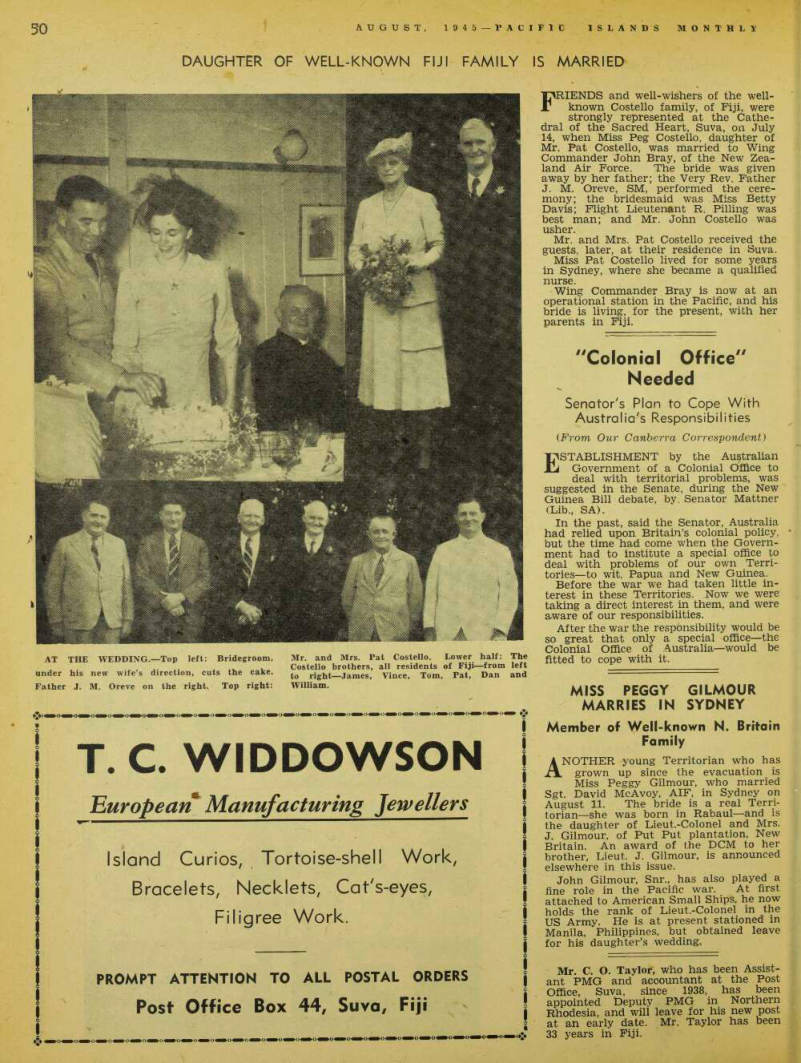
FRIENDS and well-wishers of the well known Costello family, of Fiji, were strongly represented at the Cathe dral of the Sacred Heart, Suva, on July 14, when Miss Peg Costello, daughter of Mr. Pat Costello, was married to Wing Commander John Bray, of the New Zea land Air Force. The bride was given away by her father; the Very Rev. Father J. M. Oreve, SM, performed the cere mony; the bridesmaid was Miss Betty Davis; Flight Lieutenant R. Pilling was best man; and Mr. John Costello was usher.
Mr. and Mrs. Pat Costello received the guests, later, at their residence in Suva.
Miss Pat Costello lived for some years in Sydney, where she became a qualified nurse.
Wing Commander Bray is now at an operational station in the Pacific, and his bride is living, for the present, with her parents in Fiji.
AT THE WEDDING.—Top left: Bridegroom, under his new wife’s direction, cuts the cake.
Father J. M. Oreve on the right. Top right:
Mr, and Mrs. Pat Costello. Lower half: The Costello brothers, all residents of Fiji—from left to right—James, Vince, Tom, Pat, Dan and William.
"Colonial Office"
Needed Senator's Plan to Cope With Australia's Responsibilities
(From Our Canberra Correspondent ) Establishment by the Australian Government of a Colonial Office to deal with territorial problems, was suggested in the Senate, during the New Guinea Bill debate, by, Senator Mattner (Lib., SA).
In the past, said the Senator, Australia had relied upon Britain’s colonial policy, but the time had come when the Govern ment had to institute a special office to deal with problems of our own Terri tories —to wit, Papua and New Guinea.
Before the war we had taken little in terest in these Territories. Now we were taking a direct interest in them, and were aware of our responsibilities.
After the war the responsibility would be so great that only a special office—the Colonial Office of Australia —would be fitted to cope with it.
Family
Miss Peggy Gilmour
Marries In Sydney
Member of Well-known N. Britain Family
ANOTHER young Territorian who has grown up since the evacuation is Miss Peggy Gilmour, who married Sgt. David McAvoy, AIF, in Sydney on August 11. The bride is a real Terri torian —she was born in Rabaul —and is the daughter of Lieut.-Colonel and Mrs.
J. Gilmour, of Put Put plantation, New Britain. An award of the DCM to her brother, Lieut. J. Gilmour, is announced elsewhere in this issue.
John Gilmour, Snr., has also played a fine role in the Pacific war. At first attached to American Small Ships, he now holds the rank of Lieut.-Colonel in the US Army. He is at present stationed in Manila, Philippines, but obtained leave for his daughter’s wedding.
Mr. €. O. Taylor, who has been Assist ant PMG and accountant at the Post Office, Suva, since 1938, has been appointed Deputy PMG in Northern Rhodesia, and will leave for his new post at an early date. Mr. Taylor has been 33 years in Fiji.
Advertisements & other items, p. 52 (1 item)
T. C Widdowson
European Manufacturing Jewellers
Island Curios, Tortoise-shell Work, Bracelets, Necklets, Cat's-eyes, Filigree Work.
PROMPT ATTENTION TO ALL POSTAL ORDERS
Post Office Box 44, Suva, Fiji
Rehabilitation
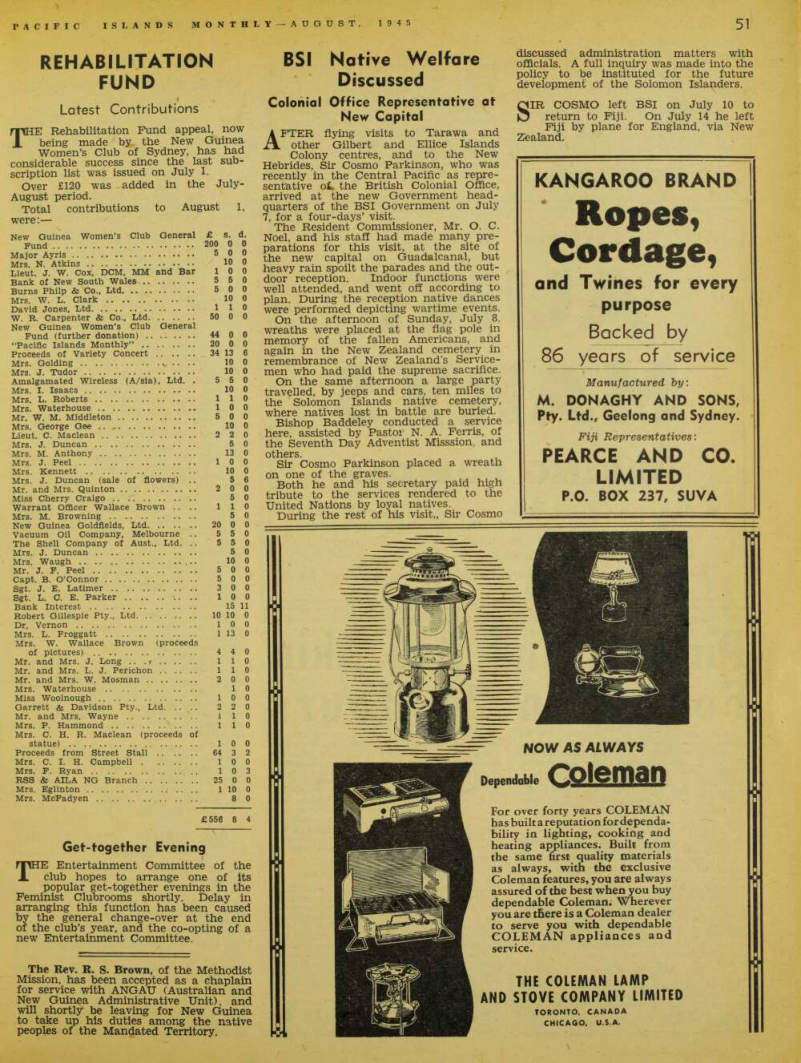
Fund
Latest Contributions
rE Rehabilitation Fund appeal, now being made by the New Guinea Women’s Club of Sydney, has had considerable success since the last sub scription list was issued on July 1.
Over £l2O was added in the July- August period.
Total contributions to August 1, were:—
Get-together Evening
rE Entertainment Committee of the club hopes to arrange one of its popular get-together evenings in the Feminist Clubrooms shortly. Delay in arranging this function has been caused by the general change-over at the end of the club’s year, and the co-opting of a new Entertainment Committee.
The Rev. R. S. Brown, of the Methodist Mission, has been accepted as a chaplain for service with ANGAU (Australian and New Guinea Administrative Unit), and will shortly be leaving for New Guinea to take up his duties among the native peoples of the Mandated Territory.
New Guinea Women’s Club General £ 200 s. 0 d. 0 5 0 0 Mrs. N. Atkins 10 0 Lieut. J. W. Cox, DCM, MM and Bar Bank of New South Wales 1 0 0 5 5 0 Burns Philp & Co., Ltd 5 0 0 Mrs. W. L. Clark 10 0 David Jones, Ltd 1 1 0 W. R. Carpenter & Co., Ltd 50 0 0 New Guinea Women’s Club General Fund (further donation) 44 0 0 “Pacific Islands Monthly” 20 0 0 Proceeds of Variety Concert 34 13 6 Mrs. Golding * .. .. 10 0 Mrs. J. Tudor 10 0 Amalgamated Wireless (A/sia), Ltd. . 5 5 0 Mrs. I. Isaacs 10 0 Mrs, L. Roberts 1 1 0 Mrs. Waterhouse 1 0 0 Mr. W. M. Middleton 5 0 0 Mrs. George Gee 10 0 Lieut. C. Maclean 2 2 0 Mrs. J. Duncan 5 0 Mrs. M. Anthony 13 0 Mrs. J. Peel 1 0 0 Mrs. Kennett 10 0 Mrs. J. Duncan (sale of flowers) .. 5 6 Mr. and Mrs. Quinton 2 0 0 Miss Cherry Craigo 5 0 Warrant Officer Wallace Brown .. .. 1 1 0 Mrs. M. Browning 5 0 New Guinea Goldfields, Ltd 20 0 0 Vacuum Oil Company, Melbourne .. 5 5 0 The Shell Company of Aust., Ltd. .. 5 5 0 Mrs. J. Duncan 5 0 Mrs. Waugh 10 0 Mr. J. F. Peel 5 0 0 Capt. B. O’Connor 5 0 0 Sgt. J. E. Latimer 3 0 0 Sgt. L, C. E, Parker 1 0 0 Bank Interest 15 11 Robert Gillespie Pty., Ltd 10 10 0 Dr. Vernon 1 0 0 Mrs. L. Froggatt 1 13 0 Mrs. W. Wallace Brown (proceeds of pictures) 4 4 0 Mr. and Mrs. J. Long .. . t 1 1 0 Mr. and Mrs. L. J. Perichon 1 1 0 Mr. and Mrs. W. Mosman 2 0 0 Mrs. Waterhouse 1 0 Miss Woolnough 1 0 0 Garrett & Davidson Pty., Ltd 2 2 0 Mr. and Mrs. Wayne 1 1 0 Mrs. P. Hammond 1 1 0 Mrs. C. H. R. Maclean (proceeds of statue) 1 0 0 Proceeds from Street Stall 64 3 2 Mrs. C. I. H. Campbell 1 0 0 Mrs. F. Ryan 1 0 3 RSS & AILA NG Branch 25 0 0 Mrs. Eglinton .. .. 1 10 0 Mrs. McFadyen 8 0 £556 8 4
BSI Native Welfare
Discussed Colonial Office Representative at New Capital
AFTER flying visits to Tarawa and other Gilbert and Ellice Islands Colony centres, and to the New Hebrides, Sir Cosmo Parkinson, who was recently in the Central Pacific as repre sentative ofc the British Colonial Office, arrived at the new Government head quarters of the BSI Government on July 7, for a four-days’ visit.
The Resident Commissioner, Mr. O. C.
Noel, and his staff had made many pre parations for this visit, at the site of the new capital on Guadalcanal, but heavy rain spoilt the parades and the out door reception. Indoor functions were well attended, and went off according to plan. During the reception native dances were performed depicting wartime events.
On the afternoon of Sunday, July 8. wreaths were placed at the flag pole in memory of the fallen Americans, and again in the New Zealand cemetery in remembrance of New Zealand’s Service men who had paid the supreme sacrifice.
On the same afternoon a large party travelled, by jeeps and cars, ten miles to the Solomon Islands native cemetery, where natives lost in battle are buried.
Bishop Baddeley conducted a service here, assisted by Pastor N. A. Ferris, of the Seventh Day Adventist Misssion, and others.
Sir Cosmo Parkinson placed a wreath on one of the graves.
Both he and his secretary paid high tribute to the services rendered to the United Nations by loyal natives.
During the rest of his visit,, Sir Cosmo
discussed administration matters with officials. A full inquiry was made into the policy to be instituted for the future development of the Solomon Islanders.
SIR COSMO left BSI on July 10 to return to Fiji. On July 14 he left Fiji by plane for England, via New Zealand.
Advertisements & other items, p. 53 (1 item)
Ropes,
KANGAROO BRAND
Cordage,
and Twines for every purpose Backed by 86 years of service Manufactured hy:
M. DONAGHY AND SONS,
Pty. Ltd., Geelong and Sydney.
Fiji Representatives:
PEARCE AND CO.
LIMITED
P.O. BOX 237, SUVA
NOW AS ALWAYS
Dependable Coleman
For over forty years COLEMAN has built a reputation for dependability in lighting, cooking and heating appliances. Built from the same first quality materials as always, with the exclusive Coleman features, you are always assured of the best when you buy dependable Coleman; Wherever you are there is a Coleman dealer to serve you with dependable COLEMAN appliances and service.
THE COLEMAN LAMP
AND STOVE COMPANY LIMITED
TORONTO, CANADA
CHICAGO. U.S.A.
New Trading Company In
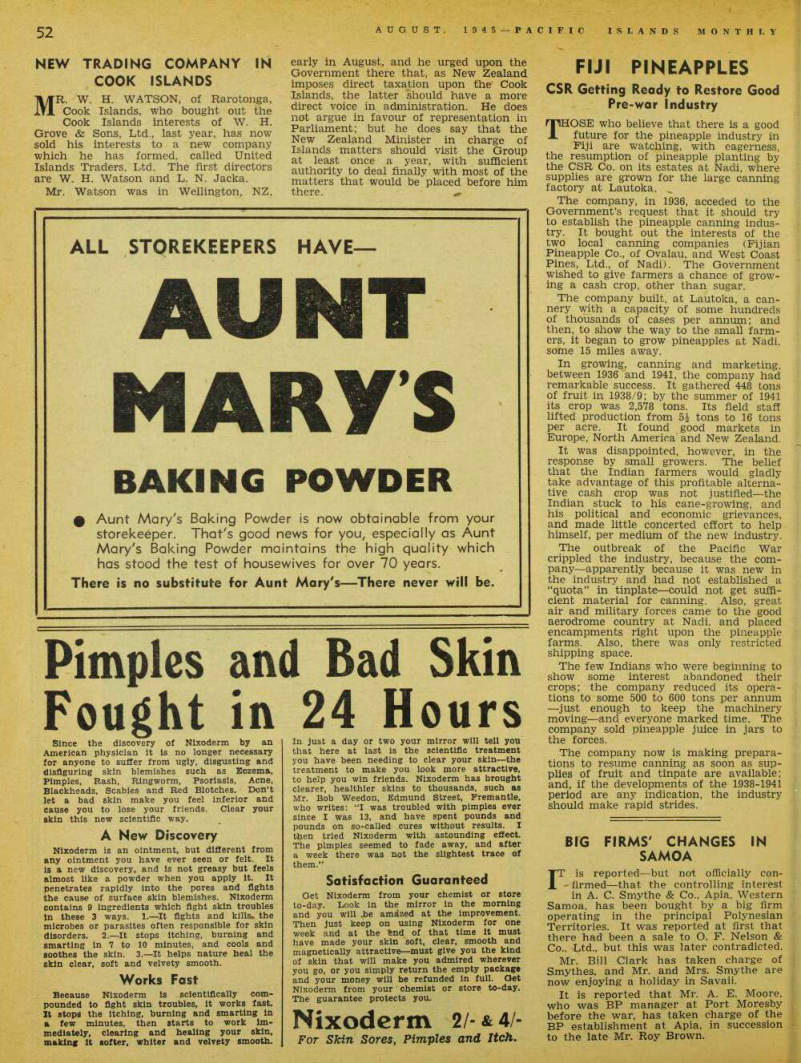
Cook Islands
MR. W. H. WATSON, of Rarotonga, Cook Islands, who bought out the Cook Islands interests of W. H.
Grove & Sons, Ltd., last year, has now sold his interests to a new company which he has formed, called United Islands Traders. Ltd. The first directors are W. H. Watson and L. N. Jacka.
Mr. Watson was in Wellington, NZ,
early in August, and he urged upon the Government there that, as New Zealand imposes direct taxation upon the Cook Islands, the latter should have a more direct voice in administration. He does not argue in favour of representation in Parliament; but he does say that the New Zealand Minister in charge of Islands matters should visit the Group at least once a year, with sufficient authority to deal finally with most of the matters that would be placed before him there.
Fiji Pineapples
CSR Getting Ready to Restore Good Pre-war Industry
rpHOSE who believe that there is a good A future for the pineapple industry in Fiji are watching, with eagerness, the resumption of pineapple planting by the CSR Co. on its estates at Nadi, where supplies are grown for the large canning factory at Lautoka. „ The company, in 1936, acceded to the Government’s request that it should try to establish the pineapple canning indus try. It bought out the interests of the two local canning companies (Fijian Pineapple Co., of Ovalau, and West Coast Pines, Ltd., of Nadi). The Government wished to give farmers a chance of grow ing a cash crop, other than sugar.
The company built, at Lautoka, a can nery with a capacity of some hundreds of thousands of cases per annum; and then, to show the way to the small farm ers, it began to grow pineapples at Nadi, some 15 miles away.
In growing, canning and marketing, between 1936 and 1941, the company had remarkable success. It gathered 448 tons of fruit in 1938/9; by the summer of 1941 its crop was 2,578 tons. Its field staff lifted production from 5i tons to 16 tons per acre. It found good markets in Europe, North America and New Zealand.
It was disappointed, however, in the response by small growers. The belief that the Indian farmers would gladly take advantage of this profitable alterna tive cash crop was not justified—the Indian stuck to his cane-growing, and his political and economic grievances, and made little concerted effort to help himself, per medium of the new industry.
The outbreak of the Pacific War crippled the industry, because the com pany—apparently because it was new in the industry and had not established a “quota” in tinplate—could not get suffi cient material for canning. Also, great air and military forces came to the good aerodrome country at Nadi, and placed encampments right upon the pineapple farms. Also, there was only restricted shipping space.
The few Indians who were beginning to show some interest abandoned their crops; the company reduced its opera tions to some 500 to 600 tons per annum —just enough to keep the machinery moving—and everyone marked time. The company sold pineapple juice in jars to the forces.
The company now is making prepara tions to resume canning as soon as sup plies of fruit and tinpate are available; and, if the developments of the 1938-1941 period are any indication, the industry should make rapid strides.
Big Firms' Changes In
Samoa
Fis reported—but not officially con -■ firmed—that the controlling interest in A. C. Smythe & Co., Apia, Western Samoa, has been bought by a big firm operating in the principal Polynesian Territories. It was reported at first that there had been a sale to O. F. Nelson & Co.. Ltd., but this was later contradicted.
Mr. Bill Clark has taken charge of Smythes, and Mr. and Mrs. Smythe are now enjoying a holiday in Savaii.
It is reported that Mr. A. E. Moore, who was BP manager at Port Moresby before the war, has taken charge of the BP establishment at Apia, in succession to the late Mr. Roy Brown.
Advertisements & other items, p. 54 (1 item)
Marys
ALL STOREKEEPERS HAVE—
AUNT
BAKING POWDER
9 Aunt Mary's Baking Powder is now obtainable from your storekeeper. That's good news for you, especially as Aunt Mary's Baking Powder maintains the high quality which has stood the test of housewives for over 70 years.
There is no substitute for Aunt Mary's—There never will be.
Pimples and Bad Skin Fought in 24 Hours
Since the discovery of Nixoderm by an American physician it is no longer necessary for anyone to suffer from ugly, disgusting and disfiguring skin blemishes such as Eczema, Pimples, Rash, Ringworm, Psoriasis, Acne, Blackheads, Scabies and Red Blotches. Don’t let a bad skin make you feel inferior and cause you to lose your friends. Clear your skin this new scientific way.
A New Discovery
Nixoderm is an ointment, but different from any ointment you have ever seen or felt. It is a new discovery, and is not greasy but feels almost like a powder when you apply It. It penetrates rapidly into the pores and fights the cause of surface skin blemishes. Nixoderm contains 9 ingredients which fight skin troubles In these 3 ways. 1. —It fights and kills*, the microbes or parasites often responsible for skin disorders. 2.—lt stops itching, burning and smarting in 7 to 10 minutes, and cools and soothes the skin. 3.—lt helps nature heal the skin clear, soft and velvety smooth.
Works Fast
Because Nixoderm is scientifically compounded to fight skin troubles, it works fast.
It stops the itching, burning and smarting in a few minutes, then starts to work immediately, clearing and healing your skin, making It softer, whiter and velvety smooth.
In just a day or two your mirror will tell you that here at last is the scientific treatment you have been needing to clear your skin—the treatment to make you look more attractive, to help you win friends. Nixoderm has brought clearer, healthier skins to thousands, such as Mr. Bob Weedon, Edmund Street, Fremantle, who writes; “I was troubled with pimples ever since I was 13, and have spent pounds and pounds on so-called cures without results. I then tried Nixoderm with astounding effect.
The pimples seemed to fade away, and after a week there was not the slightest trace of them.”
Satisfaction Guaranteed
Get Nixoderm from your chemist or store to-day. Look in the mirror in the morning and you will .be amdzed at the improvement.
Then just keep on using Nixoderm for one week and at the fend of that time it must have made your skin soft, clear, smooth and magnetically attractive —must give you the kind of skin that will make you admired wherever you go, or you simply return the empty package and your money will be refunded in full. Get Nixoderm from your chemist or store to-day.
The guarantee protects you.
Nixoderm 2/- & 4/-
For Skin Sores, Pimples and Itch .
Plea for New Guinea's
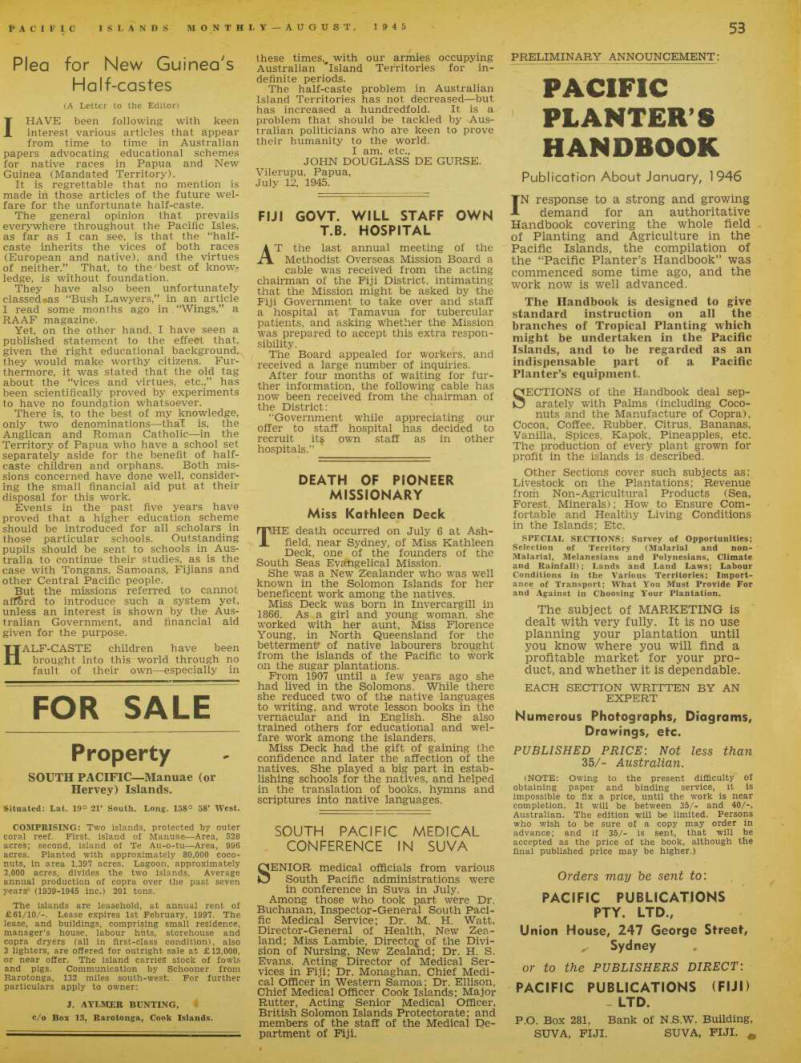
Half-castes
(A Letter to the Editor) I HAVE been following with keen interest various articles that appear from time to time in Australian papers advocating educational schemes for native races in Papua and New Guinea (Mandated Territory).
It is regrettable that no mention is made in those articles of the future wel fare for the unfortunate half-caste.
The general opinion that prevails everywhere throughout the Pacific Isles, as far as I can see, is that the “half caste inherits the vices of both races (European and native), and the virtues of neither.” That, to the best of know ledge, is without foundation.
They have also been unfortunately classed«as “Bush Lawyers,” in an article I read some months ago in “Wings,” a RAAF magazine.
Yet, on the other hand, I have seen a published statement to the effect that, given the right educational background, they would make worthy citizens. Fur thermore, it was stated that the old tag about the “vices and virtues, etc.,” has been scientifically proved by experiments to have no foundation whatsoever.
There is, to the best of my knowledge, only two denominations —thaT is, the Anglican and Roman Catholic —in the Territory of Papua who have a school set separately aside for the benefit of half caste children and orphans. Both mis sions concerned have done well, consider ing the small financial aid put at their disposal for this work.
Events in the past five years have proved that a higher education scheme should be introduced for all scholars in those particular schools. Outstanding pupils should be sent to schools in Aus tralia to continue their studies, as is the case with Tongans, Samoans, Fijians and other Central Pacific people.
But the missions referred to cannot aff&rd to introduce such a system yet, unless an interest is shown by the Aus tralian Government, and financial aid given for the purpose.
HALF-CASTE children have been brought into this world through no fault of their own —especially in
these times, with our armies occupying Australian Island Territories for in definite periods.
The half-caste problem in Australian Island Territories has not decreased —but has increased a hundredfold. It is a problem that should be tackled by Aus tralian politicians who are keen to prove their humanity to the world.
I am, etc.,
John Douglass De Gurse.
Vilerupu, Papua, July 12, 1945.
Fiji Govt. Will Staff Own
T.B. Hospital
AT the last annual meeting of the Methodist Overseas Mission Board a cable was received from the acting chairman of the Fiji District, intimating that the Mission might be asked by the Fiji Government to take over and staff a hospital at Tamavua for tubercular patients, and asking whether the Mission was prepared to accept this extra respon sibility.
The Board appealed for workers, and received a large number of inquiries.
After four months of waiting for fur ther information, the following cable has now been received from the chairman of the District: “Government while appreciating our offer to staff hospital has decided to recruit its own staff as in other hospitals.”
Death Of Pioneer
Missionary
Miss Kathleen Deck
THE death occurred on July 6 at Ash field, near Sydney, of Miss Kathleen Deck, one of the founders of the South Seas Evangelical Mission.
She was a New Zealander who was well known in the Solomon Islands for her beneficent work among the natives.
Miss Deck was born in Invercargill in 1866. As a girl and young woman, she worked with her aunt, Miss Florence Young, in North Queensland for the betterment* of native labourers brought from the islands of the Pacific to work on the sugar plantations.
From 1907 until a few years ago she had lived in the Solomons. While there she reduced two of the native languages to writing, and wrote lesson books in the vernacular and in English. She also trained others for educational and wel fare work among the islanders.
Miss Deck had the gift of gaining the confidence and later the affection of the natives. She played a big part in estab lishing schools for the natives, and helped in the translation of books, hymns and scriptures into native languages.
South Pacific Medical
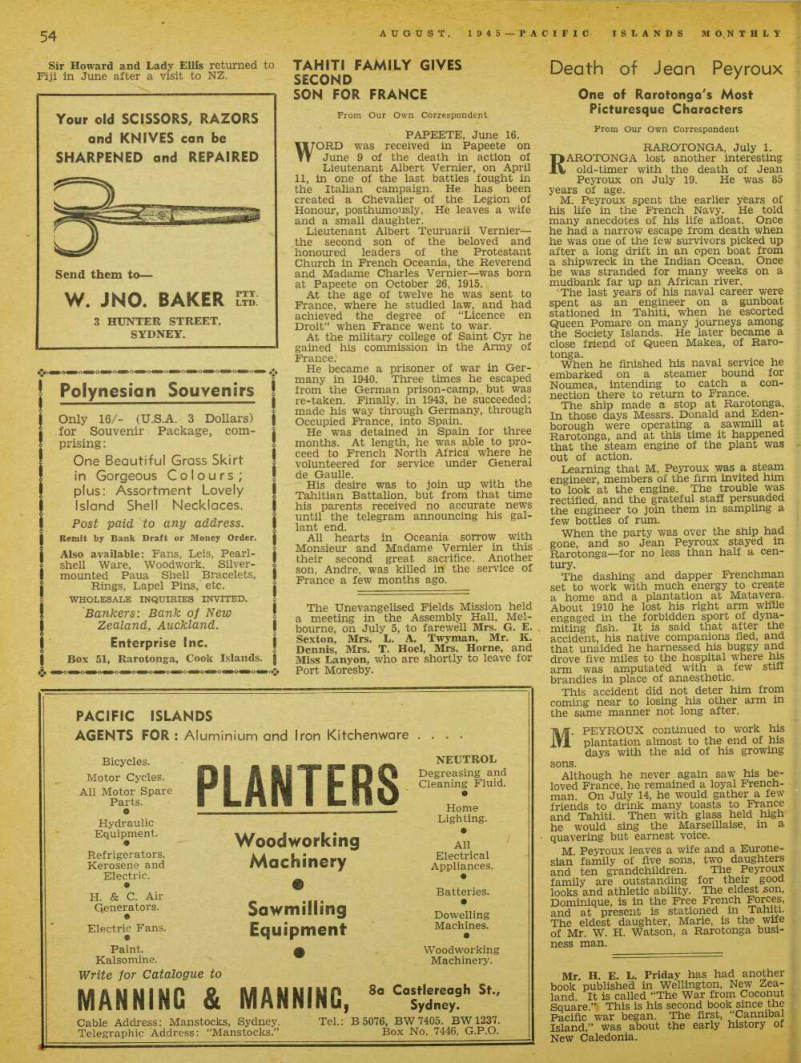
Conference In Suva
SENIOR medical officials from various South Pacific administrations were in conference in Suva in July.
Among those who took part were Dr.
Buchanan, Inspector-General South Paci fic Medical Service; Dr. M. H. Watt, Director-General of Health, New Zea land; Miss Lambie, Director of the Divi sion of Nursing, New Zealand; Dr. H. S.
Evans, Acting Director of Medical Ser vices in Fiji; Dr. Monaghan. Chief Medi cal Officer in Western Samoa; Dr. Ellison, Chief Medical Officer Cook Islands; Major Rutter, Acting Senior Medical Officer, British Solomon Islands Protectorate; and members of the staff of the Medical De partment of Fiji.
Sir Howard and Lady Ellis returned to Fiji in June after a visit to NZ.
Advertisements & other items, pp. 55-56 (2 items)
Pacific
PRELIMINARY ANNOUNCEMENT:
PLANTER’S
HANDBOOK
Publication About January, 1946 IN response to a strong and growing demand for an authoritative Handbook covering the whole field of Planting and Agriculture in the Pacific Islands, the compilation of the “Pacific Planter’s Handbook” was commenced some time ago, and the work now is well advanced.
The Handbook is designed to give standard instruction on all the branches of Tropical Planting which might be undertaken in the Pacific Islands, and to be regarded as an indispensable part of a Pacific Planter’s equipment.
SECTIONS of the Handbook deal separately with Palms (including Coconuts and the Manufacture of Copra), Cocoa, Coffee, Rubber, Citrus, Bananas, Vanilla, Spices, Kapok, Pineapples, etc.
The production of every plant grown for profit in the islands is described.
Other Sections cover such subjects as: Livestock on the Plantations; Revenue from Non-Agricultural Products (Sea, Forest, Minerals); How to Ensure Comfortable and Healthy Living Conditions in the Islands; Etc.
SPECIAL SECTIONS: Survey of Opportunities; Selection of Territory (Malarial and non- Malarial, Melanesians and Polynesians, Climate and Rainfall); Lands and Land Laws; Labour Conditions in the Various Territories; Importance of Transport; What You Must Provide For and Against in Choosing Your Plantation.
The subject of MARKETING is dealt with very fully. It is no use planning your plantation until you know where you will find a profitable market for your product, and whether it is dependable.
EACH SECTION WRITTEN BY AN
EXPERT
Numerous Photographs, Diagrams,
Drawings, etc.
PUBLISHED PRICE: Not less than 35/- Australian. (NOTE: Owing to the present difficulty of obtaining paper and binding service, it is impossible to fix a price, until the work is near completion. It will be between 35/- and 40/-, Australian. The edition will be limited. Persons who wish to be sure of a copy may order in advance: and if 35/- is sent, that will be accepted as the price of the book, although the final published price may be higher.) Orders may he sent to:
PACIFIC PUBLICATIONS
PTY. LTD.,
Union House, 247 George Street,
Sydney
or to the PUBLISHERS DIRECT:
PACIFIC PUBLICATIONS (FIJI)
LTD.
P.O. Box 281, Bank of N.S.W, Building,
SUVA, FIJI. SUVA, FIJI. m
Your old SCISSORS, RAZORS
and KNIVES can be
SHARPENED and REPAIRED
L 4 I Send them to—
W. JNO. BAKER
3 HUNTER STREET,
SYDNEY.
PTY.
LTD.
Polynesian Souvenirs
Only 16/- (U.S.A. 3 Dollars) for Souvenir Package, comprising: One Beautiful Grass Skirt
in Gorgeous Colours;
plus: Assortment Lovely
Island Shell Necklaces.
Post paid to any address.
Remit by Bank Draft or Money Order.
Also available: Fans, Leis, Pearlshell Ware, Woodwork. Silvermounted Paua Shell Bracelets, Rings, Lapel Pins, etc.
WHOLESALE INQUIRIES INVITED.
Bankers : Bank of New Zealand, Auckland.
Enterprise Inc.
Box 51, Rarotonga, Cook Islands.
For Sale
Property
SOUTH PACIFIC—Manuae (or
Hervey) Islands.
Situated: Lat. 19° 2V South. Long. 158° 58’ West.
COMPRISING: Two islands, protected by outer coral reef. First, island of Manuae—Area, 528 acres; second, island of Te Au-o-tu—Area, 996 acres. Planted with approximately 80,000 coconuts, in area 1,397 acres. Lagoon, approximately 3,000 acres, divides the two islands. Average annual production of copra over the past seven years (1939-1945 inc.) 201 tons.
The islands are leasehold, at annual rent of £6l/10/-. Lease expires Ist February, 1997. The lease, and buildings, comprising small residence, manager’s house, labour huts, storehouse and copra dryers (all in first-class condition), also 3 lighters, are offered for outright sale at £12,000, or near offer. The island carries stock of fowls and pigs. Communication by Schooner from Rarotonga, 132 miles south-west. For further particulars apply to owner;
J. AYLMER BUNTING,
c/o Box 13, Rarotonga, Cook Islands.
Tahiti Family Gives
Second
Son For France
From Our Own Correspondent
Papeete, June 16.
WORD was received in Papeete on June 9 of the death in action of Lieutenant Albert Vernier, on April 11, in one of the last battles fought in the Italian campaign. He has been created a Chevalier of the Legion of Honour, posthumously. He leaves a wife and a small daughter.
Lieutenant Albert Teuruarii Vernier— the second son of the beloved and honoured leaders of the Protestant Church in French Oceania, the Reverend and Madame Charles Vernier—was born at Papeete on October 26, 1915.
At the age of twelve he was sent to France, where he studied law, and had achieved the degree of “Licence en Droit” when France went to war.
At the military college of Saint Cyr he gained his commission in the Army of France.
He became a prisoner of war in Ger many in 1940. Three times he escaped from the German prison-camp, but was re-taken. Finally, in 1943, he succeeded; made his way through Germany, through Occupied France, into Spain.
He was detained in Spain for three months. At length, he was able to pro ceed to French North Africa where he volunteered for service under General de Gaulle.
His desire was to join up with the Tahitian Battalion, but from that time his parents received no accurate news until the telegram announcing his gal lant end.
All hearts in Oceania sorrow with Monsieur and Madame Vernier in this their second great sacrifice. Another son, Andre, was killed in the service of France a few months ago.
The Unevangelised Fields Mission held a meeting in the Assembly Hall, Mel bourne, on July 5, to farewell Mrs. G. E.
Sexton, Mrs. L. A. Twyman, Mr. K.
Dennis, Mrs. T. Hoel, Mrs. Horne, and Miss Lanyon, who are shortly to leave for Port Moresby.
Death of Jean Peyroux
One of Rarotonga's Most Picturesque Characters
From Our Own Correspondent
Rarotonga, July 1.
RAROTONGA lost another interesting old-timer with the death of Jean Peyroux on July 19. He was 85 years of age.
M. Peyroux spent the earlier years of his life in the French Navy. He told many anecdotes of his life afloat. Once he had a narrow escape from death when he was one of the few survivors picked up after a long drift in an open boat from a shipwreck in the Indian Ocean. Once he was stranded for many weeks on a mudbank far up an African river.
The last years of his naval career were spent as an engineer on a gunboat stationed in Tahiti, when he escorted Queen Pomare on many journeys among the Society Islands. He later became a close frieud of Queen Makea, of Raro tonga.
When he finished his naval service he embarked on a steamer bound for Noumea, intending to catch a con nection there to return to France.
The ship made a stop at Rarotonga.
In those days Messrs. Donald and Eden borough were operating a sawmill at Rarotonga, and at this time it happened that the steam engine of the plant was out of action.
Learning that M. Peyroux was a steam engineer, members of the firm invited him to look at the engine. The trouble was rectified, and the grateful staff persuaded the engineer to join them in sampling a few bottles of rum.
When the party was over the ship had gone, and so Jean Peyroux stayed in Rarotonga—for no less than half a cen tury.
The dashing and dapper Frenchman set to work with much energy to create a home and a plantation at Matavera.
About 1910 he lost his right arm while engaged in the forbidden sport of dyna miting fish. It is said that after the accident, his native companions fled, and that unaided he harnessed his buggy and drove five miles to the Imspital where his arm was amputated with a few stiff brandies in place of anaesthetic.
This accident did not deter him from coming near to losing his other arm in the same manner not long after.
M. PEYROUX continued to work his plantation almost to the end of his days with the aid of his growing sons.
Although he never again saw his be loved France, he remained a loyal French man. On July 14, he would gather a few friends to drink many toasts to France and Tahiti. Then with glass held high he would sing the Marseillaise, in a quavering but earnest voice.
M Peyroux leaves a wife and a Eurone sian family of five sons, two daughters and ten grandchildren. The Peyroux family are outstanding for their good looks and athletic ability. The eldest son, Dominique, is in the Free French Forces, and at present is stationed in Tahiti.
The eldest daughter, Marie, is the wife of Mr. W. H. Watson, a Rarotonga busi ness man.
Mr. H. E. L. Friday has had another book published in Wellington, New Zea land. It is called “The War from Coconut Square.” This is his second book since the Pacific war began. The first, “Cannibal Island,” was about the early history of New Caledonia.
Advertisements & other items, p. 56 (1 item)
Planters
PACIFIC ISLANDS
AGENTS FOR: Aluminium and Iron Kitchenware . . . .
Bicycles.
Motor Cycles.
All Motor Spare Parts, o Hydraulic Equipment. • Refrigerators, Kerosene and Electric. • H. & C. Air Qenerators. • Electric Fans. • Paint.
Kalsomine.
PLANTERS
Woodworking
Machinery
Sawmilling
Equipment
Write tor Catalogue to
NEUTROL
Degreasing and Cleaning Fluid. • Home Lighting. • All Electrical Appliances, • Batteries. • Dowelling Machines. • Woodworking Machinery.
MANNING & MANNING, 80 c tr, sh Cable Address: Manstocks, Sydney. Tel.: B 5076, BW 7405. BW 1237.
Telegraphic Address: “Manstocks.” Box No. 7446, G.P.O.
Papua and N. Guinea
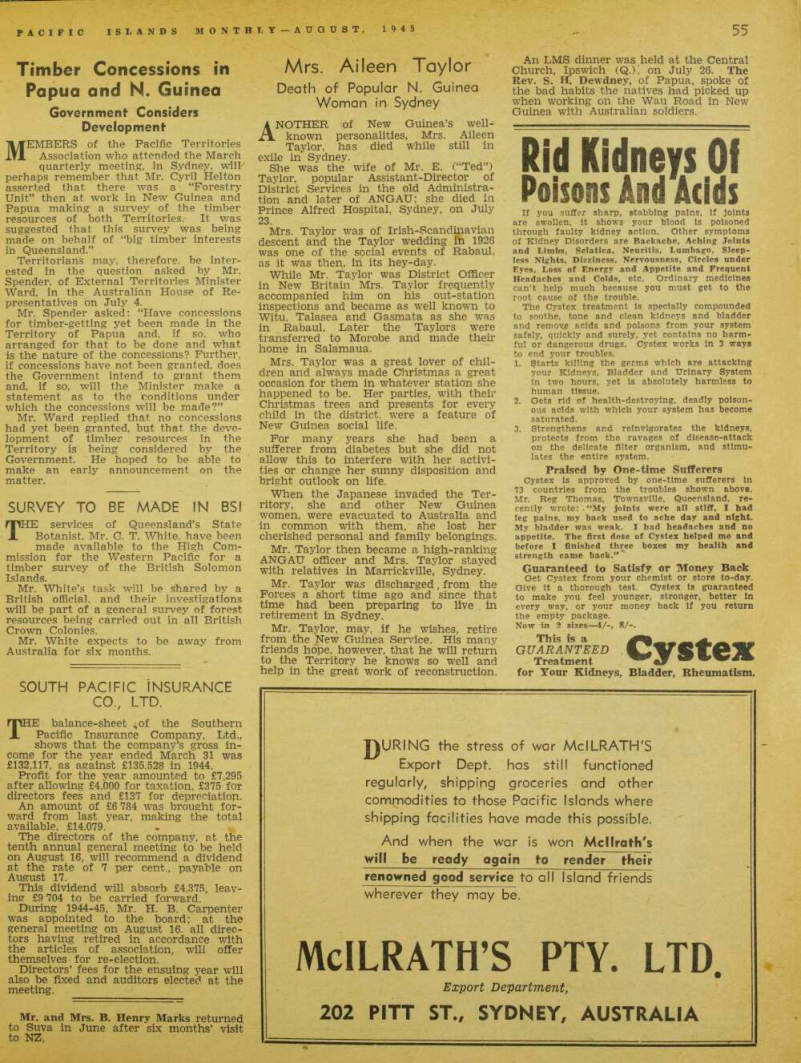
Timber Concessions in Papua and N. Guinea Government Considers Development
MEMBERS of the Pacific Territories Association who attended the March quarterly meeting, in Sydney, will' perhaps remember that Mr. Cyril Helton asserted that there was a “Forestry Unit” then at work in New Guinea and Papua making a survey of the timber resources of both Territories. It was suggested that this survey was being made on behalf of “big timber interests in Queensland.”
Territorians may, therefore, be inter ested in the question asked by Mr.
Spender, of External Territories Minister Ward, in the Australian House of Re presentatives bn July 4.
Mr. Spender asked: “Have concessions for timber-getting yet been made in the Territory of Papua and, if so. who arranged for that to be done and what is the nature of the concessions? Further, if concessions have not been granted, does the Government intend to grant them and, if so, will the Minister make a statement as to the Iconditions under which the concessions will be made?”
Mr. Ward replied that no concessions had yet been granted, but that the deve lopment of timber resources in the Territory is being considered by the Government. He hoped to be able to make an early announcement on the matter.
Survey To Be Made In Bsi
(THE services of Queensland’s State X Botanist, Mr, G. T. White, have been made available to the High Com mission for the Western Pacific for a timber survey of the British Solomon Islands.
Mr. White’s task will be shared by a British official, and their investigations will be part of a general survey of forest resources being carried out in all British Crown Colonies.
Mr. White expects to be away from Australia for six months.
Advertisements & other items, p. 57 (1 item)
Co., Ltd.
SOUTH PACIFIC INSURANCE
rE balance-sheet *of the Southern Pacific Insurance Company, Ltd., shows that the company’s gross in come for the year ended March 31 was £132,117, as against £135.528 in 1944.
Profit for the year amounted to £7,295 after allowing £4,000 for taxation, £375 for directors fees and £137 for depreciation.
An amount of £6 784 was brought for ward from last year, making the total available, £14.079.
The directors of the company, at the tenth annual general meeting to be held on August 16, will recommend a dividend at the rate of 7 per cent., payable on August 17.
This dividend will absorb £4,375, leav ing £9 704 to be carried forward.
During 1944-45, Mr. H. B. Carpenter was appointed to the board; at the general meeting on August 16. all direc tors having retired in accordance with the articles of association, will offer themselves for re-election.
Directors’ fees for the ensuing year will also be fixed and auditors elected at the meeting.
Mr. and Mrs. B. Henry Marks returned to Suva in June after six months’ visit to NZ.
Mrs. Aileen Taylor
Death of Popular N. Guinea Woman in Sydney
ANOTHER of New Guinea’s wellknown personalities, Mrs. Aileen exile Sydney 8 5 ** * She was the wife of Mr. E. (“Ted”) Taylor, popular Assistant-Director of District Services in the old Administration and later of ANGAU; she died in Prince Alfred Hospital, Sydney, on July 23. Mrs. Taylor was Of Irish-Scandinavian descent and the Taylor wedding in 1926 was one of the social events of Rabaul, as it was then, in its hey-day. , While Mr. Taylor was District Officer in New Britain Mrs. Taylor frequently accompanied him on his out-station inspections and became as well known to Witu. Talasea and Gasmata as she W’as in Rabaul. Later the Taylors were transferred to Morobe and made their home in Salamaua.
Mrs. Taylor was a great lover Of children and always made Christmas a great occasion for them in whatever station she happened to be. Her parties, with then* Christmas trees and presents for every child in the district, were a feature of New Guinea social life.
For many years she had been a sufferer from diabetes but she did not allow this to interfere with her activities or change her sunny disposition and bright outlook on life. ... 4-U~ When the Japanese invaded the Terntory, she and other New Guinea Women, were evacuated to Australia and in common with them, she lost her cherished personal and family belongings.
Mr. Taylor then became a high-ranking ANGAU officer and Mrs. Taylor stayed with relatives in Marrickville, Sydney.
Mr. Taylor was discharged, from the Forces a short time ago and since that time had been preparing to live ,in retirement in Sydney.
Mr. Taylor, may, if he wishes, retire from the New Guinea Service. His many friends hope, however, that he will return to the Territory he knows so well and help in the great work of reconstruction.
An LMS dinner was held at the Central Church, Ipswich (Q.>; on July 26. The Rev. S. H. Dewdney, of Papua, spoke of the bad habits the natives had picked up when working on the Wau Road in New Guinea with Australian soldiers.
Advertisements & other items, p. 57 (1 item)
Rid Kidneys Of
Poisons And Adds
If you suffer sharp, stabbing pains, If joints are swollen. It shows your blood Is poisoned through faulty kidney action. Other symptoms of Kidney Disorders are Backache, Aching Joints and Limbs, Sciatica, Neuritis, Lumbago, Sleepless Nights, Dizziness, Nervousness, Circles under Eyes, Loss of Energy and Appetite and Frequent Headaches and Colds, etc. Ordinary medicines can’t help much because you must get to the root cause of the trouble.
The Cystex treatment Is specially compounded to soothe, tone and clean kidneys and bladder and remove acids and poisons from your system safely, quickly and surely, yet contains no harmful or dangerous drugs. Cystex works In 3 ways to end your troubles. 1. Starts killing the germs which are attacking your Kidneys, Bladder and Urinary System in two hours, yet Is absolutely harmless to human tissue. 2. Gets rid of health-destroying, deadly poisonous acids with which your system has become saturated. 3. Strengthens and reinvigorates the kidneys, protects from the ravages of disease-attack on the delicate filter organism, and stimulates the entire system.
Praised by One-time Sufferers Cystex Is approved by one-time sufferers In 73 countries from the troubles shown above.
Mr. Reg Thomas, Townsville, Queensland, recently wrote: “My Joints were all stiff, I had leg pains, my back used to ache day and night.
My bladder was weak. I had headaches and no appetite. The first dose of Cystex helped me and before I finished three boxes my health and strength came back.’* Guaranteed to Satisfy or Money Back Get Cystex from your chemist or store to-day.
Give It a thorough test. Cystex Is guaranteed to make you feel younger, stronger, better In every way, or your money back If you return the empty package.
Now in 2 sizes—4/-, 8/-.
GUARANTEED
Treatment W J ®
for Your Kidneys, Bladder, Rheumatism.
JJURING the stress of war McILRATH'S Export Dept, has still functioned regularly, shipping groceries and other commodities to those Pacific Islands where shipping facilities have made this possible.
And when the war is won Mcllrath's will be ready again to render their renowned good service to all Island friends wherever they may be.
Mel LR AIM’S PTY. LTD.
Export Department,
202 PITT ST., SYDNEY, AUSTRALIA
Islands Produce
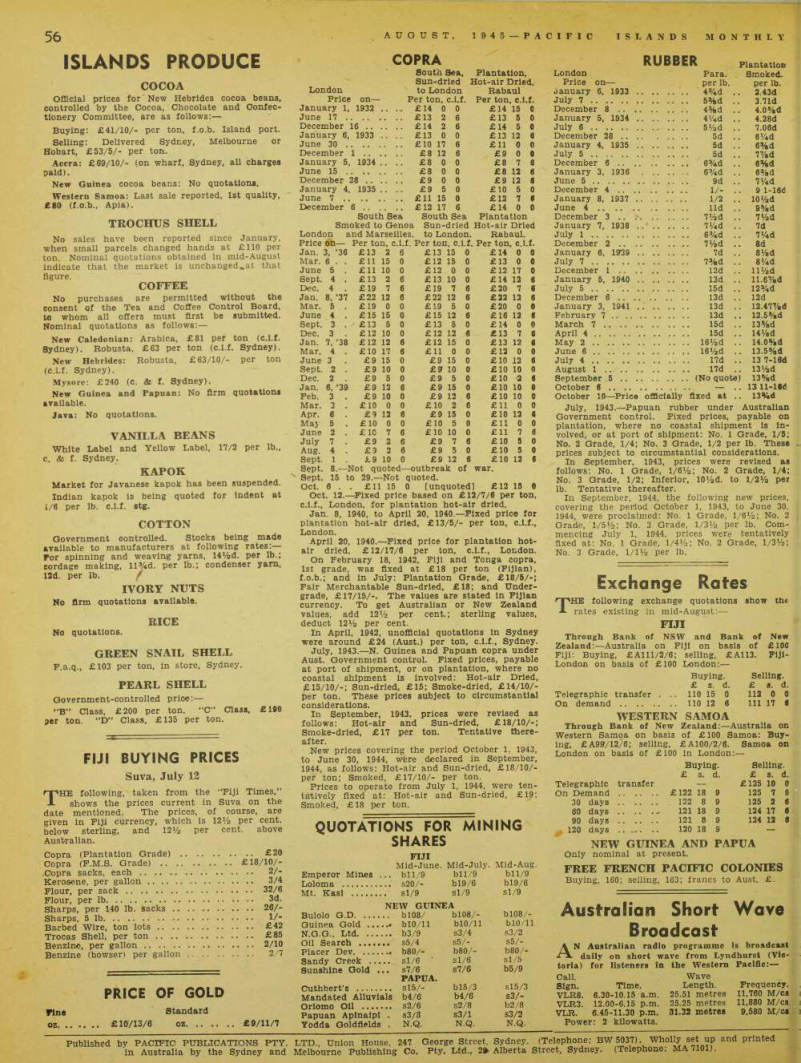
Cocoa
Official prices for New Hebrides cocoa beans, controlled by the Cocoa, Chocolate and Confec tionery Committee, are as follows: Buying: £4l/10/- per ton, f.o.b. Island port.
Selling: Delivered Sydney, Melbourne or Hobart, £53/5/- per ton.
Accra: £69/10/- (on wharf, Sydney, all charges paid).
New Guinea cocoa beans: No quotations.
Western Samoa: Last sale reported, Ist quality, £BO (f.0.b., Apia).
Trochus Shell
No sales have been reported since January, when small parcels changed hands at £llO per ton. Nominal quotations obtained in mid-August indicate that the market is that figure.
Coffee
No purchases are permitted without the consent of the Tea and Coffee Control Board, to whom all offers must first be submitted.
Nominal quotations as follows: — New Caledonian: Arabica, £Bl per ton (C.l.f.
Sydney). Robusta, £63 per ton (c.l.f. Sydney).
New Hebrides: Robusta, £63/10/- per ton (c.i.f. Sydney).
Mysore: £240 (c. & f. Sydney).
New Guinea and Papuan: No firm quotations available.
Java: No quotations.
Vanilla Beans
White Label and Yellow Label, 17/2 per lb., c. & f. Sydney.
Kapok
Market for Javanese kapok has been suspended.
Indian kapok is being quoted for Indent at 1/6 per lb. c.l.f. stg.
Cotton
Government controlled. Stocks being made available to manufacturers at following rates: — For spinning and weaving yarns, HVfed. per lb.; cordage making, ll%d. per lb.; condenser yam, I2d. per lb. f
Ivory Nuts
No firm quotations available.
Rice
No quotations.
Green Snail Shell
P.a.q., £lO3 per ton, in store, Sydney.
Pearl Shell
Government-controlled price:— “B” Class, £2OO per ton. “C” Class, £l9O per ton. "D” Class, £135 per ton.
Fiji Buying Prices
Suva, July 12 THE following, taken from the “Fiji Times,” shows the prices current in Suva on the date mentioned. The prices, of course, are given in Fiji currency, which is 12 V 2 per cent, below sterling, and 12 V 2 per cent, above Australian.
Copra (Plantation Grade) £2O Copra (F.M.S. Grade) £lB/10/- Copra sacks, each 2/- Kerosene, per gallon 3/4 Flour, per sack 32/6 Flour, per lb 3d.
Sharps, per 140 lb. sacks 26/- Sharps, 5 lb V- Barbed Wire, ton lots £42 Trocas Shell, per ton £B5 Benzine, per gallon 2/10 Benzine (bowser) per gallon 2/7
Price Of Gold
Oct. 6 . . £ll 15 0 [unquoted] £l2 16 0 Oct. 12.—Fixed price based on £l2/7/6 per ton, c.i.f., London, for plantation hot-air dried.
Jan. 8, 1940, to April 20, 1940.—Fixed price lor plantation hot-air dried, £l3/5/- per ton, c.i.f., London.
April 20, 1940. —Fixed price for plantation hot air dried, £l2/17/6 per ton, c.i.f., London.
On February 18, 1942, Fiji and Tonga copra, Ist grade, was fixed at £lB per ton (Fijian), f.0.b.; and in July: Plantation Grade, £lB/5/-; Fair Merchantable Sun-dried, £18; and Under grade, £l7/15/-. The values are stated in Fijian currency. To get Australian or New Zealand values, add 12y 2 per cent.; sterling values, deduct 12V 2 per cent.
In April, 1942, unofficial quotations in Sydney were around £24 (Aust.) per ton, c.i.f., Sydney.
July, 1943.—N. Guinea and Papuan copra under Aust. Government control. Fixed prices, payable at port of shipment, or on plantation, where no coastal shipment is involved: Hot-air Dried, £l5/10/-; Sun-dried, £l5; Smoke-dried, £l4/10/per ton. These prices subject to circumstantial considerations.
In September, 1943. prices were revised as follows: Hot-air and Sun-dried, £lB/10/-; Smoke-dried, £l7 per ton. Tentative there after.
New prices covering the period October 1, 1943, to June 30, 1944, wfere declared in September, 1944, as follows: Hot-air and Sun-dried, £lB/10/per ton; Smoked, £l7/10/- per ton.
Prices to operate from July 1, 1944, were ten tatively fixed at: Hot-air and Sun-dried, £l9; Smoked, £lB per ton.
Tine Standard oz £10/13/6 oz £9/11/7
London
Copra
South Sea, Sun-dried to London Plantation, Hot-air Dried, Rabaul Price on— Per ton, c.i.f.
Per ton, c.i.f.
January 1, 1932 . £14 0 0 £14 15 0 June 17 . £13 2 6 £13 5 0 December 16 .. £14 2 6 £14 5 0 January 6, 1933 £13 0 0 £13 12 6 June 30 . £10 17 6 £11 0 0 December 1 .. £8 12 6 £9 0 0 January 5, , 1934 . . £8 0 0 £8 7 6 June 15 . £8 0 0 £8 12 6 December 28 .. £9 0 0 £9 12 6 January 4, , 1935 . . . . £9 5 0 £10 5 0 June 7 .. £11 15 0 £12 7 « December 6 South Sea £12 17 6 South Sea £14 0 Plantation 0 Smoked to Genoa Sundried Hot-air Dried London and Marseilles, to London.
Rabaul.
Price on— Per ton, c.i.f. Per ton, c.i.f. Per ton, c.I.f.
Jan. 3, ’36 £13 2 6 £13 15 0 £14 0 0 Mar. 6 . . £11 15 0 £12 15 0 £13 0 0 June 5 £11 10 0 £12 0 0 £12 17 0 Sept. 4 . £13 2 6 £13 10 0 £14 12 6 Dec. 4 . £19 7 6 £19 7 6 £20 7 6 Jan. 8, ’37 £22 12 6 £22 12 6 £22 12 6 Mar. 5 . £19 0 0 £19 5 0 £20 0 0 June 4 £15 15 0 £15 12 6 £16 12 6 Sept. 3 . £13 5 0 £13 5 0 £14 0 0 Dec. 3 . £12 10 0 £12 12 6 £13 7 6 Jan. 7, ’38 £12 12 6 £12 15 0 £13 12 6 Mar. 4 . £10 17 6 £11 0 0 £12 0 0 June 3 . £9 15 0 £9 15 0 £10 12 6 Sept. 2 . £9 10 0 £9 10 0 £10 10 0 Dec. 2 . £9 5 0 £9 5 0 £10 2 6 Jan. 6, ’39 £9 12 6 £9 15 0 £10 10 e Peb. 3 . £9 10 0 £9 12 6 £10 10 0 Mar. 3 . £10 0 0 £10 2 6 £11 0 0 Apr. 6 £9 12 6 £9 15 0 £10 12 6 May 5 . £10 0 0 £10 5 0 £11 0 0 June 2 £10 7 6 £10 10 0 £11 7 6 July 7 . £9 2 6 £9 7 6 £10 5 0 Aug. 4 £3 2 6 £9 5 0 £10 5 0 Sept. 1 . £9 10 0 £9 12 6 £10 12 6 Sept. 8. —Not quoted—outbreak of x Sept. 15 to 29.—Not quoted. war.
Shares
Quotations For Mining
July, 1943.—Papuan rubber under Australian Government control. Fixed prices, payable on plantation, where no coastal shipment is in volved, or at port of shipment: No. 1 Grade, 1/5; No. 2 Grade, 1/4; No. 3 Grade, 1/2 per lb. These prices subject to circumstantial considerations.
In September, 1943, prices were revised as follows: No. 1 Grade. 1/6V 2 ; No. 2 Grade, 1/4; No. 3 Grade, 1/2; Inferior, 10y 2 d. to 1/2Va per lb. Tentative thereafter.
In September, 1944, the following new prices, covering the period October 1, 1943, to June 30, 1944, were proclaimed: No. 1 Grade, I/6V2 ; No. 2 Grade, 1/5 y 2; No. 3 Grade, 1/3 y 2 per lb. Com mencing July 1, 1944, prices were tentatively fixed at: No. 1 Grade, 1/4 V 2 ; No. 2 Grade, 1/3 V 2 ; No. 3 Grade, 1/1% per lb.
Fiji
Mid-June.
Mid-July.
Mid-Aug.
Emperor Mines . .. bll/9 bll/9 bll/9 Loloma bl9/6 bl9/6 Mt. Kasi . sl/9 sl/9 sl/9 Bulolo G.D
New Guinea
.. bl08/ bl08/bl08/- Guinea Gold ... ... blO/11 blO/11 blO/11 N.G.G., Ltd s3/4 s3/2 Oil Search s5/s5/- Placer Dev b80/b80/- Sandy Creek ... .. sl/6 ' sl/6 sl/5 Sunshine Gold ., .. s7/6 s7/6 b5/9 Cuthbert’s
Papua.
.. s!5/bl5/3 si 5/3 Mandated Alluvlals b4/6 b4/6 s3/- Oriomo Oil s2/8 b2/8 Papuan Aplnaipl . s3/3 s3/l s3/2 Yodda Goldfields . N.Q.
N.Q.
N.Q.
Rubber
Plantation London Para.
Smoked.
Price on— per lb. per lb.
January 6. 1933 . 4 3 / 4 d . 2.43d July 7 3.71d December 8 . . . 4.0»/ed January 5, 1934 . 4V 4 d . 4.28d July 6 7.08d December 28 .. . 5d . 6V 4 d January 4, 1935 . 5d . 6%d July 5 7 7 /ad December 6 . . .. 6%d January 3, 1936 6 3 / 4 d . 6 3 /ad June 5 7»/ 4 d December 4 .. .. 1/- . 9 l-16d January 8, 1937 . 1/2 . lOVad June 4 lid . 9 s /sd December 3 .. . 7Vad . 7Vad January 7, 1938 . . 7VW . 7d July 1 7»/ 4 d December 2 .. . 7Vad . 8d January 6, 1939 . 7d . 8Vad July 7 7%d . 8>/ 4 d December 1 .. . 12d .
UVad January 5, 1940 . 13d . 11.6%d July 5 15d . 12 3 / 4 d December 6 .. .. 13d . 12d January 3, 1941 . 13d . 12.47 7 /«d February 7 13d . 12.5 5 /ad March 7 15d . 13 %d April 4 15d . 14Vad May 2 IGVid . 14.0%d June 6 13.5%d July 4 17d . 13 7-15d August 1 17d , 13V4d September 5 .. . (No quote) 13%d October 6 .. .. — . 13 11-1M October 10 — Price officially fixed at . 13%d
Exchange Rates
THE following exchange quotations show the rates existing in mid-August:—
Fiji
Through Bank of NSW and Bank of New Zealand:—Australia on Fiji on basis of £lOO Fiji; Buying, £Alll/2/6; selling, £AII3. PIJI - on basis of £lOO London: —
Western Samoa
Through Bank of New Zealand: —Australia on Western Samoa on basis of £lOO Samoa: Buy ing, £ A99/12/6; selling, £AIOO/2/6. Samoa on London on basis of £lOO in London: —
New Guinea And Papua
Only nominal at present.
Free French Pacific Colonies
Buying, 160; selling, 163; francs to Aust. £.
Buying.
Selling. £ s. d. £ s. d.
Telegraphic transfer . .. 110 15 0 112 0 0 On demand .. 110 12 6 111 17 6
Buying.
Selling. £ s. d. £ s. d.
Telegraphic transfer — £125 10 0 On Demand £122 18 9 125 7 6 30 days 122 8 9 125 2 6 60 days .. 121 18 9 124 17 « 90 days 121 8 9 124 12 6 120 days ... .. 120 18 9 —
Australian Short Wave
Broadcast
AN Australian radio programme is broadcast daily on short wave from Lyndhurst (Vic toria) for listeners in the Western Pacific:—
Call.
Wave Sign.
Time.
Length.
Frequency.
Vlr8.
6.30-10.15 a.m. 25.51 metres 11,760 M/cs
Vlr3.
12.00-6.15 p.m. 25.25 metres 11,880 M/cs
Vlr.
6.45-11.30 p.m. 31.32 metres 9.580 M/cs Power: 2 kilowatts.
Advertisements & other items, p. 58 (1 item)
56
AUGUST, 1945 PACIFIC ISLANDS MONTHLY
Published by PACIFIC PUBLICATIONS PTY. LTD., Union House, 247 George Street, Sydney. (Telephone: BW 37) v who^ A s ELVP and printed in Australia by the Sydney and Melbourne Publishing Co. Pty. Ltd., 29> Alberta Street, Sydney. (Telephone: MA7101).
Health Commission Makes Survey in Rarotonga
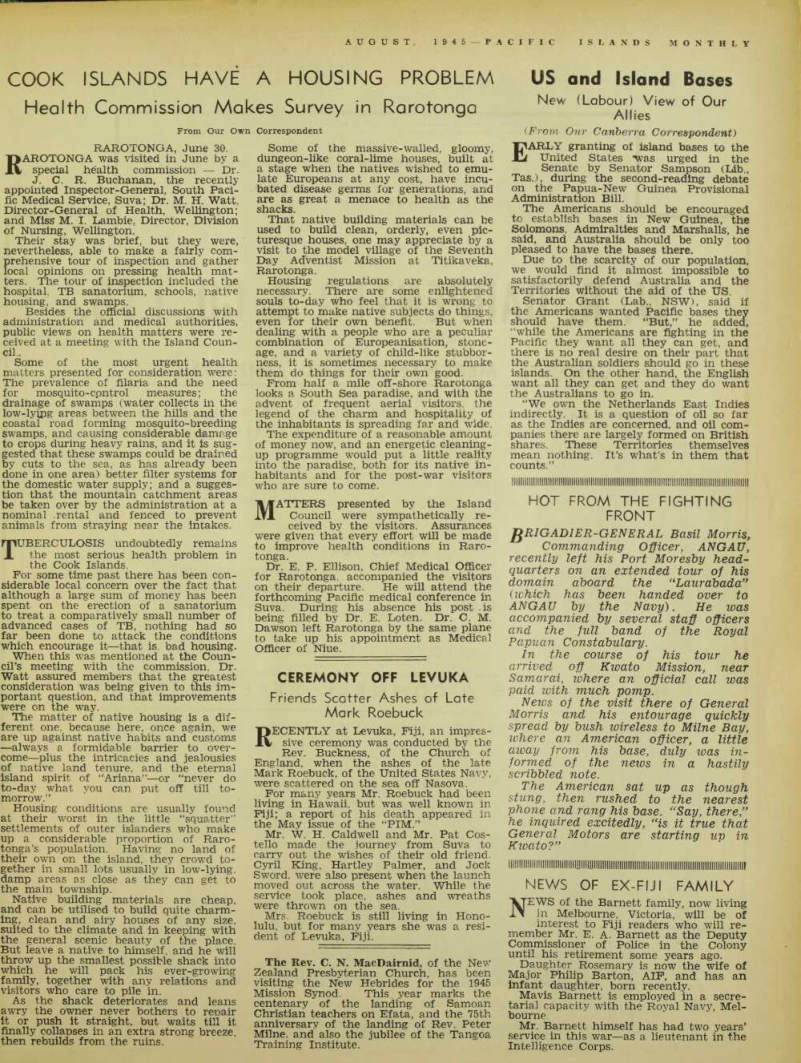
Cook Islands Have A Housing Problem
From Our Own Correspondent
Rarotonga, June 30.
RAROTONGA was visited in June by a special health commission Dr.
J. C. R. Buchanan, the recently appointed Inspector-General, South Paci fic Medical Service, Suva; Dr. M. H. Watt, Director-General of Health, Wellington; and Miss M. I. Lambie, Director, Division of Nursing, Wellington.
Their stay was brief, but they were, nevertheless, able to make a fairly com prehensive tour of inspection and gather local opinions on pressing health mat ters. The tour of inspection included the hospital. TB sanatorium, schools, native housing, and swamps.
Besides the official discussions with administration and medical authorities, public views on health matters were re ceived at a meeting with the Island Coun cil., Some of the most urgent health matters presented for consideration were: The prevalence of filaria and the need for mosquito-cpntrol measures; the drainage of swamps (water collects in the low-lyuig areas between the hills and the coastal road forming mosquito-breeding swamps, and causing considerable damage to crops during heavy rains, and it is sug gested that these swamps could be drained by cuts to the sea, as has already been done in one area) better filter systems for the domestic water supply; and a sugges tion that the mountain catchment areas be taken over by the administration at a nominal .rental and fenced to prevent animals from straying near the intakes.
TUBERCULOSIS undoubtedly remains the most serious health problem in the Cook Islands.
For some time past there has been con siderable local concern over the fact that although a large sum of money has been spent on the erection of a sanatorium to treat a comparatively small number of advanced cases of TB, nothing had so far been done to attack the conditions which encourage it—that is. bad housing.
When this was mentioned at the Coun cil’s meeting with the commission. Dr.
Watt assured members that the greatest consideration was being given to this im portant question, and that improvements were on the way.
The matter of native housing is a dif ferent one. because here, once again, we are up against native habits and customs —always a formidable barrier to over come—plus the intricacies and jealousies of native land tenure, and the eternal island spirit of “Ariana”—or “never do to-day what you can put off till to morrow.”
Housing conditions are usually found at their worst in the little “squatter” settlements of outer islanders who make up a considerable proportion of Raro tonga’s population. Having no land of their own on the island, they crowd to gether in small lots usually in low-lying, damp areas as close as they can get to the main township.
Native building materials are cheap, and can be utilised to build quite charm ing, clean and airy houses of any size, suited to the climate and in keeping with the general scenic beauty of the place.
But leave a native to himself, and he will throw up the smallest possible shack into which he will pack his ever-growing family, together with any relations and visitors who care to pile in.
As the shack deteriorates and leans awry the owner never bothers to repair it or push it straight, but waits till it finally collapses in an extra strong breeze, then rebuilds from the ruins.
Some of the massive-walled, gloomy, dungeon-like coral-lime houses, built at a stage when the natives wished to emu late Europeans at any cost, have incu bated disease germs for generations, and are as great a menace to health as the shacks.
That native building materials can be used to build clean, orderly, even pic turesque houses, one may appreciate by a visit to the model village of the Seventh Day Adventist Mission at Titikaveka, Rarotonga.
Housing regulations are absolutely necessary. There are some enlightened souls to-day who feel that it is wrong to attempt to make native subjects do things, even for their own benefit. But when dealing with a people who are a peculiar combination of Europeanisation, stone age, and a variety of child-like stubbor ness, it is sometimes necessary to make them do things for their own good.
From half a mile off-shore Rarotonga looks a South Sea paradise, and with the advent of frequent aerial visitors, the legend of the charm and hospitality of the inhabitants is spreading far and wide.
The expenditure of a reasonable amount of money now, and an energetic cleaning up programme would put a little reality into the paradise, both for its native in habitants and for the post-war visitors who are sure to come.
MATTERS presented by the Island Council were sympathetically re ceived by the visitors. Assurances were given that every effort will be made to improve health conditions in Raro tonga.
Dr. E. P. Ellison, Chief Medical Officer for Rarotonga, accompanied the visitors on their departure. He will attend the forthcoming Pacific medical conference in Suva. During his absence his post -is being filled by Dr. E. Loten. Dr. C. M.
Dawson left Rarotonga by the same plane to take up his appointment as Medical Officer of Niue.
Ceremony Off Levuka
Friends Scatter Ashes of Late Mark Roebuck
RECENTLY at Levuka, Fiji, an impres sive ceremony was conducted by the Rev. Buckness, of the Church of England, when the ashes of the late Mark Roebuck, of the United States Navy, were scattered on the sea off Nasova.
For many years Mr. Roebuck had been living in Hawaii, but was well known in Fiji; a report of his death appeared in the May issue of the “PIM.”
Mr. W. H. Caldwell and Mr. Pat Cos tello made the journey from Suva to carry out the wishes of their old friend.
Cyril King, Hartley Palmer, and Jock Sword, were also present when the launch moved out across the water. While the service took place, ashes and wreaths were thrown on the sea.
Mrs. Roebuck is still living in Hono lulu, but for many years she was a resi dent of Levuka, Fiji.
The Rev. C. N. MacDairnid, of the New Zealand Presbyterian Church, has been visiting the New Hebrides for the 1945 Mission Synod. This year marks the centenary of the landing of Samoan Christian teachers on Efata, and the 75th anniversary of the landing of Rev. Peter Milne, and also the jubilee of the Tangoa Training Institute.
US and Island Bases
New (Labour) View of Our Allies
(From Our Canberra Correspondent) EARLY granting of island bases to the United States *was urged in the Senate by Senator Sampson (Lib, Tas.), during the second-reading debate on the Papua-New Guinea Provisional Administration Bill.
The Americans should be encouraged to establish bases in New Guinea, the Solomons, Admiralties and Marshalls, he said, and Australia should be only too pleased to have the bases there.
Due to the scarcity of our population, we would find it almost impossible to satisfactorily defend Australia and the Territories without the aid of the US.
Senator Grant (Lab., NSW), said if the Americans wanted Pacific bases they should have them. “But,” he added, ‘while the Americans are fighting in the Pacific they want all they can get, and there is no real desire on their part that the Australian soldiers should go in these islands. On the other hand, the English want all they can get and they do want the Australians to go in.
“We own the Netherlands East Indies indirectly. It is a question of oil so far as the Indies are concerned, and oil com panies there are largely formed on British shares. These Territories themselves mean nothing. It’s what’s in them that counts.”
Hot From The Fighting
Front
ffRIGADIER-GENERAL Basil Morris , Commanding Officer, ANGAU, recently left his Port Moresby head quarters on an extended tour of his domain aboard the “Laurabada” (which has been handed over to ANGAU by the Navy). He was accompanied by several staff officers and the full band of the Royal Papuan Constabulary.
In the course of his tour he arrived off Kwato Mission, near Samarai, where an official call was paid with much pomp.
News of the visit there of General Morris and his entourage quickly spread by bush wireless to Milne Bay, where an American officer, a little away from his base, duly was in formed of the news in a hastily scribbled note.
The American sat up as though stung, then rushed to the nearest phone and rang his base. “Say, there,” he inquired excitedly, “is it true that General Motors are starting up in Kwato?”
News Of Ex-Fiji Family
NEWS of the Barnett family, now living in Melbourne, Victoria, will be of interest to Fiji readers who will re member Mr. E. A. Barnett as the Deputy Commissioner of Police in the Colony until his retirement some years ago.
Daughter Rosemary is now the wife of Major Philip Barton, AIP, and has an infant daughter, born recently.
Mavis Barnett is employed in a secre tarial capacity with the Royal Navy, Mel bourne Mr. Barnett himself has had two years’ service in this war—as a lieutenant in the Intelligence Corps.
Advertisements & other items, p. 60 (1 item)
W. R. Carpenter & Go. Ltd.
Established 1914
THIRTY YEARS OF PACIFIC ISLANDS
DEVELOPMENT AND SERVICE.
W. R. CARPENTER & GO. LTD.
Capital £1,000,000.
GENERAL MERCHANTS AND SHIPOWNERS
Buyers and Exporters of All Kinds of Islands Produce Copra Merchants and Millers Agents for Australian, European and American Manufacturers Distributors of Every Description of Merchandise
AGENTS FOR:
FORD MOTOR COMPANY OF CANADA DODGE BROTHERS INC.
ELECTROLUX REFRIGERATORS . WESTINGHOUSE ELECTRICAL CO.
T. G. & C. BOLINDERS (ENGINES) CATERPILLAR TRACTORS Etc., Etc.
BRANCHES THROUGHOUT THE PACIFIC ISLANDS
Head Office : 16 O'CONNELL STREET, SYDNEY In London: W R. Carpenter & Co. (London) Ltd., Coronation House, 4 Lloyd's Avenue, London, EC.
The W.R.C. Line
The first Direct and Regular Cargo and Passenger Service between Europe and Pacific Islands’ ports was established by W. R. Carpenter & Co. Ltd. 9