Pacific
Islands
Monthly
July 17, 1945
Vol. Xv. No. 12.
Established 1930
l ßegistered at the G.F.0., by post as a newspaper ]
i/-
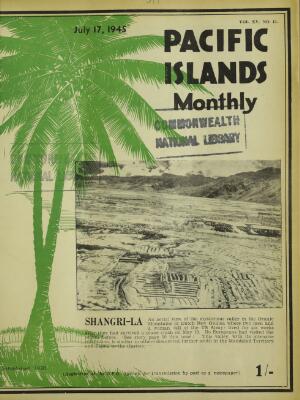
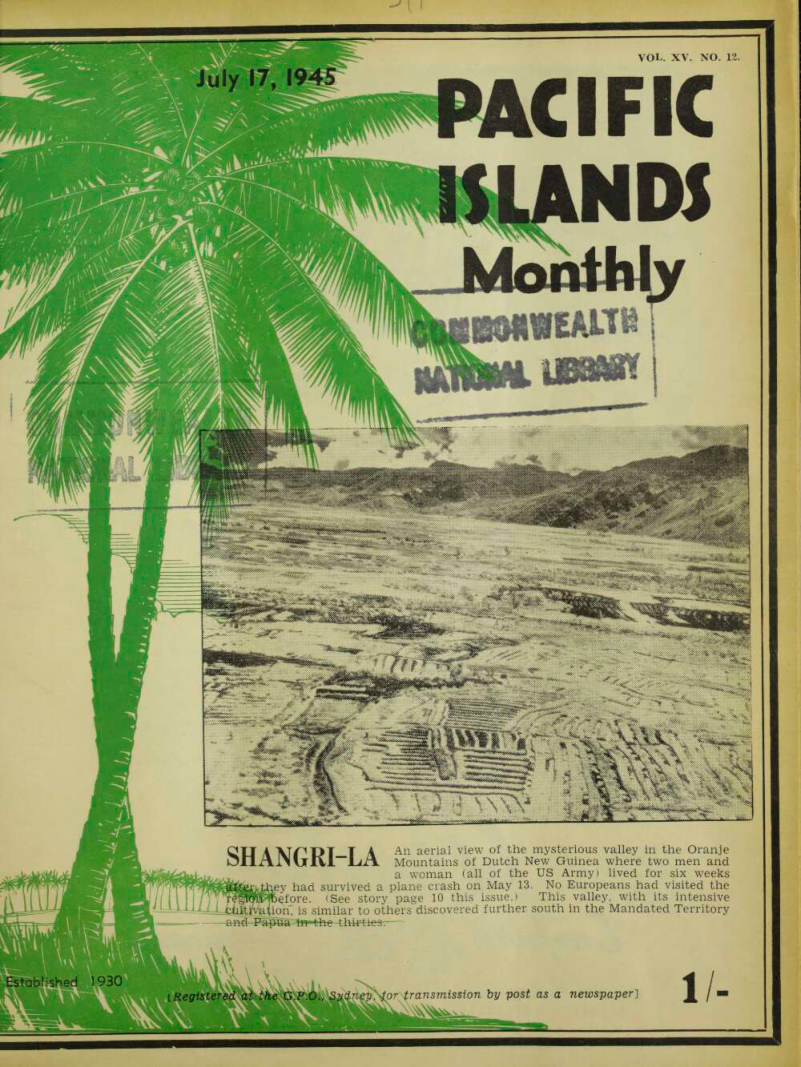
Shangri-La
An aerial view of the mysterious valley in the Oranje Mountains of Dutch New Guinea where two men and a woman (all Of the US Army) lived for six weeks after they had survived a plane crash on May 13. No Europeans had visited the region before. (See story page 10 this issue.) This valley, with its intensive similar to others discovered further south in the Mandated Territory
Advertisements & other items, p. 2 (1 item)
QirfiMurfiwia/
\ » 5-
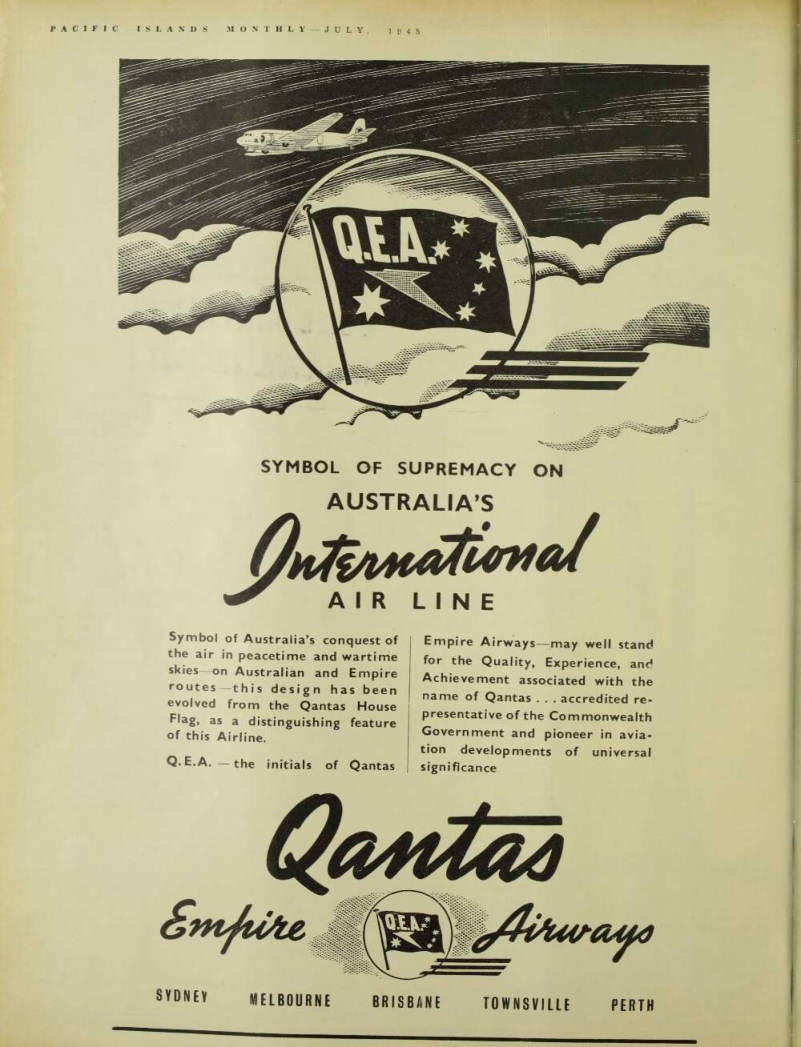
SYMBOL OF SUPREMACY ON
AUSTRALIA’S
QirfiMurfiwia/
AIR line
Symbol of Australia’s conquest of the air in peacetime and wartime skies on Australian and Empire routes—this design has been evolved from the Qantas House Flag, as a distinguishing feature of this Airline.
Q. E.A. —the initials of Qantas Empire Airways—may well stand for the Quality, Experience, and Achievement associated with the name of Qantas . . . accredited representative of the Commonwealth Government and pioneer in aviation developments of universal significance
'SmJWte
SYDNEY
MELBOURNE
BRISBANE
TOWNSVILLE
PERTH
Pacific News-Review
June 15: Joachim von Ribbentrop, for merly Nazi Foreign Minister, has been captured by British field security police.
Be was found asleep in a lodging house it 8.30 yesterday morning. He is the last )f the top-ranking Nazis to be accounted for.
June 18: The trial of 16 prominent Poles on charges of preparing diversion iry acts in the rear of the Red Army in Poland, is proceeding in Moscow. All except one pleaded wholly or partially guilty.
June 18: William Joyce (Lord Haw Baw) was charged at Bow Street Court, London, to-day on a charge of high trea son under a law enacted in 1351.
June 19: Through a spokesman, King Leopold of the Belgians, has declared that there is no question of his abdication.
This is almost certain to cause indus trial strife. Many Belgian coalmines lave already gone on strike as a result Df Leopold’s return, and the Belgian Government has resigned.
June 21: Twelve of the 16 Poles being :ried in Moscow have been found guilty Df subversive activity, and sentenced to imprisonment.
June 22: Members of the German General Staff are to be exiled for an in definite period in small communities where they cannot hatch further plots, rhis has been announced by Field- Vlarshal Montgomery.. SS troops now in terned in a huge camp, are likely to be there for the next 20 years.
June 25: Fifty nations will sign the [JNCIO Charter for World Peace at San Francisco to-day.
July 5: Mr. John Curtin, Australia’s Prime Minister, died to-day at 4 a.m. He las been in ill-health since 1944; his return to the Australian Parliament in February, 1945, before a cure was com pleted, is directly responsible for his untimely end.
July 6; The British general elections— :he first for ten years—were held to-day.
Gwing to difficulties in counting service ;otes, the results will not be known for ibout three weeks.
July 9; John Amery, son of the British Secretary for India, has been charged vith treason under the same act as that under which William Joyce (Lord Hkw Haw) was charged in June. Amery’s :ase has been remanded until July 30.
July 11: The British, American and Russian leaders in Berlin have come to m agreement on the administration of :he city, which has been in a chaotic condition. It has been agreed that the German capital will be supplied from all the zones of occupation, and that coal md other fuel will probably be supplied Dn the same basis. During the period of deadlock, it appeared to be no one’s job to feed the Berliners, who were starving.
July 12: Mr. J. B. Chifley, formerly Australian Commonwealth Treasurer, has been elected Prime Minister of Australia, following the death last week of Mr. John Curtin.
July 15: President Truman, Prime Minister Churchill and Generalissimo Stalin are on their way to a meeting in Potsdam. Talks will probably begin to morrow; it is expected that the Big Three will settle the framework of the post-w'ar world and establish the lines along which international organisations for peace will evolve.
War In The Pacific
June 13: The Japs, retreating before the advancing Australians in Borneo, have abandoned the Important Seria oil wells (Sarawak) after setting fire to them.
June 17: The Japanese have reported an Allied attack on Balikpapan, great
Dutch oil port on the east coast of Borneo. No confirmation has come from Allied sources, but Tokio says the port is being blasted by three battleships, an aircraft carrier and 16 destroyers.
June 17: Another 3,000 tons of bombs have been dropped on Osaka, Japan’s second city. Later a further 3,000 tons were dropped on four small Japanese in dustrial towns. The commander of the US Superfortress fleets in the Marianas, described the last raid as the second phase of the air war on Japanese cities.
He said that Tokio, Osaka, Nagoya, Yoko hama, Kobe and Kawasake had been written off as Superfortress targets be cause they had been gutted.
June 19: Australian Ninth Division troops have made a second landing in Borneo at the small port of Weston on the eastern shore of Brunei Bay, and have pushed 14 miles inland.
June 21: The battle for Okinawa, which has lasted for 82 grim days, is over.
Japanese organised resistance has ceased.
June 22: Units of the AIF from Brunei Bay have landed at Lutong—equivalent to an advance of 80 miles.
June 26: Five hundred Superfortresses to-day dropped 3,000 tons of demolition bombs on ten Japanese aircraft and war plants.
June 28: Australian troops have com pleted the conquest of the Borneo oil fields, potentially the richest in the British Empire. Miri, which the Aus tralians entered on June 25, has had its 300 oil wells blazing for three weeks.
June 28: Japanese naval power has al most ceased to exist, Rear-Admiral Sher man, of the US Navy, has announced.
This is borne out by the daring sortie this week of US ships into the Sea of Okhotsk between the Kuriles and the mainland of Asia.
July 2: Yesterday, Australian Seventh Division troops stormed ashore at Balik papan, Dutch oil port in SE Borneo, and established a firm beach-head.
July 5: Australian Seventh Division troops have occupied Balikpapan, Dutch oil port, in South-east Borneo, after cap turing the local airport at Sepinggarg.
July 10: For the past 24 hours Ameri can Superfortresses and carrier-based
Lieut.-Colonel A. B. Ackland, formerly produce inspector in the Fiji Department of Agriculture, has been seconded to the Native Lands Trust Board as Land Agent.
He, with two Fijian assistants, Isikeli Cawa and Ilaitia Waqa, are at present in England taking a course in land management. They travelled to the United Kingdom, via America, and re cent photographs from the United States show the three of them in New York talking to Miss Nola Luxford, the New Zealander, who has done much good work entertaining visiting Dominions Service men.
Right Rev. W. H. Baddeley, Bishop of Melanesia, returned last month to the Solomon Islands from Sydney. During the past six months he had visited many places in Europe, the United States and Australia; and everywhere he was much in demand as a speaker on the Japanese invasion of the Solomons. The Bishop refused to leave his native charges when the Japs came early in 1942; and, for a considerable time until the Americans liberated the archipelago, he lived in the iungle, and dodged from island to island.
He saw England under the rocket-bombs, and America awaiting the German sur render; but he actually was flying over the Pacific, on his way to Australia, when VE-Day was announced.
Notes And Comment On
International Affairs
From June 15 To July 15
planes, estimated at over 2,000, have heaped ruin on the Japanese mainland in mass raids. The main object of these concentrated raids is said to be to destroy enemy air-power.
July 12: It is estimated that 27,000 Japanese planes have been shot down by US Navy, Marine and Army Air Forces since the war in the Pacific began, for a loss of 6,926 US planes. TJie Under-Sec retary for the US Navy says, however, that because of Japanese Kamikaze tac tics, the toughest fighting in the Pacific air war still lies ahead.
July 13: A rapid 10 mile ground ad vance and a simultaneous amphibious move up the coast of Borneo have brought the Australian Ninth Division troops to within 24 miles of the town of Jesselton, important port and mili tary centre, 113 miles from Brunei.
July 15: The mainland of Japan has been under fire from two large US Naval Task Forces for two days. These naval attacks are supported by more than 1,000 carrier-based planes which are sweep ing airfields in northern Honshu and southern Hokkaido Islands.
July 15: Troops of the Sixth Australian Division have won the battle for the Prince Alexander Ranges, overlooking Wewak in New Guinea.
Advertisements & other items, p. 3 (2 items)
1
ACIFIC ISLANDS MONTHLY JULY, 194 5
Year Book
NOW AVAILABLE
Pacific Islands
FIFTH EDITION
rIS has become the recognised standard work of reference on the Pacific Territories and Islands; and it is now printed in Sydney, N».S.W., and in New York.
The sth Edition, 384 pages, has been arranged in Six Sections —General and Introductory: Eastern Pacific (Polynesia) ; Central Pacific (Micronesia); Western Pacific (Melanesia); Far Western Pacific (Indonesia); and Non-Tropical Islands.
Every Territory and all the Principal Islands are described in detail —history, geography, natives, administration, industries, trade, etc. There are more than 50 maps.
Price: 15/- per copy, plus 6d. postage.
Copies may be obtained at the majority of Booksellers, and Island Stores, or direct from:
Pacific Publications Pty., Ltd.,
Union House, 247 George St.,
Sydney.
Pacific Publications (Fiji), Ltd.,
P.O. Box 281, Suva, Fiji.
The book, named “Pacific Islands Handbook,” is published by The MacMillan Company, New York, for distribution in North and South America, and Hawaii.
Advertisers
Adams, C. A. ... 35 Adams, Clayton & Co 19 Aladdin Industries Pty., Ltd 39 Atkins Pty., Ltd., Wm 47 Australian Alumi nium Company Pty., Ltd 21 Angus & Coote . . 12 Bagia, B. C. . . .58 Berger & Sons, Ltd 15 Brial, E. J., 14, 17, 21 Broomfield, Ltd. . 56 Brown & Co., Ltd. 11 Brunton’s Flour . . 34 Burns, Philp Trust Co., Ltd. . . .13
Bp (Ss) Co. . . .11
Bhindi, P. K. . . .36 Bunting, J. Alymer 23 Carlton & United Breweries, Ltd. . 25 Carpenter, Ltd., W.
R cov. iv.
Casino Hotel, Apia 12 Chivers & Sons, Ltd 54 Colonial Wholesale Meat 40 Coleman Lamp & Stove Co 26 “Cystex” 29 Darvas & Co. ... 44 David Trading Co. 60 Donaghy & Sons . 55 Donald, Ltd., A. B. 59 Dr. Williams Pink Pills 59 Electrolux Refrigerators . . 20 Enterprise, Inc. . .29 Excelsibr Supply Co 16 Farnham, John R. 41 Flit 61
Ford Sherington Pty., Ltd 18 Garrett & Davidson 33 Gibson & Co., Ltd.,
J. A. D 57
Gillespie Pty., Ltd., Robert 27 Gilbey’s Gin ... 41 Gillespie’s Flour . . 28 Gough & Co., E. J. 28 Grand Pacific Hotel 2 Grove & Sons, W.
H 14 Heinz & Co. Pty., Ltd., H. J. . . .32 Horlicks Malted Milk 37 Jenkins, Reg. ... 44 Kalyan & Co., G. 62 Kopsen & Co., Ltd. 30 O. F. Masschelien . 50 Miscellaneous* . 10 Manning & Man ning 45 “Mendaco” ... 46 Mcllraths Pty., Ltd. 55 Nelson & Robertson Pty., Ltd 43 “Nixoderm" ... 56 Noyes Bros 23 Parekh, S. P., & Bros 42 Pacific Planters’
Handbook ... 53 Pacific Publications Pty., Ltd. ... 1 Pacific Is. Society . 31 “Pinkettes” ... 27 Qantas Empire Air ways . . . cov. ii.
Queensland Insur ance Co. ... 24 Radco 61 Ransome, Sims & Jefferies ... 62 Riverstone Meat Co., Ltd 51
Robinson, G. H. , 24 Rose’s Eye Lotion . 57 Rohu, Sil 47 Scott, Ltd., J. . .33 Steamships Trading Co., Ltd 31
Sullivan & Co., C. . 48 Swallow & Ariell . 58 Taylor & Co., A. . 12 “Tenax” Soap ... 18 Tillock & Co., Ltd. 42 Thornycroft (Aust.)
Pty., Ltd. ... 49 Watson, Wm., H. . 46 Wesley College . . 40 Widdop, H., & Co., Ltd 22 Widdowson, T. Q, .38
Wright & Co., Ltd., E . . 43 Young Pty., Ltd., Harry, J 52 Yorkshire Insurance Co., Ltd ll
Contents
Pacific News-Review 1 Editorial: “America in the Pacific— And Our Future 3 Birthday Honours—Knighthood for Fiji’s Governor ... 5 Australia Plans Socialist Utopia in New Guinea—Mr. Ward Shows How Native Peoples Should Be Governed 6 Decorations to Two New Guinea Air men 7 Australian Government’s Policy for Civilian Internees 7 Colonial Office Representative Visits Fiji .. 8 Three Pacific Companies With Over 4s Million Liquid Funds 8 Tropicalities 9 Shangri-La—Another Mystery Village in New Guinea 10 Fiji Information Office Changes Its Name 12 Rehabilitation Fund for New Guinea
Pow 12
To Advise on Fiji Agriculture—Visit of Trinidad Experts 13 The Anglican Mission and the Murray Regime 14 Crime Without Motive—Rarotonga’s Minor “Wave” 15 Papuan and New Guinea Roman Catholic Missions 16 No Time to Pull Punches —Vice-President Warns PTA Members at Annual Meeting 17
Rehabilitation in the Solomons .. 21 Should Copra Quality Be Improved— Fiji Cannot Decide 22 Kennedy’s Boys Go A-Feudin’ .. .. 23 Rubber’s “Uncertain” Future .. 25 Lead Kindly Light—A Tribute to Bush Beer 26 Mr, Ward Thought It Subversive— But Evacuees Secession Move Reached USA 28 “PIM” Short Story: “Lady With A Mission” 29 Changes in New Guinea and Probable Influence of High Price of Gold 32 Coral Carrier—James Norman Hall’s New Book 34 Brilliant But Collaborationist—Career of a Caledonian Writer 36 Large Scale Embezzlement by Samoan 37 Policy of the Nickel Company in New Caledonia 33 Fiji’s Lone Crocodile—A Tale Retold 51 Looking to the Islands for Jobs —Few Openings Until Shipping Restored 53 Trader’s Tale: The Great Tank Mystery 54 Memories of Old Tonga 56 Was Father Laval Really So Mad?— Ramsden’s Story of Mangareva’s Priest Refuted 59 Terror on Tarawa—Life of Mission Sisters , Under Jap Domination .. 61 Index to Volume XV 63 Commercial Markets, etc 64
Advertisements & other items, p. 4 (1 item)
w
%
(BSS®
stav
Pacific Islands Monthly
The Newspaper-Magazine of the South Seas [Registered at the G.P.0., Sydney , for transmission by post as a newspaper .]
Published Once Each Month and Circulated in Australia and New Zealand and in the following Pacific Territories and Islands Groups:
Australian Territory of Papua.
Mandated Territory (Australia) of New Guinea.
Australian Territory of Norfolk Island.
New Zealand Territory of Cook Islands.
Mandated Territory (NZ) of Western Samoa.
British Colony of Fiji.
British Solomon Islands Protectorate.
British Protectorate of Tongan Islands.
British Crown Colony of Gilbert and Ellice Islands.
Mandated Territory of Nauru.
British and Free French Condominium of New Hebrides.
Free French Colony of New Caledonia.
Free French Colony'of Oceania (Tahiti, etc.).
American Territory of Eastern Samoa.
American Territory of Hawaiian Islands.
Owned and Produced by Pacific Publications Pty. Ltd., Union House, 247 George Street, Sydney.
tklephokv f Managing Director B W 5037 ( Business and Editorial MA 4369
P.O. Box 3408 R
Registered Address of Telegrams, Radiograms, and Cables; “Pacpub”, Sydney.
Contributions.
Articles, Stories, and Photographs dealing with Pacific Islands subjects are invited and will be paid for on publication.
Subscription Rates.
Per Annum, within British Empire, Prepaid, Post Free 10/- Per Annum, elsewhere, Prepaid, Post Free 12/6 Single Copies I/-
Editor and Publisher:
R. W Robson, F.R.G.S.
Advertising Manager: W. E. Rogers. Tel. B 7815.
Advertising Office and Printing-House: 29 Alberta Street, Sydney.
Advertising rates furnished on application.
Representative In Fiji.
Pacific Publications (Fiji), Ltd., Bank of NSW Building, Suva (same office as W. H. Grove & Sons, Ltd.). Stocks of Pacific Islands Monthly and Pacific Islands Yearbook on hand.
Representative In London.
J. T. Wallis, Coronation House, 4 Lloyds Avenue, London, EC.3, from whom may be obtained copies of Pacific Islands Monthly, Pacific Is. Year Book, advertising schedules, etc.
Agents
The following are authorised to receive sub scriptions for Pacific Islands Monthly:— Burns, Phllp & Co., Ltd., and Burns Phllp (South Sea) Co.f Ltd. All branches.
W. R. Carpenter & Co.. Ltd. All branches.
Morris, Hedstrom, Ltd. All branches.
Steamships Trading Co., Papua. All branches.
Whitten Bros., Ltd., Samaral, Papua.
B.N.G. Trading Co., Ltd., Port Moresby, Papua.
J. Muir, Suva, Fiji.
Miss R. Castles, Suva, FIJI.
N. C. Mackenzie Hunt. Walnunu, Bua, Fiji Cook Islands Trading Co., Rarotonga, Cook Is.
A. C. Rowland, Papeete, Tahiti.
Islands Branches and Representatives of W. H.
Grove <fe Sons, Ltd., Auckland, New Zealand.
Ed. Pentecost, Noumea, New Caledonia.
Soclete Gubbay Kerr et Cie, Noumea, N. Caledonia.
Vol. XV. No. 12.
July 17, 1945
Prirp i l/ * Per Copy rnce prepaid: 10/- p.a.
America in the Pacific—and Our Future
IT now is possible to discern the probable shape of the hew Pacific world.' Japan will be defeated and broken, and the enslaved countries which comprised her Empire will be liberated and given independence (Korea and Manchuria, for example), or placed under “trusteeship” in the care of some other country.
From the San Francisco Conference there has emerged the clear-cut plan of the United Nations. It is the plan evolved at Dumbarton Oaks, with some minor changes. Where the old League of Nations was smothered beneath formulae and chatter, the United Nations will be run by the Security Council; and the Council will be run by the Big Three. There will be an Assembly, where the re presentatives of 50 nations may go and babble; but the real job of con trolling international affairs will be done by the Council. It is the only system that will work—always pro vided that the Big Three do not fight among themselves. And, already, there are signs that the democratic (or individualistic) side of the trio (Britain and America) is being irri tated by the arrogance of the Totali tarian (or Communistic) side (Russia).
Part of the United Nations plan is that nations may hold and govern the territories of the less advanced peoples, subject to a carefully policed system of “trusteeship.” It is the old Mandate system of the League: but it seems to have more teeth in it. One
of the first things the United Nations will do—it cannot function, of course, until it has been accepted by the majority of the nations—will be to liquidate the League’s Mandate sys tem, and either transfer the territories concerned nations, or give them independence. This affects the Pacific, at a number of points.
NORTH of the equator, the influence and power of the United States will be paramount. Unquestionably, the Caroline, Marshall and Mariana Islands (now a Japanese Mandate) will become United States territory.- This will mean that all groups from Borneo eastward—Philippines, Caro lines, Marianas, Marshalls and Hawaii —become either wholly American, or dominated by America. The Philip pines, of course, will receive the independence promised by Washing ton over 20 years ago; but, so long as there is possibility of aggressive action from Asia, they will remain under American protection.
The remainder of Indonesia, and the Jap-invaded countries of South east Asia, probably will return to their former allegiances—Netherlands Indies to the Dutch, Indo-China to the French, Malaya and Burma to the British. Siam’s independence may be restored; but there is a doubt there, created by the ease with which that kingdom fell into the maw of Japan, and the readiness with which the Siamese collaborated with the invaders.
Britain, France and Holland will be
asked by the United Nations, in due course, to take full cognisance of strong nationalist movements in some of the States of Indo-China, in Burma, and in Java. Whatever else it has done, war certainly has fanned those smouldering movements.
The map shows, therefore, that while the North Pacific will become practically an American lake, the European colonial nations will retain their strong hold in South-east Asia.
THE situation remains obscure in relation to Borneo. Next to Greenland and New Guinea, this is the world’s largest island. Oil is not its only wealth—it is a country of big potentialities. Two-thirds of it is Dutch; one-third is divided between the semi-British States of Sarawak, Brunei and North-east Borneo (the latter run by a chartered company).
The post-Pacific war settlement would give a good opportunity to clear up an administratively unsatis factory situation. Since the death of the first “white rajah,” Sarawak has become merely a place for providing revenue for the Brooke family, most of whom reside abroad. Brunei is so small that it does not count. North east Borneo is mostly an irritation to the other administrations, because the company, in its fight to make dividends, has imported very large numbers of Asiatic labourers, who have taken permanent root in the country.
A simple solution, urged by men who know this region well, would be to hand the whole of Borneo over to the Dutch, in return for which the Dutch might hand the western half
of New Guinea over to the British, to ensure the better protection of Aus tralia. Anglo-Dutch interests already own the oilfields on the border be tween Sarawak and Brunei; the change of sovereignty would make little difference to them.
WHEN we come south of the equator, we find about fourteen small, separate Territories, in which British influence is paramount, and which will provide the Pacific Peace Conference with some headaches.
The Japs heavily invaded the western end of the South Pacific, and the British Territories of New Guinea, Papua, Solomons and Gilberts were liberated by the Americans, with some Australian assistance. There fore, although the only American islands south of the equator are Eastern Samoa, America should have an influential voice in the South Pacific settlement.
The chief consideration in the South-western Pacific is the protection of Australia and New Zealand against whatever aggressive forces may deve lop in Asia. A fringe of islands extends, at a distance of a few hundred miles, right across the north of Australia, as if placed there by nature as a fence or bulwark. From east to west they are: Norfolk Island (Australian), New Caledonia (French), New Hebrides (French and British), Solomons (British), Bismarck Archi pelago and Eastern New Guinea (Australian), Dutch New Guinea, and Timor (Dutch and Portuguese). it not for defence considera ” tions, Australia should have no part in the government of those islands. Apart from a fine record of native administration in Papua (which is personal to the late Sir Hubert Murray, and for which Canberra can claim little credit), Australia’s per formance as a colonial power is distinguished mostly for lack of in terest and lack of vision. Good men were sent to govern Australia’s tropical territories; and then, almost invariably, the professional politicians who were their nominal heads ignored them, gave them no clear directive policy, or forgot them altogether.
However, if Australia and New Zea and are to survive as white nations ninw south5 outh ! rn seas > they must be protected; and opportunity might now be taken to see whether it is possible (pYi’ent l ® al l * ;lose islands named intn . per . ha P’ New Caledonia) S' ln . Australian Pacific Territory which Australia, for her own safety should govern. But Australia, in that snn« e vu lon -’ should be directly re sponsible in some way to a United Nations authority, in which the
would Wes and Britain
S be dominant. We of the Sffl SEfcS” no, - tr “ J "“-
AiSSSSSSS'b.’Ste
for the French (New Hebrides) S , (Dutch New Guinea and TtoOT).’ d Portu 6uese (eastern
It is assumed that the three South Pacific Mandates (New Guinea, Wes tern Samoa, and Nauru) would re main with their present guardians; but some voices almost certainly will demand very careful reconsideration of the claims of the Samoans to at least a larger measure of self-govern ment.
ALL the other South Pacific Terri ** tories probably will remain much as they are, except that in some cases the principle of “trusteeship”—still to be worked out in detail by the United Nations—may be applied. “Trustee
ship” may take the form of a South Pacific Regional Council, whose duties would be largely to advise and co-ordinate.
There is a real headache in Fiji, where Indians, who are aggressively nationalist, are rapidly outnumbering the Fijians, whose land rights are guaranteed by the British.
Some obviously awkward adminis trations might be revised—the Gilbert and Ellice Islands Colony (now tied to the tail of the phosphate-producing Ocean Island), and French Oceania are two that come to mind. The extreme eastern islands should now be examined carefully, in the certainty that, sooner or later, air-lines will want to use them in crossing the Pacific between Australia and South America.
IN all these matters the voice of the United States must—and should be—dominant. We hope to see the Americans, actively assisted and sup ported by Britain and France, take responsibility for maintaining peace and order in the Pacific. Only so can we peoples of Europe, who have made our homes in the Pacific, know any security in the future.
Well-informed American writers, in July, indicated that, in the Pacific settlement, the United States will want bases in the following places (apart from the bases in the Terri tories which she will own or control in the North Pacific): Admiralty Islands (Manus): This* now is part of Mandated New Guinea.
A great naval and air base already has been built there, and is in use by the Allies.
Santo, New Hebrides: The Americans constructed an important base on the Segond Channel, in 1942-43, and still are using it.
Guadalcanal, British Solomons: The Americans, in 1943, constructed at Point Cruse a great base, for military,
sea and air forces, and still are using it.
Noumea, New Caledonia: The Americans have had an important base here; but their future wishes re garding it are not clear, at present.
French Oceania: It is expected that some sort of American base will be wanted here.
OOME people, quickly forgetting the events of 1942—when only the extraordinary quickness of the Ameri cans in coming to the South Pacific saved many white communities from extermination or enslavement—are inclined to resist American requests for bases. They want to make the Americans pay at exorbitant rates for anything granted to them.
Such a policy is inconceivably shortsighted and stupid. We should thank all our gods that the Americans 9-re prepared to police the Pacific; and, to keep them near us, we should give them anything they want, gladly, and without argument.
There are two factors which govern all future considerations in the South Pacific. I.—The development of air borne weapons means that the nations of Europe, for their own protection, must keep all their forces at home— they will have nothing powerful to spare for the Pacific. 2.—The count less millions of Asia—more than half the human race—will soon be ready to use European inventions to help them in breaking out of their desper ately over-crowded countries.
Against the implications of those two facts we can set only the good will of the Americans. If we lose that, we have no future in the South Pacific. Fortunately, it is as much to America’s advantage as to ours that the Pacific be kept free of aggression.
But it is our duty to assist the Powers —and especially the United States— in policing the world’s largest ocean.
Much-Decorated
Territorian
ONE of New Guinea’s most decorated sons is Wing-Commander R. W.
Iredale, RAAF, formerly of Lae and Rabaul, TNG. He has won the DEC and Bar. and has been Mentioned in Despatches.
He won the DFC on his first tour of operations over Europe when “leading his own and other squadrons on numerous successful attacks over Europe, he showed fine fighting spirit and eagerness for action.”
The Bar was awarded for his work dur ing the invasion of Normandy, when he led Australian and New Zealand Mos quito squadrons. In all, he did three tours of operations over Europe.
Mr. R. W. Robson, editor of the “Pacific Islands Monthly,” left Sydney in mid- July, on a visit to Fiji.
Mr. N. E. Nielson, general manager of the Emperor and Loloma mines, returned to Fiji recently after a brief business visit to Australia and New Zealand.
Advertisements & other items, p. 6 (2 items)
4
JULV, 1945 - PACIFIC ISLANDS MONTUtS
Women's Club Annual
MEETING
M E MBE R S and intending members of the New Guinea Women’s Club of Sydney are reminded that the annual general meeting will be held in the Feminist Club Rooms, 77 King Street, Sydney, at 2 p.m., on Saturday, July 21.
Knighthood to Fiji's
Birthday Honours
Knighthood to Fiji's Governor
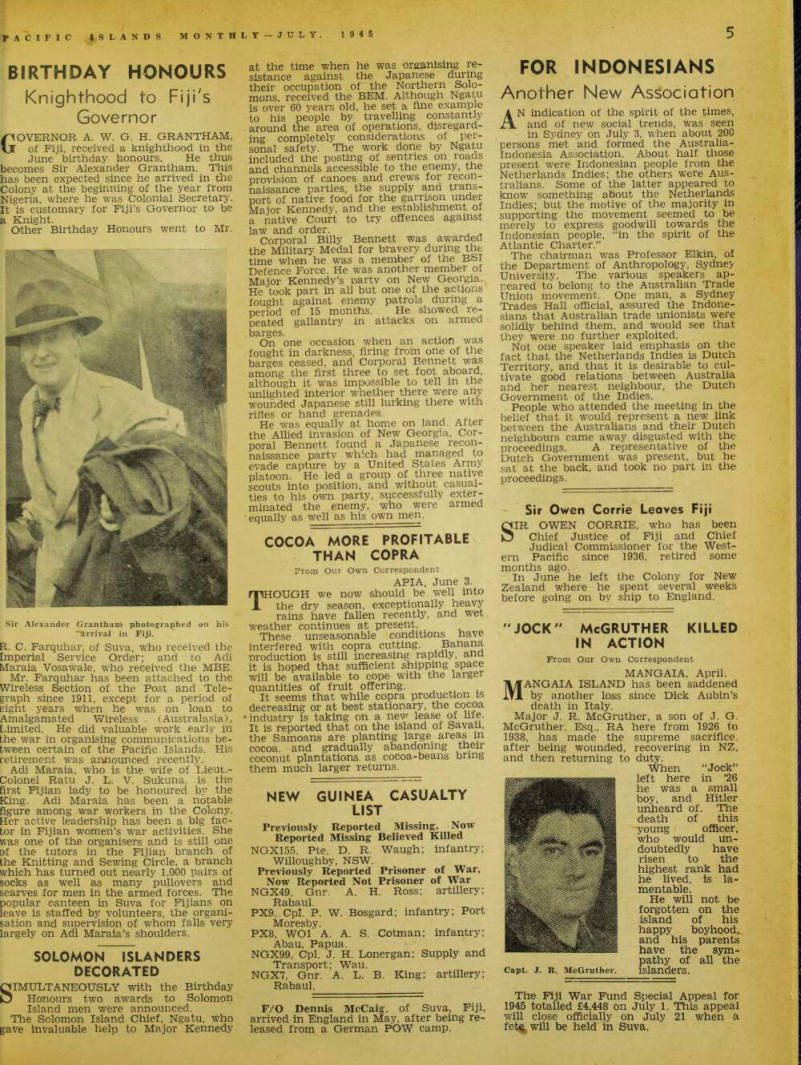
Governor a. w. g. h. grantham, of Fiji, received a knighthood in the June birthday honours. He thus becomes Sir Alexander Grantham. This has been expected since he arrived in the Colony at the beginning of the year from Nigeria, where he was Colonial Secretary.
It is customary for Fiji’s Governor to be a Knight.
Other Birthday Honours went to Mr.
R. C. Farquhar, of Suva, who received the Imperial Service Order; and to Adi Maraia Vosawale, who received the MBE Mr. Farquhar has been attached to the Wireless Section of the Post and Tele graph since 1911, except for a period of eight years when he was on loan to Amalgamated Wireless . (Australasia), Limited. He did valuable work early in the war in organising communications be tween certain of the Pacific Islands. His retirement was announced recently.
Adi Maraia, who is the wife of Lieut.- Colonel Ratu J. L. V. Sukuna, is the first Fijian lady to be honoured by the King. Adi Maraia has been a notable figure among war workers in the Colony, Her active leadership has been a big fac tor in Fijian women’s war activities. She was one of the organisers and is still one of the tutors in the Fijian branch of the Knitting and Sewing Circle, a branch which has turned out nearly 1,000 pairs of socks as well as many pullovers and scarves for men in the armed forces. The popular canteen in Suva for Fijians on leave is staffed by volunteers, the organi sation and supervision of whom falls very largely on Adi Maraia’s shoulders.
Sir Alexander Grantham photographed on his Arrival in Fiji.
Solomon Islanders
Decorated
Simultaneously with the Birthday Honours two, awards to Solomon Island men were announced.
The Solomon Island Chief, Ngatu, who gave invaluable help to Major Kennedy
at the time when he was organising re sistance against the Japanese during their occupation of the Northern Solo mons, received the BEM. Although Ngatu is over 60 vears old, he set a fine example to his people by travelling constantly around the area of operations, disregard ing completely considerations of per sonal safety. The work done by Ngatu included the posting of sentries on roads and channels accessible to the enemy, the provision of canoes and crews for recon naissance parties, the supply and trans port of native food for the garrison under Major Kennedy, and the establishment of a native Court to try offences against law and order.
Corporal Billy Bennett was awarded the Military Medal for bravery during the time when he was a member of the BSI Defence Force. He was another member of Major Kennedy’s party on New Georgia.
He took part in all but one of the actions fought against enemy patrols during a period of 15 months. He showed re peated gallantry in attacks on armed barges.
On one occasion when an action was fought in darkness, firing from one of the barges ceased, and Corporal Bennett was among the first three to set foot aboard, although it was impossible to tell in the unlighted interior whether there were any wounded Japanese still lurking there with rifles or hand grenades.
He was equally at home on land. After the Allied invasion of New Georgia, Cor poral Bennett found a Japanese recon naissance party which had managed to evade capture by a United States Army platoon. He led a group of three native scouts into position, and without casual ties to his own party, successfully exter minated the enemy, who were armed equally as well as his own men.
Cocoa More Profitable
Than Copra
Prom Our Own Correspondent APIA, June 3.
THOUGH we now should be well into the dry season, exceptionally heavy rains have fallen recently, and wet weather continues at present.
These unseasonable conditions have interfered with copra cutting. Banana production is still increasing rapidly, ana it is hoped that sufficient shipping space will be available to cope with the larger quantities of fruit offering.
It seems that while copra production is decreasing or at best stationary, the cocoa * industry is taking on a new lease of life.
It is reported that on the island of Savaii, the Samoans are planting large areas in cocoa, and gradually abandoning then coconut plantations, as cocoa-beans bring them much larger returns.
New Guinea Casualty
List
Previously Reported Missing, Now Reported Missing Believed Killed NGXISS, Pte. D. R. Waugh; infantry; Willoughby, NSW.
Previously Reported Prisoner of War, Now Reported Not Prisoner of War NGX49, Gnr. A. H. Ross; artillery; Rabaul.
PX9, Cpl. P. W. Bosgard; infantry; Port Moresby.
PXB, WOl A. A. S. Cotman; infantry: Abau, Papua.
NGX99, Cpl. J. H. Lonergan; Supply and Transport; Wau.
NGX7, Gnr. A. L. B. King; artillery; Rabaul F/O Dennis McCaig. of Suva, Fiji, arrived in England in May, after being re leased from a German POW camp.
For Indonesians
Another New Association
AN indication of the spirit of the times, and of new social trends, was seen in Sydney on July 3, when about 200 persons met and formed the Australia- Indonesia Association. About half those present were Indonesian people from the Netherlands Indies; the others were Aus tralians. Some of the latter appeared to know something about the Netherlands Indies; but the motive of the majority in supporting the movement seemed to be merely to express goodwill towards the Indonesian people, “in the spirit of the Atlantic Charter,”
The chairman was Professor Elkin, of the Department of Anthropology, Sydney University. The various speakers ap peared to belong to the Australian Trade Union movement. One man, a Sydney Trades Hall official, assured the Indone sians that Australian trade unionists were solidly behind them, and would see that they were no further exploited.
Not one speaker laid emphasis on the fact that the Netherlands Indies is Dutch Territory, and that it is desirable to cul tivate good relations between Australia and her nearest neighbour, the Dutch Government of the Indies.
People who attended the meeting in the belief that it would represent a new link between the Australians and their Dutch neighbours came away disgusted with the proceedings. A representative of the Dutch Government was present, but he sat at the back, and took no part in the proceedings.
Sir Owen Corrie Leaves Fiji
SIR OWEN CORRIE, who has been Chief Justice of Fiji and Chief Judical Commissioner for the West ern Pacific since 1936, retired some months ago.
In June he left the Colony for New Zealand where he spent several weeks before going on by ship to England.
"Jock" Mcgruther Killed
In Action
From Our Own Correspondent
MANGAIA, April.
MANGAIA ISLAND has been saddened by another loss since Dick Aubin’s death in Italy.
Major J. R. McGruther, a son of J. G.
McGruther, Esq., RA here from 1926 to 1938, has made the supreme sacrifice, after being wounded, recovering in NZ, and then returning to duty.
When “Jock” left here in ’26 he was a small boy, and Hitler unheard of. The death of this young officer, who would un doubtedly have risen to the highest rank had he lived, is la mentable.
He will not be forgotten on the island of his happy boyhood, and his parents have the sym pathy of all the islanders.
The Fiji War Fund Special Appeal for 1945 totalled £4,448 on July 1. This appeal will close officially on July 21 when a fet§, will be held in Suva.
Capt. J. R. McGruther.
Utopia In New Guinea
Australia Plans Socialist
Mr. Ward Proposes to Show the World How Native Peoples Should be Governed
mHE full scope of the socialistic plans X made for the future administration of Papua and New Guinea oy the Australian Labour Government was dis closed on July 4, when the Minister for Australia’s External Territories, Mr.
Ward, made his second-reading speech on the Papua-New Guinea Provisional Administration Bill.
The Administration of the New Guinea Mandated Territory was suspended on January 22, 1942, when the Japanese invaded the Territory; and that of Papua on February 12, 1942, when General Mor ris, Commander of the Australian Forces in Papua, was given complete charge of the Territory.
Since then Papua, and all that part of New Guinea recovered from the Japs, has been administered by ANGAU, an Army unit commanded by General Morris, and by the Production Control Board, a body formed by the Army and controlled by the Department of External Affairs. An agitation for the restoration of civil gov ernment, and the return of civilians to Papua, has been proceeding for the last two years: but has been resisted by both the Army and by the Minister, though for different reasons.
Finally, in March, 1945, the Minister promised that civil government would be restored; but—presumably, in order that the Australian Socialist Government could keep private enterprise out of the Territories, and carry out its own ideas in relation to native administration—he announced that the old Administrations would not be restored, and that a Pro visional Government would be established under the authority of National Security Regulations.
Later, without explanation, the Minis ter introduced the Bill, which is to set up the Provisional Government by legis lation, and not by Regulations.
THE last paragraph of the Minister’s Fourth of July speech (reported below) was as follows: “It is the aim of the Government, as the proposer at the San Francisco Con ference of the establishment of the prin ciple of trusteeships respecting dependent peoples, to set an example by the way in Australia carries out its responsi bilities in the Territories under its control.
“Naturally, many of the plans of the Government affecting native education, health, etc. are in the formative stage; and, from time to time, statements will
t 0 the of decisions
taken m various subjects.” fhI ri T\/? 1^ k / ng his sec °nd-reading speech announce d that, as soon as Shi hrnL G< T rnment is established, it Lahn.w r. i" t 0 °P eratlon a new Native Labour Ordinance, in which effect is extraordinary views 6 of the Sor7 Ve u labour indenture system which have been pumped into the Minister bv
vanous missionary and anthropological
to which dl bp n ba the past two y ears > g and to wnich he has given exnressinn in St Mv ll Wa?.H ra - Se V since he to ° k offl ee.
Mi. Waid. in his speech, did not have - to hf,? y £ bout bis
length en™ animadverted at
Phrased ff) SIL P i ans to . (as he has from furthpv o the unhappy natives lurthei commercial exploitation and to show the world how the Austra lian Labour Government fulfils the Wi
gations of “trusteeship” concerning which the Australian delegates “got across the necks” of Great Britain and other great colony-holding Powers at San Francisco. The new Native Labour Or dinance proposes the following “reforms”: • A 44-hours working week for natives. • Elimination of the indenture system. • Elimination of professional recruiters. • Limit on number of natives taken from any village for employment. • Vigorous policy to enable natives to take a greater share in agriculture on their own account than in the past. • Raising of the minimum wage from 5/- to 15/- a month. • A revised, scientifically balanced diet for natives. • No emoloyment of natives under 16 years of age. • No employment of female native labour ex cept under certain conditions. • Ultimate participation in self-government by natives. • Twelve months’ limit on duration of employ ment contracts. • Limitation of the penal provisions of the Ordinance. • Employment compensation for natives. • Control of trading activities. • Appointment of various officers, including Directors of Health, Agriculture and Edu cation.
In the following columns, we have printed Mr. Ward’s speech in full. But, in order to correct his various mis-state ments, and show the destructive charac ter of his plans, we have interpolated our own comment wherever necessary.
EARLIER in the year (said Mr. Ward) I announced that the Government, after consultation with the Aus tralian Commander-in-Chief, had decided to restore civil administration to the Territory of Papua, and that portion of the Territory of New Guinea south of the Markham River. The purpose of this Bill is to give effect to that decision.
At the time of the invasion of the Terri tories of Papua and New Guinea by the Japanese early in 1942, there were sepa rate administrations for the areas, each with an Administrator and Executive and Legislative Councils, a Judiciary and a Public Service. Following the Japanese invasion all persons employed bv both, administrations who were not in the Forces were suspended from office by National Security (External Territories) Regulations; and such functions of civil administration as were necessary to be performed in those portions of Papua and New Guinea not then in enemy occupa tion were vested by National Security (Emergency Control) Regulations in the officer commanding the Australian Mili tary Forces operating in the area. The Australian New Guinea Administration Unit (ANGAU) was formed as a part of the Australian Military Forces and com menced operations in Papua and progres sively extended its activities to the Ter ritory of New Guinea. For convenience, the Territories have been regarded as one administrative area whilst under military control.
Although the Government does not propose at this stage to consider the question of the amalgamation of the tv/o Territories, it considers that it would not be desirable immediately to re-establish two entirely separate Public Services. It proposes, therefore, as a temporary mea sure, to create a single provisional ad ministration to administer Papua and such portions of the Mandated Territory of New Guinea as are now available to
be transferred to civil control. Other parts of the Mandated Territory which have been recovered from the enemy will continue to be administered by ANGAU until the operational position in those areas is such as to allow control to be transferred to civil authorities.
THE administration of Papua was con s“W®d under the Papua Act, 1905 - and that of the Mandated Territorv APt N^Qon Gul ?,*!; un £ er the New Guinea Act, 1920. Although officers of the ad ministrations of the Territories were sus pended in 1942, all laws of the Terri tories have continued in force, and such legislation as has been necessary during military control has been effected under National Security Regulations. , tv? Proposed that the Papua Act and the New Guinea Act should continue in force so far as their provisions relate to the definition of the boundaries of the Territories and the powers of the Com monwealth in relation to the Territories it is proposed, however, to suspend the provisions of those Acts which relate" to the Administrator, the Legislative Coun ts. the Judiciary and the Public Service rhe Bill contains provisions similar to those in the separate Acts in relation to these matters, excepting that the power to make ordinances will 'be vested in the Governor-General instead of the Legisla tive Councils. This course is necessary by reason of the temporary nature of the provisional administration and of the absence of normal conditions and a settled population.
The position will, however, be kept under constant review bv the Govern ment, and as soon as it becomes practic able to do so legislative powers will be restored to the Territories.
The area covered by the provisional ad ministration will be known as the Ter- Papua-New Guinea, and there will be one Administrator, one Supreme Court, and one Public Service for the Territory. rE Bill that the suspension of the 'provisions of the Papua Act and the New Guinea Act relating to the making of ordinances shall not affect the operation of any law made pursuant to those Acts; but any ordinance made under the Acts may be amended or repealed by ordinance under the proposed Act. The proposed Papua-New Guinea Provisional Administration Act will continue in opera tion until a date to be fixed by pro clamation and no longer, but in any event not longer than six months after His Majestv ceases to be engaged in war.
When the Act comes into force the opera tion of National Security (Emergency Control) Regulations will be terminated so far as the Territory of Papua and the portion of the Territory of New Guinea that is being transferred to civil control are concerned; and certain sections of National Security (External Territories) Regulations will be repealed.
The separate Public Services of Papua and New Guinea will be replaced tem porarily by a Provisional Public Service under the proposed Act. Officers of the former Services will continue to be re garded as suspended from office under National Security (External Territories) Regulations, but they will be entitled to. appointment in the Provisional Service under conditions of service and a salary not less favourable than those applic able to them as officers of their respective Public Services. The rights of such officers under the terms of their appoint ments in the separate Services will be preserved to them, and such rights will be safeguarded during the period of the provisional administration.
The classification for the Provisional
(Continued on Page 41)
Service has been prepared on the basis of the salary scales for corresponding positions in the Public Services of Papua and New Guinea, adopting as a general rule whichever rate is the higher for
analagous positions. Any disparity in
salaries paid for positions with similar
duties and responsibilities as between the two Services will thus be removed.
Comment
THE Minister gives no reason whatever for adopting this circuitous method of a “Pro visional Government,” except that it was considered undesirable (presumably by Mr. Ward) that any attempt should be made to re constitute two Public Services. It would have been quite easy for Canberra bureaucrats — whose powers appear unlimited —to have created one Provisional Public Service to administer the two Territories under their own constitution, and restored the latter, undisturbed.
But that would not have suited the Australian Socialist Government. It would have meant (a) the free and early return of civilians to the Territories; (b) the re-establishment of the Legislative Councils of both Territories, which have at least the privilege of making and amending the Ordinances; (c) the removal of the Production Control Board and tfre sub stitution therefor of the principle of private enterprise in the running of plantations and the conduct of general stores; (d) control by the Territories’ own administrations of native labour.
Mr. Ward wants to keep all those powers in his own hands.
These reforms have nothing whatever to do with wartime or post-war conditions. They are something planned by the very Leftist Mr. Ward, who apparently seeks to challenge the fame gained by the late Sir Hubert Murray as. the South Pacific’s wisest and most successful native administrator. Under the guise of wartime necessity, Mr. Ward, very cunningly, is putting into operation his own idea of a native Utopia in Australia’s Pacific Territories.
The Bill gets rid of all possible civilian inter ference with Mr. Ward. He, at Canberra, and not the Legislative Councils, will make the Ordinances. It leaves him, through the medium of the Production Control Board, in supreme control of all planting and trading, so that he can continue his two-year-old policy of keeping private enterprise entirely out of the Territories; and it gives him complete freedom to arrange native policy, and especially native labour, to suit himself.
Unless Mr. Ward, with the Australian Socialist Government, is turned out of office at the general election about September, 1946, this new set-up will operate for the period of the war and for six months thereafter; and it is to be feared that, by then, it will have left its mark very deep upon the economy of the Territories. riIHE occupation by the enemy of most X of the Territory of New Guinea and a large portion of Papua caused dis ruption to the native inhabitants and
destruction of property that will require
considerable sums of money to repair.
Some of this money will be forthcoming from the Commonwealth War Damage
Scheme, which applies to the Territories,
but appropriations will also be necessary from the revenue of the Commonwealth to assist in the reconstruction and re
habilitation of the Territories.
This Government is not satisfied that sufficient interest had been taken in the Territories prior to the Japanese invasion or that adequate funds had been pro vided for their development and the ad vancement of the native inhabitants.
Apart from the debt of gratitude that the people of Australia owe to the natives of the Territory, the Government regards it as its bounden duty to further to the
utmost the advancement of the natives,
and considers that that can be achieved
only by providing facilities for better
health, better education, and for a greater participation by the natives in the wealth of their country, and eventually in its gov ernment. A comprehensive programme is to be followed for the rehabilitation
and development of the Territories, hav
mg regard to the moral and material wel fare of the native inhabitants and the strategic importance of the area to Aus
tralia.
Comment
NO one, apparently, ever has told this Minister that, when the Japanese invasion came, there were 4,000 Europeans and over 2,000 Chinese in New Guinea and 2,000 Europeans in Papua; that they were the hard-working pioneers of these two great tropical Territories; and that —with the exception of the people of Darwin— they were the only Australians who really suf fered the horrors and direct economic losses of war.
Many of them were murdered; many were cap tured, and still are prisoners; the rest were hurriedly evacuated from the Territories—and still, three years later, are not allowed to re turn. Most of them have lost everything. The majority will receive war damage compensation: but this does not really compensate them for all that they have lost—especially the industry of their lives, and their hope of a secure future.
Whatever hope they may have had of re-estab lishing themselves in the Territories is pretty well wiped out now by the Socialistic plans of the Red Minister frem King’s Cross.
Mr. Ward is fearfully concerned for the wel fare of the natives, and devotes nearly all of his long speech to plans concerning them. But he does not —even to the extent of two conse cutive sentences —give any consideration to the present plight and future welfare of the thou sands of Europeans and Chinese who have been rendered homeless, and ruined, by the Japanese invasion.
They, of course, are associated in the mind of this incredible Minister with private enter prise, his especial bete noir. They belong to the
cla ss which exploited his precious Fuzzy Wuzzies.
He is s° in * to show them where they get off rpiHE Government has already taken X decisions on a nhmber of matters, the most important Of which is that
Advertisements & other items, p. 8 (1 item)
6
JULY, 194 5 PACIFIC ISLAND S. MONTHLY
N.G. Airmen
Decorations to Two N.G. Airmen "Tommy" Ellis and lan Innes
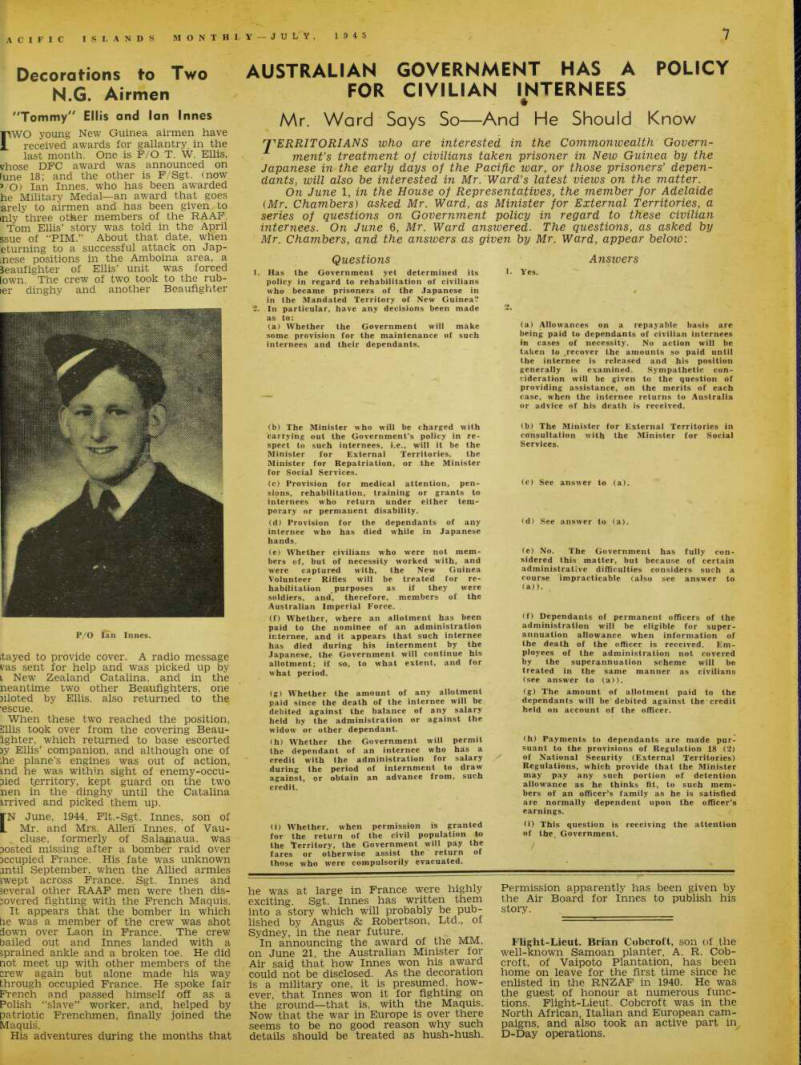
rWO young New Guinea airmen have received awards for gallantry in the last month. One is F/O T. W. Ellis, vhose DFC award was announced on rune 18; and the other is F/Sgt. (now VO) lan Innes, who has been awarded he Military Medal—an award that goes arely to airmen and has been given to inly three other members of the RAAF.
Tom Ellis’ story was told in the April ssue of “PIM.” About that date, when eturning to a successful attack on Jap anese positions in the Amboina area, a Jeaufighter of Ellis’ unit was forced lown. The crew of two took to the rub ier dinghy and another Beaufighter
itayed to provide cover. A radio message vas sent for help and was picked up by t New Zealand Catalina, and in the neantime two other Beaufighters, one jiloted by Ellis, also returned to the •escue.
When these two reached the position, Ellis took over from the covering Beau ighter, which returned to base escorted )y Ellis’ companion, and although one of ;he plane’s engines was out of action, md he was within sight of enemy-occu pied territory, kept guard on the two nen in the dinghy until the Catalina irrived and picked them up. [N June, 1944, Fit.-Sgt. Innes, son of Mr. and Mrs. Allen Innes, of Vau „ cluse, formerly of Salamaua, was posted missing after a bomber raid over Dccupied France. His fate was unknown until September, when the Allied armies swept across France. Sgt. Innes and several other RAAF men were then dis covered fighting with the French Maquis.
It appears that the bomber in which be was a member of the crew was shot down over Laon in France. The crew bailed out and Innes landed with a sprained ankle and a broken toe. He did not meet up with other members of the crew again but alone made his way through occupied France. He spoke fair French and passed himself off as a Polish “slave” worker, and, helped by patriotic Frenchmen, finally joined the Maquis.
His adventures during the months that
he was at large in France were highly exciting. Sgt. Innes has written them into a story which will probably be pub lished by Angus & Robertson, Ltd., of Sydney, in the near future.
In announcing the award of the MM, on June 21, the Australian Minister for Air said that how Innes won his award could not be disclosed. As the decoration is a military one, it is presumed, how ever, that Innes won it for fighting on the ground—that is, with the Maquis.
Now that the war in Europe is over there seems to be no good reason why such details should be treated as hush-hush.
Permission apparently has been given by the Air Board for Innes to publish his story.
Flight-Lieut. Brian Cobcroft, son of the well-known Samoan planter, A. R. Cob croft, of Vaipoto Plantation, has been home on leave for the first time since he enlisted in the RNZAF in 1940. He was the guest of honour at numerous func tions. Flight-Lieut. Cobcroft was in the North African, Italian and European cam paigns, and also took an active part in D-Day operations.
P/O Ian Innes.
Australian Government Has A Policy
For Civilian Internees
Mr. Ward Says So—And He Should Know
r J I ERRI TO RIANS who are interested in the Commonwealth Govern ment’s treatment of civilians taken prisoner in New Guinea by the Japanese in the early days of the Pacific war, or those prisoners’ depen dants, will also be interested in Mr. Ward’s latest views on the matter.
On June 1, in the House of Representatives, the member for Adelaide (Mr. Chambers ) asked Mr. Ward, as Minister for External Territories, a series of questions on Government policy in regard to these civilian internees. On June 6, Mr. Ward answered. The questions, as asked by Mr. Chambers, and the answers as given by Mr. Ward, appear below :
Questions
1. Has the Government yet determined its policy in regard to rehabilitation of civilians who became prisoners of the Japanese in in the Mandated Territory of New Guinea? 2. In particular, have any decisions been made as to: (a) Whether the Government will make some provision for the maintenance of such internees and their dependants.
(b) The Minister who will be charged with carrying out the Government’s policy in re spect to such internees, i.e., will it be the Minister for External Territories, the Minister for Repatriation, or the Minister for Social Services. (c) Provision for medical attention, pen sions, rehabilitation, training or grants to internees who return under either tem porary or permanent disability. (d) Provision for the dependants of any internee who has died while in Japanese hands. (e) Whether civilians who were not mem bers of, but of necessity worked with, and were captured with, the New' Guinea Volunteer Rifles will be treated for re habilitation purposes as if they were soldiers, and", therefore, members of the Australian Imperial Force. (f) Whether, where an allotment has been paid to the nominee of an administration internee, and it appears that such internee has died during his internment by the Japanese, the Government will continue his allotment; if so, to what extent, and for what period. (g) Whether the amount of any allotment paid since the death of the internee will be debited against the balance of any salary held by the administration or against the widow or other dependant. (h) Whether the Government will permit the dependant of an internee who has a credit with the administration for salary during the period of internment to draw against, or obtain an advance from, such credit. (i) Whether, when permission is granted for the return of the civil population to the Territory, the Government will pay the fares or otherwise assist the return of those who were compulsorily evacuated.
Answers
1. Yes. 2. (a) Allowances on a repayable basis are being paid to dependants of civilian internees in cases of necessity. No action will be taken to .recover the amounts so paid until the internee is released and his position generally is examined. Sympathetic con sideration will be given to the question of providing assistance, on the merits of each case, when the internee returns to Australia or advice of his death is received. (b) The Minister for External Territories in consultation with the Minister for Social Services. (c) See answer to (a). (d) See answer to (a). (e) No. The Government has fully con sidered this matter, but because of certain administrative difficulties considers such a course impracticable (also see answer to (a)). (f) Dependants of permanent officers of the administration will be eligible for super annuation allowance when information of the death of the officer is received. Em ployees of the administration not covered by the superannuation scheme will be treated in the same manner as civilians (see answer to (a)). (g) The amount of allotment paid to the dependants will be debited against the credit held on account of the officer. (h) Payments to dependants are made pur suant to the provisions of Regulation 18 (2) of National Security (External Territories) Regulations, which provide that the Minister may pay any such portion of detention allowance as he thinks fit, to such mem bers of an officer’s family as he is satisfied are normally dependent upon the officer’s earnings. (i) This question is receiving the attention of the Government.
Advertisements & other items, p. 9 (1 item)
7
ACIFIC ISLANDS MONTHLY JULY, 1945
Liquid Funds
Three Pacific Companies With Over 4½ Millions of Liquid Funds
A SUMMARY of the annual balance sheets of two of the largest com panies trading in the Pacific is published below. Both show some reduc tion of profit, but that probably is due to the Pacific war moving away northwards, and taking with it the supply of Ameri can dollars which created a little El Dorado for traders in 1943-44. Compared with the average over recent years, both companies are doing exceedingly well.
The amount of liquid funds available for investment in the Pacific Territories is worth noticing. If mad-headed govern ments do not crucify private enterprise, and if there is anything in the Pacific capable of development and marketing, there should be a good time ahead, after the war, for these big firms certainly have huge funds tucked away for use in any thing that looks capable of sound returns.
Here are figures showing the available funds (cash and investments in very safe stocks and shares) disclosed in these balance-sheets published recently:— Burns, Philp & Co., Ltd £2,933,734 Morris Hedstrom, Ltd 1.140.889 Burns Philp (S.S.) Co., Ltd. .. 577.841 £4,652,464 The fourth big Pacific company, W. R.
Carpenter & Co., Ltd., does not publish
its accounts until August or September.
It also has very large liquid assets.
This healthy total, added to the fact that the people of New Guinea and Papua (if ever they are allowed by the unpre dictable Australian Government to return to their Territory) will have substantial sums available from war damage com pensation funds, suggests that the Islands Territories, with plenty of developmental money and low taxation, may enjoy some thing of a boom.
Burns Philp & Co., Ltd.
A DECREASE of £22,754 to £203,817 is shown in net profit of Burns, Philp & Co., Ltd., for the year ended March 31. Details are as follows:
Year ended March 31. 1944. 1945. £ £ Net profit .. .. 226,571 203,817 Div., 10 p.c 200,000 To staff fund . . . . .. .. 25,000 Carried forward .. .. 35,101 38,918 Gross profit . . ,. .. 1.431,490 Expenses,«.etc. .. . . . . . 1.022.963 1,108,943 Depreciation ... 154,309 117,498 Bad debts, losses .. .. .. 21,358 1,232
Liabilities—
Capital . . . . 2,000,000 2.000,000 Reserve fund .. . . .. . . 1,250,000 1,250,000 Ins., res., etc . . .. 1,619,707 1,732,365
Morris Hedstrom, Ltd.
Representing The Colonial Office
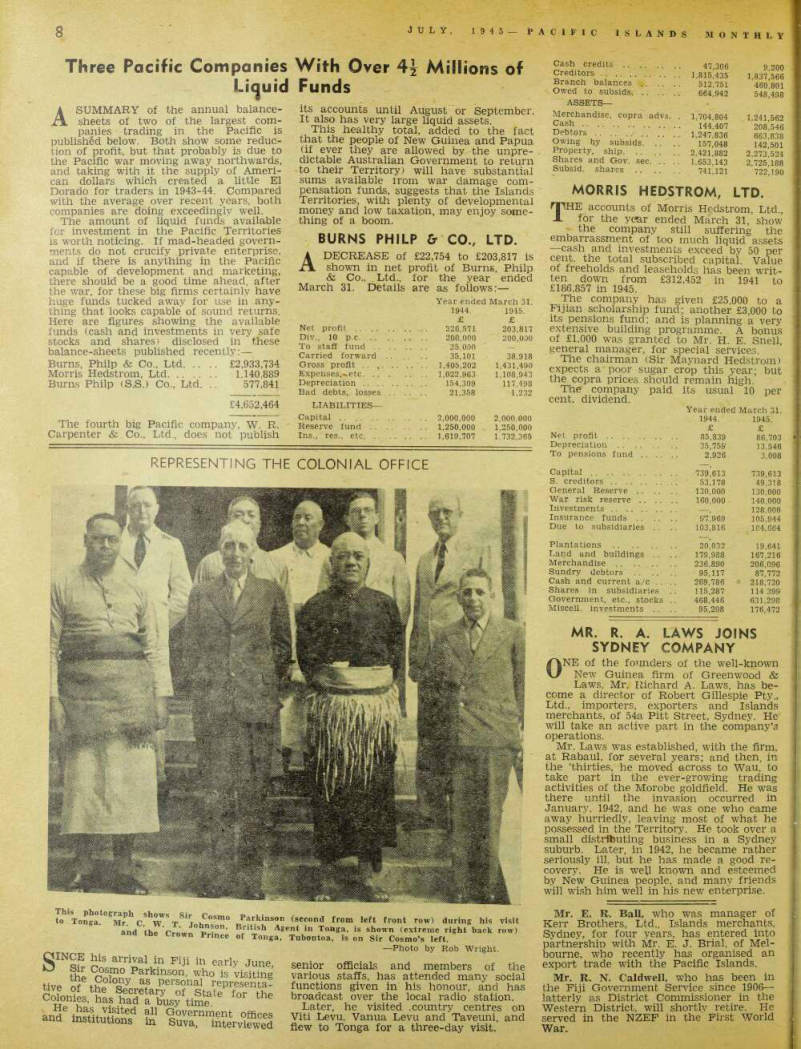
S IN s,> arn £ a V. n FIJI m earl y June, ° the rnll 0 Parkmson, who is visiting tive of <? y P ersona l representa of the Secretary of State for the Colonies, has had a busy time. anri in?Hf, V f 1 - Slted all Government offices and institutions in Suva, interviewed
senior officials and members of the various staffs, has attended many social functions given in his honour, and has broadcast over the local radio station.
Later, he visited .country centres on Viti Levu, Vanua Levu and Taveuni, and flew to Tonga for a three-day visit.
Morris Hedstrom, Ltd.
THE accounts of Morris Hedstrom, Ltd., for the year ended March 31, show the company still suffering the embarrassment of too much liquid assets —cash and investments exceed by 50 per cent, the total subscribed capital. Value of freeholds and leaseholds has been writ ten down from £312,452 in 1941 to £186,857 in 1945.
The company has given £25,000 to a Fijian scholarship fund; another £3,000 to its pensions fund; and is planning a very extensive building programme. A bonus of £l.OOO was granted to Mr. H. E. Snell, general manager, for special services.
The chairman (Sir Maynard Hedstrom) expects a poor sugar crop this year; but the copra prices should remain high.
The company paid its usual 10 per cent, dividend.
This photograph shows Sir Cosmo Parkinson (second from left front row) during his visit to Tonga. Mr. C. W. T. Johnson, British Agent in Tonga, is shown (extreme right back row) and the Crown Prince of Tonga, Tuboutoa, is on Sir Cosmo's left. —Photo by Rob Wright.
Cash credits .. ..
Creditors 47,306 1,815,435 9,200
1 Q*? 1 ? Roc
Branch balances Owed to subsids
Assets—
512!751 664,942
1.00 F ,Doo
460,801 548,498 Merchandise, copra advs. 1.704,804 1,241,562
Ohq K/Ic
Cash 144.407 Debtors ... 1,247,836 090 Owing by subsids Property, ship Shares and Gov. sec Subsid. shares 157^048 2.421,882 1,653.143 741,121 000,000 142.501 2,273,524 2,725,188 722,190
Year ended March 31. 1944. 1945. £ £ Net profit 85,839 86,703 Depreciation 35,759’ 13.546 To pensions fund 2,926 3,008 Capital 739^613 739,613 S. creditors 53,178 49,318 General Reserve .. . 130,000 130,000 War risk reserve 160,000 140,000 Investments 128.000 Insurance funds 97^969 105,944 Due to subsidiaries .. . 103,816 104,664 Plantations 20!032 19,641 Land and buildings .. . 179,988 167.216 Merchandise 236,890 206,096 Sundry debtors 95,117 87,772 Cash and current a/c .. . 269,786 218,720 Shares in subsidiaries 115,287 114 399 Government, etc., stocks . 468.446 631,298 Miscell. investments .. . 95,208 176,472
Mr. R. A. Laws Joins
Sydney Company
ONE of the founders of the well-known New Guinea firm of Greenwood & Laws, Mr. Richard A. Laws, has be come a director of Robert Gillespie Pty., Ltd., importers, exporters and Islands merchants, of 54a Pitt Street, Sydney, He will take an active part in the company’s operations.
Mr. Laws was established, with the firm, at Rabaul, for several years; and then, in the ’thirties, he moved across to Wau, to take part in the ever-growing trading activities of the Morobe goldfield. He was there until the invasion occurred in January, 1942, and he was one who came away hurriedly, leaving most of what he possessed in the Territory. He took over a small distributing business in a Sydney suburb. Later, in 1942, he became rather seriously ill, but he has made a good re covery. He is well known and esteemed by New Guinea people, and many friends will wish him well in his new enterprise.
Mr. E. R. Ball, who was manager of Kerr Brothers, Ltd., Islands merchants, Sydney, for four years, has entered into partnershin with Mr. E. J. Brial, of Mel bourne, who recently has organised an export trade with the Pacific Islands.
Mr. R. N. Caldwell, who has been in the Fiji Government Service since 1906 latterly as District Commissioner in the Western District, will shortly retire. He served in the NZEF in the First World War.
Teopicalities
rE United States Marines placed this sign on Kwajalein Atoll, in the Marshalls: Hotel Atoll—No Beer Atoll —No Women Atoll —Nuthin’ Atoll.
As has been said, the pun is the lowest form of humour, when you don’t think of it first. m ON this island of Mangaia a Sunday “tere” was recently held. The local clerics went out to the Tamorua and Ivirua districts, and the soul-savers from these districts came in here.
A feast was held in the mission for the visitors. But a most unseemly levity revealed itself —they danced!
An “orometua” (pastor) hula-ed, like St. Vitus, at the feast; and the congre gation followed his example, causing no little scandal.
The aged said things were going to the dogs; and emulated Captain Shot over in prophesying an ill end for the “evangelia.”
Curiously enough, the same night a terrific electric storm broke over Man gaia. The loudest thunder, the most awesome lightning, any had ever seen.
The old-’uns weren’t scared, though; the heavens, to them, were telling of the decay of Christianity, and the indignity of dancing Davids.
The burning question now is—what’s coming next?—EG. * THE British officers who maintained Colonial administration in the Solo mons during the Japanese occupa tion can truthfully say that there was “never a dull moment” in their busy and nomadic lives.
One of them told me how, when cross ing from one island to another in a native canoe, he was dismayed to find two lines of Jap barges approaching him from opposite directions. He lay face down in the middle of the canoe while the barges went past—one line on each side, with scarcely more than a hundred yards separating them.
But that didn’t end his adventures.
Later, he got safely to his destination and slept the night in a native hut in the village. When he woke in the morn ing he strolled to the doorway and looked out. What he saw caused him'to execute a Douglas Fairbanks dive through the back window and beat a hasty retreat into the bush. A party of Jap soldiers, evidently disembarked from the barges he had seen the day before, was marching through the village.—HC. * MAJOR E. B. AYRIS, formerly of Wau, New Guinea (and interested in amateur theatricals) says we insist in putting him in “small ships” whereas he was. until recently, attached to the. British Merchant Navy and was never hear a small ship. At all events he has now left the sea and has settled down on a sheep station near Brewar rina. NSW. This is what he writes us: “New Guinea certainly gets represented in most unlikely places. About a month after I had been resident here I was told that one Hayward, from New Guinea, had just arrived. I went to the store which I was told he was managing, and there as large as life was ‘Bill’ Hay ward, one-time with WRC at Wau.
“ ‘Bill’ was a great asset in Wau with his saxophone, steel guitar, fiddle and repertoire of swing and hill-billy ditties.
He also played a couple of excellent comedy parts for me in my last two productions up there.
“The coincidence doesn’t finish there, for the .book-keeper in Hayward’s store
is one B. Schultz, also one-time on the Goldfields. Three Goldfielders in a small place like Brewarrina is somewhat unusual. Hayward has just brought his wife and five children from Orange and seems settled down.” * rE title under a picture in “Daily Mirror,” Sydney:
“A Village Tul-Tul (Papuan
medicine man) smiles widely to wel come the Duke of Gloucester during his visit to the Royal Papuan Con stabulary compound at Lae, New Guinea.”
Which would be perfectly correct, except for three things: The gentleman was not a Tultul. A Tultul is not a medicine-man. Tultul is not a title known in Papua.
This is typical of the treatment endured by Territorians at the hands of Austra lia’s politicians, and Australia’s even more ignorant press.
SYDNEY “Mirror,” on June 27, printed a photograph of a 50 ft. motor cruiser, “Halcyon,” which they stated had been bought by Squadron- Leader J. A. Thurston in Launceston, Tasmania, and was being sailed by him to Sydney.
Jack Thurston is well known in New Guinea, where he had planting and min ing interests —he owns what was Wewak’s first gold lease, the famous “Number One Gold.” It was said of him in the days before the war that when you met him he was either buying or selling a boat. He sailed at least two from Aus tralia to New Guinea, with the help of
native crews, in the days “along before.”
Just before the war he bought the 45 ft.
“Destiny” from the Grimson brothers, who had sailed her up from Australia to New Guinea.
It is not known what he intends doing with “Halcyon”; or whether it was merely a purchase on behalf of the raaf. • ... mHIS story is topical rather than tropi- X cal. One of the sights of wartime Sydney are its queues, particularly the grog and tobacco Queues. The tobacco queues take in both sexes, but the grog queues seem to be comprised exclusively of middle-aged females of a hard, raffish or frowsy aspect who have some sort of sixth sense which tells them “when it will be on.” On their flat splay feet, surrounded by outsize shopping bags and occasionally offspring, they wait patiently for hours before the doois open, In Wynyard underground station the queues are at their best. The attenuated two from the tobacco kiosks intermingle; there are the half-dozen from the rail way booking offices, and there is the periodic grog queue for the Plaza Hotel, which has an entrance into the station, (The Plaza is run by Ponce Parer, well known before the war in the Morobe and Sepik districts of New Guinea.) It is said that if a man pauses for a moment anywhere in Wynyard to fumble for change in his pocket, a dozen people line up behind him before he can get it and move on.
Denizens of Wynyard are blase about their queues, but even they were shat tered recently when two sweet-faced nuns joined the end of the long grog queue for the Plaza Hotel. Railway ticket clerks watched them with interest and, among train and tram travellers scurrying to
Interesting Wedding In Apia
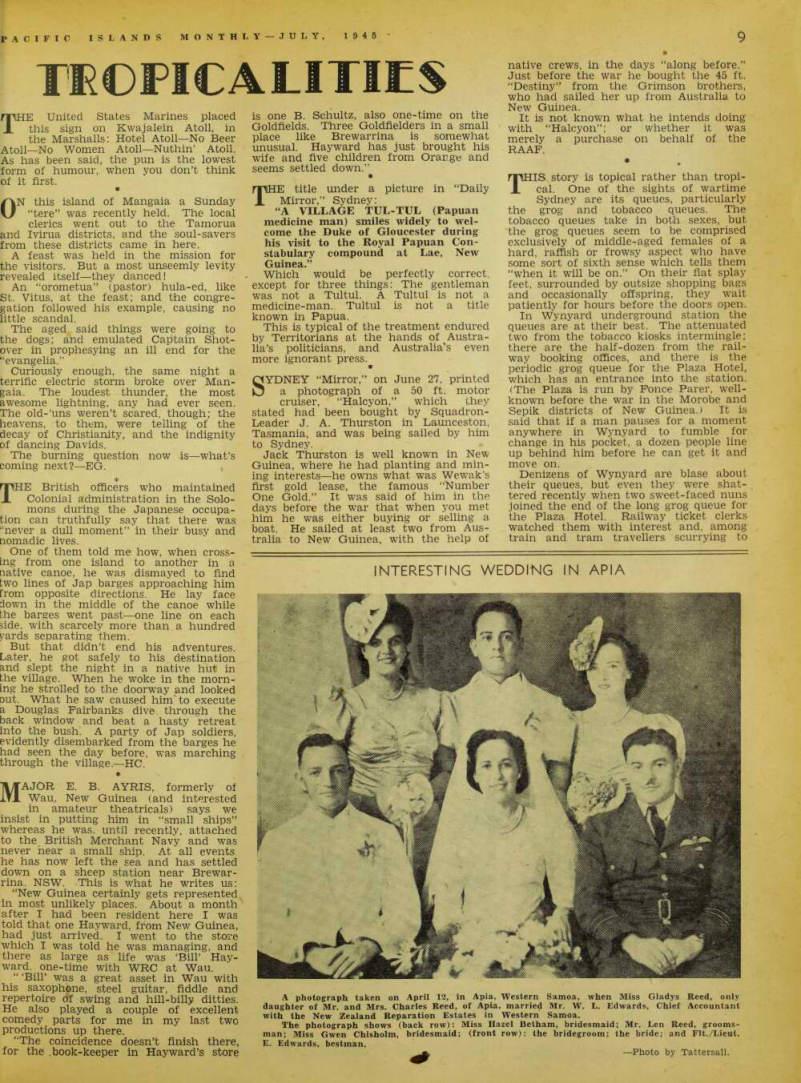
A photograph taken on April 12, in Apia, Western Samoa, when Miss Gladys Reed, only daughter of Mr, and Mrs. Charles Reed, of Apia, married Mr, W. L. Edwards, Chief Accountant with the New Zealand Reparation Estates in Western Samoa.
The photograph shows (back row): Miss Hazel Betham, bridesmaid; Mr. Len Reed, grooms man; Miss Gwen Chisholm, bridesmaid; (front row): the bridegroom; the bride; and Fit./Lieut.
E. Edwards, bestman. —Photo by Tattersall.
and fro, they caused something of a sensation.
At last one woman, probably a good Catholic, could bear it no longer. She approached the nuns and said: “If you care to wait over there, I’ll get you what ever you need.”
“That is extremely kind of you, my dear.” replied the elder of the nuns. “We are going visiting up the North Shore line. Would you two returns to Chatswood?” * rMBER is probably the world com modity in greatest demand and in shortest supply at the present time; and, according to timber experts, is likely to continue to be so for some consider able time after the war ends.
Australia could never, even before the war, supply all her own needs, and her present position is so acute there liter ally is not sufficient timber in the Com monwealth to take care of the few build ing permits which have been wrung from reluctant officialdom. Neither can much be hoped for from Canada and America.
It is stated that rebuilding shattered Europe will take four times as much timber as North America can supply.
This should be a golden opportunity for the infant New Guinea timber indus try, just starting its first staggering foot steps when the Pacific war closed down upon it. Several enterprising residents of New Guinea were shipping walnut to Australia and the United States, and although walnut veneer can be regarded as a luxury industry at the present time, this should be the time to exploit the large stands of utility timber, such as New Guinea pine, which were formerly regarded as uncommercial. There is fine cedar and other timber on the Morobe tableland, and ' now that it has been proved that these places can be roaded it should be possible to get the timber out and distributed to a lumber-starved world.
The post-war timber industry in New Guinea (and BSI and the New Hebrides) should prove to be a goldmine for the men with the necessary experience. But intending timber-men are advised not to let Mr Ward know about it. Hell nationalise it—and them.
Mr - W. S. Buchanan returned to Fiii recently. He worked at the Loloma gold nune until 1939, when he went to New Zealand. He enlisted at the outbreak of war, and served with the Second NZEF through all the Middle East campaigns in which the New Zealanders were en gaged- He was evacuated from Greece and Crete and, after service in North Africa, was in the Italian compaign up to le w^ere the New Zealanders reached the Senio River.
"Shangri-La"
Freak Plane Accident Discloses Mystery Valley in Dutch N. Guinea
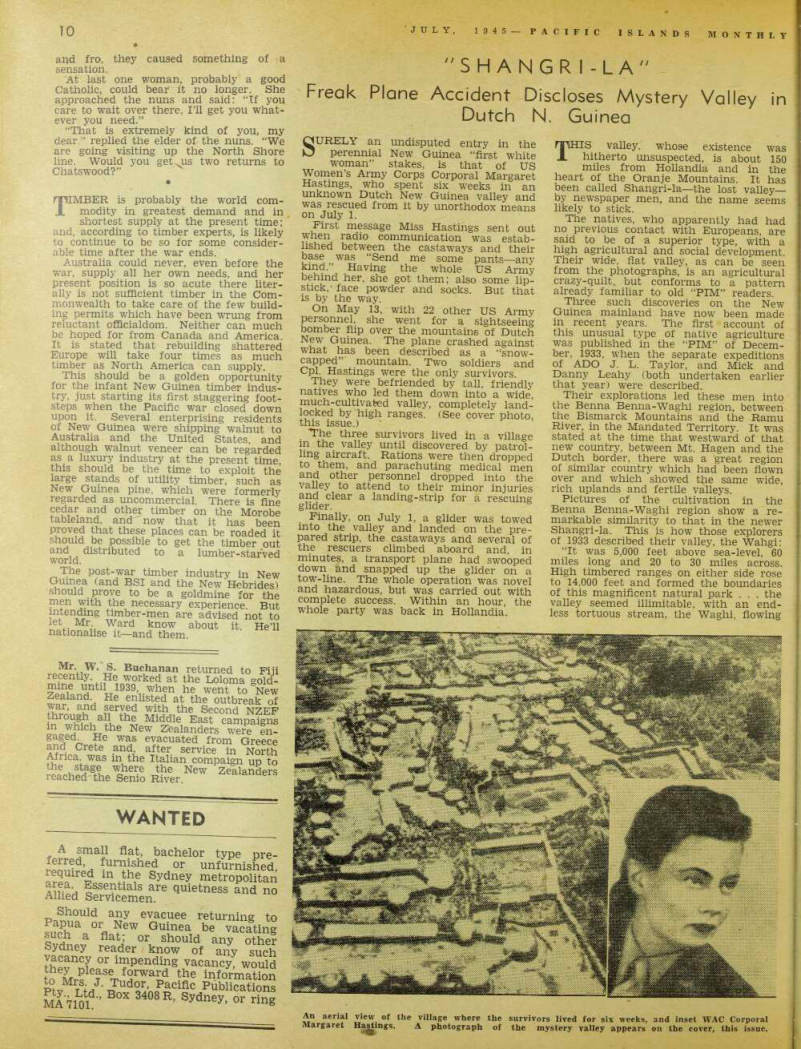
SURELY an undisputed entry in the Guinea “first white stakes, is that of US Women s Army Corps Corporal Margaret SSSSS T^ S & ent SiX weeks n in an unknown Dutch New Guinea valley and was rescued from it by unorthodox means i' Q „ *,• whin Mlss . Hastm £ s sent out Sjfi u a ?i? communication was estabhn^p d Ji e c tw «l n i he castawa ys and their kfnri ” wovinJ Qd fu me S £ n ? e ? a i lts T‘ any behind w whole US Army Qtipi fo h ’ she sot them; also some lipstick, face powder and socks. But that s j? y vl? ... , ne?s»nnl^ y ii?’ Wlth , 22 - °tber US Army i- he nt for a Sl g h tseeing over the mountains of Dutch „ 7 £ w , G l linea - Tha Piane crashed against been , ddescribedr r i bed as a “snowrSS P w mountain. Two soldiers and i mgs u w ! r ? t 5 e J °? ly surviv ors.
They were befriended by tall, friendly K down into a wide > {SSriTu tl i y* a^ d valley > completely landlocked by high ranges. (See cover photo, m^i SS H 6 ;L „„„ • J . . \he three survivors lived in a village val i ey discovered by patrolimg aurcra.ft. Rations were then dropped to them, and parachuting medical men and other personnel dropped into the valley to attend to their minor injuries and clear a landing-strip for a rescuing tSSToiiw T 1 1 i, ■ °« July h a g llder was towed f - va rl: y and i anc *ed on the prepared strip, the castaways and several of the rescuers climbed aboard and, in minutes, a transport plane had swooped down and snapped up the glider on a tow-line. The whole operation was novel and hazardous, but was carried out with complete success. Within an hour, the whole party was back in Hollandia.
mHIS valley, whose existence was A hitherto unsuspected, is about 150 miles from Hollandia and in the heart of the Oranje Mountains It has
been called ShangrMa-S S vailey
by newspaper men, and the name seems likely to stick.
The natives, who apparently had had no previous contact with Europeans, are said to be of a superior type, with a high agricultural and social development. ? heir wide ’ flat vaUe y- as can be seen from the photographs, is an agricultural crazy-quilt, but conforms to a pattern already familiar to old “PIM” readers Three such discoveries on the New Guinea mainland have now been made in recent years. The first account of this unusual type of native agriculture was published in the “PIM” of Decem ber, 1933, when the separate expeditions of ADO J. L. Taylor, and Mick and Danny Leahy (both undertaken earlier that year) were described.
Their explorations led these men into the Benna Benna-Waghi region, between the Bismarck Mountains and the Ramu River, in the Mandated Territory. It was stated at the time that westward of that new country, between Mt. Hagen and the Dutch border, there was a great region of similar country which had been flown over and which showed the same wide, rich uplands and fertile valleys, Pictures of the cultivation in the Benna Benna-Waghi region show a re markable similarity to that in the newer Shangri-la. This is how those explorers of 1933 described their valley, the Wahgi: “It was 5,000 feet above sea-level, 60 miles long and 20 to 30 miles across, High timbered ranges on either side rose to 14,000 feet and formed the boundaries of this magnificent natural park . . . the valley seemed illimitable, with an end less tortuous stream, the Waghi, flowing
An aerial view of the village where the survivors lived for six weeks, and inset WAC Corporal Margaret Hayings. A photograph of the mystery valley appears on the cover, this issue.
through its great grass plains and high terraces. Here and there, park-like plan tations of casuarina dotted the pale-green landscape ...
“The Waghi people are well built and good looking; the men mostly go bearded.
Except on one occasion they were friendly, and the patrols were received without show of hostility. They live in small farm houses, not in villages, and lay out their gardens with mathematical precision.
“Both the Benna Benna people and the Waghi are probably of non-Mela nesian origin, but more work would have to be done among them before this could be stated definitely.”
Mick Leahy wrote fascinatingly about this valley in his book: “The Land That Time Forgot.” rE discoveries of Leahy and Taylor were practically ignored by Austra lia and the world outside. But the next discovery, in 1935, attracted a great deal of publicity and kept the world agog for the traditional seven days. This was when the late Jack Hides, while on patrol in the Strickland-Kikori region of Papua, completed the picture sketched by Tay lor and the Leahy brothers and proved that the great upland region that begins south of Mt. Hagen continues southward, deep into Papua, as a vast inland plateau of extraordinary fertility, peopled hy the one superior class of natives. Hides wrote about his discoveries in several books, the first of which was “Papuan Wonderland.”
It would appear, now, that north-west again, in the high mountain ranges in Dutch Territory, other hidden valleys and unspoiled native peoples await dis covery by post-war explorers. Probably these people would be better off undis covered; but that is too much to be hoped for. No doubt they will in due course be introduced to the blessings of our civilisation.
Advertisements & other items, p. 12 (1 item)
Wanted
A small flat, bachelor type preferred furnished or unfurnished area ll6 *? m Sydney metropolitan sse^ tials are quietness and no Allied Servicemen.
Should any evacuee returning to ruc P h a a °fl 6W Gu l nea be vaca ting such a flat; or should any other Sydney reader know of any such fw nC T or il ?P en ding vacancy, would to Mr? 6 t 2 rWa S i he J ud ° r v p £ cific Publications MA ’ B ° X 3408 R ’ Sydne y> or ring
Bride-ship
FIJI, too, has had her bride-ship. Re cently, on its voyage between Aus tralia and America, a ship called briefly at Suva and picked up a number of brides and fiancees of American Ser vicemen who will now make their homes in the States.
The romances began when US Service men were stationed in the Colony in 1942-43.
Dr. €. M. Dawson, who formerly was chief medical officer in Western Samoa and Tonga, recently passed through Apia en route to Niue where he will relieve Dr. E. Hunt, who has resigned from the medical service because of ill-health.
Miss Athol Evelyn Leaver, daughter of Mr. and Mrs. J. H. Leaver, of Suva, Fiji, married Sgt. Q. R. Purser, NZEF, in St.
Andrew’s Church, Suva, on June 14.
On Leave In Sydney
Mr. Arthur Keeling, who was accoun tant in the Bank of New Zealand in Suva, about 30 years ago, and who later was manager of the Bank in Apia, W. Samoa, died recently in New Zealand.
Mr, and Mrs. Frank Luff, formerly of Bogadjim Plantation, New Guinea, and well-known in the Sepik District, where they were among the first pioneers.
Mrs. Luff is working with the Red Cross in the North, while her husband is with the Production Control Board on Karkar Island, in the Madang District, New Guinea.
Both were on leave in Sydney in July and were staying at the Watson’s Bay Hotel.
Advertisements & other items, pp. 13-14 (1 item)
Burns Philp
THE
YORKSHIRE
INSURANCE
CO. LTD.
(Incorporated in England) <*
FIRE
ACCIDENT
MARINE
FIRE POLICIES ISSUED
IN PAPUA
All information from —
E. A. JAMES,
TeL 86347. Attorney for Papua, 14 Spring St., Sydney.
BURNS PHILP
(SOUTH SEA) CO. LTD.
Inc. in Fiji
Island Traders and Shipowners
Registered Office :
SU V A
FIJI
Also Branches at:
Fiji: Levuka, Lautoka, Labasa, Ba, Sigatoka, Rotuma.
Tonga: Nukualofa, Haapai, Vavau. nnv Samoa: Apia, Pago Pago (American Samoa).
Solomons: Makambo, Gizo, Faisi.
New Hebrides: Vila.
Code Address: Gilberts: Tarawa.
"Bumsouth”. Norfolk Is. Niue. Wallis Is. Futuna Is.
Sole Australian Concessionaries :
GEORGE BROWN & CO. PTY.
267 Clarence Street, Sydney.
LTD.
As the Ultimate factory is engaged in vital war production, the supply of Ultimate Commercial Receivers cannot be maintained at present.
SERVICE: Ultimate owners are assured of continuity of service. Our Laboratory is situated at 267 Clarence Street, Sydney.
Servicing of all kinds of radio sets ot amplifiers, as well as Rola Speakers, is also undertaken at our laboratories.
■S'
GOLD CROSS AND
ENGLISH CHAIN
Elegant Cross of Solid 9ct. Gold, the same size as illustration, 30/-. Superior English 9ct. Gold Chain, solid in every link, with Gold safety clip, 30/-. Price 60/- the two.
Another Cross of the same size, a perfectly plain Roman design, and most dignified, is also available. Substantial value, 37/6. With English 9ct.
Gold Chain, price complete is 67/6.
TURN YOUR OLD GOLD INTO
CASH
Any old Gold, such as an old watch case, broken jewellery, cigarette case, old sleeve-links, watch chain, or any Gold article you wish to sell will be bought for prompt cash by Angus & Coote.
Send your parcel by REGISTERED POST and enclose your name and address.
DIAMONDS, TOO !
Loose diamonds, old diamond rings or brooches, can be turned into good money.
TO-DAY'S HIGH PRICE FOR
GOLD PAID AT ONCE
ANGUS & COOTE
500 George Street, Sydney
Fiji Information Office
Changes its Name Harold Cooper for New Post
THE Fiji Information Office is to change its name. It will in future be known as the Public Relations Office, al though it will carry on the same work as it has done since the beginning of the war—that is, keep the Colony au fait with latest war developments, and in touch with Government activities.
Mr Harold Cooper, who has been in formation Officer since July, 1942, has re linquished this post, and will take up new duties in the Secretariat. Mr. L. G.
Usher is to be in charge of the new Public Relations Office.
Mr. Cooper’s breezy stories of the Paci fic at war will be missed. They have been read in this journal and others with great interest, particularly by dyed-in-the-wool Pacific residents who recognise the real thing when they see it. Thousands have tried to write about the Pacific—particu larly in the last few years, when it has been news—but few have succeeded in producing stories that will survive the stern criticism of the old-timer.
Harold Cooper has given regular com mentaries over the Suva radio station dur ing the past four years. He has visited the Solomon Islands and Gilbert and Ellice Groups in search of war stories, and has told these stories in many books and magazines throughout the world; he has written a book (“They Stayed to Fight”) on the exploits of the Fijians and others at war, for the British Ministry of In formation, and early this year he toured the United States giving lectures for the same Ministry.
His new job will require him to travel extensively in Fiji; but it is hoped that these new duties will not preclude him altogether from writing an occasional story for outside consumption.’
Dr. F. O. Theile, director of Lutheran Missions, has been ill. It was impossible for him to travel to Sydney to attend the meeting of the mission leaders who re cently met to discuss the possibility of holding a South Pacific Conference; Rev.
L. W. Loffler, of Sydney, deputised for him.
Money Still Coming In
Rehabilitation
Fund
DONATIONS to the Sydney New Guinea Women’s Club Rehabilita tion Fund for repatriated prisoners of war are still being received. If you have not yet sent your contribution this will be received gratefully by the trea surer of the club, c/o Feminist Club, 77 King Street, Sydney.
Stall In Theatre Royal
rE stall held in the Theatre Royal entrance on June 29 was a great success. As a result of it, £63/13/8 will be added to funds.
The club executive would like to thank all members and good friends who sent along gifts of jam, knitted goods, flowers and a host of other beautiful or useful articles without which the venture could not have been the success that it was.
A wellrknown New Guinea man, writing to the “PIM,” says: “I have just had a visit from Dick Bell, one of the old timers who was working a goldmine on the north coast of New Guinea with Ted Fulton. He now is a captain and in charge of ANGAU labour in that region.
I have also met Mr. Milligan, a former patrol officer, who now is ADO up here, and is doing a very good job.”
Contributions to July 1
New Guinea Women’s Club Fund were: General £ 200 5 s. 0 d. o Major Ayris 0 0 Mrs. N. Atkins 10 0 Lieut. J. W. Cox, DCM, MM and Bar 1 0 0 Bank of New South Wales .. 5 5 0 Burns Philp & Co., Ltd 5 0 0 Mrs. W. L. Clark .. , 10 0 David Jones, Ltd 1 1 0 W. R. Carpenter & Co. , Ltd. 50 0 0 New Guinea Women’s Club General Fund (further donation) .. 44 0 0 “Pacific Islands Monthly” .. 20 0 0 Proceeds of Variety Concert 34 13 6 Mrs. Golding 10 0 Mrs. J. Tudor 10 0
Amalgamated Wireless
(A/sia), Ltd. . 5 5 0 Mrs. I. Isaacs 10 0 Mrs. L. Roberts .. .. 1 1 0 Mrs. Waterhouse .. .. 1 0 0 Mr. W. M. Middleton .. 5 0 0 Mrs. George Gee .. .. 10 0 Lieut. C. Maclean .. .. 2 2 0 Mrs. J. Duncan .. .. 5 0 Mrs. M. Anthony .. .. 13 0 Mrs. J. Peel 1 0 0 Mrs. Kennett 10 0 Mrs. J. Duncan (sale of flowers) .. 5 6 Mr. and Mrs. Quinton . . 2 0 0 Miss Cherry Craigo .. 5 0 Warrant Officer Wallace Brown .. .. 1 1 0 Mrs. M. Browning .. . 5 0 New Guinea Goldfields, Ltd. . 20 0 0 Vacuum Oil Company, Melbourne .. 5 5 0 The Shell Company of Aust., Ltd. .. 5 5 0 Mrs. J. Duncan 5 0 Mrs. Waugh 10 0 Mr. J. F. Peel 5 0 0 Capt. B. O’Connor .. .. 5 0 0 Sgt. J. E. Latimer .. . 3 0 0 Sgt. L. C. E. Parker . 1 0 0 £434 17 0
Advertisements & other items, p. 14 (2 items)
Allen Taylor & Co. Ltd.
COMMERCIAL ROAD, ROZELLE,
SYDNEY
Sawmillers and Wholesale Suppliers of Hardwoods for Constructional Purposes GIRDERS . . . PILES . . . POLES . . . SLEEPERS, Etc.
EXPORTING TO PACIFIC" ISLANDS SINCE 1893
Western Samoa
Most Delightful Holiday Resort in Polynesia
WHY NOT SPEND THE WINTER
MONTHS AT THIS SPACIOUS AND
BEAUTIFULLY-SITUATED HOTEL?
Write for Details to MRS. ANNIE M. JONES, Proprietress The Casino Hotel Apia - Western Samoa
Agriculture
To Advise on Fiji Agriculture Visit of Trinidad Experts
AT the invitation of the Government of Fiji, Professor D. F. Paterson and Dr. Dodds, two distinguished mem bers on the staff of the Imperial Col lege of Tropical Agriculture, Trinidad, arrived in the Colony in mid-June. They will suggest methods of putting into prac tice some of the recommendations made by Professor Shephard in his report last year on an agricultural policy for Fiji and the Western Pacific. Cost of this investigation is being paid by Great Britain.
Professor Paterson has had a wide experience of tropical agriculture as practised in many parts of the world, and he is a recognised world authority on modem methods in the design, layout and interpretation of agricultural experi ments.
Dr. Dodds is senior lecturer in botany at the Imperial College of Tropical Agri culture and is a specialist in plant breed ing. A West Indian project in which he is particularly interested is one of banana breeding designed to develop a banana resistant to leaf spot, which is known in Fiji as “Sigatoka disease.”
Dr. Dodds and his colleagues have already had considerable success in this project. Dr. Dodds has brought also selected crop seeds, certain forage grasses and some budwood. It is hoped that at least some of these may be found of value in Fiji during the post-war reconstruc tion period. • Professor Paterson and Dr. Dodds expect to be in Fiji until the end of Julv. when they will visit Western Pacific territories before returning to Trinidad.
N. Guinea Branch Of Cwa
MEMBERS of the New Guinea Branch of the Country Women’s Association and their friends are invited to attend a Brazilian Afternoon, at the Wedgwood Bridge Rooms, fourth floor, State Shopping Block, Market Street, Sydney, on Saturday, August 4, 1945, at 2.30 p.m. Dr. Santos, Consul for Brazil, has been invited to address the gather ing.
The branch is also holding a New Guinea Stall on Wynyard Station, on Monday. August 13, 1945. Novelties and necessities will be offered for sale.
A cabaret supper dance will be held on Friday, September 14, at Sargent’s Ball room, Market Street, Sydney. Tickets are 7/6 each. As tickets are limited it is advisable to make reservations early by ringing Mrs. A. J. Peadon (president), FU6075, or Miss H. Savage (treasurer), MW 2868.
Death Of W. D. Mason
RESIDENTS of Papua will learn with regret of the death from illness of W/O W. D. Mason, of ANGAU. He was well known as managing director of Sangara Rubber Plantations, Mr. J. C. Joad, Jnr., a resident of the Mandated Territory of New Guinea since 1926, and well known in Kieta, Kavieng and Lae, has left Sydney for Port Moresby. He has been appointed to the War Damage Commission, Port Moresby, as assistant to Mr. E. A. James, who went North in May.
Advertisements & other items, p. 15 (1 item)
a major anxiety
THAT
/ ft
Relief from
a major anxiety
f Even the most expert and conscientious individual executor is subject to accident, illness and incapacitation.
Continuity of administration and uninterrupted attention to your estate and your beneficiaries are of paramount importance. Both can be positively
- assured by appointing this Company
your sole Executor or as co-Executor with your present appointee. An in- * teresting explanatory booklet will be forwarded on request.
DIRECTORS:
Lewis Armstrong. lames Burns. Joseph Mitchell.
R. J. Nosworthy. P- T. W. Black.
MANAGER: L. S. Parker.
BURNS PHILP TRUST
COMPANY
LIMITED
7 BRIDGE
TELEPHONE: B 7901
STREET,
SYDNEY
Box 543, G.P.0., Sydney BP 1.45
Them Bombers Again!
From Our Own Correipondent APIA, June 14. rpORRENTIAL rains, mostly at night, A have been a feature of the last few weeks. The oldest residents cannot remember such a wet month of June.
The popular explanation of this un usual weather is to ascribe it to the effects of the terrific bombardments in the Pacific war area and the resulting disturbance of the atmosphere. [ED. NOTE: This is not a new idea.
During a spell of unprecendented wet weather in coastal NSW, a couple of years ago, milkmen, liftmen, old ladies and other interested persons were heard to mutter “Them bombers!” into their beards at frequent intervals. The war was then going on in Australia’s Near North. However, since that time Eastern Australia has had one of the worst droughts in its history and the bomber theory has lost its appeal.]
Murray Regime
The Anglican Mission And The
Letter to the Editor
IN the April number of your paper the following statement appears:— “Individual members of the influential Anglican Mission, who remained silent in last year’s controversy, have lately ex pressed support of the pre-war set-up, at least as far as it is applied to Papua.
There are obvious reasons for this sudden sponsoring of the old order. Missionaries at the beginning of the evacuation period, no doubt, were anxious to see which way the cat was going to jump, and to judge how that jump was going to affect them and their native charges before they stated their feelings in the matter. They naturally were anxious, also, to see the improvements and reforms, if such were going to be of practical value to the natives.” ...
“A week after Mr. Ward’s announce ment, a long article urging the re-estab lishment of the Murray regime in Papua, by the Rt. Rev. P, N. W. Strong, Bishop of New Guinea, appeared in the ‘Sydney Morning Herald’ . . . . ”
The above remarks are neither true nor fair. Your paper was informed some time ago that the Bishop was in England dur ing the controversy in the Australian press, and had no opportunity of express ing an opinion on the matter.
I was in Australia for two months (October-November) in 1943. and was certainly not silent on the matter. The Melbourne press interviewed me and pub lished my views, and they were probably the views of most missionaries in this Territory. From the pulpit of St. Paul’s Cathedral in Melbourne I broadcast a ser mon which left no doubt in the minds of listeners as to the views I held about the whole position. In Sydney Churches also, I certainly did not hesitate to express myself very strongly about the matter under discussion. I further wrote, at the invitation of the Editor, a long article in the “Australian Geographer,” which again contains much of the material which would have supported your views if you had troubled to read it. All this, sir, was in 1943.
I spent the next ten months telling, the United States, Canada, and Britain, that victory in Papua (the Territory where the
Japanese received their first defeat on iand m this war), was due to the loyalty of the natives as well as to the courage of the Allied Forces; and that this loyalty was due to three things, viz., good govern ment, mission teaching, and the fair deal given to the natives by nearly all em ployers of labour and especially the early miners.
This was the burden of my remarks at press conferences in many important cities in USA and Canada, and at a press conference which the Bishop and I attended at the Ministry of Informa tion in London.
The material which was submitted jus tified articles in the “New York Times”
Sunday magazine, and other papers, and also broadcasts from many stations in the USA and Canada, and by the BBC in England. I also cut two records for the ABC in 1943.
It is strange, therefore, that the “Paci fic Islands Monthly” heard nothing of this. Nearly 450 talks, lectures, broad casts, sermons, etc., in a 60,000 miles trip in 15 months should surely have given the views held by the Anglican Mission a sufficient airing, I think any former member of the Papuan Government would tell you that the Anglican Mission gave its loyal sup port to the Government in pre-war days, and strove to carry on the same ideals during the invasion months.
The Anglican Mission has been too busy carrying on its task to interest itself in feline gymnastics as described in your columns: our primary duty is to God, and that remains the same whatever Government may be placed here.
As non-official member of the Legisla tive Council, representing Christian mis sions in the Territory of Papua since 1939, I have loyally supported the Government policy, and where I disagreed with it have stated my views at the Council table. rE implication that the Bishop waited until Mr. Ward had made his an nouncement is altogether false, as you would have realised if you had stopped to consider the time it would take for the details of the announce ment to become known here, and the sending of the Bishop’s article to the press. Actually the Bishop’s article was in Australia for some considerable time before Mr. Ward’s announcement, and was held up because the publishers wished the Bishop to alter some of the strong comments which he had made, and which he refused to do.
I am, etc.,
John D. Bodger.
Dogura, Papua.
May 17, 1945.
Tribute To Late Sir
Hubert Murray
MANY people assembled in the rooms of the Royal Australian Historical Society on June 26, to hear a paper read by Mr. L. H. Hilder, entitled “A Great Australian Administrator Sir Hubert Murray.” The paper was prepared by Mrs. D. E. M. Cubis, MA, who now is abroad. Mr. Hilder was a close associate of the late Lieutenant-Governor. He was 25 years in the service of the Papuan Government, and for 19 of those years he was Clerk of the Legislative and Execu tive Council Money collected in Fiji for patriotic purposes since the outbreak of war amounts to well over a quarter of a mil lion pounds.
Advertisements & other items, p. 16 (2 items)
Jams
Here’s Something
You’ll Appreciate
Over 20 varieties from Carefully Selected Fresh Fruits.
TOMATO SOUP
TOMATO SAUCE
WORCESTERSHIRE SAUCE
Packed by:
MODEL PRESERVING CO
PTY., LTD.,
BRIAL fir BALL
528 Collins Street, Melbourne.
Sole Distributors Pacific Islands.’
Products M
JAMS
for
H. Grove & Sons
Limited Established 1896.
AUCKLAND
Itlond Traders. p.o. Box 490.
Telegraphic and Cable Address: “Grove”, Auckland.
Shippers of oil classes of New Zealand products.
Representing English Manufacturers throughout the Cook and Society Islands, Fiji, Tonga, amoa, Niue, New Caledonia, New Guinea, etc.
In FIJI at—W. H. Grove & Sent <Fl|i) Ltd.
Crime Without Motive
Rarotonga's Minor "Wave"
From Our Own Correspondent
Rarotonga, June 10.
AS with most Polynesian communities, serious crime is of rare occurrence in Rarotonga. Consuming intoxi cating liquor and unmarried love-making are the two crimes against civilisation which usually keep the Court busy every Thursday, and provide plenty ol man power for throwing dirt into the holes on the main road—dirt which is washed out again by the next shower.
During the last few weeks, however, residents of the Avarua district have been disturbed by a number of night attacks on girls in their own homes. The victims were struck on the face and head with an electric torch, but apart from the initial attack no further harm was done them, the assailant escaping in the darkness as soon as the alarm was raised A native has been taken for question ing in connection with these attacks.
During the same period, two local stores have been broken into at night.
The latest of these constitutes something of a mystery.
Looking out from his house in the early hours of the morning, a man noticed lights flickering in the Tupapa branch-store of A. B. Donald, Ltd. He went across to the building, flashed his torch through a window and saw a figure moving about, while flames issued from several points. He contacted a police man. and together they entered the building by means of a hole which had been broken through the boards at the rear.
By this time the intruder had made his escape. Several bolts of dress material on a shelf behind the counter, and a showcase of toilet articles were alight. At the further end of the build ing the contents of the office drawers were also in flames.
The fires were subdued before any serious damage was done.
No motive for the crime has been dis covered. Neither money nor goods was taken and apart from the papers in the office, the articles burnt were not easy to ignite. Had arson been the sole object, there were drums of kerosene and ben zine right at hand in the same building.
This minor “crime-wave” occurred while the European superintendent of police was absent on a tour of the outer islands. One is reminded of the local saying, “While the shark is away the little fish will play,” which is the native version of the familiar English proverb.
No Tripping To England
Yet
ISLANDS residents who want to visit England and Europe will have to show patience for some time .yet. An announcement in Suva, Fiji, on June 24, was to the effect that there was no like lihood of general improvement in the shipping or passenger prospects in the near future. It was, however, hoped that a number of sea passages to the United Kingdom via New Zealand would become available to people from Fiji who had good reasons for making the trip.
Members of the general public who wished to make such a journey within the next 12 months were asked to send their names to the Colonial Secretary in Suva, stating fully their reasons for travel.
It is believed that passages are unlikely to be made available to persons who are not domiciled in the United Kingdom— unless there are reasons of special urgency or importance.
Bishop Museum Executives Visit
Suva
TWO distinguished visitors were in Suva in early June. They were Dr.
Peter Buck and Mr. Frank E.
Midkiff „ n , Mr. is a trustee of the Bishop Museum in Honolulu and secretary of the Barstow Foundation for American Samoa.
Dr. Buck, who is director of the Bishop Museum, is one of the leading world authorities on Pacific subjects.
Mr. Onslow Kerkham arrived safely in England in June after being released from a prisoner of war camp in Germany. He enlisted with the 2nd NZEF in 1940, served in North Africa, Greece and Syria, and during the battle of El Alamein in 1942 was taken prisoner. He spent some time in a camp in northern Italy, but with the Italian surrender he was trans ferred to Stalag VIII B in Germany. A few mo nths ago this camp was moved to Bohemia, a fact which probably explains w hy it has taken some time after the collapse of Germany for him to get back to the United Kingdom.
Advertisements & other items, p. 17 (1 item)
Berger’s Paint
UjP| : _r»v r ®“S
POST-WAR
PALETTE
Many notable Berger brands will return soon to colour your post-war palette . . . and with them will come new finishes developed under the stimulus of war.
New materials, new processes, new application techniques are the fruits of Berger research and a tradition of 185 years’ manufacturing experience will transform these advances into high-grade paints for post-war homes.
Berger’s Paint
“Keeps on Keeping on”
Trochus Beds Get Benefit
From War
ALL the information which has come to hand lately from various parts of the Western Pacific indicates that the trochus shell beds have made re markable growth and development, as the result of the spell they have enjoyed since the Japanese invasion of the Pacific.
Until the end trochus shell had been gathered regularly wherever it could be found for at least 50 or 60 years.
There was a kind of unwritten law among trochus fishermen that baby shell —that is, all shell under a certain measurement—should not be touched, so that the beds might continue with nor mal growth. But when the Japanese shelling boats came swarming all over the South-western Pacific in the ’twen ties, they not only stole shell off pri vately-owned reefs, and from reefs within territorial waters—they literally scraped the baby shell from most of the reefs and destroyed many excellent shell beds.
It will be remembered that in the later 'thirties several “incidents” occurred when European owners caught the Jap anese robbing their shell-beds and fired at them.
However, all these shell-beds have now had 3-2 years of complete rest, and they have for the most part made astonish ing growth. Experienced shellers are watching the situation with considerable
interest and literally counting the days to the time when the seas will be free again.
It is expected that there will be, after the war, a good market for trochus shell which should continue for some years.
Dr. J. C. R. Buchanan, who has been appointed Inspector-General of the South Pacific Medical Service, assumed duty in Suva in April last.
Papuan and N. Guinea
Missions Director's Reference to Indentured Labour System
OF the 240 missionaries of the Eastern and Central Vicariates of the Man dated Territory of New Guinea, 120 r llled r or are musing, and 50,000 Catholic natives have been without spiritual help for three years,” said the National Director of Catholic Missions (Right Rev. J. H. Hannan, DD. PhD) in an interview published in the “Cairns Post” on June 20.
Describing the Vicariate Apostolic of Papua, which he visited the previous week, Monsignor Hannan said: “It is di vided into two parts—the Central Divi sion, with head-quarters at Yule Island, the personnel consisting mainly of French priests and brothers and Australian nuns' and Eastern Papua, which is staffed en tirely by Australians.
“The eastern part of the vicariate suf fered considerably during the New Guinea campaign, embracing Milne Bay, Samarai, Sideia and the Trobriands, but now work has recommenced. '’The central or Yule Island area, had a providential escape. Port Moresby, of course, was bombed, but the Catholic churches, con vents and schools in the area escaped substantial damage. Most of the build ings were taken over by the services for three years, but now they are being re turned, and the missions surrounding the port are resuming limited activity. Yule Island itself was heavily machine-gunned by the Japanese. Bullet-marks remain on the inside walls of the priests’ residence.”
The central area, he said, was threa tened from three sides early in 1942, from the north-west by the Japanese advance on Merauke, from the south-east as Port Moresby was threatened, and from the east by the imminent penetration across the mountains, which stopped short of the furthest mountain mission, known as “Ononge.”
“There is an actual shortage of food in the village,” said Monsignor Hannan.
“The gardens have been neglected, as most of the young men are either in the forces or working as labourers and .bearers in the New Guinea campaigns.
The little food there is very dear.” rE solution depended partly on the return of the civil administration in Papua. He added; “I am prepared to accord full credit to ANGAU for a diffi cult job efficiently carried out, but ANGAU is a military administration pri marily concerned with war conditions, and is, therefore, essentially transitory in character. Frankly, the position at pre sent is rather a ‘muddle,’ as the military is moving out and the civil administra tion is not yet coming in.
“The missionaries, on paper at least, are in favour of the indentured labour sys tem, as they regard it as of definite value to the natives. Anyone condemn ing the system should read the Papuan Labour Ordinance, As an Australian, I am proud of it, as a document unique in colonial administration, with the bal ance of justice definitely on the side of the Papuan.
“The missionaries, however, would like to see the application of the ordinance more strictly and honestly policed. Dis turbing rumours are prevalent every where in Papua, of serious infractions of the system, even to the extensive use of the ‘drum’ (flogging) to induce the con scripted natives to fill the letter of the law. This may be simply an abnormal, war-time condition. Let us hope it does not reflect the attitude of the future.”
Advertisements & other items, p. 18 (1 item)
Limewashing And
COPY OF "PIM" WANTED IN
WASHINGTON •
THE Library of the State Department, Washington, DC, needs the issue of the “Pacific Islands Monthly” for July, 1944, containing the index to Volume XIV, in order to complete its files.
Should any reader have a spare copy of this issue, it would be received gratefully by John R. Minter, Charge d’Affaires ad interim, Legation of the United States of America, Canberra, ACT.
The Most Extensive Manufacturers in the British Empire of
RUBBER STAMPS,
INKS, STENCILS,
Marking Devices,
ACME STAMP PADS
OFFICE i STATIONERY SUPPLIES
Li mew ashing Machine We also Manufacture & Supply a Complete Line of
LIMEWASHING and
SPRAYING MACHINES
for all purposes.
Let us know your requirements and we will quote by return.
WRITE FOR OUR GENERAL CATALOGUE
EXCELSIOR SUPPLY CO. PTY. LTD.
278 host Office Place,
MELBOURNE, VIC.
HEAD OFFICE :
160 BROADWAY,
Formerly brown as George St., West,
SYDNEY** N.S. W.
50 Victoria Street,
WELLINGTON, N.Z.
Ward's Bureaucracy
No Time To Pull Punches
PTA Must Keep on Fighting or Succumb to Ward's Bureaucracy
1T is evident that residents of Papua and New Guinea, both those who have been graciously permitted to return and those in Australia, still have a big fight on their hands before conditions in the Territories return to pre-war stan dards. A certain measure of victory has come the way of the Pacific Territories Association in their efforts on behalf of Territories’ people in the last year. But nothing that Mr. Norman Nelson, vice president of the PTA, who presided in the absence of the president, Mr. E. A.
James, could tell members at the third annual general meeting of the Associa tion in Sydney on June 26, indicated other than that the path ahead would be beset with difficulties, as great as, if not greater, than, those already overcome.
The Australian Government, through External Territories Minister Ward is ob viously benfc on trying socialisation ex periments in the Australian Territories.
If Territorians do not fight with every thing they have, they will be permitted to live there only under the iron control of Mr. Ward’s bureaucrats.
The Third Annual Report was read by the secretary of the Association, as follows: —
General
SINCE our last annual meeting there have been several changes in the executive. Mr. G. Moore, treasurer, resigned to take up an appointment in Samoa; he was replaced by Mr. E. J.
O’Donnel who has since resigned to return to Papua, and Mr. P. Hynes has replaced him.
Your executive have had 50 executive council meetings during the year, and are glad to report that we have been successful in persuading the Government to amend the War Damage Regulations to cover all subsequent loss which means so much to all Territorians and without which most evacuees would not be able to return to their plantations and homes. ■ Since our last general meeting the Go vernment has transferred the handling of claims against the Army for goods im pressed, etc., from the care of Mr. H Alderman to the care of the War Damage Commission.
We feel certain that your claims will now receive more favourable considera tion.
The Government has decided to pay claims for the loss of small boats whether they were left above high water mark or otherwise. They have now also decided to pay rent for buildings used by the various Services or Government Depart ments, but have not as yet told us on what basis.
During the year the War Damage Com mission asked us to arrange for experts to give them an estimate of the value of coconut palms, rubber trees, cocoa trees and coffee trees. This was done, but we have not yet heard what value has been fixed by the Commission for assessment purposes.
Refrigerators
rE War Damage Regulations allow only £5O for each refrigerator.
As values in most cases are higher than this, we took the matter up with the Commission with a view to rectifying this anomaly, and we are now able to advise members that the revaluation of all refrigerators is now receiving the attention of the Commission staff on the basis of actual cost less set down rates of depreciation.
Pcb
Production Control Board has now JL tfeen operating in Papua for some time, and as it was your wish that the producers should be represented on this Board, we have been endeavouring to persuade the Government to make such appointment—in fact, we have asked for representation of Territorians on any Board or Committee that the Government may set up. The matter has been re peatedly taken up with our Minister, Mr.
Ward, without any result. We have now placed the matter before members of the Opposition.
It might be of interest to you to know that the Control Board is paying planters in Papua the following prices for their produce: Copra, £l9 per ton at the nearest port of shipping; rubber, 1/6 per lb., first grade; 1/5 second grade; and 1/3 third grade.
Refurn of Civil Administration
11TE regret to advise that although we ?T have continually pressed the Minis ter for information in this regard, he refuses to tell us anything or to even give any indication of when it might be expected. We have now taken the matter up with Mr. Menzies, Leader of the Oppo sition, with a view to getting the matter brought before the House. It is antici pated that the necessary measures to set up the proposed provisional administra
tion will come before the House in the near future, and in the meantime the Go vernment has allowed the return of wives of some planters to Papua.
New Guinea Planters OUR planter representative reports that the Government will permit the return of planters to certain districts in the former Mandated Territory. Several planters have returned to the Madang District, and we look forward to their number increasing in the near future.
San Francisco Conference
11TET regret to advise that we have been ff unable to get any information from the Government on the question of UNCIO. In the meantime we have pro tested against any change being made in the status of Papua without the people of Papua having some say in it. •
Native Labour Inquiry
AT the inquiry held into Indentured Labour on December 1 and 2, our president attended, and placed our views on this matter before the con ferertce. Nevertheless, it appears to us that the Government intends to abolish the contract system as soon as practicable.
We have at all times impressed upon the Government the necessity of retaining the present system until a more satisfactory one can be found.
Mining
DURING the year our mining represen tative visited the Territory and in spected certain mining properties and reported back to the individual owners.
He advised that at the present time there
does not seem to be much chance of starting production as there is not the necessary labour, supplies or equipment.
He also points out the difficulty of trans port. The War Damage Commission has advised us that water races are now in surable as “plant” and members and others are requested to communicate full details of their races to the Commission.
The following is the communication re ceived from the Commission: —
The Secretary, Pacific Territories Association, 54a Pitt Street,
Sydney.
Dear Sir, —
Mining Property—Water Races
!• 14 has n °w been established that a water race, held under a mininf tenement under the Mining- Ordinance, 1928-1940, Mandated Territory of New Guinea, is uot “fixed property” as defined in the National Security (War Damage to Property) Regulations, but in its entirety (in cluding earthworks) it comes within the definition of “plant.” 2 Owners of plant exceeding £l,OOO in value were required by the Regulations to declare and contribute on such plant at its full value, and those who have not done so or who have con tributed on water races as fixed property in full, or in part, should take the matter up with the Commission for adjustment. 3 - — T4ie value of the race is to be determined on the basis of estimated cost of replacement in January, 1942, less depreciation and obsolescence! 4. —Claims for compensation for “war damage” as now defined, including “depreciation in value as a direct result of its having been abandoned” will be assessed as prescribed in the Regulations.
Owners should submit plans and descriptions of the races, giving; (i) Location and course. (ii) Dimensions. (iii) Nature, dates and costs of construction (sectionalised as far as possible). (iv) If purchased, date of purchase and cost price. (v) Evidence of title. (vi) Owner’s value. (vii) Particulars of any known war damage. 5. —lt would be appreciated if you could bring the points of this advice under the notice of those interested and with whom you are in touch.
I am, etc.,
(Signed) R. A. Battersby,
„ Controller.
War Damage Commission, Sydney, June 15.
Gold Lost- During Evacuation
MEMBERS will be glad to hear that they can now lodge a claim for this under their war damage.
Taxation
WE have been advised that certain recent amendments to the Taxation Act will not affect Territorians when they return to the Territory. The £4O allowance mentioned in this amendment applies only to persons who go to the Territory for a period of less than six months, and are not residents.
The matter of taxation on Territorians who have been working in the Small Ships Section and American Red Cross was taken up with the Commonwealth Trea surer, and he advises that he will not give a general exemption, but each case will be considered on its merits.
Unrra
DURING the year your executive inter viewed the representatives of UNRRA and asked them if they were in terested in matters concerning Papua and New Guinea. Your executive was advised
th a t UKR RA was not interested in Papua or the Mandated Territory as the Com monwealth Government would be quite capable of handling rehabilitation in those Territories.
Expropriated Properties
VOUR planter representatives have been A m touch with the Custodian of Ex nothing 0 to‘report. Pro Pers > but h^e
Civil Internees
TOURING the year your executive has aa been in touch with the Government . , Cross regarding civilian wnf nn e f S> f Unfortuna tely. the Golernment of U what ?iVe any indi cation 01 wnat it intends doing, and anneal to
asu sa
sswasss to “• <see articie ° n
New Constitution
ANEW constitution was passed at the last quarterly meeting which makes firmp l^oBsl^ lo l or the Ass ociation to con after the return Of Civil ad ministration to one, or both, of the Ter
£t°£cs and during the. post-war years.
Under the new constitution the subscrip tions payable are £1 per annum for the first member of a family, and 10/- per annum for each subsequent member of the sa s n E fam L ly ’ and your executive has de cided to fix these subscriptions for the ensuing year, and all members are asked to brmg their subscriptions up to date at the earliest opportunity.
Social Rooms
YOUR executive has this matter well in hand and hopes to be able to find suitable accommodation. We realise .T a V- S j an d people should have some place m Sydney where they can meet one another now and, in the post-war years.
In conclusion, your executive desires to thank the various associated bodies, both in New South Wales and the other States for their assistance during the past year’
We also desire to thank Mrs. Meldrum and Mrs. Wetherall, of the women’s orga nisations, who have .regularly attended the execcutive meetings, offering their advice and assistance in all matters We would like to thank Messrs. Robert Gillespie for allowing us the use of their premises for executive meetings.
Finances
CASH balance carried over from the year ending June, 1944. was £245/10/6; receipts during the cur rent year were £349/14/-. Expenditure during the same period was £337/0/11, leaving a balance in hand of £258/3/7.
Office-Bearers, 1945
OFFICE bearers for 1945 were nomi nated as follows: President, E. A.
James: vice-president, R. A. Laws; treasurer, P. Hinds; auditor, R. Gillespie; commercial representative, New Guinea, N. Nelson; commercial representative, Papua, no nomination; plantation repre sentative, New’ Guinea, A. Lussiek; plan tation representative, Papua, G. Aumuller; mining representative, New Guinea, G.
Bellamy; mining representative, Papua, J. Hinks.
Discussion
DISCUSSION centred around the appa rent reluctance of the External Ter ritories Department to granting per mission to civilians for their return to Papua and liberated portions of the Man dated Territory.
There was much acid comment on the
high-hand attitude of that Territories De partment brain-child, the Production Control Board, which has condemned, for various but inadequate reasons, several small plantations as totally uneconomic, and refused to allow their owners to return to them; and has demanded, from other owners, an assurance that the owners are capable of paying for “rehabi litation” costs of plantations which have been allowed to lie idle during the eva
cuation period.
In connection with ’the Control Board, Mr. Nelson explained that as the PTA executive had been unable to get any in formation as to its functions*' and in terior' workings from the External Terri tories Minister direct, they had ap proached an Opposition member, Mr.
Percy Spender, who had asked Mr. Ward certain questions, and had received the following reply—forwarded to the execu tive by Mr. Spender;— Dear Mr. Spender,— I refer to your lettei of the 6th June, 1945, and to your earlier letter of the 30th April, 1945, in which you asked on behalf of the Secretary, the Pacific Territories Association, 54a Pitt Street, Sydney, for certain information concern ing the activities of the Australian New Guinea Production Control Board. I am now in a position to supply the desired information.
Particulars of the present staff of the Board are as follows: INDOOR STAFF at Port Moresby, Milne Bay, Lae and Madang.—ln offices, warehouses, bulk stores, produce stores: total, 85.
FIELD STAFF. —On plantations as plantation inspectors, and in trade stores, throughout Papua, the mainland of New Guinea, Bougain ville, New Britain and Manus: total, 72.
Of the total field staff, 41 are engaged aa planting managers, 6 in Papua and 35 in New Guinea. Of these 3 are managing Government plantations in Papua, and the remaining 38 are managing private plantations pending the return of the owners.
The total cost per annum of the Board staff as above is as follows: In respect of indoor staff £33,960 In respect of field staff £31,524 £65,484 Less amount chargeable to plantations in respect of plantation managers mentioned above £17,352 £48,132 The Board has been established under National Security (External Territories) Regulations (Statutory Rules, 1943, No. 139) for the purpose of promoting and controlling the production of rubber, copra and other primary products in the Territories of Papua and New Guinea, and any industry therein, with a view to securing a maximum supply of the relevant products during the present war. This course was necessary following the suspension of civil administration in those Territories, the cessation of private in dustry and the urgent war need for the products in question. Whether it will be necessary or desirable for the Board to continue to function after the restoration of the civil administration is a matter which will be determined by the Government at the appropriate time.
The Board is a civil organisation, but in order to obtain the required staff, in the circumstances of the Territory up to the present, it has been found necessary mainly to employ Army per sonnel. As circumstances permit civilians will be appointed to the staff in place of the present Army personnel.
I am, etc.,
E. J. Ward,
Minister for External Territory.
Canberra, June 14, 1945.
Mr. Cyril Helton moved a motion that the executive brief counsel to ascertain whether it was legal to compulsorily eva cuate residents of Papua and New Guinea in 1942, and, if so, whether it was legal to now prevent their return. With the amendment that counsel should not be briefed until after the passing of the new Bill now before the House on the setting
up a provisional government in Papua and New Guinea south of the Markham River, the motion was put to the meeting and carried.
Advertisements & other items, pp. 19-20 (1 item)
XiniAJL O DiiLL) ' Melbourne.
JEAN
DIDIER,
SI Pans. 0 At m wt present £3 being •on made in Australia a® JEAN DIDIER'S Famous PERFUMES will soon be available Sole Distributing Agents for the Pacific Islands : DD VA T DA V V 528 Collins s *-»
XiniAJL O DiiLL) ' Melbourne.
Enquiries through your usual channels appreciated. m
Refreshing
as a plunge
into a lagoon!
rM |CI
OE TOl Lt :
Germicidal
and fragrant
TEN AX TOILET SOAP is
a rapid safeguard against external skin infections, yet it is soothing and kind to the most sensitive skin —even a baby’s!
ORDER TENAX FROM
YOUR ISLAND SUP-
PLIERS. STOCKS ARE
PLENTIFULLY AVAIL-
ABLE.
■■ UCHTER ... LON CER-LASTINC
Under war condim° a « S '« OI J ly occa sional faC u Ur . e is Posh^ U ‘ Globi ‘es will be supplied whenever available.
Nazi Agent Now
Bankrupt
From Our Own Correspondent
Noumea, June 14.
A DIVIDEND of 40 per cent, of what is due to them is being distributed to the creditors of the Burkard mining interests in New Caledonia.
Herr Burkard, an ardent Nazi, was Krupp’s agent in New Caledonia, where he had an Australian nurse to look after him.
He bought and developed one or two nickel mines, and had an interest in silver-lead and copper mines in the north of the island; he also bought ores from other concerns.
Krupps took a keen interest in New Caledonian nickel before the outbreak of the two world wars, and so, prior to 1941 (when export to Japan was forbidden by Governor Sautot) did Japan. In conse quence, prior to both wars, the country was highly productive and prosperous, the French market feeding Germany with all the nickel she would take.
But when the present war broke out it was not long before Herr Burkard was arrested and sent to Australia for intern ment. It is reported that he was boast ing to his gaolers of Hitler as a world con queror until well into 1944.
The only time I saw Herr Burkard and his nurse was on the arrival of the first Pan-American clipper at He Nou a fort night before the war broke out. He was one of those invited to attend the recep tion to the American fliers.
Advertisements & other items, pp. 21-22 (1 item)
Reg. Adams, Clayton & Co.
□ o
Progress with Modern Designing.
SHIPBUILDERS
and ENGINEERS
COPPERSMITHS, WELDERS and PLUMBERS.
Builders of WOODEN FREIGHTERS,
TRAWLERS and ISLAND CRAFT.
Agents for Diesel Engines.
VESSELS REPAIRED and REMODELLED.
MODERNI SLIPWAY- FACILITIES
AVAILABLE.
Write to us for Designs and Complete Shipbuilding information.
REG. ADAMS, CLAYTON
& COMPANY
JOHN STREET, BERRY'S BAY, SYDNEY. ,
Tpl • XR447Fi "STA 1721
Modern Refrigeration for the South Sea Islands
The ELECTROLUX KEROSENE OPERATED
REFRIGERATOR
MARVEL
OF
MODERN
SCIENCE
m
THE
MIRACLE
OF
ICE
FROM
HEAT
ELECTROLUX offers economical, modern and completely efficient
REFRIGERATION FOR ISLANDS 7 HOMES.
FREEZES CONTINUOUSLY WHILE SMALL LAMP BURNS.
Freezing controlled by simply regulating height of flame. Uses only f gallon of kerosene per week.
MOTORLESS ... NO PARTS TO GET OUT OF ORDER.
MODEL L 22
Capacity 2 2 cubic feet.
MODEL L3BO
(as Illustrated) Capacity 4 cubic feet.
MODEL LKSSO
Capacity 5.6 cubic feet.
GUARANTEED FOR TWO YEARS.
• Write to your Local Distributor for prices and full details.
OBTAINABLE FROM ALL W. R. CARPENTER & CO. LTD.
BRANCHES THROUGHOUT THE ISLANDS
Representation in Papua and New Hebrides.
Rehabilitation in the Solomons
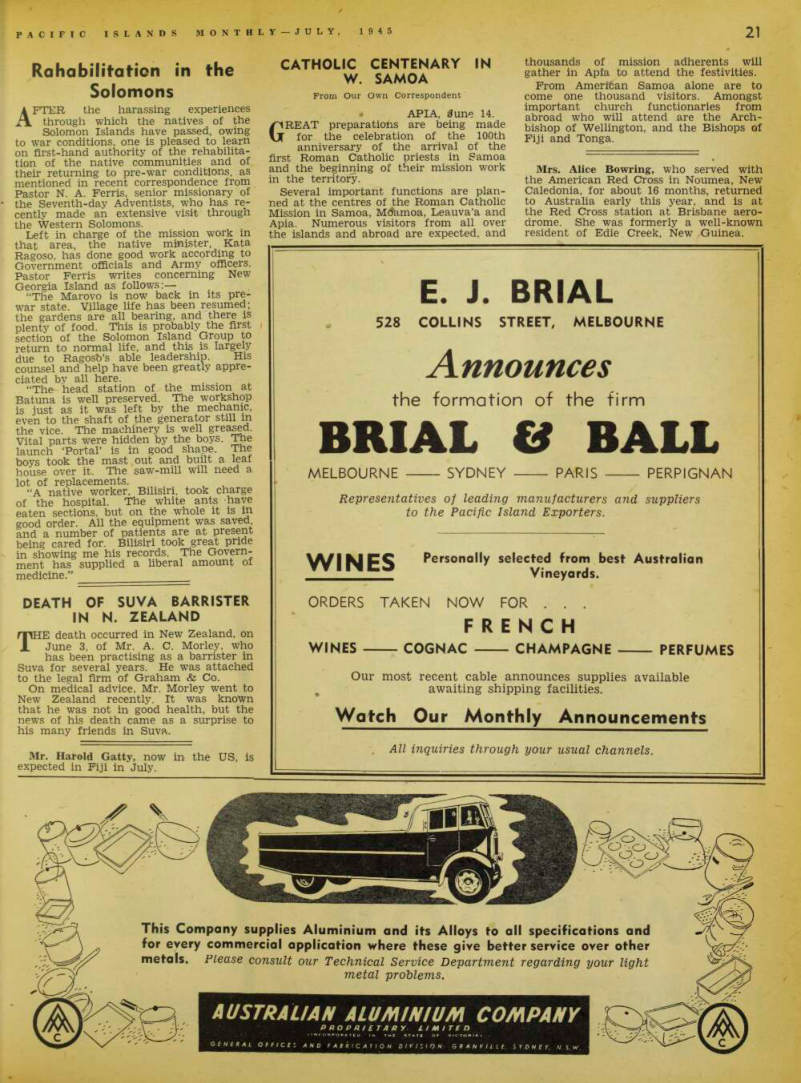
Solomons
AFTER the harassing experiences through which the natives of the Solomon Islands have passed, owing to war conditions, one is pleased to learn on first-hand authority of the rehabilita tion of the native communities and of their returning to pre-war conditions, as mentioned in recent correspondence from Pastor N. A. Ferris, senior missionary of the Seventh-day Adventists, who has re cently made an extensive visit through the Western Solomons.
Left in charge of the mission work in that area, the native minister, Kata Ragoso, has done good work according to Government officials and Army officers.
Pastor Ferris writes concerning New Georgia Island as follows; — “The Marovo is now back in its pre war state. Village life has been resumed; the gardens are all bearing, and there is plenty of food. This is probably the first section of the Solomon Island Group to return to normal life, and this is largely due to Ragosb’s able leadership. His counsel and help have been greatly appre ciated by all here. . .
“The head station of the mission at Batuna is well preserved. The workshop is just as it was left by the mechanic, even to the shaft of the generator still in the vice. The machinery is well greased.
Vital parts were hidden by the boys. The launch ‘Portal’ is in good shape. The boys took the mast out and built a leaf house over it. The saw-mill will need a lot of replacements.
“A native worker, Bilisiri, took charge of the hospital. The white ants have eaten sections, but on the whole it is in good order. All the equipment was saved and a number of patients are at present being cared for. Bilisiri took great pride in showing me his records. The Govern ment has supplied a liberal amount of medicine.”
Death Of Suva Barrister
In N. Zealand
rE death occurred in New Zealand, on June 3, of Mr. A. C. Morley, who has been practising as a barrister in Suva for several years. He was attached to the legal firm of Graham & Co.
On medical advice, Mr. Morley went to New Zealand recently. It was known that he was not in good health, but the news of his death came as a surprise to his many friends in Suva.
Mr. Harold Gatty, now in the US, is expected in Fiji in July.
Catholic Centenary In
W. Samoa
From Our Own Correspondent . APIA, June 14.
GREAT preparations are being made for the celebration of the 100th anniversary of the arrival of the first Roman Catholic priests in Samoa and the beginning of their mission work in the territory.
Several important functions are plan ned at the centres of the Roman Catholic Mission in Samoa, Mdamoa, Leauva’a and Apia. Numerous visitors from all over the islands and abroad are expected, and
thousands of mission adherents will gather in Apia to attend the festivities.
From Ameritan Samoa alone are to come one thousand visitors. Amongst important church functionaries from abroad who will attend are the Arch bishop of Wellington, and the Bishops of Fiji and Tonga.
Mrs. Alice Bowring, who served with the American Red Cross in Noumea, New Caledonia, for about 16 months, returned to Australia early this year, and is at the Red Cross station at Brisbane aero drome. She was formerly a well-known resident of Edie Creek, New Guinea,
Advertisements & other items, p. 23 (1 item)
Brial & Ball
E. J. BRIAL
528 COLLINS STREET, MELBOURNE
Announces
the formation of the firm
BRIAL & BALL
MELBOURNE SYDNEY PARIS PERPIGNAN
Representatives of leading manufacturers and suppliers to the Pacific Island Exporters.
WINES
Personally selected from best Australian Vineyards.
ORDERS TAKEN NOW FOR . . .
FRENCH
WINES COGNAC CHAMPAGNE PERFUMES
Our most recent cable announces supplies available awaiting shipping facilities.
Watch Our Monthly Announcements
All inquiries through your usual channels.
This Company supplies Aluminium and its Alloys to all specifications and for every commercial application where these give better service over other metals. Please consult our Technical Service Department regarding your light metal problems.
AUSTRALIAN ALUMINIUM COMPANY
PROPRIETARY l/MITED
GENERAL Of FICEt AND FABRICATION DIVISION GRANVILLE. SYDNEY, NS. W.
Papua Vicariate
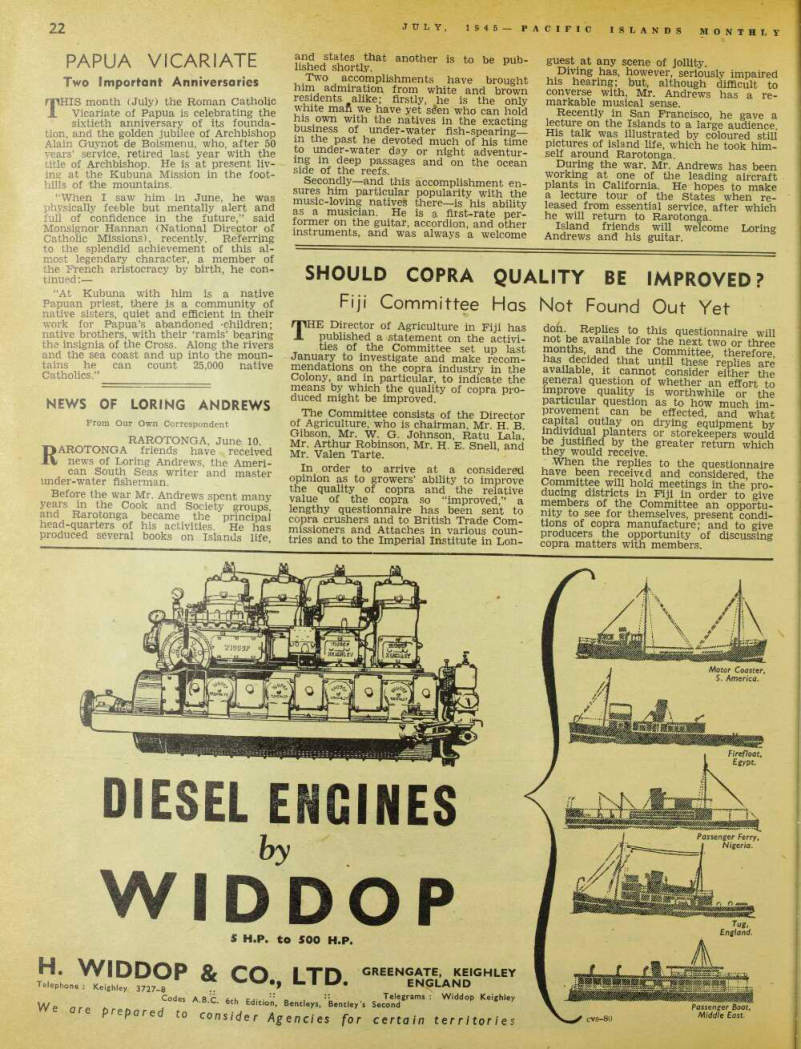
Two Important Anniversaries
THIS month (July) the Roman Catholic Vicariate of Papua is celebrating the sixtieth anniversary of its founda tion, and the golden jubilee of Archbishop Alain Guynot de Boismenu, who, after 50 years’ service, retired last year with the title of Archbishop. He is at present liv ing at the Kubuna Mission in the foot hills of the mountains.
“When I saw him in June, he was physically feeble but mentally alert and full of confidence in the future,” said Monsignor Hannan (National Director of Catholic Missions), recently. Referring to the splendid achievement of this al most legendary character, a member of the French aristocracy by birth, he con tinued; — “At Kubuna with him is a native Papuan priest, there is a community of native sisters, quiet and efficient in their work for Papua’s abandoned ‘Children; native brothers, with their ‘ramis’ bearing the insignia of the Cross. Along the rivers and the sea coast and up into the moun tains he can count 25,000 native Catholics.”
News Of Loring Andrews
From Our Own Correspondent
Rarotonga, June 10.
RAROTONGA friends have received news of Loring Andrews, the Ameri can South Seas writer and master under-water fisherman.
Before the war Mr. Andrews spent many years in the Cook and Society groups, and Rarotonga became the principal head-quarters of his activities. He has produced several books on Islands life,
and states that another is to be pub lished shortly.
Two accomplishments have brought him admiration from white and brown residents alike; firstly, he is the only white man we have yet s£en who can hold his own with the natives in the exacting business of under-water fish-spearing— in the past he devoted much of his time to under-water day or night adventur ing in deep passages and on the ocean side of the reefs.
Secondly—and this accomplishment en sures him particular popularity with the music-loving natives there—is his ability as a musician. He is a first-rate per former on the guitar, accordion, and other instruments, and was always a welcome
guest at any scene of jollity.
Diving has, however, seriously impaired his hearing; but, although difficult to converse with, Mr. Andrews has a re markable musical sense.
Recently in San Francisco, he gave a lecture on the Islands to a large audience His talk was illustrated by coloured still pictures of island life, which he took him self around Rarotonga.
During the war. Mr. Andrews has been working at one of the leading aircraft plants in California. He hopes to make a lecture tour of the States when re leased from essential service, after which he will return to Rarotonga.
Island friends will welcome Loring Andrews and his guitar.
Should Copra Quality Be Improved?
Fiji Committee Has Not Found Out Yet
THE Director of Agriculture in Fiji has published a statement on the activi ties of the Committee set up last January to investigate and make recom mendations on the copra industry in the Colony, and in particular, to indicate the means by which the quality of copra pro duced might be improved.
The Committee consists of the Director of Agriculture, who is chairman, Mr. H. B.
Gibson, Mr. W. G. Johnson, Ratu Lala, Mr. Arthur Robinson, Mr. H. E. Snell, and Mr. Valen Tarte.
In order to arrive at a considered opinion as to growers’ ability to improve the quality of copra and the relative value of the copra so “improved,” a lengthy questionnaire has been sent to copra crushers and to British Trade Com missioners and Attaches in various coun tries and to the Imperial Institute in Lon
don. Replies to this questionnaire will not be available for the next two or three months, and the Committee, therefore, has decided that until these replies are available, it cannot consider either the general question of whether an effort to improve quality is worthwhile or the particular question as to how much im provement can be effected, and what capital outlay on drying equipment by individual planters or storekeepers would be justified by the greater return which they would receive.
When the replies to the questionnaire have been received and considered, the Committee will hold meetings in the pro ducing districts in Fiji in order to give members of the Committee an opportu nity to see for themselves, present condi tions of copra manufacture; and to give producers the opportunity of discussing copra matters with members.
Advertisements & other items, p. 24 (1 item)
Widdop
=J6 xuaur 9
DIESEL ENGINES
5 H.P. to 500 H.P.
H. WIDDOP & CO ITH GREENGATE. KEIGHLEY Telephone : K.i |hl ey 3727-8 L. lU. ENGLAND We nre . f 0- AE C ' 6 ‘ h «■*£ Bentlnys,'ben.Uys uSUST" ‘ Widd ° P K “ iBh ' eP repore to consider Agencies for certain territories \ \ Motor Coaster S. America. / \r —| Firefloat, Egypt.
’kMh
Passenger Ferry I Nigeria.
Tug, England Passenger Boat, Middle East.
Kennedy's Boys Go A-Feudin'
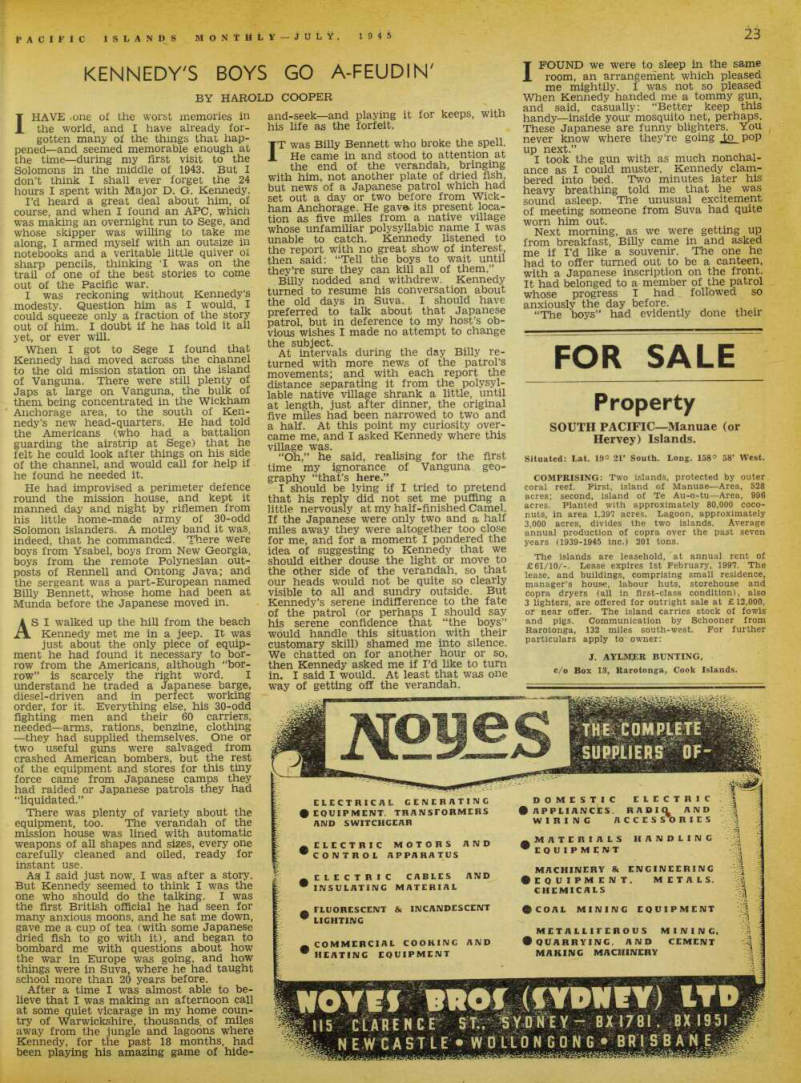
By Harold Cooper
IHAVE one of the worst memories in the world, and I have already for gotten many of the things that hap pened—and seemed memorable enough at the time—during my first visit to the Solomons in the middle of 1943. But I don’t think I shall ever forget the 24 hours I spent with Major D. G. Kennedy.
I’d heard a great deal about him, of course, and when I found an APC, which was making an overnight run to Sege, and whose skipper was willing to take me along, I armed myself with an outsize in notebooks and a veritable little quiver ol sharp pencils, thinking T was on the trail of one of the best stories to come out of the Pacific war.
I was reckoning without Kennedy’s modesty. Question him as I would, I could squeeze only a fraction of the story out of him. I doubt if he has told it all yet, or ever will.
When I got to Sege I found that Kennedy had moved across the channel to the old mission station on the island of Vanguna. There were still plenty of Japs at large on Vanguna, the bulk of them being concentrated in the Wickham Anchorage area, to the south of Ken nedy’s new head-quarters. He had told the Americans (who had a battalion guarding the airstrip at Sege) that he felt he could look after things on his side of the channel, and would call for help if he found he needed it.
He had improvised a perimeter defence round the mission house, and kept it manned day and night by riflemen from his little home-made army of 30-odd Solomon islanders. A motley band it was, indeed, that he commanded. There were boys from Ysabel, boys from New Georgia, boys from the remote Polynesian out posts of Rennell and Ontong Java; and the sergeant was a part-European named Billy Bennett, whose home had been at Munda before the Japanese moved in.
AS I walked up the hill from the beach Kennedy met me in a jeep. It was just about the only piece of equip ment he had found it necessary to bor row from the Americans, although “bor row” is scarcely the right word. I understand he traded a Japanese barge, diesel-driven and in perfect working order, for it. Everything else, his 30-odd fighting men and their 60 carriers, needed —arms, rations, benzine, clothing —they had supplied themselves. One or two useful guns were salvaged from crashed American bombers, but the rest of the equipment and stores for this tiny force came from Japanese camps they had raided or Japanese patrols they had “liquidated.”
There was plenty of variety about the equipment, too. The verandah of the mission house was lined with automatic weapons of all shapes and sizes, every one carefully cleaned and oiled, ready for instant use.
Aa( I said just now, I was after a story.
But Kennedy seemed to think I was the one who should do the talking. I was the first British official he had seen for many anxious moons, and he sat me down, gave me a cup of tea (with some Japanese dried fish to go with it), and began to bombard me with questions about how the war in Europe was going, and how things were in Suva, where he had taught school more than 20 years before.
After a time I was almost able to be lieve that I was making an afternoon call at some quiet vicarage in my home coun try of Warwickshire, thousands, of miles away from the jungle and lagoons where Kennedy, for the past 18 months, had been playing his amazing game of hide
and-seek—and playing it for keeps, with his life as the forfeit.
IT was Billy Bennett who broke the spell.
He came in and stood to attention at the end of the verandah, bringing with him, not another plate of dried fish, but news of a Japanese patrol which had set out a day or two before from Wick ham Anchorage. He gava its present loca tion as five miles from a native village whose unfamiliar polysyllabic name I was unable to catch. Kennedy listened to the report with no great show of interest, then said: “Tell the boys to wait until they’re sure they can kill all of them.”
Billy nodded and withdrew. Kennedy turned to resume his conversation about the old days in Suva. I should have preferred to talk about that Japanese patrol, but in deference to my host’s ob vious wishes I made no attempt to change the subject.
At intervals during the day Billy re turned with more news of the patrol’s movements; and with each report the distance separating it from the polysyl lable native village shrank a little, until at length, just after dinner, the original five miles had been narrowed to two and a half. At this point my curiosity over came me, and I asked Kennedy where this village was.
“Oh,” he said, realising for the first time my ignorance of Vanguna geo graphy “that’s here.”
I should be lying if I tried to pretend that his reply did not set me puffing a little nervously at my half-finished Camel.
If the Japanese were only two and a half miles away they were altogether too close for me, and for a moment I pondered the idea of suggesting to Kennedy that we should either douse the light or move to the other side of the verandah, so that our heads would not be quite so clearly visible to all and sundry outside. But Kennedy’s serene indifference to the fate of the patrol (or perhaps I should say his serene confidence that “the boys” would handle this situation with their customary skill) shamed me into silence.
We chatted on for another hour or so, then Kennedy asked me if I’d like to turn in. I said I would. At least that was one way of getting off the verandah.
I FOUND we were to sleep in the same room, an arrangement which pleased me mightily. I was not so pleased When Kennedy handed me a tommy gun, and said, casually: “Better keep this handy—inside your mosquito net, perhaps.
These Japanese are funny blighters. You never know where they’re going _to POP up next.”
I took the gun with as much nonchal ance as I could muster. Kennedy clam bered into bed. Two minutes later his heavy breathing told me that he was sound asleep. The unusual excitement of meeting someone from Suva had quite worn him out.
Next morning, as we were getting up from breakfast, Billy came in and asked me if I’d like a souvenir. The one he had to offer turned out to be a canteen, with a Japanese inscription on the front.
It had belonged to a member of the patrol whose progress I had followed so anxiously the day before. .
“The boys” had evidently done their
stuff again. After all, they’d been at it for 18 months. No wonder they were getting good.
Advertisements & other items, pp. 25-26 (1 item)
For Sale
Property
SOUTH PACIFIC—Manuae (or
Hervey) Islands.
Situated: Lat. 19° 21* South. Long. 158° 58’ West.
COMPRISING: Two islands, protected by outer coral reef. First, island of Manuae—Area, 528 acres; second, island of Te Au-o-tu—Area, 996 acres. Planted with approximately 80,000 coconuts, in area 1,397 acres. Lagoon, approximately 3,000 acres, divides the two islands. Average annual production of copra over the past seven years (1939-1945 inc.) 201 tons.
The islands are leasehold, at annual rent of £6l/10/-. Lease expires Ist February, 1997. The lease, and buildings, comprising small residence, manager’s house, labour huts, storehouse and copra dryers (all in first-class condition), also 3 lighters, are offered for outright sale at £12,000, or near offer. The island carries stock of fowls and pigs. Communication by Schooner from Rarotonga, 132 miles south-west. For further particulars apply to owner:
J. AYLMER BUNTING,
c/o Box 13, Rarotonga, Cook Islands.
ELECTRICAL GENERATING
• EQUIPMENT. TRANSFORMERS
AND SWITCHGEAR
.ELECTRIC MOTORS AND
•control apparatus
-ELECTRIC CABLES AND
• INSULATING MATERIAL
FLUORESCENT & INCANDESCENT
LIGHTING
COMMERCIAL COOKING AND
HEATING EQUIPMENT
DOMESTIC ELECTRIC
• APPLIANCES. RADia AND
WIRING ACCESSORIES
.MATERIALS HANDLING
•equipment
MACHINERY & ENGINEERING
• EQUIPMENT. METALS.
CHEMICALS
• COAL MINING EQUIPMENT
METALLIFEROUS MINING,
• QUARRYING, AND CEMENT
MAKING MACHINERY
i i
novel ener iPWitfl itd
115 CLARENCE ST.. SYDNEY- 811781. BX 1951
NEWCASTLE • WOLLONGONG • BRISBAN E
QUEENSLAND
INSURANCE
COMPANY
LIMITED
(Incorporated 1886 In Australia)
ASSETS EXCEED £3,500,000
Head Office:
PITT & BRIDGE STS.,
SYDNEY
Specialists in South Seos Fire,
Marine Cr Accident Insurances
Apply to:—
FIJI.
Branch Office: I. B. Chalmers, Acting Manager.
Burns Phllp (South Sea) Co., Ltd.
VILA.
Burns Phllp (South Sea) Co., Ltd, Comptolrs Francals Des Nouvelles Hebrides (Marine).
NOUMEA.
L. & W. Johnston.
PAGO PAGO.
Burns Philp (South Sea) Co., Ltd.
G. H. C. Reid & Co.
OTHER SOUTH SEA ISLANDS.
Burns Phllp (South Sea) Co.. Ltd.
Also to any of the Company’s Offices in Australia or New Zealand.
Not Pidgin!
Teach Them English, Not Pidgin!
Jj'ROM an AIF chaplain who has returned to Papua from active service further north : IT will be a welcome change to speak a language, a real language, instead of this hybrid conglomeration of crudi ties known in the aggregate as Pidgin. In spite of its advocates and apologists, and perhaps for the very same reasons as move them, I think the time has come for these New Guinea and New Britain natives to learn to speak and understand real English, however simple.
The whole crux of the pros and cons lies in the proposition that to teach them English is to open to them a whole litera ture, by which they can become educated in a wide field of knowledge. That is denied them when they are confined to Pidgin, or their own local language.
Rehabilitation of the native after the war is over cannot be conducted along the lines of suppression, since they have seen just what power lies in their own hands when organised as a fighting body Those who have the illusion that they can walk in, just where they walked out, are due for a pretty solid awakening.
Captain Viggo Rasmussen, who was recently removed from Penrhyn Island, Cook Group, following a physical break down, has been returned to Rarotonga, where he is being cared for at the gen eral hospital. He remains in a critical condition.
High Cost Of Being Ill
Letter to the Editor TIOR the Polynesians of the Cook Islands a well-equipped hospital is provided in Rarotonga, where they are treated without charge. Europeans, however, are not provided for.
A sick white man, though he may be hard-up, is billed at nearly £4 a week.
Such cases are victims of worry, as well as illness.
It is time that free treatment was made available to the unfinancial; for no man is eternally wealthy in this Group, where all the well-off get their funds from outside As things are now, a European taken suddenly ill here would have to pay about £l2 “round,” or £4 direct, to go by schooner to the hospital; with no provi sion made for him when he arrived there!
Such a system—or lack of system?— needs replacing by social security ameni ties.
Such a patient would, I suppose, be treated, if the case were urgent. But the hospital has not even a pair of pyjamas ready for anyone suddenly arriving in a state of necessity. And it provides, even for accepted patients, no laundry service. This does not seem 100 per cent, efficiency.
The feeding of patients, however, is very satisfactory indeed; and if this were the standard set for all the other hos pital activities, the Rarotonga institution would incur more praise than it at present does.
I am, etc.,
E.G.
Mangaia, Cook Is.
April, 1945.
Advertisements & other items, p. 26 (1 item)
G. H. Robinson
Island Merchant and Agent
OF 51 MACQUARIE STREET, SYDNEY
* having returned to business, can, as a result of over twenty years' extensive experience (excluding service in two wars) guarantee prompt and efficient individual service as a buying agent to Pacific Island clients.
Enquiries are solicited to— Box 3317, G.P.0.,
SYDNEY.
Rubber's "Uncertain" Future
But NEI Expects to Produce More Than Ever
A “PIM” reader, Mrs. Brett Milder,writes: “I was interested in your article entitled ‘Rubber’s Uncertain Future’ in the May ‘PIM.’ You say ‘practically all the Indonesian rubber plantations, from which comes the bulk of the world’s supply, are still in Japanese hands. Even if they are liberated in 1945, it is unlikely that they will be capable of full production for years after,’ and ‘few can speak
authoritatively regarding the use of
synthetic rubber. It is generally sup posed that it can supply most rubber needs ' except tyres. The great syn thetic factories of America, it is presumed, will try to compete with natural rubber in many industries’ u Your contentions are not alto gether borne out by a recent article in ‘Knickerbocker Weekly.’ Perhaps your readers would be interested in this article which voices the opinions of Dr. Pieter Honig, Director of the Netherlands Indies Rubber Research Institute.”
This .is the article which Mrs.
Milder has sent us: DR. HONIG, internationally known rubber expert, recently returned to New York after flying to Australia and parts of the Netherlands East Indies to organise rubber reconstruction. Prior to the war, the Indies produced approxi mated 45 ner cent, of the world’s rubber.
With 4,500,000 to 5,000,000 acres planted in rubber and with about 400 trees to each acre, Dr. Honig believes that possible war destruction in the Indies will not long prevent his country from producing nearly half of the world’s natural supply.
He predicts that natural rubber will again be exported from the East Indies three months after their liberation, “I know that many persons devoted to ‘natural’ products fear the advent of syn thetics, but we of the Indies frankly do not,” Dr. Hopig says with confidence. “We believe that in the world’s present state of rubber depletion, requirements for post-war replacements added to many newly developed uses for rubber will re quire high production of both natural and synthetic products.”
A new NEI Government-controlled or ganisaton will soon be put in temporarv control of the production and trade of rubber in liberated parts of the Indies, according to Dr, Honig, who adds that the new group will be known as the “Rubber Centrale” and will be managed by a board of directors representing several important pre-war NEI rubber in dustries and associations.
Private enterprise free of any govern ment control will be re-established as quickly as possible.
“Fifteen million dollars’ worth of rub ber-producing equipment, representing about 25 per cent, of what is normally required, has been purchased in the United States,” Dr. Honig says. “The Netherlands Indies Government’s relief purchases have been and will be financed out of its own funds. Our basic govern mental policy is to provide the means, through soundly financed loans, to restore not normalcy but a condition where the population can help itself achieve it. We do not think the United States or any one else should be expected to play Santa Claus to us.”
rE tools bought in America to help re-establish rubber nroduction in the Indies will be equally distributed be tween native growers and those planta tions managed by Western peoples.
Through the work of the Netherlands Indies Rubber Research Institute and other nersons and groups, cost of natural rubber' is expected bv Dr. Honig to be substantially reduced by greater selec tivity in tree planting and tapping, as well as in higher over-all production.
“In 1910, the Netherlands Indies pro duced onlv 1.000 tons of rubber," Dr.
Honig says. “But by 1939, we were pro ducing at the rate of 383,000 tons ner year.
By 1955, I think we shall see a production increase of 200 per cent, over, say, our 1920 base. Putting it differently, I believe we may expect that rubber production shortly after this war will be three times greater than it was after World War I.”
Dr. Honig believes that the elastic pro perties of rubber have too often in the past been applied to prices for the product. He expects the synthetic pro gramme to help stabilise the rubber mar ket, while better standardisation of both natural and . synthetic rubber will help manufacturers to find many new uses for it.
Most persons have associated rubber almost exclusively with automobile tyres, Dr. Honig believes, adding that post-war uses of the product will amaze the world.
He thinks that in newly developed appli cations of sponge rubber alone, there will
be an annual increase in rubber consump tion of 200,000 tons spread over the decade following the war. This represents a yearly gain of one-fifth of the total rub ber production prior to the war for just one post-war type of product.
Dr. Honig sees a world riding, walk ing, eating, sleeping and living longer on rubber products. Noise and vibration will be greatly reduced in all means of travel.
Sound and shock proofing in home floors, walls and furnishings should help elimi nate nervous strain by cushioning human activity. Further research in America, as well as in the Netherlands Indies, Hol land and elsewhere, will see greatly ex panded uses for rubber. Dr. Honig belives, without fear of over-production for many years.
Advertisements & other items, p. 27 (1 item)
Fosters
BREWED BY
CARLTON & UNITED BREWERIES LTD.
Synthetic Here To Stay
Letter to the Editor fSIHE article “Rubber’s Uncertain X Future” in May “PIM” omits a lot of important factors. The last para graph of the article is very misleading.
At present there are two tvpes of syn thetic rubber being manufactured for essential war commitments. One is Buna N, the other is Buna S. Both are deriva tives from Butadiene.
Butadiene is one of the many products formed by thermal cracking of petroleum hydrocarbons under pressure of 1,000 lb. per square inch, and at a temperature of over 1,000 degrees F. At the present time more than 100,000 tons per year are manufactured at one plant in eastern US. This plant covers 200 acres, and is not considered to be in full production yet.
A great deal of secrecy was attached to synthetic rubber until Japan gained con trol of most of the countries producing natural rubber. It was then that the chemists and chemical engineers of the big industrial companies of the Allied Nations pooled their research data on the production of synthetic rubber. The type of synthetic rubber which they agreed to make, uses 80 per cent, of Butadiene, a by-product of aviation petrol. The only difference between Buna N and Buna S is that in the first instance, Acrylonitrile is added and in Buna S, Styrene. Both are standard industrial products.
Synthetic rubber has established itself without question since it can be used to greater advantage, in most cases, than natural rubber, and, in other cases, where natural rubber cannot be used at all.
When war commitments are satisfied the general public will find that synthe tic rubber has come to stay, and will no longer be regarded as a competitor of natural rubber, but as a cheaper, and in many instances, superior product.
I am, etc.,
F. W. Bourke.
C/O Angau,
New Guinea.
June, 14, 1945.
The Tongan Government has ap pointed W. R. Carpenter and Co. (Fiji), Ltd., to be its agents in Fiji. W.R.C. & Co. will, therefore purchase and ship goods required by the Tongan Govern ment; care for salaries of Tonga Govern ment officials in Fiji; and act as agents for the Tongan Government’s vessel when visiting Fiji.
Lead, Kindly Light!
—And a Tribute to Bush-beer
By W. S. Bond
THE usual tranquillity of night in Rarotonga was disturbed by agonised cries coming from the summit of a steep bush-clad hill at the back of the settlement. A nervous crowd gathered as near as they dared to the foot of the hill.
They listened. “Aue! Aue! Help!
Help! Save me! A ghost brought me up the hill and now I cannot get down!”
The crowd retreated a few paces.
“A ghost ” they whispered. “A GHOST!”
Footsteps approached from the rear.
Ah! Thank heaven! The inevitable policeman has arrived.
“A ghost!” they tell him. ‘‘A ghost has taken someone up the hill and now he cannot get down! Listen!”
Again the agonised cries floated down from the high darkness.
A Rarotongan policeman is a brave and stalwart man—but a ghost! There is nothing in the regulations on what to do about a ghost on top of a hill at midnight. This was a matter for the sergeant.
Some time elapsed while the sergeant was located and brought to the scene.
The pleas from the hill were more ter rified but weaker. Something must be done. But it was a tough assignment.
There were graves at the foot of the hill. First one must run the gauntlet through the graves. Then the climb up the steep track through the dark, crowd ing bush—and somewhere up there . . .
Shoulder to shoulder the policemen started the ascent. “We must stick to gether. Whatever happens WE MUST STICK TOGETHER!” So they came upon poor Tamate prostrate with exhaus tion and fright. With difficulty they got him down the hill and bit by bit the awed crowd heard his story.
He had spent the evening chatting with friends and eventually started out to make his way home. But when he neared the fatal hill he noticed a light before him and a Voice bade him follow the light and it would lead him home.
Instead of leading him faithfully home The Light had enticed him up to the top of the hill and there left him to perish.
The exhausted victim was taken home and for the next nine days the story was whispered round the island from neighbour to neighbour. “Did you hear about poor Tamate? A ghost with a light led him up the hill and left him there to perish! Aue!” rE denouement? Well, cold scientific research reveals that" during their long evening chatting together, Tamate and his friends frequently moist ened their throats with that golden nec tar commonly known as bush-beer. The night was very dark and the departing guest took with him the oil-lamp from the table. Bush-beer being what it is, he failed to notice that The Light was held in his own outstretched hand.
But the people will not believe that. If Tamate says a ghost led him up the hill, then a ghost led him up the hill. You must not cast doubt on a ghost story.
Ghosts Have ears and an annoyed ghost can be a nasty customer to meet on a dark night.
This tale may or may not have a moral.
Perhaps it is “Don’t take the oil-lamp with you when you go.” Or something.
Note By The Editor
rpHE things that that fermented orange- X juice (bush-beer, in other words) will do to one!
One evening, when he was young and
slim and irresponsible, the editor of the “PIM” 'was led by certain European and Polynesian friends to a place in an orange grove, in a valley behind Avarua, and introduced to. Rarotongan bush-beer.
It was a pleasant party. The company was amusing, and the new liquor slid ingratiatingly across one’s tongue. When the future editor and friends departed, dawn was creeping across the central peaks. The guests walked on air, and generally were in a condition of high exaltation. One simple sailor had don ned a pareu, and carried his trousers draped across his arm.
As they walked towards the port, and passed the Residency, the future editor, through the star-spangled haze which made all things beautiful, saw the official flag-pole. He was inspired.
He took the trousers from the purring sailor, climbed a couple of fences, attached the garment to the lanyard, and hauled the unaccustomed signal to the top of the pole. The happy company signified unanimous approval. The morning breeze spread the trousers out like a modern airfield’s wind indicator.
The high official in the Residency—an unimaginative colonel from New Zealand —later set his entire police force furi ously to track down the perpetrators of this foul insult to HM Agent; and boiffi policemen spent a busy day. But the early morning roysterers were dumb, and the flying of the disgraceful pants on the official flagpole finally was cata logued as an unsolved crime.
Now. long years afterwards, the mys tery is solved, by way of tribute to the potency of Rarotongan bush-beer.
Mr. and Mrs. H. H. Ragg. of Fiji, re turned to Colony in June after a visit of 4i months to New Zealand and Australia.
Advertisements & other items, p. 28 (1 item)
DependabiHly
0 m.
or over forty years, Coleman Appliances have enjoyed a world wide reputation for Dependability. Gasoline 5 etro D Kerosene (Paraffin) pressure Lanterns, Lamps, Stoves, and Irons with many exclusive Coleman eatures are daily giving trouble-free service at low operating cost to millions of users all over the world.
Look for the name COLEMAN—It stands for the Finest tn Lighting, Cooking and Heating Appliances.
THE COLEMAN LAMP
AND STOVE COMPANY LIMITED
TORONTO, CANADA
CHICAGO, US.A
"Snobbishness" In Noumea
From Our Own Correspondent
Noumea, May 21.
THE Association Francaise of the Red Cross in New Caledonia is adopting the town of Haguenau in Alsace.
This town of about 20,000 inhabitants, suffered severely in the fighting some months ago.
Unfortunately, the Caledonian Red Cross does not get all the support it might in the Colony because it is largely under the control of the local snobs, not all of them heretofore notable supporters of General de Gaulle.
Those who go to Governor Tallec’s parties are, generally speaking, disliked by those who are not invited, but the Governor seems to have forgotten—or perhaps he has never learned—that it was not the so-called “grosses tetes” or the French people from France who kept New Caledonia from going Vichy, but the Caledonian-born portion of the popu lation.
There is a lot of unrest in the Colony to-day. This is but one of the reasons.
Cattle Tick Menace In
N. Caledonia
From Our Own Correspondent
Noumea, June 1.
URGENT measures are being taken in New Caledonia to fight the cattle tick menace. These ticks were intro duced by Quensland horses brought in for US cavalry units. Zones are being established from which cattle cannot be transported without authorisation by the veterinary service.
Even a month or two ago there were
some 271 properties on the infected list, mainly along the southern half of the west coast.
Mr. D. G. Tomblings is leaving Fiji shortly for England by way of New Zea land. He has been headmaster of Queen Victoria School for the past four and a half years.
Advertisements & other items, p. 29 (1 item)
Pinkettes
After taking Pinkettes you should feel brighter, happier, and free from sick headaches, bilious attacks and liverishness. For
are tiny laxative and liver pills, which painlessly exercise the digestive system.
ROBERT GILLESPIE PTY. LTD.
ISLAND TRADERS
IMPORTERS ■ - - EXPORTERS
Island Distributors for
COLEMAN HEATING AND LIGHTING APPLIANCES
DINOX and DIX Brands of BROOMS, BROSHES and MOPS Bankers: Bank of N.S.W. Cable Address: “Robergill.”
Comptoir National d’Escompte de Paris. Telephones: BW 4782—8 1305.
assr 54a PITT STREET, SYDNEY, N.S.W.
Mr. Ward Thought It Subversive
But News of Evacuees' "Secession" Move Reached USA
F will be remembered that at the annual general meeting of the Pacific Territories Association, in Sydney, in June, 1944, certain mem bers moved that an appeal be made to Great Britain for the severance of Papua and New Guinea from Austra lian administration. Mr. R. W. Robson proposed an amendment namely, that an appeal should be made to the United States also. The amendment was defeated, and the motion deferred for consideration.
The proposal created a seven-day’s wonder in the Sydney press at that time. One of the least things Aus tralian Territories Minister “Eddie”
Ward said about it was that it was “subversive.” But it has not gone unnoticed that some of the out standing grievances that Territorian evacuees then had, have been rectified in the past year.
That news of the proposed secession reached the outside world is proved by the following extracts from an article by Robert Dean Frisbie. The
full article appeared in the “Evening
Sun/’ Baltimore, Maryland, USA, on
December 14. rE evacuated territorians, now in Aus tralia, are naturally protesting- at the reluctance of the Commonwealth Government to allow them to return. At the last annual meeting of the Terri tories Association it was moved that they submit to Great Britain a demand for severance from Australian administra tion; and at the same meeting Mr. R. w.
Robson, editor of “Pacific Islands Monthly,” moved as an amendment that their demand be submitted also to the United States. The amendment was de feated, 2 to 1, but even at that it is illu minating : anyone suggesting such an amendment two years ago would have been mobbed.
The New Guinea territorians naturally wish to return to their plantations, but only in a few cases has this been per mitted. Those from the Australian Ter ritory of Papua point out that when United- States troops have recaptured Japanese-occupied islands, the civil authorities have been invited to return to their duties, while in Papua the Army has been in charge since the end of
1942, albeit the Japanese have been driven out. The bitter feeling of the terri torial is expressed by Mr. Robson in the August issue of his news-magazine:— The Australian Government, being little better than an unco-ordinated gang of bumble-footed blunderers, allows bureaucracy to do what it likes with the Territories. . . .Mr. Leonard Murray (former administrator) is kept idle in Australia, .while an elaborate and ex pensive organisation, headed by a full major-general and sprinkled liberally with colonels, majors and captains, is having a pleasant time in the Territory, being in no way responsible to the Aus tralian Department, and enjoying the un checked authority and unlimited money available to the Army in war-time.”
This military administration is called ANGAU (Australian and New Guinea Administrative Unit), and is under the command of Major-General Morris. Some of its critics admit that there is an excuse for ANGAU in the Mandated Territory; but' they point out that the civil adminis tration should return to Papua, or at least the planters should be allowed to return.
Interdiction of indentured labour means to the planters (if They -are permitted to return) that they must import Asiatic labour (if they are permitted to do so).
Most South Pacific tropicopolitans believe that the indenture svstem is by no means slavery. An indenture is a contract that binds a person to work for a given period for a master, and likewise binds , the master in matters of wages, food, and so on.
To the submen of New Guinea this is a protection, as well as to the planters.
Because the system has been in use many years, the Fuzzy Wuzzies know exactly what they are doing when they put their crosses on the dotted line; and after they have done so they do not consider them selves slaves, but, conversely, free men who have, on their own initiative, con tracted to work for a certain period. Also, they consider themselves fortunate; and I believe that most observers will agree that a year or so in a labour gang be comes the high light in a native’s life.
It seems to this writer that, as free human beings, the Fuzzy Wuzzies have the right to hire themselves under the terms of any contract that pleases them.
We cannot force a man to be free by refusing to allow him to indenture him self, for in doing sd we trammel his free dom by our coercion. Freedom cannot be forced upon a person, for it ceases to be freedom when coercion is used.
I have written at length on this phase of the Fuzzy Wuzzie fracas because it is being used as a fulcrum to restrict the territorians’ return to their plantations, and to build up a fantastic socialistic state. It is certain that the evacuated territorians are fighting mad. Probably they will take their cause to England, and even to the United: States.
Advertisements & other items, p. 30 (1 item)
śdsdsd
£. J. GOUGH & CO
1 Bond Street Sydney, Australia.
TeL B 4167. Box 3615 G.P.O.
SUPPLIERS OF GENERAL MERCHANDISE TO LEADING FIRMS THROUGHOUT THE
• PACIFIC ISLANDS
Exporters Importers ... . Manufacturers' Representatives Bankers: Bank of N.S.W. Bank of Adelaide. Comptoir Nat. d’Escompte de Paris.
War Time Cable Address: GOUGH CO., 1 BONDSTREET, SYDNEY, o es. Bentley’s, 2nd and Comp. Phrase; A.8.C., sth and 6th; Peterson, 2nd and 3rd; Banking; Acme.
Lady With A Mission
“Pim” Short Story:
By Judy Tudor
rE lady was tall, dark and good-look ing. She paused momentarily at the door of the ship’s smoking-room, appraising its contents with a practised eye before she floated forward, a smile of feigned surprise, delight, and something of seductiveness, beginning to spread out ward and upward from her carefully rouged mouth.
Harrison, at a table in a darkened corner of the bar, hurriedly put down his beer and half rose to his feet. “Good morning,” he said.
The lady barely faltered in her stride, but the smile folded up and slid as swiftly as a butter-ball in a hot pan down off the edge of her firm chin. “Oh! How do you do?” Then she was gone; only a drift of perfume was left in the chill eddy of her passing.
Harrison’s companion eyed the re treating back appreciatively. “Who’s that?” he asked,” “Nice shape.”
“Shape’s fine. She was one of my near misses. Mrs. Edna Graham now; was Miss Edna Kean, daughter of old Bill Kean, who used to be my neighbour when I had a claim back of Wewak. I met her when she came to visit him. Good Lord, must be all of four years now. And she is still sore. Nearly asked her to marry me at that time.”
“Well, why didn’t you? On appear ances, you could have gone further and fared worse.”
Harrison shrugged. “Women in the bush —no good!”
“What—the helpless type? She doesn’t look it.”
“Good God, no! Helpless? Quite the reverse, I assure you.”
He chuckled as he dragged an ancient briar pipe out of his pocket and lit up.
“Very self-reliant was our little Edna * * * rE Wewak field, as you know, was not rich. I came to rest on Pigeon Creek, not because I thought I’d make a .fortune, but because I was fed up of wandering around the country and living under a tent-fly in the wet. When I got there old Kean was already located in another creek, about half an hour away.
He was a pretty near neighbour, as neighbours went thereabouts, and we saw a fair amount of each other. Neither of us made much at first, but as our teams worked further up the creeks, the gold got better and we both did well.
A man gets queer fancies in the bush, and I attributed my change of fortune to the advent of Benjamin. Benjamin was a healthy young snake—carpet or python vrriety I imagine—about 8 feet long. I don’t fancy snakes as pets as a rule, but I was convinced that Ben brought me luck. For some reason, he deserted his usual home in a tree and came to live in the thatch in the store house.
I was there working one day when Ben suddenly uncoiled himself from a rafter.
I let out a howl for the house-cook monkey to bring me a gun. He brought it alright but for some reason seemed pleased to see the snake. The rest of the coons were terrified of reptiles of any shape or form, but this lad grinned all over his dial, and said: “Good fella snake.
No good you shoot ’im. Good fella—’im ’e kai-kai a-rat.”
He was so insistent about it I held my hand, although with misgivings, and fully expected Ben, as I began to call him, to turn up one night in my bed. But Ben never came near the house, continuing to lead an exemplary life in the store.
The very day after he introduced him self to us I began to get good gold in the creek —nice chunky stuff. The monkey was there while I was weighing it, and I guess it was his remark: “Good fella gold-money,” in precisely the same tone as he had used to appraise the snake, that started the good-luck notion in my mind.
Apparently Ben had a beneficial effect on the whole district, because Kean told me that his claim was improving too; and, soon after, that he was expecting a visit from his daughter.
HE was a queer old cuss. Maybe he had had an unhappy love-life. He never spoke of a wife, but he’d screwed and scrimped to give this kid a good education and turn her into a school-teacher. Now she had got six months’ leave of absence and was coming to New Guinea.
He built a couple of new houses on the creek before she arrived, and gener ally cleaned up the whole camp. But, somehow, I wondered how a young lady school-teacher was going to fit in with Kean. He’d lived a long time by himself in the bush.
When the ship was due, Kean went out to the beach to meet the girl. I went along, too. I had some business to attend to, but was interested in the daughter as well. Even a daughter such as old Kean would likely have fathered was potentially interesting in that isola tion.
As you see, she was a winner on looks.
She must have been about 25 then, and as soon as I set eyes on her I had an inclination to heel over.
Looking at old Kean and then at the daughter, one immediately began to wonder about the mysterious mother. But Edna did not seem disappointed in her father or his weird appearance. She took him in hand and old Kean just naturally began to shave every day around his bush of a moustache and wear freshly ironed clothes and clean shoes in the evenings, and scrub his finger-nails, and moderate his language.
We used to go from Wewak to But by schooner in those days—twelve hours with the wind in the wrong quarter. But she didn’t turn a hair during the whole of a trip that had most of the men laid out on the deck. She wore tailored khaki slacks—l remember that, becayse she was the only woman I’d seen who had the necessary streamlined behind for the job.
She strolled about on that bobbing cockle shell as though she were out for an air ing on Bondi promenade.
The walk into the Kara was hell. It laid her old man out, and in places made my eye-balls start. But she took it in her stride. Her long slim legs ate up the mountains.
Bush mokas left her alone. The sand flies and mosquitoes didn’t bother her.
She accepted, without comment, the grub biness arid dirt of the two house-kiaps at which we had to put up. She slept like a child in a hard camp bed, and, without any fuss, turned out each morn ing In immaculately fresh shorts, ready for the next leg of the journey.
WE naturally saw a lot of each other in the first weeks. She seemed to take it for granted that I should pay her attention. I have wondered since if she simply took it for granted that we should drift into matrimony And I had my moments, I'm telling you. Sometimes alone in my camp I’d get all hot under the collar at the thought of her and concoct wild schemes for grabbing her by the hair and dragging her off to the District Office to marry her before my inner man ran amok and I dispensed with the blessing
O V. e ,iT W '
But the mood always passed. On the surface she seemed just about perfect, but there was just something that held me back. Maybe she had read too many Pioneering books. She had obviously come there with a mission. That, and the idea of making silk purses out of sows’ ears. But she wouldn’t let it go at that. She wanted to make Gladstonebags and full-sized wardrobe-trunks before she was through.
She had been about a week in the camp when she cleared out all old Kean’s stuff and burnt it, and with the aid of yards of lava-lava, cane from the bush meat-cases, and other oddments she had brought with her, did the whole place over until it looked like the hints section of a woman’s paper.
Old Kean didn’t say anything, but I noticed that he spent more time than ever up at the top of his claim with the boys, or sitting smoking on a fallen tree in the creek.
She had theories about fonri tnn could be healthy ta only by eating the natoalthtogs bush "she rooked nn SnSS °J- i. he from native stuff or P taught her bovs to do it, and tried them out on and ean ana
me. Some of them were fair enough, but most of them were bluddy Then, she had come with the pre conceived idea that natives were simple children, and the methods she had employed as a schoolmarm she transferred m toto to the boys of the two outfits.
Kean’s house-boys were organised from morning to night. They blossomed out m starched white lap-laps with Kean’s initials on them. They were taught to cook the simple nature dishes Edna favoured and were hounded into keepmg the place speckless.
N °t content with that, she often paid my camp flying visits to organise mv household affairs.
T , H , . , ,
unbelievablv^Sdv- 0 SSJ? all
bimrh of, would be a ir^ n p h iov f c^™l^? wers ferns standing Snoni? aor pewhere, . and some mess of an anas or taro stewing over the fire.
The boys, of course, would be sulky, “Missus ’e come,” they’d say sourly went on like this until we suddenly got word that Sands, the ADO, was com tog out on patrol, bringing hls Wlfe - . You .remember his wife—a scrawny piece with a horse face? She wore the nants, and occasionally went 2? p at rol with Sands, for no good reason that we could see. was a bit of a joke right then.
We “ ad all been going down to the kunai country for twelve months or more, as of l en as we needed to, but he had just got around to it, and had then sent out a < 2 rc lf ar totter to say that it was now p ? r £ ec i ly saf e to go along there If we Wl he , d W .
But Edna mus t have been starved for S s ? cie ty °f her own sex. She fastened SV»I“ Ie , S<,nd l They must, of course, stay with her, and the
night they arrived she’d give a dinner party g ve a dmner T T was a few days before the visitation 1 that Edna made Beniamin’s nr quaihtance. We were in the sW together, when suddenly she got her eve on young Ben, coiled round his pet rafter She gave a yelp, and then howled for me to get a gun “He’s alright” I said “Let him h 0 He’s my lucky ’ ” be ' “Don’t be ridiculous'! Panov letting- a vile thing like that wander around Get
at ,? nce r”
. ut 1 wasn’t getting any gun, and she stamped her foot with annoyance Ben evidently feeling the atmosphere unnrn-’
P itious ’ decided the issue for himself and began sliding up into the thateh “There now, he’s gone. Really for a grown man, you are a bit fnni Lucky charm! The only good use to which that snake could be put would oe to make a pair of shoes of him The skin makes excellent leather. I was read tog how to tan it the other day, and thought I might collect a few skins to shoes made when I go south,” ohe had already collected a few small nuggets for a ring, and some Goura leathers for a hat, so I said nothing, and to, led . to turn her attention away from Benjamin. „., i| N th e morning of the day the Sands " were to arrive, I came back to the camp after a Visit to the boys working on the claim. I could see that something was wrong as soon as I got round the bend.- The house-boys were buzzing round the store like wasps, and Edna was there, too.
There was something wrong, alright Th , ey ?S d Just dragged Benjamin’s body out with a stick. Poor Ben, his spirit
must already have departed—his head was almost severed—but his body was still writhing all over the place. The two house-boys were looking scared, and the monkey was weeping unashamed.
There was no need to ask who had shot Ben. The gun was still in Edna’s hand. She was so busy examining the body and probably calculating how many shoes it would make, she scarcely noticed my arrival, and when she did it was only to remark, “I didn’t damage the skin a bit!”
I saw red. “What the hell did you do it for?” At that moment I’d have liked to turn the gun on her. “Why in heaven’s name do you have to come up here interfering with my camp? I told you I didn’t want that snake touched.”
She looked at me in surprise. If it hadn’t been Edna I might have said her mouth fell open. But Edna’s mouth was not given to that. She just stuck her chin out, propped the gun up against the store, and said, stiffly: “Well, if you are going to behave like that about it —”
Then she turned and walked off.
I was too mad to care. I went inside and left the boys to dispose of Ben.
Apparently they were in no hurry to do it, because later when I crossed the yard, the corpse was still there near the store, ants crawling all over its head.
I WAS going to call the boys to come and get rid of it when I noticed one of Kean’s boys with them—there was no mistaking that white lap-lap with the scarlet “W.K.” in front. I guessed the Sands must have arrived, and I remem bered afterwards that I had promised Edna one of my hens—she was going to have the boys doodle it up into some sort of dish. But I forgot about that at the moment in thinking of Ben.
“Hey, you,” I said to the boy. “Take ’im this fella along missus belong you.
Missus ’e like work’im shoe.”
“No got,” said the boy. “Missus ’e no talk-talk along s’nake. Missus ’e talk along catch’im —”
“Maski talk!” I cut in. “You no hear ’im good? Take this fella snake along Missus quicktime. Before missus ’e talk all the same: ‘Me like work’im shoe.’
Now, go on—rouse!”
His jaw fell open and closed two or three times as though he would like to continue the argument. But I must have had a wild look in my eye and finally he swallowed hard, and said, “Yessir.”
I watched him while he went off and got a piece of kunda to lassoo the body just below the half-severed head.
Nothing would induce him to touch it— it’s a wonder that what they did with that snake later didn’t cause mutiny in the Kean’s house-cook, but I guess one of the monkeys was forced to do the job.
The lad eventually got going. The last I saw of him he was walking thoughtfully down the creek, trailing Ben behind him. 1 ALMOST didn’E go to the dinner party, but my rage had worn down a bit by evening, so I went along.
The Sands were there. He as pompous as ever; she looking horsey. Old Kean was depressingly clean, and groomed to the last whisker, but was not saying much. Edna was visibly hostessing, and greeted me correctly if coldly.
There was a bottle of wine, and even old horse-face thawed a bit. Then we sat down to dinner. The soup was some sort of paw-paw concoction; full of vitamins or some damned thing, but tasteless. Then Edna said to the boy who was waiting on table: “Alright, Nusa —bring ’im stew.”
“Pidgin is a frightfully inadequate lan guage,” she turned her best social man
ners back on her guests. “I rather pride myself on the chicken mornay I have taught the boys to make, but they in sist on calling it ‘stew.’ I imagine my father practically lived on stew before I came. It has become part of the boys’ language.”
Old Kean blew through his whiskers and the rest of us made polite noises.
The “stew” arrived and was dished out.
White meat done up in sauce with vege tables and so forth. We began to eat and, after a bit, Mrs. Sands said, “Really, Miss Kean, this is delicious. You must let me have the recipe.”
“Gladly,” said Edna. “But it tastes rather different to-night. More meat, I think. Big fella cockeroo, eh, Nusa?”
Nusa, hovering in the background, and thus brought into the conversation, re plied eagerly: “’lm ’e no cockeroo, Missus. ’E s’nake.”
“Snake? Don’t be a fool. ’E cockeroo!”
“No got! ’E s’nake. Master Jim ’e give ’im me,”
We had all frozen like blood-hounds on the scent, and now with one accord they turned and looked at me.
Nusa proceeded: “‘Missus ’e talk; ‘Go catch’im one fella cockeroo along Master Jim.’ Alright—me go. Master Jim ’e cross too much. ’E talk-talk all the same: ‘Take ’im this fella s’nake along Missus. Missus like work ’im stew.’ Me no like but master ’e cross. Alright, me bring ’im s’nake along house-cook.” He paused and pointed to the half-empty dish. “’lm ’e s’nake,” he said with finality.
There was one of those pregnant silences novelists write about. Old Kean, poking about on his plate, put an end to it with his first uninhibited utterance in months: “Christ A’mighty,” he said, “It sure is snake!” * * * HARRISON knocked the ashes from his pipe. “Well, that’s why she is not Edna Harrison. Schoolmarming had given Edna a fine vocabulary, and I can’t remember much else about that evening except both of the Sands being sick over the bannis. Edna went away
soon after to stay with friends in Rabaul.
That’s where she met Graham.”
He stretched and stood up. “Nice girl —probably a good wife. But what the hell! Take ’em as you like, women and the bush, in one way or another, just don’t mix.”
Advertisements & other items, pp. 31-32 (2 items)
29
PACIFIC ISL'ANDS MONTHLY JULY, 1945
Kidney Trouble
and Backache
Gone in 1 Week
Flush Kidneys With Cystex and You’ll Feel Fine Cystex—the prescription of a famous doctor —improves faulty kidney action in double quick time, so, if you suffer from Rheumatism, Sciatica, Neuritis, Lumbago, Backache, Nervousness, Leg Pains, Dizziness, Circles under Eyes, frequent Headaches and colds, poor Energy and Appetite, Puffy Ankles or Interrupted Sleep, go to your chemist to-day for Cystex.
Cystex Helps Nature 3 Ways
The Cystex treatment is highly scientific, being specially compounded to soothe, tone and clean kidneys and bladder and to remove acids and poisons from your system safely, quickly and surely, yet contains no harsh, harmful or dangerous drugs. Cystex wo r ks In these 3 ways to end your troubles; — (1) Starts killing the germs which are attacking your Kidneys, Bladder and urinary system In two hours, yet is absolutely harmless to human tissue. (2) Gets rid of health-destroying, deadly poisonous acids with which your system has become saturated, (3) Strengthens and reinvigorates the kidneys, protects you from the ravages of diseaseattack on the delicate filter organism, and stimulates the entire system.
Feels a Different Woman
“I have been taking Cystex for Kidney and Bladder trouble and it has made a different woman of me. I am feeling splendid, can do all my work, run about and walk miles although I am 63 years of age. Cystex does all you claim for it.”—(Sgd.) M. L. Zessln, Thompson Estate, Brisbane.
Now Able to Walk Without Stick
“I had Kidney and Bladder complaint, pains in leg and back; in fact, 1 had to use a walking stick. I have used two bottles of Cystex, now I have no pains anywhere. I consider Cystex the greatest medicine in the world for Kidney complaint.”—(Sgd.) J. McPherson, Nangeribone Station, N.S.W.
Guaranteed to Satisfy or Money Back Get Cystex from your chemist to-day. Give It a thorough test. Cystex ,1s guaranteed to make you feel younger, stronger, better In every way, or your money back if you return the empty package. Act now!
Now in 2 sizes—I/-, 8/-.
This is a
GUARANTEED CVCIAY
Treatment 3
for Your Kidneys, Bladder, Rheumatism
Polynesian Souvenirs
Only 16/- (U.S.A. 3 Dollars) for Souvenir Package, comprising: One Beautiful Grass Skirt
in Gorgeous Colours;
plus: Assortment Lovely
Island Shell Necklaces.
Post paid to any address.
Remit by Bank Draft'or Money Order.
Also available: Fans, Leis, Pearlshell Ware, Woodwork, Silvermounted Paua Shell Bracelets, Rings, Lapel Pins, etc.
WHOLESALE INQUIRIES INVITED.
Bankers : Bank of New Zealand, Auckland.
Enterprise Inc.
Box 51, Rarotonga, Cook Islands.
KAYEN
Kayfn Model HL7 Tall Table Lamp
KEROSENE VAPOUR LAMPS
Brilliant lighting when and where required
Kayen Lamps are the last 'word in efficiency in modern Kerosene lighting. They are designed for years of hard practical use and are the result of extensive tests and experiments under all classes of conditions. At last a really good Australian-made product is available and in comparison with all overseas types the Kayen leaves nothing to be desired.
They provide a full 300 candle-power unflickering light not wi , nd or drau £ ht s- They burn quietly and emciently for hours without attention and are perfectly safe in operation. The mantles are supported top and bottom and will not shake off. Globes are pyrex. All models are insect-proof. The oil container is solid polished crass and brass is used wherever possible in all other parts, illustrated are the ever-popular Tall Table Lamp and Allpurpose Lamp. The All-purpose Lamp is stormproof and may be carried anywhere, inside or out. The Table Lamp is a handsome addition to the appointments in any home as well as a superb lighting unit.
Write for Illustrated Catalogue of Models Available from the Manufacturers.
A
W. KOPSEN & CO. PTY. LTD.,
Kayen Model AP2 All-purpose Lamp.
376-382 Kent St., Sydney
Phone: MA6336 (6 lines). Cables: Kopsen Sydney
Meat Rationing In Apia
From Our Own Correspondent .
APIA, June 14.
THE Apia Food Controller, Mr. D. R.
Eden, has announced that the supply of local beef to the two Apia but cheries is to be strictly rationed to 1,000 lb. weekly each from the herds of the New Zealand Reparation Estates (which control the largest herds of cattle in Samoa), and to a similar amount from any other local source of supply.
No cattle are to be killed without per mission of the Food Controller. Supplies of fresh or salted beef to labourers are limited to 1/- worth per week or Vh lb. per labourer. The export of beef or poul try from Samoa is also prohibited.
Imported fresh beef will also be subject to restrictions.
This announcement came as a shock to local residents. Restrictions are said to be caused by the serious depletion of cattle herds in Western Samoa during the period of the presence of American Defence Forces in the Territory.
Dr. and Mrs. Snodgrass, of Suva, Fiji, returned from an overseas visit in April.
Advertisements & other items, pp. 33-35 (3 items)
Steamships Trading
PACIFIC ISLANDS SOCIETY
Visitors from the Islands to Sydney (or those interested In Islands affairs), are advised to communicate with the honorary secretary of the above Society, which has been formed to study the history, traditions, economics, and political developments of the Pacific Islands.
Regular monthly meetings are held at History House, 8 Young Street, Sydney.
Address for Correspondence:
THE PACIFIC ISLANDS SOCIETY,
Box 2434 MM., G.P.0., Sydney.
Steamships Trading
Company Limited
PORT MORESBY
SAMARAI
PAPUA.
WHOLESALE & RETAIL MERCHANTS, SHIPOWNERS,
PLANTERS, ENGINEERS & SLIP PROPRIETORS^
Customs, Shipping, Insurance, and Forwarding Agents.
MANAGING AGENTS AND VISITING REPRESENTA-
TIVES FOR COCONUT AND RUBBER ESTATES.
SYDNEY REPRESENTATIVES: Nelson & Robertson Pty. Ltd., 12 Spring Street.
WARTIME ADDRESS
Until further notice, clients may address all communication* os follows: —
STEAMSHIPS TRADING COMPANY LIMITED,
C/o NELSON & ROBERTSON PTY. LTD.,
12 SPRING STREET, SYDNEY.
sLawffld
CHANGES IN N. GUINEA AND PAPUA
Probable Influence of nigh Price of Gold
mHERE are some signs, now, of the prob- 1 able post-war shape of the Terri- Presenf 0 that Samarai is to P blf ?e the distoibutinl' centre for Eastern and Bav—oLof the bS centres ln thSt to the test th A 0 d e mTntsTmtTnn n |rp moving baok Samarai Tt will be remembered that as a result of bombing nlus demohtkm’ in 1942 the Wharf Lnd the bushiess twt nn thp w.terfront h?hinri thp S
Iheds Tere Practfclllv ah thl
?e si denies 8 scafteredover the
beautflul little Tsland 8 arintact however and a recentinspection a?e in llld Sr showed that they Annarentiv Sarriarai wins over Milne Bav P because it is tight onCWna Strait which rf thl mafn shinning lan? between north and south. Milne Bay, five hours away by water from Samarai, while it would provide future settlers with much better facilities for the establishment of a town, is thought to represent too great a detour for main-line shipping. Most people believed that Milne Bay would be seleced as Eastern Papua’s capital because of the two good airfields there. Air transport in future will be important, and there seems to be no possibility of conor any ■VTILNE BAY, until recent times, was a
M s r iS rta^erfric=oia w
tion there, at one time, for some 100,000 men; with shipping, feeding and transport facilities in proportion.
As the Americans departed, they removed all their buildings, and restored the land to its original condition; and now there are only a few Australians left in
what was not long ago a small city— and they are on their way out.
M° a a J tem P t has been made to restore ™ Salamaua to its pre-war condition as' .u ar l sea and air port, thr °. ugh which flowed a steady stream of and to the Morobe gold- Salamaua remains the wreck in which was war in 1943 > and only a Administration personnel now live there - 1110 airfield > built up out of the swamp with such labour between 1930 and 1940 ’ is now of little use - exce P t as an emergency. Now that the long-waited road —built finally bv the Army—goes from the Morob e field to the mouth of the Markham> avo iding altogether the trans-mountain route from Wau to Sala maua, it is not expected that Salamaua wiU be rebuilt * T AE now is a very big and bustling -Li place. With its large establishments, its airfield, and its -place at the mouth of the Markham Valley—through which roads now run to the Morobe goldfield and to the Ramu country—it is believed it will hold its place as the ad mmistrative centre of the proposed com bined Territory of Papua and New Guinea.
It was thought once, that Lae would always suffer the handicap of having only
sLawffld
Lae' e V berthlng f f acihties for port of the Morobe goldfields.
Some people have thought that Finsc haven, 50 miles east of Lae, might dis place Lae as administrative centre.
Finschaven, also, has been developed on a large scale as a base. It has most of the facilities possessed by Lae; and, while
LMbour not B S
conveniently situated as Lae; and, once its value as a base for fighting services is past, it probably will return quickly to the J un S le - It/TANY people hope that while Lae mav ifl be a highly important port and commercial centre, the administra tiy© head-quartersof the two Territories wfllbe at Wau the attractively situated passengers C ° ol higMands of the Recent indications are that gold will hold all the value which it had in 1939, a £ d may have even greater value in J be post-war world. That not only makes the re-establishment of the Morobe gold S d P stry certain-it also gives promise tbat , many Morobe gold-bearing areas, gided by new and cheaper transport, will be brought into early and profitable pro- Action.
There should be a rosy future for Wau; and if considerations of climate and heal J h wei^h with tho Australian Govern placed at*Wau B ins^ C ad 1 of OS on b th???o? t nd humid a ™^ aU n™??pl? °* i he i hot an + devel °P m ent Tf J r? r^ a "^ ab A e f * pvnpf s cnmpt^ri? S Q?,^l S rS?v,p riCe ’ we 1 ? ia ? a £ PlU i| h ° f
fiewfas soon flTthS ’rSv
is . #s“tSioULcP 011 aS the country Mp a fh P
three vSrl Si Npl
of the roads*TirSfd?^nnrf^lcliit???
Lacking iStot^mce d toev OTebeine Pi(^’
the J o — exce .P t
S vf™
iq?? nr If a lS^ th s ?i? C ? 0 i 941 ’ or the mllllons of Pounds ex- P en oea.
TT is assumed that there always will be J. a Port Moresby—a necessary shipping
and distributing centre for all the south coast of New Guinea—and, perhaps, as the port of an important oilfield.
But the future of Rabaul depends entirely upon how much of Rabaul is left after the Japanese are driven out of the Gazelle Peninsula.
There still are very large numbers of Japanese in the eastern end of New Britam (Gazelle Peninsula) and in New Ireland, and their hold on those places has not even, been challenged yet by our land forces.
Australians generally do not seem to realise the appalling character of the task ahead of Australia in this New Guinea- Bismarck Archipelago area. It is three fold: (a) clearing out of the Japs; (b) restoration of civilian government and civilian life; (c) restoration of order and morale among the native peoples, whose lif has been profoundly disturbed by * llv cmri hv tbP TannnPSP in wal[ generally, and by the Japanese in vasion in particular. The latter task alone may require a decade of effort.
Mr. Raymond E. Conrad has retired from the firm, “South Pacific Traders,” of 83 Pitt Street, Sydney, a£ from May 14. Messrs. James W. A. Paton and Henry J. Graham continue the business under the same name.
Three young Fiji-born men have re cently passed examinations at Flinders Naval Depot, Melbourne, and have been promoted to the rank of Sub-Lieutenant, FNRVR. They are John Wisdom, Charles Stinson and Alan Hawkesley.
H E I
m V V ¥ ’i £ ,u it’
Sad End To American-Samoan Romance
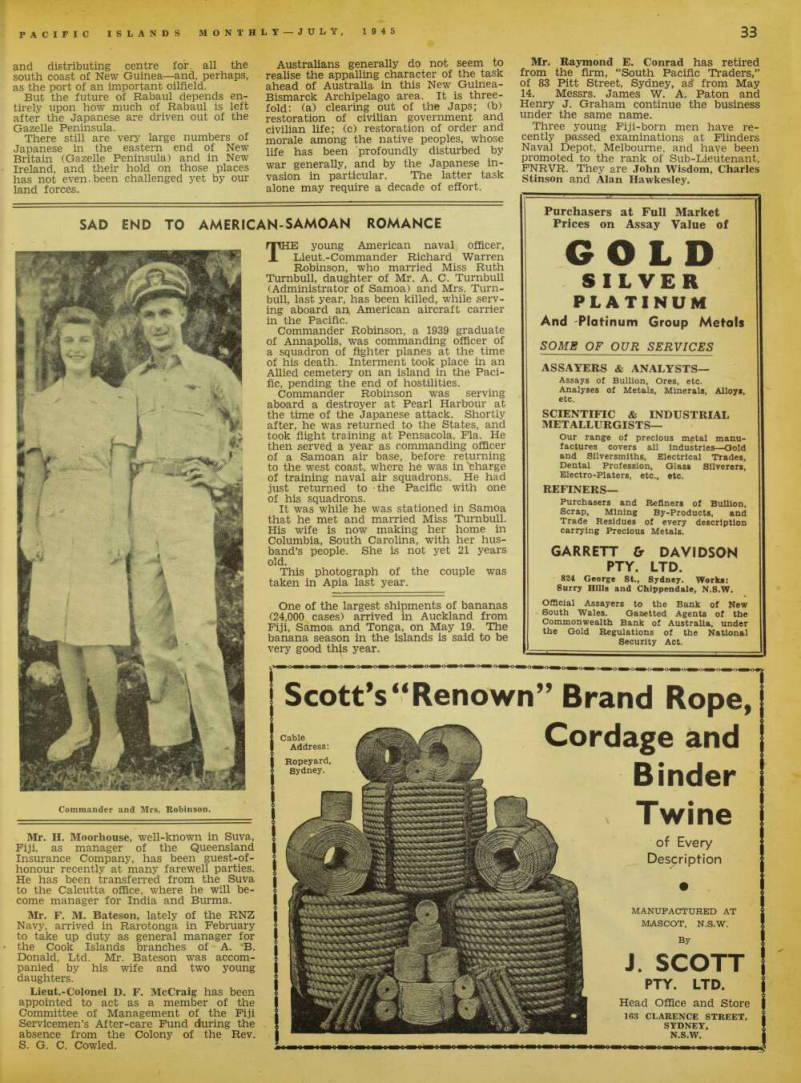
Mr. H. Moorhouse, well-known in Suva, Fiji, as manager of the Queensland Insurance Company, has been guest-of honour recently at many farewell parties.
He has been transferred from the Suva to the Calcutta office, where he will be come manager for India and Burma.
Mr. F. M. Bateson, lately of the RNZ Navy, arrived in Rarotonga in February to take up duty as general manager for the Cook Islands branches of A. B.
Donald, Ltd. Mr. Bateson was accom panied by his wife and two young daughters.
Lieut.-Colonel D. F. McCraig has been appointed to act as a member of the Committee of Management of the Fiji Servicemen’s After-care Fund during the absence from the Colony of the Rev.
S. G. C. Cowled.
THE young American naval officer, Lieut.-Commander Richard Warren Robinson, who married Miss Ruth Turnbull, daughter of Mr. A. C. Turnbull (Administrator of Samoa) and Mrs. Turn bull, last year, has been killed, while serv ing aboard an American aircraft carrier in the Pacific.
Commander Robinson, a 1939 graduate of Annapolis, was commanding officer of a squadron of fighter planes at the time of his death. Interment took place in an Allied cemetery on an island in the Paci fic, pending the end of hostilities.
Commander Robinson was serving aboard a destroyer at Pearl Harbour at the time of the Japanese attack. Shortly after, he was returned to the States, and took flight training at Pensacola, Fla. He then served a year as commanding officer of a Samoan air base, before returning to the west coast, where he was in 'charge of training naval air squadrons. He had just returned to the Pacific with one of his squadrons.
It was while he was stationed in Samoa that he met and married Miss Turnbull.
His wife is now making her home in Columbia, South Carolina, with her hus band’s people. She is not yet 21 years old.
This photograph of the couple was taken in Apia last year.
One of the largest shipments of bananas (24,000 cases) arrived in Auckland from Fiji, Samoa and Tonga, on May 19. The banana season in the islands is said to be very good this year.
Commander and Mrs. Robinson.
Advertisements & other items, p. 35 (1 item)
Cordage and
Purchasers at Full Market Prices on Assay Value of
GOLD
SILVER
PLATINUM
And Platinum Group Metals
SOME OF OUR SERVICES
ASSAYERS & ANALYSTS—
Assays of Bullion, Ores, etc.
Analyses of Metals, Minerals, Alloys, etc.
SCIENTIFIC & INDUSTRIAL
METALLURGISTS—
Our range of precious metal manufactures covers all industries—Gold and Silversmiths, Electrical Trades, Dental Profession, Glass Sllverers, Electro-Platers, etc., etc.
REFINERS—
Purchasers and Refiners of Bullion, Scrap, Mining By-Products, and Trade Residues of every description carrying Precious Metals.
GARRETT Cr DAVIDSON
PTY. LTD.
824 George St., Sydney. Works: Surry Hills and Chippendale, N.S.W.
Official Assayers to the Bank of New South Wales. Gazetted Agents of the Commonwealth Bank of Australia, under the Gold Regulations of the National Security Act.
Scott’s “Renown” Brand Rope,
Cordage and
Binder
Cable Address; Ropeyard, Sydney. m
SK-«SS
Twine
of Every
Description
MANUFACTURED AT
MASCOT, N.S.W.
By
J. SCOTT
PTY. LTD.
Head Office and Store
163 CLARENCE STREET,
SYDNEY,
N.S.W.
Coral Carrier
James Norman Hall Tells How War Came to an Atoll
FOR some time now, it has not been quite the right thing to state that war, take it as vou like, is a damned fool business anyway—even when that war is hitched, willy nilly, to some in offensive, and formerly forgotten, speck in the Pacific.
James Norman Hall (in his latest story “Lost Island,” published by Collins, for 8/6 Australian) does not say so in so many words, either. What happened to his island and its inhabitants is presented as being the result of the overwhelming pro cesses of total global war, and quite in evitable. But it is doubtful if anyone with one particle of affection for the Pacific, can read this simple story and then burst into loud patriotic song.
Quietly, and without fuss or feathers, Hall tells the story through George Dodd, an American officer of Engineers, who, at a moment’s notice, is whisked off into the Pacific with a blueprint in his pocket and instructions to convert a remote atoll into a coral landing platform for Ameri can bombers, and its lagoon into a sea plane base.
The final leg of Dodd’s journey is by schooner, where he meets Pappa Viggo, Danish Resident Agent of the atoll. Viggo is his host on the island, and it is through him that Dodd must get across to the Polynesian inhabitants the idea that their traditional home is needed for more im portant things than mere living. That it is, in fact, to be used to further the efforts of the United Nations at war.
Neither Viggo nor Dodd has much suc cess in this direction. The islanders had never seen a Jap, nor, until Dodd’s arrival, an American. Both Japan and the United States were beyond their orbit of under standing, and they were superbly disin terested in blueprints, bases or wars.
They welcomed Dodd as the Polynesians welcome all visitors, and in two weeks that elapsed before the arrival of the 10,000 ton transport ‘ carrying the bull dozers, mechanised equipment and the Seabees to do the job of destruction and construction, Dodd met Father Vincent, the old priest who had spent 25 years there building up a garden on barren coral; the Lehmanns, refugees from Hitler; and the islanders themselves. He learned ‘something of their lives, their happiness and their peace. And because
he was not all engineer, he came to loathe the job which he had come to do, and which he must begin as soon as the trans port arrived. rpHE transport was a matter of great A awe and wonder to the islanders.
They were disposed to make a picnic of the visit, to sing songs of welcome and present coconuts to the .visitors. But there was little time for such niceties of Polynesian custom. Within hours, a wharf had been built, and hundreds of bulldozers, trench diggers, stores and Sea bees decanted on to the main islet.
Then the Army and Navy really went to work. Barracks and stores were built; the coral heads in the lagoon were blasted out—and what fish were not killed de parted for the open sea; and, to allow for still greater activity, the islanders were to be immediately shifted to a smaller islet on the other side of the lagoon.
But there was slightly more difficulty in getting rid of the people than in rid ding the sea of coral outcrops, “Give them a little time,” pleaded Viggo.
“Time! We’ve got no time to spare,” replied the general. “It’s a damned shame having to root them out of their homes like this ... Listen Viggo, tell ’em it’s not our fault. Tell ’em they’ve got the little yellow devils of Tokio to blame for this. Tell ’em that Uncle Sam is going to make the so-called Rising Sun set so hard they’ll feel the tidal wave from the splash right out here.”
“I couldn’t explain that, general,” said Viggo, “They don’t even know who the Japs are.”
“What!” said the general, “’Ain’t you told ’em?”
“Yes,” said Viggo, “Father Vincent and I have both spoken about the Japs, but they don’t really understand.”
But, finally, they were induced to dis mantle their houses. Everything, includ ing the dismembered church of Father Vincent, was swiftly carried across the lagoon by barge and launch to the small islet barely large enough to accommodate the hundred-odd men, women and children. There they were supplied with Army rations, 'and left temporarily to their own devices. They made no attempt to re-erect their dwellings or the church.
They put up temporary lean-tos, and
wandered around aimlessly, their hearts still back on the larger island where generations of their forebears had been bom, had lived and had died; they were uncomprehending of this strange new force that had so suddenly cut across the only existence they knew.
Meantime, the bulldozers were in full blast. In ten days the base was finished: a coral platform, nicely rounded to pro vide -perfect drainage, devoid of vegeta tion, a row of prefabricated huts where the old village had been; stores, mess houses, workshops.
Viggo’s 20 ft. hill had been smoothed fill a hollow; Father Vincent’s garden, built of soil painstakingly brought by schooner, from distant volcanic islands, had gone towards the same noble cause.
In ten, swift, incredible days, Dodd’s work was done. He went on to another job; this time Alaska. But he could not forget the atoll or its people. A year later, he tells two old friends the story—the narrative of this book. “And what of Viggo and the islanders’ relationship with the soldiers?” they asked at the end.
“As Tve read Viggo’s letters, I’ve felt tnat difficult position become more acute,”
Dodd answers. “He had given me just enough anxious hints, so that I was able to draw my own conclusions. But in his latest letter, without anything to prepare me for it, he announced, quite simply, that all three of his daughters are in the family way, by American soldiers ...
The island he loved so much is overrun by strangers and the life of its people hopelessly disorganised; his turtle refuge is gone, his birds are gone, and now all three of his daughters—far gone in preg nancy.
“And no one really to blame, least of all the general. He did his best, but he must have known in his heart what would happen. There are now 370 men on the atoll, all of them young fellows, lonely, homesick, and, most of them, bored to death. Is it to be wondered that they should seek consolation?”
“T OST Island” is a slim little book; the ±j story can be read in a few hours.
But it puts into fine prose the feel ings of most Islands folk. It finds no happy ending for the troubles brought to the Pacific bv war; it suggests for them no bright and glorious future; it simply gives form and shape to the stark reality of what we all knew must be happening to these last outposts of peace and free dom. The march of our sacred Euro pean civilisation, like one of George Dodd’s bulldozers, is ruthless. It tears down and thinks to compensate by hand ing out free some mass-produced sub stitute.
And, like George Dodd, we can do nothing about it, except weep a tear in private.—JUDY TUDOR.
Twins (a son and daughter) were born to Mrs. Harold Cooper (wife of Harold Cooper, of the Fiji Information Office), in Suva, Fiji, on April 27.
The Rev. S. H. Dewdney, of the LMS, Orokolo, Papua, is at present doing depu tation work in Victoria.
Bishop Baddeley, of Melanesia, was in Suva from his diocese on a short visit to Fiji in May.
Corporal Charles Stoebner, of Noumea, is mentioned in a Brigade citation, for evacuating wounded under fire in France.
A member of the second Caledonian con tingent, he had previously served in Tunisia and Italy. He also fought in World War I.
Mr. A. Habeeb Sahu Khan, of Suva, Fiji, has passed his medical degrees suc cessfully at Dunedin University He is the sixth son of Mr. Sahu Khan, of Wai manu Road, Suva. He has three brothers in the Fiji Civil Service. * Warrant-Officer V, Newmann, formerly a member of the Lutheran Mission staff
on Rooke Island, off New Guinea, reports that damage to mission property by the Japanese has not been so expensive as at first feared.
Miss Bessie Holder, of the LMS, re cently spoke to the Melbourne LMS Fellowship of her experiences as a mis sionary in Samoa.
Advertisements & other items, pp. 36-37 (1 item)
Producing Uniform Good Results Since 1868
always ask for it
Fiji and South-Sea Islands Souvenirs
ADAMS
LAUTOKA FIJI
CHEMISTS, DRUGGISTS, SOUVENIR
DEALERS, MERCHANTS
We believe we have the choicest range in Fiji of: — Tortoiseshell Goods, inlaid or with Cat's-Eyes.
Silver Filigree Goods with or without Cat's-Eyes.
Pearl-shell with or without Cat's-Eyes.
Ivory articles of all kinds.
Coconut-shell souvenirs.
Unmounted Cat's-Eyes.
Hand made native curios and souvenirs. Beads, Hula-skirts and Tops (bras). Mats, Fans, Fancy Shell Floral Necklaces and Bracelets.
Model Canoes, Lalis (native wooden drums).
Tanoas (kava bowls, used as ash-trays).* Tapa (tree-bark) Cloth.
Sea shells of every kind. s • ♦ We are big suppliers to Army and Navy personnel and purchasing units, with whom we built a reputation during their stay in Fiji. We specialise in quality goods.
SPECIAL DISCOUNTS TO QUANTITY BUYERS
We welcome all inquiries. Send for our catalogue.
Sufficient Address :—
ADAMS - LAUTOKA - FIJI
Mills Of The Islands
r[E mills of God grind slowly, And so did the mill at Su’u, The little steam mill at Talina— The copra kiln at Berande— The hot air house of Faiami— And the drier at Lingatu.
Brown hands are cutting the copra, And gouging the meat from shell: The bullock carts trundling and creaking— The boys on top there are sleeping— So wends the way to the drier
That smokes at the end of the dell.
Hell-hot, the furnace glowers, The mill boys are turning the trays; Now cooking and drying the copra— Now bagging, branding, and loading— Each day from dawn till bello— Those were typical Islands days.
The mills of God grind slowly, And so did the mill at Su’u, The little steam mill at Talina— And the master’s fortune, too.
Alma Gross.
Brilliant, But
Collaborationist The Career of a Caledonian Writer
From Our Own Correspondent At atxt t NOUMEA, May 9.
LAIN LAUBREAUX, former contribu tor to the French pro-Nazi weeklies, Je Suis Partout” (“I am everv where”) “Gringoire,” and the daily Candide.” is reported to have escaped to Barcelona.
America’s “Newsweek” said that Laub reaux’s job was to direct prooaganda in Spam for the benefit of French colla borationists now in Germany. If so, he does not seem to have had much success.
Laubreaux is a New Caledonian author and journalist of considerable talent, but anti-democratic leanings who left this island as a young man after having given considerable offence to his Pacific Island compatriots. The reason is not far to seek. Their manner of life, he hits off in a series of clever novels in which the Caledonian atmosphere, situations and characters—sea cantains, gendarmes, Noumea business people, half-castes and full-blooded popines—are authentic.
But in spite of his cynicism he is a natural and attractive writer whose plots are quite in keeping with the lives of the people he describes, and one has no hesitation in recommending “Wara” (a novel about the Isle of Pines), “Rocher a la Voile” and “Yan le Metis” (“Yan the Half-caste”) to anybody interested in French Pacific life who can read the French language.
The title of “Rocher a la Voile” is taken from one of the most visited beauty spots in the Colony, the sail rock at Anse Vata Beach; but the portrait he paints of the sea captain and his Australian wife who make the regular run between Sydney and Noumea served to increase the author’s local unpopularity.
“Yan le Metis” also brought trouble in its wake, for G. Baudoux, author of “Legendes Canaques,” the one immortal book about New Caledonian native life, went to Paris and charged Laubreaux with having lifted certain passages from his, Baudoux’s, own works.
IN France Laubreaux wrote other novels, “Le Corset Noir” (“The Black Bodice”) and “Diane la Goule” among them, but these have other settings. Losing his youth, Laubreaux developed enormous girth, was fond of food and drink and of writing about both in the daily papers in an individual style that was skilled and fascinating. Too fascinating, for the author’s pre-occupations surely help to explain his reactionary tendencies, always those of a Fascist in the making.
When this war started “Gringoire” was in full blast as a fifth columnist and re actionary publication, and so were many other once-proud papers like “LTllustra tion.” Shortly before the downfall .of France, Laubreaux was held for ques tioning by the Daladier Government, and ,there seems no reason to doubt that he was one of the familiars of Otto Abbetz, the envoy of Hitler.
On the main gateway of the Laubreaux mansion in a Noumea suburb in the stouter days of Henri Sautet, the local lads revenged themselves on Alain and another of the Laubreaux family who had counselled against the Colony’s join ing de Gaulle by painting in tar a huge Croix de Lorraine. Splashed on with a huge brush in the dark age of 1940, it was left standing for many months, like a defiance to Fascism and a pledge to the belief of democratic New Caledonians in an Allied victory, and the rebirth of La Patrie,
Advertisements & other items, p. 38 (1 item)
For Island Souvenirs
N r^€)Wy "T-
Tortoise-shell
Jewellery
Cat's-eyes
Write to
SOUTH SEA SOUVENIRS
STORE
Thomson Street, Suva Opp. G.P.O. P.O. Box 83.
Manufacturer and Supplier of High-class Tortoise-shell Goods, Silver Filigree Ornaments. Dealers in Cat’s-eyes and Island Curios.
Special Designs made to order, at best prices.
Wholesale and Retail Inquiries Invited.
BANKERS: Bank of New South Wales, Suva, Fiji.
Large-scale
Embezzlement
By Samoan
From Our Own Correspondent APIA, June 14.
A CASE which created a great deal of ’excitement and comment was heard here on May 30, before Chief Judge J. R. Herd of the High Court. A Samoan clerk and typist of the Justice Depart ment, Te’o Taulalo, of Tanugamanono, was convicted on a charge of stealing £719 from the Administration.
Inspector A. L. Braisby prosecuted for the police and the accused was defended by Mr. G. T. Jackson. He pleaded guilty.
On July 1, 1943, Te’o Taulalo had been appointed clerk and typist of the Justice Department and was given charge of the keys of the safe and strong-room under control of the Registrar of the Court, Mr. A. B. L. Tattersall. His duty was to receive all monies payable to the Justice Department on behalf of the Registrar and to apply this money to the purchase of Revenue Stamps from the Treasury, the stamps to be affixed to the Court Records to which these payments related.
On March 15, 1945, the New Zealand Government auditors commenced an examination of the accounting records of the Justice Department. This was the first audit of these records for three years. The amounts of cash and Revenue Stamps found by the auditors did not agree with the check of receipts in. the revenue receipt books.
Te’o Taulalo was then asked to explain but was unable to show when he had last affixed Revenue Stamps to the Court Register and other records. Additional discrepancies were then found and the position was reported to the Registrar.
Questioned by the latter, Te’o Taulalo admitted that he was short in his cash to the extent of about £7OO. He was immediately relieved of his position and placed in custody. He stated that he had been careless with the office key and offered, if given time, to make restitu tion. He also drew up a list of docu ment to which he had omitted to affix Revenue Stamps or in relation to which he had not accounted for money received.
Te’o Taulalo was charged with having converted the money to his own use, and convicted. He has been sentenced to three years’ imprisonment.
He refused to make any statement to the police, and to date none of the miss ing money has been recovered.
Blessings Following
Ve-Day
CHANGES have been made in those Fiji Defence Regulations which deal with the sale of liquor.
Hotels in the Colony may now sell alcoholic liquor by the bottle except to members of the armed forces. During the past few years it has been possible to buy liquor from hotels only by the glass. This restriction still applies to men in the armed forces.
In many parts of the Colony the hotel hours have reverted to the pre-war 10 a.m. to 10 p.m. Under the amending regulations made last week all hotels in the Colony except those within a 15-mile radius of the Suva Post Office, that is, in Suva and in the Nausori area, will keep the old hours. In Suva and at Nausori the hours still remain at 1 p.m. to 6 p.m.
Advertisements & other items, p. 39 (1 item)
help
A valuable
restoring
physical
strength after
illness
During convalescence the
patient’s appetite is often
capricious ... he doesn’t like this and doesn’t fancy that. Yet it is most important that he has the right food to build up 9 : v...
FOOD
health and strength. In this respect Horlicks is invaluable.
Patients enjoy the delicious flavour of Horlicks, and it has the additional advantage of being very easy to digest.
Horlicks is a complete food drink. It creates warmth and energy almost at once, since the natural sugars it contains are quickly absorbed by the blood-stream. This is the reason for the
iiBB
O marked revivifying effect of Horlicks.
As a tissue-repairer Horlicks is of definite value. It contains a valuable proportion of
readily - assimilable protein,
also a percentage of mixed carbohydrates. This makes Horlicks a very real factor in
restoring bodily strength. It’s
no trouble at all to prepare Horlicks. Simply mix it with water only, hot or cold. Its natural sugars make Horlicks sweet enough for most tastes.
Horlicks is sold in handy glass jars, or in tins, price 3/-. (Prices slightly higher in the country.)
HORLICKS
Policy Of The Nickel Company
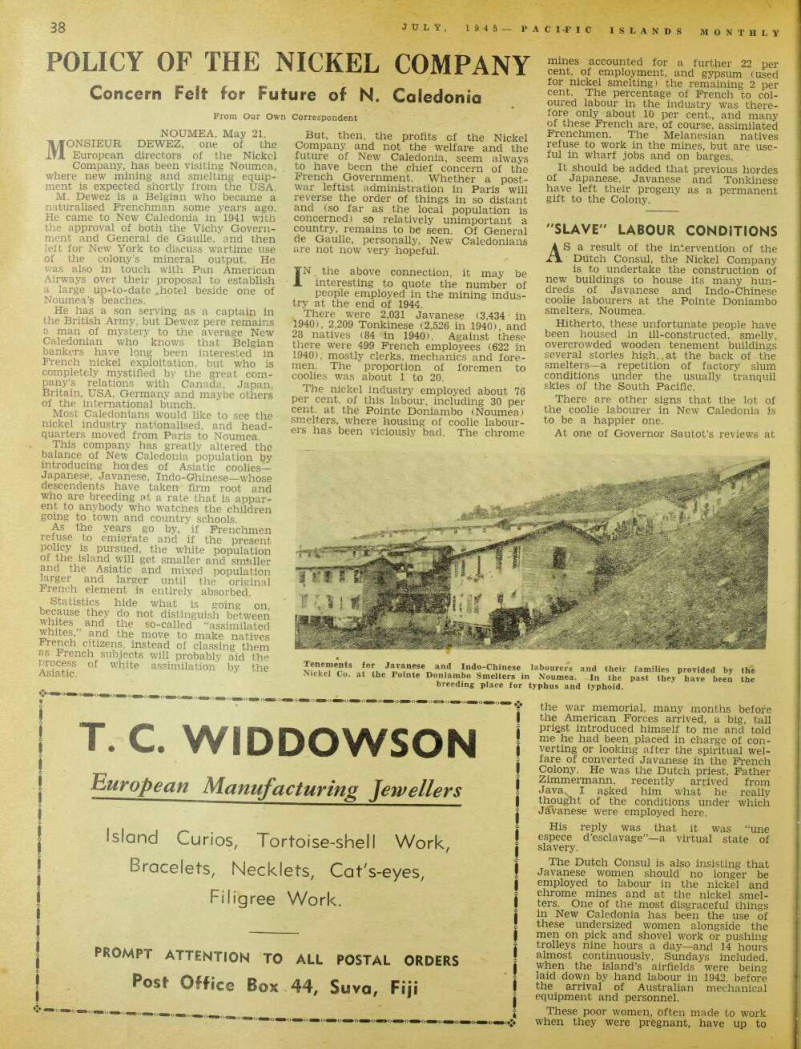
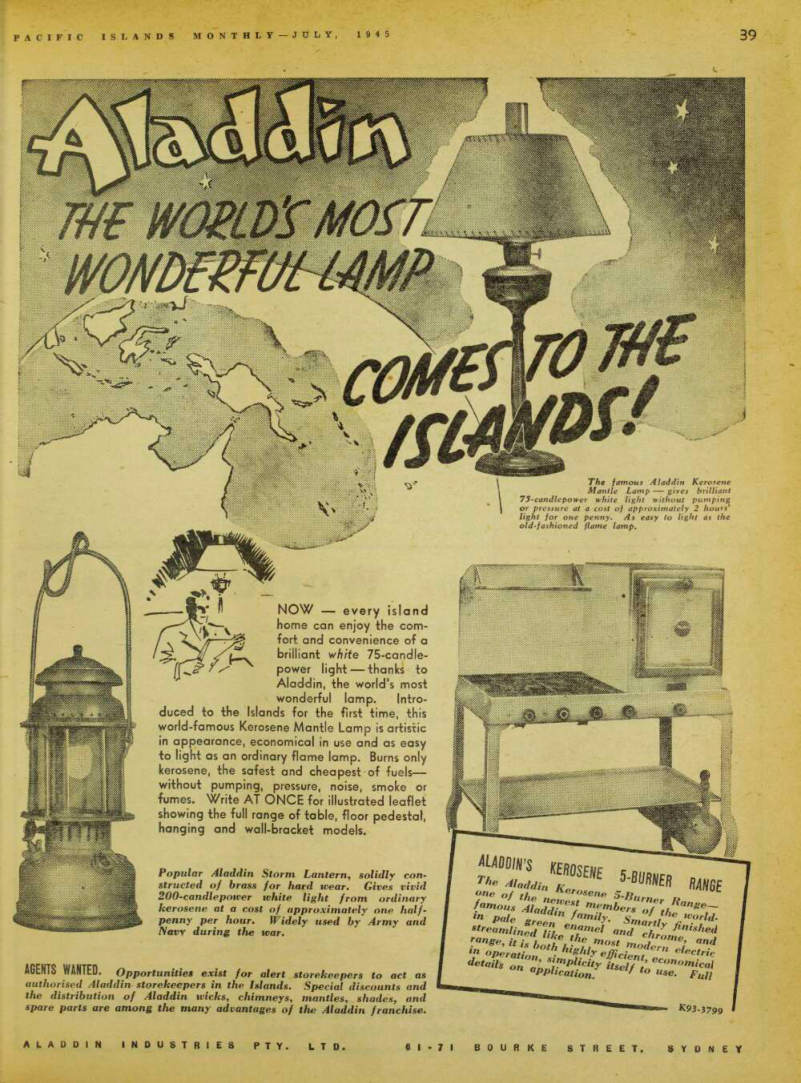
Concern Felt for Future of N. Caledonia From Our Own Correspondent
Noumea, May 21.
Monsieur dewez, one of the European directors of the Nickel Company, has been visiting Noumea, where new mining and smelting equip ment is expected shortly from the USA.
M. Dewez is a Belgian who became a naturalised Frenchman some years ago.
He came to New Caledonia in 1941 with the approval of both the Vichy Govern ment and General de Gaulle, and then left for New York to discuss wartime use of the colony’s mineral output. He was also in touch with Pan American Airways over their proposal to establish a large up-to-date ,hotel beside one of Noumea’s beaches.
He has a son serving as a captain in the British Army, but Dewez pere remains a man of mystery to the average New Caledonian who knows that Belgian bankers have long been interested in French nickel exploitation, but who is completely mystified by the great com pany’s relations with Canada, Japan, Britain, USA, Germany and maybe others of the international bunch.
Most Caledonians would like to see the nickel industry nationalised, and head quarters moved from Paris to Noumea.
This company has greatly altered the balance of New Caledonia population by introducing hordes of Asiatic coolies— Japanese, Javanese, Indo-Chinese—whose descendents have taken firm root and who are breeding at a rate that is appar ent to anybody who watches the children going to town and country schools.
As the years go by, if Frenchmen refuse to emigrate and if the present policy is pursued, the white population of the island will get smaller and smaller and the Asiatic and mixed population larger and larger until the original French element is entirely absorbed.
Statistics hide what is going on because they do not distinguish between whites and the so-called “assimilated whites, and the move to make natives t rench citizens, instead of classing them as French subjects will probably aid the process of white assimilation' by the ASlEttlC.
But, then, the profits of the Nickel Company and not the welfare and the future of New Caledonia, seem always to have been the chief concern of the French Government. Whether a post war leftist administration in Paris will reverse the order of things in so distant and (so far as the local population is concerned) so relatively unimportant a country, remains to be seen. Of General de Gaulle, personally, New Caledonians are not now very hopeful.
IN the above connection, it may be interesting to quote the number of people employed in the mining indus try at the end of 1944.
There were 2,031 Javanese (3,434 in 1940), 2,209 Tonkinese (2,526 in 1940), and 28 natives (84 in 1940). Against these there were 499 French employees (622 in 1940), mostly clerks, mechanics and fore men. The proportion of foremen to coolies was about 1 to 20.
The nickel industry employed about 76 per cent, of this labour, including 30 per cent, at the Pointe Doniambo (Noumea) smelters, where housing of coolie labour ers has been viciously bad. The chrome
mines accounted for a further 22 per cent, of employment, and gypsum (used for nickel smelting) the remaining 2 per cent. The percentage of French to col oured labour in the industry was there fore only about 10 per cent., and many of these French are, of course, assimilated Frenchmen. The Melanesian natives refuse to work in the mines, but are use ful in wharf jobs and on barges.
It should be added that previous hordes of Japanese, Javanese and Tonkinese have left their progeny as a permanent gift to the Colony.
"Slave" Labour Condstions
AS a result of the intervention of the Dutch Consul, the Nickel Company is to undertake the construction of new buildings to house its many hun dreds of Javanese and Indo-Chinese coolie labourers at the Pointe Doniambo smelters, Noumea.
Hitherto, these unfortunate people have been housed in ill-constructed, smelly, overcrowded wooden tenement buildings several stories high, at the back of the smelters —a repetition of factory slum conditions under the usually tranquil skies of the South Pacific.
There are other signs that the lot of the coolie labourer in New Caledonia is to be a happier one.
At one of Governor Sautot’s reviews at
the war memorial, many months before the American Forces arrived, a big, tall priest introduced himself to me and told me he had been placed in charge of con verting or looking after the spiritual wel fare of converted Javanese in the French Colony. He was the Dutch priest, Father Zimmermann, recently arrived from Java.. I agked him what he really thought of the conditions under which Javanese were employed here.
His reply was that it was “une espece d’esclavage”—a virtual state of slavery.
The Dutch Consul is also insisting that Javanese women should no longer be employed to labour in the nickel and chrome mines and at the nickel smel ters. One of the most disgraceful things in New Caledonia has been the use of these undersized women alongside the men on pick and shovel work or pushing trolleys nine hours a day—and 14 hours almost continuously, Sundays included, when the island’s airfields were being laid down by hand labour in 1942, before the arrival of Australian mechanical equipment and personnel.
These poor women, often made to work when they were prbgnant, have up to
Tenements for Javanese and Indo-Chinese labourers and their families provided by the Nickel Co. at the Pomte Doniambo Smelters in Noumea. In the past they have been the breeding place for typhus and typhoid.
now been paid only two or three dollars a month.
Their sisters in domestic service in Noumea have a lot that is far less oner ous and have profited considerably “on the side” from the presence of the American troops.
In the mining camps the Javanese, who are great gamblers and money spenders when they have the money, fre quently play for the privilege of sleep ing with the women, who outside Noumea are outnumbered by the males about ten to one.
By a recent count there were some 7,249 Javanese in New Caledonia, of whom 985 had won for themselves the privilege of free residence. Those work ing in the mines, on the land, and in the colonists’ homes under the old contract system number 6,264 coolies, of whom 5,044 are men.
The Dutch Consul to whom these reforms are due is Dr. J. van Beusekom.
It was the presence of so many Javanese in the country and the need for revision of conditions of their appointment (a matter reported upon unfavourably by Dutch officers passing through the Colony), that led to his appointment a year ago in succession to Caledonian born Vice-consul Carlo Leoni.
The American mining geologist, Mr.
Don Frasche, who has succeeded the Eng lishman, Major Oughton, as inspector of the Tiebaghi (British) Company, the largest chrome exploiters in New Cale donia, has returned to Noumea after an absence of several months. Mr. Frasche is a highly experienced mining expert who has spent years in the Philippines and Central Africa.
Advertisements & other items, pp. 40-42 (2 items)
38
JULY, 1945 I*ACi*FIC ISLANDS MONTHLY
T. C. Widdowson
European Manufacturing Jewellers
Island Curios, Tortoise-shell Work, Bracelets, Necklets, Cat's-eyes, Filigree Work.
PROMPT ATTENTION TO ALL POSTAL ORDERS
Post Office Bos 44, Suva, Fiji
4 0 rtgy» S%. .4 * * \ TAe famous Aladdin Kerosene Mantle Lamp gives brilliant 75-candlepower white light without pumping or pressure at a cost of approximately 2 hours’ light for one penny. As easy to light as the old-fashioned flame lamp. lf-/ NOW every island home can enjoy the comconv e n < er, ce of a /brilliant white 75-candlepower light thanks to Aladdin, the world's most wonderful lamp. Introduced to the Islands for the first time, this world-famous Kerosene Mantle Lamp is artistic in appearance, economical in use and as easy to light as an ordinary flame lamp. Burns only kerosene, the safest and cheapest of fuels— without pumping, pressure, noise, smoke or fumes. Write AT ONCE for illustrated leaflet showing the full range of table, floor pedestal,
hanging and wall-bracket models.
Popular Aladdin Storm Lantern , solidly constructed of brass for hard wear. Gives vivid 200-candlepower white light from ordinary kerosene at a cost of approximately one halfpenny per hour . Widely used by Army and Navy during the war.
Q AGENTS WANTED. Opportunities exist for alert storekeepers to act as authorised Aladdin storekeepers in the Islands. Special discounts and the distribution of Aladdin wicks , chimneys , mantles , shades , and spare parts are among the many advantages of the Aladdin franchise. »*L? S£ ' £ str eamlin ed like !?” 1 *' 1 0,1(1 chron in If?;, U *. S b °th highly 1 Modern *93-3799
ALADDIN INDUSTRIES PTY. LTD.
7 I
BOU R K E
STREET,
BYO N E
WESLEY COLLEGE,
PAERATA, N.Z.
A Boarding School for Boys (Forms I to VI), under the control of the Methodist Church of New Zealand.
Set in attractive surroundings, with swimming - baths, extensive playing-fields, modern buildings.
Special attention given to Physical Education, Clubs, Carpentry, Crafts. An Education with a
Religious background.
A full General Course for Junior Forms. Specialist training for Seniors in one of the following:— Academic and Professional subjects; Agricultural or Animal Husbandry; Woodwork.
Commercial and Accountancy subjects.
Fees for all Courses, £75 per annum, plus incidentals.
Applications for Enrolment should be made to The Principal.
Wesley College, Paerata, Auckland, N.Z.
Better Educational
Facilities NZ Survey in Cook Is.
From Our Own Correspondent N„, d ' RAROTONGA, May 28.
EAR the end of May, Rarotonga had a further glimpse of the shape of things to come in the visit, by air of a group of education experts from New Zealand. The party consisted of the following: Dr. Beebe, Director of Edu cation; Mr. Renyard, Director of Manual and Technical Training; Mr. Fletcher Inspector of Native Schools; Mr McKen zie, Director of Education in Samoa (formerly of Rarotonga); and Eti, Senior Native Inspector of Saafea During their week’s stay the party made a very thorough survey of the local schools and existing educational methods and conferred at length with the Resi dent Commissioner (Mr. W. Tailby) and ttje Rarotonga Director of Education (Mr. R. Walker).
This survey is part of a general edu cational survey of various Pacific ter ritories and ft is understood that the findings will be discussed at a later con ference in Suva.
Nz-Rarotonga Air Service
rE same plane brought a crew of technicians to instal ground equip ment for the establishment of the re i?- ul tf r New Zealand-Rarotonga air-mail which is now in operation. Rarotonga is now included in the fortnightly Paci fic Islands link-up with New Zealand.
Private passengers will be carried on the mail-planes, but rates are likely to be high for some time to come.
relating to native labour. In the past, native labour has been employed under the indenture system. It has already been announced that it is the intention nf thp Gnvprnmpnt tn abolish this 01 tne government to aDOllsn mis sys tern as soon as practicable, and the decisions that have been taken, and which are now outlined, are designed to remove the indenture system from Papua and New Guinea within a period of five years, or at an earlier date as may be determinpd hv thp rinvprnmpnf mined oy tne Government.
Comment
IT is at least 18 months since certain Australian Labour Ministers announce! that the indenture system would be abolished. Mr. Ward then complacently pointed to the fact that the plan was strongly supported by Professor Elkin, a prominent anthropologist; Bishop Cranswick, - - ■ ■
head of an Anglican missionary body; and Rev.
J. W. Burton, head (then) of the Methodist Missionary Society.
In the ensuing 18 months, the representatives of every interest in the two Territories, includ ing every missionary body, roundly condemned the Minister’s proposal as uninstructed, im practical and visionary. It was pointed out that not one of the non-official gentlemen who had advised the Minister had any real prac tical experience of conditions in the two Australian Territories.
It was most urgently shown to the Minister that the indenture system had been evolved through a long period of trial and error; that, properly administered and policed, it was of real assistance to the natives in bridging the gulf between their present Stone Age condition and the standard of life to which we hoped to educate them; that, as the natives have no idea of the nature of a contract, some sort of indenture, with a punitive provision In it, is necessary, if we are to run the Territories with local rather than imported labour; and that, if the native labour is not going to be provided for private enterprise, and there is to be no inden tured Asiatic labour, then the Territories cannot be developed.
Mr. Ward’s attitude, however, is that he does not care a button about private enterprise or development; and that, if he can administer to private enterprise a kick in the rear, he will be very happy to do it.
AS soon as the Civil Administration is restored, a new Native Labour Or dinance for the combined Territory will be enacted. The major alterations to be made under this Ordinance will be: (i) -The elimination of professional recruiters, who in the past have been permitted to recruit native labour for employers on the basis of so much per head for the natives recruited. In future, the engagement of natives will be by
employers personally, or by associations
of employers, or by salaried persons in the regular employment of those employ ers or associations. Licences to engage labour will be issued to persons approved by the Administration, and such persons will be required to furnish a surety in the sum of £5O. It will be an offence for any person to give, offer, or accept
recruiting fees, bonuses, commissions or
any consideration other than salary, in connection with the engagement of natives for employment.
Comment
A ND so the Canberra Department, having Gmre, r nlT^ ntly a !> andoned plan to substitute n f l recruiting (“a pool of native labour «r°f ed - by . thC Adminis tration”) for private or professional recruiting, produces a plan which, unorf puttin S.the onus of engagement upon the employer or his salaried servant, really makes the Administration the recruiting agent On present indications, that is how it will work out in practice. u*™ rUit i ng * S always a very difficult, and some times a dangerous job. In the past, it has been always undertaken by very experienced men If t 0 bC , recruited “ an easy, accessible fi a ♦5. be . employer often did U himself, and fees ‘ When labour had to be sought m difficult new country, the recruiter was en gaged—and earned every penny of his fees. In thus pushing gradually into new country, and taking these raw, primitive natives into more civilised parts, the recruiter did more towards the opening up and taming of the wild areas than any other single agency in New Guinea.
Mr Ward and his Canberra advisers have for go ten all that—all that they can remember, in their hatred of private enterprise, is that the recruiter, bringing in a new line of recruits, sometimes collected a cheque running into hun dreds of pounds; and such foul exploitation must be stopped.
It is no use inveighing against the stupidities of this particular “reform.” The Ward plan will go through. But—for reasons apparent to any practical man who knows the Territories— it will not work, and probably soon will be abandoned. (ii) As there is not an unlimited supply of native labour, and as the Government
proposes a vigorous policy which will
enable natives to take a greater share in agriculture on their own account than in the past, it is necessary to ensure that such native labour as is available is used to the best advantage. The Administra
tion will, therefore, determine the num
ber of natives who may leave a village for employment. It will also determine the number that may be employed by each employer, and the priority of indus try for the employment of native labour.
Comment
the Australian Socialists have ‘ £ no thought of proposing “a vigorous policy which will ensure” development of the Territory by European enterprise. The teaching of agri culture to natives is a most excellent plan, which should have been put in hand 20 years ago. But it must be part of a general develop mental policy, in which the available labour supply, and the proper training of the natives, must be considered in relation to other things.
In the one-eyed fashion that has become tragically familiar to Australia since Labour got control, all considerations in New Guinea are to be subverted to Mr. Ward’s particular phobia.
Mr. Ward evidently imagines he is going to make peasant farmers of some hundreds of thousands of primitive native men within five years. It cannot be done in less than 25 years— and then only as part of a developmental policy properly co-ordinated with native education, native health, and the due assistance of Euro pean enterprise.
In all these proposals, Mr. Ward seems to take no account of the financial aspect. In the past the Government, trying to make the Terri tories at least partly self-supporting, encouraged private enterprise; and the revenues from copra and gold production certainly put New Guinea in a very good position. Mr. Ward’s indiffer ence to the needs of private enterprise indicates that his Socialistic Utopia in Papua and New Guinea is to be a direct charge upon the Aus tralian taxpayer. (iii) The Government considers the rate of remuneration paid in the past to native labourers is far too inadequate, having regard to the value of the work
performed. It is, therefore, proposed to
appoint a competent authority to make
an immediate investigation into this
question.
Pending the receipt of such report by the Government, it is proposed to fix a tentative minimum rate of 15/- per
month, plus rations, issues, housing and
medical care, etc. Formerly the mini mum wage in New Guinea was 5/- a month, and in Papua 10/- a month.
If the report of the investigation is in
the hands of the Government prior to the promulgation of the new Native Labour Ordinance, any new rate will be retrospective to that date.
Comment
ATYPICAL Ward pronouncement. Anyone who knows as little about the Territories as the Minister would imagine from the state ment that the poor natives were being enslaved, at a beggarly 5/- per month. Actually, only a few “monkeys,” and employees of that class, re ceived 5/- per month. Generally, the pre-war wage in New Guinea was 10/- ' per month, and in Papua it ranged up to 15/-.
Indentured natives received transportation to their employer, and back again; food, housing, and the small amount of clothing they required; their health was carefully guarded; and Adminis tration officials carefully policed the whole system, to see that the natives were not ill-treated in any way. Even at 10/- per month, the natives did not know what to do with their wages. Small native trade stores beset the path of the return ing time-expired labourers, and had no trouble in separating them from their savings, in return for all sorts of junk. The real benefit which the great majority of these natives received from their labour contract was not money, but good food, a general clean-up in health, and a know ledge of the ways of the white men. Time enough to raise wages when the native has learned what to do with money.
A native labourer does not do one-quarter of the work of a European labourer. That, com bined with the inability of the native to find a value for money, makes it impossible to estab lish a basis of comparison between European and natives rates of wages, as the wages conscious Mr. Ward is trying to do.
The proposed 50 per cent, rise in wage rates will not, by itself, seriously affect employers in the Territory. It is the other “reforms” which are likely to cripple industry.
(iv) Preliminary investigation has been
made into the nutritive value of the ration scales formerly prescribed .for native labourers in the Territories, and this has shown that considerable im provement can be made. A greatly im
proved scale has, therefore, been prepared
which is designed to provide a scientific ally-balanced diet, and this scale will be
prescribed by Regulation.
(v) Hours of labour will be reduced from 55 hours a week in New Guinea and 50 hours a week in Papua to 44 hours a week.
Comment
TVJO reasonable employer will object to the introduction of a better dieting scale, pro vided the people who introduce it know what they are doing. It is impossible to comment until we know what the proposed diet is to be.
Any sharp departure from the kinds of food to which the native always has been accustomed, and to which he must return, will do far more harm than good.
The hand of the trade union boss is easily seen in the proposed working hours. Mr. Ward cannot see any essential difference between working conditions in Australia and those in New Guinea; and, with such a class-conscious man, there is no basis for discussion or argu ment. Natives in New Guinea and Papua rarely worked more than 48 or 50 hours per week. The climate compels all men to start work very early, and rest in the middle or hottest hours of the
day. The great majority of native workers were always free on Saturday afternoon and Sunday.
The white employers worked substantially the same hours.
One wonders how the Administration is going to police this regulation. Is New Guinea going to be cursed, like Australia, with time-books, hordes of Labour Inspectors, and so on?
And what is to be done in the case of house servants, of whom there were thousands on contract in New Guinea and Papua? (vi) The minimum age at which a native may be employed will be 16 years.
Formerly it was 14 years with authority to employ natives in domestic service from the age of 12 years. (vii) Employment of native women under indenture will not be permitted.
Single women, and a married woman whose husband is employed at the same place, may be employed in domestic ser vice by a non-native woman. (viii) Thfe period of employment will be limited to a maximum of 12 months and re-engagement will not be permitted until the native has been returned to his
home village for a period of three months. Formerly, a native could be away from his home village up to four years in Papua and seven years in New Guinea.
Comment
GpHE only way in which small native boys were A employed was as “monkeys”— generally usefuls around bungalows and camps. In the great majority of cases, such employment was a good thing for the youngster—he was well fed, and medically cared for, and in many cases was provided with some sort of education and training. He learned the ways of the Euro peans, and thus was able to take care of him self in the developing Islands world. The only reason that we can imagine why the system should be altered is that the class-conscious Mr Ward sees here a chance of embarrassing the people who dare to employ “monkeys” on their domestic staffs.
The compulsory reduction of the employment term to 12 months is a most serious blow at Territories labour conditions. The great majority of bush recruits never have seen the appliances and methods of Europeans; and therefore must undergo considerable training be fore they are worth anything. Generally, a recruit is not regarded as of much use until he has been a year or 18 months in service. The new maximum service will cripple the whole labour system. How many employers will go to all the expense of recruiting and transporting and training a native, only to have the addi tional expense of repatriating him at the end of 12 months?
The removal of natives from their villages “for up to four years in Papua and seven years in New Guinea” definitely opened the door to an evil which required attention. But it was not— as Mr. Ward suggests—a widespread evil; and it could have been dealt with in a much less drastic fashion.
So far as the native is concerned, pen alties will be prescribed having regard to the rate of wages the native receives.
Formerly, in New Guinea, when the minimum rate of wages was 5/- per
month, prescribed penalties were dispro
portionate to the capacity of the native to pay them. For example, a labourer who was absent without leave could be fined £1; one who used insulting words to his employer, £5; while the labourer who deserted was liable to imprisonment for three months without the option of a fine.
Contraventions of the labour laws will be dealt with by a Court of Labour and Arbitration instead of by the Courts exercising Criminal Jurisdiction.
Comment
TTERE, again, the Minister is dealing with an A A essentially Territories problem with the ignorance of a man who hnows nothing of the Territories, and with the prejudices of the trade union Left-winger.
Prevailing native wages were not 5/- per month, but 10/-. The penalties had to be made drastic, because these primitive people have no idea of a contract. There really are only two ways in which recalcitrant native labourers can be punished—a whipping, or calaboose with hard labour. A fine, or calaboose alone, is not re garded seriously by the natives.
Apparently, we are to have all over again the troubles caused in the late ’twenties in New Guinea by well-intentioned people who would not allow natives sent to gaol over labour breaches to be punished. The result was a threatened breakdown of the whole labour system—boys sought, rather than avoided a spell in calaboose.
General Griffiths, during his short but highly efficient Administratorship (1932-34), put some ginger into the calaboose. If real hard labour were not available for malefactors, they did a little regular pack-drill. Labour discipline was very quickly re-established in the Territory.
Mr. Ward, apparently, is determined to help Black Brother to defy the boss; and, moreover, he is going to create a new “Court of Labour and Arbitration” wherewith to do it. The Terri tories are going to have some of the bureau cratic machinery which has half throttled Aus tralian industry. The Court of the Kiap, who ruled his district generally wisely and well, through his long, practical knowledge of both Europeans and natives, is to be over-ridden by some fancy institution direct from Sydney Trades Hall!
(ix) Repatriation of native employees
to their home villages will be at the expense of the employers, and under the
supervision of the Administration.
(x) The penal provisions of the Ordin ance will be limited as follows: (a) Against the native in respect of:
(i) Enforcement of the statutory pro
visions governing the contract; (ii) Mak
ing a contract with an employer while under contract to another employer.
(b) Against the employer or his
agent in respect of: (i) Contraventions
of the law in regard to the engage
ment of natives; (ii) Enforcement of
the statutory provisions governing the
contract; (hi) 111-treatment of a
worker. (c) Pecuniary penalty for breach of
labour laws, with enforcement of the
payment of fines by imprisonment.
(xi) Employment of non-indentured
labour will be permitted within the
Administrative District in which the
worker’s village is situated, and 25 miles beyond when the village is adjacent to
the boundary. Formerly, the limits were,
in Papua, within 20 miles of the village and in New Guinea within 25 miles Con
ditions of employment of non-indentured
labourers will be the same as for inden
tured labourers as regards hours, hous
ing, rations, medical care and minimum wage. (xii) A new provision will be made to
provide for compensation for injury or
death arising out of employment
(xiii) A separate Department will be
established to administer native labour.
Comment
TT is known that, for the drafting of the new A Native Labour Ordinance, this Minister had the benefit of the report of the New Guinea Commission which finished its work just before the war, and the practical advice of two or three experienced New Guinea officials.
It is apparent from the foregoing, therefore, that Mr. Ward, having set out to make himself famous as the Great Reformer of the Pacific Territories, would be turned aside neither by precept nor principle. No man with practical experience of Territories conditions, and espec ially with any knowledge of the history of native labour in New Guinea, could have produced the above plan.
It will benefit the natives no more—and prob ably less—than the system which the Australian Administration evolved in 25 years of trial and error; and it will hamstring industry and trade in the Territories.
It is Mr. Ward’s plan. Unhappily, he will have disappeared from off the political stage long before his precious plan can be got rid of,
ALTHOUGH native labour is a very important item it can only be re garded as a small part of any plan that is made for the benefit of the natives as a whole. The native population of the Territories is estimated to be about one million, and the greatest number of natives in employment at any one time has not exceeded 60,000.
For the general benefit of the natives, much more must be done to improve conditions of living in the villages and plans for that purpose are being formu lated.
The immediate need is to repair the damages caused by war, both to native life and property. Some time ago a Com mittee was set up to investigate and recommend a just and practicable plan for compensating natives in Papua and New Guinea for loss of or damage to land and property and death or injury arising from military operations, or aris ing out of causes attributable to the existence of a state of war in the Ter ritories. This Committee has completed its investigations and it is expected that its report will be available at an earl? date.
Thereafter, it will be the aim to im prove the health of the natives generally and by education to improve their con ditions and the standard of living. In the past, much of the education of the natives has been in the hands of mis sionaries. Our plans provide for a vigor ous programme of education in its broad est sense, controlled and directed by the Administration. This does not mean that the missions will be excluded from that field. They have performed very valuable services in the past and can continue to do so within the frame-work of the edu cational programme that is being devel oped.
FORMERLY, the economic development of the Territory and the extent to which industry might be expanded were limited only by the markets avail able and the supply of native labour that could be obtained. There had been some development by natives on their own account.
In future, the basis for the economy of the Territory will be native and Euro pean industry, with the limit of non native expansion determined by the wel fare of the natives generally.
Trading activities, particularly so far as they affect the natives will be under much closer scrutiny and control than in the past; but the policy of the Go vernment in this regard has not yet been determined.
Transport between Australia and the Territories and within the Territories is a major factor in the development of the areas; and the future of shipping and aviation activities is now being con sidered by the Government.
The magnitude and complexity of the task can be seen when I mention that practically all settlements in New Guinea and many of those in Papua will require to be rebuilt. Opportunity will be taken to bring to our assistance all technical aid that will be necessary to provide suit able and attractive areas of settlement by town planning, and construction of buildings that are appropriate to the climate and equipped with modern facilities. r carry out the plans of the Govern ment an efficient and energetic ad ministration will be required, and although many of the experienced officers of the former administrations who have performed such splendid services in the past will be available, other officers will be required to fill vacancies that have been caused by war casualties and re tirements from the Services.
The most important post to be filled is, of course, that of Administrator; and it has been decided to pay a salary of £2,OCK) and an entertainment allowance of £5OO per annum to the occupant of that post.
In order to have the widest possible field of selection it has been decided to invite applications for the appointment, and this action will be taken forthwith.
Among other important posts of the Services for which application will be invited are those of Director of Public Health (salary £l,lOO-£1,200), Director of Agriculture (salary £l,OOO-£1,100), Direc tor of Education (salary £9OO-£1,000). The foregoing rates of salary have been fixed, having regard to the fact that residents of the Territories are not subject to income tax in respect of salary earned by them in the Territories.
PLANS for the return of civil adminis tration have so far progressed as to make it possible to anticipate that the transfer of the control of the ad ministration of Papua and portion of the Territory of New Guinea south of the Markham River can be effected about the beginning of October, 1945.
It will be some time, however, before normal conditions can be re-established, even in those areas, especially in rela tion to the supply of stores and the pro vision of transport between Australia and the Territories, and within the Terri tories. It will, therefore, be necessary, even after civil administration has been re-established, to retain certain restric tions upon the entry of persons to the Territories and upon activities generally.
Much reconstruction and rebuilding of public and private utilities and living accommodation will be necessary, especi ally in the Territory of New Guinea, before any large number of civilians can be accommodated in the town areas.
So far as possible, authority will be given for the return of persons to plan tations and essential industries; but such persons will for the present be subject to control of the Australian New Guinea Production Control Board under National Security (External Territories —Control of Industries) Regulations, Former residents of the Territories and their families will be permitted to return to the Territories so soon as it is prac ticable to do so, having regard to the circumstances of each individual case.
"Anthropos "
rntiE editor of the well-known inter- J. national anthropological journal called “Anthropos,” Dr. G. Hoeltker, escaped from Vienna (where the journal was published for many years) when the Nazi invasion of central European coun tries commenced, and he since has made his home in Switzerland. The journal is now being published in Switzerland.
Dr. Hoeltker is at present giving lec tures in Switzerland at the University of Fribourg, about the totemism and the social problems of the primitive people of the tropics. The Aztek-Mexican lan guage is included among his subjects. He is also a lecturer at the Tropical Institute of Basle about the ethnography of tropi cal countries. He always has taken a very keen interest in all matters affect ing the present condition and future welfare of the native peoples of the Pacific Islands.
Miss I. M. Smith, who has been in the service of the Government of Fiji since 1921, is to leave shortly for New Zealand on leave prior to retirement. Miss Smith has been secretary to many Boards, Com mittees and Commissions in her 24 years of service, most of which she has spent in the Secretariat. She was attached for a time to the Governor’s office. Since 1938, Miss Smith has been “Hansard” reporter.
Flight Lieutenant Maurice Scott, who last year was awarded the Distinguished Flying Cross received the decoration from His Majesty the King at an investiture at Buckingham Palace on July 3. He expects to be returning to Fiji shortly.
Mr. W. E. Donnelly, who for the past 12 years has been headmaster of Toorak Boys’ School, Fiji, and recently, in addi tion, headmaster of the Lelean Memorial School, will shortly leave the Colony. He has given valuable service to education in Fiji, and was appointed a member of the Board of Education a few months ago when the Stephens’ report was being con sidered. He is a very keen rugby sup porter, and the development of the Junior Fijian Section of the Suva Rugby Union owes a great deal to him. He organised also, inter-school competitions in the Colony.
Advertisements & other items, pp. 42-50 (2 items)
Equal to the World’s Best
Throughout Australia ond Overseas there is an ever-increasing demand for
COLONIAL & BRONTE
HIGH-GRADE CANNED MEATS
There is no better quality—none more wholesome. 9 9
TRADE MEATS FOR THE ISLANDS
order
“COLONIAL” BRAND
Roost, Corned and Boiled Beef Packed in 6,5, 4, 3. 2, 1 lb. and 12 oz. tins.
Also Corned Beef in 12 oz. Taper Tins.
Roast, Corned and Boiled Mutton. 1 lb. and 12 oz. tins.
Choice Dripping 36 lb., 2 lb., 1 lb. tins, and 1 lb. packets. i M p
DELICIOUS
"BRONTE" HOT MEALS
Steak and Kidney Pudding.
Beef Steak Pudding.
Sausages and Tomato.
Sausages and Vegetable.
Lamb and Green Peas.
Corned Beef and Boston Beans with Tomato Sauce.
Steak and Tomato.
Under present conditions it is wise to ensure that you have ample stocks of all our lines.
The Colonial Wholesale Meat Coy. Pty. Ltd.
30 GROSVENOR STREET, SYDNEY
TAHITI
SOUVENIRS
BEAUTIFUL SHELL NECK-
LACES, NECKLETS, SEA
SHELLS IN BULK, COLOUR-
FUL HULA COSTUMES.
Posted, or Shipped Wholesale, from
TAHITI
“The Pearl of the Pacific Wholesale inquiries especially invited.
Write or Cable direct to
JOHN R. FARNHAM
Papeete, Tahiti, Society Islands.
* LIQUEURS
■* COCKTAILS
•* WHISKIES
GL-DI2
23*£1*£!>£J*£K£}*£}*£1*23>£3*23*£1»£J*
G.P.O. Box 314, Cable Address: Suva, Fiji. “Parekh.”
S. P. PAREKH
& BROS.
Suva's Leading
Jewellers
Manufacturers of: Tortoise-shell Wore (including Necklaces, Bracelets, Hinged Watch-bands and Brooches, etc); Silver Filigree Wore, Ivoryware, Brassware, Coconut and Ebony Curios . . .
ALSO ;
Tortoise-shell Ware with Silver and Cats-eyes inlaid.
Dealers in Indian Handmade Woollen Carpets.
All Enquiries Will Receive Prompt Attention.
ALL STOREKEEPERS HAVE—
AUNT
MARYS
BAKING POWDER
• Aunt Mary 5 Baking Powder is now obtainable from your s orekeeper. That's good news for you, especially as Aunt ory s Baking Powder maintains the high quality which as s ood the test of housewives for over 70 years.
There is no substitute for Aunt Mary's—There never will be.
Woven Wire for all Industry
COPRA DRYING TRAYS, FLOORS, Etc.
FRUU DRYING TRAYS, MINING SCREENS.
Heavy Mosquito Gauze in Phosphor Bronze and other Metals Impervious to Salt Sea Air.
WIRE DOOR MATS AND GENERAL WIRE WORKS fi Or £ *SL\&
E. WRIGHT & CO. LTD.
Office and Works: 148-152 Cleveland Street, Sydney, N.S.W.
Telegraphic Address; “Wrlghtmake,” Chippendale. \
NELSON and ROBERTSON Pty. Ltd.
Established 1895
Shipowners - Brokers and
Islands Merchants
All classes merchandise purchased at Best Wholesale Prices. Original Invoices supplied to Island Clients. Cocoa Beans, Copra, Rubber,Trochus Shell and All Islands' Produce Sold on Commission.
Entrust your requirements to the firm with fifty years' practical experience in the Pacific Islands.
Prompt attention given to all enquiries.
NELSON & ROBERTSON "J:
12 SPRING STREET, SYDNEY, AUSTRALIA
Telegraphic Address: IVAN, SYDNEY.
JENKINS
BOX 100
SUVA, FIJI
THE LEADING STORE
FOR ISLAND CURIOS
AND SOUVENIRS
We con supply— Tortoiseshell Goods in bracelets, necklets, brooches, etc.
Tortoiseshell, with "Cat's Eye" Mountings, in bracelets, necklets, brooches, ear drops. * "Cat's Eyes" set in Silver Filigree, in sets of necklace and bracelet.
Fiji-made Novelties in Large Variety.
QUALITY GOODS AT
REASONABLE PRICES.
Write for Our Descriptive Catalogue.
We Will Gladly Forward One.
AUSTRALIAN FOODSTUFFS ... PHARMACEUTICAL LINES
WINES AND SPIRITS . . . MANUFACTURED GOODS PRIMARY PRODUCTS . . . PATENT MEDICINES '-Jar YOUR ORDERS FOR GIN AND WHISKY can still be filled.
Distilled in Australia, matured under Customs supervision, these spirits are of guaranteed strength an d quality. Orders will be accepted while stocks
Dafand s^Scrmpamf
(Proprietors: R. Darvas a.nd E. Klugman.) Bankers; dd ßa S nk C< ? m P an y> Sydney. Codes: Bent., A.B.C. (6th). ustralasla, Comptoir National d’Escompte de Paris. 3 5
PITT
HEAD OFFICE :
STREET,
SYDNEY
PACIFIC ISLANDS
AGENTS FOR : Aluminium and Iron Kitchenware . . . .
NEUTROL
Degreasing and Cleaning Fluid, •
STRIPTROL
Paint and Enamel Removers. •
PLANTERS
Note :
CAMBRIDGE
ISCO
Graphite Sealing Paste. •
PAINT.
One-man Power Cultivator
and Plough
SAVES LABOUR COSTS
KALSOMINE.
Will plough between vegetables or sugar cane —is precision-built throughout.
Write for Catalogue to
HOME
LIGHTING.
ALL
ELECTRICAL
APPLIANCES.
BATTERIES.
DOWELLING
MACHINES.
• Woodworking Machinery.
MANNING & MANNING, Co lS“ sl ' sl Cable Address; Manstocks, Sydney. Tel.: B 5076, BW 7405. BW 1237.
Hula-skirts : Hula-skirts : Hula-skirts
SHELL NECKLACES : SHELL NECKLACES
Mother of Pearl Brooches—Coloured Grass Leis The Hula-skirts are in assorted bright colours with decorated waist band.
Mother of Pearl Brooches are supplied in a large assortment of lovely designs, individually carded. These are made in our own factory by native craftsmen, so you are assured of the prices being right.
The Shell Necklaces consist of small shells. Each necklace, 60” long.
Cable for wholesale prices. Can quote you a price, any part of the world. All goods sent by parcel post, ensuring quick delivery. Parcels are franked with valuable Cook Island stamps, which have a high resale value.
Any quantity supplied. Terms: D/P your own bank.
Wm. H. WATSON, Wholesale Island Trader
RAROTONGA, COOK ISLANDS
Cable Address : " Watson, Rarotonga”
Bankers'. Bank of New Zealand, Auckland.
Asthma Curbed Minutes
Since the discovery of Mendaco bv a famous physician sufferers can get relief from Asthma. Mendaco does away with expensive injections and offensive smokes A 1 you do is to take 2 tasteless tablets
an u 1 Mendaco starts circulating
through the blood in 10 minutes. You breathe easily and freely. Your nerves X ’ i y ° U get goc ? d ’ fresh > Pure air into your lungs, and vigour returns.
Sleep Like a Baby
T a h v OU tw S f£ f former sufferers from Asthma *i he Ve , ry - first dose of Mendaco glorious ease and comfort, niSit ThPn y S®? SOundly the very first Vlgour returned and they felt healthier and stronger, and 5 to }J J ea ” youn ger. The reason for this is that Mendaco acts in natural ways 'to overcome the effects of Asthma. (1) it removes the mucus or phlegm; (2) It * ho . usands of tiny muscles in your bronchia! tubes so that the air can get hLt d - ° Ut 0f 3 L OUr lungs: (3) Tt Promotes ?irh y stimulates the building of rich, revitalised blood.
No Asthma for Five Years
result! 00 fSSU °vfr ly t 5 ringS almost im mediate enable; ™ff &thi u g . and comf °rt and system S L seeP«5 eeP « also builds U P the system to ward off future attacks. Mr.
AsthL. S - . 1 was almost dead with Asthma. Had lost 40 lbs. In weight, suf-
fered coughing every night—couldn’t sleep.
Mendaco stopped spasms first night. I have had no Asthma since in over 2 years.”
Mrs. A. W. writes: “I had Asthma for 25 years. After using Mendaco I can sleep all night and have not had an attack since taking it.” Mrs. G. E. C. writes: “I bless the day I first heard of Mendaco, What a godsend it is to a poor woman like me who for 35 years never knew what it was to have a good night’s rest. The constant fight between Asthma and sleep was wearing me down, but I feel now I want to forget my past suffering.”
Benefits Immediate
The very first dose of Mendaco goes right to work circulating through your blood and helping nature rid you of the effects of Asthma. Try Mendaco under an iron-clad money back guarantee. You be the judge.
If you don’t feel fully satisfied after taking Mendaco just return the package and the purchase price will be refunded. Get Mendaco from your chemist to-day and see how well you sleep to-night and how much better you will feel.
RELIEVES ASTHMA
Mendaco
Now in 2 sizes 6/- and 12/-
WANTED TO BUY —QUALITY GUNS AND RIFLES HIGHEST PRICES GIVEN. WILL ALSO EXCHANGE GUNS.
New .303 Short Service Barrels, 25 W, without Sights and Platform, £2/15/- each.
Postage extra.
SI L RO H U Quality Firearms and Fishing Tackle. 143 ELIZABETH STREET (Near Market St.) SYDNEY. ’PHONE: MA 3540.
William Atkins pty. Ltd.
Head Office 449-451 KENT ST., SYDNEY.
Iron Cr Steel Merchants-Engineers' Supplies
ESTABLISHED OVER 50 YEARS
Coach & Motor Hardware Cable Address: WILATKIN, Sydney.
STEEL DEPARTMENT
MILD STEEL:
Rounds, Squares, Flats, Half-rounds, Hexagons, Bevel, Shoeing, Tyre, Angles, Tees, Sheets, Plates, Girder Plates, Chequer Plates, Channels, Hoops, Etc.
BRIGHT STEEL:
Rounds, Squares, Hexagons.
Extra Special High Speed Tool Steel, Mining Steel, Blister Steel and Spring Steel, Rounds, Flats Cr Squares.
Bar Iron—All sections and sizes.
Engineers' Supplies:
Set Screws, Studs, Metal Thread Screws, Coach Screws, Files, Cotter Pins, Bright and Black Bolts, Rivets, Etc., Hack Saw Blades.
Power Transmission Gear: Including Plummer Blocks, Couplings, Collars, Etc.
Coach and Motor Hardware: Axles, Springs, Wheelstufl, Duck, Paints.
Farriers' Supplies: Horse Nails, Anvils, Vices, Etc.
Motor-Trimmers and Motor Builders' & Motor Painters' Requirements
C. A. WILLEY'S
Quick-Drying Coach and Car Paints, Roughstuff, Elastic Gloss, Synflex Enamels, Lacquers.
DUCO Lacquers and DULUX Enamels—FAßßEX Motor Toppings and Leather Cloths, House & Decorators' Paints, Varnishes & Brushware.
Sole Distributors of CHAMPION'S Decorators Paint Products.
Distributing Agents for BROLITE Lacquers, SYNFLEX Enamels and "POLYGLOSS Finish.
KEROSENE STOVE
The ultimate in heating efficiency and service • No Pumping • No Wicks • No Danger • The Bright Blue Flame provides ample Heat for All Purposes.
SIMPLE AND EFFECTIVE
"ULTIMA" is economical to buy and to operate. Using a new system of fuel generation it does not need complicated pressure chambers, pumps and so on, but is controlled by a single valve.
"ULTIMA" is easily dismantled and assembled.
EASY AND SAFE TO USE
Manufactured under Australian Government Permit. Supplies Available Shortly.
WRITE TO YOUR SYDNEY AGENT, OR
C. SULLIVAN PTY. LTD. 379 Kent St. Sydney
C. SULLIVAN Pty. Ltd.
GENERAL MERCHANTS ISLANDS AGENTS
REPRESENTING LEADING FIRMS IN THE PACIFIC ISLANDS.
Islands Produce sold on Shippers’ Account—Liberal Advances against Consignments.
Buyers of all Islands’ Requirements on Commission—Original Invoices Furnished.
Bankers : Bank of New South Wales .. Bank of New Zealand .. Comptoir National d’Escompte de Paris.
Wartime Cable Address: Sullivan, Kentstreet, Sydney.
379 KENT STREET, SYDNEY, N.S.W.
41
SOCIALIST UTOPIA IN
NEW GUINEA
(Continued from Page 6)
PACiFIC ISLANDS MONTHLY JULY, 1945
Awarded Military Medal for gallantry in New
Guinea.
Capt. W. M. ENGLISH, ANGAU, formerly a Patrol Officer in New Guinea. Awarded MBE, June, 1945.
Fllght-Lieut. Norman FADER, RAAP, formerly a commercial pilot in New Guinea. Awarded the Air Force Cross for exploits in Bismarck Sea Battle.
Lieut J. FORBES, RNZNR, formerly of West ern Pacific. Awarded US Bronze Star for “heroic service while piloting ships entering perilous waters.”
Rifleman H. W. FORRESTER, NGVR, formerly of Bulolo, TNG. Awarded the Military Medal for operations against Japanese in New Guinea.
Major R. O. FREEMAN, PMF. Awarded the Military Cross for devotion to duty while on service in Bougainville.
Cpl. Tevita FUSI, FMF. Awarded Military Medal for service on Bougainville.
Sgt. J. H. GILCHRIST, formerly of TNG.
Received Military Medal, April, 1944.
Squadron-Leader C. R. GURNEY. RAAP, for merly of Guinea Airways, Ltd., TNG. Posthu mously awarded the Air Force Cross, for bomb ing raids on Japanese-held ports in New Britain.
Major T. GRAHAMSLAW, AMP, formerly of Papua. Awarded OBE for conspicuous devotion
to duty in the Buna area (Papua) during initial Japanese landings in the district.
Walter GRAND, Fighting French Pacific Battalion, formerly of Tahiti. Awarded Croix de Guerre, with one star, for bravery during the Battle of Bir Hacheim, 1942.
A./Sgt. B. W. G. HALL, formerly of TNG.
Received DCM in April, 1944. Later promoted to rank of Lieutenant.
W/O M. I. HARPER, RANR, formerly of BSI awarded US Order of Merit for outstanding service in Solomons waters.
Squadron-Leader Godfrey HEMSWORTH, RAAF, formerly a well-known New Guinea pilot, who was killed in action against the Japanese In May. Posthumously awarded the Air Force Dross.
Capt. L. HENDERSON, AMF, formerly of Papua. Awarded MBE for courage displayed during the Oro Bay operations when he was in charge of small ships operating in those waters.
LUCIEN HERVOUET, formerly of New Cale donia. Awarded Croix de Guerre while serving with Fighting French volunteers in Egypt.
Lieut. Colin HILL, RANR, of the Australian destroyer, “Waterhen”, formerly second officer on the trans-Pacific liner “Niagara”. Awarded the OBE.
Capt. Ernest HITCHCOCK, ANGAU, formerly of Mandated Territory. Awarded US Legion of Merit for assistance to American forces in Salamaua area.
Capt. HOLLAND, formerly of G. & E. Islands Colony, awarded George Medal for bravery in helping to maintain communications after Japanese invasion of Tarawa.
Lieut. D. C. HORTON, RANVR, formerly of District Services, BSI. Awarded the United States Silver Star for distinguished services in the Solomons.
Lieut, Ggrdon HOWE, RANR, formerly an offi cer in Burns Philp ships. Awarded the US Legion of Merit for meritorious service in lead ing a reconnaissance party to Russell Islands.
Bsi.
Capt. E. R. JOHANSON, of American liner “Monterey.” Awarded US Merchant Marine Dis tinguished Service Medal for service against the enemy.
Lieut. H. E. JOSSELYN, RANVR, formerly of District Services, BSI. Awarded United States Silver Star, for distinguished services in the Solomons.
Lieut. J. R. KEENAN, RANVR, formerly of New Guinea. Awarded the DSC.
Capt. H. T. KIENZLE, ANGAU. formerly of Papua. Awarded MBE for devotion to duty during the campaign in the Owen Stanley Ranges. • Lieut. Isereli KOROVULAVULA, FMP. Awarded the Military Cross for devotion to duty while serving in Bougainville.
Pte. Sairusi KOTO, FIJI Military Forces.
Awarded US Silver Star for bravery and de votion to duty in the Solomons.
Wing-Commander C. J. N. LELAU, RAAP, formerly of Suva, Fiji, Awarded the OBE for distinguished service.
Pte. Viliame LAUTIKI, of Fiji Military Forces.
Awarded MM for services in South-west Pacific area.
Sqd.-Ldr. lan LOUDON, RAAP, formerly of New Guinea. Awarded DFC and mentioned in despatches.
Cpl. Elaitia LEDUA, PMF. Awarded Military Medal for service on Bougainville.
Lieut. Paul LOBENDAHN, PMF. Awarded Military Medal for service on Bougainville.
L/Cpl. Viliame LOMASALATO, FMF. Awarded Military Medal for service on Bougainville.
Sgt. T. McADAM, NGVR, formerly of New Guinea Forestry Dept. Awarded Military Medal for gallantry in New Guinea.
Capt. John S. McLEOD, ANGAU, formerly a patrol-officer with the New Guinea Administra tion, for services in New Britain, organising and supervising native labour and guides and for reconnaissance patrol. Awarded US Legion of Merit.
Lieut.-Commander A. W. R. McNICOLL, RAN, son of Sir Ramsay McNlcoll, Administrator of New Guinea, and Lady McNicoll. Awarded the George Medal, Sgt. Jo&efa MAINAVOLAU, FMP. Awarded Military Medal for service on Bougainville.
Pte. Akuila MARAIVALU, FMF. Awarded Military Medal for service on Bougainville.
Petty-Offlcer PAUL MASON, RANVR, formerly a plantation inspector at Inus, Bougainville, TNG. Awarded American Distinguished Service Cross for "extraordinary heroism in action.”
HENRI MAYER, formerly of New Caledonia.
Awarded Croix de Guerre while serving with Fighting French volunteers in Egypt.
Fit.-Lieut. George B. (Golly) MEIDECKE, RAAF, formerly of W. Samoa. Awarded the Distinguished Flying Cross.
Maurice MEUNIER, of FF Forces, formerly
of New Caledonia. Awarded Croix de Guerre.
Capt. J. K. MCCARTHY, formerly of TNG.
Received the MBE, April, 1944.
Lieut.-Commander H. A. MACKENZIE, RAN, formerly of Rabaul, TNG. Awarded the US Legion of Merit for exceptionally meritorious services at Guadalcanal.
Capt. John Malcolm METHVEN, AIF. Men tioned in despatches for distinguished services during the seige of Tobruk. Since reported killed in action. (See section “Killed.”) John MILNE, Wireless Operator, Gilbert Islands. Awarded British Empire Medal for dis tinguished service.
Sgt. Geoffrey MOORE, of the RNZAF, formerly engineer on the NG inter-island vessel “Malwara” and on the trans-Paciflc liner “Aorangi”. Awarded the Distinguished Plying Medal.
Capt. G. B. MORGAN, DSC, formerly of Union SS Co. Awarded DSO and Lloyd’s war medal for his part in Allied landings in North Africa in 1942, when he was captain of the “Awatea.”
Lieut. R. G. MORGAN, of G. & E. Islands, awarded the George Medal (posthumously) for bravery in maintaining communication during the Japanese occupation of the Gilberts.
ANDRE MORNAGHINI, formerly of New Cale donia. Awarded Croix de Guerre while serving with Fighting French volunteers in Egypt.
Flight-Lieut. G. B. MEIDECKE, RAAF, formerly of W. Samoa. Awarded the DFC for “courage, coolness and tenacity, and flying skill of the highest order.”
Pte. Fred Charles NARRUHN, Fiji Military Forces. Awarded US Silver Star for gallantry and devotion to duty at Butaritarl, Gilbert Is.
Major H. L. R. NIALL, ANGAU, formerly ADO in New Guinea. Awarded MBE, June, 1945.
Lieut. Lyndon C. NOAKES, AIF, formerly of the Mines Department, Wau. Awarded US Legion of Merit for services when the enemy landed at the mouth of the Mambare River, when Noakes and his party killed several of the enemy and maintained constant watch on the remainder.
Flight-Lieut. M. O’CONNOR, RAAF, formerly of Suva, Fiji. Awarded the DFC for a “high record of success on operations” in the Middle East.
Lieut. S. S. PAGE, RNZNR, formerly of LMS ship “John Williams.” Awarded US Bronze Star for “heroic service while piloting ships entering perilous waters.”
Capt. Raymond PERRAUD, FF Pacific Bat talion. Awarded Croix de Guerre at Bir Hacheim in 1942. Awarded Liberation Cross in Europe in 1944. Later killed in action.
Lieut. B. PHILPOTT, FMF. Awarded Military Cross for service on Bougainville.
Flight-Lieut. H. G. PILLING, RAF, formerly of Suva, Fiji. Awarded the DFC, May, 1942. (Killed a few days later.) Sgt. Veneniki RAIWALUI, of FMF. Awarded BEM when he saved boxes of ammunition from a burning store, May, 1944.
Cpl. Jone RAVESOLI, FMF. Awarded Military Medal for service on Bougainville.
Lieut. W. T. READ, RANVR, formerly of Dis trict Services, TNG. Awarded American Distin guished Service Cross for “extraordinary heroism in action” while in South Pacific Waters.
Lieut. A. RHODES, RANVR, formerly of BSI.
Awarded American DSC for heroism in SW Pacific in 1942. In June, 1943, awarded Ameri can Silver Star when he guided a party of US commandoes to the beach on Rondova.
Pilot-Officer Pat RICHARDSON, RAF, son of Mr. W. Richardson, formerly of Penang, Fiji.
Awarded the Distinguished Flying Cross.
W/O A. L. ROBINSON, NGVR, formerly of New Guinea. Awarded DCM.
Commander Alvord S. ROSENTHAL, RAN, son of Major-General Sir Charles Rosenthal, KCB, OMG, DSO, VD, Administrator of Norfolk Island. Awarded the DSO, November, 1941; awarded the Bar to DSO, February, 1942.
P/O T. F. ROSSER, RAAF, formerly of Port Moresby, Papua. Awarded DFC while serving in Europe.
W/O K. W. RYALL, of ANGAU, formerly of TNG. Awarded Military Medal for conspicuous service in the Arawe Peninsula area of New Britain.
Cpl. Manoa ROKO, of Fiji Military Forces.
Awarded MM for services in South-west Pacific area.
Lieut. C. W. SETON, AMF, formerly of BSI.
Awarded DCM for work done under the Ameri cans in the Solomons in 1942-3.
Capt. C. W. SLATTERY, ANGAU, formerly Patrol Officer in New Guinea. Awarded MBE, June, 1945.
F/O Basil SPILLER, RAAF, formerly of Papua.
Awarded DFC for his services as a navigator over enemy territory.
Capt. Allan W. STALEY, AIF, formerly Road master in Rabaul. Awarded US Legion of Merit for services in New Guinea as liaison officer of a bombardment squadron.
Cpl. Sefanaia SUKANAIVALU, FMF. Awarded the Victoria Cross posthumously, for conspicu ous gallantry in Bougainville.
Sgt. Atunaisa TAVUTU, FMF. Awarded Mili tary Medal for service on Bougainville.
Lieut.-Colonel J. B. K. TAYLOR Commander of Fiji Military Forces overseas. Awarded American Purple Heart, March, 1944. Awarded
Obe, 1544.
Cpl. Manasa TIKOCA, FMF. Awarded Military Medal for service on Bougainville.
Capt. A. T. TIMPERLEY. AMP. formerly of Papua. Awarded MBE for work on Good enough Island when he* acted as a guide.
Lieut. Col. G. W. L. TOWNSEND, ANGAU. for merly District Officer in New Guinea. Awarded OBE, June, 1945.
Major David TRENCH, formerly District Offi cer in BSI. Awarded the Military Cross for distinguished service and gallantry In the South-west Pacific.
Lieut.-Col. G. T. UPTON, FMF. Awarded
(Continued on page 49)
American Bronze Star for outstanding leader ship while commanding Fijian troops on Bou gainville. Awarded DSO, 1944.
Cpl. Waisele VEIKOSO, FMF. Awarded Mili tary Medal for service on Bougainville.
F/O Leigh G. VIAL, RAAF, formerly ADO In TNG. Awarded American DSC for outstand ing heroism in New Guinea in September, 1942.
Lieut.-Col. F. W. VOELCKER, FMF. Awarded American Bronze Star for outstanding leader ship while commanding Fijian troops on Bou gainville.
Lieut. G. J. WEBSTER, RNZNR, formerly of Gilbert Is. Awarded US Bronze Star for “heroic service while piloting ships entering perilous waters.”
Squadron-Leader Charles WIDDY, RAAF, formerly of BSI. Awarded the US Legion of Merit for meritorious service in leading a reconnaissance party to Russell Islands, BSI.
Lieut, (then W/O) Raymond WATSON, A IF, formerly of TNG. Awarded MBE for bravery and devotion to duty during the Papuan cam paign.
Sgt. Ilaitia WAQA, of Fiji Military Forces.
Awarded MM for services in South-west Pacific area.
Capt. D. E. WILLIAMS, of Fiji itfilitary Forces.
Awarded American Silver Star for gallantry In action while leading patrols in Guadalcanal.
Lieut. G. K. WHITTAKER, NGVR, formerly of Lae, TNG. Awarded MBE for gallantry in New Guinea.
Lieut. George Raymond WORLEDGE, of the PANVR, formerly of Fiji. Awarded the MBE (Military).
Lieut. H. M. WRIGHT, RANVR, formerly of New Guinea. Awarded DSC.
Mentioned In Despatches
Rifleman G. R. Archer, Capt. W. M. Edwards,
Tng. Tng.
Captain A. H. Bald- Major S. Elliott-Smlth, win, Papua. Papua.
Captain N. B. N. Warrant-Officer P. R.
Blood, TNG. N. England, TNG.
Rifleman J. Cavanagh, Rifleman H. W. For- TNG. Tester, TNG.
Rifleman J. W. Currie, Lieut. K. G. Fuller, TNG. Tonga.
Warrant-Officer J. B. Sergeant V. H. Qll- Davles, Papua. Christ, TNG.
Captain L. S. Dexter, Lieut. S. G. Grimshaw, Papua. TNG.
Lieut. C. G. Harris, Lieut. R. H. Phillips,
Tng. Tng.
Lieut. L. A. Hender- Lieutenant J. I. Rae, son, FMF. Papua.
Lieut. L. P. Hewlett, pte. A. A. Ramsden, TNG. Papua.
Sgt. H. E. Jarrett, pte. Inoke Raslga, Papua. fmf.
Major E. W. Jenyns, cpl. Neman! Ravia
Tng. Fmf
Warrant-Officer I. P. Major D G Rlce m.
Rifleman J. R. Kinsey, J- E- Rosa, FMF.
TNG Cpl. Luke Sailada, Cpl. Josef a Lorima, FMF. p MP Sergeant Akuila Sau- Corporal Malakal Mo, kura, Fiji.
Lieut. T. C. Scott, Staff - Sgt. Manzoor FMF.
Beg, FMF. Lieut. W. W. Sherratt Corporal M. Marlay, FMF.
TNG. L/Cpl. Are Sitivenl Rifleman J. E. Mayos, FMF.
TNG. Lieutenant C. H. Smith, CSM D. Miller, FMF. TNG.
Cpl. Jona Moli, FMF. Warrant-Officer R. A Corporal A. Moore, Smith, Papua.
TNG. Lieut. A. P. Spittal, Captain J. J. Murphy, FMF.
TNG. Pte. R. M. Stewart Lieut. K. C. McMullen, Papua.
TNG. L/Cpl. Josefa Tatau Pte. Aplsal Naika, FMF.
FMF. Lieut. A. T. Tlmperly Pte. Peni Nasuva, Papua.
FMF. Captain L, N. Trlbolet, W/O Victor Neuman, TNG.
TNG. Lieutenant A. G. Vagg Captain N. Owers. TNG.
Sub-Lieut. C. Page, Captain G. H. Vernon, TNG. MC, Papua.
The death in Sydney recently of Mrs.
P. J. Money has been reported. As Miss Ann Kerr, she served for many years in
the Anglican Mission, in Papua, where
she married Mr. Percy Money, also a member of the New Guinea staff. She leaves her husband, Mr. Money and their
daughter.
Roll Of Honour—Section Ii.
[Section I (Killed. Missing, Prisoners) and Section II (Wounded, Decorations, etc.), published in Alternate Months] (We try to assemble here the names of men of the United Nations, residents or •rmer residents of the Pacific Territories, whose names appear in casualty lists or ho receive decorations. We should be grateful if relations and friends would send ; details of such men.)
Wounded
Sgt. Robert ASMUS, of the Fighting French cific Battalion. Wounded at Bir Hacheim and icuated. iene AUFANT, of the Fighting French Pacific ttalion. Wounded at Bir Hacheim. 3pl. Thomas BAMBRIDGE, of the Fighting ench Pacific Battalion. Wounded at Bir cheim and evacuated. nt.-Lieut. J. W. BARTLETT. RAAF. formerly TNG. Wounded in air operations over the iditerranean on January 23, 1944. - BERBERS (alias ARESKY). of the Fighting ench Pacific Battalion. Wounded at Bir cheim. lenri BERTHELEN, of the Fighting French cific Battalion. Wounded at Bir Hacheim.
He. V. BLANCO, AIF Infantry, of Thursday and. Wounded in action, July, 1941. j/Cpl. J. P. BLENCOWE, AIF infantry, of haul, TNG. Wounded in action, July, 1941.
Fean BRIAL, of the Fighting French Pacific ttalion. Wounded at Bir Hacheim. ■He. George BUCKNELL, AIF, son of Mr. and s. C. Bucknell, of Korolevu, FIJI. Wounded action in Malaya, January, 1942.
He. Thomas BYERS, AIF infantry, of Thun y Island. Wounded in action, May, 1941.
He. Sekope CAMA, FMF. Reported wounded action in Solomons, September, 1944. iaymond CHAUTARD, of the Free French cific contingent from New Caledonia. Re rted a casualty in the Middle East, March, 12.
He. A. J. CORLASS, AIF, formerly of Rabaul.' mnded in action. llbert CUBADDA, of the Free French con gent from New Caledonia. Reported a casualty the Middle East, March, 1942. ffiarles DEVEAUX, of Pacific Battalion of hting Prance. Wounded at battle of Bir cheim (Libya).
Igt. EMERY, formerly of Lae, TNG. Wounded New Guinea in October. 1942.
V/O P. N. ENGLAND, AIF, formerly of Bogia, G. Wounded in action January 27, 1944. aeut. M. G. EVENSEN, AIF, formerly of haul. Wounded in action. r . PAIRHALL, 2nd NZEF, formerly of the ;asury Department, Western Samoa. Reported unded in action, February, 1942. ’rooper Arthur T. PILEWOOD, formerly of ursday Island. Reported wounded in action, y. 1943. *aroa FIU. of the Fighting French Pacific ttalion. Wounded at Bir Hacheim and icuated. ipl. H. N. FORSYTH, formerly of New Guinea, ported wounded, June, 1944.
Lcting Warrant-Officer V. M. I. GORDON. AIF antry, of Wau, TNG. Wounded in action, cruary. 1942. lenri GUILBAUD, of the Free French Pacific itingent from New Caledonia. Reported a ualty In the Middle East, March, 1942.
Igt. C. HENDRICK. AIF infantry, of Rabaul, G. Wounded in action, July. 1941. ttanley HIGGS, son of Mr and Mrs. Gordon jgs. of W R. Carpenter and Co. Ltd.. New inea. Member of an English Lancers’ regiment, unded during British evacuation from Dun k (France) May, 1940 He. W. HOLMES, of the Fiji Military Forces, ported wounded in action. December. 1943. ilexandre HUYARD. of the Free French Pacific itingent from New Caledonia. Reported a ;ualty in the Middle East. March. 1942.
He. P. C. JEUNE, AIF, formerly of Morobe, G. Reported wounded, June, 1944. sgt.-Pilot Andrew KRONFELD, of the NZ :hter Squadron attached to the RAF. Wounded knee during operations over France. December. \l.
'PL W. H. LANNEN. AIF artillery, of Rabaul. w Guinea. Wounded in action. June. 1941.
V/O T. W. J. LEGA, AIF, formerly of the indated Territory. Reported wounded in ;lon, November, 1944. snr. E. G. LOBAN. AIF artillery, of Thursday and. Wounded during campaign in Greece. ■F, 1941; invalided home after having his left earm amputated. luguste LUTA. of the Fighting French Pacific ttalion. Wounded at Bir Hachelm and icuated. l/Sgt. Alastalr MACLEAN, AIF Infantry, of
Rabaul, New Guinea. Wounded in action, In Libya, June, 1941.
Sgt. J. D. McCLYMONT, NZEF, son of Capt.
D. McClymont, Harbourmaster of Apia, Western Samoa. Wounded In action. November, 1941.
Lieut. Jack McGRUTHER, NZEF, formerly of Mangaia, Cook Is. Wounded in fighting in Libya.
Lieut. Colin McGRUTHER, NZEF. formerly of Mangaia. Wounded in action in North Africa.
Cpl. R. McKERLIE, AIF, of Yandina, BbL wounded in face by bomb explosion, April, 1941.
T. MANEA. of the Fighting French Pacific Battalion. Wounded at Bir Hachelm and evacuated.
Jean MERIGNAC. of the Free French Pacific contingent from New Caledonia. Reported a casualty in the Middle East, March, 1942.
Henri MEYER, of the Free French Pacific contingent from New Caledonia. Reported a casualty in the Middle East, March, 1942.
S/Sgt. Graham B. MIRFIELD, ALF engineers, of Rabaul. New Guinea Wounded in action.
Pte. Apisai NAIKA, of Fiji Military Forces.
Wounded in action in Solomons.
Pte. Sowani NALICO, FMF. Reported wounded in action in Solomons, September, 1944.
Pte. James O’DWYER, NZEF, formerly of Apia, W. Samoa. Wounded in action in Italy, December, 1943.
Joseph OTHUS. of Pacific Battalion of Fight ing Prance. Wounded in battle of Bir Hachelm (Libya) Edouard PAILLANDI, FF Forces, formerly of N. Caledonia. Wounded in France, November, 1944.
Lieut. A. G. PEARCE, AIF, formerly of Salamaua, TNG. Wounded in action.
Pte. L. G. (“Mick”) REECE. AIF, of Bulolo.
New Guinea. Wounded in action, July, 1941.
Henri RIVIERE, of the Free French Pacific contingent from New Caledonia. Reported a casualty in the Middle East. March, 1942.
Pte. H. St. George RYDER. AIF, formerly of Suva, Fiji. Wounded while serving In New Guinea Cpl. Luke SAILADA, of Fiji Military Forces.
Wounded in action in Solomons.
A/Cpl. N. K. SAWYER. AIF Infantry, of Rabaul. TNG. Wounded in action, July, 1941.
July, 1941.
Pte. Frank M. SCHUSTER, NZEF, formerly of W. Samoa. Wounded in action In Tunisia, 1943.
Lieut. Jeffrey SEAGOE, serving with the British forces in the Far East, formerly of Vila, New Hebrides. Reported “wounded in action”, March. 1942.
Fit.-Sgt. B. SPILLER, RAAF. formerly of Papua. Wounded by flak while attacking enemy targets in France on July 28, 1944.
Pte. Lance STAMPER. AIF formerly school master at Wau, New Guinea Wounded in action.
July 10, 1941.
Cpl. Esala TAWAKE, of Fiji Military Forces.
Wounded in action in Solomons.
Lleut.-Col. J. K. B TAYLOR, of the Fiji Mili tary Forces. Wounded in action In Bougain ville, December, 1943.
Cpl. Raphael TEIHO, of the Fighting French Pacific Battalion. Wounded at Bir Hachelm and evacuated Cpl. Terli TERHTUA, of the Fighting French Pacific Battalion. Wounded at Bir Hachelm and evacuated.
Lieut. A. THOMPSON, of the Fiji Military Forces. Reported wounded in action, December. 1943.
Lieut. P. A TUCKEY, infantry, formerly of New Guinea. Wounded in action Pte. Harold G. TURNER. AIF. of Samaral, Eastern Papua. Wounded in action at Bardla (Libya). January. 1941.
Pte. F. D TWISS. AIF Infantry, of New Guinea. Wounded in action. August, 1941.
Camille VINCENT, of the Free French Pacific contingent from New Caledonia. Reported a casualtr in the Middle East. March, 1942 Driver Don F. WAUCHOPE. AIF. Formerly employed on his brother’s plantation in New Guinea. Wounded in action. July, 1942.
Lieut. F. R. G. WILSON. AIF, formerly of the Mandated Territory of New Guinea. Reported wounded in action, February, 1944.
Aler. WINCHESTER, of the Fighting French Pacific Battalion. Wounded at Bir Hachelm.
Pte. K. M. WHITE. ATP. formerly of Bulwa, TNG. Wounded in action.
Sgt.-Pilot W. WRIGHT, of the Australian Spitfire Squadron, attached to the RAP, for merly of New Guinea. Wounded in knee during aerial “dog-fight” over the English Channel, March, 1942.
Decorations
Sgt. Jione AGARA, Fiji Military Forces, formerly of Tonga. Awarded the American Sil ver Star for gallantry In action In New Georgia, July, 1943.
Flight-Lieut. Don AIDNEY. RAF. formerly of Fiji. Awarded the Distinguished Flying Cross in September, 1944.
Squadron-Leader G. U. (“Scotty”) aLLEN, S.AAP, who is well-known in New Guinea and Papua, having been co-pilot on the “Faith In Australia”, on the first official alr-mall flight io the Territories in 1934. Awarded the Air Force Cross for his work with Catalina flying- Doats in Australia and the Pacific.
Major H. T. ALLEN, AIF, formerly of Wau, Morobe District, TNG. Awarded the OBE.
Lieut. S. L. ASHTON, ANGAU, formerly of TNG. Awarded Military Medal (as a Warrant- Officer) for conspicuous bravery while engaged in patrol work in New Guinea.
Squadron-Leader C. A. BASKETT, formerly of Bulolo, TNG. Awarded Distinguished Flying Cross for raids over enemy territory while attached to Hampden bomber squadron in Eng land.
F/O L. W, G. BELL, RAAP, formerly of Kavieng, TNG. Awarded OBE, for outstanding service in the New Guinea area.
Sgt. Semisi BELO, of Fiji Military Forces.
Awarded DCM for services in South-west Pacific area.
Capt. F. N. BOISEN, ANGAU, formerly of administration TNG. Awarded Military Cross, June, 1945.
Lieut. Charles BLAKE, of ANGAU, formerly of Wau, TNG. Awarded the Military Medal (while serving as a W/O) for bravery and devotion to duty during and after the landing at Arawe, New Britain, January, 1944.
Captain H. M. BOOTH, FMF. Awarded Mili tary Cross for service on Bougainville.
Lieut. M. BOULTON, FMF. Awarded Military Cross for service on Bougainville.
Mrs. Ruby BOYE, of Vanikoro, Santa Cruz Group. Awarded British Empire Medal for gal lant work in the Allied cause during the Jap anese occupation of the Solomons.
Victor BRIAL, Fighting French Pacific Battalion, formerly of New Caledonia. Awarded the Croix de Guerre and the Etolle d’Argent.
Jean BRIAL, of FF Forces, formerly of New Caledonia. Awarded Croix de Guerre.
Lieut. Kenneth T. BRIDGE, AIF, formerly ADO. New Guinea Administration. Awarded US Legion of Merit for services in reconnoitring the area of the Mambare River.
Captain E. CAKOBAU. FMF Awarded Mili tary Cross for service on Bougainville. US Legion of Merit.
Major W F. M. CLEMENTS, of the British Solomon Islands Defence Force. Awarded Military Cross for exceptional devotion to duty in a theatre of war.
Lieut. J. R. COLE, AIF, formerly of New Guinea. Awarded the Military Cross.
Major Mervyn CORNER, FMF, awarded Mili tary Cross for service on Bougainville.
Sgt. Henry C. S. COTTON, of the RNZAF, who was born in Samoa (his father was Secre tary of Native Affairs during the NZ military occupation). Awarded the Distinguished Flying Cross.
Major S. G. C. COWLED, Senior Chaplain of Fiji Military Forces. Awarded OBE. His example to troops carrying out operations maintained a high spirit of morale.
Lieut. J. W. COX, ANGAU, formerly of TNG.
Awarded Military Medal for bravery and de votion to duty in the Salamaua area, 1943.
Plieht-Lieut. R. N. DALKIN, RAAF, formerly of W. R. Carpenter and Co., Ltd., Salamaua, TNG Awarded the DPC for bombing raids against the Japanese in Koepang area, DEL FREDERIC DELAVEUVE, formerly of New Caledonia. Awarded Croix de Guerre, while serving with Fighting French volunteers in Egypt. 2/Lieut. Bruce Insham DENT, of Fiji Military Forces (killed in action, March 25, 1944).
Awarded Military Cross for services in South west Pacific.
Squadron-Leader R. A. DUNN, RAAF, formerly of Carpenter Airways New Guinea Service.
Awarded the Distinguished Flying Cross for bravery while leading his squadron against the Japanese.
Chaplain N. J. EARL, AMP. formerly of Papua. Awarded MBE for bravery shown during early Papuan campaign.
Sgt. R. EMERY, NGVR, formerly of Lae.
(Continued on Page 45)
Advertisements & other items, p. 48 (1 item)
Roll Of Honour
46
Y ’ 1945 PACIFIC ISLANDS MONTHLY
(Continued from Inside Back Cover)
of Peace
Link With the Days of Peace Young Fiji Airman Remembered in US
WHEN Mr. Harold Cooper, of the Fiji Information Office, was in Phila delphia during his recent American tour, he was asked by the British Vice- Consul there, a Mr. C. G. Chaplin, whether he knew a young resident of Fiji named Ernie Canard. (P/O E. H.
Canard, RAP, was killed in a flying acci dent in South Africa about two years ago.) Mr. Chaplin had met Canard in the West Indies years ago, and had spent some time with him aboard a yacnt in which they toured some of the out-of-the way islands of the Caribbean.
Later, when Mr. Chaplin and his wife called at Fiji on a Trans-Pacific liner, they visited the Canard home. When Mr.
Chaplin heard of the young man’s death while serving with the Royal Air Force, he offered to send a number of photo graphs taken during the sailing trip in the West Indies to his next of kin. These reached Suva in May. They show Canard as a bronzed and muscular member of the crew of the tiny yacht, the voyage 61 which was described in Eric Muspratt’s book “Going Native.” In a covering letter Mr. Chaplin speaks of the affection in which he was held by his sailing com panions in the West Indies, most of whom also entered the Services when thQ war began. The photographs are being sent to Mrs. Ernie Canard, who was Miss Sybil Monckton, daughter of the former Ad viser on Native Affairs. She is at present in South Africa, awaiting an opportunity to return to Fiji.
Mr. W. Parsonage, a NZ School Inspec tor, recently visited Fiji.
Advertisements & other items, pp. 51-52 (2 items)
Thornycroft (Aust.) Pty., Ltd.
m D a
TYPE DB2
“HANDYBILLY” 9 H.P. HEAVY DUTY
MARINE ENGINE
SIMPLE, RELIABLE & ECONOMICAL
Available at present for certified essential orders only.
Requisite Stern Gear Made to Order.
Write for full porticulars to—
Thornycroft (Aust.) Pty., Ltd.
Cables: THORNMOTOR, Sydney.
MASHMAN BROTHERS PTY. LTD.
Established 1885
CHATSWOOD, N.S.W., AUSTRALIA
“Modeon”
Pedestal Basin.
DESIGNERS & MANUFACTURERS OF
QUALITY CLAY PRODUCTS
SANITARY WARE
BATHROOM FITTINGS
HOSPITALWARE
STONEWARE PIPES & FITTINGS
J “Modeon”
Low Level Suite.
G.A.P.
CAMPBELL’S
Pure Faints and Varnishes
They are BETTER and CHEAPER
PROTECT IRON ROOFS, DOCKS, SHEDS, etc.,
with CAMPBELL'S C.A.P. ASBESTOS ROOFING
COMPOUND, RED AND BLACK NON-
POISONOUS—(wiII not contaminate drinking water)—or C.A.P. Structural and Roofing Paint—Red Oxide and Aluminium—Non-poisonous— Antirust.
C.A.P. Products are made with up-to-date machinery for modern requirements.
ACME
Beautiful Modern All-metal Bedsteads, Steel Domestic Furniture and Hospital Equipment.
When Selecting NEW Furniture
REMEMBER
The best and most suitable equipment for the Tropics—made in Australia's largest factories.
M E
B EDSTEADS
FURNITURE
PRICE-LISTS, CATALOGUES AND ALL OTHER INFORMATION FROM:
O. F. MASSCHELEIN
Andrews Bldg., 40 King Street,
SYDNEY
GENERAL EXPORTER of AUSTRALIAN QUALITY PRODUCTS ONLY
50
JULY, 194 5 -i» ACI F 1 C ISLANDS MONTHLY
Fiji's Lone Crocodile
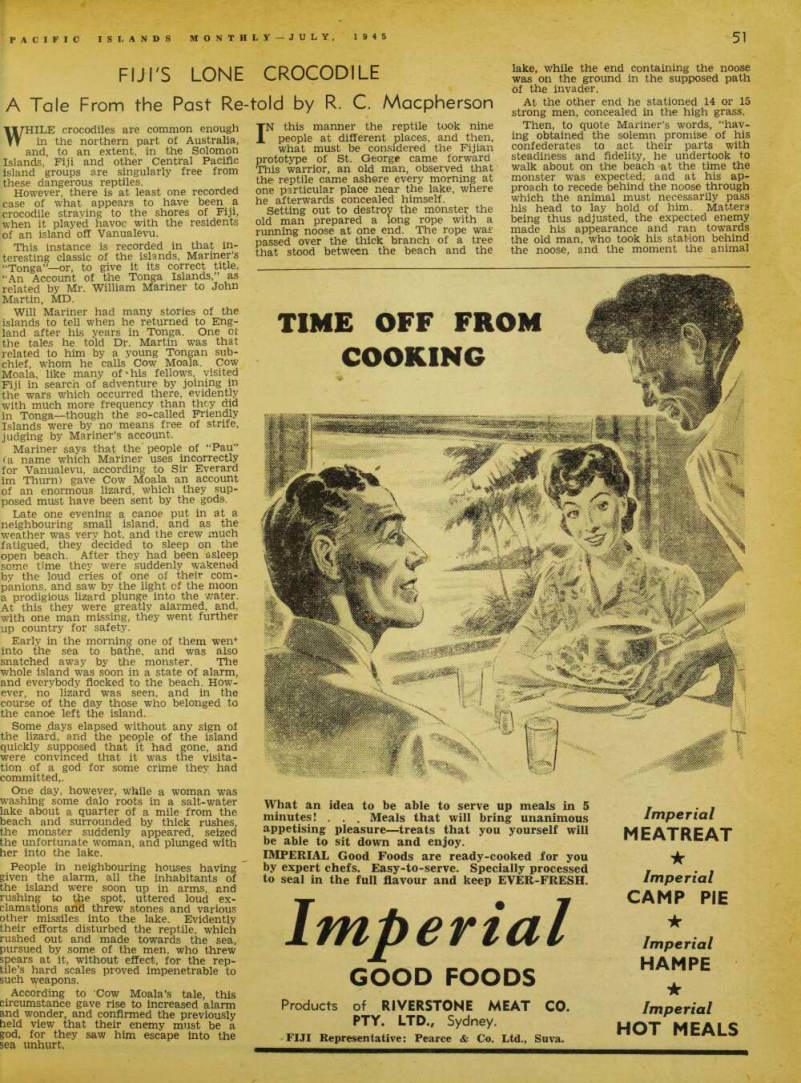
A Tale From the Past Re-told by R. C. Macpherson
I¥7HILE crocodiles are common enough ff in the northern part of Australia, and, to an extent, in the Solomon Islands, Fiji and other Central Pacific island groups are singularly free from these dangerous reptiles.
However, there is at least one recorded case of what appears to have been a crocodile straying to the shores of Fiji, when it played havoc with the residents of an island off Vanualevu.
This instance is recorded in that in teresting classic of the islands, Mariner’s “Tonga”—or, to give it its correct title, “An Account of the Tonga Islands,” as related by Mr. William Mariner to John Martin, MD.
Will Mariner had many stories of the islands to tell when he returned to Eng land after his years in Tonga. One of the tales he told Dr. Martin was that related to him by a young Tongan sub chief, whom he calls Cow Moala. Cow Moala, like many of'his fellows, visited Fiji in search of adventure by joining in the wars which occurred there, evidently with much more frequency than they did in Tonga—though the so-called Friendly Islands were by no means free of strife, judging by Mariner’s account.
Mariner says that the* people of “Pau” (a name which Mariner uses incorrectly for Vanualevu, according to Sir Everard im Thurn) gave Cow Moala an account of an enormous lizard, which they sup posed must have been sent by the gods.
Late one evening a canoe put in at a neighbouring small island, and as the weather was very hot, and the crew much fatigued, they decided to sleep on the open beach. After they had been asleep some time they were suddenly wakened by the loud cries of one of their com panions, and saw by the light of the moon a prodigious lizard plunge into the water.
At this they were greatly alarmed, and, with one man missing, they went further up country for safety.
Early in the morning one of them wen* into the sea to bathe, and was also snatched away by the monster. The whole island was soon in a state of alarm, and everybody flocked to the beach. How ever, no lizard was seen, and in the course of the day those who belonged to the canoe left the island.
Some days elapsed without any sign of the lizard, and the people of the island quickly supposed that it had gone, and were convinced that it was the visita tion of a god for some crime they had committed,.
One day, however, while a woman was washing some dalo roots in a salt-water lake about a quarter of a mile from the beach and surrounded by thick rushes, the monster suddenly appeared, seized the unfortunate woman, and plunged with her into the lake.
People in neighbouring houses having given the alarm, all the inhabitants of the island were soon uo in arms, and rushing to the spot, uttered loud ex clamations and threw stones and various other missiles into the lake. Evidently their efforts disturbed the reptile, which rushed out and made towards the sea, pursued by some of the men, who threw spears at it, without effect, for the rep tile’s hard scales proved impenetrable to
such weapons.
According to Cow Moala’s tale, this circumstance gave rise to increased alarm and wonder, and confirmed the previously held view that their enemy must be a god, for they saw him escape into the sea unhurt.
IN this manner the reptile took nine people at different places, and then, what must be considered the Fijian prototype of St. George came forward This warrior, an old man, observed that the reptile came ashore every morning at one particular place near the lake, where he afterwards concealed himself.
Setting out to destroy the monster the old man prepared a long rope with a running noose at one end. The rope was passed over the thick branch of a tree that stood between the beach and the
lake, while the end containing the noose was on the ground in the supposed path of the invader.
At the other end he stationed 14 or 15 strong men, concealed in the high grass.
Then, to quote Mariner’s words, “hav ing obtained the solemn promise of his confederates to act their parts with steadiness and fidelity, he undertook to walk about on the beach at the time the monster was expected, and at his ap proach to recede behind the noose through which the animal must necessarily pass his head to lay hold of him. Matters being thus adjusted, the expected enemy made his appearance and ran towards the old man, who took his station behind the noose, and the moment the animal
put his jaws through it, he sprang erect and gave an appointed signal. Instantly the cord was drawn tight, and their prey was caught with his head and one paw through the noose.”
The account states that the men soon secured the rope and running up, beat the reptile about the head and pierced him wherever they could, until at length, after much hard work, they killed him.
The Fijians’ interest in edibles is well illustrated in the next paragraph in Mariner’s story, when he goes on to say that when their toil was over the first thing they thought of was to ascertain if their victim was good to eat, and, “accordingly, selecting parts which they thought the tenderest, they baked a suffi cient quantity, and finding is very good, made a hearty meal.” Such was the fall of one of the gods of old Fiji, withal a god with but a very temporary reign.
Mariner said that Cow Moala saw the bones, and from the description of these, as well as from what he heard regard ing the living animal, he (Mariner) con cluded that it must have been a croco dile which by some accident had made its way from the East Indies.
To this Dr. Martin adds: “And as it was the first of the kind the natives had ever seen or heard of, we need not wonder that they supposed it to be a super natural lizard sent by the gods from Bolotoo as punishment for their sins.’
In the light *of present knowledge, it seems more likely that this crocodile, as it seems to have been, was a stray from the Solomons or the Queensland coast, rather than from the East Indies. It would be interesting to know if there are any other recorded cases of crocodiles having been found in Fiji.
Advertisements & other items, pp. 53-54 (2 items)
51
ISLANDS MONTHLY JULY, 1945
PAC I F I
Imperial
TIME OFF FROM
COOKING
I m m m k sr 4 : m? !M§ > *w sf m: & :l What an idea to be able to serve up meals in 5 minutes! . . . Meals that will bring unanimous appetising pleasure—treats that you yourself will be able to sit down and enjoy.
IMPERIAL Good Foods are ready-cooked for you by expert chefs. Easy-to-serve. Specially processed to seal in the full flavour and keep EVER-FRESH.
Imperial
GOOD FOODS
Products of RIVERSTONE MEAT CO.
PTY. LTD., Sydney.
FIJI Representative: Pearce & Co. Ltd., Suva.
Imperial
MEATREAT
★ Imperial
CAMP PIE
★ Imperial
HAMPE
★ Imperial
HOT MEALS
HARRY J. YOUNG PTY. LTD.
Sole Pacific Islands Selling Representatives
and Distributors for the following Leading
Australian Manufacturers:
BONDS INDUSTRIES LTD.
Manufacturers of All Types of Underwear, Hosiery, Half Hose, Sewing Cottons.
COMMONWEALTH WEAVING MILLS PTY. LTD.
Manufacturers of DriGlo Towels and Towelling of every description.
J. W. TRATHEN & CO. PTY. LTD.
Manufacturers of “Red, White & Blue" Handbags, Pouches, Wallets, Note Coses, School Bags, Purses, Watch Cases, Belts, Straps, Razor Strops and sundry leather lines.
COTTEE'S PASSIONA LTD.
Manufacturers of "Passiona" Fruit Cordials, Fountain Syrups, Jams, Spreads, Peanut Butter, Peanut Products and Jellies.
HARRY PECK & CO. PTY. LTD.
Manufacturers of the famous ''Anchovette,'' Bloater Paste, and Specialists in Potted Meats. •
ALPHA KNITWEAR PTY. LTD.
Manufacturers of Men's and Boys' Polo Shirts, Ladies' Knitted Blouses, Jumpers, Skirts.
Enquiries through your usual channels appreciated, and prompt shipments effected.
Eagle & Globe Building, 379 Kent St., Sydney n.s.w.
Postal Address: Box 3661, Gr.P.O., Sydney.
Bankers : Bank of N.S.W.
Codes: Bentley’s Comp. Phrase.
Bentley’s 2nd Phrase.
Fiji Students' Association
In N. Zealand
A MEETING of students from Fiji was held at the residence of Dr. M.
Satyanand, 201 Ponsonby Road, Auckland,, on July 1, and resulted in the formation of a students’ association; “The Students’ Overseas Association, NZ.”
About 40 students of all races partici pated. Dr. A. H. Sahu Khan, MB, Chß, presided. , Dr. M. Satyanand, MB, Chß, said that the students should have an association of their own, and such an association should be all-embracing, so that a student from any place or race could become a member if he or she so wished. There should be no discrimination of any kind.
Mr. J. A. Kirpal said the number of Fiji students in NZ was likely to increase.
Time had, therefore, come for the students to have a body of their own. He moved a resolution to that effect, which was seconded by Mr. L. N. Patel, and car ried unanimously.
Mr. Ravuama Vunivalu, in support, welcomed the formation of the associa tion, the most pleasing feature of which was that it characterised the ideal Fiji which he hoped to see in the future —a Fiji of closer racial unity and co-opera tion.
Messrs. A. G. Sahu Khan, BA, and H.
Sahodar Singh also supported the pro posal. The following office-bearers were appointed:— Patron; Dr. M. Satyanand, MB, Chß.
Vice-patron: Dr. A. H. Sahu Khan, MB, Chß.
Vice-presidents: Mr. Rudra D. Sharma, Miss Woodhouse and Mr. Ravuama Vunivalu.
Secretary: Mr.. J. A. Kirpal; Assistant secretary: Mr. R. S. Prasad.
Treasurer; Mr. Saiyad 71. Shah.
Auditor: Miss Columbus.
Committee members: Miss A. Gopalan, Messrs J. R. Lochan, R, Shankar, H.
Berry and Tomasi Naivalurua.
Looking to the Islands
for Jobs Few Openings Likely Until Shipping is Restored
JUDGING from correspondence received by the editor of this journal, a large number of men are eager to go to the Islands after the war. Some want to enter into business on their own account; the majority simply seek a job of some kind. All are anxious for advice.
It is most difficult to give advice. None of the three western Pacific Territories which were invaded by the Japs—New Guinea, Papua and the Pacific Solomons —are yet ready to receive civilians. There is no reason, as far as can be seen, why civilians should not go back to Papua and the British Solomons; but, up to date, they are sternly barred out.
In the case of the Australian Terri tories (Papua and New Guinea) the reason now seems clear enough—see the long article in this issue. The Australian Socialist Government wishes to keep the two Territories closed against private enterprise, so that all kinds of Socialist experiments may be undertaken. This system will break down, sooner or later; and, when it does, there will be room in both Territories for a couple of thousand of enterprising men, at least. The majority of these places will be filled by “evacuees” —those brought out in 1942, who are eager to go back.
The closed door in the Solomons has never been explained. It is supposed, however, that the return of civilians and of private enterprise is being held up pending a decision about a permanent United States base in Guadalcanal.
There is no post-war place, as yet, in any of the Islands Territories, for men Who have had no peacetime experience in the Islands. Until they know Islands conditions, they must be employed by someone. Until industries are re-estab lished, and the available experienced, men are engaged, no employer will want to engage and train inexperienced men. fIIHE chief industries in the Islands are X planting and mining. At the moment, there are excellent mar kets for the products of both industries; but the operations of both are limited by lack of transport. Old industries cannot get back into production and new in dustries cannot start up,’ until shipping becomes plentiful again. That will be some time.
Sooner or later, after shipping is avail able, Islands industries will reach the position where they will have before them a double problem—where to get an adequate labour supply, and a reason ably dependable market. Further de velopment must await a solution of both.
Both problems seem to call for action by some co-ordinating authority in touch with world-wide conditions, such as the Regional Councils proposed by the United Nations.
Copra, rubber, coffee, cocoa—all those things can be grown cheaply and well in the Islands. But where can cheap labour be found to grow them? And, when they are produced, where can they be sold?
Marketing was a haphazard business before the war; and it may be even more so in the future. It would be foolhardy to encourage industrial development and expansion until those two problems are solved.
Thousands of people are eager to go to the Islands. Most of the Territories — especially those in the Central Pacific — are eager to have them. There are abun dant funds in the hands of the big firms in some of the Territories, available to assist and encourage development. But even if private enterprise is left free and
encouraged to go ahead, the future re mains obscure.
The foregoing outline of conditions is stated in general terms, for the informa tion of those who simply seek a “job.”
There are not likely to be any clear-cut jobs available in the Islands until the war is over, and communications fully re established.
But there always are opportunities for the individualist—the hustling energetic man who is not afraid to go out and see things for himself, and who can turn his hand to anything.
Advertisements & other items, p. 55 (1 item)
Handbook
PRELIMINARY ANNOUNCEMENT:
PACIFIC
PLANTER’S
HANDBOOK
Publication About January, 1946 IN response to a strong and growing demand for an authoritative Handbook covering the whole field of Planting and Agriculture in the Pacific Islands, the compilation of the “Pacific Planter’s Handbook” was commenced some time ago, and the work now is well advanced.
The Handbook is designed to give standard instruction on all the branches of Tropical Planting which might be undertaken in the Pacific Islands, and to be regarded as an indispensable part of a Pacific Planter’s equipment.
SECTIONS of the Handbook deal separately with Palms (including Coconuts and the Manufacture of Copra), Cocoa, Coffee, Rubber, Citrus, Bananas, Vanilla, Spices, Kapok, Pineapples, etc.
The production of every plant grown for profit in the islands is described.
Other Sections cover such subjects as: Livestock on the Plantations: Revenue from Non-Agricultural Products (Sea, Forest, Minerals); How to Ensure Comfortable and Healthy Living Conditions in the Islands; Etc.
SPECIAL SECTIONS: Survey of Opportunities; Selection of Territory (Malarial and non- Malarial, Melanesians and Polynesians, Climate and Rainfall); Lands and Land Laws; Labour Conditions in the Various Territories; Importance of Transport; What You Must Provide For and Against in Choosing Your Plantation.
The subject of MARKETING is dealt with very fully. It is no use placing your plantation until you know where you will find a profitable market for your product, and whether it is dependable.
. EACH SECTION WRITTEN BY AN
EXPERT
Numerous Photographs, Diagrams,
Drawings, etc.
PUBLISHED PRICE : Not less than 35/- Australian. (NOTE: Owing to the present difficulty of obtaining paper and binding service, it is impossible to fix a price, until the work is near completion. It will be between 35/- and 40/-, Australian. The edition will be limited. Persons who wish to be sure of a copy may order in advance; and if 35/- is sent, that will be accepted as the price of the book, although the final published price may be higher.) Orders may he sent to:
PACIFIC PUBLICATIONS
PTY. LTD.,
Union House, 247 George Street,
Sydney
or to the PUBLISHERS DIRECT :
PACIFIC PUBLICATIONS (FIJI)
LTD.
P.O. Box 281, Bank, of N.S.W. Building,
SUVA, FIJI. SUVA, FIJI.
To Become Nurses In
Australia
Two Girls From Pitcairn
r ROUGH the good services of the High Commission for the Western Pacific, it has become possible for two young ladies from Pitcairn Island to attend the Seventh Day Adventists’ Mis sionary College near Newcastle, NSW.
They are Miss Irma Warren and Miss Thelma Christian, aged 18 and 16, who are now preparing to enter the Sydney Sani tarium Hospital to train as nurses.
Such a scheme has been advocated for a long time by certain members of the mission. By bringing these young people from isolated Pitcairn it is possible for them to receive special training that will help them later to fill a useful position in the island community.
The two girls are settling down well, al though they are still somewhat homesick for their old life. Australia at first was a never-ending wonder to them. Neither had seen trams, cars or trains, and they got a violent thrill from riding on them Cows and horses hitherto had been ani mals of which they had heard but never seen. Their first baker’s cart was a shock from which they have scarcely recovered yet.
The greatest joy to date, however, was when they visited Newcastle a few weeks after their arrival and caught again a glimpse of the sea, for which they had been hungering. FPW.
Mr. and Mrs. A. W. James, of Suva, Fiji, celebrated their silver wedding on June 9. $
The Great Tank Mystery
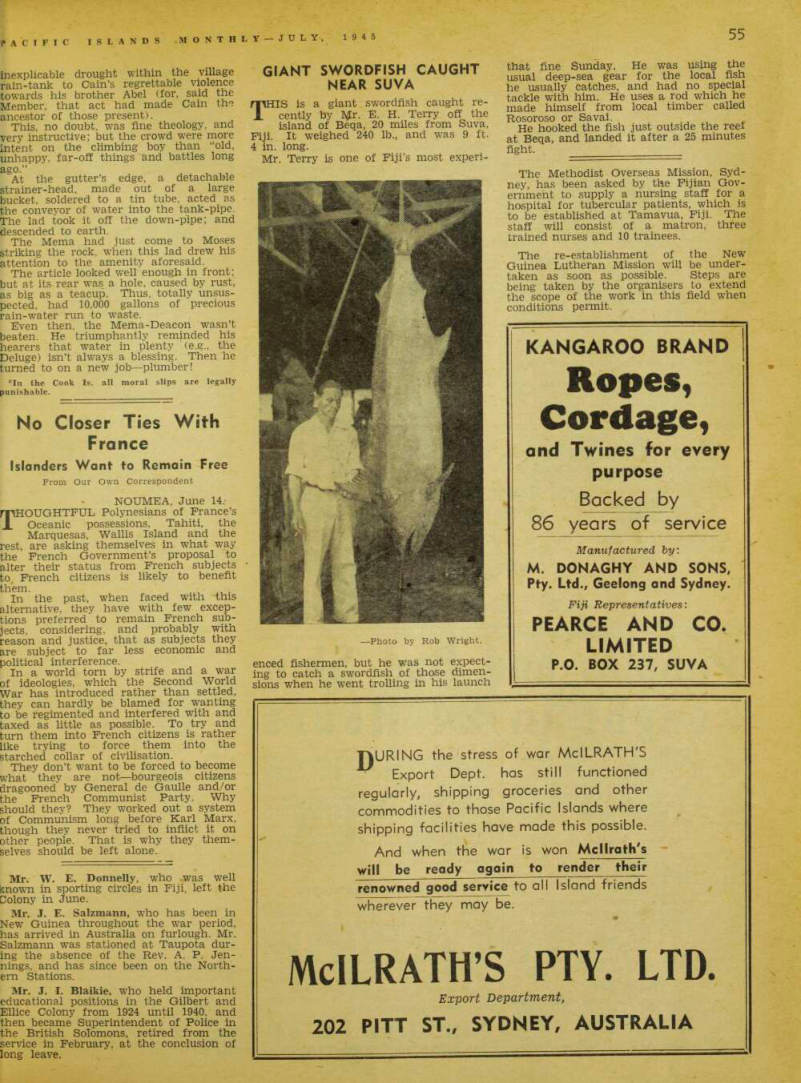
Trader’s Tale: The Great Tank Mystery
By “Tukapa Koko"
“WATER, water everywhere, and not a * T drop to drink ...”
I often think, during a “dry period” here, how apt this quotation is.
Our only water supply on Mangaia is a wretched, muddy creek —grandiloquently called, locally, “the river”—that irrigates the natives’ taro-patches.
Our only natural supply, that is. Man, with his well-known taste for improve ments, has endeavoured to provide a bet ter and purer source, freer from dead leaves and deader crayfish, bits of soap (for the “river” is also the island’s pub lic laundry) and similar dubious flotsam.
A few of the island’s houses possess galvanised-iron roofs; but connecting their gutters to big cement water-tanks, erected from Government materials by the villagers, in a community effort, the rain that used to run to waste was con served for drinking.
As is to be expected, the tap of “the rain-tank” isn’t left unfastened, for vil lage children aren’t to be trusted. A heavy padlock holds that tap closed; and its key is in the care of the Mema.
Our Mema is, in native eyes, anyhow, a very important person. As his title implies, he is the local member of the Island Council. He’s a deacon; an ama teur physician; an authority on horses, pigs, and fishing-canoes; a tailor, too, for the Mema isn’t above earning five shil lings by sewing calico trousers for such as cannot successfully make their own).
Amid all these multiple pursuits, the Mema has to find time to open the vil lage water-tank for one hour in the morning and one hour in the evening, each day.
Every one of our native households possesses a bucket or a kerosene-tin. The “water-ration” is two buckets or tins daily, in rainy times, and one only, in dry; and, if the tank be nearly, or quite, exhausted, the ration is “suspended,” creating the situation commonly known as Just Too Bad.
It is then that the “river” crayfish find their muddy homes disturbed.
AS far as the local rain-tank is con cerned, there’s been “many a slip,” even during rainy weather! I recall one occasion when our then Mema kept the tank locked-up for several weeks, to create a reserve from the generous tropi cal showers that were then falling every day; for it was the “rainy season,” when spasmodic downpours supply the juice for hundreds of millions of growing oranges, by thoroughly wetting the plantation soil.
Everyone approved of the Mema’s can niness in conserving drinking-water; and cheerfully bathed, or washed clothes, in “the river” already-mentioned, while for thirst-slaking purposes they used green coconuts. (Water that runs off thatches during rain is NOT drinkable!) “Came the day,” as novels say, when this Mema announced that the release of the hoarded vai-maori (common water, as distinct from coconut-liquid) should be commenced.
By then, everyone was thoroughly tired of coconuts, for, it is necessary to make, known, these contain a saline substance that, after temporarily-quenching thirst, arouses it again. The news was hailed with acclamation, and when the Mema appeared, with his key, everyone rushed to get bucket or tin. The great man formed the long, clankipg procession up in a line, and, like a new, South Sea Joseph, began the distribution of long hoarded supplies; or, to be more accurate, he prepared to do so.
The Mema placed the first bucket under the tap; and, with the air of a conjuror about to pass a particularly large camel through the aperture of a particularly-small needle, turned the faucet on. The crowd waited, with ex pectant smiles.
Alas, nothing resulted. The tank that had been so religiously kept locked-up for six weeks of heavy tropical rain was as dry as the Sahara. Empty! rE water-queue was flabbergasted.
There they stood, in the warm sun shine of a renewed “dry”-period, with their useless containers! The Mema was, for once, deprived of his self-suffi ciency; and he looked upon the crowd, whose regard was now by no means friendly, with a very sickly grin. But it was necessary to make explanations, if not apologies! The Mema, therefore, dis solved into the Deacon. As Deacon, he read the .hostile crowd a little homily; blaming the absence of aqua-pura upon certain indiscretions,* well-known in Poly nesia, of which a great many of the crowd he addressed had been guilty (as Court records could also have shown). These “sins,” the Mema said, had caused an angered Deity to withhold from the pub lic reservoir its customary 10,000 gallons.
Polynesians of to-day, however, are not so willing to believe in miracles—benevo lent or otherwise—as they were in early mission-days. The Mema’s explanation was “received” —as Borough Councils say of angry letters from the taxpayer; but (as in the same case) receipt was not the sign of agreement with the sentiments expressed!
No voice from the assembly was raised in dissent, but a boy detached himself from the crowd, leaving his bucket and kerosene-tin in the care of friends, and was soon observed to swarm up the down pipe attached to the iron-roofed house that acted as water-shed.
The Mema hadn’t noticed this lad’s activity; taking the silence of the thwarted gathering for the interested attention he was wont to command at meetings of the Island Council.
The Member enlarged his theme, and traced the actual cause of the present
nexplicable drought within the village •ain-tank to Cain’s regrettable violence ;owards his brother Abel (for, said the Member, that act had made Cain the mcestor of those present).
This, no doubt, was fine theology, and rery instructive; but the crowd were more ntent on the climbing boy than “old, mhappy, far-off things and battles long igo.”
At the gutter’s edge, a detachable ;trainer-head, made out of a large mcket, soldered to a tin tube, acted as ;he conveyor of water into the tank-pipe, rhe lad took it off the down-pipe; and iescended to earth.
The Mema had just come to Moses itriking the rock, when this lad drew his ittention to the amenity aforesaid.
The article looked well enough in front; jut at its rear was a hole, caused by rust, is big as a teacup. Thus, totally unsus jected, had 10,000 gallons of precious ■ain-water run to waste.
Even then, the Mema-Deacon wasn’t )eaten. He triumphantly reminded his learers that water in plenty (e.g., the Deluge) isn’t always a blessing. Then he umed to on a new job—plumber! *ln the Cook Is. all moral slips are legally tunishable.
Advertisements & other items, p. 56 (1 item)
Chivers
This is the h
chiversjamsM
s*l* CO \S* 0? , ston> is Chivers Factory, surrounded by orchards and ronrliHrJ! f efC t^le c^ olcest English fruits are grown. Sun-ripened and in perfect or preserving, these fruits come in all their freshness to Chivers Factory to be made into the finest jams it is possible to imagine.
War conditions still limit supplies hut full shipments will be resumed as soon as possible.
CHIVERS
ENGLISH JAMS
Made in the heart of the English countryside by
CHIVERS & SONS Ltd.
The Orchard Factory Histon, Cambridge, England
No Closer Ties With France Islanders Want
France Islanders Want to Remain Free
From Our Own Correspondent
Noumea, June 14.■
THOUGHTFUL Polynesians of France’s Oceanic possessions, Tahiti, the Marquesas, Wallis Island and the rest, are asking themselves in what way the French Government’s proposal to alter their status from French subjects to French citizens is likely to benefit them. .
In the past, when faced with this alternative, they have with few excep tions preferred to remain French sub jects, considering, and probably with reason and justice, that as subjects they are subject to far less economic and
political interference.
In a world torn by strife and a war of ideologies, which the Second World War has introduced rather than settled, they can hardly be blamed for wanting to be regimented and interfered with and taxed as little as possible. To try and turn them into French citizens is rather like trying to force them into the starched collar of civilisation.
They don’t want to be forced to become what they are not —bourgeois citizens dragooned by General de Gaulle and/or the French Communist Party. Why should they? They worked out a system of Communism long before Karl Marx, though they never tried to inflict it on other people. That is why they them selves should be left alone.
Mr. W. E. Donnelly, who was well known in sporting circles in Fiji, left the Colony in June.
Mr. J. E. Salzmann, who has been in New Guinea throughout the war period, has arrived in Australia on furlough. Mr.
Salzmann was stationed at Taupota dur ing the absence of the Rev. A. P. Jen nings, and has since been on the North ern Stations.
Mr. J. I. Blaikie, who held important educational positions in the Gilbert and Ellice Colony from 1924 until 1940, and then became Superintendent of Police in the British Solomons, retired from the service in February, at the conclusion of long leave.
Giant Swordfish Caught
Near Suva
rIS is a giant swordfish caught re cently by I£r. E. H. Terry off the island of Beqa, 20 miles from Suva, Fiji. It weighed 240 lb., and was 9 ft. 4 in. long.
Mr, Terry is one of Fiji’s most experi-
that fine Sunday. He was using the usual deep-sea gear for the local fish he usually catches, and had no special tackle with him. He uses a rod which he made himself from local timber called Rosoroso or Savai.
He hooked the fish just outside the reef at Beqa, and landed it after a 25 minutes fight.
The Methodist Overseas Mission, Syd ney, has been asked by the Fijian Gov ernment to supply a nursing staff for a hospital for tubercular patients, which is to be established at Tamavua, Fiji. The staff will consist of a matron, three trained nurses and 10 trainees.
The re-establishment of the New Guinea Lutheran Mission will be under taken as soon as possible. Steps are being taken by the organisers to extend the scope of the work in this field when conditions permit.
—Photo by Rob Wright, enced fishermen, but he was not expect ing to catch a swordfish of those dimen sions when he went trolling in his launch
Advertisements & other items, p. 57 (2 items)
55
ACIFIC ISLANDS MONTHLY JULY, 1945
Cordage,
KANGAROO BRAND
Ropes,
and Twines for every purpose Backed by 86 years of service Manufactured by:
M. DONAGHY AND SONS,
Pty. Ltd., Geelong and Sydney.
Fiji Representatives :
PEARCE AND CO.
LIMITED
P.O. BOX 237, SUVA
TOURING the stress of war McILRATH'S ■ Export Dept, has still functioned regularly, shipping groceries and other commodities to those Pacific Islands where shipping facilities have made this possible.
And when the war is won Mcllrath's will be ready again to render their renowned good service to all Island friends wherever they may be.
McILRATH’S PTY. LTD.
Export Department,
202 PITT ST., SYDNEY, AUSTRALIA
Memories Of Old Tonga
By "Falo"
TO the south-west of Tongatabu (on which is Nukualofa, the capital of Tonga) lies the isolated little island of ’Ata (Pylstaart). It was inhabited by a family of a few hundred men, women and children.
One day a ship called. The best of the young men paddled out in their canoes, and were encouraged on board to trade, exchanging oil, vegetables, island curios for knives, spades, axes, clothing, etc.
Suddenly, the hatches closed down over their heads. The ship sailed off. It was a blackbirding ship.
I have before me a newspaper, Taumua Lelei, printed in the Tongan language in 1936. It was edited, I believe, by Bishop Blanc, of the Roman Catholic ? h^ r S h -' Nukualofa,, and published in lt tells of how the descendants of these ’Ata men were found Tahiti.
King George Tubou I removed the people from Ata to Eua, in 1863. Their village is Haatua. They could not have settled on a more suitable island in the whole of the Tonga Group than Eua.
There are creeks and hills. These hardworking people soon had a plentiful supply of food growing on their plantations.
Amongst the people who came away from Ata was a voung girl, about 12 years of age. Her treasured possession was her mother’s ike (pronounced ye-ke) a tapa mallet. Her mother had died years before. This old and well-worn ike had been in use for about 50 years The smooth side of it finished off the tapa cloth. Forty years ago she had it re modelled, and gave it to me saying “ Keep it in memory of me.” fITHE smooth side of this ike was alsc X used for another purpose. The pito, 0 r umbilical cords, of the newly born female infants of her family were laid on it, and cut with sharp bamboo. The use of the ike in making tapa, was to be her life’s work. Her pito was preserved then buried at the root of a sweet scented flowering tree. Through life she was reminded that she was to be as sweet as the flower, The pito of a male usually was buried at the root of a mighty tree which could defy a storm. It was laid on an akauta (dub). At the moment it was cut a war cry was given, announcing to the village that a fi|hter was born, My parents took two to be buried at
the root of a tao tree (iron-bark) on the island of Velitoa Hahake. It was my brother’s and my pito. I never grew up sweet; and I used to hear my mother say that I should have been a boy,”
I have, also, among my treasured pos sessions, the eight pito of my children.
They were flown across the Tasman with me, awaiting the day when and where I may settle down for life. I shall cele brate the burying of them, because that will give the children long life and success.
IT was the custom, too, in Tonga, to take the sister or the cousin of a mother who had died in childbirth, to nurse the babe. The young girl was put to bed, nursed, kept warm, given milk-producing drink and food, and the babe, suckling, brought forth a flow of milk.
The mother’s family were the tua (inferior). They had charge of bring ing up of the children. The father’s family were the mua (superior). They were the head of the family. Nothing could be done without consulting them.
In about 1902 a Scotsman took a lease of Ata (Pylstaart) at £5O per annum, from the Tongan Government. Finding it difficult to work he returned the lease.
What a beautiful Pitcairn it would make for anyone—if Hitler is not alreadly there!
Memorial Hospital Opened in Fiji
rE Lucy Bull Memorial Hospital was opened at Wailoku Mission Station (five miles from Suva), Fiji, on April 28, by the Bishop in Polynesia, the Rt. Rev. L. S. Kempthorne.
The small hospital has been built as a memorial to the late Mrs. Lucy Bull, who died in Australia a few months ago while on leave, and to whom, with her husband, had been entrusted the Melanesian work in Fiji.
Mrs. Bull was a trained nurse, and it is felt that this form of memorial is most appropriate.
In an address at the opening ceremony, the Rev. D. Hemming appealed to friends and well-wishers to help maintain the hospital.
Morobe Man Engaged
AN engagement of Morobe interest is that of Sgt. Erroll (“Blue”) Smith, to Miss Carmel Garrett, of Inverell.
Sgt. Smith went to New Guinea as a lad of 15, and worked for Mandated Airlines, Ltd., until the outbreak of war. He was a member of the NGVR, and later the AIF. He is at present attached to
Angau.
He is a son of the late Mr. Arthur Smith, formerly .a dredgemaster at Bulolo.
His mother, Mrs. H. j. Smith, is at pre sent living in Sydney.
Mr. Cheng Chia Hua, who was recently appointed Vice-Consul of the Republic of China at Apia, W. Samoa, has arrived there and taken over his duties. He is the only consular representative of a foreign power in Apia At an extraordinary general meeting of the shareholders of Mariboi (Papua) Rubber Estates, Ltd., in Sydney, on May 17, it was resolved that the company be wound up voluntarily and that a liquida tor be appointed.
A senior Samoan Government official, Seumanutofa Pogai, was recently con victed of having converted a stove belong ing to the Government to his own use.
He was sentenced to three months’ im prisonment.
Pogai was popular among both Euro peans and Samoans, and had had a blameless record in the Government ser vice for 27 years.
Advertisements & other items, p. 58 (1 item)
Fought in 24 Hours
Ship Chandlery Hardware
r Write for j
j Ship Chandlery /
* Catalogue J
Catalogue
BROOMFIELDS LIMITED
152 SUSSEX STREET :: SYDNEY.
Cables: “Boom”, Sydney.
Special “In Bond” Prices for all Islands enquiries quoted on application.
Sole Agents for; Large and Complete Stocks of
SHIP CHANDLERY
IRONMONGERY OF ALL KINDS,
WHITE LEAD AND OILS.
PAINTS,
P. H. MUNTZ «fc CO.’S 3-CROWN BRAND METAL SHEATHING.
PEACOCK <se BUCHANS’ ENGLISH READY-MIXED PAINTS.
Pimples and Bad Skin Fought in 24 Hours
Since the discovery of Nixoderm by an physician it is no longer necessary for anyone to suffer from ugly, disgusting and PiSnii rmS B Sk i n blemlshes such as Eczema, Ringworm . Psoriasis, Acne, Blackheads, Scabies and Red Blotches. Don’t cause vnn t Skil ? make yOU feel inf «rior and fc lose your frl ends. Clear your skin this new scientific way. y
A New Discovery
Nixoderm is an ointment, but different from olntm ' nt ever seen or ?‘,t S , .discovery, and is not greasy but feels almost like a powder when you apply it It penetrates rapidly into the pores and fights skin clear, soft and velvety smooth.
Works Fast
rr r £ si-
a t?w S SS l tChlng ’ bumln * smarting in s sorter, whiter and velvety smooth.
In just a day or two your mirror will tell you that here at last is the scientific treatment you have been needing to clear your skin—the treatment to make you look more attractive, to help you win friends. Nixoderm has brought clearer, healthier skins to thousands, such as Mr. Bob Weedon, Edmund Street, Fremantle, who writes: “I was troubled with pimples ever since I was 13, and have spent pounds and pounds on so-called cures without results. I then tried Nixoderm with astounding effect.
The pimples seemed to fade away, and after a week there was not the slightest trace of them.”
Satisfaction Guaranteed
Get Nixoderm from your chemist or store to-day. Look in the mirror in the morning and you will be amazed at the improvement.
Then just keep on using Nixoderm for one week and at the end of that time it must have made your skin soft, clear, smooth and magnetically attractive—must give you the kind of skin that will make you admired wherever you go, or you simply return the empty package and your money will be refunded in full. Get Nixoderm from your chemist or store to-day.
The guarantee protects you.
Nixoderm 2/- & 4/-
For Skin Sores, Pimples and Itch.
Suest Speakers From New
Guinea And India
Pacific Islands Society
rWO meetings of the Pacific Islands Society were held during May. On May 3, the Society entertained nembers of the Pacific Territories Asse rtion executive, and Mr. C. A. M.
Vdelskold, secretary of the Association, iddressed members. He spoke of the svents that led up to the formation of he body, its aims and its accomplish nents. Other PTA guests were Mr. and flrs. E. A. James, Mrs. Weatherall, Mr. 3 I H Campbell, Mr. and Mrs. E. V.
TBrien. Mr J. Hinks and Mr G. Bellamy.
On May 23. the guest-speaker was Sir laghunath Paranjpye, High Commis iioner for India. Among the guests were Ar. and Mrs. Ragg, of Fiji; Commander Bartouche and Lieutenant-Commander _,yon. of the US Navy; and Mrs. Tex fhomas and Mrs. Taylour, from New Guinea.
In sketching a brief historical survey >f India. Sir Raghunath said that ndians at home and in Africa, Malaya ind Fiji had always felt deeply their nferior status as individuals in the eyes >f 'other peoples. He said India was greatly impressed by Japan’s attainments n industry, science and war, but Indians vere strongly opposed to her imperialis ,ic policy, aided by aggression, and to the ia.distic and cruel behaviour of the Jap inese tbwards other peoples.
In the future, India intended establish ng an adequate army, navy and air orce in order to be ready for any emer gency. India wanted independence and (quality for her peonle. to ensure that is a nation she could pull her weight in he future security of the world.
Education Progress In
Samoa
PROGRESS is being made in education in Western Samoa. During recent years, the Director of Education, Mr.
A. McKenzie, has written many school books, and specimens are in the hands of the Prime Minister of New Zealand, the Samoa Administration, and the Education Department, New Zealand.
Some of the books or the syllabuses have found their way to New Guinea, the Gilbert Islands, Niue, American Samoa and Fiji.
Because paper was scarce, New Zea land was not able to print the school books so the staff in Samoa got to work with tvping, stencilling and cyclostyling; now the books are in the hands of the pupils. Seven are in the vernacular.
The Drift Of Young People
To New Zealand
From Our Own Correspondent APIA, July 4.
REPORTS from Auckland, New Zea land, indicate that that city threatens to become a second Apia, in regard to the number of young Samoa born boys and girls who have made their home there in recent years.
With every island steamer some 15 to 20 young people are leaving for Auck land, and all of them seem to do extremely well over there.
Expensive Meat
IN the Chief Magistrate’s Court, at the end of June, a Suva shopkeeper, Ratu Ramsaming, was fined £lOO, or in de fault, three months’ imprisonment, for selling a tin of meat at Id. above the fixed price.
Return Of Seventh-Day
Adventist
Missionaries To Sw Pacific
SIX Seventh-day Adventist missionaries have returned to the South Pacific Islands territories from which they were evacuated in the early part of the Pacific war. Two new appointees have accompanied them.
These missionaries are: Pastor N. A.
Ferris, appointed to the Solomon Islands as general supervisor; Pastor D. A. Fer ris and Mr. J. Gosling, to Malajta for medical and missionary work; Pastor A.
J. Campbell, to Ramu, inland New Guinea; Pastor C. Pascoe, to Upper Markham Valley, with Mr. F. Maberly as assistant: Pastor L. G. Maxwell, formerly of Bougainville, to Bena Bena, assisted by Mr. J. Hankinson.
The announcement (supplied by her family) that Miss Danhne Beck, for merly of Wau TNG, was engaged to marry Captain Raymond Watson. MBE, was not quite correct. It should have read “Mrs. Daphne McDonald, widow of the late Flying Officer John McDonald.”
The young lady’s first marriage was tragically short—her husband was killed in flying operations over France in Feb ruary, 1944.
Advertisements & other items, p. 59 (2 items)
57
ACIFIC ISLANDS MONTHLY JULY, 1945
Gibson's
5 & 5
LOTI
For ItJlamad Eras and EyaUda
SOLD EVEITWREIE
H A. R»a« A. C» Pty. Ltd., Kla, Sydney
it TRY IT ... . YOU’LL LIKE IT!
GIBSON'S
GREEN LABEL
TEA
Blended and packed by— J. A. D. GIBSON & CO. LTD. ( 364 KENT STREET, SYDNEY. 'Phone: M 2328. >5 Also GIBSON'S GREEN LABEL COFFEE and COFFEE ESSENCE
Samoan Leaders To Visit
New Zealand
From Our Own Correspondent APIA, July 4.
AT the invitation of the New Zealand Government, the three Western Samoan fautuas (advisers), Malie toa, Tamasese and Mata’afa, and a num ber of other Samoan leaders and Fai pule members are shortly leaving for New Zealand on a visit.
Street
An Island Exile in King Street
rE city marts are flaunting summer’s fruit, With apples red and oranges pale gold, Near alien pawpaws, bruised and odour less, Contemptuous of their luxury price, un sold.
Whilst I in muted sympathy may turn Remembering perfumed gardens by the sea, Whence came Tabunka with a graceful sway And balanced basket, from the moolie tree.
Bananas squatting steeply on a slope And brinjhals* sitting stiffly in a row.
This regimented ugliness must yearn For spacious foothills where warm breezes blow; Where nutmeg pigeons and wild parro keets, From leafy look-out send exultant clue.
To eager spearmen on the village ridge Who seek the season’s birdnote, over due.
For shop-tired fruits I have no appetite— I crave the tropic citrus green, not gold.
I like my early pawpaw dew-bedecked Sprayed with sipora.t perfumed and dawn-cold.
Those luscious fruits must need their atmosphere, With music of the ever-murmuring sea; Or on the Islands ranges where the clouds Roll back in grandeur of new day-to-be.
So, sighing, I shall vision softer sheens Of Buka baskets filled with lime-cool greens.
—Alice Allen Innes.
* Brinjhals: Egg Plant. t Sipora; “Moli” or green limes.
Death Of Well-Known
Businessman Of E. Samoa
From Our Own Correspondent A„ t APIA, June 14.
WELL-KNOWN and respected resi dent of Pago Pago, American Samoa, and Apia, Mr. George M. C. Reid, died suddenly at his residence at Tanugamanono, Apia, at the age of 66 years, on June 9.
Mr. Reid, who was the founder and head of the firm of G. H. C. Reid & Co., of Pago Pago, American Samoa, had only recently retired from active busi ness and was just settling down at his property at Tanugamanono.
He was a shareholder in several Apia companies and was a popular figure in Apia and Pago Pago, where he was liked for his genial and friendly ways. He held a Tutuila high chief’s name, “Leala.”
He leaves a widow and a one-year-old child, besides two sons and a daughter of his first wife. His sons are conducting the business in Pago Pago.
Several officials of the New Zealand Department of Education paid a visit to' Apia in June. They inspected schools in Upolu and Savaii. They then proceeded to Suva, Fiji, where they held an Edu cation Conference with the Superinten dents of Schools from Samoa, Tonga, Fiji and Rarotonga, and discussed new edu cational arrangements for these islands.
The annual meeting of members of the Pacific Islands Society will be held on July 25, in History House, Sydney, at 8 p.m. Officers to be elected include pre sident, secretary, assistant-secretary, two vice-presidents, five councillors, a hostess and an assistant-hostess.
Advertisements & other items, p. 60 (2 items)
B. G. Bagia
JEWELLER
Manufacturer & Exporter of — Jewelleries, Silver Filigree Ornaments, Genuine Tortoiseshells and various other kinds of Pacific Islands SOUVENIRS, including Cat's-eyes, Seashells and Beads, Picture Views of the South Seas, etc.
Wholesale inquiries invited.
Prompt attention given to Mail Orders. Parcels can he posted to any part of the world.
G.P.O. Box No. 257
SUVA, FIJI
B
I C/) O' < «8 LU 41ft 1 >i o o *4 % s 5y £
Ramsden's Story of Mangareva's Priest Refuted
Was Father Laval Really So Mad?
By Father Francis Xavier Gutierrez, Aitutaki, Cook Islands.
IN the August, 1944, issue of “PIM” there appears on page 41, the follow ing: “Here is a condensation of one Df the stories, concerning Father Laval, the mad priest of Mangareva, from Mr.
Eric Ramsden’s book ‘Strange Stories from the South Seas’.” , , Are the 17 other stories of this book as veracious as this one about Father Laval> of Mangareva?
The pioneering missionary, R. r.
Honore Laval, was a member of the Sacred Heart Order, similar to the other missionaries in Hawaii, the Marquesas, Easter Island. Gambier, Paumotu, Tubuai, Tahiti, and the Cook Islands.
He was not all mad. He never pre tended to have visions. He never said be had visions to his colleagues. He was young at the time—only 27 years old. To know the truth about him it is sufficient to read “Le Premier Demisiecle de l Apostolat des Picpuciens aux lies Gam bier,” the last booklet written by the French academician and scholar, Georges Goyau.
FATHER LAVAL never '“obtained poli tical control of the group.” There was a king Maputeoa Gregorio, called after the Pope of that time; be was very independent, and sometimes intolerant, and Father Laval was blamed for many of his sins.
Surely, Father Laval was missionary, father, teacher, mason, planter, smith, and the life of the archipelago, in the social religious, agricultural, and econo mis spheres. Under leadership and by bis example and counsels, the people had grown splendid plantations, which be came for them a source of income. Thev acclimatised the more useful plants of Europe, such as linen, potatoes, beans, oeas. onions, cabbages, radishes, and turnips, etc. And they grew many tropi cal plants also.
“Father Laval started a Cathedral . . . many years of labour, hundreds died . . . work enforced,” writes Mr. Ramsden.
It does not matter whether it were a Cathedral or not. Sufficient is it that it was a large Church, Saint Michael’s, in Rikitea’s Bay, Mangareva. It is beauti fully inlaid with pearl shell, upon the alter, tabernacle, flowerpots, etc. It was men’s work. The island had no stone; so the majority of the married men quar ried the rock on some islands five miles away, and conveyed it to Mangareva in big watercraft.
Everybody worked willingly, from the king down. Every day the king and chiefs gave food to the workmen, and fishermen brought in fish, until the work was completed.
Was it nonsense to build so large a Church in Mangareva? Two thousand could enter it, perhaps. But, in 1841 in Mangareva there were 1,500 Catholics The Polynesian people in every island like the Patuparau or religious meetings, also the general meetings which every one attends. Then why not have, at Mangareva, a Church capacious enough for 3,000 people.
“Hundreds died.” says Mr. Ramsden, and, of course, Father Laval was the cause! In 1830 there was in Mangareva an epidemic and hundreds died. Was Father Laval the cause, or was it a whaler? In 1835 there was another epi demic. Why was Father Laval the inevit able cause? M. Fromentieres, who was attached to the French Navy, took a trip to Mangareva to find the truth for Aim self. He was completely free to visit every place—the girls, the eight weaving shops, the young men on the farms, the
children in the schools under their teachers, Mr. Henry, the elderly univer sity professor and Mr. de la Tour, the Count. Now, here are M. Fromentieres’ findings:— “The missionaries are stopping, by way of morality, the terrible depopulation rul ing among the Polynesian races. They (the missionaries) keep these people free from foreign exploitation.”
But Laurencin, Caillet, Pignon, and Hyppolite came later with this cry: “We need women! We will abolish every thing done bv the missionaries—let us order pagan dances!” To a member of such an expedition, which had come to “civilise” the people, Mr. Henry, the Uni versity professor, referred to above, re joined; “You have come to syphillise the people, yes.” , . , Mr. Aube, the future admiral, also studied this case and wrote: “Why are the Catholic missionaries so wrong? Be cause with their laws against seduction and adultery, they are fighting so-called progress and freedom? The freedom their enemies wish for these natives, would be the freedom of laziness, debauchery, drunkenness, and soon, of theft.”
From 1835 to 1858 there is no criticism of Father Laval, No one spoke but kindly of him or his “Cathedral,” or the sicknesses, or the schools, convent and workshops.
Mgr. Pompallier visited Mangareva in 1837; Dumont d’Urville and Rocque maurel in 1838; Laplace in 1839; Doctor Lesson in 1840; Doctor Cyprian Liausu in 1840: Du Petit Thouars in 1844; Abbe Laval in 1850; Dolle in 1853; Fromentieres in 1857; De Cintret and Peyrat in 1860; Aube in 1873.
But in 1858, Dupuy refused to sign the promise to keep the laws and usages of the island. In 1861, Jean Pignon fought in court against the regent Maria Eutokia; and De la Richerie, enemy of Catholicism, arrived like a governor.
In 1864, Emile de la Ronciere became governor of the French Colony and slan derer of the missionaries. After him came Laurencin, Caillet and Hyppolite.
They all wished to send Father Laval away. Why?
One reason was morals; the other com mercial profit.
FATHER LAVAL was a Strong charac ter. He came when the islanders were cannibals, and came near to being eaten several times. By the time others came the people loved him; and when in 1866 the Regent Maria Eutokia began a petition to keep Father Laval in Mangareva, notwithstanding the new governor’s enmity, only two persons re fused to sign.
Surely, Father Laval was to the point and very outspoken at times. That is the side of his nature they may criticise.
But why make of it a crime? In order to cover their own wrongs?
Father Bruno Shouten, a witness, wrote; “Where does this noise against Father Laval come from? From the people punished by the island’s laws prob
ably. They wanted Father Laval to be inactive, deaf and dumb when the wolves approached and killed the sheep.”
In 1869 Louis Jallicot wrote, under the title “La Verite’ sur Tahiti,” a tissue of calumnies against Father Laval and the Sacred Heart Fathers. Under the pseu donym, Jean Paul Chopar, Captain Gar derein answered the same year to every slander contained in it.
In 1871 Father Laval returned to Papeete and sued Jallicot in court. Jalli cot could not prove his slanders, and was ordered to pay 15,000 francs damages.
This sum was used for the welfare of the native people of Mangareva, Mr. Cardella, navy officer, and later Tahiti’s governor, said to Bishop Hermel; “Why should we not hate Father Laval?” As soon as our ship is seen on the horizon the Church bell rings—it is the sign for the girls to go home.” That, in a nutshell, was the reason why Father Laval was hated.
Once Father Laval disappeared from Mangareva was the island better off?
Then ther Hippolites and the De La Ron cieres, were masters of the place. It was so easy for these people to undo in a week what the missionaries had laboured for years to achieve.
Then also a bell was rung. It was the ship's bell, ringing a warning to the girl prostitutes to swim out to the sailors on the ship.
That was progress—civilisation!
Hundreds died, and there was sick nesses—yes. Then as now, after lustful Venus comes the black horse of death.
Lustful dances, drinking, under-nourish ment, weak lungs, weak blood, syphilis, pneumonia and consumption, not in including the old native ills. Father Laval had done what orderlv homes and honest families should have done. He fought for the salvation of the people like everybody should have done.
And what about the pearl and the native sisters? The 80 Maori sisters Mr.
Ramsden speaks of came from heathen ism and consecrated themselves to God.
That may be astonishing now, but it shall be to Father Laval’s everlasting glory. .o- A^* or , “King’s” pearl—never mind if this be true or no. What would be ) An t oi’T to sell the P earl for 25,000 or 50,000 francs and alcoholise the people for 25 or J*° ys? ° r to give it to His Holi ness the Pope who supports all the mis sions? Or to a missinary like Father
Laval, who had given his life for these people, in order that he should purchase a boat on their behalf?
IN 1876, after several years of exile, Father Laval was permitted to join Father Collette, the Provincial, in a trip to Mangareva. Notwithstanding the hour they arrived (11 p.m.); the shout of “Father Laval is here” flew round the island like the wind.
Next morning the whole population was there and the following dav, the popula tion of three other islands. Father Collette astounded, exclaimed, “I knew Father Laval was loved: But never would have believed that he was so tenderly cherished.” * Sources: (1) “Le Premier Demi-Siecle de I’Apostolades Picpuciens aux lies Gambler,” by Georges Goyau; pp. 30, 34, 38, 48. 37, 54, 46, 55, 35, 36. (2) ‘‘Quelques personages officiels a Tahiti, sous le regne de Napoleon 3,” by Jean Paul Chopart (pseudonym of Captain Garderein). (3) “Revue Maritime, 1869” (article by Mr.
Aube).
Advertisements & other items, p. 61 (2 items)
59
ACIFIC ISLANDS MONTHLY JULY, 1945
A. B. Donald Ltd.
Restlessness and sleeplessness, when due to run-down nerves, frequently respond to treatment with Dr. Williams' Pink Pills.
Dr. Williams’
PINK PILLS
help to enrich the blood, which has a beneficial and restorative effect upon the nervous system.
A. B. DONALD Ltd.
AUCKLAND
ISLAND TRADERS & GENERAL MERCHANTS
P-O. Box 1509. Cobles & Telegrams, "Kingdom", Auckland.
Tonga Gives Its Third
Fighter
WHILE the Governor of Fiji, Sir Alexander Grantham, was in Tonga recently, he was given a letter by the British Agent and Consul, Mr.
C. W. T, Johnson, who is chairman of the Tonga War Effort Fund, which said: “I have been requested by the Committee of the Tonga War Effort Fund to inform Your Excellency that a sum of £5,000 sterling, representing subscriptions from business firms and individuals in Tonga, is being telegraphed to the Crown Agents in London for payment to the Minister of Aircraft Production for the purchase of a fighter plane for use in the Pacific theatre of war. 9 “This gift is made not only to mark the victory of the United Nations in Europe, but also as demonstrating the desire of the people of Tonga to do what little they can do to help in bringing victory in the struggle that still lies ahead in the Pacific.-”
The fighter now presented is the third given by Tonga since the war began.
Mr. Reg Caten, of the Fiji Civil Ser vice, recently returned to Suva after fur lough spent in New Zealand.
Ve-Day Announced In
Pidgin
WE have received a newspaper curiosity in the shape of the issue of May 9, 1945, of “Pisin Pepa”—the journal of the Pacific Islands Regiment ; the New Guinea Battalion which has rendered such excellent service in the war against the Japanese.
The “Pepa” is in Pidgin, of course, and this is its VE-Day number, in inch-high letters across the page is the historical heading “Germany i pinis” (Germany finished). Here is the first paragraph;— “Big pela pait bilong German wantaim mi pela i finis ologeta. Nau nambawan bilong Germany i dai pinis mipela kilim em.” (Big fellow fight belong German one time me fellow he finish altogether. Now number one belong Germany he die finish me fellow kill him.) Like the famous announcement in Pidgin, made after the capture of Rabaul in 1914, this document should have some historical value.
N. Caledonia's Vast Iron
Deposits
American Interest
Prom Our Own Correspondent
Noumea, Mav 15.
AN American analysis of the vast iron ore (limonite) deposits on the Plaine des Lacs, Southern New Caledonia, which by agreement with the French ad ministration might conceivably become a future reserve for Australian industrial requirements, gave the following percen tages : Iron oxide, 73.31; iron metal, 51.32; ignition loss, 13.12; silicate, 3.50; chrome. 1.92; alumina, 5.45; oxide of nickel, 0.71; oxide of manganese, 0.30; magnesia, 1.45; lime, 0.08; phosphorus, 0.05; and sul phur. 0.02.
A sample of this ore was sent to Wash ington by the American Consulate here.
For a number of reasons, notably geo graphical, Australia is much more likely to become interested in these deposits than the USA.
Death Of T. W. Brighouse
Prom Our Own Correspondent APIA, July 4.
THE European community of W. Samoa suffered a sad loss recently in the death of Mr. Thomas Wilkinson Brighouse, one of the few remaining pioneer planters. He had been ill for some time, and was 65 at his death.
Mr. Brighouse was born in England, and came from a prominent North Eng land family. He arrived in Samoa in 1908, and was employed as an overseer on coconut and cacao plantations and, after the end of the First World War on the New Zealand Reparations Estates. In 1924 he leased Nffu Plantation from the Reparations Estates. This he developed successfully.
He was well known to residents and many visitors from overseas for his great hospitality. *He left a wife and a large family.
One of his sons. Private Rex Brighouse, was killed in action recently while serv ing with the New Zealand Forces in Italy.
Mr. L.*V. Waterhouse, technical direc tor of Bulolo Gold Dredging, Ltd., of New Guinea, is now making satisfactory pro gress towards recovery. He suffered severe cerebral injury from a fall on a ship, when returning to Sydney from America early this year.
Advertisements & other items, p. 62 (1 item)
B. DAVID Trading Co.
ISLAND TRADERS -
- EXPORT MERCHANTS
SHIPPERS OF -ALL KINDS OF MERCHANDISE.
EXPORT REPRESENTATIVES OF LEADING
AUSTRALIAN MANUFACTURERS
Direct Enquiries to Head Office:
31 Queen Street, Melbourne, Vic.
Bankers: National Bank of Australasia.
Cable Address:
“DAVID TRADING
MELBOURNE”
Branches and Agents in All Ports.
OPEN TO APPOINT AGENCIES WHERE NOT REPRESENTED
Terror On Tarawa
Life of the Mission Sisters Under Jap Domination
'THIS is the story of Sisters of the Sacred Heart Mission who were in the Gilbert Islands throughout the Japanese occupation. It is condensed from the “Catholic Mission Magazine” for June. [N November, 1941, the British Govern ment had ordered all European women to evacuate. The Sisters, leaving their work at the Sacred Heart Mission in the hands of chosen natives, arrived at Betio just as the Japanese attacked Pearl Harbour. 4 * ■ As the nuns awaited transportation to Australia, two warships appeared off Betio mi December 9, blinking signals that were in no way meant to offer reassurance to the Sisters. The Japanese had arrived!
Natives fled in confusion, leaving their Delongings behind. From the convent, the Bisters heard loud noises—Japanese troops oreaking doors in the distance. Waiting in fear, the Sisters tried to remain as Dalm as possible.
The dreaded moment finally arrived, when one of the buck-toothed, little yellow men walked into the convent after send ing the rays of his flashlight over the building.
“We are the Japanese Navy,” he an nounced in very broken, but imperious English.
Then he asked questions with some dif ficulty. Unfolding a Japanese flag, he said: “We rule here now. English get out. French get out. Outside,” finished the soldier. “All of you!”
The nuns went outside and were lined up. Jap soldiers with fixed bayonets sur rounded them.
“Then,” said Sister Oliva, one of .the missionary nuns, “we were marched down the road to an unknown destination.” rE Sisters eventually found them selves confronted by a Japanese ad miral. His face was sullen, his man ner abrupt, hatred shining in his slanted eyes. He sat in the small room as though he were emperor.
“Sit on the floor!” he fairly screamed.
“Guards form around them.”
The Jap soldiers, their ever-present bayonets ready, encircled the nuns.
“If you no obey me,” said the admiral eyeing every nun in the room, “I’ll kill you!”
Meanwhile Jap soldiers were busy, ran sacking the native homes and stealing everything of value. This done, they hoisted their flag and departed.
But before leaving, they told the nuns they might return to their home. The Sisters, feeling somewhat relieved, left, still wondering what was to be done to them.
One ship had been burned in the har bour, another seized. All smaller craft received the same treatment. All of the white women and some of the white men had) managed to escape just in time.
Feverishly they had mended a small launch and made their way by sea to another island.
Later, this same launch was returned to Tarawa by faithful natives and figured in an escape for five Sisters previously evacuated from the South Gilberts to their respective islands. .
“This was a very treacherous voyage,” said Sister Oliva. “Not only did the Sisters have to cope with the heavy seas as they travelled more than 100 miles by night, but they also were in constant danger of being spotted by Japanese planes that patrolled the area.”
The Gilbertese are very adept at build
ing outrigger canoes, and are proud of their workmanship. One of these little craft was to figure in a thrilling escape for four other Sistera of Our Lady of the Sacred Heart.
“Then came the real scare. Out at sea they spotted lights on a ship, believed
to be a jap submarine on patrol. The native canoe crew, fearful of the conse quences should the Japs overtake the Sisters trying to escape, made them hide inside the craft. This canoe is about two feet wide! You can imagine how diffi cult it was for them to lie there out of
sight—and one of the Sisters making the journey was over 70 years old!
“IN September* 1942,” said Sister Oliva, X “we in Betio saw the Japs come in and take possession for good. They told us in no uncertain terms we had to get out as soon as possible. We moved to another mission station seven miles along the island.
“More and more Japs troops moved into Betio. They took over the church and the house in which the Bishop and priests had lived. Bishop Octave Te rienne, Father Viallon and 80-year-old Brother Conrad Weber, one of the first missionaries ever in the Gilberts, found themselves confined to the convent.
“Meanwhile, a Jap ship combed all the islands and brought in every white man to be found—two of them. Upon arrival, the men were tied to coconut trees for several days and nights. The Japs gave them a little rice and water —plus plenty of ill-treatment!
“Apparently the commanding officer
had orders to collect the missionaries, too.
But it could have been only prayer to God that saved us all. A few weeks later, on October 15, the Americans made their first raid on Tarawa.”
But if there was joy, it dwindled into sorrow. Immediately afterward, the Japs murdered all the European men and burned their bodies in futile retaliation.
Little more than a week later, the mis sionaries were carried to Makin Island.
Fortunately, however, one priest—Father Grandgeorge—remained free.
“All of us lived in fear,” said Sister Oliva, “wondering who would be the next victim. But things finally quieted down, except for a house-to-house search by Jap soldiers seeking radios. On one occa sion they made raids, stealing whatever struck their fancy.”
IN April, 1943, the invaders ordered the Sisters to move again. Once more they left, this time for a mission station 30 miles away.
“We took everything,” recalled Sister Oliva, “Including furniture, on small boats and canoes.
“We asked the Japs if some of the Sisters could go across to the nearest atoll, Abaiang. They consented, so only three Sisters remained on Tarawa. There were no Japs at Abaiang at the time, but soon afterwards five were sent there.
They took up their abode next to the nuns and proved good neighbours. Later these were replaced by others who de finitely were very nasty in their attitude.’
Tarawa became a good bombing target for American planes in September, 1943, a huge raid spreading devastation on the Jap forces. The Nips began to grow sus picious of everything and everybody.
They had two outposts on the atoll, one ten miles north of the mission station another 15 miles to the south. During October and November, the Japs patrolled the island with great vigilance.
Then came the definite threat of an American invasion. Big planes swooped over Tarawa often, plastering Jap instal lations. The Japs, who had seen their strongholds seized by the United States Marines many times before, knew now that these were signs of invasion.
Meanwhile, on Abaiang the five Jap neighbours plotted to murder the mis sionaries. A native boy with just a little knowledge of the Japanese language acci dentally overheard the conversation. The native rushed to a priest who ordered the missionaries to leave at once in
canoes. They would head for Tarawa, where, by this time, numerous American planes buzzed overhead.
As the Americans arrived in force on November 22, the Jap soldiers at the out posts gathered for a last stand. Three days they waited for the Marines, ready to spray them with machine guns and rifle fire.
The missionaries moved to the next village in order to be out of the way of the terrific battle. The Japs began flee ing, carrying five priests as captives.
“We returned,” said Sister Oliva, “the next morning just in time to welcome the United States Marines. It was the hap piest day of our lives!”
Advertisements & other items, pp. 63-64 (1 item)
O. F. Masschelein, Sydney
iYi'» a ■mmmsm.M M
DOUBLE ACTION
& Sure Rise to
■ RAD MANUFACTURINtJI
f»o« PHttwotgm To Make Tasty Pastry and Good Bread
BAKING POWDER
is
IMPORTANT
"DOUBLE-ACTION"
Guarantees Better Baking RADCO is a combinaton baking powder, because it contains a combination of ingredients which make it act twice —not just once.
RADCO’S first action, which begins in the mixing bowl, starts the leavening process. Then in the oven, a second action keeps on raising the batter or dough until the cak£, biscuits, scones . . . all baked products . . . are light and fluffy—perfectly leavened and perfectly baked.
You will find RADCO Baking Powder makes all your baking—cakes . . . etc. . . . marvellously light and delicious. This is because it has double action.
Money can NOT buy a Better Baking
Powder than RADCO.
Custard Powder, Blanc Mange, Jelly Crystals, Soup Mixture,
Cornflour, etc.
O. F. MASSCHELEIN, Sydney
Expotter of Australian Quality Products Only.
The World Famous Insect Destroyer LIMITED SUPPL IE S AGAIN FOR CIVILIANS Ask tor
G. KALYAN & GO.
Exporters and Manufacturers ’
Agents,
EXPORTS:
Cat’s-eyes, Sea-shell, Silver Filigree Ornaments, all kinds of Souvenirs manufactured from Tortoise-shell, Pictures of Island Views, etc. Wholesale inquiries invited.
AGENCIES :
Indent business in all classes of merchandise undertaken.
Correspondence invited from Manufacturers, Merchants and Exporters desiring Agents in Fiji Market.
Renwick Road, G.P.O. Box 348, Suva,
FIJI
Perfect
results
Thu illustration ■hews the “Victory”, a popular Hfht all - steel plough, combining maximum strength with minimum weight end draught. in any class of soil can be obtained with one implement or other in the wide selection which we offer Our range covers share and disc ploughs for animal and tractor draught, cultivators, disc harrows, planters, etc.
ansomes
Jther manufacture . .. .
PLOUGHS and
IMPLEMENTS
Hansomes other BS# W Jl 9 m«nt. rtc. IaWD ,erodro,n *
MORRIS, HEDSTROM LTD.,
Suva Lautoka Ba.
Mode by: RANSOMES, SIMS & JEFFERIES, LTD., IPSWICH, ENG.
Bishop "In" Polynesia
IT appears that the full title of Poly nesia’s Bishon is “Bishop in Poly nesia”—as opposed to the other'more ordinary form. “Bishop of.” This “in” instead of “of” has caused some confu sion in newspaper circles, but now we have the true explanation, from the Bishop himself, the Right Reverend L. S.
Kempthorne.
During his visit to Australia in June, he described his diocese as about seven and a half million square miles—most of it sea.
There were, he said, important differences in the administration of the various islands in the area—Fiji, Samoa, Cook Islands, Tonga, Society Islands and the Gilbert and Ellice Groups—and these accounted for the Bishop’s title. Origin ally the “in” was used instead of the “of” to show the French Administrators of Tahiti and French Oceania that the Bishop had no territorial ambitions.
Nmp Performs Major
Operation
From Our Own Correspondent
Mangaia, May 30.
A NATIVE Medical Practitioner, Manea Tamarua, recently performed an emergency operation at Mangaia upon a native whose life could be saved only by that last resource. The opera tion was successful.
This practitioner is the first since the NMP system was instituted to attempt upon such an isolated island, a task that would seem hazardous even to a Euro pean surgeon in a fully-equipped hospital.
This is the second emergency operation he has performed. His success is an accolade for native practitioners in general.
It has now been suggested that the island purchase, by communal subscrip tion, a set of instruments (estimated to cost £5O), and erect, by working bee, a suitable edifice for their use.
Advertisements & other items, p. 64 (1 item)
0
N -> "It’s delightful to watch him send messages since he toured Australis with the band!"’
Index to Volume XV.
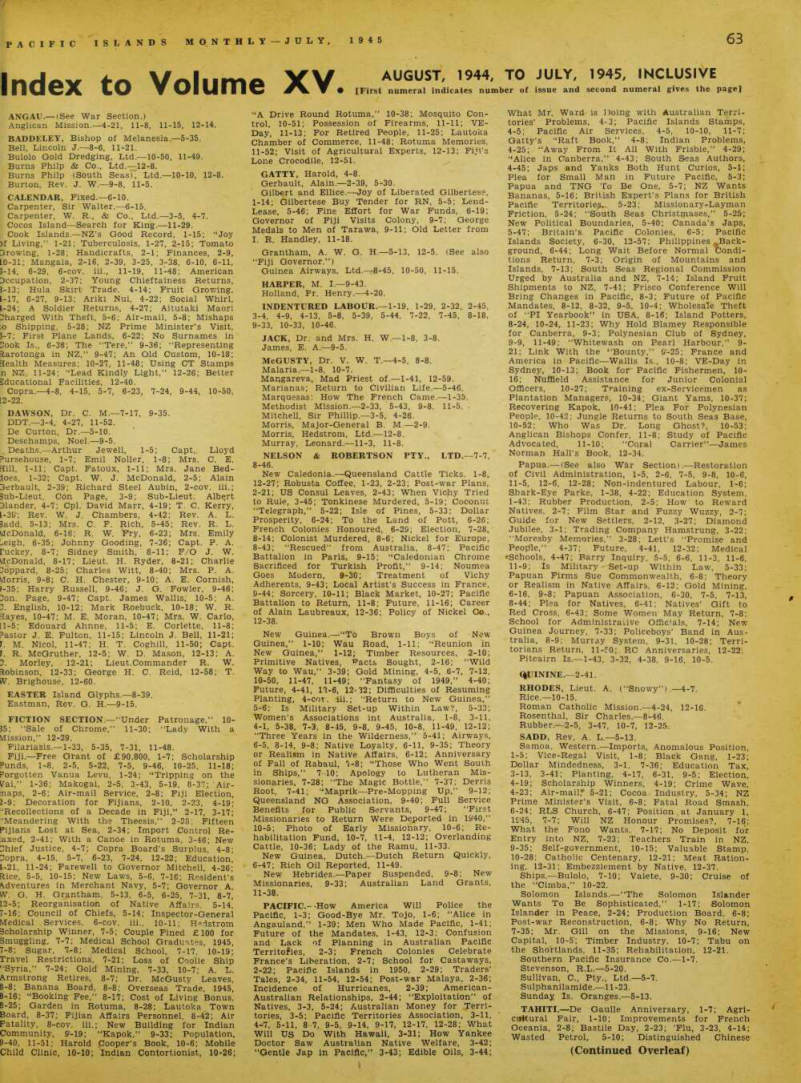
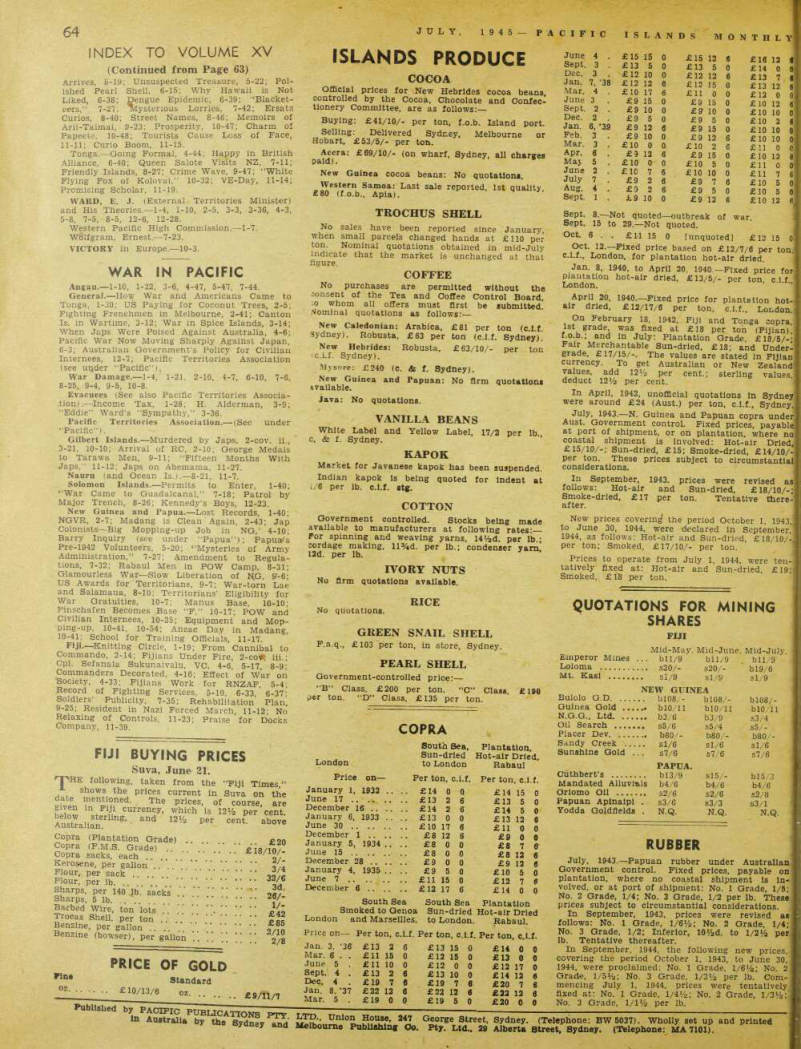
August, 1944, To July, 1945, Inclusive
[First numeral indicates number of issue and second numeral gives the page]
ANGAU. — (See War Section.) Anglican Mission. —4-21, 11-8, 11-15, 12-14.
BADDELEY, Bishop of Melanesia. —5-35.
Bell, Lincoln J.—B-6, 11-21.
Bulolo Gold Dredging, Ltd.—lo-50, 11-49.
Burns Philp & Co., Ltd.—l 2-8.
Burns Philp (South Seas), Ltd. —10-10, 12-8.
Burton, Rev. J. W.—9-8, 11-5.
CALENDAR, Fixed.—6-10.
Carpenter, Sir Walter. —6-15.
Carpenter, W. R., & Co., Ltd.—3-5, 4-7.
Cocos Island —Search for King.—ll-29.
Cook Islands.—NZ’s Good Record, 1-15; “Joy )f Living,” 1-21; Tuberculosis, 1-27, 2-15; Tomato Growing, 1-28; Handicrafts, 2-1; Finances, 2-9, LO-31; Mangaia, 2-16, 2-39, 3-25, 3.-38, 6-10, 6-11, 5-14, 6-29, 6-cov. iii., 11-19, 11-48; American Dccupation, 2-37; Young Chieftainess Returns, 5-13; Hula Skirt Trade, 4-14; Fruit Growing. 1-17, 6-27, 9-13; Ariki Nui, 4-22; Social Whirl, 1-24; A Soldier Returns, 4-27; Aitutaki Maori Charged With Theft, 5-6; Air-mail, 5-8; Mishaps ;o Shipping, 5-28; NZ Prime Minister’s Visit, 5-7; First Plane Lands, 6-22; No Surnames in Dock Is., 6-38; The “Tere,” 9-36; “Representing Rarotonga in NZ,” 9-47; An Old Custom, 10-18; Health Measures; 10-27, 11-48; Using CT Stamps n NZ, 11-24; “Lead Kindly Light,” 12-26; Better Educational Facilities, 12-40.
Copra.—4-8, 4-15, 5-7, 6-23, 7-24, 9-44, 10-50, 12-22.
Dawson, Dr. C. M.—7-17, 9-35.
Ddt.—3-4, 4-27, 11-52.
De Curton, Dr. —5-10.
Deschamps, Noel. —9-5. , Deaths. —Arthur Jewell, 1-5; Capt. Lloyd Pursehouse, 1-7; Emil Noller, 1-8; Mrs. C. E.
Hill, 1-11; Capt. Fatoiix, 1-11; Mrs. Jane Bed loes, 1-32; Capt. W. J. McDonald, 2-5; Alain 3erbault, 2-39; Richard Steel Aubin, 2-cov. iii.; 3ub-Lieut. Con Page, 3-9; Sub-Lieut. Albqrt Dlander, 4-7; Cpl. David Marr, 4-19; T. C. Kerry, I- Rev. W. J. Chambers, 4-42; Rev. A. L. 3add, 5-13; Mrs. C. F. Rich, 5-45; Rev. R. L.
McDonald, 6-16; R, W. Fry, 6-23; Mrs. Emily jeigh, 6-35; Johnny Gooding, 7-36; Capt. P. A. fuckey, 8-7; Sidney Smith, 8-11; F/O J. W.
McDonald, 8-17; Lieut. H. Ryder, 8-21; Charlie “oppard, 8-25; Charles Witt, 8-40; Mrs. P. A.
Morris, 9-8; C. H. Chester, 9-10; A. E. Cornish, )-35; Harry Russell, 9-46; J. G. Fowler, 9-46; 3on. Page, 9-47; Capt. James Wallis, 10-5; A. :. English, 10-12; Mark Roebuck, 10-18; W. R.
Hayes, 10-47; M. E. Moran, 10-47; Mrs. W. Carlo, II- Edouard Ahnne, 11-5; E. Corlette, 11-8; Pastor J. E. Fulton, 11-15; Lincoln J. Bell, 11-21; (. M. Nicol, 11-47; H. T. Coghill, 11-50; Capt. 1. R. McGruther, 12-5; W. D. Mason, 12-13; A. 3. Morley, 12-21; Lieut. Commander R. W.
Robinson, 12-33; George H. C. Reid, 12-58; T. iV. Brighouse, 12-60.
EASTER Island Glyphs.—B-39.
Eastman, Rev. G. H.—9-15.
FICTION SECTION.—“Under Patronage,” 10- 55; “Sale of Chrome,” 11-30; “Lady With a Mission,” 12-29.
Filariasis.—l-33, 5-35, 7-31, 11-48.
Fiji.—Free Grant of £90,800, 1-7; Scholarship Funds, 1-8, 2-5, 5-22, 7-5, 9-46, 10-25, 11-18; Forgotten Vanua Levu, 1-24; “Tripping on the Ifai,” 1-36; Makogai, 2-5, 3-43, 5-19, 8-37; Air maps, 2-6; Air-mail Service, 2-8; Fiji Election, 1-9; Decoration for Fijians, 2-10, 2-23, 4-19; ‘Recollections of a Decade in Fiji,” 2-17, 3-17; ‘Meandering With the Theesis,” 2-28; Fifteen Fijians Lost at Sea, 2-34; Import Control Re axed, 2-41; With a Canoe in Rotuma, 3-46; New Shief Justice, 4-7; Copra Board’s Surplus, 4-8; Jopra, 4-15, 5-7, 6-23, 7-24, 12-22; Education, 1-21, 11-24; Farewell to Governor Mitchell, 4-26; Rice, 5-5, 10-15; New Laws, 5-6, 7-16; Resident’s Adventures in Merchant Navy, 5-7; Governor A.
W. G. H. Grantham, 5-13, 6-5, 6-25, 7-31, 8-7, 12-5; Reorganisation of Native Affairs. 5-14, 7-16; Council of Chiefs, 5-14; Inspector-General Medical Services, 6-cov. iii., 10-11; Hedstrom Scholarship Winner, 7-5; Couple Fined £lOO for Smuggling, 7-7; Medical School Graduates, 1945, 7-8; Sugar, 7-8; Medical School, 7-17. 10-19; Travel Restrictions, 7-21; Loss of Coolie Ship “Syria,” 7-24; Gold Mining, 7-33, 10-7; A. L.
Armstrong Retires. 8-7; Dr. McGusty Leaves, B-8; Banana Board, 8-8; Overseas Trade, 1945, B-16; “Booking Pee,” 8-17; Cost of Living Bonus, B-25; Garden in Rotuma, 8-28; Lautoka Town Board, 8-37; Fijian Affairs Personnel, 8-42; Air Fatality, 8-cov. iii.; New Building for Indian Community, 9-19; “Kapok,” 9-33; Population, 9-40, 11-51; Harold Cooper’s Book, 10-6; Mobile Child Clinic, 10-10; Indian Contortionist, 10-26;
“A Drive Round Rotuma,” 10-38; Mosquito Con trol, 10-51; Possession of Firearms, 11-11; VE- Day, 11-13; For Retired People, 11-25; Lautoka Chamber of Commerce, 11-48; Rotuma Memories, 11- Visit of Agricultural Experts, 12-13; Fiji’s Lone Crocodile, 12-51.
GATTY, Harold, 4-8.
Gerbault, Alain. —2-39, 5-30.
Gilbert and Ellice. —Joy of Liberated Gilbertese, 1- Gilbertese Buy Tender for RN, 5-5; Lend- Lease, 5-46; Fine Effort for War Funds, 6-19; Governor of Fiji Visits Colony, 9-7; George Medals to Men of Tarawa, 9-11; Old Letter from I. R. Handley, 11-18.
Grantham, A. W. G. H.—s-13, 12-5. (See also “Fiji Governor.”) Guinea Airways, Ltd.—B-45, 10-50, 11-15.
Harper, M. I—9-43.
Holland, Fr. Henry.—4-20.
Indentured Labour.—I-19, 1-29, 2-32, 2-45,
3- 4-9, 4-13, 5-8, 5-39, 5-44, 7-22, 7-45, 8-18, 9-33, 10-33, 10-46.
JACK, Dr. and Mrs. H. W.—l-8, 3-8.
James, E. A.—9-5.
Mcgusty, Dr. V. W. T.—4-5, 8-8.
Malaria.—l-8, 10-7.
Mangareva, Mad Priest of. —1-41, 12-59.
Marianas: Return to Civilian Life.—s-46.
Marquesas: How The French Came.—l-35.
Methodist Mission. —2-33, 5-43, 9-8, 11-5.
Mitchell, Sir Phillip—3-5, 4-26.
Morris, Major-General B. M.—2-9.
Morris, Hedstrom, Ltd.—l 2-8.
Murray, Leonard. —11-3, 11-8.
Nelson & Robertson Pty., Ltd—7-7,
8-46.
New Caledonia.—Queensland Cattle Ticks. 1-8, 12- Robusta Coffee, 1-23, 2-23; Post-war Plans, 2- US Consul Leaves, 2-43; When Vichy Tried to Rule, 3-45; Tonkinese Murdered, 5-19; Coconut “Telegraph,” 5-22; Isle of Pines, 5-33; Dollar Prosperity, 6-24; To the Land of Pott, 6-26; French Colonies Honoured, 6-29; Election, 7-28, 8-14; Colonist Murdered, 8-6; Nickel for Europe, 8- “Rescued” from Australia, 8-47; Pacific Battalion in Paris, 9-15; “Caledonian Chrome Sacrificed for Turkish Profit,” 9-14; Noumea Goes Modern, 9-30; Treatment of Vichy Adherents, 9-43; Local Artist’s Success in France, 9- Sorcery, 10-11; Black Market, 10-27; Pacific Battalion to Return, 11-8; Future, 11-16; Career of Alain Laubreaux, 12-36; Policy of Nickel Co., 12-38.
New Guinea.—“To Brown Boys of New Guinea,” 1-10; Wau Road, 1-11; “Reunion in New Guinea,” 1-12; Timber Resources, 2-10; Primitive Natives, Facts Sought, 2-16; “Wild Way to Wau,” 3-39; Gold Mining, 4-5, 6-7, 7-12, 10- 11-47, 11-49; “Fantasy of 1949,” 4-40; Future, 4-41, 12-6, 12-32; Difficulties of Resuming Planting, 4-cox. iii.; “Return to New Guinea,” 5- Is Military Set-up Within Law?, 5-33; Women’s Associations int Australia, 1-8, 3-11, 4- 5-38, 7-3, 8-45, 9-8, 9-45, 10-8, 11-49, 12-12; “Three Years in the Wilderness,” 5-41; Airways, 6- 8-14, 9-8; Native Loyalty, 6-11, 9-35; Theory or Realism in Native Affairs, 6-12; Anniversary of Pall of Rabaul, 7-8; “Those Who Went South in Ships,” 7 10; Apology to Lutheran Mis sionaries, 7-28; “The Magic Bottle,” 7-37; Derris Root, 7-41; “Maprik—Pre-Mopping Up,” 9-12; Queensland NG Association, 9-40; Full Service Benefits for Public Servants, 9-47; “First Missionaries to Return Were Deported in 19'40,” 10- Photo of Early Missionary, 10-6; Re habilitation Fund. 10-7, 11-4, 12-12; Overlanding Cattle, 10-36; Lady of the Ramu, 11-33.
New Guinea, Dutch. —Dutch Return Quickly, 6-47; Rich Oil Reported, 11-49.
New Hebrides. —Paper Suspended, 9-8; New Missionaries, 9-33; Australian Land Grants, 11- PACIFIC.- -How America Will Police the Pacific, 1-3; Good-Bye Mr. Tojo, 1-6; “Alice in Angauland,” 1-39; Men Who Made Pacific, 1-41; Future of the Mandates, 1-43, 12-3; Confusion and Lack of Planning in Australian Pacific Territories, 2-3; French Colonies Celebrate France’s Liberation, 2-7; School for Castaways, 2-22; Pacific Islands in 1950, 2-29; Traders’
Tales, 2-34, 11-54, 12-54; Post-war Malaya, 2-36; Incidence of Hurricanes, 2-39; American- Australian Relationships, 2-44; “Exploitation” of Natives, 3-3, 5-24; Australian Money for Terri tories, 3-5; Pacific Territories Association, 3-11, 4-7, 5-11, 8 7, 9-5, 9-14, 9-17, 12-17, 12-28; What Will US Do With Hawaii, 3-31; How Yankee Doctor Saw Australian Native Welfare, 3-42; "Gentle Jap in Pacific,” 3-43; Edible Oils, 3-44;
What Mr. Ward- is Doing with Australian Terri tories’ Problems, 4-3; Pacific Islands Stamps, 4-5; Pacific Air Services, 4-5, 10-10, 11-7: Gatty’s “Raft Book,” 4-8; Indian Problems, 4-25; ‘‘Away From It All With Prisbie,” 4-29; “Alice in Canberra,” 4-43; South Seas Authors, 4- Japs and Yanks Both Hunt Curios, 5-1; Plea for Small Man in Future Pacific, 5-3; Papua and TNG To Be One, 5-7; NZ Wants Bananas, 5-16; British Expert’s Plans for British Pacific Territories 5-23; Missionary-Layman Friction, 5-24; ‘‘South Seas Christmases,” 5-25; New Political Boundaries, 5-40; Canada’s Japs, 5- Britain’s Pacific Colonies, 6-5; Pacific Islands Society, 6-30, 12-57; Philippines -Back ground, 6-44; Long Wait Before Normal Condi tions Return, 7-3; Origin of Mountains and Islands, 7-13; South Seas Regional Commission Urged by Australia and NZ, 7-14; Island Fruit Shipments to NZ, 7-41; Frisco Conference Will Bring Changes in Pacific, 8-3; Future of Pacific Mandates, 8-12, 8-32, 9-5, 10-4; Wholesale Theft of ‘PI Yearbook” in USA, 8-16; Island Potters, 8- 10-24, 11-23; Why Hold Blarney Responsible for Canberra, 9-3; Polynesian Club of Sydney, 9- 11-49; “Whitewash on Pearl Harbour,” 9- 21; Link With the “Bounty,” 9‘-25; France and America in Pacific —Wallis Is., 10-8; VE-Day in Sydney, 10-13; Book for Pacific Fishermen, 10- 16; Nuffield Assistance for Junior Colonial Officers, 10-27; Training ex-Servicemen as Plantation Managers, 10-34; Giant Yams, 10-37; Recovering Kapok, 10-41; Plea For Polynesian People, 10-42; Jungle Returns to South Seas Base, 10- Who Was Dr. Long Ghost?, 10-53; Anglican Bishops Confer, 11-8; Study of Pacific Advocated, 11-10; “Coral Carrier”—James Norman Hall’s Book, 12-34.
Papua.— (See also War Section). —Restoration of Civil Administration, 1-5, 2-6, 7-5, 9-8, 10-6, 11- 12-6, 12-28; Non-indentured Labour, 1-6; Shark-Eye Parke, 1-38, 4-22; Education System, I- Rubber Production, 2-5; How to Reward Natives, 2-7; Film Star and Fuzzy Wuzzy, 2-7; Guide for New Settlers, 2-12, 3-27; Diamond Jubilee, 3-1; Trading Company Hamstrung, 3-22; “Moresby Memories,” 3-28; Lett’s “Promise and People,” 4-37; Future, 4-41, 12-32; Medical ♦Schools, 4-47; Barry Inquiry, 5-5, 6-6, 11-3, 11-6, II- Is Military - Set-up Within Law, 5-33; Papuan Firms Sue Commonwealth, 6-8; Theory or Realism in Native Affairs, 6-12; Gold Mining, 6- 9-8; Papuan Association, 6-30, 7-5, 7-13, 8- Plea for Natives, 6-41; Natives’ Gift to Red Cross, 6-43; Some Women May Return, 7-8: School for Administrative Offices, 7-14; New Guinea Journey, 7-33; Policeboys’ Band in Aus tralia, 8-9; Murray System, 9-31, 10-28; Terri torial Return, 11-50; RC Anniversaries, 12-22.
Pitcairn Is.—l-43, 3-32, 4-38, 9-16, 10-5.
(Quinine.—2-41.
RHODES, Lieut. A. (“Snowy”).—4-7.
Rice.—lo-15.
Roman Catholic Mission.—4-24, 12-16.
Rosenthal, Sir Charles.—B-46.
Rubber.—2-5, 3-47, 10-7, 12-25.
Sadd, Rev. A. L.—S-13.
Samoa, Western. —Imports, Anomalous Position, 1-5; Vice-Regal Visit, 1-8; Black Gang, 1-23; Dollar Mindedness, 3-1, 7-36; Education Tax, 3- 3-41; Planting, 4-17, 6-31, 9-5; Election, 4- Scholarship Winners, 4-19; Crime Wave, 4-23; Air-mail? 5-21; Cocoa Industry, 5-34; NZ Prime Minister’s Visit, 6-8; Fatal Road Smash, 6- RLS Church, 6-47; Position at January 1, I£'4s, 7-7; Will NZ Honour Promises?, 7-16; What the FonO Wants, 7-17; No Deposit for Entry into NZ, 7-23; Teachers Train in NZ, 9- Self-government, 10-15; Valuable Stamp, 10- Catholic Centenary, 12-21; Meat Ration ing, 12-31; Embezzlement by Native, 12-37.
Ships.—Bulolo, 7-10; Vaiete, 9-30; Cruise of the “Cimba,” 10-22.
Solomon Islands. —“The Solomon Islander Wants To Be Sophisticated,” 1-17; Solomon Islander in Peace, 2-24; Production Board, 6-8; Post-war Reconstruction, 6-8; Why No Return, 7- Mr. Gill on the Missions, 9-16; New Capital, 10-5; Timber Industry, 10-7; Tabu on the Shortlands, 11-35; Rehabilitation, 12-21.
Southern Pacific Insurance Co. —1-7.
Stevenson, R.L. —5-20.
Sullivan, C., Pty., Ltd.—s-7.
Sulphanilamide.—ll-23.
Sunday Is. Oranges.—s-13.
TAHITI.—De Gaulle Anniversary, 1-7; Agri cultural Fair, 1-10; Improvements for French Oceania, 2-8; Bastile Day, 2-23; ’Flu, 3-23, 4-14; Wasted Petrol, 5-10; Distinguished Chinese
(Continued Overleaf)
Arrives, 5-19; Unsuspected Treasure, 5-22; Pol ished Pearl Shell, 6-15; Why Hawaii is Not Liked, 6-38; Dengue Epidemic, 6-39; ‘Blacket eers,” 7-27; Mysterious Lorries, 7-42; Ersatz Curios, 8-40; Street Names, 8-46; Memoirs of Arii-Taimai, 9-23; Prosperity, 10-47; Charm of Papeete, 10-48; Tourists Cause Loss of Face, 11-11; Curio Boom, 11-15.
Tonga.—Going Formal, 4-44; Happy in British Alliance, 6-40; Queen Salote Visits NZ, 7-11; Friendly Islands, 8-27; Crime Wave, 9-47; “White Flying Fox of Kolovai,” 10-32; VE-Day, 11-14; Promising Scholar, 11-19.
WARD, E. J. (External Territories Minister) and His Theories.—l-4, 1-10, 2-5, 3-3, 3-36, 4-3, 5-8, 7-5, 8-5, 12-6, 12-28.
Western Pacific High Commission. —1-7.
Wdlfgram, Ernest.—7-23.
VICTORY in Europe—lo-3.
Advertisements & other items, p. 65 (1 item)
63
PACIFIC ISLANDS MONTHLY - J U L Y . 1945
War In Pacific
Angau.—l-10, 1-22, 3-6, 4-47, 5-47, 7-44.
General. —How War and Americans Came to Tonga, 1-30; US Paying for Coconut Trees, 2-5; Fighting Frenchmen in Melbourne, 2-41; Canton Is. in Wartime, 3-12; War in Spice Islands, 3-14; When Japs Were Poised Against Australia, 4-6; Pacific War Now Moving Sharply Against Japan, 6-3; Australian Government’s Policy for Civilian Internees, 12-7; Pacific Territories Association (see “Pacific”).
War Damage.—l-4, 1-21, 2-10, 4-7, 6-10, 7-6, 8- 9-4, 9-5, 10-8.
Evacuees (See also Pacific Territories Associa tion) .—lncome Tax, 1-28; H. Alderman, 3-9; “Eddie” Ward’s “Sympathy,” 3-36.
Pacific Territories Association.— (See under “Pacific”).
Gilbert Islands. —Murdered by Japs, 2-cov. ii., 3-21, 10-10; Arrival of RC, 2-10; George Medals to Tarawa Men, 9-11; “Fifteen Months With Japs,” 11-12; Japs on Abemama, 11-27.
Nauru (and Ocean Is.). —8-21, 11-7.
Solomon Islands.—Permits to Enter, 1-40; “War Came to Guadalcanal,” 7-18; Patrol by Major Trench, 8-26; Kennedy’s Boys, 12-23.
New Guinea and Papua.—Lost Records, 1-40; NGVR, 2-7; Madang is Clean Again, 2-43; Jap Colonists —Big Mopping-up Job in NG, 4-10; Barry Inquiry (see under “Papua”); Papua’s Pre-1942 Volunteers, 5-20; “Mysteries of Army Administration,” 7-27; Amendment to Regula tions, 7-32; Rabaul Men in POW Camp, 8-31; Glamourless War —Slow Liberation of NG, S’-6; US Awards for Territorians, 9-7; War-torn Lae and Salamaua, 8-10; Territorians’ Eligibility for War Gratuities, 10-7; Manus Base, 10-10; Pinschafen Becomes Base “F,” 10-17; POW and Civilian Internees, 10-25; Equipment and Mop ping-up, 10-41, 10-54; Anzac Day in Madang, 10-41; School for Training Officials, 11-17.
Fiji.—Knitting Circle, 1-19; From Cannibal to Commando, 2-14; Fijians Under Fire, 2-cot*! iii.; Cpl. Sefanaia Sukunaivalu, VC, 4-6, 5-17, 8-9; Commanders Decorated, 4-16; Effect of War on Society, 4-33; Fijians Work for RNZAF, 5-4- Record of Fighting Services, 5-10, 6-33, 6-37 : Soldiers’ Publicity, 7-35; Rehabilitation Plan’, 9- Resident in Nazi Forced March, 11-12; No Relaxing of Controls, 11-23; Praise for Docks Company, 11-39.
Fiji Buying Prices
Suva, June 21. nPHE following, taken from the “Fiji Times,” , A , shows . the prices current in Suva on the date mentioned. The prices, of course are £T®“ Currency ’ whi <* 12% per’ cent.
A„ l “ t Tauln erlmg ’ and 121/2 Per cent - Copra (Plantation Grade) o 9n Copra (P.M.S. Grade) .. . £lB/10/ Copra sacks, each . ” " tlB/1 W Kerosene, per gallon i'Z Flour, per sack Flour, per lb. ..
Sharps, per 140 Jb. sacks 26/ Sharps, 5 lb Barbed Wire, ton lots Trocas Shell, per ton .. fn?
Benzine, per gallon Benzine (bowser), per gallon 2/J
Advertisements & other items, p. 66 (1 item)
Price Of Gold
Fine Standard oz. .. . •• £10/13/6 oz
Islands Produce
Cocoa
Official prices for New Hebrides cocoa beans, controlled by the Cocoa, Chocolate and Confec tionery Committee, are as follows: Buying: £4l/10/- per ton, f.o.b. Island port.
Selling: Delivered Sydney, Melbourne or Hobart, £53/5/- per ton.
Accra: £69/10/- (on wharf, Sydney, all charges paid).
New Guinea cocoa beans: No quotations.
Western Samoa: Last sale reported, Ist quality £BO (f.0.b., Apia).
Trochus Shell
No sales have been reported since January when small parcels changed hands at £llO per ton. Nominal quotations obtained in mid-July indicate that the market is unchanged at that figure.
Coffee
No purchases are permitted without the consent of the Tea and Coffee Control Board, 'O whom all offers must first be submitted. .Vominal quotations as follows: New Caledonian: Arabica, £Bl per ton (c.i.f Sydney). Robusta, £63 per ton (c.i.f. Sydney).
New Hebrides: Robusta, £63/10/- per ton ic.Lf. Sydney).
Mysore: £240 (c. & f. Sydney).
New Guinea and Papuan: No firm quotations available.
Java: No quotations.
Vanilla Beans
White Label and Yellow Label, 17/2 per lb c. & f. Sydney.
Kapok
Market for Javanese kapok has been suspended.
Indian kapok is being quoted for Indent at i/6 per lb. c.i.f. stg.
Cotton
Government controlled. Stocks being made available to manufacturers at following rates:— For spinning and weaving yarns, 14V 2 d. per lb • cordage making, ll%d. per lb.; condenser yam’
I2d. per lb.
Ivory Nuts
No firm quotations available.
Rice
No quotations.
Green Snail Shell
F.a.q., £lO3 per ton, in store, Sydney.
Pearl Shell
Government-controlled price:— “B” Class, £2OO per ton. “C” Class £l9O per ton. “D” Class, £135 per ton.
Sept. B.—Not quoted—outbreak of war.
Sept. 15 to 29.—Not quoted.
Oct. 6 . . £ll 15 0 [unquoted] £l2 15 0 Oct. 12.—Fixed price based on £l2/7/6 per ton; c.1.f., London, for plantation hot-air dried.
Jan. 8, 1940, to April 20. 1940 Fixed price for Plantation hot-air dried, £l3/5/- per ton elf London.
April 20, 1940.—Fixed price for plantation hot air dried. £l2/17/6 per ton, c.1.f., London.
On February 18, 1942, Fiji and Tonga copra Ist grade was fixed at £lB per ton (Fijian), f.0.b.; and in July: Plantation Grade. £lB/5/-* Fair Merchantable Sun-dried, £18; and Under grade, £l7/15/-. The values are stated in Fijian currency. To get Australian or New Zealand 1 values, add 12y 2 per cent.; sterling values,
deduct 12 V 2 per cent.
In April, 1942, unofficial quotations in Sydney were around £24 (Aust.) per ton, c.i.f., Sydney.
July, 1943.—N. Guinea and Papuan copra under Aust. Government control. Fixed prices, payable, at port of shipment, or on plantation, where no coastal shipment is involved: Hot-air Dried £l5/10/-; Sun-dried, £l5; Smoke-dried, £l4/10/per ton. These prices subject to circumstantial considerations.
In September, 1943. prices were revised as follows: Hot-air and Sun-dried, £lB/10/-a Smoke-dried, £l7 per ton. Tentative there after.
New prices covering the period October 1, 1943, to June 30, 1944, were declared in September,! 1944, as follows: Hot-air and Sun-dried, £lB/10/-j per ton; Smoked, £l7/10/- per ton.
Prices to operate from July 1, 1944, were ten tatively fixed at: Hot-air and Sun-dried, £19;; Smoked, £lB per ton.
Copra
South Sea, Plantation, Sun-dried Hot-air Dried.
London to London Rabaul Price on— Per ton, C.i.f.
Per ton, c.i.f.
January l 1932 .. £14 0 0 £14 15 0 June 17 . £13 2 6 £13 5 0 December 16 .. .. £14 2 6 £14 5 0 January 6 1933 .. £13 0 0 £13 12 6 June 30 . £10 17 6 £11 0 o December 1 .. .. £8 12 6 £9 0 0 January 5 1934 .. £8 0 0 £8 7 6 June 15 . £8 0 0 £8 12 6 December 28 .. .. £9 0 0 £9 12 6 January 4, , 1935 .. £9 5 0 £10 5 0 June 7 ., £11 15 0 £12 7 e December 6 . . . . £12 17 6 £ 14 0 0 South Sea South Sea Plantation Smoked to Genoa Sun-dried Hot-air Dried London and Marseilles. to London.
Rabaul.
Price on— Per ton, c.i.f.
Per ton, , c.i.f, Per ton, c.i.f.
Jan. 3, ’36 £13 2 6 £13 15 0 £14 0 0 Mar. 6 . . £11 15 0 £12 15 0 £13 0 0 June 5 . £11 10 0 £12 0 0 £12 17 0 Sept. 4 . £13 2 6 £13 10 0 £14 12 6 Dec. 4 . £19 7 6 £19 7 6 £20 7 6 Jan. 8. ’37 £22 12 6 £22 12 6 £22 12 6 Mar. 5 . £19 0 0 £19 5 0 £20 0 0
June 4 . £15 15 0 £15 12 6 £16 12 Sept. 3 £13 5 0 £13 5 0 £14 0 o Dec. 3 . £12 10 0 £12 12 6 £13 7 ( Jan. 7. 38 £12 12 6 £12 15 0 £ 13 12 6 Mar. 4 £10 17 6 £11 0 0 £ 12 0 o June 3 £9 15 0 £9 15 0 £ 10 12 6 Sept. 2 £9 10 0 £9 10 0 £10 10 o Dec. 2 . £9 5 0 £9 5 0 £ 10 2 s Jan. 6, 39 £9 12 6 £9 15 0 £10 10 0 Feb. 3 . £9 10 0 £9 12 6 £10 10 o Mar. 3 . £10 0 0 £10 2 6 £ 11 0 e Apr. 6 . £9 12 6 £9 15 0 £10 12 6 May 5 . £10 0 0 £10 5 0 £11 0 O' June 2 £10 7 6 £10 10 0 £11 7 6 July 7 . £9 2 6 £9 7 6 £10 5 0, Aug. 4 . £9 2 6 £9 5 0 £10 5 0 Sept. 1 £9 10 0 £9 12 6 £10 12 0.
Shares
Quotations For Mining
Fiji
Mid-May. Mid-June. Mid-July Emperor Mines .. bll/9 bll/9 bll/9 Loloma s20/bl9/6 Mt. Kasi . sl/9 sl/9‘ sl/9
New Guinea
Bulolo G.D .. bl08/bl08/bl08/- Guinea Gold ... blO/11 blO/11 N.G.G., Ltd b3/9 s3/4 Oil Search s5/4 s5/- Placer Dev ... b80/b80/b80 - Sandy Creek ... .. sl/6 sl/6 sl/6 Sunshine Gold . s7/6 s7/6 sl/6
Papua.
Cuthbert’s .. bl3/9 815/bl5/3 Mandated AHuvIbIs b4/6 b4/6 b4/6 Oriomo Oil s2/6 s2/8 Papuan Aplnalpl . S3/6 s3/3 s3/l Yodda Goldfields . N.Q.
N.Q.
N.Q.
Rubber
July, 1943. —Papuan rubber under Australian Government control. Fixed prices, payable on plantation, where no coastal shipment is in volved, or at port of shipment: No. 1 Grade, 1/5; No. 2 Grade, 1/4; No. 3 Grade, 1/2 per lb. These prices subject to circumstantial considerations.
In September, 1943, prices were revised as follows: No. 1 Grade, I/6V2; No. 2 Grade, 1/4; No. 3 Grade, 1/2; Inferior, KF/ad. to 1/2 Va per lb. Tentative thereafter.
In September, 1944, the following new prices, covering the period October 1, 1943, to June 30, 1944, were proclaimed; No. 1 Grade, l/6y 2 ; No. 2 Grade, 1/5 V 2 ; No. 3 Grade, 1/3Va per lb. Com mencing July 1, 1944, prices were tentatively fixed at: No. 1 Grade, l/4y 2 ; No. 2 Grade, l/3y 2 ; No. 3 Grade, 1/lVa per lb.
Advertisements & other items, pp. 66-68 (2 items)
64
JULY, 1945 PACIFIC ISLANDS MONTHLY
INDEX TO VOLUME XV
(Continued from Page 63)
? ln 24 i George street - Sydney. (Telephone: BW 5037). Wholly set up and printed «e uyoney and Melbourne Publishing 00. Pty. Ltd., 29 Alberta Street, Sydney. (Telephone: MA 7101).
W. R. Carpenter & Co. Ltd.
Established 1914
THIRTY YEARS OF PACIFIC ISLANDS
DEVELOPMENT AND SERVICE.
W. R. CARPENTER & CO. LTD.
Capital £1,000,000.
GENERAL MERCHANTS AND SHIPOWNERS
Buyers and Exporters of All Kinds of Islands Produce Copra Merchants and Millers Agents for Australian, European and American Manufacturers Distributors of Every Description of Merchandise
AGENTS FOR:
FORD MOTOR COMPANY OF CANADA DODGE BROTHERS INC.
ELECTROLUX REFRIGERATORS WESTINGHOUSE ELECTRICAL CO.
T. G. & C. BOLINDERS (ENGINES) CATERPILLAR TRACTORS Etc., Etc.
BRANCHES THROUGHOUT THE PACIFIC ISLANDS
Head Office: 16 O'CONNELL STREET, SYDNEY
In London: W. R. Carpenter & Co. (London) Ltd., Coronation House, 4 Lloyd's Avenue, London, EC.
The W.R.C. Line
The first Direct and Regular Cargo and Passenger Service between Europe and Pacific Islands’ ports was established by W. R. Carpenter & Co. Ltd.