Pacific
Islands
Monthly
June 18. 1945
Vol. Xv. No. 11.
[Registered at the G.P.O.* transmission by post as a newspaper ]
1/-
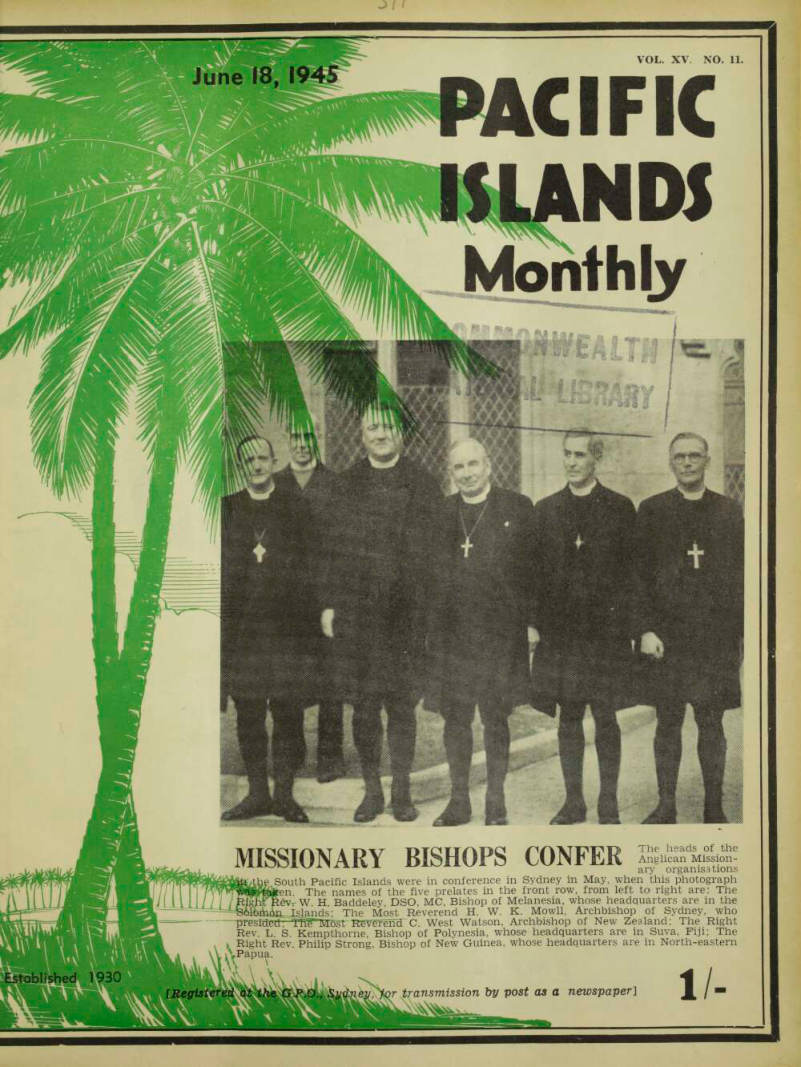
Missionary Bishops Confer
The heads of the Anglican Mission ary organisations in the South Pacific Islands were in conference in Sydney in May, when this photograph was taken. The names of the five prelates in the front row, from left to right are: The Right Rev. W. H. Baddeley, DSO, MC, Bishop of Melanesia, whose headquarters are in the Solomon Islands; The Most Reverend H. W. K. Mowll, Archbishop of Sydney, who presided; The Most Reverend C. West Watson, Archbishop of New Zealand; The Right Rev. L. S. Kempthorne, Bishop of Polynesia, whose headquarters are in Suva, Fiji; The Right Rev. Philip Strong, Bishop of New Guinea, whose headquarters are in North-eastern Papua.
Advertisements & other items, p. 2 (1 item)
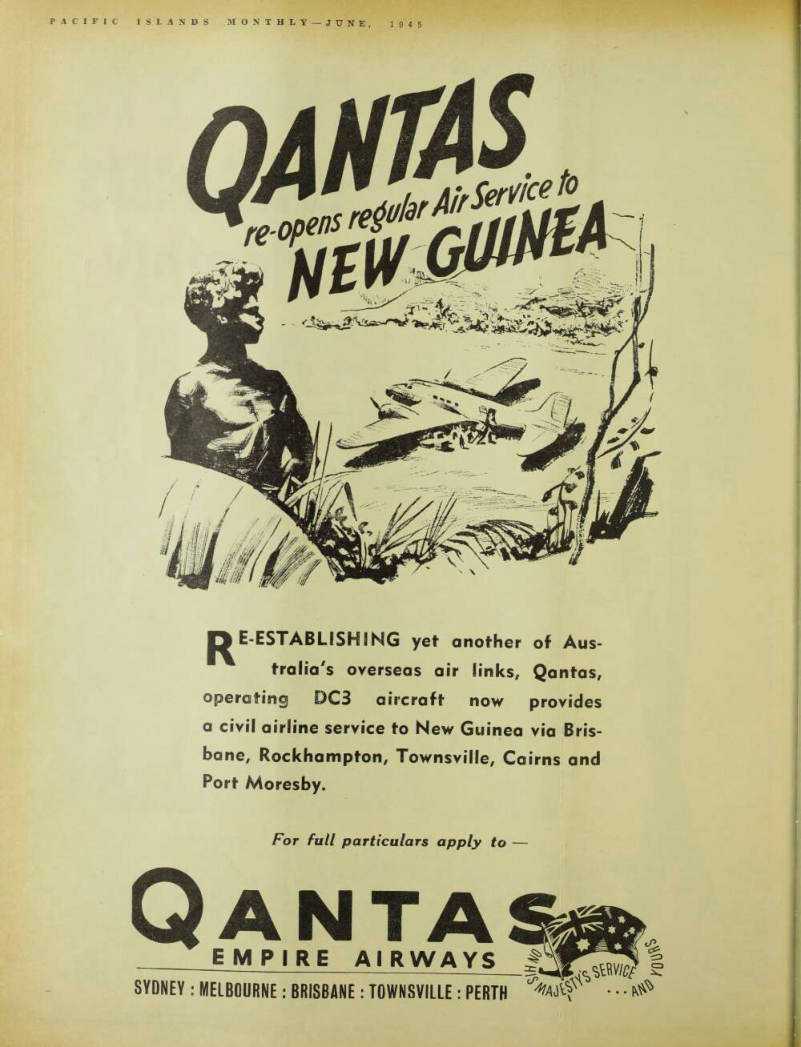
Anta
re-opens
& .a V •» « -r. % V yet another of Australia's overseas air links, Qantas, operating DC3 aircraft now provides a civil airline service to New Guinea via Brisbane, Rockhampton, Townsville, Cairns and
Port Moresby.
For full particulars apply to
ANTA
EMPIRE AIRWAYS
SYDNEY : MELBOURNE: BRISBANE: TOWNSVILLE : PERTH
Pacific News-Review
Notes And Comment On
International Affairs
From May 18 To June 11
May 18: Marshal Tito, of Yugoslavia, has refused to withdraw his troops from Italian and Austrian territory, and threatens to establish claims to the Trieste area by force of arms. The situa tion is “delicate.”
May 21: The Trieste position has eased, and the Yugoslav Government is now ready to negotiate with Italy. The Yugoslav Government has stated that it has no intention of annexing unilaterally the coastal area of Istria. But, while the Yugoslav situation has improved, there are indications of trouble in Syria and Lebanon, where riots are taking place, following the landing of French troops.
This French action is considered by the Lebanese and Syrians as a direct threat to the independence of their two coun tries, which was granted in 1943.
May 22: US Secretary of State Stetti nius stated to-day that it is hoped to draft the World Charter as agreed upon at UNCIO in two weeks’ time.
May 23: The Churchill Government has resigned in Britain, and the coalition ad ministration has ended. The general elec tion will be held on, July 6. This will be the first election since 1935.
May 23: All members of the Doenitz’s acting German Government and the Ger man High Command have been rounded up and taken prisoner at Flenburg, Ger many.
May 25: Heinrich Himmler, head of the German Gestapo, committed suicide at the headquarters of the British Second Army at Luneburg, Germany. He was taken prisoner By the British on May 21 when, in disguise, he attempted to cross a bridge in Prussia. At first his identity was not known, but he later revealed himself. Foreign Minister von Ribben trop is now the only prominent Nazi un accounted for.
May 27; A serious situation has de veloped in Syria and Lebanon, where fresh French troops have arrived.
Britain and US are seeking a peaceful way out, but it is feared that hos tilities will commence between the French and national troops.
May 28: Marshal Tito, of Yugoslavia, has appealed to the Allies to fulfil their Atlantic Charter pledge that all the peoples liberated will have the right to determine their own fate. He said that he had not withdrawn his troops from Carinthia merely to make way for the British Bth Army.
May 29: William Joyce (“Lord Haw- Haw”) has been captured by the British Second Army in Germany. It is believed that he will be imprisoned in the Tower of London until he is tried for treason.
May 30: Hostilities have begun in Damascus, Syria, where French troops, using planes and artillery, have occupied Parliament House. The President of Syria has appealed to both Britain and America for immediate intercession.
May 31: Mr. Churchill ordered the Allied Commander-in-Chief in the Middle East to intervene in Syria to - prevent further bloodshed, and General de Gaulle has been informed. Heavy fight ing has continued in Damascus, and the city has been bombed by French planes.
Britain has asked that French troops cease fire immediately and withdraw to barracks to prevent clashes between French and British troops, and has promised that if they do this, Britain will arrange a tripartite discussion in London as soon as possible.
June 1: French troops in Syria have ceased fire. Mr, Churchill’s message to de Gaulle has been described in France as an “ultimatum,” and has been received
with resentment.
June 5: Mr. Churchill has told General de Gaulle that he is ready to order the withdrawal of British troops from Syria and Lebanon as soon as a treaty is con cluded and is operating between the French, Syrian and Lebanon Govern ments. Mr. Churchill’s statement was in reply to charges by de Gaulle that Britain had tried to stir up trouble by intervention in Syria, and that she wished to oust the French from the Levant.
June 6: France wants five-Power talks on the Levant dispute—that is, she wishes to bring in Russia and China instead of confining the discussion to America, France and Britain.
June 6: Hitler’s Third Reich came to an end yesterday when four Allied Com manders-in-Chief (Field-Marshal Mont gomery for Britain, General Eisenhower for America, Marshal Zhukov for Russia, and General de Tassigny for France) signed in Berlin an agreement for the total subjugation of German life in the four zones occupied by the armies of their respective countries, and began their work as governors of post-war Germany.
June 8: The Commander of the French Forces in Syria, General Roget, has accused Britain of provoking trouble in Syria. General de Gaulle’s angry reaction to this has again sharpened the Levant crisis which earlier appeared to be quietening. Meanwhile, the Arab League, which is meeting in Cairo, has issued a statement charging France with creating the Levant trouble.
War In The Pacific
May 17: Japanese forces strongly en trenched on high ground south of Wewak peninsula (New Guinea) are fighting fanatically to stem the advance of the Australians May 18: The AIF on Tarakan now hold two-thirds of the island, and the enemy has been pushed back to the more rugged areas. Meanwhile, the American forces on Okinawa are joined in bitter battle with the Japanese for vital hills between the Jap base at Shuri and the capital, Naha.
May 23; It has now been revealed that Japan has been using a “secret weapon” on western areas of the United States and Canada during the past few months.
This is a paper balloon about 33 ft. in diameter, capable of carrying bombs. The balloons travel at extreme heights, and are borne by the ore vailing air currents.
It is believed that they are intended to start forest-fires. They constitute no real military threat.
May 24: More than 550 Superfortresses from Marianas bases, dropped 4,500 tons of incendiary bombs on Tokio before dawn to-day. This was the heaviest air raid yet made on Japan.
May 27: Tokio had its second great fire raid from Superfortresses yesterday.
Suzuki, Japan’s Premier, reported that the Imperial Palace has been destroyed, and Tokio radio has announced that the city is “literally scorched to the ground.”
Thirty-one Superfortresses were lost dur ing the two raids.
May 27: Australian troops have now secured the whole of the Wewak coastal area, and sealed off about 12,000 Japanese in the rugged inland country between there and Maprik.
May 29: Over 3,000 tons of incendiary bombs were dropped on Yokohama, chief port of Jana'n, this morning.
June 1: More than 450 Superfortresses supported by fighters, to-day attacked Osaka. Japan’s second largest city; 3,200 tons of incendiary bombs were dropped.
June 3: Important changes in Ameri can naval commands in the Pacific have been announced to fit in with the “mightier plans” that have been evolved for intensification of ‘the war in this area. Under the new scheme, Admiral Nimitz takes direct command of all land forces in the Ryukyu Group, June 6: Far East war situation may be profoundly affected by successful new Chinese offensive on 200 miles’ front in central China. Japs are withdrawing to north-east, and abandoning central Chinese railway, which is Japan’s last connecting link with her armies in south east Asia and Indonesia. If the advanc ing Chinese can clear the central Chinese coast, this will provide important military and air bases for Allies.
June 10: According to Tokio radio, five Japanese cities Tokio, Yokohama, Nagoya, Osaka and Kobe —have ceased to exist. On June 9 and 10 large forces of Super-Portresses made eight attacks on the main island of Japan, Honshu.
June 11: Following a two-days’ naval engagement, elements of the Australian Ninth Division, AIF, have landed simul taneously at Labuan Island, Muara Island and Brooketon, in the Brunei Bay area, on the north-west coast of British North Borneo, They have already captured Labuan township.
Advertisements & other items, pp. 3-4 (1 item)
Pacific Islands
NOW AVAILABLE
Year Book
FIFTH EDITION
rIS has become the recognised standard work of reference on the Pacific Territories and Islands; and it is now printed in Sydney, N.S.W., and in New York.
The sth Edition, 384 pages, has been arranged in Six Sections —General and Introductory; Eastern Pacific (Polynesia) ; Central Pacific (Micronesia); Western Pacific (Melanesia); Far Western Pacific (Indonesia); and Non-Tropical Islands.
Every Territory and all the Principal Islands are described in detail —history, geography, natives, administration, industries, trade, etc. There are more than 50 maps.
Price; 15/- per copy, plus 6d. postage.
Copies may be obtained at the majority of Booksellers, and Island Stores, or direct from:
Pacific Publications Pty., Ltd.,
Union House, 247 George St.,
Sydney.
Pacific Publications (Fiji), Ltd.,
P.O. Box 281, Suva, Fiji.
The book, named “Pacific Islands Handbook,” is published by The MacMillan Company, New York, for distribution in North and South America, and Hawaii.
USEFUL ADDRESSES
The following are the addresses of organisations set up to deal with Pacific Territories affairs:—
PAPUA, NEW GUINEA, NAURU,
NORFOLK IS.
Department of External Territories (Sydney Branch) (Lately the New Guinea Trade Agency), Australia House, Carrington Street, Sydney.
Telephone: 1776. (Dealing with all matters connected with the Australian Pacific Territories and also the Sydney representative of the New Guinea Copra Control Committee.)
FIJI, AND HIGH COMMISSION
FOR WESTERN PACIFIC
Sydney Office of Fiji and Associated Administrations. (In charge of Mr. B. F. Blackwell.) 72 Pitt Street, Sydney.
Telephone: BW 7724.
BRITISH SOLOMON ISLANDS
Sydney Office of British Solomon Islands Government (In charge of Mr. F. E. Johnson, Treasurer of the Solomons Administration), 17 Castlereagh Street, Sydney.
Telephone: B 1710. ’
FOR PACIFIC TERRITORIES
EVACUEES GENERALLY
Pacific Territories Association (C. A. M. Adelskold, Secretary), c/o Robert Gillespie Pty., Ltd., 54a Pitt Street, Sydney. Telephone; BW 4782.
WAR DAMAGE COMMISSION
Sydney Office: M.L.C. Buldling, Cnr. Martin Place and Castlereagh Street, Sydney.
Telephone: BW 2361,
FOR CLAIMS AGAINST ARMY
«£r. H. Alderman, Darwin-Moresby Claims Section, Chief Finance Office (Army), Victoria Barracks, Melbourne.
Advertisers
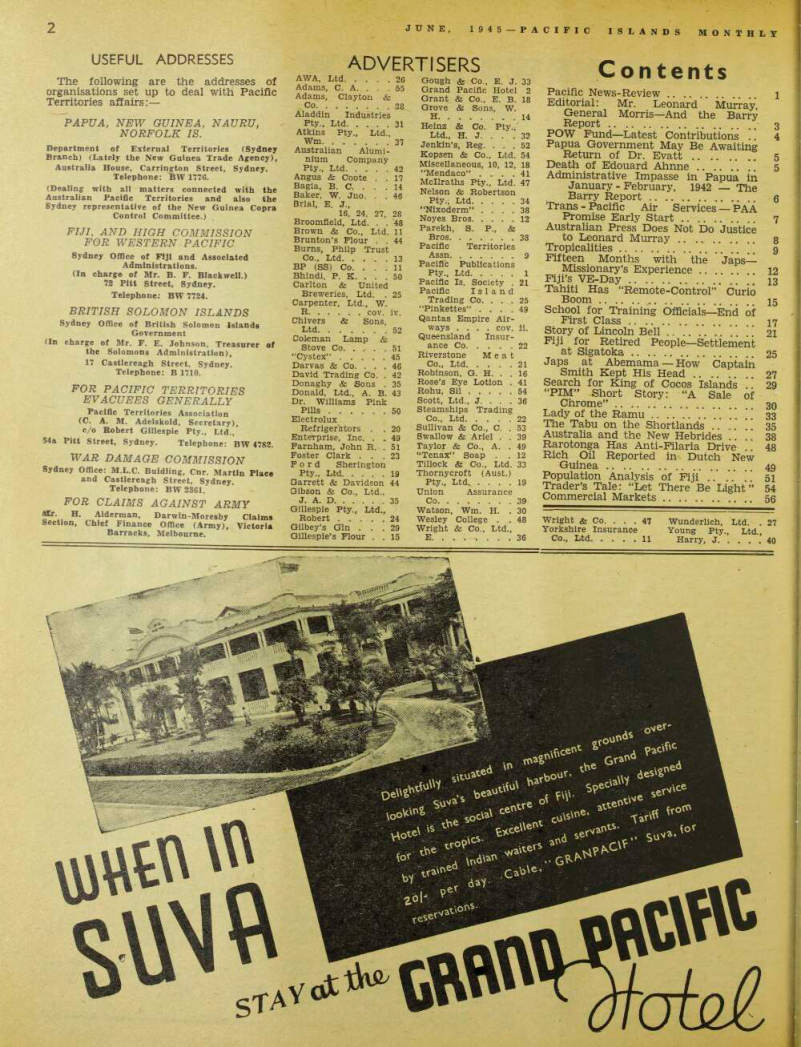
AWA, Ltd 26 Adams, C. A. . . .55 Adams, Clayton & Co 28 Aladdin Industries Pty., Ltd 31 Atkins Pty., Ltd., Wm 37 Australian Alumi nium Company Pty., Ltd 42 Angus & Coote . .17 Bagia, B. C. . . .14 Baker, W. Jno. . . 46 Brial, E. J., 16, 24, 27, 28
Broomfield, Ltd. . . 48
Brown & Co., Ltd. 11 Brunton’s Flour . . 44 Burns, Philp Trust Co., Ltd 13 BP (SS) Co. . . . 11 Bhindi, P. K. . . .50 Carlton & United Breweries, Ltd. . 25 Carpenter, Ltd., W.
R cov. iv.
Chivers & Sons, Ltd 52 Coleman Lamp & Stove Co 51 “Cystex” 45 Darvas & Co. ... 46 David Trading Co. . 42 Donaghy & Sons . 35 Donald, Ltd., A. B. 43 Dr. Williams Pink Pills 50 Electrolux Refrigerators . . 20 Enterprise, Inc. . . 49 Farnham, John R. . 51 Foster Clark ... 23 Ford Sherington Pty., Ltd 19 Garrett & Davidson 44 Gibson & Co., Ltd.,
J. A. D 35
Gillespie Pty., Ltd., Robert 24 Gilbey’s Gin ... 29 Gillespie’s Flour . .15
Gough & Co., E. J. 33 Grand Pacific Hotel 2 Grant & Co., E. B. 18 Grove & Sons, W.
H 14 Heinz & Co. Pty.,' Ltd., H. J. . . . 32 Jenkln’s, Reg. ... 52 Kopsen & Co., Ltd. 54 Miscellaneous, 10, 12, 18 “Mendaco” ... 41 Mcllraths Pty., Ltd. 47 Nelson & Robertson Pty., Ltd 34 “Nixoderm” , . . . 38 Noyes Bros 12 Parekh, S. P., & Bros 38 Pacific Territories Assn 9 Pacific Publications Pty., Ltd 1 Pacific Is. Society . 21 Pacific Island Trading Co. . . . 25 “Pinkettes” ... 49 Qantas Empire Air ways ... cov. ii.
Queensland Insur ance Co 22 Riverstone Meat Co., Ltd 21 Robinson, G. H. . . 16 Rose’s Eye Lotion . 41 Rohu, Sil 54 Scott, Ltd., J. ... 36 Steamships Trading Co., Ltd 22 Sullivan & Co., C. . 53 Swallow & Ariel . . 39 Taylor & Co., A. , 49 “Tenax” Soap . . 12 Tillock & Co., Ltd. 33 Thornycroft (Aust.) Pty., Ltd 19 Union Assurance Co 39 Watson, Wm. H. . 30 Wesley College . , 48 Wright & Co., Ltd., E. 36
Wright & Co. . . .47 Yorkshire Insurance Co., Ltd 11
Wunderlich, Ltd. . 27 Young Pty., Ltd., Harry, J 40
Contents
Pacific News-Review i Editorial: Mr, Leonard Murray, General Morris—And the Barry Report 3 POW Fund—Latest Contributions .. 4 Papua Government May Be Awaiting Return of Dr. Evatt 5 Death of Edouard Ahnne * 5 Administrative Impasse in Papua in January - February, 1942 The Barry Report g Trans - Pacific Air Services PAA Promise Early Start 7 Australian Press Does Not Do Justice to Leonard Murray ... g Tropicalities 9 Fifteen Months with the Japs— Missionary’s Experience 12 Fiji’s VE-Day 13 Tahiti Has “Remote-Control” Curio Boom 15 School for Training Officials—End of First Class 17 Story of Lincoln Bell 21 Fiji for Retired People—Settlement at Sigatoka 25 Japs at Abemama —How Captain Smith Kept His Head 27 Search for King of Cocos Islands .. 29 “PIM” Short Story: “A Sale of Chrome” 30 Lady of the Ramu ..!... 33 The Tabu on the Shortlands ... 35 Australia and the New Hebrides .. .! 38 Rarotonga Has Anti-Filaria Drive .. 48 Rich Oil Reported in Dutch New Guinea 49 Population Analysis of Fiji .. ." ” 51 Trader’s Tale: “Let There Be Light” 54 Commercial Markets 50
Advertisements & other items, p. 4 (1 item)
m
*£ ■ o tV*
Pacific Islands Monthly
The Newspaper-Magazine of the South Seas
IRegistered at the G.P.0., Sydney, for transmission by post as a newspaper. ] Published Once Each Month and Circulated in Australia and New Zealand and in the following Pacific Territories and Islands Groups:
Australian Territory of Papua.
Mandated Territory (Australia) of New Guinea.
Australian Territory of Norfolk Island.
New Zealand Territory of Cook Islands.
Mandated Territory (NZ) of Western Samoa.
British Colony of Fiji.
British Solomon Islands Protectorate.
British Protectorate of Tongan Islands.
British Crown Colony of Gilbert and Ellice Islands.
Mandated Territory of Nauru.
British and Free French Condominium of New Hebrides.
Free French Colony of New Caledonia.
Free French Colony of Oceania (Tahiti, etc.) American Territory of Eastern Samoa.
American Territory of Hawaiian Islands.
Owned and Produced by Pacific Publications Pty. Ltd., Union House, 247 George Street, Sydney.
c Managing Director .. BW 5037 £ Business and Editorial MA 4369
P.O. Box .. .. 3408 R
Registered Address of Telegrams, Radiograms, and Cables: “Pacpub”, Sydney.
Contributions.
Articles, Stories, and Photographs dealing with Pacific Islands subjects are invited and will be paid for on publication.
Subscription Rates.
Per Annum, within British Empire, Prepaid, Post Free 10/- Per Annum, elsewhere, Prepaid, Post Free 12/6 Single Copies 1/-
Editor and Publisher:
R. W Robson, F.R.G.S.
Advertising Manager; W. E. Rogers.
Advertising Office and Printing-House; 29 Alberta Street, Sydney.
Advertising rates furnished on application.
Representative In Fiji.
Pacific Publications (Fiji), Ltd., Bank of NSW Building, Suva (same office as W. H. Grove & Sons, Ltd.). Stocks of Pacific Islands Monthly and Pacific Islands Yearbook on hand.
Repri "Entative In London.
J. T. Wallis, Coronation House, 4 Lloyds Avenue, London, E.C.3, from whom may be obtained copies of Pacific Islands Monthly, Pacific Is. Year Book, advertising schedules, etc.
Agents.
The following are authorised to receive sub> scriptions for Pacific Islands Monthly:— Burns, Philp & Co., Ltd., and Burns Phllp (South Sea) Co., Ltd. All branches.
W. R. Carpenter & Co., Ltd. All branches.
Morris, Hedstrom, Ltd. All branches.
Steamships Trading Co., Papua. All branches.
Whitten Bros., Ltd., Samaral, Papua.
B.N.G. Trading Co., Ltd., Port Moresby, Papua.
J. Muir, Suva, FIJI.
Miss R. Castles, Suva, Fiji.
N. C. Mackenzie Hunt, Walnunu, Bua, FIJI.
Cook Islands Trading Co., Rarotonga, Cook la.
A. C. Rowland, Papeete, Tahiti.
Islands Branches and Representatives of W. H.
Grove & Sons, Ltd., Auckland, New Zealand.
Ed. Pentecost, Noumea, New Caledonia.
Societe Gubbay Kerr et Cie, Noumea, N. Caledonia.
Vol, XV. No. 11.
June 18, 1945
Prirp i l/ - Per Copy * rnce 10/- p.a.
was™ Commandant,
Mr. Leonard Murray, General Morris— and the Barry Report
rfiHE general effect of the Barry 1 report into the cause of the administrative impasse in Papua in Januarv-Februarv 1942 is to white-
Major-General B. M. Morris, and place upon the Administrator, the Hon. Leonard Murray, a sufficient amount of blame to justify Canberra —if that should be Canberra’s wish— in ignoring the claims of Mr. Murray to appointment as Administrator of the new Provisional Government.
TbJhiTrv ofthe treble and
The history of the trouble, and Commissioner Barry’s comments and conclusions, are set forth in a long summary of the report, which is published on another page. We have tried to make a fair condensation of a very large and comprehensive docu merit. As a result of that necessarily close reading, we have reached certain conclusions, which are set forth hereunder. If anyone thinks that our conclusions are wrong, he is invited to read, not only our summary, but also the original report, copies of which are available in several official places. rnHE only man whom the Commissioner criticises harshly—in fact, the only man whom he criticises at all—is the Administrator, Mr.
Murray. He wraps his conclusions in courteous and even sugary language; but, in effect, he says that (a) Mr.
Murray was thin-skinned, hypersensitive and legalistic in his attitude
towards the Commandant; (b) Mr.
Murray, to a degree that was deplor able in the circumstances, insisted upon frequent consultation with the Australian Government, at Can. berra; (c) Mr. Murray, in his attitude towards the Army on his doorstep, was withdrawn and unco-operative, (d) Mr. Murray, in his commum cations with Canberra and Army, m
foTthe
snowed no particular concern ioi uie welfare of the natives, which should have been his Particular care. ■ t th commis- One can use against- the Commas sioner a term of which he himself appears to be fond. He was un realistic ; and, in reaching the con conclusions he now has broadcast, he ledgei ol Territories scene.as it existed for over 25 years, and in any fair appreciation of the atmosphere great ed m and by a series of sudden, unforeseen and tremendous events. He refers to those events, but he does not take them sufficiently into account.
Especially has he failed to disclose appreciation of the situation created in the Territory by the coterie of pro fessional soldiers who arrived there in 1941, and who left no one in any doubt of the contempt in which tney held the Murray administration, and of their eagerness to get rid of the old fogies whose chief concern, notoriously, was the protection and welfare of the natives.
that 0 tL incursion y ot the heavy booted, unimaginative, professional soldier into Territories’ government has caused a number of administrative tragedies In the Pacific' dur mg the last 40 or 50 years the worst and 193Q S The professional tween 1920 and 1930. The professional soldier cannot ooderstand that tropical a lifettoe of something and it notrarelv tnaimng and study, md is not merely a matter of bossing the niggers around. rp HE Administrator had spent over ■ Parma 30 years in Papua, and had made the care and welfare of natives, and tropical administration, generally, his life > s wor k. The Commandant, prob ab had neyer geen & Pacific tropical Territory until he was sent to Port Moregbv to take charge of the Bth Mdit District He probably was of
tyWaTcouM Sot uSeSnd
Qr j. eciate the princi pi es upon , Murray administration wag baged nor could have know ledge of the extraordinary difficulties under which that Governme nt was carried on lack of f unds complete parried funds, complete towards Pacific Islands affairs (re flected in co iossal ignorance in Ministers nominally responsible for Islands administration), a niggling i ns i s t en ce by Canberra bureaucrats that Administrators should refer most matters to Canberra before taking a dec j s i on * .. . . T The Administrator, Leonard Murray, and the Government Secretary, H W.
Champion, as lieutenants for long
years of the famous Australian Administrator, Sir Hubert Murray, were most jealous of their govern ment, and especially were they concerned with all matters likely to affect the welfare of the natives. Not once, but a score of times, has Aus tralian commerce criticised the Murray regime for its readiness to place native interests before those of Europeans.
INTO this narrow little world, driven by the supreme need of defend ing Australia, came the Army set-up, quite properly expecting and demand ing that all considerations be sub verted to its most urgent requirements.
As Mr. Barry points out in biting language, this military organisation was bumble-footed, blundering, ill trained and ill-equipped. Even before Jap bombs fell on Moresby, stories were reaching Sydney of difficulties between the Army, and the civil administration, of whose opinions, laws and general procedure the newly-arrived military officers were clearly contemptuous.
Possibilities of trouble were fore seen before the administrative im passe occurred. The attitude of General Morris and his principal officers was not helpful or conciliatory —and the Administrator and his officials, probably resenting bitterly the Brass Hat attitude, naturally withdrew themselves as far as their duty permitted. As the Japanese in vasion approached, the Administrator obviously had to depend almost wholly upon Canberra for infor mation and instructions. Canberra had the whole picture—the Adminis trator knew only what he could see and hear. And what he saw and heard must have given him little confidence in General Morris and his set-up—thousands of troops, arriving in Moresby without discipline and proper equipment; troops running amok and looting tho stores and private houses; Rabaul (for which Moresby Army headquarters were supposed to be responsible) aban doned to the Japanese; hundreds of civilians sacrificed there, because of official failure to use the available transport to get them away.
The Commandant probably was impatient with fhe Administrator’s failure to make quick, clear decisions, and (with typical Army confidence in the propriety of its own judgment!) was sure that the only thing to do was t ° , shl P Murray and his crowd out of the Territory.” Mr. Barry has clearly seen the Commandant’s view point m relation to the Administrator, fhw p ?w nt s has approved of every rvv>2 g Tvyr that u General Morris did in Port Moresby. There is no word of adverse criticism.
Mr ; , Barr y apparently failed to
refaUon viSwpotat in
qWtt k 1 t 0 th ? Commandant—prob ably because of his lack of knowledge ground Papuan histor y and back
rpHE most serious charge made by -*• Mr. Barry against Mr. Murray is that he insisted on referring every thing to Canberra, for instructions.
If anyone was to be condemned for that course, it was not Mr. Murray, but the Canberra bureaucrats, who had instituted and most jealously guarded the system. As Mr. Murray saw it, he had to look for direction to Canberra, which presumably had the complete picture, and not to the local Commandant, who appeared to be surrounded with confusion and chaos.
At any time—and especially after the fall of Rabaul, when the Japs clearly were coming south—Canberra had only to send Mr. Murray a dozen clear words, informing him that in view of the urgency of the situation he now must take all instructions from the Commandant on the spot, and fit his remaining civil adminis tration into the military set-up, and there would have been no further difficulty.
But in all the day-to-day radio messages between Canberra and Port Moresby, examined by the Commis sioner and set out in his report (see our summary) there is not one word of instruction to the Administrator which may be construed in that way.
On the contrary, there are the most stupidly conflicting and confusing instructions issued from Melbourne and Canberra; and anyone reading those messages can only wonder, not that Mr. Murray was “unco-operative,” but that he did not go insane. “All hell was popping” around him in those critical days, the Commandant was hostile and anxious to get com plete control, and Canberra kept issuing conflicting orders.
All who read the Barry report will agree that if anyone is to be blamed for Moresby’s black fortnight, cul minating in the virtual deportation of the Administrator and his senior officers, it is the bureaucracy of the Army and the Canberra Departments, and the unfortunate people re sponsible for maintaining liaison between the two.
Mr. Murray’s attitude and conduct, officially, were strictly correct, in every particular. It is so easy for Mr. Barry, three years later, to say, “Why did you not take matters into your own hands? Why wait on Can berra?” If Mr. Barry were not so legalistic and unrealistic—terms which he applies to others—he would know that, if Mr. Murray had followed that course, he long ago would have been torn to pieces by Canberra, and delivered over as an official corpse to the Army. (Read the Memorandum of September, 1943, written by Aus tralia’s very own General Sir Thomas Blarney!) r IHE Commissioner’s charge that the Administrator appeared indif ferent, in those critical days, to the future welfare of the native people, supports our contention that his con clusions are legalistic and unreal.
Imagine anyone bringing such a charge against the man who was
associated for 30 years with his famous uncle, in developing the Murray policy of native administra tion, and who has so often been accused of cherishing too tender a regard for native welfare!
Obviously, the man who had de voted most of his official life to developing a policy of native adminis tration, and discussing the subject with Canberra, would not think it necessary, in that confused time, to re-state his views—he naturally would assume that Canberra, in dealing with the Army, would understand exactly the Territory’s requirements in relation to the natives. But be cause he did not set it all out in memoranda to Canberra and the Commandant, he is found guilty of lack of co-operation.
Latest Contributions
Pow Fund
FURTHER donations have come in to the fund opened last month by the New Guinea Women’s Club of Sydney for the rehabilitation of prisoners of war. This is a cause worthy of the support of every Pacific Island resident.
Men and women who have spent years in the hands of the enemy will need every assistance we can given when they eventually return to civilian life.
All money should be sent to the treasurer, NG Women’s Club, c/o Feminist Club, 77 King Street, Sydney.
Contributions to June 1 were:
New Guinea Women’s Club General £ s. d.
Fund 200 0 0 Major Ayris 5 0 0 Mrs. N. Atkins 10 0 Lieut. J. W. Cox, DCM, MM and Bar 1 0 0 Bank of New South Wales .. 5 5 0 Burns Philp & Co., Ltd 5 0 0 Mrs. W. L. Clark 10 0 David Jones, Ltd 1 1 0 W. R. Carpenter & Co., Ltd. 50 0 0 New Guinea Women’s Club General .
Fund (further donation) .. 44 0 0 “Pacific Islands Monthly” .. 20 0 0 Proceeds of Variety Concert 34 13 6 Mrs. Golding 10 0 Mrs. J. Tudor 10 0 Amalgamated Wireless (A/sia) , Ltd. . 5 5 0 Mrs. I. Isaacs 10 0 Mrs. L. Roberts 1 1 0 Mrs. Waterhouse 1 0 0 Mr. W. M. Middleton 5 0 0 Mrs. George Gee 10 0 £ 381 5 6
The “Small Ships"
Letter to the Editor IN May “PIM,” in an article describing Mr. Carfax-Foster and other New Guineaites as being among the first to join the American small ships, no mention is made of Captain A. A. Mark well, who commanded the S 4.
I think this was the first vessel (of any tonnage) to leave Sydney for New Guinea (American small ships).
From memory, I think she sailed at the end of June or early July, 1942. Mr.
Lazarus, well-known in BSI, was chief officer, and Mr. Norman Izod, of Samarai, sailed as chief engineer.
Lever Bros.’ “Kunimarau” did a good job up there—first under command of her original master, Captain W. Rawson, and later commanded by Bert Cummins, of Cairns.
I am, etc.,
Murua.
Redcliffe, Brisbane.
Advertisements & other items, p. 6 (1 item)
4
JUKE. UU-Hcinc ISLANDS MONTHLY
Papua Government
May Await Return of Dr. Evatt
ALTHOUGH three months have passed since the Australian Minister for Territories announced that civil administration would be restored to Papua and the Morobe section of the Mandated Territory by means of a “Pro visional Government,” nothing further has been done.
General expectation is that nothing will be done until the Australian Attorney- General (Dr. Evatt) returns from San Francisco, probably in June. It is sug gested that Dr. Evatt’s plan of basing a two-territories “provisional” administra tion upon National Security Regulations has been found impracticable under con stitutional law.
Most other moves for the re-establish ment of civil life in the liberated Terri tories now await Canberra’s decisions.
The first development, presumably, will be the apointment of a Civil Administra tor Some people think that Canberra now will reject Mr. Leonard Murray, be cause of the Barry Report. But an analysis of the Barry Report shows that main criticism of Mr. Murray was based on the allegation that, early in 1942, he was ultra-scrupulous in trying to carry out the wishes of Canberra, and in refus ing to move until he had instructions from Canberra. Canberra can scarcely be expected to punish Mr. Murray on that account.
However, Canberra never has been famed for fine distinctions of that kind.
If Canberra wants to be rid of Mr.
Murray, the Barry Report supplies the excuse. The wishes of Papuan civilians —which apparently are strongly in favour of Mr. Murray’s appointment—probably would not count.
Native Labour Ordinance.
PROMULGATION of the new Native Labour Ordinance can be expected, as soon as the new Government takes shape. All the scientific and ad ministrative experts (including Mr. Halh gan, Mr. Leonard Murray, Dr. lan Hog bin, Mr. Melrose, and leading Terri tories officials) met the Minister in Can berra late in May in conference on the Ordinance. But there were no ecijnomic experts there, nor any representatives of Territories trade and industry. Probably, if they had appeared, Mr. Ward would have bitten them.
Another Papuan Pioneer
Dies In Australia
NEWS has only recently been received of the death on March 20 of Mrs.
W. Carlo, at Nazareth Home, Bris bane.
In the early days she opened the first hotel in Port Moresby, but later moved with her husband and family to Samarai.
Her husband, “Bill” Carlo, was well known as a boat-builder in_ Samarai, but later went to the Solomons, where he died shortly after he landed.
Mrs. Carlo’s family all predeceased her and are buried at Rogare, near Samarai.
Until the evacuation, in 1942, she lived in a small house in the township.
Pte. Richard Minogue, AIF, eldest son of Mr. and Mrs. A. N. Minogue, of the Treasury Department, Port Moresby, was killed in action in New Guinea on May 31.
Death of Edouard Ahnne
Leading Tahiti Citizen
ONE of Tahiti’s leading citizens, Monsieur Edouard Ahnne, died in Papeete on April 8, at the age of 77.
He was born in Prance and went out to Tahiti in 1892 as a young man, to a position in L’Ecole Libre Protestante. He was for 50 years director of this school, but did not regard the post as a mere job to fill in time until he could return to France, but identified himself with the life of the Colony, particularly its
political life.
He was a member of the General Council, the Administrative Council and the Privy Council, but had also, wide interests outside those circles. Realising that the principal source of the Colony’s wealth was bound up in agriculture, he did all he could to further the interests of the primary producers, and was for many years president of the Chamber of Agriculture.
He was interested also in Pacific peoples, and was associated with the Soclete des Etudes Oceaniennes.
After the fall of France, in 1940, he became one of the most ardent supporters of de Gaulle, and was awarded the Legion of Honour and the Cross of Liberation for his patriotic work.
He is survived by a widow and a grown family. One of his sons is a Papeete solicitor; another . was a Doctor of Dentistry, but died some years ago.
Madame Ahnne has connections with some of Tahiti’s earliest missionary families.
In a message of condolence to the Ahnne family, the Governor of Tahiti said: “You have lost a husband and a father; we have lost a g/uide and a friend.”
The Governor of Fiji, Mr. A. W. G. H.
Grantham, paid an official visit to Tonga in May. He was accompanied by Mrs.
Grantham, and attended by Major E. W.
Harrop as ADC.
President-General
Rev. J. W. Burton to be President-General Methodist Mission Conference Discusses Native Education
AFTER 20 years' service as Secretary- General of the Methodist Overseas Mission (a position from which he retired in March), the Rev. J. W. Burton now becomes President-General of the Mission. He was appointed to this posi tion at the General Conference, which was held in Melbourne in May.
Mr. Burton is a firm supporter of the Australian delegation at San particularly on the question of trusteeship of native races. He would like to see the abolition of the indenture, or contract, system of native labour in the New Guinea Territories.
Mr. Burton leaves for America in August, where, at the invitation of the Methodist Society of America, he will lec ture on Pacific problems and missionary enterprises in this area. He may later visit Britain for the British Methodist Conference, to which he has been ap pointed Australasian representative.
AT the Melbourne Conference, the Rev.
H. M. Wheller, the out-going Presi dent-General, said that total mobili sation of the strength of Methodism was necessary if they were to carry out the work required in the Pacific.
President of the New Zealand Methodist Conference, the Rev. A. H. Scriven, said that education of natives must not be allowed to pass out of the hands of the church into the hands of the Govern ment. There already was a tendency for this to happen and, if it were continued, spiritual work among the natives would have to be greatly increased.
Faced with the need for modernisation, Noumea's five bakeries —Mercier, Capiez, de Rouvray, de Bechade and Panne— have formed a limited liability company of four million francs.
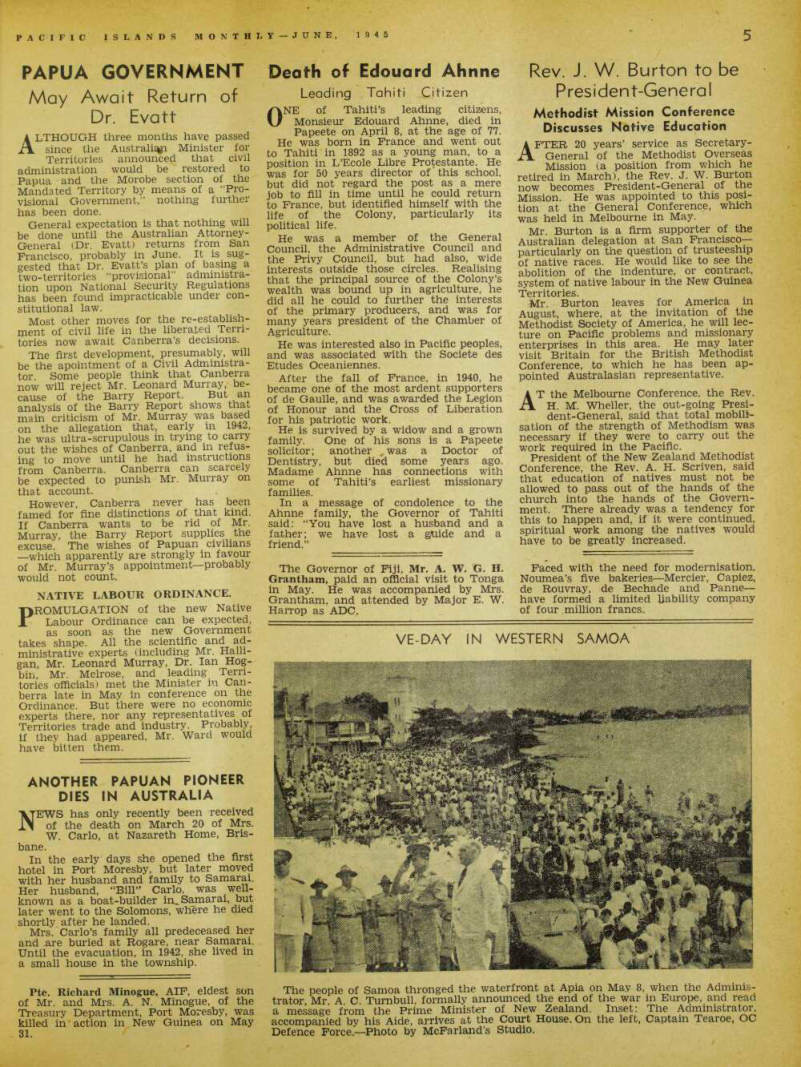
Ve-Day In Western Samoa
The people of Samoa thronged the waterfront at Apia on May 8, when the Adminis trator, Mr. A. C. Turnbull, formally announced the end of the war in Europe, and read a message from the Prime Minister of New Zealand. Inset: The Administrator, accompanied by his Aide, arrives at the Court House. On the left, Captain Tearoe, OC Defence Force. —Photo by McFarland’s Studio.
Advertisements & other items, pp. 8-46 (1 item)
fs-A’rii-** '
ADMINISTRATIVE IMPASSE IN
PAPUA IN JAN.-FEB., 1942
Commissioner Barry's Findings Do Not Seem In Accord With His Own Report
rE long-awaited “Barry Report” was submitted to the Australian Parlia ment early in June. Between December and March, Mr. J. V. Barry, KC, under the authority of a Royal Commission, inquired generally into “all the circumstances relating to the sus pension of the civil administration of the Territory of Papua in February, 1942.”
The particular matters into which Mr.
Barry inquired, and his finding on each, were: (a) Whether the Administrator and/or any members of the Legislative Council and/or any members of the Executive Council of Papua failed in their public duty to safe guard the Territory.
FINDING : Having regard to all the circumstances, the Administrator and the members of the Legislative and Executive Councils did not fail in their public duty to safeguard the Territory, (b) Whether any action taken or omitted to be taken by the Mili tary Commandant of the Bth Military District prior to noon on 14th February, 1942, contributed to any failure on the part of the civil administration of the Terri tory.
FINDING : No action taken or omitted to be taken by the Military Commandant of the Bth Military District prior to noon on 14th February, 1942, contributed to any failure on the part of the civil adminis tration of the Territory. (c) Whether there was adequate co operation between the civil adminis tration and the military authorities in the Territory and if not who was responsible for the absence of such co-operation.
FINDING: For all practical purposes there was adequate co-operation between the civil administration and the militarv authorities up to 23rd January 1942 when the false air-raid alarm occurred at Port Moresby. After 23rd January the state of affairs was such that the only matter of importance upon which there could have been any useful co operation between the two authorities wa . s . the administration and control of iq42 Ve «n a rf a it 1 ? etween 23rd January, 1942, and 6th February, 1942, when the Administrator was informed that the Commonwealth Government had author ised the temporary cessation of civil SSSTSd nnt Pa g Ua ' - the Civil com SotS ot offer ’ m res Pect of the control and management of native affairs, the co-operation with the militarv quired* ltleS WhlCh the circu ™stances re^ THE few People who take the trouble X to read through these 70 close-tvned Pages probably will not agree with fiudmgs of the Commissioner His conclusions appear unrealistic and out of balance with the facts so effectively set out m his admirably-arranged report Our criticism of the Commissioner’-?
fs-A’rii-** '
to official relationships in Port ivt^vq l^ B " th £- fortni ght Prfor to Februa?v 6 y 1942, his report, as a factual recoS ot
what actually occurred in Papua in the three or four weeks after the Japanese seized Rabaul (January 23, 1942), can be accepted as a historical record of extreme value. In piecing the story together, from confused masses of official docu ments, and from the fading memories of innumerable witnesses, he has done an amazingly good job.
Mr. Barry may have doubtful value as a Royal Commissioner—his conclusions are apt to be out of alignment—but if the Commonwealth were to employ him as a war historian, at £5,000 per annum, it would be money well spent.
IN the following summary of events in Papua, compiled directly from Mr.
Barry’s report, we have tried to indicate the material upon which he has based his conclusions; but we have generally ignored the mass of data which he has assembled to show Aus tralia’s lack of military preparation to meet the Japanese invasion. This had a bearing upon the general situation with which Mr. Barry had to deal; but it does not affect the actual administrative posi tion in Papua, with which fhis journal is primarily concerned, and so it is not covered here.
The following shows the course of events in Papua after the attack by Japan, leading to the administrative impasse in February.
WAR CABINET DECISION
DEC. 13, 1941. — Administrator and Com mandant instructed by Australian Government to evacuate all women and children; completed by Dec. 29.
DEC. 29. —Administrator and Com mandant restricted liquor sales.
JAN. 3, 1942. —“Aquitania” (45,000 tons) arrived in Port Moresby with about 5,000 young. untrained, and undisciplined troops, in charge of inexperienced officers.
Confusion on ship, especially regarding stowage of equipment and supplies, quickly reflected in “disorderly and un disciplined conduct” ashore. • JAN. 13, —Administrator reported to Canberra on difficulty of maintaining liaison with Army headquarters, and asked that he be kept informed of developments, so that he might better discharge his responsibilities for civilian life and property.
JAN. 19.—Australian War Cabinet for mally resolves: “Civil administration in all Territories controlled by Australia should be maintained for as long as is necessary and possible. The withdrawal of administrative officers, so long as there is work for them to do, is deprecated.”
This decision, evidently owing to over sight, was not communicated to Adminis trator of Papua.
JAN. 23.—Japs occupied Rabaul. Tro briand Islands bombed.
NATIVES GO BUSH
JAN. 23. — False air alarm sounded in PM at 1.15 p.m., and majority of native labourers went bush, com pletely disorganising all activities in port and town. It was reported (but never proved) that civil government had taken the viewpoint that “war fear was a reasonable cause for desertion by native labourers,” and this created great irri tation and resentment at Army head quarters. Army took control of power house and telephone exchange.
JAN. 23.—Commandant passed on to Administrator recommendation that all civilians be evacuated from Samarai to Australia.
EXTRAORDINARY INCIDENT AT
SAMARAI
JAN. 23-24. — Two series of messages were broadcast from Samarai, one telling sub-stations to stand by continuously, and the other (on 24th) that all stations were immediately to evacuate all Euro peans.
These messages caused much confusion and disorder, especially in Trobriands, and were closely inquired into by Com missioner. No one took responsibility for them. Captain Elliott Smith, ARM at Samarai, said the messages were sent out without authority by Mr. Plowman, AWA operator at Samarai. The Com missioner reported he was satisfied that Mr. Plowman did not send out un authorised messages, nor were they authorised by Mr. Woodward, the RM; and he proceeded: “Captain Elliott Smith at this time held the view that Samarai should be evacuated; on his own version, he felt that Mr. Woodward was apathetic in his manner of dealing with the situation then existing.
“By virtue of the two positions he held, one civil and the other military, Elliott Smith was a person in authority. He admits that he did not make any report that Mr. Plowman had sent the messages without authority, and his account that he reproved Mr. Plowman for doing so is lame and unconvincing, and I do not accept it. I am thus driven to the con clusion that the instructions to Mr. Plow man to send these radios originated with Captain Elliott Smith, and that his version relating to this matter given in evidence is not reliable. . , .
“This message Feb. 24 certainly should not have been sent without the authority of the Government Secretary.
It caused great confusion and led to withdrawals from districts without the knowledge of the civil administration, and was an important factor contributing to the confusion that developed at the end of January and the beginning of February,”
JAN. 24, —Administrator asks Canberra for instructions regarding civilian evacua tion, adding that all Service heads at PM considered this desirable. He was not aware of broadcast from Samarai.
ALL MEN CALLED UP
JAN. 25.—Canberra drafted a reply, agreeing that unnecessary civilians should go, but quoting War Cabinet decision of Jan. 19 regarding necessary personnel. But this reply was not sent, because — JAN. 25.—Australian War Cabinet this day resolved that all able-bodied white males in Papua and NG be called up im mediately for active service. Canberra informed Administrator and Commandant accordingly. Administrator also asked to advise number of unfit civilians who would be allowed to leave the Territory. (Canberra obviously assumed that Administrator knew of resolution of Jan. 19, which modified the call-up. Adminis trator, not knowing of it, took Jan. 25 message literally. This led to incredible confusion.) JAN. 26.—Administrator conferred with Commandant, who indicated he would at once make call-up. Administrator then radioed Canberra that he presumed call up would operate immediately, and point ing out this would mean the closing up of all private industry and of civil * administration (which obviously could not function without personnel). He
(Continued on Page 41)
asked for directions for himself and members of the Executive Council—what should they now do?
JAN. 27.—A1l white men between 18 and 45 called to immediate enrolment by Army headquarters, PM. This made it practically impossible foi* civil adminis tration and industry to carry on. There was much confusion. Civilians bitterly resented the manner in which call-up was carried out by Army,
CALL-UP MODIFIED
JAN. 27 Army, Melbourne, radioed Commandant, PM, that “it was not intended that call-up should mean the end of all industry and civil administration, or that Army should take over essential services.” Confusion now became worse confounded. Army, Melbourne, advised that Area Officer would proceed from Brisbane to conduct the call-up. , . , , JAN. 28—Army, Melbourne, informed by Commandant, PM, that call-up had been completed and no . need to send Area Officer; but Army replied that Area Officer would proceed as arranged.
At this point, where it is indicated that the Commandant had acted, with much speed in making the call-up, which gave him control of Port Moresby, this part of Mr. Barry’s report may be quoted: “In the existing situation, I consider that the Commandant’s opinion (that a stage had been reached when everyone should have been in the Army) had ample foundation and that he was.justi fied in proceeding with the call-up with all possible speed. It was put to the Commandant that two criticisms had been made of his action; the first that he had acted with undue precipitancy, and the second that the call-up had been taken deliberately to close up civilian businesses and the civilian administration.
As to the first criticism, the Commandant said; T cannot accept any charge of un due precipitancy at a time whpn I con sidered an attack on Port Moresby, which would be difficult to deal with, with the forces at my disposal, was practically to be expected at any moment’; and as to the second: T can give you my assurance that no such thought entered my head.’
I accept both these statements. The action was taken from proper motives m accordance with War Cabinet’s decision and, as the military situation demanded, with proper expedition.”
JAN. 28.—Commandant, PM, replying to Army’s communication about mainten ance of civilian services, said “satisfactory arrangements had been made with Administration.” (At the Inquiry, both Administrator and Crown Lqw Officer denied that satisfactory arrangements had been made, and said that message misrepresented the position.) JAN. 28.—Army, Melbourne, repeated to External Territories, Canberra, their message of 27th to Commandant, PM.
JAN. 28.—Administrator informed by Canberra that Army would not take over essential services and that men required for same were exempt from call-up, and civil administration must continue as long as necessary and possible.
JAN. 29.—Commandant, PM, requested Army, Melbourne, to evacuate all un wanted Europeans from Papua. Army replied that men unfit, over-age or not required for essential services might be evacuated immediately.
JAN. 30.—Canberra, after consultation with Army, radioed Administrator: “Have been informed by Army that Commandant has been advised that all European males unfit or over age or not
required for military or essential service may be permitted proceed from Territory.
Army stated also that Commandant has again been informed that the call-up of males is to be on the same basis as in Australia, i.e., essential civilian activities to proceed in the normal way and per sonnel required for such services to be exempted from military service. Have been informed that banks and Works Department have ceased functioning owing to staff having been called up for military service. This is not intended, and it has been made clear to Com-’ mandant by Army that exemptions from military service should be granted to enable administration and other civil activities to function. Suggest you dis cuss with Commandant to clarify position and then advise whether position clear.
Arjny has not yet advised in regard to issue of proclamation by Governor- General.”
COMMANDANT AND “ESSENTIAL
SERVICES ”
JAN. 30. Commandant’s attention directed by Army Minister to mes sage of Jan. 27, and he was “to ensure that essential services were main tained, including civil services under their own control.” .
JAN. 31.— Administrator informed Can berra that Army call-up had created a position almost chaotic, but he would confer with Commandant and try to re trieve position. Government officers called up had been released. Later, Crown Law Officer Bignold formally asked the Commandant for the release of 24 men required by the business houses, so as to carry on. Commandant refused.
JAN. 31.— Commandant reported to Melbourne on call-up: Reported for en rolment, 307; medically unfit, 61; granted leave without pay so that they might engage in essential services, 156; exempted, 11; entered .camp, 79. He said that “nominal rolls of all essential per sonnel had been prepared in conference with the Administrator,” and they were being enlisted, and then granted leave without pay while on essential duties. He considered the position “entirely satis factory.” He again urged the need for evacuating “unwanted Europeans.
ADMINISTRATOR AND COMMANDANT
CLASH
FEB. 1. —Record of conference between- Administrator and Commandant (both attended by officials), shows
that Administrator pointed out that in structions from Army clashed with those he had received from Canberra. He was directed to carry on normal civil activities, and the Commandant disagreed. The
record proceeds:
“The Commandant then said that the time had come for instructions from Canberra to be disregarded; that the Administrator and he could surely run this little place without out side interference.
“The Administrator said that he absolutely refused: that he was bound by his commission and instructions: and so long as he continued to function he would not depart from them.
He said to the Commandant; ‘You, Sir, would not disregard Army instructions as a soldier.’
The General said: ‘That is rather different.’
“The General then refused to release any more men for the carrying on of commerce; and the Administrator said that it left him no alternative to report that, if in consequence the businesses did not open, it was due to the Commandant’s failure to comply with the direction to the Administrator, shown by him to the General. The Commandant was quite agreeable to this.
“Discussion then tviok place about the inter pretation the Commandant put upon the question of compulsorily evacuating males from Papua.
H.H. said, so far as he was concerned, it was purely permissive. Mention was made of Dr.
Strong, who had said he would sooner die where he lived in the bush; and the Administrator asked the General why he was so tender of Dr.
Strong’s welfare. The General replied he was thinking of the four soldiers who would need to carry him. The Administrator said: T don’t believe that will happen—they will be fighting.’
“Some discussion then took place about the seriousness of the local position, if the General’s hope of resistance depended upon 46 Papuan civilians, untrained, and mostly from sedentary occupations. Tl;e General, with some heat, said that undoubtedly that was the position. Some general discussion then ensued.
“The whole conversation was upon a very dignified and restrained level, and with the utmost courtesy. The only time there was any departure was when the General put his head down and said, ‘Bah, these stores,’ when the question of normal business requirements was under discussion.”
FEB. 3. —Port Moresby bombed by Japs.
Most native labourers fled into interior.
Most remaining activities dependant on native labour ceased and coastal shipping
immobilised. Extensive looting by troops began.
CANBERRA MAKES UP ITS MIND
FEB. 4.—Canberra asked Administrator whether civil administration should not now be suspended. Adminis trator, after consulting Departmental heads, replied that circumstances now made it unnecessary and impossible to maintain the administration.
FEB. 4.—Administrator informed that Australian Prime Minister gave instruc tions that civil administration was not to be abandoned until Commonwealth Government gave authority.
FEB. 5. —Mr. Halligan, in Sydney, assured by Mr. Lonergan (New Guinea) and Mr. A. Jewell (both newly-arrived from Papua) that time had come for cessation of civil administration.
FEB. 5. —Second Jap air-raid on PM.
FEB. 6.—Canberra informed Adminis trator that “Government had now author ised temporary cessation of civil govern ment in Papua.” The Chief of the General Staff had reported to the Govern ment as follows: “Civil administrations in Australian Terri tories are unacquainted with the rigors of war and are unprepared to take responsibility for initiating action demanded by necessities ol war unless they are fully covered by precise
documentary authorisation from Canberra to take specific action.
“It is physically impossible for anyone at Canberra to foresee the very many important problems that must arise in Moresby and give the Administrator the ‘cover’ that he obviously desires. The delay in referring to Canberra these many matters (no doubt of major im portance in peace) that become matters of ordinary concern in war, may make all the difference between success and failure of the defence of Moresby.
“It is abundantly clear that the time has now arisen when complete control must be taken over-m Moresby by the Senior Officer of the Fighting Services stationed there, viz., Major- General Morris. The civil administration should continue to function under the general direction of Morns and assist him in every way possible Any other control is likely to hinder arrange ments for the best defence of Moresby.”
FEB. 6.—Administrator accepted urgent
advice of his officers and instructed that a radio be sent to RM’s and ARM’s at mainland dut-stations to release native prisoners, disband native police and Crown servants, and evacuate all Euro
pell officials over 45, ordering those
under 45 to await Army instructions.
The Army later informed Canberra
that the Administrator had lost all con
sol over out-stations; and in September,
1943, General Blarney, reported to the
Minister for the Army that that telegram savoured of panic.” It therefore be
comes important that the Administrator says that he talked with the Commandant by telephone on Feb. 6 or 7, on this
matter, and that the Commandant denies
uny recollection of the conversation.
; The Commissioner, after very lengthy
inquiry, reports there was no evidence of panic; but there was evidence that the Administrator, when he learned later that the Army intended to take over native administration, did not proceed Mth the instruction: and no district officials appear to have received the tele gram.
FEB. 6-10.—A period of confusion and disorder. Most native labourers fled.
About 70 native police remained on dutv —others went bush. a FEB \AT' Radio from Commandant to
Army, Melbourne:
“As soon as civil administration Papua ceases I propose also institute military administration under myself Territory New Guinea remaining to us. Consider essential district officers re maining loyally doing good work various centres should have some head to look to. Will appoint small staff of previous administrative officers for each Territory. Please confirm.”
FEB. 9. Radio from Commandant to
Army:
“Am quite prepared carry on cyvil and native administration under existing ordinances as soon as Murray goes. All arrangements com pleted. Propose enlisting certain civil staff and promote as to warrant rank. Have asked Murray to see about adjustment salaries. May ask you later to consider establishment tem porary commissioned officers on special Papuan Administrative Units to adjust seniority as some Assistant Resident Magistrates are on reserve of officers. Personally consider the sooner the change-over is effected the better for war effort here.”
“ HUMILIATING” TELEGRAM
F eb - 9.—Administrator (who, on Feb. 4 and 6 had asked Canberra, “if with
drawal administration approved,” to
make certain transport and staff dis
positions) received following from Can
berra : “Regulations are being prepared to give effect to the decision for a temporary cessation of the civil government of Papua. . . . Will vest in the Commandant Bth Military District power to give any directions or orders necessary to exist ing circumstances even though such directions or orders inconsistent with existing laws of the Territory. This does not mean that you and other officers of Administration have been in structed to leave your appointments and with draw from the Territory. The effect of the Regulation will be that the Commandant will have supreme control of all Territory affairs and that all persons in Territory including yourself and officers of Administration and members of Executive and Legislative Council are subject to the directions of the Commandant. Whether you or any officer of the Administration will be required to perform duties in the Territory as directed by the Commandant or whether you may leave the Territory will be matters for the decision of the Commandant. Please show this
to and confer with Commandant on above basis and advise results.”
The following comment is made by Commissioner Barry: The Administrator regarded this telegram as being “extremely humiliating.” He gave as his reason for thinking so: firstly, that notification of the withdrawal of the civil administration should have been communicated to him by the Governor-General or the Prime Minister; secondly, that it ill-befitted the status of the representative of the Crown in Papua that a military authority in the Territory should be empowered to order the immediate departure of the members of the civil administration or to compel them to do anything else he thought fit; thirdly, that the text implied that the members of the civil administration were straining to get away from the Territory and from their re sponsibilities; and, fourthly, that he was required by the telegram to show it to the Commandant.
The position in which the Administrator was placed was an unhappy one, but I am unable to agree that the telegram subjected him to humiliation.
I am satisfied that all the officers of the civil administration were ready and willing to dis charge their duties in accordance with the wishes of the Commonwealth Government. Noth ing in the evidence before me justifies any reflection upon the courage of these gentlemen, and T do not consider that the terms of the telegram, which was prepared under the pressure of urgent and unprecedented events, could reasonably be said to bear such a meaning.
ADMINISTRATOR IN DIFFICULT
POSITION
FEB. 9—Administrator was informed by Commandant that “he desired the Administrator, the Judge, and the members of the Executive and Legislative Councils to leave the Territory.”
FEB. 12.—National Security Regulations issued, placing administration of Papua under Army, were issued. The Com mandant then informed the Administrator that, in exercise of these powers, he desired the Administrator, the Judge and the Councillors to leave “at the earliest opportunity.” Administrator radioed Canberra for instructions.
FEB. 13. —Administrator informed Com mandant he would not leave his post without Commonwealth Government in structipns, which had not arrived. He suggested, “with a view to resolving the situation, that the Commandant should place him and his associates under arrest.” “The Commandant,” says the report, “quite properly declined to take this course.” It was late this day before the Administrator learned officially of the passing of the NS Regulations.
FEB. 14. —A very long conciliatory telegram from Senator Fraser, Minister for Territories, is received by Adminis trator. It is explained that Australian Government decided to abandon civil government because of need of centra lised control to deal with special situa tion; because desertion of native labour made it impossible to carry on essential services. Canberra felt thlit there was real work to be done in Papua by ex perienced officials in helping the military administration, particularly in relatioh to native affairs. However, if Administrator and Commandant were agreed that that was the best course, Canberra would not oppose the departure of the Administrator, Judge and Councillors.
FEB. 14. Administrator presented Minister’s message to Commandant.
Latter insisted that Administrator and associates should leave as soon as possible.
The Administrator then issued a Gazette announcing that civil government had ceased temporarily at noon on February 14, and the GCO, Bth Military District, had assumed complete control.
FEB. 15.—Administrator and associates left the Territory by flying-boat.
LOOTING
rENCEFORWARD, in his report, the Commissioner examines other matters which might have a bearing upon the condition of the Territory be
tween December 7 and February 14.
He inquired into looting, and this is his conclusion: “I am satisfied that the looting did not assume large proportions until after the second bombing raid, but thereafter it is undoubted that the theft and destruction of civilian property was general and extensive.
“It must be borne in mind that there was a general belief in Port Moresby, which all the knowledge then available suggested to be well-founded, that the enemy would attack and invade Port Moresby.. If such an attack and invasion had been undertaken by the enemy at that stage it could have had only one outcome. The resources at the disposal of the Commandant were quite madequate to enable any attack in strength to be repelled, and the general feeling was, therefore, that civilian property would either be destroyed by air attack or bombardment or fall into the hands of the enemy. Under such circumstances it is not surprising that respect for private property, particularly where there was any appearance of abandonment, diminished to such an extent as no longer to act as a restraining influence.
“The civil administration was powerless to prevent the looting, and even if it had ™ Vig ° r ’ * C ° Uld “Because of the lack of discipline of the troops under his command and the worthlessness of his insufficient Provost personnel, it was quite impossible for the Commandant, confronted as he was with an extraordinarily difficult and complicated situation, to take any effective steps to prevent the looting. I feel that to consider the Commandant blameworthy in respect of any of the looting that occurred between the first bombings and the departure of the members of the civil administration on 15th February would be to take a completely unrealistic view of the matter. I find that General Morris discharged his duties in this respect as efficiently and satisfactorily as could justly be expected.”
OUT-STATIONS NATIVE
ADMINISTRATION
ABOUT one-third of the long report is devoted to the Commissioner’s inquiries and conclusions regarding events in the many out-stations of the
Territory. As a record of what happened in all these isolated places in the dark days of the Jap invasion, it is invaluable; but it does not contribute much light to the relations between Administrator and Commandant. The inquiry had to be made, of course, because of the "Army’s allegations that the civil administration in the majority of out-stations had broken down, and that administrative conditions were confused and chaotic, The Commissioner’s conclusions are set out in detail, in relation to each out station; and it is worthy of remark that not only was there an absence of con fusion (except in relation to the “un authorised” message from Samarai on January 24), but every Resident Magis trate and Assistant Resident Magistrate, without exception, carried on his duties calmly and properly, without confusion, right up until the moment when he was either ordered away by Port Moresby, or his station was taken over by the Army, There could be no greater testimony to the efficiency and loyalty of the administrative service. It is to be re gretted that the Commissioner, making somewhat acid comment upon so many aspects of the Administrator’s activities, had little to say about this all-important section of the Papuan Government.
MR • MURRAY AND NATIVE AFFAIRS
/COMMISSIONER BARRY’S hardest
criticism of the Administrator is contained in paragraph 179, in which he makes the astonishing allegation that Mr. Murray appeared indifferent to the welfare of the native inhabitants, in the crisis which had arisen. He pro ceeds: “It was among the foremost duties of the civil administration to protect the native inhabitants of the Territory and consult their welfare, and over the years the natives had been taught to rely con fidently upon the administration and to respect its authority. Yet in none of his communications with the authorities in Australia during the period under examination did the Administrator advert to the consequences which would result to the natives from the withdrawal of the white administration officers from the Divisions in which they maintained law and order, and such native welfare services as had been instituted. . . .
“Both on 4th February, when the
decision was taken that it was no longer necessary nor possible for the civil administration to continue, and on 6th, when he decided the telegram to the Magistrates should be sent, the Adminis trator was not aware that any measures would be taken to meet native needs, and the decision necessarily involved that, so far as the civil administration was con cerned, the natives would have been left in a time of crisis without the guidance and protection to which they had become accustomed and for which they were entitled to look.”
There is nothing in the report to really support these statements. Because, in those very difficult and confused days be tween January 24 and February 12 (while the Administrator could not get any clear
instruction of whether his civil adminis tration was to continue or not), the Administrator did not carry a native administration plan to the Commandant, the Commissioner makes an assumption that amounts to a very grave change.
The Commissioner ignores the obvious fact that the Administrator believed he was being hunted out of the Territory by a military set-up which had no interest in or sympathy with native administra tion. Appeals to Canberra seemed use less..
Only three pages further on, (Mr. Barry quotes a famous authority to the effect that, in such a position as arose in Papua, it is the duty of the military authority to keep the civil authority fully informed of the military situation, and to be precise and definite in stating require ments. The PM Commandant clearly did neither of these things. If there was fault, it lay as much with the Com mandant as with the Administrator.
To bring such a charge against a mem ber of the Murray family, whose native administration in Papua made Australia famous, and whose policy has been re peatedly criticised and attacked as carry ing care of natives to extremes, is manifestly absurd.
“CANBERRA RULE ,}
WE, who so often have criticised “Can berra rule” over the' Territories, whose administrative officers were bound hand and foot by petty Australian bureaucrats—we have read this section of the report with appreciation; “The administration was staffed by conscientious officers, but the system was such that reference to Canberra was regarded as essential before any decision of real gravity was taken. Whether the true intention of Section 12 of the Papua Act . . . required or even justified such a system, need not be discussed, for even with this system of constant reference the importance of New Guinea and the obligations of the Commonwealth in re spect of the Territories do not seem to have received proper recognition by the Commonwealth.
“The Department of External Terri tories was not created until June, 1941; previously the work proper to such a Department had been entrusted to a section which, over the years, found itself attached to various Departments, usually under an Assistant Minister.
“At the relevant period, although there was a Minister for External Territories and the separate Department had
been * established, the secretaryship was held by the Secretary of the Prime Minister’s Department, and many of the facilities of this latter Department had still to be used by the new Department of External Territories and, in point of fact, are still being so used.
“It is no over-statement to say that until the geographical existence of New Guinea was forced upon Australians by the grim possibility of imminent invasion, the Territories were considered as areas so remote from Australian life that they rarely entered into political consideration.
“In the circumstances, the achievements of the Papuan administration had been remarkable. The area of the Territory is 90,540 square miles, inhabitated by about 350,000 natives. Superintendence of their affairs and the discharge of the Commonwealth’s obligations to them, as well as the development of the Territory, had to be performed by an administrative personnel of about 170. From a revenue which at its peak was less than £190,000, to which the Commonwealth contributed a meagre £42,500, all the expenses of the Territory had to be met.
“It is not a matter for wonderment if these straitened financial resources and the remoteness of the Territory from Australian affairs should have produced a limited outlook. The Administrator and the senior members of the adminis tration were men of high ideals and un doubted personal integrity, but the years of apathy on the part of the Common wealth, and the pattern of life in the Territory, inevitably had an effect which revealed itself when Port Moresby be came the front line of Australian defence.
“Reading the communications that passed between the Administrator and the authorities at Canberra, it is im possible to escape a feeling that an Administrator who felt it necessary to refer as constantly for instructions could never cope with the unprecedented situation which developed with bewilder ing rapidity in January and February, 1942.
“The enemy moved south with a swift ness that was appalling; all the concep tions upon which Australia’s confidence of immunity from invasion rested were falsified in a matter of days.
“I think it too harsh a criticism of the Administrator to say, as did the Chief of the General Staff in a.minute which was incorporated in War Cabinet Agendum, sth February, 1942, that'he was ‘appar ently . . . unwilling to assume the re sponsibilities which ' devolved upon him,’ but there is substance in the view that his training and experience made him unsuited for the arduous role thrust upon him. Such a situation had never been foreseen and no plans existed to which he could conform.
“Mr, Halligan, at the relevant time the senior Departmental officer of the Depart ment of External Territories, who must be taken to have full knowledge of the matter was asked: “To your knowledge, was any plan ever drawn up for co ordinating the activities of the civil government and the Military Command in the event of any enemy activity in Papua?’ and he answered: ‘Not that I know of.’ Lieut.-Colonel Lonergan, for merly Assistant Government Secretary in the administration of the Territory of New Guinea, gave evidence to the same effect.”
Sir Oosmo Parkinson, who is to visit Fiji and the Western Pacific High Com mission as a personal representative of the Secretary of State for the Colonies, is expected to reach Suva soon. He will re main in Fiji and the South Pacific for over a month.
Transpacific Air
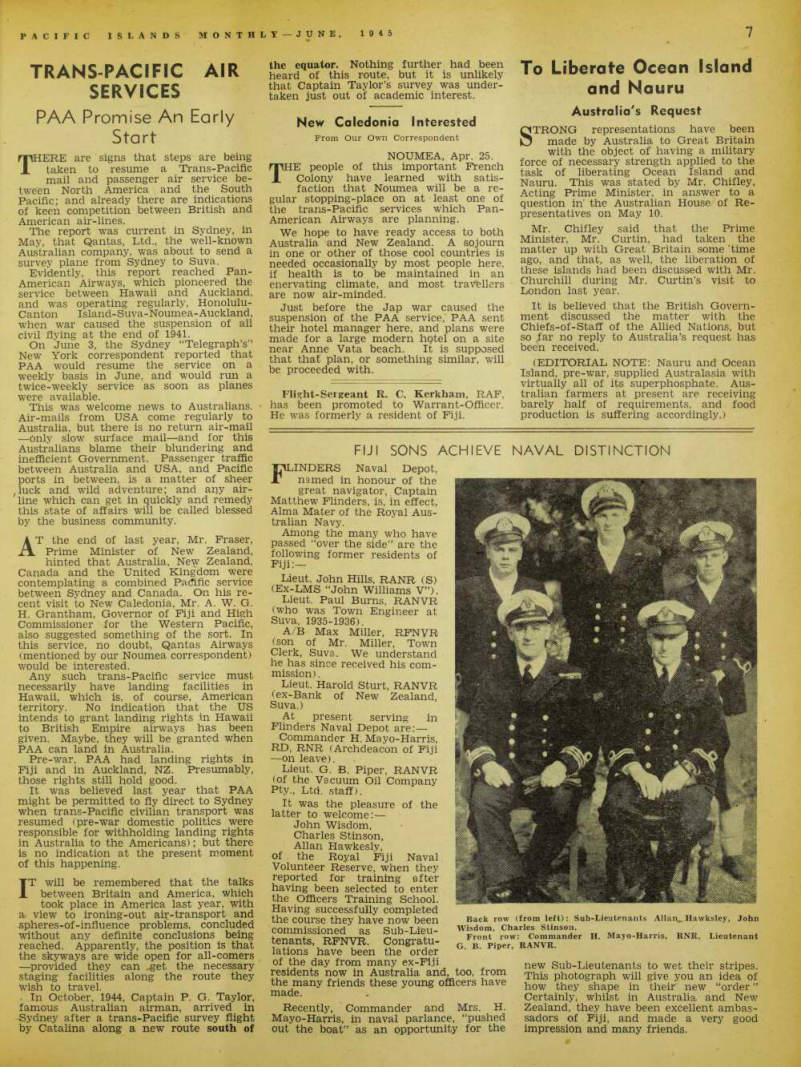
Services
PAA Promise An Early Start
rERE are signs that steps are being taken to resume a Trans-Pacific mail and passenger air service be tween North America and the South Pacific; and already there are indications of keen competition between British and American air-lines.
The report was current in Sydney, in May, that Qantas, Ltd., the well-known Australian company, was about to send a survey plane from Sydney to Suva.
Evidently, this report reached Pan- American Airways, which pioneered the service between Hawaii and Auckland, and was operating regularly, Honolulu- Canton Island-Suva-Noumea-Auckland, when war caused the suspension of all civil flying at the end of 1941.
On June 3, the Sydney “Telegraph’s”
New York correspondent reported that PAA would resume the service on a weekly basis in June, and would run a twice-weekly service as soon as planes were available.
This was welcome news to Australians.
Air-mails from USA come regularly to Australia, but there is no return air-mail —Only slow surface mail —and for this Australians blame their blundering and inefficient Government. Passenger traffic between Australia and USA, and Pacific ports in between, is a matter of sheer ,luck and wild adventure; and apy air line which can get in quickly and remedy this state of affairs will be called blessed by the business community.
AT the end of last year, Mr. Fraser, Prime Minister of New Zealand, hinted that Australia, New Zealand, Canada and the United Kingdom were contemplating a combined Padific service between Sydney and Canada. On his re cent visit to New Caledonia, Mr. A. W. G.
H. Grantham, Governor of Fiji and High Commissioner for the Western Pacific, also suggested something of the sort. In this service, no doubt, Qantas Airways (mentioned by our Noumea correspondent) would be interested.
Any such trans-Pacific service must necessarily have landing facilities in Hawaii, which is, of course, American territory. No indication that the US intends to grant landing rights in Hawaii to British Empire airways has been given. Maybe, they will be granted when PAA can land in Australia.
Pre-war, PAA had landing rights in Fiji and in Auckland, NZ. Presumably, those rights still hold good.
It was believed last year that PAA might be permitted to fly direct to Sydney when trans-Pacific civilian transport was resumed (pre-war domestic politics were responsible for withholding landing rights in Australia to the Americans); but there is no indication at the present moment of this happening.
IT will be remembered that the talks between Britain and America, which took place in America last year, with a view to ironing-out ait-transport and spheres-of-influence problems, concluded without any definite conclusions being reached. Apparently, the position is that the skyways are wide open for all-comers —provided they can .get the necessary staging facilities along the route they wish to travel.
In October, 1944, Captain P. G. Taylor, famous Australian airman, arrived in Sydney after a trans-Pacific survey flight by Catalina along a new route south of
the equator. Nothing further had been heard of this route, but it is unlikely that Captain Taylor’s survey was under taken just out of academic interest.
New Caledonia Interested
From Our Own Correspondent
Noumea, Apr. 25.
rpHE people of this important French X Colony have learned with satis faction that Noumea will be a re gular stopping-place on at least one of the trans-Pacific services which Pan- American Airways are planning.
We hope to have ready access to both Australia and New Zealand. A sojourn in one or other of those cool countries is needed occasionally by most people here, if health is to be maintained in an enervating climate, and most travellers are now air-minded.
Just before the Jap war caused the suspension of the PAA service, PAA sent their hotel manager here, and plans were made for a large modern hgtel on a site near Anne Vata beach. It is supposed that that plan, or something similar, will be proceeded with.
Flight-Sergeant R. C. Kerkham, RAF, has been promoted to Warrant-Officer.
He was formerly a resident of Fiji.
To Liberate Ocean Island
and Nauru Australia's Request
STRONG representations have been
made by Australia to Great Britain with the object of having a military force of necessary strength applied to the task of liberating Ocean Island and Nauru. This was stated by Mr. Chifley, Acting Prime Minister, in answer to a question in' the Australian House of Re presentatives on May 10.
Mr. Chifley said that the Prime Minister, Mr. Curtin, had taken the matter up with Great Britain some 'time ago, and that, as well, the liberation of these islands had been discussed with Mr.
Churchill during Mr. Curtin’s visit to London last year.
It is believed that the British Govern ment discussed the matter with the Chiefs-of-Staff of the Allied Nations, but so far no reply to Australia’s request has been received. (EDITORIAL NOTE: Nauru and Ocean Island, pre-war, supplied Australasia with virtually all of its superphosphate, Aus tralian farmers at present are receiving barely half of requirements, and food production is suffering accordingly.)
Fiji Sons Achieve Naval Distinction
FINDERS Naval Depot, named in honour of the great navigator, Captain Matthew Flinders, is, in effect, Alma Mater of the Royal Aus tralian Navy.
Among the many who have passed “over the side” are the following former residents of Fiji:— Lieut. John Hills, RANR (S) (Ex-LMS “John Williams V”).
Lieut. Paul Burns, RANVR (who was Town Engineer at Suva, 1935-1936).
A/B Max Miller, RPNVR (son of Mr. Miller, Town Clerk, Suva. We understand he has since received his com mission).
Lieut. Harold Sturt, RANVR (ex-Bank of New Zealand, Suva.) At present serving in Flinders Naval Depot are:— Commander H. Mayo-Harris, RD, RNR (Archdeacon of Fiji —on leave).
Lieut. G. B. Piper, RANVR (of the Vacuum Oil Company Pty., Ltd. staff).
It was the pleasure of the latter to welcome:— John Wisdom.
Charles Stinson, Allan Hawkesly, of the Royal Fiji Naval Volunteer Reserve, when they reported for training after having been selected to enter the Officers Training School.
Having successfully completed the course they have now been commissioned as Sub-Lieu tenants, RFNVR. Congratu lations have been the order of the day from many ex-Fiji
residents now in Australia and, too, from the many friends these young officers have maae - * Recently, Commander and Mrs. H.
Mayo-Harris, in naval parlance, “pushed out the boat” as an opportunity for the
new Sub-Lieutenants to wet their stripes, This photograph will give you an Idea of how they sh £ pe in I hei / new ‘-order”
Certainly, whilst in Australia and New Zealand, they have been excellent ambas sadors of Fiji, and made a very good impression and many friends.
Back row (from left): Sub-Lieutenants Allan Hawksley, John Wisdom, Charles Stinson.
Front row: Commander H. Mayo-Harris, RNR, Lieutenant G. B. Piper, RANVR.
the Newspapers
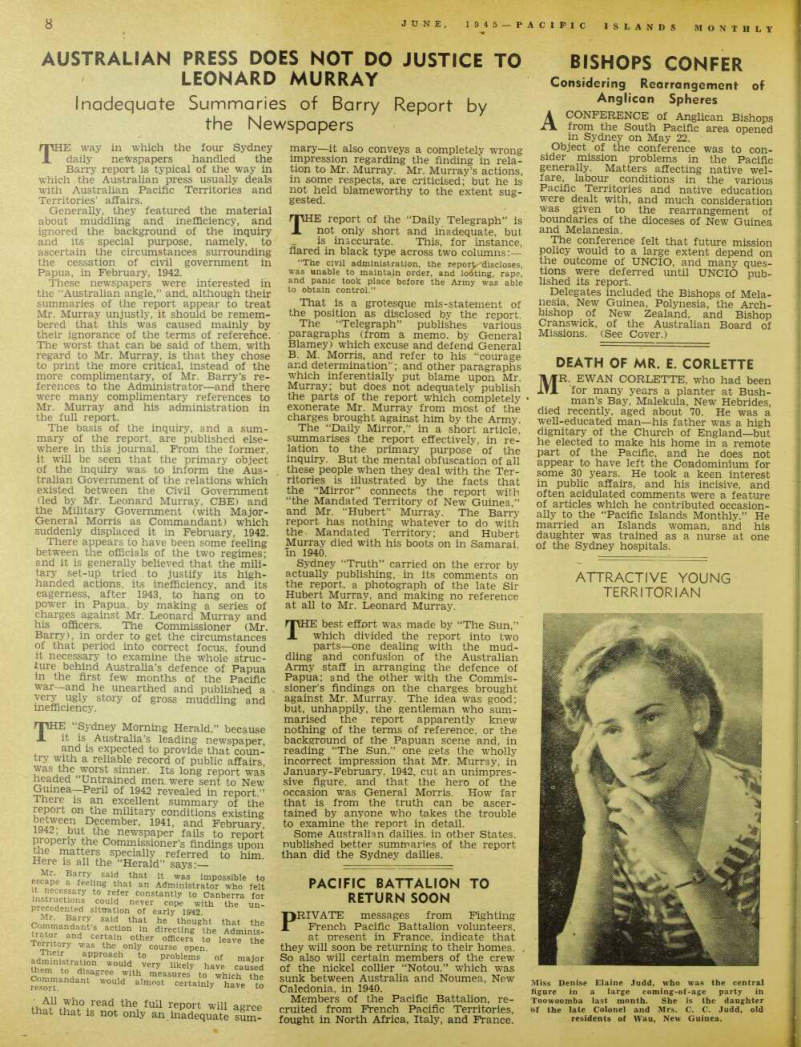
AUSTRALIAN PRESS DOES NOT DO JUSTICE TO
Leonard Murray
Inadequate Summaries of Barry Report by the Newspapers
rE way in which the four Sydney daily newspapers handled the Barry report is typical of the way in which the Australian press usually deals with Australian Pacific Territories and Territories’ affairs.
Generally, they featured the material about muddling and inefficiency, and ignored the background of the inquiry and its special purpose, namely, to ascertain the circumstances surrounding the cessation of civil government in Papua, in February, 1942.
These newspapers were interested in the “Australian angle,” and, although their summaries of the report appear to treat Mr. Murray unjustly, it should be remem bered that this was caused mainly by their ignorance of the terms of reference.
The worst that can be said of them, with regard to Mr. Murray, is that they chose to print the more critical, instead of the more complimentary, of Mr. Barry’s re ferences to the Administrator—and there were many complimentary references to Mr. Murray and his administration in the full report.
The basis of the inquiry, and a sum mary of the report, are published else where in this journal. From the former, it will be seen that the primary object of the inquiry was to inform the Aus tralian Government of the relations which existed between the Civil Government (led by Mr. Leonard Murray, CBE) and the Military Government (with Major- General Morris as Commandant) which suddenly displaced it in February, 1942.
There appears to have been some feeling between the officials of the two regimes; and it is generally believed that the mili tary set-up tried to justify its high handed actions, its inefficiency, and its eagerness, after 1943, to hang on to power in Papua, by making a series of charges against Mr. Leonard Murray and his officers. The Commissioner (Mr.
Barry), in order to get the circumstances of that period into correct focus, found it necessary to examine the whole struc ture behind Australia’s defence of Papua in the first few months of the Pacific war—and he unearthed and published a very ugly story of gross muddling and inefficiency. rE “Sydney Morning Herald,” because it is Australia’s leading newspaper, and is expected to provide that coun try with a reliable record of public affairs was the worst sinner. Its long report was headed “Untrained men were sent to New Guinea—Peril of 1942 revealed in report.”
There is an excellent summary of the report on the military conditions existing betw e en December, 1941, and February, 1942; but the newspaper fails to report properly the Commissioner’s findings upon the matters specially referred to him Here is all the “Herald” says:— esran'p that ifc WaS to a feel * ng that an Administrator who felt it necessary to refer constantly to Canberra for instructions could never cope with the un precedented sittration of early 19'42 Mr. Barry said that he thought that the ?r°aToT and nt r S prf Ctlon fl n directing the Adminis and cer tam other officers to leave the Territory was the only course open. approach to problems of major administration would very likely have caused them to disagree with measures to which tSe I?s?rT andant W ° Uld alm ° St cei ’tainly have * to tv^ h ° read the fuU report will agree that that is not only an inadequate sum
mary—it also conveys a completely wrong impression regarding the finding in rela tion to Mr. Murray. Mr. Murray’s actions, in some respects, are criticised: but he is not held blameworthy to the extent sug gested. rE report of the “Daily Telegraph” is not only short and inadequate, but is inaccurate. This, for instance, flared in black type across two columns: — “The civil administration, the was unable to maintain order, and looting, rape, and panic took place before the Army was able to obtain control.”
That is a grotesque mis-statement of the position as disclosed by the report.
The “Telegraph” publishes various paragraphs (from a memo, by General Blarney) which excuse and defend General B. M. Morris, and refer to his “courage and determination”; and other paragraphs which inferentially put blame upon Mr.
Murray: but does not adequately publish the parts of the report which completely exonerate Mr. Murray from most of the charges brought against him by the Army.
The “Daily Mirror,” in a short article, summarises the report effectively, in re lation to the primary purpose of the inquiry. But the mental obfuscation of all these people when they deal with the Ter ritories is illustrated by the facts that the “Mirror” connects the report with “the Mandated Territory of New Guinea,” and Mr. “Hubert” Murray. The Barry report has nothing whatever to do with the Mandated Territory; and Hubert Murray died with his boots on in Samarai In 1940.
Sydney “Truth” carried on the error by actually publishing, in its comments on the report, a photograph of the late Sir Hubert Murray, and making no reference at all to Mr. Leonard Murray. rE best effort was made by “The Sun,” which divided the report into two parts—one dealing with the mud dling and confusion of the Australian Army staff in arranging the defence of Papua; and the other with the Commis sioner’s findings on the charges brought against Mr. Murray. The idea was good; but, unhappily, the gentleman who sum marised the report apparently knew nothing of the terms of reference, or the background of the Papuan scene and, in reading “The Sun,” one gets the wholly incorrect impression that Mr. Murray, in January-February, 1942, cut an unimpres sive figure, and that the hero of the occasion was General Morris. How far that is from the truth can be ascer tained by anyone who takes the trouble to examine the report in detail.
Some Australian dailies, in other States, published better summaries of the report than did the Sydney dailies.
Pacific Battalion To
Return Soon
PRIVATE messages from Fighting French Pacific Battalion volunteers, at present in France, indicate that they will soon be returning to their homes.
So also will certain members of the crew of the nickel collier “Notou.” which was sunk between Australia and Noumea, New Caledonia, in 1940.
Members of the Pacific Battalion, re cruited from French Pacific Territories, fought in North Africa, Italy, and France.
Bishops Confer
Considering Rearrangement of Anglican Spheres
A CONFERENCE of Anglican Bishops from the South Pacific area opened in Sydney on May 22.
Object of the conference was to con sider mission problems in the Pacific generally. Matters affecting native wel fare, labour conditions in the various Pacific Territories and native education were dealt with, and much consideration was given to the rearrangement of boundaries of the dioceses of New Guinea and Melanesia.
The conference felt that future mission policy would to a large extent depend on the outcome of UNCIO, and many ques tions were deferred until UNCIO pub lished its report.
Delegates included the Bishops of Mela nesia, New Guinea, Polynesia, the Arch bishop of New Zealand, and Bishop Cranswick, of the Australian Board of Missions. (See Cover.)
Death Of Mr. E. Corlette
Mr, EWAN CORLETTE, who had been for many years a planter at Bush man’s Bay, Malekula, New Hebrides, died recently, aged about 70. He was a well-educated man—his father was a high dignitary of the Church of England—but he elected to make his home in a remote part of the Pacific, and he does not appear to have left the Condominium for some 30 years. He took a keen interest in public affairs, and his incisive, and often acidulated comments were a feature of articles which he contributed occasion ally to the “Pacific Islands Monthly.” He married an Islands woman, and his daughter was trained as a nurse at one of the Sydney hospitals.
Attractive Young
Territorian
Miss Denise Elaine Judd, who was the central figure in a large coming-of-age party in Toowoomba last month. She is the daughter of the late Colonel and Mrs. C. C. Judd, old residents of Wau, New Guinea.
Tropicalities
'THE “Sydney Morning Herald”
Washington correspondent, A. D.
Rothman, writing in the “Herald” of
June 2, on personal recollections of the late President Roosevelt, tells this
story of Canton Island, the Anglo-
American Condominium, half way between Noumea and Honolulu. The Gilbert and Ellice Islands Colony supplies the British officials to Canton —that is, British administration is in the hands of the High Commission
for the Western Pacific.
117 HEN the US Army cartographers W presented Roosevelt and Churchill with giant-size globes, the President displayed his on his desk and twirled it with evident pleasure when journalists commented on its size.
After a conference, I, with several colleagues, went up to examine the sphere, and as I approached it, I observed, “Mr. President, it seems that all the continents on this globe are in a non commital yellow colour. From my school days I have been accustomed to see all British Territories on the maps in red.”
“Oh, you know,” the President said quickly, with a twinkle in his eye, “it is all ‘one world’ now; we are together everywhere; take Canton Island, for in stance ** “Maybe,” I said, “but I am told the British Resident on Canton keeps.pretty well to himself. Britishers coming in on air-liners go down to see him and he tells them he never visits the hotel which is operated by Americans, contenting him self with running up the Union Jack in front of the Residency in the morning and taking it down in the evening. He says he never goes near the hotel.”
Quick as a flash the President said, “Until the beer boat comes in!” * DEEP sea cruising is an unpredictable pastime. When the schooner “Cimba” left Suva for Auckland recently, it was estimated that the trip would take two weeks. For the greater part of the voyage, “CimbV’ battled into head winds and reached Auckland on May 12, twenty-four days out from Fiji.
At one stage of the proceedings, the crew—consisting of Mr. G. F. Russell (owner-skipper), Mr. J. Malloy and Mr.
Frank Beddoes, all of them Fiji residents —found themselves nearer to Norfolk Island than to New Zealand.
During the twelve-day stretch that the schooner was held on the port tack, every article of clothing the crew possessed became saturated, the small cabin was more or less a-wash, and meals could be prepared only at odd times and eaten on-the-wing. Every member of the party had several near-misses from being washed overboard.
In short, it was a typical trans-oceanic pleasure cruise. Adventure? Sure, sure.
And one way of beating the travel ban — for those with the necessary cast-iron gizzards. But sufficient to make the average land-lubber ill in prospect. * AND now, in honour of the “Cimba” party, we reprint a poem from London “Punch.” The poet thinks that when all else fails a spot of ocean cruising, per small ship, is the way to educate our erring Hun.
“Cimba's” crew should appreciate it; it is called “Channel Crossing,” and here it
Into the lumping, thumping seas we go, Two hundred stinking prisoners below, The hatches fastened, and the Master Race Still not contented with their living space.
But here the Herrenvolk can raise no roar, And SS stands for “sea-sick”—nothing more.
“There are no islands . . was the Fuehrer's vow.
Poor brutes, they know that there are islands now.
This boundless turbulence through which they crawl, This is the Channel they believed so small; This heaving wilderness in which they toss They thought to conquer and were keen to cross.
Maybe, when every other hppe is done, This is the way to educate the Hun— Send every Prussian for a lengthy trip, In heavy weather, in a little ship. * rE wai*has taken away our chief form of amusement window-shopping.
Vicarious shopping - pleasure, no doubt; but that still is the best way to describe it.
We of isolated Mangaia used, in pre war days, to have a good time thinking what a good time we’d have if we were having it.
Mail-order catalogues were the medium of imaginary orgies of spending—Fryte’s of Bristol, Sayers-Sawbuck’s of New York, Montague-Shard’s of Chicago, etc., etc.
All full of lovely things (—and cheap!).
Now, we never see a catalogue. The firms concerned have succumbed to im port-export licences, war-created short ages, depressed NZ currency (£l=l2/6), lack of shipping facilities, and such sad evidences that civilisation is a failure.
The first act of the Peace Conference must be the restoration of the NZ pound to 20/-, plus the return of mail-ordering.
Or else, we haven’t won.—E.G.
PLANTER readers will be interested in a Sydney “Bulletin” paragraph con cerning a Mr. H. W. Simmons, of the Waite Institute of Adelaide University, who will shortly leave for West Africa.
It is stated that he has been commis sioned by the administration of Samoa (the writer neglected to mention whether it was Western or Eastern Samoa) to collect from Zanzibar or thereabouts, a particular species of wasp to deal with the rhinoceros beetle which is doing damage to coconut plantations.
The wasp in question is reputed to be death to the pest that has given grey hairs to more than one South Pacific planter. * ALSO from “Bulletin” is the controversy raging between readers as to just how long R. L. Stevenson was ill and how many Europeans were present at his burial on the mountain behind Vailima, Western Samoa.
One correspondent, “Fodgie,” clinches the matter by quoting from Moors’ “With Stevenson in Samoa” (Moors was the father-in-law of the late O. F. Nelson) who states that 19 Europeans and 60 Samoans were present. Stevenson, ac cording to Moors (and “Fodgie”) had no last long illness, but was making a salad when he had a haemorrhage of the brain and died within three hours.
“The Road of Gratitude” or “The Road of the Loving Heart” was not from Vailima to the tomb either, but from the main road from Apia to Vailima. It was made by Samoans who for political reasons had been kept in prison and whom Stevenson had fed (see “Vailima Papers”). The Samoans asked that while making it they should not be given food other than what their women brought them, so that the work would be a real “alofa” or labour of love. * rE story goes that an American Army officer in Noumea was given the pleasant job of escorting a USO girl on a sight-seeing expedition round the town. He did not let on that his know ledge of French was rudimentary, and was getting on famously when they reached the big statute in the public gardens in Coconut Square.
Suddenly the girl scanned the inscrip tion at its base, below the relief showing
the submission of the natives after the rebellion of 1878, and trustingly asked him, “What’s it say there?”
“This way to the PX,” translated the officer without batting an eyelid.
He was right, not about the translation, but about the direction towards which the immortal French hero i§ pointing.
The hero in question is Admiral Olry, one of the most esteemed Governors New Caledonia has ever had—it is a pity the Colony can’t find one like him to-day.
When the Minister for Colonies in Paris refused to confirm the Admiral’s grant of 100,00 francs to the settlers ruined by the revolt and subsequent cyclones, Olry sent him his own personal cheque on his private bank, along with a brief but sarcastic note.
The Minister had the decency to tear the cheque up, but that did not lessen the affection which the Governor had won by his gesture. The colonists were saddened by his speedy recall, for it does not do for a Caledonian Governor to be come too popular, and on his departure presented him with a silver lyre-bird, purchased in Sydney and suitably in scribed.—HELP.
(Editorial Note: Help Does Hot
explain what a “PX” is. Presumably it is American for canteen, or post office.)
Advertisements & other items, pp. 11-12 (1 item)
Pacific Territories Association
The Third Annual General Meeting of members will be held on Tuesday, 26th June, 1945, at the Teachers’ Federation Hall, 7th Floor, 166 Phillip Street, Sydney, at 8 p.m.
BUSINESS :
(1) To receive the Report of the Executive on the year’s activities. (2) To receive the Financial Statements and Auditors’ Report for the year ended 31/5/45. (3) Election of office-bearers for the ensuing twelve months.
Nominations for the following office-bearers must be in the hands of the Secretary at least seven (7) clear days before the meeting:— President • Vice-president Treasurer Auditor Eight (8) Executive members consisting of: — 2 Commercial Representatives 2 Planters’ „ 2 Mining 2 Civil Service (being one each for Papua and the Territory of New Guinea.)
C. A. M. ADELSKOLD,
Secretary.
INFORMATION WANTED
'THE New Guinea trading firm of Greenwood & Laws, Ltd., lost all its records in the invasion of, and subsequent evacuation from, New Guinea. The directors are anxious, therefore, to obtain names of all shareholders and any relevant information which would help the firm compile new records. This information should be forwarded to Mr. R. A. Laws, No. 2, '‘Devon,” 211 Military Road, Mosman, NSW.
POSITION VACANT
COMMONWEALTH OF AUSTRALIA.
PAPUA—NEW GUINEA.
PRODUCTION CONTROL BOARD.
Applications are invited from persons desirous of being considered for appointment as Deputy Chairman of the Australian New Guinea Production Control Board which deals with the disposal of copra, rubber and other products, and the provision of stores for plantations and for native trade in the Territories of Papua and New Guinea. The functions of the Deputy Chairman are those of general manager of the organisation.
Appointment will be at a salary of between £750 and £l,OOO per annum according to qualifications and experience, and will be subject to three months notice bn either side. The appointee will be stationed in Papua or New Guinea.
Applications, giving full particulars as t 0 9 uallfica ti° ns and experience stating whether married or single' should reach the Secretary, Department of External Territories, Can- Sms ’ later than 30th
Study of the Pacific Advocated by Prominent
American
Mr- Martin T. Johnson, Who
was, until recently, American Minister to Australia, and who has now returned to the States on long leave, advocates the establishment of study schools in Australia for all
aspects of Pacific affairs.
The following article, explaining
Mr. Johnson's ideas, is by D. G.
McFarlane, special correspondent for
the Melbourne “Herald,” who travelled to America on the same ship, and to whom Mr. Johnson spoke freely.
MR. JOHNSON told me that on leaving Australia he wrote to Mr. W. H Hughes, MHR, and Mr. Harold Darling, chairman of directors of Broken Hill Pty., Ltd., outlining his ideas for Pacific studies in Australia.
This research, he said, could never be conducted in the United States, which faced both ways, the Atlantic and the Pacific. Except for special courses in some institutions, there were few oppor tunities for such study.
“As the only Occidental people whose lives and fortunes are irrevocably com mitted to the Pacific area,” Mr. Johnson said, “Australia should make all aspects of the Pacific—the peoples and the re sources, its past and future—a field for its- scholarship.
“Australian scholarships should possess this field so thoroughly and intimately that the scholars of all the world will wear a path to Australia.
“No aspect of the Pacific should be neglected—the ocean, its currents, winds, weather, climates, fisheries, ocean bird life, the adjacent peoples, philosophies, customs, political organisations, resources, lands within and bordering the Pacific, literature, arts and sciences.
“Naturally the scholarships should centre in the Universities and schools, but wealthy Australians, the Chambers of Commerce, and the Governments should subsidise the scholarships by en dowing chairs and establishing trust funds and travelling scholarships for promising young scientists, newspaper men, and business men, enabling them to visit all parts of the Pacific.
“The products of their research should become the property of the Universities and other endorsing institutions, and thus the nation’s public property.
“Australian statesmen, business men, primary and secondary industrialists, and political leaders would then possess the best, the most thorough, and the most up-to-date information upon which to plan Australia’s future.
“To no other people is such information more vital. This would give a great goal to Australian Scholarship and take away from education the idea that it is merely the means to attain a livelihood.
“TT would create for Australian scholar- X ship an exclusive and congenial environment in which to develop a prestige entirely Australian and keep men of parts at home.
“Concurrently with such a project I see a wonderful opportunity for Australian publishers to re-print books like ‘Cook’s Voyages’ and other writings on early Aus tralian exploration not generally avail able now.”
Mr. Johnson’s parting gift from col leagues at the American Legation in Canberra was an old edition of “Cook’s Voyages,” which he read with enjoyment on the ship. In 42 months in Australia, Mr. Johnson read Australian literature
widely—more, probably, than many re presentative Australians—and brought many works with him.
Bougainville Missionary
Reported Alive And Well
In Japan
WORD has been received by Mrs. D. C.
Alley, at present living in New Zealand, that her husband, the Rev.
D. C. Alley, has been reported a prisoner of war in Tokio. He is believed to be in good health.
Mr, Alley was a Methodist missionary at Teop in Northern Bougainville, and was captured by the Japanese in March, 1942 This is the first news of him that has been received since that date.
It is stated that two European women, owners of plantations in the area, were at the mission station at the time of Mr Alley’s capture. The Japanese com mander allowed him U hours to pack his clothes and give directions to the native staff before he was taken away. The women were permitted to remain on the island and were later rescued by the Americans.
A well-known figure in the Police Force in Fiji, Sgt-Major Jack Sajada, died recently at the age of 46. He had been 21 years in the Police Force and last year was awarded the Police and Fire Brigades Long Service Medal.
Two men were killedvand two injured in Fiji on May 8, when two motor vehicles collided on the road between Lautoka and Nadi. Those killed were: Mr. John Powell, a Mosquito Control overseer, stationed at Nadi; and Mr. Ned, Heritage, of the 4th Fijian Battalion, Both men were well known in the Colony. The injured men were: Mr. William Heritage and a Tongan, Sam Hopoi.
Fiji Boy In Nz Navy
Sub/Lieut. C. Ward, elder son of Mr. and Mrs.
F. Ward, of Lautoka, Fiji, who is at present serving overseas with the RNZNVR. Sub/Lieut.
Ward is an old boy of the Boys’ Grammar School, Suva, and the New Plymouth Boys’ High School, in New Zealand.
Tourists Caused Loss of "Face"
"Face"
Position of Europeans in the Pacific
From Our Own Correspondent
Papeete, Mar. 20.
A COMPANY of us who have read and studied Mr. Quaritch Wales’s book “Years of Blindness,” are so much impressed with it that we believe it should be perused by every student of Oriental affairs.
The work is not one of those noisy, muck-raking, opinionated volumes which have been pouring from the press during the past years; but a quiet, thoughtful account of things as they are, by a scholarly Englishman who has lived the major part of his life in Oriental coun tries.
The average Europeatn has not the smallest conception of .how the white man has lost “facte” during the past twenty years, although it is evident enough, here in the islands, to anyone who has eyes to see, and ears to hear.
Mr. Quaritch Wales tells us how it has come about in Malaya, Siam, Indonesia and India—and why.
It is remarkable how the attitude of Europeans (especially of the female of the species) toward the South Sea Islands has changed. With the exception of a few of us who have lived here so long that our roots are deeply established, every white man and woman we know is eager to get away—to anywhere fhat is not another South Sea Island.
The white man’s loss of “face” in the islands is mild compared with that which has befallen him in the Orient.
Those countries, with their hundreds of millions inhabitants, are likely to become a “powder magazine” beside which the Balkan States of Europe will appear in history as a damp squib.
The Hindu in South Africa and m Fiji; the threat of statehood for Asiatic Hawaii, which will imperil the Pacific Coast Commonwealths of the United States; Chinese economic hegemony in Malaya, Oceania, Indonesia; European tourism of the type which has prevailed in the past; the exploitation of natural resources of Asiatic lands for the en richment of the foreigner; are a few of the problems that must be appraised realistically if the Caucasian has any wish or hope of regaining some measure of “face” and to establish peace and goodwill in the vast areas of the Pacific and Asia. rE tourism of the notorious 1920 de cade most certainly destroyed Cau casian prestige in the Pacific. As it has been here, it has surely been else where, so I list it as one of the major factors in loss of prestige in the lands of Asia.
The well-bred traveller is, to be sure,
a welcome visitor in any country. It is the common "tripping” tourist who has caused all the trouble. Tahiti suffered from this latter type to saturation; so did Java and Bali; and so, we must believe, did Asia.
Many Prosecutions in Fiji
Possession Of Firearms
rE illegal possession of arms in north western Viti Levu is causing concern to the Fiji authorities. It is believed that a quantity of military rifles and ammunition have come into the possession of certain persons, and a number of shooting incidents and murders have been reported.
Defence Regulations to cover the illegal possession of arms were amended in 1944, and again in April, 1945. They now provide for maximum penalties of seven years’ imprisonment on conviction before the Supreme Court, and a two years’ imprisonment or £5O fine or both on conviction before a Magistrate’s Court of the Ist class, or one year’s imprison ment or £5O fine or both before a Magis trate’s Court of the 2nd class.
Since the beginning of 1944, 53 persons (of whom 37 were in the Western Dis trict) have been prosecuted upon arms charges, and a further 15 persons are now awaiting trial.
Mr. C. D. Sommerfield returned to Suva in April after a vacation spent in New Zealand.
Advertisements & other items, pp. 13-14 (1 item)
Burns Philp
THE
YORKSHIRE
INSURANCE
CO. LTD.
(Incorporated in England)
FIRE
ACCIDENT
MARINE
FIRE POLICIES ISSUED
IN PAPUA
All information from—
E. A. JAMES,
TeL 86347. Attorney for Papua, 14 Spring St., Sydney.
BURNS PHILP
(SOUTH SEA) CO. LTD,
Inc. in Fiji Island Traders and Shipowners Registered Office:
SUVA
FIJI
Also Branches at: Fiji: Levuka, Lautoka, Labasa, Ba, Sigatoka, Rotuma.
Tonga: Nukualofa, Haapai, Vavau.
Samoa: Apia, Pago Pago (American Samoa).
Solomons: Makambo, Gizo, Faisi.
New Hebrides: Vila.
Code Address; Gilberts; Tarowo.
“Bumsouth". Norfolk Is. Niue. Wallis Is. Futuna Is.
Sole Australian Concessionaries :
GEORGE BROWN & CO. PTY. LTD.
267 Clarence Street, Sydney.
As the Ultimate factory is engaged in vital war production, the supply of Ultimate Commercial Receivers cannot be maintained at present.
SERVICE: Ultimate owners are assured of continuity of service. Our Laboratory is situated at 267 Clarence Street, Sydney.
Servicing of all kinds of radio sets or amplifiers, as well as Rola Speakers, is also undertaken at our laboratories.
Refreshing
as a plunge
into a lagoon!
CIDAL
ER C.ie*
SOAP
it
Germicidal
and fragrant
TENAX TOILET SOAP is
a rapid safeguard against external skin infections, yet it is soothing and kind to the most sensitive skin —even a baby’s!
ORDER TENAX FROM
YOUR ISLAND SUP-
PLIERS. STOCKS ARE
PLENTIFULLY AVAIL-
ABLE.
o e j
THE COMPLETE
SUPPLIERS OF-
ELECTRICAL GENERATING
• EQUIP M ENT. TRANSFORMERS
AND SWITCHGEAR
£ ELECTRIC MOTORS AND
CONTROL APPARATUS
electric CABLES AND insulating material
£ FLUORESCENT & INCANDESCENT
LIGHTING
£ COMMERCIAL COOKING AND
HEATING EQUIPMENT
DOMESTIC ELECTRIC
• appliances. RADIO AND
WIRING ACCESSORIES
HANDLING
•equipment
MACHINERY & ENGINEERING
• equipment. METALS.
CHEMICALS
• coal mining equipment
METALLIFEROUS MINING,
• quarrying. AND CEMENT
MAKING MACHINERY
novel vnor (fYonev) ltd
115 CLARENCE ST., SYDNE Y - BX 1781, BX 1951 NEWCASTLE • WOLLONGONG • BRI SB A N E
Missionary's Experience in Gilberts
Fifteen Months With The Japs
ON his way to Sydney to recuperate after a long illness, the Rev. Father Mehl, a Roman Catholic missionary on Abemama, Gilbert Islands, arrived in New Zealand in April. He was on Abe mama during the 15 months of the Japanese occupation.
Father Mehl is a native of Alsace- Lorraine, and went to the Gilberts in 1938 with Bishop Terrienne. Of the three Sisters of the Abemama Mission who were there during the occupation, he said one died of sickness shortly after the Japs landed, but the other two were still there.
Describing the landing of the Japanese in September, 1942, made simultaneously with those on Tarawa and Makin Islands, Father Mehl said the first party was about 200 strong. They behaved in threaten ing fashion at the mission, menacing the people there with bayonets.
The three New Zealanders, who had .been operating a wireless station on the island, took to the bush, but surrendered the next day. Bishop Terrienne, then on a visit to mission stations by launch, was also taken prisoner. He came to Abe mama from a neighbouring island, not knowing the Japanese had moved in. He was on Tarawa when the 22 New Zea landers there were murdered by the Jananese.
Then, following a raid by US aircraft, the Japanese came to the church durins Mass armed with machine-guns and searched the sacristy and altar for a wire less set. Searches were sometimes made four and sometimes five times a day, and even at night.
FOOD was the greatest problem during the occupation. In the mission they lived on native food, coconuts, fish, pandanus, a few taros, and the few eggs and fowls contributed by the natives.
Relief came in November, 1943, when the American marines landed. The fight ing lasted three days, but on the night before the end a message came to Father Mehl from some of the Japanese asking him to pray for them.
Some of the Japs cried and wanted to
surrender, but the commander told them they would all have to die on the morrow.
The Americans lost no time in turn ing Abemama into a huge base, Father Mehl said. They built an airstrip and roads and moved in a garrison which at one time numbered 5,000 men.
"Forced March"
Fiji Resident in Nazi "Forced March"
How Some of Our Soldiers Fared With the Hun
SEVERAL of the men who have appeared in “PlM’s” Honour Roll, as prisoners of war in Germany, are now safely back in England. Some of them fared comparatively well and are in fair health; others were not so for tunate.
One of the less lucky ones was Gunner Douglas Seymour Whitcombe, NZEF, formerly of Fiji and Tonga, who was wounded in Crete, and who spent 4J years in Stalag VIIIB.
In a letter to his parents in Auckland, NZ, he describes as follows the “forced march” which he and thousands of other prisoners were made to take in the clos ing months of the war.
“I suppose you have heard of the forced march the Germans gave us,” he writes. “We marched 600 miles into Bavaria, and I and many others lost much weight as a consequence. The march began on January 19 and finished on March 24; the Americans arrived on April 28. I was ill and very weak, and I am afraid I was so overcome at their timely arrival I broke down and wept.
“Transport was later arranged for us and we left Landshut, in Bavaria, on May 11 in an American plane and transferred at Rheims to an RAF Lancaster. I do not know where we landed in England, and felt far too ill to take an interest in anything—by ten that night I was in bed in hospital. I am still on a light diet, but feel much better, and expect to re gain lost weight when I can eat ordinary food.”
Gunner Whitcombe’s cousin, Pte. J. D.
Whitcombe, of Lautoka, Fiji, who also was a prisoner of war, fared better. He was able to get away on a stolen German motor cycle, and so escaped the ordeal of the forced march.
Safe in England
AMONG other former Fiji residents who have been released from POW camps in Germany are the follow ing: Alec. Mackay, Llewellyn Freeman, Edward (“Paddy”) McGready, Lieut. J.
M. Harcourt, and Lieut. Cliff Warren.
Rev. C. van Baar, a Sacred Heart missionary, who was evacuated from New Guinea some time ago, has returned to his mission in New Guinea.
Advertisements & other items, p. 14 (1 item)
Position Wanted
DRESSMAKER
Fully qualified dressmaker, all classes and kinds of work, references from Melb. leading houses, would like work in the Islands. Samoa, Raratonga preferred. Not less than fortnight at any particular home.
Reasonable.
Apply "Neon/ 1 "PIM"
Fiji's VE-Day
Radio and Village Drums Spread
the News purs VE-Day celebrations were
r unmarred by official regulation.
As soon as the news came through, on Tuesday, May 8, that hostilities had ceased, a holiday was declared, and workers immediately left their work —unlike Australia, which one corres pondent described as the gloomiest country in the world on VE-Day
with the possible exception of Ger
many.
The following report of Fiji’s Vic
tory Day activities comes from the
Information Office, Suva :
IN Suva* there were some radio listeners who heard the 6 o’clock announce ment from London that Tuesday was to be VE-Day; taut in view of the broadcast at the same time of New Zealand’s decision not to have a holiday until Wednesday, there was some doubt as to what was going to happen in Fiji.
So everybody went to work as usual and the town wore its normal air.
At 8.15 a.m. the Governor spoke from ZJV and the holiday announcement was made. By this time, churchbells were ringing and lalis were being beaten. In the space of almost minutes, shops and buildings were decked with bunting and flags appeared on motor cars. Shops which had flags to sell sold out quickly.
Soon all doors were closed and workers were on their way home. There was a general atmosphere of elation and relief —elation at victory and relief that friends and relations in Britain or serving in the armed forces in Europe were free from the threat of death or injury.
At Nausori the news was received early.
The CSR Co.’s mill whistle was blown continuously, and the lali at the Govern ment Station at Naduruloulou was beaten.
This was the signal for the lalis in village after village to begin, and so the news spread for many miles.
It recalled the arrangement which was made in the years when threat of in vasion by the Japanese was real, and when representatives in every village were carefully coached, so that at a pre arranged signal they could pass on by lali beats the information that the Japanese had landed.
They never did land; and on May 8 the sound of the lalis brought much more joyous news.
Fijian children had a great time. They beat tins and boxes and drums, and any thing that would make a noise.
In other parts of the Colony, what happened in Suva and in the Rewa area was repeated in greater or less degree.
Flags were flown, and shops and public buildings were decorated. The mood of the people was not one of wild rejoicing.
They certainly smiled and sang, and in some cases * drank toasts, but in most people’s minds there was the thought that another enemy still remained and that victory day in the Pacific had still to come.
MR. CHURCHILL’S speech came through at 1 a.m., Wednesday, Fiji time. He was followed by the King, speaking to the Empire. Wednes day also was a holiday, but it was observed generally throughout the Colony as a day of thanksgiving. Religious ser vices were held in most places by the various churches, and also in the Moslem mosque and the Hindu temple.
Advertisements & other items, p. 15 (1 item)
Considered
, THAT
A ■> -V,
* ThT*'
HAVE YOU
CONSIDERED
THIS CODICIL?
By adding a simple codicil to your Will you can* guard against difficulties and loss which might arise should your Executor die or become incapacitated.
By means of such a codicil you can name Burns Philp Trust Co. Ltd. as joint Executor with your present appointee or, if you wish, as-sole Executor. In this way you gain positive assurance of continuous and sound administration and are relieved of a serious anxiety. The Company will willingly forward full particulars.
JAMES BURNS
LEWIS ARMSTRONG
DIRECTORS:
MANAGER : L. S. PARKER
R. J. NOSWORTHY
JOSEPH MITCHELL
BURNS PHILP TRUST
COMPANY LIMITED
7 BRJDGE STREET, SYDNEY
PHONE; B 7901.
BOX 543, G.P.0., SYDNEY.
Newly Defined
Fiji Administrative Districts Newly Defined
Administrative districts in Fiji have been re-defined as follows: Southern: The provinces of Kadavu, Naitasiri, Namosi, Rewa, Serua and Tailevu.
Eastern: The provinces of Lau and Lomaiviti.
Western: The provinces of Ba, Nadroga and Navosa, and Ra.
Northern: The provinces of Bua, Cakau drove and Macuata.
The former central district no longer exists.
Word has been received from London that Pilot-Officer T. F. Rosser has been awarded the Distinguished Flying Cross.
Young “Tommy Rosser,” when war came, was a cadet clerk in the Treasury of Papua, stationed at Port Moresby.
V-E Day In Tonga
rE news of the cessation of hostilities in Europe was made known in Nukualofa by the sounding of an air-raid siren mounted on a lorry and driven through the streets. This started simultaneously with the ringing of church bells; and crowds of Tongans everywhere gave their battle shout, “fakaulu,” joined with the “tum-tum-tum” of lalis.
A two days’ public holiday was ob served on May 8 and 9. Crowds went down to the Mala’e (at the back of the Post Office) on the second day for the combined Church Service of Thanksgiv ing, at which the Tonga Defence Force and the United States Navy paraded The queen of Tonga attended, and also the British Agent and Consul (Mr.
C. W. T. Johnson), with Chiefs, Govern ment Ministers and high officials. (See photo.) Lakalakas and other dances were per formed after the Thanksgiving Service.
Captain Viggo Rasmussen, the well known Central Pacific trader, schooner captain, and of recent years Resident Agent of Penrhyn Island, Cook Group, is at present in hospital in New Zealand.
He was flown there following a stroke, which resulted in partial paralysis. Cap tain Rasmussen has been in failing health for a considerable time.
New Ships For Wphc
THE motor vessel “Margaret” arrived in Suva recently from Auckland. She is the first of five similar ships which have been ordered by the Western Pacific High Commission for service in the Gilbert and Ellice Islands Colony and the Solomon Islands. The remaining four, “Mary,” “Maureen,” “Myrtle” and “Mar gery,” are expected in the near future.
The vessels were built by Chas. Bailey & Son, Ltd., Auckland, who designed the hull along the lines of the English herring drifters. They are each 60 feet long, with a 16 feet beam, and a draught when loaded of 9 feet. They are able to carry 35 tons of cargo and have a speed of 9 knots, Caledonian, Maurice Meunier, has re ceived a citation and the Croix de Guerre with star, for his work among the wounded under heavy mortar fire. He went out into no-man’s-land and brought back a non-commissioned officer who had been reported missing. Jean Brial. son of Monsieur Brial, of Noumea, has also won the Croix de Guerre for bravery in action.
Advertisements & other items, p. 16 (1 item)
Grove & Sons
B. G. BAGIA
JEWELLER
Manufacturer & Exporter of — Jewelleries, Silver Filigree Ornaments, Genuine Tortoiseshells and various other kinds of Pacific Islands SOUVENIRS, including Cat's-eyes, Seashells and Beads, Picture Views of the South Seas, etc.
Wholesale inquiries invited.
Prompt attention given to Mail Orders. Parcels can he posted to any part of the world.
G.P.O. Box No. 257
SUVA, FIJI
GROVE & SONS
Limited Established 1896.
AUCKLAND
Island Traders. p.o. Box 490.
Telegraphic and Cable Address: “Grove”, Auckland.
Shippers of all classes of New Zealand products.
Representing English Manufacturers throughout the Cook and Society Islands, Fiji, Tonga, Samoa, Niue, New Caledonia, New Guinea, etc.
In FIJI as—W. H. Grove & Sons (Fiji) Ltd.
"Remote Control"
Tahiti Has a "Remote Control"
Curio Boom
From .Our Own Correspondent
Papeete, Mar. 3.
WE have had something of a tea-pot tempest in the island “curio” in dustry. As related to me, it has happened in this wise: New Caledonia is the distributing centre where curios in demand by the armed Forces in the South-west Pacific are accumulated.
A steady supply of articles fashioned from pearl-shell island “pupu” (small sea shells), and the like, has been flowing from Tahiti to Noumea—at prices care fully calculated by our Papeete middle men on the basis of “all the traffic would bear.”
Our United States Army authorities at Noumea—accustomed though they are to see the men under their command “gouged” to the limit by civilians of every country, including their own—were thor oughly outraged at this Tahiti procedure.
Accordingly, an officer with the rank of Colonel was sent to Papeete to place the souvenir traffic on a commercial instead of a profiteering foundation.
Our astute Papeete middleman (after battering down prices to be paid to the actual makers of souvenirs—especially to* natives of the outer islands) surrendered unconditionally to the gallant Colonel.
They did not, however, neglect the time honoured custom of packing all the big apples at the top of the barrel; while the little apples (consisting of defective and inferior workmanship) were carefully assembled deeply in the interior.
The Colonel is reputed to have brought with him a sum exceeding six million francs, and he is presumed to have ex pended the greater part before he departed from Tahiti.
In due time, the Colonel and his mer chandise arrived at New Caledonia, where the little apples saw the light of day.
Shortly afterwards, a very caustic radio gram—from Noumea to Papeete—revealed great displeasure ove£ the matter of the little apples—and names were men tioned.
In the meanwhile, additional supplies of “curios”—alleged to have been ordered by the Colonel on the terms of “payment for the merchandise on its arrival fit Noumea,” had been despatched. The value of this consignment is stated to have exceeded one million francs.
The intelligence of its arrival at its destination came in a radiogram phrased somewhat in this manner: “A number of packing - cases containing so-called ‘curios’ have been put ashore at Noumea.
Would someone please send information as to the ownership of this merchandise and what disposition should be made of it?”
Mention of the Colonel, in frantic radio grams despatched from Papeete, brought the reply that this officer had been trans ferred to a distant station; 'that he had left no information concerning mer chandise other than that already paid for and delivered; that Noumea would like to know what to do with these derelict wares..
Elsewhere in the world, presumably, the sun followed its appointed course through the heavens overhead; but dur ing forty-eight miserable days, a complete blackout prevailed at Tahiti, while a clue of red-tape was slowly followed through a gloomy labyrinth of displeasure and misunderstanding.
NOW, all of us know that the rain falls on the just and unjust alike. So also had suspicion and displeasure been visited upon all of our “curio” mer chants. But the radiogram which came from Noumea on the forty-ninth day, in addition to announcing that funds had been despatched to pay for all mer chandise arrived in New Caledonia, designated, by name, one righteous man who was without guile and who had packed only big, sound, red apples into his barrels.
Would this-gentleman, the message in quired, come to Noumea and arrange to supply all souvenirs required from Tahiti by the US armed Forces?
The gentleman would. He has departed to New Caledonia on board a steamer bound for that island. The sun of “Dollar Prosperity” may, therefore, con tinue to shine on this rather remote and isolated community.
The little apples will have to be sent, henceforth, to “Hawaii; where long ex perience in disposing of such merchandise to tourists has developed a technique more perfect than that prevailing at Noumea, South. Sea artifacts are as sembled by curio merchants at Honolulu for distribution to the armed Forces, north of the Equator.
Why, in time of war, the soldiers and sailors of our several armed Forces should become the objective of every weasel, barracuda, harpy, leech and ter mite in Christendom, is explicable only by specialists in cerebroscopy, and in the psychology of carnivora.
Missionary Work Among
Fiji's Indians Bishop of Polynesia Tells Australia
rE Bishop of Polynesia, the Right Rev. L. S. Kempthorne (whose head quarters are in Suva, Fiji), is at present in Australia. On June 3, he spoke at Christ Church Cathedral, New castle, on early missionary work, and its application to the Fiji Indians.
Missionary work in Fiji, he said, was due to the introduction of other people into the Colony mostly Solomons Islanders, and later, Indians.
At the time the first Indian labourers were brought in, the Governor of Fiji made an appeal to the Archbishop of Canterbury that these people coming to a new country should be chosen by the church and given help by the church in accommodating themselves to their new surroundings.
But, though the Church of England made some reply, it was 20 years before anything really took place. Meanwhile, the Indians had formed their own com munities, independently of any Christian influence, and the Colony has now the problem of coping with a non-Christian community comprising 50 per cent, of the population.
The Methodists were challenging this community in one part of Fiji, and the Church of England in another.
Bishop Kempthorne said that during the last 25 years the church’s impact upon the Indians had steadily increased.
Its easiest contact with them was through education, which they increasingly de manded, and, whereas 20 years ago they had only 50 pupils in four schools, there were now more than 600 boys and girls, and still this comprised only a small pro portion of the children available.
Plans were being prepared to open two more schools.
Pastor J. E. Fulton, who for many years represented the Seventh Day Adventist Denomination in Fiji, died recently. He is remembered by many people in the Colony, as he travelled extensively during his period in Fiji. The Fulton Missionary School at Tailevu was given its name in honour of his work.
Wounded in the Battle for France in November, last year, Edouard Paillandi, a volunteer of the second New Caledonian contingent, has had his right arm ampu tated. He comes from the country town ship of La Foa.
The death has occurred of M. Charles Jacques, secretary of the New Caledonian Chamber of Agriculture. He fought in the last World War.
Advertisements & other items, pp. 17-18 (2 items)
Guinea Airways, Ltd.
DECLARING that, although the Commonwealth Government had not yet introduced its Bill to nationalise airways, there were indications that the proposal would be pursued, the chairman of Guinea Airways, Ltd. (Mr. S. Powell), at the annual meeting in Adelaide, said that whether the Government had the constitutional power to implement its plans could only be answered after the details were known, and if necessary action could be taken in the High Court.
The directors were unanimously of the opinion that it would be in the best interest of the shareholders to merge with Australian National Airways Pty., Ltd.
Gillespies
The Flour
TRADE
MARK
of the Islands
SYDNEY
Here’s Something
You’ll Appreciate
Over 20 varieties from Carefully Selected Fresh Fruits.
TOMATO SOUP
TOMATO SAUCE
WORCESTERSHIRE SAUCE
Packed by:
MODEL PRESERVING CO.
PTY., LTD.,
fcr 528 Collins Street, Melbourne.
Sole Distributor Pacific Islands.
Products
JAMS
E. J. BRIAL
Liquor and Souvenirs Now Chief Industry
WHAT OF THE FUTURE IN NEW CALEDONIA?
From Our Own Correspondent
Noumea, Apr. 25.
AT the present time the selling of liquor is this town’s chief industry, but the black market trade has fallen off with the opening of many more legalised bars. The bartender and the barmaid are the highly paid people of the com munity, while the little Chinese shops and street vendors are still doing a re markable trade in island souvenirs— profits amount to several thousand pounds a year in many cases.
Jealousy of the success of the Chinese, or Indo-Chinese, shopkeeper is increasing among the French. Members of the General Council have even demanded that their trading licences should be withdrawn, and M. Paladini said that they would be better growing rice where “nothing could be feared from their competition.” The Council asked that no more licences of this nature be granted Asiatics after 1945, and that the personal tax on immigrants granted free residence should be doubled. For its own good, the Asiatic problem is one that this country will have to settle satisfactorily.
Caledonian bush centres have largely returned to normal, and at a township like Bourail, once the headquarters of the New Zealand Division, there is hardly a soldier left. But the Noumea Frenchman is still making money hand over fist, and parking it away, a per centage of it in the local savings bank, whose deposits have increased five-fold.
At the same time people are beginning to ask themselves what of the future,
when the Americans have gone.
Roads and public works in which the Americans have liberally co-operated are being passed back to the administration, which will now have the responsibility of a road network that has been widened and increased by many score of miles, there now being 876 kilometers all told in the Colony.
The authorities have received from the Americans a quantity of much used Australian-built Austin, Morris, Singer and Hillman baby cars which are to be sold to approved members of the public for about £75; also a few light Pontiac trucks.
COFFEE growing is the island’s peasant industry, but growers are not very satisfied, although the American Forces took all their Arabica (best quality) coffee last year at a fair price.
The sale of Robusta coffee proved more difficult, Australia and New Zealand only offering 8 francs the kilogramme f.o.b.
Prance is prepared, in fact, anxious, to buy this coffee at 11 francs, but there is no shipping available to transport it to Europe. Coffee of this .grade sells for under 10 francs on the Brazilian market.
Two of a number of pre-fabricated houses ordered from Australia by the New Caledonian Administration to relieve the housing situation have arrived and others are on the way. The purchase of pre fabricated buildings from the US Forces is also being studied.
Advertisements & other items, p. 18 (1 item)
G. H. Robinson
Island Merchant and Agent
OF 51 MACQUARIE STREET, SYDNEY
having returned to business, can, as a result of over twenty years' extensive experience (excluding service in two warsi guarantee prompt and efficient individual service as a buying agent to Pacific Island clients.
Enquiries are solicited to— Box 3317, G.P.0.,
SYDNEY.
School for Training
of Officials Depressing End of the First Class
THE first class of Canberra’s “School of Tropical Administration” has finished.
Forty “students” were selected. Six were called away for some special duty soon afterwards, leaving 34 to take the 10-weeks’ course. Of the 34, only 18 passed.
According to statements made to this journal, the School seems to have been satisfactory neither to students nor sponsors. That was not the fault of the man in charge (Colonel Murray, an ex pert agriculturalist) or of the Second in Command (Colonel Piddington, an anthro pologist). The plan was faulty in con ception, and the institution failed to gain either the interest or respect of the students.
The plan seems to have been the pro duct of the combined genius of Mr.
Ward, Minister for External Terri tories, and Colonel Conlon, who is called a “Director of Army Research,” but who has been described dis respectfully to us in other language.
He seems to have much to do with the School, but has no apparent standing in connection with Territories administra tion. mOWARDS the end of 1944, general X routine orders of the Australian Army invited applications frorp men under 25 to enter the School in January, 1945, at the Royal Military College, Dun troon, for ten weeks, to be trained as Patrol Officers, Assistant DO’s, and Patrols Officers, in Papua and New Guinea. Many applications were re ceived and considered by the Selection Committee. The latter consisted of the chairman, Mr. L. Haylen, MP, a former newspaper reporter, whose knowledge of tropical administration could be written on a postage stamp without defacing the stamp; Mr. J. R. Halligan, secretary of the Department of External Territories; and Dr. K. S. Cunningham, who is described as “Director of the Australian Council of Educational Research,” what ever that may be.
The fact that half the students failed to pass the course clearly is a reflection upon the Selection Committee or upon the School. Present information suggests that there was too much anthropology in the School, and too much Conlon everywhere.
There are many hundreds of young men in ANGAU. It was supposed that the students would come mostly from ANGAU. Actually, when they were lined up in Duntroon, only 2 were from 4NGAU. Not half a dozen out of the 40 had ever seen the Islands before the war. f¥IHE students describe the School itself X as a farce. Because it was Duntroon, some semblance of -military organi sation was observed. But it was only a semblance. As the course proceeded, and the young men lost heart and interest, pretence of observing military discipline largely disappeared.
The students expected that the School would give them a well-rounded-out pic ture of tropical administration. Instead, it was devoted to a very large extent to instruction on native affairs and native welfare. European and economic affairs were comparatively neglected. “It was definitely an Eddie Ward show, so far as atmosphere and politics were concerned,” said one student. “Everyone got sick of anthropology. We assumed that there is
a lot more to administration than anthropology.”
Lectures were given to the students by “experts” in various aspects of tropical administration. Invited to give a list of the lecturers, the following names were produced by the students: Rev. J. W. Burton (President-General of the Methodist Missionary Society), twice; Dr. Hogbin (at present an ANGAU Colonel) (lecturer in anthropology at University of Sydney); Miss Camilla Wedgwood (at present an ANGAU Colonel) ( an anthropologist); Dr.
Lucy Mair (of London, a lecturer on British Colonial administration); and Professor Elkin (head of the Department of Anthropology at the University of Sydney).
Said another critic of the School: “Taking character and temperament into consideration, the men who were passed should, for the most part, have failed; and most of those who were failed should have passed. None were more surprised at the examination results than those who passed.” rE “examination” seems to have been a haphazard affair. There was no set test—the students simply were informed by Colonel Murray that they had passed or failed, and that was the end of it. But one incident was much discussed by the students. One had seen
Colonel Conlon in Melbourne, and been informed by that busy gentleman that he had passed. He was informed by Colonel Murray, later, that he had failed. “But,” he exclaimed, “Colonel Conlon told me that I had passed.” Colonel Murray seemed surprised, and telephoned Colonel Conlon; and then informed the argu mentative student that he had passed, This incident occurred in the presence of some of the students, and it did not add to the morale of the institution. All stu dents appear to have been interviewed at some time or other by Colonel Conlon.
They did not know his standing, but they regarded him as the “real boss of the School.”
The 18 students who passed assume that they will now receive commissions, and will be posted to ANGAU. Presum ably, they will take the places of a party of young ANGAU officers who are re ported to be on their way south, to become the School’s second class. The failures assume that they will be returned to the Services. The whole situation seems vague, however; and the plan ap pears to be mostly a waste of public money and a destroyer of morale among young officials. Little improvement can be expected until the School is freed from Labour Party politics, Canberra bureau cracy, Army headquarters and anthro pology rampant.
Advertisements & other items, p. 19 (1 item)
Quality Wedding Rings
Wedding Rings from Angus & Coote express the beauty of the Wedding Ceremony. These exquisite styles are available in all sires. Every one s solid and good and distinguished by its rich designing.
A size card will be sent by return post and your order will receive immediate and careful attention.
Angus & Coote pay postage on Wedding Rings and guarantee Safe delivery.
We do NOT send V.P.P.’s.
ENGRAVING
SERVICE.
No. 18—Hand Engraved Orange Blossom with dainty scroll. SPECIAL VALUE. 18ct. Yellow Gold, only 30/ ? Angus 8C Coote will I engrave your Name, lor your Initials, and I the Date, inside your? 1” Wedding Ring. Just I send instructions with j J your order. No charge.
No. s.—Beautifully Engraved Orange Blossom.
A great favorite. 18ct. Yellow Gold. 35/ 18ct. White Gold 40/ Every A. 8C C. WEDDING RING is Solid Gold. The QUALITY is
GUARANTEED.
Traditional Wedding No. 19.—Finely Engraved Faceted Wedding Ring. 9ct. Yellow Gold, 21/ 15ct. Yellow Gold, 35/- 18ct. Yellow Gold, 47/6 18ct. White Gold . 47/6 No. 6.—The Plain Faceted Wedding Ring has a charm of its own.
No. 9.
Solid Gold Ring. 9ct. Yellow Gold, 21/ 18ct. Yellow Gold, 30/—, 35/-, and 40/-. 22ct. Yellow Gold, 60/- Where two or more prices are quoted the higher prices are for heavier rings containing more gold. 9ct. Yellow Gold, 15ct. Yellow Gold, 18ct. Yellow Gold, 18ct. White Gold . 21/- 27/6 40/- 42/- No. 20. —Another Orange Blossom design of traditional beauty. 9ct. Yellow Gold, 20/ 18ct. Yellow Gold, 37/6 18ct. White Gold . 40/ No. 21. —A Distinguished Wedding Ring of very graceful design. 15ct. Yellow Gold only, 32/6.
No. 22. —A Circle ot Tiny Orange Blossoms is Engraved on this Faceted Wedding Ring. 9ct. Yellow Gold, 21/- 18ct. Yellow Gold, 37/6 The usual prompt and friendly attention of Angus & Coote’s Mail Order Department continues to be at your service. Safe arrival of every order and complete satisfaction are guaranteed.
ANGUS & COOTE
500 GEORGE STREET, SYDNEY. :: ’Phone M 6061.
Fijian's Scholarship Appeal
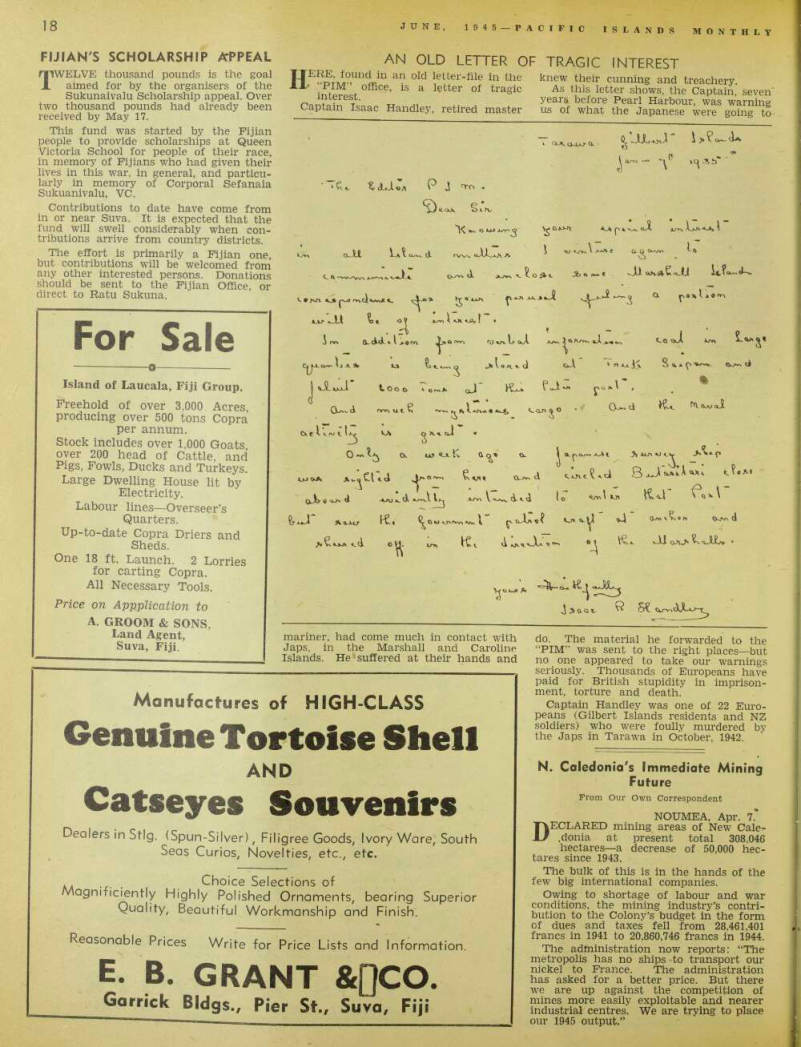
TWELVE thousand pounds is the goal aimed for by the organisers of the Sukunaivalu Scholarship appeal. Over two thousand pounds had already been received by May 17.
This fund was started by the Fijian people to provide scholarships at Queen Victoria School for people of their race, in memory of Fijians who had given their lives in this war, in general, and particu larly in memory of Corporal Sefanaia Sukuanivalu, VC.
Contributions to date have come from in or near Suva. It is expected that the fund will swell considerably when con tributions arrive from country districts.
The effort is primarily a Fijian one, but contributions will be welcomed from any other interested persons. Donations should be sent to the Fijian Office, or direct to Ratu Sukuna.
An Old Letter Of Tragic Interest
HERE, found in an old letter-file in the • “PIM” office, is a letter of tragic interest.
Captain Isaac Handley, retired master
mariner, had come much in contact with Japs, in the Marshall and Caroline Islands. He suffered at their hands and
knew their cunning and treachery.
As this letter shows, the Captain, seven years before Pearl Harbour, was warning us of what the Japanese were going to
do. The material he forwarded to the “PIM” was sent to the right places—but no one appeared to take our warnings seriously. Thousands of Europeans have paid for British stupidity in imprison ment, torture and death.
Captain Handley was one of 22 Euro peans (Gilbert Islands residents and NZ soldiers) who were foully murdered by the Japs in Tarawa in October, 1942.
N. Caledonia's Immediate Mining
Future
From Our Own Correspondent
Noumea, Apr. T
DECLARED mining areas of New Cale .donia at present total 308,046 hectares —a decrease of 50,000 hec tares since 1943.
The bulk of this is in the hands of the few big international companies.
Owing to shortage of labour and war conditions, the mining industry's contri bution to the Colony’s budget in the form of dues and taxes fell from 28,461,401 francs in 1941 to 20,860,746 francs in 1944.
The administration now reports: “The metropolis has no ships to transport our nickel to France. The administration has asked for a better price. But there we are up against the competition of mines more easily exploitable and nearer industrial centres. We are trying to place our 1945 output.”
Advertisements & other items, p. 20 (1 item)
Catseyes Souvenirs
For Sale
& Island of Laucala, Fiji Group.
Freehold of over 3,000 Acres, producing over 500 tons Copra per annum.
Stock includes over 1,000 Goats over 200 head of Cattle, and Pigs, Fowls, Ducks and Turkeys.
Large Dwelling House lit by Electricity.
Labour lines—Overseer’s Quarters.
Up-to-date Copra Driers and Sheds.
One 18 ft. Launch. 2 Lorries for carting Copra.
All Necessary Tools.
Price on Application to
A. GROOM & SONS,
Land Agent, Suva, Fiji.
Manufactures of HIGH-CLASS
Genuine Tortoise Shell
AND
Catseyes Souvenirs
Dealers in Stlg. (Spun-Silver), Filigree Goods, Ivory Ware, South Seas Curios, Novelties, etc., etc. . Choice Selections of Magmficiently Highly Polished Ornaments, bearing Superior Quality, Beautiful Workmanship and Finish.
Reasonable Prices Write for Price Lists and Information.
E. B. GRANT &[)CO.
Garrick Bldgs., Pier St., Suva, Fiji
Promising Tongan Scholar
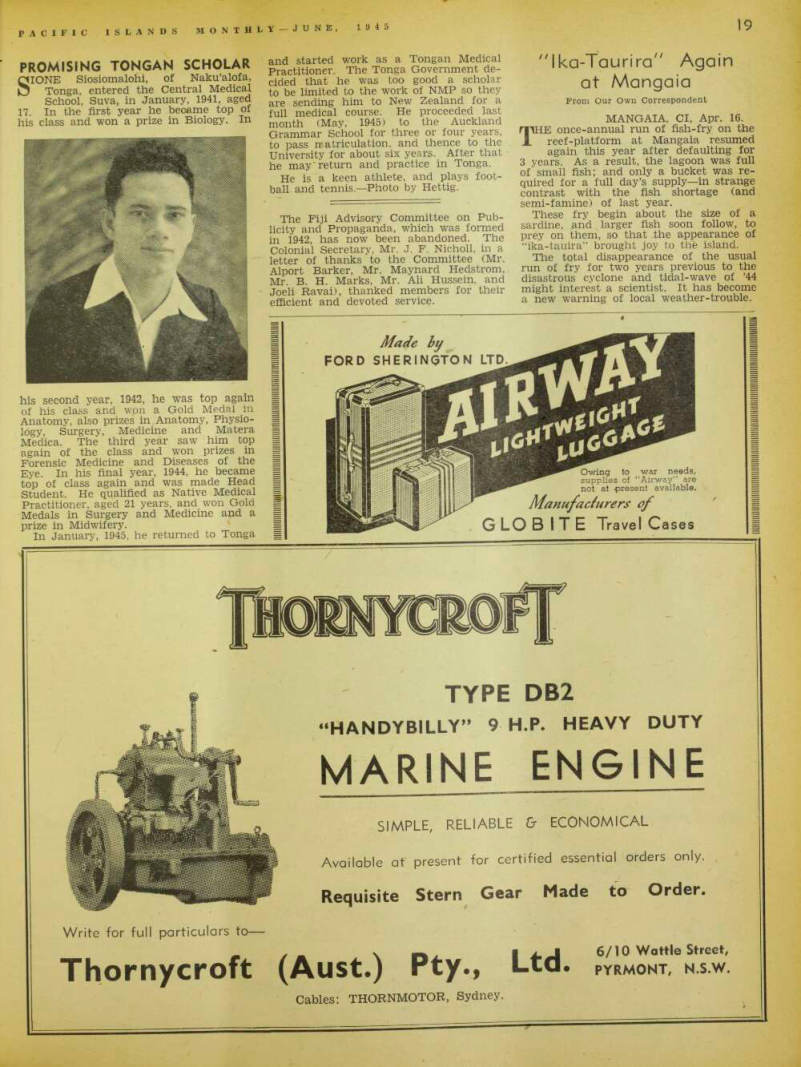
SI ONE Siosiomalohi, of Naku’alofa, Tonga, entered the Central Medical School, Suva, in January, 1941, aged 17. In the first year he became top of his class and won a prize in Biology. In
his second year, 1942, he was top again of his class and wpn a Gold Medal in Anatomy, also prizes in Anatomy, Physio logy, Surgery, Medicine and Matera Medica. The third year saw him top again of the class and won prizes in Forensic Medicine and Diseases of the Eye. In his final year, 1944, he became top of class again and was made Head Student. He qualified as Native Medical Practitioner, aged 21 years, and won Gold Medals in Surgery and Medicine and a prize in Midwifery.
In January, 1945, he returned to Tonga
and started work as a Tongan Medical Practitioner. The Tonga Government de cided that he was too good a scholar to be limited to the work of NMP so they are sending him to New Zealand for a full medical course. He proceeded last month (May, 1945) to the Auckland Grammar School for three or four years, to pass matriculation, and thence to the University for about six years. After that he may return and practice in Tonga.
He is a keen athlete, and plays foot ball and tennis.—Photo by Hettig.
The Fiji Advisory Committee on Pub licity and Propaganda, which was formed in 1942, has now been abandoned. The Colonial Secretary, Mr. J. F. Nicholl, in a letter of thanks to the Committee (Mr.
Alport Barker, Mr. Maynard Hedstrom, Mr. B. H. Marks, Mr. Ali Hussein, and Joeli Ravai), thanked members for their efficient and devoted service.
"Ika-Taurira" Again
at Mangaia
From Our Own Correspondent
Mangaia, Cl, Apr. 16.
(THE once-annual run of fish-fry on the i reef-platform at Mangaia resumed again this year after defaulting for 3 years. As a result, the lagoon was full of small fish; and only a bucket was re quired for a full day’s supply—in strange contrast with the fish shortage (and semi-famine) of last year.
These fry begin about the size of a sardine, and larger fish soon follow, to prey on them, so that the appearance of “ika-tauira” brought joy to the island.
The tqtal disappearance of the usual run of fry for two years previous to the disastrous cyclone and tidal-wave of ’44 might interest a scientist. It has become a new warning of local weather-trouble.
Advertisements & other items, pp. 21-22 (3 items)
Tooff
Made
FORD SHERINOTON LTD
* Owing to war needs, supplies of "Airway" are not at present available.
Manufacturers of
G LO BITE Travel Cases
TOOFF
TYPE DB2
“HANDYBILLY” 9 H.P. HEAVY DUTY
MARIN E ENGINE
SIMPLE, RELIABLE Gr ECONOMICAL
Available at present for certified essential orders only.
Requisite Stern Gear Made to Order.
Write for full particulars to—
Thornycroft (Aust.) Pty., Ltd.
Cables: THORNMOTOR, Sydney. 6/10 Wattle Street,
PYRMONT, N.S.W.
20
June. ms-Mcmc islands monthly
Refrigerator
Modern Refrigeration for the South Sea Islands
The ELECTROLUX KEROSENE OPERATED
MARVEL
OF
MODERN
SCIENCE
J f
THE
MIRACLE
OF
ICE
FROM
HEAT
ELECTROLUX offers economical, modern and completely efficient
REFRIGERATION FOR ISLANDS' HOMES.
FREEZES CONTINUOUSLY WHILE SMALL LAMP BURNS
Freezing controlled by simply regulating height of flame. Uses only j gaUon of kerosene per week MOTORLESS ... NO PARTS TO GET OUT OF ORDER.
MODEL L 22 MODEL L3BO , MODEL LKSSO Capaclty <*s illustrated) Capacity 2.2 cubic feet.
Capacity 4 cubic feet. 6.6 cubic feet.
GUARANTEED FOR TWO YEARS.
Write to your Local Distributor for prices and full details.
OBTAINABLE FROM ALL W. R. CARPENTER & CO. LTD.
BRANCHES THROUGHOUT THE ISLANDS
Representation in Papua and New Hebrides.
Story Of Lincoln
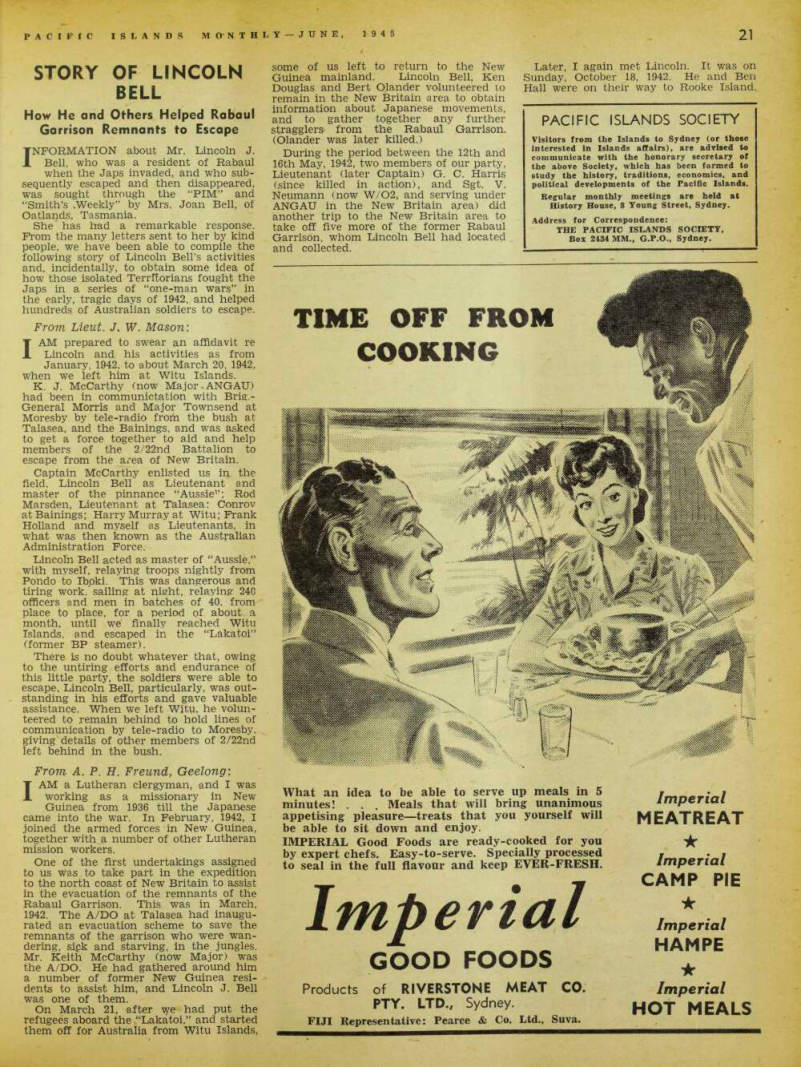
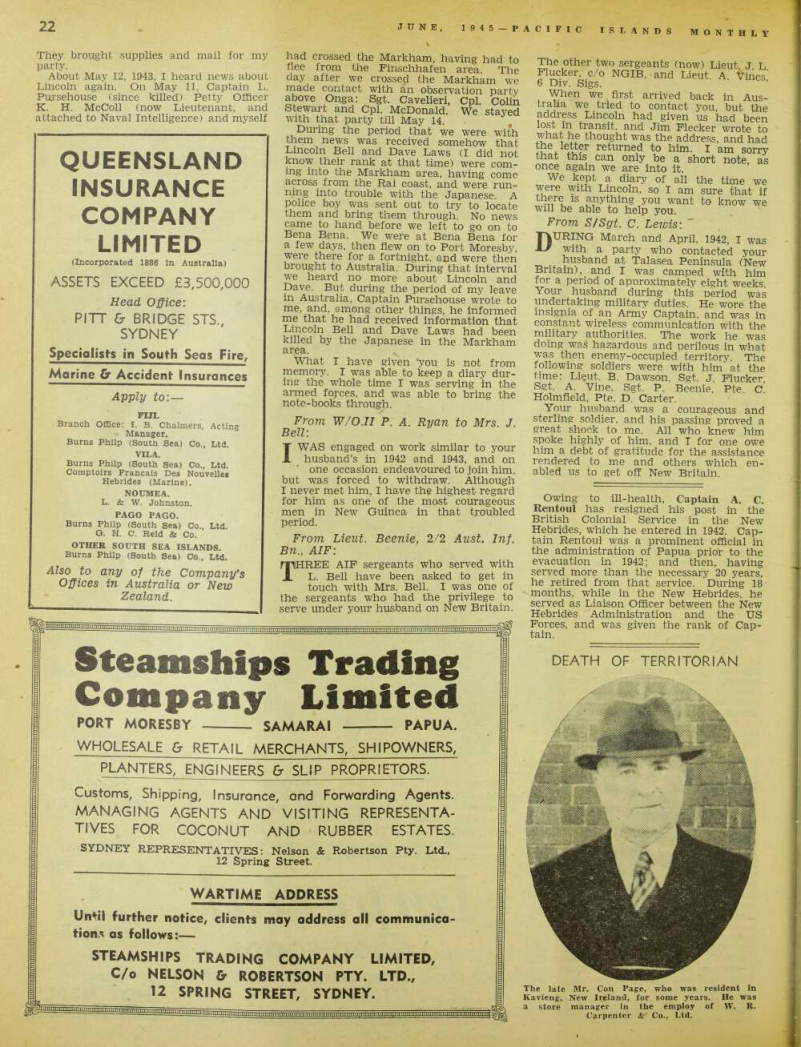
Bell
How He and Others Helped Rabaul Garrison Remnants to Escape
INFORMATION about Mr. Lincoln J.
Bell, who was a resident of Rabaul when the Japs invaded, and who sub sequently escaped and then disappeared, was sought through the “PIM” and “Smith’s >Weekly” by Mrs. Joan Bell, of Oatlands, Tasmania.
She has had a remarkable response.
From the many letters sent to her by kind people, we have been able to compile the following story of Lincoln Bell’s activities and, incidentally, to obtain some idea of how those isolated Terrltorians fought the Japs in a series of “one-man wars” in the early, tragic days of 1942, and helped hundreds of Australian soldiers to escape.
From Lieut. J. W. Mason : IAM prepared to swear an affidavit re Lincoln and his activities as from January, 1942, to about March 20, 1942, when we left him at Witu Islands.
K. J. McCarthy (now Major. ANGAU) had been in communictation with Brig.- General Morris and Major Townsend at Moresby by tele-radio from the bush at Talasea, and the Bainings, and was asked to get a force together to aid and help members of the 2/22nd Battalion to escape from the ax*ea of New Britain.
Captain McCarthy enlisted us in the field, Lincoln Bell as Lieutenant and master of the pinnance “ Aussie'’; Rod Marsden, Lieutenant at Talasea; Conrov at Bainings; Harry Murray at Witu; Frank Holland and myself as Lieutenants, in what was then known as the Australian Administration Force.
Lincoln Bell acted as master of “Aussie,” with myself, relaying troops nightly from Pondo to Ibpki. This was dangerous and tiring work, sailing at night, relaying 240 officers and men in batches of 40, from place to place, for a period of about a month, until we finally reached Witu Islands, and escaped in the “Lakatoi” (former BP steamer).
There is no doubt whatever that, owing to the untiring efforts and endurance of this little party, the soldiers were able to escape. Lincoln Bell, particularly, was out standing in his efforts and gave valuable assistance. When we left Witu, he volun teered to remain behind to hold lines of communication by tele-radio to Moresby, giving details of other members of 2/22nd left behind in the bush.
From A. P. H. Freund, Geelong : I AM a Lutheran clergyman, and I was working as a missionary in New Guinea from 1936 till the Japanese came into the war. In February, 1942, I joined the armed forces in New Guinea, together with a number of other Lutheran mission workers.
One of the first undertakings assigned to us was to take part in the expedition to the north coast of New Britain to assist in the evacuation of the remnants of the Rabaul Garrison. This was in March, 1942. The A/DO at Talasea had inaugu rated an evacuation scheme to save the remnants of the garrison who were wan dering, sipk and starving, in the jungles.
Mr. Keith McCarthy (now Major) was the A/DO. He had gathered around him a number of former New Guinea resi dents to assist him, and Lincoln J. Bell was one of them.
On March 21, after we had put the refugees aboard the “Lakatoi,” and started them off for Australia from Witu Islands,
some of us left to return to the New Guinea mainland. Lincoln Bell, Ken Douglas and Bert Olander volunteered to remain in the New Britain area to obtain information about Japanese movements, and to gather together any further stragglers- from the Rabaul Garrison. (Olander was later killed.) During the period between the 12th and 16th May, 1942, two members of our party, Lieutenant (later Captain) G. C. Harris (since killed in action), and Sgt. V.
Neumann (now W/02, and serving under ANGAU in the New Britain area) did another trip to the New Britain area to take off five more of the former Rabaul Garrison, whom Lincoln Bell had located and collected.
Later, I again met Lincoln. It was on Sunday, October 18, 1942. He and Ben Hall were on their way to Rooke Island.
They brought supplies and mail for my party.
About May 12, 1943, I heard news about Lincoln again. On May 11, Captain L.
Pursehouse (since killed) Petty Officer K. H. McColl (now Lieutenant, and attached to Naval Intelligence) and myself
had crossed the Markham, having had to flee from the Finschhafen area. The day after we crossed the Markham we made contact with an observation partv above Onga: Sgt. Cavelieri, Cpl. Colin Stewart and Cpl. McDonald. We stayed with that party till May 14.
During the period that we were with them news was received somehow that Lincoln Bell and Dave Laws (I did not know their rank at that time) were com ing into the Markham area, having come across from the Rai coast, and were run ning into trouble with the Japanese. A police boy was sent out to try to locate them and bring them through. No news came to hand before we left to go on to Bena Bena. We were at Bena Bena for a few days, then flew on to Port Moresby, were there for a fortnight, and were then brought to Australia. During that interval we heard no more about Lincoln and Dave. But during the period of my leave in Australia, Captain Pursehouse wrote to me. and, among other things, he informed me that he had received information that Lincoln Bell and Dave Laws had been killed by the Japanese in the Markham area.
What I have given *you is not from memory. I was able to keep a diary dur ing the whole time I was serving in the armed forces, and was able to bring the note-books through.
From W/0.11 P. A . Ryan to Mrs. J.
Bell: I WAS engaged on work similar to your husband’s in 1942 and 1943, and on one occasion endeavoured to join him, but was forced to withdraw. Although I never met him, I have the highest regard for him as one of the most courageous men in New Guinea in that troubled period.
From Lieut. Beenie, 2/2 Aust. Inf.
Bn., Aif:
rREE AIF sergeants who served with L. Bell have been asked to get in touch with Mrs. Bell. I was one of the sergeants who had the privilege to serve under your husband on New Britain.
The other two sergeants (now) Lieut. J L Flucker, c/o NGIB, and Lieut. A Vines' 6 Div. Sigs.
When we first arrived back in Aus traha we tried to contact you, but the address Lincoln had given us had been lost in transit, and Jim Flecker wrote to what he thought was the address, and had the tetter returned to him. I am sorry that this can only be a short note, as once again we are into it.
We kept a diary of all the time we were with Lincoln, so I am sure that if there is anything you want to know we will be able to help you.
From S/Sgt. C. Lewis: DURING March and April, 1942, I was with a party who contacted your husband at Talasea Peninsula (New Britain), and I was camped with him for a period of aporoximately eight weeks Your husband during this period was undertaking military duties. He wore the insignia of an Army Captain, and was in constant wireless communication with the military authorities. The work he was doing was hazardous and perilous in what was then enemy-occupied territory. The following soldiers were with him at the time: Lieut. B. Dawson, Sgt. J. Flucker Sgt. A. Vine, Sgt. P. Beenie, Pte. C.
Holmfield, Pte. D. Carter.
Your husband was a courageous and sterling soldier, and his passing proved a great shock to me. All who knew him spoke highly of him, and I for one owe him a debt of gratitude for the assistance rendered to me and others which en abled us to get off New Britain.
Owing to ill-health, Captain A. C.
Rentoul has resigned his post in the British Colonial Service in the New Hebrides, which he entered in 1942. Cap tain Rentoul was a prominent official in the administration of Papua prior to the evacuation in 1942; and then, having served more than the necessary 20 years, he retired from that service. During 18 months, while in the New Hebrides, he served as Liaison Officer between the New Hebrides Administration and the US Forces, and was given the rank of Cap tain.
Advertisements & other items, pp. 23-24 (1 item)
Imperial
PACIFIC ISLANDS SOCIETY
Visitors from the Islands to Sydney (or those interested in Islands affairs), are advised to communicate with the honorary secretary of the above Society, which has been formed to study the history, traditions, economics, and political developments of the Pacific Islands.
Regular monthly meetings are held at History House, 8 Young Street, Sydney.
Address for Correspondence:
THE PACIFIC ISLANDS SOCIETY,
Box 2434 MM., G.P.0., Sydney.
TIME OFF FROM
COOKING
mmm m ru m «9 ■r <0 1 5 m mi Wm M m & What an idea to be able to serve up meals in 5 minutes! . . . Meals that will bring unanimous appetising pleasure—treats that you yourself will be able to sit down and enjoy.
IMPERIAL Good Foods are ready-cooked for you by expert chefs. Easy-to-serve. Specially processed to seal in the full flavour and keep EVER-FRESH.
Imperial
GOOD FOODS
Imperial
MEATREAT
Imperial
CAMP PIE
Imperial
HAMPE
★ Products of RIVERSTONE MEAT CO. Imperial
PTY. LTD., Sydney HOT MEALS
FIJI Representative; Pearce & Co. Ltd., Suva.
QUEENSLAND
INSURANCE
COMPANY
LIMITED
(Incorporated 1886 In Australia)
ASSETS EXCEED £3,500,000
Head Office-.
PITT & BRIDGE STS.,
SYDNEY
Specialists in South Seas Fire,
Marine Cr Accident Insurances
Apply to:—
FIJI.
Branch Office: I. B. Chalmers, Acting Manager.
Burns Phllp (South Sea) Co., Ltd.
VILA.
Burns Philp (South Sea) Co., Ltd.
Comptoirs Francais Des Nouvelle* Hebrides (Marine).
NOUMEA.
L. & W. Johnston.
PAGO PAGO.
Burns Philp (South Sea) Co., Ltd.
G. H. C. Reid & Co.
OTHER SOUTH SEA ISLANDS.
Burns Philp (South Sea) Co., Ltd.
Also to any of the Company’s Offices in Australia or New Zealand.
Steamships Trading
Company Limited
PORT MORESBY
SAMARA I
PAPUA.
WHOLESALE & RETAIL MERCHANTS, SHIPOWNERS,
PLANTERS, ENGINEERS & SLIP PROPRIETORS
Customs, Shipping, Insurance, and Forwarding Agents.
MANAGING AGENTS AND VISITING REPRESENTA-
TIVES FOR COCONUT AND RUBBER ESTATES.
SYDNEY REPRESENTATIVES; Nelson & Robertson Pty. Ltd., 12 Spring Street.
WARTIME ADDRESS
Until further notice, clients may address all communications as follows:
STEAMSHIPS TRADING COMPANY LIMITED,
C/o NELSON & ROBERTSON PTY. LTD.,
12 SPRING STREET, SYDNEY.
Death Of Territorian
The late Mr. Con Page, who was resident in Kavieng, New Ireland, for some years. He was a store manager in the employ of W. R.
Carpenter & Co., Ltd.
Beware, Sulphanilamide!
An Island Resident's Experience
SELF - TREATMENT with sulfa-drugs (described by a recent writer in “PIM”), as if these were “Aspro tablets,” has recalled to'my mind my own first experience of these panaceas. They do work—no doubt of that. But there are times when the remedy seems worse than the disease, and much less bear able.
A tin of (alleged) pork-pie put me on the sick-list in ’42. The symptoms were unpleasant, and in the end I sent for “Doc” (our local NMP). He dosed me with an unnamed tablet. Regrettably, I also neglected to mention that I had had an egg for breakfast.
For a while, the anonymous medication relieved, soothed, and even strengthened.
But within an hour I was sure that heaven’s gates were opening for me. By then I was in a totally collapsed state, and felt, beside and above the pain, as if every bone in my body had turned to jelly. It took much will-power to get through that stage, and three months to fully recover.
Eggs (which contain sulphur) and sulphanilamide don’t mix. If they meet, the result is a poisoning, worse than the original disease. But how many Terri torians know that?
Sulfa-drugs are indeed wonder-drugs— in a doctor’s hands. Let those self dosers pause, however, and remember that a glass gizzard never works as well
as the old one they ruin!-
E.G.
Island Potters
Letter to the Editor GLAZED potsherds, relics of a bye gone era in New Guinea, are to be found in the collections of a few museums here and elsewhere. Mr. R. A.
Vivian, in May “PIM,” referring to my earlier article on “Island Potters,” raises another point, reminding us how little is known of pre-historic New Guinea. Un doubtedly, there are many secrets yet to be revealed, but until scientific institu tions are prepared to maintain well equipped expeditions to carry out sys tematic archaeological surveys in New Guinea and other Pacific islands, most discoveries are likely to be made by re sidents during their daily work.
I would like to suggest to other readers that any discoveries of relics, or evidence of extinct civilisations within their territories, should be placed on record by writing to “PIM” about it. Who knows what key to the past may be revealed?
Island residents, because of their en vironment, naturally have a wider appreciation of ethnology and kindred subjects than the average person, and also feel a community interest in all matters relating to the South Seas.
I am, etc.,
F. J. Morgan.
Vaucluse, Sydney.
May 5, 1945.
Major E. B. Ayris, formerly of Wau, New Guinea, veteran of World War I, who had exciting years on small ships and on transport work generally, after the evacuation, is now settled on a sheep station near Brewarrina, NSW. He writes: “I feel like the New Guinea boat hand who went to work on a plantation.
When the schooner master saw him, he was driving a bullock-cart. ‘Hullo, Kondoni.’ he said. ‘You no more stop along schooner?’ ‘No, master,’ said Kon doni. ‘Now me boat crew belong sikooner belong bullamakau.’ That’s me!”
Controls Yet
No Relaxing of War Controls Yet Victory in Europe Will Affect Fiji Little
JI, in common with most other countries that have done some con siderable groaning under the war time load, is anxious that as many regulations as possible will be relaxed soon. However, the Fiji Government announced on the day following VE-Day, that the main structure of wartime con trol measures must be continued for the present. It is the Government’s intention to relax regulations as soon as circum stances permit—but that might be some time yet.
Residents of the Colony were reminded that it is necessary to maintain produc
tion at the hi B hest Possible level—both f or home consumption and for export.
Agricultural products were never in greater demand than to-day, and a 100 per cent, effort is needed from the Colony in this regard.
Indications are that shipping is as short as ever, and that overseas supplies are hkely to become less instead of more during the next 12 months. This general shortage of shipping and the heavy de mands made on air transport by military anc j official personnel will make it im possible to relax restrictions on travel by private persons, Residents were told that although it might be possible in the near future to begin work on the Colony’s post-war re construction programme, and also on new or deferred public works, even this would be hampered by shortages of both materials and manpower.
Advertisements & other items, p. 25 (1 item)
Foster Clark's
0* - <k c s// k / & 73 Tr
(2aramelpearl that are lovely and brown?
/kittle jam tart 6, tleir edyel turned down?
We really don t mind\ ai lony al there ll be Plenty ofa cultard al well for our tea .
Foster Clark’s Creamy Custard fich, appetising and delicious solves the problem of providing nourishing food for the family, despite shortages of eggs and fresh milk. Mothers can make a different and appetising sweet every day from Foster Clark’s Creamy Custard Cookery Book which contains dozens of recipes.
Write for your copy to Foster Clark (Aust.) Ltd., Dept. R. 8., Redfern, N.S.W., enclosing 2id. postage.
FOSTER CLARK'S
ft fU 90 FC2
Fiji's Educational Plan To
Be Submitted To Britain
rE Fiji Director of Education has been instructed by the Governor to draw up a plan of integrated educational development in the Colony. The Director will work in consultation with the Board of Education and base his plan on the Stephen’s report, which was presented to the Legislative Council at the end of 1944.
The Governor will send the Director’s &££ mittee of Education consider it. This Committee is composed of some of the ™9? t . eminent educationalists in Great Britain and, although this course means delay m re-organising Fiji’s educational system , something worth-while should ultimately result. uu u Certain problems of educational policy
cannot wait—but these will be dealt with immediately, without affecting the general lines of future policy.
Using Cook Is. Stamps In Nz
Letter to the Editor WHY is it that Cook Island postage stamps are not negotiable in NZ and vice versa?
Although the Cl are officially part of the Dominion, one cannot use one’s left oyer Isiand stamps on a letter posted in NZ to the islands, nor NZ left-overs in Rarotonga when you return from your trip.
Surely the postal authorities could make the two interchangeable, as should have been done long before this?
I am, etc.,
E.G.
Mangaia, Cook Is., April, 1945.
Flight-Lieutenant John K. Edmonds, formerly of Rabaul, New Guinea, and who was in Wingate’s Chindit party when captured by the Japs in Burm is among the men set free in the recent liberation of Rangoon.
Mr. Martin G. Nielson, who was a plantation manager for Burns Philp on Ysabel Island (British Solomons) prior to the invasion, is spending a holiday in Sydney (which he had not seen for 30 years), after two years’ service with the American Forces. The Japs came sud denly to Ysabel one morning early in 1942, and Mr. Nielson escaped to the jungles of the interior, where he re mained out of sight for six months, before joining the Americans. He was assisted by the natives, with whom he always was on good terms.
Advertisements & other items, p. 26 (1 item)
Robert Gillespie Pty. Ltd.
E. J. BRIAL
528 COLLINS STREET,
MELBOURNE
Pacific Islands representative—Leading Manufacturers
SOUTH AUSTRALIA & VICTORIA
WIKI PC Person olly selected from best Australian Vineyards.
Your orders requested through usual channels.
ROBERT GILLESPIE PTY. LTD.
ISLAND TRADERS
IMPORTERS - - - EXPORTERS
Island Distributors for
COLEMAN HEATING AND LIGHTING APPLIANCES
DINOX and DIX Brands of BROOMS, BRUSHES and MOPS Bankers: Bank of N.S.W. Cable Address: “Robergill.”
Comptoir National d’Escompte de Paris. Telephones: BW 4782—8 1305.
54a PUT STREET, SYDNEY, N.S.W.
Settlement at Sigatoka
Fiji For "Retired"
People
THERE are indications that Fiji, owing to the comparatively light taxes im posed on individuals will, after the war, become a popular place of residence for Europeans from all over the world who are trying to live on comparatively small incomes derived from property or pensions. Fiji is now bier enough to pro vide most of the amenities of European life, many of which are not found in the majority of Pacific territories.
Most Europeans who have a free choice do not care for permanent residence in the town of Suva itself —it is too hot, and the rainfall is too frequent and heavy— not less than 120 in. per annum. But the Sigatoka district of the main island of Viti Levu has not got those climatic disad vantages. It has only half Suva’s rain fall. It is one of the most delightful spots, from the aesthetic viewpoint, in the South Seas; and it is already coming rapidly into favour as a situation for the homes of retired people. Many homes already have been built there, and many more are contemplated.
Sigatoka is about 90 miles west of Suva, and is at the south-western corner of the big island of Viti Levu. It is connected with Suva by a good motor road, and the journey between the two places can be made in between three and four hours.
The motor road continues on arotmd the island, through Lautoka and Ba; and after passing through the new goldfields town of Vatoukoula it returns to Suva via the mountains and the Rewa district.
Because it has been found impossible to devise a system of income taxation which will work effectively in relation to the Indian community, Fiii has given up the idea of imposing heavy income tax; and, instead, the revenues of the Colony are kept up by indirect taxation. This can be accomplished fairly simply, because all the manufactured goods required by the Colony have to be imported, and they pay a substantial revenue tax at 'the Customs House. Thus, the man with suffi cient property to ensure him a small, independent income, is not slaughtered by income-taxation, as he is in Australia and New Zealand.
Victory Parade
May 8, 1945
AYE, ring the bells, and blow the horns, and wave the . banners high, (But do you mind if some of us just sit here, quietly by?) The ticker tapes are falling in the city streets like rain. (The wind is blowing sand across the mounds at Alamein).
Here come the bands, with majorettes responding to the cheers. (A boy is looking at his sleeve and wink back the tears.) “What shall we wear to dance to-night?
Let’s get some fancy things.” (She’s just a girl—the one in black—they sent her back his wings.) We won a brilliant battle, and we fought a gorgeous fight. (The ghosts beneath the Bering Sea are bitter cold to-night.) “Don’t get excited now, to-day, when all the flags are flying!”
(That woman with the Gold Star pin. I think I saw her crying.) “So Hitler thought that he could fight!
We had to show him how!” (The blood and tears and toil and sweat have been forgotten now.) “Let’s go and eat and drink until we’re positively filled!” (Tarawa was the place, I think, they said that he was killed.) “Let’s move along; we can’t stay he.re till all the marchers pass.” (That fellow with the ribbons on—his eyes were made of glass.) Yes, ring the bells, and blow the horns, and wave the banners high. (But do you mind if some of us just sit here, quietly by?)
-By Major Howard N. Simpson, M.C.
Mr. Robert Bruce, formerly of New Hebrides, who did good service on small boats in Queensland-New Guinea waters in 1943-4, is now residing in Melbourne.
Advertisements & other items, pp. 27-28 (1 item)
Victoria
THE PACIFIC ISLANDS
TRADING CO.
2016 Parker St, Berkeley,
CALIFORNIA, U.S.A.
We are Expert Buying Agents for Pacific Islands Merchants.
SEND YOUR ORDERS TO US—OUR
COMMISSION IS 5 PER CENT.
Also at San Francisco.
VICTORIA
BITTER
BBEWEO IT
CARLTON & UNITED BREWERIES LTI.
V.l
“Submarine on the starboard quarter” ..,
In his book "Heroes of Fighting R.A.F.”, Leonard Gribble tells a thrilling story of the rescue of thirty-four of a ship’s crew by flying boats of the British Coastal Command.
The freighter "Kensington Court”, deep laden with wheat, was ploughing through heavy seas towards the British coast.
Suddenly the cry: "Submarine on the starboard quarter”.
The "Kensington Court”, unarmed, ran for it. And out went an S.O.S.
Overhauling the freighter, the U-boat began shelling at short range. The "Kensington Court” was doomed. As the crew was taking to the boats, two flying boats roared out of the clouds. The U-boat crash-dived.
Within minutes of the sending of the S.O.S. the rescue of the "Kensington Court’s” crew was being staged in a fresh sea. The sailors in an inflated rubber boat were hauled from their lifeboats to the
tossing ’planes.
Another chapter in the history of the part radio plays in this war. * * * Aeroplanes, ships, guns and radio. Australian industry to-day is producing everything for her own defence. But radio makes them into one powerful striking force. We owe much to the Australian resourcefulness and courage which made possible the building of all such equipment in Australia.
Whilst Australian enterprise is free to build and plan we need never fear being cut off from our sources of supply. —Amalgamated Wireless (A/asia) Ltd.
How Captain Smith Kept
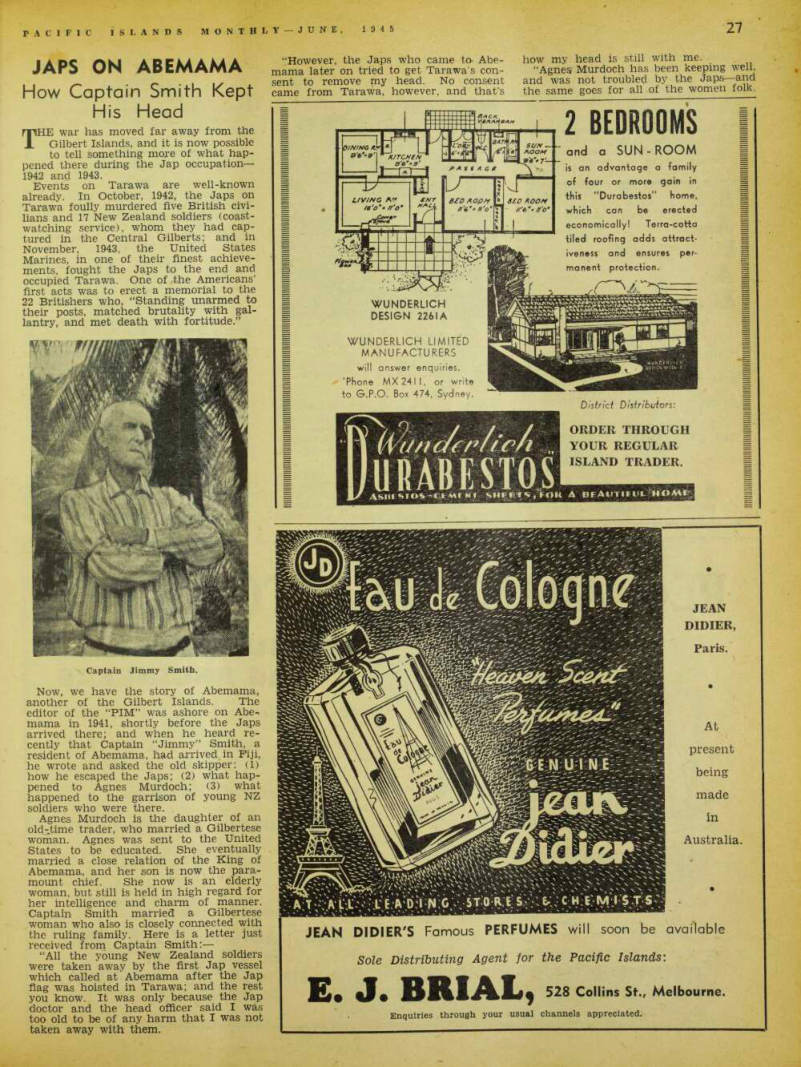
Japs On Abemama
How Captain Smith Kept His Head
THE war has moved far away from the Gilbert Islands, and it is now possible to tell something more of what hap pened there during the Jap occupation -1942 and 1943.
Events on Tarawa are well-known already. In October, 1942, the Japs on Tarawa foully murdered five British civi lians and 17 New Zealand soldiers (coast watching service), whom they had cap tured in the Central Gilberts; and in November, 1943, the United States Marines, in one of their finest achieve ments, fought the Japs to the end and occupied Tarawa. One of the Americans’ first acts was to erect a memorial to the 22 Britishers who, “Standing unarmed to their posts, matched brutality with gal lantry, and met death with fortitude.”
Now, we have the story of Abemama, another of the Gilbert Islands. The editor of the “PIM” was ashore on Abe mama in 1941, shortly before the Japs arrived there; and when he heard re cently that Captain “Jimmy” Smith, a resident of Abemama, had arrived in Fiji, he wrote and asked the old skipper: (1) how he escaped the Japs; (2) what hap pened to Agnes Murdoch; (3) what happened to the garrison of young NZ soldiers who were there.
Agnes Murdoch is the daughter of an old-time trader, who married a Gilbertese woman. Agnes was sent to the United States to be educated. She eventually married a close relation of the King of Abemama, and her son is now the para mount chief. She now is an elderly woman, but still is held in high regard for her intelligence and charm of manner.
Captain Smith married a Gilbertese woman who also is closely connected with the ruling family. Here is a letter just received from Captain Smith: — “All the young New Zealand soldiers were taken away by the first Jap vessel which called at Abemama after the Jap flag was hoisted in Tarawa; and the rest you know. It was only because the Jap doctor and the head officer said I was too old to be of any harm that I was not taken away with them.
“However, the Japs who came to Abemama later on tried to get Tarawa’s consent to remove my head. No consent came from Tarawa, however, and that’s
how my head is still with me.
“Agnes Murdoch has been keeping well, and was not troubled by the Japs—-ana the same goes for all of the women folk.
Captain Jimmy Smith.
Agnes, when I left Abemama in June, 1944, was a very busy person, having charge of the Yanks’ laundry, with a gang of the island’s women. She is a happy woman and has all she needs for herself and those with her.
“The Americans’ camp was several miles away from the Government station, so we saw very little of them. They were very kind to me during the time I was at
Abemama. But what I needed mostly was a change, and I got permission to go to Fiji. I was suffering from the lack of
food I had to put up with during the Jap occupation, and I am still feeling the effect of it.”
Among those who recently returned to Fiji after visits to New Zealand and Australia were Mr. L. A. Lawlor, Mrs.
Jack Barber, Dr. and Mrs. Roth Carrick, Mr. D. Costello, and Mr. and Mrs. P McConnel.
Miss Mavis Father, of the Anglican Mission, who for the past two years has been engaged in teaching work at New ington College, Sydney, has now returned to New Guinea, where she served for some years at Gona and other places.
Mrs. Agnes Murdoch with her two sons. This photograph was taken in 1941.
Advertisements & other items, pp. 29-30 (1 item)
2 Bedrooms
H
SAT.
O/N/NC \ )_
©V*e'l *k/7CH£H . 9'6'-9'
LIVING W
t»'o'• n'o £NT
MALL
BSD AOPN
ff'L’o/r'o’
BSD BOON
fS6 ff'o‘ r.
Cm TDir
2 BEDROOMS
and a SUN - ROOM
is an advantage a family of four or more gain in this "Durabestos" home, which can be erected
economically! Terra-cotta
tiled roofing adds attractiveness and ensures permanent protection.
WUNDERLICH
DESIGN 2261 A
WUNDERLICH LIMITED
MANUFACTURERS
will answer enquiries.
'Phone MX 241 I, or write to G.P.O. Box 474, Sydney.
District Distributors:
ORDER THROUGH
YOUR REGULAR
ISLAND TRADER.
ASII> ''lOS-CJJMI N I SHEETS /FOH A DFAIITIFUL HOME
JEAN
DIDIER,
Pans. 0 AI m present m being tpr* made in Australia JEAN DIDIER'S Famous PERFUMES will soon be available Sole Distributing Agent for the Pacific Islands : E. J. BRIAL, 528 Collins St., Melbourne.
Enquiries through your usual channels appreciated.
Buy
Right
In
All
liines
WINES A SPECIALITY
VIN ROUGE DE TABLE DE
QUALITE SUPERIEURE
ALSO :
Brandy, Gin, Beer, Cordials, Salami. Mortadelle, Conserves.
Powdered Milk. Condensed Milk.
Leathergoods, Paints.
Indian Printed Cotton Piecegoods.
And EVERYTHING YOU MAY
REQUIRE.
Enquiries through your usual channels appreciated.
E. J. BRIAL
528 Collins Street, Melbourne.
REG. ADAMS, CLAYTON & CO.
rvt on o
Progress with Modern Designing.
SHIPBUILDERS
and ENGINEERS
COPPERSMITHS, WELDERS and PLUMBERS.
Builders of WOODEN FREIGHTERS,
TRAWLERS and ISLAND CRAFT.
Agents for Diesel Engines.
VESSELS REPAIRED and REMODELLED.
MODERN SLIPWAY FACILITIES
AVAILABLE.
Write to us for Designs and Complete Shipbuilding information.
REG. ADAMS, CLAYTON
& COMPANY
JOHN STREET, BERRY'S BAY, SYDNEY.
Tel.: XB 4475, XA 1731.
Honours For New Guinea
Men
IT recently was officially announced that the following awards, for distinguished service, had been made to former temtonans:—
Obe
Lt. : C°l. G. W. L. Townsend, formerly a District Officer in New Guinea.
Mbe
Major H. L. R. Niall, formerly an Assistant District Officer in New Guinea.
Captain W. M. English, formerly a Patrol Officer in New Guinea Captain C. W. Slattery, formerly a Patrol Officer in New Guinea.
Military Cross
Captain F. N. Boisen, formerly of the Education Department, TN Guinea.
Mr. C. E. de F. Pennefather, who retired recently from the Fiji Public Service, is at present a visitor to Australia. Mr Pennefather spent the whole of his official life in the Gilbert and Ellice Islands Colony, and in Fiji, and he ended his service in Fiji as Adviser on Native Affairs and member of the Executive and Legis lative Councils. He has purchased pro perty in Fiji, and intends to live there— and, as he is a very young-looking sixty, it is likely that he will live there for a long time.
Mr. W. H. B. Buckhurst, Director of Lands, Mines and Surveys, and Lieut.- Colonel J. L. Mac Duff, have been ap pointed members of the Fiji Mining Board in place of Mr. F. T. M. White and Mr.
L. G. H. Sinclair. Mr. Buckhurst becomes chairman of the Board.
Advertisements & other items, p. 30 (1 item)
28
JUNE, 1945 PACIFIC ISLA N D S MONT H L Y
Search for King of Cocos
Islands ?
And Story of an Englishman with 165 Wives
(By London Correspondent of Sydney “Daily Mirror”)
SOMEWHERE in the United Kingdom there is a missing monarch—a lad in his teens, accompanied by his mother—and in the middle of the Indian Ocean, roughly half-way between Aus tralia and India, there is a tiny kingdom with a vacant throne. The king is monarch of the Cocos Islands, and his name is Clunies-Ross, His father, John Sydney Clunies-Ross—Ross IV—died of shock following an enemy raid on the Cocos Islands last July.
The Cocos group comprises 24 islands, the largest about two and a half miles, the smallest hardly providing room in which to swing a cat. If Ross V is found the unofficial dynasty will continue un broken, but if not then the Cocos Islands will become a possession of Great Britain.
The history of the Clunies-Ross dynasty goes back more than 150 years to the time when a tall, dour Scotsman, John Clunies- Ross, after taking up arms on behalf of James, the Pretender of Scotland, was forced to flee to the Shetland Islands.
During a visit to London he narrowly escaped the press gang with the aid of Elizabeth Dymock, who sheltered him and whom he later married.
Then began many years of adventure and travel at sea. Finally, Clunies-Ross ended up in Java, where he met a fellow adventurer named Alexander Haie.
In 1825 Ross and Hare decided to make their home on the Cocos Isles. They both had ships, but Ross arrived first.
The reason for Hare’s delay was appa rent. When he duly turned up he had brought with him 165 women —Malays, Chinese, and half-castes —with whom he proposed to establish a tropical love nest.
Some of these women he had enticed, some had been given to him as slaves, and to about 25 his intentions were honor able —he was engaged to marry them all.
Ross, a pious man, deeply in love with his wife, was shocked when he discovered that Hare’s vision of Empire building hardly accorded with his own, and the two men established themselves on sepa rate islands —Hare surrounded by a harem and musicians in a comic-opera court, and Ross nearby with his wife, family, and an adventurous, hardworking crew of men.
But love will find a way. Within a few years Ross’s men had raided Hare’s island so many times and carried off so many of his women that Hare was forced to pack up and return to Singapore.
Ross remained conqueror and king.
Through hard work he built up a substan tial fortune processing copra for oil and allied products. He dfed in 1854, after reigning as virtual king for a quarter of a century. He was succeeded by his son, John George—Ross 11, who married a Malayan princess, Spia Dupong.
Population Grows
MEANWHILE the Cocos population was growing rapidly, although the islands had been uninhabited before Hare arrived with his of dusky belles.
The tiny kingdom was acquiring riches and strange history. Charles Darwin called in with the famous ship “Beagle,” and once a party of shipwrecked cut throats went off with the islands’ schooner, which was never heard of again.
Each of the kingdom’s two founders appealed for the islands’ annexation— Ross to Britain and Hare to Holland. Both countries sent ships to investgate, but nothing was done until 1857, when the Cocos group was proclaimed part of the British Empire during the reign of Ross II In 1886 Queen Victoria was so impressed with the able manner in which the Ross dynasty had carried on the administration of the islands that she granted thp family possession of the kingdom of Cocos Islands forever.
The Rosses built a palace on their home island—one of the group’s two inhabits able islands. Special permission is required before anyone—natives or Europeans—is allowed to visit this island. Any natives who leave the kingdom of Cocos may never return. A small amount of liquor is allowed in the group, but intoxication is severely dealt with. . Ross 111 died on the Isle of Wight in 1910, and his successor, John Sydney Clunies-Ross, reigned until last year as Ross IV.
An elderly man without issue, the story goes that eaily in the 1930’s he went to London to find a bride and a successor to the throne. It is said he encountered his future queen in a little
London teashop. He was then aged about 60 and was dark-skinned like a Malayan, for Malayan blood ran in his veins, m 0 T racc Found 1 , . . . riIHE marriage was duly solemnised, A according to the story, and Ross IV returned to his kngdom, leaving his wife—the first white queen of Cocos since Ross I landed there-»in London with a son and heir.
The mystery now is; Where is the lad who is to carry on the line?
The Colonial Ofiice is mysterious, and says it does not know. Malayan head quarters in London know the family, of course, but do not know the whereabouts of the heir.
A diligent search I carried on for two days at Somerset House, where births and deaths are recorded, failed to reveal the secret.
The unofficial kingdom of the Cocos Islands is distinguished for a number of reasons. It is the world’s smallest king dom for a start, and, in the second place, all other thrones have scores or pre tenders, heirs, claimants and intriguers, clamouring for possession, whereas the Cocos throne is the only one in the world for which the rightful claimant cannot be found.
Advertisements & other items, p. 31 (1 item)
••• • «
t u
Other
GILB *y Products: '*
CR£m£ * M£Nr H£ *
aovocaat CH£rrv branov f * CURACAO * * vvH/re f e,LB£O£NE * ora NS£ creme Cacao •• • • i•• • • APfi, cor BRANoy * ' * LEMOn Gin I * BRONX « M . BT * M * S,N SUNG I* * • • • • f 4 MARr,N ' COCKTA,, I * »•••/ «*AI SCOTCH , r * SP£lr I * * • •
4 Cau/vtlet
w HISKY P *
4 Address all enquiries to: W. & A. GILBEY LTD., 33 ROSSLYN STREET, WEST MELBOURNE Telegrams and Cables : "Gilbeys" Melbourne or 109 Regent St., Sydney - Telegrams and Cables : "Gilbeys" Sydney
A Sale Of Chrome
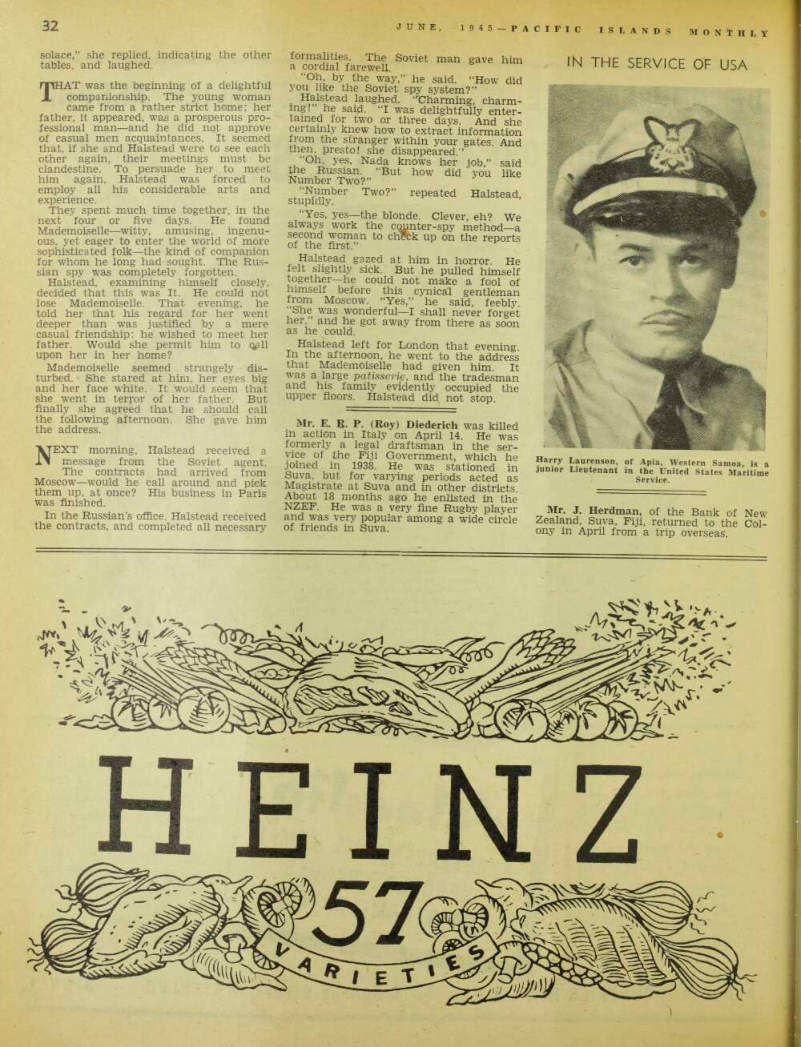
"Pim” Short Story:
By Robert Slade
Based on the actual experience of a Gentleman of Noumea, who visited Paris in 1929, as related to the Author.
HALSTEAD settled himself in the cafe, ordered a bock, and gazed about him with frank interest. There were perhaps one hundred people in the cafe. A dozen unattached women, of divers shapes and colours, tried to hold his eye. Which was the Russian spy?
He knew the custom of the place.
When he had rested, and looked about him, he should arch an eyebrow, or crook a finger, or otherwise indicate a consid ered preference. Whereupon he would be joined by a vivacious and thirsty Parisienne.
Halstead ignored the inquisitorial eye of the head-waiter, and the businesslike glances of the ladies, and lit a cigarette, and waited.
He hoped that something at least amusing would come out of this experi ment, to relieve the tedium of his stay in Paris. Life had been dull, for too long.
For two years, in New Caledonia, while managing a chrome mine and driving teams of Tonkinese and Javanese labour ers, he had been virtually cut off from the world. An occasional visit to sun drenched Noumea meant nothing—exist ence there was just one siesta after another. With eagerness he had obeyed orders from his head office, to proceed to France, to complete certain contracts for the sale of their chrome.
The buyer to whom he was directed, in Paris, was a representative of the Soviet Government. He was a cultured, hos pitable person, and he tried to provide entertainment, while Moscow was deliber ating over the metal contracts, and Hal stead was loitering about the boulevards, and hungering for London.
As they lunched together, one day, Halstead described a thing he had seem m n^ anc -k ur * a ’ Two Russians had quar relled with another Russian, had forced
him to fight, and had deliberately killed him. The murdered man was a White Russian; the others were not, and were suspected of being Soviet emissaries.
“Probably it was so,” said Halstead's host, calmly. “The single life is nothing.
We strike for the freedom of one hun dred million people. We seek out those who plot against us, and the progress of our Communist State, and we destroy them.”
Halstead grinned. “Nasty people!” he said. “I think* I’ll keep away from Rus sia when I’m feeling extra reactionary,”
“The arm of the Soviet reaches far beyond our borders,” said the Soviet agent, sententiously.
“They say you even have beautiful women acting as spies for you,” remarked Halstead, idly. “I wish I could meet some. I am very bored—l should like to study your system.”
“Why not?” said the Soviet agent, un expectedly. “If it will interest you, it can be arranged.”
And it was arranged. Halstead merely had to promise that he would give no indication that he suspected he was under espionage, and he was to be in a certain Montmartre cafe at 5 o’clock.
“But how shall I know the lady? How will she find me?” asked Halstead.
The Soviet agent smiled bleakly. “You can leave all that to us,” he said.
SO Halstead, alert to every movement around him, smoked quietly.
The approach, when it came, was simple. A strikingly good-looking young woman, of Jewish type, came into the cafe, carrying a couple of small pack ages. One of them slipped quietly to the floor near Halstead’s table.
“Permit me, mademoiselle,” he said, and retrieved the package.
“Oh, t’ank you,” she said, and her smile was a happy mixture of simplicity and coquetry. “Monsieur is English, yes?”
“Monsieur is,” said Halstead. “But how clever of you to notice it!”
“Yes. I am veree clevair,” retorted the
girl. “I make my package to fall so that Mpnsieur will look at me,” she added, brightly.
Halstead laughed. The rest was easy.
The lady sat at his table, and consumed a variety of liquors, with expertness, and undeniable grace. She chattered merrily and intelligently, in French and English!
Halstead, keenly interested in this attractive picture of a spy at work, had to admit that her technique was perfect He saw that, little by little, leading their conversation with apparent inconsequence, she had learned his name, nationality, place of residence, marital condition, and business. He found that he had told her even his age, and the means he took in the tropics to ensure the efficient func tioning of his organs.
But, of course, he knew she was a spy; and so he had told her with apparent casualness, all the things that he thought a spy should know. And, anyway, he told himself, she was a delightful companion; and there was no reason why he should run away from her charms. Evidently, when the gentleman was presentable, she found pleasure in her profession.
From the cafe meeting, their friend ship ripened rapidly. In Paris, under a mellow October moon, one may conduct one’s affairs in a manner not thought possible elsewhere . . .
When she left him, a couple of days later, to visit someone in a distant sub urb she seemed as eager as he to keep a rendezvous, at the cafe where they first met, that evening.
BUT she never came. And as Halstead, with increasing impatience, looked at his watch, he realised that, after all, she was a spy, and her job was fin ished and, presumably, she had other work to do. He let his imagination run, and he did not like what he saw. She had been very charming. But the ten derness he had imagined was for him alone, he thought savagely, was all part of the lady’s technique. Well, he had asked for it!
As he lifted a frowning face, he caught the eye of a young woman, two tables away, who also had been scowling at her wrist-watch. She had been there for some time. Bitten lip and tapping toe clearly indicated a broken appointment.
They were both in the same predica ment. Involuntarily, he smiled. She stared coldly at him for a moment, and then turned away, and a slight move ment of her shoulder indicated distaste— but perhaps other things. Halstead’s impressionable heart missed a beat. She was a remarkably pretty blonde, ex quisitely but modestly dressed.
Ten minutes passed. The Russian spy did not come. The girl at the nearby table glanced at Halstead, looked again at her watch, and petulantly gathered up bag and gloves.
Halstead rose impulsively and stepped across. “Will you forgive me for speak ing to you, mademoiselle?” he said. “We appear both to be deserted. May I join you?”
The girl hesitated, and looked him over deliberately. Halstead clearly was no boulevardier. He was a handsome, strongly-built man of forty, with that indefineable something that suggests the world-wanderer.
“Ze English—l speak of him very little,” she said. “Of you—how shall I say— inconnu —it is not proper if we talk.” ♦ Halstead spoke in French. “I know that Mademoiselle has much to forgive.
My approach is improper. I am lonely— and perhaps you, too, would be glad to talk.”
“A lonely man in Paris can find much
solace,” she replied, indicating the other tables, and laughed. mHAT was the beginning of a delightful X companionship. The young woman came from a rather strict home; her father, it appeared, was a prosperous pro fessional man—and he did not approve of casual men acquaintances. It seemed that, if she and Halstead were to see each other again, their meetings must be clandestine. To persuade her to meet him again, Halstead was forced to employ all his considerable arts and experience.
They spent much time together, in the next four or five days. He found Mademoiselle —witty, amusing, ingenu ous, yet eager to enter the world of more sophisticated folk—the kind of companion for whom he long had sought. The Rus sian spy was completely forgotten.
Halstead, examining himself closely, decided that this was It. He could not lose Mademoiselle. That evening, he told her that his regard for her went deeper than was justified by a mere casual friendship: he wished to meet her father. Would she permit him to upon her in her home?
Mademoiselle seemed strangely dis turbed. She stared at him, her eyes big and her face white. It would seem that she went in terror of her father. But finally she agreed that he should call the following afternoon. She gave him the address.
NEXT morning, Halstead received a message from the Soviet agent.
The contracts had arrived from Moscow—would he call around and pick them up, at once? His business in Paris was finished.
In the Russian’s office. Halstead received the contracts, and completed all necessary
formalities. The Soviet man gave him a cordial farewell.
“Oh by the way,” he said. “How did you like the Soviet spy system?”
Halstead laughed. ‘ r Charming, charm ing! ’he said. “I was delightfully enter tained for two or three days. And she certainly knew how to extract information from the stranger within your gates. And then, presto! she disappeared.’’ ‘‘ oh ’ yes, Nada knows her job,” said the Russian. “But how did you like Number Two?”
“Number Two?” repeated Halstead, stupidly.
“Yes, yes—the blonde. Clever, eh? We always work the counter-spy method—a second woman to check up on the reports of the first.”
Halstead gazed at him in horror. He felt slightly sick. But he pulled himself together—he could not make a fool of himself before this cynical gentleman from Moscow. “Yes,” he said, feebly “She was wonderful—l shall never forget her,” and he got away from there as soon as he could.
Halstead left for London that evening.
In the afternoon, he went to the address that Mademoiselle had given him It was a large patisserie, and the tradesman and his family evidently occupied the upper floors. Halstead did not stop.
Mr. E. R. P. (Roy) Diederich was killed in action in Italy on April 14. He was formerly a legal draftsman in the ser vice of the Fiji Government, which he joined in 1938. He was stationed in Suva, but for varying periods acted as Magistrate at Suva and in other districts About 18 months ago he enlisted in the NZEF. He was a very fine Rugby player and was very popular among a wide circle of friends in Suva.
Advertisements & other items, pp. 32-33 (1 item)
Wm. H. WATSON, Wholesale Island Trader
Hula-skirts : Hula-skirts : Hula-skirts
SHELL NECKLACES : SHELL NECKLXCES
Mother of Peorl Brooches—Coloured Grass Leis Ihe Hula-skirts are in assorted bright colours with decorated waist band. °f Pearl Brooches are supplied in a large assortment of lovely designs, ually carded. These are made in our own factory by native craftsmen, so you are assured of the prices being right.
The Shell Necklaces consist of small shells. Each necklace, 60” long. wnrM f T., Whol f ale prices - Can 9 uote y° u » c.Lf. price, any part of the l^° od f Sent by parcel Post, ensuring quick delivery. Parcels are with valuable Cook Island stamps, which have a high resale value.
Any quantity supplied. Terms: D/P your own bank.
Wm. H. WATSON, Wholesale Island Trader
RAROTONGA, COOK ISLANDS
Cable Address : "Watson, Rarotonga.”
Bankers : Bank of New Zealand, Auckland.
DE NOUVEAU, LE CONTINENT AUSTRALIEN ASSURE
IE CONTORT DES ILES
h k I - .
ITT y.
m Ci-dessus; Le fourneau a petrole Aladdin a 5 bees —l'un des plus nouveaux membresode la famille Aladdin de reputation mondiale. Elegamment emaille, aerodynamique a I'instar des fourneaux electriques les plus modernes, d'un rendement excellent, et economique. Ecrivez pour obtenir tousles A gauche: La fameuse lampe de table a petrole, Aladdin-qui fournit une brillante lumiere blanche de 75 bougies, sans travail de pompe ou depression, au cout d'envirorV 2 heures d'eclairage pour un penny. On I'allume aussi facilement que la lampe a flamme d'autrefois. Ecrivez pour obtenir les details des modeles de guerre, les prix, etc. ...
A droife: La lampe-tempete Aladdin, egalement populaire, solidement construite pour etre tres resistante—elle fournit une vive lumiere blanche de 200 bougies en utilisant du petrole ordinaire au cout d'environ penny I'heure. L'Armee et lo Marine en font grand usage en temps de guerre.
Ecrivez pour obtenir les details.
Aladdin est un nouveau venu dans les iles. Les detaillants peuvent saisir I'occasion d'en devenir vendeurs attitres ce qui entraine un decompte' special certains avantages, etc. Ecrivez aujourd' hui pour obtenir tousles
renseignements.
JSS 5-^1
Les lampes de table a
petrole, Aladdin, se font
egalement en appliques
murales et en gracieuses lampes -a - pied. Nous serons heureux de vous envoyer un prospectus vous donnant des renseignements complets sur toute la gamme de nos articles.
ALADDIN INDUSTRIES Pty. Ltd. - 61-71 Bourke Street, WATERLOO - SYDNEY
In The Service Of Usa
Mr. J. Herdman, of the Bank of New Zealand, Suva, Fiji, returned to the Col ony in April from a trip overseas.
Harry Laurenson, of Apia, Western Samoa, is a junior Lieutenant in the United States Maritime Service.
Advertisements & other items, p. 34 (1 item)
Heinz
Ar a K^ 1 -C' -^1 I*<k: £ r- ' ••' * >.
A*
(i v\ I' 4 I I?
T to E /
ij#n
Lady Of The Ramu
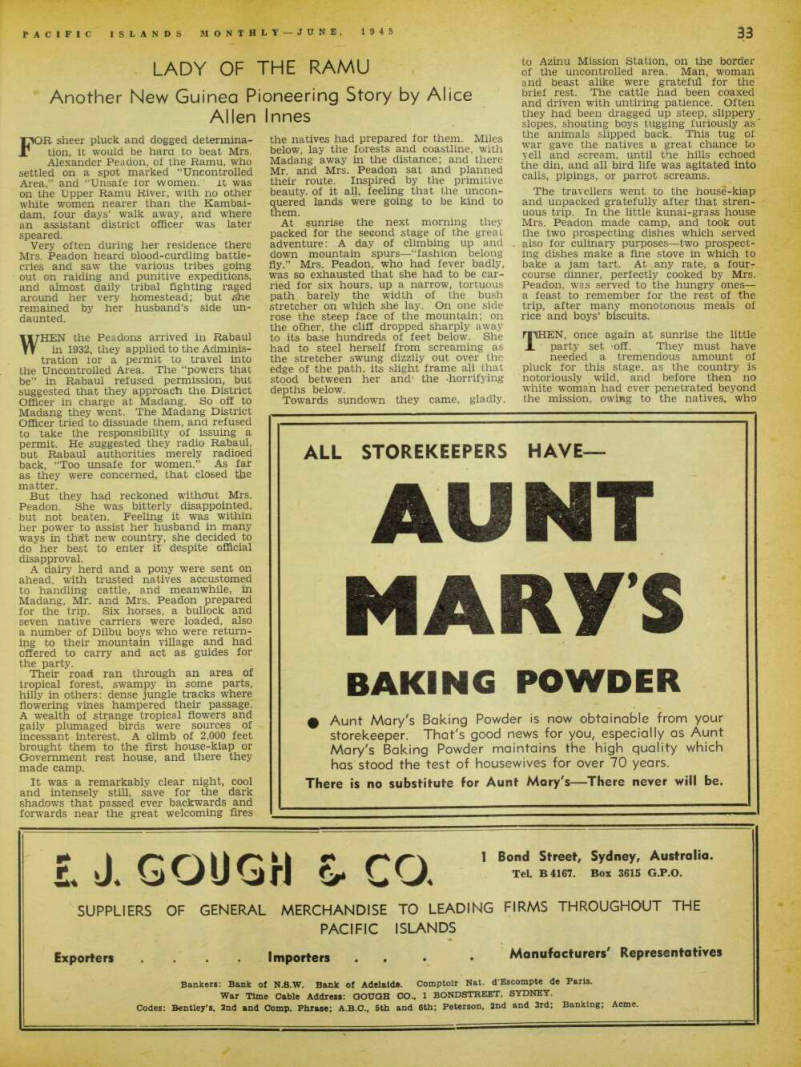
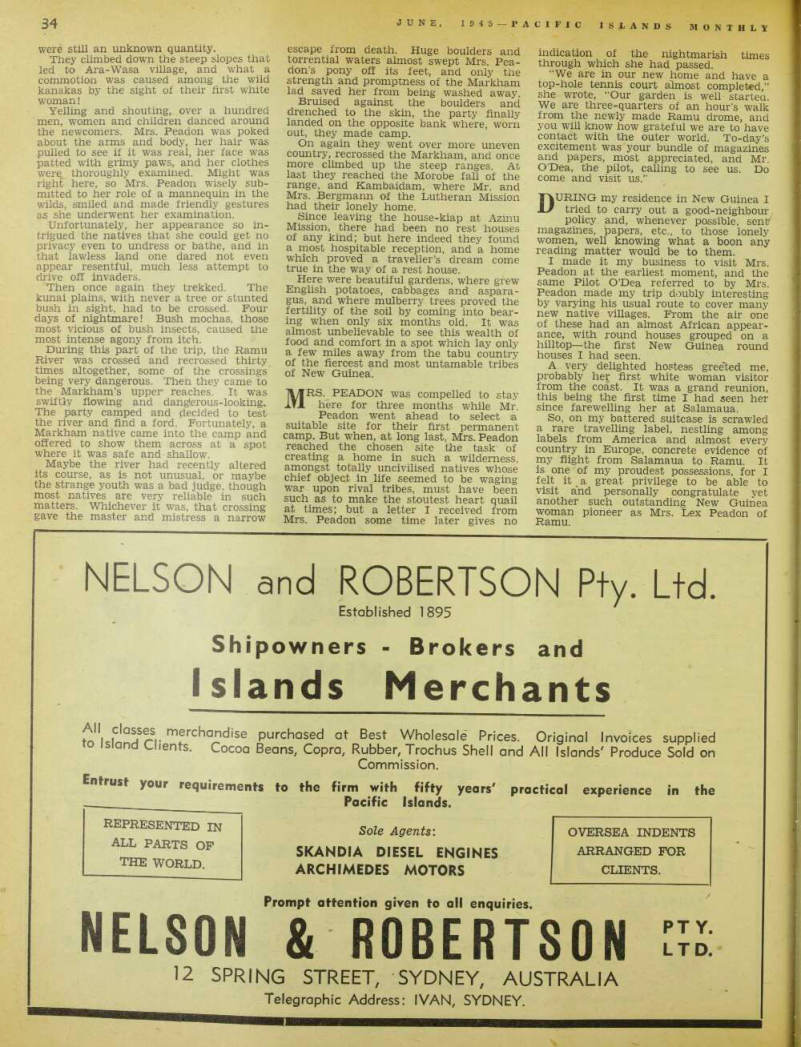
Another New Guinea Pioneering Story by Alice Allen Innes
rR sheer pluck and dogged determina tion, It would be hard to beat Mrs.
Alexander Pea don, of the Ramu, who settled on a spot marked “Uncontrolled Area,” and “Unsafe lor women. it was on the Upper Ramu River, with no other white women nearer than the Kambai dam, four days’ walk away, and where an assistant district officer was later speared.
Very often during her residence there Mrs. Peadon heard blood-curdling battle cries and saw the various tribes going out on raiding and punitive expeditions, and almost daily tribal fighting raged around her very homestead; but she remained by her husband’s side un daunted.
WHEN the Pea dons arrived in Rabaul in 1932, they applied to the Adminis tration lor a permit to travel into the Uncontrolled Area. The “powers that be” in Rabaul refused permission, but suggested that they approach the District Officer in charge at Madang. So off to Madang they went. The Madang District Officer tried to dissuade them, and refused to take the responsibility of issuing a permit. He suggested they radio Rabaul, but Rabaul authorities merely radioed back, “Too unsafe for women.” As far as they were concerned, that closed the matter.
But they had reckoned without Mrs.
Peadon. She was bitterly disappointed, but not beaten. Feeling it was within her power to assist her husband in many ways in that new country, she decided to do her best to enter it despite official disapproval.
A dairy herd and a pony were sent on ahead, with trusted natives accustomed to handling cattle, and meanwhile, in Madang, Mr. and Mrs. Peadon prepared for the trip. Six horses, a bullock and seven native carriers were loaded, also a number of Dilbu boys who were return ing to their mountain village and had offered to carry and act as guides for the party.
Their road ran through an area of tropical forest, swampy in some parts, hilly in others: dense jungle tracks where flowering vines hampered their passage.
A wealth of strange tropical flowers and gaily plumaged birds were sources of incessant interest. A climb of 2,000 feet brought them to the first house-kiap or Government rest house, and there they made camp.
It was a remarkably clear night, cool and intensely still, save for the dark shadows that passed ever backwards and forwards near the great welcoming fires
the natives had prepared for them. Miles below, lay the forests and coastline, with Madang away in the distance; and there Mr. and Mrs. Peadon sat and planned their route. Inspired by the primitive beauty- of it all, feeling that the uncon quered lands were going to be kind to them.
At sunrise the next morning they packed for the second stage of the great adventure: A day of climbing up and down mountain spurs—“fashion belong fly.” Mrs. Peadon, who had fever badly, was so exhausted that she had to be car ried for six hours, up a narrow, tortuous path barely the width of the bush stretcher on which she lay. On one side rose the steep face of the mountain; on the other, the cliff dropped sharply away to its base hundreds of feet below. She had to steel herself from screaming as the stretcher swung dizzily out over the edge of the path, its slight frame all that stood between her and the .horrifying depths below.
Towards sundown they came, gladly,
to Azinu Mission Station, on the border of the uncontrolled area. Man, woman and beast alike were grateful for the brief rest. The cattle had been coaxed and driven with untiring patience. Often they had been dragged up steep, slippery slopes, shouting boys tugging furiously as the animals slipped back. This tug of war gave the natives a great chance to yell and scream, until the hills echoed the din, and all bird life was agitated into calls, pipings, or parrot screams.
The travellers went to the house-kiap and unpacked gratefully after that stren uous trip. In the little kunai-grass house Mrs. Peadon made camp, and took out the two prospecting dishes which served also for culinary purposes—two prospect ing dishes make a fine stove in which to bake a jam tart. At any rate, a four course dinner, perfectly cooked by Mrs.
Peadon, was served to the hungry ones— a feast to remember for the rest of the trip, after many monotonous meals of rice and boys’ biscuits. rjIHEN, once again at sunrise the little A party set off. They must have needed a tremendous amount of pluck for this stage, as the country is notoriously wild, and before then no white woman had ever penetrated beyond the mission, owing to the natives, who
were still an unknown quantity.
They climbed down the steep slopes that led to Ara-Wasa village, and what a commotion was caused among the wild kanakas by the sight of their first white woman!
Yelling and shouting, over a hundred men, women and children danced around the newcomers. Mrs. Peadon was poked about the arms and body, her hair was pulled to see if it was real, her face was patted with grimy paws, and her clothes were thoroughly examined. Might was right here, so Mrs. Peadon wisely sub mitted to her role of a mannequin in the wilds, smiled and made friendly gestures as she underwent her examination.
Unfortunately, her appearance so in trigued the natives that she could get no privacy even to undress or bathe, and in that lawless land one dared not even appear resentful, much less attempt to drive off invaders.
Then once again they trekked. The kunai plains, with never a tree or stunted bush in sight, had to be crossed. Four days of nightmare! Bush mochas, those most vicious of bush insects, caused the most intense agony from itch.
During this part of the trip, the Ramu River was crossed and recrossed thirty times altogether, some of the crossings being very dangerous. Then they came to the Markham’s upper reaches. It was swiftly flowing and dangerous-looking.
The party camped and decided to test the river and find a ford. Fortunately, a Markham native came into the camp and offered to show them across at a spot where it was safe and shallow.
Maybe the river had recently altered its course, as is not unusual, or maybe the strange youth was a bad judge, though most natives are very reliable in such matters. Whichever it was, that crossing gave the master and mistress a narrow
escape from death. Huge boulders and torrential waters almost swept Mrs. Pea don’s pony off its feet, and only the strength and promptness of the Markham lad saved her from being washed away.
Bruised against the boulders and drenched to the skin, the party finally landed on the opposite bank where, worn out, they made camp.
On again they weSt over more uneven country, recrossed the Markham, and once more climbed up the steep ranges. At last they reached the Morobe fall of the range, and Kambaidam, where Mr and Mrs. Bergmann of the Lutheran Mission had their lonely home. mSS® 1 thT g ? ouse - kiap Azinu Mission, there had been no rest houses 0 f any kind; but here indeed they found a most hospitable reception, and a home a traveller’s dream come true m the way of a rest house. beautiful gardens, where grew po^toes ’ cabbages and aspara- J h + l re mplb K erry trees proved the fertility of the soil by coming into bear- S? “s° ld - J L wa ?
Dst unbelievable to see this wealth of I°^ “ a spot which lay only a few miles away from the tabu country S £s®**°?* and most untamable tribes ° f NeW GUlnea ' (was compelled to stay ere r , for thr . ee ? 01 i th ! whl , le Mr cnifohS^? 11 f wen t ahead to select a suitable site for their first permanent last Mrs Peadon IK chos ? n Slt £ K sk of + a f h i? me -f. uc & a wilderness, a £2? g ± to f tally ” ncivlllse( i natives whose chief object in life seemed to be waging war upon rival tribes, must have been to make the stoutest heart quail Sf, times but a letter I received from Mrs. Peadon some time later gives no
indication of the nightmarish times through which she had oSsed 1 5 are inoSr new hom and have a top-hole tennis court almost cSmoltted ” she wrote, “Our garden if welf stlrtea We are three-auarters nf an hn irl S from the newly made RamS choml and you will know how grateful we arcto have contadt with the outer world Vn d^ excitement was |om of mlgazhies and papers most appreciated and Mr O’Dea the cX P nTto see Do come and visit us’’ g TOURING my residence in New Guinea I U tried to carry out a good-neihbour policy and, Ihenever^SsZf magazines, papers etc to those lonelv women, well what a boon any reading mltter would be to them I mlde it my Cness to Mrs.
Peadon at the earliest moment, and the same Pilot O’Dea referred to by Mrs.
Peadon made my trip doubly interesting by varying his usual route to cover many new native villages From the air one of thesehadan S tonosTim appear! ance, with round houses grouped on a hilltop-the first New Guinea round houses I had seen A very delighted hostess greeted me, her first white woman visitor thifbltag the first tad se“r since farewelling her at Salamaua.
So, on my battered suitcase is scrawled a rare travelling label nestling nmonp labels country 111 Eur °P e > concrete evidence of my flight from Salamaua to Ramu. It is one of my proudest possessions, for I felt it a great privilege to be able to visit and personally congratulate vet another such outstanding g New Guinea woman pioneer as Mrs. Lex Peadon of Ramu.
Advertisements & other items, pp. 35-36 (1 item)
Marys
ALL STOREKEEPERS HAVE—
AUNT
BAKING POWDER
% Aunt Mary's Baking Powder is now obtainable from your storekeeper. That's good news for you, especially as Aunt Mary's Baking Powder maintains the high quality which has stood the test of housewives for over 70 years.
There is no substitute tor Aunt Mary's—There never will be.
p* k r* f*. 1 Bond Street, Sydney, Australia. £* Vi v y\ j jpj ( I TeL B 4167. Box 36X5 G.P.O.
SUPPLIERS OF GENERAL MERCHANDISE TO LEADING FIRMS THROUGHOUT THE
PACIFIC ISLANDS
Exporters ... Importers ... • Manufacturers' Representatives Bankers: Bank of N.S.W. Bank of Adelaide. Comptoir Nat. d’Escompte de Paris.
War Time Cable Address: GOUGH CO., 1 BONDSTREET, SYDNEY.
Codes: Bentley’s. 2nd and Comp. Phrase; A.8.C., sth and 6th; Peterson, 2nd and 3rd; Banking: Acme.
NELSON and ROBERTSON Pfy. Ltd.
Established 1895
Shipowners - Brokers and
Islands Merchants
m f rcha / !? dise purchased at Best Wholesale Prices. Original Invoices supplied island Clients. Cocoa Beans, Copra, Rubber, Trochus Shell and All Islands' Produce Sold on Commission.
Entrust your requirements to the firm with fifty years' practical experience in the Pacific Islands.
Sole Agents :
SKANDIA DIESEL ENGINES
ARCHIMEDES MOTORS
OVERSEA INDENTS
ARRANGED FOR
CLIENTS.
REPRESENTED IN
ALL PARTS OF
THE WORLD.
Prompt attention given to all enquiries.
NELSON & ROBERTSON " I.
12 SPRING STREET, SYDNEY, AUSTRALIA
Telegraphic Address: IVAN, SYDNEY.
The Tabu On The Shortlands
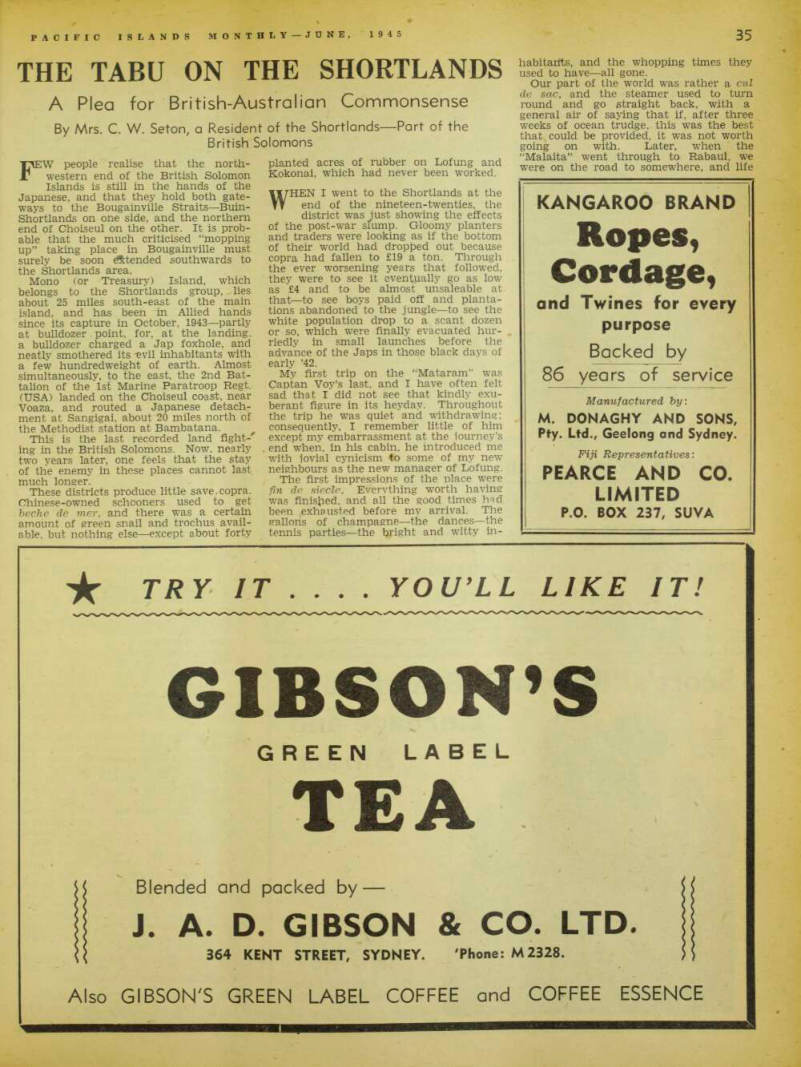
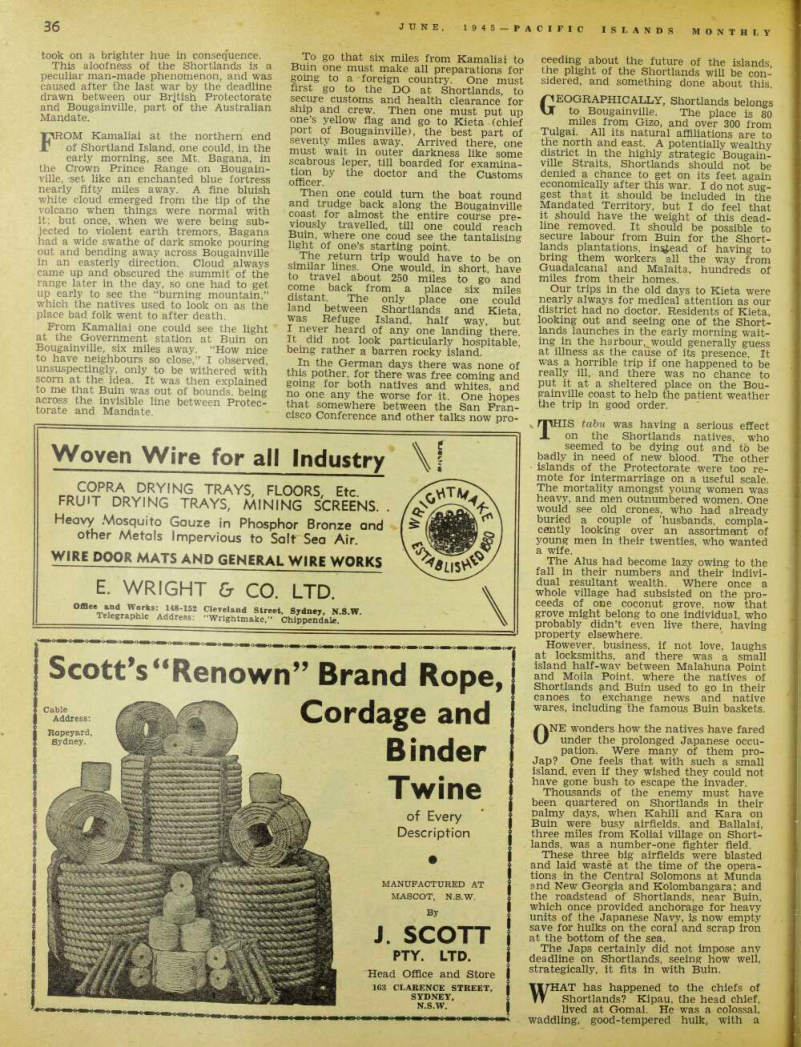
A Plea for British-Australian Commonsense
By Mrs. C. W. Seton, a Resident of the Shortlands —Part of the British Solomons
FW people realise that the north western end of the British Solomon Islands is still in the hands of the Japanese, and that they hold both gate ways to the Bougainville Straits —Buin- Shortlands on one side, and the northern end of Choiseul on the other. It is prob able that the much criticised “mopping up” taking place in Bougainville must surely be soon southwards to the Shortlands area.
Mono (or Treasury) Island, which belongs to the Shortlands group, lies about 25 miles south-east of the main island, and has been in Allied hands since its capture in October, 1943 —partly at bulldozer point, for, at the landing, a bulldozer charged a Jap foxhole, and neatly smothered its evil inhabitants with a few hundredweight of earth. Almost simultaneously, to the east, the 2nd Bat talion of the Ist Marine Paratroop Regt. (USA) landed on the Choiseul coast, near Voaza, and routed a Japanese detach ment at Sangigai, about 20 miles north of the Methodist station at Bambatana.
This is the last recorded land fight ing in the British Solomons. Now, nearly two years later, one feels that the stay of the enemy in these places cannot last much longer.
These districts produce little save.copra.
Chinese-owned schooners used to get beche de mer, and there was a certain amount of green snail and trochus avail able, but nothing else —except about forty
planted acres of rubber on Lofung and Kokonai, which had never been worked. W , TT ™ T T , ... 11/ HEN 1 went to sllor glands at the *▼ end of the nineteen-twenties, the district was just showing the effects of the post-war slump. Gloomy planters and traders were looking as if the bottom of their world had dropped out because copra had fallen to £l9 a ton. Through the ever worsening years that followed, they were to see it eventually go as low as £4 and to be almost unsaleable at that—to see boys paid off and planta tions abandoned to the jungle—to see the white population drop to a scant dozen or so, which were finally evacuated hur riedly in small launches before the advance of the Japs in those black days of early ’42.
My first trip on the “Mataram was Captan Voy’s last, and I have often felt sad that I did not see that kindly exu berant figure in its heyday. Throughout the trip he was quiet and withdrawing: consequently, I remember little of him except my embarrassment at the journey’s . end when, in his cabin, he introduced me with iovial cynicism to some of my new neighbours as the new manager of Lofung.
The first impressions of the place were fin de siecle, Evervthing worth having was finished. and all the good times had been exhausted before mv arrival. The gallons of champagne—the dances—the tennis parties—the bright and witty in
habitants, and the whopping times they used to have—all gone.
Our part of the world was rather a cul de sac, and the steamer used to turn round and go straight back, with a general air of saying that if, after three weeks of ocean trudge, this was the best that could be provided, it was not worth going on with. Later, when the “Malaita” went through to Rabaul, we were on the road to somewhere, and life
took on a brighter hue in consequence.
This aloofness of the Shortlands is a peculiar man-made phenomenon, and was caused after the last war by the deadline drawn between our British Protectorate and Bougainville, part of the Australian Mandate.
FROM Kamaliai at the northern end of Shortland Island, one could, in the early morning, see Mt. Bagana, in the Crown Prince Range on Bougain ville, -set like an enchanted blue fortress nearly fifty miles away. A fine bluish white cloud emerged from the tip of the volcano when things were normal with it; but once, when we were being sub jected to violent earth tremors, Bagana had a wide swathe of dark smoke pouring out and bending away across Bougainville in an easterly direction. Cloud always came up and obscured the summit of the range later in the day, so one had to get up early to see the “burning mountain,” which the natives used to look on as the place bad folk went to after death.
From Kamaliai one could see the light at the Government station at Buin on Bougainville, six miles away. “How nice to have neighbours so close,” I observed unsuspectingly, only to be withered with scorn at the idea. It was then explained to me that Buin was out of bounds, being across the invisible line between Protec torate and Mandate.
To go that six miles from Kamaliai to Buin one must make all preparations for going to a foreign country. One must first go to the DO at Shortlands, to secure customs and health clearance for ship and crew. Then one must put up one’s yellow flag and go to Kieta (chief port of Bougainville), the best part of seventy miles away. Arrived there, one must wait in outer darkness like some scabrous leper, till boarded for examina tion by the doctor and the Customs officer.
Then one could turn the boat round and trudge back along the Bougainville coast for almost the entire course pre viously travelled, till one could reach Buin, where one coud see the tantalising light of one’s starting point.
The return trip would have to be on similar lines. One would, in short, have to travel about 250 miles to go and c<pme back from a place six miles distant. The only place one could land between Shortlands and Kieta, was Refuge Island, half way, but I never heard of any one landing there.
It did not look particularly hospitable, bemg rather a barren rocky island.
In the German days there was none of this pother, for there was free coming and going for both natives and whites, and no one any the worse for it. One hopes that somewhere between the San Fran cisco Conference and other talks now pro
ceeding about the future of the islands the plight of the Shortlands will be con sidered, and something done about this.
Geographically, shortlands belongs
to Bougainville. The place is 80 miles from Gizo, and over 300 from Tulgai. All its natural affiliations are to the north and east. A potentially wealthy district in the highly strategic Bougain ville Straits, Shortlands should not be denied a chance to get on its feet again economically after this war. I do not sug gest that it should be included in the Mandated Territory, but I do feel that it should have the weight of this dead line removed. It should be possible to secure labour from Buin for the Short lands plantations, of having to bring them workers all the way from Guadalcanal and Malaita, hundreds of miles from their homes.
Our trips in the old days to Kieta were nearly always for medical attention as our district had no doctor. Residents of Kieta, looking out and seeing one of the Short lands launches in the early morning wait ing in the harbour,.would generally guess at illness as the cause of its presence. It was a horrible trip if one happened to be really ill, and there was no chance to put it at a sheltered place on the Bou gainville coast to help the patient weather the trip in good order. rpHIS tabu was having a serious effect X on the Shortlands natives, who seemed to be dying out and to be badly in need of new blood. The other islands of the Protectorate were too re mote for intermarriage on a useful scale.
The mortality amongst young women was heavy, and men outnumbered women. One would see old crones, who had already buried a couple of 'husbands, compla cently looking over an assortment of young men in their twenties, who wanted a wife.
The Alus had become lazy owing to the fall in their numbers and their indivi dual resultant wealth. Where once a whole village had subsisted on the pro ceeds of one coconut grove, now that grove might belong to one individual, who probably didn’t even live there, having property elsewhere.
However, business, if not love, laughs at locksmiths, and there was a small island half-way between Malahuna Point and Moila Point, where the natives of Shortlands and Buin used to go in their canoes to exchange news and native wares, including The famous Buin baskets.
ONE wonders how the natives have fared under the prolonged Japanese occu pation. Were many of them pro- Jap? One feels that with such a small island, even if they wished they could not have gone bush to escape the invader.
Thousands of the enemy must have been quartered on Shortlands in their palmy days, when Kahili and Kara on Buin were busy airfields, and Ballalai, three miles from Koliai village on Short lands, was a number-one fighter field.
These three big airfields were blasted and laid waste at the time of the opera tions in the Central Solomons at Munda and New Georgia and Kolombangara; and the roadstead of Shortlands, near Buin. which once provided anchorage for heavy units of the Japanese Navy, is now empty save for hulks on the coral and scrap iron at the bottom of the sea.
The Japs certainly did not impose any deadline on Shortlands, seeing how well, strategically, it fits in with Buin.
WHAT has happened to the chiefs of Shortlands? Kipau, the head chief, lived at Gomai. He was a colossal, waddling, good-tempered hulk, with a
snowy thatch, and smiling, toothless mouth, reminiscent of betelnut.
Once HMS “Sussex” spent four days in Shortlands harbour, and was open for inspection by the natives. Kipau, a “Sussex” cap-band round his white wool, impressed the officers considerably by the admiring way in which he waddled round the big guns, now and again wheezing in awed tones, “Number ONE—Number
One!”
Then there were the other chiefs, Ilala, of the one hand, from Nuhu—Riesing from Koliai—lsoma from Pirrimirri— Betiai of Aliang—Glassa of Maliai—most of them old men. Will they be still alive when Shortlands comes back to us? And what will their consciences be like?
The Alus were a distinctive crowd, with their dead black skins and ugly brownish
familiar" "SgeTSSe'SSTSnS
a There waffone called Antonio who used tn brincr nc rravfi«;h Onrp whpn wp remonstrated with him for brinaine hen with laraT clusters of eaas told tom they would end bv dvina out he lathed for ouite five minutes at such a notton He had a feTreome habit of aDDearine wfth anvthffie un to twentv Sp SvfiT imf flftpr onp hTd a rptoiVprtoorfnll of stpampr meat reirigeraior-iuii oi steamer meat. mHE Shortlands are low. Shortland X itself is a bare six hundred feet above sea level. Approaching on th,e steamer, after the night run from Gizo, one sees, with the first light of dawn, the huge mass of Bougainville towering aloft.
Not till one is very close does ope see Shortland Island, crouched like a dog at the foot of Bougainville.
There are lovely coral beaches on all the surrounding islets and, whilst travelling among the reefs and sandbars, one passes
the whole incredible paraphernalia of a tropical picture—blazing white sand, dark blue §kies, deep-green coconuts leaning out over the sand, basking alligators on Once, coming back from Kamaliai, there was one asleep near Sivi lou, and it slept so soundly with its mouth open that the launch boys killed it by firing down its mouth with a shotgun.
They brought the 12-feet body back in the punt; and the head was still drying out on the office steps when the Japs came in.
Back from the water’s edge, the prime val jungle lifts, green and mysterious, with rain showers falling on the upper slopes like a fine grey mist. There is a tremendous average rainfall, and a large quantity of swamp, so horses are never used, and everything is done by water. w hile I was there times ever grew W poorer and more difficult for those J* the peak prices for copra were on the wane. with depression around us, and com munications and population getting more and more nil ’ we lived for our homes and our gardens and our domestic animals.
We sought the co-operation of the natives in reviving their dances. The Malaita boys, I think, took the honours for these. The y have some intricate steps and a highly finished performance of them. The devil dance was done for us at Christmas time. They take their dances very seriously, and it is very bad form for onlookers to laugh, no matter how amusing the earnestness and the antics. The Choiseul natives have a very attractive canoe dance; and the Buin» dance put on by “boys” who were brought over in the old days as slaves to the Alus, and left behind when their homes were cut off, was very spectacular.
Round trippers used to wax vocal and
not in complimentary fashion, over the heat, the flies and copra bugs that assailed them at Faisi; but those of us who lived there used to assure them that steamer-day was always the hottest occa sion for us, too, rushing about in the glaring sun in the heat of the day on the waterfront. They should have known, as we did, the happier occasions—punning with a fair wind, and the awnings down; jib and mainsail taut, and big kingfish coming in over the stem as fast as the boys could haul them; nights on the launch, with the velvet water softly slap ping the bows and the phosphorescence snakily weaving in the overside depths; the pleasures of a loyal and adequate staff in plantation or house. The more I hear of Huns and Honourable Nipponese the ™J° r “ y treated ' BECAUSE the Alus were too wealthy or MJ too lazy to work, the only work done was by indentured labour—Malaita, Guadalcanal, and Makira (San Cristoval) natives. A few Ysabel or Choiseul boys were to be found amongst the police at Korovou, or in casual jobs. They were a happy, good-natured, laughing lot in the main, though inevitably there were the lazy or scheming exceptions that could, at times, make life decidedly tiresome.
I have many pleasant and appreciative memories of our boys. Our laurich-boy, Ilala, a Malaitaman, fought through the war alongside our own men, and was decorated.
The Shortlands are, or used to be, very unhealthy. There had been many cases of blackwater there, and a world-famed Methodist mission doctor told me he con sidered it came third on the list of the world’s most unhealthy places—the first two being the Gold Coast and the Sepik
River. This was on account of the universality of the malignant Tertian type of malaria, which found ample breeding ground in the swampy terrain.
What does the future hold fpr the Shortlanders—that is, the European ones; for we will not know just what has happened to the Alus till the Japs have been run out.
These people, in the early days braved the dangers and the diseases and the bad conditions to make their homes there, and to obtain the confidence of the natives.
One hopes that the day is not far off when these people, only a handful it is true, but -who yet have been responsible for such a spectacular effect on the natives, will be able to return to their homes.
Advertisements & other items, pp. 37-40 (1 item)
Gibson's
KANGAROO BRAND
Ropes,
Cordage,
and Twines for every purpose Backed by 86 years of service Manufactured by:
M. DONAGHY AND SONS,
Pty. Ltd., Geelong and Sydney.
Fiji Representatives :
PEARCE AND CO.
LIMITED
P.O. BOX 237, SUVA
★ TRY IT ... . YOU’LL LIKE IT!
GIBSON'S
GREEN LABEL
TEA
Blended and packed by— J, A. D. GIBSON & CO. LTD. \ 364 KENT STREET, SYDNEY. 'Phone: M 2328.
Also GIBSON'S GREEN LABEL COFFEE and COFFEE ESSENCE
Woven Wire for all Industry
C° PR A DRYING TRAYS, FLOORS, Etc.
FRU'T DRYING TRAYS, MINING SCREENS. .
Heavy Mosquito Gauze in Phosphor Bronze and other Metals Impervious to Salt Sea Air.
WIRE DOOR MATS AND GENERAL WIRE WORKS
E. WRIGHT & CO. LTD.
Scott’s “Renown” Brand Rope,
Cable Address: Ropeyard, Sydney.
Cordage and
Binder
Twine
of Every
Description
MANUFACTURED AT
MASCOT, N.S.W.
By
J. SCOTT
PTY. LTD.
Head Office and Store
163 CLARENCE STREET,
SYDNEY,
N.S.W.
William Atkins ny. iu.
Head Office 449-451 KENT ST., SYDNEY.
Iron fir Steel Merchants-Engineers' Supplies
ESTABLISHED OVER 50 YEARS
Coach fir Motor Hardware Cable Address; WILATKIN, Sydney.
STEEL DEPARTMENT
MILD STEEL:
Rounds, Squares, Flats, Half-rounds, Hexagons, Bevel, Shoeing, Tyre, Angles, Tees, Sheets, Plates, Girder Plates, Chequer Plates, Channels, Hoops, Etc.
BRIGHT STEEL;
Rounds, Squares, Hexagons. \ Extra Special High Speed Tool Steel, Mining Steel, Blister Steel and Spring Steel, Rounds, Flats & Squares.
Bar Iron—All sections and sizes.
Engineers' Supplies: Set Screws, Studs, Metal Thread Screws, Coach Screws, Piles,' Cotter Pins, Bright and Black Bolts, Rivets, Etc., Hack Saw Blades.
Power Transmission Gear: Including Plummer Blocks, Couplings, Collars, Etc.
Coach and Motor Hardware: Axles, Springs, Wheelstuff, Duck, Paints.
Farriers' Supplies: Horse Nails, Anvils, Vices, Etc.
Motor-Trimmers and Motor Builders' & Motor Painters' Requirements
C. A. WILLEY'S
Quick-Drying Coach and Car Paints, Roughstuff, Elastic Gloss, Synflex Enamels, Lacquers.
DUCO Lacquers and DULUX Enamels—FAßßEX Motor Toppings and Leather Cloths, House & Decorators' Paints, Varnishes & Brushware.
Sole Distributors of CHAMPION'S Decorators Point Products.
Distributing Agents for BROLITE Lacquers, SYNFLEX Enamels and "POLYGLOSS" Finish.
G.P.O. Box 314, Cable Address: Suva, Fiji. “Parekh,”
S. P. PAREKH
& BROS.
Suva's Leading
Jewellers
Manufacturers of: Tortoise-shell Wore (including Necklaces, Bracelets, Hinged Watch-bands and Brooches, etc); Silver Filigree Ware, Ivoryware, Brassware, Coconut and Ebony Curios . . .
ALSO :
Tortoise-shell Ware with Silver and Cats-eyes inlaid.
Dealers in Indian Handmade Woollen Carpets.
All Enquiries Will Receive Prompt Attention.
itching Skin Germs Killed in 3 Days
Thanks to the discovery of an American th P ySl fJf n ' !t iS n °7 possible t 0 kill and remove if ue cau , se of most skin troubles. Your skin has nearly 50 million tiny seams and pores JfI Slble £ ern ? s and Parasites can hide, and which are the true cause of terrible Itching, Cracking, Peeling, Burning, Ringworm f£ S ° r !? aS «’ blackheads, Pimples, Foot Itch and other disfiguring blemishes. f^ lemi l hes sucb as these make you look and in lift assed ’ „ unatt ractive and handicapped in life, both socially and in business. You can’t thase dlsfi gurements with ordinary treatments, which give only temporary relief rlsnontihi he f d ° not kIII the germs or Parasites responsible for your trouble. .
New Discovery Kills Cause
n^t rmer . S i kin suffer ers throughout the world are iP^in Pra A ISlng - Nixoderm - the discovery of a s P ec ialist. This remark- -7+£ rep f- atlon qulckl r Penetrates into the site! r/snn h n e^S m f and klUs the germs and Parasites responsible for your trouble in 7 minute-? sloping the Itch almost instantly At the same time, this wonderful preparation acts as vou? n r C onhl d f kin SO tbat as the cause S Xi i is removed, your skin becomes soft, nSxliS Sn ? lGar * 11118 Clear ’ healthy come*sy S, XSx tmndT D ' W Cha ™ and make «
Praised by Doctors
Dr. T. A. Ellis, well-known physician of Toronto, Canada, recently stated: 1 “Skin disorders caused by parasites, as many are, yield to Nixoderm. These parasites are invisible to the naked eye. They eat away the skin, forming ugly eruptions. Ordinary ointments or remedies fail completely, or give only temporary results because they do not reach the cause of the condition. It is this value about Nixoderm in attacking parasites which impresses me most favorably, and explains In large measure the success it enjoys over many stubborn cases.”
Guaranteed Results
Get Nixoderm to-day. Put It to the test. In a few minutes you will find that the Itching has stopped, and in 24 hours you can see for yourself that your skin is clearer. And it is guaranteed that, within one week, Nixoderm must make your skin soft, clear, smooth and attractive or money back on return of empty package. Get Nixoderm from your chemist or store to-day. The guarantee protects you. So don’t delay. Get Nixoderm to-day.
Nixoderm u- &v-
For Skin Sores, Pimples and Itch.
Australia And The New Hebrides
Land Grants Which Are Now Forgotten
'J'HIS article, sent by a special
correspondent -from Noumea on
May 3, reminds us that the -future of the Condominium of the New
Hebrides, like that of the Mandates,
may\ come up for consideration by the new world authority being created at San Francisco.
Australia is believed to covet the
New Hebrides, for protective reasons.
But, apart from the operations of Burns Philp & Co., Ltd., Australia has done nothing whatever to develop the Territory—nearly all credit for the colonisation there must gq to the French.
A LITTLE remembered crisis in New Hebridean affairs occurred after the last World War, resulting from the French Government’s refusal to buy out the Higginson interests in the French New Hebridean Company. Higginson was the Englishman to whom the French gave grand nationalisation papers when he organised the New Caledonian nickel company, and made France for a time dominant in the New Hebrides. He left his interest to members of his large French family, but after the Condominium Government was formed the affairs of the SFNH (Societe Francaise des Nouvelles Hebrides) got in rather a bad way. • In the Australian House of Represen tatives in 1921, the Prime Minister, Mr W. M. Hughes, made the sensational announcement that the company had offered to sell all its interests to Aus tralia. The offer, he said, included all the French land in the Group, which he estimated at 600,000 hectares, or half the total area. Mr, Hughes explained that this offer had been made to him during the Imperial Conference in London, and that the French Government had given an assurance that it would raise no ob jection to the transaction. He added
that the operation would give Australia supremacy in the Group, and that the Japanese might put pressure on the sellers if Australia refused to buy.
TWENTY-FIVE million francs was asked for the land, to be paid over a period of five years. But it turned out later that the French Government had been offered the same interest for fifteen millions, and that the French option holder hoped for a commission of some thing like ten million on the deal.
Not getting an immediate reply, the company next cabled Australia that it had resumed its freedom of action, and that American interests were trying to negotiate. This may have been part bluff, for the publicity given in France to the offer made to Australia induced the French Government to step in at last in earnest and obtain control through the Bank of Indo-China.
Ballandes, of Bordeaux, the big Cale donian and Hebridean trading concern (“The French Burns Philp”), next came in, and are supreme in the French com pany to-day.
The French Government readily agreed to their suggestion that Indo-Chinese coolie labourers should be introduced to cultivate Hebridean land “much as the Hindus are being introduced into Fiji.”
Actually, the development of Hindu and Indo-Chinese labour in the two archi pelagos has not been on identical lines.
GREAT interest attaches to the state ment of Mr. Hughes that he per sonally was not in favour of an Australian purchase at the price asked, because he did not feel that the titles of possession were in all cases perfectly sound. Above all, it was a question of price and of the validity of land titles.
He thought that, on examination, a num ber of the French claims might be con tested by the natives. If the titles of the French company to 376,000 hectares were incontestable, they seemed much less sure for the remaining 220,000. The real cause of trouble in the New Hebrides was over regulations concerning labour.
After the option had been dropped, the Minister for the Colonies in Paris said that he had had no official information of the offer having been made by the French company to the Australian Gov ernment. In any case, he would have considered such an offer with disapproval.
MR. HUGHES said later that French reports that discussions had taken place at the Imperial Conference favouring British annexation of the New Hebrides were incorrect. The question had not come before the Conference. He had certainly discussed the New Hebrides with the Secretary of State for the Colonies, but this discussion had no re lation with any offer to purchase land, but was simply to put Mr. Churchill au courant with the complaints brought for ward by Australian interests on the subject of the Condominium. (At that time, Australian missionary bodies in particular, were urging the Government to persist in its efforts to come to a friendly arrangement with the French so that the Group could pass under British control. They urged that Parliament should be given an oppor tunity to discuss the French company’s offer to sell its land and rights.) Winston Churchill, whom Mr. Hughes met in London in 1921, had already a remarkable knowledge of New Hebridean affairs. About the time the Condominium agreement came into force
he had been Under-Secretary of State for the Colonies, and an Australian settler wrote (I quote from a paragraph in the French “Mois Hebrides” of 1908): “There are very few things concerning the New Hebrides that Winston Churchill does not know. I have been correspbnding with him for two months, and am astonished at his knowledge and grasp of the affairs that pre-occupy us. Mr. Dale, of the Colonial Office, also knows the Hebrides, and Lord Elgin shows interest.”
EDITORIAL NOTE: Although agitation from various bodies in the past has not given Australia any sovereign rights in the New Hebrides, the Commonwealth, nonetheless, is one of the largest land owners in the Condominium, and for over 30 years the Commonwealth Government maintained a solicitor in Vila to watch Commonwealth interests m the slow deliberations of the Joint Court in re lation to land titles.
About 60 years ago, several Australian business men, led by Sir James Burns, founder of Burns Philp & Co., Ltd., formed the Australasian and New Hebrides Co., Ltd., which commenced trading and planting in Jhe New Hebrides.
The new company did not flourish finan cially, although it pursued a vigorous policy of land-buying, and by the time it was wound-up and taken over by Burns Philp &' Co., it owned plantation lands on most of the islands of the Group. This land was acquired originally from the natives, as was all land bought by the early settlers. Present-day land-owner ship is based on such native deeds, but validity of title rests with the decision of the Joint Court.
Eventually, all interests taken over from the Australasian and New Hebrides Co. by Burns Philp, were handed over as a gift by Sir James Burns to the Australian Government. Possibly, Sir James felt that if Australia had land interests there
she would more readily take an interest in the Group, and that if .Australian settlers were encouraged to go to the New Hebrides, the large trading concern of BP’s would ultimately benefit. What ever the reason, the Commonwealth accepted the land interests, and, between 1905-12, Australian settlers went to the New Hebrides. Australia, however, later lost interest in the settlers, and to some extent in the land. The settlers either got out or acquired French nationality in order that they might participate in the more helpful policy of France towards her pioneer colonists and, more particu larly, that they might be able to employ Asiatic labour—without which planting operations in the New Hebrides are virtually impossible.
Company
Praise for Fiji Docks Company Good Work on Boungainville
fIIHE Fiji Docks Company, a unit of the J. Fiji Labour Corps, which served on Bougainville for almost a year, has been singled out for commendation by American commanding officers in the area.
The Army Commander said; “Your organisation arrived in March, 1944, during the enemy attack on Torokina, and under the leadership of its officers worked aggressively and enthusiastically while subject to enemy artillery fire. For a period of eleven months your men worked efficiently and untiringly with little time for sports and recreation.
“During its service at this base the superior appearance of the personnel, equipment and installations of your com pany was outstanding. The prompt and cheerful manner in which your officers and men executed orders under all con
ditions was noted by all who observed their work. The excellent service of your company contributed greatly to the suc cess of the supply and port activities at Bougainville, and thereby to the success of our campaign against Japan.”
Much of the credit for the success of the work done by the company is due to Major Arthur Lewis, who had had long peacetime experience in handling cargo, and who was a particularly valuable officer on Bougainville.
Advertisements & other items, pp. 41-48 (2 items)
Years
UNION
ASSURANCE SOCIETY LTD.
(Incorporated in England)
FIRE ACCIDENT
FIJI A. E. PEARCE & CO.
RABAUL COLYER WATSON
(New Guinea) Ltd.
N. S. WALES 109 PITT STREET,
SYDNEY.
S. Morrison, Mgr.
CONTROLLING OFFICE—
-413 Collins St., MELBOURNE
GEORGE W. GIDDY. •
Resident Manager.
lifell
K. as <?r~ r-
YEARS
90 i) ra 5^
ARIEL!
SWALLOW
3
ITB
CKII
fit lIU cuts
BIIIIS
(ISIIIIt
\vv < 'Sv-.-LYH -t K« &z / J
HARRY J. YOUNG PTY. LTD.
Sole Pacific Islands Selling Representatives
and Distributors for the following Leading
Australian Manufacturers: —
BONDS INDUSTRIES LTD.
Manufacturers of All Types of Underwear, Hosiery, Half Hose, Sewing Cottons.
COMMONWEALTH WEAVING MILLS PTY. LTD.
Manufacturers of "DriGlo" Towels and Towelling of every description.
J. W. TRATHEN & CO. PTY. LTD.
Manufacturers of "Red, White Cr Blue" Handbags, Pouches, Wallets, Note Cases, School Bags, Purses, Watch Cases, Belts, Straps, Razor Strops and sundry leather lines.
COTTEE'S PASSIONA LTD.
Manufacturers of "Passiona" Fruit Cordials, Fountain Syrups, Jams, Spreads, Peanut Butter, Peanut Products and Jellies. •
HARRY PECK & CO. PTY. LTD.
Manufacturers of the famous "Anchovette," Bloater Paste, and Specialists in Potted Meats. •
ALPHA KNITWEAR PTY. LTD.
Manufacturers of Men's and Boys' Polo Shirts, Ladies' Knitted Blouses, Jumpers, Skirts.
Enquiries through your usual channels appreciated, and prompt shipments effected.
Eagle & Globe Building, 379 Kent St., Sydney Postal Address: Box 3661, G.P.0., Sydney.
N.S.W.
Bankers: Bank of N.S.W.
Codes: Bentley’s Comp. Phrase.
Bentley’s 2nd Phrase.
For Inflamed Eras and EraUda
SOLD EVEBTWHEIB
H. A. Rm» 4 C*. Pty. Ltd.. K>»i 9L, Sydnry
Asthma, Bronchitis Coughing, Curbed in 3 Minutes
spasms first night and he has had none since in over two years.
Money Back Guarantee
The very first dose of Mendaco goes right to work circulating through your blood and helping nature relieve you of the effects of Asthma. Try Mendaco under an iron-clad money back gaurantee. You be the judge. If you don’t feel fully satisfied after taking Mendaco just return the empty package and the full purchase price will be refunded. Get Mendaco from your chemist to-day and see how well you sleep to-night and how much better you feel to-morrow. The guarantee protects
you - RELIEVES ASTHMA
Mendaco
Now in 2 sizes . . . 6/- and 12/-
bo you have attacks of Asthma or Bronchitis so bad that you can’t sleep? Do you feel weak, unable to work, and have to be careful not to take cold and can’t eat certain foods?
No matter how long you have suffered or what you have tried, there is new hope> for you In a doctor’s prescription called Mendaco.
No dopes, no smokes, no injections, no atomizer.
All you do Is take two tasteless tablets at meals and In 3 mteiutes Mendaco starts working through your blood, aiding n £ tur f. remove phlegm, promote free easy. breathing and bring sound sleep the first night, so that you soon feel years younger and stronger.
No Asthma in 2 Years
Mendaco not only brings almost Immediate comfort and free breathing but builds up the system to ward off future tor instance, J. Richards, Hamilton, Ont., Canada, had lost 40 lbs., suffered coughing every night, couldn’t sleep. Mendaco stopped Asthma
B. DAVID Trading Co.
ISLAND TRADERS -
- EXPORT MERCHANTS
SHIPPERS OF ALL KINDS OF MERCHANDISE.
EXPORT REPRESENTATIVES OF LEADING
AUSTRALIAN MANUFACTURERS
Direct Enquiries to Head Office:
31 Queen Street, Melbourne, Vic.
Bankers: National Bank of Australasia.
Cable Address:
‘DAVID TRADING
MELBOURNE”
Branches and Agents in All Ports.
OPEN TO APPOINT AGENCIES WHERE NOT REPRESENTED
Details of conditions from this Company
ALUMINIUM AND ITS ALLOYS ARE
NOW AVAILABLE
Commercial applications of our metal in the form of domestic holloware, radio components, truck bodies, rubber plantation equipment, etc., may be of interest to you and we invite your inquiries.
ALUMINIUM
PRODUCTS
A
AUSTRALIAN ALUMINIUM COMPANY
GPMpbai (Incorporated in _g_ ENE R A L Q FFICES AND FABRICATION
PROPRIETARY LIMITED
(Incorporated in the State of Victoria)
DIVISION: GRANVILLE
SYDNEY, N. S. W.
A. B. DONALD Ltd.
AUCKLAND
ISLAND TRADERS & GENERAL MERCHANTS
P.O. Box 1509. Cables Gr Telegrams, "Kingdom", Auckland.
Purchasers at Full Market Prices on Assay Value of
GOLD
SILVER
PLATINUM
And Platinum Group Metals
SOME OF OUR SERVICES
ASSAYERS & ANALYSTS—
Assays of Bullion, Ores, etc.
Analyses of Metals, Minerals, Alloys, etc.
SCIENTIFIC & INDUSTRIAL
METALLURGISTS—
Our range of precious metal manufactures covers all industries—Gold and Silversmiths, Electrical Trades.
Dental Profession, Glass Sllverers, Electro-Platers, etc., etc.
REFINERS—
Purchasers and Refiners of Bullion, Scrap, Mining By-Products, and Trade Residues of every description carrying Precious Metals.
GARRETT & DAVIDSON
PTY. LTD.
824 George St., Sydney. Works: Surry Hills and Chippendale, N.S.W.
Official Assayers to the Bank of New South Wales. Gazetted Agents of the Commonwealth Bank of Australia, under the Gold Regulations of the National Security Act.
PRODUCING UNIFORM GOOD RESULTS SINCE 1868
Fioim
ALWAYS ASK FOR IT
Kidney Trouble
and Backache
Gone in 1 Week
Flush Kidneys With Cystex and You'll Feel Fine Cystex—the prescription of a famous doctor —improves faulty kidney action in double quick time, so, if you suffer from Rheumatism, Sciatica, Neuritis, Lumbago, Backache, Nervousness, Leg Fains, Dizziness, Circles under Eyes, frequent Headaches and colds, poor Energy and Appetite, Puffy Ankles or Interrupted Sleep, go to your chemist to-day for Cystex.
Cystex Helps Nature 3 Ways
The Cystex treatment is highly scientific, being specially compounded to soothe, tone and clean kidneys and bladder and to remove acids and poisons from your system safely, quickly and surely, yet contains no harsh, harmful or dangerous drugs. Cystex wo r ks in these 3 ways to end your troubles:— (1) Starts killing the germs which are attacking your Kidneys, Bladder and urinary system in two hours, yet Is absolutely harmless to human tissue. (2) Gets rid of health-destroying, deadly poisonous acids with which your system has become saturated. (3) Strengthens and reinvigorates the kidneys, protects you from the ravages of diseaseattack on the delicate filter organism, and stimulates the entire system.
Feels a Different Woman
“I have been taking Cystex for Kidney and Bladder trouble and it has made a different woman of me. I am feeling splendid, can do all my work, run about and walk miles although I am 63 years of age. Cystex does all yoq claim for it.”—(Sgd.) M. L. Zessin, Thompson Estate, Brisbane,
Now Able to Walk Without Stick
“I had Kidney and Bladder complaint, pains in leg and back; in fact, I had to use a walking stick. I have used two bottles of Cystex, now I have no pains anywhere. I consider Cystex the greatest medicine in the world for Kidney complaint.”—(Sgd.) J. McPherson, Nangeribone Station, N.S.W.
Guaranteed to Satisfy or Money Back Get Cystex from yodr chemist to-day. Give it a thorough test. Cystex is guaranteed to make you feel younger, stronger, better In every way, or your money back if you return the empty package. Act now!
Now in 2 sizes—4/-, 8/-.
This is a
GUARANTEED I .ITCfPY
Treatment
for Your Kidneys, Bladder, Rheumatism
Your old SCISSORS, RAZORS
and KNIVES can be
SHARPENED and REPAIRED
Send them to—
W. JNO. BAKER
3 HUNTER STREET,
SYDNEY.
AUSTRALIAN FOODSTUFFS ... PHARMACEUTICAL LINES
WINES AND SPIRITS . . . MANUFACTURED GOODS
PRIMARY PRODUCTS ... PATENT MEDICINES
// YOUR ORDERS FOR GIN AND WHISKY can still be filled.
Distilled in Australia, matured under Customs supervision, these spirits are of guaranteed strength and quality. Orders will be accepted while stocks last.
qmpamf
(Proprietors: R. Darvas and E. Klugman.) ° ar y as Company, Sydney. Codes: Bent., A.B.C. (6th). • -Dank of Australasia, Comptoir National d’Escompte de Paris. 3 5
PITT
HEAD OFFICE :
STREET,
SYDNEY
41
THE BARRY REPORT
(Continued from page 6)
PACIFIC ISLANDS MONTHLY JUNE, 1945
Flight-Lieut. H. G. PILLING, DFC, of the RAF, formerly
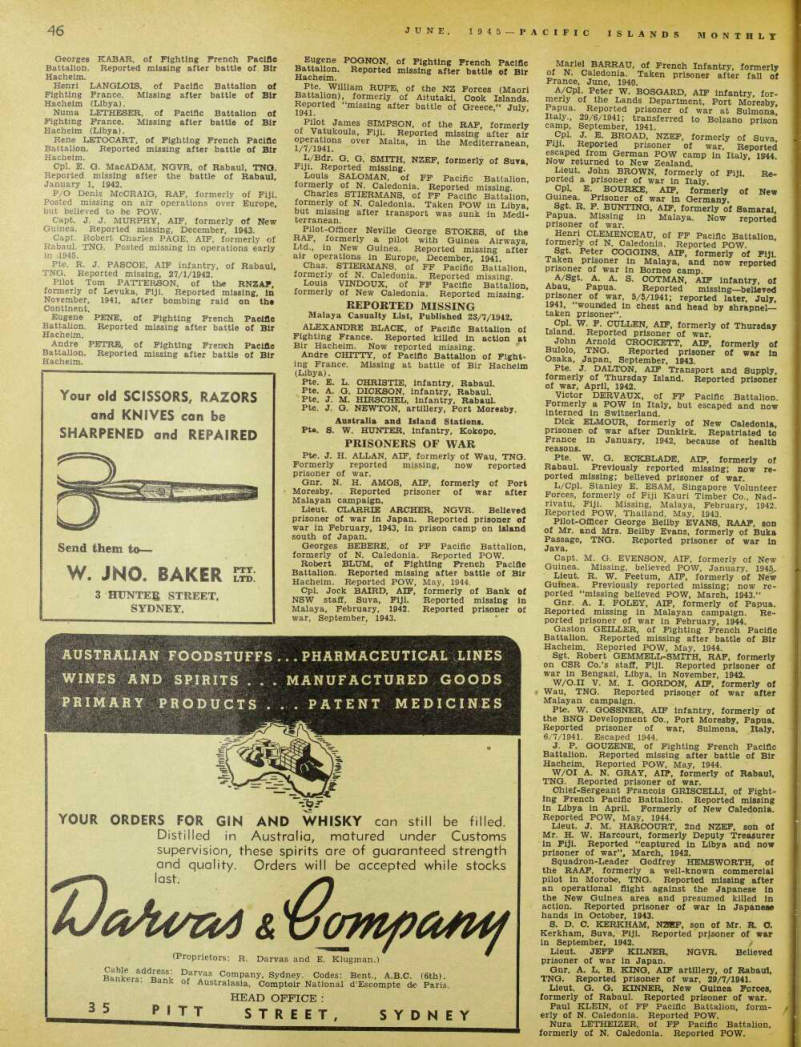
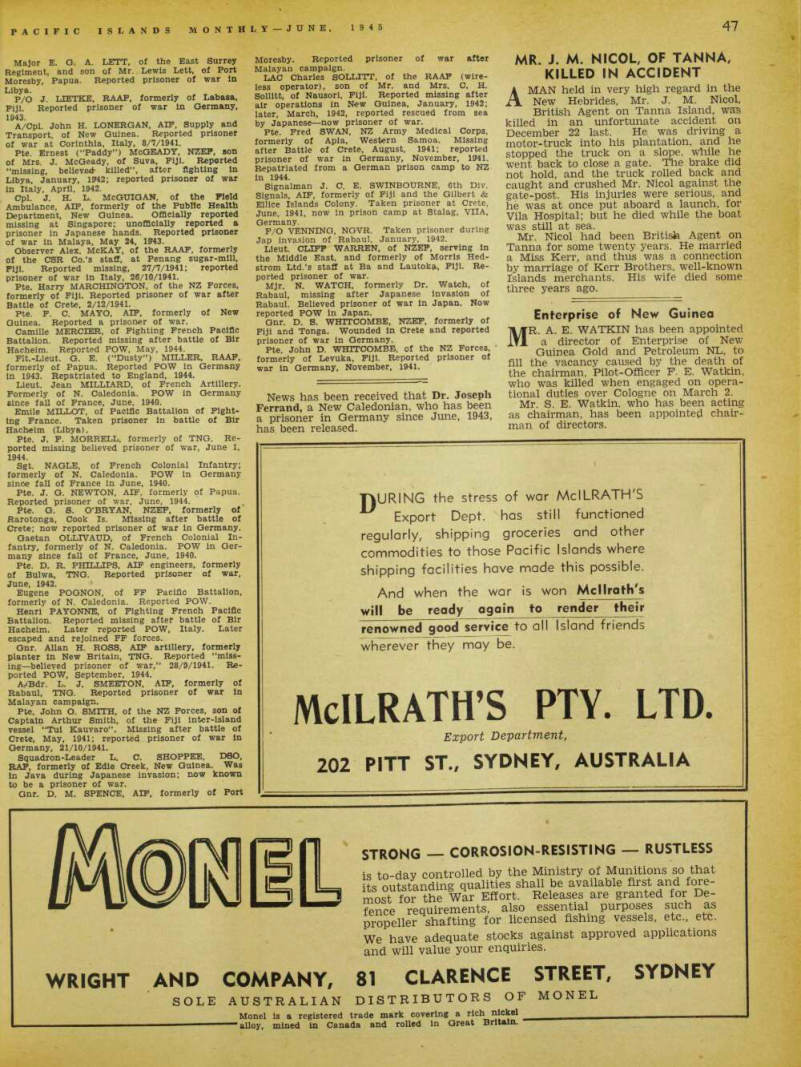
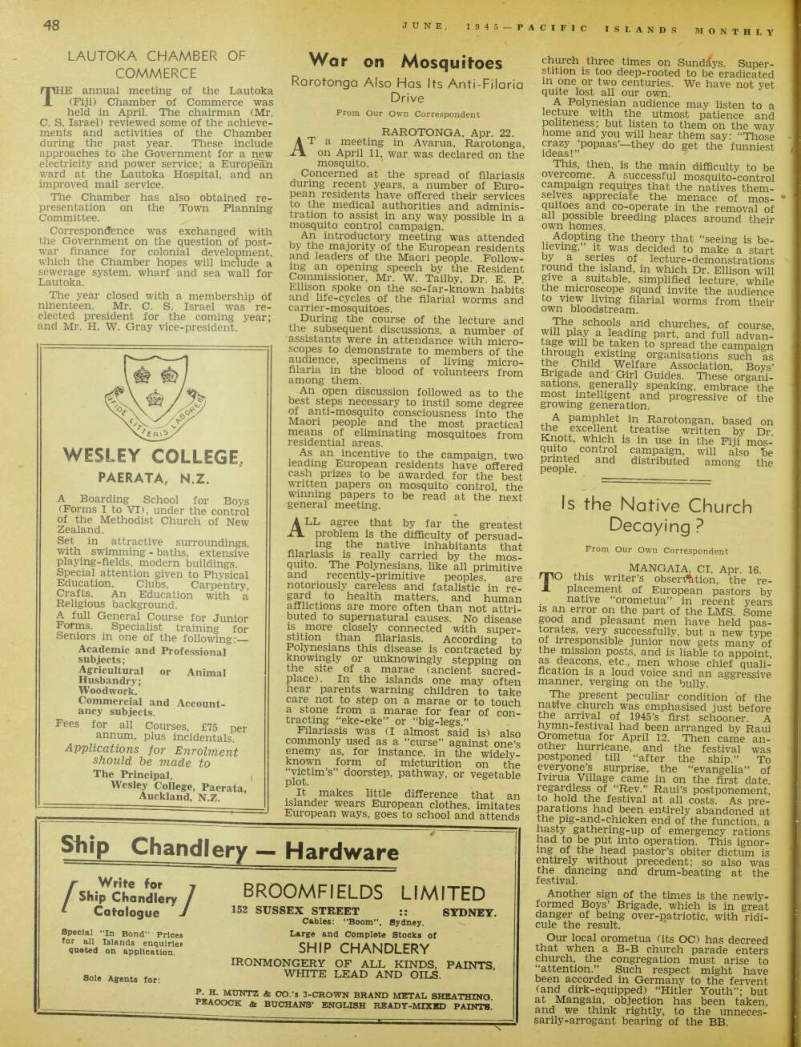
RAF, formerly of Suva, FIJI. Killed on air operations, May 19, 1942.
Pte. Edward Harold PRICE, 2nd NZEF (27th Machine Gun Battalion), youngest son of Mr. and Mrs. J. Price, Savu Savu West, Fiji. Killed in action during the Libyan campaign, Middle East, 27/11/1941.
Pte. Cecil PURCELL, NZEF, formerly of Aleipata, Samoa. First Samoan Euroneslan to give his life in World War 11. Killed in action in Middle Bast.
P/O G. REES-JONES, RAAF. formerly of Labasa, Fiji. Killed in air operations over Ger many, August 16, 1942.
Capt. W. H. ROBERTS, NZEF, who was Accountant in the Samoa Treasury Department during 1934-35. Killed in action in Libya, December, 1941.
Pte. Kameli ROKOTUILOMA, of the Fiji Military Forces. Reported killed in action, December, 1943, Major A. B. ROSS, NZEF, who, between 1923- 1929 was successively, Assistant Secretary for Native Affairs, Assistant Secretary to the Administration, and ADC to the Administrator of Samoa. Killed in action in Libya.
Cpl. Alex. C. SCOTT, AIF, formerly manager at Kieta, TNG, for Burns, Philp & Co., Ltd.
Killed in action in the Middle East, 19/6/1941.
J. SIMPSON, RAAF, formerly of Fiji. Killed in action over Malta, July, 1941.
Sgt. R. R. SHORT, AIF, formerly of Port Moresby. Killed in action.
Lieut. G. STEVENSON, AIF, formerly a Patrol Officer in New Guinea. Killed in action in New Guinea, on June 26, 1943.
Cpl. Sefanala SUKANAIVALU, FMF. Reported killed in action in the Solomons, September, 1944.
Capt. P. A. TUCKEY, AIF, formerly of TNG.
Killed in action in Sepik area, NG, December, 1944.
Lieut. A. G. W. THOMAS, RANR, formerly master of Burns Philp & Co.’s SS “Mullama.”
Killed in action.
Pte. Popoare TANGIITI, of the NZ Forces (Maori Battalion), formerly of Mangaia, Cook Islands, Reported “missing after battle of Greece —presumed dead,” July, 1941.
John Tama TETOEA, of FF Pacific Battalion, formerly •of Tahiti. Killed in action in Italy, June, 1944.
Atera TEUIRA, of FF Pacific Battalion, for merly of Tahiti. Killed in action in Italy, June, 1944.
Derek TOVEY, NZEF, formerly of Suva, Fiji.
Killed in action in Tunisia in April, 1943.
Andre VERNIER, formerly of Tahiti. Killed in action with the Maquis in France.
Rifleman R. E. VERNON, AIF, formerly of Lae, TNG. Reported killed in action, June, 1944.
Cadet-Officer Charles WITT, Pacific Battalion, FF Forces, formerly of New Caledonia. Killed in action on Italian front.
Capt. A. F. J. WHITE, AIF, formerly a Dis trict Officer in Fiji, and BSI. Killed in action in New Guinea.
Died From Wounds
Pte. Roy lan BROWN, NZEF, formerly of Apia, W. Samoa. Died of wounds in Italy, April, 1944.
Pte. Ernest HENRY, AIF, formerly of the Rabaul (NG) staff of Burns, Philp and Co.
Ltd. Died from wounds received in Battle of Crete, 1/6/1941.
Pte. Alec. MUNRO, NZ Forces, formerly of Norfolk Island. Died in Libya (Middle East), December, 1941.
Adolphe Arthur LAHARRAGUE, formerly of Tahiti. Died of wounds received while serving in the Fighting French forces.
Pte. T. LAWRIE, AIF, son of Mr. Lawrle, for merly of Fiji. Died of wounds in Middle East.
Pte. Walter PEARSON, of first NG quota of AIF (infantry). Died from wounds received In action, 24/6/1941.
A/Bdr. W. R. SCOTT, AIF, of New Guinea.
Died from wounds, July, 1941.
Sgt. Charles SPITZ, of the Fighting French, Pacific Battalion, and formerly of Tahiti. Died from wounds received at Bir Hacheim, on June 21, 1943. % Sgt.-Pilot Peter Clarkson WISE, of the RAF, soh of Mr. W. Wise, OBE, Director of Public Works, Fiji. Died from wounds received during bombing raid over Germany, January, 1941.
Accidentally Killed
Capt. P. P. BREWER, AIF, formerly of Papua.
Reported accidentally killed.
Lieut.-Colonel C. C. JUDD, formerly of Morobe, TNG. Accidentally killed in Australia in January, 1943.
A/Cpl. P. A. McKEB, New Guinea Forces, formerly of Bulolo. Died of injuries.
Major N. V. McKENNA, AIP, formerly of Wau, TNG. Accidentally killed, September 30, 1943.
Lieut. Harrowby RYDER, AIF, formerly of Fiji.
Accidentally killed on active service in New Guinea.
Flight-Lieut. James Ba THOMPSON, RAAF, formerly of Fiji. Killed in aricraft accident in India on April 1, 1945.
F/O Lee VIAL, DSC, formerly ADO, Mandated Territory. Killed in April, 1943, in a plane crash in Sepik district while on a special mission.
Capt. F. E. WILLIAMS, formerly Government Anthropologist in Papua. Killed in a plane acci dent while on duty in New Guinea, in 1943.
Sgt. Edward WILSON, of Suva, serving in the Fiji Defence Force. Accidentally drowned in the Lami River, Fiji, April, 1942.
Gnr. Robert J. WILSON, formerly of Port Moresby, Papua. Accidentally killed in troop train in Middle East in 1942.
Died From Illness
Pte. Lawrence BOYER, NZEF, formerly of Tonga and Fiji. Died on active service in Italy.
Pte. Tevita BUREKAMA, of Fiji Military Forces. Died of illness while on duty in the Solomons.
Pte. H. COOMBE, NZEF, formerly of Suva, Fiji. Died in Middle East, April, 1944.
Major Charles DUCHATEL, formerly of TNG.
Died of scrub tvphus at Port Moresby, November 21, 1943.
W/02 G. F. HAMMOND, ANGAU, formerly of TNG Administration. Reported died of illness early 1945.
Pte. Clarence A. HUTTON, AIF, formerly of Edie Creek, TNG. Died from illness, April, 1941, Ratu Dovi KOMAISAVAI, RAF, formerly of Fiji. Died of illness in Britain, October 19, 1944.
Capt. W. J. MCDONALD, AIF, formerly of Morobe and Sepik districts. TNG. Died of ill ness in New Guinea, July 20, 1944.
Pte. Manoa NAKARU, of the Fiji Military Forces. Reported died on active service, Decem ber, 1943.
Pte. Isikeli NABOKO, of the Fiji Military Forces. Reported died on active service, Decem ber, 1943.
Seaman Malvin NELSON, of Fiji Royal Naval Volunteer Service. Death reported in May. 1943.
Pte. Inikasio SERU, of the Fiji Military Forces. Reported died on active service, Decem ber, 1943.
A/Sgt. J. H. STANE, Royal Australian Engineers, formerly of Port Moresby, Papua.
Died from illness, May, 1942.
Rifleman R. A. SMITH, HQ Unit. (Place of enlistment not stated.) Died of illness.
Cpl. R. H. SUTTON, NGVR, formerly of Wau, TNG. Died from malaria and typhoid in October, 1942.
Pte. Mateo TUIDALA, of the Fiji Military Forces. Reported died on active service, Decem ber, 1943.
Pte. Emosi WAQA, of the Fiji Military Forces.
Reported died on active service, December, 1943.
Major P. J. WOODHILL, AIF infrantry, for merly legal assistant in the Crown Law Office, Rabaul, New Guinea. Reported died from illness, December, 1941.
Pte. F. WORK, of the Fiji Military Forces.
Reported died on active service, December, 1943.
Missing
Louis ANGER, of Fighting French Pacific Battalion. Reported missing after battle of Bir Hacheim.
Pte. P. F. BAILEY, AIF infantry, of Rabaul, TNG. Reported missing, 17/2/1942. Now re ported prisoner of war.
Lieut. J. T. BARRACLUFF, AIF, formerly of New Guinea. Reported missing, December, 1943.
Cpl. Leon BARRENS, of Pacific Battalion of Fighting France. Missing after battle of Bir Hacheim (Libya).
Alexandre BLACK, of Pacific Battalion, FF Forces. Reported missing after Battle of Bir Hacheim.
T. BLAKELOCK, BEF, formerly of Fiji. Miss ing.
Sgt. Ronald Arthur BROODBANK, formerly of Samarai, Papua, now serving with the RAAF overseas. Reported missing on May 31 while on air operations.
Sgt. Alexander BROWN, RNZAF, formerly of Rarotonga. Reported missing over Germany, on September 15, 1942.
Reginald BOULANGER, of Fighting French Pacific Battalion. Reported missing after battle of Bir Hacheim.
H. BUCKNELL, AIF, formerly of Fiji. Missing.
Andre CHITTY, of FF Pacific Battalion, form erly of N. Caledonia. Reported missing.
Pte. E. L. CHRISTIE, AIP infantry, of Rabaul, TNG. Reported missing, 17/2/1942.
Georges CLEMEN, of FP Navy. Formerly of N. Caledonia. Missing In Mediterranean, March, 1942.
Victor DERVAUX, of Fighting French Pacific Battalion. Reported missing after battle of Bir Hacheim.
Lucien DEVAND, of Pacific Battalion of Fight ing Prance. Missing after battle of Bir Hacheim (Libya).
Pte. A. G. DICKSON, AIP infantry, of Rabaul, TNG. Reported “missing, believed wounded,” 17/2/1942.
Wing-Commander Donald DONALDSON, RAAP, formerly of Nauru. Missing on air operations over France in June, 1944. Later rejoined his squadron, Pilot-Officer Norman R. FRAZER, RAAF, formerly of Wau, TNG. Reported missing on air operations over Germany, August 30, 1943.
Eion FIELD, RNZAF, formerly of staff of Kasi Mines, Fiji. Missing in Java.
Gath GELDARD, NGVR, of New Britain.
Missing after the battle of Rabaul, January, 1942.
Georges GOVBTCHE, of FF Pacific Battalion, formerly of N. Caledonia. Reported missing.
Capt. J. E. CRIMSON, AIF, formerly of New Guinea. Reported missing, 1944.
Acting Flight-Lieut. Don A. IRVING, RAAF, formerly chemist in CSR Co., Labasa, Fiji. Miss ing, presumed dead, in air operations over Germany, February 27, 1942.
Pte. Andrew A. (Billo) Johnson, Ngvr.
Reported missing in New Guinea on October 29, 1942.
Georges KABAR, of Fighting French Pacific Battalion. Reported missing after battle of Blr Hacheim.
Henri LANGLOIS, of Pacific Battalion of Fighting France. Missing after battle of Blr Hacheim (Libya).
Numa LETHESER, of Pacific Battalion of Fighting Prance. Missing after battle of Blr Hacheim (Libya).
Rene LETOCART, of Fighting French Pacific Battalion. Reported missing after battle of Blr Hacheim.
Cpl. E. G. MacADAM, NGVR, of Rabaul, TNG.
Reported missing after the battle of Rabaul, January 1, 1942.
P/O Denis McCRAIG, RAF, formerly of Fiji.
Posted missing on air operations over Europe, but believed to be POW.
Capt. J. J. MURPHY, AIF, formerly of New Guinea, Reported missing, December, 1943.
Capt. Robert Charles PAGE, AIF, formerly of Rabaul, TNG. Posted missing in operations early In 1945.
Pte. R. J. PASCOE, AIF infantry, of Rabaul, TNG. Reported missing, 27/1/1942.
Pilot Tom PATTERSON, of the RNZAF, formerly of Levuka, Fiji. Reported missing, In Continent’ IMI, bombing rald on tha Eugene PENE. of Fighting French Pacific Battalion. Reported missing after battle of Bir Hacheim.
Andre PETRE, of Fighting French Pacific Battalion. Reported missing after battle of Blr Hacheim.
Eugene POGNON, of Fighting French Pacific Battalion. Reported missing after battle of Blr Hacheim.
T, P^ e ',. William RUPE > of the NZ Forces (Maori Battalion), formerly of Aitutakl, Cook Islands.
Re 4 P° rted “missing after battle of Greece,” July, Pilot James SIMPSON, of the RAP, formerly of Vatukoula, Fiji, Reported missing after air l/7/194i nS OVBr Malta ’ in the Mediterranean, G - G - SMITH, NZEF, formerly of Suva, Fiji. Reported missing.
Louis SALOMAN, of FP Pacific Battalion, formerly of N. Caledonia. Reported missing.
Charles STIERMANS, of FF Pacific Battalion, formerly of N. Caledonia. Taken POW in Libya, but missing after transport was sunk in Medi terranean.
Pilot-Officer Neville George STOKES, of the RAP, formerly a pilot with Guinea Airways, Ltd., in New Guinea. Reported missing after air operations in Europe, December, 1941.
Chas. STIERMANS, of FF Pacific Battalion, formerly of N. Caledonia. Reported missing.
Louis VINDOUX, of FP Pacific Battalion, formerly of New Caledonia. Reported missing.
Reported Missing
Malaya Casualty List, Published 23/7/1942.
ALEXANDRE BLACK, of Pacific Battalion of Fighting France. Reported killed in action at Bir Hacheim. Now reported missing.
Andre CHTTTY, of Pacific Battalion of Fight ing France, Missing at battle of Bir Hacheim (Libya).
Pte. E. L. CHRISTIE, infantry, Rabaul.
Pte. A. G. DICKSON, infantry, Rabaul.
Pte. J. M. HIRSCHEL, Infantry, Rabaul.
Pte. J. Q, NEWTON, artillery, Port Moresby.
Australia and Island Stations.
Pt«. S. W. HUNTER, infantry, Kokopo.
Prisoners Of War
Pte. J. H. ALLAN, AIF, formerly of Wau, TNG.
Formerly reported missing, now reported prisoner of war.
Gnr. N. H. AMOS, AIF, formerly of Port Moresby. Reported prisoner of war after Malayan campaign.
Lieut. CLARRIE ARCHER, NGVR. Believed prisoner of war in Japan. Reported prisoner of war in February, 1943, in prison camp on Island south of Japan.
Georges BEBERE, of FF Pacific Battalion, formerly of N. Caledonia. Reported POW.
Robert BLUM, of Fighting French Pacific Battalion. Reported missing after battle of Blr Hacheim. Reported POW, May, 1944.
Cpl. Jock BAIRD, AIF, formerly of Bank of NSW staff, Suva, Fiji. Reported missing In Malaya, February, 1942. Reported prisoner of war, September, 1943.
Manel BARRAU, of French Infantry, formerly of N. Caledonia. Taken prisoner after fall of Prance, June, 1940.
A/Cpl. Peter W. BOSGARD, AIP infantry, for merly of the Lands Department, Port Moresby, Papua. Reported prisoner of war at Sulmona.
Italy., 29/6/1941; transferred to Bolzano prison camp, September, 1941.
Cpl. J. E. BROAD, NZEF. formerly of Suva.
Fiji. Reported prisoner of war. Reported escaped from German POW camp in Italy. 1944 Now returned to New Zealand.
Lieut. John BROWN, formerly of Fiji. Re ported a prisoner of war in Italy.
Cpl. E, BOURKE, AIF, formerly of New Guinea. Prisoner of war in Germany.
Sgt. R. P. BUNTING, AIF, formerly of Samaral Papua. Missing in Malaya. Now reported prisoner of war.
Henri CLEMENCEAU, of FP Pacific Battalion, formerly of N. Caledonia. Reported POW.
Sgt. Peter COGGINS, AIF, formerly of FIJI.
Taken prisoner in Malaya, and now reported prisoner of war In Borneo camp.
A/Sgt. A. A. S. COTMAN, AIP infantry, of Abau, Papua. Reported missing—believed prisoner of war, 5/5/1941; reported later, July, 1941, “wounided in chest and head by shrapnel— taken prisoner”.
Cpl. W. F. CULLEN, AIP, formerly of Thursday Island. Reported prisoner of war.
John Arnold CROCKETT, AIF, formerly of Bulolo, TNG. Reported prisoner of war In Osaka, Japan, September, 1943.
Pte. J. DALTON, AIP Transport and Supply, formerly of Thursday Island. Reported prisoner of war, April, 1942.
Victor DERVAUX, of FF Pacific Battalion.
Formerly a POW in Italy, but escaped and now interned in Switzerland.
Dick ELMOUR, formerly of New Caledonia, prisoner of war after Dunkirk. Repatriated to France in January, 1942, because of health reasons.
Pte. W. G. ECKBLADE, AIF, formerly of Rabaul. Previously reported missing; now re ported missing; believed prisoner of war.
L/Cpl. Stanley E. ESAM, Singapore Volunteer Forces, formerly of Fiji Kauri Timber Co., Nad rivatu, Fiji. Missing, Malaya, February, 1942.
Reported POW, Thailand, May, 1943.
Pilot-Officer George Bellby EVANS, RAAP, son of Mr. and Mrs. Beilby Evans, formerly of Buka Passage, TNG. Reported prisoner of war in Java.
Capt. M. G. EVENSON, AIF, formerly of New Guinea. Missing, believed POW, January, 1945..
Lieut. R. W. Feetum, AIF, formerly of New Guinea. Previously reported missing; now re ported “missing believed POW, March, 1943.”
Gnr. A. I. FOLEY, AIF, formerly of Papua.
Reported missing in Malayan campaign. Re ported prisoner of war in February, 1944.
Gaston GEILLER, of Fighting French Pacific Battalion. Reported missing after battle of Blr Hacheim. Reported POW, May, 1944.
Sgt. Robert GEMMELL-SMITH, RAF, formerly on CSR Co.’s staff, Fiji. Reported prisoner of war in Bengazi, Libya, in November, 1942, w/o.n V. M. I. GORDON, AIF, formerly of Wau, TNG. Reported prisoner of war after Malayan campaign.
Pte. W. GOSSNER, AIF infantry, formerly of the BNG Development Co., Port Moresby, Papua.
Reported prisoner of war, Sulmona, Italy, 6/7/1941. Escaped 1944.
J, P. GOUZENE, of Fighting French Pacific Battalion. Reported missing after battle of Blr Hacheim. Reported POW, May, 1944.
W/OI A. N. GRAY, AIF, formerly of Rabaul, TNG. Reported prisoner of war.
Chief-Sergeant Francois GRISCELLI, of Fight ing French Pacific Battalion. Reported missing in Libya in April. Formerly of New Caledonia.
Reported POW, May, 1944.
Lieut. J. M. HARCOURT, 2nd NZEF, son of Mr. H. W. Harcourt, formerly Deputy Treasurer in Fiji. Reported “captured in Libya and now prisoner of war”, March, 1942.
Squadron-Leader Godfrey HEMSWORTH, of the RAAF, formerly a well-known commercial pilot in Morobe, TNG. Reported missing after an operational flight against the Japanese in the New Guinea area and presumed killed In action. Reported prisoner of war in Japanese hands in October, 1943.
S. D. C. KERKHAM, NZEF, son of Mr. R. O.
Kerkham, Suva, Fiji. Reported prisoner of war In September, 1942.
Lieut. JEFF KILNER, NGVR. Believed prisoner of war in Japan.
Gnr. A. L. B. KING, AIP artillery, of Rabaul, TNG. Reported prisoner of war, 29/7/1941.
Lieut. G. G. KINNER, New Guinea Forces, formerly of Rabaul. Reported prisoner of war.
Paul KLEIN, of FP Pacific Battalion, form erly of N. Caledonia. Reported POW.
Nura LETHEIZER, of FP Pacific Battalion, formerly of N. Caledonia. Reported POW.
Major E. G. A. LETT, of the East Surrey Regiment, and son of Mr. Lewis Lett, of Port Moresby, Papua. Reported prisoner of war in Libya. p/O J. LIETKE, RAAF, formerly of Labasa, Fiji. Reported prisoner of war in Germany, 1943.
A/Cpl. John H. LONERGAN, AIP. Supply and Transport, of New Guinea. Reported prisoner of war at Corinthia, Italy, 8/7/1941.
Pte. Ernest (“Paddy”) McGEADY, NZEF, son of Mrs. J. McGeady, of Suva, Fiji. Reported “missing, believed killed”, after fighting in Libya, January, 1942; reported prisoner of war in Italy, April, 1942.
Cpl. J. H. L. McGUIGAN, of the Field Ambulance, AIF, formerly of the Public Health Department, New Guinea. Officially reported missing at Singapore; unofficially reported a prisoner in Japanese hands. Reported prisoner of war in Malaya, May 24, 1943.
Observer Alex, McKAY, of the RAAF, formerly of the CSR Co.’s staff, at Penang sugar-mill, Fiji. Reported missing, 27/7/1941; reported prisoner of war in Italy, 26/10/1941, Pte. Harry MARCHINGTON, of the NZ Forces, formerly of Fiji. Reported prisoner of war after Battle of Crete, 2/12/1941.
Pte. F. C. MAYO, AIF, formerly of New Guinea. Reported a prisoner of war.
Camille MERCIER, of Fighting French Pacific Battalion. Reported missing after battle of Blr Hacheim. Reported POW, May, 1944.
Flt.-Lieut. G. E. (“Dusty”) MILLER, RAAF, formerly of Papua. Reported POW in Germany in 1943. Repatriated to England, 1944.
Lieut. Jean MILLIARD, of French Artillery.
Formerly of N. Caledonia. POW in Germany since fall of Prance, June, 1940.
Emile MTLLOT, of Pacific Battalion of Fight ing Prance. Taken prisoner in battle of Blr Hacheim (Libya).
Pte. J. F. MORRELL, formerly of TNG. Re ported missing believed prisoner of war, June 1, 1944.
Sgt. NAGLE, of French Colonial Infantry: formerly of N. Caledonia. POW in Germany since fall of Prance in June, 1940.
Pte. J. G. NEWTON, AIF, formerly of Papua.
Reported prisoner of war, June, 1944.
Pte. G. S. O’BRYAN, NZEF, formerly of Rarotonga, Cook Is. Missing after battle of Crete; now reported prisoner of war in Germany.
Gaetan OLLIVAUD, of French Colonial In fantry, formerly of N. Caledonia. POW in Ger many since fall of Prance, June, 1940.
Pte. D. R. PHILLIPS. AIF engineers, formerly of Bulwa, TNG. Reported prisoner of war, June, 1942.
Eugene POQNON, of FF Pacific Battalion, formerly of N. Caledonia. Reported POW.
Henri PAYONNE, of Fighting French Pacific Battalion. Reported missing after battle of Bir Hacheim. Later reported POW, Italy. Later escaped and rejoined FF forces.
Gnr. Allan H. ROSS, AIP artillery, formerly planter in New Britain, TNG. Reported “miss ing—believed prisoner of war,” 28/9/1941. Re ported POW, September, 1944, A/Bdr. L. J. SMEETON, AIF, formerly of Rabaul, TNG. Reported prisoner of war in Malayan campaign.
Pte. John O. SMITH, of the NZ Forces, son of Captain Arthur Smith, of the Fiji inter-island vessel “Tui Kauvaro”. Missing after battle of Crete, May, 1941; reported prisoner of war in Germany, 21/10/1941.
Squadron-Leader L. C. SHOPPEE, DSO, RAP, formerly of Edie Creek, New Guinea, Was in Java during Japanese invasion; now known to be a prisoner of war.
Gnr. D. M. SPENCE, AIF, formerly of Port
Moresby. Reported prisoner of war after Malayan campaign.
LAC Charles SOLLITT, of the RAAF (wire less operator), son of Mr. and Mrs, C. H.
Sollitt, of Nausori, FIJI. Reported missing after air operations in New Guinea, January, 1942; later, March, 1942, reported rescued from sea by Japanese—now prisoner of war.
Pte. Fred SWAN, NZ Army Medical Corps, formerly of Apia, Western Samoa. Missing after Battle of Crete, August, 1941; reported prisoner of war in Germany, November, 1941.
Repatriated from a German prison camp to NZ in 1944.
Signalman J. C. E. SWINBOURNE, 6th Div.
Signals, A IF, formerly of Fiji and the Gilbert & Ellice Islands Colony. Taken prisoner at Crete, June, 1941, now in prison camp at Stalag, VIIA, Germany.
P/O VENNING, NGVR. Taken prisoner during Jap invasion of Rabaul, January, 1942.
Lieut. CLIFF WARREN, of NZEF, serving in the Middle East, and formerly of Morris Hed strom Ltd.’s staff at Ba and Lautoka, Fiji. Re ported prisoner of war.
MJr. N. WATCH, formerly Dr. Watch, of Rabaul, missing after Japanese invasion of Rabaul. Believed prisoner of war in Japan. Now reported POW in Japan.
Gnr. D. S. WHTTCOMBE, NZEF, formerly of Fiji and Tonga. Wounded in Crete and reported prisoner of war in Germany.
Pte. John D. WHTTCOMBE, of the NZ Forces, formerly of Levuka. Fiji. Reported prisoner of war in Germany, November. 1941.
News has been received that Dr. Joseph Ferrand, a New Caledonian, who has been a prisoner in Germany since June, 1943, has been released.
Roll Of Honour—Section I.
fSection 1 (Killed, Missing, Prisoners) and Section n (Wounded, Decorations, etc.), published in Alternate Months] (We try to assemble here the names of rr\en of the United Nations, residents or former residents of the Pacific Territories, whose names appear m casualty who receive decorations. We should be gr&teful if relations and friends would send us details of such men.)
Tttt T Fti
Sgt. Bert AITKEN, NZEF, formerly of Fiji.
Killed in action in Libya.
Eugene AUBRY (formerly of Tahiti), of the Air Force of Fighting France. Killed in an air accident in Great Britain.
Pte. Louis ASPINALL, NZEF, formerly of W.
Samoa. Killed in action in Italy in March, 1944> , , xT r 7TT r T7' Trooper Richard Steele AUBLN, NZEF formerly manager of the Mangaia, Cook Is. branch of CINA, Ltd. m in Lieut. L. E. AUSTIN, AMF, formerly of Tangara, Papua. Reported missing, believed killed, February, 1944 fnrm „.
Sqd.-Leader Stan BALDIE, RAF formerly of Wau, T NG. Kdled in action in Jean BARTHE, of FF Pacific Battalion, fo merly of N. Caledonia. Killed in c • Pilot-Officer Len BAYLISS, flying Instructor in the RAAF, formerly of Rabaul, New Guinea.
Killed in Sydney, 18/11/1940, when he fell from a trainer aircraft in flight.
Lieut. Lincoln J. BELL, RANVR, formerly of Kavieng, TNG. Reported killed on patrol on the Rai coast. New Guinea, *944 Lieut.-Colonel C. N. F. BENGOUGH, of BST, Defence Forces, formerly Acting-Resident Commissioner of BSI. Killed when aircraft shot down into sea, August, 1943.
Sgt.-Pilot Murray Waldon BENTLEY, RNZAF, formerly of Fiji. Reported missing in air operations in the Middle East, January, 1943.
Subsequently presumed killed.
R. C. BENTLEY. NZEF, formerly of Fiji.
Killed in action. Middle East. June 27.
P/O Robert Waldon BENTLEY, RNZAF, formerly of Fiji. Reported missing on air operations on May 5, 1943. Subsequently presumed
kllled - „
Victor BERNUT, of FF Pacific Battalion, formerly of N. Caledonia. Killed in action.
A/Bdr. Neville W. BERTWTSTLB, AIF artillery (tank unit), formerly a clerk on the staff of W. R. Carpenter & Co., Ltd., of Rabaul, New Guinea. Killed in action, April, 1941.
P/O J. B. BOMFORD, RNZAF, formerly of CSR Co.’s staff, Fiji. Killed on active service In England.
Pte. W. R. M. BRADNAM. of the NZ Forces, formerly of Fiji. Reported killed in action in the Middle East, 25/11/1941.
Warrant-Officer R. F. BRECHIN, New Guinea Porce. Killed in air accident, June 17, 1942.
Formerly of NG Department of Agriculture.
Pte. Rex BRIGHOUSE, NZEF, formerly of W.
Samoa. Killed in action in Italy.
Anton BRINON, of Pighting French Pacific Battalion, formerly of La Poa, New Caledonia.
Killed in action in Libya. November. 1942.
Lieut.-Colonel Felix BROCHE, of the New Caledonian-New Hebridean contingent of the Pighting French Pacific Battalion. Killed in action in the battle of Bir Hacheim (Libya).
Sgt.-Observer Ross BUCKLEY, RNZAF, formerly of Fiji. Reported missing in air operations.
Presumed "dead” In January. 1944.
W . t A - i l -. BUTTERIS. AMF, formerly of MadangNewGumea. Reported missing; believed killed, May, 1945.
PorJes A^rH^nLl^nU^nlSmnn'j3i Mihtary
Forces. Killed in action in Solomons.
Pilot-Officer E. H. CANARD, of RAF. formerly of Fiji Civil Service. Killed in flying accident . ... . . , • „„ * n ® cln the COUrSC ° f hiS dUty aS flying instructor.
D.vld C. OAKLAND AIF, formerly chief eesayer at the Emperor gold mines, Fiji. Killed in action in New Guinea.
Pierre CHATUPENTTER of the Fighting Prench P . ac i® c ® at * al . lon - Kllled in action in the battle of Bir Hacheim.
PrenCh PaClflC Battall ° n ’
Flight-Lieutenant O J. I. CLARKE, of the RAAF, formerly Assistant Flight Superintendent of Carpenter Airlines, New Guinea. Killed in action during operations off Dakar (French West Africa), while attached to HMAS “Australia,” September, 1940.
Flying-Officer Jack R. COATH, of the RNZAF, formerly on the staff of the Bank of New Zealand, in Suva. Fiji. Killed October. 1941, when a training aircraft crashed in NZ.
Sqd.-Leader Lionel COHEN, RAF, formerly of Upper Watut, TNG. Killed when returning from
a bomber raid on Berlin in 1942.
Sgt-Pilot Colin CRABBE, RAF, formerly of g UV a Fiji. Killed by enemy action In England ln M ay. i 94 3.
Pte Pelix CRAIG, AIF, formerly of accounts depa ,rtment, Australasian Petroleum Co., Port Moresby, Papua. Killed in action, June, 1941.
L j DAW ES, of the NZ Forces, formerly strict Officer of Savaii, Western Samoa. Re ported killed in action, February, 1942.
Pi i o t-Officer V. L. DEARMAN, of the RAAF (observer), formerly overseer and clerk at the Colonial Sugar Refining Co., Ltd., Raravai, Fiji.
Repor t e d killed In action in the Middle East, Oc t oberi 1941 Lieut.’ Bruce Insham DENT, MC, of Fiji Mili tary porces Killed in action in s . w Paciflc> March 25. 1944. (See “Decorations.”) Rober t JDEVAUX. of FF Pacific Battalion, formerly of N Caledonia. Killed in action.
Rober t DROLLET, of FF Pacific Battalion, former iy of Tahiti. Killed in action in Italy, June 44 Gustav GOGENMOS, of FF Pacific Battalion, formerly of N. Caledonia. Killed in action. cpl. Alec GIBB NZEF, formerly of Apia, Western Samoa. Killed in action in Italy in early 1944 C apt. Jean GILBERT of the Naval Forces of Pigh ting France, and formerly of Tahiti. Killed a j r accident while on mission in South Pacific.
Captain Kenneth GARDEN, of the RAF Ferry Command, formerly of Guinea Airways, Ltd., in New Gu j nea . Killed September, 1941, when a bomber he “ferried” from USA crashed on west coast of Britain Flying-Officer Moresby GOFTON, of the RAP, son of Mrs p g stewarti of W au, New Gu inea.
Reported missing, 17/5/1940—presumed killed in operations.
Rifleman J. A. GOODWIN, AIF infantry, for merly of Bulwa, TNG. Reported “accidentally killed ” April 1942.
Ernest GOURNAC (formerly of Tahiti), of the Air Porce of Pighting Pra nce. Killed in an air accident in Britain.
Pte. Wallace GRAHAM, of the NZ Force* (infantry), formerly on the staff of Morris Hedstrom Ltd., Fiji. Killed in action in the Middle East. November. 1941.
Lieut. J. A. GRANT, AIF. formerly of Man dated Territory. Killed in action, Lieut. L. B. GROVE, AIF, formerly of Madang, TNG. Killed in action.
Sqd.-Leader C. R. GURNEY, RAAF, a former chief pilot of Guinea Airways, Ltd. Killed in action in the New Guinea area, May, 1942.
P te. b. HAMILTON, AIF, formerly of Auck land, NZ, and New Guinea. Killed in action.
Gerald T. J. HARPER RAF son of Major and Mrs p Harp€r of ’ Ra piJL Kme d m action while navigating a Whitley bomber dur ing a ra j d on the continent Capt. G. C. HARRIS, AIF, formerly of TNG.
Reported killed in action. June 1944. j. HEAD. RAAF. formerly of Fiji. Killed in flying accident in Australia, 1941.
Hute H EPO, of FF Pacific Battalion, formerly of Tah ti Killed in action in Italy, June, 1944. captain L. T. HURRELL, Infantry. Rabaul.
Killed in actinn Sqd.-Leader James R. HYDE, of the RAP, formorin n d n f /~\ pc A . • „
nistlS \SfrHpH
inf crnl\ hnTuSsi
mg cross, 1941. Killed in action while leading an attack on an enemy convoy off the coast of Greece Julv 24 1942 Pte . V J. hook, ANGAD, formerly of New Guinea, Killed In action, Altape area, Pte. Jack JOHNSON, formerly of Morris Hedstrom’s staff, Fiji. Killed in action on November 4, while serving with the AIF in New Guinea.
Flying-Officer Alan JOHNSTONE, of the RAF, who was born in Suva, Fi j i » in 1915. Killed f*'™ 4 ° o mMns rald on Kr “‘" ! * n4 Norway ’
Flying-Officer G. M. KEOGH, RAAF, form erly of Wewak, TNG. Killed in air operations in New Guinea, August 30, 1943.
LAC Douglas KIRBY, RAF, who left Suva, Fi ji. with the first contingent of Air Force trainees. Reported killed in a flying accident in South Africa, March, 1942.
Marcel KOLLEN, of the Pacific Battalion of Fighting France. Killed in action in the battle of Bir Hacheim.
Marcellin LACABANNE. of the French Colonial Infantry Commandos. Holder of the Croix de Guerre, with Silver Star, and Medaille Militaire.
Formerly of N. Caledonia. Killed in action in Amiens, France, May 25, 1940.
C. D. LAMONT, RAF, formerly a master at Boys’ Grammar School, Suva, Fiji. Missing, be lieved killed on air operations over Germany.
Pte. Jone LAWAKILBVU, FMF. Reported killed in action in the Solomons, September, 1944.
Cpl. Gaston LESSON, of the Fighting French Pacific Battalion. Killed in battle of Bir Hacheim (Libya).
F/O Allan T. LEYDIN, RAAF, formerly of Papua and the Mandated Territory, Killed in flying operations over the Mediterranean, October 26, 1943.
James LEVY, of FF Pacific Battalion, form erly of N. Caledonia. Killed in action.
Capt. (now Lieut.-Colonel) Edward Tlwi LOVE, NZ Maori Battalion, husband of Mrs. Takau Rio Love, Ariki-nui of Rarotonga, Cook Islands. Re ported missing during campaign in Greece, May, 1941; later, June, 1941, reported “wounded and safe.” Officially announced, July 17, 1942, killed in action in Libya.
Flying-Officer John C. LOWE, RAAF, formerly an overseer with the CSR Co. in Fiji. Reported, 11/4/1942, “took part in air defence of Rabaul, TNG, —missing, believed killed.”
Pte. L. F. McCarthy, AIF infantry, for merly supercargo on W. R. Carpenter & Co.’s inter-island vessels “Desikoko” and “Mako,” in New Guinea. Reported “killed in action” in Syria, 30/10/1941.
F/O John W. MCDONALD, RAAF, formerly of Wau, TNG. Killed in operations over France in February, 1944.
Sgt. Kenneth MACGREGOR, AIF. formerly practising as a barrister and solicitor in Wau, TNG. Reported missing, believed killed. In Papua.
Sgt.-Pilot Ronald MACKAY, RAAF, formerly of Thursday Island. Killed in an aircraft accident in England.
Lieut. J. McCLYMONT, formerly of Apia, W.
Samoa. Reported killed in action.
Lance-Corporal A. D. MacPHEE, son of Mr.
R. D. MacPhee, Levuka, Fiji. He was 35, was a member of the AIF, and was killed in Greece, May, 1941.
Noho MANEA, of FF Pacific Battalion, formerly of Tahiti. Killed in action in Italy, June, 1944.
Ernest MARTIAS, of FF Pacific Battalion, formerly of N. Caledonia. Killed in action.
Francois MASSON, of the Fighting French Pacific Battalion. Killed in action in the battle of Bir Hacheim.
Capt. John Malcolm METHVBN. Reported killed in action in Egypt on July 22, 1942, while serving with the AIF. He was born in Ocean Island, and is the youngest son of Mr. and Mrs.
Stuartson C. Methven, of Belgrave, Victoria.
P/O Officer Stuartson Charles METHVEN, born in Suva, Fiji, brother of the late Capt. J. M.
Methven. Killed in air operations over Ger many on January 23, 1943.
Spr. A. L. MORANDINI, AIF Engineers, for merly of Konedobu, Papua. Reported killed in action, April, 1942.
F/O R. H. MORGAN, RAAF. Missing, now presumed dead, after flying operations on May 6, 1944.
Marc MOUTRY, of FF Pacific Battalion, formerly of N. Caledonia. Killed in action.
Pte. Viliame NAILATI, of Fiji Military Forces.
Killed in action in Solomons.
F. R. J. NICHOLLS, Royal Artillery, formerly of Fiji. Killed in action, Burma, May, 1942.
W/O G. A. OBST, formerly a member of the Lutheran Mission, TNG. Joined Australian mili tary forces in February, 1942. Killed in action in New Guinea on December 21, 1942.
QM Sgt. Toby O’BRIEN, AIF. formerly of the Lands and Surveys Department, TNG. Killed in action at Lae in September, 1943.
Sub-Lieut. A. OLANDER, RANVR, formerly of New Britain. Killed by the Japanese on Amelut Plantation, New Britain, March, 1943.
J. L. C. OSBORN, NZEF, formerly of Fiji.
Killed in action, Middle East. June, 1942.
Sub-Lieut. Con PAGE, RANVR, formerly of Mandated Territory. Reported killed by the Japanese on Nemto Is., off New Ireland coast, about July, 1942.
Pilot-Officer Ivan PALMER, RAF, formerly of Fiji. Killed in air operations over Malta.
Lieut. R. G. M. PEMBERTON, AIF, formerly of Rabaul, New Guinea. Killed in action.
Capt. Raymond PERRAUD, FF Pacific Bat talion, formerly of Noumea. Killed in action In Europe, 1944. Holder of the Croix de Guerre and Liberation Cross. o. PILLING, RAF, formerly of Fiji. Missing; believed killed.
Lieut. Tony PHELPS, Fiji Military Forces.
Killed in action in the South Pacific, January, 1944.
(Continued on Page 45)
Advertisements & other items, p. 47 (1 item)
Roll Of Honour
45
(Continued from Inside Back Cover)
PACIFIC ISLANDS MONTHLY— JUNE, 1945
Mr. J. M. Nicol, Of Tanna,
Killed In Accident
A MAN held in very high regard in the New Hebrides, Mr. J. M. Nicol, British Agent on Tanna Island, was killed in an unfortunate accident on December 22 last. He was driving a motor-truck into his plantation, and he stopped the truck on a slope, while he went back to close a gate. The brake did not hold, and the truck rolled back and caught and crushed Mr. Nicol against the gate-post. His injuries were serious, and he was at once put aboard a launch, for Vila Hospital; but he died while the boat was still at sea.
Mr. Nicol had been British Agent on Tanna for some twenty years. He married a Miss Kerr, and thus was a connection by marriage of Kerr Brothers, well-known Islands merchants. His wife died some three years ago.
Enterprise of New Guinea
MR. A. E. WATKIN has been appointed a director of Enterprise of New Guinea Gold and Petroleum NL, to fill the vacancy caused by the death of the chairman, Pilot-Officer F. E. Watkin, who was killed when engaged on opera tional duties over Cologne on March 2.
Mr. S. E. Watkin, who has been acting as chairman, has been appointed chair man of directors.
Advertisements & other items, p. 49 (1 item)
Mcilrath’S Pty. Ltd.
TOURING the stress of war McILRATH'S Export Dept, has still functioned regularly, shipping groceries and other commodities to those Pacific Islands where shipping facilities have made this possible.
And when the war is won Mcllrath's will be ready again render their renowned good service to all Island friends wherever they may be.
Export Department,
202 PITT ST., SYDNEY, AUSTRALIA
I=i A e;
STRONG CORROSION-RESISTING RUSTLESS
is to-day controlled by the Ministry of Munitions so that its outstanding qualities shall be available first and foremost for the War Effort. Releases are granted for Defence requirements, also essential purposes such as propeller shafting for licensed fishing vessels, etc., etc.
We have adequate stocks against approved applications and will value your enquiries.
WRIGHT AND COMPANY, 81 CLARENCE STREET, SYDNEY
SOLE AUSTRALIAN DISTRIBUTORS OF MONEL
Monel is a registered trade mark covering a rich nickel ——— ■**" alloy, mined in Canada and rolled in Great Britain.
Lautoka Chamber Of
Commerce
(THE annual meeting of the Lautoka JL (Fiji) Chamber of Commerce was held in April. The chairman (Mr.
C. S. Israel) reviewed some of the achieve ments and activities of the Chamber during the past year. These include approaches to the Government for a new electricity and power service; a European ward at the Lautoka Hospital, and an improved mail service.
The Chamber has also obtained re presentation on the Town Planning Committee.
Correspondence was exchanged with the Government on the question of post war finance for colonial development, which the Chamber hopes will include a sewerage system, wharf and sea wall for Lautoka, The year closed with a membership of ninenteen. Mr. C. S. Israel was re elected president for the coming year; and Mr. H. W. Gray vice-president.
War on Mosquitoes
Rarotonga Also Has Its Anti-Filaria Drive
From Our Own Correspondent
Rarotonga, Apr. 22.
A T a meeting in Avarua, Rarotonga, on April 11, war was declared on the mosquito. ' Concerned at the spread of filariasis during recent years, a number of Euro pean residents have offered their services to the medical authorities and adminis tration to assist in any way possible in a mosquito control campaign.
An introductory meeting was attended by the majority of the European residents and leaders of the Maori people. Follow ing an opening speech by the Resident Commissioner, Mr. W. Tailby, Dr. E, P.
Ellison spoke on the so-far-known habits and life-cycles of the filarial worms and carrier-mosquitoes.
During the course of the lecture and the subsequent discussions, a number of assistants were in attendance with micro scopes to demonstrate to members of the audience, specimens of living micro filaria in the blood of volunteers from among them.
An open discussion followed as to the best steps necessary to instil some degree of anti-mosquito consciousness into the Maori people and the most practical means of eliminating mosquitoes from residential areas.
As an incentive to the campaign, two leading European residents have offered cash prizes to be awarded for the best written papers on mosquito control, the winning papers to be read at the next general meeting.
ALL agree that by far the greatest problem is the difficulty of persuad mg the native inhabitants that filariasis is really carried by the mos quito. The Polynesians, like all primitive and recently-primitive peoples, are notoriously careless and fatalistic in re gard to health matters, and human afflictions are more often than not attri buted to supernatural causes. No disease is more closely connected with super stition than filariasis. According to Polynesians this disease is contracted by knowingly or unknowingly stepping on the site of a marae (ancient sacred place). In the islands one may often hear parents warning children to take care not to step on a marae or to touch a stone from a marae for fear of con tracting “eke-eke” or “big-legs ”
Filariasis was (I almost said is) also commonly used as a “curse” against one’s enemy as, for instance, in the widely known form of micturition on the “victim’s” doorstep, pathway, or vegetable plot.
It makes little difference that an islander wears European clothes, imitates European ways, goes to school and attends
church three times on Sundays. Super stition is too deep-rooted to be eradicated m one or two centuries. We have not yet quite lost all our own.
A Polynesian audience may listen to a lecture with the utmost patience and politeness; but listen to them on the way home and you will hear them say: “Those j^azy^popaas’ —they do get the funniest This, then, is the main difficulty to be overcome. A successful mosquito-control campaign requires that the natives them selves appreciate the menace of mos quitoes and co-operate in the removal of all possible breeding places around their own homes.
Adopting the theory that “seeing is be lieving,” it was decided to make a start j series of lecture-demonstrations rtpund the island, in which Dr. Ellison will give a suitable, simplified lecture, while the microscope squad invite the audience to view living filarial worms from their own bloodstream.
The schools and churches, of course, will play a leading part, and full advan tage will be taken to spread the campaign through existing organisations such as the Child Welfare Association, Bovs’
Brigade and Girl Guides. These organi sations, generally speaking, embrace the most intelligent and progressive of the growing generation.
A pamphlet in Rarotongan, based on the excellent treatise written by Dr Knott, which is in use in the Fiji mos quito control campaign, will also he printed and distributed among the people. &
Decaying?
Is the Native Church Decaying?
From Our Own Correspondent
T~ ... Mangaia, Cl, Apr. 16.
O this writer’s observation, the re placement of European pastors by native “orometua” in recent years is an error on the part of the LMS. Some good and pleasant men have held pas torates, very successfully, but a new type of irresponsible junior now gets many of the mission posts, and is liable to appoint, as deacons, etc., men whose chief quali fication is a loud voice and an aggressive manner, verging on the bully.
The present peculiar condition of the native church was emphasised just before the arrival of 1945’s first schooner. A hymn-festival had been arranged by Raui Orometua for April 12. Then came an other hurricane, and the festival was postponed till “after the ship.” To everyone’s surprise, the “evangelia” of Ivirua Village came in on the first date, regardless of “Rev.” Raui’s postponement, to hold the festival at all costs. As pre parations had been entirely abandoned at the pig-and-chicken end of the function, a hasty gathering-up of emergency rations had to be put into operation. This ignor ing of the head pastor’s obiter dictum is entirely without precedent; so also was the dancing and drum-beating at the festival.
Another sign of the times is the newly formed Boys’ Brigade, which is in great danger of being over-patriotic, with ridi cule the result.
Our local orometua (its OC) has decreed that when a B-B church parade enters church, the congregation must arise to “attention.” Such respect might have been accorded in Germany to the fervent (and dirk-equipped) “Hitler Youth”; but at Mangaia, objection has been taken, and we think rightly, to the unneces sarily-arrogant bearing of the 88.
Advertisements & other items, p. 50 (1 item)
F / Broomfields Limited
WESLEY COLLEGE.
PAERATA, N.Z.
A Boarding School for Boys (Forms I to VI), under the control of the Methodist Church of New Zealand.
Set in attractive surroundings, with swimming - baths, extensive playing-fields, modern buildings.
Special attention given to Physical Education, Clubs, Carpentry, Crafts. An Education with a Religious background.
A full General Course for Junior Forms. Specialist training for Seniors in one of the following:— Academic and Professional subjects; Agricultural or Animal Husbandry; Woodwork.
Commercial and Accountancy subjects.
Fees for all Courses, £75 per annum, plus incidentals.
Applications for Enrolment should he made to The Principal, Wesley College, Paerata, Auckland, N.Z.
Siiip Chandlery Hardware
f / BROOMFIELDS LIMITED
* CdtaloGue J 152 SUSSEX STREET :: SYDNEY.
Special “In Bond’’ Prices for all Islands enquiries quoted on application.
Sole Agents for:
152 SUSSEX STREET
Cables: “Boom”, Sydney.
Large and Complete Stocks of
SHIP CHANDLERY
IRONMONGERY OF ALL KINDS, PAINTS,
WHITE LEAD AND OILS.
P. H. MUNTZ & CO.’s 3-CROWN BRAND METAL SHEATHING
PEACOCK <b BUCHANS’ ENGLISH READY-MIXED PAINTS.
Ng Women's Club Work For
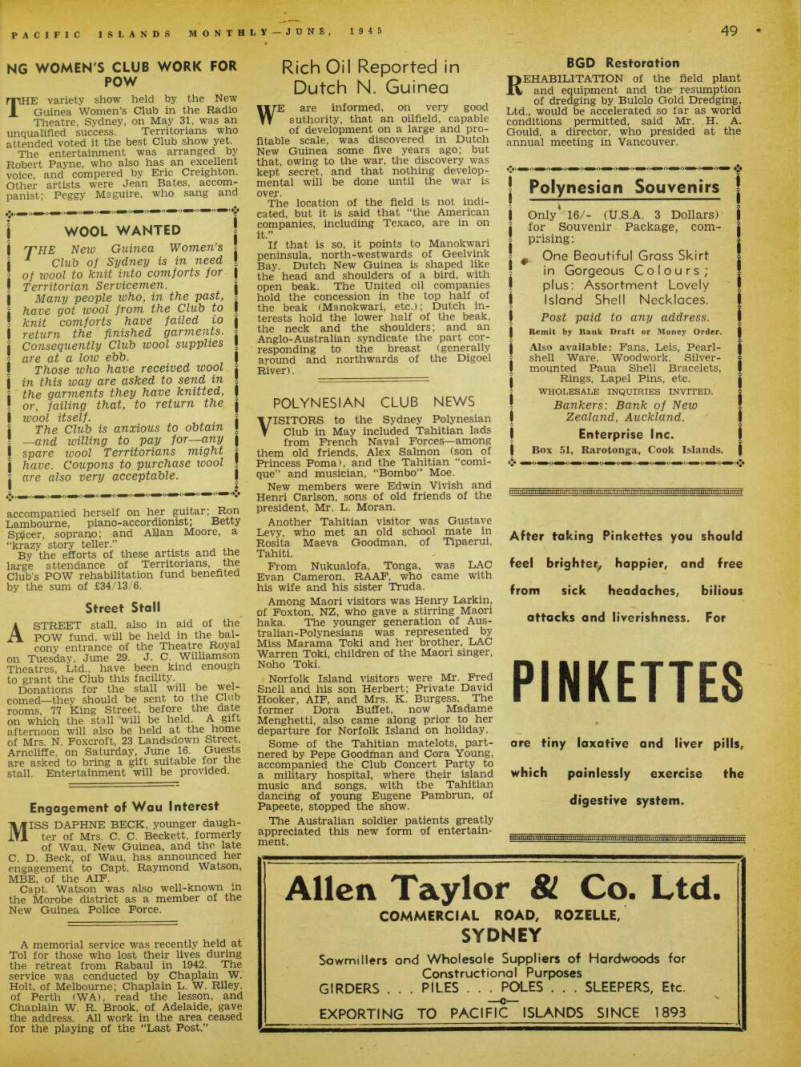
Pow
rE variety show held by the New Guinea Women’s Club in the Radio Theatre, Sydney, on May 31, was an unqualified success. Territorians who attended voted it the best Club show yet.
The entertainment was arranged by Robert Payne, who also has an excellent voice, and compered by Eric Creighton.
Other artists were Jean Bates, accom panist; Peggy Maguire, who sang and
accompanied herself on her guitar; Ron Lambourne, piano-accordionist; Betty Spacer, soprano; and Allan Moore, a “krazy story teller.” , ..
By the efforts of these artists and the large attendance of Territorians, the Club’s POW rehabilitation fund benefited by the sum of £34/13/6.
Street Stall
A STREET stall, also in aid of the POW fund, will be held in the bal cony entrance of the Theatre Royal on Tuesday, June 29. J. C. Williamson Theatres, Ltd., have been kind enough to grant the Club this facility.
Donations for the stall will be wel comed —they should be sent to the Club rooms, 77 King Street, before the date on which the stall will be held. A gift afternoon will also be held at the home of Mrs. N. Foxcroft, 23 Landsdown Street, Arncliffe, on Saturday, June 16. Guests are asked to bring a gift suitable for the stall. Entertainment will be provided.
Engagement of Wau Interest
MISS DAPHNE BECK, younger daugh ter of Mrs. C. C. Beckett, formerly of Wau, New Guinea, and the late C. D. Beck, of Wau, has announced her engagement to Capt. Raymond Watson, MBE, of the AIF.
Capt. Watson was also well-known in the Morobe district as a member of the New Guinea Police Force, A memorial service was recently held at Tol for those who lost their lives during the retreat from Rabaul in 1942. The service was conducted by Chaplain W.
Holt, of Melbourne; Chaplain L. W. Riley, of Perth (WA), read the lesson, and Chaplain W. R. Brook, of Adelaide, gave the address. All work in the area ceased for the playing of the “Last Post.”
Rich Oil Reported in Dutch N
Dutch N. Guinea
WE are informed, on very good authority, that an oilfield, capable of development on a large and pro fitable scale, was discovered in Dutch New Guinea some five years ago; but that, owing to the war, the discovery was kept secret, and that nothing develop mental will be done until the war is over.
The location of the field is not indi cated, but it is said that “the American companies, including Texaco, are in on it.”
If that is so, it points to Manokwari peninsula, north-westwards of Geelvink Bay. Dutch New Guinea is shaped like the head and shoulders of a bird, with open beak. The United oil companies hold the concession in the top half of the beak (Manokwari, etc.); Dutch in terests hold the lower half of the beak, the neck and the shoulders; and an Anglo-Australian syndicate the part cor responding to the breast (generally around and northwards of the Digoel River).
Polynesian Club News
VISITORS to the Sydney Polynesian Club in May included Tahitian lads from French Naval Forces—among them old friends, Alex Salmon (son of Princess Poma), and the Tahitian “comi que” and musician, “Bombo” Moe.
New members were Edwin Vivish and Henri Carlson, sons of old friends of the president, Mr. L, Moran.
Another Tahitian visitor was Gustave Levy, who met an old school mate in Rosita Maeva Goodman, of Tipaerui, Tahiti.
From Nukualofa, Tonga, was LAC Evan Cameron, RAAF, who came with his wife and his sister Truda.
Among Maori visitors was Henry Larkin, of Foxton, NZ, who gave a stirring Maori haka. The younger generation of Aus tralian-Polynesians was represented by Miss Marama Toki and her brother, LAC Warren Toki, children of the Maori singer, Noho Toki.
Norfolk Island visitors were Mr. Fred Snell and his son Herbert; Private David Hooker, AIF, and Mrs. K. Burgess. The former Dora Buffet, now Madame Menghetti, also came along prior to her departure for Norfolk Island on holiday.
Some- of the Tahitian matelots, part nered by Pepe Goodman and Cora Young, accompanied the Club Concert Party to a military hospital, where their island music and songs, with the Tahitian dancing of young Eugene Pambrun, of Papeete, stopped the show.
The Australian soldier patients greatly appreciated this new form of entertain ment.
BGD Restoration
Rehabilitation of the field plant and equipment and the resumption of dredging by Bulolo Gold Dredging, Ltd., would be accelerated so far as world conditions permitted, said Mr. H. A.
Gould, a director, who presided at the annual meeting in Vancouver.
Advertisements & other items, p. 51 (2 items)
Pinkettes
Polynesian Souvenirs
Only 4 16/- (U.S.A. 3 Dollars) for Souvenir Package, comprising : One Beautiful Grass Skirt
in Gorgeous Colours;
plus: Assortment Lovely
Island Shell Necklaces.
Post paid to any address.
Remit by Bank Draft or Money Order.
Also available: Fans, Leis, Pearlshell Ware, Woodwork, Silvermounted Paua Shell Bracelets, Rings, Lapel Pins, etc,
WHOLESALE INQUIRIES INVITED.
Bankers : Bank of New Zealand, Auckland.
Enterprise Inc.
Box 51, Rarotonga, Cook Islands.
After taking Pinkettes you should feel brighter/ happier, and free from sick headaches, bilious attacks and liverishness. For
PINKETTES
are tiny laxative and liver pills, which painlessly exercise the digestive system.
Allen Taylor & Co. Ltd.
COMMERCIAL ROAD, ROZELLE,
SYDNEY
Sowmillers ond Wholesale Suppliers of Hardwoods for Constructional Purposes GIRDERS . . . PILES . . . POLES . . . SLEEPERS, Etc.
EXPORTING TO PACIFKZ ISLANDS SINCE 1893
Wool Wanted
the New Guinea Women’s 1 Club of Sydney is in need of wool to knit into comforts for Territorian Servicemen.
Many people who, in the past, have got wool from the Club to knit comforts have failed to return the finished garments.
Consequently Club wool supplies are at a low ebb.
Those who have received wool in this way are asked to send in the garments they have knitted, or, failing that, to return the wool itself.
The Club is anxious to obtain —and willing to pay for —any spare wool Territorians might have. Coupons to purchase wool are also very acceptable.
Territorians Return To
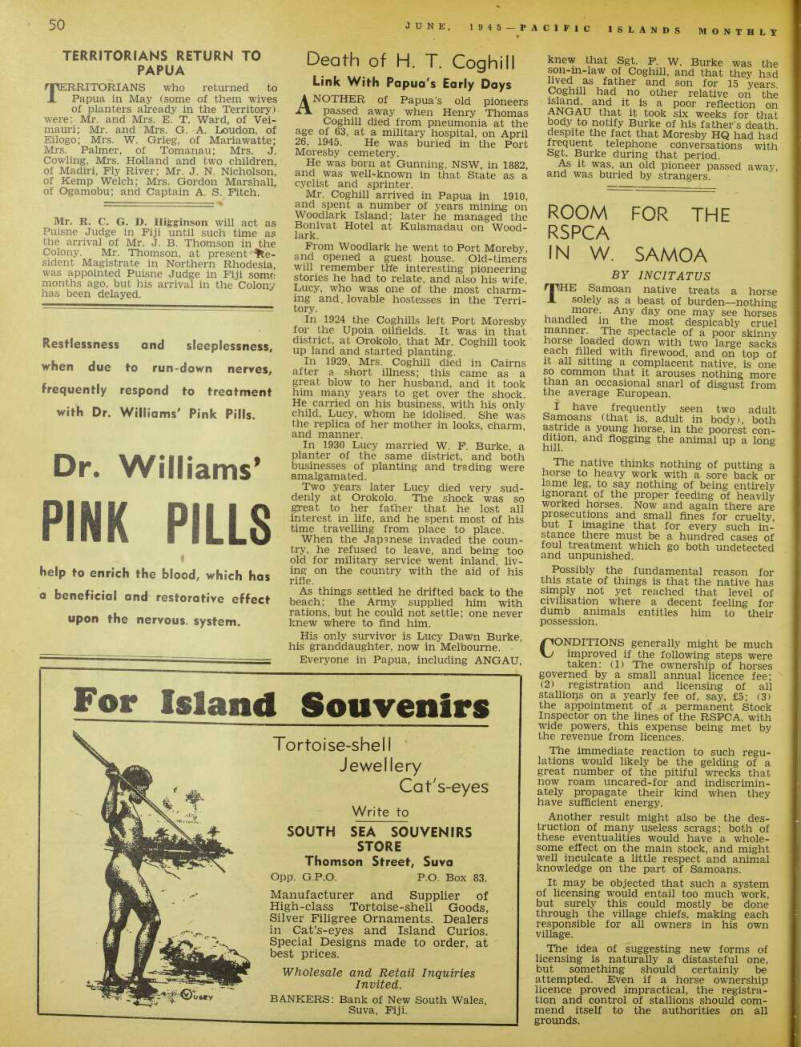
Papua
fIIERRITORIANS who returned to X Papua in May (some of them wives of planters already in the Territory) were: Mr. and Mrs, E. T. Ward, of Vei mauri; Mr. and Mrs. G. A. Loudon, of Eilogo; Mrs. W. Grieg, of Mariawatte; Mrs. Palmer, of Tomanau; Mrs. J.
Cowling, Mrs. Holland and two children, of Madiri, Fly River; Mr. J. N. Nicholson, of Kemp Welch; Mrs. Gordon Marshall, of Ogamobu; and Captain A. S. Fitch.
' — - * Mr. R. C. G. D. Higginson will act as Puisne Judge in Fiji until such time as the arrival of Mr. J. B. Thomson in the Colony. Mr. Thomson, at present Re sident Magistrate in Northern Rhodesia, was appointed Puisne Judge in Fiji some months ago, but his arrival in the Colony has been delayed.
Death of H. T. Coghill
Link With Papua's Early Days
ANOTHER Of Papua’s old pioneers passed away when Henry Thomas Coghill died from pneumonia at the age of 63, at a military hospital, on April 26, 1945. He was buried in the Port Moresby cemetery.
He was born at Gunning, NSW, in 1882, and was well-known in that State as a cyclist and sprinter.
Mr. Coghill arrived in Papua in 1910, and spent a number of years mining on Woodlark Island; later he managed the Bonivat Hotel at Kulamadau on Wood lark.
From Woodlark he went to Port Moreby, and opened a guest house. Old-timers will remember the interesting pioneering stories he had to relate, and also his wife, Lucy, who was one of the most charm ing and. lovable hostesses in the Terri tory.
In 1924 the Coghills left Port Moresby for the Upoia oilfields. It was in that district, at Orokolo, that Mr. Coghill took up land and started planting.
In 1929, Mrs. Coghill died in Cairns after a short illness; this came as a great blow to her husband, and it took him many years to get over the shock.
He carried on his business, with his only child, Lucy, whom he idolised. She was the replica of her mother in looks, charm, and manner.
In 1930 Lucy married W. P. Burke, a planter of the same district, and both businesses of planting and trading were amalgamated.
Two years later Lucy died very sud denly at Orokolo. The shock was so great to her father that he lost all interest in life, and he spent most of his time travelling from place to place.
When the Japanese invaded the coun try, he refused to leave, and being too old for military service went inland, liv ing on the country with the aid of his rifle.
As things settled he drifted back to the beach; the Army supplied him with rations, but he could not settle; one never knew where to find him.
His only survivor is Lucy Dawn Burke, his granddaughter, now in Melbourne.
Everyone in Papua, including ANGAU,
knew that Sgt. F. W. Burke was the son-in-law of Coghill, and that they had lived as father and son for 15 years.
Coghill had no other relative on the lASlr^(i 1 A S lr^ ( i’ TT a ? 1 d * s a P oor reflection on ANGAU that it took six weeks for that body to notify Burke of his father’s death despite the fact that Moresby HQ had had frequent telephone conversations with Sgt. Burke during that period.
As it was, an old pioneer passed away, and was buried by strangers.
Rspca
Room For The
In W. Samoa
By Incitatus
THE Samoan native treats a horse solely as a beast of burden—nothing more. Any day one may see horses handled in the most despicably cruel manner. The spectacle of a poor skinny horse loaded down with two large sacks each filled with firewood, and on top of it all sitting a complacent native, is one so common that it arouses nothing more than an occasional snarl of disgust from the average European.
I have frequently seen two adult Samoans (that is, adult in body), both astride a young horse, in the poorest con dition, and flogging the animal up a long The native thinks nothing of putting a horse to heavy work with a sore back or lame leg, to say nothing of being entirely ignorant of the proper feeding of heavily worked horses. Now and again there are prosecutions and small fines for cruelty, but I imagine that for every such in stance there must be a hundred cases of foul treatment which go both undetected and unpunished.
Possibly the fundamental reason for this state of things is that the native has simply not yet reached that level of civilisation where a decent feeling for dumb animals entitles him to their possession.
CONDITIONS generally might be much improved if the following steps were taken: (1) The ownership of horses governed by a small annual licence fee; (2) registration and licensing of all stallions on a yearly fee of, say, £5; (3) the appointment of a permanent Stock Inspector on the lines of the RSPCA, with wide powers, this expense being met by the revenue from licences.
The immediate reaction to such regu lations would likely be the gelding of a great number of the pitiful wrecks that now roam uncared-for and indiscrimin ately propagate their kind when they have sufficient energy.
Another result might also be the des truction of many useless scrags; both of these eventualities would have a whole some effect on the main stock, and might well inculcate a little respect and animal knowledge pn the part of Samoans.
It may be objected that such a system of licensing would entail too much work, but surely this could mostly be done through the village chiefs, making each responsible for all owners in his own village.
The idea of suggesting new forms of licensing is naturally a distasteful one, but something should certainly be attempted. Even if a horse ownership licence proved impractical, the registra tion and control of stallions should com mend itself to the authorities on all grounds.
Advertisements & other items, p. 52 (1 item)
Pink Pills
Restlessness and sleeplessness, when due to run-down nerves, frequently respond to treatment with Dr. Williams' Pink Pills.
Dr. Williams’
e help to enrich the blood, which has a beneficial and restorative effect upon the nervous, system.
For Island Souvenirs
•»2t u»ev
Tortoise-shell
Jewellery
Cot's-eyes
Write to
SOUTH SEA SOUVENIRS
STORE
Thomson Street, Suva Opp. G.P.O. P.O. Box 83.
Manufacturer and Supplier of High-class Tortoise-shell Goods, Silver Filigree Ornaments. Dealers in Cat’s-eyes and Island Curios.
Special Designs made to order, at best prices.
Wholesale and Retail Inquiries Invited.
BANKERS: Bank of New South Wales, Suva, Fiji.
Population Of
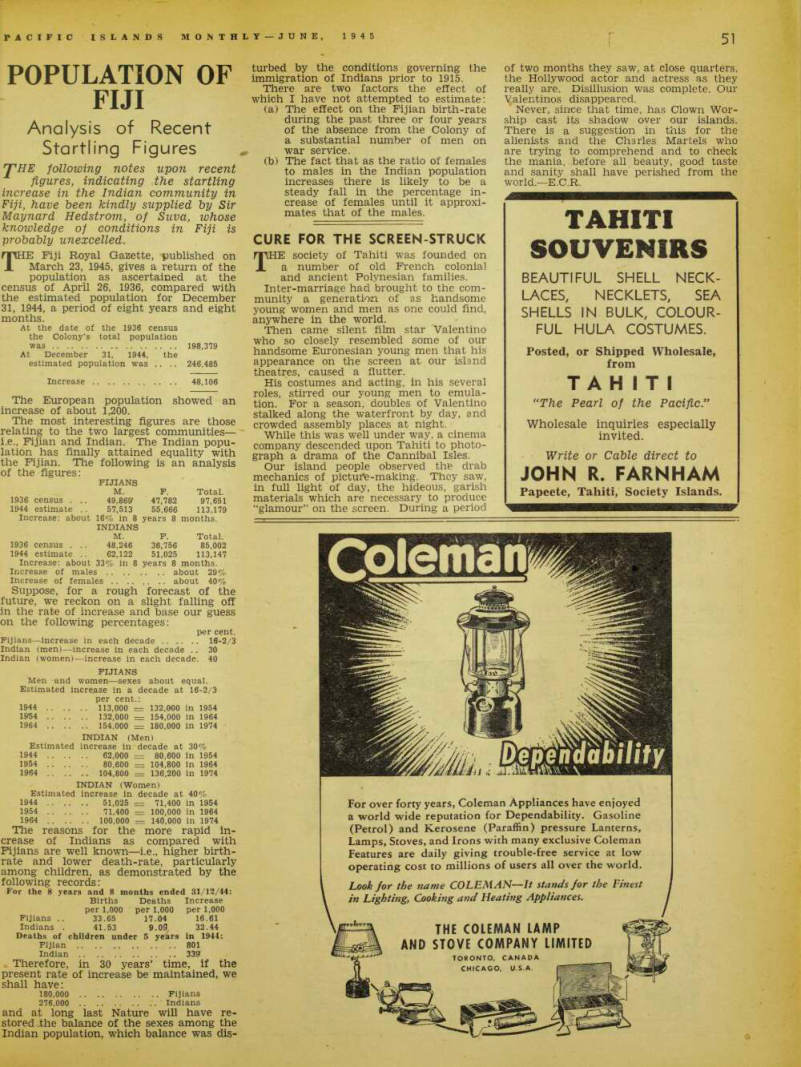
Fiji
Analysis of Recent Startling Figures
'THE following notes upon recent
figures, indicating the startling
increase in the Indian community in Fiji, have been kindly supplied by Sir
Maynard Hedstrom, of Suva, whose
knowledge of conditions in Fiji is
probably unexcelled. rpHE Fiji Royal Gazette, published on X March 23, 1945, gives a return of the population as ascertained at the census of April 26, 1936, compared with the estimated population for December 31, 1944, a period of eight years and eight months.
At the date of the 1936 census the Colony’s total population was 198,379 At December 31, 1944, the estimated population was .. . . 246,485 Increase 48,106 The European population showed an increase of about 1,200.
The most interesting figures are those relating to the two largest communities— i.e., Fijian and Indian. The Indian popu lation has finally attained equality with the Fijian. The following is an analysis of the figures:
Increase: about 33% in 8 years 8 months.
Increase of males about 29% Increase of females about 40% Suppose, for a rough forecast of the future, we reckon on a slight falling off in the rate of increase and base our guess
on the following percentages:
per cent.
Fijians—increase in each decade 16-2/3 Indian (men) —increase in each decade .. 30 Indian (women) —increase in each decade. 40
The reasons for the more rapid in crease of Indians as compared with Fijians are well known—i.e., higher birth rate and lower death-rate, particularly among children, as demonstrated by the following records; For the 8 years and 8 months ended 31/12/44:
Therefore, in 30 years’ time, if the present rate of increase be maintained, we shall have; 180.000 Fijians 276.000 Indians and at long last Nature will have re stored the balance of the sexes among the Indian population, which balance was dis
turbed by the conditions governing the immigration of Indians prior to 1915.
There are two factors the effect of which I have not attempted to estimate; (a) The effect on the Fijian birth-rate during the past three or four years of the absence from the Colony of a substantial number of men on war service. (b) The fact that as the ratio of females to males in the Indian population increases there is likely to be a steady fall in the percentage in crease of females until it approxi mates that of the males.
Fijians
M. P. Total. 1936 census . .. 49.869 47,782 97,651 1944 estimate .. 57,513 55,666 113,179 Increase: about 16% in 8 years 8 months.
Indians
M. F. Total. 1936 census . . . 48,246 36,756 85,002 1944 estimate .. 62,122 51,025 113,147
Men and
Fijians
women—sexes about equal.
Estimated increa.se in a decade at 16-2/3 1944 .. .. per cent.: .. 113,000 = 132,000 in 1954 19-54 . . . . .. 132,000 — 154,000 in 1964 1964 . . . . .. 154,000 — 180,000 in 1974 Estimated
Indian (Men)
increase in decade at 30% 1944 . . . . 62,000 — 80,600 In 1954 1954 . . . . 80,600 — 104,800 in 1964 1964 . . . . .. 104,800 — 136,200 in 1974 Estimated INDIAN (Women) increase in decade at 40% 1944 . . . . 51,025 — 71,400 in 1954 1954 .. .. 71.400 — 100,000 in 1964 1964 .. . . . . 100,000 — 140,000 in 1974
Births Deaths Increase per 1,000 per 1.000 per 1,000 Fijians .. 33.65 17.04 16.61 Indians . 41.53 9.09, 32.44 Deaths of children under 5 years In 1944: Fijian 801 Indian 339
Cure For The Screen-Struck
rE society of Tahiti was founded on a number of old French colonial and ancient Polynesian families.
Inter-marriage had brought to the com munity a generation of as handsome young women and men as one could find, anywhere in the world.
Then came silent film star Valentino who so closely resembled some of our handsome Euronesian young men that his appearance on the screen at our island theatres, caused a flutter.
His costumes and acting, in his several roles, stirred our young men to emula tion. For a season, doubles of Valentino stalked along the waterfront by day, and crowded assembly places at night.
While this was well under way, a cinema company descended upon Tahiti to photo graph a drama of the Cannibal Isles.
Our island people observed the drab mechanics of picture-making. They saw, in full light of day, the hideous, garish materials which are necessary to produce “glamour” on the screen. During a period
of two months they saw, at close quarters, the Hollywood actor and actress as they really are. Disillusion was complete. Our Valentinos disappeared.
Never, since that time, has Clown Wor ship cast its shadow over our islands.
There is a suggestion in this for the alienists and the Charles Martels who are trying to comprehend and to check the mania, before all beauty, good taste and sanity shall have perished from the world. —E.C.R.
Mr. Eric Wood, who until recently occu pied a post in the Tasmanian Civil Ser vice, has been accepted by the Bishop of New Guinea to serve in a lay capacity in Papua.
Advertisements & other items, pp. 53-54 (1 item)
fi mndability
TAHITI
SOUVENIRS
BEAUTIFUL SHELL NECK-
LACES, NECKLETS, SEA
SHELLS IN BULK, COLOUR-
FUL HULA COSTUMES.
Posted, or Shipped Wholesale, from
TAHITI
“The Pearl of the Pacific”
Wholesale inquiries especially invited.
Write or Cable direct to
JOHN R. FARNHAM
Papeete, Tahiti, Society Islands.
9 Li
fi mndability
For over forty years, Coleman Appliances have enjoyed a world wide reputation for Dependability. Gasoline (Petrol) and Kerosene (Paraffin) pressure Lanterns, Lamps, Stoves, and Irons with many exclusive Coleman Features are daily giving trouble-free service at low operating cost to millions of users all over the world.
Look for the name COLEMAN—It stands for the Finest in Lighting, Cooking and Heating Appliances.
THE COLEMAN LAMP
AND STOVE COMPANY LIMITED
TORONTO, CANADA
CHICAGO, USA.
1 •; --V ✓
JENKINS
BOX 100
SUVA, FIJI
THE LEADING STORE
FOR ISLAND CURIOS
AND SOUVENIRS
We can supply— Tortoiseshell Goods in bracelets, necklets, brooches, etc.
Tortoiseshell, with "Cat's Eye" Mountings, in bracelets, necklets, brooches, ear drops.
"Cat's Eyes" set in Silver Filigree, in sets of necklace and bracelet.
Fiji-made Novelties in Large Variety.
QUALITY GOODS AT
REASONABLE PRICES.
Write for Our Descriptive Catalogue.
We Will Gladly Forward One.
From
Factory
in the
English
Orchards
has always come the finest jam it is possible to make. Freshness, allied to purity, alone can produce such perfection. From Chivers Orchards— adjoining the Factory —come plump, luscious strawberries, with the warmth of the sun still on their %
CHIVERS
Made in the heart of the English countryside by
. CHIVERS & SONS Ltd.
Im Orchard Factory, Histon, Cambridge, England rosy-red cheeks, and many other English fruits “just right”for preserving. No wonder Chivers Jams have a worldwide reputation for quality.
Supplies are still limited but shipments will be resumed as soon as possible. , . ,
ENGLISH
JAMS ,A*J
E 136
Ddt In The Tropics
ONE of the interesting and most impor tant discoveries of United Nations’ scientists has been in the field of fumigation and insect extermination.
Typhus, dengue, malaria, may eventually be brought under control as a result of the discovery of the insecticide known as DDT. Although on the official secret list until June, 1944, DDT, a white powder in appearance,. has been widely publicised recently, because of the almost miracu lous results in its use against the typhus carrying louse and the malarial mos quito.
The most spectacular experiment was undertaken in January, 1944, when, by fumigating almost the whole city of Naples by dusting every man, woman and child, a serious epidemic of typhus was brought under control, in winter, for the first time in medical history.
Since the Naples epidemic, experiments have x been carried out in many fields, and research is still going on. At this stage, it would not be wise to expect too much of this discovery although, it is past the primary experimental stages, and any experiments which are still being carried out are more in the nature of verification of results obtained elsewhere.
Tests in Fiji last year, proved amongst other things that DDT is an effective and economic medium for destroying mosquito larvae in swampy areas.
Walls, ceilings and furnishings when treated with DDT are unharmed, but for some time after treatment remain fatal to insects such as ants, cockroaches and mosquitoes settling upon them. Sprayed on beds infected with bugs, the pests are exterminated, and the beds remain immune from insects of all kinds for some months. Horses, dogs and cattle, after treatment, repel fly and fleas for a short period, and it appears possible that a solution may be found to the blow fly in sheep and the cattle tick problems in Australia.
DDT appears to have many future uses, particularly in the tropics. It has been used to exterminate caterpillars and other pests, but it is in this field that further
research is necessary. Success has been achieved already by the use of DDT, as an alternative to lead arsenate.
Unpleasant effects may follow if swal lowed, or if much of it is allowed to come into contact with the skin for a pro longed penod, but if handled with ordinary care, DDT has no harmful effects »on man.
At present there is no surplus for general civilian use, heavy supplies are re quired for military purposes, but when restrictions are lifted after the war, it should be of great value in island homes
and in tropical agriculture.-
Pjm.
Editorial Note
THE RAAF is already using DDT insec ticide for aerial spraying of large malarial areas in New Guinea, New Britain and Bougainville. The work is being done from Beaufort bombers, which are equipped with special tanks in their wings.
In the fight against malaria DDT destroys both adult and larval mosqui toes. It is mixed with lighter malariol and emitted in a fine spray over sago swamps and such haunts of the mos quito as are inaccessible from the ground.
Experts are confident that the incidence of both malaria and dengue fever will show a marked decline in the Pacific Islands as a result of this air blitz on mosquitoes.
Rotuma Memories
, Letter to the Editor A RECENT article on Rotuma in “PIM” brings to my memory some calls I made there many years ago.
In July, 1903, while on the way from Vila, in the New Hebrides, to Nukulaelae. in the Ellice Group, in the SS “Ysabel,” the derrick at No. 2 hatch came down with a run. Jack Lanyan, our half-caste launch-boy, happened to be coming aft from the foc’s’le when it happened and the derrick caught him. His thigh was shockingly injured.
Captain Voy, after getting his morning sights, found we were 90 miles north west of Rotuma, so we headed for there, praying that a doctor might be on the island.
We were boarded by the officer in charge of the island, who also hapoened to be a doctor. His name was, I believe, Dr.
MacDonald.
The doctor said if we called back in three months he would guarantee that Lanyan would be all right again but for a limp. We called back in October and, sure enough, Lanyan was well, but with a limp.
My next call at Rotuma was at the end of July, 1908, when we put in at the island to pick up tax copra in the SS “Muniara.” I remember we had to pick up from two ports, and I was given a horse to ride over to the other side of the island to have the copra weighed be fore the arrival of the steamer. Not having been on a horse for some years, I suffered for days afterwards, and only hoped that the horse did not suffer as much as I did.
We left Rotuma on July 31. 1908, and experienced westerly gales all the way to the Australian coast, taking 19 days to Sydney. We arrived the day before the American Fleet was due and I, as super cargo, was accused of having deliberated delayed the arrival of the vessel in order to see the American Fleet, whereas we really did not know the fleet was due. there being no wireless on island freighters in those days.
I am. etc.,
An Old-Time Supercargo.
Sidney, May 29, 1945.
Advertisements & other items, p. 55 (1 item)
C. Sullivan Pty. Ltd.
m
PAT,
■ V
KEROSENE STOVE
" The ultimate in heating efficiency and service • No Pumping • No Wicks • No Danger • The Bright Blue Flame provides ample Heat for All Purposes.
SIMPLE AND EFFECTIVE
"ULTIMA" is economical to buy and to operate. Using a new system of fuel generation it does not need complicated pressure chambers, pumps and so on, but is controlled by a single valve. The stove may be refuelled while operating.
"ULTIMA" is easily dismantled and assembled.
EASY AND SAFE TO USE
Manufactured under Australian Government Permit. Supplies Available Shortly.
WRITE TO YOUR SYDNEY AGENT, OR
c. SULLIVAN PTY. LTD. 379 Kent St. Sydney
C. SULLIVAN Pty. Ltd.
GENERAL MERCHANTS ISLANDS AGENTS
REPRESENTING LEADING FIRMS IN THE PACIFIC ISLANDS.
Islands Produce sold on Shippers’ Accounts—Liberal Advances against Consignments.
Buyers of all Islands’ Requirements on Commission —Original Invoices Furnished. * Bankers : Bank of New Gouth Wales .. Bank of New Zealand .. Comptoir National d’Escompte de Paris.
Wartime Cable Address: Sullivan, Kentstreet, Sydney.
379 KENT STREET, SYDNEY, N.S.W.
Let There Be Light !
Trader’s Tale: Let There Be Light !
By “Tukapakoko”
EAST is East, and West is West,” says a well-known poet, “And never the twain shall meet.” ... I wonder how many believe the saw now!
You can’t, at all events, tell that to a Cook Islands “small” trader. For a number of years, to the very great financial advantage of both, East and West have met and co-operated.
The present temporary loss to the Empire of Hong Kong has, for the time, upset the Oriental-Occidental partner ship; but when it is renewed—as we island-dwellers hope it will be soon traders will smile again, and the dark nights of Polynesia, when the silver moon goes off duty, will be brightened by torch light on the roads, as they used to be in the good old days of ’39. - T Z. ,< „ Not the torch natives call rama, made out of a pahn-frond; nor the tow spa'he r °’ 15 a 7 COC ° Not those-what we lack is the ahi pana, which is Maori for an electric
to L ch - , .
For about six years prior to Japan’s
, he war ’ a factory at Hong Kong was turning out cheap electric torches, in millions, for the Cook Island (and other) native markets. These highly were .9 n sale .. m every 9 u store ,~ bl § corporation, or tiny trade -box under a white man’s camp bed - T* l6 profit on them was several hundred per cent., but in spite of that the very best of them, quite equal to a 3 y'“ American article, was only 7/6, com- Plete with battery!
"J°wn Brother was fascinated with b £ht that could be turned on and off, J rorr s a ta P» as were. We traders began for t ? e fS e 7 * grea t that g r^°" g n "°S e^ f o^ *? spppl ? ‘‘i th 6 rais S d
Hf® pS.Th a 2 e
p? k f h ’ 6ven then ’ torches were still dirt hc , Horioc . m „ lnhp 6r fJPf the 6d each. By the time that new import duty had been thought of, and applied, every mother’s son (and brown daughter) in Mangaia already owned one ° f theSG ChineSe torcheS * VTOW, regrettably, the corpses of many JM of those Oriental artifacts lie in the mud of the village roads, squashed oval by the heavy feet of horses or men
—for the supply of cheap batteries is totally suspended,” and no others are obtainable, owing to the war.
But while the craze lasted, many in teresting things happened; and the erst while monopoly of “electric light” en joyed in pre-Hong Kong days by Euro peans and the native police was badly fractured.
The “cops” W£re particularly annoyed.
The latter then possessed a peculiarly mean advantage. It is a lo<fel law that no native may be abroad after the sound ing of the curfew-drum at 9 pjn. This, however, is more honoured in the breach than the observance, and local bucks, meeting to discuss privately various pro jects, or quaff bush-beer in some dark corner, were often taken unawares by their village “cop.” A sudden lightening of their darkness was the prelude to legal grief. With the advent of universal torch-light, however, a few of these per jured innocents got their own back; for the rays of non-police torches caught some of the peace officers solacing their midnight vigils in the various ways that suited them best.* Thereafter a marked reduction was apparent in the number of cases of “ori-po,” or curfew-breaking, that came to Court on Thursdays!
The police found this embarrassing, and “bigger and better” seemed the only way to meet it. So the native sergeant obtained a positively-enormous torch, with five cells, and a bulb of the power of a warship’s searchlight. This article, with its super-power, seemed to so re duce the brilliance of rival torches that the road was quite dark again.
The monster was, of course, of American, not Chinese, manufacture.
But Hong Kong began to catch up; and my consignment of “five-cell” torches was on order, when that Colony fell, alas, to the enemy.
Advertisements & other items, pp. 56-57 (1 item)
Kayen •
New .303
WANTED TO BUY—QUALITY GUNS AND RIFLES
HIGHEST PRICES GIVEN. WILL ALSO EXCHANGE GUNS.
Short Service Barrels, 25}fc”, without Sights and Platform, £2/15/- each.
Postage extra.
SSL RO H U Quality Firearms and Fishing Tackle. l4B ELIZABETH STREET (Near Market St.) SYDNEY. ’PHONE: MA 3540.
KAYEN •
KEROSENE VAPOUR LAMPS
Brilliant lighting when and where required
Kayen Lamps are the last word in efficiency in modern kerosene lighting. They are designed for years of hard practical use and are the result of extensive tests and experiments under all classes of conditions. At last a really good Australian-made product is available and in comparison with all overseas types the Kayen leaves nothing to be desired.
They provide a full 300 candle-power unfiickering light not affected by wind or draughts. They burn quietly and efficiently for hours without attention and are perfectly safe in operation. The mantles are supported top and bottom and will not shake off. Globes are pyrex. All models are insect-proof. The oil container is solid polished brass and brass is used wherever possible in all other parts.
Illustrated are the ever-popular Tall Table Lamp and Allpurpose Lamp. The All-purpose Lamp is stormproof and may be carried anywhere, inside or out. The Table Lamp is a handsome addition to the appointments in any home, as well as a superb lighting unit.
Write for Illustrated Catalogue of Models Available from the Manufacturers. w. KOPSEN & CO. PTY. LTD ■ 9 376-382 Kent St., Sydney
Cables: Kopsen Sydney
Kayen Model HL7 Tall Table Lamp. fcayen Model AP2 All-purpose Lamp.
'Phone: MA6336 (6 lines).
Fiji and South-Sea Islands Souvenirs
ADAMS
LAUTOKA FIJI
CHEMISTS, DRUGGISTS, SOUVENIR
DEALERS, MERCHANTS
We believe we have the choicest range in Fiji of: — Tortoiseshell Goods, inlaid or with Cat's-Eyes.
Silver Filigree Goods with or without Cat's-Eyes.
Pearl-shell with or without Cat's-Eyes.
Ivory articles of all kinds.
Coconut-shell souvenirs. * Unmounted Cat's-Eyes.
Hand made native curios and souvenirs. Beads, Hula-skirts and Tops (bras). Mats, Fans, Fancy Shell Floral Necklaces and Bracelets.
Model Canoes, Lalis (native wooden drums).
Tanoas (kava bowls, used as ash-trays).
Tapa (tree-bark) Cloth.
Sea shells of every kind.
We are big suppliers to Army and Navy personnel and purchasing units, with whom we built a reputation during their stay in Fiji. We specialise in quality goods.
SPECIAL DISCOUNTS TO QUANTITY BUYERS
We welcome* all inquiries. Send for our catalogue.
Sufficient Address :
ADAMS - LAUTOKA - FIJI
Islands Produce
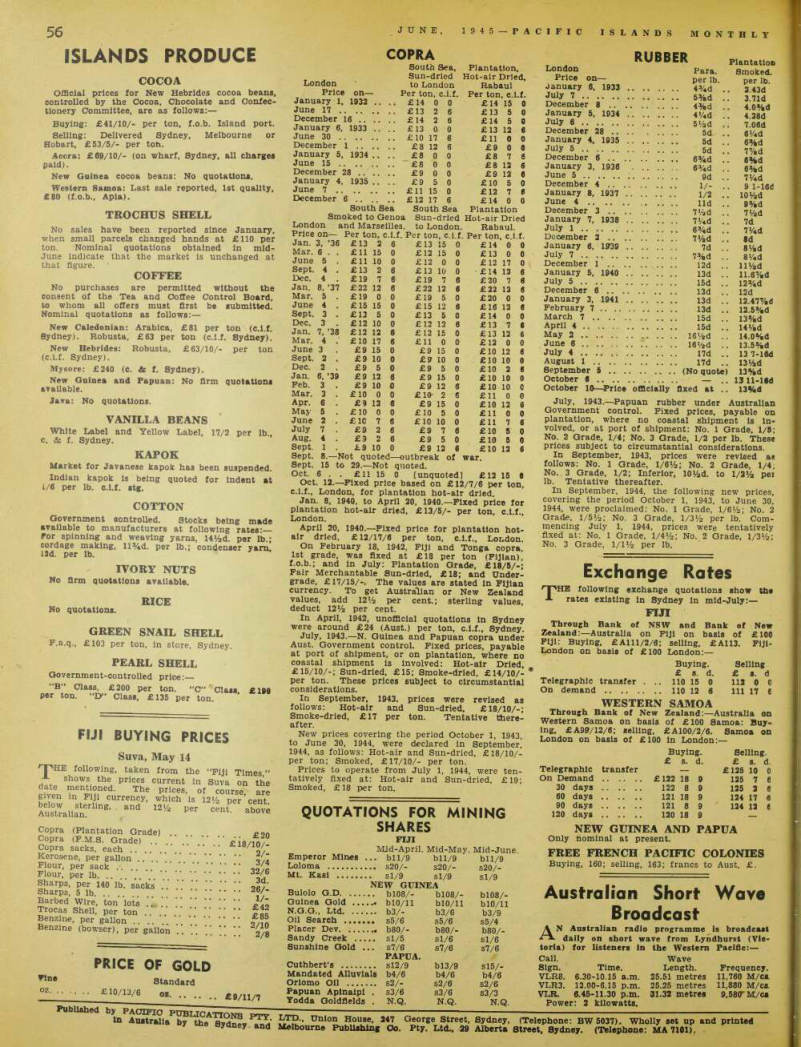
Cocoa
Official prices for New Hebrides cocoa beans, controlled by the Cocoa, Chocolate and Confec tionery Committee, are as follows: — Buying: £4l/10/- per ton, f.o.b. Island port.
Selling: Delivered Sydney, Melbourne or Hobart, £53/5/- per ton.
Accra: £69/10/- (on wharf, Sydney, all charges paid).
New Guinea cocoa beans; No quotations.
Western Samoa; Last sale reported, Ist quality, £BO (f.0.b., Apia).
Trochus Shell
No sales have been reported since January, when small parcels changed hands at £llO per ton. Nominal quotations obtained in mid- June indicate that the market is unchanged at that figure.
Coffee
No purchases are permitted without the consent of the Tea and Coffee Control Board, to whom all offers must first be submitted.
Nominal quotations as follows: New Caledonian: Arabics, £Bl per ton (c.l.f.
Sydney). Robusta, £63 per ton (c.l.f. Sydney), New Hebrides: Robusta, £63/10/- per ton (c.i.f. Sydney).
Mysore: £240 (c. Sc f. Sydney).
New Guinea and Papuan: No firm quotations available.
Java: No quotations.
Vanilla Beans
White Label and Yellow Label, 17/2 per lb., c. & f. Sydney.
Kapok
Market for Javanese kapok has been suspended.
Indian kapok Is being quoted for Indent at i/6 per lb. c.l.f. stg.
Cotton
Government controlled. Stocks being made available to manufacturers at following rates:— Por spinning and weaving yarns, 14V 2 d. per lb.; cordage making, ll 3 Ad. per lb.; condenser yarn, I2d. per lb.
Ivory Nets
No firm quotations available.
Rice
No quotations.
Green Snail Shell
P.a.q., £lO3 per ton, in store, Sydney.
Pearl Shell
Government-controlled price:— B” Class, £2OO per ton. “O’* Class £196 per ton. “D» Class. £135 per ton.
Fiji Buying Prices
Suva, May 14
r T'HE following, taken from the “Fiji Times ” a shows the prices current in Suva on the date mentioned. The prices, of course are SJ?S currency ' whlch 12'/2 per cent.
Australian'" 8 ’ “ d 1214 per cent - aboy e
Copra (Plantation Grade) .. r<, ft Copra (P.M.S. Grade) .. “ " * ,*«/,«/ Copra sacks, each ... £18/10/- Kerosene, per gallon ... J..
Flour, per sack Flour, per lb, ..
Sharps, per 140 lb. sacks ... o«.
Sharps, 5 lb 2 ?/“ Barbed Wire, ton lots ..' ! l' A n Trocas Shell, per ton f * 2 Benzine, per gallon Benzine (bowser), per gallon ... " “ %*J
Price Of Gold
Sept. B.—Not quoted—outbreak of war.
Sept. 15 to 29.—Not quoted.
Oct. 6 . . £ll 15 0 [unquoted] £l2 15 0 Oct. 12.—Fixed price based on £l2/7/6 per ton, c.i.f., London, for plantation hot-air dried Jan. 8, 1940, to April 20, 1940.—Fixed price for plantation hot-air dried, £l3/5/- per ton, c.i.f., London.
April 20, 1940. —Fixed price for plantation hot air dried, £l2/17/6 per ton. c.i.f., London.
On February 18. 1942, FIJI and Tonga copra, Ist grade, was fixed at £lB per ton (Fijian), f.0.b.; and in July: Plantation Grade, £lB/5/-; Fair Merchantable Sun-dried, £18; and Under grade, £l7/15/-. The values are stated in Fijian currency. To get Australian or New Zealand values, add 12% per cent.; sterling values, deduct 12% per cent.
In April, 1942, unofficial quotations in Sydney were around £24 (Aust.) per ton, c.i.f., Sydney.
July, 1943. —N. Guinea and Papuan copra under Aust. Government control. Fixed prices, payable at port of shipment, or on plantation, where no coastal shipment is Involved: Hot-air Dried, £l5/10/-; Sun-dried, £l5; Smoke-dried, £l4/10/per ton. These prices subject to circumstantial considerations.
In September, 1943. prices were revised as follows: Hot-air and Sun-dried, £lB/10/-; Smoke-dried, £l7 per ton. Tentative there after.
New prices covering the period October 1, 1943, to June 30, 1944, were declared in September, 1944, as follows: Hot-air and Sun-dried, £lB/10/per ton; Smoked, £l7/10/- per ton.
Prices to operate from July 1, 1944, were ten tatively fixed at: Hot-air and Sun-dried, £l9; Smoked, £lB per ton.
Tine Standard oz. .. . •• £10/13/6 oz
Copra
South Sea, Plantation, Sun-dried Hot-air Dried.
London to London Rabaul Price on— Per ton, c.i.f.
Per ton. c.i.f.
January 1 . 1932 . £14 0 0 £14 15 0 June 17 . £13 2 6 £13 5 0 December 16 .. . £14 2 6 £14 5 0 January 6, , 1933 . £13 0 0 £13 12 6 June 30 . £10 17 6 £11 0 0 December 1 .. .. £8 12 6 £9 0 0 January 5, 1934 .. , , , £8 < 0 0 £8 7 6 June 15 . £8 i 0 0 £8 12 6 December 28 .. ., £9 i 0 0 £9 12 6 January 4, 1935 .. . • £9 5 0 £10 5 0 June 7 ., £11 15 0 £12 7 6 December 6 .. . . £12 17 6 £14 0 0 South Sea South Sea Plantation Smoked to Genoa . Sun^ -dried Hot-air Dried London and Marseilles. to London.
Rabaul.
Price on — Per ton, , c.i.f. Per ton, c.i.f. . Per ton. c.i.f.
Jan. 3, '36 £13 : 2 6 £13 15 0 £14 0 0 Mar. 6 . . £11 15 0 £12 15 0 £13 0 0 June 5 . £11 10 0 £12 0 0 £12 17 0 Sept, 4 . £13 : 2 6 £13 10 0 • £14 12 6 Dec, 4 £19 ' 7 6 £19 7 6 £20 7 8 Jan. 8, '37 £22 12 6 £22 12 6 £22 12 6 Mar. 5 . £19 ( ) 0 £19 5 0 £20 0 0 June 4 . £15 15 0 £15 12 6 £16 12 6 Sept. 3 . £13 ! 5 0 £13 5 0 £14 0 0 Dec, 3 . £12 10 0 £12 12 6 £13 7 6 Jan. 7. ’38 £12 12 6 £12 15 0 £13 12 6 Mar. 4 . £10 17 6 £11 0 0 £12 0 0 June 3 . £9 15 0 £9 15 0 £10 12 6 Sept. 2 . £9 10 0 £9 10 0 £10 10 0 Dec. 2 £9 ! i 0 £9 5 0 £10 2 6 Jan. 6. '39 £9 12 6 £9 15 0 £10 10 0 Feb. 3 . £9 10 0 £9 12 6 £10 10 0 Mar. 3 £10 0 0 £10 2 6 £11 0 0 Apr. 6 £9 12 6 £9 15 0 £10 12 6 May 5 . £10 0 0 £10 5 0 £11 0 0 June 2 £10 1 r 6 £10 10 0 £11 7 6 July 7 £9 : ! 6 £9 7 6 £10 5 0 Aug. 4 £9 2 6 £9 5 0 £10 5 0 Sept. 1 . £9 10 0 £9 12 6 £10 12 6
Quotations For Mining
Shares
July, 1943.—Papuan rubber under Australian Government control. Fixed prices, payable on plantation, where no coastal shipment is In volved, or at port of shipment: No. 1 Grade, 1/8; No. 2 Grade, 1/4; No. 3 Grade, 1/2 per lb. These prices subject to circumstantial considerations.
In September, 1943, prices were revised as follows; No. 1 Grade, 1/6%; No. 2 Grade, 1/4, No, 3 Grade, 1/2; Inferior, 10 Mid. to 1/2 % pei lb. Tentative thereafter.
In September, 1944, the following new prices, covering the period October 1, 1943, to June 30, 1944, were proclaimed: No. 1 Grade, 1/6V^; No. 2 Grade, 1/5 V 2; No. 3 Grade, 1/3 V 2 per lb. Com mencing July 1, 1944, prices were tentatively fixed at: No. 1 Grade, 1/4%; No. 2 Grade, 1/3%; No. 3 Grade, 1/1 % per lb.
Fiji
Mid-April. Mid-May. Mid-June.
Emperor Mines . .. bll/9 bll/9 bll/9 Loloma s20/s20/- Mt. Kasl . sl/9 sl/9 sl/9 Bulolo G.D
New Guinea
.. bl08/- bl08/bl08/- Guinea Gold blO/11 blO/11 N.G.G., Ltd .. b3/b3/6 b3/9 Oil Search s5/6 s5/4 Placer Dev b80/b80/- Sandy Creek ... sl/6 sl/6 Sunshine Gold . .. s7/6 s7/6 s7/6 Cuthbert’s
Papua.
bl3/9 sl5/- Mandated Alluvials b4/6 b4/6 b4/6 Orlomo Oil S2/6 s2/6 Papuan Aplnaipl . s3/6 s3/6 s3/3 Yodda Goldfields . N.Q.
N.Q.
N.Q.
London Price on— January 6. 1933 .
Rubber
Para, per lb.
Plantation Smoked, per lb.
July 7 1 71 H December 8 .. .
J. lid i ns/.H January 5, 1934 .
July 6 *.U /|U 4.28d
7 Hah
December 28 .. .
January 4. 1935 . 5d !; 5d i.uoa 6 x /«d July 5 ... .
Otbu
December 6 .. . i /a a January 3, 1936 June 5 6%d .. 6Hd 71A/I December 4 .. ., 4 /4U 9 1-16d January 8, 1937 .
June 4 December 3 .. .
’ lOMjd
9%d January 7, 1938 .
July 1 4 /au 7d 71/. rf December 2 .. . 1 740 8d 8’/ad g i' 4 d January 8. 1£39 .
July 7 December 1 .. . 1 1 y a d January 5, 1940 .
July 5 11.6 7 /ad 12 3 ,4d December 6 .. ..
January 3, 1941 .
February 7 March 7 12d 12.47%d 12.5%d I3%d 14 V«d 14.0%d 13.5%d 13 7-16d 13ttd 13%d 13 11-Ud 13%d April 4 15d May 2 June 6 July 4 17d August 1 September 6 .. .
October 6 October 10—Price officially fixed at ..
Exchange Rates
THE following exchange quotations show the rates existing in Sydney in mid-July:—
Fiji
Through Bank of NSW and Bank of New Zealand: —Australia on FIJI on basis of £lOO FIJI: Buying. £Alll/2/6; selling, £AII3. PIJI - on basis of £lOO London:—
Western Samoa
Through Bank of New Zealand:—Australia on Western Samoa on basis of £lOO Samoa: Buy ing. £ A99/12/6; selling, £ AlOO/2/6. Samoa on London on basis of £lOO in London:—
New Guinea And Papua
Only nominal at present.
Free French Pacific Colonies
Buying, 160; selling, 163; francs to Aust. £.
Buying.
Selling £ s. d. £ s. d Telegraphic transfer . .. 110 15 0 112 0 0 On demand 111 17 e
Buying.
Selling. £ s. d. £ s. d.
Telegraphic transfer £125 10 0 On Demand £122 18 9 125 7 6 30 days 122 8 9 125 2 6 60 days 121 18 9 124 17 fl 90 days 121 8 9 124 12 e 120 days 120 18 9 —
Broadcast
Australian Short Wave Broadcast
AN Australian radio programme is broadcast daily on short wave from Lyndhurst (Vic toria) for listeners in the Western Pacific:—
Call.
Wave Sign.
Time.
Length.
Frequency.
Vlr8.
6.30-10.15 a.m. 25.51 metres 11,760 M/cs
Vlr3.
12.00-6.15 p.m. 25.25 metres 11,880 M/cs
Vlr.
6.45-11.30 p.m. 31.32 metres 9,58(T M/cs Power: 2 kilowatts.
Advertisements & other items, pp. 58-60 (2 items)
56
JUNE. 19 4 5 -PACIFIC ISLANDS MONTHLY
to Ai^aH a P^^^S^ w fl 1 ??' Unlon House, 247 George Street, Sydney. (Telephone: BW 5037). Wholly set up and printed y Sydney and Melbourne Publishing 00. Pty. Ltd., 29 Alberta Street, Sydney. (Telephone: MA7101),
W. R. Carpenter & Go. Ltd.
Established 1914
THIRTY YEARS OF PACIFIC ISLANDS
DEVELOPMENT AND SERVICE.
W. R. CARPENTER & GO. LTD.
Capital £1,000,000.
GENERAL MERCHANTS AND SHIPOWNERS
Buyers and Exporters of All Kinds of Islands Produce Copra Merchants and Millers Agents for Australian, European and American Manufacturers Distributors of Every Description of Merchandise
AGENTS FOR:
FORD MOTOR COMPANY OF CANADA DODGE BROTHERS INC.
ELECTROLUX REFRIGERATORS WESTINGHOUSE ELECTRICAL CO
T. G. & C. BOLINDERS (ENGINES) CATERPILLAR TRACTORS Etc., Etc.
BRANCHES THROUGHOUT THE PACIFIC ISLANDS
Head Office ; 16 O'CONNELL STREET, SYDNEY In London; W. R. Carpenter & Co. (London) Ltd., Coronation House, 4 Lloyd's Avenue London, EC.
Ihe W.R.C. Line and a Cargo and Passenger Service between Europe and Pacific Islands’ ports was established by W. R. Carpenter & Co Ltd