Pacific
Islands
Monthly
May 17, 1945
Vol. Xv. No. 10.
Established 1930
L Registered at the G.P.0., transmission by post as a newspaper ]
1/-
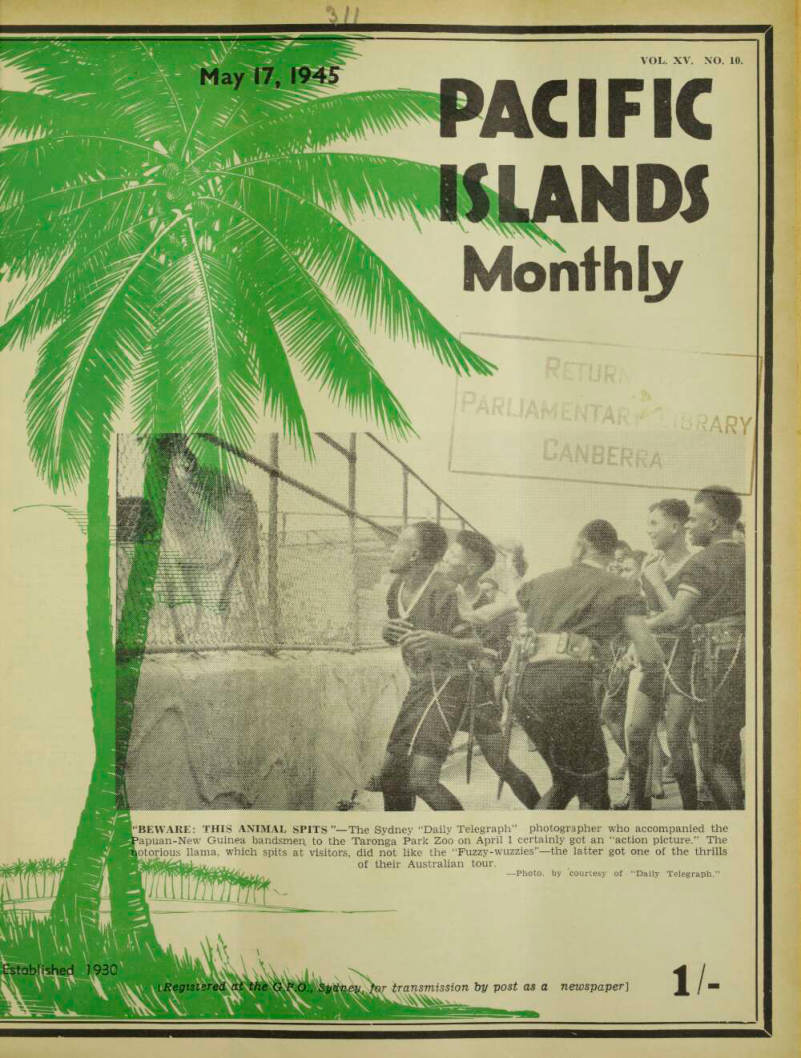
“BEWARE: THIS ANIMAL SPITS"-The Sydney “Daily Telegraph” photographer who accompanied the Papuan-New Guinea bandsmen, to the Taronga Park Zoo on April 1 certainly got an “action picture.” The Notorious llama, which spits at visitors, did not like the “Fuzzy-wuzzies"—the latter got one of the thrills of their Australian tour. —Photo, by 'courtesy of “Daily Telegraph.”
ROLL OF HONOUR—Section 11.
[Section I (Killed, Missing, Prisoners) and Section II (Wounded, Decorations, etc.), published in Alternate Months] (We try to assemble here the names of nien of the United Nations, residents or former residents of the Pacific Territories, whose names appear in casualty lists or who receive decorations. We should be grateful if relations and friends would send us details of such men.)
Wounded
Sgt. Robert ASMUS, of the Fighting French Pacific Battalion. Wounded at Bir Hacheim and evacuated.
Rene AUFANT, of the Fighting French Pacific Battalion. Wounded at Bir Hacheim.
Cpl. Thomas BAMBRIDGE, of the Fighting French Pacific Battalion, Wounded at Blr Hacheim and evacuated.
Fit.-Lieut. J. W. BARTLETT, RAAF, formerly of TNG. Wounded in air operations over the Mediterranean on January 23, 1944.
BERBERS (alias ARESKYt, of the Fighting French Pacific Battalion. Wounded at Bir Hacheim.
Henri BERTHELIN, of the Fighting French Pacific Battalion. Wounded at Bir Hacheim.
Pte. V. BLANCO, AIF Infantry, of Thursday Island. Wounded in action, July, 1941.
L/Cpl. J. P. BLENCOWE, AIF Infantry, of Rabaul, TNG. Wounded in action, July, 1941.
Jean BRIAL, of the Fighting French Pacific Battalion. Wounded at Bir Hacheim.
Pte. George BUCKNELL, AIF, son of Mr. and Mrs. C. Bucknell, of Korolevu, Fiji. Wounded in action in Malaya, January, 1942.
Pte. Thomas BYERS, AIF infantry, of Thurs day Island. Wounded in action. May. 1941.
Pte. Sekope CAMA, FMF. Reported wounded in action in Solomons, September, 1944.
Raymond CHAUTARD, of the Free French Pacific contingent from New Caledonia. Re ported a casualty in the Middle East, March 1942.
Pte. A. J. CORLASS, AIF, formerly of Rabaul.
Wounded in action.
Albert CUBADDA, of the Free French con tingent from New Caledonia. Reported a casualty in the Middle East, March, 1942.
Charles DEVEAUX, of Pacific Battalion of Fighting France. Wounded at battle of Blr Hacheim (Libya).
Sgt. EMERY, formerly of Lae, TNG. Wounded in New Guinea in October, 1942.
W/O P. N. ENGLAND, AIF, formerly of Bogia, TNG. Wounded in action January 27, 1944.
Lieut. M. G. EVENSEN, AIF, formerly of Rabaul. Wounded in action.
V. FAIRHALL, 2nd NZEF, formerly of the Treasury Department, Western Samoa. Reported wounded in action, February, 1942.
Trooper Arthur T. FILEWOOD, formerly of Thursday Island. Reported wounded in action.
May, 1943.
Paroa FIU, of the Fighting French Pacific Battalion. Wounded at Bir Hacheim and evacuated.
Cpl. H. N. FORSYTH, formerly of New Guinea.
Reported wounded, June, 1944.
Acting Warrant-Officer V. M. I. GORDON, AIF infantry, of Wau. TNG. Wounded in action, February, 1942.
Henri GUHBAUD, of the Free French Pacific contingent from New Caledonia. Reported a casualty in the Middle East, March, 1942 Sgt. C. HENDRICK, AIF infantry, of Rabaul, TNG. Wounded in action, July, 1941.
Stanley HIGGS, son of Mr. and Mrs. Gordon Higgs, of W. R. Carpenter and Co. Ltd.. New Guinea. Member of an English Lancers’ regiment, wounded during British evacuation from Dun kirk (France). May, 1940.
Pte. W. HOLMES, of the Fiji Military Forces.
Reported wounded in action, December 1943.
Alexandre HUYARD, of the Free French Pacific contingent from New Caledonia. Reported a casualty in the Middle East, March, 1942. p - c - JEUNE, AIF, formerly of Morobe, TNG. Reported wounded, June, 1944 Sgt.-Pilot Andrew KRONFELD, of the NZ Fighter Squadron attached to the RAF. Wounded IMl 66 dUrlne operations ov er France. December.
Cp! W. H. LANNEN, AIF artillery, of Rabaul.
New Guinea. Wounded in action. June. 1941.
LEGA - Arp . formerly of the Mandated Territory. Reported wounded in action, November, 1944. rcSnri E w G ’ , AIF artill * r y- of Thursday Sit d io^J VO ! Jnde v J campaign in Greece.
May, 1941, invalided home after having his left forearm amputated Battalinn 6 LU £ A ’ °i j he Plghtln £ French Pacific .vacated. Wounded »* Blr Hachelm and A/Sgt. Alastalr MACLEAN. AIF Infantry, of
Rabaul, New Guinea. Wounded In action, ic Libya, June, 1941.
Sgt. J. D. McCLYMONT, NZEF, son of Capt.
D. McClymom, Harbourmaster of Apia, Western Samoa. Wounded in action, November, 1941.
Lieut. Jack McGRUTHER, NZEF, formerly of Mangaia, Cook Is. Wounded in fighting in Libya.
Lieut. Colin McGRUTHER, NZEF, formerly of Mangaia. Wounded in action in North Africa.
Cpl. R. McKERLIE, AIF, of Yandina, BSI, wounded in face by bomb explosion, April, 1941.
T. MANE A. of the Fighting French Pacific Battalion. Wounded at Blr Hachelm and evacuated.
Jean MERIGNAC, of the Free French Pacific contingent from New Caledonia. Reported a casualty in the Middle East. March, 1942.
Henri MEYER, of the Free French Pacific contingent from New Caledonia. Reported a casualty in the Middle East, March, 1942.
S/Sgt. Graham B. MIRFIELD, AIF engineers, of Rabaul. New Guinea Wounded in action, Pte. Apisai NAIKA, of Fiji Military Forces.
Wounded in action in Solomons.
Pte. Sowani NALICO, FMF. Reported wounded in action in Solomons, September, 1944.
Pte. James O’DWYER, NZEF, formerly of Apia, W. Samoa. Wounded in action in Italy, December, 1943.
Joseph OTHUS, of Pacific Battalion of Fight ing France. Wounded in battle of Bir Hachelm (Libya).
Lieut. A. G. PEARCE, AIF, formerly of Salamaua, TNG. Wounded in action.
Pte. L. G. ("Mick”) REECE, AIF, of Bulolo, New Guinea. Wounded in action, July, 1941, Henri RIVIERE, of the Free French Pacific contingent from New Caledonia. Reported a casualty in the Middle East, March, 1942 Pte. H. St. George RYDER, AIF, formerly of Suva, Fiji. Wounded while serving in New Guinea.
Cpl. Luke SAILADA, of Fiji Military Forces.
Wounded in action in Solomons.
A/Cpl. N. K. SAWYER, AIF infantry, of Rabaul. TNG. Wounded in action. July, 1941.
July. 1941.
Pte. Frank M, SCHUSTER, NZEF, formerly of W. Samoa. Wounded in action in Tunisia, 1943.
Lieut. Jeffrey SEAGOE, serving with the British forces in the Far East, formerly of Vila, New Hebrides. Reported “wounded in action”, March. 1942.
Fit.-Sgt. B. SPILLER, RAAF, formerly of Papua. Wounded by flak while attacking enemy targets in France on July 28, 1944.
Pte. Lance STAMPER, AIF, formerly school master at Wau, New Guinea. Wounded in action.
August. 1941.
Cpl. Esala TAWAKE, of Fiji Military Forces.
Wounded in action in Solomons.
Lieut.-Col. J. K. B. TAYLOR, of the Fiji Mili tary Forces. Wounded in action in Bougain ville, December, 1943.
Cpl. Raphael TEIHO, of the Fighting French Pacific Battalion. Wounded at Blr Hachelm and evacuated.
Cpl. Terli TERIITUA, of the Fighting French Pacific Battalion. Wounded at Bir Hachelm and evacuated.
Lieut. A. THOMPSON, of the Fiji Military Forces. Reported wounded in action, December 1943.
Lieut. P. A. TUCKEY, infantry, formerly of New Guinea. Wounded in action.
Pte. Harold G. TURNER, AIF, of Samaral, Eastern Papua. Wounded in action at Bardla (Libya), January, 1941.
Pte. F. D. TWISS, AIF Infantry, of New Guinea. Wounded in action, August. 1941.
Camille VINCENT, of the Free French Pacific contingent from New Caledonia. Reported a casualty in the Middle East. March, 1942.
Driver Don F. WAUCHOPE. AIF. Formerh employed on his brother’s plantation in New Guinea. Wounded in action. July. 1942.
Lieut. F. R. G. WILSON, AIF, formerly of the Mandated Territory of New Guinea. Reported wounded In action, February, 1944.
Alex. WINCHESTER, of the Fighting French Pacific Battalion Wounded at Bir Hachelm Pte. K. M. WHITE, ATP, formerly of Bulwa, TNG. Wounded in action.
Sgt.-Pilot W. WRIGHT, of the Australian Spitfire Squadron, attached to the RAP. for merly of New Guinea. Wounded in knee during
aerial "dog-fight” over the English Channel March. 1942.
Decorations
Sgt. Jionc AGARA, Fiji Military Forces, formerly of Tonga. Awarded the American Sil ver Star for gallantry in action in New Georgia, July, 1943.
Fit.-Lieut. Don AIDNEY, FMF, formerly of Fiji.
Awarded the Distinguished Flying Cross in
September, 1944.
Squadron-Leader G. U. ("Scotty”) aLLEN, EtAAF, who is well-known in New Guinea and Papua, having been co-pilot on the "Faith in Australia”, on the first official air-mall flight to the Territories in 1934. Awarded the Air Force Cross for his work with Catalina flying aoats in Australia and the Pacific.
Major H. T. ALLEN, ALP, formerly of Wau, Morobe District, TNG. Awarded the OBE.
Squadron-Leader C. A. BASKETT, formerly of Bulolo, TNG. Awarded Distinguished Flying Cross for raids over enemy territory while attached to Hampden bomber squadron in Eng land.
Lieut. S. L. ASHTON, ANGAU, formerly of TNG. Awarded Military Medal (as a Warrant- Officer i for conspicuous bravery while engaged in patrol work in New Guinea.
F/O L. W. G. BELL, RAAF, formerly of Kavieng, TNG. Awarded OBE, for outstanding service in the New Guinea area.
Sgt. Semisi BELO, of Fiji Military Forces.
Awarded DCM for services in South-west Pacific area.
Lieut. Charles BLAKE, of ANGAU, formerly of Wau, TNG. Awarded the Military Medal (while serving as a W/O) for bravery and devotion to duty during and after the landing at Arawe, New Britain, January, 1944.
Captain H. M. BOOTH, FMF. Awarded Mili tary Cross for service on Bougainville.
Lieut. M. BOULTON, FMF. Awarded Military Cross for service on Bougainville.
Mrs. Ruby BOYE, of Vanikoro, Santa Cruz Group. Awarded British Empire Medal for gal lant work in the Allied cause during the Jap anese occupation of the Solomons.
Victor BRIAL, Fighting French Pacific Battalion, formerly of New Caledonia. Awarded the Croix de Guerre and the Etoile d’Argent.
Lieut. Kenneth T. BRIDGE, AIF, formerly ADO, New Guinea Administration, for services in reconnoitring the area of the Mambare River.
Captain E. CAKOBAU, FMF. Awarded Mili tary Cross for service on Bougainville. US Legion of Merit.
Major W. P. M. CLEMENTS, of the British Solomon Islands Defence Force. Awarded Military Cross for exceptional devotion to duty in a theatre of war.
Lieut. J. R. COLE, AIF, formerly of New Guinea. Awarded the Military Cross.
Major Mervyn CORNER, FMF, awarded Mili tary Cross for service on Bougainville.
Sgt. Henry C. S. COTTON, of the RNZAP, who was born in Samoa (his father was Secre tary of Native Affairs during the NZ military occupation). Awarded the Distinguished Flying Cross.
Flight-Lieut. R. N. DALKIN. RAAF, formerly of W. R. Carpenter and Co., Ltd., Salamaua, TNG. Awarded the DFC for bombing raids against the Japanese in Koepang area, DEI.
FREDERIC DELAVEUVE, formerly of New Caledonia. Awarded Croix de Guerre, while serving with Fighting French volunteers in Egypt. 2/Lieut. Bruce Insham DENT, of Fiji Military Forces (killed in action, March 25, 1944).
Awarded Military Cross for services in South west Pacific.
Squadron-Leader R. A. DUNN, RAAF, formerly of Carpenter Airways New Guinea Service.
Awarded the Distinguished Flying Cross for bravery while leading his squadron against the Japanese.
Chaplain N. J. EARL, AMF, formerly of Papua. Awarded MBB for bravery shown during early Papuan campaign.
Sgt. R. EMERY, NGVR, formerly of Lae.
Awarded Military Medal for gallantry in New Guinea.
Flight-Lieut. Norman FADER, RAAF, formerly a commercial pilot in New Guinea. Awarded the Air Force Cross for exploits in Bismarck Sea Battle.
Lieut J. FORBES, RNZNR, formerly of West ern Pacific. Awarded US Bronze Star for "heroic service while piloting ships entering perilous waters.”
Rifleman H. W. FORRESTER. NGVR. formerly of Bulolo. TNG. Awarded the Military Medal for operations against Japanese in New Guinea.
Major R. O. FREEMAN, FMF. Awarded the Military Cross for devotion to duty while on service in Bougainville.
Cpl. Tevita FUSI, FMF. Awarded Military Medal for service on Bougainville.
(Continued on Inside Back Cover)
Sgt. J. H. GILCHRIST, formerly of TNG.
Received Military Medal, April, 1944.
Squadron-Leader C. R. GURNEY, RAAF, for merly of Guinea Airways. Ltd., TNG. Posthu mously awarded the Air Force Cross, for bomb ing raids on Japanese-held ports in New Britain.
Major T. GRAHAMSLAW. AMF, formerly of Papua. Awarded OBE for conspicuous devotion to duty in the Buna area (Papua) during Initial Japanese landings in the district.
Walter GRAND, Fighting French Pacific Battalion, formerly of Tahiti. Awarded Croix de Guerre, with one star, for bravery during the Battle of Bir Hacheim, 1942.
A./Sgt. B. W. G. HALL, formerly of TNG.
Received DCM in April, 1944. Later promoted to rank of Lieutenant.
W/O M. I. HARPER, RANR, formerly of BSI, awarded US Order of Merit for outstanding service in Solomons waters.
Squadron-Leader Godfrey HEMSWORTH, RAAF, formerly a well-known New Guinea pilot, who was killed in action against the Japanese In May. Posthumously awarded the Air Fore# Sross.
Japt. L. HENDERSON, AMF, formerly of Papua. Awarded MBE for courage displayed during the Oro Bay operations when he was in charge of small ships operating in those waters.
LUCTEN HERVOUET, formerly of New Cale donia. Awarded Croix de Guerre while serving with Fighting French volunteers in Egypt.
Lieut. Colin HILL, RANR, of the Australian destroyer, “Waterhen”, formerly second officer on the trans-Pacific liner “Niagara”. Awarded the OBE.
Capt. Ernest HITCHCOCK, ANGAU, formerly of Mandated Territory. Awarded US Legion of Merit for assistance to American forces in Salamaua area.
Capt. HOLLAND, formerly of G. & E. Islands Colony, awarded George Medal for bravery in helping to maintain communications ‘after Japanese invasion of Tarawa.
Lieut. D. C. HORTON, RANVR, formerly of District Services, BSI. Awarded the United States Silver Star for distinguished services In the Solomons.
Lieut, Gordon HOWE, RANR, formerly an offi cer in Burns Phllp ships. Awarded the US Legion of Merit for meritorious service in lead ing a reconnaissance party to Russell Islands,
Bsi.
Capt. E. R. JOHANSON, of American liner “Monterey.” Awarded US Merchant Marine Dis tinguished Service Medal for service against the enemy.
Lieut. H. E. JOSSELYN. RANVR. formerly of District Services, BSI. Awarded United States Silver Star, for distinguished services in the Solomons.
Lieut. J. R. KEENAN. RANVR. formerly of New Guinea. Awarded the DSC.
Capt. H. T. KIENZLE, ANGAU, formerly of Papua. Awarded MBE for devotion to duty during the campaign in the Owen Stanley Ranges.
Lieut. Isereli KOROVULAVULA, FMF. Awarded the Military Cross for devotion to duty while serving in Bougainville.
Pte. Sairusi KOTO, Fiji Military Forces.
Awarded US Silver Star for bravery and de votion to duty in the Solomons.
Wing-Commander C. J. N. LELAU, RAAF, formerly of Suva, Fiji. Awarded the OBE for distinguished service.
Pte. Viliame LAUTIKI, of Fiji Military Forces.
Awarded MM for services in South-west Pacific area.
Cpl. Elaitia LEDUA, FMF. Awarded Military Medal for service on Bougainville.
Lieut. Paul LOBENDAHN, FMF. Awarded Military Medal for service on Bougainville.
L/Cpl. Viliame LOMASALATO, FMF. Awarded Military Medal for service on Bougainville.
Sgt. T. McADAM. NGVR, formerly of New Guinea Forestry Dept. Awarded Military Medal for gallantry in New Guinea.
Capt. John S. McLEOD, ANGAU, formerly a patrol-officer with the New Guinea Administra tion, for services in New Britain, organising and supervising native labour and guides and for reconnaissance patrol. US Legion of Merit.
Lieut.-Commander A. W. R. McNICOLL, RAN, son of Sir Ramsay McNlcoll. Administrator of New Guinea, and Lady McNicoll. Awarded the George Medal.
Sgt. Josefa MAINAVOLAU, FMF. Awarded Military Medal for service on Bougainville.
Pte. Akuila MARAIVALU, FMF. Awarded Military Medal for service on Bougainville.
Petty-Officer PAUL MSASON. RANVR, formerly a plantation inspector at Inus, Bougainville, TNG. Awarded American Distinguished Service
Cross for “extraordinary heroism in action,"
HENRI MAYER, formerly of New Caledonia.
Awarded Croix de Guerre while serving with Fighting French volunteers in Egypt.
Fit.-Lieut. George B. (Golly) MEIDECKE, RAAF, formerly of W. Samoa. Awarded the Distinguished Flying Cross.
Capt. J. K. MCCARTHY, formerly of TNG.
Received the MBE, April, 1944.
Lieut.-Commander H. A. MACKENZIE, RAN, formerly of Rabaul, TNG. Awarded the US Legion of Merit for exceptionally meritorious services at Guadalcanal.
Capt. John Malcolm METHVEN, A IF. Men tioned in despatches for distinguished services during the seige of Tobruk. Since reported killed in action. (See section “Killed.”) John MILNE, Wireless Operator, Gilbert Islands. Awarded British Empire Medal for dis tinguished service.
Sgt. Geoffrey MOORE, of the RNZAP, formerly engineer on the NG inter-island vessel “Maiwara” and on the trans-Pacific liner “Aorangi”. Awarded the Distinguished Flying Medal.
Capt. G. B. MORGAN, DSC, formerly of Union SS Co. Awarded DSO and Lloyd’s war medal for his part in Allied landings in North Africa in 1942, when he was captain of the “Awatea.”
Lieut. R. G. MORGAN, of G. & E. Islands, awarded the George Medal (posthumously) for bravery in maintaining communication during the Japanese occupation of the Gilberts.
ANDRE MORNAGHINI, formerly of New Cale donia. Awarded Croix de Guerre while serving with Fighting French volunteers in Egypt.
Flight-Lieut. G. B. MEIDECKE, RAAF, formerly of W. Samoa. Awarded the DPC for “courage, coolness and tenacity, and flying skill of the highest order.”
Pte. Fred Charles NARRUHN, Fiji Military Forces. Awarded US Silver Star for gallantry and devotion to duty at Butaritari, Gilbert Is.
Lieut. Lyndon C. NOAKES, AIF, formerly of the Mines Department, Wau, for services when the enemy landed at the mouth of the Mam bare River, when Noakes and his party killed several of the enemy and maintained constant watch on the remainder. US Legion of Merit.
Flight-Lieut. M. O’CONNOR. RAAF. formerly of Suva, Fiji. Awarded the DFC for a “high record of success on operations” in the Middle East.
Lieut. S. S. PAGE, RNZNR, formerly of LMS ship “John Williams.” Awarded US Bronze Star for “heroic service while piloting ships entering perilous waters.”
Capt. Raymond PERRAUD, FF Pacific Bat talion. Awarded Croix de Guerre at Bir Hacheim in 1942. Awarded Liberation Cross in Europe in 1944. Later killed in action.
Lieut. B. PHILPOTT. FMF. Awarded Military Cross for service on Bougainville.
Flight-Lieut. H. G. PILLING. RAP. formerly of Suva, Fiji. Awarded the DFC, May, 1942. (Killed a few days later.) Sgt. Veneniki RAIWALUI, of FMF. Awarded BEM when he saved boxes of ammunition from a burning store, May, 1944.
Cpl. Jone RAVESOLI, FMF. Awarded Military Medal for service on Bougainville.
Lieut. W. T. READ, RANVR, formerly of Dis trict Services, TNG. Awarded American Distin guished Service Cross for “extraordinary heroism in action” while in South Pacific Waters.
Lieut. A. RHODES, RANVR, formerly of BSI.
Awarded American DSC for heroism in SW Pacific in 1942. In June, 1943, awarded Ameri can Silver Star when he guided a party of US commandoes to the beach on Rondova.
Pilot-Officer Pat RICHARDSON. RAF, son of Vlr. W Richardson, formerly of Penang, Fiji.
Awarded the Distinguished Flying Cross.
W/O A. L. ROBINSON, NGVR, formerly of New Guinea. Awarded DCM.
Commander Alvord S. ROSENTHAL, RAN, son of Major-General Sir Charles Rosenthal. KCB, CMG, DSO. VD. Administrator of Norfolk Island. Awarded the DSO. November. 1941; awarded the Bar to DSO. February, 1942.
W/O K. W. RYALL, of ANGAU, formerly of TNG. Awarded Military Medal for conspicuous service in the Arawe Peninsula area of New Britain.
Cpl. Manoa ROKO, of Fiji Military Forces.
Awarded MM for services in South-west Pacific area.
Lieut. C. W. SETON, AMF, formerly of BSI.
Awarded DCM for work done under the Ameri cans in the Solomons in 1942-3.
Capt. Allan W. STALEY, AIF, formerly Road master in Rabaul, for services in New Guinea as liaison officer of a bombardment squadron, US Legion of Merit.
Cpl. Sefanaia SUKANAIVALU. FMF. Awarded the Victoria Cross posthumously, for conspicu ous gallantry in Bougainville.
Sgt. Atunaisa TAVUTU, FMF. Awarded Mili tary Medal for service on Bougainville.
Lieut.-Colonel J. B. K. TAYLOR. Commander
of Fiji Military Forces overseas. Awarded American Purple Heart, March, 1944. Awarded
Obe, 1944.
Cpl. Manasa TIKOCA, FMF. Awarded Military Medal for service on Bougainville.
Capt. A. T. TIMPERLEY, AMP, formerly of Papua. Awarded MBE for work on Good enough Island when he acted as a guide.
Major David TRENCH, formerly District Offi cer in BSI. Awarded the Military Cross for distinguished service and gallantry in the South-west Pacific.
Lieut.-Col. G. T. UPTON, FMF. Awarded American Bronze Star for outstanding leader ship while commanding Fijian troops on Bou gainville. Awarded DSO, 1944.
Cpl. Waisele VEIKOSO, FMF. Awarded Mili tary Medal for service on Bougainville.
F/O Leigh G. VIAL, RAAF, formerly ADO in TNG. Awarded American DSC for outstand ing heroism in New Guinea in September. 1942.
Lieut.-Col. F. W. VOELCKER, FMF. Awarded American Bronze Star for outstanding leader ship while commanding Fijian troops on Bou gainville.
Lieut. G. J. WEBSTER, RNZNR, formerly of Gilbert Is. Awarded US Bronze Star for “heroic service while piloting ships entering perilous waters.”
Squadron-Leader Charles WIDDY, RAAF, formerly of BSI. Awarded the US Legion of Merit for meritorious service in leading a reconnaissance party to Russell Islands, BSI.
Lieut, (then W/O) Raymond WATSON, AIF, formerly of TNG. Awarded MBE for bravery and devotion to duty during the Papuan cam paign.
Sgt. Ilaitia WAQA, of Fiji Military Forces.
Awarded MM for services in South-west Pacific area.
Capt. D. E. WILLIAMS, of Fiji Military Forces.
Awarded American Silver Star for gallantry in action while leading patrols in Guadalcanal.
Lieut. G. K. WHITTAKER, NGVR, formerly of Lae, TNG. Awarded MBE for gallantry in New Guinea, Lieut. George Raymond WORLEDGE. of the RANVR. formerly of Fiji. Awarded the MBE (Military).
Lieut. H. M. WRIGHT, RANVR, formerly of New Guinea. Awarded DSC.
Mentioned In Despatches
Rifleman G. R. Archer, Corporal A. Moore,
Tng. Tng.
Captain A. H. Bald- Captain J. J. Murphy, win, Papua. TNG.
Captain N, B. N. Lieut. K. C. McMullen, Blood, TNG. TNG.
Rifleman J. Cavanagh, Pte. Apisai Naika,
Tng. Fmf.
Rifleman J. W. Currie, Pte. Peni Nasuva,
Tng. Fmf.
Warrant-Officer J. B. w /° Victor Neuman, Davies, Papua. TNG.
Captain L. S. Dexter, Captain N. Owers Papua> Sub-Lieut. C. Page, C TNG W ’ M ' EdWardSl Ll™° R. H. Phillips, j- Elllott-Smlth, L ™° nant j j Rae , rdpiid. P£lDU£l Warrant-OfflceT P. R. pte A A Ramsden N. England, TNG. p a pua. ’
Rifleman H. W. For- pte inoke Rasiga, rester, TNG. FM p Lieut. K. G. Fuller, cpl. Nemani Ravia.
Tonga. FMP.
Sergeant V. H. Gil- Major D. G. Rice.
Christ, TNG. pte. S. M. Richie.
Lieut. S. G. Grimshaw, Papua.
TNG. pte. J. E. Rosa, FMP.
Lieut. C. G. Harris, cpl. Luke sailada,
Tng. Fmf.
Lieut. L. A. Hender- Sergeant Akuila Sau son, FMF. kura, Fiji.
Lieut. L. F. Hewlett, Lieut. T. C. Scott.
Tng. Pmp.
Sgt. H. E. Jarrett, Lieut. W. W. Sherratt, Papua. FMF.
Major E. W. Jenyns, L/Cpl. Are Sitivenl.
Tng. Fmf.
Warrant-Officer I. P. Lieutenant C. H. Smith.
Jones, Papua. TNG.
Lieut. H. T. Kienzle, Warrant-Officer R. A.
Papua. Smith, Papua, Rifleman J. R. Kinsey, Lieut. A. P. Spittal,
Tng. Pmp.
Cpl. Josefa Lonma, pt e . R. M. Stewart, FMF. Papua.
Corporal Malakai Mo, L/Cpl. Josefa Tatau.
Fiji. FMF.
Staff - Sgt. Manzoor Lieut. A. T. Timperly, Beg, FMF. Papua.
Corporal M. Marlay, Captain L. N. Trlbolet,
Tng. Tng.
Rifleman J. E. Mayos, Lieutenant A. G. Vagg,
Tng. Tng.
CSM D. Miller, FMF. Captain G. H. Vernon, Cpl. Jona Moli, FMF. MC, Papua.
Pacific News-Review
End of World War II in Europe
Notes And Comment On
International Affairs
From April 16 To May 15
This News-Review was first published in the issue of September, 1939, immediately after the outbreak of the European war; and it has appeared every month, ever since. . . . Therefore, those who have kept a file of the “Pacific Islands Monthly” now possess a complete, chronological record of World War II (European Section), from beginning to end. That record is valuable. Many people have been seeking a complete file of the journal, covering those momentous 5 \ years; but (because of wartime paper shortage) old files of the journal are unprocurable. . . . The News-Review will be continued, at least until the end of the Pacific war; but this month, to mark the end of the Great War in Europe, we are republishing, from this 5\ years’ record, the dates of the outstanding events in Europe between September 3, 1939, and May 8, 1945.
Sep. 3, 1939
All Anglo-French efforts to restrain Hitler having failed and the Germans having invaded Poland on Sep. 1, Britain and France declare war on Germany.
April 9, 1940
Germans, without warning, invade Denmark and Norway,
May 10, 1940
Germans invade Holland and Belgium, and turn flank of French defences. Win ston Churchill becomes Prime Minister of Britain.
June 10, 1940
Italy declares war on France and Britain.
June 25, 1940
France (having asked for armistice on 17th) surrenders; but General de Gaulle escapes to England and inaugurates Fighting France Movement.
September 7, 11, 12, 15, 1940-
Great German “blitz” on London and South English cities.
September 27, 1940-
Germany, Italy and Japan sign Pact at Berlin.
October-December, 1940
Almost ceaseless bombing attacks on London and Southern England.
December 15, 1940
British Imperial Forces from Egypt invade Libya. They reach Benghazi in February.
March, 1941
British Imperial Forces land in Greece.
April 23, 1941
Greece surrenders to Germans. British evacuated.
May 20, 1941
German paratroops invade Crete.
June 22, 1941
Germans attack Russia and in next few months make deep invasion.
Dec. 7, 1941
Japan attacks USA at Pearl Harbour, and brings United States into war beside Britain and Russia.
May, 1942
Germans, checked before Moscow in Dec., 1941, launch great new offensive in South Russia.
May 30, 1942
1,000 British planes bomb Cologne.
June 21, 1942
Tobruk falls. Rommel invades Egypt.
August, 1942
Germans reach Volga at Stalingrad and invade Caucasus.
October 23, 1942-
Battle of El Alamein begins.
Nov. 8, 1942
British and Americans land in North Africa. They occupy Morocco and Algeria, while Russia launches great and success ful counter-offensive.
January, 1943
Germans retreating in South Russia (from Stalingrad) and in North Africa (from El Alamein).
May 12, 1943
German armies in Tunisia surrender.
July 10, 1943-
Allies invade Sicily.
Sep. 3, 1943
Italy surrenders and Mussolini flees.
October-December, 1943
Germans in full retreat in South Russia.
January, 1944-
Joint RAF and American air attacks oh Germany now reaching staggering force. Russians drive Germans from Leningrad and enter Poland.
March, 1944
Russians invade Rumania.
June 4, 1944-
Allies occupy Rome.
June 6, 1944
Anglo-American forces land on coast of Normandy, and great battle opens on new Western Front.
July-August, 1944
Anglo-American forces defeat Germans and liberate France.
August 25, 1944
Americans and French partisans liber ate Paris.
Jan. 11, 1945
Russians, from Vistula line, in Poland, commence advance to Oder River. 30 miles east of Berlin.
March 9, 1945
Americans cross the Rhine. Signs of German collapse.
March 23, 1945
American, British and Canadian armies cross Rhine at many points, and begin rapid penetration of Central and West ern Germany, and Holland.
And Complete Victory in
April-Moy, 1945
Apl. 16: British occupy Bremen.
Apl. 17: Russians, from Oder line, launch overwhelming offensive upon Ger man armies defending Berlin. American columns are all over Central Germany.
US Seventh Army enters Nuremberg, and British columns are near Hamburg.
Apl. 17: Anglo-American armies have broken the German line in North Italy, and British are nearing Bologna.
Apl. 18: Americans enter Leipsig.
Apl. 19; Russians now only 12 miles from Berlin. American Army has entered Czecho-Slovakia from the west.
Apl. 19: Germans retreating from Bri tish in Holland have destroyed Zuider Zee dykes and let waters flood the rich farmlands.
Apl. 23: Russians now hold most of Berlin’s suburbs. Hitler and Goebbels are reported to be directing a fanatical last stand in Berlin.
Apl. 23: American armies in Central Germany have halted on the west bank of the Elbe, waiting to make a junction there with the advancing Russians.
Apl. 23: The Germans in North Italy are now in full flight, northwards.
Apl. 25: World Security Conference opened in San Francisco.
Apl. 26: Berlin is encircled and burn ing. American armoured columns are sweeping down the Danube Valley into Austria. French armies are converging on Munich. British bombers have dropped “blockbusters” on Hitler’s “eyrie” at Berchtesgaden. British armies are occupying Dutch and North-west German cities. Partisans have risen in North Italy to harry the Germans, who are fleeing from the Anglo-American armies.
Apl. 27: Russian, American and Bri tish armies have linked up at Torgau, 75 miles south of Berlin.
Apl. 28: Mussolini captured and exe cuted near Milan by Italian Partisans.
May 2: Hamburg radio (last German station) officially announced that Hitler was killed on May 1 and that Admiral Doenitz nas become Fuhrer.
May 2: German armies in Northern Italy and Western Austria surrendered unconditionally to Field-Marshal Alexan der.
May 4; All German forces in North west Germany, Holland and Denmark surrendered to Field-Marshal Mont gomery.
May 6: Revealed that 16 Polish dele gates who went to Moscow to confer regarding new Polish Government, sev eral weeks ago, and who mysteriously disappeared, were arrested by Russians and are in prison. The incident has had most serious reaction in Britain and America, which have broken off all con versations with Russia on Polish question.
May 7: Early this morning, at the headquarters of the Supreme Allied Com mander in the West (General Eisen hower) German delegates appointed by Admiral Doenitz, signed the complete and unconditional surrender of all Germany’s fighting forces, land, air and sea. There is to be a confirmatory signing in Berlin.
May 8: At 3 p.m. to-day, in world broadcasts. Mr. Churchill, President Tru man and Marshal Stalin announced the final capitulation of Germany.
May 12: Allies now are applying them selves to the colossal task of dealing with about 6,000.000 surrendered German Ser vicemen, repatriating at least 10.000,000 displaced people, and restoring adminis trative and economic machinery. There is the gravest danger of a terrible famine in Central and Western Europe. The transfer of huge forces and equipment to the Pacific, against Japan, already has commenced.
The Pacific War
Apl. 17: While American Super-Fort resses from the Marianas continue an almost daily bombing of Japan’s indus trial cities, and MacArthur’s forces are mopping up the last Jap forces in Philip pines. the Americans are continuing their attack upon Jap garrison in Okinawa (Ryukyu Islands). They landed there on April 1, and intend to use Okinawa as air base against Japan, 400 miles away. To day Americans landed on lye Island, in Ryukyus, and have occupied the airfield.
Apl. 19: Under cover of heavy naval
and air bombardment. Americans landed in the Malabang-Perang area <Moro Gulf) of Mindanao —the only large Philip pines island not now under American control.
Apl. 23; On Okinawa, the Japanese counter-attacked and won back the west coast town of Kakazu.
Apl. 28: Australians in the Sepik dis trict of New Guinea took the Jap base at Maprik. Before the war a good aero drome, and Government sub-station, Maprik was heavily fortified by the Japs.
May 1: Australian Ninth Division and Netherlands forces have landed on Tara kan Island, an important oil-producing area «lose against the north-east coast of Borneo.
May 4: Australians in North-east Bor neo. in bitter fighting, have got to within 2.000 yards of the Tarakan oilfield, one of their main objectives. RAAF and US planes are giving substantial help.
May 5: Rangoon, capital and chief port of Burma, fell yesterday to British com bined operations forces. Troops landed in landing-craft from the Rangoon River, and the British 14th Army also entered the city from the north, having advanced rapidly southwards after the capture of Mandalay. The Japanese are retreating, broken and disorganized, into Siam.
May 6: Australians have seized part of Tarakan town, and got control of the airfield. Resistance is fierce, and the Australians are advancing over thickly sown minefields.
May 14: Sixth Division AIF troops have launched an all-out attack on Wewak, NE New Guinea. They have occupied the headland and landing-field.
May 15: Ninth Division AIF troops now control virtually all of Tarakan Is. (Borneo).
Advertisers
Adams, Clayton & Co 28 Aladdin Industries Pty.. Ltd 29 Atkins Pty., Ltd., Wm 32 Australian Alumi nium Co. Pty., Ltd 49 Bagia, B. C. . . . 32 Berger’s Paints . . 51 Brial, E. J., 16, 24, 28, 33 Broomfield, Ltd. . . 43 Brown & Co., Ltd. 11 Brunton’s Flour . . 44 Burns, Philp Trust Co., Ltd 13 BP (SS) Co. . . . 11 Bhindi, P. K. . . . 53 Carlton & United Breweries, Ltd. . 17 Carpenter, Ltd.,.W.
R cov. iv.
Chivers & Sons, Ltd 50 Coleman Lamp & Stove Co 41 Colonial Wholesale . 25 “Cystex” ... 52 Darvas & Co. ... 36 David Trading Co. . 15 Donaghy & Sons . 43 Donald. Ltd., A. B. 27 Dr. Williams Pink Pills 33 Eledtrolux Refrigerators . . 20 El Retiro 24 Enterprise Inc. . . 47 Excelsior Supply Co. 46 Farnham, Johifß. . 48 Flit 48 Ford Sherington Pty., Ltd 26 Garrett & Davidson 22 Gibson & Co., Ltd.,
J. A. D 23
Gillespie Pty., Ltd., Robert ... 26 Gilbey’s Gin ... 27 Gillespie’s Flour . . 18
Gough & Co.. E. J. 47 Grand Pacific Hotel 2 Grove & Sons, W.
H 22 Griffiths Nurseries, Ltd 54 Heinz & Co. Pty., Ltd., H. J. . . .31 Horlicks Malted Milk 39 Jenkin’s, Reg. ... 55 Kopsen & Co., Ltd. 42 Kalidas, Mavji . . 44 Miscellaneous ... 10 Kei & Moo ... 50 “Mendaco” ... 30 Mcllraths P'ty., Ltd. 35 Nelson & Robertson Pty., Ltd 14 “Nixoderm” ... 54 Noyes Bros 12 Parekh, S. P., & Bros 31 Pacific Territories Assn 9 Pacific Publications Pty., Ltd. ... 53 Pacific Is. Society . 21 Pacific Island Trading Co. . 25, 36 “Pinkettes” ... 38 Queensland Insur ance Co 15 Ransome, Sims & Jefferies ... 34 Riverstone Meat Co., Ltd 21 Robinson, G. H. . . 16 Rose’s Eye Lotion . 42 Rohu, Sil 46 Scott Ltd., J. . .38 Steamships Trading Co., Ltd 23 Sullivan & Co., C. . 40 Swallow & Ariel , . 37 Taylor & Co., A. .41 “Tenax” Soap . . 12 Tillock & Co., Ltd. 49 Thornycroft (Aust.) Pty., Ltd.. ... 19 Trinity Grammar School 18
Watson, Wm. H. . 30 Wright & Co., Ltd., E 34 Wunderlich, Ltd. . 55
Yorkshire Insurance Co., Ltd 11 Young Pty., Ltd., Harry, J 45
Contents
Pacific News-Review 1 Editorial: “Victory in Europe—And What Now?” 3 New Capital for BSl—Tulagi an Internation Base? 5 No Provisional Government—Yet— ANGAU Still Rules 6 Rehabilitation Fund Opened for
Pow 7
France and America in the Pacific 8 Check Your War Damage 8 Tropicalities 9 Great Base at Manus 10 Papuan Pioneer Passes—A. C. English 12 V-E Day in Sydney—Jubilation by Regulation 13 Should Samoans Have Self-Govern ment? 15 Pacific Rice Position is Not Good .. 15 Metamorphosis—Finschafen Becomes Base “F” 17 An Old Cook Is. Custom 18 Australian Praise for Suva Medical School 19 Cruise of the “Cimba”—Suva to Auck land by Schooner 22 Health Measures in Rarotonga ... 27 Training Ex-Servicemen as Planta tion Managers 34 “PIM” Short Story: “Under Patron age” 35 Overlanding Cattle —How One Bride Was Introduced to N. Guinea .. 36 Discovery of Tahiti—Charm of Old French Town 48 Copra But No Ships 50 The Jungle Returns—All That is Left of a S. Seas Base 52 Who Was “Doctor Long Ghost”? .. 53 Commercial and Markets 56
Advertisements & other items, p. 4 (1 item)
*>&* ',&■ Spet,a lve^
°' ,e " n ? \ ed „* r tooU<. ■iw iesi8 ° e
s. *** dW» ?h O bVe ’
V-
Pacific Islands Monthly
The Newspaper-Magazine of the South Seas
[Registered at the G.P.0., Sydney, for transmission by post as a newspaper .] Published Once Each Month and Circulated in Australia and New Zealand and in the following Pacific Territories and Islands Groups:
Australian Territory of Papua.
Mandated Territory (Australia) of New Guinea.
Australian Territory of Norfolk Island.
New Zealand Territory of Cook Islands.
Mandated Territory (NZ) of Western Samoa.
British Colony of Fiji.
British Solomon Islands Protectorate.
British Protectorate of Tongan Islands.
British Crown Colony of Gilbert and Ellice Islands.
Mandated Territory of Nauru.
British and Free French Condominium of New Hebrides.
Free French Colony of New Caledonia.
Free French Colony of Oceania (Tahiti, etc.).
American Territory of Eastern Samoa.
American Territory of Hawaiian Islands.
Owned and Produced by Pacific Publications Pty. Ltd., Union House, 247 George Street, Sydney.
Twi pppom? f Managing Director .. BW 5037 I Business and Editorial MA 4369
P.O. Box 3408 R
Registered Address of Telegrams, Radiograms, and Cables: “Pacpub”, Sydney.
Contributions.
Articles, Stories, and Photographs dealing with Pacific Islands subjects are invited and will be paid for on publication.
Subscription Rates.
Per Annum, within British Empire, Prepaid.
Post Free 10/- Per Annum, elsewhere, Prepaid, Post Free 12/6 Single Copies 1/-
Editor and Publisher;
R. W. Robson, F.R.G.S.
Advertising Manager: W. E. Rogers.
Advertising Office and Printing-House: 29 Alberta Street, Sydney.
Advertising rates furnished on application.
Representative In Fiji.
Pacific Publications (Fiji). Ltd., Bank of NSW Building, Suva (same office as W. H. Grove & Sons, Ltd.). Stocks of Pacific Islands Monthly and Pacific Islands Yearbook on hand.
Representative In London.
J. T. Wallis, Coronation House, 4 Lloyds Avenue, London, E.C.3, from whom may be obtained copies of Pacific Islands Monthly, Pacific Is. Year Book, advertising schedules, etc.
Agents.
The following are authorised to receive sub scriptions for Pacific Islands Monthly:— Burns, Philp & Co., Ltd., and Burns Phllp (South Sea) Co.. Ltd. All branches.
W. R. Carpenter & Co., Ltd. All branches.
Morris, Hedstrom, Ltd. All branches.
Steamships Trading Co., Papua. All branches.
Whitten Bros., Ltd., Samaral, Papua.
B.N.G. Trading Co., Ltd., Port Moresby, Papua.
J. Muir, Suva, FIJI.
Miss R. Castles, Suva, FIJI.
N. C. Mackenzie Hunt, Wainunu, Bua, Fiji.
Cook Islands Trading Co., Rarotonga, Cook Is.
A. C. Rowland, Papeete, Tahiti.
Islands Branches and Representatives of W. H.
Grove & Sons, Ltd., Auckland, New Zealand.
Ed. Pentecost, Noumea, New Caledonia.
Societe Gubbay Kerr et Cie, Noumea, N. Caledonia.
Vol. XV. No. 10.
May 17, 1945
PrirP Per Copy rnce (Prepaid: 10/- p.a.
Victory In Europe—And What
Now?
THE German capitulation of May 7, 1945, bore out two forecasts made often in the 5i years of the European war—namely, that Germany would be broken by air-power, and that “the Jerries will collapse quickly as soon as Germany is invaded.”
The last five years will be described, in centuries to come, as the most dramatic in human history. Mankind came so very close to enslavement; we were saved from another Dark Age—which might have extended over hundreds of years—by a series of what seem like miracles; and then, when the United Nations at last were able to gather their strength, we witnessed a series of military victories and mass surrenders without parallel in the records of war.
Five years ago, all the nations literally cowered before a terrifying triumvirate Germany, Italy and Japan. The “Axis” .was opposed only by an isolated and unprepared Britain and a faltering France. To-day, two of those three Powers are utterly destroyed; the third is on the way out; and the world is dominated by the might and genius of Great Britain, united States and Russia.
IT is not yet generally realised that World War 11, in relation to United States and Russia, has brought changes that completely alter the international balance of power.
For 25 years, world politics were dominated by the Western European
nations. The Soviet Republic, almost unknown since 1917, was not regarded as militarily formidable. The United States, apparently secure in its size and its isolation, was quite deter mined that it would not be involved in European wars or politics. Great Britain, while necessarily involved in European international relationships, was demonstratively pacific in her outlook, and had no armaments worth mentioning, outside her navy.
The Axis Powers, while regarding United States, Russia and Britain as potential foes, looked upon them with contempt. “Once let us break the Anglo-French Alliance,” said the Nazis, “and the' world is ours.” They smashed the Anglo-French Alliance; and they were themselves broken by three things they—and all such planners—never had contemplated; The staunch courage and spiritual strength of the British people; the extraordinary genius of the Americans in organising their vast industrial strength for war, and their bravery and steadiness in actual fighting; and the ability of the Red leaders in using millions of men against German military might, plus the readiness of the Russian masses to sacrifice them selves for their Soviet.
XJOW, see what we have. Great Britain is the strongest Power in Western Europe, and British prestige was never higher—nor more worthy of recognition. Under Chur chill, Great Britain has attained a
than ever before in her glorious his tory. She becomes the protector of the European Democracies; and not the least of her obligations is to assist in the restoration of France.
Russia becomes t£e dominant Power in Eastern Europe and in Asia. She still is withdrawn and inscrutable, and most definitely is the unknown quan tity of future international relations, We do not know yet whether she will live in harmony with the democracies, or whether Moscow will consider that her great victory over Germany en titles her to interfere in the affairs of her neighbours, and try to force Communism upon the Democracies.
We hope for the best—but fear the worst.
The United States now is the strongest Power in the world. With her vast workshops, her endless re sources and her 140,000,000 literate and healthy people, she was poten tially the world’s strongest nation tor a long time. Now, she has proved it.
America, either alone or (prefer ably) in combination with Great Britain, can dominate the whole world, if she so desires. Generally, she has no such desire. The first principle of American politics is non interference with other nations. But most Americans now realise that science has so reduced world dis tances that America cannot ignore her neighbours—that she must accept her share of responsibility of main taming order in the world and pro tecting “The Four Freedoms.”
Russia, aloof and incalculable, is the unknown factor of the future.
The democracies fear that she may try to force upon the world, in Com
munism, a form of Totalitarianism as repugnant to free men as is Fascism or Nazism. If she does, the two great English-speaking Powers are capable, in combination, of meeting the threat to our liberties. But if Russia will . join America and Britain in policing the world for the preservation of human decencies, we may look for ward to an era of great human pro gress and happiness.
This, then, is the change in world affairs that comes out of VE-Day: The forces which will direct human des tinies, for a long time to come, are no longer in Western Europe. The centre of world affairs may shift from the North Atlantic to the North Pacific.
THE problems created by the Ger man surrender and the end of the European war are literally appalling.
The Allies have upon their hands about 6,000,000 German prisoners, at least 10,000,000 displaced peoples who have to be shifted home out of Ger many, and countless millions of other peoples who are idle and helpless in the other countries ravaged by war.
Our commanders are working day and night, trying to get these un happy millions on to the tasks of quick food production, before the European summer passes. But it is touch-and-go. Europe will be lucky if, in the coming winter and spring, it escapes a terrible famine.
HERE in the South Seas we are inclined to regard the end of the war in Europe with detached interest.
It is very comforting and encour aging; we are glad for the sake of all friends who have had the horror removed from th e& doorstep; but our war is still on. There can be no feel ing of security here until the power of Japan is broken.
How long will it take? Every man has a different estimate.
In all calculations, there is one common denominator everyone agrees that the fanatical Jap, fight ing to the death in his fox-hole, will “take an awful lot of finishing off.”
Even if our forces go in and occupy Japan itself, these formidable Jap armies, scattered all over China, Indo-China, Siam, Malaya, Borneo and Netherlands Indies, will have to be broken up and rooted out separ ately and individually.
We have learned, from experience in Germany, much about the bomb ing of industrial cities. Once we get bases close enough to Japan, our superior air forces quickly will des troy Jap industries and paralyse Japan, As many as 500 Superfortresses now attack Japan in one day. But they must fly 1.500 miles from Saipan, and it is doubtful whether they can carry more than two or three tons of bombs, plus fuel, for the long return journey, even when they re-fuel at Iwo Jima.
JAPAN cannot be effectively bombed, ° as Germany was bombed, until nearer bases are available. That is why the Japs are so stubbornly re sisting the Allies’ effort to occupy
Okinawa. Okinawa is less than 400 miles from Japan.
For effective bombing, however, air fleets should attack from two or three directions—say from Okinawa, from the nearby coast of China, and from the Russian Territory of Vladivostok.
If Russia intends sincerely to co operate with Britain and America in organising and policing the post-war world in the interests of freedom, Russia will attack Japan from the north, and will make bases available at Vladivostok. If—as many believe —Russia’s ultimate purpose is the overthrow of the “capitalist system” of Britain and United States, and the Bolshevisation of China. Russia will leave to the English-speaking nations the costly and perhaps exhausting task of subduing Japan, and will not co-operate. We shall know the answer, in due course.
MEANTIME, for the major attack on Japan, it seems we must have three things: Airfields closer to Japan, not only in Okinawa, but also in China, which will involve large scale operations; the establishment in the region southwards of Japan of the large forces of men and equipment about to be transferred from Europe —which apparently would involve the Überation of Malaya, the Malacca Strait and Singapore, so that traffic from Europe may make use of the direct route through the Suez Canal, the Indian Ocean and Malacca Strait; and there must be time for the train ing and adaptation of the new forces from Europe to the entirely new forms of warfare which they will meet in Western Pacific and South-east Asia.
Such considerations suggest that we may not expect the end of the Pacific war for another year or two.
Some people think that, when Japan sees the massive forces assem bling against her, and the hopeless ness of her position, she may sur render soon, before her ancient dynasty and her national structure are blown to pieces, along with her heavy industries. Others are equally sure that she will fight on to the end, in the hope that she yet may save something from the wreck through quarrels among the United Nations.
Present probabilities are that, in 1945, we shall see terrible, large-scale fighting in and around East Asia; and that then, as the Allies devote themselves to mopping-up, the war will tend to become localised in the East Asia-Indonesia region, while the rest of the world devotes itself to the appalling task of restoring itself to peacetime conditions.
News of Papuan People
Lieutenant and Mrs. D. McLaughlin have been holidaying at Nusa Heads, Qld.
Mr. and Mrs. J. Grimmer are holiday ing at the seaside. Mr. Grimmer is down from Doa Plantation.
Recent departures from Brisbane for their homes in Papua were Mrs. E. Ches ter and Mrs. Egelstaff.
Mr. C. Heiner has been ill for some weeks. His many friends hope it will not be long before he makes a satisfac tory recovery.
"Trusteeship"
Australia Gets Off on the Wrong Foot at UNCIO
rERE has been much very confusing talk at UNCIO (United Nations Con ference on International Organisa tion) about a “trusteeship” system which may follow the liquidation of the Man dates system (under which certain nations, under League of Nations super vision, administer some ten Territories).
The Territories originally were; A Class Mandates—Mesopotamia, Palestine, Syria. B Class —Togoland, Cameroons, German East Africa. C Class —New Guinea and Bismarck Archipelago (Australia): Western Samoa (New 'Zealand); Caroline, Marshall and Mariana Islands (Japan); and Nauru (Britain, Austra lia and NZ). Here in the Pacific, we are inter ested only in the C Class Mandates.
There is little doubt that, in the final wash-up, those C Class Territories will remain with their present “protectors,” except that the Japanese-held islands will pass into the charge of the United States.
However, Australian delegate Dr. Evatt has caused disturbance by demanding a system of trusteeship, not only for ter ritories left unprotected by the post-war readjustments, but also for all colonies generally, wherein sovereign nations rule over subject peoples. His argument is that such colonies and territories are being held in trust for their native peoples; and that the nations which hold them should be obliged to report regu larly, to some international authority, concerning the discharge of their obliga tions to the natives.
The Australian apparently has been encouraged in this revolutionary plan by Russia; but America is not well disposed towards it and naturally Britain and France, who hold scores of colonies of all kinds, would not agree to any such per fectionist idea.
Dr. Evatt says his proposal follows nat urally from the Anzac Agreement, signed by Australia and New Zealand in 1944.
But there is little there to support such a claim. ' The Agreement rightly lays stress upon the need for some authority to co-ordinate machinery and principles of administration, over a number of Ter ritories held by a number of nations — such as the South Pacific Region or the West Indies Region—but there is nothing in it to justify Australia (whose record of native administration in Papua and New Guinea is not by any means credit able) in interfering with Great Britain’s system of ruling her colonies. Such a system, applied to Britain, would cause confusion and administrative inefficiency.
If the Australian representatives _at UNCIO have any especially effective methods of administration to impart, they could not do better than return promptly and apply them in Australia, whose internal condition, as the result of mis-government, is literally appalling, and getting worse.
Territorians In Queensland
MRS. W. WYATT, assisted by a com mittee, consisting of Mesdames G.
Jamieson, L. Drewe, T. Craig, Saun ders. Murray. C. Lumley and Misses K: Healy and M. Grahamslaw, who are all members of the Papuan Association, arranged a florin afternoon in the Bris bane Women’s Club rooms, on May 12.
About 70 Papuan-ites came along, and enjoyed music and card games. It is hoped there will be many similar gather ings. The women from Papua have been meeting fortnightly for morning tea, at the Red Cross Cafe, since their arrival in Brisbane.
Advertisements & other items, p. 6 (1 item)
4
MAV. 1945 PACIFIC) ISLANDS MoNlHll
New Capital for BSI
But Shrouded in Dark Official Mystery
DEEP mystery surrounds the selection of a new “capital” for the British Solomons.
It is said to be Harira, or Honiara, op the Guadalcanal coast, opposite the old capital of Tulagi (which is on an island, close under the coast of Gela).
Casual reference was made to it some weeks ago, when the Fiji Information Office stated that the High Commissioner for the Western Pacific (Mr. A. W. G.
H. Grantham) had, in a tour of the Pro tectorate, visited “the new capital,”
Harira, as well as the old capital, Tulagi.
Officials in the Solomons Islands Office in Sydney, when asked for enlightenment, refused to talk. The first gentleman said he didn’t know where it was—he hadn’t been in BSI for three years. He intimated that he did not care where it was, either, and instructed us to call another officer, later.
We called the other officer, later. The other officer was immediately suspicious, but finally admitted that there was a new capital. He said its name might be Har ira. as the Fiji Information Office has intimated, but that the Sydney office believed it to be (and spelled it) Honiara.
He admitted further, but reluctantly, that it was on the coast of Guadalcanal, dir ectly opposite Tulagi.
But he could not sav why Tulagi had been condemned, or who had decided to shift the capital, or what plans were being made for the construction or future of Honiara/Harira. That, he %aid, would be against Security Regulations.
There are a few ex-Solomons residents to whom the selection of a new capital, as well as the abandonment of the old, would be news. Plain civilian residents, however, are small fry, and have no place in the plans of bureaucracy.
It would be interesting to know what harm could be done “security” by a little information concerning the whv and the wherefor of the new move. It is scarcely likelv. at this late date, that Hirohito & Suzuki Inc. are sitting up at nights won dering what goes on in domestic politics in the Solomons.
Anglo-American Base?
Australians who have visited the Solomons recently are of opinion that it is the intention of Britain and America that they shall jointly use the important naval and air base that has been constructed in the area Tulagi- Savo-Guadalcanal, the scene of so much bitter fighting in the latter part of 1942.
Tulagi is now a fine harbour, with wharves capable of handling 100,000 tons of ships simultaneously, and good roads ashore. Across on the Guadalcanal shore, around Point Cruze (the area called Harira) there is another large base. A thousand American Seabees lately have been there erecting substantial buildings of steel and concrete—no temporary structures.
It is believed that the British Solomon Islands Administration will have its head quarters in this Point Cruze area.
It is reported that it is not the inten tion of the British Colonial Office authori ties to pav compensation to Solomon Islands traders and planters, as has been done in the Australian Territories. The British propose to “rehabilitate” the various properties, and hand them back to the owners in good condition.
Very little has been done to restore the Solomon Islands plantations (including the Lever plantations) up to the present time. But plans are afoot.
John Cox Receives His
Third Decoration
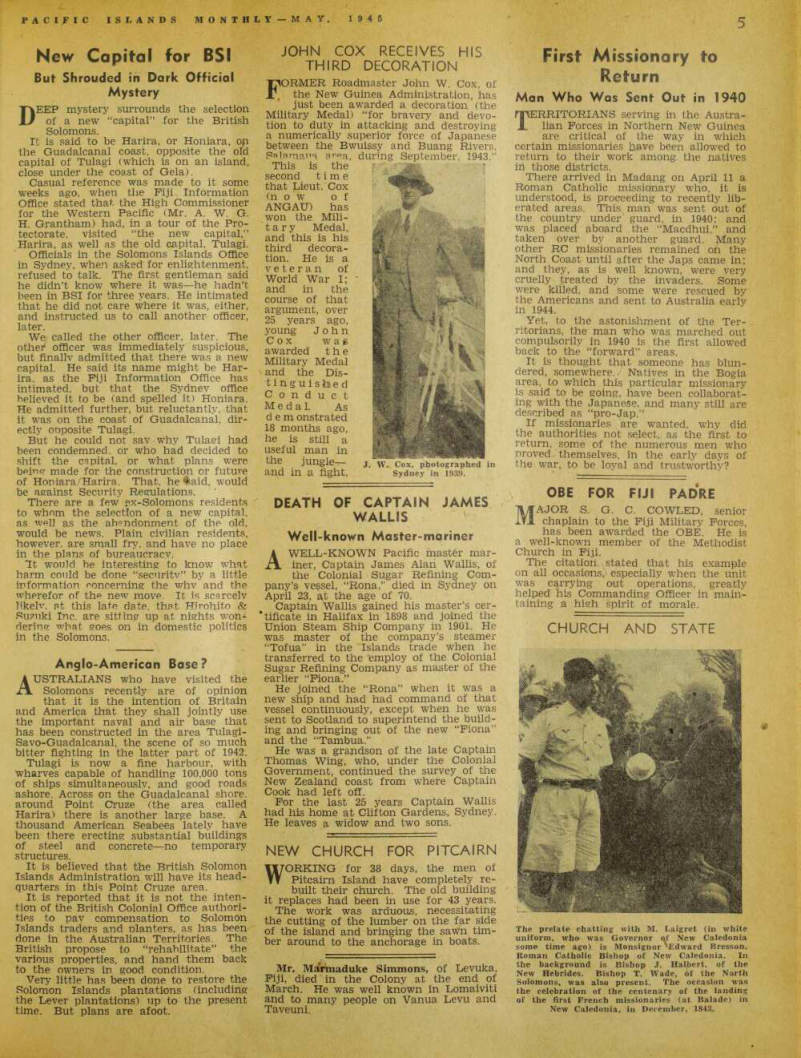
F FORMER Roadmaster John W. Cox, of the New Guinea Administration, has just been awarded a decoration (the Military Medal) “for bravery and devo tion to duty in attacking and destroying a numerically superior force of Japanese between the Bwuissy and Buang Rivers,
This is the second time that Lieut. Cox (now of ANGAU) has won the Mili tary Medal, and this is his third decora tion. He is a veteran of World War I; and in the course of that argument, over 25 years ago, young John Cox was awarded the Military Medal and the Dis tinguislDed Conduct Medal. As d e m onstrated 18 months ago, he is still a useful man in the jungle— and in a fight.
J. W. Cox, photographed in Sydney in 1939.
Death Of Captain James
Wallis
Well-known Master-mariner
A WELL-KNOWN Pacific master mar iner, Captain James Alan Wallis, of the Colonial Sugar Refining Com pany’s vessel, “Rona,” died in Sydney on April 23, at the age of 70.
Captain Wallis gained his master’s cer tificate in Halifax in 1898 and joined the Union Steam Ship Company in 1901. He was master of the company’s steamer “Tofua” in the Islands trade when he transferred to the employ of the Colonial Sugar Refining Company as master of the earlier “Fiona.”
He joined the “Rona” when it was a new ship and had had command of that vessel continuously, except when he was sent to Scotland to superintend the build ing and bringing out of the new “Fiona” and the “Tambua.”
He was a grandson of the late Captain Thomas Wing, who, under the Colonial Government, continued the survey of the New Zealand coast from where Captain Cook had left off.
For the last 25 years Captain Wallis had his home at Clifton Gardens, Sydney.
He leaves a widow and two sons.
New Church For Pitcairn
WORKING for 38 days, the men of Pitcairn Island have completely re built their church. The old building it replaces had been in use for 43 years.
The work was arduous, necessitating the cutting of the lumber on the far side of the island and bringing the sawn tim ber around to the anchorage in boats.
Mr. Marmaduke Simmons, of Levuka, Fiji, died in the Colony at the end of March. He was well known in Lomaiviti and to many people on Vanua Levu and Taveuni.
First Missionary to
Return Man Who Was Sent Out in 1940
TERRITORIANS serving in the Austra lian Forces in Northern New Guinea are critical of the way in which certain missionaries have been allowed to return to their work among, the natives ih those districts.
There arrived in Madang on April 11 a Roman Catholic missionary who. it is understood, is proceeding to recently lib erated areas. This man was sent out of the country under guard, in 1940; and was placed aboard the “Macdhui,” and taken over by another guard. Many other RC missionaries remained on the North Coast until after the Japs came in; and they, as is well known, were very cruelly treated by the invaders. Some were killed, and some were rescued by the Americans and sent to Australia early in 1944.
Yet, to the astonishment of the Ter ritorians, the man who was marched out compulsorily in 1940 is the first allowed back to the “forward” areas.
It is thought that someone has blun dered, somewhere. Natives in the Bogia area, to which this particular missionary is said to be going, have been collaborat ing with the Japanese, and many still are described as “pro-Jap.”
If missionaries are wanted, why did the authorities not select, as the first to return, some of the numerous men who proved themselves, in the early days of the war, to be loyal and trustworthy?
Qbe For Fiji Padre
Major S. G. C. Cowled, Senior
chaplain to the Fiji Military Forces, has been awarded the OBE. He is a well-known member of the Methodist Church in Fiji.
The citation stated that his example on all occasions,- especially when the unit was carrying out operations, greatly helped his Commanding Officer in main taining a high spirit of morale.
Church And State
The prelate chatting with M. Laigret (in white uniform, who was Governor of New Caledonia some time ago) is Monsignor Edward Bresson, Roman Catholic Bishop of New Caledonia. In the background is Bishop J. Halbert, of the New Hebrides. Bishop T. Wade, of the North Solomons, was also present. The occasion was the celebration of the centenary of the landing of the first French missionaries (at Balade) in New Caledonia, in December, 1843.
No Provisional Government Yet
ANGAU and Production Board Still Rule Papua and New Guinea
ALTHOUGH more than two months have passed since the Australian Territories Minister (Mr. Ward) informed the Australian Parliament, on March 9, that “steps may now be taken for the restoration of civil administra tion in Papua and the Morobe district of New Guinea,” nothing appears to have been done.
The “Provisional Administration” has not been appointed; and all that has hap pened, in relation to the selection of a Civil Administrator, is that one usually well-informed circle expresses the belief that “it will be a Serviceman —a high ranking officer from this war”; while another is equally confident that “the odds are in favour of Mr. Murray.”
During VE week, Sydney buzzed with rumours that the first steps had been taken, and that Mr. Leonard Murray had been summoned to Canberra to take over the office of Civil Administrator.
The rumours were without foundation.
Mr. Murray had been requested to visit Canberra—but only to help the Terri tories Department in connection with the new Native Labour Ordinance, upon which the Department, assisted by Messrs. Melrose, Penglase and other New „ Guinea officials, has been at work for some months.
There are grounds for believing that the delay in getting the Provisional Gov ernment, to work is due to one or more of the following: • Discovery that there are legal and constitutional difficulties in the way of establishing, outside of Australia, a i7pro visional” administration based on authori ties conferred by Australia’s National Security Act, which is limited strictly to wartime and to war conditions. • The absence abroad of Dr. Evatt, the only jurist in the Australian Gov ernment, who is believed to be the archi tect of the Provisional Government plan. • The future of New Guinea (now under League of Nations Mandate to Aus tralia) clearly is affected by the sharp differences of opinion disclosed at the San Francisco Conference, between Bri tain, United States and Australia, on trusteeship in relation to Pacific Islands Territories. (This subject is dealt with in a separate article in this issue) • The illness of Prime Minister Curtin, and the absence of other senior Ministers, leave the Australian Government in the hands of incompetent Ministers, who probably are incapable of dealing with a problem so complex as the planning and establishment of the Provisional Govern ment, under the above conditions.
Indications of a Muddle
A QUICK survey of the entire situation relating to Papua and New Guinea indicates a typical Curtin Govern ment muddle.
Because of the pitiful incompetence of the great majority of the professional Labour politicians who have been en trusted with Ministerial duties since 1941. the internal condition of Australia is as tragic as it is shocking. Vital things like food production, housing, transport, re habilitation of Servicemen, are in an muddle, and getting worse.
While the Labour Government is trying, through the exercise of its emergency wartime powers, to introduce a measure of permanent socialisation, a large pro porhon of the trade unions which created that Government and drove it towards socialisation, are “sabotaging” Mr Curtin
and causing strike after strike. The strikes appear to be the work of Com munists, whose general purpose always is to throw a country’s economic struc ture into confusion—and who in this case are certainly succeeding. The weakness and stupidity of the majority of Mr. Cur tin’s Ministers play directly into the Communists’ hands.
Now, see the same influences at work in Papua and New Guinea.
As Papua and New Guinea were cleared of the enemy, and the need for military control passed, the administration of the liberated territories should have been passed back at once into the hands of the civil authorities: and the latter should have controlled and assisted the early re establishment of civilians and of private enterprise.
The old Administrations, and the old laws, could have functioned until such time as the liquidation of the League of Nations and the re-allocation of the New Guinea Mandate made it necessary to review the government of Papua and New Guinea in relation to the future, and perhaps with the inclusion of adjoining Territories like British Solomons and New Hebrides.
1943-4: Brass Hats and Mr. Ward
BUT the Brass Hats and the Canberra Bureaucrats, having got rid of the Papua and New Guinea Civil Ad ministrations, and exercising complete dictatorial power over both Territories, could not bear the thought of surrender ing their authority and privileges, in 1943, as they should have done.
Their ambitions and unspoken plans were unconsciously assisted by Mr. Eddie Ward, the newly-arrived and unexpected Minister for Territories. That gentleman knows little about native labour or any thing relating to tropical administration.
Nevertheless, he tickled the ears of the* King’s Cross groundlings when he took over the Territories Department by announcing his determination to abolish the iniquitous “indentured labour system” and check “exploitation” in the Terri tories. It is hard to Jbelieve that Mr.
Ward cares anything about natives; but he saw a chance of posing as a champion of the downtrodden and ’orny ’anded, and giving his special hete non, private enter prise, a kick in the rear.
So, between them, the Brass Hats and the Bureaucrats and Mr. Ward, in 1943 developed ANGAU and evolved the Pro duction Control Board. They ignored the suspended Civil Administrations, and they put into operation a set-up as totalitarian in character as anything seen in Ger many or Russia. Papua and New Guinea to-day, as for three years past, are ruled absolutely by bureaucrats, with dictatorial powers, without any democratic check whatever.
The bureaucrats had a glorious time in late 1943 and all 1944; and then their elaborate and top-heavy structure began to fall in upon them. The thing was beginning to have such serious political reactions in Australia that even Mr.
Ward agreed that Civil Administration would have to be restored.
1945: Enter Dr. E^tt
NEITHER Brass Hats nor Minister wished to hand back the Territories to the Administrations which they
(Confined on Page 49)
had flouted, or to scrap ANGAU and all the trimmings.
They wanted to (a) keep out any kind of civil governmental control, (b) pre serve the Production Control Board machinery, (c) temporarily amalgamate the two territories, (d) control civilians and private enterprise. So they took their problem to Dr, Evatt.
That ingenious but impractical and academic planner, whose Anzac Pact (agreement with New Zealand for the disposal of various Pacific Territories) had a year before given such offence in London and New York, put a wet towel around his head, and produced the “Pro visional Government,” as by Mr. Ward in the Australian Parliament on March 9 (see March “PIM,” p. 5).
Nobody, except the planners and bureaucrats, liked the scheme: it carried too many of the earmarks of the Brass Hat and the Bureaucrat. Competent con stitutional lawyers have expressed the private opinion that, if it is based on the National Security Act, it will collapse.
Mr. Ward probably will go on with it.
The new Administrator may be an nounced any day. But, if Canberra .is wise—which it rarely is—it will heed the stosm signals already flying in certain directions, and scrap the plan, and carry on for the present with the old Adminis trations, concerning the legal status of which there can be no question.
Public Service Protest
A STRONGLY-WORDED circular to members of the Australian Parlia ment, in which Mr, A. W. Marshall, president of the Papuan Public Service Association, attacked the Provisional Gov ernment plan with timely and cogent argument, may have had some effect in delaying action under the plan.
Mr. Marshall declared that the Pro visional Government would be crippled by legal difficulties; that while it might secure a fusion of the public services, it would not achieve uniformity of law; that it made wholly inadequate provision for the care of natives, which should be its primary consideration; and that the interests of the public officers of the sus pended Papuan and New Guinea Admin istrations would be gravely prejudiced.
Mr. Marshall said that his Association wanted the Papuan staff to be returned to Papua in their rightful positions; the Papuan approach to the native problem to be continued; and the Administration to be controlled by Mr. Leonard Murray.
Still No Barry Report
A TrT , TT^TT _„ 7 . .
LTHOUGH Mr. Barry, KC, of Melbourne, under the authority of a Royal Commission (see page 6 of March “PIM”), lost no time in making, in Australia and Papua, his investigation into the circumstances surrounding the cessation of civil government in Papua in February, 1942, his report has not yet been published.
The inquiry was made in December and January, and the pommissioner reported soon afterwards to the Minister. It was stated in April that the report had gone before the Australian Cabinet.
The withholding of the report is grossly unfair to the Civil Administrator of Papua, Mr. Leonard Murray, who was placed by the Army Brass Hats in the position of a defendant, and is believed (the inquiry was held in private) to have faced a series of charges of non-co-operation, or something of the kind.
WI , , /n j* a •. j New Labour Ordinance Awaited WHETHER or not Mr. Ward abandons the Provisional Government plan, he
certainly will not give up his cherished intention of reforming the native labour system, ... , „ The publication of the new Native Labour .Ordinance is being awaited by Terntonans with considerable trepida tlon - VP® n , lts character depends then economic future. If certain woolly-pated theorists have been able to get the ear of the Canberra dictatorship, and the pew native labour set-up is to be shot through with socialistic idealism, there is future for the Territories. But if Can berra is wise enough to find the correct balance between the stone-age natives, who own the land, and the Europeans, who saved the land from the Japanese, then we may look forward to a develop menta. era m which both natives and Europeans will benefit greatly.
Mr. Ward probably is incapable of appreciating these facts: But the facts are that more harm has been done to the natives (in their culture, in their village organisation, in their attitude towards the Europeans and European ways of life) during the past three years, than in the
previous 50 years of “indentured labour” and “exploitation.”
The evil that has been done by the Army and by ANGAU in forcing the native communities to supply labour is beyond present computation.
After witnessing that system of forced labour, permitted by Canberra, we must admit the possibility that Mr. Ward, in his well-intentioned ignorance, may incorporate Government recruiting in his new Ordinance. The thing, in the view of all experienced men, is inconceivable —but quite possible under present con ditions.
Government recruiting, of course, would mean that the Government would form a labour pool, from which all labour needs would be supplied; and that officials, with the authority of the Government behind them, would go to the village head-men for recruits. To the native mind, the Government would become the employer, and the whole system would be compulsory. Under the old system, the labour contract was voluntary, and the native clearly understood that the Gov ernment official was there to check it, control it and police it in the interests of both employers and employed.
The Rev. H. J. E. Short and *Mrs. Short, of the LMS, are expecting to return to Papua in May,
Photo. Of An Early Ng
Missionary
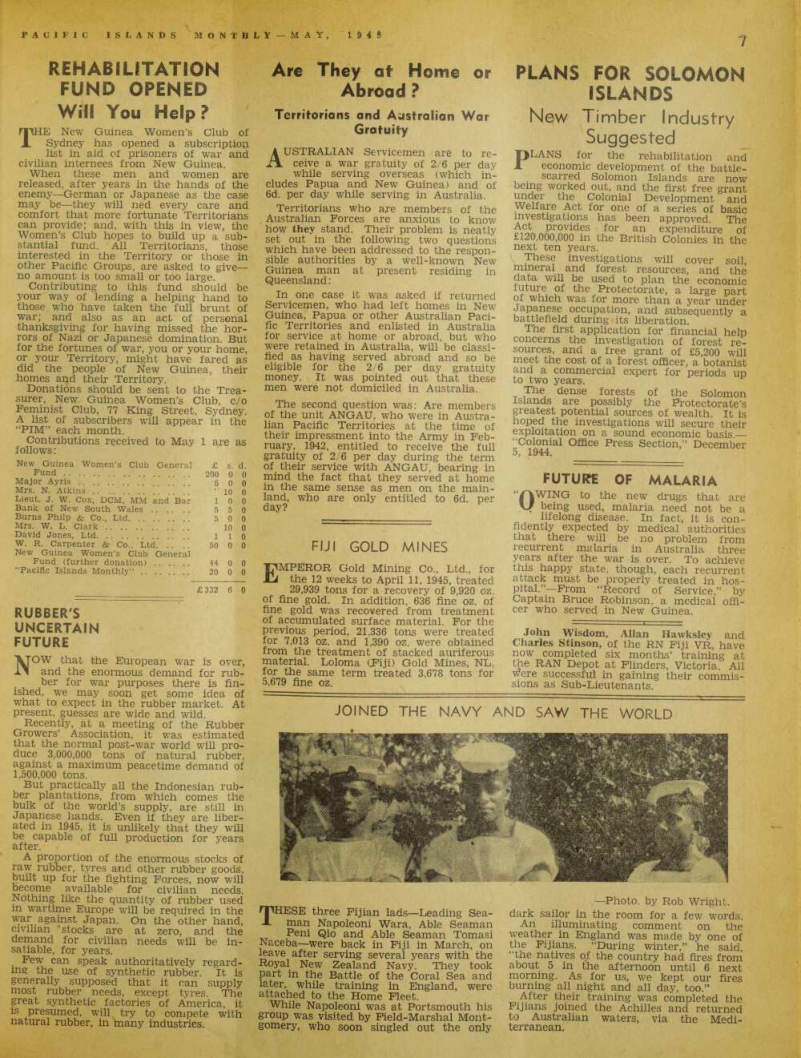
MR. F. B. HOLLOWAY, of 35 Kings holme Street, New Farm, Brisbane, who was a member of Burns Philp’s Rabaul staff prior to the war, writes: “While looking over some old photos recently, with an aged relative, I discov ered this picture of Dr. Brown, an early Methodist missionary in New Guinea, with a native. This may be of use to you.
The original was by Photographer Wood, 314 George Street, Sydney.”
This almost certainly is a photograph of the Methodist missionary, Dr. Brown, who was working in the Rabaul district in 1878—his headquarters being at Mioko, Duke of York Islands. The “native” probably is one of the Fijian teachers who were taken from Levuka to New Britain by the Methodists about that time. One, Samueli, is referred to in Benjamin Danks’ book as looking “gorgeous,” but hot, in orthodox European clothes.
Available Shortly
Harold Cooper's Book
AMONG the Ministry of Information publications which are expected to be available for sale to the public shortly is a book, by Harold Cooper, Infor mation Officer, Fiji and Western Pacific, which tells the story of the exploits of British Colonial Civil Servants, planters, missionaries and Island residents of all races during the campaigns in the Gil berts and Solomons.
Three chapters of the book deal with the part played in the fighting on Guadal canal, New Georgia and Bougainville by the Fiji Commandos and the First and Third Battalions of the Fiji Infantry Regiment.
The book will be illustrated by numer ous photographs, many of them taken by Rob Wright, of the Information Office, Suva.
Two extracts from the book have appeared as articles in the “PIM.”
Rehabilitation
Fund Opened
Will You Help?
ItHE New T Guinea Women’s Club of . Sydney has opened a subscription! list in aid of prisoners of war and civilian internees from New Guinea.
When these men and women are released, after years in the hands of the enemy—German or Japanese as the case may be —they will ned every care and comfort that more fortunate Territorians can provide; and, with this in view, the Women’s Club hopes to build up a- sub stantial fund. All Territorians, those interested in the Territory or those in other Pacific Groups, are asked to give— no amount is too small or too large.
Contributing to this fund should be your way of lending a helping hand to those who have taken the full brunt of war; and also as an act of personal thanksgiving for having missed the hor rors of Nazi or Japanese domination. But for the fortunes of war, you or your home, or your Territory, might have fared as did the people of New Guinea, their homes and their Territory.
Donations should be sent to the Trea surer, New Guinea Women’s Club, c/o Feminist Club, 77 King Street, Sydney.
A list of subscribers will appear in the “PIM” each month.
Contributions received to May 1 are as follows:
Rubber's
Uncertain
Future
NOW that the European war is over, and the enormous demand for rub ber for war purposes there is fin ished, we may soon get some idea of what to expect in the rubber market. At present, guesses are wide and wild.
Recently, at a meeting of the Rubber Growers’ Association, it was estimated that the normal post-war world will pro duce 3,000,000 tons of natural rubber, against a maximum peacetime demand of 1,500,000 tons.
But practically all the Indonesian rub ber plantations, from which comes the bulk of the world’s supply, are still in Japanese hands. Even if they are liber ated in 1945, it is unlikely that they will be capable of full production for years after.
A proportion of the enormous stocks of raw rubber, tyres and other rubber goods, built up for the fighting Forces, now will become available for civilian needs.
Nothing like the quantity of rubber used m wartime Europe will be required in the war against Japan. On the other hand, civilian stocks are at zero, and the demand for civilian needs will be in satiable, for years.
Pew can speak authoritatively regard ing the use of synthetic rubber. It is generally supposed that it can supply most rubber needs, except tyres. The great synthetic factories of America, it is presumed, will try to compete with natural rubber, in many industries.
New Guinea Women’s Club General £ s. d.
Fund 200 0 0 Major Ayris 5 0 0 Mrs. N. Atkins 10 0 Lieut. J. W. Cox, DCM, MM and Bar 1 0 0 Bank of New South Wales 5 5 0 Burns Philp & Co., Ltd 5 0 0 Mrs. W. L. Clark 10 0 David Jones, Ltd 1 1 0 W. R. Carpenter & Co.. Ltd 50 0 0 New Guinea Women’s Club General Fund (further donation) 44 0 0 “Pacific Islands Monthly’’ .. 20 0 0 £332 6 0
Abroad?
Are They at Home or Abroad?
Territorians and Australian War Gratuity
AUSTRALIAN Servicemen are to re ceive a war gratuity of 2/6 per day while serving overseas (which in cludes Papua and New Guinea) and of 6d. per day while serving in Australia.
Territorians who are members of the Australian Forces are anxious to know how they stand. Their problem is neatly set out in the following two questions which have been addressed to the respon sible authorities by a well-known New Guinea man at present residing in Queensland: In one case it was asked if returned Servicemen, who had left homes in New Guinea, Papua or other Australian Paci fic Territories and enlisted in Australia for service at home or abroad, but who were retained in Australia, will be classi fied as having served abroad and so be eligible for the 2/6 per day gratuity money. It was pointed out that these men were not domiciled in Australia.
The second question was: Are members of the unit ANGAU, who were in Austra lian Pacific Territories at the time of their impressment into the Army in Feb ruary, 1942, entitled to receive the full gratuity of 2/6 per day during the term of their service with ANGAU, bearing in mind the fact that they served at home in the same sense as men on the main land, who are only entitled to 6d. per day?
Fiji Gold Mines
EMPEROR Gold Mining Co., Ltd., for the 12 weeks to April 11, 1945, treated 29,939 tons for a recovery of 9,920 oz. of fine gold. In addition, 636 fine oz. of fine gold was recovered from treatment of accumulated surface material. For the previous period, 21,336 tons were treated for 7,013 oz. and 1,390 oz. were obtained from the treatment of stacked auriferous material. Loloma (Fiji) Gold Mines, NL, same term treated 3,678 tons for 5,679 fine oz.
Suggested
Plans For Solomon
Islands
New Timber Industry Suggested
PLANS for the rehabilitation and economic development of the battle scarred Solomon Islands are now being worked out, and the first free grant under the Colonial Development and Welfare Act for one of a series of basic investigations has been approved. The Act provides for an expenditure of £120,000,000 in the British Colonies in the next ten years.
These investigations will cover soil, mineral and forest resources, and the data will be used to plan the economic future of the Protectorate, a large part of which was for more than a year under Japanese occupation, and subsequently a battlefield during its liberation.
The first application for financial help concerns the investigation of forest re sources, and a free grant of £5,200 will meet the cost of a forest officer, a botanist and a commercial expert for periods up to two years.
The dense forests of the Solomon Islands are possibly the Protectorate’s greatest potential sources of wealth. It is hoped the investigations will secure their exploitation on a sound economic basis.— “Colonial Office Press Section,” December 5, 1944.
Future Of Malaria
new dru &s that are being used, malaria need not be a lifelong disease. In fact, it is con fidently expected by medical authorities that there will be no problem from recurrent malaria in Australia three years after the war is over. To achieve this happy state, though, each recurrent attack must be properly treated in hos pital.”—From “Record of Service,” by Captain Bruce Robinson, a medical offi cer who served in New Guinea.
John Wisdom, Allan Hawksley and Charles Stinson, of the RN Fiji VR, have now completed six months’ training at the RAN Depot at Flinders, Victoria. All were successful in gaining their commis sions as Sub-Lieutenants.
Joined The Navy And Saw The World
THESE three Fijian lads—Leading Seaman Napoleoni Wara, Able Seaman Peni Q io and Able Seaman Tomasi Naceba—were back in Fiji in March, on leave after serving several years with the Royal New Zealand Navy. They took part in the Battle of the Coral Sea and ff , while training in England, were at SSiS. ed to the Home Fleet.
While Napoleoni was at Portsmouth his group was visited by Field-Marshal Montgomery, who soon singled out the only
dark sailor in the room for a few words.
An illuminating comment on the weather in England was made by one of the Fijians. “During winter,” he said, “the natives of the country had fires from about 5 in the afternoon until 6 next morning. As for us, we kept our fires burning all night and all day, too.”
After their training was completed the Fijians joined the Achilles and returned to Australian waters, via the Medi terranean.
—Photo, by Rob Wright.
Check Your War Damage
Cover PTA Warns Territorians
THE Pacific Territories Association advises all Territorians to check up on their war damage claims in order to make sure that they are totally and adequately covered under the new de finition of war damage (“consequential” as well as direct war damage).
At the (time of the Commonwtealth o i^V rer l ?- announcement on November oU 1944 ’^ lc £ brought fire ’ neglect, theft, etc., within the scope of war damage, it was officially stated that it would be unnecessary for owners to lodge fresh claims with the Commission if they had already supplied particulars Jor war dam- Purposes. In. view of this, and the fact that some Territorians may have omitted some damage which is now an J r able ’ b nt which originally was not, ah are urged to look over their claims. to be sure now, while there is yet time, than be sorry later.
New Guinea Women's
Club News
Entertainment: The Club
will hold an entertainment at 8 p.m. on Thursday, May 31, at the Radio Theatre, Ist Floor, Crystal Palace Arcade, 590 George Street (near Century Theatre). Well known radio artists will appear; the show has been arranged by Robert Payne and will be com pered by Eric Creighton.
Tickets, at 2/6 each, are avail able at the Club on Thursdays, or on application to Mrs. Fox croft. Tel: LX 1778.
Gift Afternoon: Mrs. N.
Foxcroft has loaned her home, at 23 Landsdown Street, Arn cliffe, on Saturday, June 16, for, a Gift Afternoon. Entertainment will be provided and guests are asked to bring a gift. These gifts will help stock a street stall which the Club hopes to arrange soon in aid of their POW Fund.
Annual General Meet
ING: This year the Annual General Meeting will be held in the Feminist Club on Saturday, July 21, at 2 p.m.
Members are reminded that, as the end of the financial year comes on June 30, they should send in outstanding dues with out delay.
YOUNGER SET: The younger Territorians feel that they would like to set up a Younger Set Branch within the Club roith a view to arranging entertain ments, outings and activities outside the scope of the Club’s senior members. Many young Territorians have been in the process of “growing up” since the evacuation and several have asked the Club to form a junior branch. All those interested should send in their names to Mrs. I. McDonald,, do of the Club. They will later be advised of meetings at which they will elect their own office-bearers.
Wallis Group
France And America In The Pacific
Disclosure of Interesting Incident Affecting Wallis Group
SOME interesting disclosures of relations between the Americans and the Free French in the Pacific, in 1942, in the very diflicult early days of the Jap anese war, were made in Paris lately by Admiral d’Argenlieu, who was High Com missioner in the Pacific for Free France in 1942-3. The disclosures relating to the Wallis Islands are of particular interest.
It appears that the Admiral made his statement by way of protest against cer tain opinions expressed in America re garding French rights over Indo-China.
Our report is taken from the “Figaro” of April 9.
No one in Washington or elsewhere (said the Admiral) ignores the fact that the French territories of New Cale donia. the New Hebrides, the Wallis Islands. French Oceania and Clipperton Island were protected against our common foe by the Americans. But those French territories served the common cause by remaining free with Free France; then by opening their doors wide, when the time came, to the American soldiers, as they would to old and sure friends.
After having recalled with what enthu siasm the French colonists of New Heb rides, French Oceania and New Caledonia rallied in July, August and September, 1940, at General de Gaulle’s call; after stressing the importance of these bases, the Admiral related how, three months after Pearl Harbour, on March 14, 1941, General Patch’s forces began to land in Noumea, and later, in the New Hebrides.
General de Gaulle’s policy had forestalled any Japanese interference, masked or otherwise, in the French archipelagos. It ensured for America, in various vital centres, ports, airfields, territories which were not only free but friendly.
A FEW days after the Coral Sea vic tory, on May 18, the Admiral was visited at Noumea- by Admiral Chormley, first Commander-in-Chief of the South Pacific. There was talk of the Wallis, the only isles which had remained obedient to Vichy. The rallying of Wallis, contemplated as early as December, 1940, had been deferred.
“My visitor now informed me that the Supreme Command attached great im portance to the Wallis Group. He con cluded by stating that ‘lf Free France won over the Wallis, no problem of sovereignty would be involved. If, on the other hand, we Americans were to occupy them alone, that question would arise.’ ”
“The answer was easy,” proceeded Ad miral I’Argenlieu. “Having been assured that if the Wallis rallied they would escape any Japanese reprisals, I replied that we were ready and determined to act. On May 27, 1942, the sloop ‘Le Chev reuil’ won over the isles in the midst of popular enthusiasm; the next day the American troops began to land on Wallis.
“My interviews with the Commander in-Chief of the South Pacific gave prac tical confirmation to a diplomatic under standing existing between the French National Committee in London and the State Department in Washington. Agree ments had been reached, as a matter of fact, fixing the essential points of the conditions under which American troops would be authorised to use our bases.
'‘The French National Committee in London and its representatives in the colonies of the Pacific were recognised by the United States Government as sole custodians of French sovereignty. It had even been stipulated that all buildings and structures erected in our territories for military defence would ipso facto become French property. The American people were inspired by the sentiments of the age-long friendship existing between our two countries, and implied an express wish to see France restored in her integrity and her greatness.
“The question which arose over the Wallis does not arise concerning Indo china. French resistance in this colony, the forming of our Far-Eastern units, and the presence of the ‘Richelieu’ in the Pacific averted this, “Our Pacific isles have ceased to be forward areas, but their military future will naturally come within the sphere of collective security. It is to the honour of France, because it is part of her genius to be disposed to throw master pawns on the chessboard of international security.”
Tongan Sportswomen
The Kalamazoo basket ball team of Kolomotu’a, which won the silver cup presented by His Highness Prince Tupou to’a for the Tonga Bas ketball Championship of 1944. From left (back row): Vahoi Tupou.
Leata Fangu, Tali Vaka’uta, Vala Malu (captain), and Losaline Latu. Front row (from left): Ane Maile, ’Ofa Vaka’nta, Simuoko Ma taele and ’Ana Viliami. —Photo, by Hettig.
Tropicalities
“ JUNGLE ANGELS," an hour-length J film showing the war efforts of the natives of New Guinea —and to a lesser extent those of Fiji’s fighting men on Bougainville—has been produced by the Methodist Overseas Mission.
Photography is, for the most part, by official Australian war photographers but includes shots not previously shown to the general public. The films have been correlated and edited by the Rev. Richard Piper, of the Methodist Mission.
Although the film errs on the side of playing up the Fuzzy-wuzzy’s angelic qualities, to the exclusion of his occa sional cussedness, it nonetheless presents a striking record of the part he has played in New Guinea; and, better than a thousand books, shows the problems of terrain and climate which make New Guinea untenable to Europeans without native help.
Several Territorians, including Lieut.
Dan Crawley, of the Papuan Constabulary Band, figure in the production.
Best shots are those showing the laborious process of taking supplies into Wau through the back door —the Bull dog route —and of the fighting Fijians in action on Bougainville.
There is little mission propaganda in the production—the producer contents himself with saying that Christian mis sions and the Murray regime are adding another star to that of the Southern Cross in the Australian flag.
The film will not be shown through normal channels —which is a pity, because it is worthy of general exhibition —but will be used instead at missionary rallies and meetings. * AND, talking about missions, the “New Yorker” has printed a story about Dr. Henry Pitney Van Dusen, of the Union Theological Seminary (somewhere in America, presumably) who is compil ing a book of the experiences of Service men in the Pacific who have been pleas antly surprised by their encounters with Christian natives.
“The point of the book, as we under stand it,” says “New Yorker,” “will be that the dimes and quarters our grand parents put into the missionary -box are, in a purely mundane way, paying off.
“In the opinion of some military experts, the New Guinea campaign would have failed without the support of some 10,000 native boys who acted as bearers in the mountains. If the missionaries hadn’t come along, these same lads would have ganged up on any white man they saw and lopped off his head.
“Dr. Van Dusen has a sheaf of letters from Americans befriended by Christian natives in the Pacific.
“He has a story about seven Navy fliers forced down on one of the Japanese-held Solomon Islands. They were taken in by some Christian natives who kept them hidden and tended the wounded for 87 days. During this time they had nightly Bible readings, and in the end all seven Navy boys were converted into practising Christians.
“It all lends force to what an officer in the Pacific wrote home; ‘After a bit the natives may have to come over and evangelise our civilised Western world.’ ” r would appear that wasps are a new thing in New Zealand, and lack of care in fumigating aircraft returning from the Pacific Islands is held respon sible for their introduction into the Wai kato district. Two gentlemen who have discovered lady wasps in their gardens have set up a considerable amount of agitation in the Dominion.
A leading Auckland daily goes to the length of describing a wasp as something like a honey bee, only longer and thinner, its body encircled by gold bands ... a particular nuisance to fruitgrowers and housewives who make jam.
Nothing is said about the sting; per haps the New Zealanders have' yet to learn about that.
Wasps, however, apparently have their uses. It might be remembered that 18 months ago, when Army-farming in New Guinea was hitting the headlines, wasps were flown from Australia to deal with green bugs which threatened the food crops. And they were in addition to the local variety, of which most Territorians have at least one unpleasant memory. rIS month’s funniest story: During the recent debate in Canberra on the Australian Military Forces’ equipment issue, certain Opposition mem bers agitated for the formation of a Parliamentary delegation (consisting of Opposition as well as Government mem bers) which could go to the battle zones to see for itself.
Mr. Eddie (“Fuzzy-vfuzzy”) Ward im mediately jumped to his feet: “No,” he said, “I couldn’t allow that. Such a dele gation might have a bad effect on the natives.”
MEDICAL Assistant working in a
bush hospital on Bougainville,
introduces a Biological Phenomenon,
but asks—can she be true, even in the tropics : SHE came to hospital with a young baby which she said was her dead sister’s child. Although she was suckling the child, she declared by all a native holds sacred that she had never had a child of her own. Seeing the MA’s scepticism, she expressed some milk, and called in her villagers, who supported her story, claiming that it was “fashion be long kanaka.”
The MA retired to scratch his head.
Later, the baby died. In the same ward was another mother, who could not feed her babe, and the MA, thinking that the
Biological Phenomenon’s achievement should not be wasted, suggested that she should suckle this other child.
But so much for the plans of mice and men. The BP flatly refused, and would not change her mind for bribes. Finally, after dire threats from the MA, she sulkily agreed; but there was still more ground to cover. The mother refused to allow her child to be nursed by the BP.
More bribes and threats, and at last the babe was brought to the foster mother, only to remind the MA that he could lead a horse to water, etc. The baby refused to be fed by the BP.
A very resigned MA filled a feeding bottle, and added yet another to the for midable band of the hospital’s bottle-fed babies.—Alma G. rE following clipping from the Bris bane “Courier-Mail” was sent us with a covering anonymous letter (also signed “Fair Play”). lUis reprinted here for what it is worth.
Without detracting in any degree from the job Mrs. Lampo did in Papua during the evacuation period, we would say that some Territorians appear to be unduly preoccupied with the questions of just which white woman it was who got some place first; or who it was who left some other place last. One either does a good job in, or for the New Guinea Territories; or one does not. The time element does not come into it. That is usually a mat ter of accident or opportunity.
But here is the letter (it was signed “Pair Play”) in support of Mrs. Lampo's claim of having been the last woman out of Papua in 1942: “JJECAUSE of certain published state -13 ments, there is an impression that Mrs. Morton was the last white woman to leave Port Moresby, and the first to return. I was there at the time and can say authoritatively that the last white woman to leave was Mrs. C. H.
Lampo, who had been through some 40 bombing raids before she left on April 24.
“Mrs. Lampo is the wife of Lieutenant Lampo, who was recently in the news as being one of the two or three men still living in Australia who hold the Croix de Yser and the Croix de Guerre.
“Army nurses were the first to- return, and as Mrs. Morton is a nurse, presum ably others we»e with her when she went back.”
Advertisements & other items, p. 11 (1 item)
Pacific Territories Association
The Third Annual General Meeting of members will be held on Tuesday, 26th June, 1945, at the Teachers’ Federation Hall, 7th Floor, 166 Phillip Street, Sydney, at 8 p.m.
BUSINESS :
(1) To receive the Report of the Executive on the year’s activities. (2) To receive the Financial Statements and Auditors’ Report for the year ended 31/5/45. (3) Election of office-bearers for the ensuing twelve months.
Nominations for the following office-bearers must be in the hands of the Secretary at least seven (7) clear days before the meeting:— , President Vice-president Treasurer Auditor Eight (8) Executive members consisting of:— 2 Commercial Representatives 2 Planters’ „ 2 Mining 2 Civil Service (being one each for Papua and the Territory of New Guinea.)
C. A. M. ADELSKOLD,
Secretary.
Tarawa Tragedy
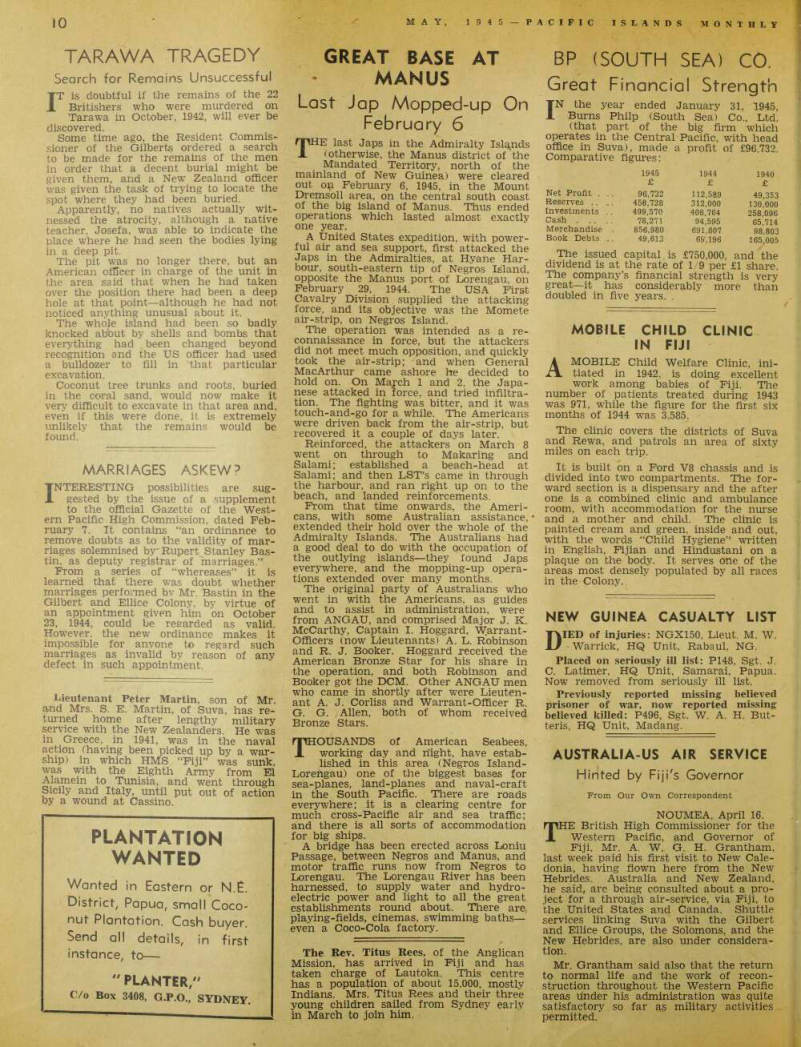
Search for Remains Unsuccessful
IT is doubtful if the remains of the 22 Britishers who were murdered on Tarawa in October, 1942, will ever be discovered.
Some time ago, the Resident Commis sioner of the Gilberts ordered a search to be made for the remains of the men in order that a decent burial might be given them, and a New Zealand officer was given the task of trying to locate the spot where they had been buried.
Apparently, no natives actually wit nessed the atrocity, although a native teacher. Josefa, was able to indicate the place where he had seen the bodies lying in a deep pit.
The pit was no longer there, but an American officer in charge of the unit in the area said that when he had taken over the position there had been a deep hole at that point—although he had not noticed anything unusual about it.
The whole island had been so badly knocked ab'out by shells and bombs that everything had been changed beyond recognition and the US officer had used a bulldozer to fill in that particular excavation.
Coconut tree trunks and roots, buried in the coral sand, would now make it very difficult to excavate in that area and, even if this were done, it is extremely unlikely that the remains would be found.
Marriages Askew?
INTERESTING possibilities are sug gested by the issue of a supplement to the official Gazette of the West ern Pacific High Commission, dated Feb ruary 7, It contains “an ordinance to remove doubts as to the validity of mar riages solemnised by'Rupert Stanley Bas tin, as deputy registrar of marriages.”
From a series of “whereases” it is learned that there was doubt whether marriages performed bv Mr. Bastin in the Gilbert and Ellice Colony, by virtue of an appointment given him on October 23, 1944, could be regarded as valid.
However, the new ordinance makes it impossible for anyone to regard such marriages as invalid by reason of any defect in such appointment.
Lieutenant Peter Martin, son of Mr. and Mrs. S. E. Martin, of Suva, has re turned home after lengthy military service with the New Zealanders. He was in Greece, in 1941, was in the naval action (having been picked up by a war ship) in which HMS “Fiji” was sunk, was with the Eighth Army from El Alamein to Tunisia, and went through Sicily and Italy, until put out of action by a wound at Cassino.
February 6
Great Base At
Manus
Last Jap Mopped-up On February 6
rE last Japs in the Admiralty Islands (otherwise, the Manus district of the Mandated Territory, north of the mainland of New Guinea) were cleared out op February 6, 1945, in the Mount Dremsoll area, on the central south coast of the big island of Manus. Thus ended operations which lasted almost exactly one year.
A United States expedition, with power ful air and sea support, first attacked the Japs in the Admiralties, at Hyane Har bour, south-eastern tip of Negros Island, opposite the Manus port of Lorengau, on February 29, 1944. The USA First Cavalry Division supplied the attacking force, and its objective was the Momete air-strip, on Negros Island.
The operation was intended as a re connaissance in force, but the attackers did not meet much opposition, and quickly took the air-strip; and when General MacArthur came ashore he decided to hold on. On March 1 and 2, the Japa nese attacked in force, and tried infiltra tion. The fighting was bitter, and it was touch-and-go for a while. The Americans were driven back from the air-strip, but recovered it a couple of days later.
Reinforced, the attackers on March 8 went on through to Makaring and Salami; established a beach-head at Salami; and then LST’s came in through the harbour, and ran right up on to the beach, and landed reinforcements.
From that time onwards, the Ameri cans, with some Australian assistance, extended their hold over the whole of the Admiralty Islands. The Australians had a good deal to do with the occupation of the outlying islands—they found Japs everywhere, and the mopping-up opera tions extended over many months.
The original party of Australians who went in with the Americans, as guides and to assist in administration, were from ANGAU, and comprised Major J. K.
McCarthy, Captain I. Hoggard, W.arrant- Officers (now Lieutenants) A. L. Robinson and R. J. Booker. Hoggard received the American Bronze Star for his share in the operation, and both Robinson and Booker got the DCM. Other ANGAU men who came in shortly after were Lieuten ant A. J. Corliss and Warrant-Officer R.
G. G. Allen, both of whom received Bronze Stars. rOUSANDS of American Seabees, working day and night, have estab lished in this area (Negros Island- Lorehgau) one of the biggest bases for sea-planes, land-planes and naval-craft in the South Pacific. There are roads everywhere; it is a clearing centre for much cross-Pacific air and sea traffic; and there is all sorts of accommodation for big ships.
A bridge has been erected across Loniu Passage, between Negros and Manus, and motor traffic runs now from Negros to Lorengau. The Lorengau River has been harnessed, to supply water and hydro electric power and light to all the great establishments round about. There are, playing-fields, cinemas, swimming baths— even a Coco-Cola factory.
The Rev. Titus Rees, of the Anglican Mission, has arrived in Fiji and has taken charge of Lautoka. This centre has a population of about 15,000, mostly Indians. Mrs. Titus Rees and their three young children sailed from Sydney early in March to join him.
Bp (South Sea) Co.
Great Financial Strength
IN the year ended January 31, 1945, Burns Philp (South Sea) Co., Ltd. (that part of the big firm which operates in the Central Pacific, with head office in Suva), made a profit of £96,732.
Comparative figures:
The issued capital is £750,000, and the dividend is at the rate of 1/9 per £1 share.
The company’s financial strength is very great—it has considerably more than doubled in five years. ,
1945 1944 1940 £ £ £ Net Profit . . . 96,732 112,589 49,353 Reserves .. 458,728 312,000 130,000 Investments .. 499.570 408,764 258,096 Cash 78,271 94,595 65,714 Merchandise 856,980 691,807 98,803 Book Debts .. 49,613 69’, 196 165.005
Mobile Child Clinic
In Fiji
A MOBILE Child Welfare Clinic, ini tiated in 1942, is doing excellent work among babies of Fiji. The number of patients treated during 1943 was 971, while the figure for the first six months of 1944 was 3,585.
The clinic covers the districts of Suva and Rewa, and patrols an area of sixty miles on each trip.
It is built on a Ford V 8 chassis and is divided into two compartments. The for ward section is a dispensary and the after one is a combined clinic and ambulance room, with accommodation for the nurse and a mother and child. The clinic is painted cream and green, inside and out, with the words “Child Hygiene” written in English, Fijian and Hindustani on a plaque on the body. It serves one of the areas most densely populated by all races in the Colony.
New Guinea Casualty List
DIED of injuries: NGXISO, Lieut. M. W.
Warrick, HQ Unit, Rabaul, NG.
Placed on seriously ill list: Pl4B, Sgt. J.
C. Latimer, HQ Unit, Samarai, Papua.
Now removed from seriously ill list.
Previously reported missing believed prisoner of war, now reported missing believed killed: P 496, Sgt. W. A. H. But teris, HQ Unit, Madang.
Hinted by Fiji's Governor
Australia-Us Air Service
From Our Own Correspondent NOUMEA, April 16.
THE British High Commissioner for the Western Pacific, and Governor of Fiji, Mr. A. W. G. H. Grantham, last week paid his first visit to New Cale donia, having flown here from the New Hebrides. Australia and New Zealand, he said, are being consulted about a pro ject for a through air-service, via Fiji, to the United States and Canada. Shuttle services linking Suva with the Gilbert and Ellice Groups, the Solomons, and the New Hebrides, are also under considera tion.
Mr. Grantham said also that the return to normal life and the work of recon struction throughout the Western Pacific areas under his administration was quite satisfactory so far as military activities permitted.
Advertisements & other items, p. 12 (1 item)
Plantation
WANTED
Wanted in Eastern or N.E.
District, Papua, small Coconut Plantation. Cash buyer.
Send all details, in first instance, to—
" PLANTER/'
C/o Box 3408, G.P.0., SYDNEY.
Sorcery Increases in N
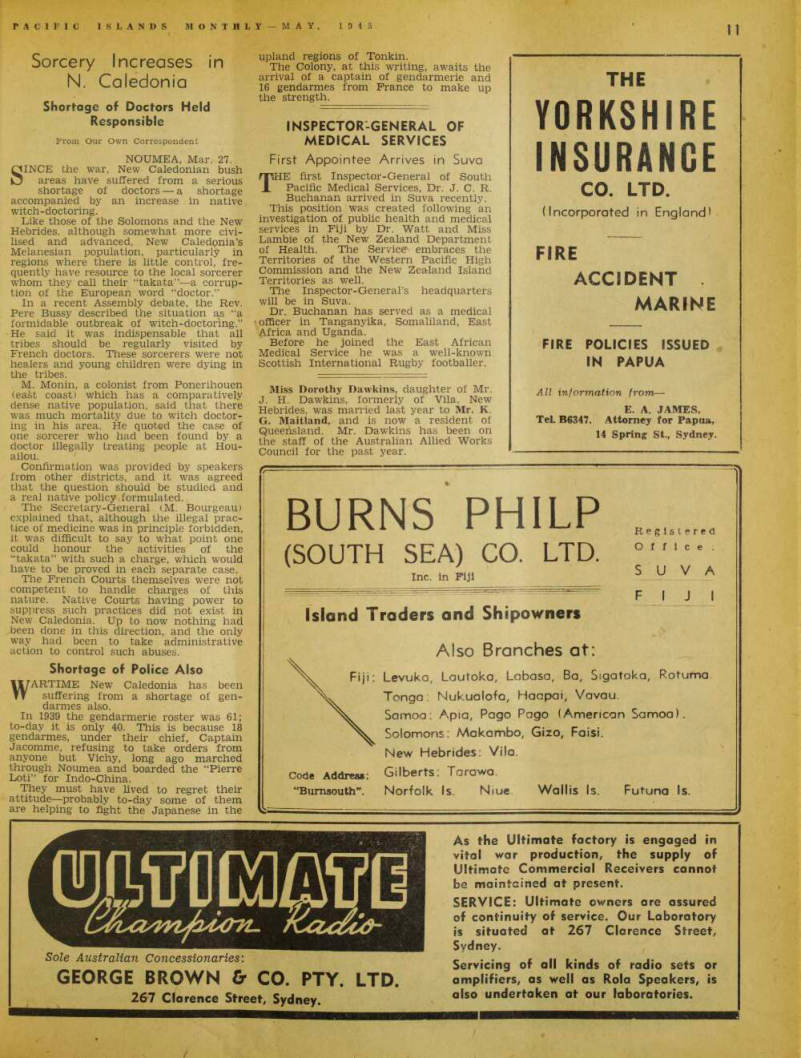
N. Caledonia Shortage of Doctors Held Responsible
From Our Own Correspondent
Noumea, Mar. 27.
SINCE the war, New Caledonian bush areas have suffered from a serious shortage of doctors — a shortage accompanied by an increase in native witch - doctoring.
Like those of the Solomons and the New Hebrides, although somewhat more civi lised and advanced, New Caledonia’s Melanesian population, particularly in regions where there is little control, fre quently have resource to the local sorcerer whom they call their “takata” —a corrup tion of the European word “doctor,”
In a recent Assembly debate, the Rev.
Pere Bussy described the situation as “a formidable outbreak of witch-doctoring.”
He said it was indispensable that all tribes should be regularly visited by French doctors. These sorcerers were not healers and young children were dying in the tribes.
M. Monin, a colonist from Ponerihouen (east coast) which has a comparatively dense native population, said that there was much mortality due to witch doctor ing in his area. He quoted the case of one sorcerer who had been found by a doctor illegally treating people at Hou ailou.
Confirmation was provided by speakers from other districts, and it was agreed that the question should be studied and a real native policy formulated.
The Secretary-General (M. Bourgeau) explained that, although the illegal prac tice of medicine was in principle forbidden, it was difficult to say to what point one could honour the activities of the “takata” with such a charge, which would have to be proved in each separate case.
The French Courts themselves were not competent to handle charges of this nature. Native Courts having power to suppress such practices did not exist in New Caledonia. Up to now nothing had been done in this direction, and the only way had been to take administrative action to control such abuses.
Shortage of Police Also
WARTIME New Caledonia has been suffering from a shortage of gen darmes also.
In 1939 the gendarmerie roster was 61; to-day it is only 40. This is because 18 gendarmes, under their chief, Captain Jacomme, refusing to take orders from anyone but Vichy, long ago marched through Noumea and boarded the “Pierre Loti” for Indo-China.
They must have lived to regret their attitude—probably to-day some of them are helping to fight the Japanese in the
upland regions of Tonkin.
The Colony, at this writing, awaits the arrival of a captain of gendarmerie and 16 gendarmes from France to make up the strength.
Inspector-General Of
Medical Services
First Appointee Arrives in Suva
rE first Inspector-General of South Pacific Medical Services, Dr. J. C. R.
Buchanan arrived in Suva recently.
This position was created following an investigation of public health and medical services in Fiji by Dr. Watt and Miss Lambie of the New Zealand Department of Health. The Service embraces the Territories of the Western Pacific High Commission and the New Zealand Island Territories as well.
The Inspector-General’s headquarters will be in Suva.
Dr. Buchanan has served as a medical officer in Tanganyika, Somaliland, East Africa and Uganda.
Before he joined the East African Medical Service he was a well-known Scottish International Rugby footballer.
Miss Dorothy Dawkins, daughter of Mr.
J. H. Dawkins, formerly of Vila, New Hebrides, was married last year to Mr. K.
G. Maitland, and is now a resident of Queensland. Mr. Dawkins has been on the staff of the Australian Allied Works Council for the past year.
Advertisements & other items, pp. 13-14 (1 item)
iTiIHMn
THE
YORKSHIRE
INSURANCE
CO. LTD.
(Incorporated in England)
FIRE
ACCIDENT
MARINE
FIRE POLICIES ISSUED
IN PAPUA
All information from —
E. A. JAMES,
TeL 86347. Attorney for Papua, 14 Spring St., Sydney.
BURNS PHILP
(SOUTH SEA) CO. LTD.
Inc. in Fiji Island Traders and Shipowner* Registered Office .
SUVA
FIJI
Also Branches at: Fiji: Levuko, Loutoka, Labasa, 80, Sigatoka, Rotuma Tonga: Nukualofa, Haapai, Vavau.
Samoa; Apia, Pago Pago (American Samoa).
Solomons; Makambo, Gizo, Faisi.
New Hebrides: Vila.
Code Address: Gilberts; Tarawa.
“Bumsouth”. Norfolk Is. Niue. Wallis Is. Futuna Is.
u
iTiIHMn
Sole Australian Concessionaries :
GEORGE BROWN & CO. PTY.
267 Clarence Street, Sydney.
LTD
As the Ultimate factory is engaged in vital war production, the supply of Ultimate Commercial Receivers cannot be maintained at present.
SERVICE: Ultimate owners are assured of continuity of service. Our Laboratory is situated at 267 Clarence Street, Sydney.
Servicing of all kinds of radio sets or amplifiers, as well as Rola Speakers, is also undertaken at our laboratories.
Refreshing
as a plunge
into a lagoon!
TEN**
rER^ |C ' D FT
- 6
Germicidal
and fragrant
TENAX TOILET SOAP is
a rapid .safeguard against external skin infections, yet it is soothing and kind to the most sensitive skin —even a baby’s!
ORDER TENAX FROM
YOUR ISLAND SUP-
PLIERS. STOCKS ARE
PLENTIFULLY AVAIL-
ABLE.
■Noyes
ELECTRICAL GENERATING
• EQUIPMENT. TRANSFORMERS
AND SWITCHGEAR
ELECTRIC MOTORS AND
CONTROL APPARATUS
a ELECTRIC CABLES AND
w INSULATING MATERIAL
FLUORESCENT & INCANDESCENT
LIGHTING
COMMERCIAL COOKING AND
HEATING EQUIPMENT
DOMESTIC ELECTRIC
• appliances. RADIO AND
WIRING ACCESSORIES
MATERIALS
EQUIPMENT
HANDLING
MACHINERY & ENGINEERING
• EQUIPMENT. METALS.
CHEMICALS
• COAL MINING EQUIPMENT
METALLIFEROUS MINING,
• QUARRYING. AND CEMENT
MAKING MACHINERY
HOYEf nor (fYDWEY) LTD
MS CLARENCE ST.. SYDNEY- BX 1781. BX 1951 NEWCASTLE • WOLLONGONG* BR I S B A N E
Papuan Pioneer
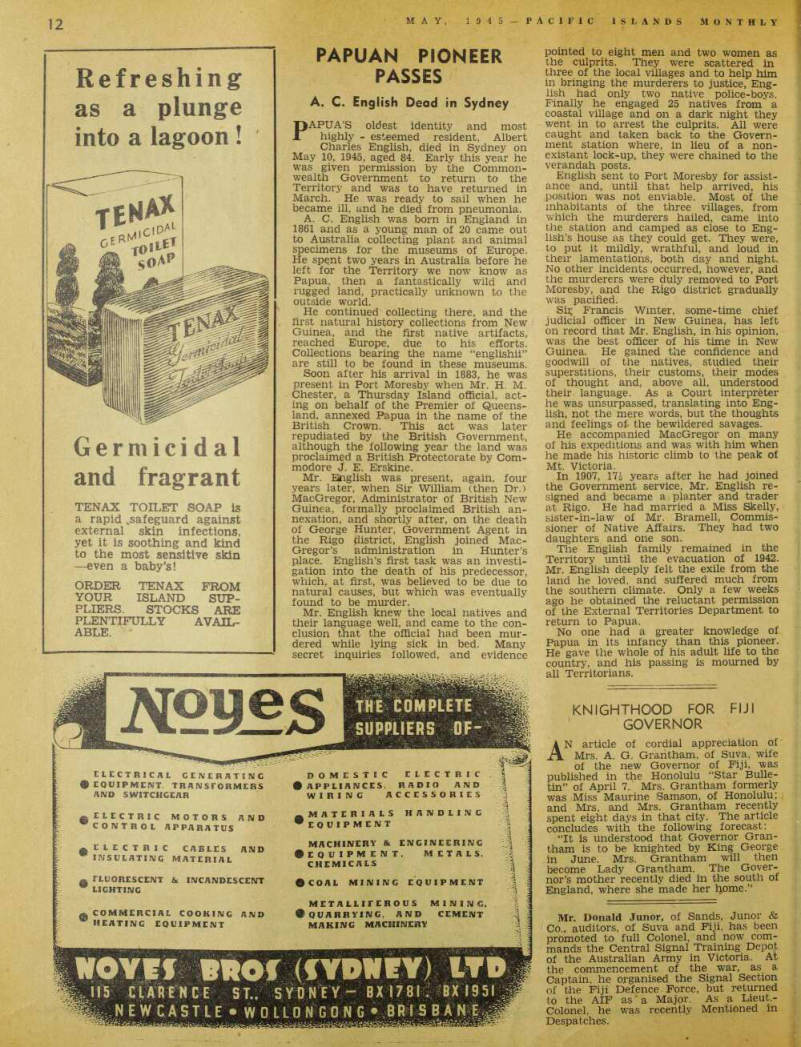
Passes
A. C. English Dead in Sydney
PAPUA’S oldest identity and most highly - esteemed resident, Albert Charles English, died in Sydney on May 10, 1945, aged 84. Early this year he was given permission by the Common wealth Government to return to the Territory and was to have returned in March. He was ready to sail when he became ill, and he died from pneumonia.
A. C. English was born in England in 1861 and as a young man of 20 came out to Australia collecting plant and animal specimens for the museums of Europe.
He spent two years in Australia before he left for the Territory we now know as Papua, then a fantastically wild and rugged land, practically unknown to the outside world.
He continued collecting there, and the first natural history collections from New Guinea, and the first native artifacts, reached Europe, due to his efforts.
Collections bearing the name “englishii” are still to be found in these museums.
Soon after his arrival in 1883, he was present in Port Moresby when Mr. H. M.
Chester, a Thursday Island official, act ing on behalf of the Premier of Queens land, annexed Papua in the name of the British Crown. This act was later repudiated by the British Government, although the following year the land was proclaimed a British Protectorate by Com modore J. E. Erskine.
Mr. English was present, again, four years later, when Sir William (then Dr.) MacGregor, Administrator of British New Guinea, formally proclaimed British an nexation, and shortly after, on the death of George Hunter, Government Agent in the Rigo district, English joined Mac- Gregor’s administration in Hunter’s place. English’s first task was an investi gation into the death of his predecessor, which, at first, was believed to be due to natural causes, but which was eventually found to be murder.
Mr. English knew the local natives and their language well, and came to the con clusion that the official had been mur dered while lying sick in bed. Many secret inquiries followed, and evidence
pointed to eight men and two women as the culprits. They were scattered in three of the local villages and to help him in bringing the murderers to justice, Eng lish had only two native police-boys.
Finally he engaged 25 natives from a coastal village and on a dark night they went in to arrest the culprits. All were caught and taken back to the Govern ment station where, in lieu of a non existant lock-up, they were chained to the verandah posts.
English sent to Port Moresby for assist ance and, until that help arrived, his position was not enviable. Most of the inhabitants of the three villages, from which the murderers hailed, came into the station and camped as close to Eng lish’s house as they could get. They were, to put it mildly, wrathful, and loud in their lamentations, both day and night.
No other incidents occurred, however, and the murderers were duly removed to Port Moresby, and the Rigo district gradually was pacified.
Sh; Francis Winter, some-time chief judicial officer in New Guinea, has left on record that Mr. English, in his opinion, was the best officer of his time in New Guinea. He gained the confidence and goodwill of the natives, studied their superstitions, their customs, their modes of thought and, above all, understood their language. As a Court interpreter he was unsurpassed, translating into Eng lish, not the mere words, but the thoughts and feelings of. the bewildered savages.
He accompanied MacGregor on many of his expeditions and was with him when he made his historic climb to the peak of Mt. Victoria.
In 1907, Hi years after he had joined the Government service, Mr. English re signed and became a planter and trader at Rigo. He had married a Miss Skelly, sister-in-law of Mr. Bramell, Commis sioner of Native Affairs. They had two daughters and one son.
The English family remained in the Territory until the evacuation of 1942.
Mr. English deeply felt the exile from the land he loved, and suffered much from the southern climate. Only a few weeks ago he obtained the reluctant permission of the External Territories Department to return to Papua.
No one had a greater knowledge of Papua in its infancy than this pioneer.
He gave the whole of his adult life to the country, and his passing is mourned by all Territorians.
Knighthood For Fiji
Governor
AN article of cordial appreciation of Mrs. A. G. Grantham, of Suva, wife of the new Governor of Fiji, was published in the Honolulu “Star Bulle tin” of April 7. Mrs. Grantham formerly was Miss Maurine Samson, of Honolulu; and Mrs. and Mrs. Grantham recently spent eight days in that city. The article concludes with the following forecast: “It is understood that Governor Gran tham is to be knighted by King George in June. Mrs. Grantham will then become Lady Grantham. The Gover nor’s mother recently died in the south of England, where she made her home.”
Mr. Donald Junor, of Sands, Junor & Co., auditors, of Suva and Fiji, has been promoted to full Colonel, and now com mands the Central Signal Training Depot of the Australian Army in Victoria. At the commencement of the war, as a Captain, he organised the Signal Section of the Fiji Defence Force, but returned to the AIF as a Major. As a Lieut.- Colonel. he was recently Mentioned m Despatches.
Jubilation by Regulation
V-E Day In Sydney
By Judy Tudor
Sydney, May 8, 1945.
IT is V-E Day in Sydney and this is written for the benefit of those resi dents of the far-flung islands of the Pacific whose isolation precludes them from rejoicing in the mass. Indications are, at the present moment, that they have not missed much by being far-flung.
For the past month we have been on the qui vive for happenings. For the last week we have been radio-ridden and kept in a simmer of expectation by three inch headlines announcing that “Peace is Imminent” or “Only a Matter of Hours.”
Canberra, and the fussy old men who run it, have been busy issuing regulations of one kind and another and fixing the time, the method and the degree of rejoicing. There was to be no monkey business; no drink; no theatres. We were not to begin to feel gay until the Acting Prime Minister had told us so to be.
Finally, most Australians got fed up with the whole boiling match, said, in effect, to hell with V-E Day, and in that mood last evening went to bed and slept through the momentous news.
Even now, no official announcement has been made; that will not happen until 11 o’clock to-night, by which time people will either have celebrated on their own account, or have gone once more to their beds.
MOST heard the news by chance., From the radio this morning, about seven, came canned chimes, and the voice of an unnamed clergyman saying: “After people have had time to grasp this won derful news, we feel they will like to join us in thanksgiving.” There followed a hymn; but no mad, yelling excitement; no eroding into the street to dance and sing spontaneously. Heaven knows why, unless wartime regimentation and regu lation has so got us that we cannot rejoice, even, in this end to the slaughter and destruction in the Europe for which we originally went to war.
Work as usual is the order of the day until such time as Churchill, Truman, Stalin, and (in our case) Acting Prime Minister Chifley, have spoken their little bits. to work we have come. Same old bus —same old scramble —same old “move along the centre, please,”
But it is a sustaining thought that the powers-that-be, who gave themselves such headaches regulating this outburst of joy which is scheduled to overtake us at 1300 hours GMT, and no sooner or later, did not bargain for Germany’s announcing her own surrender and scooping the world at 12.40 a.m. on Tuesday, May 8 (Australian time).
The Government, and its controlled radio-stations are saying: “Listen in at 11 o’clock to-night and you may hear a most .important announcement. Until then, not a word ” But, spread before me is this morning’s “Sydney Morning Her ald,” whose page-wide headings shout: “Germans Proclaim Surrender—Totally Crushed—Fighting Ceases After Nearly Six Years.” To-day should have been the day spontaneous joy.
In the meantime we work. Sure, there are signs that there is something out-of the-ordinary afoot. The accountant in this office reported early that a house in Elizabeth Bay was flag-draped. The office-girl says that in her suburb two large green flags are being flown by a Boy Scout. Someone from farther down the city rang to say flags were flying
there, “But,” she added, ‘‘they have been flying since Roosevelt died—they have raised them to the mast-head, that’s all.
The lad in the composing room, whose musical masterpiece is “Onward Christian Soldiers” has this morning whistled “God Save the King,” “The Star Spangled Banner” and the “Marseillaise” in that order. I guess he doesn’t know the “International.” ...
AT noon I went into the city to see what was a-cookin in the old town.
Nothing cooked, not a darned thing.
Most of the large business houses flew flags and had blossomed forth m apirio pnate window displays; but many city buildings were bereft of bunting of any soit.
I hied me to Martin Place. If any excitement were brewing it should certamly brew there: the Cenotaph is in Martin Place and that wide thoroughfare has been used only recently for the daily sideshows in aid of the Third Victory Loan. Not three weeks ago, Mo, of Tivoli fame, rode an elephant there with a view to coaxing the price of a war-bond or two from the pockets of idle taxpayers.
But to-day there was no Mo, no elephant, and a total lack of excitement. It might have been May 8. 1938-or 1942_0r 1944.
Certainly not May 8, 1945.
Seeing a knot of seething females on the other side of the street, I made a beeline, scenting news: City typists were queueing-up to buy sixpenny worth of sweets from a small kiosk.
Only one sight in the whole of that morning meander lifted the heart to Victory-day tempo, or tickled the sense of humour. There is a small shop in Castlereagh Street, which I have always believed to have been designed, owned and operated by the gentlemen who draw pictures for “Esquire” and “Man.” It
sells panties, scanties and brassieres—the most seductive variety that ever came out of a coloured advertisement.
Normally, they, are fashioned from black lace or flesh-pink satin; but to-day both black lace and pink satin were missing. In their place were the same voluptuously shaped flimsies, but this time they were tri-coloured—made from pieces of red, white and blue silk. * * * a ND so to V-E night. The kids of wdolloomooloo started it with a bonfire* and SO 0f)0 of Svd-
and TeatSy feeSifg toat
regulations had had their innings, finit hptwppn q nm nnH tbp email Twenty or thfrtT thousand is ftfll a small nronortion of Svdnev’s IT million and Qf these the ereat maioritv were frankly-bored onlookers. But it proves, if no tbing- plsp that a fpw thousands havp t hl’ bludgeoning of bmeaucracv lufficilntlv to SkfhoLs off to Utterbue h/the streets and engage in nubduels P It wag 8 th N avv ’ s night Australian nnd iiq Fvpfv hiupiark-pt had Australian and Üb. Every bluejacket nad ' fapt thnt o-pnprallv is -tin I]n north towards Tanan nrohahlv ,~on
intLclimax 2nthil to of victorv?in-
lurooe It is hard to reioice wholeit is nam to rejoice wnoie "eartedly when ones son husband or if he is a nrisoner in the hands of the Jans Hard ISo to grasn all one dav P that victory ’ over® our w and ar ch-LZ thf fi has been ?S’p£S? arcn enemy ’ tne Hun > nas been TJUT the lack of mad excitement goes Jj deeper than that—it is a part of our present-day attitude to all things, an aftermath of six years of being
pushed around. World War II has reached out and affected intimately the lives of the remotest people; it has put its mark on all of us.
They went to World War I with bands playing; they entered peace on a tidal wave of sentimental promises (that were never fulfilled) and they fell directly into the Twirpy Twenties, which laid the foundations of World War 11.
We entered World War II reluctantly, hating war, and fearing it. We approach p*® . Second Peace with wariness and trepidation.
Advertisements & other items, p. 15 (1 item)
a major anxiety
'THAT*
ru e
Relief from
a major anxiety
Even the most expert and conscientious individual executor is subject to accident, illness and incapacitation.
Continuity of administration and uninterrupted attention to your estate and your beneficiaries are of paramount importance. Both can be positively assured by appointing this Company your sole Executor or as co-Executor with your present appointee. An interesting explanatory booklet will be forwarded on request.
DIRECTORS:
Jemei Burns R. J. Nosworthy Lewis Armstrong Joseph Mitchell MANAGER: L. S. Parker.
BURNS PHILP TRUST
COMPANY
LIMITED
7 BRIDGE
TELEPHONE: B 7901
STREET.
SYDNEY
Box 543, G.P.0., Sydney
BPI .45
Dfc To Papuan Resident
Inlying -Officer Basil Spiller,
I? formerly of Ulenapi, Papua, has been awarded the Distinguished Flying Cross. He held the rank of Pilot-Officer at the time of the award, and has since been promoted.
The citation is as follows: “Pilot-Officer Spiller has proved him self a navigator of exceptional ability, and possessed of cool courage and deter mination. He has participated in numer ous operational sorties against targets in Germany and enemy-occupied territory.
“On one occasion his aircraft was dam aged by heavy anti-aircraft fire and he was wounded in the thigh, but although in pain he unhesitatingly continued with his allotted tasks while receiving first-aid from another member of the crew. He navigated the aircraft accurately to the target and back to this country.
“By his example of fortitude and devo tion to duty. Pilot-Officer Spiller has won the admiration and confidence of his crew.”
Flying-Officer Spiller is a son of Mr. H.
Spiller, who is at present attached to the Production Control Board in Milne Bay, Papua.
Advertisements & other items, p. 16 (1 item)
Nelson & Robertson "I
NELSON and ROBERTSON P+y. Ltd.
Established 1895
Shipowners - Brokers and
Islands Merchants
All classes merchandise purchased at Best Wholesale Prices. Original Invoices supplied to Island Clients. Cocoa Beans, Copra, Rubber, Trochus Shell and All Islands' Produce Sold on Commission, Entrust your requirements to the firm with fifty years' practical experience in the rrumpr UIICIIIIVII ysrcii tv un
NELSON & ROBERTSON "I
12 SPRING STREET, SYDNEY, AUSTRALIA
Telegraphic Address: IVAN, SYDNEY.
Self-Government?
Should Samoans Have Self-Government?
An Emphatic Negative Letter to the Editor
1 EMPHATICALLY disagree with your suggestion that the Samoaps should be given a large measure of self government—and I think you would, too. if you had lived here long enough to really know the people.
They have more part in affairs now than they can handle successfully or comfortably. They ha vs their fono of faipule; they have their fautua; they have their four members on the Legis lative Council: they have their four mem bers on the Finance Committee. Were you to attend the meetings of those bodies, you would understand better what I mean. They are a very long way from that stage of development in which they could be trusted confidently with self government. To give them that would be like letting loose all the Kilkenny cats: they would be at one another’s throats the next day.
It is wrong to argue that because the Tongans can to a large extent rule them selves, therefore the Samoans can do the same: for there you consider merely that they are both Polynesians, and you neglect the vast differences in their his torical, cultural, political, and sociological developments, and* between their present psychological and sociological develop ments, and between their present psycho logical characteristics. It is not only wrong; it is contrary to the most ele mentary principles of logic.
You assume, too, that they want to govern themselves. What evidence have you of that desire? Personally, I believe that not only are they incapable of exer cising such responsibility, but also that the better minds among them well know it. The few malcontents who babble and bleat around Apia are most decidedly NOT representative of Samoan thought in general; but, unfortunately for Samoa, theirs are the voices that are heard by the outside world—and by itinerant politicians.
You must not forget that the general body of the Samoan people is inarticu late: out of the whole population (now about 66,000) only the matai, numbering about 3,000, are privileged to express any opinion on affairs, for a tafulealea would not dare to open his mouth. And, in practice, the rights of most of the 3,000 are limited to sitting down and listening in to the deliberations of the mighty: if they did otherwise, they would soon find themselves replaced by others more docile to their superiors. I do not think I would be far wrong if I were to put the number of Samoans who have a voice in Samoan politics—l mean native politics— at a maximum of 250. They are not a democratic people, and are not interested in democracy.
Do not imagine that I am antagonistic to the Samoans: I am not. What I am saying is that the voice of the malcon tents and disaffected persons about Apia is not the voice of Samoa; and that to confer any large measure of self-govern ment on them at the present time, or in the near future, would be most detri mental to their welfare, and would be to invite disaster.
I am, etc.,
Old Resident.
2/4/45.
The Rev. R. A. and Mrs. Donne, of the Anglican Mission, and their daughter Patricia left Sydney early in March for Suva, via New Zealand.
Rice
Fiji Must Grow Its Own
RICE will be in short supply in Fiji in the coming year. Consumers were warned of this in April by the Fiji Supply and Production Board.
Local crops are normal for the current year; but, owing to increased demands, Fiji has not been able to supply all the Colony’s needs in recent years.
Australia has been the principal over seas supplier, but the Commonwealth Government has announced that all available rice will be needed by the fight ing forces in the Pacific, and also to re lieve the people of liberated Asiatic countries. . Fijian planters who have hitherto re lied on rice for labour rations are urged to plant substitute foods without delay.
The position at the moment is that Fijian consumers of rice cannot rely on supplies this year unless they produce it for themselves.
—In N. Caledonia Also
From Our Own Correspondent NOUMEA, April 11.
AS Australian rice is needed in other areas strictly for war purposes, the white population here have had their rice ration cancelled, and it will only be issued in reduced amounts for the use of Javanese and Indo-Chinese labour ers, of whom there are about 10,000 in the country.
The Caledonian Chamber of Agricul ture has urgently appealed to colonists to grow enough rice for the Colony’s con sumption, and proposes to provide grow ers with a guaranteed local market over a number of years.
Pre-war, most of this country’s rice growing was in the hands of the Japan ese, and output has declined since they were interned in Australia.
Both French and coloured populations are great rice-eaters, and until recently have been relying on Australian supplies.
Levuka’s oldest European resident, Mr, Robert Lepper, celebrated his 93rd birth day in March. He has been in Fiji for over 60 years.
Captain Oliver Edwards, son of Mr. and Mrs. A. Baynes Edwards, of Sigatoka, Fiji, was serving with the New Zealanders in Italy at the time of the enemy sur render in that theatre of war. He joined the NZEF in 1940 and was sent to Fiji with the* Ist New Zealand Contingent.
Later he was posted to New Caledonia and saw service against the Japs in the Solomons.
The new Rector of the Anglican Cathe dral in Suva, Fiji, the Rev. R. A. Donne, arrived in Suva recently, accompanied by his wife and daughter. He was inducted by the Bishop on March 24.
A recent visitor to Australia was Mr.
C. T. Halsted, manager of Cable & Wire less, Ltd., in Auckland, who at various times has been stationed in Fiji, Nor folk Island, etc.
Advertisements & other items, pp. 17-18 (1 item)
B. DAVID Trading Co.
QUEENSLAND
INSURANCE
COMPANY
LIMITED
(Incorporated 1886 In Australia)
ASSETS EXCEED £3,500,000
Head Office:
PITT & BRIDGE STS.,
SYDNEY
Speciolists in South Seos Fire,
Marine & Accident Insurances
Apply to:
FIJI.
Branch Office: H. J. Moorhouse, Manager.
Burns Phllp (South Sea) Co., Ltd.
VILA.
Burns Philp (South Sea) Co.. Ltd.
Comptoirs Francals Des Nouvelle* Hebrides (Marine).
NOUMEA.
L. <fe W. Johnston.
PAGO PAGO.
Burns Philp (South Sea) Co., Ltd.
G. H. C. Reid & Co.
OTHER SOUTH SEA ISLANDS.
Burns Philp (South Sea) Co., Ltd.
Also to any of the Company’s Offices in Australia or New Zealand.
B. DAVID Trading Co.
ISLAND TRADERS -
- EXPORT MERCHANTS
SHIPPERS OF ALL KINDS OF MERCHANDISE.
EXPORT REPRESENTATIVES OF LEADING
AUSTRALIAN MANUFACTURERS
Direct Enquiries to Head Office:
31 Queen Street, Melbourne, Vic.
Bankers: Cable Address: National Bank of “DAVID TRADING Australasia. MELBOURNE”
Branches and Agents in AH Ports.
OPEN TO APPOINT AGENCIES WHERE NOT REPRESENTED
Here’s Something
You’ll Appreciate
Over 20 varieties from Carefully Selected Fresh Fruits.
TOMATO SOUP
TOMATO SAUCE
WORCESTERSHIRE SAUCE
Packed by:
MODEL PRESERVING CO.
PTY., LTD.,
528 Collins Street, Melbourne.
Sole Distributor Pacific Islands.
Products
JAMS
for
E. J. BRiAL
Book For
Pacific
Fishermen
FOR anyone who plans to get away fuwn it all when peace breaks out in the Pacific, or for those who are already located anywhere south of Pearl Harbour, a new publication called “Sport Fishing in Hawaii” will be of great interest.
It is written and illustrated by Edward Y. Hosaka, a native son of Hawaii, a graduate of the University of Hawaii, and now Assistant Curator of Collections at the Bishop Museum. While the took deals primarily with fishing around Hawaii, a great deal of the material applies equally to other Pacific islands, even as far south as Australia.
It is a complete fishing manual —covering everything from the subject of bait and an exhaustive study of every method of fishing to how to prepare and cook the fish when caught. A special chapter deals with big game fishing. There are 148 illustrations and many of the fish are described individually as to appearance, distribution in the Pacific, habits, food, fishing methods and suitability for food.
Apart fitom its interest to sportsmen, this book is a valuable addition to the natural history literature of the Pacific— of which there is lamentably little. The book is well-produced and attractively bound. Price is $2.75, and it may be ordered direct from the author, c/o Bishop Museum, Honolulu, 35.T.H.
His Honour Mr. C. W. T. Johnson, Bri tish Consul and Agent in Tonga, was in New Zealand in April, for medical treat ment. He returned by air to Tonga recently.
Tropical Soil Infestation
Letter to the Editor MAY I broach a subject which, to my mind, is rather important, but one which may be easily overlooked? It is in regard to the larger land areas of New Guinea, Papua, etc.
These virgin lands are, at present, said to be free from infestation by or inci dence of, the insidious parasitic eel-worm or Nematode, in the soil. This destructive organism is visible only under a lens, and is still obscure to most men of agricul ture. The parasite obtains, in its teem ing millions, ip infected soils, and its behaviour, though clearly outlined by entomologists, is not well enough known.
Entrance is gained by the parasite to the delicate root systems of various food and crop plants. The roots suffer injury, lesions and swellings, and never again “thrive,” or produce as they should do.
It occurs to me that it would be shame ful if, through ignorance or lack of care, this Nematode 'should be permitted to gain entrance to clean lands now to be brought into cultivation, as this may mean that the man-on-the-land will soon find himself up against the same age-old pests and handicaps, as we have to combat and meet in the old land areas, long in cultivation.
Introduction of this organism is gen erally by way of imported plants (having Nematode - infested roots); infected samples of soil; hofses; and possibly muddy vehicles. Control methods tor this parasite are known, but are costly and troublesome. Prevention is the thing.
I am, etc.,
H. Charles Reed.
Apia. Samoa. 14/5/45.
Advertisements & other items, p. 18 (1 item)
G. H. Robinson
Island Merchant and Agent
OF 51 MACQUARIE STREET, SYDNEY
having returned to business, can, as a result of over twenty years' extensive experience (excluding service in two wars) guarantee prompt and efficient individual service as a buying agent to Pacific Island clients.
Enquiries are solicited to— Box 3317, G.P.0.,
SYDNEY.
Metamorphosis
Finschafen Becomes Base "F"
By Toby Millar
PRE-WAR Finschafen was the Morobe headquarters of the German Lutheran Missionary Society and, apart from periodical visits of BP ships to unload supplies and pick up copra produced from the mission’s surrounding plantations, it was of no commercial value. The usual placid surface of the harbour would be broken by the “Montoro” or the ill-fated “Macdhui” and later the “Bulolo,” riding at anchor in mid-stream —there being no wharf. Who was to foresee that this un important and uninteresting mission out post was eventually to figure so prominently in this Pacific war?
IWAS stationed at Lae from August, 1943, to May, 1944, on salvage work for the US Army, and in June I was assigned to Base “F” as salvage master.
During my term at Lae I had paid two brief visits to Finsch., and I was so pre-occupied with the job on hand that the fleeting glimpses I obtained of the surrounding activity certainly did ; not prepare me for the colossal trans figuration of this once quiet mission station.
Base “P” not only consists of Fins chafen proper, but embraces Dregar Harbour and Langemak Bay to the south.
Imagine my astonishment when the Douglas transport which we had boarded at Moresby set us down on a ‘perfect, metal-meshed air strip, 1,600 yards long, with approaches linking the sea coast with Langemak Bay. The whole side of a hill had been excavated and a swamp filled in. I remarked to a Yank pilot, who grinned at my goggle-eyed amazement, that I had been wondering where they had built the air-strip in such un promising terrain as that in the neigh bourhood of Finsch.
As I had left Port Moresby at daylight, the subsequent lengthy wait for transport to Base Headquarters was minimised by the arrival of an American Red Cross paravan that served steaming hot coffee, and fresh sandwiches, made even more acceptable by the fact that they were served by two Red Cross lasses.
At last I managed to wapgle a jeep ride to HQ —12 miles on a perfect coral topped road. Dense clouds of flour-fine coral dust kicked up by constant streams of Army traffic prevented my noticing too much on this initial ride in the area, but during the next two or three months, whenever my duties permitted a slack hour or two, I hitch-hiked or wandered in a commandeered jeep along the net work of excellent roads running north, south and west. The main thoroughfare consisted of two distinct one-way roads, divided by a deep ditch. By this means, the unending lines of traffic were catered for. All branch roads were numbered, in sequence, thus facilitating the location of units, dumps, warehouses, etc,, and also tending to prevent traffic jams by bam boozled and lost drivers pulling up and inquiring the whereabouts of Blarney Road or Churchill Drive, as evidenced in other bases.
Torrential rains and the tremendously heavy traffic played havoc with these roads, but constant maintenance by graders, bulldozers, rollers, etc., prevented any marked hold-up. In steamy and dust-laden heat, in the slush and mud of tropical downpours, thousands of vehicles rapidly roared along with some definite job in view. Trucks of all tonnages, jeeps, weapon carriers, command cars, staff cars,
trailers of surprising length, ambulances, mobile canteens, light and heavy mobile ordnance, mobile cranes, and a host of road-building and maintenance gear were all on wheels.
These roads ran out into a maze of camps, transport parks, ammo and fuel dumps, warehouses, QM stores, work and repair shops, administration buildings, refrigeration plants, stores, wharves, hospitals, Red Cross centres, movies, baseball arenas, dispensaries, dental clinics, beer dump—one only, alas! but covering a huge area—ack-ack and searchlight emplacements, churches, etc., etc., ad infinitum.
ACTIVITY on land was equalled by that in the three ports—Finsch, Langemak and Dregar. In approximately four months 3 wharves had been constructed at Finsch; 7 at Langemak,
and 2 at Dregar—l2 in all, apart from two or three small-ship’s wharves; and such a pressure of shipping was main tained that it was a red letter day when a wharf was vacant longer than the time necessary from the departure of one vessel to the docking of another. Ships even then were often double-banked—the outside vessel being unloaded by 30-ton floating cranes on to waiting barges—this gives some idea of the colossal tonnage of cargo handled at Base “F” during that period. As many as twenty freighters would be at anchor in the outer bay at Finsch, and anything up to the same number cruising off Dregar and Lange mak awaiting a berth to be vacated. In addition to these liberties and victory ships, tankers and larger transport, the whole harbour at Finsch was a mass of small ships—tugs, schooners and ketches.
Three floating docks were over-taxed,
working day and night on dry-dock re pairs of the smaller craft. Tugs were continually on the move berthing ships, manoeuvring the big floating cranes and towing barges.
What appeared to the onlooker as chaos was port movement, cargo control and transportation working in perfect co operation and unison.
The most extraordinary feature to one used to the black-brown-outs of the mainland was the total disregard of these precautions in New Guinea bases. Thor oughfares, traffic, buildings, were a blaze of lights, whilst wharves and docked ships were bathed in a white glow of numerous arc lamps. Naturally, the response to an “alert” was instantaneous, and weird in deed was the stygian suddenness of the resultant black-out as the lights went out and the clatter, screech and roar of activity died away.
SO Finschafen now has her air strip, her wharves, her roads, her bridges; she will still have them when this struggle is over; a wondrous array of improve ments for a quiet mission station. And to what avail?
Will Finschafen be the site of one of the mooted post-war international bases in the Pacific? If so, these added fur nishings will be of universal value. If not, it will be pitiable to witness the havoc of disuse and neglect within a year or so.
Mr. J. Goepel, who was stationed in Fiji for some time, recently broadcast from the BBC, London, on the “Calling the Islands” programme.
Advertisements & other items, pp. 19-20 (1 item)
Brewed
CARLTON & UNITED
BY
BREWERIES LTD
TRINITY GRAMMAR SCHOOL
The School is well equipped and splendidly situated. Its 1944 complement (about 70 boarders and 250 day boys) makes it possible for every boy to come into personal touch with the Head Master and a staff of 10 experienced and successful masters (including seven University Graduates). The general life of the school is very varied and full of vigour. The Head Master will be pleased to send the Illustrated Year Book for 1943-4, on application, and to give full information about the school.
KEW, VICTORIA,
President of Council:
A. O. HENTT, Esq.
Headmaster:
ALFRED BRIGHT, M.Sc., B.A.
Second Term Commences June sth, 1945,
Postal Address: Kew, E. 4, Victoria.
Telephone: Hawthorn 412.
GILLESPIE’S
The Flour of the Islands
- SYDNEY -
TRADE
MARK
Death Of Mr. Mark
Roebuck
WELL known in the South Pacific and in Hawaii, where he was stationed for 23 years, Mr. Mark Roebuck died in Honolulu on March 27. He was 65 years old.
He was born in England, but as a child went to North Queensland. He was chief engineer on the “Tanagroa”—Pacific Cable Board supply ship running between Honolulu and Fanning Island—in 1919 and on completion of the job, settled down in Hawaii with local shipping com panies. During this period he had one cruise to the South Pacific—as engineer on the yacht “Kaimiloa.”
He took a position on shore between 1933-36, but then returned to the sea as chief engineer on the Pan-American Air ways “Trade Wind,” running between Honolulu and Guam.
At the outbreak of war he joined the US Navy Supply Department, taking sev eral trips to the South Pacific, for which he was commended by the United States Navy.
His wife was formerly Miss Marie Gregory, an Australian who spent six years in Fiji on the staff of Morris Hedstrom, Ltd.
Beside his widow, Mr. Roebuck leaves a son, daughter-in-law and two grandsons in Australia: a son, Lieut. Frank Roe buck. of the US Coast Guard; and a daughter, Iris (Mrs. John Lang), San Francisco.
An Old Cook Islands
Custom
Prom Our Own Correspondent
Rarotonga, March 25.
MANY years BH (Before Hitler!) we lived in a golden age. We had money to jingle, and there were monthly steamers running through the islands between Auckland and San Fran cisco, while the * fruit steamers worked through the Cook and Society Islands, gathering a scented harvest for the NZ market.
So we Polynesians could do the thing we most love to do: wandering the ocean to visit the lands of our forefathers —or just to see new places; visiting old friends and making new ones; forming little transient group communities here and there through the islands.
They were happy, exciting days and we talk of them yet, and dream that some day they will come again.
MY friend Teariki is a good-natured fellow with an ever-ready smile — but a smile that is marred by the blank absence of many front teeth. Won dering why so many teeth were missing while the remainder are so white and strong, I was one day prompted to inquire.
Teariki’s smilb broadened as he replied: ‘T left those teeth on the waterfront in one of the great battles of Papeete. They were wonderful battles, just like in the olden days. We would pick our best fight ing men and sail for Tahiti, where the toughest Tahitian warriors would be ready for us.
“But some of those Tahitians were dirty fighters—they had learned the French men’s trick of fighting with the feet, as well as the hands. We Britishers had been taught to fight only with the fists.
When we got back to Rarotonga with our teeth missing our English friends said. ‘We will show you how to deal with those high-kickers.’
“So they taught us how to watch for our opponents’ feet and to step quickly backwards and catch the foot with our hands and heave it upwards with all our strength so that the owner must descend upon the back of his neck. It was a beautiful trick!”
The smile momentarily faded and a faraway look came into his eyes as he repeated softly, “But they were wonder ful battles—just like in the olden days.” rE ease and cheapness of travel in those davs enabled Cook Islanders to embark on a strange pilgrimage.
The “pito,” or umbilical cords of new born infants, were carried by the fathers to be dropped into the sacred waters of the entrance to Raiatea harbour. This, it was believed, would ensure long life for the child: in the case of a son, he would become a strong diver and be pro tected from the perils of the sea.
Many Cook Islanders preserve the “pito” of their children in the hope that some day an opportunity will arise to visit Raiatea.
Apart from the pilgrimage to the hal lowed waters of Raiatea passage, whence sailed the gods of legend and the great navigators of history, it is a common Cook Islands practice to carry the “pito” by canoe far from land and sink it into the sea for “good luck.” The great depth of the ocean symbolises longevity.
Major D. G. Kennedy, DSO, who was a District Officer in the Solomons, was sent to Suva in January, to act as First Assistant Secretary of the Western Paci fic High Commission.
Advertisements & other items, pp. 21-22 (3 items)
‘ Ls? Nj!
AUSTRALIAN PRAISE FOR SUVA MEDICAL SCHOOL
AN article which warmly praised the work of the Central Medical School, Suva—which gives selected native lads a four years’ medical course, and sends them back to their Territories as Native Medical Practitioners—was pub lished in Sydney “Daily Mirror” on April 23. The writer says: At the School at present are 56 young students undergoing a course in all phases of medicine.
I met some of them the other day, and watched them at their study, as they, pored over anatomical charts , from (ironically enough) the University of Berlin.
I was greatly impressed with their earnestness, their intelligence and their
Q uic k n ess to grasp the principles Dr.
Hoodless taught them.
Without doubt these young students, ot to ". morrow ’ llold a
‘ LS? nJ!
chief tain! themselves peoples than the cnienams themselves. . A mil £.* away from the School, in the f n uge> T W^of^ol?°^ e J?fvs >oVe i rnmen J : build ' natives at work nother class of young na r zy es at work - These are not medical students, but their work is almost as important in *J“ a PP al «?g native death-rate ™er of enthusiastic.
Scots-born David W. Amos, these youths
are learning scientific ways of controlling the mosquito, probably the biggest disease carrier in the Pacific.
“The mosquito spreads filariasis, which, if neglected, develops into elephantiasis, an unsightly and serious disease which affects thousands of natives,” Mr. Amos said.
“Lately I examined 770 Fijian soldiers, and found that no less than 187 of them had filariasis. Its incidence is consider ably higher still in some of the smaller islands.
“These pupils of mine are 17-year-olds.
At the moment I am training 40 of them, all Fijians, who will eventually be appointed mosquito inspectors.”
Dr. Hoodless con ducts a class comprising natives from (left to right): Solomon Islands, American Samoa, British Samoa, Tonga, Fiji, Indian Fiji, Cook Islands, New Hebrides, Ellice Islands, Gil bert Islands. —“Dally Mirror" photo.
Marine Engine
w u m Write for full particulars to-
Thornycroft
TYPE DB2
“HANDYBILLY” 9 H.P. HEAVY DUTY
Marine Engine
SIMPLE, RELIABLE & ECONOMICAL
Available at present for certified essential orders only.
Requisite Stern Gear Made to Order.
(Aust.) Pty., Ltd.
Cables: THORNMOTOR, Sydney. 6/10 Wattle Street,
PYRMONT, N.S.W.
Modern Refrigeration for the South Sea Islands
The ELECTROLUX
KEROSENE OPERATED
REFRIGERATOR
MARVEL
OF
MODERN
SCIENCE
THE
MIRACLE
OF
ICE
FROM
HEAT
ELECTROLUX OFFERS ECONOMICAL, modern and completely efficient
REFRIGERATION FOR ISLANDS' HOMES.
FREEZES CONTINUOUSLY WHILE SMALL LAMP BURNS.
Freezing controlled by simply regulating height of flame. Uses only gallon of kerosene per week.
MOTOBLESS ... NO PARTS TO GET OUT OF ORDER.
MODEL 122
Capacity 2 2 cable feet.
MODEL L3BO
(as illustrated) Capacity 4 cubic feet.
GUARANTEED FOR TWO YEARS.
Write to your Local Distributor lor prices and full details.
OBTAINABLE FROM ALL W. R. CARPENTER & CO. LTD.
BRANCHES THROUGHOUT THE ISLANDS
Representation in Papua and New Hebrides.
MODEL LKSSO
Capacity 5.5 cable feet.
20
MAY, 1D45 PACIFIC ISLANDS MONTUL
The Man They Could
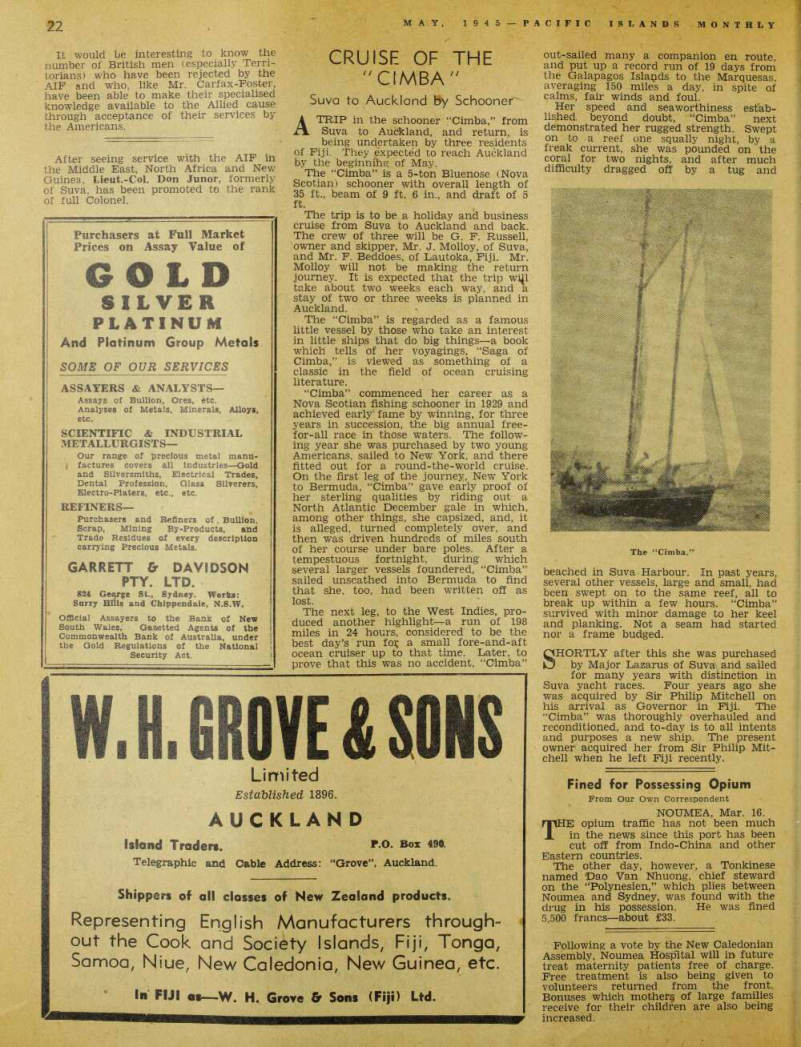
Not Dismiss Carfax-Foster and the Australian Brasshats
SON of an English baronet, officer in the British Army, mercantile marine skipper, world wanderer, A. J. Car fax-Foster is well known in several Paci fic Territories. We reported him killed in action in North Africa in 1943, but in January, 1945, we had the pleasure of restoring him to life and announcing that he now was holding an administrative position of some importance with the United States Forces.
Mr. Carfax-Foster has had many ad ventures; but, for variety and colour, few will bear comparison with what happened when he tried to serve his country per medium of the Australian Army. The following details have been gathered up from various sources —mostly private let ters from Mr. Carfax-Foster. We publish the following story, without apology, as further evidence of the stupidity found in some administrative sections of one of the world’s best fighting armies—the AIF.
When war came, on September 3, 1939, Carfax-Foster, then on the Australian Reserve of Officers, owned a sound coun try business in NSW. On September 4, his business was closed down, and he was on his way. He became second in command of the 33rd Battalion, thence to Divisional Headquarters as GSO (2) which carries the rank of major, and he was later recommended for Lieut.-Col.
GSO (1). However, back in 1937, when commanding a company -in cam*}, his horse had had an argument with a tank ancj he was knocked about very badly.
When his promotion to Lieut.-Col. hit Army Headquarters, they suddenly re membered his accident and, although he successfully passed a medical board, he was discharged as unfit.
Nothing daunted, Carfax-Foster re enlisted in the ranks. Within 16 days he was sergeant in the 2nd AIF, in Queens land. He served 11 months with the 2/26 Battalion (which was eventually captured in Malaya) before being found out. He could not get a commission, as he had only been able to put his age back 10 years.
When Brass Hats discovered who he was, in spite of all the protests put up by the battalion commander, and also protests signed by over 400 of the battalion, he was returned to Brisbane ; and had a special medical exam., which included admission to hospital, tests and X-rays for every known disease. To show how ludicrous is the Army’s mind: although this medical board gave him an absolutely clear certificate of “A” fitness, and recommended him for retention, he was discharged medically unfit.
By the time he had joined under dif ferent names a couple of times more, and had been thrown out again, he was a little sick of the Australian Army; so he attempted to join the American Army and was accepted as a sergeant in the Air Corps (radio operator). His application had to be submitted to Melbourne; and the Australian Army, of course, refused to let him enlist because he was an offi cer on the retired list!
So then the indomitable Carfax- Foster remembered that he had had a good deal of sea experience, and an old ticket; so, without any trouble, he joined the American Small Ships as a skipper.
He was one of the earliest to join, and went to New Guinea, where he served 11 months, finishing in command of a 250tonner. He was in the Buna-Sanananda campaign, where they used to sneak up the coasts with supplies and sneak back
before the Japs could see them, hiding out during daytime. He survived 60 bombing raids, seven direct strafes and 11 doses of malaria before being sent back for a spell on the mainland. He was then transferred to his present duties.
While in New Guinea, he had very close associations with Mr. Jack Gilmore, of Rabaul, who has been doing good work up there. He and Carfax-Foster in one instance succeeded in carrying out a very dirty salvage job, right under the Japs’ noses. Ray Parer was another who was there then. He was aboard the “Melanesia” when she was strafed and sunk in Douglas Harbour. Bob Moody and Dick Ewen. of Moresby, were other
New Guineaites there —the former, for a time, in command of a 700-tonner, and Ewen was the skipper of the “Melanesia” when she was strafed.
It would be interesting to know the number of British men (especially Terri torians) who have been rejected by the AIF and who, like Mr. Carfax-Foster, have been able to make their specialised knowledge available to the Allied cause through acceptance of their services by the Americans.
After seeing service with the AIF in the Middle East, North Africa and New Guinea, Lieut.-Col. Don Junor, formerly of Suva, has been promoted to the rank of full Colonel.
Advertisements & other items, pp. 23-24 (1 item)
Imperial
PACIFIC ISLANDS SOCIETY
Visitors from the Islands to Sydney (or those interested in Islands affairs), are advised to communicate with the honorary secretary of the above Society, which has been formed to study the history, traditions, economics, and political developments of the Pacific Islands.
Regular monthly meetings are held at History House, 8 Young Street, Sydney.
Address for Correspondence:
THE PACIFIC ISLANDS SOCIETY,
Box 2434 MM., G.P.0., Sydney.
TIME OFF FROM
COOKING
/ m h m i <3T B m m % m What an idea to be able to serve up meals in 5 minutes! . . . Meals that will bring unanimous appetising pleasure—treats that you yourself will be able to sit down and enjoy.
IMPERIAL Good Foods are ready-cooked for you by expert chefs. Easy-to-serve. Specially processed to seal in the full flavour and keep EVER-FRESH.
Imperial
GOOD FOODS
Products of RIVERSTONE MEAT CO.
PTY. LTD., Sydney.
FIJI Representative; Pearce & Co. Ltd., Suva.
Imperial
MEATREAT
★ Imperial
CAMP PIE
★ Imperial
HAMPE
★ Imperial
HOT MEALS
Purchasers at Full Market Prices on Assay Value of
GOLD
SILVER
PLATINUM
And Platinum Group Metals
SOME OF OUR SERVICES
ASSAYERS & ANALYSTS—
Assays of Bullion, Ores, etc.
Analyses of Metals, Minerals, Alloys, etc.
SCIENTIFIC & INDUSTRIAL
METALLURGISTS—
Our range of precious metal manuf factures covers all industries—Gold and Silversmiths, Electrical Trades, Dental Profession, Glass Silverers, Electro-Platers, etc., etc.
REFINERS—
Purchasers and Refiners of. Bullion, Scrap, Mining By-Products, and Trade Residues of every description carrying Precious Metals.
GARRETT & DAVIDSON
PTY. LTD.
824 George St., Sydney. Works: Surry Hills and Chippendale, N.S.W.
Official Assayers to the Bank of New South Wales. Gazetted Agents of the Commonwealth Bank of Australia, under the Gold Regulations of the National Security Act.
. H. GROVE & SONS
Limited Established 1896.
AUCKLAND
Island Traders. *•<>. Box Telegraphic and Cable Address: “Grove”, Auckland.
Shippers of all classes of New Zealand products.
Representing English Manufacturers throughout the Cook and Society Islands, Fiji, Tonga, Samoa, Niue, New Caledonia, New Guinea, etc.
In FIJI at—W. H. Grove & Sons (Fiji) Ltd.
Cruise Of The
"Cimba"
Suva to Auckland by Schooner
ATRIP in the schooner “Cimba,” from Suva to Auckland, and return, is being undertaken by three residents of Fiji. They expected to reach Auckland by the beginning of May.
The “Cimba” is a 5-ton Bluenose (Nova Scotian) schooner with overall length of 35 ft., beam of 9 ft. 6 in., and draft of 5 ft.
The trip is to be a holiday and business cruise from Suva to Auckland and back.
The crew of three will be G. F. Russell, owner and skipper, Mr. J. Molloy, of Suva, and Mr. F. Beddoes, of Lautoka, Fiji, Mr.
Molloy will not be making the return journey. It is expected that the trip take about two weeks each way, and a stay of two or three weeks is planned in Auckland.
The “Cimba” is regarded as a famous little vessel by those who take an interest in little ships that do big things—a book which tells of her voyagings, “Saga of Cimba,” is viewed as something of a classic in the field of ocean cruising literature.
“Cimba” commenced her career as a Nova Scotian fishing schooner in 1929 and achieved early’ fame by winning, for three years in succession, the big annual free for-all race in those waters. The follow ing year she was purchased by two young Americans, sailed to New York, and there fitted out for a round-the-world cruise.
On the first leg of the journey, New York to Bermuda, “Cimba” gave early proof of her sterling qualities by riding out a North Atlantic December gale in which, among other things, she capsized, and, it is alleged, turned completely over, and then was driven hundreds of miles south of her course under bare poles. After a tempestuous fortnight, during which several larger vessels foundered, “Cimba” sailed unscathed into Bermuda to find that she, too, had been written off as lost.
The next leg, to the West Indies, pro duced another run of 198 miles in 24 hours, considered to be the best day’s run fo? a small fore-and-aft ocean cruiser up to that time. Later, to prove that this was no accident, “Cimba”
out-sailed many a companion en route, and put up a record run of 19 days from the Galapagos Islands to the Marquesas, averaging 150 miles a day, in spite of calms, fair winds and foul.
Her speed and seaworthiness estab lished. beyond doubt, “Cimba” next demonstrated her rugged strength. Swept on to a reef one squally night, by a freak current, she was pounded on the coral for two nights, and after much difficulty dragged off by a tug and
beached in Suva Harbour. In past years, several other vessels, large and small, had been swept on to the same reef, all to break up within a few hours. “Cimba” survived with minor damage to her keel and planking. Not a seam had started nor a frame budged.
SHORTLY after this she was purchased by Major Lazarus of Suva and sailed for many years with distinction in Suva yacht races. Four years ago she was acquired by Sir Philip Mitchell on his arrival as Governor in Fiji. The “Cimba” was thoroughly overhauled and reconditioned, and to-day is to all intents and purposes a new ship. The present owner acquired her from Sir Philip Mit chell when he left Fiji recently.
The “Cimba.”
Fined for Possessing Opium
From Our Own Correspondent
Noumea, Mar. 16.
rE opium traffic has not been much in the news since this port has been cut off from Indo-China and other Eastern countries.
The other day, however, a Tonkinese named Dao Van Nhuong, chief steward on the “Polynesien,” which plies between Noumea and Sydney, was found with the drug in his possession. He was fined 5,500 francs —about £33.
Following a vote by the New Caledonian Assembly, Noumea Hospital will in future treat maternity patients free of charge.
Free treatment is also being given to volunteers returned from the front.
Bonuses which mothers of large families receive for their children are also being increased.
He Presented a Tabu a
Harold Cooper Returns From United States
AFTER a two months’ tour of the United States, Mr. Harold Cooper, of the Fiji Information Office, returned to Suva on April 1. While in America he gave 59 broadcasts and lectures, most of them dealing with the war efforts of Fijians and other Pacific islanders.
' At Columbus, Ohio, he presented Governor Lausche with a tabua sent by Ratu Sukuna as a symbol of the lasting friendship forged between Fiji’s own fighting men and the men of the famous US 37th Division, on the battlefields of the Solomons. The 37th was formerly the Ohio National Guard.
The tabua caused great interest in the States. Photographs of it and accounts of its place in Fijian culture appeared in many leading newspapers.
When Mr. Cooper told a group of Boston University students how Major Martin Clemens, of the British Colonial Service, stayed on Guadalcanal through out the enemy occupation and, when the Marines landed, trekked through the Japanese lines to report at General Vandergrift’s headquarters, a young man in the audience got up and said: “I can vouch for the accuracy of your story about Major Clemens, because I was the sentry who challenged him when he approached the Marine lines. I was the first American to speak to the Major after we had landed to end the Japanese occupation.”
Miss F. E. Caldwell, newly appointed as a nurse in the Melanesian Mission, left for the Solomons in January.
Miss Edith Bromhill, of the Anglican Mission, has arrived in Port Moresby, but she has been held up there almost indefinitely owing to lack of transport along the south coast of Papua to Milne Bay and thence to Ibogura.
Lieut.-Colonel H. T. Allan, OBE, who has been with the AIF in Jacquinot Bay. has received promotion lately and has been transferred to another operational area. Pre-war, he was a well-known resident of Wau, New Guinea.
Advertisements & other items, p. 25 (1 item)
Gibson’S
Steamships Trading
Company Limited
PORT MORESBY
SAMARAI
PAPUA.
WHOLESALE & RETAIL MERCHANTS. SHIPOWNERS,
PLANTERS, ENGINEERS & SLIP PROPRIETORS.
Customs, Shipping, Insurance, and Forwarding Agents.
MANAGING AGENTS AND VISITING REPRESENTA-
TIVES FOR COCONUT AND RUBBER ESTATES
SYDNEY REPRESENTATIVES; Nelson & Robertson Pty. Ltd.. 12 Spring Street.
WARTIME ADDRESS
Un«:il further notice, clients may address all communica tions as follows:
STEAMSHIPS TRADING COMPANY LIMITED,
C/o NELSON & ROBERTSON PTY. LTD.,
12 SPRING STREET, SYDNEY.
★ TRY IT YOU’LL LIKE IT!
GIBSON’S
GREEN LABEL
TEA
Blended and packed by— M J, A. D. GIBSON & CO. LTD. 364 KENT STREET, SYDNEY. 'Phone: M 2328. ]] Also GIBSON'S GREEN LABEL COFFEE and COFFEE ESSENCE
Island Potters
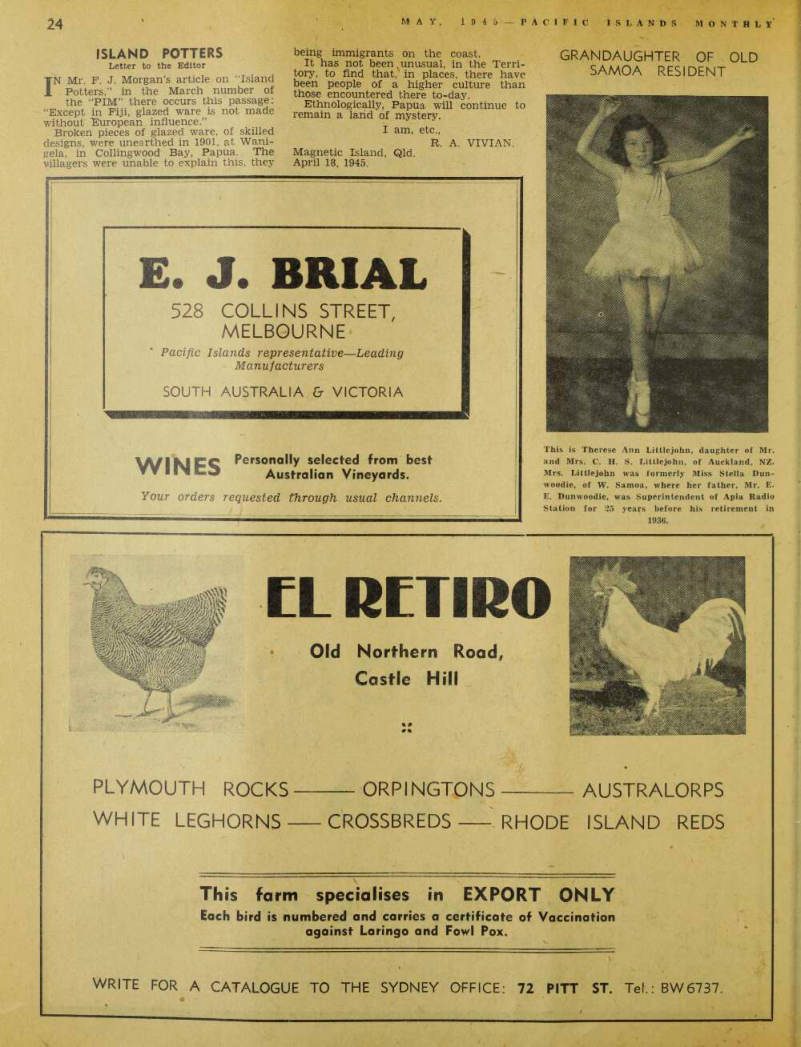
Letter to the Editor IN Mr. F. J. Morgan’s article on “Island Potters,” in the March number of the “PIM” there occurs this passage; “Except in Fiji, glazed ware is not made without European influence.”
Broken pieces of glazed ware, of skilled designs, were unearthed in 1901, at Wani gela, in Collingwood Bay, Papua. The villagers were unable to explain this, they
being immigrants on the coast.
It has not been unusual, in the Terri tory, to find that, in places, there have been people of a higher culture than those encountered there to-day.
Ethnologically, Papua will continue to remain a land of mystery.
I am, etc.,
R. A. Vivian.
Magnetic Island, Qld.
April 18, 1945.
Grandaughter Of Old
Samoa Resident
This is Therese Ann Littlejohn, daughter of Mr. and Mrs. C. H. S. Littlejohn, of Auckland, NZ.
Mrs. Littlejohn was formerly Miss Stella Dun woodie, of W. Samoa, where her father, Mr, E.
E. Dunwoodie, was Superintendent of Apia Radio Station for 25 years before his retirement in 1936.
Advertisements & other items, p. 26 (2 items)
24
may, l 9 u - Heine Islands monthly
El Retiro
E. J. BRIAL
528 COLLINS STREET,
MELBOURNE
Pacific Islands representative—Leading Manufacturers
SOUTH AUSTRALIA & VICTORIA
WINES
Personally selected from best Australian Vineyards.
Your orders requested through usual channels.
EL RETIRO
Old Northern Road, Castle Hill #% i
PLYMOUTH ROCKS
WHITE LEGHORNS-
t
ORPINGTONS AUSTRALORPS
CROSSBREDS RHODE ISLAND REDS
This farm specialises in EXPORT ONLY Each bird is numbered and carries a certificate of Vaccination against Laringo and Fowl Pox.
WRITE FOR A CATALOGUE TO THE SYDNEY OFFICE: 72 PITT ST. Tel.: 8W6737.
Headway
Red Cross Makes Little Headway Questions Concerning ROW and Internees Still Unsettled
rE Red Cross Standing Conference on Prisoners of War and Internees met in Melbourne on March 22. Repre sentatives of the Pacific Territories Asso ciation and the New Guinea women’s organisations of Brisbane, Sydney, Mel bourne and Adelaide attended. From this meeting and subsequent talks with Red Cross officials, it is evident, however, that the Red Cross is finding it as difficult for them as the New Guinea bodies to gain any satisfaction from the Commonwealth Government.
The Melbourne New Guinea Women’s Association submitted these questions: 1: Has Red Cross any plans for the re habilitation of civilian internees? Is this a matter for Red Cross or is it for the Government? 2. Civilian internees liberated in Europe come under the care of the Australian High Commissioner in England. Who is responsible for those liberated in the Far East? 3. Following on the Pacific Territories Association submission to the last con ference, has Red Cross made any repre sentation in support of the submissions put to the Federal Government regard ing civilians and New Guinea Volunteer Rifle personnel taken prisoner in Rabaul?
With regard to questions 1 and 2, the Association’s representative was informed that civilian internees were in the care of the invading army as soon as their release was effected; but on arrival in Australia they became the responsibility
of the Government with which Depart ment the Red Cross worked in close conjunction.
Colonel Naylor, of Red Cross, wh(T had attended the recent conference at Can berra with the Deputy Prime Minister, said that the Government was busy, at the present time, working on plans for the rehabilitation of civilian internees and was taking the fullest responsibility for their welfare. Tenfporary accommo dation was being arranged for all, and special accommodation for those who returned in ill-health; the issue of cou pons was being provided for; a pamphlet was being prepared which would bring civilian internees and POW up to date in current world events and it was probable that monetary contributions would be made to civilian internees on their arrival so that personal shopping could be done by them. This latter was to be provided for by the Red Cross.
As to question three, it was stated that the Red Cross has this matter still in hand, and Major Stokes-Hughes, of Red Cross, referred the Association to a para graph which had appeared recently in the Melbourne “Age.” (See page 14 April issue.) The matter had been sent to the press to see what public opinion would do.
Subsequently Mrs. Cooper and Mrs. O.
Bliss, of the Association, saw Major Stokes-Hughes, who urged them to go ahead themselves and see if they could press the Government further.
At the conference he had referred to the New Guinea Volunteer Rifles as being a force formed in peacetime as in other Eastern countries, to help the police quell native riots, etc. Mrs. Cooper, at the conference, made it quite clear that this was not the case as regards the NGVR and also made it clear that those
men who did not join were precluded by age, distance from a town or because they* were firmly discouraged by the Government.
Mh Fiji Scholarship
THE Fijian Chiefs and people have been quite interested in the Morris, Hedstrom, Ltd. University Scholar' ship Fund, and at various Provincial Council meetings held during the past few months resolutions were passed, and officially noted, conveying their apprecia tion. A typical resolution reads as follows: “This Council would like to place on record its gratitude to Messrs. Morris, Hedstrom, Ltd., for the great gift made by the firm towards native education, and asks that an expression of its genuine appreciation be conveyed to the manag ing director, Sir Maynard Hedstrom, an old supporter and true friend of the Fijian people.”
The above was passed by the Colo West Provincial Council. Similar resolutions were passed by Colo East, Ra, Rewa, Nadi, Colo North and Lautoka.
Advertisements & other items, p. 27 (1 item)
Equal to the World’s Best
THE PACIFIC ISLANDS
TRADING CO.
2016 Parker St., Berkeley,
CALIFORNIA, U.S.A.
We are Expert Buying Agents for Pacific Islands Merchants.
SEND YOUR ORDERS TO US—OUR
COMMISSION IS 5 PER CENT.
Also at San Francisco.
Equal to the World’s Best
Throughout Australia and Overseas there it on ever-increasing demand for
COLONIAL & BRONTE
HIGH-GRADE CANNED MEATS
There is no better quality—none more wholesome.
TRADE MEATS FOR THE ISLANDS
order
“COLONIAL” BRAND
Roast, Corned and Boiled Beef Packed in 6,5, 4,3, 2, 1 lb. and 12 oz. tins.
Also Corned Beef in 12 oz. Taper Tins.
Roast, Corned and Boiled Mutton. 1 lb. and 12 oz. tins.
Choice Dripping 36 lb., 2 lb,, 1 lb. tins, and 1 lb. packets.
C e;m*r f* Under present conditions it is wise to ensure that you have ample stocks of all our lines.
The Colonial Wholesale Meat Coy. Pty. Ltd.
30 GROSVENOR STREET, SYDNEY
Assistance For Junior
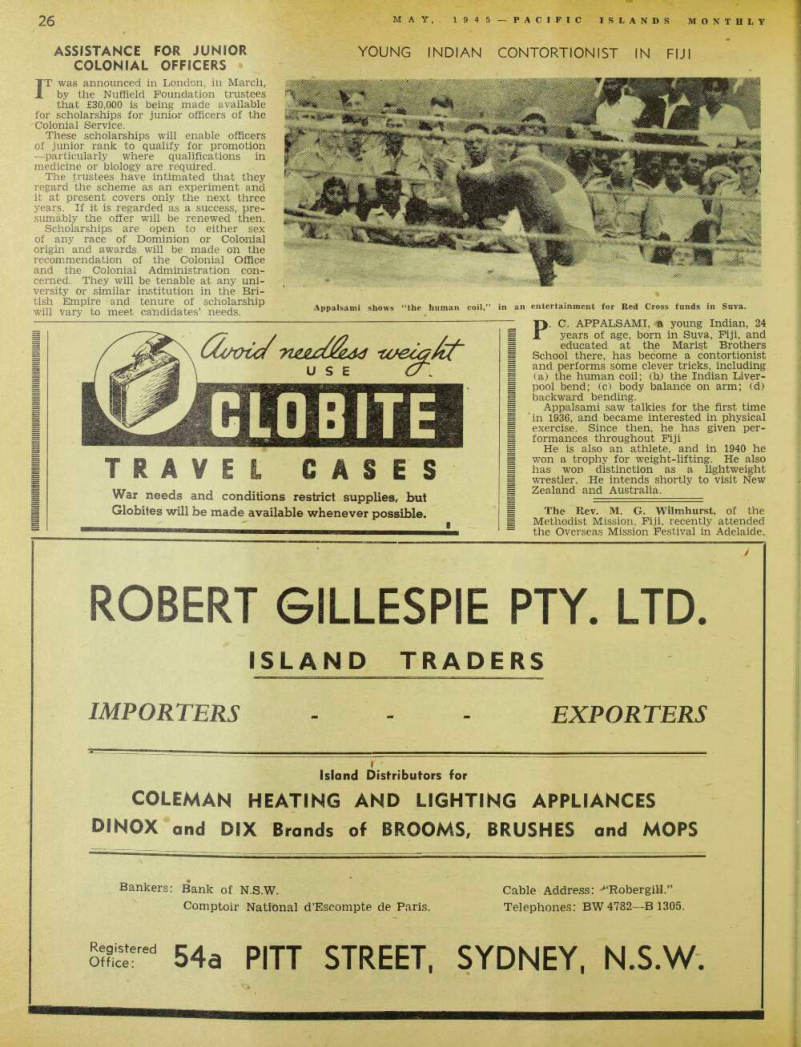
Colonial Officers
IT was announced in London, in March, by the Nuffield Foundation trustees that £30,000 is being made available for scholarships for junior officers of the Colonial Service.
These scholarships will enable officers of junior rank to qualify for promotion —particularly where qualifications in medicine or biology are required.
The trustees have intimated that they regard the scheme as an experiment and it at present covers only the next three years. If it is regarded as a success, pre sumably the offer will be renewed then.
Scholarships are open to either sex of any race of Dominion or Colonial origin and awards will be made on the recommendation of the Colonial Office and the Colonial Administration con cerned. They will be tenable at any uni versity or similar institution in the Bri tish Empire and tenure of scholarship will vary to meet candidates’ needs.
Young Indian Contortionist In Fiji
P. C. APPALS AMI, a young Indian, 24 years of age, born in Suva, Fiji, and educated at the Marist Brothers School there, has become a contortionist and performs some clever tricks, including (a) the human coil; (b) the Indian Liver pool bend; (c) body balance on arm; (d) backward bending.
Appalsami saw talkies for the first time in 1936, and became interested in physical exercise. Since then, he has given per formances throughout Fiji He is also an athlete, and in 1940 he won a trophy for weight-lifting. He also has won distinction as a lightweight wrestler. He intends shortly to visit New Zealand and Australia.
The Rev. M. G. Wilmhurst, of the Methodist Mission, Fiji, recently attended the Overseas Mission Festival in Adelaide.
Appalsami shows “the human coil,” in an entertainment for Red Cross funds in Suva
Advertisements & other items, p. 28 (1 item)
Robert Gillespie Pty. Ltd.
(M/tru/ nzed&sd tvec^/it
USE
TRA V E
CASES
War needs and conditions restrict supplies, but Globites will be made available whenever possible.
ROBERT GILLESPIE PTY. LTD.
ISLAND TRADERS
IMPORTERS - - - EXPORTERS
Island Distributors for
COLEMAN HEATING AND LIGHTING APPLIANCES
DINOX and DIX Brands of BROOMS, BRUSHES and MOPS Bankers: Bank of N.S.W. Cable Address: >‘Robergill.”
Comptoir National d’Escompte de Paris. Telephones: BW 4782—8 1305.
54a PITT STREET, SYDNEY, N.S.W.
Health Measures In
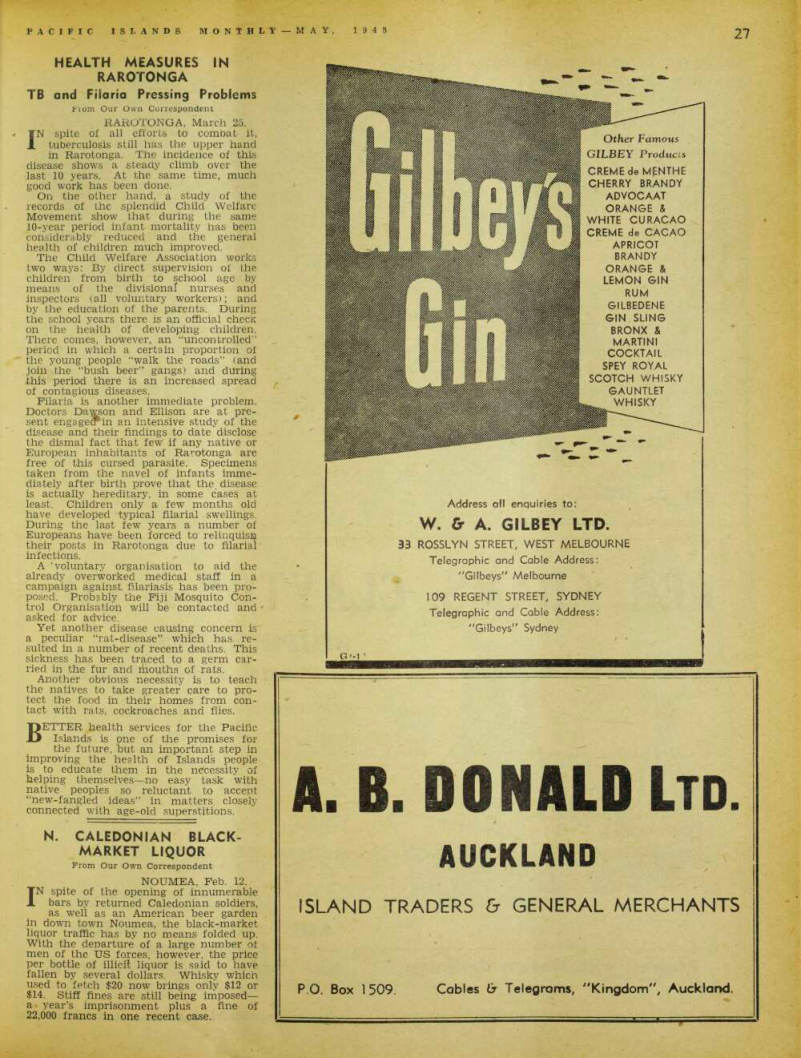
Rarotonga
TB and Filaria Pressing Problems
Fioxn Our Own Correspondent
Rarotonga, March 25.
IN spite of all efforts to combat it, tuberculosis still has the upper hand in Rarotonga. The incidence of this disease shows a steady climb over the last 10 years. At the same time, much good work has been done.
On the other hand, a study of the records of the splendid Child Welfare Movement show that during the same 10-year period infant mortality has been considerably reduced and the general health of children much improved.
The Child Welfare Association works two ways: By direct supervision of the children from birth to school age by means of the divisional nurses and inspectors (all voluntary workers); and by the education of the parents. During the school years there is an official check on the health of developing children.
There comes, however, an “uncontrolled’’ period in which a certain proportion of the young people “walk the roads” (and join the “bush beer” gangs) and during this period there is an increased spread of contagious diseases.
Filaria is another immediate problem.
Doctors Dawson and Ellison are at pre sent engagecTin an intensive study of the disease and their findings to date disclose the dismal fact that few if any native or European inhabitants of Rarotonga are free of this cursed parasite. Specimens taken from the navel of infants imme diately after birth prove that the ( disease is actually hereditary, in some cases at least. Children only a few months old have developed typical filarial swellings.
During the last few years a number of Europeans have been forced to relinquish their posts in Rarotonga due to filarial infections.
A 'voluntary organisation to aid the already overworked medical staff in a campaign against filariasis has been pro posed. Probably the Fiji Mosquito Con trol Organisation will be contacted and asked for advice.
Yet another disease causing concern is a peculiar “rat-disease” which has re sulted in a number of recent deaths. This sickness has been traced to a germ car ried in the fur and mouths of rats.
Another obvious necessity is to teach the natives to take greater care to pro tect the food in their homes from con tact with rats, cockroaches and flies.
BETTER health services for the Pacific Islands is one of the promises for the future, but an important step in improving the health of Islands people is to educate them in the necessity of helping themselves—no easy task with native peoples so reluctant to accept “new-fangled ideas” in matters closely connected with age-old superstitions.
Market Liquor
N. Caledonian Black
From Our Own Correspondent
Noumea, Feb. 12.
IN spite of the opening of innumerable bars by returned Caledonian soldiers, as well as an American beer garden in down town Noumea, the black-market liquor traffic has by no means folded up.
With the departure of a large number of men of the US forces, however, the price per bottle of illicit liquor is .said to have fallen by several dollars. Whisky which used to fetch $2O now brings only $l2 or $l4. Stiff fines are still being imposed— a year’s imprisonment plus a fine of 22,000 francs in one recent case.
Advertisements & other items, p. 29 (1 item)
A. B. Donald Ltd.
Other Famous GILBEY Products
CREME de MENTHE
CHERRY BRANDY
ADVOCAAT
ORANGE &
WHITE CURACAO
CREME de CACAO
APRICOT
BRANDY
ORANGE &
LEMON GIN
RUM
GILBEDENE
GIN SLING
BRONX &
MARTINI
COCKTAIL
SPEY ROYAL
SCOTCH WHISKY
GAUNTLET
WHISKY
Address all enquiries to:
W. & A. GILBEY LTD.
33 ROSSLYN STREET, WEST MELBOURNE
Telegraphic and Cable Address:
"Gilbeys" Melbourne
109 REGENT STREET, SYDNEY
Telegraphic and Cable Address; "Gilbeys” Sydney G '-1 ’
A. B. DONALD Ltd.
AUCKLAND
ISLAND TRADERS & GENERAL MERCHANTS
P O. Box 1509. Cables tr Telegrams, "Kingdom", Auckland.
Valuable Samoan Stamp
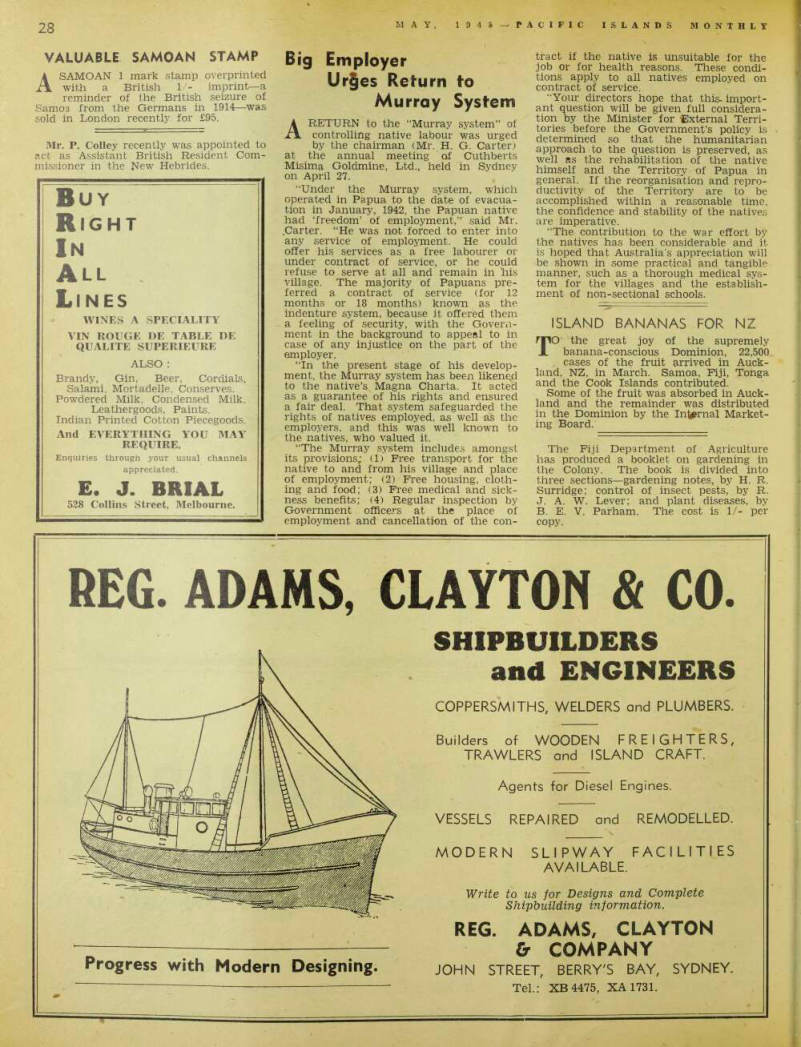
A SAMOAN 1 mark stamp overprinted with a British 1 reminder of the British seizure of Samoa from the Germans in 1914 —was sold in London recently for £95.
Mr. P. Colley recently was appointed to act as Assistant British Resident Com missioner in the New Hebrides.
Big Employer
Urges Return to Murray System
A RETURN to the “Murray system” of controlling native labour was urged by the chairman (Mr. H. G. Carter; at the annual meeting of Cuthberts Misima Goldmine, Ltd., held in Sydney on April 27.
“Under the Murray system, which operated in Papua to the date of evacua tion in January, 1942, the Papuan native had ‘freedom’ of employment,” said Mr. .Carter. “He was not forced to enter into any service of employment. He could offer his services as a free labourer or under contract of service, or he could refuse to serve at all and remain in his village. The majority of Papuans pre ferred a contract of service (for 12 months or 18 months) known as the indenture system, because it offered them a feeling of security, with the Govern ment in the background to appeal to in case of any injustice on the part of the employer.
“In the present stage of his develop ment, the Murray system has been likened to the native’s Magna Charta. It acted as a guarantee of his rights and ensured a fair deal. That system safeguarded the rights of natives employed, as well as the employers, and this was well known to the natives, who valued it.
“The Murray system includes amongst its provisions; (1) Free transport for the native to and from his village and place of employment; (2) Free housing, cloth ing and food; (3) Free medical and sick ness benefits; (4) Regular inspection by Government officers at the place of employment and cancellation of the con
tract if the native is unsuitable for the job or for health reasons. These condi tions apply to all natives employed on contract of service.
“Your directors hope that this- import ant question will be given full considera tion by the Minister for external Terri tories before the Government’s policy is determined so that the humanitarian approach to the question is preserved, as well as the rehabilitation of the native himself and the Territory of Papua in general. If the reorganisation and repro ductivity of the Territory are to be accomplished within a reasonable time, the confidence and stability of the natives are imperative.
“The contribution to the war effort by the natives has been considerable and it is hoped that Australia’s appreciation will be shown in some practical and tangible manner, such as a thorough medical sys tem for the villages and the establish ment of non-sectional schools.
Island Bananas For Nz
rpo the great joy of the supremely X banana-conscious Dominion, 22,500 cases of the fruit arrived in Auck land, NZ, in March. Samoa, Fiji, Tonga and the Cook Islands contributed.
Some of the fruit was absorbed in Auck land and the remainder was distributed in the Dominion by the Internal Market ing Board.
The Fiji Department of Agriculture has produced a booklet on gardening in the Colony. The book is divided into three sections —gardening notes, by H. R.
Surridge; control of insect pests, by R.
J. A. W. Lever; and plant diseases, by B. E. V. Parham. The cost is 1/- per copy.
Advertisements & other items, pp. 30-31 (2 items)
Reg. Adams, Clayton & Co.
Buy
Right
In
All
Lines
WINES A SPECIALITY
YIN ROUGE DE TABLE DE
QUALITE SUPERIEURE
ALSO :
Brandy, Gin, Beer, Cordials, Salami. Mortadelle, Conserves.
Powdered Milk, Condensed Milk.
Leathergoods, Paints.
Indian Printed Cotton Piecegoods.
And EVERYTHING YOU MAY r
REQUIRE.
Enquiries through your usual channels appreciated.
E. J. BEIAL
528 Collins Street, Melbourne.
REG. ADAMS, CLAYTON & CO.
n o
Progress with Modern Designing.
SHIPBUILDERS
and ENGINEERS
COPPERSMITHS, WELDERS and PLUMBERS.
Builders of WOODEN FREIGHTERS,
TRAWLERS and ISLAND CRAFT.
Agents for Diesel Engines.
VESSELS REPAIRED and REMODELLED.
MODERN SLIPWAY FACILITIES
AVAILABLE.
Write to us for Designs and Complete Shipbuilding information.
REG. ADAMS, CLAYTON
& COMPANY
JOHN STREET, BERRY'S BAY, SYDNEY.
Tel.: XB 4475, XA 1731.
iWi
4 1 0 % •mm-. vi a * X- *'■ '■ \ ‘1 yp \ The famous Aladdin Kerosene Mantle Lamp gives brilliant 75-candlepower white light without pumping or pressure at a cost of approximately 2 hours’ light for one penny. As easy to light as the old-fashioned flame lamp.
SrV NOW every island f —\T4S~y home can enjoy the com- ■-fort an d convenience of a / brilliant white 75-candle- [fZ& ' s' power light thanks to Aladdin, the world's most wonderful lamp. Introduced to the Islands for the first time, this world-famous Kerosene Mantle Lamp is artistic in appearance, economical in use and as easy to light as an ordinary flame lamp. Burns only kerosene, the safest and cheapest of fuels— without pumping, pressure, noise, smoke or fumes. Write AT ONCE for illustrated leaflet showing the full range of table, floor pedestal, hanging and wall-bracket models.
Popular Aladdin Storm Lantern , solidly constructed of brass for hard wear. Gives vivid 200-candlepower white light from ordinary kerosene at a cost of approximately one halfpenny per hour. Widely used by Army and Navy during the war.
AGENTS WANTED. Opportunities exist for alert storekeepers to act as authorised Aladdin storekeepers in the Islands. Special discounts and the distribution of Aladdin wicks, chimneys , mantles , shades, and spare parts are among the many advantages of the\ Aladdin franchise. u MDIN’S KEmm c „ The M„, hlin " mE s-Bumi l T c of the neeZTT’ It famous Aladdin ! Ir ’"l". rs , « pale gr ™' n family. streamlined like and chtom. r an eo, U is both e the mo modern in operation, sim ‘ ' ecnn detaii * on a P ;;ZiZ'r ilsel/ K 93.3799
ALADDIN INDUSTRIES P T Y. LTD.
6 1-71
BOU R K E
STREET,
SYDNEY
Plant—Or Be Prosecuted
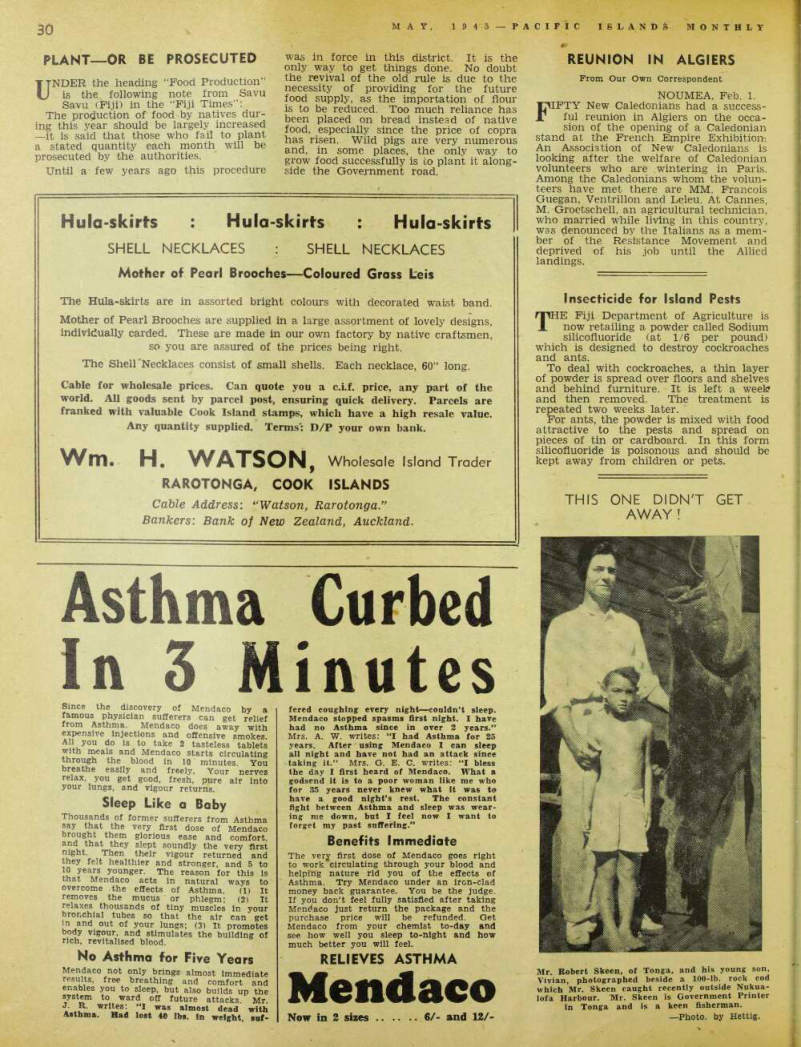
UNDER the heading “Food Production” is the following note from Savu Savu (Fiji) in the “Fiji Times”: The production of food by natives dur ing this year should be largely increased —it is said that those who fail to plant a stated quantity each month will be prosecuted by the authorities.
Until a few years ago this procedure
was in force in this district. It is the only way to get things done. No doubt the revival of the old rule is due to the necessit y of providing for the future * ood supply, as the importation of flour 15 to be reduced. Too much reliance has been P laced on bread instead of native food> especially since the price of copra has ris en. Wild pigs are very numerous anc j in some places, the only way to grow f ood successfully j s p i an t it along side the Government road.
Reunion In Algiers
From Our Own Correspondent
Noumea, Feb. 1.
FIFTY New Caledonians had a success ful reunion in Algiers on the occa sion of the opening of a Caledonian stand at the French Empire Exhibition.
An Association of New Caledonians is looking after the welfare of Caledonian volunteers who are wintering in Paris.
Among the Caledonians whom the volun teers have met there are MM. Francois Guegan, Ventrillon and Leleu. At Cannes, M. Groetschell, an agricultural technician, who married while living in this country, was denounced by the Italians as a mem ber of the Resistance Movement and deprived of his job until the Allied landings.
Insecticide for Island Pests
THE Fiji Department of Agriculture is now retailing a powder called Sodium silicofluoride (at 1/6 per pound) which is designed to destroy cockroaches and ants.
To deal with cockroaches, a thin layer of powder is spread over floors and shelves and behind furniture. It is left a week and then removed. The treatment is repeated two weeks later.
For ants, the powder is mixed with food attractive to the pests and spread on pieces of tin or cardboard. In this form silicofluoride is poisonous and should be kept away from children or pets.
This One Didn't Get
Away!
Mr, Robert Skeen, of Tonga, and his young son, Vivian, photographed beside a 100-lb. rock cod which Mr. Skeen caught recently outside Nukua lofa Harbour. Mr. Skeen is Government Printer in Tonga and is a keen fisherman. —Photo, by Hettig.
Advertisements & other items, p. 32 (1 item)
Asthma Curbed
Hula-skirts Hula-skirts : Hula-skirts
SHELL NECKLACES : SHELL NECKLACES
Mother of Pearl Brooches—Coloured Grass Leis The Hula-skirts are in assorted bright colours with decorated waist band.
Mother of Pearl Brooches are supplied in a large assortment of lovely designs, individually carded. These are made in our own factory by native craftsmen, so you are assured of the prices being right.
The Shell Necklaces consist of small shells. Each necklace, 60” long.
Cable for wholesale prices. Can quote you a c.Lf. price, any part of the world. All goods sent by parcel post, ensuring quick delivery. Parcels are franked with valuable Cook Island stamps, which have a high resale value.
Any quantity supplied. Terms'; D/P your own bank.
Wm. H. WATSON, Wholesale Island Trader
RAROTONGA, COOK ISLANDS
Cable Address : “ Watson, Rarotonga ”
Bankers : Bank of New Zealand , Auckland.
Asthma Curbed In 3 Minutes
Since the discovery of Mendaco by a famous physician sufferers can get relief from Asthma. Mendaco does away with expensive injections and offensive smokes. 2 tasteless tablets with meals and Mendaco starts circulating through the blood in 10 minutes. You breathe easily and freely. Your nerves relax, you get good, fresh, pure air into your lungs, and vigour returns.
Sleep Like a Baby
Thousands of former sufferers from Asthma say that the very first dose of Mendaco brought them glorious ease and comfort, and that they slept soundly the very first night. Then their vigour returned and they felt healthier and stronger, and 5 to 10 years younger. The reason for this is that Mendaco acts in natural ways to overcome the effects of Asthma. (1) It removes the mucus or phlegm; (2) It relaxes thousands of tiny muscles in your bronchial tubes so that the air can get m and out of your lungs; (3) It promotes body vigour, and stimulates the building of rich, revitalised blood.
No Asthma for Five Years
Mendaco not only brings almost Immediate results, free breathing and comfort anc enables you to sleep, but also builds up the system to ward off future attacks. Mr J. R. writes: “I was almost dead witt Asthma. Had lost 40 lbs. in weight, snf-
fered coughing every night—couldn’t sleep.
Mendaco stopped spasms first night. I have had no Asthma since in over 2 years.”
Mrs. A. W. writes: ‘‘l had Asthma for 25 years. After using Mendaco I can sleep all night and have not had an attack since taking it.” Mrs. G. E. C. writes: "I bless the day I first heard of Mendaco, What a godsend it is to a poor woman like me who for 35 years never knew what it was to have a good night’s rest. The constant fight between Asthma and sleep was wearing me down, but I feel now I want to forget my past suffering.”
Benefits Immediate
The very first dose of Mendaco goes right to work circulating through your blood and helping nature rid you of the effects of Asthma. Try Mendaco under an iron-clad money back guarantee. You be the judge.
If you don’t feel fully satisfied after taking Mendaco just return the package and the purchase price will be refunded. Get Mendaco from your chemist to-day and see how well you sleep to-night and how much better you will feel.
RELIEVES ASTHMA
Mendaco
Now in 2 sizes 6/- and 12/-
Dollars
CI Resume Normal Economy
Prom Our Own Correspondent
Rarotonga, March 25.
DOLLARS still make the headlines —if only over reports from various island groups that dollar-prosperity is rapidly receding.
This is also true of Rarotonga.
Although there is still a steady export of hula-skirts, shell necklaces and other souvenir articles, it is a mere trickle com pared with the volume of the last two years. It is becoming a little easier to interest the natives in the vital subjects of reviving food plantations and laying the foundations of a more substantial fruit export trade.
Some of the inhabitants of Cl which have supported American troops have had the sense to salt down a large proportion of their accumulated wealth against the inevitable thinner days to come. Some really surprising figures are mentioned.
Some of the natives have substantial deposits in the savings bank while others, with the common native mistrust of allowing the Government to look after their money, have followed the old cus tom of hiding it in secret caches of their own.
Generally speaking, Polynesians are extremely easy-come easy-go with money, but there have been many cases of natives who have nursed a secret hoard, only to die without revealing the hiding place to their chagrined families, who have searched in vain.
A leading Rarotongan has told how his father, a one-time successful ship-owner and trader, kept a hoard of sovereigns in an earthenware jar. In his old age he would sometimes go out into the night
and return with his treasure, to count it on the table, as misers will, while mem bers of the family silently watched through chinks in the wall. Then he would carry it back into the night, sternly forbidding anyone to follow.
He took his secret with him to the grave. Every effort was made to locate the hoard, but it was never found. Some years later, a noted “witch-doctor” from Raiatea, who claimed, among other things, the power of divining hidden treasure, was approached by the family to locate the lost gold. After some pre liminary investigation he said that the spirit of the dead man was still jealously guarding the treasure and would first have to be destroyed. The superstitious Rarotongans were terrified at this sugges tion and begged that the matter be drop ped there and then—which sceptical whites call an easy get-out for the witch doctor.
We have also a few romantic tales of treasures brought ashore for temporary burial by the crews of ships which never returned.
Would-be treasure-hunters are warned, however, that they will do better and finish richer in pocket if they stay home and search for the proverbial needle in a haystack. rpHIS is the second time in their history JL that the Cook Islanders have talked in dollars. In the earlier commer cial era, before annexation by NZ, the currency of the Group was in Chilean dollars. One often comes across these large, handsome coins, kept as souvenirs, sometimes in the form of watch-chain pendants.
This brings us to the story of the man who made a mistake. With the intro duction of NZ currency a batch of brand new, shiny pennies arrived in Rarotonga.
One “wise-guy” Rarotongan said to him self: “What fools these people are! These big coins are solid gold—and if a little
golden guinea is worth 21 silver shillings how much must these big golden dollars be worth! And here are these foolish people throwing them around as if they were worth practically nothing!”
So, with the greatest secrecy, he set about collecting as many of the golden dollars as possible. He then boarded a ship fbr Tahiti, paying his travelling expenses in silver to ghard his secret. In Tahiti he would spend the rest of his days in luxury, free from, cadging rela tives and friends. Alas for his hopes!
Arrived in Tahiti he soon found the true worth of his quickly-gathered fortune.
Robert HarbuJot was one of a small number of New Caledonian parachutists who took part in the invasion of France.
In Paris, he managed to contact his brother Jules, who had bpen made a prisoner of war by the Germans when a member of the crew of the “Notou,” the Nickel Co. collier sunk by a,raider in the South Pacific in August, 1940.
The “Notou” was en route from Sydney to Noumea and nothing definite was known of her fate for many months.
Advertisements & other items, p. 33 (2 items)
31
P A CM F I C ISLANDS MONTHLY MAY, 1945
S. P. Parekh
G.P.O. Box 314, Cable Address: Suva, Fiji. “Parekh.”
& BROS.
Suva's Leading
Jewellers
Manufacturers of: Tortoise-shell Wore (including Necklaces, Bracelets, Hinged Watch-bands and Brooches, etc); Silver Filigree Ware, Ivoryware, Brassware, Coconut and Ebony Curios . . .
ALSO :
Tortoise-shell Wore with Silver and Cats-eyes inlaid.
Dealers in Indian Handmade Woollen Carpets.
All Enquiries Will Receive Prompt Attention.
0 ♦7/1^ SS Nj fr ■i
The White Flying-Fox Of Kolovai
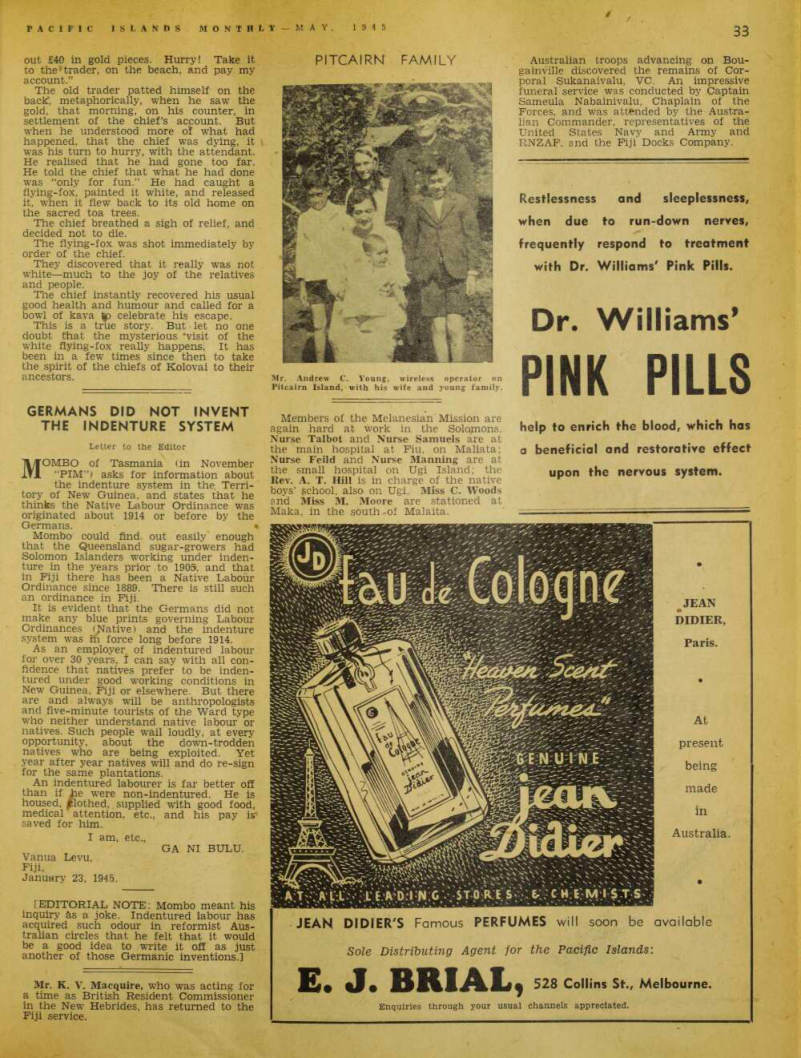
By Falo, a Resident of Tonga, Now a Visitor to Sydney
HE was a sailor before he settled down to be a trader in Kolovai, Hihifo, Tonga. He was an honest man, that one. He never owed a living person a sixpence in his life.
His station was on the beach. There were two ways to it. One was by the Government road, perhaps close on 15 miles from the capital, Nukualofa. The other was by the flats, at low tide—a sea road, taken by those who knew how to keep off the quick-sand.
This writer was in danger there once driving in a sulky. The tide was rising fast. The old trader looking through his glasses, saw someone in difficulties and came to the rescue. He guided the horse; and, with his bare feet, felt for the cart track.
“Now, let go the reins, horse sense will do the rest,” he said. And so it did. I had driven the horse into the quick sand.
Anyone would remark on the clean liness of his trading station. The tidy trader and his family, the wee house, the yard, the copra platform, all were in good order, encouraging many a traveller to turn in, to accept hospitality, generously given.
IT was a bad year for trade. The old trader knew that the credit he gave the chief of Kolovai was at his own risk, as it was against the law of the little kingdom to give credit to a Tongan.
Many a sleepless night he passed, think ing of how he could get his account settled. Persuasion, threats, were of no avail. A brilliant idea came into his mind.
One morning, soon after, the chief came in again, and asked for more credit.
“But, Chief, I need the money for my business. When will you settle your ac count. The white flying-fox will be com ing in, and you can’t go to heaven if you don’t pay your debt,” he said.
The chief was given a little more credit and went home, satisfied with his success.
The trader cherished his brilliant idea.
After a successful day, digging up the first season’s yams, the chief was in a happy mood. Sitting at dusk with his people, on the grass, in front of his house, close to the sacred toa trees of his ancestors, he was enjoying a bowl of kava.
Then his look of amazement caused all present to gaze, horrified—a white flying fox was flying in, and had settled on one of the trees. Not one word was said.
With head bent low, the chief retired within his house, to his bed of mats, fearfully ill.
All night his relatives and his people sat outside his house, strangely stirred.
Had they not seen with their own eyes the white flying-fox come in and settle on the. tree. And one was heard to whisper within the house: “It is hanging there still.”
They all knew that meant the old chief was to die, as his ancestors had done be fore him, when the white flying-fox came for them.
It was at dawn, when the trembling chief suddenly thought of the trader, and the account he owed, and what he said about the flying-fox, only a week ago.
He turned to his attendant, and said in a humble voice: “Unlock that box, take
out £4O in gold pieces. Hurry! Take it to the * trader, on the beach, and pay my account.”
The old trader patted himself on the back*, metaphorically, when he saw the gold, that morning, on his counter, in settlement of the chief’s account. But when he understood more of what had happened, that the chief was dying, it was his turn to hurry, with the attendant.
He realised that he had gone too far.
He told the chief that what he had done was “only for fun.” He had caught a flying-fox, painted it white, and released it, when it flew back to its old home on the sacred toa trees.
The chief breathed a sigh of relief, and decided not to die.
The flying-fox was shot immediately by order of the chief.
They discovered that it really was not white —much to the joy of the relatives and people.
The chief instantly recovered his usual good health and humour and called for a bowl of kava celebrate his escape.
This is a true story. But let no one doubt that the mysterious 'visit of the white flying-fox really happens. It has been in a few times since then to take the spirit of the chiefs of Kolovai to their ancestors.
Advertisements & other items, p. 34 (2 items)
B. G. Bagia
JEWELLER
Manufacturer & Exporter of — Jewelleries, Silver Filigree Ornaments, Genuine Tortoiseshells and various other kinds of Pacific Islands SOUVENIRS, including Cat's-eyes, Seashells and Beads, Picture Views of the South Seas, etc.
Wholesale inquiries invited.
Prompt attention given to Mail Orders. Parcels can be posted to any part of the world.
G.P.O. Box No. 257
SUVA, FIJI
William Atkins Pty. Ltd.
Heod Office 449-451 KENT ST., SYDNEY.
Iron & Steel Merchants—Engineers' Supplies
Coach Cr Motor Hardware
ESTABLISHED OVER 50 YEARS
Cable Address: WILATEDf, Sydney.
STEEL DEPARTMENT
MILD STEEL:
Rounds, Squares, Flats, Half-rounds, Hexagons, Bevel, Shoeing, Tyre, Angles, Tees, Sheets, Plates, Girder Plates, Chequer Plates, Channels, Hoops, Ete.
BRIGHT STEEL:
Rounds, Squares, Hexagons.
Extra Special High Speed Tool Steel, Mining Steel, Blister Steel and Spring Steel, Rounds, Flats & Squares.
Bar Iron—All sections and sizes.
Engineers' Supplies: Set Screws, Studs, Metal Thread Screws, Coach Screws, Piles, Cotter Pins, Bright and Black Bolts, Rivets, Etc., Hack Saw Blades.
Power Transmission Gear: Including Plummer Blocks, Couplings, Collars, Etc.
Coach and Motor Hardware: Axles, Springs, Wheelstuff, Duck, Paints.
Farriers' Supplies: Horse Nails, Anvils, Vices, Etc.
Motor-Trimmers and Motor Builders' & Motor Painters' Requirements
C. A. WILLEY'S
Quick-Drying Coach and Car Paints, Roughstuff, Elastic Gloss, Synflex Enamels, Lacquers.
DUCO Lacquers and DULUX Enamels—FAßßEX Motor Toppings and Leather Cloths, House & Decorators' Paints, Varnishes fir Brushware.
Sole Distributors of CHAMPION'S Decorators Paint Products.
Distributing Agents for BROLITE Lacquers, SYNFLEX Enamels and "POLYGLOSS" Finish.
Germans Did Not Invent
The Indenture System
Letter to the Editor
MOMBO of Tasmania (in November “PIM”) asks for information about the indenture system in the. Terri tory of New Guinea, and states that he thinks the Native Labour Ordinance was originated about 1914 or before by the Germans. * Mombo could find out easily enough that the Queensland sugar-growers had Solomon Islanders working under inden ture in the years prior to 1905. and that in Fiji there has been a Native Labour Ordinance since 1889. There is still such an ordinance in Fiji.
It is evident that the Germans did not make any blue prints governing Labour Ordinances (Native) and the indenture system was in force long before 1914.
As an employer of indentured labour for over 30 years, I can say with all con fidence that natives prefer to be inden tured under good working conditions in New Guinea, Fiji or elsewhere. But there are and always will be anthropologists and five-minute tourists of the Ward type who neither understand native labour or natives. Such people wail loudly, at every opportunity, about the down-trodden natives who are being exploited. Yet year after year natives will and do re-sign for the same plantations.
An indentured labourer is far better off than if he were non-indentured. He is housed, Clothed, supplied with good food, medical attention, etc., and his pay is saved for him.
I am, etc,,
Ga Ni Bulu.
Vanua Levu, Fiji, January 23, 1945. [EDITORIAL NOTE: Mombo meant his inquiry as a joke. Indentured labour has acquired such odour in reformist Aus tralian circles that he felt that it would be a good idea to write it off as just another of those Germanic inventions.] Mr. K. V. Macquire, who was acting for a time as British Resident Commissioner in the New Hebrides, has returned to the Fiji service.
Pitcairn Family
Members of the Melanesian Mission are again hard at work in the Solomons.
Nurse Talbot and Nurse Samuels are at the main hospital at Fiu, on Maliata; Nurse Feild and Nurse Manning are at the small hospital on Ugi Island; the Rev. A. T. Hill is in charge of the native boys’ school, also on Ugi. Miss C. Woods and Miss M. Moore are stationed at Maka, in the south-of Malaita.
Australian troops advancing on Bou gainville discovered the remains of Cor poral Sukanaivalu, VC. An impressive funeral service was conducted by Captain Sameula Nabainivalu, Chaplain of the Forces, and was attended by the Austra lian Commander, representatives of the United States Navy and Army and RNZAF, and the Fiji Docks Company.
Mr. Andrew C. Young, wireless operator on Pitcairn Island, with his wife and young family.
Advertisements & other items, p. 35 (1 item)
Pink Pills
Restlessness and sleeplessness, when due to run-down nerves, frequently respond to treatment with Dr. Williams' Pink Pills.
Dr. Williams*
help to enrich the blood, which has a beneficial and restorative effect upon the nervous system.
J EA N
DIDIER,
Paris. si m m At m sass m present S 3 being *r: made in Australia m JEAN DIDIER'S Famous PERFUMES will soon be available Sole Distributing Agent lor the Pacific Islands : E. J. BRIAL, 528 Collins St., Melbourne.
Enquiries through your usual channels appreciated.
The History Of George
Bogese
Letter to the Editor ON page 25 of the April issue of the “PIM” reference Is made to the “studies” of Gecwge Bogese in his internment camp in Australia.
I am afraid that most Solomon Island ers will resent the publicity given to this objectionable and dangerous native.
Any Solomon Islander, either native or European, and from any walk of life, can give you his history, which is one of the least admirable of any from the Solomons.
I suggest that you obtain from the Solomon Islands Administration the rea son for his being discharged from the Government Medical Service, long before the Japanese invasion. Also, why is he still in internment, when most other Solomon Island natives are free, or work ing for the authorities?
I am, etc.,
Bsi.
The tribe of Chief Apoupia of Huailon (N. Caledonia) recently staged a feast at which a number of native ex-Servicemen of the last war received decorations. The old soldiers marched proudly past the chief and a large gathering. It was quite a patriotic occasion. The chief, speaking in. French, recalled the of Henry of Navarre at the Battle of Ivry: “Follow my white plume, it will lead you on the path of honour.”
Training Ex-Servicemen As Plantation
Managers
By F. J. Morgan
MANY young Australians serving in the South-west Pacific area may desire to settle in the islands where they have fought. The life of a planter in the tropics has always exercised the imagination of adventurous youth, but enthusiasm alone is not enough.
To achieve any measure of success it is essential that the prospective planter must first have had some experience in plantation management and control of native labour before taking up land.
There has never been a surplus of really good experienced plantation managers.
One difficulty confronting ex-Servicemen is the lack of an institution which offers a course in tropical agriculture under South Pacific conditions. The Imperial College of Tropical Agriculture in Trinidad reserves entry to its practical course to students from the West Indies, and the course is based on conditions in the Caribbean area. In any case, a long tech nical course is not altogether suitable for men who have served through a long war and who are desirous of settling down as soon as possible.
It is necessary, therefore, that there should be established a Training plan tation in the islands, where selected ex- Servicemen can be given a practical course in plantation management, under the same conditions, of rehabilitation and
sustenance, as the Commonwealth Govern ment proposes for the assistance of dis charged Servicemen undergoing industrial training in Australia.
The course should combine practical work with theoretical tuition designed to assist in the selection of suitable land, choice of crops, control of native labour and marketing of produce.
THE advantage of such preliminary
training to the prospective planter is obvious, but the subject has also national and international aspects.
Apart altogether from the necessity for minimising chances of failure in land settlement policy, as it concerns ex- Servicemen in the Island Territories of the Commonwealth, Australia, in common with other Pacific Powers if must establish successful colonies of vigorous European stock in what is now called “the island screen.” The lessons of this war cannot be forgotten, and the islands may at some future time again become the first line of Australian defence. The value of men with local knowledge has been proved many times during the New Guinea and Solomon Islands campaigns.
In its efforts to encourage settlement of ex-Servicemen in the islands, it is the duty of the Government to guarantee each man access to markets- for his pro duce. And in this regard the national value of shipping and air-transport com panies is self-evident. Their development must be encouraged, by subsidy if neces sary, for if the islands are to be settled, and if the settlers are to be a national • asset and not a liability, there must be cheap and efficient transport services be tween islands and mainland ports of entry. There is no use training men and settling them in places remote from world centres of distribution unless they can be assured of cheap, regular transport and markets for the products of their industry.
This aspect of the matter must be con sidered. rE Commonwealth Government should take immediate steps to ascertain approximately the number of men still serving in the armed forces who would be interested in taking a course of training preparatory to settling in the islands after the war, and should follow up by making the necessary arrangements to begin tuition for these men as soon as the war situation in the Pacific makes it possible to do so.
There should be no insurmountable difficulties in arranging for one or more of the Government plantations in New' Guinea or Papua to be made available for the purpose. ,
Water-spout Off Vanua Levu
AW AT E R-SPOUT appeared off Namawa, Vanua Levu, Fiji, on Easter Sunday and almost enveloped a schooner which was leaving her anchor age. At the last moment the water-spout veered and missed the boat by a few feet, although setting it spinning on the sea like a top.
When the spout hit the shore it did considerable damage to the coconut groves. f Monsieur Georges Morlet, Mayor of Bourail, New Caledonia, died recently at the age of 54. He was a veteran of World War I. He leaves a widow and several children.
Advertisements & other items, p. 36 (1 item)
Htansomes
Woven Wire for all Industry
COPRA DRYING TRAYS, FLOORS, Etc.
FRUU DRYING TRAYS, MINING SCREENS.
Heavy Mosquito Gauze in Phosphor Bronze and other Metals Impervious to Salt Sea Air.
WIRE DOOR MATS AND GENERAL WIRE WORKS
E. WRIGHT & CO. LTD.
Office and Works: 148-152 Cleveland Street, Sydney, N.S.W.
Telegraphic Address: "Wrlghtmake,” Chippendale.
Or ro £
PLOUGHS for EVERY PLANTER
There is a Ransomes Plough for every planter. For nearly 150 years Ransomes have been leaders in plough design, and to-day they offer a range for animal and tractor draught covering all possible requirements. Whether a light steel plough or a tractor disc plough weighing more than 3 tons is required, there is a Ransomes model which will give complete satisfaction.
THE
"CUB"
PLOUGH
Htansomes
Write for illustrated catalogues and i information . Ask also for particulars of our lawn mowers, aerodrome equipment, etc
MORRIS, HEDSTROM LTD.
Suva, Lautoka and Ba.
Made by: RANSOMES, SIMS & JEFFERIES LTD., IPSWICH, ENG.
Under Patronage
“PIM” Short Story:
By Alma Gross
“WHAT do you think of this, Mac?” ?▼ asked Captain Roberts.
He read aloud from a newspaper. It was a plan to uplift and brighten the lot of the Papuan native, after the war.
There was to be no more exploitation by the white man. The native was to be scrubbed, cliniced, remodelled, educated; the transformed being to be made a member of a trade union. All this as a reward for loyal services rendered to the British Empire. ‘‘And I guess,” interrupted McPherson, “the Fuzzy Wuzzy will like that as much as the chap who wrote it would like to be tattooed, feathered, given a bow and arrow, and made a member of a Fuzzy Wuzzy tribe. Gawd, don’t read any more.
You’ll spoil my day’s leave.” ‘‘Well, let’s go for a walkabout down Tarlu way,” and Roberts tossed the newspaper on to a heap of old papers and magazines. “I might get a cookie boy from the village.” ♦ ♦ * The two men made their way leisurely along the path which ran beside the sea.
Both men were former managers of coco nut plantations. When war came to the British Solomons they had retreated to the hills, and later joined the United States Army. Here, on the Guadalcanal Coast, their thoughts were often of pre war days, “Old Charlie would eat his hat if he saw Tenaru now,” said Mac, indicating the war-torn condition of the former tidy plantation. They talked of other plan tations and their chance of reconstruc tion.
The sea was flat and quiet, as though it drowsed with its hands in its lap. It wore on one finger, like an emerald soli taire, the island of Savo, glowing with green fire in a setting of blue sea and sky. Far to the east, the islands of Tulagi and Gela were a soft blur of olive green and grey. The whole had a deli cate texture, like fine china. And the sunlight shimmered over it.
“I brought my mending with me,” said Roberts. “Some of the Yanks say there’s a coon in the village who owns a sewing machine, and is hot stuff on the darning needle. I remember my wife saying that Kaki, our old cookie, could run as neat a seam as any woman.”
The men left the road for a narrow pad. It led over rough, coral stones, white and slippery. The bush became thicker, and jostled the men, until, native fashion, they walked one ahead of the other. The mild breeze from the sea did not penetrate here. The jungle seemed to swallow everything, the sound of their voices, and even the air their lungs required. When they reached a clearing they felt like swimmers breaking the sur face after a deep dive under water.
The village was quiet. A few dogs rushed at them —mangy, thin mongrels that turned tail and ran yelping, as soon as the white men spoke. The houses, made from the plaited grass of the ivory nut palm, seemed forlorn. Many of them were deserted. Roofs were sagging, walls rotting. There were no women and chil dren to peep shyly from the dark door ways. They had gone to the hills—the old men, too. Here were a few young lads making a sweet fortune by exploit ing the needs of American troops. Rob erts called to a group of natives, who were smoking and chewing betel-nut under the shade of a tree.
“Me look em one feller boy. He savvy sew em calico.”
“E stop,” answered one. Then, “Kaki,” he bawled.
Prom the most pretentious of the houses came a tall native. The men were struck by his air of extreme hauteur. He wore khaki shorts and shirt, and a red cummerbund, which reminded the white men of the uniform of the old Solomon Islands police-boys. But this was no police-boy!
“Starve the lizards!” said Roberts. “It’s my old cook. What a bloody swell he is!”
The native evidently was waiting for the white men to come to him. Then he recognised Roberts. He forgot his arro gance and came quickly, smiling.
“Hullo, Kaki. Me no savvy you stop along here. Em e place belong you?”
“No more, Master, em e no place belong me. Me work along here.”
There was more talk in Pidgin, and Kaki explained that when Mrs. Roberts had been evacuated she had left a lot of her worldly possessions. Kaki was looking after some of them, including the sewing-machine and kitchen utensils.
Roberts produced his mending, and the two men retired to the shade of a mango tree.
Kaki brought a grass mat from the hut. He considered the ground, and the position of the sun, then ceremoniously laid down the mat, and placed on it a sewing-basket which Roberts recognised as his wife’s former mending-basket.
Then Kaki seated himself, and had become engrossed in the job of darning when two natives entered the village.
Although Kaki noted their arrival he paid no attention. Other village boys talked with them, and brought them to him. With much gesticulation and clamour, they explained that they wished to hire the frying-pan for an especial occasion. They were told they could do this only as a favour, as the frying-pan was once the esteemed property of Mrs.
Roberts. The rental would be one dollar.
Other natives came, and for the price of a dollar were graciously allowed to sew a seam or two on Mrs. Robert’s sewing machine.
Roberts and McPherson chuckled.
“The Yanks have skyrocketed the stan dard of living,” said Mac. “It used to be one shilling for services rendered.
Now it’s one dollar.”
The mending was finished. Roberts inspected the job, and complimented the seamster. Kaki coughed discreetly.
“Em e one dollar. Master,” he said.
Mac sniggered, while Roberts paid up. ‘Time Missus go along Sydney/’ began Kaki, “e talk along Kaki all asame. ‘You look out along sewing-machine belong me. Suppose you no give him plenty oil. e no good.’ Now, Master, machine e no got oil.” .
“You want some sewing-machine oil?”
“Yes, Master,” said Kaki, with the smile of a child whose wish has already been granted.
Roberts promised the oil, and took his leave. When they were clear of the vil lage McPherson laughed.
“I thought you were looking for a cookie-boy. Most people like the boys they have trained themselves. Why didn’t you ask Kaki to come along?”
“I’d rather ask the Governor of the Bank of England to black my boots.”
“And all business done under the gra cious patronage of Mrs. Roberts! I won der how Kaki would take to trade-union ism?” McPherson mused, as they saun tered back down the track, and the bush swallowed their laughter.
War Service Of Suva
Nurse
SISTER M. G. MOORE, who was on the staff of the Colonial War Memorial Hospital, Suva, Fiji, from 1937 until early in 1939, has seen quite a lot of the world since she left the Islands.
She joined up with the New Zealand Army Nursing Service soon after the out break of war and went to Egypt with the Ist NZ General Hospital. She was in the British expedition to Greece in 1941. where the hospital was lost and the staff made a quick getaway to Crete, where Sister Moore spent only a few days before moving quickly again—this time to Egypt and on to New Zealand with a shipload of wounded.
By September, 1941. she was back in the Middle East, with the 3rd NZ General Hospital, and spent nine months in Syria with this unit. She has since been in Tripolitania and Italy.
Mission, Papua, who has recently been assisting at Taupota during the absence of the Rev. A. P. Jennings, is due in Sydney on furlough. Mr. Salzmann was in New Guinea throughout the trying months of the war, mostly at Wanigela.
Wanigela to-day is staffed by the Rev.
Hugh Andrew, Sister D. Tomkins and Miss Edith Cates.
Advertisements & other items, pp. 37-38 (1 item)
Mcilrath’S Pty. Ltd.
the stress of war McILRATH'S * Export Dept, has still functioned regularly, shipping groceries and other commodities to those Pacific Islands where shipping facilities have made this possible.
And when the war is won Mcllrath's will be ready again to render their renowned good service to all Island friends wherever they may be.
Export Department,
202 PITT ST., SYDNEY, AUSTRALIA
We Wont Reliable
Representatives
Throughout the Pacific, to Sell on Our Behalf:
NOW:
Locks and Padlocks.
Bicycles and Cargocycles.
Animal Glues for all Purposes.
Electric Lighting Plants.
Aromatic and Perfume Compounds, Camphor.
Pencils, Penholders, Erasers.
Grinding and Crushing Mills.
Californian and Mexican Wines.
Mexican Jade Curios, Ornafnents.
Canned Fish.
Piece Goods.
Motor Oils, Diesel Oils.
POST-WAR:
Sewing Machines.
Refrigerators, Radio Receivers.
Paper Products.
Barbers’ Chairs, Beauty Parlor Fittings.
Electric Appliances.
Typewriters.
Tyres and Tubes.
Lumber.
THE PACIFIC ISLANDS
TRADING COMPANY,
2016 Parker Street, Berkeley 4,
California, U.S.A.
AUSTRALIAN FOODSTUFFS ... PHARMACEUTICAL LINES
: • WINES AND SPIRITS . . . MANUFACTURED GOODS PRIMARY PRODUCTS . . . PATENT MEDICINES We Still Can Ship . ‘
GIN and WHISKY
(Produce of Australia)
Orders, will be accepted and shipped
while stocks last.
Bankers: Bank of Australasia, Comptoir National D’Escomp.te de\ Paris. (Proprietors: R, Darvas, E. Klugman).
Head Office: 35 PITT ST., SYDNEY. ’Phones: 8W4696, 8W6384.
Codes: Bent. A.B.C. (6th).
Overlanding Cattle In New Guinea
How a bride Was Introduced to the Junnle
WHEN, as a girl in Fiji, I went, with other nurses of the Suva Hospital, for a trip up the Lami River, and called at a plantation on the way, a very attentive overseer showed us his “pine apple crop.”
We Australian girls were greatly impressed by a plant 6 feet high, but very disappointed at not being able to find any fruit of proportionate size. Then, having thoroughly enjoyed our gullibility, the overseer confessed that he had been pulling our legs. The plants were really
sisal-hemp.
The leg-puller was Mr. Tommie Thompson.
Years later, in New Guinea, I had the pleasure of entertaining the same charm ing overseer as he returned to Salamaua from South, with his bride. He did not immediately recognise me, so at dinner I decorated the table of the bridal pair with pineapple tops. Picture his amaze ment when he discovered that his Sala maua hostess was one of the pro’s upon whom he had played that sisal-hemp trick long ago.
He was now a successful miner and storekeeper at Wau, and was hoping to introduce cattle .there. He and his bride intended overlanding the cattle from Salamaua—as a • sort of climax to their honeymoon.
The cattle —the first the natives had seen—caused a sensation in Salamaua.
The native issue of tinned meat is known to them as “bulla-ma-cow,” and it seemed to them that there* was a slight dis crepancy between the size of the tin and that of the animal it was supposed to contain.
“Now, Missus,” a monkey questioned me, “’ow ’e can fit that one bulla-ma cow long tin? ’E like broke em bel first time? Or ’e cut ’em an’ sit ’em long tin all same?” (Was the beast dressed
By Alice Allen Innes
before tinning, or were the innards and all tinned?) Natives love the innards of animals, and the monkey was hoping the lot was in the tin.
It was the intention of the Thomp sons to send the cattle round the coast to the Buang River entrance. But that first night) at Salamaua the animals were tied to trees by long ropes where the grass was good, and during the darkness a severe thunderstorm, coupled with native drumming nearby, panicked the cattle, whereupon they fled, smashing through native gardens and landing up in Kila village, a couple of miles away By lantern-light, at dawn, the cattle were herded, but Neya, one of the best bushmen of the party, was badly gored and had to be sent back to the Salamaua Hospital.
The cattle finally were got away from Kila to Buang, travelling round the coast, driven by native boys, while Mr. and Mrs Thompson dodged the reefs in a fraii canoe and so landed at Bubwak, a coastal village, where they were able to secure a very strong travelling- canoe, whose cap tain was a small lad somewhere about 10 years of age. Despite his age and size he seemed to know every reef passage, and brought them safely to Busamo, the next stop.
The morning had been clear and bright and the sea calm; the 12 miles had taken about four hours. The party passed several schools of porpoise, which caused great excitement among the boys who had never seen such large “fish” before “God damn,” said one native, “Big fella fish too much—all the same pig!”
AT the mouth of the Buang River the Thompsons left the sea behind and turned inland, beginning the trek that was to end at Wau some weeks later, with the couple footsore and weary, but infinitely experienced in the gentle art of overlanding cattle across the incredible mountains of Morobe.
Their road led for the first day along the course of the Buang River —heavily timbered country, intersected by many small creeks —and accomplished with no other incident than a slight mishap to one of the cows who slipped off the track and rolled down a hill. , , Camp was made at the base of the Buang Range and this next portion of the journey proved the most arduous of the trip. It took them up the slippery mud-slide that passed m the natives’ imagination, for a road—4,Boo feet up to a region of moss-forests and fog at the top of the range. No village existed “on top” and the cavalcade was forced to descend some distance into the head of the Snake River before a village in which to camp was reached.
The cow which had somersaulted down the Buang track again provided the day’s incident by collapsing on one of the steepest pinches. The boys immediately constructed a fence around her, to pre vent her falling off the mountain, and she was left behind in charge of a couple of natives until such time as she regained her strength.
The next few days found the party meandering down the deep, narrow val ley of the Snake River —enclosed by steep mountains, devoid of vegetation of any kind, continually crossing and re-crossing the swiftly-flowing river which increases greatly in volume as it descends the valley.
A day was spent climbing out of the valley by the almost perpendicular track
up the mountain until the party reached the summit of the mountain almost 4,000 fact above Snake River, which could be seen far below continuing its erratic course. Farther away still, could be seen the Wampit Valley and on the divide between the two valley systems, the emergency ’drome at Zenag.
From this point onwards, Queensland cattlemen, interested in the overlanding experiment being attempted by the Thompson couple, had advised taking the cattle over new, open, grass country, instead of by the usual —and shorter — route for native carriers via the Watut and Bulolo River junction. The new route across the kunai-covered hills was insufferably hot and few streams inter sected the area, but it was more suitable country for droving cattle and at last the exhausted party came to the Baiune River —a tributary of the Watut.
Of this arrival at the Baiune, Mrs.
Thompson writes: “ ‘Thank goodness! ’ we thought, ‘The worst is over,’ and sat down to rest, when suddenly a boy appeared to inform us that ‘One bulla-ma-cow ’e die finish.’
“This was a great blow, for this had been the best of the cattle, although too heavy for such hill-climbing. Also she had had a calf, which we sent boys down to collect and which, from then on, had to have a foster mother.
“In very glum spirits we made our camp that night and, to add to the gloom as darkness fell, the boys began a plain tive death-dirge. They had become quite fond of the cow, and gave her this honour now that she had ‘passed over.’ ”
A FIVE-DAY halt was called at this point, before the party completed the rest of the journey over the hills to Wau. The cattle were rested and the Thompsons, as the coping-stone to the city bride’s initiation to the jungle, went off to pay a call on Messrs. Wilson and
Duchatel, who were then mining about three hours’ walk down the Watut. The natives there were primitive and quite unspoiled by contact with Europeans, although, on occasions, they were given to treachery.
They lived on the peaks above the miner’s camp and, when summoned by bonfire, brought kau-kau down to trade.
No other white woman had visited the locality and, as a treat, the miners had promised them a ringside view of the new “missus.”
Therefore the bonfire was lit, and down came the whole village for the free enter tainment. The “Marys” became extremely excited and pushed forward to feel Mrs.
Thompson over with manj exclamations that coifld have denoted either amaze ment or excitement. But during the introductory session, one gentleman, genial, much-bewhiskered but very naked, had already sent the bride into the depths of embarrassment when, upon seeing the Thompson couple standing side by side, had asked in sign language, just which of them was, indeed, the “missus.”
Aid For Lepers
THE Lepers’ Trust Board, which is responsible for providing relief for lepers in the South Pacific area, is at present assisting 2,500 patients. In cluded in the Board’s zone arq Makogai, Fiji, Samoa, Cook Islands. Tonga, the British South Solomons, the New Hebrides and New Caledonia, and the work is gradually being extended.
The Board’s income for the year ended January 31 amounted to £18,007, qf which £17,847 was raised by collections. Out goings totalled £21,550.
Mr. R. E. Dwyer, of New Guinea Pro duction Board, Port Moresby, paid a brief visit to Sydney and Melbourne in April.
Giant Yams
Letter to the Editor 1HAVE come across items in the “PIM' I would like to comment on.
I am pleased to see that Mr. Vogan is still on deck. This brings up the yams again. In the Trobriands and Woodlarks there are coral holes ranging from 8 ft. to 10 ft. diameter and from 10 ft. to 60 ft. deep. A lot of these holes on Wood lark have subterranean water courses flowing across them, down below. Many are filled to the top with the very best of leaf mould. Should yams be planted in one of these, when making a garden, they will grow to an enormous size, I have grown yams in several places in Papua, and still am; but who would grow yams when they could grow potatoes!
Yams are very deficient in all natural salts, and their food value is less (so we are told) than a quarter of that of rice.
Secondly, cultivation. Yams require very deep ground to assure any measure of success. I dig holes about 2 ft. 6 in. deep, like post-holes. Next, they must be well staked, otherwise the hot ground will burn up the young runners and retard the growth. Worst of all is harvesting. They must not be broken, or even the skin broken, otherwise they will not keep. The natives make a lime wash and paint all the sound ones, then stack them very carefully in the food house, where they will be sound for twelve months. An acre of potatoes could be harvested while one yam was being got out in some cases. I have been told that a yam was got at the Trobriands 11 ft. long. I myself have seen one very nearly 8 ft. long. They go straight down. Just imagine yourself digging it out on a nice humid day.
I am, etc.,
Dogura Mission,
W. G. Young.
Papua, 9/4/45.
Mr. H. O. Fletcher, whs was a well known planter of Manus, Territory of New Guinea, until the invasion, is living in Dubbo, NSW, where he established his home three years ago. He had over two year’s service in the AIF, the last part of it in New Guinea. Mr. Fletcher’s plan tation on Negros Island, in Manus, was one of the most valuable and best known in New Guinea, but it was destroyed as part of a scorched earth policy before the Japs arrived in the Admiralty Islands; and, when the Americans went to Negros Island to throw the Japs out, early in 1944, they landed actually on Mr.
Fletcher’s plantation. Consequently, there is little left of his buildings; his 90,000 palms are in a more or less ruined state; and two or three important airstrips now exist where formerly there were long orderly lines of palm trees.
Advertisements & other items, pp. 39-40 (1 item)
90 Years
3ife
WJ.
Ml* IK*. 0 <?r~ i
90 YEARS
& /M 5^
HULL
SWALLOW
im ■M
ICE
etna iiimii tun ana Mianct ivU ''AiLitJi *u La
After taking Pinkettes you should feel brighter, happier, and free from sick headaches, bilious attacks and liverishness. For
PINKETTES
are tiny laxative and liver pills, which painlessly exercise the digestive system.
Scott's “Renown” Brand Rope,
Cordage and
Binder
Twine
Cable Address: Ropeyard Sydney.
of Every
Description
MANUFACTURED AT
MASCOT, N.S.W.
By
J. SCOTT
PTY. LTD.
Head Office and Store
163 CLARENCE STREET,
SYDNEY,
N.S.W.
"A Drive Around Rotuma"
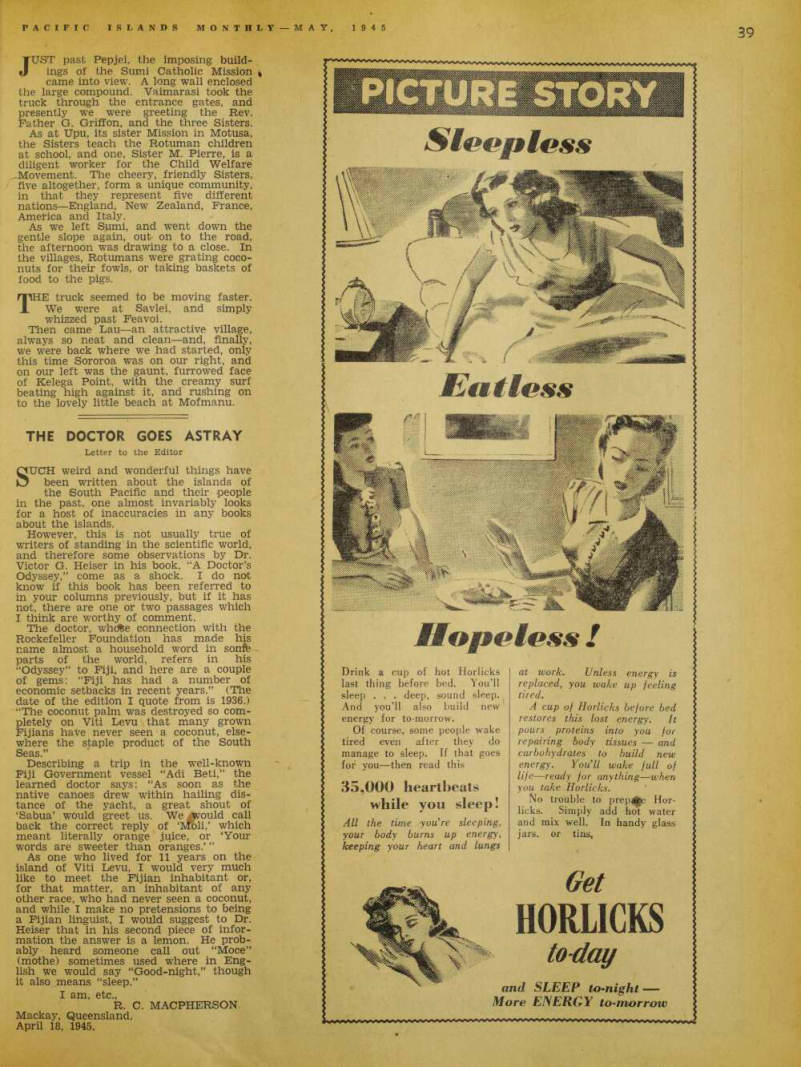
By Amel
LEAVING Motusa after lunch, with Vaimarasi at the wheel of the truck, we set off on a leisurely drive around the “larger” part of the island.
Out to the left sparkled the placid waters inside the reef, and standing boldly against the sky like a miniature Rock of Gibraltar was Sororoa, 750 ft., the highest “mountain” on the mainland of Rotuma.
A few miles out to sea was the dark, mysterious-looking island of Uea, which topped Sororoa by 50 ft.
The road ran along the level for a short distance and then climbed a steep hill, on the top of which was the Government Station, Ahou. This station, with its buildings set amid smooth green lawns, beautiful flowers and handsome trees, and with the deep green of the Rotuma bush for a background, must be one of the most attractive in the Fiji Group. There is a wonderful view of the narrow isthmus which links the two parts of this quaintly shaped island, and of the Bay and the anchorage at Motusa. Sunshine makes a delightful play of colour in the clear water. The foam of the unsleeping surf encloses the Bay, and beyond it is the glorious blue of the deep sea. The scene by moonlight has an unbelievable splendour.
From Ahou, the road descended the other side of the hill, and then traversed more level country for several miles. We had all the afternoon at our disposal, so Vaimarasi did not try to break any speed records.
The truck ambled along the hard, white coral road that wound past coconut groves, clumps of banana trees and masses of the lush tropical flora for which the island is noted.
Here, a three-foot stone wall, built of pieces of volcanic rock, protected some body’s garden, where yams, taro, paw paw and tapioca jostled each other, and water-melons ripened in the sunshine on the rock-strewn ground. Further on, the same kind of stone wall was a pig fence —a large pig fence, where dozens of small pigs ran squealing, while their mothers lay in the shade of the forest trees and
were too blase to raise an eyebrow at the noisy truck.
We passed sprawling villages, and vil lages whose smallness scarcely merited the name, and the houses therein were a queer mixture of the neat and the slovenly, the clean and the squalid.
Rarely did we see a village with houses of a more or less uniform style, as in Fiji. There were sago leaf houses with iron roofs, corrugated iron houses with sago palm roofs, wooden houses with thatched or iron roofs, limestone houses with various kinds of roofing material and houses that had fallen into such a decrepit state that they were houses no longer. We thought the most picturesque house was the one of white-washed lime stone, with red-painted roof, walls two feet thick and flowers and gay crotons growmg around it.
But the appearance of every village, no matter what the condition of the houses it contained, was always enhanced by its
trees—frangipanni, flamboyant, bread
fruit, kapok, mango, fawa and those magnificent dilo trees which overhang most of the beaches, and are such a feature of the Rotuma landscape.
IT has been said that Rotuma is an island of flies and tombstones, and it must be admitted that both are numerous. The cemetery was con spicuous in every village we passed, how ever small, and, although the graves were usually too close together, the tombstones were often extremely elaborate. Some were cement, the work of local craftsmen, but many were of marble, and imported direct from Sydney in bygone years.
Some Rotumans have quaint ideas about what is a fitting cover for their dead. In the Motusa cemetery, for instance, one of the tombstones consists of a cement house, large enough for people to enter, and complete with iron roof, glass win dows with green curtains, and seats inside so that if they wish, bereaved persons may sit there, near the deceased.
This is a favourite Rotuman custom.
Parents of a dead child will sleep along side its grave and keep a lantern burning all night, so that it will hot be lonely or frightened. Unlike many native races, Rotumans appear to have no super stitious fear of their dead. rE truck wandered slowly along. Fowls, pigs and ducks removed themselves from its path, but Vaimarasi had to make loud noises at a cow which stood on the road swishing its tail and regard ing us thoughtfully.
We took time off to say hello to our Branch storekeepers, and at Lopta we inspected the locally famous swimming pool, which is a popular picnicking place at low tide, when the water in the pool, fed by an underground spring, is almost fresh. But when we saw it, the tide was high, with a heavy swell running. Every wave thundered through a narrow channel in the rocks, and into another aperture, to foam half-way up the glistening black sides of the pool, which was shrouded in misty spray. It was, in fact, the last place one would choose for a swim.
We passed villages whose strange names spelt Mystery and Romance—Jumi Jumi, Malha’aa, Oinafa, Noatau—and near Kalvaka we came to Rotuma’s “river,” which has all the appearance of being a wide, shallow river, until suddenly the sea is visible at one end. When the tide is on the ebb, the illusion is complete.
Actually, the “river” is a channel, half a mile long and 100 yards wide, lying be tween the mainland and the high, heavily wooded island of Solkope.
JUST past Pepjei, the imposing build ings of the Sumi Catholic Mission came into view. A long wall enclosed the large compound. Vaimarasi took the truck through the entrance gates, and presently we were greeting the Rev.
Father G. Griffon, and the three Sisters.
As at Upu, its sister Mission in Motusa, the Sisters teach the Rotuman children at school, and one, Sister M. Pierre, is a diligent worker for the Child Welfare -Movement. The cheery, friendly Sisters, five altogether, form a unique community, in that they represent five different nations —England, New Zealand, France, America and Italy.
As we left Sumi, and went down the gentle slope again, out on to the road, the afternoon was drawing to a close. In the villages, Rotumans were grating coco nuts for their fowls, or taking baskets of food to the pigs. rE truck seemed to be moving faster.
We were at Savlei, and simply whizzed past Feavoi.
Then came Lau —an attractive village, always so neat and clean —and, finally, we were back where we had started, only this time Sororoa was on our right, and on our left was the gaunt, furrowed face of Kelega Point, with the creamy surf beating high against it, and rushing on to the lovely little beach at Mofmanu.
The Doctor Goes Astray
Letter to the Editor
SUCH weird and wonderful things have been written about the islands of the South Pacific and their people in the past, one almost invariably looks for a host of inaccuracies in any books about the islands.
However, this is not usually true of writers of standing in the scientific world, and therefore some observations by Dr.
Victor G. Heiser in his book. “A Doctor’s Odyssey,” come as a shock. I do not know if this book has been referred to in your columns previously, but if it has not, there are one or two passages which I think are worthy of comment.
The doctor, whdfee connection with the Rockefeller Foundation has made his name almost a household word in sorrfle parts of the world, refers in his “Odyssey” to Fiji, and here are a couple of gems: “Fiji has had a number of economic setbacks in recent years.” (The date of the edition I quote from is 1936.) “The coconut palm was destroyed so com pletely on Viti Levu that many grown Fijians have never seen a coconut, else where the staple product of the South Seas.”
Describing a trip in the well-known Fiji Government vessel “Adi Beti,” the learned doctor says: “As soon as the native canoes drew within hailing dis tance of the yacht, a great shout of ‘Sabua’ would greet us. call back the correct reply of ‘Moli,’ which meant literally orange juice, or ‘Your words are sweeter than oranges.’ ”
As one who lived for 11 years on the island of Viti Levu, I would very much like to meet the Fijian inhabitant or, for that matter, an inhabitant of any other race, who had never seen a coconut, and while I make no pretensions to being a Fijian linguist, I would suggest to Dr.
Heiser that in his second piece of infor mation the answer is a lemon. He prob ably heard someone call out “Moce” (mothe) sometimes used where in Eng lish we would say “Good-night,” though it also means “sleep.”
I am, etc.,
R. C. Macpherson
Mackay, Queensland.
April 18, 1945.
Advertisements & other items, pp. 41-42 (1 item)
Sleepless
1
•9 r A
Eat less
f. mi m &
Hopeless I
Drink a cup of hot Horlicks last thing before bed. You’ll sleep . . . deep, sound sleep.
And you’ll also build new energy for to-morrow.
Of course, some people wake tired even after they do manage to sleep. If that goes for you—then read this
35,000 heartbeats
while you sleep!
All the time you’re sleeping, your body burns up energy, keeping your heart and lungs at work. Unless energy is replaced, you wake up feeling tired.
A cup of Horlicks before bed restores this lost energy. It pours proteins into you for repairing body tissues and carbohydrates to build new energy. You’ll wake full of life —ready for anything—when you take Horlicks.
No trouble to Horlicks. Simply add hot water and mix well. In handy glass jars, or tins. m
Get
HORLICKS
today
and SLEEP to-night More ENERGY to-morrow
CHATEAU D’OR
COGNAC VIEUX
☆ W ☆ F
NET CONTENTS 26 FLUID OUNCES
C. SULLIVAN & CO
SYDNEY
PRODUCE OF AUSTRALIA
HILL’S
FINE ENGLISH
CIGARETTES
•SPINET
•SUN R I P E
• GOLD FLAKE
• AIR MAIL
HIGH-GRADE
TOBACCOS
BADMINTON
SPINET
Pacific Islands Distributors : C. SULLIVAN Pty. Ltd., Sydney
adv
C. SULLIVAN Pty. Ltd.
GENERAL MERCHANTS ISLANDS AGENTS
REPRESENTING LEADING FIRMS IN THE PACIFIC ISLANDS.
Islands Produce sold on Shippers’ Account—Liberal Advances against Consignments.
Buyers of all Islands’ Requirements on Commission—Original Invoices Furnished.
Bankers'. Bank of New South Wales .. Bank of New Zealand .. Comptoir National d’Escompte de Paris.
Wartime Cable Address: Sullivan, Kents tree!, Sydney.
379 KENT STREET, SYDNEY, N.S.W.
Equipment And Mopping-Up
In New Guinea
(■Contributed by an AIF Officer) WHY all this fuss about lack of equip ment, and the so-called ‘’mopping up” in New Guinea and the Islands?
As a soldier who has just returned from the areas under discussion, and is looking forward to returning there in the near future, I think I know something about the conditions.
There is no lack of equipment for the soldier fighting in the field. As Senator Fraser has stated in his report, the shipping shortage is unavoidable and world-wide. If Australian unionists would only do a portion of their share of work, this deficiency would not be nearly so serious as it is.
As regards “mopping-up,” I think cer tain politicians are merely trying to bring the Government into disrepute by leading the electors to believe that the Government is sacrificing Australian lives through undertaking unnecessary opera tions. If it had not been for the residents of New Guinea and the Solomons, and for the natives whom they organised, the job of regaining those Territories would have been much more costly, and would have taken a much longer time than it actually did take.
Surely the European residents of the Territories and the natives are entitled to some appreciation of their efforts. And what better appreciation than to help them to finally clear the Japs out of their homes? All this talk of the by passed Japs not being a menace is dangerous complacency. They are culti vating the land and digging themselves in; in fact, making their homes there, and every month that they are left alone, not only strengthens their position, but also lowers our prestige in the sight of the natives.
It must be very encouraging to the by passed Japs and the Tokio war-lords to listen over the wireless to the internal strife in Australia over a matter which to their minds is not open to any argu ment at all. It is obvious to all intelli gent people, whether they* are Europeans, Asiatics or natives, that the Japs who have been by-passed must be exterminated as quickly as possible.
The Japs in the southern Philippines who have been by-passed are being “mopped-up" by the Americans with Philippine guerrilla assistance, and the Allies are assisting the French to “mop up” the by-passed Germans in various French ports.
Surely it is up to Australia to “mop-up” the by-passed Japs in her own Terri tories.
Australian soldiers have been spine bashing for a long period of the war, and should be employed doing something for their pay and for the taxpayers’ money. Also, any one can tell the poli ticians at Canberra that one of the worst things for a soldier’s morale is continual inactivity.
They have begun to do a job at last and are doing it well, at little cost to themselves and great cost to the enemy, and in spite of shipping shortages. So why try to call them off?
Another point that occurs to me is this: Do the people who are making all the fuss at present know what divisions are en gaged in this so-called “mopping-up,” and do they know what proportion of Australia’s fighting forces they represent?
If they do not know this, hoW are they to know that even greater Australian forces may even now be on the eve of undertaking some very much greater
operation? I think the matter should be left in the hands of the people who are doing the job, seeing that the electors put it into their hands by a large majority.
How To Recover Kapok
(To the Editor) “ A MEL'’ (“PIM,” 17/4/45) and her partner Tom should have known better in their efforts to debunk kapok-in-the-pod. All they required was an empty, lidless oil-drum, into which receptacle the husked pods are tossed, until the drum is, say, one-quarter full.
Then, with a corrugated, short broom handle bunged into the middle of the silky mass, twirl it speedily to and fro.
The kapok congregates around the imper tinence, and the irritating black seeds find themselves huddled in the outer darkness. Tis all a matter of centrifugal force.
I am, etc.,
Aweel.
Queensland.
Anzac Day At Madang,
Tng
ANZAC Day was celebrated very quietly at Madang. Services were held at different chapels during the morning. At 11 o’clock a parade of representatives of the three services ( Military, Navy and Air Force) assembled at the military cemetery, and a wreath, on behalf of the RSSAILA, was placed there by Capt. Knobbs, and another, on behalf of the NGVR, by W/O R. Mac gregor. Wreaths were also laid in remem brance of Lieutenants P. Tuckey, L. Bell and D. Laws, who were buried in this cemetery. ANGAU was represented by Major Moy (Administration) and Lieut.
Boness (Native Labour).
From March 7, Governor Henri Sautot, of Oubangi-Chari, has taken over the duties of Acting Governor-General of French Equatorial Africa. He was for merly Governor of New Caledonia.
Advertisements & other items, p. 43 (1 item)
Dependability
Allen Taylor & Co. Ltd.
COMMERCIAL ROAD, ROZELLE,
SYDNEY
Sawmillers and Wholesale Suppliers of Hardwoods for Constructional Purposes GIRDERS ... PILES . . POLES .. . SLEEPERS, Etc.
EXPORTING TO PACIFIC ISLANDS SINCE 1893
u in
Dependability
For over forty years, Coleman Appliances have enjoyed a world wide reputation for Dependability. Gasoline (Petrol) and Kerosene (Paraffin) pressure Lanterns, Lamps, Stoves, and Irons with many exclusive Coleman Features are daily giving trouble-free service at low operating cost to millions of users all over the world. Look for the name COLEMAN—It stands for the Finest in Lighting, Cooking and Heating Appliances. I
THE COLEMAN LAMP
i AND stove company limited
TORONTO, CANADA
CHICAGO, USA
Atabrin for the Ardent
AND what is man’s most precious possession? A line on it—being an extract from an article by Paul de Kruif, Americanon the use of Atabrin in the treatment of malaria : An unexpected obstacle in persuad ing New Guinea troops to take their pills was that Atabrin was scienti fically termed a suppressive, which meant that it did not always cure malaria, but kept the disease under the surface in your body. Many American soldiers mistakenly took this to mean that Atabrin might im pair their sexual vigor, and in this belief they were fortified by leaflets dropped by the Japanese. In over coming their apprehension, the authorities showed marked ingenuity.
New Guinea camps blossomed with huge bill-boards, picturing a jolly Sultan, nibbling an Atabrin pill and smiling at a dancing girl while re marking: “Atabrin keeps me going.”
A Fiji Indian member of the Methodist Church, the Rev, R. R. Deoki, has com pleted the final examination of Arts deg.ree at Auckland University.
Plea For Polynesian Peoples
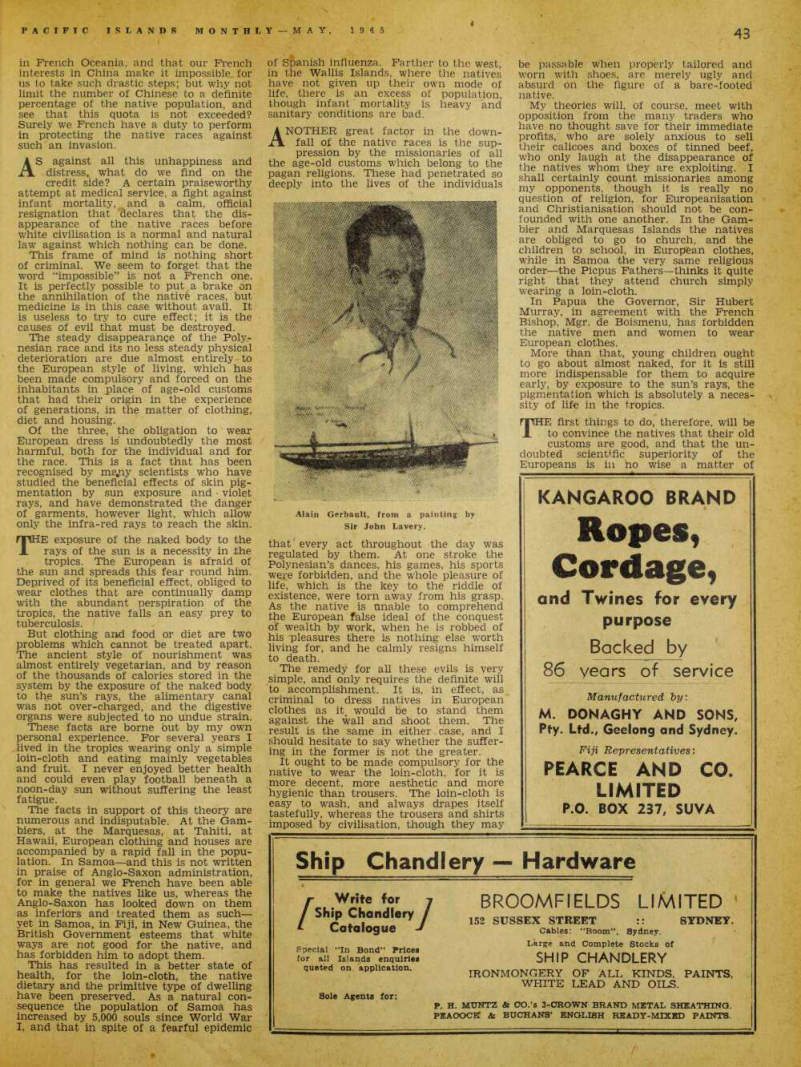
The Theories and Arguments of Alain Gerbault
JN the “ PIM” of December last we published the life-story of Alain Gerbault, whose most untimely death (from fever ) occurred in Dili, Portu guese Timor, in December, 1941. This Frenchman was famous for his single handed navigation of small yachts around the world.
In his last book, “Gospel of the Sun,” published just before the out break of World War 11, Gerbault made an urgent plea that the Poly nesians’ way of life be protected from “Europeanisationand he attacked Western civilisation which, he de clared, is already on the decline' and will eventually disappear.
New principles of government, for application in many lands of the Pacific,, are even now being sought.
We have considered it timely, there fore, to publish hereunder a number of extracts from Alain Gerbault’s book, “Gospel of the Sun.” His state ments and his arguments may help some of those who are seeking a better administrative set-up in Poly nesia.
IT is, indeed, impossible to leave those marvellous Pacific Islands without a sickening distress at the sight of the steady disappearance and dreadful decad ence of the native races.
I will exemplify my statement in the order of the places I visited on my voyage.
In the Gambler Islands (French Oceania) there remain 500 survivors of a population that once numbered 5,000; and these survivors are of poor physique, are clothed in cast-off European clothing, ignore their ancient history and tradi tions, and are already contaminated by the desire of making money.
In the Marquesas (French Oceania; it is more striking. Eighteen hundred in habitants are all that remain of a population that exceeded 100,000, when the first explorers visited the islands. To such small numbers is reduced the finest race of men the world has ever seen, whose beauty struck Quiros and Captain Cook with amazement.
Tahiti is even sadder. Hardly any pure Tahitians are left; the race is absorbed and disappears before the half-caste ele ment, and even more before the Chinese, who have been allowed to invade the island and purchase land. Ihe Govern ment seems unaware of the danger, and each succeeding Governor prefers to be queath to his successor the legacy of dealing with this situation. The Chinese are already more than half the popu lation of the island, a great part of the business and of the lands belongs to them; and, simply because no one will take the necessary steps to put matters on a proper footing, Tahiti is fast becom ing nothing more than a Chinese island.
In Samoa, where the English and Americans govern, radical steps have been taken to absolutely prohibit Chinese im migration, and it has been made illegal for foreigners to own land.
I know I shall be told that it is im possible to do away with foreign labour
in French Oceania, and that our French interests in China make it impossible for us to take such drastic steps; but why not limit the number of Chinese to a definite percentage of the native population, and see that this quota is not exceeded?
Surely we French have a duty to perform in protecting the native races against such an invasion.
AS against all this unhappiness and distress, what do we find on the credit side? A certain praiseworthy attempt at medical service, a fight against infant mortality, and a calm, official resignation that declares that the dis appearance of the native races before white civilisation is a normal and natural law against which nothing can be done.
This frame of mind is nothing short of criminal. We seem to forget that the word “impossible” is not a French one.
It is perfectly possible to put a brake on the annihilation of the native races, but medicine is in this case without avail. It is useless to try to cure effect; it is the causes of evil that must be destroyed.
The steady disappearance of the Poly nesian race and its no less steady physical deterioration are due almost entirely to the European style of living, which has been made compulsory and forced on the inhabitants in place of age-old customs that had their origin in the experience of generations, in the matter of clothing, diet and housing.
Of the three, the obligation to wear European dress is undoubtedly the most harmful, both for the individual and for the race. This is a fact that has been recognised by me,ny scientists who have studied the beneficial effects of skin pig mentation by sun exposure and violet rays, and have demonstrated the danger of garments, however light, which allow only the infra-red rays to reach the skin. rE exposure of the naked body to the rays of the sun is a necessity in the tropics. The European is afraid of the sun and spreads this fear round him.
Deprived of its beneficial effect, obliged to wear clothes that are continually damp with the abundant perspiration of the tropics, the native falls an easy prey to tuberculosis.
But clothing and food or diet are two problems which cannot be treated apart.
The ancient style of nourishment was almost entirely vegetarian, and by reason of the thousands of calories stored in the system by the exposure of the naked body to the sun’s rays, the alimentary canal was not over-charged, and the digestive organs were subjected to no undue strain.
These facts are borne but by my own personal experience. For several years I lived in the tropics wearing only a simple loin-cloth and eating mainly vegetables and fruit. I never enjoyed better health and could even play football beneath a noon-day sun without suffering the least fatigue.
The facts in support of this theory are numerous and indisputable. At the Gam biers, at the Marquesas, at Tahiti, at Hawaii, European clothing and houses are accompanied by a rapid fall in the popu lation. In Samoa—and this is not written in praise of Anglo-Saxon administration, for in general we French have been able to make the natives like us, whereas the Anglo-Saxon has looked down on them as inferiors and treated them as such— yet in Samoa, in Fiji, in New Guinea, the British Government esteems that white ways are not good for the native, and has forbidden him to adopt them.
This has resulted in a better state of health, for the loin-cloth, the native dietary and the primitive type of dwelling have been preserved. As a natural con sequence the population of Samoa has increased by 5,000 souls since World War I, and that in spite of a fearful epidemic
of Spanish influenza. Farther to the west, in the Wallis Islands, where the natives have not given up their own mode of life, there is an excess of population, though infant mortality is heavy and sanitary conditions are bad.
ANOTHER great factor in the down fall of the native races is the sup pression by the missionaries of all the age-old customs which belong to the pagan religions. These had penetrated so deeply into the lives of the individuals
that every act throughout the day was regulated by them. At one stroke the Polynesian’s dances, his games, his sports were forbidden, and the whole pleasure of life, which is the key to the riddle of existence, were torn away from his grasp.
As the native is unable to comprehend the European false ideal of the conquest of wealth by work, when he is robbed of his pleasures there is nothing else worth living for, and he calmly resigns himself to death.
The remedy for all these evils is very simple, and only requires the definite will to accomplishment. It is, in effect, as criminal to dress natives in European clothes as it. would be to stand them against the wall and shoot them. The result is the same in either case, and I should hesitate to say whether the suffer ing in the former is not the greater.
It ought to be made compulsory for the native to wear the loin-cloth, for it is more decent, more aesthetic and more hygienic than trousers. The loin-cloth is easy to wash, and always drapes itself tastefully, whereas the trousers and shirts imposed by civilisation, though they may
be passable when properly tailored and worn with shoes, are merely ugly and absurd on the figure of a bare-footed native.
My theories will, of course, meet with opposition from the many traders who have no thought save for their immediate profits, who are solely anxious to sell their calicoes and boxes of tinned beef, who only laugh at the disappearance of the natives whom they are exploiting. I shall certainly count missionaries among my opponents, though it is really no question of religion, for Europeanisation and Christianisation should not be con founded with one another. In the Gam bier and Marquesas Islands the natives are obliged to go to church, and the children to school, in European clothes, while in Samoa the very same religious order —the Picpus Fathers —thinks it quite right that they attend church simply wearing a loin-cloth.
In Papua the Governor, Sir Hubert Murray, in agreement with the French Bishop, Mgr. de Boismenu, has forbidden the native men and women to wear European clothes.
More than that, young children ought to go about almost naked, for it is still more indispensable for them to acquire early, by exposure to the sun’s rays, the pigmentation which is absolutely a neces sity of life in the tropics.
THE first things to do, therefore, will be to convince the natives that their old customs are good, and that the un doubted scientific superiority of the Europeans is in no wise a matter of
Alain Gerbault, from a painting by Sir John Lavery.
clothing, for it is one of the most bar barous, unhygienic and uncomfortable — imposed by a tyrannic civilisation that admits of neither progress, innovation nor originality in the modes of life, and which considers the individual search for hap piness of but secondary importance.
The picturesque native huts and dwell ings must also be re-introduced, for they are healthy, well aired and comfortable.
On the contrary, in the Marquesas there is a law dating back some fifty years that makes it compulsory to build houses of deal board, with corrugated iron roofs.
Do not think that I am inimical in principle to the progress of science. I think that it would be good to cement the floors of all the dwellings, making them clean and easily washable, as I have seen done in the Malay huts at Dutch Timor; but the old paepor, or platform, on which the Marquesan houses were built is infinitely better than plank flooring, as is also the fine gravel used in the huts of Samoa. Just in the same way, mats are much more suitable for use in the tropics than the European beds and mattresses introduced into Gambier and Marquesas Islands.
I have said that food and clothing are inseparably bound up together. And yet during my stay in the islands I had an opportunity of seeing the report of a pre -1914 medical administrator who affirmed that the food of the Marquesans was in sufficient, and that he hoped that intro duction of tinned food and European dietary would be of great benefit to the Marquesan race.
Truly, the fruit and vegetable diet of the native needs to be supplemented by the great quantity of calories that is given by the exposure of the skin to the sun’s rays, but this mischievous and dangerous report entirely ignored the nutritive and antirachitic value of irradiated food, and its author was also wholly unaware of the modern discoveries of the new-born bioheliochemical science.
I HAVE already explained that the life of the natives has been made too severe by the senseless suppression of all their ancient customs, without dis crimination. They must be given back all their old pleasures in life; their open-air dances must be encouraged, and sports must be developed' to take the places of their ancient games, which have dis appeared. \ The Polynesians were anciently a people passionately addicted to sport, and one day I will write about the games and pastimes in which they used to excel.
Men of magnificent physique, carefully teamed for their innumerable com petitions, their one idea was to rival each other in strength and skill. Their chiefs were also the greatest athletes in throw ing the javelin, wrestling, playing a sort of football, surf riding, as well as in such pastimes as spinning tops, archery, walk ing on stilts, kite-flying and other games of great social importance.
In Samoa, cricket has long been estab lished, and Rugby football is being encouraged by the New Zealand Govern ment. Alas, among our administrators in far away French Oceania, the anti sporting spirit of pre-1914 days existed when I was there, and no steps whatever were taken to develop sports and games among the natives!
This is not written in any spirit of criticism or carping against French colonial administration, for I have seen remarkable results obtained in our colony of Morocco, where the native customs and arts are encouraged. The pity is that there never was in French Oceania a Governor with the initiative, the force and the means that were the assets of Lyautey in Morocco.
One thing is certain: a protectorate has
many advantages over annexation. The natives keep their customs and arts, and their own chiefs are responsible for the good government of the country; our laws and Napoleon code have not been made for them.
When a country is annexed, it becomes extremely difficult to obtain native labour to carry out necessary public works.
Robbed of all initiative, the native casts the burden of supporting him upon his conquerors, and takes no thought for the future. Thus it is that Rapa (French Oceania), which in old times, thanks to its ingenious system of irrigation, afforded the means of subsistence to over 5,000 souls, now possesses a bare hundred, who exist solely on the help and food sent over to them from Tahiti. rE tenure of the Governor’s office in Oceania is four years, and each successively does his best to avoid any complications and difficulties during his short term of duty. It is always a matter of regret to me that there is no continuity of policy, and there is not at Tahiti a Governor who loves the people enough to consecrate his life to their service. In my opinion a naval Govern ment would be the best for these distant islands, whose strategic importance far outweighs their limited commercial in terests.
Such a Government, like that of the American Navy at Samoa, is far better adanted to the protection of the natives against the short-sighted exploitation of big trading firms. It is for lack of such government that the administration at Tahiti is practically powerless in applying the stringent regulations against the sale of alcohol to the natives by the traders.
The question of schools presents a marked contrast with what has been done in Morocco. If Europeanising and Chris tianising have been confounded, the same mistake has been made between instruc tion and education. Thus I can state with sorrow that in the Gambier Islands all the native children were confined within school buildings during the morn ings and afternoons, when it would have been infinitely better for their health if they had been left to play naked out in the open air and sunshine. There were considerable efforts, . praiseworthy, no doubt, but utterly futile if not harmful, to teach them the same things and no more, which are taught in our schools—the his tory by Lavisse and the geography of the French Departments.
Yet neither at the Gambier, nor at the Marquesas, nor at Tahiti, are there any modern native arts. Children are not trained in how to fight and live in their tropical surroundings—an education that they had in old times when everything was memorised by song and verse, when the art of navigation was taught in the Marquesas schools and when sculpture, poetry and dancing flourished. Every thing is now forgotten, and the native of to-day is incapable even of building a dug-out canoe or making tapas or mats.
Schools are necessary, of course, but why cannot we do in Polynesia what we have done in Morocco, and use them to restore the native handiworks and arts so neces sary to the existence of a nation? The schools should, above all, be professional, and held in the open air. The children should be taught the history of their own land, and be made to renovate their national crafts and arts, poetry and sculp ture. They should be instructed in physical culture, sports and general ex posure of the body to the sunshine which are a necessity to save the race from degeneration, and will also fight effic aciously against the ravages of alcohol.
All this is far more important for com munities living in small islands than learning to read or to write. If this were
done the natives of tropical climates would be able, as in old times, to multiply and live in health and happiness.
When one has visited, as I have, many and distant lands, it is indeed stupefying to witness the inconceivable pretensions of the white race that seeks to impose everywhere its customs and its strange conceptions of life on all whom it con quers. It has always been the same.
Thus, with the invasion of the Conquis tadores, disappeared the ancient Inca civilization, which possessed a social organi sation that has never been equalled. Thus also vanished the Aztec culture, which was far superior to that of its conquerors, both in the science of astronomy and the art of sculpture.
Are the Polynesians going to disappear like the Caribbeans? It would be an everlasting shame to the white race, which has hitherto always shut its eyes to the fact that these aboriginals, since they
were living content with few needs, were more advanced in the true science of life —happiness.
And also our civilisation has not even troubled to profit by the lessons taught by these natives. Despite a great mechanical and scientific development, it clings to a false ideal, for the winning of wealth, and the enjoyment of the fictitious plea sures it can procure, are directly opposed to the happiness of the individual. That is why our civilisation already is on the decline and will disappear, as disappeared all its predecessors.
Mr. Charles R. Turbet, who was Senior Veterinary Officer in Fiji for over 20 years, and who acted on occasion as Director of the Department of Agricul ture, passed through Australia recently en route to Ceylon, vrhere he will serve as a specialist, on the production side, in animal husbandry.
Advertisements & other items, pp. 44-48 (2 items)
W. Kopsen & Co. Pty. Ltd.
5 RU e s
IYI
LOTI
For Isflanad Era* and EraUda
SOLD EVEKTWREIZ
H. A. Wmi 4 Ca. Pty. Lb L, KBbm 9L. >y#aw
SIMPLEX Marine Engines and Launches
j Simplex 10/12 h.p. Marine Engine.
Also made in 3 h.p. and 5 h.p.
SIMPLEX MARINE ENGINES
for all small boats are the most popular in Australia to-day.
Used by all Service Departments, including Navy, R.A.A.F., and Army. Available at present only for essential orders or licensed fishermen.
SIMPLEX LAUNCHES we regret are temporarily unavailable, but we shall be pleased to forward details on request.
Simplex Motor Launches, 14 ft., 16 ft., 18 ft., and 20 ft. long.
Manufacturers of all classes of boat-building materials and boat accessories. Agents for the best Australian hardware manufacturers. Some of the new attractive lines are as follows: Kopsen's 300 c.p. Kerosene Pressure Lamps; Thermil Kerosene Stoves; Darlton Blowlamps; CQR Anchors; Vortex Bilge Pumps; Companion Primus Stoves; Briggs & Stratton Petrol Motors and Power Generators; Dekol Wood Preservative, Alpha Antifouling Paints, Please Send List of Your Requirements for Quotation.
W. Kopsen & Co. Pty. Ltd.
SHIPCHANDLERS & HARDWARE MERCHANTS
376/382 KENT STREET, SYDNEY, N.S.W.
'Phone: MA6336 (6 lines). Cables: Kopsen Sydney.
Ropes,
KANGAROO BRAND
Cordage,
and Twines for every purpose Backed by 86 years of service Manufactured by :
M. DONAGHY AND SONS,
Pty. Ltd., Geelong and Sydney.
Fiji Representatives:
PEARCE AND CO.
LIMITED
P.O. BOX 237, SUVA
Ship Chandlery Hardware
r Write for j
j Ship Chandlery /
£ Cataloaue J
Catalogue
Special “In Bond” Prices for all Islands enquiries quoted on application.
BROOMFIELDS LIMITED
152 SUSSEX STREET :: SYDNEY.
Cables: “Boom”, Sydney.
Large and Complete Stocks of
SHIP CHANDLERY
IRONMONGERY OF ALL KINDS. PAINTS,
WHITE LEAD AND OILS.
Sole Agents for: P, H. MUNTZ Sc CO.’s 3-CROWN BRAND METAL SHEATHING.
PEACOCK Sc BUCHANS’ ENGLISH READY-MIXED PAINTS.
IMPORTANT
INFORMATION !
Not only for souvenirs, but also for attractive ornaments —which show how hand-work exceeds machine-work.
Latest designs in ‘‘Silver Filigree” such as: Necklaces, bracelets, brooches, earrings, rings for ladies and men, puzzle rings, etc.
Cat’s-eyes (sea-shells which resemble real eyes in colour) fixed in silver filigree and tortoiseshell ornaments; tortoise-shell watch-bands with strong hinges.
Complete list of our goods and prices will be furnished on application. Assorted samples of tortoise-shell and silver filigree ornaments will be sent on receipt of £4 ($l5 in American currency).
Write to —
MAVJI KALIDAS
JEWELLER
P.O. BOX 16, NADI, FIJI.
Bankers: Bank of N.S.W.
Lautoka: Fiji.
Inquiries are Invited with Assurance of Our Special Attention.
PRODUCING UNIFORM GOOD RESULTS SINCE 1868
ALWAYS ASK FOR IT
HARRY J. YOUNG PTY. LTD.
Sole Pacific Islands Selling Representatives
and Distributors for the following Leading
Australian Manufacturers: —■
BONDS INDUSTRIES LTD.
Manufacturers of All Types of Underwear, Hosiery, Half Hose, Sewing Cottons.
COMMONWEALTH WEAVING MILLS PTY. LTD.
Manufacturers of "DriGlo" Towels and Towelling of every description.
J, W. TRATHEN & CO. PTY. LTD.
Manufacturers of "Red, White Gr Blue" Handbags, Pouches, Wallets, Note Cases, School Bags, Purses, Watch Cases, Belts, Straps, Razor Strops and sundry leather lines.
COTTEE'S PASSIONA LTD.
Manufacturers of "Passiona" Fruit Cordials, Fountain Syrups, Jams, Spreads, Peanut Butter, Peanut Products and Jellies. •
HARRY PECK & CO. PTY. LTD.
Manufacturers of the famous "Anchovette," Bloater Paste, and Specialists in Potted Meats.
ALPHA KNITWEAR PTY. LTD.
Manufacturers of Men's and Boys' Polo Shirts, Ladies' Knitted Blouses, Jumpers, Skirts.
Enquiries through your usual channels appreciated, and prompt shipments effected.
V Eagle & Globe Building, 879 Kent St., Sydney n.s.w.
Postal Address: Box 3661, G.P.0., Sydney.
Bankers: Bank of N.S.W.
Codes: Bentley’s Comp. Phrase.
Bentley’s 2nd Phrase.
WANTED TO BUY—QUALITY GUNS AND RIFLES
HIGHEST PRICES GIVEN. WILL ALSO EXCHANGE GUNS.
New .303 Short Service Barrels, 25W’, without Sights and Platform, £2/15/- each.
Postage extra.
SI L RO H U Quality Firearms and Fishing Tackle. 143 ELIZABETH STREET (Near Market St.) SYDNEY.
'PHONE: MA 3540.
SHEAFFER’S WORLD FAMOUS
Streamlined, Feather Touch PENS and PENCILS
If you want Design, Beauty and Quality buy
a SHEAFFEB
All Lifetime Pena are guaranteed for the life of the user except against loss and wilful damage.
When serviced, they are subject to a small fee for insurance, postage and handling.
Beautiful and Useful Gifts for All Occasions.
SKEIP- The
Successor to Ink makes all Pens write better. 2 oz. 1/6, 4 oz. 2/6 Plus Postage Distributors Identify the Lifetime Pen bv the white dot
74T LTZC AA 3T
Feather Touch Lifetime Pencil Regular Pen Lifetime fen Pencil £,d 2L/- 76/- each 351- ea. each each The working parts of the SheaSer Pencil are guaranteed against wear for the lifetime of the user.
When serviced they are subject to a small fee for insurance, postage and handling.
All Sheaffer regular pens are guaranteed against defects of material and workmanship.
Obtainable from Selected Jewellers and Stationers everywhere
EXCELSIOR SUPPLY GO. PTY. LTD,
278 Post Office Place,
MELBOURNE, VIC.
HEAD OFFICE}
160 BROADWAY,
SYDNEY, N.S,W.
50 Victoria Street,
WELLINGTON, N.Z.
in Papua
Native Labour Conditions in Papua
Letter to the Editor 1HAVE spent 33 years in Papua, and I can ‘ claim to know something about the indentured labour system. I know of no practicable alternative. Free labour at the present stage of the natives’ mentality is out of the question. I have had natives come to work for me on “contract” as they call it—that is, agree ing to work for a certain time. Then they would come to me, in a few days, and ask me to sign them on, on inden tures, because they knew that they would not stop otherwise. They would get some word from their home by the first boat that came in, and then they would say they wanted to go home. I have had seven leave me in half an hour, and I have had to get prison labour as a con sequence. Not once during my 33 years in the Territory have I had any natives complete their time on “contract,” except it was' of short duration.
The Rev. Mr. Burton calls the wages poor. I have no recollection of any of these churchmen saying that a white man’s wages were poor, 50 years ago. The native has £6, at the least, when he is paid off. He has been well fed and cared for while he was at work. I have paid natives as much as £3/10/- per month after training them for several terms.
I worked for a big Victorian firm of contractors, 48 years ago, and I got no doctor or medicine, or holidays, and I was not paid for any time I was not at work. I had to work 10 hours a day, Saturday included. I neither smoked nor drank, yet I did not collect £6 at the end of the year.
The Rev. Mr. Burton says the medical attention was insignificant. I have not found it so. Any plantation manager, or any other employer of labour, was expected to send a sick boy to the hos pital if the trouble was beyond his know ledge. That meant boat fares in and out, and 2/- a day in the hospital. Major operations were performed, if necessary, and the patient was willing—I have paid £13 fees for one boy. In his village he would not have had the attention and probably would have died.
The moral side of the question I am utterly unable to see. The wife of a boy away at work will be very lucky if she is anything but chaste while he is away —she is too well, looked after. For the boy it matters very little—he does about the same at home or abroad.
In one article Mr. Burton suggested that people be paid some money for their properties and kicked out of the Terri tory. He would not feel very happy if one said that he was not a Christian; but I do not think he* shows a very Christian spirit in his letter. Has the reverend gentleman ever had anything that took the best part of 40 years to build up, and used all his young life doing it? I doubt it, otherwise he would not want to kick people out into the world in their old age to start life over again.
People could not get a fraction of what it cost to build their places. When I came to the Territory the Government was offering inducements to people to settle in the country. He would repudiate all this, with a sweep of his hand, and say, “Get out—you are not wanted here. Die if you like, in making another home, but get out.”
I am, etc.,
W. G. Young.
Papua, April, 1945,
Tahiti's Prosperity
From Our Own Correspondent PAPEETE, March 20. r HITES Budget for 1945 has been fixed at 63,180,000 francs, a consider able increase over former years.
The South Seas souvenir trade, stimu lated by a huge demand by American organisations, is flourishing here as never before, Tahiti setting a high standard of efficiency in the manufacture of Poly nesian carvings, grass skirts, shell orna ments and many of the other objects which American Servicemen like to send home to thei, v wives and sweethearts.
This much publicised colony is also loyally contributing to French patriotic funds.
Here, as in New Caledonia, a more liberal Constitution is promised, as well as a reorganisation of the gendarmerie and the Garde Mobile, who have been placed administratively under the author ity of the head of the Political Affairs Department, who will control their employment under the Governor’s instruc tions.
Sigatoka, Fiji
Death Of W. R. Hayes, Of
A WELL-KNOWN resident of the Siga toka district (Fiji), Mr. William Roderick Hayes, died at the Colonial War Memorial Hospital, Suva, recently.
He was born in Waimate, New Zealand, 58 years ago, and went to Fiji early in 1915, under engagement to the Gov ernment as a land surveyor. He retired from the Civil Service after a short term and for 30 years had practised his pro fession in the Sigatoka district.
His widow survives him, also four children —Mrs, J. Newcomb, of Sydney; Don, of Fiji; Lila, on the staff of the Dunedin Medical School; and William, a student in civil engineering, at the Otago University.
Mr. John Thompson, pioneer mission ary of Churches of Christ to the Queens land Kanakas, died recently at Pialba, Qld., in his 87th year. The early work of Mr. Thompson led later to the establish ment of Churches of Christ missionary work in the New Hebrides Islands.
Mr. Michael E. Moran, father of Mr.
Leonard Moran, president of the Poly nesian Club, Sydney, died at Woollahra.
Sydney, on April 19, at the ripe a|e of 78. He was born in England, of Irish stock; and his home in the Eastern Sub urbs of Sydney was home also to many people of Polynesian blood. Visitors to Sydney and residents assembled at a weekly gathering which originated in 1912, and was the forerunner of the Poly nesian Club. Ma*hy an appeal for help or work came to Pa Moran from the Syd ney Polynesians and was never refused.
Isles Of Yesteryear
ODEWY dawns, as Day rolls back Night’s robes from out the sky; O first sweet, slumbrous bird-notes sounding softly as a sigh; O scented breath of zephyrs whispering down the lush ravine, As sun-beams shower the palm-fronds with a glittering emerald sheen, Og. the Isles of Yesteryear.
O azure seas a-sleeping ’neath the sky’s inverted bowl, While shadows of the cirrus drift like dreams o’er deep and shoal.
O creaming breakers pouring o’er the reef a marbled floor, As glistening wavelets hasten to the sun kissed coral shore Of .the Isles of Yesteryear.
O the mangoes’ cool, deep shadow, red and-golden fruit-bestrewn; O the sun-set’s glorious pageant; the hum of bees at noon.
O the trade-wind’s thousand voices; the swift bonita’s leap; And the dove’s low fluting love-call ere he wings his head for sleep, On the Isles of Yesteryear.
O fragrant wisp of wood-smoke, and the glow of lamps at dusk, The thudding beat of Kava- stones, the sandal-wood, the musk, The low contented voices at the natives’ hour of rest, From the village in the Valley on the “Islands-of-the-blest.”
Lovely Isles of Yesteryear.
Rumbling bass of rolling combers; shim mering stars in the lagoon; Sparkling gems of dew-drenched wood land —magic largesse of the moon; Patterned lace of light and shadow; skies be-decked with silver fleece; Gleam of flowers in perfumed darkness— O the soul-alluring peace Of the Isles of Yesteryear. rpo-DAY, the Isles lie mutilated—marred JL their smiling beauty now!
Yellow fiends have over-run them. (Why did God this thing allow?) Young maids and women raped and murdered; strong men beaten, starved, enslaved.
“God in Heaven, vengeance! vengeance!” on their graves should be engraved. (Poor ravaged Islands of to-day).
Stars, how can you still shine calmly?
Sun and moon, how rise to see War amok in these fair Islands, strewing death and agony?
Screen your rays so plain revealing hideous things best left unseen— Shattered homes and mangled bodies; fire-scorched earth where all was green. (Unhappy Islands, who shall pay?)
Here, where stood a happy village, dead eyes stare from battered trench.
Rotting corpses’ foul corruption pollutes the air with putrid stench.
Over there, where doves once nested— taught their fledglings how to fly— Men were seized, bound, and tor tured, crucified, and left to die. (Sad Isles, these were your sons, you say?) Roaring bombers’ ghastly havoc; liquid fire’s consuming breath; Warships, tanks, machine-guns, mortars, spewing out their iron death— O stricken Isles, a war-mad world has brought you these, and wop untold.
Nature now alone can help you. Your beauty can’t be bought with gold. (And God once said: “I will repay”).
C. S. Ramsay.
Haapai, Tonga.
Lieut. W. H. Ramsay, elder son of Dr. and Mrs. W. M. Ramsay, of Suva, Fiji, was married to Miss Joan Gleneth Kelle way, of Auckland, in Suva, on March 17.
Mr. A. G. Forbes, who is at present Acting Attorney-General in Fiji, has been appointed Solicitor-General to the Colony and Assistant Legal Adviser to the Western Pacific High Commission. He came to Fiji from Dominica in 1940 a% Resident Magistrate. Early in 1942 he was ap pointed Crown Counsel. In recent months he has given a great deal of time to the revision of the laws of the Colony in preparation for the issue of a new edition of the Statute book this year.
Advertisements & other items, p. 49 (1 item)
Polynesian»Souvenirs
Only 16/- (U.S.A. 3 Dollars) for Souvenir Package, comprising: One Beautiful Grass Skirt
in Gorgeous Colours;
plus: Assortment Lovely
Island Shell Necklaces.
Post paid to any address.
Remit by Bank Draft or Money Order.
Also available: Fans, Leis, Pearlshell Ware, Woodwork, Silvermounted Paua Shell Bracelets, Rings, Lapel Pins, etc.
WHOLESALE INQUIRIES INVITED.
Bankers : Bank of New Zealand, Auckland.
Enterprise Inc.
Box 51, Rarotonga, Cook Islands.
1 Bond Street, Sydney, Australia. £* \J* X 2) -jf U j l \Tel. B 4167. Box 3615 G.P.O.
SUPPLIERS OF GENERAL MERCHANDISE TO LEADING FIRMS THROUGHOUT THE
PACIFIC ISLANDS
Exporters ... Importers ... Manufacturers' Representatives Bankers: Bank of N.B.W. Bank of Adelaide. Comptolr Nat. d’Escompte de Paris.
War Time Cable Address; GOUGH CO., 1 BONDSTREET, SYDNEY.
Codes: Bentley’s, 2nd and Comp. Phrase; A.8.C., sth and 6th; Peterson, 2nd and 3rd; Banking; Acme.
Discovery Of Tahiti
Charm of Old French Tropical Town
IHAVE achieved two records. I have visited Tahiti, which I always have wanted to see; and I was the first civilian to step ashore there from a Catalina.
But I should have preferred arrival by sea. Our flying-boat was too high, and came in with a certainty of approach which gave far too little opportunity of recognising landmarks and places we have been told to watch for. The strip of water between Moorea and Papeete looked like a mere channel, and Papeete itself, at first glance from the air, was disappointing. There seemed so little of it.
Later, when I had discovered the town from the ground, I realised how much it is sheltered by trees and creepers, and
how easy it is to make an error from a first glance.
From where I stood in the “blister,” the harbour I had read about looked small for a Cat. as big as ours; but the skipper made a casual dummy run, and then sat down as though he were landing at his own base. They had been expecting an American General on the plane, and there was something of a bustle, with a Navy crash-boat, and some excitement ashore, where French Army and Navy uniforms and an occasional civilian seemed to be jockeying for posi tion. But they concealed their disap pointment very successfully and politely when they discovered we had no one more important aboard than a PX Major from Noumea on the look-out for curios.
The Major had been there before, and knew not only his Customs P’s and Q’s, but also some very important people, such as taxi-drivers, restaurant proprietors and others who struggle for the opportunity to render six dollars’ worth of service for a 50 cents carton of cigarettes.
Once through the gates we went our appointed ways; and mine must surely have been the most fortunate and plea sant of any visitor to that enchanting island for many years. Despite an epi demic of dengue and ’flu which had obliged the authorities to restrict the activities of theatres, restaurants and places of amusement, gracious hospitality and friendliness from New Zealanders who have lived in Tahiti for many years, and Americans who adopted us for four days, turned what might easily have become a period of boring and aimless wandering into one of positive delight. rERE are few signs of war and war time suffering. The stores are full, or moderately so, of things to eat, to drink and to wear. Prom the number of cars and buses rushing about the island, there would appear to be no short age of gasoline; and in the restaurants we could buy steaks without red ration
points so dear to the American house wife. Even whisky could be had if you knew where to go for it. especially if you went with a carton of cigarettes in your hand.
They have wine, rum, and beer. The wine is red or white, and just wine; the rum is made locally, and somewhere in the process they drop in some fish-hooks and gelignite; but the beer is excellent, and reminded me of the stuff they had in 'the pubs long, long ago, before the Government in NZ decided that only thirsty people should, drink beer. After my last experience with NZ beer, I can not imagine any other reason why people should drink beer there, and a man would need to be really thirsty at that.
These were the general impressions.
These, and my amazement that nobody yet seems to have bothered to notice the beauty of the town of Papeete itself, ana the size of the place. Beautiful old houses, shaded streets, vines, creepers, trees and flowering shrubs concealing what there may be of age and decay.
Somehow it all fitted with what I had been told and what I had read. With a gentle squeeze here, and a stretch there, it was all just as I expected it to be. And as for the people themselves, they seem to be no different from the Polynesians I have seen in the Lau Group; in Apia and in Nukualofa, in Rarotonga or in Aitutaki, except for the well-known beauty of the Chinese-Tahitian half castes.
But,nobody had ever told me of the murals at Rivnac’s, or of the birds at the Guild home, or of the lovely native-wood furniture in some of the homes I visited, nor of the tolerant way people there will smile at the mention of Gauguin.
WHEN people ask me now what im pressed me most in Tahiti (and if they don’t ask me I tell them), I mention first the Woolff murals; and then my surprise that a place so much bally-hooed for so many vears could be so much better than anything that has so far been written about it; and. lastly, my utter amazement that an artist called Mordvinoff seems to be so completely unknown among those who love the Poly nesian people. Only an artist who loves them could possibly do such wonderful work.
I do not mention these things as an artist resentful that such as Woolff and Mordvinoff should be unknown. As an amateur ethnologist my tastes are earthy, and it is probable that some wise person will rise in just wrath and hold me to deserved ridicule for such naive expres sions of opinion concerning matters of which I have no expert knowledge.
Should this be my fate, I shall not com plain—unless they try to support their arguments with praise of the muck per petuated by Gauguin. 0 ON the way home we met your famous Captarh P. G. Taylor\in Borabora— patiently swimming about in the lagoon, while they drained the tanks of his Catalina (a shin identical with ours).
They had pumped in a lot of water with his gas.
He took us aboard, and showed us the improvements he had made and the extra gas-tanks in the body, the new instru ment panel and the charts of his flight from the coast of Mexico to Borabora.
Right in the middle was a long blank area on the chart where the navigator had blandly written “asleep.” He had slept for a thousand miles!—H.
Lieut. H. J. Avenell, a former resident of the Territory of New Guinea, and now on the staff of ANGAU, recently spent three weeks’ leave in Queensland.
Advertisements & other items, pp. 50-52 (2 items)
| | | Destroyer
TAHITI
SOUVENIRS
BEAUTIFUL SHELL NECK-
LACES, NECKLETS, SEA
SHELLS IN BULK, COLOUR-
FUL. HULA COSTUMES.
Posted, or Shipped Wholesale, from
TAHITI
“The Pearl of the Pacifier Wholesale yiqpiries especially invited.
Write or Cable direct to
JOHN R. FARNHAM
Papeete, Tahiti, Society Islands.
n Ask ■■ ■ ■ V J he World for L ■ ■ ■ Famous ■ ■ ■ Destroyer
LIMITED SUPPLIES AGAIN FOR CIVILIANS
ALL STOREKEEPERS HAVE—
All MT
MARYS
BAKING POWDER
0 Aunt Mary's Baking Powder is now obtainable from your storekeeper. That's good news for you, especially as Aunt Mary's Baking Powder maintains the high quality which has stood the test of housewives for over 70 years.
There is no substitute for Aunt Mary's—There never will be.
AL1.43 c This Company supplies Aluminium and its Alloys to ail specifications and for every commercial application where these give better service over other metals.
PLATE . SHEET STRIP SLABS . CIRCLES . TUBING . ROD BAR . WIRE . SECTIONS . FORGINGS . CASTINGS . ALLOY INGOT.
Please Consult our Technical Service Department regarding your Light Metal Problems.
AUSTRALIAN ALUMINIUM COMPANY
PROPRIETARY LIMITED
(INCORPORATED IN THE STATE OF VICTORIA)
GENERAL' OFFICES -AND FABRICATION DIVISION: GRANVILLE. SYDNEY, N.S.W.
SOUTH SEA SOUVENIRS
Natives’ Wood Work, Carved Tikis (Statues), Turtles, Ashtrays, etc., 50/- each. Post 2/-.
Pearl-Shell Jewellery, Brooches, Bracelets, Necklets, etc. 16/- to 20/-.
Special Sample of 1 Necklace and Hulaskirt for 16/-.
SEND YOUR MONEY ORDER OR
BANK DRAFT TO
KEI 6- MOO
Exporters and Manufacturers
of Island Produce.
P. 0., Box 57, Rarotonga, Cook Island.
Wholesale Inquiries Invited.
A copy of Stories, Legends and Poetic Chants will be sent free with all orders of this historical handicraft.
rtV\N^
H
J, t N OM'-’Vj!
m THIS is an assurance of the quality of Chivers Canned English Fruits and Vegetables—a hall-mark of their excellence—which affords them a welcome in any home. They are always in tip-top condition —as fresh as the day they were picked, and just right in size because they are the pick of Chivers own growing and canned in the Orchard Factory.
Supplies are still limited, hut full shipments ‘will be resumed as soon as possible.
CHIVERS
Canned English
Fruits and Vegetables
Made in the heart of the English countryside by
CHIVERS & SONS Ltd.
The Orchard 'Factory, Histon,'Cambridge, England v - ? * E.i;;
49
NO PROVISIONAL
GOVERNMENT—YET
(Continued from Page 6)
PACIFIC ISLANDS MONTHLY MAY, 1945
Copra—But No
Ships
PCB Operations in Madang District Criticised
rE Production Control Board in the Madang area of New Guinea is treating the plantations there in the same way as the bureaucrats are treating plantations in the British Solomon Islands—that is, the places most easily handled and cleaned are being dealt with, while others are ignored.
Some of us have asked what is to be done with certain other plantations. The answer is either “We don’t know”; or “Those places will take a lot of cleaning up, first.” This policy seems unfair to the absent owners, still held compulsorily in Australia.
However, even if the backward planta tions could be brought into production, the Board still would be handicapped by inability to obtain shipping and supplies.
There are large stocks of copra lying at some of the plantations, but no transport.
It is no use taking it to Madang—there are no stores available there, and no ships to take it away.
The world is crying aloud for vegetable oils, and Australia urgently needs copra; but, although Mr Curtin broadcasts that he can supply ships to bring maize from America, if America can supply it, he cannot find ships for this equally essen tial commodity.
There is a great shortage of all kinds of building material, and of tools—and there is much waste of native labour.
Much native labour seems to be held in the Government compounds, and used for unnecessary work like grass-cutting, instead of being made available for plan tation clearing and maintenance.
Mr. Curtin’s broadcast claim that the Australian Army is well and sufficiently equipped was badly received here. The men along this coast say that it is not true —and they should know. — Contributed.
Rev. Cecil Gribble, of the Methodist Mission, Tonga, hopes to return perman ently to Victoria in 1946.
Bulolo's Losses
Mr. L. V. Waterhouse Severely Injured
JUST at the time when its claims upon the Australian War Damage Fund are receiving attention, Bulolo Gold Dredging, Ltd. (New Guinea’s most suc cessful gold-mining company) has had the bad luck to lose temporarily the ser vices of its well-known technical director, Mr. Leslie V. Waterhouse.
Mr, Waterhouse was returning to Syd ney from North America in March when his ship was caught in a North Pacific storm. Mr. Waterhouse was thrown violently down in his cabin, and some bones in his back were broken, or dis placed. He has spent several weeks undqr expert attention, in hospital in Sydney, and has suffered great pain; but it is reported now that he is making pro gress tpwards recovery.
The war damage claims of Bulolo Gold Dredging, Ltd., for assets totally or par tially destroyed, amount to 3,582,761 Canadian dollars (approx. £A,1,074,800).
These claims are in respect of aeroplanes, plant, buildings, stores and requisitions made by the Armed Forces,
Ga Director's Election
Valid
IN the Court in Melbourne, on May 2, the Chief Justice, Sir Mellis Napier, held that there was no ground for complaining that a director of Guinea Airways, Ltd., Mr. W. I. Potter, had not been elected by the will of the majority of the company. He dismissed a claim for a declaration that the elec tion was void.
The plaintiff was Reginald Myles Ansett, company director, of Melbourne, and the defendants were Guinea Airways, Ltd., Adelaide, and William lan Potter, sharebroker, of Melbourne.
Ansett claimed a declaration that the purported election of Potter as a director of the company at an extraordinary gen eral meeting in March was null and void.
He claimed an injunction to restrain the company from allowing Potter to act as director of the company.
This legal squabble developed from a disagreement among GA shareholders on a proposed merger with Australian National Airways.
Four of the directors responsible for the merger plan resigned and at the elec tion of four others to fill their places at an extraordinary general meeting in March, five men were nominated by the pro-merger group, and five by the anti merger group.
The voting was close, but the pro merger group was successful. Shortly afterwards, Mr. R. M. Ansett (anti merger) announced that he intended to challenge the election of Mr. W. I. Pot ter (pro-merger).
Although Mr. Ansett has lost his case, there is no indication that the merger plan will be proceeded with.
Pilot-Officer Denis McCaig, who was recently reported to be missing on opera tions, is believed to be a prisoner of war.
He baled out over Cherso Island, south of Fiume, in the Adriatic, and is said to have escaped injury.
Mr. John Dos Passos. American novelist and writer, recently returned to the United States after several months in the Pacific collecting articles for an Ameri can magazine. He visited the Marshalls and Gilberts, Guam, Saipan, Iwo Jima, Philippines and New Caledonia.
Mosquito Control
Fiji's Plan Going Ahead
rE anti-filariasis campaign in Fiji organised by the Mosquito Control Branch of the Medical Department, is well under way.
Plans for the campaign were made m April. 1944, when it was decided to bring a number of Fijians from each provincial centre into Suva for a course of training.
In this training, the relation of the mos quito to filariasis was fully explained and methods of eradicating the mosquito taught. . . , .
The first batch of trainees arrived in Suva in July and the commencement of their training coincided with the visit to the Colony of Major James Knott, an American filariasis expert.
Major Knott demonstrated a keen interest in the training of the filariasis team and explained in detail techniques which he had himself devised for carry ing out blood surveys and for reducing elephantiasis swellings bv bandaging.
Bv October, the preliminary training of teams had been completed and a number of experimental larval and blood survevs were carried out. On February 23. 1945. the first fully-trained team of inspectors left Suva to begin work in its own province. Lau. This team was accompanied by Assistant Mosquito In spector Jdni D. Silatolu.
A second team, which is to take over inspection work in Tailevu Province, is in active training: and training has also begun for a third team, which is to be sent to Lomaiviti.
Under the scheme, all trainees must acauire a thorough knowledge of‘ the various types of mosouito found in Fiji roust be fble to identify all larvae and adults and must know the habits and breeding places of each species and the best method of eradication. The trainees arp also expected to acouire a good know ledge of the cause and symptoms of the disease filariasis and are taught Maior Knott’s method of bandaging swollen limbs. The trainees learn, as a team, to undertake anv nart of the work associated with the carrying out of blood survevs and the Senior Mosouito Inspector reports that this is work for which they show great aptitude and keenness.
F training, these filariasis teams are using p manual which been pre pared bv Mr David W. Amos, the Senior Mosouito Inspector. He is a re tired businessman, who became a mos ouito inspector as his contribution to tbe wartime manpower shortage. Very rapidly he acouired an intimate knowledge of his subject, and while the ways in which he had gained that knowledge were still fresh in his mind, he determinqfi to pass them on. This manual is the result.
In Townsville, early in May, Halahoe, a New Guinea native, employed in the engine-room of a ship, was fined £3 for threatening to cut the throat of the chief engineer, John Peddie, because the latter would not supply him with tobacco. The crew had been without tobacco for a fort night, and the native understood that Peddie had some—and Peddie was his boss. He drew a sheath knife, slashed the chief’s shirt, and made passes at his throat. “A white master, or Taubada, in similar circumstances, would not have got off so lightly,” remarks a Papuan resident, in sending on the newspaper cutting.
The Commander of a section of United States Marines wrote recently to the secretary of the Seventh Day Adventist Conference in Washington, expressing the gratitude which he and his men felt
towards Mr. Robert Salau, a native SDA missionary in the Gilbert Islands. He said: “Salau is a remarkable man. He is extremely intelligent, dignified, and had the respect of every one of us. He contrived to hold his people with him and to hold them as Christians throughout the two arduous years of Jap occupation of the Gilbert Group.
Mrs. A. C. Dickson, formerly headmistress of the Suva Girls’ Grammar School, has become totally and permanently blind. Her friends in New Zealand and Fiji are making plans to help her to overcome the disabilities resulting
from this affliction. Fiji residents who would like further details are asked to get in touch with the headmaster of the Suva Boys’ Grammar School, Mr. C. L.
Brock. xhe Rev. and Mrs. Williamson have been appointed Presbyterian missionaries i n the New Hebrides, and after up-to-date training, will proceed to the appointment.
The Rev. Maurice and Mrs. Nixon, who have served with the LMS in Papua for many years, have now returned to Eng land. Before leaving, they were enter tained and a presentation of books made to them.
Advertisements & other items, p. 53 (1 item)
Berger’s Paint
4 ■* >~~~r
POST-WAR
PALETTE
Many notable Berger brands will return soon to colour your post-war palette . . . and with them will come new finishes developed under the stimulus of war.
New materials, new processes, new application techniques are the fruits of Berger research and a tradition of 185 years’ manufacturing experience will transform these advances into high-grade paints for post-war homes.
Berger’s Paint
“Keeps on Keeping 99
The Jungle
Returns
All That- is Left of a South Sea Island Base
VOME South Pacific Islands, in these last three years, have seen strange things. Almost overnight, thousands of Servicemen have arrived and taken possession; the whole place has been transformed and the economic structure of the community disrupted; and then, just as quickly, the vast camps have disappeared.
Here, strikingly described by a re sident, is what happened in the little island of Aitutaki, Cook Islands. r those of us who thought we had found our Shangri-la in the Islands, the coming of troops was a rude awakening. Where we had been lulled to sleep by the murmur of the reef —than which there is no more delightful lullaby —day and night were made hideous with the din of tractors, dredgers, distillation plants, pumps, cars and trucks run with
open exhausts, and all the attendant hor rors of the machine age, without any of its amenities.
Sleep was difficult, local foods were brought up by coloured troops to whom money apparently meant nothing, so that they became next to impossible to obtain.
The natives became so much above them selves with this temporary prosperity that they mostly lost what little charm they still retained and became avaricious and resentful towards tneir former friends.
The oiling of the swamps brought mil lions of mosquitoes into our settlements, where there had been none to speak of before. It appears to be no secret that even in Panama, where a belt of artificial desert has been created five miles wide on each side of the Canal, there are still mosquitoes and there is still malaria.
What hopes, then, on a tiny island, less than 4i by 1J miles, where people have to plant for a living?
Hurt at seeing our lovely little island home being torn to pieces: sleepless, often hungry—for one cannot live entirely out of tins; and having lost the goodwill and respect of the natives, who came to judge all men by one standard only (which was how much money they flung around) the position of the handful of Europeans here became anything but a happy one. * * * AFTER a long spell of wet weather, this morning broke fine and sunny, so I went out for a walk. My steps led up the hill along the old main road, from which I presently turned off along what had been one of the new roads leading to one of the camps.
At the end of the road, already half overgrown, on a little eminence, was the camp—or, rather, the place where the camp had once been. I remembered hav ing lunch with the two officers in charge, just after they had installed themselves in their most comfortable living quar ters, and afterwards being shown over the whole place—the stores, the guns and piles of ammunition, the workshop, the post exchange—bustling activity every where.
Now, perhaps 18 months later, I was unable even to get my orientation of the place right.
Near at hand were rows of wooden piles which had supported a building, but which building I could not remember.
Within a stone’s throw was an immense concrete floor, which may have belonged to workshops or stores. The brush had grown above the piles and seemed press ing inwards from the sides of the con crete floor, as if anxious to hide the ugli ness of the scar.
The roads intersecting the camp, which had been rolled and covered with coral gravel, were fast reverting to thick bush.
The übiquitous mynatT'bird was there, of course, and white terns wheeled over head. Ruminating on the enormous amount of labour involved in carting this vast quantity of material here and away again. I turned away.
Back on the main road, down the hill a little way, was the theatre, solidly con
structed of Imported timber, although thatched with coconut leaf. A little dis tance away, two posts and a cross-bar were all that remained of the shelter that had once contained the screen and the squawker. The theatre, erected doubtless at considerable expense, was used a few times only, then abandoned.
A little way further down the hill another road branched off, at the end of which were more concrete floors, the remains of more wooden piles, and another network of overgrown roads and paths. Here had been the main buildings of the hospital, and separate huts for wards and recreation rooms, the tanks and machinery of one of the water-dis tillation plants.
Over here on this concrete slab, which had been the floor of qne of the wards, I used to sit and talk to a soldier friend, hospitalised as he unfortunately had con tracted filaria. A bana.na plant and a lot of earth from the bank had slipped down and covered the spot where his bed had been.
Over there, on a series of piles now fast disappearing under lush grass, had been the surgical ward.
The whole camp, riven from the bush, and the scene of intense and breathless human activity for the space of a few short weeks was, like the other, rapidly returning to the bush from which it came.
I remember it so well in the building.
And then, no sooner was it all finished and put into operation, than down it all came again, in no time at all, like the mushroom growth it was. In some cases it seemed as though, no sooner had men finished erecting one end of a building, than another gang started dismantling it from the other. * * * THE kindly bush is hiding the scars on the land, but the scars on the people’s minds are not so easily healed. Wandering alone through the bush or alono- the beaches there is a strong feeling that the island has been desecrated, and that something priceless and irreplaceable has been lost for ever.
Sister A. Banks, who has served in the Methodist Overseas Mission Hospital at Ba, Fiji, has returned to Australia on medical advice.
Miss J. James, of the Methodist Over seas Mission, arrived in Sydney from Fiji on furlough in March. After her period of leave Miss James will take a course in the Teachers’ College in Melbourne.
Mr. John Mather, who was well-known in the British Solomons for several years prior to the war, was training in Austra lia, as a member of the AIF, when the Japs invaded the Solomons. He went to Guadalcanal, with commissioned rank, and he was in most of the fighting in the Solomons, with the Americans. His services were recognised by the award of the United States Legion of Merit, He was afterwards in the Cape Gloucester fighting.
Advertisements & other items, p. 54 (2 items)
Tu Quoque!
—Stan Cross, in Melbourne “Herald.”
Cystex
Kidney Trouble
and Backache
Gone in 1 Week
Flush Kidneys With Cystex and You’ll Feel Fine Cystex—the prescription of a famous doctor —improves faulty kidney action in double quick time, so, if you suffer from Rheumatism, Sciatica, Neuritis, Lumbago, Backache, Nervousness, Leg Pains, Dizziness, Circles under Eyes, frequent Headaches and colds, poor Energy and Appetite, Puffy Ankles or Interrupted Sleep, go to your chemist to-day for Cystex.
Cystex Helps Nature 3 Ways
The Cystex treatment is highly scientific, being specially compounded to soothe, tone and clean kidneys and bladder and to remove acids and poisons from your system safely, quickly and surely, yet contains no harsh, harmful or dangerous drugs. Cystex wo’-ks in these 3 ways to end your troubles:— (1) Starts killing the germs which are attacking your Kidneys, Bladder and urinary system in two hours, yet is absolutely harmless to human tissue. (2) Gets rid of health-destroying, deadly poisonous acids with which your system has become saturated. (3) Strengthens and reinvigorates the kidneys, protects you from the ravages of diseaseattack on the delicate filter organism, and stimulates the entire system.
Feels a Different Woman
“I have been taking Cystex for Kidney and Bladder trouble and it has made a different woman of me. I am feeling splendid, can do a J* rnn about and walk miles although I am 63 years of age. Cystex does all you claim for it.”— (Sgd.) M. L. Zessin, Thompson Estate, Brisbane.
Now Able to Walk Without Stick l* a d Kidney and Bladder complaint, pains J n teg and back; in fact, I had to use a walking stick. I have used two bottles of Cystex, now I have no pains anywhere, I consider Cystex the greatest medicine in the world for Kidney complaint.”—(Sgd.) J. McPherson, Nangenbone Station, N.S.W.
Guaranteed to Satisfy or Money Back Get Cystex from your chemist to-day. Give it a thorough test. Cystex is guaranteed to make you feel younger, stronger, better in every way, or your money back if you return the empty package. Act now!
Now in 2 sizes—4/-. 8/-.
This is a
GUARANTEED
Treatment
for Your Kidneys, Bladder, Hheumatisi
Cystex
Who Was "Doctor Long Ghost"
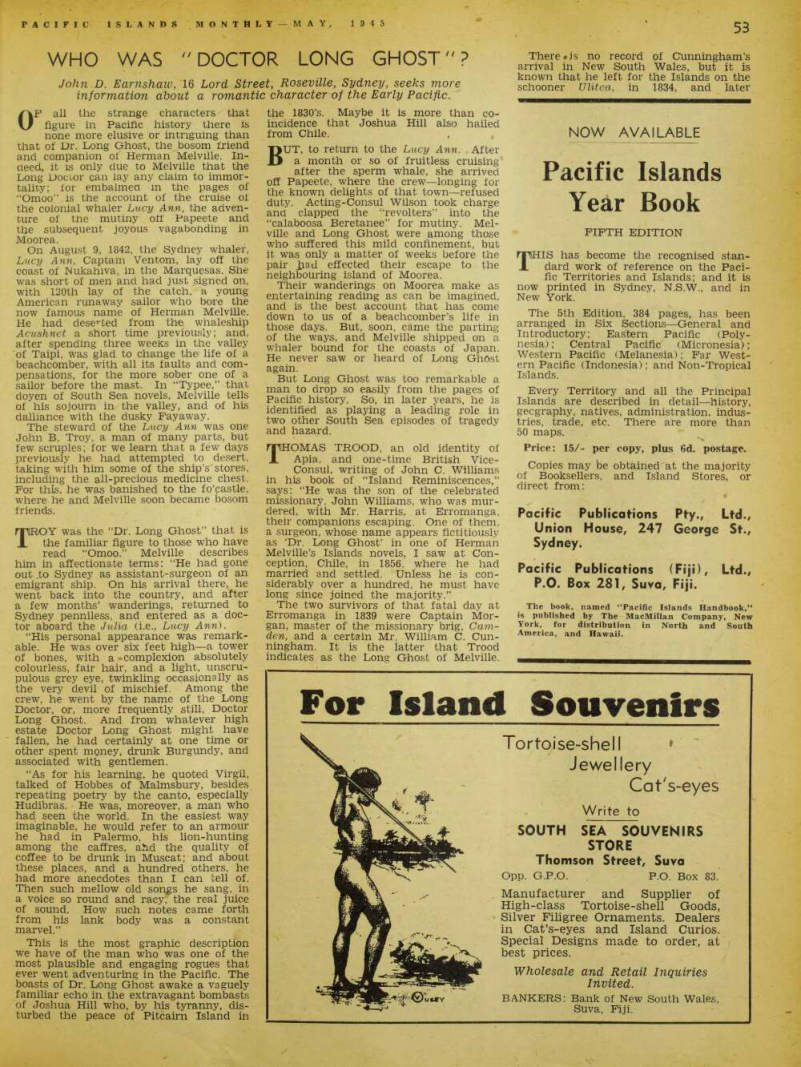
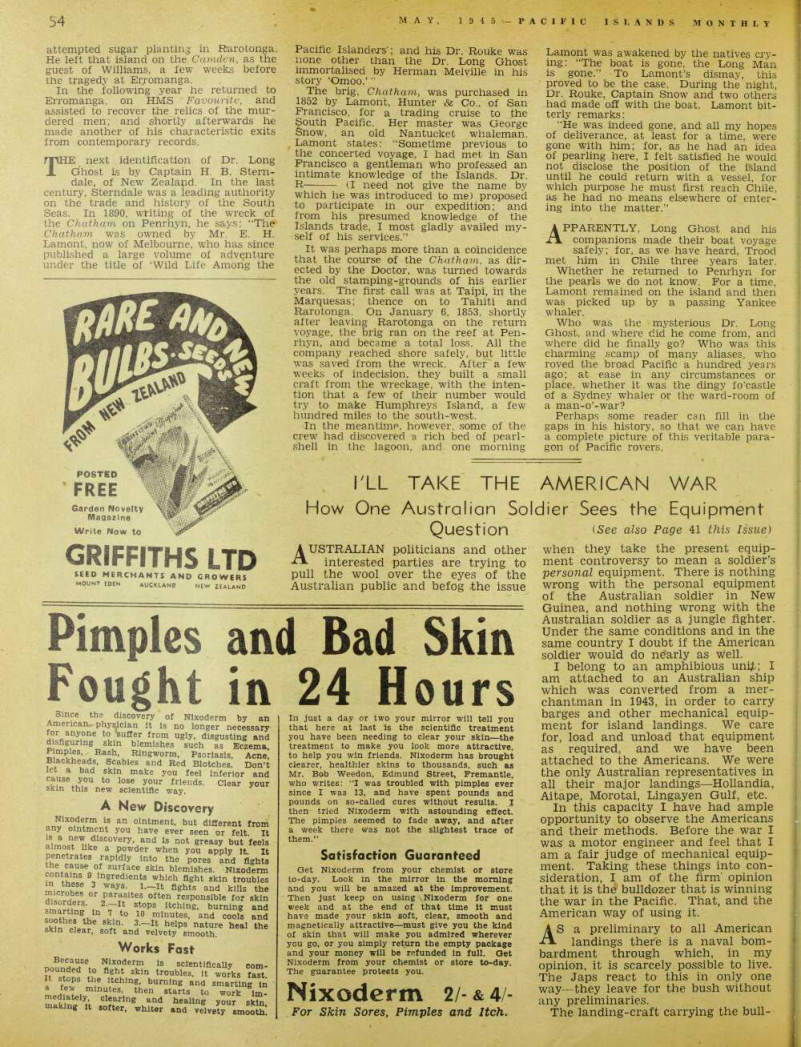
John D. Earnshaw, 16 Lord Street, Roseville, Sydney, seeks more information about a romantic character of the Early Pacific.
OF all the strange characters that figure in Pacific history there is none more elusive or intriguing than that of Dr. Long Ghost, the bosom friend and companion of Herman Melville. In deed, it is only due to Melville that the Long Docior can lay any claim to immor tality: for embalmed in the pages of “Omoo” is the account of the cruise of the colonial whaler Lucy Ann, the adven ture of the mutiny off Papeete and the subsequent joyous vagabonding in Moorea.
On August 9, 1842, the Sydney whaler, Lucy Ann, Captain Ventom, lay off the coast of Nukahiva, in the Marquesas. She was short of men and had just signed on, with 120th lay of the catch, a young American runaway sailor who bore the now famous name of Herman Melville.
He had deserted from the whaleship Acushnet a short time previously; and, after spending three weeks in the valley of Taipi, was glad to change the life of a beachcomber, with all its faults and com pensations, for the more sober one of a sailor before the mast. In “Typee,” that doyen of South Sea novels, Melville tells of his sojourn in the valley, and of his dalliance with the dusky Fayaway.
The steward of the Lucy Ann was one John B. Troy, a man of many parts, but few scruples; for we learn that a few days previously he had attempted to desert, taking with him some of the ship’s stores, including the all-precious medicine chest.
For this, he was banished to the fo’pastle, where he and Melville soon became bosom friends. rOY was the “Dr. Long Ghost” that is the familiar figure to those who have read “Omoo.” Melville describes him in affectionate terms: “He had gone out,to Sydney as assistant-surgeon of an emigrant ship. On his arrival there, he went back into the country, and after a few months’ wanderings, returned to Sydney penniless, and entered as a doc tor aboard the Julia (i.e., Lucy Ann).
“His personal appearance was remark able. He was over six feet high—a tower of bones, with a -complexion absolutely colourless, fair hair, and a light, unscru pulous grey eye, twinkling occasionally as the very devil of mischief. Among the crew, he went by the name of the Long Doctor, or, more frequently still, Doctor Long Ghost. And from whatever high estate Doctor Long Ghost might have fallen, he had certainly at one time or other spent money, drunk Burgundy, and associated with gentlemen.
“As for his learning, he quoted Virgil, talked of Hobbes of Malmsbury, besides repeating poetry by the canto, especially Hudibras. He was, moreover, a man who had seen the world. In the easiest way imaginable, he would refer to an armour he had in Palermo, his lion-hunting among the caffres, ahd the quality of coffee to be drunk in Muscat; and about these places, and a hundred others, he had more anecdotes than I can tell of.
Then such mellow old he sang, in a voice so round and racy, the real juice of sound. How such notes came forth from his lank body was a constant marvel.”
This is the most graphic description we have of the man who was one of the most plausible and engaging rogues that ever went adventuring in the Pacific. The boasts of Dr. Long Ghost awake a vaguely familiar echo in the extravagant bombasts of Joshua Hill who, by his tyranny, dis turbed the peace of Pitcairn Island in
the 1830’s. Maybe it is more than co incidence that Joshua Hill also hailed from Chile.
BUT, to return to the Lucy Ann. After a month or so of fruitless cruising after the sperm whale, she arrived off Papeete, where the crew—longing for the known delights of that town—refused duty. Acting-Consul Wilson took charge and clapped the “revolters” into the “calaboosa Beretanee” for mutiny. Mel ville and Long Ghost were among those who suffered this mild confinement, but it was only a matter of weeks before the pair Jjad effected their escape to the neighbouring island of Moorea.
Their wanderings on Moorea make as entertaining reading as can be imagined, and is the best account that has come down to us of a beachcomber’s life in those days. But, soon, came the parting of the ways, and Melville shipped on a whaler bound for the coasts of Japan.
He never saw or heard of Long Ghost again.
But Long Ghost was too remarkable a man to drop so easily from the pages of Pacific history. So, in later years, he is identified as playing a leading role in two other South Sea episodes of tragedy and hazard.
THOMAS TROOD. an old identity of Apia, and one-time British Vice- Consul, writing of John C. Williams in his book of “Island Reminiscences,” says: “He was the son of the celebrated missionary, John Williams, who was mur dered, with Mr. Harris, at Erromanga. their companions escaping. One of them, a surgeon, whose name appears fictitiously as ‘Dr. Long Ghost’ in one of Herman Melville’s Islands novels, I saw at Con ception, Chile, in 1856. where he had married and settled. Unless he is con siderably over a hundred, he must have long since joined the majority.”
The two survivors of that fatal day at Erromanga in 1839 were Captain Mor gan, master of the missionary brig, Cam den, and a certain Mr. William C. Cun ningham. It is the latter that Trood indicates as the Long Ghost of Melville.
There#is no record of Cunningham’s arrival in New South Wales, but it is known that he left for the Islands on the schooner Ulitea, in 1834, and later
attempted sugar planting in Rarotonga.
He left that island on the Camden, as the guest of Williams, a few weeks before the tragedy at Erromanga.
In the following year he returned to Erromanga, on HMS Favourite, and assisted to recover the relics of the mur dered men; and shortly afterwards he made another of his characteristic exits from contemporary records. rE next identification of Dr. Long Ghost is by Captain H. B. Stem dale, of New Zealapd. In the last century, Sterndale was a leading authority on the trade and history of the South Seas. In 1890, writing of the wreck of the Chatham on Penrhyn, he says: “The Chatham was owned by Mr. E. H.
Lamont, now of Melbourne, who has since published a large volume of adventure under the title of ‘Wild Life Among the
Pacific Islanders’; and his Dr. Rouke was none other than the Dr. Long Ghost immortalised by Herman Melville in his story ‘Omoo.’ "
The brig, Chatham, was purchased in 1852 by Lamont, Hunter & Co., of San Francisco, for a trading cruise to the South Pacific. Her master was George Snow, an old Nantucket whaleman.
Lamont states: “Sometime previous to the concerted voyage, I had met in San Francisco a gentleman who professed an intimate knowledge of the Islands. Dr.
R (I need not give the name by which he was introduced to me) proposed to participate in our expedition; and from his presumed knowledge of the Islands trade, I most gladly availed my self of his services.”
It was perhaps more than a coincidence that the course of the Chatham , as dir ected by the Doctor, was turned towards the old stamping-grounds of his earlier years. The first call was at Taipi, in the Marquesas; thence on to Tahiti and Rarotonga. On January 6, 1853, shortly after leaving Rarotonga on the return voyage, the brig ran on the reef at Pen rhyn, and became a total loss. All the company reached shore safely, but little was saved from the wreck. After a few weeks of indecision, they built a small craft from the wreckage, with the inten tion that a few of their number would try to make Humphreys Island, a few hundred miles to the south-west.
In the meantime, however, some of the crew had discovered a rich bed of pearl shell in the lagoon, and one morning
Lamont was awakened by the natives cry ing: “The boat is gone, the Long Man is gone.” To Lament’s dismay, this proved to be the case. During the night, Dr. Rouke, Captain Snow and two others had made off with the boat. Lamont bit terly remarks: “He was indeed gone, and all my hopes of deliverance, at least for a time, were gone With him; for, as he had an idea of pearling here, I felt satisfied he would not disclose the position of the island until he could return with a vessel, for which purpose he must first reach Chile, as he had no means elsewhere of enter ing into the matter.”
APPARENTLY, Long Ghost and his companions made their boat voyage safely; for, as we have heard, Trood met him in Chile three years later.
Whether he returned to Penrhyn for the pearls we do not know. For a time, Lamont remained on the island and then was picked up by a passing Yankee whaler.
Who was the mysterious Dr. Long Ghost, and where did he come from, and where did he finally go? Who was this charming scamp of many aliases, who roved the broad Pacific a hundred years ago; at ease in any circumstances or place, whether it was the dingy fo’castle of a Sydney whaler or the ward-room of a man-o’-war?
Perhaps some reader can fill in the gaps in his history, so that we can have a complete picture of this veritable para gon of Pacific rovers.
Advertisements & other items, pp. 55-56 (1 item)
For Island Souvenirs
NOW AVAILABLE
Pacific Islands
Year Book
FIFTH EDITION
THIS has become the recognised standard work of reference on the Pacific Territories and Islands: and it is now printed in Sydney, N.S.W., and in New York.
The sth Edition, 384 pages, has been arranged in Six Sections—General and Introductory: Eastern Pacific (Polynesia): Central Pacific (Micronesia): Western Pacific (Melanesia); Far Western Pacific (Indonesia): and Non-Tropical Islands.
Every Territory and all the Principal Islands are described in detail—history, geography, natives, administration, industries, trade, etc. There are more than 50 maps.
Price: 15/- per copy, plus 6d. postage.
Copies may be obtained at the majority of Booksellers, and Island Stores, or direct from:
Pacific Publications Pty., Ltd.,
Union House, 247 George St.,
Sydney.
Pacific Publications (Fiji), Ltd.,
P.O. Box 281, Suva, Fiji.
The book, named “Pacific Islands Handbook,” is published by The MacMillan Company, New York, for distribution in North and South America, and Hawaii.
For Island Souvenirs
% 0«Y
Tortoise-shell >
Jewellery
Cat's-eyes
Write to
SOUTH SEA SOUVENIRS
STORE
Thomson Street, Suva Opp. G.P.O. P.O. Box 83.
Manufacturer and Supplier of High-class Tortoise-shell Goods, Silver Filigree Ornaments. Dealers in Cat’s-eyes and Island Curios.
Special Designs made to order, at best prices.
Wholesale and Retail Inquiries Invited.
BANKERS: Bank of New South Wales, Suva, Fiji.
W 4 & Jr ' x nitf v i .11 .a m. m
POSTED
FREE
Garden Novelty Magazine Write Now to
GRIFFITHS LTD
SEED MERCHANTS AND GROWERS
MOUNT EDEN AUCKLAND NEW ZEALAND
Pimples and Bad Skin Fought in 24 Hours
Since the discovery of Nlxoderm by an American, physician It Is no longer necessary for anyone to suffer from ugly, disgusting and disfiguring skin blemishes such as Eczema, Pimples, Rash, Ringworm, Psoriasis, Acne, Blackheads, Scabies and Red Blotches. Don’t let a bad skin make you feel inferior and cause you to lose your friends. Clear your skin this new scientific way.
A New Discovery
Nixoderm is an ointment, but different from any ointment you have ever seen or felt It nJ liSCOVery ’ J and ls not S reas y but feels almost like a powder when you apply It. It penetrates rapidly into the pores and fights the cause of surface skin blemishes. Nixoderm contains 9 ingredients which fight skin troubles l i ese 3 wa y s - I—lt fights and kills the disorrfprc ° r parasites often responsible for skin , 2 T Xt stops Itching, burning and r t h U g th ln I • t 0 , 10 minutes . and cools and 3kln h nJr e Sk . l . n - 3 —!t helps nature heal the skin clear, soft and velvety smooth.
Works Fast
Because Nixoderm is scientifically compounded to fight skin troubles, It works fast few* ‘1 e nl , , tChln fi “<• sm°a«i„g aS ,n a few minutes, then starts to work immediately. clearing and healing your skin' making it softer, whiter and velvety smooth’.
In just a day or two your mirror will tell you that here at last is the scientific treatment you have been needing to clear your skin—the treatment to make you look more attractive, to help you win friends. Nixoderm has brought clearer, healthier skins to thousands, such as Mr. Bob Weedon, Edmund Street, Fremantle, who writes: "I was troubled with pimples ever since I was 13, and have spent pounds and pounds on so-called cures without results. I then tried Nixoderm with astounding effect.
The pimples seemed to fade away, and after a week there was not the slightest trace of them.”
Satisfaction Guaranteed
Get Nixoderm from your chemist or store to-day. Look in the mirror in the morning and you will be amazed at the improvement.
Then just keep on using Nixoderm for one week and at the end of that time it must have made your skin soft, clear, smooth and magnetically attractive —must give you the kind of skin that will make you admired wherever you go, or you simply return the empty package and your money will be refunded in full. Get Nixoderm from your chemist or store to-day.
The guarantee protects you.
Nixoderm 4/-
For Skin Sores, Pimples and Itch .
How One Australian Soldier Sees the Equipment
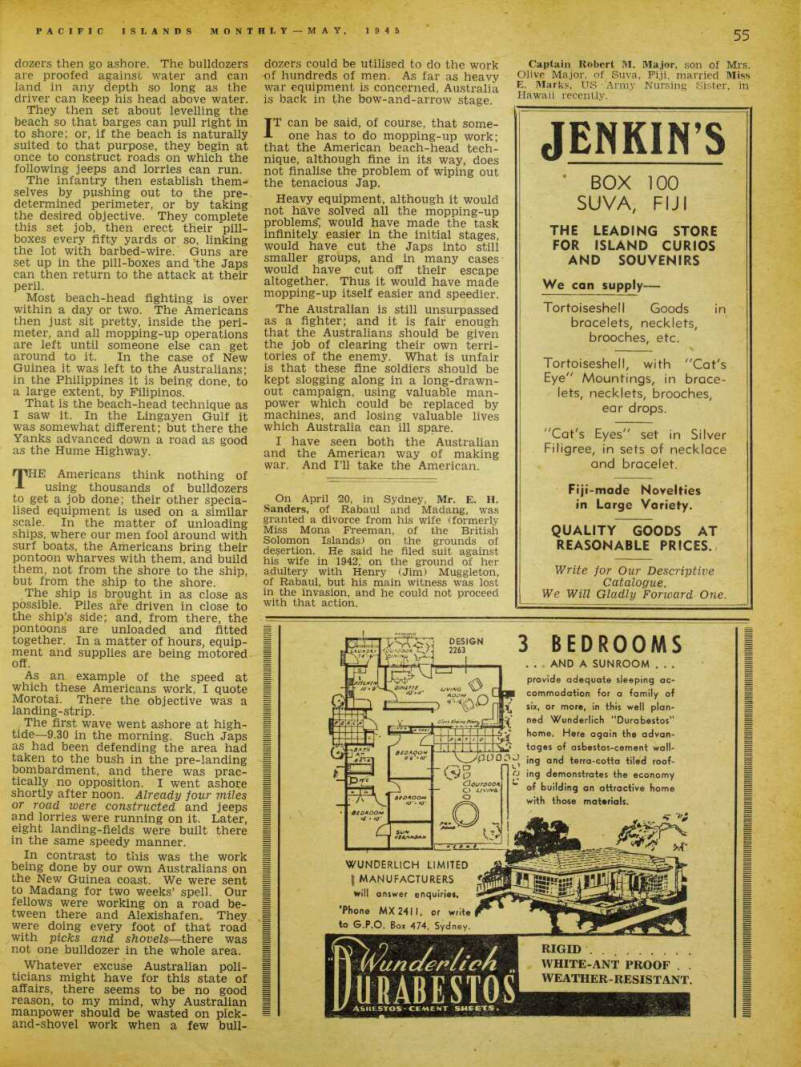
I'll Take The American War
How One Australian Soldier Sees the Equipment Question (See Page 41 this Issue
AUSTRALIAN politicians and other interested parties are trying to pull the wool over the eyes of the Australian public and befog the issue
{See also Page 41 this Issue )
when they take the present equip ment controversy to mean a soldier’s personal equipment. There is nothing wrong with the personal equipment of the Australian soldier in New Guinea, and nothing wrong with the Australian soldier as a jungle fighter.
Under the same conditions and in the same country I doubt if the American soldier would do nearly as well.
I belong to an amphibious unijb; I am attached to an Australian ship which was converted from a mer chantman in 1943, in order to carry barges and other mechanical equip ment for island landings. We care for, load and unload that equipment as required, and we have been attached to the Americans. We were the only Australian representatives in all their major landings—Hollandia, Aitape, Morotai, Lingayen Gulf, etc.
In this capacity I have had ample opportunity to observe the Americans and their methods. Before the war I was a motor engineer and feel that I am a fair judge of mechanical equip ment. Taking these things into con sideration, I am of the firm' opinion that it is the bulldozer that is winning the war in the Pacific. That, and the American way of using it.
AS a preliminary to all American landings there is a naval bom bardment through which, in my opinion, it is scarcely possible to live.
The Japs react to this in only one way—they leave for the bush without any preliminaries.
The landing-craft carrying the bull
dozers then go ashore. The bulldozers are proofed against water and can land in any depth so long as the driver can keep his head above water.
They then set about levelling the beach so that barges can pull right in to shore; or, if the beach is naturally suited to that purpose, they begin at once to construct roads on which the following jeeps and lorries can run.
The infantry then establish them selves by pushing out to the pre determined perimeter, or by taking the desired objective. They complete this set job, then erect their pill boxes every fifty yards or so, linking the lot with barbed-wire. Guns are set up in the pill-boxes and ’the Japs can then return to the attack at their peril.
Most beach-head fighting is over within a day or two. The Americans then just sit pretty, inside the peri meter, and all mopping-up operations are left until someone else can get around to it. In the case of New Guinea it was left to the Australians; in the Philippines it is being done, to a large extent, by Filipinos.
That is the beach-head technique as I saw it. In the Lingayen Gulf it was somewhat different; but there the Yanks advanced down a road as good as the Hume Highway.
THE Americans think nothing of using thousands of bulldozers to get a job done; their other specia lised equipment is used on a similar scale. In the matter of unloading ships, where our men fool around with surf boats, the Americans bring their pontoon wharves with them, and build them, not from the shore to the ship, but from the ship to the shore.
The ship is brought in as close as possible. Piles are driven in close to the ship’s side; and, from there, the pontoons are unloaded and fitted together. In a matter of hours, equip ment and supplies are being motored off.
As an example of the speed at which these Americans work, I quote Morotai. There the objective was a
landing-strip.
The first wave went ashore at high tide—9.3o in the morning. Such Japs as had been defending the area had taken to the bush in the pre-landing bombardment, and there was prac tically no opposition. I went ashore shortly after noon. Already four miles or road were constructed and jeeps and lorries were running on it. Later, eight landing-fields were built there in the same speedy manner.
In contrast to this was the work being done by our own Australians on the New Guinea coast. We were sent to Madang for two weeks’ spell. Our fellows were working on a road be tween there and Alexishafen. They were doing every foot of that road with picks and shovels —there was not one bulldozer in the whole area.
Whatever excuse Australian poli ticians might have for this state of affairs, there seems to be no good reason, to my mind, why Australian manpower should be wasted on pick and-shovel work when a few bull
dozers could be utilised to do the work of hundreds of men. As far as heavy war equipment is concerned, Australia is back in the bow-and-arrow stage.
IT can be said, of course, that some one has to do mopping-up work; that the American beach-head tech nique, although fine in its way, does not finalise the problem of wiping out the tenacious Jap.
Heavy equipment, although it would not have solved all the mopping-up problems' would have made the task infinitely easier in the initial stages, would have cut the Japs into still smaller groups, and in many cases would have cut off their escape altogether. Thus it would have made mopping-up itself easier and speedier.
The Australian is still unsurpassed as a fighter; and it is fair enough that the Australians should be given the job of clearing their own terri tories of the enemy. What is unfair is that these fine soldiers should be kept slogging along in a long-drawn out campaign, using valuable man power which could be replaced by machines, and losing valuable lives which Australia can ill spare.
I have seen both the Australian and the American way of making war. And I’ll take the American.
On April 20, in Sydney, Mr. E. H.
Sanders, of Rabaul and Madang, was granted a divorce from his wife (formerly Miss Mona Freeman, of the British Solomon Islands) on the grounds of desertion. He said he filed suit against his wife in 1942, on the ground of her adultery with Henry (Jim) Muggleton, of Rabaul, but his main witness was lost in the invasion, and he could not proceed with that action.
Captain Robert M. Major, son of Mrs.
Olive Major, of Suva, Fiji, married Miss E, Marks, US • Army Nursing Sister, in Hawaii recently.
Advertisements & other items, p. 57 (1 item)
Jenkins
BOX 100
SUVA, FIJI
THE LEADING STORE
FOR ISLAND CURIOS
AND SOUVENIRS
We con supply— Tortoiseshell Goods in bracelets, necklets, brooches, etc.
Tortoiseshell, with "Cat's Eye" Mountings, in bracelets, necklets, brooches, ear drops.
"Cat's Eyes" set in Silver Filigree, in sets of necklace and bracelet.
Fiji-made Novelties in Large Variety.
QUALITY GOODS AT
REASONABLE PRICES.
Write for Our Descriptive Catalogue.
We Will Gladly Forward One.
DESIGN
2263 V* H Gj
BiOAOOM
ftOO &s
OUTDOOR
O i/v/jva O siokoom
BEDROOMS
. . o AND A SUNROOM . . . provide adequate sleeping accommodation for a family of six, or more, in this well planned Wunderlich "Durabestos" home. Here again the advantages of asbestos-cement walling and terra-cotta tiled roofing demonstrates the economy of building an attractive home with tho-se materials.
WUNDERLICH LIMITED
\ MANUFACTURERS
will answer enquiries, ‘Phone MX 2411, or write G.P.O. Box 474, Sydney. & m »«! lr«u!
/unc/er/icA
RIGID .
WHITE-ANT PROOF .
WEATHER- RESISTANT
Islands Produce
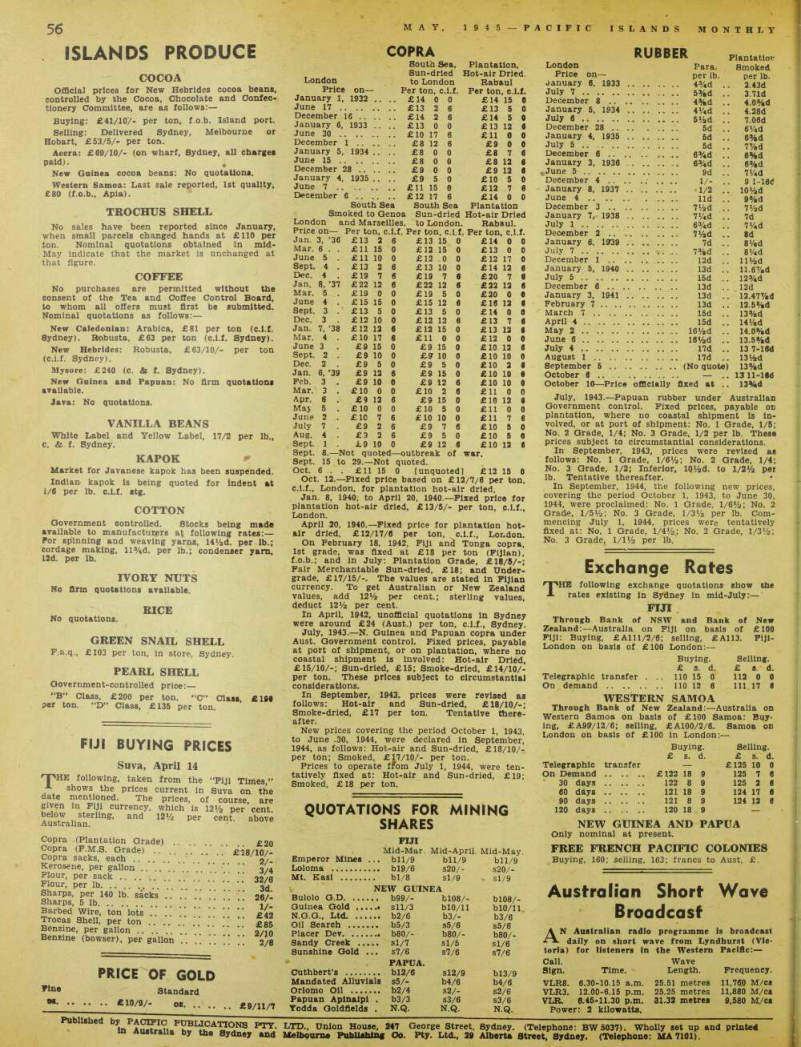
Cocoa
Official prices for New Hebrides cocoa beans, controlled by the Cocoa, Chocolate and Confec tionery Committee, are as follows: — Buying: £4l/10/- per ton, f.o.b. Island port.
Selling: Delivered Sydney, Melbourne or Hobart, £53/5/- per ton.
Accra: £69/10/- (on wharf, Sydney, all charges paid).
New Guinea cocoa beans: No quotations.
Western Samoa: Last sale reported, Ist quality, £BO (f.0.b., Apia).
Trochus Shell
No sales have been reported since January, when small parcels changed hands at £llO per ton. Nominal quotations obtained in mid- May indicate that the market is unchanged at that figure.
Coffee
No purchases are permitted without the consent of the Tea and Coffee Control Board, to whom all offers must first be submitted.
Nominal quotations as follows: New Caledonian; Arabica, £Bl per ton (c.l.f, Sydney). Robusta, £63 per ton (c.l.f. Sydney).
New Hebrides; Robusta, £63/10/- per ton (c.i.f. Sydney).
Mysore: £240 (c. & f. Sydney).
New Guinea and Papuan: No firm quotations available.
Java: No quotations.
Vanilla Beans
White Label and Yellow Label, 17/2 per lb., c. & f. Sydney.
Kapok *
Market for Javanese kapok has been suspended.
Indian kapok Is being quoted for Indent at i/6 per lb, c.l.f. stg.
Cotton
Government controlled. Stocks being made available to manufacturers at following rates;— for spinning and weaving yarns, 14V a d. per lb.; cordage making, ll 3 Ad. per lb.; condenser yam, I2d. per lb.
Ivory Nuts
No firm quotations available.
Rice
No quotations.
Green Snail Shell
F.a.q., £lO3 per ton, in store, Sydney.
Pearl Shell
Government-controlled price:— "B” Class, £2OO per ton. "C” Class, £199 per ton. “D" Class, £135 per ton.
Fiji Buying Prices
Suva, April 14 npHE following, taken from the “Fiji Times," rv shows the prices current in Suva on the date mentioned. The prices, of course, are given in Fiji currency, which is 12V 2 per cent, below sterling, and 12 V 2 per cent, above Australian,
Copra (Plantation Grade) £20 Copra (F.M.S. Grade) .. £18/10/- Copra sacks, each £18/10/- Kerosene, per gallon ... “ 3 / 4 Flour, per sack “ “ W/« Flour, per lb ‘ ‘ * 32 / d 6 Sharps, per 140 lb. sacks .. ’ •>*/' Sharps, 5 lb V, Barbed Wire, ton lots Trocas Shell, per ton .. ..
Benzine, per gallon " “ 2/10 Benzine (bowser), per gallon .. 0*8
Price Of Gold
ylne Standard M £lO/9/- oz £9/11/7
Oct. 6 . . £ll 15 0 [unquoted] £l2 15 0 Oct. 12.—Fixed price based on £l2/7/6 per ton, c.1.f., London, for plantation hot-air dried.
Jan. 8. 1940, to April 20, 1940.—Fixed price for plantation hot-air dried, £l3/5/- per ton, c.1.f., London.
April 20, 1940. —Fixed price for plantation hot air dried, £l2/17/6 per ton, c.1.f., London.
On February 18, 1942, Fiji and Tonga copra, Ist grade, was fixed at £lB per ton (Fijian), f.0.b.; and In July: Plantation Grade, £lB/5/-; Pair Merchantable Sun-dried, £18; and Under grade, £l7/15/-. The values are stated In Fijian currency. To get Australian or New Zealand values, add 12‘/ 2 per cent.; sterling values, deduct 12 V 2 per cent.
In April, 1942, unofißcial quotations In Sydney were around £24 (Aust.) per ton, c.1.f., Sydney.
July, 1943.—N. Guinea and Papuan copra under Aust. Government control. Fixed prices, payable at port of shipment, or on plantation, where no coastal shipment is involved: Hot-air Dried, £l5/10/-; Sun-dried, £l5; Smoke-dried. £l4/10/per ton. These prices subject to circumstantial considerations.
In September, 1943. prices were revised as follows: Hot-air and Sun-dried, £lB/10/-; Smoke-dried, £l7 per ton. Tentative there after.
New prices covering the period October 1, 1943, to June .30, 1944, were declared in 1944, as follows: Hot-air and Sun-dried, £lB/10/per ton; Smoked, £l7/10/- per ton.
Prices to operate from July 1, 1944, were ten tatively fixed at: Hot-air and Sun-dried, £l9; Smoked, £lB per ton.
Copra
South Sea, Plantation, Sun-dried Hot-air Dried.
London to London Rabaul Price on— Per ton, c.l.f.
Per ton. c.l.f.
January 1, , 1932 . £14 C 1 0 £14 15 0 June 17 . £13 2 1 6 £13 5 0 December 16 .. . £14 2 1 6 £14 5 0 January 6, 1933 . . . . £13 0 I 0 £13 12 6 June 30 . £10 17 6 £11 0 0 December 1 .. .. £8 12 I 6 £9 0 0 January 5, , 1934 . . £8 0 0 £8 7 6 June 15 . £8 0 i 0 £8 12 6 December 28 .. .. £9 0 1 0 £9 12 6 January 4, , 1935 . . £9 5 0 £10 5 0 June 7 £11 15 0 £12 7 6 December 6 .. .. £12 17 6 £14 0 0 South Sea South Sea Plantation Smoked to Genoa Sun-dried Hot-air Dried London and Marseilles, to London.
Rabaul.
Pri,ce on— Per ton, , c.I.f. Per ton, c.l.f. Per ton. c.l.f.
Jan. 3, ’36 £13 : 2 6 £13 15 0 £14 0 0 Mar. 6 . . £11 15 0 £12 15 0 £13 0 0 June 5 . £11 10 0 £12 0 0 £12 17 0 Sept. 4 . £13 J 2 6 £13 10 0 £14 12 6 Dec. 4 £19 ' 7 6 £19 7 8 £20 7 8 Jan. 8. ’37 £22 12 6 £22 12 8 £22 12 8 Mar. 5 . £19 ( ) 0 £19 5 0 £20 0 0 June 4 £15 15 0 £15 12 6 £16 12 8 Sept. 3 . £13 ! > 0 £13 5 0 £14 0 0 Dec. 3 . £12 10 0 £12 12 6 £13 7 8 Jan. 7. ’38 £12 12 6 £12 15 0 £13 12 8 Mar. 4 £10 17 6 £11 0 0 £12 0 0 June 3 £9 15 0 £9 15 0 £10 12 6 Sept. 2 . £9 10 0 £9 10 0 £10 10 0 Dec. 2 £9 5 0 £9 5 0 £10 2 8 Jan. 6. ’39 £9 12 6 £9 15 0 £10 10 8 Peb. 3 . £9 10 0 £9 12 6 £10 10 0 Mar, 3 . £10 0 0 £10 2 6 £11 0 0 Apr. 6 £9 12 6 £9 15 0 £10 12 8 Maj 5 . £10 0 0 £10 5 0 £11 0 0 June 2 . £10 7 6 £10 10 0 £11 7 6 July 7 . £9 2 6 £9 7 6 £10 5 0 Aug. 4 £3 : 2 6 £9 5 0 £10 5 0 Sept. 1 £9 10 0 £9 12 6 £10 12 6 Sept. 8. —Not quoted— -outbreak of war.
Sept. 15 to 29.—Not quoted.
Quotations For Mining
Shares
July, 1943. —Papuan rubber under Australian Government control. Fixed prices, payable on plantation, where no coastal shipment is in volved, or at port of shipment: No. 1 Grade, 1/5; No. 2 Grade, 1/4; No. 3 Grade, 1/2 per lb. These prices subject to circumstantial considerations.
In September, 1943, prices were revised as follows: No. 1 Grade, l/6y 2 ; No. 2 Grade, 1/4; No. 3 Grade, 1/2; Inferior, 10y 2 d. to 1/2% per lb. Tentative thereafter.
In September, 1944, the following new prices, covering the period October 1, 1943, to June 30, 1944, were proclaimed: No. 1 Grade, 1/6V 2 ; No. 2 Grade, 1/5V 2 ; No. 3 Grade, l/3y 2 per lb. Com mencing July 1, 1944, prices were tentatively fixed at: No. 1 Grade, l/4»/ 2 ; No. 2 Grade, 1/3 y 2; No. 3 Grade, 1/1% per lb.
Fiji
Mid-Mar.
Mid-April. Mid-May.
Emperor Mines . .. bll/9 bll/9 bll/9 Loloma .. bl9/6 s20/s20/- Mt. Kasl bl/8 sl/9 v sl/9
New Guinea
Bulolo G.D .. b99/bl08/bl08/blO/11 blO/11 N.G.G., Ltd. ... b3/b3/6 Oil Search s5/6 s5/6 Placer Dev b80/b80/- Sandy Creek ... sl/5 sl/6 Sunshine Gold . .. s7/6 s7/6 s7/6 •
Papua.
Cuthbert's .. bl2/6 S12/9 bl3/9 Mandated Alluvials s5/b4/6 b4/6 Oriomo Oil 82/s2/6 Papuan Aplnaipl . b3/3 s3/6 s3/6 Yodda Goldfields . N.Q.
N.Q.
N.Q.
RUBBER Plantation
London Para.
Smoked Price on— per lb. per lb.
January 8. 1933 . 4 3 Ad .. 2.43d July 7 3.71d December 8 .. . 4.0%d January 5, 1934 . 4.28d July 6 7.06d December 28 .. . 5d .. 6y«d January 4, 1935 . 6%d July 5 ... . 7 7 /sd December 6 .. . 6%d January 3. 1936 6%d June 5 7y»d December 4 . . . 9 l-16d January 8, 1937 . 1/2 .. ioy a d June 4 lid .. 9»/«d December 3 .. . 7*/ a d .. 7y a d January 7, 1938 .
IVtd .. 7d July 1 IVtd December 2 .. . 8d January 6, 1939 . 7d .. sy 8 d July 7 8»/4d December 1 .. ., ny a d January 5, 1940 . n.ey.d July 5 12 3 / 4 d December 6 .. .. 12d January 3, 1941 . 13d .. 12.47 7 /*d February 7 12.5 s /ad March 7 13%d April 4 i4y e d May 2 i4.oy«d June 6 i3.5y»d July 4 13 7-15d August 1 17d .. 13M>d September 5 .. ., 13 %d October 8 .. . . . , 13 ll-16d October 10—Price officially fixed at .. 13%d
Exchange Rates
THE following exchange quotations show the rates existing in Sydney in mid-July:—
Fiji
Through Bank of NSW and Bank of New Zealand;—Australia on FIJI on basis of £lOO Fiji: Buying, £Alll/2/6; selling. £AII3. FIJI - on basis of £lOO London: —
Western Samoa
Through Bank of New Zealand: —Australia on Western Samoa on basis of £lOO Samoa: Buy ing, £ A99/12/6; selling, £AIOO/2/6. Samoa on London on basis of £lOO In London: —
New Guinea And Papua
Only nominal at present.
Free French Pacific Colonies
Buying, 160; selling, 163; francs to Aust. £.
Buying.
Selling. £ s. d. £ s. d.
Telegraphic transfer . . . 110 15 0 112 0 0 On demand .. 110 12 6 111 17 8
Buying.
Selling. £ s. d. £ s. d.
Telegraphic transfer — £125 10 0 On Demand £122 18 9 125 7 6 30 days 122 8 9 125 2 6 60 days 121 18 9 124 17 0 90 days 121 8 9 124 12 0 120 days 120 18 9 —
Australian Short Wave
Broadcast
AN Australian radio programme is broadcast daily on short wave from Lyndhurst (Vic toria) for listeners in the Western Pacific:—
Call.
Wave Sign.
Time, Length.
Frequency.
Vlr8.
6.30-10.15 a.m. 25.51 metres 11,760 M/cs
Vlr3,
12.00-6.15 p.m. 25.25 metres 11,880 M/cs
Vtlr.
6.45-11.30 p.m. 31.32 metres 9,580 M/cs Power: 2 kilowatts.
Advertisements & other items, pp. 58-60 (3 items)
56
MAY, 1945 PACIFIC ISLANDS MONTHLY
Published b * p rauCATOONS PTY. LTD., Union House, 247 George Street. Sydney. (Telephone: BW 5037). Wholly set up and printed m Australia by the Sydney and Melbourne Publishing 00. Pty. Ltd., 29 Alberta Street. Sydney. (Telephone: MA7101).
Roll Of Honour
(Continued From Inside Front Cover)
MAY, 1945 PACIFIC ISLANDS MONTHLY
W. R. Carpenter & Co. Ltd.
r Established 1914
THIRTY YEARS OF PACIFIC ISLANDS
DEVELOPMENT AND SERVICE.
W. R. CARPENTER & CO. LTD.
Capital £1,000,000.
GENERAL MERCHANTS AND SHIPOWNERS
Buyers and Exporters of All Kinds of Islands Produce Copra Merchants and Millers Agents for Australian, European and American Manufacturers Distributors of Every Description of Merchandise
AGENTS FOR: -
FORD MOTOR COMPANY OF CANADA DODGE BROTHERS INC.
ELECTROLUX REFRIGERATORS WESTINGHOUSE ELECTRICAL CO.
T. G. & C. BOLINDERS (ENGINES) CATERPILLAR TRACTORS Etc., Etc.
BRANCHES THROUGHOUT THE PACIFIC ISLANDS
Head Office: 16 O'CONN ELL STREET, SYDNEY In London: W. R. Carpenter & Co. (London) Ltd., Coronation House, 4 Lloyd's Avenue London, EC.
The W.R.C Line
first Direct and Regular Cargo and Passenger Service between Europe and Pacific Islands ports was established by W. R. Carpenter & Co. Ltd.