Pacific
Islands
Monthly
April 17. 1945
Vol. Xv. No. 9.
Established 1930
[.Registered at the transmission by post as a newspaper]
1/-
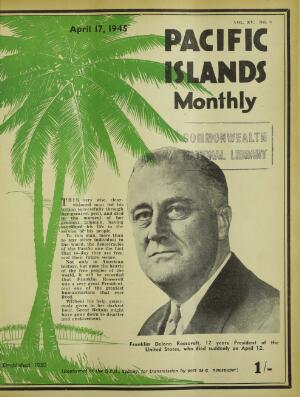
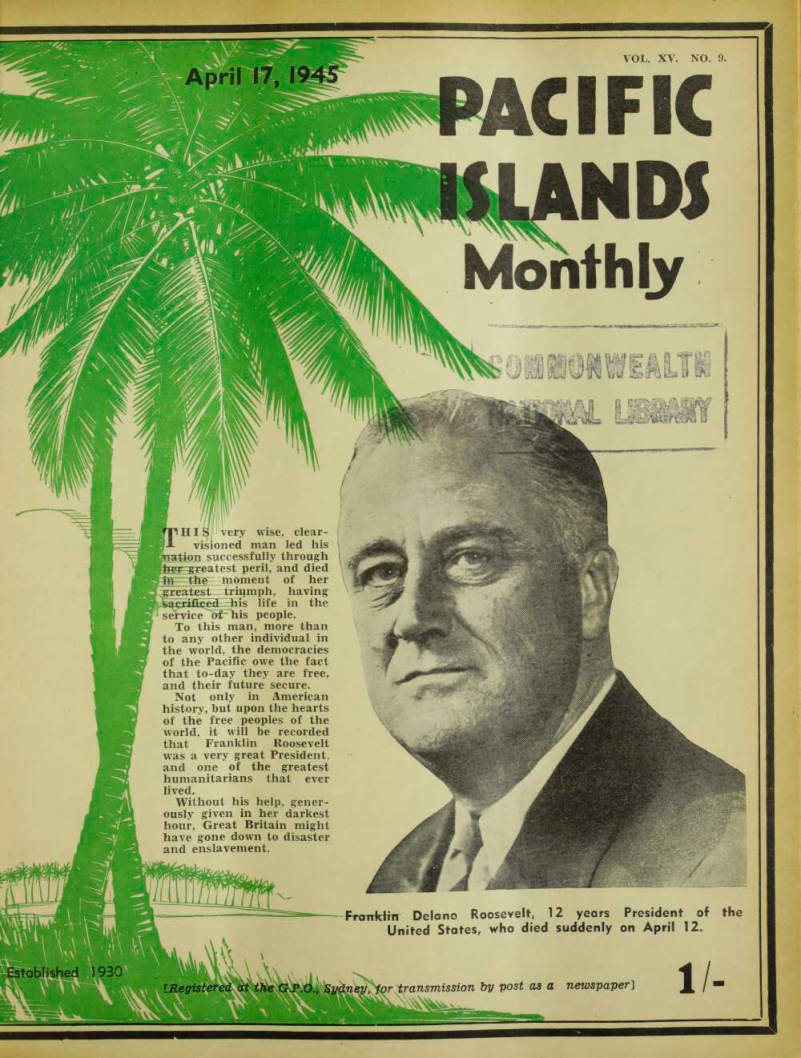
THI S very wise, dear visioned man led his nation successfully through her greatest peril, and died in the moment of her greatest triumph, having Sacrificed his life in the
service of his people.
To this man, more than to any other individual in the world, the democracies of the Pacific owe the fact that to-day they are free, and their future secure.
Not only in American history, but upon the hearts of the free peoples of the world, it will be recorded that Franklin Roosevelt was a very great President, and one of the greatest humanitarians that ever lived.
Without his help, gener ously given in her darkest hour, Great Britain might have gone down to disaster and enslavement.
Franklin Delano Roosevelt, 12 years President of the United States, who died suddenly on April 12.
ROLL OF HONOUR—Section I.
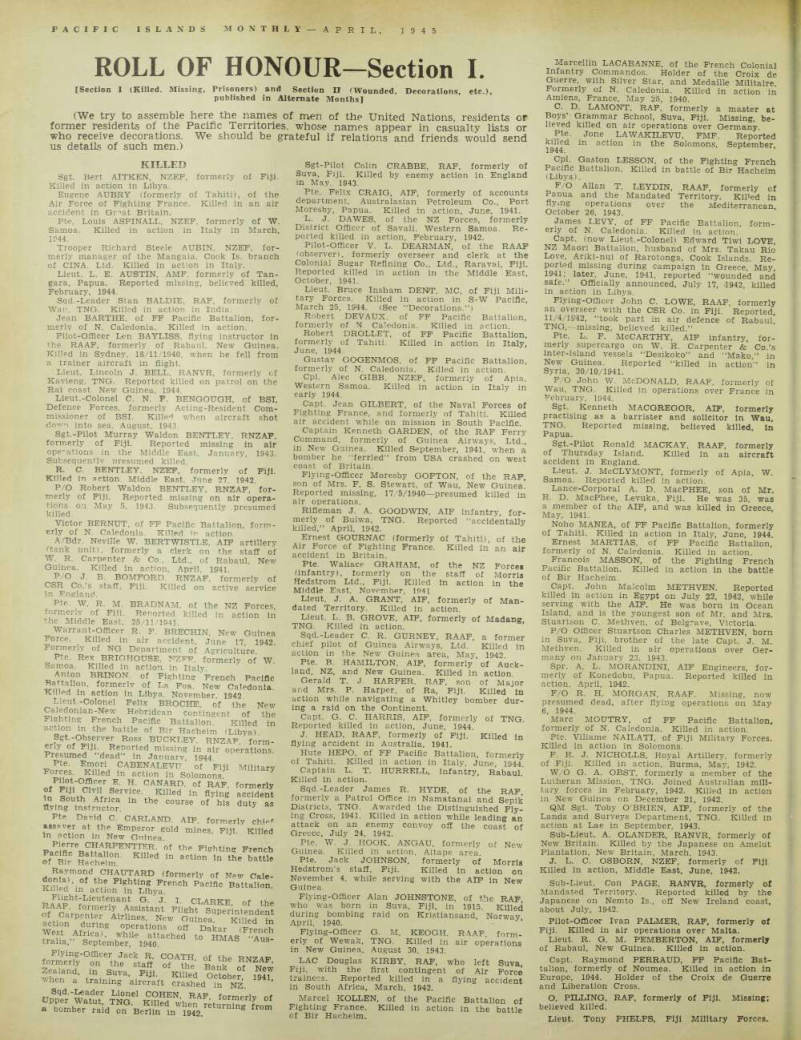
[Section 1 (Killed. Missing, Prisoners) and Section II (Wounded, Decorations, etc.), published in Alternate Months] (We try to assemble here the names of men of the United Nations, residents or former residents of the Pacific Territories, whose names appear in casualty lists or who receive decorations. We should be grateful if relations and friends would send us details of such men.)
Killed
Sgt. Bert AITKEN, NZEF, formerly of Fiji.
Killed in action in Libya.
Eugene AUBRY (formerly of Tahiti), of the Air Force of Fighting France. Killed in an air accident in Britain.
Pte. Louis ASPINALL, NZEF. formerly of W.
Samoa. Killed in action in Italy in March, 1?44.
Trooper Richard Steele AUBIN, NZEF, for merly manager of the Mangaia, Cook Is. branch of CINA, Ltd. Killed in action in Italy.
Lieut. L. E. AUSTIN, AMF. formerly of Tan gara, Papua. Reported missing, believed killed, February, 1944.
Sqd.-Leader Stan BALDIE, RAF, formerly of War. TNG. Killed in action in India.
Jean BARTHE, of FF Pacific Battalion, for merly of N. Caledonia. Killed in action.
Pilot-Officer Len BAYLISS. flying instructor in the RAAF, formerly of Rabaul, New Guinea.
Killed in Sydney, 18/11/1940, when he fell from a trainer aircraft in flight.
Lieut. Lincoln J. BELL, RANVR, formerly of Kavieng, TNG. Reported killed on patrol on the Rai coast New Guinea, 1944.
Lieut.-Colonel C. N. F. BENGOUGH, of BSI, Defence Forces, formerly Acting-Resident Com missioner of BSI. Killed when aircraft shot into sea. August, 1943.
Sgt.-Pilot Murray Waldon BENTLEY. RNZAP, formerly of Fiji. Reported missing in air operations in the Middle East, January, 1943.
Subsequently oresumed killed.
R. C. BENTLEY, NZEF, formerly of Fiji.
Killed in action. Middle East. June 27. 1942.
P/O Robert Waldon BENTLEY, RNZAF, for merly of Fiji. Reported missing on air opera tions on May 5, 1943. Subsequently presumed killed.
Victor BERNUT, of FF Pacific Battalion, form erly of N. Caledonia. Killed in action A/Bdr. Neville W. BERTWISTLE. AIF artillery (tank unit), formerly a clerk on the staff of W. R. Carpenter & Co., Ltd., of Rabaul, New Guinea. Killed in action, April. 1941.
P/O J. B. BOMFORD. RNZAF, formerly of CSR Co.’s staff, Fiji. Killed on active service in England.
Pte. W. R. M. BRADNAM. of the NZ Forces, formerly of Fiji. Renorted killed in action in the Middle East, 25/11/1941.
Warrant-Officer R. F. BRECHIN. New Guinea Force. Killed in air accident, June 17, 1942.
Formerly of NG Department of Agriculture Pte. Rex BRTGHOUSE, N Z FF, formerly of W Samoa. Killed in action, in Italy.
Anton BRINON. of Fighting French Pacific Battalion, formerly of La Foa. New Caledonia.
Killed in action in Libya. November. 1942 Lieut.-Colonel Felix BROCHE. of the New Caiedoman-New Hebridean contingent of the Fighting French Pacific Battalion. Killed in action in the battle of Bir Hacheim (Libya) e n Sgt ; 0^?® rVe i R ° SS BUC KLEY. RNZAF.' form s?™ R^°^ ted missi ng in air operations.
Presumed dead” in January 1944 Pte. Emori CABENALEVU.’ of Fiji Military Kllled in action in Solomons? ™ C .l r H ‘ CANARD - of r AF. formerly ?n South if rVICe Killed in flyin e accident In South Africa in the course of his duty as flying instructor. y Pte David C. GARLAND. AIF. formerly chief assaver at the Emperor gold mines. Fiji. Killed In action in New Guinea Pierre CHARPENTTER, of the Fighting French .f »r° K “' ed aCt '° n ln the baltle Raymond CHAUTARD (formerly of New Cale- K°med ’in f ?? lighting French Pacific Battalion.
Killed in action in Libya.
Flight-Lieutenant G. J. I CJT»A‘RTnj i rv-F +V*/* EAAF, formerly Assistant Flight Superintendent of Carpenter Airlines, New Guinea Slidin action during operations off Dakar (FrtncS West Africa), while attached to HMAS “Aus tralia,” September, 1940. & aus- Flying-Officer Jack R. COATH of the RN7AP formerly on the staff of the rLT RN^ AF ’
Sfen and - ,‘ n SUVa ’ Flil - KiUed Octobe? SZ -when a training aircraft crashed in NZ.
Sqd.-Leader Lionel COHEN, RAP formerly nf Upper Watut, TNG. Killed when returnSt Lj & bomber raid on Berlin in 1942. 1 8 from
Sgt-Pilot Colin CRABBE, RAF, formerly of Suva, Fiji. Killed by enemy action in England in May. 1943.
Pte. Felix CRAIG, AIF, formerly of accounts department, Australasian Petroleum Co., Port Moresby, Papua. Killed in action, June, 1941.
L. J. DAWES, of the NZ Forces, formerly District Officer of Savaii, Western Samoa. Re ported killed in action, February, 1942.
Pilot-Officer V. L. DEARMAN, of the RAAP (observer), formerly overseer and clerk at the Colonial Sugar Refining Co., Ltd., Raravai, Fiji.
Reported killed in action in the Middle East, October, 1941.
Lieut. Bruce Insham DENT. MC, of Fiji Mili tary Forces. Killed in action in S-W Pacific, March 25, 19’44. (See “Decorations.”) Robert DEVAUX. of FF Pacific Battalion, formerly of N. Caledonia. Killed in action.
Robert DROLLET, of FF Pacific Battalion, formerly of Tahiti. Killed in action in Italy, June, 1944.
Gustav GOGENMOS, of FF Pacific Battalion, formerly of N. Caledonia. Killed in action.
Cpl. Alec GIBB, NZEF, formerly of Apia, Western Samoa. Killed in action in Italy in early 1944.
Capt. Jean GILBERT, of the Naval Forces of Fighting France, and formerly of Tahiti. Killed air accident while on mission in South Pacific.
Captain Kenneth GARDEN, of the RAF Ferry Command, formerly of Guinea Airways, Ltd., in New Guinea. Killed September, 1941, when a bomber he “ferried” from USA crashed on west coast of Britain.
Flying-Officer Moresby GOPTON, of the RAP, son of Mrs. F. S. Stewart, of Wau, New Guinea.
Reported missing, 17/5/1940—presumed killed in air operations.
Rifleman J. A. GOODWIN, AIF infantry, for merly of Bulwa, TNG. Reported “accidentally killed,” April, 1942.
Ernest GOURNAC (formerly of Tahiti), of the Air Force of Fighting France. Killed in an air accident in Britain.
Pte. Wallace GRAHAM, of the NZ Forces (infantry), formerly on the staff of Morris Hedstrom Ltd., Fiji. Killed in action in the Middle East, November, 1941 Lieut. J. A. GRANT, AIF, formerly of Man dated Territory. Killed in action.
Lieut. L. B. GROVE, ALP, formerly of Madang TNG. Killed in action.
Sqd.-Leader C. R. GURNEY, RAAF, a former chief pilot of Guinea Airways, Ltd. Killed in action in the New Guinea area. May, 1942.
Pte. B. HAMILTON, AIF, formerly of Auck land, NZ, and New Guinea. Killed in action Gerald T. J. HARPER, RAF, son of Major and Mrs. P. Harper, of Ra, Fiji. Killed In action while navigating a Whitley bomber dur ing a raid on the Continent.
Capt. G. C. HARRIS, AIF, formerly of TNG.
Reported killed in action, June, 1944.
J. HEAD, RAAF, formerly of Fiji. Killed in flying accident in Australia, 1941.
Hute HEPO, of FF Pacific Battalion, formerly of Tahiti. Killed in action in Italy, June, 1944.
Captain L. T. HURRELL, infantry, Rabaul.
Killed in action.
Sqd.-Leader James R. HYDE, of the RAP formerly a Patrol Office in Namatanai and Sepik Districts, TNG. Awarded the Distinguished Fly ing Cross, 1941. Killed in action while leading an attack on an enemy convoy off the coast of Greece, July 24, 1942.
Pte. W. J. HOOK, ANGAU, formerly of New Guinea. Killed in action, Aitape area.
Pte. Jack JOHNSON, formerly of Morris Hedstrom’s staff, Fiji. Killed in action on November 4. while serving with the AIF in New Guinea.
Flying-Officer Alan JOHNSTONE, of the RAF who was born in Suva, Fiji, in 1915. Killed during bombing raid on Kristiansand, Norwav April, 1940.
Flying-Officer G. M. KEOGH, RAAF form erly of Wewak, TNG. Killed in air operations in New Guinea, August 30, 1943.
LAC Douglas KIRBY, RAF, who left Suva Fiji, with the first contingent of Air Force trainees. Reported killed in a flying accident in South Africa, March, 1942.
Marcel KOLLEN, of the Pacific Battalion of Fighting France. Killed in action in the battle of Bir Hacheim.
Marcellin LACABANNE. of the French Colonial Infantry Commandos. Holder of the Croix de Guerre, with Silver Star, and Medaille Militaire Formerly of N. Caledonia. Killed in action in Amiens, France, May 25, 1940.
C. D. LAMONT, RAF, formerly a master at Boys’ Grammar School, Suva, Fiji. Missing, be lieved killed on air operations over Germany.
Pte. Jone LAWAKILEVU, FMF. Reported killed in action in the Solomons, September, 1944.
Cpl. Gaston LESSON, of the Fighting French Pacific Battalion. Killed in battle of Bir Hacheim (Libya).
F/O Allan T. LEYDIN, RAAP, formerly of Panua and the Mandated Territory, KiPed in flying operations over the Mediterranean, October 26, 1943.
James LEVY, of FF Pacific Battalion, form erly of N. Caledonia. Killed in action.
Capt. (now Lieut.-Colonel) Edward Tiwi LOVE, NZ Maori Battalion, husband of Mrs. Takau Rio Love, Ariki-nui of Rarotonga, Cook Islands. Re ported missing during campaign in Greece, May, 1941; later, June, 1941, reported “wounded and safe.” Officially announced, July 17, -1942, killed in action in Libya.
Flying-Officer John C. LOWE, RAAF, formerly an overseer with the CSR Co. in Fiji. Reported, H/4/19'42, “took part in air defence of Rabaul, TNG, —missing, believed killed.”
Pte. L. F. MCCARTHY, AIF infantry, for merly supercargo on W. R. Carpenter & Co.’s inter-island vessels “Desikoko” and “Mako ” in New Guinea. Reported “killed in action” in Syria, 30/10/1941.
F/O John W. MCDONALD, RAAP, formerly of Wau, TNG. Killed in operations over France in February, 1944.
Sgt. Kenneth MACGREGOR, ALP, formerly practising as a barrister and solicitor in Wau, TNG. Reported missing, believed killed, In Papua.
Sgt.-Pilot Ronald MACKAY, RAAF, formerly of Thursday Island. Killed in an aircraft accident in England.
Lieut. J. McCLYMONT, formerly of Apia, W.
Samoa. Reported killed in action.
Lance-Corporal A. D. MacPHEE, son of Mr.
R. D. MacPhee, Levuka, Fiji. He was 35, was a member of the AIF, and was killed in Greece, May, 1941.
Noho MANEA, of FF Pacific Battalion, formerly of Tahiti. Killed in action in Italy, June, 1944.
Ernest MARTIAS, of FF Pacific Battalion, formerly of N. Caledonia. Killed in action.
Francois MASSON, of the Fighting French Pacific Battalion. Killed in action in the battle of Bir Hacheim.
Capt. John Malcolm METHVEN. Reported killed in action in Egypt on July 22, 1942, while serving with the AIF, He was born in Ocean Island, and is the youngest son of Mr. and Mrs.
Stuartson C. Methven, of Belgrave, Victoria.
P/O Officer Stuartson Charles METHVEN, born in Suva, Fiji, brother of the late Capt. J. M.
Methven. Killed in air operations over Ger many on January 23, 1943.
Spr. A. L. MORANDINI, AIF Engineers, for merly of Konedobu, Papua. Reported killed in action, April, 1942.
P/O R. H. MORGAN, RAAP. Missing, now presumed dead, after flying operations on May 6, 1944.
Marc MOUTRY, of FF Pacific Battalion, formerly of N. Caledonia. Killed in action.
Pte. Viliame NAILATI, of Fiji Military Forces.
Killed in action in Solomons.
P. R. J. NICHOLLS, Royal Artillery, formerly of Fiji. Killed in action, Burma, May, 1942.
W/O G. A. OBST, formerly a member of the Lutheran Mission, TNG. Joined Australian mili tary forces in February, 1942. Killed in action in New Guinea on December 21, 1942.
QM Sgt. Toby O’BRIEN, AIF, formerly of the Lands and Surveys Department, TNG. Killed in action at Lae in September, 1943.
Sub-Lieut. A. OLANDER, RANVR, formerly of New Britain. Killed by the Japanese on Amelut Plantation, New Britain, March, 1943.
J. L. C. OSBORN, NZEF, formerly of Fiji Killed in action, Middle East, June, 1942.
Sub-Lieut. Con PAGE, RANVR, formerly of Mandated Territory. Reported killed by the Japanese on Nemto Is., off New Ireland coast, about July, 1942.
Pilot-Officer Ivan PALMER, RAF, formerly of Fiji. Killed in air operations over Malta.
Lieut. R. G. M. PEMBERTON, AIF, formerly of Rabaul, New Guinea. Killed in action.
Capt. Raymond PERRAUD, FF Pacific Bat talion, formerly of Noumea. Killed in action in Europe, 1944. Holder of the Croix de Guerre and Liberation Cross.
O. PILLING, RAF, formerly of Fiji. Missing; believed killed.
Lieut. Tony PHELPS, Fiji Military Forces.
Prisoners Of War
Pte. J. H. ALLAN, AIF, formerly of Wau, TNG.
Formerly reported missing, now reported prisoner of war.
Gnr. N. H. AMOS, AIF, formerly of Port Moresby. Reported prisoner of war after Malayan campaign.
Lieut. CLARRIE ARCHER, NGVR. Believed prisoner of war in Japan. Reported prisoner of war in February, 1943, in prison camp on Island south of Japan.
Georges BEBERE, of FF Pacific Battalion, formerly of N. Caledonia. Reported POW.
Robert BLUM, of Fighting French Pacific Battalion. Reported missing after battle of Bh Hacheim. Reported POW, May, 1944.
Cpl. Jock BAIRD, AIF, formerly of Bank of NSW staff, Suva, Fiji. Reported missing in Malaya, February, 1942. Reported prisoner of war, September, 1943.
Mariel BARRAU, of French Infantry, formerly of N. Caledonia. Taken prisoner after fall of France, June, 1940.
A/Cpl. Peter W. BOSGARD, AIF infantry, for merly of the Lands Department, Port Moresby, Papua. Reported prisoner of war at Sulmona, Italy., 29/6/1941; transferred to Bolzano prison camp, September, 1941.
Cpl. J. E. BROAD, NZEF, formerly of Suva, Fiji. Reported prisoner of war. Reported escaped from German POW camp in Italy, 1944, Now returned to New Zealand.
Lieut, John BROWN, formerly of Fiji. Re ported a prisoner of war in Italy.
Cpl, E. BOURKE, AIF, formerly of New Guinea. Prisoner of war in Germany.
Sgt. R, F. BUNTING, AIF, formerly of Samaral, Papua. Missing in Malaya. Now reported prisoner of war.
Henri CLEMENCEAU, of FF Pacific Battalion, formerly of N. Caledonia. Reported POW.
Sgt. Peter COGGINS, AIF, formerly of Fiji.
Taken prisoner in Malaya, and now reported prisoner of war in Borneo camp.
A/Sgt. A. A, S. COTMAN, AIF infantry, of Abau, Papua. Reported missing—believed prisoner of war, 5/5/1941; reported later, July, 1941, “wounded in chest and head by shrapnel taken prisoner”.
Cpl. W. F. CULLEN, AIF, formerly of Thursday Island. Reported prisoner of war.
John Arnold CROCKETT, AIF, formerly of Bulolo, TNG. Reported prisoner of war In Osaka, Japan, September, 1943.
Pte. J. DALTON, AIF Transport and Supply, formerly of Thursday Island, Reported prisoner of war, April, 1942.
Victor DERVAUX, of FF Pacific Battalion.
Formerly a POW in Italy, but escaped and now interned in Switzerland.
Dick ELMOUR, formerly of New Caledonia, prisoner of war after Dunkirk. Repatriated to Prance in January, 1942, because of health reasons.
Pte. W. G. ECKBLADE, AIF, formerly of Rabaul. Previously reported missing; now re ported missing; believed prisoner of war.
L/Cpl. Stanley E. ESAM, Singapore Volunteer Forces, formerly of Fiji Kauri Timber Co., Nad rivatu, Fiji. Missing, Malaya, February, 1942 Reported POW, Thailand, May, 1943.
Pilot-Officer George Beilby EVANS, RAAF, son of Mr. and Mrs. Beilby Evans, formerly of Buka Passage, TNG. Reported prisoner of war In Java.
Capt. M. G. EVENSON, AIF, of New Guinea. Missing, believed POW, January, 1945.
Lieut. R. W. Peetum, AIF, formerly of New Guinea. Previously reported missing; now re ported “missing believed POW, March, 1943.”
Gnr. A. I. FOLEY, AIF, formerly of Papua.
Reported missing in Malayan campaign. Re ported prisoner of war in February, 1944.
Gaston GEILLER, of Fighting French Pacific Battalion. Reported missing after battle of Blr Hacheim. Reported POW, May, 1944.
Sgt. Robert GEMMELL-SMITH, RAF, formerly on CSR Co.’s staff, Fiji. Reported prisoner of war in Bengazi, Libya, in November, 1942.
W/0.11 V. M. I. GORDON, AIF, formerly of Wau, TNG. Reported prisoner of war after Malayan campaign.
Pte. W. GOSSNER, AIF infantry, formerly of the BNG Development Co., Port Moresby, Papua.
Reported prisoner of war, Sulmona, Italy, 6/7/1941. Escaped 1944.
J. P. GOUZENE, of Fighting French Pacific Battalion. Reported missing after battle of Bir Hacheim. Reported POW, May, 1944.
W/OI A. N. GRAY, AIF, formerly of TNG. Reported prisoner of war.
Chief-Sergeant Francois GRISCELLI, of Fight ing French Pacific Battalion. Reported missing in Libya in April, Formerly of New Caledonia.
Reported POW, May, 1944.
Lieut. J. M. HARCOURT, 2nd NZEF, son of Mr. H. W. Harcourt, formerly Deputy Treasurer In Fiji. Reported “captured in Libya and now prisoner of war”, March, 1942.
Squadron-Leader Godfrey HEMSWORTH, of the RAAF, formerly a well-known commercial pilot in Morobe, TNG. Reported missing after an operational flight against the Japanese in the New Guinea area and presumed killed in action. Reported prisoner of war in Japanese hands in October, 1943.
S. D. C. KERKHAM, NZEF, son of Mr. R. O.
Kerkham, Suva, Fiji. Reported prisoner of war In September, 1942.
Lieut. JEFF KILNER, NGVR. Believed prisoner of war in Japan.
Gnr, A. L. B. KING, AIF artillery, of Rabaul, TNG. Reported prisoner of war, 29/7/1941.
Lieut. G. G. KINNER, New Guinea Forces, formerly of Rabaul. Reported prisoner of war.
Paul KLEIN, .of FF Pacific Battalion, form erly of N. Caledonia. Reported POW.
Nura LETHEIZER, of FF Pacific Battalion, formerly of N. Caledonia. Reported POW.
Major E. G. A. LETT, of the East Surrey Regiment, and son of Mr. Lewis Lett, of Port Moresby, Papua. Reported prisoner of war in Libya.
P/O J. LIETKE, RAAF, formerly of Labasa, Fiji. Reported prisoner of war In Germany, 1943.
A/Cpl. John H. LONERGAN, ALP, Supply and Transport, of New Guinea. Reported prisoner of war at Corinthia, Italy, 8/7/1941.
Pte. Ernest (“Paddy”) McGEADY, NZEF, son of Mrs. J. McGeady, of Suva, Fiji. Reported “missing, believed killed”, after fighting in Libya, January, 19^42; reported prisoner of war in Italy, April, 1942.
Cpl. J. H. L. McGUIGAN, of the Field Ambulance, AIF, formerly of the Public Health Department, New Officially reported missing at Singapore; unofficially reported a prisoner in Japanese hands. Reported prisoner of war in Malaya, May 24, 1943.
Observer Alex. McKAY, of the RAAF, formerly of the CSR Co.'s staff, at Penang sugar-mill, Fiji. Reported missing, 27/7/1941; reported prisoner of war in Italy, 26/10/1941.
Pte. Harry MARCHINGTON, of the NZ Forces, formerly of Fiji. Reported prisoner of war after Battle of Crete, 2/12/1941.
Pte. F. C. MAYO, AIF, formerly of New Guinea. Reported a prisoner of war.
Camille MERCIER, of Fighting French Pacific Battalion. Reported missing after battle of Blr Hacheim. Reported POW, May, 1944.
Flt.-Lieut. G. E. (“Dusty”) MILLER, RAAF, formerly of Papua. Reported POW in Germany in 1943. Repatriated to England, 1944.
Lieut. Jean MILLIARD, of French Artillery.
Formerly of N. Caledonia. POW in Germany since fall of France, June, 1940.
Emile MIT .LOT, of Pacific Battalion of Fight ing France. * Taken prisoner in battle of Bir Hacheim (Libya).
Pte. J. F. MORRELL, formerly of TNG. Re ported missing believed prisoner of war, June 1, 1944.
Sgt. NAGLE, of French Colonial Infantry; formerly of N. Caledonia. POW in Germany since fall of Prance in June, 1940.
Pte. J. G. NEWTON, A IF, formerly of Papua.
Reported prisoner of war, June, 1944.
Pte. G. S. O’BRYAN. NZEF, formerly of Rarotonga, Cook Is. Missing after battle of Crete; now reported prisoner of war in Germany.
Gaetan OLLIVAUD, of French Colonial In fantry, formerly of N. Caledonia. POW in Ger many .since fall of France, June, 1940.
Pte. D. R. PHILLIPS, AIF engineers, formerly of Bulwa, TNG. Reported prisoner of war, June, 1942.
Eugene POGNON, of FP Pacific Battalion, formerly of N. Caledonia. Reported POW.
Henri PAYONNE, of Fighting French Pacific Battalion. Reported missing after battle of Bir Hacheim. Later reported POW, Italy. Later escaped and rejoined FF forces.
Gnr. Allan H. ROSS, AIF artillery, formerly planter in New Britain, TNG. Reported “miss ing—believed prisoner of war,” 28/9/1941. Re ported POW, September, 1944.
A/Bdr. L. J. SMEETON, AIF, formerly of Rabaul, TNG. Reported prisoner of war In Malayan campaign.
Pte. John O. SMITH, of the NZ Forces, son of Captain Arthur Smith, of the Fiji Inter-island vessel “Tul Kauvaro”. Missing after battle of Crete, May, 1941; reported prisoner of war In Germany, 21/10/1941.
Squadron-Leader L. C. SHOPPEE, DSO, RAP, formerly of Edie Creek, New Guinea. Was In Java during Japanese invasion; now known to be a prisoner of war.
Gnr. D. M. SPENCE, AIF, formerly of Port Moresby. Reported prisoner of war after Malayan campaign.
LAC Charles SOLLITT, of the RAAF , (wire less operator), son of Mr. and Mrs. C. H.
Sollitt, of Nausori, Fiji. Reported missing after air operations in New Guinea, January, 1942; later, March, 1942, reported rescued from sea by Japanese—now prisoner of war.
Pte. Fred SWAN, NZ Army Medical Corps, formerly of Apia, Western Samoa. Missing after Battle of Crete, August, 1941; reported prisoner of war in Germany, November, 1941.
Repatriated from a German prison camp to NZ in 1944.
Signalman J. C. E. SWINBOURNE, 6th Div.
Signals. AIF, formerly of Fiji and the Gilbert & Ellice Islands Colony. Taken prisoner at Crete, June, 1941, now in prison camp at Stalag, VIIA, Germany.
P/O VENNING, NGVR. Taken prisoner during Jap invasion of Rabaul, January, 1942.
Lieut. CLIFF WARREN, of NZEF. serving In the Middle East, and formerly of Morris Hed strom Ltd.’s staff at Ba and Lautoka, Fiji. Re ported prisoner of war.
MJr. N. WATCH, formerly Dr. Watch, of Rabaul, missing after Japanese invasion of Rabaul. Believed prisoner of war In Japan. Now reported POW in Japan.
Gnr. D. S. WHTTCOMBE, NZEF, formerly of Fiji and Tonga. Wounded Jn Crete and reported prisoner of war in Germany.
Pte. John D. WHITCOMBE, of the NZ Forces, formerly of Levuka, Fiji. Reported prisoner of war In Germany, November, 1941.
Killed in action in the South Pacific, January, 1944 Flight-Lieut. H. G. PILLING, DFC, of the RAF, formerly of Suva, Fiji. Killed on air operations, May 19, 1942.
Pte. Edward Harold PRICE, 2nd NZEF (27th Machine Gun Battalion), youngest son of Mr. and Mrs. J. Price, Savu Savu West. Fiji. Killed in action during the Libyan campaign, Middle East, 27/11/1941.
Pte Cecil PURCELL, NZEF, formerly of Aleipata. Samoa. First Samoan Euronesian to give his life in World War 11. Killed in action In Middle East.
P/O G. REES-JONES, RAAF, formerly of Labasa, Fiji. Killed in air operations over Ger many, August 16, 1942.
Capt. W. H. ROBERTS, NZEF, who was Accountant in the Samoa Treasury Department during 1934-35. Killed in action in Libya, December, 1941.
Pte. Kameli ROKOTUILOMA, of the Fiji Military Forces. Reported killed in action, December, 1943.
Major A. B. ROSS, NZEF, who, between 1923- 1929 was successively, Assistant Secretary for Native Affairs, Assistant Secretary to the Administration, and ADC t'o the Administrator of Samoa. Killed in action in Libya.
Cpl. Alex. C. SCOTT, AIF, formerly manager at Kieta, TNG, for Burns, Philp & Co., Ltd.
Killed in action in the Middle East, 19/6/1941.
J. SIMPSON, RAAF, formerly of Fiji. Killed In action over Malta, July, 1941.
Sgt. R. R. SHORT, AIF, formerly of Port Moresby. Killed in action.
Lieut. G. STEVENSON, AIF, formerly a Patrol Officer in New Guinea. Killed in action in New Guinea, on June 26, 1943.
Cpl. Sefanaia SUKANAIVALU, FMF. Reported killed in action in the Solomons, September, 1944.
Capt. P. A. TUCKEY, AIF, formerly of TNG.
Killed in action in Sepik area, NG, December, 1944.
Lieut. A. G. W. THOMAS, RANR, formerly master of Burns Philp & Co.’s SS “Muliama.”
Killed in action.
Pte. Popoare TANGIITI, of the NZ Forces (Maori Battalion), formerly of Mangaia, Cook Islands. Reported “missing after battle of Greece —presumed dead,” July, 1941.
John Tama TETOEA, of FF Pacific Battalion, formerly of Tahiti. Killed in action in Italy, June, 1944.
Atera TEUIRA, of FF Pacific Battalion, for merly of Tahiti. Killed in action in Italy, June, 1944.
Derek TOVEY, NZEF, formerly of Suva, FIJI, Killed in action in Tunisia in April, 1943.
Andre VERNIER, formerly of Tahiti. Killed In action with the Maquis in France.
Rifleman R. E. VERNON, AIF, formerly of Tae, TNG. Reported killed in action, June, 1944.
Cadet-Officer Charles WITT, Pacific Battalion, FF Forces, formerly of New Caledonia. Killed in action on Italian front.
Capt. A. P. J. WHITE, AIF, formerly a Dis trict Officer in Fiji, and BSI. Killed in action in New Guinea.
Died From Wounds
Pte. Roy lan BROWN, NZEF. formerly of Apia, W. Samoa. Died of wounds in Italy, April, 1944.
Pte. Ernest HENRY. AIF, formerly of the Rabaul (NG) staff of Burns, Philp and Co.
"Ltd. Died from wounds received in Battle of ■Crete, 1/6/1941.
Pte. Alec. MUNRO, NZ Forces, formerly of Norfolk Island. Died in Libya (Middle East), December, 1941.
Adolphe Arthur LAHARRAGUE, formerly of Tahiti. Died of wounds received while serving in the Fighting French forces.
Pte. T. LAWRIE, AIF, son of Mr. Lawrie, for merly of Fiji. Died of wounds in Middle East.
Pte. Walter PEARSON, of first NG quota of AIF (infantry). Died from wounds received In action. 24/^/1941.
A/Bdr. W. R. SCOTT, AIF, of New Guinea.
Died from wounds, July, 1941.
Sgt. Charles SPITZ, of the Fighting French, Pacific Battalion, and formerly of Tahiti. Died from wounds received at Bir Hacheim, on June •21, 1943.
Sgt.-Pilot Peter Clarkson WISE, of the RAF, son of Mr. W. Wise, OBE, Director of Public Works, Fiji. Died from wounds received during ibombing raid over Germany, January, 1941.
Accidentally Killed
Capt. F. P. BREWER, AIF, formerly of Papua.
Reported accidentally killed.
Lieut.-Colonel C. C. JUDD, formerly of Morobe, TNG. Accidentally killed in Australia in January, 1943.
A/Cpl. P. A. McKEE, New Guinea Forces, formerly of Bulolo. Died of injuries.
Major N. V. McKENNA, AIF, formerly of Wau, TNG. Accidentally killed, September 30, 1943 Lieut. Harrowby RYDER. AIF, formerly of Fiji.
Accidentally killed on active service in New Guinea.
F/O Lee VIAL, DSC, formerly ADO, Mandated Territory. Killed in April, 1943, in a plane crash in Sepik district while on a special mission.
Capt. F. E. WILLIAMS, formerly Government Anthropologist in Papua. Killed in a plane acci dent while on duty in New Guinea, in 1943.
Sgt. Edward WILSON, of Suva, serving in the Fiji Defence Force. Accidentally drowned in the Lami River, Fiji, April, 1942.
Gnr. Robert J. WILSON, formerly of Port Moresby, Papua. Accidentally killed in troop train in Middle East in 1942.
Died From Illness
Pte. Lawrence BOYER, NZEF, formerly of Tonga and Fiji. Died on active service in Italy.
Pte. Tevita BUREKAMA, of Fiji Military Forces. Died of illness while on duty in the Solomons.
Pte. H. COOMBE, NZEF, formerly of Suva, Fiji. Died in Middle East, April. 1944.
Major Charles DUCHATEL, formerly of TNG.
Died of scrub tophus at Port Moresby, November 21. 1943.
Pte. Clarence A. HUTTON, AIF, formerly of Edie Creek, TNG. Died from illness, April, 1941.
Ratu Dovi KOMAISAVAI. RAF, formerly of Fiji. Died of illness in Britain, October 19, 1944.
Capt. W. J. MCDONALD, AIF, formerly of Morobe and Sepik districts. TNG. Died of ill ness in New Guinea. July 20. 1944.
Pte. Manoa NAKARU, of the Fiji Military Forces. Reported died on active service, Decem ber, 1943.
Pte. Isikeli NABOKO, of the Fiji Military Forces. Reported died on active service, Decem ber, 1943.
Seaman Malvin NELSON, of Fiji Royal Naval Volunteer Service. Death reported in May, 1943.
Pte. Inikasio SERU, of the Fiji Military Forces. Reported died on active service. Decem ber, 1943.
A/Sgt. J. H. STANE, Royal Australian Engineers, formerly of Port Moresby, Papua.
Died from illness, May, 1942.
Rifleman R. A. SMITH, HQ Unit. (Place of enlistment not stated.) Died of illness.
Cpl. R. H. SUTTON, NGVR, formerly of Wau, TNG. Died from malaria and typhoid in October, 1942.
Pte. Mateo TUIDALA, of the Fiji Military Forces. Reported died on active service, Decem ber, 1943.
Pte. Emosi WAQA, of the Fiji Military Forces.
Reported died on active service, December. 1943.
Major P. J. WOODHILL, AIF infrantry, for merly legal assistant in the Crown Law Office, Rabaul, New Guinea. Reported died from illness, December, 1941.
Pte. F. WORK, of the Fiji Military Forces.
Reported died on active service, December, 1943.
Missing
Louis ANGER, of Fighting French Pacific Battalion. Reported missing after battle of Bir Hacheim.
Pte. P F. BAILEY, AIF infantry, of Rabaul, TNG. Reported missing, 17/2/1942. Now re ported prisoner of war.
Lieut. J. T. BARRACLUFF, AIF, formerly of New Guinea. Reported missing, December, 1943.
Cpl. Leon BARRENE, of Pacific Battalion of Fighting France. Missing after battle of Bir Hacheim (Libya).
Alexandre BLACK, of Pacific Battalion, FF Forces. Reported missing after Battle of Bir Hacheim.
T. BLAKELOCK, BEF, formerly of Fiji. Miss ing.
Sgt. Ronald Arthur BROODBANK, formerly of Samarai, Papua, now serving with the RAAF overseas. Reported missing on May 31 while on air operations.
Sgt. Alexander BROWN, RNZAF, formerly of Rarotonga. Reported missing over Germany, on September 15, 1942.
Reginald BOULANGER, of Fighting French Pacific Battalion. Reported missing after battle of Bir Hacheim.
H. BUCKNELL, AIF, formerly of Fiji. Missing.
Andre CHITTY, of FF Pacific Battalion, form erly of N. Caledonia. Reported missing.
Pte. E. L. CHRISTIE, AIF infantry, of Rabaul, TNG. Reported missing, 17/2/1942.
Georges CLEMEN, of FF Navy. Formerly of
N. Caledonia. Missing in Mediterranean, March, 1942.
Victor DERVAUX, of Fighting French Pacific Battalion. Reported missing after battle of Blr Hacheim.
Lucien DEVAND, of Pacific Battalion of Fight ing France. Missing after battle of Bir Hacheim (Libya).
Pte. A. G. DICKSON, AIF infantry, of Rabaul, TNG. Reported “missing, believed wounded,” 17/2/1942.
Wing-Commander Donald DONALDSON, RAAF, formerly of Nauru. Missing on air operations over France in June, 1944. Later rejoined his squadron.
Pilot-Officer Norman R. FRAZER, RAAF, formerly of Wau, TNG. Reported missing on air operations over Germany, August 30, 1943.
Eion FIELD, RNZAF, formerly of staff of Kasi Mines, Fiji. Missing in Java.
Gath GELDARD, NGVR, of New Britain.
Missing after the battle of Rabaul, January, 1942.
Georges GOVETCHE, of FF Pacific Battalion, formerly of N. Caledonia. Reported missing.
Capt. J. E. CRIMSON, AIF, formerly of New Guinea. Reported missing. 1944 Acting Flight-Lieut. Don A. IRVING, RAAF, formerly chemist in CSR Co., Labasa, Fiji. Miss ing, presumed dead, in air operations over Germany, February 1 27, 1942.
Pte. Andrew A. (Billo) Johnson, Ngvr.
Reported missing in New Guinea on October 29, 1942.
Georges KABAR, of Fighting French Pacific Battalion. Reported missing after battle of Blr Hacheim.
Henri LANGLOIS, of Pacific Battalion of Fighting France. Missing after battle of Blr Hacheim (Libya).
Numa LETHESER, of Pacific Battalion of Fighting France. Missing after battle of Bir Hacheim (Libya).
Rene LETOCART, of Fighting French Pacific Battalion. Reported missing after battle of Blr Hacheim.
Cpl. E. G. MacADAM, NGVR, of Rabaul, TNG.
Reported missing after the battle of Rabaul, January 1, 1242.
Capt. J. J. MURPHY, AIF, formerly of New Guinea. Reported missing, December, 1943.
Pte. R. J. PASCOE, AIF infantry, of Rabaul, TNG. Reported missing, 27/1/1942.
Pilot Tom PATTERSON. of the RNZAF, formerly of Levuka, Fiji. Reported missing, in November, 1941, after bombing raid on the Continent.
Eugene PENE, of Fighting French Pacific Battalion. Reported missing after battle of Blr Hacheim.
Andre PETRE, of Fighting French Pacific Battalion. Reported missing after battle of Bir Hacheim.
Eugene POGNON, of Fighting French Pacific Battalion. Reported missing after battle of Bir Hacheim.
Pte. William RUPE, of the NZ Forces (Maori Battalion), formerly of Aitutaki, Cook Islands.
Reported “missing after battle of Greece,” July, 1941.
Pilot James SIMPSON, of the RAF, formerly of Vatukoula, Fiji. Reported missing after air operations over Malta, in the Mediterranean, 1/7/1941.
L/Bdr. G. G. SMITH, NZEF, formerly of Suva, Fiji. Reported missing.
Louis SALOMAN, of FF Pacific Battalion, formerly of N. Caledonia. Reported missing.
Charles STIERMANS, of FF Pacific Battalion, formerly of N. Caledonia. Taken POW in Libya, but missing after transport was sunk in Medi terranean.
Pilot-Officer Neville George STOKES, of the RAF, formerly a pilot with Guinea Airways, Ltd., in New Guinea. Reported missing after air operations in Europe, December, 1941.
Chas. STIERMANS, of FF Pacific Battalion, formerly of N. Caledonia. Reported missing.
Louis VINDOUX, of FF Pacific Battalion, formerly of New Caledonia. Reported missing.
Reported Missing
Malaya Casualty List, Published 33/7/1942.
ALEXANDRE BLACK, of Pacific Battalion of Fighting France. Reported killed in action at Bir Hacheim. Now reported missing.
Andre CHXTTY, of Pacific Battalion of Fight ing France. Missing at battle of Bir Hacheim (Libya).
Pte, E. L. CHRISTIE, infantry, Rabaul.
Pte. A. G. DICKSON, infantry, Rabaul.
Pte. J. M. HIRSCHEL, infantry. Rabaul.
Pte. J. G. NEWTON, artillery. Port Moresby.
Australia and Island Stations, pta. S. W. HUNTER, infantry, Kokopo.
(Continued on Page 42)
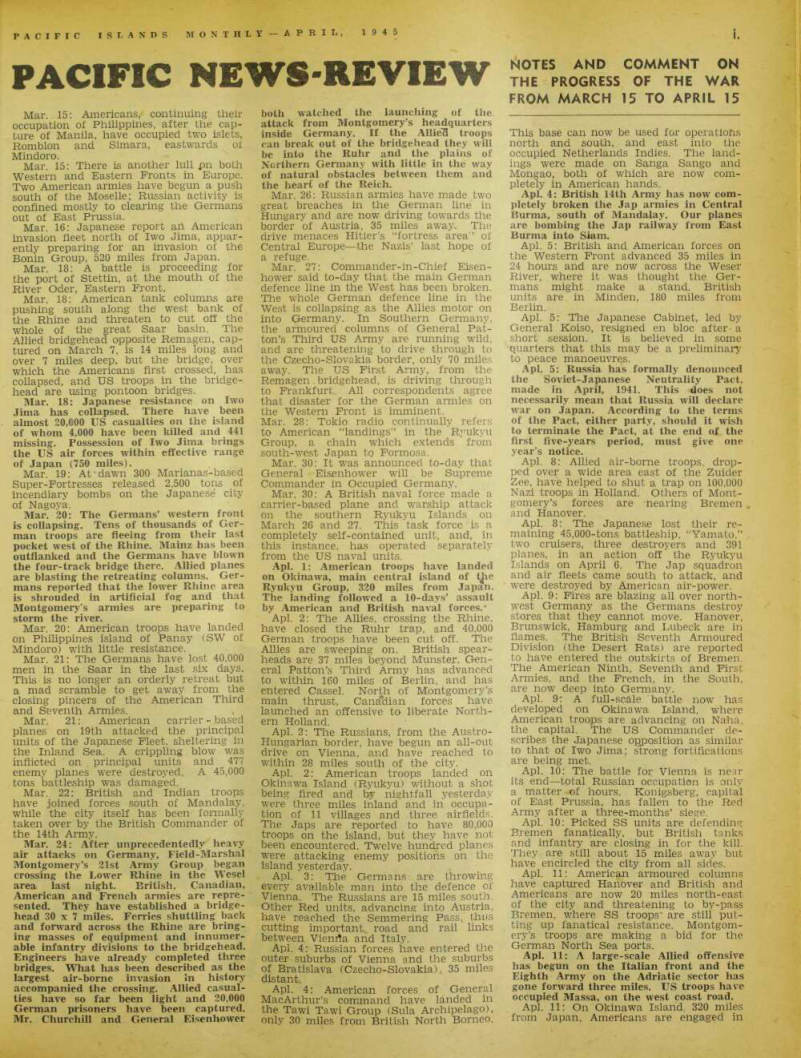
Pacific News-Review
Notes And Comment On
The Progress Of The War
From March 15 To April 15
Mar. 15: Americans, continuing their occupation of Philippines, after the cap ture of Manila, have occupied two islets, Romblon and Simara, eastwards of Mindoro.
Mar, 15: There is another lull pn both Western and Eastern Fronts in Europe.
Two American armies have begun a push south of the Moselle; Russian activity is confined mostly to clearing the Germans out of East Prussia.
Mar. 16: Japanese report an American invasion fleet north of Iwo Jima, appar ently preparing for an invasion of the Bonin Group, 520 miles from Japan.
Mar. 18: A battle is proceeding for the port of Stettin, at the mouth of the River Oder, Eastern Front.
Mar. 18: American tank columns are pushing south along the west bank of the Rhine and threaten to cut off the whole of the great Saar basin. The Allied bridgehead opposite Remagen, cap tured on March 7, is 14 miles long and over 7 miles deep, but the bridge, over which the Americans first crossed, has collapsed, and US troops in the bridge head are using pontoon bridges.
Mar. 18: Japanese resistance on Iwo Jima has collapsed. There have been almost 20,000 US casualties on the island of whom 4,000 have been killed and 441 missing. Possession of Iwo Jima brings the US air forces within effective range of Japan (750 miles).
Mar. 19: At dawn 300 Marianas-based Super-Fortresses released 2,500 tons of incendiary bombs on the Japanese city of Nagoya.
Mar. 20: The Germans’ western front is collapsing. Tens of thousands of Ger man troops are fleeing from their last pocket west of the Rhine. Mainz has been outflanked and the Germans have blown the four-track bridge there. Allied planes are blasting the retreating columns. Ger mans reported that the lower Rhine area is shrouded in artificial fog and that Montgomery’s armies are preparing to storm the river.
Mar. 20: American troops have landed on Philippines island of Panay (SW of Mindoro) with little resistance.
Mar. 21: The Germans have lost 40,000 men in the Saar in the last six days.
This is no longer an orderly retreat but a mad scramble to get away from the closing pincers of the American Third and Seventh Armies.
Mar. 21: American carrier - based planes on 19th attacked the principal units of the Japanese Fleet, sheltering in the Inland Sea. A crippling blow was inflicted on principal units and 477 enemy planes were destroyed. A 45,000 tons battleship was damaged.
Mar. 22: British and Indian troops have joined forces south of Mandalay, while the city itself has been formally taken over by the British Commander of the 14th Army.
Mar. 24: After unprecedentedly heavy air attacks on Germany, Field-Marshal Montgomery’s 21st Army Group began crossing the Lower Rhine in the Wesel area last night. British, Canadian, American and French armies are repre sented. They have established a bridge head 30 x 7 miles. Ferries shuttling back and forward across the Rhine are bring ing- masses of equipment and innumer able infantry divisions to the bridgehead.
Engineers have already completed three bridges. What has been described as the largest air-borne invasion in history accompanied the crossing. Allied casual ties have so far been light and 20,000 German prisoners have been captured.
Mr. Churchill and General Eisenhower
both watched the launching of the attack from Montgomery’s headquarters inside Germany. If the Allied troops can break out of the bridgehead they will be into the Ruhr and the plains of Northern Germany with little in the way of natural obstacles between them and the heart of the Reich.
Mar. 26: Russian armies have made two great breaches in the German line in Hungary and are now driving towards the border of Austria, 35 miles away. The drive menaces Hitler’s “fortress area” of Central Europe—the Nazis’ last hope of a refuge.
Mar. 27: Commander-in-Chief Eisen hower said to-day that the main German defence line in the West has been broken.
The whole German defence line in the West is collapsing as the Allies motor on into Germany. In Southern Germany, the armoured columns of General Pat ton’s Third US Army are running wild, and are threatening to drive through to the Czecho-Slovakia border, only 70 miles away. The US First Army, from the Remagen bridgehead, is driving through to Frankfurt. All correspondents agree that disaster for the German armies on the Western Front is imminent.
Mar. 28: Tokio radio continually refers to American “landings” in the Ryukyu Group, a chain which extends from south-west Japan to Formosa.
Mar. 30: It was announced to-day that General Eisenhower will be Supreme Commander in Occupied Germany.
Mar. 30: A British naval force made a carrier-based plane and warship attack on the southern Ryukyu Islands on March 26 and 27. This task force is a completely self-contained unit, and, in this instance, has operated separately from the US naval units.
Apl. 1: American troops have landed on Okinawa, main central island of tjie Ryukyu Group, 320 miles from Japan.
The landing followed a 10-days’ assault by American and British naval forces.- Apl. 2: The Allies, crossing the Rhine, have closed the Ruhr trap, and 40,000 German troops have been cut off. The Allies are sweeping on. British spear heads are 37 miles beyond Munster. Gen eral Patton’s Third Army has advanced to within 160 miles of Berlin, and has entered Cassel. North of Montgomery’s main thrust, Canadian forces have launched an offensive to liberate North ern Holland.
Apl. 2: The Russians, from the Austro- Hungarian border, have begun an all-out drive on Vienna, and have reached to within 28 miles south of the city.
Apl. 2: American troops landed on Okinawa Island (Ryukyu) without a shot being fired and by nightfall yesterday were three miles inland and in occupa tion of 11 villages and three airfields.
The Japs are reported to have 80,000 troops on the island, but they have not been encountered. Twelve hundred planes were attacking enemy positions on the island yesterday.
Apl. 3: The Germans are throwing every available man into the defence of Vienna. The Russians are 15 miles south.
Other Red units, advancing into Austria, have reached the Semmering Pass, thus cutting important road and rail links between Vienfia and Italy.
Apl. 4: Russian forces have entered the outer suburbs of Vienna and the suburbs of Bratislava (Czecho-Slovakia), 35 miles distant.
Apl. 4: American forces of General MacArthur’s command have landed in the Tawi Tawi Group (Sula Archipelago), only 30 miles from British North Borneo.
This base can now be used for operations north and south, and east Into the occupied Netherlands Indies. The land ings were made on Sanga Sango and Mongao, both of which are now com pletely in American hands.
Apl. 4: British 14th Army has now com pletely broken the Jap armies in Central Burma, south of Mandalay. Our planes are bombing the Jap railway from East Burma into Siam.
Apl. 5: British and American forces on the Western Front advanced 35 miles in 24 hours and are now across the Weser River, where it was thought the Ger mans might make a stand. British units are in Minden, 180 miles from Berlin.
Apl. 5: The Japanese Cabinet, led by General Koiso, resigned en bloc after a short session. It is believed in some quarters that this may be a preliminary to peace manoeuvres.
Apl. 5: Russia has formally denounced the Soviet-Japanese Neutrality Pact, made in April, 1941. This does not necessarily mean that Russia will declare war on Japan. According to the terms of the Pact, either party, should it wish to terminate the Pact, at the end of the first five-years period, must give one year’s notice.
Apl. 8: Allied air-borne troops, drop ped over a wide area east of the Zuider Zee, have helped to shut a trap on 100,000 Nazi troops in Holland. Others of Mont gomery’s forces are nearing Bremen and Hanover.
Apl. 8: The Japanese lost their re maining 45,000-tons battleship, “Yamato.” two cruisers, three destroyers and 391 planes, in an action off the Ryukyu Islands on April 6. The Jap squadron and air fleets came south to attack, and were destroyed by American air-power.
Apl. 9: Fires are blazing all over north west Germany as the Germans destroy stores that they cannot move. Hanover, Brunswick, Hamburg and Lubeck are in flames. The British Seventh Armoured Division (the Desert Rats) are reported to have entered the outskirts of Bremen.
The American Ninth, Seventh and First Armies, and the French, in the South, are now deep into Germany.
Apl. 9: A full-scale battle now has developed on Okinawa Island, where American troops are advancing on Naha, the capital. The US Commander de scribes the Japanese opposition as similar to that of Iwo Jima; strong fortifications are being met.
Apl. 10: The battle for Vienna is near its end—total Russian occupation is only a matter of hours. Konigsberg, capital of East Prussia, has fallen to the Red Army after a three-months’ siege.
Apl. 10: Picked SS units are defending Bremen fanatically, but British tanks and infantry are closing in for the kill.
They are still about 15 miles away but have encircled the city from all sides.
Apl. 11; American armoured columns have captured Hanover and British and Americans are now 20 miles north-east of the city and threatening to by-pass Bremen, where SS troops' are still put ting up fanatical resistance. Montgom ery’s troops are making a bid for the German North Sea ports.
Apl. 11: A large-scale Allied offensive has begun on the Italian front and the Eighth Army on the Adriatic sector has gone forward three miles. US troops have occupied Massa, on the west coast road.
Apl, 11: On Okinawa Island 320 miles from Japan, Americans are engaged in
one of the most savage battles of the Pacific war, Apl. 12: President Roosevelt died sud denly from cerebral haemorrhage at 3.45 p.m. This tragic news, which comes on the eve of the defeat of Germany, has stunned the people of the free world who looked to Roosevelt to play an important role in the forthcoming peace. It has now been revealed that he has been ill for six months, but this was kept secret for security reasons. He was resting at his country home when he died. Vice- President Senator Harry Truman becomes President.
Apl. 13; It is reported that Allied air borne troops have landed outside Berlin.
Our Armies are now covering 40 miles a day. It is expected in Washington that organised resistance in Germany will cease in a few days. Mr. Churchill, instead of flying to USA to the late Pre sident’s funeral, is standing by in Lon don.
Apl. 15: The American Ninth Army, which previously had crossed the River Elbe. 60 miles from Berlin, at two points, Jias been forced to withdraw from one of its bridgeheads in the face of increas ing German resistance. In Central Ger many, forces of the US Ninth Army are only 13 miles from Czecho-Slovakia. The Canadians have reached the North Sea in Northern Holland, 14 miles north-east of Leeuwarden. Von Papen, former Reich Chancellor and later. Ambassador to Turkey, has been captured by Ameri can forces in the Ruhr pocket.
Apl. 15: In a massed US air-raid on Tokio yesterday, the Imperial Palace, the Omiya Palace and the Grand Meiji Shrine were set on fire.
Dr. J. C. Lopdell, of the Medical Depart ment, Western Samoa, recentlv arrived in Apia with his family to take up duty.
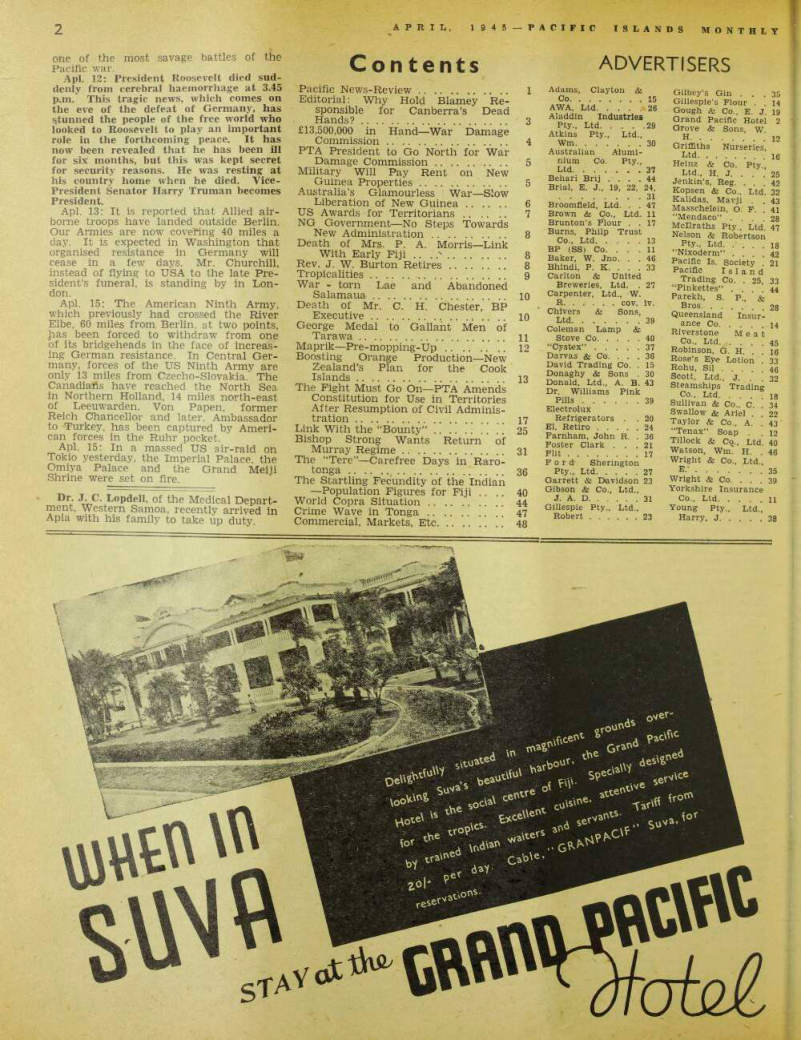
Contents
Pacific News-Review 1 Editorial: Why Hold Blarney Re sponsible for Canberra’s Dead Hands? 3 £13,500,000 in Hand—War Damage Commission 4 PTA President to Go North for War Damage Commission 5 Military Will Pay Rent on New Guinea Properties 5 Australia’s Glamourless War—Slow Liberation of New Guinea 6 US Awards for Territorians 7 NG Government—No Steps Towards New Administration 8 Death of Mrs. P. A. Morris—Link With Early Fiji .. . 8 Rev. J. W. Burton Retires 8 Tropicalities 9 War - torn Lae and Abandoned Salamaua 10 Death of Mr. C. H. Chester, BP Executive 10 George Medal to Gallant Men of Tarawa 11
Maprik—Pre-mopping-Up 12
Boosting Orange Production—New Zealand’s Plan for the Cook Islands 13 The Fight Must Go On—PTA Amends Constitution for Use in Territories After Resumption of Civil Adminis tration 17 Link With the “Bounty” 25 Bishop Strong Wants Return of Murray Regime 31 The “Tere”—Carefree Days in Raro tonga 36 The Startling Fecundity of the Indian —Population Figures for Fiji ... 40 World Copra Situation 44 Crime Wave in Tonga 47 Commercial, Markets, Etc 48
Advertisers
Adams, Clayton & Co 15 AWA, Ltd 26 Aladdin Industries Pty., Ltd 29 Atkins Pty., Ltd., Wm 30 Australian Alumi nium Co. Pty., Ltd 37 Behari Brij ... 44 Brial, E. J., 19, 22, 24, 3l Broomfield, Ltd. . . 47 Brown & Co., Ltd. 11 Brunton’s Flour . . 17 Burns, Philp Trust Co., Ltd 13 BP (SS) Co. . . . 11 Baker, W. Jno. . . 46 Bhindi, P. K. . . .33 Carlton & United Breweries, Ltd. . 27 Carpenter, Ltd., W.
R cov. Iv.
Chlvers & Sons, Ltd 39 Coleman Lamp & Stove Co 40 “Cystex” 37 Darvas & Co. ... 36 David Trading Co. . 15 Donaghy & Sons . 30 Donald, Ltd., A. B. 43 Dr. Williams Pink Pills 39 Electrolux Refrigerators . . 20 El. Retiro 24 Farnham, John R. . 36 Poster Clark ... 21 Flit 17 Ford Sherington Pty., Ltd 27 Garrett & Davidson 23 Gibson & Co., Ltd.,
J. A. D 31
Gillespie Pty., Ltd., Robert 23
Gilbey’s Gin ... 35 Gillespie’s Flour . . 14 Gough & Co., E. J. 19 Grand Pacific Hotel 2 Grove & Sons, W.
H 12 Griffiths Nurseries, Ltd is Heinz & Co. Pty, Ltd., H. J. . . .25 Jenkin’s, Reg. ... 42 Kopsen & Co., Ltd. 32 Kalidas, Mavji . . 43 Masschelein, o. P. . 41 “Mendaco” ... 28 Mcllraths Pty., Ltd. 47 Nelson & Robertson Pty., Ltd 18 “Nixoderm” ... 42 Pacific Is. Society . 21 Pacific Island Trading Co. . 25, 33
“Pinkettes” . . 44
Parekh, S. P., & Bros 28 Queensland Insur ance Co 14 Riverstone Me a t Co., Ltd 45
Robinson, G. H. . . is
Rose’s Eye Lotion . 33 Rohu, Sil 46 Scott, Ltd., J. . ! 32
Steamships Trading
Co., Ltd is Sullivan & Co., c. . 34 Swallow & Ariel . . 22 Taylor & Co., A. . 43 “Tenax” Soap . . 12 Tillock & Co., Ltd. 40
Watson, Wm 7 H. . 46
Wright & Co., Ltd., E 35 Wright & Co. ... 39 Yorkshire Insurance Co., Ltd 11 Young Pty., Ltd., Harry, J 38
Advertisements & other items, p. 4 (1 item)
asdsadsa
dfdfdgd
Pacific Islands Monthly
The Newspaper-Magazine of the South Seas IRegistered at the G.P.0., Sydney, for transmission by post as a newspaper .] Owned and Produced by Pacific Publications Pty. Ltd., Union House, 247 George Street, Sydney,
c Managing Director .. BW 5037 £ Business and Editorial MA 4369
P.O. Box 3408 R
Registered Address of Telegrams, Radiograms, and Cables: “Pacpub”, Sydney.
Contributions.
Articles, Stories, and Photographs dealing with Pacific Islands subjects are invited and will be paid for on publication.
Subscription Rates.
Per Annum, within British Empire, Prepaid, Post Free 10/- Per Annum, elsewhere, Prepaid, Post Free 12/6 Single Copies 1/-
Editor and Publisher:
R. W. Robson, F.R.G.S.
Advertising Manager: L. W. Bailey.
Advertising Office and Printing-House: 29 Alberta Street, Sydney.
Advertising rates furnished on application.
Representative In Fiji.
Pacific Publications (Fiji), Ltd., Bank of NSW Building, Suva (same office as W. H. Grove & Sons, Ltd.). Stocks of Pacific Islands Monthly and Pacific Islands Yearbook on hand.
Representative In London.
J. T. Wallis, Coronation House, 4 Lloyds Avenue, London, E.C.3, from whom may be obtained copies of Pacific Islands Monthly, Pacific Is. Year Book, advertising schedules, etc.
Agents.
The following are authorised to receive sub scriptions for Pacific Islands Monthly:— Burns, Philp & Co., Ltd., and Burns Philp (South Sea) Co., Ltd. All branches.
W. R. Carpenter & Co., Ltd. All branches.
Morris, Hedstrom, Ltd. All branches.
Steamships Trading Co., Papua. All branches.
Whitten Bros., Ltd., Samaral, Papua.
B.N.G. Trading Co., Ltd., Port Moresby, Papua.
J. Muir, Suva, Fiji.
Miss R. Castles, Suva, Fiji.
N. C. Mackenzie Hunt, Wainunu, Bua, FIJI.
Cook Islands Trading Co,, Rarotonga, Cook la.
A. C. Rowland, Papeete, Tahiti.
Islands Branches and Representatives of W. H.
Grove & Sons, Ltd., Auckland, New Zealand.
Ed. Pentecost, Noumea, New Caledonia.
Societe Gubbay Kerr et Cie, Noumea, N. Caledonia.
Vol. XV. No. 9.
April 17, 1945
Prirp i l/ Per Copy * rnce (prepaid: 10/- p.a.
small" Australian 1 Sf’ squadron®
Why Hold Blarney Responsible for Canberra's Dead Hand?
rE way in which the Australian section of the war against Japan, in the Western Pacific, is being muddled, is remarkable.
There are well over 7,000,000 people in the Australian nation; and a very large proportion of them are in the armed Services-700,000 was a figure published a couple of years ago. Apart altogether from men in the Navy and in the Air Force, it can be assumed that Australia has at least half a dozen divisions available for war, welltrained, battle-experienced, and at full strength It has been noted as a paradox by famous observers that Australia, which is notorious for stupid and blundering political leadership, can produce fighting-men equal to the best in the world. Australia’s armed Forces, therefore, should have been able to make a’ substantial contribution towards the defeat of Japan in the Pacific. That they have not done so is attributed by men best qualified to judge to the Australian politicians.
LOOK at the present position. Except for a comparatively few Aus-
small" Australian 1 Sf’ squadron®
somewhere in the vague north, all that Australia has contributed to the United Nations war effort, since 1943, in the shape of fighting units, are the Forces now scattered widely in the New Guinea area. Reference to an article on page 6 will show that Australians are carrying on three mopping -up operations in three widely-seperated areas of the Mandated Territory, and thus have dispersed their strength.
The Americans left this region over a year ago, and went “leap-frogging”
, rnu „ i„.p f away into the north-west. They left large numbers of Japs, by-passed and isolated, in Bougainville, New Ireland, New Britain and the Sepik section of New Guinea. They left those Japs to run around in circles in the primitive jungles, while-making full and ef fective use of air and sea supremacy -they drove for the heart of the Japanese Empire To see how that strategy paid rich dividends, we need only to look at the developments of the Pacific war during the past few weeks.
Everyone assumed that the hard fighting Australian divisions, which had done so well beside the Americans when New Guinea represented the front line, would move on north westwards with General MacArthur.
Instead, we heard nothing whatever about them, for many months, until it was announced, late in 1944, that they were to do the mopping-up in New Guinea. And mopping-up they have been, ever since. They have fought tenaciously, and with their usual initiative and courage; but the people of Australia are awakening to the fact that this is a wasteful, un inspiring and depressing campaign.
ANYTHING from 80.000 to 100,000 A Japs were cut off in New Guinea.
Our commanders know, as a positive fact, that these Japs were told officially that they were to stay m New Guinea and fight, and make the best possible use of local resources, for from three to five years, when they would be rescued. They were to tie up as many Anglo-American forces as possible. They made preparations accordingly. The defences they pre pared, during 1944, are what the Aus tralians are now coming up against.
In these circumstances, there were
Australians. They should ehher have set-up a containing force—a few thousand men to guard the Japs in the prisons which they had created for themselves—or they should have f a n en upon these isolated Jap armies with overw helming forces of men and mac hines, and simply crushed them, in the American manner, neither instead the
Australia. ArmvTs attLkinl in a wa^
t he fumbl ng Ind so suggestive °* with the tralian Government ; deals with the nations TOrtune sa me command iI both commana P* . .
We do not know how many divisions the Australian Army has sent to the three operational areas—and, if we knew we could not say—but we are permitted to guess (in view of the numbers of Japs in each area) that there are at least three Australian divisions engaged on the task, That might have been enough men, they had been properly equipped, As they have not been properly equipped, they are being wasted, Three times three divisions are not enough for the filthy, wearisome, costly job of clearing these Japs out 0 f the primitive jungles and moun tains, if inadequately equipped.
Jeehng
traJia that there is something: wrong somewhere,, and that the Australian Army is insufficiently equipped. But peo]Assumed that the have assumed that t e individual soldiers are not equipped-, and the height of stupidity was reached by press who American 6 and differences between American in KS,, the nictures and New Guinea greeted the p
the charges relating thereto with jeers and laughter.
The Australian soldier’s equipment for jungle fighting was evolved through months of trial and error and, taken by and large, is far the best outfit for New Guinea conditions.
The Australians can carry with them all they need, and can maintain themselves for a long time in the jungles. The Americans carry with them so much personal gear and equipment that they cannot carry it themselves on difficult trails, and their track is marked by discarded stuff. But that happens only when the American soldiers are obliged to go away from transport. As a rule, no matter how bad the terrain, the magnificent mechanical equipment of the United States is there to provide some kind of transport.
IT is in regard to mechanical equip ment, and not personal equip ment, concerning which the Australian press and politicians should be howl ing to high heaven. Huge masses of machinery follow close behind the leading units of an American army on the move in the Pacific, and contrive to make life easy and comfortable for the American infantrymen, compared with what Australian soldiers have to go through.
I have had the opportunity of dis cussing this matter, in some detail, with certain high military officers of the AIF, recently in Australia on leave. Here is a summary of what they say; The AIF should be leap-frogging along the coasts, instead of foot slogging through.these terrible jungles.
But it cannot, because it lacks landing-craft, and all the other small boat gear which the Americans used so effectively. • The AIF lacks portable cranes, and similar appliances for unloading and handling goods and equipment.
Far too much has to be man-handled. • The AIF lacks building appli ances. Recently, in one of the forward areas, it was necessary to put up a large shed. The AIF did it the hard way—pick-and-shovel men dug the i or u P r ights, and man handled the logs into place. The Americans do that sort of thing in a few minutes with a glorified post hole-digger, and heavy lifting is done with cranes. •Jbe lacks road - making machinery. The Australians tramp wearily through muddy tracks, or cut roads slowly with teams of native labourers. The Americans, in a few days, would have “bulldosed” roads out in all directions, and had jeeps running along them to carry their infantrymen and equipment. ® About 6 or 7 per cent, of the AIF are engineers. But nearly 50 per cent, of the American land forces were engineers. That just about re presents the difference between the oropera?ron. fOrCeS and their methods pROBABLV it is not the fault of thi« 1 vu- 4P stralian Commander that this vitally necessary mechanical
equipment is not available in New Guinea. Probably, the AIF is handi capped by lack of ships, and by the lact that the Americans, in their tremendous drive upon Japan itself, themselves want every ounce of equip ment. Probably, they have none to spare for mere “mopping-up” in New Guinea.
If that is so—and everything sug gests that it is—why is Australia playing Japan’s game? Why is a schoolboy being sent out on"a man’s errand? Why is Canberra allowing perhaps 100,000 Japs, isolated in New Guinea, to tie up the whole Australian Army, when those good, well-trained soldiers could have gone on with the vital mechanical equipment to the north, and been much more effec tively employed?
Is this one more example of the palsied hand of Canberra adminis tration? It is unbelievable that a man with General Sir Thomas Blarney’s qualifications would, on his own judgment, scatter his AIF around New Guinea in this futile, wasteful fashion. No man knows, better than he, the importance of having ade quate mechanical equipment if the Japs are to be rooted out of these Pacific Islands without unnecessary waste of our personnel.
Why cannot they be left there, and areas near them guarded, until ships and equipment are available to allow our men to fall upon them in over whelming force?
R.W.R.
Hand
£13,500,000 IN
Australian War Damage Commission
rOM its establishment in 1942, until December 31, 1944, the Australian War Damage Commission has re ceived—mostly by means of a compulsory levy on property in Australia—the sum of £15,347,152. It had paid out, in the same period, as follows: Claims assessed and recorded .. £938,289 Interest on recorded claims .. 61,554 Claims expenses and cost of running the Commission .. 399,587 This leaves a balance of £13,947,722 in the hands of the Commission. The total of all claims received is as follows: New Guinea £11,497,534 Papua 1,942,833 Northern Territory 109,984 Other areas 9,0069 £l3 559 420 Of these, £938,289 have been recorded, and £276,325 have been disallowed. • Generally speaking, the Commission is regarded as an efficient and well-man aged institution. Therefore, the cost of administration and of investigation of claims, to December 31, nearly £400.000, is a little startling.' It is explained that it includes the heavy original cost of creat ing an Australian-wide organisation, thought to be necessary in the first place, and of collecting over £15.000,000.
Total number of claims lodged was 4,089. and 2,488 have been dealt with, wholly or in part. The balance, 1,601, obviously includes the claims of the big companies.
b!fatloads
About Islands People
J ’ J V * Lls tan »,, P r 9P{! etor of the l Si oh P rm A tmg a T ld pubat Apia has, for reasons of health,...recently disposed of his Si 1 ® “ Samoa tt % pif h Q g n C °- Ltd -> f 9 rmed by Mr. E. F. Paul, a well-known businessman of Apia. The “Western Samoa Mail,” the only weekly newspaper of Apia, ceased publication a few~ years ago Mr. Liston and his family have left Samoa for New Zealand. He went to Western Samoa originally as printer for the London Missionary Society Mr Jenner of the Rum* Phiin in Pago Paso f FaSpS P i staff Visitor g ?o SvdnPv Ea Trt n l.af a S!i a ’ a
Tarawa, Gilbert Islands, when the Japs invaded early in 1942.
Another link between Robert Louis Stevenson and the Pneifie n-n January 7 when died in New York. She was the little girl whose birthday unhappily fell on December 25, and to whom Stevens™ legally transferred his own birthday, November 13, so that she might have a normal birthday, like other children. Her father, Henry Clay Ide, was an official in Samoa when Stevenson lived there; and she later became a famous woman About the only remaining links are Mrs.
Salisbury Field, Stevenson’s step- daughter, and her \son, Austin Strong. Mrs Salisbury Field, now aged 86, lives iri California, and her son is a well-known figure in New York. Both were with Stevenson in Samoa sixty years ago ry^ r f ' nesten Msslon, 8 bl*erecting’
of native material at Maravovo, BSI. A chapel is al#o in the course of erection.
The buildings of the extensive mission station at Maravovo were all destroyed during the Japanese occupation and sub sequent fighting in the locality after the Americans landed.
Monsieur Christian Laigret, who was Governor of New Caledonia before the •present Governor (M. Tallec) took over, is now Governor of Mauretania, the French colony in Africa. Recently, in a colourful ceremony in which the natives, and Governors from neighbour ing colonies took part, he married Mademoiselle Denyse Pascault, secretary to a French war delegation to Nairobi, Kenya.
Mr. M. J. Connolly, Secretary of the Allied Supply Council in Australia, Mr.
A. A. Flaunty, of the New Zealand Minis try of Supply, and Mr. B. F. Blackwell, representative in Australia of the Fiji and the Western Pacific Supply and Pro duction Board, were visiting Fiji in March.
Miss D. Pedersen, who is to be Prin cipal Matron and Nursing Superintendent of the Fiji NursingftService, in place of Miss L. M. Lea (whp has retired and who will be leaving Fiji shortly) has arrived in the Colony from New Zealand. Miss C. E. E. Dunphy and Miss A. O’Donnell are also newly arrived nursing sisters, along with Miss P. Wilkinson, who has been appointed a staff nurse. Another arrival, Mrs. J. Hunt, is to go to Taveuni to take charge of the Cottage Hospital there. She will replace Miss Whitehead, wh<f left recently to take up a position at Niue.
N. Guinea Properties
Military Will Pay
Rent On
rE Pacific Territories Association has, after three years, at last been given satisfaction on the question of rents of properties occupied by the armed forces in Papua, New Guinea and Thursday Island, for which evacuees have hitherto been paid nothing.
The PTA was informed early in April that Cabinet had decided to pay periodic compensation for occupation of premises, the compensation to be assessed on the general lines adopted in the Northern Territory and based on interest on capital value, plus outgoings. Depreciation will also be considered.
The Commonwealth will also be respon sible for all damage during the occupa tion except fair wear-and-tear. Any other unusual items of loss or damage will also be considered.
The assessment of the War Damage Commission will be accepted as the prin cipal guide to the values of the struc tures. It is not intended to compensate for occupation of land or plantations except where structures were used.
The assessment will be done by Mr.
Alderman, KC, in conjunction with the War Damage Commission, and all pay ments will be made through that Com mission. There is no need for any claim ant to communicate with either Mr.
Alderman or the War Damage Commis sion. When compensation is assessed, claimants will be communicated with direct.
"Trusteeship"
Future of Pacific Territories
ALREADY, before the opening of the San Francisco Conference, news papers throughout the world are beginning to speculate about the future of Pacific Territories which may be “running around loose” after the Pacific War is ended and the League of Nations liquidated. Those Territories probably will be: New Guinea.—Australian Mandate from League of Nations.
Western Samoa.—New Zealand Mandate.
Caroline, Marshall and Mariana Islands.— Japanese Mandate.
Nauru.—Joint British Mandate.
Formosa. —Probably taken from Japan.
New Hebrides (Condominium) and Bri tish Solomon Islands.—Present control may be revised, for strategical and political reasons.
The American papers indicate that the United States is determined to retain, among the recaptured islands at least, sufficient sea and air bases to assist the task of maintaining future peace in the Pacific. There is much talk of a trustee ship, responsible to the World Authority about to be created; but American opinion, so far as the bases are con cerned, wants no trustee-ship, but abso lute authority. Few who study the prob lems of the future security of the Pacific will quarrel with the American argu ments.
In any case, discussion is futile, until we see the trend of world opinion, as expressed at the ’Frisco Conference.
Mr. and Mrs. C. F. Sollitt, of Nausori, Fiji, had a letter recently from their son, LAC Hickson Sollitt, RAAF, who is a prisoner of war in Japanese hands. He apparently is well.
Mr. F. E. Johnson Retires
From Bsi Service
rE well-known head of the Treasury, Customs and Postal Department of the British Solomon Islands Ad ministration, Mr. F. E. Johnson, ISO, AFIA, has decided to retire this year from the service of the High Commission of the Western Pacific. Mr. Johnson joined the service in 1908, in the New Hebrides, when 30 years old, as Inspector of Labour and Acting Commandant of Constabulary; he was 8 years in the Condominium; and in 1919 he went to the Solomons as Treasurer. He was a member of the Advisory Council, and he acted as Re sident Commissioner on a number of occasions.
Mr. Johnson was at Tulagi when the Japanese invaded the South Pacific; and, when partial evacuation of the Protec torate became necessary, he was selected by headquarters, in 1942, to proceed to Sydney, to take charge of the BSI office and records there, and act as liaison officer between the BSI Administration and various fighting organisations in the Solomons. The Japs are gone, the fight ing services are moving on, the Sydney job, presumably, has been carried through to a happy conclusion; and now Mr.
Johnson, who is 67 years old, may enjoy the leisure he has well earned. He will carry with him the good wishes of many hundreds of people, who have appreciated his courtesy and efficiency in his long official life.
Lloyd Ambler To Succeed
MR. LLOYD E. AMBLER, who has been in the service of the Fiji Govern ment and the Western Pacific High Commission since 1909, has been appointed' BSI Treasurer, in succession to Mr.
Johnson. Most of his service, since 1921, has been given at Commission head quarters in Suva, where he was appointed Chief Clerk and Accountant in 1932. He is a veteran of World War I.
Twice " Mentioned "
A FORMER member of the New Guinea Police Force, Captain N. B. Blood, has been mentioned in despatches.
This is the second occasion since the out break of the Pacific war, but no details are available.
Advertisements & other items, p. 7 (1 item)
Representing Australia
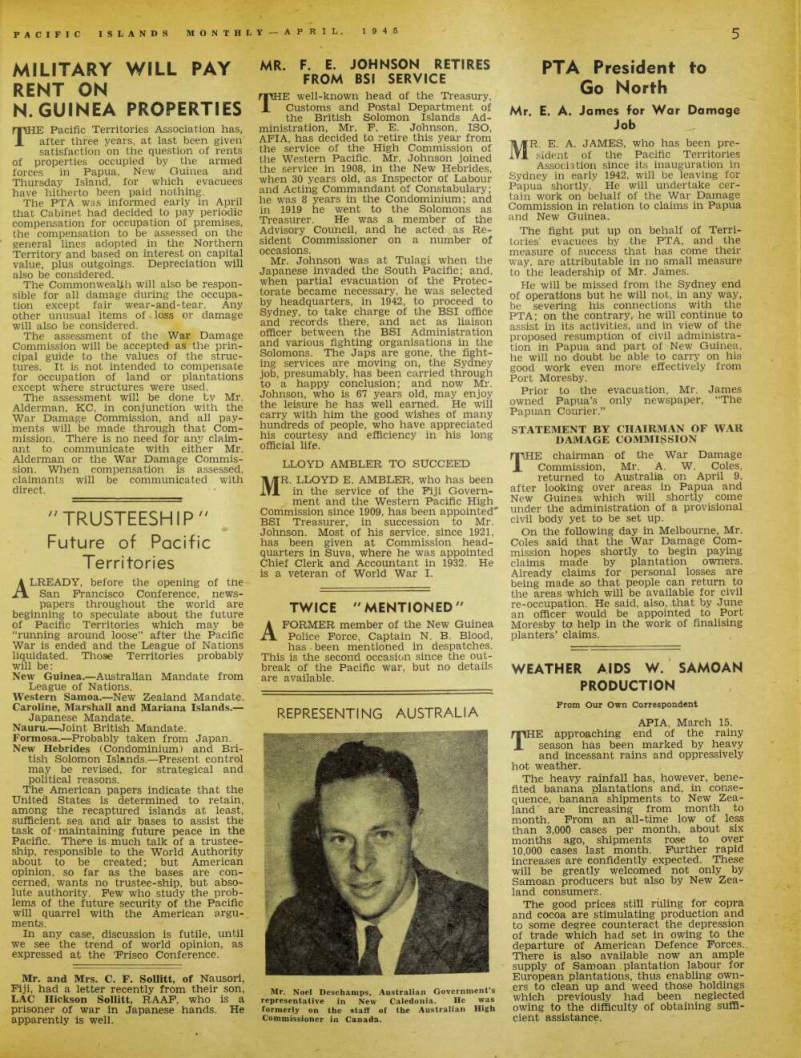
Mr. Noel Deschamps, Australian Government’s representative in New Caledonia. He was formerly on the staff of the Australian High Commissioner in Canada.
PTA President to Go North Mr
Go North Mr. E. A. James for War Damage Job
MR. E. A. JAMES, who has been pre sident of the Pacific Territories Association since its inauguration in Sydney in early 1942, will be leaving for Papua shortly. He will undertake cer tain work on behalf of the War Damage Commission in relation to claims in Papua and New Guinea.
The fight put up on behalf of Terri tories’ evacuees by the PTA, and the measure of success that has come their way, are attributable in no small measure to the leadership of Mr. James.
He will be missed from the Sydney end of operations but he will not, in any way, be severing his connections with the PTA; on the contrary, he will continue to assist in its activities, and in view of the proposed resumption of civil administra tion in Papua and part of New Guinea, he will no doubt be able to carry on his good work even more effectively from Port Moresby.
Prior to the evacuation, Mr. James owned Papua’s only newspaper, “The Papuan Courier.”
Statement By Chairman Of War
Damage Commission
THE chairman of the War Damage Commission, Mr. A. W. Coles, returned to Australia on April 9. after looking over areas in Papua and New Guinea which will shortly come under the administration of a provisional civil body yet to be set up.
On the following day in Melbourne, Mr.
Coles said that the War Damage Com mission hopes shortly to begin paying claims made by plantation owners.
Already claims for personal losses are being made so that people can return to the areas which will be available for civil re-occupation. He said, also, that by June an officer would be appointed to Port Moresby to help in the work of finalising planters’ claims.
Weather Aids W. Samoan
Production
From Our Own Correspondent APIA, March 15. rE approaching end of the rainy season has been marked by heavy and incessant rains and oppressively hot weather.
The heavy rainfall has, however, bene fited banana plantations and, in conse quence, banana shipments to New Zea land are increasing from month to month. From an all-time low of less than 3,000 cases per month, about six months ago, shipments rose to over 10,000 cases last month. Further rapid increases are confidently expected. These will be greatly welcomed not only by Samoan producers but also by New Zea land consumers.
The good prices still ruling for copra and cocoa are stimulating production and to some degree counteract the depression of trade which had set in owing to the departure of American Defence Forces.
There is also available now an ample supply of Samoan plantation labour for European plantations, thus enabling own ers to clean up and weed those holdings which previously had been neglected owing to the difficulty of obtaining suffi cient assistance.
Australia's Glamour-Less War
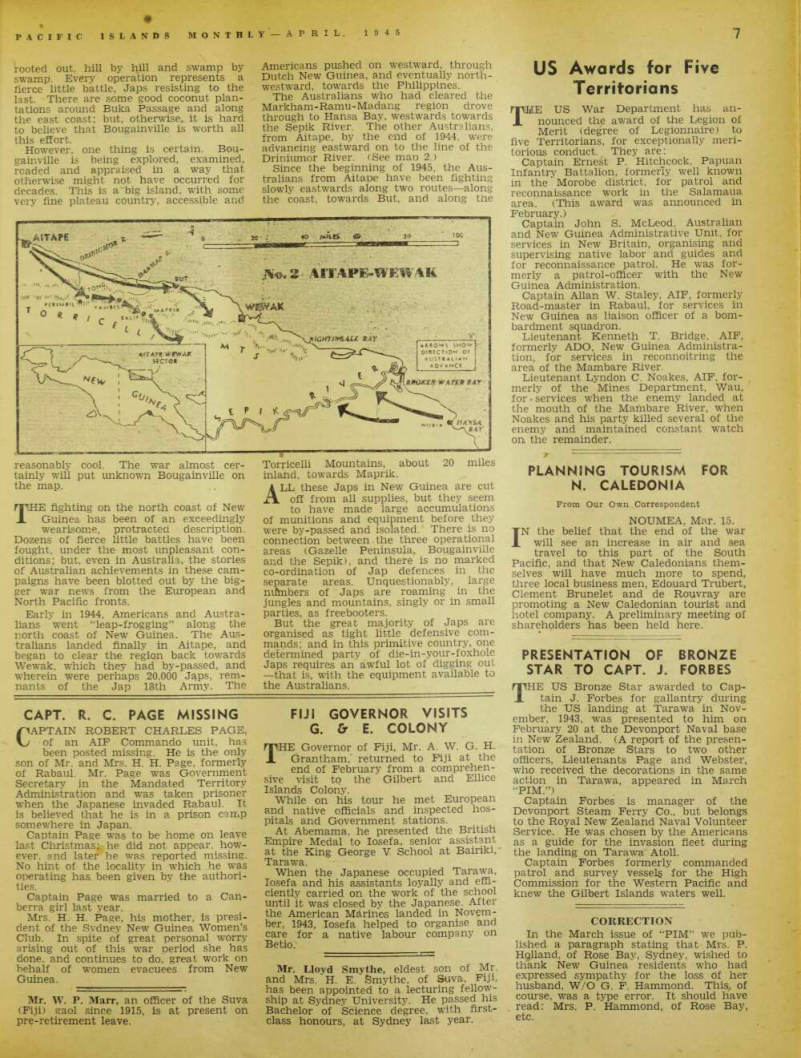
The Slow Liberation of New Guinea
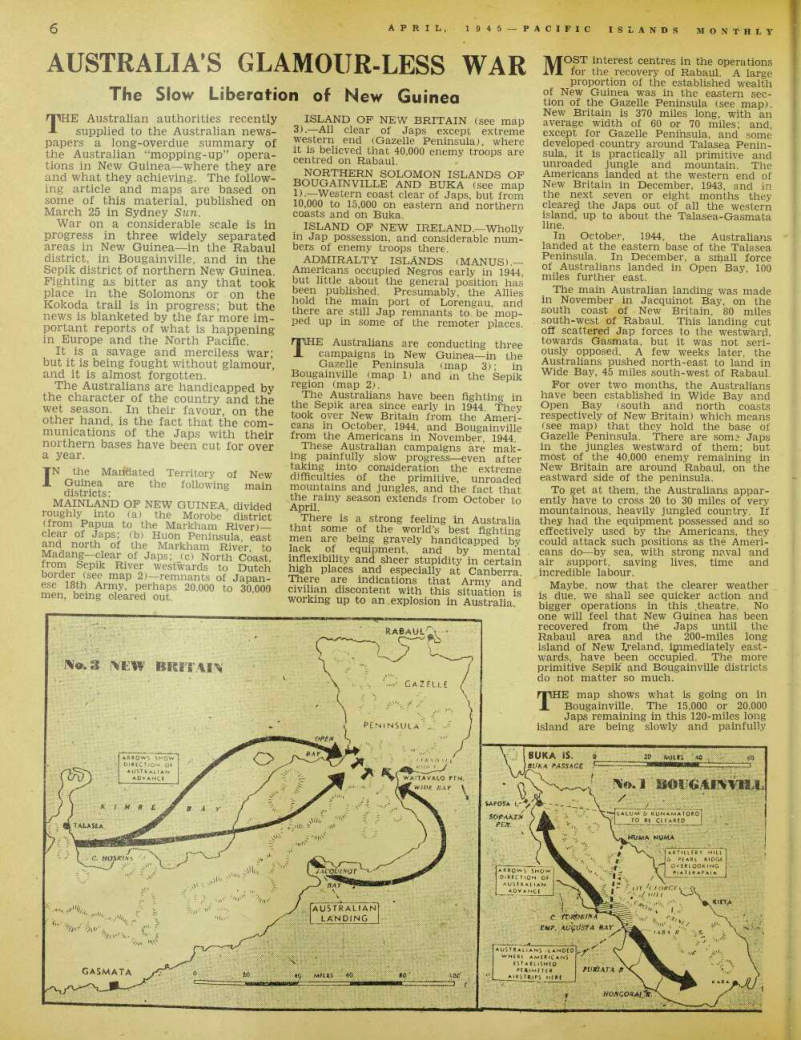
THE Australian authorities recently supplied to the Australian news papers a long-overdue summary of the Australian “mopping-up” opera tions in New Guinea—where they are and what they achieving. The follow ing article and maps are based on some of this material, published on March 25 in Sydney Sun.
War on a considerable scale is in progress in three widely separated areas in New Guinea—in the Rabaul district, in Bougainville, and in the Sepik district of northern New Guinea.
Fighting as bitter as any that took place in the Solomons or on the Kokoda trail is in progress; but the news is blanketed by the far more im portant reports of what is happening in Europe and the North Pacific.
It is a savage and merciless war; but it is being fought without glamour, and it is almost forgotten.
The Australians are handicapped by the character of the country and the wet season. In their favour, on the other hand, is the fact that the com munications of the Japs with their northern bases have been cut for over a year.
IN the Mandated Territory of New Guinea are the following main districts:
Mainland Of New Guinea Divided
roughly into (a) the Morobe district (from Papua to the Markham River)— clear of Japs; (b) Huon Peninsula, east and north of the Markham River, to Madang—clear of Japs; _(c) North Coast, from Sepik River westwards to Dutch border (see map 2)— remnants of Japan ese 18th Army, perhaps 20,000 to 30,000 men, being cleared out.
Island Of New Britain (See Map
3).—All clear of Japs except extreme western end (Gazelle Peninsula), where it is believed that 40,000 enemy troops are centred on Rabaul.
Northern Solomon Islands Of
Bougainville And Buka (See Map
1).—Western coast clear of Japs, but from 10,000 to 15,000 on eastern and northern coasts and on Buka.
Island Of New Ireland.—Wholly
in Jap possession, and considerable num bers of enemy troops there.
Admiralty Islands (Manus).—
Americans occupied Negros early in 1944, but little about the general position has been published. Presumably, the Allies hold the main port of Lorengau, and there are still Jap remnants to be mop ped up in some of the remoter places. rE Australians are conducting three campaigns in New Guinea—in the Gazelle Peninsula (map 3); in Bougainville (map 1) and in the Sepik region (map 2).
The Australians have been fighting in the Sepik area since early in 1944. They took over New Britain from the Ameri cans in October, 1944, and Bougainville from the Americans in November, 1944.
These Australian campaigns are mak ing painfully slow progress—even after taking into consideration the extreme difficulties of the primitive, unroaded mountains and jungles, and the fact that the rainy season extends from October to April.
There is a strong feeling in Australia that some of the world’s best fighting men are being gravely handicapped by lack of equipment, and by mental inflexibility and sheer stupidity in certain high places and especially at Canberra There are indications that Army and civilian discontent with this situation is working up to an explosion in Australia
MOST interest centres in the operations for the recovery of Rabaul. A large proportion of the established wealth of New Guinea was in the eastern sec tion of the Gazelle Peninsula (see map).
New Britain is 370 miles long, with an average width of 60 or 70 miles; and, except for Gazelle Peninsula, and some developed country around Talasea Penin sula, it is practically all primitive and unroaded jungle and mountain. The Americans landed at the western end of New Britain in December, 1943, and in the next seven or eight months they clearest the Japs out of all the western island, up to about the Talasea-Gasmata line.
In October, 1944, the Australians landed at the eastern base of the Talasea Peninsula. In December, a small force of Australians landed in Open Bay, 100 miles further east.
The main Australian landing was made in November in Jacquinot Bay, on the south coast of New Britain, 80 miles south-west of Rabaul. This landing cut off scattered Jap forces to the westward, towards Gasmata, but it was not seri ously opposed. A few weeks later, the Australians pushed north-east to land in Wide Bay, 45 miles south-west of Rabaul.
For over two months, the Australians have been established in Wide Bay and Open Bay (south and north coasts respectively of New Britain) which means (see map) that they hold the base of Gazelle Peninsula. There are some Japs in the jungles westward of them; but most of the 40,000 enemy remaining in New Britain are around Rabaul, on the eastward side of the peninsula.
To get at them, the Australians appar ently have to cross 20 to 30 miles of very mountainous, heavily jungled country. If they had the equipment possessed and so effectively used by the Americans, they could attack such positions as the Ameri cans do —by sea, with strong naval and air support, saving lives, time and incredible labour.
Maybe, now that the clearer weather is due, we shall see quicker action and bigger operations in this .theatre. No one will feel that New Guinea has been recovered from the Japs until the Rabaul area and the 200-miles long island of New Ireland, immediately east wards, have been occupied. The more primitive Sepik and Bougainville districts do not matter so much. rE map shows what is going on in Bougainville. The 15,000 or 20,000 Japs remaining in this 120-miles long island are being slowly and painfully
rooted out. hill by hill and swamp by swamp. Every operation represents a fierce little battle, Japs resisting to the last. There are some good coconut plan tations around Buka Passage and along the east coast; but, otherwise, it is hard to believe that Bougainville is worth all this effort.
However, one thing is certain. Bou gainville is being explored, examined, rcaded and appraised in a way that otherwise might not have occurred for decades. This is a big island, with some very fine plateau country, accessible and
reasonably cool. The war almost cer tainly will put unknown Bougainville on the map.
THE fighting on the north coast of New Guinea has been of an exceedingly wearisome, protracted description.
Dozens of fierce little battles have been fought, under the most unpleasant con ditions; but, even in Australia, the stories of Australian achievements in these cam paigns have been blotted out by the big ger war news from the European and North Pacific fronts.
Early in 1944, Americans and Austra lians went “leap-frogging” along the north coast of New Guinea. The Aus tralians landed finally in Aitape, and began to clear the region back towards Wewak, which they had by-passed, and wherein were perhaps 20,000 Japs, rem nants of the Jap 18th Army. The
Americans pushed on westward through Dutch New Guinea, and eventually north westward, towards the Philippines, The Australians who had cleared the Markham-Ramu-Madang region drove through to Hansa Bay, westwards towards the Sepik River. The other Australians, from Aitape, by the end of 1944, were advancing eastward on to the line of the Driniumor River. (See man 2.) Since the beginning of 1945, the Aus tralians from Aitape have been fighting slowly eastwards along two routes—along the coast, towards But, and along the
Torricelli Mountains, about 20 miles inland, towards Maprik.
ALL these Japs in New Guinea are cut off from all supplies, but they seem to have made large accumulations of munitions and equipment before they were by-passed and isolated. There is no connection between the three operational areas (Gazelle Peninsula, Bougainville and the Sepik), and there is no marked co-ordination of Jap defences in the separate areas. Unquestionably, large mAnbers of Japs are roaming in the jungles and mountains, singly or in small parties, as freebooters.
But the great majority of Japs are organised as tight little defensive com mands: and in this primitive country, one determined party of die-in-your-foxhole Japs requires an awful lot of digging out —that is, with the equipment available to the Australians.
Cart. R. C. Page Missing
Captain Robert Charles Page,
nnlv been posted missing. He is the only son of Mr. and Mrs. H. H. Page, formerly of Rabaul. Mr. Page was Government Secretary in the Mandated Territory Administration and was taken prisoner when the Japanese invaded Rabaul. It is believed that he is in a prison camp somewhere in Japan.
Captain Page was to be home on leave last Christmas; he did not appear, how ever, and later he was reported missing.
No hint of the locality in which he was operating has been given by the authorl beMla P s a t 8 UT S marri6d t 0 3 Can ' Mrs H. H. Page’, his mother, is presl dent of the Svdnev New Guinea Women’s Club. In spite of great personal worry arising out of this war period she has done, and continues to do, great work on behalf of women evacuees from New Guinea. ■ Mr. W. P. Marr, an officer of the Suva (Fiji) gaol since 1915, is at present on pre-retirement leave.
Fiji Governor Visits
G. & E. Colony
T*HE Governor of Fiji, Mr. A. W. G. H.
I , . , j j. tth-m at tvip A r^ n t f h^ rl^ t r^frnrr. mmn Jh n . en . d of February from a co “ pr ®*} 1 . sive visit to the Gilbert and Ellice colony. trnmnoan QT^y hlle ,. on h * s . t ° ur h ? S iiThns" and native officials and inspected pit A a J s A l nd Government stations.
At Abemama, he presented the B Medal to losefa, sem°r ass^tant at the King George V School at Bainki, x , r roMW!I and effl «t C w a aTcL°e n d V American Marines landed in Novem ber. 1943, losefa helped to organise and £are for a native labour company on -oetio.
Mr. Lloyd Smythe, eldest son of Mr. and Mrs. H. E. Smythe, of Suva, Fiji, has been appointed to a lecturing fellow ship at Sydney University. He passed his Bachelor of Science degree, with first class honours, at Sydney last year.
US Awards for Five
Territorians
TKE US War Department has an nounced the award of the Legion of Merit (degree of Legionnaire) to five Territorians, for exceptionally meri torious conduct. They are: Captain Ernest P. Hitchcock. Papuan Infantry Battalion, formerly well known in the Morobe district, for patrol and reconnaissance work in the Salamaua area. (This award was announced in February.) Captain John S. McLeod, Australian and New Guinea Administrative Unit, for services in New Britain, organising and supervising native labor and guides and for reconnaissance patrol. He was for merly a patrol-officer with the New Guinea Administration.
Captain Allan W. Staley, AIF, formerly Road-master in Rabaul, for services in New Guinea as liaison officer of a bom bardment squadron.
Lieutenant Kenneth T. Bridge, AIF, formerly ADO, New Guinea Administra tion, for services in reconnoitring the area of the Mambare River Lieutenant Lyndon C. Noakes, AIF, for merly of the Mines Department, Wau, for. services when the enemy landed at the mouth of the Mambare River, when Noakes and his party killed several of the enemy and maintained constant watch on the remainder.
Planning Tourism For
N. Caledonia
From Our Own Correspondent
Noumea, Mar. 15.
IN the belief that the end of the war will see an increase in air and sea travel to this part of the South Pacific, and that New Caledonians them selves will have much more to spend, three local business men, Edouard Trubert, Clement Brunelet and de Rouvray are promoting a New Caledonian tourist and hotel company. A preliminary meeting of shareholders has been held here.
Presentation Of Bronze
Star To Capt. J. Forbes
THE US Bronze Star awarded to Cap tain J. Forbes for gallantry during the US landing at Tarawa in Nov ember, 1943, was presented to him on February 20 at the Devonport Naval base in New Zealand. (A report of the presen tation of Bronze Stars to two other officers, Lieutenants Page and Webster, who received the decorations in the same action in Tarawa, appeared in March
“Pim.”)
Captain Forbes is manager of the Devonport Steam Ferry Co., but belongs to the Royal New Zealand Naval Volunteer Service. He was chosen by the Americans as a guide for the invasion fleet during the landing on Tarawa Atoll.
Captain Forbes formerly commanded patrol and survey vessels for the High Commission for the Western Pacific and knew the Gilbert Islands waters well.
Correction
In the March issue of “PIM” we pub lished a paragraph stating that Mrs. P.
Holland, of Rose Bay, Sydney, wished to thank New Guinea residents who had expressed sympathy for the loss of her husband, W/O G. F. Hammond. This, of course, was a type error. It should have read: Mrs. P. Hammond, of Rose Bay, etc.
Death of Mrs. P. A.
Morris Link With MH and Early Fiji
WHEN Mrs. P. A.. Morris, aged over 70, died in Sydney early in March, a link with the pioneering days of Fiji was severed. She was a daughter of Mr.
Alexander Eastgate, an Englishman, who went from New Zealand to Fiji in 1870, to grow cotton, and later settled in Levuka as a Government Magistrate.
In Levuka, Miss Eastgate met and married Mr. Percy Atherton Morris, who was bom in the United States in 1868 and educated in Sydney, and who became a trader in Levuka in 1891, when he was 23 years old.
Also in Levuka at that time was young John Maynard Hedstrom, son of the Levuka harbourmaster, and not long returned from Melbourne University. Mr.
Hedstrom, in 1895, married Miss Grace Eastgate, a sister of Mrs. Morris.
The brothers-in-law became partners in the firm of Morris Hedstrom & Co., which in 1902 took over the old-established business of R. Bentley & Co., and also that of Brown, Joske and Hedstrom. Thus was laid in Levuka the foundation of Morris Hedstrom, Ltd., the biggest mer cantile institution in the Central Paci fic, at the head of which is still one of the founders, Sir Maynard Hedstrom.
The new firm grew and flourished, and its headquarters were moved to Suva.
About 1915, Mr. Morris retired from active business life, and he and his wife with two sons and one daughter, settled down in Sydney, where they have lived ever since.
There were six Eastgate girls, and three of them (Mrs. Morris, the late Lady Hed strom, and the late Mrs. H. E Snell) married into the Morris Hedstrom con cern. Those three now are dead; but the other three still are living in Auckland.
Two of their brothers are residents of Fiji.
Advertisements & other items, p. 10 (1 item)
»„ S vSfe™
NEW GUINEA-SYDNEY AIR
SERVICE RESUMED
THE New Guinea-Sydney air service which was suspended when Japan A™u Ca o me the w . ar> was resumed on * Thls 1 s ?rvice is now run by Qantas, formerly it was operated by W.
Qantas P 6r & 0o -’ Ltd ” who sold it to The service will be run once weeklv trf weXv"-nT 611 U will to —that be rUn on a civil basis
havTY p^Li^Tfnter
1 "Terr the Department of Br^ ba ne G Rockhampton, S T^wnsvtlle Ic< 1 c<
»„ S vSfe™
made
N. Hebrides Paper
Suspended
Prom Our Own Correspondent POR censorship N re™ E s A ’
r al which ’»£?*£££
settlers in the New Hebrides, has been temporarily suspended. The paplr his been the “parish magazine” of Prench- TvJ n ™ the GroUll '? r the Past 35 yeays Frouin managln ® editor is Monsieur L. G.
Ng Government
No Further Step Towards New Administration
FOUR more weeks have passed; but there is no more news of any ad ministrative changes in relation to Papua and New Guinea.
There also is no apparent change of heart on the part of the Canberra bureaucrats on the subject of the return to Papua and the New Guinea Morobe district of the people who were driven out by the invasion over three years ago.
On March 9, Mr. Ward (Minister for External Territories) announced that the Papua, and New Guinea Civil Adminis trations would not be restored; but that, instead, a Provisional Administrator would be appointed.
Mr. Ward informed Melbourne news papers on April 4 that he had received a number” of applications for the Ad ministratorship, including some from sol diers, and that they would be dealt with by “Full Cabinet.” This statement caused surprise—it was not known generally, if at all, that applications had been invited.
ALL former public servants of Papua and New Guinea have been circu larised with regard to their return to the area as members of the Provi sional Government. They are asked to signify if they wish to have their name entered as a candidate for the Provi sional Administration; or if they do not wish to have their name entered; or if they wish to be released from the Army to take up a civil position in the new Administration.
The report of Mr. Barry. KC, on the circumstances surrounding the removal of Civil Government from Papua on Febru ary 1. 1942. is in the Minister’s hands, but nothing has been published. Many people will be surprised if it ever is published.
There have been further reports of friction between Mr. Ward’s Department, which exercises a limited control of the Territories, and the Army, which has the full responsibility for administration— and seems reluctant to give it up.
Some day, no doubt, the situation will be cleared up. Meanwhile, the homeless people of the Territories must just wait in patience in Australia, or wherever they may be. They would be unwise to expect anything much to be done for their rehabilitation so long as the pre sent Australian Government remains in power—probably another 15 months.
Cuthbert's Misjma Mine
CUTHBERT’S Misima Gold Mine, Ltd., one of the most profitable enter prises of the kind in the Pacific, which has been idle since the evacuation of Papua in 1942, reports that it gets an income of nearly £l,OOO per annum from its investments, and thus is able to pay running and maintenance costs, pending resumption. Messrs. W. Henley and W.
Callanan are in charge of a small main tenance party at the mine in Misima; and when private enterprise and civilians are allowed to return to Papua, the mine should quickly resume its profitable operations. Directors are H. Gordon Carter, Tom Nevitt, Cr C. Bown and E Laurence.
Mr. Fred Cuthbert, looking as well and energetic as ever, was a visitor to Sydney from Queensland in March.
Retires
Rev. J. W. Burton Retires After 20 Years' Work for Methodist Mission
AFTER 20 years’ continuous service as general secretary of the Methodist Overseas Mission, the Rev. J W Burton retired from, that position in March. On his own confession, Mr. Bur ton is 70 years of age; this, however is hard to believe—he is still a handsome, vigorous man whose knowledge of world affairs and interest in native welfare are known throughout the Pacific.
During his early ministry, he was a missionary in Fiji and during his nine
year term there took a particular inter est in the Indians—then employed as indentured labourers.
In 1914 he was transferred from New Zealand and was appointed State secre tary of the Victoria and Tasmania Con ference. He was appointed to the general secretaryship of the Mission in 1925. His period of service in this capacity covered the two abnormal periods of the depres sion and the first 5£ years of World War 11.
In a farewell address, at the recent annual meeting of the Missions Board, the president general, the Rev. H. M.
Wheller, stated, in moving a vote of appreciation later passed by the Board: “Mr. Burton’s broad world-outlook and competent knowledge of Christian Mis sions in our time, his gifted mind and administrative ability, his spiritual leader ship, literary gifts and untiring enthu siasm have all combined to make his term of office a period of distinguished and progressive service in our Church.”
Flight-Lieutenant James Ba Thomson, RAAF, who was on the staff of the Bank of NSW in Lautoka, Fiji, was killed in an aircraft accident in India on April 1.
He was the only son of the late Mr. R.
F. Thomson, who was Chief Labour Inspector in the Solomon Islands. His widowed mother now lives in Melbourne.
This young airman—he was aged 28—had a very fine scholastic and athletic record.
Ng Women's Club
Dance
TiHE New Guinea Women’s Club cf Sydney will hold a dance on Friday, April 20, at 8 p.m.
It will be held in the Lovejoy Dance Hall, George Street, opposite Wyn yard Station—entrance can be gained through Hunter Street Sub way.
Admission will be 3/- single, 57double, Service men and women half price. Tickets may be obtained from the Club Rooms, 77 King Street. For information ring the secretary, XM3500.
Advertisements & other items, p. 10 (2 items)
8
APRIL, 1945 -PACIP I C ISLANDS MONTHLY
Notice Of Thanks
MRS. H. F. STUART-RUSSELL, of
Samarai, Papua, on behalf of her family and herself, wishes to convey her grateful thanks to the many friends who sent messages of sympathy, and wreaths, in connection with the lamented death of her husband, Mr.
Harry Francis Stuart-Russell, in Sydney, on March 18.
Teopicalities
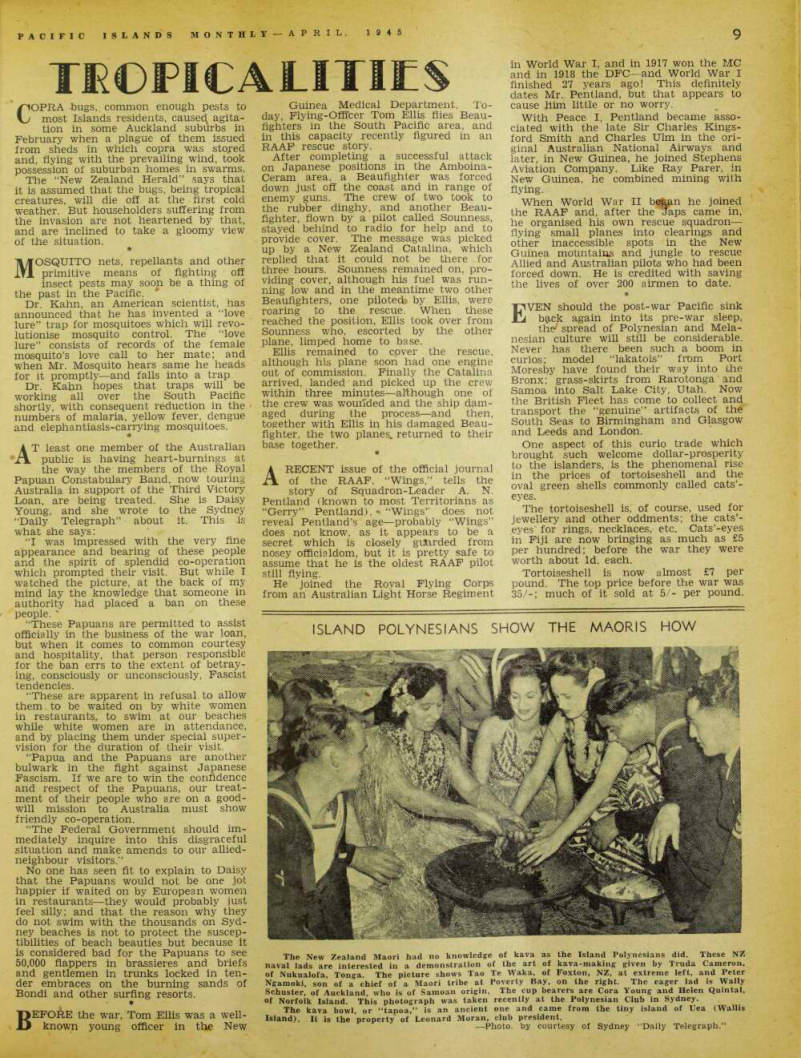
COPRA bugs,, common enough pests to most Islands residents, agita tion in some Auckland suburbs in February when a plague of them issued from sheds in which copra was stored and, flying with the prevailing wind, took possession of suburban homes in swarms.
The “New Zealand Herald” says that it is assumed that the bugs, being tropical creatures, will die off at the first cold weather. But householders suffering from the invasion are not heartened by that, and are inclined to take a gloomy view of the situation, ♦ MOSQUITO nets, repellants and other primitive means of fighting off insect pests may soon be a thing of the past in the Pacific. * Dr. Kahn, an American scientist, has announced that he has invented a “love lure” trap for mosquitoes which will revo lutionise mosquito control. The “love lure” consists of records of the female mosquito’s love call to her mate; and when Mr. Mosquito hears same he heads for it promptly—and falls into a trap Dr. Kahn hopes that traps will be working all over the South Pacific shortly, with consequent reduction in the numbers of malaria, yellow fever, dengue and elephantiasis-carrying mosquitoes.
AT least one member of the Australian public is having heart-burnings at the way the members of the Royal Papuan Constabulary Band, now touring Australia in support of the Third Victory Loan, are being treated. She is Daisy Young, and she wrote to the Sydney “Daily Telegraph” about it. This is what she says; “I was impressed with the very fine appearance and bearing of these people and the spirit of splendid co-operation which prompted then- visit. But while I watched the picture, at the back of my mind lay the knowledge that someone in authority had placed a ban on these people. ' “These Papuans are permitted to assist officially in the business of the war loan, but when it comes to common courtesy and hospitality, that person responsible for the ban errs to the extent of betray ing, consciously or unconsciously, Fascist tendencies.
“These are apparent in refusal to allow them to be waited on by white women in restaurants, to swim at our beaches while white women are in attendance, and by placing them under special super vision for the duration of their visit.
“Papua and the Papuans are another bulwark in the fight against Japanese Fascism, If we are to win the confidence and respect of the Papuans, our treat ment of their people who are on a good will mission to Australia must show friendly co-operation.
“The Federal Government should im mediately inquire into this disgraceful situation and make amends to our allied neighbour visitors.”
No one has seen fit to explain to Daisy that the Papuans would not be one jot happier if waited on by European women in restaurants—they would probably just feel silly; and that the reason why they do not swim with the thousands on Syd ney beaches is not to protect the suscep tibilities of beach beauties but because it is considered bad for the Papuans to see 50,000 flappers in brassieres and briefs and gentlemen in trunks locked in ten der embraces on the burning sands of Bondi and other surfing resorts. * BEFORE the war, Tom Ellis was a well known young officer in the New
Guinea Medical Department. To day, Flying-Officer Tom Ellis flies Beau fighters in the South Pacific area, and in this capacity recently figured in an RAAF rescue story.
After completing a successful attack on Japanese positions in the Amboina- Ceram area, a Beaufighter was forced down just off the coast and in range of enemy guns. The crew of two took to the rubber dinghy, and another Beau fighter, flown by a pilot called Sounness, stayed behind to radio for help and to provide cover. The message was picked up by a New Zealand Catalina, which replied that it could not be there for three hours. Sounness remained on, pro viding cover, although his fuel was run ning low and in the meantime two other Beaufighters, one piloted* by Ellis, were roaring to the rescue. When these reached the position, Ellis took over from Sounness who, escorted by the other plane, limped home to base, Ellis remained to cover the rescue, although his plane soon had one engine out of commission. Finally the Catalina arrived, landed and picked up the crew within three minutes —although one of the crew was wouilded and the ship dam aged during the process—and then, together with Ellis in hist damaged Beau fighter, the two planes, returned to their base together. * A RECENT issue of the official journal of the RAAF, “Wings,” tells the story of Squadron-Leader A. N.
Pentland (known to most Territorians as “Gerry” Pentland). - “Wings” does not reveal Pentland’s age—probably “Wings” does not know, as it appears to be a secret which is closely guarded from nosey officialdom, but it is pretty safe to assume that he is the oldest RAAF pilot still flying.
He joined the Royal Flying Corps from an Australian Light Horse Regiment
in World War I, and in 1917 won the MC and in 1918 the DFC—and World War I finished 27 years ago! This definitely dates Mr. Pentland, but that appears to cause him little or no worry.
With Peace I, Pentland became asso ciated with the late Sir Charles Kings ford Smith and Charles Ulm in the ori ginal Australian National Airways and later, in New Guinea, he joined Stephens Aviation Company. Like Ray Parer, in New Guinea, he combined mining with flying.
When World War II began he joined the RAAF and, after the Japs came in, he organised his own rescue squadron— flying small planes into clearings and other inaccessible spots in the New Guinea mountains and jungle to rescue Allied and Australian pilots who had been forced down. He is credited with saving the lives of over 200 airmen to date. ♦ EVEN should the post-war Pacific sink back again into its pre-war sleep, spread of Polynesian and Mela nesian culture will still be considerable.
Never has there been such a boom in curios; model “lakatois” from Port Moresby have found their way into the Bronx; grass-skirts from Rarotonga and Samoa into Salt Lake City, Utah. Now the British Fleet has come to collect and transport the “genuine” artifacts of the South Seas to Birmingham and Glasgow and Leeds and London.
One aspect of this curio trade which brought such welcome dollar-prosperity to the islanders, is the phenomenal rise in the prices of tortoiseshell and the oval green shells commonly called cats’eyes.
The tortoiseshell is, of course, used for jewellery and other oddments; the cats’eyes for rings, necklaces, etc. Cats’-eyes in Fiji are now bringing as much as £5 per hundred; before the war they were worth about Id. each.
Tortoiseshell is now almost £7 per pound. The top price before the war was 35/-; much of it sold at 5/- per pound.
Island Polynesians Show The Maoris How
The New Zealand Maori had no knowledge of kava as the Island Polynesians did. These NZ naval lads are interested in a demonstration of the art of kava-making given by Truda Cameron, of Nukualofa, Tonga. The picture shows Tao Te Waka, of Foxton, NZ, at extreme left, and Peter Ngamoki, son of a chief of a Maori tribe at Poverty Bay, on the right. The eager lad is Wally Schuster, of Auckland, who is of Samoan origin. The cup bearers are Cora Young and Helen Quintal, of Norfolk Island. This photograph was taken recently at the Polynesian Club in Sydney.
The kava bowl, or “tapoa,” is an ancient one and came from the tiny island of Uea (Wallis Island). It is the property of Leonard Moran, club president.
Photo, by courtesy of Sydney “Daily Telegraph.”
War-torn Lae and Abandoned Salamaua
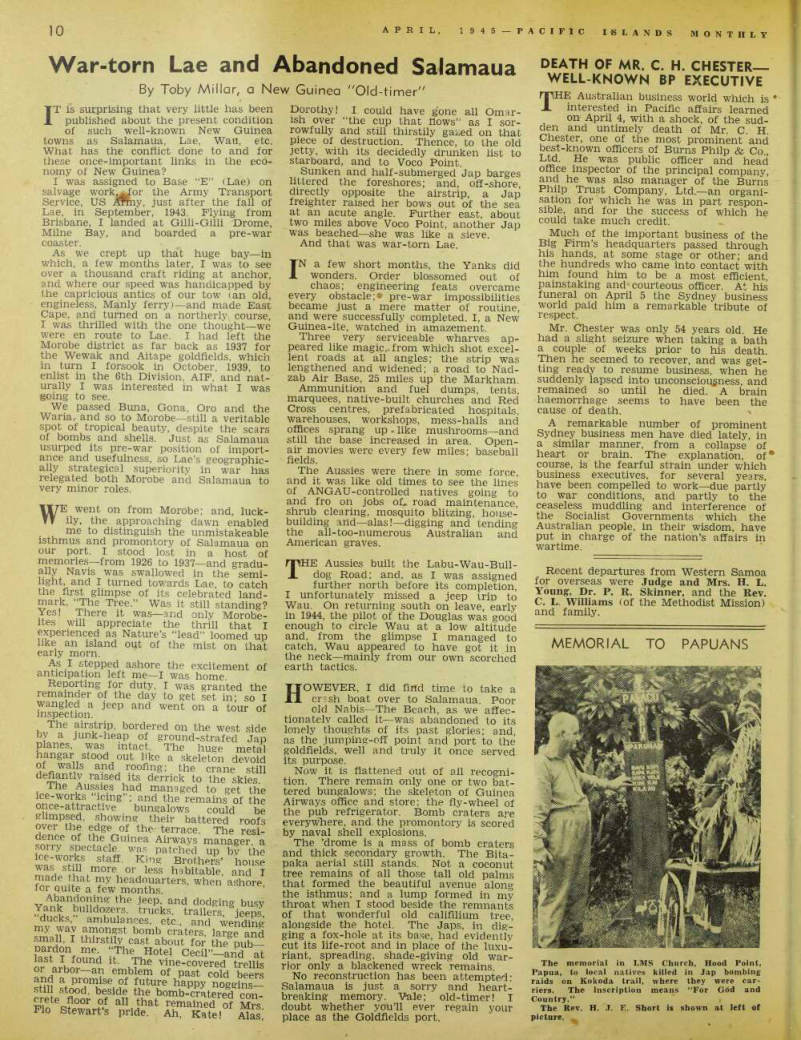
By Toby Millar, a New Guinea "Old-timer"
IT is surprising that very little has been published about the present condition of such well-known New Guinea towns as Salamaua, Lae, Wau, etc.
What has the conflict done to and for these once-important links in the eco nomy of New Guinea?
I was assigned to Base “E” (Lae) on salvage the Army Transport Service, US /frmy, just after the fall of Lae, in September, 1943. Flying from Brisbane, I landed at Gilli-Gilli Drome, Milne Bay, and boarded a pre-war coaster.
As we crept up that huge bay—in which, a few months later, I was to see over a thousand craft riding at anchor, and where our speed was handicapped by the capricious antics of our tow (an old, engineless, Manly ferry)—and made East Cape, and turned on a northerly course, I was thrilled with the one thought—we were en route to Lae. I had left the Morobe district as far back as 1937 for the Wewak and Aitape goldfields, which in turn I forsook in October, 1939, to enlist in the 6th Division, AIP, and nat urally I was interested in what I was going to see.
We passed Buna, Gona, Oro and the Waria, and so to Morobe—still a veritable spot of tropical beauty, despite the scars of bombs and shells. Just as Salamaua usurped its pre-war position of import ance and usefulness, so Lae’s geographic ally strategical superiority in war has relegated both Morobe and Salamaua to very minor roles.
WE went on from Morobe; and, luck ily, the approaching dawn enabled me to distinguish the unmistakeable isthmus and promontory of Salamaua on our port. I stood lost in a host of memories—from 1926 to 1937—and gradu ally Navis was swallowed in the semi light, and I turned towards Lae, to catch the first glimpse of its celebrated land mark, “The Tree.” Was it still standing?
Yes! There it was—and only Morobe ites will appreciate the thrill that I experienced as Nature’s “lead” loomed up like an island out of the mist on that early mom.
As I stepped ashore the excitement of anticipation left me—l was home Reporting for duty, I was granted the remainder of the day to get set in; so I wangled a jeep and went on a tour of inspection.
The airstrip, bordered on the west side by a junk-heap of ground-strafed Jap planes, was intact. The huge metal hangar stood out like a skeleton devoid of waffs and roofing; the crane still defiantiv raised its derrick to the skies.
The Aussies had managed to get the ice-works “icing”; and the remains of the once-attractive bungalows could be glimpsed, showing their battered roofs over the edge of the terrace. The resi dence of the Guinea Airways manager, a sorry spectacle, was patched up bv the ice-works staff. King Brothers’ house m °re or less habitable, and I made that my headouarters, when ashore tor quite a few months.
Abandoning the jeep, and dodging busy Yank bulldozers, trucks, trailers ieeps y ducks,” ambulances, etc., and wending my a ™ on s st bomb craters, large and small, I thirstily cast about for the&pub— pardon me. “The Hotel Cecil’’—lnd at last I found it. The vine-covered trellis or arbor-an emblem of past cold beers and a promise of future happy nogginl still stood, beside the bomb-cratered con crete floor of all that remained of Mrs Flo Stewart’s pride. Ah, Kate! Alas,’
Dorothy! I could have g'one all Omar ish over “the cup that flows” as I sor rowfully and still thirstily gazed on that piece of destruction. Thence, to the old jetty, with its decidedly drunken list to starboard, and to Voco Point.
Sunken and half-submerged Jap barges littered the foreshores; and, off-shore, directly opposite the airstrip, a Jap freighter raised her bows out of the sea at an acute angle. Further east, about two miles above Voco Point, another Jap was beached—she was like a sieve.
And that was war-torn Lae.
IN a few short months, the Yanks did wonders. Order blossomed out of chaos; engineering feats overcame every obstacle;* pre-war impossibilities became just a mere matter of routine, and were successfully completed. I, a New Guinea-ite, watched in amazement.
Three very serviceable wharves ap peared like magic,, from which shot excel lent roads at all angles; the strip was lengthened and widened; a road to Nad zab Air Base, 25 miles up the Markham.
Ammunition and fuel dumps, tents, marquees, native-built churches and Red Cross centres, prefabricated hospitals, warehouses, workshops, mess-halls and offices sprang up . like mushrooms—and still the base increased in area. Open air movies were every few miles; baseball fields.
The Aussies were there in some force, and it was like old times to see the lines of ANGAU-controlled natives going to and fro on jobs of, road maintenance, shrub clearing, mosquito blitzing, house building and—alas! —digging and tending the all-too-numerous Australian and American graves, rE Aussies built the Labu-Wau-Bull dog Road; and, as I was assigned further north before its completion, I unfortunately missed a jeep trip to Wau. On returning south on leave, early in 1944, the pilot of the Douglas was good enough to circle Wau at a low altitude and, from the glimpse I managed to catch, Wau appeared to have got it in the neck—mainly from our own scorched earth tactics.
HOWEVER, I did find time to take a cr?sh boat over to Salamaua. Poor old Nabis—The Beach, as we affec tionately called it —was abandoned to its lonely thoughts of its past glories; and, as the jumping-off point and port to the goldfields, well and truly it once served its purpose.
Now it is flattened out of all recogni tion. There remain only one or two bat tered bungalows: the skeleton of Guinea Airways office and store; the fly-wheel of the pub refrigerator. Bomb craters are everywhere, and the promontory is scored by naval shell explosions.
The ’drome is a mass of bomb craters and thick secondary growth. The Bita paka aerial still stands. Not a coconut tree remains of all those tall old palms that formed the beautiful avenue along the isthmus; and a lump formed in my throat when I stood beside the remnants of that wonderful old califilium tree, alongside the hotel. The Japs, in dig ging a fox-hole at its base, had evidently cut its life-root and in place of the luxu riant, spreading, shade-giving old war rior only a blackened wreck remains.
No reconstruction has been attempted: Salamaua is just a sorry and heart breaking memory. Vale; old-timer! I doubt whether you’ll ever regain your place as the Goldfields port.
Death Of Mr. C. H. Chester
Well-Known Bp Executive
THE Australian business world which is * interested in Pacific affairs learned on April 4, with a shock, of the sud den and untimely death of Mr. C. H.
Chester, one of the most prominent and best-known officers of Burns Philp & Co, Ltd. He was public officer and head office inspector of the principal company, and he was also manager of the Burns Philp Trust Company, Ltd.—an organi sation for which he was in part respon sible, and for the success of which he could take much credit.
Much of the important business of the Big Firm’s headquarters passed through his hands, at some stage or other; and the hundreds who came into contact with him found him to be a most efficient, painstaking and courteous officer. At his funeral on April 5 the Sydney business world paid him a remarkable tribute of respect.
Mr. Chester was only 54 years old. He had a slight seizure when taking a bath a couple of weeks prior to his death.
Then he seemed to recover, and was get ting ready to resume business, when he suddenly lapsed into unconsciousness, and remained so until he died. A brain haemorrhage seems to have been the cause of death.
A remarkable number of prominent Sydney business men have died lately, in a similar manner, from a collapse of heart or brain. The explanation, of* course, is the fearful strain under which business executives, for several years, have been compelled to work—due partly to war conditions, and partly to the ceaseless muddling and interference of the Socialist Governments which the Australian people, in their wisdom, have put in charge of the nation’s affairs in wartime.
Recent departures from Western Samoa for overseas were Judge and Mrs. H. L.
Young, Dr. P. R. Skinner, and the Rev.
C. L. Williams (of the Methodist Mission) and family.
Memorial To Papuans
The memorial in LMS Church, Hood Point, Papua, to local natives killed in Jap bombing raids on Kokoda trail, where they were car riers. The inscription means “For God and Country.”
The Rev. H. J. E. Short is shown at left of picture.
Tarawa
George Medals To Gallant Men Of
New Zealand Concludes Inquiry Into Jap Massacre in 1942
ALTHOUGH tile murder in October, 1942, of twenty-two Britishers on Tarawa (Gilberts) by the Japanese was reported soon after the Americans landed in November, 1943 (see “PIM” for February and September, 1944), there always has been official reluctance to admit that they were murdered. An official inquiry has recently been con cluded by the New Zealand Government, and an official report now lists the men as having been killed—mostly by be heading—on October 15, 1942, following a bombardment by an American warship and aircraft that day.
Hie men were five residents of the Gil bert Group who had remained behind when the other residents were evacuated (R. G. Morgan, B. Cleary, I. R. Handley, A. M. McArthur, and A. L. Sadd) and 17 New Zealand servicemen, Mr. Fraser, New Zealand’s Prime Minister, has announced that they are trying to identify the Japanese re sponsible. This, however, appears to be a forlorn hope; and, even if some of the murderers were caught, ordinary civilised law of a life for a life, would impress the barbaric Japanese little.
AT about the same time as the result of the New Zealand inquiry was an nounced, the King approved the award of the George Medal to Captain Holland and Mr. R. G. Morgan for their bravery in maintaining communications during the Japanese occupation of Tarawa and other Gilbert Islands. Mr. Morgan’s award is, of course, made posthumously, although the award was approved in June, 1942, and the information was conveyed to Mr. Morgan, then still alive on Tarawa, although it could not be announced officially as he was still engaged on the dangerous work.
WHEN war broke out with Japan, Cap tain Holland, a New Zealander, was Director of Education in the Gilbert and Ellice Island colony, where Mr. Mor gan, an Australian, was in charge of a training school for native wireless operators on Bairiki islet (next to Betio) on Tarawa Atoll.
In anticipation of a possible Japanese invasion, the two men organised a system for maintaining wireless communication with the outside world. A portable trans mitter was concealed in a remote village, and when, in December, 1941, Tarawa was attacked and the main transmitting station put out of commission, Morgan was still able to send full details of the movements of the Japanese.
During repeated enemy landings on Tarawa, Holland remained in the danger
zone collecting information on Japanese activities and relaying these to Morgan by a system of runners he had estab lished. At imminent personal danger to himself and despite numerous Japanese threats and warnings, Morgan in turn transmitted the information to Allied authorities outside the zone of occu pation.
Thinking it impossible for the civil population to get away, the Japanese left Tarawa for the time. The existence of the secret transmitter allowed arrange ments to be made for a rescuing vessel, and it was again due to the leadership assumed at a critical moment by Holland that the party succeeded in leaving the island in time to connect with this vessel.
Morgan volunteered to remain behind in Tarawa in order to continue to report enemy movements. This he did for many months, sending information of the greatest value to Allied naval authorities.
The Japanese re-occupied Tarawa, and it is thought that the appearance of an Allied plane over the island on October 15, 1942, was one of the reasons which led them in revenge to murder Morgan and 21 others they were holding as prisoners.
Advertisements & other items, pp. 13-14 (1 item)
Burns Philp
THE
YORKSHIRE
INSURANCE
CO. LTD.
(Incorporated in England)
FIRE
ACCIDENT
MARINE
FIRE POLICIES ISSUED
IN PAPUA
All infofmation from —
E. A. JAMES,
TeL 86347. Attorney for Papua, 14 Spring St., Sydney.
BURNS PHILP
■(SOUTH SEA) CO. LTD.
Inc. in Fiji
Island Traders and Shipowners
Registered Office :
SUVA
FIJI
Also Branches at: \Fijl: Levuka, Lautoka, Labasa, Ba, Sigatoka, Rotuma Tonga: Nukualofa, Haapai, Vavau.
Samoa: Apia, Pago Pago (American Samoa).
Solomons: Makambo, Gizo, Faisi.
New Hebrides: Vila.
Code Addrew: Gilberts: Tarawa.
“Bumsouth”. Norfolk Is. Niue. Wallis Is. Futuna Is.
Sole Australian Concessionaries :
GEORGE BROWN & CO. PTY.
267 Clarence Street, Sydney.
LTD.
As the Ultimate factory is engaged in vital war production, the supply of Ultimate Commercial Receivers cannot be maintained at present.
SERVICE: Ultimate owners are assured of continuity of service. Our Laboratory is situated at 267 Clarence Street, Sydney.
Servicing of all kinds of radio sets or amplifiers, as well as Rola Speakers, is also undertaken at our laboratories.
Refreshing
as a plunge
into a lagoon!
tENA*
mm
Germici d a 1
and fragrant
TENAX TOILET SOAP is
a rapid safeguard against external skin infections, yet it is soothing and kind to the most sensitive skin —even a baby's!
ORDER TENAX FROM
YOUR ISLAND SUP-
PLIERS. STOCKS ARE
PLENTIFULLY AVAIL-
ABLE.
W. H. GROVE & SONS
Limited Established 1896.
AUCKLAND
Island Traders. F.o. Box 490 Telegraphic and Cable Address: “Grove”, Auckland Shippers of all classes of New Zealand products.
Representing English Manufacturers throughout the Cook and Society Islands, Fiji, Tonga, :>amoa, Niue, New Caledonia, New Guinea, etc.
In FIJI as—W. H. Grove & Sens (Fiji) Ltd.
Maprik—Pre-Mopping Up
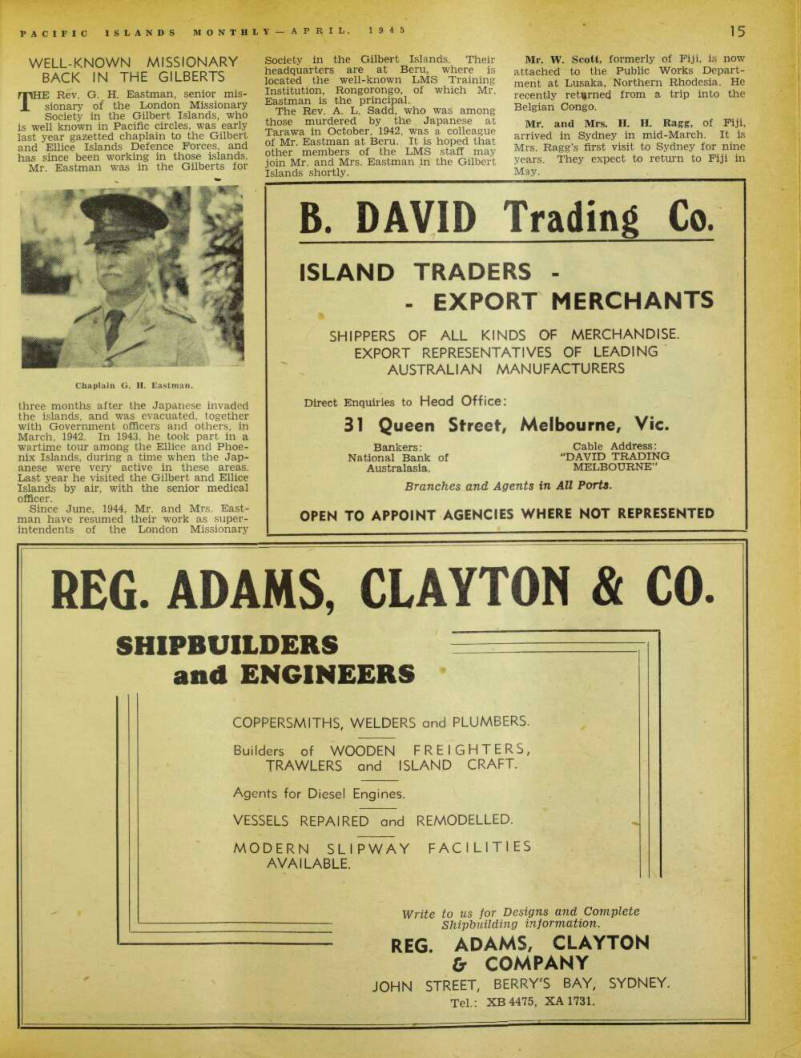
By Judy Tudor
ffIEWS ITEMS: Australian troops in
the Aitape area of New Guinea have captured two villages north-east of Maprik. . . . Flying-Officer Tom
Ellis, Beaufighter pilot, stayed behind
to provide cover for the crew of a sister plane forced down off Amboina- Ceram. {See “Tropicalities” this issue.) THESE are two apparently unrelated pieces of headline news, yet in the mind of this scribe, Maprik and Ellis are almost synonymous.
It was there at Maprik that young (apparently to distinguish him from his father, of Rabaul) Tom Ellis was respon sible for providing me with the first—and last—oyster I have ever eaten. The oyster floated in half an inch of white soup, straight from the can.
I abominate oysters. But it was New Year’s Eve; I had been fortified by a cocktail consisting of wild lemon, much
whisky, a little less vermouth and appar ently a dash of prussic acid, manufac tured by the same versatile gentleman and I had been too long in the bush and had grown socially timid.
In the mid-thirties, the Sepik district was a vast area of mountain, jungle and grass-land, in which life went on in almost the same fashion as it had for unknown centuries. Here and there in the mountain streams that ran down into the Sepik, or, over the range, ran through gorge and cha§m to spill eventually into the sea, miners were located.
To a certain extent each miner influ enced the immediate area in which he toiled. Gravel and sand passing through his sluice boxes muddied the stream; tailing dumps, like giant white snakes, lined the banks; bordering trees and saplings came down when gold was gouged from their roots. And, at the same trnie, the local natives, suddenly awakening to the glories of civilisation in the way of red, white and blue beads,
cotton print, razor blades and whatnot, brought in native foodstuffs to trade.
But, taking it by and large, these civi lising influences were scattered and it was possible for a miner to walk for a day or more in any direction without encountering his next-door European neighbour. And soon, too, with the sud denness of the tropics, all workings were overgrown once more with a green mantle and the stream tinkled on over the brown boulders as it had from time immemorial.
IN this sort of set-up a visitor from But came to our camp one evening. “Ray Parer has brought his plane up from Salamaua,” he said. “He’s making a landing-field down in the kunai; near a place called Maprik, I believe.”
And soon, at irregular intervals, came the thrumming, drumming sound of an aero-engine, high above the rim of the valley, usually out of sight behind moun tain peak or cloud, but infrequently appearing as a dark, bird-creature dash ing across our small patch of sky to dis appear swiftly into a world we could not see.
The fame of the plane had preceded it.
None of the boys working on the claim had seen one. but they did not need to be told what it was. None tore into the jungle or died of fright—which would, of
.(Continued on Page 37)
Standing on the edge of Imbia we could look out towards Maprik ’drome and the Sepik.
Australians are fighting in this country to-day.
course, make a better story—but they yelled with delight: “‘Balus’ e’ come!” and let it go at that.
IT was four months or more before any of us saw the “balus” in the flesh; and, by that time, a Guinea Airways plane was also running irregularly to connect with the six-weekly “Macdhui.”
We had spent the morning climbing the mud slide that passed for a track to the village “on top”—lmbia; 10 minutes to wonder on the further side of Imbia, gazing with unaccustomed eyes at the sweep of country unfolded before us— undulating foothills, and valleys, villages on the crests, with a smudge of plains beyond; and several hours of the after noon floundering down, then up, more slippery slides, across rivers and through villages. That road out was later short ened and when I did it for the last time before the war the whole process was accomplished in 3£ hours.
Maprik ’drome swam before us in a haze of heat, part-bordered by a semi circle of river. It was nothing more than a huge river flat from which the kunai grass had been cut by the natives, armed with lengths of hoop iron. Little had been done for its natural contours. Ray Parer could, and often did, land his plane where fancy dictated, and the natural undulations of Maprik he left severely alone, for the commercial pilots who came after to bewail.
Maprik remained nothing more than this rough landing strip until late in 1937.
Then it suddenly blossomed out as an Administrative sub-station, and all the natives who normally carried cargo for us, or who brought taros and bananas and sweet-potatoes to our doors, were “frozen” and diverted to the construction of the buildings thereof.
TOM ELLIS, appointed to the new sub station as a Medical Assistant, made our acquaintance pe.r medium of a medical patrol when he stuck hypodermic needles into the unenthusiastic arms of our labour line. He spoke diffidently of building a house for himself and a hos pital on the hill behind Maprik ’drome, and a house each for the Patrol Officer and the ADO on the river terrace below.
We had heard something of those houses. Men returning from the ’drome called in at the camp to exclaim: “My God—you should see the houses Tom Ellis is building. Got every kanaka for miles around working on them. They are two-storied, no less. And big—about an acre each. Believe he got the idea in Bougainville.”
We did not actually see the houses until the following Christmas, and then we sighted them afar off. Not even the mountains of New Guinea could dwarf those houses. Ellis’s residence stood on a cleared knoll overlooking the river below and flanked by a full-sized pre cipice. Down the slope sprawled the native hospital and on the wide river terrace, 200 feet above the ’drome, were the two other pagoda-like mammoths.
If one would have firmness and sta bility, then there is a limit to the size of the native building, which is all split palm-wood, bamboo and cane lashings.
The Maprik erections were impressive and, purely from the point of impressing the wily savage with the size of British might, they were a howling success. But the swaying limbohm floors bounced back at you and the partitions threatened to give if you were misguided enough to lean. And the white ants and borers came in their millions and bored and chewed until a fine rain of soft yellow wood-dust fell perpetually.
The upper stratum was reached by a ladder which bored up through a hole in the roof of storey one.
AT Christmas time, having completed this job of construction, young Ellis, and an even younger Patrol Officer, turned their thoughts to other things.
For weeks before the event, it was impossible to buy pigs or native food any where —all were being saved for a “big fella sing-sing.” And, at the end of the third week in December the bush tracks converging on the ’drome were thronged with more traffic than ever before in their history. In came the naked men, carrying their spears, and their pigs trussed up on poles; in came the women, in their minute grass sporrans or nothing at all, yams, taros, bananas, sago and fruit carried in tiers of string-bags on their backs; baby trussed up in the top most one, like a coccoon on a twig.
Toddlers came, and the children, and all the youth and beauty. And the dogs were brought, and the feather head dresses and masks and ceremonial attire of beads, and shells and dog’s teeth neck laces and girdles.
Their food was purchased by the two Administration officers and added to the growing store. By Christmas Day the ’drome was festooned from end to end with palm fronds, strings of yams, piles of bananas, decorated dishes of sago and pig—all splendid in the eyes of Brown Brother. rE Europeans had been called to gether, too. From far and wide they came; by plane from the coast and per boot from the interior; from the
Sepik. to the southward, and from But to the northward. Perhaps a hundred men and the district’s half-dozen women; even a sprinkling of white children. The three huge houses of Maprik accommo dated them.
Advertisements & other items, p. 14 (1 item)
12
April, 1945 pacific islands m9nt h l f
Boosting Orange
Production NZ Government's Plan for Cook Islands
From Our Own Correspondent
Rarotonga, Feb. 3.
THE most important matter discussed during the visit of the NZ Prime Minister (Mr. Fraser) in December, was a new replanting scheme for oranges.
A preliminary study of the subject was made by Mr. M. Baker, Director of Agri culture in Rarotonga, Mr. A. G. Osborne, MP, Assistant Minister of Island Terri tories, and Mr. Ross Fraser, Acting Dir ector of Internal Marketing Division, who recommended: That the Government lease from groups of owners plots of family land up to 10 acres, for a period of 15 years.
The Administration to take full respon sibility for clearing and planting of the lands with orange trees; and, subse quently, proper care and attention of the growing trees, and shipment and market ing of the fruit at the best possible price when the trees are in bearing.
The owners and members of their families to be employed—wherever willing —to work on their own lands at regular wages provided by the Administration.
At the end of the 15-year period, the plantations will revert to their owners as going concerns. In the meantime, as soon as the trees come into production the owners will receive 50 per cent, of the net profits, the rest to be retained by the Government until all expenses accrped in the development of the plots have been cleared (it is estimated that after the twelfth year the owners would get full benefit of the proceeds).
An experimental plan for an aggregate of 100 acres is the immediate proposal.
Orange trees would be planted 90 to the acre, and could be expected to produce their first case of fruit at five years— rising to a full maturity crop of about five cases per annum at 10 years of age.
Thus, a hundred acres in full bearing could produce 45.000 cases annually.
All efforts would be made to work the plantations as economically as possible.
Mechanical means would be provided for clearing and preparation; existing roads would be improved and new ones made where necessary.
IT is emphasised that from the clearing stage until the plantation is put into the hands of its owners in full pro duction, the full risks and responsibilities are to be borne by the Government. From the commencement of operations, the owners would thus be in receipt of rent, wages and, as soon as possible, a share of the profits—and at no personal finan cial risk to themselves.
Naturally, sincere and energetic co operation on the part of the owners them selves would be necessary for satisfactory results. It should be quite clear that the scheme has been evolved to put the natives at the best end of the wicket and, with sincerity on their part, they would be given aid and encouragement to stay there.
Principal factors in past citrus fruit planting plans were the natural improvi dence of islanders, and the reasonable fact that a man—especially a man with a large family, as most Polynesians are —must find the means of daily susten ance. A successful citrus plantation, starting from bushland, means a lot of work in the early stages, constant after care, and no financial return for the first five years. It has become practically impossible to find anyone willing to make this effort, A fruit plan that will really work satis
factorily from the growing end to the selling end, is the only hope for a real future in Rarotonga. Nothing else pro vides the substance for the establishment of any real and lasting prosperity.
SOME difficulty was experienced in presenting the new orange growing scheme to the local Fruit Advisory Committee owing to the Committee’s insistance that the Government first agree to an immediate flat rate of 10/per case for oranges.
It took considerable time to convince the Committee that no Government could possibly guarantee a price for the un known market conditions of five to ten years hence.
Mr. Osborne appealed to the Commit tee not to confuse the new planting scheme with their present differences; these would receive the Government’s closest attention later. The scheme, he said, was a long-range plan in order to build something for their future and for their children’s future.
A suggestion has been made that intelligent boys be given instruction in modern agriculture methods.
It~ is understood that outlines of the plan have met with a favourable recep tion among the natives generally and a number of applications have already been made for participation.
Advertisements & other items, pp. 15-16 (1 item)
This Codicil?
HAVE YOU
CONSIDERED
By adding a codicil to your Will you can guard against difficulties and loss which might arise should your Executor die or become incapacitated.
By means of such a codicil you can name Burns Philp Trust Co. Ltd. as joint Executor with your present appointee or, if you wish, as sole Executor. In this way you gain positive assurance, of continuous and sound administration and are relieved of a serious anxiety. The Company will willingly forward full particulars. • • •
DIRECTORS:
JAMES BURNS R. J- NOSWORTHY
LEWIS ARMSTRONG JOSEPH MITCHELL
MANAGER : L. S. PARKER
BURNS PHILP TRUST
COMPANY LIMITED
7 BRIDGE STREET. SYDNEY
PHONE: B 7901. BOX 543 > 5.P.0., SYDNEY. 8.P.2-45 that sn The
QUEENSLAND
INSURANCE
COMPANY
LIMITED
(Incorporated 1886 In Australia)
ASSETS EXCEED £3,500,000
Head Office:
PITT & BRIDGE STS.,
SYDNEY
Specialists in South Seas Fire,
Marine fj Accident Insurances
Apply to:—
FIJI,
Branch Office: H. J. Moorhouse, Manager Burns Philp (South Sea) Co., Ltd.
VILA.
Burns Philp (South sea) Co.. Ltd.
Comptoirs Prancals Des Nouvelles Hebrides (Marine).
NOUMEA.
L. & W. Johnston,
PAGO PAGO.
Burns Philp (South Sea) Co., Ltd.
G. H. C. Reid & Co.
OTHER SOUTH SEA ISLANDS.
Burns Philp (South Sea) Co., Ltd.
Also to any of the Company’s Offices in Australia or New Zealand .
G The Flour I L L E S PI E’S of the Islands
SYDNEY-
TRADE
MARK
Paris
Pacific Battalion in Paris Reviewed by d'Argenlieu
IN France, on March 5, Admiral d’Argen lieu, Chancellor of the Order of the Liberation, former Free French High Commissioner in the Pacific, reviewed survivors of the Pacific Battalion, who are at present billeted in the Tour Mau bour barracks, in Paris.
Most of them are New Caledonians.
Tahitians and New Hebridians, and all are volunteers. Since Syria they have taken part in all the fighting in Libya, and distinguished themselves particularly at Bir-Hakeim, in Tunisia, Italy and in the Battle for France.
After recalling with emotion the mem ory of the battalion’s dead, the Admiral congratulated all the men on their hero ism and their patriotism to France. He added that he counted on them all, who had been able to visit the Mother Coun try, to make known her real self upon returning to their homes. He hoped that frequent and keen relations would develop more and more between the homeland and its most distant territories.
Queen Salote of Tonga has returned to her home after undergoing medical treat ment in New Zealand,
"Caledonian Chrome
Sacrificed For Turkish Profit"
Claim Made by Politician
From Our Own Correspondent r . NOUMEA, March 16.
E most important question now dis cussed here is the proposed nationa lisation of the mining industry.
This was a popular election cry and most New Caledonians favour the introduction oi some sort of controlled economy to avoid the worst abuses of the capitalist system The matter is to be studied, and the Colony is to prepare a memorandum for • x Ssion to the French Colonial Minister.
In the meantime, the outlook for Cale donian chrome is far from rosy The American market, which until recently kept the mines going, is no longer taking treated ores, but only crude ores. This limits exportation to the major mines of Tiebaghi and Tomtouta, and even here transport is difficult to obtain.
“The English control the world chrome market,” says politician Palladini, “and Caledonian chrome has been sacrificed to the profit of Turkey, with whom the Allies bargained so that she should enter the war against Germany.”
The head of the local mining depart ment regards the nickel outlook as equally sombre, as no more reliance can be placed on the American market whose normal source is Canadian nickel It seems clear that the future of Cale donian nickel rests on the reconstruction of the industries of Western Europe; but how long this will take it is hard to say.
Nickel, however, can only be profitably exploited in about three countries, of which this is one, so one may expect New Caledonia to continue to provide the usual 8 or 9 per cent, of the world’s out put.
Civilian Internees And
Allowances
PTA Makes Representations to Canberra
ONE of the minor battles the Pacific Territories Association is putting up on behalf of evacuees is an attempt to make the Commonwealth Government recognise the claim of civilians taken prisoner by the Japanese in New Guinea, or their dependants, to the same benefits as soldiers captured in the same area.
The secretary of the PTA (Mr. C. A. M.
Adelskold) has carried on a voluminous correspondence with various members of the Commonwealth Government, includ ing the Prime Minister and the Minister for External Territories, but with nothing more sustaining in reply than that the matter would “receive attention,” and that sympathetic consideration would be given on the merits of each case when the internee returned to Australia or when advice of his death was received.
Mr. Adelskold has pointed out that no provision was made for the removal of civilian men from Rabaul, and that they were left with the troops to do such duties as were required of them in the emergency. When the invasion took place they were told that they could “either go bush or surrender.” Some escaped, but the majority became prisoners of war.
The PTA claims that as such they are a national responsibility, and are entitled to the same benefits, and their dependants to the same allowances, as service per sonnel captured at the same time.
Eastman afse^u 2 ’ that
Well-Known Missionary
Back In The Gilberts
mHE Rev. G. H. Eastman, senior mis- X sionary of the London Missionary Society in the Gilbert Islands, who is well known in Pacific circles, was early last year gazetted chaplain to the Gilbert and Ellice Islands Defence Forces, and has since been working in those islands.
Mr. Eastman was in the Gilberts for
three months after the Japanese invaded the islands, and was evacuated, together with Government officers and others, in March, 1942. In 1943, he took part in a wartime tour among the Ellice and Phoe nix Islands, during a time when the Jap anese were very active in these areas.
Last year he visited the Gilbert and Ellice Islands by air, with the senior medical officer.
Since June, 1944, Mr. and Mrs. East man have resumed their work as super intendents of the London Missionary
Society in the Gilbert Islands. Their headquarters are at Beru, where is located the well-known LMS Training Institution, Rongorongo of which Mr.
E^a^ S nWwho was among those murdered by the Japanese at
Eastman afse^u 2 ’ that
® of the' LMS staff may £“tl^ rS - EaStman ta the GUber ‘
Mr. W. Scott, formerly of Fiji, is now attached to the Public Works Depart ment at Lusaka, Northern Rhodesia. He recently returned from a trip into the Belgian Congo.
Mr. and Mrs. H. H. Ragg, of Fiji, arrived in Sydney in mid-March. It is Mrs. Ragg’s first visit to Sydney for nine years. They expect to return to Fiji in May.
Chaplain G. H. Eastman.
Advertisements & other items, p. 17 (1 item)
Reg. Adams, Clayton & Co.
B. DAVID Trading Co.
ISLAND TRADERS -
- EXPORT MERCHANTS
SHIPPERS OF ALL KINDS OF MERCHANDISE.
EXPORT REPRESENTATIVES OF LEADING
AUSTRALIAN MANUFACTURERS
Direct Enquiries to Head Office:
31 Queen Street, Melbourne, Vic.
Bankers; Cable Address: National Bank of “DAVID TRADING Australasia. MELBOURNE”
Branches and Agents in All Ports.
OPEN TO APPOINT AGENCIES WHERE NOT REPRESENTED
REG. ADAMS, CLAYTON & CO.
SHIPBUILDERS
and ENGINEERS
COPPERSMITHS, WELDERS and PLUMBERS.
Builders of WOODEN FREIGHTERS,
TRAWLERS and ISLAND CRAFT.
Agents for Diesel Engines.
VESSELS REPAIRED and REMODELLED.
MODERN SLIPWAY FACILITIES
AVAILABLE.
Write to us for Designs and Complete Shipbuilding information.
REG. ADAMS, CLAYTON
& COMPANY
JOHN STREET, BERRY'S BAY, SYDNEY.
Tel.: XB 4475, XA 1731.
Pitcairn Officials For
1945
THE yearly election of Government officials was held on Pitcairn Island on December 21, 1944. Mr.
Parkin Christian was re-elected Chief Magistrate (Parkin is the great-great grandson of Fletcher Christian, of “Bounty” fame).
Noris Young and John Christian were elected Assessors; and Cook Coffin, Chair man of the Internal Committee. Andrew Young continues as permanent Govern ment Secretary.
Mr. Gill Means
What He Says About Missions
Letter to the Editor IN “PIM” for January, 1945, Mr. F. R.
Isom contents himself with a flat denial of a good deal of what I wrote in the issue for last September. Yet, he is generous enough to admit that I have been “over a long period of years, full of sound commonsense.” I have apparently lost my commonsense, because I found it necessary to criticise certain—not all — missionaries.
Actually, it was a case of the infuriated worm turning at last.
I had become fed-up with missionary attacks on traders and planters, as they were reported in the press; their “ex ploitation” of the natives, and all that.
The time had come to present the other side of the case. Hence my September article in “PIM.”
I have had a long and wide experience of missionaries of different denomina tions. While freely admitting that there are many broad-minded and able men and women in the various mission bodies —I repeat, as an undeniable fact, that, taken by and large, the average mission person is “self-centred, and immersed in a very restricted and narrow orbit.”
Planters and traders deeply resent the diatribes of ill-informed people who step outside of their orbits to attack them on matters of which they have very little knowledge.
As for attacking the local combines: It seems to me that i.f it is right for so many missionaries to attack the planter and trader it would be a better and braver
thing to attack the Big Firms, who are the real exploiters of the Islands. Then the natives might get a better deal.
But the crusading missionary is too economically ignorant to analyse the Islands economic set-up—so misguidedly flails the small men, and leaves Big Busi ness severely alone.
That is what I meant by being “brave,”
“ignorant” and “publicity hunting”—and I still mean it. Every word of it.
I am, etc.,
Leslie F. Gill.
Solomon Islands, March 18, 1945.
Evacuees' Wedding
EVACUEES from two different parts of the British Empire were married in St. Andrew’s Cathedral, Sydney, on January 17. Sister Veronica Guerie (daughter of Colonel J. Thomas Guerie, of the 9th Punjaub Regiment, and the late Mrs. Guerie, of ““Wilkush,” Canter bury, Kent, England), married Mr. Bruce Hamilton, a well-known resident of Samarai, Papua. Sister Guerie was an evacuee from Singapore, and the couple met in Sydney some time ago, when Mr.
Hamilton was on leave from ATS duty with the United States forces in New Guinea. It was a quiet wedding. The bride was given away by her uncle, Dr.
E. M. Ramsden, of Sydney.
Mr. Hamilton has returned to civilian life, and is going north shortly to manage Muwo plantation, in the Trobriands, for Mr. E. Auerbach. Mrs. Hamilton has not yet received permission to travel to the Territory. Mr. Hamilton has turned re cently to authorship, and his book, “Folk Tales of the Fuzzy-Wuzzies,” will be pub lished shortly. It will be followed by another, “New Guinea Echoes.”
Advertisements & other items, p. 18 (3 items)
16
APRIL. 1945 PACIFIC lIS LANDS MONTHLY
Griffiths Ltd
GARDEN
NOVELTY
MAGAZINE
FROM
NEW ZEALAND
WRITE
NOW FOR
YOUR COPY TO
GRIFFITHS LTD
SEED MERCHANTS AND GROWERS
MOUNT EDEN : AUCKLAND < NEW ZEALAND
G. H. Robinson
Island Merchant and Agent
OF 51 MACQUARIE STREET, SYDNEY
having returned to business, can, as a result of over twenty years' extensive experience (excluding service in two wars) guarantee prompt and efficient individual service as a buying agent to Pacific Island clients.
Enquiries are solicited to— Box 3317, G.P.0.,
SYDNEY.
The Fight Must Go On
PTA Amends Constitution for Use in Territories After Civil Administration Resumes
WHEN the Minister for External Ter ritories made his recent announce ment concerning the return of civil administration to Papua and the area south of the Markham River in Man dated New Guinea, the Pacific Territories Association telegraphed asking for ampli fication. They received the following reply : “Received telegram and noted contents.
No further announcement can be made at this juncture. As decisions are arrived at full publicity will be given in the press.”
This is in direct contradiction of the sentiments expressed in a letter from Mr.
Ward to the PTA in September last when, in reply to a telegram from the PTA asking for confirmation of a statement by the Minister covering return of civil administration to the Territories, Mr.
Ward wrote: “Firstly, as an official of the Pacific Territories Association, _you should be fully aware of the danger in paying too much heed to what appears in the anti-Labour daily press, and it would be as well to await official announcements on all occasions before giving them credence.”
In a report to a meeting of PTA mem bers in the Teachers’ Federation Hall, Phillip Street, Sydney, on March 20, the executive expressed disapproval of Mr.
Ward’s latest telegram and his continued policy of shilly-shally.
It was evident, said Mr. E. A. James, president of the Association, that even after three years, the Federal Govern ment had no policy of reconstruction for Papua and New Guinea. From the point of view of the civilian community of the Territories, Mr. Ward’s announcement of March 9 meant nothing. ANGAU ad ministration would simply be replaced by some sort of provisional government that would not derive its powers from the Papua Act or the New Guinea Act but from National Security Regulations.
Admission to the Territories would be rigorously controlled and civilians would need to secure a permit to return home.
The remainder of the PTA quarterly report was as follows:
Delegation to the Prime Minister
WE wrote to the Prime Minister re questing him to meet a delegation from the executive, and duly received his reply that, owing to his many other duties, he could not at present meet us, but in the meantime he referred us to Mr. Ward. As all matters to be brought up had previously been submitted to the Minister for External Territories, without any definite results, your executive con sidered it useless to again place them before him.
War Damage Insurance
SINCE our last meeting, the Amend ments to the War Damage to Pro perty Regulations have been pro mulgated and are at present being imple mented by the Commission. Naturally, this work will take some time to com plete. The Commission has decided to pay War Damage Insurance claims on all private chattels which have been assessed, and all claimants will receive notice of this in due course.
Regarding the payment of compensa tion for small vessels lost, and not cov erage under War Damage to Property Regulations, we understand that the Fed eral Government has decided to com pensate owners for such losses and own
ers will be advised of this when full details of the arrangements are avail able.
Social
AS instructed by the last quarterly general meeting, the executive organised a harbour trip on Feb ruary 23, 1945, and an invitation was issued to all members and their families together with all other residents of the Territories. The Administrator of Papua, Mr, Leonard Murray, the ex-Administra tor of New Guinea, Sir Walter McNicoll, and the Hon. Mr. E. J. Ward, Minister for External Territories, were invited to be present as the official guests of the
executive.
Mr. Ward, owing to his Parliamentary duties, was unfortunately unable to attend. The executive were very grati fied with the response to their invitation, as between 700 and 800 persons availed themselves of the opportunity to meet their old friends and have a talk. The executive also took the opportunity to help entertain some of the British Ser vicemen at present in Australia, and 40 members of RAF units were present as guests of the Association.
New Constitution
IN order that the Association may func tion after the return of civil adminis tration to the Territories, it was decided some time ago to amend the existing constitution and rules which apply only to the Association as it exists in Australia, This the Association’s legal advisers found impossible to do; instead, they drew up a new constitution, which
will come into force on the day that the Federal Government announces the spe cific date that civil administration will commence operations in the Territories or part of the Territories.
In introducing the new constitution and rules to the meeting, Mr. James said
that after the Government’s recent announcement, it was more desirable than ever that Territorial should band together. No one knew what would be the final post-war set-up in the New Guinea Territories, but by the very nature of the Territories there must con
tinue to be diversified interests between Papua and New Guinea (or whatever they were then called) and even between different districts in those Territories.
Therefore, it had been decided to create separate branches for Papua and New Guinea, and provide also .for the creation of other district branches should the need arise.
Mr. Cyril Helton, making his first appearance at PTA meetings, moved a resolution that the aim of the Associa tion be amended to include the PTA’s opposition to enemy aliens re-entering the Territories and* also its opposition to the naturalisation of persons who were aliens at the outbreak of the "war. After a great deal of heated discussion, wherein it was pointed out to the meeting by Mr. E. J.
Thomas, and others, that this was already covered by the clause relating to the pro tection of all residents and their pro perty. the motion was put to the meet ing and defeated.
An amendment was made to the clause covering the constitution of branches.
Seven members had been provided for. but it was decided by the meeting to add another member representing women’s organisations. Mr. Helton’s was the only dissentient voice; he claimed that “women’s place is in the home—they should stay out of this.”
With this one amendment, the new constitution was approved. (New clauses which will now come into effect on the day that the Commonwealth announces the date of resumption of civil adminis tration, were summarised in March “PlM”—page 7.)
Discussion
THE meeting was then open for a gen eral discussion, and Mr. Helton returned, forthwith, to his aliens.
He promised to produce documents to the
executive in support of his claim that certain enemy aliens had engaged in subversive activity before and after the outbreak of the Pacific war. Mr. James, for the executive, promised that if Mr.
Helton’s claims were substantiated the PTA would take the matter up with the proper authorities, Mr. Helton asked also that an inquiry should be made into the New Guinea Forestry Unit (Army) now being formed to survey New Guinea’s timber resources.
Mr. Helton suggested that this was of no military value and the survey was being done at the instigation of a Queens land timber company. Mr. James pro mised that the matter would receive attention.
Mr. Helton asked Mr. James whether the PTA intended to sit down and do nothing with regard to the recent announcement concerning the provisional government to be set up in Papua and New Guinea.
Mr. James; Certainly not! The Asso ciation is doing everything in its power to have these decisions modified.
Mr. E. J. Thomas spoke in support of Mr. R. W. Robson’s recent demand in the Sydney “Daily Telegraph” that an inquiry be held into the circumstances surround ing the capture of civilians and Army personnel in Rabaul when it fell to the Japanese in January, 1942. Mr. Helton proposed that the PTA should endorse the demand for an inquiry into the hap penings at Rabaul and in New Guinea generally—and particularly into the shootings on the Sepik River in the early months of the invasion period. This resolution was carried.
War Damage And Unrra
AT the conclusion of the meeting, Mr.
James expressed his appreciation at the fair deal that evacuees were being given by the War Damage Com mission.
In reply to a question on UNRRA, he said that that body worked only for the rehabilitation of countries which had signified that they were unable to carry on the work themselves. With regard to New Guinea, Australia has not expressed this inability, and therefore New Guinea was outside UNRRA’s jurisdiction.
Advertisements & other items, pp. 19-20 (1 item)
Flour
PRODUCING UNIFORM GOOD RESULTS SINCE 1868
ALWAYS ASK FOB IT
flit
fm oy The World Famous Insect Destroyer
OR CIVILIANS
Steamships Trading
Company Limited
PORT MORESBY
SAMARAI
PAPUA.
WHOLESALE fr RETAIL MERCHANTS, SHIPOWNERS,
PLANTERS, ENGINEERS & SLIP PROPRIETORS.
Customs, Shipping, Insurance, and Forwarding Agents.
MANAGING AGENTS AND VISITING REPRESENTA-
TIVES FOR COCONUT AND RUBBER ESTATES.
SYDNEY REPRESENTATIVES; Nelson & Robertson Pty. Ltd., 12 Spring Street.
WARTIME ADDRESS
Urrtil further notice, clients may address all communica tions as follows:
STEAMSHIPS TRADING COMPANY LIMITED,
C/o NELSON tr ROBERTSON PTY. LTD.,
12 SPRING STREET, SYDNEY.
NELSON and ROBERTSON Pty. Ltd.
Established 1895
Shipowners - Brokers and
Islands Merchants
All classes merchandise purchased at Best Wholesale Prices. Original Invoices supplied to Island Clients. Cocoa Beans, Copra, Rubber, Trochus Shell and All Islands 7 Produce Sold on Commission.
Entrust your requirements to the firm with fifty years' practical experience in the Pacific Islands.
Sole Agents :
SKANDIA DIESEL ENGINES
ARCHIMEDES MOTORS
Prompt attention given to all enquiries.
NELSON & ROBERTSON Ki
12 SPRING STREET, SYDNEY, AUSTRALIA
Telegraphic Address: IVAN, SYDNEY,
OVERSEA INDENTS
ARRANGED FOR
CLIENTS.
REPRESENTED IN
ALL PARTS OF
THE WORLD.
Indian Community
New Building For Suva's
A HALL which will be available free of charge to all classes of the Indian community, is being built in Suva, Fiji, by the Gujerati Community. It will cost £15,000, and be called Gandhi Hall.
The committee of the Community has £12,000 in hand and does not anticipate any difficulty in raising the additional £3,000 required.
A drama in aid of the funds was recently held in the Suva Town Hall and three performances realised the sum of
£1,400. The prices of admission ranged from £5 downwards.
Unusual Custom in Honour of Fiji
Governor's Wife
WHEN Mrs. A. W. G. H. Grantham, wife of Fiji’s Governor, recently visited Rewa Province to see native pottery made, she was welcomed by the qalowaqa ceremony—a ceremony peculiar to the Rewa and Bau districts and infre quently seen. It is the ceremonial for welcoming ladies and differs greatly from the more usual reception for chiefs.
There is no presentation of yaqona and no yaqona (kava) ceremony.
When the launch on which Mrs. Gran tham and her party were travelling drew in to Lomanikoro two rows of native women were drawn up at the landing point. As soon as the launch had anchored one of them walked between
the two rows and was taken tp the launch where she placed a tabua on the deck at Mrs. Grantham’s feet. She then bent down and splashed the hull three times, afterwards returning to the shore and resuming her position in the line.
Mrs. Grantham’s party then went ashore, walking between the rows of women and was received at the end of them by a Chief. They were then con ducted to a specially-built shelter where the ceremony was completed by the pre sentation of food.
Mr. Steel, of the New Zealand Repara tion Estates, recently arrived in Apia, Western Samoa, with his family.
Advertisements & other items, pp. 21-22 (1 item)
Notice To Correspondent
BRIAN KENWOOD.—PIease send us your address, which has been lost.
JEAN
DIDIER,
Paris. m i 0 At present being made m Australia as J JEAN DIDIER'S Famous PERFUMES will soon be available Sole Distributing Agent for the Pacific Islands : E. J. BRIAL, 528 Collins St., Melbourne.
Enquiries through your usual channels appreciated.
f* k 1 Bond Street, Sydney, Australia. |P \ y* j \ TeL B 4167, Box 3615 G.P.O.
SUPPLIERS OF GENERAL MERCHANDISE TO LEADING FIRMS THROUGHOUT THE
PACIFIC ISLANDS
Exporters ... Importers ... • Manufacturers' Representatives Bankers: Bank of N.S.W. Bank of Adelaide. Comptoir Nat. d’Escompte de Paris.
War Time Cable Address: GOUGH CO., 1 BONDSTHEET, SYDNEY.
Codes: Bentley’s, 2nd and Comp. Phrase; A.8.C., sth and 6th; Peterson, 2nd and 3rd; Banking: Acme.
Modern Refrigeration for the South Sea Islands
The ELECTROLUX
KEROSENE OPERATED
REFRIGERATOR
MARVEL
OF
MODERN
SCIENCE
THE
MIRACLE
OF
ICE
FROM
HEAT
ELEC fROLUX offers economical, modern and completely efficient
REFRIGERATION FOR ISLANDS 7 HOMES.
FREEZES CONTINUOUSLY WHILE SMALL LAMP BURNS
Freezing controlled by simply regulating height of flame. Uses only 3 gaUon of kerosene per week MOTORLESS ... NO PARTS TO GET OUT OF ORDER.
MODEL L 22 MODEL L3BO
Capacity (as Illustrated) * 2 2 cubic feet. Capacity 4 cubic feet.
GUARANTEED FOR TWO YEARS.
• Write to your Local Distributor for prices and full details.
OBTAINABLE FROM ALL W. R. CARPENTER & CO. LTD.
BRANCHES THROUGHOUT THE ISLANDS
Representation in Papua and New Hebrides.
MODEL LKSSO
Capacity 5.6 cubic feet.
Harbour
Whitewash on Pearl Harbour The Peril of Three Years Ago
From Our Own Correspondent
Papeete, Dec. 7.
WELL, the whitewash has been applied as I predicted.
There are rumblings, however, in the Congress at Washington, and that com posite Pompeii-Hollywoodesque honky tonk, which is Honolulu, may yet get its just dues as the true cause of the Pearl Harbour Disaster.
Everyone in the Pacific knows that the customary Saturday night “binge,” and the Sunday “morning after” (well re ported by the Japanese spy system at Hawaii)- left Pearl Harbour wide open.
All the commissions, inquisitions, investi gations and hush-hush are pure eye wash.
We are indebted to the Honolulu Cham ber of Commerce, the Booster Club, and the Tourist Bureau, for three years of blood, sweat and tears, to attain a posi tion in the Pacific which should have been ours early in 1942. These high priests of Mammon, on, December 7, 1941, laid several thousand of our best soldiers and sailors in their charnel house, beside the bones of the disinherited Polynesians.
That we of the United States are not, to-day, fighting with our backs to the Rocky Mountains in the west, and to the line of the Mississippi River, in the east, is due to the valor of bur British breth ren, during that dark period after Pearl Harbour. Our people should never for get that immeasureable debt.
Our United States achieved a miracle of recovery, and our forces now are doing magnificently; but on the day we remem ber Pearl Harobur we should pay eternal tribute to those valiant knights of Saint George who saved us from disaster dur ing our time of peril.
Entomologist In West
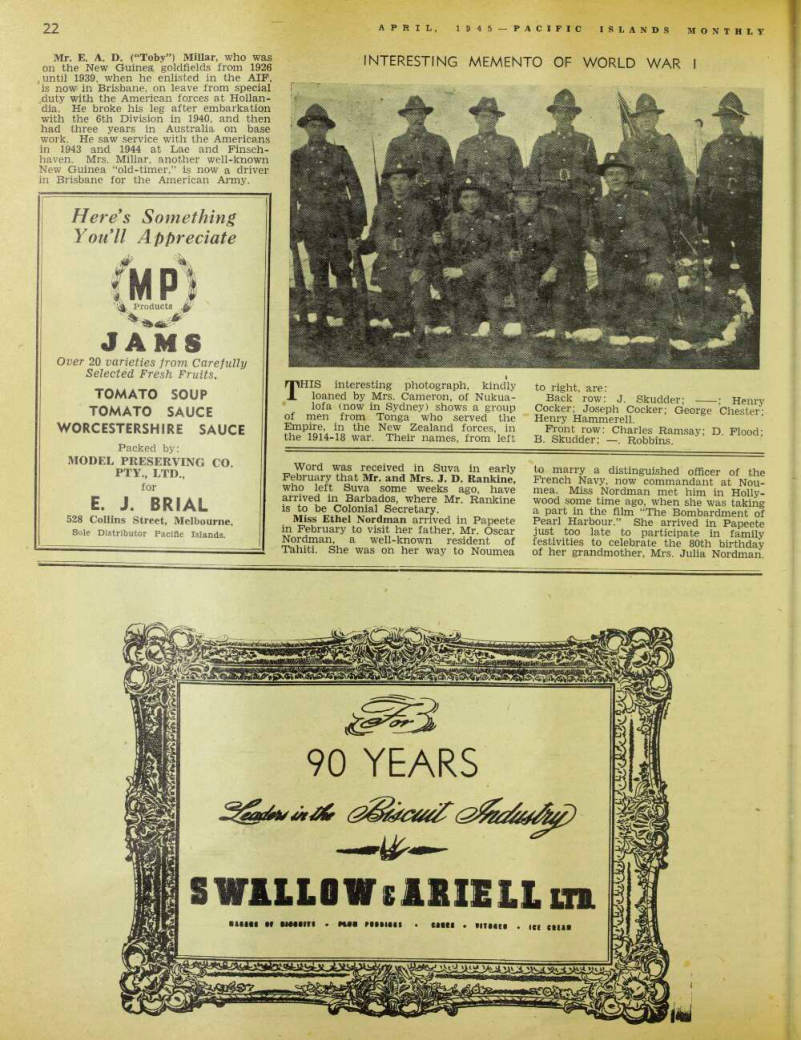
Africa
AN interesting letter from Mr. Jack Phillips, the entomologist who did good work in investigating “nut-fall” in the Solomons a few years ago, has been received by Mr. J. D. McComish.
Dr. Phillips writes from Leopoldville, in the Belgian Congo, West Africa.
“The research on which I am now engaged involves a liver-shaking amount of reconnaissance work in the bush,” he says. “Travel here is pretty grim and uncomfortable, and the rest-houses are generally nothing but unfurnished mud huts, usually with leaky roofs and a fine collection of aggressive fauna.
“I recently saw my first pygmies. They live in the equatorial forest, hunt game and collect forest products. This par ticular crowd were the servants of a tribe of negroes of normal height, the Kundas. The pygmies did not seem to differ from the usual Congo native, except in height.
“Most of the time, I’ve spent in these humid forest regions; but recently I’ve moved to the hilly savannah, which is a shade cooler—particularly in the dry season.
“A lot of travel is done by river steamer, paddle-wheeled boats fuelled with logs, which are collected from dumps on the banks every night. But I’ve done many thousands of miles by car and by plane.
“The fauna and flora here are very similar to those found in British West Africa, though there must be many spe cies as yet undescribed. The climate is the natives some of the most primi
tive on earth; their physique is poor; they are riddled with diseases and under nourished. They are also lazy, unintelli gent, dirty and untrustworthy.
“Altogether, the Congo (like West Africa) cannot compare in interest, climate or natural beauty with the equa torial regions of the Pacific. Life is a continual fight here, with the climate, the natives and the environment.
“On the other hand, we are very well off indeed for food and clothing. Only petrol and butter are rationed, so that we hardly feel the war here.”
Mr. and Mrs. Paul Nordmann, of Papeete, and their young son Peter, are now visiting New Zealand, and may settle in Wellington. Mr. Nordmann was secre tary and archivist of the Societe d ’Etudes Oceaniennes, and, as well as being a con tributor to the latter’s “Bulletin,” is the author of a book on Tahiti, published in Paris in 1937.
Col. and Mrs. Devon McCraig, of Fiji, have received word that their son, Denis McCraig, had been posted missing on % operations over Europe. He was seen to bail out and it is hoped that he may safe. He previously was reported missing when he had to bail out over Greece, but he landed safely and eventually returned to his squadron.
Mr. E. A. D. (“Toby”) Millar, who was on the New Guinea goldfields from 1926 until 1939, when he enlisted in the AIF, is now; in Brisbane, on leave from special duty with the American forces at Hollan dia. He broke his leg after embarkation with the 6th Division in 1940, and then had three years in Australia on base work. He saw service with the Americans in 1943 and 1944 at Lae and Finsch haven. Mrs. Millar, another well-known New Guinea “old-timer,” is now a driver in Brisbane for the American Army.
Word was received in Suva in early r * an( * rs * ,*** R ankine > who left Suva some weeks ago, have arnved in Barbados, where Mr. Rankine 18 *9 be Colonial Secretary.
Miss Ethel Nordman arrived in Papeete m February to visit her father, Mr. Oscar Nordman, a well-known resident of Tahiti. She was on her way to Noumea
to marry a distinguished officer of the French Navy, now commandant at Nou mea. Miss Nordman met him in Hollv wood some time ago, when she was taking a part in the film “The Bombardment of Pearl Harbour.” She arrived in Papeete just too late to participate in family festivities to celebrate the 80th birthday of her grandmother, Mrs. Julia Nordman.
Advertisements & other items, pp. 23-24 (1 item)
Foster Clark's
PACIFIC ISLANDS SOCIETY
Visitors from the Islands to Sydney (or those interested in Islands affairs), are advised to communicate with the honorary secretary of the above Society, which has been formed to study the history, traditions, economics, and political developments of the Pacific Islands.
Regular monthly meetings are held at History House, 8 Young Street, Sydney.
Address for Correspondence:
THE PACIFIC ISLANDS SOCIETY,
Box 2434 MM., G.P.0., Sydney.
NOT-SO-SIMPLE SIMON
r rv *** Simple Simon it noux cjuite uxite i When U comet to cutlatd uxith kit piet I ho- pie w-ill eoeA, make iti math a Saoe uxith cutla'id by- tyotiet Gla'ik J Just an old nursery rhyme we’ve twisted to tell a housekeeping fact. Foster Clark’s Creamy Custard helps overcome shortages of eggs, milk and butter. Cook through Foster Clark’s Creamy Custard Recipe Book and see the wonderful variety of sweets you can serve with such ease.
Write for your copy now .to Foster Clark (Aust.) Ltd., Dept. R. 8., Redfern, N.S.W., enclosing eld. postage.
TARD
DER
% UA
FOSTER CLARK'S
a/ V ' f.c.i
Here’s Something
You’ll Appreciate
Over 20 varieties from Carefully Selected Fresh Fruits.
TOMATO SOUP
TOMATO SAUCE
WORCESTERSHIRE SAUCE
Packed by:
MODEL PRESERVING CO.
PTY., LTD.,
for 528 Collins Street, Melbourne.
Sole Distributor Pacific Islands, Products
JAMS
E. J. BRIAL
Interesting Memento Of World War I
THIS interesting photograph, kindly
loaned by Mrs. Cameron, of Nukualofa (now in Sydney) shows a group of men from Tonga who served the in the New Zealand forces, in the 1914-18 war. Their names, from left
to right, are- Back ’row: J. Skudder- • Henrv Cocker; Joseph Cocker: George Chester- Henry Hammerell ’
Front row: Charles Ramsay; D Flood- B. Skudder; —. Robbins.
Advertisements & other items, p. 24 (1 item)
V *l-.
S i Ml 3<» oo Ql <
S' LU
* >" * o >1 o I m ■vm?s
Memoirs of Arii-Toimai
Rare History of Early Tahiti in NZ Library
By Eric Ramsden
ONE of the literary rarities of the Pacific is the volume known as “The Memoirs of Arii-Taimai.” Collectors will give almost any price for this book which only very occasionally comes on the market. Not even the Mitchell Library in Sydney, with all its resources, has been able to procure a copy. Therefore, it came as a surprise to me to find one in the Alexander Turnbull Library in Wel lington, New Zealand.
True, it is not the original edition, the publication of which was arranged in Paris in 1901 by Henry Adams. It is an edition in German, published in Ham burg in 1923. But the German edition possesses what the English edition does no t_a portrait of Arii-Taimai, from an original photograph taken in Tahiti in middle life. Publication of the German edition was arranged by the Schlubach family. Teuira Henry, in her monu mental “Ancient Tahiti” (which was published by the Bishop Museum in bulletin form some years ago), spells the name “Schlubah,” and gives the family the noble “von.” There is no “von” attached to the name of H. A. Schlubach in connection with the German edition.
“The Memoirs of Arii-Taimai” must have been an extremely limited edition.
Probably not more than 25 copies were printed in Paris, the majority of which were distributed among the descendants of the great Tahitian chieftainess. One, of course, must have been taken to Ger many by the Schlubach family. There
are, it seems, still one or two copies in Tahiti. The Pomare princesses, daugh ters of ex-Queen Marau. have one. I know of another in the hands of a famous Norwegian collector of Pacific material.
There are others in the hands of Ameri can collectors. Paris had at least another.
As is pointed out in the preface to the German edition, this book is of such importance to students of Tahitian his tory, as well as to ethnologists, that it is more than a mere recital of happenings by one who happened to participate, behind the scenes, at a particular period of the island’s story. It is quite time that someone took the trouble to produce a new edition. Nothing is more certain than it would be grabbed by bibliophiles throughout the world.
ARII-TAIMAI, who was born about 1821, became the wife of Alexander Salmon. Marama of Moorea, high chieftainess of the Tevu clan of Papara, she was reared with Pomare IV, Queen of Tahiti. When the Queen, beset by her troubles with the French, fled to Raiatea, it was Arii-Taimai who persuaded her to return to Tahiti and resume her respon sibilities (or, rather, what was left of them) there. There is evidence to the effect that Arii-Taimai, if she had so desired, might have replaced Pomare on the throne. But Arii-Taimai was loyal to her Queen, and loyal to her people, and, undoubtedly, she did much to avoid further bloodshed and conflict.
The ties of the chieftainess with the Pomare family were further cemented when her daughter, Marau, married Pomare V (Pomare IV’s son and succes sor), the last sovereign of Tahiti. The descendants of Arii-Taimai and Alexan der Salmon are still numerous in French Oceania, and, indeed, can be found scat tered in many parts of the world. Several
have fought for the Free French in this war.
The eldest daughter of Arii-Taimai
and Salmon was Tetua-nui-reia-i-Raiatea (also known as Titaua), who became the wife of John Brander. There were 12 children of that union, the only survivor being Arthur Brander, of Papeete (who recently left the island for the United States).
Margaret Teriinui Taharai Brander, their daughter, became Mrs. Schlubach, and eventually settled in Hamburg. A son, I believe, of this German-Tahitian
marriage, became a naval commander.
Whether Mrs. Schlubach is living is not known; nothing has been heard of her by her Tahitian relatives since before World War 11.
Some time shortly before the outbreak of hostilities her grandson arrived in Tahiti. He was anxious, it seems, to prove his Aryan descent. The Nazis accepted the scientific contention that the Polynesians were of Caucasian origin;
therefore, there was no objection to Tahi tian blood. It was a different matter, however, with a Jewish ancestor. The young man was shown the record of Arii- Taimai’s marriage with Salmon in the British Consulate in Papeete.
Students of Tahitian history will recall the fact that Pomare IV specially lifted the interdiction against the marriage of Tahitians with foreigners so that her foster-sister, Arii-Taimai, might wed Salmon. The marriage record indicated without a shadow of a doubt that Salmon, who was a British subject and the son of a London banker, was a Jew. The young Nazi scion of this intermixture of noble Tahitian blood with Jewish and German strains did not succeed in his attempt to establish his pure Aryan descent!
There is a romantic story that when the French Royal House fell one of the Salmon family fled to England with some of the jewels, which subsequently were returned to the heirs of the King. Whe ther that can be substantiated I do not know. There appears .to be no doubt, how ever, that the Salmons did become bank ers in London. Additional information should now be available concerning the branch of the Salmon family in Raro tonga.
Mr. C. R. Turbett, Senior Veterinary Officer of Fiji, is at present in Australia on leave. It is understood that he has accepted a secondment for a minimum term of three years to Ceylon, where he will be in charge of animal husbandry.
He first commenced duties in the Fiji Government in 1923 as a Veterinary Offi cer. During the period November, 1937, to September, 1938, he was Acting Dir ector of Agriculture. Mr. H. T. B. Hall is acting as Senior Veterinary Officer dur ing the absence from the Colony of Mr.
C. R. Turbett.
Advertisements & other items, pp. 25-26 (2 items)
23
pacific Islands monthlv April, 1945
Robert Gillespie Pty. Ltd.
Purchasers at Full Market Prices on Assay Value of
GOLD
SILVER
PLATINUM
And Platinum Group Metals
SOME OF OUR SERVICES
ASSAYERS & ANALYSTS—
Assays of Bullion, Ores, etc.
Analyses of Metals, Minerals, Alloys, etc.
SCIENTIFIC & INDUSTRIAL
METALLURGISTS—
Our range of precious metal manufactures covers all Industries—Gold and Silversmiths, Electrical Trades, Dental Profession, Glass Sllverers, Electro-Platers, etc., etc.
REFINERS—
Purchasers and Refiners of Bullion, Scrap, Mining By-Products, and Trade Residues of every description carrying Precious Metals.
GARRETT Cr DAVIDSON
PTY. LTD.
824 George St., Sydney. Works: Surry Hills and Chippendale, N.B.W.
Official Assayers to the Bank of New South Wales. Gazetted Agents of the Commonwealth Bank of Australia, under the Gold Regulations of the National Security Act.
ROBERT GILLESPIE PTY. LTD.
ISLAND TRADERS
IMPORTERS - - - EXPORTERS
Island Distributors for
COLEMAN HEATING AND LIGHTING APPLIANCES
DINOX and DIX Brands of BROOMS, BRUSHES and MOPS Bankers: Bank of N.S.W. Cable Address: “Robergill.
Comptoir National d’Escompte de Paris. Telephones: BW 4782 B 1305.
E e,ed 54a PITT STREET, SYDNEY. N.S.W.
£• J# BRIAL
528 COLLINS STREET,
MELBOURNE
Pacific Islands representative—Leading Manufacturers
SOUTH AUSTRALIA & VICTORIA
WINES
Personally selected from best Australian Vineyards.
Your orders requested through usual channels.
1
EL RETIRO
Old Northern Road, Castle Hill %# ' *% wm m
PLYMOUTH ROCKS ORPINGTONS AUSTRALORPS
WHITE LEGHORNS CROSSBREDS RHODE ISLAND REDS
This form specialises in EXPORT ONLY Each bird is numbered and carries a certificate of Vaccination against Laringo and Fowl Pox.
WRITE FOR A CATALOGUE TO THE SYDNEY OFFICE: 72 PITT ST. Tel.: 8W6737
Rehabilitation Plan
Fiji Has Excellent Soldier
rE rehabilitation of ex-Servicemen in Fiji is going steadily forward. A full-time rehabilitation officer, Lt.- Col. J. B. K. Taylor, was appointed at the beginning of February and he has prepared a report which is at present under Government consideration.
Meanwhile, all men waiting discharge are accommodated in a demobilisation camp. While there they are interviewed personally by Colonel Taylor and, where necessary, arrangements are made to find employment for them. All matters con cerning leave, pensions and medical care are attended to and educational or voca tional training is provided. Where Ser vicemen wish to settle on the land par ticulars are obtained and are noted for action when the Government policy with regard to soldier settlement is decided upon. Such men are given leave on full pay until such time as the policy is announced.
This system of fixing the ex-soldier’s future before he is finally discharged, appears to be a plan from which much larger and more highly industrialised countries could learn something.
An Internee's Studies
MR. GEORGE BOGESE, who was a Native Medical Practitioner in the Solomon Islands, but who is now in an Internment camp in Australia, writes to say that he is filling in his time by compiling anthropological data about his birthplace—the Bogutu district. Santa Isabel, BSI. He is describing the his tory of the people, their clan system, their songs, dances and folk lore, their method of using herbs in the treatment of diseases, and he recounts the story of an extinct tribe, the Mogo. He is also compiling a Bogutu-English dictionary.
A Link With The "Bounty"
By W, W. Bolton, Ma
rE writer ventures to add a supple ment to the very interesting article in the November “PIM” dealing with the removal of the Pitcairners to Tahiti, and trusts that the following historical items —but little known—may prove acceptable both to R. C. Macpherson and the magazine’s widely-scattered readers. 1825: The first mention made of a removal appears with the arrival at Pit cairn of HM Sloop “Blossom,” Captain Beechy, RN, who reported home as follows: “Pitcairn Island, “October 21, 1825.
“We found all well; the Patriarch still alive and in good health. Their numbers increasing fast and the earth does not yield as it used; and Adams very rea sonably apprehends that a distress and famine will visit the rising generation if they are not removed. He has begged me to solicit the attention of the Govern ment to this point, praying that they will send some ship to transport them all to some place where they can all settle
together.”
1827; Canning, of the Foreign Office, took action on Beechy’s report and wrote to Tahiti as follows; “Foreign Office, London, “March 3, 1827.
“To King Pomare 111, — “It has become desirable that certain individuals who have been living for many years past on Pitcairn’s Island should be removed from thende to some other settlement in the Pacific. His Majesty has therefore given orders that a ship shall be employed, conveying them and their families to Tahiti, provided you may be willing to receive them into your dominions. The British Government per suades itself that you will not refuse your
consent and will be pleased to extend your protection to them.” 1829: Fever—seemingly influenza—rav aged Pitcairn, brought by a whaler whose sick crew the islanders housed and nursed back to health. Whaler and men departed, but the ’flu did not. Adams, the patriarch and the last of the mutineers of 1790, fell a victim, aged 65.
The same year, the Boy King of Tahiti having died his sister Queen Pomare IV answered Cannmg as follows: “In relation to the persons now residing on Pitcarm’s Island, they shall be kindly received and well treated whenever they shall arrive.”
Cantain Beechv the A tram Captain Beechy the islanders as a whole expressed few real wishes to remove. They were content. Though they came of stock who had defied and broken the law. they were one and all enthusiastic Britishers, devoted subjects of their King and profoundly conscious of their duty to obey authority. Adams had seen 1831:' In February, HMS •.‘Comet" arrived at the island and Captain San
dilands dropped a bombshell upon the contented community with the news that he had orders to carry the whole lot off to Tahiti. The British Government had provided a six months’ supply of food.
Following closely upon the warship, there came the “Lucy Ann,” from Sydney, to receive them and their belongings. This vessel had been called into service from Norfolk Island and doubtless the Pitcairn ers first heard from its crew news of a spot destined to be their final home.
The unhappy people, whose numbers now had reached 87, were faced with a dilemma. They had no wish to go, their beloved leader lay in his grave among them —but it was an order from Home.
They could not rebel; therefore, without any heart in the matter, they obeyed.
PITCAIRN was deserted, save for a few animals run wild. Tahiti was reached in March, 1831. Before one month was up, they had had enough. The morals of the Tahitians were not to the taste of the strict Pitcairners. The elders saw their younger members soon getting ou,t of hand.
The change took heavy toll; 12 died in quick succession of the malignant ’flu.
Before April was out, Buffett and nine others hired a small schooner and fled: four on board died upon the wav, and yet another on their arrival. Their voy age was prolonged, for contrary winds blew them to the Western Pacific islands, where a French brig came to their rescue and carried the remnant home.
The British Consul, Charlton, took pity on the remaining 65 and, chartering the «alem brig. “Charles Doggett,” Captain Driver, sent them back in September, 1831 —five dying unon their arrival. The removal to Tahiti cost 22 lives of both old and young. But the three “outsiders,”
Buffett and Evans (who had joined the band in 1823) and Nobbs (who had landed in 1828) came safely through the ordeal.
The latter resumed his self-imposed duties, not only that of school master (to the natural annoyance of Buffett, whom the little community shelved in favour of an educated man), but of physi cian and surgeon, together with a lay chaplaincy he felt it his duty to assume. 1852: Rear-Admiral Moresby called, in his flagship, “The Portland.” He was a deeply religious man and at once became most anxious that the islanders should have the full privileges of Mother Church, its sacraments. He offered to pay Nobbs’ passage Home for ordination, with £lOO pocket-money, to start him upon arrival: and, so that they should not suffer during Nobbs’ absence, he left his own Chaplain, Holman, on the island.
Nobbs reached Home, was readily ordained by the Bishop of London, made much of, presented to Queen Victoria, preached from many pulpits, raised con siderable money for the purchase of the most pressing needs of his parish islanders, and in due course returned as Chaplain to Pitcairn Island, with the princely salary of £5O a year for life. He died, aged 85. 1858: Now housed on Norfolk Island, 16 of the community grew homesick and in December hired" the schooner “Mary Ann” and were once again on Pitcairn.
They were the Youngs and the McCoys. 1863: There was another stirring in the hive, and 27 went back in the schooner “Saint Kilda.” They were Christians, Mills and Buffetts, and fur ther Youngs. They left their Chaplain behind, and neither the Home authorities nor the mission societies took any action to fill the need. They may have been ignorant of the situation or resented the return, after so much had been done for them.
And so we reach the change of faith.
Men were needed as labourers on white men’s plantations on Raiatea, in the Society Group near Tahiti. It was thought that some on distant Pitcairn might be willing to serve. The planters sent a schooner and secured a handful.
That was in 1885-86.
The Seventh Day Adventists on Raia tea, ever on the look-out for fresh fields, learned from these of the vacant ground.
They saw the welcome opportunity and siezed it. 1886: In October the Seventh Day Adventist missionary, John I. Tay, an American, landed on the island, and Pit
cairn changed its Sabbath together with acceptance of all other tenets of the new found faith, none dissenting.
Professor Peter H. Buck, Director of the Bishop Museum, of Honolulu, stated in a private letter recently that he is engaged at present on three books—one which shows the changes that occurred after the various waves of Polynesians had settled in New Zealand; one an appraisal of existing literature relating to certain aspects of Polynesian life; and one which is a study of Hawaiian arts and crafts.
Advertisements & other items, pp. 27-30 (1 item)
fsV'l
THE PACIFIC ISLANDS
TRADING CO.
2016 Parker St., Berkeley,
CALIFORNIA, U.S.A.
We are Expert Buying Agents for Pacific Islands Merchants.
SEND YOUR ORDERS TO US—OUR
COMMISSION IS 5 PER CENT.
Also of San Francisco.
HEINZ Tomato Sauce is now available — is being advertised ; SO make a display and profit by the return of this popular HEINZ variety to the civilian market
fsV'l
** « ETV 4
H. J. H E I
1 ■ ■ ‘ - This popular HEINZ variety—with its 17 blended flavourings— is quickly becoming popular with a public short of condiments.
If you haven’t a plentiful supply—re-order
NOW.
o V ** OF 57 * * I E T » *• *
FT Y. LTD
HAS/9
T I S 3 a
“Submarine on the starboard quarter” ..,
In his book "Heroes of Fighting R.A.F.”, Leonard Gribble tells a thrilling story of the rescue of thirty-four of a ships crew by flying boats of the British Coastal Command.
The freighter "Kensington Court", deep
laden with wheat, was ploughing through heavy seas towards the British coast.
Suddenly the cry: "Submarine on the starboard quarter".
The "Kensington Court", unarmed, ran for it. And out went an S.O.S.
Overhauling the freighter, the U-boat began shelling at short range. The "Kensington Court" was doomed. As the crew was taking to die boats, two flying boats roared out of the clouds. The U-boat crash-dived.
Within minutes of the sending of the S.O.S. the rescue of the "Kensington Court’s" crew was being staged in a fresh sea. The sailors in an inflated rubber boat were hauled from their lifeboats to the
tossing ’planes.
Another chapter in the history of the part radio plays in this war. * * * Aeroplanes, ships, guns and radio. Australian industry to-day is producing everything for her own defence. But radio makes them into one powerful striking force. We owe much to the Australian resourcefulness and courage which made possible the building of all such equip ment in Australia.
Whilst Australian enterprise is free to build and plan we need never fear being cut off from our sources of supply. —Amalgamated Wireless (A/asia) Ltd.
t/yyt/ye
SSAfVYOr/A
'y T
AA ADE B Y
FORD SHERINGTON LTD.
o
BREWED BY
CARLTON & UNITED BREWERIES LTD.
V.l
G.P.0., Box 314, Cable Address: Suva, Fiji. “PAREKH.”
S. P. PAREKH & BROS.
Suva Leading Jewellers
* I MANUFACTURERS OF: Tortoise-shell Ware (including Necklaces, Bracelets, Hinged Watch-bands and Brooches, etc.); Silver Filigreeware, Ivoryware, Brassware, Coconut and Ebony Curios . . .
ALSO:
Tortoise-shell Ware with Silver and Cats-eyes Inlaid
ALL ENQUIRIES WILL RECEIVE PROMPT ATTENTION
Asthma Curbed In 3 Minutes
Since the discovery of Mendaco bv a famous physician sufferers can get relief from Asthma. Mendaco does away with expensive injections and offensive smokes A 1 you do is to take 2 tasteless tablets with meals and Mendaco starts circulating through the blood in 10 minutes. You breathe easily and freely. Your nerves relax, you get good, fresh, pure air into your lungs, and vigour returns.
Sleep Like a Baby
Thousands of former sufferers from Asthma hrLif 4 *?® ve , ry first dose of Mendaco g , lonous ease and comfort, nfaht that rrK hey S®?* soundl y the very first fwS i* T s en ,«S l ' eir vi gour returned and they felt healthier and stronger, and 5 to P" 8 younger - reason for this is that Mendaco acts in natural ways to overcome the effects of Asthma (iy it removes the mucus or phlegm; (2) It relaxes thousands of tiny muscles in your bronchial tubes so that the air can get in and out of your lungs; (3) It promotes body vigour, and stimulates the building of rich, revitalis&d blood. B
No Asthma for Five Years
K nly^ rings almost immediate ’ f * breathing and comfort and ®J a * las you t 0 s j ee P- hut also builds up the system to ward off future attacks. Mr.
“I was almost dead with Asthma. Had lost 40 lbs. In weight, snf-
fered coughing every night—couldn’t sleep.
Mendaco stopped spasms first night. I have had no Asthma since in over 2 years.”
Mrs. A. W. writes: “I had Asthma for 25 years. After using Mendaco I can sleep all night and have not had an attack since taking it.” Mrs. G. E. C. writes: “I bless the day I first heard of Mendaco. What a godsend it is to a poor woman like me who for 35 years never knew what it was to have a good night's rest. The constant fight between Asthma and sleep was wearing me down, but I feel now I want to forget my past suffering.”
Benefits Immediate
The very first dose of Mendaco goes right to work circulating through your blood and helping nature rid you of the effects of Asthma. Try Mendaco under an iron-clad money back guarantee. You be the judge.
If you don’t feel fully satisfied after taking Mendaco just return the package and the purchase price will be refunded. Get Mendaco from your chemist to-day and see how well you sleep to-night and how much better you will feel.
RELIEVES ASTHMA
Mendaco
Now in 2 sizes 6/- and 12/-
Ng Soldier Charged With
Being Awl
CHARGED with being AWL from a military hospital between June, 1944, and February, 1945, W/02 Reginald Hastings Amoore, of ANGAU, stated be fore a court-martial, in South Australia, on March 8, that he had found it im possible to sleep in the hospital, so he went to a guest-house to get some rest.
The following report is from the “Ade laide Advertiser.’’
In evidence, Amoore said that he went to New Guinea as a civilian in 1935. He had enlisted at Salamaua in 1940, and had guarded prisoners at Rabaul for about a month, but had been discharged from the Army in Brisbane on medical grounds about October of that year. He had then been repatriated to New Guinea.
When the Japanese entered the vfar in December, 1941, he re-enlisted, against a doctor’s advice, in the New Guinea Volunteer Rifles, which were part of the AMF. When the Japanese landed at Salamaua and Lae in January, 1942, he said, his unit had been about 25 miles from Salamaua. He had been put on patrol work, during which there were bombing attacks. At Bulolo, in March, he had been wounded, and spent about a month in hospital.
Amoore said that in May he had been selected to escort internees to Port Moresby. The journey was made over the Owen Stanley Ranges at one of the highest points, and through country where the natives were hostile. Many native carriers had deserted, and many soldiers became ill, including the sergeant in charge. He had taken charge. On arrival he had been transferred to ANGAU, when the Japanese were coming down the Owen Stanleys from Buna. He had been given the job of road locating from Moresby to a gap through the range.
He had come to Adelaide on leave in July, 1943, but had spent most of the time in bed with malaria. He had been granted only five days’ extra leave after recovering. When he returned to his unit he had been appointed a magistrate of native affairs, and in November had been transferred to Goodenough Island, He had been sent to Arawe, in New Britain, on Boxing Day, 1943. “Arawe was a feint for the landing at Cape Gloucester,” he said. “We drew the fire while American Marines landed there.
We were bombed day and night.” The supplies had been jungle rations, and his first patrol, carried out with natives, had lasted a month. The work had been par ticularly nerve-racking, especially as it was hard to distinguish friendly or hostile natives. He had almost no sleep.
He had entered the hospital at Arawe— a dugout—in April, 1944, suffering from neurosis, dermatitis and malnutrition. He was returned to Australia suffering from insomnia.
He said that he had gone to Goulburn, ■y/here he was covered from head to foot with prickly heat, and to Northfield. At this time he had been in a highly nervous condition, and he had gone AWL. The only way to get relief from his condition was to go AWL, Occasionally he had been able to sleep during the day, but he found it impossible to sleep at night in a mili tary hospital as an up-patient, owing to “vigorous young up-patients fooling about.” After going AWL he had gradu ally been able to get sleep, and had gained 21 lb. in weight.
In answer to a question by the prose cuting officer, Amoore said that he had intended to stay AWL until his money ran out. When arrested, he had about £6 left. He said that he did not attempt to communicate with the Army.
The Court closed to consider sentence.
Mr. B. W. Brownlee, Mr. A. P. McFarland and Mr. M. Ah Mu recently returned to Western Samoa on the same ship. They had all been on leave overseas, Squadron-Leader Brian Cobcroft, eld est sOn of Mr. A. R. Cobcroft, of Apia, Western Samoa, is on his way home after long service with the RNZAF in the Middle East, Italy and England. He recently was badly wounded by flak, but has now recovered fully.
Advertisements & other items, pp. 31-32 (1 item)
De Nouveau, Le Continent Australien Assure
'"V
LE CONFORT DES ILES...
'V, Aimv.M', \ I x* — Ml 'U'fll 111 limit ji) Ci-dessus: Le fourneau a petrole Aladdin a 5 bees —l'un des plus nouveaux membresode la famille Aladdin de reputation mondiale. Elegamment emaille, aerodynamique a I‘instar des fourneaux clectriques les plus modernes, d'un rendement excellent. et economique. Ecrivez pour obtenir tousles details.
A gauche: La fameuse lampe de table a petrole, Aladdin-qui fournit une brillante lumiere blanche de 75 bougies, sans travail de pompe ou depression, au coot d'envirorv 2 heures d'eclairage poor on penny. On I'allume aossi facilement que la lampe a flamme d'autrefois. Ecrivez pour obtenir les details des modeles de guerre, les prix, etc A droite: La lampe-tempete Aladdin, egalement popuiaire, solidement construite pour etre tres resistante—elle fournit une vive lumiere blanche de 200 bougies en utilisant do petrole ordinaire au coot d'environ penny I'heure. L'Armee et la Marine en font grand usage en temps de guerre.
Ecrivez pour obtenir les details.
Aladdin est un nouveau venu dans les iles. Les detaillants peuvent saisir I'occasion d'en devenir vendeurs attitres ce qui entraine un decompte' special certains avantages, etc. Ecrivez aujourd' hui pour obtenir tousles
renseignements.
Les lampes de table a
petrole, Aladdin, se font
egalement en appliques
murales et en gracieuses lampes -a - pied. Nous serons heureux de vous envoyer un prospectus vous donnant des renseignements complets sur toute la gamme de nos articles.
ALADDIN INDUSTRIES Pty. Ltd. - 61-71 Bourke Street, WATERLOO - SYDNEY
f K92.WSB
KANGAROO BRAND
Ropes,
Cordage,
and Twines for every purpose Backed by 86 years of service Manufactured hy:
M. DONAGHY AND SONS,
Ply. Ltd., Geelong and Sydney.
Fiji Representatives :
PEARCE AND CO.
LIMITED
P.O. BOX 237, SUVA
"Vaite" Will Sail Again
As The "Vaiete"
THIS is the schooner “Vaite”—now rejuvenated and re-christened “Vai ete” after the ancient name of the capital of Tahiti. She is shown as she was when upon the reef at Ravoia, Tua motus.
The old “Vaite” was built in New Zea land about 45 years ago of the finest materials. These have stood her in good stead in her varied life in the Pacific.
Her timbers and plankings, of heart of kauri, are still as sound as ever.
The “Vaite” was well-known as a trad ing schooner around the Cook Group, but was sailing under the French flag when she was wrecked in the Tuamotu Islands.
The reef on which she went up was regarded as her last resting place and there her fittings were dismantled and sold. Her hull was bought at auction by Mr. Charles Brown, who is himself a ship-builder. He has refitted her and, in his opinion she will now outlast many of the schooners of more recent birth.
The new “Vaiete” was launched in February in Papeete, and will, it is
hoped, sail the blue waters of French Oceania for another 40 years. Very shortly she will take up her run to the Tuamotus again, equipped with a new 150 h.p. diesel engine. The only con structional change is the widening of her cabin and the addition of a poop-deck which gives better visibility forward
Noumea Goes Modern I
From Our Own Correspondent
Noumea, Mar. 15.
BY arrangement with the Public Works Department, a certain amount of the sbcond-hand material which the Allied military authorities are passing on to the local administration, will be ob tainable by mining and building enter prises.
The Government also promises to lend out three second-hand tractors from the same source, for large-scale agricultural work.
To re-organise Noumea’s meat supply, which has hitherto arrived on the hoof, a number of new refrigeration trucks and refrigerators are to be bought in America.
Noumea’s bakers, all six of them, have united to modernise their bread-making, and have ordered two electric ovens from the United States. They have been hav ing difficulties with their Asiatic em ployees and hope by the new arrangement to cut down the number of workers con siderably, suppressing night-work and in troducing an eight-hour day.
Taken singly, these matters may seem of small importance, but added up they spell a change if not a revolution in a hitherto isolated community. One hopes that in time to come a larger French population will be built up here, and that the mechanic and the technician will be allowed to replace the under-paid coolie.
Advertisements & other items, p. 32 (1 item)
William Atkins Pty. Ltd.
Head Office 449-451 KENT ST., SYDNEY.
Iron & Steel Merchants—Engineers' Supplies
Coach & Motor Hardware
ESTABLISHED OVER 50 YEARS
Cable Address: WILATKIN, Sydney.
-STEEL DEPARTMENT—
MILD STEEL:
Rounds, Squares, Flats, Half-rounds, Hexagons, Bevel, Shoeing, Tyre, Angles, Tees, Sheets, Plates, Girder Plates, Chequer Plates, Channels, Hoops, Etc.
BRIGHT STEEL:
Rounds, Squares, Hexagons.
Extra Special High Speed Tool Steel, Mining Steel, Blister Steel and Spring Steel, Rounds, Flats £r Squares.
Bar Iron—-All sections and sizes.
Engineers' Supplies: Set Screws, Studs, Metal Thread Screws, Coach Screws, Files, Cotter Pins, Bright and Black Bolts, Rivets, Etc., Hack Saw Blades.
Power Transmission Gear: Including Plummer Blocks, Couplings, Collars, Etc.
Coach and Motor Hardware: Axles, Springs, Wheelstuff, • Duck, Paints.
Farriers' Supplies: Horse Nails, Anvils, Vices, Etc.
Motor-Trimmers ond Motor Builders' Cr Motor Painters' Requirements
C. A. WILLEY'S
Quick-Drying Coach and Car Paints, Roughstuff, Elastic Gloss, Synflex Enamels, Lacquers.
DUCO Lacquers and DULUX Enamels—FAßßEX Motor Toppings and Leather Cloths, House & Decorators' Paints, Varnishes & Brushware.
Sole Distributors of CHAMPION'S Decorators Paint Products.
Distributing Agents for BROLITE Lacquers, SYNFLEX Enamels ond "POLYGLOSS" Finish.
Notwithstanding
Bishop Strong Wants Return Of
Murray Regime
Proposed Word-Methodist Reforms Notwithstanding
THE perennial subject of indentured labour still receives an occasional airing in the Australian press. As the position now stands, Mr. Ward (re presenting the Australian Government), the Methodist Overseas Mission and cer tain anthropologists are for abolition of the system; while, generally, the rest of New Guinea individuals and bodies are for the retention of what is loosely called the “Murray regime,” which includes the contract system of labour.
Individual members of the influential Anglican mission, who remained silent in last year’s controversy, have lately ex pressed support of the pre-war set-up, at least as far as it applied to Papua.
There are obvious reasons for this sudden sponsoring of the old order. Missionaries at the beginning of the evacuation period, no doubt, were anxious to see which way the cat was going to jump, and to judge how that jump was going to affect them and their native charges before they stated their feelings in the matter. They naturally were anxious, also, to see im provements and reforms, if such were go ing to be of practical value to the natives.
The events of the past year have in dicated nothing either in ANGAU practice or Canberra proposals likely to create a new heaven and earth for the natives.
When Mr. Ward announced that civil Government would be restored in Papua and south of the Markham River in New Guinea, he promised a further announce ment shortly regarding Government policy
affecting Europeans and natives. Nothing more has been heard.
A week after Mr. Ward’s announce ment, a long article urging the re-estab lishment of the Murray regime in Papua, by the Rt. Rev. P. N. W. Strong, Bishop of New Guinea, appeared in the “Sydney Morning Herald.” The following are ex tracts : rEDOM is a Christian principle, but the right exercise of freedom by the individual needs preparation and training. Children or adolescents are not given either in the home or in school the freedom of an adult, but if they are being rightly brought up they are all the time being trained and developed to use the gift of freedom aright when they at length come to a full measure of self-realisation in their maturity. The same principle applies to races and to countries strug gling to emerge to nationhood. It has been the backbone of all that is best in colonial rule in the British Empire.
“The present period in Papua is one of great abnormality, and this is becoming more and more apparent in native life.
The great need, if native life is not to be injured beyond repair, is an immediate return to stability such as is being done in other countries when hostilities have passed from them.
“I feel that this could be best effected by the re-establishment of the ‘Murray regime,’ which the natives understand and in which they have confidence —and with
it the Murray laws and system.
“As far as labour is concerned this would mean the immediate cessation of compulsory labour and of Government re cruiting, which under the military regime has been necessary for war purposes.
“The only constructive proposal I have seen expressed, as an alternative to the labour system which' existed before the war, is that,, under a system of free labour, the recruiting should be done by the Gov ernment. Those who know native life
best know that under such a system there would be no free labour. It would be as it has been in the war days, and as, in deed, it had to be—‘compulsory labour.’
“If a Government officer enters a vil lage and says that ten boys are needed for a nearby plantation, and asks, how ever gently, if any from that village would wish to go—it is immediately looked upon as an order. What the Government
merely suggests becomes at once in the native mind a command. And this will be more than ever so after three years of military rule. ‘The Papuan Labour Ordinance which provided for and supervised a system of contract labour, and which also protected village life by strictly limiting the number of men that might be taken from each village, had been most carefully drawn up
down the years, always more with an eye to the welfare of the natives than to the interests of trade, and it was administered in a wise and humane spirit.
“The late Sir Hubert Murray himself made it clear that contract labour was but a stage in the development of the Papuan, but a very necessary stage, be cause of the Papuan’s notorious irresponsi bility (which is improving, but is still very pronounced), and Sir Hubert looked for ward to the day when that sense of re sponsibility would be so developed that contract labour would be no longer neces sary. The question is—has the time come yet? And the answer of those of us who are on the spot is: ‘Definitely no.’ And the war, with its reactions on the Papuans, and with its restricting of free dom and narrowing of responsibility, so far from hastening the day, has retarded it.
“To the Papuan in his present state of development, the labour ordinance was like his Magna Charta. In it he saw the guarantee of his rights and of a fair deal.
He had absolute confidence that if he kept his word the Government would pro tect him and see that he was honourably dealt with. Consequently, it both en hanced his sense of justice and also his self-respect. The Government safe guarded its native labourers’ rights as well as the employers’, and the natives knew it and valued it.
AS far as Europeans are concerned, one would like to see also at the same time the return to the Terri tory of those whose homes are here, and who have been exiled now for some three years or more, and have suffered and lost much. There may well be, however, a limit set on the number of new settlers, so that due opportunity may be given for the development of native enterprise.”
Advertisements & other items, pp. 33-34 (1 item)
Gibson’S
Buy
Right
In
All
Lines
WINES A SPECIALITY
YIN ROUGE DE TABLE DE
QUALITE SUPERIEURE
ALSO :
Brandy, Gin, Beer, Cordials, Salami, Mortadelle, Conserves.
Powdered Milk, Condensed Milk.
Leathergoods, Paints.
Indian Printed Cotton Piecegoods.
And EVERYTHING YOU MAY
REQUIRE.
Enquiries through your usual channels appreciated.
E. J. BRIAL
528 Collins Street, Melbourne.
★ TRY IT ... . YOU’LL LIKE IT!
GIBSON’S
GREEN LABEL
TEA
Blended and packed by J. A. D. GIBSON & CO. LTD. 364 KENT STREET, SYDNEY. 'Phone: M 2328.
Also GIBSON'S GREEN LABEL COFFEE and COFFEE ESSENCE
Scott’s “Renown” Brand Rope,
Cable Address: Ropeyard, Sydney.
Cordage and
Binder
Twine
of Every
Description
MANUFACTURED AT
MASCOT, N.S.W.
J. SCOTT
PTY. LTD.
Head Office and Store
163 CLARENCE STREET,
SYDNEY,
N.S.W.
W. Kopsen & Co. Pty. Ltd.
SHIPCHANDLERS & HARDWARE MERCHANTS
* Manufacturers of all classes of boot-building materials and boat accessories. Agents for the best Australian hardware manufacturers. Some of the new attractive lines are as follows; Kopsen s 300 c.p. Kerosene Pressure Lamps; Thermit Kerosene Stoves; Darlton Blowlamps; CQR Anchors; Vortex Bilge Pumps; Companion Primus Stoves; Briggs & Stratton Petrol Motors and Power Generators; Dekol Wood Preservative, Alpha Antifouling Paints, Please Send List o/ Your Requirements for Quotation.
Simplex 10/12 h.p. Marine Engine Also made in 3 h.p. and 5 h!p.
SIMPLEX MARINE ENGINES
for all small boats are the most popular in Australia to-day.
Used by all Service Departments, including Navy, R.A.A.F., and Army. Available at present only for essential orders or licensed fishermen.
SIMPLEX LAUNCHES we regret are temporarily unavailable, but we shall be pleased to forward details on request.
Simplex Motor Launches, 14 ft., 16 ft., 18 ft., and 20 ft. long.
376/382 KENT STREET, SYDNEY, N.S.W.
•Phone: MA6336 (6 lines). Cables: Kopsen Sydney
"Indentured Labour"
Letter to the Editor YES, a threadbare subject—but I should like to associate myself with the two Bishops, the Right Revs. P. N.
W. Strong and Henry Newton, of New Guinea, and with a number of other mis sionaries, not often quoted, who believe that the contract labour system in Papua, although not ideal, has worked in the interests of both the natives, as well as the commercial community, and is the best thing for the natives in the present stage of their development.
This writer ha§ seen the system work ing through 12 years of residence in the Territory, and has worked under its ordinances and provisions. Bishop Strong’s article in the “Sydney Morning Herald,” recently, states the issues involved, adequately. Moreover, I should like to say that I resent the injustice done to a great number of Territorians — planters, traders and others.
From much criticism of the contract (or “indentured”) system, as well as by the use of such terms as “the exploita tion of the natives,” the inference is usually drawn that these white leaders of commerce are rather a hard and heartless lot. My observation and experience have indicated that most of them not only faithfully carry out their obligations under contracts, but have also a real interest in the natives; and, in their care of them, as well as in their oversight of their work, have made their contribution to the development of the industry, experience, and stamina of character of the natives, who freely choose to work for them. I’ve known employers of contract labour as proud of their work-boys as the missionary is of his students.
It is a pity that criticism is not more scientific. That is to say, broad terms such as “the Pacific natives,” are used, and judgments are pronounced, that might apply to a group, or a territory, or to a past period, but which are not applicable to the entire Pacific —Polynesian, Melanesian, and Indonesian, to day, with the great range and variety of their conditions and circumstances.
As far as Papua is concerned, many of these general statements do not apply.
Let it be said, however, that those who say these things are usually folk who have no intimate knowledge of Papua; residence in the Territory would have obviated the utterance of misleading statements.
I am, etc.,
R. E. S. Taylor.
The Parsonage, Enfield, NSW.
New Missionaries For
N. Hebrides
UNMARRIED women missionaries may now be appointed to service in the Presbyterian Overseas Mission in the New Hebrides. This is the first time on record; formerly the only single women allowed to work on the mission field were nurses.
Two deaconesses, Miss A. Skinner, who spent 30 years in Korea, and Miss Hilder brand, of Melbourne, and Miss M. Alex ander, who will be. missionary house keeper at the Vila Hospital, have left on the first stage of the journey to the New Hebrides.
Monsieur F. Legras, owner of the New Caledonian paper, “Bulletin de Com merce,” recently returned, with his young son, to the Colony, after several months in Sydney. Madame and Mademoiselle Legras, who have also been holidaying in Sydney, will follow shortly.
Kapok
By “Amel”
EVERY year, about September, the kapok ripens in Rbtiuna. Hundreds of ♦pods, on each sparsely-foliaged tree, grow fuller and fuller, finally becoming brown and at last bursting in the hot sunshine.
When the pods are allowed to remain on the trees until this stage is reached, it is difficult to recapture the masses of fluffy kapok which go drifting away on the breeze to tangle themselves in the nearest trees. The pods should really be plucked just as they are turning brown and then put out in the sun each day until dry and crisp. The kapok is then removed from the pods, and the seeds are removed from the kapok; and that is where all the fun begins.
A Suva friend having asked for 100 lb. of kapok, we thought we would be noble and assist in the picking and cleaning of this apparently infinitesmal quantity.
Our share was a basket of pods weighing 35 lb.; and for four evenings we had a session of picking pods.
It was a pleasant pastime, right up to the last pod. We couldn’t tear ourselves away from them. Each evening, instead of going for our usual stroll, we plunged into those pods. We de-seeded kapok pods until our -fingers grew expert and our eyes bulged. There were about 200 pods, and each pod contained about 200 black seeds, each the size of a small pea, so by the time we had reached the 200th pod and the 40,000 th seed, we had black spots before our eyes.
Tom kept muttering things, such as: “There must be a machine for doing this.
What's it worth? One and sixpence a pound? Slavery! Should make Bill (the Suva friend) take a six months’ holiday at Rotuma and pluck his own kapok!
Wonder how much kapok we’ll get from this basket of pods? ... A fair bit, I should think.”
We were soon enlightened. The last seed was thrown out, our backs straight ened, our eyes ceased to bulge and, beside us, was a mound of beautiful kapok.
Tom took it away to weigh it. He
returned with dejected mien, “What,” I inquired, “is the magnificent result of our nights of moil and toil?”
“We have earned eightpence,” he replied. “It weighed a little less than half a pound!”
Advertisements & other items, pp. 35-36 (1 item)
For Island Souvenirs
We Want Reliable
Representatives
Throughout the Pacific, to Sell on Our Behalf:
/NOW:
Locks and Padlocks, Bicycles and Cargocycles.
Animal Glues for all Purposes.
Electric Lighting Plants.
Aromatic and Perfume Compounds, Camphor.
Pencils, Penholders, Erasers.
Grinding and Crushing Mills.
Californian and Mexican Wines.
Mexican Jade Curios, Ornaments.
Canned Fish, Piece Goods.
Motor Oils, Diesel Oils.
POST-WAR:
Sewing Machines.
Refrigerators, Radio Receivers.
Paper Products.
Barbers’ Chairs, Beauty Parlor Fittings, Electric Appliances.
Typewriters.
Tyres and Tubes.
Lumber.
THE PACIFIC ISLANDS
TRADING COMPANY,
2016 Parker Street, Berkeley 4,
California, USA.
5
fcS
E S
LOTI
For Inflamod Eroa and EroUda
SOLD EVEBTWHEII
H A. R>»> a C». Pty. Lti,. Klm 9L, %y*nn
For Island Souvenirs
© U«Y
Tortoise-shell
Jewellery
Cot's-eyes
Write to
SOUTH SEA SOUVENIRS
STORE
Thomson Street, Suva Opp. G.P.O. P.O. Box 83.
Manufacturer and Supplier of High-class Tortoise-shell Goods, Silver Filigree Ornaments. Dealers in Cat’s-eyes and Island Curios.
Special Designs made to order, at best prices.
Wholesale and Retail Inquiries Invited.
BANKERS: Bank of New South Wales, Suva, Fiji.
u N A.ILROD”—Fo Native Trade
EXCELLENT QUALITY
GOOD SMOKING
THOROUGHLY MATURED
Packed in racks of four 281 b. wooden boxes.
Indent through your Sydney Agent, or direct through the Sole Export Distributors :
C. SULLIVAN Pty. Ltd.
379 Kent Street, Sydney, N.S.W.
C. SULLIVAN Pty. Ltd.
GENERAL MERCHANTS ISLANDS AGENTS
REPRESENTING LEADING FIRMS IN Ti-i h: PACIFIC ISLANDS.
Islands Produce sold on Shippers’ Account-Liberal Advances against Consignments.
Buyers of all Islands’ Requirements on Commission—Original Invoices Furnished.
Bankers : Bank of New South Wales .. Bank of New Zealand .. Comptoir National d’Escompte de Paris.
Wartime Cable Address: Sullivan, Kentstreet, Sydney.
379 KENT STREET, SYDNEY, N.S.W.
How to Reward NG
Natives
I AM afraid there is too much sentiment and not sufficient practical thought given to the future of our Fuzzy- Wuzzy subjects in New Guinea.
No administration is perfect. Although the Government with which I was associated for so many years in Papua created a native policy which was a shin ing example to the world, I think that in the matter of education it might have accomplished more.
The mission school system, with a sub sidy, is a convenient method of teaching a native population the rudiments of the three R’s, but for those intelligent natives who wish to rise above their fellows, little provision has been made. For such people there should be some system of higher training, especially of a technical nature.
To create such a school should be one of the first jobs of a future administration.
To give to the natives a smattering of education, thereby whetting their ap petite for more; to arouse their ambitions and then leave them in the air is a very wrong thing. The establishment of a technical school, in which such subjects as carpentry, boat-building, engineering, etc., could be taught, would fill a much needed want, and contribute to a small extent to an expression of the gratitude of the people of Australia for the care which these primitive natives gave to their wounded sons.
There are many ways in which the future welfare of the native can be made more assured, but chief amongst these should be the provision of both educa tional and medical facilities.
I am, etc.,
A. C. Rentoul.
New Hebrides, 12/3/45.
Tribute To Dr. Dawson
Prom Our Own Correspondent
Rarotonga, March 26.
MANY Rarotonga residents were glad to read the tribute to Dr. C. M. Daw son, in the February “PIM,” under the title, “Who Planned the Fiji Medi fcal School?” We who know Dr. Daw son personally and are sometimes thank ful recipients of his skilful professional attention have great respect and admira tion for this little man with a big heart and brilliant brain.
It is very difficult to impress supersti tious islanders with the value of European medical methods, but Dr. Dawson has made considerable progress in this direc tion by his successful treatment of cases, some of which, in native eyes, are prac tically “miracles.”
By a pure coincidence, the very same day we read the above-mentioned note, an aged Rarotongan was going round Avarua in an exci.ted state catching us by the arm and saying: “She can see!
She can see! My wife has been blind for thirteen years—but Dr. Dawson has made her see!”
Death Of Mr. A. E. Cornish
THE death occurred in November, in Suva, of Mr. A. E. Cornish, formerly District Officer at Rotuma. He was regarded as a very able official. He spent 23 years on Rotuma, six of them as DO.
He had a perfect knowledge of the language, and understood the people.
When the Japs invaded the Pacific in 1942, Rotuma was very close to the front line, and a tremendous burden was thrown on Mr. Cornish. The strain affected his health, and he developed and eventually died from heart weakness.
Samoan Teachers Train
In New Zealand
TWO Samoan teachers—a young man and a young woman—arrived in New Zealand in February from Western Samoa, to do two years’ training in New Zealand. They are Fiamanu Taeao and Lisi Leota.
They are the first two teachers to be
brought to the Dominion under a scheme designed to raise the standard of Samoan education. Mr. E. Woodley, an inspector of schools in New Zealand, is the ori ginator of the idea of bringing both teachers and children from Samoa for study. A number of children are already in the Dominion for this purpose. Both young teachers are from the island of Upolo.
Advertisements & other items, p. 37 (1 item)
Woven Wire for all Industry
COPRA DRYING TRAYS, FLOORS, Etc.
FRUIT DRYING TRAYS, MINING SCREENS.
Heavy Mosquito Gauze in Phosphor Bronze and other Metals Impervious to Salt Sea Air.
WIRE DOOR MATS AND GENERAL WIRE WORKS
E. WRIGHT & CO. LTD.
Office and Works: 148-152 Cleveland Street, Sydney, N.S.W.
Telegraphic Address; “Wrlghtmake,” Chippendale.
•• • f
Other G/ ££sy
, . C *^. M£NrH
• * m « *? aov ° c aat . r b ßandy I Cu *acao , °Rang£ & White
• • • • CACAO
* ORANGE Z I r
• • • • 1 APRIc °r br andy EKiON ‘ Coe, * 8 " Sl '" e scotch i * SP£y
CH 4 WH,SKT
Address all cnqalries to: W. & A. GILBEY LTD., 33 ROSSLYN STREET. WEST MELBOURNE Telegrams and Cables : “Gilbeys" Melbourne or 109 Regent St., Sydney - Telegrams and Cables: "Gilbeys" Sydney
Rarotonga
The "Tere"
Care-free Days in Rarotonga
By William S. Bond
“fIIERE” days are here again!
J. The “tere” is a complicated affair not too easy to describe in brief.
Presumably, it is a modern motorised hang-over from the days when a jolly crowd set out in a fleet of sailing canoes to visit a distant community, who would give them a warm welcome and a rip roaring time, the visitors thereby incur ring the liability to provide a return fiesta any time the visited should visit them. (There are, I believe, a few cases
on record where the hosts have decided that the visitors have out-stayed their welcome and popped them in the “umu” to replace the sadly depleted stock of roast pork.) During the war period, “teres” have been banned, owing to gasoline conserva tion, but a slight relaxation recently caused a hurricane of “teres” to sweep the island and our ears are singing yet.
A “tere” goes something like this. A crowd of people of both sexes and all ages get together and dress up in their gayest attire, finished off with lots of flowers r and fern-leaves. They confiscate all available guitars and ukuleles and .pile on—yes, literally pile on—a string of trucks numbering anything up to ten.
One truck is the “band truck.” The “band” consists of a collection of shark skin drums, goat-skin drums, hollow-log drums, battered kerosene tins, and pos sibly an obsolete wash-basin, played by a gang of muscular huskies who render a stirring reproduction of the Battle of , Trafalgar.
On the leading truck is a “pu tane” (talking man), and a “pu vaine” (talking woman). The “pu vaine” is always very fat. I don’t know why.
AT last we are ready to start. The “pu tane” makes a short speech and climbs aboard. The “pu vaine” makes a short speech and we put our shoulders to her and get her aboard. She leans out and yells “Aere!” which means “let all hell loose and get under way!”
The drummers spit on their hands, tense their muscles, cross their eyes and let fly a broadside that shakes all the loose nuts off the surrounding coconut trees. Everybody starts to sing a differ ent tune at the top of their voices and scream their heads off at the same time (don’t ask ME how they do it!).
The girls all wiggle their hips—they are packed so close together they have to try to wiggle in unison to avoid bruises.
Engines roar. Hooters toot. The passen gers tumble into shrieking heaps as the drivers release their clutches.
We’re off! The heavens tremble as we proceed in a cloud of dust and din as far as the next settlement, which may be a matter of a few hundred yards or a mile or two, as we get out into more open country. At each settlement, the resi dents gather in the road to “stop the tere’ ’’ with short speeches of greeting and with gifts, either to the “tere” as a whole, or to individual friends on the trucks.
The gifts consist of cash, flowers and artificial garlands, and lots of food of all kinds, both inanimate and on the hoof Fowls, ducks, pigs of all sizes, goats ranging from dainty kids to evil-smelling billy-goats, are tossed up among us to join in the general fun.
The artillery truck opens fire, and some of us leap into the road to ioin the vil lagers in a few minutes of wild hula Aere!” and on we go to the next stop ping-place. .on o P roceed slowly round the island (20 miles) a journey which takes all day.
NOW comes the tricky part of the story. Every present received by the “tere,” or by individual members of the party, places the receiver under an obligation of honour to make a return fift to the donor whenever that person is passing on a “tere.” As many gifts may be received by one person the circuit of the island it is often neces sary to keep a notebook of obligations, for it is very bad manners to forget one The system is further complicated by the fact that “teres” do not necessarily go by definite settlements or groups.
Anyone can go on any “tere.” It is an extraordinary game of tit-for-tat, and goes on indefinitely, like a puppy chasing its tail.
So the only way to try to catch up on “tere” obligations, but without finishing up on the losing side oneself, is to keep right on making “teres”! Anyway, it is lots of fun.
CONSUMING intoxicating liquor on “teres” is strictly forbidden, but in spite of the vigilance of the Flying Squad, many male members become noticeably jollier during the circuit.
By the way, when you come to Raro tonga you must not miss the Flying Squads It is one of our “unforgettable sights” to see four very big, stern police men miraculously fitted into one very small, black-painted, early-vintage Austin Seven, like a four-headed centaur with a sunshade. Attached upright to one running-board, in a handy position, is a long stick—not, as you city folk might suppose, a wireless antennae, but merely a handy weapon with which to whack sarcastic dogs which are a pest in Rarotonga.
Should you be unable to locate them at once, just stagger a bit in the middle of the main road, pretending you have been foolish enough to consume too much 3% New Zealand beer (obtainable only for medical purposes) and they will pick up your scent in no time. Hop out of the way when you see them coming, or you may get into worse trouble for turning the whole outfit over.
Well, the sun has set; we are back home. We scramble off the trucks and kick up the dust, wiggle our hips and waggle our knees in a last grand-slam hula as the battle-waggon fires off the last shots of Trafalgar. The next “tere” will be on Wednesday. BANG! BANG!
Bang! Wah-Hoo-Oo!!
P.S.: Relax. Since the above was writ ten, we have heard that gasoline restric tions have been re-tighteped and none will be available for further “teres.” On second thoughts, we still have plenty of horse-buggies. Unrelax.
On Christmas Day, the 5,000 assorted savages decked themselves for the dance and, from the terrace above, the Euro peans could look down on a sea of wav ing plumes—black of the cassowary and golden of the bird-of-paradise.
Bare bodies, surmounted by enormous head-dresses, eddied and twirled like the breaking of an angry sea on a rocky shoreline. Each little group, after the entry parade, danced alone, “kundus” beating, as they acted out a story from their legends or trod a traditional but savage measure. No civilised jitterbug cavorted more madly than they, or so tirelessly . . . And after the dance, the apportioning of food, and the feast and the chanting far into the night—and, at last, blessed peace.
Behind the scenes, the two young men who had organised this first of the dis trict’s social occasions, directed and worked and somehow remained calm.
Ellis had only one comment to make on the sing-sing: “We told them, on pain of death, that not one item of European manufacture was to be worn—and then that damned old Tul-tul from down the road a piece!
Did you see him? When the whole shooting match moved on to the ’drome in the opening parade, he was leading it —prancing like a fool — and twirling a blue trade umbrella!”
IT was after the sing-sing and the European party had receded from Maprik that I made my real bow to it. Coming in over the range on the for ward journey I had worn a piece of skin from my heel and, when it was time to go home, it was so inflamed that my boot would not go on and I was, with New Guinea casualness, left behind to recover at will. My bedsail was detached from the now deserted house on the terrace and installed instead in one of the many large rooms of the Ellis establishment, and I began to learn at first-hand how an out-post of Empire really worked.
At sun-up a detachment of native police ran up the flag and one of them tootled on a trumpet; at sundown, the reverse procedure took place. A police boy died, and, his body, draped in a giant Union Jack, was buried. The Ellis cook boy, instructed to supply the missus with tea and biscuits at frequent intervals, and apparently not until then having had much to do with the female of the white species, proceeded to do just that, when ever he caught a glimpse of me.
On New Year’s Eve, Tom Ellis, the Patrol Officer and I ate together—oyster soup among other things.
The night was dull, and, as usual, warm. We played the Patrol Officer’s gramophone and drank more cocktails, but the evening remained non-New Yearish.
But a few minutes to midnight, the detachment of native police, a dozen strong, in charge of a sergeant, were
marched up and took up a position in front of the steps. Their faces were as emotionless as 13 pieces of disciplined brown dough. On the hour, the Patrol Officer gave the order and a fusillade of shots rang out into the tropical night.
The dogs in Maprik village barked; the slit-drums of Maprik village stopped throbbing. The squad was about-turned and marched off, still disciplined brown dough. It was 1938.
IN that year Kevin Parer already had his Wewak air service established.
As the Patrol Officer and Tom Ellis and I sometimes sat on the verandah looking down on the ’drome, we could see the Parer plane come in over the mountains and land near the small goods-shed. And the feeling then was of peace, not war.
The most realistic fighting was down in the kunai, where the natives savvied fight and frequently made it. We talked about Hitler, and, of course, the Japs and the things they might do. But it was merely to frighten ourselves pleasantly out of the easy tropical lethargy and not because, in our hearts, we believed it, or with our brains could imagine it. If Tom Ellis ever saw himself chasing Japs, then it must have been just as a youthful day-dream.
Yet to-day our forces are only a few miles away from enemy-occupied Maprik, with its sprawling river flats. The man
who flew in that small plane while we watched from the verandah has been
three years dead —killed in the first Jap raid on Salamaua; and Tom Ellis, who gave injections for tropical ulcers, and ladled out quinine and aspirin and went off on patrol with the Patrol Officer to
help quell native “stouches” in the kunai is chasing Japs in a Beaufighter These things are mildly surprising to those who knew Maprik when it did nothing but slumber in the heat and
provide a jumping-off place for the civi lised world. But they are surprises we have learned to accept in these days when everything is made possible by nothing more than the whirligig of time and war.
Advertisements & other items, pp. 38-42 (4 items)
36
APRIL, 1945 PACIFIC INLANDS MONTHLY
Gin And Whisky
TAHITI
SOUVENIRS
BEAUTIFUL SHELL NECK-
LACES, NECKLETS, SEA
SHELLS IN BULK, COLOUR-
FUL HULA COSTUMES.
Posted, or Shipped Wholesale, from
TAHITI
“The Pearl of the Pacific’’
Wholesale inquiries especially invited.
Write or Cable direct to
JOHN R. FARNHAM
Papeete, Tahiti, Society Islands.
AUSTRALIAN FOODSTUFFS ... PHARMACEUTICAL LINES
WINES AND SPIRITS . . . MANUFACTURED GOODS - ■ . ■ ■: v v". ■ ■
PRIMARY PRODUCTS ... PATENT MEDICINES
We Still Can Ship . .
--Of
GIN and WHISKY
(Produce of Australia)
Orders will be accepted and shipped
while stocks last.
Wartime Cable Address:
DARVAS COMPANY, SYDNEY.
Bankers: Bank of Australasia, Comptoir National D’Escompte de Paris. (Proprietors: R. Darvas, E. Klugman), Head Office: 35 PITT ST., SYDNEY. ’Phones: 8W4696, 8W6384.
Codes: Bent. A.B.C. (6th).
Kidney Trouble
and Backache
Gone in 1 Week
Flush Kidneys With Cystex and You’ll Feel Fine Cystex—the prescription of a famous doctor —improves faulty kidney action in double quick time, so, if you suffer from Rheumatism, Sciatica-, Neuritis, Lumbago, Backache, Nervousness, Leg Pains, Dizziness, Circles under Eyes, frequent Headaches and colds, poor Energy and Appetite, Puffy Ankles or Interrupted Sleep, go to your chemist to-day for Cystex.
Cystex Helps Nature 3 Ways
The Cystex treatment is highly scientific, being specially compounded to soothe, tone and clean kidneys and bladder and to remove acids and poisons from your system safely, quickly and surely, yet contains no harsh, harmful or dangerous drugs. Cystex wo-ks in these 3 ways to end your troubles;— (1) Starts killing the germs which are attacking your Kidneys, Bladder and urinary system in two hours, yet is absolutely harmless to human tissue. (2) Gets rid of health-destroying, deadly poisonous acids with which your system has become saturated. (3» Strengthens and reinvigorates the kidneys, protects you from the ravages of diseaseattack on the delicate filter organism, and stimulates the entire system.
Feels a Different Woman
“I have been taking Cystex for Kidney and Bladder trouble and It has made a different woman of me. I am feeling splendid, can do all my work, run about and walk miles although I am 63 years of age. Cystex does all you claim for it.”—(Sgd.) M. L. Zessin, Thompson Estate, Brisbane.
Now Able to Walk Without Stick
“I had Kidney and Bladder complaint, pains in leg and back; in fact, I had to use a walking-stick. I have used two bottles of Cystex, now I have no pains anywhere. 1 consider Cystex the greatest medicine in the world for Kidney complaint.”—(Sgd.) J. McPherson, Nangeribone Station, N.S.W.
Guaranteed to Satisfy or Money Back Get Cystex from your chemist to-day. Give it a thorough test. Cystex is guaranteed to make you feel younger, stronger, better in every way, or your money back if you return the empty package. Act now!
Now in 2 sizes—4/-, 8/-.
This is a
GUARANTEED I lfCtPy
Treatment
for Your Kidneys, Bladder, Rheumatism
Details of conditions from this Company
AUSTRALIAN
c ALUMINIUM AND lIS ALLOYS are now available for ail service uses and for civilian purposes PLATE . SHEET . STRIP ■ SLABS . CIRCLES ROD . BAR • WIRE ■ TUBING . SECTIONS
FORGINGS . CASTINGS . ALLOY INGOT
ALUMINIUM
/] PRODUCTS
ALUMINIUM COMPANY
PROPRIETARY LIMITED
(Incorporated in the State of Victoria) GENERAL OFFICES AND FABRICATION DIVISION: GRANVILLE, SYDNEY. N. S. W.
HARRY J. YOUNG PTY. LTD.
Sole Pacific Islands Selling Representatives
and Distributors for the following Leading
Australian Manufacturers:
BONDS INDUSTRIES LTD.
Manufacturers of All Types of Underwear, Hosiery, Half Hose, Sewing Cottons.
COMMONWEALTH WEAVING MILLS PTY. LTD.
Manufacturers of "DriGlo" Towels and Towelling of every description.
J. W. TRATHEN & CO. PTY. LTD.
Manufacturers of "Red, White & Blue" Handbags, Pouches, Wallets, Note Cases, School Bags, Purses, Watch Cases, Belts, Straps, Razor Strops and sundry leather lines.
COTTEE'S PASSIONA LTD.
Manufacturers of "Passiona" Fruit Cordials, Fountain Syrups, Jams, Spreads, Peanut Butter, Peanut Products and Jellies. •
HARRY PECK & CO. PTY. LTD.
Manufacturers of the famous "Anchovette," Bloater Paste, and Specialists in Potted Meats. •
ALPHA KNITWEAR PTY. LTD.
Manufacturers of Men's and Boys' Polo Shirts, Ladies' Knitted Blouses, Jumpers, Skirts. 9 Enquiries through your usual channels appreciated, and prompt shipments effected.
Eagle & Globe Building, 379 Kent St., Sydney N.s.w.
Postal Address: Box 3661, G.P.0., Sydney.
Bankers: Bank of N.S.W.
Codes: Bentley’s Comp. Phrase.
Bentley’s 2nd Phrase.
Restlessness and sleeplessness, when due to run-down nerves, frequently respond to treatment with Dr. Williams' Pink Pills.
Dr. Williams’
PINK PILLS
• help to enrich the blood, which has a beneficial and restorative effect upon the nervous system.
This is the home of
CHIVERSJAMS
cow
\S*
t^ov
0* Here, at Histon, near Cambridge, is Chivers Factory, surrounded by orchards and gardens where the choicest English fruits are grown. Sun-ripened and in perfect condition for preserving, these fruits come in all their freshness to Chivers Factory to be made into the finest jams it is possible to imagine.
War conditions still limit supplies but full shipments will be resumed as soon as possible.
CHIVERS
ENGLISH JAMS
Made in the heart of the English countryside by
CHIVERS & SONS Ltd.
The Orchard Factory Histon, Cambridge, England e*37
c =; c;
PROPELLER SHAFTING
like all other forms of Monel, is to-day controlled by the Ministry of Munitions so that its outstanding qualities shall be available first and foremost for the War Effort. But- Monel is also released for such essential purposes as propeller shafting for licensed fishing vessels, etc., etc. We have adequate stocks against approved applications and will value your enquiries.
WRIGHT AND COMPANY, 81 CLARENCE STREET, SYDNEY
SOLE AUSTRALIAN DISTRIBUTORS OF MONEL
Monel is a registered trade mark covering a rich nickel alloy, mined in Canada and rolled in Great Britain.
ALL STOREKEEPERS HAVE—
AUNT
MARYS
BAKING POWDER
Aunt Mary's Baking Powder is now obtainable from your storekeeper. That's good news for you, especially as Aunt Mary's Baking Powder maintains the high quality which has stood the test of housewives for over 70 years.
There is no substitute for Aunt Mary's—There never will be.
i U m \: S:
Dependability
For over forty years, Coleman Appliances have enjoyed a world wide reputation for Dependability. Gasoline (Petrol) and Kerosene (Paraffin) pressure Lanterns, Lamps, Stoves, and Irons with many exclusive Coleman Features are daily giving trouble-free service at low operating cost to millions of users all over the world.
Look for the name COLEMAN—It stands for the Finest in Lighting, Cooking and Heating Appliances.
THE COLEMAN LAMP
AND STOVE COMPANY LIMITED
TORONTO, CANADA
CHICAGO, USA.
37
MAPRIK—PRE-MOPPING UP
(Continued from Page 12)
PACIFIC ISLANDS MONTHLY APRIL, 1945
38
APRIL, 1945 PACIFIC 1(S LANDS MONTHLY
The Startling Fecundity
of the Indian Population Figures Released in Fiji
BT far the most interesting aspect of Fiji’s estimated population figures, just released, is the phenomenal increase in the Indian population of the Colony. The last census was taken in 1936 and showed 85,000 Indians and 97,651 Fijians.
The estimated figures for 1944 are 113,179 Fijians and 113,147 Indians—an almost negligible difference of 32.
Total population of the Colony in 1936 was 198,000; to-day it is 246,000. The European population during the period from 1936 increased by 1,200 (obviously most of them by immigration) and part- Europeans by almost the same number.
The estimated Indian birthrate is 41.53 per thousand: that of the Fijians, 33.65; for part-Europeans, 37.19; and for Euro peans, 15.98. In the death rate, however, the Fijians top the poll with 17.04, Indians next with 9.09; 6.4 for part- Europeans and 4.18 for Europeans.
It does not need a mathematician to work out the implications of these vital statistics. At the natural rate of increase of Indians and Fijians shown in these figures, it is obvious that in a very few years the Indian population will have swamped the Fijians and Fiji, indeed, will have become a Little India in the Pacific.
Queensland Ng
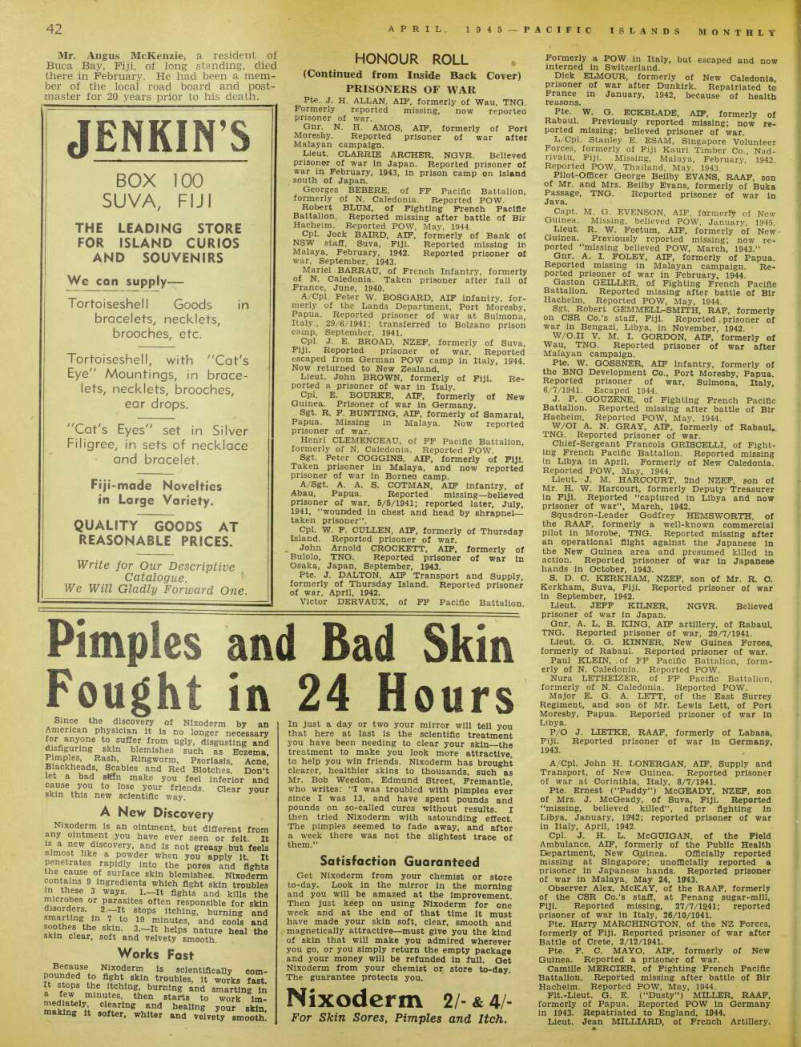
Association
Second Annual Meeting
rE second annual meeting of the Queensland New Guinea Association was held on March 10, in the Lyceum Club, Brisbane.
There were 56 members present. Visit ors welcomed were Commander D. S.
Hore-Lacy, Mr. Babbage, and Miss Beer.
All present were greatly interested in a snapshot which Mrs. Archer had received from her husband, a POW in Zentzuji Camp, Japan. Lieut. Kilner, Dr.
Watch and many AIF officers of the 2/22 Battalion were in the group.
The secretary’s report showed that the Association is in a very financial position.
Unfortunately, owing to the pressure of official duties and their probable depar ture from Brisbane, the president, vice president and secretary were unable to stand for re-election. The officers elected for the coming year were: President, Commander D. S. Hore-Lacy; vice-presi dent, Mrs. Doris Booth; secretary, Miss Margaret Byron; treasurer, Mrs. S. Mc- Cosker; members, Mr. E. P. Holmes, Mr.
Conroy, Mrs. Thornthwaite and Mrs.
Kendall.
The Association meets every second Saturday in each month, at the Lyceum Club, 270 Queen Street. Visitors to Bris bane will be gladly welcomed at these meetings.
The inaugural meeting of a newly formed Association was held in Suva, Fiji, on March 22. It is the European Electors’ Association, and Mr. A. A. Ragg, Elected Member for the Southern Divi sion, was in the chair.
Mr. Angus McKenzie, a resident of Buca Bay, Fiji, of long standing, died there in February. He had been a mem ber of the local road board and post master for 20 years prior to his death.
Advertisements & other items, pp. 43-44 (2 items)
Shipper of Australia’s Best
to the Pacific.
ANDREW THOMSON & SCOUGALL,
PTY., LTD.
Malleable Cast-iron Pipe Fittings for water, steam, gas and air. Malleable Conduit Fittings, etc.
MASHMAN BROTHERS PTY., LTD.
Quality clay products—Sanitaryware, Bathroom fittings, Hospitalware, Stone Pipes, etc. (See “PIM,” January, page 43.)
CENTURY STORAGE BATTERY CO., LTD.
Heavy Duty Standard and Slotted Plate Batteries, Battery Accessories, etc.
OLYMPIC SPARK PLUGS PTY., LTD.
Quality Plugs for cars, trucks, semi and diesel engines.
W. F. CAMPBELL PTY., LTD.
C.A.P. Pure Paints and Varnishes for all purposes. All Industrial Covers, White Lead, White Lead in Oil, Zinc Oxide, etc. (See “PIM,” January, page 41.)
ACME BEDSTEAD CO. PTY., LTD.
Metallic Bedsteads, Steel Domestic Furniture and Hospital Equipment, etc.
BOSS ELECTRICAL MANUFACTURING CO.
Battery Charges (Valve and Metal Rectifier types), Battery Testers, Arc welding equipment, small Transformers, Arc Welding ELECTRODES, complying Lloyd’s Register specifications.
ACME CONDUIT PTY., LTD.
Electrical Conduit Pipes and Walsall Conduit Pipe Fittings.
COLLINS BROTHERS.
“Radiant” Stormproof Kerosene Pressure Lanterns and Lamps; Gloria Lighting Systems.
The “RADIANT” OUTSHINES all other
LAMPS.
(See “PIM,” January, page 35.)
LORIMIER CONTACTS PTY., LTD.
Ignition Contacts in Platinum-iridium and Tungsten. Distributor Caps and Rotors, Condensers. Brushes for Starters, Generators and Magnetos. Push-Pull Switches.
LYONS TRADING CO. PTY., LTD.
King’s Compo Roof Cooling Water Paint. The cheapest PERMANENT roof cover in the world. (See “PIM,” January, page 33.)
MANHAY PTY. LIMITED.
High speed Rotary Brushware and Decarbonising Brushes for use in railways, engineering, gas works, tyre retreading, metal shops, foundries, electroplating industry, jewellery and dental trades. Domestic brushware.
SYDNEY CISTERN & TERRAZO PRODUCTS.
Foolproof SYDNEY-SIMPUL-Universal System Valves for ALL cisterns; including Multi- Flush and Syphon Cisterns. Portable Fuel Coppers made of heat-proof composition.
Water Storage Tanks up to 65 gallons in Fibre Cement. Wash Tubs. Terrazzo products.
FARBEST PRODUCTS PTY., LTD.
Pure Fruit Cordials, Glace Cherries, Lemon and Orange-peels, etc., etc. (See “PIM,” January, page 39.)
STANFORD & PILLEY PTY., LTD.
Paint Brushes for all purposes. Specialists in this particular industry.
CLEMENS FRUIT JUICE PTY., LTD.
100% Pure Fruit Juices—NO water and NO preservatives—Tomato Juice, etc.
RAD MANUFACTURING CO. PTY., LTD.
“RADCO” Quality Foodstuffs and Specialties: Baking Powder, Custard. Powder, Cornflour, Rice Starch, Jelly Crystals, Blanc Mange, Soup mixtures, etc. modern and hygienic factories in Australia. (See “PIM,” January, page 37.) etc. All manufactured in the most Also shipper of Building materials, Iron and Steel products, General Engineering lines, Stampings, Plastics, Machinery and Tools of all kinds, General Hardware and Plumbers’ supplies, Electrical Equipment and Accessories, Brushes and Brooms, Paper and Stationery, Printing and Office Equipment, Chemicals and by-Products, INDUSTRIAL RAW MATERIALS, all classes of Foodstuffs, Wines, Spirits and Liquers, etc., etc.
Price lists, catalogues, samples and all other information available from :
0. F. MASSGHELEIN
ANDREWS BUILDING,
40 KING STREET,
MA1242. SYDNEY.
GENERAL EXPORTER OF AUSTRALIAN
SYDNEY.
QUALITY PRODUCTS ONLY
JENKINS
BOX 100
SUVA, FIJI
THE LEADING STORE
FOR ISLAND CURIOS
AND SOUVENIRS
We can supply— Tortoiseshell Goods in bracelets, necklets, brooches, etc.
Tortoiseshell, with "Cat's Eye" Mountings, in bracelets, necklets, brooches, ear drops.
"Cat's Eyes" set in Silver Filigree, in sets of necklace and bracelet.
Fiji-made Novelties in Large Variety.
QUALITY GOODS AT
REASONABLE PRICES.
Write for Our Descriptive Catalogue.
We Will Gladly Forward One.
Pimples and Bad Skin Fought in 24 Hours
Since the discovery of Nlxoderm by an American physician it is no longer necessary for anyone to suffer from ugly, disgusting and disfiguring skin blemishes such as Eczema, Pimples, Rash, Ringworm, Psoriasis, Acne, Blackheads, Scabies and Red Blotches. Don’t let a bad stfin make you feel inferior and cause you to lose your friends. Clear your skin this new scientific way.
A New Discovery
Nixoderm is an ointment, but different from any ointment you have ever seen or felt. It is a new discovery, and is not greasy but feels almost like a powder when you apply It. It penetrates rapidly into the pores and fights the cause of surface skin blemishes. Nlxoderm contains 9 ingredients which fight skin troubles in these 3 ways. I.—lt fights and kills the microbes or parasites often responsible for skin disorders, 2. It stops itching, burning and smarting in 7 to 10 minutes, and cools and Sk fi n ’ helps nature heal the skin clear, soft and velvety smooth.
Works Fast
Because Nixoderm is scientifically com- It° U s n IL Skil V troubles - works fast.
It stops the Itching, burning and smarting in * i mim J tes - then starts to work Immediately, clearing and healing your skin making it .otter, whiter and velmy smoolh
In just a day or two your mirror will tell you that here at last is the scientific treatment you have been needing to clear your skin—the treatment to make you look more attractive, to help you win friends. Nixoderm has brought clearer, healthier skins to thousands, such as Mr. Bob Weedon, Edmund Street, Fremantle, who writes: “I was troubled with pimples ever since I was 13, and have spent pounds and pounds on so-called cures without results. I then tried Nixoderm with astounding effect.
The pimples seemed to fade away, and after a week there was not the slightest trace of them.”
Satisfaction Guaranteed
Get Nixoderm from your chemist or store to-day. Look in the mirror in the morning and you will be amazed at the improvement.
Then just keep on using Nixoderm for one week and at the end of that time it must have made your skin soft, clear, smooth and magnetically attractive—must give you the kind of skin that will make you admired wherever you go, or you simply return the empty package and your money will be refunded in full. Get Nixoderm from your chemist or store to-day.
The guarantee protects you.
Nixoderm 2/-&4/-
For Skin Sores, Pimples and Itch,
42
APRIL, 1945 PACIFIC ISLANDS MONTHLY
HONOUR ROLL
(Continued from Inside Back Cover)
Treatment Of Vichy
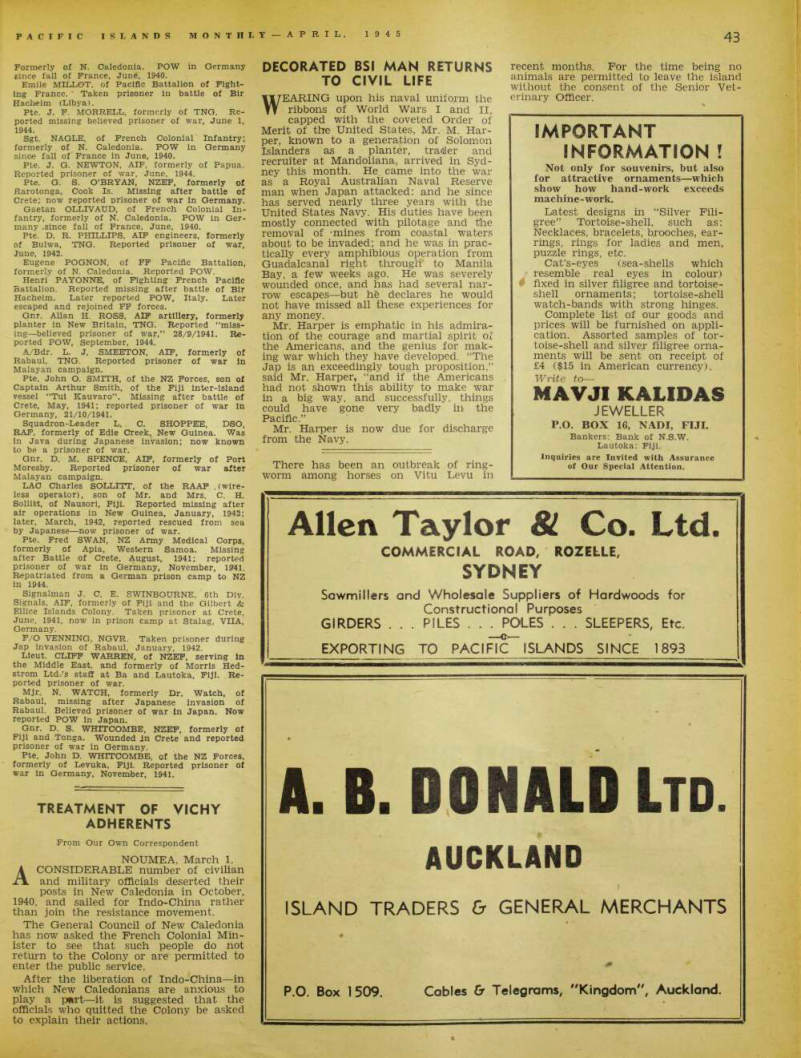
Adherents
From Our Own Correspondent NOUMEA, March 1.
A CONSIDERABLE number of civilian and military officials deserted their posts in New Caledonia in October, 1940, and sailed for Indo-China rather than join the resistance movement.
The General Council of New Caledonia has now asked the French Colonial Min ister to see that such people do not return to the Colony or are permitted to enter the public service.
After the liberation of Indo-China —in which New Caledonians are anxious to play a part—it is suggested that the officials who quitted the Colony be asked to explain their actions.
Decorated Bsi Man Returns
To Civil Life
WEARING upon his naval uniform the ribbons of World Wars I and 11, capped with the coveted Order of Merit of the United States, Mr. M. Har per, known to a generation of Solomon Islanders as a planter, trader and recruiter at Mandoliana, arrived in Syd ney this month. He came into the war as a Royal Australian Naval Reserve man when Japan attacked: and he since has served nearly three years with the United States Navy. His duties have been mostly connected with pilotage and the removal of • mines from coastal waters about to be invaded; and he was in prac tically every amphibious operation from Guadalcanal right through to Manila Bay, a few weeks ago. He was severely wounded once, and has had several nar row escapes—but he declares he would not have missed all these experiences for any money.
Mr. Harper is emphatic in his admira tion of the courage and martial spirit of the Americans, and the genius for mak ing war which they have developed. “The Jap is an exceedingly tough proposition.’’ said Mr. Harper, “and if the Americans had not shown this ability to make war in a big way, and successfully, things could have gone very badly in the Pacific.”
Mr. Harper is now due for discharge from the Navy.
There has been an outbreak of ring worm among horses on Vitu Levu in
recent months. For the time being no animals are permitted to leave the island without the consent of the Senior Vet erinary Officer. *
Advertisements & other items, p. 45 (1 item)
A. B. Donald Ltd.
IMPORTANT
INFORMATION !
Not only for souvenirs, but also for attractive ornaments—which show how hand-work exceeds machine-work.
Latest designs in “Silver Filigree” Tortoise-shell, such as: Necklaces, bracelets, brooches, earrings, rings for ladies and men, puzzle rings, etc.
Cat’s-eyes (sea-shells which resemble real eyes in colour) fixed in silver filigree and tortoiseshell ornaments; tortoise-shell watch-bands with strong hinges.
Complete list of our goods and prices will be furnished on application. Assorted samples of tortoise-shell and silver filigree ornaments will be sent on receipt of £4 ($l5 in American currency).
Write to —
MAVJI KALIDAS
JEWELLER
P.O. BOX 16, NADI, FIJI.
Bankers: Bank of N.S.W.
Lautoka: Fiji.
Inquiries are Invited with Assurance of Our Special Attention.
Allen Taylor & Co. Ltd.
COMMERCIAL ROAD, ROZELLE,
SYDNEY
Sawmillers and Wholesale Suppliers of Hardwoods for Constructional Purposes GIRDERS , . . PILES . . . POLES . . , SLEEPERS, Etc.
EXPORTING TO PACIFIC ISLANDS SINCE 1893
A. B. DONALD Ltd.
AUCKLAND
t
ISLAND TRADERS & GENERAL MERCHANTS
♦ 0 P.O. Box 1509. Cables Gr Telegrams, ''Kingdom", Auckland.
N. Caledonian Artist Succeeds
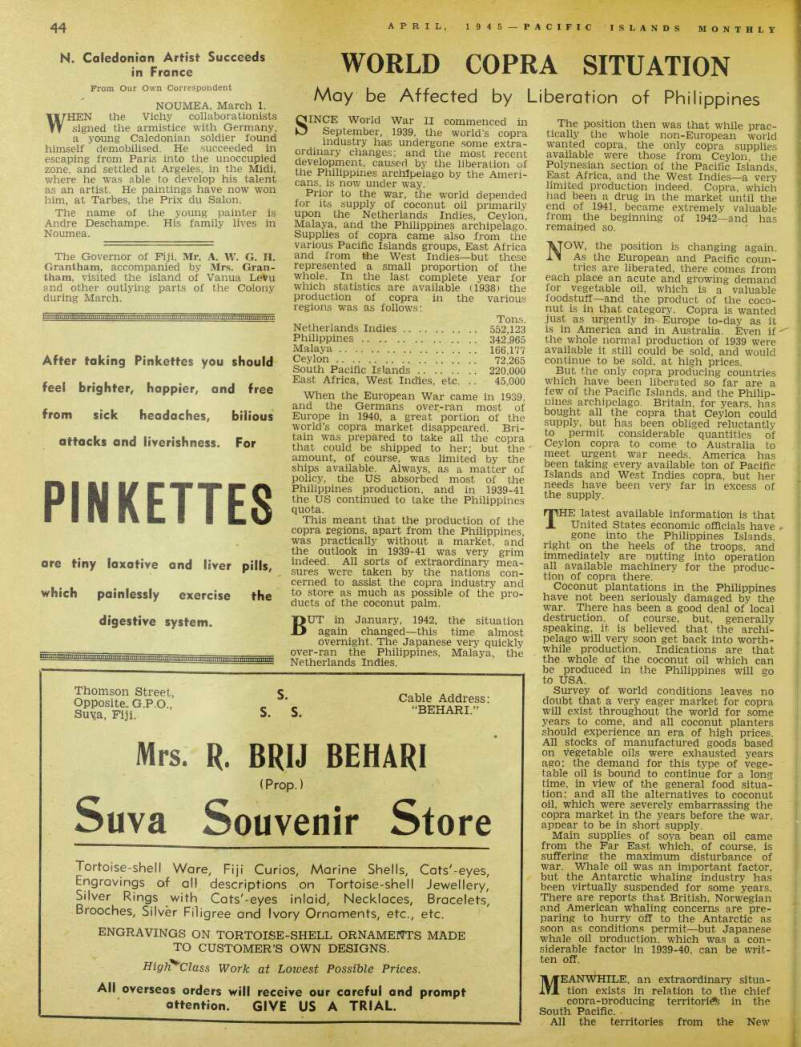
in France
From Our Own Correspondent NOUMEA, March 1.
WHEN the Vichy collaborationists signed the armistice with Germany, a young Caledonian soldier found himself demobilised. He succeeded in escaping from Paris into the unoccupied zone, and settled at Argeles, in the Midi, where he was able to develop his talent as an artist. He paintings have now won him, at Tarbes, the Prix du Salon.
The name of the young painter is Andre Deschampe. His family lives in Noumea.
The Governor of Fiji, Mr. A. W. G. H.
Grantham, accompanied by Mrs. Gran tham, visited the island of Vanua Levu and other outlying parts of the Colony during March.
World Copra Situation
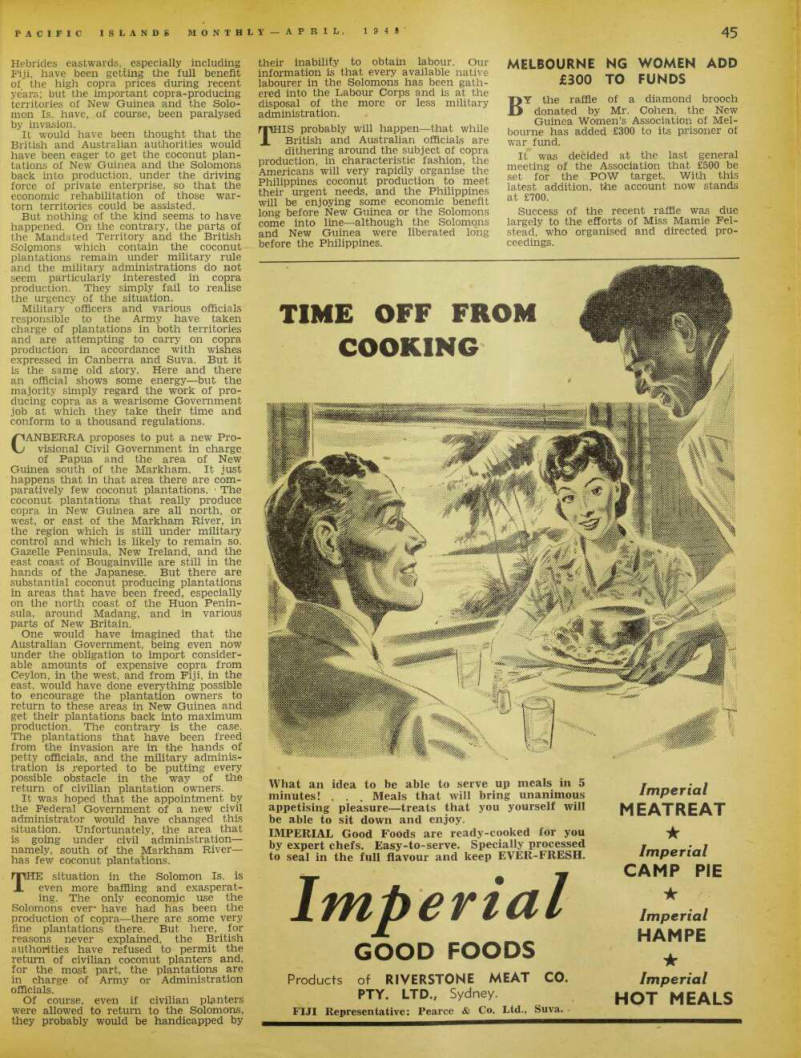
May be Affected by Liberation of Philippines
SINCE World War II commenced in September, 1939, the world’s copra industry has undergone some extra ordinary changes; and the most recent development, caused by the liberation of the Philippines archipelago by the Ameri cans, is now under way.
Prior to the war, the world depended for its supply of coconut oil primarily upon the Netherlands Indies, Ceylon, Malaya, and the Philippines archipelago.
Supplies of copra came also from the various Pacific Islands groups, East Africa and from the West Indies—but these represented a small proportion of the whole. In the last complete year for which statistics are available (1938) the production of copra in the various regions was as follows:
When the European War came in 1939, and the Germans over-ran most of Europe in 1940, a great portion of the world’s copra market disappeared. Bri tain was prepared to take all the copra that could be shipped to her; but the amount, of course, was limited by the ships available. Always, as a matter of policy, the US absorbed most of the Philippines production, and in 1939-41 the US continued to take the Philippines quota.
This meant that the production of the copra regions, apart from the Philippines, was practically without a market, and the outlook in 1939-41 was very grim indeed. All sorts of extraordinary mea sures were taken by the nations con cerned to assist the copra industry and to store as much as possible of the pro ducts of the coconut palm.
BUT in January, 1942, the situation again changed—this time almost overnight. The Japanese very quickly over-ran the Philippines, Malaya, the Netherlands Indies.
The position then was that while prac tically the whole non-European world wanted copra, the only copra supplies available were those from Ceylon, the Polynesian section of the Pacific Islands, East Africa, and the West Indies—a very limited production indeed. Copra, which had been a drug in the market until the end of 1941, became extremely valuable from the beginning of 1942—and has remained so.
NOW, the position is changing again.
As the European and Pacific coun tries are liberated, there comes from each place an acute and growing demand for vegetable oil, which is a valuable foodstuff—and the product of the coco nut is in that category. Copra is wanted just as urgently in- Europe to-day as it is in America and in Australia. Even if the whole normal production of 1939 were available it still could be sold, and would continue to be sold, at high prices.
But the only copra producing countries which have been liberated so far are a few of the Pacific Islands, and the Philip nines archipelago. Britain, for years, has bought all the copra that Ceylon could supply, but has been obliged reluctantly to permit considerable quantities of Ceylon copra to come to Australia to meet urgent war needs. America has been taking every available ton of Pacific Islands and West Indies copra, but her needs have been very far in excess of the supply. rE latest available information is that United States economic officials have gone into the Philippines Islands, right on the heels of the troops, and immediately are nutting into operation all available machinerv for the produc tion of copra there.
Coconut plantations in the Philippines have not been seriously damaged by the war. There has been a good deal of local destruction, of course, but, generally speaking, it is believed that the archi pelago will very soon get back into worth while production. Indications are that the whole of the coconut oil which can be produced in the Philippines will go to USA.
Survey of world conditions leaves no doubt that a very eager market for copra will exist throughout the world for some years to come, and all coconut planters should experience an era of high prices.
All stocks of manufactured goods based on vegetable oils were exhausted years ago; the demand for this type of vege table oil is bound to continue for a long time, in view of the general food situa tion; and all the alternatives to coconut oil, which were severely embarrassing the copra market in the years before the war, appear to be in short supply.
Main supplies of soya bean oil came from the Far East which, of course, is suffering the maximum disturbance of war. Whale oil was an important factor, but the Antarctic whaling industry has been virtually suspended for some years.
There are reports that British, Norwegian and American whaling concerns are pre paring to hurry off to the Antarctic as soon as conditions permit—but Japanese whale oil nroduction. which was a con siderable factor in 1939-40, can be writ ten off.
MEANWHILE, an extraordinary situa tion exists in relation to the chief copra-producing territorial in the South Pacific.
All the territories from the New
Tons.
Netherlands Indies . 552,123 Philippines . 342,965 Malaya . 166,177 Ceylon . 72,265 South Pacific Islands . 220,000 East Africa. West Indies, etc. . . 45,000
Hebrides eastwards, especially including Fiji, have been getting the full benefit of the high copra prices during recent years; but the important copra-producing territories of New Guinea and the Solo mon Is. have, of course, been paralysed by invasion.
It would have been thought that the British and Australian authorities would have been eager to get the coconut plan tations of New Guinea and the Solomons back into production, under the driving force of private enterprise, so that the economic rehabilitation of those war torn territories could be assisted.
But nothing of the kind seems to have happened. On the contrary, the parts of the Mandated Territory and the British Solomons which contain the coconut plantations remain under military rule and the military administrations do not seem particularly interested in copra production. They simply fail to realise the urgency of the situation.
Military officers and various officials responsible to the Army have taken charge of plantations in both territories and are attempting to carry on copra production in accordance with wishes expressed in Canberra and Suva. But it is the same old story. Here and there an official shows some energy—but the majority simply regard the work of pro ducing copra as a wearisome Government job at which they take their time and conform to a thousand regulations.
CANBERRA proposes to put a new Pro visional Civil Government in charge of Papua and the area of New Guinea south of the Markham. It just happens that in that area there are com paratively few coconut plantations. • The coconut plantations that really produce copra in New Guinea are all north, or west, or east of the Markham River, in the region which is still under military control and which is likely to remain so.
Gazelle Peninsula, New Ireland, and the east coast of Bougainville are still in the hands of the Japanese. But there are substantial coconut producing plantations in areas that have been freed, especially on the north coast of the Huon Penin sula, around Madang, and in various parts of New Britain.
One would have imagined that the Australian Government, being even now under the obligation to import consider able amounts of expensive copra from Ceylon, in the west, and from Fiji, in the east, would have done everything possible to encourage the plantation owners to return to these areas in New Guinea and get their plantations back into maximum production. The contrary is the case.
The plantations that have been freed from the invasion are in the hands of petty officials, and the military adminis tration is reported to be putting every possible obstacle in the way of the return of civilian plantation owners.
It was hoped that the appointment by the Federal Government of a new civil administrator would have changed this situation. Unfortunately, the area that is going under civil administration — namely, south of the Markham River — has few coconut plantations, rE situation in the Solomon Is. is even more baffling and exasperat ing. The only economic use the Solomons ever* have had has been the production of copra—there are some very fine plantations there. But here, for reasons never explained, the British authorities have refused to permit the return of civilian coconut planters and, for the most part, the plantations are in charge of Army or Administration officials.
Of course, even if civilian planters were allowed to return to the Solomons, they probably would be handicapped by
their inability to obtain labour. Our information is that every available native labourer in the Solomons has been gath ered into the Labour Corps and is at the disposal of the more or less military administration.
THIS probably will happen—that while British and Australian officials are dithering around the subject of copra production, in characteristic fashion, the Americans will very rapidly organise the Philippines coconut production to meet their urgent needs, and the Philippines will be enjoying some economic benefit long before New Guinea or the Solomons come into line —although the Solomons and New Guinea were liberated long before the Philippines.
Advertisements & other items, p. 46 (1 item)
Pinkettes
After taking Pinkettes you should feel brighter, happier, and free from sick headaches, bilious attacks and liverishness. For
are tiny laxative and liver pills, which painlessly exercise the digestive system.
Thomson Street, S Opposite. G.P.0., c ' c Suya, Fiji. 5. 5.
Cable Address:
“BEHARI.”
Mrs. R. BRIJ BEHARI
(Prop.)
Suva Souvenir Store
Tortoise-shell Wore, Fiji Curios, Marine Shells, Cats'-eyes, Engravings of all descriptions on Tortoise-shell Jewellery, Silver Rings with Cats'-eyes inlaid, Necklaces, Bracelets, Brooches, Silver Filigree and Ivory Ornaments, etc., etc.
ENGRAVINGS ON TORTOISE-SHELL ORNAMENTS MADE
TO CUSTOMER’S OWN DESIGNS.
HigJi*ciass Work at Lowest Possible Prices.
All overseas orders will receive our careful and prompt attention. GIVE US A TRIAL
Melbourne Ng Women Add
£300 To Funds
- „ , ra ffl e of a diamond brooch -D donated by Mr. Cohen, the New Guinea Women’s Association of Mel bourne has added £3OO to its prisoner of wa r fund , ripridpri the last seneral nf thl AssociatSn that £5OO be ™ etl "f f he %ow tercet With this faLe/ additfnn ? the account now stands addition, the account now stands aL t, ‘ uu - Success of the recent raffle was due largely to the efforts of Miss Mamie Fel stead, who organised and directed pro ceedings.
Advertisements & other items, p. 47 (1 item)
Imperial
TIME OFF FROM
COOKING
✓rr x m m K * n *0 m K What an idea to be able to serve up meals in 5 minutes! . . . Meals that will bring unanimous appetising pleasure—treats that you yourself will be able to sit down and enjoy.
IMPERIAL Good Foods are ready-cooked for you by expert chefs. Easy-to-serve. Specially processed to seal in the full flavour and keep EVER-FRESH.
Imperial
GOOD FOODS
Products of RIVERSTONE MEAT CO.
PTY. LTD., Sydney.
FIJI Representative; Pearce & Co. Ltd., Suva.
Imperial
MEATREAT
★ Imperial
CAMP PIE
Imperial
HAMPE
Imperial
HOT MEALS
Fijian Chiefs' Scholarship
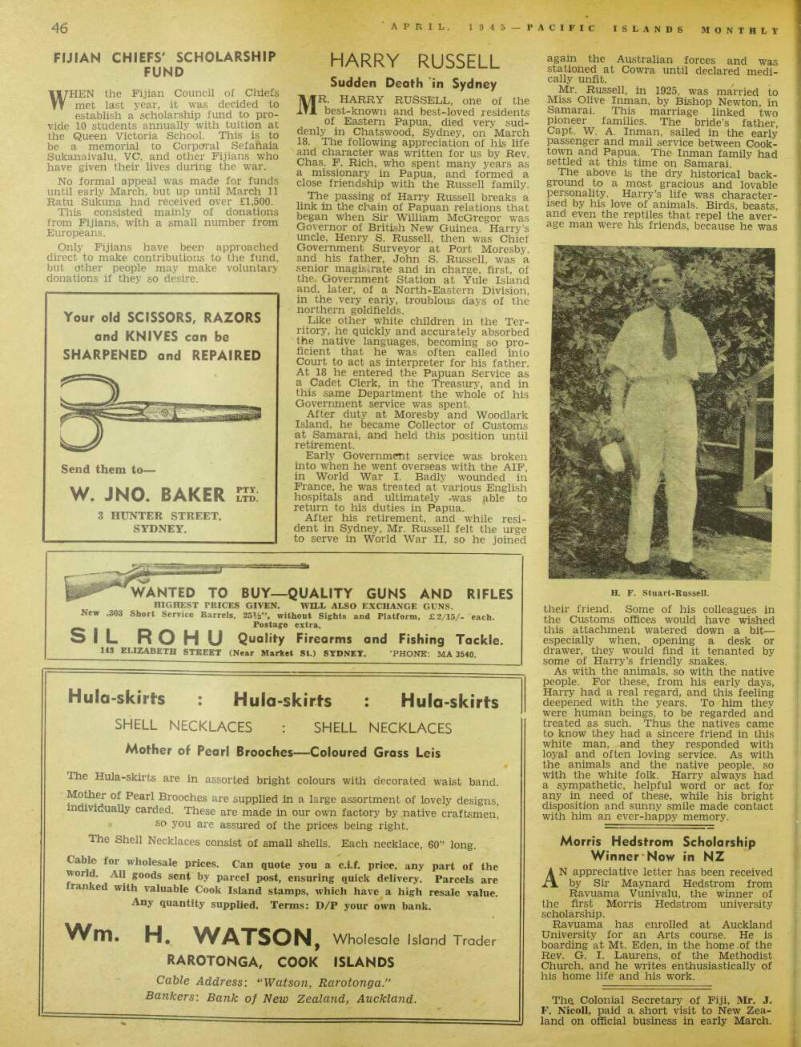
Fund
WHEN the Fijian Council of Chiefs met last year, it was decided to establish a scholarship fund to pro vide 10 students annually with tuition at the Queen Victoria School. This is to be a memorial to Corporal Sefahaia Sukanaivalu, VC, and other Fijians who have given their lives during the war.
No formal appeal was made for funds until early March, but up until March 11 Ratu Sukuna had received over £1,500.
This consisted mainly of donations from Fijians, with a small number from Europeans.
Only Fijians have been approached direct to make contributions to the fund, but other people may make voluntary donations if they so desire.
Harry Russell
Sudden Death in Sydney
MR. HARRY RUSSELL, one of the best-known and best-loved residents of Eastern Papua, died very sud denly in Chatswood, Sydney, on March 18. The following appreciation of his life and character was written for us by Rev.
Chas. F. Rich, who spent many years as a missionary in Papua, and formed a close friendship with the Russell family.
The passing of Harry Russell breaks a link in the chain of Papuan relations that began when Sir William McGregor was Governor of British New Guinea. Harry’s uncle, Henry S. Russell, then was Chief Government Surveyor at Port Moresby, and his father, John S. Russell, was a senior magistrate and in charge, first, of the Government Station at Yule Island and, later, of a North-Eastern Division, in the very early, troublous days of the northern goldfields.
Like other white children in the Ter ritory, he quickly and accurately absorbed the native languages, becoming so pro ficient that he was often called into Court to act as interpreter for his father.
At 18 he entered the Papuan Service as a Cadet Clerk, in the Treasury, and in this same Department the whole of his Government service was spent.
After duty at Moresby and Woodlark Island, he became Collector of Customs at Samarai, and held this position until retirement.
Early Government service was broken into when he went overseas with the AIF, in World War I. Badly wounded in France, he was treated at various English hospitals and ultimately .was able to return to his duties in Papua.
After his retirement, and while resi dent in Sydney, Mr. Russell felt the urge to serve in World War 11, so he joined
again the Australian forces and was stationed at Cowra until declared medi cally unfit.
Mr. Russell, in 1925, was married to Miss Olive Inman, by Bishop Newton, in Samarai. This marriage linked two pioneer families. The bride’s father, Capt. W. A. Inman, sailed in the early passenger and mail service between Cook town and Papua. The Inman family had settled at this time on Samarai.
The above is the dry historical back ground to a most gracious and lovable personality. Harry’s life was character ised by his love of animals. Birds, beasts, and even the reptiles that repel the aver age man were his friends, because he was
their friend. Some of his colleagues in the Customs offices would have wished this attachment watered down a bit— especially when, opening a desk or drawer, they would find it tenanted by some of Harry’s friendly snakes.
As with the animals, so with the native people. For these, from his early days, Harry had a real regard, and this feeling deepened with the years. To him they were human beings, to be regarded and treated as such. Thus the natives came to know they had a sincere friend in this white man, and they responded with loyal and often loving service. As with the animals and the native people, so with the white folk. Harry always had a sympathetic, helpful word or act for any in need of these, while his bright disposition and sunny smile made contact with him an ever-happy memory.
H. F. Stuart-Russell.
Morris Hedstrom Scholarship
Winner Now in NZ
AN appreciative letter has been received by Sir Maynard Hedstrom from Ravuama Vunivalu, the winner of the first Morris Hedstrom university scholarship.
Ravuama has enrolled at Auckland University for an Arts course. He is boarding at Mt. Eden, in the home of the Rev. G. I. Laurens, of the Methodist Church, and he writes enthusiastically of his home life and his work.
Tha Colonial Secretary of Fiji, Mr, J.
F. Nicoll, paid a short visit to New Zea land on official business in early March.
Advertisements & other items, p. 48 (1 item)
Wm. H. WATSON, Wholesale Island Trader
Your old SCISSORS, RAZORS
and KNIVES can be
SHARPENED and REPAIRED
mm Send them to—
W. JNO. BAKER
3 HUNTER STREET,
SYDNEY.
PTT.
LTD.
s3S» New
WANTED TO BUY—QUALITY GUNS AND RIFLES
HIGHEST PRICES GIVEN. WILL ALSO EXCHANGE GUNS.
Short Service Barrels, 25}fc”, without Sights and Platform, £2/15/- each.
Postage extra.
SI L RO H U Quality Firearms and Fishing Tackle. 143 ELIZABETH STREET (Near Market St.) SYDNEY. ’PHONE; MA 3540.
Hula-skirts : Hula-skirts : Hula-skirts
SHELL NECKLACES : SHELL NECKLACES
Mother of Pearl Brooches—Coloured Grass Leis The Hula-skirts are in assorted bright colours with decorated waist band.
Mother of Pearl Brooches are supplied in a large assortment of lovely designs, individually carded. These are made in our own factory by native craftsmen, so you are assured of the prices being right.
The Shell Necklaces consist of small shells. Each necklace, 60” long.
Cable for wholesale prices. Can quote you a price, any part of the world. All goods sent by parcel post, ensuring quick delivery. Parcels are ranked with valuable Cook Island stamps, which have a high resale value.
Any quantity supplied. Terms: D/P your own bank.
Wm. H. WATSON, Wholesale Island Trader
RAROTONGA, COOK ISLANDS
Cable Address : “Watson, Rarotonga ”
Bankers : Bank of New Zealand, Auckland.
Death Of Mr. J. G. Fowler,
Formerly Of Papua
A WELL-KNOWN old resident of Papua, who served the Administra tion there for very many years, Mr.
James Grant Fowler, died in a private hospital at Neutral Bay, Sydney, on March 29, at the age of 74.
Mr. Fowler, senior, was a newspaper owner in North Queensland, and young Jimmy Fowler just naturally became a reporter. The “scribbling itch” remained with him all his life —he always was dabbling in journalism. But the quiet life of towns bored the adventurous young man; and, 45 years ago, he wan dered off into the Islands, and brought up eventually on the then primitive coasts of New Guinea. A little later, he came under the notice of the new Gov ernor of Papua, Judge Hubert Murray, and Mr. Fowler duly became one of his administrative officials. He had filled the post of ARM in a number of districts prior to his retirement, some ten years ago. He leaves two daughters—Mrs. Essie Chester and Mrs. Colin Monteith.
Mr. Fowler was a kindly man, who took a keen interest in public affairs, and, in his younger days, he made hosts of friends. He had been an invalid for some years.
Death Of Mr. Con Page,
Of New Guinea
THE death occurred in the War Memorial Hospital, Sydney, on March 17, after years of illness, of Mr. Con Page, who was with W. R.
Carpenter & Co., Ltd., for 26 years—eight of them as store manager in Kavieng, TNG. After 1936, ill-health compelled him to leave the tropics and live in Australia. He leaves a widow and daughters.
The late Mr. Page’s son, Sub.-Lieut. C.
L. Page, RANVR, who was employed on a plantation on the east coast of New Ireland, elected to remain behind in the evacuation, in January, 1942, and to undertake secret and very dangerous duties. The work he did probably saved the lives of several residents of New Ireland; but he lost his own life. The Admiralty formally announced, in the London Gazette of August 29, 1944, that he had been Mentioned in Despatches for “distinguished service.”
Full Service Benefits
For NG Public Servants
FURTHER amendments this time designed to assist the Papuan and Mandated Territory public servants —have been made to the National Secur ity (External Territories) Regulations.
When civil government was suspended in the Territories in early 1942, all those public servants of the two services who were over military age and did not go into the Army but were given appoint ments in the Commonwealth Depart ments in Australia, were informed that for the duration of said suspension, each three-year period of service in Australia would count only as two. The reason for this is not clear —unless it was designed to even up Territorian public servants’ conditions with those applying to Com monwealth public servants.
But whatever the reason, the Common wealth Government has now had a change of heart. In the new amend ment, issued March 14, 1945, by paying up all back superannuation contributions (“suspended” public servants, not in the Army, have been paying 2/3 usual rate of contribution, during this period) are entitled to full length of service and superannuation benefits.
Crime Wave in Tonga
Brutal Assault and Outrage Near the Capital
Nukualofa, Feb. 23.
THE crime wave in formerly-peaceful Tonga, during recent months, has included robbery, manslaughter, rape, indecent assault, and gaol-breaking. The most recent case is the worst of all.
A gang of young men, believed to be Tongans, one night in February, attacked the plantation home of Mr. and Mrs. O.
Brahne (both Europeans) of Niumate plantation, a few miles from Nukualofa.
Mr. Brahne was struck down, beaten, bound and kicked, so that he sustained very serious injuries, including broken bones. Mrs. Brahne was seized, outraged and then bound.
The unfortunate couple remained in this condition until they were found next morning by their labour boys.
The police found, on the lawn, an iron safe that had contained money. It had been broken open, and the money stolen.
Mrs. Brahne’s car was smashed, appar ently with axes.
The police brought the Nukualofa photographer, Mr. A. Hettig, to the scene, and he secured several pictures of fin gerprints. They have been very active, and it is .understood that they are on the point of making an arrest.
This latest crime is likely to bring about some overdue reforms. There have been complaints, for a long time, that
malefactors are too lightly punished, and that far-reaching revision is needed in connection with gaol administration.
Rarotonga Was
Surprised!
From Our Own Correspondent
Rarotonga, March 26.
NEAR the end of March, Rarotonga residents were surprised to come by chance on a note in a NZ newspaper stating that two Rarotonga gentlemen (one European and one Euronesian) were in New Zealand, visiting Parlia mentary offices, “representing the people of Rarotonga.”
They were even more startled to learn that one of the principal matters on their agenda was parliamentary representation for Rarotonga. Representation has long been the dream of certain elements: but the large majority of the people are now very definitely “anti-representation.” The Island Council decided that a far better plan would be for a Government repre sentative —say, the Secretary for Island Territories —to pay periodic visits to Rarotonga to gather the views of the people, first-hand.
This proposal was presented to the Prime Minister during his visit, and appeared to be favourably received.
Apart from other aspects, it is pointed out that one Rarotongan isolated in NZ would have no contact with the current thoughts and feelings of the people, and would serve no really useful purpose.
Advertisements & other items, p. 49 (1 item)
Mdlrath’S Pty. Ltd.
Ship Chandlery Hardware
r Write for j
j Ship Chandlery /
* Catalogue J
BROOMFIELDS
152 SUSSEX STREET
Cables: “Boom”, Special “In Bond” Prices for all Islands enquiries queted on application.
Sole Agents for:
BROOMFIELDS LIMITED
SHIP CHANDLERY
IRONMONGERY OF ALL KINDS, PAINTS,
WHITE LEAD AND OILS.
P. H. MUNTZ & CO.’S 3-CROWN BRAND METAL SHEATHING.
PEACOCK Si BUCHANS' ENGLISH READY-MIXED PAINTS.
n X XVILHi X • •
Cables; “Boom”, Sydney.
Large and Complete Stocks of
SYDNEY.
JJURING the stress of war Me I LRATH'S Export Dept, has still functioned regularly, shipping groceries and other commodities to those Pacific Islands where shipping facilities have made this possible.
And when the war is won Mcllroth's will be ready again to render their renowned good service to all Island friends wherever they may be.
MdLRATH’S PTY. LTD.
Export Department ,
202 PITT ST., SYDNEY, AUSTRALIA
Islands Produce
Cocoa
Official prices for New Hebrides cocoa beans, controlled by the Cocoa, Chocolate and Confec tionery Committee, are as follows: — Buying: £4l/10/- per ton, f.o.b. Island port.
Selling: Delivered Sydney, Melbourne or Hobart, £53/5/- per ton.
Accra: £69/10/- (on wharf, Sydney, all charges paid).
New Guinea cocoa beans: No quotations.
Western Samoa: Last sale reported, Ist quality, £BO (f.0.b., Apia).
Trochus Shell
No sales have been reported since January, when small parcels changed hands at £llO per ton. Nominal quotations obtained in mid- April indicate that the market is unchanged at that figure.
Coffee
No purchases are permitted without the consent of the Tea and Coffee Control Board, to whom all offers must first be submitted.
Nominal quotations as follows: — New Caledonian: Arabica, £Bl per ton (c.i.f.
Sydney). Robusta, £63 per ton (c.i.f. Sydney), New Hebrides: Robusta, £63/10/- per ton (c.i.f. Sydney).
Mysore: £240 (c. & f. Sydney).
New Guinea and Papuan: No firm quotations available.
Java: No quotations.
Vanilla Beans
White Label and Yellow Label, 17/2 per lb., c. & f. Sydney.
Kapok
Market for Javanese kapok has been suspended.
Indian kapok is being quoted for indent at i/6 per lb. c.i.f. stg.
Cotton
Government controlled. Stocks being made available to manufacturers at following rates:— For spinning and weaving yarns, 14%d. per lb.; cordage making, H3/ 4 d. per lb.; condenser yam, 12d. per lb.
Ivory Nuts
No firm quotations available.
Rice
No quotations.
Green Snail Shell
F.a.q., £lO3 per ton, in store, Sydney.
Pearl Shell
Government-controlled price;— "B” Class. £2OO per ton. “C” Class £l9O per ton. ”D” Class, £135 per ton.
Fiji Buying Prices
Suva, March 14
r T'HE following, taken from the “Fiji Times,”
A shows the prices current in Suva on the date mentioned. The prices, of course, are given in Fiji currency, which is 12% per cent, below sterling, and 12% per cent, above Australian.
Copra (Plantation Grade) x> on Copra (P.M.S. Grade) “ p\ nn n, Copra sacks, each ... " i. 18/10/ Kerosene, per gallon ' ’ ‘ ’ , Flour, per sack ' ' ‘ w ', a Flour, per lb 3 % 6 Sharps, per 140 lb. sacks ‘ 2 6/- Sharps, 5 lb Barbed Wire, ton lots " “ Trocas Shell, per ton .. .. pit Benzine, per gallon ” ** 3/10 Benzine (bowser), per gallon .. ” 0/0
Price Of Gold
Oct. 6 . . £ll 15 0 [unquoted] £l2 IB 6 Oct. 12.—Fixed price based on £l2/7/6 per ton, c.i.f., London, for plantation hot-air dried.
Jan. 8, 1940, to April 20, 1940.—Fixed price for plantation hot-air dried, £l3/5/- per ton, c.i.f., London.
April 20, 1940. —Fixed price for plantation hot air dried, £l2/17/6 per ton, c.i.f., London.
On February 18, 1942, FIJI and Tonga copra, Ist grade, was fixed at £lB per ton (Fijian), f.0.b.; and In July: Plantation Grade, £lB/5/-; Fair Merchantable Sun-dried, £18; and Under grade, £l7/15/-. The values are stated in Fijian currency. To get Australian or New Zealand values, add 12% per cfnt.; sterling values, deduct 12 y 2 per cent.
In April, 1942, unofficial quotations in Sydney were around £24 (Aust.) per ton, c.i.f., Sydney.
July, 1943. —N. Guinea and Papuan copra under Aust. Government control. Fixed prices, payable at port of shipment, or on plantation, where no coastal shipment is involved; Hot-air Dried, £l5/10/-; Sun-dried, £l5; Smoke-dried, £l4/10/per ton. These prices subject to circumstantial considerations.
In September, 1943. prices were revised as follows: Hot-air and Sun-dried, £lB/10/-; Smoke-dried, £l7 per ton. Tentative there after.
New prices covering the period October 1, 1943, to June 30, 1944, were declared in September! 1944, as follows: Hot-air and Sun-dried, £lB/10/per ton; Smoked, £l7/10/- per ton.
Prices to operate from July 1, 1944, were ten tatively fixed at: Hot-air and Sun-dried, £l9; Smoked, £lB per ton.
Fine Standard \ m .. .
Copra
South Sea, Plantation Sun-dried Hot-air Dried, London to London Rabaul Price on- Per ton, c.i.f.
Per ton. c.i.f.
January 1, 1932 , , . . £14 0 0 £14 15 0 June 17 . £13 2 6 £13 5 0 December 16 .. £14 2 6 £14 5 0 January 6, , 1933 £13 0 0 £13 12 6 June 30 . £10 17 6 £11 0 0 December 1 .. £8 12 6 £9 0 0 January 5, , 1934 , , , . £8 0 0 £8 7 6 June 15 . . . . £8 0 0 £8 12 6 December 28 .. £9 0 0 £9 12 6 January 4, 1935 . . £9 5 0 £10 5 0 June 7 ., £11 15 0 £12 7 6 December 6 .. £12 17 6 £14 0 0 South Sea South Sea Plantation Smoked to Genoa Sun-dried Hot-air Dried London and Marseilles. to London.
Rabaul.
Price on— Per ton, c.i.f. Per ton, c.l.f. Per ton. c.l.f.
Jan. 3, ’36 £13 2 6 £13 15 0 £14 0 0 Mar. 6 . . £11 15 0 £12 15 0 £13 0 0 June 5 £11 10 0 £12 0 0 £12 17 0 Sept. 4 . £13 2 6 £13 10 0 £14 12 6 Dec. 4 £19 7 6 £19 7 6 £20 7 6 Jan. 8. ’37 £22 12 6 £22 12 6 £22 12 6 Mar. 5 . £19 0 0 £19 5 0 £20 0 0 June 4 . £15 15 0 £15 12 6 £16 12 e Sept. 3 . £13 5 0 £13 5 0 £14 0 0 Dec. 3 £12 10 0 £12 12 6 £13 7 e Jan. 7, ’38 £12 12 6 £12 15 0 £13 12 6 Mar. 4 £10 17 6 £11 0 0 £12 0 e June 3 . £9 15 0 £9 15 0 £10 12 e Sept. 2 . £9 10 0 £9 10 0 £10 10 0 Dec. 2 £9 5 0 £9 5 0 £10 2 6 Jan. 6. ’39 £9 12 6 £9 15 0 £10 10 0 Feb. 3 . £9 10 0 £9 12 6 £10 10 0 Mar. 3 . £10 0 0 £10 2 6 £11 0 0 Apr. 6 £9 12 6 £9 15 0 £16 12 6 May 5 . £10 0 0 £10 5 0 £11 0 0 June 2 £10 7 6 £10 10 0 £11 7 6 July 7 . £9 2 6 £9 7 6 £10 5 0 Aug. 4 £9 2 6 £9 5 0 £10 5 0 Sept. 1 . £9 10 0 £9 12 6 £10 12 6 Sept. 8. —Not quoted—outbreak of war.
Sept. 15 to 29.- -Not quoted.
Quotations For Mining
Shares
July, 1943.—Papuan rubber under Australian Government control. Fixed prices, payable on plantation, where no coastal shipment is Ih volved, or at port of shipment: No. 1 Grade, 1/8; No. 2 Grade, 1/4; No. 3 Grade, 1/2 per lb. These prices subject to circumstantial considerations.
In September, 1943, prices were revised as follows: No. 1 Grade, 1/6%; No. 2 Grade, 1/4; No. 3 Grade, 1/2; Inferior, 10%d. to 1/2% per lb. Tentative thereafter.
In September, 1944, the following new prices, covering the period October’ 1, 1943, to June 30, 1944, were proclaimed: No. 1 Grade, 1/6%; No. 2 Grade, 1/5%; No. 3 Grade, 1/3% per lb. Com mencing July 1, 1944, prices were tentatively fixed at: No. 1 Grade, 1/4%; No. 2 Grade, l/3y 2 ; No. 3 Grade, 1/1 y 2 per lb.
Fiji
Mid-Feb.
Mid-March Mid-April.
Emperor Mines . .. bll/9 bll/9 bll/9 Loloma bl9/6 s20/- Mt. Kasl . bl/8 bl/8 sl/9 Bulolo G.D
New Guinea
.. b99/- b99/bl08/- Guinea Gold ... sll/3 sll/3 blO/11 N.G.G., Ltd b2/6 b3/- Oil Search b5/3 s5/6 Placer Dev b80/b80/- Sandy Creek ... sl/7 sl/5 Sunshine Gold . .. s7/6 s7/6 s7/6 Cuthbert’s
Papua.
.. bl2/6 bl2/6 S12/9 Mandated Alluvials s5/s5/b4/6 Oriomo Oil b2/4 s2/- Papuan Aplnalpl . b3/3 b3/3 s3/6 Yodda Goldfields . N.Q.
N.Q.
N.Q.
RUBBER Plantation
London Para.
Smoked.
Price on— per lb. per lb.
January 6. 1933 2.43d July 7 3.71d December 8 .. . 4.0 s 'g d January 5, 1934 4.28d July 6 7.06d December 28 .. 5d ..
SVid January 4, 1935 6%d July 5 7 7 /«d December 6 .. . 6%d January 3, 1936 6%d June 5 7V 4 d December 4 ., . 9 1-16<J January 8, 1937 . 10 Vad June 4 9 s /.d December 3 .. . 7 Vad January 7, 1938 . 7d July 1 7V 4 d December 2 .. . 8d January 6, 1?39 . 8’/ad July 7 8 V*d December 1 .. . 11 Vad January 5, 1940 . n.ey.d July 5 12%d December 6 .. .. 12d January 3, 1941 . 12.47 7 /ad February 7 12.5 9 /ad March 7 13%d April 4 14 Vad May 2 14.0%d June 6 13.5V,d July 4 13 7-l«d August 1 13V*d September B .. . 13%d October « — 13 11-lCd October 10 —Price officially fixed at .. 13%d
Exchange Rates
THE following exchange quotations show the rates existing in Sydney in mid-July:—
Fiji
Through Bank of NSW and Bank of New Zealand:—Australia on FIJI on basis of £lOO FIJI: Buying, £Alll/2/6: selling. £AII3. PIJI - on basis of £lOO London:—
Western Samoa
Through Bank of New Zealand;—Australia on Western Samoa on basis of £lOO Samoa: Buy ing, £ A99/12/6; selling, £AIOO/2/6. Samoa on London on basis of £lOO in London:—
New Guinea And Papua
Only nominal at present.
Free French Pacific Colonies
Buying, 160; selling, 163; francs to Aust. £.
Buying.
Selling. £ s. d. £ a. d Telegraphic transfer . .. 110 15 0 112 0 0 On demand 111 17 6
Buying.
Selling. £ s. d. £ s. d.
Telegraphic transfer — £125 10 0 On Demand £122 18 9 125 7 0 30 days 122 8 9 125 2 6 60 days 121 18 9 124 17 6 90 days 121 8 9 124 12 6 120 days 120 18 9 —
Australian Short Wave
Broadcast
AN Australian radio programme is broadcast daily on short wave from Lyndhurst (Vic toria) for listeners In the Western Pacific:—
Call.
Wave Sign.
Time.
Length.
Frequency.
Vlr8.
6.30-10.15 a.m. 25.51 metres 11,760 M/ca
Vlr3.
12.00-6.15 p.m. 25.25 metres 11,880 M/ca
Vlr.
6.45-11.30 p.m. 31.32 metres 9,580 M/ca Power: 2 kilowatts.
Advertisements & other items, pp. 50-52 (3 items)
48
APRIL, 1945 PACIFIC ISLANDS MONTHLY
Published by m P^^ r l C p PTY. I/TD., 11 H^ lo “ sjSto« 2 00 (Tel « Phone: BW 5037). Wholly set up and printed 1 me oyoney and Melbourne Publishing Oo Pty. Ltd., 29 Alberta street, Sydney. (Telephone: MA7101),
Roll Of Honour
APRIL, 1945 PACIFIC ISLANDS MONTHLY
(Continued From Inside Front Cover)
W. R. Carpenter & Co. Ltd.
Established 1914
THIRTY YEARS OF PACIFIC ISLANDS
DEVELOPMENT AND SERVICE.
W. R. CARPENTER & CO. LTD.
Capital £1,000,000.
GENERAL MERCHANTS AND SHIPOWNERS
Buyers and Exporters of All Kinds of Islands Produce Copra Merchants and Millers Agents for Australian, European and American Manufacturers Distributors of Every Description of Merchandise
AGENTS FOR:
FORD MOTOR COMPANY OF CANADA DODGE BROTHERS INC.
ELECTROLUX REFRIGERATORS WESTINGHOUSE ELECTRICAL CO.
T. G. & C. BOLINDERS (ENGINES) CATERPILLAR TRACTORS Etc., Etc.
BRANCHES THROUGHOUT THE PACIFIC ISLANDS
Head Office: 16 O'CONN ELL STREET, SYDNEY In London: W. R. Carpenter & Co. (London) Ltd., Coronation House, 4 Lloyd's Avenue London, EC.
The W.R.C. Line
The first Direct and Regular Cargo and. Passenger Service between Europe and Pacific Islands’ ports was established by W. R. Carpenter & Co. Ltd.