Pacific
Islands
Monthly
March 17, 1945
*Ftol. Xjv. No. 8.
Established 1930
[Registered at the G.P.0., Sydney. hr transmission by post as a newspaper ]
II-
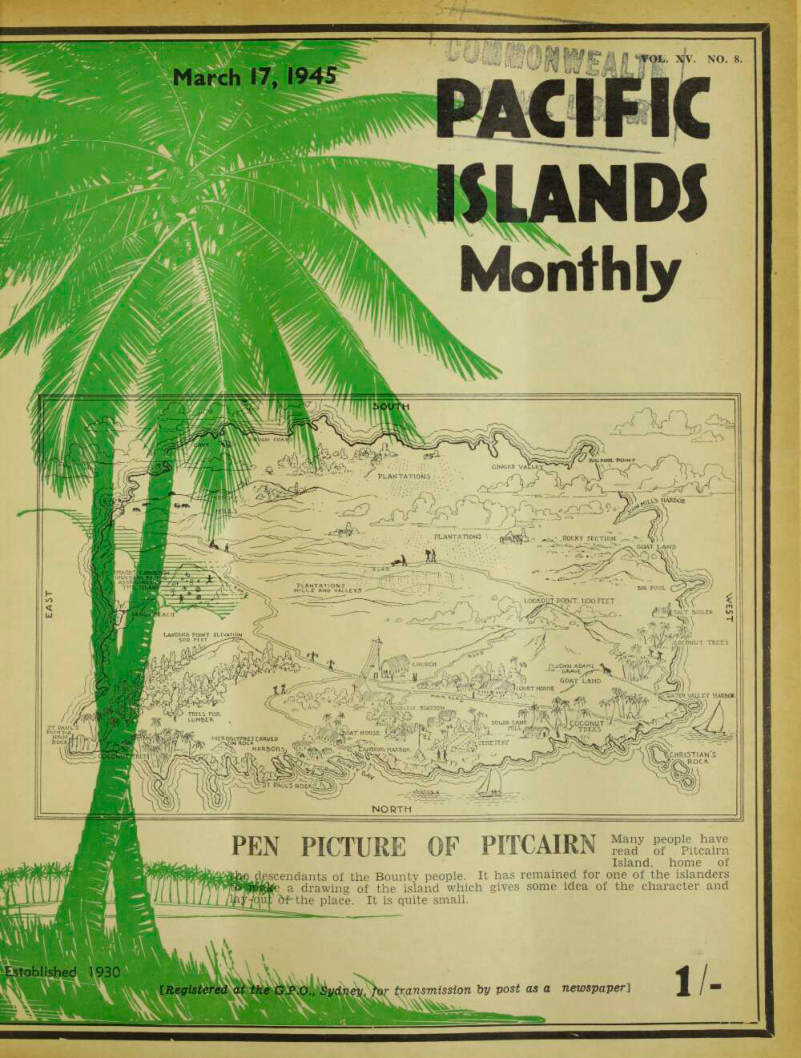
Pen Picture Of Pitcairn
Many people have Island, home of the descendants of the Bounty people. It has remained for one of the islanders to make a drawing of the island which gives some idea of the character and lay-out of the place. It is quite small.
Roll Of Honour—Section Ii.
[Section I (Killed, Missing, Prisoners) and Section n (Wounded, Decorations, etc.), published in Alternate Months] (We try to assemble here the names of m<en of the United Nations, residents or former residents of the Pacific Territories, whose names appear in casualty lists or who receive decorations. We should be grateful if relations and friends would send us details of such men.)
Wounded
Sgt. Robert ASMUS, of the Fighting French Pacific Battalion. Wounded at Bir Hacheim and evacuated.
Rene AUFANT, of the Fighting French Pacific Battalion. Wounded at Bir Hacheim.
Cpl. Thomas BAMBRIDGE, of the Fighting French Pacific Battalion, Wounded at Bir Hacheim and evacuated.
Fit.-Lieut. J. W. BARTLETT, RAAF, formerly of TNG. Wounded in air operations over the Mediterranean on January 23, 1944.
BERBERE (alias ARESKY). of the Fighting French Pacific Battalion. Wounded at Bir Hacheim.
Henri BERTHELIN, of the Fighting French Pacific Battalion. Wounded at Bir Hacheim.
Pte. V, BLANCO, ALP Infantry, of Thursday Island. Wounded in action, July, 1941.
L/Cpl. J. P. BLENCOWE. AIF infantry, of Rabaul, TNG. Wounded in action, July, 1941.
Jean BRIAL, of the Fighting French Pacific Battalion. Wounded at Bir Hacheim.
Pte. George BUCKNELL, ALP, son of Mr. and Mrs. C. Bucknell, of KoroLevu, Fiji. Wounded in action in Malaya, January, 1942.
Pte. Thomas BYERS, ALP Infantry, of Thurs day Island. Wounded in action. May, 1941.
Pte. Sekope CAMA, FMF. Reported wounded in action in Solomons, September, 1944.
Raymond CHAUTARD, of the Free French Pacific contingent from New Caledonia. Re ported a casualty in the Middle East, March, 1942.
Pte. A. J. CORLASS, ALP, formerly of Rabaul.
Wounded in action.
Albert CUBADDA, of the Free French con tingent from New Caledonia. Reported a casualty in the Middle East, March, 1942.
Charles DEVEAUX, of Pacific Battalion of Fighting France. Wounded at battle of Blr Hachelm (Libya).
Sgt. EMERY, formerly of Lae, TNG. Wounded in New Guinea in October, 1942.
W/O P. N. ENGLAND, AIF, formerly of Bogia, TNG. Wounded in action January 27, 1944.
Lieut. M. G. EVENSEN, AIF, formerly of Rabaul. Wounded in action.
V. FAIRHALL, 2nd NZEF, formerly of the Treasury Department, Western Samoa. Reported wounded in action, February, 1942.
Trooper Arthur T. PILEWOOD, formerly of Thursday Island. Reported wounded in action.
May, 1943.
Paroa FIU, of the Fighting French Pacific Battalion. Wounded at Bir Hacheim and evacuated.
Cpl. H. N. FORSYTH, formerly of New Guinea.
Reported wounded, June, 1944.
Acting Warrant-Officer V. M. I. GORDON, AIF Infantry, of Wau, TNG. Wounded in action, February, 1942.
Henri GUILBAUD, of the Free French Pacific contingent from New Caledonia. Reported a casualty in the Middle East, March, 1942.
Sgt. C. HENDRICK, ATP infantry, of Rabaul, TNG. Wounded in action, July, 1941.
Stanley HIGGS, son of Mr. and Mrs. Gordon Higgs, of W. R. Carpenter and Co. Ltd., New Guinea. Member of an English Lancers’ regiment, wounded during British evacuation from Dun kirk (France). May, 1940.
Pte. W. HOLMES, of the Fiji Military Forces.
Reported wounded in action, December, 1943.
Alexandre HUYARD, of the Free French Pacific contingent from New Caledonia. Reported a casualty in the Middle East, March, 1942.
Pte. P. C. JEUNE, AIF, formerly of Morobe, TNG. Reported wounded, June, 1944 Sgt.-Pilot Andrew KRONPELD, of the NZ Fighter Squadron attached to the RAF. Wounded in knee during operations over France, December, 1941.
Cpl. W. H. LANNEN, AIF artillery, of Rabaul, New Guinea. Wounded in action, June. 1941.
T. W. J. LEGA, AIF, formerly of the Mandated Territory. Reported wounded in action, November, 1944.
Gnr. E. G. LOBAN, AIF artillery, of Thursday Island. Wounded during campaign in Greece.
May, 1941; invalided home after having his left forearm amputated.
Auguste LUTA, of the Fighting French Pacific Battalion Wounded at Blr Hachelm and evacuated.
A/Sgt. Alastalr MACLEAN, AIF infantry, of
Rabaul, New Guinea. Wounded In action, in Libya, June, 1941.
Sgt. J. D. McCLYMONT, NZEF, son of Capt.
D. McClymont, Harbourmaster of Apia, Western Samoa. Wounded in action, November, 1941.
Lieut. Jack McGRUTHER, NZEF, formerly of Mangaia, Cook Is. Wounded in fighting in Libya.
Lieut. Colin McGRUTHER, NZEF, formerly of Mangaia. Wounded in action in North Africa.
Cpl. R. McKERLIE, AIF, of Yandina, wounded in face by bomb explosion, April, 1941.
T. MANEA, of the Fighting French Pacific Battalion. Wounded at Blr Hachelm and evacuated.
Jean MERIGNAC, of the Free French Pacific contingent from New Caledonia. Reported a casualty in the Middle East, March, 1942.
Henri MEYER, of the Free French Pacific contingent from New Caledonia. Reported a casualty in the Middle East, March, 1942.
S/Sgt. Graham B. MIRFIELD, AIF engineers, of Rabaul. New Guinea. Wounded in action, Pte. Apisai NAIKA, of Fiji Military Forces.
Wounded in action in Solomons.
Pte. Sowani NALICO, PMF. Reported wounded in action in Solomons, September, 1944.
Pte. James O’DWYER, NZEF, formerly of Apia, W. Samoa. Wounded in action in Italy, December, 1943.
Joseph OTHUS, of Pacific Battalion of Fight ing Prance. Wounded in battle of Bir Hachelm (Libya).
Lieut. A. G. PEARCE, AIF, formerly of Salamaua, TNG. Wounded in action.
Pte. L. G. (“Mick”) REECE, AIF, of Bulolo, New Guinea. Wounded in action, July, 1941.
Henri RIVIERE, of the Free French Pacific contingent from New Caledonia. Reported a casualty in the Middle East, March, 1942.
Pte. H. St. George RYDER, AIF, formerly of Suva, Fiji. Wounded while serving in New Guinea.
Cpl. Luke SAILADA, of Fiji Military Forces.
Wounded in action in Solomons.
A/Cpl. N. K. SAWYER, AIF infantry, of Rabaul, TNG. Wounded in action, July, 1941 July, 1941.
Pte. Frank M. SCHUSTER, NZEF, formerly of W. Samoa. Wounded in action in Tunisia, 1943.
Lieut. Jeffrey SEAGOE, serving with the British forces in the Far East, formerly of Vila, New Hebrides. Reported “wounded in action”, March, 1942.
Fit.-Sgt. B. SPILLER, RAAF, formerly of Papua. Wounded by flak while attacking enemy targets in France on July 28, 1944.
Pte. Lance STAMPER, AIF, formerly school master at Wau, New Guinea. Wounded in action, August, 1941.
Cpl. Esala TAWAKE, of Fiji Military Forces.
Wounded in action in Solomons.
Lieut.-Col. J. K. B. TAYLOR, of the Fiji Mili tary Forces. Wounded in action in Bougain ville, December, 1943.
Cpl. Raphael TEIHO, of the Fighting French Pacific Battalion. Wounded at Bir Hachelm and evacuated.
Cpl. Terli TERIITUA, of the Fighting French Pacific Battalion. Wounded at Bir Hachelm and evacuated.
Lieut. A. THOMPSON, of the Fiji Military Forces. Reported wounded in action, December 1943.
Lieut. P. A. TUCKEY, infantry, formerly of New Guinea. Wounded in action.
Pte. Harold G. TURNER, AIF, of Samaral, Eastern Papua. Wounded in action at Bardla (Libya). January. 1941.
Pte. F. D. TWISS, ALP Infantry, of New Guinea. Wounded in action, August, 1941.
Camille VINCENT, of the Free French Pacific contingent from New Caledonia. Reported a casualty in the Middle East, March, 1942.
Driver Don F. WAUCHOPE, ALP. Formerly employed on his brother’s plantation in New Guinea. Wounded in action, July, 1942.
Lieut. F. R. G. WILSON, ALP, formerly of the Mandated Territory of New Guinea. Reported wounded in action, February, 1944.
Alex. WINCHESTER, of the Fighting French Pacific Battalion. Wounded at Bir Hachelm.
Pte. K. M. WHITE, AIF, formerly of Bulwa, TNG. Wounded in action.
Sgt.-Pilot W. WRIGHT, of the Australian Spitfire Squadron, attached to the RAF. for merly of New Guinea. Wounded in knee during
aerial “dog-fight” over the English Channel March. 1942.
Decorations
Sgt. Jione AGARA, Fiji Military Forces, formerly of Tonga. Awarded the American Sil ver Star for gallantry in action in New Georgia, July, 1943.
Fit.-Lieut. Don AIDNEY, PMF, formerly of Fiji.
Awarded the Distinguished Flying Cross in September, 1944.
Squadron-Leader G. U. (“Scotty”) ALLEN, RAAF, who is well-known in New Guinea and Papua, having been co-pilot on the “Faith in Australia”, on the first official air-mail flight to the Territories in 1934. Awarded the Air Force Cross for his work with Catalina flying ooats in Australia and the Pacific.
Major H. T. ALLEN, AIF, formerly of Wau, Morobe District, TNG. Awarded the QBE.
Squadron-Leader C. A. BASKETT, formerly of Bulolo, TNG. Awarded Distinguished Flying Cross for raids over enemy territory while attached to Hampden bomber squadron in Eng land.
P/O L. W. G. BELL, RAAP, formerly of Kavieng, TNG. Awarded QBE, for outstanding service in the New Guinea area.
Sgt. Semisi BELO, of Fiji Military Forces.
Awarded DCM for services in South-west Pacific area.
Lieut. Charles BLAKE, of ANGAU, formerly of Wau, TNG. Awarded the Military Medal (while serving as a W/O) for bravery and devotion to duty during and after the landing at Arawe, New Britain, January, 1944.
Captain H. M. BOOTH, PMF, Awarded Mili tary Cross for service on Bougainville.
Lieut. M. BOULTON, FMP. Awarded Military Cross for service on Bougainville.
Mrs.. Ruby BOYE, of Vanikoro, Santa Cruz Group. Awarded British Empire Medal for gal lant work in the Allied cause during the Jap anese occupation of the Solomons.
Victor BRIAL, Fighting French Pacific Battalion, formerly of New Caledonia. Awarded the Croix de Guerre and the Etolle d’Argent.
Captain E. CAKOBAU, FMF. Awarded Mili tary Cross for service on Bougainville.
Major W. P. M. CLEMENTS, of the British Solomon Islands Defence Force. Awarded Military Cross for exceptional devotion to duty in a theatre of war.
Lieut. J. R. COLE, AIF, formerly of New Guinea. Awarded the Military Cross.
Major Mervyn CORNER, FMF, awarded Mili tary Cross for service on Bougainville.
Sgt. Henry C. S. COTTON, of the RNZAP, who was born in Samoa (his father was Secre tary of Native Affairs during the NZ military occupation). Awarded the Distinguished Flying Cross.
Flight-Lieut. R. N. DALKIN, RAAF, formerly of W. R. Carpenter and Co., Ltd., Salamaua, TNG. Awarded the DPC for bombing raids against the Japanese in Koepang area, DEL FREDERIC DELAVEUVE, formerly of New Caledonia. Awarded Croix de Guerre, while serving with Fighting French volunteers in Egypt. 2/Lieut. Bruce Insham DENT, of Fiji Military Forces (killed in action, March 25, 1944).
Awarded Military Cross for services in South west Pacific.
Squadron-Leader R. A. DUNN, RAAP, formerly of Carpenter Airways New Guinea Service.
Awarded the Distinguished Flying Cross for bravery while leading his squadron against the Japanese.
Chaplain N. J. EARL, AMP, formerly of Papua. Awarded MBB for bravery shown during early Papuan campaign.
Sgt. R. EMERY, NGVR, formerly of Lae.
Awarded Military Medal for gallantry in New Guinea.
Flight-Lieut. Norman FADER, RAAF, formerly a commercial pilot in New Guinea. Awarded the Air Force Cross for exploits in Bismarck Sea Battle.
Lieut J. FORBES, RNZNR, formerly of West ern Pacific. Awarded US Bronze Star for “heroic service while piloting ships entering perilous waters.”
Rifleman H. W. FORRESTER. NGVR, formerly of Bulolo, TNG. Awarded the Military Medal for operations against Japanese in New Guinea.
Major R. O. FREEMAN, FMP. Awarded the Military Cross for devotion to duty while on service in Bougainville.
Cpl. Tevita FUSI, FMF. Awarded Military Medal for service on Bougainville.
Sgt. J. H. GILCHRIST, formerly of TNG.
Received Military Medal, April, 1944.
Squadron-Leader C. R. GURNEY. RAAP. for merly of Guinea Airways, Ltd., TNG. Posthu mously awarded the Air Force Cross, for bomb ing raids on Japanese-held ports in New Britain.
(Continued on Inside Back Cover)
Major T. GRAHAMSLAW, AMF, formerly of Papua. Awarded OBE for conspicuous devotion to duty in the Buna area (Papua) during initial Japanese landings in the district.
Walter GRAND, Fighting French Pacific Battalion, formerly of Tahiti. Awarded Croix de Guerre, with one star, for bravery during the Battle of Bir Hacheim, 1942.
A /Sgt B. W. G. HALL, formerly of TNG.
Received DCM in April. 1944. Later promoted to rank of Lieutenant.
Squadron-Leader Godfrey HEMSWORTH, RAAF formerly a well-known New Guinea pilot, who was killed in action against the Japanese In May. Posthumously awarded the Air Force L. HENDERSON, AMF. formerly of Papua. Awarded MBE for courage displayed during the Oro Bay operations when he was in charge of small ships operating in those waters. . , „ .
LUCTEN HERVOUET. formerly of New Cale donia. Awarded Croix de Guerre while serving with Fighting French volunteers in Egypt.
Lieut Colin HILL, RANR, of the Australian destroyer, “Waterhen”, formerly second officer on the trans-Pacific liner “Niagara”. Awarded the OBE.
Capt Ernest HITCHCOCK, ANGAU, formerly of Mandated Territory. Awarded US Legion of Merit for assistance to American forces in Salamaua area.
Lieut D. C. HORTON, RANVR, formerly of District Services, BSI. Awarded the United States Silver Star for distinguished services in the Solomons.
Lieut. Gordon HOWE, RANR. formerly an offi cer in Burns Philp ships. Awarded the US Legion of Merit for meritorious service in lead ing a reconnaissance party to Russell Islands,
Bsi
Lieut. H. E. JOSSELYN, RANVR, formerly of District Services, BSI. Awarded United States Silver Star, for distinguished services in the Solomons. , . , Lieut. J. R. KEENAN, RANVR, formerly of New Guinea. Awarded the DSC.
Capt. H. T. KIENZLE, ANGAU, formerly of Papua. Awarded MBE for devotion to duty during the campaign in the Owen Stanley Ranges. .
Lieut. Isereli KOROVULAVULA, FMF. Awarded the Military Cross for devotion to duty while serving in Bougainville.
Pte. Sairusi KOTO, Fiji Military Forces.
Awarded US Silver Star for bravery and de votion to duty in the Solomons.
Wing-Commander C. J. N. LELAU, RAAF, formerly of Suva, Fiji. Awarded the OBE for distinguished service Pte. Villame LAUTIKI, of Fiji Military Forces.
Awarded MM for services in South-west Pacific area.
Cpl. Elaitia LEDUA, FMF. Awarded Military Medal for service on Bougainville.
Lieut. Paul LOBENDAHN, FMF. Awarded Military Medal for service on Bougainville.
L/Cpl. Viliame LOMASALATO, FMF. Awarded Military Medal for service on Bougainville.
Sgt. *T. Me AD AM, NGVR, formerly of New Guinea Forestry Dept. Awarded Military Medal for gallantry in New Guinea.
Lieut.-Commander A. W. R. McNICOLL, RAN, son of Sir Ramsay McNicoll, Administrator of New Guinea, and Lady McNicoll. Awarded the George Medal.
Sgt. Josefa MAINAVOLAU, FMF. Awarded Military Medal for service on Bougainville.
Pte. Akuila MARAIVALU, FMF. Awarded Military Medal for service on Bougainville.
Petty-Offlcer PAUL MASON, RANVR. formerly a plantation inspector at Inus, Bougainville, TNG. Awarded American Distinguished Service Cross for "extraordinary heroism in action.”
HENRI MAYER, formerly of New Caledonia.
Awarded Croix de Guerre while serving with Fighting French volunteers in Egypt Fit.-Lieut. George B. (Golly) MEIDECKE, RAAF, formerly of W. Samoa. Awarded the Distinguished Flying Cross.
Capt. J. K. MCCARTHY, formerly of TNG.
Received the MBE, April, 1944.
Lieut.-Commander H. A. MACKENZIE, RAN, formerly of Rabaul, TNG. Awarded the US Legion of Merit for exceptionally meritorious services at Guadalcanal.
Capt. John Malcolm METHVEN, AIF. Men tioned in despatches for distinguished services during the seige of Tobruk. Since reported killed in action. (See section “Killed.”) John MILNE, Wireless Operator, Gilbert Islands. Awarded British Empire Medal for dis tinguished service.
Sgt. Geoffrey MOORE, of the RNZAF, formerly engineer on the NG inter-island vessel
“Maiwara” and on the trans-Paclflc liner “Aorangi”. Awarded the Distinguished Flying Medal. , , r „ .
Capt G. B. MORGAN, DSC, formerly of Union SS Co Awarded DSO and Lloyd’s war medal for his part in Allied landings in North Africa in 1942, when he was captain of the “Awatea.”
ANDRE MORNAGHINI, formerly of New Cale donia. Awarded Croix de Guerre while serving with Fighting French volunteers in Egypt.
Flight-Lieut. G. B. MEIDECKE, RAAF, formerly of W Samoa. Awarded the DFC for “courage, coolness and tenacity, and flying skill of the highest order.”
Pte Fred Charles NARRUHN, Fiji Military Forces. Awarded US Silver Star for gallantry and devotion to duty at Butaritari, Gilbert Is.
Flight-Lieut. M. O’CONNOR, RAAF, formerly of Suva, Fiji. Awarded the DFC for a “high record of success on operations” in the Middle East.
Lieut. S. S. PAGE, RNZNR, formerly of LMS ship “John Williams.” Awarded US Bronze Star for “heroic service while piloting ships entering perilous waters.”
Capt. Raymond PERRAUD, FF Pacific Bat talion. Awarded Croix de Guerre at Bir Hacheim in 1942. Awarded Liberation Cross in Europe in 1944. Later killed in action.
Lieut. B. PHILPOTT, FMF. Awarded Military Cross for service on Bougainville.
Flight-Lieut. H. G. PILLING, RAF, formerly of Suva, Fiji. Awarded the DFC, May, 1942. (Killed a few days later.) Cpl. Jone RAVESOLI, FMF. Awarded Military Medal for service on Bougainville.
Lieut. W. T. READ, RANVR, formerly of Dis trict Services, TNG. Awarded American Distin guished Service Cross for “extraordinary heroism in action” while in South Pacific Waters.
Lieut. A. RHODES. RANVR, formerly of BSI.
Awarded American DSC for heroism in SW Pacific in 1942. In June, 1943, awarded Ameri can Silver Star when he guided a party of US commandoes to the beach on Rondova.
Pilot-Officer Pat RICHARDSON, RAF, son of Mr. W. Richardson, formerly of Penang, Fiji.
Awarded the Distinguished Flying Cross.
W/O A. L. ROBINSON, NGVR, formerly of New Guinea. Awarded DCM.
Commander Alvord S. ROSENTHAL, RAN, son of Major-General Sir Charles Rosenthal. KCB.
CMG, DSO, VD, Administrator of Norfolk Lsland. Awarded the DSO. November, 1941; awarded the Bar to DSO. February, 1942.
W/O K. W. RYALL, of ANGAU, formerly of TNG. Awarded Military Medal for conspicuous service in the Arawe Peninsula area of New Britain.
Cpl. Manoa ROKO, of Fiji Military Forces.
Awarded MM for services in South-west Pacific area. . .
Cpl. Sefanaia SUKANAIVALU, FMF. Awarded the Victoria Cross posthumously, for conspicu ous gallantry in Bougainville.
Sgt. Atunaisa TAVUTU, FMF. Awarded Mili tary Medal for service on Bougainville.
Lieut.-Colonel J. B. K. TAYLOR, Commander of Fiji Military Forces overseas. Awarded American Purple Heart, March, 1944. Awarded
Obe. 19'44.
Cpl. Manasa TIKOCA, FMF. Awarded Military Medal for service on Bougainville.
Capt. A. T. TIMPERLEY, AMF, formerly of Papua. Awarded MBE for work on Good enough Island when he acted as a guide.
Major David TRENCH, formerly District Offi cer in BSI. Awarded the Military Cross for distinguished service and gallantry in the South-west Pacific. , , Lieut.-Col. G. T. UPTON, FMF. Awarded American Bronze Star for outstanding leader ship while commanding Fijian troops on Bou gainville. Awarded DSO, 1944.
Cpl. Waisele VEIKOSO, FMF. Awarded Mili tary Medal for service on Bougainville.
F/O Leigh G. VIAL, RAAF. formerly ADO In TNG. Awarded American DSC for outstand ing heroism in New Guinea in September, 19*2.
Lieut.-Col. F. W. VOELCKER, FMF. Awarded American Bronze Star for outstanding Leader ship while commanding Fijian troops on Bou gainville. , - Lieut. G. J. WEBSTER, RNZNR, formerly of Gilbert Is. Awarded US Bronze Star for “heroic service while piloting ships entering perilous w’aters.” AA Squadron-Leader Charles WIDDY, RAAF, formerly of BSI. Awarded the US Legion of Merit for meritorious service in leading a reconnaissance party to Russe 1 ! Bb _< Lieut, (then W/O) Raymond WATSON. A IF, formerly of TNG. Awarded MBE for bravery and devotion to duty during the Papuan cam-, Pa sgt.’ Ilaitia WAQA, of Fiji Military Forces.
Awarded MM for services in South-west Facinc Capt. D. E. WILLIAMS, of Fiji Military Forces.
Awarded American Silver Star for gallantry In action while leading patrols in Guadalcanal.
Lieut G. K. WHITTAKER, NGVR, formerly of Lae, TNG. Awarded MBE for gallantry in New Guinea.
Lieut. George Raymond WORLEDGE, of the p ANVR, formerly of Fiji. Awarded the MBE (Military).
Lieut. H. M. WRIGHT, RANVR, formerly of New Guinea. Awarded DSC.
Mentioned In Despatches
Rifleman G. R. Archer, Corporal A. Moore,
Tng. Tng.
Captain A. H. Bald- Captain J. J. Murphy, win, Papua. TNG.
Captain N. B. N. Meut. K. C. McMullen, Blood, TNG. TNG - , . , _y Rifleman J. Cavanagh. pt «; A P isai Naika,
Tng Fmf -
Rifleman J. W. Currie. p *- Peni Nasuva.
J? Mr .
Warrant-Officer J. B. W /° Victor Neuman * Davies Papua. captain N. Owers.
Captain L. S. Dexter. Su £_Lieut. c . Page, Papua. TNG.
Capt. W. M. Edwards, Lieut R H Phillips,
Tng. Tng.
Major S. Elliott-Smlth, Lieutenant J. I. Rae.
Papua. Papua.
Warrant-Officer P. R. pt e . A. A. Ramsden, N. England, TNG. Papua.
Rifleman H. W. For- pte. Inoke Rasiga, rester, TNG. FMF.
Lieut. K. G. Fuller, Cpl. Neman! Ravia, Tonga. FMF.
Sergeant V. H. Gil- Major D. G. Rice.
Christ, TNG. Pte. S. M. Richie, Lieut. S. G. Grimshaw, Papua.
TNG. Pte. J. E. Rosa, FMF.
Lieut. C. G. Harris, Cpl. Luke Sailada,
Tng. Fmf.
Lieut. L. A. Render- Sergeant Akuila Sau son, FMF. kura, Fiji.
Lieut. L. F. Hewlett, Lieut. T. C. Scott,
Tng. Fmf.
Sgt. H. E. Jarrett, Lieut. W. W. Sherratt, Papua. FMF.
Major E. W. Jenyns, L/Cpl. Are Sitiveni,
Tng. Fmf.
Warrant-Officer I. F. Lieutenant C. H. Smith, Jones, Papua. TNG.
Lieut. H. T. Kienzle, Warrant-Officer R. A.
Papua. Smith, Papua.
Rifleman J. R. Kinsey, Lieut. A. P. Spittal,
Tng. Fmf.
Cpl. Josefa Lorima, Pte. R. M. Stewart, FMF. Papua.
Corporal Malakai Mo, L/<"inl. Josefa Tatau, Fiji. FMF.
Staff - Sgt. Manzoor Lieut. A. T. Timperly, Beg, FMF. Papua.
Corporal M. Marlay, Captain L. N. Tribolet,
Tng. Tng.
Rifleman J. E. Mayos, Lieutenant A. G. Vagg,
Tng. Tng.
CSM D. Miller, FMF. Captain G. H. Vernon, Cpl Jona Moli, FMF. MC, Papua.
Pacific News-Review
Notes And Comment On
The Progress Of The War
From Feb. 13 To Mar. 13
Feb. 13: Marshal Stalin, President Roosevelt and Prime Minister Churchill have concluded an eight days’ conference at Yalta, in the Crimea. They discussed means of crushing German resistance, establishing lasting peace, restoring war scarred Europe, solving the problem of uihfying Poland and of repatriating liber ated prisoners. It was decided that when Germany is forced into unconditional sur render, Britain, Russia, America and France (if she wishes) will occupy the Reich in separate zones, under a joint military commission in Berlin.
Feb. 15: The most modem area of Manila is still held by the Japs and by the time they are driven out little of this section will remain intact.
Feb. 15: Russians under Koniev are only 53 miles from Dresden, but the Ger man High Command is in the position that if it removes troops from the north ern area Zhukov will be more able to launch frontal attack on Berlin, 40 miles away. Koniev’s forces have ad vanced 68 miles in the last four days.
Koniev has been assisted by waves of heavy American bombers.
Feb. 16: For nine hours, to-day, more than 1,200 US aircraft based on carriers attacked aerodromes and military targets in Tokio and Yokohama.
Feb. 16: Russians, under Koniev and Zhukov, have linked and are attacking the stubbornly-held line sheltering the German capital. Civilians of Berlin have been told that further evacuation is impossible; they have been issued with Army rations and told that they must help defend the city.
Feb. 18: US paratroops and seaborne forces landed on Corregidor, island fort ress in Manila Bay on February 16 —24 hours after other US forces had captured Bataan Peninsula on the western side of the bay. This opens Manila Bay to Allied shipping. Tokio announced that the US air and sea forces which blasted Tokio and Yokohama on February 16 and 17, have moved southwards.
Feb. 19: US Marines this morning stormed ashore on Iwo Jima, in the Vol cano Islands, 750 miles south of Tokio.
They secured a -miles bridgehead and are pushing inland.
Feb. 20: Heavy fighting on Iwo Jima.
The Americans captured one of the island’s two airfields, but with mounting casualties. This is regarded by some cor respondents as the Marines’ toughest assignment. The Japs have tunnelled into extinct volcanoes in some sections — it is described as the world’s most forti fied island.
Feb. 20: On the Western Front three Allied armies are now thrusting into Ger many. British, Canadian and American forces are now on the move, on a front of 200 miles, from the Dutch border to the Saar.
Feb. 23: Although there are about 40,000 US Marines on Iwo Jima, in comparison with 20,000 Japanese, .the going is still hard, against fanatical resistance from prepared pill-boxes and defence positions.
The Marines now hold half of the island.
Feb. 25: The US Ninth and First Armies have burst into the Cologne Plain and are now within 13 miles of Cologne. They have smashed the Roer River defences— last enemy strongpoint of defence before the Rhine—and captured Duren. North of the Americans, British and Canadian troops have resumed their attack between the Maas and the Rhine; and in the south the US Third Army, on the Saar, now holds a front of 65 miles well inside Germany.
Feb. 25: Two hundred Super-Fortresses,
based on the Marianas, plus carrier-based planes, attacked Tokio to-day.
Feb. 28: Correspondents at Montgom ery’s headquarters state that a great German collapse is possible and that the Rhine defences are disintegrating.
Mar. 2: American troops have landed on Palawan Island, most westerly of the Philippines. It is south-west from Luzon and stretches to within 100 miles of Bri tish North Borneo.
Mar. 4: The Canadians from the Maas section of the Western Front have linked with the US Ninth Army. The US Rhine front now extends from 40 miles from Cologne to Hamburg, and American col umns are now fighting in the streets of Cologne.
Mar. 5: On the Eastern Front, Russian armies are attacking vigorously to elimi nate the German forces in Pomerania and the Danzig areas. Some are now at Kolberg (on the Baltic) and others are 22 miles from Stettin.
Mar. 6: Australian patrols in the Aitape sector of New Guinea have penetrated as far inland as the village of Balif, where an aerodrome for the evacuation by air of wounded has been constructed. This saves seven days’ march over the rugged Torricelli Mountains, Mar. 7: General Patton’s Third Army made a sensational tank break-through on the Western Front at the confluence of the Moselle and the Rhine. Further north, Cologne has fallen, and, on the Ruhr sector, Allied troops are approach ing the Rhine; their first attempt at bridging the river is awaited.
Mar. 8: Patton, in a spectacular dash, reached the Rhine north of Coblenz. This threatens to trap about five German divi sions west of the Rhine. Allied armies, except in this and the smaller pocket around Wesel, are on the west bank of the Rhine, from Arnhem to Coblenz.
Mar. 8: In Burma, British troops have entered Mandalay, after fierce fighting in the city area. At the same time, Chinese troops captured Lashio, important com munications centre on the Burma Road.
Mar. 8: Australian forces to-day landed on the small island of Saposa, off north west Bougainville.
Mar. 9: On March 7 American forces crossed the Rhine by the Remagen Bridge, which the Germans failed to destroy, and have established a bridge head on the east bank of the river.
Mar. 11: Twenty-three thousand Ger mans are caught in the pocket between the American First and Third Armies.
Men and equipment are streaming across the Remagen Bridge, and the American bridgehead on the opposite bank is being enlarged. The Germans have tried un successfully to shell and bomb the bridge.
Both German and Allied observers still think that the great offensive across the Rhine will come from the British and Canadian forces lower down, on the bor der of Holland.
Mar. 11: Japanese have disarmed all French troops and police in Indo-China, and the French Settlement in Shanghai, and have taken over the administration of the two territories. Tokio accuses the French of assisting the Allies, and of
“non-co-operation with Japan.”
Mar. 11: Three hundred Super-Fort resses raided Tokio on March 9, and 15 square miles of the city were destroyed by fires.
Mar. 12: Russian troops on the Eastern Front are now storming !nto Danzig, German stronghold on the Baltic coast.
The whole of Pomerania has thus become cleared or a mopping-up area. North of Berlin, advancing Red troops can see the
spires of Stettin, port for the capital.
While the Russians are advancing every where on the north and central fronts, however, the Germans are counter attacking heavily in Hungary. One view is that the Nazi leaders are preparing for a final stand in the central European mountains.
Mar. 13: Kustrin, German fortress town, has fallen to Marshal Zhukov.
Kustrin is 35 miles from Berlin in a direct line.
Sir Charles Marr, who has had many personal associations with Papua and New Guinea, in both an official and business capacity, is again seriously ill at his home in Sydney, He suffered a severe illness a couple of years ago, but made a good recovery, and recently appeared to be in very good health.
Dr. H. W. Jack, Director of Agricul ture in Fiji before he retired last year, is now at home’ in Dublin. He complains about the cold winds but states that there is plenty of clothing and food in Ireland.
He has volunteered for war work in Eng land. as there is no war work to do in Ireland.
Advertisements & other items, pp. 3-4 (1 item)
Pacific Islands
NOW AVAILABLE
Year Book
FIFTH EDITION
rIS has become the recognised standard work of reference on the Pacific Territories and Islands; and it is now printed in Sydney, N.S.W., and in New York.
The sth Edition, 384 pages, has been arranged in Six Sections—General and Introductory; Eastern Pacific (Polynesia) ; Central Pacific (Micronesia); Western Pacific (Melanesia); Far Western Pacific (Indonesia); and Non-Tropical Islands.
Every Territory and all the Principal Islands are described in detail—history, geography, natives, administration, industries, trade, etc. There are more than 50 maps.
Price: 15/- per copy, plus 6d. postage.
Copies may be obtained at the majority of Booksellers, and Island Stores, or direct from:
Pacific Publications Pty., Ltd.,
Union House, 247 George St.,
Sydney.
Pacific Publications (Fiji), Ltd.,
P.O. Box 281, Suva, Fiji.
The book, named “Pacific Islands Handbook,” is published by The MacMillan Company, New York, for distribution in North and South America, and Hawaii.
USEFUL ADDRESSES
The following are the addresses of organisations set up to deal with Pacific Territories affairs:—
PAPUA, NEW GUINEA, NAURU,
NORFOLK IS.
Department of External Territories (Sydney Branch) (Lately the New Guinea Trade Agency), Australia House, Carrington Street, Sydney.
Telephone: BW 1776. (Dealing with all matters connected with the Australian Pacific Territories and also the Sydney representative of the New Guinea Copra Control Committee.)
FIJI, AND HIGH COMMISSION
FOR WESTERN PACIFIC
Sydney Office of Fiji and Associated Administrations. (In charge of Mr. B. F. Blackwell.) 73 Pitt Street, Sydney.
Telephone: BW 7724.
BRITISH SOLOMON ISLANDS
Sydney Office of British Solomon Islands Government (In charge of Mr. F. E. Johnson, Treasurer of the Solomons Administration), 17 Castlereagh Street, Sydney.
Telephone: B 1710.
FOR PACIFIC TERRITORIES
EVACUEES GENERALLY
Pacific Territories Association (C. A. M. Adelskold, Secretary), c/o Robert Gillespie Pty., Ltd., 54a Pitt Street, Sydney. Telephone: BW 4782.
WAR DAMAGE COMMISSION
Sydney Office: M.L.C. Buidling, Cnr. Martin Place and Castlereagh Street, Sydney.
Telephone: BW 2361.
FOR CLAIMS AGAINST ARMY
Mr. H. Alderman, Darwin-Moresby Claims Section, Chief Finance Office (Army), Victoria Barracks, Melbourne.
Contents
Pacific News-Review 1 Editorial: ’Frisco Conference Will Bring Changes in the Pacific ... 3 Civil Government in Papua and New Guinea—But No Early Return of Civilians or Trading 5 PTA to Amend Constitution—Pro posals to be Submitted to Meeting 7 Decorations for Merchant Navy Men 8 Dr. McGusty Leaves Fiji 8 39 Boys on a Band Picnic 9 Presentation of VC to Parents of Fijian Hero 9 Tropicalities .) 10 Captain Johanson Decorated .. .. 11 Future of Pacific Mandates 12 Results of the New Caledonian Election 14 New Guinea Air Mail Will be Run by Qantas 15 Wholesale Theft of Pacific Islands Year Book in United States ... 16 Fiji Merchants Lose Their Booking Fee 17 Indenture Controversy Causes Terri torian Bitterness 18 By-passed Phosphate Islands—Pro duce of Nauru and Ocean Is. Now Wanted in South 21 Island Potters and Their Wares .. 24 Value of Palms and Driers—Head aches for War Damage Commission 25 Patrol—Major Trench of BSI Gathers Information 26 Formosa—Stepping-Stone to Tokio .. 30 On April 25—Most Important Meet ing in World History 22 Mokogai 36 Ersatz Curios—Flourishing Trade in Polynesia 40 N. Caledonian Nickel for Europe .. 43 Split in Guinea Airways 45 Commercial and Markets 48 Honour Roll cov. ii. and iii.
Advertisers
Aladdin Industries Pty.. Ltd 29 Atkins Pty., Ltd., Wm 30 Australian Alumi nium Co. Pty., Ltd 37 Behari Brij ... 47 Berger’s Paints . . 15 Brial, E. J., 16, 33, 42, 45 Broomfield, Ltd. . . 31 Brown & Co., Ltd. 11 Brunton’s Flour . . 44 Burns, Philp Trust Co., Ltd 13
Bp (Ss) Co. ... 11
Carlton & United Breweries, Ltd. . 21 Carpenter, Ltd., W.
R cov. iv.
Casino Hotel, Apia 19 Chivers & Sons, Ltd 40 Coleman Lamp & Stove Co. . 19, 39' Colonial Wholesale 26 “Cystex” 33 Darvas & Co. ... 37 David Trading Co. . 14 Donaghy & Sons . 31 Donald, Ltd., A. 8., 35 Dr. Williams Pink Pills 44 Electrolux Refrigerators . . 20 Excelsior Supply Co. 42 Farnham, Johmn R. 31 “Flit” 47 Ford Sherington Pty., Ltd. ... 28 Garrett & Davidson 23 Gibson & Co., Ltd.,
J. A. D 46
Gillespie Pty., Ltd., Robert ... 45 Gilbey’s Gin ... 35 Gillespie’s Flour . , 24 Gough & Co., E. J. 33 Grand Pacific Hotel 2
Grove & Sons, W.
H 12 Griffiths Nurseries, Ltd 44 Heinz & Co. Pty., Ltd., H. J. . . . 25 Horlick’s Malted Milk 23 Kopsen & Co., Ltd. 32 Masschelein, O. F. v 41 “Mendaco” ... 28 Nelson & Robertson Pty., Ltd 18 “Nixoderm” ... 36 Pacific Is. Society . 30 Pacific Islands Trading Co. . 44, 47 Pacific Territories Association ... 7 Pacific Publications, Ltd i Papuan Association, The 43 “Pinkettes” ... 46 Queensland -Insur ance Co. ... 14 Ransome, Sims & Jefferies ... 43 Riverstone Meat Co., Ltd. ... 17 Robinson, C. H. . . 16 Rose’s Eye Lotion . 47 Rohu, Sil . . . . 40 Scott, Ltd., J. ... 40 Steamships Trading Co., Ltd 27 Sullivan & Co., C. . 34 Swallow & Ariel . 22 Taylor & Co., A. . 44 “Tenax” Soap ... 12 Tillock & Co., Ltd. 24 Union Assurance Co. 39 Watson, Wm. H. . 31 Wright & Co., Ltd., E 36 Wunderlich, Ltd. . 43 Yorkshire Insurance Co., Ltd 11 Young Pty., Ltd., Harry, J. . . .38
Advertisements & other items, p. 4 (1 item)
Stav^
e**: i
. o^ er ' « r ovi^ S . fif * i ?acW c . n (t\aS n ” . A j . sV w*» 4 10 bo or. ** . a*W** fn> , ser .-ce nS . . cenw e °' ' attend *• -:S“ t,r»'n e “ c » b ' e ’ f d»Yol' pe
cesevv^'
Pacific Islands Monthly
The Newspaper-Magazine of the South Seas
[Registered at the G.P.0., Sydney, for transmission by post as a newspaper .] Published Once Each Month and Circulated in Australia and New Zealand and in the following Pacific Territories and* Islands Groups:
Australian Territory of Papua.
Mandated Territory (Australia) of New Guinea.
Australian Territory of Norfolk Island.
New Zealand Territory of Cook Islands.
Mandated Territory (NZ) of Western Samoa.
British Colony of Fiji.
British Solomon Islands Protectorate.
British Protectorate of Tongan Islands.
British Crown Colony of Gilbert and Ellice Islands.
Mandated Territory of Nauru.
British and Free French Condominium of New Hebrides.
Free French Colony of New Caledonia.
Free French ColiJny of Oceania (Tahiti, etc.).
American Territory of Eastern Samoa.
American Territory of Hawaiian Islands.
Owned and Produced by Pacific Publications Pty. Ltd., Union House, 247 George Street, Sydney.
( Managing Director .. BW 5037 i Business and Editorial MA 4369
P.O. Box 3408 R
Registered Address of Telegrams, Radiograms, and Cables: “Pacpub”, Sydney.
Contributions.
Articles, Stories, and Photographs dealing with Pacific Islands subjects are invited and will be paid for on publication.
Subscription Rates.
Per Annum, within British Empire, Prepaid, Post Free 10/- Per Annum, elsewhere, Prepaid, Post Free 12/6 Single Copies 1/-
Editor and Publisher:
R. W. Robson, F.R.G.S.
Advertising Manager: L. W. Bailey.
Advertising Office and Printing-House: 29 Alberta Street, Sydney.
Advertising rates furnished on application.
Representative In Fiji.
Pacific Publications (Fiji), Ltd., Bank of NSW Building, Suva (same office as W. H. Grove & Sons, Ltd.). Stocks of Pacific Islands Monthly and Pacific Islands Yearbook on hand.
Representative In London.
J. T. Wallis, Coronation House, 4 Lloyds Avenue, London, E.C.3, from whom may be obtained copies of Pacific Islands Monthly, Pacific Is. Year Book, advertising schedules, etc.
Agents
The following are authorised to receive sub scriptions for Pacific Islands Monthly:— Burns, Philp & Co., Ltd., and Burns Phllp (South Sea) Co., Ltd. All branches.
W. R. Carpenter & Co., Ltd. All branches.
Morris, Hedstrom, Ltd. All branches.
Steamships Trading Co., Papua. All branches.
Whitten Bros., Ltd., Samarai, Papua.
B.N.G. Trading Co., Ltd., Port Moresby, Papua.
J. Muir, Suva, Fiji.
Miss R. Castles, Suva, Fiji.
N. C. Mackenzie Hunt, Wainunu, Bua, Fiji.
Cook Islands Trading Co., Rarotonga, Cook la.
A. C. Rowland, Papeete, Tahiti.
Islands Branches and Representatives of W. H.
Grove & Sons, Ltd., Auckland, New Zealand.
Ed. Pentecost, Noumea, New Caledonia.
Societe Gubbay Kerr et Cie, Noumea, N. Caledonia.
Vol. Xv. No. 8.
March 17, 1945
Priro i X/ - Per Copy ' rice 10/- p.a.
in Pacific
'Frisco Conference Will Bring Changes in Pacific
HERE, many times, since 1939—and especially since Pearl Harbour— the opinion has been expressed that the end of World War II will see con siderable changes in administration in the Pacific Territories generally, and perhaps some changes in national controls.
If we were to lose the war, these things would be inevitable, on a sweep ing scale. If we win the war, it is reasonable to suppose that two things will follow—the victorious nations will create a new international organi sation for the maintenance of world peace, and the old League of Nations, which failed so lamentably in its primary purpose between 1921 and 1939, will be swept away. With the League of Nations, of course, will go the Mandates system; and that will directly affect the future of four Territories—New Guinea; Western Samoa; Caroline, Marshall and Mariana Islands; and Nauru.
Now please turn to page 12 and 32.
It will seen from the news articles there that a conference of the United Nations will meet in San Francisco on April 25 to set up a world organisation for the maintenance of peace, and that that organisation eventually will dispose of the Territories now held under League of Nations Mandates by various nations. rERE will be no early decisions.
The League of Nations still is in being, and it will not be liquidated until the new world organisation of
the United Nations is formed and ready to function and to take over the considerable properties and re sponsibilities of the League. The latter include the Mandates. It is to be presumed that the Mandatories will formally return the Mandates to the League, which in turn will hand them over to the new world organi sation, which will dispose of them as it thinks proper.
There are 14 Mandates. They all are held by members of the United Nations group, with the exception that the Carolines, etc., Territory was held by Japan. It may be sup posed, therefore, that generally the Mandated Territories will remain close to their present political alle giances, except that the Carolines, etc., will not be restored to Japan.
But this is only supposition. The dominating voices in the future world authority will be those of Britain, United States and Russia; and it is likely that the two latter, in disposing of the present Mandated Territories, will ignore all considerations other than the welfare of the native in habitants. That is going to raise some prickly problems in places— especially in the Near East, where Arab national aspirations in Syria and Transjordania, for instance, will be found in sharp conflict with the wishes of the present Mandatories.
Here, however, we are concerned only with the future of the present Pacific Mandates; and it is interesting to consider tlje probabilities, in the
light of well-known and frequently* expressed views of the Powers that will dominate the new world organi sation.
IT is unlikely that the future of) each Mandated Territory will be considered individually. It is almost certain that those Territories will be studied as part of a general picture, embracing the whole of the wide Pacific, and including, not only the dozen or more separate Territories south of the Equator, taut also the five large Territories (Netherlands Indies, Borneo, Philippines, Carolines, etc., and Hawaii) north of the Equator. There are certain Terri tories where neither political allegi ance nor administration is likely to be disturbed —such as Fiji, Hawaii, Netherlands Indies, New Caledonia.
But there are other groups where the present Governmental set-up may have to be altered, to conform to future international needs.
Those international considerations, plus the necessity for disposing of the Mandated Territories, will make cer tain changes necessary; and so the new world authority probably will decide to make a study of the present condition and probable future of every Pacific Territory.
What we call international needs, of course, relates to the obligation to be placed on the nations generally— and upon the United States in par ticular —to police the Pacific in the interests of world peace. For this purpose, either particular nations, or the new international authority, will require naval bases and airfields in various parts of the Pacific. Leading Americans have been quite frank
about it—the United States expects to get bases in or near French Oceania, Fiji, New Caledonia and the Bismarck Archipelago.
But their statements were made a considerable time ago. Their very proper demands may now be met by the creation of the international authority, which will make the polic ing of the Pacific an international rather than a national responsibility.
SOME countries — Australia notably was one—expressed alarm at the prospect of the United States settling down in powerful bases close to their shores. These myopic people should take another look at the map of the Pacific (especially the north-western corner of it) and then perhaps they will thank their national gods for any development that will bring the Americans beside them as near and friendly neighbours.
Japan will be defeated. But Japan is an extremely fecund nation of 90,000,000 people, and we may not count upon their extermination— much as we may favour it! Apart from Japs, nearly one-half the human race lives in overcrowded south-east Asia—people who to-day are busily learning all the scientific and industrial arts of the Western nations. What chance is there of European communities surviving in the Pacific, unless the Pacific is con stantly and strongly policed!
These things are apparent to the statesmen who are organising the new world authority; and these con siderations transcend all the piffling little political and commercial motives by which we may seek to influence the future of the Pacific Territories.
If the United States, or Britain, or Russia, or the new international authority, wants any Pacific island or group so as to ensure the future pro tection of the Pacific, by all means let that*island be surrendered. Better to lose one, than lose the lot!
A USTRALIA will wish to keep New ** Guinea and the Bismarck Archi pelago. Her claim is so strong that it cannot really be challenged. The inhabitants are quite incapable of self-government; they should be placed in the care of a sympathetic, democratic nation like Australia. But if the protecting authority needs a base or two in that region for future police purposes—part of New Britain has been suggested—it would be stupid and short-sighted of the Aus tralians to offer any objection.
Western Samoa is in an entirely different category. Samoa has no political tie with New Zealand. NZ commercial interests there are negli gible. Unlike New Guinea in relation to Australia, Samoa provides NZ with no protective barrier. The Samoans —one of the best branches of the Polynesian race—are quite capable of a large measure of self-government— u Ji a Y e been trai ned and encouraged by NZ to expect a share in their own administration.
The same Considerations apply e (T^L m , the T c . ase of Eastern Samoa (American). It now is the hope of
all friends of the Samoans that New Zealand and United States will aban don their present holds so that Eastern and Western Samoa may be united as one country, under the pro tection of the international authority.
NAURU, again, is in another cate gory. This little island has no territorial value, but is of enormous economic importance, because of its mass of phosphatic rock. Nauru phosphate helps to maintain agricul ture in Australia and New Zealand.
Nearby, Ocean Island (part of the Gilbert and Ellice Islands Colony) is in exactly the same category.
Now that the Nauru Mandate held by Britain, Australia, and NZ goes back into the melting-pot, why should not Nauru and Ocean Island, whose interests are exactly identical, be placed together in one administration?
Ocean Island, with its rich revenues, carries the very poor colony of Gilbert and Ellice—it pays for the govern ment of those picturesque but un productive atolls. Nauru could be placed with Ocean Island in the Gil bert and Ellice Colony and, while supplying the South Pacific Dominions with phosphate, could take some part of the G. & E. financial load off the British Colonial Office.
THE future of the Caroline, Marshall and Mariana Islands is com pletely obscure. Almost certainly, they will pass into the care of the United States, the Power which has taken them from Japan.
The archipelagoes have little econo mic value, and they are so widely scattered along the equatorial belt that they are an administrative head ache. Perhaps the Americans can divide them into a series of groups, some of which could be used, under the care of the international author ity, as naval bases, and as bases for both protective and commercial air craft.
SO much for the Mandates. There are other Territories which call for attention in any post-war re vision. What is to be done with the New Hebrides, for instance?
It is time the cumbersome, costly and ridiculous Condominium Govern ment was swept away. But, after that, what? Australia may put in a claim. But Australia’s only reason for controlling the group—namely, so that it may be part of Australia’s protective arc—will be removed when the international authority accepts responsibility for policing the Pacific.
Although Australia had ample oppor tunities to colonise islands of the New Hebrides, Australia did nothing. In any event, Australian politicians would “murder” the New Hebrides.
Two-thirds of whatever colonisation was done there—little enough, in all conscience—was done by the French: the British record is very poor. But the French record still is not good enough to justify a claim by France for complete possession of the group.
The same considerations apply to the British Solomons—that Cin derella of the British Colonial Office in the Pacific. The con
stitute, in land area, one of the big gest—and best—territories in the South Pacific; yet they are the least developed.
If it once becomes clear that one of the staple products of either the New Hebrides or the Solomons can be assured of a steady market, the possibilities of European colonisation in the two groups are immense—and without in any way prejudicing the interests of the limited number of Melanesians in each.
Regional Council idea—provided A for in the Dumbarton Oaks plan now on its way to San Francisco, and strongly favoured by the represen tatives of Australia and New Zealand —may supply the solution to many of the problems which we now see in the future of these Pacific Territories— including the disposition of both the Solomons and the New Hebrides.
In the Pacific, as in many other parts of the world, there is a problem created by the existence of small com munities of people, occupying small areas. They are entitled to life, liberty and happiness, the same as anyone else; but, because they are small and defenceless, they are always dragged in under the flag of a power ful neighbour. A South Pacific Re gional Council, responsible to the world authority about to be created, could not only take care of such small communities, but also could act as an authority for the co-ordination of administrative conditions.
It is possible to imagine, here in the South Pacific, Britain providing the Government of Fiji; Australia, New Guinea and Papua; France, New Caledonia and French Oceania; New Zealand, Cook Islands—but all those nations being responsible to the Regional Council for all matters af fecting the natives, and the Council seeing to it that the various adminis trations, in governing the natives, run on parallel lines.
The same Regional Council might decide upon whom to place responsi bility for the government of such places as the Solomons and the New Hebrides; and it would, presumably, encourage the largest practicable amount of self-government in the Polynesian countries of Samoa and Tonga. It probably would study the problems created by the rapid growth of introduced Asiatic populations in these Pacific Islands—e.g., Indians in Fiji, Japanese in Hawaii, Chinese in Tahiti.
It is clear that, if the new world authority is to function as now planned, there will be far-reaching changes in the Pacific Territories as soon as the war is over.
Word has been received from Mr. Des- , mond Carew, formerly Magistrate in the Fiji Service, who was taken prisoner when the Japs over-ran Malaya. He stated that he had recently been operated on for appendicitis but was now recovered and feeling better than he ever had in his life. His sister, Miss Maureen Carew, who was nursing in Hong Kong when the island fell, is still a prisoner of war, but continues her work in' the prisoners’ hospital.
New Guinea
Civil Government In Papua And
Restoration by “Provisional" Device —No Early Return of Civilians or Trading
AFTER being fobbed off for months with Ministerial promises of an early restoration of civil government —which, they assumed, meant their early return to their homes—Territorians last week were presented with a statement which few can understand.
It means, apparently, that although civil government will be restored in name, the present conditions—so far as they affect civilians and trading—will continue indefinitely.
The following statement was made in the House of Representatives, Canberra, on March 9, by the Minister for External Territories {Mr. Ward) : « A DECISION has been taken by the A Commonwealth Government, after consultation with the Commander in-Chief (Sir Thomas Blarney), that the operational position in relation to the Territory of Papua and certain parts of the Territory of New Guinea is such that steps may now be taken for the restora tion of civil administration in the whole of the Territory of Papua and in that portion of the Territory of New Guinea that lies south of the Markham River.
“Full military control of this area, under authority of National Security (Emergency Control) Regulations, will, therefore, be terminated as soon as it is practicable to re-organise the civil admin istrative service.
“Other portions of the Territory of New Guinea that have been recovered from the Japanese will continue to be under the full administrative control of the military authorities until such time as the opera tional position permits the transfer of control of those areas to civil administra tion.
“WHEN the Japanese invaded New TT Guinea in January, 1942, there were separate administrations for Papua and New Guinea, each with an Adminis trator and a separate judiciary and a separate Public Service.
“All persons employed by both Adminis trations were suspended from office by National Security (External Territories) Regulations and such functions of civil administration as were necessary to be performed have since been carried out by ANGAU (the Australian New Guinea Administration Unit), which is a branch, of the Australian Military Forces. The Unit commenced operations in Papua and progressively extended its activities to the Territory of New Guinea. For con venience, the two Territories have been regarded as one administrative area.
“Although the Government does not propose at this stage to consider the ques tion of a combined Public Service for the two Territories, it considers that it would not be desirable immediately to re-estab lish the two entirely separate services. It has, therefore, been decided to continue the suspension of the officers of the two services and make temporary arrange ments for the performance of functions of civil administration in the Territory of Papua and the portion of the Territory of New Guinea south of the Markham River which will include Salamaua, Wau and the Bulolo River valley. These arrangements will provide for— “ 1. The Appointment of one Adminis trator for Papua and liberated areas under Australian administration in New Guinea. The appointment will carry a
salary at the rate of £2,000 per annum with free quarters and an allowance for entertainment. administration to £ e ttyled ‘The tive Service for Papua and Liberated Areas under Australian Administration in New Guinea,’ to be set up to administer both Territories
Reports which circulated in Sydney on March 12: Major-General Morris is moving from ANGAU, New Guinea, to another important command.
Major-General Bertie Lloyd will go from command of an Australian Army to command of ANGAU.
Brigadier Cleland, head of New Guinea Production Board, has re turned to West Australia, and re entered civil life there.
Said a military spokesman to the editor of “PIM”; “General Morris is at the head of ANGAU, and pre sumably will stay there until the new Civil Administrator has arrived.
General Lloyd knows nothing what ever about the matter referred to.
Brigadier Cleland has returned to civil life.”
“3. The suspension of all officers and employees of the Public Services of Papua and New Guinea to be continued, but such officers and employees will be entitled to appointment in the Provisional Adminis trative Service under conditions of service and salaries not less favourable than those applicable to those officers as members of the Public Services of Papua or New Guinea as the case may be. The rights of such officers ■ under the terms of their appointment will be preserved to them and such rights will be safeguarded dur ing the period of the Provisional Adminis tration.
What It Really Means
rRRITORIANS, being people accus tomed to plain speaking, have found this Ministerial statement somewhat baffling; and, during the past week, they have anxiously sought enlightenment.
This is what it means: A civil administration, taking its orders presumably from the Department of Ex ternal Territories, may be established some time in 1945, when the Department of the Army, the Department of External Territories, ANGAU-, and the Production Control Board can reconcile their mach inery and iron out their various differ ences.
This will not be a Papuan Govern ment, nor a New Guinea Government; but will be a “provisional” administration,
“4. During the period of the Provisional Administration, the Legislative Councils which formerly operated for the Terri tories will not be re-established and the powers of legislation in relation to the Territories will be exercised by the Gov ernor-General.
“5. The laws of Papua and New Guinea (except those relating to the constitution of the administration of the Territories and to the Public Services of the Terri tories) will be continued within their respective territorial limits, subject to such modifications and amendments as are necessary.
“In view of the temporary nature of the arrangements outlined, action will not be taken to amend the Papua Act or the New Guinea Act, but all necessary legislative action will be taken under the National Security Act.
“Steps will now be taken to select an appointee for the office of Provisional Administrator and to determine the details of the conditions under which officers will be employed in the pro visional service.
“ A LTHOUGH the operational needs of A the Territories are now such *as to permit the restoration of civil ad ministration, it will be some time before normal conditions can be re-established, especially in relation to the supply of stores and the provision of transport between Australia and the Territories and within the Territories.
“No indication can yet be given as to when the transfer of control from the military authorities will be effected; and it will be necessary for some time to maintain restrictions upon the entry of persons to the Territories and upon acti vities generally; “It is proposed that certain items of Government policy, affecting both Euro peans and natives, should be determined and announced before there is a general return of civilians to the Territories.
“Furthermore, much reconstruction and rebuilding of public and private utilities and living accommodation will be neces sary, especially in the Territory of New Guinea, before any large number of civi lians can be accommodated in the town areas.
“So far as possible, authority will be given for the return of persons to plan tations, but such persons will, for the pre sent, be subject to the control of the Aus tralian New Guinea Production Control Board under National Security (External Territories—Control of Industries) Regu lations.
“The number of vacancies that will require to be filled in the Provisional Administrative Service will not be known until it is ascertained what officers of the Public Services of Papua and New Guinea are available and desire appointment to the Provisional Service.”
set up temporarily, to take charge of Papua and whatever parts of New Guinea are clear of the Japs. It will remain in being until (a) the Papua Act and other Australian legislation creating the Terri tory of Papua is got rid of; (b) the Man date from the League of Nations, giving Australia authority to administer New Guinea, is withdrawn; (c) the new world authority, to be set up as a result of the San Francisco Conference, has reached a decision regarding the future of New Guinea. This may easily embrace a period of some years.
The constitutional and legal position is exceedingly obscure. Therefore, the new “provisional” administration is being set up under National Security Regulations.
Therefore, presumably, it cannot continue after the legal ending of the Pacific war, without special legislation.
The first step will be the appointment of an Administrator. There is not the faintest indication of who this may be.
He, nominally—but Canberra, actually— will select the members of his adminis trative staff; and it is noted that all members of the “suspended” services of Papua and New* Guinea are “entitled” to appointment to this new service, with their seniority rights preserved.
The Administrator will carry on with out any Legislative Council. In other words, any European civilians allowed into the Territories will have no voice in the new Government.
There is to be no dropping of the barriers, and no free general return to the Territories of civilians and of private enterprise, as Territorians had so eagerly hoped. Instead, the present method of permitting a few carefully selected men to return, to operate their plantations under the Production Control Board system, apparently is to continue in definitely.
THIS “Provisional” Administration really is a very ingenious device, in which one probably sees the hand of Dr.
Evatt. It gets a lot of people out of a lot of difficulties.
No one apparently wanted to restore the old Administrations—ANGAU, because of the wide differences between the Papuan and New Guinea public service, and Mr. Ward because those two set-ups would not give him much opportunity to “control” the return of civilians, and the development of trade and industry.
With one sweep of the pen, all the things likely to irritate the Army and baffle Mr. Ward are got rid of—old administrative officers, with strange, fixed ideas about the freedom of individuals and the proper protection of native rights; Legislative Councils, who might want to give too much attention to civilian in terests, and the encouragement of indus tries carried on for profit, and who might even argue points with HM Ministers in Canberra; and the system of open trad ing.
The Territorians are not to be allowed to return, for some time; the stores will not re-open; and all industry apparently will be conducted under the immediate supervision of. the Production Control Board—already in existence under control of the Dept, of External Territories Territorians can be pardoned if they see Mr. Ward’s “restoration of civil gov ernment” merely as a change from flat footed, bureaucratic control under ANGAU to the same kind of control under his Department. Instead of the Government being moved from one structure to an other, the Government remains under the same structure, and the only thing changed is the name of the structure.
It is a little too soon to cavil and criticise however. Canberra evidently has made a decision, and Canberra will not be moved by howling and disappoint ment. We can only wait— pessimistically and see how the new idea works out On present appearances, it looks bad for Europeans, and not good for natives.
Mr. Leonard Murray
MANY people are asking where Mr Leonard Murray (Civil Adminis trator of Papua) stands in all this.
His position is obscure.
It may be that it is proposed to ap point him head of the new Provisional Administration. If so, the Minister might at least have paid him—and many others —the courtesy of saying so.
During the past three months, Mr Murray has been virtually the defendant in an inquiry conducted by a Melbourne
barrister, Mr. Barry, KC, in terms of a Royal Commission, into the circumstances surrounding the suspension of civil gov ernment by the Army in February, 1942.
The inquiry was held in secret, and sur rounded by official hush-hush. But it is believed that it was instigated by Army Brass-hats hostile to Mr. Murray.
It was not expected that the Minister’s statement regarding the restoration of civil administration to the Territories would be made until he had received the Barry report. Mr. Barry had to report on these things: (1) All the circumstances relating to the suspension of the Civil Administration of the Territory of Papua in February, IS'42. (2) Without restricting the generality of 1, the following particular matters: (a) Whether the Administrator and/or any members of the Legislative Council and/or any members of the Executive Council of Papua failed in their public duty to safeguard the Territory; (b) Whether any action taken or omitted to be taken by the Military Com mandant of the Bth Military District prior to noon on 14th February, 1942, contributed to any failure on the part of the Civil Administration of the Territory; (c) Whether there was adequate co operation between the Civil Adminis tration and the military authorities in the Territory and, if not, who was re sponsible for the absence of such co-operation: and (d) All other matters deemed relevant to the above.
There is no official indication that the Minister has yet received that report, or of the Government’s intentions regarding the man who still is, officially (though under suspension since February 12, 1942), Administrator of Papua.
It is reported in Sydney, however, that the Barry report “completely exonerates”
Mr. Murray—that, in fact, “he comes out of it all with considerable distinction.”
Information Wanted About
Lincoln J. Bell
ANYONE who was with Lincoln J. Bell at the time of or after his escape from Rabaul, in 1942, is asked to communicate with his wife, Mrs. J. Bell, Oatlands Hotel, Oatlands, Tasmania. This matter is urgent and is required to enable a claim to be made for pay, etc in respect of service with the armed forces from February to July, 1942, when Mr Bell was mustered and commissioned bv the Navy. [Ed. Note: Lincoln Bell, who was well known in New Guinea before the war, is at present “missing.” Subsequent to his escape he did several jobs while attached to the Navy and later was with a patrol from the Markham to; the Rai Coast. No word has been heard of him since, although it is believed that he was killed by hostile natives. An inquiry is believed to have been held on.the matter but no official findings have been so far announced.] Mr. R. H. Garvey, for many years a prominent administrative officer in Fiji and the British territories in the Central Pacific, arrived at St. Vincent late in 1944 to take up his new duties as Adminis trator of St. Vincent, Windward Islands (British West Indies). Sir Harry Luke, a former Governor of Fiji, and now the Chief Representative of the British Coun cil in the West Indies, made his first offi cial call at St. Vincent in December, and spent Christmas with Mr. and Mrs. Gar vey. Sir Arthur Grimble, formerly well known here as Resident Commissioner in the Gilbert and Ellice Islands, is now Governor of the Windward Islands, with headquarters at Grenada.
Leo Austen Retires From
Papuan Service
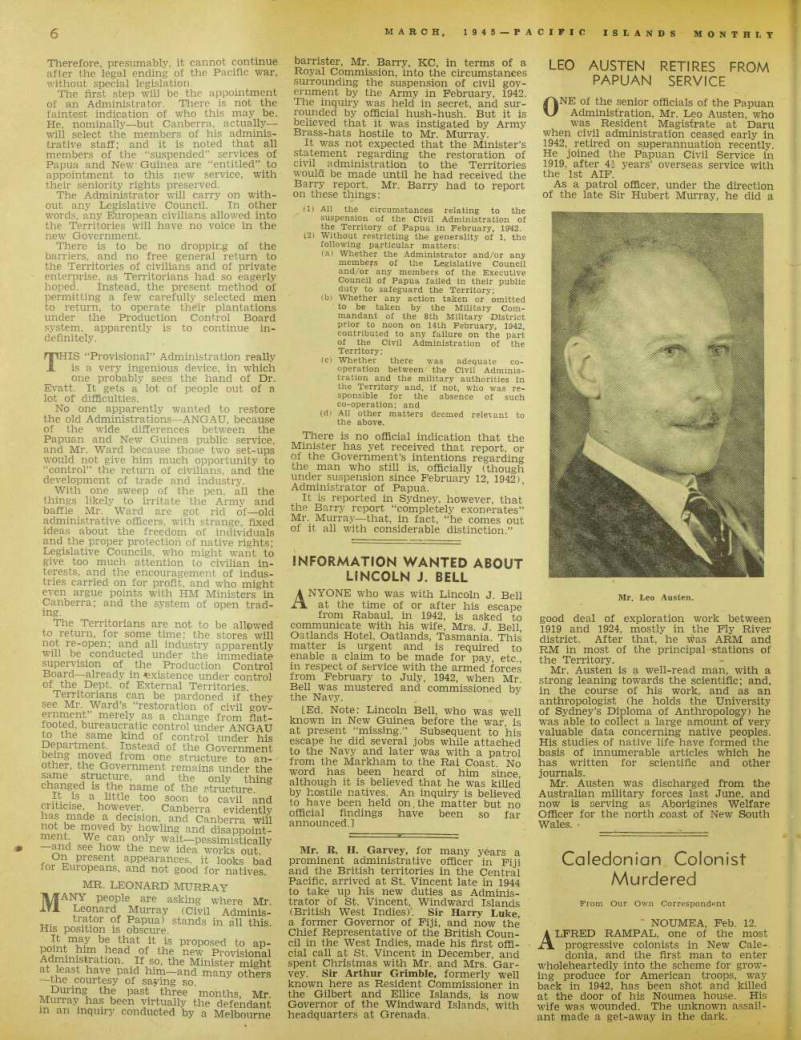
ONE of the senior officials of the Papuan Administration, Mr. Leo Austen, who was Resident Magistrate at Daru when civil administration ceased early in 1942, retired on superannuation recently.
He joined the Papuan Civil Service in 1919, after 4i years’ overseas service with the Ist AIF.
As a patrol officer, under the direction of the late Sir Hubert Murray, he did a
good deal of exploration work between 1919 and 1924, mostly in the Fly River district. After that, he was ARM and RM in most of the principal stations of the Territory.
Mr. Austen is a well-read man, with a strong leaning towards the scientific; and, in the course of his work, and as an anthropologist (he holds the University of Sydney’s Diploma of Anthropology) he was able to collect a large amount of very valuable data concerning native peoples.
His studies of native life have formed the basis of innumerable articles which he has written for scientific and other journals.
Mr. Austen was discharged from the Australian military forces last June, and now is serving as Aborigines Welfare Officer for the north .coast of New South Wales.
Mr. Leo Austen.
Caledonian Colonist
Murdered
From Our Own Correspondent
Noumea, Feb. 12.
ALFRED RAMPAL, one of the most progressive colonists in New Cale-x donia, and the first man to enter wholeheartedly into the scheme for grow ing produce for American troops, way back in 1942, has been shot and killed at the door of his Noumea house. His wife was wounded. The unknown assail ant made a get-away in the dark.
Believes in Criticism
Fiji's New Governor Addresses Legislative Council
FIJI’S new Governor, Mr. A. W. G. H.
Grantham, presided over the Fiji Legislative Council for the first time on February 16.
In his address he said that some mem bers might expect his first address to the Council to indicate what policy he intended to adopt during his tenure of office in Fiji. They might perhaps think that with a new Governor there should be a new policy. But he had come to Fiji with no mandate, desire or intention to start anything revolutionary or reac tionary. Fiji was at a moment of pause, awaiting the outcome of a number of reports. The first and foremost was the report of the planning and development committee, which had not yet been com pleted. This report, when finally approved by Legislative Council and the Secretary of State, would be the Colony’s chart for the next 10 years or more.
Mr. Grantham said that he was a great believer in criticism and that from what he had heard he was sure that he would get helpful and constructive criticism from the Unofficial Members. He, in common with them, had one aim in mind —the betterment of Fiji.
In he warned members against falling into the error of imagin ing that the war was over because of the improvement in the war situation during the past two months. He said that diffi cult tasks still lay ahead of the United Nations, particularly in the Japanese war, and in dealing with these tasks he confi dently looked forward to the Fiji Military Forces taking part.
Captain Tuckey Killed
In Action
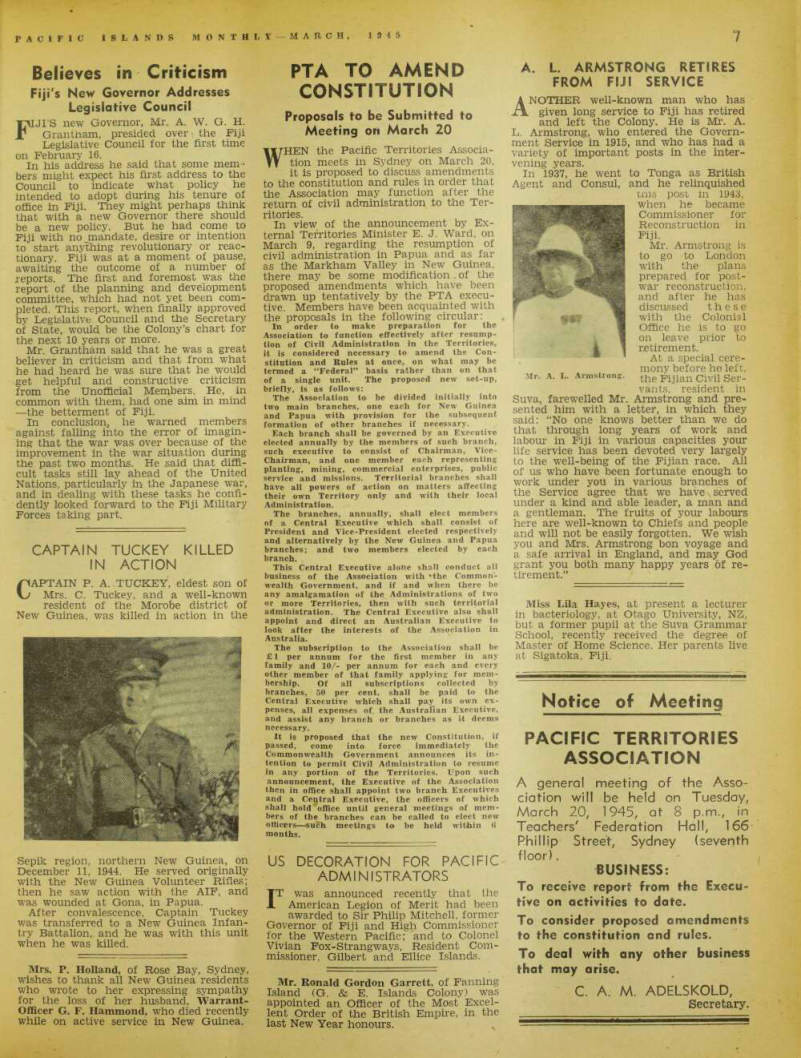
CAPTAIN P. A. -TUCKEY, eldest son of Mrs. C. Tuckey, and a well-known resident of the Morobe district of New Guinea, was killed in action in the
Sepik region, northern New Guinea, on December 11, 1944. He served originally with the New Guinea Volunteer Rifles; then he saw action with the AIF, and was wounded at Gona, in Papua.
After convalescence, Captain Tuckey was transferred to a New Guinea Infan try Battalion, and he was with this unit when he was killed.
Mrs. P. Holland, of Rose Bay, Sydney, wishes to thank all New Guinea residents who wrote to her expressing sympathy for the loss of her husband, Warrant- Officer G. F. Hammond, who died recently while on active service in New Guinea.
Constitution
Pta To Amend
Proposals to be Submitted to Meeting on March 20
WHEN the Pacific Territories Associa tion meets in Sydney on March 20, it is proposed to discuss amendments to the constitution and rules in order that the Association may function after the return of civil administration to the Ter
ritories.
In view of the announcement by Ex ternal Territories Minister E. J. Ward, on
March 9, regarding the resumption of
civil administration in Papua and as far as the Markham Valley in New Guinea, there may be some modification .of the proposed amendments which have been drawn up tentatively by the PTA execu tive. Members have been acquainted with the proposals in the following circular: In order to make preparation for the Association to function effectively after resump tion of Civil Administration in the Territories, it is considered necessary to amend the Con stitution and Rules at once, on what may be termed a “Federal” basis rather than on that of a single unit. The proposed new set-up, briefly, is as follows: The Association to be divided initially into two main branches, one each for New Guinea and Papua with provision for the subsequent formation of other branches if necessary.
Each branch shall be governed by an Executive elected annually by the members of such branch, such executive to consist of Chairman, Vice- Chairman, and one member each representing planting, mining, commercial enterprises, public service and missions. Territorial branches shall have all powers of action on matters affecting their own Territory only and with their local Administration.
The branches, annually, shall elect members of a Central Executive which shall consist of President and Vice-President elected respectively and alternatively by the New Guinea and Papua branches; and two members elected by each branch.
This Central Executive alone shall conduct all business of the Association with ‘the Common wealth Government, and if and when there be any amalgamation of the Administrations of two or more Territories, then with such territorial administration. The Central Executive also shall appoint and direct an Australian Executive to look after the interests of the Association in Australia.
The subscription to the Association shall be £1 per annum for the first member in any family and 10/- per annum for each and every other member of that family applying for mem bership. Of all subscriptions collected by branches, 50 per cent, shall be paid to the Central Executive which shall pay its own ex penses, all expenses of the Australian Executive, and assist any branch or branches as it deems necessary.
It is proposed that the new Constitution, if passed, come into force immediately the Commonwealth Government announces its in tention to permit Civil Administration to resume in any portion of the Territories. Upon such announcement, the Executive of the Association then in office shall appoint two branch Executives and a Ceptral Executive, the officers of which shall hold office until general meetings of mem bers of the branches can be called to elect new officers—such meetings to be held within 6 months.
Us Decoration For Pacific
Administrators
IT was announced recently that the American Legion of Merit had been awarded to Sir Philip Mitchell, former Governor of Fiji and High Commissioner for the Western Pacific; and to Colonel Vivian Fox-Strangways, Resident Com missioner, Gilbert and Ellice. Islands.
Mr. Ronald Gordon Garrett, of Fanning Island (G. & E. Islands Colony) was appointed an Officer of the Most Excel lent Order of the British Empire, in the last New Year honours.
A. L. Armstrong Retires
From Fiji Service
ANOTHER well-known man who has given long service to Fiji has retired and left the Colony. He is Mr. A.
L. Armstrong, who entered the Govern ment Service in 1915, and who has had a variety of important posts in the inter vening years.
In 1937, he went to Tonga as British Agent and Consul, and he relinquished
tms post in 1943, when he became Commissioner for Reconstruction in Fiji.
Mr. Armstrong is to go to London with the plans prepared for post war reconstruction, and after he has discussed these with the Colonial Office he is to go on leave prior to retirement.
At a special cere mony before ho left, the Fijian Civil Ser vants, resident in
Suva, farewelled Mr. Armstrong and pre sented him with a letter, in which they said: “No one knows better than we do that through long years of work and labour in Fiji in various capacities your life service has been devoted very largely to the well-being of the Fijian race. All of us who have been fortunate enough to work under you in various branches of the Service agree that we have served under a kind and able leader, a man and a gentleman. The fruits of your labours here are well-known to Chiefs and people and will not be easily forgotten. We wish you and Mrs. Armstrong bon voyage and a safe arrival in England, and may God grant you both many happy years of re tirement.”
Miss Lila Hayes, at present a lecturer in bacteriology, at Otago University, NZ, but a former pupil at the Suva Grammar School, recently received the degree of Master of Home Science. Her parents live at Sigatoka, Fiji.
Mr. A. L. Armstrong.
Advertisements & other items, p. 9 (1 item)
Notice of Meeting
PACIFIC TERRITORIES
ASSOCIATION
A general meeting of the Association will be held on Tuesday, March 20, 1945, at 8 p.m., in Teachers 7 Federation Hall, 166 Phillip Street, Sydney (seventh floor).
BUSINESS:
To receive report from the Executive on activities to date.
To consider proposed amendments to the constitution and rules.
To deal with any other business that may arise.
C. A. M. ADELSKOLD,
Secretary.
Navy Men
Decorations for Merchant Navy Men
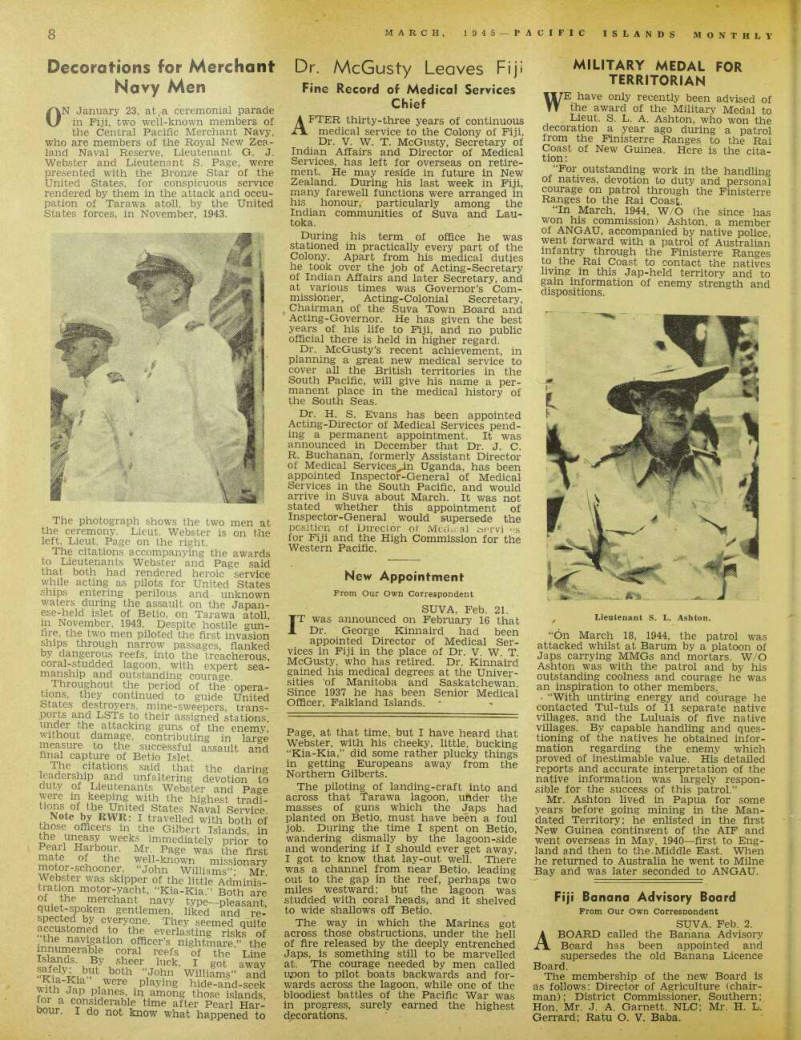
ON January 23, at. a ceremonial parade in Fiji, two well-known members of the Central Pacific Merchant Navy, who are members of the Royal New Zea land Naval Reserve, Lieutenant G. J.
Webster and Lieutenant S. Page, were presented with the Bronze Star of the United States, for conspicuous service rendered by them in the attack and occu pation of Tarawa atoll, by the United States forces, in November, 1943.
The photograph shows the two men at the ceremony. Lieut. Webster is on the left, Lieut. Page on the right.
The citations accompanying the awards to Lieutenants Webster and Page said that both had rendered heroic service while acting as pilots for United States ships entering perilous and unknown waters during the assault on the Japan ese-held islet of Betio, on Tarawa atoll, in November, 1943. Despite hostile gun fire, the two men piloted the first invasion ships through narrow passages, flanked by dangerous reefs, into the treacherous, coral-studded lagoon, with expert sea manship and outstanding courage Throughout the period of the opera tion5 ’ they continued to guide United States destroyers, mine-sweepers, trans ports and LSTs to their assigned stations, under the attacking guns of the enemy, without damage, contributing in large measure to the successful assault and final capture of Betio Islet.
The citations said that the daring leadership and unfaltering devotion to duty of Lieutenants Webster and Page were in keeping with the highest tradi tloT?S * 0f u th l» U^ ited States Naval Service.
N° te by RWR: I travelled with both of those officers in the Gilbert Islands, in the uneasy weeks immediately prior to Pearl Harbour. Mr Page was the first mate of the well-known missionary motor-schooner, “John Williams”; Mr Webster was skipper of the little Adminis tration motor-yacht, “Kia-Kia.” Both are nrHofw £ ierchan s: l nav y type—pleasant, quiet-spoken gentlemen, liked and re spected by everyone. They seemed quite accustomed to the everlasting risks of the navigation officer’s nightmare ” the T«S era^J e c 2 ral reefs of the' Line Islands. By sheer luck, I got away both ‘i John Williams” and i were playing hide-and-seek f^r h Q lr \ among those islands, hnuv c ? n J lderabl e time after Pearl Har bour, I do not know what happened to
Page, at that time, but I have heard that Webster, with his cheeky, little, bucking “Kia-Kia,” did some rather plucky things in getting Europeans away from the Northern Gilberts.
The piloting of landing-craft into and across that Tarawa lagoon, under the masses of guns which the Japs had planted on Betio, must have been a foul job. During the time I spent on Betio, wandering dismally by the lagoon-side and wondering if I should ever get away, I got to know that lay-out well. There was a channel from near Betio, leading out to the gap in the reef, perhaps two miles westward; but the lagoon was studded with coral heads, and it shelved to wide shallows off Betio.
The way in which the Marines got across those obstructions, under the hell of fire released by the deeply entrenched Japs, is something still to be marvelled at. The courage needed by men called upon to pilot boats backwards and for wards across the lagoon, while one of the bloodiest battles of the Pacific War was in progress, surely earned the highest decorations.
Dr. McGusty Leaves Fiji
Fine Record of Medical Services Chief
AFTER thirty-three years of continuous medical service to the Colony of Fiji, Dr. V. W. T. McGusty, Secretary of Indian Affairs and Director of Medical Services, has left for overseas on retire ment. He may reside in future in New Zealand. During his last week in Fiji, many farewell functions were arranged in his honour, particularly among the Indian communities of Suva and Lau toka.
During his term of office he was stationed in practically every part of the Colony. Apart from his medical duties he took over the job of Acting-Secretary of Indian Affairs and later Secretary, and at various times was Governor’s Com missioner, Acting-Colonial Secretary, Chairman of the Suva Town Board and Acting-Governor. He has given the best years of his life to Fiji, and no public official there is held in higher regard.
Dr. McGusty’s recent achievement, in planning a great new medical service to cover all the British territories in the South Pacific, will give his name a per manent place in the medical history of the South Seas.
Dr. H. S. Evans has been appointed Acting-Director of Medical Services pend ing a permanent appointment. It was announced in December that Dr. J. C.
R. Buchanan, formerly Assistant Director of Medical Uganda, has been appointed Inspector-General of Medical Services in the South Pacific, and would arrive in Suva about March. It was not stated whether this appointment of Inspector-General would supersede the position of Director of Medical t>ervi -s for Fiji and the High Commission for the Western Pacific.
New Appointment
From Our Own Correspondent
Suva, Feb. 21.
IT was announced on February 16 that Dr. George Kinnaird had been appointed Director of Medical Ser vices in Fiji in the place of Dr. V. W. T.
McGusty, who has retired. Dr. Kinnaird gained his medical degrees at the Univer sities 'of Manitoba and Saskatchewan.
Since 1937 he has been Senior Medical Officer, Falkland Islands. *
Territorian
Military Medal For
WE have only recently been advised of the award of the Military Medal to Lieut. S. L. A. Ashton, who won the decoration a year ago during a patrol from the Finisterre Ranges to the Rai Coast of New Guinea. Here is the cita tion: “For outstanding work in the handling of natives, devotion to duty and personal courage on patrol through the Finisterre Ranges to the Rai Coast.
“In March, 1944, W/O (he since has won his commission) Ashton, a member of ANGAU, accompanied by native police, went forward with a patrol of Australian infantry through the Finisterre Ranges to the Rai Coast to contact the natives living in this Jap-held territory and to gain information of enemy strength and dispositions.
“On March 18, 1944, the patrol was attacked whilst at Barum by a platoon of Japs carrying MMGs and mortars. W/O Ashton was with the patrol and by his outstanding coolness and courage he was an inspiration to other members. • “With untiring energy and courage he contacted Tul-tuls of 11 separate native villages, and the Luluais of five native villages. By capable handling and ques tioning of the natives he obtained infor mation regarding the enemy which proved of inestimable value. His detailed reports and accurate interpretation of the native information was largely respon sible for the success of this patrol.”
Mr. Ashton lived in Papua for some years before going mining in the Man dated Territory; he enlisted in the first New Guinea contingent of the AIF and went overseas in May, 1940 —first to Eng land and then to the Middle East. When he returned to Australia he went to Milne Bay and was later seconded to ANGAU.
Lieutenant S. L. Ashton.
Fiji Banana Advisory Board
From Our Own Corresnondent
Suva, Feb. 2.
ABOARD called the Banana Advisory Board has been appointed and supersedes the old Banana Licence Board.
The membership of the new Board is as follows: Director of Agriculture (chair man); District Commissioner, Southern; Hon. Mr. J. A. Garnett. NLC; Mr. H. L.
Gerrard; Ratu O. V. Baba.
Picnic
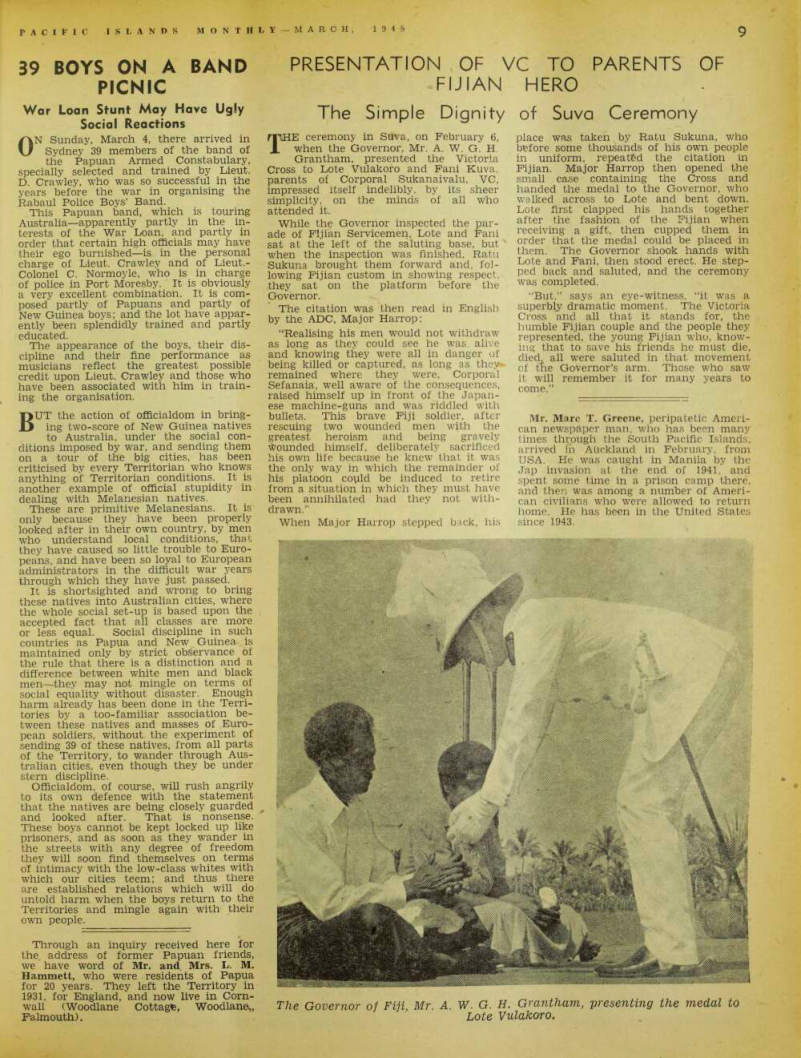
39 Boys On A Band
War Loan Stunt May Have Ugly Social Reactions
ON Sunday, March 4, there arrived in Sydney 39 members of the band of the Papuan Armed Constabulary, specially selected and trained by Lieut.
D. Crawley, who was so successful in the years before the war in organising the Rabaul Police Boys’ Band.
This Papuan band, which is touring Australia—apparently partly in the in terests of the War Loan, and partly in order that certain high officials may have their ego burnished—is in the personal charge of Lieut. Crawley and of Lieut.- Colonel C. Normoyle, who is in charge of police in Port Moresby. It is obviously a very excellent combination. It is com posed partly of Papuans and partly of New Guinea boys; and the lot have appar ently been splendidly trained and partly educated.
The appearance of the boys, their dis cipline and their fine performance as musicians reflect the greatest possible credit upon Lieut. Crawley and those who have been associated with him in train ing the organisation.
BUT the action of officialdom in bring ing two-score of New Guinea natives to Australia, under the social con ditions imposed by war, and sending them on a tour of the big cities, has been criticised by every Territorian who knows anything of Territorian conditions. It is another example of official stupidity in dealing with Melanesian natives.
These are primitive Melanesians. It is only because they have been properly looked after in their own country, by men who understand local conditions, that they have caused so little trouble to Euro peans, and have been so loyal to European administrators in the difficult war years through which they have just passed.
It is shortsighted and wrong to bring these natives into Australian cities, where the whole social set-up is based upon the accepted fact that all classes are more or less equal. Social discipline in such countries as Papua and New Guinea is maintained only by strict observance of the rule that there is a distinction and a difference between white men and black men—they may not mingle on terms of social equality without disaster. Enough harm already has been done in the Terri tories by a too-familiar association be tween these natives and masses of Euro pean soldiers, without the experiment of sending 39 of these natives, from all parts of the Territory, to wander through Aus tralian cities, even though they be under stern discipline.
Officialdom, of course, will rush angrily to its own defence with the statement that the natives are being closely guarded and looked after. That is nonsense.
These boys cannot be kept locked up like prisoners, and as soon as they wander in the streets with any degree of freedom they will soon find themselves on terms of intimacy with the low-class whites with which our cities teem; and thus there are established relations which will do untold harm when the boys return to the Territories and mingle again with their own people.
Through an inquiry received here for the. address of former Papuan friends, we have word of Mr. and Mrs. L. M.
Hammett, who were residents of Papua for 20 years. They left the Territory in 1931, for England, and now live in Corn wall (Woodlane Cottagfc, Woodlane,, Falmouth).
The Simple Dignity of Suva Ceremony
Presentation Of Vc To Parents Of
Fijian Hero
rE ceremony in Suva, on February 6, when the Governor, Mr. A. W. G. H.
Grantham, presented the Victoria Cross to Lote Vulakoro and Fani Kuva. parents of Corporal Sukanaivalu, VC, impressed itself indelibly, by its sheer simplicity, on the minds of all who attended it.
While the Governor inspected the par ade of Fijian Servicemen, Lote and Fani sat at the left of the saluting base, but when the inspection was finished, Ratu Sukuna brought them forward and, fol lowing Fijian custom in showing respect, they sat on the platform before the Governor.
The citation was then read in English by the ADC, Major Harrop: “Realising his men would not withdraw as long as they could see he was. alive and knowing they were all in danger of being killed or captured, as long as they remained where they were, Corporal Sefanaia, well aware of the consequences, raised himself up in front of the Japan ese machine-guns and was riddled with bullets. This brave Fiji soldier, after rescuing two wounded men with the greatest heroism and being gravely bounded himself, deliberately sacrificed his own life because he knew that it was the only way in which the remainder of his platodn could be induced to retire from a situation in which they must have been annihilated had they not with drawn.”
When Major Harrop stepped back, his
place was taken by Ratu Sukuna, who before some thousands of his own people in uniform, repeated the citation in Fijian. Major Harrop then opened the small case containing the Cross and handed the medal to the Governor, who walked across to Lote and bent down.
Lote first clapped his hands together after the fashion of the Fijian when receiving a gift, then cupped them in order that the medal could be placed in them. The Governor shook hands with Lote and Fani, then stood erect. He step ped back and saluted, and the ceremony was completed.
“But,” says an eye-witness, “it was a superbljy dramatic moment. The Victoria Cross and all that it stands for, the humble Fijian couple and the people they represented, the young Fijian who, know ing that to save his friends he must die, died, all were saluted in that movement of the Governor’s arm. Those who saw it will remember it for many years to come.”
Mr. Marc T. Greene, peripatetic Ameri can newspaper man, who has been many times through the South Pacific Islands, arrived in Auckland in February, from USA. He was caught in Manila by the Jap invasion at the end of 1941, and spent some time in a prison camp there, and then was among a number of Ameri can civilians who were allowed to return home. He has been in the United States since 1943.
The Governor of Fiji, Mr. A. W. G. H. Grantham, presenting the medal to Lote Vulakoro.
Tropicaities
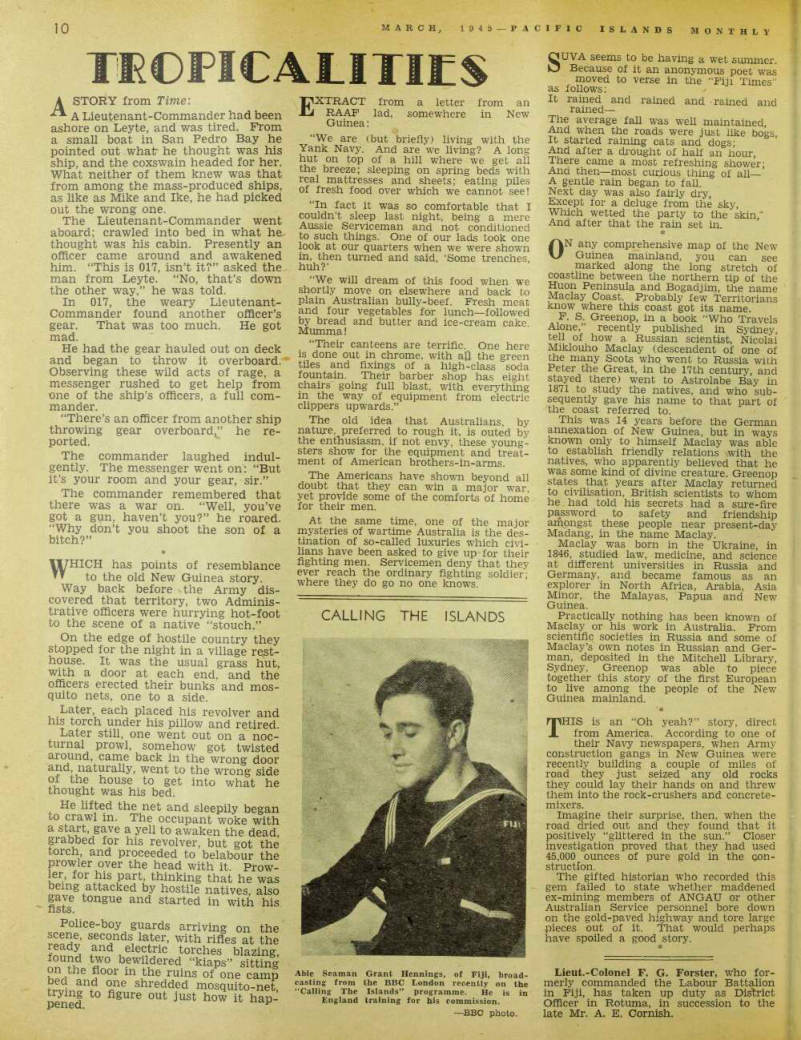
A STORY from Time: A Lieutenant-Commander had been ashore on Leyte, and was tired. From a small boat in San Pedro Bay he pointed out whatr he thought was his ship, and the coxswain headed for her.
What neither of them knew was that from among the mass-produced ships, as like as Mike and Ike, he had picked out the wrong one.
The Lieutenant-Commander went aboard; crawled into bed in what he thought was his cabin. Presently an officer came around and awakened him. “This is 017, isn’t it?” asked the man from Leyte. “No, that’s down the other way,” he was told.
In 017, the weary Lieutenant- Commander found another officer’s gear. That was too much. He got mad.
He had the gear hauled out on deck and began to throw it overboard.
Observing these wild acts of rage, a messenger rushed to get help from one of the ship’s officers, a full com mander.
“There’s an officer from another ship throwing gear he re ported.
The commander laughed indul gently. The messenger went on: “But it’s your room and your gear, sir.”
The commander remembered that there was a war on. “Well, you’ve got a gun. haven’t you?” he roared.
“Why don’t you shoot the son of a bitch?” * WHICH has points of resemblance to the old New Guinea story.
Way back before the Army dis covered that territory, two Adminis trative officers were hurrying hot-foot to the scene of a native “stouch.”
On the edge of hostile country they stopped for the night in a village rest house. It was the usual grass hut, with a door at each end, and the officers erected their bunks and mos quito nets, one to a side.
Later, each placed his revolver and his torch under his pillow and retired.
Later still, one went out on a noc turnal prowl, somehow got twisted around, came back in the wrong door and, naturally, went to the wrong side of the house to get into what he thought was his bed.
He lifted the net and sleepily began to crawl in. The occupant woke with a start, gave a yell to awaken the dead, grabbed for his revolver, but got the torch and proceeded to belabour the prowler over the head with it. Prow ler, for his part, thinking that he was being attacked by hostile natives, also gave tongue and started in with his fists.
Police-boy guards arriving on the scene, seconds later, with rifles at the ready and electric torches blazing, found two bewildered “Maps” sitting hpH^ 6 ? 00r m £ he ruins of one camp t b rvln^ d « ne shredded mosquito-net, trying to figure out just how it hap pened. *
EXTRACT from a letter from an RAAF lad, somewhere in New Guinea: “We are (but briefly) living with the Yank Navy. And are we living? A long hut on top of a hill where we get all the breeze; sleeping on spring beds with real mattresses and sheets; eating piles of fresh food over which we cannot see!
“In fact it was so comfortable that I couldn’t sleep last night, being a mere Aussie Serviceman and not conditioned to such things. One of our lads took one look at our quarters when we were shown in, then turned and said, ‘Some trenches, huh?’
“We will dream of this food when we shortly move on elsewhere and back to plain Australian bully-beef. Fresh meat and four vegetables for lunch—followed by bread and butter and ice-cream cake.
Mumma!
“Their canteens are terrific. One here is done out in chrome, with all the green tiles and fixings of a high-class soda fountain. Their barber shop has eight chairs going full blast, with everything in the way of equipment from electric clippers upwards.”
The old idea that Australians, by nature, preferred to rough it, is outed by the enthusiasm, if not envy, these young sters show for the equipment and treat ment of American brothers-in-arms.
The Americans have shown beyond all doubt that they can win a major war yet provide some of the comforts of home for their men.
At the same time, one of the major mysteries of wartime Australia is the des tination of so-called luxuries which civi lians have been asked to give up for their fighting men. Servicemen deny that they ever reach the ordinary fighting soldier; where they do go no one knows.
SUVA seems to be having a wet summer.
Because of it an anonymous poet was moved to verse in the “Fiji Times” as follows: It rained and rained and -rained and rained— The average fall was well maintained, And when the roads were just like bogs It started raining cats and dogs; And after a drought of half an hour.
There came a most refreshing shower; And then— most curious thing of all— A gentle rain began to fall.
Next day was also fairly dry, Except for a deluge from the sky, Which wetted the party to the skin/ And after that the rain set in. * ON any comprehensive map of the New Guinea mainland, you can see marked along the long stretch of coastline between the northern tip of the Huon Peninsula and Bogadjim, the name Maclay Coast. Probably few Territorians know where this coast got its name.
F. S. Greenop, in a book “Who Travels Alone,” recently published in Sydney, tell of how a Russian scientist, Nicolai Miklouho Maclay (descendent of one of the many Scots who went to Russia with Peter the Great, in the 17th century, and stayed there) went to Astrolabe Bay in 1871 to study the natives, and who sub sequently gave his name to that part of the coast referred to.
This was 14 years before the German annexation of New Guinea, but in ways known only to himself Maclay was able to establish friendly relations with the natives, who apparently believed that he was some kind of divine creature. Greenop states tha,t years after Maclay returned to civilisation, British scientists to whom he had told his secrets had a sure-fire password to safety and friendship amongst these people near present-day Madang, in the name Maclay.
Maclay was bom in the Ukraine, in 1846, studied law, medicine, and science at different universities in Russia and Germany, and became famous as an explorer in North Africa, Arabia, Asia Minor, the Malayas, Papua and New Guinea.
Practically nothing has been known of Maclay or his work in Australia. From scientific societies in Russia and some of Maclay’s own notes in 'Russian and Ger man, deposited in the Mitchell Library, Sydney, Greenop was able to piece together this story of the first European to live among the people of the New Guinea mainland. * THIS is an “Oh yeah?” story, direct from America. According to one of their Navy newspapers, when Army construction gangs in New Guinea were recently building a couple of miles of road they just seized any old rocks they could lay their hands on and threw them into the rock-crushers and concrete mixers.
Imagine their surprise, then, when the road dried out and they found that it positively “glittered in the sun.” Closer investigation proved that they had used 45,000 ounces of pure gold in the con struction.
The gifted historian who recorded this gem failed to state whether maddened ex-mining members of ANGAU or other Australian Service personnel bore down on the gold-paved highway and tore large pieces out of it. That would perhaps have spoiled a good story.
Lieut.-Colonel F. G. Forster, who for merly commanded the Labour Battalion in Fiji, has taken up duty as District Officer in Rotuma, in succession to the late Mr. A. E. Cornish.
Advertisements & other items, p. 12 (1 item)
Calling The Islands
Able Seaman Grant Hennings, of Fiji, broad casting from the BBC London recently on the “Calling The Islands” programme. He is in England training for his commission. —BBC photo.
Captain Johanson
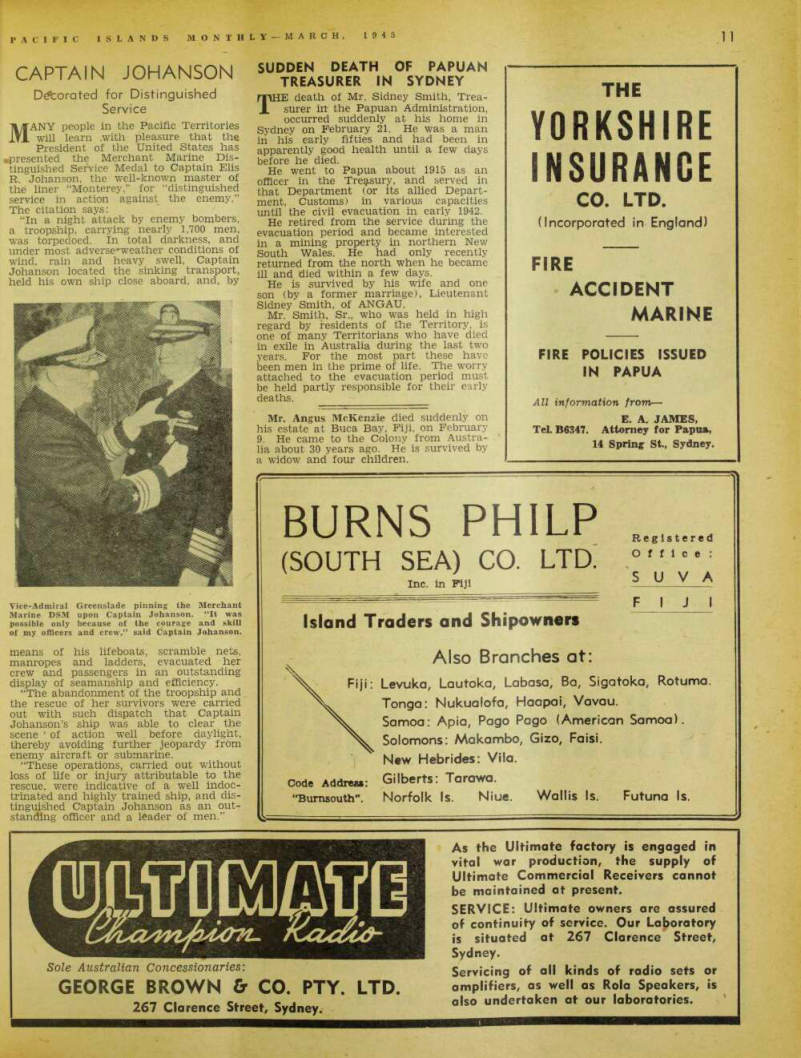
Decorated for Distinguished Service
MANY people in the Pacific Territories will learn .with pleasure that the President of the United States has the Merchant Marine Dis tinguished Service Medal to Captain Elis R. Johanson, the well-known master of the liner “Monterey,” for “distinguished service in action against the enemy.”
The citation says: “In a night attack by enemy bombers, a troopship, carrying nearly 1,700 men, was torpedoed. In total darkness, and under most adverse-weather conditions of wind, rain and heavy swell. Captain Johanson located the sinking transport, held his own ship close aboard, and, by
Vice-Admiral Greenslade pinning the Merchant Marine DSM upon Captain Johanson, “It was possible only because of the courage and skill of my officers and crew,” said Captain Johanson. means of his lifeboats, scramble nets, manropes and ladders, evacuated her crew and passengers in an outstanding display of seamanship and efficiency.
“The abandonment of the troopship and the rescue of her survivors were carried out with such dispatch that Captain Johanson’s ship was able to clear the scene *of action well before daylight, thereby avoiding further jeopardy from enemy aircraft or submarine.
“These operations, carried out without loss of life or injury attributable to the rescue, were indicative of a well indoc trinated and highly trained ship, and dis tinguished Captain Johanson as an out standing officer and a leader of men.”
Sudden Death Of Papuan
Treasurer In Sydney
rE death of Mr. Sidney Smith, Trea surer in the Papuan Administration, occurred suddenly at his home in Sydney on February 21. He was a man in his early fifties and had been in apparently good health until a few days before he died.
He went to Papua about 1915 as an officer in the Treasury, and served in that Department (or its allied Depart ment, Customs) in various capacities until the civil evacuation in early 1942.
He retired from the service during the evacuation period and became interested in a mining property in northern New South Wales. He had only recently returned from the north when he became ill and died within a few days.
He is survived by his wife and one son (by a former marriage), Lieutenant Sidney Smith, of ANGAU.
Mr. Smith, Sr., who was held in high regard by residents of the Territory, is one of many Territorians who have died in exile in Australia during the last two years. For the most part these have been men in the prime of life. The worry attached to the evacuation period must be held partly responsible for their early deaths.
Mr. Angus McKenzie died suddenly on his estate at Buca Bay, Fiji, on February 9. He came to the Colony from Austra lia about 30 years ago. He is survived by a widow and four children.
Advertisements & other items, pp. 13-14 (1 item)
Burns Philp
THE
YORKSHIRE
INSURANCE
CO. LTD.
(Incorporated in England)
FIRE
ACCIDENT
MARINE
FIRE POLICIES ISSUED
IN PAPUA
All information from —
E. A. JAMES,
Tel. 86347. Attorney for Papua, 14 Spring St., Sydney.
BURNS PHILP
(SOUTH SEA) CO. LTD.
Inc. in Fiji D V A
“ - —— FIJI
island Traders and Shipowners Also Branches at: \Fiji: Levuka, Lautoka, Labasa, Ba, Sigatoka, Rotuma.
Tonga: Nukualofa, Haapai, Vavau.
Samoa: Apia, Pago Pago (American Samoa).
Solomons: Makambo, Gizo, Faisi.
New Hebrides: Vila.
Code Address: Gilberts: Tarawa.
“Bumsouth”. Norfolk Is. Niue. Wallis Is. Futuna Is.
I m u Ti
AVT
E £ s Sole Australian Concessionaries :
GEORGE BROWN & CO. PTY. LTD.
267 Clarence Street, Sydney.
As the Ultimate factory is engaged in vital war production, the supply of Ultimate Commercial Receivers cannot be maintained at present.
SERVICE: Ultimate owners are assured of continuity of service. Our Laboratory is situated at 267 Clarence Street, Sydney.
Servicing of ail kinds of radio sets or amplifiers, as well as Rola Speakers, is also undertaken at our laboratories.
Refreshing
as a plunge
into a lagoon!
Germicidal
and fragrant
TENAX TOILET SOAP is
a rapid safeguard against external skin infections, yet it is soothing and kind to the most sensitive skin —even a baby’s!
ORDER TENAX FROM
YOUR ISLAND SUP-
PLIERS. STOCKS ARE
PLENTIFULLY AVAIL-
ABLE.
GROVE & SONS
Limited
AUCKLAND
Island Traders. P.o. Box 490, Telegraphic and Gable Address: “Grove”, Auckland.
Shippers of all classes of New Zealand products.
Representing English Manufacturers throughout the Cook and Society Islands, Fiji, Tonga, Samoa, Niue, New Caledonia, New Guinea, etc.
In FIJI os—W. H. Grove & Sons (Fiji) Ltd.
Future Of Pacific Mandates
Great Decisions Likely at 'Frisco Conference
THERE are four Territories in the Pacific whose future must be affected by the Pacific war. They are Territories held by certain Powers under Mandates from the League of Nations. The League of Nations (see articles on pages 3 and 32 of this issue) is to be replaced by some new International Organisation to be formed at the United Nations Confer ence at San Francisco next month. It follows, therefore, that the Mandate system will be reviewed and, almost certainly, replaced by some other system. The four Territories are: Mandated Territory of New Guinea, administered by Australia.
Mandated Territory of Western Samoa, administered by New Zea land.
Mandated Territory of Caroline, Marshall and Mariana Islands, administered by Japan.
Mandated Territory of Nauru, administered jointly by Britain, Australia and New Zealand.
Since it became clear, late in 1942, that the United Nations could count upon the complete defeat of the Axis Nations, and that decisions made in conference by the United Nations would take the place of any peace conference (such as that at Versailles after World War I) plans have been drawn for some sort of International Organisation. The first steps were taken at Dumbarton Oaks (USA) last
year; the next at the Crimea Confer ence of the Big Three, in February; and the next (and most important) will be decided upon at the San Francisco Conference next month. (See articles on pages 3 and 32.) But, amid all these conferences, nothing official has been said as yet about the future of the League of Nations and of the Mandate system.
On February 18, however, the follow ing letter was published in the New York Times, and we are indebted to the US Office of War Information for the text of it. The letter was signed by the following, and its significance will not be lost upon the many people interested in the future of the Pacific Territories: John W. Davis, Democratic candidate for President in 1924; Huntington Gilchrist, consultant on international affairs to the State Department; Arthur N. Holcombe, chairman of the War Production Board Appeals Board; Emory Ross, executive secretary of the Foreign Missions Conference of North America; James T. Shotwell, chairman of the Commission to study the organi sation of peace; Sumner Welles, former Under-Secre tary of State; Quincy Wright, Professor of Inter national Law at the University of Chicago.
Plea For Continuance Of " Trusteeship"
IN his speech at the dinner of the Foreign Policy Association at the Waldorf Astoria Hotel, on January 19, 1945 (says “New York Times” letter), Colonel Stanley, British Colonial Secre tary, referred to the Mandates system as
representing “the old theory of trustee ship.”
It might be inferred from his address that he favoured abolition of this system.
We believe this is the first public inti mation of such a policy on the part of any of the Mandatory Powers. . . . We hope it will not be considered inappro priate for us to point out the significance of any such development.
The Mandate system, it will be recalled, was set up at the end of the last war for the government of those fourteen depen dent Territories, including Palestine and Tanganyika, and many islands in the Pacific, which were taken away from Turkey and Germany.
It seems pertinent and proper to ask whether we correctly understood Colonel Stanley, and whether he is now perhaps in favour of the annexation of Man dated Territories by the Powers adminis tering them. We also believe it pertinent to ask what is the policy of our own Government, and the Governments of other Powers on this point.
We might add that, in our opinion, Pacific islands formerly Mandated to Japan should not be annexed by the United States but should be governed by this country as trustee for the United Nations. Suitable strategic arrangements should, of course, be assured.
COLONEL STANLEY quite properly out lined the truly remarkable achieve ments of the British Government in the development of its colonies, and pro posed for thejfuture a system of inter national regional advisory boards, like the Anglo-American Caribbean Commission.
We support this proposal, and hope that such Commissions will do much to raise the standards of agriculture, public health, education, etc., in the various re gions concerned.
This system Colonel Stanley calls “partnership.” To us, it supplements rather than supplants the “trusteeship” system of Mandates which the British Government in the past has loyally sup ported, and which, in the opinion of many experts, might well be extended to other dependent Territories.
Abandonment 6f the gains which are inherent in this system might imply a step toward the division of the world into several Great Power zones of exclusive domination. It would weaken the system of international responsibility for dependent peoples which was actually practised between «the wars* The continuance and development of this principle, and its extension to other dependent Territories, especially those to be taken from our enemies at the end of this war, would imply just that much more confidtnce on the part of the United Nations in the success of their new venture.
IT would seem desirable politically (if not necessarily legally) that any fundamental change in the status of the Mandated Territories (including the Pacific islands formerly under Mandate to Japan) should be made only with the consent of that “civilisation” in whose trust they were placed. This would re quire the consent of the League of Nations (and the United States), 1 or of the new United Nations, and not merely a decision by a small coterie of Great Powers of whom mierht be directly interested- in the result.
Nothing on this subject is contained in the Dumbarton Oaks proposals; and, pre sumably, this situation has been given further consideration since that meeting —perhaps at the time of the Crimed Con ference.
It is to be hoped that this important matter will be placed on the agenda of the San Francisco Conference, and that the peoples of the world will be given the opportunity to express their views before any binding decisions are made.
(See comment in article or. page 3)
French Anthropologist Safe
M. OSCAR MEYER, a member of the Pacific Islands Society, is now safe, after having been a prisoner of war since the Japanese occupied Indo-China.
A cable received by Mr. Eric Ramsden (now of Wellington, New Zealand, and formerly the Society’s secretary), stated that he was now with the French Military Mission at Kunming, South China, and “free.” M. Meyer did anthropological work in the Marquesas and in New Guinea, and was also known in Tahiti, where he resided for some time. He left Sydney to join the French military forces in Indo-China. For a time he was em ployed by the Australian forces on special duty in New Guinea before the Japanese invasion.
The death occurred in Suva, Fiji, in early February of Mrs. D. G. Canard after a long illness. Mrs. Canard was very well-known in Fiji and had many friends.
Her youngest son, Pilot-Officer Ernie Canard, went away with the Fiji RAF contingent and was later killed in a flying accident in South Africa. Her other son, Harry, is attached to the Public Works Department in Lautoka.
Mrs. C. P. Purcell, who will be remem bered at many Pacific Island Society’s gatherings in Sydney in the early period of the war, is now at Delhi, India. Cap tain Purcell, her husband, has been a prisoner in Japanese hands since the fall of Singapore; he was formerly head of the Education Department in the State of Johore.
Advertisements & other items, pp. 15-16 (1 item)
a major anxiety
<■ 'THAT'
A 1 1 I y * T Or
JJk
¥ /r«t "
Relief from
y
a major anxiety
Even the most expert and conscientigus individual executor is subject to accident, illness and incapacitation.
Continuity of administration and uninterrupted attention to your estate and your beneficiaries are of paramount importance. Both can be positively assured by appointing this Company your sole Executor or ,as co-Executor with your present appointee. An interesting explanatory booklet will be forwarded on request.
DIRECTORS:
James Burns R- J. Nosworthy Lewis Armstrong Joseph Mitchell MANAGER: C. H. Chester
BURNS PHILP TRUST
COMPANY LIMITED
7 BRIDGE STREET, SYDNEY
TELEPHONE: B 7901 Box 543. G.P.0., Sydney
BPI .45 i
.. 1 •, ' . i... " J 7
QUEENSLAND
INSURANCE
COMPANY
LIMITED
(Incorporated 1886 in Australia)
ASSETS EXCEED £ 3,500,000
Head Office :
PITT Ct BRIDGE STS.,
SYDNEY
Specialists in South Seas Fire,
Marine tr Accident Insurances
Apply to:—
FIJI.
Branch Office: H. J. Moorhouse, Manager Burns Philp (South Sea) Co., Ltd.
VILA.
Burns Philp (South Sea) Co., Ltd.
Comptolrs Francais Des Nouvelles Hebrides (Marine).
NOUMEA.
L. <fe W. Johnston.
PAGO PAGO.
Burns Philp (South Sea) Co., Ltd.
G. H. C. Reid & Co.
OTHER SOUTH SEA ISLANDS.
Burns Philp (South Sea) Co., Ltd, Also to any of the Company’s Offices in Australia or Hew Zealand.
B. DAVID Trading Co.
ISLAND TRADERS -
- EXPORT MERCHANTS
SHIPPERS OF ALL KINDS OF MERCHANDISE.
EXPORT REPRESENTATIVES OF LEADING
AUSTRALIAN MANUFACTURERS
Direct Enquiries to Head Office:
31 Queen Street, Melbourne, Vic.
Bankers: National Bank of Australasia.
Cable Address:
“DAVID TRADING
MELBOURNE”
Branches and Agents in All Ports.
OPEN TO APPOINT AGENCIES WHERE NOT REPRESENTED
Candidate
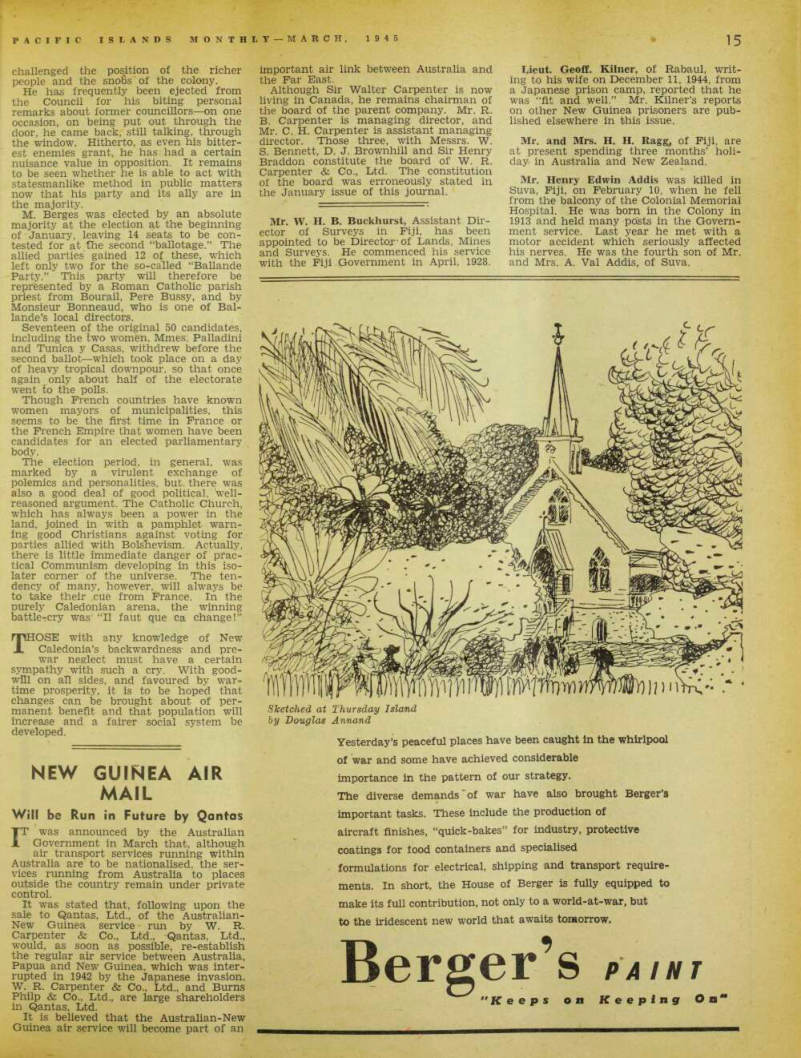
Only One Caledonian Candidate Successful—Yet
From Our Own Correspondent
Noumea, Jan. 5.
(§UCH are the 'problems of ordinary
sea-mail transportation in the South Pacific since the war moved north, that we have just received the results of the New Caledonian General Council elections which were to be held on January 7. Apparently, too, the whole issue is not concluded in one day, as in British countries, but (according to our Noumea corres pondent) the first day’s poll is but a preliminary canter—it is the second election day (January 21, in this case) that matters.) ABOUT half . the New Caledonian population qualified to vote went to the polls on election day, January 7, but I am informed that this is quite usual, as it is rare for all 15 members of the General Council to be elected at the first vote, and many voters—particularly those in outlying places—wait for a second election day, when there is a straight out “ballotage.”
The rule for the first day is that no candidate can be elected who does not poll a quarter of the votes cast. As there were 50 candidates for the 15 seats, only one was able to fulfil this condition. He is M. Berges, a colonist of La Foa on the west coast, who has been for long a general councillor and who was president of Governor Sautot’s nominated (and now disbanded) Administrative Council which admirably served Free France during the threat from Japan. He polled 1,140 votes of the 4,100, which were cast in his elec torate—this represents a personal triumph for the man who for most of his life has been a leader among Caledonians who claim a greater share in their own govern ment.
The party which M. Berges leads has a liberal programme, and has called itself the Comite Caledonien. It polled 8,452 votes, the vast majority in country dis
tricts, compared with 8,417 cast for the Social Progress or Labour group, which has much the same sort of general pro gramme, but whose support comes mainly from Noumea town.
The latest sensation of the election is that these two groups have after the first day’s poll agreed to unite, appointing only 14 candidates between them for the ballot on January 21.
This simplifies the position and puts the amalgamated party in a strong position as against the Conservative or “Union”
Party, representing big business and popu larly known as the “Ballande Party.”
These Conservatives polled 10,523, with relatively strong support in the town, but poorer support from “the bush.” Their leading candidate was a priest, the Rev.
Pere Bussy.
French soldiers and sailors when serving with the colours are not qualified to vote, thus reducing the electoral role by some hundreds.
There was no time to prepare a new voting list of the island’s potential 5,000 women voters (French women were re cently given the right to vote) who will have to wait another year of two for the next general election. Women candidates were allowed, however, and two were in cluded in the Social Progress group nominations. They were Madame Palla dini, wife of the party’s leader, and Madame Tunica y Casas. They did moder ately well, but are not included in the list for January 21.
Mr. Paul Cuer, who polled the highest number of votes among the five indepen dent candidates, announces that he will not stand for the 'ballot, but that he adheres to the new popular party.
“Within the framework of the French community,” said M. Berges, “we want Caledonians to be allowed at last to act as free men, free to vote on financial matters and absolute masters of the pro ceeds of the taxes they vote.”
Caledonians, he added, have the right to be considered as real French citizens, worthy of accepting democratic responsi bilities. The general interest of the country has often lain in opposition to big business interests, which however neces ‘ sary they may be to the country’s economy should not be allowed to use their finan cial power to overcome the people’s will and control the local Assembly.
In announcing the fusion of the two parties, last week’s Social Progress candi dates also laid stress on the “imperious necessity of presenting a united front to the ‘gros capitalisms local.’ ”
This election is of more than usual in terest, as it seems to show that a breath of democracy, felt at the time of the Free French movement in 1940, is still blowing across the coconut palms and mountains of this once neglected reef-engirdled isle.
Noumea, Feb. 9.
AS I forecast, the elections resulted in an overwhelming victory for the candidates of what one may call the “Popular Front” —the two social progress parties whose aims include a greater share of self-government for New Cale donia, and closer Governmental control of the mining industry which they claim has hitherto made huge fortunes for indi viduals outside the country without really benefiting the colony. These allied parties are the Comite Caledonien, which gained eight seats, and the Social Progress Party, which gained five.
The leader of the first-named is M.
Berges, long a champion of self-govern ment and a practised politician; he will undoubtedly be elected president of the new Council. Head of the Social Pro gressives is M. Florindo Paladini, former general councillor, and something of a Socialist firebrand. In the past he has
challenged the position of the richer people and the snoßs of the colony.
He has frequently been ejected from the Council for his biting personal remarks about former councillors—on one occasion, on being put out through the door, he came back, still talking, through the window. Hitherto, as even his bitter est enemies grant, he has had a certain nuisance value in opposition. It remains to be seen whether he is able to act with statesmanlike method in public matters now that his party and its ally are in the majority.
M. Berges was elected by an absolute majority at the election at the beginning of January, leaving 14 seats to be con tested for at the second “ballotage.” The allied parties gained 12 of these, which left only two for the so-called “Ballande Party.” This party will therefore be represented by a Roman Catholic parish priest from Bourail, Pere Bussy, and by Monsieur Bonneaud, who is one of Bal lande’s local directors.
Seventeen of the original 50 candidates, including the two women, Mmes. Palladini and Tunica y Casas, withdrew before the second ballot—which took place on a day of heavy tropical downpour, so that once again only about half of the electorate went fo the polls.
Though French countries have known women mayors of municipalities, this seems to be the first time in France or the French Empire that women have been candidates for an elected parliamentary body.
The election period, in general, was marked by a virulent exchange of polemics and personalities, but there was also a good deal of good political, well reasoned argument. The Catholic Church, which has always been a power in the land, joined in with a pamphlet warn ing good Christians against voting for parties allied with Bolshevism. Actually, there is little immediate danger of prac tical Communism developing in this iso later corner of the universe. The ten dency of many, however, will always be to take their cue from France. In the purely Caledonian arena, the winning battle-cry was “H faut que ca change!”
THOSE with any knowledge of New Caledonia’s backwardness and pre war neglect must have a certain sympathy with such a cry. With good will on all sides, and favoured by war time prosperity, it is to be hoped that changes can be brought about of per manent benefit and that population will increase and a fairer social system be developed.
New Guinea Air
Will be Run in Future by Qantas
IT was announced by the Australian Government in March that, although air transport services running within Australia are to be nationalised, the ser vices running from Australia to places outside the country remain under private control.
It was stated that, following upon the sale to Qantas, Ltd., of the Australian- New Guinea service run by W. R.
Carpenter & Co., Ltd., Qantas, Ltd., would, as soon as possible, re-establish the regular air service between Australia, Papua and New Guinea, which was inter rupted in 1942 by the Japanese invasion.
W. R. Carpenter & Co., Ltd., and Burns Philp & Co., Ltd., are large shareholders in Qantas, Ltd.
It is believed that the Australian-New Guinea air service will become part of an
important air link between Australia and the Far East.
Although Sir Walter Carpenter is now living in Canada, he remains chairman of the board of the parent company. Mr. R.
B. Carpenter is managing director, and Mr. C. H. Carpenter is assistant managing director. Those three, with Messrs. W.
S. Bennett, D. J. Brownhill and Sir Henry Braddon constitute the board of W. R.
Carpenter & Co., Ltd. The constitution of the board was erroneously stated in the January issue of this journal.
Mr. W. H. B. Buckhurst, Assistant Dir ector of Surveys in Fiji, has been appointed to be Director of Lands, Mines and Surveys. He commenced his service with the Fiji Government in April, 1928.
Lieut. Geoff. Kilner, of Rabaul, writ ing to his wife on December 11, 1944, from a Japanese prison camp, reported that he was “fit and well.” Mr. Kilner’s reports on other New Guinea prisoners are pub lished elsewhere in this issue.
Mr. and Mrs. H. H. Ragg, of Fiji, are at present spending three months’ holi day in Australia and New Zealand.
Mr. Henry Edwin Addis was killed in Suva, Fiji, on February 10, when he fell from the balcony of the Colonial Memorial Hospital. He was born in the Colony in 1913 and held many posts in the Govern ment service. Last year he met with a motor accident which seriously affected his nerves. He was the fourth son of Mr. and Mrs. A. Val Addis, of Suva.
Commander H. Mayo Harris, formerly Vicar of the Suva Pro-Cathedral, is at present stationed at Flinders Naval Depot, Victoria (Australia). Writing recently to friends in Suva, he said that he, his wife and their daughter were eagerly looking forward to their return to Suva some day.
His job at present is to arrange the training of all officers entering the service or doing later courses.
Advertisements & other items, pp. 17-18 (1 item)
Berger’s paint
* vr £ S&L C C-; t i/i rx mm 'J & lL m nw Sketched at Thursday Island by Douglas Annand Yesterday’s peaceful places have been caught in the whirlpool of war and some have achieved considerable importance in the pattern of our strategy.
The diverse demands‘of war have also brought Berger’s important tasks. These include the production of aircraft finishes, “quick-bakes” for industry, protective coatings for food containers and specialised formulations for electrical, shipping and transport requirements. In short, the House of Berger is fully equipped to make its full contribution, not only to a world-at-war, but to the iridescent new world that awaits tomorrow.
"Keeps on Keeping On
Here’s Something
You’ll Appreciate
Over 20 varieties from Carefully Selected Fresh Fruits.
TOMATO SOUP
TOMATO SAUCE
WORCESTERSHIRE SAUCE
Packed by:
MODEL PRESERVING CO.
PTY,, LTD.,
528 Ccllins Street, Melbourne.
Sole Distributor Pacific Islands, Products
JAMS
for
E. J. BRIAL
Wholesale Theft
of PI Year Book in United States Genuine Publishers Have No Remedy
AS an example of the thieving tactics which Australian publishers may ex pect from certain interests in the United States, we publish the following: The owners of this journal (Pacific Publications Pty., Ltd.) published “The Pacific Islands Year Book” in 1942, and it was widely distributed. There was another edition in 1944, and the 1944 edition was sold for reproduction in the United States.
Before the book could be reprinted, however, the USA publishers reported that the Year Book already was in circu lation. After much confusion and inquiry, it has been found that a concern in USA has “pirated” the book. It procured a copy of the 1942 edition, reprinted it exactly as in the genuine edition, except that it was called 1944 edition, and sold it far and wide in the United States, as the genuine 1944 edition.
Ordinary British people might imagine that such bare-faced theft could not go unchecked or unpunished. But appeals to American authority brought merely a shrug of the shoulders—Australian copy rights have no force in the United States —any Australian book may thus be “pirated,” and the Australian author and publisher will have no remedy.
Contributions from Fiji to the Duke of Gloucester’s Red Cross and St. John Fund now total £34,200.
What Fiji May Expect in 1945
Overseas Trade
CERTAIN modifications to Fiji imports will be made this coming year. This was announced recently by Mr. John Hinchey, Controller for Imports and Exports.
Brandy, gin, liquers, rum and whisky cannot be imported from Australia with out a licence—licences to be granted on the basis of applicant’s average imports from all sources during the period 1937-39.
Amounts up to these quantities (if available from Australia) will be released, less any other amounts obtained from other sources. (Considering the state of the liquor market in Australia, Fiji traders will be lucky indeed if they receive anything approaching their requirements. To-day. in Australia, it is virtually impossible to purchase by the bottle any of the lines mentioned—through legitimate channels at all events. It is reported, however, that “sly-grog” merchants are still doing a brisk trade with whisky at £4/10/- per bottle.) The United Kingdom has indicated that it can now supply electric light bulbs, certain motor car parts and aluminium in ingots or in semi-manufactured form.
Aluminimum hollow-ware is still in short supply and complete car engines will be supplied only where urgently necessary.
Two million feet of timber will be made available to the South Sea islands by Canada in the coming year. Licences necessary for this are obtainable from the Economic Warfare Officer in Suva.
Australia and New Zealand—both feel ing the loss of phosphates from Ocean Island and Nauru—have notified the Fiji Government that they cannot supply blood and bone manure during 1945.
Advertisements & other items, p. 18 (1 item)
G. H. Robinson
Island Merchant and Agent
OF 51 MACQUARIE STREET, SYDNEY
having returned to business, can, as a result of over twenty years' extensive experience (excluding service in two wars) guarantee prompt and efficient individual service as a buying agent to Pacific Island clients.
Enquiries are solicited to— Box 3317, G.P.0.,
SYDNEY.
Their "Booking Fee"
Fiji Merchants Lose Their "Booking Fee"
From Our Own Correspondent
Suva, Feb. 1.
A BILL to amend the “Prices of Goods Ordinance” will be submitted to Legislative Council during its sitting commencing on February 16. The amend ment is to repeal sub-section 5 of section 4 of the Ordinance.
Under that sub-section, traders were entitled to charge, in addition to the maximum selling prices fixed by the Competent Authority, an additional sum not exceeding 5 per cent, of the price of any goods sold when the sale was other wise than for cash. Practically all stores in Fiji took advantage of this section and charged the 5 per cent, “booking fee” on all credit sales, with the provision that a discount of 2i per cent, would be allowed for payment of the account on or before the last day of the month fol lowing that in which the goods were delivered. , . , The matter of this “booking fee” has been a vexed one for some time, and the consuming public will, of course, be in sympathy with the proposed amendment.
The total amount by which the stores in Fiji have gained by reason of the charge for the “booking fee” on credit sales since its inauguration on January 1, 1942, must represent a considerable sum.
Some objection by the stores can be expectecf to the proposal for its discon tinuance. The Suva Chamber of Com merce is holding a special meeting on February 6 to consider the proposed amendment.
February 25.
WHEN the Bill to amend the “booking fee” clause of the Goods Ordinance was brought up in the Legislative Council during the last week the debate was long, and at times, heated.
Mr. Ramsay Main, Deputy-Chairman of Supply and Production Board, intro duced the Bill. He stated that the fee was no longer justified.
Principal opponent to the amendment was Mr. W. G. Johnson. He admitted that the proposed legislation would be popu lar—but contended that popularity alone did not justify the abolition of the fee— which would in effect deny to those who extended credit the opportunity of mak ing a reasonable charge for it. He wanted to know why, if the fee were con sidered desirable at the time it was intro duced, it was now considered unjustified.
Indian members were all for the removal of the fee, as were most other members. Mr. Johnson asked that if the Bill were passed there should be some delay before it came into operation, in order to give merchants an opportunity to make arrangements for the change over.
With the amendment that the Bill should not come into force until March 1, it was finally passed.
College
Appointment to N. Caledonian College
From Our Own Correspondent
Noumea, Jan. 15.
FOR a long time, Noumea’s secondary school, the College de la Perouse, has been understaffed, but there are now prospects of receiving new blood from France.
The first appointment, news of which has been received by cable, is that a Caledonian-born student, Raymond Col onna, has just won his doctor of science degree in France and will come out to Nouniea, as chemistry professor.
Marriage Of Rabaul Man
A WELL-KNOWN resident of Rabaul, Lieutenant Gregory D. Ade-Kent, was married in Brisbane on Janu ary 15 to Corporal Muriel Taylor.
AAMWS. The ceremony was performed at St. John’s Cathedral and a reception held at the Belle Vue Hotel. The bride groom was attended by Captain W. Kalb fell (formerly of Bums Philp & Co., Rabaul) and by Captain K. Clinton. Mrs.
Jeanne Gordon, also of Rabaul, was one of the guests at the reception.
Lieutenant Kent was formerly the local manager for the Southern Pacific Assurance Co., Ltd., and Southern Cross Marine Insurance Company in Rabaul.
He is at present attached to an Austra
lian Plantation Control Unit in New Guinea.
Wau Airman Lost
Flying-officer john w. McDon ald is now officially posted as killed. He was previously posted as missing in air operations over France in February, 1944.
Before enlisting in the RAAF, he was superintendent of works for New Guinea Goldfields, Wau, New Guinea. He is sur vived by his wife, who at present is resid ing at Holland Park, Queensland.
Mr. C. H. Beach, who until recently was Town Engineer of Suva* Fiji, has been transferred to Nigeria.
Advertisements & other items, p. 19 (1 item)
Imperial
Prepared by Imperial chefs from the primcst, young, fresh, tender meats and specially processed and sealed to keep erer-fresh in any climate.
These meals-in-a-moment save hours of preparation. What a relief, when you feel 'Tagged out,” to have one of these Imperial readycooked treats all ready to serve, at any hour, deliciously fresh and flavourful!
GOOD FOODS
Imperial
MEATREAT
★ Imperial
CAMP PIE
★ Imperial
HAMPE
★ Imperial
HOT MEALS
PRODUCTS OF RIVERSTONE MEAT CO. Pty. Ltd.
Fiji Representatives: Pearce & Co. Ltd., Suva.
Territorian Bitterness
Indenture Controversy Causes Territorian Bitterness Methodist Speaker Revives Threadbare Subject
By R. W. Robson
THE campaign launched against the native indentured labour system by Mr. Eddie Ward, MP for King’s Cross, Sydney (and, by one of the queer accidents of politics, Minister for Exter nal Territories) proceeds spasmodically.
Even Mr. Ward (whose political career never has been besmirched by an admis sion that Mr. Ward possibly could be wrong) probably is aware by now that the overwhelming majority of people who know anything about the subject are emphatically of opinion that (1) the sys tem is not the evil thing that it has been painted; (2) it must continue until something better has been devised, to take its place. But others are carrying on.
The great majority of Islands mission aries—and certainly the most influential missionary leaders —have expressed them selves strongly, in the past year, against the immediate abolition of the system.
The Ward campaign, however, is being carried on by a handful of missionaries who, for the most part, have little prac tical knowledge of Islands conditions.
For some extraordinary and unex plained reason, the pronouncements of mission chiefs against Mr. Ward’s plan are given no space whatever in Australian newspapers; while the anti-in denture fulminations of people who are practically unknown are given considerable promi nence. This applies especially to the
“Sydney Morning Herald,” which is a newspaper with a reputation for fairness, but which in this matter of indentured labour has been singularly cock-eyed.
THE only missionary men of any note who have supported Mr. Ward’s plan are Bishop Cranswick, Rev. J. W.
Burton, and Professor Elkin. Bishop Cranswick is prominently associated with the Australian Board of Missions but, as far as I know, he never has had any practical experience of the Islands mis sion field. Mr. Burton is head of the Methodist Missionary Society; and his Islands missionary experience is confined to his work among the Indians in Fiji.
Professor Elkin is the head of the De partment of Anthropology at the Univer sity of Sydney; he was (and presumably still is) a clergyman, and his practical knowledge of the indentured labour sys tem, if any, was gained in his investiga tions as an anthropologist in the Islands.
The personal reputation of these three men is so high that no one would ques tion their motives. As Christian gentle men, they are eager to do the best pos sible for the Melanesian natives. But one does question their qualifications to give a lead on this most difficult subject.
They have had no practical experience of life in .Melanesia: the opinions that they are constantly thrusting under the noses
of the uninformed Australian public are formed by their hearts, and not by their heads.
ON the other hand, every Islands mis sionary, whether leader or ranker, who has spoken publicly on this sub ject—that is, every missionary who really has lived the Islands life and knows something of its practical problems—has aligned himself with the European resi dents of the Pacific Territories in arguing that, in the interests of the natives, as well as of the Europeans, the system must go on for some time yet. No one denies that reforms are necessary—that was shown by the report of the Native Labour Commission in New Guinea, just before the invasion—but all are agreed that nothing but economic disaster could follow the change (immediate abolition of the. system) proposed by Mr. Ward and Mr. Beasley for Australian political pur poses over a year ago.
A tactical error was made by Bishop Cranswick and Mr. Burton, in rushing into the “Sydney Morning Herald” in that joint pronouncement, wherein they sup ported Mr. Eddie Ward’s demand for the abolition of the labour system—and, inci dentally, scolded me for arguing that this was not the time to abolish the system.
The two missionary leaders not only placed themselves onside with one of the least admirable figures in Australian political life; they also found themselves completely offside so far as the European residents (including missionaries! of the Islands are concerned.
The picture of Mr. Ward, Mr. Burton and Bishop Cranswick riding together on the same donkey was quaint and divert ing enough, but harmless; but harm was done to the goodwill hitherto enjoyed by the Missions in the Islands. Territorians
will not readily forget the threat to their wellbeing, as represented in that incident.
The reverend gentlemen intended no harm, of course; what they did was done in blind ignorance of the practical facts of the situation. Territorian resentment probably will long continue against those missionaries whose chiefs urged a change so far-reaching and disturbing. rE trouble is that such a campaign, once started under such auspices, is carried on by well-meaning but ignorant people. The Methodist Mission ary Society, for example, recently held a “conference” in Sydney; and here is a paragraph from “Sydney Morning Her ald” report:— “The Rev. Percy Clark, addressing the annual meeting of the Women’s Auxiliary of Overseas Missions, said that the inden ture labour system was one of the main factors in the disintegration and de gradation of the Pacific natives.”
The Lord knows who Rev. Percy Clark is, and what are his qualifications to speak in such a way. I cannot find his name in any present-day list of Islands missionaries. Mr. Clark, known or un known, is entitled to express his opinions, of course; and the women he was addressing are entitled to listen to any speaker they please.
The trouble commences when a news paper like the “Herald” reports such utterances which, being divorced from any statement of facts and appearing as the opinion of one unknown man, are regarded by Islanders generally as utterly stupid and dangerous. Not one Terri torian who read that report is going to feel very well disposed towards Methodist missionaries in future.
THERE still is some fanaticism among rank-and-file missionaries. The strange folk who invaded the Islands in frock-coats and poke-bonnets a hun dred years ago, and drove the natives into trousers and Mother Hubbards, and compelled them to abandon perfectly natural social customs on the grounds that Anglo-Saxondom thought them sin ful —these people have their counter parts in certain of The missionaries who are sent into the Islands to-day—and especially in some of the mainland bodies which speak on behalf of missionaries.
Unintelligent and unadaptable, they persist in measuring their native charges according to European standards. They even try to make primitive natives accept sectarian differences and distinctions which, long ago, have been repudiated by thoughtful Europeans. They walk ever lastingly in the hope of a crusade —seeking some oppression or cruelty or dread ful sin concerning which they may unfurl a banner and scream a mediaeval chal lenge.
Their conduct suggests that they thought they had found such an object of crusade in the indentured labour sys tem. The Melanesian labourers were to be presented to the world as the chained and oppressed slaves of the heartless Europeans exploiting the Territories.
It was quite a good idea —Australian
public opinion, wholly uninstructed and ignorant, was quite prepared to believe it.
When I first protested against the cru sade, as being utterly stupid and unin formed. the ineffable Mr. Ward described me as “the mouthpiece of the capitalistic interests exploiting the Territories,” and Mr. Ward’s henchmen cheered, and the dear old missionary chiefs apparently endorsed that brilliant analysis.
However, much has happened since then. Territorians, to a man, and all the Islands missionaries who really know anything of the circumstances, have defended the system, and demanded its retention until something better can be devised to take its place.
That is the present stage of the con troversy; and that is where it should be left. If there is not to be a great deal more of misunderstanding and bitterness, the headquarters of the various mission ary bodies would be well advised to keep their Percy Clarkes off the controversial subject.
It was talked but, months ago. A solu tion which will represent a fair and decent compromise—and which will take care of the interests of both natives and of European employers—is on the way.
Advertisements & other items, p. 20 (1 item)
Nelson & Robertson Sj
NELSON and ROBERTSON Pty. Ltd.
Established 1895
Shipowners - Brokers and
islands Merchants
All classes merchandise purchased at Best Wholesale Prices. Original Invoices supplied to Island Clients. Cocoa Beans, Copra, Rubber, Trochus Shell and All Islands' Produce Sold on Commission.
Entrust your requirements to the firm with fifty years' practical experience in the Pacific Islands. r ivmpi gncmiwii yiTtn iw vim cmjumcd.
NELSON & ROBERTSON SJ
12 SPRING STREET, SYDNEY, AUSTRALIA
Telegraphic Address: IVAN, SYDNEY.
Wedding
Miss Fay Dawn Macgregor,
daughter of Mr. and Mrs. Roy MacGregor, of Madang, New Guinea, was married at St. Phillip’s Church, Sydney, on March 2, to Mr. C. J.
Mortimer, of the RANR. In the absence of Mr. Roy MacGregor (who is back on active service in New Guinea) the young bride was given away by her uncle, Lieut.
W. A. MacGregor. There was a reception at Rose’s, where guests were welcomed by the bride’s mother, Mrs. Roy MacGregor, and the latter’s sister, Mrs. Geoff Kilner, of Rabaui; Guests included the following Territorians: Mr. and Mrs. Ward Oakley; Mrs. J. H. McDonald; Mrs. Brooks; Lieut.
Douglas MacGregor: Mr. Eric Guthrie.
The British Empire Medal has been awarded to Sergeant Veneniki Raiwalui, of the Fiji Military Forces. On May 21, 1944, he saved boxes of small arms ammu nition, grenades and mortar bombs from a burning store, at great risk to his own safety. In the process he was badly burned but carried on in spite of his injuries.
Advertisements & other items, pp. 21-22 (1 item)
onto*
/ rfi
nan Stove
MODEL 520
Here is the first news on the wonderful new Coleman Model 520 Stove developed for the Army. It will be ready for you right after the war. Requires no priming, burns any kind of gasoline (petrol), is always safe and lights instantly even in sub zero weather. Only 8 H inches high, yet boils a pint of water in 4 to 5 minutes.
Folds into compact cylinder cone . . * light and easy to carry.
THE COLEMAN LAMPS STOVE CO. LTD.
TORONTO
CANADA
THE COLEMAN LAMP & STOVE C 0 CHICAGO, ILL., U.S.A*
WESTERN SAMOA
Most Delightful Holiday Resort in Polynesia
WHY NOT SPEND THE WINTER
MONTHS AT THIS SPACIOUS AND
BEAUTIFULLY-SITUATED HOTEL?
Write for Details to MRS. ANNIE M. JONES, Proprietress The Casino Hotel Apia - Western Samoa
Modern Refrigeration for the South Sea Islands
The ELECTROLUX
KEROSENE OPERATED
REFRIGERATOR
MARVEL
OF
MODERN
SCIENCE
:S . * V ■
THE
MIRACLE
OF
ICE
FROM
HEAT
ELECTROLUX offers economical, modern and completely efficient
REFRIGERATION FOR ISLANDS' HOMES.
FREEZES CONTINUOUSLY WHILE SMALL LAMP BURNS.
Freezing controlled by simply regulating height of flame. Uses only gallon of kerosene per week.
MOTORLESS ... NO PARTS TO GET OUT OF ORDER.
MODEL L 22 MODEL L3BO .
Capacity ® (as illustrated) 2.2 eubto feet. Capacity 4 cubic feet.
MODEL LKSSO
Capacity 6.5 cubic feet.
GUARANTEED FOR TWO YEARS.
• Write to your Local Distributor for prices and full details.
OBTAINABLE FROM ALL W. R. CARPENTER & CO. LTD.
BRANCHES THROUGHOUT THE ISLANDS
Representation In Papua and New Hebrides.
By-passed Phosphate
Islands Produce of Nauru and Ocean Is.
Now Wanted in South
WINSTON TURNER, one of the few war correspondents who, travelling through the Pacific Islands, really understood the Pacific’s political and eco nomic set-uo, published recently a long article in Sydney “Sun”—“Return of Islands Would be a Boon to Our Farmers.”
He pointed out that the richest gift which the Allies could make to Austra lian farmers would be the restoration of the phosphate industry of Nauru and Ocean Island. Australia normally used 1,000,000 tons per annum of this non organic fertiliser; and most of the needs of Australia and New Zealand were sup plied from the two islands. Now, the two countries are being severely rationed on superphosphate, and the reaction upon food production is serious.
The Japs occupied both Ocean Island and Nauru in the early part of 1942. In the past year, they have been driven so' far north of the equator that there seems no serious obstacle in the way of the re-occupation of both islands (which lie close together, right ,on the equator).
But re-occupation does not appear to be part of the strategic plan agreed upon by Washington and London. The urgent needs of the farmers upon the food front seem to have been overlooked.
The huge installations on both phos phate islands were demolished when we withdrew; and the Japs, who urgently need phosphate, have made no attempt to work the deposits. They do not seem to have done anything on Ocean Island: but it is known that they have used Nauru as a staging base, have constructed an airfield and barracks there, and mounted guns on the coast.
JAPAN had nursed a grievance over Nauru for 27 years (says Winston Turner). She missed getting the island by only three days during the last war. On November 9, 1914, three days after HMAS “Melbourne” had landed an Australian detachment which took over from the Germans without firing a shot, a Japanese warship and transport appeared, but sheered off when the Aus tralian flag was sighted.
In March, 1942, some 200 employees of the British Phosphate Commission were evacuated from Ocean and Nauru under the noses of the Japanese, after destroy ing what remained of the installations — the locomotives and electric trains, the cantilever loading system, the drying units and storage bins, the electric power station, huge refrigeration plant and water condensing plants.
The natives remained. There were some 1,600 of them before the war. Their spirit and loyalty were indicated when they offered £lO,OOO for the war effort against Germany. This amount they spe cified, was to be paid in sterling. When it was suggested to them that a fifth of that amount would be adequate for such a small community, their indignant response was immediately to remit £12,500 in Australian currency.
WHEN evacuation was ordered in 1942, certain officials remained vol untarily to meet the Japs and help the natives—the Administrator of Nauru (Colonel Chalmers), and the Govern ment Secretary on Ocean Island (Mr. C.
G. F. Cartwright) being among them.
Their fate is unknown.
New Guinea Casualty
List
Killed in action: NGX39I, Lieut. P. A.
Tuckey, Infantry, Springwood, Queens land.
Accidentally killed: PX76, Captain P. P.
Brewer, HQ Unit, Port Moresby, Missing—believed prisoner of war: NGXIB9, Captain M. G. Evenson, HQ Unit, Rabaul, NG.
Missing: NGXIO, Captain J. E. Grim son, HQ Unit,' Rabaul, NG.
Placed on seriously-ill list: P 448, T/WOII H. F. Bitmead, ANGAU, Sairope, Papua.
Previously reported missing—believed killed; now reported killed in action: P 507, Pte. W. J. Hook, HQ Unit, Aitape,
Tng.
Death of Suva Boy While on
Active Service
WORD was received in Suva, in Febru ary, of the death of Lieutenant Har rowby Ryder, son of Mrs. S. Nelson, of Suva, and an old boy of the Suva Boys’ Grammar School. He was 23 years old.
He went to the Middle East with the 9th Division of the AIF, celebrating his 21st birthday overseas. When he came back to Australia with the Division he fought in New Guinea and in 1943 was wounded. He met his death as the result of an accident while on active service in the Pacific.
Flight-Lieutenant R. Wallace, a mem ber of the Fiji RAF contingent, is now flying Liberators in Burma.
Advertisements & other items, p. 23 (1 item)
Carlton
BREWED BY
UNITED BREWERIES LTD.
F.l
Donald—The Generalissimo's "No-man"
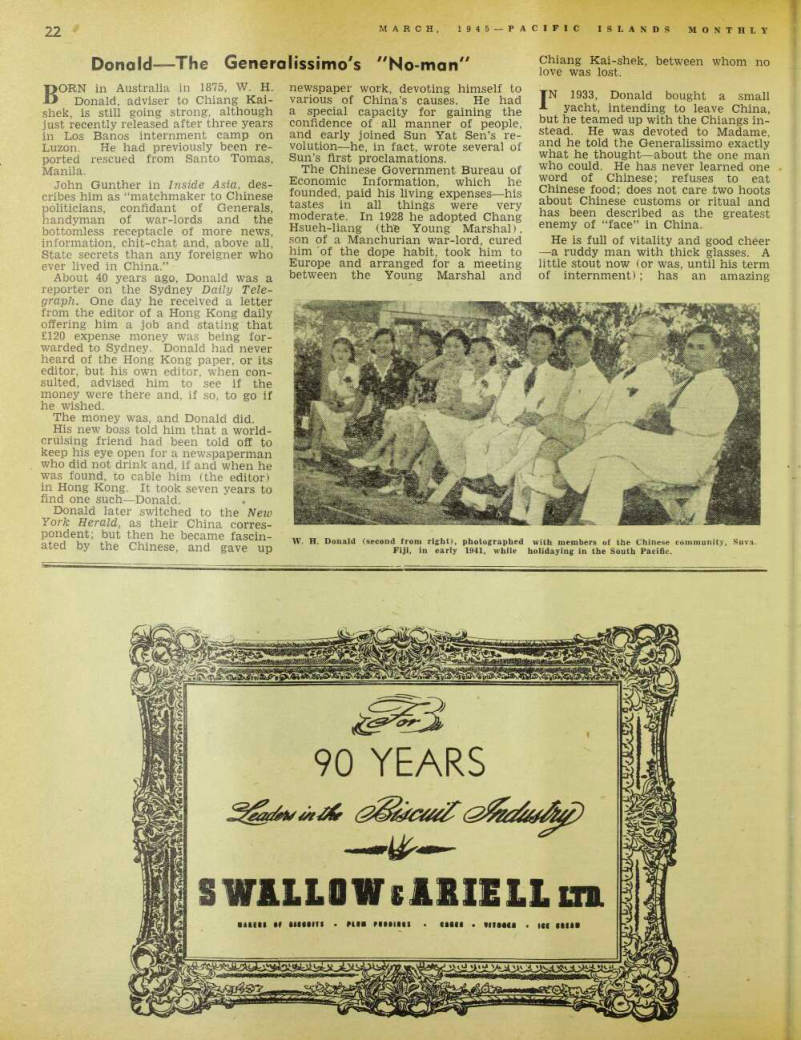
BORN in Australia in 1875, W. H.
Donald, adviser to Chiang Kai shek, is still going strong, although just recently released after three years in Los Banos internment camp on Luzon. He had previously been re ported rescued from Santo Tomas, Manila.
John Gunther in Inside Asia, des cribes him as “matchmaker to Chinese politicians, confidant of Generals, handyman of war-lords and the bottomless receptacle of more news, information, chit-chat and, above all, State secrets than any foreigner who ever lived in China.”
About 40 years ago, Donald was a reporter on the Sydney Daily Tele graph. One day he received a letter from the editor of a Hong Kong daily offering him a job and stating that £l2O expense money was being for warded to Sydney. Donald had never heard of the Hong Kong paper, or its editor, but his own editor, when con sulted, advised him to see if the money were there and, if so, to go if he wished.
The money was, and Donald did.
His new boss told him that a world cruising friend had been told off to keep his eye open for a newspaperman who did not drink and. if and when he was found, to cable him (the editor) in Hong Kong. It took seven years to find one such—Donald.
Donald later switched to the New York Herald, as their China corres pondent; but then he became fascin ated by the Chinese, and gave up
newspaper work, devoting himself to various of China’s causes. He had a special capacity for gaining the confidence of all manner of people, and early joined Sun Yat Sen’s re volution—he, in fact, wrote several of Sun’s first proclamations.
The Chinese Government Bureau of Economic Information, which he founded, paid his living expenses—his tastes in all things were very moderate. In 1928 he adopted Chang Hsueh-liang (the Young Marshal), son of a Manchurian war-lord, cured him of the dope habit, took him to Europe and arranged for a meeting between the Young Marshal and
Chiang Kai-shek, between whom no love was lost.
IN 1933, Donald bought a small yacht, intending to leave China, but he teamed up with the Chiangs in stead. He was devoted to Madame, and he told the Generalissimo exactly what he thought—about the one man who could. He has never learned one word of Chinese; refuses to eat Chinese food; does not care two hoots about Chinese customs or ritual and has been described as the greatest enemy of “face” in China.
He is full of vitality and good cheer —a ruddy man with thick glasses. A little stout now (or was, until his term of internment); has an amazing-
W. H. Donald (second from right), photographed with members of the Chinese community, Suva, Fiji, in early 1941, while holidaying in the South Pacific.
memory.and an even more amazing fund of stories.
Just before the outbreak of the Pacific war he had a holiday in the South Pacific Islands and New Zea land—he refused to stay in Australia because Australia was selling scrap iron to the Japs—and was in the Philippines on his way back to China when the Japs occupied the Archi pelago.
Even before the war the Japs had put a price on Donald’s head—they felt that he was responsible for getting British and American sym pathy for China. But they never succeeded in identifying him, although they suspected that he had fallen into their hands somewhere in the Philip pines. Although time after time they went to Los Banos looking for him. says Donald, the other internees held his identity in the strictest con fidence.
United nations censorship clamped down on all references to him—but only after a high-ranking Chinese official in London had let the cat out of the bag by stating publicly that Donald had been captured in the Philippines—but as far as was known was being tolerably well treated. Re latives in Sydney were warned that any efforts to try to trace him or communicate with him might cost him his life.
Little has yet been said of Donald’s future activities; but if ever the Chiang Kai-shek set-up needed a No man adviser of Donald’s calibre, that time certainly is now. On his release
Donald said that he was anxious to communicate with Madame Chiang; and that he was ready to do what ever she advised in order to help
China against Japan.
The final accounts for the successful carnival which was held at Nadi, Fiji, last December, in aid of war funds, showed net proceeds were £629.
The Fiji Information Office has recently begun publishing a news magazine for the people of the Gilbert and Ellice Islands. It has been called “Sail Ho”— because with these islanders the coming of news usually coincides with the arrival of a ship from the outside world.
Advertisements & other items, pp. 24-26 (1 item)
90 Years
ft* rttmtrt
V*
S WALLOWt JLIIILL in
-3 ■ •■ill If HSMITi • Ilia Mllllll . Cllll . «(!•«<« . |C( (1(11 '>l.o uia >ak g iu •< 'i,v-iy>v g ~WL>
Of special interest to
Nursing Mothers
Every mother wants to feed her baby naturally ... it is an instinct that expresses the strength of the bond between mother and child.
The mother’s diet, of course, must be planned to encourage lactation, and a cup of hot Horlicks between meals is extremely helpful. Mother and baby will both benefit from the first - class protein, essential carbohydrates, mineral salts, and vitamins in Horlicks. The system absorbs the goodness of Horlicks very quickly, a factor which helps the mother to maintain her strength. When she feels over-tired at the end of the day, a cup of Horlicks soothes nervous tension and encourages the sound, restful sleep which she needs.
It’s no trouble to make a cup of Horlicks, either, and this is something which the busy mother will particularly appreciate. Simply mix Horlicks with water only, and you have a delicious food drink, delicate in flavour and very easy to digest. Horlicks is sold in handy glass jars or in tins, price 3/-.
(Prices slightly higher in the country.)
HORLICKS
the food drink that nourishes and sustains
Purchasers at Full Market Prices on Assay Value of
GOLD
SILVER
PLATINUM
And Platinum Group Metals
SOME OF OUR SERVICES
ASSAYERS & ANALYSTS—
Assays of Bullion, Ores, etc.
Analyses of Metals, Minerals, Alloys, etc.
SCIENTIFIC & INDUSTRIAL
METALLURGISTS—
Our range of precious metal manufactures covers all Industries—Gold and Silversmiths, Electrical Trades, Dental Profession, Glass Sllverers, Electro-Platers, etc., etc.
REFINERS—
Purchasers and Refiners of Bullion, Scrap, Mining By-Products, and Trade Residues of every description carrying Precious Metals.
GARRETT fir DAVIDSON
PTY. LTD.
824 George St., Sydney. Works: Surry Hills and Chippendale, N.B.W.
Official Assayers to the Bank of New South Wales. Gazetted Agents of the Commonwealth Bank of Australia, under the Gold Regulations of the National Security Act.
GILLESPIE’S
The Flour
TRADE
MARK
of the Islands
(- SYDNEY -
AUNT
MARYS
BAKING POWDER
SUPPLIES ARE NOW AVAILABLE. If your local supplier is out of stock he will readily obtain Aunt Mary's Baking Powder for you. After all, quality is worth waiting for, especially when it is Aunt Mary's Baking Powder, which maintains the high quality which has stood the test for over 70 years.
Island Potters
—And Their Wares
By F. J. Morgan
fpHE craft of the potter is one of the JL oldest known to man. Fragments of pots have been found in the most ancient sites of human habitation throughout Europe, Asia, and both North and South America.
Yet, notwithstanding the high develop ment of Polynesian society in the Pacific, pottery was neither known nor used by them. This is all the more remarkable since races of both sides of Polynesia were adept potters.
The Polynesians used only coconuts,
shells or carved wooden bowls for carry ing liquids or as food containers, but earthenware vessels of excellent workman ship were made in many places from Papua to Fiji. Tonga is the one exception! in Polynesia; but in this case it is con sidered that the craft was introduced from Fiji.
IN many of the islands certain villages specialise in making pots which are traded for food or weapons. In the Port Moresby district, pottery is still a thriving industry. The red unglazed pots find a ready market on the coast of the Gulf of Papua in exchange for canoes filled with sago.
In the New Hebrides, where the trade is confined to the west coast of Espiritu Santo, the local pots are similar in design to those made in Fiji and common to Melanesia.
Except in Fiji, glazed ware is not made without European influence. In parts of New Guinea, however, the salt water treatment of water vessels may possibly result at times in a light salt glaze.
Fijian potters evolved an interesting method of. producing a glazed article by applying Kauri gum to the hot surface after firing. These pots are used for storage of liquids. This art is apparently peculiar to Fiji.
Whilst, in general, island pottery is red or brown, variations are produced by the use of white pigment, and a wide range of ornamentation, by inscribed lines or decorated edges.
Although the potter’s wheel is unknown in Melanesia, native pots are symmetrical in appearance and very well finished. In some places the quality of clay and work manship is so good that very large vessels, which ring loudly when struck sharply, are produced with remarkably thin walls.
That pottery is not a recent introduc tion into the islands can be proved in many places. In New Guinea and in the New Hebrides, fragments of pots of very early origin have been found on sites of vanished villages. Some of the older pot tery which has been unearthed on sites of ancient villages w which were abandoned centuries ago is superior to the local modern article.
A representative collection of island pottery from the south-west Pacific can be seen at the Australian Museum in Sydney, and at other museums in Aus tralia and New Zealand.
POSSIBLY because the potters are women accustomed to baking tradi tional shapes of utility value only, no attempt appears to have been made to produce small pots such as might be carried in a service kit. Although some makers of native weapons, grass-skirts and necklaces seem to have enjoyed in the last year or so a whole century’s normal turnover, no sign of wholesale trade in pottery souvenirs has yet been reported, although some servicemen have made use of native pots for various purposes.
In a few more years outside influences may have introduced glazes and altera tions to shapes in the islands. There will never be a better opportunity than the present for native potters to open up trade with the many museums, large and small in USA and elsewhere, who are usually interested in adding to their col lections with examples of pure native craftsmanship, however primitive it may be.
Captain “Jimmy” Smith, now well on in his ninth decade, sends greetings from Vatukaula, Savu, Fiji. He lived on Abe mama for many years, and was there in 1942; “but,” he writes, “the Japs did not finish me off, as they did many of my friends in the Gilberts.”
A Pioneer Passes
Charlie Coppard of Misima
CHARLIE COPPARD, one of the ori ginal pioneers of Misima Island (Papua), died there on January 21, at the age of 79, having left the Territory only once in the 40 odd years of his re sidence.
He and five others—Bob Boyd, Sandy Grant, Dick Smith, “Black” Reid and Jimmy the Reefer (James Carlow)—went to Misima from Cooktown, Queensland, somewhere between 1888-90, and started alluvial workings. Most of the others subsequently drifted away, but Coppard stayed on and later developed a small coconut plantation, as a side-line.
When Broken Hill Block Ten started operations on the island, Coppard went to work for them until the price of gold fell and Broken Hill pulled out. When Cuthbert’s took over the old Broken Hill workings, Coppard became attached to the company and continued with them until the end; of later years, however, when he became too old for active min ing, he merely supplied them with coco nuts and produce for the native labourers and lime for the mine.
He made his only trip South about nine or ten years ago, when Mr. Bob Bunting induced him, to fly from Sydney to Mel bourne—that impressed itself upon his mind more than any other aspect of southern civilisation.
During the whole evacuation period after the beginning of the Pacific war he remained on the island.
He was held in highest esteem by Misima—ari?T other Papuan—residents. He was honest, straightforward and likeable —typical of the best of the pioneers who, towards the end of last century, wrote the opening chapters of Papua’s story.
Value of Palms and Driers Headaches
Driers Headaches for War Damage Conditions
VARIOUS reports from New Guinea plantation owners, who have been in consultation with the War Damage Commission, indicate that the Commission is experiencing difficulty in trying to assess the value of plantations on the new basis permitting compensation for in direct war damage.
Under the old regulations no compen sation was payable for plantations which had deteriorated through neglect. Under the new regulations, all such deterioration is assessable as war damage.
Among other things which the Com mission has to decide is: What is the value of a palm that was abandoned in 1942, that is still healthy but which has suffered from neglect?
What was the value of a palm that was destroyed as a result of war operations in 1942? In 1943? And in 1944?
The old pre-war valuation of one coco nut tree was approximately £l. It is estimated that it costs 5/- to clear the ground and get one palm growing strongly.
Then there must ensue from five to seven years of attention and cultivation before the palm bears. In spite of all this, a number of NG planters have been putting in claims to the War Damage Commission in which they assess the value of their individual palm trees at 5/-.
In many cases, copra driers have to be claimed for as property lost, directly or indirectly, as a result of war conditions.
What is the value of a copra drier? The estimates vary widely. As far as can be ascertained, it costs not less than £lOO to
build a good copra drier of the Ceylon type. Yet a number of people have put in claims for copra driers as low as £2O.
A statement by the War Damage Com mission, outlining the basis upon which such damages are assessed, would be wel comed by the majority of planters from Papua and New Guinea.
Cost Of Living Bonus
For Fiji's Public Servants
From Our Own Correspondent
Suva, Feb. 1.
A BONUS, to offset the increased cost of living in Fiji, has been announced for civil servants and pensioners, by the Government.
It will be on the following scale:
The bonus will be payable with monthly salaries commencing from January, 1945, and it will be revised from time to time.
Mr. C. C. Beckett, who was for many years an officer of AWA and who served at various stations in the Mandated Terri tory of New Guinea, recently spent many interesting months as a Press Relations official with the Australian and American forces thrusting north-westward in the western Pacific. He saw many of General MacArthur’s most interesting operations.
Then he contracted pneumonia and, after a spell in an American hospital in New Guinea, he was sent south. He is now convalescent and making a good recovery.
Salary Group (Per Annum) Bonus £ 1— 76 65% 77—200 £50 lump sum 201—600 £30 lump sum plus 10% 600 onwards £90
Advertisements & other items, p. 27 (1 item)
Are Advertising Sauces . . .
All the leading daily
j ourn als and the Women’s papers too are carrying announce-
ments publicising
HEINZ Tomato Sauce and HEINZ'*S7” Beefsteak Sauce.
Secure your share of the trade this advertising will create reorder at once!
H.45/8
win?
57 m Te
s auce
s IT haven! • you yet tried this dUlereni tangV * auCe au Do so • • • w.,.u be delighted
TOMATO
SAUCE i
Y»o u'u with it 37 • **uci ° ** • » V. c * 4
LTD
PTY
J. HEINZ CO.
H.
Major Trench, of BSI, Gathers Information
Patrol
(From a hook by Harold Cooper on the war in the South Pacific)
ON Guadalcanal, late in 1943, with New Georgia wrested from the enemy’s grasp, the finishing touches were be ing put to for the liberation of other islands in the western Solomons.
One of these islands was well-known to Major David Trench, the Acting-Resident Commissioner, and he readily volunteered to reconnoitre it with a mixed Allied patrol.
The task of the patrol, which was to be put ashore after making the journey from Guadalcanal, was to ascertain the size of the Japanese garrison and to select beaches where an invasion force might later disembark. It was not exactly the sort of work the Colonial Office had in mind when it drew up its curriculum for the Cadets’ training course which Trench had attended at Cambridge; but his experience with native scouting par ties on Guadalcanal had taught him all the bushcraft he needed.
This is how Trench afterwards described the three eventful days he spent on the island: WE arrived offshore in perfect weather —by which I mean that it was as black as pitch and raining like hell.
We had no information whatever about Jap dispositions on the island, so we decided to go in to what seemed the best points and chance our arm.
“We dropped two patrols off the western end of the island first and then our patrol was dropped off the eastern
end. The night was starless and, although the boys gave us a bearing to paddle by, we had the helpless feeling of not knowing quite where we were going There was a sharp little sea running, ’ but our boats behaved beautifully “We were close enough to the coast to determine our exact position and we found we were about five miles west of where we should have been. This meant we were coming in roughly at the point where the two other patrols should have been dropped.
“We were just debating what to do when a dark shape loomed up on the water in front of us. I don’t need to tell you that we moved towards it with a certain amount of caution, for the last thing we wanted to get mixed up in was a night naval action fought from small boats at point blank range “When we got within fifteen yards of the shape we heard the unmistakable click of a carbine rifle being cocked and realised that we’d run into one of the boats from the other patrols.
been* rTOm° forH^haT^sor^of^hina
moved Soto it and Earned Dants west of the island O like^us PP fhnnd thPv were making for shore far na axm f. lol snore lar from then in-
“We took counsel and decided to go in together. This we did, making the land ing without incident. We hid the boats and then dispersed into the bush in dif ferent directions. That was the last we saw of the other patrols until a few hours before the time arranged for re-embarka tiom ' “11TE sat down quietly in the bush for Tf about an hour until the moon was up and while we were waiting we made up our minds that, since we were so far from the area we had been ordered to reconnoitre, the best thing to do was to make our way boldly along the beach, in order to reach our objective with as little delay as possible. We had to take account of that fact that, by the time our mission was accomplished, we might have the Nips on our tail, in which case we should need an extra half day or so in which to make a devious withdrawal through the thickest jungle we could find As we had been warned that the natives might be unfriendly, our policy at first was to avoid contact with them—a some what troublesome proposition, as the course we’d charted took us through two villages.
“We negotiated the first with what we were pleased to regard as a velvet tread and got through safely, but as we ap proached the second a dog heard us and let forth a series of yelps which we felt sure were audible in Rabaul. A man in the village woke up and came sleepily to the door of his hut, but we kept right on down the main street, hoping he’d take us for Japanese. He did.
“During this night trek we saw no sign of the enemy, but a Solomon Islands ser geant who was with us picked up the tracks of a Jap patrol in the sand. We reached our objective in the first light of
dawn and then cut into the bush to ap proach it from the rear.
“As dawn broke we came across more and more signs of Jap activity and by the time it was fully light we were on the very outskirts of an enemy camp, which we could hear coming to life, with a babble of raucous sound, no more than two hundred yards away. We edged on a little further and got to the bank of a river, the mouth of which it was part of our task to reconnoitre.
“This was the point where we had ori ginally intended to land; and it was for tunate indeed that we missed our way, for otherwise we should have landed in the arms of the Japs, and that would have been the end of our adventure and probably the end of us.
“117’E found the Japs were disposed f? along the river in considerable strength and that it was impossible to cross it. So we withdrew through the bush parallel with the beach, this time keeping well clear of all villages. But our luck was out, for we ran into one old woman who was working in a garden.
She took one look at us and fled shrieking into the bush.
“We pushed on with our fingers crossed more firmly than ever, and by 4 p.m. we’d managed to cover a fair amount of ground, turning at right angles for an occasional furtive trip down to the beach so that our landing expert could take photographs and make notes.
“By now we were all dog-tired and we decided to bivouac for the night. As we were settling down two natives suddenly appeared on the scene, and we thought for a moment that the jig was up., But it was soon apparent that the stories we’d been told about the unfriendly attitude of the Islanders were very wide of the mark.
“Our two visitors hailed us with obvious delight and were disappointed when I did not immediately recognise them as old acquaintances. They gave us any amount of useful information, including the ex tremely welcome tip that it was the custom of the Japs to maintain a patrol on the stretch of beach which it was our job to reconnoitre the next day.
“The natives spent the night with us and in the morning led us to the head quarters of the local Chief, who stripped his larder bare to provide a feast fitting for the occasion. With the aid of a strong escort, mustered by the Chief, we were able to keep so closely in touch with the movements of the Jap patrol that during the day we made a thorough examination of almost every yard of the beach in which we were interested.
“rnHERE were two mildly diverting in- A cidents. At one stage we heard a number of heavy detonations and asked a native what they were. He said he didn’t know, but would go and find out. About a quarter of an hour later he came back and informed us that some Jap guns were being test-fired. We asked him how he knew and he replied: ‘Oh, I just went down and asked the Jap patrol,’
“The other laugh we got that day was when our native sergeant volunteered to go down to the beach and take photo graphs of the Jap patrol from close range.
We explained the mechanism of the camera and he went off determined to make a success of the job. When he came back he reported that he’d taken a number of excellent shots. Unfor tunately our instruction had not been quite painstaking enough, for we dis covered he’d taken them all on the same section of film.
“After a night spent in great copifort as the guests of the Chief we set out slowly on the morning of the third day
for the point at which the boats were hidden. On our way we were disturbed to receive news that a native messenger we had sent to warn our other patrols of the Jap dispositions had failed to con tact them but had run into a party of Japs, who had told him that there were Americans on the island, and that all hatives should be on the lookout for them.
“Our sergeant, who was the real hero of the expedition, volunteered to go back himself and endeavour to contact the patrols. This he managed to do. Our anxieties for them were groundless, for they, too, had found native friends who, throwing a protective screen round them, were bringing them through the bush to our point of rendezvous at a rousing pace.
“fpHEIR mission, like ours, had laeen X completed with only minor mis adventures. Once one of their native NCO’s and another man had been separated from the rest of the patrol and had bivouacked by" themselves in the bush. In the morning they were awak ened by a Jap bugler sounding Reveille about fifty yards away; and the NCO, still half asleep, had stumbled to his feet and almost fallen in with the Japs from sheer force of habit.
“On another occasion one of the patrols ran slap into a Jap patrol. The two patrols stood staring blankly at each other for several seconds before deciding to make off in opposite directions.
“That night, with natives mounting guard in a semi-circle round our beach hide-out, we were able to re-embark in our boats in perfect security and this time our steering was so accurate that we soon made contact.
“Once aboard we were quickly in good spirits again and on the homeward voyage we could always work up a glow of satis faction by picturing to ourselves the bad tempered behaviour of the Japanese on the island, who undoubtedly spent the next few days thrashing about through some of the most unpleasant country in the South Pacific, in pursuit of an enemy who was safely out of their reach.”
TRENCH was taken • back to Guadal canal, where he resumed his duties as Acting-Resident Commissioner.
The patrol had been a pleasant inter lude. He began to think of drawing up, an advertisement for use by the Recruit ing Branch of the Colonial Office. It would describe the life of an Adminis trative Officer in the Western Pacific and would carry the headline, “Never a Dull Moment!”
Advertisements & other items, p. 28 (1 item)
Equal to the World’s Best
Throughout Australia and Overseas there is on ever-increasing demand for
COLONIAL & BRONTE
high-grade canned meats
There is no better quality—none more wholesome.
TRADE MEATS FOR THE ISLANDS
. - order <<
COLONIAL” BRAND
Roast, Corned and Boiled Beef Packed in 6, 5. 4,3, 2, 1 lb. and 12 oz. tins.
Also Corned Beef in 12 oz. Taper Tins.
Roost, Corned and Boiled Mutton. 1 lb. and 12 oz. tins.
Choice Dripping
36 lb., 2 lb., 1 lb. tins, and 1 lb. packets. ttt
p -:p S
S
DELICIOUS
/i
BRONTE" HOT MEALS
Steak and Kidney Podding.
Beef Steak Pudding.
Sausages and Tomato.
Sausages and Vegetable.
Lamb and Green Peas.
Corned Beef and Boston Beans with Tomato Sauce.
Steak and Tomato.
Under present conditions it is wise to ensure that you have ample stocks of all our lines.
The Colonial Wholesale Meat Coy. Pty. Ltd.
30 GROSVENOR STREET, SYDNEY
"Friendly" Islands
Letter to the Editor IN a little speech I made some time ago, when our Foa people were entertain ing HBM Consul and Agent from Nukualofa, and Dr. McGusty, from Suva, I said I would like to endorse Captain Cook’s remarks, as written in his log book: “The Tonga people are hospitable and are friendly”—and that was why he called Tonga the Friendly Islands.
A few days later, I was approached by one of our local European residents who censored my remarks. He said my expression should have been: “The Tonga peonle were at that time hospitable and friendly, but have changed a lot since those days.”
I do not accept that. I left the Old Country 62 years ago, and, during those 62 years, I have been twice around the world, have visited five continents and most of the islands of the Pacific —Hawaii, Samoa, Tonga, New Guinea, New Britain.
New Ireland, all the different islands nearby, the Solomons (Buka and Bou gainville), Marshall, Gilbert and Caroline, I have sat and eaten with kings and princes, European and native, and I have sat and slept with the worst cannibals in New Britain in 1884-5. So I should know something about people.
I do not want to say that our Tonga pedfcle are angels and saints. They have their good and bad here, as in the world all over. But I endorse Captain Cook’s remark of 150 years ago: “The Tonga people are hospitable and friendly.”
I am, etc.,
Haapai, Tonga.
P. T. Goedicke.
Advertisements & other items, p. 29 (1 item)
Steamships Trading
Company Limited
PORT MORESBY
SAMARAI
PAPUA.
WHOLESALE Gr RETAIL MERCHANTS, SHIPOWNERS,
PLANTERS, ENGINEERS b SLIP PROPRIETORS.
Customs, Shipping, Insurance, and Forwarding Agents.
MANAGING AGENTS AND VISITING REPRESENTA-
TIVES FOR COCONUT AND RUBBER ESTATES.
SYDNEY REPRESENTATIVES: Nelson & Robertson Pty. Lt<L, 12 Spring Street
WARTIME ADDRESS
Until further notice, clients may address all communica tionx as follows:
STEAMSHIPS TRADING COMPANY LIMITED,
C/o NELSON & ROBERTSON PTY. LTD.,
12 SPRING STREET, SYDNEY.
Rotuma
A Garden In
By “Amel”
IT has always been my opinion that the best place to have a vegetable garden is somewhere near the flower garden . . . that is, as close to the house as possible. After all, one does not usually grow one’s flowers in a distant part of the bush. The idea is to have them somewhere handy, to see and enjoy. And so it should be with vegetable gardens.
In Fiji, the main drawback to having a garden near the house was the over abundance of land-crabs, annoying crea tures with large burrows and voracious appetites, extremely partial to flowers and vegetables, small puppies, kittens, chick ens and even human beings . . . accord ing to Dad!
He was trailing one—or maybe it was trailing him!—around the verandah in his bare feet one dark night, and he couldn’t find the torch or the matches.
His imagination worked overtime. He said it had eyes like clothes pegs and he could hear its claws clanking as it prepared to spring at his throat. We reckoned it must have been his knees
knocking together!
HERE in Rotuma, we have no crabs to contend with: but the other pests are overwhelming. We are sur rounded with a great variety of livestock belonging to our neighbours. Of course, as far as fowls are concerned, it must be admitted that ours also do their share
of scrat c*}ing where they should not—but we consider that they are privileged. . Tlle , ne l ghbours ’ livestock, however, does not stop at fowls. It also includes norses, cows, goats, pigs, ducks and dogs. all of which spell ruination to a garden any sort * fV , The L do f 1 eat anything, but bones in. the nice soft soil of E" e garden; and it’s funny how they f" ust . slee P on the plants, even when H}f re ls ,P len ty of lawn at their disposal, ducks don’t do any scratching, but . to ar g rea t hunks out of everything H 1 anc * s*° a °f shovelling with tneir bills, which is just as bad. ur neighbours’ cows and horses never sie ®P* They prowl all through the night, rattling chains, rustling ropes, chewing riedges and pushing the fences over. In daytime, the goats and the pigs afflict us, one of the latter having the ill-grace to expire under the front porch.
J the depredations of these bipeds and quadrupeds, the elements ar . e also leagued against us. Our p i a £ e 15 situated on the windward side of M °tusa’s narrow isthmus, and is fully exposed to the sweeping, salt-laden wind blue Pacific, which withers every thing it touches.
The soil of the isthmus is almost pure sand — one can dig to a depth of eieht fppt and still find white sand—but there must be some nourishment in it, because it supports numerous coconut palms bana nas and huge native trees, all of which do very well.
But. apparently, to grow European vegetables one must add something, such
as seaweed or manure, and bring earth from the bush, to supplement the sand.
We did this, and after much hard work have managed to raise a small plot of very nice vegetables.
But with all the obstacles to be over come, there is no need to wonder why we find it easier to obtain vegetables from a tin!
Territorian Bride
Captain J. R. Grey, who has been Ship ping Controller in North Queensland for the past two years, has now been trans ferred to Western Australia to take up a new position.
A former well-known resident of Fiji, Mrs. C. H. H. Irvine, died in Sydney recently. She was married in Levuka in 1874, the year of the cession of Fiji to Britain, and her husband, who later became Attorney-General of the Colony, died in 1903. Mrs. Irvine had been liv ing with her daughter, Mrs. Doyle, in Australia, for many years, Mr. R. F. Freeman, who died recently at the age of 76 years, went to Fiji in 1888 as a chemist for the Colonial Sugar Refining Company. He stayed with the company until 1898 when he leased the Baulevu estate in the upper Rewa. Mr.
Freeman left Fiji a number of years ago and since lived in retirement in Sydney, where he died.
On November 4, 1944, Miss Shirley Evelyn Chugg married Mr. George W. J. Manners, of South Camberwell, Victoria. This photograph shows the couple leaving the church after the ceremony. Miss Chugg was born in Kavieng, TNG—one of the first white children to be born in the then newly-constituted Mandate. She is the elder daughter of Mr. and Mrs. Ron Chugg, well-known residents of New Guinea. Before the evacuation, Mr. Chugg was stationed in Madang.
Mr. Peter Kellert, owner of “Stockholm” and other plantations in eastern New Britain, has had a spell in hospital in Sydney and has undergone a couple of operations. He now is convalescent and appears to be making an excellent re covery. Mr. Kellert, and members of his household, were rescued last year by an Australian commando, after they had been prisoners of the Japs on the north coast of the Gazelle Peninsula for 2i years. While he was in hospital, Mr.
Kellert was visited by a young, smiling soldier—the officer in charge of the com mando which had rescued him in 1944.
Mr. Kellert at first did not know him— the man who got him away in the dark ness before dawn one night was rough and tough and heavily bearded, and did not look very “civilised.” A former re sident of New Guinea, who now holds a commission and a couple of decorations, may be amused to hear this description of himself.
Mr. F. G. Everett, formerly accountant at the Labasa branch of W. R. Carpenter & Co. (Fiji), Ltd., has been transferred to Rotuma, to take the place of Mr. C. E Christoffersen, who left Rotuma some months ago.
Advertisements & other items, pp. 30-32 (2 items)
Asthma, Bronchitis Coughing,
Made hy
FORD SHERINQTON LTD
Owing to war needs, supplies of "Airway" are not at present available.
Manufacturers of
G LO BITE Travel Cases
Asthma, Bronchitis Coughing, Curbed in 3 Minutes
ave attacks of Asthma or Bronchitis so bad that you can’t sleep? Do you feel weak unable to work, and have to be careful not to take cold and can’t eat certain foods* No matter how long you have suffered or what you have tried, there is new how f ol you In a doctor’s prescription called Mendaco No dopes no smokes, no injections, no atomizer' All you do is take two tasteless tablets at meals and in 3 minutes Mendaco starts work- Li hr ff your blood ’ nature to PWegm. promote free easy breathing and bring sound sleep the first night so that you soon feel years younger and stronger
No Asthma in 2 Years
comfo^ a °^nd
system to ward off future aUacks P Po? instance, J. Richards, Hamilton, Ont. Canada 40 i lbS " suffered coughing every night’ couldn t sleep. Mendaco stopped Asthma
spasms first night and he has Fad none since in over two years.
Money Back Guarantee
The very first dose of Mendaco goes right to work circulating through your blood and helping nature relieve you of the effects of Asthma. Try Mendaco under an iron-clad money back gaurantee. You be the judge If you don’t feel fully satisfied after taking°Mendaco just return the empty package and the full purchase price will be refunded. Get Mendaco from your chemist to-day and see how well you sleep to-night and how much better you feel to-morrow. The guarantee protects
RELIEVES ASTHMA
Mendaco
Now in 2 sizes . . . 6/- and 12/-
Comt:
*\ 4 1 0 m Sl. m
■ V *> v \i A \ m The famous Aladdin Kerosene Mantle Lamp gives brilliant 75-candlepower white light without pumping or pressure at a cost of approximately 2 hours’ light for one penny. As easy to light as the old-fashioned flame lamp. »V ft NOW every island home can enjoy the comj fort an d convenience of a / _%/ S' L- brilliant white 75-candlepbwer light thanks to Aladdin, the world's most wonderful lamp. Introduced to the Islands for the first time, this world-famous Kerosene Mantle Lamp is artistic in appearance, economical in use and as easy to light as an ordinary flame lamp. Burns only kerosene, the safest and cheapest of fuels— without pumping, pressure, noise, smoke or fumes. Write AT ONCE for illustrated leaflet showing the full range of table, floor pedestal, hanging and wall-bracket models.
Popular Aladdin Storm Lantern , solidly constructed of brass for hard wear. Gives vivid 200-candlepower white light from ordinary kerosene at a cost of approximately one halfpenny per hour. Widely used by Army and ISavr during the war.
AGENTS WANTED. Opportunities exist for alert storekeepers to act as authorised Aladdin storekeepers in the Islands. Special discounts and the distribution of Aladdin wicks , chimneys , mantles , shades , and spare parts are among the many advantages of the Aladdin franchise. m
uma
°. ne of the netlTT , famous Aladdin /n^ mbers °f the green ena/n I Smartly j
in^p
*93-3799
ALADDIN INDUSTRIES PTY. LTD.
61.71 BOURKE STREET. SYDNEY
PACIFIC ISLANDS SOCIETY
Visitors from the Islands to Sydney (or those Interested In Islands affairs), are advised to communicate with the honorary secretary of Ihe above Society, which has been formed to study the history, traditions, economics, and political developments of the Pacific Islands.
Regular monthly meetings are held at History House, 8 Young Street, Sydney.
Address for Correspondence:
THE PACIFIC ISLANDS SOCIETY,
Box 2434 MM., G.P.0., Svdney.
Formosa—Stepping Stone To Tokio
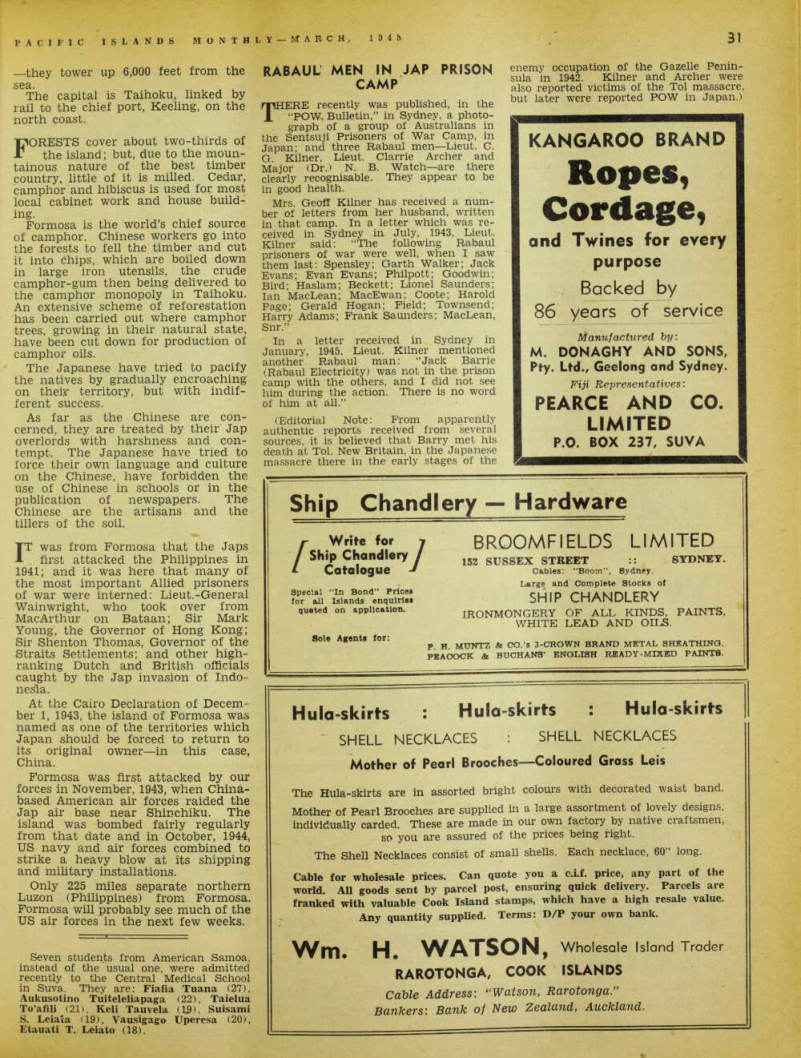
T'HE island of Formosa, situated 90 miles off the China coast, and conveniently between the Philippines and the Japanese homeland, was (until the beginning of the Pacific war) one of the least-known regions of the world. We have learned some thing in the last three years of this semi-tropical region where Japan trained her jungle-fighters, and now, with the Philippines liberated by MacArthur, we are destined soon to learn much more. There are nearly 6,000,000 people in Formosa.
One hundred and fifty thousand native tribesmen live mostly on the island’s mountainous eastern half.
They are of Indonesian stock and have racial and cultural resemblances to the natives of northern Luzon. They speak a language that belongs to the Malaya-Polynesian group and, among their more annoying habits (from the Jap viewpoint) is that of head hunting. Both the Japs—and the Chinese before them—had much trouble with these unquellable moun tain tribes. rpHE island is said to have been dis- A covered by a Portuguese navi gator who named it “Ilha Formosa” (Beautiful Island). The Dutch settled there about 1624 and remained until 1661. Chinese started to migrate in large numbers about the same time and at the end of the century annexed the island.
After the conclusion of the war be tween China and Japan, in 1895, Formosa was ceded to Japan and ex ported by her. The present non mdigenous population is 5£ million Chinese and 300,000 Japanese. The pre-war European population was negligible: members of the American or British Consulates and a few tea merchants.
Japan has put a great deal of money into improving and building railways, roads and power plants. The Japs created monopolies for camphor, opium and salt, introduced pineapple growing and canning, stimulated sugar cane, rice and tea production.
Coal, gold, copper, petroleum were of fair importance. But, in spite of these things, the migration of Japa nese settlers was. small, in view of the overcrowded millions in their home land. Most Japanese were “white collar workers” who regarded Formosa as a means to an end—the end being a return to Japan with some degree of wealth.
The island lies, roughly, between 25 and 22 degrees north latitude. A chain of mountains runs north and south on the east coast, some peaks rising to 14.000 feet. The short winter is wet and, particularly in the mountains, cold. The summers are long and humid. Typhoons are pre valent in the season.
On the east coast, near Suo, are some of the highest cliffs in the world
—they tower up 6,000 feet from the sea.
The capital is Taihoku, linked by rail to the chief port, Keeling, on the north coast.
FORESTS cover about two-thirds of the island; but, due to the moun tainous nature of the best timber country, little of it is milled. Cedar, camphor and hibiscus is used for most local cabinet work and house build ing.
Formosa is the world’s chief source of camphor. Chinese workers go into the forests to fell the timber and cut it into chips, which are boiled down in large iron utensils, the crude camphor-gum then being delivered to the camphor monopoly in Taihoku.
An extensive scheme of reforestation has been carried out where camphor trees, growing in their natural state, have been cut down for production of camphor oils.
The Japanese have tried to pacify the natives by gradually encroaching on their territory, taut with indif ferent success.
As far as the Chinese are con cerned, they are treated by their Jap overlords with harshness and con tempt. The Japanese have tried to force their own language and culture on the Chinese, have forbidden the use of Chinese in schools or in the publication of newspapers. The Chinese are the artisans and the tillers of the soil.
IT was from Formosa that the Japs first attacked the Philippines in 1941; and it was here that many of the most important Allied prisoners of war were interned: Lieut.-General Wainwright, who took over from MacArthur on Bataan; Sir Mark Young, the Governor of Hong Kong; Sir Shenton Thomas, Governor of the Straits Settlements; and other high ranking Dutch and British officials caught by the Jap invasion of Indo nesia.
At the Cairo Declaration of Decem ber 1, 1943, the island of Formosa was named as one of the territories which Japan should be forced to return to its original owner—in this case, China.
Formosa was first attacked by our forces in November, 1943, when China based American air forces raided the Jap air base near Shinchiku. The island was bombed fairly regularly from that date and in October, 1944, US navy and air forces combined to strike a heavy blow at its shipping and military installations.
Only 225 miles separate northern Luzon (Philippines) from Formosa.
Formosa will probably see much of the US air forces in the next few weeks.
Seven students from American Samoa, instead of the usual one, were admitted recently to the Central Medical School in Suva. They are: Fiafia Tuana (27), Aukusotino Tuiteleliapaga (22), Taielua To’afili (21), Keli Tauvela (lih, Suisami S. Leiata (19), Vausigago Uperesa (20), Etauati T. Leiato (18).
Advertisements & other items, p. 32 (1 item)
William Atkins Pty. Ltd.
Head Office 449-451 KENT ST., SYDNEY.
Iron & Steel Merchants-Engineers' Supplies
Coach Cr Motor Hardware
ESTABLISHED OVER 50 YEARS
Cable Address: WILATKIN, Sydney.
-STEEL DEPARTMENT-—-—_
MILD STEEL:
Rounds, Squares, Flats, Half-rounds, Hexagons, Bevel,
Shoeing, Tyre, Angles, Tees, Sheets, Plates, Girder
Plates, Chequer Plates, Channels, Hoops, Etc.
BRIGHT STEEL;
Rounds, Squares, Hexagons.
Extra Special High Speed Tool Steel, Mining Steel, Blister Steel and Spring Steel, Rounds, Flats £r Squares.
Bor Iron All sections and sizes.
Engineers' Supplies; Set Screws, Studs. Metal Thread Screws, Coach Screws, Files, Cotter Pins, Bright and Black Bolts, Rivets, Etc., Hack Saw Blades.
Power Transmission Gear: Including Plummer Blocks, Couplings, Collars, Etc.
Coach and Motor Hardware: Axles, Springs, Wheelstuff. Duck, Paints.
Farriers' Supplies: Horse Nails, Anvils, Vices, Etc.
Motor-Trimmers and Motor Builders' & Motor Painters' Requirements
C. A. WILLEY'S
Quick-Drying Coach and Car Paints. Roughstuff, Elastic Gloss, Synflex Enamels, Lacquers.
DUCO Lacquers and DULUX Enamels—FAßßEX Motor Toppings and Leather Cloths, House a Decorators' Paints, Varnishes tx Brushware.
Sole Distributors of CHAMPION'S Decorators Point Products.
Distributing Agents for BROLITE Lacquers, SYNFLEX Enamels and "POLYGLOSS" Finish.
Rabaul Men In Jap Prison
Camp
rERE recently was published, in the “POW, Bulletin,” in Sydney, a photo graph of a group of Australians in the Sentsuji Prisoners of War Camp, in Japan; and three Rabaul men—Lieut. C.
G Kilner, Lieut. Clarrie Archer and Major (Dr.) N. B. Watch—are there clearly recognisable. They appear to be in good health.
Mrs. Geoff Kilner has received a num ber of letters from her husband, written in that camp. In a letter which was re ceived in Sydney in July, 1943, Lieut.
Kilner said: “The following Rabaul prisoners of war were well, when I saw them last: Spensley; Garth Walker; Jack Evans; Evan Evans; Philpott; Goodwin; Bird; Haslam; Beckett; Lionel Saunders; lan Mac Lean; Mac Ewan; Coote; Harold Page; Gerald Hogan; Field; Townsend; Harry Adams; Frank Saunders; Mac Lean, Snr.”
In a letter received in Sydney in January, 1945, Lieut. Kilner mentioned another Rabaul man: “Jack Barrie (Rabaul Electricity) was not in the prison camp with the others, and I did not see him during the action. There is no word of him at all.” (Editorial Note: From apparently authentic reports received from several sources, it is believed that Barry met his death at Tol, New Britain, in the Japanese massacre there in the early stages of the
enemy occupation of the Gazelle Penin sula in 1942. Kilner and Archer were also reported victims of the Tol massacre, but later were reported POW in Japan.)
Advertisements & other items, p. 33 (1 item)
Ropes,
KANGAROO BRAND
Cordage,
and Twines for every purpose Backed by 86 years of service Manufactured by:
M. DONAGHY AND SONS,
Pty. Ltd., Geelong and Sydney.
Fiji Representatives:
PEARCE AND CO.
LIMITED
P.O. BOX 257, SUVA
Ship Chandlery Hardware
r Write for j
j Ship Chandlery /
I Catalogue J
Special “In Bond” Prices for all Islands enquiries quoted on application.
BROOMFIELDS LIMITED
152 SUSSEX STREET SYDNEY.
Cables: "Boom”, Sydney.
Large and Complete Stocks of
SHIP CHANDLERY
IRONMONGERY OF ALL KINDS, PAINTS,
WHITE LEAD AND OILS.
Sole Agents for: P H MUNTZ St CO.’S 3-CROWN BRAND METAL SHEATHING.
PEACOCK & BUCHANS’ ENGLISH READY-MIXED PAINTS.
Hula-skirts : Hula-skirts : Hula-skirts
SHELL NECKLACES : SHELL NECKLACES
Mother of Pearl Brooches —Coloured Grass Leis The Hula-skirts are in assorted bright colours with decorated waist band.
Mother of Pearl Brooches are supplied in a large assortment of lovely designs, individually carded. These are made in our own factory by native craftsmen, so you are assured of the prices being right.
The Shell Necklaces consist of small shells. Each necklace, 60” long.
Cable for wholesale prices. Can quote you a c.i.f. price, any part of the world. All goods sent by parcel post, ensuring quick delivery. Parcels are franked with valuable Cook Island stamps, which have a high resale value.
Any quantity supplied. Terms: D/P your own bank.
Wm. H. WATSON, Wholesale Island Trader
RAROTONGA, COOK ISLANDS
Cable Address : “ Watson , Rarotonga .”
Bankers : Bank of New Zealand, Auckland.
World History
On April 25: Most Important Meeting in World History
rpHE most important assembly m the A history of the human race will take place in San Francisco on April 25 1945. Representatives of all the belligerent nations—except Axis and non-liberated nations—will gather there to create an international organisation which will prevent another World War, and which may take steps to remove the causes of war (greed, poverty, injustice, oppression), World War I ended in an Armistice, based on the Fourteen Points of President Wilson. The Fourteen Points provided for the creation of a League of Nations—which was to prevent future wars. The League was hamstrung from its inception mostly because two of the world’s four greatest nations, United States and Russia, were not members. USA, home of the Fourteen Points, swung to isolationism, and abandoned the League. Russia was in the throes of revolution. From about 1931, the League became merely a gorgeous facade at Geneva, and the Rome- Berlin-Tokio Axis, unchecked, prepared for World War 11.
Having bv a escanpd g thp npHis S nf l i e Q‘RQ°L m 5 C i 0S ’
Ji.? ? enl . s °f 1939-42 and become world-dominant in 1944-45, the three Great Powers of Britain, United States and Russia are planning an
international authority which will prevent war. In September and October, 1944, the representatives of the United Nations (United States, Russia, Britain and China) met in conference at Dumbarton Oaks, United States; and they there ham mered out the framework of a plan for an international organisation designed to police the post-war world, forbid wars and, above all, re move the economic and social condi tions which lead to international friction.
The conference finished on October 7, and the outline of the plan quickly was submitted to every non-Axis Government in the world. Wholly in principle, and generally in substance, it was approved by all the Allied nations (over 20).
WHEN the Big Three (Churchill, " Roosevelt and Stalin) met at Yalta, In the Crimea, in January, and got ready for the final and early destruction of the power of Germany and Japan, they resolved also that there should be a very early confer ence of all the nations, to form the international organisation outlined at Dumbarton Oaks. That is the con ference to be opened in San Francisco on April 25.
The proposed set-up has as yet no
name: it still is referred to as “an organisation.” It must have a head quarters; but no place has even been hinted at.
Practically all the non-Axis nations capable of expressing an opinion have approved the plan; but, whether they approve or not, the plan will go through, and will function, because the Big Three, being in this matter completely in accord, have agreed that it shall. The rest of the nations will do what they are told—or else!
Those of us who have seen the horrors of two World Wars, and wit nessed the pitiful breakdown of the League of Nations because it was too cumbersome, and had no teeth, can but thank God that at last there has arisen an authority (the Big Three) strong enough to really take charge of world affairs, and with vision enough to make an intelligent attempt to drag humanity out of the morass into which it has fallen.
The Dumbarton Oaks plan, which the ’Frisco conference will implement, is too long for publication'here. But we have compiled, from the official report issued on October 11, the following summary of its recommen dations:
Dumbarton Oaks Plan
AN organisation is to be set up to main tain international peace and secur ity, by collective action. There must be international co-operation in the solu tion of economic and social and other humanitarian problems, which otherwise might lead to international friction, and
to war. A centre is to be found, where international action for these purposes may be harmonised.
In pursuit of these purposes, the members of the international organisation should act in accordance with a set of principles, which include the sovereign equality of all peace-loving nations; and each member to accept certain obligations for the purpose of maintaining world-wide peace. Each member is to assist the organisation where necessary in enforcing the Charter, and to refrain from assisting non-member States in resisting the organisation. All peaceting States may become members.
The structure of the organisation should be; A General Assembly; a Security Council; an International Court of Justice; a Secretariat; and whatever subsidiary agencies may be found necessary.
The General Assembly, comprising representatives of member States in numbers fixed by their individual char-
ters, should meet annually to consider any matters relating to the maintenance of international peace, and to make recommendations concerning same to the Security Council, and to other executive agencies of the organisation. Each mem ber should have one vote, and important decisions should be made only by a two thirds majority.
Subject to certain clearly defined rules, the security Council should be the execu five boc jy of the organisation, and should exer cise absolute power in carrying out the ob j ec ts of the organisation: and all mem ber States should accept the obliga tion to support the Council in that respect. The Council should consist of one representative of each of 11 States (five of which should always represent Britain, United States, Russia, France an fi china, and six elected by the Gen eral Assembly). Voting procedure in the Security Council has still to be fixed. The Security Council should function contmu ously; but, while each member State
should have permanent representation at the organisation’s headquarters, the Council should have liberty to meet any where, at any time.
The International Court of Justice should be constituted in accordance with a Statute which would be part of the Charter of the organisation.
International disputes which threaten peace should be dealt with immediately by the Security Council, which is empow ered to take any action deemed neces sary. Normally, disputes which appear
incapable of settlement by negotiation, should go to the Court of Justice. But if the threat to peace is urgent, or if reference to the Court is impracticable, or if the authority of the Council or the Court is defied, then the Council may take any measures it thinks fit to main tain the peace, including the use of armed force.
“Nothing in the Charter should preclude the existence of regional arrangements or agencies for dealing with such matters relating to the maintenance of inter national peace and security as are appro priate for regional action’ —but, of course, all regional arrangements are to be in accord with the purposes and principles of the organisation.
The General Assembly should set up an Economic and Social Council for “the creation of conditions of stability and well-being, which are necessary for peace ful and friendly relations among nations.”
The General Assembly would nominate 18 States, whose representatives would constitute the E. and S. Council. The Council would have a permanent Secre tariat. and would have power to carry out the decisions of the General Assem bly; to make recommendations, on its own initiative, to the Assembly; to receive and consider renorts from all agencies brought into relationship with the organisation.
TO better understand what is planned, a comparison may be made between the League of Nations and the proposed set-up, which may be called DO (Dumbarton Oaks).
In the League, the paramount authority lay with the General Assembly, which was composed of the representatives of "'some 50 little nations, and a few big nations, and in which the vote of the little nation was almost equal to that of the big nation. The Council appeared to be important—actually, it was dragged always at the tail of the Assembly.
The DO plan places the authority wholly and absolutely in the hands of the Security Council, which can en force the co-operation of member States in maintaining peace.
In the League set-up, the nations could withdraw, and ignore their obligations, and little could be done about it.
Under the DO plan, nations which do not join the “organisation” will be at a very grave disadvantage in world affairs; and those who do wish to enter may not do so until they have given certain undertakings that they will support the Council in whatever police actions the Council considers necessary.
In the League organisation, the con trol was clumsy and top-heavy. In the new set-up, the control will be in the hands of a permanent Security Council of eleven persons, five of them the direct representatives of the Big Three, France and China.
Under the League, any nation which decided to defy the League’s wishes (seizure of Manchuria by Japan, and of Abyssinia by Italy, for example) could “get away with it.” But, under the DO plan, the Security Council need not wait even for Assembly discussion; it will have authority to immediately attack the offending nation with the strong forces per manently at its disposal.
Small disputes in distant places
could not be dealt with by the top heavy and centralised League. But the DO plan provides for “regional
arrangements,” so that local disputes can be settled locally, with reference to the central authority necessary only when all other means fail.
The League, theoretically, tried to remove the causes of war, but actually it did nothing. The DO proposal provides for a special Economic and Social Council, with wide powers, the general purpose of which is to re move the economic and social causes of friction between nations.
Before the new “organisation” can function, the huge but useless struc ture of the League of Nations (which in 1928 was costing about £1,000.000 per annum) has to be got out of the way and liquidated.
Mr. Henry Dexter, formerly a trader at Milne Bay, Papua, and now a tomato planter at “Samarai,” Hayling Island, Hants., England, is 80 years old on March 26, In a recent letter, he sends greetings ■to Papua friends—and one infers from his remarks that, while his body is in Hayling Island, his heart remains with his memories in his old trade-store on Milne Bay.
Advertisements & other items, pp. 34-38 (1 item)
W. Kopsen & Co. Pty. Ltd.
SHIPCHANDLERS & HARDWARE MERCHANTS
Manufacturers °f all classes of boat-building materials and boat accessories. Agents for the best Australian hardware manufacturers. Some of the new attractive lines are as follows; Kopsen's 300 c.p. Kerosene Pressure Lamps; Thermil Kerosene Stoves; Darlton Blowlamps; CQR Anchors; Vortex Bilge Pumps; Companion Primus Stoves; Briggs & Stratton Petrol Motors and Power Generators; Dekol Wood Preservative, Alpha Antifouling Paints, Please Send List of Your Requirements for Quotation.
Simplex 10/12 h.p. Marine Engine Also made in 3 h.p. and 5 h.p.
SIMPLEX MARINE ENGINES
for all small boats are the most popular in Australia to-day.
Used by all Service Departments, including Navy, R.A.A.F., and Army. Available at present only for essential orders or licensed fishermen.
SIMPLEX LAUNCHES we regret are temporarily unavailable, but we shall be pleased to forward details on request. >.
Simplex Motor Launches, 14 ft., 16 ft., 18 ft., and 20 ft. long.
376/382 KENT STREET,
'Phone: MA6336 (6 lines).
SYDNEY, N.S.W.
Cables: Kopsen Sydney.
Kidney Trouble
and Backache
Gone in 1 Week
Flush Kidneys With Cystex and You'll Feel Fine Cystex—the prescription of a famous doctor —improves faulty kidney action in double quick time, so, if you suffer from Rheumatism, Sciatica, Neuritis, Lumbago, Backache, Nervousness, Leg Pains, Dizziness, Circles under Eyes, frequent Headaches and colds, poor Energy and Appetite, Puffy Ankles or Interrupted Sleep, go to your chemist to-day for Cystex.
Cystex Helps Nature 3 Ways
The Cystex treatment is highly scientific, being specially compounded to soothe, tone and clean kidneys and bladder and to remove acids and poisons from your system safely, quickly and surely, yet contains no harsh, harmful or dangerous drugs. Cystex wo-ks In these 3 ways to end your troubles: — (1) Starts killing, the germs which are attacking your Kidneys, Bladder and urinary system in two hours, yet is absolutely harmless to human tissue. (2) Gets rid of health-destroying, deadly poisonous acids with which your system has become saturated. (3) Strengthens and reinvigorates the kidneys, protects you from the ravages of diseaseattack on the delicate filter organism, and stimulates the entire system.
Feels a Different Woman
“I have been taking Cystex for Kidney and Bladder trouble and it has made a different woman of me. I am feeling splendid, can do all my work, run about and walk miles although I am 63 years of age. Cystex does all you claim for it.”—(Sgd.) M. L. Zessin, Thompson Estate, Brisbane.
Now Able to Walk Without Stick
‘‘l had Kidney and Bladder complaint, pains in leg and back; in fact, I had to use a walking stick. I have used two bottles of Cystex, now I have no pains anywhere. I consider Cystex the greatest medicine in the world for Kidney complaint.”—(Sgd.) J. McPherson, Nangeribone Station, N.S.W.
Guaranteed to Satisfy or Money Back Get Cystex from your chemist to-day. Give it a thorough test. Cystex Is guaranteed to make you feel younger, stronger, better In every way, or your money back If you return the empty package. Act now!
Now in 2 sizes—4/-, 8/-.
GUARANTEED QVC#AV
Treatment
for Your Kidneys, Bladder, Rheumatism
f.
JEAN
DIDIER
Pans i At m present being *r. made in Australia m J 7/ JEAN DIDIER'S Famous PERFUMES will soon be available Sole Distributing Agent for the Pacific Islands : E. J. BRIAL, 528 Collins St., Melbourne.
Enquiries through your usual channels appreciated.
W* k r* \ 1 Bond Street, Sydney, Australia.
H-k J t y'j JJ l V J TeL B 4167. Box 3615 G.P.O.
SUPPLIERS OF GENERAL MERCHANDISE TO LEADING FIRMS THROUGHOUT THE
PACIFIC ISLANDS
Exporters ... Importers ... . Manufacturers' Representatives Bankers; Bank N.B.W. Bank of Adelaide. Comptoir Nat. d’Escompte de Paris.
War Time Cable Address: GOUGH CO., 1 BONDSTREET, SYDNEY.
Codes: Bentley’s, 2nd and Comp. Phrase; A.8.C., sth and 6th; Peterson, 2nd and 3rd; Banking; Acme,
TOBACCO
“hIAILROD”—Fo Native Trade
EXCELLENT QUALITY
GOOD SMOKING
THOROUGHLY MATURED
Packed in racks of four 281 b. wooden boxes.
Indent through your Sydney Agent, or direct through the Sole Export Distributors ;
C. SULLIVAN Pty. Ltd.
379 Kent Street, Sydney, N.S.W.
C. SULLIVAN Pty. Ltd.
GENERAL MERCHANTS ISLANDS AGENTS
REPRESENTING LEADING FIRMS IN THE PACIFIC ISLANDS.
Islands Produce sold on Shippers’ Account—Liberal Advances against Consignments.
Buyers of all Islands’ Requirements on Commission—Original Invoices Furnished.
Bankers'. Bank of New South Wales .. Bank of New Zealand .. Comptoir National d’Escompte de Paris.
Wartime Cable Address: Sullivan, Kentstreet, Sydney.
379 KENT STREET, SYDNEY, N.S.W.
A. B. DONALD Ltd.
AUCKLAND
ISLAND TRADERS & GENERAL MERCHANTS
P.O, Box 1509. Cables £r Telegrams, "Kingdom", Auckland.
Other Famous GILBEY Products
CREME de MENTHE
CHERRY BRANDY
ADVOCAAT
ORANGE &
WHITE CURACAO
CREME de CACAO
APRICOT ’
BRANDY
ORANGE &
LEMON GIN
RUM
GILBEDENE
GIN SLING
BRONX &
MARTINI
COCKTAIL
SPEY ROYAL
SCOTCH WHISKY
GAUNTLET
WHISKY
Address all enquiries to:
W. & A. GILBEY LTD.
33 ROSSLYN STREET, WEST MELBOURNE
Telegraphic and Cable Address; "Gilbeys" Melbourne
109 REGENT STREET, SYDNEY
Telegraphic and Cable Address; "Gilbeys” Sydney
TAHITI
SOUVENIRS
BEAUTIFUL SHELL NECK-
LACES, NECKLETS, SEA
SHELLS IN BULK, COLOUR-
FUL HULA COSTUMES.
Posted, or Shipped Wholesale, from
TAHITI
“The Pearl of the Pacific.”
Wholesale inquiries especially invited.
Write or Cable direct to
JOHN R. FARNHAM
Papeete, Tahiti, Society Islands.
Woven Wire for all Industry
COPRA DRYING TRAYS, FLOORS, Etc
FRUIT DRYING TRAYS, MINING SCREENS.
Heavy Mosquito Gauze in Phosphor Bronze and other Metals Impervious to Salt Sea Air.
WIRE DOOR MATS AND GENERAL WIRE WORKS
E. WRIGHT & CO. LTD.
Offiee and Works: 148-152 Cleveland Street, Sydney, N.S.W.
Telegraphic Address: "Wrightmake,” Chippendale.
tching Skin Germs Killed in 3 Days
Thanks to the discovery of physician, It is now possible to kill and remove the true cause of most skin troubles Your skin has nearly 50 million tiny seams and Jores e J n ? Sible £ erms and Parasites can hide which are the true cause of terrible Itch- ® racl P n g. Peeling, Burning, Ringworm A cne, Psonas lB , Blackheads, Pimples and other disfiguring blemishes ’ ' ItCh lemi l hes such as these make you look and feel embarrassed, unattractive and handlcanned Let rTd of tl° Cially .i a fl nd in busi ness ha C a c P a P n d Soubfa! ?erms -
New Discovery Kills Cause
same time this wonderful preparation acts
srs, va gy»
Praised by Doctors
Dr. T. A. Ellis, well-known physician of Toronto, Canada, recently Stated: “Skin disorders caused by parasites, as many are, yield to Nixoderm. These parasites are invisible to the naked eye. They eat away the skin, forming ugly eruptions. Ordinary ointments or remedies fail completely, or give only temporary results because they do not reach the cause of the condition. It is this value about Nixoderm in attacking parasites which impresses me most favorably, and explains In large measure the success it enjoys over many stubborn cases.”
Guaranteed Results
Get Nixoderm to-day. Put It to the test. In a few minutes you will find that the itching has stopped, and in 24 hours you can see for yourself that your skin is clearer. And it is guaranteed that, within one week, Nixoderm must make your skin soft, clear, smooth and attractive or money back on return of empty package. Get Nixoderm from your chemist or store to-day. The guarantee protects you. So don’t delay. Get Nixoderm to-day.
Nixoderm 2/- & 4/.
For Skin Sores , Pimples and Itch,
Mokogai
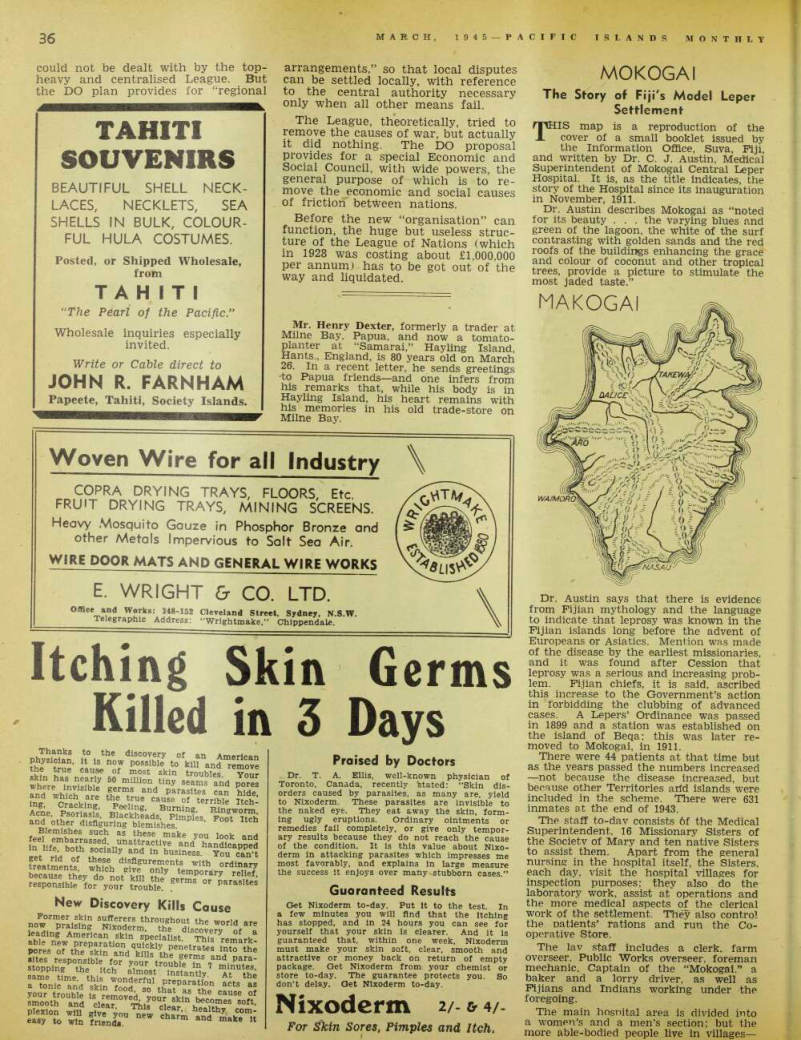
The Story of Fiji's Model Leper Settlement
rIS map is a reproduction of the cover of a small booklet issued by the Information Office, Suva, Fiji, and written by Dr. C. J. Austin, Medical Superintendent of Mokogai Central Leper Hospital. It is, as the title indicates, the story of the Hospital since its inauguration in November, 1911.
Dr. Austin describes Mokogai as “noted for its beauty . . . the varying blues and green of the lagoon, the white of the surf contrasting with golden sands and the red roofs of the buildings enhancing the grace and colour of coconut and other tropical trees, provide a picture to stimulate the most jaded taste.”
Dr. Austin says that there is evidence from Fijian mythology and the language to indicate that leprosy was known in the Fijian islands long before the advent of Europeans or Asiatics. Mention was made of the disease by the earliest missionaries, and it was found after Cession that leprosy was a serious and increasing prob lem. Fijian chiefs, it is said, ascribed this increase to the Government’s action in forbidding the clubbing of advanced cases. A Lepers’ Ordinance was passed in 1899 and a station was established on the island of Beqa; this was later re moved to Mokogai, in 1911.
There were 44 patients at that time but as the years passed the numbers increased —not because the disease increased, but because other Territories arid islands were included in the scheme. There were 631 inmates at the end of 1943.
The staff to-dav consists 6f the Medical Superintendent, 16 Missionary Sisters of the Society of Mary and ten native Sisters to assist them. Apart from the general nursing in the hospital itself, the Sisters, each day, visit the hospital villages for inspection purposes: they also do the laboratory work, assist at operations and the more medical aspects of the clerical work of the settlement. They also control the patients’ rations and run the Co operative Store.
The lav staff includes a clerk, farm overseer. Public Works overseer, foreman mechanic. Captain of the “Mokogai.” a baker and a lorry driver, as well as Fijians and Indians working under the foregoing.
The main hosnital area is divided into a women’s and a men’s section; but the more able-bodied people live in villages—
there is a Fijian, Indian, Solomon Island, Rotuman and Gilbert Island village, each with its own headman. Large areas of land are available for village gardens, in which work patients are encouraged.
The women do a great deal of the laundry and mending work for the men and are expert needlewomen. Some of the men have become expert house and boat builders, under the supervision of one of their members, and are regularly employed by the Public Works Depart ment of Fiji.
IN the matter of treatment, Chaulmoogra Oil is regarded as of first importance, although every type of leprosy treat ment has been tried at Mokogai. Moko gai’s own Hydnocarpus trees (from which the oil comes) provides about half of their requirements. An appeal was made a year or so ago to Fiji planters to grow one or two of these trees and thus assist in the good work.
Leprosy cannot yet be said to have a cure; “arrested” is the word used in con nection with a patient who has shown no clinical or bacteriological signs of leprotic activity over a period of two years. Of the 660 patients discharged on parole, and subject to periodic examination, 103 have had to be re-admitted to Mokogai. The average of re-admitted cases has, how ever, fallen by 5 per cent, in the last decade.
Dr. Austin, in conclusion, states that there is still some controversy with regard to contagion, and therefore the isolation policy. In 1919 there were 352 Fijian patients at the hospital; to-day there are 444, an increase of 92. This might seem that the isolation policy had coihpletely failed, but it is pointed out that in 1919, all cases admitted were in advanced stages—no cases at all were admitted in the early and relatively non-infectious stages.
To-day, however, all cases admitted are in the early stages and stand a very good chance of ultimately returning to normal life.
This booklet, which is profusely illus trated with excellent photographs, gives the outsider a new line of thought.
Leprosy which is traditionally regarded a$ something abhorrent and calamitous is brought into new focus in reading of the model settlement of Mokogai.
The Selection Committee which recently awarded the first Morris Hedstrom Uni versity Scholarship to Ravuama Vunivalu consisted of Mr. F. R. J. Davies, Acting Director of Education, Fiji; Mr. Robert Munro, LL.B., Auckland University: and Sir Maynard Hedstrom, of Suva, Fiji.
Lautoka Thanks Its Town
Board Chairman
rE conclusion of the Lautoka (Fiji) Town Board’s activities for 1944 was made an occasion for a vote of appreciation to Mr. David P. Ragg, chair man of the Board., Deputy-chairman, Mr. H. W. Gray, in replying to the chairman’s seasonal greetings, said: “The progressive and conscientious policies adopted by the chairman has brought about many com mendable improvements in the town area, despite the small amount of funds available. The chairman’s unsparing efforts on behalf of the community has involve.d far-sighted, intelligent and sedulous planning, particularly in this initial year of the Board under the town’s new constitution.”
He voiced the sentiments of all mem bers when he stated that it had been a pleasure to serve under the chairman.
Meetings and deliberations throughout
the year were conducted with the utmost harmony, and members indicated that they would be happy to serve another year under the able * direction of his chairmanship.
Mr. David P. Ragg, since January, 1944, has been Lautoka’s first chairman under its new constitution. He is a son of the Hon. H. H. Ragg, MLC, of Fiji.
Other members of the Town Board are: Dr. James Taylor (Medical Officer of Health), Mr. R. B. Roberts (District Engineer), and Messrs. C. A. Adams, J.
Bucknell, R. Prasad, A. Lakshman and Ratu Meli Qoro. Mr. R. C. Evans is the Town Clerk.
Captain A. S. Fitch, the energetic and apparently tireless founder of Steamships Trading Co., Ltd., of Papua, was laid low by illness a couple of months ago, and finally .underwent special treatment at the Wahroonga Sanatorium, Sydney. He took a definite turn for the better early in March, and now is making a satisfac tory recovery.
Advertisements & other items, pp. 39-40 (1 item)
Gin And Whisky
AUSTRALIAN FOODSTUFFS ... PHARMACEUTICAL LINES
WINES AND SPIRITS . . . MANUFACTURED GOODS /■ ' V •• ■ " . • • ' oV-':- . .
PRIMARY PRODUCTS . . . PATENT MEDICINES We Still Can Ship . .
GIN and WHISKY
(Produce of Australia)
Orders will be accepted and shipped
while stocks last.
Bankers; Bank of Australasia, Comptoir National D’Escompte de Paris. (Proprietors: R. Darvas, E. Klugman), Head Office: 35 PITT ST., SYDNEY. ’Phones: BW 4696, BW 6384.
Codes: Bent, A.B.C. (6th).
ALUMINIUM , a n;d““Tts ALLOYS
This company supplies Aluminium and its Alloys to all specifications and for every commercial application where these give better service over other metals.
Please consult us regarding your aluminium requirements for all purposes.
S:>:'
PROPRIETARY LIMITED
' ... . • ■ . v’ '■
(INCORPORATED IN THE STATE OF VICTORIA)
GENERAL OFFICES AND FABRICATION DIVISION: GRANVILLE, SYDN E Y. N■s• W.
HARRY J. YOUNG PTY. LTD.
Sole
Pacific Islands Selling Representatives and
Distributors for the following Leading
Australian Manufacturers:
BONDS INDUSTRIES LTD.
Manufacturers of All Types of Underwear, Hosiery, Half Hose, Sewing Cottons.
COMMONWEALTH WEAVING MILLS PTY. LTD.
Manufacturers of // DriGlo // Towels and Towelling of every description, J. W. TRATHEN & CO. PTY. LTD.
Manufacturers of "Red, White & Blue" Handbags, Pouches, Wallets, Note Cases, School Bags, Purses, Watch Cases, Belts, Straps, Razor Strops and sundry leather lines.
COTTEE'S PASSIONA LTD.
Manufacturers of "Passiona" Fruit Cordials, Fountain Syrups, Jams, Spreads, Peanut Butter, Peanut Products and Jellies. •
HARRY PECK & CO. PTY, LTD.
Manufacturers of the famous "Anchovette," Bloater Paste, and Specialists in Potted Meats. •
GENERAL PLASTICS PTY. LTD.
Manufacturers of Buttons, Buckles, Ornaments, Moulds and Metal Stampings.
Enquiries through youf usual channels appreciated, and prompt shipments effected.
Eagle & Globe Building, 379 Kent St., Sydney N.s.w.
Postal Address: Box 3661, G.P.0., Sydney.
Bankers: Codes: Bank of NS W Bentley’s Comp. Phrase.
Bentley’s 2nd Phrase.
Easter Is. Glyphs
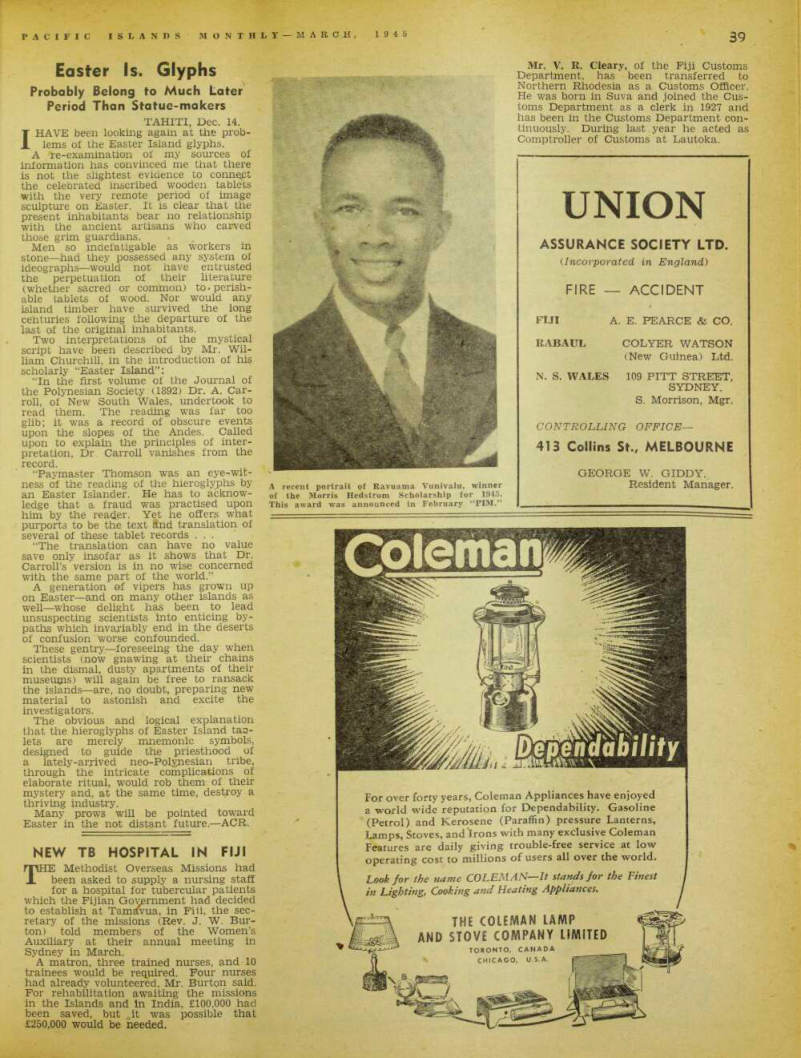
Probably Belong to Much Later Period Than Statue-makers
Tahiti, Dec. 14.
IHAVE been looking again at the prob lems of the Easter Island glyphs.
A re-examination of my sources of information has convinced me that there is not the slightest evidence to connqpt the celebrated inscribed wooden tablets with the very remote period of image sculpture on Easter. It is clear that the present inhabitants bear no relationship with the ancient artisans who carved those grim guardians.
Men so indefatigable as workers in stone—had they possessed any system of ideographs—would not have entrusted the perpetuation of their literature (whether sacred or common) to. perish able tablets of wood. Nor would any island timber have survived the long centuries following the departure of the last of the original inhabitants.
Two interpretations of the mystical script have been described by Mr. Wil liam Churchill, in the introduction of his scholarly “Easter Island”: “In the first volume of the Journal of the Polynesian Society (1892) Dr. A. Car roll, of New South Wales, undertook to read them. The reading was far too glib; it was a record of obscure events upon the slopes of the Andes, Called upon to explain the principles of inter pretation, Dr Carroll vanishes from the record.
“Paymaster Thomson was an eye-wit ness of the reading of the hieroglyphs by an Easter Islander. He has to acknow ledge that a fraud was practised upon him by the reader. Yet he offers what purports to be the text and translation of several of these tablet records . . .
“The translation can have no value save only insofar as it shows that Dr.
Carroll’s version is in no wise concerned with the same part of the world.”
A generation of vipers has grown up on Easter —and on many other islands as well —whose delight has been to lead unsuspecting scientists into enticing by paths which invariably end in the deserts of confusion worse confounded.
These gentry—foreseeing the day when scientists (now gnawing at their chains in the dismal, dusty apartments of their museums) will again be free to ransack the islands—are, no doubt, preparing new material to astonish and excite the investigators.
The obvious and logical explanation that the hieroglyphs of Easter Island tab lets are merely mnemonic symbols, designed to guide the priesthood of a lately-arrived neo-Polynesian tribe, through the intricate complications of elaborate ritual, would rob them of their mystery and, at the same time, destroy a thriving industry.
Many prows will be pointed toward
Easter in the not distant future.-
Acr.
New Tb Hospital In Fiji
rE Methodist Overseas Missions had been asked to supply a nursing staff for a hospital for tubercular patients which the Fijian Government had decided to establish at Tamsmia, in Fiii, the sec retary of the missions (Rev. J. W. Bur ton) told members of the Women’s Auxiliary at their annual meeting in Sydney in March.
A matron, three trained nurses, and 10 trainees would be required. Four nurses had already volunteered, Mr. Burton said.
For rehabilitation awaiting the missions in the Islands and in India, £lOO,OOO had been saved, but .it was possible that £250,000 would be needed.
Mr. V. R. Cleary, of the Fiji Customs Department, has been transferred to Northern Rhodesia as a Customs Officer.
He was born in Suva and joined the Cus toms Department as a clerk in 1927 and has been in the Customs Department con tinuously. During last year he acted as Comptroller of Customs at Lautoka.
A recent portrait of Ravuama Vunivalu, winner of the Morris Hedstrom Scholarship for 1945.
This award was announced in February “PIM.”
Advertisements & other items, p. 41 (1 item)
Union
ASSURANCE SOCIETY LTD.
(Incorporated in England)
FIRE ACCIDENT
FIJI A. E. PEARCE & CO.
RABAUL COLYER WATSON
(New Guinea) Ltd.
N. S. WALES 109 PITT STREET,
SYDNEY.
S. Morrison, Mgr.
CONTROLLING OFFICE—
-413 Collins St., MELBOURNE
GEORGE W. GIDDY.
Resident Manager.
c in For over forty years, Coleman Appliances have enjoyed a world wide reputation for Dependability. Gasoline (Petrol) and Kerosene (Paraffin) pressure Lanterns, Lamps, Stoves, and Irons with many exclusive Coleman Features are daily giving trouble-free service at low operating cost to millions of users all over the world.
Look for the name COLEMAN—It stands for the Finest in Lighting, Cooking and Heating Appliances.
THE COLEMAN LAMP
AND STOVE COMPANY LIMITED
TORONTO, CANADA
CHICAGO, USA.
a i t SLI
Sydney
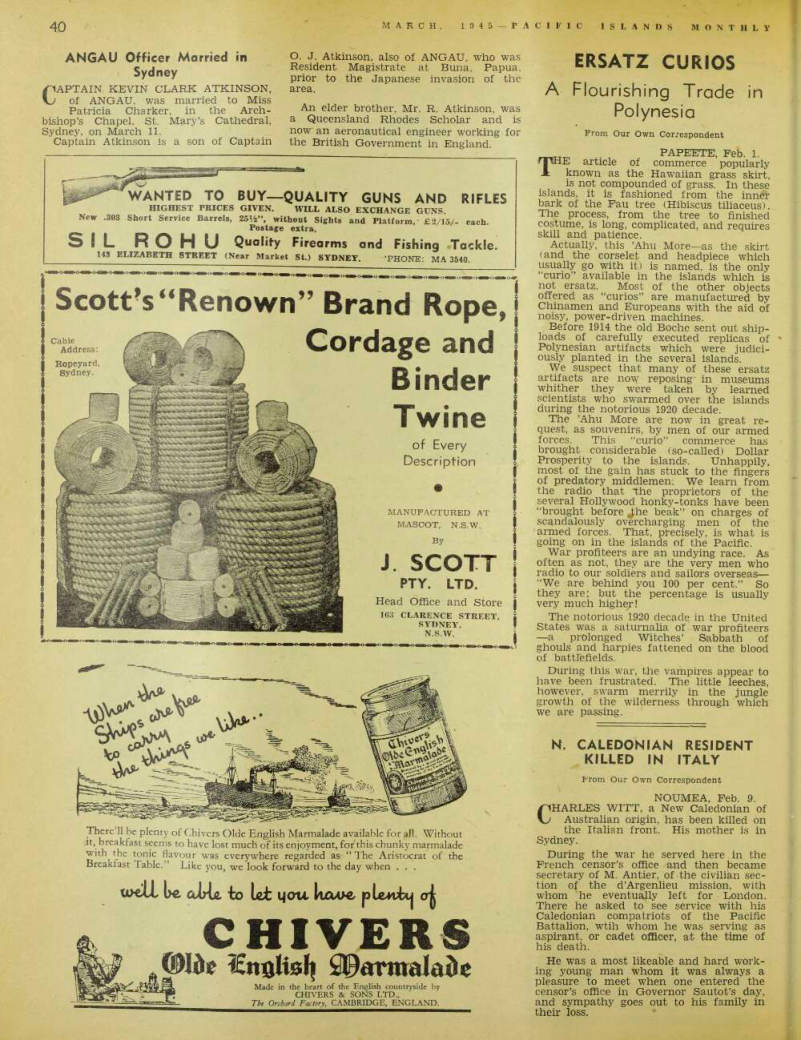
ANGAU Officer Married in Sydney
Captain Kevin Clark Atkinson,
of ANGAU, was married to Miss Patricia Charker, in the Arch bishop’s Chapel, St. Mary’s Cathedral, Sydney, on March 11.
Captain Atkinson is a son of Captain
O. J. Atkinson, also of ANGAU, who was Resident Magistrate at Buna, Papua, prior to the Japanese invasion of the area.
An elder brother, Mr. R. Atkinson, was a Queensland Rhodes Scholar and is now an aeronautical engineer working for the British Government in England.
Polynesia
Ersatz Curios
A Flourishing Trade in Polynesia
From Our Own Correspondent
Papeete, Feb. 1.
rjTHE article of commerce popularly A known as the Hawaiian grass skirt, is not compounded of grass. In these islands, it is fashioned from the inner bark of the Fau tree (Hibiscus tiliaceus).
The process, from the tree to finished costume, is long, complicated, and requires skill and patience.
Actually, this ’Ahu More—as the skirt (and the corselet and headpiece which usually go with it) is named, is the only “curio” available in the islands which is not ersatz. Most of the other objects offered as “curios” are manufactured by Chinamen and Europeans with the aid of noisy, power-driven machines.
Before 1914 the old Boche sent out ship loads of carefully executed replicas of Polynesian artifacts which were judici ously planted in the several islands.
We suspect that many of these ersatz artifacts are now reposing - in museums whither they were taken by learned scientists who swarmed over the islands during the notorious 1920 decade.
The ’Ahu More are now in great re quest, as souvenirs, by men of our armed forces. This “curio” commerce has brought considerable (so-called) Dollar Prosperity to the islands. Unhappily, most of the gain has stuck to the fingers of predatory middlemen. We learn from the radio that the proprietors of the several Hollywood honky-tonks have been “brought before Jhe beak” on charges of scandalously overcharging men of the armed forces. That, precisely, is what is going on in the islands of the Pacific.
War profiteers are an undying race. As often as not, they are the very men who radio to our soldiers and sailors overseas— “We are behind you 100 per cent.” So they are; but the percentage is usually very much higher!
The notorious 1920 decade in the United States was a saturnalia of war profiteers —a prolonged Witches’ Sabbath of ghouls and harpies fattened on the blood of battlefields.
During this war, the vampires appear to have been frustrated. The little leeches, however, swarm merrily in the jungle growth of the wilderness through which we are passing.
N. Caledonian Resident
Killed In Italy
From Our Own Correspondent
Noumea, Feb. 9.
CHARLES WITT, a New Caledonian of Australian origin, has been killed on the Italian front. His mother is in Sydney.
During the war he served here in the French censor’s office and then became secretary of M. Antier, of the civilian sec tion of the d’Argenlieu mission, with whom he eventually left for London.
There he asked to see service with his Caledonian compatriots of the Pacific Battalion, wtih whom he was serving as aspirant, or cadet officer, at the time of his death.
He was a most likeable and hard work ing young man whom it was always a pleasure to meet when one entered the censor’s office in Governor Sautot’s day, and sympathy goes out to his family in their loss.
Advertisements & other items, pp. 42-44 (2 items)
Chivers
WANTED TO BUY—QUALITY GUNS AND RIFLES
HIGHEST PRICES GIVEN. WILL ALSO EXCHANGE GUNS New .303 Short Service Barrels, 25U", without Sights and Platform, £2/15/- each.
Postage extra.
SI L RO H U Quality Firearms and Fishing Tatkle. l4B ELIZABETH STREET (Near Market St.) SYDNEY. 'PHONE: MA 3540.
Scott’s “Renown” Brand Rope,
Cable Address: Ropeyard Sydney.
Cordage and
Binder
Twine
of Every
Description
MANUFACTURED AT
MASCOT, N.S.W.
J SCOTT
PTY. LTD.
Head Office and Store
163 CLARENCE STREET,
SYDNEY,
N.S.W.
\v* m
i&r v>-
t There’ll be plenty of drivers Olde English Marmalade available for all. Without it, breakfast seems to have lost much of its enjoyment, for this chunky marmalade with the tonic flavour was everywhere regarded as “ The Aristocrat of the Breakfast Table.” Like you, we look forward to the day when . . . u>ell l>e airU to Let ijo-u kaue plenty aj
CHIVERS
CSHfo *£nolis(| Marmalade
Made in the heart of the English countryside by
CHIVERS & SONS LTD.,
The Orchard Factory , CAMBRIDGE, ENGLAND.
Shipper of Australia’s Best
to the Pacific.
MASHMAN BROTHERS PTY., LTD.
Quality clay products—Sanitaryware, Bathroom fittings, Hospitalware, Stone Pipes, etc. (See “PIM,” January, page 43.)
W. F. CAMPBELL PTY., LTD.
C.A.P. Pure Paints and Varnishes for all purposes. All Industrial Covers, White Lead, White Lime in Oil, Zinc Oxide, etc. * (See “PIM,” January, page 41.)
ACME CONDUIT PTY., LTD.
Electrical Conduit Pipes and Walsall Conduit Pipe Fittings.
COLLINS BROTHERS.
“Radiant” Stormproof Kerosene Pressure Lanterns and Lamps; Gloria Lighting Systems.
The “RADIANT” OUTSHINES aIL other
LAMPS.
(See “PIM,” January, page 35.)
LYONS TRADING CO. PTY., LTD.
King’s Compo Roof Cooling Water Paint. The cheapest PERMANENT roof cover in the world. (See “PIM,” January, page 33.)
SYDNEY CISTERN & TERRAZO PRODUCTS.
Foolproof SYDNEY-SIMPUL-Universal System Valves for ALL cisterns; including Multi- Flush and Syphon Cisterns. Portable Fuel Coppers made of heat-proof composition.
Water Storage Tanks up to 65 gallons in Fibre Cement. Wash Tubs. Terrazzo products.
STANFORD & PILLEY PTY., LTD.
Paint Brushes for all purposes. Specialists in this particular industry.
CLEMENS FRUIT JUICE PTY., LTD.
100% Pure Fruit Juice’s—NO water and NO preservatives—Tomato Juice, etc.
RAD MANUFACTURING CO. PTY., LTD.
“RADCO” Quality Foodstuffs and Specialties: Baking Powder, Custard Powder, Cornflour, Rice Starch, Jelly Crystals, Blanc Mange, Soup mixtures, etc., etc. All manufactured in the most modern and hygienic factories in Australia. (See “PIM,” January, page 37.) Also shipper of Building materials, Iron and Steel products, General Engineering lines, Stampings, Plastics, Machinery and Tools of all kinds, General Hardware and Plumbers’ supplies, Electrical Equipment and Accessories, Brushes and Brooms, Paper and Stationery, Printing and Office Equipment, Chemicals and by-Products, INDUSTRIAL RAW MATERIALS, all classes of Foodstuffs, Wines, Spirits and Liquers, etc., etc.
ANDREW THOMSON & SCOUGALL,
PTY., LTD.
Malleable Cast-iron Pipe Fittings for water, steam, gas and air. Malleable Conduit Fittings, etc. *
CENTURY STORAGE BATTERY CO., LTD.
Heavy Duty Standard and Slotted Plate Batteries, Battery Accessories, etc.
OLYMPIC SPARK PLUGS PTY., LTD.
Quality Plugs for cars, trucks, semi and diesel engines.
ACME BEDSTEAD CO. PTY., LTD.
Metallic Bedsteads, Steel Domestic Furniture and Hospital Equipment, etc.
BOSS ELECTRICAL MANUFACTURING CO.
Battery Charges (Valve and Metal Rectifier types), Battery Testers, Arc welding equipment, small Transformers, Arc Welding ELECTRODES, complying Lloyd’s Register specifications.
LORIMIER CONTACTS PTY., LTD.
Ignition Contacts in Platinum-iridium and Tungsten. Distributor Caps and Rotors, Condensers. Brushes for Starters, Generators and Magnetos. Push-Pull Switches.
MANHAY PTY. LIMITED.
High speed Rotary Brushware and Decarbonising Brushes for use in railways, engineering, gas works, tyre retreading, metal shops, foundries, electroplating industry, jewellery and dental trades. Domestic brushware.
FARBEST PRODUCTS PTY., LTD.
Pure Fruit Cordials, Glace Cherries, Lemon and Orange-peels, etc., etc. (See “PIM,” January, page 39.) Price lists, catalogues, samples and all other information available from :
0. F. MASSGHELEIN
ANDREWS BUILDING,
40 KING STREET,
MA1242. SYDNEY.
GENERAL EXPORTER OF AUSTRALIAN
SYDNEY.
QUALITY PRODUCTS ONLY
Laurier Brandy and Lanoma Gin (New Zealand excluded) Richmond Beer Lifeguard Condensed Milk Dandy Hams and Bacon Kromo Bark Leather Soles Tarrants Famous Hand Bags Cohn Bros.' Cordials Sole Representative Pacific Islands.
E. J. BRIAL
528 COLLINS STREET, MELBOURNE.
WINES
Personally selected from best Australian Vineyards.
Your orders requested through usual channels.
The Most Extensive Manufacturers in-the British Empire of
RUBBER STAMPS,
INKS, STENCILS,
Marking Devices,
ACME STAMP PADS
OFFICE & STATIONERY SUPPLIES
IS We also Manufacture & Supply a Complete Line of
LIMEWASHING AND
SPRAYING MACHINES
for all purposes.
Let us know your requirements and we will quote by return.
WRITE FOR OUR GENERAL CATALOGUE
Li me washing Machine
EXCELSIOR SUPPLY CO. PTY. LTD.
278 Post Office Place,
MELBOURNE, VIC.
HEAD OFFICE :
160 BROADWAY,
Formerly known as George St.. West,
SYDNEY/* N.S.W.
50 Victoria Street,
WELLINGTON, N.Z.
Appointed

Fijian Affairs Personnel Appointed
From Our Own Correspondent
Suva, Feb. 21.
THE constitution of the Fijian Affairs Board under the Fijian Affairs Ordinance, has been announced and comprises the following personnel: Lieut.-Col. the Hon. Ratu J. L. V. Suk una, CBE, Secretary for Fijian Affairs; Hon. Ratu George C. Tuisawau, Roko Tui, Rewa; Hon. Ratu Tiale W. T. Vuiya sawa, Roko Tui, Ba; Hon. Ratu George B. Toganivalu, Roko Tui, Bua; Hon. Ratu Edward T. Cakobau, MC, Roko Tui, Lomaiviti; Hon. Ratu George W. Lala balavu, MSM, Roko Tui, Cakaudroye; Sir Henry M. Scott, KC, legal adviser; R. H.
Lester, clerk and treasurer; J. R. Steven son, accountant; E. Tuiloma grade “A” clerk; W. C. Nayagodamu,- grade “B" clerk.
Henri Sautot Promoted
Prom Our Own Correspondent
Noumea, Feb. 12.
THAT good Republican, Henri Sautot, whom the New Caledonian “brous sards” or “maquis” brought from the New Hebrides to be first Free French Governor, has at last seen his services to his country rewarded by promotion to Administrator, First Class.
As Governor of the Province of Ouban gui-Chari, in Central Africa, he last year attended the Brazzaville Conference of Governors and delegates from all French African territories. The conference ap proved a proposal that a mission be sent to Russia to study methods of rapid development in outlying regions.
Territorian Wedding In
Sydney
Miss Fay Macgregor on her wedding day. A report of the wedding appears on page 19.
Peter Kilner, nephew of the bride, acted as pageboy. —Photo by Howard Harris.
Europe
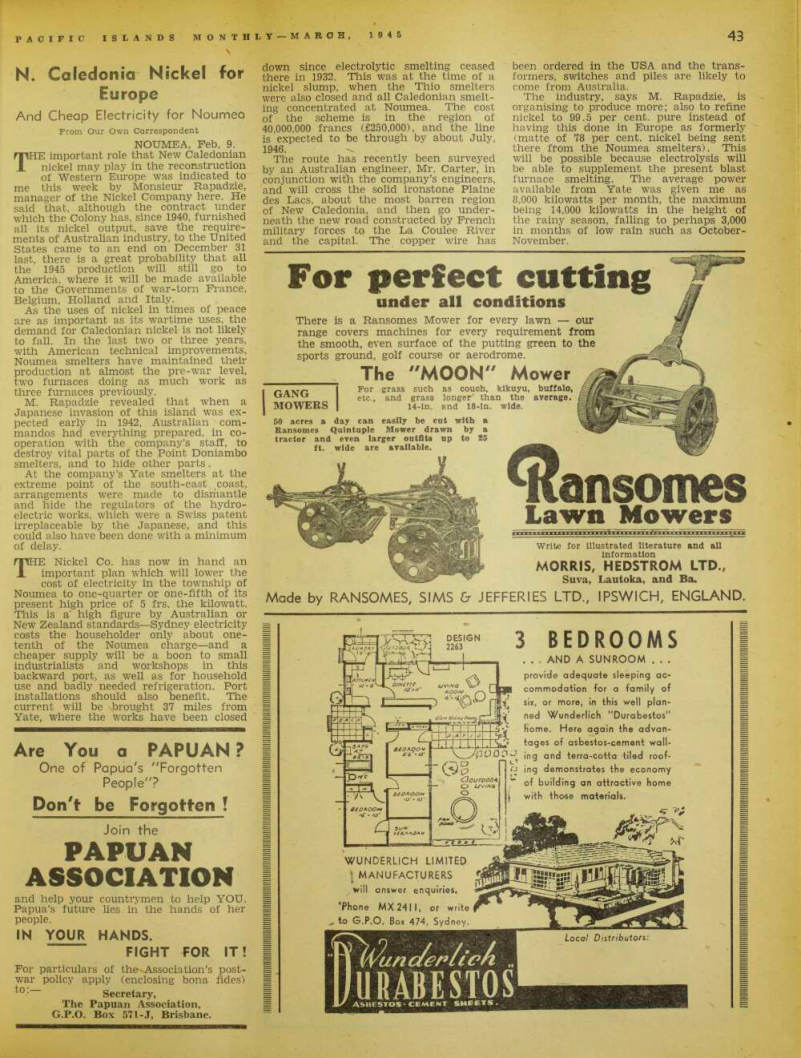
N. Caledonia Nickel for Europe And Cheap Electricity for Noumea
From Our Own Correspondent
Noumea, Feb, 9.
THE important role that New Caledonian nickel may play in the reconstruction of Western Europe was indicated to me this week by Monsieur Rapadzie, manager of the Nickel Company here. He said that, although the contract under which the Colony has, since 1940, furnished all its nickel output, save the require ments of Australian industry, to the United States came to an end on December 31 last, there is a great probability that all the 1945 production will still ga to America, where it will be made available to the Governments of war-torn France, Belgium, Holland and Italy.
As the uses of nickel in times of peace are as important as its wartime uses, the demand for Caledonian nickel is not likely to fall. In the last two or three years, with American technical improvements, Noumea smelters have maintained their production at almost the pre-war level, two furnaces doing as much work as three furnaces previously.
M. Rapadzie revealed that when a Japanese invasion of this island was ex pected early in 1942, Australian com mandos had everything prepared, in co operation with the company’s staff, to destroy vital parts of the Point Doniambo smelters, and to hide other parts.
At the company’s Yate smelters at the extreme point of the south-east coast, arrangements were made to dismantle and hide the regulators of the hydro electric works, which were a Swiss patent irreplaceable by the Japanese, and this could also have been done with a minimum of delay. mHE Nickel Co. has now in hand an J. important plan which will lower the cost of electricity in the township of Noumea to one-quarter or one-fifth of its present high price of 5 frs. the kilowatt.
This is a' high figure by Australian or New Zealand standards —Sydney electricity costs the householder only about one tenth of the Noumea charge—and a cheaper supply will be a boon to small industrialists and workshops in this backward port, as well as for household use and badly needed refrigeration. Port installations should also benefit. The current will be brought 37 miles from Yate, where the works have been closed
down since electrolytic smelting ceased there in 1932. This was at the time of a nickel slump, when the Thio smelters were also closed and all Caledonian smelting concentrated at Noumea. The cost of the scheme is in the region of 40,000,000 francs (£250,000), and the line is expected to be through by about July, 1946.
The route has recently been surveyed by an Australian engineer, Mr. Carter, in conjunction with the company’s engineers, and will cross the solid ironstone Plaine des Lacs, about the most barren region of New Caledonia, and then go underneath the new road constructed by French military forces to the La Coulee River and the capital. The copper wire has
been ordered in the USA and the trans formers, switches and piles are likely to come from Australia.
The industry, says M. Rapadzie, is organising to produce more; also to refine nickel to 99.5 per cent, pure instead of having this done in Europe as formerly (matte of 78 per cent, nickel being sent there from the Noumea smelters). This will be possible because electrolysis will be able to supplement the present blast furnace smelting. The average power available from Yate was given me as 8,000 kilowatts per month, the maximum being 14,000 kilowatts in the height of the rainy season, falling to perhaps 3,000 in months of low rain such as October - November.
Advertisements & other items, pp. 45-46 (1 item)
■ansomes
For perfect cutting
under all conditions
There is a Ransomes Mower for every lawn our range covers machines for every requirement from the smooth, even surface of the putting green to the sports ground, golf course or aerodrome.
"MOON" Mower
The
GANG
MOWERS
For grass such as couch, klkuyu, buffalo, etc., and grass longer than the average. 14-in. and 18-ln. wide. 50 acres a day can easily be cut with a Ransomes Quintuple Mower drawn by a tractor and even larger outfits up to 25 ft. wide are available.
■ansomes
Lawn Mowers!
Write for illustrated literature and all information
MORRIS, HEDSTROM LTD.,
Suva, Lautoka, and Ba, Made by RANSOMES, SIMS & JEFFERIES LTD., IPSWICH, ENGLAND.
DESIGN
2263
UV/HQ
ROOM
Cb rt &a>*q OooHj +f 0g (OourooOA.
O uv//va O
I BEDROOMS
. . AND A SUNROOM .. .
provide adequate sleeping ac-
commodation for a family of six, or more, in this well planned Wunderlich "Durabestos" home. Here again the advan- J tages of asbestos-cement wall- -1 ing and terra-cotta tiled roof- L * 0 ing demonstrates the economy of building an attractive home 1 with those materials.
WUNDERLICH LIMITED
MANUFACTURERS r ‘
will answer enquiries, 'Phone MX 2411, or write to G.P.O, Box 474, Sydney. •s; -j' Local Distributors: Asbestos • cement sheets
Are You a PAPUAN?
One of Papua's "Forgotten
People"?
Don't be Forgotten !
Join the
PAPUAN
ASSOCIATION
and help your countrymen to help YOU.
Papua’s future lies in the hands of her people.
IN YOUR HANDS.
FIGHT FOR IT!
For particulars of postwar policy apply (enclosing bona fides) Secretary, The Papuan Association, G.P.O. Box 571-J, Brisbane.
THE PACIFIC ISLANDS
\ TRADING CO.
2016 Parker St., Berkeley,
CALIFORNIA, U.S.A.
We are Expert Buying Agents for Pacific Islands Merchants.
SEND YOUR ORDERS TO US—OUR
COMMISSION IS 5 PER CENT.
Also of- Son Francisco.
GARDEN
NOVELTY
MAGAZINE
FROM
NEW ZEALAND
WRITE
NOW FOR
YOUR COPY TO
GRIFFITHS LTD
SEED MERCHANTS AND GROWERS
MOUNT EDEN : AUCKLAND NEW ZEALAND
Harbour Cruise
A Howling Success
THE Pacific Territories Association cruise on Sydney Harbour, on Feb ruary 23, drew the largest crowd of Territorians ever collected in one spot in Sydney. It is estimated that between seven and eight hundred people were on the ferry when it left Circular Quay— and, for once, most of them were early and the ferry was late.
The roar of sound from No. 7 wharf, as the Territorians loosened up their tongues, could be heard two blocks away.
And with little interruption this went on after they had eihbarked, and throughout the rest of the evening. A musical pro gramme had been arranged, but it is a safe bet that not more than two people on board had any idea what it was about.
In other words, the whole show was an unqualified success: when a Territorian can meet friends whom he may not have seen for many moons, and talk his head off, he is supremely happy. There have been many requests to the PTA for a repeat performance. If this should hap pen, it has been suggested that the execu tive hire “King George V,” or the Sydney Town Hall, in order to give plenty of space to move about; and that, if music is provided, it be only in the form of a soft, background noise against which Territorians swopping news or reminis cences will not have to compete.
The PTA executive is to be congratu lated on a good idea, and on the admir able organisation which made of it so great a success.
News has been received that Mr. Tony Wane, of Ba, Fiji, who is serving in Italy has been wounded. He is a son of Mr and Mrs. Geo. Wane, of Rarawai
Papuan Association
Still on Warpath
HAVING gained little or no satisfaction from the present Government (re presented by External Territories Minister Ward) the Papuan Association of Brisbane has decided to try the other side of the political fence.
A telegram has been sent to Mr. Men zies—who the Association feels may have some barbs in his armoury they do not possess—asking him to inquire into the Government’s reasons for not restoring civil control. The telegram emphasised the fact that in other areas reoccupied by Allied Nations forces, civil administra tion naturally followed those forces.
A member of the Association speaking in Brisbane, recently, said that certain selected planters and their wives were being permitted to return to selected areas providing that the wives paid their own fares and freight. Apparently the Government intended to make all evacu ees pay their own fares when they returned to the Territories
Jubilee Celebration
Nelson & Robertson's
A NUMBER of old business and per sonal friends of the firm of Nelson & Robertson Pty., Ltd., met at din ner at Ushers Hotel, Sydney, on February 20, as the ‘guests of the directors, to celebrate the 50th anniversary of the establishment of the business. Mr. Nor man Nelson, presiding, created a happy and mellow atmosphere, in which memories of the good old days found an interested audience.
The first toast honoured, after “The King,” was a tribute to the late Ivan Nelson, founder of the firm, and his ener getic profitable activities among the Pacific Islands were recalled. All the old servants of the company, with their wives, were present as guests, and direc tors took the opportunity to praise their long and loyal service. Mr. J. A. Burke brought greetings from an associated Queensland company. A toast was drunk to Mrs. Ivan Nelson, widow of the founder, and “She’s a Jolly Good Fellow’’ was sung very heartily.
Advertisements & other items, p. 46 (1 item)
Floor
Allen Taylor & Co. Ltd
COMMERCIAL ROAD, ROZELLE,
SYDNEY
Sawmillers and Wholesale Suppliers of Hardwoods for Constructional Purposes GIRDERS . . . PILES . . . POLES . . . SLEEPERS, Etc.
EXPORTING TO PACIFIC ISLANDS SINCE 1893
Restlessness and sleeplessness, when due to run-down nerves, frequently respond to treatment with Dr. Williams' Pink Pills.
Dr. Williams’
PINK PILLS
help to enrich the blood, which has a beneficial and restorative effect upon the nervous system.
PRODUCING UNIFORM GOOD RESULTS SINCE 1868
Floor
always ask for it
Split In Guinea Airways
mHE disagreement among shareholders J. of Guinea Airways, Ltd., on the proposed merger with Australian National Airways (which was defeated in a general meeting) looks like developing into a legal squabble. Four of the dir ectors responsible for the merger plan resigned. The four vacancies were con tested by two panels: Pro-Merger: S. Powell, A. Moulden, R.
B. Wiltshire, W. lan Potter.
Anti-Merger: R. M. Ansett, Donald Reid, L. H. M. Marritt, R. P. Goode.
The voting at the general meeting called to elect four directors was very close, and was complicated by the lodge ment of an extraordinary number of proxies.
After an adjournment, and a counting of votes, it was announced that the Pro- Merger Panel had been successful, by a comparatively small majority.
Although there has been no indication that the merger plan will be proceeded with, there appears to be much ill-feeling between the two sections of shareholders.
Mr. R. M. Ansett has announced that he intends to challenge the election of the four directors in the South Australian Courts. (GA head office is in Adelaide.)
Ng Club Party
ABOUT 60 people attended the bridge party arranged by the New Guinea Women’s Club of Sydney, in the Feminist Club Rooms, on March 3.
Although there was not such a large gathering as is usual at club functions, members who attended enjoyed a plea sant evening at cards.
The next social function will be held at some date yet to be fixed in April.
Further Fmf Awards
NEW awards to members of the Fiji Military Forces were announced in mid-February. They included the award of OBE to Major S. G. C. Cowled and of MBE to Captain J. S. Thomson.
Major Cowled, who in civilian life is a Methodist missionary in Fiji, is Senior Chaplain to the Fiji Military Forces. He went overseas with the Ist Battalion and served in the Solomons for 16 months.
The citation accompanying his award said that during that time he made the well being of troops of all creeds his constant concern. His influence could be discerned throughout the spiritual and social life of the Battalion.
Captain Thomson in civilian life is an officer in the Administrative Service in Fiji. He was Adjutant of the 3rd Bat talion during the five months when it was serving on Bougainville.
Suva Memories
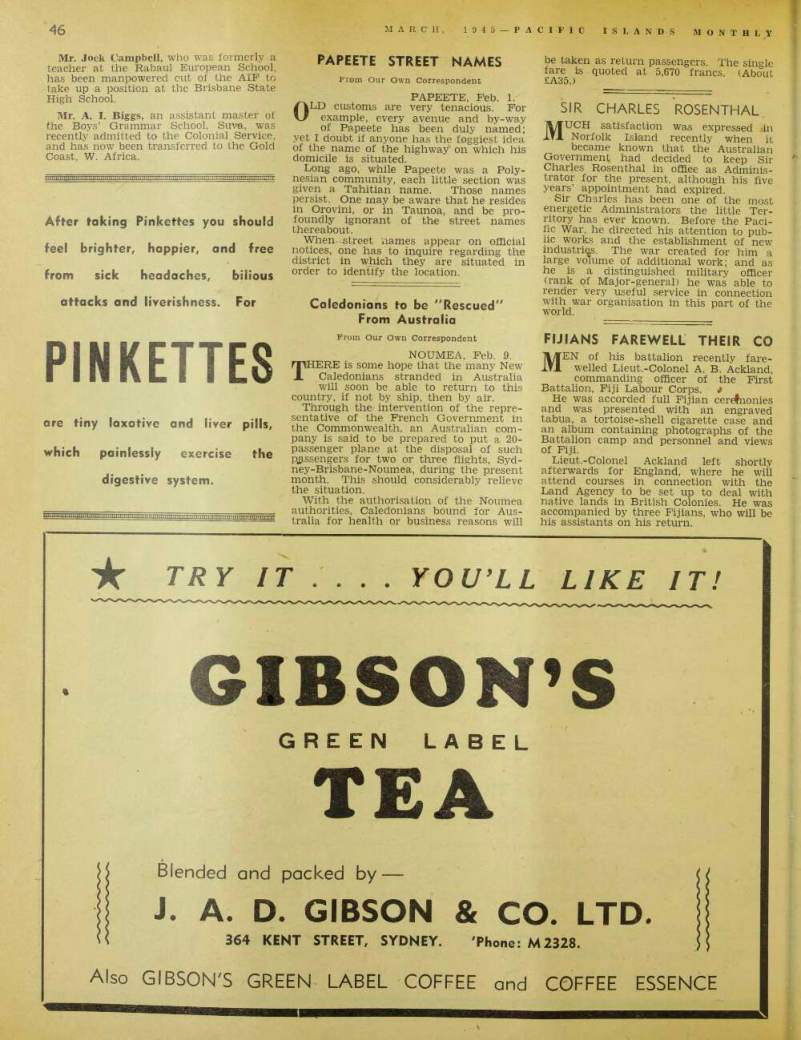
Letter to the Editor MR. HANCOCK is substantially correct in his description (in your issue of November) of the episode of the horse-trough. But he omitted the lady in the affair. One of the lads was a member of the Bank of N.S.W. staff, who bet the Bank of NZ lad, in the presence of the lady, that he was not game to dive into the horse-trough. He lost.
On the following New Year’s Day the lad who dived into the horse-trough espied an Indian laundryman’s delivery van outside the Grand Pacific Hotel. He promptly took charge and drove the van all over Suva, delivering the laundry indiscriminately, so that Mrs. Jones received Mrs. Smith’s washing, and Mrs.
Brown received that of Mrs. Jones. In
fact, there was such a mix-up that the episode nearly ended in a riot.
Needless to say, head office heard noth ing of these affairs. They were happy days.
That la has made the supreme sacri fice. Rest to his gallant soul!
I am, etc.,
Athol Matthews.
Auckland.
Mr. Jock Campbell, who was formerly a teacher at the Rabaul European School, has been manpowered cut of the AIF to take up a position at the Brisbane State High School.
Mr. A. I. Biggs, an assistant master of the Boys’ Grammar School, Suva, was recently admitted to the Colonial Service, and has now been transferred to the Gold Coast, W. Africa.
Advertisements & other items, pp. 47-48 (1 item)
Robert Gillespie Pty. Ltd.
Buy
Right
In
Ail.
Lines
WINES A SPECIALITY
YIN ROUGE DE TABLE I)E
QUALITE SUPERIEURE
ALSO :
Brandy, Gin, Beer, Cordials, Salami. Mortadelle, Conserves.
Powdered Milk, Condensed Milk.
Leathergoods, Paints.
Indian Printed Cotton Piecegoods.
And EVERYTHING YOU MAY
REQUIRE.
Enquiries through your usual channels appreciated.
E. J. BfUAL
528 Collins Street, Melbourne.
ROBERT GILLESPIE PTY. LTD.
ISLAND TRADERS
IMPORTERS - - - * EXPORTERS
Island Distributors for
COLEMAN HEATING AND LIGHTING APPLIANCES
DINOX and DIX Brands of BROOMS, BRUSHES and MOPS Bankers: Bank of N.S.W. Cable Address: “Robergill.”
Comptoir National d’Escompte de Paris. Telephones: BW 4782 B 1305.
S£"' d 54a PITT STREET, SYDNEY, N.S.W
After taking Pinkettes you should feel brighter, happier, and free from sick headaches, bilious attacks and liverishness. For
PINKETTES
ore tiny laxative and liver pills, which painlessly exercise the digestive system.
Papeete Street Names
From Our Own Correspondent
Papeete, Feb. 1.
/|LD customs are very tenacious. For example, every avenue and by-way of Papeete has been duly named; yet I doubt if anyone has the foggiest idea of the name of the highway on which his domicile is situated.
Long ago, while Papeete was a Poly nesian community, each little section was given a Tahitian name. Those names persist. One may be aware that he resides in Orovini, or in Taunoa, and be pro foundly ignorant of the street names thereabout.
When -street names appear on official notices, one has to inquire regarding the district in which they are situated in order to identify the location.
Caledonians fa be "Rescued"
From Australia
Prom Our Own Correspondent
Noumea, Feb. 9.
THERE is some hope that the many New Caledonians stranded in Australia will soon be able to return to this country, if not by ship, then by air.
Through the intervention of the repre sentative of the French Government in the Commonwealth, an Australian com pany is said to be prepared to put a 20passenger plane at the disposal of such passengers for two or three flights, Syd ney-Brisbane-Noumea, during the present month. This should considerably relieve the situation.
With the authorisation of the Noumea authorities, Caledonians bound for Aus tralia for health or business reasons will
be taken as return passengers. The single fare is quoted at 5,670 francs. (About £A35.)
Sir Charles Rosenthal
MUCH satisfaction was expressed in Norfolk Island recently when it became known that the Australian Government had decided to keep Sir Charles Rosenthal in office as Adminis trator for the present, although his five years’ appointment had expired.
Sir Charles has been one of the most energetic Administrators the little Ter ritory has ever known. Before the Paci fic War, he directed his attention to pub lic works and the establishment of new industries. The war created for him a large volume of additional work; and as he is a distinguished military officer (rank of Major-general) he was able to render very useful service in connection with war organisation in this part of the world.
Fijians Farewell Their Co
MEN of his battalion recently fare welled Lieut.-Colonel A. B. Ackland, commanding officer of the First Battalion, Fiji Labour Corps. * He was accorded full Fijian cerefnonies and was presented with an engraved tabua, a tortoise-shell cigarette case and an album containing photographs of the Battalion camp and personnel and views of Fiji.
Lieut.-Colonel Ackland left shortly afterwards for England, where he will attend courses in connection with the Land Agency to be set up to deal with native lands in British Colonies. He was accompanied by three Fijians, who will be his assistants on his return.
Advertisements & other items, p. 48 (1 item)
Gibson’S
★ TRY IT ... . YO
GREEN LABEL
TEA
Blended and packed by— U J. A. D. GIBSON & CO. LTD. \ 364 KENT STREET, SYDNEY. 'Phone: M 2328. ]j Also GIBSON'S GREEN LABEL COFFEE and COFFEE ESSENCE
About Islands People
Messrs. W. H. B. Buckhurst and C. Har vey have been appointed official members of the Legislative Council of Fiji; and Mr. I. E. Lucchinelli and Dr. H. S. Evans have been appointed provisionally as offi cial members.
Lieut.-Col. D. Junor, of the AIF, has recently been promoted to the rank of Colonel. Col. Junor left Fiji in July, 1940, to join the AIF as a Major in the Signal Corps. He served in the Middle East and North Africa and, after return ing to Australia, went to New Guinea to commence a school of signals of the AIF forces in New Guinea. He is now on the headquarters staff at the Central Signals Training Depot in Victoria.
Mr. H. J. Moorhouse, who has been the manager of the Queensland Insurance Co., Ltd., for Fiji for the past 10 years, has been transferred as manager* for India and Burma. He expects to leave Fiji about next May. In his place, Mr. I. B. Chalm ers has been appointed acting manager for Fiji. Mr. Chalmers is a son of Mr. Nat, Chalmers, solicitor, of Ba, and was born in Fiji. He was serving with the Fiji Military Forces until his recent discharge.
Good work has been done in Canberra during recent weeks, in framing the new Native Labour Ordinance for the Austra lian Pacific Territories, by Mr. Robert Melrose (former Director of the New Guinea. Department of Native Affairs)' and Mr. N. Penglase (former District Officer), The new Ordinance probably will come into operation simultaneously with the new Provisional Government; and it is anticipated that Messrs. Melrose and Penglase will hold important posi tions in that Government.
Mrs. Wikitoria Byron, hon. secretary of the Polynesian dub of Sydney, recently sustained the loss of her mother, Peepi Mokena, relict of the late Tamaiharoa te Tauri Mokena, of Awahou, Rotorua, NZ.
Mrs. Mokena was a chieftainess both of the Ngati Rangiwewehi, sub-tribe of the
Arawa, and of the Ngati Ruanui of Tara naki, NZ.
Mr. C. W. Seton, well known in pre war days as a planter in the British Solomon Islands, has been awarded a DCM. He now is in the Australian Forces; but it is believed the decoration has been given for good wdrk done by him under the Americans, some two years ago, when the Japs were being cleared out of the Solomons.
Mr. Albert C. English, Papua’s oldest and most highly esteemed resident, has received official permission to return to the Territory and is now in Sydney await ing transport. Mr. English was a youth of 20, when on June 23. 1883 —over 61 years ago—he landed at Kerapuna to collect natural history specimens. He spent the rest of his life in New Guinea, first as Government official, and latterly as planter. He enjoys magnificent health, and he is in better shape physically than many men thirty years his junior—but he is quite determined that he will not spend another winter in the chilly westerly winds of New South Wales.
Mr. E. Taylor, formerly Assistant Dir ector of District Services in New Guinea, is now recovered after a very long illness, contracted in the service of ANGAU (where he held the rank of Colonel) and has been discharged from the Australian Forces. It is presumed that he will have a place in the new Provisional Adminis tration.
A Fijian, Alipate Dovirata, who a few months ago was fined £5 and bound over for 12 months for assaulting a woman in Toorak Road, Suva, recently assaulted another European woman and was imprisoned for six weeks. The woman and her husband were walking along the street when the Fijian, in a state of intoxication, came along and used inde cent language to the couple. The hus band remonstrated with him, whereupon the Fijian knocked the woman down.
Papa Noel Brings Queer
Things
From Our Own Correspondent
Papeete, Jan. 2.
PAPA- NOEL —our Saint Nicholas —is quite as real to our South Sea chil dren as he is to little tots elsewhere in the world.
The problem of toys for our babies has been*difficult. Some toy animals of a new and strange species have been evolved. Rag dolls that look like visi tors from Mars have taken the place of the glamorous models of Hollywood blondes formerly available.
The spirit of Christmas is, neverthe less, unquenchable. Our babies have had quite as hilarious a time with their odd looking presents from Saint Nicholas, as have those of other lands with their model tanks, airplanes and rocket-bombs.
Advertisements & other items, p. 49 (1 item)
Flit
Thomson St., opposite G.P.0., Cable Address: Suva, Fiji. “BEHARI,”
Mrs. R. Brij Behari, Prop.,
SUVA SOUVENIR STORE.
Tortoise-Shell Ware; Fiji Curios; Marine Shells; Cats’ Eyes; Engravings of all descriptions on Tortoise-Shell Jewellery; Silver Rings with Cat’s Eyes inlaid; Necklaces; Bracelets; Brooches: Silver Filigree and Ivory Ornaments, etc., etc.
Engravings on Tortoise-Shell Ornaments made to customers’ own designs.
High-class work at lowest possible prices.
All overseas orders receive our careful and prompt attention. GIVE US A TRIAL.
For Inliamod Etos and Eroßda
SOLD EVEBTWHEIE
H. A. Ro«» A Ca. Pty. Ltd., Klni Bt, Sy*n»y
We Want Reliable
Representatives
Throughout the Pacific, to Sell on Our Behalf:
NOW:
Locks and Padlocks.
Bicycles and Cargocycles.
Animal Glues for all Purposes.
Electric Lighting Plants.
Aromatic and Perfume Compounds, Camphor.
Pencils, Penholders, Erasers.
Grinding and Crushing Mills.
Californian and Mexican Wines.
Mexican Jade Curios, Ornaments.
Canned Fish, Piece Goods.
Motor Oils, Diesel Oils.
POST-WAR;
Sewing Machines.
Refrigerators, Radio Receivers.
Paper Products.
Barbers’ Chairs, Beauty Parlor Fittings.
Electric Appliances.
Typewriters.
Tyres and Tubes.
Lumber.
THE PACIFIC ISLANDS
TRADING COMPANY,
2016 Parker Street, Berkeley 4,
California, U.S.A.
m m 4 * 4?
Ask for
FLIT
Th£ World Famous Insect Destroyer
LIMITED SUPPLIES AGAIN FOR CIVILIANS
Islands Produce
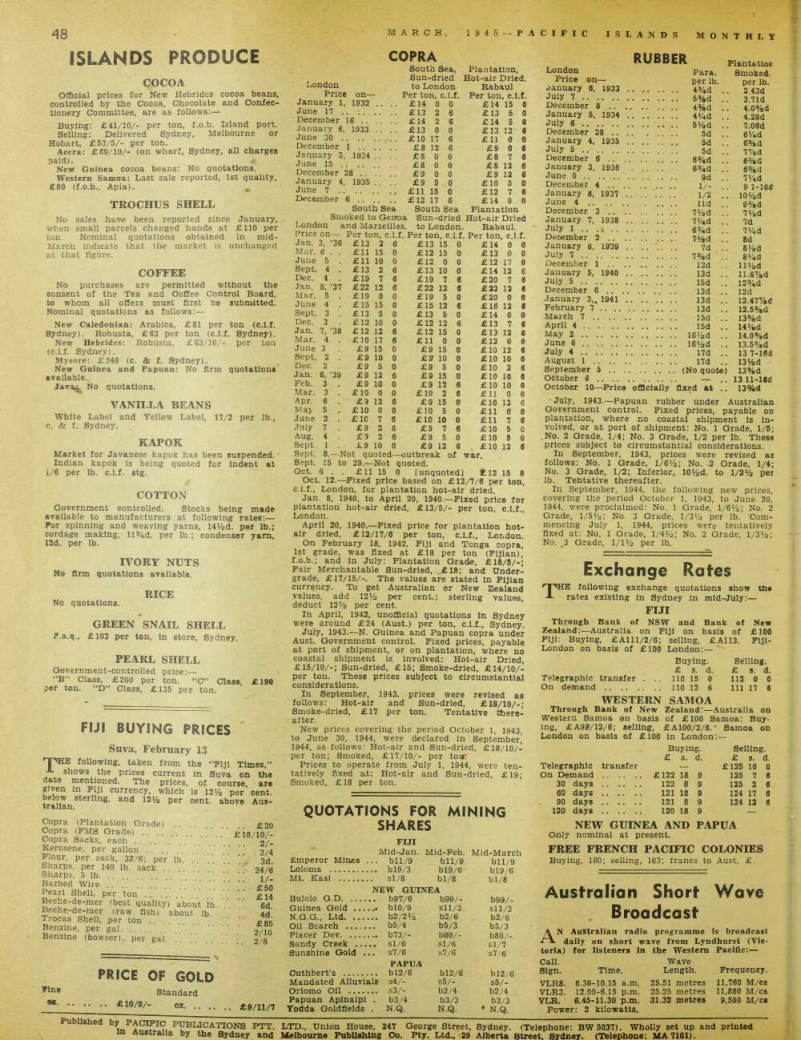
Cocoa
Official prices for New Hebrides cocoa beans, controlled by the Cocoa, Chocolate and Confec tionery Committee, are as follows; — Buying: £4l/10/- per ton, f.o.b. Island port.
Selling: Delivered Sydney, Melbourne or Hobart, £53/5/- per ton.
Accra: £69/10/- (on wharf, Sydney, all charges paid).
New Guinea cocoa beans: No quotations.
Western Samoa: Last sale reported, Ist quality, £BO (f.0.b., Apia). „
Trochus Shell
No sales have been reported since January, when small parcels changed hands at £llO per ton. Nominal quotations obtained in mid- March indicate that the market is unchanged at that figure.
Coffee
No purchases are permitted without the consent of the Tea and Coffee Control Board, to whom all offers must first be submitted.
Nominal quotations as follows: — New Caledonian: Arabica, £Bl per ton (c.l.f.
Sydney). Robusta, £63 per ton (c.i.f. Sydney).
New' Hebrides: Robusta, £63/10/- per ton (c.i.f. Sydney).
Mysore; £240 (c. & f. Sydney).
New Guinea and Papuan; No firm quotations available.
No quotations.
Vanilla Beans
White Label and Yellow Label, 17/2 per lb., c. & f. Sydney.
Kapok
Market for Javanese kapok has been suspended.
Indian kapok is being quoted for Indent at 1/6 per lb. c.i.f. stg.
Cotton
Government controlled. Stocks being made available to manufacturers at following rates:— For spinning and weaving yarns, 14y 2 d. per lb.; cordage making, 11 3 / 4 d. per lb.; condenser yarn, 12d. per lb.
Ivory Nuts
No firm quotations available.
Rice
No quotations.
Green Snail Shell
f.a.q., £lO3 per ton, In store, Sydney.
Pearl Shell
Government-controlled price:— “B” Class, £2OO per ton. “C” Class £l9O per ton. “D” Class, £135 per ton.
Fiji Buying Prices
Suva, February 13
T'' HE following, taken from the "Fiji Times,” shows the prices current in Suva on the date mentioned. The prices, of course are given in Fiji currency, which is 12Vi per cent, below sterling, and 12y 2 per cent, above Aus tralian.
Copra (Plantation Grade) Copra (FMS Grade) .. £ 18/10/- Copra Sacks, each Kerosene, per gallon ... "
Flour, per sack, 32/6; per lb Sharps, per 140 lb. sack ... ' 94 /« Sharps, 5 lb.
Barbed Wire Pearl Shell, per ton ..
Beche-de-mer (best quality) about ib.
Beche-de-mer (raw fish) about lb Trocas Shell, per ton . . . . . 6d. . . 4d.
Benzine, per gal ' o/m Benzine (bowser), per gal
Price Of Gold
Standard £lo/9- oz £9/11/7
Sept. 8.—Not quoted—outbreak of war.
Sept. 15 to 29.—Not quoted.
Oct. 6 . . £ll 15 0 [unquoted] £l2 15 6 Oct. 12.—Fixed price based on £l2/7/6 per ton, c.i.f., London, for plantation hot-air dried.
Jan. 8. 1940, to April 20, 1940 —Fixed price for plantation hot-air dried, £l3/5/- per ton, c.i.f., London.
April 20, 1940.—Fixed price for plantation hot air dried, £l2/17/6 per ton, c.i.f., London.
On February 18, 1942, FIJI and Tonga copra, Ist grade, was fixed at £lB per ton (Fijian), f.0.b.; and in July: Plantation Grade, £lB/5/-; Fair Merchantable Sun-dried, £18; and Under grade, £l7/15/-. The values are stated in Fijian currency. To get Australian or New Zealand values, add 12 y 2 per cent.; sterling values, deduct 12 y 2 per cent.
In April, 1942, unofficial quotations in Sydney were around £24 (Aust.) per ton, c.i.f., Sydney.
July, 1943.—N. Guinea and Papuan copra under Aust. Government control. Fixed prices, payable at port of shipment, or on plantation, where no coastal shipment is involved: Hot-air Dried, £l5/10/-; Sun-dried, £l5; Smoke-dried, £l4/10/per ton. These prices subject to circumstantial considerations.
In September, 1943. prices were revised as follows: Hot-air and Sun-dried, £lB/10/-; Smoke-dried, £l7 per ton. Tentative there after.
New prices covering the period October 1, 1943, to June 30, 1944, were declared in 1944, as follows: Hot-air and Sun-dried, £lB/10/per ton; Smoked, £l7/10/- per to».
Prices to operate from July 1, 1944, were ten tatively fixed at: Hot-air and Sun-dried, £l9; Smoked, £lB per ton.
Copra
South Sea, Plantation, Sun-dried Hot-air Dried.
London to London Rabaul Price on— Per ton. c.i.f.
Per ton. c.i.f.
January 1, , 1932 . £14 0 0 £14 15 0 June 17 . £13 2 6 £13 5 0 December 16 .. £14 2 6 £14 5 0 January 6, 1933 . £13 0 0 £13 12 6 June 30 . £10 17 6 £11 0 0 December 1 . . . . £8 12 6 £9 0 0 January 5, , 1934 ., £8 0 0 £8 7 6 June 15 . £8 i 0 0 £8 12 6 December 28 ., . £9 i 0 0 £9 12 6 January 4, , 1935 . . £9 5 0 £10 5 0 June 7 .. £11 15 0 £12 7 6 December 6 . . . . £12 17 6 £14 0 0 South Sea South Sea Plantation Smoked to Genoa Sun-dried Hot-air Dried London and Marseilles, to London.
Rabaul.
Price on— Per ton, , c.i.f.
Per ton, c.i.f. . Per ton. c.i.f.
Jan. 3, ’36 £13 ; 2 6 £13 15 0 £14 0 0 Mar. 6 . . £11 15 0 £12 15 0 £13 0 0 June 5 , £11 10 0 £12 0 0 £12 17 0 Sept. 4 . £13 : 2 6 £13 10 0 £14 12 6 Dec. 4 . £19 ' 7 6 £19 7 6 £20 7 S Jan. 8, ’37 £22 12 6 £22 12 6 £22 12 6 Mar. 5 . £19 ( 3 0 £19 5 0 £20 0 0 June 4 . £15 15 0 £15 12 6 £16 12 « Sept. 3 . £13 ! 5 0 £13 5 0 £14 0 0 Dec. 3 . £12 10 0 £12 12 6 £13 7 e Jan. 7, ’38 £12 12 6 £12 15 0 £13 12 6 Mar. 4 £10 17 6 £11 0 0 £12 0 0 June 3 £9 15 0 £9 15 0 £10 12 6 Sept, 2 . £9 10 0 £9 10 0 £10 10 0 Dec. 2 . £9 > 0 £9 5 0 £10 2 6 Jan. 6, ’39 £9 12 6 £9 15 0 £10 10 0 Peb. 3 . £9 10 0 £9 12 6 £10 10 0 Mar. 3 . £10 0 0 £10 2 6 £11 0 0 Apr, 6 . £9 12 6 £9 15 0 £10 12 8 May 5 . £10 0 0 £10 5 0 £11 0 0 June 2 . £10 1 r 6 £10 10 0 £11 7 6 July 7 . £9 2 6 £9 7 6 £10 5 0 Aug. 4 £9 2 6 £9 5 0 £10 5 0 Sept. 1 £9 10 0 £9 12 6 £10 12 6
Quotations For Mining
Shares
July, 1943.—Papuan rubber under Australian Government control. Fixed prices, payable on plantation, where no coastal shipment is in volved, or at port of shipment: No. 1 Grade, 1/6; .No. 2 Grade, 1/4; No. 3 Grade, 1/2 per lb. These prices subject to circumstantial considerations.
In September, 1943, prices were revised as follows: No. 1 Grade, 1 /6Vz\ No. 2 Grade, 1/4; No, 3 Grade, 1/2; Inferior, 10 Vzd. to 1/2 y 2 per lb. Tentative thereafter.
In September, 1944, the following new prices, covering the period October 1, 1943, to June 30, 1944, were proclaimed: No. 1 Grade, 1/6 y 2; No. 2 Grade, 1/5 y 2; No. 3 Grade, 1/3 y 2 per lb. Com mencing July 1, 1944, prices were tentatively fixed at; No. 1 Grade, l/4y 2 ; No. 2 Grade, l/3y 2 ; No. ,3 Grade, 1/1 y 2 per lb.
Fiji
Mid-Jan.
Mid-Feb.
Mid-March Emperor Mines . .. bll/9 bll/9 bll/9 Loloma .. bl9/3 bl9/6 bl9/6 Mt. Kasl . sl/8 bl/8 bl/8 Bulolo G.D
New Guinea
., b97/6 b99/b99/- Guinea Gold ... .. blO/9 sll/3 sll/3 N.G.G., Ltd b2/6 b2/6 Oil Search ..., .. b5/4 b5/3 b5/3 Placer Dev b80/b80/- Sandy Creek ... .. sl/6 sl/6 sl/7 Sunshine Gold .. ,. s7/6 s7/6 s7/6 Cuthbert’s
Papua
.. bl2/6 bl2/6 bl2/6 Mandated Alluvials s4/s5/s5/- Orlomo Oil b2/4 b2/4 Papuan Aplnaipl . b3/4 b3/3 b3/3 Yodda Goldfields . N.Q.
N.Q. * N.Q.
RUBBER Plantatlor
London Para.
Smoked.
Price on— per lb. per lb.
January 6, 1933 2.43d July 7 3.71d December 8 .. . 4.0 5 / o d January 5, 1934 4.28d July 6 7.06d December 28 .. . 5d .. 6y«d January 4. 1935 6%d July 5 .. .. . 7 7 /sd December 0 6 3 /sd January 3. 1936 6 3 /id .. 6%d June 5 7 l /*d December 4 . . . 9 l-16d January 8, 1937 . lOVad June 4 lid .. 9 3 /sd December 3 .. . 7y a d January 7, 1938 . 7d July 1 7y»d December 2 .. . 8d January 6, 1939 . 7d . sy 8 d July 7 8>/4d December 1 .. . iiy 2 d January 5, 1940 . 13d .. 11.6 7 /«d July 5 12 3 /*d December 6 .. .. 12d January 3„ 1941 . 13d .. 12.47 7 /sd February 7 .. .. , 12.5*/ed March 7 13%d April 4 14y«d May 2 14.0<y a d June 6 13.5»/«d July 4 13 7-16d August 1 ny»d September 5 .. . 13 %d October 6 13 11-ltd October 10 —Price officially fixed at .. 13%d
Exchange Rates
THE following exchange quotations show the rates existing in Sydney in mid-July:—
Fiji
Through Bank of NSW and Bank of New Zealand: —Australia on Fiji on basis of £lOO Fiji: Buying, £Alll/2/6; selling, £AII3. FIJI - on basis of £lOO London:—
Western Samoa
Through Bank of New Zealand; —Australia on Western Samoa on basis of £lOO Samoa: Buy ing, £ A99/12/6; selling, £AIOO/2/6. Samoa on London on basis of £lOO in London:—
New Guinea And Papua
Only nominal at present.
Free French Pacific Colonies
Buying, 160; selling, 163; francs to Aust. £.
Buying. Selling. £ s. d. £ s. d.
Telegraphic transfer ... 110 15 0 112 0 0 On demand 110 12 6 111 17 6
Buying.
Selling. £ s. d. £ s. d.
Telegraphic transfer — £125 10 0 On Demand £122 18 9 125 7 6 30 days 122 8 9 125 2 6 60 days 121 18 9 124 17 6 90 days 121 8 9 124 12 0 120 days 120 18 9 —
Broadcast
Australian Short Wave Broadcast
AN Australian radio programme is broadcast daily on short wave from Lyndhurst (Vic toria) for listeners in the Western Pacific:—
Call.
Wave Sign.
Time.
Length.
Frequency.
Vlr8.
6.30-10.15 a.m. 25.51 metres 11.760 M/cs
Vlr3.
12.00-6.13 p.m. 25.25 metres 11,880 M/cs.
Vlr.
6.45-11.30 p.m. 31.32 metres 9,580 M/c§ Power: 2 kilowatts.
Advertisements & other items, p. 50 (1 item)
48
MARCH, 1945 PACIFIC ISLANDS MONTHLY
Published by PACIFIC PUBLICATIONS PTY. LTD., Union House, 247 George Street, Sydney. (Telephone: BW 5037). Wholly set up and printed m Australia by the Sydney and Melbourne Publishing Co. Pty. Ltd., 29 Alberta Street. Sydney. (Telephone; MA7101).
Air Fatality Off Fiji
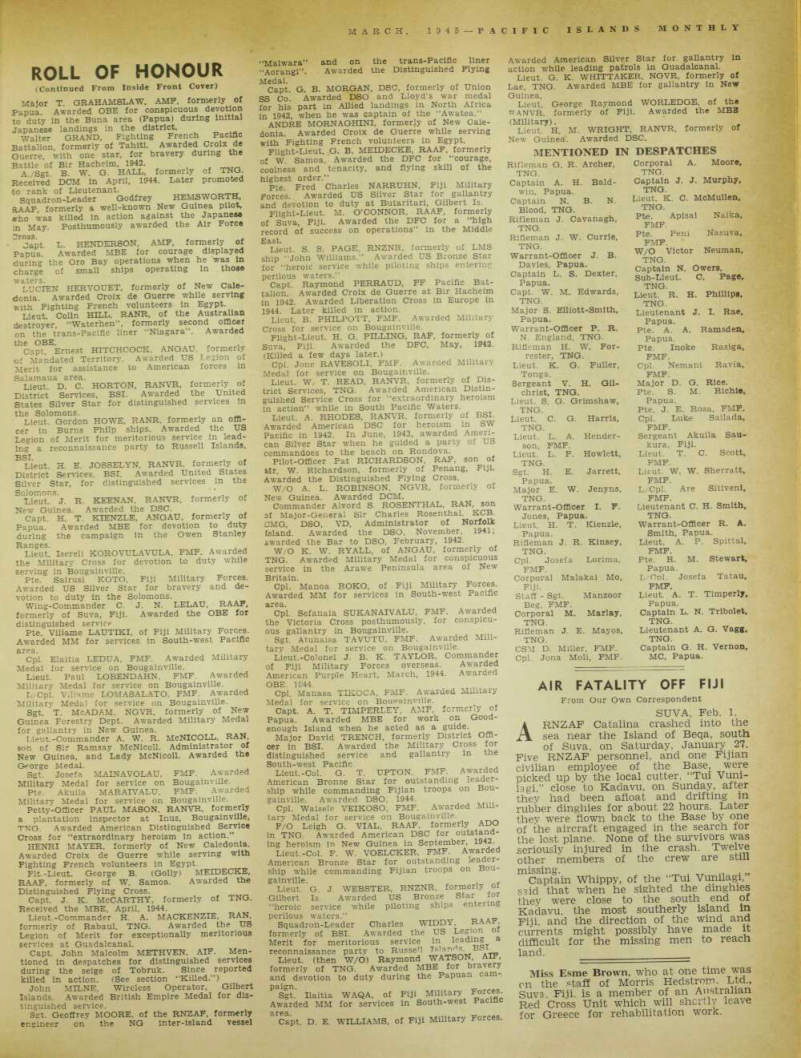
From Our Own Correspondent
Suva, Feb. 1.
ARNZAF Catalina crashed into the sea near the Island of Beqa, south of Suva, on Saturday, January 27.
Five RNZAF personnel, and one Fijian civilian employee of the Base, were picked up by the local cutter, “Tui Vuni lagi,” close to Kadavu, on Sunday, after they had been afloat and drifting in rubber dinghies for about 22 hours. Later they were flown back to the Base by one of the aircraft engaged in the search for the lost plane. None of the survivors was seriously injured in the crash. Twelve other members of the crew are still missing. . „ „ . „ Captain Whippy, of the “Tui Vunilagi, said that when he sighted the dinghies they were close to the south end of Kadavu, the most southerly island in Fiji, and the direction of the wind and currents might possibly have made it difficult for the missing men to reach land.
Miss Esme Brown, who at one time was on the staff of Morris Hedstrom. Ltd., Suva. Fiji, is a member of an Australian Red Cross Unit which will shortly leave for Greece for rehabilitation work.
Advertisements & other items, pp. 51-52 (2 items)
Roll Of Honour
(Continued From Inside Front Cover)
W. R. Carpenter & Go. Ltd.
Established 1914
THIRTY YEARS OF PACIFIC ISLANDS
DEVELOPMENT AND SERVICE.
W. R. CARPENTER & GO. LTD.
Capital £1,000,000.
GENERAL MERCHANTS AND SHIPOWNERS
Buyers and Exporters of All Kinds of Islands Produce Copra Merchants and Millers Agents for Australian, European and American Manufacturers Distributors of Every Description of Merchandise
AGENTS FOR:
FORD MOTOR COMPANY OF CANADA DODGE BROTHERS INC.
ELECTROLUX REFRIGERATORS WESTINGHOUSE ELECTRICAL CO.
T. G. & C. BOLINDERS (ENGINES) CATERPILLAR TRACTORS Etc., Etc.
BRANCHES THROUGHOUT THE PACIFIC ISLANDS
Head Office: 16 O'CONNELL STREET, SYDNEY
In London: W. R. Carpenter & Co. (London) Ltd., Coronation House, 4 Lloyd's Avenue London, EC.
The W.R.C. Line
9, Regular Cargo and Passenger Service between Europe and Pacific Islands’ ports was established by W. R. Carpenter & Co. Ltd.