Islands
Pacifiic
Monthly
February 17,1945
Vol. Xv. No. 7.
Established. 1930 ntrfffcinriii V ® \t u m' nk
[ Registered. transmission by post as a newspaper ]
1/-
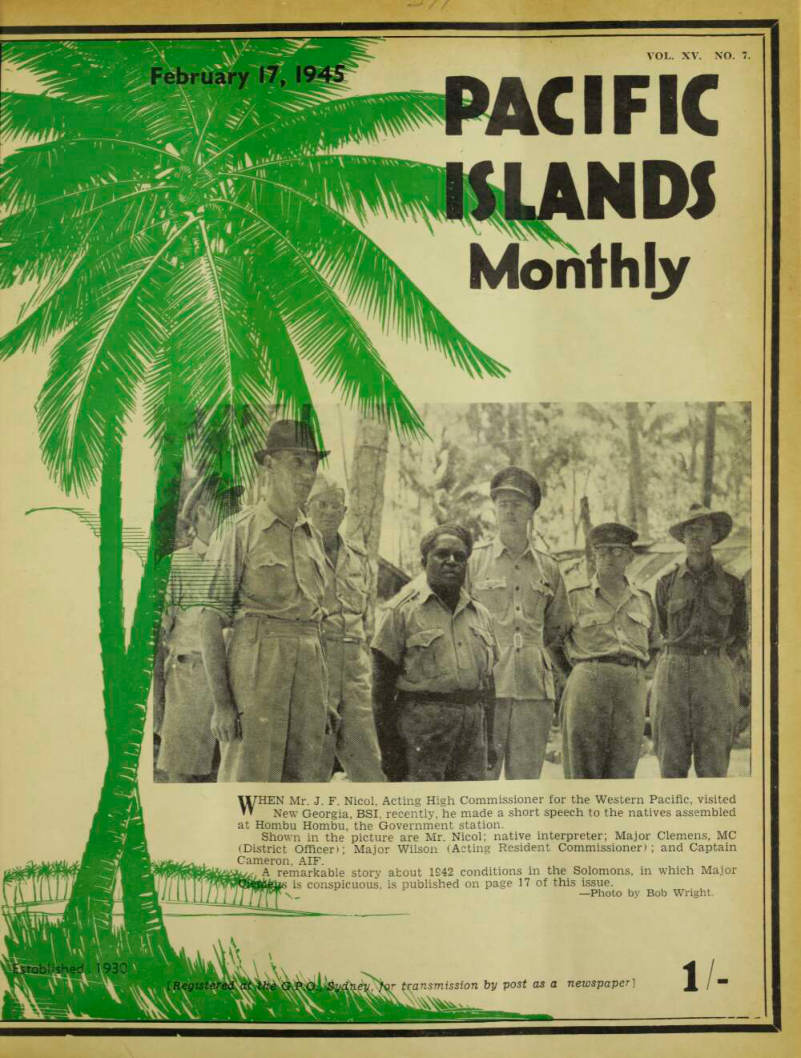
WHEN Mr. J. F. Nicol, Acting High Commissioner for the Western Pacific, visited New Georgia, BSI, recently, he made a short speech to the natives assembled at Hombu Hombu, the Government station.
Shown in the picture are Mr. Nicol; native interpreter; Major Clemens, MC (District Officer); Major Wilson (Acting Resident Commissioner); and Captain Cameron, AIF.
A remarkable story about 1942 conditions in the Solomons, in which Major Clemens is conspicuous, is published on page 17 of this issue. —Photo by Bob Wright.
ROLL OF HONOUR—Section I.
[Section 1 (Killed. Missing, Prisoners) and Section II 'Wounded, Decorations, etc.), published in Alternate Months] (We try to assemble here the names of mien of the United Nations, residents or former residents of the Pacific Territories, whose names appear in casualty lists or who receive decorations. We should be grateful if relations and friends would send us details of such men.)
Killed
Sgt. Bert AITKEN, NZEF. formerly of FIJI.
Killed in action in Libya.
Eugene AUBRY (formerly of Tahiti), of the Air Force of Figmmg France. Killed in an air accident in Great Britain.
Pte. Louis ASPINALL, NZEF, formerly of W.
Samoa. Killed in action in Italy in March, 1944.
Trooper Richard Steele AUBIN, NZEF, for merly manager of the Mangaia, Cook Is. branch of CINA, Ltd. Killed in action in Italy.
Lieut. L. E. AUSTIN, AMF, formerly of Tan gara, Papua. Reported missing, believed killed, February, 1944.
Squadron-Leader Stan BALDIE, RAF. formerly of Wau, TNG. Killed in action in India.
Jean BARTHE, of FF Pacific Battalion, form erly of N. Caledonia. Killed in action.
Pilot-Officer Len BAYLISS, flying instructor In the RAAF, formerly of Rabaul, New Guinea.
Killed in Sydney 18/11/1940, when he fell from a trainer aircraft in flight.
Lleut.-Colonel C. N. F. BENGOUGH, of BSI, Defence Forces, formerly Acting-Resident Com missioner of BSI. Killed when aircraft shot down into sea, August, 1943.
R. C. BENTLEY, NZEF. formerly of Fiji.
Killed in action. Middle East, June 27. 1942.
Victor BERNUT, of FF Pacific Battalion, form erly of N. Caledonia. Killed in action.
A/Bdr. Neville W. BERTWISTLE, AIF artillery (lank unit), formerly a clerk on the staff of W. R. Carpenter and Cos. Ltd., of Rabaul. New Guinea. Killed in action, April, 1941.
P/O J B. BOMFORD. RNZAF. formerly of CSR Cu.'s staff. Fiji Killed on active service In England.
Pie. W. R. M. BRADNAM, of the NZ Forces, formerly of Fiji. Reported killed In action In the Middle East, 25/11/1941.
Warrant-Officer R. F. BRECHIN, New Guinea Force. Killed In air accident, June 17, 1942.
Formerlv of NO Department of Agriculture.
Pte. Rex BRIGHOUSE, NZEF, formerly of W.
Samoa. Killed in action in Italy.
Anton BRINON, of Fighting French Pacific Battalion, formerly of La Foa, New Caledonia.
Killed in action In Libya. November, 1942.
Lleut.-Colonel Felix BROCHE, of the New Caledonian-New Hebridean contingent of the Fighting French Pacific Battalion. Killed in action in the battle of Bir Hacheim (Libya).
Sgt.-Observer Ross BUCKLEY, RNZAF, form erly of Fiji. Reported missing in air operations.
Presumed “dead” in January, 19'44.
Pte. Emori CABENALEVU, of Fiji Military Forces. Killed in action in Solomons.
Pilot-Officer E. H. CANARD, of RAF. formerly of Fiji Civil Service. Killed in flying accident 1n South Africa in the course of his duty as flying instructor.
Pte. David C. GARLAND. AIF. formerly chief assayer at the Emperor gold mines. Fiji. Killed in action in New Guinea.
Pierre CHARPENTTER, of the Fighting French Pacific Battalion. Killed in action In the battle of Bir Hacheim.
Raymond CHAUTARD (formerly of New Cale donia). of the Fighting French Pacific Battalion billed in action in Libya. « . F i^ ht ‘ LieUtenant G J T - CLARKE, of the RAAF. formerly Assistant Flight Superintendent of Carpenter Airlines, New Guinea. Killed In action during operations off Dakar (French West Africa), while attached to HMAS "Aus tralla , September, 1940.
Flying-Officer Jack R. COATH. of the RNZAF ,° n Q the St *s. 0f the Bank of New Zealand, in Suva, FIJI. Killed October 1941 when a training aircraft crashed in NZ Bqd.—Leader Lionel COHEN, RAP, formerly of Upper Watut. TNG. Killed when returning from a bomber raid on Berlin in 1942 Sgt-Pilot Colin CRABBE. RAF. formerly of fn V Ma^ 1J 1943 Kill6d ** enemy a ° tion in En S land denlrt jS? 7* A J G ; IF ' form erly of account! department Australasian Petroleum Cos Port Mo-esbv P*pua. Killed In action. June. 1941 J J rf J ™ DAWE ,V f t ! ie Nz p orces. formerly Dls tr et Officer of Savaii. Western Samoa. Reported killed in action. February, 1942.
Pilot-Officer V. L. DEARMAN, of the RAAF (observer), formerly overseer and clerk at the Ooonlal Sugar Refining Cos.. Ltd.. Raraval.
Fiji. Reported killed in action in the Middle East, October, 1941.
Lieut. Bruce Insham DENT, MC, of Fiji Mili tary Forces. Killed in action in S-W Pacific, March 25, 19'44. (See "Decorations.”) Robert DEVAUX, of FF Pacific Battalion, formerly of N. Caledonia. Killed in action.
Robert DROLLET, of FF Pacific Battalion, formerly of Tahiti. Killed in action in Italy, June, 1944.
Gustav GOGENMOS, of FF Pacific Battalion, formerly of N. Caledonia. Killed in action.
Cpl. Alec GIBB, NZEF, formerly of Apia, Western Samoa. Killed in action in Italy in early 1944.
Capt. Jean GILBERT, of the Naval Forces of Fighting Prance, and formerly of Tahiti. Killed air accident while on mission in South Pacific.
Captain Kenneth GARDEN, of the RAF Ferry Command, formerly of Guinea Airways Ltd., in New Guinea Killed September, 1941, when a bomber he "ferried” from USA crashed on west coast of Britain, Flylng-Offlcei Moresby GOFTON, of the RAF. •mi of Mrs. F S. Stewart, of Wau, New Guinea Reported missing. 17 5/1940—presumed killed In air operations.
Rifleman J A. GOODWIN, AIF infantry, for merly of Bulwa. TNG Reported "accidentally killed”, Ap-il. 1942 Ernest GOURNAC ■ formerly of Tahiti), of the Mr Force of Fighting France. Killed in an air accident in Britain.
Pie. Wallace GRAHAM, of the NZ Forces (infantry), formerly on the staff of Morris Hedstrom Ltd., Fiji. Killed in action in the Middle East. November. 1941 Lieut. J. A. GRANT. AIF, formerly of Man dated Territory Killed in action.
Lieut. L. B. GROVE, AIF, formerly of Madang TNG. Killed in action.
Squadron-Leader C. R. GURNEY. RAAF. * former chief pilot of Guinea Airways, Ltd Killed in action in the New Guinea area May 1942, Pte. B. HAMILTON. AIF. formerly of Auck land, NZ, and New Guinea. Killed in action Gerald T. J. HARPER. RAF, son ol Major and Mrs. P. Harper, of Ra, Fiji. Killed in action while navigating a Whitley bomber dur ing a raid on the Continent Capt. G. C. HARRIS, AIF, formerly of TNG.
Reported killed in action, June, 1944.
J. HEAD. RAAF, formerly of Fiji. Killed in flying accident in Australia. 1941.
Hute HEPO, of FF Pacific Battalion, formerly of Tahiti. Killed in action in Italy, June, 1944.
Captain L. T. HURRELL, infantry, Rabaul.
Killed in action.
Sqd.-Leader James R. HYDE, of the RAF formerly a Patrol Office in Namatanai and Sepik Districts, TNG. Awarded the Distinguished Fly ing Cross, 1941. Killed in action while leading an attack on an enemy convoy off the coast of Greece. July 24, 1942.
Pte. Jack JOHNSON. fo-merly of Morris Hedstrom’s staff. Fiji. Killed in action on November 4. while serving with the AIF in New Guinea.
Flying-Officer Alan JOHNSTONE, of the RAF who was born in Suva. FIJI, In 1915 Killed during bombing raid on Kristlansand. Norway, April. 1940 Flying-Officer G. M. KEOGH. RAAF. form erly of Wewak, TNG. Killed in air operations in New Guinea. August 30. 1943.
LAC Douglas KIRBY. RAP. who left Suva Fiji, with the first contingent of Air Force trainees. Reported killed in a flying accident in South Africa, March, 1942.
Marcel KOLLEN. of the Pacific Battalion of Fighting France. Killed in action in the battle of Bir Hacheim Marcellin LACABANNE, of the French Colonial Infantry Commandos. Holder of the Croix de Guerre, with Silver Star, and Medaille Militaire Formerly of N. Caledonia. Killed in action in Amiens, France, May 25, 1940.
C. D. LAMONT, RAF, formerly a master at Boys’ Grammar School, Suva, Fiji. Missing, be lieved killed on air operations over Germany.
Pte. Jone LAWAKILEVU, FMF. Reported killed in action in the Solomons, September 1944.
Cpl. Gaston LESSON, of the Fighting French Pacific Battalion. Killed in battle of Bir Hacheim (Libya).
F/O Allan T. LEYDIN, RAAF, formerly of Panua and the Mandated Territory. Kil’ed in flying operations over the Mediterranean, October 26, 1943.
James LEVY, of FF Pacific Battalion, form erly of N. Caledonia. Killed in action.
Capt. (now Lt.-Colonel) Edward Tlwi LOVE, NZ Maori Battalion, husband of Mrs. Takau Rio Love, Ariki-nui of Rarotonga, Cook Islands. Re ported missing during campaign in Greece, May, 1941; later, June. 1941, reported "wounded and safe.” Officially announced, July 17, 1942 killed in action In Libya.
Flying-Officer John C. LOWE, RAAF, formerly an overseer with the CSR Cos. in Fiji. Reported 11/4/1942, "took part in air defence of Rabaul, TNG. —missing, believed killed".
Pte. L, F. McCarthy, AIT Infantry, form erly supercargo on W. R Carpenter and Co.’a inter-island vessels "Desikoko” and "Mako”, In New Guinea. Reported "killed in action” in Syria 30/10/1941.
Sgt. Kenneth MACGREGOR, A IP, formerly practising as a barrister and solicitor in Wau, TNG. Reported missing, believed killed, In Papua.
Sgt.-Pilot Ronald MACKAY, RAAF, formerly of Thursday Island. Killed in an aircraft accident in England.
Lieut. J. McCLYMONT, formerly of Apia, W.
Samoa. Reported killed in action.
Lance-Corporal A. D. MacPHEE. son of Mr R. D. MacPhee, Levuka. Fiji He was 35. was a member of the AIF, and was killed in Greece May, 1941 Noho MANEA, of FF Pacific Battalion, formerly of Tahiti. Killed in action in Italy, June, 1944.
Ernest MARTIAS, of FF Pacific Battalion* formerly of N. Caledonia. Killed in action Francois MASSON, of the Fighting French Pacific Battalion. Killed In action in the battle of Bir Hacheim.
Capt. John Malcolm METHVEN. Reported killed In action in Egypt on July 22. 1942. while serv ing with the AIF. He was born In Ocean Island and Is the youngest son of Mr. and Mri Stuartson C. Methven, of Belprave, Victoria P/O Officer Stuartson Charles METHVEN born in Suva, Fiji, brother of the late Capt. J M. Methven. Killed in air operations over Germany on January 23, 1943.
Spr. A. L. MORANDTNI, AIF Engineer* for merly of Konedobu, Papua. Reported killed In action, April, 1942.
F/O R. H. MORGAN, RAAF. Missing, now presumed dead, after flying operations on May 6. 1944.
Marc MOUTRY, of FF Pacific Battalion, fo-merly of N. Caledonia. Killed in action.
Pte. Viliame NAILATI, of Fiji Military Forces.
Killed in action in Solomons.
F. R. J. NICHOLLS, Royal Artillery, formerly of Fiji Killed In action, Burma May. 1942.
W/O G. A. OBST. formerly a member of the Lutheran Mission, TNG Joined Australian military forces in February. 1942. Killed in action In New Guinea on December 21, 1942.
QM Sgt. Toby O’BRIEN, AIF, formerly of the Lands and Surveys Department, TNG. Killed in action at Lae in September, 1943.
Sub-Lieut. A. OLANDER, RANVR, formerly of New Britain. Killed by the Japanese on Amelut Plantation, New Britain, March, 1943.
J. L. C. OSBORN, NZEF, formerly of Fiji Killed in action. Middle East. June, 1942.
Sub-Lieut. Con PAGE, RANVR, formerly of Mandated Territory. Reported killed by the Japanese on Nemto Is., off New Ireland coast, about July, 1942.
Pilot-Officer Ivan PALMER, RAP, formerly of Fiji. Killed in air operations over Malta.
Lieut. R. G. M. PEMBERTON, AIF. formerly of Rabaul. New Guinea. Killed in action.
Capt. Raymond PERRAUD, FF Pacific Bat talion, formerly of Noumea. Killed in action in Europe, 1944. Holder of the Croix de Guerre and Liberation Cross.
O. PILLING, RAF, formerly of Fiji. Missing: believed killed.
Lieut. Tony PHELPS, Fiji Military Forces.
Killed in action in the South Pacific, January, 1944.
Flight-Lieut. H. G. PILLING, DFC, of the RAF. formerly of Suva, FIJI. Killed on air operations. May 19. 1942.
Pte. Edward Harold PRICE, 2nd NZEF (27th Machine Gun Battalion), youngest son of Mr and Mrs J. Price, Savu Savu West, FIJI. Killed in action during the Llbvan campaign, Middle East, 27/11/1941 Pte. Cecil PURCELL, NZEF. formerly of Aleipata. Samoa. First Samoan Euroneslan to give his life in World War IT. Killed in action in Middle East.
P/O G. REES-JONES, RAAF, formerly of Labasa, Fiji. Killed in air operations over Ger many, August 16, 1942.
(Continued on Inside Back Cover)
Cpl. J. E. BROAD, NZEF, formerly of Suva, Fiji. Reported prisoner of war. Reported escaped from German POW camp in Italy, 1944.
Now returned to New Zealand.
Lieut. John BROWN, formerly of Fiji. Re ported a prisoner of war in Italy.
Cpl. E. BOURKE, AIF, formerly of New Guinea. Prisoner of war in Germany.
Sgt. R. F. BUNTING, AIF, formerly of Samaral, Papua. Missing in Malaya. Now reported prisoner of war.
Henri CLEMENCEAU, of FF Pacific Battalion, formerly of N. Caledonia. Reported POW.
Sgt. Peter COGGINS, AIF, formerly of Fiji.
Taken prisoner in Malaya, and now reported prisoner of war in Borneo camp.
A/Sgt. A. A. S. COTMAN, AIF infantry, of Abau, Papua. Reported missing—believed prisoner of war, 5/5/1941; reported later, July, 1941, “wounded in chest and head by shrapnel— taken prisoner”.
Cpl. W. F. CULLEN, AIF, formerly of Thursday Island. Reported prisoner of war, John Arnold CROCKETT, AIF, formerly of Bulolo, TNG. Reported prisoner of war in Osaka, Japan, September, 1943.
Pte. J. DALTON, AEP Transport and Supply, formerly of Thursday Island. Reported prisoner of war, April, 1942.
Victor DERVAUX, of FF Pacific Battalion.
Formerly a POW in Italy, but escaped and now interned in Switzerland.
Dick ELMOUR, formerly of New Caledonia, prisoner of war after Dunkirk. Repatriated to Prance in January, 1942, because of health reasons.
Pte. W. G. ECKBLADE, AIF, formerly of Rabaul. Previously reported missing; now re ported missing; believed prisoner of war.
Pilot-Officer George Beilby EVANS, RAAF, son of Mr. and Mrs. Beilby Evans, formerly of Buka Passage, TNG. Reported prisoner of war in Java.
Lieut. R. W. Feetum, AIF, formerly of New Guinea. Previously reported missing; now re ported “missing believed POW, March, 1943.”
Gnr. A. I. FOLEY, AIF, formerly of Papua.
Reported missing in Malayan campaign. Re ported prisoner of war in February, 1944.
Gaston GEILLER, of Fighting French Pacific Battalion. Reported missing after battle of Bir Hacheim. Reported POW, May, 1944.
Sgt. Robert GEMMELL-SMITH, RAF, formerly on CSR Co.’s staff, Fiji. Reported prisoner of war in Bengazi, Libya, in November, 1942.
W/O.n V. M. I. GORDON, AEP, formerly of Wau, TNG. Reported prisoner of war after Malayan campaign.
Pte. W. GOSSNER, AEP infantry, formerly of the BNG Development Cos., Port Moresby, Papua.
Reported prisoner of war, Sulmona, Italy, 6/7/1941. Escaped 1944.
J. P. GOUZENE, of Fighting French Pacific Battalion. Reported missing after battle of Bir Hacheim. Reported POW, May, 1944.
W/OI A, N. GRAY, AIF, formerly of Rabaul, TNG. Reported prisoner of war.
Chief-Sergeant Francois GRISCELLI, of Fight ing French Pacific Battalion. Reported missing in Libya in April. Formerly of New Caledonia.
Reported POW, May, 1944.
Lieut. J. M. HARCOURT, 2nd NZEF, son of Mr. H. W. Harcourt, formerly Deputy Treasurer in Fiji. Reported “captured in Libya and now prisoner of war”, March, 1942.
Squadron-Leader Godfrey HEMSWORTH, of the RAAF, formerly a well-known commercial pilot in Morobe, TNG. Reported missing after an operational flight against the Japanese in the New Guinea area and presumed killed in action. Reported prisoner of war in Japanese hands in October, 1943.
S. D. C. KERKHAM, NZEF, son of Mr. R, C.
Kerkham, Suva, Fiji. Reported prisoner of war in September, 1942.
Lieut. JEFF KEENER, NGVR. Believed prisoner of war in Japan.
Gnr. A. L. B. KING, AIF artillery, of Rabaul, TNG. Reported prisoner of war, 29/7/1941.
Lieut. G. G. KENNER, New Guinea Forces, formerly of Rabaul. Reported prisoner of war.
Paul KLEIN, of FF Pacific Battalion, form erly of N. Caledonia. Reported POW.
Nura LETHEIZER, of FF Pacific Battalion, formerly of N. Caledonia. Reported POW.
Major E. G. A. LETT, East Surrey Regiment, and son of Mr. Lewis Lett, of Port Moresby, Papua. Reported prisoner of war in Libya.
P/O J. LTETKE, RAAF, formerly of Labasa, Fiji. Reported prisoner of war in Germany, 1943.
A/Cpl. John H. LONERGAN, ATP, Supply and Transport, of New Guinea. Reported prisoner of war at Corinthia, Italy, 8/7/1941.
Pte. Ernest (“Paddy”) McGEADY, NZEP, son of Mrs. J. McGeady, of Suva, Fiji. Reported “missing, believed killed”, after fighting in Libya, January, 1942; reported prisoner of war in Italy, April, 1942.
Cpl. J. H. L. McGUIGAN, of the Field Ambulance, ATP, formerly of the Public Health Department, New Guinea. Officially reported missing at Singapore; unofficially reported a prisoner in Japanese hands. Reported prisoner of war in Malaya, May 24, 1943.
Observer Alex. McKAY, of the RAAF, formerly of the CSR Co.’s staff, at Penang sugar-mill, Fiji. Reported missing, 27/7/1941; reported prisoner of war in Italy, 26/10/1941.
Pte. Harry MARCHINGTON, of the NZ Forces, formerly of Fiji. Reported prisoner of war after Battle of Crete, 2/12/1941.
Pte. F. C. MAYO, AIF, formerly of New Guinea. Reported a prisoner of war.
Camille MERCTER, of Fighting French Pacific Battalion. Reported missing after battle of Blr Hacheim. Reported POW, May, 1944.
Flt.-Lieut. G. E. ("Dusty”) MILLER, RAAF, formerly of Papua. Reported POW in Germany in 1943. Repatriated to England, 1944.
Lieut. Jean MILLIARD, of French Artillery.
Formerly of N. Caledonia. POW in Germany since fall of France,* June, 1940.
Emile MILLOT, of Pacific Battalion of Fight ing France. Taken prisoner in battle of Bir Hacheim (Libya).
Pte. J. F. MORRELL, formerly of TNG. Re ported missing believed prisoner of war, June 1, 1944.
Sgt. NAGLE, of French Colonial Infantry; formerly of N. Caledonia. POW in Germany since fall of France in June, 1940.
Pte. J. G. NEWTON, AIF, formerly of Papua.
Reported prisoner of war, June, 1944.
Pte. G. S. O’BRYAN, NZEF, formerly of Rarotonga, Cook Is. Missing after battle of Crete; now reported prisoner of war in Germany.
Gaetan OLLIVAUD, of French Colonial In fantry, formerly of N. Caledonia. POW in Ger many since fall of France, June, 1940.
Pte. D. R. PHILLIPS, AIF engineers, formerly of Bulwa, TNG. Reported prisoner of • war, June, 1942.
Eugene POGNON, of FF Pacific Battalion, formerly of N. Caledonia. Reported POW.
Henri PAYONNE, of Fighting French Pacific Battalion. Reported missing after battle of Bir Hacheim. Later reported POW, Italy. Later escaped and rejoined FF forces.
Gnr. Allan H. ROSS. AIF artillery, formerly planter in New Britain, TNG. Reported “miss ing—believed prisoner of war,” 28/9/1941. Re ported POW, September, 1944.
A/Bdr. L. J. SMEETON, AEP, formerly of Rabaul, TNG. Reported prisoner of war in Malayan campaign.
Pte. John O. SMITH, of the NZ Forces, son of Captain Arthur Smith, of the Fiji inter-island vessel “Tui Kauvaro”. Missing after battle of Crete, May, 1941; reported prisoner of war in Germany, 21/10/1941.
Squadron-Leader L. C. SHOPPEE, DSC, RAF, formerly of Edie Creek, New Guinea. Was in Java during Japanese invasion; now known to be a prisoner of war, Gnr. D. M. SPENCE, ATP, formerly of Port Moresby. Reported prisoner of war after Malayan campaign.
LAC Charles SOLLTTT, of the RAAF (wire less operator), son of Mr. and Mrs. C. H.
Sollltt, of Nausori, Fiji. Reported missing after air operations in New Guinea, January, 1942; later, March, 1942, reported rescued from sea by Japanese—now prisoner of war.
Pte. Fred SWAN, NZ Army Medical Corps, formerly of Apia, Western Samoa. Missing after Battle of Crete, August, 1941; reported prisoner of war in Germany, November, 1941.
Repatriated from a German prison camp to NZ in 1944.
Signalman J. C. E. SWINBOURNE, 6th Div.
Signals, A IP, formerly of Fiji and the Gilbert & Ellice Islands Colony. Taken prisoner at Crete, June, 1941, now in prison camp at Stalag, VIIA, Germany.
Lieut. CLIFF WARREN, of NZEP, serving in the Middle East, and formerly of Morris Hed strom Ltd.’s staff at Ba and Lautoka, Fiji. Re ported prisoner of war.
Mjr. N. WATCH, formerly Dr. Watch, of Rabaui, missing after Japanese invasion of Rabaul. Believed prisoner of war in Japan, Now reported POW in Japan.
Gnr. D. S. WHITCOMBE, NZEF, formerly of Fiji and Tonga. Wounded in Crete and reported prisoner of war in Germany.
Pte. John D. WHITCOMBE, of the NZ Forces, formerly of Levuka, Fiji. Reported prisoner of war in Germany, November, 1941.
Captain W. H ROBERTS NZEF. who war Accountant In tfie Samoa Treasury Dept., dur ing 1934-35. Killed in action in Llbva. Decem ber. 1941.
Pte. Kameli ROKOTUILOMA, of the Fiji Military Forces. Reported killed in action, December, 1943.
Major A. B. ROSS. NZEF, who. between 1923- 29 was successive Iv. Assistant Secretary for Native Affairs Assistant Secretary to thr Administration, and ADC to the Administrator of Samoa. Killed in action in Libya.
Cpl. Alex. C. SCOTT. AIF, formerly manager at Kieta. TNG. for Burns, Philp and Co T td Killed in action in the Middle East 19 6 ’941 J. SIMPSON, RAAF. formerly of Fiji. Killed in action over Malta. Julv. l£T41.
Sgt. R. R. SHORT, AIF. formerly of Port Moresby. Killed in action Lieut. G. STFVENSON. AIF. formerly a Patrol Officer in New Guinea. Killed in action in New Guinea, on June 26. 1943.
Cpl. Sefanaia SUKANAIVALU, FMF. Reported i-iited in action in the Solomons, September, 1C44.
Lieut. P. A. TUCKEY, AIF, formerly of TNG.
Killed in action in Sepik area. NG, December, 1944 Lieutenant A. G. W. THOMAS. RANR. for merly master of Burns Philp & Company s SP “Muiiama.” Killed in action.
Pte. Popoare TANGim, of the NZ Force* (Maori Battalion), formerly of Mangala Cook Islands. Reported "missing after Battle of G’-eece—presumed dead", July. 1941 John Tama TETOEA, of FF Pacific Battalion, formerly of Tahiti. Killed in action in Italy.
June, 1944.
Atera TEUIRA, of FF Pacific Battalion, for merly of Tahiti. Killed in action in Italy, June, 1944. — Derek TOVEY, NZEF, formerly of Suva, FIJI.
Killed in action in Tunisia in April, 1943.
Andre VERNIER, formerly of Tahiti. Killed in action with the Maquis in France.
Rifleman R. E. VERNON. AIF, formerlv of Lae TNG. Reported killed in action, June, 1944.
Capt. A. F. J WHITE, AIF. formerly a Dis trict Officer in Fiji, and BSI. Killed in action in New Guinea.
Died From Wounds
Pte. Roy Ian BROWN. NZEF. formerly of Apia, W. Samoa. Died of wounds in Italy, April, 1944.
Pte. Ernest HENRY. AIF. formerly of the Rabaul <NG' staff of Burns, Philp and Co.
Ltd. Died from wounds received in Battle of Crete. 1/6/1941.
Pte Alec. MUNRO. NZ Forces, formerly of Norfolk Island. Died in Llbva (Middle East) December. 1941.
Adolphe Arthur LAHARRAGUE, formerly of Tahiti. Died of wounds received while serving in the Fighting French forces.
Pte. T. LAWRIE. AIF. son of Mr. Lawrle, for merly of Fiji. Died of wounds in Middle East Pte. Walter PEARSON, of first NG quota of AIF infantryi Died from wounds received in action, 24 6/1941 4/Rdr. W R SCOTT. 4 IF. of New Guinea Died from wounds. July, 1941.
Sgt. Charles SPITZ, of the Fighting French Pacific Battalion, and formerly of Tahiti Died from wounds received at Bir Hacheim, on June 21. 1943.
Sgt.-Pl’ot Peter Clarkson WISE, of the RAF son of Mr W Wise. OBE. Director of Puoiu Wo’-ks. Fiji. Died from wounds received during bombing raid Germanv. January, 1941
Accidentally Killed
Lieut.-Colonel C. C. JUDD, formerly of Morobe, TNG. Accidentally killed in Australia in January, 1943.
A Cpl P. A. McKEE, New Guinea Forces, formerly of Bulolo. Died of injuries.
Ma;or N. V. McKENNA, AIF, formerly o I Wau, TNG. Accidentally killed, September 30. 1943.
F/O Lee VIAL, DSC, formerly ADO. Mandated Territory. Killed in April. 1943, in a plane crash in Sepik district while on a special mission.
Capt. F. E. WILLIAMS, formerly Government Anthropologist in Papua. Killed in a plane acci dent while on duty in New Guinea, in 1943.
Sgt. Edward WILSON, of Suva, serving in th« Fiji Defence Force. Accidentally drowned in the Lami River. Fiji. April. 1942 Gnr. Robert J. WILSON, formerly of Port Moresby, Papua. Accidentally killed in troop train in Middle East in 1942.
Died From Illness
Pte. Lawrence BOYER, NZEF, formerly of
Tonga and Fiji. Died on active service in Italy.
Pte. Tevita BUREKAMA, of Fiji Military Forces. Died of illness while on duty in the Solomons.
Pte. H. COOMBE, NZEF, formerly of Suva, Fiji. Died in Middle East, April, 1944.
Pte. Clarence A. HUTTON. AIF, formerlj oj Edie Crtek, TNG. Died from Illness, April, 1941 Ratu Dovi KOMAISAVAI, RAF, formerly of Fiji. Died of illness in Britain, October 19, 1944.
Capt. W. J. MCDONALD, AIF, formerly of Morobe and Sepik districts. TNG. Died of ill ness in New Guinea, July 20, 1944.
Pte. Manoa NAKARU, of the Fiji Military Forces. Reported died on active service, Decem ber, 1943.
Pte. Isikeli NABOKO, of the Fiji Military Forces. Reported died on active service, Decem ber, 1943.
Seaman Malvin NELSON, of Fiji Royal Naval Volunteer Service. Death reported in May, 1943.
Pte. Inikasio SERU, of the Fiji Military Forces. Reported died on active service, Decem ber, 1943.
A/Sgt. J. H. STANE, Royal Australian En gineers formerly of Port Moresby, Papua. Died from illness. May. 1942.
Rifleman R. A. SMITH, HQ Unit. (Place of enlistment not stated.) Died of Illness.
Cpl. R. H. SUTTON, NGVR, formerly of Wau.
TNG. Died from malaria and typhoid In October, 1942.
Pte. Mateo TUIDALA, of the Fiji Military Forces. Reported died on active service, Decem ber. 1943.
Pte. Emosi WAQA, of the Fiji Military Forces.
Reported died on active service, December, 1943.
Major P J. WOODHTLL. AIF Infantry formerly legal assistant in the Crown Law Office. Rabaul, New Guinea. Reported died from illness, December, 1941.
Pte. F. WORK, of the Fiji Military Forces.
Reported died on active service. December, 1943.
Missing
Louis ANGER, of Fighting French Pacific Battalion. Reported missing after battle ot Bir Hacheim.
Pte. P F. BAILEY, AIF Infantry, ol Rabaul.
TNG. Reported missing, 17/2/1942. Now re ported prisoner of war.
Lieut. J. T. BARRACLUFF, AIF, formerly of New Guinea. Reported missing, December, 1943.
Cpl. Leon BARRENE, ol Pacific Battalion of Fighting France. Missing after battle ol Blr Hacheim (Libya).
Sgt.-Pilot Murray Waldon BENTLEY, RNZAF, formerly of Fiji. Reported missing in air operations in the Middle East, January, 1943.
P/O Robert Waldon BENTLEY, RNZAF, for merly of Fiji. Reported missing on air opera tions on May 5, 1943.
Alexandre BLACK, of Pacific Battalion, FF Forces. Repo ted missing after Battle of Bir Hacheim.
T. BLAKELOCK. BEF. formerly of Fiji. Miss ing.
Sat Ronald Arthur BROODBANK. formerly of Samarai. Papua, now serving with the R-AAF overseas. Reported missing on May 31 while on air operations.
Sgt. Alexander BROWN. RNZAF. formerly of Rarotonga. Reported missing over Germany, on September 15, 1942.
Reginald BOULANGER, of Fighting French Pacific Battalion. Reported missing after battle of Bir Hacheim.
H. BUCKNELL. AIF. formerly of Fiji. Missing.
Andre CHITTY, of FF Pacific Battalion, form erly of N. Caledonia. Reported missing.
Pte E. L. CHRISTIE. AIF infantry. of Rabaul. TNG Reported missing. 17/2/1942.
Georges CLEMEN, of FF Navy. Formerly of N. Caledonia. Missing in Mediterranean. March. 1942.
Victor DERVAUX. of Fighting French Pacific Battalion Reported missing after battle of Bir Hacheim.
Lucien DEVAND. of Pacific Battalion of Fight ing Prance. Missing after battle of Bir Hacheim (Libya).
Pte. A. G DICKSON AIF Infantry of Rabaul. TNG. Reported “missing believed wounded" 17/2/1942 Wing-Commander Donald DONALDSON. RAAF, formerly of Nauru. Missing on air operations over France in June, 1944, Pilot-Officer Norman R FRAZER. RAAF, formerly of Wau. TNG. Reported missing on air operations over Germany. August 30, 1943. - Eion FIELD, RNZAF, formerly of staff of Kasi Mines. Fiji. Missing in Java.
Gath GELDARD, NGVR. of New Britain.
Missing after the battle of Rabaul, January, 1942.
Georges GOVETCHE. of FF Pacific Battalion, formerly of N. Caledonia. Reported missing.
Acting Flight-Lieut. Don A. IRVING, RAAF, formerly chemist in CSR Cos., Labasa, Fiji. Miss ing, presumed dead, in air operations over Germany, February 27, 1942.
Pte. Andrew A. (Billo) Johnson, Ngvr.
Reported missing in New Guinea on October 29, 1942.
Georges KABAR, of Fighting French Pacino Battalion. Reported missing after battle of Blr Hacheim.
Henri LANGLOIS, of Pacinc Battalion of Fighting France. Missing after battle of Blr Hacneim (Libya).
Numa LETHESER, of Pacific Battalion of Fighting France. Missing after battle of Bir Hacheim (Libya).
Rene LETOCART. of Fighting French Pacinc Battalion. Reported missing after battle of Blr Hacheim.
Cpl. E. G. MacADAM, NGVR, of Rabaul, TNG.
Reported missing after the battle of Rabaul, January 1, 1942.
Capt. J. J. MURPHY, AIF, formerly of New Guinea. Reported missing, December, 1943.
Pte. R. J. PASCOE, AIF Infantry, of Rabaul.
TNG. Reported missing, 27/1/1942.
Pilot Tom PATTERSON. of the RNZAF. formerly of Levuka, Fiji. Reported missing. In November, 1941. after bombing raid on the Continent.
Eugene PENE, of Fighting French Pacinc Battalion. Reported missing after battle of Bir Hacheim.
Andre PETRE, of Fighting French Pacinc Battalion. Reported missing after battle of Bir Hacheim.
Eugene POGNON, of Fighting French Pacinc Battalion. Reported missing after battle of Blr Hacheim.
Pte. William RUPE, of the NZ Forces (Maori Battalion), formerly of Altutakl, Cook Islands.
Reported “missing after Battle of Greece”, July. 1941.
Pilot James SIMPSON, of the RAF formerly of Vatukoula, Fiji. Reported missing after air operations over Malta, in the Mediterranean, 1/7/1941.
L/Bdr. G. G. SMITH, NZEF, formerly of Suva.
Fiji. Reported missing.
Louis SALOMAN, of FF Pacinc Battalion, formerly of N. Caledonia. Reported missing.
Charles STIERMANS, of FF Pacific Battalion, formerly of N. Caledonia. Taken POW in Libya, but missing after transport was sunk in Medi terranean.
Puoi-Officcr Neville George STOKES, of the RAF formerly a pilot w.th Guinea Airways, Ltd., m New Guinea. Reported missing after air operations in Europe, December, is*-** Chas. STIERMANS, of FF Pacinc Battalion, formerly of N. Caledonia. Reported missing.
Louis VINDOUX, of FF Pacinc Battalion, formerly of New Caledonia. Reported missing.
Reported Missing
Malaya Casualty List, Published 23/7/1942.
ALEXANDRE BLACK, of Pacinc Battalion of Fighting France. Reported killed In action at Bir Hacheim. Now reported missing.
Andre CHITTY, of Pacinc Battalion of Fight ing France. Missing at battle of Bir Hacheim (Libya i.
Pte. E. L. CHRISTIE, infantry, Rabaul. me. A. G. DICKSON, infantry, Rabaul.
Pte. J. M, HIRSCHEL. Infantry. Rabaul.
Pte. J. G. NEWTON, artillery. Port Moresby.
Australia and Island Stations, pto. S. W. HUNTER, infantry. Kokopo.
Prisoners Of War
Pte. J. H. ALLAN, AIF, formerly of Wau, TNG.
Formerly reported missing, now reported prisoner of war. _„ .
Gnr. N. H. AMOS, AIF, formerly of Port Moresby. Reported prisoner of war after Malayan campaign.
Lieut. CLARRIE ARCHER. NGVR. Believer prisoner of war in Japan. Reported prisoner of war in February, 1943, in prison camp on Island south of Japan.
Georges BEBERE, of FF Pacific Battalion formerly of N. Caledonia. Reported POW.
Ruoert BLUM, of Fighting French Pacific Battalion. Reported missing after battle of Blr Hacheim. Reported POW, May, 1944.
Cpl. Jock BAIRD. AIF, formerly of Bank ol NSW staff. Suva, Fiji. Reported missing in Malaya. February. 1942. Reported prisoner of war. September. 1943.
Mariel BARRAU, of French Infantry, formerly of N. Caledonia. Taken prisoner after fall of France, June, 1940.
A Cpl. Peter W. BOSGARD, AIF Infantry, formerly of the Lands Department, Port Moresby, Papua. Reported prisoner of at Sulmona Italy, 29 6/1941: transferred to Bolzano prison camp, September, 1941.
(Continued on Page 42)
Pacific News-Review
Jan. 17: Warsaw, capital of Poland, has fallen to the Red Army, whose winter offensive is now in its seventh day. This offensive is described by Moscow cor respondents as the greatest in history.
Jan. 18: General Mac Arthur, whose forces are sweeping down Luzon on Manila, is months ahead of schedule in his Philippines campaign stated Mr.
Churchill in a review to the House of Commons to-day.
Jan. 19; Berlin announced to-day that Russian troops were now 30 miles inside East Prussia. Further south, Russian spearheads aimed at Breslau in Silesia, are now reported to be 20 miles within Germany. Meanwhile, on the Western Front, the Allies are pressing three attacks in bitter weather. There are many signs that Marshal von Rundstedt is withdrawing to the Siegfried Line and that some German reserves will be switched from the Western to the East ern Front.
Jan. 21: The speed of the Russian offensive—2oo miles in 10 days—shows no signs of slackening. The whole German front between the Carpathians and the Upper Vistula is collapsing and 'East Prussia is threatened with isolation. In an attempt to solve the deepening Polish political crisis brought to a head by this phenomenal Russian advance, the Polish Cabinet-in-Exile in London has asked the Allies to place the country under an international commission until a general election can be held.
Jan 21: The Americans advancing down Luzon (Philippines) are now 76 miles away from Manila, the capital.
Jan. 23: The Red Army has advanced 160 miles—half way to Berlin—since the beginning of its offensive from Warsaw and the Vistula, 10 days ago. Marshal Rokossovsky, on the right flank, is now thrusting towards Danzig, in order to isolate East Prussia completely.
Jan. 23: On the Western Front the Germans are now retreating headlong from the Ardennes bulge. All roads leading east towards the German frontier are jammed with military traffic, and great toll is being taken by our air forces Jan. 24; American troops driving rapidly towards Manila, on Luzon Island, occupied the most northerly of the 11 air strips of Clark Field, and the camp where survivors of Bataan were interned in 1942.
Clark Airfield is the most important on Luzon.
Jan. 28: East Prussia has been com pletely isolated from the rest of Germany by the arrival of Russian forces on the Baltic coast. Meanwhile, Marshal Zhu kov’s great tank thrust into central Ger many is reported to be only 90 miles from Berlin. German reports state that then expected defence line on the River Oder cannot be relied upon, as the river is now so completely frozen over that it could bear the weight of the heaviest of Russian tanks.
Jan. 29: The Duke of Gloucester (new Governor-General of Australia) and the Duchess, their two children, and their party,’ arrived in Sydney at 9.30 p.m. to-day.
Jan. 2b: The Dace of the Russian offen sive has slowed all along the Eastern Front as the German High Command masses its forces for a final and desperate defence. The swiftness of the Russian advance, which in 17 days has brought them from the Vistula to 30 miles inside Berlin’s province of Brandenburg, has had a shattering effect on the morale of the German people.
Jan. 29: American troops on Luzon
(Philippines) have passed Clark Field and are now on the Papanga River, last natural barrier, 34 miles from Manila.
Jan. 30; The Australian’s southern advance in Bougainville is being bitterly contested by the Japanese by a system of pill-boxes and artillery posts. In the north of the island the advance is rapidly nearing Buka Passage.
Jan. 31: The first crossing of the River Oder by Marshal Zhukov’s forces, north of Berlin, was reported to-day by Berlin radio. Fighting is also reported 25 miles south of the city, at Frankfurt and Kustin.
Jan. 31; The American forces have made another landing on Luzon —this time on the west coast, just north of Subic Bay, on Bataan Peninsula. The landing was almost unopposed, and with the Americans from the north now almost within sight of Manila, the Japanese forces are in a serious position.
Feb. 2: General MacArthur’s head quarters report that on January 31 US troops landed in Province, 40 miles south-south-west of Manila.
Feb. 2; It has been officially reported that all of the Ardennes bulge captured by Rundstedt’s forces in their Western Front counter-offensive in December, has been won back by the Allies.
Feb. 4: Since the crossing of the Oder by Marshal Zhukov’s forces on February 1 the battle for Berlin has developed into a struggle for the river bridgeheads. This is the result of a thaw which has weak ened the river ice and turned hard snow into slush. Considering the time of the year, the thaw is not expected to last long, but- it has been sufficient to slow up the Red advance.
Feb. 5: It has been announced from the Philippines that General MacArthur’s forces, from the east, entered Manila on February 3. Other divisions from south and north are now also entering the city.
The first arrivals released 2,700 Allied prisoners who have been interned in Santo Tomas University since the fall of the Philippines three years ago. Others were released later. Much mopping up work remains to be done in the Philip pines, but they can be regarded as being virtually back in American hands.
Feb. 5: The Australians have made another landing in New Britain, which carries them 20 miles closer to the enemy concentrations on the Gazelle Peninsula.
Feb. 6: It has now been revealed that Mr. Churchill is attending a conference of leaders of the Great Powers. The location is not known.
Feb. 6: The Germans admit four Rus sian crossings of the Oder Line, and that one south of Frankfurt directly menaces Berlin 40 miles to the west. Thousands of Russian troops, supported by tanks and mobile guns, are streaming across the upper river for the final phase of the battle for the capital. Further south, Marshal Koniev, who has forced the river on a 50-mile front south of Breslau, is clearing the SE approaches to the capital.
Feb. 7: According to neutral observers, a hasty reshuffle is being undertaken in Germany, making von Papen Chancellor, preparatory to a peace bid by Germany.
Feb. 7; Australian air, land and sea forces from the Halmeheras to Bougain ville, are hammering at the Japs. In the Aitape and Bougainville areas the Aus tralian ground troops are pressing on against strengthening enemy resistance.
Feb. 8: Manila is being ravaged by the Japanese as they fall back before the Americans, who have cleared the city of the enemy north of the River Pasig. The Japanese have destroyed some of the port
Notes And Comment On
The Progress Of The War
From Jan. 17 To Feb. 12
facilities and part of the water supply.
Feb. 9: Montgomery has launched a new offensive against the northern extremity of the Siegfried Line and has gained five miles at some points. His troops, however, are battling forward in a sea of mud and water —victims of an unpre dictable and premature “thaw” in Europe.
Feb. 11; The Japanese in southern Manila have converted many buildings into pill-boxes which in turn are protected by minefields, and are making a last ditch stand. ' / Feb. 11: British and Canadian troops are now fighting in the streets of the German town of Kleve, only four miles from the River Rhine, the last natural barrier guarding the Ruhr. But they are also battling against the weather and unnatural conditions of mud, and the going is everywhere tough.
Feb. 12; Russian flying columns are driving on Berlin from the south-east.
Marshal Koniev’s armies have burst across the Oder River on either side of by-passed Breslau and threaten to roll up the whole Oder defence line and open the way for a massive invasion of cen tral Germany. Koniev is 100 miles from Berlin; 80 miles from Dresden.
Bem Winner In Sydney
On Leave
ON leave in Sydney, in February, was Mrs. Ruby Boye, of the Santa Cruz Group of the Solomons. Mrs, Boye was awarded the British Empire Medal last year for outstanding work in the Allied cause. She is entitled to wear also the ribbon of the 1939-43 Star on the tunic of her WRANS uniform.
Returning to her home in Vanikoro, where her husband is manager of the Kauri Timber Co,, shortly after the out break of war, she found that the com pany’s teleradio operator was anxious to leave for Australia to enlist in the RAAF.
Mrs. Boye stepped into the breach, took a day off to learn to operate the machine and six weeks to learn Morse. From that time she has carried on alone.
“When Japan came into the war,” she said recently, in Sydney, “I found myself relaying messages for the Navy and ever since I have been at it seven days a week.” Finally, Mrs. Boye was given the rank of honorary third officer in the Women’s Royal Australian Naval Service.
She was the only white woman on the island, but she has been too busy to be lonely. One of her proudest possessions is a letter from Downing Street, express ing appreciation for her services during four difficult and dangerous years.
Captain L. G. H. Sinclair, of the BSI Defence Force, has been promoted to the rank of Acting-Major while perform ing the duties of Legal Advisor.
Mr. J. Ballantyne, of Samarai, Papua, whose daughter Anna married Mr.
Geor°e Hanson, of Namatanai, New Guinea, just before the war, has had word of Mr. and Mrs. Hanson through the International Red Cross. They were caught by the Huns in Denmark, and interned in Germany early in 1940. They now have been living under prisoner-of war conditions for five years. Mr. Ballan tyne is living in Fleming Street, Edgehlll, near Cairns, Queensland,
Contents
Pacific News-Review 1 Editorial; Lon? Wait Before Normal Conditions Return 3 Papuans Speak Plainly to Mr. Ward —And Mr. Ward Doesn’t Likt It 5 Hedstrom Scholarship Winner ... 5 Bronze Star for Pacific Navy Men .. 6 How W. Samoa Begins 1945 7 Fifty Years Old—Nelson and Robert son, Ltd 7 Fall of Rabaul—Defenders Honoured in Australia g Some Women May Return to Papua —Certain TNG Planters, Too .. 8 Tropicalities 9 Those Who Went South in Ships .. 10 New Guinea Gold—Prospects of Re opening Industry at Wau 12 To Restore Murray Administration- New Papuan Association 13 South Seas Regional Commission— Urged Upon United Nations by NZ and Australia 14 What the Samoans Want—Fono Tells Mr. Fraser 17 War Came to Guadalcanal—Part Played by Major Clemens 18 Missionaries and Contract Labour .. 22 The Loss of the Coolie Ship “Syria” 24 The Mysteries of Army Administra tion 27 Election Skirmishes in New Caledonia 28 Apology to Lutheran Missionaries— Australian Publishers Correct an Injustice 28 New Guinea Journey Samara!
To-day 33 Why No Return to BSI? 35 Vale, Johnny Gooding, of Tahiti .. 36 The Magic Bottle 37 Stilwell’s Road Feeds the China That Rejected Stilwell 39 Island Fruit Production .. . 41 The Decline of ANGAU 44
Contract Labour in BSI 45 Commerce, Markets, etc 48 Honour Roll .. cov. ii., lii., and page 42
Advertisers
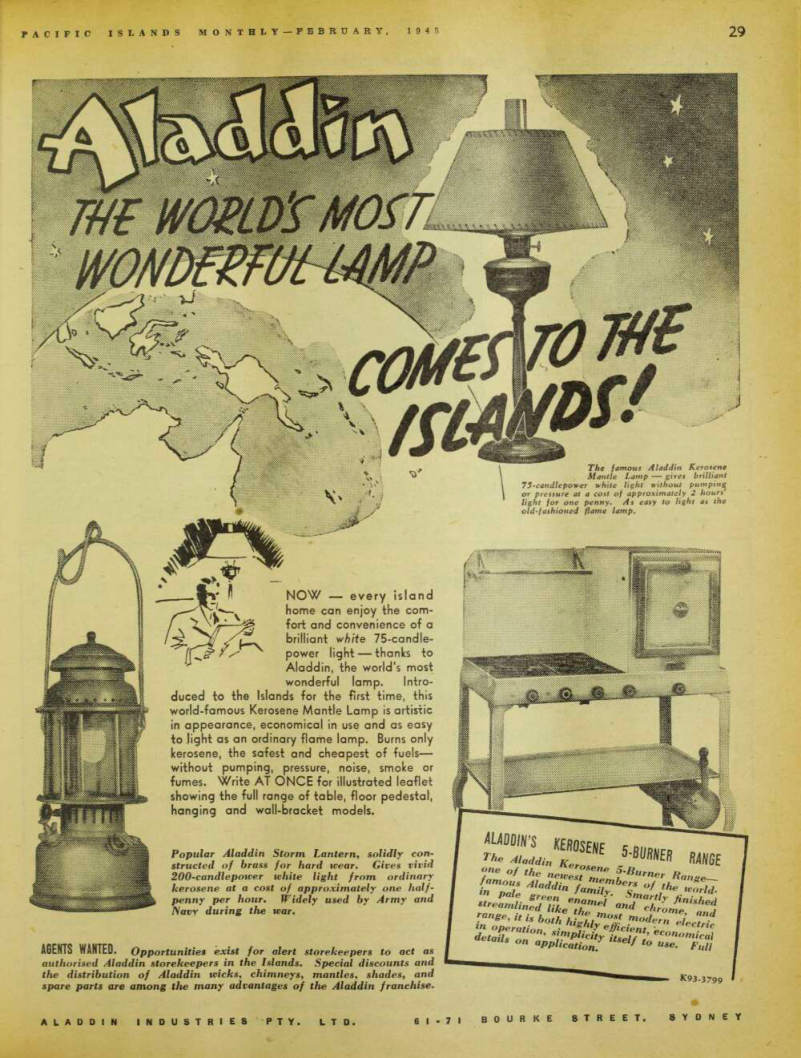
Aladdin Industries Pty., Ltd 29 Atkins Pty., Ltd., Wm 30 A. Ltd 26 Australian Alumi nium Co. Pty., Ltd 37 Baker Pty., Ltd., Jno 45 Brial, E. J,, 15, 16, 36 Broomfield, Ltd. . . 31 Brown & C0.,-Ltd. 11 Brunton’s Flodr . . 44 Burns, Philp Trust Co., Ltd 13
B. (S.S.) Co. . . 11
Carlton & United Breweries, Ltd. . 21 Carpenter, Ltd., W.
R cov. iv.
Casino Hotel, Apia . 16 Chivers & Sons, Ltd 41 Coleman Lamp & Stove Co. . . 19, 39 “Cystex” 33 Darvas & Co. ... 31 David Trading Co. 37 Donaghy & Sons . 31 Donald, Ltd., A. B. 14 Dr. Williams Pink Pills 41 Electrolux Refrigerators . . 20 Farnham, John R. . 18 “Flit” . . . .j- . .47 Ford Sherington Pty., Ltd 28 Foster Clark, Ltd. . 23 Garrett & Davidson 27 Gibson & Co., Ltd.,
J. A. D 46
Gillespie Pty., Ltd., Robert 45
Gilbey’s Gin ... 35 Gillespie’s Flour . . 24 Gough & Co.. E. J. 40 Grand Pacific Hotel 2 Grove & Sons, W.
H 12 Heinz & Co. Pty., Ltd., H. J. . . .25 Kopsen & Co., Ltd. 32 Masschelein, O. F. . 43 “Mendaco” ... 28 Nelson & Robertson Pty., Ltd is “Nixoderm” ... 36 Pacific Is. Society . 47 Pacific Islands Trading Co. . . 15, 30 Pacific Territories Association ... 7 & Bros., S.
P 16 “Pinkettes” ... 32 Queensland Insur ance Co 19 Riverstone Meat Co., Ltd 17 Rose’s Eye Lotion . 47 Rohu, Sil 41 Scott, Ltd., J. ... 33 Steamships Trading Co., Ltd 27 Sullivan & Co., C. . 34 Swallow & Ariel . 22 Taylor & Co., A. . 44 “Tenax” Soap ... 12 Tillock & Co., Ltd. 24 Watson, Wm. H. . . 14 Wright & Co. ... 42 Wright & Co., Ltd., E 36 Wunderlich, Ltd. . . 39 Yorkshire Insurance Co., Ltd 11 Young Pty., Ltd..
Hany, J 38
Advertisements & other items, p. 4 (2 items)
2
FEBRUARY, 194 5 PACIFIC ISLANDS MONTH L Y
\ssv\W w
USEFUL ADDRESSES
The following are the addresses of organisations set up to deal with Pacific Territories affairs:—
PAPUA, NEW GUINEA, NAURU,
NORFOLK IS.
Department of External Territories (Sydney Branch) (Lately the New Guinea Trade Agency), Australia House, Carrington Street, Sydney.
Telephone: BW 1776. (Dealing with all matters connected with the Australian Pacific Territories and also the Sydney representative of the New Guinea Copra Control Committee.)
FIJI, AND HIGH COMMISSION
FOR WESTERN PACIFIC
Sydney Office of Fiji and Associated Administrations. (In charge of Mr. B. F. Blackwell.) 72 Pitt Street, Sydney.
Telephone: BW 7724,
BRITISH SOLOMON ISLANDS
Sydney Office of British Solomon Islands Government (In charge of Mr. F. E. Johnson, Treasurer of the Solomons Administration), 17 Castlereagh Street, Sydney.
Telephone: B 1710.
FOR PACIFIC TERRITORIES
EVACUEES GENERALLY
Pacific Territories Association (C. A. M. Adelskold, Secretary), c/o Robert Gillespie Pty., Ltd., Via Pitt Street, Sydney. Telephone; BW 4782.
WAR DAMAGE COMMISSION
Sydney Office: M.L.C. Buidling, Cnr. Martin Place and Castlereagh Street, Sydney.
Telephone: BW 2361.
FOR CLAIMS AGAINST ARMY
ftlr. H. Alderman, Darwin-Moresby Claims Section, Chief Finance Office (Army), Victoria Barracks, Melbourne.
\ssv\W w
o eV>6^
STAV <* M
Pacific Islands Monthly
The Newspaper-Magazine of the South Seas [.Registered at the G.P.0., Sydney, for transmission by post as a newspaper .]
Published Once Each Month and Circulated in Australia and New Zealand and in the following Pacific Territories and Islands Groups:
Australian Territory of Papua.
Mandated Territory (Australia) of New Guinea Australian Territory of Norfolk Island.
New Zealand Territory of Cook Islands.
Mandated Territory (NZ) of Western Samoa.
British Colony of FIJI.
British Solomon Islands Protectorate.
British Protectorate of Tongan Islands.
British Crown Colony of Gilbert and Ellice Islands.
Mandated Territory of Nauru
British and Free French Condominium of New Hebrides.
Free French Colony of New Caledonia.
Free French Colony of Oceania (Tahiti, etc.).
American Territory of Eastern Samoa.
American Territory of Hawaiian Islands.
Owned and Produced by Pacific Publications Pty. Ltd., Union House, 247 George Street, Sydney.
n „ ( Managing Director . BW 5037 TELEPHONE £ Business and Editorial MA 4369
P.O. Box V. 3408 R
Registered Address of Telegrams, Radiograms, and Cables: “Pacpub”, Sydney.
Contributions.
Articles, Stories, and Photographs dealing with Pacific Islands subjects are invited and will ' be paid for on publication.
Subscription Rates.
Per Annum, within British Empire, Prepaid, Post Free I®/"
Per Annum, elsewhere, Prepaid, Post Free 12/6 Single Copies V-
Editor and Publisher:
R. W. Robson, F.R.G.S.
Advertising Manager; L. W. Bailey.
Advertising Office and Printing-House: 29 Alberta Street. Sydney.
Advertising rates furnished on application.
Representative In Fiji.
Pacific Publications (Fiji), Ltd . Bank of NSW Building, Suva (same office as W. H. Grove & Sons, Ltd.). Stocks of Pacific Islands Monthly and Pacific Islands Yearbook on hand.
Representative In London.
W. C. Harvey, Coronation House. 4 Lloyds Avenue, London, E.C.3, from whom may be obtained copies of Pacific Islands Monthly, Pacific Is. Year Book, advertising schedules, etc.
Agents.
The following aie authorised to receive sub scriptions for Pacific Islands Monthly:— Burns, Philp & Co., Ltd., and Burns Phllp (South Sea) Co., Ltd. All branches.
W. R. Carpenter & Co., Ltd. All branches.
Morris, Hedstrom, Ltd. All branches. Steamships Trading Co., Papua. AH branches.
Whitten Bros., Ltd., Samarai, Papua.
B.N.G, Trading Co., Ltd., Port Moresby, Papua.
J Muir, Suva. FIJI.
Miss R. Castles, Suva, Fiji.
N. C. Mackenzie Hunt, Wainunu, Bua, FIJI.
Cook Islands Trading Co., Rarotonga, Cook Is.
A. C. Rowland, Papeete, Tahiti.
Islands Branches and Representatives of W. H.
Grove & Sons, Ltd., Auckland, New Zealand.
Ed. Pentecost, Noumea, New Caledonia.
Societe Gubbay Kerr et Cie, Noumea, N. Caledonia.
Vol. Xv. No. 7.
February 17, 1945
Pri rp fl/- p « r c°py ' rice prepaid: 10/- p.a.
Long Wait Before Normal Conditions
Return
THE unexpected shape taken by this World War II has created an unforeseen problem for the people of the Territories of the Pacific—the problem of mopping-up. The war may be over officially long before the isolated fighting ceases.
We knew, when the Axis failed to smash us in 1941-42, that we should win the war. But we naturally assumed that the beaten invader, like beaten enemies all through history, would withdraw entirely from the regions in which he was beaten, and thus allow our civilians immediately to re-occupy the home-lands they had lost. For example, we planned confidently for the early return home of the people of Papua, New Guinea Mandated Territory, the British Solomons, etc.
But it has not worked out that way —neither in Europe nor in the Pacific, It is six months since the Germans ran from Eisenhower’s armies, and evacuated France and Belgium; yet it is a fact—not generally known— that very large German garrisons still hold certain Channel ports, on the north-west coast of France. There are 12,000 Germans still cooped up in Dunkirk. There are thousands of Germans still occupying the Channel Islands (British Territory). The enemy apparentlv still holds Crete, There are numerous German pockets in the Mediterranean islands; and in the Balkans, far behind the fighting front in Western Hungary, there is a
whole German army, fighting defen sively in the mountains,
Tmtt^Xt^Tt *
\ LTHOUGH no pronouncement evei 21. has been made, it appears clearly to be the strategy of the Big Three to break up the enemy, and destroy his ability to resist as a controlled fighting organisation, rather than to dissipate their strength in driving him back, step by step, along one clearly defined front.
It is sound strategy. Why waste men, and effort, and time, in besieg ing and attacking and overcoming fiercely resistant pockets of the enemy, and enemy fortresses, when our purpose can be achieved by by passing and isolating those pockets, holding them in the one place, and preventing them from taking any further part in the defence of their country?
For all practical purposes, they be come our prisoners as soon as we isolate them. Our guards are all around them. True, we are obliged to use a lot of guards, and our prisoners shoot at us whenever they can; but, as against that, we are not obliged to feed or house them, and we can reduce their numbers effec tively whenever the opportunity oc curs. And they are not part of the enemy’s defence organisation.
These enemy pockets are not en tirely shut off from communication with their headquarters. In Europe, a plane or a submarine gets through
occasionally; but, generally, their munitions are running out, and they slowly are being reduced to most desperate straits for food. When re sistance ceases in their home-lands they, of course, will collapse.
THE European situation is dupli cated, almost exactly, in the Pacific. General MacArthur and Admiral Nimitz, in their combined push from south-east to north-west, across the Western Pacific, have iso lated and, for all Japanese resistance purposes, paralysed, many Territories and islands. A quick survey over the Pacific shows a truly remarkable situation.
Between August, 1942, when the Americans and Australians struck at the Japs in the Solomons-Papua area, and February, 1945, when the Ameri cans recaptured Manila, the Pacific battle front was driven back about 2,500 miles, towards Tokio. If we re gard Indonesia (Philippines, Borneo and the Netherlands Indies) as sepa rating the Pacific Indian and Oceans, we can truthfully say that the whole of the Western and South-western Pacific, except the water immediately around Japan and China, have been recovered from the Japanese invasion.
All the Pacific, right up the line of Indonesia, is now dominated by the Allies, where for two years it was almost entirely at the mercy of the Japanese.
But this does not mean that the re gions referred to have been cleared of the Japanese. At a rough calculation, there are Japanese armies and garri sons, to the extent shown, in the following places, which Americans
and Australians have by-passed and isolated: Bougainville and Buka . 12,000 Rabaui end of New Britain and New Ire land 50,000 Aitape section of New Guinea mainland . . . 50,000 Dutch New Guinea . . . 20,000 Marshall Islands 5,000 Caroline Islands, includ ing Palau 20,000 All the Japs in that list, although isolated and militarily useless, retain some military formation, and fight as organised units. In addition, there are large numbers of Japs in isolated parts of those islands and territories,
who are skulking in the remoter jungles and mountains, living as in dividuals, who must be hunted down and cleared out before those regions can regain peace and security, VI/'E may add to that list the Philip y pines archipelago, with Jap forces estimated at 250,000 men.
MacArthur’s armies, having occupied Leyte and Mindoro Islands, Jolo Island (in the Sulu chain), Central Luzon, and the capital city of Manila may be regarded as having paralysed whatever defence organisation the enemy had set up in the group as an outer screen for Janan. The fighting m the Philippines will go on bitterly for a long time yet; but as a mopping up operation, and not as a major campaign against Japan.
Also and before long, we shall add to that hst the British and Dutch Territories of Malaya, Borneo and Last Indies because the Anglo- Amencan operations between the Philippines (in the east) and the Indian Ocean (in the west) are hav ing the effect of isolating all the Japanese forces and installations southwards of Indo-China. Some ob servers recently estimated the Japs in Indonesia at 200,000—but that is sheer guesswork, and it certainly seems an under-estimate: Those Indonesian Territories—they include the sources of oil, tin, rubber, and im portant foodstuffs—are economically of such importance to Japan that it seems certain the- are being held by &t least half a million men nnrtT 6 * 81, let us regard Philippines and Indonesia as still in the battle front, and not yet in the mopping-up stage; even then, the Pacific wa? pattern is singularly like that of
Europe, insofar that our strategy and tactics have isolated large sections of the enemy in many places, “sewn him up,” and left him there, for attention later.
VI/niLE this system undoubtedly is V saving the lives of Allied sol diers, and reducing the period of the war, it is a great embarrassment for displaced civilians who are eager to return, even if their return is to shattered homes and a national economy that lies in ruins. We see it in the South Pacific, where thousands of people, evacuated from New Guinea and the Solomons three years ago, must await the outcome of mopping-up. (Papua is not in the same category.
Not a Jap has been seen in Papua for 18 months, and the country is per fectly safe. Papua, as shown in articles elsewhere, is merely the play thing of addle-pated politicians, fumbling bureaucrats and various Brass Hats who are very happy in well-paid administrative jobs.) The other by-passed Territories fortunately do not present much of a problem. The Marshalls and the Carolines were Japanese colonies; and if the Japanese colonists now are suffering some slight discomfort, no one on the Allied side is going to fret about it. There was no European population in Dutch New Guinea to be displaced.
But in the Philippines, in addition to fifteen millions of natives, there were large numbers of Europeans; and they similarly will remain among the displaced people until mopping
up is finished in Luzon, at least.
An even bigger problem will develop very soon, as the Japanese in Malaya Borneo and the Netherlands Indies are isolated, and forced to fight like f ats m a trap. There are hundreds of thousands of displaced Europeans from those countries (240,000 Dutch men from the Netherlands Indies alone) and they all will be eager to return to their homes and properties.
But the task of clearing the isolated Japs out of the jungles and moun tains and widely scattered archi pelagoes of Indonesia and Malaya, so that re-occupation of those countries by Europeans will be safe, will be colossal, and may extend over years. * * * THE end of both the European and Pacific wars, as formal wars, may not be far off. But war-like opera tions, and all the disturbed conditions which surround them, may continue for a long time. In Europe, apart from the by-passed German garrisons still to be cleaned up, there are at least twenty millions of displaced people—that is, people who must be returned to their homes before we can begin to look for normal condi tions.
An Auckland man has been appointed transport control officer for Fiji. He is Mr. C. P. Harper, formerly traffic and building inspector to the Mount Eden Borough Council. His new appointment will provide for executive and road con trol of all transport in Fiji and the administrations of the petrol and tyre regulations.
Advertisements & other items, p. 6 (3 items)
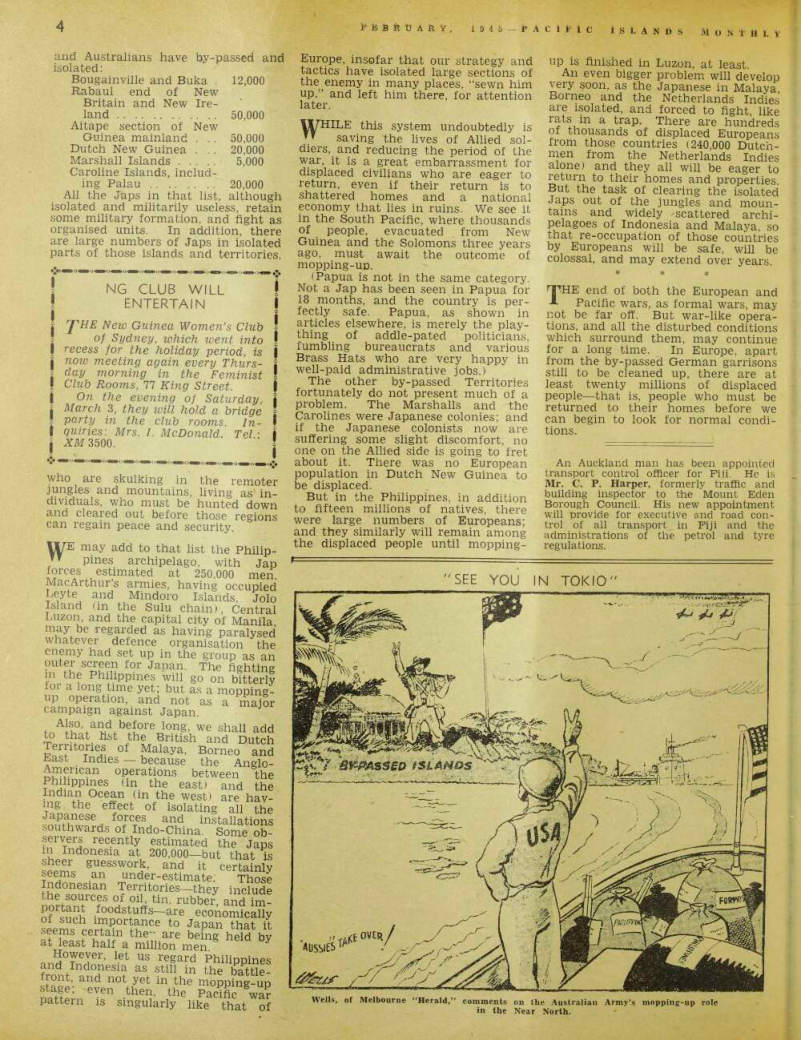
"See You In Tokio"
Wells, of Melbourne “Herald,” comments on the Australian Army’s mopping-up role in the Near North.
4
FEBRUARY, 1945 FACif'iC ISLANDS MONTHLY
Ng Club Will
ENTERTAIN
New Guinea Women’s Club of Sydney, which went into recess for the holiday period, is now meeting again every Thursday morning in the Feminist Club Rooms, 77 King Street.
On the evening of Saturday, March 3, they will hold a bridge party in the club rooms. Inquiries: Mrs. I. McDonald. Tel * XM 3500.
"Master Blue "
{From the Brisbane “Courier Mail”) Affectionately known as “Master Blue,” Patrol Officer Harris, who was with the New Guinea Administration before the war, has become a legendary figure among New Guinea natives.
A West Australian, he was stationed at Lae when Japan entered the war. As the Japanese pushed south he was charged with the evacuation of civilians and Aus tralian troops from New Britain.
Later he took to the hills of New Guinea behind the Japanese lines to spot for our planes and furnish information about enemy troops movements.
The natives looked upon him as some thing of a god. He seemed to be every where and he seemed to know every thing.
Many officials refer to him as the “Lawrence of New Guinea.” But he was more unlucky than Lawrence. The Japa nese spent months trying to catch him.
They eventually succeeded. (Capt. G. C. Harris was reported killed in June, 1944.)
Hedstrom Scholarship
Winner Chosen
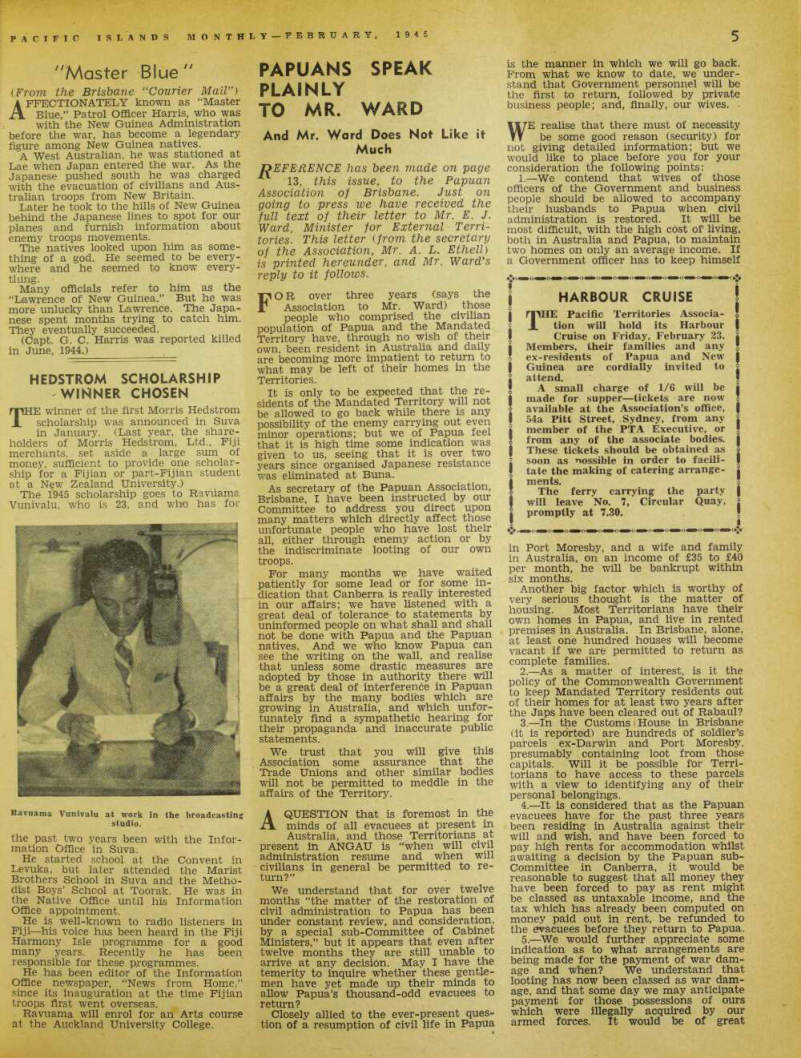
THE winner of the first Morris Hedstrom scholarship was announced in Suva in January. (Last year, the share holders of Morris Hedstrom, Ltd., Fiji merchants, set aside a large sum of money, sufficient to provide one scholar ship for a Fijian or part-Fijian student at a New Zealand University.) The 1945 scholarship goes to Raviiama Vunivalu, who is 23, and who has for
the past two years been with the Infor mation Office in Suva.
He started school at the Convent in Levuka, but later attended the Marist Brothers School in Suva and the Metho dist Boys’ School at Toorak. He was in the Native Office until his Information Office appointment.
He is well-known to radio listeners in Fiji—his voice has been heard in the Fiji Harmony Isle programme for a good many years. Recently he has been responsible for these programmes.
He has been editor of the Information Office newspaper, “News from Home,” since its inauguration at the time Fijian troops first went overseas.
Ravuama will enrol for an Arts course at the Auckland University College.
Ravuaraa Vunivalu at work in the broadcasting studio.
Papuans Speak
Plainly
To Mr. Ward
And Mr. Ward Does Not Like it Much
DEFERENCE has been made on page 13, this issue, to the Papuan Association of Brisbane. Just on going to press we have received the full text of their letter to Mr. E. J.
Ward , Minister for External Terri tories. This letter (from the secretary of the Association, Mr. A. L. Ethell ) is printed hereunder, and Mr. Ward's
reply to it follows.
FO R over three years (says the Association to Mr. Ward) those people who comprised the civilian population of Papua and the Mandated Territory have, through no wish of their own, been resident in Australia and daily are becoming more impatient to return to what may be left of their homes in the Territories.
It is only to be expected that the re sidents of the Mandated Territory will not be allowed to go back while there is any possibility of the enemy carrying out even minor operations; but we of Papua feel that it is high time some indication was given to us, seeing that it is over two years since organised Japanese resistance was eliminated at Buna.
As secretary of the Papuan Association, Brisbane, I have been instructed by our Committee to address you direct upon many matters which directly affect those unfortunate people who have lost their all, either through enemy action or by the indiscriminate looting of our own troops.
For many months we have waited patiently for some lead or for some in dication that Canberra is really interested in our affairs; we have listened with a great deal of tolerance to statements by uninformed people on what shall and shall not be done with Papua and the Papuan natives. And we who know Papua can see the writing on the wall, and realise that unless some drastic measures are adopted by those in authority there will be a great deal of interference in Papuan affairs by the many bodies which are growing in Australia, and which unfor tunately find a sympathetic hearing for their propaganda and inaccurate public statements.
We trust that you will give this Association some assurance that the Trade Unions and other similar bodies will not be permitted to meddle in the affairs of the Territory.
A QUESTION that is foremost in the minds of all evacuees at present in Australia, and those Territorians at present in ANGAU is “when will civil administration resume and when will civilians in general be permitted to re turn?”
We understand that for over twelve months “the matter of the restoration of civil administration to Papua has been under constant review, and consideration, by a special sub-Committee of Cabinet Ministers,” but it appears that even after twelve months they are still unable to arrive at any decision. May I have the temerity to inquire whether these gentle men have yet made up their minds to allow Papua’s thousand-odd evacuees to return?
Closely allied to the ever-present ques tion of a resumption of civil life in Papua
is the manner in which we will go back.
From what we know to date, we under stand that Government personnel will be the first to return, followed by private business people; and, finally, our wives.
WE realise that there must of necessity be some good reason (security) for not giving detailed information; but we would like to place before you for your consideration the following points: I—We contend that wives of those officers of the Government and business people should be allowed to accompany their husbands to Papua when civil administration is restored. It will be most difficult, with the high cost of living, both in Australia and Papua, to maintain two homes on only an average income. If a Government officer has to keep himself
in Port Moresby, and a wife and family in Australia, on an income of £35 to £4O per month, he will be bankrupt within six months.
Another big factor which is worthy of very serious thought is the matter of housing. Most Territorians have their own homes in Papua, and live in rented premises in Australia. In Brisbane, alone, at least one hundred houses will become vacant if we are permitted to return as complete families. 2. —As a matter of interest, is it the policy of the Commonwealth Government to keep Mandated Territory residents out of their homes for at least two years after the Japs have been cleared out of Rabaul? 3. —ln the Customs House in Brisbane (it is reported) are hundreds of soldier’s parcels ex-Darwin and Port Moresby, presumably containing loot from those capitals. Will it be possible for Terri torians to have access to these parcels with a view to identifying any of their personal belongings. 4. —lt is considered that as the Papuan evacuees have for the past three years been residing in Australia against their will and wish, and have been forced to pay high rents for accommodation whilst awaiting a decision by the Papuan sub committee in Canberra, it would be reasonable to suggest that all money they have been forced to pay as rent might be classed as untaxable income, and the tax which has already been computed on money paid out in rent, be refunded to the evacuees before they return to Papua. 5. —We would further appreciate some indication as to what arrangements are being made for the payment of war dam age and when? We understand that looting has now been classed as war dam age, and that some day we may anticipate payment for those possessions of ours which were illegally acquired by our armed forces. It would be of great
assistance to many, if at least 75 per cent, of each individual claim could be paid prior to our return, as this would in many cases save undue financial em-
barrassment. .
6.—A further matter which is agitating the minds of Papuan evacuees is the question of fares and freight. It is considered that as Papuan residents were bundled out unceremoniously, were unable to bring away more than a handful of personal belongings and subsequently lost all their possessions through looting, it is only reasonable to suggest that the cost of their fares and freight on ail cargo will be met by the Commonwealth Government.
THESE are questions immediately affecting Papuan evacuees in Brisbane, and no doubt in other parts of Austraha as well; and the Brisbane Association would welcome some reply to these Queries.
Finally, public statements by yourself and a perusal of your circular concerning the establishment of a school at Canberra for the purpose of training Army per sonnel and civilians in tropical adminis tration, indicates that officers of the Papuan Service will, upon the resumption 0 f civil administration, “resume duty in the positions they occupied in February, 1942.” , , . .. , fbncl 18 J? he ,/* uest4on . whether StT°?? ers ~. m the administration °? ( ;? rs have retired, °f. we ° f Service will take ™ ll S due ’ a " d 4he new F ln ,9 n th , e . gr P u . nd Jt is felt that an attempt is being made to shoulder-over the “Murray Men,” and re place them with new blood, May we anticipate a reply to this letter in order that I may pass on the inf or mation to members at the general meeting on 6th February.
Minister Complains of “Discourtesy"
That is the end of the letter written to Mr. Ward on January 18 by Mr. A. L.
Ethell, secretary of the Association, Mr. Ward’s reply is dated February 7: Dear Mr, Ethell, —Since receiving your communication of 16th ultimo. I have considered whether I should reply to you in very much detail, but in view of its generally discourteous terms, I have decided not to do so.
I have no knowledge of how many ex residents of Papua your organisation covers, but I think it would be to their advantage if they were to secure the ser vices of a secretary who knew how to present a case without so clearly display ing his personal spleen against a Govern ment whose political colour evidently does not please him.
Regarding your request that Trade Unions and other similar bodies be pre vented from meddling in the affairs of
the Territory, I have the following to say: Whilst you do not make it clear what you regard as “meddling,” I want to assure you that I am quite certain that the Trade Unions have assisted and co operated with this Government very greatly in the many difficulties with which it has been confronted. They have no desire to do otherwise in the future, I am sure.
If any matters concerning the adminis tration of this Department arise, upon which your organisation or any other organisation desires information, and they are presented in a proper manner, they will be promptly attended to.
Yours sincerely,
E. J. Ward
Minister for Transport and External Territories.
Advertisements & other items, pp. 7-8 (2 items)
Harbour Cruise
THE Pacific Territories Association will hold its Harbour Cruise on Friday, February 23.
Members, their families and any ex-residents of Papua and New Guinea are cordially invited to attend.
A small charge of 1/6 will be made for supper—tickets are now available at the Association’s office, 54a Pitt Street, Sydney, from any member of the PTA Executive, or from any of the associate bodies.
These tickets should be obtained as soon as nossible in order to facilitate the making of catering arrangements.
The ferry carrying the party will leave No. 7, Circular Quay, promptly at 7.30.
swHH SSW-c
War Damage— As if Affects Expropriated Property
T H L^““ ntS i War Dam "
age to Property Regulations, as they
apply to purchasers Of Expropriated
Property in the former Mandated Territory Of New Guinea, are summarised in the following circular from the War Damage Commission- m tne War § mmission.
NATIONAL SECURITY (WAR DAMAGE TO
PROPERTY) REGULATIONS
1. The above Regulations nrovi flP ♦ hy the Commonwealth or pub^c 6 aufhoritv ”of the Commonwealth P b au thonty of *: Property in the Mandated Territory of New Guine a in process of purchase from the CuseSIS.* Expropriated Property was, therefore, excluded although in fact purchasers have J™ « though the property was coverable and Pave paid contributions and made claims. what Lr C f,"‘ amei ? dment s to the Regulations wnat has already been done is now put in P .r id . ed that the Purchaser can, Pronertv TnH the Com mission. bring such ulVt 1 S SChCme - An a » r eement is
swHH SSW-c
pensaUon Wa Th amaS ht ° r who has town 18 reserved to a purchaser
cancel the £ ££.£
4 n iT should s£e y f be i brought under the ReguiSnt retroiSS Ir ,H nce J ,tlon - Mra Prtowner’ U-m ther f f . ore ’ for example, if an
liable for the contributions which were payable in 1942 and 1943 on such trees, and of course, thus becomes entitled to compensation for war damage subsequent to 1st January, 1942 On payment of 1942 and 1943) contributions, a refund of the 1944 contribution will be made. 5. The scope of war damage cover has also been extended to embrace loss of, or physical damage to, such property by reason of aban donment due to evacuation. This extension of cover has been referred to in recent press announcements, and if required, further details can be supplied from this office. 6. A copy of the new Regulation 5A dealing with the covering of Expropriated Property, is now available, and you are requested to (a) apply to the Commission to cover any such property if you have not previously effected the cover; (b) if payment has been made for 1944 only pay to the Commission the contributions for 1942 and 1943, less the amount paid for 1944; or (c) exercise your option to cancel the presumed agreement referred to in paragraph 3 if you so wish.
Your immediate attention would be appreciated.
R. A. BATTERSBY
War Damage Commission, Controller, 44 Martin Place, Sydney, The form€r Filian Princes, Colo East Col ° North , Co}o West, Lautoka and Nadi,’ 2° lon f r exist as separate provinces, They have been absorbed into Ba Naltasirl ' Ra ' Serua - ■ and
Navy Men
Bronze Stars for Pacific Navy Men
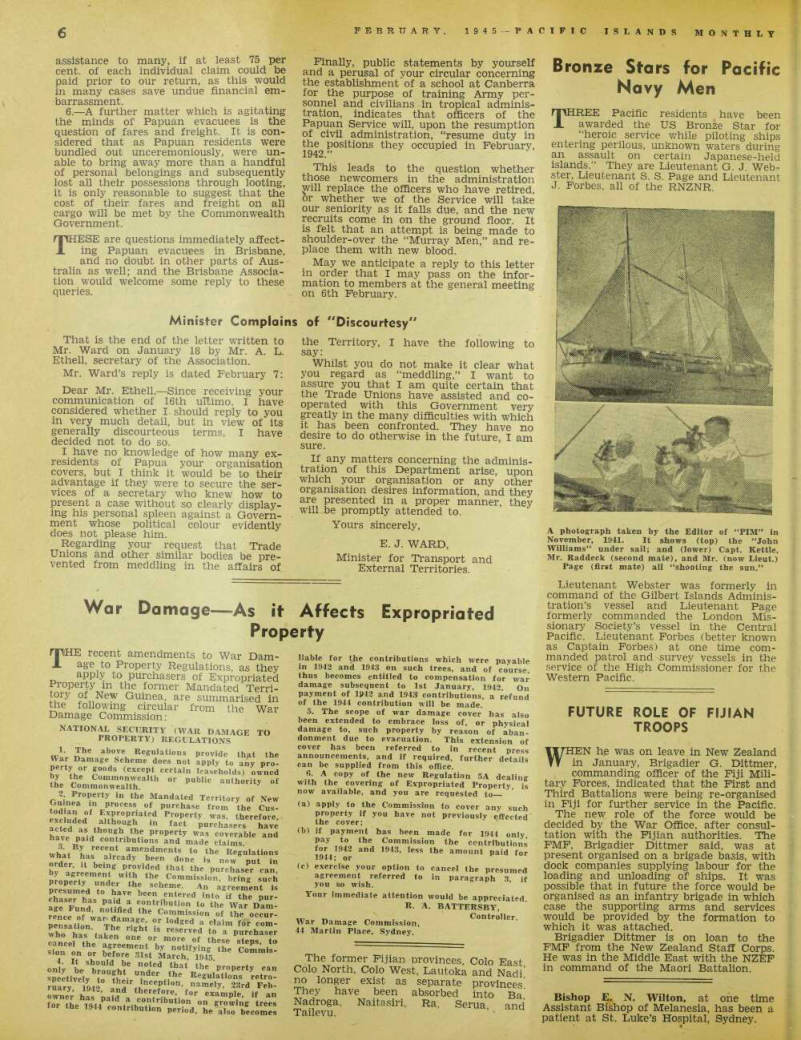
rpHREE Pacific residents have been A awarded the US Bronze Star for “heroic service while piloting ships entering perilous, unknown waters during an assault on certain Japanese-held islands.” They are Lieutenant G. J. Web ster, Lieutenant S. S. Page and Lieutenant J. Forbes, all of the RNZNR.
Lieutenant Webster was formerly in command of the Gilbert Islands Adminis tration’s vessel and Lieutenant Page formerly commanded the London Mis sionary Society’s vessel in the Central Pacific. Lieutenant Forbes (better known as Captain Forbes) at one time com manded patrol and survey vessels in the service of the High Commissioner for the Western Pacific.
A photograph taken by the Editor of “PIM” in November, 1941. It shows (top) the “John Williams” under sail; and (lower) Capt. Kettle, Mr. Raddeck (second mate), and Mr. (now Lieut.) Page (first mate) all “shooting the sun.”
Future Role Of Fijian
Troops
WHEN he was on leave in New Zealand in January, Brigadier G. Dittmer, commanding officer of the Fiji Mili tary Forces, indicated that the First and Third Battalions were being re-organised in Fiji for further service in the Pacific.
The new role of the force would be decided by the War Office, after consul tation with the Fijian authorities. The FMF, Brigadier Dittmer said, was at present organised on a brigade basis, with dock companies supplying labour for the loading and unloading of ships. It was possible that in future the force would be organised as an infantry brigade in which case the supporting arms and services would be provided by the formation to which it was attached.
Brigadier Dittmer is on loan to the FMF from the New Zealand Staff Corps.
He was in the Middle East with the NZEF in command of the Maori Battalion.
Bishop E. N. Wilton, at one time Assistant Bishop of Melanesia, has been a patient at St. Luke’s Hospital, Sydney,
Begins 1945
How Western Samoa Begins 1945
From Our Own Correspondent
Apia, Jan. 22.
IN a recent speech, hearu nere by radio, tne New Zealand Prime Minister, Mr.
Peter rraser, gave ms impressions of his recent omciai visit to Western Samoa and New Zealand’s otner dependencies in the South Pacific. He spoke of the -gen eral efficiency of New Zealand s island Administrations; of the increasing mea sure oi self-government wmch New Zea land is going to grant the Samoans; and of tne excellent educational system of Western Samoa which combines the best features of both European teaching and samoan traditional custom.
So far, however, no practical results are known to have come from the visit. rE departure of American defence units has wrought a change back to normal in the Samoan economics.
Dollar prosperity and dollar currency is gradually disappearing, and, instead, Samoans and Europeans have to take up the hard work of former times—to weed and replant plantations and be satisfied with smaller returns.
These returns are still very satisfactory, at the present prices copra and cocoa are bringing The output of copra and cocoa for 1945 may well be a record, and there fore the trade outlook is fairly good, m spite of the lower purchasing power of tne Samoans. , The Samoans naturally cannot afford the many luxuries and the European goods that tney bought freely during the dollar period. Girls whose “boys have now gone for good, cannot dress them selves up, and have already discarded shoes and stockings m order to return to the good Samoan style.
Trade in the outside districts of Upolu has dropped from one half to one Quar ter of that of the “American” period and there are far too many trading stations wmch ultimately will nave to be closed down. Trade store business is at a lower level than for several years.
A new feature of business m Samoa is in the large number of women who have been or wno are at present running their own business undertakings, stores, trading stations, boarding houses, etc.
The banana industry, lor a long time practically at a standstill, has come to life again—the natives allege that Mi.
Fraser has promised them 8/- per case for bananas, as against the 6/- paid ao present, and many districts which to date nad refused to pack and ship bananas, have therefore started to clean and spray their plantations. Prospects for increased shipments are good.
As to European plantations—there is a plentiful supply of Samoan plantation labour available and, with the good cocoa prices ruling now, the industry should recover from the neglect of the past few years and be a paying proposition agam.
Dengue Epidemic Is Over
Papeete, Dec. 9.
OUR epidemic of dengue fever has passed, after shaking our people pretty thoroughly. This dengue does not appear to have been the type propa gated by mosquitoes; but by the mys terious agency that spreads the many forms of “influenza.”
Our medical services, apparently, have prevented a flare-up of the vermin propagated diseases, such as typhus, and they may save us from another experience such as followed the last war.
Fifty Years Old
Nelson & Robertson, Ltd.
ON February 18, the Islands trading and shipping firm of Nelson and Robert son Pty., Ltd., will be 50 years old; and the managing director, Mr. Norman Nelson, and* his associates, already have been receiving congratulations upon a notable jubilee.
The firm came into existence in 1895, when Mr. Ivan Nelson and Mr. G. J.
Robertson entered formally into partner ship Mr. Robertson gave his skilled
attention to shipping, while Mr. Nelson ranged over all the South Pacific from New Guinea to Samoa, and established a remarkable connection as merchant and trader. He took a keen interest in Samoa, and was a pioneer of the cocoa industry there; and he was very closely- associated with the New Guinea copra industry 25 years ago The firm controlled a large fleet of sailing ships; but, as steam replaced sail, it disposed of much of its considerable shipping interests. and retained only an interest in the Austra lian coastal trade.
Mr. Robertson died about 1921; but Mr.
Nelson, still a famous figure in Pacific trade, remained actively at the head of his company until his death in July, 1941.
Since then, the valuable Islands connec tions established in the old days by Mr.
Robertson and Mr. Nelson have been pro tected and enlarged, despite the war, by Mr. Norman Nelson, and his well-known lieutenant, Mr. Harold Cooper. Mr. Nel son, incidentally, has given nearly three years of very hard and useful service to the Pacific Territories Association, of which he now is vice-president.
The marriage of Miss Patience Corbett of Suva to Sgt. Noel Gordon of the New Zealand Forces took place in Suva on December 20.
Rev. H. V. C. Reynolds, of the Mela nesian Mission, has returned to the Solomons after a short furlough in New Zealand.
The High Commissioner for Australia in New Zealand, Mr. Thomas D’Alton, paid a brief visit to Fiji in December. He was accompanied by his secretary.
Mr. Norman Nelson.
Smuggling Charge in
Couple Fined £100
Smuggling Charge in Suva
TWO well-known residents of Suva, Mr. and Mrs. Frank Ryan, were heavily fined by Acting Magistrate J. Ben nett, in December, as the result of an incident which, apparently innocent enough in itself, involved a grave breach of regulations, and was the subject of much gossip in the Colony.
One day in September, 1944, Mr. Ryan drove his wife on to the Suva wharf, and they visited an American ship. They brought to the car fresh meat, butter and canned goods to the value, at US rates, of £lO/19/-. Mr. Ryan walked off the wharf, and his wife drove to the gate, and there was questioned by the police man on duty.
According to the evidence led by Superintendent W. J. G. Holland. Mrs, Ryan denied that she had any dutiable goods in the car; but Customs officials were summoned and the goods were con fiscated.
Mrs. Ryan was charged with smuggling and Mr. Ryan with assisting. They pleaded not guilty, and Mr. A. D. Leys raised a technical defence that neither intended to evade the payment of duty.
Mr. Ryan said the last thing he had told his wife was to declare the goods to the Customs.
Mrs. Ryan deposed that she thought she could pay the duty at the gate. She said, under cross-examination, that she had often returned to Suva from over seas trips, and knew that the Customs shed was at the opposite end of the wharf, and not near the gate.
After a hearing that extended into a second day, Mr. Bennett reserved his decision. He found the charges proved.
Mrs. Ryan was fined £75 and Mr. Ryan £25. The Court ruled, on the application of the police for confiscation of Mr. Ryan’s car, that it should form the subject of separate proceedings. In subsequent pro ceedings, the Magistrate held, on a tech nical point, that he could not order the forfeiture of the car. If it were to be seized, it should have been seized at the time of the offence.
Advertisements & other items, p. 9 (1 item)
Notice of Meeting
PACIFIC TERRITORIES
ASSOCIATION
A general meeting of the Association will be held on Tuesday, March 20, 1945, at 8 p.m., in Teachers' Federation Hall, 166 Phillip Street, Sydney (seventh floor).
BUSINESS:
To receive report from the Executive on activities to date.
To consider proposed amendments to the constitution.
To deal with any other business that may arise.
C A. M. ADELSKOLD,
Secretary.
Fall Of Rabaul
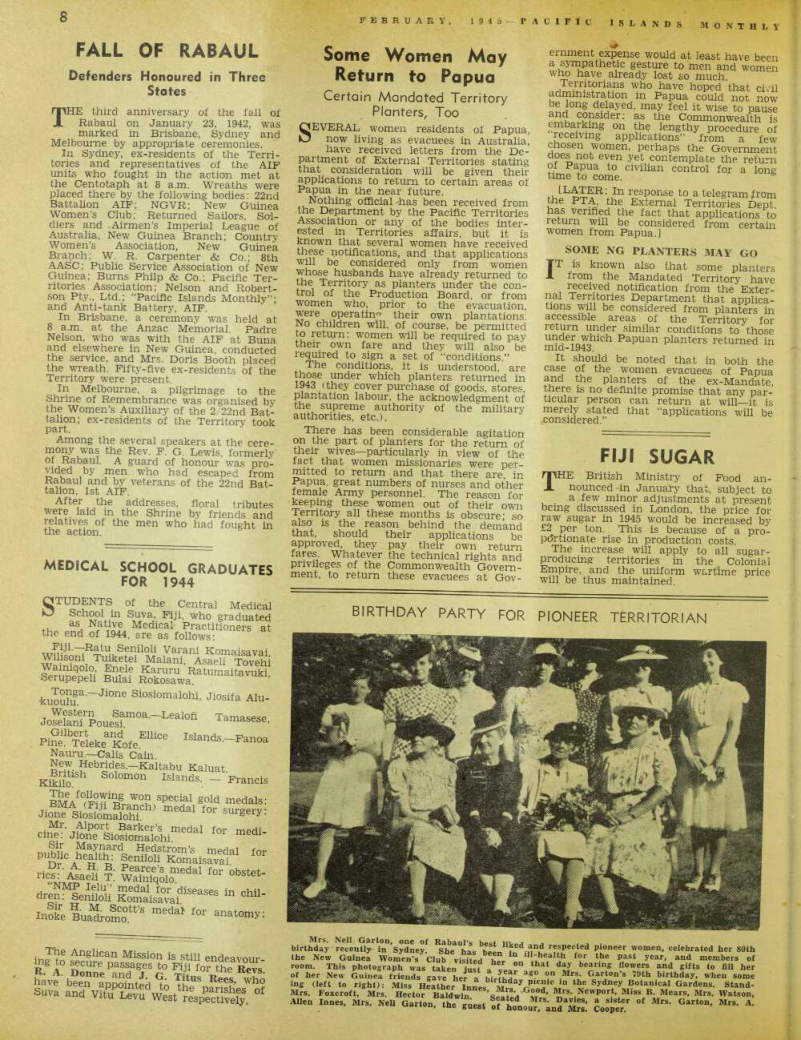
Defenders Honoured in Three States
THE third anniversary of the fall of Rabaul on January 23, 1942, was marked in Brisbane, Sydney and Melbourne by appropriate ceremonies.
In Sydney, ex-residents of the Terri tories and representatives of the AIF units who fought in the action met at the Centotaph at 8 a.m. Wreaths were placed there by the following bodies: 22nd Battalion AIF; NGVR; New Guinea Women’s Club; Returned Sailors, Sol diers and Airmen’s Imperial League of Australia, New Guinea Branch; Country Women’s Association, New Guinea Branch; W. R. Carpenter & Co.; Bth AASC; Public Service Association of New Guinea: Burns Philp & Co.; Pacific Ter ritories Association; Nelson and Robert son Pty., Ltd.; “Pacific Islands Monthly”; and Anti-tank Battery, AIF.
In Brisbane, a ceremony was held at 8 a.m. at the Anzac Memorial. Padre Nelson, who was with the AIF at Buna and elsewhere in New Guinea, conducted the service, and Mrs. Doris Booth placed the wreath. Fifty-five ex-residents of the Territory were present.
In Melbourne, a pilgrimage to the Shrine of Remembrance was organised by the Women’s Auxiliary of the 2/22nd Bat talion; ex-residents of the Territory took part.
Among the several speakers at the cere mony was the Rev. F. G. Lewis, formerly of Rahaul. A guard of honour was pro vided by men who had escaped from Rabaul and by veterans of the 22nd Bat talion. Ist AIF.
After the addresses, floral tributes were laid in the Shrine by friends and relatives of the men who had fought in the action.
Dr°A I 6niloli K omaisaval
Medical School Graduates
For 1944
STUDENTS of the Central Medical School in Suva, Fiji, who graduated tbP Medical Practitioners at the end of 1944, are as follows: Fiji—Ratu Seniloli Varani Komaisavai Wilisoni Tmketei Malani, Asaeli Tovehl Waimqolo, Enele Karuru Ratumaitavuki Serupepeh Bulai Rokosawa. ’ kuoffiu a ‘~ Ji ° ne Siosiomalohl > Jiosifa Alu- JoS^ouet m ° a - LealOfi Tamasese ’
Pl?e Üb Teleke a Ko f e EIIICe Islands Nauru.—Calis Cain.
New Hebrides.— Kaltabu Kaluat Kikilo Solomon Islands. Francis BMA fo (p'?d i n g rZ o S, spec ? l gold medals: JISSSr' medal f ° r Surgery: . Mr - Alport Barker’s medal for mpdi cine: Jione Siosiomalohi ed Sir Maynard Hedstrom’s medal for
Dr°A I 6niloli K omaisaval
rtg&Si ?! Wa a i r nT q l,o medal fOT ° bstet - <*"- Inoke Buadromo.^' 8 “ f ° r anatom * ; J 1 ? 6 An gUcan Mission is still endeavour mg to secure passages to Fiji fo™ he K
Some Women May
Return to Papua Certain Mandated Territory Planters, Too
SEVERAL women residents of Papua, now living as evacuees in Australia, have received letters from the De partment of External Territories stating that consideration will be given their applications to return to certain areas of Papua in the near future.
Nothing official -has been received from the Department by the Pacific Territories Association or any of the bodies inter ested in Territories affairs, but it is known that several women have received these notifications, and that applications will be considered only from women whose husbands have already returned to the Territory as planters under the con trol of the Production Board, or from women who, prior to the evacuation, were operating- their own plantations.
No children will, of course, be permitted to return: women will be required to pay their own fare and they will also be required to sign a set of “conditions.”
The conditions, it is understood, are those under which planters returned in 1943 (they cover purchase of goods, stores, plantation labour, the acknowledgment of the supreme authority of the military authorities, etc.).
There has been considerable agitation on the part of planters for the return of their wives—particularly in view of the fact that women missionaries were per mitted to return and that there are in Papua, great numbers of nurses and other female Army personnel. The reason for keeping these women out of their own Territory all these months is obscure; so also is the reason behind the demand that, should their applications be approved, they pay their own return fares. Whatever the technical rights and privileges of the Commonwealth Govern ment, to return these evacuees at Gov
eminent expense would at least have been ®,^' n ?P^ het 1 ic gesture to men and women who have already lost so much.
Territorians who have hoped that civil administration in Papua could not now be long delayed, may feel it wise to pause and consider: as the Commonwealth is embarking on the lengthy procedure of receiving applications” from a few chosen women, perhaps the Government does not even yet contemplate the return of Papua to civilian control for a long time to come. * [LATER:In response to a telegram from the PTA, the External Territories Dept, has verified the fact that applications to return will be considered from certain women from Papua.]
Some Ng Planters May Go
IT is known also that some planters from the Mandated Territory have received notification from the Exter nal Territories Department that applica tions will be considered from planters in accessible areas of the Territory for return under similar conditions to those under which Papuan planters returned in mid-1943.
It should be noted that in both the case of the women evacuees of Papua and the planters of the ex-Mandate, there is no definite promise that any par ticular person can return at will—it is merely stated that “applications will be considered.”
Fiji Sugar
THE British Ministry of Food an nounced in January that, subject to a few minor adjustments at present being discussed in London, the price for raw sugar in 1945 would be increased by £2 per ton. This is because of a pro portionate rise in production costs.
The increase will apply to all sugar producing territories in the Colonial Empire, and the uniform wartime price will be thus maintained.
Birthday Party For Pioneer Territorian
Mrs. Nell Garton, one of Rabaul’s best liked and respected pioneer women, celebrated he 80th birthday recently in sydney. She has been in ill-health for the past year, and memvers of the New Guinea Women's Club visited her on that day bearing flowers and gifts to fill her room. This photograph was taken just a year ago on Mrs. Garton's 79th birthday when some of her New Guinea friends gave her a birthday picnic in the Sydney Botanical Gardens. Stand ing (left to right): Miss Heather Innes, Mrs. Good, Mrs. Newport, Miss B. Mears, Mrs. Watson, Mrs. Foxcroft, Mrs. Hector Baldwin. Seated Mrs. Davies, a sister of Mrs. Garton, Mrs. A.
Allen Innes, Mrs. Nell Garton, the guest of honour, and Mrs. Cooper.
Tropicalities
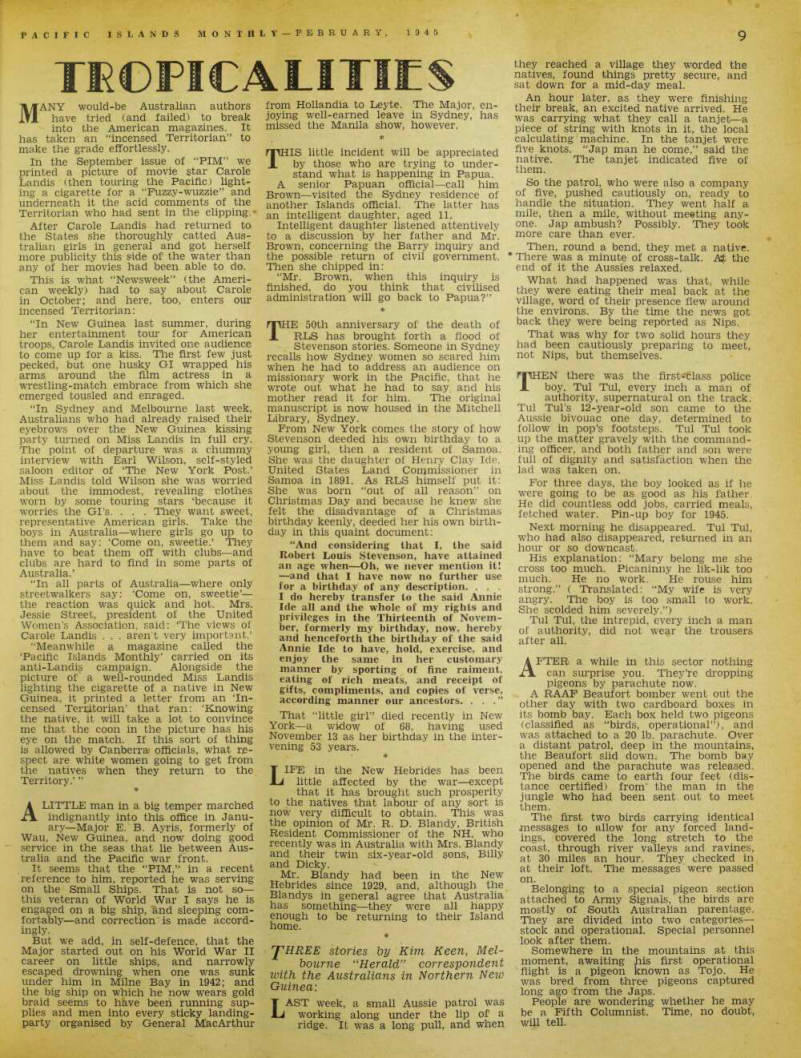
MANY would-be Australian authors have tried (and failed) to break into the American magazines. It has taken an “incensed Territorian” to make the grade effortlessly.
In the September issue of “PIM” we printed a picture of movie star Carole Landis (then touring the Pacific) light ing a cigarette for a “Fuzzy-wuzzie” and underneath it the acid comments of the Territorian who had sent in the clipping.* After Carole Landis had returned to the States she thoroughly catted Aus tralian girls in general and got herself more publicity this side of the water than any of her movies had been able to do.
This is what “Newsweek” (the Ameri can weekly) had to say about Carole in October; and here, too, enters our incensed Territorian: “In New Guinea last summer, during her entertainment tour for American troops, Carole Landis invited one audience to come up for a kiss. The first few just pecked, but one husky GI wrapped his arms around the film actress in a wrestling-match embrace from which she emerged tousled and enraged.
“In Sydney and Melbourne last week, Australians who had already raised their eyebrows over the New Guinea kissing party turned on Miss Landis in full cry.
The point of departure was a chummy interview with Earl Wilson, self-styled saloon editor of ‘The New York Post.’
Miss Landis told Wilson she was worried about the immodest, revealing clothes worn by some touring stars ‘because it worries the Gl’s. . . . They want sweet, representative American girls. Take the boys in Australia—where girls go up to them and say: ‘Come on, sweetie.’ They have to beat them off with clubs—and clubs are hard to find in some parts of Australia.’
“In all parts of Australia—where only streetwalkers say: ‘Come on, sweetie’— the reaction was quick and hot. Mrs.
Jessie Street, president of the United Women's Association, said: ‘The views of Carole Landis . . . aren’t very important.’
“Meanwhile a magazine called the ‘Pacific Islands Monthly’ carried on its anti-Landis campaign. Alongside the picture of a well-rounded Miss Landis lighting the cigarette of a native in New Guinea, it printed a letter from an ‘ln censed Temtorian’ that ran: ‘Knowing the native, it will take a lot to convince me that the coon in the picture has his eye on the match. If this sort of thing is allowed by Canberra officials, what re spect are white women going to get from the natives when they return to the Territory.’ ” * A LITTLE man in a big temper marched indignantly into this office in Janu ary—Major E. B. Ayris, formerly of Wau, New Guinea, and now doing good service in the seas that lie between Aus tralia and the Pacific war front.
It seems that the “PIM,” in a recent reference to him, reported he was serving on the Small Ships. That is not so— this veteran of World War I says he is engaged on a big ship, and sleeping com fortably—and correction is made accord ingly.
But we add, in self-defence, that the Major started out on his World War II career on little ships, and narrowly escaped drowning when one was sunk under him in Milne Bay in 1942; and the big ship on which he now wears gold braid seems to have been running sup plies and men into every sticky landing party organised by General MacArthur
from Hollandia to Leyte. The Major, en joying well-earned leave in Sydney, has missed the Manila show, however. * THIS little incident will be appreciated by those who are trying to under stand what is happening in Papua.
A senior Papuan official —call him Brown—visited the Sydney residence of another Islands official. The latter has an intelligent daughter, aged 11.
Intelligent daughter listened attentively to a discussion by her father and Mr.
Brown, concerning the Barry inquiry and the possible return of civil government.
Then she chipped in: “Mr. Brown, when this inquiry is finished, do you think that civilised administration will go back to Papua?” ♦ rE 50th anniversary of the death of RLS has brought forth a flood of Stevenson stories. Someone in Sydney recalls how Sydney women so scared him when he had to address an audience on missionary work in the Pacific, that he wrote out what he had to say, and his mother read it for him. The original manuscript is now housed in the Mitchell Library, Sydney.
From New York comes the story of how Stevenson deeded his own birthday to a young girl, then a resident of Samoa.
She was the daughter of Henry Clay Ide, United States Land Commissioner in Samoa in 1891. As RLS himself put it; She was born “out of all reason” on Christmas Day and because he knew she felt the disadvantage of a Christmas birthday keenly, deeded her his own birth day in this quaint document: “And considering that I, the said Robert Louis Stevenson, have attained an age when —Oh, we never mention it! —and that I have now no further use for a birthday of any description. . . .
I do hereby transfer to the said Annie Ide all and the whole of my rights and privileges in the Thirteenth of Novem ber, formerly my birthday, now, hereby and henceforth the birthday of the said Annie Ide to have, hold, exercise, and enjoy the same in her customary manner by sporting of fine raiment, eating of rich meats, and receipt of gifts, compliments, and copies of verse, according manner our ancestors. . . .”
That “little girl” died recently in New York—a widow of 68, having used November 13 as her birthday in the inter vening 53 years. * LIFE in the New Hebrides has been little affected by the war—except that it has brought such prosperity to the natives that labour of any sort is now very difficult to obtain. This was the opinion of Mr. R. D. Blandy, British Resident Commissioner of the NH, who recently was in Australia with Mrs. Blandy and their twin six-year-old sons, Billy and Dicky.
Mr. Blandy had been in the New Hebrides since 1929, and, although the Blandys in general agree that Australia has something—they were all happy enough to be returning to their Island home. * Y'HREE stories by Kim Keen, Mel bourne “Herald” correspondent with the Australians in Northern New Guinea ; LAST week, a small Aussie patrol was working along under the lip of a ridge. It was a long pull, and when
they reached a village they worded the natives, found things pretty secure, and sat down for a mid-day meal.
An hour later, as they were finishing their break, an excited native arrived. He was carrying what they call a tanjet—a piece of string with knots in it, the local calculating machine. In the tanjet were five knots. “Jap man he come," said the native. The tanjet indicated five of them.
So the patrol, who were also a company of five, pushed cautiously on, ready to handle the situation. They went half a mile, then a mile, without meeting any one. Jap ambush? Possibly. They took more care than ever.
Then, round a bend, they met a native.
There was a minute of cross-talk. A$ the end of it the Aussies relaxed.
What had happened was that, while they were eating their meal back at the village, word of their presence flew around the environs. By the time the news got back they were being reported as Nips.
That was why for two solid hours they had been cautiously preparing to meet, not Nips, but themselves.
THEN there was the first-lass police boy, Tul Tul, every inch a man of authority, supernatural on the track.
Tul Tul’s 12-year-old son came to the Aussie bivouac one day, determined to follow in pop’s footsteps. Tul Tul took up the matter gravely with the command ing officer, and both father and son were full of dignity and satisfaction when the lad was taken on.
For three days, the boy looked as if he were going to be as good as his father.
He did countless odd jobs, carried meals, fetched water. Pin-up boy for 1945.
Next morning he disappeared. Tul Tul, who had also disappeared, returned in an hour or so downcast.
His explanation: “Mary belong me she cross too much. Picaninny he lik-lik too much. He no work. He rouse him strong.” ( Translated: “My wife is very angry. The boy is too small to work.
She scolded him severely.”) Tul Tul, the intrepid, every inch a man of authority, did not wear the trousers after all.
AFTER a while in this sector nothing can surprise you. They’re dropping pigeons by parachute now.
A RAAF Beaufort bomber went out the other day with two cardboard boxes in its bomb bay. Each box held two pigeons (classified as “birds, operational”), and was attached to a 20 lb. parachute. Over a distant patrol, deep in the mountains, the Beaufort slid down. The bomb bay opened and the parachute was released.
The birds came to earth four feet (dis tance certified) from the man in the jungle who had been sent out to meet them.
The first two birds carrying identical messages to allow for any forced land ings, covered the long stretch to the coast, through river valleys and ravines, at 30 miles an hour. They checked in at their loft. The messages were passed on.
Belonging to a special pigeon section attached to Army Signals, the birds are mostly of South Australian parentage.
They are divided into two categories— stock and operational. Special personnel look after them.
Somewhere in the mountains at this moment, awaiting jiis first operational flight is a pigeon known as To jo. He was bred from three pigeons captured long ago from the Japs.
People are wondering whether he may be a Fifth Columnist. Time, no doubt, will tell.
Those Who Went “South!”
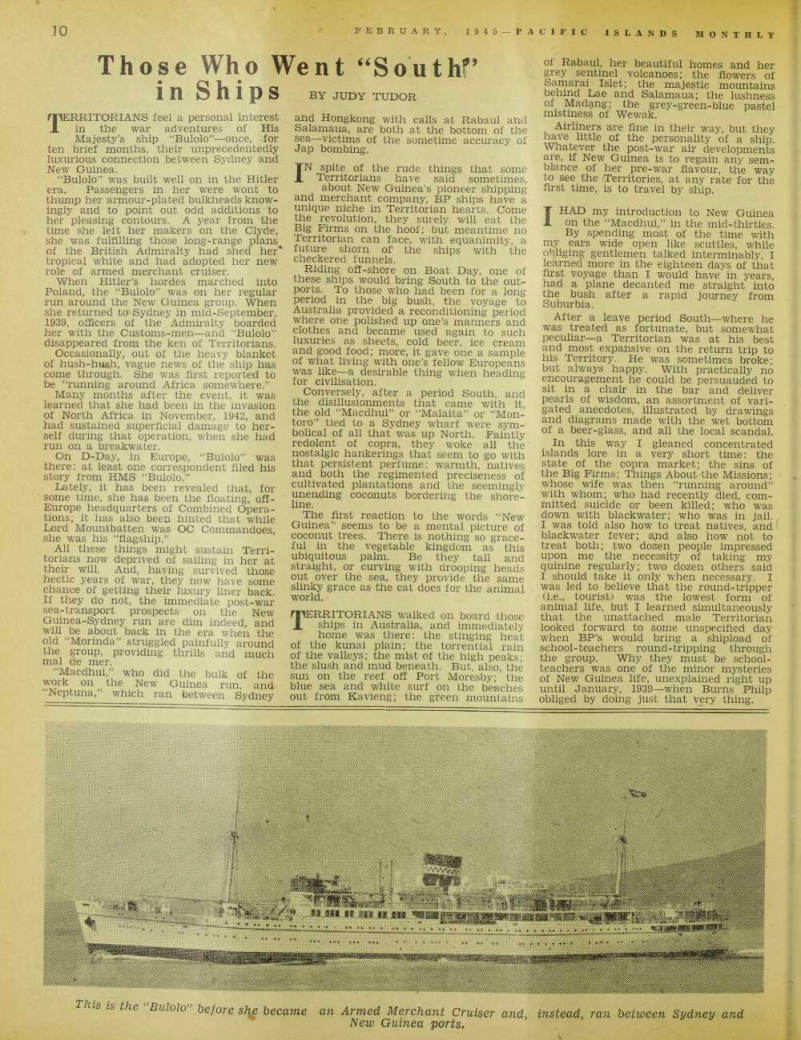
in Shi ps
By Judy Tudor
mERRITORIANS feel a personal interest J. in the war adventures of His Majesty’s ship “Bulolo” —once, for ten brief months, their unprecedentedly luxurious connection between Sydney and New Guinea.
“Bulolo” was built well on in the Hitler era. Passengers in her were wont to thump her armour-plated bulkheads know ingly and to point out odd additions to her pleasing contours. A year from the time she left her makers on the Clyde, she was fulfilling those long-range plans of the British Admiralty had shed her* tropical white and had adopted her new role of armed merchant cruiser.
When Hitler’s hordes marched into Poland, the “Bulolo” was on her regular run around the New Guinea group. When she returned to Sydney in mid-September, 1939, officers of the Admiralty boarded her with the Customs-men—and “Bulolo” disappeared from the ken of Territorians.
Occasionally, out of the heavy blanket of hush-hush, vague news of the ship has come through. She was first reported to be “running around Africa somewhere.”
Many months after the event, it was learned that she had been in the invasion of North Africa in November, 1942, and had sustained superficial damage to her self during that operation, when she had run on a breakwater.
On D-Day, in Europe, “Bulolo” was there: at least one correspondent filed his story from HMS “Bulolo.”
Lately, it has been revealed that, for some time, she has been the floating, off- Europe headquarters of Combined Opera tions; it has also been hinted that while Lord Mountbatten was OC Commandoes, she was his “flagship.”
All these things might sustain Terri torians now deprived of sailing in her at then will. And, having survived those hectic years of war, they now have some chance of getting their luxury liner back.
If they do not, the immediate post-war sea-transport prospects on the New Guinea-Sydney run are dim indeed, and will be about back in the era when the old “Morinda” struggled painfully around the group, providing thrills and much mal de mer.
“Macdhui,” who did the bulk of the work on the New Guinea run, and “Neptuna,” which ran between Sydney
ol Rabaul, her beautiful homes and her grey sentinel volcanoes; the flowers of Samarai Islet; the majestic mountains behind Lae and Salamaua; the lushness of Madang; the grey-green-blue pastel mistiness of Wewak.
Airliners are fine in their way, but they have little of the personality of a ship.
Whatever the post-war air developments are, if New Guinea is to regain any sem blance of her pre-war flavour, the way to see the Territories, at any rate for the first time, is to travel by ship.
I HAD my introduction to New Guinea on the “Macdhui,” in the mid-thirties.
By spending most of the time with my ears wide open like scuttles, while obliging gentlemen talked interminably, I learned more in the eighteen days of that first voyage than I would have in years, had a plane decanted me straight into the bush after a rapid journey from Suburbia.
After a leave period South—where he was treated as fortunate, but somewhat peculiar—a Territorian was at his best and most expansive on the return trip to his Territory. He was sometimes broke; but always happy. With practically no encouragement he could be persuauded to sit in a chair in the bar and deliver pearls of wisdom, an assortment of vari gated anecdotes, illustrated by drawings and diagrams made with the wet bottom of a beer-glass, and all the local scandal.
In this way I gleaned concentrated islands lore in a very short time; the state of the copra market; the sins of the Big Firms; Things About the Missions; whose wife was then “running around” with whom; who had recently died, com mitted suicide or been killed; who was down with blackwater; who was in jail.
I was told also how to treat natives, and blackwater fever; a*nd also how not to treat both; two dozen people impressed upon me the necessity of taking my quinine regularly; two dozen others said I should take it only when necessary. I was led to believe that the round-tripper (i.e., tourist) was the lowest form of animal life, but I learned simultaneously that the unattached male Territorian looked forward to some unspecified day when BP’s would bring a shipload of school-teachers round-tripping through the group. Why they must be school teachers was one of the minor mysteries of New Guinea life, unexplained right up until January, 1939 —when Burns Philp obliged by doing just that very thing.
and Hongkong with calls at Rabaul and Salamaua, are both at the bottom of the sea—victims of the sometime accuracy of
Jap bombing.
IN spite of the rude things that some Territorians have said sometimes, about New Guinea’s pioneer shipping and merchant company, BP ships have a unique niche in Territorian hearts. Come the revolution, they surely will eat the Big Firms on the hoof; but meantime no Territorian can face, with equanimity, a future shorn of the ships with the checkered funnels.
Riding off-shore on Boat Day, one of these ships would bring South to the out ports. To those who had been for a long period in the big bush, the voyage to Australia provided a reconditioning period where one polished up one’s manners and clothes and became used again to such luxuries as sheets, cold beer, ice cream and good food; more, it gave one a sample of what living with one’s fellow Europeans was like—a desirable thing when heading for civilisation.
Conversely, after a period South, and the disillusionments that came with it, the old “Macdhui” or “Malaita” or “Mon toro” tied to a Sydney wharf were sym bolical of all that was up North. Faintly redolent of copra, they woke all the nostalgic hankerings that seem to go with that persistent perfume: warmth, natives and both the regimented preciseness of cultivated plantations and the seemingly unending coconuts bordering the shore line.
The first reaction to the words “New Guinea” seems to be a mental picture of coconut trees. There is nothing so grace ful in the vegetable kingdom as this übiquitous palm. Be they tall and straight, or curving with drooping heads out over the sea, they provide the same slinky grace as the cat does for the animal world. mERRITORIANS walked on board those X ships in Australia, and immediately home was there: the stinging heat of the kunai plain; the torrential rain of the valleys; the mist of the high peaks; the slush and mud beneath. But, also, the sun on the reef off Port Moresby; the blue sea and white surf on the beaches out from Kavieng; the green mountains
is the Bulolo before stye became an Armed Merchant Cruiser and, instead, ran between Sydney and New Guinea ports.
Apart from a ready-cut education in New Guinea ways provided by the pas sengers, I could see for myself what role that ship played in the lives of many isolated residents—grocer, butcher, post man, the one social impetus that kept the outport revolving'hmtil the ship called again.
EACH one of those ships was an integral part of Island life. The “Malaita” was a “good little ship.” Some sort of inverted pride was taken in the fact that the “Montoro” was “lapun finish”; it was mysteriously said that she was “written down to £5 in the company’s books.” Everyone knew that the “bottom was full of concrete” from her various mishaps on reefs and in rivers, but that was thought to contribute to her sea worthiness. The “Macdhui,” in spite of her vibrations and spiral cavorting on anything greater than a ripple (and although she was not old) was affection ately known as “the. Old Mac.” Tears of blood were shed over her last moments in Port Moresby in mid-1942, when news reels of her sinking were shown to Terri torian audiences.
These ships brought all things to the Territories—from brides to bicycles and food, fashions and furnaces.
The “Bulolo” made her maiden voyage in November, 1938. Between then and the coming of World War 11, there was little time for her to grow into an Islands niche of her own. After years of complaint that BP’s cared nothing for the comfort of passengers, and that they were in terested in cargo to the exclusion of all else, strangely enough, the “Bulolo’s” modern luxury was accepted with some sort of suspicion.
“It’s not like an Island ship at all,” more than one hard-bitten Territorian complained from the enfolding softness of a chair in the streamlined bar, or while watching perambulating females disport themselves in the glass-sided swimming bath. “The whole place is cluttered up with round-trippers.”
After five years of war probably the pristine beauty of this interior decorator’s masterpfece is a bit rubbed and dull in places—and so are Territorians after three years of evacuation or Army. When the evacuation of Australia by Territorians occurs there will be no quibbling; a barge or a battleship will look equally good to them.
PROBABLY, too, as New Guineaites suspected, Burns Philp were not un mindful of the quickening pulse of Pacific tourism when they planned the “Bulolo.” But, whatever interest there was in the Pacific in pre-war days, it was insignificant in comparison with that which has been engendered since war broke our ocean wide open.
Thousands of American and Australian servicemen are buried there; and it will be strange indeed if the war graves of New Guinea do not receive as much
attention as the war graves of France received after World War I.
Whatever Territorians feel about round trippers and tourists, they had better pre pare themselves for periodic inundations of camera-carrying, perspiring gentlemen in new white suits, and ladies with sun shades, and flappers in cruise clothes.
Nothing short of constant bubonic plague in New Guinea is going to stop them.
Queen Salote In New
Zealand
QUEEN SALOTE, of Tonga, arrived in Auckland, NZ, on January 12, on a short health trip. She was met by representatives of the Governor-General, the Prime Minister, the Navy, and the agents for the Tongan Government.
At the request of the British Ministry of Information, Sir Harry Luke, a former Governor of Fiji, has written a booklet of some 70 pages, entitled, “Britain and the South Seas.” Another pamphlet, which he published in 1943, had sold 35,000 copies up to the end of last year. A book by Sir Harry Luke, in which he describes his four years in Fiji and the Western Pacific, will be published by Nicholson & Watson, of London, in 1945. It may tell the interesting story of the scenes behind the scene in the Central Pacific in 1940, after France had surrendered and the Vichy-ites were trying to get control of New Caledonia and Tahiti.
Advertisements & other items, pp. 13-14 (1 item)
Til MrAVnE
THE
YORKSHIRE
INSURANCE
CO. LTD.
(Incorporated in England)
FIRE
ACCIDENT
MARINE
FIRE POLICIES ISSUED
IN PAPUA
All information from —
E. A. JAMES,
TeL 86347. Attorney for Papa*, 14 Spring St., Sydney.
BURNS PHILP
(SOUTH SEA) CO. LTD.
Inc. In Fiji Island Traders and Shipowners Registered Office:
S_U A
FIJI
Also Branches at: Fiji: Levuka Lautoka, Labasa, Ba ; Sigatoka, Rotuma.
Tonga: Nukualofa, Haapai, Vavau.
Samoa: Apia, Pago Pago (American Samoa).
Solomons: Makambo, Gizo, Faisi.
New Hebrides: Vila.
Code Addrese: Gilberts: Tarawa.
"Bumsouth". Norfolk Is. Niue. Wallis Is. Futuna Is.
Til MrAVnE
U m /// Sole Australian Concessionaries ;
GEORGE BROWN & CO. PTY. LTD.
267 Clarence Street, Sydney.
As the Ultimate factory is engaged in vital war production, the supply of Ultimate Commercial Receivers cannot be maintained at present.
SERVICE: Ultimate owners are assured of continuity of service. Our Laboratory is situated at 267 Clarence Street, Sydney.
Servicing of all kinds of radio sets or amplifiers, as well as Rola Speakers, is also undertaken at our laboratories.
Refreshing
as a plunge
into a lagoon!
ten**
rM |CI
o^ r oiit r s 0* p a
Germicidal
and fragrant
TENAX TOILET SOAP is
a rapid safeguard against external skin infections, yet it is soothing and kind to the most sensitive skin —even a baby's!
ORDER TENAX FROM
YOUR ISLAND SUP-
PLIERS. STOCKS ARE
PLENTIFULLY AVAIL-
ABLE.
OVE & SONS
Limited
AUCKLAND
Island Traders. F.o. Box 490 Telegraphic and Cable Address: “Grove”, Auckland.
Shippers of all classes of New Zealand products.
Representing English Manufacturers throughout the Cook and Society Islands, Fiji, Tonga, Samoa, Niue, New Caledonia, New Guinea, etc.
In FIJI as—W. H. Grove & Sons (Fiji) Ltd.
Prospects of Reopening
N. Guinea Gold
Prospects of Reopening Industry at Wau
VALUABLE summary of the prospects of a resumption of gold-mining in the Morobe district of New Guinea was made by the chair man of New Guinea Goldfields, Ltd., Mr. J. Kruttschnitt, when he addressed his company’s annual meeting in Sydney on January 18. His statement follows a close inspection of the area by mine experts in mid-1944. The following is taken verbatim from Mr.
Kruttschnitt’s speech :
DIRECT war damage was mainly due to the scorched earth policy carried out in early 1942. The principal losses occurred at Wau and Golden Ridges, where nearly all dwellings, stores, offices, etc., were destroyed. Edie Creek suffered to a lesser degree, but the Kunai Creek Power House was totally de molished.
The extent of impressments by the Army establishments in the area was formidable, and included stores, mach inery, vehicles, structures and a consider able portion of the mill buildings at Golden Ridges, most of the galvanised iron from which was removed. This im pressment of building material at the Golden Ridges mill exposed valuable plant and machinery to the elements, and caused very considerable consequential damage.
Inspection of the water races serving our alluvial operations, and in particular the extensive race systems serving Kulolo and Koranga, revealed that all flumes have rotted and are unserviceable. Fur thermore, heavy secondary growth and landslides have clogged the waterways and roadways, and will require clearing to provide access for repair work. In addition, plant, equipment, dwellings and structures that survived the scorched earth policy have suffered serious impair ment through lack of protective main tenance.
rpHE unfavourable outlook for a resump ± tion of Edie Creek lode mining was referred to in previous reports.
Further deterioration of surface plant and workings has now, we believe, eliminated any possibility of successfully re-starting the Edie mine and mill. However, the surface equipment and buildings will be required for working the alluvial deposits in the Edie Creek area.
A resumption of operations at Upper Ridges and Anderson’s Creek will be pos sible, if we assume that the ratio of costs to the price of gold will be substantially the same in the post-war era as it was in 1941. Underground workings are now inaccessible, but there is reason to be lieve a well-planned programme of min ing can be devised to extract profitably the remaining ore; and, although the mill at Golden Ridges has suffered severely, an equitable restitution on the part of the War Damage Commission will enable its reconstruction, Mr. Gross’s survey indicates that the Koranga and Kulolo alluvials can be rapidly brought into production, once the water races are repaired and made ser viceable. Neither of these projects is dependent upon power, except for light ln.f stone handling, and, therefore, will be given priority in the rehabilitation programme.
Both the Edie Creek deep lead and Renrew alluvials have reserves of gold bearing wash, but as they depend on power for operating the gravel pumps and sluicing nozzles, their re-opening will be delayed until an adequate supply of power becomes available. rERE are no indications that an early resumption of operations can be ex pected. As you doubtless know, the enemy is still fairly well-entrenched in portions of New Guinea, and, even if this were not the case, the acute shortage of shipping would prevent anything but preliminary rehabilitation of plant and living quarters.
In some instances island residents and companies may have to wait until after the war for the payment of war damage claims in order to finance their return to pre-war status.
A ROAD, constructed largely by the military forces, now extends from Labu, near Lae, through Bulolo to Wau. The distance is 93 miles, and, although the maintenance cost of the new portion of the road will be heavy for the first year or two, an alternate mode of transport has thus been estab lished. It is to be expected, therefore, that road transport will supplement, if not replace, the air-borne carriage of bulky supplies.
The marked advance in the air carnage of cargo during the war portents a sub stantial reduction in future air freight costs, and, therefore, we may look for ward to lively competition in the freight ing of certain types of cargo.
In any case, it will clearly be the duty of the post-war administration to main tain the road in trafficable condition, as a relief from the burden of air freight costs, that were formerly a severe impost on all forms of mining on the field.
Mr. A. G. Andrews, formerly manager for Burns Philp (South Seas) Co., Ltd., in Rotuma and Labasa, Fiji, and latterly buyer for that company in San Francisco, has now commenced business on his own account in California. He has established the Pacific Islands Trading Co., importers and exporters, at 2016 Parker Street, Berkeley 4, California. Mr. Andrews is well and favourably known in the Central Pacific and his enterprise should gather for him a share of the developing American-South Pacific trade.
To Restore Murray
Administration
Aim of New Papuan Association
rE recently-formed Papuan Associa tion of Brisbane, although small in numerical force, has been extra ordinarily active. Chief object of the Association is the immediate restoration of Murray Administration in Papua.
Australian newspapers, somewhat oddly, have been disposed to give the Associa tion some good publicity—even in Syd ney, where the previous three years’ struggle to bring Territorians’ problems under public notice was given remark ably little attention by newspapers.
A well-written, interesting and infor mative booklet has been compiled by A.
L. Ethell, G. R. Richardson and A.
Richardson on behalf of the Association, and sent to influential Australian bodies.
It is issued “for the purpose of dispelling some of the misapprehensions gaining credence in this country; and in the hope of promoting a better understanding of Papua, her problems and her peoples.”
In a letter to External Territories Min ister Ward (published in a Brisbane paper) the Association, through its chair man, Mr. G. Richardson, asked for an assurance that “trades unions and some similar bodies will not be allowed to meddle in the affairs of the Territory when civil administration is resumed.”
Suspicion Of Loot
MR. WARD was also informed that information had been received which indicated that hundreds of soldiers’ parcels from Darwin and New Guinea were at the Brisbane Customs House.
These presumably contained loot from these places and the Association asked that evacuees be permitted to examine these parcels and see if they could identify any personal belongings.
It is doubtful if this letter will have any more success with Mr. Ward than have had a few thousand other letters from evacuees, but at least the Associa tion is managing to ventilate its griev ances.
In the present era of Australian poli tics, nothing is to be gained by kid-glove tactics. The more extraordinary one’s claims, and the louder one’s voice, the easier it is to achieve public notice —and, through public notice, results.
Origin Of Pacific
Mountains And Islands
WE have received from Professor William Herbert Hobbs, Professor Emeritus of Geology, of the Uni versity of Michigan, Ann Harbour, Michi gan, USA, a monograph entitled “Moun tain Growth, a Study of the South-west Pacific Region.”
Most people who travel among the islands of the Pacific are intrigued with the problem of their origin. There are so many islands, and so many different kinds of islands. And so many strange stories have been put into circulation about disappearing mountain peaks, and sunken continents. / What part does the earthquake belt, which bisects the Pacific, play in the formation of islands; and where does the volcanic island stand in relation to the coral island, formed in countless ages by countless millions of coral insects?
Based on a lifetime-of scientific study, and from special knowledge gained dur-> ing two cruises in the Pacific, the mono graph by Professor Hobbs explains much that has puzzled the layman. Most in teresting is the description of the way in which coral atolls are formed.”
Sign of the Times
in Suva Shortened Shopping Hours
From Our Own Correspondent
Suva, Jan. 17.
THE present tendency to shorten work ing hours has reached Fiji. The three leading stores in 'Suva—Burns Philp (South Sea) Co., Ltd, W. R. Car penter & Co. (Fiji), Ltd., and Morris, Hedstrom, Ltd—have recently reduced the hours during which they are open for business by half an hour.
Trading hours previously had been from 8 a.m. to 5 p.m., with an hour’s clos ing between 1 p.m. and 2 p.m. In future these stores will close at 4.30.
It appears that this lead is being fol lowed by other businesses. One evidence of this is the present strike of workers in the motor department of Millers, Ltd, a subsidiary of Morris, Hedstrom, Ltd.
Previously the assistants in the motor department commenced work at 7.30 a.m. and knocked off at 5 p.m. The reason for the present strike is not only that they wish to cease work at 4.30 but they also do not wish to commence work until 8 a.m.
The dispute between the management and employees is at present being sub mitted to the Commissioner of Labour.
Further evidence of the inclination to reduce business hours is shown by the fact that the various copra stores and garages are also closing at 4.30 p.m. It will be interesting to see how this action of the three main stores will effect work ing hours in Fiji generally.
Mr. C. 11. Beach, who went to Fiji from New Zealand in 1939 as Town Engineer for Suva, and who was seconded to the Mosquito Control Committee, has joined the Colonial Service, and has left the Colony to take up a new appointment in Nigeria (says “Fiji Times”).
Advertisements & other items, p. 15 (1 item)
Burns Philp Trust
THAT
ft the
RELIEF
FROM A
MAJOR ANXIETY
Even the most expert and conscientious individual executor is subject to accident, illness and incapacitation. Continuity of administration and uninterrupted attention to your estate and your beneficiaries are of paramount importance. Both can be positively assured by appointing this Company your sole Executor or as co-Executor with your present appointee. An interesting explanatory booklet will be forwarded on request.
James Burns Lewis Armstrong
DIRECTORS :
MANAGER: C. H. Chester Robert John Nosworthy Joseph Mitchell
BURNS PHILP TRUST
COMPANY LIMITED
7 BRIDGE STREET, SYDNEY
PHONE: B 7901. Box 543 GPO -' Sydney.
BP 5-44.
School For New Guinea
Administrative Officers
FORTY members of the Australian Army will enter a special school at Dun troon this month for a four months’ course as administration officers for ser vice in New Guinea.
They are expected to be transferred to administrative posts about the middle of this year.
Later there will be a school for mem bers of the RAAF and civilians.
Successful students will be allotted administrative posts in New Guinea dur ing the period of military control, but they will be eligible for appointment te the New Guinea civil service afterwards.
The school will provide training in geo graphy, anthropology, tropical hygiene, and tropical agriculture, as well as in general administrative duties.
South Seas Regional Commission
Now Being Urged Upon United Nations by NZ and Australia
T r E formation of a South Seas Regional Commission , whose object apparently is to co-ordinate the administrative policies and mach inery of the various South Pacific Territories, is being urged by the Governments of Australia and New Zealand.
It was provided in the Australian- New Zealand agreement signed at Canberra on January 21, 1944, that Ministers should confer, on matters of mutual interest, at Canberra and Wellington alternately. The first of
these conferences was held at Wel lington between November 1 and 5, 1944.
According to the official report (fust received) many matters were discussed, one of which was the future control of South Pacific Territories.
Extracts from official statements, deal ing with the latter matter, are as follow :
Scope Of Agreement
riTHE Agreement contemplates inter- A national arrangements for future security and welfare in the South west Pacific, arrived at on the basis of discussion and consultation be tween all powers concerned, said Rt.
Hon. H. V. Evatt (Australian Minister for External Affairs).
Division of responsibilities for de fence and the maintenance of security bases; mutual facilities in such bases; the disposal of enemy territories; changes in the system of control in particular territories; the policing of agreed areas; measures to promote native welfare and economic develop ment in Pacific Territories—all these matters are treated in the Agreement as matters for settlement through consultation between all Governments concerned.
The one thing we have consistently claimed is that, in this region, which is more directly vital to us than to any other nation, and where our des tiny lies, these things should be determined only after full prior con sultation with us. . . .
It is urgently necessary to provide machinery for the promotion of human welfare in all parts of the world. But we feel a special re sponsibility for non-self-governing Territories in the region in which we live and in neighbouring regions. We feel that great constructive work can be and should be done by the Govern ments responsible for Territories in the South Seas and in the South-east Asia region to provide for mutual assistance, exchange of information and collaboration in problems, such as health, transport, economic develop ment and native welfare.
Commission’S Constitution
11TE endeavoured to give a lead in this matter of regional colla boration by proposing in the Austra lian-New Zealand Agreement the establishment of a Commission to advise the various Governments re sponsible for Territories in the Pacific Islands. Here in Wellington, we re examined our proposals relating to the South Seas Regional Commission with a view to the establishment of the Commission in 1945.
In the Agreement we had suggested the purposes of the Commission, and in Wellington we proceeded to con sider what should be the general form of the organisation, and what steps might be taken to bring together the
other Governments concerned, and get the Commission established as a going concern.
On the present occasion we decided, so far as our two Governments were concerned, that the South Seas Com mission should consist of represen tatives of all the Governments and Administrations in the region, and that there should be a permanent secretariat, as well as research and functional bodies established by Governments on the advice of the Commission.
We considered that provision should be made for associating with the work of the Commission existing re search and functional bodies, and that, in order to provide a suitable forum for the discussion of Pacific Islands problems, there should be held regularly a South Seas confer ence which might comprise nominees of the Governments represented on the Commission and of international organisations concerned with welfare problems.
We would think it appropriate that among these nominees there should be representatives of scientific bodies, missionary bodies, and native peoples.
We also considered that, wherever practicable, native peoples should be' enabled to take part in the work of the Commission and its agencies.
We are hopeful that there will be early action to set up the South Seas Commission. The greater part of the area concerned has never been oc cupied by the Japanese and the enemy has been thrown out of much of that part of the area which he occupied in 1942. The war, however, has dis turbed the economic and social life of the main Pacific Islands, and the problems of rehabilitation and post war development are already urgent.
Since there are three other Govern ments with territorial interests in the area concerned, Australia and New Zealand are about to consult with the other Governments as to the con stitution and establishment of the Commission.
While Australia and New Zealand feel that they have a special re sponsibility in this South-west Pacific area, in which they are the two main representatives of Western civilisation, they do not approach South Seas problems in any exclusive spirit what ever. ' Their objective is the fullest and friendliest co-operation between all powers and all administrations in the region.
An International Body
THE Wellington conference (said Mr.
Fraser, Prime Minister of New Zealand) gave consideration to the means of achieving the objectives of colonial welfare set out in clauses 28 to 31 of the Australian-New Zealand Agreement, in which it is declared that “in applying the principles of the Atlantic Charter to the Pacific, the doctrine of ‘trusteeship’ (already applicable in the case of the Man dated Territories of which the two Governments are mandatory powers) is applicable in broad principle to all colonial Territories in the Pacific and elsewhere, and that the main purpose
of the trust is the welfare of A\e native peoples.
We feel that there should be set up, as part of the general international organisation, an international body analogous to the Permanent Mandates Commission, to which colonial powers should undertake to make reports on the administration of their colonial Territories. This body should be em powered to visit dependent Territories, and to publish reports of its delibera tions. We believe that this is a natural implication of the spirit of “trusteeship” for dependent peoples, and, for our part, we are willing to subscribe to a general undertaking to that effect as regards both colonies and Mandated Territories.
“Specific Objective”
QUITE apart from this system of international supervision of colonial administration, which we be lieve should be binding on trustee States (whatever arrangements they might make for regional collaboration with other trustee States) we are anxious to promote a Regional Com mission as a means by which the Governments and Administrations of the South Seas area may pool their experience and collaborate in joint schemes with a view to furthering the welfare of the dependent peoples and their social, economic and political development.
It is part of our proposal that re presentatives of the dependent peoples
should be associated wherever pos sible with the regional body, its secre tariat, and with any of the welfare
and research agencies which might be brought within its framework.
The establishment of this South Seas Regional Commission is one of the specific objectives of the Australian-New Zealand Agreement which we have endeavoured to further by our discussions.
In the Australian-New Zealand
Agreement we proposed that in addi tion to representatives of Australia and New Zealand, there might be on the Commission representatives of the Governments of the United Kingdom and the United States of America, and of France. We are ready for our part to enter into early consultation with the other Governments concerned and to exchange views upon the form of the Commission.
Advertisements & other items, pp. 16-18 (2 items)
A. B. Donald Ltd.
AUCKLAND
ISLAND TRADERS & GENERAL MERCHANTS
P.O. Box 1509. Cobles Cr Telegrams, "Kingdom", Auckland.
Hula-skirts : Hula-skirts : Hula-skirts
SHELL NECKLACES : SHELL NECKLACES
Mother of Pearl Brooches—Coloured Grass Leis The Hula-skirts are in assorted bright colours with decorated waist band.
Mother of Pearl Brooches are supplied in a large assortment of lovely designs, individually carded. These are made in our own factory by native craftsmen, so you are assured of the prices being right.
The Shell Necklaces consist of small shells. Each necklace, 60” long.
Cable for wholesale prices. Can quote you a price, any part of the r*- AU goods sent by parcel post, ensuring quick delivery. Parcels»are ran ed with valuable Cook Island stamps, which have a high resale value.
Any quantity supplied. Terms: D/P your own bank.
Wm. H. WATSON, Wholesale Island Trader
RAROTONGA, COOK ISLANDS
Cable Address: “Watson, Rarotonga”
Bankers : Bank of New Zealand, Auckland.
Representatives
We Want Reliable
Throughout the Pacific, to Sell on Our Behalf:
NOW:
Locks and Padlocks.
Bicycles and Cargocycles.
Animal Glues for all Purposes.
Electric Lighting Plants.
Aromatic and Perfume Compounds, Camphor.
Pencils, Penholders, Erasers.
Grinding and Crushing Mills.
Californian and Mexican Wines.
Mexican Jade Curios, Ornaments.
Canned Fish.
Piece Goods.
Motor Oils, Diesel Oils.
POST-WAR:
Sewing Machines.
Refrigerators, Radio Receivers.
Paper Products.
Barbers’ Chairs,, Beauty Parlor Fittings Electric Appliances.
Typewriters.
Tyres and Tubes.
Lumber.
THE PACIFIC ISLANDS
TRADING COMPANY,
2016 Parker Street, Berkeley 4,
California, U.S.A.
JEAN
DIDIER
Paris. m m 0 At & i»'o present 0> being made in Australia a® JEAN DIDIER'S Famous PERFUMES will soon be available SoZe Distributing Agent for the Pacific Islands : E. J. BRIAL, 528 Collins St., Melbourne.
Enquiries through your usual channels appreciated.
UY
Right
In
All
Lines
WINES A SPECIALITY
YIN ROUGE DE TABLE DE
QUALITY SUPERIEUR
ALSO :
Brandy, Gin, Beer, Cordials, Salami, Mortadelle, Conserves.
Powdered Milk, Condensed Milk.
Leathergoods, Paints.
Indian Printed Cotton Piecegoods.
And EVERYTHING YOU MAY
REQUIRE.
Enquiries through your usual channels appreciated.
E. J. BRIAL
528 Collins- Street, Melbourne.
G.P.0., Box 314, Cable Address: Suva, Fiji. “PAREKH.”
S. P. PAREKH & BROS.
Suva ' s L ead ing Jewellers MANUFACTURERS OF: Tortoise-shell Ware (including Necklaces, Bracelets, Hinged Watch-bands and Brooches, etc.); Silver Filigreeware, Ivoryware, Brassware, Coconut and Ebony Curios . . ,
ALSO :
• / Tortoise-shell Ware with Silver and Cats-eyes Inlaid
ALL ENQUIRIES WILL RECEIVE PROMPT ATTENTION
WESTERN SAMOA
Most Delightful Holiday Resort in Polynesia
WHY NOT SPEND THE WINTER
MONTHS AT THIS SPACIOUS AND
BEAUTIFULLY-SITUATED HOTEL?
Write for Details to MRS. ANNIE M. JONES, Proprietress The Casino Hotel Apia - Western Samoa
Fiji Native Affairs
Ordinance Now Law
rE Fijian Native Affairs Ordinance (1944) wich was passed by Legisla tive Assembly and received the Gov ernor’s assent on March 3, 1944, was gazetted on January 2, 1945. It will take effect from January 1, 1945.
This Ordinance takes the place of the Native Affairs Ordinance 1876 and the Regulations made thereunder, and pro vides for the constitution of the Fijian Affairs Board. The purpose of the Ordinance is to give the Fijian Affairs Board more power than existed under the old Regulations for the conduct of matters affecting the Fijian people.
The old office of Adviser op Native Affairs is now styled Secretary for Fijian Affairs, and the office is held by the Hon.
Ratu J. L. V. Sukuna, MLC.
Rev. E. L. and Mrs. Sykes, of the Pres byterian Mission, have returned from the New Hebrides for a short furlough, and are in Victoria with their three children It is expected that they will return to their station at the end of March.
No Action Yet
Will N. Zealand's Promises Be Honoured?
Prom Our Own Correspondent
N_ .. Apia, Jan. 6.
O practical results of the visit of the Dominion’s Prime Minister (Mr Fraser) and his party have so far been announced, apart from matters of minor importance. It seems unfortunate that the European representatives made the prohibition of liquor their major complaint, when there are many other problems (land shortage, produce prices, and Administration expenditure amongst others) which seem to be of far greater importance—although the prohibition as imposed in the Territory is admittedly unsatisfactory.
The political future of the Territory gives rise to considerable speculation.
New Zealand realises that her record of administration has been far from perfect and has not contented either Samoans or Europeans.
Mr. Fraser expressed the sincere con cern and good intentions of New Zealand he also promised full and favourable con sideration of the New Zealand Cabinet on the more important requests submit ted to him by the Samoans and Euro peans. It remains to be seen, however, how far his promises will be translated into action.
There is a lot of room for agricultural and industrial development and encour agement of private enterprise to the mutual benefit of New Zealand and Western Samoa., Agriculture and industry have not been developed in step with the large natural increase op the Samoan population during the past 30 years (from some 30,000 to about 68,000 in 1944).
A far-reaching and liberal Government policy would have made Samoa a great supply base for tropical products like copra, cocoa, rubber and bananas. This would have been of great benefit to NeW Zealand during the difficult war years by helping to supply war needs of essential raw materials.
A fact which is generally overlooked is that the population of Western and Eastern Samoa combined is over 80,000, and thus represents the strongest branch of the Polynesian race. Many believe that the Samoans of Western and East ern Samoa should be united under one Government, as ,the division into West ern and Eastern Samoa is purely a “divorce of convenience” for the pur poses of the big nations and not justified by reasons of logic or nature.
Wing-Commander Donald Donaldson is now stationed in Australia. He is chief pilot to the Duke of Gloucester, Australia’s new Governor - General. Wing - Com mander Donaldson was formerly of the Phosphate Commission on Nauru. He was reported missing on air operations over France in June, but presumably he escaped or was released when France was liberated.
What The Samoans
Want
Fono Tells Mr. Fraser
THE West Samoan Fono of Faipule must have left no doubt in the mind of New Zealand Prime Minister. Mr.
Fraser, when he met them recently, that they wish to run their own affairs.
At a conference held in Apia during the Prime Minister’s December visit to the Territory, Samoans asked for these things: ♦ • That there should be some renresen tatives of their people to deliberate with the Administrator on all Government matters • That the three-years time-limit on the appointment of European Govern ment officials should be enforced, except where the Samoans themselves wished to retain any particular officer for a further term not exceeding three years. • All European officers with over six years’ service should be returned at once to New Zealand, thus reducing the num ber of Europeans employed by the Gov ernment and increasing the number of Samoans and part-Samoans. • That a Samoan should be at the head of the Agricultural and Native Affairs Departments; and that in other Depart ments, such as Police, Survey, Public Works. Treasury and Customs, there should be a European head but with Samoans taking an increasingly large number of minor posts. • Crown estates should be returned to the Samoan Government: and in order to improve and extend plantations of useful food crops, a Samoan should be chosen as director of all plantation matters: committees should be set up to decide prices of copra, cocoa, coffee and bananas, as well as the wages of various classes of labourers. ® It is desired that hotels should be opened by the Government and that fit and proper persons, such as chiefs and orators, should be given permits to pur chase liquor.
Editorial Note
rERE is no reason why the South Pacific Polynesian countries —Western Samoa (New Zealand). Eastern Samoa (American), Cook Islands (NZ), Ellice Islands (British), and French Oceania—should not enjoy the same measure of self-government as the Ton gans and Maoris It is the irony of fate that the Samoans, who are probably, of all Polynesians, the people best qualified by nature to exercise self-government, should have been, for 100 years, the unfortunate victims of quarrels between jealous European powers.
New Zealand, like every other colony hunsrv country, will resist any plan to pive Samoa more self-government; but presently, in the Pacific Peace Confer ence, the Samoans will receive considera tion of their nationalistic aspirations, and New Zealand, like other countries, will conform to newly-accented principle and procedure. NZ probably will remain responsible for the good government of Samoa —but will not have her present absolute powers.
Mr. E. G. Jeffreys returned to Suva, Fiji, recently, together with Mrs. Jeffreys, to take up duties as accountant with the Bank of New South Wales, Suva.
He had been with the Bank at Royal Exchange Branch, Sydney. Mrs. Jeffreys is a Suva girl—formerly Miss Sutherland.
Mr. and Mrs. Jeffreys received a great welcome on their return after six years,
Miss A. V. Pigott, whom we reported in December “PIM” as having been dis charged from the WAAAP in order to rejoin the Anglican Mission of Papua, has, in fact, not gone back to the Mis sion but will work at the head office of the Australian Board of Missions, in Sydney.
Ten members of the staff of the Un evangelised Fields Mission have returned to their stations in the Western Division of Papua. The remainder of the staff are preparing to follow when conditions permit.
Medical School?
Who Planned The Suva
Letter to the Editor IT is stated, in an article in the “Pacific Islands Year Book” which deals with the Suva Medical School, that it is the creation of two long-visioned men - Dr. S. M. Lambert, an American, who was sent into the Pacific by the Rockfeller Foundation, and Dr. Aubrey Montague, an Englishman, who was Chief Medical Officer in Fiji for many years.
We of the Pacific know what wonderful work both Dr. Lambert and Dr. Montague have done for the natives of the Pacific —especially that done by Dr. Lambert in connection with hookworm. He con tributed enormously to the salvation of the Pacific Islands.
But Dr. C. M. Dawson, formerly Chief Medical Officer for the Tongan Govern ment, who has also seen service in Samoa and Rarotonga, and who was in the Pacific many years before the arrival of Dr. Lambert, had the idea for a Cen tral Medical School. This idea he con veyed to Dr. Lambert, with the hope that it would be put into practise. It was put into practise, but with no mention of Dr. Dawson as the brains behind the scheme.
Dr. Dawson is at present acting as Chief Medical Officer in Rarotonga.
I am, etc.,
Observer.
Devonport, Auckland.
January 26, 1945.
Advertisements & other items, pp. 19-20 (1 item)
Imperial
Prepared by Imperial chefs from the primest, young, fresh, tender meats and specially processed and sealed to keep erer-fresh in any climate.
These meals-in-a-moment save hours of preparation. What a relief, when you feel "fagged out,” to have one of these Imperial readycooked treats all ready to serve, at any hour, deliciously fresh and flavourful!
GOOD FOODS
Imperial
MEATREAT
★ Imperial
CAMP PIE
★ Imperial
HAMPE
★ Imperial
HOT MEALS
PRODUCTS OF RIVERSTONE MEAT CO. Pty. Ltd.
Fiji Representatives: Pearce & Co. Ltd., Suva.
TAHITI
SOUVENIRS
BEAUTIFUL SHELL NECK-
LACES, NECKLETS, SEA
SHELLS IN BULK, COLOUR-
FUL HULA COSTUMES.
Posted, or Shipped Wholesale, from
TAHITI
“The Pearl of the Pacific”
Wholesale inquiries especially invited.
Write or Cable direct to
JOHN R. FARNHAM
Papeete, Tahiti, Society Islands.
NELSON and ROBERTSON Pty. Ltd.
Established 1895
Shipowners - Brokers and
Islands Merchants
All classes merchandise purchased at Best Wholesale Prices. Original Invoices supplied to Island Clients. Cocoa Beans, Copra, Rubber, Trochus Shell and All Islands 7 Produce Sold on Commission.
Entrust your requirements to the firm with fifty years' practical experience in the Pacific Islands.
NELSON & ROBERTSON Hi
12 SPRING STREET, SYDNEY, AUSTRALIA
Telegraphic Address: IVAN, SYDNEY.
Embarrassing the Japs

War Came To Guadalcanal
The Part Played by District Officer Clemens in Embarrassing the Japs
{Major Clemens appears in the group on the front cover this issue )
7 1 HE following is an extract from a hook hy Harold Cooper, of the Fiji Information Office, which is to be published shortly by the British Ministry of Information. The book will tell of the British and Colonial share in the war in the South Pacific.
Mr. Cooper is at present in the United States on a lecture tour. The tour has been arranged by the Minis try of Information and is designed to acquaint the people of America with the part played in the war by natives and Europeans of the British Pacific Territories.
ON May 2, 1942, there were five heavy bombing raids on Tulagi and that night watchers on Malaita could see a bright red glow in the sky. It was assumed that the little AIF detachment was burning its stores and withdrawing according to plan. Next day the Bishop of Melanesia arrived at Auki by schooner, with the news that the Australians had got safely away in the “Balus,” a vessel of fifty tons.
On May 3 and 4, the Japanese made their first landings on Tulagi and the neighbouring islands. This meant that Kennedy had been by-passed and that Clemens, on Guadalcanal, was now the District Officer in closest proximity to the enemy.
Clemens was at his headquarters at Aola, Guadalcanal, when the Japs went ashore at Tulagi. With him he had eigh teen native policemen, twelve serviceable rifles and 300 rounds of ammunition. By swearing in clerks, native dressers from the hospital, gardeners and other volun teers as members of the Defence Force, he contrived to build up a local army of nearly 60 men, which carried out extensive patrols during the period of the Jap occupation; and, in early August, joined up with General Vandergrift’s Marines.
From an outpost evacuated by the AIF, Clemens’s men collected six extra rifles and 2,500 rounds of ammunition, while a number of useful weapons were later cap tured from the Japanese.
CLEMENS stayed at Aola long enough to play host to two American "air men shot down in the Battle of the Coral Sea. They drifted ashore on Guadalcanal in a rubber dinghy and, after being cared for by natives for several nights while they recovered their strength, were brought to his headquarters.
They were cursing their luck because they had missed the steak dinner which the captain of their carrier had promised them after the battle. Clemens gave them one at Aola, instead, and next day sent them by cutter to San Cristoval, where Forster took them over and eventually got them safely to the New Hebrides.
About the middle of May, native canoe
patrols which had been keeping watch at Tulagi and Florida reported that the Japanese were preparing to land on Guadalcanal.
Clemens then proceeded, quite literally, to take the Government station to pieces and remove as much of it as was portable to the village of Vungana, in the foot hills behind Aola. The natives gave their services free for this laborious migration.
Valuable records and heavy office equip ment Clemens concealed in a tunnel which was dug in the hillside near Aola. (All were afterwards recovered.) Sixteen men sweated over the task of transferring to this tunnel the District Treasury safe, which contained £BOO in silver.
Vungana, in Clemens’s own words, was “a miniature Edinburgh Castle, which could have been stoutly defended with a few rifles.” From this fastness he could see everything happening on the beach below, as well as all vessels entering or leaving Tulagi Harbour.
This was a great improvement on the lookout arrangements at Aola, where a native sat perched on the top of a banyan tree with instructions to blow a conch shell when he sighted an aircraft and wave a red flag to indicate the approach of a surface vessel.
ALTHOUGH, from now on, his pre occupations were largely of a military nature. Clemens did not neglect his routine duties as a District Officer. He established two sub-stations, with Clerk Daniel Pule and Police Sergeant Andrew Langabea (both now transformed into soldiers) in charge of them. The drugs from Aola Hospital he split into three parts and distributed to three improvised bush dispensaries which were regularly visited by Native Medical Practitioners.
He held court at Vungana and even trans ferred the District prison there, housing the convicts in ordinary leaf huts.
The main problem was food. Realising that his tinned stores would soon be ex hausted, Clemens had planted gardens of fast-growing yams and tapioca on the plateau below the foothills, taking the incidental precaution of siting them in such a manner as to obliterate the tracks leading to Vungana. His men went to the gardens daily to dig food, until one morn ing they found the Japanese there before them.
There followed a precarious interlude during which, as though by mutual agree ment, the Japanese and Clemens’s men dug in the gardens on alternative days. rE patrols Clemens sent out lacked nothing in effrontery. On one oc casion a Japanese political officer visited a village on Guadalcanal, assembled the inhabitants and told them he had reason to believe that .a white man was hiding in the bush nearby and had with him a number of native policemen mis guided enough to be still loyal to the British.
He offered a liberal reward for the cap ture of any of these fugitives and went away greatly pleased after receiving, from the villagers, assurances of their eager desire to co-operate in the manhunt. His satisfaction might have been less marked had he known that in the front row of the audience, gravely listening to his dis course, were three of the policemen he was seeking.
Another time, an islander returned from patrol with an unusually detailed descrip tion of the equipment brought ashore by a new Japanese landing party. Asked how he came to be in a position to make so accurate a report, the native replied: “I wanted to know exactly what they’d got, so I helped them unload it from the boats.”
The political officer who offered the reward for Clemens’s capture was among
the first arrivals on Guadalcanal after the Japanese had formally “occupied” the island. His duty was to pacify the local inhabitants and obtain their assistance in establishing a new Administration.
He set confidently about his % task by sending a circular letter to leading natives, inviting their co-operation. The letter, a copy of which was duly passed along to Clemens, declared that the British and American navies were at the bottom of the sea, that British rule in the Solomons was at an end, that in future only Japa nese law would be recognised and that all Europeans of enemy nationality still in the islands would shortly be rounded up for internment.
The letter drew no response, for those to whom it was addressed had good reason to know that the boasts it contained were, to say the least, grossly exaggerated. They knew that British administration had been embarrassed, but not interrupted, by the arrival of the Japanese, and that the Union Jack, if it had been hauled down at Aola, was still flying at Vungana.
WHEN the Marines landed, Clemens decided that it was his duty to make contact with American Head quarters as quickly as possible. To do this he and a small party of natives made a thirty mile trek in as many hours, passing through the Japanese lines en route. The journey was almost, but not quite, with out incident.
There was one minor misadventure which, but for the nearsightedness of an anonymous enemy pilot, might have had serious complications. As they crossed the grass plain near the coast an aircraft circled over them and, thinking it was American, they waved a greeting, only to discern a moment afterwards that it bore Rising Sun markings. But to their relief all the plane did was to return the
greeting and drop a canister containing ammunition and food. This gift from heaven they gratefully accepted and later handed over to the Marines.
When Clemens reached the American lines he responded to the challenge of a somewhat bewildered sentry by introduc ing himself as the District Officer of the island, adding that he had come to see if there was any way in which he could be of service to the Marine Commander.
His appearance scarcely accorded with the description he gave of his standing in the community. He was bearded, bare foot and clad only in a grimy shirt and a ragged pair of shorts. But the sentry took him at his word and let him in.
General Vandergrift was delighted to see him. He and the new arrival had plenty to talk about. rE islanders continued to distinguish themselves as one-man patrols.
There was the creditable adventure of Corporal Jaku, who was sent into the bush to endeavour to locate a gun known as “Piccolo Pete,” which was inter mittently shelling Henderson Field.
Jaku found the gun, but decided that he could not deal with the crew single handed. He did what he thought was the next best thing by following a tele phone wire to an ammunition hut and killing the three Japanese who were in side it. He then made a two-day trek to the nearest American outpost to report the position of the gun.
The Americans gave him a smoke-pot, which he was told to ignite alongside the gun at noon on a certain day, so that the troublesome Pete could be dealt with by dive bombers.
Jaku returned to the site of the gun, only to discover that it had been moved — doubtless to preserve the crew fTom the fate of their comrades in the ammunition hut.
Jaku, ashamed at the thought of hav ing to report the failure of his mission, lay in wait in the bush until a Japanese patrol went by. He followed it to a fair sized camp. Promptly at noon on the appointed day Jaku lit the smoke-pot a few yards from the Jap tents and walked back to his base happy in the know ledge that he had at least provided the dive bombers with a worth-while target.
Nor were the civilian islanders lack ing in initiative.
Consider the unhappy experience of the two surviving members of a Japanese plane which crashed on Guadalcanal in the closing days of 1942. They met a party of natives and asked to be guided to the nearest Jap post. Although there was a bivouac area only two miles dis tant, the natives blandly walked the Japanese forty miles in the opposite direction and delivered them, too weary to be indignant, into the hands of the Marines.
CLEMENS’S men had adventures at sea, as well as by land, although they could not compare in scope with the amphibious operations which Kennedy undertook in the Western Solomons.
There was, for instance, the narrow escape of the schooner “Kokorana,” which one night was lying in a bay on the north coast of Guadalcanal —most of' which was then No Man’s Land—when machine-guns brought up by a Jap patrol opened fire on her from the beach at point-blank range. The bo’sun hastily turned his ship about and took her out to sea, leaving the dinghy floating in the bay.
On shore, three men from the “Koko rana” had been stranded and two of them, both Europeans, were casualties after the first burst of enemy fire. The third —a Solomon islander—dragged them to a hid ing place in the mangroves, out of sight
of the Jap gunners, then swam out into the bay and brought in the dinghy. Under sporadic fire from the enemy ambush he hauled the wounded men into the dinghy and rowed them round the point to safety.
Advertisements & other items, pp. 21-22 (1 item)
Tomorrow
QUEENSLAND
INSURANCE
COMPANY
LIMITED
(Incorporated 1886 In Australia)
ASSETS EXCEED £3,500,000
Head Office-.
PITT & BRIDGE STS.,
SYDNEY
Speciolists in South Seas Fire,
Marine & Accident Insurances
Apply to:—
FIJI.
Branch Office: H. J. Moorhouse, Manager Burns Philp (South Sea) Co., Ltd.
VILA.
Burns Philp (South Sea) Co., Ltd.
Comptoirs Francals Des Nouvellea Hebrides (Marine).
NOUMEA.
L. & W. Johnston.
PAGO PAGO.
Burns Philp (South Sea) Co., Ltd.
G. H. C. Reid & Co.
OTHER SOUTH SEA ISLANDS.
Burns Philp (South Sea) Co., Ltd.
Also to any of the Company’s Offices in Australia or New Zealand.
Coleman Stove of
TOMORROW
MODEL 530
BURNS ANY TYPE
OF GASOLINE (PETROL)
• Built for tough Army use, Colem(an’s new Model 520 Stove will be a real sensation when it comes to you right after the war. Requires no priming, burns any kind of gasoline (petrol), is always safe and lights instantly even in sub-zero weather. Only inches high,yet boils a pint of water in 4 to 5 minutes. • Folds into compact cylinder cone . . . light and easy to carry.
THE COLEMAN LAMP & STOVE CO. LTD.
TORONTO
CANADA
THE COLEMAN LAMP & STOVE CO., CHICAGO, ILL., U.S.A.
Modern Refrigeration for the South Sea Islands
The ELECTROLUX KEROSENE OPERATED
REFRIGERATOR
MARVEL
OF
MODERN
SCIENCE
•v
THE
MIRACLE
OF
ICE
FROM
HEAT
ELECTROLUX OFFERS ECONOMICAL, modern and completely efficient
REFRIGERATION FOR ISLANDS' HOMES.
FREEZES CONTINUOUSLY WHILE SMALL LAMP BURNS.
Freezing controlled by simply regulating height of name. Uses only i gallon of kerosene per week.
MOTORLESS ... NO PARTS TO GET OUT OF ORDER.
MODEL L 22 MODEL L3BO . MODEL LKSSO Capacity • (as illustrated) Capacity a.a cubic feet. Capacity 4 cubic feet. 8.5 cubic feet.
GUARANTEED FOR TWO YEARS.
• Write to your Local Distributor for prices and full details.
OBTAINABLE FROM ALL W. R. CARPENTER & CO. LTD.
BRANCHES THROUGHOUT THE ISLANDS
Representation in Papua and New Hebrides.
Travel Restrictions in Fiji
From Our Own Correspondent
Suva, Jan. 17.
SOME time back a Movement Control Committee was appointed to issue permits to persons wishing to pro ceed by sea between Fiji and New Zealand.
The vessel normally plying between Auckland and Suva has had its accommo dation strained for the past several years,
owing largely to military requirements, and much difficulty has been experienced by people travelling between these countries.
It is understood that members of the Committee are dissatisfied with their difficult job and it is generally felt that the public is not altogether pleased with the members.
Direct sea transport to Australia is equally difficult.
Mr. C. Harvey has been appointed Dir ector of Agriculture in succession to Dr.
H. W. Jack. Mr. Harvey came to Fiji in 1938 as Senior Agricultural Officer, following service from 1927 to 1938 in Tanganyika.
Advertisements & other items, p. 23 (1 item)
o
BREWED BT
CARLTON & UNITED BREWERIES LTD.
V.l
Missionaries and Contract
Labour Bishop Henry Newton Outspoken
Letter to the Editor MAY I make some remarks on the question of indentured labour and protest against your wide generalisa tion of Bishops as being opposed to the system. I only know of one Bishop who has expressed approval of the abolition of the system, and he has had no first-hand knowledge of the working of it. I think I am right in saying that every Bishop, Anglican and Roman Catholic, working in the SW Pacific, is strongly opposed to the abolition of indentured labour, as that would be detrimental to the inter ests of natives, and in particular to the large numbers who have not come into close contact with Europeans.
I believe that a large majority of mis sionaries, working in the SW Pacific, are of the same opinion. The day will come when the system will be abolished, but that time has not come yet.
I suppose the fundamental principle to which we all subscribe is that of the “liberty of the subject”—in this case, the rip-ht of a man to choose where he will work, and what work he will do. I can only write of experience in Papua. Does the indenture system interfere with, or neglect, that principle? That the answer is definitely “No” would, I think, be proved by the experience of recruiters.
Here is one: Many years ago a miner wanted a team of boys for work on one of the goldfields, and he commissioned a recruiter to get them. The recruiter thought he had a soft job. He knew of a village where there were boys who had worked on that field, knew that they had no objection to the work, and indeed, might be glad of
the opportunity of going there again, after more than 12 months at home. He landed at the village, and got the boys together, and said, “I want a team to work with Tom Smith on the goldfield.
You have been there, you know Tom Smith is a good boss, will you sign on to him?” The answer was emphatic: “No”—we worked there for Jack Brown.
We know he will want a new team in a few months, and we are goin~ to wait to sign on to him.”
Nothing would move the boys, and the recruiter had to go elsewhere. There were many such incidents, showing that there was absolutely free choice on the part of those recruited. Under the system as it applied to Papua, blackbirding was impos sible.
There was one amendment made to the ordinance regulating indentured labour in Papua, which some may think interferred with the “liberty of the subject.” In earlier days boys were signed off and received their wages at the office of the Magistrate of the district in which they had worked. The boys spent their money buying what they wanted at the stores there. The employer had to arrange for passages to the boys’ home districts, pay the passage money, and, if necessary, arrange for transhipment at another port.
But boys might have to travel 300 miles to get home, and it was found that on the voyage, and during the delay at transhipment ports, some boys lost all they had at gambling, and landed home poorer than when they left, several years before. The ordinance was therefore amended so that boys were paid off at the office of the Magistrate in the Divi sion in which the boys lived, and the amount of the wages sent to that Magis trate.
Very often the boys were met there by some of their relatives. All danger of loss from gambling was removed. Common
sense will decide whether this was, or was not, a justifiable interference. It is also a good example of the way the interests of the labourers were protected. rEE labour was increasing in the Territory of Papua. Boys who have signed on will go to their old em ployer to work for a time. Bands of boys from a village do this when the garden work at home is not so pressing. They want to earn money for the poll tax, and for the tools or tobacco they need. That can only be the case when boys have had experience as indentured labourers. It would apply little to the more isolated natives who have had little contact with civilisation. Even so, it has often hap pened that a local boy will go to a plan tation manager or other employer, and say he wants to work for 12 months. The employer says “You can work for three months”—the limit for free labour—“go home then, as you do not live far away, and then, if you wish, come again for three months, and so work for a year. I do not want to lose time and incur expense taking you to a Magistrate to be signed on for one year.”
“That does not suit me,” says the boy, in effect. “I want some money for tools.
If I get my money every three months it will be wasted. If I get it in a lump sum I can spend it, and get what I want from stores at the Government station.
Not only that, but my people in the vil lage will try and prevent my coming back for the other times. My people know that if I am signed on I must finish my time.”
The natives know that the indenture system protects them in every way.
Wages must be deposited for the full period of indenture at the time of sign ing-on, or guaranteed by a firm or indi vidual approved by the Government.
The indenture system works towards education of the raw native—and there
are very many of them still in the Ter ritory. It fits him for “free” labour later on. It is difficult to se how it can be abolished, under present conditions, in the interests of the natives.
I am, etc.,
Henry Newton,
Anglican Mission, Bishop,
C/O Angau,
Milne Bay.
Advertisements & other items, p. 24 (1 item)
Swillows&Bielloti
90 YEARS
■ •lets «r iitniTt • • cans . iimu . id cm
Wolfgram Of Mokogai
Tribute To Mr. Ernest
rE triumph of a man’s spirit over a particularly malign fate was brought to notice recently in Fiji through a letter from the Secretary of State for the Colonies, Colonel Oliver Stanley.
The letter was to a patient of Makogai Leper Hospital, Mr. Ernest Wolfgram, in recognition of outstanding services ren dered the institution and its inmates dur ing the past 20 years.
Mr. Wolfgram, now a man in his mid thirties, was born in Tonga and his lep rosy was first diagnosed when he was at school in New Zealand.
He is affectionately known to everybody connected with Makogai as Ernest. He was originally appointed as a school teacher and even now, although a younger patient is in charge of the school, he is responsible for the activities and welfare of the boys in the hospital outside school hours.
He is a keen student and during his time at Makogai has made himself an expert in carpentering, engineering, and boat-building, and has trained hundreds of fellow-patients in these crafts.
Ernest Wolfgram has supervised much of the Public Works activity in the hos pital area in recent years—the work being done by young men he has trained. And a fine 26-foot cruising launch which is being built at Makogai at present under his direction is only one of a series of fine launches for which he has been responsible.
He is extremely fond of music, and over the years he has trained a succession of choirs and orchestras on Makogai.
One of the main items in a concert given by the school-boys on Makogai last year was a Fijian translation of a portion of the “Merchant of Venice.” He was responsible for both translation and pro duction of the play.
The Medical Superintendent at Mako gai, Dr. Austin, has written of him: “His loyalty, enthusiasm and skill render him our most valued assistant and the way in which he has risen above his own sufferings proves an example to all.”
Unnecessary
Deposit To Enter Nz Now
From Our Own Correspondent rpHE Administration of W. Samoa X announced in October that the deposit of £5O, formerly imposed on residents of the Territory who wished to enter New Zealand, has now been abolished.
The Hon. A. Stowers repeatedly lodged protests against these payments from travellers to the Dominion, which had the effect of putting Western Samoa in the same category as a foreign country.
Several members of the staff of the Bank of New South Wales in Suva, Fiji, have recently left the Colony. Among them is Mr. G. R. Jefferson. He held the position of accountant since his arrival in Fiji in May, 1941. He will be missed in Suva—particularly by members of the Suva Tennis Club.
Where Are They Now?
WHERE now are the men most in timately concerned with Pearl Harbour —the olit-of-the-blue blitz that brought America, all standing, into the war on December 7, 1941?
Time records, on the third anniversary of the Pacific war, that: • Private Joseph Lockard (the young man who stayed overtime to show a friend how to operate the Oahu (Hawaii) plane detective system and who detected and reported a large flight of planes but, like everyone else, could not believe that they were Japs) is now a Lieutenant serving in a Signal Corps in Louisiana. • Major-General Fred. L. Martin, OC Army Air Force in the area, is now retired because of gastric ulcers and deafness.
• Rear-Admiral Husband E. Kim mel, then Commander of Pacific Fleet, lives in a New York suburb. He has several times demanded a chance to clear his name before a court mar tial, and is employed by a New York dock building firm. •Lieut.-General Walter C. Short, Commander of Hawaiian Department, and who is blamed with Kimmel for the failure of American defences, is in charge of “traffic and transpor tation” at the Ford Motor Company’s plant in Dallas, Texas. • Their Jap opposite number, Vice- Admiral Chuichi Nagumo, who led the Jap attack on Oahu, shot himself on Saipan during the American landing there in 1944.
Advertisements & other items, p. 25 (1 item)
Creamy Custard
again available in
FULL QUANTITY
at your Grocer’s
Do Not Accept Substitutes REMEMBER, Inferior custard powder
SPOILS GOOD MILK
• • • Write now to Foster Clark (Aust.) Ltd., Dept. R. 8., Red fern, NS. IV., for o copy of their handy recipe book. Enclose 2\d. for postage.
FOSTER CLARK’S
-t/f t/|# J Co
Fiji Copra Committee
From Our Own Correspondent
Suva, Jan. 17.
A COMMITTEE, which will probably be called the Copra Committee, has been appointed “to investigate, and make recommendations on the copra industry in the Colony and in particular to indicate the means by which the quality of copra produced may be improved.”
The Committee is comprised of the following: The Hon. Mr. C. Harvey, MLC, Direc tor of Agriculture, chairman; the Hon.
Mr. H. B. Gibson, MLC; the Hon. Mr. W.
G. Johnson, MLC; the Hon. Ratu G. W.
Lalabalavu, MLC; Mr. A. Robinson, planter, of Vanua Levu; Mr. H. E. Snell; Mr. J. B. Tarte, planter, of Taveuni,
Story Out of Fiji's Past
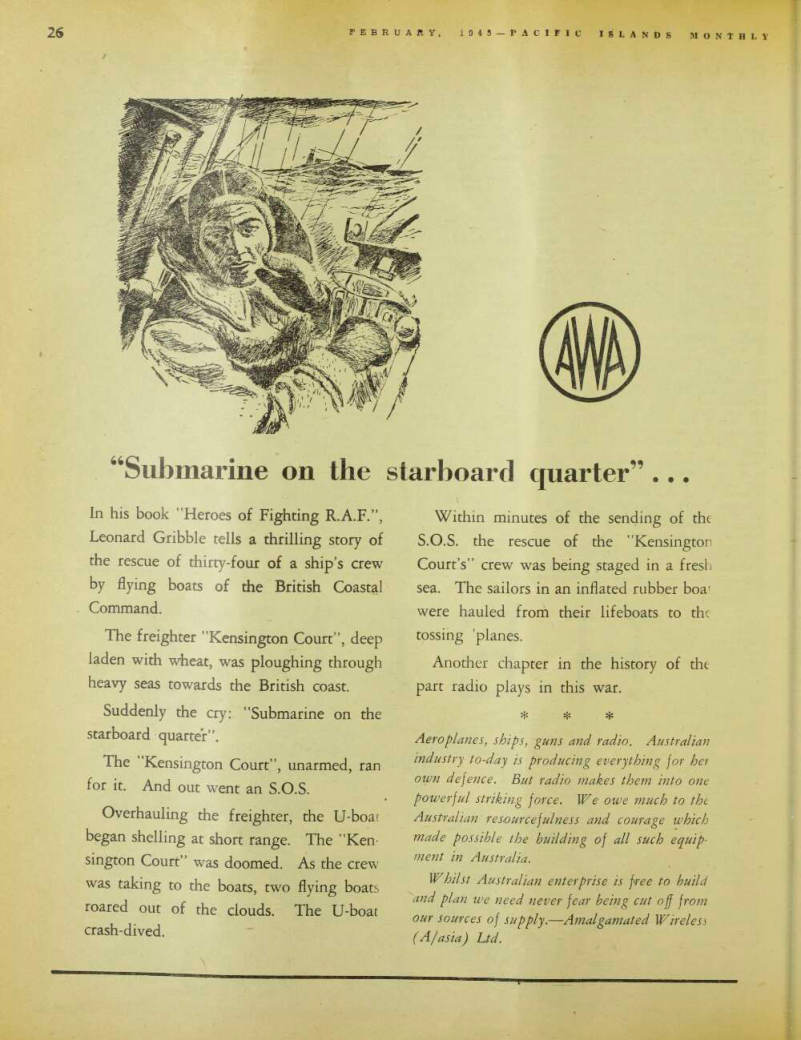
THE LOSS OF THE COOLIE SHIP "SYRIA"
By R, C, Maopherson
IN the early 80’s Indian immigrants first came into Fiji to work on the sugar plantations of the Colony, and, from the commencement of this coolie trade between Calcutta and the Islands, the ships which carried them from the swarming bazaars of old India to the new land of promise in the south went through many vicissitudes. Some of them had tragic voyages, with outbreaks of cholera on board—in one such instance only rough and ready, but effective,
quarantine measures saved Fiji from the disease.
But thgye was one coolie ship whose tra’gedy was not that of pestilence, but of shipwreck almost within sight of her des tination, and after what her master described as “a most prosperous voyage, experiencing nothing but fine weather and light winds and having no serious sickness.”
That vessel was the iron, full-rigged ship “Syria,” of 1,010 tons, built at Sun derland in 1869, and owned by Mr. James Nourse, of 50 Lime Street, London. (Inci dentally, James Nourse Line vessels were still in the immigrant trade between Calcutta and Fiji up to the outbreak of the present "War.) She sailed from Cal cutta on March 13, 1884—surely an ominous date to any superstitious sailor —with a crew of 43 and 493 Indian immigrants.
The ship arrived off Kadavu, the south erly landfall for the port of Suva, on the morning of May 11; by 5 p.m. the same day she was head-reaching off the Astro labe reef, about 10 miles to the north east. Then at 8.30 p.m. came the cry of: “Breakers to loo’ard.”
Swift orders saw the hands making all sail in an endeavour to ‘bout ship and claw off to get sea-room to windward, but it was too late, and the “Syria” went broadside on to the extreme point of Naselai reef, amid a flurry of broken water.
When the ship struck things happened quickly. The shock of striking drove the weather-quarter boat out of its davits and smashed it to matchwood. In fran tic attempts to launch the remaining boats, all except one were similarly smashed. The one boat saved was later sent off in charge of the chief officer in search of assistance, and eventually reached Levuka. And no sooner was it clear of the ship’s side than the main mast went by the board. With great diffi culty, those in the boat got about five miles from the wreck through the shoal on a falling tide, arid then had to anchor for the night. They arrived at Levui.. about noon the next day.
IN the meantime, calm had been main tained on board, a matter of no little credit to those in charge, in view of the type of passenger the “Syria” was carrying. The immigrants retired below in good order and the ship’s position was examined.
When the ship struck, a very heavy sea had been running and the vessel was carried up over the edge of the reef, the breakers crashing over her and smash ing loose gear. When the carpenter sounded the well soon after, there was four feet of water in the hold, and it was obvious that the case of the vessel hopeless.
The arrival of the “Syria’s” boat in Levuka caused no little excitement in that then-important port. The “Fiji Times,” then published twice weekly at Levuka. reported that “Considerable commotion was caused in the town on Monday, shortly after noon, when it was known that a boat had arrived from the coolie ship ‘Syria,’ then lyinp- stranded in the neighbourhood of Naselai Point.”
The “Times” then goes on to tell the story of the trip of the ship’s boat to Levuka with the mate, the engineer, the carpenter, another European and three Lascars on board.
Levuka took no risks with regard to
health, and as the “Times” naively puts if “Inquiries were made of the men in the boat of the health state of the ship they had quitted. This was most satis factory. There was no sickness on board, nor had there been any of a serious character since the sailing of the vessel from her port of departure, except in the case of two infants who died during the voyage.”
That afternoon, the Union Steam Ship Company’s steamer, “Penguin,” left for the scene of the wreck and arrived some where in the locality in darkness. Noth ing could be seen of the “Syria,” ana though rockets were fired and flares lit there was no answering signal. The master of the “Penguin” continued on to Suva, but on arrival he found that he had been forestalled by the steamer “Thistle,” which had left Levuka early that morning and had sighted the “Syria ” A Dr. Shaw from the “Syria’ had managed to get ashore and had also made bis way to Suva overland—no small task in those days. rE Government despatched the “Clyde” with several punts in tow, to try to rescue passengers and crew; the “Penguin” also left again for Naselai.
The wreck was found on the extreme point of the Naselai reef, 20 miles from S Uva —had she been two cables further out she would have cleared the coral.
The wreck was sighted at 6.30 in the morning; she lay on the edge of the reef with the sea breaking over her mast head. , . .
As the “Penguin” passed her, her fore mast was darried away, so that only the bare hull remained, and that showed signs of giving way amidships. A seeth ing and boiling surf lay between the “Syria” and the shore through which it would be impossible for any but a very stout boat to make way. .
The “Clyde” and her punts, making slow progress, had been passed by the “Penguin” off the island of Nukulau, and
Captain Cromarty, of the “Penguin,’’ decided to run bach and see if he could tow up any small steamer or boats. The effort was unavailing, however, as the “Clyde” and her charges were nowhere in sight, apparently having decided to go through the Rewa and Wainibokasi Rivers to Naselai.
The ‘Tenguin” was again abreast of the wreck about noon. The sea was then much lighter and the tide had fallen, but in the meantime the wreck had parted amidships, just aft the fore rig ging and there was a yawning rent vis ible in her side where her plates had collapsed. Not a soul could be seen about the wreck, though all the glasses on the “Penguin” were trained on her so long as hope remained of distinguishing anyone. rE “Suva Times” went to the length of issuing a single-page extra on May 14, 1884, with an official report of the stranding, by Dr. William Mac- Gregor—afterwards Sir William Mac- Gregor, and Governor of British New Guinea.
The morning after the ship struck, reported Dr. MacGregor, a native canoe managed to come off, and it was in this that the doctor got ashore, after which he made his way to Suva. Then three or four canoes landed some 60 or 70 of the immigrants. The breaking of the ship in two was the signal for the main body of the Indians to attempt to make the shore, and many left the ship on pieces of wreckage. Three small boats reached the wreck at noon and began to take the people off. By 3 p.m. or 4 p.m. they were all clear of the wreck.
Dr. MacGregor’s report goes on to say that when the first boats reached the ship, the majority of the Indians were in the water on the reef, but there were many still in the vessel, chiefly women and children. The ship lay on her port side, the masts were broken into frag ments, and spars, sails, ropes and debris of all kinds were mixed up and dashed
about in the breakers in wild confusion.
The foremost third of the hull was com pletely separated from the pther two thirds, and drawn about four or five yards further on to the reef than the after portion. The sea rolled with tremen dous fury through this gap and some times broke right over the wreck.
The captain was the only European found on board. He was struggling heroically, at the risk of his own life, to get the women and children extricated.
Included among the men who went to the wreck were Dr. Patullo, Mr. Fowler, Acting Superintendent of Police, and Captain Hedstrom, Harbourmaster at Levuka (father of the present Sir May nard Hedstrom, of Suva) and they made every effort to rescue those who were drowning within their reach, and to transport all that had left the ship across the first deep water.
The captain did not leave the wreck till he believed that all the people were out 'hf it, and then he started from the after portion, bringing an Indian woman, who was half-drunk, with him. Appar ently some of the passengers had man aged to broach the ship’s liquor store.
As they started to leave the wreck, the captain and the woman were knocked over and over toward the perpendicular edge of the reef, the woman having secured a vice-like grip on her rescuer’s neck. Mr. Fowler, who was at hand, dashed into the breakers at the risk of his own life to attempt to save the cap tain, but no sooner had he reached the drowning couple than he, too, was knocked down and caught by the woman, all three being rolled along toward destruction until they were rescued by others.
In the style of the day. MacGregor’s report says; “It is a matter for much regret that one man, a drunken Lascar, was left on board and could not be rescued. He was brought out of the wreck once and put in a position from
(Continued on Page 32)
which he could have saved himself, but watched his opportunity to scramble back into the wreck again.”
After the others had been rescued, a native Sub-Inspector of Constabulary, Ratu Joshua, bravely searched a large portion of the wreck, despite the faci that tide and wind were raising breakers of terrific force, but he was unable to find the drunk. However, his action was the means of saving one life, for he dis covered another man in the wreck, and, with some assistance, was able to bring him off.
Native canoes gave some assistance i the rescue work at a time when many people were drowning. However, Dr.
MacGregor adds: “Certain Fijians mani fested a callousness that to those who were straining every nerve to save people drowning all around them, was exasperat ing in the extreme. With men, women and children dying helpless before their eyes, with the bodies of the drowned floating all over the reef, and the strug gling forms of the feebly living striving in the water, for a last chance of life, some five or six of these stalwart Fijians went on collecting bundles of blankets, calico, clothes and so on, that they could have stolen.just as easily the next day, and would not and did not give up their occupation to aid in the work of human ity. It is but right to state, however, that one of these plunderers, frightened by the threat of instant violence, did bestir himself and aided a woman and child that were in danger.”
A subsequent check-up showed that the death-roll was 55. mo -DAY the Naselai lighthouse marks X the reef where the “Syria” struck
All that remains of the wreck is part of the iron hull resting on the coral near the white column of the lighthouse. The figurehead from the “Syria” is in the Fiji Museum in Suva.
Advertisements & other items, pp. 26-28 (2 items)
Mary’S
GILLESPIE’S
The Flour
TRADE
MARK
of the Islands
- SYD NEY -
AUNT
MARY’S
BAKING POWDER
• SUPPLIES ARE NOW AVAILABLE. If your local supplier is out of stock he will readily obtain Aunt Mary's Baking Powder for you. After all, quality is worth waiting for, especially when it is Aunt Mary's Baking Powder, which maintains the high quality which has stood the test for over 70 years.
¥ •i O /7° uiyp
/ I i V 5 & a. £ Nr
“Submarine on the starboard quarter”
• • In his book "Heroes of Fighting R.A.F.", Leonard Gribble tells a thrilling story of the rescue of thirty-four of a ship’s crew by flying boats of the British Coastal Command.
The freighter "Kensington Court", deep
laden with wheat, was ploughing through heavy seas towards the British coast.
Suddenly the cry: "Submarine on the starboard quarter".
The "Kensington Court", unarmed, ran for it. And out went an S.O.S.
Overhauling the freighter, the U-boar began shelling at short range. The "Kensington Court" was doomed. As the crew was taking to the boats, two flying boats roared out of the clouds. The U-boat crash-dived.
Within minutes of the sending of th( S.O.S. the rescue of the "Kensingtor Court’s" crew was being staged in a fresl sea. The sailors in an inflated rubber boa ! were hauled from their lifeboats to the
tossing ’planes.
Another chapter in the history of the part radio plays in this war. * * * Aeroplanes, ships, guns and radio. Australian industry to-day is producing everything for her own defence. But radio makes them into one powerful striking force. We owe much to the Australian resourcefulness and courage which made possible the building of all such equipment in Australia.
Whilst Australian enterprise is free to build and plan we need never fear being cut off from our sources of supply. —Amalgamated Wireless (A/asia) Ltd.
26
FEBRUARY, !M5-f ACIFIC ISLANDS MONTHLY
The Mysteries of Army
Administration
Letter to the Editor MAY I, as an old Territorian serving in the Forces, make some comment on the way the country is now being run, and be permitted to ask for enlightenment on the reasons behind some of the present Army Administra tion’s habits? • Firstly, why should native recruits be forced to work in the G-strings in which they were recruited? I believe that ANGAU has been knpwn to supply an occasional lap-lap, but it is the usual thing for the newly-signed-on native to get an advance on his pay and make a bee-line for the nearest Army-operated PCB store and buy his own. • It would be interesting to know, also, why it is necessary to keep old indentured labourers hanging around the compounds filling in time simply because their ex tracts have not legally expired. In view of the fact that it is (or should be) uni versally recognised that the return of surplus labour to native village life is essential for the preservation of the whole race, there seems little sense or foresight in this policy. On the other hand, natives found in captured areas are sent home at the first opportunity with a note that states that they must not be recruited for a period of six months. No record of these natives is taken and there is therefore no means of knowing what labour is available in any area, or when individual natives may be recruited again.
Natives are no longer recruited; they are manpowered. After they are brought in, they are signed on for two years, and no questions are asked as to whether or not they want to work, and apparently no investigations are made as to whether it would be better in the long run if they were kept in the villages. The contract they sign is known as a “Contract of Employment.”
The practice at present is to use only indentured labourers (from any district) to clear plantations that have become overgrown in the invasion period. If local natives were brought to the planta tions in villages—or other large batches — men, women and children would soon clear large areas. Pre-war Europeans usually hired the local village for work of this sort, or for erecting houses, etc.
In this way, native life would go on uninterrupted, the planter later will benefit by finding contract labour more easily obtainable, and the Government issued rations would be a help to the natives while their food gardens are growing. Most natives do not recognise the purpose of relief rations; they simply make whoopee in the form of “sing-sings” while the meat, rice and biscuits last. I have issued thousands of these relief rations and I can vouch for the truth of this, • Much dissatisfaction has been regis tered in ANGAU when experienced New Guinea men have been passed over for promotion in favour of less experienced men. Numbers of New Guinea men, when special, responsible duties come up, are sent out to deal with them, while superior officers stay comfortably behind at base. Some of the staff officers state simply (and with some truth) that they are too old for such patrol work. Never theless they are responsible for the recommendation of commissions, many of which go to young, non-Territorian men. • If newspaper reports are to be believed, in the way of radio sets, etc., go to New Guinea. It is
reported that a number of individuals who live in groups of two and three at some base are lucky in this respect. Field men, on the other hand, get either a worn-out set which functions but rarely, or none at all. It is* in these forward areas that a radio—the only source of news—is most appreciated.
Electric lighting sets, which at one time were an almost unknown item, are now much more easily come by. • Finally—and this time on the pro duction side—why is it that the External Territories Department, which handles all rubber going into Australia, cannot do the same thing with copra? I am told that one of our biggest trading firms passes all New Guinea copra across to Levers and collects a percentage. If this is so, what is the reason for it?
I am, etc.,
Serviceman.
New Guinea, January 29.
Retaliation
Fishermen and Tahiti "Blacketeers"
From Our Own Correspondent
Papeete, Nov. 20.
OUR early morning market is assuming a striking resemblance to world famous Billingsgate.
Papeete—by reason of certain wartime conditions —has become so congested that the housing problem is one of major importance. All these people are firmly convinced that if fish does not appear daily on their tables they and their families are surely and progressively starving to death. , The native fishermen of the districts — who have been the chief victims of our Black Market ghouls—have appraised the situation in the light of their own unsavoury experiences, and have resolved to get “some of their own back.” They have, accordingly, so limited the supply of fish at the early morning market that competition among frantic buyers sends
prices into the vicinity of the sub cfrQ tncnhprp Attempts at regulation result in a vacuum —the fishermen and their wares do not appear for several days.
The early morning market has, there fore, departed from its former aspect of leisurely buying and exchange of spicy gossip, into a daily turmoil which resembles Billingsgate at its historic best.
Advertisements & other items, p. 29 (1 item)
Steamships Trading
Purchasers at Full Market Prices on Assay Value of
GOLD
SILVER
PLATINUM
And Platinum Group Metals
SOME OF OUR SERVICES
ASSAYERS & ANALYSTS—
Assays of Bullion, Ores, etc.
Analyses of Metals, Minerals, Alloys, etc.
SCIENTIFIC & INDUSTRIAL
METALLURGISTS—
Our range of precious metal manufactures covers all industries—Gold and Silversmiths, Electrical Trades, Dental Profession, Glass Sllverers, Electro-Platers, etc., etc.
REFINERS—
Purchasers and Refiners of Bullion, Scrap, Mining By-Products, and Trade Residues of every description carrying Precious Metals.
GARRETT & DAVIDSON
PTY. LTD.
824 George St., Sydney. Works: Surry Hills and Chippendale, N.S.W.
Official Assayers to the Bank of New South Wales. Gazetted Agents of the Commonwealth Bank of Australia, under the Gold Regulations of the National Security Act.
Steamships Trading
Company Limited
PORT MORESBY SAMARAI PAPUA.
WHOLESALE & RETAIL MERCHANTS, SHIPOWNERS,
PLANTERS. ENGINEERS & SLIP PROPRIETORS.
Customs, Shipping, Insurance, and Forwarding Agents.
MANAGING AGENTS AND VISITING REPRESENTA-
TIVES FOR COCONUT AND RUBBER ESTATES.
SYDNEY REPRESENTATIVES: Nelson & Robertson Pty. Ltd., 12 Spring Street.
WARTIME ADDRESS
Until further notice, clients may address all communication.'. as follows: —
STEAMSHIPS TRADING COMPANY LIMITED,
C/o NELSON Cr ROBERTSON PTY. LTD.,
12 SPRING STREET, SYDNEY.
New Caledonia
Election Skirmishes in New Caledonia
From Our Own Correspondent
Noumea, Jan. 1.
A SENSATION of the election cam paign for the General Council has been the charsre, published in the Ipcal press above the signatures of 11 members of the Comite Caledonian Party, that four of the candidates nominated by the so-called “Union” Party (representing financial and commercial interests largely) were avowed Petainists at the time the Colony rallied to General de Gaulle. Two of the candidates so charged are mentioned by name—M. Lafleur, a mining contractor working in association with the Societe le Nickel, and also asso ciated with Maison Ballande, of Bordeaux (the biggest French commercial concern in New Caledonia and the New Hebrides), and M. Marc one of Noumea’s three practising lawyers.
The “Union” Party has been dubbed
‘Parti Ballande” by its opponents. It has a more conservative programme than the asks for financial, economic and Customs autonomy and a free hand to encourage international airways and shippings to use New Caledonia’s airfields and ports.
There is also a “Social Progress” Party with a somewhat similar programme of modernisation and socialisation, which urges administrative reorganisation, bet ter opportunities for Caledonian-born citizens, and the breaking up of large estates now run as cattle stations by Maison Ballande and a few other com panies or individuals.
T j- 6 J 6 .l ar6, as w . a ew independent candidates expressing no party allegiance.
Some candidates claim that mining con cerns like the Societe le Nickel, should be nationalised, as similar concerns are being nationalised in France. One elec tion campafp-ner draws attention to the between thei Colony’s Budget ln 1938-39 (50 million francs) and the profit of the nickel company for the same year (150 millions).
Missionaries
Apology to Lutheran Missionaries Australian Publishers Correct an Injustice
TERRITORIANS temporarily in Aus
tralia have no doubt recently noticed in the metropolitan news papers an “apology and correction ” from publishers Angus & Robertson, Ltd., concerning a book written by George H. Johnston— C( New Guinea
Diary.” ,
In his book, Johnston alleged that the Lutheran Missionaries in the Salamaua district of New Guinea aided the Japanese on their march up the Markham Valley.
The following note has been re ceived from the Brisbane headquarters of the Lutheran Mission which ex plains both Mr. Johnston's allegations
and the subsequent apology of his
publishers :
IN March, 1942, after the Japanese had Invaded the mainland of New Guinea Territory and had established them selves at Salamaua and Lae, it was alleged by war correspondents that Luth eran missionaries of Australian and American nationality were aiding the enemy in guiding him up the Markham Valley. In sensational manner, the daily press branded these missionaries as traitors and no end of calumny was heaped on them, and the whole Lutheran Church of Australia and America was dis credited and placed under suspicion, which caused heartache and injustice.
One of the war correspondents, George J. Johnson, later compiled a book, “New Guinea Diary,” in which he repeated the slanders in a form that was even more objectionable than the original. On page 55 of his book he states: “The most inter esting feature of the (Japanese) advance is that certain Lutheran missionaries— of Australian, British and American nationality—have been acting as guides for the Japs, and our guerillas on the other side are very anxious to meet some of the white traitors.”
The book was published by Messrs.
Angus & Robertson, of Sydney. In an endeavour to clear the names of the mis sionaries and to rehabilitate the mission, steps were taken to cause the publishers to apologise and to correct that portion of the book that was objectionable.
The company was immediately willing to offer as much redress as was possible.
In addition to publishing an apology in all the capital cities of the Common wealth and of New Zealand, it has under taken to advise all libraries and all dis tributors of the book of the apology and correction, and it has supplied to all of them printed slips correcting the pas sage objected to. These slips are to be pasted in every copy of the book which it is possible to reach. The publishers also undertook to omit the passage objected to from any further edition of the book, and they have paid all costs which have arisen.
A collection of Fiji native handicrafts, collected by Captain R. M. Donohue, of the US Army nursing service, was on ex hibition in Baltimore, USA, during October. The exhibition consisted of native wood carvings, wall hangings made from bark, grass skirts and mats, purses, toilet articles of tortoise shell and examples of basketry, beadwork and model canoes.
Advertisements & other items, pp. 30-31 (2 items)
Asthma Curbed
R .LIcTtER ... LONGER LASTIMf!
Under war conditions, only occasional manufacture is poss *ble, but Globites will be supplied whenever available.
Asthma Curbed In 3 Minutes
Since the discovery of Mendaco bv a * a “ 0US A Physician sufferers can get relief from Asthma. Mendaco does away with
™„Tes
All you do is to take 2 tasteless tahlpt* with meals and Mendaco starts circulating b^ ?h the -. blood ln 10 minute YoS breathe easily and freely. Your nerves relax you get good, fresh, pure ai? into your lungs, and vigour returns.
Sleep Like a Baby
ni I ght tha Then y th? t S ° Vlgour and ey felt healthier and stronger and 5 to l°J e Z S younger - reason fo? this is that Mendaco acts in natural wavs to the 6 SSS* <» » c„ x chuf°sr s s „ oi th “? ts-2?
No Asthma for Five Years
S d ts C °f?i fc °b n ri y S ngS almost immediate
iie-Si Z.VJKJZ.'SI
fered coughing every night—couldn’t sleep.
Mendaco stopped spasms first night. I have had no Asthma since in over 2 years ”
Mrs. A. W. writes: “I had Asthma for 25 years. After using Mendaco I can sleep all night and have not had an attack since taking it.” Mrs. G. E. C. writes; “I bless the day I first heard of Mendaco. What a godsend it is to a poor woman like me who for 35 years never knew what it was to have a good night’s rest. The constant fight between Asthma and sleep was wearing me down, but I feel now I want to forget my past suffering."
Benefits Immediate
The very first dose of Mendaco goes right to work circulating through your blood and helping nature rid you of the effects of Asthma. Try Mendaco under an iron-clad money back guarantee. You be the judge If you don’t feel fully satisfied after taking Mendaco just return the package and the purchase price will be refunded Get Mendaco from your chemist to-day and see how well you sleep to-night and how much better you will feel.
RELIEVES ASTHMA
Mendaco
Now in 2 sizes 6/- and 12/-
Ws Most
M 4 0
m m
: X> •Vv^
& % % ‘V TAe famous Aladdin Kerosene Mantle Lamp gives brilliant 75-candlepower white light without pumping or pressure at a cost of approximately 2 hours’ light for one penny. As easy to light as the old-fashioned flame lamp. \ m NOW every island home can enjoy the comfort and convenience of a brilliant white 75-candlepower light thanks to Aladdin, the world's most wonderful lamp. Introduced to the Islands for the first time, this world-famous Kerosene Mantle Lamp is artistic in appearance, economical in use and as easy to light as an ordinary flame lamp. Burns only kerosene, the safest and cheapest of fuels— without pumping, pressure, noise, smoke or fumes. Write AT ONCE for illustrated leaflet showing the full range of table, floor pedestal, hanging and wall-bracket models.
Popular Aladdin Storm Lantern, solidly con• structed of brass for hard wear. Gives vivid 200-candlepower white light from ordinary kerosene at a cost of approximately one halfpenny per hour. Widely used by Army and ISavr during the war.
AGENTS WANTED. Opportunities exist for alert storekeepers to act as authorised Aladdin storekeepers in the Islands. Special discounts and the distribution of Aladdin wicks, chimneys, mantles, shades, and spare parts are among the many advantages of the Aladdin franchise. pale green ennm i Srn **rtl y fi ni *93-3799
ALADDIN INDUSTRIES PTY. LTD
7 I bourke street.
SYDNEY
The End of Chandra Bose—Japanese Puppet
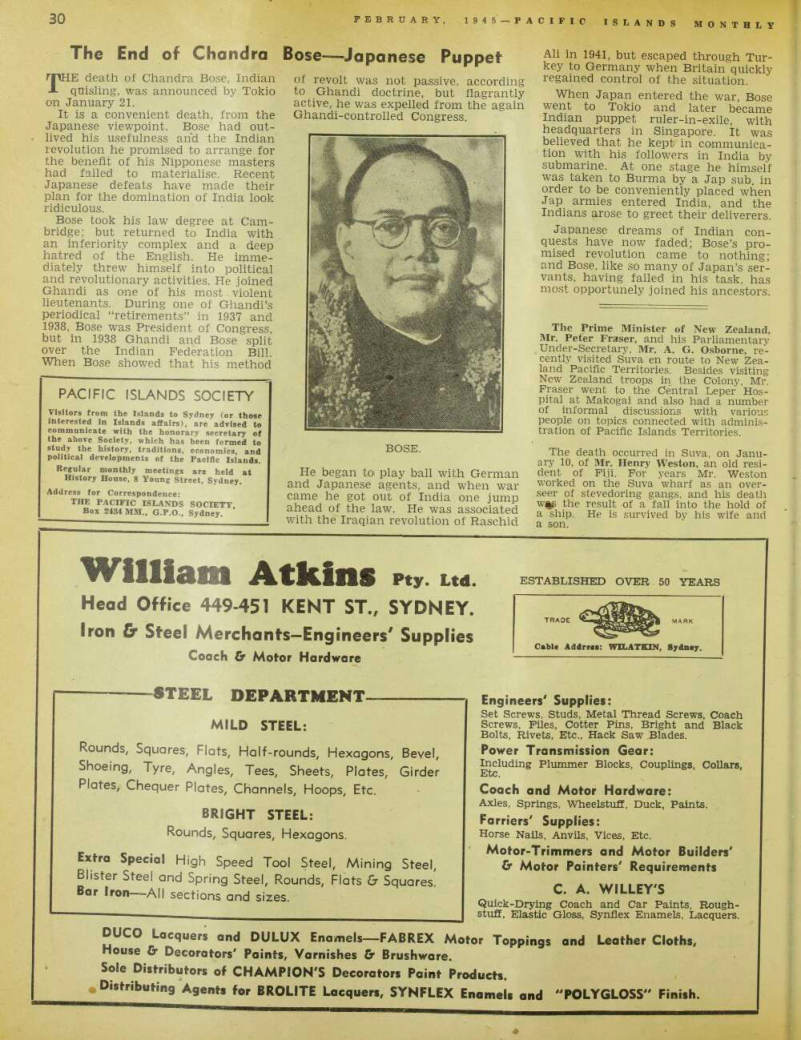
rE death of Chandra Bose, Indian quisling, was announced by Tokio on January 21.
It is a convenient death, from the Japanese viewpoint. Bose had out lived his usefulness and the Indian revolution he promised to arrange for the benefit of his Nipponese masters had failed to materialise. Recent Japanese defeats have made their plan for the domination of India look ridiculous.
Bose took his law degree at Cam bridge; but returned to India with an inferiority complex and a deep hatred of the English. He imme diately threw himself into political and revolutionary activities. He joined Ghandi as one of his most violent lieutenants. During one of Ghandi’s periodical “retirements” in 1937 and 1938, Bose was President of Congress, but in 1938 Ghandi and Bose split over the Indian Federation Bill.
When Bose showed that his method
of revolt was not passive, according to Ghandi doctrine, but flagrantly active, he was expelled from the again Ghandi-controlled Congress.
He began to play ball with German and Japanese agents, and when war came he got out of India one jump ahead of the law He was associated
Ali in 1941, but escaped through Tur key to Germany when Britain quickly regained control of the situation.
When Japan entered the war, Bose went to Tokio and later became Indian puppet ruler-in-exile, with headquarters in Singapore. It was believed that he kept in communica tion with his followers in India by submarine. At one stage he himself was taken to Burma by a Jap sub. in order to be conveniently placed when Jap armies entered India, and the Indians arose to greet their deliverers.
Japanese dreams of Indian con quests have now faded; Bose’s pro mised revolution came to nothing; and Bose, like so many of Japan’s ser vants, having failed in his task, has most opportunely joined his ancestors.
The Prime Minister of New Zealand, Mr. Peter Fraser, and his Parliamentary Under-Secretary, Mr. A. G. Osborne, re cently visited Suva en route to New Zea land Pacific Territories. Besides visiting New Zealand troops in the Colony, Mr.
Fraser went to the Central Leper Hos pital at Makogai and also had a number of informal discussions with various people on topics connected with adminis tration of Pacific Islands Territories.
The death occurred in Suva, on Janu ary 10, of Mr. Henry Weston, an old resi dent of Fiji. For years Mr. Weston worked on the Suva wharf as an over seer of stevedoring gangs, and his death w%s the result of a fall into the hold of a ship. He is survived by his wife and a son.
Bose.
Advertisements & other items, p. 32 (1 item)
William Atkins Pty. Ltd.
PACIFIC ISLANDS SOCIETY
Visitors from the Islands to Sydney (or those interested In Islands affairs), are advised to communicate with the honorary secretary of the above Society, which has been formed to study the history, traditions, economics, and political developments of the Pacific Islands.
Regular monthly meetings are held at History House. 8 Young Street, Sydney.
Address for Correspondence:
THE PACIFIC ISLANDS SOCIETY
Box 2434 MM., G.P.0., Sydney. ’
William Atkins Pty. Ltd.
Head Office 449-451 KENT ST., SYDNEY.
Iron & Steel Merchants—Engineers' Supplies
ESTABLISHED OVER 50 YEARS
Coach & Motor Hardware
—STEEL DEPARTMENT-
MILD STEEL:
Rounds, Squares, Flats, Half-rounds, Hexagons, Bevel, Shoeing, Tyre, Angles, Tees, Sheets, Plates, Girder Plates, Chequer Plates, Channels, Hoops, Etc.
BRIGHT STEEL:
Rounds, Squares, Hexagons.
Extra Special High Speed Tool Steel, Mining Steel, Blister Steel and Spring Steel, Rounds, Flats £r Squares.
Bar Iron-—All sections and sizes. trade MARK Cable Addrecs: WILATKIN, Sydney.
Engineers' Supplies: Set Screws. Studs, Metal Thread Screws, Coach Screws, Piles, Cotter Pins, Bright and Black Bolts, Rivets, Etc., Hack Saw Blades.
Power Transmission Gear: Including Plummer Blocks, Couplings, Collars, Etc, s Coach and Motor Hardware: Axles, Springs, Wheelstuff, Duck, Paints.
Farriers' Supplies: Horse Nails, Anvils, Vices, Etc.
Motor-Trimmers and Motor Builders' & Motor Painters' Requirements
C. A. WILLEY'S
Quick-Drying Coach and Car Paints, Roughstuff, Elastic Gloss, Synflex Enamels, Lacquers.
DUCO Lacquers and DULUX Enamels—FAßßEX Motor Toppings and Leather Cloths, House & Decorators' Paints, Varnishes & Brushware.
Sole Distributors of CHAMPION'S Decorators Point Products.
Distributing Agents for BROLITE Lacquers, SYNFLEX Enamels and "POLYGLOSS" Finish.
Anti-Filariasis Drive
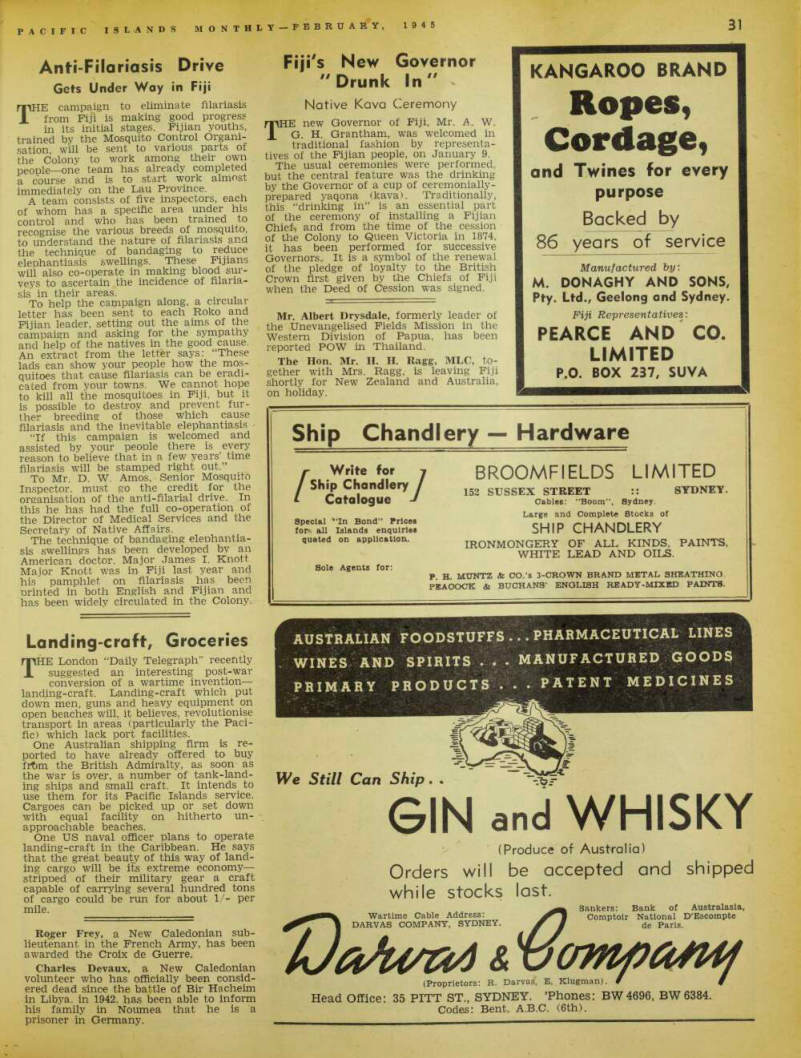
Gets Under Way in Fiji
rE campaign to eliminate filariasis from Fiji is making good progress in its initial stages. Fijian youths, trained by the Mosquito Control Organi sation will be sent to various parts of the Colony to work among their own peonle—one team has already completed a course and is to start work almost immediately on the Lau Province.
A team consists of five inspectors, each of whom has a specific area under his control and who has been trained to recognise the various breeds of mosquito, to understand the nature of filariasis and the technique of bandaging to reduce elephantiasis swellings. These Fijians will also co-operate in making blood sur veys to ascertain the incidence of filaria sis in their areas.
To help the campaign along, a circular letter has been sent to each Roko and Fijian leader, setting out the aims of the campaign and asking for the sympathy and help of the natives in the good cause.
An extract from the letter says; “These lads can show your people how the mos quitoes that cause filariasis can be eradi cated from your towns. We cannot hope to kill all the mosquitoes in Fiji, but it is possible to destroy and prevent fur ther breeding of those which cause filariasis and the inevitable elephantiasis “If this campaign is welcomed and assisted by your people there is every reason to believe that in a few years’ time filariasis will be stamped right out.”
To Mr. D. W. Amos, Senior Mosquito Inspector, must go the credit for the organisation of the anti-filarial drive. In this he has had the full co-operation of the Director of Medical Services and the Secretary of Native Affairs.
The technique of bandaging elenhantia sis swellings has been developed bv an American doctor. Major James I. Knott Major Knott was in Fiji last year and his pamphlet on filariasis has been nrinted in both English and Fijian and has been widely circulated in the Colony.
Landing-craft, Groceries
THE London “Daily Telegraph” recently suggested an interesting post-war conversion of a wartime invention — landing-craft. Landing-craft which put down men, guns and heavy equipment on open beaches will, it believes, revolutionise transport in areas (particularly the Paci fic) which lack port facilities.
One Australian shipping firm is re ported to have already offered to buy frbm the British Admiralty, as soon as the war is over, a number of tank-land ing ships and small craft. It intends to use them for its Pacific Islands service.
Cargoes can be picked up or set down with equal facility on hitherto un approachable beaches.
One US naval officer plans to operate landing-craft in the Caribbean. He says that the great beauty of this way of land ing cargo will be its extreme economy— stripned of their military gear a craft capable of carrying several hundred tons of cargo could be run for about 1/- per mile.
Roger Frey, a New Caledonian sub lieutenant in the French Army, has been awarded the Croix de Guerre.
Charles Devaux, a New Caledonian volunteer who has officially been consid ered dead since the battle of Bir Hacheim in Libya, in 1942. has been able to inform his family in Noumea that he is a prisoner in Germany.
Fiji's New Governor
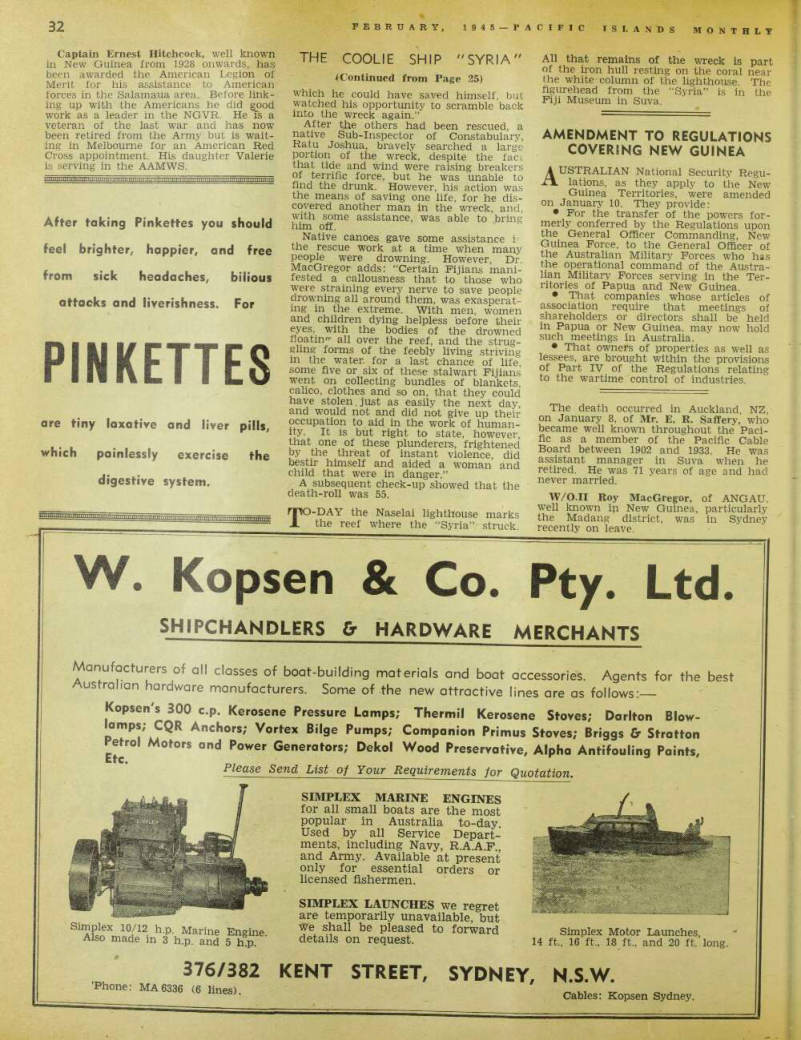
"Drunk In"
Native Kava Ceremony
THE new Governor of Fiji, Mr. A. W.
G. H. Grantham, was welcomed in traditional fashion by representa tives of the Fijian people, on January 9.
The usual ceremonies were performed, but the central feature was the drinking by the Governor of a cup of ceremonially prepared yaqona (kava). Traditionally, this “drinking in” is an essential part of the ceremony of installing a Fijian Chief* and from the time of the cession of the Colony to Queen Victoria in 1874, it has been performed for successive Governors. It is a symbol of the renewal of the pledge of loyalty to the British Crown first given by the Chiefs of Fiji when the Deed of Cession was signed.
Mr. Albert Drysdale, formerly leader of the Unevangelised Fields Mission in the Western Division of Papua, has been reported POW in Thailand.
The Hon. Mr. H. H. Ragg, MLC, to gether with Mrs. Ragg, is leaving Fiji shortly for New Zealand and Australia, on holiday.
Captain Ernest Hitchcock, well known in New Guinea from 1928 onwards, has been awarded the American Legion of Merit for his assistance to American forces in the Salamaua area. Before link ing up with the Americans he did work as a leader in the NGVR. He is a veteran of the last war and has now been retired from the Army but is wait ing in Melbourne for an American Red Cross appointment. His daughter Valerie is serving in the AAMWS.
Advertisements & other items, pp. 33-34 (1 item)
Gin And Whisky
KANGAROO BRAND
Ropes,
Cordage,
and Twines for every purpose Backed by 86 years of service Manufactured by:
M. DONAGHY AND SONS,
Pty. Ltd., Geelong and Sydney.
Fiji Representatives:
PEARCE AND CO.
LIMITED
P.O. BOX 287, SUVA
Ship Chandlery Hardware
Write for
r ▼▼ me ror j
j Ship Chandlery /
' Catalogue J
Special “In Bond” Prices for all Islands enquiries quoted on application.
BROOMFIELDS LIMITED
152 SUSSEX STREET :: SYDNEY.
Cables: “Boom”, Sydney.
Large and Complete Stocks of
SHIP CHANDLERY
IRONMONGERY OF ALL KINDS, PAINTS.
WHITE LEAD AND OILS.
Sole Agents for: P. H. MUNTZ <fc CO.’S 3-CROWN BRAND METAL SHEATHING
PEACOCK & BUCHANS’ ENGLISH READY-MIXED PAINTS.
AUSTRALIAN FOODSTUFFS ... PHARMACEUTICAL LINES
WINES AND SPIRITS . • . MANUFACTURED GOODS PRIMARY PRODUCTS . . . PATENT MEDICINES We Still Can Ship . .
GIN and WHISKY
(Produce of Australia
Orders will be accepted and shipped
while stocks last.
Bankers: Bank of Australasia, (Proprietors: R. Darvas, jsaugman; Head Office: 35 PITT ST., SYDNEY. ’Phones: BW 4696, BW 6384.
Codes: Bent. A.B.C. (6th).
After taking Pinkettes you should feel brighter, happier, and free from sick headaches, bilious attacks and liverishness. For
PINKETTES
are tiny laxative and liver pills, which painlessly exercise the digestive system.
Amendment To Regulations
Covering New Guinea
AUSTRALIAN National Security Regu lations, as they apply to the New Guinea Territories, were amended on January 10. They provide; • For the transfer of the powers for merly conferred by the Regulations upon the General Officer Commanding, New Guinea Force, to the General Officer of the Australian Military Forces who has the operational command of the Austra lian Military Forces serving in the Ter ritories of Papua and New Guinea. • That companies whose articles of association require that meetings of shareholders or directors shall be held in Papua or New Guinea, may now hold such meetings in Australia. • That owners of properties as well as lessees, are brought within the provisions of Part IV of the Regulations relating to the wartime control of industries.
The death occurred in Auckland, NZ, on January 8, of Mr. E. R. Saffery, who became well known throughout the Paci fic as a member of the Pacific Cable Board between 1902 and 1933. He was assistant manager in Suva when he retired. He was 71 years of age and had never married.
W/0.11 Roy MacGregor, of ANGAU, well known ip New Guinea, particularly the Madang district, was in Sydney recently on leave.
Advertisements & other items, p. 34 (2 items)
32
FEBRUARY, 1945-PACIFIC ISLANDS MONTHLY
THE COOLIE SHIP "SYRIA"
from Page 25)
W. Kopsen & Co. Pty. Ltd.
SHIFCHANPLERS fir HARDWARE MERCHANTS
Manufacturers of all classes of boat-building materials and boat accessories. Agents for the best Australian hardware manufacturers. Some of the new attractive lines are as follows: Kopsen s 300 e.p. Kerosene Pressure Lamps; Thermil Kerosene Stoves; Darlton Blowlamps; CQR Anchors; Vortex Bilge Pumps; Companion Primus Stoves; Briggs & Stratton Petrol Motors and Power Generators; Dekol Wood Preservative, Alpha Antifouling Points, Please Send List of Your Requirements for Quotation.
Simplex 10/12 h Also made in •P. Marine Engine. 3 h.p. and 5 h.p.
SIMPLEX MARINE ENGINES
for all small boats are the most popular in Australia to-day.
Used by all Service Departments, including Navy, R.A.A.F., and Army. Available at present only for essential orders or licensed fishermen.
SIMPLEX LAUNCHES we regret are temporarily unavailable, but we shall be pleased to forward details on request. ■ Simplex Motor Launches, 14 ft., 16 ft., 18 ft., and 20 ft. long.
376/382 KENT STREET,
'Phone: MA6336 (6 lines).
SYDNEY, N.S.W.
Cables: Kopsen Sydney.
New Guinea
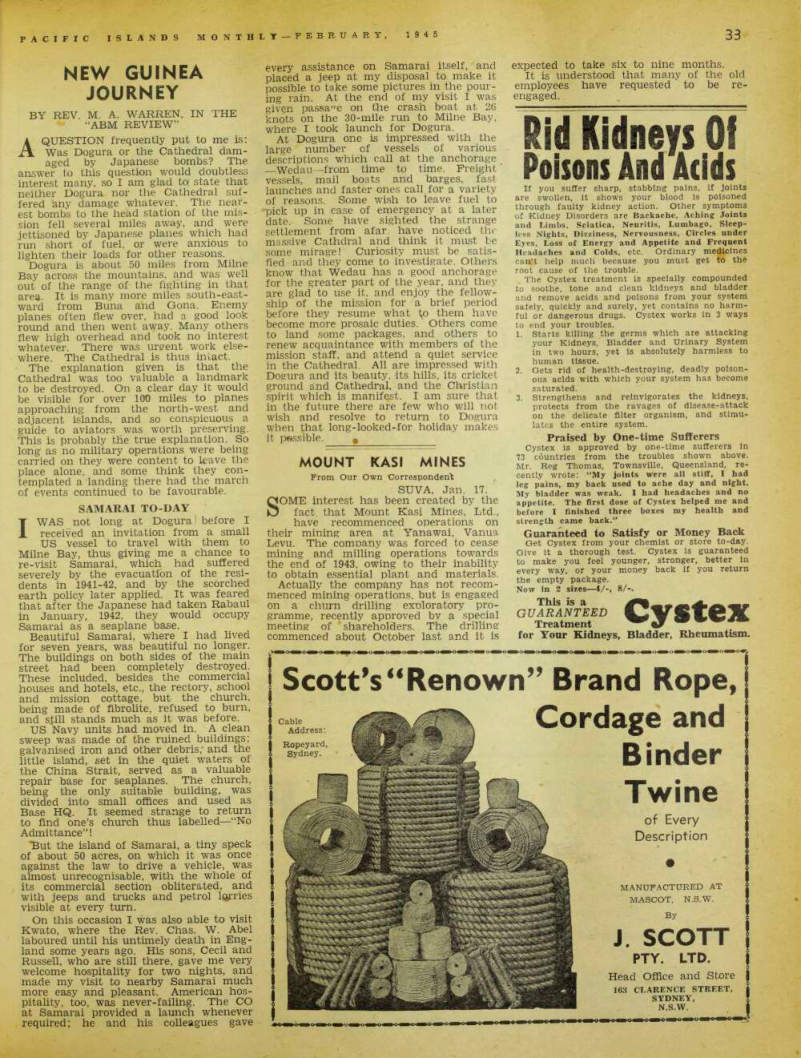
Journey
BY REV. M. A. WARREN, IN THE
“Abm Review”
A QUESTION frequently put to me is: Was Dogura or the Cathedral dam aged by Japanese bombs? The answer to this question would doubtless interest many, so I am glad to( state that neither Dogura nor the Cathedral suf fered any damage whatever. The near est bombs to the head station of the mis sion fell several miles away, and were jettisoned by Japanese planes which had run short of fuel, or were anxious to lighten their loads for other reasons.
Dogura is about 50 miles from Milne Bay across the mountains, and was well out of the range of the fighting in that area. It is many more miles south-east ward from Buna and Gona. Enemy planes often flew over, had a good look round and then went away. Many others flew high overhead and took no interest whatever. There was urgent work else where. The Cathedral is thus intact.
The explanation given is that the Cathedral was too valuable a landmark to be destroyed. On a clear day it would be visible for over 100 miles to planes approaching from the north-west and adjacent islands, and so conspicuous a guide to aviators was worth preserving.
This is probably the true explanation. So long as no military operations were being carried on they were content to leave the place alone, and some think they con templated a landing there had the march of events continued to be favourable.
Samarai To-Day
IWAS not long at Dogura 1 before I received an invitation from a small US vessel to travel with them to Milne Bay, thus giving me a chance to re-visit Samarai, which had suffered severely by the evacuation of the resi dents in 1941-42, and by the scorched earth policy later applied. It was feared that after the Japanese had taken Rabaul in January, 1942, they would occupy Samarai as a seaplane base.
Beautiful Samarai, where I had lived for seven years, was beautiful no longer.
The buildings on both sides of the main street had been completely destroyed.
These included, besides the commercial houses and hotels, etc., the rectory, school and mission cottage, but the church, being made of fibrolite, refused to burn, and still stands much as it was before.
US Navy units had moved in. A clean sweep was made of the ruined buildings; galvanised iron and other debris; and the little island, set in the quiet waters of the China Strait, served as a valuable repair base for seaplanes. The church, being the only suitable building, was divided into small offices and used as Base HQ. It seemed strange to return to find one’s church thus labelled —“No Admittance”!
But the island of Samarai, a tiny speck of about 50 acres, on which it was once against the law to drive a vehicle, was almost unrecognisable, with the whole of its commercial section obliterated, and with jeeps and trucks and petrol lorries visible at every turn.
On this occasion I was also able to visit Kwato, where the Rev. Chas. W. Abel laboured until his untimely death in Eng land some years ago. His sons, Cecil and Russell, who are still there, gave me very welcome hospitality for two nights, and made my visit to nearby Samarai much more easy and pleasant. American hos pitality, too, was never-failing. The CO at Samarai provided a launch whenever required; he and his colleagues gave
every assistance on Samarai itself, and placed a jeep at my disposal to make it possible to take some pictures in the pour ing rain. At the end of my visit I was given passage on the crash boat at 26 knots on the 30-mile run to Milne Bay, where I took launch for Dogura.
At Dogura one is impressed with the large number of vessels of various descriptions which call at the anchorage —Wedau—from time to time. Freight vessels, mail boats and barges, fast launches and faster ones call for a variety of reasons. Some wish to leave fuel to pick up in case of emergency at a later date. Some have sighted the strange settlement from afar, have noticed thr massive Cathdral and think it must be some mirage! Curiosity must be satis fied and they come to investigate. Others know that Wedau has a good anchorage for the greater part of the year, and they are glad to use it. and enjoy the fellow ship of the mission for a brief period before they resume what tp them have become more prosaic duties. Others come to land some packages, and others to renew acquaintance with members of the mission staff, and attend a quiet service in the Cathedral. All are impressed with Dogura and its beauty, its hills, its cricket ground and Cathedral, and the Christian spirit which is manifest. I am sure that in the future there are few who will not wish and resolve to return to Dogura when that long-looked-for holiday makes it possible. »
Mount Kasi Mines
From Our Own Correspondent
Suva, Jan. 17.
SOME interest has been created by the fact, that Mount Kasi Mines, Ltd., have recommenced operations on their mining area at Yanawai. Vanua Levu. The comnany was forced to cease mining and milling operations towards the end of 1943, owing to their inability to obtain essential plant and materials.
Actually the company has not recom menced mining operations, but is engaged on a churn drilling exnloratory pro gramme, recently approved bv a special meeting of shareholders. The drilling commenced about October last and it is
expected to take six to nine months.
It is understood that many of the old employees have requested to be re engaged.
Advertisements & other items, pp. 35-36 (1 item)
Rid Kidneys Of
Poisons And Adds
If you suffer sharp, stabbing pains, if Joints are swollen, It shows your blood is poisoned through faulty kidney action. Other symptoms of Kidney Disorders are Backache, Aching Joints and Limbs, Sciatica, Neuritis, Lumbago, Sleepless Nights, Dizziness, Nervousness, Circles under Eyes, Loss of Energy and Appetite and Frequent Headaches and Colds, etc. Ordinary medicines can’t help much because you must get to the root cause of the trouble.
The Cystex treatment is specially compounded to soothe, tone and clean kidneys and bladder and remove acids and poisons from your system safely, quickly and surely, yet contains no harmful or dangerous drugs. Cystex works in 3 ways to end your troubles. 1. Starts killing the germs which are attacking your Kidneys, Bladder and Urinary System In two hours, yet Is absolutely harmless to human tissue. 2. Gets rid of health-destroying, deadly poisonous acids with which your system has become saturated. 3. Strengthens and reinvigorates the kidneys, protects from the ravages of disease-attack on the delicate filter organism, and stimulates the entire system.
Praised by One-time Sufferers Cystex is approved by one-time sufferers in 73 countries from the troubles shown above.
Mr. Reg Thomas, Townsville, Queensland, recently wrote: “My joints were all stiff, I had leg pains, my back used to ache day and night.
My bladder was weak. I had headaches and no appetite. The first dose of Cystex helped me and before I finished three boxes my health and strength came back.”
Guaranteed to Satisfy or Money Back Get Cystex from your chemist or store to-day.
Give it a thorough test. Cystex is guaranteed to make you feel younger, stronger, better in every way, or your money back if you return the empty package.
Now in 2 sizes—4/-, 8/-.
GUARANTEED CVStCX
Treatment W
for Your Kidneys, Bladder, Rheumatism.
Scott’s “Renown” Brand Rope
Cordage and
Binder
Twine
of Every
Description
Address: Ropeyard, Sydney.
MANUFACTURED AT
MASCOT, N.S.W.
By
J. SCOTT
PTY. LTD.
Head Office and Stor<
163 CLARENCE STREET
SYDNEY,
N.S.W.
“NAILROD”—For Native Trade
EXCELLENT QUALITY
GOOD SMOKING
THOROUGHLY MATURED
Packed in racks of four 281 b. wooden boxes.
Indent through your Sydney Agent, or direct through the Sole Export Distributors ;
C. SULLIVAN Pty. Ltd.
379 Kent Street, Sydney, N.S.W.
C. SULLIVAN Pty. Ltd.
GENERAL MERCHANTS ISLANDS AGENTS
REPRESENTING LEADING FIRMS IN TH k PACIFIC ISLANDS, Islands Produce sold on Shippers’ Account-Liberal Advances against Consignments.
Buyers of all Islands’ Requirements on Commission—Original Invoices Furnished.
Bankers-. Bank of New South Wales .. Bank of New Zealand Comptoir National d’Escompte de Paris.
Wartime Cable Address: Sullivan, Kentstreet, Sydney.
379 KENT STREET, SYDNEY, N.S.W.
Why No Return To
Bsi?
Probably Due to Lack of Both Ships and War Damage Compensation
ALL except the most northern coasts of the British Solomons have been clear of Japs for a long time. The Territory, for many months, has been under what is practically civil adminis tration—although with a strong military flavour.
Therefore, there is bewilderment in places outside the Islands at the refusal of the authorities to allow civilians to re turn to their homes in the Solomons.
Planters, traders and missionaries are eager to go back; but only a very few have been allowed to go—and those under conditions which give little freedom to individuals or to enterprise.
The explanation probably will be found in the following note in a private letter from an experienced BSI official; “I think the return of civilians is held up until we can get a civil shipping and supply service; and also because the economic situation seems to be waiting on London for a decision. In the meantime, we are doing our best to get the natives back on to a sound basis, so that when production starts we can devote all our time to it.”
It must be remembered that a large part of the British Solomon islands were fought over very savagely in 1942-43, and the resulting extreme disruption of native life will need much repair. On the other hand, the return of experienced civilians would help, rather than hinder, thfe work of restoration.
There is much in that hint of a London decision, however. Britain, unlike Aus tralia, has done nothing as yet to assist rehabilitation of Pacific Islands residents.
Australians in Papua and New Guinea now are assured of substantial war dam age compensation; but the residents of the Solomons, where enormous damage was done by war, have had no promise of assistance of any kind. Until they get it, rehabilitation cannot very well be planned or attempted.
War has struck Britain’s colonies in many places; and discrimination is un likely. Britain cannot very well promise war damage compensation to the Soloiflbn Islands, and ignore the plight of former residents of Malaya or Hongkong. It may take some time to establish a principle and a plan.
World-Wide Publicity For
Fiji's Soldiers
rELVE pages of brilliant photographs, some of them coloured, and several pages of letterpress, are devoted by the “National Geographic Magazine” of January, 1945, to the exploits of the Fijian soldiers in the jungles of Bougain ville.
It is a remarkable story. The scene of most of the incidents is the outpost estab lished by the Fijians at Ibu, in the moun tains overlooking Numa Numa, on the east coast of Bougainville. Ibu was reached in 20 minutes’ flying in a Tiger Cub from the American, beach-head at Empress Augusta Bay. The Cub flew mostly through canyons in the central mountains. The Ibu air-strip, which clung to the crest of a ridge, was 350 feet long!
The author pays many well-deserved tributes to the Ist Fiji Battalion, and to the trained New Guinea police boys, who, as scouts, led them through most difficult country.
The Mystery Mineral
rtERE may be some who enjoy weed ing, -but their numbers must be very few. Every now and then, however, it becomes grimly necessary to try and clear away some of nature’s efforts to hide one’s garden soil.
At last the dismal labour had been done and from our verandah we looked down on a nice clean space, a sight that we had not revelled in for many a moon.
It was Hugo who first spotted what appeared to be a large brown stone with a smooth, shiny surface, somewhat caked with dry earth but managing to reflect the sun’s rays. He drew our attention to it and expressed the opinion that it was nrobably iron ore.
“Iron or what?” asked Enid.
“Iron or nothin*.” replied Hugo. “It’s iron ore.”
“Oh, that sort of ore,” said Enid.
Toby thought it was bauxite, about which all of us were a little vague, though Melville recalled how when the British blockade had prevented a neutral ship taking a cargo of bauxite to Germany, great had been the lamentation in the Reich. Others hazarded a guess that it was wolfram or pyrethrum.
Now, once an idea is planted in Toby’s head it expands in a big way, and his
thoughts gallop ahead. We gathered that we should immediately form a syndicate with Toby as chairman and commence minin" operations. But we had barely time to grasp this idea before Toby had led us on to visualise a vast mining camp with hundreds of happy natives enjoying high wages, ideal housin~ and regular picture shows. Then we were hustled into the Board Room, where Toby, as chair man, had announced a record dividend.
Camera-men swarmed round; Toby’s biography was featured in illustrated magazines: he was sent on trade missions 'to Moscow Rio de Janeiro and Teheran, and finally created a Viscount.
Then Melville said that it might be worth having a dekko at this wonderful stone.
He descended to the garden and held up for our inspection a portion of broken class from an ancient and, alas, empty brown bottle. —“HIEREUS.”
The Rt. Rev. W. H. Baddeley, Bishop of Melanesia, who has been in England, has left for his mission field, via the United States. He expects to be back in the Solomons before Easter.
Advertisements & other items, pp. 37-38 (1 item)
£ £
••• • « c „ ul T' "
* £M£ do M£MTH£ * -
AOVOC A AT mY B **HDY
c u*acao + ORANSE 4 Vv WT£ f 4
* CR£ M £
• • • • «f G IL B£D£ NE . CMt * »•••■ N£ * orange S , r
Cacao
APR 'cor BRANO * Umon s,n • M ° NX * MARHN, COCK' '
ROy Al. SCOTCH i * SP£y
UW£ET VV H(S Ky I* *
• < • • Address all enquiries to: W. & A. GILBEY LTD.. 33 ROSSLYN STREET, WEST MELBOURNE Telegrams and Cables : "Gilbeys" Melbourne or 109 Regent St.. Sydney - Telegrams and Cables : "Gilbeys'* Sydney
Here's Something
You'll Appreciate
JAMS
Over 20 varieties from Carefully Selected Fresh Fruits.
TOMATO SOUP
TOMATO SAUCE
WORCESTERSHIRE SAUCE
Packed by:
MODEL PRESERVING CO.
PTY., LTD.,
for
E. J. BRIAL
528 Collins Street, Melbourne.
Sole Distributor Pacific Islands.
Woven Wire for all Industry
COPRA DRYING TRAYS, FLOORS, Etc.
FRUU DRYING TRAYS, MINING SCREENS.
Heavy Mosquito Gauze in Phosphor Bronze and other Metals Impervious to Salt Sea Air.
WBRE DOOR MATS AND GENERAL WIRE WORKS
E. WRIGHT & CO. LTD.
Office and Works: 148-152 Cleveland Street, Sydney. N.S.W.
Telegraphic Address; "Wrightmake,” Chippendale. f!
Or t*' £ <5
Pimples and Bad Skin Fought in 24 Hours
Since the discovery of Nixoderm by an American physician it Is no longer necessary for anyone to suffer from ugly, disgusting and disfiguring skin blemishes such as Eczema, Pimples, Rash, Ringworm, Psoriasis, Acne, Blackheads, Scabies and Red Blotches. Don’t let a bad skin make you feel inferior and cause you to lose your friends. Clear your skin this new scientific way.
A New Discovery
Nlxoderm is an ointment, but different from any ointment you have ever seen or felt It is a new discovery, and is not greasy but feels almost like a powder when you apply it. It penetrates rapidly into the pores and fights the cause of surface skin blemishes. Nlxoderm contains 9 ingredients which fight skin troubles in these 3 ways. I— lt fights and kills the microbes or parasites often responsible for skin cmorH erS ' i 2 'Z~\ t stops ltchin S. burning and smarting in 7 to 10 minutes, and cools and the Sk *i n ' 3,—lt helps natur * heal the skin clear, soft and velvety smooth.
Works Fast
Because Nixoderm is scientifically compounded to fight skin troubles, it works fast.
It stops the itching, burning and smarting in * Jf* , minptes . then starts to work Imu clearing and healing your skin, making it softer, whiter and velvety smooth.
In just a day or two your mirror will tell you that here at last is the scientific treatment you have been needing to clear your skin—the treatment to make you look more attractive, to help you win friends. Nixoderm has brought clearer, healthier skins to thousands, such as Mr, Bob Weedon, Edmund Street, Fremantle, who writes: “I was troubled with pimples ever since I was 13, and have spent pounds and pounds on so-called cures without results. I then tried Nixoderm with astounding effect.
The pimples seemed to fade away, and after a week there was not the slightest trace of them.”
Satisfaction Guaranteed
Get Nixoderm from your chemist or store to-day. Look in the mirror in the morning and you will be amazed at the improvement.
Then just keep on using Nixoderm for one week and at the end of that time it must have made your skin soft, clear, smooth and magnetically attractive —must give you the kind of skin that will make you admired wherever you go, or you simply return the empty package and your money will be refunded in full. Get Nixoderm from your chemist or store to-day.
The guarantee protects you.
Nixoderm 2/- & 4/-
For Skin Sores, Pimples and Itch>
Vale, Johnny Gooding!
A Tribute by J. D. McComish
NEWS has recently reached me from Tahiti of the death there, in Octo ber last, of Johnny Gooding. With Johnny’s passing another link with what were (to me, at any rate) the “good old days” is severed.
Johnny’s mother was the famous Lova ina, hostess of the Hotel Tiare, Papeete.
She died in 1918 —one of the victims of the ’flu epidemic which is said to have carried off about one-fourth of the inhabitants of Tahiti. Her father was Benjamin Chapman, an American; her mother was "Tahitian. Lovaina married Sam Gooding, an American; they had four children (two boys and two girls)— Johnny, Freda and Dora, and another unknown to me.
The elder boy was drowned in the Tuamotus during the big hurricane of 1906. Dora, a strikingly beautiful young woman, married Emile Martin, a promi nent businessman of Papeete: she died some years ago. Thus, with the passing of Johnny, the only surviving child of Lovaina is Freda (Mrs. Locher, of San Francisco), whose son, “Jon Hall,” is a prominent film actor.
After Lovaina’s death the Hotel Tiare passed into other hands. The family,
however, retained an old, two-storeyed building on the waterfront; this was known in Lovaina’s day as “The Annexe,” and was used to accommodate the over flow from the Hotel Tiare. Over the period of my several visits to Tahiti (1922-1933) “The Annexe” (or “Aina- Pare,” by which name it was then more generally known) was conducted by Johnny as a guest-house.
Everything connected with the estab lishment was most informal and, need less to say, there were seldom any empty rooms. Johnny’s own inimitable per sonality—his bulky his high pitched voice, coupled with his extreme use of superlatives when even the small est thing went wrong; his skill as a cook, and as a host, generally—made him a notable character, quite apart from the fact that he was Lovaina’s son.
About' 1935 or 1936 the old “Aina-Pare” building was demolished, and Johnny went into retirement at his country home. This was situated about three miles from Papeete, on high ground at the north-west point of the island, one of the most desirable sites imaginable. In whatever direction one looked there was beauty. Perhaps the most beautiful view was looking west to the island of Moorea, 12 miles distant, where the white spire of the church at Afareaitu stood out clearly against its background of fan tastically-shaped, bush-clad peaks.
AS in the case of his mother, Johnny figured'prominently in many books written about Tahiti. Eleanor Mor daunt wrote in “The Venture Book”: “ . . . ‘Johnny’s,’ the only place in which anyone with any sort of soul can stay in Papeete . . . First, Johnny himself, or Paree, as he prefers to be called, the son of the fattest woman and most famous cook in the Pacific, the friend of innumer able wanderers, the last refuge of innumerable derelicts.
“Johnny himself is round and fat and cherubic, with the forehead of a dean; one can, indeed, see him wearing a round, black shovel hat and a bishop’s apron, or wreathed like Bacchus in vine leaves, his smiling mouth smeared with grape juice.
As it is, he is attired in a dark silk pareu and white singlet. He is kind and smil ing, and glad to see me beyond belief; so altogether and, artlessly charming that it is little wonder to me that in speak ing of Tahiti every one I have ever met who came from here has spoken of Johnny first ...”
Robert Keable wrote in “Tahiti: Isle of Dreams”: “The son of Lovaina, whom I shall call by his native name of Pare, is a friend by whose friendship I am honoured. He is one of the very best, generous to a fault like his mother was. jolly, a supreme cook like her, too, well read, the soul of kindliness ...”
Dollar-Prosperity Now
Over
From Our Own Correspondent
Apia, Jan. 6.
REALISING that dollar-prosperity is definitely over, the Samoans are turning back to their normal work of producing cocoa and bananas. Recently an overseas ship lifted a large cargo of 4,000 tons of copra from Apia sheds; banana exports are also now increasing— the last shipment to New Zealand was over 6,000 cases, instead of 3,000 or 4,000, as for a long time past.
Cocoa production, too, is stimulated by the good prices being paid.
Mr. I. B. Chalmers has been appointed Secretary to the Committee administering the Fiji Servicemen’s Welfare Fund.
Magic Bottle
By “Pat”
THE most disappointing part of the otherwise truthful and well-liked “PIM” is the advertisement in black capitals for “Foster’s Lager.”
Good heavens, where can I get a bottle of FL? If any reader of the “PIM” does manage to get a bottle of FL he must be a personal friend of the barman or an expert in diplomacy!
Look at the “hooey” in the papers— the letters addressed to the editor, com plaining about the unjust behaviour of some hotelkeepers and the weakness of the Government in enforcing its liquor laws. These publicans do not open the hotels when a man feels thirsty; they sell bottles only to a favoured few—and charge them higher prices!
Once a year or so, you may hear the stentorian voice of the Prices Commis sioner, fixing the price of a bottle at 1/9.
But these clever publicans find a way out by selling the bottles by glasses and increasing their profit—thereupon the hard-working people are forced into fur ther endless complaints. (I do not men tion the pious voices of the “wowsers” who condemn the life-resuscitating jungle-juice as a nation-destroying poi§pn.) How different were things in those happy, paradisean days of peacetime New Guinea. The Japs were not yet sneaking round the place. When you felt thirsty, all you had to do was to send a wire to the manager of BP’s or WRC’s and with the next boat you got the desired stuff at the fixed price of (??). The loyal, reliable New Guinea native carried the precious supply over the mountains to your little claim, just as carefully as he now carries the wounded. The empty bottles were hung up as targets or thrown in the river, and hilarious men tried to shoot at them to prove their soberness.
Broken bottle pieces were eagerly sought by the natives as shaving or blood-letting instruments.
Business-minded men sold the empty bottles to the natives, who used them for kerosene or oil, or as vases for flowers, NOW I have to start with my story about the “fatal” beer-bottle. It was not FL. but probably a German beer-bottle. Perhaps Pilsener or Bremen “Beck’s.” I guess it must have happened at the turn of this century. New Guinea was still under German rule, and the NG Co. had a trading station near the mouth of the Sepik River at Watam —now occu pied by the AIF and ruled by ANGAU.
The Chinese trader in charge of the store secured many native curios in exchange for cheap, trifling stuff and re-sold them to the visiting seafarers for a few pounds. Most of these curios found their way into German museums.
Amongst other worthless things, the Chinaman sold an empty beer-bottle to the puzzled natives. . Struck with a feel ing of awe, they regarded it as a sort of gourd, created and used by the ghosts of their ancestors—or, alternately, the Sons of the Sun. the white men.
This bottle was eventually traded from one village to another upstream until it reached its final destination, about 120 miles up from the mouth of the Sepik.
When the empty beer-bottle arrived, the natives organised a solemn service, gath ering in the “house-tamboran” and wor shipping their skulls.
The bottle was filled with lime, and all started to chew betelnut, mixing it with lime taken from the bottle with a stick. A couple of days later a great epidemic of dysentery broke out and many of the men died.
Of course, the empty beer-bottle was blamed as bewitched by a malicious magician who desired to destroy the whole village.
Immediately the village council decided
to get rid of the empty bottle as soon as possible. They made a big raft, put the empty bottle on it, accompanied by many coconuts, a few pigs, yams, sugar-cane and other native food ad a peace offering to the infernal gods. The whole village assembled, and, with a grave mourning song, the raft was sent downstream to the open sea. Nothing was heard of it again.
Later, when the natives saw the white men drink beer and become hilarious therefrom, they called their betelnut chewing “beer bilong Kanaka.”
The Australian and New Zealand Com mittee of the London Missionary Society will take over, as from the beginning of this year, full administrative responsibility for the Papuan Mission Field, and will administer the Papuan Field without pre vious reference to London. The Board will retain its authority and receive re ports of the Committee’s work.
During the Christmas period, lady helpers at the Suva New Zealand Forces Club and Welfare Organisation, who had given unstintingly of their time on ser vicemen’s behalf during the past year, were themselves entertained by New Zealanders of the three services.
Advertisements & other items, pp. 39-40 (1 item)
B. DAVID Trading Co.
ISLAND TRADERS
EXPORT MERCHANTS
SHIPPERS OF ALL KINDS OF MERCHANDISE.
EXPORT REPRESENTATIVES OF LEADING
AUSTRALIAN MANUFACTURERS
Head Office;
31 Queen Street, Melbourne, Vic.
Branches and Agents in All Ports.
Direct Enquiries to Bankers: Cable Address: Head Office. National Bank of “DAVID TRADING Australasia. MELBOURNE”
OPEN TO APPOINT AGENCIES WHERE NOT REPRESENTED
This Company supplies Aluminium and its Alloys to all specifications and for every commercial application where these give better results over other metals.
Please consult us regarding your business problems.
AUSTRALIAN ALUMINIUM COMPANY
PROPRIETARY LIMITED
(INCORPORATED •IN THE STATE OP VICTORIA!
GENERAL OFFICES AND FABRICATION DIVISION: GRANVILLE. STONE T, N.S.W.
ARRY J. YOUNG Ptv. Ltd.
SOLE
Pacific Islands Selling Representatives and Distributors
or rS o' VAo s ®'
Vt'f
6 °^P eS °co^° nS - • *P&e' sord Se*'° 9 .
CO.. {£££ •> R\oe itef? 0 L- lo t\oO iCf'P CO
ooA rv®
w \NV"' e vft C° seS, STtop s ' .1 'tV^* T 2 p.ed> V^o' e q„\\s, - 1 J. ‘ re rs °* \\f> cS- . o' po^ v ' eS, \No' cV l ( itv '®° ,*oc' ut c.! t oP s -
L, .fss^ss^-
du^ 5 ' CO \n ?o- \\ec ire* 5 . efS ve ° n(i SP po^' 6 ' st' cS ,
ifrc •
jsNo^' Enquiries through your usual channels appreciated, and prompt shipments effected. « kV. uoc^-
6i^o' Vf|^P'° 9S
v\es, Of^° Postal address: Box 3661, G.P.0., Sydney.
Bankers, Bank of N.S.W.
Codes: Bentley’s Comp. Phrase.
Bentley’s 2nd Phrase.
Eagle & Globe Building, 379 Kent Street, Sydne)
K.S.W.
That Rejected Stilwell
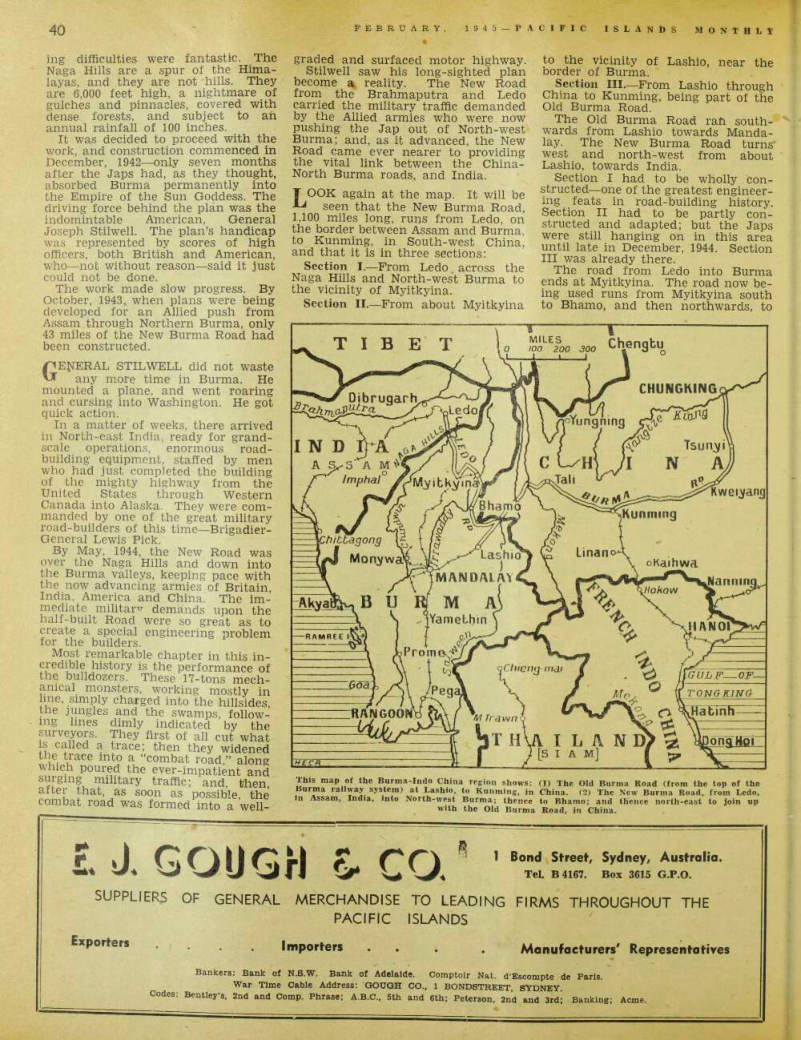
Stilwell's Road Feeds the China That Rejected Stilwell
IN the third week of January, 1945, the New Burma Road from India into China was opened; and, 33 months after the Japs closed the Old Burma Road, long lines of trucks, bearing supplies from the United Nations, resumed their freighting ser vice into Fighting China. Here, in brief, is the history of the Burma Road. 1937, —Japan, without declaration of war, attacked China, from the north east. Later, as the Chinese retired into the interior and set up their capital at Chungking, the Japanese blockaded the whole Chinese coast. 19 38-9. —Attitude of Japanese towards British and Americans in Far East became insulting and aggressive, and there were many “incidents.” Anglo- American sympathy was strongly with China. China urgently needed supplies.
Britain and America undertook to supply China, on condition that China built a road from Yunnan Province (south-east China) through the mountains into Northern Burma, to link up at Lashio with British road, rail and river traffic running up from Rangoon to Mandalay and Lashio. Tens of thousands of Chinese built the road; and British, American and Chinese interests began the transportation of supplies by many hun dreds of trucks. , , 1939-40.—Burma Road supplies helped to keep China fighting, and Japan was bitterly resentful, and in every way pos sible put pressure upon Britain for the closing of the Road. Britain, fighting the Axis alone in 1940, trying to appease Japan, did close fche Road for a few months; but when Japan joined the Axis in 1941 and finally hurled herself upon the Americans and British in the Pacific, the Road was reopened. 1942—The Japanese invaded Burma in April, and the whole of the Old Burma Road from Rangoon to Mandalay, and on through Lashio into south-east China, was occupied by the enemy. 1942-43-44.—The only supplies which reached Fighting China were taken in by air, in a great freighting service from India, over the Hump of the Himalayas, to Chungking. 1945 (January).—The New Burma Road, from India through north-west Burma, to China, came into operation, THERE is an interesting story of courage, intrigue, greed and corruption, behind those bare facts.
China is pre-eminent among the nations as the land of palm-greasing, the home of the secret commission.
Nothing can be accomplished without graft. Everyone gets his “squeeze.” It has been so for untold ages; presum ably, it will be so for ages to come.
The Old Burma Road did not escape. Here were tens of thousands of tons of goods, worth millions of pounds, pouring through a primitive and unpoliced country, a stream of wealth apparently without end. The set-up was God’s good gift to millions of Chinese grafters. So, long before the Jap invasion of Burma closed the Old Road, newspapers throughout the Anglo-American world were carrying stories of how a large and startling proportion of the incoming goods was disappearing into the maws of grafters and black marketeers, and
not reaching the Chinese armies, for whom the goods were intended by the hard-pressed Allies.
Indignation was mounting among the Allies, and the closing of the Road probably forestalled only by weeks some drastic action by the United Nations designed to compel the Chungking Government to put an end to the graft with which the traffic was surrounded.
BUT when the Road was closed, and the Chinese armies were so handicapped by lack of vital sup plies that the costly air service across the Himalayas had to be organised, the British and American commanders in South-east Asia turned again to the problem of the Road. It was plain that the old route, via Rangoon and Mandalay, could not be resumed so long as the Japs remained in Burma; but (argued certain officials) sooner or later we are going to push from India throughout North-east Burma against the Japs—so is it possible to build a road from India throughout North-east Burma and on into South-west China?
Some officials said that it could be done from the Brahmaputra, in Assam (North-east India), through Ledo, and into the river valleys of North-west Burma. Others declared flatly that the task was too great even to be contemplated. If you look at
the map on page 40, you can see their point.
The first problem was to get the road from the Brahmaputra across the Naga Hills into the valley system of North-west Burma. The engineer
ing difficulties were fantastic. The Naga Hills are a spur of the Hima layas, and they are not hills. They are 6,000 feet high, a nightmare of gulches and pinnacles, covered with dense forests, and subject to an annual rainfall of 100 inches.
It was decided to proceed with the work, and construction commenced in December, 1942—0n1y seven months after the Japs had, as they thought, absorbed Burma permanently into the Empire of the Sun Goddess. The driving force behind the plan was the indomintable American, General Joseph Stilwell. The plan’s handicap was represented by scores of high officers, both British and American, who—not without reason—said it just could not be done.
The work made slow progress. By October, 1943, when plans were being developed for an Allied push from Assam through Northern Burma, only 43 miles of the New Burma Road had been constructed.
GENERAL STILWELL did not waste any more time in Burma. He mounted a plane, and went roaring and cursing into Washington. He got quick action.
In a matter of weeks, there arrived in North-east India, ready for grand scale operations, enormous road building equipment, staffed by men who had just completed the building of the mighty highway from the United States through Western Canada into Alaska. They were com manded by one of the great military road-builders of this time—Brigadier- General Lewis Pick.
By May, 1944, the New Road was over the Naga Hills and down into the Burma valleys, keeping pace with the now advancing armies of Britain, India, America and China. The im mediate military demands upon the half-built Road were so great as to create a special engineering problem for the builders.
Most remarkable chapter in this in credible history is the performance of the bulldozers. These 17-tons mech anical monsters, working mostly in line, simply charged into the hillsides, the jungles and the swamps, follow ing lines dimly indicated by the surveyors. They first of all cut what is called a trace; then they widened the trace into a “combat road,” along which poured the ever-impatient and surgmg mhifary traffic; and, then, aftei that, as soon as possible, the combat road was formed into a well
graded and surfaced motor highway, Stilwell saw his long-sighted plan become a reality. The New Road from the Brahmaputra and Ledo carried the military traffic demanded by the Allied armies who were now pushing the Jap out of North-west Burma; and, as it advanced, the New Road came ever nearer to providing vital link between the China- North Burma roads, and India.
T OOK again at the map. It will be L seen that the New Burma Road, 1 100 miles louf? runs fmm i pHn nn
t Kunmin\ et TVou“? S’
and that it Is in three sections: Moo. i??i t'—From Ledo across the Naga Hills and North-west Burma to the vicinity of Myitkyma.
Section ll.— From about Myitkyina
to the vicinity of Lashio, near the border of Burma, Section lll.— From Lashio through China to Kunming, being part of the Old Burma Road, The Old Burma Road ran south wards from Lashio towards Manda lay. The New Burma Road turns west and north-west from about Lashio, towards India.
Section I had to be wholly con stiucted—one of the greatest engineer
seltion II S
oection li had to be partly con
were* in' this
m wifllready eC th“re er ’ 1944 ' SeCtl ° n The road from Ledo into Burma ends at Myltkyina. The road now be ing used runs from Myitkyina south to Bhamo, and then northwards, to
This map of the Burma-Indo China region shows: (1) The Old Burma Road (from the top of the Burma railway system) at Lashio, to Kunming, in China. (2) The New Burma Road, from Ledo, in Assam, India, into North-west Burma; thence to Bhamo; and thence north-east to join up with the Old Burma Road, in China.
join the old Old Burma Road at Mongyu. Until January, the Japs held 20 miles of that road—and as soon as they were gone, the trains of trucks began to move towards China.
But, if the road were to run east from Myitkyina, across the Kaoli Mountains to the ancient walled city of Tengchung. (Tengyueh) in China, and then straight across the Chinese province of Yunnan to Paoshan, on the Old Burma Road, a distance of 170 miles would be saved. It may be assumed that that route (now traversed by only a muletrack) will be used soon; but some reports say that it is only a dry-weather road.
VERY fittingly, this great new high way from India into China has been named the Stilwell Road.
The dynamic Stilwell, who staunchly fought against the ancient graft sys tem of old-time China, is gone from Burma; but his road remains, not only to provide a life-line for the China that rejected him, but as a monument to a fine soldier, a most successful planner, and a great American.
Advertisements & other items, pp. 41-42 (1 item)
Coleman
an i l Your “Durabestos” home of the future can be planned to any architectural design for these tough asbestoscement sheets are most adaptable to requirements.
To-day “Durabestos” is widely employed for defence and industrial structures where speedy erection and adaptability are imperative.
WUNDERLICH
DURABESTOS
ASBESTOS-CEMENT SHEETS
for essential Jobs is sold by: Island Merchants in Pacific groups.
m- K. / ■j*
Coleman
IS SERVING THE ARMED FORCE?
WITH THREE ESSENTIALS OF
LIFE . . .
Light-Heat-Warm Food
Wherever the Armed Forces of the United Nations need quick heat and bright light you’ll find Coleman Lanterns and Stoves. On board steamers, at landing fields, in mobile canteens, emergency hospitals, air-raid shelters, and in actual combat, Coleman appliances are providing invaluable service.
We regret any inconveniences caused through shortage of new stock for civilian requirements, and suggest you keep your present Stove and Lantern in good repair by contacting your local Distributor.
THE COLEMAN LAMP STOVE CO. LTD.
TORONTO CANADA
£ J. GOUGH S* CO/
SUPPLIERS OF GENERAL MERCHANDISE TO LEADING FIRMS THROUGHOUT THE
PACIFIC ISLANDS
Exporters Importers ... Manufacturers' Representatives Bankers: Bank of N.S.W. Bank of Adelaide. Comptoir Nat. d’Escompte de Paris.
War Time Cable Address: GOUGH CO., 1 BONDSTREET, SYDNEY.
Codes: Bentley’s, 2nd and Comp. Phrase; A.8.C., sth and 6th; Peterson, 2nd and 3rd; Banking; Acme.
Island Fruit Production
Supplies to NZ Should Now Improve
PROSPECTS for better fruit supplies from the Islands were announced by Mr. Ross Fraser, acting director of the Internal Marketing Board (NZ) when he returned to the Dominion after his recent visit to the Cook Islands and Western Samoa.
Fifteen thousand cases of Island bana nas arrived in Auckland about the same time, to give substance to Mr. Fraser’s promise.
Many of the native growers are now replanting and weeding their plantations, he reported. Until recently they were engaged on defence work, the making of curios and other occupations more re munerative than fruit-growing. Only since the war moved further north has there been a resumption of planting operations.
Lack of shipping space had been a factor in limiting supplies of fruit to the New Zealand markets. When they were not sure of transport for their produce, native planters naturally had little incen tive to work for an overseas market. In other Cases, so badly had plantations been neglected, native themselves were short of supplies and bananas normally sent to the Dominion were being used for home consumption.
These remarks, Mr. Fraser said, applied fairly generally to all the Islands, includ ing Fiji, Tono-a. Samoa, Niue and the Cooks.
The engagement is announced of Miss Dulcie Robinson, Christchurch, NZ, and Lieyt. Jim Ashley, of Suva, Fiji.
Mr, James Beveridge Thomson, Resident Magistrate, Northern Rhodesia, has been appointed Puisne Judge for Fiji and the Western Pacific. Mr. Thomson, who was born in 1902, was educated at George Watson’s College and Edinburgh Univer sity. He joined the Colonial Service in 1926. He was called to the Bar in 1929.
Mr. A. H. Gaze, QBE. of Melbourne, has been re-elected chairman of the Austra lian and New Zealand Committee of the London Missionary Society.
Why Not Grow Derris
Root In Territories?
Letter to the Editor rE Service Department of Sydney “Bulletin” was asked from which countries are supplies of derris root obtained and the latest prices of the root; and it replied: “Before the war it was obtained from Malaya and adjacent parts of Asia; stocks now come from Brazil under lease-lend arrangements. Last supplies were sold at 1/6 per pound.”
Knowing that derris root was grown at Keravah (New Britain) I felt when read ing this that it called for comment. But I have been unable to find any reference to derris being exported, or even grown in the Territory, in the New Guinea Handbook or the New Guinea Agricul tural Gazette, March, 1940—the only likely books of reference I have access to.
The farmers in this district (Gresford, NSW) complain bitterly that they are unable to obtain this very valuable pest eradicator; and I wondered if there was anything you could do about stirring up the powers that be to start production of derris root in New Guinea as soon as possible.
I am, etc.,
J. M. Price.
EDITORIAL NOTE: There were far reaching and apparently successful ex periments with Derris, both in Australia and in New Guinea, before the war; but, as usual, attempts at local production were killed by vested interests handling the oversea product. There is no reason on earth why Papua and New Guinea should not now produce Derris, at a lesser cost to Australian farmers than 1/6 per pound—except that such things are left
to Australia’s muddling Ministers and bureaucrats—the same people who, being responsible for organising Australian production during the past three years, have brought Australia to the edge of a very grave food shortage.
The Rev. E. R. Elder, of the Anglican Mission, has recently returned to Aus tralia after a number of years in Fiji.
Advertisements & other items, p. 43 (1 item)
Pink Pills
Restlessness and sleeplessness, when due to run-down nerves, frequently respond to treatment with Dr. Williams' Pink Pills.
Dr. Williams'
help to enrich the blood, which has a beneficial and restorative effect upon the nervous system.
WANTED TO BUY—QUALITY GUNS AND RIFLES
HIGHEST PRICES GIVEN. WILL ALSO EXCHANGE GUNS.
New .303 Short Service Barrels, 25}fc”, without Sights and Platform, £2/15/- each.
Postage extra.
SI L RO H U Quality Firearms and Fishing Tackle. 143 ELIZABETH STREET (Near Market St.) SYDNEY.
’PHONE; MA 3540.
CnIV E R s
PURE
FOODS
GOLD MEDAL JAMS
CANNED ENGLISH FRUITS
CANNED ENGLISH
VEGETABLES
CUSTARD POWDER
OLD ENGLISH MARMALADE
JELLY CRYSTALS, ETC.
Obtainable from all Leading Grocery Stores.
Write to Department A., E. 76.
Cbivers and Sons, Ltd., Histon, Cambridge, England, for attractive Recipe Book.
Tahiti's Mysterious Motor
Lorries
From Our Own Correspondent AN unsolved mystery is represented by the errands and destinations of the multitude of empty lorries which pass and re-pass along every highway and byway of Papeete. Whence came they? How did they get here in such numbers?
In this little community, the sum represented by the motor vehicles assembled here is of an astonishing magnitude.
This has happened in a colony based on a copra economy, and during a period of intense world depression. Not one of these lorries has been bought on the deferred-payment plan.
The rationing of petrol has confined our swarm of passenger motor cars to the garages- of their owners. There appears to be, however, no limit to the supply of petrol available for lorries.
The whole problem is so far beyond this writer’s understanding that he sought the counsel of some of our learned experts in local economics. They have, in every case (after a startled look and careful computations on desk-pads), confessed that this is not a quest, but an expedi tion into Stygian darkness. The puzzle remains.
Advertisements & other items, pp. 44-45 (2 items)
42
FEBRUARY, 1945-PACIFIC ISLANDS MONTHLY
HONOUR ROLL
(Continued from Inside Back Cover)
81 Clarence Street, Sydney
STRONG—
c El =;
RUSTLESS
Because of its outstanding strength, toughness and corrosion-resistance, Monel in all forms— sneet, rod, tube, wire, etc.—is under the control of our Ministry of Munitions. Releases are granted for Defence requirements also essential
WRIGHT AND COMPANY,
SOLE AUSTRALIAN
purposes such as propeller shafting for licensed fishing vessels,'etc., etc.
We have adequate stocks against approved applications and will value your enquiries.
81 CLARENCE STREET, SYDNEY
DISTRIBUTORS OF MONEL
Monel is a registered trade mark covering a rich nickel alloy, mined in Canada and rolle4 in Great Britain.
Shipper of Australia’s Best
to the Pacific.
ANDREW THOMSON & SCOUGALL, LTD.
Malleable Cast-iron Fittings for water, steam, gas and air. Malleable Conduit Fittings, etc.
CENTURY STORAGE BATTERY CO., LTD.
Heavy Duty Standard and Slotted Plate Batteries, Battery Accessories, etc.
OLYMPIC SPARK PLUGS PTY., LTD.
Quality Plugs for cars, trucks, semi and diesel engines.
BOSS ELECTRICAL MANUFACTURING CO.
Battery Charges (Valve and Metal Rectifier types), Battery Testers, Arc welding equipment, small Transformers, Arc Welding ELECTRODES, complying Lloyd’s Register specifications.
LORIMIER CONTACTS PTY., LTD.
Ignition Contacts in Platinum-iridium and Tungsten. Distributor Caps and Rotors, Condensers. Brushes for Starters, Generators and Magnetos. Push-Pull Switches.
VIOGEN (A’SIA) PTY., LTD.
“VIOGEN” Blue Toothpaste (contains the valuable antiseptic: Aniline Dyes, Crystallviolett and Brilliantgrun), Dental Plate Powder, “Viogen” Antiseptic Liquid Paint, etc.
RAD MANUFACTURING CO. PTY., LTD.
“RADCO” quality foodstuffs and specialties: Baking Powder, Custard Powder, Cornflour, Rice Starch, Jelly Crystals, Blanc Mange, Soup mixtures, etc., etc. (See “PIM,” January, page 37.)
MASHMAN BROTHERS PTY., LTD.
Quality clay products—Sanitaryware, Bathroom fittings, Hospitalware, Stone Pipes, etc. (See “PIM,” January, page 43.)
W. F. CAMPBELL PTY., LTD.
Pure Paints and Varnishes for all purposes.
Industrial Covers, etc. (See “PIM,” January, page 41.)
ACME CONDUIT PTY., LTD.
Electrical Conduit Pipes and Walsall Conduit Pipe Fittings.
ACME BEDSTEAD CO. PTY., LTD.
Metallic Bedsteads, Steel Domestic Furniture and Hospital Equipment, etc.
COLLINS BROTHERS.
“Radiant” Stormproof Kerosene Pressure Lanterns and Lamps; Gloria Lighting Systems.
The “RADIANT” OUTSHINES all other
LAMPS.
(See “PIM,” January, page 35.)
LYONS TRADING CO. PTY., LTD.
King’s Compo Roof Cooling Water Paint. The cheapest PERMANENT roof cover in the world. (See “PIM,” January, page 33.)
CLEMENS FRUIT JUICE PTY., LTD.
100% Pure Fruit Juices—NO water and NO preservatives—Tomato Juice, etc.
FARBEST PRODUCTS PTY., LTD.
Pure Fruit Cordials, Glace Cherries, Lemon and Orange-peels, etc., etc. (See “PIM.” January, page 39.) Also shipper of Building materials, Iron and Steel products, General Engineering lines, Stampings, Plastics, Machinery and Tools of all kinds, General Hardware and Plumbers’ supplies, Electrical Equipment and Accessories, Brushes and Brooms, Paper and Stationery, Printing and Office Equipment, Chemicals and by-Products, INDUSTRIAL RAW MATERIALS, all classes of Foodstuffs, Wines, Spirits and Liquers, etc., etc.
Price lists, catalogues, samples and all other information directly available from :
0. F. MASSGHELEIN SYDNEY.
GENERAL EXPORTER OF AUSTRALIAN QUALITY PRODUCTS ONLY
Why?
pROM “Smith’s Weekly” (Sydney ): 11 J H Y,” asks “Effendi” (Richmond, Y? NSW), “hasn’t Gerry Pentland been decorated for his efforts up North?”
Gerry, he says, is a squadron-leader in charge of air-rescue work in New Guinea, and has earned the unstinted praise of airmen who have been forced to bail-out in the jungle.
He hops in any old where in a Tiger Moth or some other light aircraft, picks them up, and flies them to base. Any little open space or beach so long as he can get in. Once in he gets natives to make it big enough to get out.
Flying rations and ammunition to the AIP is a spare-time activity which all takes guts and a sure hand on the joy stick.
“Gerry,” adds “Effendi,” “is quite de finitely the oldest active pilot in the Air Force.
“But his correct age is a secret to him self. His comrades of the 1914-18 dust up, when he won the MC and DFC, all put him down as 55 to 56. Officially, of course, he must be under 50.
“Why he has not been decorated is one of the great mysteries.”
A notorious Samoan criminal, Tomasi, known for his frequent gaol breaks, was recently killed by a police driver, after Tomasi had again broken out of Vaimea Gaol and had been roaming the Apia neighbourhood for weeks. In self-defence the policeman hit him with a stone and smashed the back of his head.
The Decline Of Angau
By Bryan Kenwood
ANGAU started out in life as the Papuan Administrative Unit, in February, 1942.
From its inception, it created a record for ability and the economical working of its administrative, native labour, and pioneering activities.
The work of the former civil adminis tration was continued, native welfare being a paramount consideration. The Native Labour organisation shared in the world’s acclaim when our jungle fighters triumphed in the Owen Stanleys cam paign.
Prior to the advent of the Production Control Board, ANGAU field staff played a big part in the rehabilitation of neg lected plantations. ANGAU Marine Section battled up and down the coast with essential supplies and vital produce, m nondescript, impressed small craft.
For upwards of the first eighteen months of its operation, ANGAU maintained a high standard of efficiency in each of its departments.
BUT, to-day, all that is changed.
ANGAU has become a top-heavy bureaucracy, having no less than four complete headquarters. These are largely staffed with ex-civil servants of the Territories, who are decked out in carefully pressed uniforms studded with crowns and pips. Complacency is well in evidence; but an acquaintance with AMR & O is distant. “Soldia Gammon ” says the natives.
Then there are the newcomers to the Territories, transferred from other units and full of zeal to make ANGAU con
form to military tradition. A month or so is sufficient to frustrate them.
But, despite this surfeit of adminis trative officers and staffs, ANGAU does not “administrate” to the extent which it did previously. It has sacrificed many of its powers to outside formations, and can be called to account over trifles by Ist Australian Army at all times.
Native labour staff is no longer much concerned with operational duties. Major ranks are concerned mainly with the spare-time welfare of nursing sisters from the general hospitals. Intermediate ranks are labouring to produce moun tainous quantities of obscure records which will never again be referred to.
The natives under indenture are vir tually conscripted into near slavery. Their villages are denuded of active manpower, and their dependents consequently de prived of essential garden produce. The young men are set to work beautifying useless base areas, to the everlasting glory of Ist Australian Army.
PIONEERING, even in the less developed districts, is a thing of the past. A mighty Districts “Field” Staff spends its days poring over involved Army forms and Governmental returns.
Although these “field” staffs are re quired to carry out periodical patrols, thousands of sheets of paper must be appeased first; native welfare is a matter of secondary importance.
The District Officer who possesses initiative enough to remedy this state of affairs is powerless to put his ideas into effect. He must refer any proposals up. and further up, the heirarchic staircase of a/DAD’s, DAD’S, etc.; and if he lives to be a very old man, he may eventually receive the inevitable negative in reply.
Obviously, the recipe for success in ANGAU is to anchor one’s base firmly to a chair, and to tread on the corns of nobody—except, perhaps, the native.
Yes, ordinances notwithstanding, “boong bashing” is still prevalent. Unprotesting, submissive natives of both sexes are third degreed—sometimes in camera—for tri vialities. What is worse, these summary punishments are meted out by parties who have access to legal action, or who could themselves convene a Court.
Even the little Marine Section—or “ANGAU Navy,” as its critics call it—has lost face. The impressed craft, now scarcely seaworthy, have been replaced only by such small ships as other units are willing to give away. Vessels are laid up, parts fall off in transit, and a pinnace is lost for four days in the middle of a gulf clustered with shipping ANGAU Ms one exceptional depart ment: the rapidly expanded Medical Service is a most efficient undertaking.
It has to be. It is ANGAU’s trump pro paganda weapon—“ See how the white man looks after you!” But the fact re mains that the native has done more for the comfort of ANGAU’s fat staff than the resources of the Australian taxpayer are likely to repay.
A military unit in Territories under complete military occupation, ANGAU is too often able to hide its shortcomings, is quite impervious to criticism, and Is beyond the reach of any democratic form of control.
The time for reintroduction of civil government in Papua and New Guinea Is ripe. ANGAU itself is over-ripe.
Advertisements & other items, p. 46 (2 items)
44
FEBRUARY, 1945—-PACIFIC ISLANDS MONTH L Y
Flour
Allen Taylor & Co. Ltd.
COMMERCIAL ROAD, ROZELLE,
SYDNEY
Sawmillers and Wholesale Suppliers of Hardwoods for Constructional Purposes GIRDERS . . , PILES . . . POLES . . . SLEEPERS, Etc.
EXPORTING TO PACIRC - ISLANDS SINCE 1893
PRODUCING UNIFORM GOOD RESULTS SINCE 1868
Flour
ALWAYS ASK FOR IT
In Defence of System
Contract Labour
In Bs)
I-JERE is a Solomon Islands view
point on the subject of indentured
labour. It was written recently—not for publication—by a man who had long and valuable experience as an administrative officer in the Solomons.
INDENTURED labour! One might say that so much of so little worth has been said by so many knowing so little! I do not purport to be an authority on it; but during my years on Malaita, I did see much of the men who went and signed. Reading the “PIM” recently, I have wanted to shout; “Well, they needn’t go if they do not want to!
And they still go—so what’s wrong with it?”
I think the late Sir Hubert Murray’s argument for it entirely suits the Malaita man. Malaita is a poor island, and, even if there were no indenture, the young men who do sign would still be unable to marry and settle down. (Proportion of men to women; 6 to 4.) There will never be local industry on Malaita to support them, and if they could not go away on indenture, they would go away on some contract or other.
The Mala man respects force, and ex pects force, and likes the cards laid on the table.
Thus, indenture suits him. He knows what he will get, and it’s a fair deal. If an employer gets a bad reputation, then he just doesn’t get recruits, I’ve seen plenty of examples of that.
AS regards wages, they all forget that the wages laid down are the mini mum, payable to a brand new boy.
Levers had an excellent task and bonus system, whereby a boy with energy could do his task for the minimum wage by lunch-time, and from then on he worked on piecework, often making a substantial sum extra per diem —which, of course, suited both Levers and the boy.
In San Cristobal, F. M. Campbell used to run all his six plantations on contract with local boys of some intelligence. They would contract to cut so much copra in a certain time, and would engage and work their own boys.
I have not seen any of Bishop Crans wick’s “slavery” in the BSI. and most of the labour troubles there used to be caused by Malaita boys trying out new masters.
There were unfortunate incidents; but, usually, the new master learned a valu able lesson, and the Mala offender was quite satisfied to pay for his fun.
I think you brought up the point of what the Missions paid their boys. As far as I can remember, it was a common thing for natives to be told that it was a privilege to work for the Mission for nothing; and, if they didn’t like it, they were accused with the classic- mission ex cuse, “You’re being disloyal.” Bunkum IN the BSI, there are now several grades of intelligence amongst the natives, some of whom are quite capable of being held to responsibility. There is a Native Contracts Regulation whereby, if a European wishes to give a native a large contract and he trusts the native, he can have it witnessed by a District Commis sioner, who can satisfy himself that the native understands the responsibility.
After that, of course, the native is liable in the ordinary way.
It seems to me that some Mission heads
are using “Indentured Labour’’ merely as a political cry, to obtain prominence. My old friend, Mr. Goldie, talks of natives having no way of getting justice in the Courts —blissfully ignorant of the fact that in the very district to which he is about to return and exercise his sway, native have been dealing with all but the most serious offences for the last two years—and doing it very well.
Mrs, M. Trevett, who formerly was co principal with her husband of a native school in Rabaul, New Guinea, has been appointed a hospital welfare officer at the Queen Victoria Hospital, Melbourne. This is the first appointment of its kind in Victoria. Mrs. Trevett and her four-year old son were evacuated from Rabaul in December, 1941; her husband has been missing since the invasion.
Advertisements & other items, p. 47 (2 items)
45
fACiriC ISLANDS MONTHLY FEBRUARY, 1945
Robert Gillespie Pty. Ltd.
Your old SCISSORS, RAZORS
and KNIVES can be
SHARPENED and REPAIRED
CD- Send them to—
W. JNO. BAKER
3 HUNTER STREET,
SYDNEY.
ROBERT GILLESPIE PTY. LTD.
ISLANDS MERCHANTS
EXPORTERS - - - IMPORTERS
s.
Buyers and Shippers of all classes of
Primary Products and General Merchandise
Islands Produce Sold on Commission Bankers: Bank of N.S.W. Cable Address: “Robergill.”
Comptoir National d’Escompte de Paris. Telephones: BW 4782—8 1305.
Register 54a p| TT STREET SYDNEY, N.S.W.
Islands Distributors for DINOX and OIX Brands of BROOMS, BRUSHES and MOPS
Tribute to Hitchcock, of
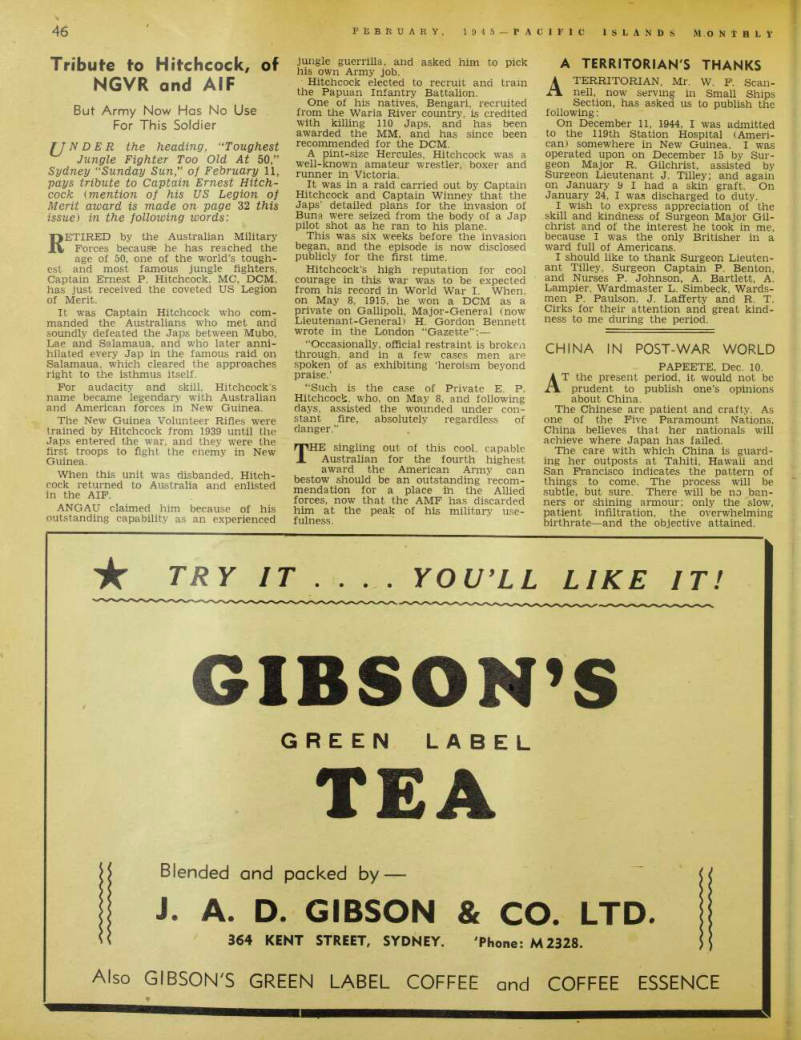
Ngvr And Aif
But Army Now Has No Use For This Soldier
TJ N D E R the heading, "Toughest Jungle Fighter Too Old At 50,”
Sydney “Sunday Sun” of February 11,
pays tribute to Captain Ernest Hitch cock (mention of his US Legion of Merit award is made on page 32 this issue) in the following words : RETIRED by the Australian Military Forces because he has reached the age of 50, one of the world’s tough est and most famous jungle fighters, Captain Ernest P. Hitchcock, MC, DCM. has just received the coveted US Legion of Merit.
It was Captain Hitchcock who com manded the Australians who met and soundly defeated the Japs between Mubo, Lae and Salamaua, and who later anni hilated every Jap in the famous raid on Salamaua. which cleared the approaches right to the isthmus itself.
For audacity and skill, Hitchcock's name becajne legendary with Australian and American forces in New Guinea.
The New Guinea Volunteer Rifles were trained by Hitchcock from 1939 until the Japs entered the war, and they were the first troops to fight the enemy in New Guinea.
When this unit was disbanded, Hitch cock returned to Australia and enlisted in the AIF.
ANGAU claimed him because of his outstanding capability as an experienced
jungle guerrilla, and asked him to pick his own Army job.
Hitchcock elected to recruit and train the Papuan Infantry Battalion.
One of his natives, Bengari, recruited from the Waria River country, is credited with killing 110 Japs, and has been awarded the MM, and has since been recommended for the DCM.
A pint-size Hercules, Hitchcock was a well-known amateur wrestler, boxer and runner in Victoria.
It was in a raid carried out by Captain Hitchcock and Captain Winney that the Japs' detailed plans for the invasion of Buna were seized from the body of a Jap pilot shot as he ran to his plane.
This was six weeks before the invasion began, and the episode is now disclosed publicly for the first time.
Hitchcock's high reputation for cool courage in this war was to be expected from his record in World War I. When, on May 8, 1915, he won a DCM as a private on Gallipoli, Major-General (now Lieutenant-General) H. Gordon Bennett wrote in the London “Gazette”: — “Occasionally, official restraint is broken through, and in a few cases men are spoken of as exhibiting ‘heroism beyond praise.’
“Such is the case of Private E. P.
Hitchcock, who, on May 8, and following days, assisted the wounded under con stant fire, absolutely regardless of danger.”
THE singling out of this cool, capable Australian for the fourth highest award the American Army can bestow should be an outstanding recom mendation for a place in the Allied forces, now that the AMF has discarded him at the peak of his military use fulness.
A Territorian's Thanks
A Territorial Mr. W. P. Scan
nell, now serving in Small Ships Section, has asked us to publish the following: On December 11, 1944, I was admitted to the 119th Station Hospital (Ameri can) somewhere in New Guinea. I was operated upon on December 15 by Sur geon Major R. Gilchrist, assisted by Surgeon Lieutenant J. Tilley; and again on January 9 I had a skin graft. On January 24, I was discharged to duty.
I wish to express appreciation of the skill and kindness of Surgeon Major Gil christ and of the interest he took in me, because I was the only Britisher in a ward full of Americans.
I should like to thank Surgeon Lieuten ant Tilley, Surgeon Captain P. Benton, and Nurses P. Johnson, A. Bartlett, A.
Lampier. Wardmaster L. Simbeck, Wards men P. Paulson, J. Lafferty and R. T.
Cirks for their attention and great kind ness to me during the period.
China In Post-War World
Papeete, Dec. 10.
AT the present period, it would not be prudent to publish one’s opinions about China.
The Chinese are patient and crafty. As one of the Five Paramount Nations, China believes that her nationals will achieve where Japan has failed.
The care with which China is guard ing her outposts at Tahiti. Hawaii and San Francisco indicates the pattern of things to come. The process will be subtle, but sure. There will be no ban ners or shining armour; only the slow, patient infiltration, the overwhelming birthrate—and the objective attained.
Advertisements & other items, p. 48 (2 items)
46
February, ig4s-i*Aciric islands Monthly
Gibson's
★ TRY IT ... . YOU’LL LIKE IT!
GREEN LABEL
TEA
Blended and packed by < J. A. D. GIBSON & CO. LTD. < 364 KENT STREET, SYDNEY. 'Phone: M 2328. \ \ Also GIBSON'S GREEN LABEL COFFEE and COFFEE ESSENCE
Late Fiji News
Suva, Feb. 7.
11HE Victoria Cross, awarded to* the late Corporal Sefanaia Sukanaivalu, of the Fiji Military Forces, was presented by the Governor of Fiji, Mr.
A. W. G. H. Grantham, at a ceremonial parade of the Fiji Military Forces, in Suva, on February 6, to Lote Vulakoro, the father of the deceased soldier.
There was a very large public gather ing, and a deep impression was made as the Governor read the official account of the deed which won for the young Fijian the world’s highest award for bravery, and then handed the Victoria Cross to the dead soldier’s father. His Excellency then shook hands with the dead soldier’s father and mother, who were beside him on the official stand. ♦ * * Preparations are afoot to say farwell, in adequate fashion, to two of Fiji’s most highly respected public servants, now on the eve of retirement—Dr. V. W. T.
McGutsy (Secretary for Indian Affairs), who has given the Colony 33 consecutive years of service; and Mr. A. L. Armstrong (Commissioner for Reconstruction), who has held many important posts since he entered the Fiji service in 1915.
Sir Henry and Lady Scott have been informed that their son Maurice had been awarded the Distinguished Flying Cross.
Maurice, who has lately been on active service in Italy with the RAF, flew with the Desert Air Force in North Africa from El Alamein, onwards, and has a fine re cord of service.
Lieutenant Harrowby Ryder, of 9th Division, AIF, son of Mrs. S. Nelson, of Suva, after long and distinguished mili tary service, was accidentally killed re cently while on active service in the Pacific.
The deaths have occurred of Mr. R. F.
Freeman (76) and Mrs. C. H. H. Irvine (about 80)—both early settlers in Fiji.
The next meeting of Fiji Legislative Council is to be held on February 16.
Mr. H. H. Ragg, a member of both Execu tive and Legislative Councils, is tempor arily absent, and his place will be taken by Mr. W. G. Johnson.
Mr. Alport Barker’s place as chairman of Movement Control Committee has been taken by Mr. A. A. Ragg. Mr. R. V. O.
Bentley and Mr. K. V. Macqire have been appointed members of the Commit tee during the absence from Fiji of Mr.
D. Butler and Mr. Harold Cooper.
The United States Consul, Mr. T. Horn, is at present away from Fiji, on leave, and his place has been taken by Mr. Robert Gr inhell.
Commissions as Justices of the Peace have been granted to Mr. George Thomp son (headmaster of Levuka public school) and Mr. M. L. Verma.
Lieut.-Colonel J. B. K. Taylor, who has been away on sick-leave in New Zea land, has returned, to become Rehabilita tion Officer.
A number of new teachers for Fiji schools have arrived from New Zealand —Mr. H. G. Warburton, Mr. D. W. Strong and Miss E. M. Creedon (Suva Grammar School). Miss 1. M. Bowman (infant mis tress, Levuka), and Mrs. Warburton (matron of the Suva Boys’ Grammar School hostel).
Mr. Bill Lee, who played a big part in Fiji’s early aerodrome construction, went recently on his way to Apia, to take charge of public works in Western Samoa.
Mr. W. H. B. Buckhurst has been appointed Director of Lands, Mines and Survevs in Fiji. He came to Fiji from New Zealand in 1928 as a surveyor on the staff of the Native Lands Commission.
BSI Woman Writes
First-class Thriller
ANEW thriller novel, “Bring Another Glass,” by Mrs. Georgina Seton, recently published by Angus and Robertson, Ltd., Sydney, is in many respects unique.
In the first place, very few novels worth reading are published south of the Line.
Mrs. Seton’s story is not only written with the hand of a craftsman: it is also cunningly and cleverly constructed, and characterisation is so good that it is hard to believe that this is the young woman’s first effort.
In the second place, writers in the Antipodes rarely, if ever, attempt thrill ers—the strain of story-telling is as much as they can stand up to. But Mrs. Seton’s story is not only a thriller—it is one of those mystery tales so quick-moving and ingenious that the reader can’t lie down.
This reader did his best to pick the killer —but had to confess in the end that the authoress beat him —he should have guessed, early in the piece, the identity of the bloody-handed snake, but he was neatly side-tracked.
In the third place, this probably is the first time in literary history that a thriller novel has been based wholly on life in a South Seas Territory. Mrs. Seton is the wife of a well-known Solomon Islands planter: and the scene of her novel is a small, typical, copra centre in the Solo mons. Types familiar to every one of us walk across her lively and readable pages —there is the District Officer, the store manager, the coconut planter, the recruiter, the medical officer, the itinerant trader, the Chinaman, and (cleverly woven into the very structure of the thriller) a couple of native chiefs and a witch-doctor. JVTrs. Seton lived many years in the Solomons, and knows all the social answers; and it is evident that actual people are the prototypes of the characters she has convincingly limned in her book, and made us laugh at, or admire, or hate. One even suspects that Mrs. Seton—being woman as well as
writer—may have done a little bit of cat ting—but only Solomons residents can tell us that.
The Islands background and the local colour are so clear and correct that—after the endless muck written about the South Seas —it is a real pleasure to commend this book, not only as a novel, of such merit that it deserves British and Ameri can publication, but also as a first-class Pacific Islands story.—RWß.
Nurse E. M. Kennedy, of the BSI Medical Department, has terminated her period of secondment to the Fiji Service.
She is at present on leave, which will be followed by a period of special “study” leave.
The National Arbitration Tribunal of Fiji has awarded and determined that the cost of living bonus payable to the employees of the Colonial Sugar Refining Co., Ltd., on the island of Viti Levu, who receive wages of £2 or less per week shall remain at 1/9 per day as from January 1 to April 1, 1945.
Advertisements & other items, p. 49 (1 item)
Always Kills
PACIFIC ISLANDS SOCIETY
Visitors from the Islands to Sydney (or those interested in Islands affairs), are advised to communicate with the honorary secretary of the above Society, which has been formed to study the history, traditions, economics, and political developments of the Pacific Islands.
Regular monthly meetings are held at History House, 8 Young Street, Sydney.
Address for Correspondence:
THE PACIFIC ISLANDS SOCIETY,
Box 2434 MM., G.P.0., Sydney.
5 e s
EYE
LOTI
Ft laltaitd Et«« and EynUda
SOLD EVEITWBZIE
H. A. R»m 4 C«. rty. Ltd.. Kl»« 9L. »y*».y
T
Potent killl COrr >binJJ ects I
Ca nnot hJ g agent* t,on of ' und *rgonl e * ce "ed. t,y e tests tbe st «*5 has d * fi nite kill - nd * 5> *hy you Power °n Fn t j h °ujd a/way, T^t’s st 'tutes. F f." d r ef Use /S . ,ns 'st ? ta ' n > and* Spr *y wl SUb * humans. 8 ,s h a r m , n °t
ALWAYS KILLS
Kills,
[lies Mol
Mosquitoes Cockroatha/ Silverflsh Bed But W Spray*
Islands Produce
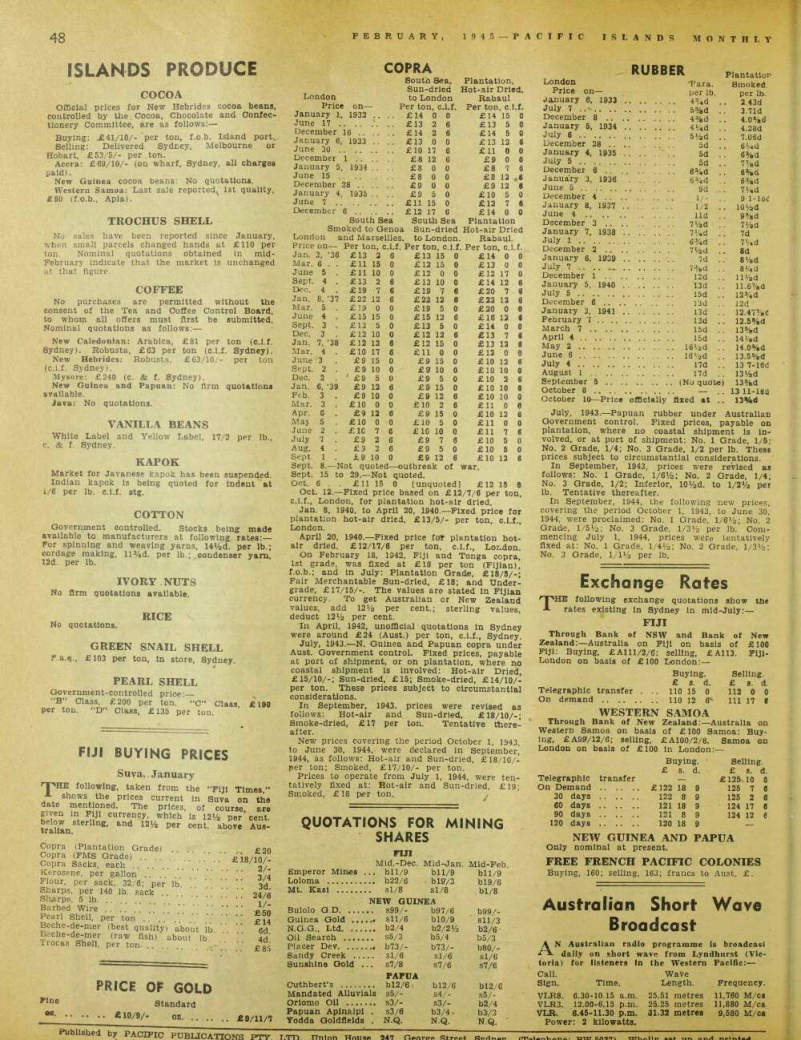
Cocoa
Official prices for New Hebrides cocoa beans, controlled by the. Cocoa, Chocolate and Confec tionery Committee, are as follows; — Buying: .£4l/10/- per ton, f.o.b. Island port..
Selling: Delivered Sydney, Melbourne or Hobart, £53/5/- per ton.
Accra: £69/10/- (on wharf, Sydney, all charges paid).
New Guinea cocoa beans: No quotation*.
Western Samoa: Last sale reported, Ist quality, £BO (f.0.b., Apia).
Trochus Shell
No sales have been reported since January, when small parcels changed hands at £llO per ton. Nominal quotations obtained in mid- February indicate that the market is unchanged at that figure.
Coffee
No purchases are permitted without the consent of the Tea and Coffee Control Board, to whom all offers must first be submitted.
Nominal quotations as follows: New Caledonian: Arabica, £Bl per ton (c.i.f.
Sydney). Robusta, £63 per ton (c.i.f. Sydney).
New Hebrides: Robusta, £63/10/- per ton (c.i.f. Sydney).
Mysore: £240 (c. & f. Sydney).
New Guinea and Papuan: No firm quotation* available.
Java: No quotations.
Vanilla Beans
White Label and Yellow Label, 17/2 per lb., c. & f. Sydney.
Kapok
Market for Javanese kapok has been suspended.
Indian kapok Is being quoted for Indent at i/6 per lb. c.i.f. stg.
Cotton
Government controlled. Stocks being made available to manufacturers at following rates;— For spinning and weaving yarns, 14V 2 d. per lb.; cordage making, per lb ; condenser yam, 12d per lb.
Ivory Nuts
No firm quotations available.
Rice
No quotations.
Green Snail Shell
F.a.q., £lO3 per ton, in store, Sydney.
Pearl Shell
Government-controlled price;— ‘B” Class, £2OO per ton. ”C” Class £199 per ton. ”D” Class, £135 per ton.
Fiji Buying Prices
Suva, January
r P HE following, taken from the “Fiji Times.”
A shows the prices current in Suva on the tufL men *?° ned - 1116 Prices, of course, are given m Fiji currency, which is 12% per cent, below sterling, and 12y 2 per cent, above Aus tralian.
Copra (Plantation Grade) 4? on Copra (FMS Grade) .. .. ' "
Copra Sacks, each .. £lB/10/- Kerosene, per gallon ...
Flour, per sack, 32/6; per lb ' oh Sharps, per 140 lb. sack . oa/n Sharps, 5 lb. ..
Barbed Wire ...
Pearl Shell, per ton .. o!: Beche-de-mer (best quality) about lb " “ 6 d (raW ab ° Ut " " 4d Trocas Shell, per ton ' £ gg
Price Of Gold
Oct. 6 . £ll 15 0 [unquoted] £l2 15 6 Oct. 12.—Fixed price based on £l2/7/6 per ton, c.i.f., London, for plantation hot-air dried.
Jan. 8, 1940, to April 20, 1940 —Fixed price for plantation hot-air dried, £l3/5/- per ton, c.i.f., London.
April 20, 1940.—Fixed price fof plantation hot air dried, £l2/17/6 per ton, c.i.f., London.
On February 18, 1942, Fiji and Tonga copra, Ist grade, was fixed at £lB per ton (Fijian), f.0.b.; and in July: Plantation Grade, £lB/5/-; Pair Merchantable Sun-dried, £18; and Under grade, £l7/15/-. The values are stated in Fijian currency. To get Australian or New Zealand values, add 12 x / 2 per cent.; sterling values, deduct 12 y 2 per cent.
In April, 1942, unofficial quotations in Sydney were around £24 (Aust.) per ton, c.i.f., Sydney.
July, 1943.—N. Guinea and Papuan copra under Aust. Government control. Fixed prices, payable at port of shipment, or on plantation, where no coastal shipment is involved: Hot-air Dried, £l5/10/-; Sun-dried, £l5; Smoke-dried, £l4/10/per ton. These prices subject to circumstantial considerations.
In September, 1943. prices were revised as follows: Hot-air and Sun-dried, £lB/10/-; Smoke-dried, £l7 per ton. Tentative there after.
New prices covering the period October 1, 1943, to June 30, 1944, were declared in September’ 1944, as follows: Hot-air and Sun-dried, £lB/10/per ton; Smoked, £l7/10/- per ton.
Prices to operate from July 1, 1944, were ten tatively fixed at: Hot-air and Sun-dried, £l9; Smoked, £lB per ton.
Fine Standard •a. .. .,
Copra
South Sea, Plantation, Sun-dried Hot-air Dried, London to London Rabaul Price on- Per ton. c.i.f.
Per ton. c.i.f.
January 1, 1932 £14 0 0 £14 15 0 June 17 . £13 2 6 £13 5 0 December 16 .. £14 2 6 £14 5 0 January 6, , 1933 £13 0 0 £13 12 6 June 30 . £10 17 6 £11 0 0 December 1 . . £8 12 6 £9 0 0 January 5. 1934 £8 0 0 £8 7 6 June 15 . £8 0 0 £8 12 . ,6 December 28 . . £9 0 0 £9 12 6 January 4 , 1935 £9 5 0 £10 5 0 June 7 £11 15 0 £12 7 6 December 6 .. £12 17 6 £14 0 0 South Sea South Sea Plantation Smoked to Genoa Sun-dried Hot-air Dried London and Marseilles, to London.
Rabaul.
Price on— Per ton, c.i.f. Per ton, c.i.f. Per ton, c.i.f.
Jan. 3, '36 £13 2 6 £13 15 0 £14 0 0 Mar. 6 . . £11 15 0 £12 15 0 £13 0 0 June 5 £11 10 0 £12 0 0 £12 17 0 Sept. 4 . £13 2 6 £13 10 0 £14 12 6 Dec. 4 . £19 7 6 £19 7 6 £20 7 9 Jan, 8. ’37 £22 12 6 £22 12 6 £22 12 6 Mar. 5 . £19 0 0 £19 5 0 £20 0 0 June 4 . £15 15 0 £15 12 6 £16 12 1 Sept. 3 £13 5 0 £13 5 0 £14 0 G Dec. 3 . £12 10 0 £12 12 6 £13 7 C Jan. 7, '38 £12 12 6 £12 15 0 £13 12 8 Mar. 4 . £10 17 6 £11 0 0 £12 0 0 June 3 £9 15 0 £9 15 0 £10 12 6 Sept. 2 . £9 10 0 £9 10 0 £10 10 0 Dec. 2 . ’ £9 5 0 £9 5 0 £10 2 6 Jan. 6. ’39 £9 12 6 £9 15 0 £10 10 0 Feb. 3 . £9 10 0 £9 12 6 £10 10 0 Mar. 3 . £10 0 0 £10 2 6 £11 0 0 Apr. 6 . £9 12 6 £9 15 0 £10 12 6 Maj 5 . £10 0 0 £10 5 0 £11 0 0 June 2 . £10 7 6 £10 10 0 £11 7 6 July 7 . £9 2 6 £9 7 6 £10 5 0 Aug. 4 . £9 2 6 £9 5 0 £10 5 0 Sept. 1 . £9 10 0 £9 12 3 £10 12 6 Sept. 8. —Not quoted— -outbreak of war.
Sept. 15 to 29.— -Not quoted.
Quotations For Mining
Shares
July, 1943.—Papuan rubber under Australian Government control. Fixed prices, payable on plantation, where no coastal shipment is in volved, or at port of shipment: No. 1 Grade, 1/5; No. 2 Grade, 1/4; No. 3 Grade, 1/2 per lb. These prices subject to circumstantial considerations.
In September, 1943, prices were revised as follows: No. 1 Grade, 1/6V 2 ; No. 2 Grade, 1/4; No. 3 Grade, 1/2; Inferior, 10 J / 2 d. to 1/2 */ 2 per lb. Tentative thereafter.
In September, 1944, the following new prices, covering the period October 1, 1943, to June 30, 1944, were proclaimed: No. 1 Grade, 1/6‘/ 2 ; No. 2 Grade, 1/5 y 2; No. 3 Grade, 1/3 V 2 per lb. Com mencing July 1, 1944, prices were tentatively fixed at: No. 1 Grade, 1/4%; No. 2 Grade, 1/3 V 2; No. 3 Grade, 1/1 y 2 per lb.
Fiji
Mid.-Dec.
Mid-Jan.
Mid-Feb.
Emperor Mines . .. bll/9 bll/9 bll/9 Loloma bl973 bl9/6 Mt. Kasl . sl/8 sl/8 bl/8 Bulolo G.D
New Guinea
.. s99/- b97/6 b99/- Guinea Gold ... ... sll/6 blO/9 sll/3 N.G.G., Ltd .. b2/4 b2/2Vz b2/6 Oil Search .. s5/3 b5/4 b5/3 Placer Dev ,- b73/b73/b80/- Sandy Creek ... .. sl/6 sl/6 sl/6 Sunshine Gold . .. s7/8 S7/6 s7/6 Cuthbert’s
Papua
bl2/6 bl2/6 Mandated Alluvials s5/- S4/s5/- Orlomo Oil .. s3/s3/b2/4 Papuan Aplnaipi . s3/6 b3/4 . b3/3 Yodda Goldfields . N.Q.
N.Q.
N.Q.
Rubber
Plantation London Tara.
Smoked Price on— per lb. per lb.
January 6. 1933 2.43d July 7 3.71d December 8 .. . 4.0%d January 5, 1934 4.28d J uly 6 7.Odd December 28 . . . 5d 6*/4d January 4, 1935 6 3 /ad July 5 7 7 /ad December 6 . . 6%d January 3, 1936 ... 6%d 6 3 / a d June 5 7‘/ad December 4 . , 9 1-I6d January 8, 1937 . 1/2 lOVad June 4 lid 9%d December 3 .. . 7‘/ad January 7, 1938 . 7'Ad 7d July 1 7‘Ad December 2 .. . 7Vad 8d January 6, 1939 . 8‘/ad July 7 8‘Ad December 1 .. . 12d 11‘/ad January 5, 1940 . 11.6 7 /ad July 5 12 3 Ad December 6 .. .. 12d January 3, 1941 . 13d 12.471 / a«i February 7 12.5«/ad March 7 l3%d April 4 14 Vad May 2 H.OVad June 6 13.5 3 4d July 4 13 7-l(id August 1 17d 13‘Ad September 5 .. . 13 %d October 6 . . 13 ll-ltea October 10—Price officially fixed at 13%d
Exchange Rates
following exchange quotations show the A rates existing In Sydney in mid-July:—
Fiji
Through Bank of NSW and Bank of New Zealand:—Australia on FIJI on basis of £lOO Fiji: Buying, £Alll/2/6; selling, £AII3. FIJI - on basis of £lOO London:—
Western Samoa
Through Bank of New Zealand:—Australia on Western Samoa on basis of £lOO Samoa: Buy ing, £ A99/12/6; selling, £AIOO/2/6. Samoa on London on basis of £lOO In London;—
New Guinea And Papua
Only nominal at present.
Free French Pacific Colonies
Buying, 160; selling, 163; francs to Aust. £.
Buying.
Selling. £ s. d. £ s. d.
Telegraphic transfer . .. 110 15 0 112 0 0 On demand 111 17 e
Buying.
Selling. £ s. d. £ s. d.
Telegraphic transfer — £ 125 10 0 On Demand £122 18 9 125 7 0 30 days 122 8 9 125 2 6 60 days 121 18 9 124 17 fl 90 days 121 8 9 124 12 6 120 days 120 18 9 —
Broadcast
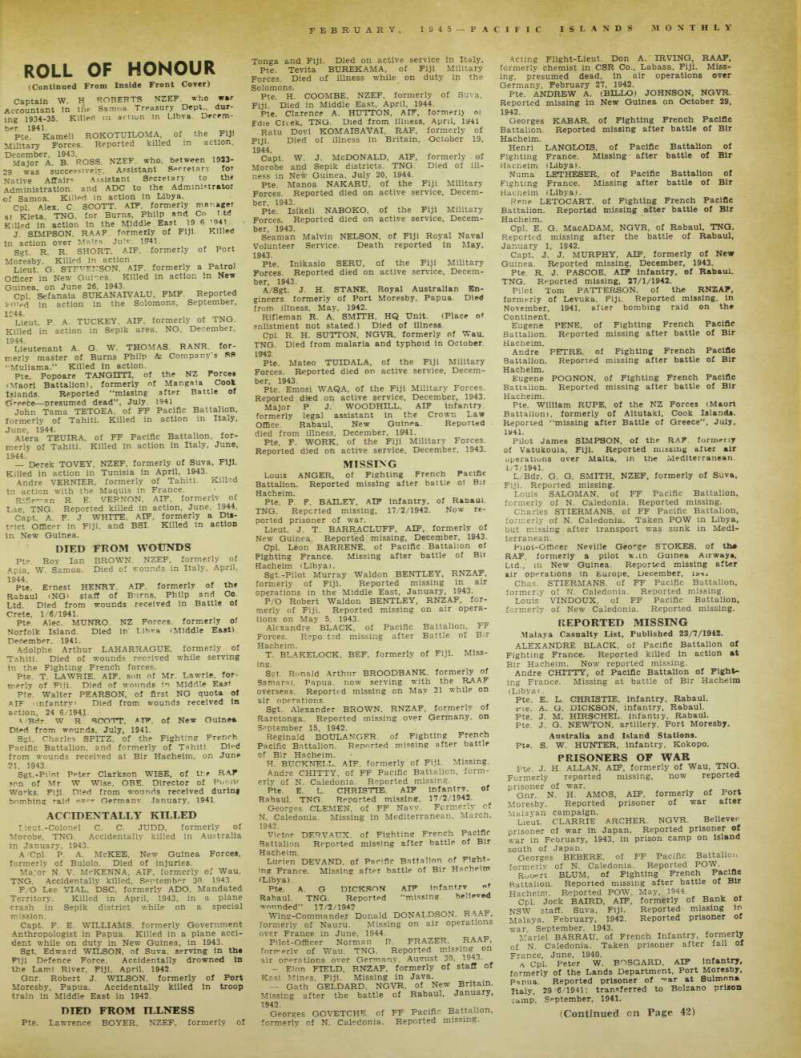
Australian Short Wave Broadcast
AN Australian radio programme Is broadcast dally on short wave from Lyndhurst (Vic toria) for listeners in the Western Pacific:—
Call.
Wave Sign.
Time.
Length.
Frequency.
Vlr8.
6.30-10.15 a.m. 25.51 metres 11,760 M/cs
Vlr3.
12.00-6.15 p.m. 25.25 metres 11,880 M/ca.
Vlr.
6.45-11.30 p.m. 31.32 metres 9,580 M/ca Power: 2 kilowatts.
Roll Of Honour
(Continued From Inside Front Cover)
Advertisements & other items, pp. 50-52 (2 items)
48
FEBRUARY, 194 5 PACIFIC ISLANDS MONTHLY
Published by PACIFIC PUBLICATIONS PTY. LTD.. Union House 247 Geonre Street; SvrfnAV /TnUnliiAno* WhnlltT oaf nn anH nrtnfaj
W. R. Carpenter & Co. Ltd.
Established 1914
THIRTY YEARS OF PACIFIC ISLANDS
DEVELOPMENT AND SERVICE .
W. R. CARPENTER & CO. LTD.
Capital £1,000,000.
GENERAL MERCHANTS AND SHIPOWNERS
Buyers and Exporters of All Kinds of Islands Produce Copra Merchants and Millers Agents for Australian, European and American Manufacturers Distributors of Every Description of Merchandise
AGENTS FOR:
FORD MOTOR COMPANY OF CANADA DODGE BROTHERS INC.
ELECTROLUX REFRIGERATORS WESTINGHOUSE ELECTRICAL CO.
T. G. & C. BOLINDERS (ENGINES) CATERPILLAR TRACTORS Etc., Etc.
BRANCHES THROUGHOUT THE PACIFIC ISLANDS
Head Office: 16 O'CONNELL STREET, SYDNEY
In London: W. R. Carpenter & Co. (London) Ltd., Coronation House, 4 Lloyd's Avenue, London, EC.
The W.R.C. Line
Th SS rst P i ire( r T e( ; t a ? d Re S ular Cargo and Passenger Service between Eurone and Pacific Islands’ ports was established by W. R. Carpenter & Co. Ltd.